In the preceding sketch of the early history of the British flags we
have, so far as evidence is available, followed the steps by which
the red cross on a white ground came to represent the people of
England, and we have seen, though less clearly, how the white saltire
on a blue ground became the chosen flag of the Scottish nation. It
now remains to trace the process by which these two flags became
united in one, and finally, by the addition of a red saltire to represent
Ireland, developed into the present Union flag.
On the death of Queen Elizabeth in March, 1603, the succession
to the crown lay open.
There had been no repeal of the stipulation made by Henry VIII,
both in Act of Parliament and in his will, that after the death without
heirs of his three children, Edward, Mary and Elizabeth, the crown should
descend to the heirs of his younger sister, Mary.... Consequently, the rightful
heir when Elizabeth lay dying was no scion of the Scottish House, but
the eldest representative of the Suffolk line—Princess Mary's great-grandson,
Edward Seymour, Lord Beauchamp. But Elizabeth's ministers
were not the slaves of legal niceties. The Queen's neutrality left their
choice unfettered; and though expectation of personal profit largely moved
them, their action proved politic. Lord Beauchamp was a man of insignificant
position and character; James VI, however contemptible in
many respects, had experience as a ruler, and a contiguous kingdom to
add to the endowments of the English Crown[141].
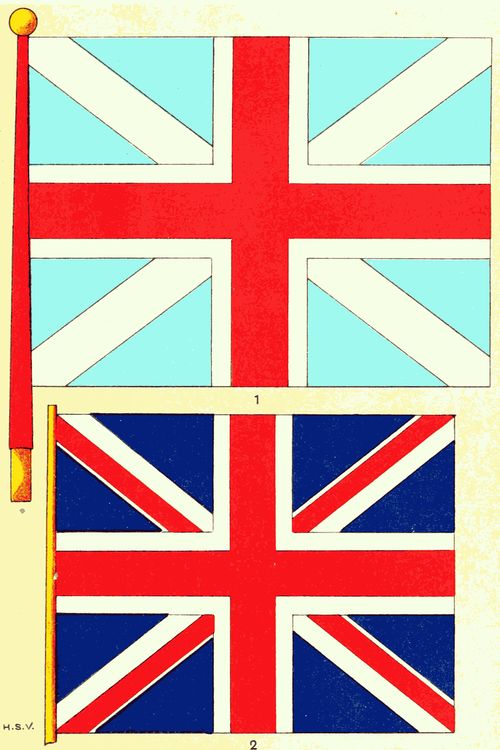
PLATE IV — Union Flag
But the union of crowns brought about by Elizabeth's ministers
with the tacit approval of the two nations did not directly lead to
the union of peoples. The Parliaments remained separate; national
jealousies ran high, especially in England, and James was foiled in
his efforts to bring about the closer union he sought. Nevertheless,
he was determined[142] that the union of the two nations should have
some other outward expression than the change in the royal standard,
and in the beginning of the fourth year of his reign he issued a proclamation
in the following words:
A Proclamation declaring what Flags South and North
Britains shall bear at Sea.
Whereas some difference has arisen between our Subjects of South
and North Britain, Travelling by Sea, about the bearing of their flags,
for the avoiding of all such contentions hereafter, We have with the advice
of our Council ordered That from henceforth all our subjects of this Isle
and Kingdom of Great Britain and the Members thereof shall bear in
their maintop the Red Cross, commonly called St George's Cross, and the
White Cross, commonly called St Andrew's Cross, joined together, according
to a form made by our Heralds and sent by Us to our Admiral to be
published to our said Subjects[143]. And in their foretop Our Subjects of
South Britain shall wear the Red Cross only as they were wont, and our
Subjects of North Britain in their Foretop the White Cross only as they
were accustomed. Wherefore We will and command all our Subjects to
be conformable and obedient to this Our Order, and that from henceforth
they do not use to bear their flags in any other Sort, as they will answer
the contrary at their Peril.
Given at our Palace of Westminster the 12th.
day of April in the 4th. year of our Reign of
Great Britain France and Ireland Annoq.
Domini 1606.
Unfortunately the naval records of the early years of the seventeenth
century have almost entirely disappeared from the State
archives; the "State Papers" themselves are but fragmentary remains;
and the English Privy Council Registers from 1602 to 1613
were destroyed by the fire at Whitehall in 1618, so that it is impossible
to say what were the points of contention referred to in the Proclamation.
The birth of the flag that is now the pride of so many millions
was indeed obscure. Intended at first for use only at sea, it appears
to have excited no attention except from those directly concerned
with shipping. The royal and merchant navies were alike dwindling
away, and the sea did not fill that place in the minds of James' subjects
that it had filled in the greater days of Elizabeth.
The only strictly contemporary evidence of the actual design
chosen in 1606 is to be found in the following appeal from the shipmasters
of Scotland, whom it did not by any means please.
Edinburgh
7 Aug. 1606
Most sacred Soverayne. A greate nomber of the maisteris and awnaris
of the schippis of this your Majesteis kingdome hes verie havelie compleint
to your Majesteis Counsell that the form and patrone of the flaggis
of schippis, send doun heir and commandit to be ressavit and used be the
subjectis of boith kingdomes, is very prejudiciall to the fredome and
dignitie of this Estate and will gif occasioun of reprotche to this natioun
quhairevir the said flage sal happin to be worne beyond sea becaus, as your
sacred Majestie may persave, the Scottis Croce, callit Sanctandrois Croce is
twyse divydit, and the Inglishe Croce, callit Sanct George, haldin haill and
drawne through the Scottis Croce, whiche is thairby obscurit and no takin
nor merk to be seene of the Scottis Armes. This will breid some heit and
miscontentment betwix your Majesteis subjectis, and it is to be feirit that
some inconvenientis sall fall oute betwix thame, for oure seyfairing men
cannot be induceit to ressave that flag as it is set doun. They haif drawne
two new drauchtis and patronis as most indifferent for boith kingdomes
which they presented to the Counsell, and craved our approbatioun of the
same; bot we haif reserved that to your Majesteis princelie determination,—as
moir particularlie the Erll of Mar, who wes present and hard thair
complaynt, and to whome we haif remittit the discourse and delyverie of
that mater, will inform your Majestie, and latt Your Heynes see the errour
of the first patrone and the indifferencie of the two new drauchtis. And
sua, most humelie beseiking your Majestie, as your Heynes has evir had
a speciall regaird of the honnour, fredome and libertie of this your Heynes
antient and native kingdome that it wuld pleis your sacres Majestie in this
particulair to gif unto your Heynes subjectis some satisfactioun and contentment,
we pray God to blisse your sacred Majestie with a lang and
prosperous reignne and eternall felicitie[144].
There is nothing to show that this appeal met with any response,
but the Scots never took kindly to the new flag and rarely used it until
after the Legislative Union of 1707. Sir Edward Nicholas in 1634
was doubtful "whether the Scots have used to carry that Flag of the
Union."
It is unfortunate that these "drafts and patterns" have disappeared,
perhaps in the same fire that consumed the "form" made
by the heralds. There is no doubt about the main outline, but the
absence of precise detail has led several writers—purists in heraldic
matters—to contend that the white border of the red cross was
simply a narrow fimbriation[145]. I think, however, that examination of
the available evidence will show that this border did not originate
as a mere "fimbriation," that it was in fact part of the field of the
English flag, and that the new flag was, as described by Sir James
Balfour[146], "the flagis of St Andrew and St George interlaced,"
not merely the red cross surmounting the Scots flag. Material
proof that it was so regarded sixty years later is in existence in
Amsterdam in the shape of actual flags captured during the Second
and Third Dutch Wars, and belonging therefore to the second half
of the seventeenth century. These show a very wide border to the
red cross, and in two instances[147] the red cross, the white border and
the white saltire are each of the same width.
The heralds had been faced by a dilemma. It was impossible to
combine the two flags so as to form a new one without giving precedence
to one of them. If quartered, the upper canton next the staff
was the place of honour, and both could not occupy it at the same
time. In the reign of James II this difficulty was solved, in the case
of the Royal Arms, by placing the Scots' Lion in the first quarter in
the Great Seal of Scotland. Possibly a similar solution was suggested
by the Scottish shipmasters. But there was a precedent for a closer
union than this quartered form, which no doubt the heralds had in
mind. Elizabeth had granted the Levant Company, by her charters
of 1581 and 1592, the right to wear as a flag "the Armes of England
with the redde crosse in white over the same[148]." We may be quite
sure that in consenting to such an arrangement Elizabeth had no
thought of giving the national flag precedence over the royal standard,
but merely wished to signify their intimate union and the extension
of the royal protection to the company. The method adopted in 1606
was exactly the same, the "red cross in white" being placed over the
Scots flag.
The quarterly arrangement of the crosses appears to have been
used on one occasion; the dispatch of a fleet in 1623 to bring back
Prince Charles and the Duke of Buckingham from Spain. Mr Serjeant
Knight, in a "discourse" on the St George's flag written in 1678 at
the request of Pepys[149], stated that he had in his possession the Order
from the Great Wardrobe directed to his father, Mr Thomas Knight,
Arms Painter, who was to paint the banners and streamers required
for the Prince. The principal flag was to be that shown in Plate V,
fig. 1: "Imprimis in ye Prince's ship wherein he goes, on ye top ye
Crosses of St. Andrew and St. George." Mr Knight assured Pepys
that he could not be mistaken about this "cobled Banner," as he
scornfully called it, "ye severall arms being trickt in ye margin of
ye Order," and he proceeded to give a sketch of it. Indeed, he
was disposed to believe this to be the original form of the Union
flag:
having seen severall Flaggs with St. George and St. Andrew quarterly and
may every Lord Mayor's Day be seen born by some of ye Companies
Barges, these flags being made much about that time, all men being willing
to flatter their new king.
The evidence of the Privy Council Register of Scotland is, however,
sufficient to prove that this inference was incorrect.
The documents of 1606 do not give any name to the flag they
describe. It appears first to have been called the "Britain" or
"British" flag[150], and I have not found the name "Union" earlier
than 1625, when it appears in the list of the flags and banners used
at the funeral of James I[151]. Three years later it appears in the Sailing
Instructions of the Earl of Lindsey[152], but the older name still persisted
at sea and is found in inventories of stores and in sailing and fighting
instructions until 1639[153].
Hitherto this "British" or "Union" flag had, like the old English
flag of St George, been flown equally by merchantman and man-of-war,
strangers being expected to distinguish the latter by their more
warlike appearance.
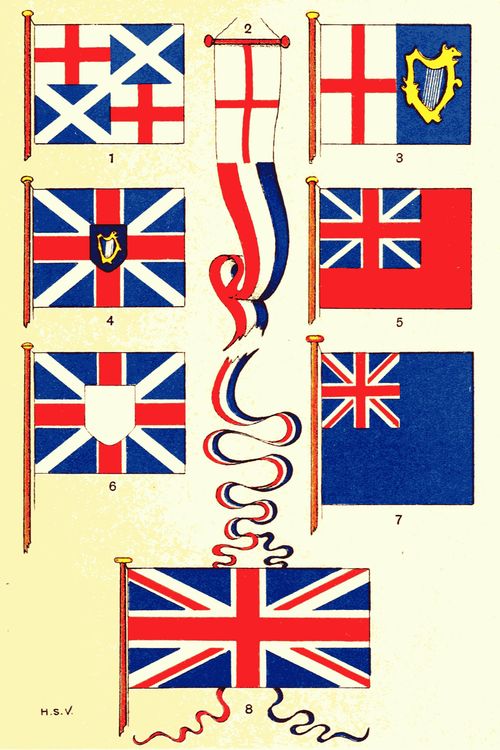
PLATE V — Union Flags and Jacks
Towards the year 1633, however, the old question of the salute
in the Narrow Seas was becoming more and more acute, "because,"
in the words of Sir Wm Monson, "both the French and Hollanders
seek to usurp upon his Majesties right[154]." Sir John Pennington, the
"Admiral of the Narrow Seas," seized on this as an excuse to advocate
a difference in the flags of the king's and the merchants' ships. In a
letter dated 7th April, 1634, asking for instructions on various points
relative to his duties as Admiral of the Narrow Seas he writes:
For alteringe of the Coulers whereby his Mats owne Shippes may be
knowne from his Subiects I leave to yor Lopps more deepe consideration.
But under correction I conceive it to bee very materyall and much for his
Mats Honor, and besides will free disputes with Strangers, for when they
omitt doinge their Respectes to his Mats Shippes till they bee shott at
they alleadge they did not know it to be the kinges Shippe[155].
The plea that the existing arrangement caused confusion in the
minds of foreigners was quite justified, but it is probable that there
was a deeper underlying cause, jealousy of the mercantile marine.
Be this as it may, Pennington's suggestion was favourably received,
and the approval of the king was obtained to the issue of the following
Proclamation:
A Proclamation appointing the Flags, as well for our Navie Royall as
for the Ships of our Subjects of South and North Britaine.
Wee taking into Our Royall consideration that it is meete for the
Honour of Our owne Ships in Our Navie Royall and of such other Ships
as are or shall be employed in Our immediate Service, that the same bee
by their Flags distinguished from the ships of any other of Our Subjects,
doe hereby straitly prohibite and forbid that none of Our Subjects, of any
of Our Nations and Kingdomes, shall from hencefoorth presume to carry
the Union Flagge in the Maine toppe, or other part of any of their Ships
(that is) S. Georges Crosse and S. Andrews Crosse joyned together upon
paine of Our high displeasure, but that the same Union Flagge bee still
reserved as an ornament proper for Our owne Ships and Ships in Our
immediate Service and Pay, and none other.
And likewise Our further will and pleasure is, that all the other Ships
of Our Subjects of England or South Britaine bearing flags shall from
hencefoorth carry the Red-Crosse, commonly called S. George his Crosse,
as of olde time hath beene used; And also that all the other ships of Our
Subjects of Scotland or North Britaine shall from hencefoorth carry the
White Crosse commonly called S. Andrews Crosse, Whereby the severall
Shipping may thereby bee distinguished and We thereby the better discerne
the number and goodnesse of the same. Wherefore Wee will and
straitly command all Our Subjects foorthwith to bee conformable and
obedient to this Our Order, as they will answer the contrary at their
perills.
Given at Our Court at Greenwich this fifth
day of May in the tenth yeere of Our Reigne
of England Scotland France and Ireland, Defender
of the Faith &c.
The ostensible reason for this distinction in flags—to enable the
"number and goodnesse" of the ships of the two nations to be more
readily discerned—is obviously an afterthought[156]; a sugar coating to
the pill. The customs officers of the various ports could, of course,
have provided any information desired relative to the shipping, and
were not dependent on the flags for their knowledge of the ships'
nationalities. The point is of some interest as it marks a distinct step
in the exaltation of the Navy Royal and its officers into a position of
superiority over the mercantile marine.
It will also be observed that the proclamation of 1634 does not
require the flags to be hoisted at the masthead as did that of 1606.
Probably this was no accidental omission but was the outcome of the
general introduction of the "Jack" on the bowsprit a year or two
before. Flags had no doubt been occasionally carried on the bowsprit
from the time when that spar was first invented, but the practice had
been exceptional, at any rate in the English navy. An early instance
was depicted in a contemporary picture in Cowdray Castle, since
destroyed by fire, which represented "the encampment of the English
forces near Portsmouth, together with a view of the English and
French fleets at the commencement of the action between them on
the 19th of July, 1545." In this picture, which fortunately was reproduced
in an engraving by the Society of Antiquaries in 1780, the
Lord Admiral's ship, the 'Henri Grace à Dieu,' was seen flying a
royal standard on the bowsprit. Drake, also, had flown a striped flag
in this position in that last voyage which ended for him in his death
at sea in January, 1596[157]. Yet when Captain Young submitted his
"Noates for Sea Service" to the Earl of Essex[158] he wrote as though
the idea were unusual:
and that the cullers maye bee the better knowne from those of the
enemies and yf they chance to have the like it shalbe then convenient that
upon or misson flagge-staves or th ende of or bowlesprits and that theare
bee but a smawle litle flagge with a red Crosse yt being but a litle bigger
than a vaine of a great Catche[159].
As remarked by Admiral Sir Massie Blomfield[160], this "jack" is not
shown in the "illustrations of the flagships of the Expedition of 1596
reproduced in the 'Naval Miscellany,'[161]" so that the suggestion was
probably not received with favour.
There is no mention of, or provision for, "jacks" in the inventories
which accompanied the report of the committee that inquired
into the state of the navy in 1618. Sir Julian Corbett has pointed
out[162] that the earliest instance of the use of the word "jack" to denote
a flag occurs in the orders issued by Sir John Pennington to one of
his captains on 3rd July, 1633. The original has not survived, but
the copy[163] is in a contemporary hand and is corroborated by
Pennington's Journal, now among the MSS. of Lord Muncaster.
In the summers of the years 1631, 1633 and 1634 Pennington
was in command of a small squadron as Admiral of the Narrow Seas,
charged especially with the duty of freeing the coast from
pirates. He tells us in his journal[164], under the above date (3rd July,
1633):
In the morninge it blew very hard at SW by W. Aboute noone we
weyed—leavinge the 8th Whelpe in Catt Water and stoode of to sea with
the rest of our Fleete, knowinge it to bee a very hard matter for any small
vessels to keepe the sea in such fowle weather, and the likelyest place
for them to shelter in with these winds was Torbaye, for which place
we stoode, causinge the 10th Whelpe to goe a head of us and close
aboard the shore, with her coullers and ordynance in, that shee might
not bee suspected to bee one of our Fleete, the better to intrap any
Pyrates.
The order, which is dated the same day on board the 'Vanguard,'
Pennington's flagship, is evidently the one given to the 10th Whelp[165].
It contains instructions as to rendezvous in case the ships lost company,
and continues as follows:
you are to looke out carefully for these pirates night and day; that if it
be possible wee maie intrapp them. You are alsoe for this present service
to keepe in yor Jack at yor Boultsprit end and yor Pendant and yor Ordinance[166].
The fact that the position of the "Jack" is defined in this order
tends to show that the term had not yet become common, and this
is fully confirmed by a passage added by Sir Nathaniel Boteler to
one[167] of the manuscript copies of his well-known Six Dialogues about
Sea Services, written about the year 1634.
Boteler, who last served at sea in the Ile de Ré Expedition of
1627, says:
but of late ther hathe bin invented an order that none of our Englishe
shypps should be allowed to carry the king's flagge (that is the English
Crosse quartered[168] wh the Scottish, and called the Brittish flagge or Colours)
save only such shyps as are either of his Maties owne or serve under his
paye, and every such vessel, though but a Catche, is permitted and enjoined
to weare one of thes in a smale volume in her Boltsprites Topp.
And the flaggs thus worne are tearmed Jacks.
The "Order" referred to is evidently the Proclamation of 1634,
which, as already remarked, was the outcome of Pennington's request
for instructions. It seems highly probable that it is to the same outstanding
personality[169] that we owe the institution of the "Jack" on
the bowsprit.
From 1634 until the death of Charles I the royal ships continued
to be distinguished from the merchant ships by this difference in
their flags, although, as a distinct favour, merchant ships were, in a
few special cases, granted permission to carry the Union flag.
The execution of Charles I on 30th January, 1649, dissolved the
dynastic union between England and Scotland. The two nations,
which only a few years before had been united in a "Solemn League
and Covenant" against Charles, had been gradually drifting apart,
and on the proclamation by the Scots of Charles' son as king the two
governments fell into open enmity. In these circumstances the Union
flag had become meaningless. On the 22nd of February the Parliament
decreed that the "Admiralty" should be settled in the Council
of State[170], and the "Navy Committee," that is, the Committee of the
Council, who were managing those affairs of the navy that had
formerly been within the jurisdiction of the "Principal Officers of
the Navy," immediately applied to the Council to know what they
were to do about flags.
This Committee taking notice of the arms yt are engraven upon ye
sternes of ye shipps belonging to ye Comonwealth & intended for this
Summers fleet doe think fit to inform the Comtee of State therewith that
so directions may be given what arms shalbe placed in their steed & likewise
what characters shalbe given to the flaggs that are to be worne in
this service[171].
The Council of State promptly decided "That the Ships at Sea
in service of the State shall onely beare the red Crosse in a white
flag
[172]," thus bringing the navy back to the old English flag and once
more into line with the merchant shipping. The royal arms were
ordered to be removed from the sterns and replaced by "the Armes
of England and Ireland in two Scutcheons[173]."
Two days later the Generals at Sea were informed, in answer to a
further inquiry, that if Scots ships were found "bearing either the
red cross or the Armes heretofore called the King's Armes" they were
to admonish them to "forbeare the carrying of them for the future[174]."
It is probable that the order of 22nd Feb. was not altogether
welcome to the navy officers, for on 5th March, only a few days
after the above order had been issued, the Council of State decided
upon a new union flag for naval use. The union now to be symbolised
was that of England and Ireland. Although Ireland had been more or
less under the rule of the kings of England from the time of Henry II,
it was not until the accession of James I in 1603 that she had found
recognition in the royal standard, and it remained for the Commonwealth
to give her due recognition in the national flag. The entry in
the Council Minute Book runs: "That the fflagg that is to be borne
by the Admirall be that now presented, viz: the Armes of England
and Ireland in two severall Escotchons in a red flagg wth in a Compartiment (or)[175]."
At the same time two other variants of this design were introduced,
a standard and a jack. The order for these cannot be found,
but they are referred to in the following letter to the Committee of
the Navy signed by Deane and Blake (two of the Generals at Sea[176])
and dated 21st April, 1649:
Gentlemen
Touching the flaggs &c. It seems strange you referre the proportions
to bee ascertained by us, yorselves knowing best the former allowaunces,
which wee suppose are alike in number in every expedition, but
since the Issue depends on or resolution wee think needfull that you make
up what you have allready sent, for orselves three Standards, or viceadmll
and Rereadmll with the Admll Viceadmll & Rereadmll of Ireland three
flaggs apiece, with two Jackes for every Shipp in the ffleet. ffor the Ensignes
and pendants you best know how many are wanting, which (whatsoever
they are) with the flaggs &c. we desire may bee noe longer delayed[177].
In the standard, intended to replace the royal standard, and to be
used by the Generals at Sea, the yellow "compartment" was omitted
and the two escutcheons were surrounded by green branches of laurel
and bay. Fortunately, an actual specimen[178] has survived of this interesting
flag, which was destined to wave over Blake's ship at the
heroic battle of Santa Cruz and to see the rise of the English navy to
an eminence unequalled even in the days of Elizabeth.
The jack contained only the cross and harp on their white and
blue fields, corresponding with the centre part of the Admirals' flags.
It is to be seen in several pictures of battles of the First Dutch War[179].
Apparently this jack was also used by ships having letters of marque;
"privateers" as we should now call them. In December, 1652, the
captain of a small frigate, called the 'Helena,' fought with two armed
ships from Brest, "putting out the Parliament Jack on the bowsprit
end and the English ensign on the poop, the enemy having hung out
the disunion flag or late King's colours[180]."
Early in 1653 the junior Admiral's flag with the red border and
yellow compartment seems to have been abandoned, and a flag like
the jack, with the harp and cross only, substituted for it[181], probably
because the red border would cause confusion when flown in the
white and blue squadrons.
Scotland was formally re-united to England by an Ordinance of
the Commonwealth Parliament dated 12th April, 1654, and the cross
of St Andrew was ordered to be brought once more into conjunction
with that of St George:
And that this Union may take its more full effect and intent Be it
further ordained by the Authority aforesaid That the Arms of Scotland
viz: a Cross commonly called Saint Andrews Cross be received into and
borne from henceforth in the Arms of this Commonwealth as a Badge of
this Union.
In the new great seal which was prepared in 1655 the St Andrew's
cross was quartered with St George's cross and the Irish harp, but it
was not at once introduced into the naval flags, although placed on
the obverse of naval medals struck in 1654.
The cross of St Andrew was re-introduced into the naval flags by
the following order of the Council of State dated 18th May, 1658[182]:
That the Standard for the Generall of his Highness ffleete be altered,
and doe beare the Armes of England, Scotland, and Ireland, with his
Highness Escutcheon of pretence, according to the impression of the
Great Seale of England; and that the Jack fflaggs for the fflagg officers of
the ffleete and for the severall Shipps of Warre of his Highness be the
Armes of England and Scotland united, according to the auncient forme,
With the addition of the Harpe, according to a Modell now showd; and
that the Comrs of the Admty and Navy to take order That the standard
and Jacke fflaggs be prepared accordingly.
In the standard the two crosses and the harp were borne "quarterly"
surmounted by an inescutcheon (sable, a lion rampant argent),
the personal arms of Cromwell[183], but in the other Admirals' flags and
the jack the crosses were superposed, as in the Union flag of 1606,
with the addition of a harp in the centre. The "model" has disappeared,
like all its predecessors, and nothing remains to show for
certain whether this harp was placed in a blue escutcheon as in the
earlier Commonwealth flags or not, but since a request was received
from Chatham in the following November for 200 yards of blue
bewper "for ye altering of all ye fflaggs and Jacks here yt are of ye
former fashion into ye new forme[184]" it seems on the whole probable
that the harp was in an escutcheon with a blue field.
This return towards the flag of 1606, prophetic of the coming
restoration, lasted for a few months only. In September Cromwell
died, and his son, the shadow of a great name, after being tolerated
as a mere figurehead for a few months, was in the following May
forced to abdicate. The remnant of the Long Parliament, which had
just re-assembled, passed an "Act for the Great Seal of England"
which restored the seal of 1651 with its map of England and Ireland
and shields with the St George's cross and the Irish harp. The
cross of Scotland vanished and the Commonwealth "Cross and
Harp" jack supplanted Cromwell's Union Jack.
In March, 1660, the Navy Commissioners were told to furnish
General Mountagu, then in command of the Fleet
[185], "with Standards
for the Naseby suitable to the Jacks now worne in the ffleete[186]." This
was the standard which Mountagu was flying when ordered to cross
to the Hague and bring back the king.
On 1st May, 1660, the newly assembled Houses of Parliament
passed a joint vote for the restoration of the ancient government,
and a few days later, before Charles was publicly proclaimed, the
Commissioners of the Admiralty and Navy, at the instance of the
Council of State, issued the following order to their subordinate
Board:
In pursuance of an order of the Councell of State of the 5th of this
instant May It is ordered that it be referred to the Comrs for the Navy
forthwith to take care that such Standards, fflags and Jacke Colours for
the ffleete be forthwith prepared as were in use before 1648 and that they
be sent downe with all speed to Generall Mountagu as alsoe that Carvers
and Painters be appointed to goe down for the altering of the Carved
workes according to such directions as they shall receive from Comr Pett,
who is ordered by ye Councell forthwth to goe to ye Generall. And the
said Comrs are to give order for the sending downe to the Generall One
silke Standard and one silke Ensigne and Jacke and such other silke fflags
as may compleate a suite for the Naseby[187].
Instructions to this effect must have reached the fleet before it
left England, but the flag-makers had evidently not had sufficient
time to prepare the new royal standard, for on the 13th May, on
the way over, (so Pepys, then secretary to Mountagu, tells us[188])
the tailors and painters were at work cutting out some pieces of yellow
cloth into the fashion of a crown and C.R. and put it upon a fine sheet and
that into the flag instead of the State's arms[189] which after dinner was finished
and set up.... In the afternoon a Council of War only to acquaint them that
the Harp must be taken out of all their flags, it being very offensive to the
King.
The Union flag, like the Government, now reverted to its original
form, but the right to fly it remained the special prerogative of the
State's ships, a prerogative much sought after by merchant ships, and
often assumed by them without warrant. For the next half century
a long-drawn struggle was waged by the merchant shipping for the
possession of this right. It begins with a special instruction sent by
the Lord High Admiral, James Duke of York, to the Corporation of
Trinity House on 9th March, 1661:
I desire you will give notice unto all Commanders and Masters of
Shipping belonging to the Subjects of the King, my Sovereign Lord and
Brother, that from henceforward they forbear to wear the Flag of Union;
and also acquaint them, that such as presume to wear the said Flag contrary
hereunto, the King's Ships will have orders to take it from them[190].
The Trinity House issued orders to this effect, but although the
prohibition had been stiffened with a threat that the flag would be
taken by force from those displaying it, the notices seem to have had
so little effect that, on 19th Nov., when a royal proclamation was
issued "For prohibiting the Imbezlement of His Majesties Stores,"
the opportunity was taken to make the further threat that the Commander
of the ship would be seized also:
And for preventing the abuse which hath been of late practised concerning
Flags, Pendents and other Ornaments His Majesty doth hereby
strictly prohibit & forbid the use of His Majesties Colours in Merchant
Ships, and doth Authorize and Command all Commanders and Officers
of any His Majesties Ships of War not only to take from Merchants Ships
all such Colours but likewise to seize the Commander of such Merchant
Ships, wherein after the first day of April next they shall be used, and to
bring them to condign punishment[191].
It is interesting to find here, as in 1634, an excuse made for the
order which is not the main reason for it. No doubt a certain number
of colours were embezzled and sold by the boatswains of the king's
ships, just as the gunners embezzled and sold the powder, but the
desire of the merchant shipping to fly the Union flag was not due to
the fact that they might occasionally pick that flag up cheap, it was
due rather to the privileges, especially freedom from pilotage and port
dues in foreign ports, which the flag assured them.
Probably the further threat of imprisonment checked the practice
for a time, but not entirely, for the Lord High Admiral was again
taking action in 1666.
Warrant for taking into custody such Mars of Mercht Ships
as shall presume to Wear the Kings Jack.
Whereas I am informed yt the Mars of severall Merchant Shipps outward
bound from the River of Thames have presumed to Wear the Kings
Jack without having leave from myself or the Prinle Officers & Commrs
of His Matys Navy or any other just pretence for so doing These are therefore
to will and require you forthwith to goe down the River of Thames
and examine and enquire what Merchant Ships either do or have lately
Wore the Kings Jack not being hired nor carrying goods for His Matys
Service and yt you apprehend the Mars of them ... (except the Ship Tryall
whereof Hope for Bendall is Mar, which is bound for New England &
is to carry some Goods for me) and keep them in safe custody that they
may be punished for their presumption.
And all Mayrs Sheriffs &c.
Dated 11th May 1666.
James[192].
Deterred by these measures from a direct attempt to make use
of the Union flag, the merchant shipping hit upon the device of
flying a flag which was a sufficiently close imitation of the forbidden
colours to deceive foreign powers[193] without falling within the strict
letter of the law. In 1674 this practice had evidently become common,
for Pepys acquainted the Trinity House, in June, of the King's intention
to put a stop to it[194]. Three months later the following proclamation
was issued:
Whereas by ancient usage no merchant's ship ought to bear the Jack,
which is for distinction appointed for his Majesty's ships; nevertheless his
Majesty is informed that divers of his Majesty's subjects have of late presumed
to wear his Majesty's Jack on board their ships employed in merchants'
affairs, and thinking to evade the Punishment due for the same,
bear Jacks in shape and mixture of colours so little different from those of
his Majesty as not to be without difficulty distinguisht therefrom, which
practice is found attended with manifold Inconveniences; for prevention
whereof for the future his Majesty hath thought fit, with the advice of his
Privy Council, by this his Royal Proclamation, strictly to charge and
command all his subjects whatsoever, that from henceforth they do not
presume to wear his Majesty's Jack (commonly called The Union Jack)
in any of their ships or vessels, without particular warrant for their so
doing from his Majesty, or the Lord High Admiral of England, or the
Commissioners for executing the office of Lord High Admiral for the time
being; and his Majesty doth hereby further command all his loving subjects,
that without such warrant as aforesaid, they presume not to wear on
board their ships or vessels, any Jacks made in imitation of his Majesty's,
or any other flags, Jacks, or Ensigns whatsoever, than those usually heretofore
worn on merchants' ships, viz., the Flag and Jack White, with a
Red Cross (commonly called Saint George's Cross) passing right through
the same; and the Ensign Red, with a like Cross in a Canton White, at
the upper corner thereof next to the staff.
And his Majesty doth hereby require the principal officers and Commissioners
of his navy, Governors of his Forts and Castles, the Officers
of his Customs, and Commanders or officers of any of his Majesty's ships,
upon their meeting with, or otherwise observing any merchants' ships or
vessels of his Majesty's subjects wearing such a flag, jack, or ensign, contrary
hereunto, whether at Sea or in Port, not only to cause such flag, jack
or ensign to be forthwith seized, but to return the names of the said ships
and vessels, together with the names of their respective masters, unto the
Lord High Admiral, Lords Commissioners of the Admiralty, or the
Judge of the High Court of Admiralty for the time being, to the end the
Persons offending may be duly punished for the same.
And his Majesty doth hereby command and enjoyn the Judge and
Judges of the High Court of Admiralty for the time being, that at the
several Sessions to be hereafter held by his Majesty's Commission of Oyer
and Terminer for the Admiralty, they give in charge, that strict enquiry
be made of all offences in the premises, and that they cause all offenders
therein to be duly punished. And all Vice Admirals and Judges of Vice
Admiralties, are also to do the same, and to attend the due observation
hereof, within the several Ports and Places of their respective Precincts.
Given at our Court at Whitehall the Eighteenth
Day of September 1674, in the Six and Twentieth
Year of our Reign.
By his Majesty's Command.
A new competitor for the privilege now appeared in the yacht—a
type of pleasure-boat introduced from the Netherlands at the
Restoration. In 1676 the request of the Governor of Dover "to have
the liberty of wearing his Majts Jack upon his private yacht" was
refused by the king in Council[195], but the practice of hoisting the
Union Jack upon yachts without warrant had become sufficiently
widespread by 1686 to attract the notice of the navy authorities, as
shown by the following memorandum of Pepys:
Notes about the Jack taken by S. P. at the Navy Board the 20th of
Septr 1686 upon occasion of the liberty taken by Private Yachts to wear
the Kings Jack without License.
Memorandum. That the temptations to this Liberty (besides the pride
of it) are
1st. That in Holland they are freed by it from taking a Pilot.
2dly. As to France they are by the Jack excused from paying the Duty
of 50 Sous by Tun paid by every Mercht Man coming into a French Port.
3dly. All our Merchant Men lower their Topsails below Gravesend to
any ship or vessel carrying the King's Jack, be it but a Victualling Hoy[196].
About this time another form of jack had come into use in the
Mediterranean. Its origin is obscure: we first meet with it in some
notes of matters to be looked into jotted down by Pepys about 1687:
"Quaere, the Practice of wearing Colours in Boats? And the Budgee[197]
Jack now familiarly used abroad (as lately by St Loe
[198]) being the
Union Jack in a Canton upon a Red Flag." It will be seen from this
note that it was of similar design to the red ensign instituted in 1707,
and from the juxtaposition of "Colours in Boats" it may be inferred
that it was a combination of the jack and red ensign for use in boats
only. It was afterwards made the distinctive jack of a privateer[199].
For the next few years more serious matters than the misuse of
the Union Jack occupied the attention of the authorities, but in
1694[200], when William III was safely seated on the throne, another
Proclamation, similar to that of 1674, was issued forbidding merchant
ships, except those having letters of marque, to wear other colours
than the "Flag and Jack white with a Red Cross commonly called
St George's Cross passing quite through the same and the Ensign
Red with the like Cross in a Canton White at the upper corner thereof
next the staff." The privateers were to wear the same ensign as other
merchant ships, but were to have the red (Budgee) jack.
Another Proclamation in identical terms was issued in the first
year of Queen Anne's reign[201].
Meanwhile yet another variant of the Union Jack had been created
for the use of ships commissioned by the Governors of the North
American Colonies. In July, 1701, the Admiralty complained to the
Council of "the inconvenience by Merchant Ships wearing the King's
Colours in and among the Plantations abroad, under colour of Commissions
from the Governors of the said Plantations," and obtained
the Council's approval to the use by such vessels of a distinctive Jack
which is thus described in the Instructions to the Governors.
Whereas great inconveniences do happen by Merchant Ships and other
Vessels in the Plantations wearing the Colours born by our Ships of War
under pretence of Commissions granted to them by the Governors of the
said Plantations, and that by trading under those Colours, not only amongst
our own Subjects, but also those of other Princes and States, and Committing
divers Irregularities, they do very much dishonour our Service—For
prevention whereof you are to oblige the Commanders of all such
Ships, to which you shall grant Commissions, to wear no other Jack than
according to the Sample here described, that is to say, such as is worn
by our Ships of War, with the distinction of a White Escutchion in the
middle thereof and that the said mark of distinction may extend itself to
one half of the depth of the Jack and one third of the Fly thereof[202].
In 1707 was brought about that complete union of England and
Scotland that James had worked for a hundred years before. The
first article in the Treaty of Union provided that the crosses of
St George and St Andrew should be conjoined in such manner as
the queen thought fit. After due consideration of various designs
suggested by a Committee of the Privy Council in conjunction with
the Heralds College, it was finally decided by an Order in Council
of 17th April, 1707, "That the Union Flag continue as at present."
Coloured drawings of the Royal Standard, Union Flag, and Red
Ensign were formally communicated to the Admiralty by a further
Order in Council with instructions that these designs were to be
adhered to in the flags flown at sea[203].
But although no change was made in the Union flag an important
alteration was made in the Ensign; the English and Scots navies being
now united, the Union was introduced into its canton in place of the
St George.
In promulgating[204] this change of ensign opportunity was taken to
repeat the thunders of the former proclamations against the offending
merchant service, but with the inclusion of the Union in the ensign
the fight practically came to an end. Before long the general introduction
of fore and aft headsails led to the disappearance of the sprit
topmast on which the jack had been displayed, and as the flagstaff
on the bowsprit, which took its place, was in the way of the jib when
headsails were set, it became the common practice to fly a jack only
when the ship was in harbour.
With the opening of the nineteenth century came the final change
in the design of the Union flag. By the Act of 1800 the union of
Great Britain and Ireland was to take effect from the first day of the
new century, and by the first of the Articles of Union the "Ensigns,
Armorial Flags and Banners" were to be such as the king by "Royal
Proclamation under the Great Seal of the said United Kingdom
should appoint."
The Privy Council, after consulting the Heralds, recommended
to the king "that the Union Flag should be altered according to the
Draft thereof marked (C) in which the Cross of St George is conjoined
with the Crosses of St Andrew and St Patrick." This proposal
was approved by Order in Council of the 5th November, 1800.
The Proclamation[205] was issued on the 1st January, 1801. It decreed
that the Union Flag shall be azure, the Crosses Saltires of St Andrew and
St Patrick Quarterly per Saltire, counterchanged Argent and Gules; the
latter fimbriated of the Second[206] surmounted by the Cross of St George
of the Third[207], fimbriated as the Saltire.
In his desire to adhere to those pedantic formulae which came
into being during the decadence of heraldic art, the draftsman of
this clause was unfortunately obscure in a matter that called for the
clearest precision. The "Draft marked C" showed a fimbriation or
border for the St George's cross nearly as wide as the counterchanged
saltires[208]. This drawing and the verbal blason of it above
recited, were supplied to the Council by Sir Isaac Heard, the Garter
King-at-Arms, and since in so important a matter he is not likely to
have been guilty of carelessness, while there is no question of incompetence,
it is clear that "fimbriated as the saltire" was not intended
to denote that the border was to be of the same width as for the
saltire, but simply that this border was to be of the same colour. In
other words, a fimbriation was not so strictly defined as to width in
1800 as some persons at the present day would have us believe.
There would be no need to dwell upon this point were it not for
the importance of this flag and the confusion into which the details
of its construction have fallen.
It may seem an extraordinary statement to make, but it is a fact
that the Union flag is never made in strict accordance with the
original design.
In the pattern approved for the navy[209], which is also that flown
on the Houses of Parliament and on the Government Offices, and is
that adopted almost universally by private individuals of British
nationality, the Irish saltire is reduced in width by having its fimbriation
taken from itself instead of from the blue ground. Apparently
this has been done to bring the outer boundaries in line across the
flag, but it seems neither heraldically nor historically correct, for the
saltire representing Ireland[210] should be of equal width with that of
Scotland.
The other pattern in use is that established in 1900 by the War
Office, in an attempt to comply with the literal terms of the Proclamation
of 1st January, 1801, as interpreted by modern heraldic definitions[211].
In this pattern the two saltires are of equal breadth, but the
"fimbriation" of the St George's cross has been reduced to the same
width as that of St Patrick's saltire.
However, these differences are of no serious importance, and
indeed this flag seems doomed to misrepresentation, which extends
even to its name. A "Union Jack" is, correctly speaking, a small
Union flag intended to be flown in one particular place, the bows
of one of H.M. ships: yet for many years past this technical distinction
has been lost sight of[212] and the misapplication of the term "Jack"
has become almost universal, so much so that we have the Government
solemnly announcing that "The Union Jack should be regarded
as the national flag[213]."
The Union Pendant, that is a pendant with St George's Cross
at the head and with the fly striped longitudinally red, white and
blue (see Plate V, fig. 2) appears to have been first instituted in 1661
as a pendant which combined the colours of the Union flag and
which, like that flag, was to be flown only by H.M. ships. It was
afterwards known as the "Ordinary" or "Common" Pendant[214]. It
went out of use when the squadronal colours were abandoned in
1864, though it survives in a smaller form (in which the fly is not
slit) to this day as a signal that the ship's company is engaged in
divine service.