Both canals and railways were, in their early days,
made according to local conditions, and were intended
to serve local purposes. In the case of the former the
design and dimensions of the canal boat used were
influenced by the depth and nature of the estuary or
river along which it might require to proceed, and
the size of the lock (affecting, again, the size of the
boat) might vary according to whether the lock was
constructed on a low level, where there was ample
water, or on a high level, where economy in the use
of water had to be practised. Uniformity under these
varying conditions would certainly have been difficult
to secure, and, in effect, it was not attempted. The
original designers of the canals, in days when the
trade of the country was far less than it is now
and the general trading conditions very different,
probably knew better what they were about than
their critics of to-day give them credit for. They
realised more completely than most of those critics
do what were the limitations of canal construction
in a country of hills and dales, and especially in
rugged and mountainous districts. They cut their
coat, as it were, according to their cloth, and sought
to meet the actual needs of the day rather than
anticipate the requirements of futurity. From their
point of view this was the simplest solution of the
problem.
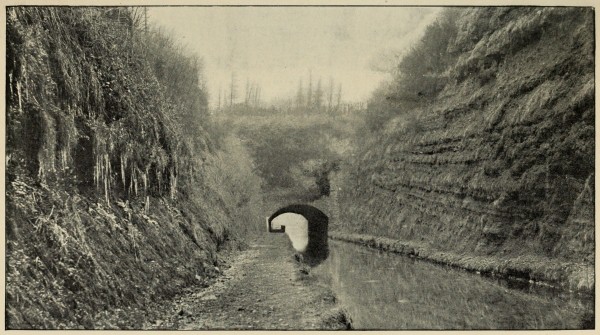
WHAT CANAL WIDENING WOULD MEAN.
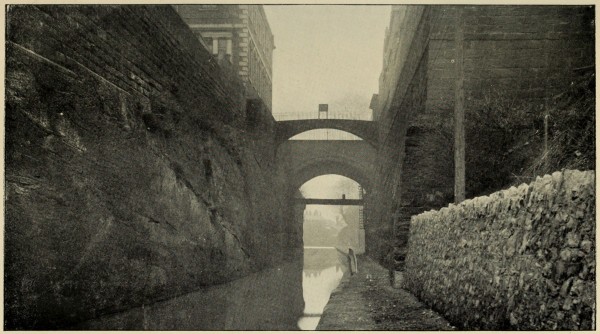
(Cowley Tunnel and Embankments, on Shropshire Union Route between Wolverhampton and the Mersey.)
[To face page 32.
But, though the canals thus made suited local
conditions, they became unavailable for through
traffic, except in boats sufficiently small to pass the
smallest lock or the narrowest and shallowest canal
en route. Then the lack of uniformity in construction
was accompanied by a lack of unity in management.
Each and every through route was divided among,
as a rule, from four to eight or ten different navigations,
and a boat-owner making the journey had to
deal separately with each.
The railway companies soon began to rid themselves
of their own local limitations. A "Railway
Clearing House" was set up in 1847, in the interests
of through traffic; groups of small undertakings
amalgamated into "great" companies; facilities of
a kind unknown before were made available, while
the whole system of railway operation was simplified
for traders and travellers. The canal companies,
however, made no attempt to follow the example
thus set. They were certainly in a more difficult
position than the railways. They might have
amalgamated, and they might have established a
Canal Clearing House. These would have been
comparatively easy things to do. But any satisfactory
linking up of the various canal systems
throughout the country would have meant virtual
reconstruction, and this may well have been thought
a serious proposition in regard, especially, to canals
built at a considerable elevation above the sea level,
where the water supply was limited, and where, for
that reason, some of the smallest locks were to be
found. To say the least of it, such a work meant
a very large outlay, and at that time practically all
the capital available for investment in transport was
being absorbed by new railways. These, again, had
secured the public confidence which the canals were
losing. As Mr Sandars said in his "Letter":—
"Canals have done well for the country, just as
high roads and pack-horses had done before canals
were established; but the country has now presented
to it cheaper and more expeditious means of conveyance,
and the attempt to prevent its adoption is
utterly hopeless."
All that the canal companies did, in the first
instance, was to attempt the very thing which
Mr Sandars considered "utterly hopeless." They
adopted a policy of blind and narrow-minded hostility.
They seemed to think that, if they only fought them
vigorously enough, they could drive the railways off
the field; and fight them they did, at every possible
point. In those days many of the canal companies
were still wealthy concerns, and what their opposition
might mean has been already shown in the case of
the Liverpool and Manchester Railway. The newcomers
had thus to concentrate their efforts and meet
the opposition as best they could.
For a time the canal companies clung obstinately
to their high tolls and charges, in the hope that
they would still be able to pay their big dividends.
But, when the superiority of the railways over the
waterways became more and more manifest, and
when the canal companies saw greater and still
greater quantities of traffic being diverted from them
by their opponents, in fair competition, they realised
the situation at last, and brought down their tolls
with a rush. The reductions made were so substantial
that they would have been thought incredible a few
years previously.
In the result, benefits were gained by all classes
of traders, for those who still patronised the canals
were charged much more reasonable tolls than they
had ever paid before. But even the adoption of this
belated policy by the canal companies did not help
them very much. The diversion of the stream of
traffic to the railways had become too pronounced to
be checked by even the most substantial of reductions
in canal charges. With the increasing industrial
and commercial development of the country it was
seen that the new means of transport offered advantages
of even greater weight than cost of transport,
namely, speed and certainty of delivery. For the
average trader it was essentially a case of time
meaning money. The canal companies might now
reduce their tolls so much that, instead of being
substantially in excess of the railway rates, as they
were at first, they would fall considerably below;
but they still could not offer those other all-important
advantages.
As the canal companies found that the struggle
was, indeed, "utterly hopeless," some of them adopted
new lines of policy. Either they proposed to build
railways themselves, or they tried to dispose of their
canal property to the newcomers. In some instances
the route of a canal, no longer of much value, was
really wanted for the route of a proposed railway,
and an arrangement was easily made. In others,
where the railway promoters did not wish to buy,
opposition to their schemes was offered by the canal
companies with the idea of forcing them either so to
do, or, alternatively, to make such terms with them as
would be to the advantage of the canal shareholders.
The tendency in this direction is shown by the
extract already given from the Quarterly Review; and
I may repeat here the passage in which the writer
suggested that some of the canal companies "would
do well to transfer their interests from a bad concern
into one whose superiority must be thus established,"
and added: "Indeed, we understand that this has
already been proposed to a very considerable extent,
and that the level beds of certain unproductive canals
have been offered for the reception of rail-ways."
This was as early as 1825. Later on the tendency
became still more pronounced as pressure was put
on the railway companies, or as promoters, in days
when plenty of money was available for railway
schemes, thought the easiest way to overcome actual
or prospective opposition was to buy it off by making
the best terms they could. So far, in fact, was
the principle recognised that in 1845 Parliament
expressly sanctioned the control of canals by railway
companies, whether by amalgamation, lease,
purchase, or guarantee, and a considerable amount
of canal mileage thus came into the possession, or
under the control, of railway companies, especially
in the years 1845, 1846, and 1847. This sanction
was practically repealed by the Railway and Traffic
Acts of 1873 and 1888. By that time about one-third
of the existing canals had been either voluntarily
acquired by, or forced upon, the railway
companies. It is obvious, however, that the responsibility
for what was done rests with Parliament
itself, and that in many cases, probably, the railway
companies, instead of being arch-conspirators, anxious
to spend their money in killing off moribund competitors,
who were generally considered to be on
the point of dying a natural death, were, at times,
victims of the situation, being practically driven
into purchases or guarantees which, had they been
perfectly free agents, they might not have cared to
touch.
The general position was, perhaps, very fairly
indicated by the late Sir James Allport, at one
time General Manager of the Midland Railway
Company, in the evidence he gave before the
Select Committee on Canals in 1883.
"I doubt (he said) if Parliament ever, at that time
of day, came to any deliberate decision as to the
advisability or otherwise of railways possessing canals;
but I presume that they did not do so without the
fullest evidence before them, and no doubt canal
companies were very anxious to get rid of their
property to railways, and they opposed their Bills,
and, in the desire to obtain their Bills, railway
companies purchased their canals. That, I think,
would be found to be the fact, if it were possible to
trace them out in every case. I do not believe that
the London and North-Western would have bought
the Birmingham Canal but for this circumstance. I
have no doubt that the Birmingham Canal, when
the Stour Valley line was projected, felt that their
property was jeopardised, and that it was then that
the arrangement was made by which the London and
North-Western Railway Company guaranteed them
4 per cent."
The bargains thus effected, either voluntarily or
otherwise (and mostly otherwise), were not necessarily
to the advantage of the railway companies, who
might often have done better for themselves if
they had fought out the fight at the time with their
antagonists, and left the canal companies to their
fate, instead of taking over waterways which have
been more or less of a loss to them ever since.
Considering the condition into which many of the
canals had already drifted, or were then drifting,
there is very little room for doubt what their fate
would have been if the railway companies had left
them severely alone. Indeed, there are various
canals whose continued operation to-day, in spite of
the losses on their wholly unremunerative traffic, is
due exclusively to the fact that they are owned
or controlled by railway companies. Independent
proprietors, looking to them for dividends, and
not under any statutory obligations (as the railway
companies are) to keep them going, would long ago
have abandoned such canals entirely, and allowed
them to be numbered among the derelicts.
As bearing on the facts here narrated, I might
mention that, in the course of a discussion at the
Institution of Civil Engineers, in November 1905,
on a paper read by Mr John Arthur Saner, "Waterways
in Great Britain" (reported in the official "Proceedings"
of the Institution), Mr James Inglis, General
Manager of the Great Western Railway Company,
said that "his company owned about 216 miles of
canal, not a mile of which had been acquired
voluntarily. Many of those canals had been forced
on the railway as the price of securing Acts, and
some had been obtained by negotiations with the
canal companies. The others had been acquired in
incidental ways, arising from the fact that the traffic
had absolutely disappeared." Mr Inglis further told
the story of the Kennet and Avon Canal, which his
company maintain at a loss of about £4,000 per
annum. The canal, it seems, was constructed in
1794 at a cost of £1,000,000, and at one time
paid 5 per cent. The traffic fell off steadily with
the extension of the railway system, and in 1846
the canal company, seeing their position was hopeless,
applied to Parliament for powers to construct
a railway parallel with the canal. Sanction was
refused, though the company were authorised to
act as common carriers. In 1851 the canal owners
approached the Great Western Railway Company,
and told them of their intention to seek again for
powers to build an opposition railway. The upshot
of the matter was that the railway company took
over the canal, and agreed to pay the canal company
£7,773 a year. This they have done, with a loss
to themselves ever since. The rates charged on the
canal were successively reduced by the Board of Trade
(on appeal being made to that body) to 1¼d., then to
1d., and finally ½d. per ton-mile; but there had never
been a sign, Mr Inglis added, that the reduction had
any effect in attracting additional traffic.[5]
To ascertain for myself some further details as
to the past and present of the Kennet and Avon
Navigation, I paid a visit of inspection to the canal
in the neighbourhood of Bath, where it enters the
River Avon, and also at Devizes, where I saw the
remarkable series of locks by means of which the
canal reaches the town of Devizes, at an elevation
of 425 feet above sea level. In conversation, too,
with various authorities, including Mr H. J. Saunders,
the Canals Engineer of the Great Western Railway
Company, I obtained some interesting facts which
throw light on the reasons for the falling off of the
traffic along the canal.
Dealing with this last mentioned point first, I
learned that much of the former prosperity of the
Kennet and Avon Navigation was due to a substantial
business then done in the transport of coal
from a considerable colliery district in Somersetshire,
comprising the Radstock, Camerton, Dunkerton, and
Timsbury collieries. This coal was first put on the
Somerset Coal Canal, which connected with the
Kennet and Avon at Dundas—a point between
Bath and Bradford-on-Avon—and, on reaching this
junction, it was taken either to towns directly served
by the Kennet and Avon (including Bath, Bristol,
Bradford, Trowbridge, Devizes, Kintbury, Hungerford,
Newbury and Reading) or, leaving the Kennet
and Avon at Semmington, it passed over the Wilts
and Berks Canal to various places as far as Abingdon.
In proportion, however, as the railways developed
their superiority as an agent for the effective distribution
of coal, the traffic by canal declined more and
more, until at last it became non-existent. Of the
three canals affected, the Somerset Coal Canal,
owned by an independent company, was abandoned,
by authority of Parliament, two years ago; the Wilts
and Berks, also owned by an independent company,
is practically derelict, and the one that to-day survives
and is in good working order is the Kennet and
Avon, owned by a railway company.
Another branch of local traffic that has left the
Kennet and Avon Canal for the railway is represented
by the familiar freestone, of which large
quantities are despatched from the Bath district.
The stone goes away in blocks averaging 5 tons
in weight, and ranging up to 10 tons, and at first
sight it would appear to be a commodity specially
adapted for transport by water. But once more the
greater facilities afforded by the railway have led
to an almost complete neglect of the canal. Even
where the quarries are immediately alongside the
waterway (though this is not always the case) horses
must be employed to get the blocks down to the
canal boat; whereas the blocks can be put straight
on to the railway trucks on the sidings which go
right into the quarry, no horses being then required.
In calculating, therefore, the difference between the
canal rate and the railway rate, the purchase and
maintenance of horses at the points of embarkation
must be added to the former. Then the stone could
travel only a certain distance by water, and further
cost might have to be incurred in cartage, if not in
transferring it from boat to railway truck, after all,
for transport to final destination; whereas, once put
on a railway truck at the quarry, it could be taken
thence, without further trouble, to any town in Great
Britain where it was wanted. In this way, again,
the Kennet and Avon (except in the case of consignments
to Bristol) has practically lost a once important
source of revenue.
A certain amount of foreign timber still goes by
water from Avonmouth or Bristol to the neighbourhood
of Pewsey, and some English-grown timber
is taken from Devizes and other points on the canal
to Bristol, Reading, and intermediate places; grain
is carried from Reading to mills within convenient
reach of the canal, and there is also a small traffic
in mineral oils and general merchandise, including
groceries for shopkeepers in towns along the canal
route; but, whereas, in former days a grocer would
order 30 tons of sugar from Bristol to be delivered
to him by boat at one time, he now orders by post,
telegraph, or telephone, very much smaller quantities
as he wants them, and these smaller quantities are
consigned mainly by train, so that there is less for
the canal to carry, even where the sugar still goes
by water at all.
Speaking generally, the actual traffic on the Kennet
and Avon at the western end would not exceed more
than about three or four boats a day, and on the
higher levels at the eastern end it would not average
one a day. Yet, after walking for some miles along
the canal banks at two of its most important points,
it was obvious to me that the decline in the traffic
could not be attributable to any shortcomings in the
canal itself. Not only does the Kennet and Avon
deserve to rank as one of the best maintained of any
canal in the country, but it still affords all reasonable
facilities for such traffic as is available, or seems
likely to be offered. Instead of being neglected by
the Great Western Railway Company, it is kept in
a state of efficiency that could not well be improved
upon short of a complete reconstruction, at a very
great cost, in the hope of getting an altogether
problematical increase of patronage in respect to
classes of traffic different from what was contemplated
when the canal was originally built.
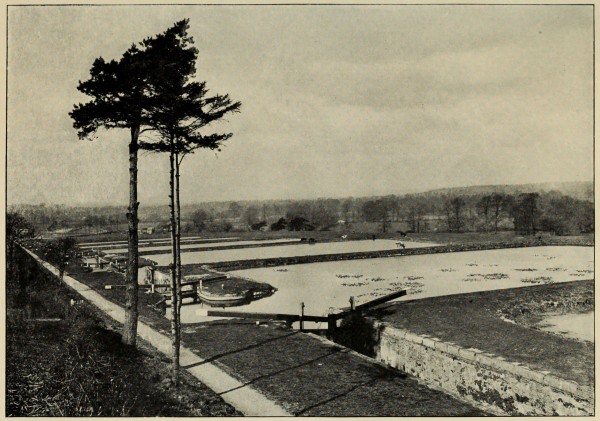
LOCKS ON THE KENNET AND AVON CANAL AT DEVIZES.
(A difference in level of 239 feet in 2½ miles is overcome by 29 locks. Of these, 17 immediately follow one another
in direct line, "pounds" being provided to ensure sufficiency of reserve water to work boats through.)
Photo by Chivers, Devizes.]
[To face page 42.
Within the last year or two the railway company
have spent £3,000 or £4,000 on the pumping
machinery. The main water supply is derived from
a reservoir, about 9 acres in extent, at Crofton,
this reservoir being fed partly by two rivulets
(which dry up in the summer) and partly by its
own springs; and extensive pumping machinery is
provided for raising to the summit level the water
that passes from the reservoir into the canal at a
lower level, the height the water is thus raised
being 40 feet. There is also a pumping station at
Claverton, near Bath, which raises water from the
river Avon. Thanks to these provisions, on no
occasion has there been more than a partial stoppage
of the canal owing to a lack of water, though in
seasons of drought it is necessary to reduce the
loading of the boats.
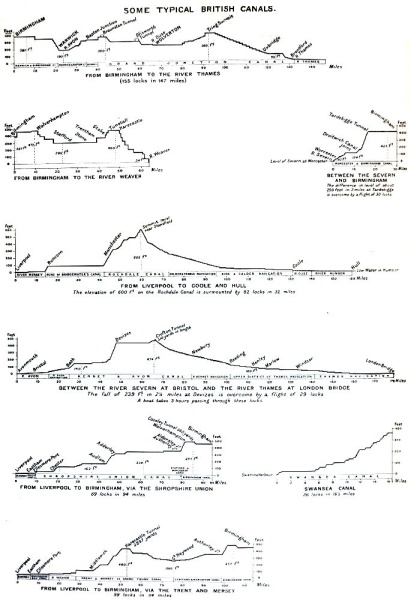
The final ascent to the Devizes level is accomplished
by means of twenty-nine locks in a distance of 2½
miles. Of these twenty-nine there are seventeen
which immediately follow one another in a direct line,
and here it has been necessary to supplement the
locks with "pounds" to ensure a sufficiency of reserve
water to work the boats through. No one who walks
alongside these locks can fail to be impressed alike by
the boldness of the original constructors of the canal
and by the thoroughness with which they did their
work. The walls of the locks are from 3 to 6 feet in
thickness, and they seem to have been built to last
for all eternity. The same remark applies to the
constructed works in general on this canal. For a
boat to pass through the twenty-nine locks takes
on an average about three hours. The 39½ miles
from Bristol to Devizes require at least two full
days.
Considerable expenditure is also incurred on the
canal in dredging work; though here special difficulties
are experienced, inasmuch as the geological
formation of the bed of the canal between Bath
and Bradford-on-Avon renders steam dredging inadvisable,
so that the more expensive and less
expeditious system of "dragging" has to be relied
on instead.
Altogether it costs the Great Western Railway
Company about £1 to earn each 10s. they receive
from the canal; and whether or not, considering
present day conditions of trade and transport, and
the changes that have taken place therein, they would
get their money back if they spent still more on the
canal, is, to say the least of it, extremely problematical.
One fact absolutely certain is that the canal is already
capable of carrying a much greater amount of traffic
than is actually forthcoming, and that the absence of
such traffic is not due to any neglect of the waterway
by its present owners. Indeed, I had the positive
assurance of Mr Saunders that, in his capacity as
Canals Engineer to the Great Western, he had never
yet been refused by his Company any expenditure he
had recommended as necessary for the efficient maintenance
of the canals under his charge. "I believe,"
he added, "that any money required to be spent for
this purpose would be readily granted. I already
have power to do anything I consider advisable to
keep the canals in proper order; and I say without
hesitation that all the canals belonging to the Great
Western Railway Company are well maintained, and
in no way starved. The decline in the traffic is due
to obvious causes which would still remain, no
matter what improvements one might seek to carry
out."
The story told above may be supplemented by
the following extract from the report of the Great
Western Railway Company for the half-year ending
December 1905, showing expenses and receipts in
connection with the various canals controlled by
that company:—
GREAT WESTERN RAILWAY CANALS,
for half-year ending 31st December 1905.
| Canal. |
To Canal Expenses. |
By Canal Traffic. |
| Bridgwater and Taunton |
£1,991 |
2 |
8 |
£664 |
8 |
9 |
| Grand Western |
197 |
7 |
1 |
119 |
10 |
10 |
| Kennet and Avon |
5,604 |
0 |
9 |
2,034 |
18 |
8 |
| Monmouthshire |
1,557 |
3 |
3 |
886 |
16 |
8 |
| Stourbridge Extension |
450 |
19 |
4 |
765 |
7 |
1 |
| Stratford-upon-Avon |
1,349 |
11 |
3 |
724 |
1 |
4 |
| Swansea |
1,643 |
15 |
7 |
1,386 |
14 |
9 |
| |
———————— |
———————— |
| |
£12,793 |
19 |
11 |
£6,581 |
18 |
1 |
| |
———————— |
———————— |
The capital expenditure on these different canals,
to the same date, was as follows:—
| Brecon |
£61,217 |
19 |
0 |
| Bridgwater and Taunton |
73,989 |
12 |
4 |
| Grand Western |
30,629 |
8 |
7 |
| Kennet and Avon |
209,509 |
19 |
3 |
| Stourbridge Extension |
49,436 |
15 |
0 |
| Stratford-on-Avon |
172,538 |
9 |
7 |
| Swansea |
148,711 |
17 |
6 |
| |
——————— |
| Total, |
£746,034 |
1 |
3 |
These figures give point to the further remark
made by Mr Inglis at the meeting of the Institution
of Civil Engineers when he said, "It was not to
be imagined that the railway companies would
willingly have all their canal property lying idle;
they would be only too glad if they could see how
to use the canals so as to obtain a profit, or even
to reduce the loss."
On the same occasion, Mr A. Ross, who also took
part in the debate, said he had had charge of a
number of railway-owned canals at different times,
and he was of opinion there was no foundation
for the allegation that railway-owned canals were
not properly maintained. His first experience of
this kind was with the Sankey Brook and St Helens
Canal, one of wide gauge, carrying a first-class traffic,
connecting the two great chemical manufacturing
towns of St Helens and Widnes, and opening into
the Mersey. Early in the seventies the canal became
practically a wreck, owing to the mortar on the
walls having been destroyed by the chemicals in
the water which the manufactories had drained into
the canal. In addition, there was an overflow into
the Sankey Brook, and in times of flood the water
flowed over the meadows, and thousands of acres
were rendered barren. Mr Ross continued (I quote
from the official report):—
"The London and North-Western Railway Company,
who owned the canal, went to great expense in
litigation, and obtained an injunction against the
manufacturers, and in the result they had to purchase
all the meadows outright, as the quickest way of
settling the question of compensation. The company
rebuilt all the walls and some of the locks. If that
canal had not been supported by a powerful corporation
like the London and North-Western Railway, it
must inevitably have been in ruins now. The next
canal he had to do with, the Manchester and Bury
Canal, belonging to the Lancashire and Yorkshire
Railway Company, was almost as unfortunate. The
coal workings underneath the canal absolutely wrecked
it, compelling the railway company to spend many
thousands of pounds in law suits and on restoring
the works, and he believed that no independent canal
could have survived the expense. Other canals he
had had to do with were the Peak Forest, the
Macclesfield and the Chesterfield canals, and the
Sheffield and South Yorkshire Navigation, which
belonged to the old Manchester Sheffield and Lincolnshire
Railway. Those canals were maintained in
good order, although the traffic was certainly not
large."
On the strength of these personal experiences
Mr Ross thought that "if a company came forward
which was willing to give reasonable compensation,
the railway companies would not be difficult to deal
with."
The "Shropshire Union" is a railway-controlled
canal with an especially instructive history.
This system has a total mileage of just over 200
miles. It extends from Wolverhampton to Ellesmere
Port on the river Mersey, passing through Market
Drayton, Nantwich and Chester, with branches to
Shrewsbury, Newtown (Montgomeryshire), Llangollen,
and Middlewich (Cheshire). Some sections
of the canal were made as far back as 1770, and
others as recently as 1840. At one time it was owned
by a number of different companies, but by a process
of gradual amalgamation, most of these were absorbed
by the Ellesmere and Chester Canal Company. In
1846 this company obtained Acts of Parliament which
authorised them to change their name to that of "The
Shropshire Union Railways and Canal Company,"
and gave them power to construct three lines of
railway: (1) from the Chester and Crewe Branch of
the Grand Junction Railway at Calveley to Wolverhampton;
(2) from Shrewsbury to Stafford, with a
branch to Stone; and (3) from Newtown (Montgomeryshire)
to Crewe. Not only do we get here a striking
instance of the tendency shown by canal companies
to start railways on their own account, but in each one
of the three Acts authorising the lines mentioned I
find it provided that "it shall be lawful for the Chester
and Holyhead Railway Company and the Manchester
and Birmingham Railway Company, or either of
them, to subscribe towards the undertaking, and hold
shares in the Shropshire Union Railways and Canal
Company."
Experience soon showed that the Shropshire Union
had undertaken more than it could accomplish. In
1847 the company obtained a fresh Act of Parliament,
this time to authorise a lease of the undertakings of
the Shropshire Union Railways and Canal Company
to the London and North-Western Railway Company.
The Act set forth that the capital of the Shropshire
Union Company was £482,924, represented by shares
on which all the calls had been paid, and that the
indebtedness on mortgages, bonds and other securities
amounted to £814,207. Under these adverse conditions,
"it has been agreed," the Act goes on to say,
"between the Shropshire Union Railways and Canal
Company and the London and North-Western Railway
Company, with a view to the economical and
convenient working" of the three railways authorised,
"that a lease in perpetuity of the undertaking of the
Shropshire Union Railways and Canal Company
should be granted to the London and North-Western
Railway Company, and accepted by them, at a rent
which shall be equal to ... half the rate per cent. per
annum of the dividend which shall from time to time
be payable on the capital stock of the London and
North-Western Railway Company."
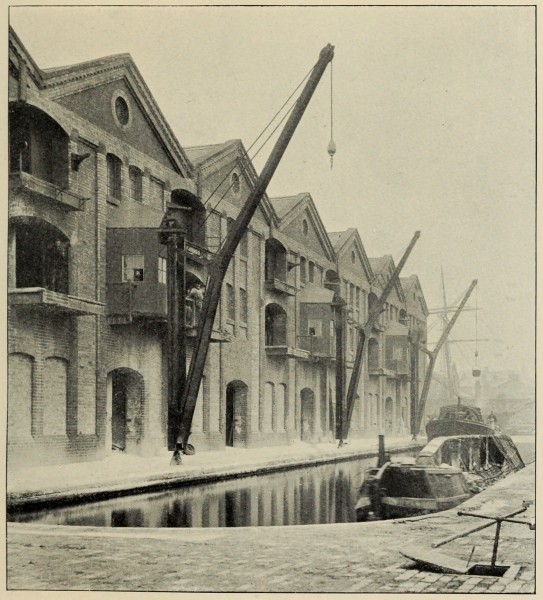
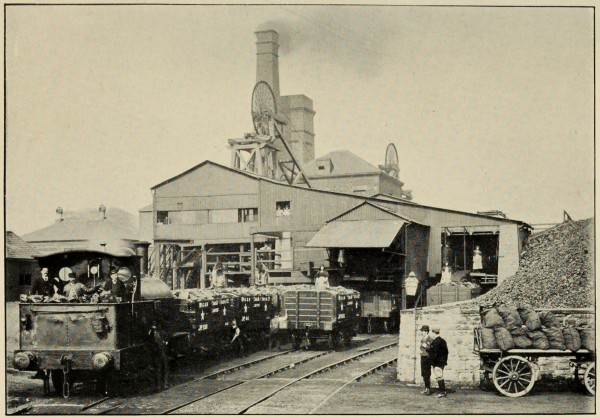
WAREHOUSES AND HYDRAULIC CRANES AT ELLESMERE PORT.
[To face page 48.
We have in this another example of the way in
which a railway company has saved a canal system
from extinction, while under the control of the London
and North-Western the Shropshire Union Canal is
still undoubtedly one of the best maintained of any
in the country. There may be sections of it, especially
in out-lying parts, where the traffic is comparatively
small, but a considerable business is still done in the
conveyance of sea-borne grain from the Mersey to the
Chester district, or in that of tinplates, iron, and
manufactured articles from the Black Country to the
Mersey for shipment. For traffic such as this the
canal already offers every reasonable facility. The
Shropshire Union is also a large carrier of goods to
and from the Potteries district, in conjunction with
the Trent and Mersey. So little has the canal been
"strangled," or even neglected, by the London and
North-Western Railway Company that, in addition
to maintaining its general efficiency, the expenditure
incurred by that company of late years for the
development of Ellesmere Port—the point where the
Shropshire Union Canal enters the Manchester Ship
Canal—amounts to several hundred thousand pounds,
this money having been spent mainly in the interest
of the traffic along the Shropshire Union Canal.
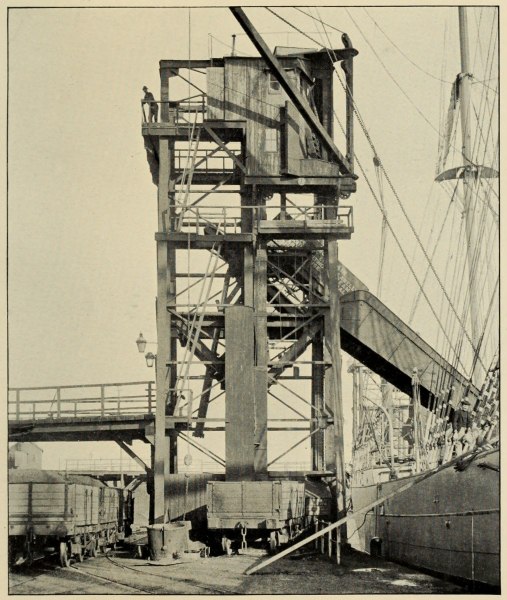
Deep-water quay walls of considerable length have
been built; warehouses for general merchandise,
with an excellent system of hydraulic cranes, have
been provided; a large grain depôt, fully equipped
with grain elevators and other appliances, has been
constructed at a cost of £80,000 to facilitate, more
especially, the considerable grain transport by canal
that is done between the River Mersey and the
Chester district; and at the present time the dock
area is being enlarged, chiefly for the purpose of
accommodating deeper barges, drawing about 7 feet
of water.
Another fact I might mention in regard to the
Shropshire Union Canal is in connection with
mechanical haulage. Elaborate theories, worked out
on paper, as to the difference in cost between rail
transport and water transport, may be completely
upset where the water transport is to be conducted,
not on a river or on a canal crossing a perfectly
level plain, but along a canal which is raised, by
means of locks, several hundred feet on one side of
a ridge, or of some elevated table-land, and must
be brought down in the same way on the other
side. So, again, the value of what might otherwise
be a useful system of mechanical haulage may be
completely marred owing to the existence of innumerable
locks.
This conclusion is the outcome of a series of
practical experiments conducted on the Shropshire
Union Canal at a time when the theorists were still
working out their calculations on paper. The
experiments in question were directed to ascertaining
whether economy could be effected by making up
strings of narrow canal boats, and having them
drawn by a tug worked by steam or other motive
power, instead of employing man and horse for each
boat. The plan answered admirably until the locks
were reached. There the steam-tug was, temporarily,
no longer of any service. It was necessary to keep
a horse at every lock, or flight of locks, to get the
boats through, so that, apart from the tedious delays
(the boats that passed first having to wait for the
last-comers before the procession could start again),
the increased expense at the locks nullified any saving
gained from the mechanical haulage.
As a further illustration—drawn this time from
Scotland—of the relations of railway companies to
canals, I take the case of the Forth and Clyde Navigation,
controlled by the Caledonian Railway Company.
This navigation really consists of two sections—the
Forth and Clyde Navigation, and the Monkland
Navigation. The former, authorised in 1768, and
opened in 1790, commences at Grangemouth on
the Firth of Forth, crosses the country by Falkirk
and Kirkintilloch, and terminates at Bowling on the
Clyde. It has thirty-nine locks, and at one point
has been constructed through 3 miles of hard
rock. The original depth of 8 feet was increased to
10 feet in 1814. In addition to the canal proper, the
navigation included the harbours of Grangemouth
and Bowling, and also the Grangemouth Branch
Railway, and the Drumpeller Branch Railway, near
Coatbridge. The Monkland Canal, also opened in
1790, was built from Glasgow viâ Coatbridge to
Woodhall in Lanarkshire, mainly for the transport
of coal from the Lanarkshire coal-fields to Glasgow
and elsewhere. Here the depth was 6 feet. The
undertakings of the Forth and Clyde and the Monkland
Navigations were amalgamated in 1846.
Prior to 1865, the Caledonian Railway did not
extend further north than Greenhill, about 5 miles
south of Falkirk, where it joined the Scottish Central
Railway. This undertaking was absorbed by the
Caledonian in 1865, and the Caledonian system was
thus extended as far north as Perth and Dundee.
The further absorption of the Scottish North-Eastern
Railway Company, in 1866, led to the extension of
the Caledonian system to Aberdeen.
At this time the Caledonian Railway Company
owned no port or harbour in Scotland, except the
small and rather shallow tidal harbour of South
Alloa. Having got possession of the railway lines
in Central Scotland, they thought it necessary to
obtain control of some port on the east coast, in the
interests of traffic to or from the Continent, and
especially to facilitate the shipment to the Continent
of coal from the Lanarkshire coal-fields, chiefly served
by them. The port of Grangemouth being adapted
to their requirements, they entered into negotiations
with the proprietors of the Forth and Clyde Navigation,
who were also proprietors of the harbour of
Grangemouth, and acquired the whole undertaking
in 1867, guaranteeing to the original company a
dividend of 6¼ per cent.
Since their acquisition of the canal, the Caledonian
Railway Company have spent large sums annually
in maintaining it in a state of efficiency, and its
general condition to-day is better than when it was
taken over. Much of the traffic handled is brought
into or sent out from Grangemouth, and here the
Caledonian Railway Company have more than
doubled the accommodation, with the result that
the imports and exports have enormously increased.
All the same, there has been a steady decrease in
the actual canal traffic, due to various causes, such
as (a) the exhaustion of several of the coal-fields in
the Monkland district; (b) the extension of railways;
and (c) changes in the sources from which certain
classes of traffic formerly carried on the canal are
derived.
In regard to the coal-fields, the closing of pits
adjoining the canal has been followed by the
opening of others at such a distance from the
canal that it was cheaper to consign by rail.
In the matter of railway extensions, when the
Caledonian took over the canal in 1867, there were
practically no railways in the district through which
it runs, and the coal and other traffic had, perforce,
to go by water. But, year by year, a complete network
of railways was spread through the district by
independent railway companies, notwithstanding the
efforts made by the Caledonian to protect the interests
of the canal-efforts that led, in some instances, to
Parliament refusing assent to the proposed lines.
Those that were constructed (over a dozen lines
and branches altogether), were almost all absorbed
by the North British Railway Company, who are
strong competitors with the Caledonian Railway
Company, and have naturally done all they could
to get traffic for the lines in question. This, of
course, has been at the expense of the canal and
to the detriment of the Caledonian Railway Company,
who, in view of their having guaranteed a
dividend to the original proprietors, would prefer
that the traffic in question should remain on the
canal instead of being diverted to an opposition line
of railway. Other traffic which formerly went by
canal, and is now carried on the Caledonian Railway,
is of a character that would certainly go by
canal no longer, and for this the Caledonian and
the North British Companies compete.
The third factor in the decline of the canal relates
to the general consideration that, during the last thirty
or forty years, important works have no longer been
necessarily built alongside canal banks, but have
been constructed wherever convenient, and connected
with the railways by branch lines or private sidings,
expense of cartage to or from the canal dock
or basin thus being saved. On the Forth and
Clyde Canal a good deal of coal is still carried,
but mainly to adjoining works. Coal is also
shipped in vessels on the canal for transport to
the West Highlands and Islands, where the
railways cannot compete; but even here there is an
increasing tendency for the coal to be bought in
Glasgow (to which port it is carried by rail), so
that the shippers can have a wider range of markets
when purchasing. Further changes affecting the
Forth and Clyde Canal are illustrated by the fact
that whereas, at one time, large quantities of
grain were brought into Grangemouth from
Russian and other Continental ports, transhipped
into lighters, and sent to Glasgow by canal, the
grain now received at Glasgow comes mainly from
America by direct steamer.
That the Caledonian Railway Company have done
their duty towards the Forth and Clyde Canal is
beyond all reasonable doubt. It is true that they
are not themselves carriers on the canal. They
are only toll-takers. Their business has been to
maintain the canal in efficient condition, and allow
any trader who wishes to make use of it so to do,
on paying the tolls. This they have done, and,
if the traders have not availed themselves of their
opportunities, it must naturally have been for
adequate reasons, and especially because of changes
in the course of the country's business which it is
impossible for a railway company to control, even
where, as in this particular case, they are directly
interested in seeing the receipts from tolls attain
to as high a figure as practicable.
I reserve for another chapter a study of the
Birmingham Canal system, which, again, is "railway
controlled"; but I may say here that I think
the facts already given show it is most unfair to
suggest, as is constantly being done in the Press
and elsewhere, that the railway companies bought
up canals—"of malice aforethought," as it were—for
the express purpose of killing such competition
as they represented—a form of competition in which,
as we have seen, public confidence had already
practically disappeared. One of the witnesses at the
canal enquiry in 1883 even went so far as to assert:
"The railway companies have been enabled, in some
cases by means of very questionable legality, to obtain
command of 1,717 miles of canal, so adroitly selected
as to strangle the whole of the inland water traffic,
which has thus been forced upon the railways, to
the great interruption of their legitimate and lucrative
trade."
The assertions here made are constantly being
reproduced in one form or another by newspaper
writers, public speakers, and others, who have gone
to no trouble to investigate the facts for themselves,
who have never read, or, if they have read, have
disregarded, the important evidence of Sir James
Allport, at the same enquiry, in reference to the
London coal trade (I shall revert to this subject
later on), and who probably have either not seen
a map of British canals and waterways at all, or
else have failed to notice the routes that still
remain independent, and are in no way controlled
by railway companies.
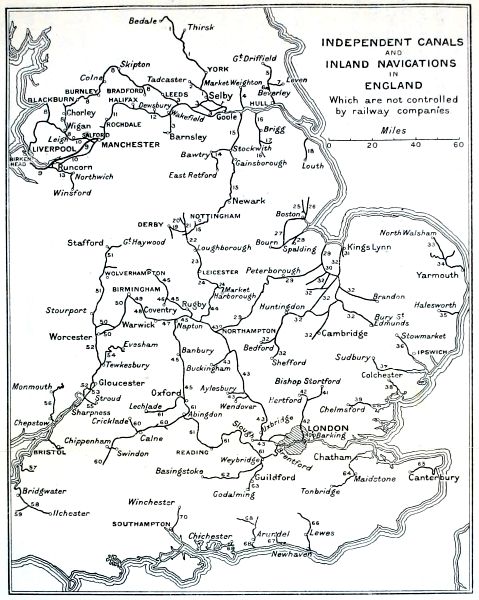
INDEPENDENT CANALS AND INLAND NAVIGATIONS IN ENGLAND
Which are not controlled by railway companies
[To face page 54.
- River Ouse Navigation (Yorkshire).
- River Wharfe Navigation.
- Aire and Calder Navigation.
- Market Weighton Navigation.
- Driffield Navigation.
- Beverley Beck Navigation.
- Leven Navigation.
- Leeds and Liverpool Canal.
- Manchester Ship Canal.
- Bridgewater portion of Manchester Ship Canal.
- Rochdale Canal.
- Calder and Hebble Navigation.
- Weaver Navigation.
- Idle Navigation.
- Trent Navigation Co.
- Aucholme Navigation.
- Caistor Canal.
- Louth Canal (Lincolnshire).
- Derby Canal.
- Nutbrook Canal.
- Erewash Canal.
- Loughborough Navigation.
- Leicester Navigation.
- Leicestershire Union Canal.
- Witham Navigation.
- Witham Navigation.
- Glen Navigation.
- Welland Navigation.
- Nen Navigation.
- Wisbech Canal.
- Nar Navigation.
- Ouse and Tributaries (Bedfordshire).
- North Walsham Canal.
- Bure Navigation.
- Blyth Navigation.
- Ipswich and Stowmarket Navigation.
- Stour Navigation.
- Colne Navigation.
- Chelmer and Blackwater Navigation.
- Roding Navigation.
- Stort Navigation.
- Lea Navigation.
- Grand Junction Canal.
- Grand Union Canal.
- Oxford Canal.
- Coventry Canal.
- Warwick and Napton Canal.
- Warwick and Birmingham Canal.
- Birmingham and Warwick Junction Canal.
- Worcester and Birmingham Canal.
- Stafford and Worcester Canal.
- Severn (Lower) Navigation.
- Gloucester and Berkeley Ship Canal.
- Lower Avon Navigation.
- Stroudwater Canal.
- Wye Navigation.
- Axe Navigation.
- Parrett Navigation.
- Tone Navigation.
- Wilts and Berks Canal.
- Thames Navigation.
- London and Hampshire Canal.
- Wey Navigation.
- Medway Navigation.
- Canterbury Navigation.
- Ouse Navigation (Sussex).
- Adur Navigation.
- Arun and Wey Canal.
- Portsmouth and Arunder Canal.
- Itchen Navigation.
I give, facing p. 54, a sketch which shows the
nature and extent of these particular waterways, and
the reader will see from it that they include entirely
free and independent communication (a) between
Birmingham and the Thames; (b) from the coal-fields
of the Midlands and the North to London;
and (c) between the west and east coasts, viâ
Liverpool, Leeds, and Goole. To say, therefore,
in these circumstances, that "the whole of the
inland water traffic" has been strangled by the
railway companies because the canals or sections of
which they "obtained command" were "so adroitly
selected," is simply to say what is not true.
The point here raised is not one that merely
concerns the integrity of the railway companies—though
in common justice to them it is only right
that the truth should be made known. It really
affects the whole question at issue, because, so
long as public opinion is concentrated more or less
on this strangulation fiction, due attention will not
be given to the real causes for the decay of the
canals, and undue importance will be attached to
the suggestions freely made that if only the one-third
of the canal mileage owned or controlled by
the railway companies could be got out of their
hands, the revival schemes would have a fair chance
of success.
Certain it is, therefore, as the map I give shows
beyond all possible doubt, that the causes for the
failure of the British canal system must be sought
for elsewhere than in the fact of a partial railway-ownership
or control. Some of these alternative
causes I propose to discuss in the Chapters that
follow my story of the Birmingham Canal, for
which (inasmuch as Birmingham and district, by
reason of their commercial importance and geographical
position, have first claim to consideration
in any scheme of canal resuscitation) I would beg
the special attention of the reader.