A small number of obvious typos have been corrected. Except for
these corrections, the spelling and punctuation of the book have
not been changed.
The 291 footnotes in the source book have been
changed into endnotes.
If your device supports it, then tapping or clicking on any of the maps
will open a larger version.
Many of the 439 sidenotes consist of two dates, separated by a dash;
the first date is taken from the Julian Calendar and the second
from the Gregorian Calendar. The dates in such a pair differ by 10 days
in the 17th century and by 11 days in the 18th century.
BRITISH CAMPAIGNS IN FLANDERS
MACMILLAN AND CO., Limited
LONDON · BOMBAY · CALCUTTA · MADRAS
MELBOURNE
THE MACMILLAN COMPANY
NEW YORK · BOSTON · CHICAGO
DALLAS · SAN FRANCISCO
THE MACMILLAN CO. OF CANADA, Ltd.
TORONTO
BEING EXTRACTS FROM “A HISTORY OF THE BRITISH ARMY”
BY
The Hon. J. W. FORTESCUE
MACMILLAN AND CO., LIMITED
ST. MARTIN’S STREET, LONDON
1918
COPYRIGHT
PREFACE
This volume consists simply of extracts reprinted from my
History of the British Army.
It is published in order that the troops at the front may, if they wish
it, study the experiences of their forerunners in the Low Countries in a
book which is fairly portable and fairly inexpensive, though neither so
cheap nor so compendious as The British Soldiers’ Guide to Northern
France and Flanders.
I pass now to Flanders, which is about to become for
the second time the training ground of the British Army.
The judicious help sent by Lewis the Fourteenth to
Ireland had practically diverted the entire strength of
William to that quarter for two whole campaigns; and
though, as has been seen, there were English in Flanders
in 1689 and 1690, the contingents which they furnished
were too small and the operations too trifling to warrant
description in detail. After the battle of the Boyne the
case was somewhat altered, for, though a large force was
still required in Ireland for Ginkell’s final pacification of
1691, William was none the less at liberty to take the
field in Flanders in person. Moreover, Parliament with
1690. October.
great good-will had voted seventy thousand men for the
ensuing year, of which fully fifty thousand were
British,[1]
so that England was about to put forth her strength in
Europe on a scale unknown since the loss of Calais.
But first a short space must be devoted to the
theatre of war, where England was to meet and break
down the overweening power of France. Few studies
are more difficult, even to the professed student, than
that of the old campaigns in Flanders, and still fewer
more hopeless of simplification to the ordinary reader.
Nevertheless, however desperate the task, an effort
must be made once for all to give a broad idea of the
scene of innumerable great actions.
Taking his stand on the northern frontier of France
and looking northward, the reader will note three great
rivers running through the country before him in,
roughly speaking, three parallel semicircles, from
south-east to north-west. These are, from east to
west, the Moselle, which is merged in the Rhine at
Coblentz, the Meuse, and the Scheldt, all three of
which discharge themselves into the great delta
whereof the southern key is Antwerp. But for the
present let the reader narrow the field from the Meuse
in the east to the sea in the west, and let him devote
his attention first to the Meuse. He will see that, a
little to the north of the French frontier, it picks up
a large tributary from the south-west, the Sambre,
which runs past Maubeuge and Charleroi and joins
the Meuse at Namur. Thence the united rivers
flow on past the fortified towns of Huy, Liège, and
Maestricht to the sea. But let the reader’s northern
boundary on the Meuse for the present be Maestricht,
and let him note another river which rises a little to
the west of Maestricht and runs almost due west
past Arschot and Mechlin to the sea at Antwerp. Let
this river, the Demer, be his northern, and the Meuse
from Maestricht to Namur his eastern, boundary.
Returning to the south, let him note a river rising
immediately to the west of Charleroi, the Haine, which
joins the Scheldt at Tournay, and let him draw a line
from Tournay westward through Lille and Ypres to
the sea at Dunkirk. Let this line from Dunkirk to
Charleroi be carried eastward to Namur; and there is
his southern boundary. His western boundary is, of
course, the sea. Within this quadrilateral, Antwerp
(or more strictly speaking the mouth of the Scheldt),
Dunkirk, Namur, and Maestricht, lies the most famous
fighting-ground of Europe.
Glancing at it on the map, the reader will see that
this quadrilateral is cut by a number of rivers running
parallel to each other from south to north, and flowing
into the main streams of the Demer and the Scheldt.
The first of these, beginning from the east, are the
Great and Little Geete, which become one before they
join the main stream. It is worth while to pause for a
moment over this little slip of land between the Geete
and the Meuse. We shall see much of Namur, Huy,
Liège, and Maestricht, which command the navigation
of the greater river, but we shall see still more of the
Geete, and of two smaller streams, the Jaar and the
Mehaigne, which rise almost in the same table-land with
it. On the Lower Jaar, close to Maestricht, stands the
village of Lauffeld, which shall be better known to
us fifty years hence. On the Little Geete, just above
its junction with its greater namesake, are the villages
of Neerwinden and Landen. In the small space
between the heads of the Geete and the Mehaigne lies
the village of Ramillies. For this network of streams
is the protection against an enemy that would threaten
the navigation of the Meuse from the north and west,
and the barrier of Spanish Flanders against invasion
from the east; and the ground is rich with the corpses
and fat with the blood of men.
The next stream to westward is the Dyle, which
flows past Louvain to the Demer, and gives its name,
after the junction, to that river. The next in order is
the Senne, which flows past Park and Hal and Brussels
to the same main stream. At the head of the Senne
stands the village of Steenkirk; midway between the
Dyle and Senne are the forest of Soignies and the field
of Waterloo.
Here the tributaries of the Demer come to an end,
but the row of parallel streams is continued by the
tributaries of another system, that of the Scheldt.
Easternmost of these, and next in order to the Senne,
is the Dender, which rises near Leuse and flows past
Ath and Alost to the Scheldt at Dendermond. Next
comes the Scheldt itself, with the Scarpe and the
Haine, its tributaries, which it carries past Tournay
and Oudenarde to Ghent, and to the sea at Antwerp.
Westernmost of all, the Lys runs past St. Venant,
where in Cromwell’s time we saw Sir Thomas Morgan
and his immortal six thousand, past Menin and Courtrai,
and is merged in the Scheldt at Ghent.
The whole extent of the quadrilateral is about one
hundred miles long by fifty broad, with a great waterway
to the west, a second to the east, and a third,
whereof the key is Ghent, roughly speaking midway
between them. The earth, fruitful by nature and
enriched by art, bears food for man and beast; the
waterways provide transport for stores and ammunition.
It was a country where men could kill each
other without being starved, and hence for centuries
the cockpit of Europe.
A glance at any old map of Flanders shows how
thickly studded was this country with walled towns of
less or greater strength, and explains why a war in
Flanders should generally have been a war of sieges.
Every one of these little towns, of course, had its
garrison; and the manœuvres of contending forces
were governed very greatly by the effort, on one side,
to release these garrisons for active service in the field,
and, on the other, to keep them confined within their
walls for as long as possible. Hence it is obvious that
an invading army necessarily enjoyed a great advantage,
since it menaced the fortresses of the enemy
while its own were unthreatened. Thus ten thousand
men on the Upper Lys could paralyse thrice their
number in Ghent and Bruges and the adjacent towns.
On the other hand, if an invading general contemplated
the siege of an important town, he manœuvred to
entice the garrison into the field before he laid siege
in form. Still, once set down to a great siege, an army
was stationary, and the bare fact was sufficient to
liberate hostile garrisons all over the country; and
hence arose the necessity of a second army to cover
the besieging force. The skill and subtlety manifested
by great generals to compass these different ends is
unfortunately only to be apprehended by closer study
than can be expected of any but the military student.
A second cause contributed not a little to increase
the taste for a war of sieges, namely, the example of
France, then the first military nation in Europe.[2]
The Court of Versailles was particularly fond of a siege,
since it could attend the ceremony in state and take
nominal charge of the operations with much glory and
little discomfort or danger. The French passion for
rule and formula also found a happy outlet in the
conduct of a siege, for, while there is no nation more
brilliant or more original, particularly in military
affairs, there is also none that is more conceited or
pedantic. The craving for sieges among the French
was so great that the King took pains, by the grant of
extra pay and rations, to render this species of warfare
popular with his soldiers.[3]
Again, it must be remembered that the object of a
campaign in those days was not necessarily to seek out
an enemy and beat him. There were two alternatives
prescribed by the best authorities, namely, to fight at
an advantage or to subsist comfortably.[4] Comfortable
subsistence meant at its best subsistence at an enemy’s
expense. A campaign wherein an army lived on the
enemy’s country and destroyed all that it could not
consume was eminently successful, even though not a
shot was fired. To force an enemy to consume his
own supplies was much, to compel him to supply his
opponent was more, to take up winter-quarters in his
territory was very much more. Thus to enter an
enemy’s borders and keep him marching backwards
and forwards for weeks without giving him a chance of
striking a blow, was in itself no small success, and
success of a kind which galled inferior generals, such
as William of Orange, to desperation and so to disaster.
The tendency to these negative campaigns
was heightened once more by French example. The
French ministry of war interfered with its generals to
an extent that was always dangerous, and eventually
proved calamitous. Nominally the marshal commanding-in-chief
in the field was supreme; but the
intendant or head of the administrative service, though
he received his orders from the marshal, was instructed
by the King to forward those orders at once by special
messenger to Louvois, and not to execute them without
the royal authority. Great commanders such as
Luxemburg had the strength from time to time to
kick themselves free from this bondage, but the rest,
embarrassed by the surveillance of an inferior officer,
preferred to live as long as possible in an enemy’s
country without risking a general action. It was left
to Marlborough to advance triumphant in one magnificent
campaign from the Meuse to the sea.
Next, a glance must be thrown at the contending
parties. The defenders of the Spanish Netherlands,
for they cannot be called the assailants of France, were
confederate allies from a number of independent states—England,
Holland, Spain, the Empire, sundry states
of Germany, and Denmark, all somewhat selfish, few
very efficient, and none, except the first, very punctual.
From such a heterogeneous collection swift, secret, and
united action was not to be expected. King William
held the command-in-chief, and, from his position as
the soul of the alliance, was undoubtedly the fittest
for the post. But though he had carefully studied the
art of war, and though his phlegmatic temperament
found its only genuine pleasure in the excitement of
the battlefield, he was not a great general. He could
form good plans, and up to a certain point could
execute them, but up to a certain point only. It
should seem that his physical weakness debarred him
from steady and sustained effort. He was strangely
incapable of conducting a campaign with equal ability
throughout; he would manœuvre admirably for weeks,
and forfeit all the advantage that he had gained by the
carelessness of a single day. In a general action, of
which he was fonder than most commanders of his
time, he never shone except in virtue of conspicuous
personal bravery. He lacked tactical instinct, and
above all he lacked patience; in a word, to use a
modern phrase, he was a very clever amateur.
France, on the other hand, possessed the finest
and strongest army in Europe,—well equipped, well
trained, well organised, and inured to work by countless
campaigns. She had a single man in supreme
control of affairs, King Lewis the Fourteenth; a great
war-minister, Louvois; one really great general,
Luxemburg; and one with flashes of genius, Boufflers.
Moreover, she possessed a line of posts in Spanish
Flanders extending from Dunkirk to the Meuse. On
the Lys she had Aire and Menin; on the Scarpe,
Douay; on the Upper Scheldt, Cambray, Bouchain,
Valenciennes, and Condé; on the Sambre, Maubeuge;
between Sambre and Meuse, Philippeville and Marienburg;
and on the Meuse, Dinant. Further, in the one
space where the frontier was not covered by a friendly
river, between the sea and the Scheldt, the French had
constructed fortified lines from the sea to Menin and
from thence to the Scheldt at Espierre. Thus with
their frontier covered, with a place of arms on every
river, with secrecy and with unity of purpose, the
French enjoyed the approximate certainty of being
able to take the field in every campaign before the
Allies could be collected to oppose them.
1691.
The campaign of 1691 happily typifies the relative
positions of the combatants in almost every respect.
The French concentrated ten thousand men on the
Lys. This was sufficient to paralyse all the garrisons
of the Allies on and about the river. They posted
another corps on the Moselle, which threatened the
territory of Cleves. Now Cleves was the property of
the Elector of Brandenburg, and it was not to be
expected that he should allow his contingent of troops
to join King William at the general rendezvous at
Brussels, and suffer the French to play havoc among
his possessions. Thus the Prussian contingent likewise
was paralysed. So while William was still
ordering his troops to concentrate at Brussels, Boufflers,
who had been making preparations all the winter,
suddenly marched up from Maubeuge and, before
William was aware that he was in motion, had besieged
Mons. The fortress presently surrendered after a
feeble resistance, and the line of the Allies’ frontier
between the Scheldt and Sambre was broken. William
moved down from Brussels across the Sambre in the
hope of recovering the lost town, outmanœuvred
Luxemburg, who was opposed to him, and for three
days held the recapture of Mons in the hollow of his
hand. He wasted those three days in an aimless halt;
Luxemburg recovered himself by an extraordinary
march; and William, finding that there was no alternative
before him but to retire to Brussels and remain
inactive, handed over the command to an incompetent
officer and returned to England. Luxemburg then
closed the campaign by a brilliant action of cavalry,
which scattered the horse of the Allies to the four
winds. As no British troops except the Life Guards
were present, and as they at any rate did not disgrace
themselves, it is unnecessary to say more of the combat
of Leuse. It had, however, one remarkable effect: it
increased William’s dread of the French cavalry, already
morbidly strong, to such a pitch as to lead him subsequently
to a disastrous military blunder.
The campaign of 1691 was therefore decidedly
unfavourable to the Allies, but there was ground for
hope that all might be set right in 1692. The Treasurer,
Godolphin, was nervously apprehensive that Parliament
might be unwilling to vote money for an English army
in Flanders; but the Commons cheerfully granted a
total of sixty-six thousand men, British and foreign;
which, after deduction of garrisons for the safety of
the British Isles, left forty thousand free to cross the
German Ocean.
1692.
Of these, twenty-three thousand were British, the
most important force that England had sent to the
Continent since the days of King Henry the Eighth.
The organisation was remarkably like that of the New
Model. William was, of course, Commander-in-Chief,
and under him were a general of horse and a general of
foot, with a due allowance of lieutenant-generals,
major-generals, and brigadiers. There is, however, no
sign of an officer in command of artillery or engineers,
nor any of a commissary in charge of the transport.[5]
The one strangely conspicuous functionary is the
Secretary-at-War, who in this and the following
campaigns for the last time accompanied the Commander-in-Chief
on active service. But the most
significant feature in the list of the staff is the omission
of the name of Marlborough. Originally included
among the generals for Flanders, he had been struck
off the roll, and dismissed from all public employment,
in disgrace, before the opening of the campaign.
Though this dismissal did not want justification,
it was perhaps of all William’s blunders the
greatest.
As usual, the French were beforehand with the
Allies in opening the campaign. They had already
broken the line of the defending fortresses by the
capture of Mons; they now designed to make the
breach still wider. All through the winter a vast
siege-train was collecting on the Scheldt and Meuse,
with Vauban, first of living engineers, in charge of it.
May.
In May all was ready. Marshal Joyeuse, with one
corps, was on the Moselle, as in the previous year, to
hold the Brandenburgers in check. Boufflers, with
eighteen thousand men, lay on the right bank of the
Meuse, near Dinant; Luxemburg, with one hundred
and fifteen thousand more, stood in rear of the river
Haine. On the 20th of May, King Lewis in person
May 10/20. May 13/23. May 16/26.
reviewed the grand army; on the 23rd it marched for
Namur; and on the 26th it had wound itself round
two sides of the town, while Boufflers, moving up from
Dinant, completed the circuit on the third side. Thus
Namur was completely invested; unless William could
save it, the line of the Sambre and one of the most
important fortresses on the Meuse were lost to the
Allies.
William, to do him justice, had strained every nerve
to spur his indolent allies to be first in the field. The
contingents, awaked by the sudden stroke at Namur,
came in fast to Brussels; but it was too late. The
French had destroyed all forage and supplies on the
direct route to Namur, and William’s only way to the
city lay across the Mehaigne. Behind the Mehaigne
lay Luxemburg, the ablest of the French generals.
The best of luck was essential to William’s success, and
instead of the best came the worst. Heavy rain
swelled the narrow stream into a broad flood, and the
building of bridges became impossible. There was
beautiful fencing, skilful feint, and more skilful parry,
between the two generals, but William could not get
May 26./June 5.
under Luxemburg’s guard. On the 5th of June, after
a discreditably short defence, Namur fell, almost before
William’s eyes, into the hands of the French.
Then Luxemburg thought it time to draw the
enemy away from the vicinity of the captured city; so
recrossing the Sambre, and keeping Boufflers always
between himself and that river, he marched for the
Senne as if to threaten Brussels. William followed, as
in duty bound; and French and Allies pursued a
parallel course to the Senne, William on the north and
July 23./Aug. 2.
Luxemburg on the south. The 2nd of August found
both armies across the Senne, William at Hal, facing
west with the river in his rear, and Luxemburg some
five miles south of him with his right at Steenkirk, and
his centre between Hoves and Enghien, while Boufflers
lay at Manny St. Jean, seven miles in his rear.
The terrible state of the roads owing to heavy rain
had induced Luxemburg to leave most of his artillery
at Mons; and, as he had designed merely to tempt the
Allies away from Namur, the principal object left to him
was to take up a strong position wherein his worn and
harassed army could watch the enemy without fear of
attack. Such a position he thought that he had found
at Steenkirk.[6] The country at this point is more
broken and rugged than is usual in Belgium. The
camp lay on high ground, with its right resting on
the river Sennette and its fight front covered by a
ravine, which gradually fades away northward into
a high plateau of about a mile in extent. Beyond the
ravine was a network of wooded defiles, through
which Luxemburg seems to have hoped that no enemy
could fall upon him in force unawares. It so happened,
however, that one of his most useful spies was detected,
in his true character, in William’s camp at Hal; and
this was an opportunity not to be lost. A pistol was
held to the spy’s head, and he was ordered to write a
letter to Luxemburg, announcing that large bodies of
the enemy would be in motion next morning, but
that nothing more serious was contemplated than a
foraging expedition. This done, William laid his
plans to surprise his enemy on the morrow.
Stanford’s Geogl. Estabt., London.
Steenkirk,
July 24th / Aug 3rd 1692.
The Old Style date on the map is incorrect.
July 24./Aug. 3.
An hour before daybreak the advanced guard of
William’s army fell silently into its ranks, together
with a strong force of pioneers to clear the way for a
march through the woods. This force consisted of
the First Guards, the Royal Scots, the Twenty-first,
Fitzpatrick’s regiment of Fusiliers, and two Danish
regiments of great reputation, the whole under the
command of the Duke of Würtemberg. Presently
they moved away, and, as the sun rose, the whole
army followed them in two columns, without sound
of drum or trumpet, towards Steenkirk. French
patrols scouring the country in the direction of Tubise
saw the two long lines of scarlet and white and blue
wind away into the woods, and reported what they
had witnessed at headquarters; but Luxemburg,
sickly of constitution, and, in spite of his occasional
energy, indolent of temperament, rejoiced to think
that, as his spy had told him, it was no more than
a foraging party. Another patrol presently sent
in another message that a large force of cavalry
was advancing towards the Sennette. Once more
Luxemburg lulled himself into security with the same
comfort.
Meanwhile the allied army was trailing through
narrow defiles and cramped close ground, till at last
it emerged from the stifling woods into an open space.
Here it halted, as the straitness of the ground
demanded, in dense, heavy masses. But the advanced
guard moved on steadily till it reached the woods over
against Steenkirk, where Würtemberg disposed it for
the coming attack. On his left the Bois de Feuilly
covered a spur of the same plateau as that occupied
by the French right, and there he stationed the English
Guards and the two battalions of Danes. To the
right of these, but separated from them by a ravine,
he placed the three remaining British battalions in
the Bois de Zoulmont. His guns he posted, some
between the two woods, and the remainder on the right
of his division. These dispositions complete, the
advanced party awaited orders to open the attack.
It was now eleven o’clock. Luxemburg had left
his bed and had ridden out to a commanding height
on his extreme right, when a third letter was brought
to him that the Allies were certainly advancing in force.
He read it, and looking to his front, saw the red coats
of the Guards moving through the wood before him,
while beyond them he caught a glimpse of the dense
masses of the main body. Instantly he saw the danger,
and divined that William’s attack was designed
against his right. His own camp was formed, according
to rule, with the cavalry on the wings; and there
was nothing in position to check the Allies but a
single brigade of infantry, famous under the name of
Bourbonnois, which was quartered in advance of the
cavalry’s camp on his extreme right. Moreover,
nothing was ready, not a horse was bridled, not a
man standing to his arms. He despatched a messenger
to summon Boufflers to his aid, and in a few minutes
was flying through the camp with his staff, energetic
but perfectly self-possessed, to set his force in order
of battle. The two battalions of Bourbonnois fell in
hastily before their camp, with a battery of six guns
before them. The dragoons of the right wing dismounted
and hastened to seal up the space between
Bourbonnois and the Sennette. The horse of the
right was collected, and some of it sent off in hot
speed to the left to bring the infantry up behind them
on their horses’ croups. All along the line the alarm
was given, drums were beating, men snatching hastily
at their arms and falling into their ranks ready to file
away to the right. Such was the haste, that there was
no time to think of regimental precedence, a very
serious matter in the French army, and each successive
brigade hurried into the place where it was most
needed, as it happened to come up.
Meanwhile Würtemberg’s batteries had opened
fire, and a cunning officer of the Royal Scots was
laying his guns with admirable precision. French
batteries hastened into position to reply to them with
as deadly an aim, and for an hour and a half the rival
guns thundered against each other unceasingly. All
this time the French battalions kept massing themselves
thicker and thicker on Luxemburg’s right, and
the front line was working with desperate haste,
felling trees, making breastworks, and lining the
hedges and copses while yet they might. But still
Würtemberg’s division remained unsupported, and
the precious minutes flew fast. William, or his staff
for him, had made a serious blunder. Intent though
he was on fighting a battle with his infantry only, he
had put all the cavalry of one wing of his army before
them on the march, so that there was no room for the
infantry to pass. Fortunately six battalions had
been intermixed with the squadrons of this wing, and
these were now with some difficulty disentangled and
sent forward. Cutts’s, Mackay’s, Lauder’s, and the
Twenty-sixth formed up on Würtemberg’s right, with
the Sixth and Twenty-fifth in support; and at last,
at half-past twelve, Würtemberg gave the order to
attack.
His little force shook itself up and pressed forward
with eagerness. The Guards and Danes on the extreme
left, being on the same ridge with the enemy, were the
first that came into action. Pushing on under a
terrible fire at point-blank range from the French
batteries, they fell upon Bourbonnois and the dragoons,
beat them back, captured their guns, and turned them
against the enemy. On their right the Royal Scots,
Twenty-first, and Fitzpatrick’s plunged down into the
ravine into closer and more difficult ground, past
copses and hedges and thickets, until a single thick
fence alone divided them from the enemy. Through
this they fired at each other furiously for a time, till
the Scots burst through the fence with their Colonel
at their head, and swept the French before them.
Still further to the right, the remaining regiments came
also into action; muzzle met muzzle among the
branches, and the slaughter was terrible. Young
Angus, still not yet of age, dropped dead at the head of
the Cameronians, and the veteran Mackay found the
death which he had missed at Killiecrankie. He had
before the attack sent word to General Count Solmes,
that the contemplated assault could lead only to
waste of life; and he had been answered with the
order to advance. “God’s will be done,” he said
calmly, and he was among the first that fell.
Still the British, in spite of all losses, pressed
furiously on; and famous French regiments, spoiled
children of victory, wavered and gave way before them.
Bourbonnois, unable to face the Guards and Danes,
doubled its left battalion in rear of its right; Chartres,
which stood next to them, also gave way and doubled
itself in rear of its neighbour Orléans. A wide gap
was thus torn in the first French line, but not a
regiment of the second line would step into it. The
colonel of the brigade in rear of it ordered, entreated,
implored his men to come forward, but they would
not follow him into that terrible fire. Suddenly the
wild voice ceased, and the gesticulating figure fell in
a heap to the ground: the colonel had been shot dead,
and the gap was still unfilled.
The first French line was broken; the second and
third were dismayed and paralysed: a little more and
the British would carry the French camp. Luxemburg
perceived that this was a moment when only his best
troops could save him. In the fourth line stood the
flower of his infantry, the seven battalions of French
and Swiss Guards. These were now ordered forward
to the gap; the princes of the blood placed themselves
at their head, and without firing a shot they charged
down the slope upon the British and Danes. The
English Guards, thinned to half their numbers, faced
the huge columns of the Swiss and stood up to them
undaunted, till by sheer weight they were slowly rolled
back. On their right the Royal Scots also were forced
back, fighting desperately from hedge to hedge and
contesting every inch of ground. Once, the French
made a dash through a fence and carried off one of
their colours. The Colonel, Sir Robert Douglas,
instantly turned back alone through the fence, recaptured
the colour, and was returning with it when
he was struck by a bullet. He flung the flag over
to his men and fell to the ground dead.
Slowly the twelve battalions retired, still fighting
furiously at every step. So fierce had been their
onslaught that five lines of infantry backed by two
more of cavalry[7] had hardly sufficed to stop them, and
with but a little support they might have won the day.
But that support was not forthcoming. Message after
message had been sent to the Dutch general, Count
Solmes, for reinforcements, but there came not a man.
The main body, as has been told, was all clubbed
together a mile and a half from the scene of action,
with the infantry in the rear; and Solmes, with almost
criminal folly, instead of endeavouring to extricate
the foot, had ordered forward the horse. William
rectified the error as soon as he could; but the correction
led to further delay and to the increased confusion
which is the inevitable result of contradictory orders.
The English infantry in rear, mad with impatience to
rescue their comrades, ran forward in disorder, probably
with loud curses on the Dutchman who had kept them
back so long; and some time was lost before they
could be re-formed. Discipline was evidently a little
at fault. Solmes lost both his head and his temper.
“Damn the English,” he growled; “if they are so
fond of fighting, let them have a bellyful”; and he
sent forward not a man. Fortunately junior officers
took matters into their own hands; and it was time,
for Boufflers had now arrived on the field to throw
additional weight into the French scale. The English
Horse-grenadiers, the Fourth Dragoons, and a regiment
of Dutch dragoons rode forward and, dismounting,
covered the retreat of the Guards and Danes by a
brilliant counter-attack. The Buffs and Tenth advanced
farther to the right, and holding their fire
till within point-blank range, poured in a volley which
gave time for the rest of Würtemberg’s division to
withdraw. A demonstration against the French left
made a further diversion, and the shattered fragments
of the attacking force, grimed with sweat and smoke,
fell back to the open ground in rear of the woods,
repulsed but unbeaten, and furious with rage.
William, it is said, could not repress a cry of anguish
when he saw them; but there was no time for emotion.
Some Dutch and Danish infantry was sent forward to
check further advance of the enemy, and preparations
were made for immediate retreat. Once again the
hardest of the work was entrusted to the British; and
when the columns were formed, the grenadiers of the
British regiments brought up the rear, halting and
turning about continually, until failing light put an
end to what was at worst but a half-hearted pursuit.
The retreat was conducted with admirable order;
but it was not until the chill, dead hour that precedes
the dawn that the Allies regained their camp, worn
out with the fatigue of the past four-and-twenty hours.
The action was set down at the time as the severest
ever fought by infantry, and the losses on both sides
were very heavy. The Allies lost about three thousand
killed and the same number wounded, besides thirteen
hundred prisoners, nearly all of whom were wounded.
Ten guns were abandoned, the horses being too weary
to draw them; the English battalions lost two colours,
and the foreign three or four more. The British,
having borne the brunt of the action, suffered most
heavily of all, the Guards, Cutts’s, and the Sixth being
terribly punished. The total French loss was about
equal to that of the Allies, but the list of the officers
that fell tells a more significant tale. On the side of
the Allies four hundred and fifty officers were killed
and wounded, no fewer than seventy lieutenants in
the ten battalions of Churchill’s British brigade being
killed outright. The French on their side lost no fewer
than six hundred and twenty officers killed and
wounded, a noble testimony to their self-sacrifice,
but sad evidence of their difficulty in making their
men stand. In truth, with proper management
William must have won a brilliant victory; but he
was a general by book and not by instinct. Würtemberg’s
advanced guard could almost have done the
work by itself but for the mistake of a long preliminary
cannonade; his attack could have been supported
earlier but for the pedantry that gave the horse precedence
of the foot in the march to the field; the foot
could have pierced the French position in a dozen
different columns but for the pedantry which caused
it to be first deployed. Finally, William’s knowledge
of the ground was imperfect, and Solmes, his general
of foot, was incompetent. The plan was admirably
designed and abominably executed. Nevertheless,
British troops have never fought a finer action than
Steenkirk. Luxemburg thought himself lucky to
have escaped destruction; his troops were much
shaken; and he crossed the Scheldt and marched
away to his winter-quarters as quietly as possible.
So ended the campaign of 1692.
VOL. I. BOOK V. CHAPTER III
1692. Nov.
In November the English Parliament met, heartened
indeed by the naval victory of La Hogue, but not a
little grieved over the failure of Steenkirk. Again,
the financial aspect was extremely discouraging; and
Sir Stephen Fox announced that there was not another
day’s subsistence for the Army in the treasury. The
prevailing discontent found vent in furious denunciations
of Count Solmes, and a cry that English soldiers
ought to be commanded by English officers. The
debate waxed hot. The hardest of hard words were
used about the Dutch generals, and a vast deal of
nonsense was talked about military matters. There
were, however, a great number of officers in the House
of Commons, many of whom had been present at the
action. With much modesty and good sense they
refused to join in the outcry against the Dutch, and
contrived so to compose matters that the House
committed itself to no very foolish resolution. The
votes for the Army were passed; and no difficulty
was made over the preparations for the next campaign.
Finally, two new regiments of cavalry were raised—Lord
Macclesfield’s Horse, which was disbanded
twenty years later; and Conyngham’s Irish Dragoons,
which still abides with us as the Eighth, King’s Royal
Irish, Hussars.
1693.
Meanwhile the French military system had suffered
an irreparable loss in Louvois’s death, the source of
woes unnumbered to France in the years that were
soon to come. Nevertheless, the traditions of his rule
were strong, and the French once more were first in
the field, with, as usual, a vast siege-train massed on
the Meuse and on the Scheldt. But a late spring and
incessant rain delayed the opening of the campaign
till the beginning of May, when Luxemburg assembled
seventy thousand men in rear of the Haine by Mons,
and Boufflers forty-eight thousand more on the Scheldt
at Tournay. The French king was with the troops in
person; and the original design was, as usual, to carry
on a war of sieges on the Meuse, Boufflers reducing
the fortresses while Luxemburg shielded him with a
covering army. Lewis, however, finding that the
towns which he had intended to invest were likely to
make an inconveniently stubborn defence, presently
returned home, and after detaching thirty thousand
men to the war in Germany, left Luxemburg to do
as he would. It had been better for William if the
Grand Monarch had remained in Flanders.
The English king, on his side, assembled sixty
thousand men at Brussels as soon as the French began
to move, and led them with desperate haste to the
Senne, where he took up an impregnable position at
Park. Luxemburg marched up to a position over
against him, and then came one of those deadlocks
which were so common in the old campaigns. The
two armies stood looking at each other for a whole
month, neither venturing to move, neither daring to
attack, both ill-supplied, both discontented, and as a
natural consequence both losing scores, hundreds, and
even thousands of men through desertion.
At last the position became insupportable, and on
June 6./July 6.
the 6th of July Luxemburg moved eastward as if to
resume the original plan of operations on the Meuse.
William thereupon resolved to create a diversion by
detaching a force to attack the French lines of the
Scheldt and Lys, a project which was brilliantly
executed by Würtemberg, thanks not a little to three
British regiments—the Tenth, Argyll’s, and Castleton’s—which
formed part of his division. But meanwhile
Luxemburg, quite ignorant of the diversion, advanced
to the Meuse and laid siege to Huy, in the hope of
forcing William to come to its relief. He judged
rightly. William left his impregnable camp at Park
and hurried to the rescue. But he came too late, and
Huy fell after a trifling resistance. Luxemburg then
made great seeming preparations for the siege of Liège,
and William, trembling for the safety of that city and
of Maestricht, detached eight thousand men to reinforce
those garrisons, and then withdrew to the line of the
Geete. Luxemburg watched the whole proceeding
with grim delight. Würtemberg’s success was no
doubt annoying, but William had weakened his army
by detaching this force to the Lys, and had been
beguiled into weakening it still further by reinforcing
the garrison on the Meuse. This was exactly what
Luxemburg wanted. If he could bring the Allies to
action forthwith, he could reasonably hope for success.
The ground occupied by William was a triangular
space enclosed between the Little Geete and a stream
called the Landen Beck, which joins it at Leuw. The
position was not without features of strength. The
camp, which faced almost due south, was pitched on
a gentle ridge rising out of a vast plain.[8] This ridge
runs parallel to the Little Geete and has that river in
its rear. The left flank was protected by marshy
ground and by the Landen Beck itself, while the villages
of Neerlanden and Rumsdorp, one on either side of the
Beck and the latter well forward on the plain, offered
the further security of advanced posts. The right
rested on a little stream which runs at right angles to
the Geete and joins it at Elixheim, and on the villages
of Laer and Neerwinden which stand on its banks.
From Neerlanden on the left to Neerwinden on the
right the position measured close on four miles; and
to guard this extent, besides supplying strong garrisons
for the villages, William had little more than fifty
thousand men. Here then was one signal defect: the
front was too long to permit troops to be readily moved
from flank to flank, or to be withdrawn without serious
risk from the centre. But this was not all. The depth
of the position was less than half of its frontage, and
thus allowed no space for the action of cavalry. This
William ignored: he was afraid of the French horse,
and was anxious that the action should be fought by
infantry only. Finally, retreat was barred by the
Geete, which was unfordable and insufficiently bridged;
and therefore the forcing of the allied right must inevitably
drive the whole army into a pinfold, as Leslie’s
had been driven at the battle of Dunbar.
Luxemburg, who knew every inch of the ground,
was now anxious only lest William should retire before
July 18/28.
he could catch him. On the 28th of July, by a great
effort and a magnificent march, he brought the whole
of his army, eighty thousand strong, before William’s
position. He was now sure of his game, but he need
not have been anxious, for William, charmed with the
notion of excluding the French cavalry from all share
in the action, was resolved to stand his ground Many
officers urged him to cross the Geete while yet he might;
but he would not listen. Fifteen hundred men were
told off to entrench the open ground between Neerwinden
and Neerlanden. The hedges, mud-walls, and
natural defences of Neerwinden and Laer were improved
to the uttermost, and the ditches surrounding them were
enlarged. Till late into the night the King rode backward
and forward, ordering matters under his own eyes,
and after a few hours’ rest began very early in the
morning to make his dispositions.
The key of the position was the village of Neerwinden
with the adjoining hamlet of Laer, and here
accordingly he stationed the best of his troops. The
defence of Laer was entrusted to Brigadier Ramsey
with the Scots Brigade, namely, the Twenty-first,
Twenty-fifth, Twenty-sixth, Mackay’s and Lauder’s
regiments, reinforced by the Buffs and the Fourth Foot.
Between Laer and Neerwinden stood six battalions of
Brandenburgers, troops already of great and deserved
reputation, of whom we shall see more in the years
before us. Neerwinden itself was committed to the
Hanoverians, the Dutch Guards, a battalion of the
First and a battalion of the Scots Guards. Immediately
to the north or left of the village the entrenchment
was lined by the two remaining battalions of the First
and Scots Guards, the Coldstream Guards, a battalion
of the Royal Scots, and the Seventh Fusiliers. On the
extreme left of the position Neerlanden was held by the
other battalion of the Royal Scots, the Second Queen’s,
and two Danish regiments, while Rumsdorp was
occupied by the Fourteenth, Sixteenth, Nineteenth,
and Collingwood’s regiments. In a word, every important
post was committed to the British. The
remainder of the infantry, with one hundred guns, was
ranged along the entrenchment, and in rear of them
stood the cavalry, powerless to act outside the trench,
and too much cramped for space to manœuvre within it.
Stanford’s Geogl. Estabt., London.
Landen,
July 19th / July 29th 1693.
Luxemburg also was early astir, and was amazed
to find how far the front of the position had been
strengthened during the night. His centre he formed
in eight lines over against the Allies’ entrenchments
between Oberwinden and Landen, every line except
the second and fourth being composed of cavalry. For
the attack on Neerlanden and Rumsdorp he detailed
fifteen thousand foot and two thousand five hundred
dismounted dragoons. For the principal assault on
Neerwinden he told off eighteen thousand foot, supported
by a reserve of two thousand more and by
eight thousand cavalry; while seventy guns were
brought into position to answer the artillery of the
Allies.
July 19/29.
Shortly after sunrise William’s cannon opened fire
against the heavy masses of the French centre; and at
eight o’clock Luxemburg moved the whole of his left
to the attack of Neerwinden. Six battalions, backed
by dragoons and cavalry, were directed against Laer,
and three columns, counting in all seven brigades, were
launched against Neerwinden. The centre column,
under the Duke of Berwick, was the first to come into
action. Withholding their fire till they reached the
village, the French carried the outer defences with a
rush, and then meeting the Hanoverians and the First
Guards, they began the fight in earnest. It was hedge-fighting,
as at Steenkirk, muzzle to muzzle and hand to
hand. Every step was contested; the combat swayed
backwards and forwards within the village; and the
carnage was frightful. The remaining French columns
came up, met with the like resistance, and made little
way. Fresh regiments were poured by the French into
the fight, and at last the First Guards, completely
broken by its losses, gave way. But it was only for
a moment. They rallied on the Scots Guards; the
Dutch and Hanoverians rallied behind them, and,
though the enemy had been again reinforced, they
resumed the unequal fight, nine battalions against
twenty-six, with unshaken tenacity. At Laer, on the
extreme right, the fight was equally sharp. Ramsey
for a time was driven out of the village, and the French
cavalry actually forced its way into the Allies’ position.
There, however, it was charged in flank by the Elector
of Bavaria, and driven out with great slaughter.
Ramsey seized the moment to rally his brigade. The
French columns, despite their success, still remained
isolated and detached, and presented no united front.
The King placed himself at the head of the Guards and
Hanoverians, and with one charge British, Dutch, and
Germans fell upon the Frenchmen and swept them out
of both villages.
The first attack on Neerwinden had failed, and a
similar attack on the allied left had been little more
successful. At Neerlanden the First and Second Foot
had successfully held their own against four French
battalions until reinforcements enabled them to drive
them back. At Rumsdorp the British, being but three
thousand against thirteen thousand, were pushed out of
the village, but being reinforced, recovered a part of it
and stood successfully at bay. Luxemburg, however,
was not easily discouraged. The broken troops in the
left were rallied, fresh regiments were brought forward,
and a second effort was made to carry Neerwinden.
Again French impetuosity bore all before it, and again
the British and Germans, weakened and weary though
they were, rallied when all seemed lost, and hurled the
enemy back, not merely repulsed, but in confused and
disorderly retreat.
On the failure of the second attack the majority of
the French officers urged Luxemburg to retire; but
the marshal was not to be turned from his purpose.
The fourteen thousand men of the Allies in Laer and
Neerwinden had lost more than a third of their numbers,
while he himself had still a considerable force of infantry
interlined with the cavalry in the centre. Twelve
thousand of them, including the French and Swiss
Guards, were now drawn off to the left for a third
attack. When they were clear of the cavalry, the
whole six lines of horse, which had stood heroically for
hours motionless under a heavy fire, moved forward at
a trot to the edge of the entrenchments;[9] but the
demonstration, for such it seems to have been, cost
them dear, for they were very roughly handled and
compelled to retire. But now the French reinforcements,
supported by the defeated battalions, drew
near, and a third attack was delivered on Neerwinden.
British and Dutch still made a gallant fight, but the
odds against their weakened battalions were too great,
and ammunition began to fail. They fought on indomitably
till the last cartridge was expended before
they gave way, but they were forced back, and Neerwinden
was lost. Five French brigades then assailed
the central entrenchment at its junction with Neerwinden,
where stood the Coldstream Guards and the
Seventh Fusiliers. Wholly unmoved by the overwhelming
numbers in their front and the fire from
Neerwinden on their flank, the two regiments stood
firm and drove their assailants back over the breastwork.
Even when the French Household Cavalry
came spurring through Neerwinden and fell upon their
flank, they fought on undismayed, and the Coldstreamers
not only repelled the charge but captured a colour.
Such fighting, however, could not continue for long.
William, on observing Luxemburg’s preparations for
the final assault, had ordered nine battalions from his
left to reinforce his right. These never reached their
destination. The Marquis of Feuquières, an officer
even more celebrated for his acuteness as a military
critic than for his skill in the field, watched them as they
moved, and suddenly led his cavalry forward to the
weakest point of the entrenchment. The battalions
hesitated, halted, and then turned about to meet this
new danger, but too late to save the forcing of the
entrenchment. The battle was now virtually over.
Neerwinden was carried, Ramsey after a superb defence
had been driven out of Laer, the Brandenburgers had
perforce retreated with him, the infantry that lined
the centre of the entrenchment had forsaken it, and the
French cavalry was pouring in and cutting down the
fugitives by scores. William, who had galloped away
in desperation to the left, now returned at headlong
speed with six regiments of English cavalry,[10] which
delivered charge after charge with splendid gallantry,
to cover the retreat of the foot. On the left Tolmach
and Bellasys by great exertion brought off their infantry
in good order, but on the right the confusion was
terrible. The rout was complete, the few bridges were
choked by a heaving mass of guns, waggons, pack-animals,
and men, and thousands of fugitives were cut
down, drowned, or trampled to death. William did all
that a gallant man could do to save the day, but in
vain. His troops had done heroic things to redeem his
bad generalship; and against any living man but
Marlborough or Luxemburg they would probably have
held their own. It was the general, not the soldiers
that failed.
The losses on both sides were very severe. That
of the French was about eight thousand men; that
of the Allies about twelve thousand, killed, wounded,
and prisoners, and among the dead was Count Solmes,
the hated Solmes of Steenkirk. The nineteen British
battalions present lost one hundred and thirty-five
officers killed, wounded, and taken. The French
captured eighty guns and a vast quantity of colours,
but the Allies, although beaten, could also show fifty-six
French flags. And, indeed, though Luxemburg won,
and deserved to win a great victory, yet the action was
not such as to make the allied troops afraid to meet
the French. They had stood up, fifty thousand against
eighty thousand, and if they were beaten they had at
any rate dismayed ever Frenchman on the field but
Luxemburg. In another ten years their turn was to
come, and they were to take a part of their revenge
on the very ground over which many of them had fled.
The campaign closed with the surrender of Charleroi,
and the gain by the French of the whole line of the
Sambre. William came home to meet the House of
Commons and recommend an augmentation of the Army
by eight regiments of horse, four of dragoons, and
twenty-five of foot. The House reduced this list by the
whole of the regiments of horse and fifteen of foot, but
even so it brought the total establishment up to eighty-three
thousand men. There is, however, but one new
regiment of which note need be taken in the campaign
of 1694, namely, the Seventh Dragoons, now known
as the Seventh Hussars, which, raised in 1689–90 in
Scotland, now for the first time took its place on the
English establishment and its turn of service in the
war of Flanders.
1694.
I shall not dwell on the campaign of 1694, which
is memorable only for a marvellous march by which
Luxemburg upset William’s entire plan of campaign.
Nor shall I speak at length of the abortive descent on
Brest, which is remembered mainly for the indelible
stain which it has left on the memory of Marlborough.
It is only necessary to say that the French, by Marlborough’s
information, though not on Marlborough’s
information only, had full warning of an expedition
which had been planned as a surprise, and that Tolmach,[11]
who was in command, unfortunately, though most
pardonably, lacked the moral courage to abandon an
attack which, unless executed as a surprise, had no
chance of success. He was repulsed with heavy loss,
and died of wounds received in the action—a hard fate
for a good soldier and a gallant man. But it is unjust
to lay his death at Marlborough’s door. For the
failure of the expedition Marlborough was undoubtedly
responsible, and that is quite bad enough; but Tolmach
alone was to blame for attempting an enterprise
which he knew to be hopeless. Marlborough cannot
have calculated that he would deliberately essay to
do impossibilities and perish in the effort, so cannot
be held guilty of poor Tolmach’s blunders.
1695.
Before the new campaign could be opened there had
come changes of vital importance to France. The vast
expense of the war had told heavily on the country,
and the King’s ministers were at their wit’s end to
raise money. Moreover, the War Department had
deteriorated rapidly since the death of Louvois; and
January.
to this misfortune was now added the death of Luxemburg,
a loss which was absolutely irreparable. Lastly,
with the object of maintaining the position which they
had won on the Sambre, the French had extended their
system of fortified lines from Namur to the sea. Works
so important could not be left unguarded, so that a
considerable force was locked up behind these entrenchments,
and was for all offensive purposes useless. We
shall see before long how a really great commander
could laugh at these lines, and how, in consequence, it
became an open question whether they were not rather
an encumbrance than an advantage. The subject is
one which is still of interest; and it is remarkable that
the French still seem to cling to their old principles, if
they may be judged by the works which they have
constructed for defence against a German invasion.
His enemy being practically restricted to the
defensive, William did not neglect the opportunity of
initiating aggressive operations. Masking his design
by a series of feints, he marched swiftly to the Meuse
and invested Namur. This fortress, more famous
through its connection with the immortal Uncle Toby
even than as the masterpiece of Cohorn, carried to yet
higher perfection by Vauban, stands at the junction of
the Sambre and the Meuse, the citadel lying in the
angle between the two rivers, and the town with its
defences on the left bank of the Meuse. To the northward
of the town outworks had been thrown up on
the heights of Bouge by both of these famous engineers;
and it was against these outworks that William directed
his first attack.
June 23./July 3.
Ground was broken on the 3rd of July, and three
days later an assault was delivered on the lines of
Bouge. As usual, the hardest of the work was given
to the British, and the post of greatest danger was
made over, as their high reputation demanded, to
June 26./July 6.
the Brigade of Guards. On this occasion the Guards
surpassed themselves alike by the coolness of their
valour and by the ardour of their attack. They marched
under a heavy fire up to the French palisades, thrust
their muskets between them, poured in one terrible
volley, the first shot that they had yet fired, and
charged forthwith. In spite of a stout resistance they
swept the French out of the first work, pursued them
to the second, swept them out of that, and gathering
impetus with success, drove them from stronghold to
stronghold, far beyond the original design of the
engineers, and actually to the gates of the town. In
another quarter the Royal Scots and the Seventh
Fusiliers gained not less brilliant success; and in fact
it was the most creditable action that William had
fought during the whole war. It cost the Allies two
thousand men killed and wounded, the three battalions
of Guards alone losing thirty-two officers. The British
were to fight many such bloody combats during the
next twenty years—combats forgotten since they were
merely incidents in the history of a siege, and so frequent
that they were hardly chronicled, and are not to be
restored to memory now. I mention this, the first
of such actions, only as a type of many more to come.
The outworks captured, the trenches were opened
against the town itself, and the next assault was directed
against the counterguard of St. Nicholas gate. This
again was carried by the British, with a loss of eight
hundred men. Then came the famous attack on the
counterscarp before the gate itself, where Captain
Tobias Shandy received his memorable wound. This
gave William the possession of the town. Then came
the siege of the citadel, wherein the British had the
honour of marching to the assault over half a mile of
open ground, a trial which proved too much even for
them. Nevertheless, it was they who eventually
stormed a breach from which another of the assaulting
columns had been repulsed, and ensured the surrender
of the citadel a few days later. For their service on
this occasion the Eighteenth Foot were made the Royal
Irish; and a Latin inscription on their colours still
records that this was the reward of their valour at
Namur.
Thus William on his return to England could for
the first time show his Parliament a solid success due
to the British red-coats; and the House of Commons
gladly voted once more a total force of eighty-seven
thousand men. But the war need be followed no
further. The campaign of 1696 was interrupted by a
futile attempt of the French to invade England, and
in 1697 France, reduced to utter exhaustion, gladly
concluded the Peace of Ryswick. So ended, not without
honour, the first stage of the great conflict with
King Lewis the Fourteenth. The position of the two
protagonists, England and France, was not wholly
unlike that which they occupied a century later at
the Peace of Amiens. The British, though they had
not reaped great victories, had made their presence
felt, and terribly felt, on the battlefield; and, as the
French in the Peninsula remembered that the British
had fought them with a tenacity which they had not
found in other nations, not only in Egypt, but even
earlier at Tournay and Linselles, so, too, after Blenheim
and Ramillies they looked back to the furious attack
at Steenkirk and the indomitable defence of Neerwinden.
“Without the concurrence of the valour and
power of England,” said William to the Parliament at
the close of 1695, “it were impossible to put a stop
to the ambition and greatness of France.” So it was
then, and so it was a century later, for though none
know better the superlative qualities of the French as
a fighting people, yet the English are the one nation
that has never been afraid to meet them. With the
Peace of Ryswick the ’prentice years of the standing
Army are ended, and within five years the old spirit,
which has carried it through the bitter schooling under
King William, will break forth with overwhelming
power under the guiding genius of Marlborough.
Authorities.—The leading
authority for William’s campaigns on the English side is D’Auvergne, and
on the French side the compilation, with its superb series of maps, by
Beaurain. Supplementary on one side are Tindal’s History, Carleton’s
Memoirs, and Sterne’s Tristram Shandy; and on the other the
Mémoires of Berwick and St. Simon, Quincy’s Histoire Militaire
de Louis XIV, and in particular the Mémoires of Feuquières.
Many details as to Steenkirk, in particular, respecting the casualties,
are drawn from Present State of Europe, or Monthly Mercury,
August 1692, and as to Landen from the official relation of the battle,
published by authority, 1693. Beautiful plans of both actions are in
Beaurain, rougher plans in Quincy and Feuquières. All details as to the
establishment voted are from the Journals of the House of Commons. Very
elaborate details of the operations are given in Colonel Clifford
Walton’s History of the British Standing Army.
VOL. I. BOOK VI. CHAPTER I
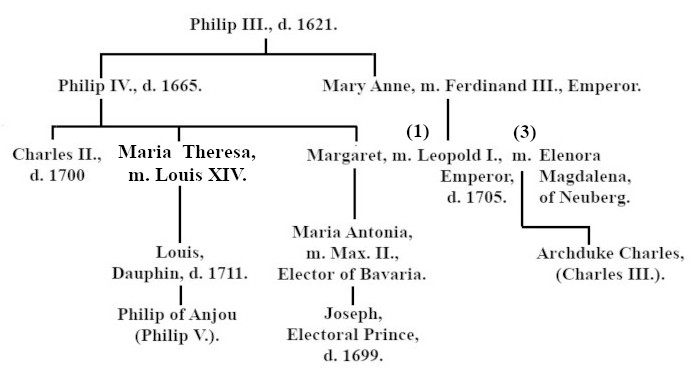
A European quarrel over the succession to the Spanish
throne,[12] on the death of the imbecile King Charles the
Second, had long been foreseen by William, and had
been provided against, as he hoped, by a Partition
Treaty in the year 1698. The arrangement then made
had been upset by the death of the Electoral Prince of
Bavaria, and had been superseded by a second Partition
Treaty in March 1700. In November of the
same year King Charles the Second died, leaving a
will wherein Philip, Duke of Anjou, and second son
of the Dauphin, was named heir to the whole Empire
of Spain. Hereupon the second Partition Treaty
went for naught. Lewis the Fourteenth, after a
becoming interval of hesitation, accepted the Spanish
crown for the Duke of Anjou under the title of King
Philip the Fifth.
1701.
The Emperor at once entered a protest against the
will, and Lewis prepared without delay for a campaign
in Italy. William, however, for the present merely
postponed his recognition of Philip the Fifth; and his
example was followed by the United Provinces. Lewis,
ever ready and prompt, at once took measures to
quicken the States to a decision. Several towns[13] in
Spanish Flanders were garrisoned, under previous
treaties, by Dutch troops. Lewis by a swift movement
surrounded the whole of them, and, having thus secured
fifteen thousand of the best men in the Dutch army,
could dictate what terms he pleased. William expected
that the House of Commons would be roused to indignation
by this aggressive step, but the House was far
too busy with its own factious quarrels. When,
however, the States appealed to England for the six
thousand four hundred men, which under the treaty of
1668[14]
she was bound to furnish, both Houses prepared
faithfully to fulfil the obligation.
Then, as invariably happens in England, the work
which Parliament had undone required to be done
again. Twelve battalions were ordered to the Low
Countries from Ireland, and directions were issued for
the levying of ten thousand recruits in England to take
their place. But, immediately after, came bad news
from the West Indies, and it was thought necessary to
despatch thither four more battalions from Ireland.
Three regiments[15] were hastily brought up to a joint
strength of two thousand men, and shipped off. Thus,
within fifteen months of the disbandment of 1699,
the garrison of Ireland had been depleted by fifteen
battalions out of twenty-one; and four new battalions
required to be raised immediately. Of these, two,
namely Brudenell’s and Mountjoy’s, were afterwards
disbanded, but two more, Lord Charlemont’s and Lord
Donegal’s, are still with us as the Thirty-fifth and
Thirty-sixth of the Line.
In June the twelve battalions[16] were shipped off to
Holland, under the command of John, Earl of Marlborough.
Since 1698 he had been restored to the
King’s favour and was to fill his place as head of the
European coalition and General of the confederate
armies in a fashion that no man had yet dreamed of.
He was full fifty years of age; so long had the ablest
man in Europe waited for work that was worthy of
his powers; and now his time was come at last. His
first duties, however, were diplomatic; and during the
summer and autumn of 1701 he was engaged in negotiations
with Sweden, Prussia, and the Empire for the
formation of a Grand Alliance against France and
Spain. Needless to say he brought all to a successful
issue by his inexhaustible charm, patience, and tact.
Sept.
Still the attitude of the English people towards the
contest remained doubtful, until, on the death of King
James the Second, Lewis made the fatal mistake of
recognising and proclaiming his son as King of England.
Then the smouldering animosity against France leaped
instantly into flame. William seized the opportunity
to dissolve Parliament, and was rewarded by the
election of a House of Commons more nearly resembling
that which had carried him through the first war to
the Peace of Ryswick. He did not fail to rouse its
patriotism and self-respect by a stirring speech from
the throne, and obtained the ratification of his agreement
with the Allies, that England should furnish a
contingent of forty thousand men, eighteen thousand
of them to be British and the remainder foreigners.
So the country was committed to the War of the
Spanish Succession.
It was soon decided that all regiments in pay must
be increased at once to war-strength, and that six more
battalions, together with five regiments of horse and
three of dragoons, should be sent to join the troops
already in Holland. Then, as usual, there was a rush
to do in a hurry what should have been done at leisure;
and it is significant of the results of the late ill-treatment
of the Army that, though the country was full of
unemployed soldiers, it was necessary to offer three
pounds, or thrice the usual amount of levy-money, to
obtain recruits. The next step was to raise fifteen new
regiments—Meredith’s, Coote’s, Huntingdon’s, Farrington’s,
Gibson’s, Lucas’s, Mohun’s, Temple’s, and
Stringer’s of foot; Fox’s, Saunderson’s, Villiers’,
Shannon’s, Mordaunt’s and Holt’s of marines. Of the
foot, Gibson’s and Farrington’s had been raised in
1694, but the officers of Farrington’s, if not of both
regiments, had been retained on half-pay, and, returning
in a body, continued the life of the regiment without
interruption. Both are still with us as the Twenty-eighth
and Twenty-ninth of the Line. Huntingdon’s
and Lucas’s also survive as the Thirty-third and
Thirty-fourth, and Meredith’s and Coote’s, which were
raised in Ireland, as the Thirty-seventh and Thirty-ninth,
while the remainder were disbanded at the close
of the war. Of the marines, Saunderson’s had originally
been raised in 1694, and eventually passed into the
Line as the Thirtieth Foot, followed by Fox’s and
Villiers’ as the Thirty-first and Thirty-second. Nothing
now remained but to pass the Mutiny Act, which was
speedily done; and on the 5th of May, just two months
after the death of King William, the great work of his
life was continued by a formal declaration of war.
The field of operations, which will chiefly concern us,
is mainly the same as that wherein we followed the
campaigns of King William. The eastern boundary of
the cock-pit must for a time be extended from the
Meuse to the Rhine, the northern from the Demer to
the Waal, and the southern limit must be carried from
Dunkirk beyond Namur to Bonn. But the reader
should bear in mind that, in consequence of the Spanish
alliance, Spanish Flanders was no longer hostile, but
friendly, to France, so that the French frontier, for all
practical purposes, extended to the boundary of Dutch
Brabant. Moreover, the French, besides the seizure,
already related, of the barrier-towns, had contrived
to occupy every stronghold on the Meuse except
Maestricht, from Namur to Venloo, so that practically
they were masters so far of the whole line of the river.
A few leagues below Venloo stands the fortified
town of Grave, and beyond Grave, on the parallel
branch of the Waal, stands the fortified city of Nimeguen.
A little to the east of Nimeguen, at a point
where the Rhine formerly forked into two streams,
stood Fort Schenck, a stronghold famous in the wars of
Morgan and of Vere. These three fortresses were the
three eastern gates of the Dutch Netherlands, commanding
the two great waterways, doubly important
in those days of bad roads, which lead into the heart
of the United Provinces.
1702.
It is here that we must watch the opening of the
campaign of 1702. There were detachments of the
French and of the Allies opposed to each other on the
Upper Rhine, on the Lower Rhine, and on the Lower
Scheldt; but the French grand army of sixty thousand
men was designed to operate on the Meuse, and the
presence of a Prince of the blood, the Duke of Burgundy,
with old Marshal Boufflers to instruct him, sufficiently
showed that this was the quarter in which France
designed to strike her grand blow. Marlborough being
still kept from the field by other business, the command
of the Allied army on the Meuse was entrusted to
Lord Athlone, better known as that Ginkell who had
completed the pacification of Ireland in 1691. His
force consisted of twenty-five thousand men, with
which he lay near Cleve, in the centre of the crescent
formed by Grave, Nimeguen, and Fort Schenck,
watching under shelter of these three fortresses the
army of Boufflers, which was encamped some twenty
miles to south-east of him at Uden and Xanten. On
May 30./June 10.
the 10th of June Boufflers made a sudden dash to cut
off Athlone from Nimeguen and Grave, a catastrophe
which Athlone barely averted by an almost discreditably
precipitate retreat. Having reached Nimeguen
Athlone withdrew to the north of the Waal, while all
Holland trembled over the danger which had thus
been so narrowly escaped.
Such was the position when Marlborough at last took the field, after
long grappling at the Hague with the difficulties which were fated to
dog him throughout the war. In England his position was comparatively
easy, for though Prince George of Denmark, the consort of Queen Anne,
was nominally generalissimo of all forces by sea and land, yet
Marlborough was Captain-General of all the English forces at home and in
Holland, and in addition Master-General of the Ordnance. But it was only after considerable
dispute that he was appointed Commander-in-Chief of the Allied forces,
and then not without provoking much dissatisfaction among the Dutch
generals, and much jealousy in the Prince of Nassau-Saarbrück and in
Athlone, both of whom aspired to the office. These obstacles overcome,
there came the question of the plan of campaign. Here again endless
obstruction was raised. The Dutch, after their recent fright, were
nervously apprehensive for the safety of Nimeguen, the King of Prussia
was much disturbed over his territory of Cleve, and all parties who had
not interests of their own to put forward made it their business to
thwart the Commander-in-Chief. With infinite patience Marlborough
soothed them, and at last, on
June 21./July 2.
the 2nd of July, he left the Hague for Nimeguen, accompanied
by two Dutch deputies, civilians, whose duty it was to see that he did
nothing imprudent. Arrived there he concentrated sixty thousand men, of
which twelve thousand were British,[17] recrossed the Waal and
encamped at Ober-Hasselt over against Grave, within two leagues of the
French. Then once more the obstruction of his colleagues caused delay,
July 15/26. and it was not until the 26th
of July that he could cross to the left bank of the Meuse. “Now,” he
said to the Dutch deputies, as he pointed to the French camp, “I shall
soon rid you of these troublesome neighbours.”
Five swift marches due south brought his army over the Spanish
frontier by Hamont. Boufflers thereupon in alarm broke up his camp,
summoned Marshal Tallard from the Rhine to his assistance, crossed the
Meuse with all haste at Venloo, and pushed
July 22./Aug. 2.
on at nervous speed for the Demer. On the 2nd of August he lay
between Peer and Bray, his camping-ground ill-chosen, and his army worn
out by a week of desperate marching. Within easy striking distance, a
mile or two to the northward, lay Marlborough, his army fresh, ready,
and confident. He held the game in his hand; for an immediate attack
would have dealt the French as rude a buffet as they were to receive
later at Ramillies. But the Dutch deputies interposed; these Dogberries
were content to thank God that they were rid of a rogue. So Boufflers
was allowed to cross the Demer safely at Diest, and a first great
opportunity was lost.
Marlborough, having drawn the French away from
the Meuse, was now at liberty to add the garrison of
Maestricht to his field-force, and to besiege the fortresses
on the river. Boufflers, however, emboldened by his
escape, again advanced north in the hope of cutting
off a convoy of stores that was on its way to join the
Allies. Marlborough therefore perforce moved back
to Hamont and picked up his convoy. Then, before
Boufflers could divine his purpose, he had moved
swiftly south, and thrown himself across the line of
Aug. 11/22.
the French retreat to the Demer. The French marshal
hurried southward with all possible haste, and came
blundering through the defiles before Hochtel on the
road to Hasselt, only to find Marlborough waiting
ready for him at Helchteren. Once again the game
was in the Englishman’s hand. The French were in
great disorder, their left in particular being hopelessly
entangled in marshy and difficult ground. Marlborough
instantly gave the order to advance, and by
three o’clock the artillery of the two armies was
exchanging fire. At five Marlborough directed the
whole of his right to fall on the French left; but to
his surprise and dismay, the right did not move. A
surly Dutchman, General Opdam, was in command
of the troops in question and, for no greater object
than to annoy the Commander-in-Chief, refused to
execute his orders. So a second great opportunity
was lost.
Aug. 12/23.
Still much might yet be won by a general attack
on the next day; and for this accordingly Marlborough
at once made his preparations. But, when the time
came, the Dutch deputies interposed, entreating him
to defer the attack till the morrow morning. “By
to-morrow morning they will be gone,” answered
Marlborough; but all remonstrance was unavailing.
The attack was perforce deferred; the French slipped
away in the night; and, though it was still possible
to cut up their rearguard with cavalry, a third great
opportunity was lost.
Marlborough was deeply chagrined; but although
with unconquerable patience and tact he excused
Opdam’s conduct in his public despatches, he could
not deceive the troops, who were loud in their indignation
against both deputies and generals. There
was now nothing left but to reduce the fortresses on
the Meuse, a part of the army being detached for the
siege while the remainder covered the operations
under the command of Marlborough. Even over
their favourite pastime of a siege, however, the Dutch
were dilatory beyond measure. “England is famous
for negligence,” wrote Marlborough, “but if Englishmen
were half as negligent as the people here, they
would be torn to pieces by Parliament.”[18] Venloo
Aug. 18/29.
was at length invested on the 29th of August,[19]
and
after a siege of eighteen days compelled to capitulate.
The English distinguished themselves after their own
peculiar fashion. In the assault on the principal
defence General Cutts, who from his love of a hot fire
was known as the Salamander, gave orders that the
attacking force, if it carried the covered way, should
not stop there but rush forward and carry as much
more as it could. It was a mad design, criminally so
in the opinion of officers who took part in it,[20]
but it was madly executed, with the result that the whole
fort was captured out of hand.
Sept. 26./Oct. 7.
The reduction of Stevenswaert, Maseyck, and Ruremond
quickly followed; and the French now became
alarmed lest Marlborough should transfer operations
to the Rhine. Tallard was therefore sent back with a
large force to Cologne and Bonn, while Boufflers, much
weakened by this and by other detachments, lay
helpless at Tongres. But the season was now far
advanced, and Marlborough had no intention of
leaving Boufflers for the winter in a position from
which he might at any moment move out and bombard
Maestricht. No sooner, therefore, were his troops
released by the capture of Ruremond than he prepared
to oust Boufflers. The French, according to their
usual practice, had barred the eastern entrance to
Brabant by fortified lines, which followed the line of
the Geete to its head-waters, and were thence carried
across to that of the Mehaigne. In his position at
Tongres Boufflers lay midway between these lines and
Liège, in the hope of covering both; but after the
fall of so many fortresses on the Meuse he became
specially anxious for Liège, and resolved to post
himself under its walls. He accordingly examined
the defences, selected his camping-ground, and on
Oct. 1/12.
the 12th of October marched up with his army to
occupy it. Quite unconscious of any danger he
arrived within cannon-shot of his chosen position;
and there stood Marlborough, calmly awaiting him
with a superior force. For the fourth time Marlborough
held his enemy within his grasp, but the Dutch deputies,
as usual, interposed to forbid an attack; and Boufflers,
a fourth time delivered, hurried away in the night to
his lines at Landen. Had he thrown himself into
Liège Marlborough would have made him equally uncomfortable
by marching on the lines; as things were,
the French marshal perforce left the city to its fate.
The town of Liège, which was unfortified, at once
opened its gates to the Allies; and within a week
Marlborough’s batteries were playing on the citadel.
Oct. 12/23.
On the 23rd of October the citadel was stormed, the
English being first in the breach, and a few days later
Liège, with the whole line of the Meuse, had passed
into the hands of the Allies. Thus brilliantly, in
spite of four great opportunities marred by the Dutch,
ended Marlborough’s first campaign. Athlone, like
an honest man, confessed that as second in command
he had opposed every one of Marlborough’s projects,
and that the success was due entirely to his incomparable
chief. He at any rate had an inkling that in
Turenne’s handsome Englishman there had arisen one
of the great captains of all time.
Nevertheless the French had not been without
their consolations in other quarters. Towards the
end of the campaign the Elector of Bavaria had
declared himself for France against the Empire, and,
surprising the all-important position of Ulm on the
Danube, had opened communication with the French
force on the Upper Rhine. Villars, who commanded
in that quarter, had seconded him by defeating his
opponent, Prince Lewis of Baden, at Friedlingen, and
had cleared the passages of the Black Forest; while
Tallard had, almost without an effort, possessed
himself of Trèves and Trarbach on the Moselle. The
rival competitors for the crown of Spain were France and
the Empire, and the centre of the struggle, as no one
saw more clearly than Marlborough, was for the present
moving steadily towards the territory of the Empire.
While Marlborough was engaged in his operations
on the Meuse, ten thousand English and Dutch, under
the Duke of Ormonde and Admiral Sir George Rooke,
had been despatched to make a descent upon Cadiz.
The expedition was so complete a failure that there is
no object in dwelling on it. Rooke would not support
Ormonde, and Ormonde was not strong enough to
master Rooke; landsmen quarrelled with seamen,
and English with Dutch. No discipline was maintained,
and after some weeks of feeble operations and
shameful scenes of indiscipline and pillage, the commanders
found that they could do no more than return
to England. They were fortunate enough, however,
on their way, to fall in with the plate-fleet at Vigo,
of which they captured twenty-five galleons containing
treasure worth a million sterling. Comforted by this
good fortune Rooke and Ormonde sailed homeward,
and dropped anchor safely in Portsmouth harbour.
Meanwhile a mishap, which Marlborough called an
accident, had gone near to neutralise all the success
of the past campaign. At the close of operations the
Earl, together with the Dutch deputies, had taken
ship down the Meuse, with a guard of twenty-five
men on board and an escort of fifty horse on the bank.
In the night the horse lost their way, and the boat
was surprised and overpowered by a French partisan
with a following of marauders. The Dutch deputies
produced French passes, but Marlborough had none
and was therefore a prisoner. Fortunately his servant
slipped into his hand an old pass that had been made
out for his brother Charles Churchill. With perfect
serenity Marlborough presented it as genuine, and
was allowed to go on his way, the French contenting
themselves with the capture of the guard and the
plunder of the vessel, and never dreaming of the prize
that they had let slip. The news of his escape reached
the Hague, where on his arrival rich and poor came
out to welcome him, men and women weeping for
joy over his safety. So deep was the fascination
exerted on all of his kind by this extraordinary man.
A few days later he returned to England, where a
new Parliament had already congratulated Queen
Anne on the retrieving of England’s honour by the
success of his arms. The word retrieving was warmly
resented, but though doubtless suggested by unworthy
and factious animosity against the memory of William,
it was strictly true. The nation felt that it was not
in the fitness of things that Englishmen should be
beaten by Frenchmen, and they rejoiced to see the
wrong set right. Nevertheless party spirit found a
still meaner level when Parliament extended to Rooke
and Ormonde the same vote of thanks that they
tendered to Marlborough. This precious pair owed
even this honour to the wisdom and good sense of
their far greater comrade, for they would have carried
their quarrel over the expedition within the walls of
Parliament, had not Marlborough told them gently
that the whole of their operations were indefensible
and that the less they called attention to themselves
the better. The Queen, with more discernment,
created Marlborough a Duke and settled on him a
pension of £5000 a year.
VOL. I. BOOK VI. CHAPTER IV
1704.
Meanwhile Parliament had met on the 29th of the
previous October, full of congratulations to the Queen
on the triumphs of the past campaign. There were
not wanting, of course, men who, in the madness of
faction, doubted whether Blenheim were really a
victory, for the very remarkable reason that Marlborough
had won it, but they were soon silenced by
the retort that the King of France at any rate had no
doubts on the point.[21] The plans for the next campaign
were designed on a large scale, and were likely to strain
the resources of the Army to the uttermost. The West
Indies demanded six battalions and Gibraltar three
battalions for garrison; Portugal claimed ten thousand
men, Flanders from twenty to twenty-five thousand;
while besides this a design was on foot, as shall presently
be seen, for the further relief of Portugal by a diversion
1705.
in Catalonia. Five millions were cheerfully voted for
the support of the war, and six new battalions were
raised, namely, Wynne’s, Bretton’s, Lepell’s, Saomes’s,
Sir Charles Hotham’s, and Lillingston’s, the last of
which alone has survived to our day with the rank of
the Thirty-eighth of the Line.[22]
Marlborough’s plan of campaign had been sufficiently
foreshadowed at the close of the previous year,
namely, to advance on the line of the Moselle and
carry the war into Lorraine. The Emperor and all the
German Princes promised to be in the field early, the
Dutch were with infinite difficulty persuaded to give
May 15/26. June 6/17.
their consent, and after much vexatious delay Marlborough
joined his army at Trèves on the 26th of May.
Here he waited until the 17th of June for the arrival of
the German and Imperial troops. Not a man nor a
horse appeared. In deep chagrin he broke up his
camp and returned to the Meuse, having lost, as he
said, one of the fairest opportunities in the world,
through the faithlessness of his allies.[23]
His presence was sorely needed on the Meuse.
Villeroy, who commanded the French in Flanders,
finding no occasion for his presence on the Moselle,
May 21.
had moved out of his lines, captured Huy, and then
marching on to Liège had invested the citadel. The
States-General in a panic of fright urged Marlborough
to return without delay, and Overkirk, who commanded
the Dutch on the Meuse, added his entreaties to theirs.
Marlborough, when once he had made up his mind to
June 14/25.
move, never moved slowly, and by the 25th of June he
was at Düren, to the eastward of Aix-la-Chapelle.
Here he was still the best part of forty miles from the
Meuse, but that distance was too near for Villeroy, who
at once abandoned Liège and fell back on Tongres.
June 21./July 2.
Marlborough, continuing his advance, crossed the
Meuse at Visé on the 2nd of July, and on the same day
united his army with Overkirk’s at Haneff on the
Upper Jaar. Villeroy thereupon retired ignominiously
within his fortified lines.
These lines, which had been making during the past
three years, were now complete. They started from
the Meuse a little to the east of Namur, passed from
thence to the Mehaigne and the Little Geete, followed
the Little Geete along its left bank to Leuw, the Great
Geete from Leuw to the Demer, and the Demer itself
as far as Arschot, from which point a new line of
entrenchments carried the barrier through Lierre to
Antwerp. Near Antwerp Marlborough had already
had to do with these lines in 1703, but hitherto he had
made no attempt to force them. Villeroy and the
Elector of Bavaria now lay before him with seventy
thousand men, a force superior to his own, but necessarily
spread over a wide front for the protection of the
entrenchments. The marshal’s headquarters were at
Meerdorp, in the space between the Geete and the
Mehaigne, which he probably regarded as a weak
point. Marlborough posted himself over against him
at Lens-les-Beguines, detaching a small force to recapture
Huy, while Overkirk with the Dutch army
covered the siege from Vignamont. Thus, as if daring
the French to take advantage of the dispersion of his
troops, he quietly laid his plans for forcing the lines.
The point that he selected was on the Little Geete
between Elixheim and Neerhespen, exactly in rear of
the battlefield of Landen. The abrupt and slippery
banks of the river, which the English knew but too
well, together with the entrenchments beyond it, presented
extraordinary difficulties; but the lines were on
that account the less likely to be well guarded at that
particular point. Marlborough had already obtained
the leave of the States-General for the project, but he
had now the far more difficult task of gaining the
consent of the Dutch generals at a Council of War.
Slangenberg and others opposed the scheme
vehemently, but were overruled; and the Duke was at
length at liberty to fall to work.
June 30./July 11.
Huy fell on the 11th of July, but to the general
surprise the besieging force was not recalled. Six days
later Overkirk and the covering army crossed the
Mehaigne from Vignamont, and pushed forward detachments
to the very edge of the lines between
July.
Meffle and Namur. Villeroy fell into the trap, withdrew
troops from all parts of the lines and concentrated
forty thousand men at Meerdorp. Marlborough then
recalled the troops from Huy, and made them up to a
total of about eight thousand men, both cavalry and
infantry,[24] the whole being under the command of the
Count of Noyelles. The utmost secrecy was observed
in every particular. The corps composing the detachment
knew nothing of each other, and nothing of the
work before them; and, lest the sight of fascines should
suggest an attack on entrenchments, these were dispensed
with, the troopers only at the last moment
receiving orders to carry each a truss of forage on the
saddle before them.
July 6/17.
At tattoo the detachment fell in silently before the
camp of the right wing, and at nine o’clock moved off
without a sound in two columns, the one upon Neerhespen,
the other upon the Castle of Wanghe before
Elixheim. An hour later the rest of the army followed,
while at the same time Overkirk, under cover of the
darkness, crossed the Mehaigne at Tourines and joined
his van to the rear of Marlborough’s army. The
distance to be traversed was from ten to fifteen miles;
the night though dry was dark; and the guides,
frequently at fault, were fain to direct themselves by
the trusses dropped on the way by the advanced
July 6–7/ 17–18.
detachment. Twelve years before to the very day, a
French army had toiled along the same route, wearied
out and stifled by the sun, and only kept to its task by
an ugly little hunch-backed man whom it had reverenced
as Marshal Luxemburg. Now English and
Dutch were blundering on to take revenge for Luxemburg’s
victory at the close of that march. The hours
fled on, the light began to break, and the army found
itself on the field of Landen, William’s entrenchment
grass-grown before it, Neerwinden and Laer lying
silent to the left, and before the villages the mound
that hid the corpses of the dead. Then some at least
of the soldiers knew the work that lay before them.
Stanford’s Geogl. Estabt., London.
Lines of the Geete
July 7/18 1705.
July 7/18.
At four o’clock the heads of the columns halted
within a mile of the Geete, wrapped in a thick mist and
hidden from the eye of the enemy. The advanced
detachment quickly cleared the villages by the river,
seized the bridge before the Castle of Wanghe, which
had not been broken down, and drove out the garrison
of the Castle itself. Then the pontoniers came forward
to lay their bridges; but the infantry would not wait
for them. They scrambled impatiently through hedges
and over bogs, down one steep bank of the river and
up the other, into the ditch beyond, and finally, breathless
and dripping, over the rampart into the lines. So
numerous were the hot-heads who thus went forward
that they forced three regiments of French dragoons
to retire before them without attempting resistance.
Then the cavalry of the detachment began to file
rapidly over the pontoon-bridges; but meanwhile the
alarm had been given, and, before the main army could
cross, the French came down in force from the north,
some twenty battalions and forty squadrons, in all close
upon fifteen thousand men, with a battery of eight guns.
The enemy advanced rapidly, their cavalry leading,
until checked by a hollow way which lay between them
and the Allies, when they halted to deploy. Marlborough
took in the whole situation at a glance.
Forming his thirty-eight squadrons into two lines,
with the first line composed entirely of British, he led
them across the hollow way and charged the French
sword in hand. They answered by a feeble fire from the
saddle and broke in confusion, but, presently rallying,
fell in counter-attack upon the British and broke them
in their turn. Marlborough, who was riding on the
flank, was cut off and left isolated with his trumpeter
and groom. A Frenchman galloped up and aimed at
him so furious a blow that, striking the air, he fell
from his horse and was captured by the trumpeter.
Then the allied squadrons rallied, and charging the
French once more broke them past all reforming, and
captured the guns. The French infantry now retired
very steadily in square, and the Duke sent urgent
messages for his own foot. But by some mistake the
battalions had been halted after crossing the Geete, so
that the French were able to make good their retreat.
By this time Villeroy, who had spent the night in
anxious expectation of an attack at Meerdorp, had
hurried up with his cavalry, only to find that the Duke
was master of the lines. Hastily giving orders for his
scattered troops to pass the Geete at Judoigne, he began
his retreat upon Louvain. Presently up came Marlborough’s
infantry at an extraordinary pace, the men
as fresh and lively after fifteen hours of fatigue as if
they had just left camp. The Duke was anxious to
follow up his success forthwith, a movement which
the French had good reason to dread, but the Dutch
generals opposed him, and Marlborough was reluctantly
constrained to yield. The loss of the French seems to
have been about two thousand men, most of them
prisoners, a score of standards and colours, of which
the Fifth Dragoon Guards claimed four as their own,
and eighteen guns, eight of which were triple-barrelled
and were sent across the Channel to be copied in
England.[25]
July 8/19.
The Allies halted for the night at Tirlemont, and
advancing next day upon Louvain struck against the
rear of the French columns and captured fifteen hundred
prisoners. That night they encamped a mile to the
east of Louvain, while the French, once again distributing
their force along a wider front, lined the left
bank of the Dyle from the Demer to the Yssche, with
their centre at Louvain. Marlborough had hoped to
push on at once, but was stopped by heavy rains that
rendered the Dyle impassable; and it was not until
ten days later that, after infinite trouble with the
Dutch, he was able to pursue his design.
July 18/29.
The operations for the passage of the Dyle were
conducted in much the same way as in the forcing of
the lines. An advanced detachment was sent forward
from each wing of the army, that from the right or
English[26]
flank being appointed to cross the river under
the Duke of Würtemberg at Corbeek Dyle, that
from the left under General Heukelom to pass it at
Neeryssche. The detachments fell in at five in the
evening, reached their appointed destination at ten,
and effected their passage with perfect success. The
main bodies started at midnight, and went somewhat
astray in the darkness, though by three o’clock the
Dutch army was within supporting distance of its
detachment and the British rapidly approaching it.
The river had been in fact forced, when suddenly the
Dutch generals halted their main body. Marlborough
rode up to inquire the cause, and was at once taken
aside by Slangenberg. “For God’s sake, my Lord—”
began the Dutchman vehemently, and continued to
protest with violent gesticulations. No sooner was
Marlborough’s back turned than the Dutch generals,
like a parcel of naughty schoolboys, recalled Heukelom’s
detachment. Thus the passage won with so
much skill was for no cause whatever abandoned,
without loss indeed, but also not without mischievous
encouragement to the French, who boasted
loudly that they had repulsed their redoubtable
adversary.
Deeply hurt and annoyed though he was, the
Duke, with miraculous patience, excused in his public
despatches the treachery and imbecility which had
thwarted him, and prepared to effect his purpose in
another way. His movements were hastened by news
that French reinforcements, set free by the culpable
inaction of Prince Lewis of Baden, were on their way
Aug. 5/16.
from Alsace. Unable to pass the Dyle he turned its
head-waters at Genappe, and wheeling north towards
the forest of Soignies encamped between La Hulpe and
Braine l’Alleud.[27] The French promptly took the
alarm and posted themselves behind the river Yssche,
with their left at Neeryssche, and their right at Overyssche
resting on the forest of Soignies. Marlborough
at once resolved to force the passage of the river. On
Aug. 6/17.
the evening of the 17th of August he detached his
brother Charles Churchill with ten thousand foot and
two thousand horse to advance through the forest and
turn the French right; while he himself marched away
Aug. 7/18.
at daybreak with the rest of the army and emerged
into the plain between the Yssche and the Lasne. The
Duke quickly found two assailable points, and choosing
that of Overyssche, halted the army pending the
arrival of the artillery. The guns were long in arriving,
Slangenberg having insisted, despite the Duke’s express
instructions, on forcing his own baggage into the
column for the express purpose of causing delay. At
last about noon the artillery appeared, and Marlborough
asked formal permission of the Dutch deputies
to attack. To his surprise, although Overkirk had
already consented, they claimed to consult their generals.
Slangenberg with every mark of insolence condemned
the project as murder and massacre, the rest solemnly
debated the matter for another two hours, the auspicious
moment passed away exactly as they had intended, and
another great opportunity was lost. The French reinforcements
arrived, and having been the weaker became
the stronger force. Nothing more could be done for
the rest of the campaign, but to level the French lines
from the Demer to the Mehaigne.
Thus for the third time a brilliant campaign was
spoilt by the Dutch generals and deputies. Fortunately
the public indignation both in England and in Holland
was too strong for them, and Slangenberg, though
not indeed hanged as he deserved, was deprived of
all further command. Jealousy, timidity, ignorance,
treachery, and flat imbecility seem to have been the
motives that inspired these men, whose conduct has
never been reprobated according to its demerit. It
was they who were responsible for the prolongation of
the war, for the burden that it laid on England, and
for the untold misery that it wrought in France. Left
to himself Marlborough would have forced the French
to peace in three campaigns, and the war would not
have been ended in shame and disgrace by the Treaty
of Utrecht.[28]
VOL. I. BOOK VI. CHAPTER V
1706.
It is now time to revert to England and to the preparations
for the campaign of 1706. Marlborough,
as usual, directly that the military operations were
concluded, had been deputed to visit the courts of
Vienna and of sundry German states in order to keep
the Allies up to the necessary pitch of unity and
energy. These duties detained him in Germany and
at the Hague until January 1706, when he was at
last able to return to England. There he encountered
far less obstruction than in former years, but found,
nevertheless, an increasing burden of work. The
vast extension of operations in the Peninsula, and
the general sickliness of the troops in that quarter,
demanded the enlistment of an unusually large number
of recruits. One new regiment of dragoons and eleven
new battalions of foot were formed in the course of
the spring, to which it was necessary to add yet another
battalion before the close of the year.[29] Again the
epidemic sickness among the horses in Flanders had
caused an extraordinary demand for them. The
Dutch, after their wonted manner, had actually taken
pains to prevent the supply of these animals to the
British,[30] though, even if they had not, the Duke had
a prejudice in favour of English horses, as of English
men, as superior to any other. Finally, the stores of
the Ordnance were unequal to the constant drain of
small arms, and it was necessary to make good the
deficiency by purchases from abroad. All these
difficulties and a thousand more were of course referred
for solution to Marlborough.
April 14/25.
When in April he crossed once more to the Hague
he found a most discouraging state of affairs. The
Dutch were backward in their preparations; Prussia
and Hanover were recalcitrant over the furnishing of
their contingents; Prince Lewis of Baden was sulking
within his lines, refusing to communicate a word of
his intentions to any one; and everybody was ready
with a separate plan of campaign. The Emperor of
course desired further operations on the Moselle for
his own relief; but, after the experience of the last
campaign, the Duke had wisely resolved never again
to move eastward to co-operate with the forces of the
Empire. The Dutch for their part wished to keep
Marlborough in Flanders, where he should be under
the control of their deputies; but the imbecile caprice
of these worthies was little more to his taste than
the sullen jealousy of Baden. Marlborough himself
was anxious to lead a force to the help of Eugene in
Italy, a scheme which, if executed, would have carried
the British to a great fighting ground with which they
are unfamiliar, the plains of Lombardy. He had
almost persuaded the States-General to approve of
this plan, when all was changed by Marshal Villars,
who surprised Prince Lewis of Baden in his lines on
the Motter, and captured two important magazines.
The Dutch at once took fright and, in their anxiety
to keep Marlborough for their own defence, agreed to
appoint deputies who should receive rather than issue
orders. So to the Duke’s great disappointment it
was settled that the main theatre of war should once
again be Flanders.
Villeroy meanwhile lay safely entrenched in his
position of the preceding year behind the Dyle, from
which Marlborough saw little hope of enticing him.
It is said that an agent was employed to rouse Villeroy
by telling him that the Duke, knowing that the French
were afraid to leave their entrenchments, would take
advantage of their inaction to capture Namur.[31] Be
that as it may, Villeroy resolved to quit the Dyle. He
knew that the Prussian and Hanoverian contingents
had not yet joined Marlborough, and that the Danish
cavalry had refused to march to him until their wages
were paid; so that interest as well as injured pride
May 8/19.
prompted the hazard of a general action. On the 19th
of May, therefore, he left his lines for Tirlemont on
the Great Geete. Marlborough, who was at Maestricht,
saw with delight that the end, for which he had not
dared to hope, was accomplished. Hastily making
arrangements for the payment of the Danish troops,
May 9/20.
he concentrated the Dutch and British at Bilsen on
the Upper Demer, and moved southward to Borchloen.
Here the arrival of the Danes raised his total force to
May 11/22.
sixty thousand men, a number but little inferior to
that of the enemy. On the very same day came the
intelligence that Villeroy had crossed the Great Geete
and was moving on Judoigne. The Duke resolved to
advance forthwith and attack him there.
May 12/23.
At one o’clock in the morning of Whitsunday the
23rd of May, Quartermaster-general Cadogan rode
forward from the headquarters at Corswarem with six
hundred horse and the camp-colours towards the head
of the Great Geete, to mark out a camp by the village
of Ramillies. The morning was wet and foggy, and
it was not until eight o’clock that, on ascending the
heights of Merdorp, the party dimly descried troops in
motion on the rolling ground before them. The Allied
army had not marched until two hours later than
Cadogan, but Marlborough, who had ridden on in
advance of it, presently came up and pushed the
cavalry forward through the mist. Then at ten
o’clock the clouds rolled away, revealing the whole of
the French army in full march towards them.
Villeroy’s eyes were rudely opened, for he had not
expected Marlborough before the following day; but
he knew the ground well, for he had been over it
before with Luxemburg, and he proceeded to take up
a position which he had seen Luxemburg deliberately
reject. The table-land whereon he stood is the highest
point in the plains of Brabant. To his right flowed
the Mehaigne; in his rear ran the Great Geete; across
his centre and left the Little Geete rose and crept
away sluggishly in marsh and swamp.[32] In his front
lay four villages: Taviers on the Mehaigne to his
right, Ramillies, less advanced than Taviers, on the
source of the Little Geete to his right centre, Offus,
parallel to Ramillies but lower down the stream, to
his left centre, Autréglise or Anderkirch, between
two branches of the Little Geete and parallel to Taviers,
to his left. Along the concave line formed by these
villages Villeroy drew up his army in two lines facing
due east.
The Mehaigne, on which his right rested, is at
ordinary times a rapid stream little more than twelve
feet wide, with a muddy bottom, but is bordered by
swampy meadows on both sides, which are flooded
after heavy rain. From this stream the ground rises
northward in a steady wave for about half a mile,
sinks gradually and rises into a higher wave at
Ramillies, sinks once more to northward of that village
and rolls downward in a gentler undulation to Autréglise.
Between the Mehaigne and Ramillies, a distance
of about a mile and a half, the ground east and west
is broken by sundry hollows of sufficient inclination
to offer decided advantage or disadvantage in a combat
of cavalry. A single high knoll rises in the midst of
these hollows, offering a place of vantage from which
Marlborough must almost certainly have reconnoitred
the disposition of the French right. The access to
Ramillies itself is steep and broken both to north and
south; but on the eastern front the ground rises to it
for half a mile in a gentle, unbroken slope, which
modern rifles would make impassable by the bravest
troops. In rear, or to westward of the French position,
the table-land is clear and unbroken, and to the right
rear or south-west stands a mound or barrow called
the tomb of Ottomond, still conspicuous and still
valuable as a key to the actions of the day.[33] The
full extent of the French front from Taviers to Autréglise
covered something over four miles.
Stanford’s Geogl. Estabt., London.
Ramillies,
May 12/23 1706.
Having chosen his position, Villeroy lost no time
in setting his troops in order. His left, consisting of
infantry backed by cavalry,[34] extended from Autréglise
to Offus, both of which villages were strongly occupied.
His centre from Offus to Ramillies was likewise composed
of infantry. On his right, in the expanse of
sound ground which stretches for a mile and a half
from the marshes of the Geete at Ramillies to those
of the Mehaigne, were massed more than one hundred
and twenty squadrons of cavalry with some battalions
of infantry interlined with them, the famous French
Household Cavalry (Maison du Roi) being in the first
line. The left flank of this expanse was covered by
the village of Ramillies, which was surrounded by a
ditch and defended by twenty battalions and twenty-four
guns. On the right flank not only Taviers but
Franquinay, a village still further in advance, were
occupied by detachments of infantry, while Taviers
was further defended by cannon.
Marlborough quickly perceived the defects of
Villeroy’s dispositions, which were not unlike those
of Tallard at Blenheim. Taviers was too remote
from Ramillies for the maintenance of a cross-fire of
artillery. Again, the cavalry of the French left was
doubtless secure against attack behind the marshes
of the Geete, but for this very reason it was incapable
of aggressive action. The French right could therefore
be turned, provided that it were not further reinforced;
and accordingly the Duke opened his manœuvres by
a demonstration against the French left.
Presently the infantry of the Allied right moved
forward in two lines towards Offus and Autréglise,
marching in all the pomp and circumstance of war,
Dutch, Germans, and British, with the red-coats conspicuous
on the extreme right flank. Striding forward
to the river they halted and seemed to be very busy
in laying their pontoons. Villeroy marked the mass
of scarlet, and remembering its usual place in the
battlefield, instantly began to withdraw several
battalions from his right and centre to his left. Marlborough
watched the white coats streaming away to
their new positions, and after a time ordered the
infantry of his right to fall back to some heights in
their rear. The two lines faced about and retired
accordingly over the height until the first line was out
of sight. Then the second line halted and faced about
once more, crowning the ascent with the well-known
scarlet, while the first marched away with all speed,
under cover of the hill and unseen by the French, to
the opposite flank. Many British battalions[35] stood
on that height all day without moving a step or firing
a shot, but none the less paralysing the French left
wing.
About half-past one the guns of both armies opened
fire, and shortly afterwards four Dutch battalions
were ordered forward to carry Franquinay and Taviers,
and twelve more to attack Ramillies, while Overkirk
advanced slowly on the left with the cavalry. Franquinay
was soon cleared; Taviers resisted stoutly
for a time, but was carried; and a strong reinforcement
on its way to the village was intercepted and cut to
pieces. Then Overkirk, his left flank being now
cleared, pushed forward his horse and charged. The
Dutch routed the first French line, but were driven
back in confusion by the second; and the victorious
French were only checked by the advance of fresh
squadrons under Marlborough himself. Even so the
Allies were at a decided disadvantage; and Marlborough,
after despatching messengers to bring up
every squadron, except the British, to the left, plunged
into the thick of the mêlée to rally the broken horse.
He was recognised by some French dragoons, who left
their ranks to surround him, and in the general confusion
he was borne to the ground and in imminent
danger of capture. His aide-de-camp, Captain Molesworth,
dismounted at once, and giving him his own
horse enabled him to escape. The cavalry, however,
encouraged by the Duke’s example, recovered themselves,
and Marlborough took the opportunity to
shift from Molesworth’s horse to his own. Colonel
Bringfield, his equerry, held the stirrup while he
mounted, but Marlborough was hardly in the saddle
before the hand that held the stirrup relaxed its grasp,
and the equerry fell to the ground, his head carried
away by a round shot.[36]
Meanwhile the attack of the infantry on Ramillies
was fully developed, and relieved the horse from the
fire of the village. Twenty fresh squadrons came
galloping up at the top of their speed and ranged themselves
in rear of the re-forming lines. But before they
could come into action the Duke of Würtemberg
pushed his Danish horse along the Mehaigne upon the
right flank of the French, while the Dutch guards
advanced still further so as to fall upon their rear.
These last now emerged upon the table-land by the
tomb of Ottomond, and the rest of the Allied horse
dashed themselves once against the French front.
The famous Maison du Roi after a hard fight was cut
to pieces, and the whole of the French horse, despite
Villeroy’s efforts to stay them, were driven in headlong
flight across the rear of their line of battle, leaving the
battalions of infantry helpless and alone, to be ridden
over and trampled out of existence.
Villeroy made frantic efforts to bring forward
the cavalry of his left to cover their retreat, but the
ground was encumbered by his baggage, which he had
carelessly posted too close in his rear. The French
troops in Ramillies now gave way, and Marlborough
ordered the whole of the infantry that was massed
before the village to advance across the morass upon
Offus, with the Third and Sixth Dragoon Guards in
support. The French broke and fled at their approach;
and meanwhile the Buffs and Twenty-first, which had
so far remained inactive on the right, forced their way
through the swamps before them, and taking Autréglise
in rear swept away the last vestige of the French line
on the left. Five British squadrons followed them
up and captured the entire King’s Regiment (Régiment
du Roi). The Third and Sixth Dragoon Guards also
pressed on, and coming upon the Spanish and Bavarian
horse-guards, who were striving to cover the retreat
of the French artillery, charged them and swept
them away, only narrowly missing the capture of the
Elector himself, who was at their head.[37]
On this the whole French army, which so far had struggled to
effect an orderly retreat, broke up in panic and fled
in all directions.
The mass of the fugitives made for Judoigne; but
the ways were blocked by broken-down baggage-waggons
and abandoned guns, and the crush and
confusion was appalling. The British cavalry, being
quite fresh, quickly took up the pursuit over the table-land.
The guns and baggage fell an easy prey, but
these were left to others, while the red-coated troopers,
not without memories of Landen, pressed on, like
hounds running for blood, after the beaten enemy.
The chase lay northwards to Judoigne and beyond
it towards the refuge of Louvain. Not until two
o’clock in the morning did the cavalry pause, having
by that time reached Meldert, fifteen miles from the
battlefield; nay, even then Lord Orkney with some
few squadrons spurred on to Louvain itself, rekindled
the panic and set the unhappy French once more in
flight across the Dyle.
May 13/24.
Nor was the main army far behind the horse.
Marching far into the night, the men slept under arms
for two or three hours, started again at three o’clock,
and before the next noon had also reached Meldert and
were preparing to force the passage of the Dyle.
Marlborough, who had been in the saddle with little
intermission for nearly twenty-eight hours, here wrote
to the Queen that he intended to march again that
same night; but, through the desertion of the lines of
May 14/25. May 15/26. May 16/17.
the Dyle by the French, the army gained some respite.
The next day he crossed the Dyle at Louvain and
encamped at Betlehem, the next he advanced to
Dieghem, a few miles north of Brussels, the next he
passed the Senne at Vilvorde and encamped at Grimberghen,
and here at last, after six days of incessant
marching, the Duke granted his weary troops a halt,
while the French, hopelessly beaten and demoralised,
retired with all haste to Ghent.
So ended the fight and pursuit of Ramillies, which
effectually disposed of the taunt levelled at Marlborough
after Blenheim, that he did not know how to improve
a victory. The loss of the French in killed, wounded,
and prisoners was thirteen thousand men, swelled by
desertion during the pursuit to full two thousand more.
The trophies of the victors were eighty standards and
colours, fifty guns, and a vast quantity of baggage.
The loss of the Allies was from four to five thousand
killed and wounded, which fell almost entirely on the
Dutch and Danes, the British, owing to their position
on the extreme right, being but little engaged until
the close of the day. The chief service of the British,
therefore, was rendered in the pursuit, which they
carried forward with relentless thoroughness and
vigour. The Dutch were delighted that their troops
should have done the heaviest of the work in such an
action, and the British could console themselves with
the performance of their cavalry, and above all, with
the reflection that the whole of the success was due
to their incomparable chief.
May–June.
The effect of the victory and of the rapid advance
that followed it was instantaneous. Louvain and the
whole line of Dyle fell into Marlborough’s hands on
the day after the battle; Brussels, Malines, and Lierre
surrendered before the first halt, and gave him the line
of the Senne and the key of the French entrenchments
about Antwerp; and one day later, the surrender of
Alost delivered to him one of the strongholds on the
Dender. Never pausing for a moment, he sent forward
a party to lay bridges on the Scheldt below Oudenarde
in order to cut off the French retreat into France, a
movement which obliged Villeroy forthwith to abandon
the lines about Ghent and to retire up the Lys to
Courtrai. Ghent, Bruges, and Damme thereupon
surrendered on the spot; Oudenarde followed them,
and after a few days Antwerp itself. Thus within a
fortnight after the victory the whole of Flanders and
Brabant, with the exception of Dendermond and one
or two places of minor importance, had succumbed
to the Allies, and the French had fallen back to their
own frontier.
June.
Nor was even this all. A contribution of two
million livres levied in French Flanders brought
home to the Grand Monarch that the war was now
knocking at his own gates. Villars, with the greater
part of his army, was recalled from the Rhine to the
Lys, and a number of French troops were withdrawn
to the same quarter from Italy. Baden had thus
the game in his own hand on the Rhine, and though
he was too sulky and incapable to turn the advantage
to account, yet his inaction was no fault of Marlborough’s.
We are hardly surprised to find that in
the middle of this fortnight the Duke made urgent
request for fresh stores of champagne; he may well
have needed the stimulant amid such pressure of work
and fatigue.[38]
He now detached Overkirk to besiege Ostend and
another party to blockade Dendermond, at the same
time sending off five British battalions, which we shall
presently meet again, for a descent on the Charente
which was then contemplated in England. This done
he took post with the rest of the Army at Roulers, to
westward of the Lys, whence he could at once cover
the siege of Ostend and menace Menin and Ypres.
The operations at Ostend were delayed for some time
through want of artillery and the necessity of waiting
June 6/17.
for the co-operation of the Fleet; but the trenches
were finally opened on the 17th of June, and a few
weeks later the town surrendered.
June 27./July 8.
Three days after this the army was reassembled for
the siege of Menin. This fortress was of peculiar
strength, being esteemed one of Vauban’s masterpieces,
and was garrisoned by five thousand men. Moreover,
the French, being in command of the upper sluices of
the Lys, were able greatly to impede the operations
by cutting off the water from the lower stream, and
thus rendering it less useful for purposes of transport,
But all this availed it little; for three weeks after
Aug. 11/22.
the opening of the trenches Menin surrendered. The
British battalions[39] which had been kept inactive at
Ramillies took a leading share in the work, and some
of them suffered very heavily; but they had the
satisfaction of recapturing four of the British guns
that had been taken at Landen.
Aug. 25./Sept. 5.
A few days later Dendermond was attacked in
earnest and was likewise taken, after which Marlborough
fell back across the Scheldt to secure the
whole line of the Dender by the capture of Ath. Ten
days sufficed for the work, after which Ath also fell
into the hands of the Allies. The apathy of the
Sept. 12/23. Sept. 21./Oct. 2.
French throughout these operations sufficiently show
their discouragement. Owing to the supineness of
Prince Lewis of Baden, Villars had been able to bring
up thirty-five thousand men to the assistance of
Marshal Vendôme, who had now superseded Villeroy;
but even with this reinforcement the two commanders
only looked on helplessly while Marlborough reduced
fortress after fortress before their eyes. They were,
indeed, more anxious to strengthen the defences of
Mons and Charleroi, lest the Duke should break into
France by that line, than to approach him in the field.
Nor were they not wholly unreasonable in their anxiety,
for Marlborough’s next move was upon the Sambre;
but incessant rain and tempestuous weather forbade
any further operations, so that Ath proved to be the
last conquest of the year. Thus ended the campaign
of Ramillies, one of the most brilliant in the annals
of war, wherein Marlborough in a single month carried
his arms triumphant from the Meuse to the sea.
VOL. I BOOK VI. CHAPTER VII
1707.
Almanza was a bad opening for the new year, but
worse was to follow. Throughout the winter Marlborough
had, as usual, been employed in diplomatic
negotiations, which nothing but his skill and fascination
could have carried to a successful issue. But on one
most important point the Duke was foiled by the
treachery of the Emperor, who, to further his own
selfish designs on Naples, secretly concluded a treaty
with France for the neutrality of Italy, and thus
enabled the whole of the French garrisons in Italy to
be withdrawn unmolested. The forces thus liberated
were at once brought up to the scene of action on the
Rhine and in Flanders, and the French were enabled
to lead a superior force in the field against Marlborough.
Again, the Duke had hoped to save Spain by an invasion
of France from the side of Savoy, but this project
had been deferred until too late, owing to the Emperor’s
cupidity for the possession of Naples. Finally, though
Prince Lewis of Baden had died during the winter, he
had been replaced on the Rhine by a still more incompetent
prince, the Margrave of Baireuth, who, far from
making any diversion in the Duke’s favour, never ceased
pestering him to come to his assistance. So flagrant
was this deplorable person’s incapacity that he too was
superseded before the close of the campaign, though too
late for any effective purpose. His successor, however,
deserves particular notice, being none other than the
Elector of Hanover, afterwards our own King George
the First, no genius in the field, but, as shall be seen in
due time, an extremely sensible and clear-headed soldier.
The result of these complications was that Marlborough
spent the greater part of the summer encamped,
in the face of a superior French force, at
Meldert, on a branch of the Great Geete, to cover
his conquests in Flanders and Brabant. At last the
Emperor, having accomplished his desires in Naples,
made a diversion towards Provence, which drew away
a part of the French force to that quarter and enabled
the Duke to move. But then bad weather intervened
to prevent any successful operations. Twice Marlborough
was within an ace of surprising Vendôme,
who had superseded Villeroy in Flanders, and twice
the marshal decamped in haste and confusion only
just in time to save his army. Even so the Duke
would have struck one heavy blow but for the intervention
of the Dutch deputies. But fortune favoured
the French; the rain came down in torrents, and the
country was poached into such a quagmire by the
cavalry that many of the infantry were fairly swallowed
up and lost.[40] Thus tamely ended the campaign which
should have continued the work of Ramillies.[41]
Returning home in November Marlborough found
difficulties almost as great as he had left behind him
in Flanders. There were quarrels in the Cabinet,
already foreboding the time when the Queen and the
people should turn against him. The Court of France
was reverting to its old methods and endeavouring to
divide England by providing the Pretender with a
force for invasion. Again the hardships of the campaign
in Flanders and the defeat of Almanza had not
only created discontent, but had enormously increased
the demand for recruits. The evil work of the Dutch
deputies and the incorrigible selfishness and jealousy of
the Empire had already prolonged the war beyond the
limit assigned by the short patience of the English
people.
Happily Parliament was for the present still loyal
to the war, and voted not only the usual supplies but
money for an additional ten thousand men. Five new
battalions[42] were raised, and three more of the old
establishment were detailed for service in Flanders.[43]
But far more satisfactory was the fact that in 1708
all regiments took the field with new colours, bearing
the cross of St. Andrew blended with that of St. George,
pursuant to the first article of the Treaty of Union,
passed in the previous year, between England and
Scotland.
1708.
The early spring of 1708 was wasted by the French
in a futile endeavour to set the Pretender afoot in
Scotland with a French force at his back; nor was
Mar. 29./April 9.
it until the 9th of April that Marlborough sailed for
the Hague, where Eugene was already awaiting him.
There the two agreed that the Duke should as usual
command in Flanders, while Eugene should take
charge of an army on the Moselle, nominally for
operations on that river, but in reality to unite with
Marlborough by a rapid march and give battle to the
French before they could call in their remoter detachments.
There was a considerable difficulty with the
Elector of Hanover, who was to command on the
Rhine, owing to his jealousy of Eugene; but this
trouble was satisfactorily settled, as were all troubles
of the time, by the intervention of Marlborough.
Thereupon the Electoral Prince, true to the quarrelsome
traditions of his family, at once insisted on
taking service with Eugene, simply for the sake of
annoying his father; thus adding one more to the
many causes of friction which, but for Marlborough,
would soon have brought the Grand Alliance to a
standstill. This Electoral Prince will become better
known to us as King George the Second.
The French on their part had made extraordinary
exertions in the hope of a successful campaign. Since
Ramillies they had drawn troops from all quarters to
Flanders; and from thenceforth the tendency in every
succeeding year grew stronger for all operations to
centre in that familiar battle-ground. On the Rhine
the Elector of Bavaria held command, with Berwick,
much exalted since Almanza, to help him. The French
main army in Flanders numbered little less than a
hundred thousand men, and was under the orders of
Vendôme, with the Duke of Burgundy in supreme
command. The presence of the heir to the throne,
of his brother the Duke of Berry, and of the Chevalier
de St. George, as the Pretender called himself, all
portended an unusual effort.
May.
Marching up at the end of May from their rendezvous
on the south of the Haine, the French army moved
north to the forest of Soignies. Marlborough thereupon
at once concentrated at Hal and summoned Eugene
to him with all haste. His own army numbered but
eighty thousand men, and, though as usual he showed
a bold front, he knew that such disparity of numbers
was serious. The French then manœuvred towards
Waterloo as if to threaten Louvain, a movement which
the Duke met by a forced march to Park on the Dyle.
May 24./June 4.
to
June 24./July 5.
June 23./July 4.
Here he remained perforce inactive for a whole month,
waiting for Eugene, who was delayed by some petty
formalities which were judged by the Imperial Court
to be far more important than military operations.
Suddenly, on the night of the 4th of July, the French
broke up their camp, marched westward to cross the
Senne at Hal and detached small corps against Bruges
and Ghent. Unable to meet the Allies with the sword,
the French had substituted gold for steel and had for
some time been tampering with the new authorities
in these towns. The gold had done its work. Within
twenty-four hours Ghent and Bruges had opened their
gates, and the keys to the navigation of the Scheldt
and Lys were lost.
June 24./July 5.
Marlborough, who was quite ready for a march, was
up and after the French army immediately. At two
o’clock in the morning his army was in motion, streaming
off to pass the Senne at Anderlecht. The march
was long and severe, the roads being in so bad a state
that the right wing did not reach its halting-ground
until six o’clock in the evening, nor the left wing till
two o’clock on the following morning; but this great
effort brought the Allies almost within reach of the
June 25./July 6.
French army. In the night, intelligence was brought
to Marlborough that the enemy was turning back to
fight him. He was in the saddle at once, to form his
line of battle; but the news was false. The French in
reality were making off as fast as they could; and,
before the truth could reach Marlborough, they were
across the Dender. Marlborough’s cavalry was instantly
on their track, but could do no more than
capture a few hundred prisoners, together with most
of the French baggage. That same day came definite
information of the loss of Ghent and Bruges, and of the
investment of the citadel of Ghent. Brussels took the
alarm at once. The French, as they feared, had for
once got the better of the Duke. The French army
was encamped at Alost, where, like a king between
two pieces at draughts, it threatened both the citadel
of Ghent and Brussels; and all was panic in the
capital. The Duke was fain to move on to Assche,
midway between Alost and Brussels, to restore the
confidence of the fearful city.
Here Eugene joined him. Finding it hopeless to
arrive in time with his army, the Prince had pushed
on alone; nor could he have arrived more opportunely,
for Marlborough was so much weakened by an attack
of fever that he was hardly fit for duty. It was indeed
a trying moment. The next design of the French was
evidently aimed at Oudenarde for the recovery of the
line of the Scheldt. They were already across the
Dender and ahead of Marlborough on the road to it,
and moreover had broken down the bridges behind
them; yet the Duke dared not move lest he should
expose Brussels. He sent orders to the Governor of
Ath to collect as many troops as possible, and to throw
himself into Oudenarde, which that officer punctually
did; and then there was nothing to be done but to
wait. Two days sufficed to place the citadel of Ghent
in the hands of the French, and to set their army free
June 28./July 9.
for further operations. Accordingly on the 9th of
July Vendôme sent forward detachments to invest
Oudenarde, and moved with the main army up the
Dender to Lessines, from which point he intended to
cover the siege. Great was his astonishment on
approaching the town on the following day to find that
Marlborough had arrived there before him, and was
not only within reach of Oudenarde, but interposed
between him and his own frontier.
For at two o’clock on the morning of the 9th of
July the Allied army had marched off in beautiful order
in five columns, and by noon had covered fifteen miles
to Herfelingen on the road to the Dender. Four hours
later Cadogan was sent forward with eight battalions
and as many squadrons to occupy Lessines and throw
bridges over the Dender; and, when tattoo beat that
night, the army silently entered on a march of thirteen
June 29./July 10.
further miles to the same point. Before dawn came
the welcome intelligence that Cadogan had reached his
destination at midnight, laid his bridges, and made his
dispositions to cover the passage of the troops. The
army tramped on, always in perfect order, crossed the
river and was taking up its camping-ground, when the
heads of the enemy’s columns appeared on the distant
heights and were seen first to halt and then to retire.
Marlborough on the curve of the arc had outmarched
Vendôme on the chord.
The French, finding the whole of their plans disconcerted,
now wheeled about north-westward towards
Gavre on the Scheldt, to shelter themselves behind the
river and bar the advance of the Allies on Bruges. But
the Duke had no intention to let them off so easily.
Burgundy and Vendôme were not on good terms;
their differences had already caused considerable confusion
in the army; and Marlborough was fully aware
June 30./July 11.
of the fact. At dawn on the morning of the 11th the
unwearied Cadogan started off with some eleven
thousand men[44] and twenty-four guns, to prepare the
roads, construct bridges, and make dispositions to
cover the passage of the Scheldt below Oudenarde.
By half-past ten he had reached the river, just above
the village of Eyne, and on ascending the low heights
above the stream and looking westward he saw before
him a kind of shallow basin or amphitheatre, seamed
by little ditches and rivulets, and broken by hedges
and enclosures. To the south the rising ground on
which he stood swept round almost to the glacis of
Oudenarde, thence curved westward from the village
of Bevere into another broad hill, called the Boser
Couter, to the village of Oycke and beyond, turned
from thence northward across the valley of the river
Norken to Huysse, from which point trending still to
northward it died away in the marshes of the Scheldt.
Near Oycke two small streams rise which, after pursuing
for some way a parallel course, unite to run down
into the Scheldt at Eyne; beyond them the Norken
flows beneath the heights of Huysse in a line parallel
to the Scheldt.
Stanford’s Geogl. Estabt., London.
Oudenarde,
June 30th / July 11th 1708
Presently parties of French horse appeared on the
ground to the north. Vendôme’s advanced-guard,
under the Marquis of Biron, had crossed the Scheldt
leisurely at Gavre, six miles farther down the river, and
was now moving across his front with foragers out, in
happy unconsciousness of the presence of an enemy.
A dash of Cadogan’s squadrons upon the foragers
quickly brought Biron to Eyne and beyond it, where
he caught sight of Cadogan’s detachment of scarlet and
blue battalions guarding the bridge, and presently of a
body of cavalry in the act of crossing; for Marlborough,
uneasy while his advanced-guard was still in the air,
had caught up a column of Prussian horse and galloped
forward with it in all haste. Biron at once reported
what he had seen to Vendôme, who, perceiving that the
mass of the Allied army was still on the wrong side of
the Scheldt, gave orders to take up a position parallel
to the river; the line to rest its left on the village of
Heurne and extend by Eyne and Beveren to Mooregem
on the right. In pursuance of his design he directed
seven battalions to occupy Heurne forthwith; but at
this point the Duke of Burgundy interposed. The
heights of Huysse in rear of the Norken from Asper
to Wannegem formed in his judgment a preferable
position; and there, two miles from the Scheldt, he
should form his line of battle, facing south-east. So
the army was guided to the left bank of the Norken,
while the seven battalions, obeying what they conceived
to be their orders, marched down to the village
not of Heurne but of Eyne, and backed by a few
squadrons, took up the position assigned to them by
Vendôme.
Meanwhile, responding to urgent messages from
Marlborough, the main body of the Allies was hurrying
forward, and by two o’clock the head of the infantry
had reached the Scheldt. Part of the cavalry passed
through Oudenarde to take advantage of the town
bridge; the foot began to cross by the pontoons, and
Cadogan, who had marked the march of the French
into Eyne, at once summoned the whole of his advanced-guard
across to the left bank. Sabine’s brigade, supported
by the other two, crossed the rivulet against
Eyne, while the Hanoverian cavalry moved up to the
rear of the village and cut off all hope of retreat.
Presently Sabine’s British were hotly engaged; but
the French made only a poor resistance. It is the
weakness of the French soldier that he apprehends too
quickly when his officers have not given him a fair
chance. Three battalions out of the seven were captured
entire, the remaining four were killed or taken piecemeal
in their flight. The cavalry, flushed by their
success, then advanced under Prince George against
the few French squadrons in rear of the village, charged
them, routed them, and drove them across the Norken.
The Prince had his horse shot under him in this
encounter, for his family has never wanted for courage,
and he remembered the day of Oudenarde to the end
of his life.
The Duke of Burgundy now determined upon a
general action, and made every preparation for defence
of the position behind the Norken. But when four
o’clock came and the Allied army was not yet in order
of battle, he changed his plan, pushed a body of cavalry
from his right across the stream, and set the whole of
his centre and right in motion to advance likewise.
Marlborough, perceiving the movement, judged that
the attack would be directed against his left, in the
hope that Cadogan’s battalions about Eyne would be
left isolated and open to be crushed by an advance of
the French left. Two of Cadogan’s regiments, Prussians,
which had been pushed forward half a mile beyond
Eyne to Groenewald, were at once reinforced by twelve
more of the advanced-guard; the British cavalry was
formed up on the heights at Bevere, and the Prussian
horse further to the Allied right near Heurne. No
more could be done until the rest of the army should
gradually cross the river which divided it from the
battlefield.
At length about five o’clock thirty French battalions
debouched upon Groenewald, which was as yet held
only by Cadogan’s two advanced regiments, and began
the attack. The Prussians stuck to their post gallantly
and held their own among the hedges, until presently
Cadogan’s reinforcement, and later on twenty more
battalions under the Duke of Argyll,[45] came up to their
assistance. Forming in succession on the left of the
Prussians as they reached the fighting line, these regiments
extended the field of action as far south as
Schaerken; and the combat was carried on with great
spirit. The ground was so strongly enclosed that the
fight resolved itself into duels of battalions, the cream
of the infantry on both sides being engaged. At one
moment the French outflanked the left of the Allies
and drove them back, but fresh battalions of Marlborough’s
army kept constantly streaming into action,
which recovered the lost ground and prolonged the line
of fire always further to the south.
Marlborough and Eugene, who had hitherto remained
together, now parted, and the Duke handing
over eighteen battalions to the Prince entrusted him
with the command of the right. This accession of
strength enabled Eugene to relieve Cadogan’s corps,
which had yielded ground somewhat before Groenewald,
and even to pierce through the first line of the
enemy’s infantry. General Natzmar thereupon seized
the moment to throw the Prussian cavalry against the
second line. His squadrons were received with a biting
fire from the hedges as they advanced; and the French
Household Cavalry, watching the favourable moment
for a charge, drove back the Prussians with very heavy
loss.
Meanwhile Marlborough with the Hanoverian and
Dutch infantry was pressing forward slowly on his left,
the French fighting with great stubbornness and
gallantry, and contesting every inch of ground from
hedge to hedge. At last the enemy, being forced back
to Diepenbeck, a few hundred yards in rear of Schaerken,
stood fast, and refused, despite all the Duke’s efforts,
to give way another foot. But Marlborough had still
twenty battalions of Dutch and Danes with almost
the entire cavalry of the left at his disposal, and he had
noticed that the French right flank rested on the air.
He now directed Marshal Overkirk to lead these troops
under cover of the Boser Couter round the French
right and to fall with them upon the enemy’s rear.
The gallant old Dutchman, though infirm and sick unto
death, joyfully obeyed. Two brigades were thrown
at once on the flank of the troops that were so stoutly
opposing Marlborough; while the cavalry advanced
quickly on the reverse slope of the Boser Couter,[46] and
then wheeling to the right, fell on the rear of the unsuspecting
French. A part of the Household Cavalry
and some squadrons of dragoons tried bravely to stand
their ground, but they were borne back and swept
away. Overkirk’s troops pressed rapidly on; and the
French right was fairly surrounded on all sides.
Now at last an effort was made to bring forward the
French left, which, through Burgundy’s perversity or
for some inscrutable reason, had been left motionless
on the other side of the Norken; but it was too late.
The infantry, though led by Vendôme himself, failed to
make the slightest impression, and the cavalry dared
not advance. The ground before them was intricate
and swampy, and the whole of the British cavalry, withdrawn
from their first position by Eugene, stood waiting
to plunge down upon them directly they should move.
The daylight faded and the night came on, but the
musketry flashed out incessantly in an ever-narrowing
girdle of fire, as the Allies wound themselves closer and
closer round the enveloped French right. At length
at nine o’clock Marlborough and Eugene, fearful lest
their own troops should engage each other in the darkness,
with some difficulty enforced the order to halt and
cease firing. Vast numbers of the French seized the
moment to escape, but presently all the drums of the
Allies began with one accord to beat the French retreat,
while the Huguenot officers shouted “À moi, Picardie!
À moi, Roussillon!” to gather the relics of the scattered
regiments of the enemy around them. In this way
some thousands of prisoners were gleaned, though the
harvest which would have been reaped in another hour
of daylight was lost. In the French army all was
confusion. Vendôme tried in vain to keep the troops
together till the morning, but Burgundy gave the word
for retreat; and the whole mass ran off in disorder
towards Ghent.
So ended the battle of Oudenarde, presenting on
one side a feature rare in these days, namely, a general
engagement without an order of battle.[47] It was undoubtedly
the most hazardous action that Marlborough
ever fought. His troops were much harassed by forced
marches. They had started at two o’clock on Monday
morning and had covered fifty miles, including the
passage of two rivers, when they came into action at
two o’clock on Wednesday afternoon. It would be
reckoned no small feat in these days to move eighty
thousand men over fifty miles in sixty hours, but in
those days of bad roads and heavy packs the effort
must have been enormous. Finally, the army had to
pass the Scheldt in the face of the enemy, and ran no
small risk of being destroyed in detail. Yet the hazard
was probably less than it now seems to us, and generals
in our own day have not hesitated to risk similar peril
with success. The French commanders were at variance;
the less competent of them, being heir-apparent,
was likely to be toadied by officers and supported by
them against their better judgment; and, finally, the
entire French army was very much afraid of Marlborough.
Notwithstanding their slight success in
Ghent and Bruges, their elation had evaporated speedily
when they found the Duke before them at Lessines.
All this Marlborough knew well; and he knew also
that, if an impromptu action (if one may use the term)
must be fought, there was not a man on the French side
who had an eye for a battlefield comparable to Eugene’s
or his own. The event justified his calculations; for
the victory was one of men who knew their own minds
over men who did not. Another hour of daylight, so
Marlborough declared, would have enabled him to
finish the war. The total loss of the Allies in the
battle was about three thousand killed and wounded,
the British infantry, though early engaged, suffering
but little, while the British cavalry, being employed to
watch the inactive French left, hardly suffered at all.[48]
The French lost six thousand killed and wounded and
nine thousand prisoners only, but they were thoroughly
shaken and demoralised for the remainder of the
campaign. The wearied army of the Allies lay on its
arms on the battlefield, while Marlborough and Eugene
waited impatiently for the dawn. As soon as it was
light, forty squadrons, for the most part British, were
sent forward in pursuit, while Eugene returned to his
own army to hasten its march and to collect material
for a siege. The main army halted to rest for two days
July 1/12.
where it lay, during which time the intelligence came
that Berwick ad been summoned with his army from
the Moselle, and was marching with all haste to occupy
certain lines constructed by the French to cover their
July 2–3/ 13–14.
frontier from Ypres to the Lys. At midnight fifty
squadrons and thirty battalions under Count Lottum,
a distinguished Prussian officer, started for these lines;
the whole army followed at daybreak, and, while on the
march, the Duke received the satisfactory news that
Lottum had captured the lines without difficulty.
Next day the whole of Marlborough’s army was camped
along the Lys between Menin and Commines, within
the actual territory of France.
Detached columns were at once sent out to forage
and levy contributions. The suburbs of Arras were
burnt, and no effort was spared to bring home to the
French that war was hammering at their own gates.
But the Allies were still doubtful as to the operations
that they should next undertake. So long as the
French held Bruges and Ghent they held also the
navigation of the Scheldt and Lys, so that it was of
vital importance to tempt Vendôme, if possible, to
evacuate those towns. The British Government was
preparing a force[49] under General Erle for a descent
upon Normandy by sea, and Marlborough was for
co-operating with this expedition, masking the fortress
of Lille, and penetrating straight into France—a plan
which the reader should, if possible, bear in mind.
But the proposal was too adventurous to meet with
the approval of the Dutch, and was judged impracticable
even by Eugene unless Lille were first captured
as a place of arms. Ultimately it was decided,
notwithstanding the closing of the Scheldt and Lys, to
undertake the siege of Lille; and all the energies of
the Allies were turned to the collection of sixteen
thousand horses to haul the siege-train overland from
Brussels.
During the enforced inaction of the army for the
next few weeks, the monotony was broken only by the
arrival of a distinguished visitor, Augustus the Strong,
Elector of Saxony and King of Poland, together with
one of his three hundred and sixty-four bastards, a
little boy of twelve named Maurice, who had run away
from school to join the army. We shall meet with
this boy again as a man of fifty, under the name of
Marshal Saxe, at a village some twenty miles distant
called Fontenoy.
At length the preparations for the siege were complete,
and the huge convoy set out from Brussels for
its long march. Now, if ever, was the time for the
French to strike a blow. Vendôme in the north at
Ghent and Berwick in the south at Douay had, between
them, one hundred and ten thousand men: the distance
to be traversed by the convoy was seventy-five miles,
and the way was barred by the Dender and the Scheldt.
Such, however, was the skill with which the march was
conducted that the French never succeeded even in
threatening the vast, unwieldy columns, which duly
Aug. 1/12.
reached their destination without the loss even of a
single waggon. Of all the achievements of Marlborough
and Eugene, this seems to have been judged
by contemporary military men to be the greatest.[50]
Lille, the capital of French Flanders, was one of the
early conquests of Lewis the Fourteenth, and, if the
expression may be allowed, the darling town of the
Court of Versailles. Situated in a swampy plain and
watered by two rivers, the Deule and Marque, its
natural position presented difficulties of no ordinary
kind to a besieging force; and, in addition, it had been
fortified by Vauban with his utmost skill. The
garrison, which had been strengthened by Berwick,
amounted to fifteen thousand men, under the command
of brave old Marshal Boufflers, who had solicited the
honour of defending the fortress. To the north, as
we have seen, lay Vendôme, and to the south Berwick,
with a joint force now amounting to about ninety-four
thousand men.[51] It was for Marlborough and Eugene
with an inferior strength of eighty-four thousand men[52]
to hold them at bay and to take one of the strongest
fortresses in the world before their eyes.
A detailed account even of so famous a siege would
be wearisome, the more so since the proportion of
British troops detailed for regular work in the trenches
was but five battalions,[53] but there are a few salient
features which cannot be omitted. The point selected
for attack was the north side, the first advance to
which was opened by a single English soldier, Sergeant
Littler of the First Guards,[54] who swam across the
Marquette to a French post, which commanded the
passage of the stream, and let down the drawbridge.
Aug. 2/13.
Two days later the town was fully invested, and Marlborough
took post with the covering army at Helchin
on the Scheldt.
The investment had not been accomplished for
more than a fortnight, when the Duke was informed
that Berwick and Vendôme were advancing towards
the Dender to unite their forces at Lessines. After
manœuvring at first to hinder the junction Marlborough
finally decided to let it come to pass, being satisfied
that, if the French designed to relieve Lille, they
could not penetrate to it in the face of his army on the
east side, but must go round and approach the city
from the south. In this case, as both armies would
move in concentric circles around Lille as a centre,
Marlborough, being nearer to that centre, could be
certain of reaching any given point on the way to it
before the French. Moreover, the removal of the
enemy from the east to the south would free the convoys
from Brussels from all annoyance on their march to
the siege.
Aug. 22./Sept. 2.
As he had expected, the French moved south to
Tournay, and then wheeling northward entered the
plain of Lille, where they found Marlborough and
Eugene drawn up ready to receive them.[55] Vendôme
and Berwick had positive orders to risk a battle; and
there had been much big talk of annihilating the
Allies. Yet face to face with their redoubtable enemies
they hesitated. Finally, after a week’s delay, which
enabled Marlborough greatly to strengthen his position
by entrenchment, they advanced as if to attack in
earnest, but withdrew ignominiously after a useless
cannonade, without accepting battle. Had not Marlborough
and Eugene been restrained by the Dutch
deputies, the marshals would have had a battle forced
on them whether they liked it or not, but, as things
were, they were permitted to retire. To such depth
of humiliation had Marlborough reduced the proud
and gallant French army.
Aug. 7–28./ Sept. 7–8.
The retreat left Eugene free to press the siege with
vigour; but a great assault, which cost him three
thousand men,[56] failed to give him the advantage for
which he had hoped; and a week later Marlborough
was called in from the covering army to give assistance.
Sept. 19–20./ 30–31.
For the next attack, on the counterscarp, the Duke
lent the Prince five thousand English, and it is said
that English and French never fought more worthily
of their reputation than on that day; but the assault
was thrice repelled, and it was only through the
exertions of Eugene himself that a portion of the
works was at last captured, after a desperate effort and
at frightful expense of life. Altogether the siege was
not going well. The engineers had made blunders; a
vast number of men had been thrown away to no
purpose; and ammunition and stores were beginning
to run short. Lastly, Boufflers maintained always a
very grand and extremely able defence.
Vendôme and Berwick could now think of no
better expedient than to throw themselves into strong
positions along the Scarpe and Scheldt, from Douay to
Ghent, in order to cut off all convoys from Brussels.
But Marlborough was prepared for this, and had not
captured Ostend after Ramillies for nothing. England
held command of the sea; and Erle’s expedition,
which had effected little or nothing on the coast of
Normandy, was at hand to help in the transport of
supplies from the new base. Erle, who had considerable
talent for organisation, soon set Ostend in order,
seized two passages over the Nieuport Canal at Leffinghe
and Oudenburg, and prepared to send off his first
convoy. As its arrival was of vital importance to the
maintenance of the siege, the French were as anxious
Sept. 16/27.
to intercept as the English to forward it. Vendôme
accordingly sent off Count de la Mothe with twenty-two
thousand men to attack it on its way, while
Marlborough despatched twelve battalions and
fifteen hundred horse to Ostend itself, twelve battalions
more under General Webb to Thourout,
and eighteen squadrons under Cadogan to Roulers,
at two different points on the road, to help it to its
destination.
Sept. 17/28.
The convoy started at night, and in the morning
Cadogan sent forward Count Lottum with a hundred
and fifty horse to meet it. At noon Lottum returned
to Thourout with the intelligence that he had struck
against the advanced guard of a French force at
Ichtegem, two miles beyond Wynendale and some
four miles from Thourout, on the road to Ostend.
Webb at once collected every battalion within his
reach, twenty-two in all, and marched with all
speed for Ichtegem, with Lottum’s squadron in
advance. The horse, however, on emerging from
the defile of Wynendale, found the enemy advancing
towards them into the plains that lay beyond
it. Lottum retired slowly, skirmishing, while Webb
pushed on and posted his men in two lines at the
entrance to the defile. The strait was bounded on
either hand by a wood, and in each of these woods
Webb stationed a battalion of Germans to take the
French in flank. The dispositions were hardly complete
when the enemy came up and opened fire from
nineteen pieces of artillery. Lottum and his handful
of horse then retired, while just in the nick of time
three more battalions reached Webb from the rear
and formed his third line.
The French cannonade was prolonged for nearly
two hours, but with little effect, for Webb had ordered
his men to lie down. At length at five o’clock the
French advanced in four lines of infantry, backed by as
many of horse and dragoons. They came on with
great steadiness and entered the space between the two
woods, with their flanks almost brushing the covert as
they passed, serenely unconscious of the peril that
awaited them. Then from right and left a staggering
volley crashed into them from the battalions concealed
among the trees. Both flanks shrank back from the
fire, and huddled themselves in confusion upon their
centre. De la Mothe sent forward some dragoons in
support; and the foot, recovering themselves, pressed
on against the lines before them. So vigorous was
their attack that they broke through two battalions
of the first line; but, the gap being instantly filled
from the second, they were forced back. Again they
struggled forward, trusting by the sheer weight of eight
lines against two to sweep their enemy away. But
the eternal fire on front and flank became unendurable,
and, notwithstanding the blows and entreaties of their
officers, the eight lines broke up in confusion, while
Webb’s battalions, coolly advancing by platoons “as
if they were at exercise,” poured volley after volley
into them as they retired. Cadogan, who had hastened
up with a few squadrons to the sound of the firing, was
anxious to charge the broken troops, but his force was
considered too weak; and thus after two hours of hot
conflict ended the combat of Wynendale. The French
engaged therein numbered almost double of the Allies,
and lost close on three thousand men, while the Allies
lost rather less than a thousand of all ranks. The
signal incapacity displayed by the French commander
did not lessen the credit of Webb, and Wynendale was
reckoned one of the most brilliant little affairs of the
whole war.[57]
The safe arrival of the convoy before Lille raised
the hope of the besiegers; and Vendôme, now fully
alive to the importance of cutting off communication
with Ostend, marched towards that side with a considerable
force, and opening the dykes laid the whole
country under water. Marlborough went quickly after
him, but the marshal would not await his coming; and
the Duke, by means of high-wheeled vehicles and punts,
contrived to overcome the difficulties caused by the
Oct. 11/22.
inundation. At last, after a siege of sixty days the
town capitulated; and the garrison retired into the
citadel, where Eugene proceeded to beleaguer it
anew.
While the new siege was going forward, the Elector
of Bavaria arrived on the scene from the Rhine, from
whence the apathy of the Elector of Hanover had most
Nov. 13/24.
unpardonably allowed him to withdraw, and laid siege
to Brussels with fifteen thousand men. This was an
entirely new complication; and, since the French held
the line of the Scheldt in force, it was difficult to see
how Marlborough could parry the blow. Fortunately
the garrison defended itself with great spirit, the English
regiments[58] setting a fine example; and the Duke, in no
wise dismayed, laid his plans with his usual secrecy and
decision. Spreading reports, which he confirmed by
feint movements, that he was about to place his troops
in cantonments, he marched suddenly and silently eastward
Nov. 15/26.
on the night of the 26th of November, crossed
the Scheldt at two different points before the enemy
knew that he was near them, took a thousand prisoners,
and then remitting the bulk of his force to the siege of
Lille, pushed on with a detachment of cavalry and two
Nov. 17/28.
battalions of English Guards to Alost. On his arrival
he learned that the Elector had raised the siege of
Brussels and marched off with precipitation. The bare
name of Marlborough had been sufficient to scare him
away.
Meanwhile Eugene’s preparations before the citadel
of Lille were in rapid progress, and Marlborough was
already maturing plans for a further design before the
close of the campaign. It had been the earnest desire
of both commanders to reduce Boufflers to unconditional
surrender; but time was an object, so on the
Nov. 28./Dec. 9.
9th of December the gallant old marshal and his heroic
garrison marched out with the honours of war. So
ended the memorable siege of Lille. It had cost the
garrison eight thousand men, or more than half of its
numbers, and the Allies no fewer than fourteen thousand
men. The honours of the struggle rested decidedly
with Boufflers, and were paid to him by none more
ungrudgingly than Marlborough and Eugene. Yet as
an operation of war, conducted under extraordinary
difficulties in respect of transport, under the eyes
of a superior force and subject to diversions, such
as that of the Elector of Bavaria, this siege remains
one of the highest examples of consummate military
skill.
The fall of Lille was a heavy blow for France, but it
was not the last of the campaign. Within eight days
Marlborough and Eugene had invested Ghent, which
after a brief resistance surrendered with the honours of
war. The capitulation of Bruges quickly followed, and
the navigation of the Scheldt and Lys having been
regained, the two commanders at last sent their troops
into winter quarters.
But even this did not close the sum of English
successes for 1708. From the Mediterranean had come
news of another conquest, due to the far-seeing eye
and far-reaching hand of Marlborough. Early in the
year Galway had withdrawn from Catalonia to Lisbon,
and the command in Catalonia had been given at
Marlborough’s instance to Field-Marshal von Staremberg,
an Imperial officer of much experience and
deservedly high reputation. Staremberg, however,
could do little with but ten thousand men against the
Bourbon’s army of twice his strength; so by Marlborough’s
advice the troops were used to second the
operations of the Mediterranean squadron. Sardinia,
the first point aimed at, was captured almost without
resistance; and the fleet then sailed for Minorca.
Here somewhat more opposition was encountered; but
after less than a fortnight’s work, creditably managed
by Major-general Stanhope, the Island was taken at a
Sept. 13/24.
trifling cost of life.[59] Thus the English gained their
first port in the Mediterranean; and the news of the
capture of Minorca reached London on the same day
as that of the fall of Lille.
Note.—I have been unable
to discover any Order of Battle for the campaign of 1708. The regiments
that bear the name of Oudenarde on their appointments are the 1st, 3rd,
5th, 6th, and 7th Dragoon Guards, the 2nd Dragoons, 5th Lancers,
Grenadier Guards, Coldstream Guards, 1st, 3rd, 8th, 10th, 15th, 16th,
18th, 21st, 23rd, 24th, 26th, 37th Foot.
VOL. I. BOOK VI. CHAPTER VIII
1708.
The successes of the past campaign were sufficient to
put the British Parliament in good humour, and to
prompt it to vote a further increase of ten thousand
German mercenaries for the following year. Nevertheless
political troubles were increasing, and there were
already signs that the rule of Godolphin and Marlborough
was in danger. The death of the Prince
Consort had been a heavy blow to the Duke. Prince
George may have deserved Lord Macaulay’s character
for impenetrable stupidity, but there can be little
doubt that his heavy phlegmatic character was of
infinite service to steady the weak and unstable Queen
Anne.
1709.
In the spring of 1709, however, it seemed reasonable
to hope that peace, which would have set all matters
right, was well-nigh assured. France, already at the
last gasp through the exhaustion caused by the war,
was weakened still further by a severe winter which
had added famine to all her other troubles; and Lewis
sought anxiously, even at the price of humiliation, for
peace. He approached Marlborough, reputed the most
avaricious and corruptible of men, with a gigantic bribe
to obtain good terms, but was unhesitatingly rebuffed.
The Duke stated the conditions which might be acceptable
to England; and, had the negotiations been trusted
to him, there can be little doubt but that he would have
obtained the honourable peace which he above all men
most earnestly desired. He was, however, overruled
by instructions from home, imposing terms which Lewis
could not be expected to grant; the war was continued;
and Marlborough, who had striven his hardest to bring
it to an end, was of course accused of prolonging it
deliberately for his own selfish ends.
The French, now menaced by an invasion and a
march of the Allies to Paris, had strengthened their
army enormously by withdrawing troops from all
quarters to Flanders, and had set in command their
only fortunate general, that very able soldier and
incomparable liar, Marshal Villars. To cover Arras,
the north-eastern gate of France, Villars had thrown
up a strong line of entrenchments from the Scarpe at
Douay to the Lys, which were generally known, after
the name of his headquarters, as the lines of La Bassée.
There he lay, entrenched to the teeth, while Marlborough
and Eugene, after long delay owing to the
lateness of the spring, encamped with one hundred
and ten thousand men to the south-east of Lille,
June.
between two villages, with which the reader will in
due time make closer acquaintance, called Linselles
and Fontenoy. Thence they moved south straight
upon Villars’s lines, with every apparent preparation
for a direct attack upon them and for forcing their
way into France at that point. The heavy artillery
was sent to Menin on the Lys; report was everywhere
rife of the coming assault, and Villars lost no time in
summoning the garrison of Tournay to his assistance.
June 15/26.
On the 26th of June, at seven in the evening, Marlborough
issued his orders to strike tents and march;
and the whole army made up its mind for a bloody
action before the lines at dawn. To the general
surprise, after advancing some time in the direction
of the French, the columns received orders to change
direction to the left. After some hours’ march eastward
they crossed a river, but the men did not know
that the bridge lay over the Marque and that it led
them towards the battlefield of Bouvines; nor was it
until dawn that they saw the gray walls and the four
spires of Tournay before them, and discovered that
they had invested the city.
Tournay had been fortified by Vauban and was one
of the strongest fortresses in France,[60] but its garrison
had been weakened by the unsuspecting Villars, and
there was little hope for it. The heavy artillery of
the Allies, which had been sent to Menin, went down
the Lys to Ghent and up the Scheldt to the besieged
June 26./July 7.
city, the trenches were opened on the 7th of July,
and after three weeks, despite of the demonstrations
of Villars and incessant heavy rain, Tournay was
July 19/28.
reduced to surrender.[61] Then followed the siege of
the citadel, the most desperate enterprise yet undertaken
by the Allied troops, inasmuch as the subterraneous
works were more numerous and formidable
than those above ground. The operations were,
therefore, conducted by mine and countermine, with
destructive explosions and confused combats in the
darkness, which tried the nerves of the soldiers almost
beyond endurance. The men did not object to be shot,
but they dreaded to be buried alive by the hundred
together through the springing of a single mine.[62] Four
English regiments[63] bore their share in this work
and suffered heavily in the course of it, until on the
Aug. 23./Sept. 3.
3rd of September the citadel capitulated.
Before the close of the siege Marlborough and
Eugene, leaving a sufficient force before Tournay,
had moved back with the main army before the lines
at Douay. They had long decided that the lines
were far too formidable to be forced, but they saw
no reason for communicating this opinion to Villars.
Aug. 20/31.
On the 31st of August Lord Orkney, with twenty
squadrons and the whole of the grenadiers of the army,
marched away silently and swiftly eastward towards
Aug. 23./Sept. 3.
St. Ghislain on the Haine. Three days later, immediately
after the capitulation of the citadel of
Tournay, the Prince of Hessen-Cassel started at four
o’clock in the afternoon in the same direction; at
nine o’clock Cadogan followed him with forty squadrons
more, and at midnight the whole army broke up its
camp and marched after them. Twenty-six battalions
alone were left before Tournay to superintend the
evacuation and to level the siege-works, with orders
to watch Villars carefully and not to move until he did.
The Prince of Hessen-Cassel soon overtook Orkney,
from whom he learned that St. Ghislain was too
strongly held to be carried by his small force. The
Prince therefore at once pushed on. Rain was falling
in torrents, and the roads were like rivers, but he
continued his advance eastward, behind the woods
that line the Haine, almost without a halt, till at
Aug. 26./Sept. 6.
length at two o’clock on the morning of the 6th of
September he wheeled to the right and crossed the
river at Obourg three miles to the north-east of Mons.
Before him lay the river Trouille curving round to
the south by Mons, and in rear of it a line of entrenchments,
thrown up during the last war, from Mons
to the Sambre, to cover the province of Hainault. A
short survey showed him that the lines were weakly
guarded; and before noon he had passed them without
opposition. His force, notwithstanding the weather
and the state of the roads, had traversed the fifty miles
to Obourg in fifty-six hours.
Too late Villars discovered that for the second time
he had been duped, and that Marlborough had no
intention of forcing his way into France through the
lines of La Bassée and the wet swampy country beyond
them, when he could pass the lines of the Trouille
without loss of a man. He was in a difficult position,
for Mons was slenderly garrisoned and difficult of
access, though, if captured, it would be a valuable
acquisition to the Allies. The approach to it from the
westward was practically shut off by a kind of natural
barrier of forest, running, roughly speaking, from St.
Ghislain on the Haine to the north to Maubeuge on
the Sambre to the south. In this barrier there were
but two openings, the Trouée de Boussut between the
village of that name and the Haine, and the Trouées
d’Aulnois and de Louvière, which are practically the
same, some miles further to the south. These will be
more readily remembered, the northern entrance by
the name of Jemappes, the southern by the name of
Malplaquet. Villars no sooner knew what was going
forward than he pushed forward a detachment with
Aug. 27./Sept. 7.
all speed upon the northern entrance, which was the
nearer to him. The detachment came too late. The
Prince of Hessen-Cassel was already astride of the
opening, his right at Jemappes, his left at Ciply. The
French thereupon fell back to await the approach of
the main army of the Allies.
Aug. 26./Sept. 6.
Meanwhile that army had toiled through a sea of
mud on the northern bank of the Haine, and crossing
the river had by evening invested Mons on the eastern
side. On the following day Villars and his whole army
Aug. 27./Sept. 7.
also arrived on the scene and encamped a couple of
miles to westward of the forest-barrier, from Montreuil
to Athis. Here he was joined by old Marshal
Boufflers, who had volunteered his services at a time
of such peril to France. The arrival of the gallant
veteran caused such a tumult of rejoicing in the French
camp that Marlborough and Eugene, not knowing
what the clamour might portend, withdrew all but a
fraction of the investing force from the town, and,
advancing westward into the plain of Mons, caused
the army to bivouac between Ciply and Quévy in
order of battle.
Aug. 28./Sept. 8.
Villars meanwhile had not moved, being adroit
enough to threaten both passages and keep the Allies
in doubt as to which he should select. While, therefore,
the mass of the Allied army was moved towards
the Trouée d’Aulnois, a strong detachment was sent
up to watch the Trouée de Boussut. That night
Villars sent detachments forward to occupy the
Aug. 29./Sept. 9.
southern passage, and by mid-day of the morrow his
whole army was taking up its position across the
opening. Marlborough at once moved his army
forward, approaching so close that his left wing exchanged
cannon-shot with Villars’s right. Everything
pointed to an immediate attack on the French before
they should have time to entrench themselves.
Whether the Dutch deputies intervened to stay
further movements is uncertain. All that is known
is that a council of war was held by the commanders
of the Allies, and that, after much debate, it was
resolved to await the arrival of the detachment from
the Trouée de Boussut and of the troops that had
been left behind at Tournay, to turn the siege of
Mons into a blockade, and in the meanwhile to send
eighteen battalions north to capture St. Ghislain.
Evidently in some quarter there was reluctance to
hazard a general action.
Villars now set himself with immense energy to
strengthen his position; and, when Marlborough and
Eugene surveyed the defences at daybreak of the
Aug. 30./Sept. 10.
following morning, they were astonished at the formidable
appearance of the entrenchments. Marlborough
was once more for attacking without further delay,
but he was opposed by the Dutch deputies and even
by Eugene. The attack was therefore fixed for the
morrow; and another day was lost which Villars did
not fail to turn to excellent account.
The entrance from the westward to the Trouée
d’Aulnois or southern entrance to the plain of Mons
was marked by the two villages of Campe du Hamlet
on the north and Malplaquet on the south. About
a mile in advance of these villages the ground rose to
its highest elevation, the opening being about three
thousand paces wide, and the ground broken and
hollowed to right and left by small rivulets. This was
the point selected by Villars for his position. It was
bounded on his right by the forest of Laignières, the
greatest length of which ran parallel to the Trouée,
and on the left by a forest, known at different points
by the names of Taisnières, Sart and Blangies, the
greatest length of which ran at right angles to the
Trouée. Villars occupied the forest of Laignières
with his extreme right, his battalions strengthening
the natural obstacles of a thick and tangled covert
by means of abatis. From the edge of the wood he
constructed a triple line of entrenchments, which ran
across the opening for full a third of its width, when
they gave way to a line of nine redans. These redans
in turn yielded place to a swamp backed by more
entrenchments, which carried the defences across to
the wood of Taisnières. Several cannon were mounted
on the entrenchments, and a battery of twenty guns
before the redans. On Villars’s left the forests of
Taisnières and Sart projected before the general front,
forming a salient and re-entering angle. Entrenchments
and abatis were constructed in accordance with
this configuration, and two more batteries were erected
on this side, in addition to several guns at various
points along the line, to enfilade an advancing enemy.
Feeling even thus insecure, Villars threw up more
entrenchments at the villages of Malplaquet and
Chaussée du Bois in rear of the wood of Sart, and
was still hard at work on them to the last possible
moment before the action. Finally in rear of all stood
his cavalry, drawn up in several lines. The whole of
his force amounted to ninety-five thousand men.
Stanford’s Geogl. Estabt., London.
Malplaquet,
Aug. 31st / Sept. 11th 1709
The position was most formidable, but it had its
defects. In the first place the open space before the
entrenchments was broken at about half a mile’s
distance by a small coppice, called the wood of Tiry,
which could serve to mask the movements of the
Allied centre. In the second place the forest of Sart
ran out beyond the fortified angle in a long tongue,
which would effectually conceal any troops that might
be directed against the extreme left flank. Finally
the French cavalry, being massed in rear of the entrenchments,
could take no part in the action until
the defences were forced, and was therefore incapable
of delivering any counterstroke. Marlborough and
Eugene accordingly decided to make a feint attack on
the French right and a true attack on their left front
and flank. Villars would then be obliged to reinforce
his left from his centre, which would enable the defences
across the open to be carried, and the whole of the
allied cavalry to charge forward and cut the French
line in twain.
Aug. 31./Sept. 11.
The dawn of the 11th of September broke in dense
heavy mist which completely veiled the combatants
from each other. At three o’clock prayers were said
in the Allied camp, and then the artillery was moved
into position. Forty pieces were massed in a single
battery on the open ground against the French left,
and were covered with an epaulment for defence
against enfilading fire; twenty-eight more were
stationed against the French right, and the lighter
pieces were distributed, as usual, among the different
brigades. Then the columns of attack were formed.
Twenty-eight battalions under Count Lottum were
directed against the eastern face of the salient angle
of the forest of Taisnières, and forty battalions of
Eugene’s army under General Schulemberg against
the northern face, while a little to the right of Schulemberg
two thousand men under General Gauvain were
to press on the French left flank in rear of their
entrenchments. Behind Schulemberg fifteen British
battalions under Lord Orkney were drawn up in a
single line on the open ground, ready to advance
against the centre as soon as Schulemberg and Lottum
should have done their work. Far away beyond
Gauvain, General Withers with five British and fourteen
foreign battalions and six squadrons was to turn the
extreme French left at the village of La Folie.
For the feint against the French right, thirty-one
battalions, chiefly Dutch, were massed together under
the Prince of Orange. The cavalry was detailed in
different divisions to support the infantry. The
Prince of Orange was backed by twenty-one Dutch
squadrons under the Prince of Hesse, Orkney by thirty
more under Auvergne, Lottum by the British and
Hanoverian cavalry, and Schulemberg by Eugene’s
horse. The orders given to the cavalry were to sustain
the foot as closely as possible without advancing into
range of grape-shot, and, as soon as the central entrenchments
were forced, to press forward, form
before the entrenchments and drive the French army
from the field. The whole force of the Allies was, as
near as may be, equal to that of the French.
At half-past seven the fog lifted, and the guns of
both armies opened fire. Eugene and Marlborough
thereupon parted, the former taking charge of the
right, the latter of the left of the army. Then the
divisions of Orange and of Lottum advanced in two
dense columns up the glade. Presently the Dutch
halted, just beyond range of grape-shot, while Lottum’s
column pushed on under a terrific fire to the rear of
the forty-gun battery and deployed to the right in
three lines. Then the fire of the cannon slackened
for a time, till about nine o’clock a salvo of the forty
guns gave the signal for attack. Lottum’s and
Schulemberg’s divisions thereupon advanced perpendicularly
to each other, each in three lines, Gauvain’s
men crept into the wood unperceived, and Orkney
extended his scarlet battalions across the glade.
Entering the wood, Schulemberg’s Austrians made
the best of their way through marshes and streams
and fallen trees, nearer and nearer to the French
entrenchments. The enemy suffered them to approach
within pistol-shot, only to deliver a volley which sent
them staggering back; and, though the Austrians
extended their line till it joined Gauvain’s detachment,
yet they could make little way against the French
fire. Lottum’s attack was hardly more successful.
Heedless of the tempest of shot in their front and flank
the Germans pressed steadily on, passed a swamp
and a stream under a galling fire, and fell fiercely upon
the breastwork beyond; but, being disordered by the
ground and thinned by heavy losses, they were forced
to fall back. Schulemberg then resumed the attack
with his second line, but with all his exertions could
not carry the face of the angle opposed to him.
Picardie, the senior regiment of the French Line,
held this post and would not yield it to the fiercest
assault. The utmost that Schulemberg could accomplish
was to sweep away the regiments in the wood,
and so to uncover its flank.
Lottum, too, extended his front and attacked once
more, Orkney detaching three British battalions, the
Buffs, Sixteenth, and Temple’s, to his assistance, while
Marlborough took personal command of Auvergne’s
cavalry in support. The Buffs on Lottum’s extreme
left found a swamp between them and the entrenchments,
so deep as to be almost impassable. In they
plunged, notwithstanding, and were struggling through
it when a French officer drew out twelve battalions
and moved them down straight upon their left flank.
The British brigade would have been in a sorry plight
had not Villars caught sight of Marlborough at the
head of Auvergne’s horse and instantly recalled his
troops. So the red-coats scrambled on, and, turning
the flank of the entrenchment while Lottum’s men
attacked the front, at length with desperate fighting
and heavy loss forced the French back into the wood.
Thus exposed to the double attack of Lottum and
Schulemberg, Picardie at last fell back, but joined
itself to Champagne, the next regiment in seniority;
and the two gallant corps, finding a rallying-point
behind an abatis, turned and stood once more. Their
comrades gave way in disorder, but the wood was so
dense that the troops on both sides became disjointed,
and the opposing lines broke up into a succession of
small parties, fighting desperately from tree to tree
with no further guidance than their own fury.
The entrenchments on the French left had been
forced; and Villars sent urgent messages to his right
for reinforcements. But Boufflers could spare him
none. After Schulemberg and Lottum had been
engaged for half an hour, the Prince of Orange lost
patience and, without waiting for orders, opened not a
false but a real attack against the French right. On
the extreme left of Orange’s division were two Highland
regiments of the Dutch service, Tullibardine’s and
Hepburn’s, and next to them King William’s favourite
Blue Guards. These were to attack the defences in the
forest of Laignières, while the rest fell upon the entrenchments
in the open; and it was at the head of the
Highlanders and of the Blue Guards that Orange took
his place. A tremendous fire of grape and musketry
saluted them as they advanced, and within the first few
yards most of the Prince’s staff were struck dead by his
side. His own horse was killed beneath him, but he
disentangled himself and continued to lead the advance
on foot. A few minutes more brought his battalions
under the fire of a French battery on their left flank.
Whole ranks were swept away, but still the Prince was
to be seen waving his hat in front of his troops; and
Highlanders and Dutchmen pressing steadily on carried
the first entrenchment with a rush. They then halted
to deploy, but, before they could advance further,
Boufflers had rallied his men, and charging down upon
his assailants drove them back headlong. On Orange’s
right, success as short-lived was bought at as dear a
price. The Prince still exerted himself with the utmost
gallantry, but his attack was beaten back at all points.
The loss of the Dutch amounted to six thousand killed
and wounded; the Blue Guards had been annihilated,
and the Hanoverian battalions, which had supported
them, had suffered little less severely. In fact, the
Prince’s precipitation had brought about little less than
a disaster.
The confusion in this part of the field called both
Marlborough and Eugene to the Allied left to restore
order. Further useless sacrifice of life was checked, for
enough and more than enough had been done to prevent
Boufflers from detaching troops to Villars. But soon
came an urgent message requiring the presence of the
Duke and the Prince once more on the right. Schulemberg
and Lottum had continued to push their attack as
best they could; and red-coated English, blue-coated
Prussians, and white-coated Austrians were struggling
forward from tree to tree, tripping over felled trunks,
bursting through tangled foliage, panting through
quagmires, loading and firing and cursing, guided only
by the flashes before them in the cloud of foul blinding
smoke. But now on the extreme right Withers was
steadily advancing; and his turning movement, though
the Duke and Eugene knew it not, was gradually
forcing the French out of the wood. Villars, seeing
the danger, called the Irish Brigade and other regiments
from the centre, and launched them full upon the
British and Prussians. Such was the impetuosity of
the Irish that they forced their opponents back some
way, until their own formation was broken by the
density of the forest. Eugene hastened to the spot to
rally the retreating battalions and, though struck by a
musket ball in the head, refused to leave the field.
Then up came Withers, just when he was wanted.
The Eighteenth Royal Irish met the French Royal
Regiment of Ireland, crushed it with two volleys by
sheer superiority of fire, drove it back in disorder, and
pressed on.[64] Eugene also advanced and was met by
Villars, who at this critical moment was bringing
forward his reinforcements in person. A musket shot
struck the Marshal above the knee. Totally unmoved,
the gallant man called for a chair from which to continue
to direct his troops, but presently fainting from
pain was carried insensible from the field. The French,
notwithstanding his fall, still barred the advance of the
Allies, but they had been driven from their entrenchments
and from the wood on the left, and only held
their own by the help of the troops that had been withdrawn
from the centre. The moment for which Marlborough
had waited was now come.
The forty-gun battery was moved forward, and
Orkney leading his British battalions against the redans
captured them, though not without considerable loss, at
the first rush. Two Hanoverian battalions on their
left turned the flank of the adjoining entrenchments;
and Orange, renewing his attack, cleared the whole of
the defences in the glade. The Allied cavalry followed
close behind him. Auvergne’s Dutch were the first to
pass the entrenchments, and, though charged by the
French while in the act of deploying, succeeded in
repelling the first attack. But now Boufflers came up
at the head of the French Gendarmerie, and drove
Auvergne’s men back irresistibly to the edge of the
entrenchments. Here, however, the French were
checked, for Orkney had lined the parapet with his
British; and, though the Gendarmerie thrice strove
gallantly to make an end of the Dutch, they were every
time driven back by the fire of the infantry. Meanwhile
the central battery, which had been parted right
and left into two divisions, advanced and supported
the infantry by a cross-fire, and Marlborough, coming
up with the British and Prussian horse, charged the
Gendarmerie in their turn. Boufflers, however, was
again ready with fresh troops, and falling upon Marlborough
with the French Household Cavalry crashed
through his two leading lines and threw even the third
into disorder. Then Eugene advancing at the head of
the Imperial horse threw the last reserves into the
mêlée and drove the French back. Simultaneously
the Prince of Hesse hurled his squadrons against the
infantry of the French right, and, with the help of the
Dutch foot, isolated it still further from the centre.
Boufflers now saw that the day was lost and ordered a
general retreat to Bavay, while he could yet keep his
troops together. The movement was conducted in
admirable order, for the French, though beaten, were
not routed, while the Allies were too much exhausted
to pursue. So Boufflers retired unmolested, though
it was not yet three o’clock, honoured alike by friend
and foe for his bravery and his skill.
Thus ended the battle of Malplaquet, one of the
bloodiest ever fought by mortal men. Little is known
of the details of the fighting, these being swallowed up
in the shade of the forest of Taisnières, where no man
could see what was going forward. All that is certain
is that neither side gave quarter, and that the combat
was not only fierce but savage. The loss of the French
was about twelve thousand men, and the trophies taken
from them, against which they could show trophies of
their own, were five hundred prisoners, fifty standards
and colours and sixteen guns. The loss of the Allies
was not less than twenty thousand men killed and
wounded, due chiefly to the mad onset of the Prince
of Orange. The Dutch infantry out of thirty battalions
lost eight thousand men, or more than half of their
number; the British out of twenty battalions lost
nineteen hundred men,[65] the heaviest sufferers being the
Coldstream Guards, Buffs, Orrery’s and Temple’s.[66]
The more closely the battle is studied, the more the
conviction grows that no action of Marlborough’s was
fought less in accordance with his own plans. We
have seen that he would have preferred to fight it on
either of the two preceding days, and that he yielded
to Eugene against his own judgment in suffering it to
be postponed. Then again there was the almost
criminal folly of the Prince of Orange, which upset all
preconcerted arrangements, threw away thousands of
lives to no purpose, and not only permitted the French
to retreat unharmed at the close of the day, but seriously
imperilled the success of the action at its beginning.
Nevertheless there are still not wanting men to
believe the slanders of the contemptible faction then
rising to power in England, that Marlborough fought
the battle from pure lust of slaughter.
Notwithstanding all blunders, which were none of
Marlborough’s making, Malplaquet was a very grand
action. The French were equal in number to the
Allies, and occupied a position which was described at
the time as a fortified citadel. They were commanded
by an able general, whom they liked and trusted, they
were in good heart, and they looked forward confidently
to victory. Yet they were driven back and obliged to
leave Mons to its fate; and though Villars with his
usual bluster described the victory as more disastrous
than defeat, yet French officers could not help asking
themselves whether resistance to Marlborough and
Eugene were not hopeless. Luxemburg with seventy-five
thousand men against fifty thousand had only with
difficulty succeeded in forcing the faulty position of
Landen; yet the French had failed to hold the far
more formidable lines of Malplaquet against an army
no stronger than their own. Say Villars what he
might, and beyond all doubt he fought a fine fight, the
inference could not be encouraging to France.
It was not until the third day after the fight that the
Allies returned to the investment of Mons. Eugene
was wounded, and Marlborough not only worn out by
fatigue but deeply distressed over the enormous
sacrifice of life. The siege was retarded by the marshy
nature of the ground and by heavy rain; but on the
Sept. 28./Oct. 9.
9th of October the garrison capitulated, and therewith
the campaign came to an end. Tournay had given the
Allies firm foothold on the Upper Scheldt, and Mons
was of great value to cover the captured towns in
Flanders and Brabant. The season’s operations had
not been without good fruit, despite the heavy losses
at Malplaquet.
VOL. I. BOOK VI. CHAPTER X
1711.
The French, fully aware of the political changes in
England, had during the winter made extraordinary
exertions to prolong the war for yet one more campaign,
and to that end had covered the northern frontier with
a fortified barrier on a gigantic scale. Starting from
the coast of Picardy the lines followed the course of the
river Canche almost to its source. From thence across
to the Gy, or southern fork of the Upper Scarpe, ran a
line of earthworks, extending from Oppy to Montenancourt.
From the latter point the Gy and the Scarpe
were dammed so as to form inundations as far as Biache,
at which place a canal led the line of defence from the
Scarpe to the Sensée. Here more inundations between
the two rivers carried the barrier to Bouchain, whence
it followed the Scheldt to Valenciennes. From thence
more earthworks prolonged the lines to the Sambre,
which carried them at last to their end at Namur.
This was a formidable obstacle to the advance of the
Allies, but no lines had sufficed to stop Marlborough
yet; and with Eugene by his side the Duke did not
despair. Before he could start for the campaign, however,
the news came that the Emperor Joseph was dead
of smallpox, an event which signified the almost certain
accession of the Archduke Charles to the Imperial
crown and the consequent withdrawal of his candidature
for the throne of Spain. Eugene was consequently
detained at home; and, worse than this, a fine opportunity
was afforded for making a breach in the Grand
Alliance. To render the Duke’s difficulties still greater,
though his force was already weakened by the necessity
of finding garrisons for the towns captured in the
previous year, the English Government had withdrawn
from him five battalions[67] for an useless expedition to
Newfoundland under the command of Mrs. Masham’s
brother, General Hill; an expedition which may be
dismissed for the present without further mention than
that it was dogged by misfortune from first to last,
suffered heavy loss through shipwreck, and accomplished
literally nothing.
Nevertheless the Imperial army was present, though
without Eugene. The whole of the forces were
assembled a little to the south of Lille at Orchies; and
April 20./May 1.
on the 1st of May Marlborough moved forward to a
position parallel to that of Villars, who lay in rear of
the river Sensée with his left at Oisy and his right at
Bouchain. There both armies remained stationary
and inactive for six weeks. Eugene came, but presently
received orders to return and to bring his troops
June 3/14.
with him. On the 14th of June Marlborough moved
away one march westward to the plain of Lens in order
to conceal this enforced diminution of his strength.
The position invited a battle, but Villars only moved
down within his lines, parallel to the Duke; and once
more both armies remained inactive for five weeks.
After the departure of Eugene the French commander
detached a portion of his troops to the Rhine, but even
so he had one hundred and thirty-one battalions
against ninety-four, and one hundred and eighty-seven
squadrons against one hundred and forty-five of the
Allies.
We now approach what is perhaps the most remarkable
and certainly the most entertaining feat of the
Duke during the whole war. Villars, bound by his
instructions, would not come out and fight; his lines
could not be forced by an army of inferior strength,
and they could therefore be passed only by stratagem.
The inundation on the Sensée between Arras and
Bouchain could be traversed only by two causeways,
the larger of which was defended by a strong fort at
Arleux, while the other was covered by a redoubt at
Aubigny, half a mile below it. Marlborough knew that
he could take the fort at Arleux at any time and demolish
it, but he knew also that Villars would certainly
retake it and rebuild as soon as his back was turned.
He therefore set himself to induce Villars to demolish
it himself. With this view he detached a strong force
June 25./July 6.
under General Rantzau to capture the fort, which was
done without difficulty. The Duke then gave orders
that the captured works should be greatly strengthened,
and, for their further protection, posted a large force
under the Prussian General Hompesch on the glacis
of Douay, some six miles distant from the fort.
Stanford’s Geogl. Estabt., London.
The Campaign of 1711.
As fate ordained it, Hompesch, thinking himself
secure under the guns of Douay, neglected his outposts
and even his sentries, and was surprised two days later
June 28./July 9.
by a sudden attack from Villars, which was only repulsed
with considerable difficulty and not a little
shame. Villars was in ecstasies over his success, and
Marlborough displayed considerable annoyance. However,
the Duke reinforced Hompesch, as if to show the
value which he attached to Arleux, and pushed forward
the new works with the greatest vigour. Finally, when
all was completed, he threw a weak garrison into the
fort and led the rest of the army away two marches
westward, encamping opposite the lines between the
July 10/21.
Canche and the Scarpe. Villars likewise moved westward
parallel to him, and took up a position between
Oppy and Montenancourt; but, before he started, he
detached a force to attack Arleux. The commander of
the fort sent a message to Marlborough that he could
not possibly hold it, and the Duke at once despatched
Cadogan with a strong force to relieve it. It was
noticed, however, that Cadogan made no such haste as
the urgency of the occasion would have seemed to
require; and indeed, before he had gone half-way,
he returned with the intelligence that Arleux had
surrendered.
Villars was elated beyond measure; and Marlborough
for the first time in his life seemed to be greatly
distressed and cast down. Throwing off his usual
serenity, he proclaimed in public with much passion
that he would be even with Villars yet, and would attack
him, come what might of it, where he lay. Then came
the news that Villars had razed the entire works of
Arleux, over which Marlborough had spent such pains,
entirely to the ground. This increased the Duke’s
ill-temper. He declared that he would avenge this
insult to his army, and renewed his menace of a direct
attack on the entrenchments. Villars now detached
July 15/26.
a force to make a diversion in Brabant; and this step
seemed to drive Marlborough distracted. Vowing that
he would check the march of this detachment, he sent
off ten thousand men under Lord Albemarle to Béthune,
July 17/28.
and the whole of his baggage and heavy artillery to
Douay. Having thus weakened an army already
inferior to that of the French, he repaired the roads
that led towards the enemy’s entrenchments, and on
the 1st of August, with much display of vindictiveness,
sulkiness, and general vexation, advanced one march
July 21./Aug. 1.
nearer to the lines, encamping between Houdain and
St. Pol. His army watched his proceedings with
amazement, for it had never expected such behaviour
from Corporal John.
Villars meanwhile was in a transport of delight.
He drew every man, not only from all parts of the lines
but also from the neighbouring garrisons, towards the
threatened point, and asked nothing better than that
Marlborough should attack. In the height of exultation
he actually wrote to Versailles that he had brought
the Duke to his ne plus ultra. Marlborough’s strange
manner still remained the same. On the 2nd of August
July 22./August 2.
he advanced to within a league of the lines, his left
being opposite to Aubigny on the Upper Scarpe; and
during that day and the next set the whole of his
July 23./August 3.
cavalry to work to collect fascines. At nightfall of the
3rd he sent away all his light artillery, together with
every wheeled vehicle, under escort of a strong detachment,
and next morning rode forward with most of his
July 24./August 4.
generals to reconnoitre the eastern end of the lines.
Captain Parker of the Eighteenth Royal Irish, who had
obtained permission to ride with the Staff, was amazed
at the Duke’s demeanour. Marlborough had now
thrown off all his ill-temper and was calm and cool as
usual, indicating this point and that to his officers.
“Your brigade, General, will attack here, such and such
brigades will be on your right and left, such another in
support, and you will be careful of this, that, and
other.” The generals listened and stared; they understood
the instructions clearly enough, but they could not
help regarding them as madness. So the reconnaissance
proceeded, drearily enough, and was just concluding
when General Cadogan turned his horse, unnoticed,
out of the crowd, struck in his spurs and galloped
back to camp at the top of his speed. Presently the
Duke also turned, and, riding back very slowly, issued
orders to prepare for a general attack on the morrow.
At this all ranks of the army, from the general to
the drummer, fell into the deepest depression. Not a
man could fail to see that direct assault of the lines was
a hopeless enterprise at the best of times, and doubly
hopeless now that half of the army and the whole of the
artillery had been detached for other service. Again
the violent and unprecedented outburst of surliness and
ill-temper was difficult to explain; and the only possible
explanation was that the Duke, rendered desperate by
failure and misfortunes, had thrown prudence to the
winds and cared not what he did. A few only clung
faintly to the hope that the chief, who had led them so
often to victory, might still have some surprise in store
for them; but the most part gave themselves up for
lost, and lamented loudly that they should ever have
lived to see such a change come over the Old Corporal.
So passed the afternoon among the tents of the
Allies; but meanwhile Cadogan with forty hussars at
his heels had long started from the camp and was
galloping hard across the plain of Lens to Douay, five
leagues away. There he found Hompesch ready with
his garrison, now strengthened by detachments from
Béthune and elsewhere to twelve thousand foot and
two thousand horse, and told him that the time was
come. Hompesch thereupon issued his orders for the
troops to be ready to march that night. Still the main
army under Marlborough knew nothing of this, and
passed the day in dismal apprehension till the sun
went down, and the drummers came forward to beat
tattoo. Then a column of cavalry trotted out westward,
attracting every French eye and stirring every French
brain with curiosity as to the purport of the movement.
The drums began to roll; and the order ran quietly
down the line to strike tents and prepare to march immediately.
Never was command more welcome. Within an
hour all was ready and the army was formed into four
columns. The cavalry, having done their work of
distracting French vigilance to the wrong quarter,
returned unseen by the enemy; and at nine o’clock
the whole army faced to its left and marched off eastward
in utter silence, with Marlborough himself at the
head of the vanguard.
July 24–25./August 4–5.
The night was fine, and under the radiant moonlight
the men swung forward bravely hour after hour over
the plain of Lens. The moon paled; the dawn crept
up into the east throwing its ghastly light on the host
of weary, sleepless faces; and presently the columns
reached the Scarpe at Vitry. So far the march had
lasted eight hours, and fifteen miles had been passed.
Pontoon-bridges were already laid across the river,
and on the further bank, punctual to appointment,
stood Brigadier Sutton with the field-artillery. The
river was passed, and presently a messenger came
spurring from the east with a despatch for the Duke
of Marlborough. He read it; and words were passed
down the columns of march which filled them with
July 25./August 5.
new life. “Generals Cadogan and Hompesch” (such
was their purport) “crossed the causeway at Arleux
unopposed at three o’clock this morning, and are in
possession of the enemy’s lines. The Duke desires that
the infantry will step out.” The right wing of horse
halted to form the rearguard and bring up stragglers,
while a cloud of dust in the van told that the Duke
and fifty squadrons with him were pushing forward at
the trot. Then the infantry shook themselves up and
stepped out with a will.
Villars had received intelligence of Marlborough’s
march only two hours after he had started, but he was
so thoroughly bewildered by the Duke’s intricate
manœvres that he did not awake to the true position
until three hours later. Then, quite distracted, he put
himself at the head of the Household Cavalry and
galloped off at full speed. So furiously rode he that
he wore down all but a hundred of his troopers and
pushed on with these alone. But even so Marlborough
was before him. At eight o’clock he crossed the lower
causeway at Aubanchœuil-au-bac and passing his
cavalry over the Sensée barred the road from the west
by the village of Oisy. Presently Villars, advancing
reckless of all precautions, blundered into the middle
of the outposts. Before he could retire, his whole
escort was captured, and he himself only by miracle
escaped the same fate.
The Marshal now looked anxiously for the arrival
of his main body of horse; but the Allied infantry had
caught sight of the French on the other side of the
Sensée, and, weary though they were, had braced
themselves to race them for the goal. Nevertheless
the severity of the march and the burden of their packs
began to tell heavily on the foot. Hundreds dropped
down unconscious, and many died there and then, but
they were left where they lay to await the arrival of the
rearguard; for no halt was called, and each regiment
pushed on as cheerfully as possible with such men as
still survived. Thus they were still ahead of the
French when they turned off to the causeway at Arleux,
and, Marlborough having thrown additional bridges
over the Sensée, they came quickly into their positions.
The right wing of infantry crossed the river about four
o’clock in the afternoon, having covered close upon
forty miles in eighteen hours; and by five o’clock the
whole force was drawn up between Oisy and the Scheldt
within striking distance of Arras, Cambrai, and Bouchain.
So vanished the ne plus ultra of Villars, a
warning to all generals who put their sole trust in
fortified lines.
Marlborough halted for the next day to give his
troops rest and to allow the stragglers to come in.
Fully half the men of the infantry had fallen out, and
there were many who did not rejoin the army until the
third day. Villars on his side moved forward and
offered Marlborough battle under the walls of Cambrai;
but the Duke would not accept it, though the Dutch
deputies, perverse and treacherous to the last, tried
hard to persuade him. Had the deputies marched in
the ranks of the infantry with muskets on their shoulders
and a kit of fifty pounds’ weight on their backs, they
would have been less eager for the fray. Marlborough’s
own design, long matured in his own mind, was the
capture of Bouchain, and his only fear was lest Villars
should cross the Scheldt before him and prevent it.
The deputies, however, who had been so anxious to
hurry the army into an engagement under every possible
disadvantage, shrank from the peril of a siege carried
on by an inferior under the eyes of a superior force.
But Marlborough, even if he had not been able to
adduce Lille as a precedent, was determined to have
his own way, and carried his point. At noon on the
July 27./August 7.
7th of August he marched down almost within cannon-shot
of Cambrai, ready to fall on Villars should he
attempt to pass the Scheldt, halted until his pontoon-bridges
had been laid a few miles further down the
stream, and then gradually withdrawing his troops
threw the whole of them across the river unmolested.
It is hardly credible that a vast number of foolish
civilians, Dutch, Austrian, and even English, blamed
Marlborough for declining battle before Cambrai, and
that he was actually obliged to explain why he refused
to sacrifice the fruit of his manœvres by attacking a
superior force in a strong position with an army not
only smaller in numbers at its best, but much thinned
by a forced march and exhausted by fatigue. “I
despair of being ever able to please all men,” he wrote.
“Those who are capable of judging will be satisfied
with my endeavours: others I leave to their own
reflections, and go on with the discharge of my duty.”
It is possible that Villars only refrained from
hindering Marlborough’s passage of the Scheldt in
deference to orders from Versailles, of which the Duke
was as well aware as himself; but it is more than doubtful
whether he ever intended the British to capture
Bouchain. Though inferior in numbers, however,
Marlborough covered himself so skilfully with entrenchments
that Villars could not hinder him, while all
attempts at diversion were met so readily that not one
Sept. 2/13.
of them succeeded. Finally, the garrison surrendered
as prisoners of war under the very eyes of Villars. The
Duke would have followed up his success by the siege
of Quesnoi, the town before which English troops first
came under the fire of cannon in the year of Crecy; but
by this time Lewis, with the help of the contemptible
Harley, had succeeded in detaching England from
the Grand Alliance. Though, therefore, the English
ministers continued to encourage Marlborough in his
operations, in order to conceal their own infamous
conduct from the Allies, yet they took good care that
those operations should proceed no further. So with
the capture of Bouchain the last and not the least
remarkable of Marlborough’s campaigns came, always
victoriously, to an end.
CAMPAIGNS OF 1744–1748 VOL. II. BOOK VII. CHAPTER V
However fortunate might be the issue of Dettingen,
it served at least its purpose in preventing the despatch of French
reinforcements to the Danube and to Bohemia; and the campaign of 1743
closed with the utter collapse of Belleisle’s great schemes and with the
expulsion of the French from Germany. It was now clear that the war
would be carried on in the familiar cockpit of the Austrian Netherlands.
Such a theatre was convenient for France, since it lay close to her own
borders, and convenient for the Allies, because the Dutch had at last
been persuaded to join them, and because the British would be brought
nearer to their base at Ostend. Marshal Saxe, whose fine talent had
hitherto been wasted under incompetent French Generals in Bohemia, was
appointed to the chief command of the French in Flanders; and every
effort was made to give him a numerous and well-equipped army, and to
enable him to open his campaign in good time.
1744.
In England the preparations by no means corresponded
with the necessities of the position. The
estimates indeed provided for a force of twenty-one
thousand British in Flanders in 1744 as against sixteen
thousand in the previous year, but only at the cost of
depleting the weak garrison left in England; for the
actual number of men voted for the two years was
the same. All British officers of experience strongly
urged upon the Government the importance of being
first in the field,[68] but, when an army was to be made
up in different proportions of English, Dutch, Germans
and Austrians, it needed a Marlborough to bring the
discordant Courts into harmony as well as to make
ready the troops for an early campaign. By the
beginning of April eighty thousand French soldiers
had marched from their winter quarters, and were
concentrated on the frontier between the Scheldt and
the Sambre, while the Allies were still scattered about
in cantonments, not exceeding even then a total
strength of fifty-live thousand men. Wade, the English
commander, delayed first by confusion at home and
next by contrary winds, was still in England while
the French were concentrating, and not a single
English recruit, to repair the losses of the past campaign,
had arrived in Flanders. Then arose disputes
as to the disposition of the Allied forces, both Austrians
and Dutch being nervously apprehensive of leaving
their towns on the frontier without garrisons. When
in the second week in May the Allied Army was at
last collected close to Brussels, it was still weaker by
twenty thousand men than it should have been, and
found itself confronted with the task of holding
Flanders, Brabant, Hainault, and the Sambre against
a superior force of French.[69] May passed away and
June came, but the Allies remained helpless and
motionless in their camp, while Saxe, after a short
march westward, turned north and advanced steadily
between the Scheldt and the Lys. His principal
object was not very difficult to divine. By the middle
of June his detachments had seized Ypres and Fort
Knock, which commanded the canal from Nieuport
to Ypres, thus cutting off the British from one of their
bases on the coast. It remained to be seen whether
he would aim next at Ostend, where the whole of the
British stores of ordnance were accumulated, or
whether he would attempt Bruges and Ghent in
order to secure the navigation of the Bruges Canal
as well as of the Scheldt and Lys. Again, it was
always open to him, if he pleased, to besiege Tournay,
a fortress which the Allies would not willingly lose.
Thus the problem set to the Allies was not easy of
solution; but of all solutions they chose the worst.
The Dutch and Austrians could not bear the notion
of forsaking any one of their darling strongholds,
and insisted that the strength of the army should
be frittered away in providing weak garrisons for
the defence of all.[70] Wade, to do him justice, was
for keeping all the troops together, crossing the Scheldt,
and taking up a strong position to cover Ghent;
but the Austrians would not consent, lest they should
expose Brussels.[71] Wade was certainly not a strong
man, but he must not be too hardly judged. Marlborough
had spent the most anxious days of all his
campaigns in distraction between the safety of Ghent
and of Brussels, and had only extricated himself by
the march that preceded the battle of Oudenarde.
Meanwhile King George had been exerting himself
with great energy, though two months too late, to
provide Wade with additional troops, both British
and Dutch, and had begged that Prince Charles of
Lorraine might cross the Rhine with his whole army,
and direct the operations in Flanders as Commander-in-Chief
of all the Allies. It was a wise step in every
way, since the Prince’s relationship to Queen Maria
Theresa assured to him the seniority in rank which
was needed to hold so heterogeneous a host in coherence.
Prince Charles did his share of the work
July.
admirably, forcing his passage across the Rhine with
great skill in the face of the French, and taking up
a strong position on the frontier of Alsace. A few
days later the British reinforcements reached Wade,
and King George issued positive orders to him to take
the offensive and “commence hostilities of all kinds.”[72]
It seemed, indeed, as if the time were come for
pressing home upon the French; but just at this
critical moment Frederick of Prussia intervened in
favour of France, and, by a threat to invade Bohemia,
brought Prince Charles back quickly over the Rhine.
None the less Wade and his fellows held a council of
war and resolved to bring Saxe to action if possible.
July 20/31.
King George gave his gracious approval to their plan,
and on the 31st of July the Allies turned westward
and crossed the Scheldt. It still remained to be seen,
however, whether Saxe would allow an action to be
forced on him; for he lay now, entrenched to the
teeth, on the Lys between Menin and Courtrai, which
was a pretty clear indication that he would not. At
this moment Lord Stair, who had followed the course
of operations carefully from England, came forward,
like a true pupil of Marlborough, with a new plan of
campaign. His advice was that the Allies should
turn Saxe’s tactics against himself. They should
march south to Orchies, between Lille and Tournay,
and there encamp, where they would be within reach
of half-a-dozen French fortified towns. The French
would not dare to leave the fortresses defenceless;
and the garrisons necessary to render them secure
would absorb the whole of their force in the field.
Then the Allies could send detachments into France
and lay Picardy under contribution, or possibly carry
out the plan, rejected two years before, of a march to
the Seine. The King of Prussia’s action only made
some bold stroke of the kind the more imperative.[73]
Stair had gained over the Austrian general D’Arenberg
to this project in 1742; but it was hardly likely
to be accepted by him now. Carteret, in forwarding
Stair’s memorandum to Wade, gave him no positive
orders except at least to do something; but poor
Wade found it impossible to make the Austrians do
anything. The Allies having crossed the Scheldt
halted inactive for weeks, and no persuasion could
induce D’Arenberg to move. At last the army did
march down to the plains of Lille, but without its
artillery, so that it could not be said seriously to
threaten the French fortresses. The Dutch and Austrians
had undertaken to furnish a siege-train, but
had taken no step to procure one of the ten thousand
horses that were required to transport it. After a
short sojourn in the south the Allies marched helplessly
northward once more. August passed away and
September came, but even in the fourth month of the
campaign the Dutch and Austrians were still without
their artillery.[74] Wade boldly proposed to force
Saxe’s lines on the Lys: the Austrians refused. He
proposed to pounce on a detachment of fourteen
thousand men, which Saxe had imprudently isolated
from his main army: D’Arenberg carefully sent a
weak body of cavalry to reveal to the detachment the
danger of its position. Finally, in the first week of
October the Allies retired into winter-quarters, which
was precisely the object for which D’Arenberg had
been working from the first. Despite of the English
subsidies, he had no money with which to pay his
troops, and he wished to spare the Austrian Netherlands
the burden of furnishing forage and contributions.
Wade, sick in body and distressed in mind, at once
resigned his command. He had had enough of the
Austrian alliance, and King George before long was
to have enough of it also.[75]
Once again, despite the endless length to which
the war was dragging on, the establishment of the
British forces remained virtually unaugmented for
the year 1745. The troops allotted for service in
Flanders were indeed raised to a strength of twenty-five
thousand men, but this was effected only by
1745.
reducing the garrison of Great Britain to fifteen
thousand, which, as events were to prove before the
year’s end, created a situation of perilous weakness.
Moreover, the past campaign had revealed a failing
in one of the confederated powers which was hardly
less serious than the impecuniosity and selfishness of
Austria. The Dutch army, which under Marlborough
had done such brilliant service, was become hopelessly
inefficient. The competition of rival demagogues
for popular favour had reduced it to such weakness
in numbers, that it hardly sufficed to find efficient
garrisons for the fortified towns. Concurrently its
discipline had suffered; and General Ligonier had
already complained that the Dutch troops which
served with the Allies in 1744 were intolerably insubordinate
and disorderly, setting a bad example to the
whole army.[76] In February 1745 Ligonier again
brought the matter to the notice of the English
Government. The Dutch, he said, would probably
keep all their men in garrison, and, if the Allies were
so weak that they could only find garrisons for the
fortresses on the frontier, the French would be free
to go where they pleased. It would be far better,
therefore, to make a great effort, collect a hundred
thousand men, take the offensive, and end the war
in a single campaign. Ten thousand men would be
required to guard the line of the Bruges Canal, and
the remainder should besiege Maubeuge and Landrecies
and enter France by the line of the Sambre, making
the Meuse the main line of communication, as open
alike to the passage of reinforcements from England,
from Holland, and from Germany.[77] Such counsel
was not likely to find acceptance with the men who
had mismanaged the war so far. One important
change, however, was made by the appointment of
the Duke of Cumberland to be Commander-in-Chief
in Flanders, and also in Great Britain.[78] The Duke
at the time of this promotion still wanted a month
to complete his twenty-fifth year, but he had from
his boyhood been an enthusiastic soldier, he had
studied his profession, he had shown bravery at Dettingen,
and, young though he might be, he was older
than Condé had been when he first gained military
fame. Finally, it was an immense advantage that a
Prince of a reigning family should preside over so
motley an army as that of the Allies, since there would
be the less disposition to cavil at his authority.
Cumberland entered upon his work energetically
enough, crossed over to Flanders early in April, made
all his arrangements for concentration at Brussels on
the 2nd of May, and actually began his march southward
April 22./May 3.
on the following day.[79] Even so, however,
Marshal Saxe had taken the field before him, assembling
his troops in Hainault, as in the previous year,
so that it was impossible to divine which of the fortresses
of the barrier he might intend to attack. After
a feint which pointed to the siege of Mons, he marched
Apr. 19/30.
rapidly upon Tournay and invested it on the 30th of
April, screening his movements so skilfully with his
cavalry that not a word as to his operations reached
Cumberland until nearly a week later. Cumberland,
after leaving Soignies on the 3rd of May, moved slowly
south-westward by Cambron, Maulbay, and Leuse,
April 28./May 9.
and arrived on the evening of the 9th at Brissoel,
within sight of Saxe’s army. The ground immediately
in front of the Allies was broken by little copses,
woods, and enclosures, all of them crammed with
mercenary irregular troops—Pandours, Grassins, and
the like—which, imitated first from the Austrians,
had by this time become a necessary part of the French
as of every army. Beyond this broken ground a
wide plain swept in a gentle, almost unbroken slope
to the village of Fontenoy, which formed the centre
of Saxe’s position. The advanced parties of irregulars,
together with twelve squadrons drawn up on the
slope before Fontenoy, forbade Cumberland’s further
advance for that day, and the Allies encamped for
the night. Headquarters were fixed at Maubray, a
village in full sight of Fontenoy, and a bare mile and a
half to the south-eastward of the French camp.
April 29./May 10.
On the next day the French advanced posts were
pushed out of the copses, and Cumberland, together
with the Prince of Waldeck and the Count of
Königseck, who commanded the Dutch and the
Austrians respectively, went forward to reconnoitre
the position. Saxe’s army occupied the crest of the
slope, lying astride of the two roads that lead from
Condé and from Leuse to Tournay. His right rested
on the village of Anthoin and on the Scheldt, the
tower of Anthoin Castle marking the western boundary
of his position with clearness enough. From thence
his line extended due east along the crest of the height
for about a mile to the village of Fontenoy. A few
hundred yards before Fontenoy stands the hamlet
of Bourgeon, but this was now veiled in smoke and
flame, having been fired by the Pandours as they retired.
From Anthoin to Fontenoy Saxe’s front faced
due south, but eastward from Fontenoy it turned back
almost at right angles to the forest of Barry and the
village of Ramecroix, fronting considerably to eastward
of south. The village of Vezon, however, which
lies in the same straight line with Fontenoy, due east
of Anthoin, was also occupied by the French as an
advanced post. This was quickly cleared by Cumberland’s
troops, and the Allied Generals completed
their reconnaissance. Saxe’s position was undoubtedly
strong by nature and had been strengthened still
further by art. Beyond Anthoin the French right
flank was secured by a battery erected on the western
bank of the Scheldt, while the village itself was entrenched,
and held by two brigades. Between Anthoin
and Fontenoy three redoubts had been constructed,
and the space was defended by three brigades of
infantry backed by eight squadrons of horse. Fontenoy
itself had been fortified with works and cannon, and
made as strong as possible; and from Fontenoy to
the forest of Barry ran a double line of entrenchments,
the first line held by nine and the second by
eleven battalions of infantry. At the edge of the
forest of Barry were two more redoubts, the foremost
of them called the Redoubt d’Eu, both armed
with cannon to sweep the open space between the
forest and Fontenoy; in rear of the forest were posted
nine more battalions, and in rear of all two strong
lines of cavalry. The flower of the French army,
both horse and foot, was stationed in this space on
Saxe’s left, for the English had the right of the line
in the Allied Army, and Saxe knew the reputation of
the red-coats.
The Allied Generals decided to attack on the following
day. Königseck, it is said, was for harassing
Saxe’s communications and compelling him to raise
the siege of Tournay; but, finding himself overruled
by Cumberland and by Waldeck, he gave way.
Cumberland’s force was decidedly inferior in numbers,
being less than fifty thousand against fifty-six thousand
men, but he was young and impetuous, and
had been strongly impressed by the disastrous inaction
of the preceding campaign. It was agreed that the
Dutch and Austrians should assail the French centre
and right, the Dutch in particular being responsible
for Fontenoy, while the British attacked the French
left between that village and the forest of Barry.
Stanford’s Geogl. Estabt., London.
Fontenoy,
April 30th / May 11th 1745
April 30./May 11.
At two o’clock on the following morning the
British began to move out of their camp upon Vezon,
the cavalry leading. The advance took much time,
for there were many narrow lanes to be traversed before
the force could debouch upon the slope, and, when the
slope was passed, it was still necessary to defile through
the village of Vezon. Cumberland’s order of attack
was simple. Brigadier Ingoldsby, with the Twelfth
and Thirteenth Foot, the Forty-second Highlanders,
a Hanoverian battalion, and three six-pounder cannon,
was to assault the Redoubt d’Eu on the right flank
of the line of the British advance, and to carry it with
the bayonet. The remainder of the infantry was
simply to march up across the thousand yards of open
ground between it and Fontenoy and sweep the enemy
out of their entrenchments.
Before five o’clock the advanced squadrons of the
British horse, fifteen in all, under General Campbell,
had passed through Vezon and deployed in the plain
beyond, to cover the formation of the infantry for the
attack. The French batteries in Fontenoy and the
redoubt at once opened fire on them, but the cavalry
endured the fire for an hour unmoved, until at length
a shot carried away General Campbell’s leg. The
gallant veteran, who had fought at Malplaquet and
was now seventy-eight years of age, was carried dying
from the field, full of lamentation that he could take
no further part in the action. No one but himself
seems to have known for what purpose his squadrons
had been brought forward, and accordingly after his
fall they were withdrawn. The infantry then moved
up to the front, where General Ligonier proceeded to
form them in two lines, without further interruption,
to use his own simple words, than a lively and murderous
cannonade from the French. Cumberland
meanwhile ordered up seven six-pounders to the right
of the British front, which quickly came into action.
Conspicuous before the French front rode an officer
on a white horse, and the English gunners at once
began to lay wagers who should kill him. The second
or third shot brought the white charger to the ground,
and his rider was carried, shattered and dying, to the
rear. He was Count Grammont, the gallant but
thoughtless officer who had spoiled the combinations
of Noailles at Dettingen. Then, turning to their
more legitimate work, the gunners quickly made
their presence felt among the French field-batteries;
but the round shot never ceased to plough into the
scarlet ranks of the British from Fontenoy and from
the Redoubt d’Eu. Ligonier’s two lines of infantry
were soon formed, with the cavalry in two more lines
in their rear; and the General presently sent word
to Cumberland that he was ready to advance as soon
as Waldeck should lead his Dutch against Fontenoy.
The name of the aide-de-camp who carried this message
should not be omitted, for he was Captain Jeffery
Amherst of the First Guards.
Thereupon the Dutch and Austrians, in the centre
and left, advanced against Fontenoy and Anthoin, but
flinching from the fire in front, and above all from that
in their flank from the battery on the other side of the
Scheldt, soon shrank back under cover and could not
be induced to move forward again.[80] Worst of all,
the Dutch cavalry was smitten with panic, galloped
back on to the top of some of the British squadrons,
and fled away wildly to Hal crying out that all was
lost. Things therefore went ill on the Allied left;
and meanwhile on the right there was enacted a blunder
still more fatal. For Ingoldsby, misconceiving his
instructions, hesitated to make his attack on the
Redoubt d’Eu, and despite repeated orders from
Cumberland never delivered it at all. Cumberland,
however, was impatient. Without further delay he
placed himself at the head of the British, who were
standing as Ligonier had arrayed them, in most beautiful
order. In the first line, counting from right to
left, stood a battalion of the First Guards, another
of the Scots Guards, and another of the Coldstream,
the First, Twenty-first, Thirty-first, Eighth, Twenty-fifth,
Thirty-third, and Nineteenth; in the second
line the Buffs occupied the post of honour on the
right, and next to them came in succession the Twenty-third,
Thirty-second, Eleventh, Twenty-eighth, Thirty-fourth,
and Twentieth. Certain Hanoverian battalions
joined them on the extreme left. The drums beat,
the men shouldered arms, and the detachments harnessed
themselves to the two light field-guns that
accompanied each battalion. Ingoldsby saw what
was going forward and aligned his battalions with
them on the right. Then the word was given to
advance, and the two lines moved off with the slow
and measured step for which they were famous in
Europe.
Forward tramped the ranks of scarlet, silent and
stately as if on parade. Full half a mile of ground was
to be traversed before they could close with the invisible
enemy that awaited them in the entrenchments
over the crest of the slope, and the way was marked
clearly by the red flashes and puffs of white smoke that
leaped from Fontenoy and the Redoubt d’Eu on either
flank. The shot plunged fiercely and more fiercely
into the serried lines as they advanced into that
murderous cross-fire, but the gaping ranks were quietly
closed, the perfect order was never lost, the stately
step was never hurried. Only the Hanoverians in
the second line, finding that they were cramped for
space, dropped back quietly and decorously, and
marched on in third line behind the British. Silent
and inexorable the scarlet lines strode on. They came
abreast of village and redoubt, and the shot which had
hitherto swept away files now swept away ranks.
Then the first line passed beyond redoubt and village,
and the French cannon took it in reverse. The gaps
grew wider and more frequent, the front grew narrower
as the men closed up, but still the proud battalions
advanced, strewing the sward behind them with
scarlet, like some mass of red blossom that floats
down a lazy stream and sheds its petals as it goes.
At last the crest of the ridge was gained and the
ranks of the French battalions came suddenly into view
little more than a hundred yards distant, their coats
alone visible behind the breastwork. Next to the
forest of Barry, and exposed to the extreme right of
the British, a line of red showed the presence of the
Swiss Guards; next to them stood a line of blue, the
four battalions of the French Guards, and next to the
Guards a line of white, the regiments of Courtin,
Aubeterre, and of the King, the choicest battalions
of the French Army. Closer and closer came the
British, still with arms shouldered, always silent,
always with the same slow, measured tread, till they
had advanced to within fifty yards of the French.
Then at length Lord Charles Hay of the First Guards
stepped forward with flask in hand, and doffing his
hat drank politely to his enemies. “I hope, gentlemen,”
he shouted, “that you are going to wait for
us to-day and not swim the Scheldt as you swam the
Main at Dettingen. Men of the King’s company,”
he continued, turning round to his own people, “these
are the French Guards, and I hope you are going to
beat them to-day”; and the English Guards answered
with a cheer. The French officers hurried to the front,
for the appearance of the British was a surprise to
them, and called for a cheer in reply. But only a
half-hearted murmur came from the French ranks, which
quickly died away and gave place to a few sharp
words of command; for the British were now within
thirty yards. “For what we are about to receive may
the Lord make us truly thankful,” murmured an
English Guardsman as he looked down the barrels of
the French muskets, but before his comrades round
him had done laughing the French Guards had fired;
and the turn of the British had come at last.[81]
For despite of that deadly march through the cross-fire
of the French batteries to the muzzles of the French
muskets, the scarlet ranks still glared unbroken through
the smoke; and now the British muskets, so long
shouldered, were levelled, and with crash upon crash
the volleys rang out from end to end of the line, first
the First Guards, then the Coldstreams, then the Scots,
and so through brigade after brigade, two battalions
loading while the third fired, a ceaseless, rolling, infernal
fire. Down dropped the whole of the French front
rank, blue coats, red coats and white, before the storm.
Nineteen officers and six hundred men of the French
and Swiss Guards fell at the first discharge; regiment
Courtin was crushed out of existence; regiment
Aubeterre, striving hard to stem the tide, was swept
aside by a single imperious volley which laid half of its
men on the ground. The British infantry were perfectly
in hand; their officers could be seen coolly
tapping the muskets of the men with their canes so
that every discharge might be low and deadly; while
the battalion-guns also poured in round after round
of grape with terrible effect. The first French line
was utterly shattered and broken. Even while the
British were advancing, Saxe had brought up additional
troops to meet them and had posted regiments
Couronne and Soissonois in rear of the King’s regiment,
and the Brigade Royal in rear of the French Guards;
but all alike went down before the irresistible volleys.
The red-coats continued their triumphant advance for
full three hundred yards into the heart of the French
camp, and old Ligonier’s heart leaped within him, for
he thought that the battle was won.
Saxe for his part thought little differently from
Ligonier; but though half dead with dropsy, reduced
to suck a bullet to assuage his intolerable thirst, so
weak that he could not ride but was carried about the
field in a wicker litter, the gallant German never for a
moment lost his head. Sending a message to the
French King, who with the Dauphin was watching the
action from a windmill in the rear, to retire across the
Scheldt without delay, he strove to gain time to rally
his infantry. On the first repulse of the French Guards
Cumberland had detached two battalions to help the
Dutch by a flanking attack on Fontenoy. Seeing that
this movement must be checked at all hazards, Saxe
headed these troops back by a charge of cavalry;
whereupon one of the battalions extended itself along
the left flank of the British. Partly in this way, partly
owing to the incessant play of the French artillery on
both flanks, the two British lines assumed the form of
two huge oblong columns which gradually became
welded into one. The change was not untimely, for
now the first line of the French cavalry, which had
been posted in rear of the forest of Barry, came down
upon the British at full gallop, only to reel back
shivered to fragments by the same terrible fire. Then
the second line tried its fortune, but met with no better
fate. Finally, the Household Cavalry, the famous
Maison du Roi, burning with all the ardour of Dettingen
unavenged, was launched against the scarlet columns,
and like its predecessors, came flying back, a mob of
riderless horses and uncontrollable men, decimated,
shattered and repulsed by the never-ending fire. “It
was like charging two flaming fortresses rather than
two columns of infantry.”[82]
Nevertheless some time was hereby gained for the
broken French infantry to re-form. The British, once
arrived within the French camp, came to a halt, and
looked at last to see how the Dutch were faring on
their left. As has already been told, Waldeck’s attack
had been a total failure, and the British, unsupported
and always under a cross-fire of artillery, fell back to
the crest of the ridge and were re-formed for a second
attack. Waldeck undertook to make another attempt
on Fontenoy, and Cumberland, in reliance upon his
help, again advanced at the head of the British. But
meanwhile Saxe had brought forward his reserves from
Ramecroix, and among them the Irish brigade, to meet
him, while artillery had also been brought up from
the French right to play upon the British front. The
French Guards and the rest of the troops of the French
first line had also been rallied, and the task of the
British was well-nigh desperate. The Irish brigade,
which consisted of six battalions, was made up not of
Irish only but of Scots and English also, desperate
characters who went into action with a rope round
their necks, and would fight like devils. Yet, even
in this second attack the British carried their advance
as far as in the first, the perfection of their fire-discipline
enabling them to beat back even the Irish brigade for
a time. But their losses had been frightfully heavy;
the Dutch would not move one foot to the attack of
Fontenoy, and the cannonade in front added to that
in the flanks became unendurable. The French
infantry likewise closed round on them in superior
numbers on both flanks, and it became apparent that
there was nothing for it but a retreat.
Ligonier sent back two battalions to secure the
roads leading through Vezon, and the retreat then
began in perfectly good order. The French Household
Cavalry made a furious charge upon the rear of the
column as it faced about, but found to its cost that
the infernal fire was not yet quenched. The three
battalions of Guards and a battalion of Hanoverians
turned sternly about to meet them, and gave them a
few parting volleys, which wholly extinguished one
regiment and brought down every officer of another.
A few British squadrons, the Blues conspicuous among
them, pushed forward, in spite of heavy losses, through
the cross-fire to lend what help they could, and the
remnant of the heroic battalions retired, facing about
in succession at every hundred yards, as steadily and
proudly as they had advanced.
Their losses in the action were terribly severe. Of
the fifteen thousand infantry, English and Hanoverian,
for the Hanoverians bore themselves not less nobly
than their Allies, nearly six thousand were killed or
wounded, the casualties of the twenty English battalions
just exceeding four thousand men. The
heaviest sufferers were the Twelfth and Twenty-third
regiments, both of which lost over three hundred men,
the Twenty-first and Thirty-first, which lost rather
fewer than three hundred men apiece, and the three
battalions of Guards, which lost each of them about
two hundred and fifty. Of the Generals of Foot,
Cumberland, Ligonier, and Brigadier Skelton, though
in the hottest of the fire, alone came off unhurt; all of
the rest were either killed or wounded. Many regiments
of cavalry also suffered not a little, in particular
the Blues and Royal Dragoons; and the total loss of
the British cavalry exceeded three hundred men and
six hundred horses. The loss of the French was never
made public, but was certainly at least equal to that
of the Allies. Contemporary accounts set it down,
with no great improbability, at fully ten thousand men.
As an example of the prowess of British infantry,
Fontenoy stands almost without a parallel in its
history. The battalions formed under a cross-fire of
artillery, remained halted under the same fire, advanced
slowly for half a mile in perfect order under the same
fire, and marched up to within pistol-shot of the
French infantry to receive their volley before they
discharged a shot. They shattered the French battalions
to pieces, repulsed three separate attacks of
cavalry, halted under a heavy cannonade, retired for
some distance and re-formed under a cross-fire, advanced
again with both artillery and musketry playing
on front and flanks, made the bravest brigade in the
French service recoil, repelled another desperate
attack of cavalry, and retired slowly and orderly under
a cross-fire almost to the end. By consent of all the
British commanders it was Ingoldsby’s misunderstanding
of his orders and his failure to capture the
Redoubt d’Eu that lost the battle; and Ingoldsby was
duly tried by court-martial for his behaviour. He
was, however, acquitted of all but an error in judgment;
and indeed there was no question of cowardice, for he
accompanied the remainder of the infantry in its
advance with his own detachment and was severely
wounded. It is customary to blame Cumberland for
dashing his head against a wall in attempting such an
attack; and no doubt he was guilty of a tactical
blunder in assaulting a re-entrant angle before the
salient had been carried. But he could hardly have
been expected to count on such bad luck as the failure
of Ingoldsby on one flank and of the Dutch on the
other. The sheer audacity of his advance went near
to give him the victory. Saxe owned that he never
dreamed that any General would attempt such a stroke,
or that any troops would execute it. Cumberland is
blamed also for not attacking either the Redoubt d’Eu
or Fontenoy after he had penetrated into the French
camp. This charge is less easy to rebut, for the French
always know when they are beaten, and seeing their
left rolled up and troops advancing on Fontenoy in
flank and rear would probably have given up the game
for lost, and that the more readily since their ammunition
in Fontenoy was for the moment nearly exhausted.
Even so, however, Saxe’s reserves were always at hand
at Ramecroix, and would have required to be held in
check. Another puzzling question, namely, why Cumberland
did not make greater use of his artillery in the
action, is answered by the fact that the contractors for
the horsing of the guns ran off with the horses early in
the day. Such an occurrence was by no means unusual,
and yet it never happened to Marlborough, not
even at Malplaquet. Altogether, the conclusion seems
to be that Cumberland stumbled on to a brilliant feat
of arms by mistake, and, though seconded by his
troops with bravery equal to his own, was not a
General of sufficient capacity to turn his success to
account.
At the close of the action Cumberland retreated to
Ath and encamped under the guns of that fortress,
leaving his wounded to the mercy of the French, who,
by a strange perversion of their usual chivalry, treated
them with shameful barbarity. Among the wounded,
strangely enough, were a few of the new sect of
Methodists founded by John Wesley, who faced death
and wounds with the stern exultation that had once
inspired the troopers of Cromwell. One of them wrote
to Wesley that, even after a bullet in each arm had
forced him to retire from the field, he hardly knew
whether he was on earth or in heaven, such was the
sweetness of the day. This man and a few more of
his kind probably helped their fellow-sufferers through
the misery of the days following the battle, until
Cumberland’s furious remonstrances with Saxe procured
for them better treatment.
From Ath Cumberland fell back to Lessines and
drew out such British corps as were in garrison in
Flanders, to replace those which had suffered most
heavily in the action. Meanwhile Tournay, very
shortly after the battle, fell by treachery into the
hands of the French; and Saxe’s field-army being
thus raised to a force nearly double that of the Allies,
Cumberland was reduced to utter helplessness. The
mischief of Fontenoy lay not in the repulse and the
loss of men, for the British did not consider themselves
to have been beaten, but in the destruction of all
confidence in the Dutch troops. The troubles which
had harassed Wade to despair now reappeared. Cumberland,
notwithstanding his inferiority in strength,
was expected somehow to defend Flanders, Brabant,
and above all Brussels, and yet simultaneously to
keep an active army in the field. Worse than this, he
attempted to fulfil the expectation. Against his better
judgment he weakened his force still further by detaching
a force for the garrison of Mons,[83] after which,
instead of taking up a strong position on the Scheldt
to cover Ghent at all hazards, he yielded to the pressure
of the Austrians and crossed the Dender to protect
Brussels.[84] Halting too long between two opinions he
at last sent off a detachment for the defence of Ghent,
half of which was cut off and driven back with heavy
loss, while the other half, after enduring much rough
usage on the march, entered Ghent only to see the town
June 30./July 11.
surprised by the French on the following day. Four
British regiments took part in this unlucky enterprise
and suffered severely, while the Royal Scots and the
Twenty-third, which had been despatched to Ghent
after Fontenoy, of course became prisoners.[85]
Moreover, a vast quantity of British military stores were
captured in Ghent, although Cumberland had a week
before ordered that they should be removed.[86] After
this blow Cumberland retired to Vilvorde, a little to
the north of Brussels, still hoping to cover both that
city and Antwerp, and so to preserve his communications
both with Germany and with the sea. Here again
he sacrificed his better judgment to the clamour of the
Austrians, for he would much have preferred to secure
Antwerp only. His position was in fact most critical,
and he was keenly alive to it.[87] Just when his anxiety
was greatest there came a letter from the Secretary
of State, announcing that invasion of England was
imminent, and hoping that troops could be spared from
Flanders without prejudice to his operations. “What!”
answered Ligonier indignantly; “are you aware that
the enemy has seventy thousand men against our
thirty thousand, and that they can place a superior
force on the canal before us and send another army
round between us and Antwerp, to cut off our supplies
and force us to fight at a disadvantage? This is our
August.
position, and this is the result of providing His Royal
Highness with insufficient troops; and yet you speak
of our having a corps to spare to defend England!”
[88]
Saxe’s plan for reducing the Allies was in fact
uniformly the same throughout the whole of the war,
namely to cut off their communications with the sea on
one side and with Germany on the other. Even before
he began to press Cumberland northward toward
Antwerp, he had detached a force to lay siege to
Ostend, which was the English base. Cumberland, on
his side, had advised that the dykes should be broken
down and the country inundated in order to preserve
it, and both Dutch and Austrians had promised that
this should be done; but as usual it was not done,
Aug. 13/24.
and before the end of August Ostend had surrendered
to the French. The English base was then perforce
shifted to Antwerp. But by this time the requests
for the return of troops to England had become urgent
and imperative orders. First ten battalions were
Sept.–Oct.
recalled, then the rest of the foot, and at last practically
the whole of the army, including Cumberland himself.[89]
The cause was the Jacobite rebellion which was
stamped out by the victory of Culloden in April 1746.
Authorities.—The official
account of Fontenoy was drawn up by Ligonier in French and translated
into English, with some omissions, for publication. The French version
is far the better and will be found in the State Papers. The account in
the Life of the Duke of Cumberland is poor, though valuable as
having been drawn up from the reports of the English Generals. Of the
French accounts Voltaire’s is the best known, and, as might be expected
from such a hand, admirably spirited. More valuable are the accounts in
the Conquête des Pays Bas, in the Mémoires du Maréchal de
Saxe, where Saxe’s own report may be read, in the Campagnes des
Pays Bas, and in Espagnac. The newspapers furnish a few picturesque
incidents of some value.
VOL. II BOOK VII. CHAPTER VII
1746.
The virtual evacuation of the Low Countries by the
British, in consequence of the Jacobite Rebellion, was
an advantage too obvious to be overlooked by the
French. At the end of January, though winter-quarters
were not yet broken up, they severed the
communication between Antwerp and Brussels, and a
week later took the town of Brussels itself by escalade.
The citadel, after defending itself for a fortnight,
went the way of the town, and the capital of the
Spanish Netherlands was turned into a French place
of arms.[90] The consternation in Holland was great,
and was increased when the French presently besieged
May 20/31.
and captured Antwerp. Meanwhile the British Commander,
Lord Dunmore, who had been left in the
Netherlands with a few squadrons of cavalry, could
only look on in absolute helplessness. It was not
until June that the Hessian troops in British pay and
a few British battalions could be embarked, together
with General Ligonier to command them, from England;
and it was not until July, owing to foul winds, that
they were finally landed at Williamstadt. The change
of base was significant in itself, for, since the capture
of Ostend and Antwerp, there was no haven for British
ships except in the United Provinces. Even after
the disembarkation these forces were found to be still
unready to take the field. The Hessians had not a
grain of powder among them, and there were neither
horses for the artillery nor waggons for the baggage.
Again, to add small difficulties to great, the Austrian
General, Batthyany, having no British officer as his
peer in command, denied to the British troops the place
of honour at the right of the line. It was a trifling
matter, but yet sufficient to embarrass counsel, destroy
harmony, and delay operations.[91]
While the Allies were thus painfully drawing their
forces together, the activity of the French never ceased.
The Prince of Conti was detached with a considerable
June 30./July 11.
force to the Haine, where he quickly reduced Mons
and St. Ghislain, thus throwing down almost the last
July 13/24.
relics of the Austrian barrier in the south. Thence
moving to the Sambre, Conti laid siege to Charleroi.
It was now sufficiently clear that the plan of the French
campaign was to operate on the line of the Meuse for
the invasion of Holland. Maestricht once taken, the
rest would be easy, for most of the Dutch army were
prisoners in the hands of the French; and, with the
possession of the line of the Meuse, communication
between the Allied forces of England and of Austria
would be cut off. But before Maestricht could be
touched, Namur must first be captured; and the
campaign of 1746 accordingly centred about Namur.
For the first fortnight of July the Allies remained
at Terheyden, a little to the north of Breda, Saxe’s
army lying some thirty miles south-westward of them
about Antwerp. On the 17th of July the Allies at
July 6/17.
last got on the march, still with some faint hopes of
saving Charleroi, and proceeded south-eastward, a
movement which Saxe at once parried by marching
parallel with them to the Dyle between Arschot and
Louvain. Pushing forward, despite endless difficulties
of transport and forage, through a wretched barren
country, the Allies, now under command of Prince
Charles of Lorraine, reached Peer, turned southward
July 16/27.
across the Denier at Hasselt, and by the 27th of July
were at Borchloen. They were thus actually on the
eastern side of the French main army, within reach of
the Mehaigne and not without good hope of saving
July 21./Aug. 1.
Namur if not Charleroi. On the 1st of August they
crossed the Mehaigne, only to learn to their bitter
disappointment that Charleroi had surrendered that
very morning. Saxe meanwhile, with the principal
part of his army, still lay entrenched at Louvain,
with detachments pushed forward to Tirlemont and
Gembloux. The Allies continued their march before
the eyes of these detachments to Masy on the Orneau,
and there took up a position between that river and
the head-waters of the Mehaigne, fronting to the
north-east. This was the line approved through many
generations of war as the best for the protection of
Namur.[92]
Saxe now drew nearer to them, and the two armies
lay opposite to each other, in many places not more
than a musket-shot apart, both entrenched to the
teeth. The Allies so far had decidedly gained a
success, but they were outnumbered by the French by
three to two, and they were confined within a narrow
space wherein subsistence was extremely difficult;
while, if they moved, Namur was lost. Ligonier,
who was most uneasy over the situation, longed for
five thousand cavalry with which to make a dash at
Malines and so to call the enemy back in haste to
defend Brussels and Antwerp.[93] Prince Charles, however,
was averse from operations of such a nature.
His hope was that Saxe would offer him battle on the
historic plain of Ramillies, where, notwithstanding
the disparity of numbers, he trusted that the quality
of his troops and the traditions of victory would
enable him to prevail. But Saxe had no intention of
doing anything of the kind. He did indeed shift his
position farther to the north and east, with the field
of Ramillies in his rear, but it was not to offer battle.
Pushing out detachments to eastward he captured
Aug. 18/29.
Huy, and cutting off the Allies’ communications with
Liège and Maestricht forced them to cross the Meuse
and to fall back on Maestricht from the other side of
the river. Cross the Meuse the Allies accordingly
did, unmolested, to Ligonier’s great relief, by twenty
thousand French who were stationed on the eastern
bank of the stream. They then opened communication
with Maestricht, five leagues away, while Saxe extended
his army comfortably with its face to the eastward
along the line of the Jaar from Warem to Tongres,
Sept. 2/13.
waiting till want of forage should compel the Allies
to recross the Meuse. Back they came over the river
within a fortnight, as he had expected, and the Marshal,
without attempting to dispute the passage, retreated
quietly for a few miles, knowing full well that his
enemy could not follow him from lack of bread.
Ligonier never in his life longed so intensely for the
end of a campaign.[94]
Sept. 6/17.
On the 17th of September the Allies advanced upon
the French and offered battle. Saxe answered by
retiring to an impregnable position between Tongres
and the Demer. There was no occasion for him to
fight, when his enemies were short of provisions and
their cavalry was going to ruin from want of forage.
So there the two armies remained once more, within
sight of each other but unwilling to fight, because
an attack on the entrenchments of either host would
have led to the certain destruction of the attacking
force. But meanwhile the trenches had been opened
Aug. 30./Sept. 10.
before Namur by a French corps under the Prince of
Clermont, and within nine days the town had fallen.
Ligonier again urged his design, for which he had
prepared the necessary magazines, to upset Saxe’s
plans by a dash upon Antwerp, but he could find no
support in the council of war; so there was nothing
for the Allies to do but to wait until some further French
success should compel them to move. Such a success
was not long in coming. The castle of Namur surrendered
after a miserable defence of but eleven days;
Clermont’s corps was released for operations in the
field, and the Allies were forced to fall back for the
Sept. 27./Oct. 7.
protection of Liège. Accordingly, on the 7th of
October they crossed the Jaar, not without annoyance
from the enemy, and took up a new position, which
gave them indeed possession of Liège, but placed them
between the Meuse in their rear, and an army of
nearly twice their strength on the Jaar before their
front.[95]
Roucoux,
Sep. 30th / Oct. 11th 1746
Sept. 29./Oct. 10.
Now at last Saxe resolved to strike a blow. On
the 10th of October he crossed the Jaar with evident
intention of an attack, and the Allied army received
orders to be ready for action before the following dawn.
The Allies’ position faced very nearly due west, the
army being drawn up astride of the two paved roads
leading into Liège from Tongres and St. Trond. Their
extreme right rested on the Jaar and was covered by
the villages of Slins, Fexhe, and Enick, all of which
were strongly entrenched and occupied by the Austrians.
South of Enick extended an open plain from that
village to the village of Liers, and in this plain was
posted the Hanoverian infantry and four British
battalions, the Eighth, Nineteenth, Thirty-third, and
Forty-third Foot, with the Hessian infantry on their
left, in rear of Liers. The Hanoverian cavalry prolonged
the line southward to the village of Varoux,
and the Sixth and Seventh Dragoons and Scots Greys
continued it to the village of Roucoux, from which
point Dutch troops carried it on to the village of Ance,
which formed the extreme left of the position. Ligonier
did not like the situation, for he did not see how the
turning of the left flank could be prevented if, as
would certainly be the case, the French should seriously
attempt it. Prince Charles, knowing that, if his right
were turned, his retreat to Maestricht would be cut off,
had taken care to hold the right flank in real strength
and dared not weaken it; but the position, with the
Meuse in its rear, was perilously shallow, while the
convergence of two ravines from the Jaar and Mehaigne
into its centre allowed of but one narrow way of communication
between the right and the left of the army.
The defects of the Allies’ dispositions were in fact not
unlike those which had proved fatal to King William
at Landen; and Ligonier’s anxiety was proved to
rest on all too good foundation.
Sept. 30./Oct. 11.
The morning of the 11th of October opened with
bad news for the Allies. The French had been admitted
into Liège by the inhabitants behind the backs
of the Dutch, so that the Prince of Waldeck, who
commanded on the left, was obliged to withdraw eight
battalions from Roucoux and post them en potence on
his left flank, with his cavalry in support. Thus the
defence of Roucoux, as well as of Liers and Varoux,
was left to eight battalions of British, Hanoverians,
and Hessians only. This made the outlook for the
Allied left the worse, since it was evident that the
brunt of the French attack would fall upon it. Saxe
gave Prince Charles little time for reflection. He had
one hundred and twenty thousand men against eighty
thousand, and he knew that of the eighty thousand
at least one-third were tied to the Austrian entrenchments
about the Jaar. He opened the action by a
furious assault upon the Dutch on the left wing, his
infantry being formed in dense columns, so that the
attack could be renewed continually by fresh troops.
Simultaneously fifty-five battalions in three similar
columns were launched upon Liers, Varoux, and
Roucoux. Outmatched though they were, Dutch,
Germans, and British all fought splendidly and repelled
more than one attack. But, to use Ligonier’s words,
as soon as two French brigades had been repulsed in
each village, a third brigade ran in; and the eight
battalions, though they still held Liers, were forced to
withdraw both from Roucoux and Varoux. Being
rallied, however, by Ligonier, they advanced again
and recaptured both villages; and the Nineteenth
and Forty-third took up a position in a hollow road
which they held to the last. The Dutch now began
to retire across the rear of the position from the left,
in good order despite of heavy losses, while Ligonier
checked the enemy in the plain with the British
cavalry. When the Dutch had passed, he ordered his
own men to retreat in the same direction, still covering
the movement with the cavalry and with the Thirteenth
and Twenty-sixth Foot, which had been sent to the
field from the garrison of Maestricht. The Austrians
formed a rear-guard in turn when the British and their
German comrades had passed; and thus the whole
army filed off, unpursued and in perfect order, and
crossed the Meuse in safety on the following morning.
The action may be looked upon as a fortunate
escape for the Allies, since it was impossible, humanly
speaking, that it could have issued favourably for them.
Prince Charles, in seeking to cover both Liège and
Maestricht, had attempted too much. His army thus
occupied too wide a front, the villages in the centre
were too weakly held, there was hardly anywhere a
second line of infantry, and the left flank could not be
sustained against so superior an enemy. The total
loss of the Allies was about five thousand men, which
was sufficiently severe considering that but a third
of the army was engaged. The casualties of the British
were three hundred and fifty killed and wounded, of
whom no fewer than two hundred belonged to the
Forty-third. The French lost as many men as the
Allies, or more, and gained little by the action except
eight guns captured from the British, Hanoverians,
and Hessians. Had not the Allied troops been far
better in quality and discipline than the French, they
must have been lost during their retreat with superior
numbers both in flank and rear. Both armies presently
retired into winter-quarters, and the campaign
ended far less disastrously than might have been
feared for the Allies.[96]
Unfortunately, however, it was not in Flanders only
that discredit fell upon the British arms. At the end
of September a force of six battalions[97] was sent,
under command of General St. Clair, to the coast of
Brittany to attack Port L’Orient and destroy the
stores of the French East India Company there. The
Sept. 20./Oct. 1.
enterprise was conducted with amazing feebleness.
The troops landed at Ouimperle Bay practically
unopposed, but, being fired at on their march on the
following day, were turned loose to the plunder of a
small town as a punishment to the inhabitants for
their resistance. On the following day they reached
L’Orient, which the Deputy Governor of the East
India Company offered to surrender on good terms.
His overtures, however, were rejected and a siege was
begun in form; but, after a few days of firing and
the loss of about a hundred men killed and wounded,
St. Clair thought it prudent to retreat; and on the
Oct. 1/12.
12th of October the troops re-embarked and returned
to England. Anything more pointless than the design
or more contemptible than the execution of this project
can hardly be conceived, for it simply employed
regiments which were badly needed in Flanders and
America, in useless operations which did not amount
to a diversion.
1747.
If the cause of Queen Maria Theresa was to be
saved, it was evident that great efforts were imperative
in the coming campaign of 1747. To meet the vast
numbers brought into the field by the French the
Austrians promised to have sixty thousand men at
Maseyck on the Meuse by April; the British contributed
four regiments of cavalry and fourteen
battalions of infantry; and it was hoped that the
Allies would take the field with a total strength of one
hundred and ten battalions, one hundred and sixty
squadrons, and two hundred and twenty guns, besides
irregular troops, the whole to be under command of
the Duke of Cumberland.[98] Unfortunately the weather
was adverse to an early opening of the campaign; and
the French, by the seizure of Cadsand and Sluys,
which were shamefully surrendered by the Dutch,
closed the southern mouth of the Scheldt below Antwerp.
This was a sad blow to the arrangements for
the transport of the Allies, since it brought about
the necessity of hauling all the forage for the British
overland from Breda. Had Cumberland been in a
position to open the campaign before the French, he
meant to have laid siege to Antwerp; as things were,
he was compelled, thanks chiefly to the apathy of the
Dutch, to attempt to bring Saxe to a general action.
His last letter before beginning operations has, however,
an interest of another kind. It contained a
recommendation that Major James Wolfe might be permitted
to purchase a vacant lieutenant-colonelcy in the Eighth
Foot, that officer having served constantly and well
during the past two years as a major of brigade, and
proved himself capable and desirous to do his duty.[99]
The French being encamped between Malines and
Louvain, Cumberland collected his troops at Tilburg
and advanced straight upon them, encamping on the
May 15/26.
26th of May on the Great Neth, a little to the east of
Antwerp, between Lierre and Herenthout. Saxe, entrenched
as usual to the teeth, remained immovable
for three weeks, and Cumberland despaired of bringing
him to action. At length the news that a detached
corps of thirty thousand French, under the Prince of
Clermont, was on the old ground about Tongres, moved
Cumberland to march to the Demer, in the hope of
June 15/26.
overwhelming Clermont before Saxe could join him.
Saxe, however, was on his guard, and on the 29th of
June 18/29
June prepared to concentrate the whole of his army at
Tongres. Cumberland thereupon decided to take up
Saxe’s camp of the previous year, from Bilsen, on the
head-waters of the Demer, to Tongres. So sending
June 19/30.
forward Count Daun, afterwards well known as an
antagonist of Frederick the Great, with a corps of
Austrians to occupy Bilsen, he ordered the rest of the
June 20./July 1.
army to follow as quickly as possible on the next day.
Riding forward at daybreak of the morrow, Cumberland
was dismayed to see the French advancing in two
columns from Tongres, as if to fall upon the head of his
own army. This was a surprise. Cumberland knew
that Saxe was in motion but had not expected him so
soon; and indeed Saxe had made a notable march, for
his army had not left Louvain until the 29th of June
and had traversed little less than fifty miles in two days.
The Duke lost no time in setting such troops as were
on the spot in order of battle, and hurried away to see
if those on the march could be brought up in time to
force back the French, and to secure the position of his
choice. But the French cavalry was too quick for him,
and, before Ligonier could bring up the English horse,
had occupied the centre of the ground which Cumberland
had intended for himself. Ligonier drew up his
squadrons before them to bar their farther advance,
and the Allied infantry, as it came up, was formed in
order of battle, fronting, however, not to eastward, as
had been originally designed, but almost due south.
In fact, owing to Saxe’s unexpected arrival and to
deficient arrangements by the staff of the Allies, there
seems to have been considerable delay in putting the
Allied army into any formation at all, or the French
might certainly have been forced back to Tongres.
Saxe’s rear had not yet come up and the men were
fatigued by a long and harassing march; but Cumberland
was not the man to fight an action of the type of
Oudenarde, and the opportunity was lost.[100]
The position now occupied by the Allies extended
from some rising ground known as the Commanderie,
a little to the south-east of Bilsen, along a chain of
villages and low heights to the Jaar, a little to the south
of Maestricht. The Commanderie being the right of
the line was held by the Austrians, with a strong corps
thrown back en potence to Bilsen to protect the right
flank; for it was as important on this field as on that
of Roucoux that the retreat into Holland should not
be cut off. The ground possessed natural features of
strength which were turned to good account, so good
account indeed that the Allied right, like the French
left at Ramillies, could neither attack nor be attacked.
Eastward from the Commanderie the Austrians occupied
the heights of Spaeven, together with the villages of
Gross and Klein Spaeven; next to them the Dutch
formed the centre of the line, while the Hanoverians
and British held the villages of Val, or Vlytingen, and
Lauffeld, and prolonged the line to its extreme left at
the village of Kesselt.
There the Allies lay on their arms until nightfall,
while Saxe’s weary battalions tramped on till far into
June 21./July 2.
the night up to their bivouacs. At daybreak the
French were seen to be in motion, marching and
countermarching in a way that Cumberland did not
quite understand; the fact being that Saxe, as at
Roucoux, was doubling the left wing of his army in
rear of the right, for the formation of those dense
columns of attack which he could handle with such
consummate skill. After observing them until nine
o’clock, Cumberland came to the conclusion that the
Marshal meditated no immediate movement, and retired
to the Commanderie for breakfast. He had
hardly sat down when an urgent message arrived from
Ligonier that the enemy was on the point of attacking.
Cumberland at once returned and moved the left of his
line somewhat forward, setting fire to the village of
Vlytingen and occupying Lauffeld with three British
and two Hessian battalions. Lauffeld was a straggling
village a quarter of a mile long, covered by a multitude
of small enclosures with mud walls about six feet high,
which were topped by growing hedges. It was thus
easily turned into a strong post for infantry; and cannon
were posted both in its front and flanks. The remainder
of the British were drawn up for the most part in rear
of Lauffeld in order to feed and relieve its garrison, the
brigade of Guards being posted in the hedges before
Vlytingen. The British cavalry stood on the right of
the infantry and joined their line to that of the Dutch.
Stanford’s Geogl. Estabt., London.
Lauffeld,
June 21st / July 2nd 1747
Meanwhile Saxe, sending forward a cloud of irregular
troops to mask his movements, had despatched
Count d’Estrées and the Count of Ségur with a strong
force of infantry and cavalry to seize the villages of
Montenaken and Wilre on the left flank of the Allies.
This service was performed with little loss. At the
same time he directed the Marquis of Salières, with six
brigades of foot and twenty guns, to attack Vlytingen,
and launched five brigades, with as many guns, backed
by a large force of cavalry, against Lauffeld. The
assault of the French infantry upon Lauffeld was met by
a furious resistance. It was just such another struggle
as that of Neerwinden, from hedge to hedge and from
wall to wall; and the French, for all their superiority
of numbers, were driven back headlong from the village
with terrible loss. Salières met with little better
success against the brigade of Guards in the hedges of
Vlytingen; but with great readiness he turned half
of his guns to his right against Lauffeld and the remainder
against a ravine on his left, with most destructive
effect. Cumberland, observing the fury with
which Saxe had concentrated his attack against these
two villages, asked the Austrians to relieve him by a
diversion upon his right; but the Austrian troops could
not face the fire of Salières’s guns, and it became clear
that Vlytingen and Lauffeld must be held by the British
and Hanoverians alone.
Saxe’s first attack had been brilliantly repulsed.
He at once replaced the beaten troops by two fresh
brigades of infantry, with cavalry to support them, and
renewed the assault, but with no better success. The
British were driven back from the outer defences only
to stand more fiercely by those within, and Lauffeld
remained unconquered. But Saxe was not to be
deterred from his purpose. Two more brigades, including
the six Irish battalions that had saved the day
at Fontenoy, were added to those already on the spot,
and the whole of them launched for a third attack
against Lauffeld. They were met by the same stubborn
resistance and the same deadly fire; and the Irish
brigade lost no fewer than sixty officers in the struggle.
Nevertheless Irish impetuosity carried the rest of the
troops forward; the British were borne back to the
rearmost edge of the village, and the French began to
swarm up the slope beyond it. Cumberland promptly
ordered the whole of his line of infantry to advance;
and the French at once gave way before them. The
French cavalry was obliged to drive the foot forward
at the sword’s point, but Cumberland continued steadily
to gain ground despite their efforts. Then at an unlucky
moment, some Dutch squadrons in the centre
were seized with panic and came galloping straight
into the British line, carried away the Hessians and
one squadron of the Greys and fell pell-mell upon the
Twenty-first and Twenty-third Fusiliers. The Twenty-first,
anticipating the treatment of the Belgians at
Waterloo, gave the Dutchmen a volley and partly
saved themselves, but the Twenty-third suffered
terribly, and the whole line was thrown into confusion.
Before order could be restored, Salières had thrown
three more brigades upon Lauffeld, which closed in
round it, blocking up a hollow road which formed the
entrance into it from the rear, and barring the way for
all further reinforcements of the Allies. The few troops
that were left in the village were speedily overpowered,
and Lauffeld was lost.
Some of Daun’s Austrians now advanced to Cumberland’s
help from the right; but three French brigades
of cavalry, which were waiting before Vlytingen, at
once moved forward to check them, and charging boldly
into them succeeded in turning them back, though
themselves roughly handled when retiring from the
charge. Meanwhile Saxe had brought up ten guns
to right and left of Lauffeld, and reinforcing the cavalry
of D’Estrées and Ségur extended it in one long line
from Lauffeld to Wilre, for a final crushing attack on
the Allied left. Order had been restored among the
British infantry, who were now retreating with great
steadiness; but they were wholly unsupported.
Ligonier, determined to save them at any cost, caught
up the Greys, Inniskillings, and Cumberland’s dragoons,
and led them straight against the masses of the French
cavalry. The gallant brigade charged home, crashed
headlong through the horse, and fell upon the infantry
beyond, but being galled by their fire and attacked in
all quarters by other French squadrons, was broken
past all rallying and very heavily punished. Ligonier
himself was overthrown and taken prisoner. Cumberland,
who had plunged into the broken ranks to try to
rally the British troopers, was cut off by the French
dragoons, and only with difficulty contrived to join the
remainder of his cavalry on the left. With these he
covered the retreat of the army, which was successfully
effected in good order and with little further loss.
So ended the battle of Lauffeld, in which the British
bore the brunt with a firmness that extorted the praise
even of Frenchmen, but of which few Englishmen
have ever heard. The troops, in Cumberland’s words,
behaved one and all so well that he could not commend
any one regiment without doing injustice to the rest.
The total loss of the five regiments of horse and fourteen
battalions of foot was close upon two thousand men.[101]
The three devoted regiments which charged with
Ligonier were the worst sufferers, the Greys losing one
hundred and sixty men, the Inniskillings one hundred
and twenty, and Cumberland’s dragoons nearly one
hundred. The loss of the whole of the Allies was about
six thousand men, that of the French decidedly greater,
amounting indeed, according to Saxe’s account, to not
less than ten thousand men. The British, moreover,
had nine French colours and five French standards as
trophies for their consolation. Finally, the French
failed to accomplish the object of the action, which
was to cut off the Allies from Maestricht.
After the battle the Allies crossed the Meuse and
encamped at Heer, a little to the east of Maestricht,
while Saxe returned to his quarters at Tongres. The
French then detached a corps for the capture of Bergen-op-Zoom;
but the most important transactions of the
war still went forward on the Meuse, where constant
negotiations were carried on between Saxe and Cumberland.
The campaign closed with the fall of Bergen-op-Zoom
and with the capture of most of the strong places
in Dutch Brabant.
By this time King George and his people in England
were thoroughly sick of the war. The British had
suffered severely in every action, but had reaped no
success except in the fortunate victory of Dettingen.
The Dutch had proved themselves useless and contemptible
as Allies, their Government feeble and corrupt
in council, their troops unstable if not dangerous in
action. The Austrians, in spite of lavish subsidies,
had never furnished the troops that they had promised,
and had invariably obstructed operations through the
obstinacy of their Generals and the selfishness of their
1748.
ends. The opening of the campaign of 1748 was even
more unpromising for the Allies. Saxe, strong in the
possession of a superior force, kept Cumberland in
suspense between apprehensions for Breda and for
Maestricht, and, when finally he laid siege to Maestricht,
could match one hundred and fifteen thousand men
against Cumberland’s five-and-thirty thousand. War
on such terms against such a master as Saxe was
ridiculous. Moreover, the Dutch, despite of a recent
revolution, were more supine than ever; the Prince
of Orange, who was the new ruler, actually keeping
two thousand of his troops from the field that they
might adorn the baptism of one of his babies. In the
face of such facts Cumberland pressed earnestly for
Apr. 19/30.
peace;[102]
and on the 30th of April preliminaries were
signed, which six months later were expanded into the
definite treaty of Aix-la-Chapelle.
October.
The peace left matters practically as they had stood
before the war, with the significant exception that
Frederick the Great retained Silesia. Not a word was
said as to the regulation of trade between England and
Spain, which had been the original ground of quarrel;
and, as between England and France, it was agreed that
there should be mutual restitution of all captures. Yet
this could not set the two countries in the same position
as before the war. The French were utterly exhausted;
but the British, though not a little harassed by the cost
of maintaining armies and producing subsidies, had
received a military training which was to stand them in
good stead for the great struggle that lay before them.
Authorities.—The official
correspondence in the Record Office. F.O. Military Auxiliary
Expeditions.Campagnes de Louis XV. Espagnac.Life of the
Duke of Cumberland. Some useful details as to Lauffeld are to be
found in the Gentleman’s Magazine.
THE CAMPAIGN OF 1793–1794 VOL. IV. BOOK XII. CHAPTER III
1793.
War was declared by the French Convention on
the 1st of February 1793, and Dumouriez was ordered
to invade Holland forthwith. The Convention,
thirsting for the wealth of the Bank of Amsterdam,
was anxious to make sure of it before the Allies could
put their strength into the field. Two months earlier,
when his troops were heartened by the victory of
Jemappe, no order could have been more welcome to
Dumouriez than this; and even now, though he had
few men upon whom he could depend, he resolved if
possible to make good the defects of his army by swift
and sudden action. The French troops on the northern
frontier were very widely scattered, their cantonments
extending north and south on the lower Meuse
from Roermond to Maastricht, and east and west from
the upper Rhine through Aachen to Liège and Namur.
His original plan had been to turn all the waterways
and fortresses that bar the entrance into Holland from
the south, and to invade it by way of Nimeguen; but
time was so precious that he resolved to collect a small
force of but seventeen thousand men at Antwerp, and
to march from thence with all secrecy direct upon
Amsterdam. At the same time he directed thirty
thousand men from the east under General Miranda to
take the Dutch fortresses of Maastricht and Venloo,
and then to make for Nimeguen. Speed, in his view,
was everything, for the Austrians had already forty
thousand men cantoned to the east of the Rhine, and
were shortly to be reinforced.
Meanwhile the Allies were still making up their
plans for the next campaign. Brunswick and Prince
Frederick Josias of Coburg-Saalfeld, who had been
appointed Commander-in-Chief of the Austrian army,
met at Frankfurt, and, after many conferences between
the 6th and the 14th of February, decided upon a
scheme of operations, which by their own showing
required forty thousand more men than they had any
expectation of collecting. They saved themselves,
however, by laying it down as a cardinal principle
that, until Mainz were recovered from the French, the
Allied forces must not attempt to pass from the east
to the west bank of the Meuse. Belgium (so argued
the Austrians) had been eaten up, and so long as the
navigation of the Rhine was blocked at Mainz, the
subsistence of the Imperial troops on the west of the
Meuse must be difficult. Moreover, if the French
should retire before an Austrian advance, and mass
all their forces on the Rhine, then they might beat
Brunswick, who, unless his retreat were assured by the
possession of Mainz, would be in danger of utter
destruction. The reader should take note of this
decision, for not only is it the key to much that appears
puzzling in the coming campaign, but it is an excellent
example of the principle on which Coburg and Brunswick
conducted war, namely, to look at risks first
and at objects afterwards. The immediate problem
of the defence of the Dutch provinces was left without
so much as an attempt at solution. Both Grenville
in England and Auckland at the Hague had long
foreseen the certainty of a French attack upon them,
and had strained every nerve to stir the authorities to
action. But the Stadtholder was a man of almost
inhuman dulness, apathy and stupidity; and all
popular energy was paralysed by the spirit of faction,
which, never inactive in Holland, had under the influence
of French agents become almost a spirit of revolution.
The Dutch army was so defective in training,
equipment and discipline that it had ceased to exist
as an efficient force; and its few foreign corps, which
alone deserved the name of regiments, had been driven
to mutiny by a reduction of their pay below the rate
fixed by their contract. Even in January and
February, Auckland wrote that the Stadtholder looked
for British ships and British troops to save him,[103] and
that the French party was derisively insinuating that
England, nominally the faithful ally of the Dutch Republic,
was content to desert her in the hour of danger.
Finally, on the 15th of February he begged that the
Duke of York might be sent over with a few officers of
experience, even if without troops, to take command
of the Dutch. “Men, commanders, ships and money,”
he wrote, “we could not ask for more if this country
were a part of Yorkshire, but I incline to think that it
should be considered so for the present; and if it is
brought to a question whether we are to conquer it
and keep it, or whether Dumouriez is to do it, I have
no doubt as to the decision.”
Still the British Government hesitated, for, thanks
to its neglect of the Army, it possessed but a handful
of troops, and was unwilling to move them to the
Continent. Then suddenly, on the 16th of February,
Feb. 16.
Dumouriez dashed out from Antwerp with his tiny
force in four columns. One small body instantly
pushed northward towards Moerdyk, to collect boats
for the passage of the arm of the sea called the
Hollandsdiep; another marched upon Klundert and
Willemstadt, a third north-eastward to attack Breda,
and a fourth to the north-west to blockade Bergen-op-Zoom
and Steenbergen. Everywhere his coming was
welcomed by the Dutch. Breda, with large stores
of munitions of war, was disgracefully surrendered
Feb. 26.
on the 26th of February; Klundert and Gertruydenberg
fell in quick succession; Willemstadt was then
besieged with the captured cannon, and by the 9th of
March 9.
March Dumouriez was prepared to essay the passage
of the Hollandsdiep. But here his course was stayed,
for his activity had stirred his enemies on every side.
Feb. 20.
On the 20th of February the seven battalions of
British Guards were suddenly paraded before the Horse
Guards; and the Duke of York, announcing that the
first battalions of the three regiments were ordered to
proceed on active service, called for volunteers from
the others to bring them up to strength. The whole
brigade thereupon stepped forward as one man; and
five days later three battalions, numbering under two
thousand men of all ranks and denominations, marched
to Greenwich amid the cheers, and something more
than the cheers, of an enormous and enthusiastic
crowd.[104] By nightfall the whole were embarked upon
vessels too small to carry more than two-thirds of
their number in safety, without medicines or medical
appliances, without the slightest reserve of ammunition,
and of course without transport of any description.
Their commander was Colonel Gerard Lake
of the First Guards, and he was ordered on no account
to move his men above twenty-four hours’ distance
from Helvoetsluis, so as to be able to return on the
March 1.
shortest notice. By the mercy of Heaven these
troops safely reached that port, narrowly escaping a
gale which would probably have condemned them either
to drowning or asphyxiation; and four days later they
March 5.
proceeded to Dort to oppose Dumouriez’s passage of
the Hollandsdiep. About the same time a flotilla of
Dutch gunboats arrived in the Meuse, many of them
manned by British sailors and flying British colours.
Auckland, by threatening to take command in Holland
himself, had at last compelled the miserable Stadtholder
to issue orders for the defence of his country.[105]
But the obstacles which were multiplying in
Dumouriez’s front were as nothing to the storm that
Feb. 20.
suddenly broke upon his flank. Miranda had duly
moved up to the siege of Maastricht with a force
inadequate to the task and, moreover, dangerously
dispersed; but the Austrians, declaring themselves
too weak to move, still remained torpid in their cantonments,
perhaps the more stubbornly because the
Prussian Agent at the Austrian headquarters was
perpetually urging them to action. At last, however,
Feb. 26. March 1.
Coburg on the 26th began to concentrate his forty
thousand men and to pass them in five columns across
the river; and on the 1st of March, to the great surprise
of the French, he burst upon their cantonments
on the Meuse, and for four days drove them in utter
rout before him. Coburg himself and the left wing
halted before Liège, but on the right the Archduke
Charles, with the impetuosity of twenty-one years
and the instinct of a born soldier, followed up the disorderly
rabble from Maastricht southward upon
Tongres, boldly attacking wherever he met the enemy.
Such of the French as had been in action fled in all
directions, abandoning everything; ten thousand
deserters hurried across the frontier into France;
and a small remnant took refuge behind the canal at
Louvain, where it was joined by such French divisions
as had not been engaged. Had Coburg pursued his
advantage and advanced instantly with all his forces,
he could have ended the campaign at once, for the
people, furious at the exactions of the Jacobins, and,
above all, at the theft of the plate from their churches,
March 5.
had turned savagely upon the retreating French.
Instead of this he halted on the 5th, and wasted ten
whole days in cantonments between Maastricht and
Tongres. The Convention now ordered Dumouriez
at once to proceed to Louvain and assume command,
which he did with a very bad grace, leaving General
March 9.
Flers to take his place in Holland. His presence did
much to restore confidence in the French army, and
he was not a little helped by Coburg’s inaction. Nevertheless
the news that reached him was singularly
disquieting. Fresh regiments were embarking from
England for Helvoetsluis; two reinforcing columns
of Austrians were advancing from the Rhine upon
Namur; and eight thousand Prussians, under the
Duke of Brunswick-Oels, had arrived at Bois-le-Duc
March 11.
on the 11th, and were moving with five thousand
British and Dutch upon Breda, to cut off the troops
on the Hollandsdiep from France and Dumouriez’s own
soldiers from Antwerp. In so desperate a situation
there was no choice but to take the offensive.
March 15.
On the 15th Coburg at last resumed his advance
with forty-two thousand men; and on the 16th
Dumouriez marched with forty-eight thousand to
March 18.
meet him. On the 18th the decisive action was
fought at Neerwinden, when the French were totally
defeated, with a loss of five thousand men and three
guns. The volunteers and the National Guards were
the troops that failed in the battle; and after it the
men broke up and fled by whole battalions. Ten
thousand deserted in the ten days following the
action, and Dumouriez was fain to form a rearguard
out of his artillery and his few battalions of the Line,
and to fall back on Louvain. Coburg, who had lost
about three thousand men, made little attempt at
pursuit, keeping his main body halted at Tirlemont
until the 22nd, but exhorting the Duke of Brunswick-Oels
to hasten from Bois-le-Duc to Malines to cut
off Dumouriez’s retreat to Antwerp. The Duke,
who had already permitted Flers to withdraw with
impunity the bulk of his forces to Antwerp, was evidently
not disposed to second Austrian operations
with Prussian troops, for he refused to move. However,
Mar. 23–24. March 25.
the advance of the Austrians compelled
Dumouriez to evacuate first Louvain and then
Brussels; and on the 25th, finding himself obliged
to abandon Namur also, he opened negotiations with
Coburg. He had quarrelled with the Convention
beyond hope of reconciliation over the iniquity of
its rule in Belgium; and he now proposed that the
French should retreat from the whole country, and
that he should march to Paris to re-establish the
monarchy, the Allies meanwhile halting on the frontier
and receiving the fortress of Condé as a guarantee.
An agreement to this effect was duly made with the
March 27.
Chief of the Austrian Staff on the 27th, and a circular
was issued from the Austrian headquarters, suggesting
a conference of the representatives of the powers
to decide as to the measures to be next taken.
There is no need to tell at length the story of
Dumouriez’s adventures during the following days.
It must suffice that he was driven from the midst of
April 5.
his army, and on the 5th of April was fain to take
refuge with the Austrians. Fragments of several corps
and one complete regiment of Hussars followed him,
unwilling to part with their beloved General; but
several thousand French troops in Belgium and Holland,
which might have been cut off to a man, were allowed
to retire in peace to the frontier. None the less the
fact remained that even a dilatory commander at the
head of a force of discordant Allies had sufficed to
drive the armies of the Revolution in shameful disorder
from the Austrian Netherlands.
VOL. IV. BOOK XII. CHAPTER IV
1793.
On the 5th of March it was resolved to send the
Fourteenth, Thirty-seventh, and Fifty-third Foot,
March 5.
completed by drafts from the new independent companies,
to join the Duke as a brigade under Major-general
Ralph Abercromby. These regiments, however,
were subject to the same instructions as the
Guards, namely, to remain within immediate reach of
their transports in case their services should be required
elsewhere. Their quality was such that the Adjutant-general
felt constrained to apologise for them both
to Abercromby and to the Duke of York. “I am
afraid,” he wrote to the Duke, “that you will not reap
the advantage that you might have expected from
the brigade of the Line just sent over to you, as so
considerable a part of it is composed of nothing but
undisciplined and raw recruits; and how they are to
be disposed of until they can be taught their business I
am at a loss to imagine.... I was not consulted upon
the subject until it was too late to remedy the evil, but
I hope that my remonstrances will be of some use in
the modelling of troops for the Continent in future.” It
April 1.
need hardly be added that, on their arrival in Holland,
two out of the three battalions were found utterly unfit
for service, the new recruits being old men and weakly
boys, worse than the worst that had been accepted
even at the period of greatest exhaustion during the
American War. To send them on active service was,
therefore, simply waste of money.[106]
But this was only one of the evils which ensued
because an extremely ignorant civilian was too vain
to consult his military advisers before giving military
orders. Any soldier at the War Office could have told
him that the method of raising independent companies
to recruit existing regiments had been found wasteful
and unsatisfactory in the past; and, indeed, at this
very time the Chief Secretary Cooke wrote to him
from Ireland a strong protest against the whole system.
It was expensive, because it meant the provision of
half-pay for their officers as soon as the men had been
drafted out; it was unfair to old subalterns, because
they were passed over by boys who by good fortune
had raised recruits cheaply. It produced a bad class of
recruit, because these young officers were poor judges
of men; and finally it encouraged desertion, for the
crimps, so long as they poured a certain number of
recruits into the depots by a certain time, cared not
the least whether they deserted afterwards. Nor was
Cooke content only to criticise, for he produced an
alternative plan for allowing each of the fourteen
battalions in Ireland to raise two additional companies
of one hundred men apiece, and for granting to the
commanding officers the privilege of recommending
officers for them. The scheme was approved and was
found to be most successful; but it was not introduced
into England, where, on the contrary, the number of
independent companies was still further increased.
[107]
Again, the Adjutant-general, if consulted, could
have warned Dundas to be chary of his battalions,
since some of them would certainly be required for
the Fleet. The King’s Navy was labouring under
the grievances which in four years were to drive the
seamen to mutiny; and as a natural consequence
men were hardly to be obtained by any means. On
Feb. 7.
the very day when the declaration of war was received,
the Fleet swallowed up two battalions; and by the
end of March it had absorbed so many men that only
three regiments of the Line were to be found south
of the Tweed. In fact the Horse Guards did not know
where to turn for another battalion. This, however,
did not prevent Dundas from presently sending another
emissary to Jamaica, to commit England still more
deeply to operations in the most leeward sphere of the
West Indies. Yet he had no reserve of any description
to rely upon, except fourteen thousand Hanoverians
and eight thousand Hessians, which, pursuant to the
time-honoured practice, were taken into British pay;
and of these the latter only, being mercenaries pure
and simple, could be counted upon for service beyond
sea.[108]
Since the kingdom was thus stripped of regular
troops, it was necessary to raise other forces for its
security; but this also was done as foolishly as possible.
Early in February it was rightly and wisely decided to
call out nineteen thousand additional Militia; but in
the execution precisely the same mistake was made as
in France. Personal service was not insisted upon;
there arose a great demand for substitutes; and the
Militia, instead of gaining a substantial increase, simply
cut off from the Army the sources of its supply of
recruits. In Scotland, which as yet had no Militia,
recourse was made to the raising of Fencible regiments,
that is to say, of regular troops enlisted for home-service
and for the duration of the war only. This
system had so far been applied only on a small scale,
the regiments of Fencibles during the Seven Years’
War and the American War of Independence having
been but few;[109] but it now received great and sudden
expansion. On the 2nd of March authority was issued
for the raising of seven regiments of Fencible Infantry
in Scotland at a stroke; besides one already authorised
Feb. 20.
for the Isle of Man, and another, added in April, for
the Orkney Islands.[110] With the leading magnates of
Scotland at their head, these new corps were speedily
completed; but there was one Scottish nobleman who
went further than his peers, and raised a regiment in
the Highlands for general service. This was Thomas
Humberstone Mackenzie, afterwards the last Earl of
Seaforth; and his regiment remains with us, still
known by his name, but yet more famous under its
number of the Seventy-eighth. The reader should
take note of the Fencible regiments, for in the years
before us we shall see them increased and multiplied
in all three kingdoms. Meanwhile, he should remark
that within a month of the declaration of war there
were already three distinct forces, the Army, the
Fencibles, and the Militia, all bidding against each
other for the recruits which only the Regular Army
could turn to efficient account.
It is not difficult to perceive the lurking possibilities
of disaster in Dundas’s military policy; but until
April it showed at any rate a certain consistency.
The despatch of troops to the Continent was treated
as a temporary measure, designed for the protection
of Holland only; and, though the Prince of Coburg
had called upon the Duke of York to co-operate in his
great sweeping movement from north-east to south-west,
the Duke had complied only so far as his instructions
and, it may be added, his lack of transport permitted.
[111]
But much, besides the expulsion of the
French from Holland and Belgium, had occurred in
March, all tending to embarrass England in the principal
object of her Continental policy, the securing of
a strong barrier between France and Holland. The fatal
question of indemnity, first brought forward by the
King of Prussia, had aroused the cupidity of his brother
potentate in Austria, who valued the recovery of
Belgium chiefly in order that he might exchange it
for Bavaria. Pitt had for a moment been willing to
consent to the Bavarian exchange (as it was called)
for the sake of peace; but upon the outbreak of war
he reverted to absolute rejection of it; and, in an evil
March 2.
hour, the British Ambassador at Vienna, Sir Morton
Eden, put forward a suggestion that Austria should
be bribed to retain Belgium by the promise of an
extension of her frontiers on the side of France. Realising
April 3.
that Austria refused to act disinterestedly, Grenville
reluctantly accepted the proposal; and at the same
time the British Government seems to have taken it
for granted that it must give the Emperor some assistance
towards the conquest of the new barrier.[112]
March 21–April 2.
Accordingly, since no more infantry was to be
spared from England, eleven regiments of cavalry were
ordered to prepare for service on the Continent, though
their numbers were so weak that they could not between
them muster more than twenty-three squadrons, or
about two thousand five hundred of all ranks, fit for
service. But, at the same time, the British Ministers
shrank from supplying British troops for the advantage
of other nations without gaining some equivalent
to satisfy the electors of England; wherefore they
decided, apparently at the instance of Grenville’s elder
brother, Lord Buckingham, to claim Dunkirk as Great
Britain’s indemnity for the war. The choice, viewed
from the standpoint of the party-politician, was a
good one. Dunkirk, having been taken by Cromwell,
sold by Charles the Second, and dismantled under the
conditions imposed by the sword of Marlborough,
possessed sentimental attractions to the public at
large and to the Whigs in particular; while, as a
nest of privateers, its extirpation could not but be
welcome not only to every merchant in England, but
especially to the Chancellor of the Exchequer. No
scheme of operations had yet been concerted with
Austria, for, indeed, Coburg had advanced from the
Roer before nearly all his forces had been collected;
but Pitt seems to have thought that, while the Austrian
reinforcements were on their way to the front, the
mixed force of British, Hanoverians, Hessians, and
Dutch might very well master Dunkirk in the course
of April, afterwards leaving the Austrians in sufficient
strength to pursue their operations in Flanders alone,
while the British struck at some other part of France.
Thus Pitt was not true even to his own plan of ruining
his enemy by the destruction of her colonial trade.
Moreover, it is difficult to define what he meant by
some other part of France. The old Marquis of
Bouillé, knowing that the heart of the Revolution
could be pierced at Paris, had suggested a descent upon
Havre with thirty thousand men; and there was by this
time another vulnerable point—namely, La Vendée—in
the west of France. But why it should have been
necessary to seek out a new point of attack, when
troops were already massed or massing on the French
frontier within twelve days’ march of the capital, and
with only a demoralised enemy before them, was a
question which seems never to have occurred either
to Pitt or to Dundas. There can be no doubt that
they fell into a common pitfall of the British politician.
They gave so much thought to the treaty which they
should lay before Parliament at the close of the war,
that they omitted to consider the means of bringing
the war itself to a close.[113]
It was in such inauspicious circumstances that the
representatives of the various powers met in conference
at Antwerp. Coburg, who loathed the war and had
hoped to end it by an agreement with Dumouriez,
April 5.
had issued a proclamation declaring himself to be the
ally of all friends of order, and abjuring all projects of
conquest in the Emperor’s name. Instantly Austrians,
Prussians, and English with one voice required him to
withdraw it, and to publish a new declaration that he
would prosecute the war vigorously. He did so, but
with great reluctance; indeed, so bitter was his
opposition to the new policy that he tried to open
further negotiations with the Convention, and even
furnished it with information which he ought to
have kept to himself.[114] Meanwhile Lord Auckland
announced that England, as well as the other powers,
would expect an indemnity for her share in the war;
whereupon the Dutch representative announced that,
as every one else was taking compensation, he hoped
that Holland’s claims would not be forgotten.[115]
The sharing of the lion’s skin having thus been determined,
the next thing was to decide upon a plan of operations
for slaying the lion. A vague project was drawn out
for the attack of the frontier-fortresses, in which
Coburg reckoned upon the co-operation of over twenty
thousand men, that is to say, of thirteen thousand
Hanoverians and seven thousand five hundred British,
in British pay, besides fifteen thousand Dutch.
Dundas was staggered; for he had not yet the slightest
idea what were the ultimate designs of either of the
German powers, who, as he justly complained, were
very backward to give an explicit account of their
views either as to the conduct of the war or the termination
of it. “We cannot advise the King,” he wrote,
“to give a blind co-operation to measures not distinctly
explained.” But he hinted that if the Austrians
would spare a detachment to help the British to
capture Dunkirk at once, England might make fewer
difficulties about lending her troops for subsequent
operations. The English, he explained, were prejudiced
against Continental enterprises; wherefore it was
important to convince the nation early that its troops
in Holland were employed for an object intimately
connected with the interests of Great Britain and the
security of her commerce. “The early capture of
Dunkirk by a Prince of the blood,” he added, “would
give much éclat to the commencement of the war.”
In other words, Dundas was ready to employ British
troops in the Low Countries only for a political campaign,
and not for the military purposes of the war—to
use them, in fact, primarily to win votes rather
than battles. The attitude is but too characteristic
of British Ministers for War.[116]
Meanwhile the Allies on the frontiers of France
remained inactive; the Austrians, indeed, blockading
Condé, where the French kept them engaged with
incessant affairs of outposts, but the British contingent
still awaiting the orders which Dundas hesitated to
give. In the third week of April the chief of the British
staff reported that a considerable force of French was
entrenched about Dunkirk, too strong to be attacked
by the Duke of York’s troops, and that there was no
operation on which the latter could be employed except
in support of the Austrians.[117]
We shall presently recognise the unseen hand which
had been working at Dunkirk. Ten days more of uncertainty passed
May 1.
away, and at last, on the 1st of May, Coburg produced
a plan of operations. By the middle of May he hoped
to have about ninety-two thousand men,[118] to which
by the beginning of June would be added thirteen
thousand more. He proposed, therefore, to hasten
the fall of Condé by a bombardment, and then to
advance with fifty-two thousand men to the siege of
Valenciennes, leaving a cordon of some forty thousand
to cover every imaginable point along a front of some
fifty miles from Maubeuge on the Sambre to Ostend
on the sea. Valenciennes might be expected to fall
at the end of July, and then ten thousand men could
be left to mask Lille, while fifty thousand marched
to the siege of Dunkirk. If this plan were accepted,
Coburg pledged himself to the Duke of York to lend
his best good-will to the attack on Dunkirk. On this
assurance the Duke recommended the plan to which
at last Dundas gave his consent, on the understanding
that the other powers in general and Austria in particular
should give an immediate explanation of their
ulterior views. England, he repeated, could not
allow so large a force in her pay to be employed
on operations whose object was undefined; and he
emphasised the statement by an inquiry as to the
security of Ostend, which so far had been the British
port of disembarkation, evidently as a hint that
England reserved her right to withdraw her troops
at any moment.
This is a good instance of the manner in which
British Ministers evade their responsibility. The
British General had, nearly three weeks before, laid
before Dundas the following issue. “There is no use
for British troops in the Netherlands except to act
in support of the Austrians. Their commander has
submitted a plan based on the active co-operation of
all our troops, present and expected. We think the
plan a good one. Are we to act with him, or are we
not?” Upon this it was for the Ministry to say at
once to Austria, “Our Generals favour your plan of
campaign, but until we know your ultimate intentions
we cannot take part in it. Unless you come to a
definite understanding with us by a certain day, we
shall order our troops on the spot to re-embark, and
meanwhile we have suspended the march of our reinforcements.”
Instead of this they said in effect,
“We approve the plan of campaign, and thereby
commit our troops to it; but we reserve to ourselves
the right to withdraw them, or, in other words, to
wreck the operations, whenever we think proper.”
If, therefore, the enemy should in the meantime take
the offensive and press the Austrians hard, which, as
shall be seen, was what actually happened, the responsibility
for granting or withholding British assistance
was thrown entirely upon the General.
It remains to say a word of the plan itself, and of
the troops and commanders who were appointed to
carry it out. The enormous front along which Coburg
proposed to disperse his force is an example of the
system known as the cordon-system, which was in
particular favour with the Austrians at this time. It
consisted in covering every possible access to a theatre
of war with some small body of troops, and had been
formulated by Marshal Lacy upon the experience of
the war of the Bavarian Succession in 1778, when he
had held a front of fifty miles in the labyrinthine
country of the Upper Elbe, and reduced the campaign
to a mere scuffle of foraging parties. Well calculated
to exclude the plague or contraband goods from a
country, it was, of course, ridiculous against the
invasion of an enemy; for it meant weakness at all
points and strength at none, and in fact simply invited
the destruction of the army in detail by a force of
inferior strength. Nevertheless it was in high favour
with all armies of Europe, excepting the British, at
that time; and it was a matter of rule that, wherever
the enemy stationed a battalion or a company, a
countervailing battalion or company must be posted
over against it. The Austrians had suffered much
from this system in their recent war with the Turks;
but their commanders, of whom Coburg had been one,
had learned little from the experience. Apart from
his adherence to this new and utterly false fashion,
which precluded the concentration of troops for a
vigorous offensive, Coburg was a sound, slow, cautious
commander of the old Austrian type, more intent upon
preserving his own army than destroying the enemy’s,
and, perhaps, happiest when firmly set down to conduct
a siege in form according to the most scientific
principles. Withal he was a sensible and honourable
gentleman, and extremely popular with his troops.
The chief of his staff, and, by common report, the
virtual Commander-in-Chief, was the unfortunate
Mack, then a colonel forty years of age, who enjoyed
the reputation of being the most scientific officer in
Europe. The theory of war, as then understood in
many quarters, assigned as the first object not the
annihilation of the enemy’s force in the field, but the
possession of certain geographical points, which were
called Strategic Objects. At this game of maps and
coloured labels Mack excelled; and, when called upon
to fight an action, he so elaborated his plans for the
overwhelming of his enemies by the simultaneous
onslaught of a number of converging columns that, if
everything went right and every column reached
exactly the appointed place at exactly the appointed
time, he assured to himself not only victory but
conquest. But, since he made no allowance for the
possible failure of any one of his combinations through
unforeseen contingencies or accidents of any description,
Mack’s actions were rarely successful and always
unduly hazardous. He seems to have been an honest
man, of real though misdirected ability; while his
character gained for him a confidence and respect
which the British in the field accorded to no other
foreign officer. But though, as shall be seen, his
methods by no means commended themselves to all
British commanders, they nevertheless made a fatally
favourable impression upon the British Ministry.
To judge with the wisdom that comes after the
event, it may be said that the Allied Army was tactically
deficient in two principal respects, namely, in
the numerical weakness of its light infantry and
in the faulty organisation of its artillery. Light
infantry and light cavalry at this time were still
treated mainly as accessories, useful for the “little
war” (to use the French expression) of outposts and
reconnaissance, but as something apart from the “great
war,” which was reserved for the more solid squadrons
and battalions that enjoyed the dignity of a place in
the formal Order of Battle. In fact, the work of
outposts was supposed to fall wholly upon the light
corps, while the regular troops husbanded their strength
in security behind them. Hostilities with any nation
which is driven back on primitive methods of self-defence,
and which neither knows nor respects the
contemporary usage of civilised warfare, invariably
upset any such arrangement; and the British, after
the experience of America, should have been awake
to this truth. Indeed, in justice to the officers, many
of them were alive to it; but Pitt, since 1783, had
been more solicitous for the reduction than the training
of the Army. In the matter of artillery the practice
of all the nations was the same. Each battalion
possessed its two guns, three-pounders or six-pounders,
and the remainder of the ordnance was massed into
a park, with or without an inner distribution into
brigades or batteries. The handling of the artillery
by the Count of Bückeburg at Minden had not yet
found sufficient appreciation to be made the foundation
of a system.[119]
The Austrian troops, in spite of the exhaustion of
the long Turkish war, were for the most part worthy
of their high reputation, and aroused at first the
greatest admiration among British officers. They
included, however, a certain number of irregular corps,
both horse and foot, chiefly Slavs, which were simply
savage banditti of the most dangerous type. They
would murder or plunder any one, friend or foe, even
to the vedettes of their own army; and no Austrian
general would trust himself among them without an
escort. The quality of the higher officers was, however,
unworthy of that of the men, many of them being old,
supine, and narrow-minded; and the corps of officers
at large was sharply divided between two factions,
which espoused the two opposite schools of Loudon
and Lacy. The organisation also was imperfect, for,
though the army was indeed distributed into brigades
and divisions, these were not kept together, but all
detachments were formed of squadrons and battalions
arbitrarily collected and entrusted to a general as
arbitrarily chosen, who knew no more of the men than
they knew of him. In the matter of tactics the
Austrians had made no progress since the Seven
Years’ War. Cavalry and infantry alike were still
formed in three ranks, and the art of handling large
bodies of cavalry had been nearly, though not wholly,
forgotten.
The Prussians still enjoyed the fame which they had
won under Frederick the Great, but they had not been
improved by the false training observed by Cornwallis
at their manœuvres; while their commander, von
Knobelsdorf, though full of zeal, was also full of years,
having passed his seventieth birthday. Superior to
them were the Hessians, the majority of whom had
served in America, where they had learned to manœuvre
rapidly and to fight in dispersed order, though the
lesson had never been practised since their return to
their own land.[120] The Hessian Jäger were particularly
good light troops, and were armed with rifles. The
whole corps, moreover, was the more effective since it
was equipped with regimental transport upon a lavish
scale, and was therefore mobile and self-dependent.[121]
On the whole, the Hessians seem to have been the
most valuable fighting men in the army, though they
were not exempt from the love of plunder, a failing
which mercenary veterans are apt to judge more
leniently, at certain times, than other troops. The
Hanoverians were then, as always, fine soldiers, but
without the advantage of the Hessians in experience
and training. The Dutch, being hastily raised, were
ill organised, disciplined, trained, and equipped.
The British, with the exception of the Guards,
were, in the opinion of foreign critics, very deficient in
training and discipline, for precisely the same reason
as the Dutch, namely, persistent neglect. The cavalry
was of better material than the infantry, and was
very well mounted; but both officers and men were
so ignorant of their work that, at first, they could not
even throw out vedettes and outposts without instruction
from foreigners. The field-guns were inferior to
those of the rest of the Allies; the ammunition-waggons
were heavy and unwieldy; and the horses were
harnessed one before the other instead of abreast,
which made them difficult to drive, and took up much
room on the road. The models of both harness and
waggons were, in fact, of Marlborough’s time; while
the medical arrangements, or what passed for such,
were those of a still remoter age. Discipline for the
most part was bad, especially among the officers, who
were subject rather to political than military authority,
and, though there were still among their infantry good
men who had learned their business in America, far
too many were absolutely ignorant as well as neglectful
of their duty. Hard drinking in all ranks accounted
for much both of the indiscipline and the neglect. To
the men, of course, drunkenness brought a flogging
at the halberts, but to the officers, unfortunately, it
did not necessarily mean punishment; nor was it
possible that it should, when respectful consideration
was shown to both Prime Minister and Secretary of
State for War if they appeared incapably drunk at
the House of Commons, because the leaders of the
Opposition drank even harder than they. This vice
of drunkenness was the most formidable with which
good officers had to contend throughout the twenty
years of the war, simply because it was a fashion set
in high places.[122]
It was no easy task to command such a force as the
British, Hanoverians and Hessians, under the orders
of such a man as Dundas, and the immediate direction
of such generals as Coburg and Mack. Frederick,
Duke of York, second son of King George the Third,
was in 1793 thirty years old. At the age of sixteen
he had been sent to Berlin to study the profession
of arms under the eye of Frederick the Great himself,
and had returned with a practical knowledge which
made him later an admirable Commander-in-Chief
at the Horse Guards, but also with an undue preference
for the weaker points of the stiff and formal Prussian
system. In 1791 he had become Colonel of the Coldstream
Guards, in which post he had at first shown
himself enough of a martinet to excite discontent;[123]
and, though he had wisely changed his ways after a
year’s experience, he was not at this time popular
with his men, while his officers, who had been taught
to look for preferment from politicians, resented his
authority whether for good or ill. In this respect he
was hampered by the same disadvantages as had beset
Lord Stair in 1743; and, unfortunately, he did not
possess the qualifications to gain the confidence of
his troops in the field. He had the cool personal
bravery which belongs to his race, but not the higher
moral courage which gives constancy and patience in
difficulty or misfortune; and hence he was at once
sanguine and easily discouraged. He had learned his
work, so far as it could be acquired by the industry of
a mediocre intellect, but he was slow of apprehension,
without sagacity, penetration or width of view, and
with so little imagination or resource that an unforeseen
emergency confounded him. On the other hand, his
dutiful loyalty and submission, in most trying circumstances,
towards Coburg on the one hand, and the
Cabinet on the other, were beyond all praise. The
Ministry had some just doubts as to his fitness to
command, but the King had set his heart upon the
appointment; and indeed, where so many Serene Highnesses
were gathered together, the superior rank of
the Duke was a decided advantage. It was hoped,
therefore, to make good his deficiencies by joining to
him Sir James Murray, better known by the name
which he afterwards assumed as Sir James Pulteney,
nominally as Adjutant-general, but really as Chief of
the Staff and something more; for it was to his correspondence
that the Government looked for information
and advice.
Murray was a singular character. He had served
in the Seven Years’ War; he had distinguished himself
in the West Indies during the American War of Independence;
and he had trained an intellect, which was
of no common order, not only by shrewd observation
of the world but by solid and extensive study. His
knowledge was great, his grasp and outlook wide, his
judgment cool and accurate, his indifference to danger
and hardship absolute; but he was shy, awkward and
diffident, with a dreamy indolence which led him too
readily to surrender his own correct opinion, and to
amuse himself with speculation upon the incorrect
opinions of others.[124]
When roused he could sum up a
situation with an insight, terseness and vigour which
showed how close was his hold upon facts; but he was
not the helpmate who could make good the defects of
the Duke of York. The situation, indeed, demanded a
Marlborough, with the insight to see the one thing that
was needed, and the tact and ascendency to bring
cautious commanders, intriguing Ministers, narrow-minded
potentates and irresolute Cabinets into line,
for the one true object,—an immediate march on Paris.
Such a march could undoubtedly not have been made
without risk, owing to the dearth of food in France;
yet the opportunity was favourable, and the hazard
was slight compared with the certain danger of delay.
Feb. 19.
Already in February the Republic had wantonly made
a fresh enemy by declaring war upon Spain; and the
campaign in Belgium had produced results for which
the most sanguine of her enemies could hardly have
March 8.
hoped. On the first news of the Austrian successes,
the Convention instantly formed a special tribunal for
the trial of traitors and conspirators against France,
and summoned two of the defeated generals to appear
before it. This done, it proceeded to take measures
for hastening the levy of the three hundred thousand
men, decreed a fortnight before. The scenes of ridiculous
enthusiasm, which had become usual in Paris,
followed as a matter of course; but the multitude of
men who, for various reasons, claimed exemption, was
astonishing, and the rascality of many who were enrolled
was flagrant. A great many of these rogues
made a trade of fraudulent enlistment, receiving a
bounty from several corps and selling the arms and
clothing received from each of them; while the number
of women, who claimed allowances for the removal of
their husbands to the army, sufficed to warrant the
belief that every recruit was a polygamist. In the
provinces, both north and south, there was violent
March 10.
resistance to the levy; and on the 10th of March, at
Saint Florent le Vieil on the Loire, the peasants turned
upon the troops which had been brought up to enforce
the ballot, and, though armed only with cudgels, dispersed
them and drove them from the town. That
evening the alarm-bell rang in every church of the
surrounding parishes; and five days later bands of
peasants drove the National Guards from Chollet, some
twenty miles south of Saint Florent, and took that
town also. This was the first manifestation of a great
counter-revolutionary movement, famous in history as
the revolt of La Vendée.
The Convention, however, did not at first realise the
importance of this outbreak, in the critical state of
things in the north. An attempt to reinforce Dumouriez
at Louvain, by calling out ten thousand of the National
Guards of the northern provinces, provided only a few
worn-out men and boys,[125] whom the General contemptuously
dismissed to their homes. Then came the
defection of Dumouriez himself, which was well-nigh
fatal to all military improvement. The General had
disparaged the election of officers by their men; he had
urged that the volunteers should be incorporated in the
Line; he had tried to enforce discipline upon all; and,
finally, he had turned traitor and taken some of his
regular troops with him. It was therefore plain that
discipline was an abomination, that all his recommendations
were vicious, that the regular troops were not to
be trusted, and that volunteers only were to be accounted
faithful. Never was the regular army of France so
near to total dissolution at the hands of its countrymen
as at this moment of supreme military peril. Beurnonville,
having tried to abolish abuses, was driven from
the War Office; a good Jacobin, Bouchotte, with a
April 6.
still better Jacobin, Vincent, at his elbow, was installed
in Beurnonville’s place, and the whole of Pache’s vile
following returned with them to office.[126] A camp was
ordered to be formed at Peronne, and in it were assembled,
not with disgrace but with honour, all the
soldiers who had been imprisoned by Dumouriez for
misconduct, all the deserters, the cowards and the
skulkers, who had fled from the army of Belgium.
Further, it was resolved that representatives of the
people, with absolute powers, should be sent to rally
and reorganise the northern forces, and to set the
fortresses in order. If ever a nation seemed bent upon
compassing its own destruction by piling madness upon
madness, it was the French at this moment.
Yet, amid all the confusion, there appeared the first
sign of the powers which by terrible means were to
reduce France and, through France, the whole Continent
of Europe to discipline and order. On the 6th of April
the Convention chose nine of its members, renewable
by monthly election, to wield the Dictatorship of
France, with the title of the Committee of Public Safety.
April 10.
On the 10th of April a rough Alsatian officer, Kellerman
by name, whose gallantry had raised him from the
ranks to a commission during the Seven Years’ War,
came forward with a scheme which preserved the famous
regiments of the French Line. Finally, among the
six representatives despatched to save the wreck of
Dumouriez’s army was Captain Lazare Carnot of the
Engineers; by birth a younger son in a respectable
family of Burgundy, by repute well known in Europe
as an original thinker upon military matters in general,
and upon the defence of fortresses in particular.
Though now forty years of age and of twenty years’
standing in the army, he was still a captain, for his
military opinions had given offence in high quarters
under the Monarchy; and it was as a simple captain
that he was to appoint generals, and to organise victory
under the Republic. Deeply read in theology and
history, a passionate devotee of mathematics and of
science, he had framed for himself high ideals, which,
as he thought, the Revolution was appointed to fulfil;
and he upheld its principles through good report and
evil report, not with the Gallic effervescence that is
bred of self-consciousness, but with the austere fanaticism
of a Scot who takes his stand upon the Covenant.
He believed; and in his faith he had buried all thought
of self. Rank, wealth, fame alike were indifferent
to this spare, stern, ascetic soldier. To give all that
lay in him for the cause, to render faithful account of
every trust reposed in him for the cause, to forward
all that would further it, to combat all that could impede
it—such were the principles that governed his
conduct. With these motives to inspire him, with
great natural gifts, and with every faculty of mind and
body trained to the highest point, it is not surprising
that his intellectual grasp was wide, his insight clear,
his energy infectious, his industry indefatigable. Such
was the man who in the early days of April hurried to
the north, his brain teeming with thoughts, long since
conceived, as to the training best suited to the French
soldier, with his natural aptitude for attack. Five
years before, while advocating a scheme of short service,
he had written that it is war and not a lifetime in the
barrack-yard that makes the old soldier.
[127]
To General Dampierre, who had been appointed on his recommendation
to succeed Dumouriez, Carnot left it to
apply this precept, while he himself, with ominous
directness, hastened northward to repair the half-ruined
fortress of Dunkirk.
VOL. IV. BOOK XII. CHAPTER V
1793.
The effect of Carnot’s arrival at Dunkirk in overthrowing
Pitt’s original plan has already been told.
There can be no doubt that the French had full information
of the Minister’s designs, for it became a
proverb that the most secret projects of the British
War Office were always well known to the enemy and
to everybody in England.[128] Nevertheless, if the British
Cabinet had thereupon frankly abandoned any attempt
upon Dunkirk, Carnot’s labours might have been turned
to naught. The French army was only slowly assembled
during April, and even at the end of the month
was of inferior force and scattered over a wide front;
for the French were not free from the vices of the
cordon-system, nor were likely to be, so long as civilians
interfered with their military dispositions. Apart from
the garrisons of Quesnoy, Valenciennes, Condé, Lille
and Dunkirk, Dampierre kept ten thousand men on
April.
his right, under General Harville, between Maubeuge
and Philippeville: ten thousand more, under General
Lamarlière, lay on his left, in an entrenched camp
thrown up by Carnot at Cassel and at other points
between Lille and Dunkirk: and five thousand at
Nomain, Orchies, and Hasnon, covered the interval
between Lille and the main army. This last, consisting
of thirty thousand men under Dampierre’s immediate
command, lay in an entrenched camp at Famars, a
little to the south of Valenciennes, with a detachment
in another fortified position at Anzin, to the north-west
of that town. In all, therefore, he had about fifty
thousand men at hand for service in the field.
April 23.
Meanwhile the Allies, who were still below their
full strength, occupied the following positions. On
their right, that is to say, to westward, six thousand
Dutch and about three thousand Imperial troops,
under the Hereditary Prince of Orange, lay at Furnes,
Ypres and Menin; next to them two thousand five
hundred British and about the same number of Austrians
and Prussians, under the Duke of York, occupied
Tournai; next to the Duke of York, Knobelsdorf,
with about eight thousand Prussians, held the line of
Maulde, Lecelles and Saint Amand on the Scarpe;
next to Knobelsdorf, Clerfaye, with about twelve
thousand men at Vicoigne and Raismes, and at Bruay
and Fresnes, on the Scheldt, encompassed Condé on
the south, while the Prince of Würtemberg with about
five thousand men blockaded it on the north. At
Onnaing, due south of Condé, lay the principal army,
about fifteen thousand strong, with the advance guard
at Saint Saulve; and to the east of the main army
General Latour with about six thousand men occupied
Bettignies, in observation of Maubeuge, with a detachment
at Bavai to preserve communication between
Bettignies and Onnaing. The total force of the Allies
may thus be taken, roughly, at over sixty thousand
men, not including thirty thousand Imperial troops
under the Prince of Hohenlohe-Kirschberg, which were
uselessly detained at Namur, Trèves and Luxemburg.
The English cavalry, the Hanoverians and the Hessians,
had not yet arrived, though the first detachments of
the two former were drawing near to the front; but
none the less the Allies were actually superior to the
French in numbers, and very far superior in quality.
The whole of their multitudinous posts were strongly
entrenched; but it will be observed that, besides the
essential defect of the enormous extension of their
front, their line was cut in two by the river Scheldt,
which gave the greater opportunity for a successful
attack upon one or other of their wings. The general
distribution of the Allies corresponded in the main with
their lines of retreat, that of the British lying west to
the sea, that of the Dutch north-east upon Antwerp,
that of the Austrians east upon Namur; so that a
successful attack upon the British would probably lay
bare the Austrian right, and a decided defeat of the
Austrians must certainly uncover the British left.
With their usual jealousy for supreme control, the
Austrians mixed a contingent of their own troops with
the Allies in every section of the army, an arrangement
which gave rise to infinite confusion, since it made even
small detachments dependent on two or three different
sources of supply. For each nation made provision
for its own troops in its own way, and, owing to diversities
of system and of differences in calibre of muskets
and cannon, it was impossible to enforce any effort
towards uniformity.
Still, the inactivity of Coburg during April was
marvellous. It never occurred to him to overwhelm
any one of Dampierre’s isolated divisions of untrained
men by concentrating a superior force upon it. He
never reflected that, even if both sides adhered to the
cordon-system, the French could bring up the whole
manhood of their country to make their cordon stronger
than his own at every point. He allowed Dampierre
to school his troops with impunity by perpetual affairs
of outposts, without remembering that the French
could more easily replace two men than he could replace
one. Finally (but this may be pardoned to him) he
did not guess that, while he was wasting a campaign
over formal sieges, the French would evolve from the
experience of many skirmishes a new system of tactics—that
they would abandon the old formal training,
and, turning to account the indiscipline which springs
from the principle of equality, would grant independence
of action to the born fighting men, and trust to
the national impetuosity to carry the rest forward in
dense masses to the attack.
It is a shameful reproach to the Allies that, overmatched
though he was in every respect, the French
General took the initiative and made the first move of
May 1.
the campaign. On the 1st of May he assailed the
whole line of the Allies from Saint Saulve to St. Amand;
but, the attacks being unintelligent and incoherent, he
was beaten back at every point with a loss of two
thousand men and several guns. Urged by the Convention
May 8.
to save Condé, he on the 8th essayed a second
attempt, and on this occasion confined himself to
demonstrations only upon the flanks of the Allies,
concentrating a larger proportion of his force against
Clerfaye’s position in the centre. These sounder
principles brought him within an ace of success. He
himself directed a frontal attack from Anzin against
Raismes and Vicoigne, and after four successive
repulses carried the position of Raismes, excepting
the village. Lamarlière meanwhile with little difficulty
made his way towards St. Amand, while one of his
divisions, crossing the Scarpe, pressed on unseen
through the forest of Vicoigne, nearly to the road
which leads from St. Amand to Valenciennes. There
this division began to throw up a redoubt and batteries
to cannonade Clerfaye’s defences of Vicoigne, so as to
cut off communication between him and Knobelsdorf,
and to ensure a junction with the garrison of Valenciennes.
The situation was critical, for, if the French
succeeded in holding possession of the road, the post
at Vicoigne was lost, and the whole line of the Allies
was broken. Fortunately the Duke of York had
moved three battalions of Guards to Nivelle, a little
to the north of St. Amand, having promised Knobelsdorf
help in case of need; and at five o’clock in the
evening the brigade came upon the scene, just as the
French were gaining the upper hand of the Prussians.
The country to north and west of Valenciennes is a
level plain, broken only by the three forests which
bear the names of Marchiennes, Vicoigne, and Raismes,
so that the Duke could see little or nothing of what
was going forward until his troops were actually on
the scene of action. The Coldstream, being first for
duty, by Knobelsdorf’s order entered the wood, and
quickly driving the French back, followed them up
to their entrenchments. There, however, they were
met by musketry in front and a fierce fire of grape
from a masked battery in flank; when, finding themselves
unsupported by the Prussians, they fell back
in good order with a loss of over seventy killed and
wounded. Seeing, however, by the appearance of the
red coats, that Knobelsdorf had been reinforced,
Lamarlière’s division made no further effort to advance;
and Dampierre, while leading a last desperate assault
upon Vicoigne from the front, was mortally wounded
by a cannon-shot. This decided the fate of the day:
his successor stopped the attack, and on the following
May 9.
morning retreated. On the next day Clerfaye and
Knobelsdorf stormed the enemy’s newly-built batteries
and captured their garrison of six hundred men, but
failed to take the guns, which, according to the French
custom of the time, had been withdrawn and kept
limbered up for the night, in readiness for escape.
[129]
The loss of Clerfaye’s and Knobelsdorf’s corps in the
two days was little short of eight hundred officers and
men; that of the French was far heavier, and was
aggravated by the death of Dampierre. It speaks
highly for the man that with troops so raw he should
have made so fine a fight against some of the best
soldiers in Europe.
The losses suffered by the Coldstream Guards on
the 8th were made the subject of much complaint both
against Knobelsdorf and the Duke of York, and did
not promote good feeling among the Allies in the field.
The battalion was, in fact, lucky to escape annihilation.
Murray blamed Lieutenant-colonel Pennington, who
was in command; but it seems that Knobelsdorf simply
told him to enter the wood, which was full of dense
undergrowth, without saying a word of the batteries
or entrenchments hidden within it, though both an
Austrian and a Prussian battalion had already suffered
severely in an attempt to carry them. The Duke of
York, who had never contemplated so foolhardy an
attack, wisely thought it best to make no complaint.
The battalion itself, to judge by a letter from one of
the officers to Lord Buckingham, was very indignant
with the Duke; and there is every probability that
its complaints reached the ear of Pitt. I mention
this, because, though the matter is in itself a small
one, it gives conclusive evidence of the incessant
friction which arose from the indiscipline of the British
officers and from the mistrust which the Allies felt for
each other. It is safe to conjecture that this uninformed
criticism of generals by their subordinate
officers continued throughout the campaign; and the
preservation of the letter above mentioned among
Lord Grenville’s papers is proof that such criticism
was not disregarded by their powerful patrons at home.
Unfortunately there is too much reason to fear that
this evil even now is not unknown in our Army.[130]
During the following days the Allies were considerably
strengthened by the arrival of successive detachments
of Hanoverians and of one brigade of British
cavalry under General Ralph Dundas;[131] but already
Murray, with his American experience, had awoke to
his weakness in light troops, and was recommending
the acceptance of two offers to raise corps of foreign
riflemen and Polish Uhlans.[132] The primitive tactics of
the French were beginning to tell. The raw levies
understood war to signify the killing of the enemy—even
of one man rather than none at all—and the
saving of themselves. When therefore a mass of them
was set in motion, the bravest men advanced, taking
advantage of every shelter afforded by the ground,
and did their utmost to shoot their opponents down;
while the rest ran away or remained at a safe distance,
to return in a fierce tumultuous swarm if the enemy
showed signs of wavering, but not otherwise. However,
May 21.
on the 21st, Coburg, much rejoiced by the reinforcement
of British and Hanoverians, judged himself
strong enough to pursue his plan of campaign, and
decided to drive the French from their camp at Famars
preliminarily to the investment of Valenciennes. Meanwhile,
to the general regret, Mack resigned his post
on Coburg’s staff, owing partly to ill-health, partly to
his sense of Thugut’s antagonism to him;[133] and the
Prince of Hohenlohe, a veteran of seventy-one, was
called from Luxemburg to take his place. It was,
however, enough at that time that the attack should
be designed by an Austrian General to ensure that it
should be repugnant to all good sense.
The entrenched camp of Famars embraced two
broad parallel plateaux, divided by the little river
Rhonelle, which lie immediately to the south of Valenciennes.
The western plateau, that of Famars, has a
length of about four miles, and abuts on the village
of Artres; the eastern, which is broader and less clearly
defined than the other, has a length of about three
and a half miles, and terminates at the village of
Préseau. Both are practically flat upon the summit,
unenclosed, and were covered with crops. The ascent
to them is steepest from the west and south, and the
valley dug between them by the Rhonelle, though not
deep, plunges down so abruptly as to present sides of
sharp though short declivity. The ridge of Famars
was protected by a series of detached flêches and redoubts
placed on every commanding point on the
northern, western, and southern sides. The passages
over the Rhonelle at Artres, and at Maresches, a mile
and a half above it, were defended by strong entrenchments
and batteries, and all the fords on this narrow
but deep and sluggish stream had been destroyed.
The eastern ridge was fortified by a continuous entrenchment
with three redoubts, which was carried
for nearly a mile along the length of the summit. The
force at hand for its defence was about twenty-five
thousand men, besides which five thousand men held
the fortified position of Anzin; while a small detachment
due west of it at Aubry maintained communication
with the post of Hasnon, still further to north
and west.
The attack of the main position was assigned to two
principal columns, of which the left or southern was
placed under command of the Duke of York, with
orders to assemble his force on the heights between
Préseau and Maresches, and to assail the right flank
of the position. This column was made up of sixteen
battalions, eighteen squadrons, and thirty-eight reserve-guns,[134]
of which the brigade of Guards[135] and the eight
squadrons of Dundas’s brigade were British. The
second principal column consisted of twelve battalions,
of which three were the English of Abercromby’s
brigade,[136] twelve squadrons and twenty-three reserve-guns,
with five pontoons, under the Austrian General
Ferraris. His orders were to assemble between Saultain
and Curgies, a little to the north-east of Préseau,
to drive the enemy from their positions east of the
Rhonelle, and to cross the river itself, or at least feint
to do so. Besides these, a third column under Count
Colloredo was to observe Valenciennes from between
Estreux and Onnaing, and to protect Ferraris’s right
flank; a fourth, further to the right, under Clerfaye,
was to attack the entrenched camp of Anzin; a fifth
still further to the right under Knobelsdorf was to
march from St. Amand against Hasnon; and a sixth
and seventh under the Crown Prince and Prince
Frederick of Orange were to move respectively from
Tournai upon Orchies, and from Menin upon Tourcoing.
Finally, on the extreme left or western flank, there
were an eighth column, under General Otto, to protect
the Duke of York’s left by an advance by Villerspol
upon Quesnoy, and a ninth to disquiet the French
on the Sambre from Bavai. The scheme was typically
Austrian; that is to say, too full of science to leave
room for sense.
Stanford’s Geogl. Estabt., London.
Attack of the Allies on the
CAMP OF FAMARS, 23 May, 1793.
May 23.
The morning broke in dense fog, so that the main
attack did not begin until near seven o’clock, when the
Duke of York’s column, after marching most of the
night, made its way with little resistance to Artres.
There failing to force the passage of the river, which
was defended by five batteries, the Duke left his
heavy guns with about a third of his force to engage
the French artillery, and proceeded with the rest
higher up the stream to Maresches, where a ford was
found, and the passage was with some trouble and
delay accomplished. Meanwhile Ferraris attacked the
long entrenchment on the eastern ridge, opening fire
from three batteries, while Abercromby on the right
and four Austrian battalions on the left advanced to
the assault, and carried the works with little difficulty,
capturing seven guns and over one hundred prisoners.
Two French regiments of cavalry, which tried to turn
the scale against the assaulting columns, were most
gallantly charged by the Austrian Hussars and the
Hanoverian Life Guards, and actually defeated, notwithstanding
that the victorious troops had all the
disadvantage of a steep ascent against them. Coburg
then halted Ferraris’s column, until further news
should come of the Duke of York’s advance. But the
Duke, after making a wide turning movement by
Querenaing and driving the French from their outlying
defences, found himself at sunset at the foot of the
most formidable ascent in the whole position, crowned
at different points by four redoubts which flanked each
other. Thereupon, since his men had been on foot
for eighteen hours, he decided to defer the attack till
next morning. Elsewhere, the success of the various
columns was indifferent. Knobelsdorf could win no
more than the outworks of Hasnon; Clerfaye failed
to take the camp of Anzin; and, though the Prince
of Orange drove the French from Orchies, his brother,
Prince Frederick of Orange, was foiled before Tourcoing.
Coburg gave orders for renewal of the attack on the
entrenchments of Famars and Anzin at daybreak of
May 24.
the 24th; but it was found that the French, after
reinforcing the garrison of Valenciennes, had evacuated
all their positions and retired to Bouchain. The
trophies of the Allies were seventeen guns, captured
at various points, and three hundred prisoners; and
the further loss of the French was set down, doubtless
with exaggeration, at three thousand killed and
wounded. Even so the results of the day were unsatisfactory.
The Austrians, of course, blamed the
Duke of York; and Murray, without specifying who
was in fault, wrote privately that a great deal more
might have been done.[137] But, in truth, no one
except an Austrian of that period could have looked
for great results from so feeble and faulty a plan of
attack.
However, the ground was now clear for the siege
of Valenciennes; and Coburg, as a compliment to the
Duke of York, offered him the command of the besieging
force, including fourteen thousand Austrians. There
was much division in the British Cabinet over this
piece of politeness, for Ministers were still in the dark
as to Austria’s general intentions; and some of them
feared that the troops under the Duke of York might
be so much crippled by the siege of Valenciennes as
to be unfit for the subsequent siege of Dunkirk. However,
notwithstanding their suspicions of some sinister
design on Austria’s part, the Duke received permission
to accept the command; though Coburg was careful to
attach General Ferraris to his staff with secret orders
to take the entire direction of the operations upon
himself.[138] The chief of the English Engineers, Colonel
Moncrieff, was urgent for storming the town without
further ado, and was confident that, if his plans were
followed, the place could be taken within twelve days;
but, though Murray was wholly of Moncrieffs opinion,
Ferraris would not hear of it. A fortnight was therefore
spent in collecting heavy artillery, after which
June 13.
ground was duly broken on the 13th of June, before
a greater and a lesser horn-work on the east side of the
town. About twenty-five thousand men were actually
employed on the siege, while the remainder, about
thirty thousand men, formed the covering army; and,
practically speaking, active operations upon both sides
ceased except round the walls of the beleaguered
fortress.
Yet, far away to westward, there had been a movement
disquieting to the British. On the 29th of May
forty transports, conveying the second brigade of
British cavalry,[139] came into Ostend; whereupon
Captain Carnot, knowing the slackness of the Dutch
garrisons at Furnes and Nieuport, which covered that
place, determined to surprise them from Dunkirk, and
then by a swift march forward to seize and burn the
British shipping. Moving out accordingly on the night
May 30.
of the 30th, he reached Furnes at daybreak, drove the
Dutch headlong from the town, and was hoping to
follow them up to Nieuport, when the whole of his
troops with one accord fell to the plunder of the town,
heedless of their officers, and in a short time were
reeling or lying in all directions, hopelessly drunk.
Far from seizing Ostend, he was thankful that the
Dutch did not return and cut his helpless battalions
to pieces.[140]
Nevertheless, the movement fulfilled the useful purpose
of frightening the British Cabinet. Dundas was
possessed by a kind of superstition respecting Ostend,
having apparently some idea that it might be held as
the gate of the Austrian Netherlands from the sea, even
if the rest of the country were evacuated. Though the
place itself was part of the Austrian dominions, the
guardianship of the whole of the coast, and indeed of
the right flank of the Allied army, was entrusted to the
Dutch; and in spite of all protests the Dutch declined
to do anything for its defence. Ostend was in fact
indefensible, being divided by an unbridged estuary
which cut it in two at every flood tide, and was safe
from a French attack only for so long as Menin, Ypres,
and Nieuport were held by the Allies. The Duke of
York and Murray therefore regarded it as of no military
value, though of some temporary convenience, looking
upon Antwerp and the Scheldt as their true base and
channel of communication with England. Nothing,
however, would convince Dundas of Ostend’s insignificance.
He took the place under his own control, sent
heavy ordnance to be mounted for its defence, appointed
a special officer, General Ainslie, to take command of
it, and plagued Murray so incessantly to fortify it that
the Duke of York, for the sake of peace, consented to
raise a few entrenchments on a small scale. The Duke
had hardly done so, however, before he received a
rebuke from Dundas for spending too much money;
whereupon he, of course, suspended the work, being, as
Murray said, at a loss to know how to proceed. This
was the beginning of a more minute and persistent
interference of Dundas with the conduct of the operations,
with its inevitable consequence of strained
relations between him and the General in the field.[141]
Meanwhile the siege of Valenciennes went forward
slowly and methodically, much more so, indeed, than
seemed necessary either to Murray or to Moncrieff,
though bad weather was accountable in some measure
July 10.
for the delay. At length, on the 10th of July, Condé
surrendered after a severe bombardment, and was
occupied in the name of the Emperor Francis. Twelve
days later Mainz opened its gates to the Prussians,
July 22.
though the garrison was twenty thousand strong, and
had still bread and wine to last for some days. Finally,
on the 26th, an assault was delivered in three columns
July 26.
upon the two horn-works of Valenciennes, one column
being led by a storming party of the Guards, and supported
by part of Abercromby’s brigade. The attacks
of all three succeeded with little loss, and Murray,
after a strong altercation with the Austrian engineer,
insisted, in defiance of Ferraris’s orders, upon making
a lodgment in the greater horn-work.[142] Thereupon,
July 28.
on the 28th of July, the French General, Ferrand,
capitulated. The place was taken over, like Condé, in
the Emperor’s name, amid the loud applause not only
of the citizens but of the garrison, who trampled the
tricolour under foot and hailed the Duke of York as
King of France. All three of the captured garrisons
were permitted to return to their own place, on condition
that they should not fight against the Allies
during the remainder of the war.
Unfortunately, after the fall of Valenciennes the
Allies in Flanders, far from pressing their advantage,
fell to debating what they should do next. It had
been already agreed that the Austrians should give
up ten thousand men to the Duke of York for the
siege of Dunkirk; but Coburg, seeing the danger of
the plan, made a last effort to avert it by submitting
a new scheme for taking the offensive in concert with
Prussia; he himself to move south-east upon Maubeuge
from Valenciennes, while the Prussians should advance
south-west from Mainz upon Sarrelouis. King
Frederick William gladly assented, but the Duke of
York protested, as under his instructions he was
bound to do; and he was upheld by a messenger who
arrived from Vienna at Coburg’s headquarters on the
6th of August. Thugut had been at work on one
of his usual subtilties. He had soothed Pitt by renouncing
the exchange of Belgium for Bavaria, but
had begged that Prussia might not be informed of
the renunciation; for he was still secretly bent on
obtaining Bavaria by some means, and had resolved
to purchase it by the cession of Alsace. Hence it
was his wish that the King of Prussia, and particularly
the Austrian troops under General Wurmser
who were serving with him, should move south into
Alsace, and that Coburg should pursue the plan, already
agreed upon, of besieging Quesnoy, while the Duke
of York invested Dunkirk. Coburg thereupon gave
way, though with no very good grace; and it was
resolved that, before his army was separated from
the Duke’s, a general action should be fought, as an
essential preliminary to the subsequent operations.[143]
The position of the French under General Kilmain
was known as that of Caesar’s Camp, which lies on
the left bank of the Scheldt about two miles above
Bouchain; but in reality it formed an irregular quadrilateral,
of which a part of Villars’s famous lines of
La Bassée formed the northern side. Facing due
east, Kilmain’s front was covered by the Scheldt from
Bouchain to Cambrai, his rear by the river Agache,
which runs into the Sensée a little to the south of
Arleux, his right by the Sensée, and his left by the
wood and heights of Bourlon from Cambrai to Marquion.
All passages over the Scheldt were closed by
entrenchments, and the valley itself was flooded; all
passages over the Sensée were equally defended, while
the right from Cambrai to Agache was strengthened
by field-works and abatis. Such a position, held by
sixty thousand men, was formidable, and Coburg
accordingly resolved to turn it by the south. The
turning column, consisting of fourteen thousand men
under the Duke of York, was to assemble about
Villers-en-Cauchies and Saint Aubert, and to cross
the Scheldt at Masnières and Crevecœur, about five
miles south of Cambrai. A second column of about
nine thousand men under the Austrian General
Colloredo, and a third of about twelve thousand under
General Clerfaye, were to force the passage of the
Scheldt in the front of the position. The remainder
of the army, little less than half of it, was uselessly
frittered away in posts of observation.
Murray, foreseeing that the French would retire
as soon as they perceived the turning movement,
begged persistently that more cavalry should be given
to the Duke of York, in order to inflict some punishment
on them. His request was refused, and the
result was exactly that which he had expected. The
Aug. 7.
Duke, after a march of eleven hours on a day of extraordinary
heat, found his troops too much exhausted
to pass the river at Masnières; and Kilmain, withdrawing
quietly in the night, made good his retreat
upon Arras with little loss, though the British cavalry
made a few prisoners. The Austrians, of course,
blamed the Duke of York, though Coburg had sent
Hohenlohe with him for the express purpose of superintending
his operations; but the arrangements of
the day opened Murray’s eyes to the essential vices
of the Austrian tactics. “We were not in force to
attack the enemy,” he wrote; “the Duke’s column
was a long way from support, and between ourselves
we were not sorry to see them go off.” It was only
after long schooling by disaster that the Austrians at
last abandoned a system of which the rottenness was
clear to the much despised Briton.[144]
After the engagement, Coburg pressed the Duke
of York to remain with him for yet another fortnight,
in order to renew the attack on the French
army or to take Cambrai, the last fortress that blocked
the way into France. But the Duke could only obey
his instructions as to Dunkirk, which had lately been
reiterated by Dundas;[145] and the two armies accordingly
parted. Coburg, weakened by the withdrawal
of nine thousand Prussian troops, and not yet compensated
by the restoration of fourteen thousand
Austrians from the Rhine, resolved to besiege Quesnoy,
and meanwhile spread his force in several detachments
from Denain to Bettignies. The Duke assembled
his whole force of about thirty-seven thousand
Aug. 13.
men[146]
at Marchiennes on the Scarpe on the 13th
of August, and on the 15th marched in two columns
north-west by Baisieux and Tourcoing upon Menin.
From Baisieux the route lay across the front of the
great fortress of Lille, and of the French fortified
posts extending from that city to Dunkirk; and on
Aug. 18.
the morning of the 18th, soon after the advanced
guard of the southern column had moved from Tourcoing,
heavy firing was heard in the direction of
Linselles, about two miles to the west of that place.
The Prince of Orange, for reasons best known to
himself, had seized the opportunity to sally out from
Menin, and surprise the French posts of Blaton and
Linselles, which being accomplished, he left two
weak battalions to hold them, and retired. About
mid-day the French returned with five thousand
men and drove out the Dutch; and an hour or two
later an aide-de-camp came galloping into Menin to
ask for help. The Duke of York at once ordered
out the brigade of Guards, which had just arrived at
Menin after a severe march, with a few guns, under
General Lake. The three battalions, without their
flank companies, and therefore little over eleven
hundred strong, at once turned out, and traversed
the six miles to Linselles in little more than an hour,
but, on reaching it, found not a Dutchman there.
They were, however, saluted by a heavy fire of grape
from batteries which they had supposed to be in possession
of the Dutch; and thereupon Lake determined
to attack at once.
The hill, on which the village of Linselles stands,
is fairly steep on its northern face, and was further
strengthened by two redoubts before the village itself
and by a barrier of palisades on the road, while its
flanks were secured by woods and ditches. Lake at
once deployed into line under a heavy fire of grape,
and, after firing three or four volleys, charged with
the bayonet and drove the French from the redoubts
and village. He then halted and re-formed on the
southern side of the hill, not without apprehensions
lest the enemy should rally and make a counter attack
while he was still unsupported. Fortunately, however,
the French were not equal to the attempt, being
still of the inferior quality which was inevitable under
the foolish administration of the Jacobins, and so
puny in stature that the Guards cuffed and jostled
them like a London mob, without condescending to
kill them.[147] Lake was therefore left unmolested on
his ground, until at nightfall six battalions of Hessians
arrived, in reply to his urgent messages for reinforcement,
to relieve him. His trophies were twelve
guns, seventy prisoners, and a colour, but his losses
amounted to one hundred and eighty-seven officers
and men killed and wounded; and no real object
whatever was gained. The action was undoubtedly
most brilliant, and the conduct of the men beyond
all praise; while Lake’s swift decision to escape from
a most dangerous situation by an immediate attack
stamps him as a ready commander. But it is a grave
reflection upon the Duke of York that he should so
thoughtlessly have exposed some of his best troops
to needless danger, leaving them isolated and unsupported
for several hours. It is still less to his credit
that, when he finally relieved them by a detachment
of Hessians, he actually left these also isolated and
unsupported within striking distance of a superior
enemy during the whole night, for no better purpose
than to rase some paltry French earthworks which
a few hours would suffice to throw up again. Because
the Prince of Orange was guilty of one act of signal
foolishness, there was no occasion to outdo him by
another.
At Menin the army was parted into two divisions.
The first, consisting of the Hanoverians, ten British
squadrons and foreign troops, or about fourteen thousand
five hundred men, under the Hanoverian Marshal
Freytag, was to form the covering army; the other,
of nearly twenty-two thousand men, including the
rest of the British troops, under the Duke in person,
was appointed to besiege Dunkirk. On the 19th,
Aug. 19. Aug. 20.
Freytag marched from Menin by Ypres upon Poperinghe,
which he occupied with his main body on the
20th, at the same time pushing his advanced guard
further north-west to Rousbrugge on the Yser. On
the following day a detachment of Hessians, with
Aug. 21.
great skill and at small cost to themselves, drove the
French from Oost Capel and Rexpoede into the
fortress of Bergues, with the loss of eleven guns and
some four hundred men; and Freytag then took up
his line of posts to cover the besieging army. His
left was stationed at Poperinghe, covered by the
fortress of Ypres; and from thence the chain ran
north-west to Proven on the Yser, and westward up
that stream by Bambecque to Wylder, where it turned
north, and passing midway between Bergues and
Rexpoede rested its right on a point called the White
House, hard by the canal that runs from Bergues
Aug. 23, 24.
to Furnes. On the 23rd and 24th Freytag drove the
French from Wormhoudt and Esquelbecque with
the loss of nineteen guns, and surrounded Bergues
by detachments at Warhem to east, Coudekerque to
north, Sainte Quaedypre to south, and Steene to
west. From this last an outer chain of posts was
extended southward to Esquelbecque, and thence
east by Wormhoudt and Herzeele to the Upper Yser
at Houtkerque. The whole circuit thus embraced
measured about twenty-one miles; from which it
will be concluded that Freytag was a believer in the
cordon-system.
Aug. 20.
Meanwhile the Duke of York marched on the 20th
to Furnes; and on the 22nd, moving thence parallel
Aug. 22. Aug 24.
with the strand, he drove in the enemy’s advanced
posts upon the entrenched camp of Ghyvelde, which
the French abandoned in the night. On the 24th,
after several hours of sharp fighting, which cost the
Allies nearly four hundred men,[148] the French were
forced back from the suburb of Rosendahl into the
town; whereupon the Duke entrenched himself in
his chosen position, with his right resting on the sea
and his left at Tetteghem, facing full upon the eastern
side of the town and about two miles distant from the
walls.
The field of operations for the Duke’s army may
be described roughly as a quadrilateral, of which the
sea forms the northern side, the canal from Dunkirk
to Bergues the west, the canal from Bergues to Furnes
the south, and a line drawn from Furnes to the sea
the east. From east to west the ground thus enclosed
was divided roughly into two parallel strips; the
northern half consisting of the sandhills known as
the Dunes, together with a narrow plain of level
sandy ground within them; and the southern half of
a huge morass called the Great Moor, which consisted
partly of standing water, partly of swamp,
but was all open to inundation by admitting the
tidal water from the sluices of Dunkirk. Tetteghem,
which formed the left of the Duke’s position, rested
upon this swamp, and commanded the only road
that led across it to the White House, and so to
Freytag’s army. The position itself was in many
respects disadvantageous. It was much broken up
by innumerable little ditches, hedges, and patches
of brushwood, all of which the troops had to clear
away with their side-arms for want of better tools;
it was wholly destitute of drinking water, that in the
canals being brackish, and that found in the wells
unpalatable; and, finally, it lay open to the minutest
inspection from the tower of Dunkirk Cathedral.
But this was not the worst. The Duke had looked
for a fleet to cover his right flank, which had suffered
from the enemy’s gunboats during the march upon
Ghyvelde, and for transports bringing heavy artillery
and other materials for the siege; and so far there
was not a sign of them. “The principal object is
to have what is wanted and to have it in time,”
Murray had written to Dundas in July; and Dundas
had replied that he was preparing artillery for Dunkirk,
but was in great want of gunners.[149] At last,
Aug. 27. Aug. 29. Aug 30.
on the 27th, the transports came with gunners, but
without guns; on the 29th a frigate, the Brilliant,
and a few armed cutters appeared off the coast; and
on the 30th Admiral Macbride arrived to concert
operations, but without his fleet.
By an arrangement, which was repeated at least
once more during the war, Macbride’s squadron,
being intended to act with the Army, had been removed
from the control of the Admiralty and placed
under the orders of Dundas, so that he alone was
responsible for this miscarriage.[150] “Why did you
not earlier suggest to me naval co-operation at Dunkirk?”
he wrote angrily to Murray on the 29th.
“I had always a conceit in my own mind as to its
usefulness, but I had no authority to quote for it.”
This is an instructive example of Dundas’s methods
as a War Minister. The project of besieging Dunkirk
emanated from himself and his colleagues in the
Cabinet, and from them alone. No military man approved
it, though the Duke of York, out of loyalty to
his masters, dutifully upheld it; and Dundas never
quoted any authority but his own for undertaking
it, nor for his constant interference with the conduct
of the operations that preceded it. He had indeed
a good many conceits in his own mind, the most fatal
of which was that he understood how to conduct a
campaign; and he had privately made vague inquiries
of Murray, as to the need for naval co-operation,
so far back as in April.[151] But the point was not one
to be decided off-hand by a General, for the question
was not whether a fleet would be useful, but whether
it would be able to act in all weathers; and this
purely naval matter appears never to have been considered
at all. On the 15th of August, when the army
was not yet committed to the siege, General Ainslie,
the commandant at Ostend, warned Dundas that
he had not realised the difficulties which might be
raised by adverse weather at Dunkirk; and, as a
matter of fact, the Brilliant and her little flotilla had
not been on the coast three days before they were
blown away from their station. It was doubtless
owing to the uncertainty of naval assistance that
Murray gave the apparently astounding opinion, that
he regarded a squadron as useful though not very
material to the siege. But, apart from this, Dundas
had so often pressed the Duke of York to spare his
eight thousand Hessians, which formed almost one-third
of the force under his command, for another
service, that it was impossible for the Duke to divine
whether Ministers really intended to pursue their
design against Dunkirk or not. If they did, he had
a right to look to them for a siege-train and for the
necessary naval assistance, neither of which were
forthcoming, partly because Dundas did not know
his own mind, partly because he had committed himself
to a multiplicity of operations beyond the power,
after ten years of steady neglect,[152] of either Army or
Navy to execute. However, as a substitute for the
much-needed ships and guns, he sent to Murray a
plan for the siege of Dunkirk, drawn up by no less
skilled a hand than that of Lord Chancellor Loughborough,
possibly with some hope that the deficiencies
of Downing Street might be made good by the wisdom
of the woolsack. There are times when the conceit
of British politicians becomes touchingly ridiculous.
Very different was the change that had come over
military administration in France during the same
month of August. Upon the re-election of the Committee
of Public Safety, which took place on the
Aug. 10.
10th, Barrère, who was a member, approached Prieur
of the Côte d’Or with the words, “We none of us
understand military matters. You are an officer
of Engineers; will you join us?” “There is only
one man in the Convention for the place,” answered
Prieur, “and that is Carnot; and I will be his second.”
Aug. 14.
Accordingly, on the 14th of August two new members
were added to the Committee, namely, Carnot, who
assumed control of the formation, training, and movements
of the armies, and Prieur, who took charge of
arms, ammunition, and hospitals. These, together
with Robert Lindet, formed the most remarkable
group in one of the most remarkable administrative
bodies which has ever existed. Three of the members,
Barrère, Billaud Varennes, and Collot d’Herbois, were
known as the Revolutionaries, their business being
to guide and inspire political emotions; three more,
Robespierre, Couthon, and Saint Just, were concerned
with legislative proposals, police, and the revolutionary
tribunal, and bore the ominous name of
the High Hands; but the last three, Carnot, Prieur,
and Lindet, were known simply as the Workers, a
title which no men have ever more worthily earned.
Aug. 16.
Carnot’s advent showed itself in prompt and energetic
action. On the 16th of August a decree was
passed for a levy en masse, which, it was estimated,
would add four hundred and fifty thousand men to
the army; and, since all exemptions and substitutes
were disallowed, the cream of the nation began for
the first time to flow into the ranks. Moreover, on
Aug. 29.
the 29th of August, the old white coats of the Monarchy
were abolished and the blue coat of the National
Guard made uniform for the entire host, a significant
hint that henceforth there were to be no further distinctions
between regular troops and volunteers, but
a single National Army. Prieur, on his side, set up
manufactories of arms and gunpowder in Paris, and
stimulated the search for saltpetre in all directions.
The result of these measures lay hid in the future; but
immediate and important movements were made on
the northern frontier. Carnot, with true insight,
had divined that England was in reality the most
dangerous member of the Coalition, and that to foil
her before Dunkirk would, from its political results,
be the most telling of all military operations.[153]
Withdrawing therefore several thousand troops from
Coburg’s front and from the army of the Moselle, he
Aug. 24.
massed them to westward, until, on the 24th of August,
there were, apart from the eight thousand men in
Dunkirk itself, some twenty-three thousand in the
entrenched camp at Cassel, four thousand about
Lille, and twelve to fifteen thousand more from the
Moselle within a few days’ march. Kilmain had been
recalled after the retreat from Cæsar’s camp, and
replaced by General Houchard in supreme command.
Among Houchard’s subordinate generals was Jourdan.
Dunkirk itself had for commandant General Souham,
an energetic officer whose fame was soon to spread
wide; and one of Souham’s battalions was commanded
by Lazare Hoche.
Thus new men and a new principle of war, which
were to crush the cordon-system out of existence,
hung like an angry cloud to the south of Dunkirk;
but the Generals of the Allies took no heed. Murray,
indeed, had heard with anxiety of the increase of the
French force in his front, and had begged Coburg
for reinforcements, which, however, could not be
spared.[154] On the east Coburg was busy besieging
Quesnoy, with corps of observation thrown out to
east and west. He had called up eight thousand men
under General Beaulieu from Namur to strengthen
his weak cordon about Bouvines and Orchies; but
to west of Beaulieu the space from Lannoy to Menin
was guarded by some thirteen thousand Dutch—spiritless,
disaffected troops, whose leader, the Prince
of Orange, was half inclined to give up the contest
because he could obtain no assurance as to his indemnity.
West of the Dutch was the gossamer line
of Freytag, and behind it lay the Duke of York, conscious,
first, that Souham had opened the sluices,
and that the steady rise of the inundation would
shortly sever his communication with Freytag;
secondly, that his right flank was under perpetual
menace from the French gunboats; and thirdly, that
his rear was insecure, since there was nothing to
hinder the French from moving troops by sea. In
this situation he was trying to take a fortress, which
he was not strong enough to invest and which the
enemy could consequently reinforce at any moment,
by attacking it upon one side only without heavy
artillery. He endeavoured to protect his flanks by
throwing up entrenchments in the Dunes, but found
that they filled with water at the depth of two feet;
and he was fain to disarm a frigate at Nieuport and
bring up her heavy guns to the front, in order to arm
batteries, not only against the town, but towards the
sea, to drive away the French gunboats. Thus at
the beginning of September he was able to open fire;
but meanwhile Houchard had not been idle, for on
Aug. 27.
the 27th he fell in force upon the posts of Beaulieu
and the Prince of Orange at Cysoing and Tourcoing.
He was beaten back by Beaulieu with the loss of
four guns; but the Dutch abandoned Tourcoing with
suspicious alacrity, and would have retired to Tournai
and Courtrai had not Murray sent a detachment to
support them. “There is ill-will and disinclination
to favour our present operations,” wrote Murray;
and indeed the fact is hardly surprising.[155] The marvel
is that he and the Duke of York should have remained
in so dangerous a position, when a successful attack
by the enemy upon the Dutch and a bold push forward
would have carried the French to Furnes, and cut off
the whole of the army about Dunkirk beyond rescue.
Indeed, though they knew it not, this operation had
actually been projected at the French headquarters.[156]
With the arrival of his last reinforcements from
the Moselle, Houchard resolved to attack the scattered
posts of Freytag, the nearest of which lay little more
than five miles from Cassel. Assembling thirty thousand
men, he led them forward early in the morning
Sept. 6.
of the 6th of September in five columns, under Generals
Vandamme, Hédouville, Colland, Jourdan, and himself,
the three first against Poperinghe, Proven, and
Rousbrugge, the two last against Wormhoudt, Herzeele,
and Houtkerke. Though outnumbered by ten to
one, the Hanoverians and Hessians fought most
obstinately, and the troops opposed to Houchard
and Jourdan would have held their own behind the
Yser at Bambecque, had not the French already
penetrated to Rexpoede in their rear. The fighting
lasted all day, the garrison of Dunkirk at the same
time keeping the besieging army employed by a sortie;
and at night Freytag retired upon Hondschoote,
ordering General Walmoden, who commanded the
posts about Bergues, to withdraw all his troops to
the same place. Taking the road by Rexpoede, in
ignorance that it was actually occupied by the French,
Freytag blundered into the midst of a French picquet,
and was, with the young Prince Adolphus (afterwards
Duke of Cambridge), wounded and taken.
The Prince was rescued, but the Field-Marshal was
secured, and would have remained a prisoner, had
not General Walmoden, guessing that his chief might
have fallen into a trap, marched at once upon Rexpoede,
stormed it then and there, and delivered him.
Walmoden then assumed command, and, resuming
the retreat, took up a convex position before Hondschoote,
with his right leaning on the Bergues canal,
his centre just in advance of Hondschoote itself, and
his left resting on the village of Leysele. The whole
of his front was covered by a maze of small ditches
and hedges, through which the only access was a
single dyke leading into Hondschoote; but this
broken ground, however valuable for defence, deprived
the Allies of the use of their cavalry, which
was the arm in which above all they overmatched
the French. From thence Walmoden sent urgent
messages to the Duke of York for reinforcements;
and it is significant that, owing to the inundation,
no troops could reach him except by way of Bergues.
There was therefore no reason why Freytag’s corps
should not have been concentrated about Hondschoote,
where it would have covered the besiegers
quite as efficiently and with infinitely less risk. The
British Commander-in-Chief cannot be acquitted of
neglect herein, though Freytag must bear part of the
blame for extreme dispersion of his force.
Stanford’s Geogl. Estabt., London.
DUNKIRK and ENVIRONS
showing
THE POSITION OF THE
ALLIES
from 24 Aug. to 6 Sept. 1793.
Sept. 7.
Houchard tried to follow up his success on the
following day by a renewed attack, but his soldiers
would not follow him; and Walmoden, though he
took the precaution to send his heavy baggage to
Furnes, repulsed him without difficulty. On the
Sept. 8.
8th, however, Houchard advanced with fresh troops
to the assault, himself leading twenty battalions,
covered by several guns, to the principal attack by
the dyke; while a second column on his left, under
General Leclerc, tried to force its way along the canal,
and a third, under Colland and Hédouville, moved
up from Rousbrugge against Leysele. The plan of
attack was faulty, for by holding Walmoden in front
and pushing the main force round his left flank, which
stood in the air at Leysele, Houchard must have
compelled him to retire or to be driven into the swamp
of the Great Moor. The new French tactics, however,
made good the General’s shortcomings. Taking
cover cunningly behind every hedge, ditch, or bush,
the French sharp-shooters poured a deadly fire into
the Hanoverians and Hessians, who stood exposed
in their array of three ranks deep, discharging their
volleys by platoons with perfect discipline, and pressing
forward with the bayonet when the French ventured
too near to them. But the volleys did little
injury to dispersed and hidden skirmishers, and the
charge with the bayonet was hardly more effective
over such intricate ground; for the French did not
await it, but ran back to the nearest hedge and resumed
their fire from behind it. For four hours
Walmoden’s brave men held their own with the greatest
gallantry in spite of heavy losses, until at noon their
last reserves of ammunition were exhausted, when,
their left flank being seriously threatened by Hédouville,
the General gave the order to retire in two
columns upon Furnes. A battalion of Hessians covered
the retreat with splendid tenacity; and the wreck
of the force took up a position between the two canals
just to the south of Furnes. The infantry had lost
at least a third of its numbers, perhaps even more;
and the Hanoverians, by the confession of their own
officers, were no longer to be depended upon.[157] It
was no reproach to them that this should have been
so, for no troops in the world can endure heavy punishment
during consecutive days of unsuccessful fighting,
and remain unshaken. Their losses had been very
great, and their behaviour, by the admission both of
friend and foe, most admirable.
On this same day the garrison of Dunkirk made a
sally against the besiegers in the village of Rosendahl,
but was repulsed, though not without loss to the
Allies; and in the afternoon came the news of Walmoden’s
defeat. At four o’clock orders were given
for the heavy baggage to be sent back to Fumes, and
at eight a Council of War was held. The Duke of
York hoped to carry off his siege-guns, but the French,
having control of the sluices, had shut off the water
from the canal, so that it was no longer of use for
transport; and it was represented that delay might
mean the overpowering of Walmoden’s army and the
cutting off of the Duke’s retreat by Furnes. At
midnight therefore the besieging army retired in two
columns, with a confusion which shows the inefficiency
of the Duke’s staff. Transport being scarce,
the waggons were so much overloaded that the animals
could hardly drag them, and the troops were constantly
checked by fallen horses and overturned
vehicles. Further, no orders for the retreat were
sent to the two battalions in Tetteghem, and the
whole of one column was delayed until they could
join it. It was thus ten o’clock on the morning of
Sept. 9.
the 9th before the entire force reached the camp at
Furnes, fortunately without the least molestation from
the enemy.[158] There the Duke effected his junction
with Walmoden, but took the precaution to send his
heavy baggage to Ostend. He had been fortunate
in escaping from a most dangerous position with no
greater loss than that of his thirty-two heavy guns;
but incessant fighting, a swampy encampment, bad
drinking-water and fever had grievously thinned the
ranks of his army. It was reported at the time that
the siege of Dunkirk had cost the Allies from one
cause and another nearly ten thousand men;[159] and
I am disposed to think that this estimate is not exaggerated.
“Our whole enterprise is defeated and
our situation embarrassing in the extreme,” wrote
Murray. “It is uncertain whether we can maintain
ourselves behind Furnes; at all events I think we
shall hold good behind the canal at Nieuport.” This
Sept. 11.
letter reached Downing Street on the 11th; and on
that same day Macbride’s fleet appeared before Nieuport,
three weeks too late.
VOL. IV. BOOK XII. CHAPTER VI
1793.
During August and the first week of September the
results of the Government’s incoherent enterprises
began to crowd one upon another with rapidity enough
to bewilder a clearer head than that of Dundas. The
forces that he had set in motion in the Colonies seemed
at first to promise great results at small cost. On the
April 12.
12th of April General Cuyler, obedient to his instructions,
embarked a force of about five hundred men[160] at
Barbados, and sailed under convoy of Vice-admiral
Sir John Laforey’s squadron to Tobago. The enemy
was prepared for his coming, for, as was usual with
Dundas’s secret expeditions, the whole island of
Barbados was apprised of the project as early as the
April 14.
General;[161] but none the less Cuyler landed on the 14th
at Courland Bay, stormed on the same night the French
fort that crowns the hill above Scarborough, and captured
the island with trifling loss. The news of this
success reached London on the 1st of June, and was
followed a month later by that of the bloodless capture
May 14.
of St. Pierre and Miquelon by a small force sent from
Halifax; but the next intelligence from the west was
less satisfactory. Though by no means over-trustful
of the representations of the refugees from Martinique,
whom Dundas had recommended to him, and who
assured him that eight hundred men would suffice
to take the island, General Bruce embarked about
June 10.
eleven hundred troops at Barbados on the 10th of June,
[162]
and sailed for the island with Admiral Gardner’s
squadron. After concerting operations with the French
June 16.
Royalists, he landed his troops on the 16th at Case
Navire, for an attack on St. Pierre; but a panic,
which set in among the Royalist levies on the morning
fixed for the action, convinced him that it would be
hopeless to trust them, and he accordingly re-embarked
June 21.
on the 21st for Barbados, carrying his pusillanimous
allies away with him. Here, therefore, was an initial
failure on the part of the monarchical party, which
had promised such easy possession of the French West
Indies; and Bruce did not hesitate to add that, since
the Republicans had admitted all black men to rights
of government in Martinique, any further attack would
be hopeless unless undertaken by a considerable force.
Aug. 13.
The news of this abortive expedition reached
London on the 13th of August; and shortly afterwards
came a letter from a gentleman in Tobago, warning
the Government that French emissaries were busy all
over the West Indies, and that there was great danger
of a general rising of the negroes for the expulsion of
the white proprietors from all the islands.[163] Here was
information important enough to make Pitt think
twice before he pursued his policy of cutting off the
financial resources of the Revolution by ruining French
West Indian trade, to say nothing of the fact that the
said trade was already practically ruined by civil war
in the French islands. There were other weak points
in the French armour besides the West Indies, so many
indeed that Ministers might be excused for finding it
Aug. 29.
difficult to determine which of them they should assail.
The only method of overcoming that difficulty was
that they should clearly define to themselves their
object in making war.
First then, there was the counter-revolution in the
south of France; where Lyons still defied the forces
of the Convention, and where it was hoped that
Sardinia, in return for the two hundred thousand
pounds given her by the recent treaty, would intervene
effectively, with Austria at her side. Next,[164]
from this same quarter there came the very important
but unexpected news that commissioners from Toulon,
after some parley with Lord Hood, had agreed to
declare for the Monarchy and the Constitution of 1791,
and to give up to him the shipping, forts and arsenal,
to be held in trust for King Lewis the Seventeenth
until the end of the war. In return for this, however,
they made the natural but very significant request that
troops should be landed for their protection. Here,
therefore, was the Government committed, though by
no act of its own, to serious operations by land on the
side of the Mediterranean. The responsibility assumed
by Hood was very grave; and for a time he hesitated
to incur it. “At present,” he wrote, two days after
issuing his public reply to the offers of the commissioners,
“I have not troops sufficient to defend the
works. Had I five or six thousand good troops I
should soon end the war.”[165] He therefore anchored
at Hyères and, mindful of the British alliances with
the Mediterranean powers, wrote to the British
Ambassador at Naples for such forces as could be spared,
at the same time asking help of the Spanish Admiral,
Don Juan de Langara, who was lying with his squadron
off the coast of Roussillon. Before, however, these
reinforcements could arrive, he was so far satisfied by
Aug. 28.
the assurances of the French that he sailed into Toulon
harbour and, landing fifteen hundred marines and
soldiers who were acting as such, occupied the principal
forts that defended the outer harbour. While thus
engaged he was joined by Langara with the greater
part of his squadron, who announced that he had one
thousand troops ready to disembark at once, and
had left four ships behind to bring three thousand
more from the army in Roussillon. Full of gratitude,
Hood gave Langara effusive thanks, and appointed
Admiral Gravina, the Spanish officer next senior to
Langara, to be commandant of Toulon.
All this was known to the Government by the 15th
of September, by which time, as shall presently be
told, more reassuring news had arrived from Flanders,
to the effect that the French had been checked, and
that Coburg’s army had been liberated for action by
the surrender of Quesnoy. It therefore behoved
Ministers seriously to reconsider their military policy,
and to make up their minds definitely whether their
object in the war was to be, as they professed, resistance
to unprovoked aggression and the overthrow of the
Convention, or simple annexation of French possessions.
In Flanders their great enterprise, undertaken
with no military knowledge and for no military purpose,
had failed; they were as much as ever in the dark
as to the ultimate designs of Austria, and they could
not but be sensible that remarkably little had been
accomplished by the Allies on the Rhine. As a matter
of fact Frederick William, having discovered a glaring
instance of Thugut’s duplicity in the matter of the
Bavarian exchange, had at the end of August practically
decided to withdraw from the Coalition. This was
as yet unknown to the British Ministers, for their
ambassador at Vienna, Sir Morton Eden, was completely
duped by Thugut; but they were conscious of
an increasing coolness on the part of Prussia towards
the war against the Revolution. In such circumstances,
although the northern frontier of France was,
from its proximity, the most convenient sphere of
operations for a British army, they might well consider
the advisability of removing all their forces from that
quarter in order to concentrate them at Toulon, which
Lord Hood’s negotiations had already engaged them
to protect. French successes in the north could be
only temporary and unprofitable if the Allies, by
assisting the counter-revolution in the south, should
deprive the Convention of the richest provinces of
France. A French force at Antwerp itself would
signify little, if the Allies could rally the party of order
from Bordeaux to Marseilles to put down the tyranny
at Paris.
On the other hand, it was no light task to hold
Toulon against all the host that the Convention might
turn upon it. Sir Charles Grey, when consulted by
Pitt as to the force that would be required, declared
that fifty thousand good soldiers would be no more
than adequate; upon which Pitt dismissed him with
the remark that he hoped that a smaller body would
suffice.[166] Probably he rested his opinion on Lord
Hood’s phrase about ending the war with six thousand
men, which was of course nonsense, and nonsense of
a kind which naval officers at that period were far too
ready to talk and Ministers to hear. Mallet du Pan,
the clearest head in Europe, was urgent for making
the counter-revolution in the south the centre of attack
upon the Convention; but American experience had
shown that the support of a disloyal faction is the most
unstable of all foundations upon which to build the
conduct of a war. Men of the same nation will fight
each other like devils, but, when foreigners are called
into the contest, all parties tend to combine against
them. Moreover, the southern provinces were by no
means unfavourable to the Revolution at large. On
the contrary, they had enthusiastically acclaimed and
supported it, until threatened with the massacre and
pillage which had disgraced Paris in September 1792.
It was therefore essential that the Allies should enter
France in such strength as to be independent of all help
from French forces in the field. It was certain that the
worthless brothers of King Lewis the Sixteenth and their
parasites would claim to place themselves at the head
of any counter-revolution; and their presence alone
might suffice first to paralyse and then to subvert it.
Again, it was doubtful whether any efficient force
of the Allies, other than British, could be collected in
the south. Sardinia was perfectly ready to advance
at once to the rescue of Lyons if Austria would join
her; and the Austrian General De Vins, being of the
school of Loudoun, was anxious to show his superiority
to his rivals Coburg and Clerfaye of the school of Lacy.
But here again the mischievous rapacity of Thugut
neutralised all action, for he would allow no Austrian
troops to move from Italy unless Sardinia consented
to concede the Novarese to Austria, indemnifying
herself at the expense of France. The British Ministers
were aware of this dispute about the Novarese, for
Mulgrave had reported it,[167] and they had sufficient
experience of the Imperial Court to divine that it
would not quickly be settled. Apart from Austria
and Sardinia, troops could be obtained from Naples
and from Spain; but the assistance of two courts so
effete and so corrupt was not likely to be efficient.
In any case, it was certain that, if any real advantage
was to be gained from the possession of Toulon, every
British soldier must be withdrawn from other operations,
and that the whole of England’s military force
must be assembled at that point. If this were impossible,
it were best to instruct Hood to make sure
of the French fleet, destroy the arsenal, and carry
away the inhabitants who had yielded the place into
his hands.
Then, besides Flanders and Toulon, there was
La Vendée, where the contemptible ruffians whom the
Jacobins had appointed to be generals were suffering
defeat upon defeat. If by the help of the insurgents
Nantes could be seized as a base, it was no very long
march from Angers or Tours or Orléans to Paris; but
here again it was not a small force that was required,
but every British battalion that could be spared.
Lastly, if the Ministers wanted to secure indemnities
only, the West Indies lay open to them. No doubt it
would be of advantage to possess the famous harbour
of St. Lucia, to deliver Dominica from the menace of
Martinique, her neighbour to windward, and to master
Guadeloupe, with the nest of privateers which preyed
upon all British commerce in those seas. Above all,
the capture of Haiti would ensure at once the security
of Jamaica, the possession of a country whose wealth,
though more than half destroyed, was still appreciable,
and the transfer to a British garrison of St. Nicholas
Mole, which, being the gate of the Windward Passage
and the Gibraltar of the West Indies, would give safe
transit for the trade of the archipelago to England.
Such an enterprise, however, would equally demand
the entire land-force of the British Isles. It would be
necessary not only to take the islands but to hold them,
and to hold them not only, as heretofore, against the
climate and against the fleet and armies of France,
but against the entire negro population, which the
Revolution had summoned to its aid. There was, as
there still is, abundance of records of former attacks
upon all those islands, showing that at the best of times
each British battalion in the West Indies required to
be renewed in its entirety every two years, and at the
worst of times might be completely extinguished by
a single hot season. Of all plans, therefore, this would
be the most difficult, the most perilous, the most costly
in execution and maintenance, and the least damaging
to France; not to mention the fact that the overthrow
of the Convention, which had authorised the equality
of the black man with the white, was really essential
to its permanent success. Thus it should at least
have been obvious to the Government that out of the
four spheres of operations it could hope to act with
effect in one alone; and then only by throwing into
the chosen sphere every trained soldier that it could
muster.
Blind to all such considerations, Ministers decided
not to select one, or at most two, of these spheres,
but to fritter away their handful of forces between all
four. Indeed, Dundas’s orders between the 11th and
18th of September form a notable specimen of his
Sept. 11.
ideas of carrying on war. The news of the failure at
Dunkirk had at first completely unnerved him; but,
on realising how critical was the position of affairs in
that quarter, he directed eight battalions[168] to embark
for Ostend, as a temporary measure. Then he warned
the Duke of York that five thousand of his Hessians
must be held ready to sail to Toulon as soon as this
reinforcement reached him, and that the eight battalions
themselves would be required elsewhere at the beginning
of October. On the same day he wrote to Lord
Hood that everything must give way to the importance
of holding Toulon; that he had appealed to Austria
for troops; and that he would send Hood the five
thousand Hessians aforesaid, as well as two battalions
out of the five stationed at Gibraltar. Four days later
he warned General Bruce to be ready to receive at
Barbados fifteen battalions, which were under orders
for active service in the West Indies. Lastly, at the
same time or very little later, he framed a design for
a descent upon St. Malo and for the occupation of the
Isle D’Yeu, off the coast of La Vendée.[169] It is now
time to return to Flanders, and to follow in detail the
reaction of Dundas’s genius upon the operations in
that quarter.
In the first peril of the retreat from Dunkirk the
British commanders seem to have entertained serious
thoughts of re-embarkation;[170] but were reassured
when Houchard did not follow up his stroke upon the
force of Walmoden. For this the French general
has been much blamed; and indeed his failure to
destroy the Duke of York’s army was made the excuse
for bringing him shortly afterwards to the guillotine.
But in truth Houchard had lost his true opportunity
through the unskilfulness of his attack upon Walmoden,
wherein his troops, already half starved and less than
half disciplined, had been seriously shaken by their
losses. He therefore reinforced the garrisons of
Bergues and Dunkirk, and, in the hope of relieving
Quesnoy, fell with thirty thousand men upon the flank
of the Dutch cordon from Poperinghe and upon its
front from Lille. His success was at first encouraging,
Sept. 12, 13.
for he defeated his opponents completely with the
loss of forty guns and three thousand men, and captured
Menin. General Beaulieu, who had been despatched
with over four thousand Austrians to the
assistance of the Dutch, for some reason refused to
act with them, but checked the advance of the French
beyond Menin, and occupied Courtrai. The Dutch
fled in disorder to Bruges and Ghent; and for the
moment it seemed as though communication between
the Duke of York and Coburg was hopelessly severed.
Sept. 12.
The Duke, after leaving a detachment under Abercromby
at Furnes, had withdrawn to the rear of the
canal between Nieuport and Dixmuyde, in order to
secure his retreat to Ostend; but he now ordered
Sept. 14.
Abercromby back to Nieuport, and marched with the
bulk of his force eastward to Thorout, where he was
joined by two battalions[171] from England. From
Sept. 15.
thence on the 15th he moved southward to Roulers;
and on that day the situation underwent a total change.
Beaulieu, being attacked by Houchard before Courtrai,
waited only for a reinforcement which the
Duke had hurried forward to him, when, taking the
offensive, he utterly routed the French, who fled in
the wildest confusion, and, pursuing them to Menin,
recaptured the town. The Duke entered Menin on
Sept. 16.
the following day, where he received letters from
Coburg who was already at Cysoing, not more than
eighteen miles to the south, reporting that since the
fall of Quesnoy he had gained a brilliant victory over
one of Houchard’s divisions at Avesnes-le-Sec. This
Sept. 12.
action, which, though almost unknown to Englishmen,
still remains one of the greatest achievements in the
history of cavalry, was not only most glorious to the
Austrians in itself, but was important as showing that
the new tactics of the undisciplined French army were
inapplicable to any but a strongly enclosed country.
Nine Austrian squadrons, counting some two thousand
men, without a single gun, had utterly dispersed seven
thousand French, chiefly infantry, cut down two
thousand of them, captured two thousand more, and
taken twenty guns, all with a loss to themselves of
sixty-nine men. These successes effectually checked
the advance of the French. Houchard, after the
defeat at Menin, had already given the order to retreat;
and the French retired to their former positions before
Cassel, Lille, and Maubeuge.
Then arose the question what should be done next.
The season was advancing, but events had marched
rapidly in Paris since the revolt of Toulon. Following
hard upon the news of Houchard’s reverse came tidings
that the Duke of Brunswick had defeated the French
with a loss of four thousand men at Pirmasens, on the
northern frontier of Alsace; and this succession of disasters
stirred the Jacobins to the ferocity of panic. On
Sept. 17.
the 17th two savage laws were passed, which practically
placed all lives and all property at the arbitrary disposal
of the reigning faction; and then the demagogues
turned with fury upon the generals. Loudest among
them was Robespierre, who, profoundly jealous of any
man who could do what he could not, was suspicious
above all of soldiers. Thanks to his denunciations,
Sept. 21.
Houchard and his staff were recalled under accusation
of treason; and thereby another blow was added to
the many already struck at the army. The troops
were greatly demoralised by the continual change of
commanders,[172] whom the Commissioners of the Convention
promoted or deposed at their arbitrary pleasure;
and the commanders themselves were not less demoralised
by the certain prospect of death if they failed to
achieve the impossible with troops that were neither
fed, nor clothed, nor paid, nor disciplined. The Allies,
therefore, could still reasonably look for success from
a concentration of their whole army and a vigorous
offensive.
Dundas, since the failure at Dunkirk, had become
suddenly an advocate for keeping the whole of the
forces together, and for making an attack upon the
enemy before undertaking any further enterprise;[173] but
with what precise object a general action was to be
fought he did not say, for the very sufficient reason that
he did not know. The British Ministers, so far as they
favoured any operations at all in Flanders, would have
preferred a second attempt upon Dunkirk; but they
gave, or professed to give, a free hand to the commanders,
flattering themselves that, if the attempt
were abandoned, the British troops would be the sooner
released for service at Toulon and, above all, in the
West Indies. Coburg, on the other hand, had already
put forward what was at any rate a definite plan, though
upon the old lines. He wished to besiege Maubeuge,
which was certainly an important point, since it formed
the chief link in the communications between the French
armies of the north about Lille, and of the Ardennes
about Givet and Philippeville, while its entrenched
camp made it a point for a formidable concentration
of the French forces at large. Moreover, it obstructed
the passage of the Austrian troops from east to west,
compelling all reinforcements from Luxemburg to
fetch a compass by Namur and Charleroi before they
could join the army of Flanders. The Dutch agreed
to come forward again to further the operations; and
before the British Government, upon Murray’s representation,
could finally make up its mind to co-operate
with the Austrians, Coburg had crossed the Sambre
with forty thousand men and invested Maubeuge.[174]
Thereupon there followed the usual distribution of
troops into a cordon. The besieging force numbered
fourteen thousand, the covering army, including twelve
thousand Dutch, twenty-six thousand men; and to the
Duke of York was entrusted the task of protecting
Flanders along a front of some forty-five miles, from
Cysoing to Nieuport. For this purpose Coburg gave
him about sixteen thousand Austrian troops in addition
to those in the pay of Britain; but, owing to the
vagaries of the British Minister for War, the corps was
exposed to the most dangerous risk. Hardly had the
eight reinforcing battalions from England joined the
army in Flanders, before Dundas ordered four of them
to return at once, and the remainder as soon as possible.
Further, not content even with this, he gave Murray
to understand that the embarkation of the Hessian
corps from Flanders was only deferred, and hinted that
a part of his artillerymen might also be spared for
Toulon. Now Dundas knew perfectly well that the
troops had passed through a very severe campaign,
had fought several actions and had suffered heavy
losses; he knew perfectly well that no adequate steps
had been taken for filling up the gaps in the ranks;
he could hardly have been ignorant that winter was
approaching; and Murray had twice warned him that
the French were rapidly increasing their forces between
Lille and the sea. Yet the Minister, though he had
given the generals nominally a free hand, calmly withdrew
battalion after battalion, until at last Murray
told him plainly of the danger of the situation. The
state of the army was most distressing: the force in
British pay was reduced to twelve thousand fighting
men, or less than half of its original numbers; the sick
and wounded of the whole army under the Duke’s
command numbered at least nine thousand, or more
than one-fourth; the troops were dangerously dispersed
along a very wide front; and, though Murray
did not mention this, the Austrian Government had
deprecated all field-fortification, on account of the
damage that might ensue to meadows and the banks
of canals.[175] Finally, he gave warning that, if the
enemy made an attack, the Duke would be obliged
to abandon Ostend. Dundas’s reply to this was very
characteristic. Without a word to Murray he ordered
the Commandant at Ostend to retain the second batch
of four battalions which, by his own order, had been
sent there for re-embarkation to England; and he
wrote an angry letter to Abercromby, a subordinate
officer, first expressing horror at the idea of abandoning
Ostend, and then regretting that attempts had
been made to keep those same four battalions in
Flanders. “It would be impossible,” he wrote, “to
restrain the just indignation of the country, if, for the
sake of feeding an army under a Prince of the blood,
so substantial an interest to this country as that of
the French West Indies had been sacrificed.”[176]
Apart from the fact that such language, especially
when addressed to a subordinate concerning his chief,
was utterly unbecoming a Minister and a gentleman,
it was not obvious why an army should be starved,
whether in the matter of empty ranks or of empty
stomachs, simply because it happened to be commanded
by a Prince of the blood. If its presence in Flanders
were an embarrassment to the Government, the simple
remedy was to withdraw it altogether, rather than leave
it so weak as to be in peril of destruction; for there was
no lack of employment for the troops elsewhere. This
amazing outburst is no solitary instance of Dundas’s
bad taste, much less an unique example of his incapacity.
Meanwhile Murray’s apprehensions increased; and
events soon came to justify them. Jourdan, on
Carnot’s recommendation, had succeeded Houchard
in command of the army of the north; and, with
Carnot himself at his back, he now concentrated forty-five
Oct. 7.
thousand men at Guise for the relief of Maubeuge,
leaving the remainder of his troops, some sixty thousand
men, extended in a long line to the sea. Coburg sent
pressing entreaties for reinforcements to the Duke of
York, who at once moved about nine thousand men
Oct. 10.
to Cysoing, and leaving half of them there, proceeded
with the rest—chiefly the wreck of the British troops—to
join hands with the Austrian advanced corps a little
to the south of Quesnoy at Englefontaine. It was,
however, to no purpose, for Jourdan, having increased
his force to sixty thousand men, attacked Coburg
Oct. 15, 16.
furiously on the 15th and 16th at Wattignies, and,
despite very heavy loss to himself both in men and in
guns, compelled him to raise the siege of Maubeuge.
The Dutch, who had not behaved well in the action,
retired to Mons; but Coburg moved his headquarters
to no greater distance than Bavai. He was there
meditating further attacks upon the French, when
the Committee of Public Safety, intoxicated with the
Oct. 18.
success at Wattignies, ordered Jourdan peremptorily
to take the offensive and to drive the hordes of the
tyrant into the Sambre, which river, it may be observed,
at that moment flowed between the opposing armies.
Oct. 22.
A second and still more ludicrous order bade him keep
his force together, menace several remote points
simultaneously, operate in two divisions against Mons
and Tournai, and withal act with prudence. Jourdan,
however, not daring to attempt the passage of the
Sambre, sent on the 20th one division to assail Marchiennes,
and another under Souham against all the
Allied posts from Cysoing to Werwicq, which last was
held by six thousand men under Count Erbach. Both
attacks were successful, though Marchiennes was retaken
Oct. 22.
on the 24th; and on the 22nd Erbach was forced
to fall back to Tournai and Courtrai, abandoning even
Menin. On the 22nd likewise a division from Cassel
attacked Ypres, while another from Dunkirk under
Vandamme captured Furnes, and, pressing northward
Oct. 24.
with twelve thousand men, opened on the 24th the
bombardment of Nieuport. The town had been but
hastily fortified, and the garrison consisted of only two
weak Hessian battalions, a few dragoons, and the
British Fifty-third Regiment, in all fewer than thirteen
hundred men. For the moment it seemed certain that
the British would be cut off from their base.
Murray, foreseeing this, had ordered all stores, beyond
what was necessary for the moment, to be removed
from Ostend. The Commandant disembarked some of
the four battalions which, pursuant to Dundas’s order,
were about to sail to England; and Dundas, on hearing
of the situation, at once sent Major-general Grey, the
appointed Commander of the West Indian expedition,
with four more battalions[177] to take charge of the troops
at Ostend, giving him full liberty to defend it or to
bring away the whole of the eight battalions, as he
might think best, without reference to the Duke of
York. Meanwhile he clamoured for reports as to the
intentions of Coburg, and for explanation of the reasons
for the possible abandonment of Ostend; for it had
not yet occurred to him that the French, by attacking
in overwhelming force, might compel the Commander
of the Allies to conform to their plan of operations
instead of pursuing his own.[178]
Oct. 24.
However, matters soon righted themselves. The
French were driven back with heavy loss from Cysoing
and Orchies. The garrison of Nieuport held its own
gallantly, being reinforced on the 27th by another
battalion of Hessians and by a few gunners from
Ostend; and meanwhile the Duke of York was hastening
back from Englefontaine and Tournai, while Coburg
followed him westward with half of his army as far as
Solesmes, midway between Cambrai and Landrecies.
Oct. 28.
On the evening of the 28th Grey arrived at Ostend,
and at once sent the Forty-second and four companies
of Light Infantry to the help of Nieuport. On the
same evening the Duke of York having reached Camphin,
a few miles east of Cysoing, detached Abercromby
with four battalions and two squadrons[179] northward
against the French post at Lannoy. The place was
captured with little loss, and the British Light Dragoons
did terrible execution in the pursuit of the flying enemy.
Oct. 29.
On the following night another division, under the
Austrian General Kray, made a brilliant attack upon
the post of Marchiennes, driving out the French with
a loss of nearly two thousand men and twelve guns,
at a cost to itself of fewer than one hundred casualties.
Meanwhile the French, on hearing of the Duke of York’s
advance upon their flank, had retired from Menin and
Oct. 30.
Ypres; and early on the next morning Vandamme,
fearing to be cut off, retreated from before Nieuport,
leaving four guns and a quantity of ammunition behind
him. So easy was it to change the whole face of affairs
by concentrating a compact force against one point
and rolling up a cordon from end to end. It is almost
comical to observe how at first both sides used the
cordon-system; how the French, after abandoning it
with success, relapsed into it once more; and finally
how the Allies, also abandoning it under British
direction, in their turn gained the upper hand.
Throughout this anxious period the interference of
Dundas with the operations had been incessant, and his
tone by no means the most courteous. The incoherence
and folly of his orders may best be judged from a
summary of the reply which Murray at length found
time to write on the 20th of October. “Let me point
out to you,” he wrote, in effect, “that the same
messenger brought to me from you, first, advice to
besiege St. Quentin; secondly, orders to keep a body of
troops at Ostend; and, thirdly, strong exhortations
against division or detachment of our force. As to
Ostend, if Nieuport holds out, it is safe for the winter;
and I see no reason why Nieuport should not hold out.
As to St. Quentin, this means taking a train of artillery
there in the month of November. It means also that
twenty thousand out of Coburg’s twenty-five thousand
men must be detached, while the remaining five
thousand remain quietly between three fortified towns
and a forest, from which fifty thousand men may attack
them from all sides at any time. Further, the detached
force must draw its subsistence from a distance of
forty miles across the whole French army without any
other protection than that of those five thousand men.”
“I beg pardon,” he continued, “for taking up your
time with this kind of argument, which it was not your
intention to enter into, but I think it is right to show
that, perhaps, people in England are not more infallible
in their judgments than those upon the Continent.”
Irony so keen sped home even through the dense armour
of Dundas’s conceit. “You have not sufficiently
weighed the feeling of this country,” he answered,
taking refuge in bluster, “if you think that any successes
could have counterbalanced the loss of Ostend.”
Murray hastened to soothe him by pointing out that
the Duke of York, though against his own military
judgment, had strictly obeyed the Cabinet’s instructions
as to the protection of Ostend, and that it was
not Grey who had saved it but the Duke himself, who,
before he knew of Grey’s arrival, had forced Vandamme
to retire by threatening his communications.[180]
This sharp passage of arms silenced Dundas for the
time, though, as will be seen, it taught him little wisdom
for the future. Meanwhile, after a few small affairs of
outposts, the campaign came to an end. The Emperor
of Austria sent orders to Coburg to fight a general
action, for no particular object; and the Committee of
Public Safety gave the like instructions to Jourdan, in
the hope that he might be able to advance to Namur
and so to threaten the Austrian line of communication.
But neither was in a position to obey. The campaign
had been most arduous, as a war of posts must always
be, not only from the innumerable minor actions, but
from the strain imposed on the troops by constant
vigilance and by endless marching to and fro to reinforce
the threatened points of the cordon. The losses
on the side of the Allies had been great: those of the
French had been enormous, not only in men but in
material, for the Allies had taken from them over two
hundred guns. In brief, both armies were thoroughly
exhausted; and yet the Allies had accomplished comparatively
little, owing partly to the false plan imposed
by England, partly to the false tactics of the Austrian
commanders, still more to the misunderstandings and
jealousy that make coherent action so difficult in an
army composed of many nations. On the Rhine likewise
little had been effected. Soon after the victory of
Pirmasens the King of Prussia left his army for Posen;
Oct. 13.
and, though the Austrian General Wurmser drove the
French in utter confusion from the lines of Weissenburg,
yet, in consequence of faulty dispositions and of the
half-hearted co-operation of the Prussian troops, an
advantage which might have been decisive was turned
to little account. Prussia, in truth, was not anxious to
aid Austria in gaining Alsace; while the Polish question,
as always, kept the two powers in an attitude of mutual
suspicion and mistrust. There was nothing, therefore,
left to the Allies but to take up cantonments for the
winter, which they accordingly did, while Grey and
the whole of the eight battalions with him returned
to England. The Allies had missed their chance in
Flanders; and the chance was gone for ever.
VOL. IV. BOOK XII. CHAPTER IX
1793.
It is now necessary to sum up the relative conditions
of France and the Allies at the close of 1793. The
British enterprises against the French at Dunkirk, in
La Vendée, and at Toulon had one and all failed; but
the tale of disaster was even then not fully told. Upon
arrogating to itself the appointment of Generals in the
field, the Committee of Public Safety had appointed
Oct.-Nov.
Pichegru and Hoche to command respectively the
armies of the Rhine and Moselle. Pichegru had been
a non-commissioned officer of artillery before the
Revolution, had since obtained command of a battalion
of volunteers, and, by assiduous courting of the Jacobin
leaders, had become a Lieutenant-general without seeing
a shot fired. Hoche, as we have seen, had risen from
the ranks of the French Guards, had distinguished
himself in high command at Dunkirk, and, above all,
had attracted Carnot’s attention by a memorandum
condemning the dispersion of troops after the Austrian
manner, and advocating everywhere concentration and
a vigorous offensive. “This young fellow will go far,”
said Carnot, as he handed the document to Robespierre.
“A very dangerous man!” objected the other, who
dreaded the success of any man except himself. The
task prescribed to Hoche was to relieve Landau, then
blockaded by the Prussians; but he found his army
in such ill condition that he hesitated to attempt
anything until strengthened by Pichegru, when he made a
general attack upon the Prussians under the Duke of
Brunswick at Kaiserslautern, and was beaten back with
Nov. 28–30.
heavy loss. Thanks to Carnot’s influence, however,
his failure was forgiven to him; and his new project,
that he should reinforce Pichegru with two-thirds of
his troops and fall upon the Austrians under General
Wurmser at Hagenau, was approved. Wurmser perceived
the gathering storm, and appealed to Brunswick
for help; but King Frederick William had expressly
forbidden the Duke to engage himself in any important
operations, and the Prussians did not move until too
late. On the 23rd of December Hoche opened his
Dec. 23. Dec. 26
attack with great skill and success, and would have
annihilated Wurmser, had not Brunswick interfered
at the last moment to check the pursuit of the French.
The Austrian commander, furious because Brunswick
had not supported him from the first, then returned
to the eastern bank of the Rhine, thus uncovering the
Prussian left, and obliging them likewise to abandon
the greater part of the Palatinate, and to content themselves
with protecting the neighbourhood of Mainz.
Landau, therefore, was recaptured by the French;
the eastern frontier of France was purged of the enemy;
and, above all, the ill-feeling between Austria and
Prussia was more than ever embittered. Broadly
speaking, the French by the close of the year had contended
successfully alike with the Coalition and with
internal foes, having lost ground only in the Eastern
Pyrenees to Spain, the enemy from which it could be
most easily recovered.
Nevertheless the authority of the Committee of
Public Safety was by no means yet fully assured. The
Commune of Paris, representing the most infamous
of the population, had been jealous of it from the first;
and the useful service of the little band of Workers
had been accomplished only with great difficulty and
by constant concessions to the party of violence.
Representatives of the people vested with arbitrary
powers still accompanied the armies, interfering with
the operations, punishing by summary execution the
slightest fault or failure, whether realised or merely
suspected, levying barbarous and oppressive requisitions,
and thus driving officers, men, and civil population
alike to despair. In no army was this policy of
terror more ruthlessly pursued than in that of the
Rhine, where unlimited powers were exercised by the
representatives Lebas and St. Just, of whom the latter,
a young man of twenty-six, gave himself the airs of
omnipotent Jove, with a guillotine for thunderbolt.
A campaign, however, cannot be won solely by decapitation
of one’s own troops; and in the winter of 1793-1794
this fact began to impress itself, in respect not
only of the army but of France at large, upon some of
the ruling men in Paris. But it was no easy matter to
convince the unspeakable rogues of the Commune of
Paris that terror, which had brought to them personally
enormous profit, was, as a national policy, a failure.
Early in December 1793 the Committee of Public
Safety took several measures to abridge the powers of
the Commune; and some of the men who had in earlier
days been most violent favoured the reaction towards
a milder rule; but none the less Collot d’Herbois, who
had been the author of most atrocious cruelties at
Lyons since the recapture of the city, continued to
obtain official approval of his conduct. Dread of
summary restoration of order by some victorious
General continually haunted the minds of many of
the leaders, and notably of Robespierre; and, since
the only idea of this last was to support whichever
party was at the moment the stronger, he upheld
Dec. 25.
Collot, and sought popularity by proposing the execution
of another batch of Generals. Thus the opening
of the new year witnessed a complete revival of the
system of terror.
Immediate mischief was the inevitable result.
Carnot had wished after the victory of Savenay to
institute a policy of conciliation in La Vendée; but,
on the contrary, a ruffianly soldier named Turreau
was let loose upon the district with his “infernal
columns,” as if to exterminate a herd of wild beasts.
The country was laid waste, the villages were burned,
and such victims as could not escape the soldiery were
swept into Nantes, to be murdered after such manner
as might please the still greater ruffian, Carrier.
Thereupon the people at once took up arms again. A
smuggler bearing the nickname of Chouan[181] organised
a band of his fellows for revenge, and was soon imitated
by others. Charette and Stofflet again came forward
as leaders; and there began a desultory guerilla war,
fraught with constant disaster to the Republican
troops, which gnawed deeply into the heart of France.
At the same time, as if to increase the difficulties of its
capable commanders in the field, the Convention lent
a ready ear to all complaints against them. The
Representatives attached to the armies, with the true
instinct of politicians of all times and nations, were
careful to take to themselves the credit for every victory,
and to impute to the military the blame for every
1794.
reverse; and a savage decree was passed that any
General condemned to death should be executed in
Jan. 1.
front of his own troops. Successful commanders ran
as great a risk as unsuccessful. Kléber, Marceau,
Lapoype, and Bonaparte were one and all denounced
in the spring of 1794 by the civilians who had aspired
to direct them in the field; and it was only by much
labour and cunning that Carnot was able to save their
lives.
Nevertheless, despite all drawbacks, there was progress
towards improvement in the French army.
True, there was still shameful rascality on the part of
contractors,[182] which was countenanced by Bouchotte
under the protection of Robespierre, and which caused
much suffering and desertion. The levy en masse
again had proved a failure; but, on the other hand,
compulsion to personal service, without exemption
of any kind, had forced a better class of recruit into
1793. Nov. 22.
the ranks; and it was wisely determined to incorporate
these new levies with the battalions at the front, which
possessed officers and non-commissioned officers of
experience to train them. Finally, the reorganisation
of the army into demi-brigades, consisting each of
two battalions of volunteers and one battalion of
regulars, was, after long delay, decreed and gradually
1794. Jan. 8.
brought about. Innumerable useless corps were swept
away; the establishments of existing corps were increased;
and the law as to election of officers was
practically, though tacitly, ignored.[183] At the same
time a succession of decrees forbade the attendance of
deputations from regiments upon the Convention,
strove to check abuses and waste in the matter of
Feb. 12.
requisitions, and made a new regulation that no soldier
should rise to any grade of command—from corporal
Feb 15.
to general—who could not read and write. All this
wrought for discipline and efficiency, for many of the
Colonels and Generals appointed by the Jacobins,
being unable to read a map or even a letter, had brought
about great confusion at the War Office and frequent
disaster in the field.[184] At the same time, strenuous
efforts were made to improve the cavalry, which had
hitherto been absolutely useless; and its establishment
was fixed at twenty-nine regiments of heavy and
fifty-four of light cavalry, or ninety-six thousand men
in all. The horse-artillery also, after but a single year
of existence, was augmented to eight thousand men,
and the field-artillery, including detachments for
battalion guns, to twenty-six thousand men. The
whole force of France at the beginning of 1794 reached
six hundred thousand effective men, or about half of
the figure which, from motives of policy or conceit,
was invariably assigned to it by the orators of Paris.
Moreover, to turn military improvements to the
best advantage, events conspired to throw power more
and more into the hands of the Committee of Public
Safety. By a clever decree, the Committee contrived
to disarm the hired ruffians who supported the Commune,
1793. Dec. 22.
and to make over their weapons to the army;
and this blow was followed three months later by the
accusation and execution of the leaders of the Commune
itself, including Hébert, the supreme ruffian,
1794. March 29.
and Ronsin and Vincent, two of the greatest scoundrels
in the War Office. The next attack was directed
against Danton and others, who had recognised the
failure of the policy of terror, and wished to end it;
and accordingly he and his followers went to the
April 5.
guillotine on the 5th of April. This was the work of
Robespierre, who at one time had been the firm ally
of both of these factions, but was now seeking supreme
power in order to carry out certain ideas of his own
for the social regeneration of France. Being an
absolutely mediocre man, of the type which small
provincial journals delight to honour with the title of
“our talented townsman,” he was wholly lacking in
the ability and experience required for the business of
administration; and he seems to have agreed, without
knowing what he did, to the abolition of Ministers for
departments and the substitution of boards, responsible
to the Committee of Public Safety, in their place.
Hereby the little knot of Workers, who had real capacity
as well as boundless industry, gained an affluence of
power, and the military service an increase of efficiency;
for their labours were too high for the control of a petty
lawyer who possessed no gift but that of composing
bad essays, and knew no resource but that of cutting
off heads. Nor was the activity of the Workers confined
to France alone. Revolutionary agents had been
busy all over Europe with persuasive tongues and still
more persuasive purses. They had bribed high officials
to second Carnot’s military projects by conspiracies
at Turin, Naples, Florence, and Genoa; they had met
with much encouragement in Holland, and counted on
further success in Switzerland; they had made some
impression upon Denmark, had half gained Sweden,
and had spared no expense to rouse the Turk against
Austria. The cost of these negotiations was enormous,
but the Government of France was playing for high
stakes, knowing well that without victory in all quarters
in the coming campaign, bankruptcy and starvation
must inevitably bring down the Revolution with a
crash.
On the military side Carnot had decided to strike
at important points only, and elsewhere to stand on
the defensive. In the south he designed to invade
Italy, hoping that treachery at Turin would make the
work easy; but the principal struggle, as he knew,
must be fought out in Belgium. He did not, however,
confine his schemes of aggression to that quarter only.
He recognised with true insight that Britain was
France’s most formidable enemy; and he had actually
projected and prepared for an invasion of England,
with the help of the Brest fleet, and for a march upon
London. The plan was bold, indeed wild in its extravagance,
being founded on a false idea that disaffection
in England was as deeply seated and as widely spread
in action as it was noisy and inflated in speech. None
the less the bare menace of invasion served a useful
purpose—to scare and disconcert the British Government.[185]
Jan. 21.
In truth it must have been with no very pleasant
feelings that Ministers met Parliament in January 1794,
having no better news to lay before the Houses than a
tale of failure in all quarters. Pitt had, at least, the
consolation that a section of the Whigs, headed by
the Duke of Portland, in the same month announced
to him their intention of separating themselves from
Fox, and of giving the Ministry an independent support.
It was, however, felt that such an arrangement
could neither be satisfactory nor of long continuance,
since, as Sir Gilbert Elliot put it, Portland’s party would
be no more than “a detached auxiliary force, to act
on one occasion, to retire on another, and to be a perpetual
object of anxiety to those whom they meant
to serve, of hope to the enemy and of speculation to
the rest of the world.”[186] Moreover, there were members
of it, most notably William Windham, who were extremely
dissatisfied with the military policy, or want
of policy, initiated by Dundas.[187] Negotiations were,
therefore, set on foot for the inclusion of Portland and
some of his friends in the Cabinet; and, after six full
months spent in bargaining, it was finally arranged,
on the 11th of July 1794, that Portland should become
Second Secretary of State, Lord Fitzwilliam Lord
President, and Lord Spencer Lord Privy Seal, while
Windham displaced the incompetent and corrupt Sir
George Yonge as Secretary at War. It may be well
to add at once that in December Lord Spencer exchanged
the Privy Seal for the Admiralty with the
capable but indolent Lord Chatham, while Lord Mansfield
took over the Presidency of the Council, and Lord
Fitzwilliam accepted the Lord-Lieutenancy of Ireland.
But these changes were accompanied by a reform
of the greatest importance in the history of our
military administration. Pitt was resolute in refusing
to permit the War Department to lie in the Duke
of Portland’s hands; wherein he was probably right,
for the Duke, though he carried with him votes in
the House of Commons, brought nothing to the
Council Board beyond a certain ponderous irresolution.
Pitt thereupon arranged, though with some
difficulty, that Portland should administer the Home
Department, including the Colonies, but should have
no authority over naval and military business, for
control of which he created a third and new Secretariat
of State for War. In itself this measure was valuable
and sound, but it was absolutely vitiated by the
selection of Henry Dundas to fill the new post. In
the face of the shameful blunders of the past eighteen
months this appointment was almost criminal; but
Pitt’s ignorance of war was unfortunately surpassed
only by his infatuated trust in his friend. Thus
Henry Dundas became the First Secretary of State
for War, the very worst man that could possibly have
been chosen to found the traditions of such an office.
His methods have found faithful imitation by all too
many of his successors.[188]
So much may be said by anticipation of events
which, though not actually accomplished, were practically
assured at the opening of the session of 1794.
But the secession of Portland’s following by no means
left the Opposition without keen critics of the conduct
of military affairs. Tarleton the guerilla-leader
of the American war, though a vain and shallow man,
knew enough to hit the many weak points of Henry
Dundas’s enterprises, and he was backed by one abler
and more solid than himself, Major Thomas Maitland,
of the Sixty-second Foot, a brother of the extreme
radical, Lord Lauderdale. We shall see more of
Maitland, who is still remembered at Malta as “King
Tom,” in the years before us. Fox also, though as
usual guilty of opposition which was purely factious,
rightly pressed home upon the Government the duty
of defining to themselves what was their true object.
If, he argued, the purpose of the war were to substitute
some form of government for the present tyranny
in France, then Toulon was worth more than the
West Indies; if on the other hand it was to obtain
permanent possessions, then the West Indies were
worth more than Toulon. To this the Government
answered by the mouth of Jenkinson, that their end
was to destroy the existing government in France;
but both he and Pitt added that Toulon was not to
be considered of such importance as to justify a sacrifice
of the opportunity for acquiring the French West
Indies. Plainer evidence could not have been given
of the utter unfitness of both to direct a formidable
war.[189]
But the Government’s measures for the augmentation
of the regular Army at the close of 1793, though
not yet criticised in Parliament, were still more questionable
than its military policy. In the first place,
from blind assurance of an easy triumph, no sufficient
provision had been made in time for raising additional
men; and the result was that in October 1793 it
was a matter of the greatest difficulty to furnish a
draft of one hundred men to stop the gaps in Abercromby’s
brigade in Flanders.[190] In August, however,
Alan Cameron of Erracht after much importunity
had received permission to raise a regiment of Highlanders
without levy-money, and with a special
stipulation that the men should not be drafted; and
thus was created the Seventy-ninth or Cameron Highlanders.
In September 1793, new regiments began
to follow each other more rapidly. First came a
battalion formed by Lord Paget, whom we shall
know better as a leader of cavalry under the successive
titles of Lord Uxbridge and Marquis of Anglesey.
The commission which he received to command it
was the first that he ever held in the Army; and
the regiment took, and still keeps, the number of
the Eightieth. Then came in succession Colonel John
Doyle’s regiment, now the Eighty-seventh; Colonel
Albemarle Bertie’s, now the Eighty-first; Colonel
Thomas De Burgh’s, recruited chiefly in Connaught
and still known as the Eighty-eighth Connaught
Rangers; Major-general Leigh’s, now the Eighty-second;
and finally three Scottish battalions raised
by Colonels Ferrier, Halkett, and Cunninghame, who
had left the Scots Brigade of Holland during the
American War and now tried to make a new brigade
for their own land. Thus after a separation of over a
century the old comrades of the Buffs rejoined them
in Great Britain. In November other regiments were
added, namely, General Bernard’s, now the Eighty-fourth;
General Cuyler’s, now the Eighty-sixth;
Colonel Nugent’s, recruited by Lord Buckingham
among his tenants at Stowe, now the Eighty-fifth;
Colonel Fitch’s, formed chiefly of recruits from Dublin,
now the Eighty-third; and Colonel Crosbie’s, now
the Eighty-ninth.[191] From January to October 1794,
there was a deluge of new battalions, of which it
must suffice to mention here a second battalion of
the Seventy-eighth, and three which began life in
February, namely, that raised by Mr. Thomas Graham,
the volunteer of Toulon, which was and still is the
Ninetieth, and two Highland corps formed by Colonel
Duncan Campbell and Lord Huntly, which though
originally distinguished by other numbers[192] are known
to us as the Ninety-first and Ninety-second Highlanders.
Five regiments of Light Dragoons raised
in February and March must also be mentioned, since
we shall meet with them not unfrequently, namely,
Beaumont’s, Fielding’s, Fullarton’s, Loftus’s, and
Gwyn’s, which were raised without expense to the
Government, and bore the numbers Twenty-one to
Twenty-five. Lastly, attention must be called to
March 7.
a notable new departure in the formation of a Corps
of Waggoners in five companies, with a total strength
of six hundred non-commissioned officers and men,
one-tenth of them artificers. This was the first
attempt at a military organisation of the transport-service.
It was reckoned that, in one way and another, at
least thirty thousand men were enlisted for the regular
Army between November 1793 and March 1794,[193]
and the number was the more astonishing since Fencibles
and substitutes for the Militia had absorbed a
large number of recruits. It would, however, be a
fallacy to suppose that Ministers had yet thought out
any regular plan for continual filling of the ranks;
on the contrary, they had resorted to a variety of
hasty expedients founded upon no fixed principle,
and therefore unfitted to meet more than a temporary
emergency. Such procedure is invariably wasteful
and extravagant in the highest degree; but Yonge
and Dundas honestly believed themselves to have
found true economy in a clever and specious scheme
put forward by one of the Generals in Ireland, for
defraying the cost of new levies by the sale of commissions.[194]
The experiment was tried on a grand
scale and with high hopes, not unmingled with misgiving,
on the part of officers; and indeed the prospect
of raising a large number of men without charge to
the country was sufficiently alluring. None the less
the scheme failed completely,[195] as is the common fate
of all projects which aspire to obtain a costly article
at a trifling outlay.
Beyond this experiment the Government could
think of no better plan for augmenting the Army than
to encourage young men of means to raise men for
rank, or in other words to offer them rank in the Army
in proportion to the number of recruits that they
could produce. This was an old system which hitherto
had been confined chiefly to the raising of independent
companies, and had therefore led to no higher
rank than that of Captain. Even then it had been
vicious and had been repeatedly condemned; and it
was no good sign that in 1793 a Lieutenant had
advertised in the London papers, offering two thousand
guineas to any one who could raise him one
hundred recruits in six weeks, and get them passed
at Chatham.[196] But it was now extended to the raising
of a multitude of battalions, which, for the most part,
were no sooner formed than they were disbanded,
and drafted into other corps. Thereby of course the
men were easily absorbed, but not so the officers, to
whom the Government had pledged itself to give
half-pay; and thus it was possible for a young man
to obtain a pension for life from his country on investing
a sufficient sum to raise a few score of recruits.[197]
But this was the least of the evils of the system.
There was instantly a rush to obtain letters of service;
and commissions became a drug in the market. It
was said that over one hundred commissions were
signed in a single day,[198] while the Gazette could not
keep pace with the incessant promotions. The Army-brokers,
who in the days of purchase negotiated for
officers the sale of commissions, exchanges, and the
like, carried on openly a most scandalous traffic.
“In a few weeks,” to use the indignant language of
an officer of the Guards, “they would dance any
beardless youth, who would come up to their price,
from one newly raised corps to another, and for a
greater douceur, by an exchange into an old regiment,
would procure him a permanent situation in the
standing Army.” The evils that flowed from this
system were incredible. Officers who had been driven
to sell out of the Army by their debts or their misconduct,
were able after a lucky turn at play to purchase
reinstatement for themselves with the rank
of Lieutenant-colonel. Undesirable characters, such
as keepers of gambling-houses, contrived to buy for
their sons the command of regiments; and mere
children were exalted in the course of a few weeks to
the dignity of field-officers. One proud parent, indeed,
requested leave of absence for one of these infant
Lieutenant-colonels, on the ground that he was not
yet fit to be taken from school. It must be noted,
too, that, thanks to the Army-brokers, these evils were
not confined to the new regiments, but were spread,
by means of exchange, all over the Army; and, since
the great majority of the regiments were abroad on
active service, the old officers, who were daily facing
danger and death, suddenly found themselves inferior
in rank to men undistinguished by birth or intellect,
and without the smallest pretension to military ability.
Little less dangerous was the enormous encouragement
given to crimping by the sudden demand from
all quarters for recruits. The Navy, as has been seen,
was unable to find its complement of men for the fleet,
despite the fact that the Common Council of London
in January 1793 had offered an additional bounty of
two pounds to seamen;[199] and now there was thrown
into competition with the press-gang a race of greedy,
unscrupulous scoundrels, some of them holding and
disgracing the King’s commission, who made profit
out of every boy or man that they could lay hold of
by fair means or foul. Thus the ranks were filled,
as Tarleton phrased it, with infancy and dotage;
recruiting became a mere matter of gambling; and
the price of men rose to thirty pounds a head.[200] So
large a sum set a premium on every description of
rascality in the trepanning of recruits by violence or
by guile; and the ordinary Englishman does not
lightly bear with oppression of this kind. At length,
on one day in August, an unfortunate lunatic, who
had been enlisted by a sergeant and locked up in
a brothel—the synonym for a recruiting-house—in
London, hurled himself out of a window in the third
story, into the street. Instantly a mob assembled,
which delivered a succession of riotous attacks upon
all houses of this description, and was only suppressed,
after several days of disorder, by the calling out of
the Guards and six regiments of cavalry.[201] Pitt defended
the system on the ground that the Navy as
well as the Army would be manned, by the turning
over of soldiers to reinforce the marines; but this is
only another instance of Pitt’s callous ignorance and
self-deception. The truth is that while doing nothing,
and probably worse than nothing, for the Navy, it
destroyed the efficiency of the Army for a time, and
but for the timely interposition of a capable soldier
would have destroyed it permanently. Who was
responsible for the introduction of the system it is
not easy to say, for there were so many disgraceful
circumstances attending it that the whole subject
was hushed up, and is now extremely obscure; but
assuredly it was not Lord Amherst, nor is it credible
that it can have been any soldier. It is safe to assert
that it was the work of civilians; and if we seek
among the civilians at the War Office for the two men
of tried conceit, unwisdom, and incapacity, we can
find them at once in Sir George Yonge and Henry
Dundas.[202]
Meanwhile new levies, even when raised under these
false conditions, were not to be produced in a moment;
and thirty thousand recruits were not to be reckoned,
even by the most sanguine of Ministers, as equivalent
to the same number of old soldiers. The Government,
therefore, renewed its contract for the hire of Hanoverians
and Hessians on a greater scale, raising the
total number of them to close upon thirty-four thousand
men. To these were added five foreign corps, which
were intended to supplement the dearth of light troops
from which the British contingent had suffered so
much during the campaign of 1793. As early as in
May of that year, one Captain George Ramsay had
offered to raise a small body of foreign riflemen, and
had after some delay been permitted to enlist also a
corps of Uhlans. Thus originated three corps which,
in honour of the Commander-in-Chief in Flanders, were
called by the name of York Chasseurs, York Rangers,
and York Hussars. The formation of the remaining
two, the Prince of Salm’s Hussars and Hompesch’s
Hussars, was only authorised in February 1794, and
consequently they were not ready for service at the
opening of the campaign. No effort had been made
to provide British soldiers for the work of light infantry,
except by raising eight additional light companies for
the Brigade of Guards, the men of which were distinguished
by round hats with large green feathers,
trousers instead of breeches and gaiters, and fusils
instead of muskets. But with these details of dress
their qualifications as light troops were exhausted;
for they received no sufficient instruction in their
peculiar duty.[203]
The Light Dragoons likewise continued to belie
their name, being trained in reality simply as cavalry
of the line of battle; but for this, probably, the civil
rather than the military authorities of the Army were
responsible, for at this period it was literally impossible
to obtain officers for the mounted troops. It will
be remembered that before the outbreak of the war
the Adjutant-general had constantly, but in vain,
endeavoured to obtain an increase of the wholly
inadequate pittance of pay meted out to subalterns of
dragoons. Even in peace the burdens laid upon them
were too heavy to be borne, and to these were now
added inadequate compensation for losses in the field,
only eighteen pounds being granted to replace a charger
which had cost thirty-five. The consequences became
immediately apparent. The Duke of York was obliged
to beg that the cornetcies of regiments serving in the
Low Countries might be given away, since purchasers
for them could not be found.[204] Thus the Light Dragoons
were untaught, because there were no officers to teach
them; patrols and advanced detachments lacked the
daring and adventurous leading of youth; and one
of the highest schools for the training of subalterns was
wholly neglected. It is hardly possible to estimate the
evil consequences of Pitt’s misdirected parsimony, in
devoting to the hire of mercenaries the money which
should have been spent in the improvement of the
British Army.
So much must be said of the regular forces; but
the year 1794 was not less remarkable for an enormous
increase in the number of the Fencible regiments,
Militia and Volunteers, all due to Carnot’s menace of
invasion. The estimate for the Fencible Cavalry provided
in March 1794 for forty troops; by May this
figure had already risen to ninety-two troops, and was
still rising. Next, the number of the embodied Militia
for England was augmented to thirty-six thousand;
while by an Act of the Irish Parliament, passed in 1793,
sixteen thousand additional Militia were levied in
Ireland. This latter was an entirely new departure;
and it need hardly be said that the first ballots drawn
on the west of St. George’s Channel led to serious
rioting.[205]
Provision was also made in the estimates, and
a Bill was introduced for the raising of six thousand
Militia in Scotland; but this measure was for the
moment deferred, in order that familiarity might ultimately
facilitate its passing. The formation of the
Scottish Militia, however, appears to have been begun
in anticipation,[206] and men were enlisted who, later in
Oct. 15–Nov. 20.
the year, were formed into over twenty battalions of
Fencible infantry. The extension of the ballot throughout
the three kingdoms, though not actually completed
until the passing of the Scottish Militia Act in 1797,
must be regarded as the most important military step
taken since the passing of the Militia Act of 1757 by
the elder Pitt; and due credit should be allowed to
the Government for it.
Meanwhile, to augment the English Militia to the
prescribed figure, an Act was passed, after the model
of that of 1778, empowering the Lord-Lieutenants to
enrol volunteers, to be added to the Militia, and to be
entitled to the same bounty, subsistence, and clothing.
Finally, in April, was passed an Act, limited to the
duration of the war, authorising the formation of district
corps or companies of Volunteers, to be entitled to pay
and subject to military discipline if called out for invasion
or in aid of the civil power. This was the first
attempt to summon the manhood of the kingdom to
arms; for though Shelburne in the peril of 1782 had
sent a circular to all the Mayors and Lord-Lieutenants
in England with the object of forming a levy en masse,
yet the hastening of the peace, by Rodney’s victory
of the Saints and by the relief of Gibraltar, had rendered
any elaboration of the plan unnecessary. Now, however,
there sprang up an infinity of Volunteer corps,
infantry, artillery, and light horse or Yeomanry Cavalry,
first in single companies and troops, but very soon in
battalions and regiments. The first of the Volunteer
corps appears to have been the five Associated Companies
of St. George’s, Hanover Square, which was
formed in anticipation of the Act;[207] the first of the
Yeomanry was Lord Winchelsea’s three troops of
“Gentlemen and Yeomanry,” raised by the County
of Rutland.[208] The rapidity with which these Volunteers
were raised would be flattering to the national vanity
were it not susceptible of a commonplace explanation.
By a certain clause in the Act Volunteers were exempted
from service in the Militia, upon producing a certificate
that they had attended exercise punctually during six
weeks previously to the hearing of appeals against the
Militia list. This dissociation of the Volunteers from
the Militia was a great and disastrous blunder, which
has never yet been thoroughly repaired. It is, however,
sufficient to note for the present that the Government
had deliberately set up three different descriptions of
auxiliary forces, Militia, Fencibles, and Volunteers, all
competing with each other and with the regular Army.
The number of regular troops provided for in the
estimates of 1794 (reckoning the Irish establishment
at fourteen thousand) was one hundred and seventy-five
thousand men, besides thirty-four thousand foreign
troops, four thousand Fencibles, and fifty-two thousand
Militia; or, say, two hundred and sixty-five thousand
men in all.
Simultaneously with these efforts at home, Pitt
worked strenuously to restore unity and vigour to the
Coalition. The relations of the coalesced powers at
the close of 1793 were in the highest degree unsatisfactory.
The Empress Catherine, still insatiable,
despite the deterioration of her forces and the exhaustion
of her treasury, had resumed her old designs upon
Turkey, and had set a large force in motion towards
Constantinople. The Emperor Francis, still under the
guidance of Thugut and full of vague plans for increasing
his territory, was drawing closer to the Empress
in the hope of obtaining her countenance to the annexation
of Venice by Austria, if indemnity in France should
fail, and of sharing with her the ultimate partition of
Turkey. Both were bitterly incensed against Prussia:
Catherine because King Frederick William had diverted
his troops from the invasion of France to the strengthening
of his position in Poland; Francis from jealousy
that his rival should have enlarged his boundaries, when
he himself had not. Frederick William, as has been
seen, had practically withdrawn his forces from active
operations on the Rhine; and accordingly in December
1793 Pitt had sent Lord Malmesbury to Berlin to
ascertain (if, indeed, anything could be ascertained in
such a centre of intrigue and falsehood) what might
be Prussia’s motive for retiring from the struggle.
In reply to Malmesbury, Frederick William, having
obtained his desire in Poland, declared himself eager
to continue the contest against the Jacobins, but
absolutely prevented by lack of money. Thereupon
Feb. 5.
Pitt proposed to give Prussia a subsidy of two millions
sterling, of which England should pay three-fifths, and
Holland and Austria each one-fifth. This was a liberal
offer; and, since it was certain that Holland would
raise no objection, it lay practically with Austria to
give effect to it. It was well known that Austria was
in financial straits, that Hungary was full of unrest and
the Belgic Provinces much cooled in their loyalty, and
that, apart from these troubles at home, the Emperor
had contrived to quarrel with Sardinia abroad. Hence
it was beyond question that Austria could not carry on
the war without Prussia’s assistance; and, forasmuch
as Francis had already despatched emissaries to Berlin
to discuss the operations to be undertaken in the spring,
the natural presumption was that he would gladly close
with Pitt’s proposal.
The British Government thereupon bestirred itself
to frame its projects for the coming campaign. The
Duke of York left Belgium for London on the 6th of
Feb. 12.
February; and a few days later Mack, now advanced
to the rank of Major-general, arrived there likewise
to concert plans with the Ministers. The Austrian
genius had shortly before submitted[209] a scheme calculated
for a force of three hundred and forty thousand
men, which had been received with great satisfaction
by the British Cabinet and the Duke of York; but,
since there was no earthly possibility that the Coalition
could put that number of men into the field, the whole
of this elaborate creation was valueless. Both Mack
and Coburg, however, pressed for a concentration of
forces and a march on Paris, though neither of them
could conceive the feasibility of taking the offensive
without leaving one hundred and twenty thousand
men behind them to guard the frontier from the Meuse
to the sea. The prime question, therefore, was one of
men, and Pitt on his side promised his utmost endeavour
to increase the British contingent to a figure which
should ensure a genuine total of forty thousand fighting
soldiers. As to the means whereby this force should be
produced, Pitt was remarkably vague, being clear only
that he could not spare the few thousand men under
Lord Moira’s command, since he wished to hold them
ready to sail to any part of the British coast which
might be threatened by a French invasion. Moira,
therefore, though one of the ablest officers in the Army
and adored by the men, was kept inactive, while his
troops sickened and died of gaol-fever in overcrowded
transports at Jersey.[210] However, Pitt made up his
forty thousand men to his own satisfaction by naming
various reinforcements, which he hoped to pour into
Flanders during the summer and autumn; for it was
one of the delusions of this gifted man, as also of his
friend Dundas, that an army of twenty thousand men,
supplemented by monthly driblets of two thousand
men during ten months, is the same thing as an army
of forty thousand men ready for the field at the opening
of the campaign.
The next requisite was that the Austrian, Prussian,
and British contingents should each of them possess a
siege-train, since, according to Mack, it was essential
for the Allies to master every fortress on the French
frontier from the Meuse to the sea. Pitt promised
this also, on behalf of the British; and then arose the
question of commanders. Though well aware that the
King’s assent would be wrung from him only by extreme
pressure, the Ministers were for recalling the Duke of
York and appointing Lord Cornwallis, who had just
returned from India, in his place. Herein they were
undoubtedly right, for, after all allowance made for
the extreme difficulty of his position, the Duke did not
shine in the field. The Ministers, however, blamed
him especially for the failure before Dunkirk, wherein
they themselves were chiefly in fault; and Mack,
prompted apparently by the King, found little difficulty
in making excuses for the Duke, who from the first
had condemned the idea of attacking Dunkirk at all.
It was finally arranged that he should retain command
of the British contingent, but that he should be kept
always in the neighbourhood of the principal army,
with a few thousand Austrians attached to his own
corps, so as to subordinate him the more completely
to the Austrian Commander-in-Chief. This compromise
bears so clearly the mark of the British politician that
its origin cannot be doubtful. It is of a kind that may
serve for the construction of a Cabinet, but it is not
suitable for war, and was particularly ill-fitted to the
projected campaign. For the rest, Pitt declared himself
satisfied that the command should remain with
Coburg, who was deservedly most popular among the
Austrian troops; and Mack rejoiced the heart of the
British Cabinet by announcing that the Emperor would
direct the operations as Generalissimo in person. Altogether
the results of the conference were considered
to be so satisfactory that the King presented Mack
with a jewelled sword as a reward for his good service.[211]
The British Government’s satisfaction was soon
proved to be premature. The discussion of future
operations with the Court of Berlin was, in fact, only a
trick of Thugut to keep as many Prussian troops as
possible on the French frontier; and the whole intent
of the Emperor’s taking personal command was that
Coburg and other honest men in his army, who profoundly
distrusted his chief adviser, should be kept
under proper restraint. Thugut now declared, in
answer to Pitt’s proposals, that Austria would not
advance a penny towards the subsidies for the Prussian
army, being well able to dispense with every part of
it beyond the twenty thousand men which formed its
contribution towards the forces of the Empire. In
fact, he was so madly jealous and fearful of Prussia at
this time that he secretly proposed to Russia a scheme
March 11.
for a joint attack upon her. On learning the Emperor’s
decision, King Frederick William ordered Marshal
Möllendorf to begin the withdrawal of his troops from
the Rhine. Coburg was in consternation, for he knew
that, without Prussian help, the execution of the
approved plan of campaign would be impossible. He
therefore asked the Duke of York to join him in requesting
Möllendorf to delay his retirement, and
despatched letter after letter to Vienna, adjuring the
Emperor in terms of touching devotion and patriotism
to send every man that he could raise to Flanders, and
to work loyally with Prussia to crush the terrible power
of the Revolution while there was yet time. Möllendorf
courteously acceded to his desire; but the Prince’s
protests fell on deaf ears in the Imperial capital. There
were over sixty thousand men ready for service at
Vienna, but from his insane dread of Prussian aggression,
Thugut would not part with one of them; and Coburg’s
only reward for his faithful and disinterested counsel
was rude and ungracious rebuke. Just at the critical
moment, however, Lord Malmesbury checked the
further withdrawal of the Prussian troops, by threatening
to break off all negotiation for a subsidy unless they
remained on the Rhine until he could receive further
instructions from London. This brought the impecunious
King to reason, for without English money
he was lost. Shortly afterwards the parley was, with
Pitt’s sanction, resumed; and there was much haggling
over the sphere wherein the Prussian troops should be
employed, Frederick William declaring that for operations
on the Rhine he would furnish eighty thousand
men, but for Belgium not more than fifty thousand.
Finally, Malmesbury succeeded in compromising
matters; and a treaty was signed at the Hague on
the 19th of April, whereby Prussia, in consideration
of a lump sum of £300,000 and a subsidy of £50,000
April 19. April 30.
a month, engaged herself to provide sixty-two thousand
men, to be employed wherever Great Britain and
Holland, their paymasters, should think fit. Ten days
later Fox in the House of Commons predicted that this
would be a useless waste of money; and it will be seen
that he was a true prophet.[212]
Meanwhile Coburg was doing his utmost to prepare
his army for the heavy work that lay before it; but
the Austrian forces had not improved since the previous
year. Heavy losses had brought many young soldiers
into the ranks; and, owing to the extreme extension
of his line of cantonments, the troops had gained little
rest during the winter. The French delivered as many
as forty-five petty attacks between the 6th of January
and the 26th of March, each one of which meant the
setting of many detachments in motion for long and
harassing matches. Moreover, owing to the decay of
the Emperor’s popularity in Belgium, the people would
do little or nothing for the troops; and, Coburg being
unwilling to take from the inhabitants what they
refused to give, the men suffered greatly from want of
food, fuel, and shelter. Money would, of course, have
overcome all difficulties, but, though the Prince begged
piteously for it, he could obtain none from Vienna;
and the consequences were most cruel. “Some regiments,”
he wrote in February, “have been without
bread for several days, and two contractors have been
driven to suicide.” On the other hand, taking a true
measure of his enemy, Coburg had issued instructions
that the French must be attacked at all times and in
all circumstances, and that, even in the defence of a
position, at least a third of the men should be kept
ready for a counter-attack. But there was one clause
in his orders which seems to give the key to many an
Austrian defeat. “Men defending entrenchments will
sit in the banquette, arms in hand, until the enemy
comes within three hundred paces, or even somewhat
nearer, and then open a heavy fire.” British troops
were accustomed to hold their fire until the enemy was
within thirty paces; and hence it was that the French
Army of Italy, when they met them in Egypt, found
the red coats tougher adversaries than the white.[213]
Among the rest of the Allies matters were little
better than with the Austrians. The Hessians in
Flanders were far below their proper strength, sickness
and constant skirmishes having swallowed up the
additional recruits furnished during the winter; while
the brigade which had been attached to Moira’s force
left one hundred dead and two hundred and fifty invalided
in the Isle of Wight, over and above five hundred
sick men whom they carried with them to Ostend.[214]
As to the British, everything was, as usual, behindhand,
though the Duke of York had now a more energetic
Chief of Staff than Murray in Colonel James Craig,
whom we saw last at Wilmington in 1781. Recognising
from his American experience how serious was the
Duke’s deficiency in light troops, Craig tried to hire
some from Prussia, but without success. There was a
difficulty about the British siege-train, for it was
discovered, some weeks after the Duke had made requisition
for it, that the application had been mislaid
at the Office of Ordnance. Though Dundas made
profuse promises of British drafts and reinforcements,
to the number of five thousand men, not one thousand
of these had arrived by the middle of March, and
Abercromby’s brigade was quite unfit to take the field.
The remount-horses were discovered to be very bad.
Artillery-drivers, moreover, the dearth of which had
been represented by the Duke for quite six months,
were found to be so scarce in England that the Master-General
was fain to seek them, though without success,
in Hanover. A fresh disappointment arose in the
matter of foreign troops, for it proved impossible to
obtain three thousand Brunswickers, whom Dundas
had counted upon taking over from the Dutch into the
British service. Rapidly the forty thousand soldiers
promised by Pitt dwindled away; and Craig resigned
himself to the inevitable fact that the deficiency would
amount to at least ten thousand men. But this was
not, to his thinking, the most formidable danger.
With a boldness which must have shocked Pitt and
Dundas, he wrote to the War Office a very strong and
damaging criticism of the cordon-system, and predicted
that nothing but misfortune could attend Generals who
upon principle preferred dispersion to concentration.[215]
So the month of March passed away, the unhappy
Coburg waiting in anxious suspense to know first,
when the troops that composed his heterogeneous army
would be ready; secondly, what their numbers might
be when they were ready; and thirdly, what the
Emperor would expect him to do with them when it
should please him to honour headquarters with his
presence. Meanwhile Coburg had even in February
given orders for the contraction of his cantonments;
and at the beginning of April, after much shifting, his
force occupied the following positions.
The Right or western Wing of the Allied Army,
covering maritime Flanders, was entrusted to Clerfaye
with a force of Austrians, Hessians, and Hanoverians,
who thus occupied the ground formerly entrusted to
the British and Dutch. His headquarters were at
Tournai, where an entrenched camp had been thrown
up. In his front also Orchies and Marchiennes had
been strengthened by field-works; and on his right
efforts had been made to restore the defences of Menin,
Ypres, and Nieuport, though, except in the case of
Ypres, with little result. The effective strength of Clerfaye’s
army in the field, after deduction of garrisons for
the strong places, was about twenty-four thousand men.
On Clerfaye’s left, and connected with it by a
detachment of five thousand men under General
Wurmb at Denain on the Scheldt, stood the Centre
or principal army, consisting of about twenty-two
thousand men under the Duke of York, about forty-three
thousand men under Coburg himself, and of about
nineteen thousand Dutch under the Prince of Orange.
The Duke occupied the right with headquarters at
St. Amand, Coburg the centre with headquarters at
Valenciennes, and the Prince of Orange the left with
headquarters at Bavai. It was reckoned that, after
providing for garrisons, Coburg could spare sixty-five
thousand men for active operations.
The Left Wing consisted of twenty-seven thousand
Dutch and Austrians under Count Kaunitz, which were
stretched over the space from Bettignies, a little to the
north of Maubeuge, to Dinant on the Meuse.
To these must be added fifteen thousand more
Austrians under General Beaulieu, cantoned between
Namur and Tréves, bringing the grand total of the
Allied force to something over one hundred and sixty
thousand men, of which at the very most one hundred
and twenty thousand were free for work in the field.[216]
It will be noticed that the corps of Clerfaye and of
the Duke of York had exchanged the places which they
had occupied during the previous year, pursuant to the
design of the British Ministers that the Duke of York
should be kept under the immediate eye of Coburg.
The first result of this interference was to spoil Clerfaye’s
temper for the whole campaign; for he judged his force
too weak for its task of defending the maritime provinces;
and indeed it was only by the positive orders
of Coburg that he consented to hold the command.[217]
The whole arrangement, in fact, was calculated to cause
confusion. It was bad enough that the lines of retreat
for the British and Austrians should be in exactly
opposite directions; and the obvious course, upon the
change of the Duke of York’s station, would have been
to have shifted his base to Antwerp. But far from
this, not only was his base continued at Ostend, but,
to make matters worse, a brigade of British was placed
under Clerfaye’s command, and a respectable number
of Austrians under the Duke of York’s; so that in case
of mishap, not only must the lines of retreat for the
right and right centre intersect each other, but neither
corps could retire upon its base without leading several
of its regiments in the wrong direction.
Meanwhile on the French side Carnot had girded
himself for a supreme effort. “We must finish matters
this year,” he wrote to Pichegru on the 11th of
February; “unless we make rapid progress and
annihilate the enemy to the last man within three
months, all is lost. To begin again next year would
mean for us to perish of hunger and exhaustion.” He
therefore decided to combine the armies of the North,
of the Ardennes and of the Moselle, and to mass two
hundred and fifty thousand men along the line from
Dunkirk to the Meuse. Of these about one hundred
thousand were to move upon Ypres, march thence
upon Ghent, master maritime Flanders, and then wheel
eastward upon Brussels; while at the same time
another hundred thousand were to advance upon Namur
and Liège, and sever communication with Luxemburg.
In other words, he designed to turn and envelop both
flanks of the Allied Army, leaving about fifty thousand
men to stand on the defensive in the intermediate space
between Bouchain and Maubeuge.
Of the many eminent critics who have passed judgment
upon this plan, there is not one who has failed
to point out and condemn its defects; and indeed it
is obvious that if the Allies, neglecting small detachments,
should fall with their full strength upon either
wing of the enemy, they might annihilate it. An
advance of the French in overwhelming strength upon
the communications of the Allies about Namur would
have been equally effective and far less hazardous. Yet
Carnot prescribed the invasion of the maritime provinces
as the first object, partly no doubt with a view to the
ultimate invasion of England, but chiefly, as I conceive,
with the political object of threatening the retreat of
the British and thus overawing the most formidable
power in the Coalition. It is worth while to recall that
in 1815 Wellington looked for Napoleon to turn the
western flank of the Allies and cut the British off from
the sea, and that he dreaded such a movement so much
that he made his dispositions at Waterloo with a view
to prevent it. Wellington’s action has been as sharply
criticised as Carnot’s; and yet, when two such men
agree upon such a point, their opinion is at least worth
serious consideration. In any case, the threatening of
the lines of communication both east and west was quite
sufficient to distract the councils of the Allies, to set
them quarrelling as to which among themselves should
be sacrificed to the others, and so perhaps to bring about
political discord and the rupture of the Coalition.
At the end of March Pichegru gave the strength
of the army of the North at two hundred and six
thousand, and of the army of the Ardennes at thirty-seven
thousand men, making a total of two hundred
and forty-three thousand present under arms, of
which one hundred and eighty-three thousand were
free for service in the field. The army of the North
at the beginning of April was thus distributed. The
Left Wing, seventy-one thousand men, extended
from Dunkirk by Cassel and Lille to Pont-à-Marque;
the Centre, forty-seven thousand men, from Arleux
(near Douai) by Cambrai, Bouchain, and Bohain to
Étreux, a little to the north of Guise; the Right
Wing, thirty-six thousand men, from Avesnes by
Cerfontaine, St. Rémy, and St. Waast to Maubeuge.
This made a total of one hundred and fifty-four thousand
men ready for the field; one half of them, under
such leaders as Moreau and Souham, standing on
the frontier of maritime Flanders. As early as on
the 11th of March Carnot ordered Pichegru to begin
the advance on Ypres; but the General, though
willing to train his troops by countless skirmishes,
made no movement until the 29th of March, when
he attacked the Austrian advanced posts at Le Cateau
with thirty thousand men, and was beaten back
with the loss of twelve hundred killed and wounded
and four guns. “It is dangerous,” he reported, “to
match our young troops against the enemy so soon”;
and therewith his operations incontinently ceased.
Meanwhile Coburg, still awaiting his orders, made
no attempt to overwhelm any one of the scattered
April 2.
French divisions. At last on the 2nd of April the
Emperor quitted Vienna, reached Brussels in company
with his brothers, the Archdukes Charles and
April 14.
Joseph on the 9th, and on the 14th joined Coburg
at Valenciennes. The Prince then laid before him
the danger of the Allied position, with both wings too
weak to take the offensive against an enemy which
was reported to be three hundred thousand strong;
and followed this up by recommending the advance
of the centre to the siege of Landrecies, for which
Mack had prepared one of his usual elaborate schemes.
Thus the Austrians reverted once more to a war of
petty sieges, which could produce no decisive result.
Indeed the only thing to be said for operations in the
selected quarter was that the country was open and
well suited to cavalry, in which arm the Allies were
far superior both in quantity and quality to the
French. The Emperor approved the plan; and the
troops were set in motion forthwith, nominally for a
great review to be held in the Emperor’s honour near Le
Cateau. Thus, despite all Carnot’s efforts to take the
initiative, it fell to the Allies to open the new campaign.
VOL. IV. BOOK XII. CHAPTER X
1794.
On the 16th of April, as had been arranged, the whole
of the main army was inspected by the Emperor on
April 16.
the heights of Cateau. The British infantry was
represented, as in the last campaign, by three battalions
of Guards, with a fourth battalion formed out of
their flank-companies, and by Abercromby’s brigade
of the Fourteenth, Thirty-seventh, and Fifty-third.
These last had at length received their first instalment
of recruits to make good their losses during
1793, in the shape of a draft which was described
as “much resembling Falstaff’s men, and as
lightly clad as any Carmagnole battalion”[218] of the
French Army. The cavalry numbered twenty-eight
squadrons, drawn from fourteen regiments[219] and
organised into four brigades, three of heavy and one
of light dragoons, the last being supplemented by a
picked squadron of the Carbineers under the command
of Captain Stapleton Cotton, a lad of twenty,
who in later years was to earn the title of Viscount
Combermere. The review over, the Emperor took up
his quarters in Le Cateau, whither the commanders
forthwith repaired to him for orders.
April 17.
The French troops under Pichegru in the immediate
front of the Emperor consisted of three divisions,
with an average strength of twelve thousand men
each, extended along an entrenched position some
eighteen miles long, on the wooded heights of Bohain
and Nouvion. Of these Fromentin’s division held
Catillon on the Sambre, a village rather over four
miles east and south of Le Cateau; westward of
Fromentin, Ballaud’s division lay astride the road
from Le Cateau to Guise, at Arbre de Guise and Ribeauville;
and, still further to west and south, Goguet’s
division held the ground about Vaux, Prémont, and
Bohain. The nearest French troops beyond these to
westward were fifteen thousand men under Chappuis
about Cambrai; while to eastward three divisions
of the French right wing, numbering some thirty
thousand men, lined the Sambre from St. Waast to
Maubeuge.
There was therefore an opportunity of overwhelming
one or other of these isolated bodies; but the
Austrians clung religiously to their old methods.
The force was divided into eight columns, three of
which were directed to move north-westward toward
Cambrai, so as to check any movement from that side.
These need trouble us no more. Of the remaining
five, two on the left were ordered to drive the enemy
out of Catillon, cross the Sambre, and after clearing
the forest of Nouvion to push forward their light
troops. One column in the centre, under Coburg’s
personal command, was designed to move by Ribeauville
upon Wassigny to master the heights further
to southward; while two more on the right, under
the Duke of York and Sir William Erskine, were to
advance, the former upon Vaux, the latter upon
Prémont, to drive the enemy from their entrenched
positions there and at Bohain, and to press their
light troops forward upon Le Catelet. All commanders
were expressly ordered to halt the main
portion of their troops on the captured ground, so
that there was no intention of pursuing the enemy in
the event of success.
It would be tedious to describe so feeble an operation.
The scene of the engagement is a country much
broken by ravines and hollow roads, so that the heavy
artillery of some of the columns was with difficulty
brought forward; but the French, being in a manner
surprised, were manœuvred out of their positions
with little trouble or loss. The Duke of York’s and
Erskine’s columns alone encountered resistance worth
mentioning, but they found little difficulty in turning
the French entrenchments, while the Austrian Hussars
and a squadron of the Sixteenth Light Dragoons
succeeded in cutting down great numbers of the retreating
enemy. Altogether the Allies lost fewer
than seven hundred killed and wounded, while the
action was reckoned to have cost the French over
two thousand men, besides from twenty to thirty
guns, of which eleven were captured by the British
columns. Beyond this the French were little molested
in their retreat to Guise, and the trifling success of the
day was marred by disgraceful plundering and burning
on the part of the Allied troops after the engagement.
The British had already shown tendencies in this
direction, but had been checked by the Duke of
York, who had hanged two offenders, caught red-handed,
on the spot, without even the form of a drumhead
court-martial. Now, however, the Austrians
led the way in misconduct, either led astray by some
of their savage auxiliaries, or in aimless revenge for
their starvation during the winter; and the British
were only too ready to follow the example.[220]
April 18.
On the following day the army halted between
Nouvion and Prémont, pushing its outposts further
to southward, while detachments of Austrians were
posted also at Prisches, a few miles north of Nouvion,
and at La Capelle, Fontenelle, and Garmouset to eastward,
so as to cover the left flank and rear of the
army. Thereupon the Prince of Orange, whose
troops had been advanced towards Cambrai on the
17th, countermarched to Le Cateau, and assembling
his force at Forest, about three miles to the north
April 20.
of it, on the 20th fell upon the enemy’s posts over
against Landrecies on the left bank of the Sambre.
After a hard struggle, which cost him one thousand
men and the French twice as many, he carried the
French position, and at once opened the trenches
April 21.
before the town. On the following day Pichegru
delivered feeble and incoherent assaults upon the
positions of Prisches and Nouvion, and upon the
heights to the south of Wassigny, all of which were
beaten off with the loss to him of many men and four
guns. Further desultory fighting at the advanced
April 22.
posts on the next day was equally unfavourable to
Pichegru, as indeed he deserved for his folly in not
concentrating the thirty thousand men, who lay ready
to his hand at Maubeuge, for an overwhelming attack.
Stanford’s Geogl. Estabt., London.
CAMPAIGN OF
APRIL, 1794.
Coburg then judged it safe to proceed with the
siege in earnest, and, withdrawing the covering army
to the north, formed it in a huge semicircle around
the besieging force. His left wing curved round
from the heights that lie to eastward of Landrecies,
and between it and the village of Maroilles, southward
to Prisches, thence south-east across the
Rivierette to Le Sart, and thence by Fesmy to the
Sambre, the whole line being strongly entrenched,
with several bridges thrown over the Rivierette.
The force allotted for the defence of this tract was
thirty-two battalions, fifty squadrons, and twenty-six
light companies, the left under General Alvintzy,
the right under General Kinsky. On the western
bank of the Sambre the right wing completed the
semicircle, with a total of twenty-six battalions and
seventy-six squadrons. The first section of the defences
on this side ran westward of Catillon to the
Selle, from which stream the Duke of York’s army
carried the line north-westward to the road from
Le Cateau to Cambrai. This, a broad paved way,
runs straight as an arrow over the long waves of
rolling ground that lie between the two towns, the
undulations rising to their highest at the village of
Inchy, upon which the Duke rested his right. The
position thus occupied by the Allies was over twenty
miles in extent, following a chain of hills of easy
slope but seamed to east of Catillon by deep watercourses
and hollows, and broken by small copses
and enclosures in the neighbourhood of the villages.
Westward from Catillon, however, towards Cambrai the
hills subside into a broad plain, not unlike Salisbury
Plain, except that the undulations are far longer and
the acclivities therefore less severe. Covered with crops
but unenclosed, its gentle slopes and unseen folds
present an ideal field for the action and manœuvres
of cavalry.
April 23.
On the 23rd intelligence reached the Allies that
fifteen thousand of the enemy had moved out from
Cambrai in three columns towards the north-east,
were driving in the outposts along the lower Selle,
and had even crossed that river, apparently with the
object of intercepting the Emperor Francis, who was
returning from a visit to Brussels, to rejoin the headquarters
of the army. The Austrian General Otto,
receiving information of these movements from Major-general
Sentheresky at St. Hilaire, between four and
five miles north-west of Inchy, at once joined him
there; and reconnoitring further north he found the
enemy, apparently about ten thousand strong, near
the village of Villers-en-Cauchies. Having with him
only two squadrons of the Fifteenth Light Dragoons
and as many of the Austrian Leopold Hussars, making
together little more than three hundred sabres, Otto
fell back to St. Hilaire, and sent a message to the
Duke of York for reinforcements. Late at night he
was joined by the Eleventh Light Dragoons, two
squadrons of the Austrian Zeschwitz Cuirassiers, and
Mansel’s brigade of the Blues, Royals, and Third
Dragoon Guards, the whole numbering ten squadrons.
April 24.
Early on the following morning he again moved
northward down the valley of the Selle, keeping the
Fifteenth and Leopold Hussars in advance and the
remainder in support; and at about seven o’clock
the four advanced squadrons came upon a force of
French light cavalry of twice or thrice their strength
in a long belt of dwarf coppice, near the village of
Montrecourt, and about two miles east of Villers-en-Cauchies.
Being attacked on their left flank the
French horsemen at once retreated with precipitation
for a quarter of a mile, when they rallied, and then
retired steadily westward, covered by a cloud of
skirmishers. Finally they re-formed between Villers-en-Cauchies
and Avesnes-le-Sec, fronting to eastward,
and masking a force of unknown strength in their
rear. Otto appears to have followed up this cavalry
with great speed, for, on looking round for his supports,
he could nowhere discover them. He halted
the advanced squadrons, but, perceiving that he had
already committed them too deeply, he assembled
the officers and told them briefly that there was
nothing for it but to attack. The English and Austrian
officers then crossed swords in pledge that they would
charge home; and it was agreed that the British
should attack in front, and the Austrians on the
enemy’s left flank towards Avesnes-le-Sec, which was
already a name of good omen in the annals of the
Austrian cavalry.
Stanford’s Geogl. Estabt., London.
AVESNES-LE-SEC,
12 Sep, 1793
VILLERS-EN-CAUCHIES, 24 April, 1794
BEAUMONT, 26 April, 1794.
The Fifteenth led by Captain Aylett now advanced
at a rapid trot, breaking into a gallop at one hundred
and fifty yards from the French cavalry. These did
not await the shock but wheeled outwards, right and
left, and retired at speed, unmasking a line of French
skirmishers and guns, which opened fire before their
front was clear and killed several of their own soldiers.
In rear of the artillery six French battalions, or about
three thousand men, were massed together in quadrate
formation of oblong shape,[221] with the front rank kneeling.
A volley from the eastern face of this square,
together with a discharge of grape from the guns,
checked the attack for a moment; but, cheered on
by their officers, the Fifteenth swept through the
battery and dashed straight upon the bayonets. The
French infantry seems to have stood till the last
moment, for Aylett fell with a deep thrust through
the body, and four other officers had their horses
wounded under them; but the onset of the Dragoons
was irresistible. One half of the square was dispersed
instantly; and the other half, after firing a
volley, broke up likewise before the charge of the
Fifteenth, and fled in wild disorder. In rear of the
square were more French squadrons, upon which
those that retired from the front had been re-formed;
but these had given way before the impetuous attack
of the Austrian Hussars, and for half a mile the sabres
of both Austrians and British dealt terrible havoc
among the flying Frenchmen.[222]
Leaving, however, the Austrians to pursue the
infantry towards Cambrai, the Fifteenth, now commanded
by Captain Pocklington, passed on to the
road from Villers-en-Cauchies to Bouchain, dispersed a
long line of fifty guns and ammunition-waggons, which
were retiring to the north-west, and continued the chase
until the guns of Bouchain itself opened fire upon
them, and a relieving force came out to save the convoy.
Meanwhile not a sign appeared of the supporting
squadrons which might have ensured the capture of
the artillery; and Pocklington, observing other forces
of the enemy closing in upon him from every side,
rallied his men and retired at a trot. The blue uniform
of the Light Dragoons, however, caused the French to
mistake them for friends; and it was not until they
were close to Villers-en-Cauchies that Pocklington
perceived that he was cut off. The enemy was, in
fact, established in his front, blocking the road with
infantry and artillery at a point where a causeway
carried it across a valley, though to the south of the
village there were visible the scarlet coats of Mansel’s
brigade. Wheeling about, therefore, for a short time,
Pocklington checked the pursuers that were following
him from Bouchain, and then, wheeling once more to
his proper front, he galloped through the French amid
a heavy fire of grape and musketry with little loss, and
safely rejoined his comrades.
Things, however, had not gone well with Mansel and
his brigade. Whether it was by Otto’s fault or by his
own that he had gone astray, and whether he attempted
and failed in an attack upon the French who were
obstructing Pocklington’s retreat, is a mystery. We
know only that Craig reported, with great regret, that
the brigade had behaved ill; that he attributed the
fault mainly to Mansel, whom after the action of the
17th he had already reported as an incompetent officer;
but that the troops also were to blame, though the
Royals had immediately recovered themselves and
protected the retreat of the other two regiments.
More curious still, the list of casualties shows that the
Third Dragoon Guards suffered the very heavy loss of
thirty-eight men and forty-six horses killed, besides
nine more men wounded and missing, though the
casualties of the Royals and the Blues were trifling.[223]
From this I infer that Mansel led his brigade to the
sound of the guns, and, being ordered to attack the
fresh division of the enemy that had come upon the
ground, contrived by irresolution and mismanagement
to bring the Third Dragoon Guards under enfilading
fire of the French cannon, and to throw the whole of
the six squadrons into confusion. In any case it is
certain that the brilliant attack of the Fifteenth was
insufficiently supported, and that Mansel and his
brigade, justly or unjustly, lay under reproach, until
two days later they redeemed their good name beyond
all chance of cavil. The casualties of the French in
this action were eight hundred men killed and four
hundred wounded, besides three guns taken; while
the Fifteenth escaped with a loss of thirty-one men
and thirty-seven horses killed and wounded, and the
Leopold Hussars with a loss of ten men and eleven
horses killed and wounded and the same number
missing. The Emperor of Austria conferred on the
officers of the Fifteenth a gold medal and the much-coveted
order of Maria Theresa; and the regiment
still bears on its appointments the name of Villers-en-Cauchies.
With a little more luck, or, it may be, a
little better management, Otto would have achieved
one of the greatest successes ever recorded of cavalry
against infantry, and annihilated the whole of the
force that had moved out from Cambrai.
As matters stood, however, the reverse to the French
produced little effect on Pichegru. Successive reinforcements
had more than made good his losses; and
on the 24th of April the combined strength of the
armies of the North and of the Ardennes, not counting
fifty thousand men employed as garrisons, was little
short of two hundred thousand men free for service
in the field, or nearly two to one of Coburg’s force.
Relying upon this numerical superiority the French
General started for Lille, in order from thence to direct
operations against Clerfaye. At the same time, however,
he set his troops in motion to raise the siege of
Landrecies, directing General Charbonnier with thirty
thousand men of the army of the Ardennes to attack
Kaunitz on the extreme left wing of the Allies, while
at the same time General Ferrand with forty-five
thousand from Guise should fall on the covering army
on the east and south, and General Chappuis with
thirty thousand men from Cambrai should assail the
Duke of York on the west.
April 26.
Accordingly, early in the morning of the 26th the
French engaged the covering army simultaneously at all
points. On the east General Fromentin with twenty-two
thousand men assailed Maroilles and Prisches, and
after a long and severe struggle captured the latter
position, severing for the time communications between
Alvintzy and Kinsky. Alvintzy himself was disabled
by two wounds, and the situation was for a time most
critical until the Archduke Charles, who had succeeded
to the command of Alvintzy’s troops, by a final and
skilful effort recovered the lost ground and drove the
French over the Little Helpe. This enabled him to
reinforce the centre under General Bellegarde, who
with some difficulty was defending the line from Oisy
to Nouvion against twenty-three thousand men.
Thereupon Bellegarde instantly took the offensive,
completely defeated the French, and captured from
them nine guns.
But far more brilliant was the success of the Allies
on the west, where Chappuis led one column along the
high-road from Cambrai to Le Cateau, while a second
column of four thousand men advanced upon the same
point by a parallel course through the villages of Ligny
and Bertry, a little farther to the south. Favoured by
a dense fog the two columns succeeded in driving the
advanced posts of the Allies from the villages of Inchy
and Beaumont on the high-road, and of Troisvilles,
Bertry, and Maurois immediately to south of them;
which done, they proceeded to form behind the ridge
on which these villages stand, for the main attack.
Before the formation was complete the fog cleared; and
the Duke, observing that Chappuis’s left flank was in
the air, made a great demonstration with his artillery
against the French front, sent a few light troops to
engage their right, and calling all his cavalry to his own
right, formed them unseen in a fold in the ground
between Inchy and Bethencourt, a village a little to
westward of it.[224] The squadrons were drawn up in
three lines, the six squadrons of the Austrian Cuirassiers
of Zeschwitz forming the first line under Colonel
Prince Schwarzenberg, Mansel’s brigade the second
line, and the First and Fifth Dragoon Guards and Sixteenth
Light Dragoons the third, the whole of the
nineteen squadrons being under command of General
Otto.[225]
In this order they moved off, Otto advancing with
great caution, and skilfully taking advantage of every
dip and hollow to conceal his movements. A body
of French cavalry was first encountered and immediately
overthrown, General Chappuis, who was with
them, being taken prisoner. Then the last ridge was
passed and the squadrons saw their prey before them—over
twenty thousand French infantry drawn up with
their guns in order of battle, serenely facing eastward
without thought of the storm that was bursting on
them from the north. There was no hesitation, for
Schwarzenberg was an impetuous leader, and the
Cuirassiers had been disappointed of distinction at
Villers-en-Cauchies; the Blues, Royals, and Third
Dragoon Guards had a stain to wipe away; the King’s
and Fifth Dragoon Guards were eager for opportunity to
show their mettle; and the Sixteenth Light Dragoons,
being the only Light Dragoons present, were anxious
to prove that they could do as well as the Fifteenth.
The trumpets rang out, and with wild cheering white
coats, red coats, and blue coats whirled down upon the
left flank and rear of the French. The French guns,
hastily wheeled round, opened a furious fire of grape,
while the infantry began as furious a fire of musketry;
but the charging squadrons took no heed. Mansel,
stung by the imputation of cowardice, which had been
thrown out to account for his mishap on the 24th, had
vowed that he would not come back alive, and dashing
far ahead of his men into the thick of the enemy went
down at once; but Colonel Vyse, of the King’s Dragoon
Guards, taking command of both brigades, led them as
straight as Mansel. In a very few minutes the whole
mass of the French was broken up and flying southward
in wild disorder, with the sabres hewing mercilessly
among them.
The misfortunes of the enemy did not end here, for
one of their detachments, which had been pushed forward
to Troisvilles, was driven back by a couple of
British guns under Colonel Congreve, and joined the
rest in flight. Meanwhile Chappuis’s second column
had advanced a little beyond Maurois with its guns,
when the appearance of the fugitives warned them to
retire; but in this quarter, too, there was a vigilant
Austrian officer, Major Stepheicz, with two squadrons
of the Archduke Ferdinand’s Hussars and four of the
Seventh and Eleventh British Light Dragoons. Following
up the French column he drove its rearguard in
upon the main body a little to westward of Maretz, and
a few miles further on fell upon the main body also,
dispersed it utterly, and captured ten guns. Twelve
hundred Frenchmen were killed in this part of the field
alone, so terrible was the Austrian hussar in pursuit;
two thousand more had fallen under the sabres of Otto’s
division, which likewise captured twenty-two guns and
three hundred and fifty prisoners. The shattered fragments
of the French infantry fled by a wide detour to
Cambrai; and Pichegru’s attack on this side was not
merely beaten off, but his troops were literally hunted
from the field.
So ended the greatest day in the annals of the
British horse, perhaps the greater since the glory of it
was shared with the most renowned cavalry in Europe.
The loss of the Austrians was nine officers, two hundred
and twenty-eight men, and two hundred and eight
horses; that of the British, six officers, one hundred
and fifty-six men, and two hundred and eighty-nine
horses, killed, wounded, and missing. The British
regiments that suffered most heavily were the Blues
and the Third Dragoon Guards, each of which had
sixteen men and twenty-five horses killed outright;
and the determination of the Third to prove that the
harsh criticism of their comrades on the 24th was unjust,
is shown by the fact that five out of the six officers
injured in the charge belonged to them. Mansel, the
Brigadier, who was also their Colonel, died as has been
told. Of the Captains one, his own son, was overpowered
and taken in a desperate effort to extricate his
father, and another was wounded. Of the Lieutenants
one was killed and another, if not two more, wounded.
The Major in command, however, had the good fortune
not only to escape unhurt but to receive the sword of
General Chappuis. The total loss of the covering army
was just under fifteen hundred men; that of the French
was reckoned, probably with less exaggeration than
usual, at seven thousand, while the guns taken from
them numbered forty-one.
April 27.
On the following day the Emperor ordered his army
to devote itself to singing a Te Deum and to solemn
thanksgiving, which was very right and proper, but
might well have been deferred for forty-eight hours
until the full fruits of the victory had been gathered.
For although there were four fortresses, Avesnes, Guise,
Cambrai, and Maubeuge, within easy distance as a
refuge for fugitives, another day’s pursuit would
assuredly have swept up many hundred stragglers,
while the mere sight of the Allied troops would probably
have sufficed to set the French levies running once
more. There was, however, better excuse than usual
for inaction, for among General Chappuis’s papers had
been found evidence that a most formidable stroke
was about to fall, if it had not already fallen, upon
Flanders. It is now necessary to narrate the course of
events in that quarter, namely, on the right or western
wing of the Allies.
April 23.
On the 23rd of April a force from Cambrai, acting
in concert with that which was beaten on the 24th
at Villers-en-Cauchies, had moved northward against
Wurmb’s corps of communication at Denain, and, but
for the arrival of Clerfaye with some eight thousand
men from Tournai, would have driven it across the
Scheldt. On the 24th, 26th, and 27th the harassing of
the advanced posts of the Allies about Denain continued,
and meanwhile the true attack was developed,
pursuant to Carnot’s plans, on the extreme left of the
April 24.
French line. On the 24th Michaud’s division of twelve
thousand men marched from Dunkirk, part of it
towards Nieuport on the north, the rest upon Ypres
to south-east, sweeping back the feeble posts between
the two places. Simultaneously Moreau’s division of
twenty-one thousand men moved eastward from Cassel
upon Ypres, and drove all the outlying detachments
on that side to take shelter under the ramparts. Then,
leaving some of Michaud’s division at Messines to watch
April 25–27.
the fortress from the south, Moreau pursued his way
eastward against Menin, and surrounded that fortress
upon all sides. At the same time Souham’s division
of thirty thousand men, under the personal direction
of Pichegru, advanced from Lille north-eastward upon
Mouscron, drove back upon Dottignies the weak detachment
that defended it, and captured Courtrai, which
April 26. April 28.
was practically without a garrison. General Oynhausen,
however, restored matters somewhat by collecting
troops from Tournai at Dottignies and retaking the
position of Mouscron, where reinforcements arrived in
the nick of time to strengthen him.
The papers found upon Chappuis gave Coburg the
key to all these movements; and on the evening of
the 26th he sent twelve battalions and ten squadrons
under General Erskine from his own army to St.
Amand, bidding Clerfaye to recall at once to their
proper stations the reinforcements which he had imprudently
hurried to Denain. Clerfaye accordingly
hastened by forced marches through Tournai to Mouscron,
which he reached on the 28th, raising the garrison
of that place to ten thousand men, exclusive of
about two thousand more in the detached posts of
Coyghem and Dottignies. The relief of Menin was
his first and most urgent object, and he had fully
resolved to attempt it on the 30th; but Pichegru
April 29.
was too quick for him. On the 29th the two columns
under Generals Souham and Bertin fell, the one upon
Clerfaye’s front, the other upon his left flank and
rear, with a superiority of three to one, and after a
hard struggle forced him from his position. The
Austrian General seems to have begun his retreat in
good order, but the movement speedily degenerated
into a flight; and when he rallied his beaten troops
at Dottignies he was the weaker by two thousand
men killed and wounded and twenty-three guns.
Happily six of the battalions sent from the army
before Landrecies had by that time reached Dottignies,
and, with these to hearten his demoralised force, he
retired eastward to Espierres, on the western bank of
the Scheldt.
This defeat decided the fate of Menin. The garrison
consisted of rather more than two thousand men,
chiefly Hanoverians, but in part French Emigrants,
which latter if captured could expect nothing but the
guillotine. The commandant, Count Hammerstein,
therefore decided to cut his way out through the
besiegers, and with the fortune that favours the brave,
April 30.
succeeded during the night of the 30th in forcing his
passage northward to Thourout and thence to Bruges.
Thus Menin and Courtrai, the two gates of the Lys,
were lost, and a gap was broken in the long cordon
of the Allies. Along the whole of the right wing
there was something like a panic, and the roads were
choked with long trains of supplies and stores flying
northward to Brussels and Ghent. At Ostend there
had lately arrived the Eighth Light Dragoons and
the Thirty-eighth and Fifty-fifth Foot, sadly belated,
since the infantry, with Dundas’s usual wisdom, had
been embarked at Bristol; but General Stewart,
the commandant at Ostend, did not think it prudent
after Clerfaye’s defeat to send them down country.[226]
Happily Pichegru did not pursue his advantage as
May 3.
he ought. He did indeed push a detachment northward
from Menin upon Roulers, which was attacked
and defeated with a loss of two hundred men and
three guns by three squadrons of the Allied cavalry;[227]
but there his activity ceased; and he solemnly sat
himself down about Moorseele on the left bank of the
Lys, with one flank resting on Menin and the other on
Courtrai, as if to allow time for Coburg’s army to come
up in his front.[228]
April 28.
Coburg meanwhile had passed through no enviable
days. On the 28th news reached him that Kaunitz
on his left wing had been forced back by overwhelming
numbers to the Sambre, while on his right wing
Pichegru had made his way to Courtrai; but, however
serious the outlook, he was still tied for the
present to the miserable and useless fortress of Landrecies.
By a strange irony Mack on that very day
submitted a plan of future operations, whereby
Bouchain, Cambrai, Avesnes, and Maubeuge were
in succession to be besieged;[229]
but circumstances on
April 30.
the occasion were too strong for pedantry. Landrecies
fortunately fell on the 30th, and Coburg on the
same day ordered the Duke of York to lead the rest
of his force with all speed to Clerfaye’s assistance,
and to drive the French from Flanders.
May 3.
Heavy rain, however, delayed the Duke’s progress;
and it was not until the 3rd of May that he reached
Tournai, where he reunited Erskine’s force with his
own and pushed forward a strong detachment three
miles westward to Marquain and Lamain, releasing
five thousand men, which had hitherto held those
points, to join Clerfaye. The front thus occupied
by the Allies, from Tournai in the south to Espierres
in the north, was from seven to eight miles long and
faced due west, their objective being the right flank
and communications of the French left wing. The
British brigade at Ostend, namely the Twelfth, Thirty-eighth,
and Fifty-fifth under Major-general Whyte,
and the Eighth Light Dragoons, were by this time
on their way to Clerfaye’s army; and the united
force of Clerfaye and the Duke of York was now
reckoned at about forty thousand men.[230]
Pichegru, on the other hand, had from forty to fifty thousand
between Menin and Courtrai, and twenty thousand
more under General Bonnaud (who had succeeded
Chappuis) at Sainghin, about five miles south-east
of Lille, to act as a reserve. At Clerfaye’s proposal
it was agreed that on the 5th of May he himself should
cross the Lys a little below Courtrai and fall upon that
place from the north, while simultaneously the Duke
of York should move eastward to cut it off from
Lille. After all, however, Clerfaye, whether from
diffidence or mere frowardness, would not venture on
the attempt. Appeal was made to the Emperor
Francis to give him positive orders to attack, but
meanwhile Bonnaud concentrated over twenty-five
May 8–9.
thousand men between Bouvines and Anstaing, a
little to the west of Marquain, as if to threaten the
Duke’s left. When the Emperor’s orders at last
reached Clerfaye, he first wasted four days in reconnoitring,
and at last made but a feeble attack on the
10th, contenting himself with the capture of the outermost
fringe of Courtrai.
Pichegru seems to have had good information of
Clerfaye’s movements and possibly even of his intentions,
for he left Moreau’s division alone to deal with
him; and, having moved Souham’s division to the
May 10.
east bank of the Lys, himself on the same day attacked
the line of the Allies in force. Souham advanced
against the Hanoverians on the Allied right, but,
though he forced the posts of Dottignies and Coyghem,
was repulsed from Espierres. On the left of the
Allies thirty thousand French moved out in two
columns against the Duke of York’s entrenched position
between Lamain and Hertain; the stronger
column of the two, which included five thousand
cavalry, following the main road from Lille to Tournai,
the other turning south-east from Bouvines by Cysoing
upon Bachy, as if to turn the Duke’s left flank. This
latter column was checked by a couple of battalions
and three squadrons under command of an Austrian
officer at Bachy, and was unable to penetrate further.
The other and more formidable body carried the
advanced posts of Baisieux upon the main road, and
of Camphin about a mile to south of it, and forming
on the plain between these two villages opened a
furious cannonade from howitzers and heavy guns.
Thereupon the Duke, perceiving a gap in the enemy’s
line, whereby the right of their main body was
uncovered, ordered sixteen squadrons of British
Dragoons and two of Austrian Hussars to advance
into the plain of Cysoing by the low ground that lies
south of the heights of Lamain, and from thence to
attack.
The cavalry obeyed with alacrity; but the ground
on the plain, though perfectly level and unenclosed,
was much broken by patches of cole-seed, grown in
trenches after the manner of celery, which checked
the progress of the heavy dragoons. Moreover the
French infantry, for the first time since the Revolution,
threw themselves into squares and faced the
galloping horsemen with admirable firmness. Nine
regiments of cavalry in succession charged up to the
bayonets, but with insufficient speed, and fell back
baffled.[231] Nevertheless they followed the French up
the plain from south to north, until, a little to westward
of Camphin, their left came under the fire of
some French heavy batteries, established on the gently
rising ground before the village of Gruson. The
Duke then ordered a brigade of British infantry to
move forward between that village and Baisieux, at
the same time sending down four battalions along
the track which the cavalry had taken, to support their
attack. The French infantry thereupon retreated
from Camphin in a northerly direction towards the
village of Willems, their cavalry covering the movement;
while the British cavalry, now reinforced by
six more squadrons, hovered about them watching
for their opportunity to attack. At length they fell
upon the French horsemen on both flanks, and utterly
overthrew them, after which they renewed their
attempt upon the infantry, but again without success.
At last, however, a little to the south of Willems,
the battalion-guns of the British infantry came up
and opened fire, when the French, after receiving a
few shots, began to waver. The squadrons again
charged, and an officer of the Greys, galloping straight
at the largest of the squares, knocked down three men
as he rode into it, wheeled his horse round and overthrew
six more, and thus made a gap for the entry of
his men. The sight of one square broken and dispersed
demoralised the remainder of the French. Two
more squares were ridden down, and for the third
time the British sabres had free play among the French
infantry. Over four hundred prisoners were taken,
thirteen guns were captured, and it was reckoned that
from one to two thousand men were cut down. The
loss of the British was thirty men killed, six officers
and seventy-seven men wounded, ninety horses killed
and one hundred and forty wounded and missing,
the Sixth Dragoon Guards being the regiment that
suffered most heavily. It is hardly necessary to call
attention to the arm which was lacking on this day,
or to point out that a single battery of horse-artillery
would have enabled the cavalry to break the squares
at the first onset, would greatly have increased the
enemy’s losses, and would have made the day’s operations
more decisive. Not for eighteen years was the
British cavalry destined again to ride over French
battalions as they rode on this day; and then Stapleton
Cotton was fated once more to be present, leading
not a squadron of Carbineers, but a whole division of
horse to the charge at Salamanca. But the 10th of
May 1794 is chiefly memorable as marking the date
on which the new French infantry showed itself not
unworthy of the old.[232]
Stanford’s Geogl. Estabt., London.
WILLEMS, 10 May 1794.
After the action the French main body retired
once more across the Lys to its old camp between
May 11.
Menin and Courtrai; but on the 11th Souham attacked
Clerfaye in his position at Lendelede, about
four miles north of Courtrai, and after an obstinate
May 12.
engagement forced him to retire still further northward
to Thielt, with the loss of fifteen hundred men
and two guns. Meanwhile the Duke of York, in
spite of his success on the 10th, became anxious as
to his position in presence of numbers so overwhelmingly
superior, and pressed Coburg to send him reinforcements.
At the Emperor’s headquarters, however,
there was some hesitation whether the principal
army should move eastward to the assistance of
Kaunitz on the Sambre, or westward for the salvation
of Flanders. The first idea was to make a demonstration
towards Cambrai with a part of the force; the
next to make a rapid march and invest Avesnes, also
with only a part of the force, in order to take pressure
off Kaunitz. The idea of moving with the whole
army to any given point seems to have occurred to
none of the Austrian Generals. Then came the Duke
May 11.
of York’s application for help, whereupon General
Kinsky was ordered with some six thousand horse
and foot to Denain, to enable Wurmb’s detachment
at that place to join the Duke of York at Tournai.
May 12.
One day later arrived news from Kaunitz that he had
been compelled to fall back still further northward
from the Sambre, and was attacked on all sides; the
fact being that Carnot on the 30th of April had directed
fifteen thousand men from the army of the Rhine to
join the army of the Ardennes, so as to ensure decisive
superiority on the Sambre. Upon this, Coburg determined
that the subdivision of the army into fragments
must cease, and called upon the Emperor to
choose between the Sambre and Flanders, as the
sphere of action for the entire force. Intelligence of
a successful engagement fought by Kaunitz and of
Clerfaye’s retreat to Thielt inclined the Emperor to
Flanders; and though, even then, Austrian pedantry
insisted that some eight thousand men under the
Prince of Orange must remain in the vicinity of Landrecies,
May 14.
yet the bulk of the army on the 14th commenced
its march westward.
This movement, however, was by no means to
the taste of some of the Emperor’s advisers; and it
becomes necessary at this point to turn for a moment
from the western to the eastern centre of European
disturbance, and to glance at the influence which
events in Poland had exerted upon the Imperial
Cabinet. It has already been said that Thugut’s
only object in persuading the Emperor to take personal
command in the field, was that the operations
might subserve his own policy. With this view the
Minister prepared to remove to Valenciennes, which
was to be the political headquarters of the Empire
during the Emperor’s stay in the Netherlands; but
before he could leave Vienna he was startled by the
news of a general rising in Poland. This insurrection
under the leadership of Kosciusko broke out on the
March 25.
25th of March, and spread with a rapidity and success
which left the Russians absolutely helpless. Catherine,
greedy for the partition of Turkey, had already moved
the best of her troops southwards; and the only force
of any kind upon the spot was that of Prussia, which
fact in itself was enough to kindle Thugut’s jealousy.
On the 20th of April Kosciusko, after two days’ fighting,
April 20. April 25.
captured Warsaw; and five days later Catherine,
while asking the Emperor for the troops due to her
by treaty, mentioned also how greatly she needed
the help of the Prussians, from whom likewise she
had claimed assistance. Meanwhile King Frederick
William, growing nervous lest the rebellion should
infect also his own Polish provinces, after some hesitation
decided to throw the Treaty of the Hague to the
winds; wherefore, withdrawing twenty thousand of his
troops from the Rhine, he left Berlin on the 14th of
May to take personal command of his army in Poland.
All this was gall and wormwood to Thugut, and
the more so because Kosciusko had expressed a wish
to place Austrian troops in occupation of Poland
rather than yield it to the Prussians. He became
more and more anxious to have done with France, if
possible by a separate peace with the Republic, and
to devote all Austria’s energies to the thwarting of
Prussia in the East. The embitterment of his hostility
towards Prussia brought him more than ever in conflict
with Coburg and Mack, who desired above all
things a good understanding with the second great
power of Germany; but, unfortunately, he found
two officers of like sentiments with himself in the
Prince of Waldeck, who held a high position on the
Staff, and General Rollin, who of all men possessed
greatest influence with the Emperor. It was therefore
with profound dissatisfaction that Thugut’s
ignoble clique saw the mass of the Austrian troops
drawn nearer to France and further from Poland;
and though outwardly they swallowed their ill-humour,
yet they had every intention of compassing their own
ends, even by means the most infamous.[233]
May 15.
On the 15th of May the Emperor joined the Duke
of York at Tournai, and the Archduke Charles brought
the Austrian army from Landrecies to St. Amand,
eleven miles to south of it. The field, on which the
decisive action was to be fought, was one that had
drunk deep of human blood. It may be described as
the parallelogram enclosed by a line drawn south-eastward
from Courtrai to Tournai, thence south-westward
to Pont-à-Marque, thence north-westward
through Lille to Wervicq, and thence north-eastward
back to Courtrai. To east it is bounded by the Scheldt,
to north by the Lys; and through the midst of it,
flowing first from south to north past Pont-à-Marque
and Cysoing to Lannoy, and thence westward into the
Deule and so to the Lys, runs the Marque, a stream
impassable except by bridges, owing to soft bottom and
swampy banks. The principal bridges were those of
Pont-à-Marque on the great road to Paris, and Pont-à-Tressin
on the road from Tournai to Lille; but there
were others on by-roads at Louvil, Bouvines, Gruson,
Tressin, L’Hempenpont, Pont-à-Breug and Marque,
most of them fortified and strongly held by the French.
Two smaller streams of the same character as the
Marque, but running from west to east, form also
important obstacles within this arena, namely, the
Espierres brook, which has its source close to Roubaix
and flows into the Scheldt at Espierres, and the Baisieux
brook, which rising near Hertain joins the Scheldt at
Pont-à-Chin. The ground is mostly level, with the
exception of the undulating heights that rise from the
Lys, the low ridge upon which stood the villages of
Roubaix and Lannoy, and the group of hills about
Tournai itself; but it was thickly studded with villages,
linked together by chains of innumerable cottages and
farm-houses, which were all of them enclosed by hedges.
The fields were cut up by swampy brooks and by a
ramification of wide drains, which, with other enclosures,
practically forbade the movements of troops except by
road. The roads, however, even then were many;
and the principal highways were nearly broad enough
to permit an advance in column of half-companies;[234]
but all of them, as well as the waterways, were lined
with trees, making it extremely difficult to see the
movements of troops from a distance. Thus it was
and is a country unfit for cavalry, and far better adapted
in that day to the tactics of the French than of the
Allied infantry.[235]
Within the parallelogram the French were somewhat
widely scattered. Osten’s division of ten thousand
men lay at Pont-à-Marque. To the left or northward
of it the bulk of Bonnaud’s division of twenty thousand
men was encamped at Sainghin, with detachments
occupying also Pont-à-Tressin and Lannoy, further
north upon the Marque. Souham’s division of twenty-eight
thousand, and Moreau’s of twenty-two thousand
men lay on the south bank of the Lys between Courtrai
and Aelbeke, a village nearly four miles south of it,
with Thierry’s brigade at Mouscron, and Compère’s
brigade at Tourcoing to preserve communication with
Bonnaud. In all, the French army numbered eighty-two
thousand men.
Against this force Coburg could pit sixty-two
thousand, twelve thousand of them cavalry. Of the
Allied army, fourteen thousand under the Archduke
Charles were at St. Amand; seventeen thousand under
the Duke of York at Tournai; nine thousand under
Kinsky at Marquain; four thousand Hanoverians
under General von dem Bussche at Warcoing, on the
Scheldt; and, lastly, sixteen thousand men under
Clerfaye were at Oyghem, about five miles north and
east of Courtrai on the north bank of the Lys. The
whole of these troops, excepting Clerfaye’s corps, could
easily be concentrated within twelve hours at Tournai,
from which a swift and resolute attack upon the
southern flank of Souham and Moreau, by Roubaix,
Mouveaux and Bondues, might have cut them off
from Lille, driven them into the arms of Clerfaye and
overwhelmed them. The Austrians, however, were
not to be weaned from their own methods, and accordingly
on the 16th Mack prepared an elaborate plan,
which he designed, and even declared, to be a plan of
annihilation.
May 16.
The army was as usual to be divided. The first
column, of four thousand Hanoverians under Bussche,
was to march by Dottignies upon Mouscron, detaching
a third of its strength northward on the high road from
Tournai to Courtrai, and, having captured Mouscron,
was to open communication with the second column.
The second column, of twelve battalions and ten
squadrons, or about ten thousand men, under Field-Marshal
Otto, was to advance by Leers and Wattrelos
upon Tourcoing. The third column, of twelve battalions
and ten squadrons under the Duke of York, was to
move by Lannoy against Mouveaux, sixteen British
squadrons being held in reserve at Hertain under
General Erskine. The fourth column, of ten battalions
and sixteen squadrons under Count Kinsky, was to be
employed partly in covering the Duke’s left flank;
but the bulk of it was to advance on Bouvines and
there force the passage of the Marque. The fifth
column, of seventeen battalions and thirty-two squadrons
under the Archduke Charles, was to march to
Pont-à-Marque, sending a small detachment northward
by Templeuve to preserve communication with the
fourth column. Having gained the passage of the
Marque the Archduke was to attack the enemy on the
western side of the river, and, after leaving detachments
to guard the bridges, to wheel northward, unite forces
with Kinsky and move up with him to join the Duke
of York at Mouveaux. Finally the sixth column under
Clerfaye was to march from Oyghem on the left bank
of the Lys, force the passage of the river above Menin
on the morning of the 17th, and manœuvre in rear of
the enemy about Mouscron and Tourcoing. Thus the
design was to attack the enemy’s front with half the
army, turn both their flanks with the remainder, and
destroy the French irremediably; but whether the
surest way of attaining this object was to disperse the
troops in isolated columns over a front of twenty miles
in a blind and strongly enclosed country—this was a
question over which Craig, at any rate, shook his head.
May 17.
Miscarriages of the great plan began early. Clerfaye
did not receive his orders for the movement towards
Menin until late on the morning of the 16th, and did
not march until the evening. His progress was much
delayed by the heavy sandy roads, and, consequently,
it was the afternoon of the 17th before his corps reached
Wervicq, and attempted to cross the Lys by the bridge.
The French, however, had covered it by entrenchments
which blocked his passage; and, when the pontoons
were asked for, it was found that by some mistake they
had been left behind. Several hours were wasted
while they were coming up, and the pontoon-bridge
was consequently not laid until late at night, when a
few battalions only crossed the river, the remainder
of the force bivouacking on the left bank. The general
result was that Clerfaye’s corps, one-fourth of the
whole army, counted for nothing in the first day’s
operations.[236]
The march of the remaining columns was begun in a
thick fog which rendered concerted movements difficult,
and the Austrian Staff seems to have made no allowance
for the varying distances to be covered by the columns;
Kinsky having little more than seven miles to traverse
from Froidmont to Bouvines, whereas the Archduke
Charles had fully fifteen miles from St. Amand to
Pont-à-Marque. Bussche concentrated at St. Leger, a
little to west of Warcoing, in the night, advanced upon
Mouscron, and captured it, but was driven out again
with very heavy loss, and forced back to Dottignies.
For this misfortune Mack was chiefly responsible, by
directing the detachment of so large a proportion of
this column on a perfectly aimless errand towards
Courtrai. Otto, on Bussche’s left, fared better, driving
Compère’s troops from Leers, Wattrelos, and Tourcoing;
but, unfortunately, with no further result than to join
them to Thierry’s brigade behind Mouscron, to the
greater discomfiture of the unfortunate Hanoverians.
To the left and south of Otto the Duke of York with
about ten thousand men[237] advanced by Templeuve
upon Lannoy which, after a sharp cannonade, he
attacked with the brigade of Guards in front while
the Light Dragoons turned it by the left; but the
enemy beat so hasty a retreat that they escaped with
little loss. Leaving two Hessian battalions in Lannoy,
the Duke pushed on to Roubaix, where the enemy
stood, with greater force both of infantry and artillery,
in an entrenched position; but, in spite of a very
obstinate resistance, the Guards carried this post also
with the bayonet. Having no intelligence of the
columns on his right and left, the Duke rightly decided
to leave his advanced guard at Roubaix, and to fall
back with his main body to Lannoy; when to his dismay
he received a positive command from the Emperor
himself, who with the Headquarters Staff had accompanied
the rear of his column, to push on to the attack
of Mouveaux. This order was sheer folly, unless indeed
it were dictated by wanton and deliberate wickedness;[238]
but it was reiterated in spite of all protests, and
though the evening was falling and the troops were
weary with a long and harassing day’s work under a
burning sun, the Duke reluctantly obeyed. The French
position at Mouveaux was enclosed by palisades and
entrenchments and flanked by redoubts; but for the
third time the brigade of Guards drove the enemy
out brilliantly with the bayonet. The Seventh and
Fifteenth Light Dragoons under Abercromby’s personal
direction at once pressed forward in pursuit, and galloping
round the village, which had been kindled by the
flying French, overtook the fugitives, and cut down
three hundred of them. Three guns were captured;
and one small party of the Fifteenth actually rode into
the French camp at Bondues,[239] nearly two miles to west
of Mouveaux, and set the troops there running in every
direction. The main body of the Duke’s column then
bivouacked astride of the road between Mouveaux and
Roubaix.
With the two columns south of the Duke, however,
affairs had gone but indifferently. Kinsky’s advance
from Froidmont was delayed by a message from the
Archduke Charles, to the effect that his force could not
possibly reach the Marque at the appointed hour of six
in the morning; but in due time Kinsky moved forward
to Bouvines, and drove the French from their entrenchments.
The enemy, however, broke down the bridge
over the Marque as they retired, and, until the advance
of the Archduke began to make itself felt, Kinsky was
unable to repair it, since the passage was commanded
by a battery of heavy guns. The Archduke’s column
had meanwhile left St. Amand at ten o’clock on the
evening of the 16th, and after driving back the French
advanced posts at Templeuve[240] and Cappelle, a little to
east of Pont-à-Marque, finally succeeded in forcing the
passage of the river at that point. But it was not till
two o’clock in the afternoon, instead of six in the morning
of the 17th, that his army had passed to the west
bank of the Marque; and his soldiers were too much
exhausted to move further than Lesquin, a little east
of the road between Pont-à-Marque and Lille. There
he bivouacked on the heights between Lesquin and
Peronne, a village about three miles to south-east of it;
his men having been on foot for twenty-two hours,
marched more than twenty miles over bad roads, and
fought a sharp action for the passage of the river. His
advance, however, had forced the enemy to evacuate
Sainghin, and thus enabled Kinsky to repair the bridge
at Bouvines; but none the less Kinsky, with excess of
caution, would not cross the river, and encamped for
the night on the right bank, which was for him the
wrong bank, of the Marque.
At the beginning of this day the French commanders
had no information of any movements of the Allies
beyond the march of Clerfaye; and, accordingly, the
divisions of Souham and Moreau, together with Vandamme’s
brigade, had crossed to the left bank of the
Lys. The advance of the Allies from the east and the
combats about Tourcoing, however, soon undeceived
them. Pichegru being, as Soult said, fortunately
absent, Generals Souham, Moreau, Macdonald, and
Reynier met in council at Menin; and on the evening
of the 17th they decided to make new dispositions and
to set their troops at once in motion. Vandamme’s
brigade alone was left on the north bank of the Lys to
watch Clerfaye, and the remainder of the troops on that
site crossed the river to take up their appointed stations.
Malbrancq’s brigade was posted between Roncq and
Blancfour, villages lying from three to four miles due
south from Menin on the road to Lille; to the left of
Malbrancq, Macdonald’s brigade crowned the heights
of Mount Halluin; the rest of Souham’s division,
under Generals Daendels and Jardon, lay some three
miles away to the east of Macdonald, occupying a line
between Aelbeke and Belleghem, a village lying a
little to the south of Courtrai; and the gap between
Macdonald and these troops was filled by the brigades
of Compère and Thierry about Mouscron. Thus the
formation of the French left wing was that of a double
echelon; the three divisions being arranged at the
three angles of an isosceles triangle, with the van at the
apex, Mouscron, and the rear before Menin and Courtrai.
The right wing, consisting of Bonnaud’s and Osten’s
divisions, some thirty thousand strong, was assembled
about Flers, two miles and a half to the east of Lille;
where orders arrived on the evening of the 17th from
Souham that a general attack was designed for the
morrow, in which the duty of Bonnaud’s division would
be to march upon Lannoy and Roubaix.
It was not without anxiety that the reports from
the various columns of the Allies were awaited on
the evening of the 17th at the Austrian headquarters
at Templeuve. The failures of Bussche to capture
Mouscron, and of the Archduke Charles to reach the
point assigned to him, had sufficed to mar Mack’s
plans; and of Clerfaye there was no news whatever.
May 17–18.
Orders were therefore sent at three o’clock next morning
to the Archduke Charles to march at once with his
own and Kinsky’s corps upon Lannoy; while the Duke
of York and Otto were directed to attack Mouscron
at noon, in the hope that before that time something
would have been heard of Clerfaye. But it seems to
have occurred to none of the Austrian Staff that the
disposition of the Allied army, as prescribed by Mack,
positively invited the French to take the offensive.
On this night Bussche lay at Dottignies and Coyghem
with his weakened corps of Hanoverians. On his left
the main body of Otto’s column, seven and a half
battalions and three squadrons, was at Tourcoing, with
detachments of two battalions at Wattrelos, and of
three battalions and three squadrons at Leers, on the
line of his retreat. Thus his force was distributed in
isolated patches along a length of five miles, with
its right flank not only unprotected, but actually
threatened by a superior force of the enemy, lying
within three miles both of Tourcoing and Wattrelos.
On Otto’s left the Duke of York’s column was as
dangerously dispersed. The Guards, with the Seventh
and Fifteenth Light Dragoons, under Abercromby,
were at Mouveaux; four Austrian battalions and
the Sixteenth Light Dragoons were at Roubaix; the
Fourteenth, Thirty-seventh, and Fifty-third were
on the road between Roubaix and Lille, in order to
repel any attack from the garrison of the latter place;
two Hessian battalions lay at Lannoy, and four
squadrons of Austrian hussars were engaged in patrolling.
The Duke’s right was indeed covered, but his
left was exposed to attack not only by the garrison of
Lille but by Bonnaud’s superior force about Flers;
and thus both his column and Otto’s practically
passed the night pent in on three sides by forces of
thrice their strength. To the left, or southward,
there was a gap of four miles between the Duke’s
troops and the nearest of Kinsky’s detachments,
which lay at Pont-à-Tressin and Chereng, with the
main body still further south at Bouvines; while
the Archduke Charles, with nearly one-fourth of the
whole army, lay over against him at Sainghin on the
other side of the Marque, with advanced detachments
pushed far to the south-west at Seclin. Finally,
Clerfaye, with rather more than a fourth of the entire
Allied force, was still on the western side of the Lys
at Wervicq. Certainly the dispositions lent themselves
to a plan of annihilation.
May 18.
At three o’clock on the morning of the 18th, while
Coburg was signing the orders for his troops, the
French army began its march to the attack. On
the south Osten’s division was left about Flers and
Lezennes, to watch the Archduke Charles and Kinsky;
while Bonnaud, dividing his eighteen thousand men
into two columns, directed them northward, the
one by L’Hempenpont upon Lannoy, the other by
Pont-à-Breug upon Roubaix. Simultaneously Malbrancq’s
brigade marched south from Roncq upon
Mouveaux; Macdonald’s from Mount Halluin upon
the western front of Turcoing; Compère’s from
Mouscron upon the northern front; Thierry’s, also
from Mouscron, together with Daendels’s from Aelbeke,
upon Wattrelos; while Jardon’s brigade moved from
Belleghem towards Dottignies to hold the Hanoverians
in check. Excluding this last brigade, sixty
thousand men in all were thus turned upon the six
posts in which the eighteen thousand men under Otto
and the Duke of York were dispersed.
Otto’s force, being nearer to the enemy, was the
first to feel the weight of the attack. General Montfrault,
who commanded at Tourcoing, perceiving the
overwhelming strength of the enemy, begged reinforcements
from the Duke of York, who sent him two
Austrian battalions from Roubaix, but with strict
orders that they should return in the event of their
arriving too late to save the town. As a matter of
fact they did arrive too late, for the garrison had
already been driven from Tourcoing; but none the
less they attached themselves, as was perhaps natural,
to Montfrault, who stood fast on the eastern skirts
of the town and held back the enemy for a time, until
a French battery unlimbering on ground to the north
of him, forced him to retire. Seeing himself threatened
by large bodies of cavalry, Montfrault formed his
troops into a large square, with four battalions and
light artillery in front, one battalion on each flank,
and the cavalry in the rear. In this order he fell
back, his heavy artillery and waggons being enclosed
in the centre of the square, and his light troops skirmishing
on all four sides. It was about half-past
eight when he began his retrograde movement; but
already Wattrelos, the first post on his rear, was in
possession of the enemy. The garrison, two Hessian
battalions, had manfully resisted an attack of six
times their number until eight o’clock, when, finding
themselves in danger of being surrounded, they retired,
and, with the help of two companies sent forward
by General Otto, withdrew successfully to Leers.
Montfrault thereupon found himself compelled to
leave the main road for a by-way, which ran between
Wattrelos and Roubaix, in order to continue his
retreat.
Between six and seven o’clock, rather later than
the opening of the attack on Tourcoing and Wattrelos,
Bonnaud’s two columns came up from the south upon
Lannoy and Roubaix; and shortly afterwards Malbrancq’s
brigade from the north fell upon Mouveaux,
while a part of the French force that had captured
Tourcoing appeared also on the north of Roubaix.
The Duke of York despatched urgent messages to
recall the two Austrian battalions which he had sent
to Otto, but of course in vain; and meanwhile he
made such head as he could with his handful of troops
against overwhelming odds. The troops at Mouveaux
were disposed in two sides of a square, the left showing
a front towards the east at Mouveaux, the guns
stationed in the angle at the northern end of the
village, and the right thrown back to the hamlet of
Le Fresnoy. To the south, the British brigade of
the Line under Major-general Fox, near Croix, sought
to bar the way against part of Bonnaud’s division
from Lille; but to defend the rest of the ground there
were but three Austrian battalions. Of these half a
battalion was stationed in Roubaix itself, and the
remainder echeloned to the right rear of Fox’s brigade
behind the sources of the Espierres brook, which ran
along the southern skirts of the village. These
Austrian battalions seem to have been the first to
give way, and one of them, by Craig’s account, did
not behave as it ought; but they were pressed hard
both in front and on their right flank, which, owing
to the absence of the two battalions sent to Otto, was
wholly uncovered. One brigade of Bonnaud’s division
therefore succeeded in forcing its way between Mouveaux
and Roubaix to Le Fresnoy; and the Duke
thus saw Abercromby and the brigade of Guards
absolutely cut off from him. Moreover, though he
knew it not, the victorious French of Thierry’s and
Daendels’s brigades were coming down from Wattrelos
upon his rear. Seldom has a General found himself,
through no fault of his own, in a more extraordinary
position. He had been assured that the Archduke
Charles would join him from the south, and he had
therefore ordered Abercromby to defend Mouveaux
to the last extremity; but not a sign of an Austrian
was to be seen whether to south or north. His first
instinct was to ride to the Guards at Mouveaux;
but this was seen to be out of the question. He then
tried to make his way to Fox’s brigade, but found
that the French were in possession of the suburbs of
Roubaix, and that he was cut off from this brigade
also. Realising then that, his Austrian battalions
being dispersed, he had not a man left to him except
two squadrons of the Sixteenth Light Dragoons, he
took a small escort from them and rode to Wattrelos,
hoping to obtain from Otto the means for extricating
the Guards. Meanwhile he sent orders to Abercromby
to retire to the heights on the east side of Roubaix.
Montfrault, however, had fared ill in his attempt
to withdraw. Until he reached the ground between
Wattrelos and Roubaix, his square preserved good
order; but being attacked at that point by overpowering
numbers from the south as well as from
north and west, it was broken up, and fled in disorder
towards Leers. Meanwhile General Fox, finding
himself absolutely isolated, at length gave the order
for his brigade, which so far had held its own, to retire.
The retreat began in perfect order, and the brigade,
having successfully fought its way to the road at
Lannoy, followed it for some distance, under incessant
fire from all sides, until checked by a battery covered
by an abatis, which the French had thrown up on
the road. The first shots from this battery struck
down several men, and Fox for the moment feared
that surrender would be inevitable; but fortunately
in the ranks of the Fourteenth was a French emigrant
who knew the district well, and undertook to lead
the brigade across country. It pursued its retreat
therefore under constant fire of artillery and musketry
in front and on both flanks, and with cavalry constantly
threatening its rear; but it kept its assailants
at bay, and at one moment made so sharp a counter-attack
as to take temporary possession of some French
guns. Thus partly by good luck, partly by good
conduct, partly by the misconduct and mismanagement
of the enemy, the three battalions contrived to
reach Leers, with the loss of all their battalion-guns
excepting one, and of nine officers and five hundred
and twenty-five men out of eleven hundred and twenty.
The greatest credit was given to General Fox for the
coolness, skill, and patience with which he extricated
his brigade.
Abercromby appears to have begun his retreat
from Mouveaux at about nine o’clock, but of necessity
very slowly, having with him a considerable
number of guns. The retirement was conducted in
perfect order as far as Roubaix, the Seventh and
Fifteenth Light Dragoons covering the rear with great
gallantry. At Roubaix the French, though in occupation
of the suburbs, were not in possession of the little
walled town, which was still held by a dismounted
squadron of the Sixteenth Light Dragoons. The
place consisted of a single long street, the direct continuation
of which led to Wattrelos, while, just outside
the eastern gate, the road to Lannoy turned sharply
to the right, being bordered on one side by a deep
ditch and on the other by the Espierres brook. To
defile through the town took necessarily much time,
but the guns emerged safely and the Guards also.
Next to the Guards were the Austrian Hussars, still
in the street; then in rear of them a party of the
Fifteenth; next to this party were the Sixteenth,
who were formed up in the market-place; and in
rear of all were the remainder of the Fifteenth, holding
the pursuing French in check. All was still in
order when a French gun posted on the Wattrelos
branch of the street suddenly opened fire from the
edge of the town, sending shot after shot among the
Austrian Hussars. The ordeal would have been a
severe one for any troops, and presently the Hussars
dismounted and tried to find a way out among the
houses, but in vain. The trial became unendurable
as the French pressed on and opened fire on all sides
upon the horsemen thus pent in for slaughter; and
at last the whole body remounted, galloped wildly
down the road, swung round the corner, where the
French infantry thrust vainly at them with their
bayonets, and raced onward for three or four hundred
yards, when the foremost troopers suddenly found
the way blocked by horseless guns. The French
had brought a second gun to enfilade the road to
Lannoy, and the drivers of the British cannon had
fled. The shock of this mass of galloping horsemen
suddenly checked was appalling. In an instant the
ground was strewn with men and horses, kicking and
struggling in frantic confusion, while a number of
bât-horses dashed into the ranks of the Guards, plunging
and lashing out, with their loads hanging under
their bellies. For a short time the disorder appears
to have been beyond remedy, for a belt of wood surrounding
the town gave excellent shelter to the French
sharpshooters, who had a very easy target in the mass
of struggling men and animals. Very soon, however,
the Guards recovered themselves, and cleared a way
for the cavalry to pass on beyond the wood to open
ground. There the Light Dragoons rallied, the rear-guard
was re-formed, and the retreat, always under
heavy fire, was resumed towards Lannoy.
That village, which was enclosed by a low earthen
rampart and a shallow ditch, had likewise been
attacked early by one of Bonnaud’s brigades from
Lille, but had been defended with the greatest gallantry
by two battalions of Hessians, who were apparently
still in possession when the British troops approached
it, though surrounded on the west side, and indeed
nearly on all sides, by the French.[241] The British
officers, however, could see no sign of a friendly garrison,
and Colonel Congreve was actually wheeling his
cannon round to open fire on the place, when there
galloped up to them some blue-coated horsemen,
who, being mistaken for Hessians, were allowed to
approach without molestation, and succeeded in
cutting the traces of some of the guns before they
were discovered. The Guards then perceiving their
retreat to be cut off, faced about against their pursuers,
and, leaving the high road, made their way
across country as best they could south-eastward to
Marquain. The Hessians in Lannoy, either before
or shortly after this, were forced to evacuate the
village, and, finding the road to Leers blocked by the
enemy, were likewise obliged to make their way across
country in disorder, losing out of nine hundred officers
and men some three hundred and thirty, of whom two
hundred were cut off and captured in Lannoy itself.
Meanwhile the Duke of York, conspicuous by
the star on his breast, had been hunted all over the
country by the enemy’s dragoons, and had escaped,
as he frankly owned, only by the speed of his horse.
On reaching Wattrelos he found it in the hands of
the French, but passing beyond it under constant fire
he came upon a gallant little party of Hessians still
holding the bridge of the Espierres brook. These by
a final attack with the bayonet gained a little respite
for him, but were presently swept away from the
bridge, and escaped only by fording the brook neck-deep.
The Duke, thinking apparently that the bridge
was lost, or not knowing of its existence, spurred
his horse into the brook; but the animal rearing up
and refusing to enter the water, he dismounted,
scrambled over on foot, and taking a horse from one
of his aide-de-camps, at last succeeded in finding
Otto. About Leers and Nechin the fragments of
Otto’s force, together with some of the Duke of York’s
men, rallied upon the few battalions that held these
places. The French did not press their advantage,
and at half-past four the action came to an end. The
loss of the Allies was about three thousand men killed,
wounded, and missing, which was relatively slight,
for, with proper management and conduct on the
part of the French, not a man of the Duke’s and Otto’s
columns would have escaped alive. The Brigade
of Guards lost one hundred and ninety-six officers
and men killed, wounded, and missing, the flank-companies
being the heaviest sufferers; while the
Seventh, Fifteenth, and Sixteenth Light Dragoons,
who by general admission behaved admirably, lost
fifty-two men and ninety-two horses. The total loss
of the British of all ranks was nine hundred and thirty,
besides which nineteen out of their twenty-eight guns
were captured.
It may be asked what the rest of the army was doing
on this day, while these two columns, together less than
one-third of the whole, were in process of annihilation.
The answer is that, for some reason, it observed a conspiracy
of inaction. Bussche sat still at Dottignies
exchanging occasional shots with Jardon’s brigade.
Clerfaye crossed the Lys near Wervicq at seven o’clock
in the morning, and turning eastward advanced between
Bousbecque and Linselles, where he was met by Vandamme’s
brigade, which numbered eight thousand men
against his sixteen thousand. He engaged the French,
overthrew their right wing, took eight guns, and then
remained stationary; until, being informed of the
approach of more French troops about Bondues, he
withdrew to the Lys, which he recrossed on the next
day, and thence retreated northward. The behaviour
of Kinsky and of the Archduke Charles was still more
extraordinary. Kinsky, on being asked by one of his
officers for orders at six o’clock in the morning, replied
that he was sick and no longer in command. The
Archduke Charles received at five in the morning the
order to move at once upon Lannoy, a distance of six
miles, so that his troops might well have come upon
the scene of action between eight and nine. He did
not march till noon, though within sound of the guns,
nor did he strike the road from Tournai to Lille until
three, when he received orders to return to Tournai.
The military renown justly earned later by the Archduke
forbids us to believe that this delay was due to
ignorance; and the fact that, though the Duke of York
had early informed the Emperor of his danger, not a
word was sent to hasten the Archduke or Kinsky, shows
clearly that their torpidity was not unexpected nor
disapproved at headquarters. Jealousy of the Duke
of York and of Mack are among the reasons assigned
to account for the general paralysis of the Austrian
commanders; but possibly the true reason was that
Thugut was sick of the war in Belgium, and wished the
English to sicken of it also. Why he should have chosen
the slaughter of several hundred British and Austrians
as the best means of forwarding his purpose, and how
he persuaded Austrian officers to second him therein,
are matters which only an Austrian can determine.
For us it must suffice that the decisive battle of the
campaign was lost by the deliberate design of the
Imperial Generals. Before long they were to learn
that those who court defeat for dishonest ends may,
when they least desire it, find defeat thrust upon them.[242]
VOL. IV. BOOK XII. CHAPTER XI
1794.
The entire army of the Allies, with the exception of
Clerfaye’s corps, was gathered into camp about Tournai
May 19.
in the course of the 19th, the Emperor being received
in silence when he rode into the town, while the Duke
of York was loudly cheered by the inhabitants.[243] The
condition of the army was very far from satisfactory.
The troops themselves, or at any rate the British, were
not seriously shaken by the rout of the previous day;
but the Emperor and the Austrian commanders were
much discouraged, and the animosity of the various
nations towards each other was dangerously embittered.
The British, above all, were furious against
the Austrians for leaving them to be overwhelmed
without so much as an attempt to assist them. “It
is impossible,” wrote Craig to the War Office, “to
bring the Austrians to act except in small corps. I
lament that we should be destined as victims of their
folly and ignorance. Do not be surprised at the word
ignorance: I am every day more and more convinced
that they have not an officer among them.” These
were hard words, but they were true and just, though
the Archduke Charles in later days redeemed himself
May 20.
from this reproach. However, for the moment the
commanders laid aside their differences and agreed
that the attack should be renewed, this time with united
forces, upon Mouscron; and meanwhile Coburg dispersed
the whole army in a semicircle around Tournai;
the advanced posts running from Camphin on the south
by Baisieux, Willems, Nechin, Leers, Estaimpuis, and
St. Legers to Espierres, while the inner circle of entrenchments
ran from the Scheldt on the north by
Froyennes, Marquain, and Lamain to the suburb of St.
Martin and the citadel of Tournai itself.
The French Generals, as already narrated, made no
effort to follow up their victory of the 18th, but awaited
the return of Pichegru, who, on the news of the victory,
hastened from the Sambre to turn it to account. On
the 22nd, after a consultation with his officers, Pichegru
decided to make a general attack upon Coburg’s position,
and directed that Souham with four brigades,[244]
numbering from thirty to forty thousand men, should
assail it on the right or northern half of its front from
Espierres to Leers, while Bonnaud’s division should
fall upon its left about Templeuve, and Osten’s division
should make a demonstration still further to the south
May 23.
about Baisieux. On the following day between six
and seven o’clock in the morning the action began;
and after long and hard fighting the Allies were finally
driven from three important points, namely, Blandain
and the hill of La Croisette immediately adjacent to
it, a little to the west of Tournai, and Pont-à-Chin upon
the Scheldt, a little below the city. To abandon to
the enemy these posts, particularly Pont-à-Chin, which
lay on the direct road from Courtrai to Tournai and
commanded the navigation of the Scheldt, was impossible;
and Coburg decided that they must be
recovered at any cost. Throughout this long day’s
fighting the troops that had borne the brunt of the
work on the 18th had been held in reserve; but at
about six o’clock in the evening Fox’s brigade of the
British Line was called out to recover Pont-à-Chin
which had already been taken and retaken three or
four times. The brigade went into this action with
fewer than six hundred men, having lost half of its
numbers just four days before; but the three gallant
regiments, though unsupported, carried the village
unhesitatingly with the bayonet, pressed on to the low
heights to south of it, swept everything before them,
May 22.
so far as their front extended, and captured seven
cannon. The day ended, after a severe struggle of
fifteen hours, in the retreat of the French, with the
loss of some six thousand men and seven guns; the
fire, both of musketry and artillery, having been the
heaviest ever remembered by the oldest soldiers present.
Both sides, however, fought for the most part in dispersed
formation, and inflicted, comparatively speaking,
little damage upon each other. The one exception
was Fox’s brigade. “Had their order of attack,”
wrote Calvert, “been adopted by the Allies in general,
the day would probably have ended in the ruin of the
French.” But the losses of the brigade amounted
to one hundred and twenty killed, wounded, and missing;
and there are few troops that can be trusted, after
losing half their numbers on Sunday, to storm a position
held by a superior force and lose one-fifth of their
remnant on Thursday. Some indeed claim that but
for this handful of British soldiers the day would have
been lost to the Allies;[245] but whether this be true or
not, the 22nd of May should be a great anniversary for
the Fourteenth, Thirty-Seventh, and Fifty-Third.
It was directly after this action that the course of
events in Poland began to tell upon the councils of the
May 23.
Imperial Headquarters at Tournai. On the 23rd, Mack,
disgusted by the failure of his elaborate plans, resigned
his post as Chief of the Staff, and, having first expressed
his opinion that the reconquest of Belgium was hopeless,
retired for the time into private life. His successor,
Waldeck, being a fellow-conspirator with Thugut, was
still more eager for the evacuation of the Netherlands;
and the Emperor was easily tempted to share their
May 24.
views. On the 24th a Council of War was held for
form’s sake, wherein the Emperor set forth the situation
in such a light as to gain a ready vote from his
Generals that further efforts in the Netherlands were
useless. The Duke of York alone pleaded earnestly
for a renewal of the attack upon Flanders; and, as
fate ordained it, his representations were seconded by
unexpected successes of the Allies on the Sambre and
in the Palatinate. On the 24th Marshal Möllendorf
and the Prussians surprised the French about Kaiserslautern
and drove them back with a loss of three thousand
men and twenty guns; and on the same day
Count Kaunitz gained a still more important victory
on the Sambre. The fact was that serious differences
had arisen at Paris between Carnot on the one side and
Robespierre and St. Just on the other, because Carnot
insisted on keeping the direction of the military operations
in his own hands. Robespierre, to whom the
art of war was as incomprehensible as a Chinese manuscript,
was furious with jealousy and rage. “At the
first reverse, Carnot’s head shall fall,” cried the despicable
creature, galled by the cold contempt with which
his inflexible colleague rebuffed his attempts at interference;
and to re-establish civil influence at the seat
of war, St. Just, Lebas, and five more Commissioners
set out on the 2nd of May for the army of the Sambre.
There they introduced the rule of terror in its worst
form, and with it, of course, confusion unspeakable.
May 18, 20, 22, 24.
They fought with the Generals, they fought among
themselves; and in the midst of this chaos St. Just
took upon himself the supreme direction of the operations
whereby the Austrians were to be crushed. Four
several times he ordered the army to pass the Sambre,
wasting the lives of his troops with obstinate imbecility.
May 24.
Finally he gave Kaunitz the opportunity for a counter-attack,
in which, with inconsiderable loss to themselves,
the Austrians routed the French completely, killing
and wounding two thousand men, and capturing three
thousand more, besides fifty pieces of cannon.
This heavy blow to the French right wing offered
a fair occasion for the Allies to renew the offensive in
Western Flanders; and the Duke of York urged this
step upon his colleagues with all his might. The
British Government too, reckoning that the troops,
promised by Prussia in return for a British subsidy,
must be nearly ready, decided to send out Lord Cornwallis
to concert operations with Möllendorf, and
directed him also to consult the Emperor and the Duke
of York on his way to the Prussian Headquarters.
But, as has already been told, King Frederick William
was occupied rather with Poland than France at the
moment; and he had also been much irritated by
certain dispositions which had been proposed for his
army by Mack in the middle of May. “I am astonished
at the fashion in which Mack thinks to make
use of my troops,” wrote the King. “Does Mack
imagine that we can live on air?” echoed Möllendorf;[246]
both of them being secretly delighted with so good an
excuse for remaining inactive. Then suddenly, on the
May 29.
29th of May, the Allied Camp at Tournai was thrown
into consternation by the announcement that the
Emperor was about to return to Vienna. Aided by
the defeat of the 18th, Thugut had succeeded in persuading
his imperial master to abandon the Austrian
Netherlands; and even Mack, the unpopular Quartermaster-general,
had supported him by recommending
not only the evacuation of the country but the conclusion
of peace with France.
The truth was that jealousy of Prussia had prevailed
over all other considerations, and that the Emperor
had decided to offer help to the Empress Catherine in
quelling the Polish insurrection. He hoped, however,
at the same time to delude Prussia into keeping thirty
thousand men upon the Rhine, and England into
furnishing a subsidy for the ostensible prosecution of
the war with France; and it was therefore imperative
upon him to conceal his intentions. He accordingly
gave out that the object of his departure was to hasten
the recruiting of his forces; and in his final letter to
Coburg, who very unwillingly retained the command,
he gave him only vague instructions to adapt his action
to the exigencies of the campaign and to save his troops
as much as possible. But this duplicity deceived no
one, and the less because Waldeck, before he had
succeeded Mack as Chief of the Staff, had openly
declared that the war in Belgium must be ended. The
Austrian troops were profoundly discouraged, and
two-thirds of the officers asked permission to retire.
They can hardly be blamed, for the succession of
murderous actions fought by the Allies against the
French on the northern frontier of France, between
the 17th of April and the 22nd of May 1794, has few
parallels in the history of war. For a month Austrians,
British, and Germans had contended almost unceasingly
against superior numbers, slaying or taking, not without
heavy loss to themselves, French soldiers by the
ten thousand, and capturing French cannon by the
score. Yet all had been to no purpose, partly because
the leaders had deliberately chosen a foolish plan of
operations, partly because they had steadily refused
to follow up their successes, partly because on the 18th
of May they had held two-thirds of the army inactive
within sound of the guns which were overwhelming
their comrades. The bravest men will not fight upon
such terms. They will not be butchered to serve the
intrigues of politicians whose dishonesty would disgrace
a sergeant, and of potentates whose incapacity
would disqualify a corporal. In days to come Austria
May 29.
was to pay dearly in Italy for the 29th of May 1794.[247]
Immediately before the Emperor’s departure came
news from Kaunitz that the French had again crossed
the Sambre in force; which compelled Coburg to send
him large reinforcements, and thus to weaken the right
and centre of the Allies in order to strengthen their
left. At the same time, for the sake of keeping the
Dutch in good humour, Coburg was obliged to give
the supreme command in that quarter to the Crown
Prince of Orange, to the natural disgust of Kaunitz,
who had shown much ability and achieved great successes.
The great safeguard, however, to eastward
was that St. Just insisted upon controlling the French
operations; and it need not be said that against such
an adversary even the Prince of Orange was victorious.
But far more serious were the movements of the French
on the western flank. Apprised of Coburg’s detachment
of troops to the Sambre, hoping still to further
Carnot’s projects for invasion of England, and above
all conscious of the advantage offered to French tactics
by the enclosed country of Western Flanders, Pichegru
determined to prosecute his operations on that side.
Accordingly, leaving between thirty and forty thousand
men in positions about Mouscron and Menin to hold
Coburg in check, he marched with about the same
June 1.
number on Ypres. On the 1st of June about fifteen
thousand men surrounded the fortress on the west and
south, and opened their first parallel; while some
twenty thousand more under Souham took post about
Passchendaele, about six miles to the north-east, to
cover the siege from Clerfaye, who was lying at Thielt.
On that same day, by a curious irony, Lord Howe
defeated the Brest fleet, taking eight French ships and
sinking two more. This action, in which the regiments
on the fleet, and particularly the Sixty-Ninth,[248]
played no inconspicuous part, closed for the present all Carnot’s
projects of an invasion.
June 4.
The event, however, in no way disturbed the plans
of Pichegru. On the 4th of June Clerfaye contrived
to pass two battalions into Ypres to strengthen the
garrison; but he declared himself unable, with the
fifteen thousand men that remained to him, to relieve
the place unless he were reinforced. By express command
of the Emperor, who had lingered at Brussels
on his homeward journey, Coburg sent him some
ten thousand men in two detachments, reckoning
that, after the recent victory on the Sambre, he could
safely draw a few troops from that quarter. Clerfaye,
however, continued to display the sluggishness which
had characterised his conduct from the beginning
June 6.
of the campaign. On the 6th, before his reinforcements
had reached him, he made a feeble advance
against Souham in four columns, and was of course
June 10.
unsuccessful; and on the 10th, when his force had
been raised to over twenty thousand men, he was
assailed and defeated with loss by Souham before he
could make up his mind to act. On that same day
Coburg had designed to make a diversion in Clerfaye’s
favour, by an attack on Mouscron, upon a plan calculated
so exactly to expose the Duke of York’s column
to destruction, as on the 18th of May, that the Duke
refused to accept it until it was altered. This, however,
was of small importance, for the French, having
perfect information of the intended movements,
appeared in every direction in such force that the
enterprise was abandoned. The state of things at the
Austrian headquarters was indeed almost beyond
belief. Insensible to all ideas of duty and discipline,
the young staff-officers, described by Craig as “in
general the most contemptible of puppies,” had talked
openly of the projected movement in the coffee-houses
at noon, though the Duke of York received
no information of it until ten hours later, nor any
orders until four o’clock on the next morning.
“Mack used to keep these gentry in order,” wrote
Craig, “and, had he been here, the prison would have
been full of them next day; but indeed it would never
have happened.” Meanwhile Clerfaye remained so
incurably supine that the Duke of York more than
once entreated Coburg to entrust the relief of Ypres
June 12. June 13.
to himself, but in vain. Roused by repeated orders
to attack, Clerfaye at last moved against Souham in
five columns, gained some advantage at first, captured
ten guns, and then as usual sat still until Souham
had gathered troops sufficient for a counter attack,
when he immediately retired to his old position at
Thielt.
This sealed the fate of Ypres, the key of maritime
Flanders, the chief support of the right flank of the
Allies, the bulwark which protected the British communications
with Ostend. The Duke of York pleaded
hard for a last effort to save it, by a march of the
whole army to join Clerfaye; but without success.
“The truth is,” wrote Craig, “that the Austrian
army is incapable of further action. The men are
disheartened and the officers disgusted and disunited.”
It was finally decided that, to cover Ostend and the
Dutch frontier, Clerfaye should take up a position
between the Lys and the Scheldt about Deynse, some
ten miles to the south-west of Ghent; keeping half
of his force between Bruges and Ostend, and sending
the Eighth Light Dragoons, Thirty-eighth and Fifty-fifth,
which had formed part of his force, to Ostend.
“We are too weak by ten thousand men to hold this
defensive position,” wrote Craig; “if the French
see their chance and push Clerfaye, they will force
us to abandon this position about Tournai and will
pass the Scheldt in spite of us; and then ten to one
we shall find ourselves separated from him and beaten
in detail.... Sooner than hold the defensive position
I would concentrate the whole army, eighty thousand
men, march to the Sambre, attack them at any
risk and march back again.... You may expect to
hear from us soon in Holland.” Clearly there was
one among the despised British officers who could have
taught the Austrians a lesson.[249]
The situation was indeed a desperate one. The
Austrians, having taken no pains to restore the fortifications
of Tournai, had thrown up an entrenched
camp for its protection on the western side. These
lines extended from the city southward along the
Scheldt to Maulde, and required so many men for
their defence that few could be spared for active
operations. Some seven thousand Frenchmen at
Mons-en-Pévèle kept the left of the Allies in continual
alarm for the safety of Orchies, which was the
key of Maulde and of the passage of the Scheldt at
Mortagne; for if that passage were forced, the communication
between Coburg and the army of the
Sambre would be endangered. A little to the north
of Mons-en-Pévèle was the entire garrison of Lille,
and still further to the north, between Lille and Menin,
stood from twenty to thirty thousand more French
troops. Behind this screen to westward, from fifty
thousand to sixty thousand of the enemy were engaged
as the besieging and covering armies at Ypres;
and far beyond them to the north lay the right wing
of the Allies under Clerfaye, stretched in a weak
attenuated line from Ostend to the Lys, and only
maintaining communication with Tournai by the circuitous
route of the Scheldt. On the eastern flank
the French had now some seventy-five thousand men
on the Sambre, with a capable leader in Jourdan,
albeit one still hampered by the interference of St.
Just; and this was the only quarter in which recent
events had gone favourably for the Allies. Such a
situation could not last long, and the strain upon
June 16.
Coburg must have been cruelly severe. On the 16th,
however, there came a gleam of hope. The French
on that day again passed the Sambre, but for the
fifth time were driven back with heavy loss; and
Coburg, having summoned four battalions from that
June 18.
quarter, determined on the 18th to march and join
with Clerfaye in a final attempt to relieve Ypres.
The troops were already in motion, when in the evening
the news came that the French had crossed the
Sambre for the sixth time, and successfully invested
Charleroi. Thereupon the enterprise was abandoned.
June 19.
On the following day Ypres surrendered, and thus
Carnot’s original plan of turning both flanks of the
Allies began, after two months of murderous fighting,
to accomplish itself.
Enabled by the fall of Ypres to turn the whole of
his attention to eastward, Coburg at once proposed
that he should march with all the Austrian troops
to Charleroi, and leave the Duke of York to guard
the line of the Scheldt from Tournai to Condé. The
Duke answered that his instructions were to keep
the whole of the troops in British pay together, but
that, if ordered, he would gladly lead the whole of
them with Coburg to the Sambre. Since, however,
his force was absolutely inadequate to guard the line
of the Scheldt, he insisted that, if it were left behind,
an Austrian garrison should remain at Tournai, and
that he himself should take up a position on the eastern
bank of the Scheldt between that city and Oudenarde,
so as to ensure his retreat in case of mishap.
The offer to march to the Sambre was fair, and it
is difficult to understand why Coburg did not embrace
it; for, if the battle on the Sambre were lost, it would
obviously be impossible for the Duke’s troops to remain
isolated in Flanders. Coburg did, however,
reject it, though he consented to station about five
thousand Austrians under General Kray between
Denain and Orchies, promising that, if he succeeded
in forcing back the enemy on the Sambre, he would
return without delay, but that, in the event of his
failure, he should not expect the Duke of York to
maintain his position on the Scheldt. He also took
the significant step of transferring the Austrian hospitals
and stores at Valenciennes, as well as the magazines
about Tournai, to Brussels and Antwerp; the removal
of the stores at Brussels having begun some time
June 21.
before.[250] Finally, on the 21st, he marched away;
and the Duke, since the corps in British pay had now
shrunk to seven thousand men, contracted his quarters,
and took up a new position closer to Tournai.
But meanwhile the news that Ostend was in danger
had, as usual, stirred Dundas to unwonted exertion
in England. He still made a fetish of the place, and
his original intention seems to have been to defend
it, without any particular reference to the Duke of
York’s operations. On the 17th of June, therefore,
he ordered Lord Moira’s force in the Isle of Wight
and the Channel Islands to sail for Ostend at once,
together with drafts of recruits and three fresh regiments
from Ireland, making in all a reinforcement
of about ten thousand men. On the 20th Moira’s
troops embarked, and on the 21st the Eighth, the
Forty-fourth, and the recruits arrived at Ostend.
The drafts, it must be remarked, arrived without arms
or military appointments of any kind; and it was
only a fog at sea that prevented a whole regiment,
the Ninetieth, from being also landed there without
either arms or clothing, Dundas having ordered it to
embark without enquiry as to these details.[251] But
Pichegru meanwhile did not remain idle, and leaving
Ypres on the 20th marched upon Clerfaye’s position
at Deynse. The Austrian General, after a short
June 23.
defence of his entrenchments, retired, with the loss
of not a few men and three guns, first to Ghent, and
then beyond it, finally taking up a position on the
north side of the canal that runs from Ghent to Sluys,
June 24. June 25.
where he was presently joined by his detachments
from Bruges. On the 25th of June there arrived at
Ostend, after a voyage of nineteen days from Cork,
one squadron of the Fourteenth Light Dragoons and
the Thirty-third regiment, the latter under the command
of an officer whose name it still bears, but who
was then an impecunious younger son of five-and-twenty,
possessed indeed of some skill in playing the
violin, but still distinguished by no higher title than
June 26.
that of Colonel Arthur Wellesley. On the morrow
Moira with the last of the reinforcements[252] also reached
Ostend, where he found an advanced guard of the
French within four miles of the town, a large force
of several thousand men close behind it, and the Commandant
very wisely embarking his garrison with a
view to retreat. The whole district was in a state of
panic; but Moira promptly landed the whole of his
men, and having observed the difficulties of defending
Ostend, and the military worthlessness of the place,
quietly selected his fighting ground outside it. “I
am not at all satisfied with my position,” he wrote
calmly to Dundas, “but since you appear to attach
importance to the town I will do my best to maintain
it.” “The defences are so detestable,” he added
cheerfully to Nepean, “that I shall go into the open
field if we must come to blows. If you are to lose
everything it does not signify if you are beaten into
the bargain.”[253] It is dangerous for a General, be he
even so able as Moira, to address an English Minister
of War in this strain; for, in the event of mishap, the
words may be brought up as evidence against him in
Parliament to prove that he was reckless, careless,
neglectful, or despondent.
During these days the Duke of York remained in
painful suspense at Tournai, until the news of Clerfaye’s
defeat on the 23rd warned him to move northward
without delay. As Craig had perceived, the French
by crossing the Scheldt at Oudenarde could prevent
the Duke of York from joining Clerfaye, crush both
armies in detail, and then, passing eastward, could
annihilate Coburg. The Duke therefore called in
June 24.
Kray’s Austrians for the defence of Tournai, and
marched north-eastward on the right bank of the
Scheldt to Renaix, where he learned that on the same
day a French corps had summoned Oudenarde. On
June 25. June 27.
the morrow Pichegru crossed the Lys at Deynse with
the main body of his army, and striking south from
thence encamped on the 27th at Huysse, between four
and five miles north of Oudenarde. On that same
night came a message from Coburg to the Duke of
York that on the previous day he had made his attack
on the French about Charleroi and had failed. This
June 26.
was the battle of Fleurus, which had been suddenly
broken off by the Austrian commander before decisive
advantage had been gained by either side; and it is
still a question whether Coburg’s action was dictated
by the requirements of Thugut’s policy or by his own
military judgment. However that may be, he retreated
in good order upon Brussels, halting on the
June 27.
27th in a position running from Soignies on the west
through Braine L’Alleud to Gembloux on the east.
This movement uncovered the Duke of York’s left
rear, and placed him in a most dangerous position.
He had with him barely ten thousand men, nearly
half of them cavalry, which in so close a country were
of little service; and from the church-tower at Oudenarde
he could see thirty thousand of the enemy in his
front. The French, by passing the Scheldt, could
at any time cut off his retreat to the north, in which
case his only line of safety lay eastward towards
Grammont; and this in its turn would be closed if
Coburg should continue his retrograde movement
towards Namur, which was his first stage on the road
to Vienna.
June 28.
On the morning of the 28th the enemy appeared
in force before Oudenarde, showing every sign of
making the dreaded movement across the river; and
the Duke despatched orders to Moira to join Clerfaye
immediately. For two days Pichegru continued his
menaces on the Scheldt, and then suddenly on the
June 30.
evening of the 30th he retired, having received orders
from Paris to occupy Nieuport, Ostend, and the
island of Walcheren in force, with a view to the invasion
of England. Ostend, which, together with
Nieuport, Henry Dundas had kept under his own
orders, was evacuated in good time, while directions
to that purport were still on their way from England.
Moira’s instructions extended no further than to the
defence of Ostend, but, in the critical circumstances
of the case, he proposed to join his force to Clerfaye,
and to act with him against the French left. Clerfaye
at first welcomed the offer, but, on hearing of the
misfortune of Fleurus, declared that he could make
no engagement with the British whatever. This was
unpleasant for Moira, who had counted on the help
of the Austrians in protecting the transport of his
camp-equipage on the canal from Bruges to Ghent.
The situation was dangerous, for the French were in
force at three different places within two hours’ march
of the canal, bent upon preventing his junction with
Clerfaye. Without a moment’s hesitation Moira
sent his baggage northward to Sluys, and by a rapid
march made his way to Ghent, just in time to anticipate
a movement made by the French to intercept
him. Thus a valuable reinforcement was secured to
the Allies; and three more perilous days were passed
without mishap, thanks rather to the Committee of
Safety at Paris than to the Austrian commanders in
the field.[254]
June 30.
On the evening of the 30th the Duke of York rode
over from Renaix to Braine L’Alleud to consult Coburg;
and it was then agreed that Clerfaye’s force should
change places with the Duke’s, so as to bring the
Austrian corps nearer to its own main army, and the
British contingent nearer to the sea. At the actual
conference both Coburg and the Archduke Charles
declared that, having no orders from the Emperor to
evacuate the Austrian Netherlands, they felt bound in
honour to defend them. Waldeck indeed opposed even
a withdrawal from the line of the Scheldt. All this,
July 2.
however, was mere trifling, for two days later Coburg
wrote that his right wing had been driven back from
Soignies, and that the Duke would do well to retire
to a position appointed him between Brussels and
Antwerp. The fall of Mons on the 1st of July having
also laid bare the Duke’s left flank and rear, he took
the hint, and while protesting against the desertion of
the country, gave his orders for retreat in the morning
by way of Grammont and thence upon Alost. Tournai,
through the courtesy of the French, was peaceably
evacuated by the Austrians, though Condé, Valenciennes,
Landrecies, and Quesnoy were held. The
line of the Scheldt was abandoned, and the Duke of
York’s troops were withdrawn from every garrison
except Nieuport. As to this last the Duke, as in duty
July 2.
bound, asked for Dundas’s orders, saying that, if the
Government wished to reconquer Flanders, the place
should be kept; otherwise the garrison, which included
five hundred French emigrants, should not for pity’s
sake be exposed to the risk of capture.
Then followed a miserable tragedy. Dundas, apparently
before the receipt of this letter, wrote on the
3rd of July to General Diepenbrock, the Commandant
at Nieuport, promising to send transports for the
embarkation of the garrison, if necessary, but adding
that the Government attached great importance to
the retention of the place. Within two days the French
had broken ground before the miserable little port,
where the water was so shallow that ships could not
July 16.
come near the shore; and less than a fortnight later
the unfortunate garrison, which included a few British
troops, was compelled to surrender. Forthwith the
French massed the emigrants in the ditch of the fort
and played upon them with grape-shot until the whole
of them were destroyed. It was well known that this
would inevitably be the fate of those unhappy men if
they fell into the hands of the Republicans; and
German authors have not hesitated to censure the
Duke of York because, according to the current, though
unjust, opinion, he neglected to order the evacuation
of Nieuport while there was yet time. It were, indeed,
devoutly to be wished that the Duke had respected
Dundas less, and had withdrawn the garrison without
consulting him, though it is manifest that he would
thereby have drawn upon himself the censure of the
Government. The blame, therefore, for this shameful
business must remain with Dundas; and it was a very
great misfortune for England that he was not called to
account for it.[255]
Meanwhile the Duke continued his retreat northward
down the river Dendre, reaching Lombeek Ste.
Catherine, about eight miles west of Brussels, on the
July 5.
4th of July. On the morrow the leaders of the coalesced
armies again met in conference at Waterloo, when it
was decided that Clerfaye’s force should pass eastwards
towards Brussels, and that the army of the Allies should
ultimately occupy a line from Antwerp, by Louvain,
Wavre, and Gembloux, to Namur, but that until the
7th, at any rate, the line in advance of Brussels, extending
from Alost by Braine-le-Comte and Nivelles
to Sombref, should be maintained. Ghent had already
been evacuated; and accordingly on the next day
Clerfaye’s force began its march to join Coburg, while
Moira moved to Alost and brought his troops for the
first time under the Duke’s personal command. But
July 6.
Jourdan meanwhile was not inactive. On the 6th he
attacked the whole line of the Austrians from Braine-le-Comte
to Gembloux; and, though repulsed after
hard fighting on the east, where a concentrated attack
might have given him possession of the Austrian line
of communications, he succeeded in pushing Coburg’s
right wing back from Braine-le-Comte and Nivelles to
Waterloo. Thereupon Coburg warned the Duke of
York that he must retire eastward and cancel the agreement
made on the 5th. The Duke answered with cold
sarcasm that it was a new thing for the Austrians to
retire before thirty thousand Frenchmen, and appealed
to the Archduke Charles to keep Coburg to his engagements;
but received from him only a sad reply that
orders must be obeyed. On the 7th and 8th Jourdan
renewed his attacks, directing the best of his strength
against the Austrian left, which he forced back to the
battlefield of Ramillies. He then immediately invested
Namur; upon which Coburg, fearing to be cut off from
July 7.
the Meuse, ordered the whole of his army to retire upon
Tirlemont.
The Duke meanwhile, since his left was uncovered
by the retreat of the Austrians, withdrew, at Coburg’s
request, very slowly northward to Assche, and thence
struck north-eastward to the Dyle, which he crossed
at Malines, fixing his headquarters at Contich, some
eight miles north of that city. A new line of defence
was then taken up, which sufficiently showed
the divided counsels of the Allies. On the right the
July.
British contingent, now numbering some thirty thousand
men, was posted on the Dyle from Antwerp to
Malines. On its left the Prince of Orange with the
Dutch troops and from two to three thousand Austrians
covered the line from Malines to Louvain; and from
Louvain the rest of the Austrian army, between forty-five
and fifty thousand men, was extended in a south-easterly
direction by Tirlemont, Landen, and Waremme
to the Meuse, with a detachment of four thousand
more on the eastern bank of that river, and between it
and the Ourthe. Thus the British and Dutch, who
desired to defend Holland, could be deserted at any
moment which the Emperor should select for the pursuit
of his own particular object, namely, to carry his army
away to share the plunder of Poland. Craig, for his
part, felt no doubt whatever that the British and
Dutch would very soon be left to their own resources.[256]
The reader may have felt surprised that, with a force
of nearly one hundred and fifty thousand men, the
French should not have pressed the Allies harder, and
made an end of them long before. The fact was that
the Committee of Public Safety had interfered with the
Generals on the 4th of July, by an order that the
recapture of Valenciennes, Condé, Landrecies, and
Quesnoy should take precedence of any further operations;
and accordingly the army in Belgium had been
weakened to provide for this service. This was the
work of Robespierre, who at the time was inclined
towards peace; and indeed peace appears to have been
a common topic of conversation between the French
and Austrian outposts from the beginning of July.[257]
Thirty thousand French soldiers were accordingly withdrawn
to Valenciennes, as many more were wasted in
occupying ports of embarkation for England, and the
remainder were ordered to push the Allies completely
out of Belgium, and then to occupy a cordon from
Antwerp to Namur. Pichegru, therefore, took command
July 12.
in person of the left wing, and on the 12th moved
with eighteen thousand men against Malines, while
Jourdan on the right simultaneously advanced against
Louvain, Jodoigne, and Huy on the Meuse. On the
evening of the 12th Pichegru drove the Duke of York’s
advanced posts into Malines, where they were promptly
reinforced; but the fortifications of the town were in
July 15.
ruins, and, on renewing the attack on the 15th, the
French captured the place with little difficulty. The
troops charged with the defence were Hessians and
Dutch; and it appears certain that the conduct of one
or the other of them was not irreproachable, though
there are indications also that the Duke himself was
partly responsible for the mishap.
The Duke then threw his left back along the line
of the Nethe from Lierre to Duffel; but meanwhile
Jourdan had on the same day mastered Louvain, and
July 15.
in the course of the two following days Jodoigne and
Namur also. The Dutch troops about Louvain, upon
the loss of that town, fell back northward across the
Demer, while the Austrians retired eastward; and thus
the line of the Allies was fairly broken owing to their
own divergent plans. The Duke of York had already
in these days concerted operations with the Prince of
July 18.
Orange for the recapture of Malines on the 18th,[258]
when he received a letter from Coburg saying that, owing to
the loss of that place and of Louvain, he had ordered
the troops formerly stationed at the latter city to fall
back to Diest, and was himself withdrawing from
Tirlemont to Landen. The Duke begged him before
doing so to essay a general forward movement, but
received only a vague and unsatisfactory reply; and
July 20.
on the morning of the 20th a staff-officer, while inspecting
the left of the Dutch position, discovered that the
Austrians at Diest were already retreating south-eastward
on Hasselt, Coburg having given them orders to
this effect without saying a word of his intentions to the
July 22.
Duke of York. With his left flank thus again laid bare,
the Duke was obliged to evacuate Antwerp and retire
due north from it across the Dutch frontier to Rozendahl.
July 24.
Coburg likewise fell back to eastward, crossed the Meuse
at Maastricht, and took up a position about seven miles
south and east of that fortress at Fouron le Comte.
Thus the British and Austrians were finally parted.
It cannot be said that either of them was sorry to
take leave of the other. Even in 1793 their relations
had not been too cordial, for the Austrians, in their
jealousy, would never allow foreign troops to pass
through their fortified towns, even during a forced
march; and thus the British were frequently condemned
to make long and fatiguing detours.[259] But the
betrayal of the Duke of York’s column on the 18th of
May, and the subsequent operations, deliberately
contrived to hasten the evacuation of the Netherlands,
converted the dislike of the British for the Austrians
into the bitterest hatred and contempt. At headquarters,
again, the presence of a soldier such as Craig,
with ideas far more enlightened than those of the
Austrians, and with some means of insisting upon them
through the medium of the Duke of York, can hardly
have contributed to harmony. It may be added that
the Austrian troops were as severe in their criticism of
their chiefs, and particularly of Waldeck, as were any of
the British, proclaiming loudly that the abandonment
of Belgium was due to French gold.[260] In fact the
Austrian army, between heavy losses and deep distrust
of its leaders, was utterly demoralised; nor is it surprising
that this should have been so. It is indeed more
than probable that, if Coburg had wished to make a
stand after the action of Fleurus, his men would not
have supported him. Of course Coburg had to bear
the responsibility for all this, and to digest as best he
might some very bitter reproaches from the Duke of
York; yet it seems that in truth he was the person
the least to blame. Though as a commander in the
field he was slow, unenterprising, enamoured of vicious
methods, and possessed of no military quality except
that of looking carefully to the wants of his troops, yet
he did not lack insight, sound sense, imperturbable
calm, and the instinct of honesty and straightforwardness.
His name is forgotten in England, though his
portrait is still occasionally to be found in English
print-shops, showing that at one time he had gained a
certain fame, which was destined speedily to perish. It
can only be said of him that he was beloved by his men,
that he bore the sins of others without complaining, and
that he was a loyal servant to an unfaithful master.
VOL. IV. BOOK XII. CHAPTER XII
1794.
While the Allies in the Netherlands were thus giving
way on all sides during the months of June and July,
the British Government naturally bethought itself of
the sixty thousand men which it had agreed to hire
from Prussia for operations in that quarter. The
Ministers had reckoned that these troops would be
ready by the end of May; and accordingly, as has
been told, Lord Cornwallis was sent from England to
arrange with Marshal Möllendorf as to the part to be
taken by the Prussians in the campaign. Visiting the
Duke of York on the way, Cornwallis agreed with him
that the protection of West Flanders, and, if possible,
the siege of Lille, were the matters of most urgent
importance; and he formulated his request to Möllendorf
June 20.
accordingly. He soon discovered that he had
been sent upon a fool’s errand. Möllendorf, instead
of sixty thousand, had but forty thousand men,
deficient in stores and supplies and absolutely wanting
in transport, which he declared himself unable
to furnish without ready money from England. The
real difficulty was that the Allies were all at variance
as to the use that should be made of the Prussian
troops. England wanted them to aid in recovering
West Flanders. Holland would at first have preferred
them to remain upon the Rhine, but presently yielded
to the demands of England. The Emperor of Austria
not only raised strong objections to the march of
Prussian troops to Belgium, but claimed thirty thousand
of the sixty thousand men for the protection of the
Empire, declaring that their removal from the Rhine
would expose all Germany to the ravages of the French.
Between these conflicting claims Möllendorf found
little difficulty in sitting still and doing nothing, which
was precisely what the advisers of King Frederick
William most desired. By the 18th of June Cornwallis
had made up his mind that scanty help was to be expected
from Prussia, at any rate during the present
campaign; and neither he nor Lord Malmesbury was
slow to express very decided opinions as to the ill-faith
of the Prussian Court.[261]
This was the situation when the failure of the
Austrian attack at Fleurus determined the Emperor
to evacuate the Low Countries. That potentate
thereupon reversed his language as to the Prussian
contingent, and urged that Möllendorf should advance
into Belgium; nor did he hesitate, on the 15th of
July, to order Coburg still to defend the Austrian
Netherlands, though he said nothing about sending
reinforcements to enable him to do so. This despicable
lying and trickery had, of course, but one object,
that of drawing more money from England under
false pretences. The English Government, however,
though it had learned that no reliance was to be placed
on Thugut’s statements or promises, decided in the
July 19.
middle of July to send Lord Spencer and Thomas
Grenville to Vienna, to urge once more the renewal
of the offensive in Belgium. So far, therefore, the
Emperor seemed likely to gain his point; and since
the King of Prussia had shown remarkable weakness
in dealing with the insurrection in Poland, Francis had
every reason to hope that decisive action in that
country would be delayed, until his own and the
Russian armies could appear there in sufficient force
to dictate the final settlement according to their own
desires. The Prussian Ministers, on the other hand,
when they learned of the despatch of Spencer and
Grenville to Vienna, became nervous lest England
should transfer the promised subsidy from her to
Austria; and they began to turn their thoughts to
the negotiations of a separate peace with France.[262]
Meanwhile, through the energy of Carnot, reinforcements
had been found for the French army of
July 2–13.
the Rhine, which, after a fortnight’s hard fighting
on the heights about Kaiserslautern, forced Möllendorf
to retire under the cannon of Mainz with a loss of
two thousand men and sixteen guns. The Austrian
troops on the Rhine thereupon withdrew from the
left bank of the river; and the miscarriage of a plan,
concerted a fortnight later for recovery of the lost
ground, set the Generals of the two nations quarrelling
July 28.
more bitterly than ever. The end of July brought
yet another stroke of good luck to France in the overthrow
of Robespierre and the execution of himself, St.
Just, and other of his principal colleagues. Robespierre’s
latest achievement as a military administrator
had been to decree that no quarter should be shown
to British or Hanoverians in the field, an order which
was disobeyed by the French troops and laughed at
by the British. The supreme imbecility, apart from
all other faults, of his rule had brought France to the
last stage of exhaustion; and, indeed, if the Allies
had succeeded in keeping the French armies out of
Belgium, the latter must have perished of starvation.[263]July.
Robespierre’s death marked the close of the Terror
and the beginning of a return to common sense in
the matter of administration. The man, however, had
lived long enough to waste the energies of the armies
of the North in the recovery of the four captured
fortresses in the frontier, when they should have
been scattering the Allies to the four winds; and
thus it came about that the Duke of York enjoyed
a few weeks’ respite for the formation of new plans.
It was fortunate for him that it was so, for he now
found himself in serious trouble with his army. This
was the result of the insane system, allowed by Dundas,
of raising men for rank. The regiments despatched
to Holland contained only a very few old soldiers
mixed with great numbers of recruits, who were utterly
without training and discipline. “Many of them
do not know one end of a fire-lock from the other,”
wrote Craig, “and will never know it.” Six of the
battalions had been deprived of their flank-companies,
that is to say, of their best men, to make up General
Grey’s force in the West Indies; and no sooner did
the new levies find themselves released from the
crimping-house and the gaol for active service, than
they fell to plundering in all directions. The Duke
was obliged to issue a very severe order on the 27th
of July[264] to call the army to its senses; but, with
such officers as had been obtained under Dundas’s
scheme, it was impossible to expect the slightest
obedience. In the first place the army was lamentably
deficient in Brigadiers and Generals of division.
Moira had only accepted the command of his force
on the condition that he should not serve in Flanders;
and though, in view of the perilous condition of the
Allies when he landed, he had waived his objections
for the time, yet there was another obstacle not so
easily to be overcome. Albeit enjoying an independent
command of eight thousand men, Moira was
almost the junior Major-general of the army. Major-general
Crosbie, who was with him, also held a more
important command than his seniors, such as Ralph
Abercromby and David Dundas, the latter of whom
joined the Duke of York at the end of July. Both
Moira and Crosbie, therefore, went home, from delicacy
towards the feelings of their superiors; and the loss
of Moira was bitterly regretted as that of a very able
officer who was idolised by his men.
The British troops now consisted of four brigades
of cavalry and seven of infantry,[265] making altogether
some twenty-five thousand men; but for all these
there were, after the departure of Moira and Crosbie,
only four Generals—David Dundas, Stewart, Abercromby,
and Fox, the last of whom was fully employed
as Quartermaster-general. This was the more serious
because the commanders of the new battalions, who
had been juggled into seniority by the Government
and the army-brokers, were not fit to command a
company, much less a brigade. Some of them were
boys of twenty-one who knew nothing of their simplest
duties. Though they went cheerfully into action,
they looked upon the whole campaign as an elaborate
picnic, for which they did not fail to provide themselves
with abundance of comforts; and thus the
baggage-columns were filled with private waggons
under the charge of insubordinate drivers. The
junior officers, who were so scarce that few regiments
had as many subalterns as companies, appear in many
cases to have been worse than the senior, as is always
to be expected when commissions are to be obtained
for the asking; nor with bad examples before them
were they likely to improve. Thrust into the Army
to satisfy the claims of dependents, constituents,
importunate creditors, and discarded concubines,
many of these young men were at once a disgrace
and an encumbrance to the force. Hard drinking,
which was the fashion then in all classes from highest
to lowest, was, of course, sedulously cultivated by
these aspirants to the rank of gentleman; and it was
no uncommon thing for regiments to start on the
march under charge of the Adjutant and Sergeant-major
only, while the officers stayed behind, to come
galloping up several hours later, full of wine, careless
where they rode, careless of the confusion into which
they threw the columns, careless of everything but
the place appointed for the end of the march, if by
chance they were sober enough to have remembered
it. These evils, too, were extremely difficult to check,
for in 1794, as in 1744, political interest rather than
meritorious service was the road to promotion. While
the shameful traffic of the army-brokers and the
raising of endless new regiments continued, every
officer who could command money or interest was
sure of obtaining advancement at home without the
knowledge of his chief in the field, and had, therefore,
not only no encouragement to do his duty, but an
actual reason for avoiding it. Thus the men were
very imperfectly disciplined; there were no efficient
company-officers to look after them; no efficient
Colonels to look after the company-officers; no
Generals to look after the Colonels. Craig sought a
remedy in begging for more Generals. “We cannot
get on,” he wrote, on the 5th of August, “without a
good supply and a supply of good. The evil to the
discipline of the army increases every day, and is
likely to become very serious.”[267]
But the Duke’s difficulties did not end with the
defects of his officers and men. It had lately become
the practice in time of peace to issue to each regiment
the materials for its clothing, to be made up by the
regiment itself, a system which had probably been
designed to obtain for the Colonels the largest possible
profit. Nor must the Colonels be blamed herein,
for they were expected to make that profit, which in
those days was practically the only emolument open
to general officers. It was, of course, impossible for
troops in the field to spend three or four months in
making up their clothes; and the result was that;
the Duke’s army was left almost naked. Moreover,
in the hurry of raising innumerable new corps, the
responsibility for such details as clothing, accounts,
musters, and so forth had been overlooked; the new
officers knew nothing of the extremely complex methods
of military finance;[268] and the sudden vast increase
of business thrown upon agents and officials was
greater than they could immediately bear. Finally,
quite apart from these failings in respect of the raiment
of entire battalions, no effort whatever was made to
clothe the recruits who were sent out to fill up the
gaps in the various corps. These unfortunate men, on
being drafted into the depots in England, received
what was called slop-clothing, which signified a linen
jacket and trousers; and it is an actual fact that
many of them were sent on active service in this
dress, without waistcoat, drawers, or stockings. The
result was that the Duke of York’s corps was in
a worse state in respect of clothing than had been
hitherto recorded of any British army.[269]
Another great difficulty, of which Craig had complained
again and again, was the want of drivers for
the artillery. Lord Moira had brought with him guns
but no drivers; and there were but two captains (not
enough, as Craig said, to do a fortieth part of the
work) at disposal for the superintendence of a huge
mass of horses. Thus a new train of artillery, which
had been sent out to replace the cannon lost at Tourcoing,
became a positive embarrassment. The Commissariat
also, as used so often to happen with British
armies, was in a very bad state. The men of the
new corps of Royal Waggoners had been recruited in
London, and were the worst refuse of the population.
They were known, in fact, as the “Newgate Blues.”
“A greater set of scoundrels never disgraced an army,”
wrote Craig, in his usual pithy style. “I believe it
to be true that half of them, if not taken from the
hulks, have at times visited them.... They have
committed every species of villainy, and treat their
horses badly.” But the very worst department of all
was that of the hospitals, wherein the abuses were so
terrible that men hardly liked to speak of them. In
December 1793 the inhabitants of one of the English
ports had been stupefied by the arrival of one
hundred invalid soldiers from Ostend in indescribable
distress. They had been on board ship for a week
in the bitter wintry weather, without so much as
straw to lie upon. Some of them were dead; others
died on being carried ashore. No provision had been
made for their comfort on landing, and, but for the
compassion of the gentry who subscribed money for
their relief, the poor fellows might well have perished.[270]
Nothing was done to amend this state of things.
Dundas’s idea of putting an army in the field was
to land raw men on a foreign shore, and to expect
discipline, arms, ammunition, clothing, victuals,
medical stores, and medical treatment to descend on
them from Heaven. Some kind of a medical staff
was improvised out of drunken apothecaries, broken-down
practitioners, and rogues of every description,
who were provided under some cheap contract; the
charges of respectable members of the medical profession
being deemed exorbitant. “The dreadful
mismanagement of the hospital is beyond description,”
wrote Craig, “and the remedy beyond my
power. Every branch and every fibre of every branch
draws a contrary way. I really doubt if there will
be any way to get any good from this department
but by tying them all together and sending them to
you to be changed for a new set.”[271]
Such was the composition of the force with which
the Duke of York now undertook, in concert with
the Dutch, to protect Holland, or, in other words,
to conduct that most delicate and trying of operations—manœuvring
with inferior numbers over a
wide front to hold a superior force in check. The
first difficulty arose with the Dutch, for the Prince
of Orange, apparently enamoured of the Austrian
methods, was eager to scatter the troops over a multitude
of different points; but this the Duke, with
Craig at his back, steadily refused to do. The Prince
then urged that the Dutch fortresses should be garrisoned
by British troops; but the said fortresses
were all in bad condition, and were repairing only
with that incredible slowness which was peculiar to
the Dutch Government. The Duke, therefore, refused
this also; feeling tolerably sure that, if he consented,
his battalions would be sacrificed piecemeal
for the defence of Holland, while the Dutch looked
on without raising a man to help them. The two
gates of Holland on the south were Bergen-op-Zoom
and Breda, and on the east Grave and Nimeguen,
with the fortress of Bois-le-Duc midway between
Breda and Nimeguen. The two eastern gates were
safe so long as the Austrians retained Maastricht and
their position on the Meuse; but the Austrians were
not to be trusted. Accordingly, the Duke resolved
to garrison Breda, Bergen-op-Zoom, and, if possible,
Bois-le-Duc with Dutch troops; himself taking up
a position on the north bank of the river Aa, with
his right resting on Bois-le-Duc and his left on the
great morass called the Peel. From this central point
he judged that he could move to the help of any of
the Dutch fortresses to southward, cover the province
of Gelderland, and keep Grave and Nimeguen
within reach in case of mishap on that side.
He was about to march thither from Rozendahl when
the news came that Moreau, who was advancing northward
along the coast after the capture of Nieuport, had
driven back the Dutch posts and had besieged Sluys.
The Prince of Orange thereupon besought the Duke
to stand fast, producing a letter from Coburg which
contained not only an assurance of his ability to hold
the passage of the Meuse, but even a hint of possible
offensive movements. After some hesitation the Duke
consented to a compromise by moving to Osterhout, a
little to the north-east of Breda, so as to give some
countenance both to Breda and Bergen-op-Zoom. He
July 31.
marched, accordingly, on the 31st of July, unmolested
by the enemy, who were in force around Antwerp; and
the Prince of Orange then came to the wise but rather
belated decision to evacuate all the Dutch fortresses
to the south of the Scheldt. The Duke, therefore,
Aug. 8.
lent him a strong detachment of his men to hold the
communications between Breda and Bergen-op-Zoom,
so as to release Dutch troops to cover the retreat of
these garrisons and to relieve Sluys.[272]
Just at this moment Henry Dundas, hearing of
Moreau’s advance, and having by chance a few troops
unemployed, decided to send a naval armament to
Flushing, together with five battalions under Lord
Mulgrave, for the defence of the Dutch territories in
that quarter. As was his rule in such cases, Dundas
kept Mulgrave under his own immediate command,
but withal instructed him not to go against any order
of the Duke of York,—an arrangement admirably
calculated to paralyse the force and to raise discord
between the commanders. Mulgrave, who had started
Aug. 17.
apart from his troops, reached Flushing on the 17th,
and finding that none of them had arrived, occupied
himself in examining the situation. He was soon
satisfied that the French had no further designs for
the campaign than to take Sluys and Flushing, as
ports from which to ship the harvest of the Austrian
Netherlands to France. Meanwhile, the Dutch no
sooner heard of his coming than they suspended their
operations for the relief of Sluys, in the hope that
Mulgrave would do the work for them; and the French,
having also full intelligence of everything, increased
their force at Sluys to twenty-five thousand men,
which made the relief practically impossible. Dundas,
meanwhile, wrote with the greatest confidence of the
success of that operation, which his own interference
had condemned to failure; announcing also that Mulgrave’s
force, which had not yet even arrived at Flushing,
would be required elsewhere in a month. At
length the five battalions sailed into Flushing on the
Aug. 26.
26th, nominally thirty-two hundred strong, and actually
with the following qualifications for immediate service
in the field. The Thirty-first[273] was composed chiefly
of recruits, of whom two hundred and forty were
unarmed. The Seventy-ninth had but one officer to each
company, and but eight rounds of ball-ammunition
a man. The Eighty-fourth had twenty rounds a man,
but, the regiment having never ceased marching from
quarter to quarter ever since it had been raised, the
men were wholly untrained. The Eighty-fifth had
thirty rounds a man, but half of the soldiers had never
had arms in their hands. The Thirty-fourth alone
appears to have been fit and ready for work. Fortunately
there was no work for them to do, for Sluys
surrendered on the very day of their arrival; and
Mulgrave, after landing them at Flushing to learn the
elements of their business, suggested that at least two
of the battalions had better remain there and be made
into soldiers, instead of sailing to certain annihilation
in the West Indies. To this Dundas agreed, for he
purposed to take from the Duke of York ten of Moira’s
battalions, and was well content to leave him inferior
troops in their place. Meanwhile, as a specimen of
utter imbecility, this despatch of Mulgrave’s detachment
has few equals even in English military annals.
The mere promise of help was sufficient to relax the
exertions of the Dutch. The troops were embarked
so late as to miss the object of the expedition, and,
even if they had been embarked in time, they were of
quality too poor to have accomplished it. In brief,
the whole enterprise bears the unmistakable mark of
Henry Dundas.[274]
Meanwhile Spencer and Grenville had throughout
August pursued their negotiations at Vienna with very
indifferent success. One point Thugut was ready to
concede, namely, the recall of Coburg, who indeed
resigned on the 9th of August, being worn down in body
and mind, and thoroughly disgusted with his command.
But Thugut absolutely refused to order troops from
the Rhine to Belgium, and demanded the guarantee
of a loan of three millions for the present campaign
besides a new subsidy for the next. It was necessary
to refer these pretensions to the Cabinet in London;
and long before the reference had even been made, the
Aug. 12, 14.
Austrian Council of War ordered Clerfaye, who was
to succeed Coburg, to devote all his efforts to the
defence not of Belgium but of Luxemburg, Mainz, and
Mannheim. But though the Allies were idle, the
French were not; and, thanks in part to a threat of the
Committee of Public Safety to massacre the garrisons
unless the fortresses were delivered, they had recovered
both Quesnoy and Landrecies by the 15th of August.
The fall of Sluys, and the recall of the troops detached
to Walcheren also enabled Pichegru to begin a forward
Aug. 27.
movement, and on the 27th he advanced from Antwerp
north-eastward to Hoogstraeten, driving in all the
Dutch posts, and seeming to threaten the turning of
the Duke of York’s left. The Duke, thereupon, on
Aug. 30.
the advice of a Council of War, retired on the 30th to
his chosen position between Bois-le-Duc and the Peel,
while Pichegru sent a strong detachment eastward to
occupy Einhoven in force.[275]
Meanwhile a message had reached the Duke of York
from Clerfaye, suggesting a general forward movement
to save the beleaguered cities of Valenciennes and
Condé; and on the 1st of September a conference was
Sept. 1.
held between the Allied commanders at Bois-le-Duc
to consider the proposal. It was not yet known to
them, apparently, that Valenciennes had already
surrendered to the French on the 29th of August, and
that Condé was at the last gasp; and there was some
talk among them of an advance of the British to recapture
Antwerp, while the Austrians on the Meuse
protected their rear. The news that both fortresses
had fallen, and that the French forces thus liberated
for the field were hastening to the front, naturally
deranged this plan; and though the Duke was anxious
still to make the attempt, Craig perceived little hope
of success, chiefly because he could not trust the
Austrians to give hearty co-operation. In truth, the
Allies had let slip the favourable moment through
their own dissensions, and the opportunity was not
Sept. 4.
to recur again. On the 4th of September Pichegru
marched northward from Hoogstraeten to Meerle, as
if to threaten Breda, but on the 10th turned eastward,
after leaving a detachment before that place, and on
the 12th reached Oosterwyk. On the following day
Sept. 13.
he attacked the Duke’s advanced posts at Bokstel,
and on the 14th captured them, making two battalions
of Darmstadt-Hessians prisoners. This was an unpleasant
mishap, for these troops had hitherto always
behaved admirably; but, though they complained of
the Duke for not supporting them, the Duke in his
secret report declared them to have been panic-stricken.
Alive, however, to the importance of regaining this
post and the line of the Dommel, the Duke ordered
Sept. 15.
Abercromby forward next day with ten battalions and
as many squadrons of British, to recover the lost
ground. The movement was very nearly disastrous,
for Abercromby only just missed falling into the midst
of Pichegru’s main army, which was on march to the
eastward; but quickly apprehending the situation, he
withdrew his troops in excellent order with the loss
of about ninety men, two-thirds of them prisoners.
This skirmish is notable both because it brought Colonel
Arthur Wellesley of the Thirty-third under fire for the
first time, and because it led to the trial of four officers,
three of them belonging to a most distinguished regiment,
for cowardice. This was a healthy sign, for it
showed that the older officers were bent on ridding
the Army at the earliest possible moment of the worthless
comrades imposed on them by Dundas.[276]
On the same day the Duke received information that
this demonstration against Bokstel was but a feint, the
main force of the enemy, reported to be eighty thousand
strong, being in motion to turn his left. His intelligence
seems to have been extremely vague and imperfect
at this time; but being dissatisfied with his position,
to which, owing to dry weather, neither the Peel nor
the Aa afforded adequate protection, he decided that
the retention of it was not worth the risk of being cut
off from his retreat to the Maas. He therefore retired
Sept. 16.
on the next day to that river, crossed it at Grave and
took up a position on the north bank, with his headquarters
at Wychen, a few miles to the north of Grave.
It then remained for him to make his dispositions to
defend the line of the river, the unprotected portion of
which extended for some seventy-five miles from Fort
Loevestein, at the western end of the Bommeler Waert[277]
on to the west, to Venloo on the east. Any effective
defence with the forces at his disposal was impossible,
and the Duke therefore arranged that all troops in
British pay should be sent to him from West Flanders,
and that the Dutch, who were sitting inactive behind
their fortresses, should send men to repair and to defend
Crevecoeur and Bommel.
The Duke’s next effort was to concert offensive
operations with Clerfaye, who lay on his left; and he
had the greater hopes of a favourable issue, since the
new Secretary at War, William Windham, was already
on his way to that officer on a mission from London.
But the Austrian Commander also had been unfortunate.
Sept. 17–18.
On the 17th and 18th General Latour’s corps
of seven thousand men, which guarded his left on the
Ourthe, was driven back by a greatly superior force of
Jourdan’s right wing under General Schérer; whereupon
Clerfaye, who had watched the whole process
without moving one soldier of his forty thousand to
save Latour, immediately retired behind the Roer,
leaving eight thousand men as a garrison for Maastricht.
The Austrian General therefore rejected all idea of the
offensive as impossible, but consented to maintain
communication with the Duke if he would extend his
left to Venloo, which, like all the Dutch fortresses, was
in miserable repair and without a sufficient garrison.
The Duke agreed, and so the matter was arranged;
Clerfaye, however, giving the Duke clearly to understand
that if his right were turned he should cross the
Rhine.[278]
The Duke thereupon made his plans for protecting
a line of from seventy-five to ninety-five miles of river
with a force of thirty thousand soldiers of all ranks,
the sick list having by this time claimed close upon
seven thousand men of his army. His right from the
Bommeler Waert to Grave was held by about five
thousand Hessians, their main body being stationed
at Alfen, a little to the east of the island; Grave was
held by two Dutch battalions; east of Grave four
brigades of infantry and two of cavalry lay about
Mook; Abercromby, with two more brigades of infantry
and one of cavalry, stood higher up the river at
Gennep; and six thousand Hanoverians under Walmoden
prolonged the line from Gennep to Venloo, with
their main body at Well. Craig, however, did not
deceive himself as to the inevitable issue, being firmly
convinced that there was an understanding between
the Austrians and French; wherein he appears to have
been correct.[279] “We shall have to fall back behind
the Waal,” he wrote; “depend on it, this will happen
in a few days ... and in a fortnight the Austrians
will be behind the Rhine.” Jourdan followed up the
Austrians, leaving Kléber to invest Maastricht; whereupon
Clerfaye, who had sixty thousand men behind
the Roer, forthwith called loudly on the Duke of York
to relieve that fortress. Grenville at the Foreign Office,
anticipating something of the kind, had already despatched
urgent representations to Vienna requiring
the concurrence of the Austrians in this operation, but
of course to no purpose. The Duke, by advice of
Abercromby and Walmoden, sent Craig to stir up
Clerfaye, and, that the Austrians might have no pretext
for complaint, moved sixteen thousand men at great
Oct. 2.
risk towards Venloo. But all was perfectly useless, for
Clerfaye declined to budge. An attack of the French
on his position on the 2nd of October gave him the
excuse that he wanted; and he immediately retreated
across the Rhine.[280]
Sept. 22.
Pichegru meanwhile, on the 22nd of September, had
completely invested Bois-le-Duc, and sent two divisions
forward to line the Maas over against the Duke of
York’s position. The French were now in the greatest
distress from want of provisions, which had to be
brought from Antwerp in waggons, and that by long
detours in order to circumvent the Dutch fortresses.
It was therefore imperative for Pichegru to possess
Bois-le-Duc as an advanced base; and the place was
the more difficult for him to master since he had no
siege-artillery. Unfortunately the cowardice of the
Dutch delivered to him all that he wanted. On the
Sept. 24. Sept. 28.
24th he opened a feeble bombardment with his fieldpieces
upon Fort Crevecoeur, which guarded the
passage into the Isle of Bommel from the south; and
on the 28th, the place, though amply provisioned and
in a good state of defence, was yielded up by the Dutch
Commandant. Thereby Pichegru gained not only
forty-two heavy guns, but the command of the sluices
whereby the inundation of Bois-le-Duc could be let
flow or drawn off. The loss of Crevecoeur did not
improve the good feeling of the British towards the
Dutch, who, from the first entry of the Duke of York
into their country, had showed the bitterest animosity
against his men. Intelligence now reached the Duke
Sept. 30. Oct. 3.
that a general insurrection of the French party in the
United Provinces was imminent; and three days later
the retreat of Clerfaye compelled him to retire northward
across the Waal, over which he had already
thrown a bridge of boats. The movement was conducted
with some confusion owing to the mismanagement
of the Duke’s Staff; but Pichegru suffered the
Allies to shuffle themselves without the slightest
molestation into their appointed positions. The
Hessians held the Bommeler Waert on the south bank
of the Waal, and the line of the Linge over against it
on the north bank. At the village of Geldermalsen
on the Linge the right of the British joined the left
of the Hessians, extending from thence eastward along
the Waal to the road from Nimeguen to Arnheim;
where the Hanoverians carried the line to its end at the
parting of the Waal and the Leek, maintaining communication
with Clerfaye’s Austrians at Emmerick.
Nimeguen, though ill fortified and provided for, was
also held on the southern bank of the Waal.
By this time even the long-suffering Cabinet in
England was growing weary of paying subsidies to
Austria and Prussia for service which they never
Oct. 4.
rendered. On the 4th of October Dundas advised
the Duke of York that the Government had resolved
to give them no more money, and ordered him to cut
off the allowance hitherto paid to Clerfaye unless he
agreed to active concert of operations. Thugut, however,
had in many respects gained his point. The
British Government, thinking that a bad ally was
better than none, had consented on the 14th of September
to guarantee to Austria a loan of three millions
in consideration of her services during the first campaign;
at the same time renouncing a project which
had been put forward for placing Clerfaye’s force,
together with the Duke of York’s, under the supreme
command of Cornwallis. Thugut was jubilant; for
everything was going as he wished. In Poland,
Suvorof was rapidly putting down the insurrection,
in stemming which the Prussian Generals had shown
the greatest feebleness; Belgium was already abandoned,
as he had desired; and the Cabinet of London
had rewarded Austria for her treachery by financial
assistance. In the circumstances he could not do less
than give promises of effectual help in the defence of
Holland, though of course without the slightest intention
to fulfil them.
Meanwhile the behaviour of the Dutch grew more
and more suspicious. Bois-le-Duc was disgracefully
Oct. 10.
surrendered on the 10th of October by the Commandant;
and a regiment of French emigrants, which
formed part of the garrison, having been denied permission
to cut its way through the besiegers, was
massacred in cold blood. On the same day, by a
curious coincidence, the British Government warned
the Dutch that, unless they exerted themselves, the
British army should be withdrawn; at the same time
proposing to put the Duke of Brunswick in command
of the British and Dutch forces in order to keep them
Oct. 18.
together. Then a week later, as if to bribe the Stadtholder
to compliance, Dundas authorised the payment
of one hundred thousand pounds to the Dutch,
which was simply so much money wasted; for the
Prince of Orange would do nothing for the defence
of the country, and wished to employ the British
for the repression of his own rebellious subjects.
How, in the face of the Duke of York’s letters, the
British Ministers in London hesitated to order the
immediate withdrawal of the army is incomprehensible,
except on the supposition that they still trusted
to the proved ill-faith of the Emperor Francis.[281]
The French, meanwhile, continued to follow up
their advantages. Jourdan, on the east, after leaving
detachments to besiege Venloo and Maastricht, had
Oct. 6.
occupied Cologne on the 6th of October, and drawn
up his army in face of Clerfaye’s main body, which
was extended along the Rhine from Duisburg to Bonn
and beyond. Moreau, who had taken over the command
owing to Pichegru’s illness, also pushed forward
seven thousand men in front of Grave, posted thirty
thousand between Ravestein (a little to west of Grave)
and Bois-le-Duc, and ten thousand men opposite the
Oct. 18.
Bommeler Waert. On the 18th he began to lay a
bridge of boats over the Meuse at Alfen, and, being
allowed by scandalous carelessness on the part of the
Allies to complete it, passed a considerable force
Oct. 19.
over the river. On the 19th he attacked the posts
at Apeltern and Druten, to east and north-east of
Alfen, carried them after a very obstinate resistance
from the Thirty-seventh and Rohan’s Emigrants,
and succeeded in capturing the greater number of
the Thirty-seventh,[282] who had mistaken a party of
French Hussars for the Emigrant cavalry in the
British service. At the same time intelligence came
that a strong French detachment had passed the
Meuse between Roermond and Venloo, and was heading
for Cleve, thus threatening to turn the Duke’s
left. Accordingly, in his public despatch, the Duke
announced that he was about to draw the whole army
to the north of the Waal; but privately he reported
that he could not do so, since the Dutch, in spite of
many promises, had made no effort to put Nimeguen
Oct. 20.
in a state of defence. On the 20th the French threw
a permanent bridge across the Meuse a little to the
north-west of Ravestein at Batenburg, and two days
later began a new series of attacks upon the advanced
posts, at the same time making demonstrations about
Oct. 27.
St. Andries on the Bommeler Waert. By the 27th
the troops round Nimeguen had been driven into the
outskirts of the town, and the Duke, who had transferred
his headquarters to Arnheim, called all of
them except fourteen battalions to the north bank of
the Waal. The French main body then took up a
position between Grave and Nimeguen, threatening to
seize the two eastern keys of Holland.
Oct. 28.
At this critical moment Clerfaye paid a visit to the
Duke at Arnheim, and promised that by the 3rd of
November a corps of some seven thousand Austrians
under General Werneck should arrive to assist in an
offensive movement from Nimeguen. At the same
time some effort was made to persuade Möllendorf to
move to the Rhine about Bonn, and to support Clerfaye’s
left. But the British Government had recently,
though none too soon, cut off the subsidy to the
Prussians; and Möllendorf’s answer was that his
orders were to send twenty thousand of his men to
South Prussia and fifteen thousand men to Westphalia,
so that evidently nothing was to be expected from that
Nov. 1.
quarter. On the 1st of November the French broke
ground before Nimeguen, and on the same day Werneck
announced that his corps could not arrive before the
7th. Meanwhile the French erected batteries a little
above Nimeguen at Ooi, which, though silenced for a
time by the guns of the Allies on the opposite bank,
so seriously damaged the bridge of boats that General
Walmoden, who was in command, thought it prudent
to withdraw the greater part of the garrison to the
Nov. 4.
northern bank. On the 4th, however, he made a
sortie with the troops that remained, including six
British battalions, supported by seventeen squadrons
of British and Hanoverian cavalry.[283] The British, advancing
under a very heavy fire, swept the enemy out
of their trenches without drawing a trigger, and the
cavalry pursuing the fugitives inflicted on them heavy
loss. The casualties of the Allies in this affair were
over three hundred killed and wounded; but, though
the sortie checked the progress of the French for the
time, yet by the 7th they had not only repaired the
batteries destroyed by the Allies, but had erected
another which brought a cross fire to bear on the
bridge of boats. Moreover, a letter arrived from
Werneck that his arrival at Nimeguen, which he had
fixed for the 7th, would be impossible until the 16th—a
message which the Duke rightly interpreted to
signify that he would not come at all.
Nov. 7.
On the night of the 7th, therefore, the bridge was
repaired sufficiently to enable the garrison to evacuate
the place; and the troops filed across the river. Two
Dutch battalions were the last to leave the place under
the Dutch General Haak, who, most improperly, was
the first man of his nation to set foot on the bridge.
As he did so, a shot struck one of the pontoons with
some effect, whereupon he immediately ran across
the bridge crying out that all was lost, and reported
with shameless mendacity that all his troops had
passed over except the rear-guard. Upon this the
pontoon-bridge was immediately fired, since a flying
bridge had already been prepared for the passage of
the rear-guard. As luck would have it, however, a
shot from the French batteries cut the hawser; the
flying bridge began to swing round; and, to save it
from running foul of the kindled boats, the sailors
dropped the anchor and so brought it up. When the
burning pontoons had floated away, some British
seamen, who were employed on the bridge, were for
cutting it adrift, but the Dutchmen would not allow
them to do so, preferring certain capture to the
risk of a few cannon-shot. Thus eleven hundred of
them were taken, either through their own cowardice
or through that of Haak—a lamentable occurrence
in an army which in the past had approved itself to
be of incomparable steadfastness and valour.[284]
The Duke, therefore, now held the line of the Waal
including the Bommeler Waert, and might well hope
to hold it, if the Dutch did their duty, until the army
went into winter quarters. He had already put most
of his cavalry into cantonments across the Yssel, but
the Dutch threw every possible obstacle in the way
of providing for the comfort of the troops. The
weather too grew wintry, and the men, miserably
clothed and housed in open barns, began to fall down
very fast from cold and typhus fever. None of them
had greatcoats except some of the Guards, Fourteenth,
Thirty-seventh, and Fifty-third, who had
received those which had been provided by public
subscription in 1793, and which were now worn out.
Flannel waistcoats had been supplied to the rest by
their officers, who had subscribed over a thousand
pounds for the purpose; and it appears that, without
exaggeration, they had little other clothing. Sheer
nakedness, in fact, had been the cause of much, though
not of all, of the plundering that had disgraced the
army; and this evil had been aggravated by the
bitter hostility of the inhabitants towards the British.
Not content with resenting real outrages, which were
far too abundant, they never ceased flying to the
Duke with frivolous and groundless complaints; and
so disobliging were the authorities that Lord St.
Helens, Ambassador at the Hague, tried for two
months in vain to find places where the British might
be allowed to establish additional hospitals. On
Nov. 27.
the 27th of November the infantry in British pay
numbered twenty-one thousand and the sick nearly
eleven thousand; and when a man was ordered to
hospital his comrades would exclaim, “Ah, poor
fellow, we shall see thee no more, for thou art under
orders for the shambles.” On one occasion five
hundred invalids were embarked from Arnheim in
barges under charge of a single surgeon’s mate, without
sufficient provisions, without even sufficient straw,
and brought to Rhenen, where they were left on
board for want of sufficient space to admit them to
the hospital. A Dutch gentleman counted at one time
the bodies of forty-two men who had thus perished
of neglect in the barges and had been thrown out
dead on to the bank. Meanwhile the rascals who
bore the name of surgeon’s mates charged forty thousand
pounds for wine for the sick, and, not content
with robbing the State by themselves drinking what
was supplied, actually plundered the helpless patients
committed to their care. Such was the economy of
Dundas’s military administration—to obtain recruits
by the offer of lavish bounties, to break down their
health by giving them insufficient clothing, and to
contract with scoundrels so to maltreat them, medically,
that they should not recover.[285]
Fortunately for himself the Duke of York was
summoned home on the 27th of November to hold
personal communication[286] with Ministers; and indeed
it seemed as if the campaign were ended. Upon
his departure he placed the British troops under
Lieutenant-general Harcourt, and the foreign troops
in British pay under Lieutenant-general Walmoden,
apparently dividing the supreme command between
the two. This arrangement was evidently due to the
Duke’s unwillingness to subject the British to the
Hanoverian Walmoden, who was senior to Harcourt;
but, even so, it seems to be absolutely indefensible.
The French, being exhausted by the campaign, went
into temporary cantonments, Moreau’s division on
the west bank of the Rhine over against the line
from Wesel to Emmerick, Souham’s in and about
Nimeguen, Bonnaud’s between the Meuse and the
Waal, and the remainder about Bois-le-Duc and
Grave. The Allies were distributed along the north
bank of the Waal from Tiel eastward to the Pannarden
Canal, which connects the Waal with the Leck (as
the Rhine from Arnheim downward is called), the
Dutch taking charge of the Bommeler Waert. Eastward
from the Pannarden Canal to Wesel the Allied
left was to be covered by thirty thousand Austrians
under General Alvintzy, which Clerfaye, on the instance
of Henry Dundas, agreed to furnish for a payment
of one hundred thousand pounds a month.
The Allies’ line of defence seems to have been
wrongly chosen, for, owing to the Pannarden Canal,
the mass of the waters of the Waal was returned into
the Leck, from which cause the Leck was less liable
to be frozen. Harcourt had endeavoured to establish
a second bridge over the Rhine besides that of the
Arnheim, but the Dutch, from malice or negligence,
obstructed the forwarding of the materials, as indeed
they obstructed everything that might help the
British. Altogether the situation was not a happy
one, for, though rain had fallen continuously from
the beginning of November, there was no saying when
a frost might set in and turn the rivers into stable
ice. Moreover, Moreau, roused by orders from Paris,
Dec. 11.
became active again. On the 11th of December the
French crossed the Waal in boats at several different
points to the attack of the Allied posts, and, though
beaten back, left behind them an unpleasant sense of
insecurity.[287]
Dec. 18.
On the 16th Pichegru returned and resumed the
command, and on the 18th the weather changed from
rain to a severe frost. In a very few days the Maas
and Waal were full of floating ice, which began to
pack together, threatening to cover the whole breadth
of their streams; while on the Leck the rapidity of
the current swept away the bridge of boats at Arnheim.
Harcourt, foreseeing that before long the ice on the
Waal would become passable by the enemy, prepared
to retreat northward. Just at this most critical
moment, moreover, there arrived orders from Dundas
that seven British battalions of his army were required
for service elsewhere; that of these seven
the Fortieth, Forty-fourth, and Sixty-third must
march to Helvoetsluys at once; and that Alvintzy,
who so far had thrown every possible difficulty in
the way of co-operation with the Allies, must find
troops to take their place. Further, it was now
ascertained that the Dutch had gone far in negotiation
with the French, and there were strong rumours
that an armistice had been concluded between them.
Meanwhile the cold increased; sentries were frozen
at their posts; and the ice on the Waal, in front of
the Allies, became strong enough to give passage to
the French, while that on the Leck in their rear,
though thick enough to prevent the passage of boats,
was too thin to bear cavalry or artillery. Harcourt’s
anxiety was extreme; and he begged Dundas urgently
for some further instructions as to the duty expected
of him, since the order to weaken the force by sending
home seven battalions was not in itself of any great
assistance.
Dec. 27.
Affairs were in this condition when, on the 27th, the
French crossed the Meuse on the ice to the Bommeler
Waert, surprised the Dutch posts there, and pushed
on by Bommel over the frozen Waal to Tuil. The
Dutch at this place fled instantly without firing a shot,
some of the fugitives running on even to Utrecht. At
Meteren, a few miles north of Tuil, the French were
checked by the Hessians; but, with their right flank
exposed by the flight of the Dutch, it was doubtful
whether these could maintain their position. Their
commander, however, General Dalwig, decided to
stand fast, and ascertained by reconnaissance next
Dec. 28.
day that the French did not exceed two thousand men;
whereupon Walmoden ordered ten battalions and six
squadrons of British and Emigrants under David
Dundas to Geldermalsen, a short distance north of
Meteren, in the hope of annihilating this foolhardy
French detachment. Accordingly, at one o’clock on
Dec. 30.
the morning of the 30th, the force moved out from
Meteren in three columns, two of them to move direct
upon Tuil from the north and north-east, while the
third, under Lord Cathcart, fetched a compass to close
in upon the enemy from the west. Cathcart’s column
unfortunately found the roads impassable and never
came into action; but Dundas nevertheless attacked
without him, and drove the French, after a sharp fight,
from their entrenchments and across the Waal, with the
loss of four guns and many killed and wounded, while
his own casualties did not exceed fifty. This checked
the ardour of the enemy for the moment, and during
a few days there was peace upon the Waal.[288]
1795.
Walmoden now reinforced his right about Tuil, for
the news had reached him that the fortresses of Gertruydenburg
and Heusden, on the extreme right of the
Allied line, were in serious danger; and on the 3rd of
Jan. 3.
January 1795 he shifted his quarters to Amerongen,
due north of Tiel, and on the north bank of the Leck.
Grave at this same time capitulated, and released a
large number of French troops for the field. Moreau’s
division therefore took up cantonments over against
Alvintzy’s corps from Xanten down the Rhine to the
Pannarden Canal. Souham’s division, now transferred
to Macdonald, occupied the space between the Meuse
and Waal as far as the point opposite to Tiel; two
more divisions were in the Bommeler Waert, and yet
two more about Gertruydenburg and Breda. On the
3rd of January the weather again became intensely
Jan. 4.
cold, and at noon on the 4th two French detachments
from the Bommeler Waert marched over the ice, drove
in the posts before Tuil and at Hesselt, a little to the
east of it, after hard fighting, and thus gained a passage
by which they could move westward on the north
bank of the Waal. On the following day the French
Jan. 5.
attacked Tuil itself, whereupon the Dutch gunners at
once fled from their batteries on the river; but, advancing
from thence against Geldermalsen, the enemy was
repulsed with some loss by the Thirty-third, Forty-second,
and Seventy-eighth, under the direction of
General David Dundas. It was, however, plain that
these posts could not be held against a strong attack
so long as frost practically neutralised their natural
defences; and Walmoden recalled Dundas and all
the troops in that quarter to the north side of the Leck,
in order to take up a new line of cantonments extending
from Arnheim on the east by Wageningen, Reenen,
Amerongen, and Wyk-by-Duurstede to Honswyk.
Jan. 6.
A sudden thaw on the 6th offered hopes of re-establishing
the old position on the Waal, and orders
were issued on the 7th for a reconnaissance in force
of the whole line of the French posts on the following
Jan. 8.
day; but on the morning of the 8th the frost abruptly
set in again, though not before the troops were already
in motion beyond power of recall. On the right,
Dundas succeeded in driving the enemy from their
posts on the Linge to the Waal, and in recovering Buren
and Tiel. The brunt of the work fell upon the Fourteenth,
Twenty-seventh, and Twenty-eighth under
Lord Cathcart; and these drove the enemy in succession
from the villages of Buurmalsen and Geldermalsen
and captured a gun, not, however, without a loss of one
hundred and thirty men to themselves. On the left
the orders seem to have miscarried, probably through
the confusion due to divided command. Before the
operation could be carried any further, Pichegru, finding
that the ice on the Waal was stronger than ever,
Jan. 10.
on the 10th fell upon the Allied line in great force at
three different points between the Pannarden Canal
and Tiel. The attack was repulsed upon the right,
but the Austrians were forced back on the left flank,
and Walmoden ordered the whole force to withdraw
once more behind the Leck. This was effected with
little loss; Colonel Coote’s brigade of the Fortieth,
Fiftieth, and Seventy-ninth being the only British
forces severely engaged. Walmoden had fully intended
to continue the retreat eastward across the
Yssel; but Lord St. Helens, at the Hague, unfortunately
protested against this, and another thaw enabled
Walmoden to acquiesce. On the night of the 12th
frost again set in more severely than ever, and on the
14th the French attacked along the whole line from
Jan. 15.
Arnheim to Reenen. They were beaten back with
heavy loss; but Walmoden, feeling that he was unable
to hold his ground, on the following morning gave the
order for a further retreat.
The days that followed are amongst the most tragical
in the history of the Army. During November and
December the discipline of the troops in Holland had
greatly improved, but with the coming of the frost and
the hardships that attended the constant alarms and
marches on the Waal, it had once more broken down
completely. Certain regiments of French emigrants,
which had joined the army late in the year, were the
worst offenders; but it seems certain that some of the
British were not far behind them. The country to the
north of Arnheim is at the best of times an inhospitable
waste, and there were few dwellings and few trees to
give shelter or fuel after a dreary march through dense
and chilling mist over snow twice thawed and refrozen.
Marauders from the regiments of every nationality
swarmed round the columns; the drivers of the waggons
freed themselves from all control, and the line of march
was disorderly beyond description. When the day
was ended, the troops of different nations fought for
such scanty comforts as were to be found; and once
there was a pitched battle between the Guards and the
Hessians, who had been on bad terms with each other
from the beginning of the campaign. Day after day
the cold steadily increased; and those of the army
that woke on the morning of the 17th of January saw
about them such a sight as they never forgot. Far
as the eye could reach over the whitened plain were
scattered gun-limbers, waggons full of baggage, of
stores, or of sick men, sutlers’ carts and private carriages.
Beside them lay the horses, dead; around
them scores and hundreds of soldiers, dead; here a
straggler who had staggered on to the bivouac and
dropped to sleep in the arms of the frost; there a
group of British and Germans round an empty rum-cask;
here forty English Guardsmen huddled together
about a plundered waggon; there a pack-horse with
a woman lying alongside it, and a baby, swathed in
rags, peeping out of the pack, with its mother’s milk
turned to ice upon its lips,—one and all stark, frozen,
dead. Had the retreat lasted but three or four days
longer, not a man would have escaped; and the catastrophe
would have found a place in history side by
side with the destruction of the host of Sennacherib
and with the still more terrible disaster of the retreat
from Moscow.[289]
Jan. 19.
By the 19th the surviving fragments of the battalions
reached their destination on the Yssel, where they were
cantoned on the west side of the river from Zutphen
to the sea. But there was no hope of long repose for
them there. Harcourt perceived clearly that the re-embarkation
of his force was now the only resource left
to him, and that the place of embarkation must be on
the Weser, since the lack of supplies and the incapacity
of his commissariat-officers would inevitably forbid
him to remain long on the Ems. Within a week, want
of victuals and the hostility of the inhabitants compelled
him to continue his retreat from the Yssel; and
Jan. 27–29.
on the 27th the march eastward was resumed, the main
body of the British retiring towards Osnabrück, the
Germans upon Münster. One detachment of British,[290]
however, was sent northward under Lord Cathcart’s
command to fetch a compass through West Friesland
and along the borders of Groningen, in order to ascertain
whether the people of these provinces were as ill-affected
as their fellows towards the House of Orange.
By whose orders this isolated force was despatched
upon such an errand is uncertain; it is only known
that the column was followed up and incessantly
harassed by the enemy, and that it was not very
successful in discovering friendly sentiments among
the Dutch. Upon reaching the Ems, the army halted,
and on the 5th February took up cantonments on the
western bank of the river, Cathcart on the extreme
north guarding the passes of the Bourtanger Moor
from the Dollart southward, while Abercromby fixed
his headquarters further to south and west of the river
at Bentheim, and the Hanoverians retired to Münster.
The state of the troops by this time was worse than
ever, for thousands of sick had perforce been left
behind on the Yssel. “Your army is destroyed,”
wrote Walmoden to the Duke of York; “the officers,
their carriages, and a large train are safe, but the men
are destroyed. The army has now no more than six
thousand fighting men, but it has all the drawbacks of
thirty-three battalions, and consumes a vast quantity
of forage.” A more terrible reproach was never yet
levelled against any force; nevertheless it was rather
the politicians than the military commanders who had
made such a reproach possible, by flinging commissions
broadcast to any man or even child who could afford
to satisfy the crimps. Upon entering German territory
the men met with kindlier treatment from the inhabitants;
but the infamous conduct of the French
Emigrant Corps threatened to turn the Germans also
into enemies. It now became abundantly clear that
most of these regiments were simply frauds, imposed
upon the English Ministers by a band of unscrupulous
adventurers. But the English army, of course, had to
bear the burden of their sins; and the Hanoverians
and Hessians, naturally espousing the cause of their
countrymen, turned upon the British with a bitterness
which destroyed all cohesion between the nations of the
Allies.[291]
Meanwhile the French, after leaving their opponents
to retreat unmolested from the Leck, resumed their
advance, and at the end of January occupied Kampen
and Zwolle on the Yssel. They made, however, no
attempt to hinder the further retirement of the Allies;
and their movements for the next fortnight were of
the most leisurely description. Then arrived rumours
of a French understanding with Prussia, of the neutralisation
of North Germany, and of a line of demarcation
to be drawn according to the actual territory occupied
by the opposing armies. The French at once woke
to the importance of gaining immediate possession of
Groningen and East Friesland, and General Macdonald’s
corps was detached to invade Groningen, while those
of Moreau and Vandamme remained in observation
on the Yssel. On the 19th of February Macdonald
occupied the town of Groningen, and thence turning
eastward he, on the 27th, attacked Cathcart’s fortified
posts at Winschoten. He was repulsed; but two days
Feb. 27. March 1. March 3.
later the attack was renewed with success by General
Reynier, and Cathcart was forced to retreat, which he
did with great dexterity, crossing the Ems upon the
3rd. The entire British force then fell back to the
east bank of the Ems to hold the line from Emden to
Rheine, headquarters being fixed at Osnabrück.
Five days later the British Cabinet at last decided
to withdraw its troops from the Continent, and on the
March 11.
11th Harcourt, to his infinite relief, received intimation
that transports for twenty-three thousand men were on
their way to him. The Hanoverians were in consternation
over the danger to which Hanover was exposed
by this measure, but there was no help for it. A few
March 16.
days later Prussian troops arrived to hold the line of
the Ems, and on the 22nd the British began their
march to Bremen for embarkation. The Prussians
did their utmost by obstruction, discourtesy, and insolence
to disoblige them on their passage through the
country; but this was natural, for they had always
professed contempt for the British as a nation of
traders, and a tradesman is never so despicable to a
dishonest customer as when he refuses to grant him
April 14.
further credit. Finally, on the 14th of April, the infantry
and part of the artillery took ship for England,
leaving the remainder of the artillery and the whole
of the cavalry behind them under Lord Cathcart and
David Dundas. The number embarked was nearly
fifteen thousand, some proportion of the sick having
been recovered; so that the losses after the retreat
from the Leck must have amounted to about six
thousand men, of which not a tithe were killed or
wounded in action. Thus disgracefully ended the first
expedition of Pitt and Dundas to the Low Countries.
Authorities.—The British
despatches relating to the expeditions to Flanders will be found in
W.O. Orig. Corresp. 46–48, and in Entry Book No. 11. The number
of private letters included in this collection makes it of unusual
value. For the campaigns at large the best accounts known to me are in
Ditfurth’s Die Hessen in den Feldzügen, 1793, 1794, und 1795
(Kassel, 1839), and in Witzleben’s Prinz Friedrich Josias von
Coburg-Saalfeld (Berlin, 1859), which is not a little built upon
Ditfurth, but contains much that is valuable of its own and a superb
atlas of maps. On the French side the short memoir of David and the life
of Pichegru are of little worth compared with the narrative of Jomini.
Marshal Macdonald’s Mémoires are disappointing at this period. Of
English printed accounts the most important is Jones’s Historical
Journal of the British Campaign in 1794. The Journal of
Corporal James Brown of the Coldstream Guards supplies a few interesting
details. Sir H. Calvert’s Journal and Correspondence is often of
value; and there is a great deal of most useful information in the
foot-notes to the miserable doggerel called the Narrative of an
Officer of the Guards. Unfortunately the author, like Brown and
Calvert, was a Coldstreamer, for which reason all three confine
themselves chiefly to the doings of the brigade of Guards. The
regimental histories of the 14th Foot and 15th Hussars have occasionally
interesting material, but, taken altogether, the regimental records are
disappointing.
THE END
Printed byR. & R. Clark, Limited,
Edinburgh.
Stanford’s Geogl. Estabt., London.
THE NETHERLANDS in the 18th
Century.
[Pg 1]
By the Hon. J. W. FORTESCUE
A
HISTORY OF THE BRITISH ARMY
With numerous Maps and Plans. 8 vo.
Vols
I. and II. To the Close of the Seven Years’ War.
18s. net each.
Vol. III.
To the Second Peace of Paris. 18s. net.
Vol. IV. From the Fall of the
Bastille to the Peace of Amiens.
In Two Parts and a separate volume of Maps. 42s. net.
Vol. V. From the Renewal of the War
to the Evacuation of
Rio de la Plata (1803–1807). 18s. net.
Vol. VI. From the Expedition to Egypt, 1807,
to the Battle of Coruña, Jan. 1809. 18s. net.
Vol. VII. 1809–1810. With a separate volume
of Maps. 21s. net.
Vol. VIII. 1811–1812. With a separate volume
of Maps. 30s. net.
SOME PRESS OPINIONS
VOLUMES I. and II.
ENGLISH HISTORICAL REVIEW.—“Mr. Fortescue has
been the first to construct a scholarly and connected story of the
growth of our military institutions and of the development of tactics as
revealed in a continuous series of wars. His style is lucid, and his
descriptions of battles are easy to follow. But his chief merit is a
well-balanced judgment.”
VOLUME III.
TIMES.—“Whatever Mr. Fortescue may do in the
future, he has already, in his first three volumes, produced one of the
most important military works in the English language. It is sincerely
to be hoped that they will be read as widely as they deserve to be.”
VOLUME IV.
TIMES.—“We are witnessing the birth of a
military classic which is, and will be for some generations to come,
without a peer in the subject to which it relates. The debt which the
British Army owes to the writer of this moving chronicle of its great
achievements, its grandeurs, and its miseries can only be repaid if
every member of the Army endeavours to assimilate for himself, and for
the profit of his country, Mr. Fortescue’s admirable and most
instructive pages.”
VOLUMES V. and VI.
SPECTATOR.—“The new volumes of A History of
the British Army are of the same high quality as those which have
gone before. We can give no higher praise, for Mr. Fortescue can only be
compared with himself. He has no rivals as a student of military
history, and we question whether he has any living superior as an
historian.”
VOLUME VII.
BROAD ARROW.—“This is a worthy successor to
the volumes which have preceded it, and the whole forms a great work by
a great, an impartial, and a bold writer.”
MACMILLAN AND CO., Ltd.,
LONDON.
[Pg 2]
By the Hon. J. W. FORTESCUE
HISTORY OF THE 17TH
LANCERS. Royal 8vo. 25s. net.
PALL MALL GAZETTE.—“It is an admirable piece
of work. For the most part a regimental record is the driest kind of
reading, but the author has succeeded in illuminating the history of the
17th Lancers with humour, with anecdote, and with restrained but
appropriate pathos.”
THE COUNTY LIEUTENANCIES AND THE
ARMY, 1803–1814. 8vo. 10s. net.
TIMES.—“Mr. Fortescue has produced a volume
which is not only a valuable contribution to the military history of the
first years of the nineteenth century, but also an indispensable guide
to those whose duty it will be hereafter to build upon the foundations
which Mr. Haldane has laid.”
THE BRITISH ARMY, 1783–1802. Four Lectures.
8vo. 4s. 6d. net.
UNITED SERVICE MAGAZINE.—“The author of the
History of the British Army writes always up to a standard so
high that few other military writers can compete with him, either in
excellence of the literary style, or in the professional value of what
is written.... No praise ... could exaggerate its real merits.”
NARRATIVE OF THE VISIT TO INDIA OF
THEIR MAJESTIES KING GEORGE V. AND QUEEN
MARY AND OF THE CORONATION DURBAR. Illustrated.
8vo. 10s. 6d. net.
EVENING STANDARD.—“A fine literary
achievement. It appears to omit nothing of any consequence; the painting
is full of colour, without being overburdened by it; the appreciation is
enthusiastic, and yet when necessary is tempered with judicious
criticism.”
DUNDONALD.Crown
8vo. 2s. 6d. net.
English Men of Action Series.
BOOKS FOR YOUNG PEOPLE
THE STORY OF A RED DEER. Pott 4to.
4s. 6d. Pocket Classics. Fcap. 8vo. Cloth, 2s.
6d. net. Leather, 3s. 6d. net.
THE DRUMMER’S COAT. Illustrated.
Pott 4to. 5s.
THE THREE PEARLS. Illustrated.
Fcap. 4to. 6s. net.
MACMILLAN AND CO., Ltd.,
LONDON.
FOOTNOTES
[1] Four troops of life guards, ten regiments of
horse, five of dragoons, forty-seven battalions of foot.
[2] I had almost written that France was then, as
always, the first military nation; and though Prussia wrested the
position from her under Frederick the Great and again in 1870, the
lesson of history seems to teach that she is as truly the first
military, as England is the first naval, nation.
[5] That is
to say, of land-transport. After the sad experience of the Irish war the
marine transport was entrusted to an officer specially established for
the purpose.—Commons Journals.
[6] I spell
the village according to the popular fashion in England, and according
to the Flemish pronunciation. So many names in Flanders seem to halt
between the Flemish and the French that it is difficult to know how to
set them down.
[7]
Fifty-three battalions of infantry and seven regiments of
dragoons.—Beaurain.
[8] No
battlefield can be taken in more readily at a glance than that of
Landen. On the path alongside the railway from Landen Station is a mound
formed of earth thrown out of a cutting, from the top of which the whole
position can be seen.
[9] St.
Simon. With the exception of one hollow, which might hold three or four
squadrons in double rank in line, there is not the slightest shelter in
the plain wherein the French horse could find protection.
[11] This
is, of course, the Talmash of Tristram Shandy and of Macaulay’s
History. He signed his name, however, as I spell it here, and I use his
own spelling the more readily since it is more easily identified with
the Tollemache of to-day.
[14] By
the defensive alliance concluded between England and Holland early in
1668, it was laid down that either party, on being attacked, had the
right to require from the other the aid of a fixed proportion of forces
both naval and military. This treaty was arranged by Sir William Temple
shortly after the Treaty of Breda had brought to a close the Dutch War
of 1665–1667; it was known as the Triple Alliance, Sweden being the
third signatory.
[16] 1st
batt. First Guards, 1st Royals (2 batts.), 8th, 9th, 10th, 13th, 15th,
16th, 17th, 18th, 23rd, 24th. The Guards had been substituted (after
careful explanation to Parliament) by William’s own direction for the
9th Foot.
[17] Seven
regiments of horse and dragoons, fourteen battalions of foot, fifty-six
guns.
[21] St.
Simon gives a curious account of Lewis’s difficulty in arriving at the
truth, owing to the general unwillingness to tell him bad news.
[22] It is
stated in Records and Badges of the Army that Lillingston’s was
formed in 1702. But Narcissus Luttrell, Millar, and the Military Entry
Books all give the date as 25th March (New Year’s Day) 1705.
[23]
Quincy’s account of this portion of the campaign is, so far as concerns
Marlborough, full of falsehoods.
[24] Four
British regiments were of this detachment. Two battalions of the 1st
Royals, the 3rd Buffs, and the 10th Foot.
[26] It is
worth noting that this was the first campaign in which Marlborough and
the British took the post of honour at the extreme right of the Allied
order of battle.
[27] His
camp thus lay across the whole of Wellington’s position at Waterloo,
from east to west and considerably beyond it to westward, but fronted in
the reverse direction.
[29]
Peterborough’s Dragoons; Mark Kerr’s, Stanwix’s, Lovelace’s, Townsend’s,
Tunbridge’s, Bradshaw’s, Sybourg’s, Price’s Foot. Sybourg’s was made up
of Huguenots.
[32] The
ground, though now drained, is still very wet.
[33] I
have described the field at some length, since the map given by Coxe is
most misleading.
[34] Coxe,
by a singular error, makes the left consist exclusively of infantry, in
face of Quincy, Feuquières, the London Gazette and other
authorities, thereby missing almost unaccountably an important feature
in the action.
[35]
Apparently the whole of Meredith’s brigade, viz.: 1st, 18th, 29th, 37th,
24th, and 10th regiments. The place is still easily identifiable.
[36]
Molesworth escaped and was rewarded four years later, at the age of
twenty-two, with a regiment of foot.
[37]Order of Battle. Ramillies, 12th–23rd May 1706.
[39] The
British regiments regularly employed in the besieging army were the 8th,
10th, and 18th, and Evans’s Foot; the Scots Greys, 3rd and 6th Dragoon
Guards. The total loss of the Allies was 32 officers and 551 men killed,
83 officers and 1941 men wounded. The 18th Royal Irish alone lost 15
officers, and in one attack over 100 men in half an hour.
[42]
Slane’s, Brazier’s, Delaune’s, Jones’s, Carles’s, all raised in
September.
[43] Mixed
battalion of Guards, 19th Foot, Prendergast’s (late Orrery’s).
[44] 16
battalions and 30 squadrons. In these were included the brigades of
Sabine, viz., 8th, 18th, 23rd, 37th; of Evans, viz., Orrery’s, Evans’s,
and two foreign battalions; and of Plattenberg, which included the
Scottish regiments in the Dutch service.
[46] That
is to say, on the western side of the road from Oudenarde to Deynze.
[47] The
ground, though drained and built over about Bevere, seems to have lost
little of its original character, and is worth a visit.
[48]
British losses: 4 officers and 49 men killed, 17 officers and 160 men
wounded.
[49] The
force consisted of detachments of the 3rd and 4th Dragoons (now
Hussars), 12th, 29th, Hamilton’s, Dormer’s, Johnson’s, Moore’s,
Caulfield’s, Townsend’s, Wynne’s Foot.
[50] See,
for instance, the commendations of Feuquières.
[53] These
were, according to a contemporary plan (Fricx), the 16th, 18th, 21st,
23rd, 24th Foot.
[54] He is
claimed as a Guardsman by General Hamilton (Hist. Grenadier
Guards), though Millner assigns him to the 16th Foot. This is the
only name of a man below the rank of a commissioned officer that I have
encountered in any of the books on the wars of Marlborough, not
excluding the works of Sergeants Deane and Millner. Littler was
deservedly rewarded with a commission.
[55] The
Allied order of battle was peculiar. The artillery was all drawn up in
front, in rear of it came a first line of 100 squadrons, then a second
line of 80 squadrons, then a third line of 104 battalions, with wings of
14 squadrons more thrown out to the right and left rear. Daily
Courant, 6th September 1708.
[56] The
five English regiments lost about 350 killed and wounded in this
assault. This would mean probably from a fifth to a sixth of their
numbers. Daily Courant, 6th September 1708.
[57] I
have failed, in spite of much search, to identify the British regiments
present, excepting one battalion of the 1st Royals. Marlborough, as
Thackeray has reminded us by a famous scene in Esmond, attributed
the credit of the action in his first despatch to Cadogan. Another
letter, however, which appeared in the Gazette three days later
(23rd September), does full justice to Webb, as does also a letter from
the Duke to Lord Sunderland of 18th–29th September (Despatches,
vol. iv. p. 243). Webb’s own version of the affair appeared in the
Gazette of 9th October, but does not mention the regiments
engaged. Webb became a celebrated bore with his stories of Wynendale,
but the story of his grievance against Marlborough would have been
forgotten but for Thackeray, who either ignored or was unaware of the
second despatch.
[59] The
British troops employed were the 6th Foot, 600 marines, and a battalion
of seamen.
[60] There
are still some remains of the old walls of Tournay on the south side of
the town, and the ruins of Vauban’s citadel close by, from which the
extent of the works may be judged.
[61] The
British regiments employed in the siege were the 1st Royals (2
battalions), 3rd Buffs, 37th, Temple’s, Evans’s and Prendergast’s
Foot.
[62] The
following description written from the trenches gives some idea of the
work: “Now as to our fighting underground, blowing up like kites in the
air, not being sure of a foot of ground we stand on while in the
trenches. Our miners and the enemy very often meet each other, when they
have sharp combats till one side gives way. We have got into three or
four of the enemy’s great galleries, which are thirty or forty feet
underground and lead to several of their chambers; and in these we fight
in armour by lanthorn and candle, they disputing every inch of the
gallery with us to hinder our finding out their great mines. Yesternight
we found one which was placed just under our bomb batteries, in which
were eighteen hundredweight of powder besides many bombs: and if we had
not been so lucky as to find it, in a very few hours our batteries and
some hundreds of men had taken a flight into the air.”—Daily
Courant, 20th August.
[65] A
nominal list in the Postboy of 1st October gives 36 officers
killed and 46 wounded. An earlier list of 17th September gives 40
officers and 511 men killed, 66 officers and 1020 men wounded; but this
is admittedly imperfect.
[80] The
ground immediately before Fontenoy presents for fully eight hundred
yards a gentle and unbroken slope. An officer, who went over the ground
with me, assured me that St. Privat itself does not offer a more perfect
natural glacis for modern rifle-fire.
[81] Every
one knows the legend of “Messieurs les Gardes Françaises, tirez les
premiers.” “Non, messieurs, nous ne tirons jamais les premiers.” But
every English account agrees that the French fired first, long before
the question had been raised, and I take the authority of Ligonier (who
drew up the official account) as final. He says distinctly, “We received
their fire.”
[100]
Cumberland blamed the Austrian General, Baroney, and his irregulars for
supine negligence on the march. Cumberland to Chesterfield, July
6/17, 1747.
[101]
The regiments present at Lauffeld were the Greys, 4th Hussars,
Inniskillings, 7th Hussars, and Cumberland’s dragoons, one
battalion each of the 1st and 3rd Guards, 3rd, 4th, 13th, 19th,
21st, 23rd, 25th, 32nd, 33rd, 36th, 37th, 48th Foot. The two last
had no casualties.
[102]
Cumberland to Newcastle, March 18/29, March 22/April 2, March
26/April 6.
[103]Dropmore Papers, Auckland to Grenville, 21st and 25th January;
14th and 15th February. F.O. Holland, 16th February 1793. And see
Auckland Correspondence and Dropmore Papers generally,
November 1792 to February 1793.
[104]
The head of the column was able to keep sober; the rear, under the
endearments of the populace, subsided dead drunk on the road and was
brought on in carts. Narrative of an Officer of the Guards.
[105]
Lake to Dundas, 2nd March 1793. Lake’s Instructions, 23rd February.
Grenville to Auckland, 20th February 1793. F.O. Holland, Auckland
to Grenville, 4th March 1793.
[106]Dropmore Papers, Auckland to Grenville, 5th and 13th March 1793.
S.C.L.B. 5th March; Abercromby’s instructions, 9th March; Dundas
to York, 15th March 1793; C.C.L.B. 2nd March; Adj.-gen. to York,
27th March, 12th April 1793. Calvert, pp. 53, 67.
[107]S.P. Ireland, Cooke to Hobart, 23rd April; Westmoreland to
Hobart, 27th April; Dundas to Westmoreland, 16th May, 31st July 1793;
S.C.L.B. 18th May 1793.
[108]S.C.L.B. 7th February. C.C.L.B. Adj.-gen. to Duke of York,
2nd and 12th April 1793. Dundas to Williamson, 4th April 1793.
[109]
Duke of Argyll’s and Earl of Sutherland’s, 1759; Lord Fred. Campbell’s,
1778; Earl of Sutherland’s, Fauconberg’s (Yorkshire), North’s (Cinque
Ports), 1779.
[110]
Athol’s or the Manx, Sir J. Grant’s, Gower’s (or Wemyss’s), Eglinton’s
(or Montgomery’s), Breadalbane’s, Argyll’s, Duke of Gordon’s,
Hopetoun’s, Balfour’s (Orkney). Their strength was 650 of all ranks,
except the Manx, which were 323 strong.
[112]
Sybel, ii. 230; Grenville to Auckland, 3rd April 1793.
[113]S.C.L.B. 21st March, 2nd April; C.C.L.B. 25th March 1793.
Dropmore Papers, ii. 360, 387–89. Buckingham to Grenville, 20th
January; the King to Grenville, 29th March; Pitt to Grenville, 1st April
1793. Auckland to Grenville, 31st May 1793.
[115]
The insisting upon an indemnity must have been the work of Pitt,
probably under the influence of Dundas. Grenville trembled at the word
indemnity. Dropmore Papers, ii. 392.
[116]
Protocol of conference of 7th April. Dundas to Auckland and to Murray,
16th April Auckland to Grenville, 19th April 1793.
[118]
Prussians, 8000, of which 1800 cavalry; Austrians, 55,000, of which
10,000 cavalry; Dutch, 15,000, of which 2500 cavalry; Hanoverians,
12,000, of which 3000 cavalry; Hessians, 8000, of which 1500 cavalry;
British, 7200, of which 3000 cavalry. Total, 105,200, of which 27,200 in
the pay of England. About 5000 of the Austrians and the 8000 Hessians
were not expected till June. Witzleben, ii. 117, 181–186. Coburg to
York, 1st and 3rd May; Murray to Dundas, 5th May; Dundas to Murray, 10th
May 1793.
[119]
The authorities for this and the next paragraph are Ditfurth, i. 29, 35,
36; Witzleben, ii. 59; Calvert, p. 83; Sybel, ii. 154.
[121]
231 horses, draught and pack, and 116 drivers, etc., per battalion of
1100 men, of which 82 horses and 34 men were for the officers. Each
company had one four-horse waggon, and each battalion one pair-horse
hospital-waggon.
[122]
Ditfurth, i. 33; Witzleben, ii. 66. York to Dundas, 25th January 1794.
Vol. iii. of this History, pp. 524, 525.
[128]
“The squadron of men of war and transports was collected, the
commodore’s flag hoisted, and the expedition sailed with most
secret orders, which as usual were as well known to the enemy and
everybody in England as to those by whom they were given” (Marryat,
The King’s Own, ch. vii. ad init.). Marryat attributes
this failing to the multitude of counsellors that compose a Cabinet. He
may be right, but those who are acquainted with the scandalous
carelessness with which Ministers treat confidential military documents,
find no difficulty in accounting for it otherwise. This evil still
continues, and will continue until Cabinet Ministers are subjected to
the same penalties for abuse of trust as other servants of the King.
[130]Dropmore MSS. Lieut.-colonel Freemantle to Buckingham, 13th May
1793. Calvert, p. 79. Narrative by an Officer of the Guards, i.
29–31. Murray to Dundas, 10th May (private) 1793. There are some
significant omissions from his public letter of the same date as
published in the Gazette. Auckland Correspondence, iii. 58.
[134]
That is to say, guns not allotted to the infantry as battalion-guns.
[135]
The brigade was reckoned at four battalions, the flank companies being
massed into a fourth battalion.
[136]
The Fourteenth and Fifty-third, with the flank companies of these two
regiments and of the Thirty-seventh, massed into a third battalion.
Witzleben (ii. 199) gives a larger number of British troops, calling all
squadrons and battalions in British pay by the name English.
[138]
Witzleben, ii. 210–211. This author states that the Duke of York asked
for the command of the siege, which I believe to be absolutely
incorrect, and indeed incredible. See Murray to Dundas, 26th and 29th
May; Dundas to Murray, 30th and 31st May 1793.
[162]
Battalion companies of the 21st; flank companies (apparently) of the
9th, 15th, 21st, 45th, 48th, 3/60th, 4/60th, 67th. Bruce speaks of
eighteen flank companies, perhaps including details of the 25th and
29th, which were serving on the fleet as marines.
[169]
Dundas to Murray, 11th, 14th September; to Hood, 14th September; to
Bruce, 18th September 1793; Pitt to Grenville, Dropmore Papers,
ii. 43 (the conjectural date of September attached to this last is
wrong, and should be changed to October).
[187] “I
think, if you see Dundas, it may not be amiss to urge the danger of
running after distant objects while the great object lies still—of
hunting the sheep till you have killed the dog. The most fatal error
will be, I apprehend, the seeking to preserve the popularity of the war
by feeding the avarice of the nation with conquests.”—Windham to Mr.
Elliot, December 1793. Life of Lord Minto, ii. 196.
[188]
Pitt to Grenville, 5th and 7th July 1794. Dropmore Papers, ii.
595, 597.
[189]Parliamentary History, vol. xxxi.; Debates of 21st January, 3rd
February, 10th April 1794.
[190]
Adj.-gen. to the Duke of York, C.C.L.B. 31st October 1793.
[191]
These regiments are arranged according to the dates of their letters of
service.
[192]
Campbell’s was originally numbered 98th; Huntly’s 100th.
[193]
Adj.-gen. to Prince Edward, C.C.L.B. 17th March 1794.
[194]C.C.L.B., Adj.-gen. to Lieut.-gen. Cunninghame, 8th October
1793.
Here is an example of the scheme as used for raising a
regiment of 10 companies each of 60 men.
Proceeds of sale of 1 Lieut.-colonelcy, 1 Majority,
1 Company, 1 Lieutenancy, 1 Ensigncy,
amount to
£9250
Cost of 600 men at £15
9000
Balance
£250
Another scheme for augmenting battalions of infantry. As soon
as 450 approved recruits have been raised, there shall be added to
it a Lieutenant-colonel, and a Major.
The Major will pay for his Lieut.-colonelcy
£600
The senior Captain will pay for his senior Majority
700
Another Captain will pay for his junior Majority
550
Two Companies thus vacated will sell for
2800
Levy-money of £5 granted by Government for 450 men
2250
Total
£6900
Cost of 450 men at £15 (£10 bounty and £5 levy-money)
would be
6750
Balance
£150
Thus the country is saved all expense but £5 a
man levy-money.
S.C.L.B. 15th April, 1st and 12th
November 1793; 20th January 1794.
[197]
One Lieutenant drew half-pay for 80 years after the drafting of the
104th (Royal Manchester Volunteers), which was one of these ephemeral
corps. Records and Badges of the British Army, p. 833.
[202]Narrative of an Officer of the Guards, ii. 76–79; Bunbury,
Great War with France, Introd. p. xx.; St. James’s
Chronicle, 27th January 1795 (debate on Army Estimates of 21st
January); Journal of Sir Henry Calvert, pp. 360, 384–85. The
letters of Lady Sarah Lennox (the mother of the Napiers) throw a curious
light on the scramble for promotion through the enlistment of recruits
at this period. “Think of my bad luck about recruits. If I had seen an
officer one fortnight sooner who is here, he would have sold me 20 at 11
guineas per man. Is not that unfortunate; but they are now gone. My
Dublin stock too, which was 40, has been reduced to 26,” ii. 109, and
see also ii. 101. “Is there any chance of recruiting men of five
feet four inches for 10 guineas, and as much under as possible, in your
neighbourhood.” Evidently the wives of poor officers plunged into
speculation to help their husbands with recruits.
[203]S.C.L.B. 15th April 1793. Daily Chronicle, 16th April
1793.
[215]
Craig to Nepean, 7th, 22nd, 31st March, 11th April; to York, 7th, 15th,
16th March; York to Dundas, 9th, 22nd, 26th March, 1794.
[216]
Ditfurth (ii. 43) reckons the field force at from 120,000 to 130,000,
but he includes British troops which were not on the spot, and reckons
the strength of those present at too high a rate.
[219]
Three squadrons of the 1st Dragoon Guards, two squadrons each of the
Blues, 2nd, 3rd, 5th, 6th Dragoon Guards, 1st Royals, 2nd Greys, 6th
Inniskilling Dragoons, 7th, 11th, 15th, 16th Light Dragoons. The 8th and
14th Light Dragoons were embarked or embarking to join the army. It has
been a matter of much difficulty to discover how these regiments were
brigaded.
Ralph Dundas’s Brigade. 7th, 11th, 15th, 16th Light Dragoons,
1st squadron of the Carbineers = 9 squadrons.
After the death of Mansel on the 26th of April, Dundas took
over his brigade, and Colonel Vyse took Dundas’s. But the regiments
seem to have been much shifted from one brigade to another.
Calvert, pp. 197, 204. Cannon’s Records, Royal
Horse Guards, p. 102.
[220]
Ditfurth, ii. 54. Craig to Nepean, 18th April 1794.
[221] So
say the records of the 15th Hussars. I suspect that there were two
squares with the guns between them, as at Avesnes-le-Sec on 12th
September 1793. Two squares side by side would give an appearance of
oblong shape to the formation.
[222]
The records of the 15th Hussars for some reason seek to excuse the
slaughter of the fugitives, by mentioning that the National Convention
had decreed that no quarter should be given to the English; and this
mistake has been copied by Sir Evelyn Wood in his excellent account
of the action in Achievements of Cavalry. As a matter of fact the
decree was not made until the 26th of May; and three hundred men need no
excuse for taking no prisoners when attacking five thousand.
[223] In
Cannon’s Records of the 3rd Dragoon guards these casualties are
ascribed to the action of the 26th of April. Whether the mistake be due
to accident or to design, it is to be regretted.
[224]
Going over the ground, my companion and myself fixed upon a hollow about
half a mile to west of Inchy, and on the north side of the road, as the
spot where Otto concentrated his squadrons out of sight of the French.
The left flank of the French infantry, upon which the attack was opened,
we reckoned to have stood in a hollow about half a mile south-east of
Inchy. After very careful study of the ground, I put forward these
conjectures with some confidence.
[225]
The establishment of an Austrian Cuirassier Regiment was six squadrons;
the British regiments, as originally organised in 1793, should have made
thirteen squadrons; but I imagine that losses had reduced one or other
of them to a single squadron, for both Witzleben (iii. 132) and Ditfurth
(ii. 57) give the number as six Austrian and twelve British
squadrons.
[226]
Stewart to Dundas, 30th April; Craig to Nepean, 25th April;
Adjutant-general to Duke of York, 22nd April, 1794. These two
unfortunate battalions spent three weeks on the passage.
[228] It
is curious to note that Jomini’s account makes the French force front to
the south, whereas Craig conceived of it as facing to the north; so that
evidently it was prepared to face either way.
[229]
Witzleben, ii. 167. Memorandum of the 28th of April in W.O.
Corres.
[230]
Clerfaye (including the reinforcements from Ostend), nineteen thousand;
Walmoden at Warcoing, six thousand; Duke of York at Tournai, eighteen
thousand (Craig to Dundas, 6th May 1794). Witzleben, however, reckons
the united force at thirty thousand men only (iii. 143), and Ditfurth
gives but four thousand men to Walmoden.
[232]
The regiments engaged were the Blues, Second, Third, Sixth Dragoon
Guards; First, Second, Sixth Dragoons; Seventh, Eleventh, Fifteenth,
Sixteenth Light Dragoons. Which were engaged throughout and which came
up as reinforcements, I have been unable to discover. The account of the
action is drawn chiefly from Calvert, Journal, pp. 203–205.
Narrative of an Officer, ii. 41. Ditfurth, ii. 75. Life of
Lord Combermere, i. 38–39. The first is the most important.
[233]
Sybel, iii. 118–120. Witzleben, iii. 157–167.
[234]
Ditfurth, ii. 90. He says actually that there was nearly room for the
full width of a company, of course in triple rank.
[235]
Great part of the battle-field is now built over. Lille alone covers a
vast extent of it, and Roubaix and Lannoy are to all intent part and
parcel of Lille. But the general character of the ground, and in
particular its blindness, remains unchanged.
[236]
Witzleben (iii. 197–198) considers the slowness both of Clerfaye and the
Archduke Charles on this day to have been inexcusable.
[237]
Brigade of Guards (4 battalions); 14th, 37th, 53rd Foot, 2 Hessian and 5
Austrian battalions; 7th, 15th, 16th Light Dragoons (6 squadrons); 4
squadrons of Austrian Hussars.
[238]
Hamilton (History of the Grenadier Guards, ii. 304) says, I know
not on what authority, that the pretext for this order was that Clerfaye
required assistance. It is certain that the Austrian Headquarters had
heard nothing and knew nothing of Clerfaye’s situation at this time, so
that, if General Hamilton’s story be more than mere gossip, the order
was probably urged by Waldeck or some other of Mack’s enemies, with the
object of bringing his elaborate combinations into contempt. The fact
that the British would be the chief sufferers in case of mishap, would
rather have encouraged this faction in the Austrian Staff to the
measure.
[239]
The Gazette prints this place as Bouderes; and the mistake has
been copied into many regimental histories. It is only one among
innumerable instances of the slovenliness of the clerks of the War
Office at that time.
[240]
Not to be confounded with the village of the same name further north, on
the road from Tournai to Lannoy.
[241]
The evidence upon this point is very conflicting. All the English
accounts state that, when the British reached Lannoy on their retreat,
the place was in possession of the French. Ditfurth, on the other hand
(ii. 133, 137 seq.), is very positive that it was held by the
Hessians until 1 p.m., which, in his opinion, was long after the British
would have reached it; and the evidence which he adduces is very strong.
Against this, it is certain that the British would have been only too
thankful to rally at Lannoy if they could, and that they were greatly
disappointed to find themselves cut off from it. It is also to be noted
that Ditfurth rakes up everything that he can to the discredit of the
English, but was not at the pains to read a single English account of
the action, except the Duke of York’s letter as published in the
Gazette, and that his account of their movements is consequently
full of errors. I incline to the opinion that the Hessians were still in
Lannoy, but that the French around them were so numerous as to cut the
British off from it—in fact, that the French practically held it
invested, with a covering force powerful enough to keep the British at a
distance. The same was the case at Roubaix, which the Sixteenth Light
Dragoons contrived to hold till Abercromby retreated, though the
Austrians, the Duke of York, and Abercromby himself all believed it to
be in the hands of the French. It still remains to be explained why the
Hessians made no sign of their presence when Abercromby’s column
approached, for the British artillerymen actually began to lay their
guns upon it in the assurance that it was in the enemy’s hands.
[242]
There are few actions which I have found so difficult to describe as
this of the 18th of May. I have drawn my account from Witzleben, iii.
201–230; Ditfurth, ii. 130–157; Jomini; Narrative of an Officer,
ii. 47–51; Cannon’s Records of the Seventh and Fifteenth Hussars and
Sixteenth Lancers; Calvert’s Journal; and Craig’s letters to
Nepean of 19th May 1794 (Record Office).
[261]
Cornwallis to Dundas, 8th and 18th June 1794, and see Cornwallis
Correspondence, ii. 239–255; Malmesbury Correspondence;
Dropmore Papers, ii. 564–566, 577, 592, 594.
First Brigade—3rd, 88th, 63rd. Second Brigade—8th,[266]
44th,[266]
33rd.[266] Third Brigade—12th,[266]
55th,[266] 38th. Fourth Brigade—14th, 53rd, 37th. Fifth Brigade—19th, 54th, 42nd. Sixth Brigade—27th, 89th, 28th. Seventh Brigade—40th,[266]
57th, 59th, 87th.
Foreign Troops—
Loyal Emigrants, York Rangers, Rohan’s Regiment.
[266] The flank companies of these battalions were in
the West Indies.
Officers
N.C.O.’s and men.
British Cavalry
165
4,350
Hanoverians and Hessians
168
2,939
Total Cavalry
333
7,289
British Infantry
583
21,170
Hanoverians and Hessians
322
8,722
Total
1,238
37,181
Total of all arms, including artillery, etc.,
say, 1300 officers, 40,000 N.C.O.’s and men.
[267]
Craig to Nepean, 5th August 1794; Ditfurth, ii. 213 seq.;
Memorandum of the Duke of York, 23rd December 1794; Calvert, pp.
385–386; see vol. ii. of this History, p. 88.
[268] No
officer could hope to master these mysteries without the help of two fat
little duodecimo volumes called The Regimental Companion, and a
third and slighter volume entitled Military Finance.
[269]
Craig to Nepean, 31st August; Craig’s Memorandum of 23rd December
1794.
[271]
Craig to Nepean, 12th and 31st August, 5th and 8th September 1794. The
class of medical officer obtained by Government is described in
Autobiography of Sir J. M’Grigor, pp. 93, 94.
[272]
York to Dundas, 25th, 27th, 30th July, 1st and 6th August; Craig to
Nepean, 25th July 1794.
[273]
Its flank companies, and those of the 34th, were detained for the West
Indies.
[274]
Dundas to Mulgrave, 7th and 13th August; Mulgrave to Dundas, 17th, 19th,
26th, 30th August, 3rd September; Dundas to York, 22nd August 1794.
[275] On
the 29th of August the Duke reorganised his force as follows:
[277]
The Bommeler Waert is the triangular tongue of land enclosed between the
Waal and the Meuse immediately to the east of Gorkum. It is very nearly
an island, the entrance to it from the east being very narrow and
defended by a fort, then, as now, called Fort St. Andries.
[278]
York to Dundas, 19th, 21st, 22nd September (enclosing correspondence
with Clerfaye); Craig to Dundas, 19th September 1794.
[279]
Craig to Nepean, 20th September 1794. Sybel, iii. 432 note. From
this it appears that all documentary evidence of the agreement has been
carefully destroyed, but that there is a hint of secret negotiations
actually proceeding on the 18th of September 1794.
[280]
York to Dundas, 25th and 29th September, 1st and 3rd October; Craig to
Nepean, 1st October; Grenville to York, 25th September 1794.
[281]
Dundas to York, 10th, 12th, 16th, 18th October; York to Dundas, 16th,
18th, 23rd October 1794.
[282]
Craig explained that this was owing chiefly to the inexperience of a
young Colonel. Thus the army-brokers had contrived to lift children to
the command even of regiments that had been eighteen months on active
service.
[283]
The troops engaged were the 15th Light Dragoons, 8th, 27th, 28th, 55th,
63rd, 78th. The last-named regiment, together with the 80th, had arrived
at Flushing at the end of September, when Dundas intended to withdraw
some of the older regiments for service in the West Indies.
[284]
York to Dundas, 7th and 11th November; Craig to Nepean, 10th November
1794.
[285]Narrative of an Officer of the Guards, ii. 89–91; York to Dundas,
27th November 1794; Harcourt to York, 15th December 1794.
[286]
Ditfurth, who never loses an opportunity of abusing the English, of
course puts a discreditable construction upon the Duke’s departure, not
knowing that he was sent for by Ministers (ii. 313).
[287]
York to Dundas, 27th and 29th November; Harcourt to York 11th and
15th December 1794. Ditfurth, ii. 310.
[288]
Dundas to Harcourt, 13th and 24th December; Harcourt to Dundas,
23rd December; to York, 25th and 29th December; Walmoden to York,
22nd, 25th, 29th December 1794, 1st January 1795. The regiments
engaged in the action were the 19th, 33rd, 42nd, 78th, 80th.
[289]
Jones, Campaign of 1794, pp. 171–175; Ditfurth, ii. 362
sq.; Narrative of an Officer of the Guards, ii.
100–104.
[290]
15th Light Dragoons; 27th, 28th, 80th, and 84th Foot.
[291]
Walmoden to York, 3rd February; Harcourt to York (three letters),
11th February 1795.