“Learned Sophomores! full of information,
‘Yes, we know it all,’ your manner seems to say.
Learned Sophomores! In each generation,
Sophomores will be Sophomores in the same old way.”
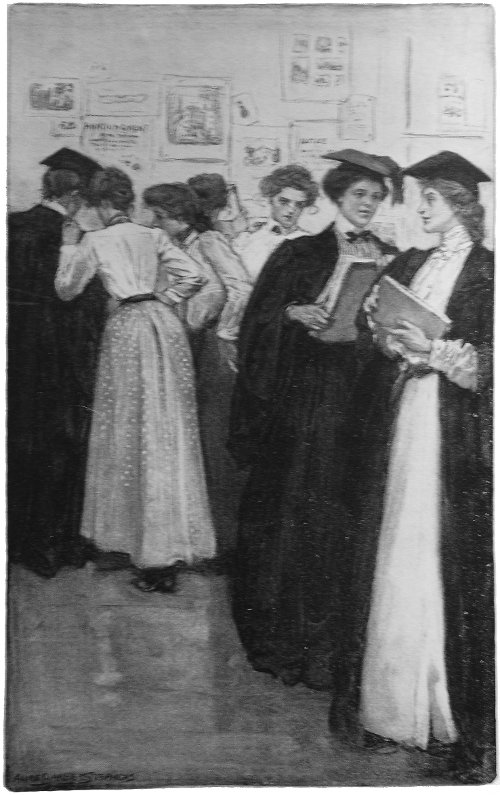
Thus under her breath Clarissa, from her seat in the
Auditorium, hummed a strain from a Radcliffe song. Girls
were gathering in the room to witness an Idler play.
“Sometime,” said Clarissa, “I’ll be a Senior, and have
a front seat. But if you can’t have the first, the fifth row
isn’t so very bad.”
While waiting for the play to begin, the girls in Clarissa’s
neighborhood chatted gaily. The play had attracted many
of the Alumnæ, because it was the work of a Radcliffe girl
who had been out of college a year or two. They waited
a little impatiently, for the Auditorium was really overcrowded,
with girls sitting on the steps and leaning on the
ledges of the windows leading into the conversation room.
“Oh, I do wish that they would begin!”
“Why can’t girls ever do anything on time? It is so
uncomfortable sitting in this stuffy room!”
144
These and other murmurs came from various parts of
the Auditorium. It was certainly much past the hour, and
yet the curtain did not rise. At last the President came
forward. “I must ask your indulgence,” she said, as she
stood in front of the curtain. “Something has gone
wrong with the curtain, we cannot raise it; but while we
are waiting for a carpenter, Miss Harmon has kindly
consented to read.” At this there was much applause,
for Annabel had a well-trained voice, and sufficient self-confidence
to make whatever she did very effective.
Accordingly, she came forward attired in a white muslin
gown, pale blue sash, and a leghorn hat lined with blue.
She was to wear the costume in the play, and no one
could deny that it was most becoming. Annabel read in a
plaintive tone. She read old ballads and modern love
songs, two of each, and the audience applauded most
heartily. Then she tried a bolder flight, a dramatic monologue,
and still her hearers were enthusiastic. She bowed
her thanks, smiled, and then a movement of the curtain was
seen. Annabel stood there unconscious of anything but
the audience before her. There was a vigorous clapping
of hands from a distant corner.
“Why, that sounds like a man, doesn’t it?” said a girl
behind Julia, leaning over toward her. Just then a huge
bunch of carnations fell at Annabel’s feet with a heavy thud,
as if thrown by some one used to handling missiles. Again
Annabel smiled and courtesied, and again the audience
applauded, with one pair of hands sounding louder than
the rest.
Clarissa looked at her watch, and closed the cover with
a snap.
145
“It wouldn’t be a bad idea to have the play begin; we
didn’t come to a reading.”
The Idler President again appeared in front of the
curtain and said something to Annabel. The latter, smiling
pleasantly, opened a book. The curtain rose behind
her, with the stage set for the play; but she began to
read again, slowly and with great expression, while in the
background the heads of various girls were seen peering
from behind the scenes, evidently impatient for Annabel
to stop.
Some of the audience, with a sense of the ridiculous,
began to laugh, but Annabel was unconscious of everything
but the applause. She stood as if waiting an encore.
“Is it a wonder,” whispered Julia to Clarissa, “that she
got the Class Presidency? I believe that she hypnotizes
people.”
“Ah, she reads like—like—a bird,” said Clarissa
magnanimously.
“You couldn’t honestly say ‘like an angel,’” said Julia,
and Clarissa shook her head.
How long this unpremeditated performance might have
continued no one can say. Before Annabel could recite
again the President came forward, announcing firmly that
the play was to begin. On Annabel’s face as she withdrew
there was a decidedly aggrieved expression. Nevertheless,
when she appeared in the play she looked as cheerful as
her wont, and said her lines in a melodious voice. Ruth
was a middle-aged Englishwoman, with a becoming lace
cap. The girl who played a man’s part wore high boots
and a long drab coat, the skirts of which came below the
tops of her boots.
146
The setting was good, the dialogue bright, and the audience
at last dispersed with the feeling that the whole performance
had been a great success.
“Who was that tall girl who passed us?” asked Julia,
when the play was over.
“I am sure I do not know, at least I did not notice her.”
“I always feel,” Julia continued, “as if all the Alumnæ
are acquainted. But I can see that it would be hard for
them all to know one another. The girl that I speak of
was tall and rather awkward, and she pushed her way
through the crowd without speaking to a soul.”
“Oh, she may have been a friend of some one in the
play. Each was allowed to invite a guest from outside.
Somebody told me that Annabel Harmon thought that
they might have been permitted to ask men.”
“Yes, because she thought that she would look particularly
fetching. For a sensible girl, she is certainly almost
as vain as they make them.”
“What is the objection to men spectators? The costumes
are harmless enough, compared with what they were in my
day,” said the graduate.
“Only that it’s against the rule,” replied a Junior. “But
in your day the girls who played men’s parts used to wear
real clothes, didn’t they?”
“Yes, real clothes,” and all laughed at the undergraduate’s
slip.
147
“Yes, men’s real clothes,” the graduate added, “borrowed
usually from some brother or cousin at the University.
Really, some girls made up wonderfully like Harvard
men.”
“I should like to have seen them. I hate our present
stage dress for men; it is neither ancient nor modern.”
“Yet it’s very proper!” interposed Clarissa sarcastically.
She had just joined the group.
“But why was manly attire given up? Since only girls
saw the plays, it couldn’t have done any great harm.”
“Oh, it was a man who spoiled it all, you know; they
deserve their reputation of marplots. I can’t vouch for the
story, but they say that a Senior who came once to an
Open Idler thought it necessary to express his gratification
to some one in authority.”
“No one could find fault with that.”
“No, but he was awkward. ‘I’m delighted to be here,’
he said, ‘for I’ve often hoped to visit Radcliffe. My
clothes have been here many times at the Idler dramatics,
but this is the first opportunity that I have had for
coming myself.’”
“What a stupid creature!”
“Well, it seems he had a sister in Radcliffe who was in
the habit of borrowing his clothes. He had a rather small
and neat figure, and a large wardrobe, so that he could be
drawn upon for almost any kind of dress. The rule, however,
was made immediately after this speech of his that
men’s costumes were not to be worn at our performances,
and great was the lamentation.”
148
“It isn’t as bad as it used to be,” said another; “we can
wear a kind of man’s dress now, provided that the coat has
a skirt effect. It isn’t exactly an up-to-date costume, but
it is fairly picturesque.”
“And to think,” interposed Clarissa, in a tragic tone,
“that at the Pudding plays, or indeed at the Cercle
Française, or anything else at Harvard, the boys can put on
ballet costumes or any dress that a woman might or
mightn’t wear.”
“There’s no equality of rights, even in so frivolous a
thing as theatricals,” cried one of the girls in mock sorrow.
“Why, Polly, why are you so late? You’ve missed
some fun.”
“I’m sorry, but I had to go to the City this afternoon.
I suppose the play was fun. But I’ve just seen something
quite as funny,” and Polly began to smile at the
remembrance.
“Oh, tell us, Polly, for if there is anything funny to be
seen, you are sure to see it.”
“Well, I met a girl at the head of Garden Street smoking
a big meerschaum pipe.”
“That isn’t funny, it’s pathetic!”
“She must have been ashamed, for when she saw me
she tried to put the pipe in her pocket.”
“How ridiculous!”
“Then she couldn’t find the pocket, and so she started
to put the pipe back in her mouth. It was clear that
either she wasn’t used to pipes—or to dresses.”
“Why, Polly!”
149
“So I asked Frank Everton, who was with me—no, he
hadn’t been in town with me, I only met him in the
Square—I asked him to follow her into the college
grounds. She crossed the street at a trot when she saw us
coming, and it seemed to me that she was making for
Weld Hall.”
All the girls in the group were now thoroughly interested.
“Consequently I stood at the corner of Appian Way
until Frank came back with his report, and—”
Here Polly paused to note the effect of her words.
“Well, well, what was it?” asked the impatient listeners.
“Well, it was Loring Bradshaw. Frank followed him to
his room, where he tore off his skirts. He had forgotten
that he was masquerading as a woman when he lit his
pipe. You see it was in the pocket of the waistcoat which
he wore beneath his cape. I had recognized him almost
immediately; you know he has a funny little scar under his
eye, and then that manly stride! Even in Cambridge you
wouldn’t see a girl with a gait like that.”
“But why was he parading in woman’s clothes? Was
it a college bet?”
“Oh, I haven’t heard the whole story yet. Frank came
back in a hurry because he had left me standing there.”
“What kind of a hat did he wear?” asked Julia with
interest. “Was it large and drooping, with yellow
roses?”
“The very hat. But I never knew you to take so
much interest in a mere hat!”
“And was the cape a black one, with a chenille collar?”
150
“Yes, I think so.”
“Then he was here at the play. I wondered who she
was. But why in the world did he do it?”
One afternoon soon after this, as Polly and Ruth loitered
in the hall they noticed a young man entering the
Secretary’s office.
“He’ll find no one there,” said Polly, “for I’ve just
been in myself.”
Stepping out of the office door, the visitor happened to
see Annabel Harmon crossing his path, and he stopped
her, apparently to ask a question.
“I wonder who he is,” said Polly. “Annabel will
think herself in luck if he asks her to show him the
building. She loves to act as guide, philosopher, and
friend to strangers.”
Apparently some such duty had fallen on Annabel, for
she and the stranger ascended the stairs toward the
Library.
“There,” cried Polly, “I don’t mind Annabel’s being
the chief usher at all our social functions, and presenting
herself everywhere as the typical Radcliffe girl. But the
rest of us know something about the building and its contents—including
the students. Why didn’t that youth
ask us to show him over the building? In the Secretary’s
absence, Annabel will be able to say whatever comes into
her head.”
“Aren’t you a little unfair?”
“Perhaps, but I’ll run upstairs. Annabel might not
give us a perfectly impartial account. Won’t you come?”
151
“No, thank you,” replied Ruth, “I was on the point of
going home.” So Ruth went home, and Polly mischievously
hastened up to the Library. She found Annabel and
the stranger looking apparently for some book.
“Oh, Polly,” cried Annabel, “couldn’t you find the
Librarian? Mr. Radcliffe, excuse me. Mr. Radcliffe, let
me introduce you to Miss Porson.” Polly started at the
name, while acknowledging the introduction, and Annabel
continued: “Mr. Radcliffe is deeply interested in our
college on account of the name. You see he is descended
from the same family as our foundress, and he thinks that
it would be most interesting to establish some memorial
of the family here. Didn’t I understand you to say that
you thought of giving a collection of books, or something
of that kind?”
Mr. Radcliffe modestly bowed his assent, for Polly broke
in before he had time to reply in words. “I shouldn’t exactly
call Anne Radcliffe our foundress.”
“Oh, well,” and Annabel’s smile was sweeter than ever,
“the college certainly took its name from her, and it
seems so interesting to have one of her descendants
here.”
“Not exactly a descendant,” interposed Mr. Radcliffe,
“but—”
“Oh, one of the family—it’s almost the same thing
in these days when every one is so interested in
genealogy.”
152
Although Annabel was always fluent, Polly looked at
her in surprise, for she was soon launched on a long account
of the origin, rise, and present condition of Radcliffe.
Mr. Radcliffe listened attentively, apparently with no inclination
to say more than “Yes,” “No,” “Indeed,”
“Only fancy,” and the other little things that keep conversation
from becoming entirely a monologue. Polly had
moved to one side, and from time to time she gave the two a
curious glance. Was it imagination, or did she really see
a smile on the young man’s face?
Presently as they strolled into the hall, Polly heard
Annabel say, “I am really sorry, Mr. Radcliffe, that we
have no books relating to your family. To-morrow, however,
when the Librarian is here she may find something.
Her assistant is rather new to the work.”
“Oh, I can assure you,” the young man responded effusively,
“I have been more than repaid for coming. To see
the interior of this building is indeed an experience, and
under such auspices!” Annabel accepted the compliment
with a becoming blush. “She always can blush to order,”
one of her critics had been known to say.
Mr. Radcliffe’s next remark was inaudible to Polly,
but Annabel’s, “Why, certainly, I will see what I can do,”
rang out quite distinctly. Leaving the young man alone
for a moment, Annabel went into one of the smaller rooms
leading off the hall. In a few minutes she returned.
“Excuse me for keeping you so long. I had some difficulty
in getting it,” and she held out to Mr. Radcliffe a
slip of white paper.
“Oh, thank you, thank you a thousand times; no book-plate
in my collection will be more valued than this.”
153
“Well, I declare,” thought Polly, “a book-plate for a
souvenir! Perhaps it’s all right to give it to a descendant
of the Radcliffes as we haven’t any relics of the immortal
Anne Radcliffe to show; but really, I wonder if Mr. Radcliffe
thinks that Annabel is President, Dean, and Secretary
all combined? It’s a pity that he couldn’t have come
at an hour when more of the powers could have been seen.”
When Polly reached the first floor of Fay House, Mr.
Radcliffe was no longer there, and Annabel, seated in the
conversation room, with a magazine before her on the
table, had her eyes fixed dreamily on space.
“Thinking of Anne Radcliffe?” queried Polly, as she
went by. But Annabel did not answer, and, passing on,
Polly met Clarissa at the outer door.
“Such fun!” she exclaimed. “I’ve been laughing for
five minutes.”
“Tell me,” responded Polly, “that I may laugh, too.”
“As I was crossing the Common I met my cousin
Archibald apparently waiting for some one. I stopped for
a second to speak to him, and of course I asked whom he
was waiting for.”
“Of course.”
“Well, it seems that Somers Brown is up for one of
those Greek letter societies,—I’ve forgotten which, and
part of the programme, the novitiate, or whatever they
call it, is for him to bring a book-plate away from the
Radcliffe Library by means of some bluff. He wasn’t to
get it by breaking and entering, but he was to have it
freely given to him by some one in the college. So he
decided to rig up as an Englishman, and call himself a
descendant of Anne Radcliffe’s family, and—”
154
“I know,” said Polly, smiling.
“Oh, then you saw him? Perhaps it was you who gave
him the book-plate?”
“Not I,” replied Polly, “although I had the pleasure of
meeting Mr. Radcliffe.”
“Surely neither the Dean nor the Librarian gave it to
him.”
“No, indeed! It was Annabel. He ran across her when
he started on his search for information. Poor Annabel,
she believed every word he said, although she prides herself
so on her insight. She gave him any amount of information
about Harvard as well as about Radcliffe. But then,
he really had an English accent.”
“Oh, yes, but imagine Annabel’s rage when she finds
that she has been imposed on! I shouldn’t like to break
the news to her.”
“But she ought to know.”
“Well, it isn’t our duty to tell her. Let us see what
happens.”
The outcome was that Annabel the next morning was
ready to tell the Dean of the honor paid the college by the
visit of Mr. Radcliffe. “He is willing to make researches
in England regarding Lady Moulson herself, and I should
not be surprised if he should found a scholarship for us.
From what he said I judge that he has a large estate in
England, and he seems deeply interested in Radcliffe,
especially after hearing my account of things.”
155
Julia happened to be the girl to whom Annabel had
begun to unfold her great expectations from Mr. Radcliffe.
“But haven’t you heard the true story?” she asked.
“Why, no, what do you mean? What true story?”
“Why, Polly told me, she and Clarissa.”
Annabel began to lose her usual placidity. She suspected
a practical joke.
“Why, who was—that is, wasn’t he—”
“No,” replied Julia, “at least as I understand it, he
wasn’t a Radcliffe. It was a test quiz, you know, for one
of the college societies.”
“Then who was the man?”
“His name was Brown, Somers Brown. He was ordered
to get some girl he didn’t know to show him through Fay
House, and to bring away a new book-plate to prove that
he had been in the Library. At least that is as I understood
the story from Clarissa.”
156
It would have been better had Julia not mentioned
Clarissa’s name. Annabel turned from white to red and
from red to white. Like most persons with a fair amount
of self-love, she regarded a practical joke as almost unbearable.
She remembered how Polly had stood about in the
hall while she was talking with the Englishman, and she
felt not unnaturally aggrieved. Beyond the change of
color and a certain increase of dignity, Annabel did not
express her feelings. “When there is any mischief brewing
Polly and Clarissa are pretty sure to be in it,” she said.
Then she moved off with a smile hardly less amiable than
the one she usually wore, before Julia could explain that
Polly and Clarissa had really had nothing to do with the
visit of the pseudo Mr. Radcliffe, to Fay House. The
story, however, had widely circulated, and most of those
who knew Annabel, even her friends, were highly entertained
that one who so prided herself on her insight should
have been thus imposed upon.
“I saw Somers Brown walking about with Annabel yesterday,
and I wondered why he held up his hand as if to
enjoin silence on me. I had no idea that he was moving
about under false colors. I can see, though, how he might
impose on any one as an Englishman. He has lived
abroad a great deal, and he really has an accent. Now that
I think of it, his get-up yesterday was rather amusing, the
plaids in his suit were so very plaid, and he used his
monocle so steadily—and that cane!”
“He is so well known in Boston and Cambridge society
that I wonder Annabel did not recognize him. I supposed
that she knew everybody—at least by sight,” said one
girl, sarcastically.
But so far as words were concerned, no one ever knew
exactly how Annabel felt. An observer, however, might
have noticed that from this time her demeanor toward
Clarissa and Polly was far less cordial.
The book-plate episode led to a revival of interest in the
story of Anne Radcliffe. Girls who had never heard just
how the name came to be chosen for their college began to
inform themselves more exactly.
157
XV ANGELINA
Late one afternoon as Julia sat in her study, the maid,
rapping at her door, announced, “A young girl to see
you.”
“Didn’t she give her name?”
“No, she is—well, she is a young person.”
“Show her up, please,” and Julia, stepping outside,
soon saw Angelina coming up the stairs.
“Why, what brought you so far this cold day, Angelina?”
she asked in greeting her.
“Well, Miss Julia,” she replied from the depths of an
easy-chair in which she had immediately seated herself,
“well, I did have a time getting here. You see I started
this morning, and I told my mother not to worry if I
didn’t come home to-night. I knew you’d make room
for me, and there’s things I want to talk over that I
couldn’t write.”
Julia had not heard from the Rosas since the Christmas
vacation, when she had spared a day to visit them and take
a basket of presents.
158
“I wasn’t sure that you wanted me to come to Cambridge,”
said Angelina. “I don’t remember your ever
inviting me, but ever since I heard you were at college
I’ve been anxious to see what it was like. I thought that
colleges were just for men?”
“Oh, no, for girls, too, in these days.”
“I think I’d like to go to college myself,” said Angelina,
with a sidelong glance at Julia, “but I don’t suppose
that I’ll have the chance.”
Julia shook her head. “Angelina, you may not go to
college, but you know that we wish you to go on with your
studies. I am sorry that there is no evening school at
Shiloh.”
“That’s just it,” responded Angelina, “that’s just
what I wanted to talk about. I don’t feel as if I cared
much for Shiloh; it’s terribly quiet there in the winter
after the summer people are gone. I can’t seem to think
that I want to stay there all the time.”
“Your mother must decide that. Are you not needed
at home?” asked Julia weakly, knowing that Mrs. Rosa
had very little authority over her children, and that she
was only too ready to refer all difficult questions to Julia
and Miss South.
“Well, my mother does kind of depend on me,” said
Angelina. She did not care to admit that she was of too
little consequence in the household. “But still she could
get along without me. The boys help considerable after
school. I don’t think I’m appreciated; I’m not perfectly
happy,” and Angelina drew out her handkerchief,
to be ready for any tears that her self-pity might start.
159
“I cannot encourage you to leave Shiloh,” said Julia.
“You are not sixteen, and you are not strong enough, I
am sure, to go out to work. You would not find it half
as pleasant to work in a strange family as you find it now
at home; and should you get a place in town, you could
not possibly earn enough to pay your board.”
Angelina applied the handkerchief to two or three
invisible tears.
“Now, Angelina,” added Julia, “I will do what I can.
I will write to Miss South. She can tell much better than
I what is best. You spoke about going to college. That,
at present, is out of the question. But is there any special
thing that you would like to study?”
At first Angelina made no reply. Then she replied
rather petulantly, “I hadn’t thought of studying anything
in particular, only I don’t care much to stay in Shiloh this
winter, and that’s the truth.”
By her manner as well as by her words, Julia saw that
Angelina was likely to give her and Miss South more or
less trouble. They had assumed a certain responsibility
in regard to the Rosas, and they could not easily shake
it off.
160
During their two years in Shiloh the Rosas had seemed
to be contented. They had never before been so prosperous.
Instead of the two crowded tenement rooms they
had a neat little cottage, which had been put in perfect
order for them. In the course of the two years, to be
sure, the newness and freshness had decidedly worn off, as
Julia had observed to her regret when she called there in
December. But their Shiloh home was infinitely more
comfortable than any home they could have had in Boston.
Mrs. Rosa’s health had failed in the city, but she had so
improved now that she was able to earn a fair part of the
family income. The rest of it was made up in various
ways. Miss South and Julia paid the rent of the little
house. Nora and Brenda and Edith had charge of a fund
made up of their own savings and contributions from their
friends. Since she had so cleverly recovered the money
stolen from Mrs. Rosa by Miguel Silva, Brenda felt that
she could be very liberal to the Rosas.
The fund was Mrs. Rosa’s dependence for food and
fuel. Part of her fuel was gathered by the older children
in the woods, and a small vegetable garden supplied not
only summer vegetables, but something towards their
winter needs.
161
In season Angelina earned her board and a dollar a
week at a summer boarding-house. This she was allowed
to handle under Miss South’s supervision, and she had already
started a bank-book. The sum in the bank, however,
was very small, for Angelina had availed herself to the
utmost of Miss South’s permission to use part of her own
money for clothes. Suitable garments were chosen each
year by Brenda and her friends from their own stock of
discarded clothes, which, altered, answered for Angelina.
But shoes and hats and some other things Angelina
insisted on buying from her own savings, and in consequence
the amount in the bank showed small increase.
Mrs. Rosa herself had once worked at tailoring, and so she
was able to remodel the garments given her for her boys.
In the case of so helpless a family, neither Miss South nor
Julia felt that they were likely to do harm by fairly liberal
gifts. They had removed Mrs. Rosa from the city where
she might have had regular relief from various charitable
societies, from her church and from the Overseers if
from no more. They had made her understand that all
that she received from private individuals was conditioned
on the care she showed in bringing up her family,—that
it was a kind of reward of merit. Thus far all the people
interested in the Rosas had been gratified by their progress,
and Julia knew that Miss South had some plans for
Angelina which might make the girl more contented.
Ever since summer, however, Miss South had been occupied
with the care of her aged grandmother, Madame
Dulaunay, and she had been unable to do more for the
Rosas than write to them and see that they received their
money regularly. That very week she had started for
Florida with Madame Dulaunay, and Julia saw she must
make plans for Angelina. She was beginning to be so
busy now preparing for the examinations that she hardly
saw how she could spare much thought or energy for the
young girl. Behind these thoughts was a background
of disappointment that Angelina had so quickly tired of
Shiloh.
“You must tell me what you especially wish to do, or
to study,” she said.
“Yes’m,” responded Angelina, too much interested in
a box of photographs on the table to reply with her usual
loquacity.
“Then there is something?” Julia questioned.
162
“Well, nothing in particular. I wouldn’t mind living
at the North End again. It’s livelier than Shiloh.”
“But surely,” said Julia, “you are all much more comfortable
at Shiloh than you could possibly be at the North
End.”
“I don’t know,” rejoined Angelina. “I don’t feel so
very comfortable at Shiloh. I ain’t busy enough, and I
ain’t idle enough really to enjoy it.”
Julia understood Angelina, poorly though she had
expressed her meaning.
“Does your mother know where you are to-night?
Won’t she be worried if you stay away so late?”
“I told her that I was coming to Cambridge to see you.
She’ll know that you will look out for me.”
“When you next come to Cambridge you must start
earlier. It is altogether too late for you to go home now.
I will have a bed made for you on this divan, and to-morrow
you can go back to Shiloh.”
“Oh, thank you,” cried Angelina, her face beaming at
the thought of a night away from Shiloh.
“Now, I’ll tell you, Angelina, what I propose to do.
I will see if your mother will let you come to Cambridge
once a week. There is one day when I am not very
busy. I can probably arrange to have you sleep in this
house. I will pay your way over here and give you your
meals. In return I shall expect you to do whatever
mending Miss Roberts and I have ready for you. Besides,
I will give you a lesson to study at home, and each
Wednesday I will hear you recite it and show you how to
study.”
163
Angelina both looked and spoke her thanks. “I don’t
see how you ever came to think of anything so beautiful.”
“I am glad that you like it,” responded Julia, “and I
hope that you will do your best to help carry it out.”
Angelina chose history as her subject of study, and as
she had had American History at school, Julia began with
a little outline of the World’s History.
It was a good plan and it worked very well. Shiloh
evidently had not given Angelina enough to do in winter,
and it was well for her to have an interest outside her
home. Yet her mother needed her help to a certain
extent, and it would have been a mistake to encourage
Angelina to work entirely outside of the house. The
weekly visit kept Julia in closer touch with the Rosa
family than would otherwise have been possible, and this
in itself was a good thing. Then, too, she gained deeper
insight into Angelina’s character than she could have
gained in any other way.
She engaged a small room from Mrs. Colton where
Angelina slept when in Cambridge, and in it she placed a
wicker-work table with a large basket and all the appliances
for mending stockings, sewing on buttons, and the
simple repairing of which Angelina was capable.
“I have always heard,” said Ruth, who shared in the
advantages of Angelina’s services, “that lazy people take
the most pains; for, honestly, it would save you time and
money to do your own mending, and let me do mine,
rather than have all this bother with Angelina.”
164
“Oh, it’s a good thing for me, too,” replied Julia.
“Our great danger here in college is in thinking that we
have no duties except those connected with our studies,
as if the only thing worth living for were to get ‘A’ or
‘B’ in some course.”
“I know girls who wouldn’t think ‘B’ worth living
for,” retorted Ruth, “but I agree with you that there is
always a danger that we may be too narrow in our interests.
That’s why I am glad that so many girls are taking
an interest in the operetta. In doing it they will be
assisting the fund for the North End reading-room, which
is calculated to do an immense amount of good. You
have no idea, Julia, what a success the operetta will be.”
“I hope so.” Julia spoke absent-mindedly. A plan
that Miss South had suggested for Angelina and girls of
her kind was running through her mind. But she knew
that until she should leave college there would be little
chance of carrying it into effect. She would have been
glad to work with some of the organized charities, but
she felt that college must claim the most of her time.
Comparatively few of her classmates, however, were without
some bit of philanthropic work. Several taught
Sunday-school classes. Several others gave an evening
a week to some Boys’ or Girls’ Club in Boston or Cambridge.
The Emmanuel Society, so named for John Harvard’s
College, had regular meetings before which appeared
various organizations, who made clear their claims to the
support of thoughtful young women. The College Settlements
appealed strongly to the undergraduate, and a
chapter to raise money for the work had been formed at
Radcliffe. The Emmanuel Society supported an annual
scholarship, and maintained a library of text-books to be
lent to students who could not afford to buy all the expensive
books needed in their courses.
165
Julia and Ruth and Clarissa, and even Pamela, contributed
something to the various causes that appealed to
Radcliffe girls, for time as well as money was asked for.
When her aunt remonstrated with Julia for giving too
much thought and time to Angelina, Julia replied that
she believed that the time would not be altogether thrown
away.
“Now that I know that Angelina needs help and advice,
I should feel it wrong to give her up.”
“If she appreciates it,” said Mrs. Barlow doubtfully.
“Oh, I’m sure that she will,” responded Julia cheerfully.
“Besides, she really is of some use to me and
Ruth.”
Yet there were times when Angelina’s little vagaries
were hard to overcome. She was, for example, very fond
of newspaper reading, and the advertisements seemed to
have a special charm for her.
“Oh, Miss Julia,” she said one day, “I do wish that
I could have a bottle of this,” and she pointed to an
advertisement of “The Pearl of Beauty.” “They say,”
continued Angelina, “that it will make the sallowest complexion
a delicate pink. Now, Miss Julia, you know that
I’m as sallow as most Portuguese, and I do wish that
‘The Pearl of Beauty’ did not cost so much; it’s a
dollar a bottle. But one of the boarders at Shiloh asked
me last summer if I wasn’t a colored person—kind of
light-colored, and that wasn’t pleasant.”
166
But Julia, unmoved by this, explained that it was unwise
to believe every newspaper advertisement.
“But look at this,” pointing to the lithographed lady
who held a placard in her hands on which were printed
words of praise of the beautifier. “‘Look at me, please.
I once was dark as night, but now am fair as a lily of
the valley.’ That shows that she must have improved,”
said the confiding Angelina, reading the closing words:
“‘Beauty is a duty.’ Oh! I wish that I could have a
bottle.”
“It would be throwing money away, and I should be
very much displeased with you. Remember,” added
Julia, “that advertisements are written simply to induce
people to buy the thing advertised.”
“Don’t they tell the truth?” and Angelina looked
utterly surprised. “I always believe every word I read.”
“You have a great deal to learn, Angelina, and I do
hope that you will remember what I have said about
patent medicines.”
One Wednesday, a week or two later, Julia found
Angelina standing before the mirror in the little room
with a bottle in her hand.
167
“What are you doing?” she asked, suspecting the
truth, and Angelina, starting guiltily, dropped the bottle,
and a pinkish fluid poured out on the light carpet. As
the bottle lay there, Julia read the words “Pearl of
Beauty” on the outside. Angelina shamefacedly seized
a towel and began to mop up the carpet, murmuring as
she did so, “I bought it with my own money.”
Realizing that she had little authority over Angelina,
Julia could only say, “I am sorry that you have so little
regard for my opinion.” Yet neither then nor at any
other time did Angelina apologize for what she had done.
When Julia, consequently, reflected on the matter, she
wondered if, after all, she might not have made a mistake
in showing so much confidence in Angelina.
168
XVI WHO WROTE IT?
“It’s bad taste, anyway,” said Annabel Harmon.
“To call it by no worse name,” responded Elizabeth
Darcy.
“Almost nothing can be worse than bad taste,” rejoined
Annabel.
The two girls, at a table in the conversation room, were
looking eagerly at the page of a newspaper.
“Why, what’s the trouble?” asked Polly, who had
been standing near the window. “Has anybody had the
bad taste to commit a murder, or burglary, or some other
crime? I see that you have a yellowish journal there.”
The two, absorbed in their paper, did not reply, and
Polly drew near them until she could read the headlines:
“Is a College Education Worth While for Girls?”
“Lowering of the Standard by a University Professor
to meet the Demands of Woman.”
“Dear me!” cried Polly, “this does look interesting.”
“Yes,” responded Annabel, “read further and you will
find it more so. You can take the paper for a few minutes.
I’m glad that I happened to buy one in the Square
when I came out from town.”
169
Polly sat down with the newspaper. Under the large
headlines were others in smaller type that showed that the
professor to whom reference was made was a Harvard
professor, and then she began to read. Surely there was
something very familiar in what followed. It purported
to be the transcript of a few pages from the history note-book
of a student at Radcliffe. It was all very familiar.
Why, of course! Clarissa’s notes! No one who had ever
gazed upon them could mistake the style. She remembered
having read this very lecture last year when preparing
for her examinations. Clarissa was always generous
in lending her note-books, and Polly had had the use of
this for a day or two. But what had seemed only funny
within the covers of a note-book seemed very impertinent
thus exposed to the gaze of every one who cared
to buy a penny paper. Reading further, Polly learned
that the article was copied from an obscure magazine to
which the Radcliffe notes had been sent with a plaintive
inquiry whether such lectures could greatly benefit
woman.
“Poor Professor Z!” sighed Polly. “He certainly
lectures in this style sometimes. For my own part, I
used to enjoy the colloquialisms, and he used to give us
so much besides that it isn’t fair to pillory him.”
“What do you think of Clarissa now?” asked Elizabeth
Darcy.
“Clarissa?” repeated Polly. “What has she to do
with it?”
170
Elizabeth shrugged her shoulders. “Most of us have
seen Clarissa’s note-books; if she didn’t write this, who
did?”
“I won’t say that this is not Clarissa’s style, I won’t
even say that these are not her notes; but I will say that
she didn’t print them.”
“I wish that I had your confidence in Clarissa.” Elizabeth
spoke with an accent of pity. “You must admit that
she loves to make fun of people.”
“She is not half as bad as I am,” rejoined Polly, stoutly
defending her friend. “Why, I have even made fun of
her,—that was before I knew her so well. But she bore
me no malice. In fact, she never takes revenge, and there
is malice in this article.”
“You admit that these are Clarissa’s notes, and yet you
don’t think them malicious.”
The last speaker was Annabel, who had joined the
group.
“Come, Miss Harmon, be fair; it is one thing to write
nonsense intended only for one’s own eyes, and another to
put it before the public. Clarissa, I know, did not have
the notes published.” Then Polly turned away.
Polly was by no means comfortable as she left Fay
House, and the better to disprove the accusation made by
Elizabeth, she went to the stationer’s in the Square to buy
a copy of the newspaper. It was the last one to be had.
“It’s been in the greatest demand,” explained the attendant.
“Some kind of a college article, I believe; I haven’t
had time to look at it myself.”
171
Polly folded the paper and walked down Brattle Street.
“I believe I’ll ask Clarissa point blank.” Polly had a
slightly uncomfortable doubt as she thought of the article,
and it happened, as it so often does happen in such cases,
that when she met Clarissa she could not ask the question.
“If she hasn’t heard, it would only disturb her,” was her
excuse. Afterwards she was sorry that she had not at
once gone to her.
Within twenty-four hours almost every one at Radcliffe
had read the article. Those who did not own papers
borrowed them, and the critics and partisans of Clarissa
ranged themselves strongly on one side or the other.
Some, while blaming Clarissa for letting her notes get into
print, said that it was no more than Professor Z deserved,
since the tone of his lectures had never been sufficiently
academic. Others were glad that he was now absent on
his Sabbatical year, for if he were lecturing in Cambridge
they were sure that his wrath would have been pretty
keenly felt. Ruth, of course, took Annabel Harmon’s
view of the affair. Julia, while loath to think that Clarissa
had done this in a spirit of malice, thought that she
had allowed herself to be carried away by the spirit of fun,
without realizing that the whole thing was a deflection
from the straight line of honor. She and Pamela discussed
the matter at some length, and very quickly agreed
that the relation of a professor to a small class was a confidential
relation, and that only an instructor who was on
very good terms with his class would talk to them after
the fashion of Professor Z. Consequently, to quote his
direct language was like telling family secrets.
172
Yet with it all nobody dared speak to Clarissa. They
quoted what this professor or that professor’s wife had
said; how one had declared that nothing would induce
him to lecture at Radcliffe, how another had termed this
the natural result of trying to benefit women,—they
would merely hold up their benefactors to ridicule,—and
still no one dared reprove Clarissa. The Western girl
wrapped herself in a forbidding manner, and not even
Polly dared speak of the article or its effects.
But one day, turning the matter over in her mind, she
came to a decision. “A party will be the very thing,”
she said to herself, “and Clarissa shall give it. Ruth and
Julia and Lois Forsaith, oh, yes, and Pamela, and two or
three others,—as many as she can afford chairs for,—it
will be the very thing.”
Clarissa’s room was in a small, neat house in a neat side
street. Her landlady had other boarders, but she took a
real interest in them all.
Clarissa’s room looked on a little yard filled with pear
trees, and the children of the neighborhood played constantly
under her windows. This did not disturb her, for
her nerves were not near the surface. Sometimes she
called the children to her room and gave them a treat of
fruit or sweet things. Mrs. Freeman’s other boarders
thought Clarissa rather frivolous. One of them was a
timid Freshman who studied unremittingly. Two of the
others were graduate students, delving into zoölogy, and
other “mussy sciences” (Clarissa’s phraseology), and the
fifth was an inoffensive Sophomore. The two graduates
roomed together. Clarissa had the best room in the
house, but the Freshman had a small room under the
eaves. The Freshman sometimes complained that she had
made a mistake, and that she should have had a room in a
lodging-house where she could have boarded herself with
the aid of a chafing-dish and gas stove.
173
“And starve to death, with nobody nigh to hinder,”
said Clarissa. “I’m glad that kind of thing is not encouraged
at Radcliffe. But I wish that you had the room
on my floor, instead of those zoölogists. Often about ten
P.M. when I’ve finished studying I’d slip in and talk
with you. Sometimes I knock on the zoölogical door,
but if they let me in I feel like a criminal, for I can see
that they are making a great effort to be polite, while they
wish me a thousand miles away. They like to study well
into the small hours, but as they pay for their own oil
nobody can well object. I’m not half as entertaining to
them as those squirmy things they keep in bottles. The
only real gaiety in which they ever indulge is an ethical
discussion with Pamela; just imagine the combination,
ethics and zoölogy!”
The other girl laughed. “You might start a discussion
at your party.”
“No, thank you, it’s to be a poster party, nothing
more nor less improving than posters will be considered
worthy of mention.”
174
Clarissa had yielded to Polly’s plans for the party,
understanding the spirit in which it had been arranged.
It had been talked of indefinitely before the affair of the
newspaper; and although Polly did not now explain why
she was so anxious to have her friend turn entertainer at
this particular time, Clarissa understood, and Polly knew
that she understood.
Nearly all who had been invited responded to Clarissa’s
invitation, and one windy evening they gathered very
contentedly around the open fire in her room. Clarissa’s
room was as different as possible from Julia’s. To its
rather homely furnishings she had added various things
that had caught her fancy without regard to any scheme
of art. There was a vivid Navajo blanket over her couch,
and two Indian baskets from the Southwest on a bracket
in a corner. Some Japanese fans were displayed over the
mantle-piece, and just above them hung in a black frame
a fine photograph of the Arch of Titus. But the other
three walls, whether beautiful or ugly in the matter of
their everyday decorations, for this evening were hidden
by posters—posters large, small, ugly, beautiful, covered
every spot.
“I know,” said Clarissa, in explanation, after welcoming
her guests, “I know that posters have gone out of
fashion. That is partly why I’ve taken them up. I had
thought of offering prizes to the girl who could guess the
artist of the largest number, but instead of that I’m going
to explain them myself. Lo! here is a pointer that I
brought over from Fay House this very afternoon.” So
armed with the long wooden stick, Clarissa moved about
the room, explaining much after the fashion of an auctioneer
who has something to dispose of.
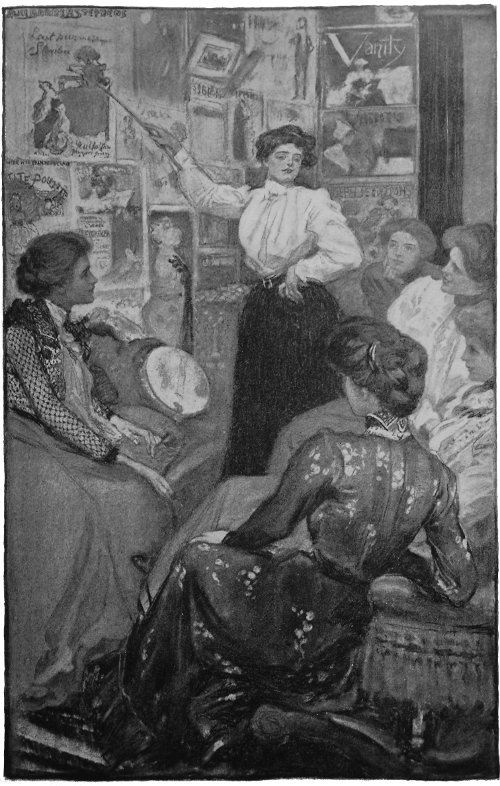
“Clarissa moved about the room, explaining”
175
“This you will see is undoubtedly French. You could
tell it by the anatomy of the cats, if in no other way.
Such creatures were never seen on this side of the Atlantic.
Jim got it for me. The real name of the work of
art is ‘Lait Pur Sterilisé;’” and as she paused for a moment,
they all gazed with fitting admiration on the child
in a red dress drinking from a bowl under the envious
eyes of three cats.
“Well, it’s better,” said Polly, “than some of those
greenery yallery things. No wonder Aubrey Beardsley
died young.”
“Oh, Polly, you artless creature, didn’t you dote on
the Yellow Book?”
“Not I,” replied Polly. “I measured Mrs. Patrick
Campbell as once portrayed there, and in proportion to
the length of her head as there shown she must be about
ten feet tall.”
“Why, Polly, I didn’t realize that you knew so much
about Art.”
“Oh, I know more things than I am sometimes credited
with,” and there was an undertone of deeper meaning in
Polly’s voice.
“Here’s a Grasset,” continued Clarissa, resuming her
explanations. “Isn’t it a beauty?”
“No, no, Clarissa,” said Julia, “I like this better;” and
rising, she put her hand on a poster with a Puritan maiden
carrying mistletoe.
176
“You show your taste,” said Clarissa, “that’s a Rhead.”
Though hung near Dudley Hardy’s “Gaiety Girl” in
poster land, the two did not seem inharmonious neighbors.
Not far from them was Bemliardt’s Jeanne d’Arc, and
for fifteen minutes or more Clarissa kept her friends
amused with the poster show. Before her art lecture was
quite at an end, Julia as assistant hostess had lit the lamp
under the chafing-dish, and then when the others found
that fudge-making was the next thing on the programme,
each one wished to offer her own receipt, and to the great
surprise of the company it was found that each receipt
varied a little from the others.
“First you grate a pound of chocolate into the chafing-dish,”
began Polly.
“Oh, not a pound—half a pound at first,” interrupted
Julia.
“It’s a great deal better to begin by melting your
butter, and then put in a pint of milk,” added Ruth.
“I never use any milk,” interposed Clarissa.
“Then you let it simmer half an hour,” resumed
Polly.
“Oh, there isn’t any fixed length of time,” cried Ruth
again; “just let it cook until it’s done.”
“How do you know when it’s done?”
Then followed a Babel of voices, as each one told what
she thought the proper test; and a listener, I fear, who
knew nothing of fudge-making, would have had hard
work to select a working receipt from the directions given
by these merry girls.
177
By the time the fudge was ready the ball had been set
rolling, and it was evident that Clarissa’s party was a
success. While Ruth and Lois were superintending a
second chafing-dish, in which a rarebit was preparing,
Polly picked up a guitar and began to accompany herself,
as she sang the opening lines of one of the Radcliffe
classics, “The Mermaid.”
“That’s just the thing to cheer us up.”
“As if you needed cheering! But here it is!” And
Polly struck the chords with a firm hand, as she sang
about the little mermaid who
“Could not even speak Acroparthianic Greek,
And she’d no instruction in Theology.
One day she found, as she swam around,
A Radcliffe catalogue,
Which shone afar like an evening star
From out the mist and fog.
She paused to rest on a billow’s crest,
In a wreath of sparkling foam,
And when she had read what the catalogue said,
She decided to leave her home.
She saw at once that she was a dunce
And ought to go to college.
So dressed in her best with a hat from Céleste,
She set out for the shrine of knowledge.
The cars were so filled she was almost killed,
But she found she could easily swim
Up Garden Street, that road so neat
That has Radcliffe on its brim.”
The last two lines were loudly applauded, for the mud
of Garden Street was constantly ridiculed by the college
girls to be beyond description. The song proceeded to
describe the advent of the mermaid at Fay House:
178
“She told her race, and her boarding-place,
And her age (less a year, maybe),
But when the question came,
‘What’s your grandma’s middle name?’
She wept and turned to flee.”
“The regular Boston question,” said Clarissa, with an
expression of scorn.
“Don’t interrupt,” cried Ruth, as Polly sang the chorus
of each verse.
“Oh, the ocean swell is all very well
For frivolous sport and play,
But the cultured mind you’ll seldom find
Beneath the salt sea spray.”
Other songs followed this,—the “Hunting Song” from
the “Princess Perfection,” snatches from one or two
real operas; and at last as they sat around the open fire
drinking lemonade—for the rarebit was now a thing of
the past—Clarissa turned down the lights, and proposed
that they should tell weird stories. No one of the eight
or nine present was excused. Even Ernestine Dunton
had to do her part, and she had unbent to an extent that
was astonishing to Ruth and Clarissa; for in the preceding
year when she had been their Senior adviser, she had
seemed the personification of seriousness. She was now
back at Radcliffe as a graduate student, and in certain
ways she had begun to unbend.
179
As her friends bade her good-night, Clarissa knew
that her party had been a success; for Polly, lingering
a little behind the others, put out her hand and
whispered, “You know that we don’t believe that you
did that foolish thing, don’t you?” and Clarissa, returning
the pressure, replied, “Of course you could not
believe it.”
180
XVII A PRIVATE DETECTIVE
In spite of the surface frivolity, there was in Polly a
strong vein of common sense. Therefore, as she thought
more and more deeply about the newspaper article she
became convinced that great injustice had been done
Clarissa. She was naturally puzzled, for the notes so
unkindly quoted were certainly from the Kansas girl’s
note-book. Only too well she remembered having read
them herself, and having laughed at some of the hits.
But how had the newspaper obtained them? Without
having talked with Clarissa directly, without having had
more than the whispered word at the party, she yet knew
that the Kansas girl was not to blame. She began to set
her wits at work. To solve the mystery she must turn
private detective.
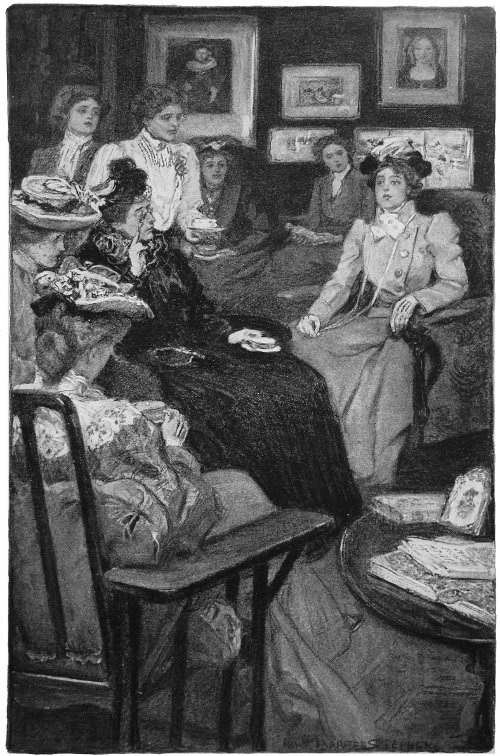
One Wednesday afternoon she dropped into the pleasant
drawing-room at Fay House; “the most homelike place,”
she often said, “this side of Atlanta.” Indeed, many
other Radcliffe girls were in the habit of saying the same
thing, only instead of Atlanta they named Pittsburg, or
Topeka, or Kalamazoo, or, in short, the particular city or
town which each called her home.
181
“The first month I was in Cambridge,” Polly had said
to the President, “I was right smart homesick and miserable.
I felt like I couldn’t stand it. But when I came in
here, and saw you seated at the tea-table, beside the open
fire, I felt like I were with my grandmother, and that
this was a place where I could lay aside all my forlornness.
You don’t mind my comparing you to my grandmother?
I reckon it isn’t perfectly polite.”
But the widow of the great scientist, who was proud to
admit her threescore years and ten, smiled with her accustomed
grace, saying in reply:
“No, indeed, my dear, I am only complimented by the
comparison.”
Nor was Polly the only one who felt the restful influence
of the drawing-room at Fay House; the quaint
old-fashioned room, with its oval ends, curving outward,
with its dull green satiny wall-paper, and the old-time
couch and easy-chairs covered in flowered crimson.
Girls who entered it for the first time were impressed by
the dainty silver and china of the tea-table, and they would
turn from the life-size portrait of Mrs. Agassiz between
the windows to the majestic figure of the President herself
presiding over the teacups, and neither picture nor
living figure suffered by the comparison.
182
On this particular Wednesday afternoon, not so very long
after the publication of the alleged lecture of Professor Z
in the yellow journal, Polly, after paying her respects
to Mrs. Agassiz, seated herself at the further side of the
room. She did not linger as was her wont around the tea-table,
for two distinguished guests had entered just behind
her. One was a Frenchwoman, of international reputation,
and the other a distinguished Englishman, making a study
of our institutions. The former was accompanied by a
well-known member of the Harvard Faculty, and the latter
by two Bostonians whom he was visiting.
“Isn’t it just lovely,” said a little Freshman seated
near Polly, “to see such great people? That’s what I like
about Boston and Cambridge. You’re always meeting
people who seem to belong in books.”
“Yes,” replied Polly mockingly, “it’s a liberal education
just to look at them. Let’s talk French, and see if our
accent improves through breathing the same atmosphere
with Madame X.”
“Oh, I didn’t mean exactly that,” replied the Freshman,
“only we certainly do learn things here that we
couldn’t get out of books.”
“Yes, yes, dear, you’re certainly right, and I only wish
that we could get yon Englishman to tell us how he
manages to wear that monocle, and yet look perfectly
happy.”
The Freshman glanced at Polly to see if she was in
earnest, and made some remark to which Polly returned
no answer.
Polly’s thoughts indeed had begun to wander, sent off by
a word or two from a girl standing with her back to her.
183
“She hasn’t found it out yet, or she wouldn’t speak to
her,” were the words that fell on her ear. Looking toward
the door she saw that Clarissa had just entered, and had
paused for a moment to say a word to Annabel, who as
usual was the centre of an admiring group.
Clarissa passed on to pay her respects to the President;
and while Polly was reflecting on what she had heard,
she saw the girls in the group leave Annabel one by one to
join Clarissa, standing at the other side of the fireplace.
Annabel frowned as she moved toward Polly’s corner.
She and the girl with her did not notice Polly, for they
stood with their backs to her.
“Yes, it is rather bold—really very bold, but she
never cares what any one thinks. She has so much—so
much—”
“Effrontery, I should call it,” replied the other, who
was well known to be a worshipper of a rising star, such
as Annabel was now supposed to be. “But I know that
you never like to say anything disagreeable.”
“Well, of course, one should be very careful;” and
Annabel sighed the sigh of the needlessly perfect person.
Upon this, Polly, rising suddenly, faced around, and with
a hasty nod to Annabel joined Clarissa at the other side of
the room.
The few apparently unimportant words that she had
heard had helped her far along with her detective work.
She could not, however, altogether conceal her feelings,
and slipping her arm through Clarissa’s, she led her back
toward Annabel and her friends.
“Behold the rising star!” she exclaimed; “for of
course,” she added in explanation, “you’ve heard that
Clarissa is to have leading part in Julia’s operetta.”
184
“Why, Polly,” said Clarissa, “I had not—”
“Don’t contradict,” responded Polly, “our plans are
made, and there isn’t a question but that you have the
most manly tone, and gait, and—”
“Why, Annabel, I thought that you were to have the
chief part!” interposed her friend.
“Oh, she’ll be in it,” rejoined Polly, in a somewhat
patronizing tone, assumed for the occasion, “if not in the
chief part.”
Then she moved away, still leaning on Clarissa’s arm,
and Annabel had no chance to retort. The foreign guests
had gone to inspect the other parts of Fay House, and the
drawing-room was filling with girls whose lectures for the
day had ended.
“Oh, Polly,” cried Clarissa, as the two friends left the
room, after paying their respects to the President and Dean.
“Why, Polly, I can’t act; I don’t belong with those girls at
all. Ruth Roberts, you know, barely tolerates me, and
she’s to be the manager.”
“Nonsense, she isn’t the whole thing. Besides, I happen
to know that she does want you.”
“What about Annabel?”
“Well, we can’t really leave her out. Her voice isn’t
remarkable, but she acts pretty well; and since she’s been
playing with the Cambridge Dramatic Club, she’s been
considered our representative actor. Besides, she’s a great
friend of Ruth’s.”
“I know it,” responded Clarissa. “You surely ought to
have Annabel; but can I pull all right with those girls?”
185
“Of course, and I am to be a dapper little dandy.
Though we are to be rivals in love, we can support each
other.”
So at last Clarissa yielded, and after the mid-years, rehearsals
went on pretty rapidly. There were, after all,
several good parts in the operetta; and Ruth, viewing
everything with the critical eye of a business manager, was
certain that the performance would bring even more than
she had hoped.
“Clarissa herself wouldn’t be so bad,” said Ruth one
evening, as she and Julia sat in the study after dinner,
“but I can’t say that I like her friends. She has a rather
scrubby lot of hangers-on. Look at those two this afternoon!”
“Why, I saw nothing to criticise.”
“You never do, Julia, but they certainly hadn’t a word
to say for themselves, and their clothes were frightful.
Clarissa’s red coat is bad enough, but she is rather fine-looking,
and she is so decidedly unlike any one else that
you don’t have to apologize for her. But those others
were so—so nondescript.”
“Ruth,” exclaimed Julia, with a shade of reproach, “you
have changed very much the past year. You used to think
Belle’s exclusiveness silly, but you are tending that way
yourself.”
“You are not in earnest!”
“Of course, you’ll never be just like Belle. But you
have begun to think too much about appearances.”
186
“But you are too amiable, Julia. As we can’t be intimate
with all the girls we meet, we might as well choose
the most congenial. We can’t let all kinds of girls take
up our time.”
“My time isn’t so valuable. I can spare a little even
to all kinds of girls.”
“Yes, but even on Mondays, sometimes, there are such
queer girls. They make an unfavorable impression on
people from town who call. Don’t you remember when
Mrs. Blair came out? Now, if she had only met Annabel
Harmon or Elizabeth Darcy, how different it would have
been!”
“Annabel Harmon!” Julia wondered why she so disliked
Ruth’s intimacy with Annabel, for Annabel was a
popular girl, hardly less so than Elizabeth Darcy. She
was well-bred and interesting. “I never can thoroughly
trust any one who spends her spare time reading French
books,” Clarissa had said laughingly, although Julia would
have hesitated to put it quite so definitely.
Ruth, however, was apparently fascinated by Annabel,
and constantly quoted her with admiration. Annabel had
a dislike for plain things and plain people. By this, she
was careful to explain, she did not mean necessarily things
that were ugly or people who were poor. “Some ugly
things are really very beautiful, and some poor people are
far from plain. The only kind of plainness that I object
to is commonness; I hate ordinary things.”
187
Yet if any one had taken the trouble to note down the
things that Annabel called “common,” it would have been
found that in her eyes these were the inexpensive things,
and the girls whom she described as ordinary were usually
those who were not rich either in money or influential
connections.
Julia saw that Ruth’s intimacy with Annabel had made
a change in her, not altogether to be commended.
“I wish you liked Lois Forsaith as well as you like
Annabel. I do wish that she had a little more fun. She
takes life so seriously. Really, I can’t understand it. I
should die, or at least I should want to, if I had as much
to do.”
“She has only four courses this year.”
“Oh, I do not mean her studies entirely, but at home.
She has a certain amount of housework to do. She helps
her two younger brothers with their lessons, and she always
has some regular sewing on hand.”
“Really!” exclaimed Ruth in some surprise. Julia had
never said much to her about Lois’ family.
“They say that Lois would have had the highest record
in the class last year if she hadn’t stayed out to nurse her
little sister. It was just before the finals, and she had to
lose one of her examinations.”
“Couldn’t she make it up?” asked Ruth.
“Oh, she will have a chance, but of course it makes a
difference in her year’s record.”
“I never feel quite sure of Lois,” said Ruth. “She always
has that far-away manner, as if she were looking
right over your head. I am never sure that she remembers
me.”
188
“Why, I have not noticed that,” responded Julia. “I
think her delightful. She shakes hands so warmly, and
she always says something worth hearing.”
“But I don’t think that she’s a really popular girl.”
“That’s not to her discredit. Popularity is no evidence
of—of—”
And Julia hesitated, seemingly at a loss for a word.
“True greatness,” interposed Ruth. “No, popularity is
not a test of true greatness. But I would not say that
Lois is unpopular.”
“If Lois could, she would take a larger part in our
social life,” added Julia. “It’s very hard for a girl to live
at home while she’s going to college. It’s like serving
two masters, and one of them has to suffer. Lois will get
the most possible out of her studies, but she can’t be
interested in every little thing.”
“You’re a regular champion,” and Ruth threw a kiss
to Julia, as she turned to leave the room.
189
XVIII WORK AND PLAY
The added strain of rehearsals was more, perhaps, than
some of the performers ought to have had. But few of
them neglected lectures, and they buoyed themselves with
the hope that all this work would be over before the
middle of May, when they could devote themselves wholly
to study.
Julia, perhaps, felt the strain more than the others.
To do the operetta justice she gave up many things that
she would have enjoyed. Rehearsals came so often on
Fridays that she was rather glad that this year she had
not attempted to attend the Symphony rehearsals in the
City. She had taken four tickets for the Cambridge
course, and Ruth and Mrs. Colton regularly accompanied
her. The use of the fourth ticket she offered from time
to time to various girls who had not subscribed for the
course.
190
She had had to draw the line at social gaieties, although
she made occasional exceptions, as, for instance, in the
case of the coming-out parties of Brenda and Nora. She
entered into both of these affairs with the zest of a débutante,
and was greeted cordially by a number of those of
whom she had seen so much during her first year in
Boston. But she noticed that some of Brenda’s special
friends either avoided her or treated her with a deference
that made her uncomfortable, since her years did not seem
to warrant it.
“It’s because you know so much,” Brenda had explained.
“They’re afraid of you.”
“Well, they needn’t be. I’m sure that I never display
my knowledge, and besides, I haven’t much to display.
They’d find it out if they’d talk with me.”
“Oh, Julia! You do know a tremendous amount. I
feel all shrivelled up when I think of it. Besides, every
one has heard about the operetta. I feel proud enough, I
can tell you, when any one speaks to me about it.”
“You used to object to a learned cousin.”
“I don’t now, as long as she doesn’t make her learning
a reproach to me. That’s one thing very nice about you,
Julia, you never scold me for not going to college.”
“You may come to it yet. Besides, you are studying
this winter, are you not?”
“Now, Julia, don’t ask me how many times I’ve gone
to my Literature class. There’s so often a luncheon or
something more interesting that comes the same day, and
when there isn’t I’m too tired to enjoy it. So I’ve
missed more or less, but there’s a Current Events on
Mondays and I’m always there. It gives me something
to talk about, and I’m thankful enough, with a stupid
partner, to fall back on Armenian atrocities, or the
Abolition of the House of Lords, or even the Silver
Question.”
191
“A little learning is a dangerous thing,” quoted Julia,
and Brenda replied brightly:
“But less is more dangerous, and Nora says—there,
that reminds me, have you heard of the engagement?”
“Not Nora’s?” queried Julia.
“No, indeed. Nora says that she’s going to Radcliffe
next year, and she isn’t likely to let herself be interfered
with by anything so frivolous as an engagement. But
I should think that you might have guessed. It’s
Frances.”
“I’ve had suspicions,” responded Julia, “from a letter
Frances wrote me some time ago.”
“Yes, she’s always been so chummy with you since
that time she thinks you saved her life. But I was surprised,
and isn’t it funny that he’s a minister, at least
he’s going to be? This is his last year in the Divinity
School. Just imagine Frances a minister’s wife!”
“It would have been harder to imagine a year or two
ago.”
“Yes, Frances has changed since that accident, and
then, of course, he’s her second cousin—or third—and
she can do lots of good with her money,” Brenda concluded
somewhat incoherently.
192
Although Julia did not go to many parties, she yet had
more or less enjoyment from certain phases of Boston life.
Her aunt’s house was still “home,” and thither she went
every Saturday. Many Radcliffe students, like their
fellow-students at the University, were surprised to find
that Saturday was not a holiday, and that only by a skilful
arrangement of courses could one have the day free.
But on Saturday afternoon, all who could went home or
paid visits. At her aunt’s behest Julia often took with
her one guest or another to the Beacon Street house, and
often after dinner a little party went to a reading, or a
lecture by some great authority, or to a musicale. Julia
always regretted that Pamela could so seldom be one of
her Saturday guests. But Pamela, who, in this her second
year at Miss Batson’s, was less sensitive than formerly
about her position, was apt to say laughingly that Sunday
was her busy day, since all the young ladies were then at
home.
She might have added that she never liked to miss the
Sunday morning service in the little Memorial Chapel beyond
the Washington Elm. There, as in other churches,
seats were reserved for Radcliffe students. The music
and the liturgy, so unlike the simple Congregational service
to which she had been accustomed, rested and helped
her, and she atoned for departing from the rigid forms of
her father’s church by holding a little Bible Class at Miss
Batson’s on Sunday afternoon. There in the dining-room
she collected three or four small girls from the quarry
district some distance away, and gave them a helping
hand, and taught them many things that they could hardly
have learned from books. No wonder that she could not
accept Julia’s invitations! If she had had no other reasons
she would have plead that she was not in touch with
the young circle that gathered in Mrs. Barlow’s hospitable
house. Occasionally she went there to dine on
Saturday. This was usually after she had paid a visit
to the Art Museum, where her beloved Tanagra figures
and the Parthenon friezes still charmed her. She had had
some scruples this year in electing Fine Arts, for she knew
that it was considered one of the soft courses chosen by
certain students more anxious to get marks than to learn.
But if many other students had taken Fine Arts in
Pamela’s spirit, it would soon have ceased to be a reproach.
For she verified every statement in her text-book,
and looked up every reference made by her professor, and
some of her friends laughingly plead with her not to set
the standard so high, as henceforth every student taking
the course would be expected to do equally well.
193
Pamela was not in the operetta, for the artistic side of
her nature had not been developed in the direction of
music. Yet from time to time she looked in at rehearsals.
She was proud of Julia’s work, for she felt as if no success
could be too great for one who had been so kind to her.
She was fond of Polly, too, and she had enough good
sense not to be offended even when the laugh was directed
against the class of girls of which she herself was a type.
For though she was only one of many who were at Radcliffe
for study exclusively, she felt that she could bear a
little ridicule, since the butterflies themselves were sure
to come in for a share.
She was interested, too, in Clarissa’s part in the operetta;
and although she knew that many otherwise charitable
girls had held Clarissa in suspicion since the publication of
the newspaper article, she, too, like Polly, had more faith
in the Western girl. She even thought of doing a little
detective work herself, in a quiet way.
194
One mild morning in early May a group of girls stood
at the foot of the side entrance to Fay House. “Get your
hats! get your hats!” cried Polly, approaching the group
from the house. “I’m going home for the largest hat I
own, and I intend to tie it on with a veil.”
Clarissa and one or two of the other hatless girls began
to ask Polly her meaning. But Polly, declining to
answer, walked off with a paper, apparently a letter, held
dramatically to her heart.
Clarissa followed her to the shade of a tree at the edge
of the tennis ground, and there Polly read the note to her:
“My dear Miss Porson,—May I see you Friday or Saturday
between nine and eleven o’clock.”
And the signature was that of the Dean.
“Yes,” said Polly reminiscently, “it’s true that I’ve
been walking hatless to the Square,—like several others
I could mention,” and she glanced significantly toward
Clarissa.
“But you ought to know,” said Elspeth Gray, who had
joined them, “that that isn’t the thing in a conventional
place like Cambridge.”
“Yes, but going without a hat seems to be in the direction
of the plain living and high thinking toward which
we’re always encouraged.”
“But what did the Dean say to you, Polly? I cannot
imagine her being unduly severe.”
195
“She wasn’t severe. She couldn’t be. I left her
feeling not that I had been reproved, but simply advised.”
“Was nothing said about sitting on the stairs? I saw
you on the landing yesterday, and some of our instructors
complain bitterly of this. They say that it is too much
like the behavior of schoolgirls, and—”
“As long as they express their feelings merely in
words,” responded Clarissa, “I can bear it. I wish that
they would bestow our marks upon us in words. A
postal card is so much harder to bear when it is stamped
officially, ‘French Department. Your mark in French 11
is C.’ The big, blue ‘C’ that they make of such an enormous
size, sprawled across the card.”
“I never mind,” said Elizabeth, who had joined the
others.
“Nor would we,” responded Clarissa politely, “if our
marks, like yours, were most likely ‘A.’ You see the
postmen, like the policemen and the car conductors in this
cultured community, set a value on real intellect, and I
hate to have them know that I am not at the very head of
my class. I don’t wish to sail under false pretences, but
I should be happier if my instructors would only spare me
the big, blue ‘C.’ It always makes me feel giddy, as the
English say.”
“Oh, Clarissa, you’d pun if you were dying.”
196
“Well, I can afford to be cheerful, for I’ve had an invitation,”
and she read from a card that she drew from a
note-book, “Le Cercle Français de l’Université Harvard
requests the pleasure of your presence on Tuesday evening,
May 17.”
“You are in luck. I hear that it is to be a delightful
affair; but now before we go home for our hats, let us
stroll over to Vaughan House, and patronize Mrs. Hogan
and her buns.”
A luncheon-room had been fitted up in Vaughan House,
a dwelling recently bought by the Radcliffe Corporation.
It was only a step from Fay House, across the little campus,
and both inside and out it preserved the aspect of a
comfortable dwelling. The lunch-room, to be sure, had
small wood tables of true restaurant style and a counter;
and the coffee and chocolate were drawn from metal
reservoirs, with spigots, in true restaurant fashion.
The three friends, for Elizabeth had not come with
them, sat at a table beside an old graduate, who was
spending the year in Cambridge for post-graduate work.
“Why, it doesn’t seem long,” she said, “since we used
to carry our own sandwiches to Fay House in a little
pasteboard box, and feel extremely thankful for the cup
of hot tea or chocolate brought by the housekeeper to the
little room back of the conversation room. If she went off
before we could pay her, we would hide our dimes or half-dimes
in the sugar bowl, and she always trusted us as we
trusted her.”
“Can you remember the very beginning of Radcliffe?”
asked Polly, “when it was called ‘The Annex’?”
197
“I wasn’t here myself, then,” said the other, smiling;
“that was in 1879, but my sister came a year or two later,
when the classes met either at the houses of the professors
or in the little house in Appian Way. The library, I
believe, comprised two or three shelves of books in another
house, and a course with half a dozen students was considered
extremely large.”
“Just think of it!”
“My own experience goes back to 1886 when we moved
into Fay House. But it was so different then. I sometimes
wonder if you students of to-day realize your
advantages.”
“I rather think that we have more fun,” said Polly.
“I am afraid that you used to take life too seriously.”
The older girl smiled.
“We had to be very much in earnest because we felt
that if we made our college work secondary to social interests
we were likely to be criticised. The college girl was
not so numerous then as she is now, and she was a target
for almost any one who wished to criticise her. But I
don’t blame you undergraduates for getting all the fun
you can, and your music and your athletics in many ways
must be very beneficial.”
“She means you, Clarissa. She has heard what an ornament
you are to the R. A. A.,” cried Polly.
“Oh, no; you mean Polly, do you not?” asked Clarissa
of the graduate. “You have heard of her prowess as an
actor, and then you know she’s written nearly all the
book for the operetta. The rest of us have just put in a
few jokes.”
198
“I have had my eye on you both,” responded the older
girl, “and I approve of you, for you have not yet begun
to make study secondary to fun.”
Nor was the graduate wrong in her criticism. While
work may have been to a certain extent neglected by the
actors and singers in the operetta in the weeks immediately
preceding the performance, they all knew that when
the rehearsals were over they would work with redoubled
energy.
The advance sale of tickets was so good that Ruth went
about with a beaming face. She was interested in the
North End reading-room to a rather unusual extent, and
had set her heart on their clearing five hundred dollars
from the two performances.
A week before the last rehearsal Julia had asked Angelina
to spend all her time in Cambridge. There were so
many little things that she could do in helping the girls
about their costuming that it seemed as well to have her
near for a week or two. Angelina could be spared, and
Julia knew that the week or two in Cambridge would be
almost as thoroughly a treat to her as a trip to New York
to many another girl. Angelina had become more reconciled
to her life at Shiloh, although she still continued to
say frankly that she would prefer the city. Yet she had
so enjoyed being of acknowledged use to her mother, and
Julia had so praised her for her growing skill in housekeeping,
that she was almost reconciled to her quiet life.
All “The Four” had continued their interest in the Rosas.
Brenda and Nora had provided their Christmas tree, with
assistance, of course, from Julia. Julia had planned a
little collection of books arranged in two or three small
travelling libraries for the use of the Rosas and their
neighbors, and when a check of good size came from
Edith, to be applied to the use of the family, there was
hardly any evident need to supply.
199
Edith and her parents were in Europe. They had felt
keenly the fact that Philip had left college under a cloud,
and it was even rumored that they might stay away another
year. Julia, naturally enough, thought often of
Philip, for that last interview with him had been rather
thrilling, and while many of her friends were planning for
the coming Class Day, she had made up her mind to leave
Cambridge as soon as she could after the examinations.
“If I live through the operetta,” she said to herself, for
she felt the strain of the last rehearsals. When she
thought of Philip, putting even the most charitable construction
on his silence, it seemed as if he might have
written to her.
200
Indeed it was only by a chance word dropped by Nora
and other girls that she heard anything about him. They
had their information from their brothers or some of their
friends. Julia herself might have heard more directly
had she been willing to bring up Philip’s name to Tom
Hearst or some of his friends. But she would not ask
questions, feeling as she did that Philip might have kept
her informed of his whereabouts. Yet she knew that he
had spent the most of the winter on a ranch in South
Dakota, not so very far from the Black Hills; and when
reports of the extreme cold in that region came to Eastern
readers, who wondered how Philip enjoyed this rather hard
life—Philip who had been used to all the luxuries provided
for a rich man’s son at Harvard. But Philip did
not write, and Julia would not ask even Ruth about him,
although Ruth and Will Hardon were great friends.
201
XIX THE OPERETTA
It was the last rehearsal but one, not the dress rehearsal,
but the “half-dressed rehearsal,” as Clarissa called it.
At the dress rehearsal a large number of undergraduates,
and special friends of the performers were to be admitted,
and then was to come the performance from which so
much was hoped. But the dress rehearsal would be so
much like a real performance that the present occasion
was regarded as something very important.
Nearly all the chorus were wearing the short peasant
skirt, and strutted about seeming on the whole well pleased
with their own appearance. But the prima donnas were
in ordinary attire, for their bespangled robes were too
elaborate to be dragged about on the dusty stage. Polly
and Ruth in bicycle skirts were rushing among the players,
now giving directions to this one, then to that.
“You must stand better, and do come nearer to the
front; and when Miss Harmon is singing, look toward
her. You are supposed to be hanging on every word of
hers (which we’re not usually in reality).”
202
The last words, of course, were sotto voce, and the
chorus for the time being made a great effort to obey the
energetic Ruth. Occasionally some girl, forgetting how
much depended on her, would draw her neighbor aside
for a tête-à-tête, to the great annoyance of the energetic
managers.
Julia, in her chair in the centre of the floor below the
stage, held the score, and from time to time contributed
her word of criticism. But she was glad enough to have
Clarissa and Annabel and Polly and Ruth bear the most
responsibility, as it troubled her to have to pay too much
attention to details. Clarissa and Annabel were lovers in
the play, and to Polly this seemed rather ridiculous, feeling
as she did that she had special insight into the dislike
of Annabel for Clarissa. Clarissa, however, seemed unaware
that Annabel was less than friendly; and although
the latter was not always as perfectly amiable as the Princess
in a light opera ought to be, the rehearsals had, on
the whole, passed off pretty well. Polly herself, as it
happened, was almost the centre of interest in the play.
This had come about by accident rather than by actual
intention on the part of Julia. She was a disguised
Queen, disguised as a youth of humble birth, who had
escaped from court for a frolic, whose grace and wit
carried everything before her. Although she was apparently
Clarissa’s rival for a while, everything was explained
when at the very end her disguise was revealed. The
operetta abounded in pleasing duets, bright dialogues, and
witty hits and gibes. But the jokes and hits were never
bitter nor purely personal. They were directed against
the peculiarities of certain groups of students rather than
against the students themselves. Cambridge, too, came
in for its share of ridicule, although the jokes on this
subject were rather threadbare, as they had all been used
in other years by Harvard or Radcliffe undergraduates, in
their dramatic performances or college publications.
203
On the whole, it was a composite production rather
than the work of any one individual. Even in the matter
of the music, Julia had accepted more than one suggestion
made by her friends, and in one or two instances she had
composed the words of the lyric, while Polly had composed
the music. In the work of composing and arranging the
operetta there had been really no friction, and all had been
eager to make the affair a success. On this day, when the
final performances were so near, there was hardly a girl
who did not rejoice that they had come to the end of their
weeks of work. Ruth was particularly gratified as they
turned away from the hall. She gave a hop, skip, and a
jump, undignified, perhaps, for a Sophomore, though expressive
of her feeling.
“Hundreds of dollars!” she cried. “My dreams have
been filled with them since yesterday, and we have sold
nearly all our tickets.”
“But there will be expenses, dear child. You mustn’t
forget that,” said Polly, who was one of the group.
“Oh, of course, but there will be enough left. I’m
glad, too, that the whole performance will be so creditable,
and we ought to be thankful enough that no one has been
ill, or for any other reason obliged to give up her part.
Anything like that would drive me to distraction, for we
have no understudies.”
204
“Oh,” said Julia, “every one has given every one else
so much advice that I am sure that any one who has
watched the rehearsals could take the part of some other
girl at a moment’s notice.”
“I’m not so sure,” responded Ruth, accepting her friend
more seriously than the latter intended. “One or two of
the parts might, perhaps, be taken, but not Polly’s. She
puts a new touch in at almost every rehearsal, and honestly,
I think that she has made the thing the success that
it is. Excuse me, Julia, I didn’t mean that we owe more
to the performers than to the composer.”
“Why, indeed,” replied Julia, “I understand exactly
what you mean, and it is fortunate that Polly’s father was
not as ill as she feared a week or two ago, for if she had
had to go South it would have made a great difference
to us.”
205
Nor were the girls wrong in their expectations. The
dress rehearsal went off with all the sparkle and life
that they had hoped. The regular performance they felt
to be a more trying occasion than the rehearsal, for the
audience included so many persons from Boston, as well
as from Cambridge, whose judgment carried great weight.
But critical or not, they were thoroughly appreciative of
the pretty operetta. More than once were the singers and
actors called before the curtain; and had Julia not been
too modest, she, too, would have answered the calls that
were made for her. Some of those who were not ardent
admirers of Annabel were pleased that she did not—apparently
could not—eclipse Polly and Clarissa. Sweet
though her voice was, it was not powerful, and her self-consciousness
often spoiled the effect of her acting.
Brenda, of course, was at the play, and a large party of
her gay young friends from the City. In the party were
Tom and Will and a number of college men, and Julia,
sitting among them, felt that she was almost as merry in
spirit as they. Yet more than the praises of these young
people, Julia appreciated those of her uncle and aunt who
sat in the tier of seats just behind; for her aunt was
apparently satisfied by the commendation she received for
the operetta that her devotion to her work was not going
to separate her entirely from young people of her own age.
“But this operetta, my dear, is on the whole so frivolous
that I have some hope that college is not going to
deprive you entirely of your interest in society.”
At the close of the performance, as the actors stood
behind the scenes listening to the commendations of their
friends, a telegraph messenger pushed his way among them
with a dispatch for Polly.
Polly’s color faded as she heard him ask for her, and
she turned to Julia with an appealing “Read it” as she
laid the slip of yellow paper in her hand.
Quickly grasping its contents, Julia threw her arms
around her friend.
“Come, my carriage is ready.”
But the carriage did not appear for more than five minutes,
during which Polly’s sobs were painful to hear.
206
“It’s her father,” explained Clarissa to a group of
girls who had withdrawn some distance from the weeping
Polly. “He died this morning, according to the
telegram.”
“This morning!” cried one of the girls. “Then it’s a
wonder that she wasn’t notified earlier. Why, it takes no
time for a telegram to travel from Atlanta to Boston.”
“A telegram!” cried Ruth, who had just come behind
the scenes; “why, that reminds me. But what’s the
matter with Polly?”
“Why, she’s just had news of her father’s death, and
she must feel dreadfully to think that she has been acting
this evening, for he died, they say, this morning.”
While Elspeth was speaking Ruth had turned very pale.
She put her hand in her little velvet chatelaine and drew out
a yellow envelope, apparently another telegram. Without
a word to the others she walked up to Polly and Julia.
“This is a telegram that came early in the evening,
before we began; you ought to have had it.”
But Polly did not wait for further explanation; she tore
open the envelope. Then after reading the telegram, she
thrust it inside her dress.
“I cannot forgive you,” she cried. “How could you
let me sing? My father died to-day, and what will they
think of me when they hear that I sang just the same! I
will not forgive you.”
The stern words were followed by violent sobs.
This outburst was so unlike the lively, amiable Polly
that her friends were only too glad when Julia’s carriage
was announced; and leaning on Clarissa’s arm, she was
led away, closely followed by Julia.
207
The girls who were left behind speculated as to what
Polly would do; whether she would start for home immediately;
whether her feeling would continue to be bitter
toward Ruth for withholding the telegram.
“Yet it doesn’t seem altogether like Ruth,” said
Elspeth. “Fond as I am of Polly, I feel that there may
be some mistake. I am sure that Ruth could not have
known about the telegram; could not possibly have held
it from Polly if she knew what was in it.”
But unluckily among those whose thoughts were favorable
to Ruth, Julia was not to be counted. Her disapproval
of Ruth’s intimacy with Annabel now seemed to
have been well founded. She felt sure that unintentionally
Ruth had adopted Annabel’s rather easy standards of duty
to others. “The greatest good of the greatest number,”
Annabel was apt to offer as an excuse for some action
which other girls called selfish. For when criticised she
would try to prove that while one or perhaps two girls
were injured by something that she had said or done, an
indefinite number of indefinite people would approve,
and therefore might be benefited by it. Annabel had a
smattering of philosophy, as she had of other subjects,
obtained before studying them; and had she learned more
of the philosopher whom she quoted almost unconsciously,
she would have known that above all other rules he set
the Golden Rule. To do unto others as she would have
others do to her was certainly not a guiding star of Annabel’s
conduct.
208
Thus, after all, there had been an element of tragedy in
the operetta that had once meant only sunshine to those
who were working and planning for it. Polly Porson,
speeding Southward, would have felt doubly forlorn had
not Clarissa been with her. For the Western girl had
insisted on going with her friend, and though her absence
from Cambridge at this time meant some loss in the coming
examinations, she would not have listened had any one
attempted to dissuade her from going. She did her part,
too, in softening Polly’s feeling toward Ruth, and she was
surprised to find how earnestly she could champion the
cause of a girl who had so often seemed anything but
friendly toward her. But while she knew that Ruth had
taken no pains to conceal a certain dislike for her, she
realized that it was a case of mere personal antipathy,
unaccountable, perhaps, as such things often are, or to be
accounted for by the fact that in every way the two girls
had received a very different training.
“But I’m sure that Ruth wouldn’t do a mean thing,
and to have kept that telegram from you would have been
mean beyond description.”
Polly, absorbed in her sorrow, and thinking more about
the meeting with her mother and little sisters, had little
to say, although firmly fixed in her mind was the thought
that Ruth really had served her own ends by holding the
telegram from her.
209
Clarissa was soon back at Cambridge, and by good luck
lost not a single examination through her absence. She
would not even admit that her sudden trip, by interfering
with her study, had lowered her standing. When the blue-books
were all in she was able to announce triumphantly
that her average was higher than ever before. “Which
proves,” she had said to Elspeth, “that cramming is a
luxury and not a necessity.”
Julia did not stay in Cambridge this spring for either
the Radcliffe or the Harvard Class Days. She went with
her aunt and Brenda to New Haven for the ball game,
where Arthur Weston was their host; and although he
was as polite as he could be, Julia knew that all his interest
was really in Brenda. Arthur, whose brother had
married Brenda’s sister, was fond of calling Brenda sister-in-law,
and for the same reason he had adopted Julia as a
cousin. By a strange coincidence, he, like Philip, had
failed to take his degree the preceding June. This was
due to ill-health, which had kept him from college part of
the year. But unlike Philip, he had been willing to take
his place with the next class, and indeed seemed as well
pleased as if graduating with his own class. Brenda’s
disposition, too, was as volatile as Arthur’s, and she
carried a blue parasol, wore blue flowers, and altogether
seemed to have forgotten the existence of Harvard and
her former love for Harvard red. It was hard for
Julia to understand such heartlessness as this,—for
so she had to regard it,—as until very lately all Brenda’s
college feeling had been for Harvard. Yet Brenda herself
would not admit that it was really a strong personal
preference for Arthur that had made her forego her
Harvard allegiance. She fell back on the excuse of relationship,
and on the fact that she had caused the accident
which had finally resulted in Arthur’s losing a year at
college.
210
“For although he knows that it was an accident, still it
certainly was my bicycle that hurt his foot, and I ought to
make up by showing all the interest I can in his college.
Between us,” she added confidentially, “I think that Harvard
Class Day is really more fun; still, I’m having about
the best time of my life here at New Haven, although I
do not quite see why it should be.”
But Julia understood, and Mrs. Barlow understood,
and they smiled indulgently when they saw the two young
people strolling off under the New Haven elms.
When the gaiety of the late spring was over, Julia was
glad to be back again at Rockley. She needed rest, and
she had the good sense to spend her summer quietly. In
the early autumn, with her aunt and uncle, she made a
tour of the mountains, and the keen air put her in even
better trim for her autumn’s work.
211
XX JUNIORS
To follow all the happenings in the college course would
take more time than may well be given now. The beginning
of the Junior year found Julia and her friends all so
accustomed to college life that they could hardly imagine
themselves existing without a well-planned scheme of
work. As Juniors, they were more constantly deferred to
by the girls in the two lower classes, and they could not
but realize that they were near the Senior class, and that
at the end of another year they would be almost at the
end of their college course. Many new girls wandered
about the halls of Fay House, and among them Julia was
delighted to have Nora included, for Ruth and Julia had
not fully made up their misunderstanding of the spring.
If they had spent the summer together, things might have
been different. But they had been separated for a longer
time than ever before since their friendship began; and
while neither reproached the other, both realized the
coolness between them.
212
Nora was only a Special student, and she always referred
to her studies in rather humble tones. But she worked
zealously, and confided to Julia that she might possibly
enter the regular course, and end by studying medicine,
if her parents would only consent. But Julia, though she
did not doubt Nora’s sincerity, still realized that there
were many things that might prevent her carrying out
these rather impossible plans.
Polly, in sombre black and somewhat quieter in manner,
was still Polly, and she and Clarissa were constantly
together. With Julia and Lois she was always cordial,
and she still continued to tease Pamela whenever the
occasion presented. But at sight of Ruth her flow of
words always ceased. It was plain that she found it very
hard to forgive.
This year Annabel and Ruth were a little less intimate
than formerly. Yet this did not bring Julia and Ruth
any nearer. They still roomed together, still went back
and forth to Fay House together. Those who knew them
best did not realize that anything had come between them.
But they themselves, while realizing the change, would
not touch on the subject that lay so near their hearts.
The spot on the apple, the rift in the lute, of these and
many other similes Julia often thought, but she would
not take the first step to mend the breach. She waited for
Ruth’s explanation, and Ruth waited for Julia’s apology,
and each day the two moved farther away from each other.
As to Polly, in some way she and Ruth contrived never
to meet face to face, a feat not impossible, since they
happened to have none of the same courses, and since
Polly’s mourning for her father kept her from taking an
active part in the social life of the college.
213
There were various changes in the grouping of those
girls who had been most together in their first two
years.
Pamela alone, among those whom we have known the
best, went on her way undisturbed. She had not been
present at the little outbreak at the close of the operetta.
In a general way she knew that there had been trouble,
but she had asked no questions about it. In any case, she
would have been sure that Julia was entirely right. Her
summer, spent as before in tutoring, had helped greatly to
free her from care. The scholarship, again awarded to
her, the two Boston boys whom she was to tutor twice a
week in Greek, had made her third year at Radcliffe a
certainty. She continued to live at Miss Batson’s; and
although her duties were lighter and she had a room to
herself, the good boarding-house keeper declined the
weekly payment that Pamela conscientiously offered.
“If you had a room twice as big as that little attic, and
on the first floor front, it would just be a comfort to have
you here, without your paying a cent. All my young
ladies say they have just been getting culture ever since
you came here, and that’s worth more than money to all
of us.”
So Pamela felt herself to be almost rich, as she gathered
her treasures about her in the little French-roofed chamber.
Chief among them was a Tanagra figurine, a replica of the
lady with the hat that Julia had insisted on her accepting
the year before. On the shelf below were her Dante
books, and near them some of her father’s Greek books,
as well as those that she used in her own classes.
214
Under the great professor, who in this country stands for
the study of Dante, she was reaching heights even more
blissful than those reached through her study of Greek.
As to Clarissa, she and Polly each had a grievance, and
each was bound to help the other right a wrong—or perhaps
I should say, each meant to help right the other’s
wrong. Polly kept her eye on Annabel, and Clarissa—well,
Clarissa had a theory that in time she hoped to prove
true.
There were many girls, unluckily, who looked on Clarissa
with decided disfavor, believing her the author of the
objectionable article; or at the best, they thought that she
had unwisely let others use her note-book improperly. Two
or three little coteries, therefore, some of them made up of
very agreeable girls, were inclined to avoid Clarissa. So
Polly, realizing this state of affairs, was all the more
anxious to prove that her friend had been wronged. But
how prove it?
One morning half a dozen girls clustered before the
bulletin board. The assortment of notices touched every
side of college life. One in which Polly Porson had had
a large part read:
Freshmen and New Specials
are
Cordially invited by the Juniors to a reception, Wednesday, October 31, in the Auditorium, at 4.30 P.M.
215
Polly’s part had consisted of the dainty pen-and-ink
drawing showing at the top a vivacious girl with arms
extended, while at the side was a troop of smaller girls,
presumably the Freshmen and Specials, with accompanying
verses:
“School is over, oh, what fun!
Lessons finished, work begun.
Who’ll laugh gayest? Let us try.
Who’ll talk loudest, you or I?”
Near by was a card giving information about the College
Settlement Association, and others announcing a trial of
voices for the Glee and Choral Clubs. But most conspicuous
of all were the notices of the various athletic clubs,
and these notices seemed to awaken a lively discussion
among the girls standing before the board.
“R. A. A.—Will all who wish to join please pay,”
read one of them, adding, “Oh, I’ve joined and paid, too.
I’m more interested in the basket ball.”
“Well, the managers mean business,” added another,
pointing to a notice:
“Basket Ball, 189—
“Great need of candidates. All that can, come out and
try for the teams, whether they played last year or not.”
“That isn’t for me,” said one of the girls, who happened
to be a Sophomore.
“We’re going to have a strong team this year.”
“Oh, yes,” continued a classmate, “the Juniors can’t
do a thing to us unless Miss Hert—”
216
“Hush!” exclaimed the first speaker, and turning her
head slightly, the second girl saw Clarissa and Pamela
approaching, arm in arm.
But as the two friends disappeared in the distance, a
third girl, a Junior, said, “Yes, Clarissa’s the girl we want
but Alma Stacey is determined—”
“I know that she’s been pretty severe toward Clarissa.”
“Well, Annabel says—”
“Oh, Annabel—”
“Well, Annabel says that she believes that Clarissa would
do almost anything after playing that trick on her.”
“What, about Mr. Radcliffe, the so-called Mr. Radcliffe?”
Polly at this moment had passed them a second time,
although now without Clarissa.
Quickly guessing the subject of their conversation, she
interposed.
“Oh, breathes there a Radcliffe girl so silly as to think
that Clarissa had anything to do with that book-plate
affair?”
Whereupon the others, Juniors and Sophomores, admitted
that they had not wholly believed Clarissa responsible for
Annabel’s discomfiture, although one of them added that
there seemed little doubt that Clarissa had sanctioned the
newspaper article. Yet, if Polly could not make an adequate
reply to this (for not yet had she completed her detective
work), she assured them that Clarissa was so popular that
she had been urged to join the basket ball team, and that
through her the class was to reach a pinnacle of fame in
athletics.
217
Indeed, during this year it seemed as if athletic rather
than scholastic glory was the thing most sought for. The
new Gymnasium had given an impetus to all kinds of
athletics, and with the increasing size of the classes, the
long-delayed class spirit was beginning to develop.
Julia was a spectator at the Athletic Reception given by
the Freshmen, and she laughed and applauded all the
sports from the potato races to some of those trials of
skill that required great proficiency. She had sprained
her ankle very slightly soon after college opened, and this
prevented her usual gymnasium work.
It was natural that there should be many little coteries
at Radcliffe, and that some should be more devoted than
others to study, and others more devoted to the lighter
side of college life. Julia, now that she and Ruth were
less inseparable, found herself turning more and more to
Lois, and for Lois she began to feel even more sympathy
than for Pamela. Although Pamela had had to struggle,
she still had been able on the whole to carry out her plans.
Lois, on the other hand, had constantly been obliged to
contend with an unsympathetic family. Her mother
thought that on leaving the High School she ought to
have been contented with a year in a training school.
This would at once have fitted her for public school
teaching. Money certainly was needed in the family, and
Lois was not selfish. Yet when a relative, appreciative of
her talent and ambition, offered her the money for the
four years’ tuition at Radcliffe, she felt it to be not only a
privilege, but a duty to accept. Lois in accepting, however,
in the midst of her college work had constantly the
feeling that she ought to consider her family more. It
was indeed a difficult task to which she had set herself,
to be both the dutiful daughter at home and the college
student keeping her studies of first importance. It was
the old story of trying to serve two masters; she was
unable completely to please her family, and she lost much
of the joy of college life because she could give so little
time to the pleasant idling in which a girl must indulge if
she wishes to be popular.
218
Even to herself, Lois perhaps never said that she wished
to be popular. Yet she had an inborn spirit of leadership;
and if she had listened to the urgings of her friends, she
would have allowed herself to be a candidate for the Idler
Presidency.
“It’s perfectly useless,” she remonstrated. “I haven’t
the time, I haven’t the least chance of success. Besides,
a great many other girls are much better fitted for the
office. Honestly, I don’t think that I have a single
qualification.”
“Ah, but you’d make such an ornamental President,”
said Polly teasingly, knowing that this was the least
sensible argument to use, for Lois not only seemed
quite unconscious of her own attractiveness, but disliked
these frivolous remarks. Yet although Polly spoke thus
teasingly, she was in earnest in what she said.
219
“I haven’t enough energy myself to electioneer,” she
had said to Julia, “but I’m going to make myself as agreeable
as I can to everybody; and if you will help, and if
Clarissa will help, and in fact if every one will help, why,
Lois shall be the Idler President.”
“Naturally, if every one helps,” and Julia smiled; “but
of course you can count on me, for I should be only too
glad to see Lois loaded with honors. I consider her the
very ablest girl in the class. What a credit she’ll be to
us on the Commencement platform, with second-year
honors, and a summa cum, and probably with a prize or
two thrown in!”
Polly, if the truth were known, was perhaps more
anxious to have Lois regarded as a probable candidate
because she had heard that Annabel was also turning her
thoughts in the direction of this office. Therefore, early
and late, and without making her efforts too evident, she
tried to create a sentiment in favor of Lois, so that when
the election should come, it would seem the most natural
thing in the world for her to be chosen.
220
On the whole, in this its Junior year the class was more
united than ever before. At the Junior luncheon, more
than one of those who responded to the toasts called attention
to this fact. Annabel was still Class President,
and indeed most of the class officers remained the same.
But I am not sure that Polly would have admitted that
this was a real sign of class unity. Annabel was still a
conspicuous figure at the Idler theatricals, and she had
even written a little play herself. Some of her admirers
said that it contained passages that were wittier than anything
in the operetta. But the authors of the operetta,
composer and librettist, were not disturbed when this was
repeated to them. Julia was not ambitious to shine again
as a composer, at least for the present. Her very success
had made her realize her own limitations, and she decided
to make no further effort in this direction until she had
perfected herself in the underlying principles. Nor did
Polly intend to appear before the world as a full-fledged
author. So the praise of Annabel, as sung by her special
admirers, did not disturb her.
A few of the girls who were especially fond of society
went out more than during the first two years. Some
attended the Cambridge Assemblies, and an energetic
group arranged a series of Junior dances, which, sanctioned
by those in authority, proved altogether delightful. Julia
attended the Assemblies largely because Brenda urged her
to, and Brenda and a crowd of young people from town
came out to them.
Clarissa went to the Junior dances, but she was not
sufficiently in society to be asked to the Assemblies.
Clarissa, however, had a faculty of enjoying herself at all
times, and she did not show that she felt certain slights
offered her, notably that of keeping her off the team.
In the natural course of events, she should have been
chosen captain, but the influence of Alma Stacey was
strong, and Clarissa was not even on the team.
221
But college festivities were not the only pleasures offered
the girls. Not a few of the class who lived at home in
Boston or Cambridge or the suburbs entertained at their
own houses. An occasional tea, an evening of private
theatricals, all these things relieved delightfully the monotony
of study. Yet to a popular girl they offered great
temptations for wasting time, and in college life, as in the
outside world, it was hard to draw the line between necessary
and unnecessary amusements. But when a wave of
whist swept through the class, some of the more sedate
began to protest.
“Oh, but it strengthens the mind, it really does,”
pleaded Polly, when Julia remonstrated; “and you know
I’m not dancing—or anything,” glancing down at her
black gown.
“Yes, but afternoon whist parties, and two or three of
them a week! Why, you will soon have no mind for
anything else.”
“Oh, I’m not so sure of that, though it’s time to
begin to study a little, as the mid-years are coming. But
you look so sad over it, Julia, that I may swear off, like
our old friend Rip.”
“I hope that it will be a different kind of swearing off
from Rip’s. Otherwise—”
“Well, it shall be otherwise for the rest of the year, so
far as whist is concerned, so worry no longer, fair creature,”
and Polly went away laughing.
222
XXI A FORTUNATE ACCIDENT
One morning in January Lois entered Fay House with
what Clarissa would have called a “long-drawn face,” and
with traces of tears in her eyes. She had a letter in her
hand, crumpled shapelessly.
The postman had given it to her as she was leaving her
house in Newton, and she had been carrying it without
realizing that she had it. Now, as she drew off her
gloves, she saw the letter, and as she smoothed it out,
again her eyes filled with tears.
To a certain extent the letter seemed like a death warrant,
for it contained news that the relative who had been
paying Lois’ tuition could do so no longer, and that not
even the payment for the second half-year would be forthcoming.
This to Lois meant that with the mid-years
her Radcliffe work must end. Moreover, recent family
troubles made it almost necessary that it should end.
The required sum was not so very large, but for Lois it
was absolutely unattainable. It was too late in the year
for a scholarship award, and indeed the idea of holding a
scholarship was distasteful to her. There was no one from
whom she could borrow, no one to whom she was willing
to confide her private affairs. She knew that there were
schools in some of the smaller towns where she would be
accepted as a teacher even without the college degree, and
immediately she decided she would go to an agency to
learn where there might be a vacancy.
223
Among all her classmates Julia was the only one to
whom she would have been at all willing to confide her
trouble, and yet Julia was the very one to whom she could
not go, because Julia was the one who might have helped
her. To have told Julia of her difficulty would have
seemed to her too much like asking a favor—an impossible
thing to one of her proud spirit.
Lois carried her burden without speaking of it for several
days. She meant to say nothing until the mid-years
were over. She intended to keep up her courage to the
end. She studied all the harder, for she meant these mid-year
examinations to be the best that she had ever had.
She meant to reach the highest possible mark. For although
she intended to return to college when she had saved
enough money, she knew that happy day might yet be
some distance away. One day soon after she had received
the letter that had so disturbed her, Lois remained rather
late at Fay House. She had been at work in the library,
for the next day the examinations would begin, and it
happened that the most important was to come on that
first morning. At home that evening she would finish
the review of a certain very important book. She felt
that she had not yet given it sufficient attention, and she
realized that much depended on her understanding two or
three difficult chapters. Passing through the hall where
groups of merry girls were coming out from some Freshman
celebration in the Auditorium, Lois, with a head
throbbing from hard study, decided to walk for a mile or
two before taking the car. As she walked along trying
to solve a problem that touched on her examination, forgetting
for the time the more personal cares that had
weighed her down lately, she turned into a side street
that took her a little out of her course. In the spring and
early autumn she was fond of this street, because of two
or three old-fashioned gardens upon whose quaint flowers
she loved to gaze. The street was lonely and the houses
far apart, and Lois began to walk more rapidly. In the
faint light, for it was now almost dark, Lois paused for a
moment to look over the fence of one of the old gardens.
Near a tall tree in the corner in summer there was a bed
of lilies of the valley that she had often stopped to admire.
Now as she leaned absent-mindedly on the fence for a minute,
she thought that she heard a groan as of some one in
pain. Hastily pushing open the gate she heard the sounds
growing louder as she approached the house. There were
no lights in the windows, but stepping bravely up on the
little piazza she entered the half-open door. She stumbled
as she entered, and reaching down she touched a warm,
breathing face.
224
“Help me!” cried a faint voice, and then another deep
groan. A faint light came from a back room, and Lois,
quick-witted, hurried in there, and in a second returned
with matches. When she had lit the gas-jet in the hall,
she saw that the sufferer was an elderly woman whom she
had often noticed in the garden, and had seen occasionally
at Radcliffe functions. Lois was tall and strong, and the
sufferer was slight, so without delay she lifted her to a
couch in the sitting-room.
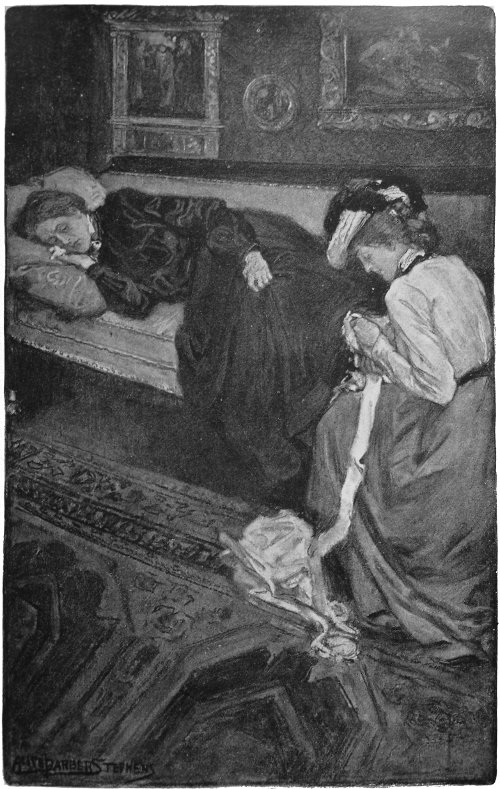
“Lois made the bandage and put it on with a professional air”
225
“It’s my foot,” moaned the sufferer.
“I’ll go for a doctor at once,” said Lois, “but first I
must put on a cold compress. It’s evidently a bad sprain.
There seem to be no bones broken,” she concluded, finishing
her examination.
Stripping up a cover from a pillow in an easy-chair, and
finding her way to the running water in the kitchen, Lois
made the bandage and put it on with a professional air.
Few words had passed between them, but as she left the
room, “Dr. Brown,” said the sick woman.
“Yes,” responded Lois, “I was going for him.”
It was not far to the physician’s house, and when he
had examined the foot he pronounced it, as Lois had,
merely a bad sprain.
“My maid won’t be back until eleven o’clock,” said the
sick woman. “I let her go to Woburn.”
“I can get a nurse,” responded the doctor. “You
mustn’t be left alone.”
“I won’t have a nurse about me. You’ve often heard
me say that,” cried Miss Ambrose petulantly.
“But you can’t be left alone,” rejoined the doctor
firmly.
Miss Ambrose looked at Lois appealingly.
226
“Let me stay with you!” exclaimed Lois impulsively,
forgetting her examinations, forgetting the important review,
forgetting everything but the fact that before her lay
a suffering human being whom she might help.
“Would I be of use?” she asked, when the doctor did
not immediately reply.
“Of use!” he exclaimed. “I should say so; a girl
who knows just what to do with a sprained ankle.”
So it was arranged that a telegram at Miss Ambrose’s
expense should be sent to Lois’ family, saying that she
would stay all night, and the physician’s name, Lois knew,
would assure her mother that it was a case of necessity.
“Illness of a friend,” he had put in the telegram, leaving
it to Lois to make explanations when she reached home.
After the doctor left, the sick woman lay silent with
her eyes closed—whether half asleep or not Lois could
not tell. She had refused Lois’ offer of assistance in putting
her to bed, saying that she would be more comfortable
on the lounge until her maid should come.
As Lois watched her lying there, her regular features
outlined against the pillow, her pale face looking even
paler, surrounded with a mass of sandy, gray-streaked
hair, the strangeness of the situation occurred to her, as it
had not at first. Then she began to realize that she ought
not to play Good Samaritan at this time, for it came back
to her with overpowering force that this was the eve of an
examination, that she really depended on these last few
hours of review. Well! there was no reason why she
should not study here, though the light was rather dim.
As she turned toward the door to bring her books from
a table in the hall, Miss Ambrose started.
227
“Don’t leave me!” she cried.
“No, no, indeed.” Lois had quickly returned with the
book under her arm.
“You are a student,” said the invalid, now wide awake.
“I have often seen you pass with your books under your
arm. Where is your school?”
“It’s Radcliffe.”
“Oh, how I envy you!” and Miss Ambrose sighed.
“When I was your age I would have given all—”
A twinge of pain prevented her finishing the sentence.
Lois laid down the book, and, lifting the coverlid, moved
the foot to an easier position.
Again Miss Ambrose closed her eyes, and Lois, turning
down the light, sat and watched her a little longer. It
was now half-past seven and Lois felt faint. She had had
nothing to eat since breakfast, except a light luncheon.
Passing to the kitchen for the water for the compress, she
had seen dishes piled on the table, and she judged that
Miss Ambrose had had an early tea. Then Miss Ambrose
opened her eyes.
“Perhaps you would like to study now; the light will
not disturb me.”
“Thank you,” responded Lois. “I really need all the
time I can have. I have an examination in psychology
to-morrow.”
“Then pray go on without considering me. It is a
great relief to me to know that you are here. But I feel
so drowsy that if I fall asleep I am sure that you will
excuse me.”
228
In a short time Miss Ambrose seemed to be really
asleep, and Lois bent over her books with great zeal.
The examination in psychology was one that would
require a cool head.
“Explain the utility of cerebral hemispheres.” Lois
turned from the test question to her note-book. She
was able to answer it satisfactorily. “In the lectures
mental life was several times described as a ‘collection of
interests.’ Explain the phrase, and give the chief reasons
for holding it to be a true description of at least a great
part of mental life.” This, too, Lois found no difficulty
in answering. But occasionally she came to a question
that needed something more than either memory or her
lecture notes. She exerted herself to the utmost. But
alas! the more she studied, the more she realized that she
had the greatest need of her text-book, and this she had
left at home. It was too large a book to carry back and
forward to Fay House, for she had felt that she would do
best to spend the last hours in a careful study of its pages.
It was nine o’clock when Lois made this discovery, and
Miss Ambrose had not awaked. Lois blamed herself for
not giving her college work first place in her mind when
she made her offer to stay with Miss Ambrose. But Lois,
in her way, was a philosopher, and since she could not
have what she needed the most, she resolved to do the
best possible with what she had. She devoted herself,
therefore, to her note-book, and tested her knowledge of
the subject with various specimen examination papers of
past years. It was brain-consuming work, and Lois was
so absorbed in it that she did not hear the maid when she
opened the front door with her key.
229
“Sakes alive!” exclaimed the maid, amazed at this late
hour to see a stranger seated at the centre table, while her
mistress reclined on the lounge. Her loud tone woke
Miss Ambrose, who at once began to explain the situation.
“I started upstairs, after going to the front door for my
paper, and when I reached the top I remembered that I
had left the door half open. Some way I slipped as I
turned around, and fell the whole way. If it hadn’t been
for this young lady I might have been there yet with my
foot twisted under me,” and Miss Ambrose raised her hand
to her eyes, greatly disturbed by the thought of what
might have been. “She’s going to stay all night,” she
added, after a moment’s pause. “See that the spare
room’s ready.”
“Yes’m, but I wonder if the young lady mightn’t like
something to eat before going to bed.”
“Bless me,” said Miss Ambrose, almost attempting to
rise from her couch. “I dare say the child hasn’t had
any tea. I’d had mine before she came, but I never
thought to ask her.”
“I should think not,” responded Lois, “with your lame
foot.”
But pressed for an answer, she admitted that she had
eaten little since breakfast, and when Dr. Brown returned
at eleven, he found Lois at a side table with a cup of
chocolate and a plate of bread and sliced cold beef before
her. With his help Miss Ambrose was carried to her
room upstairs, and he assured her that with patience and
the care that Maggie would give her, he knew that she
would soon be herself again.
230
“How soon?” asked Miss Ambrose anxiously.
“Well,” he replied cautiously, “it’s a matter of weeks
rather than months, but I can hardly undertake to say
precisely how long it will take.”
As Lois went to the room prepared for her the doctor
gave her a word of commendation for her kindness to Miss
Ambrose. “Your bandage had a professional touch,” he
said.
“Thank you,” she responded, “you know I wish to
study medicine.”
“So I’ve heard,” replied Dr. Brown, who had a slight
acquaintance with Lois’ family, “although you understand,
I suppose, that it’s a long and hard road, especially
for a woman.”
“Oh, yes,” she said, less cheerfully, perhaps, than her
wont. Indeed, as she sat in Miss Ambrose’s quaintly
furnished spare room, the professional course for which
she hoped seemed farther away than ever. With one last
glance at her notes before she went to bed, she heard the
clock strike twelve before she fell asleep. In the morning
she woke early, and was again at her work, with a sigh for
the text-book which she could not see until she reached
Fay House, where there was a copy in the library. It
was hardly seven when Maggie knocked on the door, to
say that breakfast would be ready at eight, and that Miss
Ambrose would be glad to see her at any time.
231
“You have been very kind indeed to stay with me, and
you must promise to come to see me as soon as you can.
I shall certainly be here for the next two or three weeks.”
Miss Ambrose smiled faintly.
“Yes, it’s too bad.” The voice of Lois had the ring of
true sympathy. “The next two or three weeks will be
pretty busy for me, as all the mid-years come then, you
know. But I shall drop in, in passing, for I shall be very
anxious to see how you are getting along.”
“Thank you, it will please me so. There is so much
that I wish to ask about the college. When I was young
there were no colleges for girls, and my parents would not
have let me go away from home. But I had a brother
fitting for college, and by myself I studied just the same
things that he did. How I envied him his chances! Ah!
he didn’t half appreciate them.” Then Miss Ambrose
paused, as if weighed down by sad memories. “Well,
afterwards my mother tried to get permission for me to
study at Harvard, or even to have examinations on subjects
that I had studied at home. But it was useless.
Nothing could be done about it, although we had relatives
in the Faculty and many influential friends.”
“Did they approve of your wishing to go?”
“Well, not altogether. In fact, some of them thought
me bold to talk about it. But—well, I’m glad that the
girls of this generation have the chance that I longed for.”
232
Later Lois learned from those who knew Miss Ambrose
that she was really a very accomplished woman, and that
she had studied many subjects under eminent professors.
The brother, who had had the chance for which she had
vainly longed, had not turned out well, and had had to
leave college without his degree. Ill-health in later years
had somewhat interfered with Miss Ambrose’s studying,
and she had a wistful expression, such as one often notes
on the faces of those who have missed their highest
ambition.
Lois, walking down to Fay House in the fresh morning
air, thought of the contrariness of Fate. Here was Miss
Ambrose, who so evidently might have afforded the luxury
of a Harvard course, had this been a possibility in her
youth, and here was she, Lois, longing for it, yet likely to
be debarred from completing her work from the mere need
of a little money. But brushing these thoughts aside, as
unworthy a sensible girl, Lois returned to her psychology,
and mentally worked out a problem or two before she
reached Fay House.
233
XXII ANNABEL AND CLARISSA
The skating this winter of Julia’s Junior year was
unusually good, and during late January and early February
crowds went each afternoon to Fresh Pond. Julia,
Ruth, Polly, and Clarissa were particularly zealous, and
they were all fine skaters. Annabel excelled them all,
and none were unwilling to admit her superiority. During
her residence abroad she had spent a winter at Copenhagen,
and she could accomplish all kinds of wonderful feats
learned there in a most graceful way.
“If she were as genuine in other things as in this, we
wouldn’t criticise her so, would we, Julia?” and Polly
linked her arm in Julia’s for another turn round the pond.
Annabel, indeed, distanced some of the Harvard youths
who hung about her. It pleased her to show that she did
not need their assistance.
234
Skating was Annabel’s one outdoor accomplishment, for
she was not generally fond of athletics. One afternoon a
dozen or more Seniors were up at Fresh Pond. Clarissa
skated almost as well as Annabel, but Polly and Julia
were less expert, although they were both better skaters
than Ruth. “Don’t go over by the ice-houses,” cried
Polly, skimming past Julia and Clarissa. “There’s a thin
place there and they are just going to rope it off. I was
asked to warn everybody.”
“Oh, we know it is thin, thank you,” responded Julia.
“Yes,” added Polly, “only a goose would skate over
there; any one can see it’s thin, the ice is so dark. Only a
goose would skate near it—or a person who was absorbed
in showing off,” and she pointed toward the dangerous
spot, which Annabel was approaching.
“Didn’t you warn her?” asked Clarissa, turning to
Polly. “You passed her on the way.”
“I’m afraid I didn’t. I was thinking only of you.”
“Oh, Annabel knows so much, she would have known
the ice wasn’t thin, even if you had told her.”
235
But even while they spoke, Clarissa had started off at
full speed, and as the others turned to watch her they saw
Annabel on the very edge of the dark ice. Polly knew
that this was the dangerous place, and called out loudly to
Julia to follow her. These things take almost as long in
the telling as in the happening, and before Julia and Polly
could reach the other two, Annabel had gone through the
ice just as Clarissa had almost overtaken her. Without
a moment’s hesitation Clarissa threw herself into the
chasm, and for a moment it looked as if she would only make
a bad matter worse. But Clarissa knew that they were
near the shore, and that with even a few strokes she could
get herself into shallow water. She had thrown off her coat
as she ran, and her arms were unencumbered. Moreover,
she had felt justified in making the bold plunge, because she
had seen several young men approaching from the crowd
of skaters at the opposite end of the pond. Dragging
Annabel somewhat roughly then, she struggled on toward
the bank, and to her great joy she soon found her feet
touching the bottom. Ready hands were stretched out to
her from the shore, where already a crowd had assembled,
and indeed two youths had plunged into the water to help
her support Annabel. The latter was altogether overcome
by the shock. Although she had not exactly fainted, she
was so benumbed as to be helpless. But for Clarissa’s
quick action she might have suffered much more. Hardly
were they out of the water when a student returned with
a sleigh, whose driver he had stopped in passing. The two
drenched girls were bundled under the robes, and taken to
a house not far away. Julia and Polly drove quickly down
to Cambridge for fresh clothes, and before sunset Annabel
and Clarissa were back in their own rooms. Annabel,
however, really suffered from her mishap. She had struck
her head on the ice in falling, and in consequence a slight
fever set in which at first seemed rather serious. Her
friends kept her room filled with flowers, and all her classmates
showed great sympathy when it was rumored that
she might have to drop out of the class for the rest of the
year. Clarissa had never fully realized Annabel’s unfriendliness,
and so when the latter sent for her she was only too
glad to go to see her. She thought that Annabel’s thanks
were warmer than they need have been, for Clarissa assured
her that she had really been in little danger, and
that even without her help, she would not have been long
in the water. Annabel in her rôle of invalid, reclining in
an easy-chair, with her room filled with flowers, was indeed
picturesque.
236
“Some day,” she said faintly, “when I feel a little
stronger I must have a long talk with you. I feel that I
have done you an injustice.”
“Nonsense,” replied Clarissa, “I am sure that you have
not.”
“Well,” sighed Annabel, “I will tell you sometime.
It is hard now to explain.”
“Oh, I rather think that I can wait, if you can. You
make me think of Pamela, whose conscience is always too
active to be healthy,” rejoined Clarissa, with a smile.
“Ah!” exclaimed Annabel dramatically, “you will believe
me when I tell you all, but not now. Yet believe
that I shall feel forever indebted to you.”
“Yes, yes,” responded Clarissa, “if it makes you happier
to put it that way. But really—” Here they were interrupted
by the arrival of other callers, and Clarissa soon
took her departure. She had only a vague idea of Annabel’s
meaning, although she thought that she undoubtedly
had some reference to the publication of Professor Z’s
lecture.
237
She did not permit herself to dwell long on a subject
that concerned herself so entirely. Recitations were to
begin again in a few days, and she was very anxious to
have a meeting of the class called to consider the question of
the Presidency of the Idler. It was the custom to appoint
to this office the girl who had been Vice-President in the
Junior year. It happened, however, that Regina Andrews,
the girl now in office, had announced her intention of spending
the next year in Europe instead of in the regular work
of the Senior year. Polly and Clarissa, therefore, had at
once begun to work up a strong sentiment in favor of Lois.
Lois, had she known of their well-meant efforts, would
probably have stopped them by explaining that she herself
had lost not merely the prospect of being a Senior, but even
of finishing the work of her Junior year.
She had agreed to take the position in the Village High
School, twenty miles away, and she was to go there
February 15th. Until the opening of the recitation period
at the close of the mid-years, she intended to say nothing
about her changed plans.
Yet Clarissa and Polly could not help seeing that she
took little interest when they told her of Regina Andrews’
resignation from the Vice-Presidency.
“We’re bound you shall have it, Lois. We think that
you are the very best girl for the place.”
“There’s Julia.”
“Yes, we’d all like Julia, but she says that nothing
would induce her to take it. She hates presiding, and she
has made us promise not even to let her name come up.
She is particularly anxious to have you,” and Polly’s tone
would have been convincing to any one but a girl who
had put a task upon herself in which class honors had no
part. There had been times, of course, when popularity
and the thought of being Idler President would have given
her a great joy. But now—ah! in a day or two Polly
and Clarissa would know just how matters stood.
238
On Saturday Julia invited her to luncheon, and afterwards
they were going to town to a concert. Ruth had
gone home over Sunday, as had been her habit this year.
“I’m perfectly delighted, Lois, that you are to be the
next Idler President, for Polly says that there isn’t a
shadow of a doubt. She has been so determined that the
office should not go to Annabel that she has turned into a
regular wire-puller. Even Annabel’s illness has made
little difference to her, although I think that Clarissa has
a more friendly feeling toward her.”
“There!” exclaimed Lois, “I must talk seriously with
Polly and Clarissa. I have told them that I could not
stand, but they won’t believe me.”
“But why, Lois, why should you not take the office if
it comes to you? You preside so well, and you are not
timid, as I am, and—”
“Because, Julia”—Lois knew now that it was best to
explain the whole matter—“because I may not be here
next year.”
Then in as few words as possible, Lois told Julia that
loss of money and other things made it expedient for her
to take a year or more away from college.
“I cannot bear to be counted out of this class, but there
is no help for it.”
Julia very wisely did not attempt to dissuade Lois from
her purpose of teaching, although already a little plan had
begun to form in her mind. Yet she was sympathetic,
and told Lois that it was simply impossible to think of the
class as ready to graduate without her.
239
“Why, we’ll all have to stay out a year, just to keep
up with you,” she said.
But in her own room that evening, Julia pondered long
over the perversity of Fate, that hampered girls like Jane
and Pamela and Lois, who loved study for its own sake,
while many others were able to glide through college with
no thought of the great privileges that were open to them.
“The worst of it is, the girls whom one would like to help
are always the proudest.” Then Julia put her mind on
the subject, and decided that if she could help it Lois
should not leave college.
As Lois had finished her examinations in the first two
weeks, she found time for more than one brief call on
Miss Ambrose. It was so easy to drop in for a half-hour
in passing, and the interest of the older woman in all her
affairs was so genuine, that it was a delight to tell all that
she could about college life. One day she stayed to
luncheon, and enjoyed the service of quaint, old-fashioned
china and silver, and she stole glances of admiration as
she ate, at the massive mahogany sideboard and the
spindle-legged serving table and the delicate steel engravings
on the wall. Then in Miss Ambrose’s sitting-room
she found so much to gratify her love of antiquities.
There was the cabinet, for example, with its wedgewood
vases, and the mosaics collected in Europe, and the little
book-shelf with its tiny volumes of the Italian poets,
bound in vellum, and the half-dozen miniatures on the
mantle-piece of Miss Ambrose’s parents and other relatives,—all
these and many other things claimed Lois’ attention,
although most interesting of all was Miss Ambrose herself.
A well-cultivated mind has always a strong charm for a
thoughtful girl, and Miss Ambrose had certainly more
culture than belongs to the average college graduate, man
or woman. She had travelled and she had studied, yet
she always seemed ready to hear Lois’ views on any subject
of general interest.
240
“You look pale,” said Miss Ambrose abruptly on this
particular day; “you look pale, and if you will pardon
my saying it, a trifle worried. A young person should
never show the touch of care.”
“Why, I ought not to look worried,” said Lois soberly.
“I am sorry to appear so—so stupid.”
“You could never appear stupid,” rejoined Miss Ambrose,
“but you are certainly paler. I hope that you are
not working too hard.”
“Oh, no, work always agrees with me.”
“Then something is troubling you,” persisted Miss
Ambrose firmly. “I fear that you were less successful
than you would have been had you not taken care of me
the night when I sprained my foot. I know that you
were to have an examination the next day.”
“Oh, no,” and Lois smiled like her usual self. “Oh,
no, I came out better than I expected in that. I had
an ‘A.’”
“Then I am really puzzled,” said Miss Ambrose, adding,
with a slight touch of severity, “I should think that you
might trust me sufficiently to tell me what the trouble
really is.”
241
Now even a fortnight earlier, Lois would hardly have
believed any one who had told her that after a brief acquaintance
she could have found it possible to open her
heart to one whom she had known so short a time. Yet
although she confided comparatively little, Miss Ambrose,
reading between the lines, saw that the young girl was
making a great sacrifice in stopping her course at this
stage. “Sacrifice” is not perhaps exactly the right term,
for on the part of Lois it was involuntary. Until she
could earn money, it was not possible for her to continue
her course. Yet when Lois had told Miss Ambrose all
her reasons for leaving, the older woman merely expressed
the conventional words of regret. Her eyes held rather
more than their usual look of absent-mindedness.
Great, therefore, was the surprise of Lois, on reaching
home on that Saturday evening after she had been with
Julia, to find a letter awaiting her from Miss Ambrose.
From between the pages a thin blue slip fluttered to the
floor.
“You must accept this,” wrote Miss Ambrose in her
fine, pointed handwriting, “as a very slight tribute of my
indebtedness to you. I do not refer merely to the sacrifice
you made in staying with me the evening when I was
hurt; but you have done me a great favor in bringing
me in touch with the woman’s college. You have given
me an insight into the life of a college girl. I know that
you will continue to keep me informed about it, and thus
I shall enjoy through another a little of what I so longed
for in my youth. From this time I intend to contribute
a certain amount toward the education of one or two
students, and I am sure that you will oblige me by being
the first to give me the privilege of doing something for
the honor of good scholarship.”
242
Picking up the blue slip, Lois saw that it was a check for
one hundred and fifty dollars. The amount took her
breath away. It meant not only the payment of her tuition
for the next half-year, but it gave her a margin for
other things, something even to save toward the expenses
of the next year, for Lois was a good manager, and her
pulses beat to fever heat as she thought of all that she
could do with this money.
She found that her parents made no objection to her
keeping the check, and she had no hesitation in breaking
her engagement with the Village School, as she knew that
another approved candidate for the position had been
sadly disappointed when it was given to her.
Lois felt that she had done nothing to deserve this good
fortune, and yet she was too sensible to decline what
came in her way. She realized that her own greatest
usefulness in the world would come from finishing her
college course, and she lost no time in thanking Miss
Ambrose, and in assuring her that she would do her
best to deserve her confidence. Then Miss Ambrose
smiled a contented smile. At last she had a direct
interest in the woman’s college.
243
XXIII CLOUDS CLEARED AWAY
Julia was the first person outside her own family to
whom Lois told her good fortune, and Julia, to tell the
truth, was a trifle disappointed in hearing of it, for she
had formed a little plan of her own, and if Miss Ambrose
had not been ahead of her, she would have come forward
to prevent Lois’ leaving. She told Clarissa, however,
how near the class had come to losing Lois, and Clarissa,
not vowed to secrecy, told others. The disclosure was
entirely to the advantage of Lois, for all the class expressed
itself fully as to its great loss, if its most promising
student had had to leave for the mere lack of a little
money. Clarissa and Polly artfully took advantage of this
feeling, and talked about Lois’ accomplishments so persistently
that even the least interested admitted that she
was the very girl for the Idler Presidency. It was hard
for Annabel to count herself altogether out of the running,
but at last she submitted gracefully to what she could not
help; and if she did not try to forward Clarissa’s cause,
she certainly did nothing to hinder it. As she improved
in health she did not open her heart to Clarissa, and she
made no admission of knowing more than any one else
about the publication of Professor Z’s notes. She was
very friendly to the Kansas girl, and even invited her one
afternoon as guest of honor to one of her famous little
afternoon teas. Polly laughingly accused Clarissa of
permitting herself to be bribed into friendliness. But
Clarissa retorted that she had never felt unkindly toward
Annabel, and that in time wrongs generally righted themselves.
It was probably through Annabel’s influence that
Alma Stacey bent all her energies toward getting Clarissa
on the basket ball team, and succeeded.
244
As the spring passed on, many pleasant little social
events brought the Juniors in closer contact with girls in
the other classes. The students of highest rank had been
elected into the various clubs, according to the studies in
which they excelled. No one with less than two “A’s,” or
two “B’s” with two additional courses could be admitted
into these exclusive little organizations, and membership
in the History or English or Philosophy Club, or indeed
in any of several others, was accounted a great honor.
Julia was in the History and Music Clubs, Polly was in
the English Club, Lois was in half a dozen of them, and
Clarissa, almost to her own surprise, was in the Philosophy
Club, having made a great impression on her classmates,
as well as on her professors, by her very original
method of interpreting various theories of philosophy.
The Juniors were admitted in season to take part in the
open meetings of these clubs, to which were invited the
members of the corresponding clubs at Harvard, as well
as the teachers in the department and individual guests
of honor from outside.
245
The Juniors, however, felt closer in touch with the
Seniors when they planned one or two special things in
honor of the class so soon to go out.
“They treated us well when they were Sophomores, and
we were nothing but Freshmen, so now we must do our
best to make them feel that they really will be missed,”
said Julia, as she and Polly and one or two others of the
committee were planning what form the Senior party
should take.
“Oh, there’s no danger of their not thinking that they
will be missed,” cried Polly. “Why, I believe that
Elizabeth Darcy anticipates that the decline of Radcliffe
will date from the day of her graduation. But we won’t
let a little prejudice stand in the way of our giving them
a good send-off.”
This particular affair was called a music party, and a
prize was offered by the Juniors to the Senior who should
show herself most familiar with unclassical music. The
prize was a pretty little old Dutch silver violin, and to the
amusement of all it went to a girl who sang all the lyrics
from all the operettas composed by Radcliffe girls during
the past five years. She offered to play each operetta
through from beginning to end, but the judges (which
meant the whole Junior class) begged off and declared
that she had sufficiently shown her ability, and had really
earned the prize. So with much laughter the tiny violin
on a crimson ribbon was slung around her neck.
246
In return the Seniors gave the Juniors a party, requesting
in their invitations that each girl should bring a book
for the little white bookcase in the Senior room. “As
you will soon be Seniors yourselves,” the invitations had
said, “these books will really be for your own use, and
you have always been so unselfish that you wouldn’t have
thought of doing this had we not reminded you.”
The Senior rooms occupied the first floor of a pretty
old-fashioned cottage on the Fay House grounds. With
good rugs, well-chosen pictures, a piano, writing desk,
lounge, and easy-chairs, they offered a pleasant retreat for
the Senior who wished to escape the noise of the larger
buildings. Once a week during the winter the Seniors
were at home for an informal afternoon tea, and it was
only on this set day that an undergraduate ventured within
the precincts. The old-fashioned house had been bought
by the Radcliffe Trustees in their efforts to acquire for a
campus all the land in the immediate vicinity of Fay
House, and the little house in the natural course of events
would sometime be pulled down. But in the meantime
it was a delightful place of retreat for the Seniors. To be
sure, Elspeth Gray, who had been in New York during
the spring recess, brought back glowing accounts of the
Senior room at Vassar.
“These rooms look countrified compared with the Vassar
room. Why, there, although they always have the same
room, each Senior class refurnishes it. Even the wall
hangings are changed. This year instead of paper they
have put on a painted burlap, stencilled in gold, which
cost nearly two hundred dollars; and the furniture and
bronzes and oil paintings, although many of these things
are simply lent by Seniors for the year, would make your
eyes open, you simple-minded Radcliffeites.”
247
“Plain living and high thinking is the rule at Cambridge,”
responded Ruth, who happened to be one of the
group to whom she spoke. “Come, Elspeth, don’t join
the crowd that is sighing for a porter’s lodge, or a boy in
buttons, or some similar luxury here at Radcliffe.”
“Dear child,” and Elspeth drew herself to her full
height, “I did not say, did I, that I preferred the elegance
of Vassar and Bryn Mawr, but we haven’t even
any palms, such as they have at Wellesley, or—”
“Well, we have historic associations. There’s the
Washington Elm, almost under our eyes, and we’re so
nearly a part of Harvard that we can look back on a long
and honorable past, even if we have less than twenty
years of our own to count up.”
The spring would have been altogether perfect for
Julia but for her estrangement from Ruth. It was hard
to approach Ruth on the subject, because there had been
no open break between them, and because Ruth gave her
no chance to seek or make an explanation. They still had
their rooms together, but Ruth always studied by herself
in her own room. Occasionally on Mondays Ruth appeared,
but she was oftener absent when Julia was entertaining
those girls who dropped in. As Nora was only a
Special, she was in Cambridge little except for recitations.
Yet she had noticed the coolness between the two, who at
Miss Crawdon’s school had been great friends. She could
not help observing, too, that Ruth was never at Mrs.
Barlow’s on Saturday and Sunday, when Julia and Brenda
were so apt to have their friends about them. Ruth, to
be sure, always pleaded that she must spend as much time
as possible with her mother, who had been abroad in search
of health during Ruth’s first two college years. She was
still an invalid; and although Nora knew that Ruth naturally
wished to be with her, this explanation did not wholly
account for the coolness between Ruth and Julia.
248
From Julia she at last drew an account of the affair of
the telegram, and the injury done to Polly.
“It isn’t altogether what Ruth did, but it’s her indifference
that has disturbed me so,” said Julia.
“Perhaps she didn’t do it; perhaps there’s some explanation
about the telegram. Really, Julia Bourne, I
did not think that you could be so unreasonable. But
I’m not altogether sorry,” she continued, smiling, “that
you have shown yourself just a little less perfect than we
thought you. I used to think you absolutely reasonable,
but now—”
“Well, if you ever had so foolish an opinion of me, I’m
glad that something has happened to remove it.”
“I must tell Brenda,” added Nora, as she bade Julia
good-bye. “She’ll be pleased to hear that I’ve picked a
flaw in her perfect cousin. Secretly, I believe that she
thinks you almost too perfect.”
249
Not long after Nora had left her, the postman put into
Julia’s hands an envelope, on which she recognized Angelina’s
handwriting. Angelina had not been in Cambridge
this winter. Indeed, the day after the operetta she had
gone back to Shiloh, and in the autumn she had taken a
place as mother’s helper in a household where there were
several children. It was near enough to her own home
to permit her to see her mother and the children twice a
week, and Mrs. Rosa was now so much stronger and the
young Rosas were so much older that they could manage
very well without Angelina. It was better for Angelina
to have the responsibility of a position where she could
earn money. Already she had started a bank-book, and
in every way she was much more contented than a year
before. She was very fond of letter-writing, and her
epistolary style was decidedly high-flown.
“My dear Miss Julia,” the present letter began. “I
have a confession to make, though I know that you will
say that I am always sinning and repenting. But this
was not exactly sin, only the kind of carelessness that you
have often reproved me for. You see I saw Miss Ruth
the other day, and I asked if that telegram did Miss Polly
any harm, I mean her not getting it at once. You know
I went home the next day and never heard about it. But
I thought that next morning you didn’t look as happy
as you ought to after an enthusiastic reception of your
operetta (that was what the newspapers said), and so
when I asked, Miss Ruth said that it made a great deal of
trouble for her. I wonder how that was when the telegram
was for Miss Polly? I suppose it was something
about her father, for I heard he died. I know that I
ought to have given it to her as soon as it came, for she
was trying a song with you, and they sent it over from
her boarding-house. But Percy Colton asked me to come
down and pull some molasses candy in the kitchen, and I
forgot all about it until after the performance. Then
Miss Ruth, when I told her, said that she would give it
to Miss Polly quick, so I don’t see why it made any
trouble for her. I’m very sorry, but that’s the way
things happen in this world—just exactly the way they
oughtn’t to.”
250
The letter gave more information about Angelina’s
personal affairs, but only the above passage made any
impression on Julia.
“Oh, Angelina!” she sighed, “you always have had a
fashion of making trouble, but luckily in this case, it’s
not too late to straighten things out.”
To decide, with Julia, was to act. Overhead she could
hear Ruth moving about in her room. Running up the
stairs, two at a time, in a moment she was with her.
“Oh, Ruth, can you ever forgive me? How mean you
must have thought me! But really, I’ve suffered more
than you; even if this letter hadn’t come, I should have
told you so.”
“What letter?” asked Ruth, thoroughly bewildered.
“Oh, from Angelina; it was she who kept the telegram.”
“Of course; I always knew it.”
“But I didn’t know it. There, I won’t throw blame
on any one else. It has all been my fault, and not
Angelina’s.”
251
“‘All’s well that ends well,’” said Ruth, pinning a
crimson rosette at her belt. There was a slight stiffness
in her manner, but she looked at Julia with her old-time
pleasant smile; and as they clasped hands, the two girls
knew that they were friends again. “Naturally,” she
added, “it was hard, Julia, to find you unjust—”
“But if you had only said the least little word, I should
have understood, Ruth, but when you said nothing—”
“But how could I say anything? When you so evidently
had your mind made up, what could I say?”
“Ah, but I must tell Polly. Won’t you come with
me, Ruth?”
“Not this afternoon. I’m going to a ball game with
Will; it’s only with Amherst to-day. But there’s a
party of a dozen going, and not a chaperon.”
“Of course not. That’s the one delightful thing about
Cambridge; we can go to ball games without any of the
trammels of an ‘artificial etiquette,’ as Clarissa might
say.”
Then Ruth departed for the ball game, with Will
holding her parasol, and Julia standing in the doorway,
waving her a good-bye after a fashion that had not been
possible during the past year.
From Ruth, Julia went to Polly, and it was harder to
bring up the subject of the telegram to her, for the very
mention of it recalled so many sad memories.
“So, after all, Clarissa has been the most charitable of
us all. Seems like we have all been carried away by suspicion,
while she has always been inclined to stand up for
Ruth,” said the Southern girl.
252
“Well, in other things besides murder trials, it isn’t
worth while to trust to circumstantial evidence. But I
am the most to blame, for I ought to have known Ruth
better than to suspect her of a meanness. I shall begin to
wonder now if I haven’t been unfair to Annabel.”
“I doubt it, for I happen to know that she borrowed
Clarissa’s history note-book a few weeks before that article
appeared,” rejoined Polly.
“Well,” said Julia, “until I’ve removed the beam from
my own eye, I won’t search for the mote in Annabel’s.”
“Ah!” cried Polly penitently, “as you put it, I believe
that there is a beam in my eye also. But I shall lose no
time in apologizing to Ruth.”
So Polly apologized, and spread the news abroad that
she had been very unfair. Julia, too, was repentant, and
that May and June of their Junior year was much
brighter than the same months had been when they
were Sophomores. Then when Lois was elected Idler
President, Polly went about beaming. She declared that
she had not lived in vain, and to celebrate the joyful
event arranged a canoeing party at Riverside. There
were twenty girls in the party, and Mrs. Colton and Professor
and Mrs. Redburn went as protectors. They rowed
and paddled, and listened to the band, and consumed unlimited
quantities of ginger ale and sandwiches. They
wound in and out on the curving river, and the lights of
thousands of lanterns shone upon them from the river
banks and the boat-houses, for it was a special night with
the boat clubs. It was a delightful celebration and well
planned, and although some of the girls were unduly
daring and seemed to court collisions, when they were
counted at the end of the trip they were found all to be
there, to the great relief of the elders of the party. They
had sung college songs until they were almost hoarse, but
Clarissa had voice enough left to propose a vote of thanks
to Polly, adding, “We haven’t a Float Day, nor a Lake
Waban, but the Charles is free to all, and where is there
a stream that is half as fascinating for canoeists?” And
all the others answered, “Nowhere.”
253
While it was yet uncertain whether or not Clarissa
would go on the team, the Spring Meet came off in the
Gymnasium, in which her name was down for several
events. The Gymnasium was crowded with friends of the
contestants and members of the R. A. A., and many were
there as strong partisans of various girls who were to compete
in the many different contests. In the horse vault
and the saddle jump, some wonderful records were made.
But for some reason the greatest interest centred in the
running high jump, and Clarissa’s friends had prophesied
that she was to make the record in this. She had a formidable
rival in Mary Francis, a Senior, and an especial
friend of Elizabeth Darcy’s, who had held the record for
two years. The two classes and their friends watched
both girls with the closest attention. Polly and Julia
were perfectly sure of Clarissa, and the latter fairly
hugged her when with flushed cheeks and her dark hair
lying in moist little ringlets on her forehead she was
declared the victor. Not only that, but with fifty-four
inches she had made a record that was to put her and
her class on a pinnacle. This, indeed, marked the beginning
of great successes for that class, and brought
out the fact that a genuine class feeling had been established.
No one in the earlier years of the Annex or
Radcliffe could have imagined that this feeling would
become so strong. Each girl was beginning to be thought
of, not as an individual, but as a member of the class,
likely to reflect upon it scholastic or athletic glory. Clarissa’s
success at the meet made it seem all the more likely
that she would be captain of the team. Even had there
been a faction against her, it would have been difficult to
keep her down. But there was no such faction, for the
prejudice of the year before had almost completely died
away. There was hardly a girl to take exception to the
cheer when it rang out:
254
“Radcliffe, Radcliffe, Radcliffe,
Rah, rah, rah,
Rah, rah, rah,
Rah, rah, rah,
Miss Herter and the team!”
—a cheer that contained a prophecy.
255
XXIV SENIORS ALL
How quickly that summer before their Senior year
passed away! Probably hardly a girl in the class failed to
regret that they were travelling so quickly toward the end
of their college course. During the summer a dozen or
more had sent a vacation round-robin about from one to
another. Clarissa had written a witty letter describing
her experiences in drinking the waters at Manitou, whither
her father had been sent in search of health. She also mentioned
incidentally that she was practising ball, “for our
team is to come out the very top of the heap, but don’t
repeat my language,” she had concluded. Julia wrote of
a very quiet summer at Rockley, as her aunt’s illness had
prevented a proposed European trip. Lois had had three
weeks in the White Mountains with Miss Ambrose, where
Polly had joined her for a fortnight. Instead of tutoring,
Pamela had felt warranted in giving her summer to research
work, but she had done this without suffering in
health, because she had found a delightful little village on
the Maine coast where the board was almost nothing, and
where she had just the inspiration she wanted in hearing
the surf roll in upon the beach. Elspeth Gray wrote of
an encounter that she had had with—well, it is not necessary
to go into particulars—but with the graduate of a
well-known college for women, who had pitied her very
much because her lot had been cast at Radcliffe. “As if
I hadn’t chosen this lot for myself with all the colleges of
the country spread out before me. She said that we had
no college spirit, and that we ought to see that there was
a lack of dignity in accepting a degree that was only a
kind of imitation of a Harvard degree. But it’s useless to
argue with such people, although I did make her admit
that Harvard offered more to men than did any other
college in the country, and she was amazed to learn that
we had precisely the same courses of study, the same instructors,
and the same examinations as Harvard men
have. Dear me! where have people been brought up to
know so little?” Each girl whose name was appended to
the round-robin, while expressing her anxiety to see her
classmates again, added a note of sorrow that this for the
majority would be the last year at Radcliffe. A few
intended to return for higher degrees, but it was doubtful
if all could carry out their plans.
257
In the meantime they were getting all they could out of
college life. Those girls who came from a distance were
especially anxious to make up for lost time by going to
lectures, concerts, or by visiting art galleries and historic
towns, that they might feel that they had lost none of the
special advantages that Cambridge and Boston offer the
college student. Clarissa, who had done much sight-seeing
in her Freshman year, now thought that her greatest
need was for Sever Hall lectures, and she made up a little
party consisting of Polly and two or three others of her
classmates, who agreed to go with her two evenings a
week. She enjoyed whatever lectures came on those
evenings, for she said that three years at Radcliffe ought
to have fitted her to understand anything. She continued
to attend lectures even when her classmates, on one pretext
or another, had dropped off, for she was so fortunate
as to run across a special student of good standing
who had given up her position in a Western High School
for the sake of a year’s study at Cambridge. A little later
Pamela made one of the party, as it had been her habit
the past two years to attend all the lectures or readings
given by the Senior professor of Greek. While some
Radcliffe Seniors were to be found at all of the Sever
Hall lectures, Clarissa in this last year was really the
most persistent, and she was the more persistent, perhaps,
because some of her friends tried to dissuade her from
burning the candle at both ends. They spoke in this way
because Clarissa was steadily adding to her reputation as
an athlete. She was now captain of the team—a position
that many of the undergraduates regarded as more enviable
than that of President of the Idler. It was a great
grief to Polly that she could not play basket ball, but
when she presented herself for the necessary physical examination,
a slight weakness of the heart and lungs was
discovered, in itself not serious, although sufficient to
render her an unfit candidate. In consequence to assuage
her disappointment she made herself an amateur coach and
spent what time she could watching the practice games.
Her observation was keen, and more than one suggestion
of hers was put into practical effect.
258
She was sure not only that the Senior team would vanquish
all the others at Radcliffe, but that in its outside
contests it would carry all before it. “Oh, if we could
only have a chance against Bryn Mawr!” she sighed. “Of
course that day is coming, but if it would only come in
our day! Was there ever such a captain?” she concluded,
with an admiring glance at Clarissa.
“Never, I am sure,” replied Pamela. “I love to look
at her. She is the very picture of health.”
“There couldn’t be a better centre, not only because
she’s so tall, but because she has such judgment. How
she managed it I don’t know, but she contrived to get
Julia for one of her forwards and Ruth for the other.
Neither intended to play this year. But there they are!
They both have cool heads, and there’s little danger of
their losing their wits in an exciting match.”
Pamela glanced for a moment toward Julia, who stood
ready to make a goal, with the ball held lightly in her
finger tips. Even while they were looking, with a little
twist she threw it, and it fell into the basket.
“I count it one of my privileges in coming here,” said
Pamela in her prim little way, “to have known Julia
Bourne. Whatever she does, she does so well, and she
always has a thought for others. She is always so encouraging.”
Just at this moment Julia glanced toward her
friends, and though she did not really bow to them, she
smiled pleasantly.
259
“There’s one lesson we can learn from basket ball,”
remarked Pamela.
“Ah, Pamela,” and Polly laughed. “Sermons in
stones, books in the running brooks are nothing to your
lessons. But there, don’t blush at me, but tell me what
you had in mind.”
“Oh, I was only thinking that it’s less what the individual
player does than what the team does as a whole.
A girl who thinks only of her own ability to make a
wonderful throw may make a throw that will gain great
applause, but she generally sends the ball into the hands
of the enemy.”
“Like Elizabeth Darcy last year. Did you see that
match?”
“No,” responded Pamela.
“Well, she brought down the house with two or three
brilliant throws, but she really did more to hurt her team
than any one on the other side. If I had been Clarissa I
should have been afraid to have Annabel on the team for
the same reason. She thinks of herself first, and of the
general good last.”
“Human nature according to Hobbes.”
“Oh, my dear, I never think of ethics out of the class-room.
There—there look!” and both girls turned to see
a goal scored for Clarissa’s team—or rather for their own
team, since Clarissa was the embodiment of the Senior
athletic aspirations.
260
The match with Wellesley was one of the things of
which they were sure, and it was likely to be exciting.
Brenda teased Julia when she heard of the coming contest
by saying that she was bound to be on the side of Wellesley
this year, for Amy had just entered Wellesley, and
Brenda was still very fond of her. Since their trip to
Nova Scotia they had seen little of each other except in
summer, for Amy had been very hard at work preparing
for college, and society had absorbed Brenda the past two
years. Amy had felt especially tender toward Brenda the
past year or two, because the beginning of their acquaintance
had seemed to mark the beginning of prosperity for
Amy and her mother. The efforts of Mrs. Barlow and
Mr. Elton had resulted in a fairly large sale of Mrs. Redmond’s
paintings. Indeed, her water-color sketches had
become so much the fashion that her income now permitted
her to live in Salem. Thus Amy for a year or two had
been able to see much more than in former years of her
schoolmates out of school, and some of her little sharp
corners had been entirely rounded off. The death of
Cousin Joan the past winter had made it possible for
Amy to enter college without any worry as to ways and
means; for although the money left by Cousin Joan from
most points of view would have been considered very
small indeed, it was enough to carry Amy comfortably
through college. It was left to her for this purpose, “in
recognition,” as Cousin Joan wrote in a note that was
found with the will, “of her patience with a very troublesome
old woman.” Amy, wiping away a few tears, as
she thought of the invalid whose life had been so narrow,
protested that it was her mother and not she who should
have the money as a reward for patience. But Mrs.
Redmond reminded her daughter that the money was
really a gift to her as well as to Amy, since she would
now be saved a certain amount of financial care in planning
Amy’s college career. Therefore, Amy at Wellesley, and
Julia at Radcliffe, at odds only on the subject of some college
championship, exchanged visits and compared notes,
and each ended invariably by thinking her own college the
best.
261
Brenda and Amy had been a little less intimate since
those first Rockley days, and in the past year the former
had been away in California; at least, she had gone for a
year’s absence in the March of Julia’s Junior year. She
wrote to Amy as to Julia rapturous letters about the
beauties of California, mingled with entertaining accounts
of her sister Caroline’s children. Before Christmas Mr.
and Mrs. Barlow started for California to visit their daughter
and bring Brenda home. Nora went with them, by
special invitation, as an attack of measles in the early
autumn had prevented her resuming her special work at
Radcliffe, and her eyes needed the rest.
In the absence of her relatives, therefore, Julia was
naturally thrown more in the society of her Radcliffe
friends than had been the case in other years. Edith was
spending the year abroad, and the little group of Miss
Crawdon’s girls was widely scattered. Julia spent Christmas
with Ruth in Roxbury, where Pamela, Clarissa, and
Polly were also invited; for Ruth, although she had not
entirely changed in her general opinion of Pamela and
Clarissa, had still changed somewhat in her feeling toward
them. She had learned to see the good points of the
candid Western girl and of the timid Vermonter.
262
In justice to Ruth, it should be said that her change of
view was not entirely due to the fact that the class, as a
whole, had now a much greater appreciation of these two
than in their first college years. She had seen her own
mistake in attaching too much importance to Annabel’s
judgments. This, combined with her own slight prejudice
against girls a little unlike those to whom she was accustomed,
had made the trouble. Ruth, too, had suffered so
much from Julia’s coldness after the affair of the telegram
that this misunderstanding had made her more charitable
toward others. Though no explanation had yet been given
of the origin of the newspaper article, she no longer believed
Clarissa responsible for it. Ruth was not a snob, and the
fact that Clarissa was now the popular captain of the
basket ball team had had little to do in influencing her.
Neither was she the more anxious to be considered Pamela’s
friend because the latter was now the observed of
all observers from having won the great prize open both to
Harvard and Radcliffe students for a thesis on a classical
subject by an honor student. The prize was newly established,
and besides the honor it conferred, the money value
was greater than that of any other prize offered. Pamela’s
prospects had greatly brightened. Her scholarship for the
year had covered her tuition, and she had done some
tutoring. But the two hundred and fifty dollars which
the prize would give her would free her from all worry
until she could establish herself as a teacher. Very thankful
was she that she had taken the summer for the special
study and research needed for the thesis. The honor that
she had won through the prize made a great impression on
her relatives in Vermont, and her aunt wrote her a cordial
letter, suggesting that after all they might let bygones be
bygones, and adding that they would be very glad to have
a visit from her as soon as her “school” was over. Pamela
accepted the invitation, for she longed for a sight of
her old home. But she wrote that it must be July before
she could leave Cambridge. She had promised to stay
with Miss Batson until after the Fourth of July.
263
Of all the Seniors in cap and gown Lois was perhaps the
happiest, for it was the first year of her college course in
which she was comparatively free from care. She was
freer than ever before to enjoy the lighter side of college
life. Whether presiding at a business meeting or receiving
at a reception, Lois was greatly admired as President
of the Idler. In fact, she filled the place so well that
many wondered that she had not been thought of a year or
two earlier. Polly, hearing these comments, was greatly
amused by them, and inwardly commended herself for
having brought it about that a girl who had never been
called popular should in her last year of college be near
the pinnacle of popularity. Nothing succeeds like success,
and although Lois in office was just as independent
as Lois out of office had been, yet she now was more at
liberty to mingle with her classmates. The charm of her
manner was realized, therefore, by many, whereas before
it had been felt only by the few with whom she came in
immediate contact.
264
Polly’s literary talent which had shown itself in a rather
frivolous form in the operetta had so developed that her
professors had encouraged her to undertake more serious
work. One or two of her poems had appeared in “The
Radcliffe Magazine,” and had been highly praised. But
this commendation did not mean half as much to her as
the fact that the “Advocate” had taken one of her short
stories. After it was accepted, some time passed before it
was published, and at first Polly thought that she would
let no one hear of her good fortune until it was actually
in print.
But at last she had to tell Clarissa, and then Clarissa
begged permission to tell Julia, and in a short time all of
Polly’s friends knew it. “Yet, honestly,” said Clarissa,
“I don’t see why you are so set up about a little thing
like that. It isn’t a bit better to have a story in the
‘Advocate’ than in—”
“I’d rather have it there,” said Polly, “than in the
‘Atlantic Monthly,’ or in any other of the large magazines.”
“Why, Polly Porson!”
“Well, you may see that I am right, because one can
have a thing in the ‘Advocate’ only during a very limited
time, while she has all her life to get into the others.”
“Yes, and sometimes it takes a person all her life to
get in.”
265
“Then it’s well to make sure of the thing near at hand,
like the ‘Advocate’”, was Polly’s response. And linking
her arm in Clarissa’s, she walked off with her friend.
“Clarissa,” she said, as they withdrew out of hearing of
the girls with whom they had been sitting, “have you
ever found out about that newspaper article, that one
about Professor Z’s notes?”
“No, not exactly,” responded Clarissa. “Why do you
ask?”
“Because I have always had a suspicion, and I should
like to verify it, or have it all settled before we leave
college.”
“But why should you care? It’s all a thing of the
past, and it does not trouble me at all now.”
“I dare say not, but it’s a thing I’ve set myself to find
out, and, in fact, I almost think that I know who it was.”
“My dear Polly, please do not concern yourself about it
on my account. I really do not care.”
“But I care, Clarissa. So far as the class is concerned
the thing has come out all right. You’ve done so much
for the team that any feeling they might have had would
be wiped away. But—” and here Polly looked rather
inquiringly at Clarissa—“you won’t be offended if I say
that there are still some professors and one or two others
in authority who have a prejudice who think that you did
this,—even Professor Z himself,—and that is why I want
to clear the thing up. I must tell you who I think it was,
Clarissa. I firmly believe that it was Annabel.”
Still Clarissa was silent.
266
Polly looked at her suspiciously. “Upon my word, I
believe that you know who it was. Why won’t you
tell?”
Clarissa laughed one of her deep, hearty laughs. “You
really are the most inquisitive little person. Surely I have
a right to some secrets.”
“Then you admit that you know?”
“I have my own suspicions.”
“Then it was Annabel. You won’t say that it was
she, because she is indebted to you. You have a kind
of a manly sense of honor. I don’t know what else to
call it.”
“Well, then, since you are so persistent, and since you
might make trouble for Annabel, as well as for me, by
telling others of your suspicions—”
“Then it was Annabel!”
“Not exactly, my dear. Do you remember that rehearsal
performance of the Idler when Annabel sang so
long before the curtain went up?”
“Oh, yes, ages ago, when we were Sophomores.”
“Yes, well probably you remember the flowers that fell
with an awful thud on the stage.”
“I was not there myself, but I heard about them.”
“Of course you know that they were thrown by Loring
Bradshaw who attended the play dressed as a girl?”
“Yes, I have heard it.”
“Well, the affair made much trouble for him. He was
a Senior, and this was the last of several escapades that
brought him into disfavor with the college authorities.
He was suspended, lost his degree, and although he came
back and took it the next year, he has felt rather bitter
toward me ever since.”
267
“Toward you! I did not know he was a friend of
yours!”
“Neither a friend nor an enemy. But it is true that he
became my enemy because he heard that I had spread the
report of his masquerade.”
“It was not you at all, Clarissa; it was I who first told
who he was. I remember that distinctly.”
“Yes, but it was I who had the most to say about that
Mr. Radcliffe affair of Somers Brown. Annabel always
believed that I had something to do with that practical
joke. She still believes, doubtless, that it was purposely
played on her. Naturally, she feels annoyed. But I fear
that her suspicions have carried her too far. However
that may be, I know that my note-book was in her possession
not so very long after this, and then—”
“And then followed that newspaper article! And you
believe that she had nothing to do with publishing it?”
“I believe that she had less than you think.”
“Then you are more charitable than I could be.”
Beyond this Clarissa would say no more on the subject.
268
XXV A STRANGE MEETING
One afternoon soon after the mid-years, Julia was at work
in the stack of Gore Hall, the Harvard Library. For the
past two years she had been delving deep into American
History, and in a certain research course she felt more
interest than in almost any other of her studies. She
hoped before graduating to have accumulated notes enough
for the basis of a monograph. Several such monographs
had been published, under the auspices of Radcliffe, on
other subjects besides history, and they had been praised
for their originality. Julia’s chosen subject dealt with the
early history of the country, and at present she was studying
the formation of the government. A special card gave
her access to the great collection of books in the Harvard
Library stack. Her professor suggested the books to be
considered each week, and she submitted her notes to him
and reported what she had read.
269
On this particular day, surrounded by the many volumes
of “Eaton’s Debates,” she was absorbed in tracing some
difficult point. The long windows of the wing where she
sat let in so much light that she did not realize that it was
growing late. Accordingly as she pushed her way through
the doors into the Main Library she was surprised to find it
deserted of students and attendants. The silence and
gloom were disturbing. There was no doubt but that she
was locked in alone in the great building. What the possibilities
were for her getting out before morning she did
not know. The accessible windows were all too high from
the ground to permit her to jump out, even if she had any
way of opening them. Figures were passing through the
Yard, but she disliked to make a disturbance by knocking on
the glass. If some student should come to her rescue, he
might thoughtlessly mention her plight, and then what joy
for the “Lampoon” and the daily paper, and any other
publication that enjoyed a chance to laugh at Radcliffe
girls! Julia stood there, looking from the window rather
disconsolately. She did not doubt but that before night
should set in a watchman or a janitor or some one else
would appear on the scene to free her.
But a few hours in the building would be very tiresome,
especially as she had no light, and therefore could not pass
the time reading. An hour, perhaps, went by, and still
Julia saw no way of getting out of the building. She
wondered what Ruth would think when she failed to appear
for dinner. She moved restlessly around the delivery
room, staying as long as possible near the windows. She
hoped that some woman might pass this corner of the Yard,
who would pay attention to her, if she tapped on the window.
But all who approached passed so far from the
Library building that she saw little chance of carrying out
her plan. Had she been there hours or weeks? The unemotional
Julia was actually shedding a tear or two,
though she felt ashamed of herself for her weakness. How
it would have amused Polly to see her usually calm friend
as disturbed as any one else would have been by her misadventure.
After another period of hopeless standing by
the window, Julia’s heart gave a sudden bound. A
strangely familiar figure was coming near. But no! It
could not be! Yet it was strange that any one else should
walk with that long, quick step, with head bent after a
fashion that she had not seen in any one for three years.
270
This person, to be sure, wore a soft hat, and he looked a
little heavier than Philip, but no one else could walk in
that way, and Philip had always been devoted to those
short sack coats. Yet Philip was two thousand miles
away, and Julia began to think that her little period of
imprisonment was wearing on her brain. How she ventured
to do it she often wondered afterwards. But jumping
up on the window sill she unfastened the window, and
then jumping down she managed to lift it an inch or two.
The slight noise attracted the attention of the young man
she had observed, who was now standing directly beneath
the window.
“Locked in!” she called to him. “Could you find some
one to let me out?”
“Why, yes,” he replied, “at least I’ll try; but couldn’t
you—” here he seemed to measure the distance with his
eye—“but couldn’t you jump out?”
The sound of the stranger’s voice reassured Julia; he
was certainly Philip, but he had not recognized her. He
probably thought her one of the Library assistants. But
although the distance was not too great for safety it seemed
to Julia unwise to jump. She did not like the idea of attracting
attention; there were likely to be passers-by at any
minute.
271
“Come,” said the young man, “this would really be the
best way. One foot on my shoulder, I’ll give you the
word when no one is passing, and you must be quick, too.”
Had Julia not known the identity of her rescuer she
probably would not have accepted his offer. But the
prospect of noting his amazement was too good to refuse.
“You’ll do it?” he asked a little impatiently.
“Yes.”
She said no more, for she was not yet ready to have him
recognize her. Besides, in the dim light she might have
made a mistake. Watching his chance until there was
absolutely no one in sight of the building, the young man
at last gave the word.
Julia’s gymnasium practice was of great service to her
now. Opening the window wider, she sat for a minute on
the sill. Then as she put her foot on Philip’s shoulder, by
an adroit movement she maintained her balance while he
knelt low enough to permit her to jump to the ground.
In a second she was on her feet, and no one but Philip
had perceived her strange exit from the building.
Her hat had fallen off, receiving the full force of the jar
of reaching the ground; and Philip, turning to speak to
her, was amazed to find that it was Julia whom he had
assisted. He gave ready answers to her questions, wondering
that she did not know of his intended return.
272
“I haven’t heard from Edith lately,” said Julia, “and
we have all been so busy with the mid-years that we might
have failed to hear an even greater piece of news than your
coming, although this really is very important,” she hastened
to add, lest Philip should think her altogether ungracious.
“It’s nearly three years since you went away,”
she continued after a moment’s silence.
“Is it? But tell me, Julia, how did you manage to shut
yourself up in the Library? Is it the fashion for Radcliffe
girls to do that kind of thing now? In my day you used
to be more conventional. But we must hurry to a car, you
are hungry.”
“Oh, indeed I am not,” returned Julia. “Please let us
walk—that is, if you have time. They must have finished
dinner at Mrs. Colton’s half an hour ago, and I’d so much
rather know what you have been doing these three years. I
have only heard general rumors from Edith and the others.”
So Philip, nothing loath, gave her a glowing account of
life on the ranch, of the various people he had met and
the things he had learned. “It was harder sometimes than
studying,” he said, “the life out there. But it did me
good, and now I’m going to work in a different way. I’ve
promised my father to work for my degree. What a fool
I was to cut those examinations! I’ll have a good half-year’s
work to make them up. But I may have time for a
little law, too; I’ve promised my father to try for the bar.
Even if I do not practise, it will be a good foundation for
business. The old gentleman rather wants me to look
after things and relieve him.”
273
Mr. Blair had never been considered an overworked man,
and Julia smiled at the thought of Philip’s relieving him.
But Philip to-day was evidently very different from the
Philip of three years before. He no longer spoke in a
drawl and the note of personal vanity was lacking. When
they reached Mrs. Colton’s, Philip went indoors with Julia,
and Ruth was louder than Julia had been in her expressions
of surprise at his return to Cambridge. He told the story
of the rescue in a fashion that was amusing, if embarrassing
to Julia. Looking at him as he sat by the droplight
in Mrs. Colton’s library, she could see that he had grown
stouter and browner, and that no one could now accuse him
of looking too effeminate.
Ruth and Mrs. Colton congratulated Julia on getting
safely out of the building.
“Of course it wasn’t as bad as if you had been in the
Agassiz or Peabody Museums, with stuffed animals and
bottled fishes or old Indian relics to keep you company.”
“Yes, I’m thankful enough,” responded Julia; “also
that I was rescued without being arrested as an escaped
burglar.”
“That reminds me,” said Philip, starting up, “that I
must return and see that that window is fastened. I must
hunt up a janitor or something of the kind.”
So almost before they realized it, Philip went off, promising
to call on them soon.
274
Then Ruth and Mrs. Colton insisted on Julia’s having
the dinner that they had saved for her; and Julia, thinking
over the happenings of the past two hours, realized that
Philip had neither referred to that last Class Day interview,
nor had he thanked her for her advice nor apologized for
his long silence, and yet she was sure that she and Philip
were better friends than they had ever been before.
“Julia,” said Ruth the next morning, as the two sat in
the conversation room, preparing and looking over some of
the notes of their Shakespeare lesson. “Julia, I do not
wonder that Philip and his friends used to laugh at us
just a little when we were Freshmen, if we were at all like
those two meandering through the hall.”
“But, my dear, we never walked with our arms about
each other’s waists, nor scampered through the halls,
nor—”
“Nor wore pigtails,” continued Ruth, gazing again at
the Freshmen. “One of those girls, by the way, Minnie
Crosfut, has been confiding some of her woes and sorrows
to me. She thinks that the upper class girls are not sufficiently
devoted to prayers. She thinks that attendance
should be compulsory, and that it isn’t fair for Freshmen
to have more than Seniors.”
“What an idea! Freshmen are no more obliged to go
than Seniors. We all know that at ten minutes of nine
every morning there will be prayers in the Auditorium, and
as ministers of three different denominations officiate in
turn, most girls can suit their special theological tastes, but
no one has to go. There are apt to be more Freshmen
there, but I’m afraid that the whole thing turns largely on
the question of convenience. Girls who have a nine o’clock
recitation are apt to come down here early enough for
prayers. Freshmen from a distance have usually promised
their families before leaving home.”
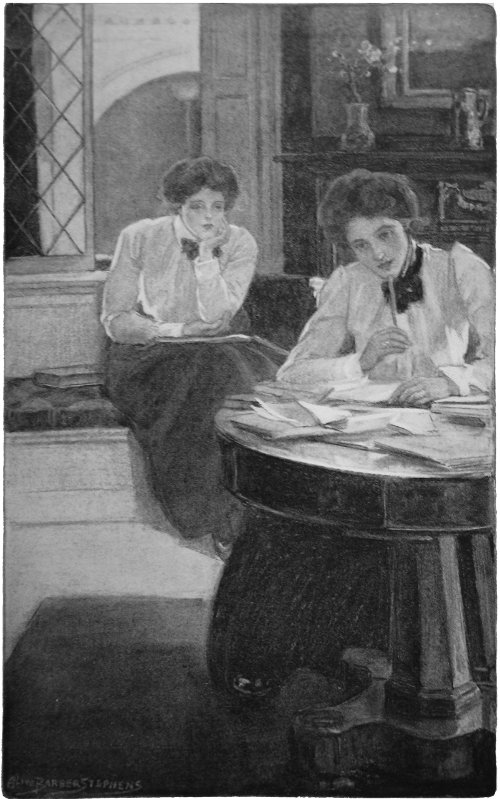
“‘Julia,’ said Ruth the next morning, as the two sat in the conversation room”
275
“And Pamela?”
“Oh, Pamela comes because she is a minister’s daughter,
and because her conscience is always active. But most of
us, I am sure, attend prayers two or three times a week.
Tell your Freshman that she should be more observing.
And now, to work; I am half sorry that we took this Shakespeare
course.”
“Julia! You to express such a sentiment! I am
astonished. Why, it seems to me the finest course we have
had this year; at least it has meant more to me. Every
word now in every play that I read seems to have such
depth. I am always looking for the hidden sense. Yet I
do wish that sometimes the meaning were a little plainer.
What do you make of this, ‘Oh, such a deed as from the
body of contraction plucks the very soul’? What is
contraction?”
“Why, he gave us the note, ‘Power of making a contract.’”
“Yes, I should have written it on the margin, but my
book is so covered with notes that sometimes I trust to
memory. I am anxious to finish this this morning, so as to
be free to enjoy the party this evening, for this afternoon
I am obliged to go to town.”
“Oh, yes, the party, the Sophomores’ farewell to us. I
wonder what they have planned? I hear that it is to be
something very original. There’s Polly with her camera;
perhaps she knows.”
276
But Polly, although she had more than a mere idea of
what the Sophomore party would be, declared she was
pledged to secrecy, and she invited Julia and Ruth to go
upstairs with her while she took a picture of the “Fair
Harvard” room.
This was a recitation room on the second floor, and
Polly had been waiting a time when it should have no
classes, and when the light should be favorable for a photograph.
She meant to have a photograph of every nook
and corner of the old building for the album that she was
making. The “Fair Harvard” room deserved its name,
for the author of the famous college song had married a
member of the Fay family, and in a room of the old house
he had written the well-known stanzas. His portrait and
an autograph of the poem, now hanging between the windows,
gave the room more interest than belonged to any
other in the whole building.
“You will give me a print?” begged Ruth when she
had finished.
“No, indeed, not one.”
“Why, Polly Porson, are you growing mean?”
“No, generous!”
“It doesn’t look like it. I have been expecting a whole
set of your photographs. Why do you refuse?”
“Come downstairs and I’ll show you.”
277
Julia and Ruth followed Polly to the bulletin board in
the anteroom, whereon were displayed the cards of girls
who were ready to do various things by which they could
earn a little money. There was a notice from one girl that
she was prepared to paint the Radcliffe seal in water colors,
and from another that she would execute the Harvard or
the Radcliffe seals in burnt wood. Other girls advertised
that they were anxious to do mending or typewriting.
One girl offered to frame photographs in passe-partout, and
others to make hand-painted picture frames.
“There!” cried Polly, pointing to an excellent photograph
of the Fay House library, with a card stating that
complete sets of Radcliffe views could be obtained from
the girl who had made this print.
“If I should give my photographs away, I should be
taking money out of her pocket. You and Julia and almost
every girl in the class can easily afford to buy Madge
Burlap’s photographs, and I happen to know that she
needs the money. She’s one of the girls of whom the
college is bound to be proud. Since she’s willing to earn,
she must be encouraged in her efforts. That’s why you
can’t have my photographs—for love or money.”
“I accept your apology, Polly, and now good-bye until
this evening.” Seizing Julia by the arm, Ruth hurried
her off to the Shakespeare class.
278
When evening came, the Seniors were welcomed by the
Sophomores at the house of one of their members, whose
house in Cambridge was large and attractive. Across one
side of the long drawing-room was a table covered with a
crimson cloth. When the Sophomores and their guests
had all assembled, a double quartette from the former
class sang an amusing song of greeting, and then at a
given signal the cloth was lifted, and one by one the
Seniors were invited to come forward and gaze upon the
photographs that had been hidden under the cloth. Each
Senior had a book given her in which to record her guess
as to the identity of the girls whose photographs were here
displayed.
“They’re all Seniors,” said Madge Burlap, “although
you mightn’t think it, Seniors at the age of ten or under;
and if you don’t recognize yourselves at that age, why we
shall think that you are less clever than you profess to be.”
The Sophomores had been at work all winter, collecting
the pictures that they now displayed. They had tried to
get them, so far as they could, from friends of the Senior
rather than from the girl herself, as they wished the class
as a whole to be surprised by the collection. Besides
photographs, there were a few miniatures and daguerreotypes,
while of Pamela and one or two other girls there
were only tintypes to show.
“You are not asked,” said the President of the class,
“to say whether the homeliest child has grown into the
prettiest Senior, or the reverse; we shall give the prize
for plain, unvarnished guesses.”
When the books were all in, it was found that Pamela
had come the nearest to guessing the whole number,
although even she had made two mistakes. The prize was
an order on the class photographer for a dozen photographs,
and everything considered, perhaps no one could
have appreciated this more than the Vermont girl.
As the spring wore on, the entertainments offered the
Seniors came, as Polly said, “fast and furious.”
279
Grateful though the class was for all the attentions
lavished on them, they enjoyed these various parties
much less than the entertainments given them in their
Freshman year. Then four years of college life lay
before them. Now it was nearly all behind; and though
they appreciated the dignity of being Seniors, wearing the
cap and gown, still not a few of them would have given
much to be at the beginning rather than at the end.
Polly was one exception to this sentimentality, which
toward the spring recess seemed to take possession of her
class.
“Four years more of examinations, a whole year of
English A, a year of daily themes, unexpected hour
examinations in History I, at least two years of superior
smiles from girls who know more than we do,—no, thank
you! I am very glad to let the dead past bury its dead.
But if any of you really long for four years more, I should
advise you to return for a season of post-graduate work.
Any one who distinguishes herself sufficiently may be the
sword to open the Harvard oyster from which to extract
the Ph.D.”
“Yes, if we could be Freshmen with Seniors’ experience
life would indeed be ideal, although as it is, it is real and
terribly earnest, and I wonder that we can take time even
in the recess for Julia’s house party.”
280
XXVI THE HOUSE PARTY
When Mrs. Barlow offered Julia the house at Rockley
for a party during the Easter recess, the offer was promptly
accepted. “I have ordered the house put in readiness for
our return,” wrote Mrs. Barlow from California, “although
we shall not reach Boston until the first of May. I am
sure that you must have worked very hard this winter,
and that the breath of sea air will be just what you need
before hot weather sets in. There is room for a dozen
girls, and everything will be arranged for your comfort.
You must not hesitate to ask for whatever you wish.”
In making the list of the girls to be invited, Julia and
Ruth were long in consultation. Clarissa and Pamela,
Lois and Polly, were certainties, and there were three or
four others about whom there was no doubt.
“There’s Annabel, too,” said Julia. “We must ask
her.”
Ruth looked closely at her friend. “But do you care
to have her? Are you not asking her chiefly on my
account?”
281
“I thought you might like her, even though you and
she are less intimate than you once were. But she is
Class President, and she is much more genuine than she
was a year or two ago.”
“She tries to seem more genuine,” responded Ruth.
“But Annabel can never be absolutely sincere. We must
take her as we find her.”
“Oh, we all understand her now,” replied Julia, “and
as she certainly is entertaining, it seems to me worth while
to invite her.”
Annabel, therefore, was one of the group that sat on
the broad piazzas at Rockley or wandered on the beach in
the warm April sun. Although it was vacation, each girl
had set herself some task to be done before returning to
college. Therefore, for three hours in the morning all
were allowed to bury themselves in their books. Dante,
Schiller, Greek and Latin Classics, Von Holst, Fichte,
Herbert Spencer, John Stuart Mill, Seignobos, and other
awe-inspiring books were strewn over the library table,
although any girl who touched her books except in the
mornings was at once forcibly reprimanded by her classmates.
An exception was made in the case of Polly and
Clarissa, who both were studying practical Astronomy.
So ardent were they in their search for variable stars that
the other girls decided that it would be cruelty to force
them to give up the opportunities afforded by Rockley.
Therefore they spent nearly every evening on a little balcony,
muffled in shawls. The wide, unbroken stretch of
sky gave them the best of views, and, armed with opera-glasses,
they carried on their search with great perseverance.
Clarissa, indeed, announced that she had found
almost enough material for a thesis, and that star-gazing
could be a very profitable performance, “when carried on
by a prudent person like myself,” she added sotto voce.
282
For exercise, wheeling was the favorite diversion of the
twelve, and some to whom this part of the country was
new were enthusiastic over the pilgrimages to Salem,
Marblehead, and other historic places. At Salem, where
Amy also was spending her vacation, they had a glimpse
of Mrs. Redmond and her studio. Polly, who had money
for whatever she wished, bought a pretty little water-color
sketch of the beach at Rockley, and Annabel talked
about having her miniature done. Fritz Tomkins, Amy’s
great friend, came down to call while the Seniors were
there. He expressed himself as perfectly delighted to
meet a group of Radcliffe girls, explaining that although
he had been a whole year at Harvard, they were the first
students from the woman’s college whom he had met.
“You ought to have called on Ruth and me,” said
Julia, with a mischievous attempt at patronizing Fritz,
“and we would have introduced you to some one of your
own age. We know several girls in the Freshman class.”
“Thanks,” said Fritz, “but you know that at Harvard
we hardly realize that there is such an institution as Radcliffe.
It makes so little—”
“Yes, it makes very little disturbance in Cambridge,
and we would hardly realize the existence of Harvard had
we not the advantage of knowing its Faculty pretty well,”
retorted Ruth.
283
“I understand that you could hardly get on without
them,” and thus the good-natured bantering between the
two went on for some time longer, and in the end it was
hard to tell with whom the advantage lay.
One evening at Rockley Julia announced that she had
arranged for a “confession conference.” She would give
no satisfaction as to her meaning until the whole dozen
had assembled in the library before the open fire.
Then, producing a red-bound book, she declared that its
pages were blank, except that one page in every five had
in turn the names of each of the girls present.
“I am going,” she said, “to ask each girl to tell me
what Radcliffe has meant to her, and then I am going to
beg her to tell what her real ambition was in coming to
college, or better, what she intends to be when she leaves.
Let us take an hour to collect our thoughts and write;
then another hour to read and discuss what has been
written. Later, with your permission, these confessions
will be handed to the Confession Recorder (and she laid
her hand on Polly’s shoulder) to be copied into this book.
I wish that the whole class would do something of the
same kind. But at the end of ten years, how interesting
it will be to see how near we twelve have come to our
ideals.”
“Or how far we have fallen below them,” murmured a
voice that sounded like that of Annabel.
284
Thus, with pencils and writing pads, the twelve set
to work, for Julia’s proposal had the charm of novelty,
and met no opposition. But when the time came for
reading what had been written, the majority of the girls
told what they hoped or planned, without confining themselves
strictly to their notes.
Polly said that she had chosen to come to college
because she was fond of study, and because it had been
her father’s pleasure to tutor her in the classics. Out of
a family of five girls, she had thought that one ought to
have as good an education as a boy. “Besides,” she
added, “it seemed rather a good joke to shock all our
friends and relations, who thought it a terrible thing for a
girl to go to college. Most people in the South still think
so, although I have converted a few. Papa was a Harvard
man,” she added in an undertone, “and that’s why
I came to Radcliffe, and that’s all I have to say.”
“But what have you learned?” asked Clarissa. “That’s
part of the game.”
“Oh, everything,” responded Polly, “but chiefly that
I am not the very brightest girl in the world, as some of
my friends and admirers used to try to make me believe,
when I lived down South.”
“And your ideal?” asked Julia.
“Oh, I’m going to write the great novel of North and
South. The subject is a large one, still I think that I can
conquer it, but it will be years yet,” and Polly sighed
heavily—for Polly.
285
We know how Clarissa and Pamela happened to come to
Radcliffe. Clarissa now confessed that she had learned at
Cambridge that it was a good thing to live in a conventional
place for a time and get the sharp edges rubbed off.
She added that at school she had always been considered
the smartest girl, but Radcliffe, she had found, was made
up of the smartest girls from a good many schools, and
the majority seemed to be able to hold their own quite as
well as she. “What’s the matter with basket ball?”
cried two voices in unison from the other side of the
room, and Clarissa hastened to declare her ideal. This
was, she said, to stay quietly at home with her parents
for the next two or three years. “They think that I’ve
been away too long, but if I really wish a profession at
the end of that time, they will not interfere with my
studying.”
Pamela, after a moment’s hesitation, said that she had
found Radcliffe a most encouraging place, and that instead
of subduing a girl, as Clarissa implied, she thought that it
tended to make her less timid.
“Which shows,” interposed Polly, “that Radcliffe is
very like the chameleon inspected by several persons, each
of whom gave a different account of the little creature.”
Pamela added that she was going to try for a European
Fellowship, and, if possible, spend a year or more at the
American School at Athens.
286
Lois confessed that the pure love of study had drawn
her to college, and Radcliffe had been her choice, because
while attending it she could also live at home.
“Although,” she added, “I believe that there is no better
college. Yet I so love study that even without Radcliffe
I should have studied by myself. But college has been
wonderfully broadening for me, especially during the past
year, when I have had so many delightful friends. As to
my ideal,” she concluded, “I am ashamed to say that my
purpose has changed somewhat. I may not study medicine—at
least not at present. I am going to teach for
two years, and at the end of that time I shall try to
go abroad for special research in Philosophy. There are
certain theories that I can work out by myself while
teaching and—after that—”
“Lois,” cried Esther Haines, one of the group, “mark
my words, in two years you will be marching to the altar
to the tune of ‘The Wedding March.’”
“Nonsense,” cried Lois, “I am the last one to—” But
the others, noticing that Lois was evidently embarrassed,
could not resist the temptation of teasing her.
In time it was Annabel’s turn, and she announced that
she had happened to come to Radcliffe merely because
when on shipboard on her return from Europe she had
met a Harvard man who had told her that this was the
coming college for women, and that it was the thing for
every clever girl to be educated there. “‘Clever,’” murmured
Polly, “there’s nothing bashful about Annabel.”
The latter added that she wasn’t sure that she had
learned as much as she had expected, but for the present
she should rest content, as she meant to devote the next
two or three years to society, as her father had taken a
house in Washington. But just as some of those present
were thinking that Annabel was as vain as ever her tone
changed a little, and she said in a somewhat more humble
voice, “To be perfectly honest, I really have learned
some things at Radcliffe, and later in the evening, if you
will let me, I wish to make a little confession of my
own.”
287
As if with one impulse Clarissa and Polly looked at
each other significantly. Her meaning to the others
was not so clear. Even Julia, failing to understand,
hesitatingly gave her impressions of Radcliffe and her
aims.
“You needn’t tell us your aims in life,” cried Clarissa;
“to do so would be tautological, as you have been telling
us constantly, ever since you came to college.”
“Why, Clarissa!” and Lois looked almost angry. “You
would have us believe that Julia is the most egotistic girl
in the class.”
“I am not unfair,” retorted Clarissa, “for you must
agree that Julia is likely to have, after leaving college,
much the same aim that she has had during her college
days,—that of making every one about her as happy as
possible.”
Applause followed Clarissa’s explanation, and Julia
withdrew from the room in confusion to order more logs
for the fire.
Ruth had confessed that she had been led to college
from her curiosity as to how she should feel as “the new
woman” of whom all the newspapers were speaking.
From their columns she judged that a college education
was a very necessary part of this new woman’s equipment,
and as she was fond of study she had persuaded
her mother to let her take the Radcliffe course.
288
“Everything considered, you ought to have had a course
in Domestic Economy,” said Polly with mischievous
intent.
“Especially since your aims after college are so very
evident to us all,” added Clarissa.
“Oh, I dare say that she’ll make just as good a housekeeper.
A college-trained mind is really a very good
possession for a minister’s wife.”
“Oh, Polly, Polly, you are incorrigible!” exclaimed
Julia, returning at this moment, and handing Ruth a fire
screen to shield her from the gaze of the others. Yet
after all it was generally known that Ruth’s engagement
would be announced on Class Day, and she and Will
Hardon were situated so fortunately that the wedding,
Julia knew, might take place within the year.
It is worth noting that almost all the party gave love
of study as their chief reason for choosing college. They
had turned their faces from the pleasantly idle life of the
average American girl, and from seventeen to twenty-one
had been hard workers. Every one of them had sacrificed
something in order to achieve her end, and almost all of
them intended that their education should benefit others.
Although the majority of Julia’s guests—like the majority
of the class—meant to be teachers, several were looking
forward to other useful work. Even Annabel, in her
secret soul, had an idea that she was to reduce the frothiness
of the social set into which she should be thrown in
Washington. Esther Haines was one of the few who
proposed a definite career of altruism. She was to spend
her first year after graduating in the College Settlement in
the east side of New York. She said that after her year’s
experience she would know whether or not it was wise to
become the agent of some charitable organization. She
had an idea that she might prefer the foreign field.
Esther was one of the class whom Julia had come to know
best in her Senior year. The latter often regretted that her
acquaintance with Esther had come so late in her course,
for Esther was not a pale, dyspeptic altruist, but one of the
cheerful, rosy-cheeked kind, and it was easy to see that her
mission to the poor would be one of joy and hopefulness.
289
Of the whole group Madge Burlap was the one, perhaps,
who had had the hardest time in planning her
course, for early in her Sophomore year her father had
died, and at first it had seemed as if she must leave college.
Instead of wealth, she now had nothing but a few
hundred dollars in the bank and many books, pictures, and
personal belongings. These things she gradually sold—so
gradually that she did not draw on herself the pity
of her classmates. It had been hard to part with that
morocco-bound edition of Stevenson, at a time when her
English instructor was urging them all to an intimacy
with the great Scotchman. But after all, with the
money in her pocket and the books on Julia’s shelves,
she was not so very badly off; for in negotiating for
the sale of the Stevenson, her pleasant acquaintance
with Julia had deepened into friendship. It had been
harder to part with her Ruskin, for this set had been
divided, Polly taking “The Stones of Venice,” Annabel
“The Seven Lamps of Architecture,” and one or two
others taking the rest. Madge was a good business
woman, and she disposed of all her superfluous belongings
except her camera. Yet that could not be counted a
superfluity, since she made it pay for itself many times
over, and her artistic views of Cambridge and the surrounding
country were beginning to be in demand at one
or two well-known stationers.
290
“We know that you are a business woman and a photographer,
and since you won’t tell us your exact aim, I
prophesy that you will make a fortune, Madge, in artistic
photography,” said Polly.
“Well, why not?” responded Madge, thinking of the
three young brothers whom she was helping educate. “A
fortune in our family would be both useful and ornamental.”
At last each girl of Julia’s party had read her confession,
and the others had given their approval. Each in
turn had promised Julia to record what she had written or
said in the crimson-covered blank-book, as a beginning of
the archives to which the exercises of Class Day and Commencement
were bound to add so much. It was then that
Annabel’s clear voice was again heard.
“You must not forget my confession, although it is not
for the red book.”
“Oh, then, let’s hear it,” cried Madge Burlap, and the
others echoed her wish. It happened that the group was
now sitting in a semicircle around the fire. Annabel was
in the centre, and as she spoke the others turned instinctively
toward her. It suited her to be the centre of
interest, and she began very dramatically:
291
“Of course every one here remembers the afternoon
when I recited so many things before the curtain went up,
that afternoon two years ago when we had to wait so long
for the Idler play to begin.”
Annabel knew, naturally, that every one present did
remember that day, and she continued: “You may recall,
too, that there was much discussion afterwards about a
strange girl who attended the performance—who—who
threw me a very large bouquet. Well, perhaps some of
you may also have heard that the girl was Loring Bradshaw
in disguise, who took that way of seeing a Radcliffe
play. I recognized him, of course, but for certain reasons
he did not wish any one else to know that he had done
this. He was a little under a cloud in college, and he
thought that this wouldn’t do him any good with the
Faculty. Well, the affair did get out, and he always
thought that this was the last straw that led to his suspension.
He knew that I had not told, and he was sure that
no man in college would have done so. Then, I happened
to mention that you, Miss Herter, had spoken of it at Radcliffe,
and he looked on you as the cause of his troubles with
Harvard. So it happened one day that he walked home
with me as I was carrying your note-book in History 100
that I had borrowed. Your name was in large letters on the
cover, and he insisted on carrying the book away. I could
not prevent him, for he simply took it from me. I wrote
him a severe letter that night, and the book came back to
me promptly the next day. He said that it had served
his purpose, but I had no idea of his meaning until that
newspaper article appeared. I did not care to tell people
that Loring was undoubtedly responsible, and besides,
just then, Miss Herter, I was perfectly willing to have it
appear that you were to blame. They were certainly your
notes, and I had no way of proving that Loring had concocted
the article.”
292
There was silence when Annabel finished. Before any
one else could speak, she continued: “I wish to say now
that I am very sorry that I let so many hold a wrong
opinion, for of course I knew that they held it. But I was
annoyed about this, although I know now that Polly and
Clarissa had nothing to do with the Mr. Radcliffe affair as
I thought at first.”
“Thank you!” cried Polly.
“Well, I’ve realized for some time that I do not deserve
to be Class President. In fact, even before Clarissa rescued
me I had begun to see that I was a mean and jealous kind
of a person.”
“There! there!” exclaimed Polly, rising to her feet,
“we won’t allow too much humility in the President of
the class. We’ve all made some mistakes of judgment,
and I myself have been about the worst of all.”
“Ah!” continued Annabel, “you are too good, but I
have learned more than any one else in finding out that
girls can be generous to one another.”
“There!” cried Clarissa, taking her place beside Polly.
“In the language of the poet, ‘Enough said.’”
Clarissa disliked scenes.
293
XXVII NEARING CLASS DAY
As Class Day approached, the class began to feel that
the end was indeed near at hand. Thoughtful girls like
Julia and Lois found a special significance in everything
that they did; “for the last time” meant a great deal to
them, and even the unsentimental Clarissa quoted Tennyson
with an approach to correctness:
“Tears, idle tears, I know not why ye fall,—
Tears from the depth of some divine despair.”
During May the class had had many attentions paid it
by the other undergraduates, as well as by different professors
and their wives,—“a continuous performance,” as
Polly phrased it, of farewells; and that girl would indeed
have been stony-hearted who had not felt that all these
things had made her parting with Cambridge a little
harder. There had come a lull in these festivities during
the examination season of early June, for in comparison
with all other examination periods this one had an enormous
importance for many Seniors. Even girls who had
done well throughout their course showed an unnecessary
nervousness, and were sincere in fearing that in some
unexpected way they might lower their records. Few of
them, perhaps, expected to fail, but those girls who had
set their hearts on a degree summa cum, magna cum, or
even simply cum laude, felt that much depended on the
marks of these final examinations.
294
But when the examinations were at an end, worry, too,
departed, and few indeed were the Seniors who did not
enter whole-heartedly into the pleasures of these last days.
The work of the various class committees had been
completed some weeks before, and to the credit of the
class all had worked together harmoniously. Even in
the election of the committees most little rivalries and
jealousies had disappeared, and if in all instances precisely
the right girl was not in the right place, no one criticised
or found fault. As Class President Annabel was Chairman
of the General Committee, Ruth of the Invitation
Committee, Julia was Chairman of the Committee on
Class Exercises, Clarissa was chief of the Photograph
Committee, and Pamela, in spite of her protestations, had
a place on the Baccalaureate Committee.
So energetic had Clarissa been as Chairman of her committee
and so conscientious in securing the best photographs
that some of her classmates made really pathetic
complaints.
295
“Sometimes, when I think that I am going to have an
hour of leisure, an hour when I may sink in the depths
of my easy-chair and refresh myself with Meredith,—George,
not Owen,—there comes a gentle tapping at the
door, and I rise to receive a note reminding me that I am
part of a group that is to be photographed under the
broiling noon sun, and that I am especially requested to
wear a pleasanter expression than usual. I belong to so
many groups,” concluded Polly sadly, “that my Senior
May has been one long noonday glare of sittings before
the camera. When there was nothing else happening,
some amateur was taking a snap-shot, to add me to her
album of Radcliffe views. I cannot tell you how many
times I have been caught in unconscious attitudes, crossing
the tennis court, or leaning against a tree, or seated
on the steps. I always try to look my best at such times,
because—”
“You spoke of unconscious attitudes,” commented a listening
Junior.
“Hush, child! When you are a Senior you will understand
things better,” replied the irrepressible Polly; “and
to prevent further criticism, I will give you a specimen of
my most unconscious smile,” and the younger girl accepted
Polly’s latest photograph—a full length in cap and
gown.
“My time for teasing you, Polly, will come to-morrow,”
said the Junior, “for you may be my vis-à-vis in a canoe,
and if you are not careful I may tip you—just a little way—into
the river.”
But Polly refused to be frightened by this mild threat,
and when the canoe set out it was Polly who held the
paddle. This excursion on the river was the form into
which the Juniors offered their hospitality to the departing
class, and a merry time they had with a picnic supper
spread in a grove on the river bank.
296
The Sophomores invited the Seniors to a dramatic performance
in the open air, after which—for almost the last
time as undergraduates—the guests were treated to the
familiar fudge and college ice. If the fudge was over-sweet
and the ice over-watery, nobody criticised the feast.
Indeed, the affair was considered remarkably successful,
since the Sophomores were thought to have been extremely
clever in having discovered that the Radcliffe
grounds were large enough for such festivity. All the
audience, to be sure, except the Seniors, had sat pretty
closely together on rugs and shawls spread on the grass.
But the Seniors in their camp chairs were not crowded;
and though the setting of the mimic stage was rather
Shakespearian in its simplicity, it sufficed for the little
play. For the whole action was supposed to take place on
the links where two golfers engaged in some sentimental
sparring, and a caddie and a country maid furnished the
burlesque element.
297
Of all the events of that last month none was more
enjoyable than the reception given by the Athletic Association
to the Senior basket ball team, as a special acknowledgment
of its prowess in gaining the championship.
For Clarissa and her nine had not only vanquished the
younger classes, but had won certain victories over outside
colleges that had almost turned the heads of the athletically
inclined. Indeed, some of those girls who seldom set
foot in the Gymnasium except when obliged to exercise
went to this reception to honor the team. For it was the
proud boast of the athletes that no girl on the team would
have a degree graded lower than cum laude, and thus the
outside world would see that mental and physical exercise
could go on at the same time. As for Clarissa—well,
every one knew that she showed marked ability in everything
that she undertook, and no one, not even Annabel,
grudged her her honors. To her undoubtedly belonged the
chief credit for the glory that came to the class in bearing
away the banner of championship. This was more than a
compensation for their losses in the tennis tournament.
“Few classes,” said Polly proudly, “will go out in a
greater blaze of glory. With Clarissa getting us the
championship, and Pamela winning that two hundred and
fifty dollar thesis prize, all eyes will be turned upon us.”
“They always are turned on the graduating class,”
responded Julia, to whom she spoke. “But it’s delightful,
is it not, that these special honors have come through
girls to whom some of us were not inclined to pay much
attention in our Freshman year.”
“‘Some of us’ is good,” rejoined Polly, “when we
remember that you always had unlimited confidence in the
two heroines.”
“I always liked them,” said Julia quietly, “as I saw
that others must when they knew them better.”
298
To picture the scene in the Gymnasium demands the
painter’s brush rather than the pen, for it was no formal
reception such as any group of girls could give in any
house. Far from it! Though the day was fairly warm,
the star athletes did their best for the entertainment of
their guests. They performed feats that made the blood
of some of the uninitiated run cold. They went up and
down ladders, and climbed ropes, and swung on rings,
and leaped over bars, and showed enormous agility, if they
undertook no difficult tests of strength.
Those girls who were not in the R. A. A. stood about
in their light muslin gowns, and clapped and cheered a
steady approval; and the others in their picturesque gymnasium
suits clapped and cheered even more loudly. They
did not shriek, not they, when Clarissa at the apex of a
pyramidal arrangement of ladders seemed about to fall.
They knew that she was safe, and Clarissa was soon ready
for her triumphant descent.
But some of the girls in light gowns did exclaim at the
critical moment in tones loud enough to have frightened a
timid gymnast, and some thought it a pity that Clarissa
should have to work so hard when she was really the
guest of honor, and some thought that she was making a
needless display of her prowess. Yet as Clarissa poised
herself at the top of the ladder before starting down, a
mighty cheer went up from the whole throng, and Clarissa,
with beaming eyes and flushed cheeks, waved them
her appreciation of their appreciation before beginning the
descent.
After the banner had been duly presented, after the
team had made its acknowledgment, after every one who
could make a speech had said the proper thing, the
R. A. A. returned to everyday costume, and the three
or four hundred girls wandered about the grounds until
summoned to college ice in the Auditorium.
299
For Julia the spring had an added charm from the fact
that Philip took so much interest in everything. Though
working for his degree, he was constantly planning little
parties of eight or a dozen to see this or that baseball
game or the spring athletic meets. Whoever the others
might be, Julia was always of the party.
“I have not known so much of Harvard doings in all
my four years,” she said one day as they set out for a
Princeton game, “and I feel foolishly frivolous in my old
age.” There was no sign of old age in the bright-eyed
girl who waved the Harvard flag, even up to the moment
of Princeton’s victory. The general excitement, and the
fact that it was a Princeton game, reminded Julia of that
other Princeton game more than five years before when
Harvard was victorious at football, and when Philip had
shown himself just a little bored by having to escort a
“parcel of girls.”
Thus with some pleasant diversions lightening the unescapable
hard work of the examination period, the spring
passed away, and the Monday before Class Day found the
whole class ready to enjoy the happenings of the week.
To Julia early that Monday morning came a note from
Philip saying that his degree was assured, and that he
had nothing to trouble him now except the fear that she
might not get hers. Julia smiled as she read the friendly
little note, and thought how greatly Philip had changed
from the Philip of old.
300
The first event of the day was a luncheon given by
the former Secretary of the Annex and Regent of Radcliffe
and his wife, at their Cambridge house. To them
more than to any others was due the credit of planning the
collegiate work for women that had finally resulted in
establishing Radcliffe College. The Secretary was always
ready to answer the many questions asked by the eager girls
about the small beginnings of the college, and to the more
thoughtful it was a wonderfully interesting story.
After the luncheon Annabel was called upon for a
speech, and she was followed by half a dozen others, each
of whom were ready-witted in responding to the impromptu
toasts.
From the luncheon they went on to a reception at Craigie
House. The poet’s daughter had also been one of the
founders of the college, and the girls or classes honored
with an invitation to Craigie House were always envied
by the others.
Clarissa and Pamela, on this afternoon of the class reception,
in a spirit of veneration, went almost on tiptoe into
the study, now looking just as Longfellow left it almost
twenty years ago. There near a window overlooking the
Charles they saw the high writing desk at which he wrote
standing, with some of his quill pens lying on it. They
noted the great orange tree in the other window that had
grown from a seed planted by Longfellow. The portraits
of Hawthorne and Emerson, and the little water-color
sketch of the village blacksmith’s shop, all came in for
their share of attention. But perhaps most interesting of
all was the portrait of the poet himself, in his fur-trimmed
coat, painted by his son, on an easel near the fireplace.
The class wandered from the quaintly furnished room
known as Martha Washington’s parlor to the large drawing-room
back of the study, with its many art treasures
gathered in Europe. They strolled over the broad lawn,
and each girl felt that this reception at the Longfellow
House was something that no other event of Commencement
week could surpass.
301
Their own Class Day was the Wednesday before that of
Harvard, and in the intervening day or two the class had
little time to spare. The invitations had been out since
the end of May, and all the preparations had been carefully
made.
The literary exercises took place in the forenoon, with
only the class as audience. “Thankful enough we ought
to be,” said Ruth, “that cut and dried speeches in a hall
have not yet been adopted by Radcliffe. It would be so
hard to have to explain our jokes even to our sympathetic
friends and relatives, and there would always be some
present who would think undignified any alleged witticisms
that we might offer.”
Sure, therefore, of a friendly audience, Annabel gave
the Class History, and Polly the Class Prophecy. Ruth
had written the words of a Class Song for which Julia had
composed the music. There was a Class Poem by Estelle
Ambler, a girl whose verses had lately appeared in several
of the magazines, and it was rumored that Clarissa was to
make an original contribution to the programme which no
one was to know about until the last moment.
302
Annabel’s History was even cleverer than her classmates
had expected. She reviewed brightly the various events
of the undergraduate years, scholastic and athletic, with
the usual gentle gibes at History I and English 22, and
the trials offered by Junior forensics and daily themes;
and she made all laugh by the originality of her class
statistics.
“We are 1,378 years old,” she read from her manuscript,
“2,942 feet high, and we weigh a little less than
four tons. During our four college years we have studied
26,134,720 minutes, and at Mrs. Agassiz’ Wednesday
afternoons we have drunk in all about 7,000 cups of tea.
During our four years we have used about 260 pints or
32.5 gallons of ink, and 5,636,250 pages of theme paper,
which would cover about 5,000,000 square inches. The
actual time spent in writing examinations has been just 96
days, of 24 hours each. For this work 5,240 blue-books
have been necessary, and 320 quarts of Mrs. Hogan’s beef
tea. In listening to lectures we have spent 30,000 hours,
or 1,800,000 minutes. The Secretary knows that we have
been eager searchers for knowledge, for at the lowest estimate
we have asked her 2,470 questions, to which she has
returned 2,470 patient and obliging answers. Now that
we are about to depart to the four corners of the earth, we
shall never forget old Radcliffe, nor the blue-books, even
though we forget what filled them. We shall always
remember the honored President and the Dean and the
Secretary, and all who have smoothed our path here for
us, and we shall never forget that we shall always belong
to the Class of 189— of Radcliffe College.”
303
A Class Poem can never be very original, but Estelle
Ambler offered one that was extremely smooth and pleasing,
and to the point. Polly followed it with a Prophecy,
in which she imagined all kinds of things likely to happen
to the rest of the class. “Prophecies contrary to fact,”
many of them might have been called, for Polly foretold
the early marriage of several of those girls who were the
least devoted to society and the most devoted to study,
while for Annabel and Ruth and Clarissa she prophesied
many long years of toil as teachers or professors in school
or college. Business careers were foretold for the unpractical,
and those girls gifted with a sense of humor had
a chance, in Polly’s gentle satire, to see themselves as
others had seen them; and they all smiled at her concluding
words, which she said embodied the sentiments of
most of those inclined to give advice to college girls that
the main advantage of a college education for a woman
is that it fits her, or ought to fit her, “to take up the
duties and responsibilities of a household, that by bringing
her accurately trained mind to bear upon the practical details
of life, and exercising the acquired acumen of her
mind, she can make homes happier than they ever were
before, and—” The final words were lost in the applause
that greeted this familiar commonplace; and Polly, acknowledging
a wreath of roses laid at her feet, bowed
gracefully as she descended from the Auditorium stage.
304
There was a hum of expectation as Clarissa followed
Polly on the stage, carrying a large, stiff-looking roll.
Unfolding it, she announced that she had been made Class
Attorney, and that to her had been intrusted the making
of the Class Will, which she would now read.
The things that she bequeathed were chiefly the common
property of the class, such as “the superior smile
when some underclass girl asks a question that cannot be
answered;” to the incoming Freshman class the “privilege
of profiting by the advice which their Senior advisers will
give upon every occasion;” and last, though not least, in
the minds of some, “the privilege of collecting on the
slightest provocation sums of money, great or small, in
exchange for tickets to entertainments, or without such
consideration, to support divers good causes in Boston and
Cambridge, especially those connected with settlement and
college work; and the less ready money any girl is supposed
to have, the more urgent shall be the appeals.”
To the Sophomores among other things were given the
right of assuming “the nonchalant title of Junior,” and
“the faculty and right of saying to Seniors who are loath
to depart this college life, ‘Oh, well, we have a whole year
more,’ in a way that makes a year sound an eternity.”
The Senior rights in various college officials and in
certain college properties were likewise bequeathed, and
the mock solemnity of the whole thing brought the programme
to a close with a chorus of laughter. Then after
the class had sung Julia’s Class Song, there was an informal
half-hour of choruses and solos, and then a great hurrying
homeward, that each girl might have an hour of rest before
the grand climax of the day.
305
For some of the class, however, there could be no rest,
as many, besides those on the committees, were anxious to
do their part in helping. But beautiful though the decorations
of Fay House were, they paled into insignificance
before the outdoor glories, for clever brains and skilful
hands had made the most of the opportunities afforded by
the limited area of the grounds. There were lines of
lanterns between the trees, and a wonderful pagoda that
seemed to be constructed of lanterns; there were tables on
the lawns, laden with refreshments, and each Senior shook
hands with dozens of persons and answered scores of
questions, and had little opportunity to talk with the
person she most wished to talk with, and walked ten
miles more or less showing each of her special guests the
points of interest in and around the college buildings.
Each Senior, too, looked her very best in her simple
white gown, and the crowds of Harvard students who
were in attendance testified that socially at least Radcliffe
was in no way unpopular with the older college. So
weary were the Seniors as the evening advanced that they
had little strength left to dance in the new Gymnasium.
But the undergraduates and their other guests made up
for their own lack in this respect.
306
Pamela had invited Miss Batson and all the young
ladies who boarded with her, and probably no guests enjoyed
the day more than they. Besides her own family
and some of her younger Newton friends, Lois invited
Miss Ambrose, and those who were in the secret of Miss
Ambrose’s aspirations could see that through her interest
in Lois her own youth had been renewed. There was a
rumor that she and Lois were to go to Europe that summer,
and whether that was true or not, any one seeing
them together could perceive that the feeling between
them was stronger than that of mere friendliness. Clarissa’s
father and mother had come on from Kansas, and
several of her friends and relatives from the West.
Annabel’s father, a New York politician, was so pleased
that his daughter had retained the Presidency of the class
that he was anxious to do all kinds of pleasant things for
her constituents, and had finally arranged a mammoth pop
concert party for Saturday evening. Julia, like the other
Boston girls, had many guests, but the Bostonians were
better able to entertain themselves than those who came
from a distance.
Julia, for example, felt little responsibility for her uncle
and aunt. They had many friends on the grounds, as had
Nora and Edith and the rest of their party. She caught
glimpses of Brenda constantly flitting about in her firefly
fashion, with Arthur Weston in attendance. It was an
open secret that Brenda’s engagement to Arthur was to
come out before Commencement, and those who knew
them the best had already offered the young people their
congratulations. Many of the class, too, knew that Ruth
and Will Hardon were also on the verge of having their
engagement announced, and an observer might have
thought that there was something more than good comradeship
in the devotion with which Philip followed Julia
from place to place. Julia had used not only the invitations
to which she was entitled as a member of the class,
but she had been able to secure many in addition from
girls who did not need all their own allotment. She was
able, therefore, to invite not only her former classmates at
Miss Crawdon’s, but the teachers, too. Miss South was
there in the light mourning that she wore for Madame
Dulaunay. Those who knew her were wondering what
she would do with the great house that her grandmother
had left her, which it would be hard to keep up on a
comparatively small income.
307
Of all those whom Julia had known best at Miss Crawdon’s
school, Belle alone was missing. By this it need
not be understood that any one really missed her, for
Belle, since she had been sent to New York to boarding-school,
had really dropped out of the little set in which
she had once been a leading member. In vacations some
of her new friends visited her or she visited them, and
she laughed at the ways of her Boston contemporaries as
“far behind the time.” She and Brenda always kept up
a correspondence, and her letters, though wholly about
herself, were always entertaining. She had already left
Boston to stay with friends at Mount Desert.
“But why Radcliffe College?” asked one of Polly’s
guests, her cousin from New York.
“Yes, where did you get that name?” asked another
cousin, walking with her.
308
“Why, from Lady Anne Moulson, of course,” responded
Polly, not at all unwilling to tell the story.
“From Lady Anne Moulson, who was once Anne Radcliffe,
and who founded the first scholarship at Harvard.
The fact was unearthed just as the poor little nameless
Annex was ready to appear out as a regular institution,
and so she was christened Radcliffe College. Some did
not care for the name, and would have preferred Longfellow
College or something else local, but on the whole it
seemed the best that could have been chosen.”
“I trust that Lady Moulson deserved the posthumous
fame that has come to her, for certainly your college will
give her name undying glory,” said one of the cousins
gallantly in true Southern fashion, though he modified
his praise slightly lest Polly should think that he wholly
approved of a college education for girls.
To show herself impartial, Julia carried Tom Hearst’s
flowers as well as Philip’s on Class Day. But it was
Philip with whom she walked about the grounds after her
duties as hostess were over, and Philip with whom she
promised to go to Memorial Hall on the evening of Harvard
Class Day, and Philip who was to be her escort at
the Yale game the succeeding Saturday. Yet though
they had many little conversations, and although what
they said was largely personal, it must be admitted that
there was not a word of sentiment in it all,—of sentiment,
at least, as it is understood in its more romantic sense.
They did talk, however, a great deal about their plans for
the immediate future. Philip had decided to regard his
father’s wishes, by taking his two years in the Law
School, hoping that his previous reading and some special
effort would take him through in less than three years.
Julia confided to him certain ideas that she and Miss
South hoped to carry out in the form of a training school
for girls of the Angelina type. Philip’s face clouded
when she told him that she should sail for Europe in July,
with her uncle and aunt and Brenda and Miss South.
309
“But you’ll be back in the autumn?” urged Philip.
“Oh, possibly.”
“But I’m depending on you for advice and that kind of
thing.”
“Edith is a better adviser than I.”
“Ah, but Edith isn’t a college graduate.”
“Nor am I yet,” and Julia would give Philip no further
satisfaction. Instead she wandered off, with a hasty good-bye
to Philip, explaining only that as one of the hostesses
of the day, she must look after her other guests.
Philip, following her, soon found himself in a group of
which the central figure was Pamela. The two had not
met since the spring following the sugar episode, and
altogether had seen each other but two or three times.
Yet now the recognition was mutual, and both had instantly
the same thought, that each had greatly improved
during the intervening three years. He lingered to talk to
Pamela, and he had no chance to talk to Julia until later
in the evening.
310
Although Philip felt dissatisfied, Julia had really given
him more time than most Seniors had given to any one
person on that busy, busy Class Day. Yet he kept his
eye on her, and whenever he could induce her to leave her
other guests, he would get her to walk with him over
the building or through the grounds, on the pretext that
there were many things that he wished to have explained
about Radcliffe ways. Together Julia and Philip watched
the gay throng of dancers in the Auditorium, and in an
interval when the latter laughed at the crowded condition
of the floor, Julia repeated the rumor that the next Senior
class would dance in the great Gymnasium, as those in
authority had already given their consent to this plan.
“That will be the proper thing, because—”
“Hush!” cried Julia, “the Glee Club is going to sing;”
and as she spoke, to the air of “Fair Harvard” floated the
words:
“Now a song for our Radcliffe, so young and so fair,
With the light of the dawn in her eyes,
With the garlands of May in her beautiful hair,
Blest child of the true and the wise.”
As the song finished, Mrs. Barlow approached Julia, to
remind her that the hour was late, and that the two carriages
were already waiting,—one to take the Barlow
party back to Boston, and one to convey Julia and Ruth
to Mrs. Colton’s.
As Julia and Ruth drove homeward, the former gave a
sigh of relief.
“Aren’t you glad it’s over?” asked Ruth.
“Partly glad and partly sorry,” responded her friend.
“It has been tiring, of course, but then so pleasant.”
“Yes, and to-morrow when we are rested, we shall be
sorry that Class Day is past.”
“I am sorry now,” returned Julia, “for it marks the
beginning of the end.”
311
XXVIII COMMENCEMENT—AND THE END
As Julia sat in church on Baccalaureate Sunday she felt
sadder than on any occasion since the class had begun to
take its farewell of Cambridge and of college life, for
now they were together for the last time before Commencement
as the Senior class in cap and gown.
The last day was near at hand, and after that final
assembling in Sanders Theatre, it was unlikely that these
threescore girls would ever be all together again in the
same place. Impressive though the sermon was, more
than once Julia had to recall her thoughts from wandering
in a review of the past four years. Had she herself made
the best use of her time? Was there not some girl among
the Seniors to whom she might have been more helpful
than she had been—in ways intangible if not material?
Had she herself drawn all the inspiration she might have
drawn from her classmates? She had learned much from
her intimates, but had she been sufficiently appreciative of
some of the others or responsive to them? Thoughts like
these so mingled themselves with her impressions of the
sermon that she left the church in a state of abstraction.
312
Questions such as Julia had asked herself can never
receive a definite answer. The wisest of us makes many
mistakes, and the most foolish would be plunged in constant
despair if she had to call herself to account at every
step. To do her best is the most that can be asked of any
girl, and if only she tries to learn from her errors, whatever
her past faults, she can turn hopefully to the future.
Julia, fortunately, had comparatively little occasion for
self-reproach; for if she had made the very most of her
opportunities at Radcliffe—if she had left nothing undone
that should have been done—she would have been the
only one of her kind. Thoughts like these of Julia’s
presented themselves to nearly every girl in the class—from
Pamela the over-conscientious to careless Polly.
Even the self-sufficient Annabel talked in a less self-satisfied
manner, as she walked homeward from church
accompanied by two or three of her best friends.
The three days intervening between Class Day and
Baccalaureate Sunday had been very full. Friday had
been Harvard Class Day, and there wasn’t a girl in the
class who did not know at least one Harvard Senior. It
was the first Class Day for Julia since the year of Philip’s
failure, and the things that she did seemed a repetition of
the happenings of that other year. There was but one
marked change: the Tree exercises had been given up,
and a less strenuous performance went on around the John
Harvard statue on the delta. Confetti took the place of
flowers, and the whole affair was carried on in the most
gentlemanly way. Yet Julia, like many others, thought
with regret of the old struggle around the Tree—regret
that it was to be no more. Philip, although he realized
better than any one else that this was not his real Class
Day, yet managed to get a great deal of fun out of it.
Tom Hearst and some of his former classmates, now about
to be graduated from the Law School, gave a small tea in
the early evening, and it proved a reunion of the group of
young people who had been together so much at Rockley
and in Boston. Brenda’s engagement had come out that
very day, and she and Arthur Weston received the congratulations
showered on them in a fashion that amused
every one. They were surprised that their friends were
not surprised.
313
“I am sure that I have always complained of the way
Arthur teased me,” pouted Brenda, “and I never really
made up my mind until—”
“When?” shouted Tom Hearst, noting with delight
that Brenda was embarrassed. But Brenda refused to
answer.
Ruth and Will Hardon had an equally large share of congratulations,
and they would have been astonished had their
friends not taken their engagement as a matter of course.
On Saturday the same group of young people went to
the Yale-Harvard game on Soldier’s Field, and after they
had returned home from Annabel’s concert party, Ruth and
Julia were tired enough.
Kaleidoscopic visions of the past week’s festivities
mingled with Julia’s more serious thoughts that Baccalaureate
Sunday, as she scratched off the dates on her
calendar that showed only two days remaining of college
life.
314
But at last the eventful Tuesday had come—the Commencement
that was to end the undergraduate days of the
class. They had breakfasted that morning with the Dean,
and had met many of their instructors at the informal
reception that followed. Commencement was at half-past
four o’clock, and promptly at that hour, while the orchestra
in the gallery was playing, a long procession filed into
Sanders Theatre. The amphitheatre was already filled
with guests who had been ushered to their seats by Harvard
Seniors. At the head of the procession walked the
President of Harvard, and on his arm leaned the President
of Radcliffe—stately and benign. Close behind were the
Dean, the Secretary, the members of the Governing Board
of Radcliffe and the Overseers of Harvard, with whose
approval the degrees were granted.
All these took their seats on the platform, and at the
left sat the Radcliffe Glee Club. The Seniors in cap and
gown at the end of the procession marched to places on
the floor of the theatre directly under the stage. It was
hard for them to maintain their dignity without turning
around, when they knew that in the balconies were so
many of those with whom they would have liked to exchange
a glance and a nod.
315
After the prayer, and the singing of “Integer Vitæ”
by the Glee Club, the President of Radcliffe congratulated
the class on their four years’ work, and on the special
honors that had come to some of them. She told of the
improving prospects of the college, and mentioned several
gifts that had been made during the year. The most important
news was the statement that one generous donor
had given the whole sum needed to build a handsome
dormitory,—the first Radcliffe dormitory,—and at this
news there was loud applause.
The address that followed by the President of Harvard—a
dignified and scholarly address—showed deep sympathy
with the aims of college girls, many of whom had gained
their degrees at the cost of certain things that most young
girls might think more attractive. He called attention to
the fact that the experiment of the higher education of
women had lasted now for two generations, with satisfactory
results. He added that the degrees about to be
granted had been properly won, for they represent as hard
a training as the more vigorous young men receive, and he
concluded with a hope that some at least of the women
graduates might show themselves possessed of the creative
faculty, and add something to the world’s stock of
knowledge.
“Aren’t the Seniors to take any part? Isn’t there a
valedictory or something of that kind?” asked Edith of
her neighbor Nora, as a little pause followed the President’s
address.
“Oh, no, that isn’t the way. I suppose it’s the only
college in the country where the class has no preparation
for Commencement.”
316
“It’s much the best way,” said Mr. Blair, overhearing
what the girls said. “A great deal of needless effort is
wasted on useless speeches for Commencement. It’s as
fatiguing to the audience as to the Seniors themselves.
This way, it seems to me, is much best. It is so simple
and dignified.”
“Yes, but some people are disappointed at not seeing
the class celebrities,” responded Edith. “Of course we
know something about Clarissa and Lois and Pamela and
the others who have distinguished themselves.”
“Not to mention Julia,” interposed Nora.
“Yes, naturally; well, we know all these girls by sight,
but there must be many here who have never seen them,
and who would be very glad to know who’s who.”
“Well, they are all there; and if we listen, we may be
able to fit the right name to the right girl.”
Of all in that great audience, perhaps no one was more
disappointed than Angelina at the simplicity of the programme.
Julia had had a card of invitation sent her, and
she had come in a wonderful yellow hat covered with large
pink flowers, and a gown of the brightest pink gingham.
She had fully expected that Julia would be the centre of
interest, and she was really grieved that one who had been
so kind to her had not been given an opportunity at least
to sing or play something from the operetta. Besides, she
had a personal disappointment in the fact that she could
not present to Julia the immense bouquet that she had
brought with her from Shiloh. She had had the whole
scene planned. In the midst of a burst of applause she
would advance toward the stage, and, with a curtsy that
she had been practising, fling the bouquet at Julia’s feet,
at the close of her performance, whatever it was. But
now Julia was no more conspicuous than the others of the
class. She had neither sung nor made an oration, and
Angelina herself had had no opportunity for a dramatic
appearance before the audience. Her curtsy had been
practised in vain; and Angelina, as she grasped the flowers,
looked decidedly woe-begone.
317
But at last the Seniors were passing in single file toward
the platform to receive their degrees, and each girl as her
name was called received the crimson-tied parchment
from the hands of the President. Before the Seniors
several Alumnæ received their M.A. But the receiving
of the degrees in the presence of that great audience was
not unalloyed bliss. Even Lois and Pamela with summa
cum, and Clarissa and Julia and others with their magnas,
and Polly and Ruth with cum laude, felt a thrill of sadness
as they passed down the steps in front of the dignified
statue of Josiah Quincy.
Their undergraduate days were over!
That evening as Alumnæ they were cordially welcomed
to an Alumnæ dinner by the older graduates, and if they
felt uncomfortably warm wearing their long black gowns
over their white dresses, there were compensations; for
there was a satisfaction when Clarissa responded to one of
the toasts to hear her speech called the wittiest ever made
by a graduate, for Clarissa belonged to the whole class.
Then, too, some of Polly’s songs were so enthusiastically
received that it was a delight to remember that two others
of the class, Julia the composer of the music and Ruth
who had written the words, shared the credit with the gay
singer.
318
At dusk the gay crowd wandered out on the lawn, where
the Glee Club sang, and old friends gathered in little
groups to talk over the happenings of the past year.
“In a year we shall be old graduates,” said Ruth with
a sigh; “already I begin to feel the change. It seems as
if everything has been, as if—”
“Nonsense,” interposed Julia, “everything is to be.
Our undergraduate days are past, and yet I doubt that
any of us would really care to live them over again. We
can be thankful for what we have learned here, but after
all, the sooner we can take our places in the world, the
better. College life at the best is selfish—”
“There—there, Julia, don’t preach! Look at Fay
House. It is almost picturesque.”
As they stood at the gate, the two girls turned and
gazed at the old building, whose outlines in the dusk
showed dimly through the screen of elms. Lights shone
from some of its upper windows, and it looked like a
stately palace.
This was undoubtedly the thought in Julia’s mind as
she cried, turning away, “Good-bye, Palace of Learning,”
while Ruth added, “Good-bye, great Class of
189—.”
Truly, it had been a great class, but its undergraduate
days were over.
319
321