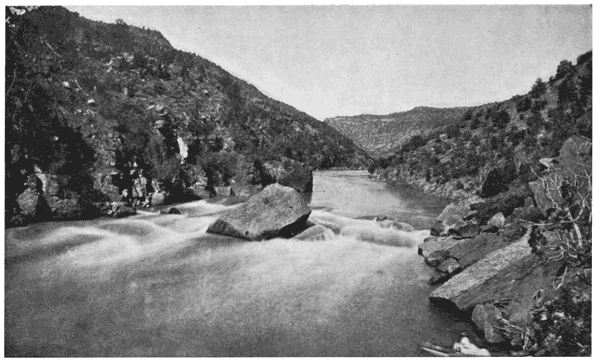
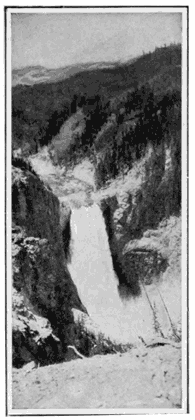
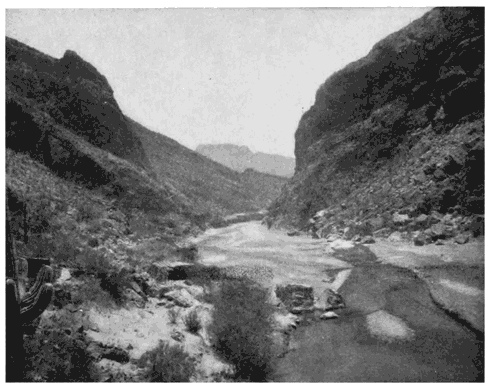
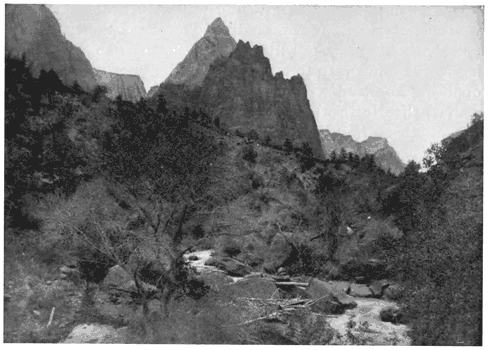
Free Distribution of Frémont's Reports—Latter Day Saints—Murder of a Prophet—Brigham
Young Guides Saints to the Wilderness—The State of Deseret—California
the Golden—Massacre at Mountain Meadows—Old Jacob, the
Mormon Leatherstocking—Steam on the Lower Colorado—Old Jacob Finds
the Crossing of the Fathers—Circumtouring the Grand Canyon—Solitudes of
the Colorado—Last of the Wilderness Problems—Powell Solves it by Masterful
Courage—The Iron Trail—The End and the Beginning.
The reports Frémont made of his several expeditions were
so striking and so important that Congress ordered thousands
of copies to be printed for free distribution. They
formed the beginning of the long series of invaluable volumes
the Government since that day has so wisely and so lavishly
published. First to present drawings of new plants and fossils
as well as to give accurate details of geography, they serve to
mark Frémont as the scientific Pathfinder. Botanical specimens
were classified by Torrey; paleontological by Hall, and
comment on the excellence of their work is unnecessary.
Altogether these expeditions of Frémont began a new period
in Wilderness exploration—the period of scientific examination.
He has been much criticised, but it was he who broke
the way for the numerous Government expeditions which followed
and which reflect much credit on the intelligence and
generosity of Congress. Few governments have ever fostered
the scientific spirit with a better grace or to so full an extent,
and Frémont was partly responsible for this commendable
attitude. Through his enthusiastic labours the Far West began
to be more clearly understood than ever before. He took
no pessimistic view of the resources of the Wilderness as Pike
and Long had done, but was rather inclined to the other side.
It seems notable that he should so commandingly have stepped
into the vast field at a moment coincident with the collapse of
beaver trapping as a business; an industry which, as we have
seen, was responsible for the breaking of all the main trails
of the Wilderness, and for searching out every important
secret save that of the hidden fury of the Colorado. Not only
had the beaver been practically exterminated, but the bison
was on the decline.[105] Those beyond the mountains suffered
nearly to the point of annihilation in the exceptionally heavy
snows of the winter of 1842-43.
The Great Salt Lake, enshrined in the snowy mountains
and resembling the Dead Sea of Palestine, strongly appealed
to the imagination of a new sect which was to have a great
effect on the Wilderness, a sect which in 1830 began its development,
and notwithstanding vigorous and often bloody
opposition or possibly because of it, augmented steadily its
power. Those who adopted this new creed were commonly
called Mormons though they designated themselves as "The
Church of Jesus Christ of Latter Day Saints." The cult, like
others which have prospered, was originated by a very poor
and rather despised individual, Joseph Smith, near Palmyra,
New York. By his followers, Smith was believed to possess
supernatural powers as a seer and prophet. He had political
ambition also, for in 1844, he "published an address to the
people of the United States on the powers and policy of the general
government and offered himself as a candidate for the
office of President." Out of his visions and inspirations grew
the now famous Book of Mormon, purporting to relate the history
of the original people of the Western World, the Amerinds,
or "Indians," descendants by its authority of some of those
who were dispersed and lost to history by the confusion of
tongues at the Tower of Babel. In Mormon belief it supplements
the Holy Bible, which they hold to be the history
of the Eastern World as well as the Divinely inspired
Word. Thus they have the Bible, the Book of Mormon,
the Book of Doctrine and Covenants and a book of guidance
called Pearl of Great Price. First success was due to Sidney
Rigdon.
After a number of migrations in search of the proper spot
whereon to found the New Jerusalem, the Mormons were
attracted by reports of the Great Salt Lake, lying in Mexican
territory, and in some degree duplicating the topography of
the Holy Land. Having much difficulty with their neighbours,
they were desirous of isolating themselves, and to them
the region of the Salt Sea of the Wilderness seemed the promised
land. Their Prophet Joseph had been murdered in cold
blood, June 27, 1844, in Carthage jail, whither he had been
taken from his Mormon town of Nauvoo, Illinois, having
there, on the advice of the Governor, surrendered himself for
trial on charges preferred by his opponents. The Mormons
resolved then to move bodily to the valley of the American
Dead Sea, wild and forbidding though it seemed. A thousand
miles of separation from their antagonists, by what was then
believed to be irreclaimable desert, was a condition they desired
and doubtless they believed that once established on that
foreign soil behind a barrier of mountain ranges, they would
there be able to develop their institutions unmolested. No
mind then foresaw the rapid exploration and settlement of the
Wilderness which has taken place.
Brigham Young, the new leader who succeeded Smith, was
possessed of unusual executive ability and clear judgment,
though with a limited school education. But no amount of
book knowledge could have replaced the qualities with which
he was born. Possessing such a commander; with a martyred
prophet in the background; with "persecution" unlimited;
the Mormons were equipped for sectarian as well as for civil
progress. Add to all this the suggestion of the Holy Land
found in the country of their choice, and the State of
Deseret, as they wished to call it, was in a position to appeal
strongly to those who were looking for salvation in some
new form.[106]
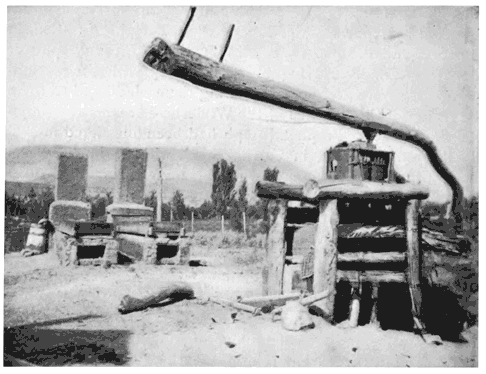
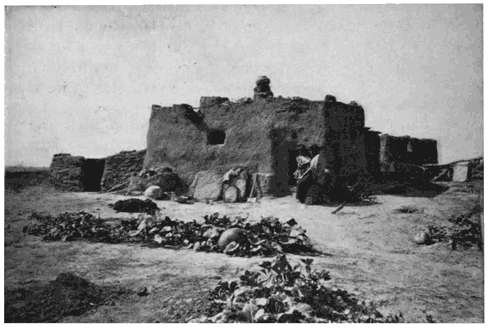
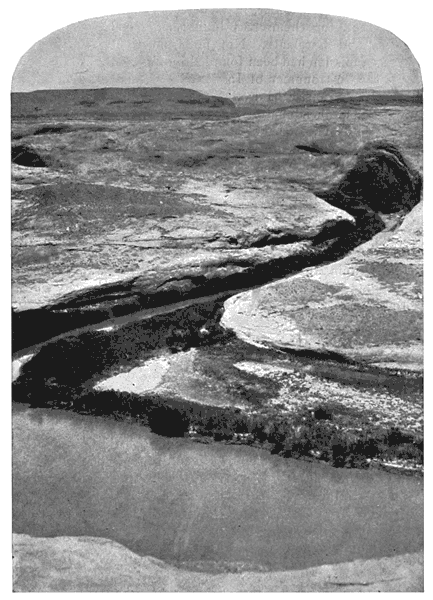
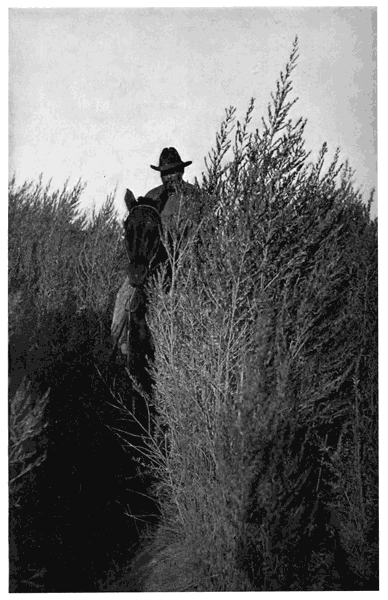
A Mormon Sorghum Mill and Evaporating Pans.
Photograph by F. S Dellenbaugh.
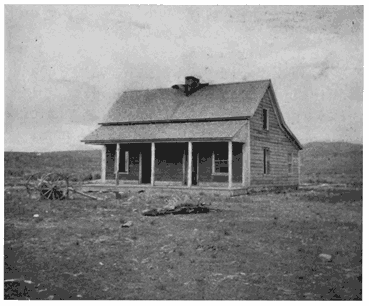
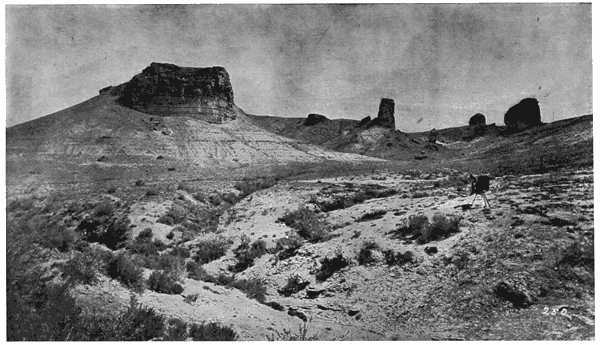
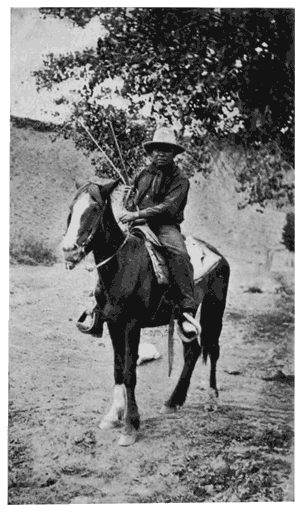
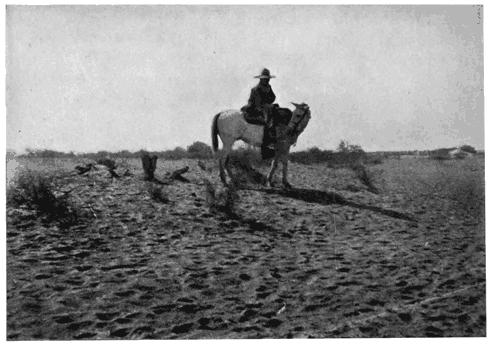
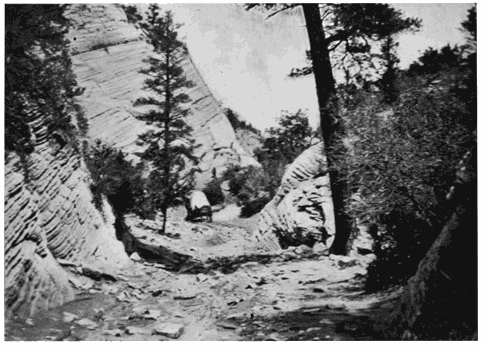
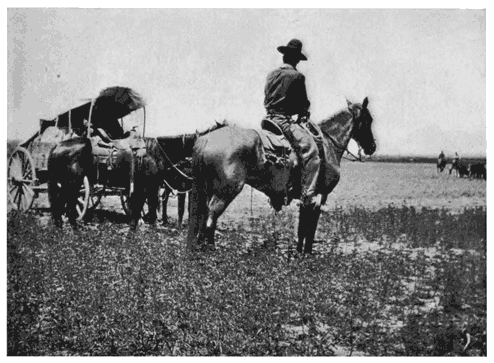
A Setback.
Photograph by F. S. Dellenbaugh.
It was not till July, 1847, they were able in numbers
to reach the Salt Lake, and doubtless the dry, barren, region
appeared discouraging. But Brigham Young, who followed a
little later, had not begun this move blindly. His astute mind
had shown him that irrigation by means of the mountain torrents
would transform into gardens the arid plains, exactly as
had been done in that dreamland of the Wilderness, the Rio
Grande Valley. At first the devotees of the Mormon faith
had a severe time, starvation was close to their thresholds, but
perseverance, grit, and industry gradually conquered the antagonism
of nature and the once forbidding valley was presently
offering the Latter Day Saints abundance; Salt Lake
City became a centre of order and prosperity. Other portions
from this as a base were brought under cultivation and the soil
was rendered prolific. It must be acknowledged that these
people were Wilderness breakers of high quality. They not
only broke it, but they kept it broken; and instead of the gin
mill and the gambling hell, as corner stones of their progress,
and as examples to the natives of white men's superiority,
they planted orchards, gardens, farms, schoolhouses, and
peaceful homes.[107] There is to-day, no part of the United
States where human life is safer than in the land of the Mormons;
no place where there is less lawlessness. A people who
have accomplished so much that is good, who have endured
danger, privation, and suffering, who have withstood the
obloquy of more powerful sects, have in them much that is
commendable; they deserve more than abuse, they deserve
admiration, no matter what may have been their shortcomings
in the earlier stages of their career.
The fortunes of the Mexican War, which the Mormons
helped to decide for the American arms, as far as they were
able, soon threw them again within the jurisdiction of the
United States, and eventually, in place of their desired State
of Deseret, Congress established the Territory of Utah, and
made Brigham Young first governor, an appointment which
should never have been made if the Mormons were as bad a
people as by some was maintained. By it the Government
really sanctioned the Mormon creed.
Besides the Mormons other sects pushed into the Wilderness.
The Methodists and Presbyterians were early in Oregon,
the first under the Lees and the second under Whitman. The
Catholics also began missionary work in that quarter, and their
chief worker was Father De Smet, whose name is forever
welded into the history of the Wilderness, by his earnest
labours for one thing, but more particularly by his careful observation
and the records which he made of all he saw. He
went everywhere in the northern parts of the Wilderness, always
welcome, always doing good, and never in danger. More
ought to be related here concerning his career, but the limits
of this volume prevent.
Meanwhile the settlers in California startled the sleepy atmosphere
of the old Mission régime; yet the region was so
inaccessible from the East that few ventured to go there. But
Fortune was holding something in reserve. A blindfold was on
all eyes; no one could see the future indicated by the discovery
of gold near San Fernando Mission. It had been washed out
as early as 1841, but only in a small way, and it was not till
one day in 1849, when nuggets were found in repairing a mill
race on Sutter's ranch at the mouth of the American River, that
the blindfold was dropped and the people saw. In a general
way this was the end of what may be termed the Frémont
period and the beginning of another, which was to have a
tremendous influence upon the destinies of the Wilderness.
Emigrants crossed the oceans; they crossed the Wilderness;
they came from round the globe by thousands and by thousands
again, to wash from the golden soil of California their
everlasting fortunes. It became a stampede.
There were two routes from the East. One, the northern,
by the Oregon Trail, and the other, the southern, by way of
the Santa Fé Trail, both starting from Westport, now Kansas
City. A few years before they had started from Independence,
some miles farther east. The Oregon Trail was followed as
far as Fort Bridger,[108] a post established by the famous trapper
of that name, on Ham's Fork in Green River Valley, 1843, and
also as far as the great bend of Bear River, when the immigrants
made for Salt Lake and thence by way of the Humboldt
to and over the Sierras; or south about on the trail of Escalante
and Jedediah Smith, till it struck the old Wolfskill (Spanish)
Trail, which was then followed down the west side of the
Wasatch Range to the Mountain Meadows on the head of
the Santa Clara, across the Beaver Dam Mountains, down the
Virgin nearly to the Colorado, and then across southern California.
From Santa Fé two routes were open; one by way of
the Gila and the other northward over Wolfskill's trail, the
"Old Spanish Trail," to Green River at Gunnison Valley,
and then across the mountains to join the other trail coming
down from Salt Lake not far from the present town of
Nephi. The northern route by the Humboldt was the one
most travelled. The interesting incidents connected with
these trails and the California gold rush would fill a volume.
There were battles, scalpings, starvation, captivity, and privations
of all kinds. Sometimes a whole family was destroyed
at one blow, as in the case of Oatman, who had
ventured on without company. He was attacked by Apaches
on the Gila, the slaughter being speedy and, as the murderers
thought, complete, excepting two daughters, whom they sold
to the Mohaves. A son, however, recovered sufficiently to
escape. One of the daughters died; the other was discovered
five years later by Henry Grinell, and was bought by him from
her Mohave owners and sent to her brother in Los Angeles.[109]
Another affair which stirred the outer world a few years
after this, 1857, was the "Mountain Meadows Massacre."
Just at this moment, owing to a quarrel between the Federal
Government and Brigham Young, a small army under Colonel
Albert Sydney Johnston, famous later as a Confederate leader,
was sent in a half-hearted and futile way against the Mormons.
This move was a great error on the part of the authorities, and
it hardly appears as if they were in earnest. Either a well-equipped,
powerful army should have been sent that could
have reduced the Mormons if they had done anything deserving
such treatment, which appears not to have been the fact,
or they should have been dealt with by arbitration and argument
as free-born citizens of the United States. The army
operations were a ridiculous fiasco, but nevertheless gave the
Mormons ground for the assertions that they were invincible.
A caravan of one hundred and fifty people from the Arkansas-Missouri
region was now on its way from Salt Lake to California
by the southern trail. Between people from that region
and the Mormons there had always been bitter feeling, and it
was now aggravated by the presence of the threatening army
and by contemptuous taunts which the immigrants are said to
have freely spread along their route, accompanied by vile
epithets. It is also said that they stole fowls and other property
and abused those who remonstrated. The result was
that when they reached Mountain Meadows, where they intended,
as was the custom, to rest before starting on the more
difficult journey beyond, they were attacked by a number of
natives and Mormon fanatics. The attack was a local matter
and had no authority then or afterwards from the officials
of the Church. The immigrants were well armed and made a
good fight, believing the attacking party to be natives all.
When the Mormon participants appeared on the scene and told
the Gentiles if they would lay down their arms the Mormons
would guarantee safe exit from the valley, they accepted the
proposition as an honourable one; they were anxious to spare
their wives and children further exposure. They went forth,
therefore, in confidence, but as they neared the south end of
the valley the miscreants, as treacherous as the lowest savage,
violated without compunction their pledge. The immigrants
were coolly butchered, for they were now helpless. Only a
few little children were spared, and John D. Lee, the leader
of the Mormon villains, perpetrated, according to account,
crimes unspeakable in connection with murder of the most
cold-blooded character.
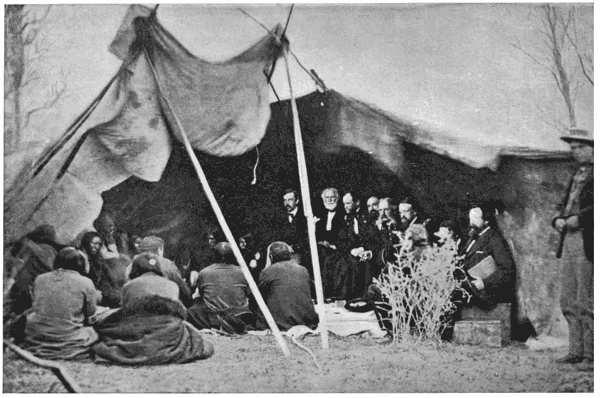
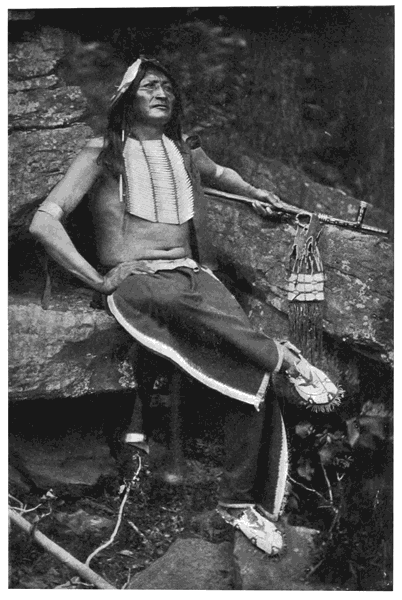
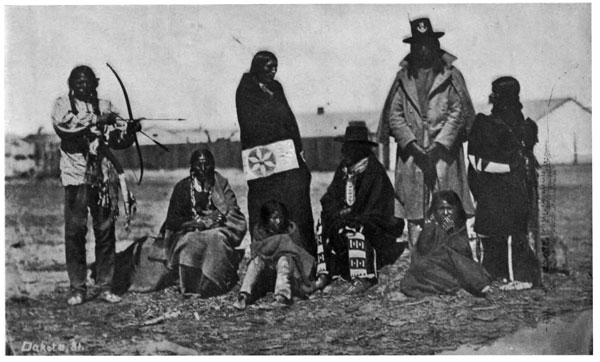
In Council.
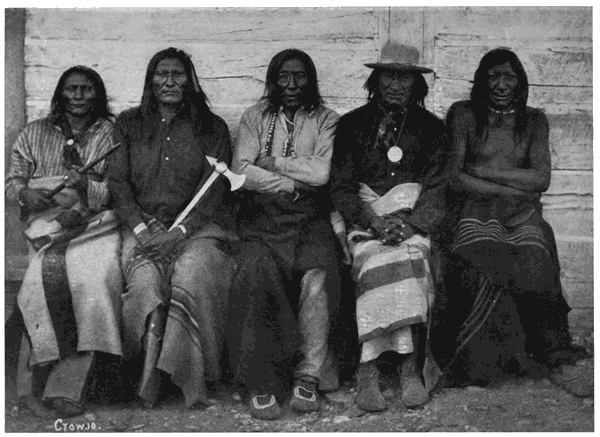
General Sherman Third from Left of White Group.
Photograph from United States Government.
A pile of stones was reared on the spot where the bodies
were buried, and as one looks down upon it to-day from the
waggon-road, which runs somewhat farther up the slope than at
that time, the grim spectres of Death and Dishonour appear
still to hover above the scene of blood; where savages were
put to shame in an exhibition of terrible depravity. A dismal
pall seems to pervade the once pure valley and doubtless always
will. At the north end the cutting of floods in the
stream-bed has destroyed a large part of the tillable soil, and
springs that once flowed abundantly have disappeared. Several
houses stand there, but they have a forlorn and dilapidated
appearance. The hand of Fate has laid a blight on
the place, and it will yet be many a long year before that
awful tragedy will not live again as the traveller passes over
the fatal road. No Mormon I have ever met thought for a
moment of excusing the action of the fanatics who led the
massacre. On the contrary, it has always been unequivocally
condemned.
Even Lee was at least ashamed of the part he played, and
he tried to persuade me in 1872 that he was innocent, that he
attempted to prevent the crime, and that he had wept when he
found it was to be done. Yet immediately after the event
he admitted to other Mormons that he had taken part. He
was "cut off" from the Church and for years lived an outlawed
life in the most inaccessible places, but he was caught and, in
1877, executed at the scene of his hideous deed. The massacre
was most unlucky for the Mormons, as the world refused to
believe that it was not secretly sanctioned. Unfortunately
for the poor immigrants one man who probably could have
saved them, and who certainly would have tried desperately
to do it, was absent from his home at the Meadows at that
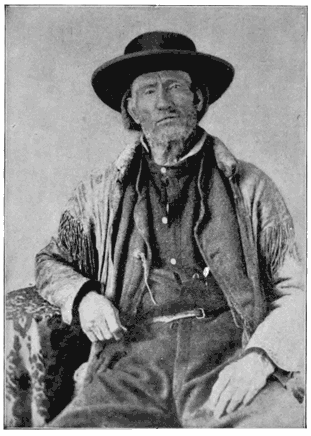
time, being on his way to Salt Lake. This was Jacob Hamblin,
the Leatherstocking of Utah, or "Old Jacob," as he was
familiarly called when I knew him some fourteen years after
the massacre. On another occasion when a fanatic, stationed
on the Muddy to assist immigrants, concluded to kill a
man, and said to Jacob, "This man must go up," Jacob answered,
"If he does I go up first, mark that," and the man
went free and never knew his danger; for it would have been
a reckless nature that would have dared to oppose the wrath
of Old Jacob.
Had he been at Mountain Meadows on that awful day
he would have saved the immigrants or would have died with
them.
Old Jacob was a remarkable character, and must hold a
place in the annals of the Wilderness beside Jedediah Smith,
Bridger, the Sublettes, and the rest of that gallant band. But
he differed in one respect from every one of them; he sought
no pecuniary gain, working for the good of his chosen people,
always poor and seeming to have no ambition for riches.
Honest, slow and low of speech, keen of perception, quick
of action, and with admirable poise and judgment, Old
Jacob was one of the heroes of the Wilderness, and one of the
last of his kind. Long ago I tried to persuade him to tell me
for publication the story of his life, but he then intended to
write it himself. Afterwards it was brought out by the Church
in the "Faith Promoting Series."[110]
In 1855 the Mormons had progressed far enough into the
southern Wilderness to settle on the Santa Clara near the Virgin,
and in 1861 they founded St. George, now the principal
town of that wide region. They also settled at Grafton and
several other places up the Virgin which winds its way through
a series of bounding cliffs that rival those of the Grand Canyon
of the Colorado.[111]
As yet few white men since Escalante, in 1776, had crossed
the great canyon barrier of the Colorado between the mouth
of the Virgin and Gunnison Valley on Green River, a distance
of about six hundred miles as the river runs. Escalante had
hunted out the fording-place of the Utes, some miles above
the mouth of the Paria, the only place in all that stretch where
fording is possible even at the lowest stage of water, which
occurs in the autumn and winter. The trapper, Richard
Campbell, as early as 1840, perhaps as early as 1827, knew of
the Crossing of the Fathers, as it was called because of Escalante's
venture, and he also knew that a trail from Zuñi went
there, but whether he had crossed is not clear. James O.
Pattie had travelled along near the canyon edge for a considerable
distance and finally reached Grand River, but his route is
obscure, for his narrative gives few details of this important
part of his remarkable journey from the mouth of the Gila to
the head of the Yellowstone in 1826. When the Mormons
reached southern Utah the whole length of the Green and
Colorado from Green River Valley to the mouth of the Virgin
was mainly unbroken Wilderness, only the extreme upper portion
having been entered by trappers and the lower part,
except the crossing of a few persons at the Escalante ford, was
a complete blank. Ashley had made no record of what he saw
in Red Canyon, and his voyage there was forgotten. Meek's
trip through Lodore on the ice was likewise forgotten, and
several other futile attempts to solve the mystery of the Colorado
were vague memories in the minds of the trapper fraternity.
Bridger and Carson had been near the upper canyons
from time to time, and once Bridger attempted to explore the
Green by following along the land, but soon gave it up for lack
of water. He and his companions could see the river, but
they could not get down to it. E. L. Berthoud, the engineer,
in 1861 also made an attempt, but gave it up after one day for
the same reason. There was, indeed, only one way to fathom
the secrets of this river, and that was to start above with good
boats and go down on the tide; but as yet no man had appeared
with sufficient nerve and good judgment to make a
successful attempt at it.
In 1861 Berthoud and Bridger explored a road from Denver
to Salt Lake by way of Middle Park, crossing the Green near
the mouth of the Uinta. This road was for the Overland
Stage Company. Owing to the Civil War the project was
abandoned, but a regiment of California volunteers marched
this way from Salt Lake to Denver. The distance was 413
miles;[112] and there was small record of the features of the Wilderness
through which the road ran. From the mouth of the
Colorado at the Gulf of California up to within a short distance
of Fort Yuma Lieutenant Derby, of the Topographical Engineers,
made an examination in 1851, and later that same year
George A. Johnson came to the mouth with supplies for
Yuma, constructing there some flatboats for the purpose of
transporting the cargo to the fort. The Gila at this time was
the southern boundary in this quarter of the United States,
but complications having arisen over an ill-defined portion of
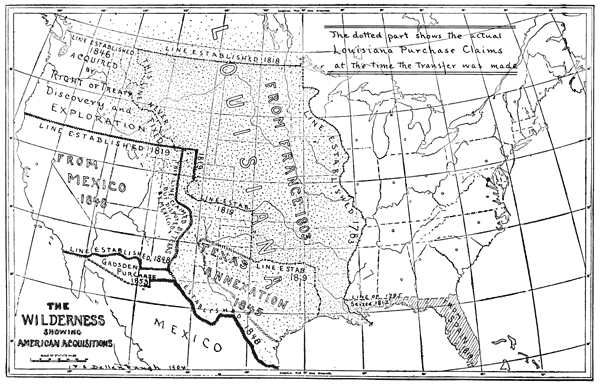
the line a new treaty was negotiated by Gadsden in 1853, by
which, for a consideration of ten million dollars paid to Mexico,
the boundary was placed where it is now. The mouth of
the Colorado was not included, though navigation privileges
were granted. The mouth of the river is of no value to Mexico
and ought to be purchased by the United States, although
the difficulty of navigation renders it of comparatively small
importance.
In order to arrive at the Yuma post, situated at the mouth
of the Gila, a steamer adapted to this kind of navigation was
brought by sea from San Francisco by Turnbull. This was to
ply between the fort and the Gulf at the mouth of the Colorado.
She was named Uncle Sam, and it was only a few months before
she struck a snag and went to the bottom. The power of
the river, the immense quantity of sediment brought down
and shiftingly deposited by every slack current, the earthquakes,
and the fierce tidal bore, rendered navigation anything
but easy. Turnbull gave up, but Johnson took the contract
for transporting the fort supplies from the Gulf and soon had a
new steamer in service, the General Jesup. This was followed
by a second, the Colorado, one hundred and twenty feet long.
Johnson became familiar with every bar and current and for
years continued skilfully to operate his boats. He knew the
history of that locality as perhaps no other man could know it.[113]
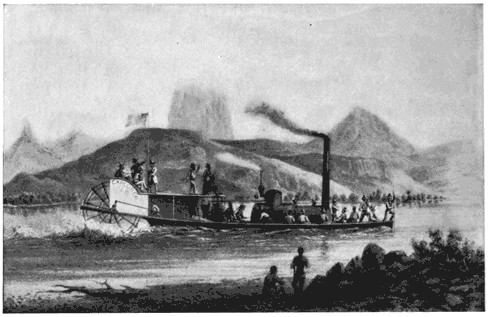
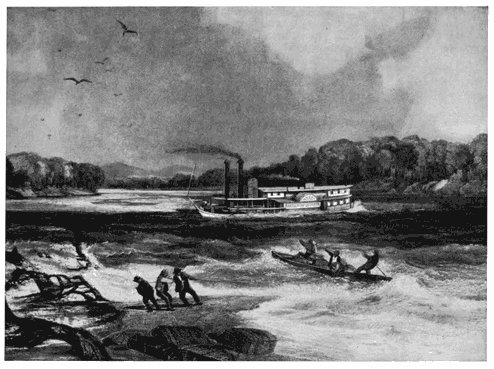
The Steamboat "Explorer" in which Lieutenant Ives, in 1858, Ascended the Colorado to
the Foot of Black Canyon.
Sketch by H. B. Mollhausen.
In 1851 Sitgreaves reconnoitred the country about on the
trail of Garces, and in 1854 Whipple, also for the Government,
explored along the 35th parallel. The mighty gorges carved
through the great plateau prohibited north and south travel,
for they were well-nigh impossible to cross except at the one or
two places mentioned. A mountain range of equal length and
of the greatest magnitude would not have offered so tremendous
an obstacle. In 1857 E. F. Beale surveyed a waggon-road
along the 35th parallel for the Government, and Johnson,
in his steamer, the General Jesup, went up from Yuma early
in January, 1858, to ferry Beale across on his return from
California. Before meeting Beale, Johnson pushed his steamer
experimentally on up the river to the head of Black Canyon,
the highest point attainable by steamers under the most
favourable conditions. He did this to expressly anticipate
the exploration planned by Lieutenant Ives, of the Topographical
Engineers, who, the month before, December, 1857, had
landed at the mouth of the river with sections of a steamboat,
The Explorer, built in Philadelphia, with which he intended
to find the head of navigation and also map the river. Ives
conducted this survey with skill and accuracy, and while Johnson's
manœuvre took from him the distinction of first ascent,
nevertheless he remains the first explorer of the river in this
region. He went to the foot of Black Canyon with his steamer
and thence to the head of Black Canyon with a small boat.
He visited the Grand Canyon at the mouth of Diamond Creek,
the Havasupai Canyon, and also the Moki Towns. His report
is a model of graceful diction, but many of the illustrations
are preposterous. In 1866 Captain Rodgers took the
steamer Esmeralda, ninety-seven feet long, drawing three and
a half feet of water, up to Callville, not far below the mouth
of the Virgin.
The Mormons were desirous of opening a road to communicate
with the region east and south of the Colorado, especially
that the "Lamanites" might be able to come from there and
receive endowments in the temple of St. George according to
prophecy. Brigham Young directed Jacob Hamblin to undertake
this journey, and in the autumn of 1857 went with a
party under the guidance of a native to the Ute Ford, or
Crossing of the Fathers, where Escalante had broken the way
eighty-one years before. Successfully traversing this difficult
passage, possible only at a very low stage of water, he and his
eleven companions reached the Moki Towns in safety. Nearly
every autumn after this saw Jacob wending his way to the
same region, but not always without disaster. In 1860 the
party was turned back south of the river and one of their number,
young Smith, killed by the Navajos. In 1862 Jacob tried
another route to reach the same locality, going to the Colorado
by way of the Grand Wash, south-westerly from St. George.
At the river they built a boat and safely passed over. Then
they went south and east below the great chasm to the San
Francisco Mountains, suffering greatly for water in that arid
region. Crossing the Little Colorado they finally arrived at
the towns of the Mokis. But on the return Jacob followed his
original route by way of the Crossing of the Fathers, and was
thus the first white man to circumtour the Grand Canyon.
The next year he went again by the Grand Wash trail, touched
at Havasupai Canyon, and arrived once more among the
friendly Mokis, three of whom had accompanied him back to
Utah on the last trip. On this 1863 journey he was accompanied
by Lewis Greeley, a nephew of Horace Greeley, who
had come down from Salt Lake with letters from Brigham
Young. It was not till six years later that a crossing was
made at the mouth of the Paria, now Lee Ferry, still the chief,
I might almost say, the only available crossing between Grand
Wash and Gunnison Valley. Jacob Hamblin was the first to
go that way. The river is deep and a raft or boat is necessary
to transport goods.
In seeking a hiding-place John D. Lee found this point desirable
and settled there early in 1872, building a log cabin and
cultivating some ground. He began the ferry by helping
several persons across the river, the first being J. H. Beadle,
who had written a severe denunciation of him. Lee told me
he discovered Beadle's identity, but I have forgotten exactly
how. Lee called the place "Lonely Dell," and it was a name
well applied, for the precipices of naked rock rose high on every
side, and about a hundred miles separated the locality from
Kanab, the nearest settlement of any consequence.
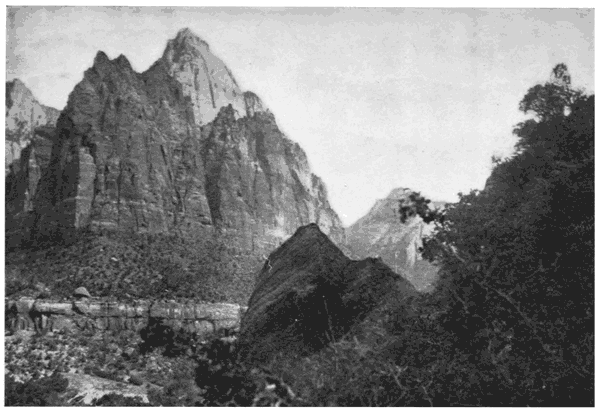
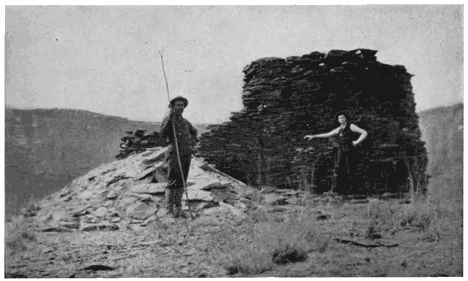
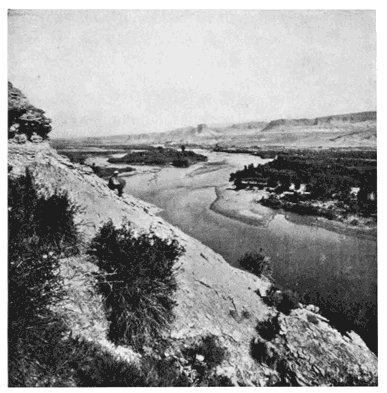
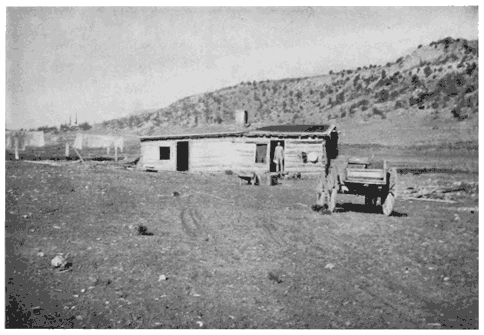
Where the Wilderness Lingers.
Photograph by F. S. Dellenbaugh.
Though the canyons of the Colorado had now been crossed
midway of the great six-hundred-mile stretch, and farther
north near Green River Valley had far back in the century
been penetrated to a limited extent, almost nothing was
actually known about them. Even at the most favourable
points approach to the brink was extremely difficult, and descent
to the water generally impossible. On each side the
country was for many miles forbidding wilderness, for the
journeys of the trappers, where they had penetrated, had left
no impression. It was as if no white man had ever looked
upon it. They were thus the final great problem of the Wilderness.
A stout heart was required to launch forth into their
unfathomed mystery, particularly as by this time numerous
tales of underground channels, fearful cataracts, and chasms
impossible of passage, went the rounds of the camp-fires. For
a time the Civil War withdrew attention from Western exploration,
but when it was ended one of the officers, who had gone
through the weary four years, and who wore in consequence
an armless right sleeve, turned his attention once more to his
scientific studies, and finally found himself, in 1867, exploring
in the Parks of Colorado. Here he learned of the wonderful
and forbidding canyons of the great river, saw some of the
minor tributary gorges, and also met and employed a rare
mountaineer, Jack Sumner, also a veteran of the Civil War.
Sumner says he suggested to Powell the descent of the canyons.
At any rate, Powell became enthused with a desire to
explore this remnant of the original Wilderness, and Sumner
was a more than willing companion in the scheme. Organising
an expedition Powell started from Green River Station,
Wyoming, in the same valley where the early trappers had so
often made their rendezvous, and which had also been the
resting-place for the California pioneers. He was a geologist
and his experienced eye and quick judgment doubtless soon
disclosed to him the probable nature of the interior of the canyons;
the probability that no insurmountable obstacle existed
to prevent his triumphant descent through the whole series.
But while he believed the canyon mystery could be solved he
went at it with no spirit of bravado. With him it was serious,
scientific business, solely for the purpose of determining the
geologic and geographic character of the mighty gorges in
which the river lost itself. As the difference between the
altitude of Green River Station and that of the mouth of the
Rio Virgin was known to be some five thousand feet, there was
clearly room for realisation of all the fantastic tales of the
mountaineers.
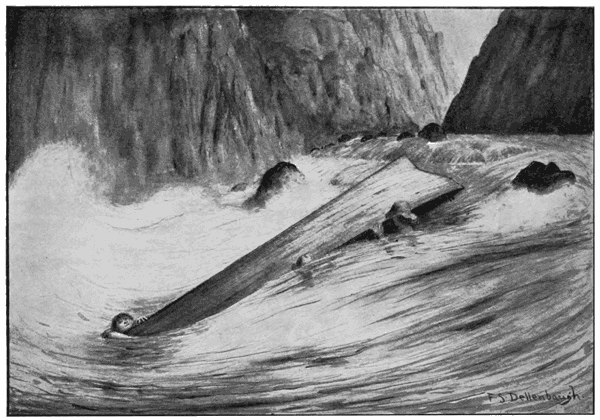
Running the Colorado.
Drawing by F. S. Dellenbaugh.
On May 29, 1869, with four staunch boats built in Chicago,
manned by nine men besides Powell, the party set forth on
the swift current from Green River, Wyoming. They were
soon deep in the fastnesses of the canyon wilderness where
the plunging river roared defiance. As has before been mentioned
Ashley had passed through Red Canyon, one of the
first of the great gorges. Meek in winter on the ice had gone
through Lodore and the gorges just below it, and a party of
trappers had been wrecked in Lodore in attempting the descent.
The latter made their way to Salt Lake, where they
worked on the temple which the Mormons had begun. This
canyon of Lodore had disaster in store for Powell too. One
of the boats was wrecked, though fortunately not a man was
injured; but the accident produced trouble, as Powell blamed
some of the men for blundering, and they blamed him for failing
to signal in time.
When they reached Wonsits Valley one of the men, Goodman,
who was in the wreck, decided that he had had enough
of this river and made his way across country to the Uinta
Agency. The precipices soon closed in again to form the
ninety-seven miles of the Canyon of Desolation,[114] immediately
followed by thirty-six miles now called Gray Canyon before
an opening occurred. This opening was Gunnison Valley,
through which Wolfskill in 1830 had led the way, breaking
the "Spanish Trail" to California. It is from this point downward
for six hundred miles that no opening occurs in the cliffs
that bound the river. They become higher or lower, slightly
farther apart or nearer together, and there are lateral canyons
and minor breaks, of course, but there is no valley along the
river, and in places for miles on either side the surface of the
country is only barren sandstone. The cliffs reach altitudes
of three, four, and five thousand feet above the water of the
river. In these great depths men are as completely shut away
from the world as if they were in the very bowels of the globe.
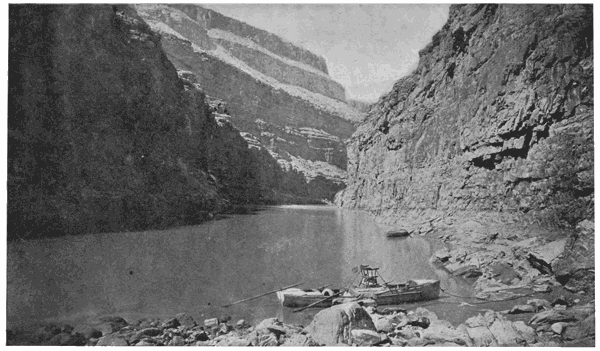
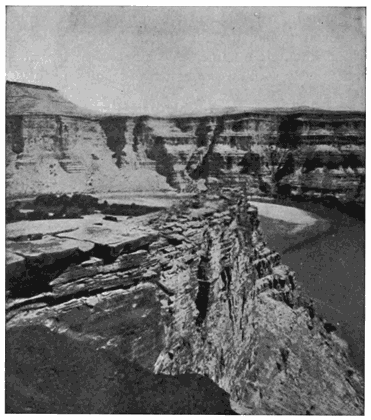
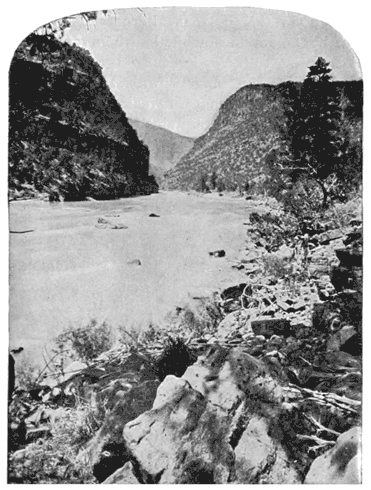
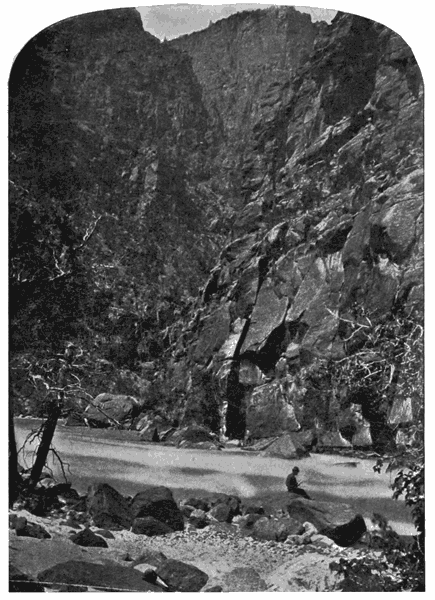
Upper Part of Marble Canyon—Colorado River.
This gorge merges into the Grand Canyon at the mouth of the Little Colorado. The length of both together is about 300 miles.
The first to travel this distance were Powell and his men, 1869.
After passing through Labyrinth and Stillwater canyons
the Powell party found themselves at the mouth of Grand
River, which entered the main stream in a canyon thirteen
hundred feet deep, and they were at the same time in the head
of another great gorge, later named Cataract Canyon. Any
one who follows their trail will admit the appropriateness of
this title. The length is forty-one miles, the walls reach an
altitude of twenty-seven hundred feet at the highest, and in
some of the bends are so straight as to give an impression of
overhanging the spectator's head as he peers aloft from his
boat to the sky so far above. At least that was the impression
I received. The verticality of the rocks was greater to
my eye here than at any other point. For some distance the
declivity of the river bed is the sharpest on the whole course,
and this with the narrowness of the canyon began to disturb
Powell and lead him to fear that some of the stories of impassable
falls might be true. Fortunately no insurmountable obstruction
was encountered, and they swept triumphantly on
through Narrow Canyon and Glen Canyon to the head of
Marble, the real beginning of the greatest gorge of all, at the
point where Jacob Hamblin crossed a month or two later in the
same year, and which to-day is known as Lee Ferry.
Now there was before the party the greatest continuous
chasm on the globe, Marble-Grand, almost three hundred miles
in length as the river flows. Here they met with the hardest
work and greatest danger. They became worn out; food grew
scarce, for accidents and wetting had reduced too rapidly the
original supply. Then it seemed as if they could not proceed,
and the men who had been wrecked in Lodore were not reconciled.
Another joined them and, discontented, the three refused
to attempt a particularly bad rapid. They climbed to
the plateau and were killed by the natives not far from Mount
Dellenbaugh. The others, nerving themselves for a desperate
struggle, passed the bad place, swept on through more, and
emerged triumphant the next day, at noon, August 29, 1869,
at the mouth of the Grand Wash, and the end of the Grand
Canyon. The victory was won—the last problem of the
Wilderness was broken!
From this point down the river was known. Jacob Hamblin
with several others had passed from here by boat to Callville,
and thence to the sea Ives had explored as already noted.
It was a dramatic triumph over the angry and rock-walled
stream which for three hundred and twenty-nine years, since
the Spanish captain, Cardenas, first looked into the deeps of
the Grand Canyon, had defied mankind. Powell and his men
were nearly exhausted by starvation-diet and exposure, but the
exhilaration of success sustained them, and help was near.
Brigham Young, hearing rumours of disaster to the expedition,
had sent instructions to some Mormons at the mouth of the
Virgin to keep a sharp watch for wreckage and to render any
assistance possible, and also for extra food to be taken there.
The day after emerging from the great gorge they came to
these men, Asa and his two sons, and enjoyed abundance of
food and the sight once more of friendly faces from the outer
world. The following day Bishop Leithead and two or three
other Mormons arrived in a waggon with more supplies, including
some fine melons, and the explorers were treated with
every kindness.
Powell left the river here, but Jack Sumner and the others,
except Walter Powell, went on down by river to Yuma
where Sumner and Andrew Hall wintered, going the next
year to the Gulf, the first and, so far as I have heard, the
only human beings ever to accomplish the entire voyage from
Green River Valley to tidewater. Sumner was a born trapper,
hunter, and prospector, and at last accounts was still roaming
the mountains engaged in these pursuits, another of those
extraordinary characters that belong to the original Wilderness
and will never live again. He knew Bridger, Baker,
Carson, and others intimately and had met Frémont and
Bonneville.[115]
When Powell, with his brother Walter, arrived at St. George
he went immediately to the post-office eager to get the mail
he had directed to be sent to this point.
"By whose authority," indignantly exclaimed the postmaster,
"do you come here asking for Major Powell's mail—Major
Powell is dead."
"By the best authority in the world," returned the Major.
"I am Major Powell."
"But Major Powell is dead," reiterated the official. Something
then about the ragged, haggard man shook his confidence.
He said: "What evidence have you?"
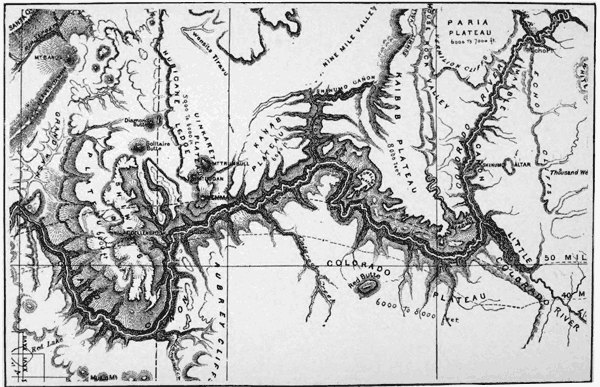
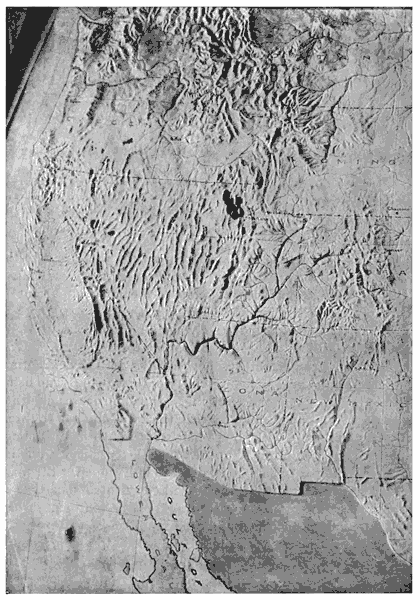
The Grand Canyon Region.
"This," replied the Major, holding up the empty sleeve.
"I left this arm at Shiloh." He got the mail.
Powell would hardly have been able so speedily and successfully
to accomplish this feat had it not been for an event
which was contemporaneous,—the construction of a transcontinental
railway. This enabled him easily to place strong
boats and supplies on the banks of Green River. His great
voyage, which marks the end of the Wilderness, and the completion
of the railway, marking the beginning of an entirely
new epoch, occurred the same year. The rivers of the Wilderness
were not available for practical transportation. Those
east of the Backbone were circuitous and for the most part
too shallow for boats of much draft; those west were torrential.
Hence the necessity of the Iron Trail. In the search for the
best route for such a trail to bind the Hudson to the Golden
Gate a great many admirable surveys were made. Every one
of the expeditions was profoundly interesting and intimately
connected with Wilderness breaking, but it is not practicable
here to describe them.
The route finally selected was up the Platte, across Green
River Valley, to Salt Lake, down the Humboldt, and over
the Sierra Nevada to Sacramento and San Francisco. The
idea of putting a railway through the Wilderness was early
conceived, but owing to numerous obstacles and difficulties
as to route to be followed and as to finances, although the
numerous surveys were made, nothing definite was done.
As far back as 1850 Senator Benton, of Missouri, introduced
a bill authorising portions of road to be constructed with gaps
where it was supposed a line was not possible. In 1853 Congress
appropriated $150,000 for six surveys to be executed by
the War Department. The next year $190,000 more were appropriated
for three additional surveys. It is thus apparent
that Congress appreciated the importance of a line through
the Wilderness which should bring the Pacific Coast with its
now rapidly developing interests closer to the seat of Government.
In the dissension which began to rend the country
concerning the slavery question and State rights, there was
danger of secession in that direction as well as at the South.
The military importance of such a railway was beyond discussion.
General Sherman, who knew the conditions thoroughly
and had gone in 1846 to California, declared the Government
could well afford to build the whole line and would make money
by the operation, as it was indispensable for the transportation
of troops and supplies.
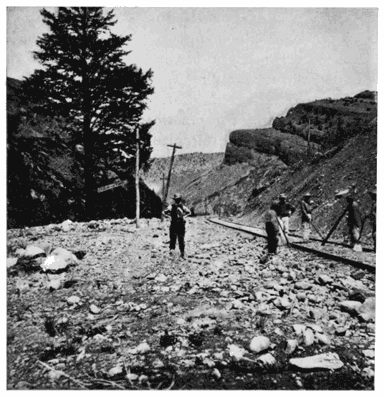
The Thousand Mile Tree.
A hemlock 1000 miles from Omaha.
Photograph by C. R. Savage.
In July, 1862, Congress, though burdened with the terrific
war problem, passed the Pacific Railway Bill authorising the
construction of a continuous line from the Missouri River to
the Pacific Ocean. Two private companies were then formed
to build this line—the Union Pacific for the eastern part and
the Central Pacific for the western. These companies were to
receive Government aid as follows: 1. A free right of way 400
feet wide. 2. An issue of Government bonds amounting to
one half the cost of the road. 3. An absolute gift of ten
alternate sections of land per mile (12,800 acres) on each side
of the line. 4. Privilege of using coal, iron, etc., from the
region through which building operations extended. 5. To
receive on completion of continuous sections of 20 miles the
bonds of the United States as follows: A. Between the
Missouri River and eastern base of mountains, about 650
miles, $16,000 a mile. B. Across the Rocky Mountains, 150
miles, $48,000 a mile. C. Across the Great Basin, $32,000
a mile. D. Across the Sierra Nevada, 150 miles, $48,000 a
mile. E. To San Francisco, about 120 miles, $16,000 a mile.
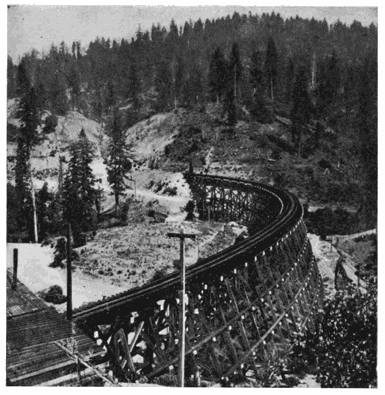
Secret Town Trestle.
1000 feet long. Maximum height, 90 feet.
Photograph by C. R. Savage.
The Government also obliged itself to extinguish the title
of Amerinds to all lands donated. The State of California
assumed the interest for twenty years on $1,500,000 of the
Central Pacific bonds, assistance estimated as the equivalent of
$3,000,000 in gold. San Francisco gave $400,000 and Sacramento
donated 30 acres of land. The aggregate of land given
to the two companies was ten million acres. Thus it seems
that the Government practically paid for the whole line. It
would have been better if it had built the road without the
intervention of the companies. About two miles a day was
made in track building, then considered rapid work. The
chief contractor was J. S. Casement, and William Dodge was
chief engineer. The workmen lived in trains which were
pushed ahead as fast as the road advanced and were supplied
with plenty of rifles and ammunition for protection against the
Sioux and other roaming tribes. These hovered about like
vultures, choosing opportune moments for attack. The assistant
engineer, P. T. Browne, with his party, was fired on sixty
miles west of North Platte. They fought for about two hours
against seventy-five natives. Browne was killed.
Sometimes the Amerinds destroyed the track, captured
trains, killed engineers, firemen, brakemen, and telegraph linemen.
They also would destroy the telegraph line and carry
off the wire. In fact, they were a constant terror and menace.
But when denouncing them nobody remembers the swindles
perpetrated on them in former years, nor the bad whiskey
which impoverished them and brutalised them and won their
furs for a bagatelle. Their attitude was largely the result of
the earlier treatment they had received from the whites, as
well as of all the bad white blood which had been infused into
the tribes. One of the worst affairs was the Plum Creek massacre.
William Thompson, an Englishman, a telegraph man,
was sent out with a party of five to hunt up a break. They
started about nine o'clock one evening and when they reached
the place a pile of ties was discovered on the track for the
purpose of wrecking a supply train nearly due. Barely had
this discovery been made when Thompson and his men were
attacked by the enemy. They fired back and then ran. One
of the natives on a horse pursued Thompson, shot him through
the arm, and then knocked him down with a clubbed rifle.
Next he stabbed him in the neck to finish him, and immediately
began the operation of removing Thompson's scalp. As
Thompson was far from dead the prospect was not agreeable,
but a movement would have brought death. His only chance
was to keep quiet and let the work go on, and he was able to
do this notwithstanding the pain. But when the scalp was
jerked loose he thought his whole head was off, and then felt
as if a red-hot iron had been passed over his crown.
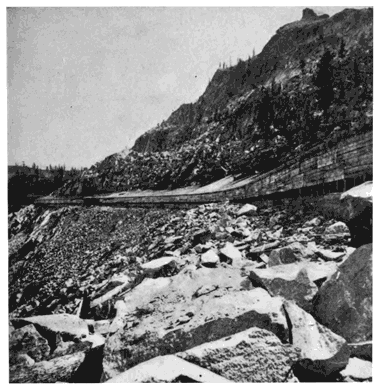
Snow Sheds in the Sierra.
Photograph by C. R. Savage.
The native tucked the scalp in his belt and mounting rode
hastily away, but in doing so dropped the scalp and its owner
picked it up. Thompson was obliged to remain quiet while
the band piled more ties on the track. Presently he heard the
distant rumble of the train. It was impossible to do anything
to prevent the wreck. In a few moments the cars were piled
in a heap. The engineer and fireman were shot and scalped;
the train was ransacked by the light of a huge fire. A barrel
of whiskey was opened and all got drunk. When daybreak
came they set the whole wreck on fire and gleefully danced
around it. When they were finally gone from the scene
Thompson crawled away and at length reached Willow Island
station, where a rescuing party found him. People came from
all around to see his ghastly baldness. He was taken to a
hotel where a doctor dressed his wound. "In a pail of water
was his scalp, about nine inches in length and four in width,
somewhat resembling a drowned rat as it floated curled up on
the water." Such were the incidents due to the wild tribes
which constantly harassed the builders of this iron trail.
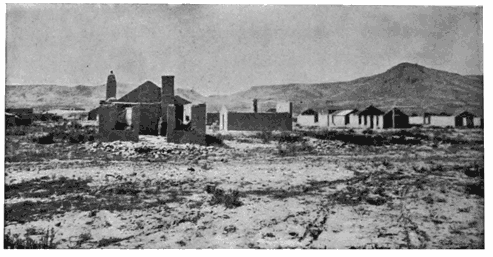
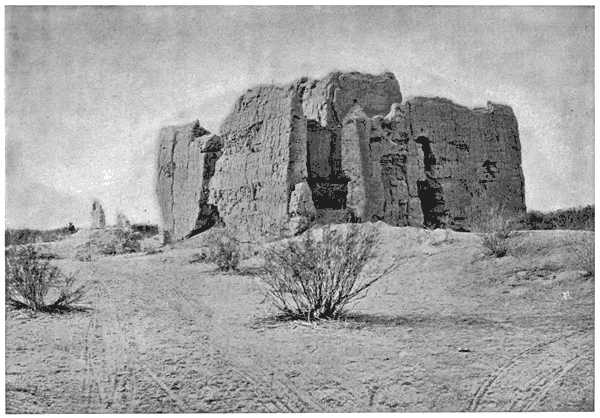
Adobe Ruins of Green River—Union Pacific Terminus.
Photograph, 1871, by E. O. Beaman, U. S. Colo. Riv. Exp.
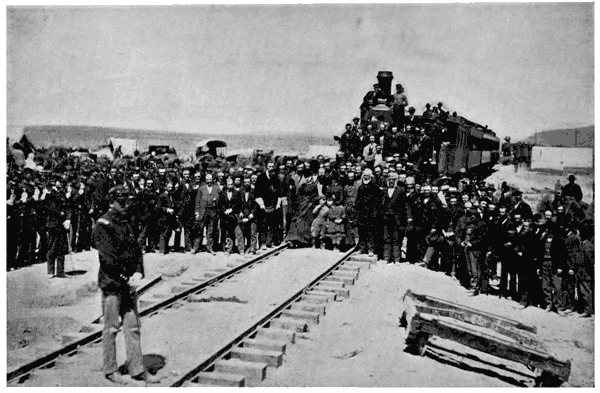
Scene before Driving the Last Spike—Promontory Point, Utah, May 10, 1869.
John Duff in front, immediately beneath engine. Sidney Dillon at his left. The Reverend Doctor Todd asking a blessing.
Photograph by C. R. Savage for the Union Pacific Railway.
But these savages were little worse than those who composed
a large part of the population of each terminus. They
had different methods, that was all. Whiskey flowed free and
drunkenness was, as usual with our European race, the great
recreation. Gambling dives and grog shops made up a large
part of the mushroom town that grew up at each official end
of the track. All manner of people, like birds of prey, flocked
to these places to secure a share of the money paid to the
workers, who were numbered by thousands. Some buildings
were fairly substantial, but there were many that were merely
board sides with a canvas roof. Others were "dugouts," that
is, holes in the ground roofed over with sticks and earth; in a
side hill if possible. There were large numbers of tents.
Where there were vertical clay banks along a dry water course,
or a stream, these were burrowed into near the top, a square
chamber being made seven or eight feet long, five or six high,
and four or five deep, the outer side being closed by a blanket
or canvas hung from the upper edge. Rents were high and
any shelter at all was valuable.
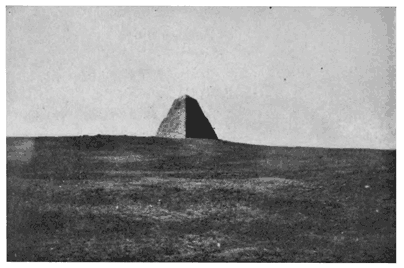
The Ames Monument—Union Pacific Railway.
Photograph by F. S. Dellenbaugh.
From time to time, as progress of the line demanded, the
official terminus was moved on. From Grand Island it jumped
to North Platte, then to Julesburg, then to Cheyenne, and so
on, in some cases leaving a permanent town of considerable
proportions behind. In the case of Cheyenne a city of five
thousand sprang out of nothing, and there were three newspapers;
but in some instances the advance left behind only a
wreck looking as if a tornado had swept that way. Remnants
of old clothes, boards, straw, broken furniture, thousands of
tin cans, empty bottles, etc., strewed the ground in all directions.
At Green River a number of adobe houses were built,
the ruins of which were still standing at the time of my first
visit to that locality in 1871. Even two or three miles up the
track I found dugouts and a large amount of wreckage to remind
one of the late "prosperity." The life at these places
had all the most vicious
qualities of our civilization,
and few of its good
ones. There were no
policemen, and the state
of disorder may be imagined.
It was a feverish
nightmare of horrors, in striking contrast to the sobriety of the
life the Mormons brought to the Wilderness.
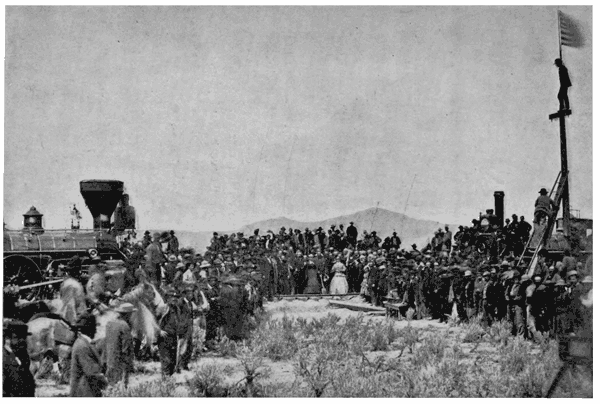
Driving the Last Spike, 3.05 p.m., New York Time, May 10, 1869.
Locomotive "Jupiter" of the Central Pacific, and "119" of the Union Pacific, about to meet when last spike is driven.
Photograph by C. R. Savage for the Union Pacific Railway.
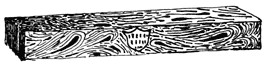
The Last Tie.
Union Pacific Railway, 1869. Made of California
laurel, polished, and with a silver plate on the side.
Three years after the beginning of the great work, which it
was thought would require ten, the day came when the ceremony
was to be performed that should complete the engineering
triumph. On May 10, 1869, two engines at Promontory
Point, Utah, were brought head to head, a half-world at each
back, as Bret Harte said, only a small space intervening, where
the crowd gathered to witness the driving of the last spike
which should bring far seas together and mark an end and a
beginning. There was a prayer by the Reverend Doctor Todd.
The last tie, of California laurel, beautifully polished and bearing
on one side a silver plate with names of officers engraved
upon it, was then laid. Two rails were next placed opposite
each other, one for the Union, the other for the Central
Pacific. Following this was a presentation of spikes on the
part of California, Nevada, and Arizona. Governor Stanford
responded for the Central Pacific, and General Dodge for the
Union Pacific. With a silver hammer for driving the last
spike, presented by the Union Express Company, Governor
Stanford stood on the south rail, while Dr. Durant, to drive
another, stood on the north one. At a signal that the telegraph
was ready these spikes were driven, the last one, the
golden spike of the Central Pacific, being connected with the
telegraph so that the strokes of Stanford's hammer were repeated
all over the country, and at the final blow "done" was
sent to the waiting world. The crowd cheered; Dr. Durant
and Governor Stanford shook hands. Telegrams of congratulation
were received. General Dodge, the engineer in chief,
and Jack and Dan Casement, the chief contractors, were the
heroes of the hour. The work was finished.
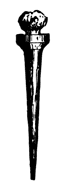
The Last Spike.
Union Pacific
Railway.
Made of gold.
The operation of building this line partly belongs to the
romantic period of Breaking the Wilderness, but when that last
spike of gold was sent home and the engines met
upon the rails a new and different epoch began.
Scarcely less fascinating, up to this moment, have
been its events, but this volume is not for them.
The trail of the iron horse, which would annihilate
the vast distances of the Wilderness, where
the life blood of so many had softened the way,
was an accomplished fact. The new era was at
hand. Europe and Cathay stood at last face to
face, in the midst of that once "northern
mystery" which was the dream of the gold-hunting
conquistadore. The Seven Cities of
Cibola had long ago vanished, but the rich cities
of the Republic were building in their place, and wealth beyond
the wildest imagination of the early adventurers was
now to flow from every corner of the broken Wilderness.

A Modern Fast Train.
From Wonderland, 1901. Northern Pacific Railway.
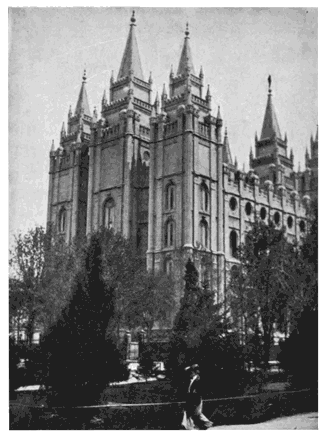
The Mormon Temple—Salt Lake City.
Photograph by F. S. Dellenbaugh.