BRAZILIAN GOLD MINE MYSTERY
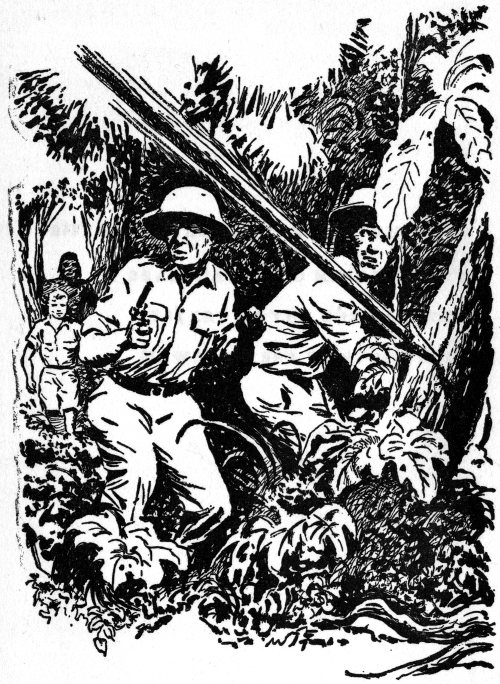
“Biff, come this way! Quick!”
A BIFF BREWSTER
MYSTERY ADVENTURE
By ANDY ADAMS
GROSSET & DUNLAP PUBLISHERS
NEW YORK
© GROSSET & DUNLAP, INC., 1960
ALL RIGHTS RESERVED
MANUFACTURED IN THE UNITED STATES OF AMERICA
Whole book · 23 sections
“Biff, come this way! Quick!”
A BIFF BREWSTER
MYSTERY ADVENTURE
By ANDY ADAMS
GROSSET & DUNLAP PUBLISHERS
NEW YORK
© GROSSET & DUNLAP, INC., 1960
ALL RIGHTS RESERVED
MANUFACTURED IN THE UNITED STATES OF AMERICA
“Guard this letter as you would your life!”
Mr. Stannart spoke in a low, tense tone as he glanced around the waiting room at Idlewild Airport. Biff Brewster felt a sudden surge of excitement when he took the envelope that the gray-haired man handed him.
The envelope was tightly sealed, and it was addressed to Biff’s father, Thomas Brewster, at the Hotel Jacares in Manaus, Brazil. In the upper corner was the return address of the Ajax Mining Corporation in New York City. Gregg Stannart was the president of the company, and Mr. Brewster was its chief field engineer.
“Since you are flying to Brazil to join your father,” Mr. Stannart continued, “I decided to have you deliver this letter personally, rather than take the risk of its falling into the wrong hands.”
He paused, gave Biff a keen, steady glance, and asked, “Did your father tell you why he was going to the headwaters of the Amazon River?”
“He wrote that he was going on a jungle safari,” replied Biff, “and he invited me to fly to Brazil and join him, as a birthday present.”
Biff was thinking back to his birthday party at the Brewster home in Indianapolis less than a week ago. His mother had brought in a cake with sixteen lighted candles that Biff had blown out with a single puff, to the delight of the twins, Ted and Monica, who were five years younger than Biff. But the big surprise was when Biff’s mother had given him the birthday letter from his dad.
Next had come the excitement of packing, when it dawned on Biff that nearly all his birthday presents were clothes and equipment he could use on a tropical trip. Then Biff had flown to New York where Mr. Stannart had met him to put him on the plane for Brazil.
“Your father is bound on a highly important and secret mission for our company,” Mr. Stannart confided now. “He is going far up the Rio Negro, which joins the Amazon just below the city of Manaus. The party supposedly will be looking for sites for rubber plantations.”
Mr. Stannart paused, then said solemnly, “Your father will be looking for gold—a fabulous gold mine about which we have secret information. But here in New York,” he went on, “we have just discovered that there has been a leak in that information. We have learned that certain people would do anything to stop your father and get to the mine first. Even now, he may be in danger.”
“But Dad didn’t say anything about it—”
“Because he doesn’t know about it. He may change his mind about letting you accompany him after you give him this letter. It will tell him all he needs to know.”
Biff put the letter deep down into his coat pocket. Mr. Stannart nodded approvingly.
“Be careful what you say to strangers,” he warned Biff, “and above all, guard that letter!”
It was nearly time for the departure of Biff’s plane. Mr. Stannart explained that it would take him to Belem, the capital city of the Brazilian state of Para, not far from the mouth of the Amazon. There, Biff would change to a plane for Manaus, a thousand miles up the great river.
Mr. Stannart studied the other passengers who were waiting to board the plane. He said to Biff in parting, in a low but confident tone:
“You won’t have any trouble on this flight. But be careful after you leave Belem!”
The long trip south did prove uneventful. During daylight, the plane was over the Atlantic Ocean, and darkness had settled when it reached the coast of Brazil. Biff landed in Belem at dawn, so it wasn’t until he had changed to the plane for Manaus that he gained his first view of the Brazilian jungle.
He saw it from a seat beside the window as the plane climbed above Belem; a vast, solid mass of billowing green that looked ready to swallow the city that spread below. Then the jungle ended, and the plane was flying over a huge expanse of brownish water streaked with waves of white. This was the Amazon River, stretching as far as the eye could see.
A smooth voice purred from beside Biff’s shoulder:
“It looks more like an ocean than a river, doesn’t it?”
Biff turned to meet the gaze of the smiling man sitting beside him whose eyes looked sharp even through his dark-green glasses. The large lenses gave an olive hue to the sleek, oval face that narrowed to a pointed chin.
“O Rio Mar,” the smiling man continued. “That is what Brazilians call the Amazon. It means ‘The River Sea’ in Portuguese. Do you understand the language?”
“A little,” replied Biff, “but I know Spanish better.” He was about to add that he had learned both from his father. Then, remembering Mr. Stannart’s warning to be careful when he talked to strangers, Biff stated simply but truthfully:
“I have been studying Spanish in school.”
“You will need to speak Portuguese,” the man declared, “if you are stopping off anywhere between Belem and Manaus.” He paused inquiringly. Then, getting no response, he added, “If you go farther up the Amazon or any of its tributaries, you will need to know the dialects of Indian tribes as well.”
The stranger’s easy, persuasive tone almost caused Biff to remark that he was going on beyond Manaus. But he caught himself in time and said nothing.
“You may have to talk fast, too,” Biff’s fellow passenger continued. “Those tribes are often dangerous. You are sure to find head-hunters among them.”
This time, Biff asked a question.
“Have you been among the head-hunters, sir?”
The stranger’s smile widened. “My name is Serbot, Nicholas Serbot. And yours?”
“Bruce Brewster. My friends call me Biff.”
Nicholas Serbot inclined his head politely. “No, I have never been among the head-hunters, Biff. I come to Manaus occasionally to do business for some European concerns that I represent. Mostly in rubber.”
“My dad is in Manaus,” Biff volunteered. “I’m meeting him there.”
“Perhaps he will take you on a jungle safari. They organize such trips in Manaus.”
“That sounds great!” exclaimed Biff. “I’ll mention it to Dad!”
“Tell him to inquire at the Hotel Amazonas,” suggested Serbot. “Meanwhile”—he leaned toward Biff as he spoke—“you may find the scene below quite interesting.”
They had reached the head of the Para River, the principal mouth of the Amazon, sixty miles above Belem. The plane was thrumming over a gigantic carpet of thickly tufted green, furrowed by a maze of irregular streams.
“The region of the Thousand Islands,” Serbot explained. “Those channels that twist through the solid jungle are called the Narrows. They come from the main course of the Amazon, and most of them are deep enough to be navigable.”
Below, Biff saw an ocean-going freighter working up through a watery passage. It looked like a toy boat from this altitude, and occasionally it was swallowed by the thick foliage that jutted over the channel, only to emerge from the green arcade.
Soon the boat was far behind, and Biff watched the narrow channels widen and merge into a limitless, white-capped sea—the great Amazon itself. Serbot’s purring voice, and the steady drone of the plane’s motors had a lulling effect. Biff’s eyes closed to avoid the glare of the tropical sun; soon he was asleep. He dreamed that he was back at Idlewild, with Mr. Stannart’s voice repeating:
“Guard this letter as you would your life! Guard this letter....”
In the dream, invisible fingers seemed to be plucking the precious envelope, drawing it up and out of Biff’s pocket. With a sudden start, Biff awoke and shot his own hand to his pocket, where it met the crinkle of paper.
The dream had been realistic in one respect. As he dozed, Biff must have kept slumping down into his seat, causing the envelope to work upward every time he hunched his shoulders. A few inches more and it would have fallen from his pocket.
Or was that the answer? What if those phantom fingers had been real instead of mere figments of a dream!
As he thrust the envelope far down into his inside pocket and buttoned his coat for safer keeping, Biff Brewster shot a suspicious glance toward his companion of the plane trip, the smooth-spoken man who called himself Nicholas Serbot.
Biff was wide awake now, the drone of the plane growing louder in his ears. With it, his suspicions of Serbot faded. The smiling man was leaning back in his seat, his own eyes closed as if in sleep. His hands were folded loosely across his stomach.
For the first time, Biff saw why Serbot wore that constant smile. The left side of his mouth was curled to match the right, which was drawn upward by a scar that began at the corner of his lips and became increasingly jagged until it ended beside his right eyebrow.
Before, the large rims and green tint of the sun glasses had helped to hide the scar; but Serbot had removed them before he went to sleep. Now, as Biff studied him, Serbot opened his eyes slowly and gave Biff a sleepy glance. Realizing that Biff had observed the scar, Serbot raised his right hand and traced it lightly with his forefinger.
“A decoration I received during World War Two,” he commented, “while I was working with the French Underground. A Nazi spy tried to give me this—” Graphically, Serbot swept his hand across his throat—“but I managed to save my neck. I received this instead.”
Serbot clenched his left fist as though it contained a weapon. He grabbed his left wrist with his right hand and shook his head.
“If anyone attacks you with a knife or gun, don’t try to stop him that way,” he said. “It won’t work fast enough, as I found out. Hit his wrist like this”—Serbot opened his right hand, bent it backward, and drove it against his left wrist—“with the heel of your hand, upward and outward. Try it.”
Biff practiced the action a few times and apparently won Serbot’s approval, for the smiling man added:
“That not only will stop him, it will jar the weapon from his grasp, enabling you to snatch it all in the same move.”
Serbot demonstrated that, too. Then, noting that some of the other passengers were beginning to look their way, Serbot changed the subject abruptly. Leaning toward Biff, he began pointing out more sights from the window, as the plane followed the north bank of the river.
There, the jungle had opened into widespread grazing lands, studded by a range of low, flat-topped mountains. Perched on one summit was a little town that Serbot said was called Monte Alegre. Then they were far out over the river again, and the Amazon once more resembled a choppy, yellow sea, until the order came to “Fasten safety belts!” The plane was coming to a landing at Santarém on the south bank.
Serbot pointed out to Biff the wide Tapajóz River which disgorged a huge flood into the turbulent Amazon, splotching the yellow tide with long streaks of green that looked like wash from the jungle and shone with emerald brilliance in the noonday sun.
The plane roared off again, and at Obidos, eighty miles farther upstream, the Amazon narrowed to a single deep channel only a mile and a quarter wide with the walls of solid forests fringing both bluffs. Later, the river widened again, and Serbot indicated small settlements built on high stilts in clearings back from the bank.
“Those show you how high the river rises,” Serbot told Biff. “Often it overflows its banks for many miles on both sides. Some of the native villages are so far off in the jungle that they can only be reached when the Amazon is in flood.”
Between pointing out these interesting scenes, Serbot talked occasionally of his war experiences, and Biff, wide awake and alert ever since his morning nap, was enjoying the trip more and more. He realized that he was gaining a slight preview of the Brazilian jungle that might prove helpful when he and his father set out on the safari that was actually to be a gold hunt. But he was careful to avoid answering any direct questions that Serbot put to him.
It was late afternoon when Serbot indicated a great, dark swirl of water that merged with the muddy Amazon, marking the mouth of another huge tributary.
“The black water of the Rio Negro,” defined Serbot. “From here it is only ten miles up to Manaus.”
Soon, the plane landed at the Manaus airport, and a few minutes later, Biff was being welcomed by his father, a tall, rugged man with dark hair and tanned, square-jawed face, an older counterpart of Biff himself, except for the boy’s blond hair. But when Biff looked around for Mr. Serbot, hoping to introduce him to Mr. Brewster, he found to his surprise that his companion of the plane trip had already gone.
Biff and his dad talked about the family and everything at home while they were picking up Biff’s luggage. Mr. Brewster then led the way to a jeep that he had parked outside the airport. Before they started their drive into the city, Biff drew the sealed envelope from his pocket and handed it to his father with the comment:
“Dad, this is from Mr. Stannart. He told me to guard it carefully, that it is very important.”
Mr. Brewster tore open the envelope, and Biff watched his expression change as he read the letter. His lips set tightly above his firm jaw, Mr. Brewster thrust the letter into his own pocket; then he started the jeep. Keeping a sharp eye along the rough road, he asked:
“Did Mr. Stannart mention what was in the letter?”
“In a way, he did,” rejoined Biff. “He said we were supposed to be going with a rubber-hunting expedition, but that actually we would be looking for gold—”
“You didn’t mention that to anyone, did you?” interrupted Mr. Brewster anxiously. “I mean, while you were on the plane?”
“I only talked to a man named Mr. Serbot,” returned Biff, “and I even played dumb when he suggested that you take me on a safari. He said we could make arrangements at the Hotel Amazonas.”
Biff saw his father’s taut expression change to one of relief. Mr. Brewster spurted the jeep over a watery stretch of road with the comment:
“These jeeps have to be real puddle jumpers. You never know how deep some of the mud holes are.”
The road improved as they swung into the city. It was then that Mr. Brewster asked:
“Did Mr. Stannart tell you that there might be serious danger, now that other persons are after the mine?”
“Yes, he said you must be warned.”
“I suppose that is why he let you come,” mused Mr. Brewster. “Frankly, I feel he made a mistake, and I should send you straight home. However, if we keep far enough ahead of trouble, it may not catch up with us.”
Mr. Brewster ended with a reassuring smile.
“I’ll tell you the story from the start,” he said. “During World War Two, two prospectors, Lew Kirby and Joe Nara, gave up hunting gold and diamonds down in the state of Minas Geraes and came up the Amazon to help gather rubber. They put their profits into food and supplies and kept going north to look for a fabled land of gold—a land called El Dorado.”
“El Dorado! We learned about him in American History!” Biff exclaimed. “It sounded crazier than science fiction. Wasn’t El Dorado supposed to be a king who came out of a lake with his body all covered with gold?”
“Originally, yes,” returned Mr. Brewster. “Then the story became a legend of a golden city and finally a golden land. The Spaniards looked for it, and so did Sir Walter Raleigh.”
“But nobody ever found it!”
“Nobody except Lew Kirby and Joe Nara.”
Sure that his father was joking, Biff expected a chuckle to follow. But Mr. Brewster was very serious.
“They uncovered a fabulous Inca mine,” resumed Mr. Brewster. “It was too far and too difficult to bring the gold down the Amazon. So they worked their way to the Orinoco River, which brought them out through Venezuela.
“Kirby sent Nara back to the mine and then returned to Minas Geraes, hoping to find someone to help finance the claim. But people either didn’t believe his story, or they were the sort he wouldn’t trust. But he trusted me and I believed him—when he gave me these.”
Mr. Brewster brought out of his pocket some small samples of ore that fairly glistened with gold. Biff had learned enough regarding mining and minerals from his dad to recognize the value of these specimens. In an awed tone Biff asked:
“Is there much of this in the mine, Dad?”
“A whole mountain full,” replied Mr. Brewster, “from what Lew Kirby told me—before he died.”
The jeep was rolling smoothly now along a boulevard lined with fig trees, all neatly trimmed to a mushroom shape. But the story of the fabled gold mine interested Biff more than the sights of Manaus.
“Lew gave me a map,” continued Mr. Brewster, “showing the route that he followed to reach the headwaters of the Orinoco, though it does not give the exact location of the mine. To learn that, we must find Joe Nara. I hope that no one else finds him first.”
“Like the persons mentioned in Mr. Stannart’s letter?”
“That’s right, Biff. Despite Mr. Stannart’s constant urging, the directors of the Ajax Corporation have been painfully slow in providing funds for our trip. Meanwhile, Mr. Stannart says in his letter, certain foreign interests have learned of the mine and have moved into the picture. They may be the sort who will stop at nothing to get that mine!”
Before Biff could ask more questions, the jeep pulled up beside a modest, low-built structure that bore the sign: HOTEL JACARES. Looking about, Biff was surprised to see that it was growing dark and that the street lamps were already aglow.
“Night falls swiftly here in the tropics,” explained Mr. Brewster, as they went through the hotel lobby and up the stairs to the second floor. “That is why I lost no time coming from the airport. The driving is difficult after dark.”
Mr. Brewster unlocked the door of his room, turned on the light, then halted in amazement. The place was strewn with clothes from his suitcases. Sheets had been ripped from beds and mattresses cut open. Papers were scattered everywhere.
In a corner was a framed mirror hanging above a washstand. Mr. Brewster hurried over, took down the mirror, and laid it on a table beside a closet door. He pried away the backing of the mirror and brought out a sheet of paper that had been hidden there.
“This is what they were after!” he exclaimed. “The one thing they couldn’t find! Kirby’s map!”
As Mr. Brewster spoke, the closet door was opening slowly, but it was behind his shoulder and he didn’t see it. From the crack slid a long, bare human arm, and a hand reached for the prize that Mr. Brewster flourished. Frantically, Biff shouted:
“Dad! Look out!”
Mr. Brewster swung about at Biff’s warning, an instant too late. The hand had already clutched the map and was snatching it from his grasp. The map tore apart, leaving only a corner in Mr. Brewster’s hand.
Quickly, Biff’s father dove for the closet door, intending to slam it and trap the occupant, map and all. But the man in the closet moved swiftly, too. He flung the door wide, and its edge swept past Mr. Brewster’s fingers as the man dived under his arm. Biff, crouched low, was about to stop the intruder with a football tackle when Mr. Brewster overtook the fugitive, applied a powerful arm-hold, and brought him full about.
Biff saw that the struggling man’s face was masked behind a large, knotted bandanna handkerchief, and that his rough, baggy clothes disguised his height and weight. As he twisted in Mr. Brewster’s grasp, the man managed to thrust his hand into the folds of his jacket and whip out a revolver. Coming about, he aimed point-blank at Mr. Brewster.
Biff’s father dropped away a split second before the revolver barked, its muzzle tonguing flame inches above his head. Then, before the masked man could fire again, Mr. Brewster wheeled about, grabbed a small table with both hands, and flung it bodily at his masked foe.
The man darted out of the way, only to find Biff blocking his escape. Biff heard a snarl from behind the bandanna, and saw the glint of the gun barrel as the man swung the weapon with a savage, downward stroke. Instinctively, Biff shot his own hand upward, using the trick that Serbot had shown him on the plane that very day.
The heel of Biff’s hand caught the man’s wrist, driving it outward. The impact jolted the gun from his hand, but the weapon scaled toward the side of the room and clattered near the bottom of the wall, where Mr. Brewster sprang across and scooped it from the floor, practically on the rebound.
The masked man hadn’t tried to retrieve the gun. Instead, he dashed through the doorway to the hall, still clutching the stolen map. Biff raced after him, with Mr. Brewster close behind. They might have overtaken the fugitive if he had gone down the stairway to the lobby, but instead he chose a shorter route to a large open window at the other end of the hall. There, he leaped a low railing, carrying a loose screen with him. When Biff reached the window and looked down into the dark, the man had vanished in the thick mesh of tropical foliage that had broken his fall.
“No use trying to go after him,” decided Mr. Brewster ruefully. “We don’t even know the direction he has taken. The hotel clerk will have heard the shot. We’ll let him report the incident to the police. They’ll figure it was just a sneak thief.”
“But what about the map?” Biff inquired anxiously. “How will you find the route to the Orinoco without it?”
“I still have the corner that shows the mine itself,” declared Mr. Brewster, holding it for Biff to see. “And Joe Nara would have to guide us there anyway.”
Biff’s father frowned. “We may have trouble getting through to the Orinoco, if someone tries to block our way. But from there on, it should be smooth sailing. Mr. Stannart says in his letter that he will bring his yacht to meet us on our way back, and will sign the agreement with Nara, then and there.”
Returning to their room, Biff and his father met the manager of the hotel hastening up the stairs. Mr. Brewster told him briefly that they had surprised a sneak thief in their room, and handed over the intruder’s revolver. With profuse apologies, the manager departed after Mr. Brewster refused his offer to have the room put in order.
When they were alone, Biff’s father said, “It was neat, the way you disarmed that fellow. Where did you learn that trick?”
“From Mr. Serbot,” replied Biff, “the man I met on the plane coming from Belem.”
While they were repacking Mr. Brewster’s bags and clearing up the room, Biff told his father about the things they had discussed on the plane. Mr. Brewster listened intently, then asked:
“Did you tell Serbot that I was stopping at this hotel?”
“Positively not,” returned Biff. “He couldn’t possibly have learned it—unless—”
“Unless what?”
“Unless he saw the envelope,” exclaimed Biff in a hollow tone. “It nearly worked out of my pocket while I was asleep. Mr. Serbot might have drawn it out that far. When I looked at him, though, he was asleep, with his hands folded.”
“Playing innocent, perhaps. Did he seem to make a habit of folding his hands?”
“No, that was the only time I saw them folded. Dad”—Biff’s tone became worried—“do you think Mr. Serbot read the address on the envelope and phoned someone from the airport, and told them to come up here?”
“I wouldn’t be surprised,” his father asserted grimly. “The envelope has the return address of the Ajax Mining Corporation, and that would identify us to anyone who is trying to beat us to the El Dorado mine. But let’s not jump to conclusions just yet.”
Mr. Brewster had finished packing his bags. He picked them up and nodded for Biff to bring his, too.
“We’ll send these out to the airport,” Mr. Brewster declared. “There’s a plane going up the Rio Negro at dawn, and our luggage can go on it. We may take that plane, or perhaps a later one. We’ll see.”
They made arrangements with the hotel porter to handle the baggage. After that, Mr. Brewster decided that they should go out for dinner so Biff could see the city. Once on the lighted streets of Manaus, Biff realized how futile it would be to look for the baggily clad man who had stolen the map. Dozens of workmen who passed them were dressed in similar attire, even to a bandanna worn as a neckerchief.
The gay life of the tropical city impressed Biff. There were brilliantly lighted downtown cafés, and Mr. Brewster chose one where they were served half a dozen courses of tasty, highly seasoned food, finishing with ice cream that Biff thought was the best he had ever eaten. He had just swallowed the last spoonful when he suddenly exclaimed:
“Look, Dad! Those two men sitting at that table in the corner! One of them is Mr. Serbot!”
Mr. Brewster had no difficulty in picking out Serbot from Biff’s earlier description, though the scar on the smiling man’s cheek was scarcely visible in the soft light of the café. Serbot’s companion was shorter and chunkier, with a broad face, quick, narrow eyes, and straight lips.
“Introduce me on the way out,” Mr. Brewster told Biff. “I would like to size up that pair.”
A few minutes later, Biff’s father was shaking hands with Serbot, who immediately introduced his stocky companion.
“This is Senhor Armandeo,” stated Serbot. “Pepito Armandeo, known as Grande Pepito, or Big Pepito, as you would call him in English. He is a famous wrestler.” Smoothly, Serbot changed the subject. “You have a very intelligent son, Senhor Brewster. I enjoyed my trip with him. You are interested in rubber, Senhor?”
“What else,” asked Mr. Brewster, “would bring me to Manaus?”
Serbot’s response was a noticeable increase of his perpetual smile. He bowed as he made the parting comment:
“Perhaps we have mutual interests, Senhor.”
Outside the café, Mr. Brewster spoke reflectively.
“Perhaps Serbot and I do have mutual interests,” he said. “In something bigger than rubber. Something like gold.”
They climbed into the jeep, and Mr. Brewster drove past the Amazonas Theater, the magnificent opera house that had been built when Manaus was a boom town in the jungle. Mr. Brewster mentioned that to Biff as they went by; but Biff realized that his father was thinking of something else. Finally, he said:
“I am not surprised that you suspected Serbot. He strikes me as being very shrewd. I am doubtful of his friend, Big Pepito, too.”
“Then maybe Serbot sent Pepito to steal the map!”
“Don’t jump to conclusions too quickly, Biff.” Mr. Brewster smiled as he spoke. “I still can’t understand how Serbot could have learned so much. Nobody knew my plans except Mr. Stannart.”
“What about the directors of the Ajax Company, Dad?”
“Once they agreed, they gave Stannart full say. Our dealings were confidential. Stannart sent me funds to buy safari equipment which I shipped here to Manaus ahead of me.”
“Mr. Serbot talked about safaris on the plane trip.”
“So you told me, Biff.” Mr. Brewster frowned. “I’m beginning to think that somebody found out about our plans here in Manaus. Pepito, for instance, could have learned of the safari shipments and sent word to Serbot. But Hal Whitman should have suspected something and informed me.”
“Hal Whitman? Who is he, Dad?”
“The man who received the shipments here. He assembled them secretly in a boathouse a few miles up the river. Later, he loaded all the supplies and took them far up the river to an old landing above Santa Isabel. He is waiting there for us to join him.”
Mr. Brewster halted the car at an intersection and pondered for a few moments. Then he said:
“Somebody could have snooped around that boathouse after Whitman left. They might have learned where the shipments came from and perhaps gained some link between Whitman and myself. If we go out there, we might pick up some clue ourselves. It’s worth a try.”
Mr. Brewster headed for the outskirts of the city. The road became rougher, and he was handling the jeep in its best puddle-jumping style as he added:
“Maybe some spies are still around the boathouse, trying to learn what else they can. In that case, we can surprise them. If the boathouse is empty, we can wait inside it and see if anyone shows up later.”
As the jeep swung beneath an arch of trees, Biff was startled by what looked like human figures jumping from bough to bough in the glow of the moonlight. Mr. Brewster laughed.
“Just monkeys. Don’t let them worry you. There is the boathouse. You can see our headlights reflected in its windows.”
Mr. Brewster cut off the headlights as he spoke, but oddly, the reflection persisted for a few moments more. Biff thought it was his imagination, but his father decided otherwise.
“Someone is moving around inside with a flashlight,” he whispered. “The boathouse is on pontoons to allow for the rise and fall of the river. If we reach the gangplank first, we can trap them before they come ashore.”
Silently Biff and his father slipped out of the jeep and crept forward beneath overhanging boughs that Biff could hear creak above him.
This time, he was thinking about people in the boathouse, not monkeys in the trees. He was watching for a flashlight instead of looking up into the moonlight. That proved to be a bad mistake.
Two living human figures dropped from the branches like massive rubber balls, one taking Biff as a target, the other landing squarely on Mr. Brewster. In their hands, these silent, shadowy attackers carried thin ropes that they looped around the necks of their victims as they flattened them.
Biff heard his father give a short, gurgling cry. Then Biff was gasping as the cord tightened around his own neck. Next, his captor clapped a cloth to his face, and Biff was stifled by a strong, pungent odor that completely overpowered him. His head seemed to burst with stabs of flashing light that turned to utter blackness as his senses left him.
Thrumm—thrumm—thrumm—thrumm—
As Biff awakened, the steady sound made him think that he was back on the plane above the Amazon. He opened his eyes expecting to see the yellow sea far below.
Instead, he saw black water streaming past the side of a boat, churning white as it scudded back into the distance. When he turned his head, he saw his father beside him.
They were propped against some boxes near the front of a long cabin cruiser, which had a permanent top stretched like a canopy over its large, open cockpit, making it ideal for tropical travel. But there was nothing ideal about Biff’s present plight.
Biff’s hands were bound in back of him by a rough cord that chafed his wrists. His ankles, too, were tightly tied. At a glance, Biff saw that his father was in a similar situation. The thin, tough rope around Mr. Brewster’s ankles looked like a tropical vine.
Biff tried to speak, but he found his lips too dry, his throat too parched. He caught a warning headshake from his father, and following the direction of Mr. Brewster’s gaze, Biff saw two chunky men, clad in baggy, sleeveless shirts and old khaki trousers cut off at the knees.
The pair were standing guard like patient watchdogs, looking for any move from the captives. They had black, straight hair and coppery skin; those features, plus their stony, immobile expressions marked them as Indians from the headwaters of the river, which, from its blackish color, could only be the Rio Negro.
One Indian spoke in a guttural dialect, and a shrill voice responded from up ahead:
“So they’re awake now? Good! Igo, you take the wheel.”
One Indian moved forward. Moments later, a scrawny man with a crafty, wizened face beneath a shock of whitish hair, stepped into sight. To the other Indian, he piped:
“Ubi, you stay here. You help me watch.”
Then, tilting his head in birdlike fashion, the white-haired man studied the prisoners and demanded:
“What were you two doing around that boathouse?”
Mr. Brewster kept his lips tightly closed, his eyes staring straight back toward the frothy wake from the cruiser’s propeller. Biff, too, ignored the question.
“Maybe you’d talk if I gave you a drink of water,” the scrawny man suggested, “and maybe I ought to toss you in that big drink out there”—he gestured toward the river—“and let you try to swim ashore. You wouldn’t get far, tied like that.”
The stolid silence of the Brewsters annoyed the white-haired man. His voice rose to a still higher pitch:
“I mean it, every word of it! I’ll find a way to make you talk, as sure as my name is Joe Nara!”
Biff almost gulped the name, “Joe Nara!” before he caught himself. Then he heard his father speak calmly in reply.
“If you are really Joe Nara,” stated Mr. Brewster, “I’ll tell you all you want to know. Only I don’t believe that you are Joe Nara.”
Oddly, the wizened man’s anger faded. His own tone became even as he asked, “And why wouldn’t I be Joe Nara?”
“Joe Nara is a husky chap,” returned Mr. Brewster, “with dark hair, a bit gray, but not white. He’s tough, but he doesn’t get angry and excited. He has too good a sense of humor.”
Biff saw a twinkle in the wizened man’s eyes. The scrawny face relaxed in a genuine smile. In a soft, faraway tone, he asked, “And who told you all that?”
“Joe Nara’s partner, Lew Kirby, before he died.”
“So Lew is dead. I was afraid of that.”
As he spoke, the wizened man’s expression became very sorrowful. He gestured to Ubi, and the Indian cut the crude ropes that bound the prisoners.
“I am Joe Nara,” the white-haired man said. “I’ve grown a lot older in the years since I saw Lew Kirby last. Kind of lost my sense of humor, too, living upriver with nobody but Indians to talk to. What’s your name?”
“Tom Brewster. And this is my son Biff.”
Mr. Brewster extended his own hand, palm up. Old Joe Nara slapped his own hand palm downward, meeting Mr. Brewster’s with a solid whack, followed by a tight grip to which Mr. Brewster responded firmly.
“That’s how Lew and I always shook hands,” declared Nara. “I guess you and Lew were friends all right, or he wouldn’t have shown you that grip.”
Ubi was bringing gourds of water. Nara waited until Biff and his father had slaked their thirst. Then, with a chuckle, the white-haired man remarked:
“I guess Lew must have told you about the time he and I went to Lake Titicaca down in Peru to look for Inca gold?”
“No, Kirby never told me that,” returned Mr. Brewster, “because you never went there. He said you planned the trip but gave it up. You came up this way instead.”
“And where would we have found gold near the headwaters of the Rio Negro?”
“I can tell you in two words: El Dorado.”
That convinced Joe Nara. He opened a door beneath the short forward deck and revealed a compact kitchen galley. He heated up a pot of feijoada, a Brazilian dish of black beans cooked with dried meat. With it he served bowls of mandioca, a mush made from the pulp of the cassava.
Simple though the fare was, it tasted so good that Biff eagerly accepted the second helping that Nara offered him.
“I was really hungry,” said Biff. “I feel as though I had been asleep for hours.”
“You were,” returned Nara. “That stuff you inhaled is a secret Indian brew that acts like chloroform. Gives you an appetite, though, when you do wake up.”
“And just why,” asked Mr. Brewster dryly, “did you happen to try the stuff out on us?”
“I’ll tell you why,” asserted Nara. “Every now and then, I come down from the mine with Igo and Ubi to buy supplies. Whatever I buy, I pay for with these.”
From his pocket, Nara brought some small nuggets of pure gold which clinked heavily when he trickled them from one hand to the other.
“People have been trying to trail me back up to the mine,” continued Nara, “so I bought this boat, the Xanadu, from a rubber outfit that had gone broke. I decided to come downriver to see who was spying on me. Before I even got to Santa Isabel, I saw a crew unloading supplies at an old abandoned camp.”
“Whitman’s crew!” exclaimed Mr. Brewster. “I sent them up the Rio Negro to wait for me, so I could start on a safari to find your mine.”
Nara gave an understanding chuckle.
“I had Igo and Ubi talk to the natives,” Nara said. “They learned that the expedition had started from a boathouse outside of Manaus. So I came all the way down the river to look into it. We were watching the boathouse when you came along.”
“So you thought we were enemies—”
“Not exactly enemies,” corrected Nara. “Just suspicious characters. After Igo and Ubi grabbed you, I decided to bring you along. Now that you’ve explained yourselves, I’ll turn around and take you back down to Manaus if you want.”
“Now that we’ve started upriver,” decided Mr. Brewster, “there is no need to go back. We sent our luggage on to Santa Isabel by air, and we intended to take a plane ourselves. But now we may as well keep on with you.”
All that day, the Xanadu sped swiftly up the Rio Negro. Biff took his turn at the wheel and was pleased by the way the cruiser handled. At intervals, the river became so thick with islands that it reminded Biff of the famous Narrows that he had seen from the air above the lower Amazon. But here on the Rio Negro, the channels were shallow as well as twisty. Still, Biff found no difficulty in guiding the sleek craft through the maze.
“The Xanadu was built to order for this river,” Nara told Biff. “That’s why I bought her. Be careful, though, when we reach that island dead ahead. The channel appears to split there—”
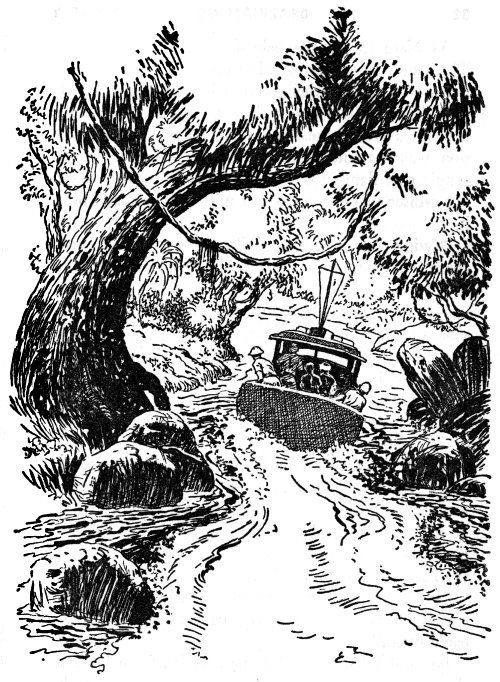
The Xanadu thrummed upriver
As Nara spoke, the palm-fringed island vanished. The whole sky had opened in one tremendous downpour. Biff couldn’t believe that it was only rain. He thought for the moment that the Xanadu had come beneath a tremendous waterfall. Adding to the illusion was the sudden rise of steam from the heated jungle that flanked the channel. Instantly, the speeding cruiser was shrouded in a mist that swelled above it.
“Swing her about!” shrilled Nara. “Our only chance is to turn downstream before the flood hits us!”
Mr. Brewster stepped up and took the wheel. Instead of taking Nara’s advice, he sped the boat straight upstream, picking his course in an amazing fashion. Somehow, he must have gauged the exact position of the threatening island, for he veered past it. New channels seemed to open with each swerve of the cruiser’s bow.
Biff’s father had seen Navy service in the South Pacific and was familiar with jungle waterways as well as tropical storms. As a Lieutenant, Junior Grade, he had been trained specially for jungle fighting and had won medals for bravery, finally leaving the service as a Lieutenant Commander.
“It’s better to buck the current,” Mr. Brewster declared, “than to let it carry us into something we can’t avoid.”
Igo and Ubi were releasing curtains from beneath the permanent top, giving the cruiser’s interior the effect of a long, narrow tent, completely sheltered from the terrific downpour, which like many tropical rains, was coming straight downward.
Some of the narrow channels were flooding rapidly, and there, big logs and branches occasionally met the cruiser’s rounded prow, only to glance aside as Mr. Brewster deftly turned the wheel. They reached a wider channel where a headland bulked suddenly in midstream; but it proved to be a small floating island, composed of small palm trees sprouting from a mass of soil and undergrowth that had come loose from an overhanging bank.
Biff could hear the chatter of monkeys and the screech of birds as the passing branches scraped the hanging canvas on the cruiser’s side. Then the tiny islet and its excited living freight had drifted far downstream. Still Mr. Brewster kept steadily to his course, staring upstream through the cruiser’s rainswept windshield.
Then, as suddenly as it had begun, the rain ended, revealing a new maze of channels that could be found only by looking for gaps among the tree branches, so high had the water risen in this sunken area. Cutting the speed, Mr. Brewster navigated the openings gingerly. That brought a chuckle from Joe Nara.
“Kind of lucky, weren’t you?” he remarked.
“Yes, I was rather lucky,” acknowledged Mr. Brewster. “Like you and Lew Kirby, when you stumbled onto that mine of yours.”
“We were more than lucky,” retorted Nara. “We were smart. Didn’t Lew tell you how we doped it out?”
“He said you ran into a tribe of Indians who were guarding a mountain that they claimed was sacred.”
“That’s right. Wai Wai Indians. Igo and Ubi are members of the tribe.” Nara gestured toward the stolid pair who now were rolling up the canvas curtains. “What else did Lew say?”
“He said you convinced the Indians that you were a powerful witch doctor, so they led you to the lost mine.”
“From the tricks I showed them,” chuckled Nara, “they thought I was El Dorado the Original, and that the mine belonged to me and Lew. You know the story of the man who turned all golden? Well, I proved it could be done.”
Biff was hoping that Nara would give more details on that subject, when suddenly, the white-haired man demanded:
“Did Lew give you a map to locate the mine?”
“Not exactly,” replied Mr. Brewster. “He gave me one showing a route from the mine to some waterways which he said led to the Orinoco River. That was all.”
“That was enough. It proved there was a short way out.”
“Yes, but I still have to go over the actual route to make sure that gold ore could be transported by it, down the Orinoco.”
“Do you have the map with you now?”
“Only part of it.”
From deep in his pocket, Mr. Brewster produced the torn corner from Kirby’s map.
“A prowler stole the rest from my hotel room,” he explained. “I managed to hold on to the part that shows the mine.”
Joe Nara stroked his chin in worried fashion.
“If somebody showed me the rest of the map,” he commented, “I might have to believe them if they said they knew Lew Kirby, too.”
“I thought of that,” returned Mr. Brewster calmly, “and I would be glad if such a person should appear. It would be a case of a thief trapping himself.”
Joe Nara nodded as though he agreed; but he immediately dropped the subject of the map and the mine as well.
During the next few days, the Xanadu thrummed upriver, keeping to broad channels instead of short-cuts between islands. This simplified the handling of the cruiser during brief but heavy rainstorms. Biff noted that after each rain the air soon became as humid as before. It was hot at night as well as in the daytime, and while one member of the group piloted the cruiser under the bright tropical moon, the others slept in the ample cockpit; never in the tiny forward cabin.
One evening when Nara was at the wheel, Biff and his father were seated near the stern, far enough away for Biff to ask:
“Do you think Joe Nara doubts your story, Dad?”
“About the map being stolen?” returned Mr. Brewster. “He might be wondering about it. After all, I could have torn the corner from a map that belonged to someone else.”
“But you gave him Kirby’s hand grip and when you mentioned ‘El Dorado’ it was like a password.”
“I could have learned those from some other person. Nara has to be cautious, with a gold mine at stake. I think he trusts me but wants to sound me out. Watch him, and you’ll see he is suspicious of everything.”
Biff noted that as the trip continued, Nara insisted upon giving other river craft a wide berth. When occasional airplanes flew high above, Nara always leaned out from beneath the canopy to study them suspiciously, but the planes apparently took no notice of the boat below.
After the cruiser had passed Santa Isabel, Biff was taking his turn at the wheel when Nara approached and remarked:
“Pretty soon we’ll drop you and your dad at the old rubber camp where your friend Whitman is waiting for you.”
“Aren’t you going to join us on the safari?”
“Not there,” returned Nara. “I’m taking the Xanadu on to Sao Gabriel, to see if we can buck the rapids and reach the upper river.”
Mr. Brewster had been close enough to hear Nara’s comment. Now, he put the query:
“Then where will we meet you, Joe?”
“At Piedra Del Cucuy,” Nara replied. “You can see it for miles, a big rock rising from the forest, where Brazil, Venezuela, and Colombia all meet up. By the time you arrive there, we will know if it is safe to go on.”
“Why wouldn’t it be safe?” asked Biff.
“Because of the Macus, the head-hunters who raid the river settlements.” Nara turned to his two Indians and said: “Tell them about the Macus.”
“Macu very bad,” stated Igo.
“Macu kill for head,” added Ubi.
At last the Xanadu reached an old, dilapidated landing, where half a dozen men stood beside some huts on the high bank. Mr. Brewster indicated one man who was wearing khaki shorts, white shirt, and pith helmet.
“That’s Whitman,” said Mr. Brewster. “He’s too far away to hail him.” He brought out a leather case containing a flat metal mirror and handed it to Biff.
“Whitman understands Morse,” Mr. Brewster said. “Signal him to send out a boat for us, Biff.”
Biff turned the mirror toward the sun, then slanted it in Whitman’s direction. Covering the mirror with his hand, he flashed the message in dots and dashes: S-E-N-D B-O-A-T.
Whitman pointed to a canoe on the shore. Biff watched two figures hurry down and clamber into the craft, a small figure at the bow, a big one in the stern. They paddled out to the waiting cruiser and swung alongside. The man in the stern, a husky, barrel-chested native, furnished a broad, friendly smile.
“Me Jacome,” he announced.
The bow paddler was an Indian boy about Biff’s age and size. He was wearing faded blue denim trousers, ragged at the knees, and a shirt that matched it in color and tattered sleeves. He reached up to grab the cruiser’s side, adding, “I’m Kamuka.”
Biff extended his own hand and responded, “I’m Biff.” In that unexpected handshake, the two boys established an immediate friendship. They grinned at each other as Biff helped Kamuka swing the canoe about so that Jacome could hold the stern alongside.
As soon as Biff and his father stepped into the canoe the Xanadu sped off like a startled creature. Joe Nara at the wheel, waved good-by, while Igo and Ubi simply stared back like a pair of reversed figureheads. Jacome and Kamuka did fast work with their paddles to prevent the canoe from tipping in the cruiser’s swell. Then they headed toward the dock.
Kamuka looked over his shoulder and said to Biff, “I like the way you send message. You show me how?”
Biff nodded. “I’ll show you how.”
During the short paddle, Mr. Brewster talked to Jacome in Portuguese and Biff, listening closely, understood most of what was said. Mr. Brewster asked about the luggage and was told that it had arrived by air. Also, he wanted to know if the safari was ready to start. Jacome told him yes, that they had been waiting for him to arrive.
When they reached the shore, Hal Whitman was still up by the huts engaged with the natives in an excited conversation. Mr. Brewster started in that direction, and Biff was about to follow when a hand plucked his sleeve. It was Kamuka, with the request:
“You spell message now?”
“All right,” agreed Biff. He produced the mirror, caught the sun’s glint, and focused it on the wall of a hut perhaps a hundred feet away. “Now, watch—”
Biff halted abruptly. A burly native, wearing baggy white shirt and trousers, with a red bandanna tied about his head, had joined the argument and was pushing Mr. Whitman back into the hut.
“Urubu!” exclaimed Kamuka. “He make trouble!”
Whitman came from the hut with a shotgun and gestured for the native, Urubu, to be on his way. Instead, Urubu grabbed for the gun and snatched it from Whitman’s grasp, tripping him at the same time. Mr. Brewster was starting forward on the run, but he was too far away to help Whitman.
Urubu raised the gun butt to drive it down on Whitman’s head. Biff could see the savage look on Urubu’s face. Kamuka gripped Biff’s arm. The native boy’s voice was breathless:
“Somebody must help Mr. Whitman! Quick!”
That jog from Kamuka’s hand gave Biff a sudden idea. Biff was holding the mirror so it threw a big spot of sunlight on the hut wall. The spot wavered when Kamuka jogged Biff’s arm, and Urubu was only a dozen feet from the corner of the hut.
Biff changed the mirror’s angle just a slight degree, spotting the light square in Urubu’s eyes. That reflected glint of the sun was enough. Urubu dropped back, flinging his arm upward to shield his vision. Mr. Whitman came to his feet and grappled for the shotgun. A few seconds later, Mr. Brewster had pitched into the struggle.
They disarmed Urubu, who stood by glaring sullenly. Biff and Kamuka approached the group, and Jacome, who had pulled the canoe on shore, came up behind them.
“You know what the name Urubu means, Biff?” Kamuka asked.
Biff shook his head.
“It means vulture,” the Indian boy said.
A chuckle came from Jacome. “A good name for Urubu. He is like one vulture!”
At close range, Urubu looked the part. He had a profile like a buzzard’s. He stood by, a sullen look on his face, as Mr. Whitman told Mr. Brewster:
“I turned down Urubu as a guide because he lied to me. He said he had guided safaris for the past five years, when part of that time he was in jail. Then he told our porters that I lied to them—”
“You did,” put in Urubu. “You said that Senhor Brewster would arrive three days ago. Instead he has arrived only now—as you can see.”
Urubu repeated those remarks to the native bearers in a mixture of Portuguese and Indian dialect. He was dumfounded when Mr. Brewster spoke to them in the same manner. Mr. Brewster’s words brought a murmur of approval.
“They want to be paid for the days they waited,” Mr. Brewster told Mr. Whitman. “I said we would pay them, and they are satisfied. Do you need Urubu as a guide?”
“I should say not!”
“Then we can send him away again.”
That was unnecessary. When Mr. Brewster turned to speak to Urubu, the troublemaker was gone. He had made a quick departure by the nearest jungle path. Mr. Whitman promptly called for Luiz, the new guide, to step forward, and a small, bowing native came from the group of bearers.
Since it was not yet noon, Mr. Brewster ordered Luiz to get everything ready for an immediate start. Soon the native bearers, more than a dozen in number, were hoisting their packs and other equipment. Meanwhile, Biff was present at a last-minute conference between his father and Hal Whitman.
“We’ll follow our original plan,” stated Mr. Brewster. “If we strike off to the northwest and follow the regular trails, we will appear to be looking for balata like any other rubber-hunting expedition.”
Biff knew that the term balata referred both to the rubber tree and its juice. He watched Hal Whitman mop perspiration from his forehead. Whitman’s worry seemed to vanish with that process.
“We will be following the long side of a triangle,” Biff’s father continued, “while Joe Nara is going around by the Rio Negro, turning north after he passes Sao Gabriel. But we now know exactly where to meet him. That will be at Piedra Del Cucuy.”
“That’s better than floundering around the headwaters of the Rio Negro,” Whitman agreed. “I was afraid we would be on a wild goose chase, trying to find him there. It’s lucky that you met up with Nara.”
“Let’s say that Nara met up with us,” Mr. Brewster chuckled. “We’ll meet again at Piedra Del Cucuy, provided Nara dodges those head-hunters. Since the rapids will delay him, we should reach the great rock as soon as Nara does.”
“I’ll talk to Luiz and see if he knows the best route—”
“Not yet!” warned Mr. Brewster. “Wait until we are deep in the jungle, with no chance of any spies being about, before we even mention Piedra Del Cucuy. Do you understand?”
The final query was meant for Biff as well as Mr. Whitman. Biff nodded, then went to join Kamuka, who was waiting to help him get his pack on his back. That done, they fell into the procession as it started out.
The first few miles gave Biff the false impression that a jungle trek was easy. The trail was smooth, well-trodden by multitudes of natives who had scoured the back country in search of balata. But as paths diverged, they became rougher.
Biff began stumbling over big roots that crossed the path, and when he kept his eyes turned down to watch for them, he lost sight of the bearers ahead of him and had trouble getting into line behind them. Once, Biff lost the trail entirely, and Kamuka overtook him just as he was blundering squarely into a fallen tree.
The obstacle was at shoulder level, and Kamuka, sighting the bearers taking a turn in the path beyond, suggested: “We climb over. Take short way back to trail.”
Biff pressed aside some projecting branches as he clambered across the tree trunk, pack and all. His hands became sticky with some clinging substance.
“Spider web. Thick here,” Kamuka said. He helped Biff brush away the fine-spun threads, and pointed into the sunlight that filtered through the jungle foliage.
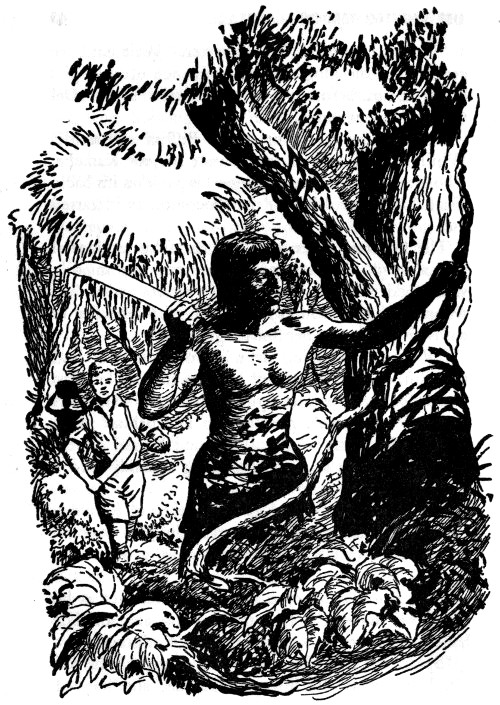
Kamuka cleared the branches with hard, expert slashes
Glistening between the tree branches were the largest, thickest spider webs that Biff had ever seen. There were multitudes of them, forming what at first glance seemed an impassible barrier.
Kamuka settled that problem by clearing away the obstructing branches with hard, expert slashes of his machete, taking the webs with them.
The trail had become so irregular that the bearers frequently had to hack their way through the thick growth. Kamuka did the same, and Biff tried to copy the Indian youth’s smooth style. Kamuka handled his machete easily, despite the pack that he carried. But with Biff, the pack shifted at every swing, and its straps cut into his back and shoulders.
Big Jacome was doing most of the trail blazing, with Kamuka close behind him. Mr. Brewster and Mr. Whitman did their share, while urging the bearers to take their turns at the work. All responded willingly, with the exception of the guide, Luiz, who was lagging behind.
“What’s holding you back, Luiz?” Whitman demanded. “Why don’t you get up ahead and take a hand at cutting the trail?”
“You pay others to cut trail, Senhor,” returned Luiz. “You pay me to be guide. Nao?”
Biff’s father overheard the argument and provided a prompt solution.
“Since you are the guide,” he told Luiz, “suppose you show us the trail. Possibly we have lost it. You lead; we will follow.”
Mr. Brewster spoke in the Brazilian dialect that the bearers understood. Their solemn faces broadened at the expense of Luiz. Angrily, the undersized guide shouldered his way to the head of the line and began hacking at the brush with Jacome. Biff caught up with Kamuka, who had waited while Luiz went by.
“You see his face?” asked Kamuka. “Luiz is very mad. He does not like hard work.”
The glower that Luiz gave over his shoulder proved that Kamuka’s opinion was correct. The keen-eyed Indian boy was quick to note that Biff’s face also wore a pained expression, but for a different reason. Understandingly, Kamuka said:
“You have trouble with pack. I fix it.”
Expertly, he adjusted the straps to the fraction of an inch. From then on, the pack seemed to fit to Biff’s back, giving him no more aches. What amazed Biff, though, was the fact that Kamuka’s pack had no straps, but was laced to his back by crude ropes made from jungle vines. Yet it seemed to adjust itself to every move that Kamuka made.
Soon, the going became easier underfoot, and the path was free of obstacles. It was no longer necessary to hack through the jungle growth.
“Luiz bring us back to better trail,” Kamuka confided to Biff. “Less work for Luiz.”
It was less work for Biff, too, though he didn’t say so. He was pleased because his father had handled the situation so neatly. Biff noted the happy grins on the faces of the bearers every time Mr. Brewster moved back and forth among them. Biff grinned, too, when his dad came by and gave him an encouraging whack on the pack which now seemed molded to Biff’s body.
“It takes a few days to get into the swing of a safari,” Mr. Brewster stated, “so don’t be discouraged. Even the native bearers are struggling a bit, though they won’t admit it. We’ll call it a day as soon as we reach a suitable campsite.”
About an hour later, the safari halted. Gratefully, the bearers eased their packs to the ground and began to set up camp at Whitman’s direction, on a high bank above a jungle stream. The insects were bothersome, as they had been at intervals along the route, but the expedition was equipped to meet that problem. The packs contained netting for the sleeping hammocks, as well as insect repellent.
The chief feature of the campsite was its closeness to a water hole. Luiz approved this, making a great show of his official title of guide. Biff, glad to be free of his pack, eagerly volunteered to help Kamuka bring up pails of water from the stream below. Halfway down, Kamuka hissed for a quick halt.
“We go back up quick,” he said to Biff. “We tell Senhor Brewster we see tapir at water hole.”
Kamuka pointed out a pair of curious dark brown animals, with clumsy, bulky bodies, stocky legs, and long-snouted heads. The creatures were feeding on the leaves of young trees and appeared somewhat tame. Kamuka took no chance on frightening them away, however, as he beckoned Biff up the path.
Mr. Brewster promptly picked up a loaded rifle and accompanied the boys down the path. The tapirs were already lumbering into the brush when Biff’s father took quick but accurate aim on one of the animals and fired.
One tapir dropped in its tracks, while its companion crashed madly into the jungle. The boys rushed down to the bank and found that the tapir was shot squarely through the head. When Mr. Brewster joined them, he smiled.
“That’s the only way to shoot a tapir,” he declared. “Otherwise, they blunder into the jungle wounded, and you can never find them. They have thick hides like a hippopotamus. In fact, they belong to the same family.”
That night, the members of the safari feasted on tapir steaks, which they broiled on the prongs of long, forked sticks. Later, they went to sleep around the same campfire. All day, Biff had listened to the chatter of monkeys and the screech of birds. Now, howls of jungle animals seemed tuned to the heavy basso chorus of frogs from the stream below.
But despite that, Biff was soon sound asleep, the crackle of the campfire blending with his last waking moments. Some hours later, he woke up suddenly. The jungle concert had ended, and the flames had settled to a low, subdued flicker. Somebody should have tended the fire, Biff thought. He recalled his father discussing that point with Luiz shortly after they had finished dinner. Biff rolled from his hammock and groped toward some logs that lay beside the fire. There, he halted at sight of what appeared to be two live coals, glinting from a big log.
Biff pulled back his hand just in time, as the log came alive with a snarl. Biff realized that he had encountered some prowling beast of prey. He raised the alarm with a loud shout:
“Dad! There’s something here by the fire—”
Before Biff could complete the sentence, he saw that the creature was a huge jungle cat, its tawny yellow coat spotted black. Already, it was poising for a spring. Biff, caught unarmed, was confronted by an attacking jaguar, one of the jungle’s most ferocious killers.
Biff heard an answering call from his father. Then, before Mr. Brewster could have possibly found time to grab his gun, the jaguar sprang!
Biff flung his arms upward, as he tried to duck away. It was a hopeless effort, for nothing could have saved him from those fierce claws, once the jaguar reached him. What stopped the springing jungle cat was another figure, small but chunky, that came flying out of the darkness, feet first.
It was Kamuka. The Indian boy had grabbed a long liana vine hanging like a rope from a tree beside his high hammock. All in one motion, he had swung himself across the jaguar’s path just in time to ram the creature’s shoulder in mid-air and veer the big cat toward the fire.
That gave Biff time enough to roll the other way, and Kamuka, as he struck the ground, promptly squirmed about to dive off into the darkness. The scene was momentarily illuminated by a shower of sparks raised by the jaguar when it struck the fringe of the embers. With more of a yowl than a snarl, the big cat cleared the fire at a single bound and took off into the jungle.
Mr. Brewster had his gun by then, but with so many figures bouncing in the vague firelight, he couldn’t risk a shot. By the time Biff and Kamuka were out of the way, Jacome had come on the scene, swinging a big club. Mr. Brewster had to wait until he was out of the path of aim, before firing into the jungle.
By then, Mr. Brewster might as well have fired blank shots. The jaguar had vanished completely in darkness. Jacome threw some logs on the fire, and as the flames took hold, he commented:
“The tapir tiger—that is what we call the jaguar. A good name for him. Look there and you see why!”
Jacome indicated a chunk of cooked tapir meat, hanging from a tree branch near the fire. The smell of its favorite food had evidently drawn the “tapir tiger” in from the jungle. But that did not fully satisfy Mr. Brewster.
“Jaguars frequently kill and eat tapirs,” Biff’s father declared, “but they also shy away from campfires. I gave orders that this fire should be tended all night. Who neglected his duty?”
The final words were addressed to Luiz, who had just joined the group. The guide shrugged and gestured to some of the native bearers who were coming sleepily from their hammocks. They stared dumbly at Luiz, until Mr. Brewster queried them sharply in their dialect, getting headshakes from all.
“I will give the orders direct from now on,” Mr. Brewster told Luiz bluntly, “and I intend to see that they are carried out.” He looked up, noted the faint glimmer of daybreak through the high leaves, and added, “It is after dawn. Let’s break camp and start on our way.”
Biff expressed his thanks to Kamuka while the Indian boy was helping him prepare his pack.
“If you hadn’t hopped to help me the way you did,” asserted Biff, “I would be just a chunk of tapir meat, or something a lot like it. I’ll remember what you did for me, Kamuka.”
“That is good,” rejoined Kamuka solemnly. “I help you. You help me. That is the way in the jungle.”
Biff felt that he was getting the knack of jungle ways during that day’s trek, but he was due for new surprises. As they hacked a path through a thick growth of brush, he heard a sound that was sharply distinct from the screeches of the vivid parrots and macaws that continually scolded from the trees.
It was exactly like a hammer striking an anvil or some other chunk of solid metal. It came from well back in the jungle, and after it was repeated, Biff said to Kamuka:
“Hear that! There must be a village back there in the jungle!”
Kamuka laughed as the clanging sound came again.
“El campanero,” he defined. “That is what some people call it. Others call it the bellbird.”
“You mean it’s only a bird?”
As if in answer, the sharp note was repeated with methodical precision, and Biff recognized that it had a quality that could be mistaken for a bell rather than the clank of hammer on anvil. Biff kept looking for the bird itself until Kamuka noticed it and told him:
“Bellbird very hard to find. He may be far away when you think he is close by.”
Other creatures were closer at hand. From up ahead, Jacome turned and pointed to the path. He called something in his native tongue, and Biff watched the bearers take quick sidesteps. Then Kamuka was nudging Biff with his elbow and pointing out the reason.
A procession of ants was moving along the trail as though keeping pace with the safari. The insects were carrying thin green slivers that wobbled above their bodies. Biff saw that those were tiny fragments of leaves that the ants had gathered and evidently were going to store for food.
“Umbrella ants,” defined Kamuka. “Be careful or they crawl up your leg instead of along path. Umbrella ants can bite—hard!”
From the way the ants had chopped the leaves they carried, Biff took Kamuka at his word. He played hopscotch with the insects until they veered off the trail. The going became easy again, except that the atmosphere of the jungle was growing more humid. Even the chatter of the birds and monkeys was silenced in the sultry calm.
Then came a sudden rain as torrential as the big downpour that they had encountered on the Rio Negro. With the jungle steam rising about them, it was a case of groping along the trail, which soon became ankle deep with water. As he sloshed through the muck, Biff told Kamuka:
“Those ants are smarter than we are. They must have known this was coming and carried their own umbrellas.”
Kamuka interpreted that to Jacome, who laughed and passed it along to the bearers. The rain stopped suddenly at last, but although the heat returned again, the path remained soggy underfoot. Luiz, it seemed, had lost the trail during the rain and was marching the safari into a jungle swamp.
Mr. Brewster called a halt. It was not just a matter of getting back on the trail; he wanted the best trail. For the first time, Biff heard his father mention “Piedra Del Cucuy” to Luiz, who nodded that he understood.
“We go to Piedra Del Cucuy,” assured Luiz. “That is easy, now I know. I show you the best way.”
Biff’s clothes were dry by now except for his shoes and socks, which felt as if they were filled with lead weights as the march was resumed. Luiz soon took the safari out of the swampy land to a dry path, but at times, he showed hesitancy at places where the trail divided. Always, he came finally to a definite decision, but Jacome began to eye him suspiciously.
“We all hear Senhor Brewster say we go to Piedra Del Cucuy,” Jacome confided to Biff and Kamuka. “Now we know we go there, Luiz is afraid to take us on wrong trail. Some of us go to Piedra Del Cucuy before this. We may remember way if Luiz ‘forget’ it.”
A little later, Biff fell in stride alongside his dad and told him what Jacome had said.
“I think there’s no question but that Luiz is trying to delay us,” declared Mr. Brewster. “The only puzzle is his purpose. He may simply be hoping to make more money by keeping us longer on the hike. Or he may have deliberately stalled us in order to learn our exact destination. That is why I told him. Now, I am forcing him to show his hand.”
Mr. Brewster’s tactics paid off by mid-afternoon. The ringing cry of the bellbird had begun again in the deep jungle, and Biff was still hoping for a sight of the elusive campanero, when Luiz led the safari on a short side trail that terminated in a clearing. There Luiz announced, “We camp here tonight.”
“We could still go on a few miles farther,” objected Mr. Brewster. “In fact, we might stop almost anywhere on the trail.”
“Plenty of water here,” argued Luiz. “Maybe not in other places.”
Jacome overheard that. The big man supplied a grim but knowing grin as he muttered his own opinion to the boys.
“Maybe and maybe not,” said Jacome. “In wet season, we find water everywhere; in dry season, no. But we came through big rain today, like wet season.”
After brief deliberation, Mr. Brewster gave Luiz the nod.
“We need water,” he agreed, “and perhaps we are too tired to go on much farther today. We will make camp here.”
Hardly had they unloaded their packs before Kamuka suggested to Biff, “Come with me. Maybe we find bellbird.”
They started along a twisty jungle path in the general direction of the distant metallic sound. Kamuka was moving so hurriedly that they were out of sight of camp before Biff caught up with him and reminded him, “They may want to send us for water, back at camp—”
“That can wait,” put in Kamuka. “We find bird first.”
“But you told me before that there was no use looking for the bellbird, that the sound might be far away.”
“I know. But this is not real bellbird. Listen.”
Biff listened. The sharp note came clear again, from exactly the same direction. Biff could detect no difference between it and the anvil chorus of earlier in the day. But Kamuka could.
“Somebody is hitting metal with hammer,” the Indian boy insisted. “We look for them. We find them—if we hurry.”
Kamuka waved his arm for Biff to follow, as he started a quick jog along the jungle path, hoping to reach the source of the well-faked bird call before the sounds ceased. Straight ahead, low tree branches formed a thick green arch, darkening the path between two low banks that were vivid with colorful flowers.
Mostly, they were magnificent orchids that thrived on dampness as well as heat, but Biff was unaware of that. Kamuka, though schooled in jungle knowledge, ignored the flowers in his haste. He had turned his head to see if Biff had responded to his call, when suddenly, the green carpeting of the path gave way beneath his weight.
A moment later, Kamuka was waist deep in slimy ooze, squirming, twisting about to grab at bushes on the solid ground that he had left. The tufts of grass that he clutched simply pulled loose from the soft earth. With each quickly repeated snatch, he had still less chance of gaining a hold, for he was sinking to his armpits as he panted:
“Look out, Biff! Don’t come close! Quicksand!”
Biff stopped a dozen feet short of the spot where Kamuka, arms emerging from the mire, was frantically waving him back. Biff felt the soft bank giving way beneath him, and he immediately sprang back to solid ground, knowing that only from there could he hope to save his friend.
Kamuka was still sinking in the quicksand, though more slowly now. That gave Biff a few more minutes in which to help him; but how to help was still a question. There was no use throwing a liana vine to Kamuka; it would be too flimsy. A tree branch would be better, but the only boughs strong enough to support a person’s weight were those that overhung the mire itself.
Biff couldn’t wrench those branches loose from their trunks in time to save Kamuka. In fact, to push anything out from the bank looked like a hopeless plan. The best way to help would be by a pull straight up. Biff realized that, when he saw Kamuka look up toward the lowest bough, six feet or more above his head.
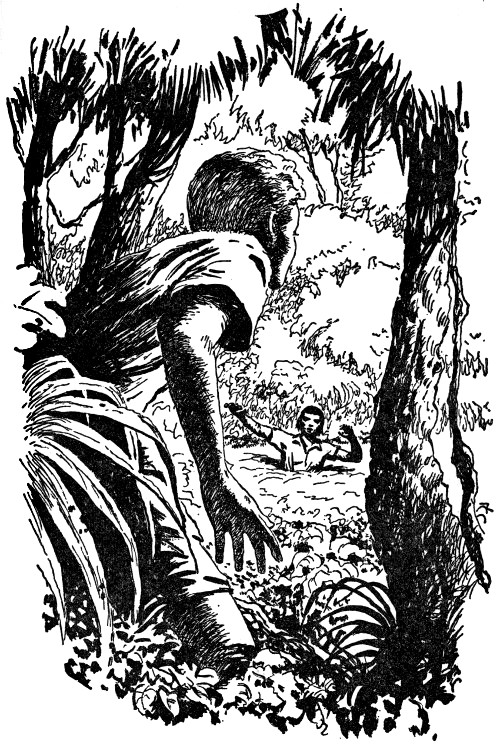
Biff felt the soft bank giving way beneath him
If only Kamuka could reach that far!
That thought gave Biff the answer. Skirting the quicksand, he climbed one of the trees and started working out on its lowest thick branch, hand over hand, toward the spot where Kamuka, now nearly shoulder-deep in the muck, still looked up hopefully.
So far, Biff had been worrying whether the bough would prove strong enough. Now he was wishing that it would bend more. Biff was dangling near Kamuka, but not quite above him; and it was impossible for the Indian boy to shift his position in the quicksand. But Biff was able to do the next best thing.
Locking his hands over the thick branch, Biff began a pendulum swing, out and back—out and back—bringing his ankles closer to Kamuka’s reach. Kamuka made one clutch and missed, but on the next swing Biff practically placed his ankle in the Indian boy’s grasp.
Kamuka caught Biff’s other ankle in the same fashion, and Biff, slanting a glance downward, saw the other boy’s face smiling grimly from between those upstretched arms. Kamuka’s voice came calmly. “Hold tight, Biff. I will pull up slowly.”
Now Biff was glad that the bough was a stout one, for he could feel it give under Kamuka’s added weight. Biff tried to work himself higher by bending his arms and turning them along the branch, so that he could use his hands to grip his opposite wrists.
That helped at first, but Kamuka’s weight kept increasing as he emerged gradually from the ooze, and the strain made Biff’s shoulders feel as if they would pull from their sockets. But by then, Kamuka had worked clear of the quicksand’s suction. He caught Biff’s belt with one hand; then the other. Next, he was clamping Biff’s shoulder and finally the tree branch.
The strain lessened then, with both boys dangling from the bough. Practically side by side, they made a hand-over-hand trip toward the tree trunk and dropped to solid ground. There they sat a moment, panting and rubbing their shoulders as they looked at each other, a bit bewildered by their short but strenuous adventure.
From the distance came that clear metallic note that they had heard before. Kamuka looked at Biff.
“We still go find it—maybe?”
“All right, Kamuka. Let’s go find it.”
They skirted the quicksand and took the path that Kamuka had missed in his hurry. It divided into lesser paths, but they continued to pick a course in the general direction of the clanging sound.
“Somebody use that for a signal,” declared Kamuka. “When we find it, you will see that I am right—”
“You are right,” Biff whispered. “Look there!”
A figure had cut into the path well ahead of them and was continuing on. Softly, Kamuka whispered the name: “Luiz!”
The boys were fortunate. Luiz hadn’t spotted them. Evidently, the guide had left the camp by another path and had followed a roundabout course to reach his present goal. Luiz, judging by the eager expression on his scheming face, was also following the call of the false bellbird. Cautiously, the boys took up Luiz’s trail until he reached a clearing. There, they sidled into a patch of jungle and spread the foliage just enough to view the open space in front of them.
A big man was sitting on a camp stool beside a tent. In front of him was a small anvil, and he gave it a ringing stroke with a hammer as the boys watched. Kamuka was the first to recognize the hawkish face that turned in Luiz’s direction as the guide approached.
Kamuka whispered, “Urubu!”
Biff had scarcely noticed Urubu. Instead, he was staring in total amazement at two other men who had come from the tent.
“One of those men is Nicholas Serbot,” he told Kamuka. “The other is his sidekick, Big Pepito. But they were in Manaus, the night we left there. How did they get here?”
“Airplane come upriver ahead of you,” replied Kamuka. “Stop at maloca near rubber camp.”
By maloca Kamuka meant a native village some distance back from the Rio Negro. Quickly, Biff exclaimed:
“That’s where they met Urubu! They must have paid him to make trouble for us!”
Kamuka gave a chuckle. “Look like they pay Luiz, too.”
Urubu was introducing Luiz to Serbot and Pepito. In the background were several native bearers, apparently under orders to keep their distance. Serbot and Pepito were watching them to make sure they did. Biff took advantage of that.
“We can move up closer,” he told Kamuka. “Maybe close enough to hear what they are saying.”
Kamuka silently agreed, for he crawled along with Biff until they reached the very fringe of the thinner brush, only a dozen yards from where the four men stood. There, Kamuka whispered, “This far enough.”
The grass here was tall and studded with brilliant flowers and shrubs that had cropped up since the brush was thinned. By keeping almost flat on their stomachs, the boys remained completely hidden. Most of the discussion was in Portuguese, with a sprinkling of dialect, so between them Biff and Kamuka were able to understand most of what was said.
“I come for money, Senhor,” Luiz told Serbot. “Like Urubu said you would give me if I delay safari.”
“You will get your money later,” promised Serbot. “You can’t spend it here in the jungle anyway. If you even showed it, Brewster and Whitman would wonder where it came from.”
Luiz started to babble an objection, only to have Urubu interrupt him.
“You have only done half your job, Luiz,” Urubu reminded him. “You gave our safari time to catch up with yours. Now you must see that we have time to get ahead.”
“For that,” injected Luiz, “I should be paid double.”
“You will be,” agreed Serbot, “if you can tell us where Brewster intends to go, so we can get there ahead of him.”
Biff saw Luiz’s teeth gleam in a knowing smile. The small guide spoke in dialect to Urubu, who made a prompt reply. Kamuka understood the talk and whispered to Biff:
“Luiz says he can tell them what they want to know. He asks Urubu if he can trust them. Urubu says yes.”
By then, Luiz had turned to Serbot. Biff’s heart sank as he heard Luiz triumphantly announce:
“They go to Piedra Del Cucuy!”
“The big boundary rock!” exclaimed Serbot. “That must have been Nara’s boat that took Brewster and the boy up the river. Now, they probably plan to meet Nara there.” He turned to Urubu. “Can you get us to Piedra Del Cucuy first?” he demanded.
“Easily,” assured Urubu, “if Luiz takes them the long way.”
“Maybe I should leave them,” put in Luiz, “and come with you. Then they will have no guide and will not find the way at all.”
“That would be all right,” decided Serbot, “but learn what else you can first. Did Brewster mention the name Nara?”
“Nao, Senhor.”
“Did he say anything about a map?”
“Nao, Senhor.”
“Find out what you can about both. If you can get word to us, good. If Brewster becomes suspicious, join us. But your big job is to delay their safari. Use whatever way seems best.”
That ended the parley, except for parting words from Urubu to Luiz, which greatly interested the listening boys.
“Tomorrow, I signal before we start.” Urubu gestured toward the hammer and anvil. “If you do not come to join us, we will know you are staying with the safari—to guide them the long way.”
Urubu and Luiz were turning in the direction of the spot where the boys lay hidden. Biff whispered to Kamuka:
“Let’s crawl out of here fast—”
“Stay still!” Kamuka’s interruption came as a warning hiss. “Do not move—not one inch!”
Biff let his eyes turn in the direction of Kamuka’s stare. Despite the intense heat of the jungle, Biff could actually feel himself freeze. Coming straight toward them through the tall grass was the head of a huge snake!
Behind it, the grass rippled from the slithering coils that followed. Fully twenty feet in length, the gigantic creature could only be an anaconda, greatest of all boa constrictors.
To be caught within those crushing coils would mean sure death!
“Do not move—not one inch!”
Kamuka repeated that warning as the snake’s long body slid slowly past. Whether or not the creature was in search of other prey, to move would be to attract it. Biff realized that from Kamuka’s tone as well as his words.
Gradually, the sliding coils slackened speed. It was Biff who spoke now, his own voice strained, but low:
“It’s turning now, Kamuka. It may be coming back.”
“Maybe, but stay still. One move, you are gone.”
Despite himself, Biff raised his head, only slightly, but enough to look beyond the long, hoselike body that was still gliding by. Aloud, Biff groaned:
“There is Luiz—coming straight toward us—”
Biff threw up his arms to ward off the great boa’s tail as it lashed past. Looking up, he saw the snake’s huge mouth yawning toward him. Biff shut his eyes, thinking there was no hope now. Then a wild scream came from just ahead.
Biff and Kamuka bobbed up from the grass and saw what had happened. The anaconda, on the rove for prey, had lashed out for the first moving thing that approached it—Luiz. Caught in the snake’s coils, the guide was shouting:
“Urubu! Ajudo! Ajudo!”
Urubu took one quick look and relayed the call for help. Serbot and Pepito came from the tent, saw what was happening, and dashed back for their guns. Biff didn’t wait to watch what followed. He grabbed Kamuka’s arm and exclaimed, “Let’s go!”
They went. Behind them, they heard a burst of gunfire. Those first shots must have wounded the anaconda or frightened it away, for the next volley whistled through the foliage as Biff and Kamuka dived into the jungle. The boys found their path and raced along it until the shooting dwindled far behind them.
Breathless, they slackened their pace to a walk and talked over what had happened. In a worried tone, Biff said:
“They must have seen us or they wouldn’t have fired after us. I hope they didn’t know who we were.”
“More likely,” observed Kamuka seriously, “I think they don’t know what we were.”
“You mean they mistook us for some jungle animals?”
“Why not? We were gone quick—pouf! Maybe we were gone quicker than sucuria.”
By “sucuria” Kamuka meant the anaconda. He was referring to the giant water boa by its more popular Brazilian name. Kamuka’s comment brought a smile from Biff.
“I wonder if they shot the anaconda,” he speculated, “or whether it managed to get away.”
“Perhaps Luiz will tell us,” rejoined Kamuka, grinning, “when he gets back to our camp.”
“If Luiz ever gets back there at all!”
The boys lost no time in getting back to camp themselves. There, they told Mr. Brewster and Mr. Whitman all that had happened.
“Serbot must have learned a lot from somebody down in Minas Geraes,” decided Mr. Brewster, “though how, I can’t quite understand. I checked everyone who had talked with Lew Kirby, and I felt sure he had confided in me alone.”
“And how did Serbot hear about Joe Nara?” queried Mr. Whitman. “There have been rumors of head-hunters and abandoned rubber plantations off in the jungle. But no talk of prospectors and gold mines—at least none that reached me.”
“There were rumors farther up the river,” Biff’s father said, “according to what Nara told us. When Joe bought that cruiser and came down to Manaus, he turned rumor into fact.”
“Nara found out about us,” Hal Whitman pointed out, “so why shouldn’t Serbot find out about Nara? Or about us, for that matter? We know now where the leak came. Through Urubu.”
Mr. Brewster weighed that statement, then slowly shook his head.
“Urubu couldn’t have sent word to Serbot that fast,” he declared, then, turning to Biff, he queried: “You are sure Serbot told Luiz to find out what he could about Nara?”
“Yes,” replied Biff, “and about the map, too.”
“Then it wasn’t Serbot’s man who stole the map,” mused Mr. Brewster, “unless he wants that missing corner that I still have. Or else—”
Mr. Brewster interrupted himself, as sounds of excitement came from the bearers, who were busy thatching palm leaves to form a shelter. Their babble of dialect included the name “Luiz,” and a couple of the bearers were running to help the guide as he came limping into camp.
“Say nothing,” warned Mr. Brewster. “Just listen to what Luiz has to tell us.”
Luiz had plenty to tell when they formed a sympathetic group around him.
“I look for water hole,” Luiz told them, “and I meet una grande sucuria—one big anaconda! He grab me around my body, like this!”
Graphically, Luiz gestured to indicate how the snake’s coils had encircled his body.
Biff and Kamuka kept straight, solemn faces as Luiz continued.
“I pull my gun quick!” Luiz thrust his hand deep in his trouser pocket and brought out a small revolver. “I fire quick, until the gun is empty.” He clicked the trigger repeatedly; then broke open the revolver and showed its empty chambers. “Still, anaconda hold me, until I draw knife and stab him hard!”
From a sheath at the back of his belt, Luiz whipped out a knife that looked far more formidable than his puny gun. He gave fierce stabs at the imaginary anaconda, his face gleaming with an ugly smile that was more vicious than triumphant. Luiz looked like a small edition of Urubu, whose ways he seemed to copy.
“Big snake go off into jungle,” added Luiz, wiggling his hand ahead of him to indicate the anaconda’s writhing course. “Hurt bad, I think. Maybe it is dead by now. But the animals were still afraid of it. I hear them run.”
His sharp eyes darted from Biff to Kamuka, but neither boy changed expression. Clumsily, Luiz pocketed the revolver with his left hand and thrust the knife smoothly back into its sheath with his right. He rubbed his side painfully, then beckoned to two of the natives and said, “We go look for water hole again.”
A short while later, the boys had a chance to exchange comments while they were gathering palm fronds for the shelter. After making sure that no one else was nearby, Kamuka confided:
“Luiz had no gun at start of safari. Urubu must have given gun to him.”
“To explain the shots if any of our party heard them!” exclaimed Biff. “And did you see the way Luiz looked at us when he mentioned scared animals? Maybe they glimpsed us going into the brush.”
“Maybe,” agreed Kamuka. “I think they shoot anaconda, or big sucuria would not let Luiz go so easy.”
“That’s another reason why Luiz claimed he shot it,” added Biff. “We might come across the anaconda and find the bullet marks.”
Shortly afterward, the boys found a chance to repeat those opinions to Mr. Brewster, who added a few points that they had overlooked.
“Luiz couldn’t possibly have brought the gun from his pocket, as he claimed,” stated Mr. Brewster, “because the snake was already coiled about his body. For that matter, he could not have drawn his knife, either.
“However, from the clumsy way he showed us the gun and put it back in the wrong pocket, you could tell he had never handled it before. In contrast, he was smooth and quick with his knife, which is obviously his customary weapon.”
One question still perplexed Biff.
“That other camp is a good way off, Dad,” Biff said, “yet we heard the anvil strokes before we started out. How come you didn’t hear the gunfire later?”
“Urubu may have made the first strokes closer by,” replied Mr. Brewster. “The anvil sound is also sharper than a gunshot and should carry farther. That is probably why they chose it as a signal. Kamuka did well to detect it.”
That evening, Biff was glad there had been time to build the thatched shelter, for a tropical dew had begun to settle, almost as thick as a dripping rain. It was less damp beneath the shelter, where Biff and Kamuka had slung their hammocks.
Mr. Brewster, however, had inflated a rubber mattress and had placed it near the fire, stating that he would use a poncho to keep off the moisture. From his hammock, Biff watched his dad arrange small logs and palm stalks as spare fuel. As he closed his eyes, Biff could hear his father talking to Luiz, who was standing close by.
“I will watch the fire tonight,” announced Mr. Brewster. “You have been hurt. You need rest more than I do.”
“But, Senhor,” objected Luiz. “Suppose you fall asleep—”
“I am sure to wake up at intervals. I always do. But you must get some sleep, Luiz. We need you to guide us to Piedra Del Cucuy. You are sure you know the way?”
“Most certainly, Senhor. But it may take longer than you expect.”
A pause—then Mr. Brewster asked bluntly, “Why?”
“Because the shortest way is not the best way,” returned Luiz. “We might meet floods, or streams where the piranha may attack us. They are very dangerous fish, the piranha—”
“I know,” interrupted Mr. Brewster impatiently, “but we have no time to waste.”
“You are meeting someone at Piedra Del Cucuy?”
“Yes,” replied Mr. Brewster. “A man named—” He caught himself, then said in a blunt tone:
“I won’t know our plans until we get there. We will continue on up the river. That is all that I can tell you.”
“Don’t you have a map, Senhor?”
Biff opened his eyes at Luiz’s question. He saw his father start to reach into his inside pocket, then bring his hand out empty. Shaking his head, Mr. Brewster said:
“No, I have no map. Go get some sleep, Luiz. You will need it.”
Biff glimpsed Luiz’s face as the sneaky guide turned from the firelight. Beneath the hatbrim, Luiz wore that same ugly smile that showed his satisfaction. Obviously, Luiz was planning his next move, probably for tomorrow.
When it came, his father would be ready for it, Biff felt sure. Soon Biff drifted into a fitful sleep from which he awoke at intervals. Sometimes he heard the crackle of the fire and decided that his father must have thrown on a log and then gone back to sleep. For, each time, Biff saw the figure of Mr. Brewster covered by the rubber poncho, near the pile of logs that had become much smaller during the night. It must have been the fourth or fifth awakening, when Biff saw someone move into the firelight’s flicker.
It was Luiz. He crept forward. Crouched above the quiet form, Luiz thrust his hand downward as if to reach into the sleeper’s pocket.
The figure under the poncho seemed to stir. Luiz recoiled quickly and sped his hand to his hip. Before Biff could shout a warning, Luiz had whipped out his long knife into sight and driven it straight down at the helpless shape beneath him.
Wildly, Biff tumbled from his hammock to the soggy ground. Coming to his hands and knees, he started forward just as another figure sprang into the firelight, too late to halt Luiz’s knife. The newcomer grabbed Luiz’s shoulders and spun the little man full about. For a moment, Luiz poised his blade as though planning to counter the attack.
Instead, he uttered an unearthly shriek, as though he had seen a ghost. Biff was startled, too, but his cry was a glad one. Etched against the firelight, Biff saw his dad’s face looking down at Luiz.
Tom Brewster himself was the man who had interrupted Luiz’s deadly work. The figure under the poncho, Biff realized, must be a dummy.
As the two men struggled for possession of the knife, they kicked the dummy apart with their feet. Suddenly Luiz managed to wrench free and dashed off into the jungle.
Mr. Brewster didn’t bother to start after the terrified guide. But Hal Whitman came rushing from the shelter waving a revolver. Mr. Whitman fired a few wild shots in the direction that Luiz had taken. The crackling of jungle plants came back like echoes, indicating that the gunfire had spurred Luiz’s mad flight.
“That’s enough, Hal,” laughed Mr. Brewster. “The fellow is so badly scared he won’t stop running until he reaches Serbot’s camp.”
“And the more he runs,” returned Mr. Whitman, “the more difficulty he will have finding it in the dark. Well, if Luiz gets lost in the jungle, he won’t talk to Serbot.”
“I don’t think it matters much, Hal. Luiz has already told Serbot all he knows.”
“Except that we found out his game. Now he will tell that to Serbot, too—if he finds him.”
By the flickering firelight, Biff saw his father’s face take on a troubled expression.
“You’re right, Hal,” decided Mr. Brewster grimly. “I hadn’t thought of that. It would be better to catch Luiz and take him along with us. It’s probably too late now, but it may be worth a try.” Mr. Brewster turned to Jacome. “Call Luiz, and see if he answers.”
Jacome gave a long call: “Luiz! Luiz!” Faintly, like a faraway echo, a voice responded: “Ajudo! Ajudo!”
In the firelight, Biff and Kamuka exchanged startled glances. Both had the same sudden thought, but it was Biff who exclaimed, “The quicksand! Luiz must have taken the same path that we did this afternoon!”
Jacome was calling “Luiz!” again, but this time there was no response. Mr. Brewster gave the prompt order:
“Bring lights and hurry!”
From the way the path showed in the gleam of their flashlights, it was plain that Luiz could have followed it rapidly in the dark, for it formed the only opening through the brush. Biff and Kamuka, racing along beside Jacome, were the first to reach the arch of trees above the quicksand.
They halted there, but saw no sign of a human figure in the muck. The glare revealed nothing but floating water flowers until big Jacome pointed out what appeared to be a lily pad. Biff exclaimed:
“Luiz’s hat!”
It was lying brim downward in the ooze, beyond the bough from which Biff had rescued Kamuka. This time it was Kamuka who scrambled along the branch and used a big stick that Jacome tossed him to prod the quicksand, but with no result.
From the bank, Mr. Brewster studied the scene grimly, noting that the farther out Kamuka jabbed the stick, the easier and deeper it went.
“That cry from Luiz was his last,” decided Mr. Brewster. “In his flight, he must have plunged much farther than Kamuka did this afternoon. That is why the quicksand swallowed him much faster.”
From the bank, Jacome and other natives dragged the mire with stones attached to long liana vines, but received no answering tugs from the pulpy quicksand. When they pushed long sticks down into the mire, they went completely out of sight, to stay.
“There’s no reclaiming anything lost in those depths,” Biff’s father said soberly. “That goes for Luiz, too.”
When they returned to the campsite, Mr. Brewster dismantled the crude dummy that he had placed beside the fire. It was formed from wads of grass, palm stalks, and small logs, which had made it bulky enough to be mistaken for a sleeping figure in the uncertain firelight.
“After what you told me,” Mr. Brewster said to Biff and Kamuka, “I decided to test Luiz. I did everything but mention Joe Nara by name. I made this dummy figure so I could watch Luiz if he tried to steal the map he had been told I carried. At the same time, I was guarding my life against his treachery.”
“But, Dad!” exclaimed Biff. “Serbot never told Luiz to kill you. He simply told him to delay our safari.”
“And to Luiz’s way of thinking,” declared Mr. Brewster, “the simplest way of accomplishing that would be by killing me. Here in the jungle, people think and act in very direct terms, particularly the natives.”
Mr. Brewster and Mr. Whitman began a discussion of the next steps to be taken. They agreed that the sooner the safari moved along, the better. Mr. Brewster put a question to Jacome.
“You have been to Piedra Del Cucuy before, Jacome. Could you find your way there again?”
“I think so, Senhor.”
“Then you will be our guide as far as the big rock. Have the bearers ready to move at dawn.”
Daylight was tinting the vast canopy of jungle leaves when the safari started back toward the main trail. The setting was somber at this early hour, but the silence was soon broken by some scattered jungle cries. Then, clear and sharp, came the metallic note of the bellbird. Mr. Brewster waved the safari to a stop and said:
“Listen.”
The call was repeated. Mr. Brewster turned to Kamuka and asked:
“What kind of bird is that? Campanero or Urubu?”
Biff smiled at the way his father used the term for “bellbird” along with Urubu’s nickname of “vulture.” But Kamuka kept a very serious face as he replied.
“It is Urubu. Look, Senhor. I show you why.”
He pointed to a white-feathered bird that formed a tiny spot on the high branch of a tree.
“There is real campanero,” declared Kamuka. “He is saying nothing. He would answer if he heard real call.”
Mr. Brewster studied the bellbird through a pair of binoculars and promptly agreed with Kamuka. He handed the glasses to Biff, who noted that the bird, which was something like a waxwing, but larger, had an appendage that extended from its forehead and draped down over its bill. This ornament, jet-black in color, was starred with tiny tufts of feathers. Mr. Brewster called it a caruncle and explained that it was commonly seen on various species of tropical birds noted for their ringing cries.
But this bellbird remained silent, even when the distant anvil sound clanged anew.
“Urubu is signaling for Luiz,” declared Mr. Brewster. “He may wait an hour or so and try again. When Serbot finally decides that we have moved on, he will think that Luiz is taking us the long way. We should get a good head start, right now.”
The safari pressed forward at a quick pace which was maintained most of the day. The going was not as hard as Biff had anticipated. Luiz’s talk of a tough trail had been a sham, so that the party would be willing to take the long route.
Even some of the streams they encountered were already bridged with fallen trees, making crossing easy. After one such crossing, Jacome suggested stopping to eat. Mr. Brewster opened some canned goods, but most of the bearers preferred bowls of coarse cereal, made from the manioc or cassava plant. This formed their chief diet.
Jacome gnawed on a large bone of left-over tapir meat. When he had finished half of the meat, he suddenly tossed the bone into the stream. Instantly, the water flashed with silvery streaks in the shape of long, sleek fish that fought for the bone and tore the remaining meat to shreds.
“Piranha,” grunted Jacome. “They rip anybody who goes in water. If we chop away tree, Urubu will have to stop to build new bridge to get across.”
“Serbot might suspect something,” objected Mr. Brewster. “If they guess that we are on the same trail ahead of them, they will hurry. It is better to let them think that they can take their time.”
Jacome still found time to fish for piranha during the short rest. The cannibal fish practically leaped from the water to take the bait. Jacome took no chances with the sharp teeth that projected from their bulldog jaws. He cut the lines and tossed the fish into a basket, hooks and all. When the safari made camp at dusk, they cooked the piranha, and the fish proved a tasty dinner, indeed.
Mr. Brewster kept the safari at a steady pace during the next few days in order to stay ahead of Serbot’s party. Jacome proved an excellent guide, remembering every landmark along the trail. One afternoon, a rain ended as they trudged beside the bank of a sluggish stream and Jacome pointed into the distance with the comment:
“Big rock. There.”
It was Piedra Del Cucuy, a huge, stumpy shaft of granite, towering hundreds of feet above the forest. The rock was streaked with tiny trees that looked like sprinklings from the vast green vegetation that spread beneath. Though the natural boundary marker was still a day’s march away, the mere sight of it spurred on the safari.
In the light of dawn, the big rock seemed much closer, and within a few hours’ trek, even its cracks and furrows showed sharply. Trails began to join, and suddenly the trees spread as the safari emerged upon a sandy beach lapped by the black water of the Rio Negro.
There wasn’t a sign of a boat nor of any habitation until Kamuka pointed to a movement in the brush, a few hundred feet downstream. Mr. Brewster stepped forward, spreading his arms with a wide sweep.
“If it’s Joe Nara,” Mr. Brewster told Biff, “he will recognize us. If not, be ready to get back to shelter!”
Two figures bobbed into sight, and Biff recognized the squatty forms of Igo and Ubi. They turned and gestured. A few moments later they were joined by Joe Nara. All three came forward to meet the safari. Nara was carrying a small package under his arm.
The bearers were laying down their packs and other equipment when Nara cried excitedly:
“We hoped it would be you, Brewster, but we weren’t sure. The Macus have been attacking villages up and down the river. Everywhere, we have heard the cry: ‘Macu! Macu!’ until we—”
“Hold it, Nara,” broke in Mr. Brewster. “We have more important things to talk about first.”
The native bearers were coming forward silently, and Biff realized that they were drawn by that dreaded word, Macu. But Mr. Brewster wasn’t able to hush Joe Nara.
“What’s more important than Macu head-hunters?” the old man demanded. “If you don’t believe me, Brewster, look at what I picked up downriver!”
Before Mr. Brewster could stop him, Joe Nara ripped open the package that he carried. Under the eyes of the native bearers who now were crowding close about him, Nara brought out a pair of shrunken human heads, triumphantly displaying one in each hand!
From the babble that followed, Biff realized that the damage had been done. The bearers shied away as though the tiny heads were alive and ready to attack them. They made a hurried retreat toward the trail from which the safari had come. Out of their excited chatter, Biff could distinguish the words:
“Macu here! We go home—quick!”
Biff, meanwhile, was studying the shrunken heads in amazement. Reduced to the size of baseballs, their human appearance was preserved in miniature form. Cords closed the lips, and feathered ornaments hung from the ears of these grotesque trophies.
Though Biff had heard how head-hunters dealt with their victims, he had thought of shrunken heads as curios rather than as something gruesome. But here, on a tropical riverbank, where the deadly Macus might pop up in person, the grisly trophies were fearful things indeed.
When Biff looked from the tiny heads in Nara’s hands to the scared faces of the clustered natives, he noted a striking similarity between them. He knew that the natives saw it, too, each picturing himself as a head-hunter’s prospective victim. Mr. Whitman and Jacome were trying to quiet the wild babble but to no avail. Mr. Brewster gestured to the shrunken heads and told Nara:
“Put those away.”
Old Joe wrapped the souvenirs with a chuckle, as though he relished the confusion he had caused. Jacome approached and spoke solemnly to Mr. Brewster.
“It is no good,” Jacome said. “They want pay. They want to go back to Santa Isabel—far away from Macu.”
“What about you, Jacome?” inquired Mr. Brewster. “Do you want to go with them?”
“I want to go, yes,” admitted Jacome, “but I want more to stay with you. So I stay.”
Mr. Brewster turned to Kamuka. “And you, Kamuka?”
“I stay with Biff.”
“Good boy!” Biff clapped Kamuka on the shoulder. “I knew a couple of little shrunken heads wouldn’t scare you.”
“I have seen such heads before,” rejoined Kamuka calmly, “but always heads of men. Never any head of a boy. So why should heads scare me?”
Mr. Brewster paid off the bearers in Brazilian cruzeiro notes, saying he would give them double if they stayed with the safari, but there were no takers. In English, Mr. Whitman undertoned the suggestion:
“Keep talking to them. They still may stay.”
“No, it must be voluntary,” returned Mr. Brewster, “as with Jacome and Kamuka. Otherwise, they will desert us later.”
The bearers hastily packed their few belongings, took a supply of food, and started back along the trail. Mr. Brewster remarked to Joe Nara, “Now I suppose we shall have to go upriver in the Xanadu.”
“We can’t,” returned Nara. “We had to haul the cruiser up on shore below the big rapids. The friendly natives who helped were the ones who told us about the Macus and gave us the shrunken heads. We’ve come the rest of the way in a canoe.”
Nara paused and gestured down the riverbank.
“We hid it there,” he added, “so we could wait for you.”
“We have rubber boats in our equipment,” stated Mr. Brewster. “We can inflate them for the trip upriver.”
“But there are many more rapids,” objected Nara, “with no natives to help you carry the boats past them. You will have to go overland by a back trail.”
“Where will we find new bearers?”
“From a native village a mile or so in there.” Nara gestured to another jungle path. “I’ll send Igo and Ubi along to introduce you.”
Mr. Brewster delegated the task of hiring the bearers to Hal Whitman, who left, accompanied by Jacome and Nara’s two Wai Wai Indians. Biff and Kamuka took a swim in the safe water of the river. As they sat drying themselves in the sun, the boys watched Nara describe the route to Mr. Brewster. With a stick, old Joe drew a wiggly line in the sand and said:
“This here is the Rio Negro. I keep going up it until I turn east on another river.” Nara made a line that wiggled to the right. “I don’t know its right name—if it has any—but the natives call it—”
“Rio Del Muerte,” interposed Mr. Brewster. “The River of Death.”
“Lew Kirby told you that, did he?”
“Yes. That’s where he said I’d find you. Somewhere up the Rio Del Muerte.”
Nara showed a pleased smile at this new token of a bond between his former partner, Lew Kirby, and Mr. Brewster.
“Your trail will bring you to the Rio Del Muerte,” resumed Nara, “but you will strike it many miles above the mine.”
“How many miles above?”
“I wouldn’t know. I have never gone by that route. But the native bearers will know when they reach the Rio Del Muerte.”
“And then?”
“Then you follow it downstream until you meet me.”
“Where will that be?”
Nara eyed Mr. Brewster in quick, birdlike fashion, then decided to answer the question.
“At a split rock on the north bank,” stated Nara, “They call it La Porta Del Diablo, or the Devil’s Gate. Come through the gateway and continue up the ravine. It leads to El Dorado. I will meet you on the way.”
Mr. Whitman and Jacome were coming from the jungle with a crew of natives. Mr. Brewster spoke quickly to Nara. “Don’t show those shrunken heads to these chaps!”
This time old Joe kept his shrunken heads out of sight. He and his two Wai Wais left to get their canoe, and soon the Indians were paddling up the Rio Negro. Joe Nara was waving from between two heaps of packs and luggage.
Mr. Brewster, meanwhile, had opened a box of trinkets that he was distributing to create good will. Eagerly, the natives accepted colored marbles, bright shiny beads, little round mirrors, and other geegaws. Biff saw Kamuka looking longingly at the eye-catching gifts and mentioned it to his father, who promptly gave some to the Indian boy.
Kamuka took some marbles and a mirror, but with a slight show of reluctance. It was evident that he valued things that were useful as well as showy. Among the assortment, Biff found a small microscope. He handed it to Kamuka with the comment:
“Here’s something you will really like. This glass makes little things look big.” Biff held the lens above an ant that was crawling along a dried palm leaf. “Here, see for yourself.”
Kamuka tried the simple microscope and smiled when he saw that the insect appeared larger.
“I like it,” he declared, “but I like mirror better, because I can flash sunlight, like you did.”
“You can use this glass with the sun, too,” Biff said. “Hold it close to the leaf—that’s right—now tilt it so the sun shines through. Keep it that way and wait.”
Kamuka didn’t have to wait long. The sun’s focused rays soon burned a hole in the leaf. Kamuka tried another leaf with the same result. He turned to Biff and remarked:
“With a lot of dry leaves, all in one pile, you can start big fire with this—maybe?”
“You catch on fast, Kamuka,” complimented Biff. “Yes, a burning glass is often used to start a fire. It’s a right handy thing to have.”
Kamuka pocketed the microscope along with the mirror and his other new possessions. In a serious tone, he said, “Time to get ready for trail now.”
Biff noted that Jacome was assigning the new bearers to their packs and other equipment.
“Yes, recess is over,” acknowledged Biff. “Let’s get our packs and join the parade.”
The boys found, much to their relish, that they were not needed as pack carriers. Mr. Whitman had hired a few spare bearers at the village, and since this new crew was fresh, with less than a half day’s journey before sunset, Mr. Brewster had decided to let them take the full load.
“You two can go ahead,” Mr. Brewster told Biff and Kamuka. “The villagers tell me that the trail is well marked, so you won’t miss it. But there may be short stretches that need clearing before we come along.”
It worked out as Mr. Brewster anticipated. At a few spots, Biff and Kamuka encountered tangled undergrowth which they managed to hack away with their machetes, by the time the safari caught up with them. As they were starting ahead again, Mr. Brewster noted the position of the sun.
“Allow about an hour,” he told the boys. “Then start looking for a good campsite. You can wait there for us.”
Biff enjoyed the carefree, late-afternoon hike through the vast green vault of the jungle, particularly with Kamuka, who was quick to spot all forms of wild life. Once, Kamuka pointed to a curious creature with a huge shell that was moving across the trail. Biff looked just in time to see it roll up into a solid ball and play dead.
The thing was an armadillo, the most heavily armored denizen of the jungle. Again, Kamuka called a halt while they watched what looked like a Teddy bear with white legs attached to a gray, black-banded body. It was attacking a huge anthill, darting a long, thin tongue from its snouted muzzle. The creature was a giant anteater, feeding on its favorite prey.
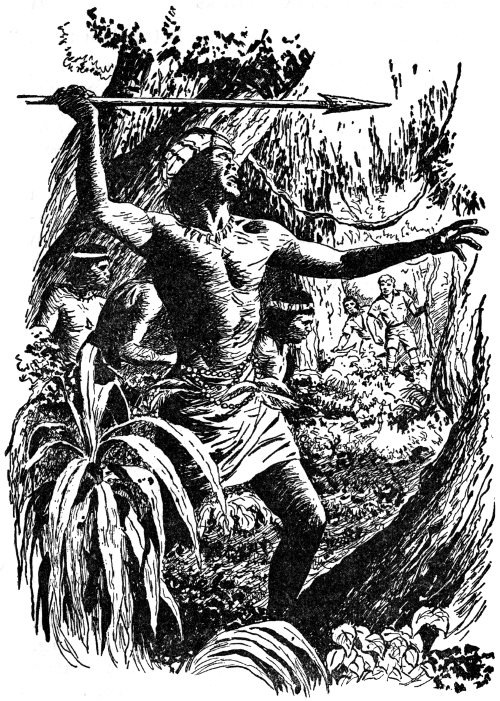
Up popped a group of tawny natives
Kamuka was quick as well as accurate with the machete. Once, while slashing at a low bush, he changed the direction of his swing. The long blade whisked within inches of Biff’s shin. As Biff sprang back, he saw the actual target of Kamuka’s quick aim.
The machete had clipped the head from a snake which had been rearing to strike at Biff’s leg. Pale yellow in color, with brown, diamond-shaped spots, it somewhat resembled a rattler, except that it had sounded no loud warning.
“Mapepire,” defined Kamuka. “Very bad. Worse poison than curare, like Macu use on arrows.”
Biff decided that the snake was a species of bushmaster, one of the most deadly of tropical reptiles.
“Neat work, Kamuka,” Biff exclaimed gratefully. “You sure were johnny-on-the-spot that time!”
“Johnny-on-the-spot,” repeated Kamuka. “What does that mean?”
“Somebody who is around when you need them most.”
A troop of red howler monkeys were hopping from one high tree to another, sometimes hanging on to branches only by their tails. The boys were watching those acrobatics, when a sudden stir occurred in the brush around them.
Up from the bushes popped a group of tawny natives, wearing odd-shaped aprons made of hides decorated with bright feathers and large, dull beads. Their faces and bodies were streaked with scarlet dye that looked like war paint.
Some were holding bows, with arrows on drawn strings. Others were raising long blowguns to their lips. All were aimed toward a central target; the spot where Biff and Kamuka stood.
Biff felt himself sink inwardly as he heard Kamuka gasp the word: “Macu!”
Slowly, the Macu warriors closed in on the two boys. The sharp eyes that glared from painted faces were on the watch for even the slightest move.
Kamuka muttered to Biff, “Drop machete. Right away.”
As Kamuka let his machete fall, Biff did the same. The inner circle of Macus dropped their own weapons and sprang forward upon the boys.
The two were captured without a struggle. The Macus brought out rawhide bowstrings and tied the wrists of the prisoners behind them. They also tied their ankles together, but in hobble fashion, far enough apart so that they could still take short steps.
Two of their captors picked up the machetes. Another snatched Biff’s wrist watch and tugged it loose. Next, they were finding prizes in the pockets of the prisoners: Biff’s scout knife and his father’s metal mirror; the marbles and the little mirror that Kamuka had been given earlier in the day.
Kamuka seemed indifferent to all that happened. He braced his feet so that the Macus had trouble pushing him around. Biff copied that procedure and found that it helped. Their captors were in a hurry because all the while, the cries of the howler monkeys were becoming louder. Above the din, Kamuka said calmly, “If they hear this back at the safari, they will know that we are having trouble. They will come to help us.”
“But how will they know what is happening?”
“You will see why. Soon.”
Leaping monkeys formed dark red streaks against the deep green of the jungle foliage. A few Macus were guarding Biff and Kamuka. The rest spread out through the brush, where they squatted as they had originally. Gradually, the commotion lessened up in the treetops. Then, as the monkeys returned to normal, the Macus bobbed up again.
Now, their bows and blowguns were pointed upward. The air was suddenly filled with arrows and darts that found their marks high above. Monkeys began tumbling from the trees, while the rest scattered, howling louder than before. From the distance came answering chatter, like an alarm spreading through the jungle.
“The Macu come across river to hunt monkeys,” Kamuka told Biff. “We heard monkeys talk. I should have known Macu were here.”
The Macus gathered up the dead monkeys and marched Biff and Kamuka back along the trail. New howls were coming from far off.
“You see?” undertoned Kamuka. “Maybe safari will hear and come fast.”
“Or go the other way faster,” put in Biff. “Those villagers are scared by the very thought of meeting up with Macus.”
“But your father will come, with Mr. Whitman—”
“I only hope they won’t fall into the same trap.”
“They will not fall into trap. They will have Jacome with them. He will be on watch.”
Biff’s hopes rose at Kamuka’s words, only to fall again as their Macu captors turned suddenly from the trail. Instead of trampling the side path, the Macus moved stealthily in single file, pushing the captured boys into the line ahead of them. They spread the jungle plants as they moved through them, then let them fall back into place, leaving no trace of their route.
Literally, the entire party was swallowed by the jungle. Biff groaned loud enough for Kamuka to hear.
“Fine chance we have now!” Biff said. “They will never find us, unless the natives know where the Macu village is.”
“Macu never make village,” replied Kamuka. “All they do is tear down huts that belong to other people.”
The procession was moving straight westward toward the setting sun. That, at least, made sense to Biff, for it proved that the Macus had come from across the Rio Negro, as they usually did. Evidently they had found the fishing poor, so had gone on a monkey hunt instead.
Soon, the procession reached the Macu camp. This was a small natural clearing where the Macus had chopped down a few palm trees. Women of the tribe were sewing palm leaves together to form roofs for crude shelters around a central fire.
While the hunters skinned monkeys for the evening meal, other tribesmen gathered around Biff and Kamuka, prodding them as if they were curiosities. Their hands were finally released and they were allowed to eat. Biff was glad that they were fed left-over fish instead of monkey meat.
Then they were marched to two small trees. Biff’s wrists were tied behind him around a tree, and he was allowed to slide down to a sitting position. Kamuka was tied in the same fashion to another tree only a few feet away. Liana ropes were used instead of thongs, but the knots were very tight and solid.
Other Macus tied their ankles in the same manner, so that escape would be difficult, if not impossible. As the Macus moved away and gathered around the slowly dying fire, Biff saw their ruddy faces and spoke to Kamuka.
“They sure look bloodthirsty, with their faces all done up in war paint.”
“That is not for war,” said Kamuka. “It is for hunger. They will wear the paint all night, for luck in catching monkeys tomorrow.”
Biff and Kamuka were not too uncomfortable that night. They slept fitfully until dawn, when the women brought them water but offered them no food. When they were alone again, Biff asked:
“What do you think about head-hunters now, Kamuka? Will they let us grow up before they shrink our heads?”
“Maybe,” returned Kamuka. “Sometimes they take prisoners for members of the tribe. But I do not want to be Macu. I want to be johnny-on-the-spot.”
“You’re on the spot all right. We both are. If I only had something to cut these ropes!”
“I have something Macu did not find. I have it in back pocket where I can get it easy. Burning glass.”
Kamuka’s words roused Biff to an eager pitch.
“Get it, Kamuka!” he exclaimed. “Try to hold it into the sunlight and turn it toward my hands.”
“But it will burn your hands—”
“Not long, it won’t. I’ll tell you when to move it and which way to tilt it.”
Kamuka soon had the little microscope tilted toward the sun. Biff repressed a sudden “Ouch!” and then said calmly, “Just a little higher, Kamuka. Hold it there a moment. No, a little more. Now, the other way—”
“I smell rope burning!” Kamuka said.
“Hold it just as it is,” urged Biff.
Soon Biff, too, could smell the burning rope. A minute later, he found that the bonds yielded when he tried to pull his wrists apart. Finally the rope broke completely, and with one hand free Biff was able to take the microscope and work on Kamuka’s bonds.
By now, most of the Macu hunters had left the camp, and the few who remained were still asleep. The boys worked on their ankle ropes, unnoticed, but found them so tight that they had to take turns burning them. Finally free, they realized that their biggest problem lay ahead.
“We can’t both make a run for it at once,” whispered Biff, “or they might wake up and spot us. You slide for the brush first, Kamuka. If they still see me, they may not notice that you have gone.”
“But I can’t leave you here alone, Biff.”
“You won’t be leaving me. I’ll give you time to work around the clearing. Then if they see me start to leave, you can raise a yell and draw them your way.”
“Very good, Biff. We try it.”
The ruse worked better than they had hoped. Kamuka gained the edge of the clearing with ease. Biff gave him due time to get properly posted, then followed the same route. They had chosen it well, for it was not only the closest edge of the clearing; it was directly toward the rising sun, which would tend to dazzle anyone who looked that way.
Once in the jungle, Biff kept close to the clearing as he circled it, calling softly to Kamuka until they finally met. Again, the sun proved helpful. They had been headed toward it when they were brought here as prisoners, late in the previous afternoon. So now, they had only to move toward the morning sun to reach the jungle trail.
It was slow going, as they had to be wary of animals in the brush, yet all the while they felt the urge to hurry in case their escape had been discovered back at the Macu camp. At last, however, they came upon the trail. Then came the question: Which direction should they take?
“The safari must have come as far as we did,” declared Biff, “in fact probably a lot farther, as they were supposed to keep on coming until they overtook us.”
“But when they didn’t find us,” said Kamuka, “they must have turned back to look.”
“You may be right,” decided Biff. “They could have figured, too, that we missed the trail somewhere along the line. I’ll tell you what. Let’s go back along the trail a couple of miles anyway. If we don’t meet them, we’ll know they are up ahead.”
“And all the time,” added Kamuka, “we keep good sharp look for Macu!”
That final point was so important that both Biff and Kamuka kept paying more attention to the bordering jungle than to the trail itself. Every sound, from a bird call to a monkey howl might mean that Macu hunters were about. So could the slightest stir among the jungle flowers and the banks of surrounding plants, where at any moment, painted faces topped with wavy hair might come popping into sight as they had the afternoon before.
But there wasn’t a trace of motion in all that sultry setting until the boys reached a place where the trail took a short, sharp turn around the slanted trunk of a fallen ceiba tree. Biff, in the lead, gave a quick glad cry as he saw native bearers coming toward them, bowed under the weight of the packs they carried.
At the head of the column strode a white-clad man wearing a tropical helmet. At sight of him, Biff turned and called to Kamuka:
“Here’s Mr. Whitman coming with the whole safari! We’re safe now, Kamuka! Come on!”
With that, Biff dashed forward, only to be caught by the shoulders and spun full about, his arm twisted in back of him. Biff’s captor shoved him straight toward the leader of the safari, and the boy saw for the first time that the man in white wasn’t Mr. Whitman.
Looking down from beneath the pith helmet was the ever-smiling face of Nicholas Serbot, tinted an unearthly green in the subdued glow of the jungle. Over Biff’s shoulder leered the face of his captor, Big Pepito!
Biff’s first concern was for Kamuka. He managed to dart a quick look along the trail hoping to shout a warning to his companion. Then, Biff caught himself, fearful that such a call would turn attention in Kamuka’s direction.
The warning wasn’t needed. Kamuka had witnessed Biff’s rapid capture and had taken action on his own. With uncanny instinct, Kamuka had found an opening in the seemingly solid wall of jungle and had already dived from sight.
One man, however, had seen the green mass close behind Kamuka’s quick-moving form. That man was Urubu. He raised his rifle and fired into the thick foliage, three times in quick succession.
As Urubu paused, Biff appealed frantically to Serbot:
“Don’t let him shoot again—”
Serbot ordered Urubu to lower his rifle, which the guide did. At the same time, Urubu grinned, for he had seen no ripple in the jungle leaves beyond the spot where he had first aimed.
“Perhaps,” purred Serbot, “Urubu is trying to shoot an anaconda, the way he did the other day.”
“Or some other jungle creature,” added Pepito, over Biff’s shoulder, “like those that we heard run away.”
Biff guessed that they were trying to draw out facts from him, to learn if he and Kamuka had followed Luiz and listened in on the discussion that had shaped the later events. As Biff tightened his lips, determined not to answer, Urubu became impatient.
“And maybe,” put in the leering guide, “I just now try to kill some person, the way Luiz was chased and killed.”
“What happened to Luiz was his own fault,” Biff argued hotly. “He tried to kill my father first, with a knife.”
“Your bearers did not tell us that,” stated Serbot smoothly. “We met them on their way back to Santa Isabel, and they told us that Whitman had fired at Luiz, who ran into quicksand—”
“Where we tried to save him. Did they tell you that?”
“Yes, they told us that. But not that Luiz had tried to kill your father.”
“That happened before they even woke up. By then, Luiz had started to run, so naturally Mr. Whitman went after him.”
“The boy lies,” snarled Urubu. “The bearers did not give you foolish talk like this.”
“They gave us other foolish talk,” reminded Serbot. “They scared our crew by saying there were Macus around here.”
“But there are Macus around!” exclaimed Biff. “Their camp is only a few miles away from here. I know, because the Macus had me tied up as a prisoner all last night!”
The effect on Serbot’s party was electric. Even before Urubu could translate the words to the bearers, they were dropping their packs, ready to take to flight, for they recognized the name “Macus” when Biff mentioned it.
But Serbot, raising his smooth tone to a surprisingly strong pitch, spoke in a mixture of Portuguese and native dialect that Biff managed to understand.
“Where will you go?” demanded Serbot. “Do you think you will be safe by running away like frightened deer, while the Macus are looking for just such prey? If there are Macus all around, as the boy says, there is nothing for us to do but go on and be ready for them!”
All this while, Pepito had retained his grip on Biff, but had been gradually relaxing the hold. Now, at Serbot’s order, he released Biff entirely, but still kept a wary eye on him. Biff longed to dash into the jungle and look for Kamuka, but again he managed to restrain himself.
The chances were that Urubu’s shots had missed and that Kamuka was lying low in the motionless foliage. To race after him and draw new gunfire would be the worst thing that Biff could possibly do. So he waited patiently until the safari started on.
Then Serbot took the lead, telling Biff to stay beside him, while Pepito guarded one flank and Urubu the other, all three carrying ready rifles. The bearers stepped along close together, eager to get through the Macu territory.
“Keep a sharp watch,” Serbot told Biff. “The Macus caught you yesterday. Don’t let them trap you again today.”
Occasionally, Biff managed to look back, hoping that Kamuka had come from cover and was stealing along behind the safari. Soon Biff gave that up, realizing that if Kamuka had decided to follow them, he would be staying completely out of sight.
When they reached the spot where the Macus had bobbed up the day before, Biff recognized it. He turned to Serbot and said, “This is where the head-hunters were yesterday.”
Serbot swung about and ordered the safari to halt. As the bearers set down their packs, Biff studied their faces and realized that some were members of the group that Whitman had organized, the natives who had started home when Joe Nara had exhibited the shrunken heads.
Their meeting with Serbot’s safari must have scared some of Serbot’s crew into going back to Santa Isabel. But Serbot or Urubu must have talked some of Whitman’s men into coming along as replacements. Now Biff understood how Serbot had learned so much about Luiz.
After a brief rest, Serbot asked Biff, “Were there many head-hunters here?”
“Yes,” replied Biff. “A lot of them.”
“And which way did they take you?”
Biff pointed to the west. Smoothly, Serbot asked, “If there were so many, how did you manage to escape today?”
“Because most of them had left before dawn to go hunting,” replied Biff. “That’s why I was afraid of running into them.”
“Good. We’ll be on the watch for them.”
Serbot ordered the safari forward. At the end of another mile, they came to a side trail, which cut sharply in the direction of the Rio Negro. After a rapid discussion with Urubu, so thick with dialect that Biff could not understand it, Serbot decided to take the river route.
As they started along it, Serbot spoke to Biff, using the smooth, easy tone that reminded Biff of their first meeting in the airplane above the Amazon.
“If the Macus are hunting along the main trail,” declared Serbot, “they will never bother to come this way. That makes it all the safer for us. Anyone taking the main trail would be gone, for certain.”
That was passed along by Urubu to the bearers, who not only were pleased, but quickened their pace, hoping to get out of Macu territory all the faster. But Biff’s heart sank, for he was afraid there would be no catching up with his own safari now.
Then Biff noted that Serbot was studying him steadily. Evidently, the smiling man was anxious to learn which way the other safari had gone, and was hoping that Biff’s change of manner would give the fact away.
Suddenly, there came an interruption that gave Biff a cause for real alarm.
“Listen!” he exclaimed.
From the treetops came a running chatter that seemed to carry like a wave from somewhere off in the jungle. Biff recognized the excited gabble.
“The howler monkeys!” he told Serbot. “That’s the way they acted after the Macus shot some of them with arrows yesterday!”
Serbot tried to gauge the direction of the sound, then ordered the safari onward, faster. They followed the rough, irregular trail until they reached a spot where the chatter lessened and finally quieted altogether. Serbot waved for the bearers to set down their packs.
The order came just in time. The bearers themselves pointed to heads and shoulders that bobbed from behind trees and bushes. Terrified, the bearers shouted, “Macu!”
Serbot dived behind a pack, to use it as a shelter. Pepito and Urubu did the same, expecting Biff to join them with the huddling bearers, for spears, arrows, and darts were now skimming toward them. Instead, Biff acted upon sudden impulse and raced along the jungle trail. He heard guns blast in back of him, but knew Serbot and the others were too busy shooting at the attacking head-hunters to worry about him.
Biff passed a turn in the trail and knew then that he was safe from gunfire, but he had his eye on an opening in the jungle another hundred feet ahead. There, Biff was sure that he could duck from sight the way Kamuka had. But Biff was becoming too hopeful too soon.
Less than halfway to the spot, Biff halted in his tracks as the foliage parted and a painted Macu warrior loomed in sight. Armed with bow and arrow, the deadly marksman was already taking aim at Biff with his bowstring fully drawn.
Another moment, and the poison-tipped arrow would be in flight, allowing Biff no chance of escape at such close range!
The twang of the head-hunter’s bowstring was drowned by an explosive burst from farther up the trail. With it, the Macu marksman gave an upward, sideward jolt at the very instant the arrow was leaving his bow.
The feathered missile zimmed high and wide by a matter of scant inches, for Biff could hear it whirr past his ear and stop with a sharp thud in a tree trunk just behind him.
A piercing yell seemed to echo the timely gunshot. The Macu had dropped his bow and was gripping his left arm with his right hand as he dived off into the jungle. The bullet had jolted the bow from the Macu’s grasp, sending the arrow wide.
Now, looking up the trail, Biff saw his father hurrying in his direction, rifle in hand. Biff started to meet him, shouting, “Dad!” only to have Mr. Brewster wave him back. Next, Biff saw his father take a quick shot at another Macu huntsman who had popped up in the brush, only to drop from sight again.
Now, from the other side of the trail, a brown head and arm poked from among a mass of blossoms that sprouted from the thin bark of a fallen tree trunk. Biff heard the familiar call: “Biff, come this way! Quick!”
It was Kamuka. Biff vaulted the log and took shelter behind it, but tried to shake off Kamuka’s restraining hand as he saw his father come along the trail with Mr. Whitman and Jacome. All three were taking long-range shots at distant Macus.
“I have to warn Dad,” Biff explained. “Serbot’s party is just around the bend.”
“He knows,” assured Kamuka. “We were coming back when we heard their guns. So we hurry fast.”
“Coming back along this trail?”
“That’s right. When they couldn’t find us on the main trail, they think maybe we take this one. So today, they take it to look for us.”
“Then you sneaked ahead of Serbot’s party after you ducked from sight. But how did you know to take this side trail when you reached it?”
“Jacome leave special message that I understand. Twist of grass and broken jungle branch are as good as mirror signal, sometimes.”
Mr. Brewster and his fellow-marksmen had rifles with a longer range than the Macu weapons. Also, they were able to shift positions along the trail, preventing the Macus from picking a point of attack.
Serbot’s party, on the contrary, had first let the Macus close in on them. Then, in solidly entrenching themselves, they had lost all chance of mobility. Soon they would have been surrounded if Mr. Brewster and his companions hadn’t come along to scatter the foe. Kamuka called Biff’s attention to that fact.
“Macu run like scared deer,” said Kamuka. “But now your father is telling Mr. Whitman and Jacome to stop shooting. Why?”
“I guess Dad wants to keep the Macus around as a threat,” returned Biff grimly, “until he sees what Serbot intends to do. Urubu might take a pot shot at anybody.”
Kamuka gave a knowing nod. “You tell me!”
“Then you saw it was Urubu who fired after you?”
“Sure, Biff. I look long enough to see him aim. I tell Mr. Brewster all that happened, too.”
Evidently, Mr. Brewster had profited by Kamuka’s report. He had reached the bend where he was in direct sight of Serbot’s entrenched party, but he was motioning for Whitman and Jacome to stay behind him.
Serbot looked up from behind a pack, then gave a wary glance in the direction the Macus had gone. A few arrows came whizzing from high among the tree boughs, but they landed wide. They were sufficient, however, to shape Serbot’s next decision.
Serbot ordered Pepito and Urubu to resume their shooting after the Macus. At the same time, Serbot clambered over the packs and came along the path to meet Mr. Brewster, who in his turn ordered Mr. Whitman and Jacome to renew their fire on the distant head-hunters. Rifles barked in unison.
Biff and Kamuka joined their party in time to catch a last glimpse of the routed head-hunters.
“They won’t stop until they reach their camp,” declared Biff, “and maybe they’ll still keep on going from there.”
“Until they reach the Rio Negro,” added Kamuka, “and maybe they swim it quick.”
Mr. Brewster’s meeting with Serbot resulted in an immediate, though guarded truce. Mr. Whitman and Jacome moved up to back Mr. Brewster, while Serbot was beckoning for Pepito and Urubu to come and join him. The boys stayed in the background as did Serbot’s bearers, none of whom had been injured in the brief fray.
How many head-hunters might be lying dead in the brush or limping away wounded, there was no telling, but the battle had been won rapidly and effectively. Serbot seemed duly appreciative as he purred:
“We owe you much, amigo. You have helped us. Perhaps there is some way we can help you.”
“None at all,” Mr. Brewster said curtly. “Now that we have driven off the Macus, we can go our separate ways.”
“But how can you go anywhere? You have no bearers.”
“They are waiting farther up the main trail, with our equipment. We left them while we came back to look for the boys.”
Serbot promptly raised a new line of inquiry.
“Perhaps you are surprised to see me here,” he suggested, “So far from Manaus, where we last met.”
“Why should I be surprised?” returned Mr. Brewster. “We are both looking for balata, aren’t we?”
“I am not looking for rubber,” Serbot declared. “I am looking for a man named Joe Nara, who claims to have a gold mine somewhere near the headwaters of the Rio Negro. He came down to Manaus in a fast boat shortly before you left your hotel.”
“Who told you I had left?”
“The manager at the Hotel Jacares. He also said that your room appeared to have been robbed. The next day your jeep was found near an empty boathouse. I learned that Senhor Whitman had started from there on a rubber exploration trip upriver.”
“And you thought I had joined him?”
“Exactly, Senhor. So I came by plane to find you.”
Biff realized that Serbot’s plane must have been one of those that had passed over Nara’s cruiser on the trip up the Rio Negro.
“After I hired Urubu as a guide,” continued Serbot, “I learned that you had arrived on Nara’s cruiser. So I assumed that you planned to meet Nara later.”
“So you bribed Luiz to kill me, to make sure of meeting Nara first.”
“No, no, Senhor. I only wanted Luiz to delay your safari, as Pepito and Urubu will tell you.”
Serbot gestured to the pair, and Pepito smiled broadly while Urubu showed his usual ugly grin.
“I wanted to talk to Nara,” continued Serbot earnestly, “because I had heard that he was willing to sell his gold mine to the highest bidder. That is, if he really has a gold mine. Perhaps you could tell me that?”
“I wouldn’t know,” returned Mr. Brewster. “As you say, I am only interested in rubber. And it’s time that I was starting off to look for some.”
With that parting, Mr. Brewster motioned his companions back toward the main trail. They had only gone a dozen paces, when Mr. Brewster undertoned:
“Take turns glancing back to see what that crowd is doing. I don’t trust any of them, particularly Urubu.”
Biff took the first look and reported that Urubu, like Serbot and Pepito, was leaning on his gun while the trio apparently discussed what to do next. Soon Kamuka reported the same thing. Then Mr. Whitman looked back and announced that the group was now out of sight.
Mr. Brewster called for a quicker pace, and when they reached the main trail, they moved even faster—so fast in fact, that Biff and Kamuka had to jog along to keep up with the three men.
“We came back to look for you at dawn,” Biff’s father told the boys, “so our bearers will be packed and waiting for us when we reach our last night’s campsite. If Serbot pushes his crew to overtake us, they will be worn out, while we’ll be starting fresh.”
Mr. Whitman was feeling the heat, for he removed his white helmet to mop his forehead.
“More likely,” he said, “Serbot will try to overtake Nara by going up the bank of the Rio Negro. That makes all this hurry useless.”
“No, we still must keep ahead of Serbot,” Mr. Brewster insisted. “If Serbot has guessed where Nara is going, he will move up the Rio Del Muerte while we are coming down it.”
The bearers were waiting when they reached the campsite, and fell promptly into line. There was little difficulty in spurring them on. The mere mention that the Macus were behind them was enough. During the next few days, the bearers toiled steadily along the inland trail. Apparently, there was nothing that they feared more than the Macus.
Nothing, at least, until the safari reached a deep but narrow stream that the bearers promptly identified as Rio Del Muerte. Then they broke into a babble of Indian talk that only Jacome was able to translate.
“They say they leave us here,” declared Jacome. “It is death, they say, to go down this river.”
Mr. Brewster studied the narrow trail that flanked the riverbank and dwindled off into the thick green of the jungle.
“Tell them that if they go back the way they came, they may meet the Macus.”
Jacome translated Mr. Brewster’s comment. The bearers chattered back excitedly, and Jacome announced:
“They say they would rather meet Macu than stay near Rio Del Muerte. They say they go home now.”
While Jacome spoke, the bearers picked up their few belongings and started on their homeward trek. Biff and Kamuka noted that they did not even stop to fill their water bags from the stream that they seemed to dread so much.
“What do you make of it, Kamuka?” Biff asked.
“I do not know,” Kamuka replied. “I cannot even understand the things they say to Jacome, except that they are afraid to go downriver.”
However, the expedition was far from being stranded. The pack bags that the native bearers had abandoned contained three rubber boats, complete with aluminum seats and paddles. Biff and Kamuka helped pump them full of air, so that they took on a squatty, roundish shape.
Then, after a survey of the rubber flotilla, Mr. Brewster decided to take Biff and Kamuka with him in one boat, while Mr. Whitman and Jacome manned the second, each carrying whatever equipment it could bear. The third boat was converted into a raft and loaded with all the remaining packs. Biff’s father took it in tow, letting Hal Whitman pace the trip downstream.
To Biff, this was a fine change after the long, sweaty hours on the trail when he and Kamuka had helped relieve the bearers. They were floating through a maze of jungle green that at times actually arched into a tunnel above them.
Though heavily loaded, the boats moved easily, more swiftly as the jungle banks narrowed and the river itself deepened. Whitman was waving back cheerily as they skimmed off the mileage. Suddenly they saw him rise and wag his paddle frantically as he shouted:
“Stay back—stay back—”
His words were drowned by a mighty roar as they turned the bend and saw what Whitman had already viewed. No wonder the natives called this the Rio Del Muerte, the River of Death! Just ahead, a curved crest of foam showed where the stream took a sudden drop in the form of a mammoth waterfall—a sheer plunge to doom on the rocks a hundred feet below!
“Paddle hard on the right, boys—with all your might!”
Mr. Brewster shouted the order above the river’s tumult, and all three bent to the task. They brought their boat broadside to the approaching brink and drove it toward the left bank of the stream, which here was scarcely a hundred feet wide.
It was a gruelling race against death. There was no escaping the powerful current that seemed to draw them with a suction pull. Yet the jungle bank was coming closer with every stroke.
They were almost there now, but Biff, in the bow, had no chance to catch the first projecting tree, as the boat was swept past it. He worked madly with the paddle instead, for here the bank was eaten away by the current, and there was nothing to grab.
It seemed certain now that the boat would be carried over the falls, when suddenly it began to swirl about, and another few strokes brought them into the last big clump of overhanging brush.
Biff and Kamuka managed to grab hold and cling there, while Mr. Brewster worked the boat into the bank itself. Then new disaster loomed in the shape of the pack boat which had been following them on its towline. As the other boat spun past, its line went taut before Mr. Brewster could cut it.
Biff’s shoulders seemed to wrench half from their sockets, and he felt the bush pull loose from the soil. Then the tug ended as the other boat came full about, giving them a soft thump. Churned into this new position, it bulked in between the bank and their own craft, almost wedging them loose and out into the stream.
Mr. Brewster made a quick leap across the baggage and up on to the high bank, carrying the slack line which he hitched over a tree bough. That secured both boats, while the boys clambered ashore.
In cutting away the bank, the current had created an eddy which accounted for the final swirl that had carried both boats to safety. Yet only a dozen feet away, the tangled jungle growth actually quivered on the fringe of the falls that dropped in one huge deluge into the dizzy depths below.
It was from there that they first looked for Whitman’s boat, expecting to see it bobbing somewhere in the rocky gorge a hundred feet below. The rising mist obscured the bottom of the falls where the terrific torrent would by now have battered the bodies of Mr. Whitman and Jacome into a pulp.
Or so they thought, until Mr. Brewster stepped closer to the overhanging bushes and gained a full view of the crescent-shaped brink. He beckoned to the boys and exclaimed:
“Look there!”
Caught between two low rocks, Whitman’s boat was jammed on the brink, its two occupants still alive, temporarily at least. Heavily loaded, wide of beam and flexible because of its inflated sides, the rubber boat had snagged where almost any other craft would have cracked up and gone over the crest.
Other low rocks jutted at close intervals along the foamy brim. Biff noticed them when he saw Mr. Whitman rise in the boat to point them out to Jacome.
“Those rocks are like steppingstones, Dad!” exclaimed Biff. “If we throw a line to them, maybe we can haul them ashore—”
An interruption came as the boat wabbled on its precarious perch, due to Mr. Whitman’s shift of weight. It settled back again, as Whitman plopped down into the stem. From the shore, Biff’s father gestured for Whitman to stay down and received a nod in reply. Turning to Biff, Mr. Brewster declared:
“Throwing them a line won’t help. If they missed their footing, they would be swept away in spite of it. We’ll have to carry it across to the other bank and moor it there.”
From the pack boat, Mr. Brewster produced a coil of thin, strong rope which he estimated as more than long enough to bridge the stream and return. He looped the center around a tree trunk and gave the ends to Kamuka, motioning him into the empty boat. Then, with Biff helping, Mr. Brewster kept working his way up along the bank, pulling the boat from the shore, while Kamuka nimbly grabbed at passing branches.
After they were a safe distance upstream, Mr. Brewster brought Biff into the boat with him and told the boys:
“Paddle hard on the left, this time. Try to swing the boat upstream—and don’t stop, not for one instant!”
Again, they were in the swirl of the swift-flowing current where Biff, paddling bow, found it impossible to bring the boat about, even with Kamuka working valiantly to help him. But Mr. Brewster had allowed for that. Their efforts, plus his own, brought them to the far bank, still well above the falls.
There, the boys warped the boat downstream while Biff’s father hauled in the floating rope. Picking a landing spot, they carried one end of the rope about a tree, where they drew it taut and tied it to the other end. The rope now followed the slight curve of the cataract’s brim from the opposite bank as far as Whitman’s stranded boat.
Mr. Brewster then took a loop of rope around a paddle and began to twist it, winch fashion. He let the boys take over, one at each end of the paddle, while he waved to the boat and pointed to the water. Whitman and Jacome understood the plan at once and caught on to the rope as it emerged.
Rapidly, the boys turned the paddle, tightening the rope until it looked like a suspension cable, except for its outward curve. Mr. Whitman and Jacome, rising gradually from the boat, gripped the center of the double line.
Jacome took to the steppingstones first, moving in limber, catlike fashion as he left the boat. Mr. Whitman, who had settled low to offset the loss in weight, watched every move, still clutching the center of the rope, which also helped to steady the boat.
Hand over hand, Jacome followed the rope, swinging from one projecting rock to the next, or actually leaping a space where the water gushed through. It became easier as Jacome neared the bank where the pack boat was moored. There, Jacome swung on the shore and waved for Whitman to follow.
As before, Whitman rose too rapidly. This time, the boat skidded out from under him; as it did, he hopped to the nearest rock and balanced there by clinging to the rope. Biff saw the boat slide over the falls, tumbling from sight with the light luggage it contained.
Breathlessly, Biff watched Hal Whitman swing to the next broad stone, where he swayed dangerously while Mr. Brewster and Jacome, tightening their ends of the rope, helped to steady him. What had been child’s play for Jacome would have meant disaster for Whitman, without that timely aid.
The last leap, that looked the easiest, was the most dangerous of all. Where Jacome had swung himself clear up on the bank, Whitman dropped short, but not into the sweeping current that fringed the shore. Jacome had wisely edged the pack boat into the gap. Whitman landed on the luggage, and Jacome pulled him up to the bank above.
During the next few hours, the party worked its way down the steep walls that flanked the waterfall. This might have been impossible, except for the holds afforded by the heavy jungle growth. The boats were deflated and lowered by ropes. Then, when Biff and Kamuka reached the gorge, they found a shallow stretch where they waded and swam the river, to receive the luggage from the pack boat that Mr. Whitman and Jacome lowered from their side.
Farther downstream, the boys found Whitman’s boat, still intact, along with its baggage, which Jacome had tied inside the rubber craft before abandoning it. Biff and Kamuka hauled it ashore and spread the contents of the bags so they could dry.
That night, they camped within sound of the big waterfall, and the muffled roar seemed almost musical, now that its hazard had been passed. But Hal Whitman, seated by the campfire, spoke bitterly about his harrowing experience.
“I blame Joe Nara for all this,” he declared. “I believe he is our real enemy, not Nicholas Serbot.”
“How do you figure that, Hal?” inquired Mr. Brewster.
“First, Nara must have snooped a lot more than he let on,” argued Whitman, “in order to learn about that boathouse down in Manaus. Am I right?”
“You may be right,” conceded Mr. Brewster. “Go on.”
“And by checking on me,” continued Whitman, “he found out about you. He learned that you were staying at the Hotel Jacares. So he sent one of his Indians to steal your map—”
“Wait, Hal,” interposed Mr. Brewster with a smile. “How could he have known that I even had the map?”
“He knew Lew Kirby made a deal with somebody. You were the logical man, or you wouldn’t have gone to all the trouble and expense of sending me up to Santa Isabel to organize a safari.”
“But if Nara knew I had the map, why would he want to steal it? Lew Kirby was his partner. Remember?”
“I remember.” Mr. Whitman smiled grimly. “What’s more, so does Joe Nara, and that’s probably the one thing he’d like most to forget.”
“So he wouldn’t be bound by any deal that Kirby made?”
“Exactly. Without the map, you haven’t any claim. If Kirby signed over his share of the mine to you, you would need the map to prove it.”
“I still have part of it, Hal.”
“Yes,” acknowledged Whitman, “but I’ll bet that Joe Nara only let you keep it because he decided it wouldn’t do you any good. Think it over, and you’ll see I’m right.”
Whether or not Mr. Brewster thought it over during the night, Biff certainly did. When they were loading the boats at dawn to resume their trip downriver, Biff asked his father:
“Do you think that Mr. Whitman is right about Joe Nara?”
“There may be something in what he says,” admitted Mr. Brewster. “Nara may have been keeping something from us.”
During the day, they made speedy progress down the river, hugging the bank at every bend to avoid new waterfalls. But the trip proved smooth, which only brought more grumbles from Whitman.
“Nara sent us down this river to get rid of us,” he declared, as they paddled along. “It wasn’t his fault that the Rio Del Muerte failed to live up to its name. As for that gateway where we’re supposed to meet him—El Porto Del Diablo—I don’t think there is such a place.”
One hour later, those doubts were dispelled. As the boats passed a bend, they came to an opening in the jungle that looked like the dry bed of a stream that had once joined the Rio Del Muerte. Then, amid the thick green foliage, loomed the very rock that Nara had mentioned, split like a huge gateway, a short distance up the ravine.
They pulled the boats up on the low, sandy shore, where Mr. Brewster decided to leave the packs and other equipment, though not for long.
“Nara said to come through the gateway,” he said, “and meet him somewhere up the ravine. If we don’t see him soon, we can come back and bring the luggage in relays.”
The trail narrowed at the end of half a mile and veered sharply beneath a high, bulging cliff that slanted back like a gigantic brow, cutting off the sunlight. Mr. Brewster, well in advance, had reached the turn in the ravine, when Jacome, bringing up the rear of the procession, gave a loud, warning shout.
The rest looked up in time to see the tiny, squatty figures of six men drop suddenly behind a row of rocks that resembled the top edge of a castle tower. But that impression was a brief one. As the group stared from below, they saw the rocky summit topple forward.
Those watchers on the cliff top had launched a mass of bounding boulders that encountered bigger chunks of granite and carried them along, with the earth in which they were imbedded. An avalanche of stone and dirt was gaining size as it roared down the slope, threatening to block the narrow ravine and bury every member of the party that had come into its path!
While the others stood rooted, staring upward, Biff looked for his father, in the frantic hope of giving him some last-moment warning. Up ahead, Mr. Brewster was waving for them to join him. Biff grabbed Whitman by the arm and tried to start him forward, at the same time yelling to Kamuka and Jacome:
“It’s our only chance! Maybe Dad can get us past the turn in the ravine!”
They all were starting forward before Biff finished speaking, but their chance faded as the landslide’s roar increased. Spreading as it came over the cliff edge, the first wave of dirt and stone was not only peppering them; it was pouring into the side passage that seemed their only refuge.
Fortunately, none of them was hit by that first spray of smaller stones. Whitman stumbled, but Jacome overtook him and helped him regain his footing. Then they had reached Mr. Brewster, who was blocking them from the side passage where Biff thought he wanted them to go.
Instead, Biff’s father now was rushing them beneath the overhanging cliff, where they huddled against the rocky wall and turned to witness the havoc that they had so narrowly escaped. From this hollow, open space where Mr. Brewster had guided them, they watched tons of dirt and stone drop down in a solid curtain, only a dozen feet away, for the bulge of the cliff above was comparatively slight.
Yet it jutted enough to send the tremendous landslide cascading out beyond them, something on which Mr. Brewster had counted when he made his quick decision. But after the roar had finally subsided, Biff’s father disclaimed any special credit for the rescue.
“I was close enough to see that this pocket offered us our only chance,” stated Mr. Brewster. “As it was, your own prompt response saved your lives. Otherwise, you would now be under there.”
Mr. Brewster gestured significantly to the mound of earth and rock that had piled many feet above their heads. Carefully, they worked their way up over it and down a long slant to the main ravine, which they followed back to the river.
On the way, they looked up to the brow of the great cliff, but saw no human figures there. They noted though, that the landslide had turned the ravine into a dead-end, with no trace of the narrow passage that angled off to the right, the route that they would have taken.
Back at the river, Biff’s father sat on a pack and commented rather ruefully:
“I guess this about ends our quest for El Dorado.”
“I’m afraid so,” Whitman agreed. “I’ve told you all along that Joe Nara was a phony.”
“You mentioned a few reasons why you thought so,” reminded Mr. Brewster. “But they were hardly sufficient, Hal.”
“All right,” retorted Whitman, “I’ll add a few clinchers. Nara said his men were Wai Wai Indians, didn’t he?”
“That’s right.”
“Well, the Wai Wais come from clear over in British Guiana, not from around here. And you remember those shrunken heads he showed us? To prove that Macus were around?”
Mr. Brewster nodded.
“Those were Jivaro heads,” declared Whitman, “from somewhere up the Amazon itself. Macus don’t shrink heads. All Nara wanted was to scare our bearers back to Santa Isabel and chase us off into the jungle. Right now, he’s probably still down on the Rio Negro, making a deal with Serbot, somewhere near Piedra Del Cucuy, learning what the competition has to offer—”
Whitman cut off, his mouth wide open as he looked downstream. The others turned and saw a dugout canoe approaching, with Joe Nara reclining comfortably against the pack bags in its center, while Igo and Ubi were paddling him up the Rio Del Muerte. Old Joe was smiling as he stepped ashore, but he became solemn when he saw the accusing eyes that were fixed upon him.
“I don’t wonder you’re annoyed,” apologized Nara. “I should have gotten here first—”
“You didn’t expect us to get here at all,” Hal Whitman broke in. “Those directions of yours were a one-way ticket over the falls on the Rio Del Muerte!”
“You tried to come down the river by boat?” Nara paused and stared at the rubber boats. “I didn’t know you had these with you. I said to follow the river, that was all. Remember?”
“I remember,” returned Mr. Brewster. “You also told us to go up through the gateway to the ravine—”
“No, I didn’t!” interrupted Nara. “I said for you to come up through—”
“What would be the difference?”
“Why, if you came up through,” explained Nara, “I would have been there to meet you. But if you had gone up through ahead of me”—he shook his head—“well, thank heavens, you didn’t try it!”
“Why not?”
“Because the tribe that guards El Dorado would have let loose a landslide if they saw strangers coming their way. I was mighty glad to find you waiting here. I knew you couldn’t have gone up through El Porto Del Diablo.”
“But we did go up through.”
As Joe Nara stared incredulously, Mr. Brewster described all that had happened.
“Now that the ravine is blocked,” he finished, “I suppose you can’t take us to your fabulous El Dorado.”
“On the contrary,” returned Nara, with a quick smile, “I can take you to the mine by the short way.” He spoke to Igo and Ubi in dialect; then, as the Indians went to the split rock, Nara announced, “I told them to summon some bearers.”
Igo and Ubi shouted up through the ravine, and their calls seemed to echo back. Soon, squatty Indians appeared from the Devil’s Gateway until a dozen of them had lined silently in front of Joe Nara. Kamuka undertoned to Biff:
“These are the men who pushed stones from hill.”
“I figured that,” said Biff. “I wonder whether they are surprised or sorry to see us still alive.”
“They are neither. They think Nara has made us live again because we are his friends. They think Nara is El Dorado.”
From the furtive glances that the squatty Indians gave toward the Brewster party, along with the way they were awaiting Nara’s bidding, Biff decided that Kamuka had guessed right.
At Nara’s command, the Indians did the unexpected. They began replacing the packs and other equipment in the rubber boats, while Nara suggested that Mr. Brewster and his party get on board. Then the Indians brought dugouts from the bushes, and soon they were all paddling up the Rio Del Muerte, with Nara’s canoe in the lead.
The going was easy, for the current was sluggish here. After about two miles, Igo and Ubi drove Nara’s dugout to a low bank where the jungle appeared to be the thickest. With their paddles, they raised a tangle of roots as they would a curtain, and worked the boat through.
The others followed into a channel wide enough to accommodate the rubber boats with ease. When the foliage had been dropped behind the final canoe, Biff looked back and saw that the mouth of this stream was as completely hidden as before.
They emerged from the jungle near a towering rock that looked like the one from which the Indians had launched the landslide. They pulled up the boats beside the stream and took to a steep trail that brought them up behind the rock, past the far end of the blocked ravine.
The trail climbed steadily, with more slopes rising ahead. Beyond them were mountain peaks, some looming blue and cloud-capped in the distance, overlooking a vast, unexplored region. The chunky bearers marched steadily onward, crossing logs over deep ravines and following ledges hewn in the mountainsides. Biff kept his eyes fixed on the backs of the trudging Indians to avoid any dizziness from looking below.
“We are now in the Parima Mountains,” Joe Nara told them. “This part of the range is in Venezuela.”
“I know,” acknowledged Mr. Brewster. “We crossed the border from Brazil soon after we left Piedra Del Cucuy.”
“What about these Indians of yours?” Hal Whitman put in. “You say they are Wai Wais, Nara, but that tribe lives over in Guiana.”
“The main tribe does,” returned Nara, “but this one group remained here to guard the sacred mountain, where El Dorado is located. They believed that Daipurui, the Spirit of Evil, would go on a rampage if anyone found the mine.”
“And how did you get around that?”
“I figured out a trick,” chuckled Nara, “that made them think I was El Dorado himself, the original Golden Boy in person. So they took Lew Kirby and me up to the mine, the same way they’re going now.”
Single file, the Wai Wais were climbing steps cut in a cliff, gripping liana vines as handrails to balance the weight of their packs. As Biff began the climb, the bearers looked like big, bulging beetles crawling toward the skyline. One by one, they dropped from sight as did the others in the party. Biff learned the reason, when he reached a slanted ledge, like a niche hacked in the cliff, and found the Wai Wais squatting there.
Kamuka came just behind Biff, then others of the party, and finally Joe Nara. Evidently, the Wai Wais were awaiting him, for they began an odd chant that included the words, “El Dorado—El Dorado—” and continued as the shock-haired prospector strode past them.
Nara paused where the ledge burrowed at a slant into the cliff and beckoned for everyone to follow, which they did. They entered a gloomy mine shaft, so low that all members of the party had to stoop, except the boys. The Wai Wai bearers, already bending under their burdens, followed the route automatically as though the passage had been cut to their size.
Daylight showed where the shaft opened into a great cavern. There, the sun shone through cracks and other openings in the ceiling. It glinted on chunky rock walls that fairly burned with vivid golden yellow.
All the tales that Biff had ever heard of hidden treasure had suddenly become real. This was a wonderland of wealth, with glittering side shafts going deeper into the mountain, promising new finds for anyone who followed them. Kamuka, awed by the yellow glitter, asked in breathless tone:
“How much you think this worth, Biff? A million cruzeiro—maybe?”
“A lot more, if it’s gold ore,” returned Biff. “But it’s worth practically nothing if it is simply yellow quartz. A lot of that is found in Brazil, in places easier to reach than this. What’s just as bad, it may be fool’s gold.”
“Fool gold? What is that?”
“A mineral called pyrite,” exclaimed Biff, “usually iron, mixed with sulphur. It often fools people who think that it is gold. But it is more the color of brass than gold, and it leaves a green streak when you rub it on something smooth.”
As Biff picked up a chunk of yellow rock to examine it, he caught a nod of approval from his father. Biff had repeated facts that Mr. Brewster had told him regarding metals. Now, Biff’s father indicated a stretch of rocky wall, where patches of yellow shone from a background of milky white. He asked:
“What do you make of this, Biff?”
“It looks like gold quartz for sure, Dad!” exclaimed Biff. “There’s no chance of mistaking that. Or is there?”
“In this case, there is no mistake.” Mr. Brewster was studying the milky quartz as he spoke. “Undoubtedly, this shaft was first mined centuries ago, for it resembles old Indian mines that I have inspected. But although it yielded gold years ago, I doubt that its wealth has even begun to be tapped.”
“You’re right about that,” chuckled Joe Nara, who was standing by. “Look there—and there—and there—”
Nara had turned on a powerful flashlight, and with each announcement, he pointed its beam down another rough-hewn shaft that branched from the main corridor. Each time, the glare was reflected with a new burst of brilliance.
“The gold of El Dorado!” boasted Nara. “A mountain full of it and a lot more that cropped over, as I’ll show you!”
From the great central room, Joe Nara led his companions down through a maze of shafts and tunnels. Each passage joined with another, and frequently the links were steep steps worn smooth by the feet of native miners, hundreds of years before.
At intervals, daylight showed through shafts that had been driven down through the mountain to tap a vein of gold. Always, the passages led finally into new corridors that glittered with rich ore. At last, a long straight tunnel brought the party out on the far side of the mountain, hundreds of feet below the starting level.
The slope was gradual here, featured by dirt gullies leading down to a grassy valley, with the jungle beyond. As they followed the bed of one dry stream, Joe Nara pointed to the sparkle in its sands.
“That’s where I’ve picked up some of these,” he chuckled, bringing some small gold nuggets from his pocket and displaying them in his open hand. “But mostly I find them up some of the smaller stream beds. The gold just kind of oozes out of the mountain.”
Near the bottom of the slope was a shallow depression that nestled like a bowl in the curve of the mountainside.
“That’s where the lake was,” declared Nara. “The lake where El Dorado used to take a dip and come out all covered with gold. It’s dried up, now, but there’s still plenty of gold down in those sands.”
Mr. Brewster studied the lake bed carefully. Biff saw his father look beyond, as though following a sandy course that led down to the grassy area that fringed the jungle.
“You are probably right,” Mr. Brewster told Nara. “The lake was artificially formed, and once the dam was broken, the water found its way down into the jungle.”
“And it joined a stream there,” added Nara, “as I’ll show you. Do you know why this all happened?” Tilting his head, he darted one of his birdlike glances at Whitman, then back to Mr. Brewster. “I’ll tell you why. When the Indians found that the Spaniards and the English were going after El Dorado as well as after each other, they closed up shop.
“That’s what they did. Just closed up shop. They busted the dam and got rid of the lake, so nobody could find it. They covered over all the shafts so nobody could find them either. They started rumors about El Dorado being somewhere else, to send all the explorers on a wild-goose chase. Then they kept guard over the real El Dorado to scare away anybody who stumbled on it by mistake.”
“All quite logical,” agreed Mr. Brewster. “That is the way the Indians would act.” He turned to Whitman and asked: “You agree, don’t you, Hal?”
“I agree,” nodded Whitman. “Now I know why Nara showed us those shrunken heads. He did want to scare our bearers so they would run back to Santa Isabel. But it was because his Wai Wais would have made trouble if we brought a strange tribe here.”
“They made trouble enough as it was,” declared Nara, with a dry chuckle. Then, turning to Mr. Brewster, he said, “Let’s see what’s left of that map Lew Kirby gave you. Then we can figure what to do next.”
Mr. Brewster produced the torn corner from the map. It showed the mine, the stream bed, the lake, and the trail that continued into the jungle, where it reached a river that was marked on the map.
“The route is an easy one,” stated Nara, “as you can see. But first, I want you to estimate the value of the mine. Then pick out the ore you want, so we can take it to the river. From there, we will go downstream to the Casiquiare Canal and work our way through to the Orinoco River.”
They camped that night beneath the trees that fringed the jungle. The next day, Mr. Brewster returned to the mine and studied it in detail. They stayed in the same camp another night and on the following day, the Indians brought down loads of ore that Mr. Brewster had selected.
Those loads were carried several miles through the jungle to the river that Nara had mentioned. Biff and Kamuka helped make a new camp there. Then they swam in the river while they waited for the Indians to bring the packs. The water was very clear, and the boys brought up handfuls of glittering sand from the bottom. When Mr. Brewster saw it, he commented:
“There’s a fortune in gold to be dredged from this stream. But we still have the problem of getting it down the Orinoco.”
Joe Nara had the answer to that problem. His Indians showed up with a small flotilla of odd-looking craft that resembled the monterias of the Amazon. Nearly thirty feet long, each boat had an open cockpit at the front with a thatched cupola at the stern, serving as a sort of cabin.
Nara’s boats were different, however, from the more antiquated river craft. His boats were low in the stern, so that the big steering paddle could be replaced by a sizable outboard motor. Nara had such motors and the gasoline to fuel them.
“Every trip I made downriver,” explained Nara, “either over the mountain and down the Rio Negro, or down this stream to the Orinoco, I bought motors and gasoline and brought them back here. I knew that some day, Lew Kirby would talk some company into a big deal for our mine.
“What’s more, I knew the first thing they would ask would be if they could transport either the gold or the ore once they mined it. My answer is, yes, and I’ve got the boats to prove it—and the motors, too. I’ve kept them for a long time.”
Judging by the appearance of the motors, that was true. Some were twenty years old, but all proved serviceable when attached to the loaded boats. The four boats that formed the strange flotilla started out at a slow but steady speed down the narrow jungle river that marked the first stage of a long, adventurous journey.
Each boat carried a crew of three. Biff and Kamuka were in one boat with Mr. Brewster. Jacome and a Wai Wai Indian were in another with Hal Whitman. The third boat was Nara’s, with Igo and Ubi as its crew. The fourth, which served as a kitchen boat and carried the food supply, was manned by three Wai Wai tribesmen.
The packs, which included tents and other equipment, were in the boats commanded by Mr. Brewster and Mr. Whitman. The ore from the mine was mostly in Nara’s boat, which squatted lower in the water due to its added weight. But it maintained the same speed as the other craft for the simple but sufficient reason that Nara had equipped it with the largest of his old-model motors.
The containers of gasoline were distributed among the boats, and all were careful not to waste any of the precious fuel. At times, they used the oars or let the current carry them. When they encountered channels that were narrow or shallow, they poled the boats through.
They were deep in the jungle when the river opened into a fair-sized lake, where Nara pulled his boat alongside of Mr. Brewster’s, to check the map again.
“This is one of the lagoons that connects with the Casiquiare Canal,” explained Nara. “Actually, the Casiquiare is an overflow from the Orinoco that reaches the headwaters of the Rio Negro, forming a link with the Amazon. But sometimes the canal backs up and flows the wrong way. The important thing is that it is always navigable, clear to the Orinoco.”
The job now was to work from one lagoon to another, through channels that would have been shown on the missing portion of Kirby’s map. Nara knew the route from memory, and fortunately he had been over it several times. But he still had trouble picking his way through a lot of lesser channels, and at times he called upon Mr. Brewster to check the course by compass.
“Taking a boat through a jungle,” declared Nara, “is just like going for a hike in the woods. First thing you know, you’re traveling in a circle. Only you don’t ever really know it, because wherever you are, it always looks the same.”
The more Biff thought that over, the more true it seemed. But when he discussed it with Kamuka, the Indian boy disputed the notion.
“One place is not like another,” declared Kamuka. “I look there, and I see so many trees. I remember them like picture. You show me another place, the picture is different.”
“In that case,” said Biff, “I suppose you can never get lost in the jungle.”
“I get lost easy,” returned Kamuka. “Too easy. Any place I do not know, I am lost—maybe. But I never get lost in the same place where I was before.”
Biff decided to test that out in a simple but effective way. As they chugged along, he made notes of certain spots and told Kamuka to remember them on his own. When they reached a similar place, Biff asked Kamuka to tell him the difference. Always, Kamuka came up with some slight variation that tallied with Biff’s list.
When they swung into a small cove past a jutting point with an odd overhanging tree, Biff was sure that they had seen the place before. This time, Kamuka couldn’t come up with enough differences in the scenery. Triumphantly, Biff was saying:
“You see, Kamuka? This could be the same place where we were an hour ago, or enough like it so you can’t tell the difference—”
“Except,” said Kamuka, “that there was no smoke in trees, no campfire with people around, no boats coming out from shore—”
Biff looked up in surprise. He saw more boats, a whole batch of them, shooting out from opposite points to block off any retreat.
More than a dozen in number, those boats were filled with natives who shouted savage war cries as they closed in on Nara’s flotilla, forcing the heavier boats toward the shore. There was no avoiding the camp where warlike natives waited, armed with spears, for now other canoes were darting out from hiding places to complete the rapid roundup.
Rather than be boarded by the natives, Mr. Brewster ordered the boats to the shore. There, he and Whitman sprang out with loaded rifles. Biff and Kamuka followed, bringing their machetes. Jacome joined them, armed in the same fashion. Immediately, they were surrounded by a dozen silent natives, who stood ready with poised spears.
“Be careful,” warned Jacome. “Do not make move. Big pot on fire is used to cook curare. Spear point poison—maybe.”
Between the circling natives, Biff saw the fire and the pot that Jacome mentioned. It was a big, crude kettle, steaming over the log flames.
“I’m glad they’re just cooking curare,” Biff whispered to Kamuka. “I thought maybe they were boiling some special stuff to shrink our heads.”
“Maybe they do just that,” returned Kamuka solemnly. “I do not like this. Not one bit, Biff.”
A tall chief with a drooping feathered headdress and a plumed belt had taken charge, and was ordering Nara and the Wai Wais from their boats. Nara’s Indians brought their machetes, but old Joe came entirely unarmed. He jabbered dialect at the feathered chief. Then, finding that he didn’t understand, Nara let Igo and Ubi take over as interpreters.
After a brief talk, Nara turned to Mr. Brewster.
“They are Maco Indians,” stated Nara. “They were told that we intend to attack their village.”
“Macus,” Biff’s father groaned. “I knew they would catch up with us.”
“Not Macus,” corrected Nara. “Macos, who live on the upper Orinoco. But they can be just as dangerous, now that they’re sure we are their enemies.”
“Where did they get that idea?” asked Mr. Brewster.
“From three men who stopped at their village near the Casiquiare,” explained Nara, “and told them that we would come sneaking through the backwaters to the spot where we are now.”
“Serbot, Pepito, and Urubu,” Mr. Brewster decided grimly. “It must have been Pepito who stole the map in Manaus. They were unable to locate the mine on their portion of it, but they cut across our route and stirred up this tribe against us.”
“What do we do now?” put in Whitman. “Give them presents and send them away happy?”
“They won’t be happy unless they take us, too,” declared Nara. “They want us to accompany them to their village, so that their king can hear our story. He will decide whether we are guilty or innocent.”
“That means he will either find us guilty,” observed Mr. Brewster, “or he’ll put us through some ordeal where we will come out more dead than alive. Should we make a stand for it here?”
“Not a chance,” returned Nara. “Those spear tips are already poisoned. That’s why they’re boiling water, to cook up a new brew after they’ve used their spears. One false move now, and we’re goners.”
From the bristling appearance of the spears and the glares of the two dozen spearmen who now surrounded the party, it looked as though Nara was right. Impatient mutters were coming from the tribesmen while the feathered chief awaited a reply.
“We can’t fight them,” declared Mr. Brewster, “and we can’t go with them. What choice does that leave us?”
“Only one,” replied Nara calmly. “We must convince them that we have a right to be here, more right, in fact, than they have.” He turned to Ubi and Igo and announced importantly: “Tell them who I am.”
Igo and Ubi babbled in dialect with the title “El Dorado” sprinkled through it, bringing echoing exclamations of “El Dorado” from the Maco tribesmen. At the finish, Igo spoke simply to Nara:
“They say they like to see you show them.”
“I’ll show them!” Nara made a spreading gesture with his arms. “Tell them to clear the way to that big pot up there by the fire, and I’ll show them I’m El Dorado!”
As Igo translated the statement, the Maco chief ordered his followers to clear a path, which they did. Old Joe Nara strode forward, nodding his head as though his triumph was already assured.
“I hope,” said Kamuka, “that Senhor Nara can do something to help, like real El Dorado would.”
“Whatever he does,” added Biff fervently, “it will have to be good, if it’s going to help at all!”
When Joe Nara reached the big campfire, he extended his hands above the simmering kettle and swept them back and forth in slow, impressive fashion. His back was toward the half-circle of tribesmen, but now, he changed position.
First to the right, then to the left of the fire, Nara repeated his odd ritual. Finally, he stepped beyond the fire and turned to face the group through the rising steam which wavered and curled about his arms as he repeated his ceremony.
Two savage spearmen had stepped up to flank him with poised weapons, but Nara paid them no attention. Biff looked slowly around and saw that he and his father were under similar guard. So were Kamuka and Hal Whitman, as well as Jacome and the other natives. Whatever Nara might do, there would be no chance to make a run for the boats.
Now Nara was drawing his shirt sleeves clear up past his elbows. He looked like a wizened wizard as he showed one bare arm and then the other, holding his upraised hands with widespread fingers. Looking toward the sun, which was almost overhead, Nara made a clutching motion with his right hand; then a downward throw toward the kettle, as though flinging blobs of sunlight into the bubbling liquid.
Then, he boldly drove his right arm shoulder deep into the kettle, keeping it there while he stirred the boiling water with his bare arm. The tribesmen began an excited babble when they realized that Nara was unharmed. It became a shout when Nara brought his hand from the kettle and raised it high, for all to see.
From fingertips to above his elbow, Nara’s hand and arm glittered like burnished gold, catching the sparkle of the sunlight which he had seemingly captured to transform his flesh into that precious metal. Now the tribesmen were shouting recognition:
“El Dorado! El Dorado!”
Nara apparently had turned legend into fact. To prove his power, he repeated the process with his left arm. He showed it bare and white, dipped it deep into the hissing water and brought it out all golden like his right.
The cry of “El Dorado! El Dorado!” increased as Nara stalked among the Maco tribesmen, showing them his hands and arms at close range. The warriors were awed, from their chief down to the pair of spearmen who were supposed to keep Nara a prisoner—something which they had now forgotten in their amazement.
The Wai Wais remained silent. Igo, Ubi, and Nara’s other followers had seen him perform this wonder. They took his power for granted. Now, at a word from Nara, Igo and Ubi gathered up small pebbles which they showed to the Maco tribesmen.
Nara went back to the big kettle, and there he took pebbles first from Igo, then from Ubi, promptly dipping them in the bubbling brew. As he brought out the pebbles, he held them in the sunlight, showing them to be pure gold. Nara gave the magic stones to Igo and Ubi to distribute among the Maco warriors, who crowded forward to receive the gifts.
Biff found himself practically alone beside his father. In an awed tone, Biff asked, “How did Nara work that trick, Dad?”
“He stirred the water to reduce its temperature,” explained Mr. Brewster. “It had begun to boil at the top, but was still cool below. I’ve seen the Fiji Islanders do a similar stunt.”
“But how did he turn his hands and arms all golden?”
“With some dye, probably, that he dropped into the water while he was making passes over it.”
“I still can’t see how he managed to fool those natives into thinking that those colored pebbles are real gold.”
“They are real gold,” Biff’s father stated, with a smile. “Remember all those nuggets that Nara carries? I think he has been palming them from his pockets. Every time he dips a pebble into the kettle, he lets it drop and brings out a nugget instead.”
Biff watched Nara give the dip treatment to a few more pebbles, then nodded.
“I think you’re right, Dad,” said Biff, “but Nara is mighty clever at it. Only why is he handing out so many nuggets?”
“To buy our freedom, son,” returned Mr. Brewster. “Look. Nara is bargaining with the chief right now.”
The nuggets apparently weren’t enough, for the Maco chief was shaking his head emphatically. Nara promptly came up with a much bigger offer. He picked some stones the size of hen’s eggs and began passing them among the tribesmen, who nodded eagerly.
“Nara can’t possibly be carrying nuggets the size of those stones,” declared Mr. Brewster. “They’d weigh him down so he couldn’t walk. Get ready now to run for it.”
Biff passed the word to Kamuka, who relayed it to Whitman. By then, the Maco chief had accepted the ransom offer, but wanted the big stones turned to gold. Nara went to the kettle, pretended to throw in more fistfuls of sunlight, then turned to the chief and made a beckoning gesture, as he cackled:
“Come and get it!”
Headed by the chief, the tribesmen made a charge for the magic kettle, all anxious to turn their stones into gold before the pot ran out of concentrated sunlight. Nara stepped away to let them pass, then waved for Mr. Brewster and the rest to begin their own dash the opposite way.
They raced for the boats and were clambering on board, with Nara only a few yards behind them, when the milling tribesmen noticed their flight. Still, the natives were too busy to be bothered until they found that the stones refused to turn to gold. Then they threw them down and grabbed up their spears instead, but by that time the motors were spinning and the boats were under way, with Igo hauling Nara over the side of their monteria while Ubi handled the helm.
Some of the natives started a pursuit in their canoes, but the outboards soon outdistanced them. All seemed safe and serene during the next half hour, while they followed deep though sometimes narrow channels. Then, from far in the jungle behind them, came the bom-bom-bom of a savage drum.
Nara signaled for the boats to draw together for a conference. In a worried tone, old Joe announced:
“Maco drums. You can hear them for thirty or forty miles. They are telling other tribes to be on the watch for us. So be ready for trouble.” He paused, then asked Mr. Brewster in a low, confidential tone, “How did you like the golden arm trick?”
“Very good,” replied Mr. Brewster. “But these natives use paints themselves to color their faces and bodies, so I can’t understand how you fooled them with a dye.”
Biff was close enough to hear Nara’s chuckle.
“I didn’t use dye,” Nara stated. “I used a fine powder made from dried plants, sprinkled with tiny flakes of gilt, that spreads on the water like a dust. Dip your hand in and bring it out, the stuff gathers and clings like a snug rubber glove. After it dries, you wipe it off.”
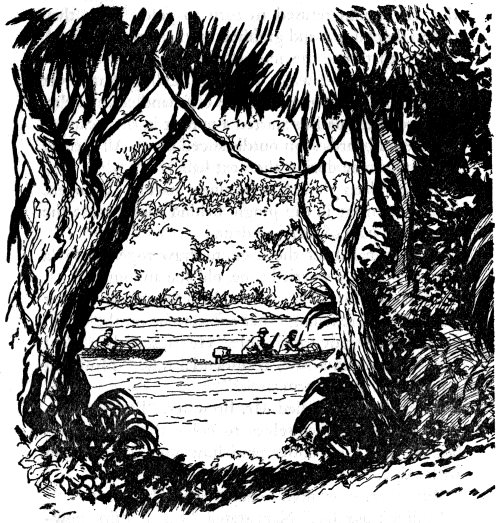
Nara showed his hands, now perfectly clean; then added, “I sprinkled just about enough for myself, so those Indians didn’t get any on their own hands. They still think that I alone have the golden touch, but even my being El Dorado won’t help us now that they feel I robbed them.”
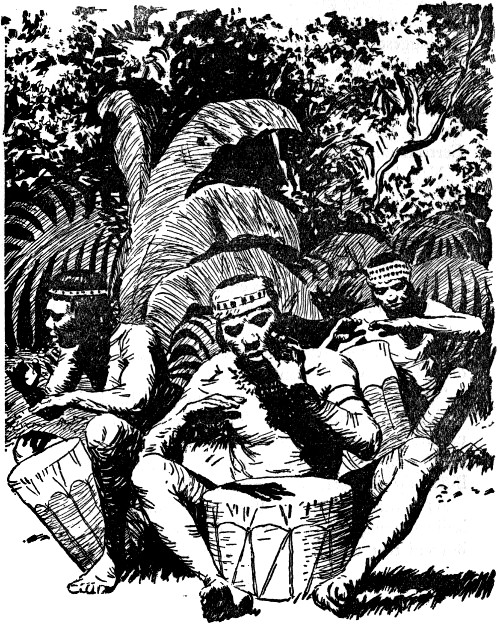
An hour later, the drums were still throbbing when Joe Nara pointed above the jungle to a huge, flat-topped mountain that towered like a mighty mesa above the wavy green.
“Cerro Duida,” called Nara, from his boat. “One of the biggest mountains in the Parima chain, about a mile and a half high. It was a long time before anybody climbed it, because Indians are afraid to go with them, on account of the spirits they think live on top. It’s kind of tied in with the El Dorado story. Anyway, Cerro Duida is close to the Orinoco River—”
Nara broke off as some canoes came scooting from the canal banks, filled with armed natives. Motors were opened to the full, and the flotilla again outdistanced the native dugouts. But Biff, at the bow of his father’s monteria, saw new problems ahead.
“We’ve missed the main channel, Dad,” Biff called to the stem. “It’s shallow ahead, with a lot of sandbars.”
Mr. Brewster cut off his motor and signaled for the other boats to do the same.
“We’d better pole our way through,” he decided. “We still have time before those natives catch up with us, and we can’t risk getting stranded on a sandbar.”
“Watch where you push pole,” Kamuka advised Biff. “Big sucuria may wrap around it.”
As Kamuka pointed, Biff saw a huge anaconda lazily sunning itself on a sandbar near the canal bank. Beyond that were others; in fact, the area was alive with the giant snakes, though none appeared to be active.
Carefully, the boats were poled through the channels without disturbing the basking boas. Biff looked back and counted a dozen of them, still in repose. Snakes as well as shallows had been avoided, when Nara’s boat ran on a hidden sandbar that the others had crossed. With its heavy cargo of ore, Nara’s monteria refused to budge.
Mr. Brewster attached lines to Nara’s boat, so that the others could haul it free. He told everybody to pole at once, and his plan seemed certain of success, when Nara shrilled:
“Look back there!”
Native canoes had come around the bend. Seeing the flotilla stuck among the sandbars, the tribesmen increased their paddle strokes. Nara grabbed a rifle and shouted to Mr. Brewster:
“Get your boats clear! I’ll fight them off!”
“Keep going!” ordered Mr. Brewster. Then, to Nara, he called: “Don’t start shooting! They outnumber us ten to one, and those spears of theirs have poison tips. Once they start throwing them, we won’t have a chance—”
It was too late. Joe Nara couldn’t be stopped, once his mind was made up. He opened fire at the canoes when they reached the first sandbar. Two dozen warriors rose to fling their deadly spears!
With the first crackle of Nara’s rifle, Mr. Brewster shouted, “Down everybody—and get ready for them!” That, Biff knew, could be more than just a shower of spears. The warriors themselves would be arriving next, with other weapons. The only hope would be a few more pole thrusts, but while that might save some of the party, it wouldn’t help Joe Nara.
It happened though, that Nara had helped himself. Those crazy shots that peppered the sandbars without coming near a canoe, unleashed a terrific force that took the native warriors by complete surprise. As they poised their spears, the sandbanks sprang into life before their eyes.
Roused by the blasts of Nara’s guns and the ping of the bullets in their sandy sunning spot, the anacondas lashed their way straight downstream in a broad horde of writhing fury that seemed to stretch like a monstrous ribbon, two hundred feet in length.
The stampede of mighty boa constrictors swept everything from their path. Their thick bodies and lashing coils spilled the canoes and plunged the native warriors into the canal, spears and all.
The snakes didn’t stop their mad rush. They whacked natives as well as boats when they passed them and left the canoes drifting in a churn of foam that made the canal look like a rapids clear beyond the bend. Then the living tidal wave was gone as quickly as it had begun. But Mr. Brewster wasn’t waiting for the natives to reclaim their canoes and spears so as to return to action.
“Back to the poles!” he ordered. “Heave away—away, everybody—and you, too, Nara!”
Old Joe, his face gleaming in happy surprise at the thing he had touched off, now laid aside his rifle and helped pry the barge from its sandy perch. By the time the hostile tribesmen were wading up on the sandbars that the anacondas had left, Nara’s boat was free. Outboards roared anew as the flotilla plowed its way to the main channel and on to the junction of the Casquiare and the Orinoco, where they headed downstream.
The rhythmic beat of distant tom-toms could still be heard that evening, when the motors were stopped and the boats allowed to drift down the river under a brilliant tropical moon. By morning, the drums had ceased, indicating that the Maco tribe had either given up the chase or that the flotilla was beyond the danger zone.
From then on, the expedition traveled mostly by day and picked suitable campsites overnight. Biff and Kamuka fished frequently and replenished the food supply by catching huge river turtles as well as a tasty species of catfish called cajaro. Biff landed one that measured well over three feet in length.
Some nights, the boats were lashed side by side and moored near river settlements where they formed what Hal Whitman termed a “floating mansion,” complete to the kitchen. At one village, Joe Nara bought stacks of huge cassava cakes. These measured two and a half feet across, but were only a half-inch thick. They had been brought upriver wrapped in plantain leaves.
These formed the main food for the Wai Wais accompanying Nara, and Jacome and Kamuka liked them too, though Biff found them rather tasteless. In contrast were some cayman eggs, which the boys dug up on a sandy shore while hunting turtles with Jacome. The Indians, Kamuka included, found them tasty indeed, but they were too strong in flavor to suit Biff.
Caymans were the great menace of the Orinoco, so the boys were duly warned against them. Closely resembling alligators, they were supposed to measure twenty-five feet or more in length. But when Kamuka called, “There’s a big one!” and Mr. Brewster promptly drilled it with a rifle shot, the cayman measured only twelve feet, when it was hauled on board the kitchen monteria.
“When you see a creature in motion,” Mr. Brewster told the boys, “and particularly a bird, or its cousin, a reptile, you always gain an exaggerated idea of its length.”
“Eggs-aggerate?” Kamuka repeated the unfamiliar term. “You mean eggs look long too?”
“Not eggs-actly,” put in Biff, with a smile, “but if we’d looked much longer at those cayman eggs, they would have hatched.”
Mr. Brewster smiled at the jokes, then became serious.
“You must learn what it means to gauge speed in terms of distance,” he declared. “When we reach the rapids where the Ventuari flows into the Orinoco, you boys can take the boat down through.”
When they reached the rapids, Mr. Brewster gave the helm to Biff, then told Kamuka to mind the bow and watch for rocks. Mr. Brewster went into the thatched cabin, but from there, he kept a sharp lookout in case the boys ran into trouble.
Biff realized that his dad was standing by in case of emergency, but unless something of the sort developed, Biff knew he would be on his own. What a thrill it was!
Kamuka watched like a cat, to copy any move made by Jacome and the stolid natives who were warding off rocks from the bows of the other boats. Biff kept an eager eye on Whitman, Joe Nara, and the Wai Wai who was piloting the kitchen barge. When Biff saw that they were watching the man in the bow, he did the same.
Time and again, Kamuka would raise his paddle to jab at a threatening rock. Always, Biff handled the helm accordingly. Kamuka nodded his head admiringly. He was crediting Biff with being a wonderful pilot, never realizing that he was furnishing the tip-off that enabled his friend to demonstrate such skill.
Twice, though, it was Kamuka’s quick work with the paddle that staved off a crash on the rocks before Biff could bring the helm about. When at last they were drifting in the calm water below the rapids, Biff sprang forward over the thatched cabin and grabbed Kamuka’s hand, exclaiming:
“Great work, Kamuka! We make a perfect team!”
Kamuka smiled solemnly as he repeated:
“We make—perfect team.”
Mr. Brewster came from the cabin and clapped a hand on each boy’s shoulder.
“You do make a perfect team,” he complimented. “Just remember it.”
They remembered it, several nights later, when they sat around the campfire after a cajaro dinner.
“Tomorrow,” stated Mr. Brewster, “we come to the Maipures Rapids.”
“Can we take the boat down through them?” queried Biff. “I mean, Kamuka and I?”
“None of our boats will shoot the Maipures,” said Mr. Brewster. “They are impassable. So are the rapids of the Atures, forty miles below. A road has been built around both rapids, so that trucks can transport us with our boats.”
Joe Nara gave a high-pitched snort.
“That’s where Serbot will be waiting for us,” he declared. “That’s for sure.”
“I’m not so sure,” put in Hal Whitman. “After he sold us out to those Indians on the Casquiare, he probably headed back the other way, down the Rio Negro.”
“Not if he figured we’d be coming down the Orinoco.”
Whitman and Nara both turned to Mr. Brewster, to see if he could settle the argument. As he lighted his pipe, Mr. Brewster stated calmly:
“It’s about an even chance that Serbot came this way. If he did, he will probably be watching the road to see if we come through.”
“That’s right,” declared Nara. “We’d better keep a sharp lookout when we reach that portage.”
“Serbot may be watching for us,” agreed Mr. Brewster, “but he won’t be able to make trouble for us there.”
“After what he’s already done,” argued Nara, “he might give us trouble anywhere.”
When they reached Sanariapo, the tiny village at the head of the upper rapids, Biff and Kamuka noticed some natives watching Igo and Ubi carry sacks of ore up over the sloping rock between the river and the highway, where transport trucks were waiting to load the boats as well as the cargo.
The boys reported this to Biff’s father, who talked with the truck drivers and learned that the hangers-on were simply hoping to pick up a few bolivars in Venezuelan money by helping load the trucks. But that didn’t satisfy Joe Nara.
“If they can’t make a bolivar one way,” he argued, “they may try another. Like telling people about our gold ore.”
“Here at Sanariapo,” stated Mr. Brewster, “there is no one for them to tell.”
“They might pass the word along to Puerto Ayacucho, below the lower rapids,” returned Nara. “I’ll go ahead on the first truck with Igo and Ubi, so I can check on any rumors.”
It took most of the day to make trucking arrangements, and to transport boats as well as cargo over the modern highway that spans the intervening streams on big steel bridges. Biff found the trip interesting, with stretches of open country and barren hills as well as wooded slopes and forested areas.
The highway followed the right bank of the Orinoco, which belongs to Venezuela, while the land on the other side of the river is part of the Republic of Colombia. At Puerto Ayacucho, they found Igo and Ubi waiting to load the ore sacks into Nara’s monteria, when it arrived. But there was no sign of Nara.
According to Igo and Ubi, Nara had gone somewhere immediately after arriving in Puerto Ayacucho. But Mr. Brewster, inquiring at stores, hotels, and elsewhere, was unable to find anyone who had even seen the old white-haired prospector.
“The only place left,” Mr. Brewster declared, chuckling, “is the governor’s office. Maybe Joe Nara is having lunch with His Excellency. Should we try there?”
“I don’t think so,” returned Hal Whitman dryly. “From the way Nara looks for trouble, we might do better if we asked at the local calaboose.”
Mr. Brewster smiled at that reference to the town jail.
“I’ve already asked there,” he said. Then, turning to the boys, he added, “Look around for Nara, and if you don’t have any luck, I guess we’ll have to call on the governor’s office to help us find him.”
Kamuka noticed some natives lounging near an old shack on the high bank of the river.
“Maybe they have seen Senhor Nara,” Kamuka said to Biff. “But you will have to ask them. They do not speak Portuguese as I do. They talk Spanish, which you understand.”
When they approached the group, Biff addressed the nearest native, who was huddled by the wall, his chin buried deep in his red bandanna neckerchief and his gaze turned toward the river.
“Oiga, amigo,” began Biff. “Soy buscando un viejo son pelo bianco—”
Biff was saying that he was looking for an old man with white hair, but he got no further. The slouchy native came to his feet and spun about with a snarl.
As Biff dropped back, he found himself staring into the vicious, hawkish face of Urubu!
“Look out, Biff! He may have a knife!”
The warning came from Kamuka as the Indian boy grabbed Biff’s arm, hauling him away from Urubu. But there was no way for them to dodge, except toward the wall, as Urubu was between them and the corner of the building.
Then, from around that very corner came a limber figure, a thin man clad in dungarees and a big sombrero, whose tight fists moved like pistons as they jabbed at Urubu’s face. Jolted backward, Urubu dropped the knife that he was pulling from beneath his shirt. Warding off a few blows, he turned and ran wildly for a landing below the riverbank.
The boys turned to thank their rescuer, who had lost his big sombrero and was stooping to pick up the wide-brimmed hat. They were amazed when they saw his smiling face and white hair. The man who had routed Urubu was Joe Nara.
“The way to spot snoopers,” advised Nara, “is to go snooping for them. Nobody would know old Joe Nara in this outfit, particularly with his white hair out of sight.”
Nara chuckled as he put on the sombrero, showing how quick and complete the change was. Then Nara pointed to the river where a small, squat motorboat was scudding downstream.
“There goes Urubu,” said Nara, “with another rat who was waiting for him, probably Pepito. They’re going to tell their boss Serbot that the gold rush is coming his way.”
The boys couldn’t see the boat closely, because they faced the glare of the late afternoon sun. When they told Mr. Brewster what had happened, he agreed with Nara.
“We’ll keep going downstream, though,” Mr. Brewster decided, “until we reach the rapids above Puerto Carreno, the only town on the Colombian side of the river.”
“Can we go through those rapids?” asked Biff.
“Yes, they are quite navigable,” his father replied, “but that is where Serbot and his crew will be waiting to attack us. If we get by the rapids, we’ll be all right, because Mr. Stannart should be at Puerto Carreno in his yacht, by this time.”
“Can he come that far up the Orinoco, Dad?”
“Yes, he can make it,” replied Mr. Brewster. “And in his letter he said he would, unless we met him farther downriver. Since we have taken longer than the time he allotted us, we should find him there. Then we’ll close the mining deal with you, Joe.”
“If we get there,” put in Nara glumly. “We can’t go around those rapids unless we take a back trail, and Serbot will be watching that, too.”
As the loaded flotilla continued down the river, Mr. Brewster continued to weigh the coming problem. He was hoping that a solution might crop up, and as the expedition approached the rapids, the answer came.
Back from the river on the Venezuelan side stood an old, abandoned blockhouse flanked by a few dilapidated mud huts.
“We’ll make camp there,” Mr. Brewster decided. “We can bring enough supplies into the blockhouse to hold Serbot off if he tries to attack us.”
“Do you think he has spies watching for us now?” asked Biff.
“Very probably,” his father rejoined. “And when he learns that we aren’t coming down the river, he will have to come up here to find us.”
Mr. Brewster signaled the other boats to shore, and when they landed, he explained full details of his plan.
“Tomorrow, Nara,” stated Mr. Brewster, “I want you to move your Wai Wai Indians down by a back trail to the rapids. They should be able to creep up on Serbot’s crew without his knowing it.”
Nara nodded agreement.
“As soon as Serbot becomes impatient and starts up here,” Mr. Brewster went on, “the Wai Wais can spring a surprise attack on any men that he leaves there. Then, before Serbot has time to attack us here, we’ll come down the river in the boats. We’ll pick your men up at the rapids, where they will have cleared the way for us.”
“But what about my monteria?” asked Nara, tilting his head in canny style. “It has all the gold ore. Remember?”
“We’ll bring it with the other boats,” promised Mr. Brewster. “It means more to me than to you, Nara, because you have lots more back at El Dorado. But these are the samples that I need to show Mr. Stannart and close the deal for Ajax.”
“But suppose Serbot does attack here?”
“We’ll drive him off from the blockhouse. When he sees that we are well fortified, he is sure to withdraw until he can bring up more men. Your Wai Wais will have taken care of them. That’s when we’ll surprise him by dashing out to the boats and starting down the river.”
They spent the rest of the day bringing the supplies in from the boats and putting the blockhouse into shape. The small windows of the square, squatty building were equipped with screens, but most of them were in poor condition. Mr. Brewster insisted upon repairing them first.
“Let’s get fortified against mosquitoes and other insects for tonight,” he suggested. “During the evening, we can strengthen the shutters and fix loopholes so as to fight off Serbot and his pests tomorrow or whenever they come this way.”
While the others worked late into the evening, Joe Nara strode about wearing a gun belt with two revolvers poking from its holsters, ready for trouble. Later Nara and his Wai Wais slept under netting on their monterias, so as to get a good rest.
In the blockhouse, the other members of the party took turns at guard duty through the night. At dawn, Jacome awakened Biff, who was scheduled to take over at that time. From one of the screened windows, Biff saw the squatty figures of Igo and Ubi emerge from Nara’s monteria. They roused the other Indians, and soon were stealthily moving off among the trees, to seek a trail to the rapids.
The next few hours were the longest that Biff had ever experienced. The others woke up, had breakfast, and strolled about the camp. But the very air seemed charged with expectancy. It would probably be mid-afternoon, perhaps even later in the day, before a move came from the other camp—if a move came at all.
Mr. Brewster, Hal Whitman, and Jacome were all carrying their rifles, fully loaded, but that was purely a matter of precaution.
“Nara’s party can’t have reached the rapids yet,” Mr. Brewster told Biff and Kamuka. “Even so, they won’t make a move unless Serbot starts out with his main force. If he sends some men ahead, they may try some sniping so, naturally, we must be ready. But that will show their hand—”
A sudden interruption came from the surrounding trees, the blasts of a dozen guns or more. Mr. Brewster wheeled and fired back from the spot where he was standing, midway between the blockhouse and the boats. Mr. Whitman and Jacome were nearer the blockhouse. They turned and fired, too.
A bigger volley answered from a wider angle, accompanied by the whine of bullets that were high, but close. Whitman was shouting from near the blockhouse:
“This way! Quick, or you’ll be cut off! Serbot is here with his whole outfit!”
Amid new gunbursts, Mr. Brewster made a rapid decision. He pointed the boys to the shore and told them:
“Quick! Get to Nara’s monteria. Start it down the river, and don’t stop until you reach Stannart’s yacht!”
The boys were on their way, and Mr. Brewster was dashing back to the blockhouse, to join Whitman and Jacome. He made it safely, although he drew the fire of Serbot’s followers, who were now visible as they came clambering, shouting, from the surrounding brush.
But Biff and Kamuka were now beyond the range of immediate gunfire when they boarded the monteria. Then they had the big motor started, and the heavily loaded boat was plowing its way out to the middle of the Orinoco.
When Biff looked back, he saw tiny figures on the shore, but the boat was now half a mile away, too far for bullets to reach it.
“Serbot staged a surprise attack of his own,” Biff told Kamuka, who was with him in the stem. “And Dad had promised Nara that he would get this monteria down the river. So here we are!”
“Soon we reach rapids,” was Kamuka’s comment. “I better get ready so we can work like team.”
The space under the thatched cabin was stacked with packs as well as sacks of ore, so Kamuka didn’t try to crawl through it to reach the bow of the boat. Instead, he scrambled over the low roof, picked up a paddle from the forward cockpit, and waved back to Biff as he took his position.
Soon the white foam of the rapids showed ahead. Biff steered for what looked like the main channel, and the monteria was swept into a series of whirlpools that licked the sides of jutting black rocks. The contrast in color helped Kamuka ward off those obstacles, while Biff did some fancy piloting to keep to the channel.
Then, as Biff veered from a new hazard in the shape of a sandbank, he saw what he had feared most. Human figures rose from the tall grass beyond the sandy shoal and aimed rifles directly at the swift-moving boat and the boys who manned it.
They were Serbot’s reserves, Biff realized, stationed here to block the flotilla if it came down the rapids, and Biff was sure he saw the gleaming face of Urubu in the midst of the group. Urubu was finding it an easy task with only a single monteria coming his way. He waved his hand as a signal to fire.
As the rifles barked, Biff gunned the motor, adding enough speed to carry the boat from the path of fire. But Urubu’s crew was aiming again, this time at point-blank range. Fortunately their fire never came. The tall grass stirred behind them, and from it sprang Igo, Ubi, and the rest of Nara’s Indians.
The Wai Wais had been stalking Urubu’s riflemen to the edge of the sandbank. The first blast of gunfire had given away the position of Urubu’s men. Now, the Wai Wais were engulfing them like a human tidal wave, while Biff and Kamuka resumed their battle with the rapids, keeping the big, clumsy boat clear of the rocks and sand.
Finally, the water subsided, and they were chugging peacefully down the river past the little settlement of Puerto Carreno and a great jutting point of sand where the Meta River flowed in from the left to join the Orinoco.
Kamuka waved his paddle and pointed ahead. Moored well away from the channel was a sleek white craft that could only be Mr. Stannart’s yacht, the Coronet. Though small, it had a trim build that marked it seaworthy, capable of braving the Caribbean, yet also suited to river travel.
Smiling men in trim uniforms appeared on deck as Biff maneuvered the monteria alongside the yacht. The boys made their boat fast and clambered up a rope ladder to find Mr. Stannart coming from his cabin to greet them. Biff introduced Kamuka, then started to pour out his story in one breath:
“Dad’s upriver in a lot of trouble. Old Joe Nara is somewhere along the rapids. But we’ve brought the gold ore from the mine, down there in the boat—”
Mr. Stannart smilingly interrupted with a wave toward the cabin as he suggested:
“Step in there and tell me all about it. I have a friend who would like to hear it too. You will agree when you meet him—”
The boys entered the compact cabin, then stopped short in amazement. Mr. Stannart’s friend was smiling, too, but in a way that was anything but pleasant. For both Biff and Kamuka had seen that fixed smile before.
The man who awaited them in the cabin was Nicholas Serbot!
Gripped by utter astonishment, Biff could only stare from Serbot to Stannart. When he found his voice, he blurted out accusingly:
“You two must have been working together from the very start!”
“Not quite,” declared Mr. Stannart dryly, “although I must say that Mr. Serbot and I have continually operated along similar lines. However, it wasn’t until after your father told the Ajax Corporation about Lew Kirby and his wonderful mine that I even heard of Nicholas Serbot.”
“And I,” rejoined Serbot, with his same fixed smile, “had never heard of the Ajax Mining Corporation.”
“Despite the fact that your father was impressed by Kirby’s story,” Stannart told Biff, “Ajax still had to investigate it. Kirby had samples of gold that might have come from many places, and his map could have meant nothing. It was necessary to obtain some reports from the upper region of the Rio Negro. I learned that certain European interests were checking on the same story.”
“And I,” added Serbot, “happened to represent some of those interests.”
“So while the directors of the Ajax Corporation dawdled,” continued Stannart, “I contacted the competition. I had much to offer that they needed, as Mr. Serbot will agree.”
“And I,” said Serbot, “advised them to meet the price, which included—this.”
By “this” Serbot referred to the stolen portion of Kirby’s map, which he spread on the desk in front of him. Biff started to say something, then caught himself. Gregg Stannart recognized what was in Biff’s mind and promptly expressed it.
“I needed a go-between,” Stannart asserted. “Some way to enable Serbot to use the information I could give him without bringing suspicion on myself.”
“So you gave me that letter!” exclaimed Biff. He turned accusingly toward Serbot. “And you tried to steal it from me on the plane! It was all arranged beforehand!”
“All very nicely arranged,” agreed Stannart, “because I wanted to keep my job with Ajax if the El Dorado story proved to be a hoax.”
“Since I might have seen the address on the envelope you carried,” Serbot told Biff, “you and your father guessed that I sent Pepito to steal your precious map, which was exactly what I wanted. What you didn’t guess was that Stannart was in on the game. The funniest part”—for once, Serbot’s smile seemed real—“was that I had a carbon copy of Stannart’s letter to your father, here in my pocket all the time!”
Biff swelled with indignation until he happened to glance toward Kamuka. All this talk had left Kamuka totally unimpressed. In Kamuka’s eyes, Biff saw only the same appeal that had been present that day when Biff had pulled the other boy from the quicksand. Biff suddenly realized that now they both were in something equally deep and probably just as deadly. Since he couldn’t say anything that would help, Biff said nothing.
Stannart turned to Serbot and put the question:
“What should we do with these boys?”
“I don’t know,” returned Serbot harshly. “Maybe they should have upset their boat and drowned, coming down through those rapids. If something like that had happened—”
“No, no,” Stannart interrupted. “Your men will have taken care of Brewster and his party by now. But we still need the boys to help us. Suppose we take them up the river, as far as the torn portion of your map—”
Stannart was leaning forward, pointing to the map with one hand, but he had his other hand in his pocket, as though gripping a gun.
“Of course!” exclaimed Serbot, who had one hand in a pocket, too. “Then they could take us back to where they came from, to this El Dorado that Nara talked about.”
Both Stannart and Serbot were glaring hard at Biff as though now it was his turn to speak. Biff’s throat was dry, for he realized that these two men, in their desire for gold, would think nothing about snuffing out his life and Kamuka’s. Somebody had to speak for Biff right then—and somebody did, from the door of the cabin.
“Nobody talks about El Dorado,” a crackly voice announced, “except Joe Nara, the man who owns it.”
There in the doorway stood old Joe, both his guns drawn from their holsters, one fixed on Stannart, the other on Serbot. At Nara’s nod, the two men brought their hands from their pockets empty. They knew the old man meant business.
“Pretty smart, both of you,” Nara said. “I never even guessed your game, Stannart, probably because I never met you before. But having seen you now, I think I would have known you for a rat from away back.
“But I figured you out, Serbot. I knew what you were after—that cargo of mine. So I stayed with them.” Nara gave his head a quick tilt, to smile at Biff and Kamuka. “Yes, boys, I sent my Wai Wais down to the rapids, while I stayed in the cabin of my monteria.
“Next thing I knew”—Nara gave a chuckle—“you were bringing me downriver, and a right good job you were making of it, too. Finally, you hauled up beside this yacht and went on board. When you didn’t come back, I reckoned you might be needing old Joe, so I moseyed on board, and here I am.”
Still keeping Stannart and Serbot covered with his guns, Nara shifted his elbow toward his hip pocket to indicate a coil of rope that projected there.
“Take that rope,” Nara told the boys, “and tie them up tight. Gag them, too, with their handkerchiefs. If they don’t have any, use your own. Make a good job of it. I want them to be here when I send around for them.”
Biff and Kamuka followed Nara’s instructions eagerly. They did a good job with the gags, too, while Nara, brandishing his guns, kept talking to Stannart and Serbot in an accusing tone.
“I figured you out before I ever met you,” declared Nara, “because I knew I’d be meeting up with rats some time, and you just happened to be it. You figured you’d get rid of me if you could, and even if you couldn’t you’d jump my claim. After all, who was Joe Nara? Just some crazy guy who thought he’d found El Dorado.
“Crazy, yes, but like a fox. I came down the Orinoco more than once to make sure my claim was registered after each political shakeup in Venezuela. I didn’t even take any chances on this last trip.”
Nara paused, then chuckled as he turned to the boys who had finished tying Stannart and Serbot in their chairs.
“Remember how I dropped from sight in Puerto Ayacucho?” asked Nara. “Do you know where I was most of the day? Having lunch with His Excellency, the governor of the Amazonas Territory, that’s where. I told him some people were trying to steal my claim. He said he wouldn’t let them get away with it.
“After I left his office, I snooped around and happened to be handy when you ran into trouble with Urubu. I’d finished my business with the governor. He said if he didn’t hear from me, he’d send some soldiers downriver to look me up.”
Nara examined the knots that the boys had tied and gave an approving nod. He beckoned them out through the cabin door, which he closed behind him. The yacht’s crew suspected nothing, for they helped Nara and the boys over the rail and down into their waiting monteria.
As they started up the broad Orinoco, Nara pointed to some boats that were coming toward them.
“Government boats,” he chuckled, “bringing those soldiers I spoke about.”
When they met the boats, they found the other monterias with them, manned by Biffs father, Mr. Whitman, and Jacome. The Venezuelan troops had arrived at the blockhouse during the battle and had helped rout Serbot’s followers, who were commanded by Pepito.
In the rapids, they had contacted Nara’s Wai Wais, who had overpowered and captured Urubu and his crew. Igo and Ubi would be along later, Mr. Brewster stated, bringing their prisoners with them.
“But we saw no sign of Serbot,” declared Mr. Brewster. “I think we should offer a reward for his capture. I’ll talk to Mr. Stannart about it, when I see him on the yacht.”
“You better wait, Dad, till we tell you what happened,” Biff advised soberly.
Mr. Brewster was shocked when he heard Biff’s story. “I can hardly believe it!” he exclaimed. “Gregg Stannart, of all men! But now that I think of it,” he added thoughtfully, “there’s been a piece missing from the puzzle right along—and Stannart was it!” He shook his head. “I still can’t believe it.”
Now Mr. Brewster was more eager than anyone to take Stannart and Serbot into custody. As they approached the Coronet, they noticed excitement on the deck. Mr. Brewster studied the yacht through his binoculars and announced:
“I see Stannart and Serbot, both of them. The crew must have found them in the cabin and released them.”
A fast boat containing a squad of Venezuelan soldiers sped ahead to board the yacht. Sight of the military uniforms must have quenched any desire for fight in Stannart and Serbot, for suddenly a little motor launch scooted from the far side of the yacht and bounded through the choppy waves toward the left bank of the river.
Only Stannart and Serbot were in the tiny tender. The boat with the Venezuelan soldiers turned to pursue it, opening rifle fire, but the fugitives kept on. Then, just as it seemed sure they would be overtaken, the chase ended. The soldiers, about to fire at close range, suddenly lowered their rifles.
“It’s too late,” declared Mr. Brewster glumly. “They can’t be captured now. They have passed the middle of the river and are across the international line, in Colombian jurisdiction.”
The captain of the yacht was astonished when told the reason for Stannart’s flight. He and his crew had known nothing about Stannart’s double-dealing. They had supposed that Serbot was simply a friend who had come on board to meet the owner. They had been puzzled to find the pair bound and gagged after Nara and the boys had left.
Stannart had claimed that Nara and the boys had tried to rob him. The yacht captain had accepted that explanation until Stannart and Serbot saw the Venezuelan soldiers and suddenly took flight. Then it was plain that something was wrong.
Contact was made with Caracas, the capital of Venezuela, and from there, radiograms were relayed to and from New York. Word finally came from the directors of the Ajax Mining Corporation, stating that they had checked their accounts and found that Stannart had taken most of the available funds before starting on his Caribbean yacht trip.
The Ajax Corporation obtained an order enabling them to take over the Coronet, and the yacht was placed in Mr. Brewster’s charge. They also authorized Mr. Brewster to complete the transaction with Joe Nara on whatever terms might be mutually satisfactory.
That was done on board the Coronet, which was still anchored near the junction of the Meta and the Orinoco. Mr. Brewster set the date when the Ajax Corporation would take over the mine with a down payment of a quarter of a million dollars to Joe Nara and a block of El Dorado stock that would guarantee him a share of all future profits.
That same day, Joe Nara prepared to start back up the Orinoco with Igo, Ubi, and the other Wai Wais, who were eager to rejoin their fellow tribesmen as the guardians of El Dorado. Hal Whitman arranged to go along to represent the Ajax Company, taking Jacome with him. Kamuka packed his few belongings, expecting to accompany them. The Indian boy was saying a reluctant good-by to Biff on the deck of the yacht, when Mr. Brewster quietly commented:
“You don’t have to go, Kamuka, if you’d rather come with us.”
Kamuka’s eyes popped wide with eager surprise. Biff showed the same feeling, when he exclaimed, “You really mean it, Dad?”
“I do,” rejoined Mr. Brewster. “Hal Whitman told me he has made plans to send Kamuka to a new school that is opening in Brasilia, the capital of Brazil. But Hal can’t possibly get down there for the next few weeks, or more. So there’s no reason why Kamuka can’t come home with us. Then he can fly to Brasilia after Mr. Whitman arrives there.”
Biff turned and clapped Kamuka on the shoulder.
“Will we have fun, Kamuka! First, the yacht will take us out into the Atlantic Ocean—”
“I have heard of it,” put in Kamuka. “They say it is bigger than a thousand Amazons.”
“And you’ll see New York, which is more wonderful than any El Dorado!”
It was hard to tell which boy felt the greater thrill. Each was glad to continue a companionship in which they had shared so many adventures, forming the bonds of a friendship that would last always.
Mr. Brewster was the most pleased of all. He stood at the stem of the yacht with Biff and Kamuka, while they were churning their way down the broad Orinoco toward Ciudad Bolivar, the largest port on the river. It was then that Biff turned to his father and said, very seriously:
“Dad, I can’t see how Stannart and Serbot missed out. When they used me as a go-between, they had everything so easy.”
“So easy, Biff?”
“Yes. I must have been a big handicap to the safari. I’d never even seen a jungle, let alone run into the sort of dangers we found there.”
“But you learned to meet those dangers, and more.”
“Well, yes. I certainly did learn some things.”
“And so did the rest of us,” declared Mr. Brewster. “Our enemies put us in spots where we had to pull one another out. That was their big mistake. The situations that we overcame early sharpened us for the problems we met later. That’s why we won out.”
As Biff nodded slowly, his father added with a smile:
“Think back, Biff, and you’ll see how it adds up.”
Biff gazed back at the wide Orinoco, tapering to the dim, distant scenes of those final adventures, and he knew that his dad was right.
By ANDY ADAMS
“Guard this letter as you would your life!”
With these words ringing in his ears, Biff Brewster boards the Brazil-bound plane to join his father on a safari to the headwaters of the Amazon River—a safari that, to Biff’s amazement, becomes a deadly contest for fabulous riches.
From the beginning, Biff, his father, Biffs friend Kamuka, and the rest of the party find their path menaced by an enemy who never reveals himself. Is it Nicholas Serbot, the suave stranger whom Biff first meets on the plane? Or is it Joe Nara, the eccentric old prospector, the only white man alive who knows the route to the almost legendary El Dorado gold mine?
Biff and Kamuka find their days crowded with the hazards and thrills of jungle travel as they trek through a wilderness echoing with the threat of “Macu”—the dreaded head-hunters. And waiting for them at the end of the trail are a shock and a surprise beyond their wildest dreams.
Young readers will love this lively, adventure-filled story with its combination of realism and fantastic mystery. Here is the first exciting book in a brand-new series for boys. Other Biff Brewster stories are also available at your booksellers.
By ANDY ADAMS
Biff Brewster, sixteen, is a tall, strongly built blond youth who lives In Indianapolis, Indiana, with his parents and the eleven-year-old twins, Ted and Monica. Because his mother and father believe that travel is as important to education as formal schooling, Biff is encouraged to travel to various countries during the vacation months. His experiences in these lands, and the young people he meets there, form the basis of a new series for adventure-loving readers. In every journey there is a strong element of mystery, usually a direct result of conditions peculiar to the region in which he is traveling. Thus, in addition to adventure, these books impart carefully researched information about foreign countries.
Start reading one today—
GROSSET & DUNLAP, Inc. Publisher
New York 10, N. Y.