New original cover art included with this eBook is granted to the public domain.
BRAZIL
TODAY AND TOMORROW
THE MACMILLAN COMPANY
NEW YORK · BOSTON · CHICAGO · DALLAS
ATLANTA · SAN FRANCISCO
MACMILLAN & CO., Limited
LONDON · BOMBAY · CALCUTTA
MELBOURNE
THE MACMILLAN CO. OF CANADA, Ltd.
TORONTO
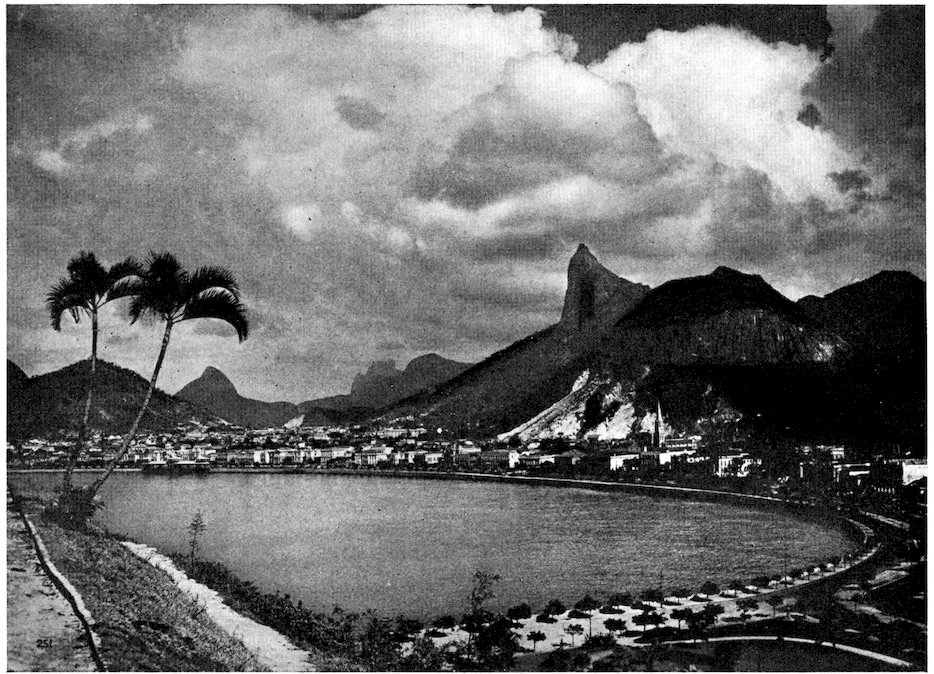
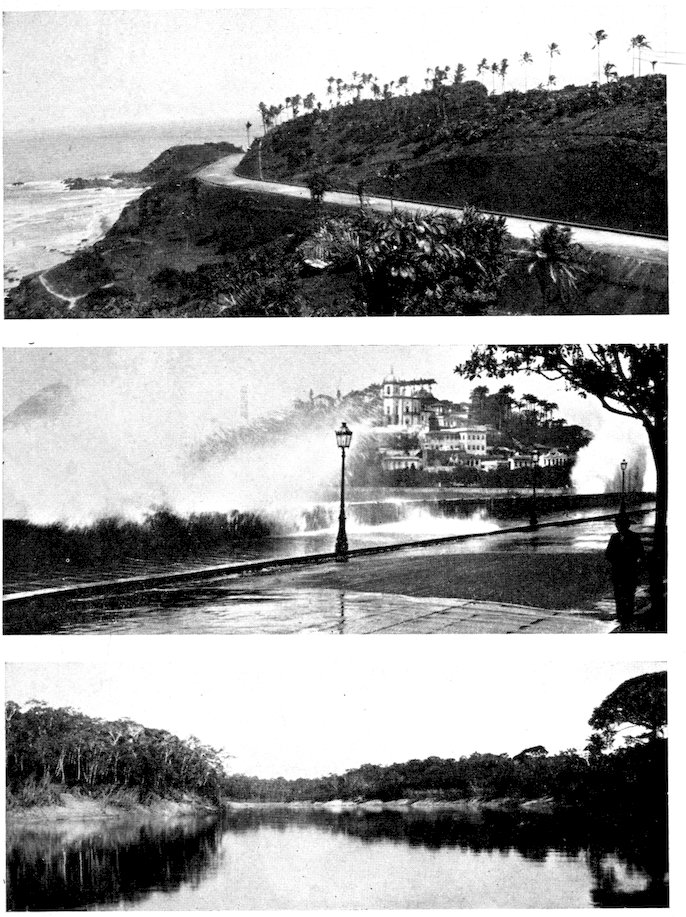
Botafogo Bay, Rio de Janeiro.
In the background are the Dois Irmãos Mountains, the flat-topped Gavea, and the curved granite peak of Corcovado.
BY
L. E. ELLIOTT, F. R. G. S., F. R. A. I., Etc.
AUTHOR OF “BLACK GOLD,” “CHILE, TODAY AND TOMORROW,” etc. LITERARY EDITOR, PAN AMERICAN MAGAZINE
ILLUSTRATED
“The time will come when the Ocean will no longer
limit the known lands, when a new world shall be
opened up to the followers of the sea, and Thule
will be no longer the Ultima Thule of the earth.”
Brazil’s Great Extent—Virgin Interior—Development during Last Hundred Years—Variety of Soil and Climate—Amazon Basin, Central Plateau, Coast—Diversified Industries and Populations—Divergent Interests—Brazil Over-Praised and Over-Blamed—South American Standpoint—North and South Americans—Ties with Europe.
Discovery—Henry the Navigator—Search for Cathay—Captain Cabral—Duarte Coelho—The Capitanias—Ramalho and Caramarú—São Paulo, Bahia and Pernambuco—The Jesuits—Mamelucos—First Entradas—The Sertão—The Bandeirantes—Raposo—Fernão Dias—Gold and Diamonds—Destruction of the Missions—Brazil under Spain—Corsairs—The Dutch in North Brazil—Portugal regains Independence—Evacuation by Dutch—The French in Rio—Interior Mines and Settlement—The Marquis de Pombal—Expulsion of Jesuits—Dom João in Brazil—Dom Pedro I—Independent Monarchy—Dom Pedro II—Abolition of Slavery—Republic.
Group Immigration Planned—Swiss in Nova Friburgo—First Germans in Rio Grande—Petropolis and Blumenau—Joinville—German Emigration Forbidden—Portuguese Colonies—Parceria System—French and Alsatians—North Americans—Santa Barbara and the Consul—New Italian Stream—Colonos and the Patronato Agricola—Poles and Russians—Conditions of Settlement in São Paulo—Present Status of Colonies—Japanese at Iguape—Numbers of Immigrants entering Brazil—Future Immigration—Best Points of Settlement—Class needed.
Brazilian Courtesy—European Influence—Titles—Dominating Class—Fazendeiros and Commerciantes—Mixed Blood and the Labouring Classes—Bacharelismo—The Sertanejo—Life in the Interior—Festas—The Tropeiro—Lotteries—The Bicho—Coffee Drinking—Religion—Saints’ Days—Ceremonies—Position of Women—The Brazilian Girl and Wife—City Life—Literature—Novels—Poets—The Stage—The Press—Influence of Blood, European and African—Negro Cooking and Folklore—The Native Brazilian—Pottery and Weaving—Ideas and Ability—Work of Rondon—Fate of the Indian—Education—Brazil not Revolutionary—The A. B. C. Treaty.
First Railroad Planning—First Construction—Coffee Railways—Climbing the Mountain Barrier—Work in Empire and Republic—Borrowing—Linking Centres—Radiating Lines—Roads Serving States, South to North—Brazil Railway Company—The Central Line—Leopoldina—Bahia Roads—Great Western—Northern Lines—Roads Passing Falls—Financial Conditions—Status of Ownership—Future Lines.
The Coffee Industry of Brazil—The Rubber Industry of the Amazon—The Meat Industry: Cattle Raising and Packing-Houses—Cotton Growing and Weaving—Herva Matte—Sugar—Tobacco—Wheat—Fibres—Cacao—Mining—Brazilian Manufactures: Artificial Industries; Industrial Centres; Capital; National Industries Competing with Importations; Imposts; Factories of São Paulo; Textiles; Locality of Mills in Brazil; Labour and Consumption of Material; National Dyes; Water power.
Value of the milreis—Fluctuations—Caixa de Conversão—Convertible and Inconvertible Paper—Emergency Issues—Treasury Bills—Paper Currency, at Different Dates—Metal Coinage—Effects of Fallen Exchange.
Blood, Brains and Money—British Investments—Railways—Public Utilities and Industrials—External Loans—French Investments—German Work—North American Interests—Banks in Brazil.
III.
State Debts—Municipal Debts—Federal Debts—Funding Loans—Resumption of Specie Payments—Sources of State and Federal Revenue.
Brazilian Origin of Well-known Flowers—First Botanists—Piso and Marcgrav—Loudon’s Hortus—Gardner—Orchids—Cattley—Flowers and Shrubs—Fruits—Medicines—Ipecacuanha—Copaiba—Jaborandi—Guaraná—Native Remedies—Mineral Waters.
Dominant Districts and Industries—Figures of Ten-year Periods of Commerce—The Nine Principal Articles—São Paulo’s Share—United States Purchases—Imports—Their Origin—Balance of Trade.
The greatest of all American countries is comparatively
the least developed. Brazil, with her 3,300,000
square miles of territory, four thousand miles of coast,
and her incomparable system of great waterways, has
the largest extent of wild and almost unknown country
of any political division of the New World; she, and
she alone, owns thousands of square miles of forests
where no one has set foot but the native, still really
living in the Stone Age, mountain ranges never properly
prospected, with their deposits of minerals scarcely
scratched, and millions of acres of grassy uplands waiting
for the farmer and the stock-raiser.
Brazil is not scantily developed because little has
been done; on the contrary, a wonderful amount of
development has been accomplished, but the period of
expansion has been short and the country so great and
varied that whole regions remain out of the track of
progress. Until a century ago, when Dom João opened
Brazilian ports to international commerce, Brazil lay
in a trance, bound hand and foot to Portugal, isolated
from the world. Her erection into a separate monarchy
found her without capital, without education, for she
had neither adequate primary nor technical schools,
without a press, and without any knowledge of her own
resources except that gathered by the interior raids,
wanderings and settlements of her own hardy people.
2Everything that has been done to bring Brazil into
the race of nations is the work of the last hundred
years; the most intense period of rapid building since
the establishment of the republic has lasted less than
thirty years, for in that time has taken place the great
acquisition of private fortunes in the industrial regions
of Brazil. Much of the civic building, creation of public
utilities, establishment of transportation lines, has
been due to foreign capital and technical skill, but
Brazil herself has contributed no small share of enterprise
during the last fifty years; descendants of Portuguese
fidalgos have taken up engineering, agriculture,
commerce and city-making with energy and intelligence
which is not always given a due share of recognition by
those onlookers who think that all development of
Latin America must come from without. In Brazil
much progress, much creation, has come from within,
and will come to an even larger degree in the future with
improvement in technical education; but the country is
enormous, the centres of population have always lain on
or near the sea-border, and interior Brazil, the virgin
heart of South America, remains practically untouched.
The two great interior states of Matto Grosso and
Goyaz cover an area of more than two million square
kilometres; they make up one-fourth of the whole
Brazilian territory, and Brazil covers half of South
America: but this huge heart-shaped wedge in the centre
of the continent has no more than half a million
population. This is not because the country is tropical
or worthless, but because it is unopened and unknown.
Within her wide area Brazil encloses a great variety
of soils and climates: she has no snow line, because she
has no great mountain heights; a peak less than three
3thousand metres high, Itatiaya, in the Mantiqueiras, is
the point of greatest altitude. But she has almost
every other climatic gift that can be included within
the fifth degree of North and thirty-third of South
Latitude; between the eighth degree East and thirtieth
West Longitude of the meridian of Rio de Janeiro.
Brazil is a vast plateau with a steep descent to the sea
along half her coast, and a flat hot sea margin of varying
widths; this plateau, scored by great rivers, sweeps
away in undulating prairies, sloping in two principal
directions—inland, in the centre and south, to the great
Paraná valley; and in the upper regions, northward to
the immense Amazon basin. This is not a basin so
much as a wide plate, for not only is the course of the
huge rio-mar almost flat for the last thousand miles of
its journey to the sea (Manáos is only 85 feet above
sea-level) but this practically level ground extends
northward all the way to the confines of Venezuela and
the three Guianas, and southward until the Cordilheiras
of Matto Grosso are encountered. Great expanses of
this plate are filled with the sweltering forests of tropical
tradition, forests containing a thousand kinds of
strange orchids, immense and curious trees, insects,
reptiles and animals; from Orellana and Lopez de
Aguirre to Humboldt, Bates, Wallace and Agassiz,
from the Lord de la Ravardière to Nicolas Hortsman the
practical Dutchman who announced that El Dorado
did not exist, to Charles Marie de la Condamine, Martius,
Spix, Admiral Smith, Lister Maw, Schomburgk
and Wickham, every traveller upon the Amazon has
tried to describe the indescribable Amazonian forest.
Deep, monotonous, silent, dark and changeless, the
forest unconquerable walls in the uncountable rivers
4traversing it from the snows of Peru and the interior
plateau of Brazil, closing in upon the little cities where
man has settled himself in a puny attempt to steal
treasures out of its mighty heart.
There is a remarkable contrast between this humid
forestal area of the north and the cool high cattle lands
of the centre, the pine and matte woods and wheat
lands of the south and the hot coastal belt of the great
promontory with its deep fringe of coconuts, its sugar
country, tobacco fields and cacao plantations; between
the coffee country of São Paulo and the regions of the
carnauba palm and the babassú. No physical contrast
could be more acute than that of the flat tropic swamps
of Pará and the austere, fantastic and beautiful granite
peaks of the Serra do Mar near Rio—the slender Finger
of God in the Orgão Mountains, the curved up-rearing
of the Corcovado, the cloud-wreathed head of Tijuca.
Nor is there less contrast in the different industries
resulting from the different products of the widely diversified
regions, and the population inhabiting them.
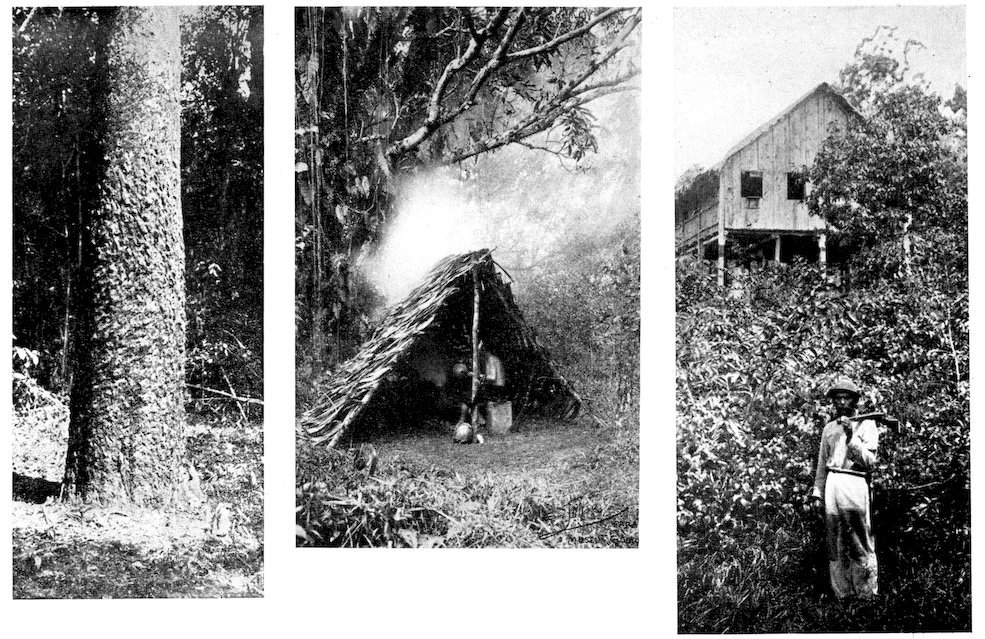
The extreme north exists largely upon the rubber
business, where independent individuals extract gum
from wild trees in regions that are sometimes scarcely
charted; in the south an imported Italian population
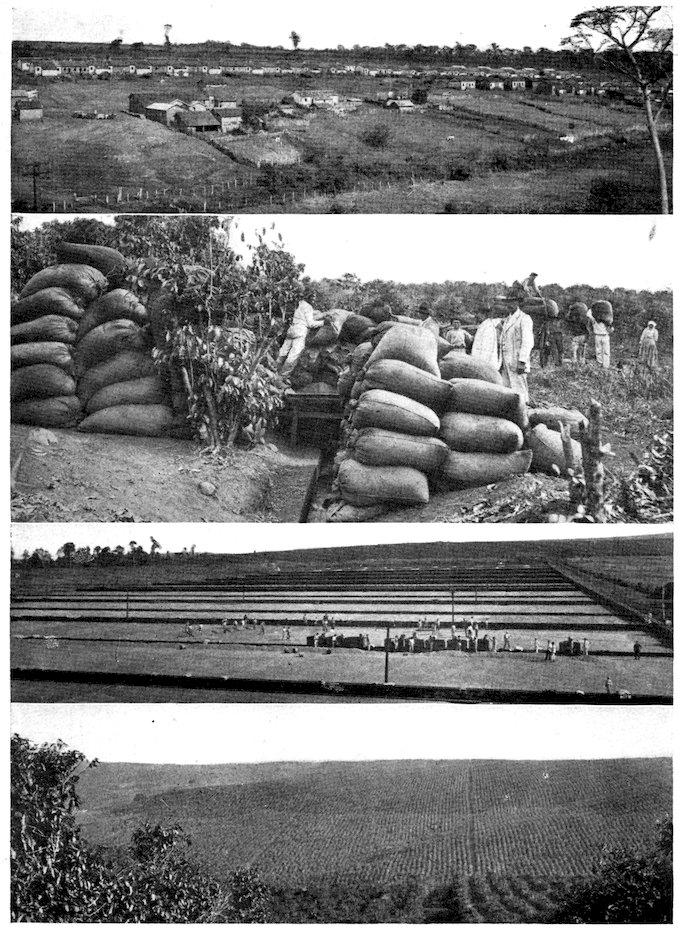
performs routine tasks on the highly organized coffee
plantations.
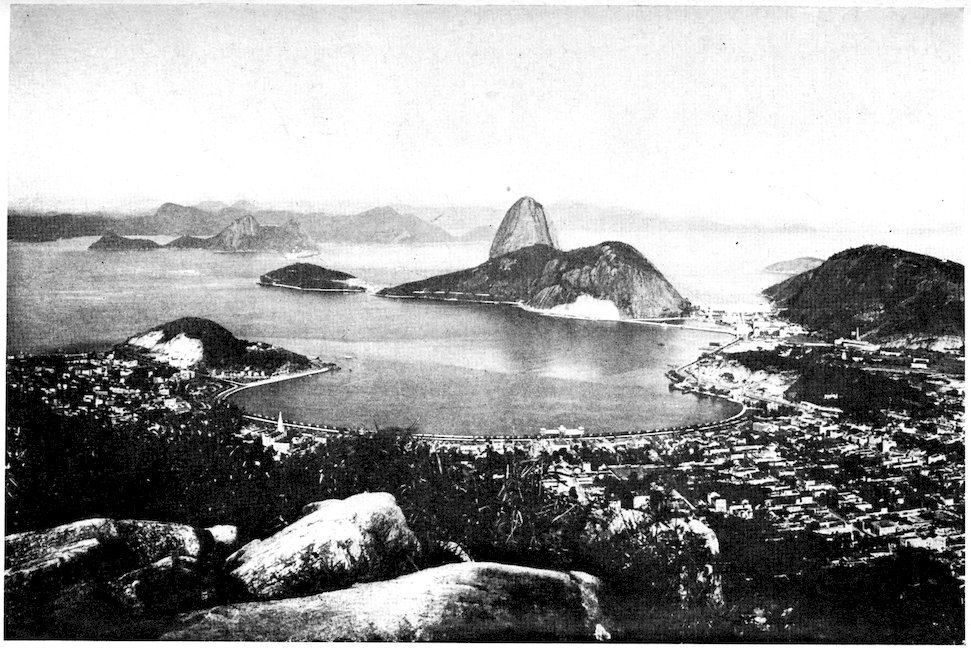
Entrance of Rio de Janeiro Harbour (Bahia de Guanabara).
Showing the farther shore, the forts, the Pão d’Assucar, and the loop of Botafogo Bay.
5In between these two sharply marked divisions there
are many industries and many grades of labour, from
the caboclo half-Indian of the north to the negro of the
centre and the Japanese, Syrian and Pole of the southerly
colonies, as well as the descendant of the Portuguese.
There is in some parts of Brazil such a mixture
of races and tongues that it seems as if the Jesuits were
needed again to invent a new lingua geral. Contrasts
in personality, as well as in soil and climate in Brazil,
and the difference in accessibility between an open
seaboard and a deep and roadless interior, have all aided
to bring about the marked diversity of interests which
have more than once proved the salvation of the
country. Publicists in Brazil sometimes sound a note
of warning against the decentralization that has grown
more emphatic since the erection of the Republican
system gave autonomous powers to the States; there
have been suggestions of separation of north from south
on account of their distinct interests; but it is impossible
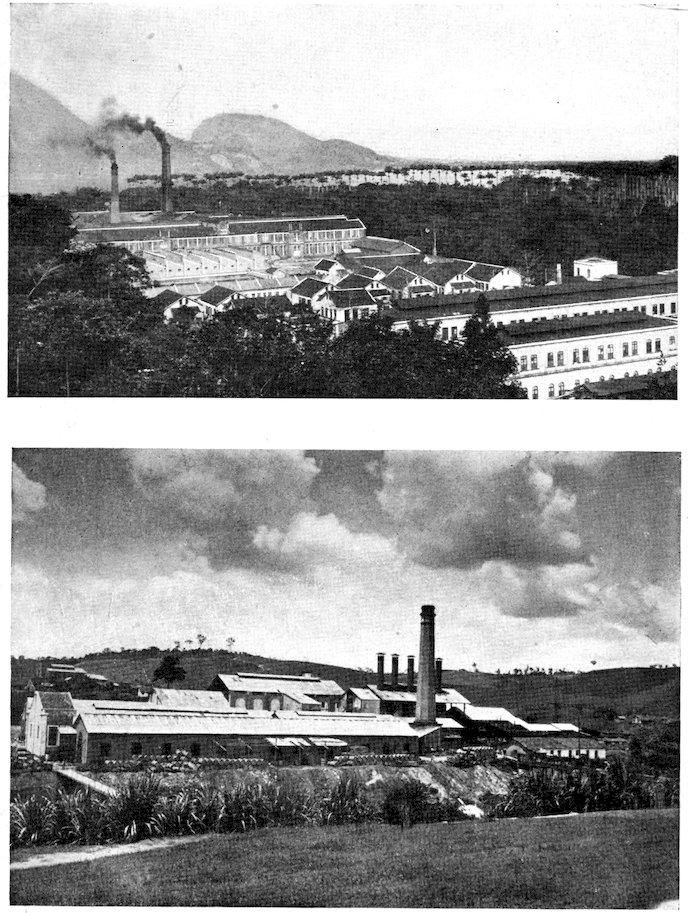
to doubt that a country with a score of industries
and of products to offer to world markets is in a better
economic position than lands depending upon two or
three main sources of income.
In the Argentine the city of Buenos Aires is the
centre and fount of business; every great house has
its headquarters there, its railway links and commercial
arms reach out into all productive parts of the country.
To Buenos Aires everything comes to be marketed
whether from the interior or from abroad: it is the
city, the head and heart of the Argentine. It is not
possible to point to any one city in Brazil and to say
the same. Not even lovely and splendid Rio, federal
capital and gay vortex as she is, can claim to represent
the commercial interest of the country; she is the
spending-place of much of Brazil’s income, but she is
not the greatest earner. This honour falls to São Paulo,
with Santos as the biggest exporter of values; no one
denies the commercial palm to the Paulistas, but it is
not heresy to say that the elimination of the coffee
industry would not destroy the life of Brazil as, for
6example, the disappearance of the cereal or cattle industry
would threaten the Argentine. She would still retain
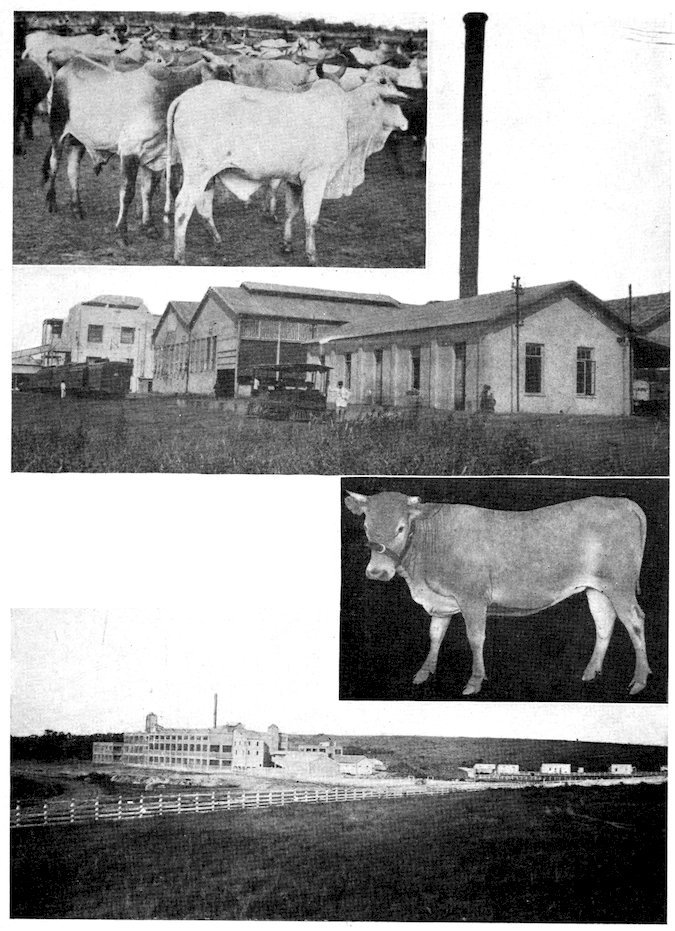
her herva matte, her cattle, her mines; her rubber, wax,
fruit, cotton, sugar, and tobacco; her hardwoods and
forestal drugs and dyes, her cacao and fibres and nuts.
A whole world of interests divides São Paulo from
Bahia, Bahia from Pará, Pará from Pernambuco,
Maranhão from Victoria, Maceió from Porto Alegre,
Rio de Janeiro from Manáos, Ilhéos from Paranaguá,
Mossoró from São Francisco, Fortaleza from Florianopolis;
some of these ports are great economically, alive
with shipping, while others are little developing points
which have not yet achieved international fame; but
each has its distinct raison d’être and has a divergent
social and economic impulse from that of many of her
sisters. It is true that certain states seem to produce
almost everything tropical or sub-tropical as well as
being endowed with minerals, as Minas Geraes, growing
coffee, cotton, raising cattle, mining precious stones,
gold and iron ore, weaving her cotton and running a
great dairy business with interstate shipments of her
famous cheese and butter; or Pernambuco and the other
states of the great promontory, with a host of different
products; or São Paulo, where an energetic Brazilian
fazendeiro, to show what his state can grow besides
coffee, cotton, rice and sugar, has gardens containing
“every known fruit” of temperate and tropical zones.
But the distinct local industries of the widely varying
Brazilian soil and climate are the most striking and
promising elements of her economic life.
Many parts of South America have suffered from
over-praise as much as from unmerited blame. None
7have suffered more than Brazil, shut off from the non-Latin
world rather more than is Spanish America because
of her Portuguese idiom. There is little enough
thorough study of Spanish on the part of Anglo-Saxons,
but it is mighty compared to the study of Portuguese,
a beautiful language and probably rather more readily
acquired than the formal and clear-cut idiom of Castile.
Non-comprehension of Portuguese and Spanish has
been a bar to understanding of the soul of Latin America;
nearly every person who wishes to learn something
about any part of the Southern Continent runs to the
libraries for a book of travels, generally written by a
foreigner, himself sparsely acquainted with the language
of the country about which he is writing, and
frequently entirely from an outside viewpoint. There
is a remarkable absence of study of South America
from the South American’s viewpoint, and it is for this
reason that I have tried in this book to quote from Brazilian
books and newspapers rather than from the ideas
of foreigners, however distinguished. It is a loss to the
Anglo-Saxon that so much fine and acute comment and
description of South America by South Americans falls
on deaf ears because of the language difficulty; perhaps
the next few years may see the new interest in things
South American stimulated by translations from many
more of the writings of South American authors.
Only by understanding the South American better
can the Anglo-Saxon see the relation that mutually
exists, and realize the depth of the gulf between them
at the same time. Especially since the outbreak of the
European War we have seen an astounding number of
agreeable but visionary articles written on the subject
of the strong logical tie, geographical, political and
8mental, between North and South America. The truth
is however that the two continents have little geographical
connection—Panama was once a strait—and
perhaps even less racial, religious, and mental leanings.
Both sections of the Americas have drawn their blood,
language, religion and political ideals from Europe, but
from two strongly marked sections—one, the Protestant
Anglo-Saxon, commercial, mechanically inventive: the
other, the Roman Catholic Latin section, artistic and
mentally brilliant but not usually a born commerciante.
It is just as well to realize this difference clearly, to
know that, at least in the past, the Americas have been
more closely bound to Europe than to each other; the
ties are especially strong in Brazil, more tender than in
many parts of the New World, because separation in a
political sense was obtained without violence. It is
only through understanding of the mental and social
attitude and conditions of the Brazilian that the newcomer
can avoid pitfalls.
Mistakenly advised, and often lured by too golden
promises, the stranger has often rushed to one or another
part of South America, has found bitter disappointment,
and gone home with denunciation of all
things South American upon his tongue; but in many
instances the fault lay within himself, in his want of
knowledge of circumstances, physical and mental, and
of his improper equipment for the task that lay to his
hand. There are many such tasks, but they must be
approached with equipment and spirit equally prepared;
no fortune is to be attained by a mere rub of the magic
lamp.
9This book is offered chiefly with the hope of helping
to stimulate interest in Brazil, to induce a more thorough
study than these pages can offer in the only place
where Brazil can be studied—in her own fair confines.
If it supplements what has already been written, brings
up to date for the time being the story of Brazil’s development,
if it awakens in more of the energetic and able
people of the world a wish to take part in the opening-up
of the great Brazilian resources, this book will have
served its modest purpose. It is the fruit of seven
years’ travel in and study of Latin America, and two
years’ special work on and in Brazil, where seventeen
out of the twenty States were visited.
A debt is owing to many Brazilian publications,
sources of much statistical matter as well as illumination
of Brazilian thought, as the Jornal do Commercio
of Rio, Brasil Ferro Carril, very many local journals of
different States, Wileman’s Brazilian Review, the Diario
Official issued by various authorities; the invaluable
Mensagens, with their financial and industrial surveys,
issued by State Presidents; to many kind and helpful
friends in Brazil, England and America; to the South
American Journal; and especially to Mr. W. Roberts
of the London Times, to whom I am indebted for most
of the subject matter in “The World’s Horticultural
and Medicinal Debt to Brazil.”
CHAPTER I THE HISTORY OF BRAZIL
10
Brazil and the Brazilians cannot be understood
without knowledge of their history, for here as in no
other part of Latin America the past has led up to the
present without any violent upheaval. While the
Spanish colonies of Central and South America were
plunged first in revolutionary and afterwards in civil
war, shedding not only blood but also tradition and
brotherhood with their kin, Portuguese America was
saved from similar conditions by the odd turn of fortune
that made her a monarchy, independent of Europe and
yet ruled by a European prince, during the most
critical years of the nineteenth century.
Thanks to Napoleon Buonaparte, no furious chasm,
difficult for even thoughts to bridge, was opened between
Brazil and the Mother Country; it was never
necessary for young Brazilians to be taught that Europe
was an oppressor who must be bitterly fought. Brazil
gained in the arts of peace and in the retention of
pleasant relations between herself and the lusitanos,
while, in contrast, Spanish American feeling is still so
strongly anti-Spanish that in times of unrest it is the
immigrant of Iberian blood who is singled out for special
ill-will. These republics are without memorials to their
Spanish discoverers or rulers; Mexico, for example,
has no statue or tablet to the memory of Hernan
Cortés, great figure as he was. Admiration for the
conquistadores is generally forgotten in bitterness against
11Spanish rule, all history before revolutionary times is
coloured with this deliberately fostered feeling, and only
occasionally does there arise a speaker or writer broad-minded
enough to take up the cudgels for Spain and the
rich inheritance she left to her children.
Brazil was more fortunate. From the time of the
first Portuguese settlement down to the present day
she has never suffered any great internal conflagration:
there were persistent Indian troubles in the first centuries
until the survivors of these unlucky natives
moved back to the interior forests, but among the
population that grew up in Brazil, hardy and prolific,
there has been little strife with the insignificant exception
of the feuds of the Emboabas, the Mascates and
the Balaios.
Brazil was discovered twice. First came a Spaniard,
Vicente Pinzon, an old companion of Columbus: he
found and reconnoitred the mouth of the Amazon, and
sailed south to a point which he named Santa Maria de
la Consolación, but which is now known as Cape St.
Augustine. On his return to Spain his report roused no
interest at a Court where new discoveries of land only
added to the embarras de richesses, and the attention of
the adventurous was already taken up with the West
Indies; the second discovery (if we ignore the tale of the
sight of Brazilian shores by Diogo de Lepe, whose
wanderings were, in any case, unfruitful) was a pure
accident, but, occurring to a Portuguese, was immediately
seized upon as a basis of claim to part of the
new lands in the West. This was on May 3, 1500, three
months after the voyage of Pinzon to the Amazon.
Spain, to whom the all-powerful Pope Alexander VI
had allotted in the famous bull of 1495 all the new
12lands discovered or to be discovered in the West, while
Portugal was given rights to discoveries in the East,
might have contested this claim but for two reasons:
the first was that the Treaty of Tordesillas had shifted
the Pope’s dividing line westward to a point 370 leagues
west of the Cape Verde Islands so that Portugal could
retain her Atlantic island discoveries; the second was
that either by accident or design the early cartographers
drew Brazil’s easterly outline about twenty-two degrees
more to the east than it should have been, so that
the whole of the enormous tract of what is Brazil today
fell within the legitimate claims of Portugal. It was
but a matter of equity that Portugal should have a
share in the lands of the West, for to the work of that
Portuguese prince, Henry the Navigator, the initiative
for sea adventure was due. Henry, inheritor of sea
traditions on both sides of his parentage, for his mother
was an English princess, daughter of John of Gaunt,
spent his life in a long sea dream translated into deeds;
for forty years he lived on the lonely promontory of
Sagres, his observatory full of charts, the haunt of
shipmasters and geographers, with his shipyards below
the windows ever busy with the building of stout
caravels: from 1420 until his death in 1460 the Navigator
urged and bullied his captains to go southward
down the coast of Africa, where no sailor had penetrated
within Christian times, whatever they had done
in the days of the bold Phoenicians.
Thus were the Azores, the Canaries and Madeira rediscovered
and settled, the pilots venturing with terror
into that “Green Sea of Darkness” where sea monsters
threatened their passage, and at last daring to sail
farther into the southern waters where not only the
13water but the land boiled with the terrible heat, they
said. Rounding Cape Bojador they found a coast
populated with sturdy blacks, began the slave trade
that demoralized half the world; in 1486 Bartholomeo
Diaz rounded the “Cape of Storms” and proved that
there was indeed as Henry, dead for a quarter of a
century, had dreamed, a southern gateway to the
Spice Isles of the East—the goal of adventurers ever
since Marco Polo’s tale was spread abroad.
By this discovery the whole imagination of seafaring
Europe was awakened: small wonder that Columbus in
the end got a hearing when he talked of a sea-path to
the East by way of the West, or that, on his return
with a story of rich lands, Spain should have been
satisfied to believe the theory that the shores of Cathay
had been found. Columbus, who became half demented
towards the close of his life, never knew that he had
found anything but lands on the edge of Cathay; he
once forced his men to take an oath to this effect under
the penalty of hanging them to the yards of his
ship.
To his obsession was chiefly due the lack of any clear
conception in Europe of the existence of a great new
continent until the Portuguese captain stumbled upon
Brazil in 1500, although three years before Alonzo de
Ojeda and Amerigo Vespucci had coasted the Caribbean,
charting the north coast of Venezuela and Colombia
as well as the east of Central America. That year
of 1497 was the great year of discoveries, in sea adventure,
for then began the series of voyages of the Cabot
family, Labrador being discovered in that first scouring
of the north seas by Europeans; from that year also
dates that strange chapter of oriental history, Portuguese
14rule in India, when Vasco da Gama sailed past
the Cape of Good Hope and reached Calicut.
Early in 1500 Captain Pedro Alvares Cabral was
despatched with a fleet of thirteen ships to follow up the
conquests of da Gama; warned of the calms off the
African coast which later became notorious among
sailors as the “doldrums,” he stood far out to sea, was
caught in strong currents, and found himself to his astonishment
off an unknown coast.
Sailing south until a safe landing place was reached
(Porto Seguro, some twelve miles north of the little
town on the Bahian coast that today bears the name)
he landed on Good Friday morning, was received in a
friendly manner by the South American natives to
whom Europe was thus discovered, took possession of
the territory in the name of the Portuguese King, sent
a ship back to Lisbon under André Gonçalves to report
the discovery, and sailed on again to India.
Dom Manoel was sufficiently interested by the tale
of Gonçalves to make farther investigation, equipped
three vessels and sent them under the command of the
Sevillian pilot Amerigo Vespucci to examine the new
Terra da Vera Cruz. On the way they met Cabral’s
fleet returning from India, and this explorer put his
helm about and with them re-found eastern South
America, sailing along and charting most of the coast of
Brazil. It is the precision and not the inaccuracies of
these sixteenth century maps that form their most remarkable
feature.
On this journey much hostility was shown by coast-dwelling
natives, and a couple of landing parties met
with disaster; the cannibal taste of the “Indians” was
plainly demonstrated. No settlement was made. A
15year later, in 1503, Duarte Coelho came with another
fleet, seeking the waterway to India that was one of
the dreams of adventurous Europe: another, allied to
the first, was the quest of Prester John. Anyone who
could find a quick sea-path to India and at the same
time find and form an alliance with the mysterious
Christian Priest-King, would wield power beyond
rivalry.
Duarte Coelho was unlucky. His flagship and three
other vessels were cast away on Fernando Noronha
island, the other two reaching the shelter of what is
today Bahia. Here the natives were kindly disposed,
a little colony of twenty-four men elected to stay behind
near Caravellas, and after a stay of five months
the rest of the explorers went back to Portugal. They
took with them logs cut from the coastal forests which
proved to yield a dye equal to that known in Europe
as “brasil,” a much prized deep red colour: they also
carried back Brazilian monkeys and some of the parrots
and macaws still common in the north. Many of the
old maps of Brazil are marked “Terra dos Papagaios”
(Land of Parrots) instead of the official “Terra da Vera
(or Santa) Cruz,” but it was not long before the new
country became generally known as the Land of Brazil-wood,
and finally as Brazil.
From 1503 onwards no attempt at settlement or
conquest of the land was made for thirty years; captains
on their way to India called at the coast for fresh
water, and on the return sailed into some northern
wooded bay and cut brazil-wood. The real attention
of Portugal was taken up with the splendid spoil that
fell so readily to her hands in India; she loaded her
caravels with the silks and spices and precious stones
16of the East, just as Spain a little later loaded her stout
ships with the treasures of the Aztecs and the Incas.
Territory offering nothing more and nothing less than
fertile soil and genial climate was little considered in
the midst of those visions of gold: since then the whole
world has been plunged in blood for the sake of such
wide spaces of land. Land in great areas only became
highly valorized, both in the Americas and Africa,
when the virile races of Europe needed space for their
teeming, dominating children.
Brazil benefited from her lack of wealthy cities offering
loot. As a consequence of that lack she was not
flooded, as were Mexico and Peru, with gold-seeking,
brutal adventurers, but was instead slowly colonized
by genuine settlers. Some of them did not come willingly,
for Portugal used certain tracts spasmodically
as penal settlements, but in the Middle Ages severe
punishment was frequently dealt out for offences that
would today be considered light, and many of the convicts
thrust across the Atlantic turned out to be good
citizens: good or bad, they were the stuff of which bold
pioneers are made, and to their extraordinary hardihood
and that of their tireless descendants of mixed
blood the conquest of interior Brazil was due.
Portugal delayed occupation of Brazil until other European
countries began to establish themselves along different
parts of the neglected shore. In 1515 the mouth
of the Rio de la Plata had been discovered by Juan de
Solis, and Spanish settlements were set up south of the
Portuguese claims—still indefinite. In 1540 the Spanish
captain Orellana made his wonderful journey from
Peru over the Andes and down the Amazon, and roused
17the interest of Europe, but long before then the Dutch
were trying to establish outposts on northerly Amazonian
tributaries, and the French had settled a little
colony at Pernambuco.
Of these the Portuguese made short shrift, a fleet
being sent from Lisbon specially for their expulsion,
but the settlement made by royal orders on the same
spot met with no better fate, for in 1527 French raiders
sacked the infant colony, to be followed a few months
later by an English raiding party under Hawkins. The
Portuguese Government, forced to take measures,
determined on a plan which had already given good
results on the island of Madeira. Instead of assuming
the burden of colonization on the account of the government,
large grants of land were made to Portuguese of
high standing or wealth; on them fell the burden of
settlement, but on the other hand to them would accrue
the chief rewards of tropical adventure and industry.
The Crown attained several objects at one stroke—the
colonizing of a difficult country, the rewarding of many
noblemen whose claims were apt to be troublesome,
while at the same time an outlet was provided for the
adventurous and turbulent. The waning of her power
in India left Portugal with a surging class of stout-hearted
folk upon her hands: she sent them to Brazil,
and suffered as Brazil benefited.
The allotment of Brazil into separate capitanias (captaincies)
was made in 1530; the average coastal strip
presented to the holders was fifty leagues, and as to the
depth of the land commanded was a matter for the
individual captain: he could have as much as he could
conquer. No one had any idea of what the hinterlands
contained, for, with the exception of the riverine explorations
18of the Spanish on the Orinoco and the
Plata, Europeans had not visited the South American
interior east of the Andes.
Martim Affonso de Souza came out in 1531 as Admiral
of the Coast, empowered to mark out the capitanias
and to keep one for himself; he found French
vessels hovering about Pernambuco, seized them, and
went on to Bahia (Bahia de Todos os Santos) named
thirty years before and frequently visited, where he
found a Portuguese sailor, survivor of a shipwreck, married
to the daughter of an Indian ruler and living like a
patriarch with a large family already grown up about
him. This Caramarú, “big fish caught among rocks,”
was of great help to the Portuguese when the colony
was founded, and his half-breed family, possessing
Indian knowledge and Portuguese leanings, formed the
nucleus of the true hardy Brazilian of the north coast.
Sailing south on his delimitation errand, Affonso de
Souza entered Rio harbour, but passed on to mark out
his own capitania on the hot sands of the São Paulo
coast, near the present Santos, under the name of São
Vicente. By a freak of fate, here the story of old
Caramarú was duplicated. On the uplands beyond the
Serra do Mar another Portuguese sailor was living, one
João Ramalho married to the daughter of the native
chief Tibiriça, and also surrounded by an extraordinary
number of descendants: these children and grandchildren
of Ramalho were the first mamelucos, that bold
tribe who were thorns in the flesh of the Jesuits, but
who were instrumental in giving Matto Grosso, Goyaz
and Minas Geraes to Brazil.
Martim Affonso de Souza marked out twelve capitanias,
but of the accepted applicants few besides himself
19made serious and systematic efforts to settle and
hold their great lands; the rights offered them were
very large, including almost every authority of the king
himself except that of coining money: possession was
perpetual and hereditary.[1] “If these hereditary captaincies
had continued to exist,” says the Brazilian historian,
Luis de Queiros, “we should have today so many
republics, corresponding to the number of territorial
divisions, and not a homogenous whole which a nation
so full of life and hope as Brazil constitutes. By good
luck, however, almost all of the recipients of the grants
were unsuccessful in their attempts at colonization, and
some of them did not make any real beginning....”
In the far north nothing was done by the donatario to
colonize Ceará, and it was not until the French had for
years established themselves on that coast and inside
the mouth of the Amazon that, in 1616, a Portuguese
military expedition from Maranhão turned out these
rivals and founded Pará. Genuine colonization work was
done at three outstanding points—Pernambuco, Bahia,
and São Vicente, or rather, São Paulo, which became
active nuclei of agricultural production, of a sturdy
population born on the soil, dowered with a clannish
fighting spirit that, local as it was, did much that was of
extreme value in the evolution of Brazil. The strength
of two of these centres, S. Paulo and Bahia, was largely
20derived from the two old Portuguese castaways, the
battered heroes Ramalho and Correia; that of the third
markedly successful colony, Pernambuco, was due to
the powerful personality and real ability of the Captain,
Duarte Coelho; he was aided by the fertility of the soil
of the north-eastern promontory, Pernambuco showing
itself so prolific a producer of sugar that it began to feed
the mother country from very early colonial days, no
less than forty-five ships a year calling to fetch sugar
and brazil-wood. Settled with good immigrants by
Duarte Coelho, who protested successfully against the
dumping of convicts upon his capitania and ruled his
people like a feudal lord, Pernambuco was the only
territory that escaped control by the Captain-General
sent out by the Crown in 1549 to try the effect of centralized
power upon the languishing capitanias. Hardy
and jealous of their independence, the Pernambucanos
remained a little kingdom apart, ruled over by Duarte
Coelho and his wife’s relatives after him, until the
Dutch appeared in strength off the north Brazilian
coast and from 1630 onwards for over twenty years held
possession of Pernambuco and a long strip of the coast
above it. The Pernambucanos have always been a
factor to be reckoned with in Brazilian affairs: the territory
they hold is richly productive and has never looked
back in commercial importance. They do not forget
that great tracts of land were in early days won by their
ancestors by hard fighting from the Indians, nor that
they have sent many an able son to high places in the
governing of Brazil. It was the productivity of the
Pernambuco (“Nova Lusitania”) and Bahia colonies
that made colonial Brazil valuable and attracted hardy
settlers to her shores.
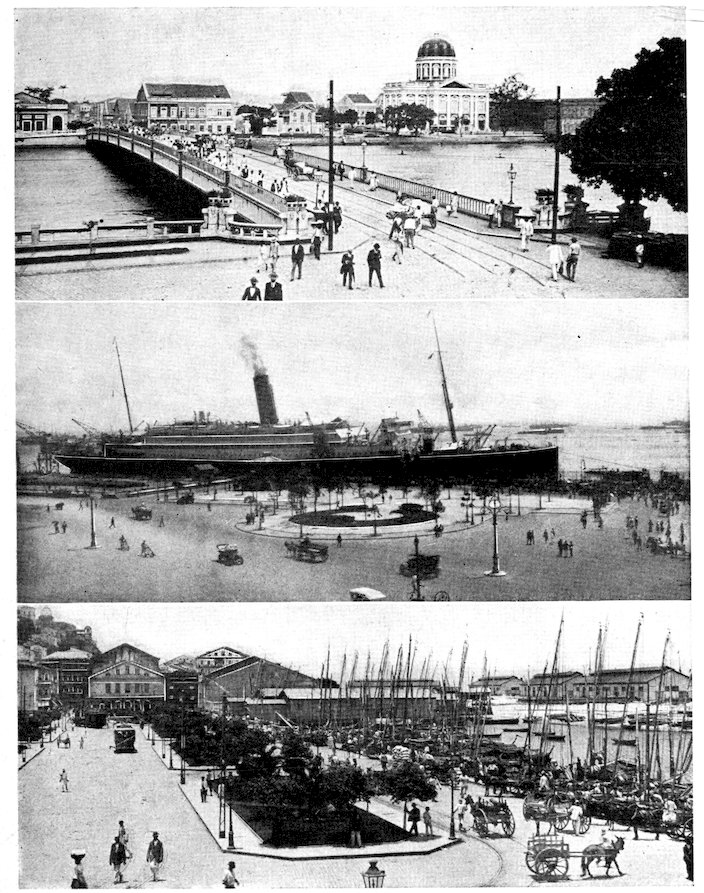
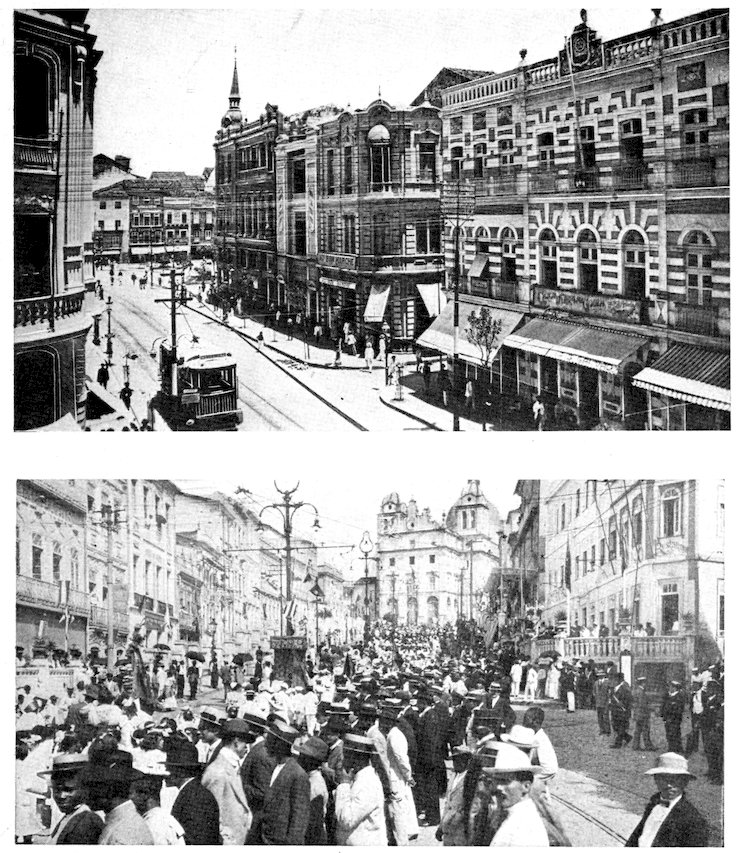
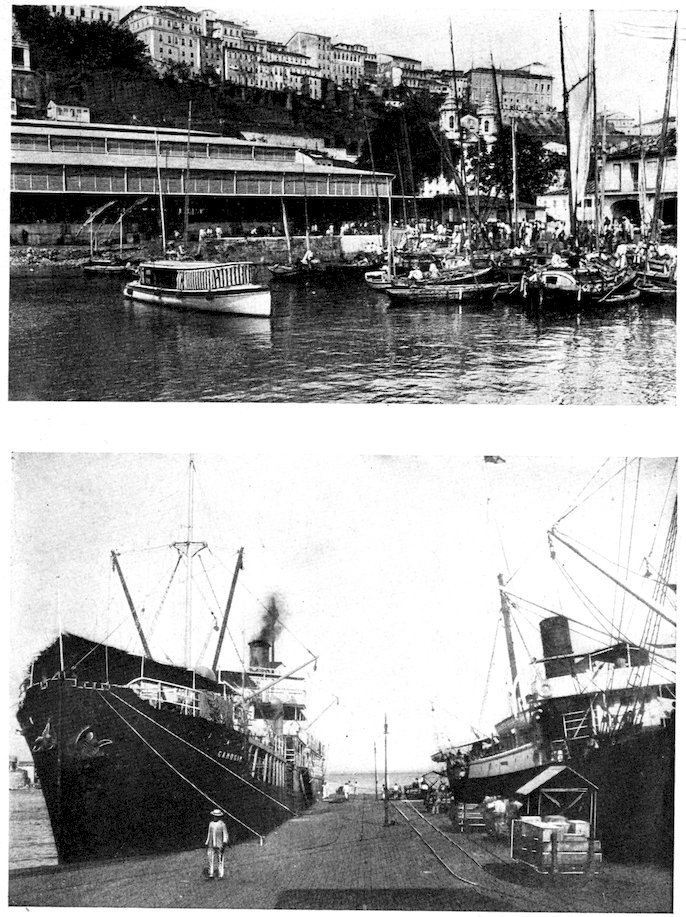
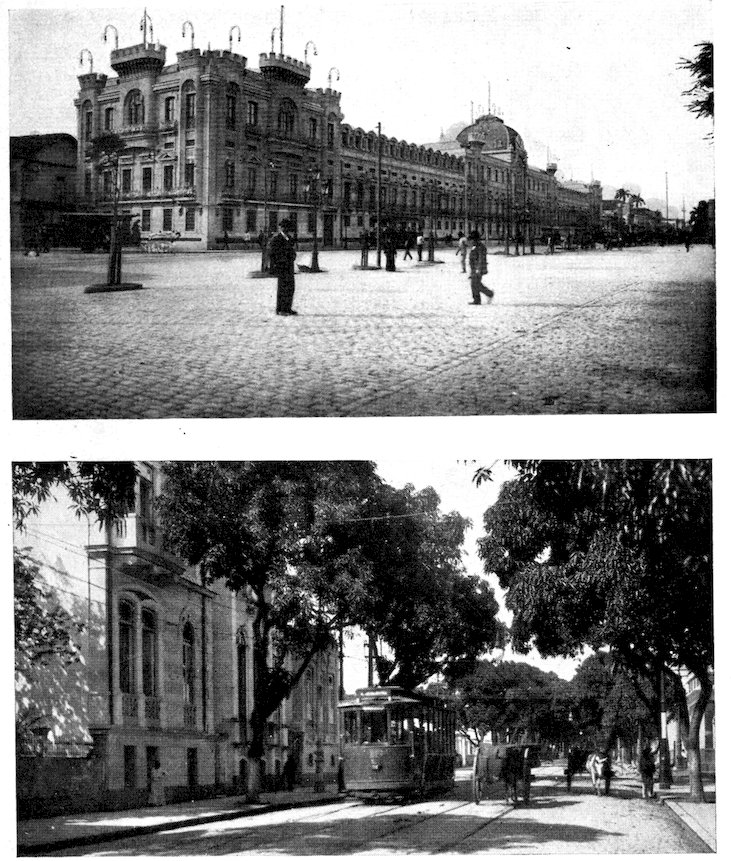
Ponte Santa Isabel, Recife (Pernambuco).
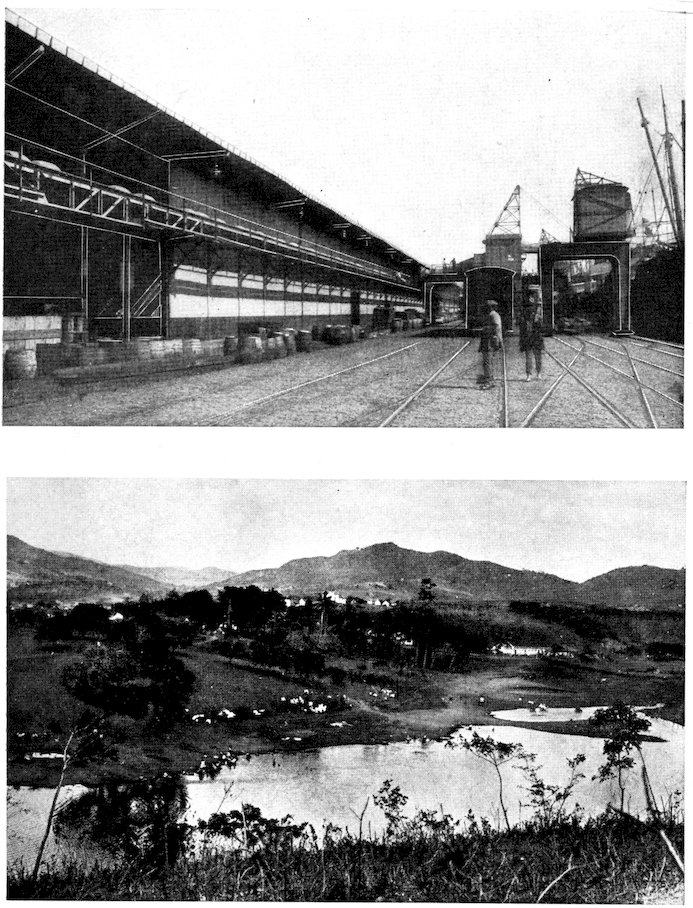
Praça Mauá—one of Rio’s wharves.
Water-front at Bahia, Lower City.
21Bahia was the queen city of Brazil from 1549, when
Thomé de Souza was sent out as Captain-General and
made this the administrative and political head of the
country, until 1762, when Rio de Janeiro became the
Vice-regal Capital; she also was a fighting city, seized
and sacked now and again but successful in getting rid
of her foes in the end, and she was the centre of tobacco
cultivation from early days. When gold and diamonds
were discovered in the interior valleys and serras the
Bahianos played a plucky part in exploration and
opening, as well as charting, regions of forest and sertão
hitherto unseen by white men. To the men of Bahia,
as well as to the courageous legions of Pernambucanos
led by the Albuquerque family, Brazil owes much: but
the great pioneers, the unsurpassed confronters of hardship,
the men who made Brazil the huge country that
she is instead of the strip upon the Atlantic seaboard
that she might have remained, were the bandeirantes
of São Paulo.
When the gallant Martim Affonso de Souza, sailing
first to Cananea, eventually built his modest mud and
palm leaf town at S. Vicente, he was saved from the
hostility of the Tamoyo Indians by the friendliness of
Ramalho, father of many children by a daughter of
Chief Tibiriça. The Tamoyos as a rule gave a great
deal of trouble to the Portuguese, although the French
in their numerous attempts at settlement along the
Brazilian littoral always managed to make fast friends
of this tribe. To anyone who knows the São Vicente of
today, it is difficult to imagine on what the first settlers
lived; the shore is hot, sandy, backed by mangrove
swamps, producing beans, maize, mandioca and sugar.
22Small wonder that an early chronicler said that to live
in these colonies it was necessary to forget all European
habits of life, to begin a new existence upon new
food, with all old ideas of comfort and even necessity
thrown aside.
When a company of Jesuit priests, headed by José de
Anchieta, came to S. Vicente, they found their ministrations
thrown away on a disorderly and undisciplined
band of settlers. Conceiving their duty to be here, as
the Padre de las Casas and many of his cloth conceived
it in Mexico and Central America, the Christianizing
of the natives, Anchieta decided to leave the coast
(where Braz Cubas had now built his little chapel and
hospital on the island where Santos stands today) and
seek converts in the uplands. The mountain barrier
was climbed, and on January 25, 1554, an altar was
set up on the green and well-watered plains of the interior,
and mass was said on a site named São Paulo de
Piritininga, in honour of the saint whose day it was.
The habit of early missionaries and discoverers of
naming new places with the Roman calendar in their
hands has helped the historian to fix many a doubtful
date.
A few miles away from the mission was the town of
João Ramalho, who had been tactfully confirmed in
his possession of lands, the “Borda do Campo,” by Portugal,
while his settlement was formally named a township
with the title of Santo André in 1533. Its site was
near the present São Bernardo, an open sunny region
of prairie with woods on the horizon.
With this tribe of Ramalho’s making the Jesuits
sought no connection; they could not convert those
half-breeds any more than they could make the hardy
23impenitents on the coast give up stealing Indians.
Better and more pliable material was to hand in the
pure Indian tribes; two groups, one under Tibiriça and
the other under chief Cai-Uby, built their cabins in
new S. Paulo, Tibiriça’s people forming a line which is
now the Rua São Bento, while the other converts
guarded the road that led over the hills to S. Vicente.[2]
It was not long before trouble came. João Ramalho’s
children plagued the priests: the priests retaliated by
getting an order from the then Captain-General, Mem
de Sá, by which Santo André was razed to the ground
and its inhabitants forcibly incorporated in São Paulo.
The latter soon changed its character as a peaceful
mission settlement, the Indians suffered from aggressions
by the whites who now came up from S. Vicente
or their own half-white kin, and in the end a concerted
attack was made by the natives upon the town, only
old Tibiriça remaining loyal. The Indians were beaten,
but the Jesuits saw that the mission could not be restored;
they determined to carry the cross farther
afield. With indomitable energy and indifference to
suffering the band of priests made their way across the
interior plains and woodlands, until they founded a
new city (Ciudad Real) at the junction of the Paraná
and Piquery, and began to gather the Indians together
in new settlements.
For a time they were undisturbed. But the life of
the new Portuguese colonies depended upon agriculture;
the white men were neither many enough nor
sufficiently acclimated to till the fields themselves, and
they seized the unfortunate natives and forced them
to field labour. It was unsatisfactory work, as a rule:
24the native of the eastern coasts of South America was
not a cultivator of the soil by habit, but rather a hunter
and fisher, as he is still in his interior retreats. They
were too on the whole a gentle as well as an idle race,
and they died like flies under the whip.
It was not long before the coast plantations of the
Portuguese were denuded of workers: to get more
slaves it was necessary to follow the Indian across the
sertões. It was about 1562 that the first slave-hunting
expeditions, the “entradas,” began; they were headed
by the mamelucos, the descendants of Ramalho, who
had no hesitation about betraying their native kinsfolk
to the white man. Violence was avoided: the preferred
plan was to coax any tribe approached “com muito
geito e enganos” and only when blandishment failed
was force resorted to. Tamed natives accompanied
the “entries” and when the children of the woods heard
tales of waiting pleasures told in their own tongue,
whole clans often followed willingly to the coast, never
to return. When they retreated more deeply and became
more wary, and it was found that the Jesuits were
advising them, a grimmer system was planned; it was
decided to conduct open warfare against the missions.
By this time, in the first part of the seventeenth
century, the Jesuits had attained remarkable success
with their converts; they were not content with teaching
them the Christian faith, but insisted upon the
girls learning spinning and weaving while the men
planted and reaped. Results were much the same as
those desired by the coast settlers, but methods differed.
About Ciudad Real, in the Guayará region,
fourteen great missions flourished when the Paulistas
began to disturb them: by the middle of the sixteen
25hundreds they were all broken up, the fields waste, the
priests fled, and the Indian converts prisoners in S.
Paulo or hiding in the forests.
To accomplish this, more careful expeditions were
arranged than the earlier “entradas,” although the
mamelucos had made some wonderful journeys, across
the river Paraguay, over the Chaco and into Bolivia,
now and again having a brush with the Spanish settlers
of the South, who, later on, were expelled from tentative
settlements in Rio Grande do Sul: no land was too wide
for the Paulistas to hold. But the “bandeiras” were
now organized like an army, men enlisted in them regularly
and accepted rigorous discipline. Beginning with
the deliberate object of uprooting Jesuit control of the
Indians, explorations continued in this form for over
eighty years with other aims added—conquest of the
interior, discovery for its own sake, and search for
mines of gold and precious stones, as well as the repression
of Spanish entries from the south and from Peru.
At the time when these extraordinary expeditions
began the interior of South America was still unknown.
The high sertão and the forests were still full of mystery,
although the coast had been stripped of such marvels as
the giants who frightened Pinzon’s sailors, the men
fourteen feet high seen by Magalhães, and the alligators
with two tails which Vespucci reported. In the interior
magic still reigned, with its trees yielding soap and
glass, Lake Doirada with shining cities about its margin,
and the marvellous kingdom of Paititi, lure of many
disastrous expeditions, where some of the natives were
dwarfs, others fifteen feet tall, some had their feet
turned backwards and others had legs like birds. The
26bandeirante opened the sertão and dispelled these
wonders.
In his book, O Sertão antes da Conquista, Sampaio
says that the Paulista “was compelled by his habitat
to be a bandeirante: the conquest of the interior was
written in his destiny.” If that is true, at least these
labours were taken up with a kind of fierce joy. There
was scarcely an able-bodied man of the time who did not
join one or more of the bandeiras, and there is on record
the case of Manoel de Campos who made twenty-four of
these journeys. Many bandeirantes never returned, remaining
in the sertão to found towns in Minas, Matto
Grosso or Goyaz; some, returning after years of absence,
found their wives married to other men, while “many
heroes brought back from the sertão children whom
they had not taken in,” says Rocha Pombo.
The bandeira went always under the supreme command
of a leader to whom implicit obedience was due;
before setting out the bandeira in a body heard mass,
the leader confessed and made his will, invariably including
the phrase ... “setting out to war and being
mortal and not knowing what God our Lord will do with
me.”... A priest accompanied each bandeira, not
only to shrive the dying and bury the dead, but by way
of easing the conscience of the band regarding their
mission and “reconciling it with the Divine Mercy.”
The outfit for every man was made at his own cost, and
if it is possible to judge by the baggage of Braz Gonçalves,
who died on an expedition in 1636, and whose
goods were scrupulously recorded and sold at auction,
it was simple. His greatest possessions were three
negro slaves, but he had also an awl, a bit and a hammer,
a pair of worn slippers; some lead and gunpowder,
27one tin plate, a chisel, a mould for casting shot, a ball of
thread, an old cape.
It was only possible to face what lay beyond the outposts
of settlement when equipped and ready for war;
the bandeirantes knew that there was constant risk of
attack by Indians and that nature opposed them with
as fierce a menace. The country through which they
passed was likely to be foodless, and they were prepared
to sow seeds of grain in green valleys, camp, and wait
until the crop was harvested before going on their way.
The rivers of the interior plateau, flowing westward
with the tilt of the sertão, themselves offered a great
highway of adventure to the early bandeirantes, bringing
them into Paraguay and the outskirts of Bolivia
and the Argentine, but as they went farther afield the
Paraná was left to the east, Goyaz and Matto Grosso
were traversed, and the path of the pioneers led up unknown
mountains, through untracked woodland; they
marched across boundless prairies as if navigating the
ocean, with only a sea-compass and the starry night to
guide them. Nothing checked these explorers; had not
the discovery of the General Mines turned their minds
to gold-hunting, they might have followed Antonio
Raposo across the Andes and disputed Peru with the
Spaniards. Wherever they penetrated they established
outposts and forts counting a collision with the Spanish
as the best reason for creating a stronghold: it was the
work of these untiring sertanistas that led the way to
the present magnitude of Brazil.
The bandeira was the original creation of the Paulista,
without parallel in history; not even the white pioneer
of North America had the same functions: he neither
wandered so far nor performed such deeds. João Ribeiro
28remarks that “as in the case of the caravans of the
desert, the first virtue of the bandeirante was a resignation
almost fatalistic, and abstinence carried to an extreme;
those who set out did not know if they would
ever return, never expected to see their homes again—and
this often happened.” The bandeira in its greatest
phase was a travelling city, a commune linked by
mutual interests, that surged forward over the silent
country; nothing deterred them, whether mountain
passes, precipices, hunger, weariness, or constant fighting.
If they had a path it was that of the crosses on the
graves of the men who had gone before them. They
went always on foot.
There is a long list of great sertanistas. It includes
many names well known in Brazil today—Martins,
Soares, de Souza, Barreto, Tourinho, Sá, Leme, Paes,
Almeida, Dias, Ribeiro, Carvalho, Rodrigues, and a
host of others; few men escaped the lure of the sertão,
and some leave stories which are the Iliads of Brazil,
putting these among the great adventures of all time.
There is for instance Antonio Raposo, who headed a
bandeira which left S. Paulo in 1628, and which was
“the biggest and most devastating known.” Three
thousand people composed the expedition, and its
main object was the destruction of the Jesuit missions
on the Paraná river, near Ciudad Real. One by one the
missions, which had grown into thriving industrial communities,
were attacked, besieged, and smashed; as
they fell, escaping brothers or converts carried the
warning to other convents, stiff fights were made, and
in some cases long resistance was maintained. But in
the end the Jesuits were broken and dispersed, and the
bandeirantes went back to S. Paulo with thousands of
29Indian slaves. The courageous Jesuits went deeper into
the interior, collected such remnants as they could of
their property and their protégés, and began the work
again.
Raposo, years afterwards, made another journey
which brought him into fame as a legendary hero; he
crossed the Paulista sertão by Tibagy, thence traversed
the heart of Brazil from south-east to north-west,
entered Peru, scaling the Andes, crossed to the Pacific
and waded into those waters sword in hand; returning,
he discovered the headwaters of the Amazon, sailed
down it, and when at last after years of travel he came
back to São Paulo no one recognized him.
A magnificent figure among indomitable bandeirantes
is that of Fernão Dias de Paes Leme. Well may the
wild sertão be haunted by the shade of such a man as
this, or of his lieutenant, Borba Gato, or that father and
son who were known among the Indians of Govaz as Old
Devil the First and Old Devil the Second.
Fernão Dias, the “Hercules of the Sertão,” was the
discoverer of the emerald mines of Sumidouro, after
ten years spent in search. He was a famous slave-chaser
of the sixteen hundreds, an extremely religious
man whose zeal was only assuaged by much building
of chapels and convents with the money earned in long
raids; practical, astute, suave, he won his ends by tact
rather than violence, among his exploits being that of
leading the whole of the allied Goyana tribes to São
Paulo. Approaching their territory Dias made no
threats, but camped nearby, cultivated fields of cereals
and vegetables, and so ingratiated himself into the
confidence of Tombu the chief that one day the old
Indian collected his people and agreed to go to the
30pleasant lands of which the Paulista spoke. Five
thousand natives thus marched voluntarily into captivity;
Tombu remained the worshipper of Fernão Dias
until his death, but with the exception of runaways
none of the Goyanas ever saw the sertão again.
This was in 1661. Three years later the Portuguese
court, greatly desiring the discovery and development
of mining regions which should yield tribute to Lisbon,
offered special rewards to discoverers of mines, appointed
an Administrator of Mines in Espirito Santo,
where some coloured stones had been found, and Affonso
VI wrote to Fernão Dias asking him to search
the interior that he knew so well for the source of the
“emeralds” whose beauty raised hopes of finding
mines equal in value to those of the Spaniards in New
Granada (Colombia), still today the cradle of the finest
emeralds. As a matter of fact the green stones found
in Brazil are the beautiful but semi-precious tourmalines.
Consenting, the famous bandeirante made some preliminary
excursions and in 1676, when he was over
eighty years old, led out a great comitiva; the first winter’s
camp was made in a valley beyond the Rio Grande,
the second at Bomfim, the third at Sumidouro. At
last in the Serro Frio some showings of gold were located,
and on the way back Dias died by the Rio das
Velhas, in the far interior across Minas Geraes. The
bandeira had gone through great suffering, and scores
of men were buried by the way: at one time the remnants
of the expedition had appealed to Dias to give
up the hunt and return, and on his refusal made a plan
to kill him. The conspiracy was headed by a young
man who was the son of Dias by an Indian girl, and
31dearly loved by the old sertanista, but when convinced
of his boy’s guilt Dias hanged him, pardoning the other
plotters but driving them from the camp.
To Fernão Dias was due the exploration of what is
now the State of Minas Geraes, the whole of it falling
practically under his sway as the founder of at least a
dozen towns in that hilly interior, the majority surviving
to this day. His search had a curious sequel: his
son-in-law and faithful aide, Borba Gato, who had
found gold mines in Sabará and registered them in
1700, was returning to S. Paulo after the death of his
leader when he met with a party headed by the official
Administrator General of Mines. Borba Gato’s charts
and proofs were demanded, refused, a quarrel broke
out, and the servants of the pioneer set upon the Administrator
and killed him. Not daring to face S.
Paulo with this tale, Borba Gato fled to the interior
where a tribe of Indians friendly to him dwelt by the
Rio Doce, and there lived hidden out of the reach of
the law for twenty years. At the end of that time, attempts
to find the Sabará mines having failed, he was
offered a pardon in exchange for the secret; he accepted
the offer, returned to civilization, and presently retiring
to a farm with his family died peacefully in his bed at
the age of ninety.
A direct result of the murder of the Administrator
was the stocking of the sertão of Minas with cattle: the
entourage of the dead man, as much horrified by the
deed as was Borba Gato, instead of returning to the
capital took to the bush with the seeds, stores and livestock
without which no expedition set out, and formed
nuclei of fazendas in a score of different places.
32One of the earliest discoveries of gold in Brazil was
made by Bartholomeu Bueno da Silva in the Serra
Doirada, in Goyaz, about 1682. He it was who found
the Indians wearing scraps of gold as ornament, and
tricked them into showing the place of its origin; displaying
a bowl of agua-ardente (aguardente—spirit
made from sugarcane) he set light to it, telling the
Indians that it was water and that he would in like
manner set fire to all their springs and rivers if they did
not reveal the source of their gold. Southey calls
Bartholomeu Bueno “the most renowned adventurer of
his age,” and to him is due the opening-up of Goyaz,
until then only entered by passing slave-hunters: but
his discoveries were not followed up and it remained for
his son, nicknamed by the Indians Anhangoera the
Second his father having been known to them as Old
Devil the First on account of the incident referred to
above, to re-find the mines and extend the gold-mining
fever to Goyaz. It was in 1722 that this son, then a
man of over fifty years, succeeded in obtaining government
help for exploration: by this time Minas was overrun
with gold seekers from every part of Brazil and the
authorities were ready to give active help to new mining
expeditions. This bandeira set out with great éclat,
crossed the Rio Grande and wandered for three years,
the leader seeking landmarks dimly remembered from
his boyhood. Persistent, patient, conciliating his weary
followers, he founded the town of Barra, at last located
the gold mines, returned to São Paulo and got together
a new band of men, led the way back and settled them
at what is now the City of Goyaz, and so closed with a
remarkable colonizing feat the last of the great expeditions
into the high sertão.
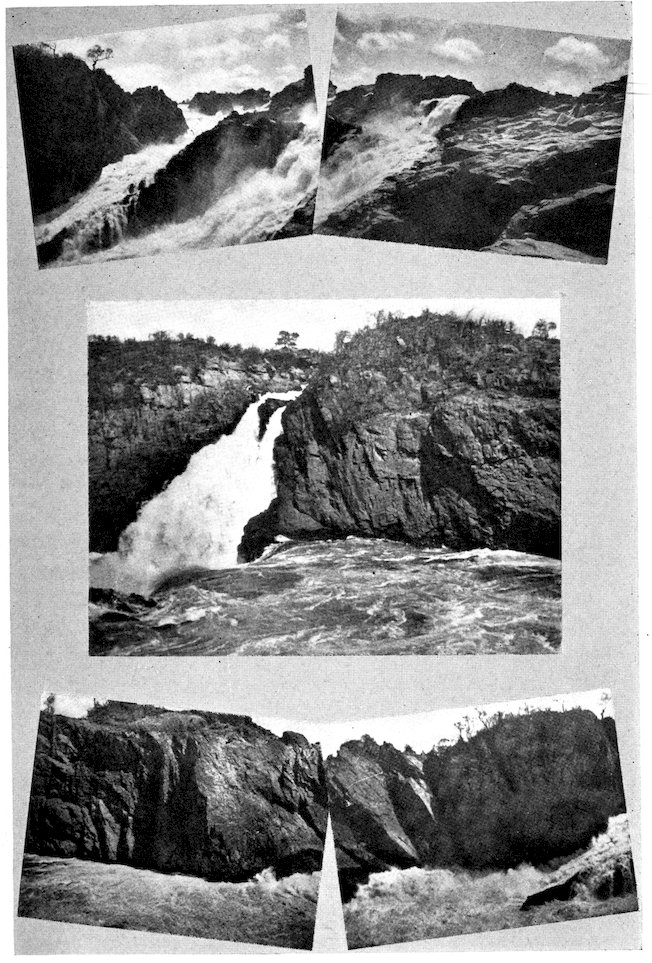
The Falls of Iguassú.
On the boundary of Argentina with Brazil; this series of lovely cascades is said to have altogether four times as much force as Niagara.
33A little later gold-miners penetrating to Matto
Grosso began operating at Cuyabá,[3] and almost immediately
the discovery of diamonds at Diamantina
brought a new rush of people into this far interior
region. The day of the explorer, the true bandeirante,
was over, and the age of mining was by this time in its
epoch of greatest excitement.
Few writers on Brazil have refrained from scourging
the bandeirantes for their cruelty to the wretched natives
and for their destruction of the Jesuit missions.
It is true that they were brutal, but theirs was a brutal
age, and in explanation, not extenuation, of their deeds
it should be remembered that they, the white civilian
colonists, were fighting for their own preservation
against hostile Indians whose hand, quite naturally,
was against the invader, and secondly against their
economic ruin by the line of action taken by the Society
of Jesus. Not only did the patient Jesuits coax and
catechise the Indian, but they put him to work in the
fields and sold abroad the product of his hands: when
later on conflict raged in North Brazil between colonists
and Jesuits the chief grievance was that the Society,
for whose support the civilian community was taxed
heavily, used the Indian labour denied by Royal decree
to the settlers, and also maintained great stores (armazens)
where every kind of European merchandise was
kept.
It was for this reason, and not because they were bad
Christians, that the colonists of Maranhão once stood
on the shore with guns in their hands and refused to
34allow a shipload of Jesuits to land until they had given a
solemn promise to do nothing with the Indians except
to convert them; they regarded the members of this
religious body as business rivals. Nor were the Jesuits
tactful in their dealings with colonists or colonial government
authorities; secure in the support given them
not only by the Pope but, especially perhaps in the
period of Spanish rule in Brazil under Philip II, by the
King, they made no concessions, defied the civilians, and
apparently courted trials of strength: right or wrong,
they were able to count upon judgment in their favour
in any quarrel referred to Europe.
When the bandeirantes began their unmerciful raids
upon the Jesuit communities in the south Brazilian
sertão the number of missions had increased from
thirteen in 1610 to twenty-one in 1628, and to them had
been largely drawn the natives who once, as Thomé de
Souza said in writing to Portugal, had been so thick
that “even if they were killed for market there would be
no end of them.” Attacked, the padres might well have
counted upon help from the Governor General of Brazil,
but for the fact that about this time the whole military
attention of the authorities was taken up with the
determined aggressions of the Dutch upon the northern
capitanias; the affairs of São Paulo were left in the
hands of the Paulistas. The great matter of regret is
that in the case of the Jesuits much excellent constructive
work was wasted, just as the fine colonizing work
of the French in Rio and in Pará and Maranhão was
destroyed, and that of the Dutch on the Amazon and
in Pernambuco; the spirit and the interests of the times
forbade the Portuguese to allow settlers of other races a
foothold in Brazil, but nevertheless it was unfortunate
35that so much good blood and good work was thrown
away in a huge land that so badly needed both.
While the Paulistas were exploring and adding great
tracts to the colony in the south, a law unto themselves,
undisturbed by invasion except an occasional attempt
by the Spaniards from the Plate and attacks on S.
Vicente by English and French corsairs, the history of
the north was one of constant aggression and desperate
defence. Until the year 1578 no concerted attempts
were made by England, France and Holland against
the colonies of Portugal, a country towards which feeling
was not unfriendly but in that year King Sebastião
of Portugal, with the flower of his nobility was killed in
North Africa in the terrible battle of Alcazar el Kebir,
and Philip II of Spain, the “Demon of the Middle Ages,”
seized Portugal and all that was Portuguese two years
later. The South American colonies automatically
came under his sway, and at once fell heir to the feud
between Spain and her European neighbours. Brazil
was fair game, and during the sixty years that elapsed
before Portugal was able to re-assert her independence
the easily approached northern capitanias were threatened,
sacked and occupied by one or another of the
three chief enemies of Spain. Sackings of coast towns
made no great difference to the development of Brazil;
when the ransom was paid the raiders sailed away and
the business of life was resumed without any vital
change; no towns were ever ruined by such predatory
visits. Occupation of districts was another matter,
and, with the exception of loss of lives every one of
which was precious in young colonies, the effect was
good rather than harmful; the period of Dutch rule on
36the northern coast of Brazil was a lasting beneficial
stimulus. Nor was Spanish control of any direct hurt
to the Portuguese colonies: their internal management
was little interfered with, Portuguese officials continued
to be appointed to Brazilian posts, and if Spain did not
adequately defend them because her hands were already
desperately full she at least did Brazil the kindness
to leave it alone. The one serious administrative
measure she took was the formation in Lisbon of a
Junta to care for Brazilian commerce, similar to the
Council of the Indies sitting in Madrid, and this was
undoubtedly useful: the narrow monopolistic trading
policy pursued was simply in line with the ideas and
practice of the times. It was protection carried to an
extreme, was useful at the time of its initiation, and, if it
outlived its usefulness in its most irksome manifestations,
the principle has so far survived that today, in
the third lustre of the twentieth century, it may be said
that only one great commercial nation has ever definitely
thrown it aside.
The group of capitanias extending from Espirito
Santo northwards to Ceará were when Brazil came
under Spanish rule the most productive of all; it was
but eighty years from the date of Cabral’s discovery,
and only fifty from the time of colonization, but flourishing
populations were settled along the seaboard, growing
sugar, tobacco and cotton and cutting stacks of dyewoods
to fill the fifty ships a year that called at the
main ports. Bahia, seat of the Captain-General’s
administration, was also a bishopric, and the chief
religious orders had settled in each considerable town
and founded churches, schools and convents. In 1570 a
Royal Decree forbade the compulsory use of Indians as
37labourers, and to fill the ranks of field workers Africans
were brought in: to this idea the Portuguese were
inured, for the West Coast of Africa had been a source
of labour supply for them since 1440; it was the discovery
that negroes could be transplanted to the
Americas and would there work with docility, thrive
and multiply, that made possible the cultivation of
thousands of square miles of land, both in North and
South America, and warmly as we may reject the principle
of slave labour now, it was the only one which
could have opened American lands to the extent which
they attained in the seventeenth and eighteenth centuries.
The white man could not have performed this
physical labour.
Indian labour was abolished at the instance of the
priests; it was remarkable that to the enslavement of
Africans under circumstances equally brutal no objection
was made. Negroes were brought to Brazil from
1574 onwards until the abolition of the slave trade,
though not of slavery, in 1854. The debt of Brazil to
the African negro is a very heavy one.
Soon after the junction of the Spanish and Portuguese
crowns there began the series of purely plundering
attacks delivered by European enemies of Spain which
lasted until the establishment of the Dutch at Pernambuco,
but which were of so little political importance
that in the meantime the Portuguese authorities were
able to destroy entirely the French settlements at
Maranhão and Pará which lasted from 1594 to 1615.
The work of replacing French with Brazilian settlements
was carried out by Jeronymo Albuquerque, son
of a dominating Pernambuco family, and not only were
well-started French colonies ruined but the exploration
38of the Amazon, commenced by the famous Daniel de la
Touche (Seigneur de la Ravardière) was abruptly ended.
In 1621 the Dutch Company of the West Indies was
founded, companion organization to the rich East Indies
Company; with the approval of the Dutch Government
the Company was equipped for settlement and
conquest, and could call upon the home authorities for
the help of ships and armed men if war occurred in the
course of operations. A fleet of thirty-six vessels under
Admiral Jacob Willekens sailed for Brazil early in 1624,
made directly for Bahia, and took the city without much
trouble. Holding it was a different matter, the population
taking to arms, and a year later a combined Spanish
and Portuguese fleet arrived and forced the Dutch
to capitulate. Another impermanent attack was made
in 1627, and in 1630 a different point of aggression was
chosen by a great fleet of seventy vessels: the Pernambucan
city of Olinda was besieged and taken, the Dutch
secured themselves in power and remained masters of
this and three other capitanias afterwards seized; they
were governed by the West India Company for nearly
twenty-five years.
Evidences of the occupation of Olinda and its sister
settlement, Recife, now the capital and a very flourishing
city, are to be seen in the many houses surviving
with curved gables, high unbroken fronts, the exterior
walls shining with blue and white glazed tiles; the
Dutch brought with them their love of order and cleanliness,
good methods in plantation management and
excellent organizing power, and the only genuine objection
to the rule of the Hollander in Brazil was that
the country did not belong to him. All Brazilian historians
bear witness to the merit of Dutch methods.
Old and New Brazil.
A Remnant of Colonial days; street in Olinda, old capital of Pernambuco.
Modern residences near the Gloria Gardens, facing the bay, Rio de Janeiro.
39The West India Company was able to induce an admirable
Governor to take charge of the new possession,
Prince John Maurice of Nassau; he reached Recife in
1637, and inaugurated a conciliatory policy towards
such Pernambucanos as would accept Dutch rule: those
who would not were pursued into the interior forests
where they retreated under one of the Albuquerques,
and were forced to flee from Alagôas into Bahia.
When such resisters were caught they were shipped to
Dutch settlements in the East Indies.
Religious freedom was promulgated by the Protestant
rulers, more systematic administration of settlements
and estates inaugurated, better sugar milling
methods introduced as well as farming implements, and
the scientific exploration of the interior was made.
Prince Maurice brought with him map-makers, geologists,
botanists and expert mineralogists, and sent
them to the valleys and hills of the Bahian hinterlands.
Elias Herkmann took an expedition of one hundred men
from Recife in 1641, to make scientific investigations, and
although he did not find mines of importance he studied
native relics and language, subsequently publishing a
book on the Tapuyo race.
George Marcgraf and Wilhelm Piso are also Dutch
names of note in connection with Brazil; the former
studied Brazilian topography and water systems and
wrote a treatise on the subject as well as the Historia
Rerum Naturalium Brazilium; the latter was the first
classifier of Brazilian flora and fauna. “We owe to
him,” says Dr. Egas Moniz of Bahia, “the discovery
of the emetic-cathartic properties of ipecacuanha and
copaiba” as well as the therapeutic virtues of jaborandi
and red mangue and several other drugs obtained
40from the Brazilian matto. The first scientific
charting of the sertão behind Pernambuco, Alagôas
and north Bahia was done during this time; herds of
cattle already wandered over interior pastures, and
settlers led by the independent spirit which renders
the Brazilian indifferent to solitude had formed fazendas
along river borders; explorers had wandered by these
water paths looking for mines, but systematic maps
and charts were lacking.
In 1640 Portugal revolted from Spain, regained her
independence, and offered the crown to a member of
the House of Braganza, a line which retained its inheritance
until a few years ago. The effect upon the
Americas was again notable; the Pernambucanos, still
carrying on guerilla warfare from the forests, were
heartened, obtained help from an enthusiastic Bahia,
and redoubled their efforts; the Dutch came to an
agreement with Portugal that all possessions conquered
by them during the Spanish régime should be held, and
tried to extend their holdings farther north—an effort
which was vain in itself, costly in life and money, and
hardened the determination of the colonists to do for
themselves what the mother country would not do on
their behalf. In 1643 Prince Maurice returned to Holland:
he had the interests of the colony as such at heart
too much to please the West India Company. A liberal
minded man, he wished to see the colonial ports opened
to free commerce, succeeded in getting the Company
to forego all monopolies except that of taking dyewoods
away from Brazil and sending in slaves and munitions
of war, any Dutch captain being free to visit ports
controlled by his compatriots; these were not agreeable
pills for a monopolistic organization to swallow. On
41the other hand in recalling Maurice of Nassau the
Company lost prestige, henceforward carried on a losing
struggle with the virile Brazilians, and were forced out of
section after section until by 1648 only the forts of
Parahyba, Rio Grande do Norte, the island of Itamaracá
and the city of Recife were in Dutch hands. A
certain embarrassment was created in Europe by this
situation, and the Portuguese Government, taken to
task by Holland, sent emissaries to the insurgent Pernambucanos
to order suspension of hostilities: the
leaders replied that they “would go to receive punishment
for their disobedience after they had turned the
invaders out of Pernambuco,” and went on with the
war. Holland herself, now at loggerheads with England
or rather with Cromwell on account of her support
given to the Stuarts, could not help her Brazilian colony;
a severe defeat was inflicted by the Pernambucans
in 1649, at the battle of Guararapes, and the Dutch,
never recovering from this blow, were finally obliged
to capitulate to Francisco Barretto in January, 1654.
The Pernambucan attackers were nerved to this final
effort, the storming of Recife, by the news of the disaster
inflicted on van Tromp’s fleet in the English
Channel at the hands of Blake.
Three months later the Dutch commander with all
his troops left Brazil, and the only fragments remaining
to the States General after a tremendous outlay of
money and blood were a few islands in the West Indies
and a piece of the Guiana country: small return for
great effort. Portugal paid eight million florins to the
Dutch in settlement of Brazilian differences and agreed
to allow Holland free trade with the American colonies
in all articles except the precious brazil-wood.
42The chief results of Dutch occupation of the four
capitanias of the north-eastern promontory for twenty-four
years were, first, stimulation of world interest in
this part of the vast Americas, for the sea-captains who
carried Brazilian products for the first time into other
parts of Europe than Portugal acted as advance agents
of Brazilian commerce: second, scientific investigation
into natural products and demonstration of the value
of drugs peculiar to this part of South America: third,
introduction of better town management systems:
fourth, creation of a healthy national spirit in the northern
provinces, with lasting effect upon character: and
the quickening of colonization in the extreme north.
It was not until the Dutch and French settled in Ceará
and Maranhão and on the Amazon that serious efforts
were made to develop these tropical territories under
the equator; the year 1620 witnessed the first arrival of
settlers of Portuguese nationality in Maranhão when
two hundred families came from the Azores.
Another interesting and direct result of the Dutch intervention
was the creation of the Companhia do Commercio
do Brasil (Commercial Company of Brazil) by
the Governor General, intended as a set-off to the
Dutch West India Company. It was established in
1650, received monopolies and concessions of a valuable
character, and in return was obliged to provide a
powerful armed fleet to convoy merchant vessels
through enemy-infested seas. The Commercial Company
did as a fact render great services to the Brazilians
fighting against the Dutch, blockading northern ports
while insurgent armies attacked by land.
While the north was struggling with the Dutch and
French and incidentally becoming solidified by the
43tussle until a genuine national feeling came into existence,
Bahia, beating off attacks and remaining the
administrative residence of a Captain-General, was the
centre of the wealthiest part of the colony; all the slaves
brought from Africa were sold here, and although they
were partly distributed, this was the chief slave-owning
region and is still the place where more pure negroes are
to be seen than anywhere else in Brazil. Farther south
Espirito Santo, one of the oldest of Brazilian colonies,
was growing cane and raising cattle, but suffered from
raiding foreigners, as also did Ilhéos; Rio de Janeiro
became the seat of a second Captaincy-General in
1608, for a time, with command over S. Vicente and
Espirito Santo but had no importance until the discovery
of mines made her the chief gateway to the
golden regions. Out of the path of the Dutch, whose
object was wide agricultural lands, Rio neither suffered
nor gained as did the North; at this part of the Brazilian
coast the mountain barrier comes right down to the sea’s
edge, the granite wall shouldering into the waters of the
deeply indented bay: there is very little land suitable
for plantations except in narrow valleys until the Serra
do Mar is climbed. It was this lack of sugar land that
kept Rio uncolonized, lovely as she is, for half a century
after the colonies on either side of her were started;
settlement by the Portuguese might have been put off
still longer if the French under Admiral Villegaignon
had not taken possession of the bay in 1555, made
friends with the Tamoyo Indians as the Portuguese
were never able to do, fortified a rocky island, and
established a Huguenot colony here—the ill-fated
“France Antarctique.” The energetic Mem de Sá,
Captain-General after Thomé de Souza, brought a
44fleet from Bahia, drove the French into hiding on the
mainland, sent his nephew, Estacio de Sá, to Portugal
to get help, and this gallant young man returned with a
strong force in 1565. In two years’ time, with troops
from Bahia and São Paulo assisting, the unfortunate
Huguenots were utterly defeated, the remnants of the
exiles retiring into the woods with their Indian allies
and disappearing from history. The body of Estacio de
Sá, killed in the last decisive fighting, was buried in the
shade of the Pão d’Assucar near the first Portuguese
town founded in the bay and named São Sebastião.
Another member of the same family, Correia de Sá, was
sent to head the new Portuguese settlement, and eventually
died there at the age of 113.
Division of Brazil into two captaincies-general in
1608, to be united again soon afterwards and again
subsequently divided, was part of the experiments
made by the European home governments, apparently
with the sincere wish to develop the country; it was
supposed that a region so vast could not be governed by
one man, but as a matter of fact the occupied territory
was along the seaboard on the whole, and communication
by sea was fairly speedy; from 1549 onwards, when
the first Captain-General was appointed, the mother
country bought up when convenient the strips of land
belonging to the heirs of the donatarios; some new captaincies
were also added from time to time, as that of
Grão Pará in 1616, Minas Geraes, Matto Grosso and
Goyaz after the discovery of gold and diamonds, and an
independent State of Maranhão, governed separately
from the rest of Brazil was also created in 1621, thus
adding to the governmental confusion in spite of good
intentions. Decentralization was increased by the
45lack of commercial exchange between the different
regions, and no successful effort improved this fault until
the notable Marquis de Pombal took matters in hand
in a statesmanlike manner in the latter half of the
eighteenth century, buying the capitanias which were
yet in private hands, creating Brazil a viceroyalty and
Rio the viceregal capital.
But before that date much water had flowed under
Brazilian bridges. It is not the purpose of this book to
give in detail the history of Brazil, but to show the chief
events and their effect upon development. Following
the creation of the capitania system and its series of
coastal settlements came the penetration of the southern
interior by the Jesuits in their “reductions,” and the
scattering of these centres of Indian population at
the hands of the bandeirantes; the next happening of
extreme importance for Brazil was the seizure of different
parts of the coast by the Dutch and French, with
their stimulating effect upon Portuguese colonization;
it was after this that the gold rush to the interior of
Minas, Goyaz and Matto Grosso populated and opened
up the sertão in tiny patches, but at the same time half
denuded the coast of its settlers and injured the agricultural
production of the country, the prosperity of
which was almost entirely owing to the introduction
of negro slaves, another great factor in Brazilian
progress.
Today the mining industry of Brazil accounts for a
very small item on her exports lists, chiefly because the
diamonds which go out are mostly contraband, the
gold is produced by only two principal mines, and while
there is a promising export of manganese it is insignificant
compared to the big business of the country or to
46the possibilities contained in Brazil’s mineral seamed
mountains. In the early eighteenth century Brazil
was a famous gold country, and it is reckoned that over
five hundred million dollars’ worth of this metal has
been taken out. Nearly all this gold was found in
placers easily washed out by hand in the crudest manner;
when the rich alluvial deposits along river valleys
were exhausted Brazil ceased to be a gold producer on a
spectacular scale. In Minas Geraes rich sands were
found near the present Ouro Preto, the first mining city
that was founded bearing the name of Villa Rica; all
about it the whole country is still in heaps, turned over
by the miners who came a couple of hundred years ago.
In that day people flocked into Minas, coming by road
from S. Paulo, by the S. Francisco river from Bahia,
and by a shorter cut over the mountain passes from
Rio. The bones of many folk remained by the way: it is
said that of one band of 300 Paulistas setting out in
1725 only five persons, two white men and three negroes,
reached their objective, the far interior mines of Cuyabá.
It became necessary for the authorities to forbid the
taking of negroes to the mines, so general was the
abandonment of plantations, but the protest of the
Crown was only half-hearted; it was eminently satisfactory
that a stream of gold and diamonds should flow
across the Atlantic to Lisbon, and it was of as little use
for governors to point out the bad economy of coastal
depopulation in the seventeen hundreds as it had been
for Governor Diogo de Menezes to write to the King
in 1608: “Your Majesty may believe me that the true
mines of Brazil are sugar and brazil-wood, whence your
Majesty draws so much advantage without costing the
Royal Treasury a single penny.”
Two Views of São Paulo City.
São Paulo, premier city of the leader State of the Brazilian Union, stands on the breezy uplands of the southern plateau; it is a busy, prosperous centre with the first modern civic equipment. Population 550,000.
47Quarrels at the mines led to the “Guerra dos Emboabas,”
a factional disturbance between the Paulista
discoverers and stranger gold-diggers; in the end the
Paulistas were driven back, retired to their own uplands,
and Minas Geraes was politically separated.
Indomitably energetic, the men of S. Paulo turned their
attention southward, where the Spaniards had entered
and settled, drove the intruders out of Rio Grande do
Sul and thus secured another, and one of the finest,
regions for Brazil.
In 1750 King John V of Portugal died. The death of
Portuguese monarchs did not as a rule make more than
a perfunctory difference to the Colonies, but in this case
the succession of José I was important because, with
infinite faith in his brilliant Minister Sebastião José de
Carvalho e Mello, afterwards Marquis de Pombal, he
left the chief affairs of the kingdom to these able hands.
Pombal has been bitterly attacked: he was without
doubt a man of iron; but he was a man of unusual foresight
and intelligence who thoroughly realized the
great value of Brazil, and did much to improve economic
conditions in that huge possession. He seems to have
had what Brazilians call a palpite concerning the
destiny of Brazil and Portugal.
Almost the first act of this statesman was the curtailing
of the powers of the Inquisition: he abolished
autos da fé, which must have given relief to Brazil if
the historian Porto Seguro is correct in saying that no
less than 500 Brazilians had been burnt alive in Lisbon
by the Holy Office. With a special eye to Portuguese
America he reduced taxes on tobacco and sugar, had
the diamond traffic strictly supervised, created commercial
48companies to trade with Pará, Maranhão,
Pernambuco and Parahyba; specially encouraged the
plantation of rice and cotton in the North; legislated
most of the commerce which was in the hands of the
enterprising English into Portuguese channels; inaugurated
good ship-building yards in Brazilian ports; settled
boundary disputes with the Spanish on Brazilian
borders; brought all capitanias still in private control
under the Portuguese Crown—Cametá, Caeté, Ilha de
Joannes, Itamaracá, Reconcavo de Bahia, Ilhéos, Porto
Seguro, São Vicente and Campos dos Goytacazes; and
as his most powerful and bitterly assailed effort he
laid hands on the Jesuits. The Society, overwhelmed
in the South, was strongly entrenched in the North
since the opening of Pará and Maranhão; they had
done wonderful and self-sacrificing work there; but they
hostilized the colonists and made the mistake of arming
their protégés the Indians against the settlers. They
constituted themselves in Brazil as Bartolomé de las
Casas did in Mexico and Guatemala, the Defenders of
the Indians; they were extraordinarily successful with
them, and it is not impossible that if some working
arrangement could have been found between the colonists
and Jesuits a great problem might have been solved—that
of obtaining some control over the natives and
teaching them industries without undermining their
peculiar physical constitution. With the best intentions
in the world, more modern efforts made to hold
the Indian tribes in civic life have ended in their speedy
dwindling and extinction; no one except Colonel Rondon
seems able to teach the Indian and keep him
alive.
To break up the Jesuit missions, Pombal in 1755 decreed
49the “emancipation of the Indians of Pará and
Maranhão,” a curious corollary to the laws that the
Society had themselves obtained earlier forbidding the
Portuguese settlers to enslave Indians. A little later
occurred in Portugal an attempt against the life of the
King: the Jesuits were, quite unjustly, accused of
being concerned in it, and on this pretext they were
ordered expelled in a body from Portugal and from all
Portuguese possessions. This was in 1759, expulsion
from Brazil taking place during 1760; not content with
this, the abolition of the Society of Jesus was obtained
from Pope Clement XIV in 1773. This severe measure
was rescinded in 1814, and the Jesuits came back to
Brazil as to other world dominions, doing excellent
educational work at the present time; their colleges
are magnificent institutions, and it is commonly said
in Brazil that the very best education for men is obtained
in the Jesuit college at Itú, in the interior of São
Paulo State.
José I died in 1777, and Pombal promptly descended
from power; but his work in the stimulation of Brazilian
industries, the creation of a genuine Brazilian
entity through strong centralization, and the erection
of Rio into a viceroyalty, paved the way for the next
great change.
Early in the nineteenth century, when the North
American colonies of Great Britain had successfully
revolted, and the French Revolution was an accomplished
fact, ideas of republican independence began
to agitate many heads in South America. Brazil had
only one uprising, the famous Conspiracy of Minas,
which got no farther than plans; it was headed by one
of the influential Freire de Andrade family, and all the
50plotters were eventually pardoned except one scapegoat,
who was executed publicly in Rio in 1792, and
thus achieved immortality: his nickname of Tiradentes
is preserved in the name of a square in Rio and a public
holiday on the anniversary of his death.
A few years later Napoleon was overrunning Europe.
Portugal, friendly to his enemy England, incurred the
Napoleonic wrath, tried to make terms too late, and was
being actually invaded by the French when an English
naval squadron appeared in the Tagus commanded by
Sir Sidney Smith; the Portuguese royal family and a
host of courtiers went aboard Portuguese vessels and
were convoyed across the Atlantic, out of Napoleon’s
reach, to Brazil. It would not at all have suited England
for the Braganzas to fall into hands which already
held too many royal prisoners. It was one of the most
remarkable transferences of a crown in history, this
emigration of Dom João to his American colonies; it
was a useful and a dignified refuge for him and at the
same time was of great value to Brazil, probably saving
her from years of disorder and bloodshed.
Two Views of the Avenida Rio Branco, Rio de Janeiro.
The beautiful Avenida, over a mile long, was driven through the city from the docks to the Avenida Beira Mar as part of the extensive city improvements costing over £20,000,000 begun in March, 1904; the avenue was completed in November, 1905. Rio has 1,250,000 population.
51The royal party arrived first at Bahia, where the
town turned out in enthusiastic welcome and invited
Dom João to make this city his seat of government;
but his destination was Rio, and he sailed on, first giving
out a proclamation which ensured him a good reception
in the Capital—the Abertura dos Portos, or opening
of the ports of Brazil freely to the ships of all the
world “friendly to Portugal.” Public printing presses
were now permitted, a newspaper was started, chiefly
engaged in training the minds of the nascidos no Brasil
(Brazilian born) to appreciation of the monarchical
presence, but still the commencement of Brazilian
journalism; foreign capital began to come, and active
Europeans, attracted by the advertisement that the
transference of the monarchy gave Brazil, entered and
established businesses; the Banco do Brasil was inaugurated;
fine buildings were erected in Rio; the
Regent’s collection of pictures and books, brought with
him, formed the nucleus of the excellent museum and
library of modern Rio; the harbour was improved, a
School of Art and Naval College founded. By the time
that Portugal was free from the Napoleonic shadow,
and, in 1821, called Dom João home again, he left
behind a Brazil to which a tremendous impetus had
been given, and which had been raised to the dignity
of a kingdom equal in importance with Portugal and
Algarves six years earlier. North and south of Brazil
the newly freed Spanish American countries were deep
in troubles born of a sudden injection into independence
of unaccustomed populations. Brazil herself could
scarcely have avoided being drawn into the vortex had
her citizens still to complain of the narrow policies and
repressive measures of the colonial system; they had
become too proud and too strong for development to
be longer retarded, and the European turn of fortune
came in the nick of time. It was lucky that Dom João
was a man of shrewd good sense. Dom Pedro, son of
Dom João, remained in Brazil as Regent, and the
country was still linked to Portugal; it was soon apparent
that this condition could not endure. The
jealous legislature in Lisbon wished to reduce Brazil
again to the level of a colony under tutelage, despite
the efforts of Dom João; the news came to Rio together
with a peremptory order for the return of the prince,
and he, a good diplomat, elected to throw his lot in
52with Brazil, and declared the Independence on the historic
hillside of Ypiranga, in 1822.[4]
Proclaimed Emperor soon afterwards, Pedro ruled
for nine years and then abdicated in favour of his five-year-old
child, Dom Pedro segundo. To this rather
stormy period of control is due the commencement of
deliberate colonization of Europeans into Brazil; it was a
policy widely continued later on by Pedro II, and afterwards
adopted both by the Federal Government and by
separate States of the Union. A regency lasted until
Pedro was fourteen years old, the most remarkable
hand on the reins of power meanwhile being that of the
astute priest, Father Diogo Feijó.
Pedro II endeared himself to Brazil by his kindly and
tactful spirit, his genial broadmindedness; he was a
scholar by instinct, and did his best to advance Brazil
by the encouragement of railroad building, invitation to
foreign capital, and the throwing open of wide spaces of
southern land to good class immigrants. It was during
his reign that the English, who had established themselves
firmly during the first monarchical periods, sending
ships regularly and opening markets for Brazilian
products, were followed by the commercial French and
later by the German merchant. The industrial and
educational advance of Brazil is largely owing to the
personal initiative of Dom Pedro II. His reign was
one of the longest in history, from 1831 to 1889, and the
development within this period includes inauguration
of city tramways as well as railroads; the discovery that
coffee would grow in Brazil and its systematic cultivation;
53discovery of the properties of rubber; the introduction
of factories; use of hydraulic power.
Following the world agitation against slavery, Brazil
in 1854 forbade the introduction of negroes; there were
however still large numbers of these people in bondage
as well as a much larger number free.
Public feeling was much excited about the question
in the eighties, and at last in 1888, when Dom Pedro
during a period of illness had made his daughter, the
Princess Isabel, Regent, the powerful influence of many
highminded Brazilians was brought to bear, and the
decree of abolition was signed.
Slave holders were not so pleased as statesmen, when
their farm workers immediately forsook the field and
flocked into the cities; agriculture undoubtedly suffered,
and to the discontent of the planters is credited the
agitation that now gathered head against the continuation
of the monarchical system. The truth seems rather
to be that the Empire had outlived its usefulness,
and surrounded by republics could not survive. There
was also a general fear lest Isabel, said to be priest-dominated,
should be permanently appointed Regent,
and this idea hastened the day that would otherwise
have been postponed, in all probability, until the death
of the good and highly revered Dom Pedro. A growing
band of republicans, some of the foremost men in
Brazilian affairs today, found themselves strong enough
to proclaim the end of the Empire; Dom Pedro was
informed and asked to leave the country within twenty-four
hours, and did so; the Republic in Brazil dates from
November 15, 1889.
The first years of the new régime were darkened by
disorders, the worst being the revolt, long-drawn-out,
54in Rio Grande do Sul. Two military presidents were
succeeded by four civilians, and these in turn by a
third militarist, and notably extravagant, presidency
from 1910 to 1914. The present President, a lawyer,
Dr. Wencesláo Braz Pereira Gomez, is making heroic
efforts to redeem the financial condition of the country,
and is fortunate in being aided by a group of exceedingly
able men. The country became deeply involved
during the last twenty-five years; if she were an old
land the burden would be severe: her strength lies in
her youth, internal vigour, and unsurpassed abundance
of untapped resources.
The tremendous money spending of Republican
times has been sharply censured since the outbreak of
war in Europe suddenly pulled up the country to a
realization of her debts; it is probably fortunate that
she was just too late to arrange yet another, for which
negotiations were opened in 1914. But while it is true
that literally tons of money were borrowed and spent
after 1889, it is also from that date that the great leap
forward of the country is reckoned; her extravagance
was a wide advertisement—the attention of the world
was called to this spoilt child of the nations as no
modest jogging along the beaten track would have done.
Bankers, commercial firms, writers, settlers came to
Brazil; there was a feverish expansion in railroad building,
and from this period dates the inauguration of good
modern port works in Rio, Bahia, Pará, Pernambuco,
Santos, Victoria, and many other points of call for
ocean-going vessels; waterworks and town drainage,
the better paving of a score of cities, extinction of yellow
fever and other tropical pests, were all accomplished
with money borrowed in the hey-day of Brazil.
55The check in facile borrowing of very large sums on
easy terms has undoubtedly acted as a cold shower
upon South America in general, somewhat accustomed
to financial sunshine; the result has been salutary in
awakening the people all over the continent to the
need for unprecedented personal effort. It has, too,
brought about a new sense of North American relations,
created and needed, with South America. The
European War has turned the United States from the
position of a debtor to that of a creditor country, and
while up to the end of 1922 her loans to the whole of
South America have not exceeded two hundred million
dollars, chiefly short-time State borrowings, caution is
mutually beneficial. There is, however, much work
to be done which calls urgently for gold supplies, and
it is but logical that the country accumulating money
rapidly should be willing to take up a due share of the
development work waiting; European interests need
not and should not be ousted, but can be readily and
happily supplemented.
The United States of Brazil today contain over
24,000,000 people, still largely concentrated upon the
sea coast, in a score of thriving cities. She is at peace
with her neighbours, with no shadow upon her political
horizon; her only great problem is the industrial,
financial one, and this, with the concentrated effort of
Brazilians and the right kind of external help, can be
solved. The entry of Brazil into the War upon the side
of the Allies, after the torpedoing of the Brazilian
vessels and the declaration of war by the United States
against Germany, brought about a new international
comradeship, and has awakened the world to a better
understanding of the spirit and power of the country.
CHAPTER II COLONIZATION IN BRAZIL
56
The story of colonization in Brazil is unique in the
annals of the human movement across the world that
has been going on ever since man began to multiply and
to seek elbow-room; it is one of the phenomena of
exodus.
Arrival upon the shores of Brazil of an extraordinary
variety of races was not a voluntary immigration in
most instances. It was the result of a studied policy,
inaugurated by the Emperors of Brazil, and carried on
to the present day by the Federal Government and certain
of the separate States; experiments in various kinds
of people were made on a concerted plan, the colonies
were grouped, in many cases isolated, retained their
language and customs, still produce the food to which
they were accustomed in the home land, and only become
assimilated as their populations leave them or
touch in time the fringe of others. The official mothering
which they received tended rather to keep them
grouped than to spread them in the earlier years.
The first official, deliberate importation of colonists of
blood foreign to Brazil or Portugal began in 1817, when
Dom João brought in Swiss settlers. Agents of the
Brazilian Government recruited no less than five thousand
in Bern, although owing to delays and accidents
only about two thousand sailed from Amsterdam and
Rotterdam: landing on a hot coastal belt after a trying
voyage, fever took the mountaineers, and but a sparse
57seventeen hundred reached the foot of the Serra do
Mar. Climbing to the pretty nook where the town of
their founding, Nova Friburgo, stands today in a shelter
of green mountains, sickness still followed them, and
only the hardiest or most resistant clung to the colony,
survived and left their name to another generation.
Many dispersed to other localities. Nova Friburgo,
now reached by the Leopoldina railway, and a thriving
city, fresh, flowery, producer of cereals and peaches,
owns few Swiss inhabitants today. A second batch of
immigrants, three hundred and forty-two Germans,
filled some gaps in the ranks: their readiness for labour
may have been heightened by memories of the difficulties
of transit to Europe, for the journey had taken one
hundred and eighty days in a sailing-ship. Germany at
this period had not begun the industrial expansion
which later kept all her people at home; economic conditions
were severe on the ambitious worker, laws and
social customs were irksome, and enterprising men
looked across the seas for free lands. Germany became
for about twenty-five years the very best recruiting
ground for Brazil.
The second official colony was founded in Rio Grande
do Sul, and consisted entirely of Germans—one hundred
and twenty-six persons originally—who came in 1825.
The colony was named São Leopoldo, used the water
highway of the Rio dos Sinos until a railway line was
built connecting it with Porto Alegre and with new
colonies to the north, and has developed into one of the
chief towns of the state, with forty thousand inhabitants.
Its establishment was followed rapidly by that
of Tres Forquilhas and S. Pedro de Alcantara, both in
Rio Grande and both German, 1826; by another S.
58Pedro de Alcantara, also German, in Santa Catharina,
1826; Rio Negro, in Paraná, 1828, formed by disbanded
German soldiers. Petropolis, the model city in the
hills above Rio, owed its inception to Dom Pedro and
was founded with Germans and Swiss, but not until
1848, for more than ten years of civil war down south
in Rio Grande, when the “República de Piritinim”
was proclaimed, checked colonizing projects in the
Empire. With the suppression of trouble German
colonizing was resumed in the south, Santa Catharina
creating the Santa Isabel colony in 1845, while Rio
Grande started five new centres between 1849 and
1850. The latter year is also memorable for the foundation
of Blumenau, in Santa Catharina, by the good Herr
Blumenau of Brunswick. At the same point on the
lovely river Itajahy a little nucleus had existed precariously
since 1827, added to by a group of one hundred
and twenty-two Belgians in 1844; Herr Blumenau
brought in Germans gradually at his own expense,
supervising the colony in the rôle of a kind of paternal
burgomaster, and in 1864 was able to count two thousand
five hundred people; his efforts had, however, cost
him about twelve thousand dollars. The Brazilian
Government repaid him his outlay and made him
official Director. Today Blumenau, once a small self-contained
nucleo, is a bustling city with fifty thousand
people, a lively exporting business and a railroad line.
In 1850 the Dona Thereza colony in Paraná was started,
while the famous Joinville, first called Dona Francesca,
began in 1851 in Santa Catharina; it owed its existence
to the fact that an Orleans scion, the Prince de Joinville,
married a Brazilian princess who inherited large estates
chiefly consisting of matto in Santa Catharina. The
59family ceded twelve square leagues of this land to the
“Colonizing Union” of Hamburg, whence settlers were
promptly sent, both the Prince and the Brazilian Government
making a protégé of the nucleo. The large
sums of money spent resulted in a fine town, now numbering
some twenty-five thousand people, served by the
Brazil Railways. A little later (1852) the Minas Geraes
colony of Mucury was founded, but by this time German
colonizing in arranged shipments had come to an
end; any additional German colonists came singly. The
German Government, both alarmed at the losses in
blood—for emigration to North America and other
parts of South America was also proceeding, although
along different lines—and by reports sent home as the
result of investigation which gave a poor account of
the condition of the isolated nucleos, passed a law to
forbid emigration to Brazil. Dom Pedro had to turn
his attention to other countries.
Before the coming of the Germans, South Brazil was
almost totally neglected; demand for tropical produce
such as sugar and tobacco had kept the attention of
Portuguese and their mixed-blood descendants for over
three centuries to North Brazil, where negro slaves
multiplied on the warm coast; the grassy uplands of
the south attracted few Brazilians, and these chiefly
bandeirantes whose main business was to keep out
Spaniards from the Plate, and whose wild cattle strayed
and bred on the natural pastures. So wild and untenanted
was the country that up to the middle of the
nineteenth century the German colonists had trouble
with Indian raiders. But it was the right climate for
the north-born Europeans, a wise choice that proved a
success while other settlements dwindled out. During
60the same period there were several attempts to colonize
Espirito Santo, notably at Santa Isabel, and Cachoeiras
and Transylvania, six or seven starting between 1847
and 1856. The energy of the settlers was discounted
by the hot climate, and many moved south, where the
great increase in settlers’ populations is a fair criterion
of their success. The official figures of German entries
into Brazil from 1820 to the end of 1915 are one hundred
and twenty-two thousand eight hundred and
thirty, but the people of German blood in Brazil are
now reckoned at about 250,000. The southerly
towns under their influence are clean, well-kept, live
centres, with constantly expanding industries. Rio
Grande today is quite one of the best sections of Brazil:
the influx of Italians brings them more than equal in
numbers to the German element, taking the state as
a whole.
With organized German settlement checked, Brazil
during the eighteen fifties turned her attention to the
mother country, and brought in Portuguese; they were
settled in the warmer latitudes. In 1853, such a colony
was begun in Maranhão, at Santa Isabel, followed by
five more in the same northern and sultry state in 1855;
in the same year three Portuguese colonies were established
in Pará, at Nossa Senhora d’O, at Peçanha and
at Silva, while Rio de Janeiro was planted with another
five. A little later Bahia was given Portuguese colonies
at Sinimbú, Engenho Novo and Rio Pardo. These
and others were not strikingly successful until or unless
joined by other colonists, for the Portuguese, who are
artisans rather than agriculturists, melted from the
lonely settlements and found jobs in the coast cities.
61By this time coffee culture was coming into favour,
the slave business was doomed, although the actual
abolition of slavery did not occur until 1888, and planters
invited immigrants to their developing estates. The
work of obtaining immigrants was undertaken by individuals,
as the Vergueiro family by Theophilo Ottoni
and the Visconde de Baependy, with varying success,
as well as by the International Society of Immigration
of Rio, with headquarters in Antwerp. Colonists sent
to coffee estates worked on the métayer or parceria system,
inherently vicious. The colonist had the satisfaction
of considering himself an independent worker, but
as he started with a large debt, never owned land and
earned no wages, his lot was a poor one if crops failed or
the fazendeiro chanced to be unfair. He arrived owing
for the passage of himself and family, and was given a
house and a quantity of food—of the country; he cultivated
a certain number of coffee trees, or allotment
of sugarcane, took the harvest to the owner’s mill and
received half the result after milling. It is said by J. L.
Moré, in his book Le Brésil en 1852, that the hardworking
Bavarians and Holsteiners who worked on this
system in São Paulo often paid off their debts in four
years and then had money in hand; but other investigators
spoke adversely on the subject, finding colonists
of ten and twelve years’ standing still indebted and
living hopelessly. In the end the parceria gave way
before a general wages system. The métayer plan still
exists in some parts of Minas, Espirito Santo, São Paulo
and other coffee regions, and can be found in the sugar
districts and in the cacao region of Bahia, but large
ownership of great scientifically-run estates has driven
it from general employment. Investigations made by
62J. von Tschudi, sent by the Swiss Government in 1857,
and by the German Consul Haupt ten years later,
proved the failure of the share system; colonists could
be seized and imprisoned if they tried to leave the estate
on which they worked, and, unable to support
life on the produce of their allotments, would have been
even worse off had it not been for the “many acts of
benevolence for which the emigrants had to thank the
kindness natural to so many Brazilians,” says the
author of Brazilian Colonization, a little brochure published
under a pseudonym in London in the year
1873.
The same writer, giving a list of nationalities comprising
the immigration into Brazilian states up to that
time, nearly thirty-five years ago, before the great entry
of the Italians had begun, or that of the Poles and
Russians with their gift of hardy persistence, names a
French colony taken to the banks of the Ivahy river
in Paraná about 1850, which expired for want of transportation
and therefore of markets; this, with the
influx of Algerian French in 1868–1869 to a spot near
Curityba, also in Paraná, is the most important attempt
of the Gallic race to found settlements in Brazil; the
disturbances of the latter, the first vine-growers of the
state, gave the authorities as much trouble as the subsequent
adventures of the Russians ten years later in the
same region.
“Jacaré Assu” also mentions a few Alsatians in Nova
Petropolis (Rio Grande); the Dutch families in Joinville,
Rio Novo, Petropolis, and Leopoldina (Espirito
Santo); the Tyrolian wanderers; the Danes of Estrella;
the Mongolians—five hundred and sixty-six of them,
who came by contract in 1856; and the colony of Icelanders
63who went to Joinville, and were “said to be
doing very well.” He also speaks of the “colonies of
Brazilians” in Brazil, who were settled in Estrella, at
Sinimbú, Iguape and Itajahy; and the North American
influx of 1867. This later item was the result neither of
population overflow nor invitation, but was the result of
the struggle between the North and South of the United
States, the disappointed slave-owning southerners seeking
a land where their losses could be forgotten. The
exodus, of course, was in several directions: groups went
into Mexico, some to Canada, to different parts of
South America; I have seen an excellent colony of these
migrants and their descendants at Toledo in the south
of British Honduras, growing sugarcane and prospering.
Those who came to Brazil were brought from the port
of New York by the “United States and Brazil Mail
Ships,” since defunct, the first batch of two hundred
leaving in December, 1866. They were followed by
some thousands, but today it is difficult to trace them,
the groups into which they were originally assembled
having long since broken up.
Seeking these settlements, I visited Villa Americana
in São Paulo state but found it long since turned into a
villa Italiana, with only one family of American origin
which seemed to have thriven; forty miles or so across
country, at Piracicaba, however, I found an American
school, admirably conducted by a little old lady who
told me that she had come with the original settlers of
Santa Barbara, founded in the parish of Piracicaba, but
now a shadow. Her school was a delightful one, with
the stocky girl pupils going through gymnastic exercises
in unwonted rational clothes, but they were
all Brazilians; the Americans had melted, the ones
64who remained not being able to keep up in the
struggle.
There seem to have been at least four definite attempts
at settlement besides individual selection of
dwelling places: these were at Santarem, on the Amazon’s
junction with the Tapajoz river; Cannavieiras, on
the coast of southern Bahia; Juquiá, or Cananea, below
Iguape in southern São Paulo; and the Santa Barbara-Villa
Americana group in central São Paulo. Some of
the immigrants had money, but in many cases the war
had swallowed it; former owners of slaves, they were
often less fitted to make a living from the soil than the
negroes they had left behind. The one crop that they
understood thoroughly was cotton, and it seems to have
been tried at each of the four spots named, but in at
least two regions success was nullified by climate. In
São Paulo’s interior lands a fair measure of reward was
obtained and an impulse to cotton growing dates from
this time. The Cananea colony, where some English
were introduced about the same time, was a notable
scene of discontent; both groups of colonists hurried
back to Rio and made so many complaints that the
consuls went through sieges. The fact was that the
site for the settlement was unsuited to Anglo-Saxon
modes of life and that insufficient preparation had been
made: a few years ago a colony of Japanese was given
land a few miles from the ill-fated spot, at Iguape, and,
settling down to grow rice, have made a striking success.
But the points of view of the two nationalities, as well as
colonization methods pursued by the organizers in the
different cases, had nothing in common. At Cannavieiras
there is today a thriving series of cacao plantations
and a Brazilian population: these people keep in
65order, carefully weeded, a grave. There is a fence of
hard Brazilian massaranduba about it, perennial flowers
blossom above; under the soil lie the three little children
of the leader of the American colony, and of it there is
no other trace.
Of the Santa Barbara colony there is a story told
which is comedy instead of tragedy. The colonists
grew, besides cotton, watermelons: one year just as the
crop ripened, cholera broke out in S. Paulo, the sale of
melons was forbidden, and the growers faced ruin. At
this time President Cleveland had come into office in
the United States, and had just appointed a new consul
at Santos: he must, then, be a good Democrat. The
settlers, who on landing in Brazil had ceremonially torn
up the Constitution of the United States and offered
thanks to heaven for having permitted them to reach a
land where the sacred Biblical institution of slavery was
still in force, remembered that they were American
citizens. They wrote to the consul a letter of congratulation
on his arrival and at the same time detailed their
grievances with regard to watermelon sales. The consul
replied cordially, suggested that he should visit them,
and received post haste a warm welcome. The afternoon
of his arrival at the colony found the entire population
drawn up on the platform, a southern Colonel at
the head of the deputation. The train rolls up, a first-class
compartment door opens, a gentleman steps out
with a suitcase, and walks up to the Colonel with outstretched
hand. It was the consul—but a consul as
black as the ace of spades.
It is said that the Colonel, rising nobly to the occasion,
gasped once, shook the hand of the consul, and
that he and the other southerners gave the official the
66time of his life; but when he departed they vowed that
never, never again would they trust a Democratic
administration....
There are a few descendants of this group who have
attained true distinction in Brazil and genuinely work
for the land of their adoption.
It was after the dwindling of the flow of German incomers
about 1860 that a steady stream of Italians was
directed towards Brazil. Their wooing was in a great
measure due to the systematized efforts of the coffee-growers
of S. Paulo state, and, after the establishment
of the republic in 1889, of the state authorities. Workers
from North Italy were found to be those who best
suited the needs of conditions of the coffee industry, and
to this part of Europe were directed the attentions of recruiting
agents. Laborious, serious, economical, bent
upon acquiring a little fortune, the Italians came with
their wives and families, accepted their position as colonos
upon the great estates, never very ardently attached
to one particular piece of soil, and ready to pick up and
move on wherever advantageous conditions beckoned.
67From the year 1820 to the end of 1919, a total of one
million, three hundred and seventy-eight thousand,
eight hundred and seventy-six Italians have officially entered
Brazil as immigrants. With their children born in
Brazil they total well over two millions today, greatly
out-numbering any other entering race. Their colonization
has been a marked success, due not only to their
personal characteristics, but to the just treatment
given them by the authorities. There was a time, soon
after the abolition of slavery, when the colonos brought
in to fill labour gaps complained of the relations between
themselves and the fazendeiros; realizing that the
existence of friction and subsequent scandals would
defeat their object, the São Paulo Government put
machinery into working order, known as the Patronato
Agricola which adjusted differences, looked into social
conditions, and took in hand the work of giving medical
care and schooling to immigrants. The Italian has
remained upon coffee fazendas, acquired land and
coffee trees of his own or taken up commercial work
in the towns, rather than remained in nucleos; he has
identified himself with the modern progress of South
Brazil, taken up manufacturing, built himself some of
the most splendid and extravagant houses in São Paulo
city, famed as it is for luxurious dwellings; the Avenida
Paulista, pride of São Paulo, was “built on coffee,” and
much of the wealth displayed there is Italian wealth,
created during the last twenty-five years. The year of
greatest immigration in Brazil is said to have been that
of 1891 when out of a total of nearly two hundred and
seventy-six thousand, about one hundred and sixteen
thousand were Italians; their influence upon prosperity
in São Paulo may be estimated by the fact that more
than one million out of the State’s three million population
are of Italian blood. No other state has so systematized
immigration, perhaps because none had the pressing
need and the immediate rewards to offer, as has
São Paulo; she no longer pays passages on steamships,
but she maintains free hotels in Santos and São Paulo
city, where five meals a day are given, good airy rooms,
baths, etc., and where immigrants are lodged for a
week or until work is found.
Preponderant as are the numbers of Italians, they
are by no means the only southern settlers of the last
68fifty years; Poles and Russians came in notable quantities
in the late 1870’s and early 1880’s, settling in the
Paraná uplands as well as in nucleos in São Paulo. At
the end of the century there were two thousand Russo-Germans
from the Volga, farming land on methods of
their own in the neighbourhood of Curityba; an obstinate
folk, they insisted upon tilling prairies like their
own steppes instead of choosing forestal land, shared all
goods on the Russian communistic plan, and gave the
Brazilian authorities so much trouble that there must
have been sighs of relief when bodies of them deserted
the nucleos and demanded to be sent back to Russia.
From those who stayed has grown up the tribe of Russian
carters who do the road-transportation work of
the high Paraná plateau; there are groups of farmers,
too, both Russians and Poles, who share land in common
and are raisers of wheat, their favourite rye, and
other cereals; some have taken up the business of
gathering and curing matte, the “tea” which South
Brazil grows and exports to the Argentine.
There is one specially thriving Russian settlement to
be seen in São Paulo state, at Nova Odessa; the wooden
buildings are Russian in type, the tall churches are like
pictures from a traveller’s Russian notebook, and the
institution of the samovar and the huge family stove is
clung to. These people are great lovers of land, and its
possession has contented them; as yet there is little
mingling with the social or political life of Brazil.
The system under which land is made over to colonists
demands more explanation than space permits;
São Paulo, briefly, only sanctions the establishment of
nucleos near a railway line or navigable river, with an
eye to marketing, and has inserted colonization clauses
69in more than one railroad concession to help develop
these settlements along the route; lots are never, originally,
of more than fifty hectares, and may be half this
size if quite close to rail or river; “urban” lots are
granted to settlers with money in hand to start a business,
and “rural” lots to intending agriculturists; nobody
can obtain a lot unless he has a wife and family,
but sons twenty-one years old can also obtain grants
while bachelors; payments are made on easy terms,
generally at the end of each harvest for five successive
years, prices varying according to locality from a few
milreis to a couple of hundred per hectare—roughly
speaking; I have never heard of unfeeling treatment in
cases where settlers are unable to keep up payments in
bad years, but encountered many stories of help given
by the authorities. When the male head of a family
dies before payments are complete, the widow and
family are handed clear titles if three-quarters of the
debt has been liquidated, and if ability to continue work
is demonstrated; if not, the family is sent back to
Europe at State expense. Rebates of ten per cent are
given to settlers able to pay on taking up land.
Following this plan, it happens that for several years
after the foundation of a new centre the colony is in
debt, becoming emancipado as the obligations are paid
off; São Paulo state is dotted with pleasant examples of
these “emancipated” colonies, today flourishing agricultural
regions well-farmed by the industrious and
ambitious Europeans, adding enormously to the productivity
of the State. At the end of 1915 the State
was acting as god-mother to half a score of nucleos, of
which the most promising are Campos Salles, Jorge
Tibirçia, Nova Europa, Nova Veneza, Gavião Peixoto,
70and the Martinho Prado group. In the same year, the
President’s message states, two hundred and ninety-three
colonists completed payments on their lots and
received definite titles in place of the provisionary ones
first issued: over one hundred and eighty-five contos was
paid on lots. “The total population still under State administration
is 13,793 persons, who occupy an area of
54,666 hectares; of these over 14,000 are in cultivation,
yielding produce worth 1800 contos of reis last year,”
said Dr. Altino Arantes (July, 1916). Twenty thousand
people came into the state in 1915, of whom six thousand
were Portuguese, four thousand Spanish and four
thousand Italian; this is but twenty per cent of pre-war
average immigration to S. Paulo.
In the course of years very many colonies have developed
into regular towns, long since “emancipated;” São
Bernardo, Sabaúna and Bom Successo are notable instances,
while the capital city itself has reached out and
absorbed nucleo hangers-on to her spreading petticoats.
One of the interesting recent experiments of São Paulo
was the cession of some twelve million acres of coastal
land to a Japanese company with the object of creating
an agricultural colony with Oriental brains and labour.
The organizing syndicate, with the approval of the
Japanese Government, was formed in Tokio in 1913,
used Japanese capital, emigrants and ships, and has
already settled several thousand people. Studied
preparations and soil experiments were made before
any colonists were carried over. Practical results so
far have included a large addition to Brazil’s production
of rice, while the resurrection of the once flourishing
tea industry is also said to be in sight. This Japanese
colony is notable for its tactful introduction: wishing to
71avoid even the chance of friction, the organizers stipulated
its location in a spot which, able to communicate
by water with markets, does not rub shoulders with
other centres of population. Iguape is reached either
by small steamers from Santos, or by rail from Santos
to a spot on the river Iguape communicating with the
colony by riverine boats, but little is heard of the
Japanese settlement in São Paulo; they live to themselves
and their chief appearance is in statistical reports.
Besides the members of this agricultural colony
there are at least another eight or ten thousand Japanese
in Brazil, chiefly house servants, greatly liked for
their quick, sophisticated resource.
Apart from the serious, long-continued work of the
São Paulo authorities to win labour from abroad, there
is still a remarkable amount of support given to immigration
by the Federal Government; nucleos to the
number of twenty are supervised by the authorities,
seven of which have been “emancipated” while thirteen
are still paying for their allotments. The seven free
centres, Tayó, Ivahy, Jesuino Marcondes, Itapará,
Iraty and Vera-Guarany, in Paraná, and Affonso Penna
in Espirito Santo, contain nearly 33,000 persons, the
remaining thirteen counting 19,000 persons: together
the colonies had an agricultural yield in 1915 worth
14,223 contos of reis, and own livestock valued at
2,427 contos.
The State of Minas Geraes has made repeated efforts
to encourage immigration and spent large sums upon
propaganda and the establishment of nucleos. She has
under supervision sixteen state colonies, with a total
population of 26,000 persons, agricultural production
from the lands under cultivation amounting in 1915 to
72the value of 3,155 contos of reis. There are also within
the state borders two Federal colonies, one of which,
João Pinheiro, has freed itself from indebtedness and
is on the way to become an important agricultural and
stock-raising centre; these two nucleos contain over two
thousand persons.
In Rio Grande do Sul colonization has been seriously
checked since 1913, but there are two important centres
under State control which call for mention: one is the
Guarany nucleo, in existence for a quarter of a century
but counting only 25,000 inhabitants because it is off
the line of communication with state markets; its
position is strikingly contrasted with the Erechim
colony, six years old, planted on the Rio Grande-S.
Paulo railway line when the latter was opened to
traffic, and which today has over 30,000 population
grouped in six or seven bright little villages.
In 1915, when entries from abroad were checked on
account of the war in Europe there were still immigrants
from Portugal to the number of 15,000, 6,000 Italians,
nearly as many Spanish, 600 Russians and 500 “Turco-Arabs:”
also some two thousand Brazilians were moved
from the “scourged” districts of the rainless north and
sent south. From 1820 to the end of 1919 the number
of immigrants entering Brazil has been as follows:—
Italians
1,378,876
Portuguese
1,021,271
Spaniards
500,378
Germans
127,321
Russians
105,225
Austrians
79,302
Turk-Arabs
54,120
French
29,665
British
28,798
Japanese
18,402
Swiss
11,376
Swedes
5,502
Belgians
5,289
73In addition, official lists give another 200,000 of “diversas”
nationalities and a margin must also be allowed
for persons who did not enter as immigrants.
Where is the future immigrant of Brazil to come
from, and to what part of the country is he to go? I
have put this question frequently to Brazilians, and
have almost invariably received an answer to this
effect: “We want white immigrants, and they can
settle healthily either in the cool south of Brazil or on
the high interior uplands.” The sertões of Matto
Grosso and Goyaz will not attract foreign settlers until
there is better communication; the land is there, but
the markets are not available. But there is land and
to spare still in São Paulo with its network of railways
and good riverways, and there is excellent cereal and
cattle land in Paraná, Santa Catharina and Rio Grande
do Sul, for the northern-born, who cannot face a semi-tropical
climate: for him who can face it—as the Texas
cotton grower should do—there are extensive regions
farther north in Pernambuco and her sister states. The
extreme north is not fitted for white, Anglo-Saxon or
Latin, families, and although single men can live healthily
in such latitudes for many years, the life of such
tropic exiles is not good for the individual or for society.
Coloured or Asiatic colonists have been suggested for
the Amazonian valley, but it is at least doubtful whether
the Brazilian Government would favour such plans, or
whether, in view of the fertility of the native population,
such introductions would be necessary; saving
babies by improved sanitation would solve the problem
better than any other method of populating.
The question of where white immigration is to come
from is a difficult one; after the close of the European
74War, there was an exodus from Russia and the most
troubled regions of Central Europe. But on the other
hand the formation of new States created an appeal to
national feeling that kept at home as creative builders
many men who would otherwise have been, probably,
among the emigrants. São Paulo received in 1920 nearly
45,000 immigrants, the bulk of all entrants, and has
added considerably to the southerly Japanese colonies
producing rice, silk and tea; and the conclusion, in late
1921, of an emigration treaty between Brazil and Italy
immediately set flowing a strong tide of Italian workers.
Many ex-service men with camp experiences are still
looking about them for the country offering most to
farmers and stock-raisers. To such men there are few
parts of the world which offer as much as does Brazil,
with her sincere invitation to foreigners, square dealing,
stability, and rewards for enterprise. The lack of development
along certain definite lines is Brazil’s best
recommendation to the enterprising and persistent.
No seeker after dolce far niente should come here. No
thought of tropic paradises should obscure the vision
of the newcomer. Brazil is a good country for the
worker, with wide southern lands where careful cultivation
will bring excellent results; it is a really free country
of tolerant views as well as of wide spaces. The
foreigner who comes here to work, to develop, will feel
himself remarkably soon at home in a friendly atmosphere,
and if he cares to identify himself with progressive
movements he will be warmly welcomed; a very
long list could be made up of high-class foreigners who
have attained not only to wealth but to positions which
proved the open mind and confidence of the Brazilian
authorities. Naturalized foreigners are eligible to the
legislative assemblies of Brazil, and whether naturalized
or not foreigners enjoy precisely the same rights and
privileges as Brazilians before the law.
The Barra Road, Upper City, Bahia.
Resaca along the Avenida Beira Mar, Rio; Morro da Gloria in background.
On the Upper Amazon.
75For the mining engineer, the stock-raiser, the expert
agriculturist, the fruit-grower, there is plenty of room
in Brazil; along certain special lines his work is much
wanted, and he can look forward to getting a better
return for his investment of personality and cash than
in most places in a world that has not many great untouched
spaces left. The pioneer, hardy and determined,
has still a chance in Brazil.
CHAPTER III SOCIAL CONDITIONS
76
One afternoon I sat in a street-car of the Copacabana
line running to and from the heart of Rio de Janeiro
city. As we approached the Avenida and paused at a
sharp turn at the regulator’s signal, a small boy poorly
clad in cotton clothes got on to the front platform with
a dinner pail in his hand. He set it down, removed his
cap, and bent his knee as the motorman, with a swift
smile at the child, extended his right hand. The boy
respectfully kissed it, replaced his cap, and jumped
down.
The little incident was typical of the wide spread of
gentle manners in Brazil; it is here usual enough to
see elderly bankers kiss the hands of their parents, but
courtesy is not confined to cultured classes. One may
in Brazil depend upon a street cleaner as much as upon
a senator for chivalrous politeness. A stranger may
address any passer-by in a Brazilian street in the most
execrable Portuguese and will almost invariably receive
serious and kindly attention: it is said that the Brazilian
with his agreeably poised attitude to life “laughs
at everything except a stranger who is speaking bad
Portuguese.”
I do not mean that strangers are treated with special
courtesy; good manners are habitual. Brazilian men
meeting each other in the street half a dozen times in
a day, lift their hats to each other: no one, obliged to
step past another closely on a street-car, but will raise
77his hat and murmur “Com licença!” A woman walking
down the narrow streets of the older cities or older
parts of the rejuvenated cities will always find her path
cleared by men who step aside into the road with hats
in their hands. If she happens to be very pretty looks
will follow her and whispers may, but in my opinion
the ordinary woman with quiet manners is safer in
Brazilian towns than in most centres of population in
the world, may break all the small rules with impunity
and may always depend upon the grave kindness of
the Brazilian. People of less punctilious societies are
apt to speak with a degree of contempt of “surface
politeness,” and to say that they prefer roughness and
a good heart; generally this kind of remark is a clumsy
apology for boorishness, and as a matter of fact a good
heart is quite as likely to exist under a courteous exterior
as under a discourteous one; a habit of consideration
for others in speech and small actions is without doubt
good training for any variety of heart and head. The
Brazilian is in his mental attitude an inheritor not only
of Latin tradition in general but of French ideas in
particular: Paris is his Mecca, French literature and
French science and French art the inspirers of his
youth; more cosmopolitan than the Portuguese born,
because he is in close touch with all Europe as well as
with the Americas, quite minus the feeling that makes
the Spaniard love bull-fights, the Brazilian has grounds
for his claim as the brightest spiritual heir of Latinity.
His excellent manners are a part of his heritage.
Apparently, the very considerable additions to the
Brazilian population by immigration during the last
hundred years have made little difference to Brazilian
society; it is true that the Englishman with his tennis
78and football and his rowing-clubs has introduced and
popularized sport, so that today there are thousands
of young Brazilians taking part in these pleasures and
it is true that the influx of artistic French in the reigns
of the two Emperors affected and stimulated sculpture,
painting and writing in Brazil; in each case these were
entries into Brazilian society, the new element arriving
with a recognized status as members of important firms
or with a semi-official position. There has been family
mingling, many English and French choosing wives
from distinguished Brazilian families, and in this way
the influence of European ideas frequently has its effect
on the education of the children of such unions. To a
less noticeable extent almost every nationality is found
in Brazilian society, for this is a country which has
always welcomed the stranger of distinction, but no
race has impressed itself so firmly upon national characteristics
as the Franco-Latin. Immigration, properly
speaking, the systematic colonization with which São
Paulo supplied her coffee lands with labour and Rio
Grande and Paraná settled their open spaces, and Minas
tried to supplant negro workers, has affected Brazilian
social conditions scarcely at all. Generally isolated in
wide areas, often with no communication with the outside
world except by mule-trail or river until the railway
came a few years ago, the organized colonies of
Russians, Poles, Basques, Bessarabian Jews, Japanese,
Swiss and Germans lived their own lives, retaining
perforce the language and customs of the lands from
which they came. The Italians, employed on great
fazendas, were more in contact with Brazilian life than
any other race, and even they keep their own speech
together with newly-learned Portuguese, eat Italian
79food and read Italian-language newspapers printed in
Brazil. Not until the development of industry brings
the colonies into closer contact with each other and
with Brazilian centres of old standing will the Galician
and Arab affect any society but of his own race. No
attempt has been made, probably wisely, to force these
settlers into the Brazilian national communion; they
were needed to fill spaces, to bring land into cultivation
and develop the wasted resources of an enormous land:
they have done Brazil this service, and Brazil in return
respects their feelings and traditions. One reason for
this lack of interference with the colonies was that
Brazil possessed little machinery which could have
brought about a marked change: but deliberate policy
also entered into the question. It was realized that
a change would come about with the passage of years,
when the second or third generations grew and mingled
in a common society, Brazilians born and bred, and
that meanwhile Brazil was too big to fear the effect
of these nucleos with their strong retention of foreign
loves and habits. Broadminded enough to sympathize
with such feelings, the Brazilian knows that no man
worth his salt forgets his native land; his idea was expressed
by the genial writer, J. M. de Macedo, when,
speaking of the French who made fortunes in Brazil
and returned with their savings to France, he said: “If
it be a sin to love one’s own country better than any
other country, then am I a sinner too!” It is in fact
because the Brazilian has so keen a devotion to his
own beautiful land that he comprehends the home-love
of the immigrant.
Class distinction still reigns in Brazil to a certain
degree, as may be expected in a land where slavery
80existed until twenty-eight years ago, and which twenty-seven
years ago still had an Emperor and a Court with
a retinue of nobles. These nobles retain their titles
still, except in cases where formal renunciation was
made, but a provision was made at the establishment
of the Republic that they should not be inherited. It
is an example of the liberal spirit in which the break
was made, and the absence of ill-feeling towards the
Empire, that Brazil thinks as much of her Commendadores,
Conselheiros, Barões, Viscondes and Condes as
she does of any newly distinguished bacharel of today.
Dom Pedro II gave these titles, very often, in recognition
of some special service to Brazilian development,
and it is for this reason that, encountering the Conde
de Leopoldina, we find him to be an Englishman surnamed
Lowndes. When the Princess Isabel (Condessa
d’Eu) celebrated her seventieth birthday in the summer
of 1916 the Brazilian newspapers printed long notices
speaking with appreciation of her regencies over Brazil,
and acclaiming her act in freeing the slaves of 1888; a
few months previously a monarchical society held meetings
in the capital, their sayings and doings were reported
in the public press without any excitement, and
the trend of editorial comment was, “Well, with the
republic in such a muddle, it is no wonder.”
It is needless to say that the restoration of a monarchy
in Brazil is quite unthinkable, and that the
society’s existence is more interesting than important,
but I mention it to show the amused tolerance of the
Brazilian towards other people’s opinions. He has a
detached, sometimes cynical attitude, believes in frank
discussion and the airing of ideas, and together with
a markedly democratic habit of life retains a European
81respect for tradition and authority. In Rio, the intellectual
centre of Brazil, the influence of the administration
is very strongly felt, and it is the focus of interest
and activity: the Brazilian takes a passionate part in
politics, criticizes the Government when and where he
thinks fit, but will never do anything to undermine the
power and prestige of the administration. With but
one notable exception the heads of the Brazilian Government
have been men of such ability and force of character
that they have thoroughly earned the confidence
of the thinking classes. From the cultivated caste in
Brazil is chiefly drawn the political group: there have
been exceptions, as in the case of Pinheiro Machado,
but as a rule the reins are in the hands of a distinct
social element, descendants of white Portuguese families
and frequently men of great intellectual strength. The
names of the Visconde de Rio Branco, Conselheiro
Rodrigues Alves, João Alfredo and Affonso Penna are
but four out of a long list of statesmen of the first rank
in Brazil. The ruling classes are almost always great
landowners, fazendeiros, and there was a time when
sons of such families destined themselves to politics,
agriculture or one of the “professions;” today commercial
careers are sometimes chosen—perhaps partly because
the planter of coffee or sugar is often necessarily
a mill owner and shipper as well—as Brazil becomes
more industrialized, but although these young men
may enter other than the traditional spheres, it is seldom
that theirs is invaded from the world of industrialists
or commerciantes. The latter are, indeed,
largely recruited from the foreign element; shop-keepers
as well as commission agents and dealers all down the
coast were once largely British and French, but now
82the energetic Portuguese-born trader, with the keen
Italian and Spaniard, and the still more insinuating
Syrian, has absorbed a marked proportion of the retail
business.
Below the commercial element comes that of labour,
stratum of entirely different composition; it differs too
in varying localities, from that of the south, where
slavery tailed off in São Paulo, never penetrating the
more southerly states, and where white labour of immigrant
origin performs field work, to the central section
where the mestizo (mixed blood) of white and Indian or,
about Bahia and Pernambuco, white and negro, blood
is the worker; in and near Bahia itself thousands of
pure-blood negroes or mulattos form the labouring
class, to the almost total exclusion of any other. Farther
north the negro element fades out and the Indian mixture
predominates in a wiry strain which furnishes all
the labour of the Amazon valley.
Upon this great mass of mixed-blood labourers the
educational systems of Brazil make a certain if slow
impression. Intelligent and apt, docile if conciliated
and stubborn if crossed, the mestizo has some excellent
qualities; the indolence of which he is often accused is
sometimes want of direction, and sometimes the result
of ill-health in certain regions, disappearing when the
enervating malaria and ankylostomiasis are conquered,
exactly as in the South of the United States where the
same troubles are common. With better sanitation in
the crowded warm regions, and persistence in good
schooling, the brasileiro of the labouring classes would
not need supplanting with introduced immigrants.
Between him and the legislator there is a great gulf
fixed; its existence might be dangerous were not the
83habit of the Brazilian gentle; it can be bridged only by
education. “We have no organization for the expression
of popular opinion,” declared a Brazilian writer
recently. “The statesman, the government official,
the legislator, the administrator has to be a kind of
powerful Jehovah, capable of creating worlds out of
nothing ... unless the bachelor (bacharel—“doctor”)
president, the bachelor governor, the bachelor minister
or the bachelor deputy should sally forth through
Brazil (saiam por esses Brazis afóra), over mountains
and valleys, to enquire at the window of every farm, at
the door of every store, at the entrance of each factory,
in each lacemaker’s shop and at each blacksmith’s
forge, what Agriculture, Commerce, Industry and the
Proletariat wish for their practical and effective betterment....”
At least it can never be said that the
faults and lapses of Brazil are not understood and discussed
by her own educated classes; there is no country
where self-criticism is more hearty. During the early
part of 1916 a party of specialists in tropical maladies
from the Rockefeller Institute passed through Brazil
and made some investigations; one of the weeklies of
Rio famous for its cartoons and skits on public affairs
remarked that the visitors need not have come to Brazil
to study malaria—they would find that in a hundred
places: they should study the troubles that were really
peculiar to Brazil. It gave an illustrated list: among
the items was the “national long tongue”—we talk too
much; another was bacharelismo—everyone in Brazil
wants to be a “Doctor” of medicine or law or philosophy.
It is a disease not altogether limited to Brazil,
despite the Malho.
Cartoons in Brazil have a point of interest in addition
84to their wit, in the presentment of a national figure,
“Zé (José) Povo.” Zé Povo is “the people,” quite
distinct from the dignified figure of the República, a
lady in draperies crowned with the Phrygian cap. Zé is
the man in the street who stands by and makes acid
comments; he has no counterpart in North American or
English journals, but speaks his mind much as “Liborio”
does in the Cuban humorous-political papers. No one
can say that the press is not free in Brazil.
Industrial expansion in Brazil will be the great
amalgamator of the grades and divisions of the population;
colonists of foreign origin cannot continue to live
in separate nests, commercial fortunes will blend society,
and the expansion of agriculture will sooner or
later mean the evolution of the sertanejo into a modernized,
trading farmer; as the hills are opened for metals
and the forests are entered for hardwoods and dyes and
latex, the millions of Indians of the interior must be
brought into line, or, retreating, eventually die out—the
worst solution of his case and probably an unnecessary
one. But at the present day there are many distinct
types among Brazilian populations, and of them
that of the sertanejo, the farmer of the interior, the
sertão, is not the least interesting. Here on the wide
uplands of the plateau he lives very much as Isaac lived,
his world about him, his home, servants and herds his
chief interests; simple, philosophic, intensely hospitable
although reserved and proud, he makes little money but
by his cattle, and wants little. His bodily needs are
few, his furnishings of the simplest; his food is mainly
the inevitable farinha de mandioca, milk products, beans
(feijão) and eggs and carne. He may be the owner of
great expanses of land, but he will seldom sell or divide
85it and there is no other life that he will endure and live.
In touch with the open sky, the broad horizon before
him, the sertanejo is of a class apart; his is a simple and a
dignified figure.
Brought to town, through acquisition of money or
the wishes of his womenfolk, the farmer of the interior
is a peg for many witticisms of the townsman; he is a
“caipira,” a countryman, a hayseed, and endless
amusement is obtained at his expense. One of the Rio
weeklies, the Careta, once ran a series of illustrated
adventures of such a farmer who is supposed to come to
Rio de Janeiro on a visit with his wife and pretty
daughter, and who takes in the “sights” of the Capital
from the countryman’s angle.
A simple camaraderie prevails in the upland interior,
where little money passes and barter of goods is the
most common form of exchange; it is frequently impossible
to hire labour, and as a consequence farmers
and their sons invite the help of their neighbours when
field work is needed, giving their own time in turn when
occasion arises. No distinction between rich and poor
occurs in a society of such friendly simplicity.
In the cattle regions there is a special ceremony every
year, for rounding and branding cattle, known as the
feira dos bizerros (calf branding) and the apartação do
gado—separation of herds, frequently running with
those of other fazendeiros over unfenced country. All
the neighbours arrive at the farm which is thus counting
its stock, families making it an occasion of friendly reunion.
During the evenings of the two or three days of
festa there is a continual round of coffee drinking and
eating, many a marriage is arranged and consummated;
86at the close of the work there is frequently a series of
competitions of skill in horsemanship, the clever performance
of the vaquejada or derrubada always exciting a
critical audience. Horsemen, mounted on well-trained
animals, post themselves at the gate of the corral where
bulls have been shut up for a day or two; the bars are
let down and when the cattle rush out each of the
horsemen tries to seize a bull by its tail and throw it to
the ground—success largely depending on the cleverness
of the horse in avoiding the rushes and struggles of
the bull. The last night is one of continual dancing and
temperate feasting, the flute and violin sounding until
dawn. It is a little curious that these instruments, with
the guitar, are the favourites of the musical peasantry
of Brazil, and that the exquisite marimba of African
origin, carried by negroes into Central America and
there enthusiastically adopted by the Quiché-Cachiquel
natives, should not have also found a home in the
southern continent.
Among the other figures of the sertão, created by the
absence of mechanical transportation in a series of great
regions, is the tropeiro, the leader and frequently the
owner of a troop of mules carrying the products of the
interior to market. A good tropeiro is entrusted with
the marketing of the cotton crop of a fazenda or even a
district, and he will carry cash for long distances, settling
accounts, making purchases; his mules are trained
performers who know their work and make themselves
understood if there is anything wrong with one of their
number. In the north of the Brazilian promontory—Bahia,
Pernambuco, interior Ceará, Maranhão and Rio
Grande do Norte as well as the hinterlands of the central
states, the tropeiro undertakes the transportation of
87much of the interior crop of cotton, sugar and tobacco.
He is doomed to extinction as the steel arms of the railroads
push out into the interior, but his day is not yet done.
Public lotteries are to the Brazilian what horse-racing
is to the Englishman and baseball to the North American.
It is a form of excitement, with a chance of
betting something and winning a great deal, an interest
apart from the ordinary round of business. Opinion is
not popularly opposed to the system in Brazil, any
more than it is in, for instance, Italy, and in like manner
it is conducted by the Federal Government, is a recognized
source of revenue, and many charities and other
worthy institutions supported by the authorities derive
their main income from it. Few people express
any adverse sentiments to these regularized lotteries,
but an amusing offshoot from it, illegal, forbidden,
pounced upon now and again by the police, generally
denounced by the press, and indulged in by everyone,
is the famous bicho. A bicho is in Brazil any kind of
animal or bird or insect—everything living is popularly
a bicho—and in this underground lottery groups of
numbers are represented by a deer or monkey, butterfly
or tiger, etc., something more interesting than a bald
set of figures. The bicho was of independent origin,
with twenty-five animals represented, but nowadays
depends upon the government results, and is really a
gamble on a gamble, but with the advantage that combinations
and groups can be played on, and very small
sums staked. You can stake a few pennies on your
favourite humming-bird again and again without feeling
the loss when the anta persists in coming up instead,
88and there would be little harm done did not servants
sent to the market get the bicho habit so badly, together
with shoe-shiners and waiters and all the working class,
that in its acutest form “playing on the bicho” becomes
an obsession equal to drug-taking. Tickets for the
bicho can be bought at many newsdealers, in scores of
shops, little banks and financial houses run it, and some
daily papers print pictures of the winning animals: it is
well not to stake more than a milreis or two, because
while a modest winning will be paid your gain of a
conto would probably be met by the assurance that
the ticket-seller cannot pay. In such a case there is
no redress as the whole thing is illegal.
Its chief objection in the eyes of the authorities is
that it does not yield a public revenue, and that people
spend, in the aggregate, more money on the bicho than
on public lotteries which are sources of governmental
income. Nevertheless, denounced, raided, and occasionally
prosecuted, the bicheiros continue to exist and to
furnish a mild form of excitement and adventure. I do
not think that lotteries are more objectionable originators
of a thrill than cocktails and whiskies dear to the
Anglo-Saxon; in regard to heady liquors the Latin is universally
abstemious, and the rule is not broken in Brazil.
Rarely does the Brazilian born and bred drink anything
stronger than coffee, and this he takes, in little
cups in the innumerable cafeterias of every city, many
times a day. Since the established price of a little cup
of hot, very strong black coffee is but a tostão (two U. S.
cents) there is no great extravagance about this. At
family meals a little wine, generally imported from
Portugal, France or Italy, is on the table: since Rio
Grande has been trying her hand at wine-making the
bottle may contain vinho nacional; in any case it is
sparingly used. The younger generation has taken to a
limited extent to the whisky introduced by the Britisher,
the beer of the German, now very well brewed in the
country, and the cocktail of the newcomer of North
America, but he appears to drink these exotics more
with a desire to be in the fashion or a “good sport”
than because he likes them.
Monroe Palacio, on the Avenida Rio Branco, Rio de Janeiro.
Municipal Theatre, São Paulo City.
89Deliberate drinking is almost confined to the festas
beloved of the mestizo and mulatto populations, especially
celebrated in agricultural districts, when the
Brazilian-made cachaça, a kind of rum made from
sugarcane, is liberally consumed. Its festive use seems
to be a survival of Indian custom, for the natives of the
coasts and forests in pre-Portuguese days made a fermented
liquor (from milho = maize) for special occasions,
and their descendants as well as the negro element,
also great lovers of celebrations, regard an occasional
period of revelry as a right. The influence of Christianity
has succeeded in identifying these festal occasions
with, and confining them to, saints’ days and other
Church celebrations, but their root is more primitive.
Religion in Brazil has never been a matter for dissension
or the cause of social upheaval: the original
donatarios brought chaplains with them as a matter of
course, missionary Jesuits and members of Franciscan,
Benedictine, Dominican and other Orders gradually
founding establishments in the settlements. With regard
to the natives their task was easy, since there existed
no definite religion to be eradicated, and, except
when the work of the missionaries interfered with the
designs of the planters, cordial co-operation existed
between the padres, colonists, and authorities; many
90of them had a hand in political matters, were emissaries
between the mother country and Brazil, and enjoyed
marked prestige. No Inquisition was ever established
in Brazilian territory, and a bone of contention thus
avoided. With the erection of the Republic in 1889
Church was separated from State, probably much to
the betterment of conditions, for considerable criticism
of clerical ways and habits had grown up, laxity following
upon security; put upon her mettle as an independent
organization, and faced with the competition
of other permitted forms of belief, the Roman Catholic
church in Brazil is said to have performed much needed
purifying.
Tolerance is a long-established habit. Protestant
forms of Christianity exist undisturbed, and although
their temples are very generally attended exclusively
by the foreign congregations responsible for their
origin, and proselytizing is not encouraged, their social
work is undoubtedly useful. In the southern organized
settlements each community practises the form of faith
of the home land, the Russians of the Greek church,
Germans with their Lutheran establishments, and so
on; there is not the slightest interference—religious
intolerance is indeed unimaginable in Brazil. It has
been said often of the Brazilian that this attitude arises
from indifference, that the practice of religious observances
is left to women and children and that the grown
men of communities are cynical—next door to what
used to be called “agnosticism” by the professional
European unbelievers of the past generation. This is,
I think, only apparently true. It has an appearance
of truth in that the churches are largely filled with
women; it is common for Brazilian men in conversation
91to affect an airy amusement before the claims of religious
bodies: but due allowance must be made for
French influence. Almost up to the time of the European
War there was a parade of emancipation from
clerical leading strings by the intellectual French, yet
the course of the conflict has witnessed a spiritual
awakening, the resurrection of something dormant;
the France of today is probably more sincerely religious
than she has been for many a century. The cynicism
of masculine Brazil may be no more deeply rooted.
As in France, there is in Brazil no reaching out after
new religions comparable to the tendency in the United
States which is so curious an indication of emotional
phases: it is impossible to conceive Brazilian reception
of Mormonism or Zionism, for instance. The only
notable example of serious adoption of a new faith is
found in the extreme South, where the principles of
August Comte have taken root, and the riograndense of
the educated ruling class is generally a Comtist.
In certain of the older, more northerly towns of
Brazil the proportion of Roman Catholic churches to
the population is remarkably large, particularly in
Bahia, Pernambuco and its elder sister, Olinda. That
they are able to exist is largely due to the negro and
mulatto element, for here as in all other parts of the
world where he has been taken the negro is a fervent
admirer of almost any kind of religion. It is the swarming
coloured people of Bahia, crowded in the cobble-paved,
half-lighted rookeries of the lower town and the
tilted streets leading to the upper town, who make it
possible to keep open the doors of that city’s four hundred
churches. In these centres all the many saints’
92days are kept with fervour, but it is in the interior that
tradition and a simple faith in “white magic” survive;
here that the ceremonies of All Hallowe’en are performed
by maids of the sertão, and spells invoked. St.
John’s is one of the popular days, with its legends and
traditional celebrations, when groups of boys and girls,
mingling on this occasion as youth of Latin inheritance
does not often mingle, crowned with leaves and flowers,
go down to the river banks to wash, singing as they
go, because as the verse says: “Nessa noite é benta a
agua. Pará tudo tem virtudes.” Fires are lighted outside
each house in homage to St. John, and at these
green corn is roasted—the traditional milho assado na
fogueira. Over the hot ashes of these fires the faithful
walk barefoot without being burnt....
On this night lovers make their tests of the fidelity of
the sweetheart, and girls try to discover their fate in
marriage; St. John, however, is not the only aider of
candidates for matrimony—there is “São Gonçalvo,” a
great lover of lovers, and St. Anthony, famous in North
Brazil for his power in binding uncertain swains. A
well-used prayer to this saint is quoted by Pereira
da Costa in his Folklore Pernambucano and begins:
“Father St. Anthony of Captives, you who are a firm
binder, tie him who wishes to flee from me; with your
habit and with your holy girdle hinder the steps of
Fulano as with a strong cage....”
St. Raymund is another helper of solitary maidens,
and a guaranteed prayer of noted efficiency is addressed
to him; translated freely it runs:
Miraculous Saint Raymund,
You who help everyone to marry,
Please tell Saint Anthero
93That I wish to be married soon
To a very good-looking young man,
In the church of Saint Benedict.
Before the altar of Saint Rosa
I want to give my hand as a wife
To him whom I love so much,
Asking Saint German
And also Saint Henry
That I shall be happily married.
May Saint Odoric permit
That the young man be rich,
And Saint Augustine grant
That he loves me very much
And I beg Saint Robert
That he may be clever.
Also I pray Saint Vincent
That the wedding may be soon,
Begging Saint Innocencia
Not to let me lose patience,
And asking Saint Caetano
That it may happen this year.
I have already prayed Saint Inez
Not to let this month pass,
And Saint Mariana,
That it may be this week—
And I beg the Virgin Our Lady
That it may be this very hour!
From which it will be seen that the saints are expected
to be useful, and that festas of the church are agreeable
to these young people, leading in the older centres a
rather restricted social life.
94Women in Brazil occupy a position out of which they
have been forced or have voluntarily emerged in many
countries. It is for many reasons a very happy life, for,
withdrawn as she is, the Brazilian wife and mother has
complete authority over the wide sphere which tradition
has so long assigned to her. It is a moot point
whether women in other lands would seek emergence
from that circle if circumstances did not send them from
it; the salary-earning women of Western Europe and
North America perhaps do not always realize that
theirs is not altogether a choice between home and
independence, that they work because they must work.
The exigencies of climate, as well as modern education,
send women out to the ranks of the workers in lands
where there are at least as many women as men.
In Brazil there is no such equality of numbers. The
list of men is always much longer than that of women,
chiefly because of the stream of male immigrants who
arrive in the country without families, and, earning good
wages, set about the acquisition of a home. The predominant
classes of such immigrants are Portuguese,
and these men, speaking the same language and with
close affiliations to Brazil, readily seek wives among the
Brazilian families to which their status gives them
entry. Little social adjustment is needed in such
unions, much less than in the case of the marriage of
Brazilian girls with foreigners of a totally divergent
origin.
The Brazilian girl is said to be precocious, and she is
certainly the possessor of tactful manners and distinct
aplomb in her early teens. If she is a member of a
wealthy family she has generally spent some years in
French schools, and it is not unusual to find beautiful
95young women of nineteen or so who have been educated
in Germany, France, Switzerland and England, and
who speak four or five languages fluently. All educated
Brazilians speak and read French, most of them understand
but will not speak English, and nearly all those
from the more southerly parts of Brazil have learned
German for commercial reasons or have been partly
educated in Germany. Educational affiliations with the
United States are new, and apply to young men more
than to girls; technical training in engineering or trading
is sought increasingly in North America for business
reasons as commercial exchange develops, but the
closely guarded, often conventual training of the girls
has a very different aim. The young Brazilian girl is
frequently a good horsewoman, for life on a farm is almost
sure to be included in the tale of her early years;
she is often also a good swimmer. Music is an invariable
part of her education on which stress is laid,
and I have heard some brilliant executants among
Brazilian women. Dressed in the height of Parisian
fashions, chic, demure outside her family and full of gay
camaraderie with her endless lines of brothers and
sisters inside the home, the Brazilian young girl is a very
charming creature. She has the loveliest dark eyes in
the world, and often possesses a very fine clear pale skin.
Married, she seems to resign herself contentedly to a
purely domestic life; one enters homes in Brazil whose
handsome hostess entertains delightfully, always exquisitely
dressed, and sparkling with the big diamonds
that are considered the simple right of every woman in
Brazil—my washerwoman in Rio had a pair of brilliant
earrings that cost three contos of reis, representing her
life’s savings—but this same smiling hostess will never
96be seen outside her spacious home and gardens, except
upon the formal occasions when she is obliged to make
an appearance in public with her husband. She not
infrequently displays a tendency to embonpoint early in
life, the result of lack of exertion and the eating of the
extraordinary and delicious doces (sweets and candies),
the creation of which is a special art of Brazilian women,
but she does not mind this at all, fearing a thin figure as
the most terrible of disasters in this land where the
highest compliment paid to a woman is: “How pretty
and fat you are getting!” Gorda and bonita are indeed
interchangeable terms.
She accepts her destiny as a mother of many children,
and generally spoils them badly, at least in their infancy;
the father is equally indulgent. A harsh parent
is a rara avis, and nothing excites popular indignation in
Brazil more than any story of hardship in which children
are concerned. Passionately devoted to her babies,
the Brazilian mother stays within her home, is the
gracious sovereign of her circle, and seems little disturbed
when it expands notably. This expansion is
likely to happen if any relative either on her side or her
husband’s falls upon evil days; in that case he will come
with his family and camp out until fortune smiles again.
There is no turning of the cold shoulder upon poor relations
in Brazil—they are welcome to a share of the
family fare, and to hammock space if beds are lacking
in the case of poorer homes, secure in the knowledge
that they in turn will repay this good deed with similar
ones later on. The city centres have of course their
more rigid social laws, but in the less restricted life of
smaller towns or fazendas there is often encountered
another variation from the harsher rules of some other
97lands: this is the placid acceptance into a home of children
who do not claim the mistress of the house as
mother, but who receive from her bed and board and a
status little inferior to that of her own babies, regular
members of society. Lapses from social law occur all
over the world; they are punished to a greater or lesser
degree everywhere, but in some countries the innocent
suffer more than the guilty; unhappy and unwanted
children bear a stigma against which they rebel in vain.
Brazilian opinion does not spare offenders, but it does
withhold any harsh hand from innocent children. Acknowledged
and treated with affection, they are given a
chance in life together with the more fortunate.
Life in the two chief cities of Brazil, Rio and São
Paulo, takes its hue from the European capitals with
which they are closely in touch, and from which they
have derived mental food for many a generation. There
is little about either of these fine cities, apart from the
hot summers, the brilliant vegetation, their remarkable
cleanliness and the Southern Cross overhead, to distinguish
them from European cities; the clothes, amusements,
buildings, and literature of the population is
predominantly European, and there is not much to
remind the visitor that he is in tropical South America.
Rio is the “intellectual centre” of Brazil, and here are
gathered the scores of good writers and poets, the
artists and politicians, of the country; there is a profuse
and characteristic literature. If the North American
writer was correct in saying that “American literature
is only a phase of English literature,” he would have
been equally justified in saying that South American
literature is a phase of French literature: yet in Brazil
this would have less truth than in most parts of Latin
98America, because this country has so largely developed
a series of writers who take native Brazilian life for
their theme. There are long lists of Brazilian novels
and poems which really reflect Brazil conditions in the
very varied sections of the country; I know no other
South American country whose literature is so emancipated,
not from French style so much as from European
subject matter. There is for instance the excellent
work of the Visconde de Taunay, whose charming
Innocencia is a picture of interior conditions, and
has been translated into almost every language, not
excepting Japanese. The books of José de Alencar
form another series of provincial pictures; Machado de
Assis wrote a number of historical novels of great
merit and interest; Coelho Netto, Aluisio de Azevedo,
J. M. de Macedo, Xavier Marques, are among a score
of names of writers who have left records of Brazilian
life. If I were advising the study of a brief list of such
novels, this would be a preliminary dozen:—
Innocencia: by the Visconde de Taunay. Novel of
fazenda life in the interior—a delicate and touching
story.
Os Sertões: by Euclydes da Cunha. Powerful and vivid
description of a page of national history, with a
setting in the interior Brazilian uplands.
O Sertão: by Coelho Netto. Scene also laid in the interior,
with its simple customs.
O Mulato: Aluisio de Azevedo. Deals with the position of
the negro half-caste in Brazil.
O Gaucho: José de Alencar. Life of the Brazilian cowboy.
Os Praieiros: Xavier Marques. Life of the fisherfolk
on islands near Bahia.
99O Paroara: Rodolpho Theophilo. Exodus of the
Cearenses to the rubber forests of the Amazon.
Maria Dusá: Lindolpho Rocha. Story of diamond
hunters in the interior of Bahia.
Braz Cubas and Quincas Borba: Machado de Assis.
Historical novels dealing with colonial life.
Esphynge: Afranio Peixoto. Social life of Rio and
Petropolis, or Dentro da Noite or Vida Vertiginosa,
by “João do Rio,” also social life of the Capital.
There are also the finely written novels of Brazil’s
woman writer, Julia Lopez de Almeida, whose Fallencia
is a very skilful piece of work; and no study of Brazilian
life would be complete without José Verissimo’s Scenas
da Vida Amazonica, preserving tales and legends of the
Amazon, and the kindly Memorias da Rua do Ouvidor,
of J. M. de Macedo, telling tales of the early days of
Rio de Janeiro.
Poets are many. The “Prince of Brazilian poets,”
acclaimed by public vote, is Olavo Bilac, whose Via
Lactea is a beautiful work: he is one of the most distinguished
members of the Academia Brasileira, whose
President is the publicist and orator of international
fame, Senator Ruy Barbosa.
Olavo Bilac is something more than a poet; he has
recently made it his mission to sound a “call to arms,”
addressed to Brazilian young men, with the object of
bringing about physical and moral improvement
through military service. His addresses in the capitals
in 1915 made a great stir: he later, in the middle of
1916, began a tour of Brazil, penetrating into interior
regions as well as visiting coast towns, to repeat his
appeal. A most admired and beloved poet, Bilac has
100prestige which few other people could bring to such a
self-appointed task.
After Bilac comes Alberto de Oliveira, and a long
list of other dexterous versifiers; many produce charming
poems, and he who wishes to have an acquaintance
with classical Brazilian verse must read the output of
Gonçalves Dias, who took the life of the Indians for
his theme, as well as that of the lyric writer Gonzaga
and the graceful Claudio da Costa.
Brazil also has a national stage. I know of no play
of first-class importance, but there is an active supply
of native Brazilian actors and actresses, and if their
work is generally that of playing in the home-made
revistas, and if these revistas are not very high art, at
least they are genuinely Brazilian, and often extremely
amusing. I suppose that on the stage, as in the pages
of the Brazilian press, there is a limit beyond which
the libel law would become active, but I cannot imagine
where it is drawn; the audience rocks with laughter
when well-known political personages are caricatured
upon the stage—as they are lampooned in the press—and
no notice appears to be taken of whatever alludes
to matters of intimate family concern. Nobody in
the public eye is exempt, and the result is that Brazil
possesses a lively, home-made stage which is at least a
beginning in dramatic craft.
Brazil has an exuberant press. There is a large number
of dailies and weeklies in proportion to the population,
many of the smaller journals existing to serve the
purposes of some special movement, colony, or party,
and there are many technical periodicals of varying
merit. Grace, pungency and a frequently merciless
101frankness are the chief characteristics of the free-lance
sections of the Brazilian press, although there are certain
staid and conservative journals whose dignity
never deserts them. The first of all Brazilian newspapers
was a little sheet started in Rio, soon after the
arrival of Dom João, by Frey Tiburcio; it was practically
a Court Journal. Two of its notable antagonists
later on were the Tamoyo and the Sentinella. All of
these early periodicals died a natural death, the newspaper
of longest continual publication in Brazil being
the Diario de Pernambuco.
The premier newspaper in Brazil, which is also perhaps
the best in South America, although it has a
formidable rival in the Argentine, is “o velho,” the
famous Jornal do Commercio, the semi-official, powerful,
wealthy, and most excellent daily of Rio, with a circulation
all over Brazil and reaching out as well to most
parts of the educated world. It is a great paper in all
senses of the word, is finely printed—this great sheet,
often with thirty-two and sometimes eighty big pages,
eight columns wide, printed in a language requiring the
“til,” “cedilla,” acute and circumflex accents, constantly
employed, comes out day after day almost
without any typographical errors. Its reviews of commercial
affairs are made with authority; it is remarkable
for having no editorials, anything that needs to be
said editorially appearing in the “Varias Noticias;”
months may pass without this column containing more
than chronicles of official acts and movements, but
when the Jornal is moved to speak its voice comes in
no uncertain tone. Its denunciations and pronouncements
are discussed like a Papal Edict in the Middle
Ages.
102Anyone who reads the Jornal day by day, with its
pages of European telegrams, its excellent letters from
world capitals, its fine literary and political essays, its
Publicações a pedido where every kind of public or
private matter is thrashed out, often to the great entertainment
of the reader, knows everything that is going
on in Brazil, is well up in European news, but will hear
only faint echoes coming from North America and
these as a rule only when some distinguished Brazilian
happens to be travelling there, and cables are
sent south dealing with his sayings and doings. When
I have enquired the reason for this lack of news from
North America the reply has generally been that the
news services are responsible: that the arrangements
made with certain European agencies cannot be duplicated.
It seems as if this is a matter needing thoughtful
attention, for it is obvious that the Brazilian cannot
be so deeply interested in a country about which he
hears practically nothing as about others which present
even trivial domestic news to him in long cables every
day. The same lack occurs, of course, in the United
States in regard to Brazil; if accurate, frequent information
were disseminated we should not read that “in
the states of Paraná and Santa Catarina, in Brazil, the
entire population subsists on bananas as food and are
famous for their strength and endurance,” or that (an
item of early October, 1916) “the Brazilian coffee crop
is estimated at 11,000,000 bags, the greatest ever harvested
and three million bags bigger than last year’s
crop,” nor should we see the “Girl from Brazil” represented
upon a New York stage dressed, and comporting
herself, much like a Carmen, and speaking Spanish;
or read tales repeated in the press of the “little republic
103of Coanani” near the Guiana boundary in Brazil which
has “sent its army to fight on the side of the Allies.”
With the United States as Brazil’s best customer, and,
at least for the present, Brazil’s greatest supplier, there
should be better channels of interchange not only of
information but ideas; there should be room for a
Brazilian journal in New York—there is one in Paris—and
for a Bureau of Information with exhibits, something
on the lines of the existing Bureau in the French
capital, where Brazilian hardwoods, cotton, precious
stones, fibres, ores, etc., are on view. The Pan-American
Union, as well as other organizations and publications
with the Pan-American object in view, do sincere
and arduous work which has borne much industrial
and social fruit, but their labours are necessarily spread
over a great field: nor can Consuls do everything, however
energetic. Brazilian interchange with North
America is quite important and promising enough to
merit a special news service.
Other strong Brazilian newspapers published in
Rio are O Paiz, O Imparcial, O Correio da Manhã
issued in the morning, with a host, including A Platea,
A Tarde, O Noite and the afternoon edition
of the Jornal do Commercio, issued any time after
mid-day: the latter has had a wonderful war-review
series of articles running since 1914. Very many papers
of the Brazilian press, like the major part of the non-German
Brazilian people, are strongly pro-Ally, and
particularly pro-French, and have no hesitation in declaring
their feelings, as witness the “Liga Brasileira
pelos Alliados” formed by some of the foremost men
of the country, but in the case of the war articles of
the afternoon Jornal there was a serious attempt at
104impartiality. It was possible thus to read first a
criticism of the war-telegrams of the day showing that
a distinct advantage had accrued to the Allies, while
printed just below would be another analysis by a
second contributor, demonstrating that the news was
distinctly favourable to the Teutonic forces.
Also published in Rio are many technical papers,
medical and engineering periodicals, etc., and some
of the gay illustrated weeklies of very free speech,
as O Malho, A Careta, Fon-Fon; also the Revista
da Semana, a society paper. There are French,
Italian and German papers, but the great home of a
polyglot press is São Paulo, with its groups of immigrants.
Here the oldest Brazilian paper is the Correio
Paulistano, sixty years established, a daily morning
paper; another in the same class and perhaps the most
widely read is the Estado de São Paulo, while the
Commercio de São Paulo[5] also has a high reputation.
The Estado runs an afternoon edition, and there are
many other evening papers—the Diario Popular, Naçao,
Gazeta, etc. For the Italian population there is the
daily morning Fanfulla, the afternoon Giornale degli
Italiani and the weekly Italiano. Germans have the
morning Diario Alemão and the weekly Germania. Two
French weeklies seem to do well, the Messager de S.
Paul, and the Courrier Français. There is a Spanish
Diario Español, two Turkish papers, and in the colonies
outside the city there are said to be Russian and Japanese
sheets published. The city of S. Paulo counts eighty
journals, the State counting over two hundred dailies
and weeklies.
105Rio and S. Paulo are the two chief literary centres,
but every town of any size in Brazil has its newspaper.
Of these perhaps the most important are the Pernambuco
papers; the Diario de Pernambuco, already
mentioned, bears the proud inscription of its age in
conspicuous lettering on the front of its building in a
square in Recife; it is a very good paper, and so is
the Jornal do Recife, among several other daily sheets.
Bahia has the Diario de Bahia and Diario de Noticias,
amongst others, and the State Press here also publishes
daily an excellent Diario Official.
Pará has quite a variety of papers, the Estado de
Pará and the Folha do Norte probably the two most
powerful. Manáos also supports several newspapers,
of which the Jornal do Commercio and O Tempo appear
to be most widely read.
Many imported foreign periodicals have a ready sale
in Brazil, as the French L’Illustration, many Portuguese
publications, and the Blanco y Negro of Madrid; nearly
all the English serious reviews and illustrated weeklies
are sold, and there is an increasing demand for illustrated
North American periodicals of good class. Altogether
Brazil has a remarkably cosmopolitan class of
readers and therefore a cosmopolitan press.
Almost all the Brazilian authors of note have, at one
time or another, contributed to the great Jornal do
Commercio; this is really the cradle of much fine
writing. Founded in 1827, it is today housed in a
splendid building on the corner of the famous Rua do
Ouvidor and the Avenida Rio Branco, the building and
press equipment costing over half a million dollars.
Linked with the life of the Jornal for the last twenty-five
106years is that of José Carlos Rodrigues, Director
from 1890 until his retirement in 1915; a great student
and great organizer, possessed of international prestige,
José Carlos was the moving spirit of the newspaper for a
generation. He is one of the eminent figures in modern
Brazilian life. At seventy-two years of age he is completing
his Vida de Jesus, fruit of long years of research.
José Carlos Rodrigues is one of the constructive Brazilians.
There have been many others, as the great
Andrada brothers, Campos Salles, the Visconde de
Rio Branco and his son, the Barão; Varnhagen (Visconde
de Porto Seguro), politician and historian; Joaquim
Nabuco, writer, ambassador, and instigator of
slavery abolition—as were also several fine men still
alive, as Rodrigues Alves, the great Paulista.
Of modern Brazilians to whom the country owes a
debt there are none with more claim to gratitude than
Dr. Oswaldo Cruz, who banished yellow fever from
coast towns once notorious for their unhealthiness, and
Colonel Rondon, who has devoted his life to the opening-up
of the Brazilian interior, and besides mapping,
charting, and creating telegraphic communication
throughout the hinterlands of Matto Grosso, has
brought whole tribes of wild Indians into civilized ways
of living.
Among the elements which comprise and influence
Brazilian social conditions, that of the Portuguese of
course stands first, for as Ruy Barbosa said the other
day, “Americans are descendants not of Apaches, but
of Anglo-Saxons; not of Guaranis, but of Latins.” The
Indian admixture has left little traceable influence but
that of physical hardihood. The extreme south of
Brazil, as we have already seen, has had during the
107last century an enormous influx of European white
blood other than Portuguese, chiefly Italian and Germanic,
while all the large coast cities are noticeably
impregnated with more or less foreign elements. In
the interior of the northern promontory a noticeable
feature is the blonde average of the population, partly
an inheritance from the days of Dutch control and
partly from that of French settlement. Among the
groups of unhappy retirantes from the drought districts,
encountered in the streets of Pará and Manáos, waiting
for shelter and work, there are often to be seen people
with fair hair and blue eyes who might have come
direct from Amsterdam or Brittany.
On the coastal belt of the lower half of the northern
promontory there is another very strong admixture,
that of the negro. Frequently the Brazilian shakes his
head over this element, but occasionally the cudgels are
taken up in its defence. The author Sylvio Romero says
frankly that the European was not, in early colonial
days, “strong enough to repel the native savage and
cultivate the soil, and so resorted to that powerful
auxiliary, the negro of Africa ... the ally of the white
men.” He calls the negro “a robust civilizing element,”
and says that from the close association of slavery
sprang the mixed-blood descendants, who constitute
today “the mass of our population and the chief beauty
of our race.”
“Still today,” he declares, “the most beautiful feminine
types are these agile, strong, brown-skinned girls
with black eyes and hair, in whose veins run, although
well diluted, many drops of African blood.... The
coast of Africa civilized Brazil, said one of our statesmen,
and he spoke truth; the negro has influenced all
108our intimate life and many of our customs are transmitted
from him. It is sufficient to remember that the
only genuine Brazilian cooking, the cozinha bahiana, is
entirely African. Many of our dances, songs and
popular music, a whole literature of ardent outpourings,
have this origin. It is unfortunate that this energetic
race should have suffered the brand of slavery; we
should make a vow to revindicate its place in our history.
There are means of utilizing the negro without
degrading him.”
Sylvio Romero adds that “all the first-class people of
Brazil have white blood, either pure or mingled with
that of another race,” but that the white element should
do justice to the degree to which the black has been a
mental, political, economic and social factor. He
traces, in a little book of which I found a stray copy on a
bookstall in Manáos market, the negro element in the
folklore of Brazil (Contos Populares, Rio de Janeiro) as
well as that of the native Indian, and makes the point
that both Indian and negro are “inarticulate” in Brazilian
society, except through the medium of a language
foreign to their ideas, Portuguese, which has undoubtedly
coloured their mental expression. These Folk-tales of
Sylvio Romero’s collection, as well as those preserved
by Couto de Magalhães in his Selvagem, are delightful
tales, many hinging upon the adventures of various wild
animals, and frequently displaying a decided streak of
humour not unlike that of the “Uncle Remus” negro
tales of North America.
At least one negro poet of Brazil has a claim to fame—Cruz
e Souza; the sculptor Pinheiro was also chiefly of
African blood; José de Patrocinio, who worked hard
for the abolition of slavery and stood by the chair of
109Princess Isabel when she signed the decree of freedom,
was an able and eloquent negro writer. Altogether, the
debt of Brazil to the strong African races appears to be
quite as important, if not much more so, than that owed
to the Tupi-Guarani and other “Indian” tribes of
native Brazil. Fleeing from before the hard hand of
the white man, the Indian as a separate social element
has disappeared from those parts of Brazil brought into
touch with modern life.
This native Brazilian, the “Indian” of the coasts,
inland plains, and forest-bordered rivers who lived in
the country before Portuguese possession, has left no
traces of civilization comparable with that of the Incas
or pre-Incas of the north-west of South America, or with
the culture of the Maya of Central America and their
pupils and conquerors, the Aztecs. Only in the north,
along the Amazonian river highway connecting with
Peru are there remains of ceramic art, and survivals of
weaving skill, which denote marked attainments by a
people with settled homes and defined social habits.
The Museo Goldi at Pará is full of good pottery, some
fairly modern, and much dug from burial grounds on the
great island of Marajó at the mouth of the Amazon;
Marajó has a lake which in turn shelters an island which
has proved a mine for the archaeologist—and none too
respectfully treated, unfortunately, by some recent
excavators, who seem to have been more occupied in
acquiring loot than in making historical records. This
island in the lake appears to have served for a burial
ground of tribes with social customs of a distinct type;
many of the funerary urns are large enough to contain
an entire human body, and some are of good artistic
design; there is a very noticeable resemblance between
110certain of these Marajó pottery specimens, especially
the smaller jars and domestic vessels, and ceramics
found in Colombia and Southern Central America.
To the present day the Amazon Indians have preserved
their skill in weaving native fibres; hammocks
made of delicate threads, fine as lace and beautifully
prepared, are ornamented with elaborate feather devices
worked in with the fibres. They are sold on the
Amazon for prices reaching several hundred milreis.
Both the Museum in Pará and that in Rio de Janeiro,
begun by Dom Pedro and housed in his one-time palace,
contain beautiful specimens of Indian feather work, the
exquisite pinks, blues and greens of Brazilian birds
lending themselves to the gay effect. Allied in race,
apparently, to handsome, stocky natives of British
Guiana, the Amazon Indian often has a skin of a
cinnamon tint, is physically strong so long as he is not
called upon for regular and confined labour, is a good
waterman and archer, and is not inimical while he is
allowed to remain undisturbed in his forests. If it
were not necessary to enlist his help or enter his retreats,
his effect upon Brazilian modern social conditions
would be nil; there was a time when Indian blood
and labour were forcibly brought into service, but that
period is past, although the effect of the former survives
in the fortifying of much Portuguese blood. The hardy
mixture that resulted was able to withstand a trying
climate as a pure European race probably could not
have done.
Igapó near the Rio Negro, Amazonas.
Caripuna Indians, on the Madeira River.
111Farther south the Indian seems to have been of a
different origin, whose cradle is assigned by some
scientists to Paraguay, and who are identified with the
fierce Caribs, invaders of the West Indian islands and
destroyers of the gentle aborigines of those shores before
the Spanish came. No pottery remains are found
in the south as in the north; these tribes seem to have
been nomadic in tendency, cultivators of no arts that
have left traces, builders of but light and temporary
dwellings, living upon few foods and those obtained
chiefly by hunting. The chief articles cultivated were
mandioca and maize, the forests yielding wild fruits and
nuts. There seems to be no doubt that the majority, if
not all, of these natives were given to cannibal feasts,
but in some cases the act was ceremonial and in others
was confined to enemies of the tribe. Apart from these
propensities the native appears to have been a gentle
and even timid creature, endowed with simple
good sense, and quite a man of his word. With the
Portuguese settler he was almost always at loggerheads,
but the French knew well how to make a valuable
and faithful ally of him, loyal supplier of food and
shelter in the darkest day of the French attempt at
colonization both north and south; the Jesuit priests,
too, who followed the Indians into the wilderness were
able to make quiet converts out of them, and to train
them to domesticity. Since the Jesuits’ work was destroyed
and the missionaries themselves expelled from
the country the Indian has been practically let alone;
withdrawn socially, his part in Brazilian life has been a
silent one. He has been still living in the Stone Age.
He never knew and has not adopted the use of metal,
erected no stone or other permanent buildings of any
kind, and set up no temples to his gods. Idea of a deity
was to many tribes represented by Tupan, a being
somewhat resembling the North American’s “Great
Spirit;” medicine men, called pagés, performed and still
112perform, wonders and enchantments to cure the sick.
When Prince Adalbert of Prussia went up the Amazon
in 1843 he was able to see one of these wizards at work
upon a sick man, and himself complained of a pain in
his arm, asking the pagé to cure it; the spot was rubbed
with unguents, covered with leaves, exorcisms were
made, and at last the pagé blowing upon the arm freed
a butterfly and declared that this was the disappearing
pain; the European onlookers said that it was a marvel
that the wizard had been able to go through such a performance
with the butterfly concealed in his mouth:
evidently these are quite good conjurers. It is not unknown
for the position of pagé to be offered to a distinguished
foreigner: I heard on the Amazon of a
German doctor, whose cures had won the confidence of a
remote tribe, receiving this curious honour.
The only man of modern times who has had continued
success with the native of the interior is that
great Brazilian, Colonel Candido Rondon: in his work
of constructing telegraphs and roads and mapping and
surveying in the vast sertões of Matto Grosso, Rondon
has laboured for twenty-five years to win over the timid
and hostile Indians. He has so far succeeded that not
only do they now refrain from destroying his lines and
stations, but have been trained to the service of the
Commission which Rondon heads, guarding the posts
and cultivating fields in their neighbourhood for the
supply of the engineers. In 1915 a series of moving
picture films were shown in Brazilian cities, made on
the route of the Commission’s work, and showing interesting
pictures of Parecís, Nhambiquaras, and
other Indian tribes friendly to the invaders of their
interior regions; they are frequently fine-looking, welldeveloped,
113sturdy people, very well worth saving
among the world’s races.
All over the Americas the question of the fate of the
native is a painful one. In North America, both in
Canada and the United States, he has diminished with
extraordinary rapidity even when wars have ceased;
contact with the white man seems to be fatal to him.
It is only of late, since he ceased to be a physical danger,
that conscience has been aroused on his behalf and
efforts made to retain the survivals. Farther south the
Aztec is still holding his own, a hardy race living its
own life yet and able to preserve customs and wide land
spaces. In Central America the only marked group of
pure race is the gentle Guatemalan Maya, almost enslaved
but still living the life of the sixteenth century
in the uplands: when taken to work in the lowlands, he
dies.
In Peru the natives are still a strong tough mountain
people: Ecuador, Bolivia and Chile also have incorporated
the Indian into the industrial life of the country;
from the Argentine he has practically disappeared,
the face of the land occupied by restless, industrial
strangers, while he has no place in statistics or in calculations
affecting the progress of the country. He is
no more a factor than the North American Indian is a
factor in the United States.
Is he to suffer a similar fate in Brazil? Not yet, for
his numbers are large and he still occupies great tracts
of the vast hinterlands. There is, too, a lively public
sentiment on the subject of the Indian in Brazil, statesmen
and writers frequently calling attention to the
problem. Spaces in Brazil are so enormous that it
will be many a generation before any question arises of
114intrusion upon Indian retreats, and perhaps by that
time an extension of the methods of Rondon will have
divested him of fear of civilization.
It cannot, however, be imagined that the native of
Brazil will supply the labour needed to develop great
interior regions; he is not willing to work at given tasks
at appointed times and to maintain such work day by
day. He is probably not physically fitted for such
tasks. When, seduced by agents during rubber booms,
he has been bribed into working at the systematic
gathering of goma, he has failed and died in too many
instances; only when his blood is mingled with that of
another race, and the caboclo produced, is the child of
the selvagem able to take his place in the industrial
world.
With the suggestion that the Indian should be
strengthened by admixtures of introduced Asiatics,
on the score that the Oriental and the native of Brazil
are already akin, I have scant patience. A tilt of the
eyelids seen in some Central and South American natives
has been the chief basis of a number of fantastic
theories generally pre-supposing the passage of large
numbers of Chinese immigrants by way of the Behring
Strait; difficulties are brushed away with an easy hand
by enthusiasts of this idea, but to ignore them is,
as T. A. Joyce says, to ignore the value of scientific
evidence. It is just as reasonable to suppose that
China or Japan or both were colonized from South
America as to insist on the reverse movement, but as
a matter of fact the division is so extreme on the very
points where resemblances should exist—in language
roots, social customs, arts and food, and religion—that
discussion of the question appears futile. It may be
115taken for granted that oriental immigration and mixing
will not be accepted by Brazilians as the solution to
the Indian problem; like many another Brazilian
problem, it will be solved from within.
Education in Brazil for the masses of the people has
been the subject of serious consideration and effort
for the last fifty years. Government schools in the care
of the separate States differ widely in varying latitudes,
both in quantity and quality, and problems depend
largely upon the origin of the population. The Italian
immigrants of São Paulo are obviously not in the same
class as pupils as the negroes of Bahia State or the three-quarter
Indians of Amazonas, nor can States with few
exports and small revenues spend a corresponding
amount on education with rich and expanding regions.
São Paulo is in the matter of public schools, as in
commerce, the leader State; she is a wealthy State, and
she has not hesitated to spend enormous sums on all
kinds of public works, whether roads, water-supply,
railways, drainage—or school buildings and service.
The Director of Public Instruction, Dr. João Chrisostomo,
in speeches and writings shows that he has a very
clear idea of the object of modern schooling, to train a
healthy mind in a healthy body. Medical and dental
attendance upon the children is regularly carried out
in the Paulista schools, teachers are trained in an excellently
equipped and managed Normal School, and
buildings have been multiplied until there is today a
school for every fourteen hundred of the inhabitants
of São Paulo state. The task of educating
the children of the working population is a more difficult
one in the agricultural districts, but every good
coffee fazenda has its school. São Paulo has made
116special efforts to bring new immigrants into touch with
Brazilian conditions by establishing a series of night
schools where Portuguese is taught, together with
Brazilian history and geography; the writer once visited
a school of this kind and saw Italians, Syrians, Greeks
and a Japanese, all adults, learning earnestly in the
same room.
Not all of the Brazilian States have as much money
to spare as São Paulo, but the framework, and much of
the real building and equipment, of a satisfactory
public school system exists in every section of the
country. Feminine professional education has made a
certain start, and the writer has rarely seen a more
promising, and handsome, group of young women than
the students of a normal school in Pará. Many Brazilian
cities take pride in their professional and technical
colleges, some of very old foundation, as that of
the School of Law of Pernambuco, the School of Medicine
of Bahia, the Polytechnic School of Rio de Janeiro,
and the School of Law of São Paulo.
Religious scholastic institutions are many, several of
the great Orders, such as the Benedictines, Franciscans,
and of course the Jesuits, maintaining splendid, large,
and wealthy colleges. Convents for girls are also of
first-class importance in the Brazilian educational field,
the Sacred Heart institutions taking thousands of girls,
and apparently giving them a good training. In São
Paulo there are several schools of Italian origin; there is
a popular French Lycée in Rio; the American Mackenzie
College in São Paulo, founded by Dr. Horace Lane,
is a fine institution doing good work—possessing a
kindergarten branch for young children as well as upper
grade classes and technical courses; and there is a series
of excellent and popular schools known as the Gymnasio
Anglo-Brazileiro. The first of these was started in
1899 by an Englishman, Mr. Charles W. Armstrong, in
São Paulo, for boys; subsequently a beautiful property
was acquired among the woods on the lower slopes of
the Dois Irmãos mountain just outside Rio, and a second
school opened there, followed in 1913 by the
foundation of a school for girls on the slopes of the
Gavea. Sixty-two per cent of the pupils are Brazilians,
who seem to take to the healthy open-air games of the
Anglo-Saxon with a great deal of appreciation.
Agricultural School at Piracicaba, S. Paulo State.
Maintained by the State Government; teaches scientific agriculture, conducts chemical experiments and maintains a splendid demonstration farm. Director, Dr. Emilio Castello.
The Butantan Institute, S. Paulo City.
The Instituto Serumtherapico do Estado de São Paulo is maintained by the State Government. Several thousand poisonous snakes are kept here in the Serpentario and from them venom is extracted and injected into horses; the resulting serum is prepared as an antidote for snakebite, and is distributed all over Brazil. The Director is Dr. Vital Brasil.
117The more southerly colonies have their own schools,
generally taught in their own languages; the only
criticism of this retention of the immigrants’ tongue and
ideas that I have ever heard in Brazil made itself
known at the time when rumours were freely repeated of
plots in the German settlements of Rio Grande do Sul,
soon after the outbreak of war in Europe, and which
were strengthened by von Tannenberg’s book on German
expansion, which discussed the annexation of South
Brazil, Uruguay and Argentina. Brazilian newspapers
ran stories dealing with the possibility of German naval
victories being followed by the occupation of Rio
Grande and the use of the Lagôa dos Patos as a base for
vessels, and while the defeat of Admiral von Spee off
the Falkland Islands disposed of such a plan if it ever
existed, the suggestion drew the attention of many
formerly indifferent people to the self-centred life of
some of the German colonies. It was complained that
nothing but the German language was taught in the
schools, that public notices and records were issued in
German, and the German ideal held before the people
to the exclusion of any other. The matter was very
118warmly argued, the colonists scouting, and with a show
of reason, any evil intention; it is hardly to be supposed
that any sane person could plan the deliverance of a
piece of South American territory to a foreign power,
with the surrounding republics, not to speak of Brazil
herself, looking quietly on. But so much feeling was
expressed that the Governor of Rio Grande thought it
well to announce new introductions of the Portuguese
language into schools. As a matter of fact the Italians
in Rio Grande out-number the inhabitants of German
blood, few of whom are German born; emigration to
Brazil was forbidden by the German Government in
the year 1859, after some eighty thousand people had
settled: the survivors with their descendants are said
today to number two hundred and fifty thousand. Living
as they have chiefly done, in isolated towns, it would
be strange if they had acquired any habits and customs
other than those of their European fathers; they speak
German for the same reasons that they sleep on feather
beds, brew beer, plant gardens and build comfortable
houses.
The sweeping charge that South America is a land of
revolutions is made so often and so lightly that few
people stop to consider the record of the vastly different
countries comprising the area below Panama. When
the writer has remarked—outside Brazil—that Brazil
has never as a whole had any blood-stained revolution,
the statement has been received with looks of polite
incredulity, and yet it is true. Prior to separation from
Portugal a few local, factional feuds occurred, as in
Pernambuco when the natives quarrelled with the petty
merchant Portuguese, and in Minas when the Paulistas
119fought the men of other states for claims to the gold
mines, but there was no more serious internal disturbance.
Independence from Portugal was achieved
almost without bloodshed, by force of a proclamation:
the end of the monarchy and establishment of a republic
was attained peacefully.
After the republican régime began there was occasional
trouble, a mere candle flicker compared to the
republican bonfires in neighbour states, the insurgents of
Rio Grande giving trouble for some years; there were
two revolts by the navy, of a not too creditable kind.
In none of these were the Brazilian people deeply concerned,
nor did they affect the government of the country.
No Viceroy of Brazil, no King and no President,
has been assassinated in the history of the country.
External troubles, excluding the fights for twenty-four
years to expel the Dutch from Pernambuco, are
limited to two, with neighbours in the south; the first of
these was as much the fault of Brazil as that of Argentina,
and she was forced to give up the Cisplatine
Province (Uruguay) forcibly annexed: but in the second,
the Paraguayan war, Brazil acted only after years
of aggression obliged her to take up arms. The fact is
that the Brazilian is a peace lover, that Brazil has had
few wars in the past and has no cause for quarrel as far
as can be foreseen.
Wars between South American states have frequently
hinged upon questions of boundaries, the result of
vague delimitation in colonial days when much of the
interior was still a sealed book. Brazil took steps early
in her history as a republic to avoid such differences:
that good diplomat the Barão de Rio Branco worked for
years on the subject of Brazilian boundaries, and succeeded
120in making definite settlements with the Argentine,
Bolivia and French Guiana.
Another big step for the preservation of Brazilian
peace was made when in 1915 a pact was arranged between
Argentina, Brazil and Chile which binds the
three greatest South American states in a closer alliance
than has yet been possible between North American
countries. The terms include “rules for proceeding to
facilitate the friendly solution of questions that were
formerly excluded from arbitration” in virtue of the
treaty of 1899 between Brazil and Chile, of 1902 between
Chile and Argentina, and of 1905 between
Argentina and Brazil. The articles of the new agreement
arrange for the submission of disputes to a permanent
Commission, the signatories agreeing not to
commit hostile acts while the Commission’s report is
pending or until one year has elapsed: the constitution
of the Commission is provided for, and it is agreed that
any one of the three contracting parties has power to
convoke it; the seat of the Commission was fixed in the
neighbouring (and presumably neutral) Republic of
Uruguay—at Montevideo—and after it had presented
its report upon matters in dispute the contracting
parties, it was agreed, would recover liberty of action
“to proceed as best consults their interest in the matter
under investigation.”
The A. B. C. Treaty, as it is known, was signed at
Buenos Aires on May 25, 1915, by representatives of the
three Governments; its strength has not been tested,
but there is little reason to doubt that the formal
acceptance of the arbitration principle by these three
powerful states in the agreement is a big step forward
in American history. “Brazil has always been an
121advocate of arbitration, and has accepted the fiats of
arbitrators even when against her interests,” says J. P.
Wileman, adding that the actual treaty is but a development
of Brazil’s historic policy, though in the particular
form it has taken the formula adopted by the United
States has been followed; it is also significant because
it “diminishes, although it does not eliminate, chances
of war between the three leading South American countries,”
and “leaves no excuse for the ruinous competition
in armaments that has contributed so powerfully to
the actual financial crises in all three countries.” With
burdensome purchases of fighting vessels, rifles and
cannon eliminated from their budgets the Argentine,
Brazil and Chile can therefore “in future devote all
their energies and resources to the moral and material
advancement of their peoples.”
The proof of arbitration puddings is in the eating. If
the contributed ingredients do not emerge from well-kept
cupboards, they are apt to sour whatever the
label upon the cooked product. North of Panama the
five Central American Republics agreed upon the erection
of the Court of Cartago some years ago where all
disputes between these neighbours should be thrashed
out. Approval smiled upon the project from the
United States, deeply interested in the peace of Central
America; Mr. Carnegie spent a large number of dollars
upon the building of a beautiful palace, and the first
meetings were held with mutual kindliness and the
applause of the world. The writer saw the Peace
Palace in May, 1910. A few days previously an earthquake
had visited the lovely mountain-surrounded
valley of Cartago and nothing remained of a charming
city but a heap of broken bricks and stone. The Peace
122Palace was a dust-heap, with twisted iron girders
thrusting up against the serene sky from a medley of
disaster. The sight was symbolical of the spiritual
fate of the Court. At the shake of an earthquake of
opinions it is in ruins.
When Nicaragua signed a treaty which Costa Rica,
Salvador and Honduras declare an encroachment upon
their territorial rights, recourse was had to the Court,
re-erected in San José. The Court found for the three
appellants—and Nicaragua refuses to accept its decision.
Let us hope the A. B. C. treaty is made of better
material.
CHAPTER IV TRANSPORTATION — I. River and Road — II. Rail — III. Shipping
123
All the great railway systems of Brazil are pioneers,
lines of penetration, driving into new country like
hopeful explorers, and starting from one of the old
centres of population on the sea-border. Within the
last few years links have been completed between
some of the cities where the lines originate, so that
there are now long strips of line running parallel to the
coast, and thus Central and South Brazil are benefited
by this junction so far as it exists: but for several
neighbour states the only means of communication with
each other is the sea.
The Brazilian, descendant of the seafaring Portuguese,
is a good waterman by instinct; thousands of
little sailboats navigate the sea margin of Brazil, homebuilt,
doing an active petty traffic in raw materials and
fruit and merchandise. This traffic figures in Brazilian
statistics as cabotagem. Passengers of a humble class
are carried in addition to freight and there is also a
fishing fleet attached to every sea town, so that the
total of Brazilian vessels of this useful little class is
large.
When the first hardy Portuguese and their descendants
the mamelucos began, very early after the acquisition
of a few strips of coast by the first captains, to
penetrate the interior of the Land of the True Cross
124they used the rivers as highways. The settlers of São
Paulo sailed their canoes on the Tieté, the “sacred
river of São Paulo,” and it was a facile system of exploration
because this river flows inland from the
heights of the mountain barrier where it takes its rise;
running north-west for four hundred miles it joins the
great Paraná and thence continues southward, finding
its way to the sea as part of the Rio de la Plata. The
water systems of the east coast of South America are
so enormous and so closely linked that it is possible,
with but a few miles of portage, to traverse a river path
all the way from Buenos Aires in the Argentine to Pará
in North Brazil, a journey of some four thousand miles.
What the Tieté was to the pioneer Paulistas, the
slave-hunting indomitable bandeirantes, the São Francisco
was to the early colonists of Bahia, no less energetic,
fearless and predatory. This noble river rises
in the mountains of Minas Geraes, flowing north and
eventually turning east towards the sea and forming
the renowned Paulo Affonso Falls. When the mineral
riches of the “General Mines” were discovered this
river became a busy highway of travel, the Bahianos
flocking to the regions of gold and precious stones in
such numbers that the coast settlement was almost
deserted.
It was during this period of gold fever that two of
the very few good roads in Brazil were constructed: one
ran between Rio de Janeiro and the first capital of
Minas, the mining town of Ouro Preto (“Black Gold”),
and along it caravans travelled weekly, bringing out
ore and hides and taking in slaves and merchandise.
Villages which sprang up along the line of this old highway
still exist although the road itself has long fallen
125out of repair, and one, Juiz da Fora, has grown into an
important well-built town, the centre of a mining and
agricultural section now served by a railroad.
The other road which owed its construction to the
exciting tales from the gold camps ran between São
Paulo city and the mines; its existence was limited by
the days of prosperity of the gold-seekers, and when
the rich deposits of alluvial gold were exhausted and
the batea had perforce to be exchanged for the spade, the
road was abandoned. The ill luck which attended the
pitched battles of the Paulistas with other claimants
to the General Mines caused the withdrawal of many
fortune seekers back to the plantations of S. Paulo
and hastened the decay of the highway.
Another of the few much-travelled roads of the
colonial or indeed any period of Brazilian history, until
the opening of the flat lands of the extreme south by
imported European colonists, was one built by the
Jesuits from the coastal colony of São Vicente to their
own mission settlement at São Paulo; this highway
negotiated the mangrove swamps of the flat belt edging
the sea and then climbed the rocky barrier of the
Serra do Mar to the cool interior plateau. Before the
construction of this Caminho do Padre José the ascent
must have taxed even the stout spirits of those indomitable
priests. The good Padre Vasconcellos wrote,
three hundred years ago, of the journey:—
“The greater part of the way one cannot really
travel, but must make one’s way with hands and feet,
clinging to the roots of trees, and this amongst such
crags and precipices that I confess I trembled whenever
I looked downwards. The depth of the valleys is tremendous
and the number of mountains rising one
126above another appear to leave no hope of reaching the
climax.... It is true that the labour of the ascent
has its compensations now and again, for when I rested
upon one of the rocks and looked below it seemed as if
I were gazing from the heaven of the moon and that
the whole round universe lay spread beneath my feet.”
When Fletcher (Brazil and the Brazilians) visited
São Paulo in 1855, he made the trip from Santos on
horseback over a Serra road, remarking on the excellence
of the section on the flat to Cubitão; he was two
days on the journey and says that the road “which
traverses this range of mountains is probably the finest
in Brazil, with the exception of the Imperial highway
to Petropolis.”
This was not the first road constructed to bridge the
barrier range, for in 1790 the Portuguese Governor
superseded the Jesuit highway by a new one which
included four miles of solid pavement and had more
than one hundred and eighty angles before it reached
the plateau. It was still too steep for wheeled traffic
and the troops of mules which traversed it in thousands,
bringing coffee from the interior after this product
became a commercial factor and before the railway
was built, often slid down the steep slopes on their
haunches. It is said that both this and the first road
were lined with the bones of mules that died by the way.
Similar stories are told of the Imperial road, built by
that genuinely progressive ruler, Dom Pedro segundo,
from Rio de Janeiro to his pet colony and residence
Petropolis, a lovely nook in the heart of the Serra behind
Guanabara Bay. This road, too, traversed flat,
marshy ground before it began to climb the terrible
Serra, and the latter section remained in use for some
127years after a railroad was constructed over the flats
to the foot of the mountains: engineering difficulties
were considered too great for a railroad until eventually
Swiss engineers applied the same methods as
had solved the problem in their own mountain country.
Many people in Brazil talk of the old coaching days
in Petropolis, when stout mules toiled up the sharp
gradients with their loads of passengers and freight.
The team was changed in Petropolis and the route
pursued on into Minas Geraes. This road is still in
good condition—Petropolis the flower-decked and
spotless is a centre of fine valley roads leading in seven
different directions—and is a panorama of charming
scenes. Like its sister mountain road in São Paulo
and the “Graciosa” road from Curityba in Paraná, it
has entered upon a new lease of life with the coming of
the automobile.
Will the entry of the cheap automobile develop road-making
in Brazil as it has assisted in that good work
in the United States? It is possible. Before the War,
the chief importation of motor-cars was from Europe,
the class was high grade, beautiful and extremely
powerful. It is said that no city in the world can show
more expensive high-power cars than Rio de Janeiro,
where every hired machine is called upon to climb the
steep grades of Tijuca or some neighbouring mountain.
There are large numbers of such cars also to be seen
in wealthy S. Paulo, but they do not go far from the
Avenida Paulista for lack of good roads; the luxurious
European car does its chief duty within city bounds.
But with the introduction of the inexpensive car of
North American build, the fazendeiro is acquiring a
128car for country use. It seems certain that what may
be called the agricultural use of such cars will help to
bring about improvement in interior highways that
was not necessarily called for when a trusty horse or
mule could negotiate any kind of a boggy track. At
the same time it is not to be expected that Brazil will
soon be extensively traversed by great high roads such
as France possesses or such as the Romans left in
Britain. The climate of half the country opposes itself
to road permanence with all the force of the tropics.
Burned and disintegrated by fierce sun, deluged and
beaten by even fiercer rains, choked by the lush growth
of a soil so fertile that a tangled green maze springs up
almost overnight in any cleared space, a road has poor
chance of surviving in many parts of Brazil unless unceasing
labour and unending money is spent upon it.
In the very regions where roads are most wanted on
account of lack of other transportation means, there is
usually the least chance of money being raised for
their upkeep. In thinking of possible Brazilian highways,
it is necessary to eliminate from present consideration
much of the great teeming forestal belt of
the north, and the precipitous Serra regions of the
south sea-border; the areas where automobile roads
could be built with a chance of permanence without
exhausting expenses in upkeep are the flat lands of the
north, where some excellent plans and beginnings have
been made in Bahia and Pernambuco; part of Minas,
where the Triangulo already has a public automobile
highway service, connecting Uberabinha with the railway;
the wide uplands of S. Paulo, Paraná, Santa
Catharina and Rio Grande do Sul; and the interior
plateau of Goyaz and Matto Grosso.
129The proof that permanent, and not too costly roads,
can be made in Brazil lies in the fact that they have
been made: the Russian carters of Paraná take their
teams over rough but serviceable trails on prairie lands,
and across the high sertão of Matto Grosso that great
and gallant explorer, Rondon, has built roads over
which services of automobile trucks are maintained
for the convenience of the telegraph building, geological
and charting work of the Commission. The tale of
the magnificent work in the interior done by the Rondon
Commission is an epic of the Brazilian interior, and
one of its great merits has been the proof that this unknown
country is no terrible jungle, but an open, honest
country awaiting the plough.
Initiative in railway construction in Brazil is credited
to a clever priest who acted as Regent during part of
the minority of Pedro II. In October, 1835, Padre
Feijó presented a bill to the Legislative Assembly in
Rio de Janeiro advocating the creation of a railway
system; amongst other suggestions his scheme included
a limitation of rates for freight and passengers—the
former to a maximum of twenty reis for each arroba
carried a league, and ninety reis for each passenger
carried a like distance. Nothing was done for seventeen
years, and then in June, 1852, the Brazilian Government
sanctioned a concession for a railroad to link the
port of Pernambuco to a point upon the river S. Francisco,
above the falls which blocked the way of boats
traversing the busy interior river highway. This road
was never built. In 1853, another concession was
130granted for a line to reach the river from the more
southerly port of Bahia: this plan was carried out and
the road opened to traffic (Bahia to Joazeiro) in the
year 1860, but before that day three other railways
had been built and brought into operation.
The first of all railways to operate in Brazil was the
Emperor’s road running from the outskirts of Rio city
across level ground to the foot of the Serra: it was
opened in 1854. This, and the subsequent mountain climbing
section extending from the Raiz da Serra to the
Alto da Serra, are part of the important system of lines
owned and operated by one of the big English companies,
the Leopoldina: I refer in detail to this series
and its development work on another page. A short
strip, now part of the (English) Great Western of
Brazil Railway, running on level country from the
city of Pernambuco was opened in 1857, and a line
from Rio de Janeiro to Queimados, a distance of sixty
kilometers, was opened to traffic by Dom Pedro in the
year 1858: it forms part of the valuable series of penetrating
lines owned and operated by the Federal Government
today.
Before 1870 the most important producing states,
the seaboard territories with surplus sugar, coffee,
tobacco, cacao and cotton had been furnished with
strips of line penetrating limited areas of the interior.
In the north engineering problems were easier, for the
frowning wall of the Serra do Mar melts away in South
Bahia, but it was in the temperate zones of the more
southerly regions that transportation was urgently demanded
to serve the needs of the rapidly expanding
coffee regions; São Paulo was feverishly planting all
over her best red lands, and the only outlet for the
131crop was the steep mountain road to Santos. An
English company took up the work of building a railroad,
completed it after surmounting a series of difficulties
and opened it to traffic in 1867. It is a triumph
of engineering, and has never had a competitor; from
S. Paulo city itself a fan of railway lines branches out
in every direction except seawards, and while other
great centres of rail networks in Brazil originate at the
sea edge, here in S. Paulo the point of departure is from
the plateau above the hill barrier. The São Paulo-to-Santos
line is world famous: it is the channel through
which the bulk of the coffee of the whole world is
carried, and is for its length one of the notable money
earners of the railroad world. The road crosses
the coastal swamps following the old Jesuit road as
far as Cubatão, and thence climbs the granite wall of
the Serra on one of the steepest grades known in railway
construction, rising two thousand five hundred
feet within a distance of ten kilometers. It is a joy to
ride over this line, with its magnificent equipment,
minute neatness, drainage system of the mountain
sides involving a remarkable series of cemented channels—the
very rocks beside the track are tarred to
preserve them from decay, and the sides of the hills
are built up with elaborate care unparalleled in railway
work; the company’s power-houses, cottages for employees,
and stations along the route, with the fine
terminal in Santos and the beautiful “Estação da Luz”
in S. Paulo, are models. Once upon a time, it is said,
an American railroad man was shown over this line and
asked if he could suggest any improvements. “Not
unless the ends of the ties could be carved or the rails
set with diamonds,” replied the visitor.
132Upkeep of the line is costly, soil and climate working
against durability of any human effort; the climb up
the steep Serra, electrically operated by rope haulage
on the “endless rope” system, requires incessant
watchfulness, as does the condition of the several tunnels
blasted through the heart of the mountains. There
is no better way to appreciate both the engineering
problems and the superb beauty of the green Serra
with its abrupt peaks and deep valleys than to ride on
the brake of a train making the descent to Santos.
The distance between Santos and S. Paulo is about
seventy-nine kilometers, but the company owns
branches, and there is a duplication of the track, the
result of reconstruction and the choice of a new route
for the Serra ascent in 1901, which brings the total
length of line owned to one hundred and fifty-three
kilometers; the old track may be seen below the new
one on the hillside, and is being electrified with a view
to renewed activity as a freight carrier. The enormous
volume of Paulista coffee seeking an outlet by the line—17
million bags in 1915–16—is a strain upon capacity
in the busy season; the exports of S. Paulo are also
developing in a new direction with the entry of Brazil
into world markets with chilled beef, and refrigerator
cars are monthly increasing in traffic over the road.
The capital of the company, whose headquarters are
in London, is six million pounds sterling, and up to the
year of war in Europe a dividend of fourteen per cent
was regularly paid: in 1914 twelve per cent was paid,
and in 1915 there was another drop to ten per cent,
chiefly consequent upon the fall in Brazilian currency
which caused heavy losses when earnings counted in
milreis were turned into sterling for remittance to
Europe. Lowered exchange has caused serious embarrassment
to most companies operating in Latin America
with foreign capital, especially the transportation companies
whose rates are fixed, and it was loss on this
account rather than reduced business which brought
gloom into railway and street-car circles in 1915.
The São Paulo Railway.
Operates between São Paulo City and the port of Santos, and is the great coffee-carrying line. Above, Estação da Luz, S. Paulo City. Below, part of track traversing the steep Serra do Mar, showing tunnels blasted through granite.
133There are three railways which climb the mountain
wall of South Brazil: the first was the São Paulo line,
and the second the Petropolis link, built on the rack
system; some wonderful views are passed on the two-hour
journey. The third mountain climbing line connects
the port of Paranaguá to Curityba, in the State of
Paraná, some three hundred miles south of Santos.
The construction of this line was as remarkable a feat
as that of the São Paulo railway, and is even more
spectacular; it was only completed after the first daring
attempt had failed, and today the line hangs breathlessly
on the sides of mountain precipices, traverses
canyons on apparently frail bridges, and plunges into
tunnels blasted through granite. The Serra is extremely
steep in the region traversed by the railroad and the
scenery is quite the most wild and beautiful of the
Brazilian mountain barrier. The line is the outlet for
the products of the mills of industrious Curityba, and
from here the herva matte of the interior woods of
Paraná is sent to Paranaguá and thence by boat to its
chief destination, Argentina. Paraná and the neighbouring
forests comprise almost the sole source of supply
of matte leaves, and thus the mountain line has a
practical monopoly in the transportation of this wild
product; if recent Argentine plans for planting the
shrub are successful a heavy blow would probably be
dealt to this industry.
134Brazil built her first railway three years before the
Argentine brought her first line into operation—a
modest strip of thirteen miles running west from Buenos
Aires—although British Guiana has the credit of possessing
the earliest railroad of South America; during
the Empire construction proceeded steadily but with a
certain caution, and it was not until after the formation
of the Republic in 1889 that floods of concessions for
railway construction invaded Brazil. The years 1890–91
show the highwater mark of such plans, and while
many of these dried up without leaving a trace there
remained sufficient impetus for much genuine and useful
construction.
Lines began to go farther afield, to form networks and
connected links; they were part of general improvement
plans which presently included harbours and wharves,
waterworks and sanitation schemes, city paving and
draining and beautifying. It is true that from the time
of the Republic is dated Brazil’s plunge into debt upon a
great scale, but since the new American countries could
not wait until they had sufficient money in the national
pockets to pay for railway, harbour and sanitation, and
Europe stood ready to lend her surplus gold in aid of the
work, Brazil is scarcely to blame for borrowing as did
her sisters, north and south. Her very extravagance
helped to advertise and advance Brazil, the royal-spending
world customer with rich products for sale to
justify her; she attracted immigrants, merchants,
capitalists, technical men and scholars as she never
would have done without her renown as a land of careless
magnificence.
Borrowing and building went on without any serious
check until 1912, when the first Balkan War cast long
135shadows into the financial world; less than two hundred
miles of new railway line have come into operation since
that year in Brazil. But the previous fat years, many
more than seven, had by that time not only brought
about rail access to many fertile interior belts, but also
the linking of the more important systems by lines
reaching up and down the coast. The brilliant French
author, Pierre Denis, was able to say ten or twelve years
ago that there was “no general railway system in Brazil;
there are small independent systems, covering with
their meshes the regions of long-established colonization,
but without inter-communicating lines.” He
found connection between two groups only, remarking
that “the line from S. Paulo to Rio is today the only
means of transit between two groups of states, excepting
the ocean highway.”
At the end of 1922 the situation is greatly changed.
Not only have many states been linked up but three
sister Republics are in direct communication with
Brazil by rail. São Paulo city communicates by systems
under allied control with Uruguay; Argentina is in
touch at the western edge of Rio Grande do Sul, where
the town of Uruguayana stands on the river boundary
between the two countries opposite to the Argentine
port of Libres; Bolivia is reached at the frontier town
of Corumbá, on the border of south-western Matto
Grosso, as well as at the Madeira-Mamoré Falls in the
north. Linking up with south-eastern Bolivia is the
result of the penetration of south Matto Grosso by the
North-Western of Brazil Railway; this line, which has
direct communication with the city of S. Paulo, reached
Itapura on the river Paraná a few years ago, and pushed
on energetically from that western edge of S. Paulo
136State across the narrow southerly neck of the huge
neighbour, arriving early in 1916 at Porto Esperanza on
the river Paraguay, only a few miles from the objective
of the road, Corumbá town on the frontier of Bolivia.
This transportation service gives Bolivia an outlet of
which the interior republic has stood in need since she
was deprived of a seaport of her own on the Pacific; perforce
sending her products out through other republics,
Bolivia has been already aided in the north with the
opening of the Madeira-Mamoré line, giving better
access to the river highway of the Amazon.
The North-Western line has pushed farther afield
from the seacoast than any other in Brazil: the constructing
company is Belgian, with headquarters in
Brussels, and the Federal Government in this as in
many other instances guarantees interest on the capital
expended, a loan having been raised for this purpose in
Paris in 1909. An able Brazilian engineer, Dr. Firma
Dutra, directs the work; all the rolling stock, including
dormitories and restaurant cars, has been built in
Brazilian workshops with Brazilian hardwoods. Another
approach, parallel to and south of the north-western,
to the great stock-raising lands of Matto
Grosso is offered now that the extension of the Sorocabana
line from Salto Grande to the port of Tibiriça on
the Paraná river is completed; Tibiriça is a famous cattle
crossing where thousands of head of the stocky
beasts reared on luscious interior pastures are brought
into the State of S. Paulo. Their numbers have been
greatly augmented since the opening of two packing-houses
in S. Paulo at the end of 1914, and excellent
service has been rendered by the Paulista enterprise,
the Companhia de Viação São Paulo-Matto Grosso,
137which owns the port of Tibiriça, operates ferries, runs a
steamboat service up the Paraná river to Jupiá (Itapura)
where the North-Western brings merchandise
from S. Paulo city, as well as service on three or four
tributaries of the Paraná; the company has constructed
a highway, now bordered with coffee plantations, rest-pastures
for the passing cattle, and embryo villages
along the route, all the way to the city of S. Paulo.
There are three chief fans of radiating railroad lines in
Brazil, starting from the coastal border from São Paulo,
Rio de Janeiro and Pernambuco. The first two form
networks of lines of much greater extent than the third,
and besides these systems there are several points along
the littoral where a railway penetrating inland is already
the handle of a new fan. The southernmost state of
Brazil, Rio Grande do Sul, is well served, lines running
through the middle of her territory from north to south
(the Auxiliaire, now part of the Brazil Railways group)
and east to west, so that the state is in touch with
Argentina, with Uruguay, with the States of S. Paulo,
and Santa Catharina and with the seat at each end of
the Lagôa dos Patos, a busy lagoon with the town of
Rio Grande at the entrance and Porto Alegre at the
northern end: the railroad splits into two at Cacequy in
order to serve both the rival ports. Superior docking at
Porto Alegre sent practically all visiting vessels to the
upper end of the lagoon until the end of 1915, when the
new harbour of Rio Grande was formally opened. The
work, a long and expensive series of tasks, was performed
by a French company, and includes the deepening
and maintenance of the channel to permit the entry
of deep-draught vessels, docks and wharves; Rio Grande
138is a fine state with a cool climate, an industrious population,
and thriving business. It has been carefully
colonized with white European settlers, has space for a
million more, and with its easy access to other centres of
population by sea and rail has much to attract newcomers.
Increasing exchange is carried on with the
Argentine, chiefly by water.
Santa Catharina’s rail service consists of the north-and-south
link of the São Paulo-Rio Grande line, a
short local line between the colonies of Blumenau and
Hansa, and two short strips running inland from the
sea, one from Imbatuba to Laguna and thence inland to
Lauro Muller, serving the coalfields of that region; the
other from the excellent little island port of São Francisco,
across to the mainland at Paraty, and thence inland
to Joinville, Rio Negro and Tres Barras, where the
lumber yards of a company controlled by the Brazil
Railway Company feed it with freight. The Tres
Barras yards operate with the Paraná pine for which
the southern States of Brazil are famous, ship it to
many other parts of the Brazilian Union, and in 1915
arranged to supply Argentina alone with forty million
feet a year.
S. Francisco port has entered upon a new life since
the lumber business has been flourishing; a double row
of settlements has sprung up beside the track of the
railroad and agriculture is showing development in a
region that has been steadily if slowly settled by the
descendants of the early colony of Joinville.
The State of Paraná is better off for connections; in
addition to the north and south link with the sister
states of São Paulo and Santa Catharina, she has a
railroad running off from it at the station of Ponta
139Grossa due east to Serrinha (whence a branch connects
with Rio Negro directly to the south), on to the pleasant
capital town, Curityba, and down the wonderful mountain
road already referred to until the port of Paranaguá
is reached, one of the lively younger shipping points
of the southern littoral.
São Paulo, the next state northwards, is the possessor
of the best system of penetrating railroads in Brazil:
she has more mileage than any other single state in
the Union, counting over four thousand miles. In his
Message read before the S. Paulo Congress on July 14,
1916, the President of the State, Dr. Altino Arantes,
remarked:
“During the past year we had an addition of one
hundred and forty-two kilometers to the railroad
mileage of the State, bringing the figures of the total
system to six thousand two hundred and seventy-nine
kilometers on December 31. Of this total four thousand
three hundred and fifty-five kilometers belong to private
enterprises; one thousand five hundred and sixty-nine
to the State and the remaining three hundred and
fifty-five to the Union.”
The most important of the lines belonging to the
State referred to by Dr. Altino Arantes is the Sorocabana,
with over eleven hundred kilometers of track,
which is leased to the Brazil Railways: the other
two state properties are the Funilense Railway and
the Cantareira Tramway, running from S. Paulo
city up a green, well-settled valley to picturesque waterworks
among woods.
The Sorocabana with its general westerly direction
is one of the lines which are pushing ahead towards
the Matto Grosso boundary; building on from Salto
140Grande on the Paranápanema river, the line reached
Caramarú in 1916. As we saw when on the subject of
the line from Santos to S. Paulo, railroads in the State
of São Paulo only began forming a network at the top
of the plateau after the Serra had been conquered[6]; the
next to be constructed was the Paulista, which has its
northern terminal at Barretos, in the heart of good
cattle lands: a flourishing packing house owned by the
Companhia Frigorifica e Pastoril of S. Paulo is situated
near Barretos, and has as its president the same energetic
Paulista who heads the railway, Conselheiro Antonio
da Silva Prado. Both packing house and railway are
purely Brazilian enterprises financed with Brazilian
money, but the construction of the road was headed by
an American named Hammond, and was in consequence
known for a long time as “Hammond’s road” to distinguish
it from “Fox’s road” as the pioneer line to
Santos was called after the English engineer. The
Paulista both served and created coffee plantations,
following the lines of richest deposit of the red diabasic
soils that have made S. Paulo the great coffee country
of the world; the same may be said of the Mogyana,
almost parallel to the Paulista but farther north, also a
Brazilian owned and operated company, and the
Northwestern.
Today these paralleled lines are linked with branches
and possess steel arms reaching out into rich developing
districts so that there is a genuine “rede ferroviario”
141over Paulista territory. The great coffee centre of
Campinas is the point of departure for a star of lines,
and so is the more northerly Riberão Preto, in the
heart of the dark blood-red lands.
In a particularly fortunate position with regard to
communication with other States as well as interior service,
S. Paulo is linked directly to Rio by the line owned
and operated by the Federal Government, the Central
system, and onward from Rio due north to the port of
Espirito Santo State; to the interior of Minas Geraes by
way of Uberaba, Araguary and over the border into
Goyaz to Catalão and Roncador; by following the Central’s
lines the capital of Minas, the new town of Bello
Horizonte, is reached; southward, the series of lines controlled
by the Brazil Railways take the traveller from
S. Paulo all through the States of Paraná, Santa Catharina
and Rio Grande to the Republic of Uruguay, with
connection at the border town of Santa Anna do Livramento
with a line running south to Montevideo.
The writer followed this route in December, 1915.
The journey took six days and nights, three of the
latter being spent in the train and three at points en
route while waiting for connections, certain trains
running but twice a week. My path was smooth by
official courtesy and the trip was pleasant as well as
interesting; the sparsely occupied country, with colonies
set down here and there near the track, has a
delightful freshness born of bright empty spaces, woods
and a multitude of shallow rapid streams.
The pine forests of Paraná and Santa Catharina with
their flowery carpets were a series of fine pictures, while
the wide-spread sunny pastures of southern Rio Grande,
a perfect cattle country with a cool climate, are waiting
142for more white immigrants. Herds stray on the sides
of gentle grassy slopes and in the valleys where a cluster
of green marks the bed of a little river, fields are marked
out and a red-tiled house nestles—but these are all
too few.
The Brazil Railway Company was formed in 1906
through the initiative of Percival Farquhar with the
object of unifying railway lines in South Brazil, then in
several different hands as a result of the concessionary
system which was the only way of inviting foreign
capital in earlier days: the project also included the
control of accessory ports and large industrial development
along the line of the roads. About the same time
the syndicate formed by Farquhar obtained interests
in railways in Argentina, Paraguay, Uruguay and
Chile; a huge unification plan was foreshadowed.
Some of these plans have fallen through—the narrow-gauge
Argentine lines leased have, for instance, returned
to their former control, and Chilean interests have
been dropped—partly because disturbed conditions in
Europe since the first Balkan war in 1912 ended opportunities
for obtaining more metal props.
Registered in the United States, the Brazil Railway
Company is really a monument to French confidence
in Brazil, in that the capital employed, as well as the
properties acquired, is Gallic in origin to a large extent.
The capital of the company is fifteen hundred million
francs, and of this huge sum nine hundred million francs
were subscribed in Paris, the rest of the money coming
from Brussels and London. The company is interested
in thirty-eight subsidiary companies, including several
railroads which were bought or leased (and, in the
case of the Madeira-Mamoré, constructed), a frigorifico
143recently completed on Rio docks, a flourishing cattle
company, a land and colonization company, lumber
business, interest in ports, as at Pará, Rio Grande City
and Rio de Janeiro (leased out to another company), a
steamship service on the Amazon river, et cetera. Land
owned by the cattle company totals to over eight million
acres, in the States of Matto Grosso, S. Paulo, Paraná
and Rio Grande do Sul, and serious efforts are being
made to improve the stock of the two or three hundred
thousand head of cattle kept in various regions by the
introduction of first-class breeding stock. Animals are
sold to the second of S. Paulo’s packing-houses, the
frigorifico at Osasco, just outside S. Paulo city, an
American owned and operated enterprise[7] dating also
from 1914, which has friendly connection with the
Brazil Railways.
A few of the interests of the Brazil Railways are in a
prosperous state, as the lumber and cattle businesses,
but the position of the company as a whole suffers from
the weaker elements of the group, perhaps particularly
the Amazonian, which were injected into the earlier
South Brazilian plans; many of the development companies
not only do not pay but need money to carry
them along. The affairs of the company are now in
the hands of an American receiver, and the latest report
presented to long-suffering shareholders at a
London meeting was optimistic in tone. It is the most
ambitious group of enterprises under one control in
Brazil, and perhaps this is one reason why its plan of
line, land and port management has not been always
looked upon with a favourable eye by Brazilian authorities.
144Objection seems also to be made to the introduction
of foreign capital not for the purpose of development
work of a new kind, but when employed in
acquiring properties already existing.[8]
In South Brazil the company operates over three
thousand miles of line, including the State-owned Sorocabana,
the São Paulo-Rio Grande, the Paraná line, the
Auxiliaire traversing Rio Grande do Sul, and the little
Thereza Christina in Santa Catharina.
São Paulo and Rio de Janeiro are linked by the line
owned by the Federal Government, the Central do
Brasil, a series running off from a point on the S. Paulo
line into the State of Minas Geraes; the writer followed
this road when visiting Bello Horizonte, the new capital
of Minas, a beautifully placed city with mountains
rising behind it and terraced plains and valleys sweeping
away in front. The line into Minas traverses a hilly
country, green, fertile, well-watered with turbulent
rivers whose valleys are sedulously followed. From
near Bello Horizonte a long arm of steel reaches out
past Sete Lagôas, Curvello and Curralinho, where a
branch runs to the famous diamond fields of Diamantina,
and to Pirapora on the river São Francisco: from
this point steamboats meeting the trains take their
goods and passengers down the waterway to Joazeiro in
145Bahia State. It Is from this river port of Pirapora that
an extremely bold railway has been planned, to run
almost due north to the city of Pará, the latter part of
the route following the valley of the Tocantins river:
the line would be some two thousand miles in length,
traversing country never properly explored or charted.
Authorization to contract for the work was given in
1911 to the brilliant Brazilian engineer, Frontin, to
whose genius the beautifying of Rio de Janeiro is due,
and a beginning was made between Pirapora and Formosa,
but the universal lack of money has given a
check to operations. The headquarters and main station
of the Estrada de Ferro Central do Brasil are situated
in Rio de Janeiro. Three trains are run daily each way
between Rio and São Paulo, those starting in the early
morning landing passengers about six in the evening;
they are equipped with a satisfactory and inexpensive
restaurant service. The two night trains leave each
city at intervals of an hour and a half every evening;
the first leaves about seven o’clock, and is modestly
furnished with beds on the North American Pullman
plan, while the famous “luxo,” on which newspaper
reporters always attend to take down the names of the
illustrious, starts at nine o’clock; each camarote is a
separate apartment with an individual toilette, fans,
electric light, bells, and very prompt attendants always
at hand, in the style of the best European trains. Leaving
Rio the track runs through a pretty green valley,
intersected with palm decked little ravines and numbers
of round hills, until the uplands of São Paulo are
approached. The line has never paid its way under
Government control, although deficits have been recently
much reduced by stern elimination of free passes
146for politicians and their friends. Expenses of operation
were in 1915–16 abnormally inflated by the cost of
coal which at one time reached one hundred and twelve
milreis a ton (over twenty-eight dollars) and alterations
were made in many of the locomotives to permit the
use of oil as fuel. Coal used in Brazil is practically all
imported, development of national southerly fields not
being yet sufficient for a tithe of the needs, and while
Welsh hard coal soared high when the British Government
checked exports, North American was offered at
prices little inferior on account of the making-hay
methods of United States shipowners. Oil, too, is imported,
but the Federal Government procured a large
stock before changing the fuel methods of the Central,
and is able to buy supplies from three different firms.
Several railroads of Brazil, in these days of stress, burn
wood.
From Rio de Janeiro city is an exceedingly important
“rede” of lines, for in addition to the excellent system
of the Central is the series belonging to the Leopoldina
company, an admirable constructor, operator and
developer company. The Leopoldina owns about one
thousand eight hundred and fifty miles of track, serves
an area of two hundred thousand square miles, and
penetrates the three States of Rio de Janeiro, Minas
Geraes and Espirito Santo, linking the port of Victoria
to Rio by a lateral line with little branches joining
up small ports by the way, and passing through the
rich sugar country of Campos and the active town of
Itapemirim (Cachoeiras) where several industries obtain
power from the falls; other lines run off from Itapemirim,
Campos, Macahé and several points penetrating
fertile interior country with good transportation
147service. This coastwise series, and another running to
Nova Friburgo and on in a general northerly direction,
start from Nictheroy, across the bay from Rio city:
the bay is traversed by a thoroughly up to date system
of ferries, of the Cantareira Company, which originally
belonged to a Brazilian firm but was purchased and is
now operated by the Leopoldina.
The fine line to Petropolis starts from the Praia Formosa
in Rio, the ascent taking two hours, apparently
never grudged by the scores of business men whose
homes are in the mountain city during the summer and
who travel daily to Rio; from Petropolis it runs on into
the Minas interior, serving a coffee and dairy country.
The Leopoldina Railway Company was formed in
London in 1897, and with the capital subscribed existing
lines were acquired which have since been improved and
largely extended; the series was bankrupt when taken
over but with unification of the lines and the encouragement
of agriculture along the course there has been a
respectable dividend-earning for the last ten years.
The company maintains demonstration farms at Nova
Friburgo and Bem Fica in the interior of Rio State,
where irrigation is applied to the rich little valleys that
intersect a multitude of hills; on the hilltops coffee has
been grown for half a century, and while this process has
been one of gradual but certain exhaustion the valleys
have been neglected. It is interesting to see, all along
the Leopoldina’s lines, efforts made by the Brazilian
small farmer to imitate the methods of Bem Fica.
Another demonstration farm at the station of Campos,
on the way to Victoria, was changed in a few months
from a piece of waste land to a lusty field of cotton as an
example; all this coastal belt is an old sugar country
148which should also be a great producer of cotton and
fibres and fruit. Running on to the capital and port
of the State of Espirito Santo, Victoria, the line serves
at the latter end a hilly coffee country with one of the
most wonderful winding panoramas of scenery in South
America; a dormitory and restaurant service of high-class
type operates between Rio and Victoria, and
from this exquisitely framed little port, “O Rio em
miniatura,” go out four million bags of Brazil’s coffee
crop. The city lies at the end of a bay entrance of
great beauty, green, broken by fantastic hills reflected
in pellucid water; port works of the best modern design
have been begun by the Leopoldina engineers, but when
the writer visited the port in late 1915 work had practically
ceased as a result of financial stringency. The
hopes of Victoria to become one of the busiest centres
of activity are high, for in addition to her coffee export
trade she may serve as a great doorway for outgoing
minerals from Minas Geraes: enormous iron deposits
for which Victoria is probably the most logical outlet
have been acquired by a British company and with
the war over, are awaiting loosened purse-strings, for
development.
In addition to the coastwise link with Rio, the State
of Espirito Santo is traversed in a north-westerly
direction by a line which enters the valley of the Rio
Doce and passes on into Minas Geraes; about four hundred
and fifty kilometers are in traffic of this system,
which, linking up with other lines in the south of Minas,
will serve a fine region and add to the prestige of Victoria.
Looking up the coast from Victoria there is observable
a gap between that pretty port and the cacao centre,
149Bahia, as regards railroad connections parallel to the
sea coast. The greatest networks of lines have ceased
in Espirito Santo, and above this region there is only
one linking series of lines, the system of the Great
Western of Brazil, serving the whole of the great
north-east promontory of Brazil. The lines of Bahia do
not form a coherent system, important as they are as
regards local needs.
Below the port of Bahia (properly the city of São
Salvador, but as little popularly known by that name as
Rio is recognized by her official title of São Sebastião)
there are two lines penetrating from coast towns inwards
to cacao-producing country: the most ambitious
runs from Ponta da Areia, close to the port of Caravellas,
westwards across the narrow southern neck of
Bahia State, into Minas Geraes to the town of Theophilo
Ottoni, a distance of three hundred and seventy-six
kilometers. The second penetrating line runs from
the port of Ilhéos to Conquista, a distance of eighty-two
kilometers. During the war and post-war booms this
was a notable freight carrier and profit maker, for the
cacao plantations tributary to the line have yielded unprecedentedly
large crops at a time when every ounce of
cocoa in the world has been called for at high prices.
The isolated little Ilhéos rolled in unexpected money in
1915–16, and prospered again in 1919.
Bahia’s great port farther northward stands on a
peninsula at the north of a large, deeply indented,
island-studded bay. There is no river delta here to
assist transportation problems, and connection between
the lines originating at different parts of the bay is
rendered difficult by the depth of sea inlets and the
marshy character of the intervening land. It is for
150these reasons that a line runs south from Nazareth,
itself south of the bay, west from São Felix, north-westerly
from Cachoeira, with the most important line
of all running from Bahia city across country until
junction with the legendary river S. Francisco is effected
at Joazeiro: this latter line branches off at
Alagoinhas (“Little Lakes”) to Aracajú, the port of
the little-known State of Sergipe, and forms the only
linking railroad of the series serving Bahia. The cacao
crop of the State is all marketed in and shipped from
Bahia city: it reaches that distributing point from the
producing centres of the more southerly lands by sea, a
state-owned service of small steamboats, the “Navigação
Bahiana,” helping in this transportation work,
besides operating on the S. Francisco river and running
to and from certain productive islands off the Bahia
coast. In 1915 Bahia exported 41,546 tons of cacao
with an official value of 37,000 contos of reis, or about
nine and a quarter million dollars, yielding in taxes to
the State 6,388 contos, in addition to large sums contributed
by the tobacco and coffee export. As far as
rail connection is concerned Bahia is practically out of
touch with active regions of Brazil, but since her one
city of first-class importance is situated on the sea
margin, and she is very well served both by cabotagem
and by ocean-going vessels, national and foreign, no
complaint is heard in Bahia concerning the deficiency.
The line from S. Felix, a town reached by boat across
the bay from Bahia which has achieved fame for cigar
manufacture, penetrates richly producing tobacco country:
Nazareth is the headquarters of a district exporting
manganese ores.
Rua Barão da Victoria, Pernambuco.
Inauguration of Avenida 7 de Setembro, Upper Town, Bahia.
151Proceeding northward past the mouth of the São
Francisco river no railway is encountered between
Aracajú and the coconut-embowered port of Maceió
(Jaraguá), capital of the State of Alagôas: construction
of such a link would involve engineering difficulties in
crossing the wide river delta and, north of it, negotiating
the chain of picturesque lagoons (“lagôas”) which
give the State its name. Alagôas, wedged under the
shoulder of Pernambuco, is a fine sugar country: the
lower, business section of Maceió literally runs and
drips with sugar; the warehouses along the waterfront
are piled with bags from which cane juice leaks, and the
heady smell of it permeates the streets. From this
busy, hot little city the most southerly arm of the
Great Western’s series of linked lines reaches, a branch
penetrating sugar lands by way of Atalaia and Viçosa,
while a more northerly track connects with Garanhuns,
runs thence north-east, and, with a sea-ward branch to
Barreiros, connects with the fan-handle of the system at
Recife (Pernambuco).
The Great Western of Brazil Railway was formed in
London in 1872; the first work done was the construction
of one hundred and eighteen kilometers from the
port of Recife to the town of Timbauba with an extension
to Limoeiro; in 1901 connection was carried on to
the Conde d’Eu line in Parahyba, and in the same year
the company leased seven other disconnected lines of the
north-east promontory, with the object since attained of
forming a linked system. Of the seven thus controlled
three had been built by, and still belong to, the Government,
while four were English built.[9] As operated today
152the Great Western line includes more than eleven
hundred miles of track, links and penetrates the four
States of Alagôas, Pernambuco, Parahyba and Rio
Grande do Norte, and serves the ports of Maceió,
Recife, Parahyba, Cabedello and Natal, an independent
line extending north of this point to the town of Pedra
Preta. The system has done excellent work in developing
sugar, tobacco and cotton country, but it has suffered
from the financial difficulties of the last three
years, droughts reducing the agricultural product of
northerly regions and adding to troubles consequent
upon fallen exchange: the company has asked the
Federal Government for relief from the onerous financial
obligations of the original contract, and, with this
revision accomplished, will be in a better position.
North from Natal, with the land sloping sharply
east towards the Amazon delta, no more railroads are
encountered until almost midway along the shore-line
of the State of Ceará the port of Fortaleza is reached.
From this point a line runs south-west into the interior
to the town of Iguatú, the track with a couple of little
branches including four hundred and twenty-three
kilometers. Ceará is unenviably famous for the terrible
droughts which from time to time scourge and
depopulate it, but when rains visit this territory it is
extraordinarily fertile, crops are abundant, the fecund
Cearenses return and cattle-raising is resumed. A
second strip of line runs inland, almost due south, from
sea-margin Camocim to Granja at the head of the bay
and thence to Cratheus, three hundred and thirty-five
kilometers distant. Exports of carnauba wax, of a
special class of rubber (maniçoba = manihot), and of
153hides, go out from the ports of Ceará, and since the
last drought of 1914–15 broke in abundant rainfall there
has been unprecedented planting of fine cotton which
is said to promise well. The next state northward is
Piauhy, with but a span of coast and no railroad as yet,
although one is projected to connect with Ceará.
Maranhão has two lines: one, planned from São Luis
to Caxias, of which some separate sections are already
in operation, and the other running from Caxias to
Cajazeiras, serving interior country. An important
branch, to penetrate the sertão, is projected from a
point along the first-named line to Barra do Córdoba.
The last strip of railway which serves the north Brazilian
coast extends from Pará city (Belem), which is
situated inside the mouth of the Amazon about one
hundred and sixty miles from the sea, to the seacoast
town Braganza, three hundred kilometers away. The
country traversed produces Brazil nuts, tobacco, cotton
and sugar, and free grants of land have been given beside
the track to settlers.
For the extreme north of Brazil the great fluvial network
with the Amazon as the great main channel serves
as the only means of communication: it will probably
remain the sole highway for a long time to come. There
is a total of over forty thousand miles of navigable
waterways in the Amazon valley, with service by
steamers and small embarcações which suffice for the
present needs of this immense but sparsely populated
territory. The waterways of Brazil are of such extent
and size that it is not possible as yet to foresee the time
when they will be superseded either by rail or road.
154There are in the Brazilian interior several strips of
railroad which serve no other purpose but that of supplementing
riverine ways; the most spectacular and
important of these is the renowned Madeira-Mamoré,
one of the most costly railroads in the world and the
imposer of the highest tariffs. Planned for the purpose
of passing the dangerous falls blocking the Madeira-Mamoré
river, outlet for rubber districts of Peru and
Bolivia as well as of the Brazilian State of Matto
Grosso, the line was completed in 1912 by the engineers
of the Brazil Railways Company. Work was
originally started more than forty years ago by the
initiative of Colonel Church, two or three attempts
ending in failure; when the last relay of American engineers
took up the task in 1908 many relics were found
of previous effort, one a locomotive imported by the
Collins expedition of 1878: it was cleaned up and put
into use. The line as completed has a length of two
hundred and ninety-two kilometers; the chief enemy to
construction was the deadly climate which took a
terrible toll of lives both of engineers and labourers until
sanitation measures similar to those enforced in Panama
were taken.
The line is said to be paying its way, but its success
depends very largely upon the fate of Amazonian rubber
in world markets. With the price of “hard fine” reduced
by the competition of the rubber of Eastern
plantations, it is difficult to see how freight rates over
the railroad can be maintained at the present very
high scale, necessary in order to give a return on cost;
and, rich as the tributary country is in drugs, dyes and
hardwoods there would have to be a great deal of development
in production before the place of rubber
could be filled. It will be extremely regrettable if this
remarkable line, a band of steel in the middle of a
country of deep wild forests cannot succeed financially:
it is one of the world lines which are life as well as time
savers, for before its inauguration the annual loss in
the falls of both freight and men was twenty-six per
cent.[10]
Porto Velho, Madeira River, in construction period of Madeira-Mamoré Railway.
Igarapé of S. Vicente, Manáos.
155Another line whose raison d’être is the necessity for
avoiding falls on a river is the Estrada de Ferro Paulo
Affonso, on the S. Francisco river, extending from the
port of Piranhas in Alagôas State to Jatobá, in Pernambuco
territory; the line is one hundred and fifteen kilometers
long, runs on the left bank of the river, and
serves as a carrier for the raw material and output of
the big cotton-spinning mill (Fabrica da Pedra) recently
established. The factory obtains power from the tremendous
Paulo Affonso Falls, about thirty miles distant,
and several plans have been made to convey force to
Bahia city, dependent upon imported fuels for generating
motive power.
The third interior, river-serving little strip of railroad
is in the State of Maranhão, running from Therezina
on the Parnahyba river, boundary with Piauhy State,
to Caxias; the fourth is a line in the interior of Pará, and
is still under construction although about fifty kilometers
are in operation. It runs from Alcobaça on the
Tocantins river past a series of troublesome runs and
cascades to the Praia da Rainha, near the junction of
the Tocantins with the greater Araguaya.
156Railways in Brazil have thus chiefly served the settled
sea ports, penetrating the producing agricultural
areas behind them; coastwise linking from town to
town has been an afterthought, and has not been
greatly needed with the maintenance of good shipping
service. The Brazilian lines have been criticized for
lack of coherence, but the fact is that no other plan
could have been followed at the time when Brazilian
building began; mileage may appear small in relation
to the republic’s 3,300,000 square miles of territory,
but it is not poor in regard to the great centres of
population, all of which are grouped upon sea or river
borders and possess ample shipping facilities. At the
beginning of 1922, according to the calculations of
Brazil-Ferro-Carril, there were twenty-one thousand
miles of railways in operation in Brazil, with three
thousand under construction and twenty thousand
miles projected; as we have seen, today a great deal of
interstate linking has been accomplished, as well as
junction with sister republics.
Lack of coherence in operation is perhaps more open
to criticism than any other point in connection with
Brazilian railroads. Certain lines are owned and
operated by States; others are owned by States but
leased to private foreign or Brazilian companies; again
there are groups of lines built, owned and operated by
private foreign or Brazilian companies, and there are
lines owned by the Federal Government some of which
are leased to private operating companies and some
operated by the Government itself. The building of
the lines was extremely cosmopolitan, lines having been
built preponderantly by the British but also by French,
Belgian, German and, in the case of the Madeira-Mamoré,
157American, companies: this entailed remarkable
variety in equipment—for instance, when taken over
by the Great Western in 1901 the little São Francisco
line had a gauge of five feet three inches. As some other
strips then acquired were narrow gauge much work had
to be done before a uniform width of one meter was
created.
At the beginning of the present century the Federal
Government determined upon a plan of ownership of
lines which has been followed as far as finances would
permit; a large sum of money, of which £12,935,480 is
outstanding, was borrowed in London at four per cent
interest and with the proceeds many railroads were
bought up. In most cases the Government decided
not to operate the lines acquired, and leased them to
foreign companies. As a result of the concession system
Brazilian Federal accounts show the curious
financial anomaly of the Government paying out sums
to railroads because interest had been guaranteed on
the foreign capital invested, while the same road is
paying rent to the Government.
The lines owned and operated by strong British companies
are quite the most prosperous in the country:
many of them were fortunate in their choice of locality,
each of three climbers of the Serra do Mar for example
remaining the only negotiable link of the coast with
interior regions: the Brazilian Government, in common
with certain of the other countries where Federal control
of transportation has been tried, has reaped small
financial reward from lines officially operated.
In an exposition of Brazilian railway conditions made
before the Rio Legislature in October, 1915, Elpidio de
Salles declared that better supervision was badly
158needed: “deficits constitute the normal state of the
Federal services” and it is only from privately owned
companies that profits are obtained, he declared, proceeding
to show that from systems leased to other
companies by the Union an average income of five
thousand contos of reis is paid to Brazil, these contributions
coming regularly from the Great Western, the
Ceará-Piauhy, the Viação Bahiana, Sul-Mineira, Central
of Rio Grande do Norte, Madeira-Mamoré, the
Auxiliaire and the Santa Catharina lines. On the other
hand, Cardoso de Almeida has shown that the Brazilian
Government has spent 1,100,000 contos of reis (at
normal exchange, about £75,000,000 or $375,000,000)
on construction and “rescision” of railroads, bearing
the burden of forty thousand contos due annually as
interest. Railroad debts are, however, those which a
sturdy developing young land can bear better than
older countries can hope to do, and Brazil certainly is
not over-railroaded: Argentina, next door, with a
quarter of Brazil’s population and one-third of her
territory, has thirty-five thousand kilometers of line.
Brazilian “estradas de ferro” have nearly all one
promising feature in common: they are pioneer paths,
with new towns camped beside their tracks, and new
industries growing up about them: with the exception
of the old mining settlements in the interior of Minas
and Bahia, scarcely any development existed in the
Brazilian hinterlands until the railroads drove a way;
nearly all give access, and as they move farther across
sertão and through forest, will give greater access, to
virgin lands uncharted and unknown. In the southern
states many of the concessions given to railway companies
carried colonization clauses as a continuation of
159the deliberate, thoroughly worked out plan of the
authorities by which during the nineteenth century
settlements were made of Poles, Russians, Swiss, Germans
and other European races, with the object of
feeding the lines and stimulating agriculture. The
European War has checked these plans: settlers from
Europe will in all probability be scarce for many years
to come, engaged as the racked countries will be in their
own rehabilitation. But to other nations where populations
are crowded or conditions no longer offer wide
land spaces and large agricultural rewards, the railroads
of Brazil open a country of unsurpassed beauty and
fertility.
What railway construction is waiting in Brazil for
capital, good engineering, and—an urgent necessity in
dealing with huge empty spaces—imagination? The
great heart of Brazil, which is also the great heart of
South America, is only newly entered by little pioneer
tracks. What bold projects could open up the interior
sertões to the planter?
Frontin’s daring scheme to build a line from Pirapora
(due west from Caravellas in Bahia) along the valley
of the Tocantins to Pará has already been mentioned:
the scheme lags for want of money. Another conception
is that of a railroad which would run almost
parallel with the Pirapora-Pará line: it would extend
from Cuyabá in the middle of the diamond district of
Matto Grosso almost due north along the valley of the
Tapajoz river to the town of Santarem, a pretty trading
point at the junction of the black river with the yellow
Amazon. A third ambitious project is a railroad to run
from Manáos northwards, along the valleys of the Negro
and the Branco into British Guiana.
160None of these schemes is less justified than the Transandine
line farther south, the transcontinental lines
across the United States and Canada or that conception
of Cecil Rhodes, the Cape-to-Cairo road of Africa. In
no case were those pioneer tracks built to serve an
existing population—they brought population and
consequent production along their trail over the
prairie and the veldt, and these new Brazilian lines
would bring people and agriculture into the sertão.
The climate is unhealthy only in the swamp regions,
and railroad construction with accompanying drainage
accomplishment would be the best means of sanitizing
the country; it is no worse than many parts of India,
East and West Africa, and the low-lying borders of the
Caribbean where successful railroads have brought
malarial jungle into such a condition that white men
dwell there with safety, and a hardy native race can
cultivate the rich soil.
Engineering difficulties are probably least in the
Cuyabá-Santarem plan. There is less matto (thick
woodland) country, no important system of serras to
climb; much of the track would run on the high level
land of the Matto Grosso interior. The regions served
could be expected to produce meat and hides from the
enormous pastures of the State; minerals from the
mountains of Goyaz; hardwoods from the northerly
forests; rubber from the same forestal lands, together
with dyes and drugs; the line would greatly encourage
cattle-raising and cereal planting. The packing industry
is yet in its infancy in Brazil, for the first frigorificos
were only opened in the latter part of 1914, and the
world has not yet realized the extent to which it may
attain. Brazil has more head of cattle than has the
161Argentine, and almost illimitable space for scientific
breeding; she has areas for cereals which could make
her a rival granary of the world. She has room and to
spare for one hundred million population.
But her two great interior states, Matto Grosso and
Goyaz, the heart of Brazil, with their two million, one
hundred and twenty-five thousand square kilometers of
land, are traversed by less than five hundred kilometers
of railroad. Small wonder that their combined population
is only about half a million.
A new influx of bandeirantes is needed. They need
the same big imagination of their antecessors, the same
grit and indomitable will: they should carry gold in
their pockets, surveying instruments in their hands, and
behind them they should bring an army of workmen, in
lieu of the earlier bandeirante’s sword and slaves.
Some day the task will be accomplished: it rests with the
capitalist of today to say whether he or his successors
will take it up.
The rivers of Brazil, highways of necessity, and a
wonderful penetrating system in themselves, are quite
well served; the Amazon river with its tributaries
comprises a fluvial network of over forty thousand
miles, and the producing areas are served partly by
steamers and also by small launches and native embarcações
which fearlessly traverse narrow water lanes
almost closed by verdure, darkened from the sun by
walls of tropic green, and negotiate the runs and cascades
of the more distant reaches. The excellent steamers
of the Amazon Steam Navigation Company are now
162part of the interests of the Farquhar syndicate, but
formerly belonged to a British firm which acquired the
rights of the early Brazilian operators. To force the
sale of the Amazon company, a few years ago, a number
of new steamers were brought from the United States
and put into use; when rubber boomed there was freight
for most of them. But today, with the object of their
introduction attained and at the same time a shrinkage
of commerce upon the Amazon, many are idle. In
lines outside the Port of Pará these vessels are lying,
empty, motionless, just so much good money thrown
away for lack of foresight.
Besides the ships of the “Amazon Steam” serving the
route between Pará, and intervening ports (Santarem,
Itacoatiara, Obidos, etc.) to Manáos, ships run up
another thousand miles to Iquitos, and also up the
Madeira to the hither side of the Falls, where the railroad
ends. The English Booth line and the Lloyd
Brasileiro also run up from Pará to Manáos, and there
is a service on the Tapajoz and Tocantins by small
steamers. The Amazon has all the riverine service that
is called for, and chiefly feels the need of more ocean-going
steamships.
The São Francisco river is served by a line belonging
to the State of Bahia, the Navigação Bahiana, which
runs up and down the navigable stretch between the
headwaters and the Paulo Affonso Falls, touching one
railhead at Pirapora in Minas Geraes and another at
Joazeiro in Bahia. The Paraná river is served by the
ships of a Paulista company, running up and down from
Itapura to the Tibiriça ferry, and up various affluents,
while every coastal town traverses its nearby rivers
with small steamboats privately owned. One of the
most actively traversed water regions of Brazil is the
Lagôa dos Patos in southern Rio Grande, where communication
between the towns at each end of the lagoon
is carried on entirely by boat. The Brazilian has been
in the forefront of enterprises helping in the water
communication between port and port in Brazil, and,
as the thriving condition of the Lloyd Brasileiro demonstrates,
is able to go abroad and compete with foreign
companies.
Water-front of São Salvador (Bahia).
Floating docks at Manáos, Amazonas.
163The Lloyd had a marked advantage after the War
started in being able to offer neutral transportation for
passengers and freight, and while as a matter in which
all Brazil was interested the charges for coffee carrying
were long kept at a low level, there has been during the
last year a natural tendency to raise general rates under
tempting conditions. When the British Government’s
Statutory List went into force in Brazil, about March,
1916, the British boats serving the Amazon were unable
to carry rubber shipped by firms of Teutonic ownership;
the Lloyd thenceforth remained the sole carrier of
German-shipped rubber, and it appears reasonable to
suppose that this fact had something to do with the
Lloyd’s price of transportation to New York rising to
fifty-four cents per cubic foot while Booth’s were charging
their British and their neutral customers but
thirty-four cents. All South American services made
big money while these rates held, and for the Lloyd
palmy days were especially opportune after a long
season of poor returns. In common with the Central
Railroad, it has been in the past an instance of a non-paying
governmental company, but with drastic reforms
and present good management it is in an enviable
position.
164Sea communication between Brazil and the rest of
the world is carried on mainly by European steamship
companies: good work is also done by the fleet of the
Lloyd Brasileiro, which in addition to serving most
ports of the country maintains a busy tri-monthly
passenger and freight service to New York. Japanese
vessels call at south Brazilian ports, as also do ships of
the Australasian trade; the most conspicuous laggard
in the shipping world was formerly the United States.
In sailing-ship days American shipping was busy in
these waters, but the lines were gradually displaced by
more enterprising service from Europe; before the war
the harbours of Brazil sheltered fine ships of the Royal
Mail, Lamport and Holt, Booth, Harrison, Hamburg-American,
Compagnie Générale Transatlantique, Transportes
Maritimes, the Sud-Atlantique, of Italian and
Austrian lines, Scandinavian, Belgian, Dutch—every
flag was common but that of the United States, and
when this entered it was at the stern of an oil tanker or a
sailing vessel bringing lumber. The lines connecting
with Europe were many; sailings to New York were few;
service from New York direct to Brazil was still rarer,
for the European lines created a dexterous commercial
triangle by which merchandise of European origin came
across the Atlantic to Brazil in ships which discharged
their hardware and textiles, took on a load of coffee and
hides for New York, there discharged the Brazilian goods
and re-loaded with North American grain or cotton and
with this steamed across the Atlantic home again.
The war stimulated direct service between the United
States and Brazil, several lines now competing for
business formerly held by Europeans; fast steamers
offer quick passenger and freight service, following the
hasty war revival of the wood-built sailing-ship:
165during 1915 there was a remarkable increase of activity
in these vessels, and the writer has seen ten or
more at the same time lying in some bright Brazilian
port, their long graceful lines of the schooner taking
one back to the days of Midshipman Easy or Tom
Cringle of the famous Log. Many shipowners of these
sailing craft must have made fortunes, for whereas in
normal times they would have gladly carried freight
for three dollars a ton, they were able to get four to
four dollars and a half and so on in an ever ascending
scale until over fourteen dollars was taken, and with
a somewhat haughty sniff at that in late 1916.
In 1916 the only steamers under the United States
flag operating in Brazilian waters were oil tankers,
the coal-carriers of the Berwind company, and the vessels
of the United States & Brazil S. S. line, carrying
the products of the United States Steel corporation and
taking back manganese ores and general cargo. Later,
with the creation of a big American mercantile marine
by the U. S. Shipping Board, and the allocation of a
large number of ex-German steamers to the service
of the United States, strongly sustained direct lines
between North American and Brazilian ports were
created which carry immense quantities of coffee in
exchange for manufactured goods. Chilean, Cuban,
Peruvian, Argentine and Uruguayan vessels now visit
Brazil from sister Republics, and her own mercantile
marine has undergone a remarkable development.
Not only did the Cia. Nacional de Navegação Costeira
and the Cia. Commercio e Navegação add in a
most enterprising manner to their fleets, but the Lage
firm created important repairing and ship-building yards
upon an island in Rio Bay, which performed great service
to the Allies during the war; and the Government-supported
166Lloyd Brasileiro began to send its steamers
far afield to North American and European waters.
The list of the Lloyd’s vessels presently received
notable additions. At the outbreak of war a large
number of German and Austrian steamers took refuge
in Brazilian ports, and there lay for two and a half
years, idle and rusting. After Brazil’s entry into the
conflict many of these ships were brought into use,
seventeen being added to the national fleets, while
twenty-eight were chartered to France. By the middle
of 1922 France had returned these vessels in first-class
condition, and the bulk of them were permanently
added to the Brazilian mercantile marine, the Lloyd
counting forty ex-German steamers out of her total
fleet of one hundred and two. Brazil’s claim for the
price of the coffee seized by Germany at the beginning
of the war, for the four Brazilian vessels torpedoed,
and the maintenance of about seven thousand German
sailors, is offset by the value of these merchants ships.
Smaller Brazilian lines are the Amazon River Steam
Navigation Co.; the Cia. de Navegação de Maranhão;
the Cia. de Navegação Bahiana; the Empreza Brasileira
de Navegação; the Lloyd Nacional; and the Lloyd
Transatlantico Brasileiro. The service to Brazil performed
by the home-registered lines is proved by statistics:
for out of 24,736 vessels calling at Brazilian ports
during 1920, 19,542 were under the flag of Brazil. It
is true that the size of the ships was comparatively
small, the tonnage of nearly 25,000,000 being divided
between 15,000,000 “Foreign” and 10,000,000 Brazilian,
but the low average is due to the small boats employed
in various riverine services. The Brazilian merchant
service is the largest in South America and performs
invaluable interstate transport work.
CHAPTER V INDUSTRIES — THE COFFEE INDUSTRY OF BRAZIL — THE RUBBER INDUSTRY ON THE AMAZON — PACKING-HOUSES, MEAT EXPORT, AND CATTLE RAISING — COTTON GROWING AND WEAVING — HERVA MATTE — SUGAR — TOBACCO — CEREALS — FIBRES — CACAO — BRAZILIAN FRUITS — MINING — BRAZILIAN MANUFACTURES
167
The huge coffee industry in Brazil will not receive a
great deal of space in this book for two reasons: the first
is that the subject needs a special monograph to deal
with it thoroughly, and there is an entire literature on
the subject, especially excellent in French, Portuguese
and Italian; the second reason is that coffee culture and
marketing is so highly organized that there is little
room for outside enterprise. Existing plantations are
probably quite capable of taking care of what new
planting may be required—and this likely to be in the
immediate future: the drastic checks given to planting
by the authorities after the terrible fright of the great
over-production of 1906, that led to the much-discussed
Valorization, have done their work so thoroughly that
at the present, with the elimination of many thousands
of trees owing to exhaustion, there is room for extended
planting on São Paulo and Minas fazendas. Brazilians,
to whom life on a fazenda is always pleasant, are large
owners of coffee-producing lands, and are quite aware of
economic conditions, as well as being experienced growers
and exporters of coffee. I do not, therefore, advise
any tyro to enter upon the business of a coffee fazenda;
such plantations offer good opportunities for investment,
but apart from that angle do not call for outside
activity.
168There are many foreigners in the coffee-producing
business in Brazil, of course. Italians, besides supplying
a very large percentage of the labour on the S. Paulo
estates, are considerable owners of plantations; the
Dumont Estates, English owned and operated, are
world famous; and the greatest single owner of coffee
trees in the world, possessor of thirteen million shrubs,
is Francisco Schmidt, who began life in Brazil as a poor
German immigrant.
The first coffee plants brought to Brazil were of the
liberica variety and were planted in Pará at sea-level, a
situation to which this kind is not averse. This was in
1727 and when in 1761 the Mother Country remitted
taxes on coffee from her American possessions, cultivation
was encouraged and spread south to Maranhão,
Ceará, Espirito Santo, Minas and Rio, eventually
reaching the red diabasic soils of São Paulo. The
variety grown here is chiefly café arabica, preferring an
upland habitat, but in the course of years Brazil has
developed hardy hybrid varieties of her own.
A couple of sacks of coffee are said to have been sent
out from the south early in the nineteenth century, but
real business did not develop until after Dom João
arrived and promulgated laws freeing Brazilian trade
from its swaddling clothes. Between 1835 and 1840
export began in large quantities, the latter year recording
1,383,000 sacks sent abroad for sale; slave labour
was used, and the interior was searched for the deepest
blood-red lands, found in their richest belts in São
Paulo State.
By the year 1870 Brazil was exporting three million
sacks annually (of sixty kilos, or about one hundred and
thirty pounds, each); before the end of the century the
169output was ten million sacks, but meanwhile Brazil
passed through a severe labour crisis. Abolition of
slavery in 1888 left the plantations without an adequate
supply of workers: it was necessary to supplement the
free negro element remaining at work with more “braços”—the
eternal need of Brazil. Experiments had
already been made in colonization by Dom Pedro, and
these proved the excellence of the Italian labourer;
prompt measures were taken by the State as well as by
private fazendeiros to bring agricultural workers from
North Italy, the breach was filled, and so successfully
that today out of a population of three million people in
S. Paulo State, one million are Italians. Disputes
occurred in early years owing to the disparity of race,
and partly the lack of experience of the planter in dealing
with white labour, but the State Government took
up the cudgels on the part of the immigrant, saw to it
that he was paid justly and that his condition was
economically sound—to the great advantage of coffee
cultivation in Brazil. This was the work of the Patronato
Agricola, a Brazilian invention which owes much
to Dr. Sampaio Vidal; its successful operation was
instrumental in contenting the immigrant who came to
work on coffee plantations, and while it was at first
regarded with suspicion by some fazendeiros, eventually
received their cordial co-operation as a source of mutual
benefit.
Not only São Paulo but the coffee-growing regions of
interior Rio, Minas, and Espirito Santo, sought immigrants
officially: in spite of efforts there was no section
of Brazil so successful as the southern State. Colonos
who were brought to Minas melted away to São Paulo,
perhaps chiefly on account of the “sympathy of numbers.”
170São Paulo eventually remained the only State
with an organized, active immigration system.
At the end of the nineteenth century big prices were
paid for coffee: on a few occasions a sack fetched one
hundred and thirty-five francs, and large quantities
were sold at ninety-five and ninety-seven francs. Cost
of production was about fifty francs, and sixty-six was
considered a fair return on investment; the industry
was greatly stimulated by these profits and planting
began feverishly all along the lines of deposit of the
richest red soils. These new plantations came into
bearing four or five years later, and in the crop season of
1906–07 a staggering yield was ready for an overwhelmed
market. The bounty of nature brought Brazil
face to face with ruin.
São Paulo State harvested 15,392,000 bags; Rio de
Janeiro State offered 4,245,000 bags; Espirito Santo and
Bahia together had another half million. Altogether
Brazil had over 20,000,000 bags of coffee for sale, to a
world whose annual consumption was then not much
more than 17,000,000 bags; and in addition to the new
Brazilian crop there was a harvest from Mexico and
Central America of 1,500,000 bags, from Colombia of
1,000,000, with another half million from the East and
400,000 from the West Indies—and the not to be
ignored contribution of real Mocha coffee of 115,000
bags.
Nor was that all. There had been a big Brazilian
crop in 1901–02, reaching the then unprecedented figure
of 15,000,000 sacks, and with a world consumption
at that time of only 13,000,000 there was a large surplus
of this coffee left in hand, as well as stocks of
other varieties. Prices went down, and the planter was
171only saved by the imminence of a fall in exchange
which meant that although his coffee sold for less gold
than normally, yet this gold brought so much more
Brazilian paper when exchanged that he was able to
pay operating expenses and still count a profit in national
currency.
From a gloomy level of thirty francs a bag, coffee
rose in 1904–05 to about forty and fifty francs; but
the threatening feature of the situation was retention in
world warehouses of a stock averaging 11,000,000 bags.
When Brazil was confronted with 20,000,000 bags of
the new 1906 crop she thus had to consider a market
which already held seven-tenths of the coffee needed
annually by the world, apart from other sources of new
supply.
To throw her coffee upon Europe and the United
States meant the ruin of the premier industry of Brazil.
After a series of hotly debated discussions, which had
begun with the menace of the big crop of 1902, the
State of São Paulo, with the support of the Federal
Government and in agreement with the States of Rio
and Minas, decided upon the famous, greatly abused
and passionately defended Valorization Plan. The
methods adopted may be open to criticism, but some
remedy had to be sought, and the plan had the merit of
boldness as well as the sanction given by success; the
fact that this success was partly adventitious would
probably prevent recourse to like measures at future
times. The “Taubaté Agreement” forming the base of
the plan obliged the contracting states to sell their
coffee at not less than a given price,[11] to prevent exportation
of grades below Type Seven; to commence propaganda
172work abroad to increase coffee sales; to collect a
surtax of three francs per bag on all exports; and to
limit new planting of coffee. It was farther suggested
that the surtax proceeds should be held by the Federal
Government and used for the amortization of the loan
to be made, creating a Caixa de Emissão e Conversão to
deal with financial aspects of the Plan and to regulate
exchange—an excellent measure which was eventually
carried out.
Difficulties checked the original agreement and in
the end São Paulo faced the situation alone—meanwhile
the harvest was coming in, and the price of coffee
dropped below thirty francs a bag—obtaining a preliminary
loan of £1,000,000 on August 1, 1906, from
the Brasilianische Bank für Deutschland, for a one-year
term; in December £2,000,000 was obtained
through J. Henry Schroeder & Company of London, and
subsequently the National City Bank of New York
negotiated another million sterling. The money was
used to buy and store the coffee of the Brazilian plantations,
and was rendered sufficient only by the co-operation
of fazendeiros and exporting houses.
In June, 1907, São Paulo held 8,000,000 bags of
coffee, buying only high types and through the sole
agency of Theodore Wille and Company, a strong
coffee exporting firm of Brazil. When Minas and Rio
protested against the exclusion of their eight and nine
type coffees from the stores, the Federal Government
at last actively assisted, lending the State of São Paulo
ten million francs for the purchase of the lower types.
In July, 1907, S. Paulo stopped buying. She had acquired
over 8,000,000 bags, one-third of the total purchase
price of 400,000,000 francs coming from foreign
173loans and the remainder from advances by commission
houses in Brazil on coffee consigned to their keeping.
Subsequent sums for the redemption of this coffee
were obtained: two million pounds sterling came from
Rothschild’s through the Federal Government, and a
similar sum was obtained by the lease of the (State)
Sorocabana railway to the Farquhar syndicate.
With the exception of a few hundred thousand sacks
all this coffee was sent to different world markets for
storage until opportune sales could be made; for a whole
year not one ounce of it was sold, and then, when the
next Paulista harvest turned out to fill only five million
bags, the preciously guarded coffee was dealt out
warily to a firm market at an average price of sixty
francs a bag. Without this action Brazilians say that
the price must have fallen to twenty francs.
At the end of 1908 financial adjustments were made;
older debts were covered by a new loan of £15,000,000
arranged with an international syndicate headed by
Schroeder of London and the Société Générale of Paris.
These houses took £5,000,000 each, and the remainder
was distributed between Germany, Belgium and New
York. The loan was guaranteed by the coffee surtax,
raised to five francs a bag, and by the seven million
bags remaining in international warehouses. Havre,
with nearly two million bags, was the greatest holder
of the valorized coffee, and it continued to be sold
during the next five years only when the price offered
profits.
When the European War broke out stocks of this
coffee amounting to three million sacks still lay in the
countries suddenly rendered belligerent—it should be
mentioned here that coffee improves by careful keeping.
174The combined stocks in Hamburg, Bremen and
Trieste totalling 1,200,000 bags were at once taken
over by the Teutonic governments, and the price
(about £4,500,000) paid to a Berlin bank; it got no
farther because proceeds of the coffee sales being
mortgaged to London bankers, transfer would “benefit
the enemy.” Germany was in this case only following
the same financial rules as other belligerents, but
Brazil was placed in the invidious position of innocent
bystander, and in 1922 was still trying a way out of
the difficulty. Adding the value of the Antwerp stock
also under German control (718,000 sacks) São Paulo
was owed nearly seven million pounds sterling, and this
sum together with the price of the Havre stock, 1,216,000
bags, was about equal to the foreign debt of S.
Paulo.
Although payment for the seized coffee stocks was
necessarily delayed, São Paulo was by this suddenly
opened market for her coffee relieved of the anxious
time that might otherwise have been hers after the
1914–15 crop was harvested. A large crop was once
more the result of perfect climatic conditions following
small colheitas (harvests) of one or two previous
years.
Early in 1915 the Federal Government prepared
to lend São Paulo one hundred and fifty thousand
contos of reis with which advances were to be
made to planters, enabling the retention of surplus
coffee—a variant of the valorization plan which was
more generally approved. But by good fortune sales
175of Brazilian coffee far exceeded expectation; the Scandinavian
countries enormously increased their purchases
and although a general idea prevailed that it was
largely passed on to Germany, no objection was for a
long time raised by the Allies.
Country
1913
1915
1920
United States
4,914,730
7,061,319
6,248,000
bags
of
60
kilos.
Germany
1,865,632
545,000
„
„
„
„
France
1,846,944
2,449,223
1,540,000
„
„
„
„
Netherlands
1,483,097
1,486,994
376,000
„
„
„
„
Austria
1,016,824
80,000
„
„
„
„
Belgium
444,988
320,000
„
„
„
„
Argentina
249,045
269,987
285,000
„
„
„
„
Great Britain
246,161
413,786
73,000
„
„
„
„
Italy
237,126
710,800
1,002,000
„
„
„
„
Sweden
212,034
2,333,386
386,000
„
„
„
„
Spain
108,928
106,329
145,000
„
„
„
„
Total exports
13,267,449
17,061,319
11,525,000
„
„
„
„
Prices, 1921—down to 7 m. bag; 1922 15816 m. In 1921 shipments were
checked by the slump, and the Brazilian Government bought and held
4,500,000 bags. Prices, fallen to 7 milreis in 1921, recovered to over 15
milreis per 10 kilos in early 1922.
Agricultural maps of Brazil, freely and courteously
handed to any visitor at the Escriptorio do Informações
do Brasil in the rue St. Honoré in Paris, show a huge
patch of green in the middle of S. Paulo State and extending
to a point very near the frontier of Minas
Geraes. This patch represents some seven hundred
and twenty-two million coffee trees, covering a total
space of over two million acres.
176At least one hundred million pounds sterling is invested
in coffee plantations, and, with an output of
an average twelve million bags, income from crops is
not less than twenty-five million pounds sterling a year.
Advancing into the interior when the advent of railroads
made cultivation of the sertão a commercial
possibility, the culture of coffee in Brazil and especially
in São Paulo is carried on upon a large scale: the plantations
are great businesses, scientifically operated.
The number of trees on a good estate is likely to run
up into millions, although no other single grower rivals
Colonel Schmidt’s production of eleven or twelve
thousand tons of coffee. Visiting a fine fazenda one
is aware of seeing the inside of a commercial undertaking
of striking magnitude, where activity is regularized,
the whole life of the fazendeiro and the colonos
subordinated to the supreme interest—at least during
the rush season of the colheita. Looking from the
windows of the fazendeiro’s residence, which is generally
upon a little eminence, one sees an ocean of dark green
shrubs, planted in perfectly even lines, stretching away
in unbroken symmetry as far as the eye can see. The
São Paulo land chosen for coffee very often lies in long
gentle slopes, its deep purple-carmine tint in sharp
contrast to the glossy emerald coffee leaves, and down
and up over the undulations run the rows, often extending
for eight or ten kilometers. The storehouses, pulping
machinery, and great cement drying grounds
where the coffee is laid in the sun, are frequently in the
hollow where the indispensable river runs; rows of neat
little houses of labourers, the Italian colonos who plant,
cultivate and gather the coffee, stand within sight.
In the background is the area of wild woodland, for
“no fazenda can prosper unless it has a certain amount
of matto,” say the Brazilians. In the flowering season
a coffee estate is a lovely sight, the sturdy shrubs
strewn so thickly with waxy white blossoms that it
seems as if snow had fallen on them; the air is clean,
cool and sunny, and bees hum over the sweet-scented
flowers. The trees are larger than those seen in Central
America, are unshaded, and generally three or four
roots stand together to make the bush. The ground
beneath the shrub is kept carefully weeded.
The S. Paulo Coffee Industry.
Labourers’ houses; the coffee harvest; drying grounds; view of coffee plantation.
177When the round berries turn red harvesting begins.
Men, women and children turn out, trained to strip
the berries from the slender little branches without
injuring the tree; the whole fazenda is in a bustle, the
water-channels are racing with scarlet berries carried
along in the stream, and the machinery house is noisy.
When the berries are pulped and the twin beans freed
and cleaned, the business of packing begins; day by
day wagon loads of sacks leave the fazenda for São
Paulo city, consigned to Santos, and thence to some
country overseas. Brazilians appear to love fazenda
life; the wife of a coffee fazendeiro will often take as
keen and business-like an interest in the work as her
husband does, discusses theories of planting with
spirit, and will show you all the details of the new imported
machinery. There is a true hospitality and
geniality permeating the fazenda in Brazil; very large
sums are often made, and while quantities of coffee
money have been royally wasted on extravagances,
there is a class of strong business men in plantation
work who put profits into improvements, follow new
ideas, and build up their estates from year to year in
an admirable manner.
178It is in São Paulo, and especially about Riberão
Preto, Campinas, São Simão, S. Carlos, Dous Corregos,
Botacatú,—all along the lines of the fans of railroad—that
the great coffee estates are found. The original
Coffea Arabica has some naturalized children in Brazil
of great merit and hardihood; the Nacional or Commun,
the delicate Bourbon, yellow Botacatú, the big aromatic
Maragogype, all have their defenders. From these
plantations come the hundreds of thousands of tons
of coffee that have made Brazil the premier coffee
country of the world, and brought her to this eminence
in a remarkably short space of time. The development
of coffee culture in Brazil, and the simultaneous development
of public taste for its essence, is one of the
great industrial stories of the nineteenth century.
The interior of Rio State, with its endless series of
little round hills crowned with coffee shrubs, is an
assiduous producer; farther inland Minas Geraes substituted
cotton with coffee when the United States
began to sweep world markets with her product, but is
now going back to cotton here and there as the demand
of her own factories brings unheard-of prices for native
fibres; she is however a regular supplier of coffee, in
common with her neighbour Espirito Santo, and the
more northerly state of Bahia. North of Bahia commercial
production ceases, but, as in the case of cotton,
shrubs may be seen all along the Brazilian littoral, up to
Maranhão and Pará—of an African variety which does
not need hilly country.
The world is steadily drinking more coffee. Consumption
was only able to take ten million bags in 1885:
the estimate for 1922 is 22 million bags. It is this
179reflection which preserves the fazendeiro from having
nightmare whenever he sees a fine colheita promising.
Increased sales of coffee seem to be partly the result of
greater world demand for non-alcoholic drinks, but
have been undoubtedly developed wherever a systematic
propaganda has been carried out. São Paulo
State went deliberately and level-headedly into the
advertising and demonstration business; the campaign
was first started in Great Britain, by the São Paulo
Pure Coffee Company, which roasts, packs and sells
good grades of beans. Numbers of cafeterias were
established in which strong, hot, sweet Brazilian coffee
was perfectly served. Later on the plan was carried to
other European countries—notably France, Germany
and Austria, all good customers of Brazil—to North
America and even to Japan.
Recently the São Paulo Pure Coffee Company was
acquired by the Brazilian Warrant Company, an enterprising
house established in Brazil, with branches in
São Paulo city, Santos, and Rio de Janeiro, and headquarters
in London: a specialty is made by this company
of advances against coffee, as well as sugar, cereals
and general merchandise, while they are also commission
and consignment agents. Exporters of Brazilian
coffee are legion, but it is instructive to note how large a
proportion of the names listed are Brazilian; coffee is
not one of the businesses which the South American
leaves to the foreigner.
Coffee accounts for forty per cent of all the Brazilian
export. As far as S. Paulo is concerned, coffee represents
over ninety-seven per cent of her exports. In
1915 the state’s total exports were worth a little over
180465,000 contos, and of this coffee was worth 453,000
contos. In S. Paulo city itself if one is not in business
circles the predominance of coffee might escape the
visitor but not so in Santos; here, in the coffee port, the
apparatus of shipping has largely been constructed with
coffee-loading as the aim: special mechanisms serve the
ceaseless stream of laden coffee bags that arrive at the
lines upon lines of armazens (warehouses) on the dock
front. In the stony streets the scent of coffee prevails;
at every doorway burly negroes are hauling out sacks of
the aromatic bean; the cluster of banks down the main
business street, some Brazilian and many branches of
foreign houses, all live upon coffee. The dealers, commission
men, shippers, roasters of coffee represent the
commercial existence of the port.
The coffee industry is one which is a satisfaction to
contemplate because it is a clean, wholesome business,
from first to last; the conditions under which it is carried
on are not only ably organized and in a prospering
state, but the workers as well as the estate owners and
shippers have a chance to make money and lead pleasant
lives.
Rubber, the elastic gum bled from certain trees and
shrubs, has been so long associated in thought with the
sweltering, shadowy forests of the great Amazon river,
that it is not a matter for wonder that for many years
after Wickham made his famous experiments with
rubber seeds, first in Kew and then in the East, both
Brazilians and the general public paid little heed to the
possibility of plantation rubber as a commercial rival of
181the Amazonian product. It was not until 1910 that
manufacturers began to take plantation rubber seriously
and to use it freely, and not until 1912–13 that
production from these sedulously cared-for trees drew
level with and surpassed the output from Brazil. Today,
with plantation rubber offering something like one
hundred and fifty thousand tons of crude rubber, and
Brazil maintaining her average output of about thirty-seven
thousand tons, the race would be a very uneven
one if it were not for one factor, the wonderful resiliency
of “hard fine Pará” which renders it unequalled in
quality.
The two industries, that of Brazil and of Malaysia,
are strikingly at variance in almost everything except
the fact that they deal with extraction of the latex of
hevea brasiliensis. In Brazil we have enormous areas of
dim, sultry, water-bordered forest, where wild rubber
trees are sought for amongst eighty or so other varieties
of trees: where the labourer is, or at least imagines
himself to be, a free agent, bound only by his debt
to the central store, working when he thinks fit, living
in a solitary hut without society, and making a little
balance of profit at the end of the season if he is lucky;
he buys all his necessities of food and tools in the dearest
market in the world, and sells at the price forced upon
the Amazon by the rival industry half the world distant.
In the East is an organized industry operated by
wealthy companies, where land was cleared, rubber
planted methodically, hired labourers working under
control, paid by the day, where the latex is coagulated
in factories, milled into fine sheets, and goes to market
in a form that does not bear outwardly any relation to
the big black balls, smoke-cured in the seringueiro’s hut,
182sent out from the Amazon. Nevertheless it is the unorganized,
unscientific industry which yields the product
with the highest price on international markets, and,
huge as is the deluge of plantation rubber today, there
is no good reason why the Eastern and Amazonian
industries should not continue side by side. Arabian
coffee has not been commercially ruined on account of
Brazilian production of coffea arabica.
There are in the world very many plants and trees
yielding rubber of differing qualities. Three kinds of
elastic gum are exported from Brazil in addition to the
latex of the heveas: they are known as mangabeira rubber,
from mangabeira hancornia speciosa; maniçoba,
from the manihot plants of several kinds (euphorbias,
and first cousins of mandioca); and caucho, drawn from
the castilloa elastica tree. All these have their places in
world markets, but, as also in the case of balata from
the Guianas, and the gum of the guayule shrub in
Mexico, it is not upon these rubbers that the great
manufacturing industries of the world are based. That
distinction belongs to the heveas, native dwellers of the
deep, hot Amazonian valleys.
The elastic, resilient, waterproof properties of rubber
were first discovered by the native children of the
Americas, both in South and Central America and
Mexico. When Hernan Cortés took his handful of
conquering Spaniards into Mexico he found the Aztecs
playing a game with bouncing balls made from castilloa,
but during three centuries the Europeans visiting the
New World did not dream of turning the gum to any
utilitarian purpose. The first traveller who took recorded
note of native use of rubber for water-proofing
was the French scientist, de la Condamine, who came to
183Peru and travelled down the Amazon in 1743. He took
specimens of what he spelled as “caoutchouc” back to
Paris. In 1779 Priestly noticed that the gum would
erase pencil marks on paper; small pieces were sold for
this purpose, and as the chief supplies came from the
East Indies (from the ficus elastica) the name India-rubber
clung to the product. In 1823 Charles Macintosh
found that rubber was soluble in benzine, and so
led the way to its commercial adaptation—thinned out,
spread into sheets, rendered amenable; the idea applied
to waterproof coats immortalized his name.
In 1832 the Chaffee & Hoskins firm, founded in the
United States, began manufacturing water-resisting
objects, and thus laid the foundation of the present
great rubber business in North America; their company,
the Roxbury India Rubber Co., had in its employ
a young man named Goodwin, and when this experimenter
discovered that the gum would resist great
extremes of heat and cold when sulphur was mixed with
the solution, the process of “vulcanization” was the
result, and rubber was made applicable to a score of
new uses. Its great commercial employment dates
from this time.
The Amazon valley began to send coagulated gum
abroad: before this occurred, objects, chiefly high boots,
were sent all the way to Pará to be water-proofed with
a series of layers of the fresh latex. The industry was
still in existence in the 1850’s, but died a natural death
when rubber manufacturing got into its stride. It
did not make this movement until large quantities of
crude rubber began to reach world markets, and such
amounts were not shipped until the Amazon received
a great addition to its labour supplies. In 1877–79
184one of the terrible droughts that scourge the State of
Ceará drove the populace out of the foodless region;
hardy, daring, the Cearenses swarmed up the Amazon,
into the reaches of the upper tributaries, into the
Acre, searched the forests for seringueiras, and gathered
a great harvest of latex. A little later the bicycle was
invented and popularized, rubber tyres were called for
in addition to the established demand from the boot
and shoe trade, and rubber export became one of the
big businesses of the industrial world.
The Amazon had shipped 31 tons in 1827; 156 tons
in 1830; 388 tons in 1840. In another ten years she was
shipping 1,467 tons; in 1860, 2,673 tons; 1870, 6,591
tons; 1880, 8,680 tons. Three years later she was sending
over 11,000 tons, year by year adding about 1,000
tons until by 1890 the supply and demand came to
19,000 tons. It may be said here that up to the present
demand has invariably taken the year’s supply; with
great volumes coming from the Eastern plantations a
surplus may occur, but with the present greatly stimulated
demand such a condition is not yet in sight.
Steady rises in Amazonian production went on at
the end of the century, and 1903 registered the receipt
of over thirty thousand tons; when in 1906–07 the
crop attained thirty-eight thousand tons output it
had about reached its maximum with the quantity of
labour available upon the Amazon. Production has
fluctuated about this figure for the last ten years. It
could be increased, if the estimate of 300,000,000 untapped
trees in the deep interior forests is anywhere
near the mark, to almost any amount; but the present
production is the work of some one hundred and twenty
thousand seringueiros, chiefly Brazilians, with some
185Bolivians and Peruvians, and there is no immediate
prospect of labour supplies being largely augmented.
The sensational leaps in prices that have occurred
in world markets since rubber became commercialized
have brought great quantities of money to the Amazon;
many fortunes rocketed to the skies, and there was a
period when a golden flood flowed up the river as well
as down, when Manáos, the rubber city of the riverine
interior, displayed more luxury for its size than Paris,
and the best diamond market in the world was in this
remote spot. Anything sufficiently extravagant could
be sold; a stream of jewels, silks, fine wines and foods,
furniture, carriages, adventuring people and solid cash
went up the Amazon, passing for a thousand miles
nothing but the green matted walls edging the huge
yellow river and an occasional palm leaf shack perched
half in the water, and one or two trading points, to find
their objective in the brilliant little mushroom town
on the Rio Negro. There was one year when the yield
of taxes from rubber to the public revenue of Amazonas
was twenty-three thousand contos of reis, and this at
an exchange of over £66 to the conto, means £1,520,000
or nearly $8,000,000. Practically the whole of this
money was collected and spent in Manáos, then (1899–1900)
a city of fifty or sixty thousand population—much
of it “floating,” as its present reduction to
about forty thousand demonstrates. It was in the
golden period of Amazonian rubber exports that both
Manáos and Pará clothed themselves in all modern
civic graces; fine public buildings, well-paved streets,
street-cars, good sanitation, water-supplies of unimpeachable
source, electric light, and numbers of splendid
private dwellings remain as a return for some of
186the floods of money earned by the gum of the deep
forests. There was at the same time tremendous waste
and an enthusiastic “graft” era, which has left a heavy
burden of debt upon the Amazon. Numbers of unfinished
buildings, some begun at great cost, still stand
in Manáos, eloquent witnesses to the headlong gambling
spirit that informed this city a few years ago. The
Amazon refused to believe that any but temporary
shadows could fall upon the rubber industry: there had
been several periods of depression from various causes
before plantation rubber loomed into view, but always
“something happened to help the Amazon,” whether
quickened demand or a fall in exchange which reduced
local costs; now the European War is operating to
stimulate American demands for Brazilian rubber, and
to that extent faith in good luck is again justified, but
the rubber-producing centres will need good works as
well as faith if the present rewards, comparatively
modest as they are, are to be maintained.
In 1874, and for some years afterwards, Amazonian
rubber prices ranged between fifty-two and seventy-five
cents (U. S. currency) a pound; between 1879 and
1880 there was a quick climb, due to the bull operations
of a Brazilian syndicate which bought and held
rubber. It was temporarily successful, prices during
the last year of the ring’s existence touching one dollar
and twenty cents and never falling below ninety-five
cents, but in 1884 the bottom fell out, and rubber took
a hasty dive to forty-eight cents—recovering, however,
in the course of the next year, in response to demand
for rubber tyres, to ninety-eight cents. For the
next ten years rubber fluctuated about sixty, seventy
and eighty cents, with new industrial uses developing
187in Europe and North America and demand always
keeping pace with supply; by this time the total yield
offered to the markets was about fifty thousand tons
yearly, the Amazon supplying half and the rest coming
from West Africa, Mexico and Central America. In
1896 the price rose, ranging between ninety cents and
one dollar and twelve cents, and the Amazon boomed
again as it had done twelve years before; Manáos, the
terminus of ocean transportation and the central collecting
point for the rubber of the upper rivers, bedecked
herself in these rosy days. Five years later the failure
of the American Crude Rubber Company, a distributing
firm domiciled in New York, threw large stocks of
the goma upon unready markets, and the price slumped.
Rubber merchants upon the Amazon would have suffered
more than they actually did had not the factor
of exchange come to their aid; between 1899 and 1906
the value of the milreis oscillated all the way from
sixpence to fifteenpence, and while to some Brazilian
operations a low rate of exchange meant embarrassment
if not ruin, it spelt salvation to the dealer in
raw products. In 1906 exchange was fixed by the
establishment of the Conversion Office in Rio, but by
this time rubber was fetching such good prices that
the Amazon was again basking in prosperity. The
prices paid for Amazonian rubber during the period
from 1903 to 1915 show the rise of the third great crest
of rubber waves to the dazzling height of 1910, when
the merchants who would have sold at seventy-five
cents and made a profit found themselves with a dollar
and a half, two dollars, two and a half and then three,
without knowing why; money came like dew from
heaven. In many instances it also melted as readily:
188
1903
78 to
1.13 cents
1904
94 to
1.30
1905
1.18 to
1.35
1906
1.22 to
1.37
1907
82 to
1.21
1908
67 to
1.24
1909
1.20 to
2.15
1910
1.50 to
3.00
1911
93 to
1.75
1912
93 to
1.30
1913
59 to
1.10
1914
49 to
1.15
1915
75 to
1.00
While the feverish drama of the Amazon was going
through scenes typical of a gold-mining rush, the curtain
was slowly rising upon another rubber scenario
away over on the islands and peninsulas of Malaysia.
Its movement passed almost unnoticed and unheeded
by the very people who had most cause to watch it with
alarm.
In 1871 an Englishman named Henry Alexander
Wickham sailed from Trinidad up the Orinoco river,
there studied latex-yielding trees and eventually made
his way to the Amazon through the interior forests by
way of the river Negro. His book of notes was published
in London in 1872—Rough Notes of a Journey
Through the Wilderness, with his own excellent drawings
to illustrate his story of actual labour in the “ciringa”
districts. In 1876 he was back again on the Amazon,
with the idée fixe of rubber so firmly in his head that,
going up the Tapajoz from Santarem, he filled his cases
with seventy thousand seeds of hevea brasiliensis and
carried them over to Kew Gardens in London. Here
189in carefully graduated hot houses the oval, mottled
seeds were germinated, and in June of the same historic
year Wickham was carrying his baby seedlings to
Ceylon, believing that this island offered the climate
most similar to that of the Amazon to be found under
the British flag.
Two thousand nurslings were thus transplanted to
the Spice Isle, lesser quantities going to Java, British
Burma, Singapore and other points which appeared to
offer the needed conditions for healthy growth. It
was in Ceylon that the first young rubbers flowered in
the year 1881; there is no earlier record of the blossoming
of heveas outside their habitat in the Amazonian
valleys. The resulting seeds were used to create new
plantations, but the whole thing was still in a purely
experimental stage; time proved that many saplings
were planted under incorrect conditions, but the planters
had nothing but theory as their guide; they cleared
land—at great expense—kept it clean while the young
plants grew, and waited; they did not know if the
heveas would live, or that, living, they would produce
latex coagulating into commercial rubber. Nor did
the Amazon rubber dealers know it or believe it. When
tales of Wickham’s enterprise came to Brazil a law was
passed forbidding the export of rubber seeds, but this
locking of the stable door after the loss of the steed
was of no more avail than the subsequent measures
promulgated to prevent export of the uricury nuts
used for smoking the latex.
That the Amazonian industry could be duplicated in
the East was not seriously credited. The thing was
impossible! The plants would die; or if they did not
die they would not yield latex; if they yielded latex it
190would coagulate into such wretched rubber that no
market would accept it. Disease, blight, drought,
would ruin the presumptuous plantations—something,
in fact, must happen to prevent such an incredible,
absurd event as rivalry between the famous and unique
“black gold” of the Amazon and a plantation stepchild.
The few people who spoke out about the danger
were ignored.
While unbelievers still protested the deluge of plantation
rubber began. In 1900, 4 tons of crude
rubber were exported from the East; in 1905, 145
tons; in 1910, over 8,000 tons; in 1912, over 28,000
tons; in 1914, well over 71,000 tons; in 1915, nearly
107,000 tons. The output for 1916 is variously reckoned
at 140,000 and 160,000 tons, from an area totalling
about 1,350,000 acres in Ceylon, Malaysia, Dutch East
Indies, India and Borneo.
When plantation rubber was first offered to manufacturers
they were not greatly interested; it was taken
rather grudgingly and at prices well below those paid
for the black pelles of the Amazon to whose perfections
and imperfections the industry was thoroughly accustomed.
It was the artificial forcing up of prices in
1910 that sent manufacturers into the arms of the
planters, for, while plantation rubber profited by the
golden rain of that year, it did not attain the value of
“fine hard Pará.” Today plantation rubber sent to
the markets in sheets of creamy “crêpe” or clear brown
gum is used for almost every manufacture demanding
rubber; there are still some complaints that it is over-milled,
that the treatment it undergoes takes the
“nerve” out of it, and for this reason Amazonian
rubber remains triumphant in certain lines requiring
191the highest resiliency—as, for instance, rubber thread.
In spite of the preponderance of quantity of the plantation
product since 1913 there has nearly always been
a margin of price in favour of Brazil; during September
and October, 1916, “fine hard Pará” fetched about
seventy-five cents a pound in the New York markets
while Plantation only brought sixty-five (due to shortage
of Amazonian supplies through shipping difficulties
as well as droughts upon the upper rivers which, impeding
navigation, prevented normal supplies from
finding exit); the difference in price is larger than is
apparent, for reasons resulting from differences of
preparation of the two products. Plantation rubber,
product of an organized modern industry, is placed
upon markets in such a form that the manufacturer
can send it direct to his mills; the average amount of
impurities contained in the sheets is less than one
per cent. Amazonian rubber on the other hand contains
anything from fifteen to forty per cent of impurities,
which may include leaves, sticks and dirt due
to sheer carelessness, or gums other than that of hevea,
old nails, lumps of wood and axe-heads, deliberately
introduced by the seringueiro to add weight to his
pelle. Add to these considerations the cost of cleaning
Amazonian rubber and the loss in time while this
operation is performed, and it is plain that the manufacturer
really pays a great deal more than the few
cents’ difference of the market price for the Brazilian
product; this money advantage might be largely retained
by the Amazon if methods, not necessarily those
of the East, but more careful and cleanly, were employed
in coagulation.
The entire series of processes of Amazon rubber
192production, from the day when the matteiro clears a
path in the forest from rubber tree to rubber tree, until
the shipper boxes the split halves of the pelles in the
armazem in Manáos or Pará, is in remarkable contrast
not only to plantation methods, but to the system under
which that other great Brazilian export staple, coffee, is
prepared for market. It is the contrast between an
industry that has evolved itself from methods first
discovered by Indians of the forest interior, and another
whose processes are mapped out on a preconceived
plan. To this day the rubber dealers on the
Amazon will tell you that they do not know the cost
of production of a kilo of rubber; all that they or the
collectors know with certainty is that it must necessarily
cost less than the price at which the rubber is
marketed—a smaller amount must be paid, and adjustment
has to be made in the seringal, not in New York
or London; with the inflated prices paid for every
simplest necessity of life upon the Amazon, nearly all
imported because the craze for rubber-collecting some
years ago led to the abandonment of even such prolific
crops as beans and mandioca, a time of stress falls most
severely upon the people who are least able to bear it.
Remedies for the ills of the Brazilian rubber industry
have been suggested and demanded for many a year
by the more far-seeing Brazilians; there is perhaps no
better presentment of the subject than the paracer
read to the Brazilian Congress in December, 1913, by
Eloy de Souza, afterwards published in Rio under the
title A Crise da Borracha (The Rubber Crisis); he
speaks of the condition of “economic paradox” by
which Amazonas “gave millions upon millions of gold
without any part of this being used for the prosperity
193of the immense region where so much wealth was produced”
and tells that when plantation rubber was
looming in competition with the Brazilian product the
authorities were entreated to arm themselves against
the danger, but “the echo of these voices was lost in
the wide desert of national indifference.” When the
truth could be no longer avoided steps were at last
taken, with nothing but the waste of enormous sums
in the tragi-comedy of the “Defesa da Borracha” as
the result: its failure was no fault of the men who
constantly spoke out about conditions, such as Miguel
Calmon, the Deputy, the journalist Alcindo Guanabara,
Dr. Passos de Miranda, and the “genial and devoted
Apostle of the Amazon,” Euclydes da Cunha.
Almost all of the people engaged or interested in the
rubber business of the Amazon are agreed upon certain
measures which should be taken to put it upon a sounder
footing; they are, briefly:—
1.
Increased production of cleaner rubber, whether obtained from Amazonian plantations or by
opening out new forestal wild regions.
2.
Reduction of living expenses of the rubber-collector, by increased Amazonian cultivation
of cereals, beans, mandioca, fruit, vegetables, etc.
3.
Creation of a sturdier and larger labour supply, by rendering rubber regions healthy,
improving living conditions, and thus inviting and retaining permanent dwellers.
4.
Reduction of export taxes imposed by the State authorities of the rubber regions.
The question of Amazon plantations is hotly debated.
A few exist, and are living proofs of the fact
that planted rubber kept clean of other growth yields
194latex at four or five years, at which time it is as large
as a wild rubber twelve years old; but opponents of
the system ask why they should plant “when Nature
has already planted?” and declare that the best thing
to do is to tap the latex of more of the reserves of the
interior, calculated at three hundred million trees.
Arguments in favour of this system include insistence
upon the superiority of the latex from matured trees
slowly developed in their native habitat, the chief
reason of the high resilient quality of the Amazonian
product; it is along the upper rivers of the Amazonian
fluvial network that the “black” hevea is found most
abundantly, yielding latex of the best variety, tough,
elastic, resilient, and always fetching a better price
than the fraca (weak) rubber from the latex of the
“white” hevea, or the product of the “red,” which
coagulates badly, and is listed as “entre fina” instead
of “fina.” It is partly because the seeds which Wickham
took from the Tapajoz in 1876 were of the “white”
hevea brasiliensis variety, common in these lower
regions, that the product of the plantations is more or
less of the “fraca” quality; only a few hundred acres
of the entire Eastern area under cultivation is planted
with the fine “black” rubbers.
Can the untouched rubber regions of the upper rivers
be opened up? The districts richest in seringueiras
are frequently on the margins of these rivers, accessible
by boat, but there are other areas thickly sown with
the trees which, as in the Acre Territory, could be
served best by a railroad line, such as has been projected
to run across this region. Other plans deal
with drainage of forestal areas, now rendered exceedingly
unhealthy by their swampy, mosquito-breeding
195condition, and the introduction of immigrants accustomed
to torrid climates. At present the working
capacity of the collector is reduced from a possible
two hundred and ten days, during the seven months
of tapping, to an average of one hundred and twenty,
chiefly as the result of sickness: he produces thus only
about four hundred and fifty kilos of dry rubber, when
under better conditions he could be expected to market
about seven hundred kilos.
A few years ago Dr. Oswaldo Cruz, a Brazilian authority
on tropical diseases, made a report upon the
health conditions of certain Amazonian regions and
those traversed by the Madeira-Mamoré railway: he
said of Santo Antonio that there are “no natives of this
place; all children born there die,” and that here (its
ill-fame is not unique) “the region is infected in such a
manner that its population has no conception of what
good health means; for them the normal condition is
sickness.” Brazilians born are as much subject to
disease, it appears, as strangers, for among the workmen
employed in the construction of the Madeira-Mamoré
line ninety per cent of the natives of Brazil and
seventy-five per cent of the foreigners were weakened by
hookworm. Sharp changes of temperature in some
districts, producing a devastating pneumonia; dysentery;
beri-beri, and the worst and constant scourge,
malarial fever, haunt certain of the interior regions:
until a better medical service is established, and measures
taken to render the country more healthy through
engineering work, and through field cultivation, an
increase of permanent dwellers in the deep rubber
regions cannot be expected. Until then Amazonia can
scarcely be other than what Eloy de Souza calls an
196“invaded region” which has been subjected to a “social
phase of pure conquest.”
Cheapening of living expenses can be done just as
soon as the fertile Amazon valley again supplies enough
food for its population: there was a time, between 1886
and 1891 when the cereals grown sufficed for needs;
today, with the threat of falling prices for the precious
goma, cultivation has been resumed to an extent which
is encouraging, but only a year or two ago Pará, Amazonas
and the Acre were together importing beans, rice,
and sugar to the value of 11,346 contos (over three
million dollars); dried meat (xarque) to the value of
7,400 contos; bacalhau (dried cod), 846 contos; live
cattle, 2,000 contos; tobacco, 1,000 contos, and conserves
costing 2,600 contos, among other importations.
Almost all the above list could be filled from Amazonia
if the rubber-collecting fever, relaxing, permitted the
development of other industries.
The price paid for many articles of prime necessity
upon the Amazon is fantastic. While such rates are
maintained it is a matter for admiration that Amazonian
rubber can be placed upon the markets at all,
in competition with the plantation product; it can only
be done by the reduction of the seringueiro’s earnings to
a minimum, and this will eventually lead to his extinction
if conditions are not remedied. The following is a
list of what are considered the chief articles needed by
the collector for his lonely sojourn in the forests during
the gathering season, with prices in milreis:—
The price of an outfit for the season thus varies from
about 324 milreis in Rio to 1390 milreis in the forest,
or between, say, 80 and nearly 350 dollars.
If the collector in the course of his season’s work
produces four hundred and fifty kilos of rubber, worth,
at a good price of about five milreis, 2:250$000 (two and
a quarter contos, or about five hundred and sixty U. S.
dollars at 1916 exchange), he has left only seven hundred
and fifty milreis to carry him through the rest of
the year, and to support his family back in Ceará: but
even this modest sum is reduced by the river freight of
the rubber before it is marketed at Manáos or Pará,
three hundred reis per kilo; rent of the seringal, commission
to the aviador, and frequently freight of the pelles
from the interior of the forest to the water, which items
are likely to add up to another four or five hundred
milreis.
Denunciations of the “truck” system, and the prices
198charged to the rubber collector are common; but the
supplier of foodstuffs, etc. (the aviador) himself takes
long risks and is bound to insure himself against them.
His customer (aviado) may become ill and unable to
work; he may die; he may, if he can elude the river
guards and traverse the steaming interior forests, run
away, although in these regions where the river is the
only highway, this does not often happen. Also the
price of rubber may drop—rubber has been a business
so speculative that it has become a gamble in which the
aviador, himself caught in a deeply-rooted system, takes
long odds. He makes money nearly always, and the
ownership of much of the great areas of Amazonian
rubber forest has passed into his hands, but he is
scarcely to be blamed for securing his profits in the
manner decreed by the system; to change the industrial
routine would be to effect a revolution upon the Amazon.
The approach of the dry season upon the Amazon
heralds the incoming from other northern regions,
generally Ceará, of a host of workers. Anyone who has
travelled on the steamers going up the river at the
beginning of the rubber season has looked down upon
the deck where throngs of people are herded together,
their hammocks slung in tiers one above the other; at
times of drought whole families come out from the
“distritos flagellados,” and men, women and children are
crowded in an intimacy which would be more trying
than it is were it not for the apparently unfailing good-nature
and mutual courtesy of these northern peasants.
Much of their simple cooking, washing, and toilet
changes are perforce unsheltered; gentle, easily amused,
they never seem to complain, but, playing their inevitable
199guitars and singing their modinhas, they watch
the yellow flood of the great river, bordered with the
line of distant forest, so vast that ideas of size are lost
in its sweeping monotony. Arrived at Manáos the collector
goes to the store of the aviador, gets his outfit of
tools—cups for collecting latex, big knife (machado),
little axe, bucket, and metal cone for smoke-regulation
in the coagulating process—as well as food and such
clothes as he may need, possibly adding a gun, and when
the cost of his lodging has been added to the bill, he
may set out in one of the gaiolas that ascend the upper
rivers, en route to the seringal where he has arranged to
work. An average seringal contains fifty estradas; to
each seringueiro (collector), two estradas are allotted,
tapped on alternate days and each estrada (literally road
or walk) contains, in a good seringal, an average of
seventy to one hundred and twenty trees. Before the
seringueiro does a stroke of work there has been a heavy
outlay by the owner (patrão) of the estate for its preparation.
Forestal opening is done by the matteiro, the
expert forester whose work is probably better paid than
any other manual labour of the Amazon; it is he who
enters the wild forest, locates the rubber trees within a
given area, and makes paths from each seringueira
(rubber tree) to the next in the central part of each
estrada, always ending by cutting an encircling road
which runs all about the estrada. On this outer road the
rubber collector usually builds his little hut—“more
of an oven than a home,” says Eloy de Souza—of palm
thatch, and the tiny smoking room (defumador) where
each day’s supply of latex is coagulated.
The work of the matteiro is paid according to the
number of rubber trees found and prepared for tapping;
200he gets about the equivalent of one dollar for each tree;
Woodroffe reckons that in the cases when the patrão
of an estate has advanced money for the steamship
fares of his imported labourers, advanced food and
equipment, and paid for preparation of the seringal,
each man represents an outlay of “quite £100 by the
time he stands up under the trees to tap them.” It
must not be supposed, therefore, that because rubber
is wild upon the Amazon that it costs nothing to collect
it; on the contrary in spite of the lavish hand of Nature
expenses in the wild regions of South America are far
higher than they are in the East, where land has been
cleared and each sapling patiently planted and tended.
Rubber on the Amazon.
Hevea brasiliensis tree, scarred by tapping.
Smoking the day’s collection of latex.
Hut of the Seringueiro.
201The seringueiro has no easy life. He gets out of his
hammock before dawn, and with his lantern fixed to
his head makes his way through the forest, laden with
his little machadinho, the universally used and abused
axe with which the trees are gashed, with the big knife,
the machado or machete inseparable from the Central or
South American, and perhaps a gun in case any edible
animal of the woods is encountered. As each tree is
reached it is hastily gashed, a little metal cup (tigelinha)
fixed below each wound to receive the milk which immediately
runs out; when he returns at last by way of the
outer path to his hut it is past six o’clock and quite
light. If he has a family with him, his senhora has
prepared his coffee, but if as is usual he is alone he will
now light a fire, drip his coffee, prepare a little food, and
smoke a cigarro. Later in the morning he must make a
second round, if the milk is not to coagulate in the cups;
he takes his bucket (the balde), tips the contents of each
little cup into it, carefully inverting these on sticks at
the foot of the tree, to prevent the clotting of drippings
and the invasion of insects. When he returns he may
have four or more litres of milk which must now be
coagulated in the defumador; the process may take half
an hour or over two hours, according to the amount
brought in and the quality of the latex. A fire is made
with nuts of one of the attalea palms, generally “uricury,”
which give off a remarkably acrid smoke with
properties for rendering the rubber just what it should
be that are the despair of chemists: no substitute has
been found that equals it. A metal cone a couple of
feet high is placed over the well-started fire, to bring
the smoke into a narrow channel at the top; the seringueiro
takes a prepared piece of wood, dips it into the
bucket of milk, or pours milk over it with the cuia
(little bowl made of a half-gourd) and holds it over the
smoke. The milk coagulates instantly, turning pale
brown on the outside; layer after layer is added, a
skin at a time, until all the latex in the bucket is coagulated.
It may be late at night before the seringueiro
has finished his work, for in the course of the day he has
walked anything from six to ten miles, and every part of
the operations has been performed by him alone. It is
fortunate that his housekeeping work is limited to the
preparation of his food: practically the only furnishing
of his hut is his hammock.
To produce a pelle, the big black ball which may be
seen in Pará and Manáos on the wharves, in warehouses,
on the pavements, whole or sliced in halves
with their creamy hearts displayed, or floating down
the tributary rivers on rafts, the seringueiro has to
work for about a month. Each day’s collection of
latex is coagulated on top of the previous rubber until
the ball is made to what the seringueiro thinks is a convenient
202size. Day after day, only interrupted by sickness,
he labours in the sweltering forest at this toil, eating
food of very limited variety, without exchanging a
word, perhaps, with another human being for weeks at
a time; each seringal is supposed to be under inspection,
to avoid maltreatment of the trees, but as a rule this
supervision is a fiction. Small wonder that when the
collector at last leaves the seringal, and takes his rubber
to Manáos, he spends a few riotous days, limited by
the amount of his money balance remaining after the
debt has been paid to the aviador. The aviador it is
who also buys the pelles and in the busy season when
rubber begins to come in, these stores present a curious
sight. Sometimes the seringueiro, in good years, saves
money; he may buy a seringal or a little store of his
own; a few fortunes have thus been made from the collector
class, but they are rather the exceptions that
prove the rule.
These conditions, under which a nominally independent
collector works in a rented estrada and sells
his rubber to the store-keeper to whom he is in debt—and
who is often also the owner of the seringal—are
general as regards the collection of the latex of the
“black” rubber trees of the upper Amazon. This is
the origin of the fina class of rubber, with sernamby or
scrap as a kind of by-product, result of carelessness;
the fina, however, is usually at least eighty per cent of a
good workman’s product, and this is the rubber which,
with caucho, has made Manáos.
Caucho is rubber produced from the milk of castilloa
elastica, growing in profusion along the banks of the
Rio Branco, tributary of the Negro, in North Amazonia
and on many streams of Peruvian origin; the industry
203connected with this tree is really independent, the
result of individual searchings for trees. Parties go up
these rivers, hunt in the bordering woods for the castilloa,
straightway cut it down and bleed it for the last
drop of latex, and go on their way.
Down near the mouth of the Amazon, where the
“white” rubber trees are most commonly found, it is
not unusual for collectors to own sections of forest with
their little homes at its edge; they, too, are almost independent—of
everything except the industrial conditions
upon the Amazon, and the rubber prices fixed
far away in London or New York.
Nearly all South American States depend upon export
and import taxes for their main revenues, and it
is a fairly general rule that native products leaving the
country pay heavily for that privilege. In Brazil all
import dues are imposed and collected by the Federal
Government, and are similar throughout the country
without respect to the special conditions of separate
states; the export taxes are imposed by the State Governments,
without restraint. In some regions the
“pauta” or export tax is changed every week or so in
conformity with prices in world markets, a board
sitting specially for the purpose of making these constant
adjustments. Some Brazilian products are taxed
to what may be called a reasonable extent, but in
others exports have been bled out of existence, while
still others are barely able to enter world markets,
staggering under their load. How many exporting
countries would put upon a product facing competition
abroad a tax equal to one-third of its value? This is
the weight with which Amazonian rubber went to
market for many years: the combined charges of the
204State, municipalities, and other smaller items added
up to over thirty per cent of the “official value” of the
product.
In response to appeals, export taxes were reduced
after the outbreak of the European War, and during
the year 1916 State taxes, together with dues put on
by cities, amounted to about twenty per cent of the
value of the rubber—a sufficiently heavy burden, but
which Amazonas proposes to increase again; at the
same time the product of Matto Grosso pays only
twelve per cent, an equal amount is imposed upon
rubber originating in the Acre Territory, while that
exported from Bolivia, Peru and Colombia, but finding
its exit by the water highways of the Amazon, pays only
five per cent. As a result of these lesser dues collected
by sister countries, there is a certain amount of smuggling
done: rubber originating near the boundaries is
passed across, and exported as if coming from one of
the three Republics named; that such evasion of taxes
is limited is due to the lack of roads or of any communication
means besides those of the rivers, all of
which are watched by Government agents. At the
same time that the Amazon imposes this burden upon
her rubber, the Eastern (Plantation) product pays
nothing at all when the market price is below 18 pence—say
thirty-six cents—a pound, and when it stands
above two shillings a tax of two and a half per cent of
the value is paid.
Consumption of the entire supply of marketed
rubber was, immediately prior to the European War,
almost evenly divided between North America and
Europe: one of the industrial adjustments made after
205hostilities began was the shifting of a larger share of
rubber, and rubber manufacturing, to the United
States, so that in 1914 she took fifty per cent of the
marketed total, one hundred and twenty thousand
tons, and in 1915 increased these purchases to nearly
sixty-two per cent of the total marketed, or ninety-seven
thousand tons out of about one hundred and
fifty-eight thousand.
Distribution of the world’s crop in 1915:—
United States
61.5
97,000
Great Britain
9.6
15,072
Russia
7.6
12,000
France
7.2
11,500
Italy
4.8
7,500
Germany, Austria
3.8
6,000
Canada
2.5
4,000
Japan and Australia
1.6
2,500
Scandinavia
1.4
2,252
The course of the next few years may see Brazil herself
on the lists as a rubber-consuming country. For
fifty years she has exported rubber, crude, and such
manufactures of rubber as she has used have been imported
from the United States or Europe; she imported
in 1915 about six hundred and eighty-three tons of
rubber manufactures, chiefly tyres, worth a million
dollars, which was less than the imports of 1913, and
which might show greater diminution if the unfortunately
conceived law intended to protect “fine hard
Pará,” but which resulted in paralyzing rubber imports,
were sustained. This alteration in the tariff,
operating early in 1915, changed the old import tax of
five per cent ad valorem to a scale with violent differences;
206rubber manufactures made with the Brazilian
product were charged one hundred reis a kilo (a fraction
over two cents U. S.) while articles made with
foreign rubber were taxed ten milreis (say two dollars
and sixty cents) a kilo.
An excellent idea, warmly applauded; but when the
time came to apply the law it was found impossible to
discover the real origin of the rubber, and in order to
avoid any chance of letting in foreign material practically
scot free the official valuers charged all entering
articles at the high rate.
Thus a consignment of two hundred pneumatic tyres
which under the old law would have paid about 2:200
milreis in duties for entry were under the new tariff
charged 22:000—or let us say about $5,500 instead
of the former $550, for import taxes alone. Needless
to say, importing houses left rubber goods in the
customs-houses while they appealed to the authorities
for relief from this too paternal measure. Some of the
Amazonian rubber merchants have defended the idea,
which is good enough in theory, but in practice it
seems to have been as little useful as that extraordinary
commission charged with the Defesa da Borracha, which
in the years 1912–14 spent about twenty-eight
thousand contos of reis (over $7,000,000) in salaries,
investigations, recommendations, experiments and
printed matter, and has today not an iota of improvement
of Amazonian conditions to show for the
money.
Brazil has a few rubber factories of her own, generally
small, but doing a satisfactory and increasing business;
the Brazilian Government has also concluded an arrangement
with the Goodyear Tire Company for the
207erection of a factory which should greatly increase national
rubber manufactures. The first modern rubber
factory in Brazil was established in São Paulo State,
in 1913, by Theodore Putz and Company, where
solid tyres, tubes, stamps, valves, and other articles
are made; it has a capital of two hundred contos and
an annual turnover of three hundred contos, paying
twenty-five contos a month for labour. Five hundred
kilos of Pará, and one thousand kilos of mangabeira
rubber are used monthly. Another firm of recent origin
is that of Berrogain & Cia. in Rio, turning out a variety
of manufactures and prospering.
The future of rubber production is a question frequently
discussed. It is not immediately probable that
the Brazilian output will greatly increase from its
average of twenty to thirty thousand tons, not only
because more labour is not as yet available, but also
because the untapped resources away from the easily
reached river banks can scarcely be reached without
large outlays on roads, drainage, and other expenses
connected with opening-up, which are not more than
planned for the time being. Plantation rubber has not
yet reached its expected maximum, but no very great
areas have been added since 1911, and it is reckoned
that with an average yield of four hundred pounds an
acre the world’s output will in a few years place from
three hundred thousand to three hundred and thirty
thousand tons of dry rubber on the markets. Demand
by the year 1930, if it kept up at the same ratio as the
last five or six years, would require a great deal more
than this, no less than three hundred and seventy-three
thousand tons of rubber. This will not occur unless
automobile sales in the United States keep up also at
208the same rate (tyres for this industry already take over
100 thousand tons of rubber) but even with a diminution
in the increase there appear to be good prospects
ahead for the rubber industry: Germany, for instance,
will be demanding crude rubber in great quantities when
the European War comes to an end, for in spite of the
ingenuity of German chemists it is plain that synthetic
rubber is not a success. If it were anything like a substitute
for the real thing the Central Powers would not
have made such constant efforts to obtain even small
quantities of the precious gum through the blockade of
the Allies. The war has definitely disposed of that
spectre. Synthetic rubber requiring a base of a special
turpentine is said to be produced at a cost four times
that of the gum of the hevea, and that figure alone would
dispose of it as a commercial possibility, apart from the
limitation of turpentine supplies, the need for mixing
the solution with real rubber, and the practical demonstration
of its unsatisfactory quality.
The meat business is not a new one in Brazil, for her
cattle raising states have had a surplus of beef animals
ever since the first donatarios sailed out to take possession
of their strips of coast, and brought seeds, saplings,
ducks and chickens, goats, horses and cattle along with
them: the cattle throve, soon ran wild in the interior,
and becoming modified by natural selection developed
national types which are today quite distinctive although
their European origin is recognizable. The first
cattle were shipped to Brazil to the Capitania of S.
Vicente in 1534 by Dona Anna Pimentel, consort of the
209first captain, and manager of the interests of the colony
during his absence in India.
Brazil has thirty million head of cattle. That is to
say, two or three million more than the Argentine
possesses. But her herds are only worth a fraction of
the Argentine value because the stock is poor, some of it
thin and scrubby, with but one steadily developed type
of first-class quality. The scientific breeders of Brazil—and
there is quite a list of them—have lacked a reason
for developing their work until recently. In the absence
of the packing-house there was no demand for
beef beyond that of the matadouros (town slaughter-houses)
and the xarque factories. For the xarque makers
any class of animal would serve: a Hereford of pure
blood would bring no more than a zebu unless he happened
to weigh more.
Xarque making is the ancient meat-drying industry,
invented by who knows what hunter in bygone ages; it
is the biltong of Africa, the tasajo of the Argentine, the
jerked beef of the North. Well salted and dried, it is
good food enough, and France did not disdain to buy
it from Brazil for the use of her troops in 1915–18. The
southerly states of Brazil are the great supporters of
cattle stocks, and there are the extensive beef-drying
factories; Rio Grande slaughters over half a million
head of cattle for this purpose every year, the number
rising to its maximum in 1912 with nine hundred thousand
head, and chiefly ships the xarque produced to
other Brazilian regions; it is the carne secca of that beloved
Brazilian dish, the feijoada, eaten all over the
Union. The coastal and northern regions of Brazil,
comparatively poor cattle regions, are so much dependent
upon dried beef imports that the xarque industry
210should have a ready market in the future as in the
past: but since 1914 a rival has risen up seriously
threatening the old industry in prestige.
Almost simultaneously two packing-houses, both in
S. Paulo State, began demanding cold storage space in
vessels calling at Santos, and refrigerator cars on railways
leading to the port. Brazil, to the astonishment of
the markets, was offering chilled and frozen beef. At
any other time she might have received a welcome less
enthusiastic, but her offer came at a time when Europe
needed every pound of meat for army use; the Brazilian
product was tested by Smithfield standards, found
good, and today has its place in overseas meat markets.
It is a modest place, but today beef is taking its stand
among the “principaes artigos da exportação”—hides
have long stood in the list of thirteen favoured
names—although the end of the war diminished overseas
demands.
During 1915 shipments were made in increasing
amounts month by month, the total for the year reaching
about 8,514 tons, with a value of 6,122 contos.
In 1916 shipments rose to nearly 34,000 tons; in 1917
to over 66,000; but sales decreased after the close of the
war, when contracts for supplying troops in the field
ceased, and markets closed in the slump of 1921.
The first frigorifico of Brazil was built by Paulista
enterprise with Paulista capital, in the far north-west
of São Paulo where the best pastures extend. The
Companhia Frigorifica e Pastoril built its plant near the
terminus of the Paulista Railway, at Barretos, and is
headed by Dr. Antonio da Silva Prado, an energetic
builder-up of his State and a man with many honours
and interests. Opened in 1913, the frigorifico first
211supplied chilled meat to the city of S. Paulo; export was
not seriously considered until the war in Europe began
with its demands upon world food supplies. The first
Brazilian shipment of exported meat was sent to England
in November, 1914, an experimental ton and a
half. During the ensuing year that country took four
thousand, three hundred and sixty tons, Italy over two
thousand tons, and the United States nearly the same
quantity.
The figures displayed a steady rise all through 1915,
January’s ten tons being quickly outclassed by April’s
two hundred and ten and June’s over five hundred and
seventy tons; by November Brazil was shipping two
thousand tons a month. The standard was more than
maintained as time went on cattle raisers improving
animals for sale to meet demands, and proving the
fattening quality of Brazilian pastures. But until after
the close of 1918 little blood stock could be imported,
and in 1922 an expert calculation gave 12% as the proportion
of fat cattle in Brazil.
The output of Barretos was speedily rivalled. In
May, 1915, another packing-house started operations,
at Osasco on the outskirts of S. Paulo city. It is the
property of the Continental Products Company, capital
and personnel originating in the Sulzberger house at Chicago,
and it is independent of, but has friendly relations
with, the Farquhar group of interests, which include large
railway control and a thriving land and cattle company.
The Osasco plant is, like Barretos, an excellent specimen
of its class, operating with fine up-to-date machinery
and all modern packing-house devices; on the
edge of S. Paulo city, separated from the railway only by
212a strip of open grassy country, this establishment has
the advantage of a short haul for its meat. The São
Paulo Railway has to carry the product but fifty miles
to Santos port. On the other hand, the Barretos plant’s
position has the advantages of being in the heart of the
best cattle country, and of getting both animals and
labour at low prices; the journey from Barretos to S.
Paulo, by the Paulista line, takes about fourteen hours.
Brazilian employees are used at both packing-houses,
the industry occupying about a thousand workmen.
During 1916 a third frigorifico was opened, on the docks
of Rio de Janeiro, but this chiefly performs cold storage
functions, and before the close of 1919 ten packing-houses
were in operation or building. General world depression
in 1921 was responsible for the closure of most
of these establishments for more than local demands.
Few complaints have been registered in regard to
quality so far; the Brazilian beef is on the whole smaller
than that to which the meat markets are accustomed,
and it was found that the quarters did not fill the space
allowed for similar Argentine and Uruguayan meat
when shipping first began. Dr. Prado says that the
average weight of beeves slaughtered for export during
the first year of operation at Barretos was only two
hundred and eighty kilos. But this small, fat-less meat
has a superior flavour—as anyone who travels in South
America knows well.
The Cattle Industry.
The two frigorificos (packing-houses) in operation, at Barretos, top; at Osasco, below. Also humped “zebu” cattle of Indian descent, and, lower, a calf of native Caracú stock.
213It is generally reckoned that ten per cent of a cattle
herd is fit for the slaughterhouse: but Brazil cannot
offer three million of her existing stock to the yards.
She has too many varieties, probably too much of the
humped breed derived from Indian ancestry, although
it has warm defenders, and there is a conspicuous lack
of young fat cattle. As an example of the speed with
which poor stock may be improved by good, unified
methods, there is Brazil’s neighbour Argentina, a country
which thirty-five years ago had less than nine million
head of cattle, and these of a breed inferior to the
Brazilian average today. Setting about her task
methodically, Argentina created a complete transformation
in the character of her herds, and while exporting
great quantities of meat at the same time increased her
stock so largely that by the year 1910 she had thirty
million head. Sums spent on breeding stock were enormous
during this period: in 1906, the banner year of
importation, Argentina purchased (almost exclusively
from Great Britain) 2,450 pure-bred cattle, 7,500
thoroughbred sheep, and one thousand blood horses.
As a result she has animals today which take prizes
side by side with pure Herefords and Durhams; the
average abattoir price for steers is about two hundred
Argentine pesos, or say eighty American dollars; she
is able to record the sale of thousands of splendid creatures,
amongst them a champion bull bred on her pastures
which brought the price of thirty-two thousand
dollars in United States currency. Today Argentina
has more herds of thoroughly pure stock cattle than
any other country in the world; estancias full of animals
of fine blood, so much alike that to see them in endless
lines, with white star on breast and head, is like looking
at a concrete arithmetical calculation, are handed
down as inheritances. Yet when the Argentine began
her work she had no such advantages of modern invention
as lie to the hand of Brazil; cold storage was not
commercially developed, packing-houses were immature.
She had to face the competition of the United
214States, and world markets were not educated to the
reception of South American meat. Now cold storage
is an art, steamers are fitted with refrigerator space
as a matter of course, South American meat is welcome
on world markets, and the United States is no longer
taken into consideration as a rival meat exporter.
In 1901 the United States exported 352,000,000
pounds of beef; in 1910, 76,000,000; in 1914, only a
little more than 6,000,000 pounds. Argentina had
caught up with her North American sister in 1905,
passed and out-distanced her until she was able last
year to say that her only serious competitor was Australasia.
It is true that the European War has caused a
revival of meat export from the United States, but home
demands are today so acute that no more than a temporary
reaping of high prices is at the bottom of the movement.
Argentina may look for a more formidable, because
a younger, rival, nearer to her northern border.
The qualifications of Brazil as a future land of fine
cattle are three in the main: first, her possession of an
existing rebanho of 30,000,000 head; next her natural
pastures and good climate which permit stock to remain
in the open during the winter; third, tremendous
expanses of suitable lands at moderate prices. Argentina
has no natural pastures; she sows alfalfa, needs five
acres of it to fatten one animal for six months and
is thus at an expense of $7.50 for this purpose
against Brazil’s outlay of rather less than three and
one-half dollars, counting the value of the five acres
of alfalfa land at three hundred dollars, the cost of
twelve acres of Brazilian capim gordura at one hundred
and thirty-three dollars, and interest on the two investments
at five per cent. In regard to available
215territory there is no comparison; Brazil’s one state of
Matto Grosso could swallow the whole cattle-raising
country of the Argentine, without taking into consideration
Goyaz, Minas Geraes, S. Paulo, Paraná or
Rio Grande do Sul.
Space and climate, however, are not all that goes to
make a cattle country fattening fine stock, and it need
scarcely be said that much must be done before the
cattle lands of Brazil can seriously compete with those
of the Argentine: the time is not yet ripe for the wild
pastures of Goyaz and Matto Grosso to fatten cattle
in the same proportion as Rio Grande State. This
state, with an area of two hundred and thirty-seven
thousand square kilometers feeds about nine million
head of cattle, a remarkably good showing in comparison
with the premier cattle province of Argentina,
Buenos Aires, which, with a superficial area of not
much more than 305,000 square kilometers, feeds seven
and a half million head.
Pastures are not—except by careful fazendeiros—planted
in Brazil because there happens to be a gift of
nature in the way of natural grasses, the capins of the
sertão. Some of these are good, and some would feed
nothing but a goat. Brazilian stock-raisers who combine
earnestness with capital plant their own best
grasses and appear to get satisfactory results, while
I have also seen some interesting experiments made
with “Soudan” or other of the wonderful varieties of
grasses with which Africa is endowed. For lack of
interior pastures the cattle of Brazil are periodically
brought on foot for distances which may vary from a
hundred to six hundred miles; many die by the way,
and the unfortunate beasts are mere skin and bone
216when they arrive in the good grass country. On the
São Paulo side of the Paraná river are some of the finest
natural pastures of Brazil, but in many parts of the
São Paulo uplands, interior Rio, Paraná, Santa Catharina,
and Rio Grande, admirable cattle lands are
to be seen. Rio Grande, especially towards the Uruguay
boundary, is one of the most delightful grazing
regions imaginable; Minas, too, shows some fine lush
green grass lands, with the special advantage that
cattle need never be put under shelter in the mild
winter which visits this region. The good grass lands
of Minas and interior São Paulo are frequently at an
elevation of 1,400 feet, on the sloping plateau which is
densely wooded near its dips to the rivers, and which
is on the wide uplands covered with light matto alternating
with sturdy native grass. It is not unlike the
high veldt of the Western Transvaal in appearance,
with the same exhilarating freshness, light and space,
and the same miracle of nature performed immediately
after the rains, when every inch of ground is covered
with little dancing flowers and every bush is transformed
into a nosegay.
Brazil possesses half a dozen technical breeding
“posts” maintained by State or Federal Governments,
but their number is insufficient to attack the work
needed, and needed quickly; private enterprise must
and does supplement government labours, but there is
room in Brazil for scores of expert cattlemen with
knowledge of semi-tropical conditions. Three-fourths
of the State of Paraná, all Santa Catharina and all Rio
Grande do Sul are below the Tropic of Capricorn, but
although the great sertões of Brazil are inside the
217tropical belt, the effect of this latitude is partly nullified
by the height of the plateau to which the largest area of
the country attains.
One of the best breeding stations in Brazil is situated
at the good, modern, actively-managed School of
Agriculture at Piracicaba, in S. Paulo State, reached
by the Sorocabana line; good imported bulls are stationed
here, as well as some fine specimens of types
developed in Brazil, notably the Caracú, a well-formed
animal with a pale buff hide that is well fitted to form
the base of standardized herds. The Caracú already
has its official herd-book. Some attempts made to
introduce pure blood foreign animals have ended in
the death of the importations, perhaps chiefly because
their accustomed food was lacking; for this reason the
opinion of many stock-raisers in Brazil is against efforts
to create pure herds of, say, Herefords, as Argentina
has done, preferring the selection of a sound national
type, acclimated, hardy, which can be improved
by careful breeding. Controversy rages about this
question in Brazil, and without trying to enter into it
I will quote the opinion of Dr. Cincinato Braga, one of
Brazil’s authorities on the subject of cattle, who says
that at least six thousand pure-race bulls should be
imported annually to improve the existing stock, while
as a matter of fact only a few hundred enter yearly,
and these chiefly as a result of private enterprise. The
vexed question as to whether the introduction of
Indian cattle, with its resultant inheritance of a hump
in the zebu type (the hump has the disadvantage of not
“packing,” say some of the buyers for frigorificos), is
good or bad may be safely left to those ardent cattle-breeders
Drs. Pereira Barretto, Eduardo Cotrim, Assis
218Brasil, Fernand Ruffier, and many others; it is undoubted
that in the Triangle of Minas Geraes, with
its centre Uberaba, fortunes have been made from
prolific Indian cattle, but public opinion remains perplexed.
Writing from Minas in early 1916, J. Nogueira
Itagyba told the tale of his experiences as a cattle-breeder—how
he imported a bull from Holland, bought
Caracú cows, obtained a young herd, and then when
droughts came in 1913–14, lost “thirty or more head,
under a deluge of ticks, tumours, insects of all
kinds....” He then bought a Nellore (Indian) bull,
obtained a breed that was “a revelation” and came
to this conclusion: “In Paraná and Rio Grande, where
the climate is cold and there are fine pastures, a stock
breeder with capital can raise the Devon, Hereford,
Flemish, Durham, Jersey, etc.; he will have appropriate
forage, and can use dips and calf-foods ... but in
wild rural regions only strong, acclimated races resisting
climate and insect plagues can prosper.”
Until the development of the meat industry for export
Brazil sold nothing abroad as the product of her
vast herds except hides, just as in the early days of
Texas when only the skins of her cattle were worth anything.
Today the cow-hide leather industry of North
America in particular is largely dependent upon South
American production, the three republics of Brazil,
Argentina and Uruguay together furnishing fifty-five
per cent of all the hides sold in world markets. Now
and again the export of hides leaps for reasons that do
not mean good business, as when Ceará in 1914–15
shipped out, in addition to her normal sales, the hides of
animals that died of the terrible drought to the number
of eight hundred thousand head; looking north to
219Mexico we find another big leap of hides exports after
revolution invaded the cattle states, owners slaughtering
their stock to avert theft by bandits.
Rise in sales by the Argentine and her neighbours
since the European War has, however, been largely on
account of increased slaughter in response to calls from
the meat market: in two years Argentina has doubled
her export of hides, Uruguay has multiplied her contribution
by five, while Brazil between June, 1915 and
March, 1916 shipped out thirty-seven million pounds of
hides as against two and a half million pounds in a
corresponding period two years previously.
The total value of Brazilian hides exported in 1915
was $13,260,000 U. S. currency; the amount was thirty-seven
thousand metric tons. Of this nearly twenty
thousand tons went to the United States, Great Britain
taking 6,000 tons, France less than 3,000, and Uruguay
3,400 in round numbers.
War orders account for the marked stimulation of
the leather business which is dependent to a considerable
degree upon supplies of cattle-hides, the United
States alone increasing her exports of leather from
thirty-seven million dollars’ worth in 1914 to eighty
million dollars’ worth in the fiscal year June 1915–16.
Cotton is native to Brazil, as to other regions of
northern South America, Central America and Mexico,
the south of the United States, and the West Indian
islands. Wild, or carelessly cultivated Brazilian cottons
are despite neglect of such excellent quality that
George Watt, in Wild and Cultivated Cotton of the
220World says that when they are properly selected and
standardized they will “make Brazil as famous as
Egypt in the production of excellent fibres.” North
American cotton buyers, visiting Brazil early in 1916
were astonished to find cotton of long silky fibre produced
here, and made arrangements for shipping quantities
of the Seridó variety to the United States; England
has for a very long time been a purchaser of the
same fine qualities of raw cotton, for mixing, as Egyptian
cotton is mixed, with the short-fibre product of the
United States.
Cotton of one kind and another is grown all over
Brazil. There seems to be no region which refuses to
mother it. But the best lands, yielding most prolifically
and with large areas suitable for cultivation on a
great scale are in the centre, on the north-east promontory,
and all along the coast to the mouth of the
Amazon. Comparatively very small fragments of this
belt are under cotton culture, although wild cotton and
patches of cultivation of more or less merit are widely
scattered; Todd, in his World’s Cotton Crop says that
Brazil “might easily grow twenty million bales, but
her actual crop does not yet reach half a million bales.”
Now, with the encouraging measures taken by the
Brazilian Government as well as the enterprise of individual
firms and planters, and the new realization of the
opportunity waiting for the farmer with small capital but
large technical skill, experience and good sense, cotton
culture should open up great spaces of land suitable
for this well-rewarding form of agriculture. Brazilian
cottons or their Peruvian and West Indian kin have endowed
the world with fine varieties; it remains for their
standardization to benefit the land of their origin.
221Cotton was used by the Aztecs for making elaborate
clothes, richly dyed and embroidered, long before the
Spanish Conquest in 1520. Farther south, the carvings
of the Maya show that that race was using textiles
hundreds of years previously—as early as the beginning
of the Christian Era, if the dates assigned to the Copán
and Quiriguá temples are correct. In Brazil, where the
inhabitants were much less socially and industrially
developed, small domestic use was made of the fibre,
but it had its name, amaniú.
Cotton (Gossypium) belongs to the natural order of
the malvaceas, claims more kin in the New than in the
Old World, and its parents are genuine tropical dwellers;
there seems to be little doubt that the first of the fine,
long staple cottons introduced into North America were
perennials, and that they became annuals only because
they were unable to survive the winter cold. Names of
cottons grown in Brazil leave the searcher after details
rather hazy on account of the many local appellations
given them, but the scientist has classified them by the
characteristics of their seeds, dividing them into eleven
kinds. The first, Gossypium herbaceum, is not a tropical
native, was brought in from Asia both here and to the
United States, is not common or successful, and so may
be dismissed.
G. mustelinum again “is only interesting for botanical
reasons,” but is found wild in the hilly interior of Brazil;
G. punctatum is said to be identical with the wild cotton
of the United States; G. hirsutum is a true native of
South America and the West Indies, and is the lineal
parent of the “Uplands” cottons of North America.
G. mexicanum is, together with hirsutum, which it
resembles, grown all over the coastal cotton country of
222Brazil; it is a small plant with a prolific yield. The
writer has seen in the vicinity of Campos, State of Rio,
tiny plants of this variety not more than eighteen or
twenty inches high, bearing forty and more bolls and
forms. It is true that the district had suffered from
lack of rain and thus the tendency to run to growth
rather than production, the agricultural curse of the
tropics, had been checked. The field yielded over a bale
to the acre.
G. peruvianum is a highly interesting, hardy, prolific
variety, relative of the best native cottons of Brazil.
Professor Edward Green says that he considers it one
of the two most valuable in the country. It is a perennial,
grows best in the humid North, often reaches a
height of four metres, and yields a crop for at least three
years.[13] Maranhão has produced it for centuries, getting
a reputation for long fine fibres on its account; the
percentage of fibre is over thirty-eight per cent of the
total weight of the boll, a very high average, and it is
undoubtedly well adapted to the river valleys of North
Brazil. It is said to be identified with the carefully
cultivated, irrigated cotton of the Incas.
Cultivated forms of this excellent cotton are the
famous Mocó, grown so successfully in Ceará, Parahyba,
and other northerly states, the Seridó, and the Sede de
Ceará, local names of which Brazil is proud.
G. microcarpum appears to have a relationship with
the peruvianum, and seems also to be derived from the
other side of the Andes; it is credited with producing a
pound of clean cotton to one hundred and twenty bolls.
223This is the last on the list of cotton with “fuzz” on the
seeds; the remaining four varieties have clean, free
seeds. Of these by far the most important is the fine
G. vitifolium. From this stock most of the cottons described
as “Sea Island” are derived, as well as the best
of the Egyptian varieties, and in a genuine wild state in
Brazil it still produces a beautiful long silky fibre.
When grandchildren of its stock have been brought to
Brazil from the United States they have rapidly degenerated,
delicate nurslings of exotic temperament; beside
them the old estirpe selvagem flourishes and yields
royally. G. purpurescens is another black-seeded perennial,
identified with the “Bourbon” of Porto Rico, and
said to owe its introduction into Brazil to the French.
G. barbadense is a blood-brother of the vitifolium, and
like all the Sea Island-Egyptian group, is a highly
esteemed producer of top-priced cotton. The fourth of
this class is G. brasiliense, a true native, observed growing
wild by Jean Lery as early as 1557.
The two most precious of the list, Gossypium peruvianum
and Gossypium vitifolium, possess the advantage
of being genuine South Americans; they form a
magnificent stock from which the expert cotton grower
can develop a product for the market which need not
fear Sea Island as a rival.
Cultivation of cotton by the Portuguese colonists
began very soon after the granting of the capitanias
in 1530. By the year 1570 large crops were being produced
in Bahia, chief centre of industrial activity, although
they could not equal sugar in value. Europe
was just beginning to use this material, for with the
acquisition of strips of India by the Portuguese there
224was an entry into European markets of Calicut “calico.”
Before this dawn of the cotton era Europe went clothed
in leather, wool, and, on occasions of great splendour,
silk. We may conclude that the clothing of the day
was probably as comfortable as, and certainly more
substantial than, garments of the present period, if
not as sanitary: but cleanliness had not yet become a
virtue. India taught Europe the use of cotton, and
the spindles and looms of the ladies were filled with
the vegetable fibre in lieu of wool.
In Pernambuco the culture of cotton became of more
importance than sugar; farther south the Paulistas
set their Indian slaves to work and were soon producing
cotton crops on widely spread plantations. In the
seventeenth century cotton was carried into Minas
Geraes by the gold hunting bandeirantes, but it was
only cultivated in the most desultory manner and when
there was nothing else for the slaves to do. So complete
indeed was disregard of all agricultural work that
actual famines occurred in 1697–98 and in 1700–01 on
account of the abandonment of plantations for gold-washing
districts.
When the Marquis de Pombal practically ruled the
destinies of Portugal good fortune led him to take a
shrewd interest in Brazil; especially interested in the
comparatively new settlements at Pará and Maranhão,
and struck by the fine fibre exported from these northerly
regions, he decided upon the establishment of
spinning and weaving mills. In 1750 the Marquis de
Tavora was given the task of engaging expert weavers
for the colonies, and shortly afterwards the first cotton-cloth
factories were set up in Brazil. Pombal’s fatherly
interest in weaving did not extend to the south; these
225sections of the country should devote their time to
mining and agriculture, he thought, and finding that
looms were being set up all along the coast and in the
interior of Minas—always a good cotton region—he
passed a law in 1766 prohibiting cotton and silk weaving.
It had the desired effect of checking the development
of any considerable commerce, but did not prevent
the use of hand looms in almost every farm, where
a patch of cotton was as much a part of the crop as a
field of maize. In a relatorio of 1779 the Viceroy Luis
de Vasconcellos reported to Lisbon on the “independence
of the people of Minas of European goods, establishing
looms and factories in their own fazendas, and
making cloth with which they clothe themselves and
their families and slaves....”
In 1785 the Portuguese Government ordered the
suppression of all factories in Brazil; they must have
been considerably advanced, despite the previous
orders, if the decree abolishing establishments for
making “ribbons, laces of gold or silver velvets, satins,
taffetas, bombazine, printed calico, fustian,” etc., etc.,
meant anything. In spite of this the weaving of coarse
cottons managed to survive, perhaps with the connivance
of sympathetic Viceroys, and repeated letters
emphasized the inconvenience of factories in Brazil: a
carta regia of 1802 instructed the Governor of Minas
Geraes not to allow “anyone to present himself before
him unless dressed in materials manufactured in the
Kingdom or the Asiatic dominions.”
The transference of the Portuguese monarchy to
Brazil in 1808 changed all these ideas—which helps to
demonstrate the still burning need for all rulers, of
whatever denomination, to take a travelling course—and
226in a few years cotton threads and cloths were freed
from duties, the Prince Regent sent a master-weaver
at his own expense to set up fabricas in the interior,
and by 1820 the industry was thriving. Cotton growing
was equally stimulated at this period by high prices
in England; in 1818 that country was not only buying
raw cotton, but cotton cloth, from Brazil.
With the development of the south of the United
States in cotton production on a great scale a shadow
fell over the Brazilian industry. Unable to compete
with the low prices at which North America offered her
bales in the early eighteen-forties the farmers of the
southerly states of Brazil checked their planting, and,
coffee just then dawning upon them as a commercial
possibility, filled up the empty spaces in the fields with
the beans of coffea arabica. North Brazil, with its
special cottons of long staple, kept on producing these
varieties for home mills, steadily at work, and for European
export; a new incentive came with the Civil War
of the United States when Confederate cotton shipments
were contraband and English spinners were at
their wits’ end for raw material, but prices sank with
the declaration of peace.
Since the beginning of the present century Brazilian
exports of, and prices received for, national cotton
have varied so remarkably that it is worth while glancing
at the statistics; almost the whole of the export of
this raw cotton, and of cotton seed, went to England.
If in addition to this export we reckon about fifty
thousand tons as the amount consumed by the factories
of the country, the whole production of Brazil
can never have exceeded ninety thousand tons.
227
Year
Tons
Value in Gold Milreis
1902
32,137
10,701
contos
(one conto equals 1000 milreis)
1903
28,235
11,766
„
1904
13,262
7,347
„
1905
24,081
10,291
„
1906
31,668
14,726
„
1907
38,036
15,418
„
1908
3,565
1,833
„
1909
9,968
5,261
„
1910
11,160
7,934
„
1911
14,647
8,714
„
1912
16,774
9,221
„
1913
37,423
20,513
„
1914
30,434
16,556
„
1915
5,223
2,551
„
Exports almost vanished, to 1000 tons, in 1916, not
recovering fully until 1920, when 25,000 tons were
shipped.
What measures are being taken in Brazil to develop
cotton culture? First let us take into consideration
new governmental means of assisting the industry.
When the drought of 1914–15 scorched up northern
plantations the weavers found themselves paying
higher prices inside Brazil than the same national
cotton was bringing in Liverpool. The Centro Industrial,
a very strong and useful body, asked the Government
to hold an enquiry, and the also extremely powerful
Centro do Commercio e Industria of São Paulo
made the suggestion that duties against imported
cotton should be remitted so that the mills could get
cheap supplies of foreign material. Remarking on the
situation the Gazeta de Noticias of Rio said: “On one
side we have the cotton planting industry declaring
228that it will face certain extinction if the door is opened
to foreign raw material; on the other is the weaving
industry declaring that it must shut its doors if it is not
permitted to buy from foreign markets!”
The Federal Government only temporarily remitted
dues, believing that the situation would remedy itself
with the new crop—rain fell copiously at last in the
scourged districts, and Ceará alone foretold a cotton
crop of twelve thousand tons for 1916—but prepared
to consider measures to open up larger areas of country
to this culture. A project submitted to the Legislature
at the end of 1915 suggested the construction of good
cart roads in cotton districts, and the establishment of
modern gins at convenient points, at the expense of
the Government.
Already, three years ago, the Government had acquired
the services of Professor Edward Green, a cotton
expert from the United States who has been working
with the double object of classifying and standardizing
the best cottons for plantation in Brazil, and
of noting the best regions for such plantations. At
the Conferencia Algodoeira (Cotton Conference) held
in Rio under the auspices of the Centro da Industria
in June, 1916, Professor Green gave an address
dealing with some phases of his labours, and concluded
by saying:
“After three years of observation and experiment in
Brazil I am convinced that this country, above any
other, possesses excellent natural conditions for cotton
production, and that the development of this great
national resource depends only upon the adoption of a
few simple measures:
“1.
The selection and standardization of superior 229types, and the production of
great quantities of selected seeds for distribution.
“2.
Introduction of simple, animal-drawn cultivators, with practical instruction on their use
to be given to large planters of cotton in the interior.
“3.
Stimulation by the Government of all activities related to the cotton industry, and
suspension for some years of all connected taxes and duties.
“Extensive propaganda in favor of cotton growing
is being animated by the far-seeing and incomparable
activity of Dr. Miguel Calmon. If this work is continued
in all parts of the country where cotton is
cultivated there is no doubt of success. The cotton
production of Brazil will find itself doubled if not quadrupled
in a short time, and this country will take the
high place in world markets which is legitimately hers
as the greatest exporter of high-class cotton.”
Both Federal and State Governments have brought
technical experts from foreign countries to help in the
solution of Brazilian problems; the Directorship of the
Jardim Botanico in Rio, where a series of valuable
experiments in tropical agriculture were carried out,
was for some time in the hands of an English expert,
Dr. John Willis, who brought his knowledge of Ceylon
and Malaysia to bear upon Brazilian conditions; the
work of the eminent Swiss, Dr. Emil Goeldi, on the
Amazon, succeeded by the labours of Dr. Jacques
Huber, have been invaluable in regard to classification of
North Brazilian natural plants and their adaptation to
commercial uses, as well as the introduction of suitable
tropical fruits, etc., from other regions. The Ministry
of Agriculture in Rio is the centre of much live work,
230and has had a series of excellent men at its head. The
brilliant Pedro de Toledo was neither the first nor the
last of agricultural devotees in this post.
The work of State Societies of Agriculture is more
highly specialized, and cotton has its list of societies just
as coffee, cacao, sugar and tobacco have theirs. Many
big cotton estate owners take a keen interest in improving
conditions of production, and have been during the
last few years definitely helped by the American expert
already referred to and by a Texan cotton grower at
the head of demonstration farms operated by the
Leopoldina Railway Company. One meets in Brazil an
unusually high percentage of finely educated men who
are fazendeiros, who willingly leave the gay cities of the
coast to live in patriarchal authority upon interior
farms having as their sole connection with the outside
world a narrow mule-track; they appear to have inherited
the affection for land of their own possession
which sent the early Portuguese so far afield, and which
seldom seems to be mingled with any dislike of solitude.
It is this feeling which scantily populates the sertão
with fazendas, far removed from any town, dotting the
vast interior with nucleos of independent life; it may be
partly due to a strain of Indian ancestry, for it extends
to the upper reaches of the Amazon and its tributaries,
lining, at infrequent intervals, the banks of forest-bound
rivers with palm-thatch huts, their foundations in the
water, where families subsist upon a handful of farinha,
and fish caught in the flood below them, looking
with unenvious eyes at the passing boats of rubber
collectors and apparently quite content with their
withdrawal from the world. To such a people,
not markedly gregarious, the opening of great tracts
231of interior is in accord with their instincts, and
cultivation is but a matter of communication and
transport.
The cotton country of Brazil needs expert growers
and good roads or rail service; it will not lack the work
of the small native farmer.
There is a cotton cloth factory near Pernambuco
which is an excellent example of a self-contained industry
in Brazil. Situated seven miles outside the
mediæval port-city of Olinda, whose narrow cobbled
streets are lined with tiled and gabled houses reminiscent
of Dutch regimen, the estate covers forty-five
square miles of pasture and woodland besides the area
directly occupied by the works and the village of employees;
one edge borders on the sea, fringed with
coconuts, and there are two little ports where native
barcaças bring their loads of raw cotton and merchandise,
at the mouths of two rivers flowing through the
estate.
Here, on the warm coast of the northern promontory
with its tropic vegetation and mestizo population, a
Brazilian company started a factory for spinning and
weaving; it was not a marked success until Herman
Lundgren, an energetic man of Swedish birth, resident
in Brazil since 1866 and later a naturalized Brazilian,
took over the management of the property. He made an
arrangement by which the original owners were paid
ten per cent on their investment, all farther profits belonging
to himself, and later on bought out the old stockholders;
new machinery was brought from Great Britain,
technical workers imported from Manchester, and the
scope of the business enlarged so that today all processes
for producing fine coloured cotton cloths are performed
232on the estate—spinning, weaving, dyeing and colour-printing.
When the writer visited the factory in the
early part of 1915 a shortage of dyestuffs was predicted
and I understand that since that time experiments have
been successfully made with native vegetable dyes,
too long abandoned for the convenient aniline varieties.
The factory employs three thousand five hundred
people, of whom seventy per cent are women and children;
the total population in the village is fifteen thousand.
Over thirty-five thousand dollars a month is
paid in wages. The manager of the mills, an Englishman,
spoke highly of the Brazilian operatives: the company
has never taken any measures to import other
labour than that of the district; the majority of the
workmen’s dwellings are built and owned by the company,
and are rented out cheaply, while in some cases
these modest cottages of sun-dried brick, thatched with
palm or covered with a zinc or tile roof, have been
erected by the workmen themselves, their only obligation
to the company being the payment of ground rent
of two to four milreis a month, the palm-thatched house
paying the lowest and the zinc-roofed the highest rate.
The company maintains a school, hospital and dispensary,
free, for the villagers.
Apart from the mills the estate contains a dairy and
stock farm—where some well-known English horses
occupy stables, apparently unperturbed by their transference
to Brazilian tropics—tile and brick factories, a
bakery, blacksmith’s shop, and lumber yard. The
company uses one thousand tons of coal a month when
it can be obtained, but curtailment of imports since the
outbreak of the European War has entailed a greater
233use of wood fuel. This is cut from the matto on the
estate, typical Brazilian woodland of great beauty,
containing a marked variety of different trees, but
notable for its absence of animal life with the exception
of insects and some fine butterflies in the neighbourhood
of streams and pools.
The estate produces no cotton, purchasing all of this
raw material from Pernambuco and Parahyba; one hundred
and fifty bags weighing seventy-five kilos each are
used daily, and the monthly bill for cotton amounted
to £35,000 or £40,000 even when the price of Brazilian
cotton was down to about eleven milreis an
arroba (fifteen kilos), equal at the rate of exchange
then prevailing to about eight cents a pound United
States currency; but towards the end of 1915 native
cotton rose in Brazil to twenty-five and thirty cents a
pound in consequence of the drought in the North followed
by crop failures, and factories all over the country
suffered from the shortage.
Pernambuco and other northern factories had an
advantage in being nearer sources of supply, the difference
in freight enabling these mills to get raw material
at a rate at least twenty per cent below that paid by the
importers of Rio and S. Paulo. From forty thousand
pounds to fifty thousand pounds a year is spent by the
factory on drugs, colours and chemicals.
Production of cotton cloth averages one million, five
hundred thousand metres a month, woven on nine hundred
and sixty looms; the cloth measures twenty-two to
twenty-six inches in width and has an immense variety,
from heavy blue denim to fine flowered fabrics woven or
printed in brilliant colours, beloved by Brazilian working
classes. Trains of mules pass daily along the road from
234the factory, each animal carrying two bales of cotton
cloth weighing seventy-five kilos each; the whole of this
output is sold in Brazil, distributed over half a score of
different States by shops established by the company.
There are over eighty of these stores, selling cloth and
also ready made garments of simple make, in Pernambuco
State alone, as well as others in Bahia, Ceará,
Parahyba, Rio, S. Paulo, Matto Grosso, etc.
Herva matte, sometimes called “Paraguay tea,” is
the leaf of a small tree belonging to the ilex family. It
is, botanically, ilex paraguayensis, and has much the
appearance of a small, particularly dense live-oak. It
grows wild, and very thickly, in the south Brazilian
State of Paraná, the forests straying out into Matto
Grosso, São Paulo, Santa Catharina, Rio Grande do
Sul, and over the borders of the Argentine; but Paraná
is the great home of the little tree and of the manufacture
of the leaf into a commercial product. Its preferred
habitat is from 1500 to 2000 feet above sea-level, and until
recently it had never been cultivated successfully except
by the early Jesuit missionaries; but now Argentina announces
her intention of fostering plantations of matte,
and the Brazilian exporters are more alarmed than were
the rubber shippers of the Amazon when they first heard
of Wickham’s experiments.
Prepared in Brazil, matte has little sale in that country;
only the states of the southern border have learned
to drink the infusion. Buyers and users of the leaf are,
first, Argentinos and next Paraguayanos, with several
other South American countries taking smaller quantities;
235the confirmed matte drinker rejects Indian teas
and coffee with contempt, and there is undoubtedly
much to be said for this herb. It is tonic, is not accused
of possessing nerve-attacking properties to the same
extent as tea or coffee, and has a delicate flavour: it has a
good opportunity to prove its qualities in world markets,
now that a society has been formed in Paraná to
defend and advertise it. In the Argentine stock-raising
districts every gaucho has his apparatus for making the
infusion, and is said to be able to work all day on this
drink and a little bread.
The leaves are gathered for three or four months in
the year, May or June until August; carried to a central
hearth, they are dried over fires, packed in bags and
sent on mule-back to Ponta Grossa or Curityba, and
there carefully prepared for export. Mills and sieves of
Brazilian invention reduce the dried leaves to powder,
divide it into qualities according to the fineness of the
reduction, and pack for export; Paranaguá is the matte
port. Thousands of colonists and isolated dwellers of
interior Paraná depend upon matte for the basis of their
living; the hervaes (matte forests) are often seen together
with the fantastic Paraná pine, a thick green growth
below the tall stems of this other tree characteristic of
the landscape of southern Brazil. The Paraná pine,
besides its value as a yielder of excellent lumber, is noted
for its product of pine kernels so large that they often
exceed good-sized chestnuts in bulk. They are to be
seen in huge sacks on sale in all the markets of South
Brazil, are boiled like chestnuts and form a nutritious
and excellent food. They should be better known, but
their use seems to be largely confined to the Italian
population, who have always had a predilection for pine
236kernels: when the Romans invaded Britain they brought
and planted pine trees of the nut-yielding variety.
Each matte herval is invaded in the picking season by
local gatherers; the central fire is started, the trees
stripped of small branches; care is taken to prune them
so that succeeding yields are not injured; there is not a
great variety of shrubs in the vicinity of the matte
forests, and not much cleaning has to be done. Brought
down to the ports, the cost of prepared matte rarely
exceeds six cents: including freight and other costs it
could be placed upon North American markets as it is in
European, at about eighteen to twenty cents a pound
in normal times.
During the year 1915 Brazil exported her highest
record of matte to date, 75,800 tons, but left this figure
far behind in 1919 and 1920, with over 90,000 tons.
This was not such a good price as that of 1913, when
sixty-five thousand tons fetched 21,000 contos, at an
average price of five hundred and forty-two reis per
kilo. The amount exported has gone up steadily since
the beginning of the century, when thirty-five to forty
thousand tons was a fair total.
Argentina, the most important buyer of the “yerba,”
has for some years imposed certain restrictions upon the
entry of Brazilian matte, insisting, as she is right to
insist, on guarantees and proofs of its purity: Brazil has
conformed with wishes of the Argentine authorities.
In April, 1915, the customs-houses of Buenos Aires
were circularized by the Argentine Minister of Finance,
requesting tests which would have meant the opening
and submitting to chemical analysis of each package of
237matte. Compliance meant a very large addition to
costs, as each separate analysis meant an expenditure of
at least ten Argentine pesos, or about four dollars; as a
result importation ceased and orders were countermanded.
A month later restrictions were modified, but
one analysis of each consignment being obligatory; at
the same time even more rigid measures were taken to
ensure the entry of nothing but unmixed leaves, the
Argentine Counsel of Hygiene urging the Government
not to admit any matte which did not contain at least
seven per thousand of mateina or cafeina.
No such rules, meanwhile, have been imposed upon
matte of Argentine origin or milling; the product of the
home mills is not free from suspicion of adulteration
with other herbs, and the Revista de Economia y Finanzas
of Buenos Aires (July, 1916) wrote scathingly of
the law which “imposes analysis upon the foreign
product, with the preservation of public health as
object, while the product of our mills, uninspected, may
endanger it.” The root of the Argentine obstacle really
seems to be a new project for planting the tree on an
extensive scale in the territory of Misiones, bordering
on the south Brazilian, matte-producing, states; the
plan includes plantation of thirty thousand hectares of
land and the construction of a railway line. If success
crowns this enterprise Brazil will not immediately be
forced to search for other consumers of the product of
her two hundred thousand square kilometers of matte
forests, but in the course of a few years she might find
her industry seriously threatened. If the society which
has taken up matte defence and advertisement is only
half as successful as that specializing in Brazilian coffee
propaganda, matte will find good markets north of the
238equator should those below it fail her. The following
is the analysis of matte, compared with green tea,
black tea, and coffee:—
In 1000 parts.
Green Tea
Black Tea
Coffee
Matte
Essential oil
7.90
6.00
0.41
0.01
Chlorophyll
22.20
18.14
13.66
62.00
Resin
22.20
36.40
13.66
20.69
Tannin
178.00
128.80
16.39
12.28
Theine or caffeine
4.30
4.60
2.66
2.50
Fibre & cellulose
175.80
283.20
174.83
180.00
Ash
85.60
54.40
25.61
38.10
Extract and colouring matter
464.00
390.00
270.67
238.83
960.00
921.54
517.89
554.41
Out of her total exports in 1915 of nearly seventy-six
thousand tons, Brazil sent over fifty-eight thousand to
Argentina, fourteen thousand to Uruguay, and three
thousand tons to Chile. In 1920, seventy thousand tons
were sold to the Argentine, eighteen thousand tons to
Uruguay, and rather more than three thousand to Chile,
where sales of Oriental teas compete with the matte leaf.
Sugar production is one of the Brazilian industries
which have waxed, waned, and with the encouragement
of high market prices abroad, has recently again
forged ahead. As in the case of cotton, sugar can be and
is grown in the great majority of Brazilian states, from
the mouth of the Amazon down to the Laguna Mirim,
but there are areas, chiefly on the central littoral, where
239soil and climate are so well suited to sugarcane that
production from these regions is able to compete with
other world offerings. There was a time when Brazil
was the chief source of sugar supplies to Europe, but
the industry suffered two great blows—one, the stimulation
of cane-growing in the British West Indies, and
again the abolition of slavery in Brazil in 1888, which
resulted in many instances in the abandonment of the
plantations by a large part of the negro population,
crowding into the coast cities to enjoy new liberty.
Cane production has all the advantages of an ancient
industry whose details have long been reduced to an
exact science. Its recorded history goes back to the
fifth century, so that we can reckon that there have
been fourteen centuries of experiment in cane culture.
A native of Bengal, sugar was in cultivation in the fifth
century along the valleys of the Tigris and the Euphrates;
the conquering Moors took it into Spain in the
eighth century, and during the following six or seven
centuries its cultivation on a limited scale proceeded on
the shores of the Mediterranean. In the fifteenth century
when Portugal re-found and colonized Madeira
and the Azores, sugarcane was introduced into these
islands, flourished there, and yielded sugar to the home
market in Lisbon. That it was an exotic luxury in
Europe generally is proved by its price: a hundredweight
sold in London in 1842 fetched £55. Twenty-five
years later the price had dropped to ten pounds
for a like quantity, but by that time larger supplies
were coming in. After the discovery of the West
Indian Islands by Columbus cane was introduced into
Hispaniola and Cuba by the Spanish settlers, but
cultivation was strongly discouraged by the home
240government, who chiefly aimed at the stimulation of
gold-mining. Brazil, whose gold-deposits were luckily
not discovered until the seventeenth century, became
in contrast to New Spain an agricultural country from
the time when the first capitanias were allotted: she
began shipping sugar in the visiting Portuguese caravels
in a few years after first settlement.
Thenceforth for over a century and a quarter Brazil
became the main source of sugar supplies to Europe;
when placer gold and diamond-bearing gravels were
found by the bandeirantes everyone rushed to the General
Mines taking slaves along, until the coast plantations
were denuded both of masters and labourers.
Consequent languishing of sugar production made it
worth while for both England and France to develop
cane growing in the West Indian isles which they had
seized from Spain. It was in 1662 that the British
“Company of Royal Adventurers of Africa” agreed to
deliver three thousand slaves a year to the British West
Indies, and sugar production in Jamaica, Barbados,
etc., began to attract wealthy planters: whole fleets of
high-prowed sailing ships came into Caribbean waters
to take away sugar, rum and molasses in those palmy
days, enduring until Napoleon started the beet-sugar
industry and Great Britain, not long after, abolished
the slave trade.
Europe only discovered her possession of a sweet
tooth during the sixteenth and seventeenth centuries.
Before the great production of sugar from the New
World began to be carried to Spain and Portugal, and
by them distributed at high prices and in small quantities
to the rest of Europe, the only sweetening known
to the masses of the population was honey, and this was
241a luxury. There was no taste for sweets until sweets
became common. The real taste of the Middle Ages
was for spices; it is not generally realized today to
what extent the food of Europe was at this period saturated
with cloves, nutmeg, cinnamon and other spices
brought from the Orient. It was for the “Spice Isles”
that the early navigators searched the wide seas, spices
that they ate with a gusto almost incomprehensible
today: they flavoured their beverages and scented their
clothes with spices.
The most flourishing centres of sugar production in
Brazil are in the State of Rio de Janeiro, where Campos
is the focus of sugar deliveries, and Pernambuco, a
thousand miles farther north; São Paulo has also an
increasing sugar industry, as may be seen from the
following list of large sugar mills; small factories, of
which there are hundreds in Brazil chiefly turning out
rapadura, a brown sugar-brick, and cachaça, the native
rum, are not included:—
Alagôas
9
Bahia
7
Maranhão
3
Minas Geraes
7
Parahyba do Norte
2
Pernambuco
46
Rio de Janeiro
31
Santa Catharina
2
São Paulo
20
Sergipe
15
Piauhy
1
Rio Grande do Norte
3
139
242On almost every cotton, coffee, tobacco or other
fazenda in Brazil, besides those given over to sugar
production, one finds patches of the bright veridian
green that demonstrates the presence of sugar, grown
and milled for home uses; altogether the production of
sugar in Brazil must be much larger than is shown by
any statistics, and there does not exist any comprehensive
estimate of the total amount. A few years ago
the charge could be made that Brazilian sugar-milling
methods were antiquated, extraction low because the
machinery employed was inferior: but whoever repeats
this tale today has not seen any of the huge, scientifically
managed estates and mills of Pernambuco, the
usinas of the country about Campos, where the sky-line
is punctuated by slim chimneys, or any of the fine
modern equipments of São Paulo. One of the first good
mills that the writer saw in Brazil was at Piracicaba, in
the interior of São Paulo, where an excellent product
was marketed by the employment of thoroughly up-to-date
methods. Here the installation of machinery is
European, chiefly French, but there has been an increasing
tendency since the outbreak of war in Europe
towards purchases of American equipment, perhaps
especially among the usinas of the northern promontory.
Exports of sugar from Brazil have fluctuated in an
extraordinary manner since the beginning of this century;
swift drops in amounts sent abroad have nearly
always spelt “drought,” but there seems to have been a
general tendency to decline until the stimulation of
war prices helped the industry, due partly to formidable
competition from the Caribbean islands and coasts, and
partly to increased consumption in Brazil. A marked
243feature of the Brazilian sugar export lists is a developing
sale to Argentina; it has been recently stimulated by the
failure of Argentine supplies, but is also part of the
symptomatic increase of interchange between the commercial
South American countries. Brazilian sugar
exports, shipped in bags of sixty kilos weight, 1906 to
1920 in round numbers:—
1906
85,000
tons
1907
13,000
„
1908
32,000
„
1909
68,000
„
1910
59,000
„
1911
36,000
„
1912
4,800
„
1913
5,400
„
1914
32,000
„
1915
59,000
„
1916
54,000,000
„
1917
138,000,000
„
1918
116,000,000
„
1919
69,000,000
„
1920
109,000,000
„
The price has ranged during this period from two
hundred and twenty-five reis per kilo paid for the short
crop of 1904, down to one hundred and eight reis paid in
1906 when the crop was large; from that low point it
climbed upwards, fluctuating about one hundred and
sixty to one hundred and eighty reis from 1907 to 1913,
fixed exchange making this price the equivalent of
about three and a half to four cents a kilo, or something
like a cent and a quarter to a cent and three-quarters
per pound. In 1914, with war prices encouraging the
244sugar market, the price rose to two hundred and twelve
reis a kilo, and in 1915 to two hundred and forty-four
reis, a figure exceeded enormously in the post-war
boom of 1919–20.
The average yield of sugarcane per hectare in Rio de
Janeiro and São Paulo is fifty tons, or let us say something
over twenty tons an acre; this does not compare
with Caribbean coast yields, where eighty or ninety
tons an acre is obtained from lands impregnated with
volcanic ash, and fields are to be seen which have not
been re-planted for a dozen years. Brazilian soils,
chiefly composed of drifts of disintegrated granite,
oxidized by the sun to a brilliant red tint, are sometimes
very rich, but also are frequently just good honest
soils that cannot stand abuse without exhaustion following;
with proper rotation of crops these lands will
yield generously, but it is scarcely surprising that, in
regions where sugar has been almost continuously
cultivated for a couple of centuries, the cane crop per
acre is comparatively low.
Pernambuco, for instance, counts her cane cultivation
from the year 1534, when the first engenho (sugar
mill), piously named Nossa Senhora de Ajuda, was
established near the settlement at Olinda.
Brazilians are large consumers of sugar; the internal
consumption has been calculated at three hundred
thousand tons a year, or some eighty to ninety pounds a
head of the population, and, with the exception of fine
sweets imported, chiefly from France, all of the sugar
used in Brazil is nationally produced. The sugar growing
and refining industry is in an exceedingly healthy
condition, is one of the important national resources,
and has shown marked revival during the last two
years.
Carioca Cotton Mill, Rio de Janeiro.
Catende Sugar Mill, Pernambuco.
245
The use of tobacco in Brazil dates back an unknown
number of centuries: the natives smoked the leaf, both
in the form of rolled cigars and also in small quantities
in wooden pipes, made in the fashion which Europe
subsequently adopted. The first European to make
any record of this habit was that painstaking Frenchman,
André Thevet, who came to Rio de Janeiro with
Villegaignon’s unfortunate expedition in November,
1555; he says that the native name for the plant was
“betun” or “petum,” and the drawing in his book
(La Cosmographie Universelle) identifies it with Nicotiana
tabacum. In the Amazonian regions both men
and women smoked tobacco as a recognized form of
enjoyment, and its effects were so much appreciated by
another traveller, Piso, that he declared it to be one of
the three American plants which had no equal in the
Old World for beneficial uses—coca, tobacco, and the
root of mandioca. Tobacco-smoking by American
natives had first been noticed by the crew of Columbus
in 1492.
During the latter half of the sixteenth century Europeans
began to take to the use of tobacco, the Spanish
colonies sending it home from the West Indian Islands
and the Portuguese from Brazil; it was not until about
1600 that it was seriously cultivated for export in the
Brazilian capitanias, and when experiments were made
with this object it was found that Bahia yielded the
best product, although that of Pernambuco was also
246good, and the plant produced freely all along the
littoral, from Amazonas to the lagoons of Rio Grande
do Sul. Tobacco became during colonial days one of
the important exports of Brazil, together with dyewoods
and sugar.
Brazil marks her extensive cultivation of tobacco
from about 1850, after her ports had been thrown open
to world commerce and the flags of all lands were seen
in her ports. In 1860 she exported 4,609 tons; in 1870,
13,276 tons and in 1873, nearly 17,000 tons, of which
over 14,500 tons came from Bahia. By the year 1886
Brazilian exportation had risen to 23,000 tons, the value
was over 15,000,000 francs (or more than $3,000,000)
and a part of this to the value of 3,500,000 francs, “was
returned to us made up into so-called Havana cigars,”
remarks Almeida. “It was not fashionable to smoke
any tobacco or cigars other than of the Havana kind in
Brazil fifteen years ago.”
Now ideas have changed: Brazil realizes the value of
her own product, and Bahia has no hesitation in challenging
Vuelta Abajo to a comparison. Soils of the
two regions are similar in qualities. Farther north, the
Brazilian fumo has a stronger, less delicate flavour, and
is largely consumed at home; cigarettes of Pará, Amazonas,
Parahyba, Pernambuco, Matto Grosso, Minas,
and many other states are manufactured in large quantities,
and sold cheaply; very good Pará cigarettes
made of the black local tobacco sell at ten for a “tostão”—a
fraction over two cents.
By the end of the century Brazilian tobacco production
had grown to some forty thousand tons, largely
the result of ready markets in Germany, which practically
absorbed the whole of this export until the outbreak
247of the European War, and the adoption of North
American seeds and methods of cultivation. The output
suffers fluctuations due to climatic conditions, as
will be seen from inspection of the following figures; it
will be noticed that prices have on the whole a tendency
to rise:
Year
Tons
Total Value in Gold Milreis
Price per Kilo in Paper Milreis
1905
20,390
7,335
contos
636
reis
1910
34,149
14,453
„
714
„
1915
27,096
10,328
„
835
„
1920
30,561
1200
„
In calculating prices it is well to bear in mind that
the gold milreis is always worth twenty-seven English
pence, while, although fixed between 1906 and 1914
at sixteen pence, the value of the paper milreis fluctuates.
During 1915 it was worth an average of a
fraction over twelve pence, so that the price of tobacco—eight
hundred and thirty-five reis a kilo—may be
considered as about eighteen cents a kilo, or a little
over seven American cents per pound. While, as we
have seen, thirty thousand tons of tobacco is exported
each year from Brazil, enough remains in the country
to supply ninety-six per cent of the internal consumption;
cigars, tobacco and cigarettes are consumed in
the country to the value of 40,622 contos, importations
being worth only 1,500 contos of this amount.
Every state in Brazil has its large or small tobacco
factories, but the great manufacturing region is that of
São Felix, just across the bay from São Salvador (Bahia)
city. Accessible to the factories established here are
248the finest tobacco regions: the product is excellent in
flavour and well prepared for a discriminating market.
Organizers of the manufacturing industry, as well as
shippers to Europe, are largely German; German also
is the big cigar factory of the South, that of Poock in
Rio Grande do Sul, whose product goes all over Brazil.
Since the beginning of the European War the absence
of German and Austrian shipping movement
has paralyzed tobacco sales, and as this item forms
about thirty per cent of Bahia’s exports it was necessary
to seek unimpeded sales channels. Negotiations
were opened with the Regie Française, the great French
tobacco-buying organization, and the packing, quality,
fermentation and other conditions studied with reference
to sales.
Wheat growing is only possible on a commercial
scale in the south of Brazil where temperature and
climate are not unlike those of the European lands of
origin of this cereal. At present Rio Grande is the only
great wheat producing state, although Paraná has a
budding industry; the great Italian firm of Matarazzo
has recently acquired large areas of land in that state
with the object of growing wheat and establishing a
flour mill.
Rio Grande, which owes the major part of its opening-up
to the German settlers who emigrated there about
the middle of the nineteenth century, already grows half
enough wheat to satisfy the internal needs of the State,
for although she still imports 361,000 barrels of
flour, and 236,000 bushels of wheat (equal to another
24947,000 barrels) yet she also grows enough wheat to
yield 407,000 barrels of native flour. She has, it
is calculated, over 83,000 hectares of land under wheat,
employs 29,000 field hands, and has over a thousand
grain mills. Many of these are equipped with out-of-date
machinery, and are small, but there are others
fitted with good modern systems producing fine flour.
Two of the best wheat producing municipalities are
Alfredo Chaves and Caxias, each of which have over
four thousand hectares under wheat and produce an
average of six thousand tons of this grain; the first
municipality has fifty-one and the second sixty-seven
mills. To show the “riograndense” growth in wheat
production:
1909
15,250
tons
1910
31,267
„
1912
52,332
„
1915
55,000
„
Santa Catharina is a cereal State, but does not today
produce notable quantities; São Paulo, the high interior
of Rio de Janeiro, and the hills of Minas, are all
suitable; fine wheat, barley and oats are often seen in
the vicinity of European colonies. But Brazilian production
is not yet within measurable distance of coping
with internal demands, and as a result wheat, with
wheat-flour, accounts for one-fifth of Brazil’s total
import values. The bulk of the grain imported comes
from the River Plate.
Linked with the agricultural production of cereals is
the flour-milling industry, which dates from the time
when wheat entered Brazil free of duty while wheat-flour
paid thirty reis a kilo: this was the condition of
250the tariff until December, 1899, by which time two
large mills had been established in Rio de Janeiro. In
January of the following year imported wheat was
taxed for the first time, ten reis a kilo, while the duty
on flour was reduced to twenty-five reis; national milling
profits suffered correspondingly.
In 1906 other alterations were made in the tariff as
regards flour from the United States, in addition to
certain manufactured articles; it was suggested to
Brazil that the United States was a good customer for
Paulista coffee and Amazonian rubber, and that she
expected “most favoured nation” treatment in return:
a tax of three American cents per kilo against coffee
was indicated as a short way with objectors. Brazil
yielded, giving the United States a twenty per cent
reduction on flour import duties, as well as for condensed
milk, manufactures of rubber, clocks, dyes,
varnishes, typewriters, ice-boxes, pianos, scales and
wind-mills. Four years later the preferential tariff
was extended to dried fruit, cement, school and office
furniture, and in 1911 the rebate on flour entries was
changed to thirty per cent.
As a result American sales of the goods indicated
have increased very largely, although sales of rubber
and coffee have remained, on Brazil’s part, about the
same for the last seven or eight years; her more markedly
larger shipments to North America are cacao and
hides. But American flour imports into Brazil have
increased from a little over twenty-four thousand tons
in 1906 to nearly sixty thousand tons in 1920, with
rises in other articles equally pleasant for the northern
manufacturer—cement sales, for instance, increased
from one hundred and twenty tons in 1908 to over
25176,000 tons in 1920; but in 1921 Germany, selling 30%
below her rivals, captured this trade. Reduction
of taxes on American flour is actively opposed from two
points; the first is the group of flour mills operating in
the country, and the second in the sister republic of
Argentina who also has flour to sell.
The flour mills in Brazil of commercial importance are
eleven in number: the Moinho Fluminense and the Rio
de Janeiro Flour Mills, in the city of Rio; Moinho Santa
Cruz, across the bay in Nictheroy; Grandes Moinhos
Gambas and Moinho Matarazzo, in São Paulo city;
Moinho Santista, in Santos; there are three modern mills
in Rio Grande State, at Pelotas, Porto Alegre, and Rio
Grande City; Paraná has two, at Paranaguá and Antonia.[14]
The great cereal of Brazil is that wonderful plant developed
by the aborigines of the Americas, maize: it is
commonly known as milho in Brazil. Only recently
has the wild plant, mother of all the different kinds of
maize in the world, been identified—a proof of the long
culture which brought it to the perfection which the
first European conquerors encountered; yet such was
the hardihood of this cereal that thirty years after the
Conquest it had spread all over the warm parts of
Europe and was thriving in Africa and Asia.
252It is, with mandioca, the great food of all South and
Central America and Mexico, grows under almost any
conditions, apparently, and while the seed is seldom
carefully selected, strongly marked varieties of prolific
habit are found in Brazil, the red, white and yellow all
yielding well. It is found in patches outside every
little hut, and in enormous fields in Central Brazil. In
spite of the large importation of wheat nowadays to
satisfy the more luxurious tastes of the cities, Brazil
could not live without maize.
Rye is grown by the Russians of the southern colonies,
and the south also produces a limited quantity of
oats and barley.
Among the fibres of Brazil which are offered extensive
markets is the wonderful paina, known in European
markets as kapok, which is thirty-four times
lighter than water and fourteen times lighter than cork.
Produced chiefly in the Orient, its qualities were many
years ago appreciated by German manufacturers who
were until recently the largest purchasers of the fibre,
using it for life-belts, mattresses, etc. Today an unsatisfied
demand for kapok comes from the Société
Industrielle et Commerciale du Kapok of Paris and
London, which is said to expect enormous calls after
the close of the war, when rehabilitated Belgium and
northern France will need pillows, mattresses, coverlets,
and quantities of other things with the qualities
of lightness, warmth, elasticity and impermeability
possessed by this renowned fibre. At present world
supplies come from Java (best fibre, cleanest, best
253packed), British India, an inferior grade, as is also that
of Central Africa and Senegal; a few years ago, at the
suggestion of Germans interested in Venezuelan railways,
the kapok tree was introduced there; but when
the cotton was sent to Europe it was rejected on account
of its condition “the greater part of the bales
containing stones, refuse, etc., which sometimes
amounted to thirty per cent of the total weight; thus,
in spite of the fine quality of Venezuelan kapok, French
importers were obliged to cease purchases,”—a lesson
for careless exporters.
Many parts of Brazil display this beautiful tree.
When the writer was first in Petropolis, in bright May
weather, the avenues of that mountain city were gay
with the large bright pink flowers of this grey-trunked,
spreading exotic. Later, when the bolls ripen, the fibre
is collected, sold by the kilo over many counters throughout
the country, and used locally for stuffing pillows
and cushions.
The price paid by France for paina fibre is about
one hundred and forty to one hundred and sixty francs
per hundred kilos of good-grade material: she imposes
no duties against its entry. Brazil has many good
fibres, but their extensive industrial use is as yet limited
to aramina, of which coffee bags are made in S. Paulo, a
flourishing industry, and the pita which is used by the
Indians of Amazonas to make hammocks. These are
woven with great art, interspersed along the edges with
delicate feathers of gay-coloured Amazonian birds.
Fibre production in a scientific manner and on a
commercial scale is only in its infancy in Brazil, but has
recently shown interesting development. There are
numbers of fine fibres native to the country, yielded
254not only by a large number of palms, one of which supplies
the piassava exported for broom-making, but also
by many plants of the aloe tribe. Some of these produce
fibres equal in commercial value to the famous
henequen (sisal) of Yucatan, upon which the rope-making
industries of the United States so largely depend.
Banana fibre is used by the lace-makers of the north
for the production of a curious, stiff, shiny lace of fairly
intricate workmanship. The best specimens which I
possess of this lace were bought at Maceió, but the
great home of the lacemaker is Ceará. She usually
works with linen or cotton threads, and is to be seen at
every cottage door, with her pillow bristling like those
of the Devonshire lace-makers, with scores of pins,
while she throws the myriad bobbins to and fro, working
her pattern on the pins.
Some of the lace produced is quite beautiful, of extreme
fineness and intricacy, some of the most prized
being the labyrintho, with its darned-in pattern of
heavier, silky thread, among the fine filaments of the
background. Lace-making is one of the small industries
of Brazil which are little known, but deserve a
better market.
Cacao culture and preparation is the great absorbing
industry of southern Bahia, where soil and climate,
particularly along a couple of river valleys, combine to
render the pretty little cacao tree fruitful. Not even
coffee presents a more charming sight than a good cocoa
plantation ready for harvest, the sun filtering through
255the light branches, and these, as well as the trunk
thickly clustered with the big heavy red or yellow pods,
looking something like elongated melons attached,
almost stemless, to the strongest parts of the tree.
Methods in use on many native plantations in Brazil
are fairly primitive, and it is the exception to see the
elaborate machinery for fermenting, washing, and drying
such as is common in Trinidad; but the cacao
produced is good, has a ready sale in a market which
never seems to have too much cocoa and chocolate,
and has made remarkably good prices since the European
War began. Bahia is the great producing state,
but Maranhão, Amazonas and Pará also send contributions
to the export lists; the chief Bahian centres of
production are Ilhéos and Itabuna, which send two-thirds
of the crop, the rest coming from Cannavieiras
and Belmonte primarily. The groves run inland for
more than two hundred miles along the river valleys,
full of the red triturated paste which is the base of
Brazilian soil.
The cacao year is reckoned from May the first to
April the thirtieth, and there are two gathering seasons:
the safra proper begins in September and goes on until
April, while the summer crop, the temperão, begins in
May and has a less important yield. Practically, picking
goes on all the year.
Cacao is native to the Americas, but its first cultivation
and export from Bahia appears to date no earlier
than about 1834, when there are records of shipments of
447 sacks of sixty kilos each. In 1840 the export was
nearly 2,000 sacks, and in 1850 had risen to more than
5,000 sacks. In 1915 Bahia shipped about 750,000
sacks, as a result of the enthusiastic planting which
256has gone on in this favourable region for the last
twenty years.
Until the war broke out the average price for six
years for Brazilian cacao was about 725 reis a kilo—about
seven cents a pound. It was at this price that
Brazil sold an average of thirty-two thousand tons.
In 1915 the price soared to 1$248 a kilo, or about
twelve cents a pound, and Brazil with the biggest crop
then on record exported 44,980 tons, a total exceeded in
each of the following five years, 1919 showing exports
of 93,000 tons, at 1$500 per kilo.
Cacao is a very good business, because there is seldom
a surplus in world markets; a demand exists for every
pound, and the populations of great centres seem to
consume it in increasing quantities; it is a valuable
food, against which as yet no analytical chemist has
laid one of the charges that seem designed to warn us
from most things that are agreeable to eat and drink.
Anyone accustomed to warm climates, with a little
capital to invest, and able and willing to wait three or
four years for his first returns, could do worse than to
take up cacao planting in Brazil.
Agricultural methods in Brazil are in many regions
quite primitive. When wild land is taken up, it is
denuded by the axe of its big trees, and the small scrub
disposed of by burning the land over. Frequently the
next process is little more than that of making holes in
the ground with a stick, dropping in seed, and waiting
for it to come up: a fertile land, Brazil gets her crops
with a minimum of trouble. That is all very well for
the little owner of a small property, but it has already
given way in more advanced districts to sound agricultural
257methods. Modern scientific agricultural implements
of American and European make are commonly
seen in the centre and south, but in the extreme
north and the deep interior they are more rare. There
is an excellent market for small, light hand ploughs,
harrows and cultivators, for in some parts of the country,
such as interior Rio, the land in the bottoms of
valleys is very good, has been neglected because only
coffee, planted on the hilltops, has pre-occupied the
small farmer, but there is not sufficient flat space for
the use of large motor or animal operated machinery. A
campaign of agricultural instruction has been inaugurated
for some years by the Department of Agriculture,
some good statistics and maps and literature sent out,
but perhaps less theory and more practical instruction
is needed. A recent writer in the Estado de S. Paulo
remarked upon this, rather caustically: “... instructions
for the culture of squashes—plough the ground
with a plough with a disc of such a number, harrow it
with such or such a harrow, drill it with such or such a
drill; afterwards fertilize it with so many tons of phosphate
of lime, so many of potash, and a few kilos of
powdered gold; cultivate it with such a cultivator,
harvest the crop with such and such methods, and
take it to market in a certain kind of motor-truck, et
cetera, this ‘etcetera’ meaning that the farmer must
hand over his farm to his creditors and go to hunt a
job as sanitary inspector....”
Other countries have also suffered from a plethora of
agricultural theory, but there is plenty of room for
instruction of a practical character and several good
agricultural schools in Brazil, notably that at Piracicaba,
São Paulo, are leading the way.
258
There are many fine fruits in Brazil, unrecognized
abroad, which may some day, with refrigerating spaces
in outgoing vessels multiplied, find a way to international
tables; there is already a pineapple export to
Europe, arriving in time for Christmas, and Brazil’s
sweet bananas are shipped to the Plate. But who
realizes that Brazil is the native home of the finest
oranges in the world? Bahia is the place of origin of
the seedless orange; slips of this tree, taken to California,
have created a tremendous daughter industry
whose products are spread far and wide by steamer and
train; there is no export from Brazil, the Bahian orange,
which is greatly superior in size and flavour to the Californian,
hardly creeping down the coast to the markets
of Rio and São Paulo. There is room for a huge industry
in growing and shipping in this direction, and
some of the planters of California, trembling of nights
when the frosts come and smudges have to be burnt—sometimes
in vain, would do well to transfer their skill
and energy to a land where frosts are unknown, land
is cheap, and the best oranges known are produced
without any great care or science.
Brazil was for more than a hundred years after the
discovery of placer deposits in the interior the source of
important gold exports; altogether she is estimated to
have yielded gold worth more than a hundred million
pounds sterling, but her fame diminished with the
exhaustion of the gold-bearing river sands. It was easy
259enough to wash out gold grains with the bateia, but when
it became necessary to seek mother lodes and to use
machinery, native capital and technical skill were lacking.
Two gold-mining companies are working today in
Brazil, both British owned and operated, and both in
the State of Minas Geraes. One, at Morro Velho, property
of the S. João del Rey Mining Company, is worked
at a depth of a mile and a quarter, pays dividends
regularly, and is a standing tribute to British energy
and skill: it is a magnificent social organization as well
as an engineering triumph.
The second company of importance using modern
equipment is that of Passagem, close to the old capital
of Minas Geraes, Ouro Preto; it is excellently operated,
but has not had equal good fortune with the Morro
Velho mine. In 1916 Brazil’s gold exports, in bars,
weighed 4,564,523 grams, were worth about £480,000,
and went entirely to England, but Brazil subsequently
forbade gold exports, and now takes over all the product.
A certain amount of Brazilian gold is absorbed internally
every year by the excellent native goldsmiths,
for the fabrication of special jewellery objects, but no
estimate of the value is obtainable.
Until diamonds were found in South Africa Brazil was
the cradle of the most important diamonds put on
foreign markets; the stones are still sought by native
garimpeiros, mostly, in the interior of Minas and Bahia,
and from the grutas of the latter State are obtained the
finest white diamonds known. But they have practically
disappeared from export lists together with the
black carbonados, even more valuable, for a reason commented
upon by the Diario Official of Bahia, discussing
1915 trade: “If diamonds and carbonados have been,
260since the war, sent to Europe or North America, their exportation,
which is for the most part unknown, has been
realized by the habitual processes of smuggling.” Brazil
is the main source of these “carbonados,” black diamonds
of great hardness and therefore value, used industrially.
The precious stones openly shipped from all Brazil
during 1915 were worth only about one hundred and
seventy-six contos of reis (say forty-four thousand dollars),
of which about fifty-five per cent went to the
United States and the rest to France. During 1916 the
export of precious and semi-precious Brazilian stones to
North America has been greatly stimulated by the
access of luxury-purchasing which has coincided with
the accumulation of war profits, and out of American
purchases of jewels from abroad at the rate of a million
dollars a week Brazil has her share. The stones of
Brazil have long been appreciated in Europe—I am
thinking of a certain shop in the Rue de la Paix in Paris
and another at the top of Regent Street in London—and
deserve to be better known in North America; the
diamonds are beautiful, and their distribution among
not only the wealthy but the “middle” classes in Brazil
is so usual, the possession of good diamonds is so
universally considered the right of every woman, that a
gala night at the theatre in São Paulo or Rio is a display
of brilliant stones which would put, for choice jewels,
many capitals of the world to shame.
The lovely sea-blue agua-marinhas, with exquisite
transparency and lustre, the soft green tourmalinas, the
pink and golden topazes and purple amethysts are all
found in great quantities in the Brazilian interior: many
are native cut, and the wheel of the lapidary using
261beautiful coloured stones may be seen at work in Bello
Horizonte, Rio, Bahia, and São Paulo.
If half that geologists have said of Brazil is true, this
country is destined to become one of the greatest mining
regions of the Americas; it has an extraordinary
variety of minerals, but their location in the interior
where little transportation exists, added to the restraining
influences of archaic mining laws, has checked
enterprise. Before the European War began plans were
well under way for development of important iron mines
in Minas Geraes by an English company, but work is in
abeyance at present. There has been, however, a
marked increase in exports of high-grade manganese,
chiefly from Minas, chiefly shipped away in the newly
operating line of freight steamers owned by the United
States Steel Corporation, which bring manufactured
products to Brazil. Out of the total of more than
three hundred thousand tons of this ore exported from
Brazil in 1915, over two hundred and sixty-six thousand
tons were sent to the United States, the price paid being
over two and a half million dollars; Great Britain also
took ten thousand tons, but Germany and Belgium, former
customers for this ore, were eliminated from the lists.
During 1916 production, mainly from Minas deposits,
rose to over five hundred thousand tons, again increasing
to five hundred and thirty-three thousand tons in
1917; after this time depression was experienced, due in
great measure to lessened demands from the United
States using home-produced low-grade ores for steel
hardening. Post-war prospects of development of the
great Itabira iron deposits suggest iron and steel industries
within Brazil.
262Large manganese deposits also occur in the neighbourhood
of Nazareth, on the mainland side of the Bahia
de Todos os Santos (Bahia State), situated conveniently
for shipment; its export was reduced to practically
nothing from this point during 1914 and 1915, probably
for the same reason that shipments of another
famous Brazilian mineral, monazite sand, vanished
about the same time from Bahian lists. This reason was
the imposition of strangulating export taxes, amounting
to about twenty-two per cent of the value of the mineral.
Manganese deposits are known to exist, in addition to
the beds in Bahia and Minas, in Matto Grosso, Santa
Catharina, Paraná and Amazonas; the total quantity
available is estimated at one hundred million tons.
Monazite sands lie all along the southerly shores of
Bahia, extending into Espirito Santo; their peculiar
glow and lustre was first noticed by an Englishman,
John Gordon, who had samples examined and found
that they contained thorium, used in making incandescent
gas mantles; he was in the shipping business in
Brazil, and had no difficulty in thenceforth sending
large quantities of the precious sands abroad, as ballast;
the story goes that only by an accident was the fact
revealed to the authorities that the sands were valuable
above the ballast of most vessels, after some years.
Duties were put on, and eventually exports slumped.
The largest amount officially sent abroad in one year
was 2,114 tons, 1908, with a value of 609 contos of reis.
In 1915 only 439 tons were exported, all to the United
States.
These three meagre items, precious stones, manganese
and monazite sands, complete the 1915 official mining
exports of a great mineral country. Probably increases
263will be shown for the year 1916, for, in addition to
manganese increases, there has been great stimulation of
coal mining in the States of Rio Grande do Sul, Santa
Catharina and Paraná. More than one Brazilian railway,
exasperated at the prices demanded for foreign
coal, has been using native coal and helping in its production,
and during the latter part of 1916 experimental
shipments were made to the Argentine. Results are
said to be good, but a little caution must be used before
serious claims are made concerning the existence of
very extensive deposits of fine hard steam coal. In any
case the production of useful coal is a blessing to the
east coast of South America, devoid as this region has
been up to the present of any source of reliable carvão de
pedra; every ton has been imported, chiefly from Wales
but latterly from North America. Chile, on the other
side of the Andes, has been mining coal for years, but
the quality is not satisfactory for all purposes, and supplies
have been supplemented from Australia in normal
times.
Brazil has, it is known, important deposits of nickel,
copper, lead, mica, platinum, wolfram, and many other
minerals, but there has been no real attempt at operations,
and until prospecting is systematically undertaken
and money put into good equipment, Brazil cannot
take her place as a great mineral producing country.
She has the minerals, but she needs roads to get them
out, and favourable laws to encourage mining development,
as well as abolition of strangulating taxes. With
intelligent assistance, Brazil’s manganese should be
able at the close of the European War to compete with
that of Russia, and her monazite with that of Travancore
(India), aside from the other rich deposits.
264
There is much controversy in Brazil on the subject
of national manufactures. I have heard extremists
declare roundly that Brazil ought not to manufacture
anything at all, because each mill-hand is one more
person taken away from the fields to which all Brazilian
attention should be given.
“Brazil is an agricultural country,” a cotton planter
said to the writer. “She cannot legitimately compete
with the manufactured products of great industrial
countries because the price of living is too high here.
To obtain large revenues from the import taxes which
are the Federal Government’s source of support we
have heavy duties against large classes of goods entering
the country; the barrier has been so high that it
has been worth while for factories to be started here,
sometimes making things from material produced in
the country, which is not bad policy when we have
enough labour, but often making goods every separate
item of which is imported, an absurdity.”
He went on to say that there is a considerable manufacture
of matches in Brazil, but that the igniting chemicals,
the little sticks, and the boxes were all imported;
nothing was done but the mere putting together. “It
is only remunerative because the tax on imported
matches is so high, and in many districts owing to want
of communication the match factory has a monopoly
of local trade—a purely artificial condition.” This
fazendeiro was equally opposed to the silk and velvet
factories of Petropolis, declaring that “every item, raw
silk, colours, machinery, even the skilled weavers, are
imported” and that until Brazil produces national
silk—a beginning has been made—she should not have
silk factories.
Coffee-loading equipment at the port of Santos, State of São Paulo.
Sugar lands In Pernambuco.
265This view was that of the agriculturist who sees a
menace to labour supplies in the growing manufactures
of Brazil: I give it for what it is worth, as an interesting
view point with force in some of the argument. But
there are industries in Brazil which the agriculturist
will admit to be legitimate in themselves and helpful
to himself in that they tend to raise prices for his raw
products. Of this class the most shining example is
the list of cotton mills. They are already so active
that the national supply of raw cotton is not sufficient
for their needs, demand being so acute in 1919 that
the price in Brazil rose to forty cents a pound. The
output is sold in Brazil, supplying over eighty per cent
of the fabrics used, with a surplus for export since
1918.
It is not generally recognized to what extent Brazilian
manufactures have developed. The great industrial
region is Rio de Janeiro. Her industrial advance
has been made possible in this direction, as in
agriculture, by the influx of sturdy Italians, Portuguese
and Spanish workers.
At the same time the manufacturing section is not
confined to S. Paulo; it is notably active in Minas
and Rio, especially where electric power derived from
waterfalls is employed, and in Bahia and Pernambuco
where tobacco and sugar create legitimate home
industries, and where there is a sufficiency of native
and negro labour, the latter an inheritance from
slavery days.
The total value of the products of Brazilian factories
266is about 2,000,000 contos of reis, equal at twelve
pence exchange to £100,000,000 or in U. S. currency,
$500,000,000 mais ou menos. This is a larger sum than
the value of Brazil’s exported agricultural and forestal
products, which was about 1,811,000 contos in 1919,
and 1,464,000 contos in 1920.
This calculation, however, is not quite fair because
it does not take into consideration the agricultural
produce consumed in the country; there are no figures
available on this subject.
In a review of commerce published in May, 1916, the
Jornal do Commercio said that out of the ninety-four
classes of Brazilian manufacture, eighty were free from
internal taxes (the “imposto do consumo”) while
fourteen were subject to tax, as well as to foreign competition.
It was demonstrated that in these fourteen classes
Brazilian manufactures fell below fifty per cent of
the total consumption in only one instance, that of
pharmaceutical specialties. The most important items
are these, in round numbers:
Brazilian-made
Imported
Woven fabrics (chiefly cotton, but some silk and wool)
450,000 contos
47,300 contos
82
Beverages (mineral waters, beer, wine, spirits)
101,300 contos
47,640 contos
68
Footwear (leather shoes and boots, and alpagartas)
150,225 contos
2,425 contos
97
Prepared tobacco, cigarettes and cigars
39,000 contos
1,565 contos
96
Hats
29,000 contos
3,800 contos
86
Matches
18,000 contos
4 contos
99.9
Conserves
13,300 contos
9,800 contos
58
Pharmaceutical specialties
11,700 contos
15,780 contos
43
267In 1921 the number of home-made goods paying
imposts rose to 21, and the value to well over one million
contos, and includes, besides those detailed above,
vinegar, walking sticks, salt, candles, perfumeries
(of which Brazil makes sixty per cent of the consumption)
and playing-cards.
Among the large class of manufactures free from
internal taxes are the important items of cotton thread,
jute products (rope, cord and coffee bags) the products
of ironworks, potteries, furniture factories; goldsmiths
and jewel-workers, soap makers, paper and paper-bag
factories, biscuit and bottle, shirt, mirror, trunk, ink,
pipe, pin, and window-glass makers; but all of these
pay a contribution to their State or municipality or
both, appearing in revenue lists under “Industrias e
Profissões.”
In the city of São Paulo this tax upon industries
and professions, the latter list embracing bankers,
lawyers, barbers, shoe-shiners, hotel-keepers, doctors,
newspaper sellers and so on with true democratic impartiality,
brings in over forty per cent of the municipal
income; it is now worth some three thousand five hundred
contos a year, or let us say nine hundred thousand
dollars, the cotton factories paying the biggest
item, twelve thousand dollars, while shoe factories,
jute mills, potteries, jewellers, furniture makers and
metal works each pay about eight thousand dollars.
It is plain that manufacturers do not have things all
their own way in Brazil, and must be prepared for
fairly heavy taxes, but one does not hear the same
complaints about petty taxation for every trifle as in
the Argentine; on the other hand, the mill owner has
not to face cut-throat competition as in older manufacturing
268countries, is able to get an excellent price for
his products, is able to buy land at inexpensive rates
and to obtain comparatively cheap labour. As soon as
a district becomes thickly sown with factory chimneys
prices of land and labour automatically rise, of course;
this natural law has operated already in the now densely
populated and built over suburbs of São Paulo, Braz
and Moóca, and is, under one’s eyes, transforming the
windy upland flats of Ypiranga. A year or two ago
much of this area was red clay swamp, with a cottage
here and there and a few Italian market gardens producing
vegetables for the city dwellers, and land could
have been bought for ten milreis an acre or less; today
it is worth from two hundred to five hundred milreis;
the wet lands have been filled in, an enormous undertaking,
rows of workmen’s houses extend for miles to
the crest of the hill where the Monument stands commemorating
the Grito da Independencia, and from its
summit one has a view that is mottled with factory
smoke and punctuated with tall chimneys. To see
this and to watch the crowds of pretty chattering
Italian girls pouring out of Braz and Moóca factories
at noon or evening is to obtain a revelation of the
newer South America. It is no longer a land of sugar
and brazil-wood only and although the agriculturist
may shake his head over the lack of hands on the farm,
manufacture in Brazil is a live, energetic phase of her
modern development. São Paulo City was employing,
by the end of 1921, over twenty-five thousand horsepower
of electrical energy in her factories.
The fabric-weaving factories in all Brazil, including
cloths of cotton, jute, linen, silk and wool, were 303 in
269number in 1914, employing 75,000 workpeople and
capital totalling over 368,000 contos of reis; in 1920
they had increased to 328 including 242 cotton mills
which alone employed 109,000 hands. The premier producer
of cotton cloth in 1920, in values, was Rio de
Janeiro (Federal District) with an output worth 102,000
contos; next came S. Paulo State, 92,000 contos; then
Minas Geraes, 91,000; Rio de Janeiro State, 46,000;
Bahia, 32,000; Pernambuco, 21,000; Alagôas, 16,000;
Sergipe, 12,000; Maranhão, 11,000; Rio Grande do Sul,
9,000; Ceará, 3,000; and Piauhy, Rio Grande do Norte,
Paraná, Parahyba and Espirito Santo, about 1,200 contos
each. The States absent from cloth manufacturing
returns are the great forestal territories of the extreme
north, and those of the vast interior uplands, where conditions
are not greatly changed from the time prior to
the Portuguese discovery so far as development is
concerned.
In numbers of mills São Paulo again comes first with
seventy-eight mills making cloths: fifty-five of these
weave cotton alone, leaving a higher proportion of fabrics
made from other materials than in sister States; generally
speaking cotton cloths occupy the greatest share
of capital and labour, as for example in Minas, where
sixty fabricas de tecidos operate, and out of the total
value of the production, 23,500 contos, cotton accounts
for over 22,600 contos. With a larger number of
cotton-cloth mills at work than S. Paulo, but with production
worth not much more than one-fourth, it is clear
that factories are very much smaller in the interior
State; nevertheless, she is able to pride herself upon a
thriving industry, occupying nearly nine thousand
people, twenty-five thousand contos of capital, and using
270ten thousand tons of raw cotton. In common with the
other weaver States of the Brazilian Union, Minas ships
her cloths to less industrially developed regions: in this
connection some light is shed upon the ramifications of
finance cum industry by the President of the Sociedade
Mineira da Agricultura (Minas Society of Agriculture),
Dr. Daniel de Carvalho, in an address at the Cotton
Conference held in Rio in June, 1916. Stating that the
Minas export of cotton cloth (to other States) was
nearly 28,000,000 metres in 1915, he showed that,
at an average price of four hundred reis (eight cents)
a metre, the total value was more than eleven thousand
contos: but in the official statistics the value of exported
cotton cloth appeared as only 3,893 contos.
“This anomaly is an example of the regimen of fiction
in which we live, from the taxation point of view. The
Minas legislator votes for high and sometimes excessive
taxes,—and the Government in a fatherly manner corrects
the excess in calculations of ad valorem percentages,
accepting a benign interpretation of merchandise
values. Instead of products appearing with
exaggerated values we find on the contrary that most
estimates are well below the real amount, as in the case
of manganese....” The cure for this deliberate
lessening of values, which certainly does Brazil poor
service, would be, said Dr. Carvalho, an all-round
diminution of tribute, together with a rigorous application
of the law.
In the Federal District the number of weaving mills is
thirty-five, several clustering in the mountain valleys of
Petropolis and deriving power from waterfalls; the
State of Rio has twenty-seven; Santo Catharina, fifteen;
Bahia and Maranhão have thirteen each; Rio Grande
271do Sul, twelve; Ceará and Alagôas, ten each; Pernambuco,
nine; Paraná and Sergipe, eight each; Espirito
Santo, three; Rio Grande do Norte, Piauhy and Parahyba,
one each.
The largest employer of labour in weaving mills is S.
Paulo, with (1920) over thirty thousand hands; the
next is the Federal District with about twelve thousand;
third comes Minas with over eight thousand.
São Paulo is also the greatest consumer of raw cotton,
using thirteen thousand tons; the Federal District uses
eleven thousand tons and the State of Rio nearly six
thousand tons, Minas using, as we saw above, about
five thousand.
At the end of 1915 when, in spite of great demands
upon the national mills consequent upon checked importations
of cotton cloth several had to reduce their
staff on account of shortage of raw cotton, the Centro
Industrial addressed a letter to the President of the
Republic in which the plight of the manufacturers was
displayed. A cotton famine in the North had reduced
the national supply, and raised the price beyond precedent,
while importations are always minute in Brazil
owing to the heavy duty of about six cents per pound
against it. The signatories of the letter explain that the
cotton cloth industry never calls for less than forty-five
thousand tons[15] of raw cotton produced on national
soil, and that this amount was made up in 1913 into
cloth worth over 162,000 contos; that, with the exception
of aniline dyes, which cost about 2,000 contos a
year, no other prime material enters into the Brazilian
cotton Industry.
272“The time is long past when cotton yarns were imported
on a great scale for weaving. Now, our numerous
factories have created in their vast and modern
mills a perfect industrial cycle from spinning to printing,”
so that the present import of yarns is worth only
1,800 contos, and the value of cotton cloths brought
from abroad less than 17,000 contos (1914 figures).
At the same time Brazil’s export of raw cotton from
the Northern States of fine long staple, usually practically
all sent to England, diminished until returns for
1915 show only 5,223 tons against over 37,000 tons in
1913 and 30,000 in 1914, but this restriction did not
make up the shortage following the drought. The
Centro Industrial asked for a governmental enquiry
into cotton conditions; in the middle of 1916 the Conference
was held in Rio, samples of cotton, etc., displayed,
and, after a collection of facts by a questionnaire
sent to all weaving mills, expositions of the highest
interest were made by officials of the government,
technical experts, and cotton growers. Reference is
made to this valuable conference under “Cotton,” but
the manufacturing notes of these pages may include the
name of Miguel Calmon, Chemical Director of the
Companhia Industrial do Brasil, popularly known as
the “Bangú” factory, who gave an address on the use of
native vegetable dyes; optimistic as regards tints drawn
from Brazilian forests, Senhor Calmon spoke with
appreciation of the “urucú,” a dye producing hues
ranging from yellow to deep red, as well as many other
better known colouring matters. There is already a
very busy dye factory in Minas, the Fabrica de Tinta
Machado, using native vegetable bases, and much is expected
in S. Paulo from dyes made by the use of “Inglotina,”
273obtained from mangrove leaves: a factory has
recently been established at Cubatão.
It was at the same conference that Dr. Costa Pinto
gave details of the threads spun in Brazil; counting in
English measurement, Brazilian mills spin from No. 2
to No. 100 thread. From No. 30 upward a long staple
cotton is needed, and only a small proportion of native-grown
fibres are suitable, although there is plenty of
short fibre for the coarser weaves.
Brazilian manufacturing already depends considerably
upon the water power accessible, especially in São
Paulo, Rio de Janeiro, and Minas. There is enough
hydraulic force available in Brazil to turn the wheels of
the world but the majority of these wonderful cascades
are scarcely known by name, and many were not
charted in the interior of Matto Grosso and Amazonas
until the work of the Rondon Commission opened great
tracts of those unknown lands. It is not possible here
to do more than mention one or two of the most important
falls. The Maribondo, in the Triangulo
Mineiro, has an estimated force of six hundred thousand
horse power; Urubupunga, on the Paraná river, has
some 450,000 horse power; Iguassú has 14,000,000,
four times as much as Niagara; and the force of the
Sete Quedas, or Guayra Falls, on the Paraná near the
Paraguay boundary, is calculated at 80,000,000 horse
power. The Light and Power companies of Rio, São
Paulo, Campinas, Petropolis, and other cities obtain
their force from falls, hundreds of little townships in the
central interior sparkle with electric lights, run factories
and public utilities as a result of a nearby source of
water power.
274Allusion has before been made to the variety of Brazilian
soils and climates which result in her possession of
several important and utterly diverse industries; the
list is so long that many interesting embryo industries,
or others of local or internal importance only, can only
claim space for passing mention. Among these is the
wine-making industry of the far south, where European
colonists cultivate grapes and have created quite a
notable business in the production of fairly light red
wines. These are shipped to many other parts of the
country, are sold inexpensively in Rio and other cities,
and while they lack the mellow tone of imported wines,
they are sound, good, and popular.
Salt extraction in Rio Grande do Norte is another
busy industry, and here is the chief source of Brazil’s
native salt; it is exported from the ports of Macáu and
Mossoró. Also in the north are the famous lace-makers,
whose yards of fine rendas, made on a pillow with scores
of bobbins, would not disgrace Malta; the big, thickly
woven white hammocks of Ceará are justly prized all
over Brazil, and both lace and hammocks should form
the base of an export business. In Maranhão, where the
babassú palm grows luxuriantly, a local industry extracts
the fine oil from the kernel hidden in a stony shell,
and experimental exports have occurred during the
past year; the babassú is but one of the valuable nuts of
the Brazilian north. One, the “Brazil nut”[16] of commerce,
has of course been exported from the Amazon for
nearly a century, and is a considerable revenue yielder to
Pará and Amazonas states, but the sapucaia, of the same
family but larger and sweeter, is rarer, less known, and
fetches much higher prices in sophisticated world markets.
275In Parahyba State there is at least one considerable
coconut oil extracting factory, on a sandy spit south of
Parahyba city; several thousand people are said to be
employed in this industry and the product is shipped as
far south as Rio: in spite of the immense quantity of
coconuts on the littoral of the northern promontory
there is no copra or fibre industry yet established, apparently
because the native consumption of the nut
leaves little surplus for the one, and interest is lacking
in the other.
CHAPTER VI FINANCE — Brazilian Currency — Investment in Brazil — The State Debts — Federal Debts — Principal Banks in Brazil
276
In common with other young countries whose gold
reserves are insufficient to back the paper currency used
to carry on the ordinary business of life within
her borders, Brazil has been and still is faced with
difficulties in regard to exchange, i. e., the gold value
of her paper and its relation to the face value of that
paper. Exchange in Brazil is the measure of the paper
milreis (one thousand reis) with English money: this
standard is the official one as a result of the preponderance
of English finance.
The par value of the Brazilian milreis is twenty-seven
pence (fifty-four cents), but at the end of 1916
it was worth 12 pence, rose to 18 in early 1920, and later
sank below 8 pence. In 1889 the milreis was actually
above par by a fraction of a penny, but later
on great fluctuations took place, almost invariably as
the result of the issue of large quantities of paper money,
which, unbacked by gold, are regarded as of diminishing
value in comparison with the gold-backed currency
of other countries.
The present rate of exchange, which is a recovery
from the first panicky drop of paper here, as in many
other parts of the world on the outbreak of the European
War, is below a rate which the efforts of Brazilian
financial men succeeded in preserving for eight years
277by the establishment of the Caixa de Conversão; continuance
of exchange at a lowered level is probably
partly the result of the issue of extensive amounts of
inconvertible paper into circulation for budgetary purposes
since the middle of 1914, and partly on account
of the heavy demand for bills of exchange on London,
which began to have their effect from the time of the
Balkan trouble of 1913. The drop would without
doubt have been much sharper were it not for three
causes of strength: the first is the unprecedentedly large
trade balance in favour of Brazil in 1915, amounting to
nearly £28,000,000 ($140,000,000); the second is the
Funding Loan which the Federal Government succeeded
in making with its European creditors in the
latter part of 1914 and which prevented the outflow
of other large sums in gold; and, third, the strong gold
reserves of the Caixa de Conversão. It is true that
these reserves have been drawn upon until they now
stand at less than one-fifth of their level at the beginning
of 1913, but without that stream of gold and its
strengthening effect on circulation it is reasonable to
suppose that exchange would have suffered to a greater
extent.
The Caixa de Conversão, which I will henceforth
call the Conversion Office, is Brazil’s concrete effort to
fix a rate of exchange; it was excellent in conception
and performed its function admirably until unforeseen
world conditions overpowered its operation. After
the establishment of a Republic in Brazil large issues
of paper were for the first time put into circulation,
with the accompaniment of successive falls in exchange;
the proclamation of the overthrow of the Empire found
Brazil with not more than 199,000 contos in paper, but
278eight years later the amount had risen to nearly 790,000
and Brazil was obliged to suspend interest on her
debt to Europe. A Funding Loan of ten million pounds
sterling was arranged with Rothschild’s, which had
the effect of checking the fall in the value of the milreis,
then (1897–98) down to eight pence or nine pence, and
even touching the threatening level of six pence; the
arrangement included destruction of the debased paper
in considerable quantities, and as this work was accomplished
exchange steadily rose until in another ten
years’ time, 1908, outstanding inconvertible paper
amounted to less than 650,000 contos, and the value of
the milreis was sixteen pence. But by this time the
Conversion Office was in operation, thanks largely to
the efforts of President Affonso Penna; this office in 1906
began receiving deposits of gold and issuing against
them convertible paper bills having the fixed exchange
value of fifteen pence; these bills always equalling the
amount of gold in the Conversion Office had the value of
actual gold; they differ in appearance from the ordinary
paper currency, and as they always command a five per
cent premium there was created a tendency to hoard
them—a tendency which cannot occur in the case of the
bills of the similar Conversion Office of Argentina,
which exactly resemble the ordinary bank bills.
By the end of 1909 the unbacked, inconvertible paper
currency of Brazil was about 628,000 contos, while the
convertible bills of the Conversion Office amounted to
over 225,000 contos, with an equivalent amount of
gold on deposit there; in 1910 it was found possible
to raise the official value of the milreis to the point
that the money market indicated, sixteen pence,
and at this rate of exchange all the paper in the country
279stood until the outbreak of the European War. At the
same time that the exchange rate was officially raised
a rule was put into operation by which all foreign coins
were received by the Conversion Office at rates based
on their mint value, excepting English sterling which
was still accepted at its exchange value.
It is likely that had neither the Balkan nor the great
European wars happened Brazil might have been able
to raise again the official value of the milreis farther
towards par; at the end of 1912 and beginning of 1913
the gold-backed paper amounted to over 406,000 contos
of reis, and the unbacked was only 607,000 contos. In
spite of the accumulation of heavy debts Brazil was in
such a flourishing condition that she was able to show
convertible currency amounting to two-thirds of the
value of the inconvertible, as against one-sixth in 1907–8.
Today, with eighty per cent of the gold of the early
1914 highwater mark gone from the Caixa, the convertible
currency is but one-tenth of the inconvertible,
a matter for regret, but things are undoubtedly in a
much better condition than had the Conversion Office
not existed. Suspension of conversion was ordered
when deposits were reduced to £5,005,000.
Since the middle of 1914 the Brazilian Government
has been obliged to issue nearly 400,000 contos of new
inconvertible paper; it has not actually added more
than about 100,000 contos to the total paper currency,
since at the same time a shrinkage in the convertible
element has been proceeding. An emergency issue of
250,000 contos was made in the autumn of 1914 and
another 150,000 was authorized in August, 1915. During
the same period of stress the internal floating debt was
added to by the issue of Treasury Bills to the nominal
280value of about 250,000 contos: a curious and instructive
situation arose from the employment of these special Bills.
The Government, called upon for currency by national
banks which were embarrassed by lack of paper
owing to the financial crise, lent them sums from the
emergency issue, charging two and a half per cent interest.
Next, pressed for payment by creditors many
of whom were merchants supplying the various governmental
departments, and the emergency issue being
insufficient for the purpose in all cases, recourse was
had to Treasury bills; as these are not legal tender the
merchants were not altogether pleased, and in some
cases refused to accept the bills and had to wait longer.
The creditor who did accept them found himself
with paper in his possession which could not be passed
over the counter or paid into a checking account at his
bank, and his only recourse was to sell the bills for what
they would fetch, bearing the loss between their face
value and market price. Although the bills bear interest
at five and six per cent, almost the only buyers
were the banks which had borrowed money of the
Emergency issue, for in the meantime the Government
agreed to accept the Bills as repayment of these sums,
in a “curso libre,” or (limited) legal tender.[17] The
price of the Treasury bills was always below par, and
the writer saw them quoted in Brazilian newspapers as
low as seventy-six. Buying at this or higher prices
the bankers were able to present them to the Government
at their face value in payment for currency advances,
and were thus in the fortunate position of
making profits on borrowed money. Promptly labelled
281“sabinas” in this country where everything has a
nickname, the Treasury Bills roused a storm of discussion
in the press. Totals of bonds (apolicies) and paper
money issued from August 1915 to October 1916
amounted to nearly 550,000 contos.
In late 1916, the total currency of the Republic
stood as regards paper money at 1,551,122:650$500,
over a million contos being inconvertible. It may
be useful here to explain the manner in which Brazilian
money is counted. It is, like the Spanish from
which most American systems are derived, very
simple, based as it is on the decimal plan. The theoretical
single rei or real does not exist, the smallest coin
now consisting of the nickel one hundred reis.[18]
There is also a coin of two hundred reis, which
pays a car fare or buys the Jornal do Commercio, and
400 reis, and a silver 500 reis. The silver milreis is
what it says it is, one thousand reis, and any sum
reckoned in milreis and below a thousand of them
is written with the figures first, followed by the
“dollar” sign; thus four hundred milreis is written
400$000.
One thousand milreis (a million reis) is a conto, the colon
sign being written immediately after it. Six contos is
written 6:000$000. The present exchange value of the
conto is a little over fifty pounds sterling.
The following figures, extracted from reckonings
made by the Brazilian Review, show some of the variations
in paper currency:
282
December,
1889
195.485:538$
„
1894
367.358:625$
„
1899
733.727:153$
„
1904
673.739:908$
After the establishment of the Conversion Office a new
element, convertible paper, was added:
Inconvertible
Convertible
Total
1907
643.531:727$
100.032:700$
743.564:427$
1912
607.025:525$
406.035:800$
1.013.061:325$
1914
822.496:018$
157.786:930$
980.282:948$
1916
1.060.562:720$
94.559:930$
1.155.122:650$
Issues of paper money during war years greatly increased
this currency, but against it the Government
held, in 1921, nearly 63 million contos of gold, in the
Treasury and Conversion Office. Besides this amount
of paper there is the coin circulation of nickel, and of
silver in half-milreis, milreis, and multiples.
It is an excellent coinage, of good design, well made
and convenient, that minted since the Republic bearing
republican devices, the date of inauguration of the new
administrative plan, etc. But now and again a handful
of change contains a coin bearing the bearded head of
Dom Pedro II, for it is but twenty-seven years since the
Empire was ended. A curious superstition exists among
some Brazilians with regard to these coins; received,
they are never passed on, but carefully put away in
some drawer: “it is not good to spend the Emperor,”
they will tell you, handling his image with kindliness.
The six million pounds sterling below which the gold
reserves of the Conversion Office have not been allowed
to sink, and to which it has been possible to add little,
283back the large amounts of convertible paper, and, although
a greatly shrunken sum, it has its effect in
steadying exchange: another factor in preventing
farther breaks, in spite of the seventy per cent increase
in inconvertible paper, is the earnestness with
which the Federal Government and the people of Brazil
are insisting upon a vigorous solution of the problem
of the foreign debt. Individuals in Brazil show themselves
no less interested than officials: letters bearing
upon the situation are constantly printed in the public
press, many personal sacrifices have been made of
percentages of salaries by legislators, officials and civil
servants, and it is clear that the ablest heads in Brazil
are trying to find a way in which Brazil can meet her
obligations. This sincerity of purpose may not create
gold, but it does strengthen public credit and helps in a
more or less direct manner in restoring confidence
which is certainly not without its effect upon exchange.
More than once a fall of exchange in Brazil has, by an
anomaly, actually saved industries from something
near bankruptcy. This is readily understood when it is
realized that exporters of such products as rubber and
coffee, cacao and hides, selling in the markets of London,
Paris, Hamburg or New York, are paid in gold, while
they pay their day labourers in paper. To the Brazilian
interior it is of little interest that the bankers of Rio say
that it takes another milreis paper to purchase a gold
pound sterling; the country markets do not reflect such
nuances, unless, indeed, a fall should be heavy and continued
in which case it must in course of time react
upon the whole country. But a temporary depression
does not affect the amount of black beans or mandioca
that can be bought with a milreis, and neither the
284rubber collector of the Upper Amazon or the more
sophisticated worker upon a fazenda of coffee or cattle
will demand a rise in wages because exchange goes down
for a time. To the exporter the fraction of a milreis
makes all the difference between prosperity and ruin,
and both rubber and coffee have benefited thus by
temporary low rates of exchange; the present crisis has
certainly been smoothed to the agriculturist, the producer
and exporter, of Brazil, by the fall in exchange
since the middle of 1914, the paper receipts of the country
showing marked inflation due to the larger number
of milreis bought by the foreign gold paid for these
products. Low prices received abroad for coffee and
rubber are thus compensated, and when, as has happened
since the war began, prices have been better than
had been predicted. It is not to be wondered at that
there is a feeling of prosperity in Brazil and that money
is abundant among certain classes in spite of administrative
difficulties.
The people who really suffer from fallen exchange are,
besides the governments owing sums abroad which
must be paid in gold, the importing houses which have
bought in gold and must sell in depreciated paper, and
which cannot always adjust paper prices to fit the
monetary market; the transportation companies, too,
whose rates are fixed now find themselves with paper
in hand of a lowered value abroad; it is true that their
obligations to employees are paid in paper, but since
most carrying companies are owned or leased in Europe,
and dividends must be paid in gold, earnings are very
much reduced when large quantities of additional paper
are needed to buy bills on London. Every railway, port
company, street-car line and lighting and power company
which derives its capital from outside Brazil has
seen its dividends cut down during the last two years
even if earnings have been larger and expenses reduced.
Ministry of War, Rio de Janeiro
Avenida Nazareth Belem (Pará)
285Large foreign debts have of course a depressing effect
upon exchange in the long run, but at the time when the
loans have been made there has almost always been a
rise corresponding to the influx of gold; this effect was a
marked cause of wild ups and downs of exchange in the
palmiest days of the present century. I have frequently
asked bankers in Brazil if they would like to see an
absolutely stable rate of exchange: more than once the
answer has been Yes, and the examples of the stabilized
countries of the world quoted as showing that real
financial strength can only be obtained with a firmly
gold-backed currency. But even the most conservative
banker will admit that variations in exchange have
been the cause of large earnings on the part of financial
houses in Brazil, and it is certain that fluctuation is not
only the source of many fortunes, but that it materially
lends itself to the promotion of the gambling spirit that
helps both to make and to undo a young country; it is a
spirit prevalent in many parts of Latin America and
perhaps particularly in Brazil where such spectacular
turns of Fortune’s wheel have been seen from time to
time in different parts of the country.
Investment in Brazil from other countries has been
of three chief kinds: blood, brains, and money. The
investment in blood came during the sixteenth, seventeenth
and eighteenth centuries almost exclusively from
Portugal—with a forcibly introduced negro element
286from Africa at the same time—while during the nineteenth
century colonies were introduced of a remarkably
wide variety of peoples; the investment in brains
came so far as technical skill is concerned almost
directly as a result of the great investment of the third
element, money, which began soon after the erection of
the monarchy in Brazil in 1808, flowed steadily for
eighty years, and increased to a golden torrent after
the establishment of the republic in 1889.
Nearly the whole of the investment of manhood, skill,
and gold came from Europe. Brazil’s debt to other
parts of the world is small. The African slave contributed
more towards the opening-up of Brazil than
any other race, and it is almost impossible to conceive of
a flourishing Brazil without him during at least the
first three centuries after Portuguese possession; the
Asiatic only came here in noticeable numbers since the
beginning of the present century, and the Oriental
is not a strong element. North America has done remarkably
little for Brazil. With the exception of a few
technically skilled individuals, and the ill-fated little
colonies which sought a home here after the Civil War
in the United States there has been practically no
investment in personality until within the last few
years, when branches of American businesses have sent
resident employees to Brazil: investment in money is
still in its infancy so far as Government or State loans[19]
are concerned, development work in railways, docks,
harbours, or city improvements, and it is only within
the last few years that North American money has
287made timid entry into Brazil for the establishment of
industries. The opening of branches of North American
financial establishments in Brazil dates only from 1915,
and the capital so far employed is insignificant in comparison
with that of the powerful European banks,
established in South America for a couple of generations.
No Brazilian securities were, up to the end of 1916,
listed upon the New York Stock Exchange, for the simple
reason that there were practically no North American
investments in South American securities; but since
the war, changes in the world’s finance have induced a
lively interest.
The British investment in Brazilian securities, apart
from many enterprises and businesses of a private
nature, were reckoned at the commencement of 1916 at
£226,719,052, or the equivalent of about $1,133,595,000.
The French investment is estimated at Fr. 1,500,000,000
or some $300,000,000, and that of Belgium, with considerable
railway interests, at about half this sum;
Germany and Portugal also hold a certain quantity
of Brazilian securities.
The following are the most important securities represented
by the British investment in Brazil; the list
shows that it was this money, more than any other
element, which contributed to the opening-up of Brazil
in the nineteenth century, giving her railways, public
utilities, and helping to operate a number of industries.
There was no philanthropy about this stream of bright
pounds sterling. South American investments were
expected to return a better rate of interest than did
similar securities in Great Britain, and frequently
results justified the hope. The average return on
288British investments in South America, which altogether
total about £1,050,000,000 (say $5,250,000,000) in
1913 was four and seven-tenths per cent; this average
dropped to three and one-half in the first year of the
European War, a showing which very many profit-earning
corporations in other regions of the world
would have been glad to equal in that critical time.
Rio de Janeiro Tramways, Light and Power, 2 classes
$6,821,917
S. Paulo Tramways, Light and Power, 2 classes
$2,000,000
S. Paulo Electric
(The five last mentioned companies are registered in Canada, and the securities are thus issued in dollars, although the stock was largely held in Great Britain and Canada, prior to the European War.)
Industrial Companies
£1,182,400
Dumont Coffee Estates, 3 classes
£120,000
S. Paulo Coffee Estates
£150,000
Agua Santa Coffee Co.
£646,265
S. Juan del Rey Mining
£643,601
Rio de Janeiro Flour Mills
£100,154
North Brazilian Sugar
£100,000
Mappin and Webb (Rio and S. Paulo)
£850,000
Brazilian Warrant Co.
At the same time the British share in the total foreign
debts of the Federal, State and Municipal governments
290are estimated at about £150,000,000 out of
aggregate obligations of some £180,000,000. These
debts are treated in more detail on another page.
There are very many enterprises carried on with
British capital which do not figure upon the Stock
Exchange, or are branches of businesses which do not
differentiate the capital employed in Brazil. Included
in one or other of these classes are the shoe factories
belonging to Clarke (Glasgow) in São Paulo; the cotton-spinning
mills of Coats, also heir of Scotch skill; several
cotton cloth mills, as the Carioca in Rio, and others in
Petropolis and Campos; sugar factories in Pernambuco,
etc. Included also in money investments should
be counted the eight and a half million pounds of
paid-up capital of the three British banks, the British
Bank of South America, the London and Brazilian and
the London and River Plate, which total with their
branches to twenty-four establishments. It is impossible
to say what part of the huge shipping investment
serving Brazil should be included, but it is a
highly important element and quite the greatest
developing factor in Brazilian commerce; the Royal
Mail is the great popular passenger and freight line,
while Lamport & Holt, Booth, Harrison, the Prince,
Johnson, and other smaller lines do a big Brazilian business.
Among firms doing energetic work and with large
capital invested are the two great coal firms, Wilson’s
and Cory’s, with their depots for Welsh coal, their
fleets of lighters, repair equipment, salvage departments
and stevedoring; old-established commercial
firms such as Stevenson’s and Duder’s in Bahia, chiefly
occupied with cacao export—the latter in addition to
291other activities maintains a fleet of modern whaling
boats, and a factory for refining whale-oil; there are
the “dry goods” stores of Sloper’s series; the new house
of Mappin; the Brack firm in Pernambuco; all these
and a score of other classes are not only commercial
developers but in a greater or smaller degree employers
of Brazilian labour. There are British cattle breeders,
sugar and cotton growers, owners of coffee and cacao
estates, operators of ironworks, foundries, schools,
bookshops, oil-depots, and many other enterprises.
The total British investment of money in Brazil cannot
be under £300,000,000.
The external debts of the Brazilian States and
Municipalities have varied very little since 1913–14.
Loans became difficult to obtain from the beginning
of Balkan troubles, while since the outbreak of the
great European War there have been no additions to
cash advances and in only a few cases has there been
substantial reduction of debts. On the contrary, most
debtor States and cities found it necessary to make
funding arrangements by which specie payments were
suspended for a number of years—measures which
gave temporary relief, but seriously increase the amount
of money to be paid annually when the funding period
comes to an end.
Certain states, as São Paulo, Rio de Janeiro, Paraná
(paid up until the autumn of 1917), Espirito Santo, and
the Federal District, have made gallant efforts to avoid
piling up debt in this way, and by severe economy have
continued to pay interest on their foreign obligations.
The sacrifice has not been small, for with depressed exchange
it has taken an unusually large number of
paper milreis to buy sterling, and at a time when it has
292not been easy to collect even paper revenues. The
effort is all the more creditable.
With the worst part of the 1921 crisis past, state
finances have been materially eased by calls for Brazilian
products at enhanced prices, and there is a perceptible
restoration of confidence, at the end of 1922. In
some districts the post-war boom proved an undisguised
blessing, bringing profits that could not have
been looked for under normal conditions: coffee, hides,
rubber, cacao, frozen meat, sugar and manganese,
have all brought stimulated prices, and many home
industries, such as coal mining and cotton spinning
and weaving, have been greatly encouraged.
In round numbers the external debts of the separate
states of the Brazilian Union appear to amount to
about forty-seven million pounds, with the municipalities
adding another twelve or thirteen million pounds.
The British interest in these loans is largely dominant,
but important sums of French money have also
been invested. Brazil’s direct debt to France includes
£10,400,000 for three loans with which the Bahia,
Goyaz, and Corumbá railways were constructed; there
are also state debts, that of the State of Pará being held
by Meyer Frères of Paris, while the Société Marseillaise
holds the bonds of the big Amazonas debt. Part of São
Paulo’s debt is owed to the Société Générale, and the
State of Espirito Santo owes nearly two million pounds
to the Banque Française et Italienne, as well as large
sums about which a dispute rages, advanced by the
French Hypothecary Bank established at the port of
Victoria.
There is a good deal of French money sunk in the
Madeira-Mamoré railway, one of the Farquhar undertakings
293which cost the equivalent of more than six
million pounds sterling, fifteen hundred livres, is said to
need much reconstruction already (opened to traffic in
1912), and does no more than pay its way. French
bondholders also hold part of Minas Geraes debt, and
of that of Rio de Janeiro. French engineers, operating
with French money, built several of the existing railways,
notably the Auxiliaire de Chemins de Fer au
Brésil with 1,400 miles of track; it was a French firm,
the Compagnie Française de Rio Grande do Sul,
formed in Paris in 1906, which put one hundred and
fifty million francs into the port works of that southerly
city, opened to shipping in November, 1916. French
companies also began the port works of Pernambuco,
checked by money paralysis after 1914, and constructed
the new harbour facilities of Bahia.
When the much-discussed “Missão Baudin” came to
Brazil in 1915, it was with the object of investigating
the condition of the properties in which French money
was concerned, and the chief member of the party was
also credited with an effort to induce the Brazilian
Government to guarantee the rather clouded State
obligations to French bondholders.
German investment in Brazil is, as regards money,
not of great importance; it is largely confined to the
loans made by the Dresdner Bank, and to capital
expenditures in the southern states, including the construction
there of a couple of small railways. There has,
however, been great investment of blood and energy,
there are many strong German commercial houses and
retail stores in all districts, and to Germany was due the
first granting of long and easy credit facilities to Brazil.
Germans have been largely interested in the coffee
294and rubber businesses. The Brasilianische Bank für
Deutschland operates with a capital of fifteen million
marks, and the Banco Alemão Transatlantico is another
strong German financial house.
This summing up of European investment in Brazil,
incomplete as it is, serves to demonstrate the extent to
which Brazil has been opened up by Europeans. The
European has asked for Brazilian raw products, brought
ships to carry them, built ports for the ships to lie in
and railroads to freight the products to the ports; has
sold manufactured goods and lent Brazil the money
with which to pay for them, and established banks for
financial operations connected with the business created.
Millions of hardy and industrious people have gone to
live in Brazil and to bring the land into cultivation, to
educate their children as Brazilians and help in the
mental progress of the country.
When, therefore, some of the less thoughtful journals
of the United States turned their eyes towards South
America at the outbreak of the European War and protested
loudly that this country was not getting her
“share” of commerce, it was rather as if the cuckoo
complained that she was not getting her share of the
robin’s nest. To accuse Europe of monopolizing Brazilian
trade is like accusing water of monopolizing the
river. Brazil, in fact, like the whole of the Americas,
had no trade until Europe created it by calls for natural
products, supply of transportation means, and loans of
money for development work.
Today the situation is changed. It was inevitably
changing as North America herself became during the
last fifty years herself a caller for raw products, and
began to take great quantities of Brazilian coffee and
295rubber, drugs and hides. Her sales to Brazil, despite the
drawback of the shipping triangle, have been increasing
for some time along certain highly specialized lines,
but sales and purchases are not sufficient to create a
permanent link between countries, especially when
conducted through the medium of a third person as
freighter and banker. The European War brought
about as no other awakening process perhaps could
have done, a realization of the new duty of the United
States to South America: it is part of her inheritance
from Europe. It is the work that lies to her hand: if
she will do it, there is no one better fitted at the present
time; if she will not she loses an extraordinary chance
for both service—and profit.
She must not think only of buying and selling, and
when she is occupied with this trading she must remember
that to her as to South America, sales of North
American goods are less important than purchases of
South American raw materials. It would not matter
very much to the United States if she did not sell anything
to Brazil: the probability is that more money has
been spent on making sales, so far, than the profits
amount to. What does matter is that North American
manufacturers should continue to be supplied in vast
and increasing quantities with South American hides
for the use of leather manufactories; with ivory nuts for
the button industry; with the coffee that cannot be
grown in northern climes; with rubber and fibres and
tannin materials; and with the minerals that exist
in the sands and rocks of South America in unexampled
variety and which can be there produced at
half the cost that North America is forced to pay for
labour.
296Apart from trading there is a great need for more
investment in Brazil, for more opening of great spaces,
planting of fields, lumbering, road-building, mining,
cattle-raising. There is space for twenty million people
in the cool temperate zones alone, excluding tropical
areas. Is the United States ready to take up the task
which Brazil cannot perform alone, however seriously
she attacks her problems? Is she prepared to devote
to this work blood, brains and money?
Entry of North American interests into Brazil has
been steadily increasing for the last ten years, and was
hastened after the outbreak of the European War; there
has been noticeable since then much more energy on the
part of individuals and small firms. Before 1914 the
bulk of United States work done in Brazil was part of
the international campaign of such big firms as Standard
Oil or the Singer Sewing Machine Company. Oil
has its rivals in other companies, also with depots on the
coast, but the Singer machine has almost a South
American monopoly; locomotives, cars, elevators, most
of the typewriters, electrical equipment, and quantities
of agricultural machinery, are sold by American houses
with branches in Brazil. Agricultural, printing and
shoe machinery of United States origin also seems to
make good sales.
In 1915 the National City Bank of New York opened
branches in Santos, Rio and S. Paulo; the United States
Steel Corporation started a line of freight steamers, and
was followed by a number of new lines.
The two great Light and Power companies of Rio
and S. Paulo are Canadian, but some of the capital,
equipment and personnel are from the U. S.; one of
the two existing packing-houses is Chicagoan in capital,
297equipment and personnel. Several of the allied enterprises
of the Brazil Railways Company are American
managed and equipped, as the lumber mills at Tres
Barras and the cattle company, as well as part of the
transportation lines. The Brazil Railways is the
largest American-registered company in Brazil, but is
rather an example of how not to do things in South
America, for although a few interests, as those cited
above, are doing well, the company as a whole is in
the hands of a receiver. The time is probably past
when money could be obtained in Europe by persons
registering a company in a second country to spend
it in a third, and what is most needed now is continued
and genuine development work actually financed from
North America.
Most of the United States firms with agencies in
Brazil are sellers, but among the purchasers are several
coffee-importing houses and, with the eclipse of German
traders, the greatest rubber dealers, while the past year
has seen American agents coming to Brazil to increase
takings of manganese, precious stones and hides.
The figures given below are in round numbers only,
and are without the additions which the Funding loans
entail; all sums are in pounds sterling:
State
External Debt
Alagôas
£ 500,000
Amazonas
3,000,000
Bahia
3,875,000
Ceará
600,000
298Espirito Santo
1,160,000
Maranhão
720,000
Minas Geraes
6,800,000
Pará
2,040,000
Paraná
2,200,000
Pernambuco
2,370,000
Rio de Janeiro
3,000,000
Rio Grande do Norte
350,000
Santa Catharina
220,000
São Paulo
20,350,000
The States of Goyaz, Matto Grosso, Parahyba, Piauhy,
Rio Grande do Sul and Sergipe have no external debts.
The Funding Loan arranged by the State of Pará adds
another £1,070,000 to her debt; the Funding Loan of
Minas Geraes adds £600,000 and that of Amazonas,
£850,000.
The external debts of Brazilian municipalities, also
borrowers from Europe, are about as follows, round
numbers again being used:
Federal District of Rio de Janeiro
£4,395,000
Manáos (Amazonas)
214,000
Belem do Pará
750,000
plus Funding Loan
88,500
Recife (Pernambuco)
400,000
Bahia
2,000,000
São Paulo
750,000
Santos
1,000,000
plus Funding Loan
118,000
Other municipalities in S. Paulo State
685,000
Porto Alegre (Rio Grande do Sul)
600,000
Pelotas (Rio Grande do Sul)
600,000
Bello Horizonte
216,000
299
On the outbreak of war in Europe in August, 1914,
the foreign debts of the Federal Government of the
United States of Brazil amounted to something over
£102,000,000. President Wencesláo Braz inherited
obligations which had been enhanced by about
£30,000,000 during the previous four-year régime of
Marechal Hermes da Fonseca. Brazil’s reputation as
a good world customer had long permitted her to borrow
freely, often paying old debts or interest with new
loans, and piling up deficits as the most facile solution
of economic complications.
The world shock of 1914 brought exchange down
with a run, and, although it recovered from the first
fall, it was soon evident that Brazilian credit could not
bring it back to its old level, and that the financial
burden of the country, its obligation to pay foreign
debts, would be rendered still more onerous by this
depression; it would take just so many more milreis,
with Federal receipts perilously lessened by the stoppage
of imports, to buy pounds sterling, than in normal
times.
Brazil asked her foreign creditors for relief, obtained
a Funding Loan by which payments on interest and
amortization were suspended until October, 1917. As
the specie payments called for by the foreign debt
would have needed about £5,200,000 in both 1915 and
1916, a burden was lightened, for the time, which the
increased balances of trade during the intervening
period have also helped to lift. But between 1914 and
1918 the Foreign Debt was increased by nearly
£12,000,000 of accumulated interest, and the sums
300required for annual service were more difficult to find
after the depreciation of the milreis in 1920. In 1920
the total nominal Foreign Debt was £120,400,000, plus
325,000,000 francs. Later, Brazil borrowed a few
millions from the United States, and in early 1922
again borrowed successfully in London. The internal
debt, at the beginning of 1921, amounted to over one
million contos. It will be seen from the following
list that while nearly £12,000,000 came from France
yet the great bulk of the borrowed sums came from
England originally: a considerable proportion of the
original sums—apparently about forty per cent—were
destined to the construction or acquisition of railways
and port works in the Republic.
BRAZIL’S EXTERNAL STERLING DEBT, DECEMBER 31st, 1920
Sterling
Loan—
£
s.
d.
1883
4,599,600
0
0
1888
6,297,300
0
0
1889
19,837,000
0
0
1895
7,442,000
0
0
1898 (Funding)
8,613,717
1901 (Recision)
16,619,320
0
0
1903 (Port Works, Rio de Janeiro)
8,500,000
0
0
1908
4,000,000
0
0
1910
10,000,000
0
0
1911 (Port Works, Rio de Janeiro)
4,500,000
0
0
Ceará Railways, 1911
2,400,000
0
0
Lloyd Braziliero, 1906–1911
2,100,000
0
0
Loan—
1913
11,000,000
0
0
1914 (Funding)
14,502,396
Total nominal
120,411,334
0
0
301
Franc Debt
1908–1909—Loan for the construction of the Itapura to Corumbá Railway
100,000,000
1909—Loan for the Port Works at Pernambuco
40,000,000
1910—Loan for the construction of the Goyaz Railway
100,000,000
1911—Loan for the construction of the Viação Bahiana network of railways
60,000,000
1916—Goyaz Railway loan, responsibility for which was assumed by the Government by Decree No. 12,183 of August 30th, 1916
25,000,0000
Total nominal
Fr 325,000,000
This would be an exceedingly heavy debt if Brazil
were an old, exploited, filled up country with no spare
lands and her natural resources tapped; Brazil’s reason
for hopefulness lies in her youth, the vast undeveloped
land and mineral resources of her patrimony, her good
credit among the nations, and the sincerity with which
her statesmen are attacking the task of resuming interest
payments.
Brazil has a big income, but it needs to be increased
before she can pay her debts without a strain; the
President has repeatedly declared his firm intention to
sustain payments at whatever sacrifice, and has recently
called the States into conference with a view to
devising new methods of raising revenue. In the
Budget estimates of the Federal Government for 1921
revenue was reckoned at 102,000 contos gold (milreis =
twenty-seven pence) and 624,761 contos paper (probably
a fraction over twelve pence); expenditure at the
same time was calculated at 75,680 gold and 711,640
paper contos, including in the gold payments the service
of the foreign debt.
302The Federal Government’s chief revenues are derived
from import taxes, impartially placed upon entries
into all the States; income of the States is mainly
derived from export dues, while municipalities get
revenues from imposts upon professions and industries,
and manage sometimes to get a share in export dues.
The Acre Territory, purchased by the Brazilian Government
from Bolivia in 1903, is the only part of Brazil
paying export as well as import dues to the Federal
authorities, this contribution coming from rubber.
To help raise new revenues, impostos do consumo
(excise) have been increased on articles consumed in
the country, the addition to the burden of the retailer
and the consumer himself raising some outcry, as has
also the suggestion to put on railway freight imposts.
The States, exporting larger quantities of goods than
normally, are not so badly placed as the Federal Government,
but that they look upon the matter of raising
income from produce exported with different eyes in
different parts of the republic is shown by a look at
some of the export tax figures for 1922; these figures
are not constant, as the pauta is frequently changed by
the officials of exporting points in response to conditions
in international markets:
Coffee, the premier export of Brazil, pays to S. Paulo
an export tax of 9 per cent, plus five francs a bag for
Valorization service; in Minas it pays 8½, plus five
francs a bag, used for administrative purposes; Bahia
coffee pays 10 per cent of its value, Pernambuco 4.8, Paraná
30 per cent, Santa Catharina 8, Espirito Santo 12½.
Cacao pays in Bahia 14 per cent of its value; in Amazonas
5 per cent; in Pará 5 per cent; in Maranhão 4
per cent.
Fishing Boats of North Brazil.
Rocks at Guarujá, near Santos.
Bertioga, the Old Entrance to Santos.
Cantareira Water Supply, São Paulo.
303Sugar pays in Pernambuco, the principal producing
state, 8 per cent, with additional charges bringing this
to nearly 10 per cent for interstate, and 12 per cent for
foreign, exports; in Bahia, 4 per cent; Alagôas, 7.8;
Paraná, 4.4; Rio sugar pays 2½ to the State and 2 per
cent to the municipality of Campos.
Rubber pays 15 per cent of its value in Amazonas,
or half of the amount paid in the palmy days of the
industry; Pará charges 18 per cent; the Acre, 6 per cent;
Matto Grosso, 10 per cent.
Cotton pays 11 per cent in Pernambuco, nearly 12
in Alagôas, 8 per cent in Bahia.
Hides pay 20 per cent in Amazonas; Maranhão, two
cents a kilo; Pernambuco, 18 per cent; Alagôas, 13
per cent; Bahia, 15 per cent; Paraná, and Santa Catharina,
10 per cent; Rio Grande do Sul, 10.5; Matto
Grosso, 6 per cent.
Tobacco pays a variety of dues, ranging from 12
per cent in Bahia, the chief exporting point, to 4 per
cent in Pernambuco and the southern States.
Matte pays 3.6 in Rio Grande, 46 reis a kilo in Paraná
and 20 reis a kilo in Santa Catharina.
Frozen meat, a new industry, escaped taxation until
September, 1916, when Rio put on a tax of about one-hundredth
of an American cent per pound, a delicately
weighted burden, which a vigorous industry can stand
perfectly well if it is not multiplied too much.
Certain strong banks, as the three of British origin
(London and Brazilian, London and River Plate, and
the British Bank of South America), have branches or
304agencies at several places, the two first possessing establishments
in every important town; the National City
Bank of New York has three Brazilian branches (Santos,
Rio and S. Paulo); the French-Italian Banque
Française et Italienne and the (French) Crédit Foncier
have several branches besides the establishments in Rio
and S. Paulo, as also have the (German) Banco Alemão
Transatlantico, Brasilienische Bank für Deutschland,
and the Sudamericanische, the (Spanish)
Banco Español del Rio de la Plata, and the (Portuguese)
Banco Nacional Ultramarino, and the (Italian-Belgian)
Italo-Belge.
The Banco do Brasil is the strongest Brazilian bank,
with headquarters in Rio and many branches. In
addition to the houses spreading all over Brazil each
State has its own banking firms established in the
capital. In banking power the Federal Capital, Rio de
Janeiro stands first, with a capital of nearly 46,000 contos
of reis; S. Paulo is next, with banking capital of
over 13,000 contos; Rio Grande do Sul comes third,
with over 11,000 contos, Minas Geraes following, succeeded
by Bahia and Pernambuco, Pará and Amazonas.
The chief banks of Rio, in addition to the three
British, one American, and other foreign banks above
mentioned, as well as the Banco do Brazil, are the Banco
Commercial do Rio de Janeiro; the Banco do Commercio;
Banco do Estado do Rio de Janeiro; Mercantil
do Rio de Janeiro; and the Lavoura e Commercio do
Brasil. São Paulo, besides the foreign establishments,
has the Commercial do Estado de S. Paulo; Banco do
Commercio e Industria de S. Paulo; Banco de S. Paulo;
Banco de Credito Hypothecario e Agricola do Estado de
305S. Paulo; the Banco de Construcções e Reservas, and
the União de S. Paulo.
Among the local banks doing excellent service are the
Hypothecario e Agricola do Estado de Minas Geraes
(headquarters in Bello Horizonte); the Provincia do
Rio Grande do Sul; Banco do Porto Alegre; the Banco
do Recife (Pernambuco); the Commercial do Pará;
Credito Hypothecario e Agricola do Estado da Bahia;
Banco do Ceará; Banco do Maranhão; but many other
places also have comparatively small banks, and in
addition there are many private “Casas bancarias”—financial
houses—strongly entrenched, doing sound and
useful work.
CHAPTER VII THE WORLD’S HORTICULTURAL AND MEDICINAL DEBT TO BRAZIL
306
Loudon, the English horticultural authority, says
in his Encyclopædia of Gardening (1835) that “some
of the finest flowers of British gardens are natives of
South America, especially annuals.” He mentions the
dahlia—by the obsolete name of Georgina; the Marvel
of Peru (Mirabilia) the Calceolaria and the Schizanthus,
adding that “beautiful shrubs are not less numerous,
but they are generally inmates of greenhouses.”
Since Loudon wrote Brazil, as other parts of South
and Central America, has been the happy hunting
ground of plant explorers, and the gardens of Europe
and North America have been beautified to an extent
of which that devoted horticulturist never dreamed.
The tale of the indebtedness of the gardens of less
fortunate climes to South America in general and Brazil
in particular for plants and shrubs, both ornamental and
of economic value, would occupy a large volume; the
extent of the debt is no less great than general ignorance
of it. Practically nothing is known of early
attempts to introduce Brazilian plants, for they were
failures, and failures they remained for two and a half
centuries after South America was discovered. The
science of botany and art of gardening were alike in
primitive stages until the latter part of the eighteenth
century, and, whilst South American plants were
known by their local names, means for their successful
307transportation had not been found; nor, in the rare
cases of their surviving long journeys by sailing boat,
was successful cultivation of these exotics known. If, as
is possible, there are yet in herbariums in Portugal any
plants which the early colonists sent home, no printed
record of them seems to exist.
It was not until the second decade of the nineteenth
century that any serious attempts were made to reveal
to the world the richness of Brazilian flora, and only
within recent years that anything like a comprehensive
account of it has been published: as far back as 1648
Willem Piso and Georg Marcgrav published in Amsterdam
a large folio volume containing spirited woodcuts
carefully coloured by hand of Brazilian flowers, shrubs,
fishes, birds, reptiles, etc., but this was a natural history
rather than a botanical book. Both these pioneers are
commemorated in Pisonia and Marcgravia, species of
which are still in cultivation.
In 1820 three scientific works dealing with Brazilian
flora appeared. Mikan’s Delectus floræ ... brasiliensis
was issued in Vienna: Raddi’s Di alcune
specie nuove del Brasile and his Quarante piante
nuove de Brasile, were issued in quarto volumes in
Modena. Four years later St. Hilaire published in
Paris his Histoire des Plantes of Brazil and Paraguay;
between 1827 and 1831 J. E. Pohl’s Plantarum Brasilæ
icones appeared in two folio volumes in Vienna. Other
floras of Brazil, notably that of Martius, 1837–40,
came out at intervals, and by the end of the century
the plant life of Brazil was well covered by scientific
publications.
So far as Great Britain is concerned, and it may be
taken as a criterion of Europe generally, the most comprehensive
308record of sources and dates of the introduction
of South American plants is Loudon’s Hortus
Britannicus, first published in 1830. It enumerates
something like thirty thousand species, exotic and
otherwise. As the importation of South American
plants was only in its infancy at that time many hundreds
of flowers, now familiar in gardens and hothouses,
are not recorded, but the book is reasonably
complete up to the time of publication. Most of the
more important introduced aliens, before and after the
date of Loudon’s great work, may be found described
and illustrated in the Botanical Magazine of London
(issued monthly from 1787 to the present time), while
others are dealt with in Loddiges’ Botanical Cabinet,
1818–24, and in many other of the quantity of
horticultural publications appearing in Europe during
the first half of the nineteenth century—notably in
Nicholson’s Dictionary of Gardening and in the revised
edition of Johnson’s Gardener’s Dictionary, bringing
the record to the end of the nineteenth century.
Whilst many European botanists, such as Langsdorff,
Burchell, Lhotsky and others had, during the
earlier decades of the nineteenth century, explored certain
parts of Brazil, nothing was of more importance to
general knowledge of the plant-treasures of the country
than the work accomplished by a Scotch botanist, Dr.
George Gardner, afterwards Superintendent of the
Botanical Gardens of Ceylon. His Travels in the Interior
of Brazil during 1836–41 is a record of high
merit, not only on account of its contribution to Brazilian
botany and natural history, but because it is a
faithful and genial picture of life and conditions in the
309interior of Brazil three-quarters of a century ago. The
amazing richness and beauty of Brazilian flora had
never before been revealed to Europeans as through
Gardner’s book and his collections of thousands of
specimens; it is extraordinary that these fascinating
Travels should have remained out of print.
Of all the groups of plants introduced to the rest of
the world from the southerly countries of the New
World, orchids easily rank first, as the most precious,
the most varied and beautiful, and the most costly: the
first brought to England came from the East and West
Indies. Epidendrum cochleatum found its way from
Jamaica to England and was flowered for the first time
in 1787; another species of the same lovely family,
Epidendrum fragrans, came also from Jamaica in 1778
but was not flowered until 1788. In 1794 fifteen species
of epiphytal orchids were at Kew, chiefly brought from
the West Indies by Admiral Bligh, and for many years
these islands, and India, were the main sources of orchid
importation. But in 1793 a species of Oncidium was
introduced to England from Panama: in 1811 another
came from Montevideo, and by 1818 Brazil had begun
to contribute species of the same genus. In 1825 Loddiges
of Hackney, London, had in cultivation some
eighty-four species of orchids from South America and
the East, and by 1830 the Royal Horticultural Society
of London had collectors in various parts of Brazil,
hunting for rare plants.
Many beautiful orchids were sent home by business
men residing in South America; for instance, William
Cattley of Barnet, who died in 1832, and whose name is
commemorated by the noble Cattleya, established an
extensive correspondence with business men living
310abroad for the purposes of obtaining new and rare
orchids, and through his efforts came many fine specimens,
chiefly from Brazil. The earliest Brazilian Cattleya
to reach Europe was C. Loddigesii, 1815, but the
most famous and most protean species of all C. Cabiata,
reached Europe in 1818, and others of the same genus
came in rapid succession from Brazil, Colombia, Mexico,
Costa Rica, Guatemala and the Argentine. Many
beautiful Brazilian orchids were sent by William Harrison,
a merchant living in Rio de Janeiro during the
thirties and forties of last century, to his brother Richard
in Liverpool, whose residence at Aigburth was in
those days a Mecca to which orchid lovers paid annual
pilgrimages.
To introduce these plants was one thing; to cultivate
them successfully was quite another. Hooker once
declared that for more than half a century England was
“the grave of tropical orchids” and that those surviving
did so in spite of, rather than on account of, the
treatment they received. Each grower had his special
system, mostly wrong: it was not until after repeated
and costly failures that orchid importing and growing
became a success, and that success only became general
about 1850.
The debt of other countries to Brazil and indeed all
tropical America for ferns and cacti is also great. The
Canna and its ally Marcanta may be traced in England
as far back as 1730; the Begonias and the Gesnera
date from 1816–18, whilst the favourite Abutilon, introduced
in 1837, is today hardy in many parts of
Europe. The Gloxinia, arriving from South America a
century earlier, has developed possibilities undreamt-of
by earlier horticulturists, and the same may be said of
the Fuchsia, brought from Mexico and Chile, 1823–25.
The most popular South American shrub is the
Escallonia macrantha, introduced from the island of
Chiloe (Alexander Selkirk’s retreat) in 1848; it has for
many years been a favourite hedge plant in the county
of Cornwall, where it thrives in pink profusion.
On the Madeira River, Amazonas; rapids at Tres Irmãos.
Victoria Regia lilies near Manáos.
311The Calceolaria is another early nineteenth century
alien from South America; so too is the Dahlia: sixty
years ago whole nurseries were given over to the culture
and hybridization of this flower, and an entire literature
appeared on the subject. Its popularity has somewhat
waned, but on the other hand the most gorgeous of
greenhouse climbers, Bignonia, was never more treasured
than it is today. Brazil, and other adjacent countries,
has given us also many species of such genera as
Achimenes, Alstromeria, Anthurium, Aristolochia, Caladium,
Calathea, Hibiscus, Iponoea (the Evening
Primrose), and hundreds of other beautiful plants.
Among plants introduced and cultivated abroad for
other reasons than their loveliness are the pineapple
(Anana sativa) which reached Europe as early as 1690;
coconuts were carried from Brazil a century ago; and
the Brazil nut (Bertholletia excelsa), which was probably
first taken to Portugal by very early navigators,
finds its first mention in England in the 1830 edition of
Lindley’s Natural System of Botany; he speaks of
the “Souari ... or Brazil nuts of the shop, the kernel
of which is one of the most delicious fruits of the nut
kind.”
Brazil’s gifts to the pharmacopeias of the world have
also been very valuable. Discovery, or rather publication
in Europe of the medicinal properties of many
312Brazilian plants is due to Piso, author with Marcgrav
(“een geboren Duitscher”) of the work De Medicina
Brasiliensi, etc., of 1648, already mentioned. This
monumental publication was undertaken under the
patronage of Count John Maurice of Nassau, Governor
of North Brazil during the period of Dutch occupation,
a far-seeing man whose portraits are to be seen in the
public galleries of Amsterdam and Brussels. Nearly all
the Brazilian plants with notable medicinal properties
are fully described and illustrated in this book: among
them, and perhaps the best known, is Ipecacuanha,
obtained from the root of Cephalis ipecacuanha, native
to the damp shady forests of Brazil. This drug was first
mentioned in an account of Brazil given by a Portuguese
friar in Purchas’s Pilgrimes, 1625, where it is called
Ipecaya, so that it is clear that Piso, although the first
to bring the drug to the notice of European medical
men, was not the discoverer of its qualities. In England
the famous physician John Pechey was the first
savant to bring ipecacuanha to general notice in his
Observations made upon the Brasilian root called Ipepocoanha,
issued in 1682; a few years later it was
firmly established in European medicine. In 1686,
says A. C. Wootton (Chronicles of Pharmacy, 1910)
Louis XIV bought from Jean Adrien Helvetius the
secret of a medicine with which a number of remarkable
cures had been performed; Helvetius, whose patronymic
was Schweitzer, was the son of a Dutch quack, and he
not only made his own fortune out of ipecacuanha (the
royal gift alone was a thousand louis d’or) but got the
appointment of Inspector General of the hospitals of
Flanders and court physician to the Duke of Orleans.
Another famous drug from Brazil is the Balsam of
313Capevi (or Copaiba—Copaiva), the sap of Copaifera
officinalis, a genus of the leguminous order of plants; it
was described by Piso; is mentioned in Edward Cooke’s
Voyage to the South Sea and round the World, published
in 1712, and first made its appearance in English
gardens in 1774, having previously figured in Jacquin’s
Stirpium Americanarum Historia, 1763.
Jaborandi, obtained from the dried leaflets of Pilocarpus
pennatifolius, was described by Piso and Marcgrav:
like the two mentioned above, this drug was well
known to the native tribes of Brazil and employed by
the pagés or medicine men; it received its first serious
notice in recent times in the Diccionario de Medicina
published by Dr. T. J. H. Langgard in Rio de Janeiro
in 1865. The plant reached English gardens three
years later, but its properties do not seem to have been
recognized in Europe until 1874, when a Brazilian scientist,
Dr. Coutinho, sent some leaves to M. Rabutau,
the eminent pharmacist of Paris, who tested it and
declared it to be as valuable as quinine as a febrifuge
and sudorific.
Guaraná (Paullinia sorbilis, Mart.) is a tonic widely
used in Brazil and Peru, which has recently been making
its way into favour in Europe, France taking the
drug readily. It is obtained from seeds, and a paste
made which hardens into such a consistency that it
can only be powdered by a grater; this powder is dissolved
in cold water and taken as a tonic and digestive.
One of Brazil’s bottled mineral waters is also made
with Guaraná added, and the pink-tinted, rather acrid
drink is quite agreeable.
The Brazilian interior, and particularly Amazonas,
is so rich in medicinal herbs, seeds and roots, that it
314would take pages to give their names, and as they are
not popularly known, the reader would not be greatly
enlightened, but the Quassia (Quassia amara, Linn.)
has international fame; Jalap (Piptostegia Pisonis) is
an old acquaintance. Many drugs have local names as
the Lagryma da Nossa Senhora (Tear of Our Lady), a
diuretic; the Melão de São Caetano (S. Caetano’s
Melon), whose little fruit of the cucumber class is a
medicine, whose stalks furnish a fine fibre, and whose
leaves contain potash. There is at least one remarkable
astringent, the Cipó Caboclo (Davallia rugosa); Cambará
is a much-used base for pectoral syrups; the Batata de
Purga and the Purga do Pastor are used all over Brazil;
many of the Rubiaceae are used as febrifuges; there
are numbers of tonics, as the Laranjeira do Matto
(Forest Orange) and the Páo Parahyba and Páo Pereira.
Andiroba oil is used to make a skin soap, and also to
light the family lamp in northerly states; the Sapucainha
(Carpotroche brasiliensis) tree yields a nut containing
fifty per cent of oil used locally for rheumatism
in Minas, Rio and Espirito Santo; and the Pinhão de
Purga’s seeds furnish an oil said to be convertible into
gas.
Besides the well-known Vanilla, there is known one
fine flavouring and scenting plant, the Páo precioso, one
of the Lauraceae; its bark and seeds are sweetly perfumed
and it is much used by local chemists.
Brazil could if necessary ship excellent mineral waters
abroad. There is an import of bottled waters into
Brazil, but they have rivals in the national waters,
chiefly found in Minas Geraes and there bottled by
Brazilian companies. Perhaps the most popular are
315Caxambú and Salutaris, but there are others. The
chief points of origin are at Aguas Virtuosas, Caxambú,
Lambary, Cambuquira, São Lourenço, and the recently
opened wells at Araxá.
Altogether the natural gifts of Brazil in minerals and
plants are such that not only does she supply the basis
for many home-made remedies but also ships drugs
abroad; were her resources better investigated and
quantities developed she could greatly increase her
position as a supplier of medicines to international
markets.
CHAPTER VIII BRAZIL’S EXTERIOR COMMERCE
316
Studying the commerce of Brazil with the rest of
the world, following the remarkable variations in
amount of export of certain articles, and the no less
remarkable fluctuation in price of others, one comes at
last to the conclusion that Brazilian trade has never
had a normal year. Almost every twelve months has
seen changes taking place which are not the result, in
most cases, of the growth, to be expected, along definite
lines; influences unforeseen have more than once
knocked the bottom out of certain prosperous businesses,
production has been affected by remote causes,
or stimulated by others as little to be normally reckoned
upon. The history of Brazilian exterior commerce,
which is largely the history of her exports since purchases
depend upon income, shows some of the most
sensational transferences of prosperity from one region
and industry to another, oddest appearances and disappearances
of industries, falls and rises of prices, in
commercial records.
To realize something of this it is only necessary to
think of the dominance of the northern promontory,
in colonial days, when sugar was the great Brazilian
staple together with dyewood, and of the total disappearance
of the latter—until the last year—from consideration;
of the once-feverish gold industry, which
317shipped over a thousand tons of the refined metal in
its hey-day, employing an army of people, and which
has now vanished, with the exception of the operations
of two British-owned companies; of the obliteration
of Brazil’s fame as a diamond producer after the discovery
of the blue-clay deposits of Kimberley; of the
rise of the once-neglected and uncolonized south to the
position of “leader” section of the country with its
enormous coffee production, built up during the last
forty years; of the phenomena of the rubber export
of the extreme north, as well as the new developments
in Brazilian business appearing on the horizon, great
in potentiality, during the war period, and which may
bring Brazil into the front rank of countries exporting
chilled beef and producing manganese ore. Few countries
on the active list have seen such revolutions in
industry; they have been largely due to the variety of
Brazilian regions, and they will in all probability be
repeated while Brazil opens her great expanses of virgin
prairies, forests, and mineral-saturated hills.
The following figures show that between 1915 and
1920, Brazil’s exterior commerce was nearly equal in
value to that of the previous ten years:
318These figures show one or two points clearly—first,
the vitality of Brazil, for as one industry has waned
another has waxed, exportation values steadily showing
increases in spite of the caprices of fortune; it is
also plain that for the last fifty years Brazil has exported
more than she has imported. In war years,
this excess of exports was very much more accentuated,
but, although this balance is useful in helping to steady
exchange, to pay debts abroad, and to put money into
shippers’ and producers’ pockets, it has the effect,
when imports are greatly curtailed, of starving the
Federal Government, whose revenues are mainly dependent
upon import taxes.
The famous “nine principal articles” of Brazilian
export were coffee, cotton, sugar, rubber, cacao, hides
(of cattle), skins (of goats and sheep), tobacco, and
matte (“Paraguay tea”) up to 1916. Other items which
displayed marked rises up to 1918 were lard, rice, Brazil
nuts, carnauba wax, manganese ore, precious and semi-precious
stones, and chilled or frozen beef. Prosperity
over all Brazil depends much more upon volume and
variety of goods exported than upon prices, for while
soaring values put large profits into the hands of the
few, great volumes of products mean employment for
the field labourer or collector, for transportation companies,
and a host of intermediaries. In addition to
increased prices, the actual volume of Brazilian exports
was larger in the five years 1916–1920, rising from seven
million tons in 1911–1915 to nearly ten million tons.
This prosperity was due to war calls, several new items
appearing on the 1916–20 lists on page 319.
319
1915
1914
1913
1912
1911
Coffee
17,061,000
11,270,000
13,267,000
12,080,000
11,258,000
bags
Matte
75,885
59,354
65,415
62,880
61,834
tons
Rubber
35,165
33,531
36,232
42,286
36,547
„
Sugar
59,074
31,860
5,367
4,772
36,208
„
Cacao
44,980
40,767
29,759
30,492
34,994
„
Hides
38,324
31,442
35,075
36,255
31,832
„
Tobacco
27,096
26,980
29,388
24,706
18,489
„
Cotton
5,228
30,434
37,424
16,774
14,650
„
Skins
4,578
2,487
3,232
3,189
2,798
„
1920
1919
1918
1917
1916
Coffee
11,525,000
12,963,000
7,433,000
10,606,000
13,039,000
bags
Matte
90,686
90,200
72,781
65,431
76,777
metric tons
Rubber
22,876
32,213
22,211
31,590
28,865
„
Sugar
109,141
69,429
115,634
138,159
54,438
„
Cacao
54,419
62,584
41,865
55,622
43,720
„
Tobacco (leaf)
30,562
42,575
29,011
25,282
21,021
„
Cotton (raw)
24,696
12,153
2,594
5,941
1,071
„
Cotton seed
23,564
22,649
42
22,882
11,762
„
Rice
134,554
28,423
27,916
44,639
1,315
„
Mandioca Flour
8,660
21,834
65,322
18,745
5,370
„
Beans
23,000
58,607
70,914
93,536
45,817
„
Brazil Nuts
9,279
24,998
6,750
16,057
9,882
„
Hard Woods
125,394
103,824
179,799
64,264
82,816
„
Manganese
453,737
205,725
393,388
532,855
503,130
„
Meat
63,600
54,094
60,509
66,452
33,661
„
Lard
11,166
20,028
13,270
10,235
3
„
Hides
37,265
56,788
45,584
39,912
53,511
„
Tinned Meat
1,649
25,398
17,223
6,552
856
„
Skins
3,966
5,166
2,215
3,046
3,840
„
The preponderance today of São Paulo as a producer
state is shown by her shipment values—465,212
contos out of the total exports, or about forty-six per
cent of Brazilian sales. Next in values come the sales
of Minas Geraes, worth 221,000 contos, and Rio de
Janeiro state, with about 176,000 contos; Bahia is
fourth, with exports worth over 102,000 contos; Pará
and Amazonas follow with about 70,000 and 64,000
contos respectively; Paraná, 33,565 contos; Espirito
Santo, nearly 30,000; and Pernambuco, with 22,600
contos, are next, followed by Ceará, shipping nearly
32019,000 contos’ worth of goods, to Rio Grande do Sul,
with sales worth almost 16,000 contos; the only other
state shipping over 10,000 contos’ worth of goods is
Maranhão.
The United States has been for many years the
greatest single purchaser of Brazilian materials, generally
taking rather more than one-third of all exports,
Europe taking nearly all the rest, with South America
also buying an appreciable share, amounting to about
five per cent of the total. The coffee trade is that in
which the United States is most largely concerned:
for the last six years Brazilian exports of coffee have
averaged over fourteen million bags, and of this the
United States has been taking about one-third, Germany,
Austria and the Netherlands accounting for another
third, France taking from one to two million
bags, and the rest of Europe absorbing the remainder.
The United States, purchaser of a billion dollars of
tropical and sub-tropical products in 1915–16, is an
eager taker of Brazilian hides and skins, an export
markedly stimulated since the European War began,
important shipments coming from Rio Grande do Sul
among other cattle states; she has, during the last two
years, apparently been able to receive larger quantities
of all Brazilian products, and perhaps the most salutary
trend, for both the United States and Brazil, has
been in the great quantities of raw materials taken by
the northern country. These materials are the breath
of life to the manufactures, and nothing is better for
Brazil than increased volumes of such exports.
During 1915 the United States bought, reckoning
in dollars, nearly $107,000,000 of Brazil’s total exports
of over $255,000,000, while Great Britain took
321$31,000,000, France $29,000,000, Sweden $23,000,000
(chiefly coffee, and, in view of the disappearance of
direct sales to Germany, in all probability transferred to
the Central Powers), and the Netherlands $16,000,000;
sales to the Argentine were nearly $13,000,000, while
Uruguay took about four and a half million dollars’
worth of goods. Apparently, trading between Brazil
and her South American neighbours on the same side
of the Andes has been greatly increased during 1916,
Argentina buying unprecedented amounts of sugar,
as well as maintaining her imports of matte. During
1915, the total sales of Argentina to Brazil were worth
over 89,000 contos, or something like $22,000,000, of
which nearly $20,000,000 were accounted for by wheat
and wheat flour. At the same time Brazil sold to the
Argentine 42,226 contos’ worth (say $10,560,000) of
goods, of which nearly 70 per cent was accounted for
by matte sales, with 15 per cent of tobacco.
Brazilian imports show important changes in places
of origin since the European War; formerly Great Britain
was by far the greatest seller to this country, supplying
nearly a third of the total goods purchased. In
1911 the order in importance of countries selling to
Brazil were Great Britain, Germany, the United States,
France, Argentina, Portugal, Belgium; in 1912 and
1913 the same order was maintained, but with Germany
increasing her sales at a greater rate than Great
Britain, while the United States also showed gains.
In 1914, with the outbreak of war, England still retained
her top place, but with reduced values, while
the United States drew second, Germany third and
the Argentine fourth. In 1915, the United States sold
322more goods than any other country, and Great Britain
came second, maintaining her command of the market
in cotton piece goods in a remarkable manner, and
holding over half of the coal sales in the latter item
until 1916, when United States’ sales replaced the
Welsh coal, whose export was then prohibited. Development
of South Brazilian coal fields also helped to
supply the home market to an increasing degree.
During 1921–2 Britain recaptured much of her coal
sales, and the share of the United States fell almost to
pre-war conditions, from top place (81%) in 1920.
In U. S. currency, Brazil imported nearly $146,000,000
worth of goods in 1915, the United States selling
about $47,000,000, England nearly $32,000,000 worth,
while Germany’s former average of fifty-two millions
was reduced to two. Many of these changes were due to
the abnormal war situation, and while it could not be
expected that the United States would retain an advantage
due to the elimination of competitors, she was
still the greatest supplier of goods in 1920, selling over
twice as much as her nearest rival, Britain, or goods
worth $52,000,000, in comparison with Britain’s
$25,000,000. The European countries organized for
overseas trading are making strenuous and determined
efforts to regain the commerce built up by the transportation
lines and development work financed from
Europe; although they awaited the end of the war
to renew these efforts. Probably the best recommendation
of the United States to a large share in
Brazilian imports lies not in commissions and reunions,
but in her extensive purchases of Brazilian
raw material.
Broadly speaking, nearly sixty per cent of Brazilian
323imports are manufactured goods. Large quantities of
machinery, steel rails, locomotives, etc., are usually
imported every year for the construction work needed
in a vast and young country. Over twenty-four per
cent of the total purchases are of foodstuffs with wheat
and wheat-flour largely preponderant: last year one-fifth
of the total imports of Brazil were credited to these
two items. About ten per cent of Brazilian purchase
money is paid for coal. Financial stringency due to
abnormal conditions has cut down Brazilian imports
in a salutary manner—and fortunately for Brazilian
merchants and retailers, stores were at the outbreak of
hostilities largely overstocked by the unprecedentedly
large purchases of 1913, when $326,000,000 was paid
for imports.
As a result of big sales and reduced buying, Brazil in
1915 had a trade balance in her favour of about 440,000
contos of reis (exports 1,022,634 contos and imports
582,996 contos) the equivalent of nearly $140,000,000
in United States currency. This balance appears to
have largely remained abroad to help meet Brazilian
indebtedness, and helped to steady exchange. This
surplus of export values dropped well below 400,000
contos in 1916 and 1917, and to 148,000 in 1918, but
rose to the unprecedented height of 845,000 in 1919,
when the milreis soared to the rather inconvenient
exchange value of 18 pence. The years 1920 and 1921
witnessed adverse balances of trade, with the milreis
fallen below 8 pence, 1922 showing trade recoveries
practically to pre-war values. Brazil has weathered
many a storm commercially and industrially because
the world needs her raw material; she has every reason
for confidence in the future.
324
State
Capital
Area Sq. Kilometers
Population
Alagôas
Maceió
58,500
785,000
Amazonas
Manáos
1,895,000
390,000
Bahia
São Salvador
427,000
2,500,000
Ceará
Fortaleza
104,250
1,000,000
Federal District
Rio de Janeiro (São Sebastião)
1,116
1,200,000
Espirito Santo
Victoria
45,000
400,000
Goyaz
Goyaz
747,000
300,000
Maranhão
São Luiz
460,000
500,000
Matto Grosso
Cuyabá
1,379,000
245,000
Minas Geraes
Bello Horizonte
575,000
4,500,000
Pará
Belem
1,150,000
660,000
Parahyba
Parahyba
75,000
600,000
Paraná
Curityba
250,000
500,000
Pernambuco
Recife
128,400
2,100,000
Piauhy
Therezina
301,800
425,000
Rio de Janeiro
Nictheroy
69,000
1,300,000
Rio Grande do Norte
Natal
57,500
410,000
Rio Grande do Sul
Porto Alegre
236,500
1,500,000
Santa Catharina
Florianopolis
43,535
450,000
São Paulo
São Paulo
290,876
3,000,000
Sergipe
Aracajú
39,090
450,000
Acre Territory
191,000
100,000
The Territory of Acre was legally acquired from
Bolivia by the Government of Brazil in 1903 but had
been populated and the rubber reserves worked by
Brazilian seringueiros for at least ten years previously.
Their entry into Bolivian lands was the cause of much
friction until the final settlement by the payment by
Brazil of £2,000,000 for this rich area.
BRAZILIAN TERMS
325
Alagôano: native of Alagôas. Native of Amazonas State, amazonense.
Native of Bahia, bahiano; of Ceará, cearense; of
Espirito Santo, espirito-saniense; of Goyaz, goyano; of Maranhão,
maranhense; of Matto Grosso, matto-grossense; of Minas
Geraes, mineiro; of Pará, paraense; of Paraná, paranaense; of
Piauhy, piauhyense; of Parahyba, parahybano; of Pernambuco,
pernambucano; of São Paulo, paulista; of Santa Catharina,
catharinense; of Rio Grande do Norte and Rio Grande do Sul,
riograndense do norte, or riograndense do sul; of Sergipe, sergipano.
A native of the north is a nortista; of the south, a sulista;
of Brazil, in general, brasileiro.
Aviador: properly, aviator, but has special meaning on the Amazon;
is applied to the dealer who supplies the seringaes with
outfit and food for the season, and who purchases the rubber
crop. The aviado is the customer of the aviador.
Bateia: bowl for washing out placer gold.
Borracha: any kind of rubber in Brazilian; the term goma is also
sometimes used, but applied only to latex of hevea brasiliensis.
Braços: lit. “arms,” that is, labourers; hands.
Cabotagem: Brazilian navigation, whether coastal or riverine.
Caipira: countryman from the south—“hayseed.” The equivalent
type from the north is a matuto.
Capoeira: second growth of vegetation after land has been cleared.
Also applied to kind of basket made of native grass; also to
the Brazilian equivalent to jiu-jit-su; genuine capoeira adepts
have remarkable muscular control. The term capoeira is also
applied to a certain dance.
Capim: grass (plural, capins) of different kinds, as capim gordura,
capim panasco, capim sertão, etc.
Carioca: native of Rio de Janeiro City—from the Carioca fountain,
once fashionable centre of city.
Carreiro: by-path of the interior.
Colono: labourer imported, whether from another country or a
sister State.
326Conto: (of reis); one thousand milreis, or 1,000,000 reis. In paper,
worth normally over £66, but since European War value
fluctuates about £50, or say $250.
Engenho: sugar mill.
Estrada de Ferro: railroad; Rede ferroviario, railway system, lit.
“net” of railways.
Fazenda: in South, any farm or estate of coffee, cacao, cattle, etc.;
in north more exclusively applied to cattle farm. Fazendeiro,
farmer or estate owner.
Fallencia: failure, bankruptcy.
Farinha: flour. — de mandioca, of two kinds “white” and “yellow,”
made from root of one of the Euphorbias.
Feijão: beans, red, black or white, universal Brazilian food; feijoada,
special dish made with beans, dried meat, pepper, mandioca
flour, etc.
Flagellados: lit. “the scourged,” applied to people from the northern
drought districts.
Fluminense: native of Rio de Janeiro State, from Lat. flumen,
river; Portuguese discoverers thought Rio Bay mouth of a
river, and so named it “River of January.” There is no river,
but the name remains, and the fluminenses are proud to call
themselves “river folk.”
Frigorifico: cold storage, properly; applied to packing-houses also.
Gaiola: properly, cage; also applied to small open boats traversing
Amazonian fluvial network.
Garimpeiros: diamond hunters of Brazilian interior.
Herva: lit. herb: applied to the leaf of ilex paraguayensis, known in
Brazil as herva matte and in Spanish America as yerba maté.
Herval, forest of trees from which leaf is obtained: pl. hervaes.
Modinha: Brazilian folk-song: term fado also used.
Parecer: lit. opinion; generally applied to views given upon public
matters by eminent men.
Paroara: person going from another district to work in the Amazon
rubber country.
Pauta: rate of export tax; changed frequently in response to international
market prices for such Braz. goods as cacao, rubber,
tobacco, sugar, etc.
327Patrão: owner or manager of estate or business.
Pelle: ball of rubber made by seringueiros.
Praieiro: one who lives by the praia, or shore.
Rebanho: stock of animals, herd or flock.
Regatão: row-boats of petty traders upon Amazonian waterways.
Resaca: violent wave-movement, often seen in Rio and Recife,
when a receding meets an oncoming wave and water is thrown
up; resacas along the Rio sea-front often throw spray sixty
feet into the air.
Romaria: pilgrimage made by religious-minded to the places where
there are churches containing images of special devotion.
Safra: time of harvest; the crop yield is the colheita.
Seringa: gum of hevea brasiliensis; seringueira, rubber tree; seringueiro,
man who collects rubber; seringal, rubber district in
forest—pl. seringaes.
Serra: mountain range; serro, small hill. (Montanha, mountain.)
Sertão: Brazilian interior; pl. sertões. Sertanejo, sertanista, one who
dwells in the sertão.
Tropa: troop—generally of mules, used for cargo carrying in interior
of central and northern states; term also used in original
sense of military regiment or battalion; tropeiro, the conductor
of a troop of cargo mules or other animals.
Vaqueiro: (from vaca, cow)—employee specially employed upon
stock-breeding estates. Compare with gaucho, the cowboy
of the South.
328
MAP OF BRAZIL
Adapted from the Railway Map arranged by Dr. Miguel Calmon for the Brazilian Government
1. Martim Affonso’s capitania, then the most southern part of Portuguese
territory, had one hundred leagues of coastline, with headquarters at S.
Vicente; next came Santo Amaro (Itamaracá) and Parahyba do Sul (present
Rio de Janeiro State); Espirito Santo; Porto Seguro; Ilhéos, stretching up
to the south of the Bahia; Bahia itself, running from the Bay to the mouth
of the S. Francisco river; Pernambuco; Maranhão, divided into 3 captaincies
of which two, totalling 150 leagues, went to João de Barros, the third, of
75 leagues, to Fernão Alvares de Andrade; most northerly came Ceará.
2. Calculation of the Brazilian historian Theodoro Sampaio.
3. Brazilian historians differ as to dates, but Southey says that the first
discovery of gold in Matto Grosso was made in 1734 by Antonio Fernandez
de Abreu.
4. Portugal swallowed her loss without much protest, there was no serious
excitement in Brazil, and the Portuguese troops stationed in Brazil were
shipped home without violence from more than one district.
5. Bought by the Rio Jornal do Commercio company at end of 1916 and
now published as the Jornal do Commercio de São Paulo.
6. There is another railroad running off from Santos. It does not attempt
the Serra, but follows the flat coast to Itanhaen port, and then turns a few
miles inland, passing Prainha, until junction is effected with the Iguape
river. Boats sail down from this point to Iguape port, notable as the scene
of settlement of Japanese rice growers a few years ago.
7. The Continental Products Company: capital and personnel came from
the Sulzberger house in Chicago.
8. Message of Dr. Altino Arantes to the S. Paulo Legislature, July 14, 1916:
“Foreign capital flowed here in search of convenient employment, but,
instead of being destined to new enterprises in the development of the great
latent wealth of our State, it was localized in railways already prosperous,
whose income and control are by way of being totally alienated, with grave
prejudice and serious threats to the future of our State....
“It would be, in truth, blamable want of foresight to allow what is our
own to pass to strange hands, when we created it at the cost of our best
efforts, constituting thus the most worthy exemplification of our industry
and our energy.”
9. Government: South of Pernambuco, Pernambuco Central, Paulo Affonso.
English: Conde d’Eu, Recife and São Francisco, Central Alagôas, Natal
and Nova Cruz. The Conde d’Eu dated from 1857.
10. For details of extreme interest in this connection, see A Madeira-Mamoré
by Julio Nogueira, printed by the Jornal do Commercio press of
Rio in 1913, and A Crise da Borracha, by Eloy de Souza, printed by the
Imprensa Nacional, Rio, in 1915.
11. 32 to 36 milreis for the first year and 40 afterwards, for Type Seven beans.
13. Professor Green says that he found one of these tree cottons in Rio
Grande do Norte, of the Mocó variety, sixteen years old and still yielding
beautiful cotton.
14. In 1915 Brazil imported 805,000 barrels of American flour, 56% of the
total and 605,000 barrels from the Argentine, or 41%, the remaining 4%
coming from Uruguay; at the same time she imported 14,000,000 bushels
of wheat, of which nearly 12,000,000 came from Argentina and about
2,000,000 from the United States. This wheat, at five bushels to the
barrel, made another 2,750,000 barrels of flour, and the total Brazilian
consumption may be reckoned at about 4,200,000 barrels of wheat-flour of
foreign, plus 407,000 of native, origin. The c. i. f. price of United States
flour in Brazil in 1915 averaged $7.49 a barrel, while Argentine was able
to deliver hers, c. i. f., for $5.28.
15. Dr. Costa Pinto reckons over 58,500 tons; he counts 49,648 looms and
1,464,218 spindles, each spindle taking 40 kilos of cotton annually.
17. Refusal to accept its own paper would of course have had the immediate
effect of dangerously depressing all Government issues.
18. There are in existence small copper coins, relics of the day long past
when less than a hundred reis would buy something, but they are not in circulation
because they have no purchasing power. The post office sometimes
presents them as change for some fraction of 100 reis, and the recipient
usually puts them into the hand of the first mendicante encountered outside.
19. Since 1916 half a dozen Federal or State loans have been made to Brazil,
successfully floated by New York financial houses.
20. Brazil Railways securities are listed in dollars because the company
which bought up or leased a number of European-constructed enterprises,
was, although financed entirely with French, Belgian and British money,
registered in the State of Maine.