Night upon the watery, and daybreak on the land.—Beauty of the approaches.—Apprehended
retrogression, but real progression, in the City.—The stag
mania in the tropics, and some of its consequences.—Notes on carriages,
operas, snuff-taking, polking-washerwomen, blacks, whites, odds and ends,
and things in general, original and imported.—Social, sanitary, and
governmental matters of divers kinds.—Composition of the Brazilian
chambers, and business therein.—State of parties.—Abolition of the
Slave Trade.—Sittings of the Senate.—No necessity for Mr. Brotherton in
the Brazils.—Character of the present Emperor.—Wreck of the Pernambucano.—Heroism
of a black sailor.—Rigorous regulations of the Rio
custom-house.—Suggestions for the extension of Brazilian commerce, and
the prevention of smuggling.—Revisal of the Brazilian tariff.—Educational
progress since 1808.—French literature and fashion.—Provisions in
the Rio market.—Monkeys and lizards articles of food.—Oranges, bananas,
chirimoyas, and granadillas.—Difficulties of the Labour Question since
the suppression of the Slave Trade.—Character of the Indians.—State of
feeling as regards the coloured people.—Negro emancipation ‘looming in
the future.’—An experimental trip on the Rio and Petropolis railway.—Facts
and figures on the commercial and monetary connexion between
the Empire and Great Britain.—Comparative humanity of the Brazilians
and Uruguayans.—The Slave Trade Question, and European intervention
in South American politics.—Prospective glance at the advantages of
steam communication between Brazil and the United States.—Authorities
of all kinds on these heads; also on the territorial pretensions of Brazil,
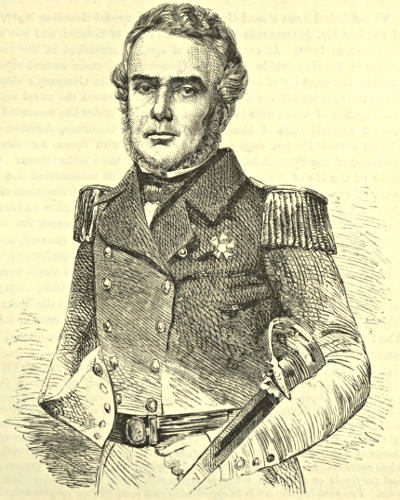
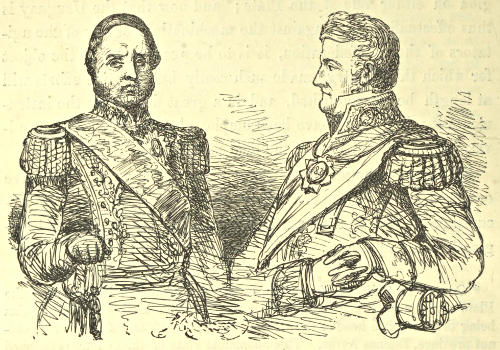
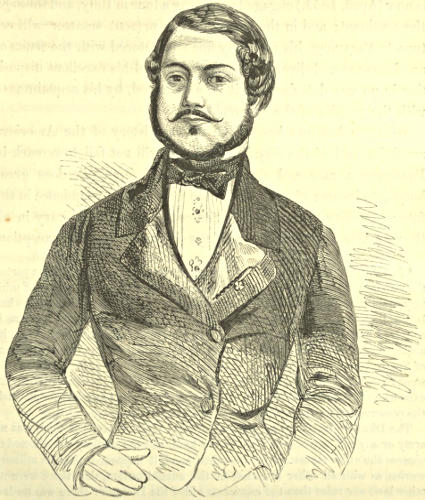
especially in reference to the disputes in the River Plate.—Portrait and
Memoir of Admiral Grenfell.
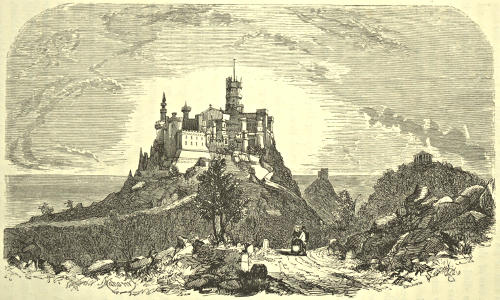
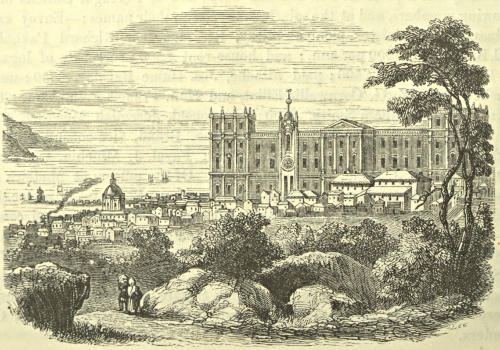
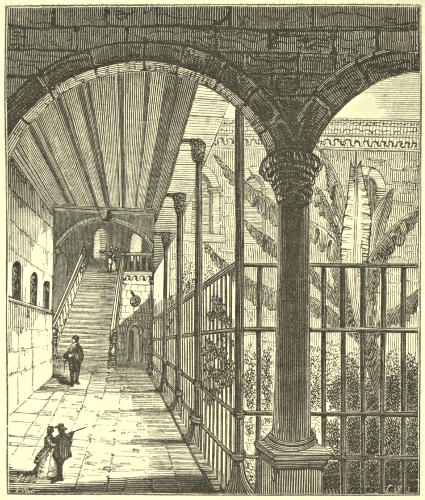
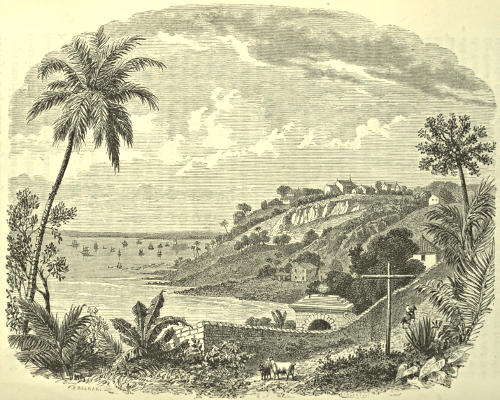
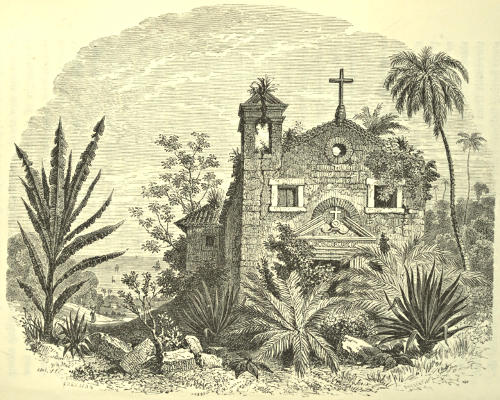
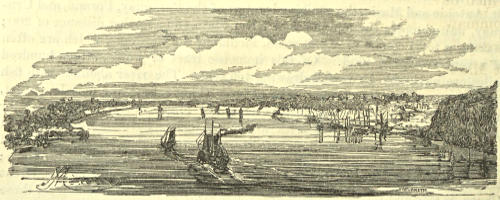
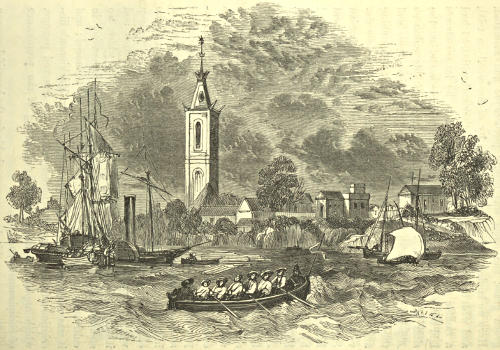
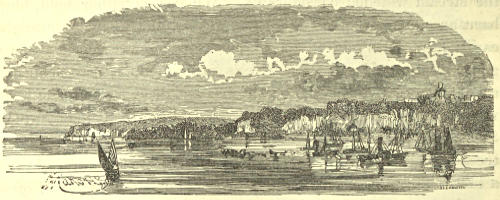
Note to the Illustrations.—As in the case of Bahia, the illustrations
in this chapter are from Sir W. Gore Ouseley’s ‘Sketches in South America,’
the original, however, containing no less than thirteen beautiful views of Rio
Janeiro and its vicinity. In the ‘Key,’ accompanying the drawings, Sir William
has embodied, in a very graphic manner, the result of his experiences in search
of the picturesque in the neighbourhood of the capital to which he was accredited
for several years as the representative of England. Describing some of
the spots he has so faithfully delineated by his pencil, he says:—The Sugar-loaf
Hills at the entrance of the magnificent harbour of Rio de Janeiro, (or
simply Rio), literally ‘January River,’ are far off discernible, with the lofty
Peak of the Corcovado, or ‘Hunchback,’ in the back-ground. On entering,
the hill to the left, called par excellence, the Sugar-loaf, is a prominent object;
then follows the wooded peninsular hill, on which is the Fort St. Juan, united
to the base of the Sugar-loaf by the Isthmus of the Praya Vermelho, or ‘Red
Beach;’ opposite this hill lies Fort Santa Cruz, commanding the narrow entrance
of the harbour. Its formidable batteries of heavy guns are perhaps
nearer the level of the sea than necessary caution, inspired by proximity of the
vast Atlantic, would dictate. For, sometimes, even placed as they are, twenty
or thirty feet above the water, the heavy gales from the south-west or south
have caused the sea to break over these batteries, with sufficient force to dismount
the cannon, as if they were reeds.
The harbour is among the finest in the world; no pilots required by night
or by day, entering or leaving; no dangers not visible, or avoidable with prudence;
of course a sailing vessel, venturing in or out in very light winds, or
if it falls suddenly calm, may, by the enormous Atlantic swell, be cast on the
rocks, when little or no steerage way is imparted by the wind.
More than one vessel has thus been lost, in the finest weather in mid-day;
but from attempting to pass the narrow entrance of the harbour, without a
steady breeze. Steam tugs would obviate such danger, and sea and land
breezes, excepting at some seasons, afford a regular means of entrance or exit
to those who await their commencement. There are boats with cables and
anchors in readiness, sometimes inconveniently so, as the Argentina experienced
at Fort Santa Cruz and Fort St. Juan, on the opposite shore, to be sent to
vessels in danger. The bay is 17 miles in length, and 11 in extreme width, and
contains many small islands, the largest, Ilha do Gobernador, or ‘Governor’s
Island,’ six miles in length.
The city, whose original name was San Sebastian, now altogether lost, was
founded not long after the discovery of Brazil by Cabral in the sixteenth
century. It is of oblong shape, situated on an elevated tongue of land, the
most easterly point of which is Punta do Calabouço, (‘Dungeon Point’), and
the most northerly, opposite to which is the little Ilha das Cobras (‘Snake
Island’), that of the Armazem do Sal (‘Salt Store’). The more ancient north-east
part is traversed by eight straight, narrow, and parallel, streets, crossed by
many others at right angles. In these the houses are high, though not quite
so lofty as those in the metropolis of the mother country; but in the new
town, built for the most part since the arrival of the royal family from Portugal
in 1808, they are handsomer, being generally of granite. The two towns
are separated by the Campo de Santa Anna, one of many large squares, agreeable
to the eye, in consequence of the somewhat fatiguing regularity of the streets.
Rio, the most important commercial city of South America, is naturally, from
its position, the great mart of Brazil, and its advantages are such as to fit it
for concentrating the commerce of the globe; but, as we have said above,
comparatively little has been done to assist nature, so far as regards the convenience
of the considerable quantity of shipping which frequents the port.
Lighters are employed in loading and discharging all vessels as they lie at
anchor in the harbour; but Government is now carrying out a plan, by an
English engineer, for a quay or wharf, to extend between the Military and
Naval Arsenals, at which sixteen vessels will be enabled to unload at once, as
well as lighters. This is a step in the right direction, and, although even such
accommodation will not be sufficient to meet the future requirements of Rio,
there is no doubt that the enlightened spirit which at present animates the
Brazilian government and nation will induce them to execute fresh improvements
as their provincial resources increase.
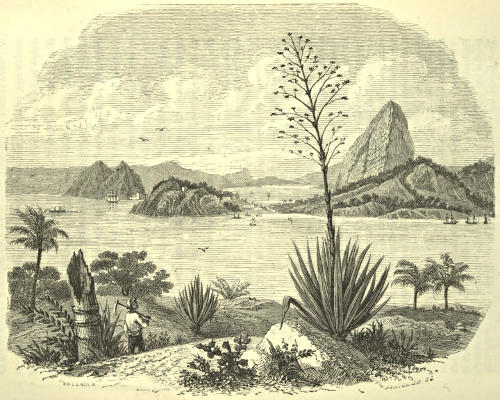
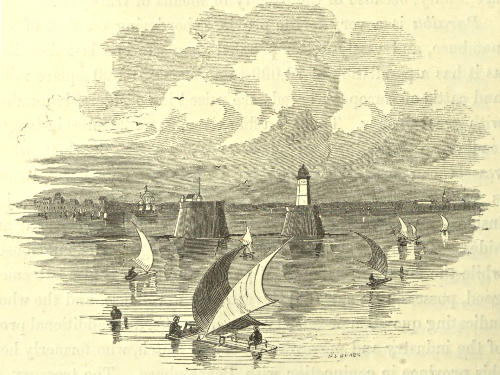
ENTRANCE TO THE PORT OF RIO JANEIRO.
This is the second time I have entered Rio at night and missed
the proverbially fine view of the approaches to the bay.[41] Morning
broke amidst drizzling showers, everything looking very gloomy.
We were visited about breakfast time, and steamed to our regular
anchorage, near the island where our coal depôt is. I will not indulge
in any lengthened disquisition upon the merits of the city of
Rio Janeiro, so often described, but content myself with noticing
the changes or improvements that have taken place since I last
visited the place four years back; or, on the other hand, allude to
what many consider as its want of progress and the local difficulties
which impede its onward march of events. As the capital of
so large and important an empire, Rio Janeiro is certainly deserving
of a closer analysis than has hitherto been attempted in any
public work with which I am acquainted.[42] The fatal barrier to
improvement, during the last few years, has been the yellow fever,
which has carried off large numbers of the population, especially
the industrial and foreign portion, on whom so much depended;
whilst during the same period the import of slaves from the coast
of Africa has been almost entirely suppressed. In this comparatively
short space of time the spirit of joint-stock enterprise
has made considerable advance here, resulting in the establishment
of a bank, a railway over the flat ground going to Petropolis
(nearly completed); other extensive railways and public roads to
the interior, for which contracts are now about being completed;
a gas company, to light the city, very far advanced towards actual
completion, pipes being already laid, lamps erected to about one-half
of the city, and works building for making the gas, &c.; a
company to navigate the River Amazon, which has already commenced
operations with a liberal grant from the government;
besides a number of minor enterprises, all conducive to the comfort
and well-being of the country. The origin of this movement was
no doubt owing to the joint-stock mania prevailing at home, aided
by a superabundance of capital from cessation of the slave-trade;
and the opportunity was seized by some patriotic individuals to
give a right direction to the public mind in the undertakings
adverted to. But, as might be expected, things got a little wild;
shares of every kind were driven up to a very high premium, and
a change has followed, detrimental, for the time being, to practical
advancement. Money, so very abundant last year at from 4 to 5
per cent., is now difficult to get at 8 or 10. Many people are
locked up in share transactions, which must take them some time
to realize. It has been, in fact, a repetition, on a comparatively
small scale, of those scenes of monetary derangement to which
our own country is so often subjected, and by the result of which
the Brazilians have not taken warning. No doubt the effect will
soon pass over, there having been no real abstraction of capital
from the place.
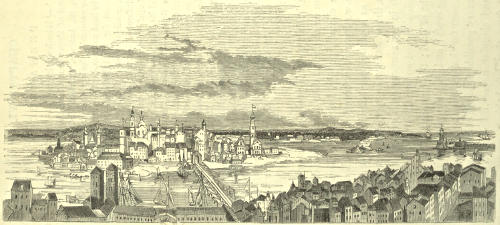
The city of Rio Janeiro extends some three miles along the
south-west side of the bay, and being much intersected by hills,
it is difficult to get a good view of the whole range, unless from
the top of one of the mountains near the city, such as the celebrated
‘Corcovado,’ which stands out like a pulpit on the plain
below, and is some 2,500 feet perpendicular. The view from this
pulpit on a clear day is superb, and I should say almost unequalled
in the world: the city, with its numerous divisions and suburbs
below you—the bay, extending as far as the eye can reach until
lost in the plain below the Organ Mountain—the sea, studded with
numerous picturesque islands, with vessels looking like white specks
upon it, and seen to a great distance—all together form a most
enchanting picture, and amply repay the toil of an ascent. The
mountain is of granite rock, like all others in this country, but
thickly wooded almost to the summit, and you come out quite
suddenly on the bare point before alluded to, so much resembling
a pulpit. In consequence of the tortuous formation of the
streets, constructed round the base of the hills, it is difficult to
get more than a bird’s-eye view of the city, on ground made by
encroachment on the sea; consequently, the streets are low, without
drainage, and in several of the back ones the water collects
and stagnates, to the great detriment of health and comfort.
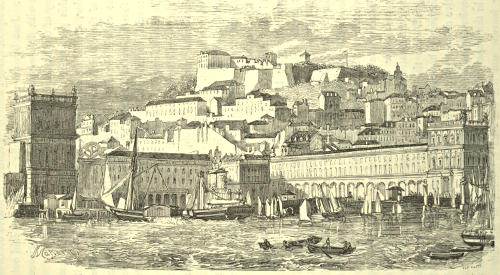
Rio itself is a bad copy of Lisbon—streets at right angles, a
large square facing the sea, and the suburbs extending up the
hills, which everywhere meet your eye. In Lisbon the streets
are tolerably wide, but here they have built them so miserably
narrow, that scarcely even one carriage can pass through, much
less pass each other; and it is evident that such vehicles were never
contemplated in the original formation of these streets. The only
way of getting over the difficulty is for carriages coming into the
city to take one line of streets, and those leaving it another, which
they do, excluding omnibuses altogether from the principal thoroughfares.
Improvements in this way were what I found most
backward; indeed there was a marked falling-off in such respect
since I was last here, and there seems a great want of municipal
government.[43] In many places the pavement is execrable, and
generally very bad, the difficulty having probably been increased
by laying down mains for water and gas, the latter now in process
of execution, and also to heavy rains having washed away many
parts of the road, and otherwise caused much damage. Once this
troublesome job is got through, it is to be hoped some effective
measures will be taken to put the streets and branch-roads in
order; otherwise they will soon be rendered impassable. Coach
and coach spring making must be thriving trades here, especially
with the immense increase that has taken place in the number of
carriages and omnibuses; and it is really wonderful how they
stand the continual shocks they have to endure.[44] Government
seems at last alive to the absolute necessity of doing something to
improve the sanitary condition of the city, and also its internal
organization, as they have lately got out some good practical
English engineers, who I have no doubt will suggest an effective
mode of dealing with present difficulties. If they do not
adopt decisive measures, the rate of mortality may be expected to
augment fearfully in a dense population of 300,000 to 400,000
inhabitants, huddled together in some 15,000 houses, surrounded
by impurities of every kind, not the least being the stagnant
water in the streets. No exact census has ever been taken of the
population of Rio Janeiro, which is generally believed to be
between the two figures above given. There is a migratory
population, but the accumulation of humanity of every race and
colour, contained in some of the large dwelling-houses, is something
extraordinary. As before observed, nature has done much
for this country, and if the natural facilities of Rio Janeiro
were properly availed of, and local improvements carried out with
energy and spirit, it might be rendered one of the finest and most
luxurious places within the tropics.[45] The opportunity is now open
to them; the government possess ample means, and it is just a
question whether measures of progress are to be effectively achieved,
or the city to be abandoned to its fate. The great evil attending
all improvement in Brazil is an undue appreciation of native
capability, and a disparagement or distrust of those whose practical
experience would enable them to grapple with the difficulties
that surround them—a kind of little jealousy and mistrust that
prevents their availing themselves of opportunities thrown in their
way to carry out undertakings necessary to the well-being of the
country; nor can they understand the principle on which such
things are regulated in England, still less the magnitude of operations
carried on there and in many other parts of Europe.
Yet the time seems to be coming when these principles will be
better understood here, and when the application of English
capital towards the improvement of the country may be safely and
legitimately brought to bear.
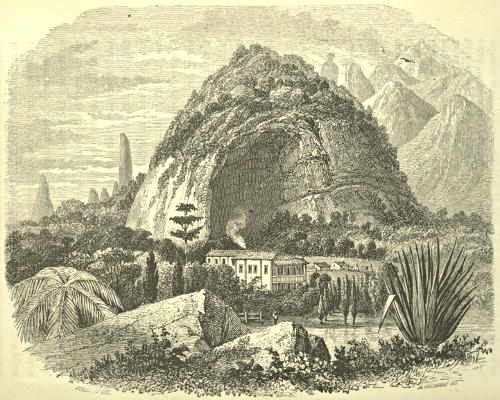
SERRA DOS ORGAOS—CABECA DO FRAILE, RIO JANEIRO.
The political and social position of this great empire, whose influence
and example are of such incalculable importance to the
present, and still more to the future, of the whole continent of
South America, must necessarily be a subject of anxiety to all
who wish to see it prosper, and who are at the same time practically
acquainted with the difficulties that have to be overcome in
the maintenance of its present system of a representative government.
Without attempting anything in the shape of a history
of that government, or of the circumstances which led to its formation
and have ensured its consolidation, a few particulars may
not be unacceptable to such readers as have not had their attention
directed to the subject. After the expulsion of the Portuguese
in 1822, Don Pedro was declared Emperor, and, in 1824,
the constitution, which is a very close imitation of our own, was
proclaimed. The government is confided to ministers chosen by
the Emperor; there is a chamber of deputies, 548 in number,
elected by the towns and 18 provinces, and a senate or upper
chamber, consisting of 54 members, titled and untitled, the numbers
in both being limited, and titles are not hereditary. Hence,
though there are, we believe, upwards of 20 marquises, 7 counts,
29 viscounts, and 32 barons, the sons of these do not succeed to
the titular distinction of their fathers, notwithstanding the honours
emanating from a crown that is hereditary. The business of the
country passes under the same sort of discussion, and just with
as much freedom of debate, but not more, than with us; and according
to the support given or withheld by the chambers is the
government strong or weak. The revenue of the empire is accounted
for, and finds its way into the national treasury at Rio de
Janeiro; and hence the difficulty encountered in dealing with its
distribution, as each representative of a province naturally wishes
to favour his own constituency, and is opposed to what he may
think an undue proportion of expenditure lavished, and of interest
taken, in the province already favoured with the establishment of
the capital and the residence of the court, and where the largest
population centres. This is one of their great legislative difficulties,
which gives rise to long and violent discussions. Another is
the existence of two factions in the state, the old Portuguese and
the purely Brazilian party. Some years back the former held
the reins, and were the supposed abettors of the slave-trade; but
since 1848 the present ministry, mostly composed of pure Brazilians,
have retained office, and been enabled to carry out most
stringent measures for putting down that abominable traffic, which
is for the present not only suppressed, but its restoration is impossible,[46]
owing, first, to the complete revulsion that has taken
place in public opinion, and, secondly, to the new direction that
has been given to the employment of capital, as explained in our
chapters on Pernambuco and Bahia. To such lengths have an
honest and energetic administration, supported by a high-minded
sovereign, jealous of the honour of his country, and, above all, of
its credit for integrity in adhering to its engagements, been able
to act upon this truly national sentiment, that many of the influential
Portuguese, known to be actively engaged in the traffic,
and some of whom had sunk vast sums in its prosecution, have
been banished the country. Five years is a long time for a ministry
to retain office in any country; for even in our own that
period far exceeds the average duration of a British cabinet, at
least during the last three reigns; consequently, the greater the
wonder at the stability of one in a country such as Brazil, and
under many trying circumstances. Not the least embarrassing of
these was the perpetual interference of England to put down
the external symptoms of the slave-trade, though Brazilian ministers
were doing it in a manner so rapid and effectual as to constitute
one of the most startling and complete social revolutions
ever recorded in the history of any nation in the world as the
work of half-a-dozen ages, much less of half-a-dozen years.[47] This
speaks well indeed for the personal ability as well as for the representative
system under which the existing ministry govern,
as without a decided majority in the chambers they could not
possibly endure a single session. Brazilian policy and Brazilian
views seem to be now much more firmly established in the legislature,
and the native party greatly preponderates. Still this
clashing of interests tends to impede the regular march of business,
by giving rise to endless personal discussion and personal invective.
The chamber of deputies and the senate are a long way
apart from each other, which must occasion inconvenience, and
destroy that prompt action and unity of purpose so necessary in
a legislative assembly. The locality ought always to be the same,
with the monarch as the head, opening and closing the sessions
under the same building. Considering their late elevation to
political distinction, some of the deputies and senators of Brazil
display no small amount of oratorical, and, what is still more valuable,
debating, ability; whilst many of the former must make a
great sacrifice of time and personal convenience in spending so
many months away from their families and estates, which are
difficult to be reached in a country where the means of travelling
are comparatively so primitive, and the distance to be traversed
generally very great. The hours of discussion in the chambers are
as much too brief as ours are too long, being only from 11 a.m.
to 2 or 2.30 p.m., during which one orator will often occupy the
time for speaking sake only, and the business of the day has to
be adjourned; whereas if ministers, with no Mr. Brotherton to be
afraid of, could keep them at it occasionally until midnight, or 2
or 3 in the morning, it would tire out declaimers, who seek only
to pander to the appetite for fervid or piquant rhetorical popularity,
and would insure quicker despatch of the business in hand.
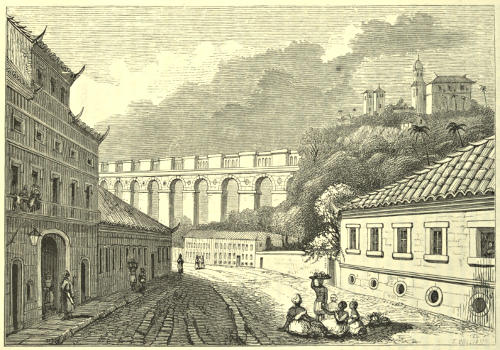
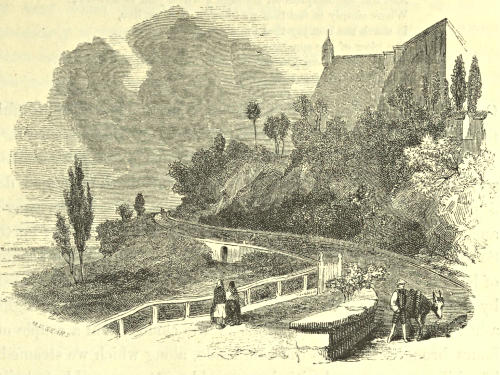
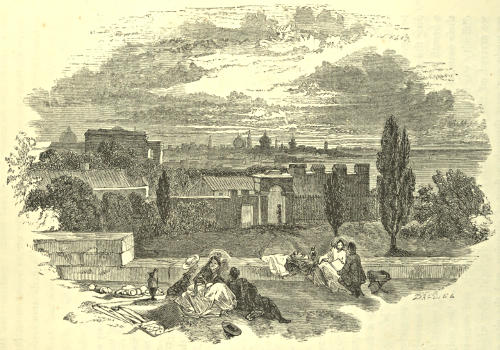
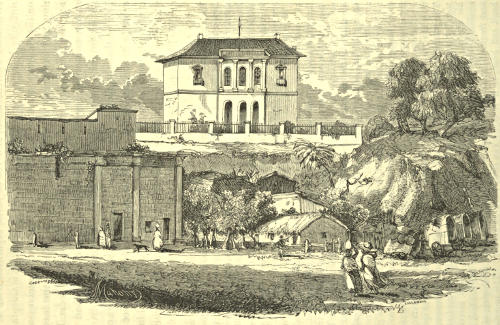
AQUEDUCT AND CONVENT OF SAINT TERESA. RIO JANEIRO.
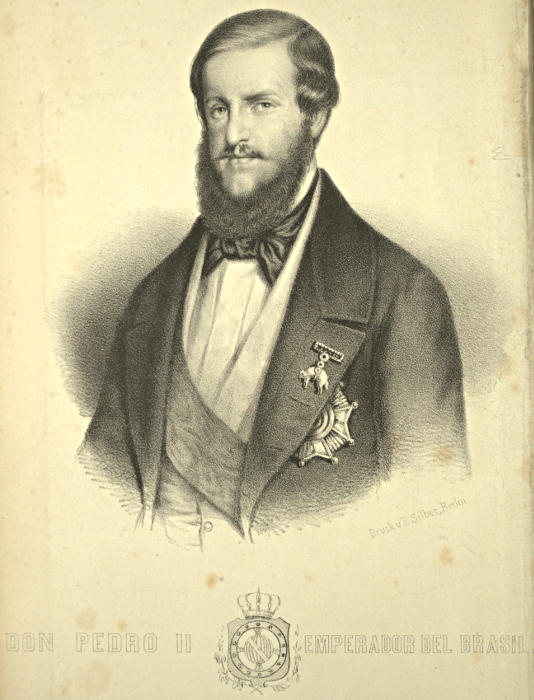
The present Emperor is in every respect admirably fitted for
his high station. Born in the country, without the advantage
of a knowledge of European life, and that finished tone of education
it affords, but possessed of natural endowments of an exalted
order, and having turned to the utmost advantage the opportunities
of a studious and virtuous youth, he carries with him the
full national sympathies of the native Brazilians, the respect of the
old Portuguese party, and the esteem of the whole foreign diplomatic
body, to whom he dispenses the honours and hospitality
of a prudently managed court. As the sovereign of a constitutional
country, content to abide within the strict limits imposed
by his coronation oath, his reign has been prosperous and
happy. In his private capacity he is kind and attentive to all
around him, as well as a close observer of passing events. Possessed
of a benevolent heart, and actuated by a noble singleness
of purpose, he knows how to direct the reins of government,
without undue interference or an injudicious exercise of his prerogative.
It has often been emphatically said that the Emperor
is not only the highest, but the best man in the country, both
from his public conduct and his private virtues. The value of
such a compliment is not enhanced, or probably we should say
is not impaired, by any universal laxity and corruption around
him, as in the case of another empire nearer home, wherein it is
said that the principal personage is not only the most honest, but
the only honest, man in his own dominions. Probity[48] and high-mindedness
of every kind in public life are as general in Brazil as
in any part of Europe, England itself certainly not excepted; consequently
the standard the Emperor is measured by is one by no
means conventional or equivocal, but is such as any sovereign in
the western world might feel proud of having applied to himself.
Certainly, in the matter of truthfulness, the rarest of all monarchic
virtues, he has set an example to the royal brotherhood of kings
that might be followed with infinite profit to the reputation of the
regal race, and with corresponding advantage to their subjects in
numerous instances. His Brazilian Majesty is admirably supported
by an excellent and high-minded partner, who, like her husband,
is beloved by all classes in the empire. The imperial couple frequently
attend public balls, and mix in social parties with citizens
and foreigners, taking also the warmest interest in all local improvements,
or measures calculated to benefit the country, and to
raise the character of their subjects. When the kind of life they
are compelled to lead is fairly considered, and the extent of court
intrigue necessarily prevailing where parties are so much divided
and respectively so potent, too much merit cannot be ascribed to
the Emperor and Empress for the manner in which they conduct
themselves, and the controlling influence they exercise over others.
Every one who has been in Rio well knows how exceedingly
popular he is, and how strong is the conviction that that popularity
is most just and most deserved, though he never goes out of his
way to obtain it by any ad captandum arts, or any conduct whatever
that is not the result of sound judgment guiding an estimable
nature. M. Reybaud, a Frenchman, in a biographical memoir,
which appeared also in English in one of our illustrated journals
at the close of the year before last, says:
‘But the great work of Don Pedro the 2nd, a work at once of humanity
and policy, and which will be his indelible title of glory in the eyes of Europe,
is, that of having openly attacked the national prejudice of the necessity of
black slaves, and having overcome it. Thanks to him, thanks to his Ministers
and the Legislative Chambers of Rio, the traffic is henceforth definitively
suppressed in Brazil, for the people have understood and accepted the Imperial
policy, which has for its motto, “No more traffic in slaves; European colonization.”
Such is at this moment the cry of all Brazil. The agriculturists
themselves, until lately insensible to the anathemas of philanthropy, have
opened their eyes, and joined the Government and the Chambers in demanding
the deliverance of the country from the living leprosy of the slave traffic.
It was imperative that it should. It was indispensable that the country
should associate itself with the measures of the Government, for up to this
time the laws that were made were not carried out, and the people who
thought them prejudicial to their interests did not scruple to infringe them.
The policy of the Emperor and the Brazilian Chambers was very simple and
sensible. It was not sufficient to decree the suppression of the traffic, but it
was necessary to open up to the agriculturists new ways and means by which
they should, within a longer or shorter delay, dispense with black labourers.
The Legislature, to provide for this necessity, took proper means to attract
European colonization. Several attempts tried on this new basis have been
attended with the happiest results. Little colonies have sprung up, especially
in the south of the empire, and are in a flourishing condition. The planters
and landed proprietors throughout the empire give a decided preference to
free over slave labour, as experience teaches them that it is infinitely to their
advantage.’
It is impossible too highly to eulogise the conduct of his Imperial
Majesty in reference to the slave trade; but as one evidence,
which may be useful by way of example in a certain portion of
the world that regards itself as far more advanced than Brazil,
I transcribe the following extract from a letter dated Rio, November
14th, 1853, and which appeared in some of the English papers in
January last:—
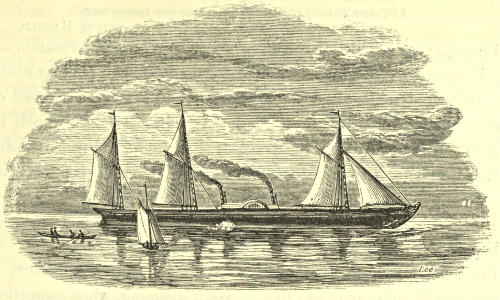
‘The “Pernambucana,” one of the vessels of the Brazilian Steam Packet
Company, was wrecked near St. Catherine’s, and upwards of 40 passengers
drowned. This disaster afforded an opportunity for a display of heroism and
bravery rarely equalled. A black sailor, belonging to the vessel, succeeded
with many others in reaching the shore; numbers had perished in the attempt,
and but few of the passengers remained upon the wreck. All of these,
including a mother and six children, did Simon save. It is pleasing to add
that the Brazilians were by no means slow in marking their appreciation of,
and rewarding, this heroic action. A subscription was opened in the Praça do
Commercio, and the amount subscribed in two days exceeded seven contos of
reis, or about £800. The Emperor and Empress, whose hands are always
open for the succour of the needy, or the reward of the meritorious, contributed
900 milreis, and the total amount already received approaches to £1,000.
In addition to this, a statue of the black is to be placed in the exchange. An
unfortunate circumstance, peculiarly annoying to our English community in
Rio, may be noticed in connection with this affair. The promoters of the
subscription, persons of great influence and respectability, brought the black
to the Praça do Commercio, not merely to gratify the curiosity of those who
were anxious to see one become so celebrated, but to afford any information
which parties connected with the victims or survivors might require. The
director of the month, who was unfortunately an Englishman, objected to the
presence of a black in the sala, and in spite of the remonstrances of all present,
insisted upon his immediate removal. This arbitrary proceeding has
called forth some severe articles in the public papers, and it is provoking that
one of us who pretend to so much philanthropy for the race should have shown
so much prejudice against the colour. This heroic fellow, with whom the
Emperor of the Brazils expressed himself proud to shake hands, was driven
from the exchange because he was an African! And by an Englishman!’
I cannot learn that this conduct has called for any reprobation
in England; that there have been any encomiums passed by our
abolitionist press or declaimers on the monarch of that country
wherein partiality for the slave trade was declared by the highest
authority amongst us to be ineradicable, except by violent measures
on the part of England. Nor, indeed, can I find that there has
been the least desire to make the amende in any way to Brazil for
all the calumnies so long heaped upon her; for even that portion
of the Slave Trade Treaties Report quoted, which relates to
Brazil (and which has been circulated throughout the Brazilian
press), has been passed over with indifference by our purists and
censors. Nay, more, within a very short period preceding the date
of these remarks, a tale of horrors was tricked out for the regalement
of our gobemouche public in this country by a pair of travelling
philanthropic malevolents concerning a certain planter in Pernambuco
inviting his brother planters of the province to a grand spectacle
of boiling a slave alive; and the name of her Britannic Majesty’s
consul was actually adduced as that of a witness to the act. The
absurdity was, of course, scouted in Brazil as the conjuration of a
diseased fancy; but the journals here that gave currency to the figment
have evinced small alacrity in recording the contradiction
elicited on the spot. So in the case of the imperial conduct towards
Simon. Had the President of the United States acted as the
Emperor did in this instance, or had a North American Uncle
Tom performed any portion of what the Brazilian black achieved,
dramas and novels by the score would have appeared, and, in fact,
we should never have heard the last of it.[49]
Though she has made wonderful strides in the right direction—advances
positively marvellous, considering the locality, and even
as contrasted with what would have been the case in England at
this present day, had a large section of otherwise enlightened men
amongst us had had their way—still, commercially speaking,
Brazil has yet much to do in the shape of reform. A great deal
of the old leaven of Portuguese exclusiveness and exaction remain
to this day, although it is not carried to such an absurd extent as
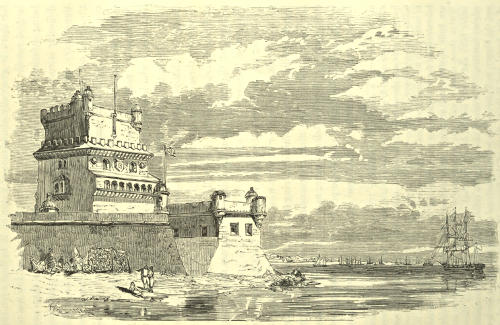
at Lisbon, where is placed in the hands of every shipmaster visiting
the port a document,[50] which, considering that its provisions are
enforced by a civilised mercantile nation of Europe in the second
half of the nineteenth century, and in a great port whence once
sailed some of the mightiest maritime enterprises in history,
deserves to be regarded as a curiosity of commercial literature,
and is preserved as such in a note. No wonder the trade of
Lisbon should dwindle down to a mere cypher, and the finances of
the country be in so deplorable a state. Any nation issuing such
a document as this places itself on a par with, if not on a lower
footing than, China or Japan. In Brazilian ports you have the
same ordeal of health visits, police, and custom-house searchers,
before you can even leave the ship; and if a vessel arrives after
dusk, no matter where from, coasting or otherwise, she must
remain till morning for the visit, after which she is a kind of
custom-house prey, watched and pounced upon in every possible
manner, if all is not found to be strictly in accordance with the long
string of regulations, numbered like a criminal code; and woe
betide the unfortunate shipmaster or merchant, importing goods,
who innocently falls into the trap laid for him. It is a case of
heavy fines, damages, and often confiscation of ship or property;
although it can be clearly and satisfactorily proved that no one is
to blame in the matter, and that there has been no fraudulent
intention whatever. The stipulations of the custom-house code
are being continually infringed, and yet, like the laws of the Medes
and Persians, it altereth not! All this is very sad, and unworthy
of a country that looks to commerce for its intercourse with
Europe, and as a main source of revenue and social progress.
The only excuse lies in the force of habit, founded on inveterate
prejudice, bequeathed by the old superannuated mother country.[51]
It is true that our own fiscal system twenty years ago contained
much of the objectionable matter alluded to, although it was never
distinguished by those absurd forms and regulations that are not
only a check to personal liberty, but involve the loss of much valuable
time. If some public-spirited minister, who took a right and
far-seeing view of the true interests of Brazil, were to grapple
fairly with this subject, and had the moral courage to bring forward
liberal measures, I firmly believe that he would carry them.
For instance, let him abolish the farce of visiting vessels, both inwards
and outwards, for sanitary or other state purposes; and as
regards customs’ revenue, once let the duties be reduced to a scale
that would render smuggling unprofitable, and there would be no
need of a commercial code or of fines and restrictions. All experience
proves that where duties have to be levied for the absolute
necessities of the state, the more moderate the scale the less
chance there is for smuggling, and the greater the increase and
encouragement to consumption of the articles imported, which can
then be sold at cheaper rates. It is notorious that for many years
after the trade with Brazil was opened, not half, probably not a
quarter, of the duties entitled to be levied found their way into the
public treasury; and although a good deal of this iniquity has been
done away with by the firmness of a few public servants,[52] yet the
temptation remains, and some parties still profit by illegal importation
at the expense of legitimate traders. I repeat my strong
conviction that Brazil might derive a much larger revenue under
a moderate scale of duties, and she could then afford to wipe away
all the existing restrictions on commerce and shipping. It is true
that she has done something, both in reduction of her tariff as well
as of her anchorage dues, a step in the right direction, which, for
her own sake, it is devoutly to be hoped she will soon follow up
vigorously.
As regards the social condition of the Brazilian empire, there is
doubtless still much room for improvement. Where is there not?
But when we recollect that until 1808 there was not a printing-press
in the whole country—and now behold no large town without
its journal, generally very admirably managed, and when we see
educational establishments, many on a very large and highly efficient
scale, in nearly every province of the empire—certainly we
cannot say her progress has been slow. Previously to that time
the only instruction imparted was through the convents, and consequently
it was tinctured with all the old monastic and narrow-minded
leaven attached to those institutions, whose downfall in Spain and
Portugal was soon followed by similar measures in Brazil. Secular
education became extended; seminaries and schools were established,
both under the patronage of government and by private
individuals; newspapers increased, and are now multiplied to the
number of upwards of 50, including scientific and literary; and
the whole course of things was changed; but without so far resulting
in any general plan by which instruction is communicated to the
masses of the people. French being the principal medium of intercommunication
between the better classes and all foreigners,
and being very generally spoken, publications in that language
are necessarily most in request; and an assortment of French
reading of the latest Parisian stamp may be had in Rio equal to
what is procurable in any second-rate town in the country it comes
from. It is needless to say that French fashions, in other than
strictly intellectual items, prevail among all the educated classes in
the Brazilian capital; and by ministering to such tastes a large
number of native French derive considerable profit. In addition
to the educational advantages already enumerated, and the list
might be greatly extended were we to include the libraries, &c.,
some excellent institutions of a charitable nature abound, as well
as hospitals; the one last founded of this class at Rio is on a most
magnificent scale, in a small bay near the entrance of the port,
where an admirably executed marble statue of the Emperor has
also been most fittingly placed.[53] As it is under his auspices it has
been commenced, and by his munificence and example, and that of
his estimable consort, it has become one of the noblest edifices of
the kind in existence on either side of the Atlantic.
Another of the social evils of Brazil is the difficulty of obtaining
a labouring population, a necessity consequent on the importation
of slaves having ceased. It is one which, unless seriously and
promptly dealt with, must entail very momentous consequences:
a continuous immigration of free labourers appears to be the only
solution of the question. But whence are they to come in anything
like the required numbers? It is quite clear that European
labourers cannot work with slaves, nor will the hardy islanders of
the Atlantic consent to do so; people, moreover, are needed who
can bear the climate, and will put up with hardships which only
those acclimated can be expected to endure—that is, the climate
of the more torrid parts of the Brazils; for there are vast regions,
larger than the whole United Kingdom, where out-door labour is
perfectly practicable to natives of Great Britain, and where some
of such natives have settled and prospered as agriculturists, as
we shall have occasion to refer to in speaking of the Banda Oriental,
in respect to the adjoining Brazilian province of Rio Grande
do Sul. The only alternative seems to be coolies from China;
and with the present propensities of that class, no doubt numbers
would flock to Brazil, if the needful encouragement and facilities
were given. At all events the experiment might easily be tried,
and the sooner it is done the better.[54] Some parties are sanguine
enough to believe that the aborigines of the country, the remnants
of the Indian tribes, might be brought under civilized rule, and
instructed so as eventually to be rendered capable of replacing
slaves; but this plan seems very problematical, unless in those
districts where they have already been accustomed to mingle and
work with the other inhabitants, as in the northern provinces of
Bahia and Pernambuco. In the latter province especially, there
is a very fine race of men called Sertanejos, who make good
labourers, and are very useful in bringing produce to market by
means of horses. The number of men so employed may be
imagined when, by the law of Pernambuco, one man must accompany
every horse; and in the busy season 2,000 horses have been
known to pass the toll-bar inwards, and the same number outwards,
making altogether 4,000, although the edict alluded to is
not very strictly enforced, the distance travelled by these horses
being from 50 to 300 miles. It is literally impossible to form a
proximate conjecture as to the number of Indians in Brazil, the
estimates of various authorities ranging from one-fourth of a
million to a million and a half, divided into Indios, Mansos, and
Tapirios; the former partially civilized and speaking some Portuguese,
the latter still savage. Nearly all the tribes are of large
stature; and though exceedingly low in the scale of civilization,
possess many of the virtues of the barbarian, especially when
uncontaminated by the vices of the white man, or proximity to him.
For the most part they are warlike, the climate by no means
enervating their bodies or subduing their spirit; and though in
some respects ferocious when excited, the practice of cannibalism
towards prisoners taken in battle is quite extinct, if indeed it ever
really existed. Some of the tribes exhibit an extraordinary
antipathy to the negroes, which is the more remarkable as the
marriages of people of colour with whites are very common, and
degrees of black that would throw a citizen of the United States
into a fever of indignation are looked upon with philosophic
indifference, both by Brazilians and natives of Portugal in Brazil.
Probably this is one reason why slaves in Brazil are treated
with a kindness and humanity altogether unexampled in any other
part of the world, a fact upon which all authorities are agreed,
notwithstanding some shocking exceptions that were wont to be
practised towards newly-imported unfortunates from the coast of
Africa, a custom now fortunately at an end. No doubt a wise and
conciliatory policy exercised towards those Indian tribes who still
occupy large districts of Brazil would be attended with beneficial
results; but this is a work of time. What the country now wants
is immediate labour, and for a supply of this, emigration of some
kind is the only available source. The towns are already beginning
to feel the effects of the diminution, and wages have consequently
risen considerably; whilst in the interior the value of
slaves has greatly increased, a preliminary perhaps to their future
emancipation.
Before quitting the subject of Rio improvements, I may note
an interesting excursion made over a short line of railway, and
the first ever attempted in this country, which is to connect the
city with Petropolis (the mountain and summer residence of the
court and upper classes), and which was recorded as below in the
‘Journal do Commercio’ of the 6th September, 1853, the day on
which we left Rio for the River Plate.[55]
Respecting the mercantile position of Brazil generally, I turned
with some considerable curiosity to the edition published in the
course of the present year, 1854, of ‘M’Culloch’s Commercial
Dictionary,’ a work of deserved authority and influence, as every
business man is aware, though, I regret to be obliged to add, the
article on the country I am now treating of does not sustain the
character to which the volume is in so many other respects
entitled. I had expected, as the result of recent events in Brazil,
some marked modification in the writer’s opinions as expressed
under this head in former editions, but could find none; and
indeed the whole of his remarks, which I annex, would appear,
from internal evidence, to be as emphatic as in previous editions,
notwithstanding the date on his title-page, and his assertion in
the preface that the latest information had been brought to bear
on every point. He says:—
‘The imports into Brazil, which are chiefly from Great Britain, consist
principally of our cottons, woollens, linen, iron and steel, hardware,
butter, and other articles, amounting in all, in ordinary years, to about
£2,500,000. It is frequently, no doubt, said that our exports to
Brazil amount to double that sum, or to more than £5,000,000. But
there is no room or ground for any such statement. The return is not
derived from Brazil, but from our own Custom-house; and there is no
reason why the merchants should undervalue the exports to Brazil
more than to any other country. The commercial policy of Brazil has,
on the whole, been characterised by considerable liberality. The
duties on imports and exports have been mostly moderate, and have
been imposed more for the sake of revenue than of protection. In
October, 1847, the legislature of Brazil issued a decree, imposing 33⅓
per cent. higher duties on the ships and produce of those nations which
did not admit the ships and produce of Brazil into their ports on a fair
footing of reciprocity. This decree was, in part, provoked by our policy
in regard to the slave trade, and was in avowed retaliation of the high
discriminating duties we had imposed on Brazilian and other slave-grown
sugar. But the modified views of the Brazilian government in
regard to the slave-trade, and the admission of slave-grown sugars into
our markets under reasonable duties, which are to be equalised with
those on British colonial sugars in 1854, occasioned, in 1849, the revocation
of the discriminating duties referred to. A provincial duty of
15 per cent., imposed in some of the provinces on hides and other
articles, has also been repealed. Great Britain enjoys the largest share
of the trade of Brazil; and that share will, it is probable, be a good
deal increased, when the duties on foreign and colonial sugars are
equalised in 1854. The abolition of the discriminating duty on
foreign coffee in the course of the year 1851 has occasioned a considerable
increase in the imports of Brazilian coffee. The commerce of
Brazil has sustained great injury from the wretched state of the currency
and of the finances; the value of the former, which consists
almost wholly of paper, being excessively depreciated and liable to extreme
fluctuations, and the revenue being inadequate to meet the expenditure.
Latterly, however, vigorous efforts have been made to
increase the revenue; and it is hoped that, in the event of the finances
being placed on a better footing, measures may also be taken to improve
the currency.’
The concluding passage, as to the inadequacy of the income to
the expenditure, is altogether questionable; and the admission of
such an assertion into a work of the character just quoted from,
betrays a determination altogether inexplicable, for of course it is
impossible to put it down to the score of ignorance. The rapid
and progressive liquidation of the national debt, and the unfailing
punctuality of the dividends, added to the price Brazilian stocks
command in the British market, sufficiently bespeak the healthiness
of Brazilian finance. I have not been able to discover upon
what data it is that Mr. M’Culloch fixes the annual imports of
British produce into Brazil at so low a figure as he mentions in the
foregoing extract, and which figure has appeared in successive
editions of his work for many years back. But it is quite incorrect;
and, at least, as much below the actual amount as the one he
condemns as too high. A witness before the committee on Slave
Trade Treaties last year, a gentleman officially connected with the
Brazilian embassy, and having the best means of knowing the
accuracy of what he said, declared the amount of trade during the
year 1852 between Great Britain and the Brazils to be about three
millions and a half sterling per annum of imports, entirely from
England. Those imports[56] are sold there on one year’s credit;
so that every year there are £7,000,000 of English goods in
Brazil. There is always a deposit of British goods equal to one
year’s consumption, and one year’s consumption due. Besides
that, there is a national debt to England of £6,000,000 sterling;
Brazil has to pay interest for that. Then there is the internal
debt, where £600,000 of bonds belong to Englishmen; which
makes a total of £13,600,000 of British property engaged in
Brazil.
Hence, then, the magnitude of the interests in this country as
affected by our relations with Brazil. Nor are the interests of
humanity at large on a less extensive scale. The witness last
adverted to—and I can state of my own knowledge that the authority
he adduces is a most competent one—an Englishman long
resident in Brazil, in the public service of that country, says:—
‘Allow me to cite from the writings of an Englishman who appears
to be very well acquainted with the affairs of the Brazils: it is an
article about a book published by Sir Woodbine Parish, from the
British Quarterly Review for February, 1853. The book is about the
River Plate, but there are in the article of the Review two or three
little passages to which I will beg the attention of the Committee;
beginning about the attack of Caseros, where Rosas had been put
down. He says, “On this occasion, however, the Brazilian alliance
introduced a regular, well disciplined, and properly commanded army
into the contest, and in the hour of Buenos Ayrean defeat, it was to its
humanity, order, discipline, and obedience that the troops of Rosas
appealed; Surrender to the blue pants (so the Brazilian infantry was
termed), they do not kill! was their cry.” This is to prove that
Brazilians are not so blackened in civilization as they generally think
in Europe, and not so inhuman; “and thus a body not exceeding
3,000 men had upwards of 5,000 prisoners, not one of whom was injured;
on the contrary, a contingent of Rosas’ army refused to surrender
to the Oriental forces of Urquiza; but on the appearance of a
Brazilian officer (Captain Petra) at once laid down their arms; nor
was this example of humanity lost on the Argentines themselves, in
the subsequent occurrences at Buenos Ayres.” I have read that
to show that the Brazilian people are ill judged of, and that they are
more desirous to put an end to slavery than they have had credit for,
on account of the point of civilization they have come to, and on
account of the circumstance of its being to their interest. The article
of the Review contains still the following observations: “Nor ought
the events we have narrated to be uninstructive to Europe; for they
teach the impolicy of England and France attempting to precipitate,
either by diplomatic or military agency, events in distant countries,
whose circumstances they are so imperfectly acquainted with; and the
shortsightedness of prohibiting the intervention of a nation materially
and geographically, as well as politically, concerned. They teach us
also the dignity and office of the Empire of Brazil in the political
system of the world; and how much more that state may be made to
contribute its share to the great mass of human happiness, by promoting
its welfare, than, as has been done, by wounding its pride.” Thus
by promoting its welfare, and coming to an amicable understanding
with it, there would have been a much fairer result, perhaps much
quicker, than by wounding its pride, and by much stronger measures.’
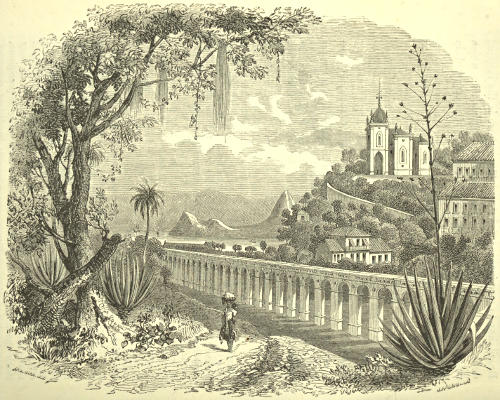
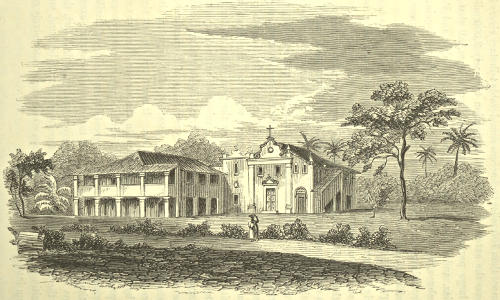
CHURCH OF THE NOSSA SENOR A DA GLORIA, AND AQUEDUCT, RIO DE JANEIRO.
This is most just and true; and though the cause of irritation
to Brazil, indirectly glanced at in the concluding sentence, has
happily passed away, it is no less necessary to remember with
what forbearance that country endured the slights and indignities
put upon her, and with what magnanimity she forbore from soliciting
the aid of a neighbouring nation that might have required
small inducement to vindicate the honour and inviolability of the
Brazilian flag; for there cannot be a question that the government
of Washington would very gladly avail itself of any opportunity
that might contribute to strengthen the connection between
the States and Brazil, though it is remarkable that some attempt
of the kind has not been made, in the mode of which the establishment
of such a steam company as the one I represent is an
example.[57]
1839 and 1844.—Average annual value of
imports and exports, 13
millions sterling.
1845 and 1849.—Average annual value was
16 millions sterling, or
an increase of 3 millions.
In this latter period the average yearly
number of vessels employed was
|
10,694; |
tonnage, |
1,937,944; |
|
| of which |
5,464 |
” |
953,654 |
inw. |
|
5,230 |
” |
914,290 |
outw. |
| vessels, |
10,694 |
tons, |
1,937,944 |
|
showing an average increase over the
former period of 1839 to 1844 of
| vessels, |
34 |
per cent. |
| tonnage, |
42 |
” |
Of the above figures, the imports averaged in value,
|
49 |
per cent, |
| exports, |
51 |
” |
|
100 |
|
During the same period, the proportions
of foreign and coasting trade were:
| foreign imports and exports, |
76 |
per cent. |
| coasting ” ” |
24 |
” |
|
100 |
|
Of the aforesaid total imports and exports,
| Great Britain figures for |
36 |
per cent. |
| United States ” |
16 |
” |
| other parts of the world |
58 |
” |
|
100 |
|
And in the total value of imports,
| Great Britain |
figures for |
50 |
per cent. |
| France |
” |
10 |
” |
| United States |
” |
11 |
” |
| other parts |
” |
29 |
” |
|
|
100 |
|
Ditto in exports:
| Great Britain |
” |
24 |
” |
| United States |
” |
23 |
” |
| other parts |
” |
53 |
” |
|
|
100 |
|
The percentage of this commerce divided
amongst the ports of Brazil, is as follows:
| Rio Janeiro, |
53 |
per cent. |
| Bahia, |
17 |
” |
| Pernambuco, |
13 |
” |
| Other ports, |
17 |
” |
|
100 |
|
The value of imports and exports bearing about a relative proportion to these figures.
The total number of bags and barrels of coffee exported from Rio Janeiro in 1847 was
1,650,300; in 1848, 1,706,544; in 1849, 1,451,715; in 1850, 1,392,361; in 1851, 1,993,255; in
1852, 1,899,861; and in 1853, 1,657,520. The total number of cases of sugar was, in 1847,
3,136; in 1848, 2,371; in 1849, 3,212; in 1850, 6,465; in 1851, 4,752; in 1852, 9,012; in
1853, 2,667. The total number of hides imported in 1847 amounted to 268,492; in 1848
to 348,947; in 1849 to 299,262; in 1850 to 195,706; in 1851 to 173,746; in 1852 to
210,223; and in 1853 to 75,852. In 1853 were also exported 21,808 boxes and barrels of
coffee; 17,556 bags of sugar; 5,049 half-tanned hides; 222,577 ox and cow-horns; 1,050
pipes of rum; 25,825 rolls of tobacco; 9,935 bags of rice; 32,610 planks of jacaranda;
7,085 barrels of tapioca; and 71,680 lbs. of ipecacuanha. The shipments of coffee to the
United States in 1853 were 853,023 bags against 960,850 in 1852, 996,552 in 1851, 638,801
in 1850, 634,565 in 1849, 806,907 in 1848, 729,742 in 1847, 727,263 in 1846, 551,276 in
1845, 534,689 in 1844, 543,239 in 1843, 357,278 in 1842, 427,096 in 1841, 296,705 in 1840,
344,833 in 1839, 265,656 in 1838, 127,032 in 1837, 313,934 in 1836, 264,721 in 1835, 171,737
in 1834, and 236,708 in 1833. These statements are made up from the vessels’ manifests,
excepting coffee, which, from the beginning of 1834, is from the daily shipments at
the Consulado. The yearly exportation of coffee was, in 1820, 97,500 bags; in 1821,
105,386; in 1822, 152,048; in 1823, 185,000; in 1824, 224,000; in 1825, 183,136; in 1826,
260,000; in 1827, 350,900; in 1828, 369,117; in 1829, 375,107; in 1830, 391,785; in
1831, 448,249; in 1832, 478,950; in 1833, 561,692; in 1834, 560,759; in 1835, 647,438;
in 1836, 715,893; in 1837, 657,005; in 1838, 765,696; in 1839, 889,324; in 1840, 1,068,418;
in 1841, 1,028,368; in 1842, 1,174,659; in 1843, 1,183,646; in 1844, 1,269,381; in
1845, 1,187,591; and in 1846, 1,522,434 bags.
|
1849.
£ |
1850.
£ |
1851.
£ |
1852.
£ |
| Alkali |
8,369 |
10,591 |
13,213 |
11,752 |
| Apothecary wares |
6,994 |
8,858 |
7,272 |
10,667 |
| Apparel and slops |
21,189 |
28,475 |
45,891 |
49,290 |
| Arms and ammunition |
27,747 |
39,707 |
37,786 |
23,441 |
| Bacon and hams |
950 |
865 |
7,756 |
869 |
| Beef and pork |
402 |
70 |
353 |
12 |
| Beer and ale |
14,770 |
17,155 |
25,407 |
14,971 |
| Blacking |
1,889 |
1,510 |
1,532 |
966 |
| Books |
3,625 |
996 |
750 |
538 |
| Brass and copper manufactures |
32,596 |
36,324 |
45,346 |
47,212 |
| Butter |
82,889 |
65,279 |
88,857 |
96,861 |
| Cabinet and upholstery wares |
482 |
648 |
799 |
876 |
| Carriages |
821 |
386 |
300 |
388 |
| Coals, cinders, and culm |
23,036 |
20,320 |
26,118 |
24,248 |
| Cordage |
3,972 |
1,294 |
1,428 |
424 |
| Cotton manufactures |
1,516,137 |
1,546,570 |
2,016,086 |
1,891,374 |
| Cotton yarn |
2,025 |
1,041 |
173 |
191 |
| Earthenware |
35,278 |
41,268 |
54,588 |
90,359 |
| Glass |
10,432 |
11,277 |
15,320 |
10,866 |
| Hardware and cutlery |
80,389 |
80,973 |
108,406 |
104,129 |
| Hats |
463 |
325 |
1,326 |
1,376 |
| Iron and steel |
94,792 |
78,105 |
84,488 |
109,876 |
| Lead and shot |
11,457 |
18,967 |
11,793 |
11,703 |
| Leather |
10,016 |
11,002 |
11,716 |
18,332 |
| Linen manufactures |
131,412 |
157,054 |
295,925 |
250,243 |
| Machinery and mill-work |
14,817 |
29,001 |
23,715 |
18,816 |
| Musical instruments |
6,612 |
5,776 |
12,725 |
11,018 |
| Oil, linseed, rapeseed, and hempseed |
10,085 |
5,906 |
10,810 |
12,091 |
| Painters’ colours |
13,230 |
8,249 |
7,776 |
9,604 |
| Plate, jewellery, and watches |
8,948 |
7,966 |
15,115 |
22,016 |
| Saddlery and harness |
2,566 |
3,133 |
4,188 |
7,333 |
| Saltpetre |
9,518 |
5,446 |
5,860 |
4,326 |
| Silk manufactures |
14,554 |
14,295 |
23,624 |
24,709 |
| Soap and candles |
3,429 |
5,648 |
2,404 |
3,115 |
| Stationery |
3,532 |
4,248 |
7,085 |
6,293 |
| Tin and pewter |
16,049 |
12,552 |
21,084 |
12,310 |
| Umbrellas and parasols |
8,507 |
7,754 |
5,290 |
8,184 |
| Woollen manufactures |
180,599 |
223,002 |
446,062 |
511,690 |
| Miscellaneous |
30,137 |
33,001 |
37,323 |
41,915 |
| Total |
2,444,715 |
2,544,837 |
3,518,684 |
3,464,394 |
IMPORT.
| Shipping, 1852.— |
793 |
vessels |
198,053 |
tons |
} Conveying cargo. |
| ” 1853.— |
750 |
” |
186,984 |
” |
Besides a large number of vessels calling in, &c.
EXPORT.
| Shipping, 1852.— |
1173 |
vessels |
448,851 |
tons. |
| ” 1853.— |
1004 |
” |
387,470 |
” |
Of which 560 vessels with produce, 68 with foreign merchandise, and 139 with their
inward cargoes; 15 in ballast had foreign destinations, 15 with their inward cargoes,
2 in port laden with produce, and 205 in ballast, proceeded to other parts of the
empire.
COASTING TRADE FOR 1853.
| Import (exclusive of 341 steamboats) |
2094 |
vessels |
207,872 |
tons |
| Export (exclusive of 330 ditto) |
2036 |
” |
202,994 |
” |
JOINT-STOCK COMPANIES.
The amount of paid-up capital is £2,300,000 sterling.
CUSTOMS REVENUE FOR 1853.
12,479,437 reis, or about a million and a half sterling. The revenue in 1852 exceeded
that of 1853 by about £250,000, owing to discouragements of trade by disputes
amongst sellers and buyers; and the total revenue of 1852 exceeded that of 1847
and 1848 about 50 per cent. The Consulado revenue for 1853 was 2,208,059 reis,
or about £250,000 sterling.
RETURN OF TRADE BETWEEN LIVERPOOL AND BRAZIL FOR THE YEAR 1853.
| Ports. |
Number of
Vessels. |
Tonnage. |
| Pará |
11 |
2,058 |
| Maranham |
17 |
5,260 |
| Pernambuco |
40 |
10,506 |
| Bahia |
32 |
10,320 |
| Rio Janeiro |
84 |
25,502 |
|
184 |
53,646 |
QUANTITIES OF THE PRINCIPAL ARTICLES IMPORTED INTO THE UNITED KINGDOM
FROM BRAZIL IN THE SAME YEARS.
|
|
1849. |
1850. |
1851. |
1852. |
| Annatto |
cwts. |
462 |
648 |
596 |
1,188 |
| Capivi |
” |
363 |
344 |
574 |
955 |
| Cocoa |
lbs. |
1,391,162 |
1,204,572 |
1,949,666 |
2,244,713 |
| Coffee |
” |
6,376,651 |
1,779,799 |
7,888,638 |
3,053,202 |
| Hides |
cwts. |
207,199 |
157,003 |
150,585 |
94,733 |
| Horns |
” |
8,288 |
5,247 |
6,843 |
2,856 |
| India rubber |
” |
4,605 |
5,967 |
11,053 |
12,813 |
| Isinglass |
” |
515 |
610 |
547 |
352 |
| Ipecacuanha |
lbs. |
5,126 |
1,638 |
13,554 |
14,703 |
| Rum |
gallons |
1,139 |
33,952 |
20,712 |
1 |
| Sarsaparilla |
lbs. |
6,220 |
12,247 |
17,810 |
16,517 |
| Sugar |
cwts. |
561,660 |
362,686 |
720,424 |
289,999 |
| Tallow |
” |
23,925 |
4,559 |
5,246 |
—— |
| Tapioca |
” |
6,960 |
10,989 |
11,442 |
6,288 |
| Wood, Brazil |
tons |
329 |
12 |
57 |
135 |
| —— Fustic |
” |
589 |
669 |
438 |
382 |
| —— Rosewood |
” |
3,649 |
3,022 |
3,200 |
3,676 |
| —— Zebra |
” |
85 |
60 |
89 |
187 |
| Wool, cotton |
lbs. |
30,738,133 |
30,299,982 |
19,339,104 |
26,506,144 |
BRAZIL COFFEE IMPORTED INTO THE UNITED STATES FOR THE YEAR 1853.
|
Bags. |
| New York |
225,985 |
| Boston |
3,293 |
| Philadelphia |
123,007 |
| Baltimore |
199,314 |
| New Orleans |
311,350 |
| Total |
862,949 |
Each bag consists of 5 arrobas, or 160lbs. English weight each, the gross value being
upwards of £2,000,000.
Since the foregoing data were published, they have been summarised
and annotated by a very competent authority in London,
and the results issued for private circulation among Anglo Brazilians.
The document so published presents, in a very succinct and
comprehensive form, the financial status of the empire; and a further
condensation of it, to suit these pages, cannot but be acceptable
to such readers as the previous chevaux de frize of figures
may repel from the perusal of what is really most interesting fiscal
and instructive political facts.
The National Debt of Brazil dates from 1824, when the imperial
government contracted a loan of 1,000,000l., 5 per cents, at
the price of 75, in order to defray the expenses of the war of independence.
In the following year, the government contracted a
second loan of 2,000,000l., also 5 per cents, at the price of 85,
with the further advantage of a year’s dividend, to provide for
the expenses attendant on the suppression of the revolt in the
northern provinces; and in consideration of the recognition of
Brazilian independence by Portugal, they undertook the liability
of the loan of 1,500,000l. 5 per cents., which the mother country
had contracted at 87 in 1823. The expenditure was seriously
increased by the subsequent war with Buenos Ayres, and scarcely
was this brought to a conclusion when the government was led
into fresh liabilities by the assistance which Dom Pedro I. gave
the constitutional party in Portugal, on the usurpation of the
crown of that country by his brother, Dom Miguel. In 1829,
two 5 per cent. loans, 392,584l., were contracted at 54; and the
Regency, ten years later, were compelled to contract another
5 per cent. loan of 312,512l. at 78, in order to meet the deficit in
the revenue, which then embarrassed the government. During
the usurpations of Dom Miguel, the payment of the dividends on
the Portuguese loan of 1823 was suspended; but as soon as the
authority of Donna Maria was established, her government provided
for the arrears, and in 1842 a financial treaty was concluded
between Brazil and Portugal, under which the former delivered
to the Portuguese agents stock to the amount of 732,600l., which
at 85, the price at which it was issued, was equal to 622,702l., the
sum agreed to be paid by Brazil, in liquidation of this and all
other claims.
The National Debt of Brazil, therefore, amounted in 1853 to
6,999,200l., the interest on which, throughout all the difficulties
and embarrassments of the government, has been punctually paid,
though, at times, the measures necessary to provide for its payment
have been severely felt by the people. The several loans
specified were contracted on the terms of a sinking fund, which
were fully carried out until 1828, when the increased expenditure
compelled the government to put a period to its operations. But
as soon as the expiration of the commercial treaty with England
in 1844 allowed the government of Dom Pedro II. to revise the
tariff of customs duties, and by that means to obviate the pressure
of a deficiency in the revenue, the provisions of the sinking fund
were revived. The Portuguese loan was thus reduced to 954,250l.,
and in 1852 it was paid off by a new 4½ per cent. loan of that
amount, contracted at 95. Reductions of the other loans have
been effected in the same way, and the foreign debt of Brazil
now stands at only 5,900,000l. Further reductions are being
gradually effected, and if the provisions of the Sinking Fund continue
to be carried out, as doubtless they will be, the time cannot
be far distant when the foreign debt of the empire will be entirely
liquidated.
Between 1836 and 1840 the deficiency in the revenue increased
from 476,825,000 reis to 3,639,608,000 reis, and in consequence
of the expenditure consequent on the rebellion in the province of
Rio Grande do Sul, this deficiency continued to increase until
1844, in which year it amounted to 9,484,520,000. This deficit
did not entirely disappear during the next three or four years,
but in 1849-50 there was a surplus of 3,035,006,000 reis
(341,438l.), in 1850-1 of 3,552,404,000 reis (399,645l.), in 1851-2
of 4,010,220,000 reis (451,149l.), in 1852-3 of 3,970,202,000
reis (446,647l.), and in 1853-4 of 3,528,934,000 reis (397,005l.).
Since 1836 the revenue has increased from 13,024,749,000 reis
to 35,290,691,000 reis, at which sum it may reasonably be
estimated for some years. The expenditure has increased from
13,501,574,000 reis to 30,471,066,000, which increase has not only
been at a slower rate than that of the receipts, but exhibits a progression
from a deficiency to a surplus, and since 1844 it may be
taken as representing an improvement in the administration, the
growth of an efficient steam navy, and those numerous public
works which have been referred to in preceding pages. The
surplus revenue of the last five years has been the natural result
of the fiscal reforms of 1844, which have extended commerce and
promoted internal prosperity, at the same time that their success
has paved the way for further and more extensive reforms in the
same direction.
These accounts refer only to the imperial revenue, in addition
to which each of the twenty provinces into which the empire is
divided has its separate revenue, raised by its Provincial
Assembly, and expended on local objects, the aggregate amount
of which is about one-third that of the imperial revenue. This
system causes the demands on the imperial treasury to be much
fewer than in countries where the administration is centralised,
and the entire expenditure is defrayed from the general revenue.
The entire debt of Brazil does not much exceed three years’
revenue, and while the latter is yearly increasing, the former exhibits
an annual diminution. This proportion between income
and liabilities is such as few states can exhibit, and considering
the almost illimitable resources of the country, and the commercial
prosperity that is fast growing out of its adoption of a
Free Trade policy, a debt of 12,362,290l. cannot be deemed a
serious or burdensome charge. Indeed, when we look at the
progress which has been made towards the diminution of the debt,
in years when the facilities of the government for meeting its
liabilities were much less than at present, there can be no doubt
that it will in the course of a few more years be extinguished
altogether, and thus enable the government to carry out farther
reductions, and promote many schemes of improvement.
In concluding this summary of the commercial and social status
of Brazil, I venture, before making any observations on the Plate,
to solicit the attention of the reader to some very admirable remarks
which appeared in an influential morning journal a few
weeks ago, with the signature of ‘Braziliensis,’ explanatory of the
precise relationship of the empire to the Oriental del Uruguay
and to the Argentine states generally. A knowledge of this relationship
is essential to an appreciation of what is called, often
erroneously, the ‘River Plate Question;’ and, with the aid of the
writer referred to, whose remarks I am about to epitomise, and a
few explanatory addenda incorporated with them, the matter may
be rendered transparent in a brief compass. First, as to the
Uruguay, touching which republic Brazil is assumed by ill-informed
politicians in England to have sinister designs. Now, Brazil, of
all countries, has most interest in the peace and progress of Uruguay
as an independent state. But it must not be overlooked
that Brazil is a Platine state, just as much as Uruguay, as the
Argentine Confederation, as Bolivia, or Paraguay. It is in Brazilian
territories that the River Paraguay has its main source, that
the River Uruguay rises, that the Parana begins to flow, and that
these (with their tributaries) form the River Plate. All three are
navigable in Brazil; each forms the natural access to great and
rich provinces of that empire, which has, therefore, a deep interest
in the free navigation of the upper waters of the Plate; and that
interest is the key to her policy on the southern side of the empire.
She has a plethora of land. What she wants is an increase to her
free population: to European immigration all parties are directing
earnest attention. Civilians, not soldiers of fortune, govern Brazil.
The Emperor is a civilian; his ministers are civilians: there is
nothing aggressive or ambitious in Brazilian policy. Law, order,
commerce, and peace—not the sword—prevail. The army is small,
not exceeding 65,000 men, of which the regular troops number
22,540 officers and privates (including 3,127 cavalry, and 3,582
artillery); the remainder are militia, and the whole are strictly
obedient to the civil power. Like England, Brazil cultivates a
naval force, and that never sways the destinies of the state in any
country.
To save itself from the unlicensed soldiery of the Spanish provinces—from
the savage Artigas—Monte Video sought and found
admission into the Brazilian empire, and became its Cis-Platine
province. The jealousies of the Spanish and Portuguese races
(and Buenos Ayrean intrigues) produced revolt, and led to war
between Brazil and Buenos Ayres for possession of the Banda.
But this war was most unpopular in Brazil. Her native population
did not regard the territory as worth fighting for, and the obstinacy
of Dom Pedro I., in persevering against public opinion, was
one cause of his downfall. Hostilities terminated by the creation
of the independent Republic of Uruguay. But Lord Ponsonby’s
treaty, by which it was accomplished, was one of preliminaries
only. So little, however, did Brazil then care to intrigue in
Uruguay, that, notwithstanding her material interests suffered
from the want of definite arrangements, she was content, so long
as Uruguay preserved the shadow of independence, to go on with
provisional relations only. But Rosas first attacked and then
subdued the independence of Uruguay; and then Uruguay became
a source of danger, for it adjoins Rio Grande do Sul, in
which serious disturbances had with difficulty been suppressed.
These Rosas tried to revive. Its boundaries, too, were unsettled;
and Oribe carried his incursions into Brazilian territories, levied
enormous contributions on Brazilian subjects, and carried off
800,000 head of cattle. Nor was this all: the navigation
of the Uruguay, Parana, and Paraguay was closed to Brazil, and
commerce down the Plate, Brazil was allowed to have none.
Still, whilst there was a chance that British and French intervention
would remedy this state of things, she waited patiently.
When those powers not only retired, but wholly failed, Rosas
openly assumed the protectorate of Uruguay, and required Brazil
to submit to the depredations of Oribe, his lieutenant. Brazil
expelled the power of Rosas from Uruguay, then drove him from
Buenos Ayres, but at once withdrew within its own frontiers, and,
in the succeeding troubles, refused to interfere further than to
give good and the same advice to all. Brazil had then the opportunity
of annexing the Oriental State, and of again advancing her
frontier to the Plate. In fixing the boundary line she has gained
no territory; her pecuniary claims she has postponed until those
of other countries are discharged; she has insisted on the free
navigation of the rivers, not for herself only, but for all the countries
they water; and when the government of Monte Video was
lately oppressed by poverty, she consented to lend it 60,000 dols.
a month, in order that it might preserve its independence. Brazil
was no party to the recent change of presidents at Monte Video;
and just as Brazil supported Giro himself when in power, as the
head of the government de facto, so, in the interests of peace and
independence, she now lends moral support to the present government.[58]
She takes no part against Urquiza; she is neither his
partisan nor that of Buenos Ayres in Argentine disputes; she has,
indeed, tried to throw oil on their troubled waters; but, as that
was not to be done, like England and France, Brazil now waits for
their natural solution. She is the only South American state with
a stable government, with a large and increasing commerce, with
a growing surplus, with an augmenting population. She has
secured the esteem of England by at last abandoning the slave
trade, and she will not risk either her prosperity or her reputation
by ambitious designs on Uruguay. [See chapter on the River
Plate.] We have seen that she is most favourable to the free navigation
of those rivers on her southern and eastern frontier, whose
opening has so long been the desideratum of European and South
American commerce; and we shall see presently that she is most
wisely and energetically coöperating with an affluent company, composed
of English, Brazilian, and Portuguese capitalists, for bringing
the blessings of steam to bear upon the Amazon, the results of which
proceeding it is entirely impossible to exaggerate.
Ten years ago the finances of Brazil were in very great embarrassment.
Under all circumstances of distress and difficulty, Brazil
had, indeed, paid, as she still continues regularly to pay, the interest
on her debt, thereby honourably distinguishing herself from
other South American, and not a few European states. But, at
that time, her expenditure largely exceeded her income. Gradually
Brazil has reversed this state of things; instead of a heavy deficit,
she now has a steadily increasing surplus, has been able to reduce
the rate of interest on part of her foreign debt, is slowly reducing
its capital, and is in a position to compete in the money market of
London with the most favoured European governments. Ten
years ago Brazil was not a little embarrassed by the fiscal restrictions
she had imposed on herself by her commercial treaties with
other countries. Now she is free from all such embarrassments,
has full powers over her own trading and financial system, and has
no treaties at all with other states. Intermediately she raised for
revenue purposes her tariff of Custom duties; but now that she
has a surplus to dispose of, her Government is engaged in reducing
those duties, to the enlargement, of course, of her commerce.
The total funded domestic debt of the empire on the 31st of Dec.
last amounted to 57,704,200,000 reis, and the funded debt of the
province of Rio Janeiro to 3,940,000,000 reis. The total revenue
for the present year, 1854, is estimated at about 32,353,000 milreis
(£3,594,700), and the expenditure at about 29,633,706 milreis
(£3,292,630). The income is chiefly derived from the ad valorem
duty charged on all articles imported into Brazil, amounting in
1851-2 to £2,814,443; a low duty charged on the articles exported,
amounting in the same year to £503,070; and rents,
royalties on mines, &c. The estimated expenditure for 1853-4 is
thus distributed: Ministry of the Interior, £412,355; Justice,
£250,020; Foreign Affairs, £60,000; Marine, £452,138; War,
£813,935; Finances, £1,304,162: total, £3,292,630.
Ten years ago the Brazilian navy was small: it is now rising into
importance; its courage and capacity were lately seen in the Plate;
many of its younger officers have been reared in the British service,
and from British yards it is yearly adding to its steam
flotilla. It now consists of 1 frigate of 50 guns, 5 corvettes, 5
brigs, and 9 schooners, carrying together 188 guns; and 4 smaller
vessels, carrying together 27 guns; 10 steamers, mounting 36
guns; with various unarmed ships and steamers, and several others
are building. The Brazilian army has established its reputation
at once for success, bravery, and humanity. Ten years ago Brazil
had little external influence; now Brazil is obviously at the head
of South American states, and has a distinct and separate part
assigned to her in the destinies of the human race. Then she had
but slow and dilatory intercourse with Europe; now she has two
monthly steam services from England—another is being established
from Lisbon; and Rio Janeiro is now only a month’s distance
from London and Paris.
Whilst London, Liverpool, and Lisbon are thus sweeping its
coasts with steam, Manchester is lighting Brazilian cities with gas.
Messrs. Peto and Jackson, (the members for Norwich and Newcastle-under-Lyne,)
whose capital and connections are interlacing
Canada and the British North American provinces with a magnificent
net-work of railways, are also with other capitalists about to
bring their vast resources and long practised experience to bear in a
like manner in several of the Brazilian provinces, and doubtless with
a like result within as brief a period as the circumstances of the
country and the obstacles to be overcome will possibly permit. The
Government is opening up new roads, clearing away impediments
in rivers, and is arranging the internal improvement of the empire
on a large and comprehensive system. A great and a happier
future is opening on Brazil—one calculated to advance and extend
moral improvement and political freedom, as well as to promote
material comfort.
In thus recording the material prosperity and anticipating the
progressive greatness of this magnificent empire, it affords me
infinite gratification to be able to attribute to my distinguished
fellow-townsman, Admiral Grenfell, the Brazilian consul-general[59]
for England, a large and conspicuous share in consolidating
the strength, and enhancing the reputation of Brazil, as eminent
among the nations alike for the valour of its arms, the clemency
of its counsels, and the magnanimity it has evinced in eschewing
territorial aggrandisement which its bravery and sagacity might
so readily have secured it. A more befitting preliminary to the
subsequent chapter on the Amazon there could not be than a
memoir of the gallant seaman to whose skill and bravery the
retention of the principal Amazonian province is due, and to whose
equally admirable conduct on a scarcely less trying occasion is
also due an acceleration of the settlement of the affairs of the Plate,
to a correct understanding of which, in their latter phases at least,
a perusal of the annexed biographical data, gleaned from the most
reliable sources, will greatly contribute.
WATERFALL OF ITAMARITY. DISTANT TWO DAYS’ JOURNEY FROM RIO JANEIRO.
NOTE TO THE ILLUSTRATION.
The cataract shown in the foregoing page consists, says Sir W. G. Ouseley, from
whose portfolio it is copied, of a succession of three waterfalls, subsiding into rapids, and
then continuing its course as a turbulent rocky brook, working its way among the hills
of the Serra de Estrella. The falls of Itamarity are not near any high road, and have
been seldom visited by Europeans. It is not possible to obtain a general view of all the
falls. That in the Plate is taken from an insulated rock, standing opposite the second
fall. The first fall has worked a basin in the rock, as in other similar sites, and, as usual,
it is asserted by the natives to be of vast or fathomless depth. Below the isolated rock
is a third fall of considerable size; but the rich and thick vegetation prevents much of it
from being seen. On the morning that this sketch was taken, when a party visited the
Falls, some negroes were sent on beforehand to cut away the underwood and parasites,
and to fell trees in order to improviser a bridge for the nonce. The ligatures used in
fastening the trees, and the sort of parapet railing, were made of the lianes or parasitical
plants from the surrounding trees. They hang from the highest branches like ropes of
various sizes, some little larger than whipcord, others of the circumference of a large
cable; indeed, they are often thicker than a man’s body, and frequently form spiral and
intricate knots, like the writhings of gigantic serpents, à la Laocoon. The profuse
variety of growth and rapid vegetation in this part of Brazil is scarcely credible to
Europeans. A very few weeks, or rather days, after this path had been opened, and the
bridge constructed to enable the party to visit these Falls, strangers might have passed
close to them, only made aware of their proximity by the loud roar of the falling waters,
the hoarse sound of which, deadened and rendered deceptive by the close growth of the
forest, would be but an indifferent guide, and hardly enable them to find any approach
by which to obtain a view of the Falls. The negroes and country people have alarming
stories or traditions respecting vast crocodiles, differing from the common sort in their
nature and habits, and unlike the alligators of the rivers emptying themselves directly
into the bay of Rio de Janeiro, at the foot of these mountains. They are said to be infinitely
larger and more voracious than their relations near the salt water. These
monsters, they affirm, inhabit the deep pools formed occasionally in the course of the
mountain rivers. Poisonous snakes are asserted to be often found in these waters. The
present existence of these crocodiles seems very apocryphal; nor are serpents so often
met with, even by naturalists anxious to enrich their collections, as is generally supposed.
The name of these Falls, ‘Itamariti,’ or ‘Itamarity,’ signifies in the Indian language (probably
that of the Guarani tribe) ‘the shining stones,’ or ‘the rock that shines,’ doubtless
so called from the glittering appearance of the large mass of rock, the face of which is
worn smooth by the water. ‘Ita’ means stone or rock.
The old road over the Serra de Estrella, constructed when Brazil was a colony of Portugal,
was, although much too steep according to modern ideas of engineering, infinitely
better than the track dignified with the name of road, formerly leading to the Serra dos
Orgaos. Being paved, it was at least safe and practicable. But the road recently opened
to these heights is on vastly improved principles, and on a scale thought even unnecessarily
large. The foundation and progress, however, of the new city of Petropolis,
situated at the height of about 3,000 feet above the level of the sea, on this route, has
doubtless called for the construction of a road wider and more convenient than those
hitherto made in this part of the country. The Emperor has built a summer residence
here, near the highest part of the road, and the court and many of the wealthier citizens
of Rio Janeiro have followed the example, encouraged by his Imperial Majesty’s liberal
allotment of land for dwelling-houses, hotels, &c. The idea of founding this mountain
city as a retreat during the great heats originated with the late Emperor, Don Pedro I.,
who made grants of land, absolutely or conditionally, to different noblemen of his Court.
He was not enabled, however, to carry into effect either his plan for a city, or the construction
of a new road to and through the mountains. To the reigning Emperor belongs
the credit of practically calling into existence this thriving and healthy settlement,
of which the success is now beyond a doubt. Petropolis may now be regarded as like
the Royal Sitios in Spain,—Aranjuez, La Granja, &c., to which the Court regularly
removes at certain seasons. The temperature and climate are delightful, and the
annual removal to this and the other Serras is sufficient to restore to health those
who have suffered from the enervating heats of the summer in the low lands around
the capital. European invalids especially derive great benefit during convalescence
from a few weeks’ stay in these picturesque mountains. Many foreigners, particularly
Germans, have settled at or near this city. To the naturalist, and more particularly to
the entomologist and botanist, a sojourn in these Serras affords endless interest and employment.
A railroad is now opened from Rio Janeiro to the foot of the hills, which
promises great advantages to the new settlement.