If the capital of Argentina deserves to be
called the “City of Good Airs,” then the capital
of Brazil should be termed Buenas Vistas,
the “City of Beautiful Views.” Of all the
cities in the world Rio de Janeiro best deserves
to be called by that name. This is not my opinion
alone, but it is the almost unanimous verdict
of this most beautiful city. Everywhere
that the eye falls, it is met with a view that is
a worthy subject for the artist’s brush. The
camera fiend is kept busy “pressing the button,”
for at almost every turn there is the
temptation to expose the sensitive plate which
will reproduce the scene that so appeals to the
eye. But, although the plate or film faithfully
reproduces the outline and detail of the scene,
the blue of the sky and the waters of the bay,
the green of the palms, and the other trees, the
colours of the flowers which are omnipresent,
and the bright and varied tints of the houses
are sadly missing in the resulting photograph.
All of these are absolutely necessary to complete
the picture, which lingers in the memory
of one who has visited this second city of South
America.
When the early navigators sailed up the
island-studded bay, which leads to the present
site of the capital of Brazil, they thought it
must surely be the mouth of a broad river, and,
as it was in the month of January, they named
it, for want of a better name, Rio de Janeiro,
the River of January, and the name has clung
to the bay and settlement, which has grown
into a thriving city, during the succeeding four
centuries. No one, however, since that time
has been able to discover the supposed river
which led to the name. So this city of lovely
views and of romantic history bears, and has
always borne, a name which is a misnomer, but
this fact has not affected either the beauty of
the scene or the development of the city. It is
simply another illustration of the saying that
there is little in a name, and a rose by any
other name would smell just as sweet. The
inhabitant of the city is even called a “flumenense,”
from the word meaning a river.
The full name of Brazil’s capital is San
Sebastian de Rio de Janeiro, and its foundation
dates back to the year 1566, when a landing
was effected here by a few colonists near
the famous Sugar Loaf mountain. A citadel
was built on a hill now called Morro do Castillo.
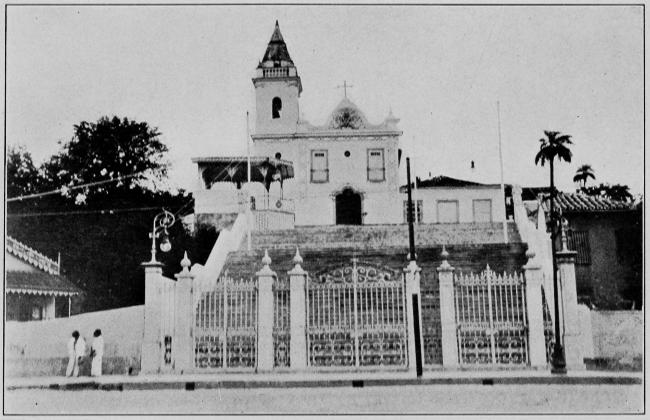
Near this was next erected a church called San
Sebastian, in honour of the city’s patron saint,
which ancient structure is still standing as one
of the few memorials of the remote past, and
within its walls rest the remains of the city’s
founder, Estacio de Sá. There are still a few
other relics of these earlier days, but most of
them have been greatly altered, and many of
them practically rebuilt.
For a couple of centuries Brazil was the seat
of Portuguese power in the new world, and it
was the centre of many political struggles during
the capitancias. It pulsated with that excitement
that can only be found in Latin cities,
and many a plot and counterplot has been
batched within its environs. For a while, during
Napoleon’s occupancy of the throne, it was
the seat of government, for the royal family
of Portugal fled to these hospitable shores, and
all the wealth, pomp, splendour and gayety of
a powerful and extravagant court was transferred
to this city. This lasted only for a short
time, for Napoleon was overthrown, and the
royal family returned to the mother land. Political
discontent in Brazil soon led to the establishment
of an independent empire, with the
son of the reigning monarch of Portugal as the
ruler of the new nation.
Rio, for nearly every one uses the short appellation,
has seen many changes. Starting as
a small settlement of adventurers, it became
successively the capital of a capitancia, a province,
a kingdom, an empire and a republic. All
of the latter changes have taken place within
the last century. And yet, among all those
changes, from the extreme of capitancia to
republic, there has been none which so completely
affected the appearance, and perhaps
final destiny of the city, as the metamorphosis
which has taken place during the past half
dozen years. The visitor to the Rio of a decade
ago, with its antiquated streets, old-fashioned
architecture and foul-smelling open-sewered
public thoroughfares, which more nearly resembled
alleys than streets, would scarcely
recognize the new capital of broad avenues,
clean, well-swept pavements and the beautiful
boulevard which follows the sweep of the bay
for many miles.
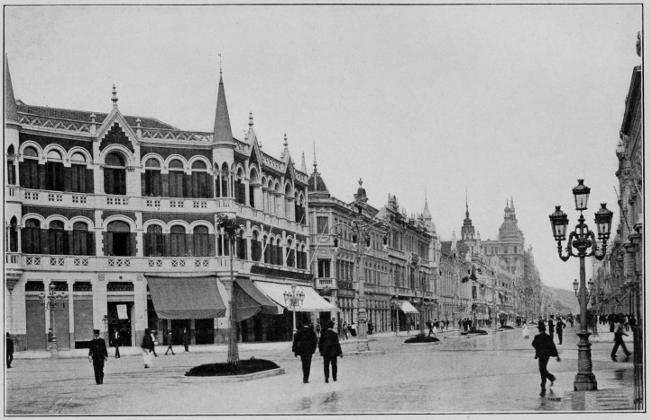
AVENIDA CENTRAL, RIO DE JANEIRO.
The old has not been entirely displaced by
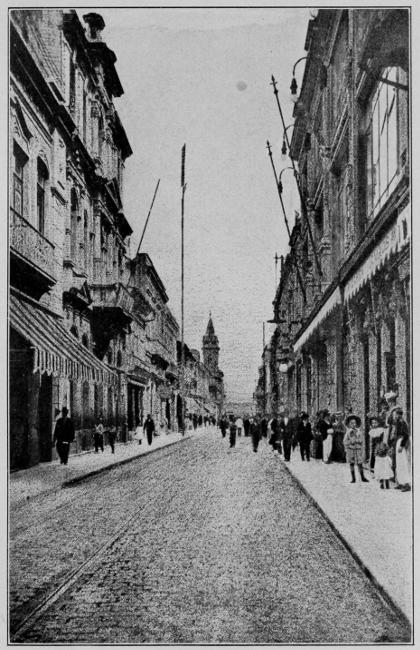
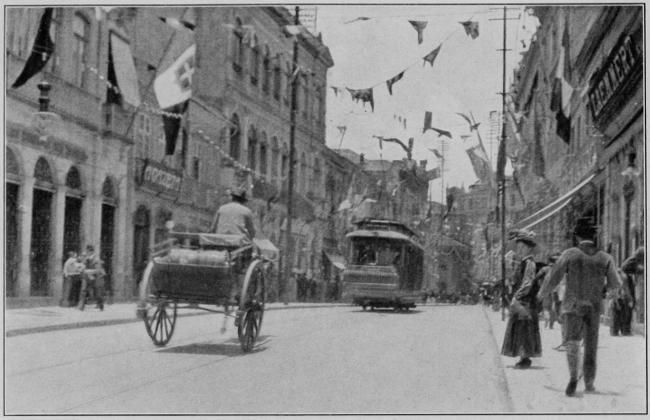
the new, for the famous Ouvidor still remains,
and during all the business hours of the day
is filled with a throng of shoppers, business
men and the idle who spend their waking hours
in the cafés or other resorts. It is still the
great shopping as well as gossiping street.
The people spread themselves over the sidewalk
and street, for all other traffic is excluded
from this street during those hours. It still
possesses some of the best stores and the best
of everything that pleases the Brazilians.
Thousands of people pass through this street
each day, who come for no other purpose than
to shake hands with and talk to friends. It
may be that their only desire is to see and to
be seen. The officeholder comes here to feel
the pulse of the people, and the politician tries
to hold a public reception on the sidewalk. It
is likewise a cosmopolitan crowd, for one will
find not only all classes of Brazilians, but many
other nationalities. Swells with silk hats bump
up against half-dressed negroes with loads on
their heads. Lottery peddlers accost you on
every corner, and sometimes pester you until
it becomes an annoyance. Many of the other
streets might be recognized as they have not
been changed, although the nomenclature is
different, for there has been a new set of heroes
and notables, whose names should be preserved
in this public way. Nearly all of the old names
have disappeared from the signs that face the
traveller on all the corners. Even on old Ouvidor,
instead of that familiar word, appears in
places the name of Moreira Cesar. Other new
names are 15th of November, 7th of September,
Gonçalves Diaz (the poet), etc., etc.
A few years ago the city fathers decided that
they would transform the capital and make it
not only a beautiful but a more beautiful city.
Engineers and architects were employed, plans
were drawn up and work was begun on an
elaborate scale, which has not been entirely
completed as yet. Perhaps the most remarkable
feature of the work was the construction
of the Avenida Central through the centre of
the city, from sea to sea, and its continuation
around the bay where it is called Avenida
Beira Mar. The Avenida Central starts at a
section of the city called the Mauá, and extends
through the heart of the city for a mile
to the Monroe Palace. A few years ago this
was a tangle of narrow, foul-smelling streets
and lanes, which the government was compelled
to buy at a large figure. Night and day
forces were set at work tearing down the old
buildings, removing the débris, constructing
the drainage and paving, so that the progress
made was remarkably rapid for a tropical country,
or for any country or clime. Over three
thousand men were kept at work night and
day, and four hundred buildings were demolished
to carry out the work. In less than two
years the change was accomplished, and now
this avenue, one hundred and five feet in width,
with broad pavements made of mosaic worked
into odd designs, a row of brazil trees on each
curb, and in the centre, alternating with artistic
lamp-posts, has the appearance of one of
the famous avenues of Paris. Fine new buildings
have been built on each side, many of them
of really artistic design and finish. The
rounded corner has been used at the street
intersections, the building line being on a curve
of a considerable radius. This adds a beauty
and dignity to the architecture of buildings
that is lacking in the cities of the United States.
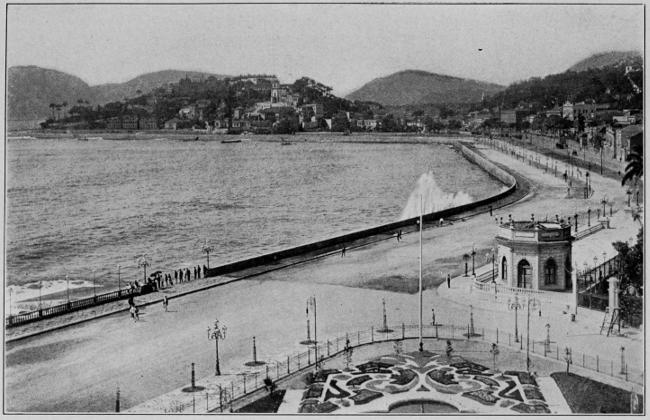
ONE OF THE BENDS OF THE BEIRA MAR, RIO DE JANEIRO.
The Monroe Palace, which is a reproduction
of the Brazilian building at the St. Louis Exposition,
and which received a medal for its
artistic design, marks the boundary between
the two avenues. The building was completed
in 1906, and the sessions of the Pan-American
conference were held in it during that year,
for which it had been specially constructed. It
is a beautiful building, and stands in a location
where it appears to the very best possible advantage.
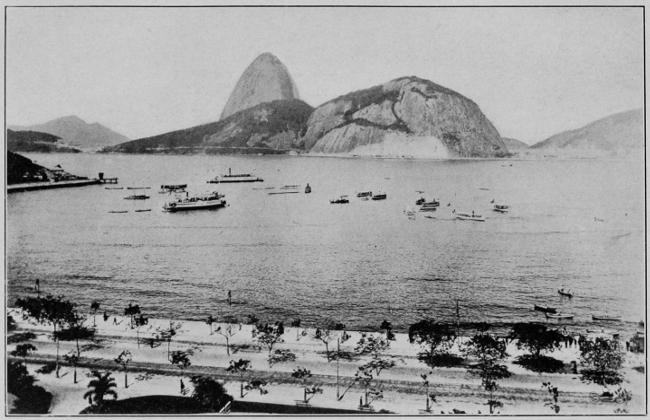
Here the Beira Mar (around the sea)
begins, and it is so named because it runs between
the hills and the bay, and follows the
outline of the latter. Much of it is made land,
and occupies what was at one time the favourite
breeding place of the mosquitoes which
were formerly the pest of this city. Double
roadways in places, of different elevations,
small parks, and the ever-varying outline of
hill and bay, the intense shades of green of
the dense vegetation, and the palms in stately
rows and silhouetted against the horizon make
this avenue the most beautiful and most fascinating
boulevard in the world. I never tired
of riding along the Beira Mar, for the angle of
vision is constantly changing in its many turns
and twists, and every change is only a new
vision of beauty and interest. Thus the drive
leads out past the Praia da Lapa, the Praia
da Russell and the Praia da Flamengo until it
ends in the horseshoe curve of Botafogo, where
the exposition of 1908 was held and the buildings
of which are yet standing. The Beira Mar
is one of the favourite residence districts, and
it is lined here and there with beautiful homes.
It is easy to go into raptures over such scenes,
and dull indeed is the soul that could not be
stirred by them.
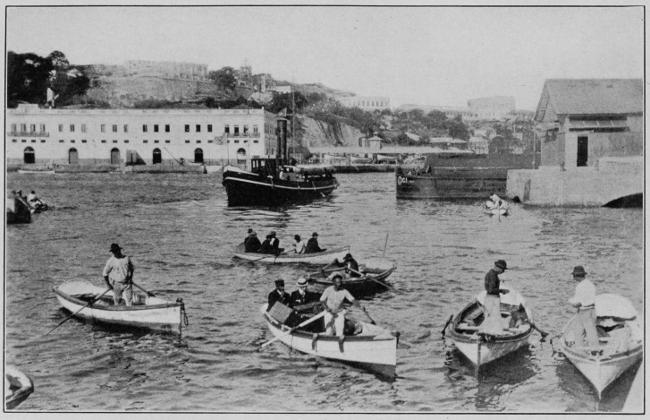
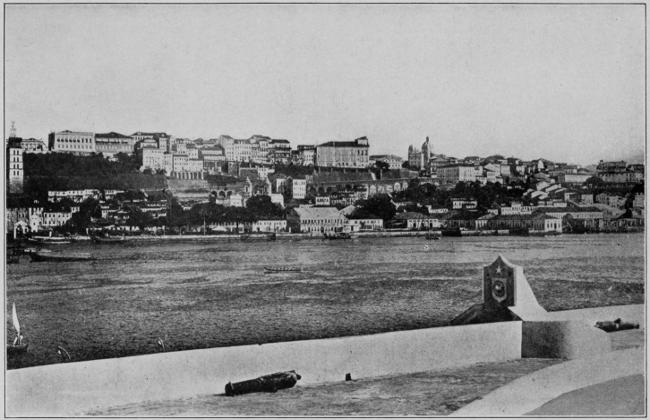
THE LANDING AT RIO DE JANEIRO.
Among the other streets which have been
widened is the Rua Uruguayana, which starts
at the custom house and cuts across the city at
right angles to the Avenida Central. It is a
broad street for a Latin city, but is not so wide
as the other. The Avenida do Mangue is a
picturesque street, with its quadruple line of
stately palms which run its entire length of
a mile or more. Rio is the home of the royal
palm, and you see them all over the city. The
trees are round and smooth and almost as symmetrical
as if cut by a sculptor. No avenue
of marble columns can equal these furnished by
nature. The Canal do Mangue runs through
the centre of the Mangue and there are four
driveways along it, two on either side of the
canal, as it is very broad. Leaving the palms
and following the canal, the avenue makes a
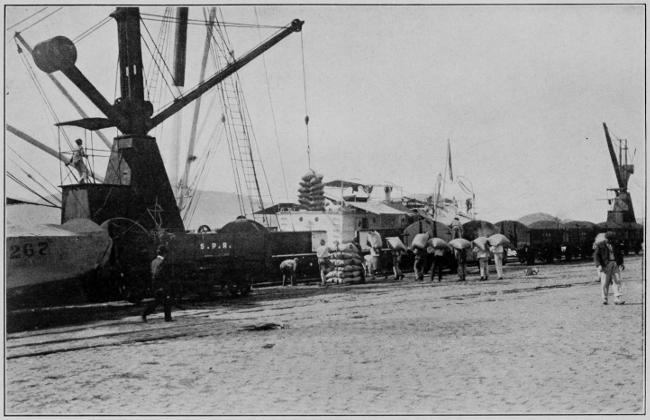
broad sweep and leads out to the new docks
which are being constructed at great expense.
Immense warehouses have been built and great
cranes erected, but they are not in use, because
it is necessary to dredge a channel before the
ocean-going vessels of deep draught can reach
the docks. Work is progressing, however, and
it will not be long until it will no longer be
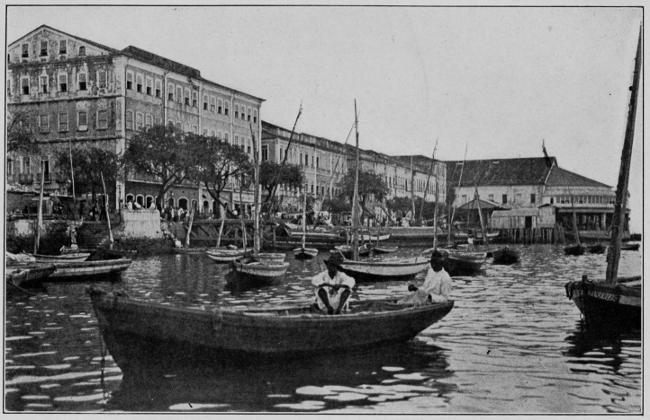
necessary for vessels to anchor out in the open,
and for both passengers and freight to be
brought ashore either in launches or row boats.
Thus will one of the annoyances as well as one
of the big items of expense at this port be eliminated.
Along the line of warehouses, and parallel
with the harbour line, an avenue has been
laid out that is more than three hundred feet
in width. This gives abundant room for railroad
tracks, tram tracks and driveways for
both wagons and pleasure vehicles.
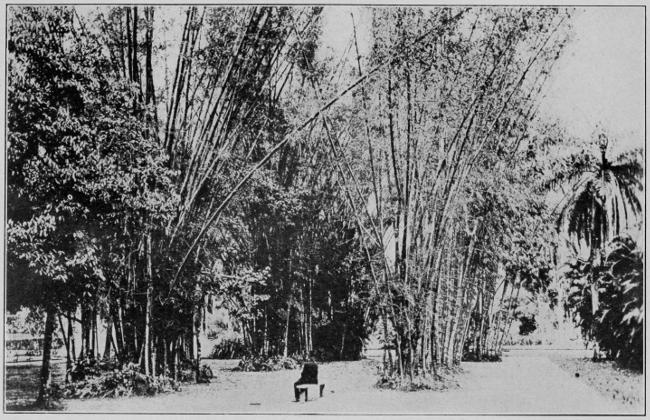
There are many pretty little parks scattered
over the city, each one of which is a miniature
of beauty. The Jardim do Passeio Publico,
near the Monroe Palace, is one of these. Its
profusion of vegetation is such as can only be
seen in a tropical climate, where there is no
destroying frost and where a kind nature encourages
growth during the entire year. The
Praça da Republica is in the very centre of
the city, and is the largest park in the city
proper. It was the chief theatre of action in
the memorable events in which the country was
changed from an empire to a republic within
the short period of twenty-four hours. Because
of this event the name was changed from
its former name of Praça d’Acclamacão. There
are many statues, in this and all the other
parks, of men who have been famous in the
country’s history. One of the most noted is
that of Dom Pedro I in the Praça Tiradentes,
which represents him in the act of shouting
the watchword “Independence or death,”
after he received the message from the Portuguese
Cortes at Ypiranga, just outside the
city of São Paulo. There is also a fine monument
to the Duke de Caxais, one of the heroes
of the Paraguayan war, in a park which bears
his name. Another striking feature of the city
is the ancient Carioca Aqueduct, which is a
monument of picturesque grandeur where its
lofty arches loom up over the comparatively
low buildings. It was built more than a century
and a half ago, but still remains as solid
and substantial as when first built. It is now
used by the tramway company as a part of its
line which ascends the hill leading up to the
Corcovado.
There are many charitable institutions in the
city for the care of unfortunates and the amelioration
of suffering. There are orphan asylums,
free clinics for the treatment of various troubles,
an institution maintained by the society
formed to combat the plague of tuberculosis,
and institutions for the care of the deaf and
dumb, blind and insane. The largest hospital
in Rio de Janeiro, and perhaps on South American
soil, is the Santa Casa de Misericordia,
which was founded by the Sisters of Mercy in
1545. The buildings now occupied by this
noted institution have been in use for nearly
three-quarters of a century, but they have recently
been overhauled and remodelled. The
buildings are in a classic and beautiful style
of architecture, as are most of the public buildings
in Brazil. It has accommodation for more
than twelve hundred patients. One of the
strange and unusual features of this hospital
is a revolving wheel made for the reception of
unwelcome infants. In this wheel a cradle is
so arranged that when an infant is laid on it
the wheel turns around, and the little stranger
finds a welcome it did not find elsewhere. No
questions are asked, no effort is made to find
out who placed the infant in the cradle, and
the babe is taken care of until it is ready to
go forth and work for itself, or has been
adopted by some good family. If this institution
does nothing else, it takes away the incentive
to infanticide which prevails in many
places. There is also in the city a Strangers’
Hospital, which is mainly supported by the
foreign residents of the capital, and it is an
institution that has done a great deal of good
among those who are expatriated from their
homes by the exigencies of business.
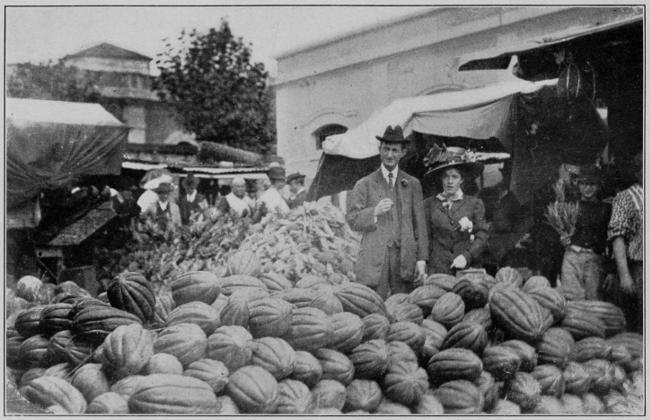
The market is always an interesting place
to visit in a Latin country, for the life to be
seen there is unique. The market scenes in
Rio are not so picturesque as in the cities farther
inland, but there are still many unique
scenes to be witnessed. It is situated just at
one side of the Plaza 15th of November, and
on the water front, so that the fishing boats
can unload direct into the market and the garbage
can easily be disposed of. The building is
large and commodious, of an indifferent architecture,
but well adapted to its purposes. The
deepest impression made upon a visit to this
place is the decidedly tropical characteristics
to be seen everywhere. Tropical fruits, consisting
of oranges, bananas, pineapples, mangoes,
mammão, etc., are to be seen in great
abundance everywhere. The salted meat so
commonly used is stacked up like cordwood.
It has a strong smell and is very salty, but it
is much liked by the common people, and frequently
brings a better price than fresh beef.
Fat pork is salted in the same way and done
up in rolls from which slices are cut off for
the customer. This fat is usually used in cooking
the beans which form such an important
article of food. There are many kinds of
strange fish in that department, for the waters
along the coast of Brazil are filled with excellent
fish. One fish, which is quite large, is very
peculiar, because its eyes extend out an inch or
more from its head. Then there are little jelly
fish in great numbers, and a little creature that
looks like a miniature devil-fish which seems
to be a favourite article of food. Shrimps and
oysters will also be found for sale. Birds of
brilliant plumage await the buyers in their
cages, while green and purple parrots sit sedately
on their perches and fill the air with
their rough screeches. Chickens, ducks, geese,
turkeys and guinea pigs are found in abundance,
and even dogs are caged up awaiting
new owners. But the numerous monkeys, from
the little marmosettes to the big ones three or
four feet high, who sit and blink at you like
curious little old men, will probably hold the
attention of the northern visitor longer than
any other one feature of the market at Rio de
Janeiro.
To this market come the hucksters from all
parts of the city for their supplies, which they
then peddle from door to door. Fish and vegetables
are carried in baskets that are hung on
the ends of a long pole, which is balanced
across the shoulder. A score or more of fowls
may be placed in a basket which the peripatetic
merchant carries around on his head, while the
inmates cackle and crow along the way. The
bread merchant carries his stock in trade on
his head, in a contrivance which looks more
like a baby-crib than anything else. Onions
and garlic are carried on strings with the stems
woven together with straw. Along the streets
one will constantly hear the oddly varying
cries of these house-to-house merchants, the
flute-like whistles which some of them carry,
and the clapping of sticks by others or the
strangely penetrating noise of the scissors-grinder,
which is made by touching a piece of
metal to the grindstone.
From the standpoint of comfort the great and
imposing Avenida Central is a failure. The sun
beats down unmercifully during the hot days,
and it is not half so comfortable as streets like
the Ouvidor, Gonçalves Diaz, Quintana and
others of the business streets which are so narrow
that they are shaded from curb to curb during
most of the day, and the sun does not really
have a fair chance to get in its work. It is, however,
the centre of the street life, and at all
times is a study of Brazilian life. There is
always a crowd of men in the many cafés, which
line this street on either side, and the tables of
which are set out over half the broad sidewalk,
or more. After eating his noon breakfast, a
man never takes his coffee at the same restaurant,
but always goes to one of the cafés where
he sips a small cup of strong, black coffee,
smokes a few cigarettes and gossips with his
friends. The Brazilians drink coffee as the
German drinks beer—not in such great quantities,
but fully as often. In fact they drink so
much that it must have got into their complexions.
A Brazilian proverb says that good
coffee must be as “strong as Satan, as black
as ink, as hot as hades and as sweet as love.”
It is certainly black and strong, is served hot
and enough sugar is used to make it very
sweet.
One is struck with the vivacity of the groups
of men, who talk with their hands, head, face
and eyes, as well as with their mouths. Another
thing that impressed me was the uncomfortable
style of dress, for the average “flumenense”
wears a rather heavy suit and derby hat in
this hot climate, and would never think of dispensing
with his vest under any circumstances.
To make up for this one may often see the men
carrying fans and briskly fanning themselves.
Where these young men, who are clerks in business
houses, or hold small-salaried government
positions, get the money to spend in these cafés
is a mystery to me; for all drinks are exceedingly
high-priced, with the exception of coffee,
which is uniformly sold for one hundred reis,
equal to three cents in our money. In the matter
of clothes, however, they are more economical,
and they do not dress as well as the ladies
whom they delight to watch.
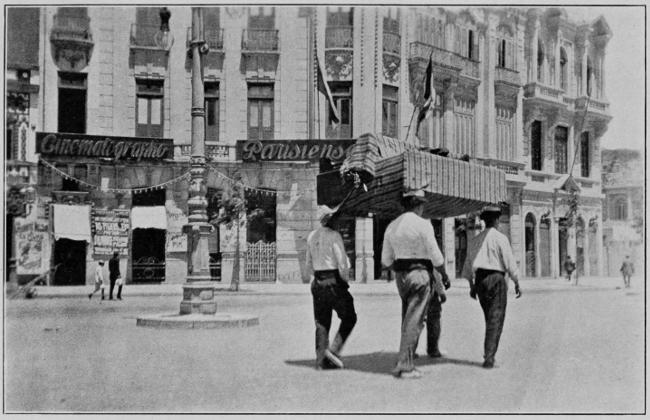
CARIGADORES MOVING A PIANO.
From three to five in the afternoon the Avenida,
from the Ouvidor to the Avenida Hotel, is
crowded with well-dressed ladies who make
these few blocks a sort of promenade. One will
see handsomely gowned matrons, demure little
maidens, and senhoritas who are just beginning
to seek the favours of the young men, and this
gives them an opportunity to see and be seen.
The ladies wear huge Parisian hats and high
heels, and are gowned elaborately. Powder,
paste, rouge and other cosmetics are much in
evidence, even among the younger ones, whose
complexions hardly need such aids to freshness.
The figures are plump, and those of the matrons
have reached a stoutness that must be distressing
to them. The men, whose narrow shoulders
and thin chests are in striking contrast to the
plump figures of the ladies, sit at the street
tables of the cafés and watch them as they pass;
but they rather like than resent this, for it is
the custom of the country, and a long look is a
mark of flattery which they appreciate.
In the streets there is a constant movement.
Carriages with liveried drivers, high-wheeled
carts loaded with freight, curious little Japanese
“kiosks,” in which walks a vendor of
dulces, and carigadores with loads upon their
heads pass along in endless procession. I have
seen pianos thus borne upon the heads of four
men pass along the Avenida. Other heavy articles
of furniture, and large panes of plate glass
are carried in the same way. The old-fashioned,
two-wheeled tilbury, so common here, whisks
along at as lively a rate as the horse can go.
Only one passenger dares ride in one of them,
or a great commotion will be raised among the
other tilbury drivers. The “fon-fon” of the
automobile is constantly heard. A line of auto
omnibuses is run along this avenue, and then
some of the four hundred or more private autos
will be in view at any time. Ice is delivered by
automobile, for quick delivery is important in
a hot climate when the price is three cents a
pound. The automobile ambulance is sure to
pass along, as it is always on the go, and then
there are a number of auto deliveries, police
hurry-up wagons, fire trucks, and even a street
sprinkler propelled by gasoline.
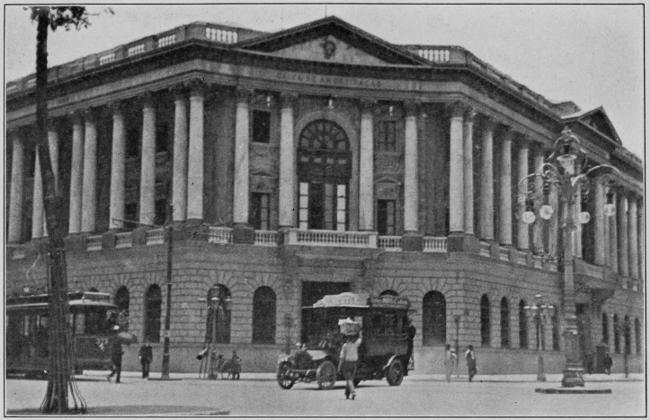
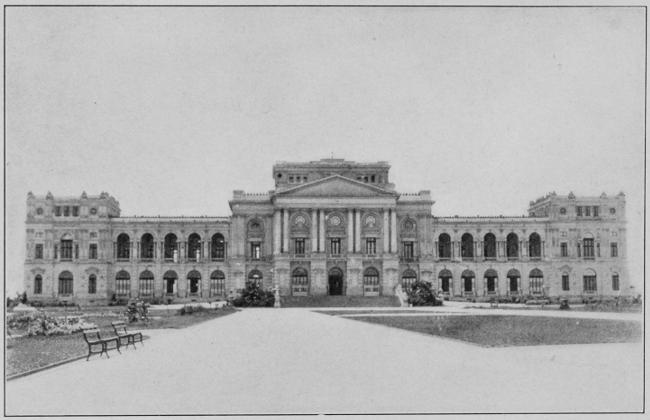
THE TREASURY BUILDING, RIO DE JANEIRO.
The police are omnipresent, and are to be
found everywhere. There are three classes of
these guardians of the public peace: the civil,
the military and the mounted police. The
former are under the prefect, and the military
police, who wear a different uniform, are under
the authority of the minister of war. The military
police may be seen several times a day,
marching along in large or small squads with
a bugler to announce their coming. The civil
police are more numerous but less conspicuous.
It is said that there are oftentimes more or less
serious conflicts of authority between the two
police organizations. The military police department
has a number of auto patrol wagons
which are frequently seen on the streets. Whenever
a call is sent to headquarters a wagon is
loaded up with ten or a dozen officers, and is
then sent pell-mell through the streets to the
point of call, and frequently two wagons thus
loaded will appear. Perhaps the occasion of the
call is some harmless drunk (although drunkenness
is not common), and it seems a joke to see
such a formidable force appear upon such an
occasion. At night, a policeman may be found
upon almost any corner, and, if there is safety
in numbers, then Rio de Janeiro is a very secure
place in which to live.
Along the Avenida are many fine office buildings
belonging to private concerns, some of
which cover almost an entire square, and many
of which are truly architecturally beautiful
structures. Perhaps among the finest of these
are the homes of three of the leading newspapers;
the Jornal do Commercio, Jornal do
Brazil and O Paiz. The variety of architecture
prevents any appearance of monotony. The
Caixa de Amortizacão, or treasury building,
where the paper and gold money are exchanged
and equalized, is a very beautiful building on
the corner of the Rua Uruguayana. Near the
other end of the Avenida are several fine public
buildings. One of these is the new Art Museum,
and another the new National Library, neither
of which were quite finished at the time of my
visit. The Municipal Building is a unique and
ornate building, brilliant in colour and adorned
with many statues. A number of stately palms
which stand near the building give it a very fine
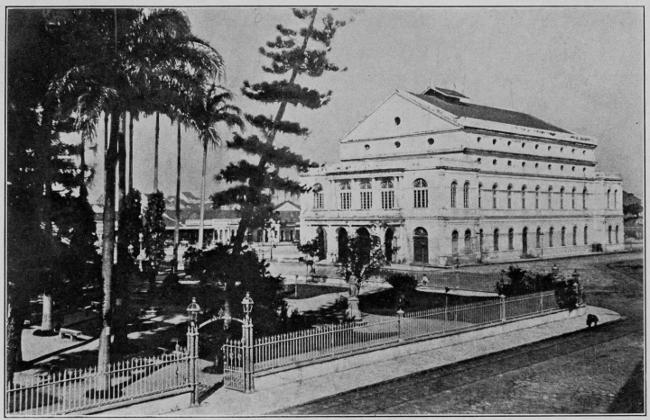
setting. The most beautiful and striking building
of all, however, is the magnificent Municipal
Theatre, which stands in a conspicuous location
at a street intersection, and in spacious dimensions,
as well as stately appearance, well rivals
the far famed Opera House of Paris. It was
built by the municipality and cost several millions
of dollars, and is said to have a capacity
of twenty thousand persons.
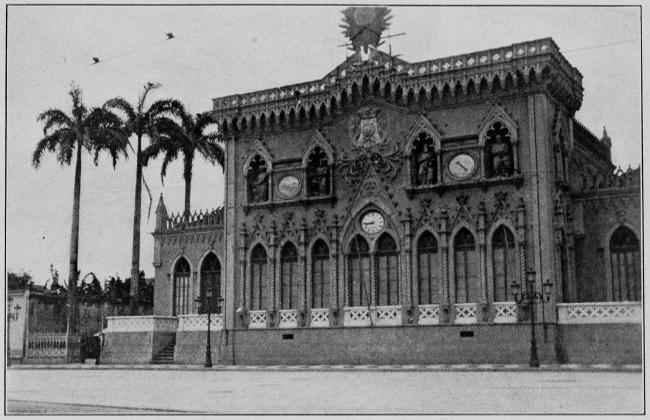
THE CITY HALL, RIO DE JANEIRO.
Rio de Janeiro has been transformed. It
used to be that the traveller, frightened at the
idea of yellow fever, would come here with his
ears and brain throbbing from the effects of
quinine. He would walk over the city with a
smelling bottle under his nose for fear of contagion.
Now it is different. Once the home of
yellow fever, smallpox and other plagues, this
great city has been renovated and overhauled,
until now it is as healthful as the average city.
The municipal government deserves great
credit for the energetic and thorough manner in
which this work has been done. Hundreds of
miles of underground sewers have supplanted
the open gutters of former days, and with the
disappearance of the open sewers has vanished
the unpleasant odours which formerly pervaded
the atmosphere. Low, marshy ground
has been filled up. The people were compelled
to remove the dirt from the tiles in which moss
and fungi had grown, and cement the joints so
that there would be nothing to retain dampness.
The first floors of all buildings must be made of
tile or cement, so that rats can not get into the
houses. And then the people scrub and clean,
and clean and scrub, in most parts of the city,
so that it is a fair rival of a Dutch town. The
street cleaning department is alert and active,
so that the streets in general are cleaner than
the average American city. It is only when one
of the heavy rain storms breaks on the city that
it is different, and then tons of red sand and
mud are washed down from the hills, and the
street commissioner has his hands full for a few
days to clean up this mud. These tropical rains
are veritable downpours, and the amount of
water that falls during even a comparatively
short rain is almost incredible.
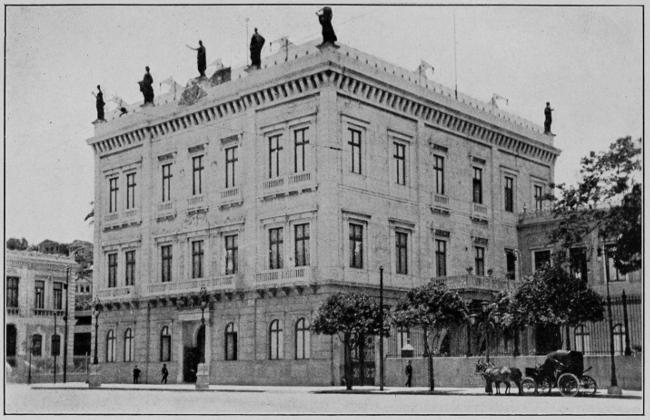
THE “WHITE HOUSE” OF BRAZIL.
The visitor is first inclined to look lightly
upon the brilliant and variegated colourings of
the houses and other buildings, and think that
it is very much overdone. The longer one stays
there, however, the more the colouring seems
to be in harmony with the tropics. Such brilliant
colours and light, airy effects would be entirely
out of place in a land where the trees lost
their foliage, and snow covered the ground during
a part of the year. But here, where the sky
is so blue, where the foliage is ever green and
where the sun is so bright, even the light blues
and greens, the pinks and terra-cotta colourings
on the houses finally seem in harmony. Sometimes,
under a porch, one will see a landscape
painting on the wall of the house, and many of
these paintings are well done. The style of
architecture is Portuguese and differs from the
Spanish style, which always includes a little
court, or patio, in the centre. In the Brazilian
homes of the better class, a little green yard is
maintained in front of the houses, where a few
flowers and shrubs are cultivated, and, if large
enough, a palm or two will be found. There is
no fine grass, however, such as grows in cooler
climes, for the grass found is very coarse and
is planted stalk by stalk. A high iron fence generally
separates the yard from the street. In
some of the better homes with large yards, a
little pavilion, or lookout, is built near the
street, from which the ladies of the family may
view the processions and festas, which are such
a common occurrence here. These take the
place of the balconies erected for ladies where
the houses are built up to the street line as in the
Spanish architecture.
The public buildings are scattered over different
sections of the city, but most of them not
already enumerated are of rather indifferent
architecture. The Casa da Moeda (mint), the
Congress and Senate buildings, the Navy and
War Departments and the President’s Mansion
are all in different sections. The latter bears
several statues on the roof, and connected with
it are some very fine gardens. The National
Library contains a valuable collection of more
than four hundred thousand books, manuscripts
and other important documents. The National
Museum is one of the oldest institutions in the
capital. Originally intended only as a museum
of natural history, it has been extended until
now it includes all kinds of collections of scientific
interest. It contains a fine collection of
specimens of animal and insect life in Brazil,
and specimens of the art and handiwork of the
aboriginal tribes who still inhabit many sections
of the republic.
A splendid system of electric tramways exists
under the management of a company composed
of American and Canadian capitalists. The
routes are rather complicated, and are quite
confusing to the visitor at first. The cars are
called “bonds,” and the origin of the name is
rather curious. When the system was first inaugurated
the people, who had heard a great
deal about American “bonds” in connection
with the negotiations, applied that name to the
cars when they finally appeared, and the name
has clung to them ever since.
The city of Rio de Janeiro and its environs
constitute the Federal District, which is similar
to the District of Columbia. The municipal organization
is controlled by the national government,
but the people are not disfranchised as in
our own capital. The inhabitants of the district
elect three senators and ten deputies to the
National Congress, and also a city council of
ten members which meets in session twice each
year. The chief executive is the Prefect, who
is appointed by the President and holds office
for five years, unless previously removed.
Under him are several boards, through which
the several departments of public work are
transacted.
In 1908 there was held in Rio an exposition
in celebration of the centennial of the opening
of that port, and the other Brazilian ports to the
commerce of the world. The federal government
appropriated a million dollars for its
palace and exhibit, and nearly all of the states
erected buildings, and appropriated a goodly
sum toward the expenses. The United States
and Portugal were the only two foreign nations
invited to take a part in the exposition. The
location was a most beautiful one at the extreme
end of the Beira Mar, and almost under the
shadow of old Sugar Loaf and Corcovado. A
number of the buildings erected were of a permanent
character, and these, as well as many
of the state buildings, still stand.
In striking contrast to the Rio of to-day was
that of a century ago, when foreign nations were
first given the privilege of trading there. The
following extracts are made from “Notices of
Brazil,” published in 1831 by an English
writer:
“When the country was opened to the enterprise
of foreigners, it was not at all surprising
that the City of Rio and its commerce should
have increased with an unexampled rapidity.
Such was the avidity of speculation in England,
that everything was sent to Brazil without
the smallest regard to its fitness or adaptation
to the climate, or the wants of the people
who were to purchase them. The shops
were ransacked and swept; and the consideration
was not what should be sent, but how soon
could it arrive. In this way, when the multitude
of cases were opened at the custom-house,
I have been told, the Brazilians could not contain
their astonishment and mirth at the incongruous
things they saw displayed before them;
implements useful only to Canadians and Greenlanders,
and comforts and conveniences fit
only for polar latitudes, were cased up and
sent in abundance to regions between the
tropics.
“Among this ingenious selection was a large
supply of warm blankets, warming-pans to heat
them, and, to complete the climax of absurdity,
skates to enable the Brazilians to enjoy wholesome
exercise on the ice, in a region where a
particle of frost or a flake of snow was never
seen. However ridiculous or wasteful this may
seem, these incongruous articles were not lost
in a new country, where necessity and ingenuity
could apply things to a use for which they were
never intended by the sage exporters. Even the
apparently hopeless and inconvertible skate was
turned to a useful purpose. Then, as well as
now, there was nothing in the country so scarce
as wrought iron for shoeing mules and horses;
and though “ferradors,” or smiths, are to be
met at every rancho, “ferraduras,” or shoes,
are seldom to be had. When the people, therefore,
found they could not use these contrivances
on their own, they applied them to their
horses’ feet; and many an animal has actually
travelled on English skates from Rio to Villa
Rica.
“The bustle and activity of the place give a
high idea of the commerce of Rio. A multitude
of negroes are constantly employed, who labour
without intermission the whole day in removing
packages of different kinds. They are generally
lying open, either to be, or after having been
examined; and it presents really a curious and
interesting spectacle to pass along the courts
and warerooms, through manufactures of every
kind, and from all parts of the globe.
“Having waded through these, I mounted
upstairs, and I saw a multitude of persons hard
at work, as if it had been a large factory. These
were the stampers: every article, even to a
single pair of gloves, stockings or shoes, when
the duty is paid, must be distinguished by this
stamp. Three or four hundred persons were
engaged in this work. One ran the thread
through the corner of the stockings or shoes;
another looped it to a little perforated pellet of
lead; and a third pressed it flat by striking on
it a stamp of the Imperial Arms. Any article,
however minute, that has not this attachment
to it, is liable to be seized as contraband. The
process of stamping every article, however, is
so tedious and troublesome that it is found to
impede business very much, and the fees on the
leaden stamp come to twice as much as the duty
on the goods in the cost of pieces of tape and
other smaller things.”