TO THE READER.
This book is written for Boys. The majority of the
articles were expressly prepared for the “Boys’ Own
Magazine,” and the interest which their appearance
excited, coupled with the favourable notices they won,
encouraged the Editor to publish them in a connected form.
Boys—worthy to be called Boys—are naturally brave. There is
not, so far as we are aware, any etymological connexion between
the words boy and brave; but there is an association of ideas, which
if it does not make the terms interchangeable, is still strongly suggestive
of their being one and the same. The expression brave
man is easily understood, but to us, brave Boy looks like a pleonasm.
A man has experience. He has tested—if there be any good thing
in him—his courage in the rough exploits of the world’s campaign.
He has tilted, mayhap, with Quixotic chivalry against windmills,
and in the encounter has been discomfited; he has awakened from
his bright dream to a sad reality; he has been tempted to turn
prosaic—inclined sometimes to beat his sword into a sickle, to gather
in for his own special use the golden wheat from anybody’s cornfield,
and to make those late foes of his—the windmills—grind up
the corn to make his bread. Now he is no longer brave. His
views of life are taken from a new point of sight. He smiles at
the boy’s enthusiasm, and counts himself wise in his man’s selfishness.
But a man who has done battle, who has been thrown
in the lists, who has been ready to mount and splinter lance again,
who in the gaining of experience has lost nothing of the Boy’s
boldness—such a man is brave.
The drift of these remarks is that experience may ruin a
Boy’s “pluck”—may give him the vulpine sagacity of Reynard in
place of the courage of Leo Africanus.
But a Boy is brave. Youth is the season of confidence. “Your
young men shall see visions” while our “old men shall dream
dreams.” What visions are those which rise up before the young—what
brave words to speak, what brave actions to do—how
bravely—if need be—to suffer! “The young fellows,” said an old
soldier to the writer, “are always pushing forward in a battle
charge—they are in a mighty hurry to smell powder—the veterans
fall into the rear!” Do they?—ah, well, ’tis the lesson, perhaps
of experience! But is it better than the Boy’s eagerness to be
foremost?—is it not—answer brave hearts—better to die planting
the colours on the wall, than to share the spoil which others
have won?
This is the leading thought in this book about Soldiers—it is
meant to keep alive the bravery of youth in the experience of
manhood. The editor of the book is very sensible of the incompleteness
of the work. He knows that it is defective in many
places, but it is honest. A good many of the papers were written
by one who was then far away on a foreign station doing brave
service; some of the papers are the work of dead hands. The
articles have been put together as carefully as circumstances would
allow, but there has been an anxious care on the Editor’s part to
retouch as little as possible the work of absent contributors. He
offers the book to the Boys of England—not as the best piece of
work that can be done—but as a volume they will read with delight
and keep as a souvenir of pleasant hours. He is of opinion that
anything which helps to make Boys more in love with true courage
is good work done—he believes that bravery excites bravery, just
as iron sharpeneth iron; and so he has confidence in this book being
useful—a record of brave deeds that shall make its readers echo
the words of King Harry—
“If it be a sin to covet honour
I am the most offending soul alive.”
OUR SOLDIERS AND THE VICTORIA CROSS. — CHAPTER I. OUR SOLDIERS AND THE VICTORIA CROSS.
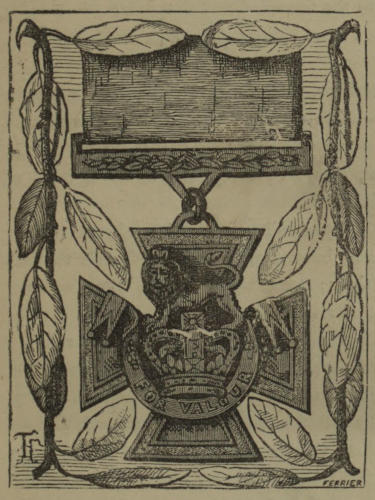
It has been our lot in
life to live very much
among soldiers, and we
like to write and talk
about them. We hope
that our readers will not
be averse from hearing
something of a class in
whom we have all a common
interest. It is true
that English boys are not
quite so warlike in their
tendencies as French;
they neither worship la
gloire nor dress like manikin
soldats. Swords and
guns are not their only
playthings, nor are feeble
imitations of sanguinary contests their only pastimes. We here
delight in all manly games and sports, for which French men and
boys have little taste, and we thus acquire a muscular development
and hardiness of frame which enable us to bear any amount of
fatigue. It was a saying of the grand old Iron Duke that all his
battles were won on the playground at Eton; by which we suppose
he meant that his officers, most of whom were Eton boys, received
there such a physical training as fitted them to be heroes in the
strife. Still, it is one of those epigrammatic sayings in which
truth is sacrificed for effect; for what could the duke, with all
his officers, have done without the brave privates who composed his
forces, and to whom he rendered justice on another occasion by saying
that with such an army he could go anywhere and do anything?
A chaplain belongs, of course, to the non-combatant class in the
army. It is not his duty to appear in the field, or to take part in
battles. He has to remain at the hospital, and to administer the
consolations of religion to the wounded and the dying; but he is
precluded by his profession from being present at, or taking part in,
any battle.
It is for this reason, perhaps, that we have always had a certain
pleasure in listening to soldiers as they fought their battles over in
hospital, and recounted their experience to one another. It was
all strange and new to us, as, we dare say, it will be to most of
those who read this book.
The soldiers of whom we speak all took part in and survived the
Crimean war. Their manly breasts are all adorned with the different
medals awarded to them; two of them wear the Victoria Cross.
One early object of our curiosity was to ascertain what are the
sensations or feelings of a soldier on entering battle, or being
exposed to fire for the first time. Now, the answer we invariably
received will, perhaps, take some of our readers by surprise. They
felt nothing of that warlike intoxication ascribed to the old Vikings
on the eve of the combat; they had none of that strange joy
ascribed by the patriarch to the war-horse at the sound of the
trumpet, nor were they exactly afraid; but there was a certain
uneasy sensation experienced by all as the bullet whizzed past the
ear, and comrade after comrade dropped, sometimes with a sharp
cry of pain, sometimes giving no sign.
This feeling some of them graphically described as similar to
that which a bather experiences before plunging into the water;
ce n’est que le premier pas qui coûte; after the first dip Richard is
himself again. But our readers are not to suppose that the soldier
shows the same hesitation in advancing to charge as the bather on
the brink of the stream. If he did he would be a coward, and be
scorned by all his comrades. To make the two cases parallel, we
must suppose a thousand bathers rushing forward to the stream at
once. Now, though an individual bather standing alone might stop
short on reaching the water, and pause before taking a header, a
thousand bathers rushing forward at once, would plunge into the water
without hesitation. The dread of shame, of exposure, of ridicule,
would nerve the least courageous for the final leap. There is, moreover,
such a strong feeling of sympathy diffused among large bodies
of men acting in concert that the strength of the stronger is imparted
to the weaker. Now, it is the same with soldiers advancing to the
charge. All of them feel the cold shiver like that of the bather approaching
the water, but they march shoulder to shoulder, and with them are
some old soldiers who have been under fire before. The younger ones
are encouraged by their example, and many a lad who has trembled
on first smelling powder has proved himself a hero in the fight.
We have read in books that soldiers sometimes weep while fighting
hand to hand and sorely pressed—not tears of cowardly terror
by any means, but such tears as the strongest of men will shed in
hours of fierce excitement. Wellington wept as he embraced
Blucher after the Battle of Waterloo. This, indeed, has been
denied, but it is not difficult to believe it true. There are moments
in the lives of all men, even the most reserved and self-contained,
when the hidden fountains of feeling well over and find an outlet
through the eyes, and we should not think a whit less highly of our
soldiers did they shed a few tears of valiant rage while victory was
still doubtful. But these tears, we suspect, are purely imaginary.
For ourselves, we never met with a single soldier who confessed that
he had shed tears himself, or seen others weep. We are sure that
they would not have denied it if they had yielded to any such
weakness, for, as a class, soldiers are the most truthful of men. All
with whom we conversed agreed in affirming that our men were
very quiet while fighting hand to hand with the enemy. There
would be occasionally a shrill cry of pain from the wounded, or a
short cry of triumph from the man who struck down his opponent,
but generally, all the dread work of the battle-field was done in
silence. All admitted that the most fearful sound during a battle
was the cry of a wounded horse; it was so like that of a human
being in his death agony—shrill, piercing, heartrending. The
horses seem to become almost human in the hour of battle, to share
in all the wild passions of the combatants, and to exult equally in
the hour of victory.
But while our men fought in silence, the Russians were very
noisy both in advancing and in fighting. They uttered the most
savage yells, as if they thought to inspire our men with terror by
the mere noise they made. They soon discovered that Englishmen
are not so easily frightened; but they still continued to shout from
mere habit. Their officers also encouraged them in this custom,
giving them, moreover, drink to make them pot-valiant. Notwithstanding
this, we have always heard our soldiers frankly speak of the
Russians as “foemen worthy of their steel.” Brave men, we know,
learn to respect one another even in the field, and the Russians are
certainly one of the bravest nations in Europe. They still retain,
however, many of the characteristics of savage life; they have not
yet learned to act on the old Roman maxim, “Debellare superbos,
parcere victis.” They often bayoneted our men when left defenceless
and wounded. It is but just to add that they expected no
mercy when left in the same condition, and seemed overwhelmed
with surprise when our men treated them with the same generous
tenderness as though they had been comrades instead of foes.
There are sometimes strange traits of character exhibited during
the excitement of battle. Men may have been living under restraint
for years, and come to believe themselves to be very different from
what they are. Xenophon relates a story of a Greek soldier who,
in consequence of a wound which had affected his brain, forgot the
language he had spoken for many years, and began to express
himself in his native tongue, which, before this accident, seemed
to have entirely faded from his memory. Something analogous
to this occurred at the Battle of the Alma, in the case of
a sergeant of the Guards. He had once been much addicted to
swearing, but had been enabled to vanquish this and other evil
habits, and for many years had been looked up to by his comrades
as a man of exemplary character. His company, while charging
up the heights of the Alma, was surrounded by the enemy, and,
after suffering severe loss, was obliged to retreat. In vain the poor
sergeant endeavoured to rally them. He was borne along with the
current. Overpowered with shame and rage, he gave way to a sort
of madness, and swore such fearful oaths that we have often heard
the men of his company say that it was something awful to hear
him. Those who occupied the same tent with him relate that he
spent most of the night after the battle in prayer, and was often
heard sobbing like a child. He never spoke of the strange outburst
of that day to any of his comrades, and they had the delicacy to
avoid all allusion to the subject; but it was observed that he was
more humble, kind, and considerate in his bearing towards them
than he had ever been before. He survived the war and returned
to England, where he enjoyed the respect of all who knew him, and
was never known to indulge in the habit which gained the mastery
over him at the Alma. He is now dead, but his surviving comrades
speak with a sort of awe of the incident we have related.
One soldier of the Guards became raving mad at the Alma. It
happened in this way:—The Russian fire struck down several of
the men as they were advancing. The soldier of whom we speak
was a young lad who had never smelt powder before. By his side
was a comrade who belonged to the same district, and had enlisted
at the same time. The latter was hit by a cannon-ball, and his
brains were bespattered over the face of his friend, who became
frantic, roaring and shouting like a madman. He imagined that
his comrades were the enemy, and that he was fighting hand to
hand with them. The whole company was thrown into confusion,
and he wounded some of his comrades before he could be disarmed.
He was conducted to the rear, fighting and struggling the whole
way. The surgeons pronounced him to be a dangerous lunatic,
and he was strapped down upon one of the beds in the hospital, with
a sentinel to watch over him. That sentinel told us that he was
never entrusted before or since with such an unpleasant duty.
Owing to the shock which the brain had received, the poor madman
could not rest for a moment. He fancied himself in the
thickest of the combat, fighting with all the energy of despair, and
swearing that his comrades should be avenged. He continued in
this raving condition for about twenty-four hours, when, with the
exultant cry of “Victory!” he expired. A similar incident
occurred at Inkermann: in this case, also, the soldier survived
only twenty-four hours.
Soldiers rarely feel much pain at the moment they receive their
wounds, unless these be very severe, in which case they suffer
much from thirst. There is one very gallant friend of ours—a
non-commissioned officer—who was shot through the ankle in
crossing the stream at the Alma. He knew not that he was
wounded till the battle was over, but thought that his foot had
got entangled among the vines in crossing the valley, and that he
had sprained the joint. A good soldier never likes to go to
hospital when there is any hard fighting, and our friend kept “a
quiet sough,” as they say in the North, about his wound, and
marched at the head of his company as if nothing had happened to
him. His courage and endurance were rewarded: he was present
at, and took part in, the Battle of Inkermann, where his gallantry
attracted the notice of the commanding officer, on whose recommendation
he obtained the medal and pension for distinguished conduct
in the field. He was wounded also on this occasion, but his
hurt was of a far more serious character. He was shot through
the head: the bullet literally entered at one side, and came out at
the other. He felt a sharp, stinging pain, and remembered nothing
more till he regained his consciousness in hospital, and was surprised
to learn that he had been some weeks under the doctor’s
hands. He suffers no inconvenience from his wound now, except
occasional dizziness and half-blindness after any excitement or
exposure to the sun. Such a man in the French service might
have risen to the rank of field-marshal, and obtained a name in the
page of history. Well, after all, the great thing is to do our duty
well in the position we occupy; and our friend, as sergeant-major
of his distinguished regiment, is happier, probably, than if he had
had greatness thrust upon him.
Though soldiers recover from their wounds at the moment, they
are often very dangerous afterwards. The brain is often injured,
and the disease goes on till the man loses his reason, or drops
down dead. A poor fellow was hit on the crown of the head by a
piece of shell in one of the trenches before Sebastopol. He was
stunned at the moment, but thought so little of it that he did not
even report himself wounded. For eight years he felt no pain, but
one day, while on guard, he was seized with a sudden giddiness,
and became insensible. He was conveyed to hospital in a cab,
and on recovering his consciousness he found that he was suffering
the most intense pain on the crown of his head. His sufferings
were very great; the only relief he could obtain was through the
application of chloroform.
We write all this knowing that English boys feel deep sympathy
with, and profound admiration for, our soldiers, and to show that
their powers of endurance, when disabled, equal in heroic worth
their gallantry upon the field.
Not all our readers, perhaps, have seen the Victoria Cross. It
is not very beautiful nor very valuable in itself. A fac-simile of it
appears at the commencement of this chapter. It is a simple piece
of bronze, shaped like a cross, and its intrinsic value may be about
threepence. Its intrinsic value! but who can tell the price a
soldier puts upon it? He had rather have that piece of bronze on
his breast than be made a Knight of the Garter, and have his
banner hung up with those of the other K.G.’s in the Chapel of
St. George at Windsor. To obtain that small piece of bronze of
the value of threepence he will lead the forlorn hope, be the first
to storm the breach, and ever ready to expose his life to any
danger. The Victoria Cross is as much to a soldier as the gage
d’amour the knight-errant in the days of chivalry received from his
lady-love, and swore never to part with. The pledge of her affection
might be a soiled and tattered glove, worth even less than the
cross “For Valour,” but it was dearer to her lover than life itself.
O that the day may never come in this country when we shall judge
of things by the Hudibrastic principle—
“The price of anything
Is just as much as it will bring!”
for badly then will it fare with Old England. When our soldiers
come to value their crosses at threepence each, the price they will
fetch at a marine store, we shall not long survive as a nation. But
there is little danger of such an eventuality. There are things—God
be thanked—which we do love and value more than life itself—things
which gold can not purchase. The Victoria Cross is one
of them; and we are about to relate how three gallant officers of
one of our most distinguished regiments came to be decorated with
the priceless meed “For Valour.” One was a commissioned officer;
the other two were sergeants. Though different in rank, they were
equal in bravery; their bravery was equally rewarded. Most people—thanks
to Mr. Kinglake’s history, and other sources of information—are
now tolerably familiar with all the details of the Battle of the
Alma. They know how the gallant Welsh Fusiliers, after forcing
their way to the heights, and seizing the colours on the Russian
battery, were so cut up by the enemy that they were forced to
retire. They fell back in obedience to orders. It so happened,
however, that as the word, “Fusiliers, retire!” was given, the Scots
Fusilier Guards were charging up the heights, and the officer in
command of them, hearing the order, thought that it was intended
for his own men, and commanded them to fall back. This fact is
not mentioned by Mr. Kinglake, but there are many witnesses still
alive who heard this second order given, and acted upon it. Now,
it is very difficult to retire before an enemy without falling into
confusion; and it so happened that the Welsh Fusiliers came rushing
down like a torrent. One gallant regiment opened their ranks,
allowed them to pass through, and then closed again; but the Scots
Fusiliers were not so fortunate. They did not open their ranks,
because they received no order to do so, and were already falling
back, when the crowd of Welsh Fusiliers came rushing upon them,
broke through their ranks, and threw them into disorder; and, in
the midst of this, the Russians made a dash at the colours of the
regiment.
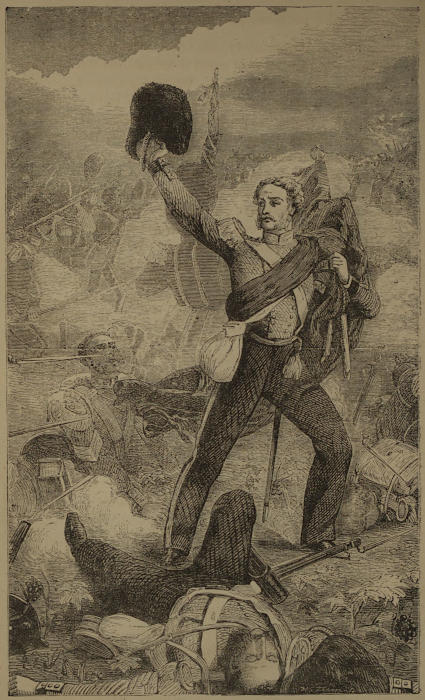
Captain Lloyd Lindsay, Scots Fusilier Guards, saving
the regimental colours at the Alma.
Now, it is not needful to dwell on the fact that it would be as
disgraceful for an English regiment to lose its colours as it would
have been for an old Roman centurion to have lost his shield. The
colours are usually intrusted to one or two subalterns and several
sergeants, who form a sort of guard of honour over them, and are
held responsible for their safety. When they are in danger the
bravest men in the regiment rally round them, and it is held unworthy
not to follow them wherever they are seen. They are the
same to our soldiers as the white plume of Henry of Navarre was
to his men, or the bronze eagles to Rome’s Tenth Legion. Knowing
this, officers have sometimes thrown the colours into the very
midst of the enemy, sure that their men would die rather than lose
them. No sooner, therefore, was it known that the colours were in
danger than the bravest men of the regiment tried to reach them,
but only a few succeeded. They did not come too soon; the men
intrusted with the colours fought like lions, but one officer was
struck down, and only two sergeants survived the fearful contest.
But the colours were safe, and the men might proudly say, with
Francis I. after disastrous Pavia, “Tout est perdu, hors l’honneur.”
The regiment wiped out the memory of the misfortune at the Alma
(it was no disgrace to obey orders) on the bloody field of Inkermann,
and a grateful country did not forget the men who loved their
colours better than their lives. The officer who was struck down
died of his wounds on the voyage home; Death was envious of the
honours that awaited him. The other officer still survives, and
wears on his breast the cross his sovereign bestowed upon him.
He is, or will be, one of the wealthiest men in England, but we are
sure that he values that small piece of bronze of the value of threepence
more than all the money he has at his banker’s.
“Money is round, and rolls away,”
but the memory of a brave action has never perished.
But gallant deeds are the same whether they be done by officers
or by men; and the two sergeants demand notice who were also,
for the part they took in this affair, decorated with the Victoria
Cross. We should not dwell upon their history if it were not that
it points a moral, though it does not adorn our tale. Both of these
sergeants were fine, handsome fellows; one of them is six feet two
inches in height. When they returned to London, and walked
forth in the streets, decorated with the memorials of their bravery,
their appearance naturally attracted much attention. Foolish people
stopped them in the street, and invited them to drink. Now, no
man of sense or good-breeding will drink in this way with soldiers,
and no man of good feeling will tempt soldiers to drink. Those who
thus invited our sergeants, we believe, meant no harm, but only
wished to give the sergeants a cheerful glass, and to make them
light their battles o’er again. But soldiers who know how to resist
the enemy in war are not always proof against temptation in times
of peace. These two Victoria Cross men fell into irregular habits,
such as could not be tolerated in the case of non-commissioned
officers; every effort was made to save them, but in vain; their
irregularities became so glaring that they were reduced to, and have
ever since remained in, the ranks. They are steady enough now,
but it is felt that they cannot be trusted, and they are not likely
ever to regain their former rank. It seems very hard that brave
men should lose their position through the mistaken kindness and
thoughtlessness of their admirers, and we hope that those who feel
sympathy with soldiers will find some better way of expressing it
than by giving them drink. These two men, though serving in the
ranks, have still much influence over their comrades, and that influence,
we are glad to say, is generally exercised for good. The
possession of the Victoria Cross carries with it a pension of 10l.,
which cannot be forfeited through misconduct; the pension for
distinguished conduct in the field is 15l. per annum.
Many small pledges of affection were found on the persons of
our soldiers who fell on the battle-fields of the Crimea. Sometimes
a lock of hair, or a photograph, or a last letter from home,
or a small Bible or Testament, was found concealed beneath the
tunic of a dead soldier. Many of them carried their Bibles with
them to the field as a sort of talisman to protect them from danger;
and there is a well-authenticated case of one soldier having had
his life saved from the bullet, which would otherwise have reached
his heart, having lodged in his Bible. We should think that book
would become a precious relic in his family, ever to be prized,
never to be parted with, for it was literally the Word of Life to
him. Another was found with his right hand so firmly clenched
that it was difficult to open it. He had allowed the blood from
his wound to flow upon his hand, so that, on closing it, his fingers
became, as it were, cemented together. Inside the hand were
found several sovereigns he had saved from his pay with the
intention of remitting them to his wife at home. His last thought
was, probably, of her, and her heart must have been touched when
she received the money he had saved for her with his heart’s
blood. Another man, who died of his wounds in hospital, had
recourse to a singular expedient to save his watch, which he wished
to be sent to his father in some remote country village. It was
known that he was possessed of a watch, and there was no small
uneasiness among the hospital orderlies when it could not be found
after his death. Search was made for it in vain, and suspicion
naturally fell upon the orderly who had been with him when he
died. As this man, however, had always borne a good character,
and there was no direct evidence against him, he was allowed to
retain his situation, which must have been anything but a comfortable
one. About ten days after the death of the soldier the
mystery was cleared up. The effects of a dead soldier are
usually sold by auction, and the proceeds, after paying all demands,
remitted to his relations at home. It so happened that this man
was possessed of a pair of good boots (a rare piece of good fortune
in the Crimea), and these were purchased by a comrade for a few
shillings. The purchaser, in trying on the right boot, found some
obstacle in the toe which he imagined to be a pebble; on shaking
it out he discovered the missing watch. The dying man, in the
delirium of his last struggle, had contrived to secrete it in the
place where it was found. It would be difficult to assign any
reasonable motive for such an act; it was probably done in a
moment of unconsciousness.
Commodore Wilmot has told us a good deal in his book about
the King of Dahomey’s Amazons. These female warriors form his
body-guard, and are three times as numerous as the men, whom
they surpass in strength and bravery. They are very skilful in
the use of firearms, and carry gigantic razors for shaving off
heads—a very unladylike amusement, as all will allow. Now, in
this country we have no regularly organized army of Amazons,
though there is no saying what we may soon have in these days,
when there are so many suggestions for the employment of female
labour. It may be a prejudice on our part, but we confess we
should not like to see nice young ladies firing off blunderbusses, or
shaving off people’s heads. Still, women have been found serving
in the ranks, both in France and in England, without their sex
being discovered, and a good many soldiers’ wives accompanied our
forces to the East. It is painful, but truthful, to add that most of
these adventurous females had to be sent home, for reasons which
we had rather not specify; four only were allowed to remain.
These well-conducted Amazons weathered all the dangers of the
campaign, watched over their husbands in the field and the hospital,
did all the marketing, without knowing a word of “the foreign
lingo” spoken by the natives, passed through many perils, and
returned to relate their “accidents by flood and field” to their
admiring friends.
Soldiers, as we have said, are very patient while enduring
physical pain. A hospital presents a fearful scene on the day
after a battle. It is surprising that no artist has selected such a
subject to illustrate the horrors of war. Our army surgeons are
brave men, or they would lose their presence of mind amid such
scenes, for it requires less courage to kill than to heal. Every
form of physical suffering is to be seen there; but a groan is
rarely to be heard. It is only during the amputation of a limb,
or the probing of a wound, that a sharp cry of pain is sometimes
wrung from the sufferer, who generally turns aside his head, as if
ashamed of such unsoldierly weakness. Wounded and dying
soldiers like to be visited by their chaplains; they often say, “We
have led a bad life; can there be any hope for us now?” They
may have been bad men, but they are always truthful: they never
try to make themselves out to be better than they really are.
Their last thought is generally of home. Often in India and the
Crimea a dying soldier has said to his chaplain, “You will write
and tell them all about it. I hope I have done my duty, and
nothing to disgrace my name.” If our chaplains did nothing but
soothe the last hours of our soldiers, their mission would not be
altogether in vain; and no class of men are more grateful for
kindness, as our nurses in the East will testify. And here we
detract not from the excellent intentions of those ladies in saying
that, from want of previous training, they were, as a class, disqualified
for the work they undertook; yet we have always heard
them spoken of by the men with the deepest respect. We have
baptized many a Florence Nightingale, and the feeling cherished
towards this lady in the army is almost analogous to the Mariolatry
of the Italian peasantry: it borders on idolatry. “Shure she is
not a woman, but an angel of mercy,” said a poor Irishman whom
she had nursed. “I could kiss the very earth she threads.” There
are many others equally grateful, though less demonstrative and
poetical in the expression of their gratitude. Florence Nightingale
and the Queen are the two patron saints of the British Army. Our
soldiers have not yet forgotten how her Majesty visited them in
hospital on their return from the Crimea, and showed her sorrow
and her sympathy as a woman best can show it—by her tears.
And, after all, be we queen or soldier’s wife, drummer-boy or
commander-in-chief, we are all members of the same family, with
the same great heart beating within our breasts. One touch of
nature makes the whole world kin. Our Queen wept for her
wounded soldiers, and there was many a soldier wept for our
Queen when the great sorrow overtook her. Such tears are not
lost; they bind us all together, and give us a deeper insight into
that great law of love taught by Him who did not esteem it a
weakness to weep at the grave of a friend.
CHAPTER II. THE GUARDS, OR HOUSEHOLD TROOPS OF ENGLAND.
From the earliest times, when standing armies were
needless, inasmuch as every human unit that made part
of a nation’s total was more or less a soldier, and was
ready and willing to buckle on his harness and fight at the beck of
the ruler to whom he owed allegiance, to the present day when the
army and navy estimates are the bêtes noirs of every would-be
politician who prefers money-grubbing to national honour, the chosen
head or chief magistrate of every nation—no matter what his style
and title may have been, or may be—has always had a select body-guard
at his command, partly as a mark of distinction and honour,
and partly for the special defence of his person against malcontents
at home and enemies abroad.
To this rule Victoria, by the Grace of God, Queen of the United
Kingdom of Great Britain and Ireland, and Empress of Hindostan,
is no exception, and could our eyes be gratified with a review in
which the “household troops” of all nations took part, from the
Cent Gardes of Napoleon III. to the Amazons of His Brutality of
Dahomey, it would be seen that there are none superior to the
British Guards.
The Guards, or Household Troops of England, consist of six
regiments, three of cavalry and three of infantry. The three regiments
of cavalry are styled respectively, the First Life Guards, the
Second Life Guards, and the Horse Guards, or Oxford Blues;
while the three regiments of Foot Guards are known as the First,
or Grenadier Guards, the Second, or Coldstream Guards, and the
Third, or Scots Fusilier Guards. These six magnificent regiments
of cavalry and infantry are—and it is just and right to say so,
though it be said with the pride of an Englishman—unequalled in
the world, whether it be in appointments or soldierly bearing, in
physical strength or majesty of stature, in dash or discipline, unflinching
endurance of hardships or superb indifference to death—which
last, by the way, are qualities common to all British soldiers
and sailors at all times and under all circumstances.
The First and Second Life Guards owe their origin to a troop of
eighty Cavalier gentlemen who were enrolled in Holland, on May 17,
1660, as a body of Life Guards for the protection of the person of
Charles II. against the conspiracies that were said to be forming in
England to assassinate him as soon as he set foot once more on
English soil. The number of this body-guard was raised to six
hundred before the king quitted Holland; but after the Restoration
had been effected, several gentlemen retired from the service to
return to their homes in the country, and it dwindled down to two
troops—one of which remained with the king in London, while the
other went into garrison under the Duke of York at Dunkirk.
The attempt, however, of the “Fifth Monarchy Men” to overthrow
the king’s authority in 1661 led to the recall of the Duke of York
and his troopers, when the corps of Life Guards was raised to five
hundred men, and divided into three troops—the first being called
His Majesty’s Own; the second, the Duke of York’s, as before; and
the third the Duke of Albemarle’s.
No change was made in the constitution of the Life Guards, with
the exception of the addition of a fourth troop after the Duke of
Monmouth’s rebellion in 1685, until October, 1693, when the Horse
Grenadiers, who had hitherto been attached to each troop of Life
Guards—just as a company of grenadiers formed part of almost
every infantry regiment in the British service until a few years
ago—were embodied and formed into a separate troop, distinguished
by the title of the Horse Grenadier Guards. It should also be
stated that the Scots Life Guards and Horse Grenadier Guards,
which had been raised after the Restoration to act as a guard of
honour to the Lord High Commissioner and the Scottish Parliament,
were marched to London, and incorporated with the English Life
Guards shortly after the union of the two kingdoms.
In 1745, after the defeat of Prince Charles Edward—otherwise
styled the Pretender—at Culloden, the four troops of Life Guards
were reduced to two; but the establishment of the Horse Grenadier
Guards, which now consisted of two troops, remained on the same
footing. This continued until June 25, 1788, when the two troops
of Life Guards and the two troops of Horse Grenadier Guards were
embodied into two regiments, the former bearing the title of the
First Regiment of Life Guards, and the latter that of the Second
Regiment of Life Guards; and no further alteration has been made
to the present day, except in the number of companies in each
regiment, and the numerical strength of the companies.
The third cavalry regiment of the Household Troops—the Royal
Regiment of Horse Guards, or Oxford Blues, as it is familiarly
called—was originally a body of horse that had been raised by
Cromwell as a body-guard, and had been retained after his death to
act as a guard of honour to the Parliament and General Monk,
who then bore the title of the Lord General. After the Restoration
the whole of the troops that had been in the service of the Parliament
were disembodied; but the officers and men of the Lord
General’s troop of horse were immediately formed into a new regiment,
which received the title it now bears, and was placed under
the command of the Earl of Oxford. With the exception of alterations
at various periods in its numerical strength, no change has
taken place in the constitution of this regiment from the time of its
enrolment for the service of Charles II. until the present time.
Of the three infantry regiments of the Household Troops, the
First, or Grenadier Guards, although it takes precedence of the
other two regiments in point of rank, yields to the Coldstream
Guards in priority of enrolment. This regiment was incorporated
at Brussels in 1657, having been raised at that time by the Duke
of York for the service of the Spanish crown in the Netherlands.
It consisted of about four hundred men of all ranks, the majority of
whom were gallant, reckless, royalist gentlemen, who had fought
and bled for Charles I. and his son Charles II. in the Civil War, and
had followed the fortunes of the latter and his brother, the Duke
of York, when they were driven from England, and obliged to take
refuge in France, from which country they were also expelled when
peace was made between Louis XIV. and Oliver Cromwell in 1655.
The regiment was cut to pieces before Dunkirk in 1658, when that
town was taken from the Spaniards by the French troops and the
soldiers of the Commonwealth; but it was reorganised two years
subsequently by Lord Wentworth, who then assumed the command.
In 1662 it was ordered to repair to England, where it was incorporated
with a regiment known as the “King’s Regiment,” commanded
by Colonel Russell, under the title of the “First Regiment
of Foot Guards.” It did not receive its present appellation of the
“Grenadier Guards” until after the battle of Waterloo, when it
was thus distinguished in commemoration of the glorious charge
in which its officers and men broke and routed the veteran Grenadiers
of the far-famed French Imperial Guard—the last charge of
the British line on June 18, 1815, which decided the terrible
struggle of that eventful day in favour of the English arms, and
crushed for ever the power and prestige of Napoleon I.
The regiment known as the Coldstream Guards derives its origin
from a regiment of the Commonwealth that served against the king
in the Civil War under the command of General Monk. It takes
its name from Coldstream, a small border town in the south of
Berwickshire on the left bank of the Tweed. This town formed
the head-quarters of General Monk for some time before he set out
on his march for London with the view of effecting the restoration
of Charles II., and it was here, indeed, that this movement was
projected and matured. During his sojourn in this town in 1659,
Monk may rather be said to have reorganised and recruited his old
corps, originally called “Monk’s Regiment,” than to have raised a
new one, as it is commonly stated, and, having surrounded himself
with a body of troops on whose fidelity he could rely, he commenced
his march towards London on January 1, 1660. On his
arrival his soldiers were employed in repressing the tendency which
was evinced by the citizens of London to dispute the authority of
the Parliament then sitting. Immediately after the Restoration the
forces of the Commonwealth were disbanded by Act of Parliament,
but Charles had resolved to add “Monk’s Regiment” to the
Household Troops that were then forming for the defence of his
person against the attempts of the more desperate republicans who
still cherished a bitter hatred to the monarchical form of government,
and the soldiers, having laid down their arms on Tower Hill as a
mark of obedience to the king’s authority, and in token of their
dissolution as a regiment of the Commonwealth, immediately took
the oath of allegiance, and sprung into existence anew as an English
regiment, under the name of “The Duke of Albemarle’s, or Lord
General’s Regiment,” which appellation was changed to that of the
“Coldstream Guards” about 1670, after the death of Monk, in
remembrance of the place where he had prepared for the enterprise
which it was his good fortune to bring to such a happy issue.
The precedence of the Grenadier Guards over the Coldstream
Guards was established by a general order, dated September 12,
1666, in which it was directed “that the regiment of Guards (composed
of the two regiments of Foot Guards, commanded by Colonel
Russell and Lord Wentworth) take place of all other regiments, and
the colonell take place as the first foot colonell; the General’s Regiment
(the Duke of Albemarle’s, or Coldstream Guards) to take
place next.”
The Scots Fusilier Guards were placed on the roll of the English
army, and first shared the duties and privileges of the Household
Troops, shortly after the union had been effected between England
and Scotland, in 1707, and it was found unnecessary to retain them
any longer in Edinburgh, where, in conjunction with the Scots Life
Guards, they had acted as a guard of honour to the Lord High Commissioner
and the Scottish Parliament, besides rendering efficient
service in the various continental wars in which England had been
involved during the latter part of the seventeenth century.
The Scots Life Guards were established in Edinburgh in 1661,
a single troop having been enrolled in that year, to which a second
was added about two years after, to assist in the maintenance of
order and the enforcement of the Episcopalian form of worship,
which the covenanting Scotch, especially the Lowlanders, cordially
hated. It is probable that the Scots Foot Guards were enrolled at
the same time, as it appears that after the suppression of the risings
in Scotland in 1667, and the peace that was concluded in that year
with Holland, all the regular Scottish forces were disbanded, with
the exception of the two troops of Scots Life Guards above mentioned
and the regiment of Scots Foot Guards.
Space would fail us entirely if we attempted to notice even a
tithe of the thousand and one battles and exploits in which our
Household Troops have signalized themselves. We can, indeed,
only mention the few hard-fought fights, the names of which are
blazoned in scrolls of glowing gold on the regimental colours of
these regiments, in memory of the battle-fields in which they have
won such a glorious meed of honour and renown at the priceless
cost of life and limb and liberty; and we must abstain from making
more than the briefest mention of the services rendered by detachments
of the Life Guards and Coldstream Guards, who acted as
Marines on board the English fleet in 1665 and 1666, under Prince
Rupert and the Dukes of York and Albemarle (some fifty years
prior to the addition of the splendid and distinguished corps that is
now known as the “Royal Marines” to the British army), and at the
battle of Solebay in 1672; the gallant deeds of the same regiments
before Maestricht in 1673, under the Duke of Monmouth and John
Churchill, afterwards Duke of Marlborough, the services of the
Grenadier and Coldstream Guards in Flanders, in 1678, under the
same generals; the share that these regiments had in the occupation
of Tangiers in 1680, in conjunction with the Spanish troops, and
the subsequent battles with the Moors; the battle of Bothwell
Bridge, in Scotland, with the rebel covenanters, in which the Scots
Life Guards and Foot Guards bore a conspicuous part under the
Duke of Monmouth; the frustration of the attempt of the same
nobleman to wrest the crown from James II., by the untoward
battle of Sedgemoor, in which all the regiments of English Life
and Foot Guards were engaged; the campaigns against France in
the Netherlands, in 1689 and 1691, the last of which was followed
by the loss of Namur; and the long list of battles and sieges in
which these regiments took part during the latter part of the reign
of William III. and Mary, those of Queen Anne, George I., and
George II., and the early part of the reign of George III., including
the battles of Steenkirk, Landen, Blenheim, Ramilies, Almanza,
Oudenarde, Malplaquet, Dettingen, Fontenoy, Minden, Warburg,
the American campaigns, and the battle of Valenciennes in 1793.
The First and Second Life Guards and the Royal Horse Guards
all bear the words “Peninsula” and “Waterloo” on their guidons.
The Grenadier Guards bear the memorable names of “Lincelles,”
“Corunna,” “Barossa,” “Peninsula,” “Waterloo,” “Alma,” “Inkerman,”
and “Sevastopol” on their colours; and in addition to
these, Corunna only being excepted, the Coldstream Guards and
Scots Fusiliers have the words “Sphinx,” “Egypt,” and “Talavera.”
To speak further of the achievements of the Household Troops
in Belgium, Egypt, Spain, and Portugal, would be to write a military
history of the reign of George III., or to tell again the oft-told
but never tiring tale of the Peninsular War, the disastrous retreat
on Corunna, the battle fought there on the eve of embarkation, the
death and burial of Sir John Moore, the triumphs of Talavera,
Vittoria, Salamanca, and Barossa, and the “crowning mercy” of
Waterloo, in which battle the Household Cavalry and the First
Dragoon Guards broke and utterly routed Napoleon’s magnificent
Cuirassiers, and won the right to bear the word “Waterloo” on
their standards and appointments for ever.
From 1815 a long rest from war’s alarm fell to the lot of the
Household Troops until the outbreak of the Crimean War, in the
hardships and glories of which the three regiments of Foot Guards
participated. As the honour of the battle of Balaclava belongs
peculiarly to the “six hundred,” who were set face to face with
sure and sudden death when they were launched against the
Russian batteries, and rode, like heroes as they were, into the
graves that yawned to receive them, so the glory of Inkerman adds
especial lustre to the laurels of the British Foot Guards.
Amid the cold grey mists of that dark November morning they
bore the brunt of an almost hopeless struggle, as line after line of
Russian soldiers, maddened with drink, swarmed up the hill from
the valley of the Tchernaya to recoil with broken ranks from the
base of the little battery that the Guards held with desperate
courage. It was the key of the position: to have been forced from
it would have brought destruction on the entire British camp.
They knew this, and officers and men would all have died there
gladly, like Leonidas and his three hundred at the pass of Thermopylæ,
rather than have quitted the earthwork alive, though not
dishonoured. Tears trickled down the cheeks of their royal leader
as he saw his men falling, like autumn leaves, before the fire of the
infuriated foe. With bleeding heart he gasped, “My poor Guards!
What will they say in England?” Ay! what, indeed? What, but
honour to the men who esteemed life as nothing in comparison with
England’s reputation? What, but honour to the Duke who dared
to sigh for his maimed and slaughtered men as a father would
sorrow for his dying son? Even when ammunition failed them they
did not abandon the post they had held so long, and at so great
a cost. No! if they could no longer pour a shower of lead into the
advancing masses of the Russians, they could at least rain stones
upon them, and many a Russian soldier fell to the rear that day with
loosened teeth and shattered jaws, smarting under the blows of the
rough missiles that the Guards tore from the banks and mould
around them. But succour was at hand: the red-breeched Zouaves
of France came leaping to the rescue at the pas de charge; and, as
they advanced, the Guards sprang, with a cheer, over the parapet
of the earthwork, and drove the blades of Bayonne to the very
muzzles of their muskets into the backs of the running foe, who left
behind them more killed and wounded than the British numbered
at the commencement of the battle.
It may have been noticed that all officers in the Guards are entitled
to hold that rank in the army which is immediately above the
rank which they hold in their own regiments: an ensign in the
Guards being styled “ensign and lieutenant” in his commission, and
so on. The privilege of holding the rank of lieutenant-colonels
and captains in the army was granted to captains and lieutenants
in the Guards in 1691, when the allied armies, under the command
of William III., were encamped on the plain of Gerpynes, in the
Netherlands, near the French frontier, a few weeks before the battle
fought between the Allies and the French on the banks of the little
rivulet near Catoir; but the rank of lieutenant in the army was not
held by ensigns in the Guards until after the battle of Waterloo,
when this privilege was conceded to them by the Prince Regent, in
an order from the War Office, dated July 29, 1815.
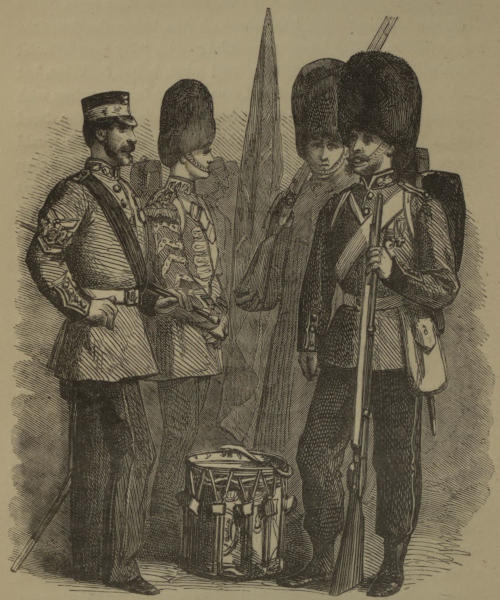
The illustration that accompanies this chapter gives the present
costume of the three regiments of Foot Guards—a scarlet tunic,
lately introduced, with blue facings, white cross-belt and waist-belt,
and black trousers, with a scarlet cord down the seams in winter,
and white in summer. When in full dress, the whole wear bearskin
caps, but each regiment has distinctive ornaments on the collar
of the tunic, etc.; and when in undress, the men belonging to each
may be distinguished by the band round the cap—the Grenadier
Guards wearing a red band, the Coldstream Guards a white band,
and the Scots Fusiliers a band chequered with red and white.
The two regiments of Life Guards and the Royal Horse Guards
all wear corselets—consisting of a breast-plate and back-piece—and
helmets of polished steel, with breeches, sword-belts, cross-belts,
and gauntlets of white leather. They are, however, to be distinguished
by the colour of their coats, and the plume that they wear
in their helmets—the Life Guards being clad in scarlet coats, and
having white plumes, while the Horse Guards wear blue coats, and
scarlet plumes. They are all armed alike, with sword and rifled
carbine, and carry pistols in the holsters of their saddles, which are
covered with white sheep-skin for the Life Guards, and black sheep-skin
for the Horse Guards Blue. In undress the former wear a
scarlet shell-jacket with blue facings, while the latter wear a blue
shell-jacket with scarlet facings. The cap—black, with a scarlet
band—is the same for each regiment.
Apropos of this subject, it may not be generally known that the
First Royals, or First (Royal) Regiment of Foot, are a corps of
Foot Guards by regimental tradition, if not by authority from the
Horse Guards.
The writer of this chapter once knew an old Devonshire pensioner,
John Sculley by name, who belonged to the “Fust Ry-uls,”
as he used to style his old regiment, who had fought in almost every
one of the principal battles of the Peninsular war, and had escaped
without a scratch.
“John,” I would sometimes say to the old fellow, as he stood
leaning on his spade, “what regiment did you belong to?”
“Why, Sponshus Pilut’s Guards, to be sure,” he would curtly
reply. “I’ve told ’ee so often enough, I reckon.”
“No, I think not. But Pontius Pilate’s Guards—what a queer
title! Why in the world were you called so?”
“Why, you see, the ridg’ment was raised in Sponshus Pilut’s
time, and that’s how us got the name.”
And this he implicitly believed.
CHAPTER III. THE ENGINEERS.
Gibraltar is well named the Key of the Mediterranean.
In peace it protects our commerce and our fleets, in war
it affords equal facility for harassing our foes; by its
position and its strength its possession is of the utmost importance
to the English, and it has excited for the last century and a half
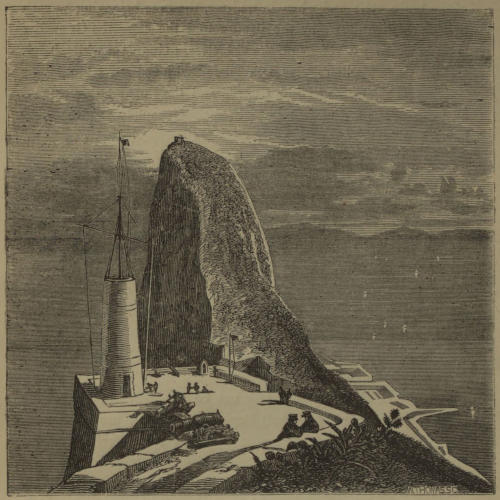
the suspicion and the jealousy of other nations. The rock of
Gibraltar projects into the sea about three miles. Its northern
extremity, owing to its perpendicular altitude, is inaccessible; its
southern extremity is known as Europa Point; and the southern
and eastern sides are rugged and steep, affording natural defences
of a very formidable character. It is only on the western side
fronting the bay that the rock gradually declines to the sea; but
the town of Gibraltar is so built that an attack upon it, however
well planned, however strong or long continued, is almost certain
of failure. The bay formed by the two points already named is
more than four miles across. The depth of its waters, and the
protection afforded by the headland, render the harbour remarkably
secure, and it is well adapted for vessels of every description. The
extreme depth of the water within the bay is a hundred and ten
fathoms. The security of the harbour has been still further
increased by two moles, one extending eleven hundred feet, and
the other seven hundred feet into the bay. The bold outline of
the rock is conspicuous and striking, as it lifts its colossal proportions
into the sky, and against the intense blue of that sky
every crag is sharply defined. From the water to the summit,
from the land forts to Europa Point, the whole rock is lined with
formidable batteries. Like a crouching lion it looks out to sea,
and every foe is daunted by its aspect.
Gibraltar is essentially military. Sentinels, gateways, drawbridges,
fortifications, guns pointing this way, that way, and the
other, looking as if—supposing them to be fired—they would
inevitably blow up one another; narrow streets of stairs which it
is hard work in the hot sunshine to ascend; nothing to see when
you reach the top but a line of ramparts, and another street of
stairs in perspective. Excavated passages in the rock lead from
point to point; every new position seems more impregnable than
the last; awful heights rise above, terrific depths yawn below; guns
peer—at the most unexpected points—from the sides of the rock,
as if they were natural productions; tunnelled galleries open to the
right and to the left, inviting or deterring the visitor. There is
one huge chamber cut out of the solid rock, and serving as a
battery or a banquet room as occasion may require; it is called
St. George’s Hall, and is the most formidable and singular cutting
of Gibraltar. There is another excavation of the same character
christened by the name of Cornwallis, but it is neither so spacious
nor so elegant as that of St. George.
The people one meets in Gibraltar are a mixed multitude—the
familiar English uniform is of course conspicuous, but for the rest
it is only what we have read of, or heard of, or dreamed of in
connexion with Gil Blas and Don Quixote. There is so much that
is Spanish that you might fancy yourself in Barcelona; so much
that is Moorish that you might fancy yourself in Morocco; so much
that is English, Italian, Greek, Polish, Jewish, African, and Portuguese,
that you might conceive yourself to be in the midst of an
animated Ethnological museum on a large scale, opened at Gibraltar,
regardless of expense.
The rock of Gibraltar, forming with Abyla in ancient times the
far-famed pillars of Hercules, was captured from the Spaniards by
Sir George Rooke in 1704. During the nine following years the
Spaniards in vain tried to recover it, and in 1713 its possession was
secured to the English by the treaty of the peace of Utrecht. But
treaties are liable to be broken. When the men of the pen have
finished their work the men of the sword may undo it. To hold the
rock of Gibraltar by treaty was one thing, to hold it by strength was
another. The fortifications required for its defence were necessarily
on a gigantic scale, and the men of the pick and the shovel were in
request. When we glance at the subterranean passages cut in the
rock, the huge caverns scooped out of it, the long lines of rampart
making the place impregnable, even though attacked by an enemy
having the command of the sea, we may readily understand how
important was the service rendered by the engineer and labourer.
So important indeed was their work, that it added a new division
to the British army—a division, that wherever our flag waves has
done good service—namely, that of the Engineers.
Previous to the year 1772 all our great engineering works in
connexion with military operations were mainly executed by
civilians. The works at Gibraltar were entrusted to ordinary
mechanics obtained from England and the Continent. These
operatives were not engaged for any term of years, neither were
they amenable to military discipline; they worked when they
pleased, they idled when they pleased; they were wholly regardless
of authority; received good wages; and their dismissal was in all
instances more injurious to the Government than it was to the men.
The hindrance and inconvenience of this system led to the
formation of a corps of military artificers. The idea was suggested
to Lieutenant-Colonel Green by the useful result of the occasional
occupation of soldiers who had learned mechanical trades previous
to enlistment. He thought it possible that a sufficient number of
these men might be banded together for the carrying on of all
necessary engineering works, and that their employment would
lessen the cost while it secured the completion of any engineering
operation, and at the same time, that the men so employed would at
any period be ready to participate in the defence of the place.
Lieutenant-Colonel Green submitted his suggestion to the Governor
of Gibraltar. The governor approving the plan, it was recommended
to the attention of the Secretary of State, and royal consent was
given to the measure in a warrant dated March 6th, 1772: thus
originated the corps of Royal Sappers and Miners.
The warrant authorised the raising and forming of a company of
artificers, to consist of a sergeant-major, as adjutant, who was to
receive 3s. a day; three sergeants, each of whom was to receive
1s. 6d. a day; three corporals, whose pay was 1s. 2d. a day; and
sixty privates, and one drummer, each of whom was to receive
10d. a day.
The rank of adjutant attached to that of sergeant-major was not
adopted, but it appears to have been taken by Thomas Bridger, who
so describes himself on his wife’s tombstone at Gibraltar, adding
thereto a touching tribute to her charity, and a sneer at the end—like
the sting in the tail of the serpent—at the parsimony of the
Government.
“A more loving wife or friend sincere
Never will be buried here;
Charitable she was to all,
Altho’ her income it was small.”
Recruiting for this company was a service of but little difficulty,
as permission was granted to fill it with men from the regiment
then serving in the garrison. The whole of the civil mechanics
were not discharged from the department on account of this
measure; a few, on the score of their merit, were retained in the
fortress; the foreign artificers were dismissed; most of the English
“contracted artificers” sent home; permission, however, was given
to any “good men” who chose to enlist; but not one availed
himself of the privilege.
Before the close of the year 1772, the ranks of the company were
almost full, and the system was found to work so well, that on the
recommendation of the lieutenant-governor a fresh warrant was
issued for the increase of the corps, and no sooner was it completed
than the engineers proceeded with great spirit in the execution of
the King’s Bastion. On laying the foundation of this work,
General Boyd, in his speech, desired that the bastion might be as
gallantly defended as he knew it would be ably executed, and that
he might live to see it resist the united efforts of France and Spain.
His desire was fully realised. He not only lived to see what he
wished, but materially to assist in the operations of the siege.[1]
In October, 1775, the company of Soldier Artificers was still
further augmented, and consisted of one hundred and sixteen non-commissioned
officers and men.
Gibraltar, ever since its capture by the English in 1704, had been
a source of jealousy and uneasiness to Spain; as soon as ever an
opportunity offered for the commencement of hostilities, Spain
assumed an aggressive attitude, and in 1779 sat down before the
place at St. Roque with a powerful camp, and sent out a fleet to
cut off supplies. The gallant old General Elliot, and the no less
gallant veteran Boyd, defended the rock nobly, and found their
best help in the Soldier Artificers. The sufferings of the undaunted
garrison were great—the price of mutton or beef being 3s. 6d. a
pound, eggs sixpence each, and mouldy biscuit crumbs 1s. a pound;
but the indomitable energy of the men never slackened; they
laboured night and day, piercing the rock with subterranean passages,
and forming vast receptacles for stores and ammunition in
the solid stone. Failing in their efforts to reduce the garrison by
famine, the French and Spaniards, after three years’ beleaguering,
began a terrific bombardment. Fire was opened with unexampled
fury, and continued incessantly for days and weeks. The battering
flotilla was warmly received by the “dwellers in the rock.” But
for a long period the battering ships seemed invulnerable. At
length red-hot shot was employed by the garrison, and sheets of
resistless flame burst in all directions from the flotilla: the whole
of the batteries were burnt; the magazines blew up, one after
another; and it was a miracle that the loss of the enemy by
drowning did not exceed the number saved by the merciful efforts
of the garrison.
The contest was still prolonged: the enemy were bent on reducing
their invincible opponents at all cost. The British were in
no mood to yield; red-hot shot was their grand specific; the
Artificers were instantly employed in erecting kilns in various parts
of the fortress, each kiln capable of heating a hundred shot in an
hour.
The struggle continued for some time; from one thousand to
two thousand rounds were poured into the garrison in the twenty-four
hours, and this was kept up for months. During the cannonade,
the Artificers under the engineers were constantly engaged
in the diversified works of the fortress, and they began to rebuild
the fortification known as the Orange Bastion, on the sea line, and
in the face of a galling fire completed their work in three months.
The number of the Artificers had been augmented by the arrival of
one hundred and forty-one mechanics, under Lord Howe; but,
even taking this into account, the erection of such a work in solid
masonry, and under such circumstances, is unprecedented in any
siege.
Failing to obtain the submission of the garrison either by famine
or bombardment, the enemy attempted to mine a cave in the rock,
by which to blow up the north front, and thus make a breach for
their easy entrance into the fortress. The secret was revealed by a
deserter; but very little attention was paid to his statement, until
the discovery of the enemy’s proceedings was made by Sergeant
Thomas Jackson, who, making a perilous descent of the rock by
the help of ropes and ladders, ascertained beyond all doubt the work
in which the Spaniards were engaged. The ratification of peace
put an end to all military operations, and terminated a siege which
extended—with circumstances of unparalleled difficulty and danger—over
a period of four years.
During the whole of this memorable defence, the Company of
Artificers proved themselves to be good and brave soldiers, and no
less conspicuous for their skill, usefulness, and zeal in the works—works,
as the commander of the hostile forces [Duc de Crillon]
remarked, “worthy of the Romans.”
At the close of the siege, there were twenty-nine rank and file
wanting to complete the number of Soldier Artificers. The deficiency
was speedily supplied, and the company was never allowed
to sink beneath its established number. A force of more than two
hundred and twenty non-commissioned officers and artificers were
employed in restoring the work which had suffered during the
bombardment; and to expedite the labour, the Soldier Artisans
were excused from all garrison routine, as well as from their own
regimental guard and routine, and freed from all interference likely
to interrupt them in the performance of their working duties. Still,
to impress them with the recollection that their civil employments
and privileges did not make them any the less soldiers, they were
paraded, generally under arms, on Sundays; and to heighten
the effect of their military appearance, wore accoutrements which
had belonged to a disbanded Newfoundland regiment, purchased for
them at the economical outlay of seven shillings a set. Perhaps
no body of men subject to the articles of war were ever permitted
to live and work under a milder surveillance; and it may be added,
that none could have rendered service more in keeping with the
indulgences bestowed.
In the summer of 1786 the company was divided into two, the
chief engineer still continuing in command of both companies.
About the same time, those men who were disqualified in any way
for service were removed from the corps, and the enlistment of
labourers, in addition to skilled hands, was authorized by the
Government. Five batches of recruits were sent to the Rock in
rapid succession. The second party of recruits, comprising fifty-eight
men, twenty-eight women, and twelve children, were destroyed
in a storm off Dunkirk. Only three persons escaped.
The valuable services rendered by the corps, and the hearty
good-will with which they invariably laboured, led to a still
further extension of their privileges. They were allowed to pass
in and out of garrison on Sundays and holidays without a written
pass, and to wear at pleasure whatever dress suited their inclination.
It was not uncommon, therefore, for the non-commissioned officers
and the respectable portion of the privates to stroll about garrison
or ramble into Spain, dressed in black silk and satin breeches,
white silk stockings, and silver knee or shoe buckles, drab
beaver hats and scarlet jackets, tastefully trimmed with white
kerseymere.
In 1787 the king’s authority was granted “for establishing a corps
of Royal Military Artificers.” It was to consist of six companies, of
a hundred men each. Officers of the Royal Engineers were appointed
to command the corps; and when required to parade with other
regiments the corps was directed to take post next on the left of the
Royal Artillery. The companies were ordered to serve at Woolwich,
Chatham, Portsmouth, Gosport, Plymouth, and one company was
divided between Jersey and Guernsey. The companies at Gibraltar,
although similarly constituted, remained a distinct and separate
body until their incorporation with the corps in 1797. The
recruiting was carried on by the captains of companies; there was
no standard as to height fixed, but labourers were not enlisted over
twenty-five years of age nor any artificer over thirty, unless he
had been employed in the Ordnance Department and was known
to be an expert workman of good character. The bounty given at
first to each recruit was five guineas, but during time of peace it
was reduced to three. Labourers promoted to the rank of artificers
received a bonus of two guineas, an additional 3d. a day, and were
privileged to wear a gold-laced hat.
By the operative classes some opposition was offered to the
enrolment of the Royal Artificers, and on more than one occasion a
serious outbreak took place between the civilians and the military;
the jealousy, however, at last died out, and the old animosity was
forgotten.
In 1791, a vessel bearing several recruits to Gibraltar encountered
a terrific storm in the Bay of Biscay. The wreck and its
circumstances gave rise to a song called “The Bay of Biscay O!”
The declaration of war with France, 1793, put an end to the
comfortable and easy life which the Royal Artificers had been leading.
They were, as soldiers, liable to be sent to any part of the
world where the British Government might require their services.
The idea of this liability ever being insisted upon seems to have
been foreign to the minds of the corps. When it was known that
their services would be required in the Low Countries and in the
West Indies, many of them eluded service by providing substitutes,
and some resorted to the very dishonourable alternative of desertion.
Of the finest company sent out to the West Indies, not a
man escaped the ravages of “yellow Jack.” Those who served in
Holland distinguished themselves by their bravery, especially at
the famous siege of Valenciennes. The continuance of the war
rendering it essential that the artizan companies should be kept
in foreign stations, while the necessity for increased vigilance at
home was each day becoming more urgent, led to the extension
of the corps, and four new companies were enrolled—two
to serve in Flanders, one in the West Indies, and one in Upper
Canada.
The special company destined for service in the West Indies sailed
from Spithead, November, 1793, and arrived at Barbadoes early
in the following year. From thence they proceeded to Martinique,
where their spirited conduct in the field commanded the admiration
of the whole army. The companies which were sent both to
Toulon and Flanders behaved also with much gallantry, proving
that the Royal Artificers were not only skilled workmen but efficient
soldiers.
In June, 1797, the Soldier Artificers Corps at Gibraltar were
incorporated with the Royal Military Artificers; by this incorporation
the latter corps were increased from 801 to 1075, of all ranks;
but its numerical strength only reached 759 men. Detachments
of the corps served with credit under Sir Ralph Abercrombie at
Trinidad, and also in the unsuccessful attack on Porto Rico.
Among the measures suggested for reducing Porto Rico was one
for taking the town by forcing the troops through the lagoon
bounding the east side of the island. In order to ascertain whether
the lagoon was fordable, David Sinclair, one of the Military Artificers,
picked his way across at dead of night, reached the opposite shore
in safety, and picked his way back again to report. He was
rewarded for this daring act, but the fording of the lagoon presented
so many difficulties as to be given up.
The memorable mutiny of the Fleet at Spithead was followed
by the rising of some unprincipled men, who by every means
endeavoured to shake the allegiance of the soldiery. The Plymouth
Company of Artificers in an especial manner distinguished itself
by its open and soldier-like activity against these disloyal exertions;
in a printed document, bearing date May, 1797, they avowed at that
momentous crisis their “firm loyalty, attachment, and fidelity to
their most Gracious Sovereign and to their Country.” The declaration
was well timed, and had the desired effect.
Throughout the war in the Low Countries the Corps of Artificers
rendered eminent service. One of their most important achievements
was that of the total destruction of the Bruges canal.
About the same time a company of Artificers was sent to Turkey
to operate with the troops of the Sultan against Napoleon, in
Egypt. There also they distinguished themselves alike by their
active service and good conduct. A Turk having attempted to
stab one of the men, was sentenced by the Turkish governor to
death; this punishment, at the earnest entreaty of the commanding
officer, was mitigated, the culprit being sentenced to receive fifty
strokes of the bastinado, to be imprisoned twenty years, and to learn
the Arabic language.
In the West Indies the Artificers were exposed to worse than
human foe. There the yellow fever decimated their ranks, but the
conduct of the men throughout was both intrepid and humane, and
in the despatches reference is frequently made to their exemplary
conduct. When the mortality was at its height, three privates
voluntarily devoted themselves to the burial of the dead, and
worked on with unflinching ardour; surrounded by the pest in
its worst form, inhaling the worst effluvia, never for a moment
forsaking their frightful service, they laboured on inspiriting those
about them by their example, until the necessity for their exertions
no longer existed.
In 1806 a company of Military Artificers was established at
Malta, and remained a distinct and separate body.
The necessity for an efficient body of trained artizan soldiers
became, indeed, every day more obvious; and no expedition of any
consequence was undertaken without a body of these men being
included in the forces sent out. In America, in the Indies, East
and West, on Mediterranean service, in the Peninsula, in the Low
Countries, they were alike needed, and rendered excellent service.
At home, also, they were continually employed in erecting new and
strengthening the old fortifications, for it was anticipated that
Bonaparte would visit our shores, and that stone walls as well as
wooden walls would be required for our defence.
Throughout the Peninsular war the services of the corps were
invaluable; in sap, battery, and trench work, in the making of
fascines and gabions, in repairing broken batteries and damaged
embrasures, in constructing flying bridges over the Guadiana, the
Artificer vied with the regular engineers. Major Pasley, R.E., on
his appointment to the Plymouth station, began regularly to practise
his men in sapping and mining. He was one of those officers who
took pains to improve the military appearance and efficiency of his
men, and to make them useful, either for home or foreign employments.
He is believed to have been the first officer who represented
the advantage of training the corps in the construction of military
field-work. After the failure at Badajoz (1811) the necessity of
this measure was strongly advocated by the war officers. Then it
was recommended to form a corps under the title of Royal Sappers
and Miners, to be composed of six companies, chosen from the Royal
Military Artificers, which, after receiving some instruction in the
art, was to be sent to the Peninsula to aid the troops in their future
siege operations.
In April, 1812, a warrant was issued for the formation of an
establishment for instructing the corps in military field-work.
Chatham was selected as the most suitable place for carrying out
the royal orders, and Major Pasley was appointed director of the
establishment. Uniting great zeal and unwearied perseverance
with good talents and judgment, Major Pasley succeeded in extending
the course of instructions far beyond the limits originally assigned,
and he not only filled the ranks of the corps with good scholars,
good surveyors, and good draughtsmen, but enabled many, after
quitting this service, to occupy, with ability and credit, situations of
considerable importance in civil life.
At Ciudad Rodrigo and Badajoz, and other places made famous
in the Peninsular war, the Military Artificers won the praise of
Wellington, conducting themselves with the greatest gallantry and
coolness.
On the 5th of March, 1813, the title of the corps was changed
from that of Royal Military Artificers to that of Royal Sappers and
Miners. A change of equipment was also introduced. In this
respect many irregularities had crept in, the members of the corps
in various parts of the world being variously armed, rather to
suit their own fancy than to meet the exigencies of the work.
Uniformity in the matter was of great importance, and this was
gradually and effectually introduced.
When Napoleon, escaping from captivity in Elba, re-appeared in
France, and the armies of the allies were again summoned to the
field, at the instance of the Duke of Wellington the whole corps
of Sappers and Miners was sent to Brussels to join his Grace’s
force, and were employed in constructing indispensable field-works,
or improving the fortifications at Ostend, Ghent, Tournay, Oudenarde,
Boom, Antwerp, Lille, Liepkenshock, and Hae. At the
battle of Waterloo the Royal Sappers and Miners were not
engaged, but three companies were brought conveniently near, to
act in the event of their services being needed. After the battle,
all the companies of the corps moved with the army towards Paris,
and rendered valuable service in the construction of pontoon
bridges. After the capitulation the men were encamped in the
vicinity of Paris, until they could be removed to other stations or
sent home. Two companies remained with the army of occupation;
and in the naval victory of Algiers three of the companies worked
at the guns with the seamen of the fleet, and gained equal credit
with the navy and marines for their noble support.
In the Canadas the Sappers and Miners rendered themselves very
useful, especially in the formation of a new citadel at Quebec; their
efficiency also in pontoon work was universally acknowledged; of
all the soldiers in the army no men more deserved well of their
country—useful as they were alike in time of war and peace.
“Indeed,” says Sir John Jones, “justice requires it to be said, that
these men, whether employed on brilliant martial services or engaged
in the more humble duties of their calling, either under the vertical
sun of the tropics or in the frozen regions of the north, invariably
conducted themselves as good soldiers; and by their bravery, their
industry, or their acquirements, amply repay the trouble and
expense of their formation and instruction.” In taking a bird’s-eye
view of the formation and growth of some of our military
institutions, the Rev. G. R. Gleig thus speaks of the corps:
“Besides the infantry, cavalry, and artillery, of which the army
was composed, and the Corps of Engineers, coeval with the latter
there sprang up during the period of the French Revolution other
descriptions of force which proved eminently useful, each in its own
department, and of the composition of which a few words will
suffice to give an account. First, the Artificers, as they were called,
that is to say, the body of men trained to the exercises of mechanical
arts, such as carpentry, bricklaying, bridge-making, and so forth,
which in all ages seem to have attended on a British army in the
field, became the Royal Sappers and Miners, whose services on
many trying occasions proved eminently useful, and who still
do their duty cheerfully and satisfactorily in every quarter of the
globe. During the late war they were commanded, under the
officers of engineers, by a body of officers who took no higher rank
than that of lieutenant, and consisted entirely of good men, for
whom their merits had earned commissions. Their education,
carried on at Woolwich and Chatham, trained them to act in the
field as guides and directors to all working parties, whether the
business in hand might be the construction of a bridge, the throwing
up of field works, or the conduct of a siege. Whatever the engineer
officers required the troops to do was explained to a party of Sappers,
who, taking each his separate charge, showed the soldiers of the
Line both the sort of work that was required of them and the
best and readiest method of performing it. The regiment of
Sappers was the growth of the latter years of the contest, after the
British army had fairly thrown itself into the great arena of
Continental warfare, and proved so useful, that while men wondered
how an army could ever have been accounted complete without this
appendage, the idea of dispensing with it in any time to come,
seems never to have arisen in the minds of the most economical.”
In the erection of the Great Industrial Exhibition of 1851 the
Sappers and Miners afforded very valuable assistance, and won for
themselves a warm eulogium from the Prince Consort. In the
formation of the Camp at Chobham they were also very useful, and
they were especially complimented for their exertions by Colonel
Vicars and Lord Seaton; but it was during the war with Russia
that they again figured most prominently before the public.
On the outbreak with Russia a detachment of the Sappers and
Miners was sent out with the Baltic fleet, and a second company
was despatched to the Aland Islands. They played an important
part in the destruction of the forts and the capture of Bomarsund.
Other detachments were sent to Turkey, and did good service at
Gallipoli, Boulair, and Ibridgi, winning the “entire approbation” of
Sir George Brown. At Scutari, Varna, Derno, and Rustchuk they
were still further distinguished. Before Sebastopol, when shot and
shell swept furiously into the trenches, the conduct of the men was
everything that could be desired. “The country,” wrote Lord
Raglan, “was covered with water; the trenches extremely muddy,
their condition adding greatly to the labours of the men employed
in the batteries, chiefly sailors, artillerymen, and sappers. They
conducted their duties admirably.” Everywhere in posts of danger
were the Sappers; here piling up hides and fixing gabions; there
fixing platforms, renewing sleepers, and fastening bolts; here
crawling on the earth, more like a gnome than a man, but busy
with pick and shovel, under a shower of rifle bullets; there black
with gunpowder, blasting the rock to widen the trench; there the
bright hammer of the Sapper plies on the newly-reared parapet,
and affords a mark for the enemy; here the horn lantern of the
Sapper gives feeble light to the busy workman, but a sure target to
the foe; everywhere, in battery, trench, and mine, the Sapper is the
centre of each party, toiling at his hazardous avocation through the
long dark night.
While the French amused their leisure with private theatricals,
getting up an impromptu theatre, the English Sappers built a
church—built it entirely of siege apparatus, the materials so arranged
that they were only in store, ready for use at a moment’s notice:
scaling ladders, gabions, fascines, timbers ready cut and shaped for
gun platforms, a few planks and pieces of rope. Two scaling
ladders locked into each other at the top, formed at certain intervals
the columns which separated the aisles from the body of the church
and bore up the roof. The framework of the outer wall was made
of long upright timbers which leant against the summits of each set
of ladders respectively, and were secured by cords. Across these a
few joist beams were lashed, and the outer wall of gabions in a great
degree rested on these horizontal supports. The roof was made by
the platform timbers laid between the tops of the ladders on each
side, and at right angles to these, fascines were laid in regular rows
until a complete covering—but one admitting of free ventilation—was
formed. There solemn service was often held, and good words
spoken by good and brave men—with the Union Jack for a pulpit
cloth.
Through the freezing winter and the wasting summer, for 337
days the Sappers carried on their work before Sebastopol. The
trenches they made were nine miles long; twenty-two batteries
were on the right, and twenty batteries on the left; in the formation
of the works there were no less than 20,000 gabions, 4000
fascines, 340,000 sand bags, 7413 bread bags, and a hundred
different extemporaneous expedients to give shape and solidity to
the works.
They witnessed the triumphant end of their work; and they
received no small share of honour and reward, for the work they
had done was unsurpassed in ancient or in modern history.
During the Indian mutiny the services of the Engineers were of
great advantage, and the bravery and determination of the men
both in defence and attack were worthy of the highest commendation.
In India there are, we believe, still employed in the
engineering arm of our service no less than twelve companies of
native Sappers and Miners.
We are all justly proud of our army, proud of its station among
the armies of Europe; its appearance, discipline, drill; proud of the
history of its achievements
⸺“of most disastrous chances;
Of moving accidents by flood and field;
Of hair-breadth ’scapes i’ th’ imminent deadly breach;”—
but there is no division of our army of which we should be more
justly proud than of the Sappers and Miners. It toils for us
wherever our flag is unfurled to the winds; it explores unknown
regions; surveys and maps new and old regions; it makes roads
where no roads were, and iron roads in place of common roads;
it blasts rocks; heaves up drowned treasures from the deep; it
serves as the pioneer of civilization abroad, and extends and consolidates
civilization at home; it labours as hard in peace as in
war—labour often unseen and unsuspected, but none the less
worthy of the respect, honour, and admiration due to the brave
sons of a brave people.
The Engineer corps of officers now consists of about four hundred
of all grades, partly employed in building and repairing our defences,
while the rest are more immediately attached to the Sappers and
Miners, a body of some three or four thousand men, which now
forms a constituent part of the Royal Engineers; indeed, the
Sappers and Miners are now to be regarded as the main body of
this arm of our service.
CHAPTER IV. THE ROYAL WELSH.
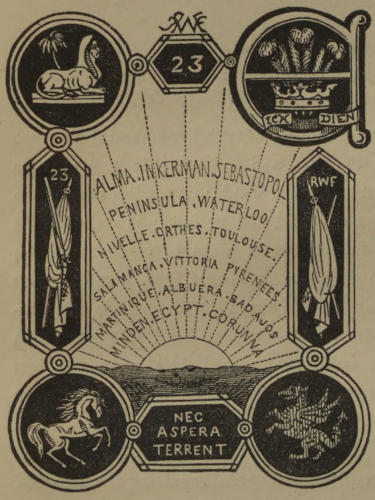
England possesses
many regiments that
have a traditional as well
as an individual existence.
The memory of
deeds of valour wrought
by their predecessors is
transmitted from generation
to generation, and
inspires the young soldier
with the desire of equalling,
if not surpassing,
the heroism of those who
have gone before. His
regiment is the warrior’s
family, and each man
feels, as the inheritor of
a noble fame ought to
feel, that he must do nothing unworthy of the past renown
gained in older days. Thus it happens that there are certain
regiments which may always be counted on in the hour of danger,
and one of these is the 23rd Royal Welsh Fusiliers. The Prince of
Wales’s plume, with the motto “Ich Dien,” betokens their nationality;
and their claim to the proud words, “Nec aspera terrent,”
which they bear on their colours, has been justified by their
gallant conduct in Egypt, and at Corunna, Martinique, Albuera,
Badajoz, Salamanca, Vittoria, the Pyrenees, Nivelle, Orthès,
Toulouse, Waterloo, Alma, Inkermann, and Sebastopol. All these
names are emblazoned on their colours, and the successors of the
heroes of the Peninsula and Waterloo proved in the Crimea that
the regiment had not fallen from its high estate of honourable
glory.
It will be interesting to our readers to glance briefly at the different
engagements in which the Welsh Fusiliers distinguished
themselves about the beginning of this century. They formed
part of the expedition which sailed for Egypt in 1801, under the
command of Sir Ralph Abercrombie, for the purpose of expelling
the French from that country. The authorities at home knew as
little about Egypt and the French forces there as the members of
Lord Aberdeen’s cabinet did about the Crimea and the strength of
the Russian army. Our men had no other guide than an old map,
which proved to be very incorrect, and Sir Sidney Smith, a gallant
sailor but an indifferent geographer, who knew nothing of the
interior of the country. Moreover, it was supposed that the enemy
amounted to only 15,000 men, whereas they really numbered
35,000 veteran troops. The idea of sending 12,000 men, chiefly
young soldiers, to expel such a body of veterans from a country
where they were strongly intrenched, may excite some surprise,
but British soldiers may do anything when properly led. On the
8th of March our men landed with such regularity and order that
every brigade, every regiment, and even every company, drew up
on the exact spot they were intended to occupy. The sea was as
smooth as glass, and the bullets of the enemy fell as thick as hailstones
around the boats, but the landing force advanced and fell
into their places with as much coolness as if they had been dressing
for a review. The Welsh Fusiliers and three other regiments,
including the gallant 42nd, landed in boats on the right, and were
exposed to showers of grape and shell from the enemy’s batteries;
but, nothing daunted, they quietly disembarked, formed in line,
and, without even stopping to load, rushed up the hill to charge the
enemy with the bayonet. Half way up they were met with a
volley from the enemy, but, pushing on, they reached the summit
before they could reload, rushed furiously upon them, and drove
them from their position. The general was proud of this first
success, and thanked his men for having displayed “an intrepidity
scarcely to be paralleled.” On the 13th of March he was about to
attack the right flank of the enemy, who anticipated his design, and
descended from the heights to meet him; after considerable loss
our men had to retire to their former position, where they remained
till the 20th. On the evening of this day Sir Sidney Smith (the
heroic defender of Acre) received a letter from an Arab chief,
apprising him of the enemy’s intention to fall upon the English
with all their forces the following morning, but unfortunately the
commander-in-chief paid no attention to this warning. Next
morning he discovered his mistake; the French commenced the
action by a feigned attack on the British left, but concentrated
their most vigorous efforts against the right, where the Welsh
Fusiliers were stationed. Their superiority in numbers procured
them a temporary success. Our right flank was turned, and the
28th Regiment, who were most exposed to their impetuous attack,
could with difficulty retain their position, though supported by
the 58th and the Welsh Fusiliers, when the 42nd advanced to their
aid, and proved that France’s Invincibles were unworthy of their
name by wrenching
⸺“the banner from her bravest host,
Baptised Invincible in Austria’s gore.”
Notwithstanding their superiority in numbers, the French were
repulsed at every point; the English remained masters of the
field; and this was the first of a series of successes which led to the
evacuation of Egypt and the overthrow of all Napoleon’s hopes of
Eastern conquest.
In 1809 we find the Welsh Fusiliers at Corunna, in Spain. It
would be foreign to our purpose to relate the events which preceded
that battle; suffice it to say, that Sir John Moore, after a
series of brilliant encounters with the enemy, was obliged to retreat.
The Spaniards afforded no assistance to the retreating army, which
was reduced to the greatest privations; officers and men suffered
alike from hunger and fatigue; it was not unusual for the soldiers
to point to some young aristocrat marching at the head of his
company without shoes or stockings, and to say, with grim humour,
“There goes ten thousand a year.” On this, as almost every
occasion, the officers bore up better than the men, so great is the
influence which the mind has over the body. On reaching Corunna,
where they were about to embark for England, our men were
attacked by the French. Sir John Moore was prepared to receive
them; the sick, the cavalry, and part of the artillery were already
embarked; the remaining part of his forces were drawn up to meet
the attack of the enemy. The Welsh Fusiliers formed part of
General Fraser’s division, which was stationed in the rear at a
short distance from Corunna. The enemy charged again and
again, but our men not only kept their ground and remained
unbroken, but actually forced them to retire at the point of the
bayonet. The battle began at mid-day, and at five o’clock in the
afternoon the enemy were foiled at every point, and our army
occupied a more advanced position than at first. The loss of the
British was 800 killed and wounded, including their gallant leader,
who was struck to the ground by a cannon-ball, and died in the
hour of victory. His death has been commemorated in lines
familiar to all our readers, and it is satisfactory to know that Soult,
instead of insulting his ashes, caused a monument to be erected to
his memory. It is by such generous acts that nations prove their
manhood amid the fierce passions evoked by war.
The Welsh Fusiliers also took part in the reduction of Martinique,
one of the French West Indian islands, which was compelled to
surrender after a gallant resistance. In those stirring times a
regiment seldom remained long in one place, and in 1812 we find
them in Spain, where they were present at the battle of Albuera
and the siege of Badajoz, which was defended by the French with
obstinate valour. Many of our men perished in the breaches, and
every species of missile was hurled upon them as they attempted
to scale the walls. “Never, probably, since the invention of gunpowder,”
says Colonel Jones, “were men more exposed to its action
than those assembled to assault the breaches.” For two hours,
shells, hand-grenades, and bags of gunpowder were hurled upon
our men as they crowded into the ditch; when they rushed up the
breach their passage was arrested by ponderous beams bristling
with sword-blades, and loose planks studded with sharp iron points,
which tilted up the moment they were trodden on, and precipitated
the assailants into the ditch below. Again and again our men
rushed against the glittering sword-blades and were shot down by
the enemy from the walls above; the rear pressed on, and tried to
make a bridge of the writhing bodies of their slaughtered comrades.
About midnight 2000 men had fallen, and Wellington was about
to give orders to retire, when he received notice that Picton had
taken the castle by escalade. “Then the place is ours,” he exultingly
exclaimed, and sent word to Picton to retain the castle at all
hazards. The attack was continued, and next morning Philippon,
the French general, surrendered to Lord Fitzroy Somerset, better
known to this generation as Lord Raglan. We must draw the veil
of sorrow over the fearful scenes which were enacted by an
infuriated soldiery when the devoted city fell into their hands;
for three days all discipline was at an end, and the tumult only
subsided when the rioters were exhausted with their excesses.
We cannot give the exact loss of the Welsh Fusiliers, but, in
common with all the other British regiments engaged in this siege,
they suffered severely.
The next memorable event in the Peninsular War was the battle
of Salamanca, which was fought on the 22nd of July, 1812. On
the 16th of June, Wellington overtook the French near the right
bank of the Tormes, the enemy retreating across the river. For
several days both armies remained encamped on the opposite banks
without molesting one another, and the most friendly intercourse
sprang up between them. They were in the habit of conversing
together and exchanging provisions, as if they had been on the best
of terms. When the warfare was resumed, the French officers
said, on parting, “We have met and been for some time friends;
we are about to separate and may meet as enemies; as friends we
have received each other warmly; as enemies we shall do the
same.” Warm indeed was the reception which they gave to one
another on the blood-stained field of Salamanca. At first the
French had the advantage, but an unguarded movement on the
part of Marmont, their general, having caught the eagle eye of
Wellington, he joyfully exclaimed, “At last I have them,” and gave
orders for a general charge. The French, remembering their former
promise, presented a bold front to their assailants, who, pouring a
destructive volley into the opposing columns, rushed upon them
with the bayonet. Such was the impetus of the English attack
that the close phalanx bent before it, swayed backward and forward
like a ship struck upon a heavy sea, then broke and scattered over
the plain. The French were completely routed, with the loss of
14,000 men. The victors behaved with great humanity to the
vanquished; many of the fugitives, pursued by the cavalry, fled to
the British lines for protection, which was readily granted. The
infantry covered their retreat, and protected them from the sabres
of the horsemen; once within their lines, they were safe from
injury and insult; not a single man was bayoneted, plundered, or
molested. It is pleasing to record such instances of humanity; it
shows that the exchange of hospitalities on the banks of the
Tonnes was not forgotten in the hour of battle. The Royal
Welsh and the other British regiments engaged in this battle
were permitted to inscribe Salamanca on their colours in memory
of their victory.
The next year, on the 20th of June, the 23rd saw the Peninsular
campaign brought to a close by the battle of Vittoria. The French
were commanded by Jourdan, and the English by Wellington.
Our troops were completely victorious, and the expulsion of the
French from Spain was one of the fruits of their victory. The
French fought resolutely till Picton gave the word to charge, when
our men bore down all opposition before them, and spread death
and consternation through the ranks of the enemy, who fled with
such precipitancy that they left all their artillery and baggage
behind. Joseph Bonaparte, placed by his brother Napoleon on the
throne of Spain, was present at the battle; he only escaped by
leaving his carriage and mounting a swift horse. The royal calash
fell into the hands of the 10th Hussars, who found in it all the
portable valuables of his regalia. The whole of his equipage and
treasures fell into the hands of the British. The booty was
enormous; it comprised all that could minister to the appetites or
pleasures of a sensual monarch. The most delicate wines and the
rarest luxuries fell into the hands of our soldiers, who exchanged
many a joke at the expense of the luxurious monarch as they
regaled themselves with them; poodles, parrots, and monkeys were
among the captives of war. Grim old Peninsulars amused themselves
after the battle in getting up a sort of masquerade, in which
they appeared in the uniforms of French generals, or displayed the
most recent inventions of the Parisian mode on their somewhat
ungainly persons, and Wellington allowed them to indulge their
grotesque humour. And when it was reported to him that some of
them had seized the French military chest and were loading themselves
with money, “Let them have it,” he said; “they deserve it,
though it were ten times more.” Among the other spoil was the
bâton of Marshal Jourdan, which Wellington sent with his despatches
to the Prince Regent: soon after this he received the bâton of an
English field-marshal along with a very handsome letter. “The
British army,” said the prince, “will hail it with enthusiasm, while
the whole universe will acknowledge those valorous efforts which
have so imperiously called for it.” While this victory made Wellington
a field-marshal, it procured for the Welsh Fusiliers the
honour of adding Vittoria to the other glorious names inscribed on
their colours.
The battle of Vittoria was attended with the most important
results. The scattered remains of the French army were driven
through the rugged passes of the Pyrenees, and the British army
advanced rapidly in the direction of France. The enemy sometimes
endeavoured to rally in their retreat, but were successfully driven
from the positions they occupied by the impetuosity of the Welshmen
and Highlanders, whose early training specially fitted them to
excel in this mountain warfare. The constant success of the British
army led many to expect that France would yield, and allow
Wellington to cross the frontier without further resistance; but
Napoleon, elated with his recent successes in Germany, appointed
Soult to the command of the army of the Pyrenees, and that able
general displayed such vigour and skill that there was some danger
at first of the British losing all the fruits of the great victory of the
20th of June. On the 25th of July, 15,000 French troops attacked
the British, about 3000 in number, at the pass of Maya, and for
ten hours our men maintained the conflict, notwithstanding their
inferiority in numbers. When their ammunition was exhausted
they hurled stones at their assailants, who were arrested by the
mass of dead and dying by which the pass was blocked, and
were at length repulsed by the aid of some reinforcements. The
pass of Maya will long be remembered in the annals of the British
army; our soldiers fought as bravely there as the Greeks did at
Thermopylæ.
We must omit the other stirring events of the Pyrenees, in all of
which the Royal Welsh acted a distinguished part, and enjoyed
many advantages over others unaccustomed to a mountainous
country. They had many extraordinary adventures, being sometimes
enveloped in the mists that shrouded the summits of the
mountains, and brought into fierce collision with the enemy, who
were ignorant of their approach. After the two battles of Lauroren,
the tide of success turned against Soult, who was almost taken
prisoner at St. Estenau. Such were the skilful arrangements of
the English general here, that the French army would have had to
surrender had not three marauding British soldiers crossed the
ridge which concealed their comrades, and thus warned the enemy
of their danger. On such small causes do great events hinge! The
cupidity of three Englishmen saved the whole French army. On
the 1st of August Soult abandoned the Spanish territory, with the
loss of 15,000 men; and on the 7th of September Wellington planted
the victorious standard of Britain on the soil of France. Seven
thousand of the allies were buried among the mountain passes of
the Pyrenees, and the different regiments engaged were allowed
to preserve the remembrance of this campaign on their colours.
The Royal Welsh next appear at the battle of the Nivelle, where
the French, after obstinate resistance, were driven back, and the
allies, profiting by this success, crossed the river, and established
themselves between it and the sea. A succession of heavy rains
rendered all movements impracticable for a time, and Soult did all
he could to strengthen his position. Frost having set in, Wellington
moved his forces on the 14th of February, 1814, and, in the course
of sixteen days, constructed a bridge across the Adour, passed five
large and several small rivers, traversed eighty miles of ground,
drove the enemy from their strongest positions, was successful in
one great battle and two combats, took many prisoners, and forced
Soult to evacuate Bayonne. We can only enumerate his successes,
and refer our readers to the history of those times for minuter
details. The great battle was fought at Orthès on the 27th of
February. At first, victory seemed to declare in favour of the
French, but the English general bided his time with imperturbable
calmness till a movement of the enemy placed them in his power.
Every point was carried; the French retired at first in an orderly
manner, till their left wing was attacked, when they were thrown into
confusion, and ran off at full speed. The English pursued them for
three miles till they reached Sault de Navailles, where scarcely any
remains of Soult’s army were to be seen. The loss of the enemy
was estimated at 8000 men in killed, wounded, and prisoners,
while that of the allies did not exceed 1600. Here, as usual, the
Welsh Fusiliers were foremost in the fray, and their bravery was
rewarded by the addition of Nivelle and Orthès to the other historic
names on their colours.
Then followed the bloody and needless battle of Toulouse. We
need not here stop to inquire who was the cause of that fearful
carnage, or to refute the foolish assertion that the French gained a
victory. Such a statement is inconsistent with the fact that Soult
had to abandon Toulouse and all his lines of defence, while Wellington
attained the object he had in view. It is said that Soult
knew before the battle that Napoleon had abdicated, and that his
only motive for fighting was a desire to retrieve his fame as a
general; but we think no brave man—and Soult was brave—would
sacrifice the lives of thousands for so unworthy a motive.
After a furious contest the enemy were driven from the heights;
again and again they returned to the attack with a gallantry which
nothing but British valour could resist. At length they desisted
from the attempt, and the field of battle remained in possession of
the allies. That same evening Soult evacuated the city, and the
following morning the allies took possession of it. In the course of
the day they received official notice that Napoleon had abdicated.
Then our soldiers began to think of home and all its endearments;
they had done enough for fame, and a grateful country was waiting
to welcome them to their native shores. The soft peace march,
“Home, brothers, home,” must have sounded sweetly in the ears
of the Royal Welsh and the other veterans, who, under the command
of their able leader, had liberated two kingdoms, fought
eight pitched battles against the bravest soldiers and most skilful
generals of France, reduced many fortresses by assault, and at
length established themselves in the two principal cities in the
South of France. Britain had issued from all her trials the most
triumphant nation in the world, and had welcomed back with
acclamation the wearied soldiers who had done so much to sustain
her honour. Such men had a right to rest on their laurels. Their
rest was brief. The caged eagle escaped from Elba. The veterans
of the Peninsula had to buckle on their armour again. The Royal
Welsh took part in that brief but glorious campaign which was
brought to a close at Waterloo. Then for a period of forty years
they had no opportunity of displaying their courage. Now followed
the Crimean war, and deeds equalling “Greek and Roman fame,”
which earned for some of them the proud distinction of the Victoria
Cross.
The gallant Welshmen gained their first Victoria Cross at the
battle of the Alma. Russell’s picturesque letters and Kinglake’s
bewitching pages have rendered many readers familiar with the
chief incidents of that engagement; and it is here unnecessary for
us to dwell upon them, for in future pages we shall relate the
circumstances under which Colonel (then Captain) Bell gained at
that first Crimean fight the honourable distinction of the reward
“For Valour.”
But the roll of brave men in the Royal Welsh is not exhausted
by the mention of a single name. We are about to narrate the
incident which forms the subject of the accompanying engraving,
copied with no mean fidelity from that admirable collection of Mr.
Desanges lately, in the Crystal Palace, known as the Victoria Cross
Gallery. The incident here depicted occurred at the storming of
the Redan on the 8th of September, 1855. Two hundred men of
the Royal Welsh took part in that attack, and their loss in killed
and wounded was very great. After the men of the 23rd had
retired, it was found that Lieutenant and Adjutant Dyneley, an
excellent young officer and a general favourite, was missing. It
was reported that he had been struck down in the heat of the
engagement, and some of the men described the spot where they
had seen him fall. They would gladly have assisted him if they
could have done so, but soldiers, while engaged, are expressly forbidden
to leave their ranks for the purpose of carrying the wounded
off the field.
The Highlanders, when first raised, were constantly in the habit
of doing this; they could not stand by and see the sons of their
chiefs dying on the field of battle without attempting to assist them.
No man knew their character or habits better than the late Lord
Clyde, and it was in allusion to this practice that he spoke these
simple words while his men were still in column at the Alma with
the enemy in front:—“Now, men, you are going into action.
Remember this: whoever is wounded—I don’t care what his rank
is—whoever is wounded must lie where he falls till the bandsmen
come to attend to him. No soldiers must go carrying off wounded
men. If any soldier does such a thing, his name shall be stuck up
in his parish church.”[2] The perfection of discipline is to make
every unit in a regiment or an army act in unison with the whole
like a piece of machinery, and it is evident that if every soldier
were to follow out his own will the result would be inextricable
confusion. It is hard for a man to see officer or comrade struck
down by his side on the field of battle without being allowed to
assist him; but on such an occasion he has no choice—the pleadings
of humanity must yield to the voice of duty; he may turn aside
his head in sorrow, but he must still advance. It was so with the
Royal Welsh as they advanced against the Redan; they saw their
gallant young adjutant fall, but there was the dark parapet in front,
and their first duty was to gain that. And when our men were
hurled from the ramparts into the ditch, where they were slaughtered
without being able to offer any resistance, it was only natural that
all their thoughts should be concentrated on themselves, and that
the fate of young Dyneley should be forgotten. But it was different
when the attack was over: there was a general feeling of regret for
one whom all had loved. While they were lamenting his fate, it
occurred to some of the officers that he might not yet be dead, and,
while they were deliberating what should be done, Corporal Robert
Shields volunteered to go out to the front from the fifth parallel and
bring the body in. It was a daring act of courage, all the more
deserving of admiration that it was dictated solely by a feeling of
humanity without any expectation of reward. The difference of
rank does not always prevent friendships from springing up between
officers and men, and young Dyneley had found the way to
the hearts of all who knew him. Corporal Shields was not blind
to the danger he incurred; he knew that he carried his life, as it
were, in his hand, but he was prepared to risk everything to save
his officer. In the Homeric age it would have been said that some
invisible goddess watched over him and turned aside every hostile
blow. He groped his way over the field, covered with the slain,
till he reached the spot where poor Dyneley lay. Our engraving
represents the discovery of the body. The poor lieutenant is lying
on his back, still alive, but with the tide of life ebbing fast away;
the corporal, with sorrow and sympathy depicted in every feature
of his manly, bearded face, is bending over him, with one hand
outstretched and the other grasping his rifle. He would willingly
have raised the boyish figure in his arms and borne him back to
his comrades, but it was too late; all that he could do was to hurry
back in search of medical assistance. He passed through a heavy
fire of musketry unhurt, and reached the trenches, where he found
Dr. Sylvester, the assistant-surgeon of the regiment, who at once
consented to return to the spot where Dyneley lay. He was still
alive, but human skill could avail him nothing; all that the tenderest
friendship could do was done by Sylvester, who dressed his
wounds and supported him with stimulants. Shields returned to
the trenches and persuaded some of his comrades to accompany him
and to assist in carrying off the body of the dying adjutant. The
Emperor of the French, on hearing of this heroic action, conferred
on Corporal Shields the Cross of the Legion of Honour, and our
Queen bestowed on him the Cross which bears her own name. No
one will grudge it to him or to Dr. Sylvester. Mere bravery may
often border on bloodthirstiness; but valour combined with humanity
is the most godlike of all virtues. Such a man as Corporal
Shields is an honour to the British army, and he deserves to
receive honourable mention amongst the most fearless of England’s
soldiery.
An officer who is just, kind, and considerate will never find his
men ungrateful. Instances are on record where soldiers have laid
down their own lives to save those of officers they loved, and have
thus sealed their affection with their blood. On one occasion,
when Lord Cornwallis was giving orders to charge the French in
Canada, a Highland soldier rushed forward and placed himself in
front of his officer, who asked him what he meant. “You know,”
said the Highlander, “that when I enlisted to be a soldier, I promised
to be faithful to the king and to you. The French are
coming, and while I stand here neither bullet nor bayonet shall
touch you, except through my body.” It was with difficulty that
he could be persuaded to resume his place in the ranks. An
equally striking proof of faithful attachment was exhibited at the
siege of Bergen-op-Zoom by the servant of an officer of the name
of Fraser. The latter had directed his servant to remain in the
garrison while he conducted his men to attack a battery belonging
to the enemy. The night was pitch dark, and the party had such
difficulty in proceeding that they were obliged to halt for a time.
As they moved forward, Captain Fraser felt his path impeded, and
putting down his hand, seized hold of a plaid, the wearer of which
was grovelling at his feet. Imagining that it was one of his own
men trying to escape, he drew his dirk and tightened his grasp,
when he heard the voice of his servant imploring for mercy.
“Why, what brought you here?” “It was just my love for you,”
said poor Donald. “But why encumber yourself with a plaid?”
“Alas! how could I ever show my face to my mother,” she was
Fraser’s foster-mother, “had you been killed or wounded, and I
not there to carry you to the surgeon or to Christian burial?
And how could I do either without a plaid to wrap you in?”
Our soldiers have not degenerated, and there are still in the
ranks of the British army men who want only an opportunity to
show the same courage which has already entitled their comrades
to wear Victoria’s Cross.
CHAPTER V. OUR HIGHLAND REGIMENTS.
About a century ago the Highlanders were
regarded as little better than a race of savages.
Their dress, their language, and their manners
were the subject of ridicule among their
Southern neighbours, and their well-known
attachment to the house of Stuart excited the
suspicion and the distrust of the government of
the day. “When the English thought of the
Highlander at all,” says Macaulay—“and it was seldom that they
did so—they considered him as a filthy, abject savage, a slave, a
papist, a cut-throat, and a thief.” The great historian then proceeds
to show that this estimate bordered very closely on the truth,
and that the Highlanders were little better than they were represented
to be. He seems to feel a cruel pleasure in exposing the
weaknesses of those whose blood flowed in his own veins, and he,
doubtless, meant to display in his picture of Highland manners a
proof of his own impartiality. He gives implicit credence to all
that he finds in “Burt’s Letters,” without reflecting that the author,
from his very position, must have felt and written like a partisan.
Burt was an officer of Engineers employed under General Wade in
constructing those roads which opened up the Highlands to the
advance of the English forces. He remained in the North from
1726 to 1737, and amused his friends in the South with those
letters, in which he professed to describe the manners of the alien
race among whom he was placed. There is no reason to believe
that he was wilfully untruthful, but the work in which he was
engaged rendered him hateful to the Highlanders, and he hated
them cordially in return. He was probably unconscious of this
feeling himself, but it is perceptible in almost every line he wrote.
Johnson carried with him to the Highlands all the prejudices of his
countrymen, and a good many others peculiar to himself; but his
rugged nature was softened by the hospitality he everywhere met
with, and he occasionally gives forth a grunt of approval. The
reaction produced by the publication of his “Tour to the Hebrides”
was increased by the appearance of the poems and novels of Scott,
which created a sort of furore in favour of everything Highland,
and rendered the land of the mountain and the flood almost classical.
Royalty itself condescended to listen to the songs which it would
once have been treason to sing aloud; the garb of old Gaul was
assumed by many who had no right to wear it; the tartan became a
favourite article of dress with both sexes; every nook and corner
of the North was explored; the land of Ossian became the land of
romance, and its inhabitants were invested with every possible
virtue.
The gallant deeds of the Highland regiments in every quarter of
the globe added to the general enthusiasm for Caledonians. It was
long, indeed, before the English government would believe that
they could be trusted. To have armed the Highlanders about the
beginning of the last century, would have been deemed as much an
act of insanity as to arm at the present hour the New Zealand
Maoris. Scottish men were known to be under the control of their
chiefs, and their chiefs, almost to a man, were devoted to the
Pretender. No wonder, then, that the government hesitated before
accepting their services; it was not till 1730—only one hundred
and thirty years ago—that the first experiment was made. Six
companies of Highlanders were then raised, each company being
independent of the other. They were known as the Il Reicudan
Dhu, or Black Watch, to distinguish them from the Seideran
Dearag, or Red Soldiers. They derived their names from the
colour of their clothes; the regular soldiers wore scarlet, as they
do now, while the Highland companies retained their sombre
tartan. There was no lack of men: gentlemen of good family were
proud to serve as privates under their native officers; for the whole
country had been disarmed, and this indignity was deeply felt by a
race who, even in times of peace, never went forth without dirk
or claymore. The cadets of good families were proud to serve, if
only in the ranks, because they were thus entitled to bear arms;
and to carry a weapon was regarded as a proof that the bearer was
a gentleman. The pay privates received was small to a degree, yet
poverty was so universal that the pittance they took from government
was not to be despised. They were stationed in small parties
over the country, and seem to have discharged the same duties as
are intrusted to the rural police at the present day. In 1739 four
additional companies were raised, and the whole were formed into
a regiment of the line. Such was the origin of the first Highland
regiment in the service—the gallant 42nd, still known as the Black
Watch.
It would be foreign to our purpose to trace the origin and history
of all the Highland regiments. That task has already been ably
performed by General Stewart, of Garth, who served for many
years in the 78th Highlanders, and was appointed governor of the
island of Tobago, in the West Indies, where he died. It is somewhat
singular that Macaulay appears to have been ignorant of this
work, which contains far more valuable information regarding the
Highlands than is to be found in “Burt’s Letters.” General
Stewart’s book is now almost forgotten; it is rarely to be met with,
save in the libraries of country gentlemen in the North, whose forefathers
figure in its pages. But it deserves a better fate. No
writer has ever possessed a keener insight into the manners and
customs of the warlike race whom he was proud to hail as his
countrymen, or has described them in peace and in war with a
more graphic pen. By birth a Highlander, by profession a soldier,
he mingled freely with his clansmen, spoke their language, and had
ample opportunities of witnessing their courage in every quarter of
the globe. His “Military Annals” read like a romance; they have
all the charm of novelty, because they present us with a picture of
manners and feelings that have now died out.
“The simple system of primeval life—
Simple but stately—hath been broken down;
The clans are scattered, and the chieftain power
Is dead.”
It may be said with equal truth that our Highland regiments are
dead; they live only in name. We have regiments composed
chiefly of Scotchmen, but there are few Highland soldiers of pure
Celtic origin. The Highlands must have been far more populous
than they now are, or they never could have raised eighty-six
regiments, including local corps, in the course of the four wars in
which this country was engaged after 1740. Most of these regiments
were formed between 1778 and 1809, and altogether they
must have included in their ranks, from first to last, as many as
70,000 or 80,000 men. Some of them were raised before the
American rebellion, and Lord Chatham takes credit to himself for
having been the first to recognise their invaluable qualities in war.—“I
sought for merit wherever it was to be found. It is my boast
that I was the first minister who looked for it and found it in the
mountains of the North. I called it forth, and drew into your
service a hardy and intrepid race of men, who, when left by your
jealousy, became a prey to the artifice of your enemies, and had
gone nigh to have overturned the state in the war before the last.
These men in the last war were brought to combat on your side;
they served with fidelity, and they fought with valour, and conquered
for you in every part of the world.”
There is no exaggeration in this, and the minister is entitled to
all the credit he claims. He knew that a race so warlike and
restless would prove a source of constant danger, unless those
qualities were turned to some profitable account, and it was a wise
and liberal policy to employ them in defence of that throne which
they had recently almost overturned. The old feeling of clanship was
retained; the chiefs and their kinsmen received commissions, and
their clansmen were proud to rally around them. Every gentleman
of good birth who could raise a hundred men was appointed captain;
those who could bring only twenty or thirty ranked as subalterns.
Sometimes a little pressure was used by the chiefs, but generally
the men were ready to serve. The regiments thus raised were
composed almost exclusively of Highlanders. Gaelic was spoken
alike by officers and men, and chaplains familiar with the mountain
tongue were appointed to every regiment. Gentlemen who could
not obtain commissions at once were content to serve in the ranks
till vacancies occurred. Two men of gentle birth, privates in the
Black Watch, were presented to George II. in 1743. “They performed,”
says the Westminster Journal, “the broadsword exercise,
and that of the Lochaber axe or lance, before his Majesty, the Duke
of Cumberland, Marshal Wade, and a number of general officers
assembled for the purpose in the great gallery of St. James’s.
They displayed so much dexterity and skill in the management of
their weapons as to give perfect satisfaction to his Majesty. Each
got a gratuity of one guinea, which they gave to the porter at the
palace gate as they went out,” and this, not that they were dissatisfied
with the gift, or that their purses were over-well plenished, but
they could not have accepted money without forfeiting their own
respect and their position as gentlemen.
Now it did sometimes happen that men not of the Highland race
were smuggled into these Highland regiments. For example, two
gentlemen, anxious to obtain commissions in the Black Watch, and
unable to find the requisite number of men among their own countrymen,
enlisted eighteen Irishmen at Glasgow. Some of them were
O’Donnels, O’Lachlans, and O’Briens, and as such would have been
at once rejected by Lord John Murray, the colonel, who would
accept none but Highland recruits. The two ingenious gentlemen
got over the difficulty by changing Patrick O’Donnel, O’Lachlan,
and O’Brien into Donald Macdonnel, Maclachlan, and Macbriar,
under which names they were enrolled in the regiment without any
suspicion of their nationality. The Lowland Scotch seldom thought
of entering these regiments. When the battle of Fontenoy was
fought, there was not a soldier in the Black Watch born south of
the Grampians, and only two of the Milesian Highlanders were
alive. So high was the reputation of the regiment that it could
always obtain more Highland recruits than were required. The
bounty was a guinea and a crown; but not gold attracted the young
mountaineers: they were led to enlist by the thirst of glory and the
honour of belonging to a regiment which had already covered itself
with fame on many a hard-fought field. So late as 1776, when the
Black Watch embarked for service in America, it still retained its
strictly national character: all the officers but two were Highlanders,
while among the privates we find 931 Highlanders, 74 Lowland
Scotch, 5 Englishmen (in the band), 1 Welshman, and 2 Irishmen.
This distinctive formation held till 1779, when an attempt was made
to destroy the exclusively Highland character of the regiment by
drafting into it a body of 150 recruits, the sweepings of the gaols of
London and Dublin. The 42nd had hitherto borne a high reputation;
the conduct of the men had been exemplary; corporal
punishment almost unknown. The commanding officer remonstrated
against the admission of these recruits, of whom 16 died
during the voyage to America, and 75 others found their way to
hospital on landing. The government yielded to his remonstrances:
the recruits were drafted into the 26th Regiment in exchange for
the same number of Scotchmen. The introduction of the representatives
of Richard Cameron into the Black Watch was attended
with the worst consequences: flogging and like punishments became
more frequent; and the men, accustomed to these degrading
spectacles, lost that fine sense of honour which had hitherto
distinguished them.
When, in 1793, the 78th Regiment was raised, we find that the
strength of the corps was 1113 men, of whom 970 were Highlanders,
129 Lowland Scotch, and 14 English and Irish. Several of the
officers belonged to Lowland families, and brought a certain number
of their retainers with them: the Englishmen probably belonged to
the band, as in the case of the 42nd. In 1805 the proportion of
men in the regiment, which was now stationed in India, was pretty
much the same: it contained 835 Highlanders, 184 Lowlanders,
8 English, and 9 Irish. The Highlanders must have been taller
then than they are now. After the tallest men were selected for
the Grenadier company, there still remained a hundred considerably
above the standard of height in light infantry regiments.
The Celtic element predominated equally in the 93rd, or Sutherland
Highlanders, which was raised in 1800, and consisted of
631 Highlanders, 460 of whom belonged to the county of Sutherland.
Eleven years later the numerical strength of the regiment
was 1049: with the exception of 17 Irish and 18 English, all of
these men belonged to Scotland.
The 92nd, or Gordon Highlanders, was raised in 1794 by the last
Duke of Gordon, then Marquis of Huntly, and by his mother, the
beautiful and witty Duchess Jane. The duchess used to frequent
the country fairs, and when she saw a likely youth she would try
every persuasion to induce him to enlist. When all other arguments
failed, she would place a guinea between her lips, and no
young Highlander, however pacific, could refuse the bounty thus
proffered. One kiss of that beautiful mouth was worth dying for.
Three-fourths of Duchess Jane’s regiment were Highlanders; all
the rest were Lowlanders, except 35 Irishmen, whom one of the
officers was obliged to accept, faute de mieux, to make up his complement.
In 1825 the numbers were 716 Scots, 51 English, and
111 Irish; in 1857, 1043 Scots, 7 English, and 40 Irish.
The only other regiment which retains the garb of old Gaul is
the 79th, or Cameron Highlanders, raised in 1793 by Allan
Cameron, of Errach, in the northern counties. About four-fifths
of the men were Highlanders; the rest were English or Irish. In
1857 the regiment consisted of 895 Scots, 37 English, and 39 Irish.
The 71st, 72nd, and the 74th are also ranked as Highland
regiments, and recruit chiefly in the North; but for many years
they have substituted the trews for the kilt, and are composed
chiefly of Lowland Scotch. The same may be said of the regiments
that retain the kilt; most of the men are Lowland Scotch, natives
chiefly of the large manufacturing towns. The Highlands at
present scarcely supply sufficient recruits to keep up the strength
of two regiments; whereas we find that during the first forty years
of this century the Isle of Skye, only 45 miles long and 15 broad,
gave us 21 lieutenant and major-generals, 45 lieutenant-colonels,
600 majors, captains, and subalterns, 10,000 privates, and 120 pipers.
The recruiting parties stationed in that island meet now with indifferent
success; but it is the same everywhere in the Highlands.
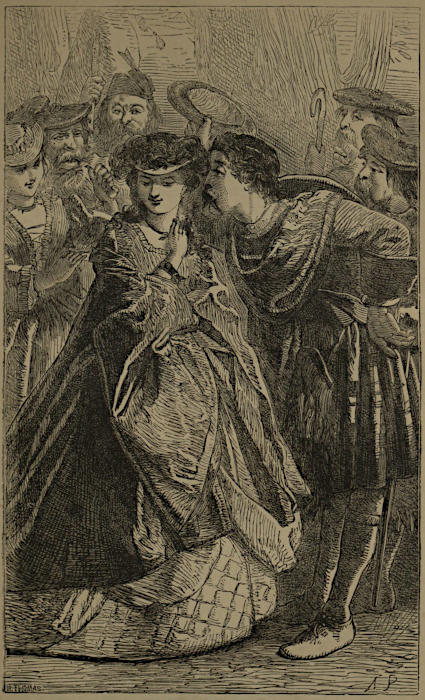
Bounty offered to the Highlanders by Jane, Duchess of Gordon.
Many of the men in these old Highland regiments bore the same
name. We find, for example, in one regiment of 800 men no less
than 700 who have the word Mac prefixed to their names. In
another we find no less than nine John Roses; and as for Donald
Macdonalds, their name was legion. The drill-sergeant showed his
ingenuity in distinguishing the bearers of the same cognomen by
jocular allusions to their personal appearance, which must occasionally
have been not altogether gratifying to the nick-named. In
the same company there would be Donald Macdonald with the red
hair, Donald with the big feet, Donald with the long legs, Donald of
Skye, Donald of Harris, and so forth. When all other means of
distinguishing his recruits failed him, the drill-sergeant had recourse
to figures, and ranked them as Donald Macdonald No. 1, No. 2,
No. 3. No wonder he occasionally got confused amongst so many
Donalds, and lost his temper.
About the close of the last century the citizens of Edinburgh
found much amusement in listening to the calling of the muster-rolls
of one of the newly-raised Highland regiments stationed there, and
studying the ingenuity of the sergeants in distinguishing the countless
Macs and Donalds in their different companies. The ludicrous
effect of such scenes was enhanced by the guttural accent and
imperfect English of the speakers, who, if we may judge by the
following specimen, seem occasionally to have had peculiar ideas of
military duty:—
“Tonald Mactonald No. 5,” cried the sergeant, going over the
muster-roll of his company.
“Here!” cried a voice so shrill and abrupt that it excited a
general titter in the ranks, and the unbounded indignation of the
sergeant.
“Here, ye tamm’d rogue! Is that the way she speaks to a
shentleman? But we a’ ken Tonald’s a liar, sae pit her down absent,
and tak’ her to the guard-room.”
“Tonald Mactonald No. 6,” continued the sergeant.
There was no answer. The sergeant broke forth into a sort of
soliloquy—
“Tonald Mactonald No. 6; that’s my sister’s son frae Achallatus.
Ay, ay, Tonald; she was aye a modest lad, that never spak’ till she
was spoken to, so we’ll put her down present.”
And thus the sergeant went over the whole roll, accompanying
each name with some remark which showed the estimation in which
he held the bearer.
The soldiers of all these regiments wore the scarlet jacket and
waistcoat, with a tartan plaid, the lower part of which was wrapped
round the body, and the upper thrown loosely over the left shoulder.
The plaid served a double purpose: it guarded the soldier’s shoulders
and firelock from rain by day, and was used as a blanket by night.
It was attached to his middle by a belt, from which his pistol and
dirk, or small dagger, were suspended. On his head was worn the
blue bonnet with a border of tartan as at the present day, and a
small tuft of feathers or a piece of bearskin; the kilt was of different
colours to distinguish the regiments. The arms were supplied by
government, and consisted of a musket, a bayonet, and a large
basket-hilted broadsword. In 1769 some alteration was made in
the dress of the 42nd; the men were provided with white cloth
waistcoats, and goatskin and buff leather purses; the officers began
to wear light hangers instead of the heavy broadsword, which was
used only in full dress; and the sergeants were provided with
carbines, and laid aside the ponderous Lochaber axes they had
hitherto carried. In 1776 the broadswords and pistols were laid
aside. The regiment was then serving in America, and it was
objected that the broadswords impeded their movements by getting
entangled in the brushwood. An attempt was subsequently made
to induce them to dispense with the kilt, and to adopt the garb of
the Saxon. It was objected to it then, as now, that it was too hot
in summer and too cold in winter; but the Highlanders stood out
stoutly against the proposed innovation, and the notion of changing
the kilt was abandoned. “We were allowed,” writes a veteran son
of the Gael, “to wear the garb of our fathers, and, in the course of
six winters, showed the doctors that they did not understand our
constitution; for in the coldest winters our men were more healthy
than those regiments who wore breeches and warm clothing.” But
now that the kilt is no longer worn in the Highlands, and few Highlanders
enlist in the kilted regiments, it seems an anomaly to retain
an article of dress which, we venture to say, was never worn by
nineteen-twentieths of our present soldiers till they entered the
army. A large proportion of the officers are English, and it is
rather hard that they should have to adopt a dress which must
strike them at first as barbarous, if not indecent. It is singular,
however, that Englishmen serving in Highland regiments are
usually as fond of the kilt as the Highlanders themselves, and
would be quite as ready to protest against the adoption of a less
peculiar costume.
As to the Highlander’s mode of fighting, it was the simplest thing
in the world. He discharged his musket, threw it aside, drew his
bonnet over his brow, and rushed upon the foe, leaving all the rest to
God and his own good broadsword. It was so that he conquered at
Prestonpans and elsewhere, but it would be difficult to assert that
his undisciplined valour rendered him superior to troops thoroughly
drilled, or that the broadsword is more formidable than the bayonet.
General Stewart, nevertheless, is of a different opinion:—“From the
battle of Culloden, where a body of undisciplined Highlanders,
shepherds and herdsmen, with their broadswords cut their way
through some of the best disciplined and most approved regiments
in the British army (drawn up, too, on a field extremely favourable
for regular troops), down to the time when the swords were taken
from the Highlanders, the bayonet was in every instance overcome
by the sword.”
In one of the skirmishes with the French in Egypt, a young
sergeant of the 78th killed six of the enemy with the broadsword;
the weapon was the same as that still used by sergeants in Highland
regiments. The half-dozen Frenchmen were not cut down
while retreating, but in fighting with the bayonet, hand to hand,
against the broadsword. The gallant sergeant met his death-blow
from a sabre-stroke from behind as he was returning to his company,
after cutting down the last of his six foes. Many other
proofs of the efficacy of the basket-hilted weapon might be
given, but we question whether its warmest admirers would prefer
it to the bayonet in a close attack.
CHAPTER VI. OUR HIGHLAND REGIMENTS— continued .
The Highlanders possessed naturally a great aptitude for
war. It has been said that hunting is the nearest
approach to war in times of peace; and the Highlander,
when not engaged in war, devoted himself to hunting, fishing, and
the practice of athletic sports and manly exercises. He was a deer-stalker
before deer-parks were invented, when deer-stalking was
something different from the easy slaughter now known by that
name; he was accustomed to bear hunger, thirst, and fatigue
without complaint; to sleep in the snow with no other covering
than his plaid; to encounter the members of a hostile clan with no
other weapon than his broadsword. He possessed the virtues and
physical qualities that fit men for war. He was impetuous in
attack and cool under fire. In the hour of danger he exhibited
such courage and presence of mind as nothing could daunt. At
Fontenoy and elsewhere he has thrown himself on the ground as
the enemy began their fire; when their bullets had whistled harmlessly
over his head, he would rush forward till his musket almost
touched their breasts, and pour in the deadly discharge; he would
then retreat, receive their fire as before, and advance in the same
manner. If he had not been possessed of the greatest coolness
and self-possession, such a mode of fighting could only have led to
inextricable confusion.
From an old pamphlet, published in 1745, we learn that a Highlander
of the 42nd Regiment killed nine Frenchmen with his broadsword
at Fontenoy, and would probably have added to the number
of the slain if he had not lost his arm. In a skirmish with the
Americans in 1776, Major Murray, of the same regiment, being
separated from his men, was attacked by three of the enemy. His
dirk had slipped behind his back, and, being very corpulent, he
could not reach it: he defended himself as well as he could with
his fusil, and, watching his opportunity, seized the sword of one of
his assailants, and put the three to flight. It was natural that he
should ever retain that sword as a trophy of victory. In another
skirmish during the same war, a young recruit belonging to Fraser’s
Highlanders slew seven of the enemy with his own hand. At the
close of the engagement his bayonet, once perfectly straight, was
twisted like a corkscrew. At the affair of Castlebar, in Ireland,
when men of other regiments retreated, a Highland sentinel refused
to leave his post without orders. It was in vain that they tried to
persuade him to retire—he stood there alone against a host. Five
times he loaded and fired; a Frenchman fell at every shot. Before
he could put his musket to his shoulder a sixth time the enemy
were upon him, and many a bayonet passed through his body. The
power of discipline could scarcely carry a man farther than this.
The soldier who could meet a host without flinching must have had
the soul of a hero. Highlanders have been equally patient and
enduring in meeting the onsets of hunger and famine. The 1st
Battalion of the 78th Regiment was wrecked during the passage
from Java to Calcutta in 1816. The days and nights from the 9th
of November to the 6th of December were spent on the rocky
isle of Preparis, without shelter and almost without food. One
ounce of bread and half a glassful of rice was the daily allowance of
each person for nearly a month. At length even this miserable
supply failed, and the shell-fish picked up at low water became
their only means of support. At such a juncture the most generous
of men might have become selfish; but such was the effect of discipline
among these half-famished Highlanders, that with death
staring them in the face they could resist the cravings of hunger,
and bring all their gatherings to one common stock, which was
equally divided among them all. Their fortitude was rewarded by
the arrival of a ship which carried them in safely to Calcutta.
Numerous proofs of their cunning and address in war might be
cited. On the day before the battle of Fontenoy the Earl of
Craufurd advanced with the Highlanders to examine the enemy’s
outposts. A Highland soldier, stationed in dangerous proximity to
the enemy, was annoyed by one of their sharpshooters firing at his
post, and had recourse to an ingenious expedient to rid himself of
this annoyance. He crept stealthily forward and placed his bonnet
on the top of a stick near the verge of a hollow road. While the
Frenchman’s attention was fixed on his supposed antagonist, Donald
advanced unperceived to a spot where he could take sure aim, and
brought down the unfortunate marksman. In a skirmish with the
American rebels in 1777, Sergeant Macgregor, of the 42nd, was
severely wounded, and remained insensible on the ground. Unlike
Captain Crawley, who put on his old uniform before Waterloo, the
sergeant, who seems to have been something of a dandy, had attired
himself in his best, as if he had been going to a ball, and not to a
battle. He wore a new jacket with silver lace, large silver buckles
in his shoes, and a watch of some value. This display of wealth
attracted the notice of an American soldier, who, actuated by no
feeling of humanity, but by the sordid desire of stripping the
sergeant at leisure, took him on his back and began to carry him off
the field. It is probable that the American did not handle him very
tenderly, and the motion soon restored him to consciousness. He
saw at once the state of matters, and proved himself master of the
occasion. With one hand he drew his dirk, and, grasping the
American’s throat with the other, he swore that he would stab him
to the heart if he did not retrace his steps, and bear him back in
safety to the British camp. The argumentum ad hominem in the
shape of a glittering dagger before his eyes was too much for the
American. On the way to the camp he met Lord Cornwallis, who
thanked him for his humanity, but he had the candour to admit the
truth. His lordship, who was much amused at the incident, gave
the American his liberty, and, on Macgregor retiring from the
service, procured for him a situation in the Customs at Leith. He
probably thought that the man who could entrap a Yankee would be
more than a match for any smuggler. In a war with the Cherokees
in 1760, Allen Macpherson, a private in Montgomery’s Highlanders,
fell into the hands of the enemy. Anxious to escape from the cruel
torture that awaited him, he signified that he had something of
importance to communicate. An interpreter was introduced, and
the Indians stood by in solemn silence. He informed them that he
was a medicine-man, and knew of certain herbs, which, if applied to
the skin, would enable it to resist the sword or the tomahawk,
though wielded by the strongest arm; if they would conduct him
to the woods, and allow him to collect these herbs, he would use
them so as that their bravest warrior might strike at his neck
without injuring him. Such an assertion found ready credence
with superstitious Indians, and they complied with his request.
Macpherson was as cool and confident in his bearing as if he had
nothing to dread: he rubbed his neck with the juice of the first
herbs he had picked up, laid his head calmly on a block of wood,
and invited the ordeal. An Indian raised his tomahawk and struck
at his neck with such force that his head flew several yards from his
body. The Cherokees, far from resenting the trick which had been
played upon their credulity, expressed their admiration of his address
and courage by refraining from torturing the other captives. We
could give many proofs of the Highlander’s ingenuity in attacking
others or defending himself, but we confine ourselves to a single
incident which tends to prove his dexterity in imposing on the
enemy. During the siege of Quebec, the French had planted
sentries along the river to challenge all who approached. During
the night attack which ended in the capture of the town, the first
boat with English troops was observed and challenged. “Qui vive?”
A moment’s hesitation, and all would have been lost. An officer of
Fraser’s Highlanders who had served in Holland, and knew the
watchword, at once replied, “La France.” The second part of the
challenge was given and satisfactorily answered. The sentinel
became troublesomely inquisitive. “A quel régiment appartenez-vous?”
“Au régiment de la Reine.” It was fortunate that the
captain knew that a regiment of that name was serving in Quebec.
The soldier, satisfied with these replies, allowed all the boats to pass
without further challenge: he thought it was an expected convoy
with provisions, and no time was lost when the magic word “passe”
was heard. The other sentries took it for granted that all was
right; there was only one who had some suspicion. Struck with
the silence on board the boats, he rushed down to the water’s edge,
and called, “Pourquoi est-ce que vous ne parlez pas haut?” The
suspicion implied in this question was at once disarmed by the
officer replying in a subdued tone, “Tais-tois, ou nous serons
entendus.” That cunning Highlander had not studied French for
nothing—it gained for the British: Quebec.
A striking trait in the character of the Highlanders was their
devoted attachment to their own regiments and officers. When
clanship had all but died out in the North, it was found lingering
among the Highland soldiers. The Highlander’s regiment was his
clan, and his colonel his chief; and to his corps and commander he
did the same fealty as in the days of yore to clansmen and their
head. This feeling was peculiarly prominent in those regiments
which were under the command of cadets of ancient Northern
families, who felt in themselves and tried to revive in their men the
old ties of clanship. Cameron, of the 92nd, who fought and fell
at Quatre Bras, was less the colonel than the chief of that gallant
regiment, which was raised partly in Lochaber, his native district.
He knew every man in his regiment, and watched over their
interests as if they had been his brothers or his sons. An angry
look or a stern word from him was dreaded more than the lash.
He was their father, and when he fell there rose from his mountain
children that wild wail of sorrow which once heard can never be
forgotten. Brave, impetuous, and headstrong, jealous of his own
honour and that of his regiment, Cameron has always struck us as
the beau idéal of a Highland officer of the better class; while Captain
MacTurk, that admirable creation of Scott, may be safely accepted
as the faithful representative of a once numerous class, the all but
countless subalterns who had risen from the ranks, and who puzzled
the post-office and confused the directory by the similarity of their
names. The old clannish feeling is perceptible in the language used
by Highland veterans in alluding to their past services. They do
not say that they served in the 42nd, the 78th, the 79th, the 92nd,
or the 93rd regiment; but, when inspired by usquebaugh or ancient
reminiscences, they begin to fight their battles o’er, they preface
their narrative with, “When I was in the Black Watch, the Ross,
the Cameron, the Gordon, or the Sutherland regiment.” The name
to them is everything: the number by which the regiment is known
at the Horse Guards is a number, and nothing more. This attachment
of the Highlanders to their own regiments was so well-known
during the last century that it was sometimes taken advantage of
by the recruiting sergeants, who assumed the Highland dress, and
persuaded the recruits they were about to join a Highland regiment.
When such was not the case, the rage of the Highlanders on discovering
the imposture was unbounded; they appealed to the
military authorities, and on their obtaining their discharge re-enlisted
at once in one of their own regiments. These regiments,
when first raised, could always command a larger number of men
than they actually required. When the Fraser Highlanders embarked
for foreign service in 1776, it was found that more men had
joined than the strength of the different companies admitted, and
several were dismissed. Such, however, was their anxiety to serve,
that they concealed themselves in the ship, and were not discovered
till the fleet was at sea. An incident occurred on this occasion
which proves that the esprit de clan, if we may so speak, was even
stronger than the esprit de corps. A hundred and twenty men had
been raised on the forfeited estate of Cameron of Lochiel, so as to
entitle him to a company: detained by sickness in London, he was
unable to join his regiment in Glasgow. The Camerons, unwilling
to serve any one but their chief, hesitated to embark, till young
Fassiefern, one of their clansmen, and a near relative of Lochiel,
was appointed to the command of the company, when all their
scruples were removed. Lochiel, on hearing of the conduct of his
men, hurried down from London; but the fatigue of the journey
brought on a fresh attack of disease, to which he fell a victim in a
few weeks. The regiment was under the command of General
Fraser, a son of Lord Lovat. He addressed the Camerons in Gaelic,
and his eloquence had much effect in winning them back to obedience.
While he was speaking, a venerable Highlander was seen
leaning on his staff and listening with rapt attention. When he
had finished, the old man stepped up to him, and seizing his hand
with an easy familiarity which marked the intercourse of all classes
in the North, said, “Simon, you are a good soldier, and speak like
a man; as long as you live, Simon of Lovat will never die.” The
general, doubtless, appreciated this double compliment; his father
was a favourite among the Highlanders, and it was implied that the
son was worthy of the sire. The young recruits always wished to
serve under officers of their own clan, and felt it a hardship to be
separated from them. It was not enough that they served in the
same regiment; they wished to belong to the same company. Young
Fassiefern brought a hundred Lochaber men to join the 92nd at
Aberdeen. When it was proposed to draft them into different companies,
they refused to be separated, or to serve under any officer
save their young chief. It was only by pledging his honour that he
would watch equally over the interests of all that he could persuade
them to submit; his letters to his father prove that he never forgot
his promise. They were true to one another to the end; when a
Lochaber man died, Cameron followed him to the grave, reminded
his sorrowing comrades of his soldierly virtues, and told them to
“give him the smoothest bed, and to cover him with the greenest
sod.” To understand the delicacy of this order, one must have
witnessed a Highland funeral, or seen the smooth, level, turf-covered
graves in a Highland churchyard. There was no sacrifice
which they were not prepared to make for officers who thus studied
their interests and feelings. They were as jealous of their honour
as of their own; cowardice in the chief brought disgrace on his
clan. There was a singular display of this feeling in one of the
Crimean battles: a young Highland officer left his place in front of
his company and began to retreat, when a sergeant seized him by
the throat, and swore he would run him through the body if he did
not turn. He chose rather to meet the fire of the Russians than the
glare of the sergeant’s angry eye. This jealousy of their officers’
honour gave rise to an amusing incident during the attack on Fort
Washington in 1777. The hill on which the fort stood was almost
perpendicular, but the Highlanders rushed up the steep ascent
like mountain cats. When half-way up the heights they heard a
melancholy voice exclaim, “Oh, soldiers, will you leave me?” On
looking down, they saw Major Murray, their commanding officer, at
the foot of the precipice; his extreme obesity prevented him from
following them. They were not deaf to this appeal: it would never
do to leave their corpulent commander behind. A party leaped
down at once, seized him in their arms, and bore him from ledge to
ledge of the rock till they reached the summit, where they drove the
enemy before them and made two hundred prisoners. Major Murray
was not the only corpulent warrior among those Highland soldiers.
Sir Robert Munroe of Fowlis, who commanded them at Fontenoy,
was so fat that his own men had to haul him from the trenches
by the legs and arms; he advised them to fall flat on the ground
when the enemy fired, but remained erect himself, remarking
that it was easy for a man of his weight to lie down, but not so
easy to rise. Some of the men seem to have been as remarkable
for height as their officers were for breadth. Thus we read of
Samuel Macdonald, or “Big Sam,” of the Sutherland Fencibles, who
was seven feet four inches in height, and stout in proportion. As
the other men would have looked like pigmies beside such a giant,
he stood on the right of the regiment when in line, and marched at
its head when in column, followed by an immense mountain deer,
between which and him there were certain physical, if not spiritual,
affinities. He was an excellent drill, and, like most giants, extremely
good-natured. Ordinary rations would not have sufficed to sustain
such a corpus; he was therefore allowed half-a-crown a day of
extra pay. Attracting the attention of the Prince of Wales, he
made him one of the porters at Carlton House. But Macdonald
soon tired of this inactive life, and longed to be with his old
comrades of the 93rd. He rejoined the regiment, and died at
Guernsey in 1802. Sam’s regiment seems to have been remarkable
for the size and muscular strength of the men. It had no light
company, and as more than 200 men were upwards of five feet
eleven inches in height, they were formed into two grenadier companies,
one on each flank of the battalion.
The retirement or the removal of one of their favourite officers to
another regiment called forth the strongest feelings of sorrow, and
sometimes almost led to open resistance. It occasionally happened
that these officers were Englishmen, who with the garb of the
mountains had adopted all the feelings of the mountaineers.
Cadogan, who commanded the 71st in the Peninsula, was a Saxon,
and yet no Celt was ever dearer to his men. The Pretender would
never have been so popular in the North if he had not worn the
tartan; the same may be said of Montrose and Dundee, neither of
whom was a Highlander by birth. If English officers failed to gain
the affections and respect of their men, it was because they failed to
make themselves acquainted with their character, and inadvertently
wounded their feelings. Such cases, however, were rare. English
officers serving in Highland regiments possessed the esprit de corps
as much as the Highlanders themselves. At first, as we have shown,
all the officers belonged to the North, and it was a point of honour
with the men either to protect them in battle or to avenge them
if slain. We might cite many cases where Highland soldiers
sacrificed their own lives to save those of their officers, stepping before
them and receiving in their own bodies the bullet or the bayonet-thrust
aimed at their officers’ breasts. When a favourite fell, woe
betide the enemy at the next charge: every Highlander fought as
if his arm alone were the instrument of vengeance. When Cameron
fell at Quatre Bras, by a shot fired from the upper storey of the
farm-house, his men rushed with a wild shout on the building,
burst their way in, and avenged by the slaughter of all its occupants,
the death of their leader.
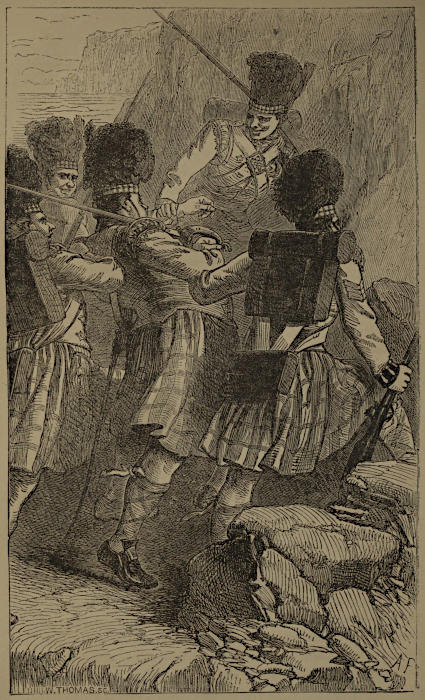
Major Murray and the Highlanders at Fort Washington.
While the duty of avenging the death of a beloved officer was
incumbent upon all, it devolved with peculiar stringency on his
foster-brother, who always kept near his person in battle. This
duty is frequently alluded to in the proverbial expressions of the
North. “Kindred to twenty (degrees), fosterage to a hundred,”
was a received maxim in the code of Celtic ethics. “Woe to the
father of the foster-son who is unfaithful to his trust,” is another
old saying which proves that this tie was regarded as sacred. Scott
has described this singular relationship among the Highlanders in
“Waverley,” and many illustrations might be given of the deeds of
unselfish devotion to which it gave rise. Often the foster-brother
thrust himself before his officer, and shielded him from danger
by the sacrifice of his own life. If he had failed to do so, his
own mother would have been the first to reproach him for his
cowardice—ay, and to disown him as her son. There was much of
the old Spartan feeling among these Celtic mothers. The wives of
those Northern chiefs seem to have had no great liking for the
primary duties of domestic life; instead of rearing their own children,
they distributed them among their tenantry, who considered themselves
honoured by the confidence thus reposed in them. This
singular custom tended to render the tie between the chief and his
clan closely intimate: they felt themselves to be members of one
great family. Cameron of Fassiefern, with whose portrait our
readers are familiar, was followed wherever he went by his faithful
henchman and foster-brother, Ewen M’Millan. His devotion to
his chief was unbounded; it absorbed every other feeling, and
became the master-passion of his life. At the battle of St. Pierre,
Ewen gave an amusing proof of his regard, not only for his master,
but also for his master’s property. Cameron’s horse, being wounded,
fell, and nearly crushed him. A Frenchman rushed forward to
bayonet him while thus disabled; but, before the blow had reached,
Ewen came up and pierced the Frenchman to the heart. Ewen then
raised his master from his dangerous position and conducted him to
a place of safety, after which he returned and carried off the saddle
on which Cameron had sat. All this was done with the greatest
coolness, though the battle was at its height, and the bullets of the
enemy were flying on every side. When Ewen rejoined his company,
he displayed his trophy to his comrades, and exultingly exclaimed,
“We must leave them the carcass, but they sha’n’t get the saddle
where Fassiefern sat.” It was evidently a seat of honour, and too
sacred an object in Ewen’s eyes to be left in possession of the
French; and to save the saddle the disgrace of receiving part of
another’s person, he was ready to risk his life. When Cameron fell
at Quatre Bras, his devoted foster-brother was in a moment at his
side, and, raising him in his arms, he bore him from the field
of battle till he found a cart, on which he laid him. Seating himself
by his side, he propped the head of his dying chief on his own
faithful breast, and tried in vain to stanch the life-blood fast ebbing
away. It was all in vain: the bullet had done its deadly work, and
Ewen could only weep over the grave of one for whom he would
have gladly died. Such faithful attachment deserved to be rewarded,
and Cameron’s father provided Ewen with a farm on his own estate
when he obtained his discharge after the battle of Waterloo.
It may amuse our readers to learn the opinion of the Highlanders
formed by those who have encountered them in the field of battle.
Their strange dress, their lofty stature, their unknown tongue, and
their singular mode of fighting, all naturally produced a deep
impression on the minds of their enemies, who regarded them
almost with a feeling of superstition. A French writer, alluding
to the battle of Fontenoy, says, “The British behaved well, and
could be exceeded in ardour by none but our officers, who animated
the troops by their example, when the Highland furies rushed in
upon us with more violence than ever did a sea driven by a tempest.”
The Highlanders took part in the capture of Guadaloupe; and it
appears from letters written from that island that the French had
formed the wildest notions regarding the sauvages d’Ecosse (Scotch
savages), as they were pleased to term them. They believed that
they would neither take nor give quarter, and that they were so
nimble that, as no one could catch them, nobody could escape them;
that no man had a chance against their broadswords; and that, with
a ferocity natural to savages, they made no prisoners, and spared
neither man, woman, nor child. As the Highlanders were always
in the front during the attack on the island, we need not be
surprised that the good people of Guadaloupe quailed at the sight
of such a redoubtable foe, and offered but little resistance. Such
was the activity of the Highlanders in attacking them at different
points, that they believed that they amounted to several thousands,
whereas their real strength was only 800. A French general, in
reference to the gallantry of the Highlanders at Toulouse, said,
“Ah, these are brave soldiers. If they had good officers, I should
not like to meet them unless I were well supported.” As their
officers had never received much training for war, their bravery
was often more conspicuous than their knowledge of the military
art.
Keith’s Highlanders particularly distinguished themselves in the
German wars which were carried on about the middle of the
eighteenth century. Macaulay has shown that the English at one
time did not hold their Northern neighbours in high estimation;
but it appears that the Germans entertained still more erroneous
ideas regarding them. “The Scotch Highlanders,” says a writer in
the Vienna Gazette of 1762, “are a people totally different in their
dress, manners, and temper from the other inhabitants of Britain.
They are caught in the mountains when young, and still run with
a surprising degree of swiftness. As they are strangers to fear,
they make very good soldiers when disciplined.” The writer
proceeds to admit that they are not without some amiable qualities,
and charitably concludes his article by expressing a hope “that
their king’s laudable, though late, endeavours to civilize and instruct
them in the principles of Christianity will meet with success.” The
French and Germans, along with Englishmen, have during the last
hundred years learned to know the Highlanders better.
We happened the other day to find ourselves in the society of a
number of officers, some of whom had seen service in every quarter
of the globe. Allusion was made to Highland soldiers, when an
English colonel exclaimed, “They are the most troublesome fellows
in the service. I have seven of them in my regiment, and they have
given me more annoyance about their rights and grievances than
all my other men.”
“The reason is very simple,” rejoined an officer, who hailed from
the land of the Gael; “you don’t know how to manage them.”
In these simple words may be found the secret cause of the
mutinies which so frequently broke out among the Highland
regiments when first organized. The government of the day did
not know how to manage them: hence insubordination, discontent,
and frequent mutiny. The 42nd, or Old Black Watch, was, as we
have shown, the first body of Highlanders formed into a regular
regiment. Many of the privates were men of good family and
liberal education, who were drawn into the service by their natural
love of arms. It was distinctly understood that the sphere of their
services was not to extend beyond their native country, to which
they were warmly attached; and when in March, 1743, they
were ordered to proceed to England, many of the leading men of
the North, including Lord President Forbes, ventured to remonstrate.
Their remonstrances were vain; the government persisted
in their resolution, but the suspicions of the Highlanders were
disarmed by appealing to their vanity. They were assured that
the king was anxious to see so gallant a regiment, and that after
being reviewed by royalty they would be allowed to return to their
native land. The men were treated with the greatest kindness in
the different English towns through which they passed; their
warlike bearing and correctness of conduct secured for them the
admiration and esteem of all with whom they were brought into
contact. On the 14th of May they were reviewed on Finchley
Common by Marshal Wade, in the presence of vast crowds who
had hurried from London to see les sauvages Ecossais. It was
unfortunate the king was not present at this review; his absence
induced the Highlanders to lend a ready ear to the insidious
report circulated among them by the adherents of the Stuarts that
they were about to be transported to the American plantations.
The Highlanders were stung to madness by the supposed treachery;
but, with characteristic caution, they concealed their intentions till
their plans were matured. They whispered to one another that,
“after being used as rods to scourge their own countrymen, they
were now to be thrown into the fire.” They resolved to die rather
than submit to such a fate.
On the night between Tuesday and Wednesday after the review
they assembled on a common near Highgate, and commenced their
march to the land of their birth. They had friends and sympathisers
in the city who supplied them with provisions. Their march
was conducted with such secrecy that for a week nothing was
known of their route. They had reached Lady Wood, between
Brigstock and Deanthorp, about four miles from Oundle, when
Captain Ball, an officer of Wade’s regiment of horse, was sent to
treat with them. He requested them to lay down their arms and
surrender at discretion, but they declared with one voice that they
would be cut to pieces rather than submit, unless they were allowed
to retain their arms and received a free pardon. All that Captain
Ball could promise was to recommend them to mercy; but the
pride of the Highlanders revolted at such a proposal.
“Hitherto,” then exclaimed the captain, “I have been your
friend; but if you continue obstinate an hour longer not a man of
you shall be left alive; and for my part, I assure you, I shall give
quarter to none.”
The Highlanders, who had too much generosity to resent this
bold language, sent two of their number to escort him out of the
wood. The guides were won over by his eloquence: one of them
remained with him, while the other returned and tried to persuade
his comrades to submit. Surrounded as they were by superior
numbers, they were, after some negotiation, induced to surrender.
They received a free pardon, and soon after embarked for Flanders,
where their deeds of bravery atoned for their temporary disaffection.
A similar incident occurred in the case of a Highland regiment
in the service of William III. It was the ardent love of country
that led them to refuse to embark for Holland, and their devotion to
King James that led them to drink his health while there in preference
to that of their own prince. Some one reported this to
William.
“Do they fight well, these Highlanders?” asked the king.
“None better,” was the reply.
“Then,” said the king, “if they fight so well for me, let them
drink my father’s health as often as they choose.”
There was much magnanimity in these words. The Highlanders
soon learned to drink William’s health as heartily as they had done
his father-in-law’s.
In the year 1779 a circumstance occurred which proves in the
most striking manner the attachment which the Highlanders have
ever cherished for their own regiments. In the month of April
two strong detachments belonging to the 42nd and 71st regiments
arrived at Leith from Stirling Castle, en route to North America to
join their respective regiments. On learning that they were about
to be drafted into the 80th and 82nd, both Lowland regiments, the
men firmly refused to obey this order, or to serve in any regiments
save those for which they had been enlisted. A little friendly
remonstrance might have won them over, but the authorities unfortunately
adopted the idea of reducing them by force, and troops
were sent to Leith for the purpose of subduing the mutineers and
conveying them to Edinburgh Castle. This was no easy task, as
the event proved. The Highlanders offered an obstinate resistance,
and in the conflict which ensued, Captain Mansfield, of the South
Fencible regiment, and nine men were killed, and thirty-one soldiers
wounded. At length, overpowered by numbers, the Highlanders
were compelled to surrender, and were shut up in Edinburgh Castle.
In the month of May three of the prisoners, Charles Williamson and
Archibald Mac Ivor, of the 42nd, and Robert Budge, of the 71st,
were tried by court-martial for having been guilty of mutiny and
inciting others to the same crime. The line of defence they adopted
gives us considerable insight into the state of the Highlanders at
this period. Mac Ivor and Williamson stated that they enlisted in
the 42nd, a regiment composed exclusively of Highlanders, and
wearing the Highland dress. Their native tongue was Gaelic, and
they knew no other, having been born in counties where English
was almost unknown. They had never worn breeches in their
lives, and the only garb they could wear with comfort was the garb
of old Gael. This dress had indeed been prohibited by Act of
Parliament; but the government had connived at the use of it,
provided that it was made of plain cloth and not of tartan. For
these reasons they could neither understand the language nor use
the arms, or march in the dress of any other than a Highland
regiment. Budge’s defence was substantially the same. They
submitted to the court that, on reaching Leith, the officer who had
conducted them there informed them that they were now to consider
themselves soldiers of the 82nd, a regiment wearing the Lowland
dress and speaking the English tongue. No order from the commander-in-chief
was shown to them, nor had they any opportunity
of submitting their grievances to him. They had no intention to
resist lawful authority; they only wished to remonstrate against an
act of flagrant injustice. They would have gone willingly to the
castle if the order had been explained to them; but the officer sent
for that purpose told them that they were to join the Hamilton
regiment immediately, and they considered themselves justified in
repelling force by force. Every reader will feel his blood boil with
indignation on learning that these three poor Highlanders were all
found guilty and sentenced to be shot. The spirit of clanship,
however, was too strong in the Highland regiments to admit of
this sentence being carried into effect, and the king was pleased to
grant them a free pardon, “in full confidence that they would
endeavour, by a prompt obedience and orderly behaviour, to atone
for their atrocious offence.” Without passing an opinion on the
atrocity of the offence, we have much pleasure in adding that all
the prisoners proved themselves worthy of the royal clemency.
They were drafted into the second battalion of the 42nd, and were
uniformly distinguished for their steadiness and good conduct.
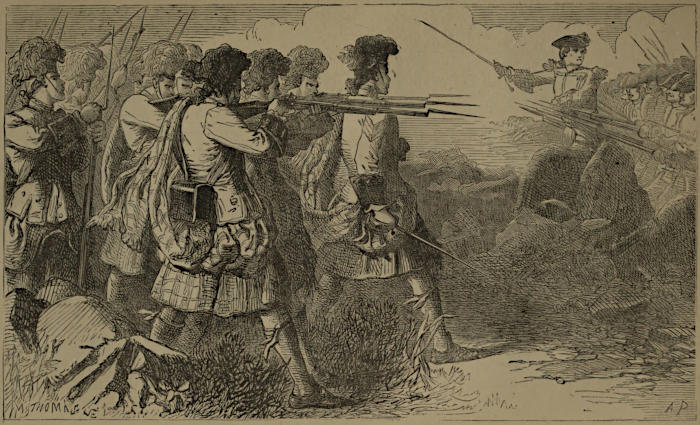
The Mutiny of the Black Watch.
It may be safely affirmed that the Highland regiments never
displayed a spirit of insubordination, except on those occasions
when the government of the day attempted to treat them with
injustice by transferring them to Lowland regiments, or ordering
them to embark for foreign service when they had enlisted to serve
for a limited period at home. The 77th regiment, or Athole
Highlanders, was raised in 1778 by the young Duke of Athole.
The Murrays have always been a warlike race, and their young
chief, the present Duke of Athole, the possessor of princely estates,
is serving in Canada with the 2nd battalion of the Scots Fusilier
Guards. The Athole Highlanders embarked for Ireland in June,
1778, and did garrison duty there till the war was over. The part
they had to play was somewhat difficult; the Irish were disaffected,
and hated the troops sent to control them; but the conduct of the
Highlanders was so exemplary as to secure for them the respect of
their enemies. Mr. Eden, afterwards Lord Auckland, Secretary
for Ireland, bears honourable testimony to this fact. After alluding
to the gentlemanly bearing of the officers, and the excellent conduct
of the men, he says—“Once, upon the sudden alarm of invasion, I
sent an order for the immediate march of this regiment to Cork,
when they showed their alacrity by marching at an hour’s notice,
and completed their march with a despatch beyond any instance in
modern times, and this, too, without leaving a single soldier
behind.”
There are few regiments at the present day that could undertake
the same march at an hour’s notice, and complete it without leaving
a single man behind; such a fact says much for the discipline,
strength, and pluck of the Athole Highlanders. The government
showed their appreciation of these services by attempting to break
faith with them. The Highlanders had enlisted for three years.
Their period of service had now expired, and they naturally
expected to be disbanded. Instead of this, they were sent to
Portsmouth to embark for foreign service. At first they offered
no resistance; when they caught the first view of the fleet at Spithead
as they crossed Portsdown Hill, they pulled off their bonnets and
gave three cheers at the prospect of a brush with Hyder Ali. If
the government had been wise enough to tempt them to re-enlist
by the offer of a fresh bounty, a gallant regiment might have been
preserved to the British army; but, unfortunately, they had no
sooner reached Portsmouth than emissaries from London began to
poison their minds by pointing out to them the injustice of the
authorities in sending them abroad when they ought to have been
disbanded. It was even insinuated that they had been sold to the
East India Company at so much a head, and that their officers had
shared in the purchase-money. These representations had the
desired effect. The Highlanders, suspicious of their officers, and
brooding over their wrongs, refused to embark. For several days
they remained in a state of mutiny, during which they attempted
to gain possession of the main guard and garrison parade, when one
of the invalids who opposed them was accidentally killed. No
sooner was it known that the poor man had left a widow than the
Highlanders expressed the deepest regret, and raised a considerable
sum for her relief.
The greatest anxiety was caused at Portsmouth by the presence
of a thousand men free from all restraint; but the lives and
property of the citizens were respected, and no complaints were
ever made against the Highlanders. Though they had reason to
suspect their officers of treachery, they almost invariably continued
to treat them with deference and respect. On hearing, however,
that two or three regiments were approaching to force them on
board, they flew to arms and marched out to offer them battle. On
finding that it was a false report, they quietly returned to their
quarters. The Duke of Athole, his uncle, Major-General Murray,
and Lord George Lennox, hurried down to Portsmouth in the hope
that their presence and influence would induce the men to embark;
but the minds of the latter were too much embittered by a sense
of injustice to be swayed by the counsels of their hereditary chiefs.
The discipline of the regiment was as strict as if they had been
still under the command of their officers. Their arms and ammunition
were placed in one of the magazines, and a strong guard
placed over them while the rest of the regiment slept or partook of
their meals. Twice a day they appeared at the grand parade,
along with the adjutant and other officers. They were as careful
of their dress and personal appearance as before. The government
were at a loss what to do with the dreaded Highlanders. One day
it was proposed to turn the great guns on the ramparts against
them; but, fortunately, this proposal was overruled; the bloodshed
would have been great, the result doubtful. At other times it was
suggested to send some regiments stationed in the neighbourhood
against them. On hearing this the Highlanders flew to arms, drew
up the drawbridges, placed sentinels on them, and prepared to offer
an obstinate resistance.
At length the question of the mutiny was brought under the
consideration of Parliament, and the just claims of the Highlanders
were admitted. The regiment was disbanded, and the men spread
through the Highlands the report of the injustice with which they
had been treated, and thus prevented many of their countrymen
from entering the army. When treating of this affair, General
Stewart observed that “If government had offered a small bounty
when the Athole Highlanders were required to embark, there can
be little doubt they would have obeyed their orders, and embarked
as cheerfully as they marched into Portsmouth.” This untoward
event will remind our readers of what occurred in India when the
attempt was recently made to transfer the European troops from
the service of the East India Company to that of the imperial
government. Through the niggardly policy then adopted, thousands
of men inured to service in that trying climate were roused into a
state of mutiny, and compelled the authorities to grant them their
discharge. In this case, as in that of the Athole Highlanders,
a small bounty would have settled the difficulty and satisfied every
claim.
There are old people still alive in Scotland who remember the
sensation created in the days of their boyhood among all classes by
“the affair of the wild Macraes.” The Macraes never rose to the
dignity of a clan; they were a small sept that lived under the
protection of the Mackenzies of Seaforth. The Earl of Seaforth
had forfeited his title and estates in consequence of the part he
took in the rebellion of 1715, when many of the Northern gentry
rose in favour of the Pretender. Kenneth Mackenzie, the grandson
of this earl, bought the family property from the crown, and was
created Viscount Portrose in the Irish peerage. In 1771 the family
title was restored to him, and the Earl of Seaforth, anxious to prove
his gratitude to the government of the day for the favours he had
received, offered in 1778 to raise a regiment among his own clan
for general service. The Highlanders had already acquired a
distinguished name on many a battle-field, and his offer was at
once accepted. All the gentlemen of the clan Mackenzie came to
the aid of their chief, and a corps of 1130 men was soon raised:
500 Highlanders belonged to Seaforth’s estates; 400 to the
Mackenzies of Scatwell, Kilcoy, Applecross, and Redcastle; about
200 were Lowland Scotch; 43 were English and Irish. It is
interesting to mark the constitutional elements of this and other
Highland regiments. The fact is undeniable that the Highlands of
Scotland were far more populous a century ago than they are now.
The poorer inhabitants have been driven to Canada and other
colonies; their small farms have been changed into deer-parks or
sheep-walks; the landlords have increased their rentals, but the
country has lost an important class and reaped no adequate advantage
in return. The regiment thus embodied was known as the
78th, or Seaforth Highlanders. It is not to be confounded, however,
with the present 78th, or Ross-shire Buffs; it is now represented
by the 72nd, or Duke of Albany’s Own Highlanders.
Almost all the officers were Mackenzies, and the sons and brothers
of the different lairds vied with one another in selecting the best
men that could be found on their estates. The results of this
care on their part were apparent when the regiment was inspected
at Elgin in May, 1778: of those 1130 men not one was rejected—an
astounding fact when we consider that nearly one-fourth of our
recruits are now pronounced unfit for service in consequence of
some physical defect. In the month of August they embarked for
Leith, where “the affair of the wild Macraes” occurred.
CHAPTER VII. OUR HIGHLAND REGIMENTS— continued .
The Macraes, as we have already said, had never attained
to the dignity of a clan; they were a sort of caterans or
pilfering tinkers, who had found it convenient to place
themselves under the protection of the chief of the Mackenzies. It
appears that Seaforth had no particular liking for his pilfering
protégés, and deemed this a favourable opportunity for getting quit
of them. It is a fact not generally known that our Highland
regiments have often obtained their best recruits from the fraternity
of cairds or caterans. About half a century ago the whole of the
North of Scotland was infested with these marauders, who, under
the guise of mendicancy, levied contributions on the inhabitants of
the rural districts, and lived a jovial, careless life. They were
present at every marriage feast and merry-making, where the broken
meat became their perquisite; sometimes they devoured the feast
itself, and left the guests to shift for themselves. There was no
rural constabulary in those days to keep them in check, and these
Ishmaelites did very much whatever they chose. They were unrivalled
in wrestling, single-stick, and every athletic sport; they were
the best dancers on the village green; they could do everything but
work or settle down to any fixed employment. They were essentially
a nomadic race, ever on the move, sleeping by night in country
barns, starting with the earliest dawn, and levying their contributions
from door to door. We remember a gang of caterans or
cairds who frequented the county of Aberdeen more years ago than
we should like to tell. They all bore the family name of Young,
and belonged to the same sept. One of them—Peter Young—was a
great thief, and made himself almost as notorious as Jack Sheppard
by breaking out of every gaol in Scotland. These caterans came to
a singular end, and disappeared from the country. This is how it
happened.
The 92nd or Gordon Highlanders had suffered much in the
Peninsular War, so that constant drafts had to be sent out from
home to recruit their strength. When all other resources failed,
the country gentlemen bethought themselves of an ingenious plan
by which they could at once fill up the vacant ranks in the 92nd,
and get quit of some unpleasant neighbours. They caused all the
able-bodied cairds to be seized and conveyed to the neighbouring
seaport, where they were shipped off to join the 92nd. Such a
thing, of course, could not be done at the present day, but strange
things were done half a century ago in Scotland as elsewhere.
Many a man who had no desire to be a sailor or a soldier was
impressed or forced to serve in the army or navy against his will.
This impressment of the Youngs proved the death-blow of the race.
Not one of them ever returned from the Peninsula, but we have
heard old pensioners of the 92nd declare that they were at once the
greatest thieves and the smartest soldiers in the regiment.
The wild Macraes seem to have been men of much the same
stamp as the Youngs, and Seaforth doubtless had his own reasons
for wishing to get quit of them. These caterans were as much
attached to their native land as if they had been the possessors of
countless acres; they were their own masters, and had tasted the
sweets of liberty. Seaforth knew that he could never persuade
such men to enlist for foreign service, but he had sufficient
influence to induce them to serve for a limited period at home, or
rather to join the 78th on that understanding. It was only on
reaching Leith that they discovered that they were intended for
service in the East Indies, when symptoms of disaffection appeared
among them. The report spread that Seaforth had sold them to
the government. Loud complaints were heard that they had been
cheated of their pay and bounty money. The wild Macraes were
not the men tamely to submit to such injuries, and the stinging
sense of wrong was intensified by the representations of certain
parties hostile to the government of the day. Their slumbering
discontent broke forth into open mutiny on receiving orders to
embark; they absolutely refused to do so, and marched out of
Leith with pipes playing, and two plaids fixed on poles instead of
colours. On reaching Arthur’s Seat—the beautiful hill which
overlooks Edinburgh, and is familiar to every tourist who has
visited the North—they encamped on its summit, and remained
there for several days. Though in a state of open mutiny, they
respected the property of the citizens, and conducted themselves
with so much propriety that public sympathy was excited in their
favour, especially among the lower classes, who supplied them
abundantly with provisions. The authorities deemed it more
prudent to inquire into their grievances than to attempt to reduce
them by force. After much negotiation they professed themselves
satisfied, and marched back to their quarters at Leith with pipes
playing and Seaforth at their head.
After serving for some time in the Channel Islands, they embarked
in March, 1781, for the East Indies. Seaforth died during the
voyage, before he reached St. Helena, and his death had such
a depressing effect upon the men, that no less than 230 of them
died before they reached India. They took part in all the different
battles which were fought till the conclusion of peace in 1783,
when, in terms of their agreement with government, they had
a right to return home. Few of the Macraes lived to revisit their
native land; most of them had died during the voyage, or succumbed
to the fatal effects of the enervating climate. Only 300 of the men
remained in India; but these, reinforced by volunteers from other
regiments returning home, and by a detachment of 200 recruits
from the North, were formed into a new regiment, which has ever
since been known as the 72nd, or Duke of Albany’s Own
Highlanders.
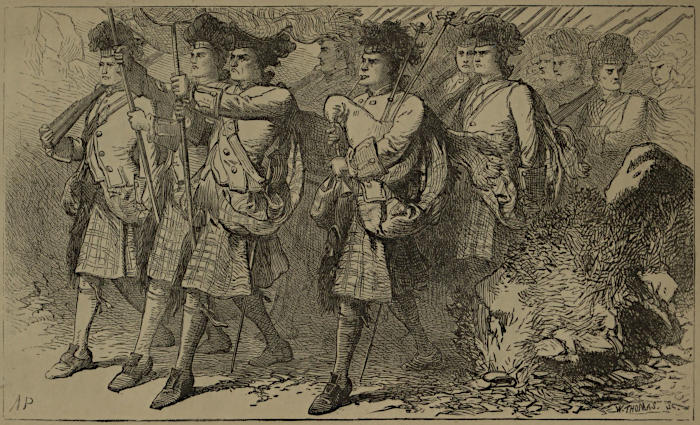
The March of the Wild Macraes to Arthur’s Seat.
A similar mutiny, proceeding from the same causes, broke out in
the 81st, or Aberdeenshire Highland Regiment, in 1783. This
regiment was raised in 1778 by the Hon. Colonel William Gordon,
of Fyvie, a son of the Earl of Aberdeen by his third wife, a
daughter of the Duke of Gordon. She was a sister of that Lord
Lewis Gordon who took part in the rebellion of 1745, and whose
absence from home is lamented in a charming Jacobite song which
is still popular in the North. It is related of her that she took her
stand close to the road by which the Duke of Cumberland and his
army were marching south after the victory of Culloden, holding
her infant son in her arms. Judging by her portrait, which we
have seen, she must have been a very beautiful woman; and the
duke, struck by her appearance, said, with his usual coarse bluntness,
“Who are you?” The countess drew herself up to her full
height, and looking him steadily in the face, boldly answered, “I am
the sister of Lord Lewis Gordon.” Cumberland turned aside his
head and passed on. The Earl of Aberdeen was well advanced in
years when he married her, and it was agreed that the property of
Fyvie should be settled on her or her offspring after his death. The
Hon. William Gordon, who was the eldest son by this marriage,
succeeded to the property, and rose to the rank of colonel in the
service. In March, 1777, he received letters of service to raise a
Highland regiment in his native county, and it was embodied in
1778 under the name of the 81st, or Aberdeenshire Highland
Regiment. Its strength when first raised was 980 men, 650 of
whom belonged to the Highlands of Aberdeenshire; a very large
proportion were members of the clan Ross, the chief of which is
James Ross Farquharson of Invercauld, a lieutenant-colonel in the
Scots Fusilier Guards. The regiment marched to Stirling, and
soon after embarked for Ireland, where it spent three years. In
1782 it was removed to Portsmouth, and received orders to embark
for the East Indies. These orders were in direct violation of their
terms of enlistment, which were the same as those of the Athole
Highlanders, and the men, having agreed to serve till the conclusion
of peace, the preliminaries of which were now settled, refused to
embark, and claimed their discharge. They were, doubtless,
encouraged to take this step by the example of the Athole Highlanders,
and the success which had attended their assertion of their
rights. The government, deeming it useless to attempt to reduce
them by force, yielded to their demands, and sent them to Edinburgh,
where they were disbanded in 1783. There is a tradition
in the county that this mutiny was owing more to the cruelty of
their colonel than the injustice of government. Few of them
belonged to his own clan, and he treated them with a harshness to
which the proud spirit of the Highlanders would not tamely submit.
We have met with old veterans who could tell many stories of
“Whipping Willie Gordon,” the sobriquet he obtained in the
regiment through his fondness for the lash. He left the service
with the rank of general, and spent his latter days at Fyvie Castle,
where he professed himself a misogynist, and ended by marrying
his cook.
An insurrection, attended with still more disastrous results,
occurred in the Grant or Strathspey Fencibles in 1795. This regiment
was raised by Sir James Grant of Grant in 1793, and about
two months after the declaration of war by France, and, with the
exception of three Englishmen and two Irishmen, was composed
entirely of natives of the North. After being embodied at Forres,
and inspected by General Leslie, the Grant Fencibles were stationed
in most of the towns in the South of Scotland till 1795, when we
find them at Dumfries. As a general rule, the best understanding
has always subsisted between the Highlanders and their officers,
and there is no sacrifice they are not prepared to make for those
who have secured their confidence; but their proud, unbending
spirit rebels at once against treachery or injustice. Enough has
been already written to justify this assertion, and what we are
about to relate tends only to confirm it. In 1794, when the
regiment was stationed at Linlithgow, an attempt was made by the
officers to persuade the men to extend their service, which, in
terms of their enlistment, was confined to Scotland. It is probable
that this attempt on the part of the officers originated merely from
a desire to secure their own position in the army for a longer
period, and it would probably have succeeded if they had won the
confidence of the men by a frank avowal of their motives. As it
was, they disclosed only enough to excite their suspicions, and the
report spread that they had been sold to government. Nothing
further was done in the matter at the time, but the officers were
eyed with distrust, and a bad spirit sprang up in the regiment.
An incident occurred at Dumfries the following year which brought
matters to a crisis, and caused an open mutiny. The greatest
freedom of intercourse was permitted between officers and men
when both belonged to the same clan. This familiarity did not
interfere with the strictness of discipline any more than it does in
the French army, in which it has survived till the present day.
An amusing illustration of this familiarity occurred in the 93rd
Highlanders when they were stationed in Canada. There belonged
to the regiment a young lieutenant—who, in virtue of his being
the inheritor of an illustrious Scottish name and twenty thousand a
year, deemed it the correct thing to remain ignorant of even the
simplest military duty—and a private named Jock Muir, an excellent
soldier, but an inveterate drunkard. There was a mutual
understanding between the lieutenant and Jock that they should
stand by one another in every emergency, or, in other words, that
Jock should stand by the lieutenant when on duty, and whisper
into his ear the word of command, and that the lieutenant should
screen Jock when he got drunk. This system of reciprocity
answered admirably for a time, but at length the lieutenant, from
inadvertency or some other cause, allowed Jock to be punished,
and Jock determined to have his revenge. An opportunity soon
offered. The regiment was on parade, and the lieutenant, as the
officer of the day, had to give the word of command. Turning to
Jock, he said, “What is it? What must I say?” But Jock
remained stiff and erect—no answer proceeded from his lips.
“What am I to do, you fool?” said the poor lieutenant, losing his
temper. “Run hame, mon! run hame!” roared Jock, in a
stentorian voice which was heard over all the lines, and caused a
general titter in the ranks. The lieutenant, acting on Jock’s advice,
sold out and returned home, where he was much respected as a
kind-hearted country gentleman.
Now it was a somewhat similar incident that rekindled the flame
of discontent and caused an open mutiny among the Strathspey
Fencibles at Dumfries in 1795. Militia officers are doubtless a
highly-respectable class of men, and deserve well of their country
in every respect, but they cannot be expected to possess the
efficiency and skill of those who have devoted themselves to the
profession of arms. The officers of the Strathspey Fencibles were
men of good family, but as they had never seen any service they
knew little about the management of troops, and sometimes exposed
their ignorance in the presence of their own soldiers. On one
occasion a contradictory order given by an officer called forth a
jocular remark from one of the men, which was evidently much
relished by his comrades. The officer lost his temper, put the
offending parties in the guard-room, and threatened them with
punishment—an indignity to which the proud spirit of the Highlanders
refused to submit. They considered themselves disgraced
by the threat, rushed to arms, and released their comrades by force.
Soon after this the regiment was marched to Musselburgh, where
Corporal James Macdonald and Privates Charles and Alexander
Macintosh, Alexander Fraser, and Duncan Macdougall were tried
for mutiny, found guilty, and condemned to be shot. In the case
of Macdonald the sentence was commuted to corporal punishment—one
of the first instances of a Highland soldier having been
flogged. They were marched out to Gullane Links, East Lothian,
on the 16th of July, and on reaching the ground were informed
that only two would have to suffer the penalty of death. The two
Macintoshes were called upon to draw lots, and the fatal one fell
upon Charles. He and Fraser were immediately shot in the
presence of the Scotch Brigade and other regiments assembled to
witness this melancholy spectacle. The other men who had taken
part in the mutiny were drafted into regiments serving abroad, and
nothing further is known of their fate. No subsequent act of
insubordination is recorded against this regiment, which was disbanded
in 1798. It is singular to learn that less than seventy years
ago in this civilised country the life or death of a human being
depended on his drawing a lucky or unlucky number.
About the same period a mutiny broke out in the Breadalbane
regiment, which gave rise to an incident that will remind our readers
of the classical story of Damon and Pythias, and serve to illustrate
the high spirit of honour which then prevailed among the Highlanders.
This regiment was raised by the Earl of Breadalbane in
1793, and consisted of three battalions, whose united strength
amounted to 2300 men. Some idea may be formed of the population
of the Highlands at this period from the fact that 1600 men
were obtained from the Breadalbane estates alone. We question
whether one-fourth of that number could be raised there at the present
day. Soon after the regiment had embodied it removed to Glasgow,
and remained there till 1795, when a mutiny, similar in character
and results to the one mentioned above, broke out among the men,
who accused their officers of having sold them to the government for
foreign service. The mutiny was soon suppressed, but when orders
were given to apprehend the ringleaders it was found that so many
of the men were equally implicated in the affair as to render it
difficult to make a distinction. This difficulty was obviated by
some of the men coming forward, taking all the blame upon themselves,
and offering to suffer in the place of their less guilty comrades.
Such an instance of generous self-sacrifice is unparalleled
in the history of the British army, if not of the whole human race.
The prisoners were sent to Edinburgh Castle to await their trial,
and a singular incident occurred soon after they left Glasgow.
The party was under command of Major Colin Campbell, one of
their own officers, and one of the prisoners expressed a wish to speak
to him in private. This man, Macmartin, belonged to the same
part of the country as Major Campbell, and had always borne an
excellent character, so that he had no difficulty in obtaining the
desired interview. He stated frankly that he had given up all hope
of escape, and was prepared to meet death. There was only one
matter which weighed on his conscience and caused him much
trouble: he had had some dealings with a friend in Glasgow which
could only be settled by a personal interview; if this were denied, his
friend would suffer much loss and inconvenience. If he were permitted
to return to Glasgow he gave his solemn promise to rejoin
the party before they reached Edinburgh.
“Major Campbell,” he added, “you have known me since I was
a child; you know my country and kindred, and you believe
I shall never bring you to any blame by a breach of the promise
I now make to be with you in full time to be delivered up in
the castle.”
At the present day a soldier would no more think of making such
a proposal than an officer would dream of entertaining it. But
Major Campbell was a kind-hearted man. He had known the
prisoner from childhood, and had the fullest confidence in his
honesty and good faith. Though aware that the non-appearance of
the prisoner would entail the most serious consequences to himself,
he unhesitatingly complied with his request, and Macmartin returned
to Glasgow, had an interview with his friend, transacted his business,
and started before daylight for Edinburgh to redeem his pledge.
Being dressed in the uniform of his regiment, he was afraid to travel
by the main road lest he should be apprehended as a deserter, and
took a circuitous route through the woods; the result was that,
though he escaped detection, he failed to reach Edinburgh at the
appointed hour.
As Major Campbell approached the city his anxiety increased.
He caused the party to march slowly, in the hope that he might
still appear; but, finding no pretext for further delay, he was at
length obliged to march the remaining prisoners to the Castle. Just
as he was in the act of handing them over to the governor of the
prison, and before the latter had time to examine whether the
number of prisoners tallied with the report, poor Macmartin rushed
up, pale with anxiety and fatigue, and trembling with apprehension
lest his generous benefactor should suffer through his absence. A
few moments later, and all would have been discovered; as it was,
he was able to join his fellow-prisoners without attracting the notice
of the governor, and to explain the cause of his temporary
absence to Major Campbell, who used often to allude to the incident
in after-life as a proof of the high spirit of honour which
prevailed among his men.
It is satisfactory to add that Macmartin’s life was spared. All
the prisoners were tried, and four of their number condemned to
be shot; but only one of them underwent this punishment. From
the narrative of these mutinies the inference is undeniable that they
were caused not so much by the insubordinate spirit of the Highlanders
as by the injustice with which they were treated by the
military authorities. During the present century our Highland
regiments have served in every quarter of the globe, and have been
as distinguished for their subjection to discipline as for their valour
in the field.
CHAPTER VIII. OUR HIGHLAND REGIMENTS— continued .
The Highland regiments have always been distinguished
for their attachment to their native land. This feeling
prevails more or less among the inhabitants of all mountainous
countries, where the grand and the sublime in nature is so
deeply imprinted on the mind in childhood as, in all after years, to
exercise a powerful influence upon the imagination. It was for this
reason that the national air of the Swiss, the “Ranz des vaches,” was
prohibited in armies composed partly of natives of Switzerland, its
familiar notes bringing back their snow-clad mountains and deep
glens so vividly to their remembrance that they could no longer
resist the temptation to desert in order to revisit the scenes of their
infancy. The same deeply-rooted feeling, as we have seen, led the
Highlanders at first to confine their services to the land of their
birth, and to break forth into mutiny when an unscrupulous
government attempted to break faith with them. Once embarked,
however, for foreign service, much as they longed for “the land of
the mountain and the flood,” a high principle of honour prevented
them from deserting their colours. Patiently they waited till permitted
to return, when the love of country sometimes displayed
itself in a way that reminds the classical reader of Ulysses’ return to
his beloved Ithaca. Thus, when the 42nd Highlanders landed at
Port Patrick in 1775, after an absence from Scotland of thirty-two
years, many of the old soldiers leaped on shore with enthusiasm and
kissed the earth, which they grasped in handfuls. This occurrence
would be appreciated by the writers of Punch, who, among other
quips at the expense of the Scotch and their erratic tendencies,
inform us that the North British railway is the only one which
yields no returns. As a matter of fact, the exodus from the North
is only temporary, and side by side with the love of adventure and
gain, an ardent feeling of patriotism is to be found in the heart of
every Scotchman. This feeling it is that induces him to toil
beneath the burning sun of the tropics, and to visit the most distant
parts of the globe in search of that wealth which, once acquired,
enables him to “go back” to his native land and enjoy the fruits of
his industry.
The warm desire to revisit the land of his birth enables the
Highlander to submit to the most trying privations without a
murmur, and to resist the strongest temptations to desert to the
enemy. During the war carried on by the English against Hyder
Ali in India, more than a hundred men of Macleod’s Highlanders
fell into the hands of that bloodthirsty despot, who tried in every
way to induce them to enter his service. Finding that his most
liberal offers had no effect, he tried to break their spirit by
acts of cruelty. They were treated with every indignity; their
only food was unwholesome rice, doled out to them in quantities
barely sufficient to sustain life. They were exposed to the burning
heat of the sun by day, and to the unhealthy dews that
descend by night. Daily their numbers were reduced by disease;
death stared them in the face. They had but to renounce their
religion and their country to obtain the amplest rewards from the
tyrant into whose hands they had fallen, but they preferred death
to dishonour. Such a fact is creditable to the Highlanders; more—it
is honourable to humanity itself. There is no spectacle so
noble, says an ancient writer, as that of a good man struggling
against adversity; these Highland prisoners had to engage in
that struggle with little or no hope of deliverance in their time of
trouble.
This same regiment took part in the unfortunate expedition
under General Whitelock, which, in 1806, attempted to seize
Buenos Ayres. It was owing to no lack of bravery on the part of
our soldiers that their efforts were not crowned with success, but
no amount of courage could compensate for the incapacity or
treachery of the officer in command. Our army had to capitulate
to the Spaniards, and remained in their power till peace was concluded.
During this interval the Spaniards began to tamper with
the Highlanders, and to hold out inducements to them to desert.
These allurements were not without their effect upon those of them
who happened to belong to the same religion. No less than thirty-five
were induced to go over to the enemy. An incident occurred
on this occasion which proves in the most striking manner the
influence that home associations still continue to exercise over the
minds of the Highlanders. A soldier named Donald Macdonald
had almost yielded to the solicitations of the Spaniards to remain at
Buenos Ayres, and while he was still wavering a comrade attempted
to dissuade him from his purpose. Using no argument, he appealed
to his heart by singing that touching Highland melody, “Lochaber
no more.” The song awoke a thousand memories of home and
country. The tears started into poor Donald’s eyes, and as he
wiped them away he exclaimed, “Na, na! I canna stay! I’d maybe
return to Lochaber nae mair.”
We know that a considerable mind has given forth his decision
that if he had the making of a people’s songs, he cared not who
made their laws; and the case of this Highlander, brought back to
a sense of duty by one of the songs of his infancy, proves that in
certain natures an appeal to the feelings is far more powerful than
any appeal to the intellect. Nor has “Lochaber no more” lost its
magic power over the Highland heart. We have seen many proofs
of the contrary, one of which may be given. There is—or at least
there was recently—in the Scots Fusilier Guards a soldier of the
name of Roderick Ross, a native of Inverness-shire. Roderick had
the build of a giant, but the heart of a child; he stood six feet four
inches in his stockings, but was as soft and tender-hearted as a
young maiden. He was respected as a brave soldier who had done
his duty well all through the Crimea, but his friends the pipers of
the regiment could not always resist the temptation to amuse themselves
by reviving, or rather eliciting, his ardent love of country.
The bagpipes begin to utter the wailing notes of “Lochaber no
more,” Roderick’s huge frame is agitated like a mountain ash in a
storm; tears spring to his eyes, and, unable to control his emotion,
he rushes from the room exclaiming, “I canna stand ‘Lochaber no
more;’ it aye gars (makes) me think o’ deserting.”
To get back to Macleod’s Highlanders at Buenos Ayres. While
a few went over to the Spaniards, the regiment as a whole remained
faithful to their colours, and their fidelity called forth the warm
approval of the authorities. On their return home they were
stationed at Cork, where General Floyd, a veteran officer who had
often witnessed their gallantry in India, presented them with new
colours, and referred in his address to the temptations they had
overcome. “You now stand on this parade,” he said, “in defiance
of the allurements held out to base desertion. You are endeared to
the army and to your country. You insure the esteem of all true
soldiers and good men.” The 42nd Highlanders were still more
distinguished for their attachment to their colours. Many of the
privates were gentlemen of birth and education, who preferred the
profession of arms to every other, and were possessed of as fine a
sense of honour as the officers under whom they served. In the
war of American Independence they were brought frequently into
contact with the insurgents, and exposed to those temptations to
desert which many of our soldiers formerly belonging to regiments
now stationed in Canada have not been able to resist. The 42nd
passed through five campaigns with their honour pure and unsullied;
they had to endure many privations; their ranks were thinned by
the bullets of the enemy; they had no prospect of promotion in the
British service; they might have risen to the highest rank in that
of the insurgents. And yet not one of their number deserted; the
regiment remained free from this stain till it received a draft of an
inferior class of men from the 26th Regiment, a few of whom went
over to the enemy. These men, however, did not strictly belong
to the 42nd, and never possessed that esprit de corps by which the
Highlanders were animated. We question whether it can be said
of any other regiment at the present day that it has passed through
five campaigns without losing a single man by desertion. Macdonald’s
Highlanders, then known as the 76th Regiment, could lay
claim to the same honourable distinction; they passed through the
whole of the American campaign, and, though often tempted by the
insurgents to renounce their allegiance, they all remained true to
their colours. The same might be said of the Royal Highland
Emigrant Regiment, which was raised among the sons of the Gael
in Canada in 1778, and took an active part in the defence of Quebec
against General Arnold. Even in cases where a Highlander was
tempted to desert his colours there seems often to have remained a
feeling of remorse which we should look for in vain at the present
day among those bounty-lifters who live by defrauding their country,
and esteem perjury to be the most venial of offences. This feeling
of remorse manifested its presence and its power in an effort to
atone for the past offence such as can leave no doubt regarding
its sincerity, for their worst enemies will admit that when a Highlander
consents to part with his money, it may be taken for granted
that he is thoroughly in earnest. A soldier of the 91st or Argyleshire
Highlanders was tempted to desert. He embarked for
America, and became a settler there. Fortune smiled upon him in
the land of his adoption, but there was a weight upon his conscience
he could not shake off. In the midst of all his prosperity he never
ceased to remember that he was a perjured man, a deserter from
the British army. He had not the moral courage to return to his
duty, and to submit to the punishment which his offence merited,
but some years after his desertion he sent home a letter with a
considerable sum of money to procure one or two men to enlist in
his former regiment, “as the only recompense he could make for
breaking his oath to his God and his allegiance to his king, which
preyed on his conscience in such a way that he had no rest night
nor day.”
This anecdote leads us to notice another trait in the character
of our Highland soldiers; they were emphatically religious men,
and they were prepared to make any sacrifice for their faith. They
were little versed in theology, but, like Cromwell’s Ironsides at
Dunbar, they put their trust in God and kept their powder dry.
The great mass of them were Presbyterians, and in foreign and
far-distant lands they continued to worship as their fathers had
worshipped. Soldiers at that period were the most irreligious of
men; they “swore terribly in Flanders” and elsewhere. We may
form some idea of their morals from Hogarth’s well-known “March
to Finchley.” Any display of religious feeling on the part of a
soldier excited such surprise as to prove its extreme rarity, especially
in the case of the Highlanders, who were esteemed at first to
be little better than savages. When the 42nd Regiment first
visited the metropolis, the Londoners were surprised to observe
that officers and men never sat down to table without first saying
grace—a religious observance which should be honoured, but
which has become obsolete in our mess-rooms at the present day.
An English historian shows how surprised his countrymen were
“to see these savages, from the officer to the commonest man, first
stand up and pull off their bonnets, and then lift up their eyes in
the most solemn and devout manner, and mutter something in
their own gibberish, by way, I suppose, of saying grace, as if they
had been so many Christians.” Of course, in the eyes of this
wiseacre, they could not have been Christians, because they
expressed their devotion in a gibberish which, as he charitably
implies, was as unintelligible to the Deity as it was to himself; but
we know how to judge these things by a different standard, and we
condemn the man who could write so narrowly. At first a chaplain
was attached to every regiment, and Dr. Carlisle, of Inveresk,
mentions in his memoirs, that one of these chaplains, during an
engagement in America, freely exposed himself to the fire of the
enemy, in order to encourage the young soldiers by his example.
We question whether such a display of clerical courage would meet
with the approval of the authorities at the War Office at the
present day; certain facts have come under our notice that would
tend rather to an opposite conclusion. These regimental chaplains
had to mess with the officers, and it was imagined that the presence
of a clergyman would have an elevating influence upon the latter;
experience, however, soon proved that the chaplains, instead of
elevating the officers, were, through daily contact, brought down to
the same moral level, and it is a significant fact that Burns, although
his national spirit was great, considered them fair game for his
satire. About the commencement of the present century chaplains
were attached to brigades and not to regiments, and this continued
to be the case during the Peninsular war. It thus occasionally
happened that certain of our Highland regiments, when serving at
remote stations, had no provision made for their religious wants,
and were left entirely to their own resources. Some idea of their
attachment to their faith may be formed from the efforts they made
to secure the services of ministers of their own creed. “The
Sutherland men, or 93rd Highlanders,” says General Stewart,
“were so well grounded in moral duties and religious principles,
that, when stationed at the Cape of Good Hope, and anxious to
enjoy the advantages of religious instruction agreeably to the tenets
of their national Church, and there being no religious service in the
garrison, except the customary one of reading prayers to the soldiers
on parade, the men of the 93rd formed themselves into a congregation,
engaged and paid a stipend (collected from the soldiers) to a
clergyman of the Church of Scotland (who had gone out with the
intention of teaching and preaching to the Caffres), and had divine
service performed conformably to the ritual of the Established
Church. Their expenses were so well regulated that, while contributing
to the support of their clergyman from the savings of
their pay, they were enabled to promote that social cheerfulness
which is the true attribute of pure religion and of a well-spent life.”
There are few regiments in the service now that would be prepared
to make the same sacrifice, and if our chaplains were dependent
entirely on voluntary contributions they would soon be reduced to
a state of starvation, as church parade is usually the most distasteful
of all duties to a soldier. It deserves to be mentioned to
the honour of the 93rd Highlanders that they have always displayed
the same religious fervour and readiness to contribute to
the support of a clergyman of their own church. About twenty
years ago the regiment was stationed in a remote part of Canada,
where they had no opportunity of enjoying the instruction of one of
their own ministers. To meet this want they formed themselves into
a congregation, and contributed a sum sufficient for the support of
a minister, who continued to labour among them till they were
ordered home. Many of our Highland regiments are at present
stationed in India, and it is satisfactory to add that acting-chaplains,
who are liberally paid by the Indian government, are attached to
each of them.
The advantages of religious instruction were manifest in the
absence of crime and of most of those vices which have now
become deeply rooted in the British army. These gallant veterans
devoted to religious purposes the money which is now too often
spent in dissipation, and the advantages of the course were evident
in the high moral tone which existed among them. They knew
the value of money, but they would not retain a sixpence they did
not consider to be their own. We find, for example, in the case
of a Highland regiment, that on landing in Ireland they marched
to Waterford the same day, where they received billet-money on
their entrance into the town. The same evening they received
orders to proceed at once to New Ross. Any other soldiers would
have retained their billet-money as their perquisite, but the Highlanders,
with a simple honesty which most men would be more
disposed to admire than to imitate, returned it to the billet-master.
So correct was the conduct of the men that in some regiments
corporal punishment was almost unknown. In the Royal Highland
Emigrant Regiment only one man was brought to the halberts
during the time they were embodied. For the lengthened period
of forty years there were few courts-martial and no cases of
flogging in the 42nd Regiment. The value of this fact will be
appreciated by all who are familiar with the statistics of punishment
in the British army during the prevalence of war. It was
only when a foreign element was introduced in the shape of a draft
from another regiment that crime and its consequences became
more frequent. The old soldiers refused to associate with those
who had been brought to the halberts; they looked upon the
latter as disgraced, whereas at the present day a soldier suffers
nothing in the estimation of his comrades though he may have been
guilty of almost every crime. Would that one could revive that high
moral tone among our soldiers which led the 42nd Highlanders to
raise money sufficient to purchase the discharge of those ruffians whom
they esteemed to be a disgrace to the regiment. The presence of such
men carried contamination with it, and soldiers who were proud of
their regiment and jealous of its honour were ready to make any
sacrifice to get quit of them. The remedy, as might have been
expected, proved insufficient. The infusion of the criminal element
was too powerful to be eliminated by any such means. The
offering of a premium for vice tended only to increase the evil
which it was intended to remove, but such a fact places in the most
favourable light the high sense of honour by which the men of the
42nd were influenced.
When punishment was inflicted upon the Highlanders themselves,
it was usually for insubordination. While devotedly attached to
those officers who treated them with justice and kindness, they
were ever ready, as we have shown, to resist any attempt to
deprive them of their rights. It unfortunately happened that they
were sometimes placed under the command of officers ignorant of
their character and feelings, who tried to carry matters with a high
hand and to rule them by terror more than by affection. In such
cases the most lamentable consequences followed: a spirit of insubordination
sprang up, which the severest punishment failed to
repress. We find, for example, that the 75th Regiment, on landing
in India in 1780, was placed under the command of an officer whose
great ambition it was to introduce the Prussian system of discipline,
the nature of which may be learned from Carlyle’s “Life of
Frederick the Great.” Such a system may have been well adapted
to the gigantic foot-soldiers whom Frederick William delighted to
see around him, but it was subversive of all discipline when applied
to a Highland regiment. The proud spirit of the mountaineers
refused to be smothered with pipeclay or be shackled with red tape,
and a mutiny would probably have ensued if the martinet had not
been removed to make place for another officer, who, uniting firmness
with due regard to the feelings of the men, soon regained for
the regiment its former high character. A striking contrast to the
temporary demoralisation produced in the 75th by the folly of the
commanding officer was presented by the 78th or Ross-shire Highlanders,
who were stationed in India about the same time under the
command of Colonel Mackenzie of Suddie, one of their clansmen.
During six years spent in different parts of the Bengal Presidency
their conduct was so exemplary as to call forth the warm approval
of the authorities and to produce a desire to imitate in other regiments
the system which had produced such excellent results.
What more striking proof can there be of the hallowing influence
of home associations on the mind of the Highlander? When serving
in foreign lands he never forgets his native village, his father’s home,
and the good name bequeathed to him as his only inheritance. His
great ambition is to do nothing to disgrace that name or to forfeit
the good opinion of the little community to which he expects some
day to return. “What will they say at home?” is the first thought
that occurs to him after a hard-fought field; and a feeling of honest
pride springs up in his heart as he thinks that the deeds of himself
and his comrades will be talked of in the circle he lived in before
he became a soldier. Lord Clyde and other generals knew how to
turn this feeling to the best account, and no man will ever make a
good soldier who has no social ties and no regard for public opinion.
It is pleasing to add that the same honourable feeling still subsists
in the 78th, and that such men as Havelock and Outram have borne
testimony to the good effects produced by it. It deterred the
regiment, when first raised, from the commission of crime, and thus
saved them from the disgrace of corporal punishment. For many
years flogging was unknown; it was not till 1799 that an offence
meriting this punishment occurred. The miserable offender was
at once tabooed by his comrades, who felt themselves disgraced by
his conduct, and avoided him as if he had the plague-spot; so
that, driven to despair, he might have been tempted to lay violent
hands on himself if the colonel had not interposed in his behalf.
Knowing that no change could be effected in the feelings of the
men, he deemed it best to send him home to England, where his
crime would be unknown, and he might thus have an opportunity
of retrieving his character. It happened as he expected: the man
justified the colonel’s decision and turned out an excellent soldier,
whereas if he had been allowed to remain in the regiment he
would have been lost. Thus justice tempered with mercy was the
saving of this soldier, as it had been of many others. Would that
all commanding officers displayed the same humane and considerate
spirit in the treatment of those under their command! The entries
in the defaulters’ book would be fewer in number, and the morale
of the British army higher than it is at the present day.
We have already alluded to the excellent character of the 93rd
Highlanders, who enjoyed the same immunity from punishment as
the 78th. While other regiments became partially demoralised
through the admixture of improper characters, the Sutherland
Highlanders remained uncontaminated, and preserved a uniform
line of good conduct. Punishment is usually more frequent in the
light infantry companies, because the men are selected on account
of their physical appearance without reference to moral character.
For a period of nineteen years no case of punishment occurred in
this or any other company of the 93rd, and this regiment still
retains that esprit de corps which has been handed down in the
ranks, and is as powerful for good as the inheritance of a noble
name or the pride of ancestry. The Sutherland men, instead of
spending their leisure hours in drunkenness and debauchery, have
devoted them to those athletic sports which muscular Christianity
has revived among other classes. Every one will admit that it is
better to brace the physical frame by running, leaping, dancing, and
tossing the kaber (manly exercises in which the 93rd are still proficient),
than to weaken it by vicious indulgence. Wherever they
have been stationed, at home or abroad, their exemplary conduct
has earned for them the confidence of those among whom they
lived, and procured for them admission into circles from which the
majority of soldiers are excluded. Colonel Cameron of Fassiefern
bears honourable testimony to the good conduct of the 92nd Highlanders.
In writing to his father during the Peninsular war he
thus alludes to his own clansmen who had followed him to the
field:—“Not one of the poor fellows who came with me has ever
behaved ill; none of them is even a questionable character.”
The exemplary conduct of the Highlanders is to be attributed
partly to the admirable arrangements connected with the internal
economy of the different regiments. Their messes were managed
by the non-commissioned officers, or old soldiers who had charge of
the barrack-room; it was so arranged that those who belonged to the
same glen or district, or were connected by the ties of friendship or
blood, should occupy the same room and be seated at the same table.
Such distinctions are ignored at the present day, so that the man of
education and refinement who has been forced into the army by
poverty or misconduct is obliged to associate by day and by night
with the vilest of his species, and to have his sense of propriety
outraged by their conduct and conversation. Need we wonder that
he should soon be brought down to the moral level of those around
him? In the Highland regiments this evil was avoided; every
barrack-room was like a large family establishment, the occupants
of which spoke the same language, wore the same dress, belonged
to the same clan, and cherished the hope of returning to the same
glen. Public opinion was as powerful for good in such a community
as in civil life; all had an equal interest in sustaining the
good fame of the mess to which they belonged. After defraying
all the necessary expenses for breakfast, dinner, and other necessaries
during the week, the surplus pay was placed in a stock purse
and carefully guarded. When it reached a certain amount it was
lent out at interest; the system of savings-banks had not yet been
introduced into the army. When a soldier left the regiment he had
usually sufficient money to establish himself in some kind of business,
the profits of which, added to his pension, enabled him to
spend the remainder of his days in comfort. So long as he remained
in the regiment he had always enough to procure the usual necessaries,
and to remit something to his friends in the old country,
when they stood in need of such assistance. Large sums of money
thus reached the North, and must have been acceptable in every
way to those who received them. We have already shown how the
Sutherland men, while stationed at the Cape of Good Hope, supported
a minister of their own religion from their limited pay.
While attentive to the duties of religion, they were not deaf to the
voice of nature. They remembered those who had first taught
them to respect religion, and acknowledged the obligation by
ministering to their wants. All remitted something to the old
folks at home—in several cases individual soldiers sent as much as
£20 each. When the regiment landed at Plymouth in 1814, after
eight years’ service at the Cape, upwards of £500 were deposited
in one bank to be remitted to Sutherlandshire; this was exclusive
of sums forwarded through the post-office and through officers
proceeding to the North. Before the Poor Law was introduced
into Scotland, it was the great ambition of the poorest of the
peasantry to accept no public relief; this feeling was common to all,
and the greatest sacrifices were made by sons and daughters to
prevent parents from coming on the board—i.e., from accepting
assistance from the offertories made at the different churches for
the benefit of the indigent. This feeling accompanied the Highland
soldier to distant lands, and led him to submit to many privations
in order to save money for the support of his parents, who
were thus enabled to retain their self-esteem and to enjoy the
respect of the community in which they lived.
On examining the papers of the late Sir Ewen Cameron of Fassiefern,
the father of Colonel Cameron of the 92nd Highlanders, it
was found that large sums of money had been remitted from different
parts of the world by soldiers for the support of their parents.
Writing from Alexandria, 24th August, 1801, to his father, Colonel
Cameron thus alludes to this trait in the character of his men:—“I
wrote you before leaving Newport, inclosing a bill on Charles
Erskine for money belonging to Ewen dubh Taillear (black Hugh the
Tailor), and from Marmorice Bay, a letter with money for Ewen
dubh Coul (black Hugh of Coul); also money for the two Macphies.”
Writing on the 14th December, 1809, after his return from the
disastrous expedition to Walcheren, Colonel Cameron says—“The
Bo-man’s (cattle-herd’s) son has begged of me to forward you
(inclosed) one half of ten-pound note to assist his father’s family.
The other half he will forward to his brother by next post. He is
a very siccer (steady) lad.”
It is a pleasing duty to commemorate the filial affection of those
gallant old soldiers who have now gone the way of all flesh, and to
testify from our own experience that in the ranks of our Highland
regiments there are still men possessed of the same frugal habits
and the same dutiful attachment to their parents as the Bo-man’s
son. If the number has diminished of late years, it is because the
feeling of honest pride which led the children to provide for their
parents has been weakened through the operation of that Poor Law
which has effected so many important changes in the social condition
of the lowly.
CHAPTER IX. OUR HIGHLAND REGIMENTS— continued .
The health of the British army both at home and abroad
has improved very much of late years. The British
soldier is better fed, better clothed, and better lodged
now than he ever was before; hence in India the mortality has
been reduced by one-half, and a corresponding change has been
effected in the number of admissions to our military hospitals.
Still the fact cannot be overlooked that a larger amount of sickness
prevails among soldiers than among civilians of the same age and
rank in life, whose physical wants are less carefully attended to;
and while other causes may intervene, this difference is to be
attributed mainly to the habits of the men themselves. The surest
test of the moral character of a regiment is the number of admissions
to hospital. When a regiment is demoralised, the wards will be
crowded; when a healthy moral tone prevails in the ranks, they
will be comparatively empty. Drunkenness and immorality have
done more to thin the ranks of the British army, and to crowd our
unions with discharged soldiers, than the bullets of the enemy, the
scorching sun of the tropics, the fatigues of actual warfare, or the
malaria of unhealthy stations.
On consulting the statistics of mortality connected with the
Highland regiments when first raised, we are surprised at the small
number of casualties which occurred among them. They were
always first in the field of danger, and yet there were fewer deaths
among them than in many regiments in time of peace. We find,
for example, that the 42nd Regiment embarked for Flanders on the
18th of June, 1794, and landed at Ostend on the 26th of the same
month. They shared in all the hardships of that unfortunate
expedition, and took part in the disastrous retreat to Deventer, the
miseries of which have been compared to the sufferings of the
French after the burning of Moscow. Disease, the result of the
severity of the weather and the want of food and proper clothing,
thinned the ranks of the British army; many of our best soldiers
sank under the accumulated hardships which beset them. The
Dutch, on whose gratitude they had the strongest claims, inhospitably
closed their doors against the sufferers, and refused to render them
any assistance. The result was that some of the newly-raised
regiments lost more than three hundred men by disease alone, while
the 42nd, which had three hundred young recruits in its ranks, lost
only twenty-five men, including those killed in battle, from their
disembarkation at Ostend till their embarkation at Bremen on
the 14th of April, 1795. This immunity from disease is to be
attributed to their temperate habits as much as to their natural
strength of constitution and power of enduring fatigue and privation.
An amusing incident occurred while the regiment was
stationed at Alost in the month of July. A party of 400 of the
French cavalry entered the town, and being mistaken for Hessians,
met with no resistance till they reached the market-place, where one
of them attempted to cut down a 42nd Highlander of the name of
MacDonald, who was walking along, unsuspicious of danger, with
his basket on his head. He was severely wounded in the hand
which held the basket, but promptly drawing his bayonet with the
hand which was disengaged, he attacked the dragoon with such fury
that he was compelled to retreat. Donald then continued his
course, muttering his regret that he had not his father’s good broadsword
to cut the rascal down. The enemy were soon recognised
and driven from the town. It is worthy of remark that the practice
of enticing mere boys into the service was then unknown in the
Highland regiments. The profession of arms was so popular in the
North, that they could always find a sufficient supply of able-bodied
men. Their average age on enlistment was twenty-two years, a
period of life not too young to render them incapable of enduring
the hardships and sufferings of military service, nor too old to unfit
them for learning that discipline without which an army would soon
degenerate into an armed mob. In short, they were picked men,
and the advantage of this carefulness of selection was manifest in
their exemption from disease, and their power of enduring privations
under which others less robust would have succumbed. The
Ross-shire Fusiliers when reduced were as strong and efficient as
when embodied. Not one man had died during the period of
service, a case unparalleled, we believe, in the annals of the British
army. The money which is too often spent in the canteen or in
still worse places was remitted to their friends, and this generous
self-denial was not without its reward.
Another characteristic trait in the character of these men was
their quiet, orderly, and kind deportment to the inhabitants of the
different countries in which they were stationed. Soldiers are apt
to look upon themselves as a distinct class, and to assume a certain
haughty bearing in their dealings with civilians, who, of course, are
prone to retaliate. The Highlanders seem never to have forgotten
that they were only civilians in arms, bound by the laws of courtesy
as well as by the rules of military discipline. During the years
1743-44 the 42nd Regiment was stationed in different parts of
Flanders, under the command of Field-Marshal the Earl of Stair,
where, if they had been so disposed, they might have levied contributions
on the powerless inhabitants. The latter, however, had
such confidence in their honesty and integrity, that they specially
requested to have them appointed the guardians of their property,
and bore willing testimony to the faithfulness with which they had
discharged this duty. Few of them, we are told, were ever drunk,
and they as rarely swore. They retained in Flanders the simple
habits of their own native glens, and when they left, the Elector-Palatine
wrote to his envoy in London, desiring him to thank the
King of Great Britain for the excellent behaviour of the regiment
while in his territory, “for whose sake,” he adds, “I will always
pay a respect and regard to a Scotchman in future.”
In the month of May, 1815, the intelligence reached England
that Napoleon had escaped from Elba, and the three Highland
regiments which had been stationed in Ireland at once embarked
for Flanders, and took up their quarters at Brussels, where they
became very popular among the inhabitants. They were billeted
among the citizens, who, instead of regarding this as a hardship,
rejoiced in their presence, and had such confidence in their honesty,
that they often committed their shops to their care when they had
occasion to go out. It was not unusual to see a stalwart Highlander
nursing a Flemish baby, and handling it as tenderly as if he
had been “to the manner born.” But, in truth, our Highland
soldiers have always been remarkable for their fondness for children.
When the 78th Highlanders forced their fiery way to the Residency
at Lucknow, and were welcomed by the starving women whom they
had saved from a fate worse than death, they seized the children
from their arms, pressed their bearded faces against their tender
cheeks, and shed tears of generous pity over them. Those tears
did not unman them or unfit them for their duty, as all who are
familiar with the annals of the Indian campaign will at once admit.
No wonder that the kind-hearted Highlanders at Brussels made a
favourable impression on the hearts of the Flemish maidens with
whom they were brought in contact. A soldier of the 42nd had
gained the affections of the daughter of a wealthy tradesman in
whose house he was quartered at Brussels, and though he had
never told his love, a mutual understanding had sprung up between
them. When the British forces advanced to Waterloo, the Flemish
maiden trembled for the fate of her lover. The power of Napoleon
was shattered on that hard-contested field, but the Highlanders
returned not to Brussels. The 42nd embarked for England, and
arrived in the vicinity of Edinburgh on the 18th of March, 1816,
where they were welcomed by the inhabitants with acclamations of
joy, and entertained at a public dinner. The postal arrangements
were not so perfect in those days as at present. Long weary
months passed away, and the Flemish maiden heard nothing of her
lover. One day a party of Highlanders were carousing together in
Edinburgh, and toasting their sweethearts, as was the custom at
that period. It was observed that one of them was silent, and
refused to toast his mistress. “Leave him alone,” the others said;
“we all know that he left his heart at Brussels.” The remark had
scarcely been made when it was announced that a person had called
to see him. On entering another room, he found there a young
lady dressed in the deepest mourning, who rushed forward and
welcomed him with a cry of joy. It was the Flemish maiden. In
broken English, and with many tears, she told him of all the
anguish she had suffered from his absence and silence. She had
borne it all till the death of her father left her mistress of her
actions, when she resolved to visit England in order to ascertain
his fate. On reaching London, she learned that the 42nd had been
sent north to Edinburgh, and followed the regiment there. She
only knew her lover’s name, but a soldier, touched with pity by her
romantic tale, searched the town till he discovered where he was.
The rest may be left to the imagination of our readers. The war
was now over, and she had no difficulty in purchasing the discharge
of her lover. The officers of the regiment took an interest in the
young couple, and were present at their marriage, after which the
Highlander and his bride returned to Brussels, where they established
themselves in business, and were as prosperous as they
deserved to be.
Often, indeed, in the history of the Highland regiments—
“Shine martial Faith and Courtesy’s bright star
Through all the wreckful storms that cloud the brow of War.”
We could multiply instances of their kindness and forbearance to
the helpless inhabitants of foreign lands, whom they might have
plundered with impunity, and of the proofs of gratitude shown by
the latter to their benefactors.
Alluding to the services of Keith’s and Campbell’s Highlanders
with the allied army in Germany in 1759, the Vienna Gazette of
1762 says—“From the goodness of their disposition in everything,
the boors are much better treated by these savages than by the
polished French and English.”
When these two regiments were ordered home, such was the
character they had established for themselves during three campaigns
that the inhabitants of Holland welcomed them with
acclamations on their march through that country, and the women
crowded around them and presented them with laurel-leaves. This
display of friendly feeling may have been owing partly to the long
services of the Scotch Brigade in the Dutch service, and the
frequent intercourse between the two countries; but it was elicited
in a great measure by the excellent conduct of the Highlanders
themselves. After landing at Tilbury Fort, they marched for
Scotland, and were treated with the most marked attention by the
citizens of the different towns where they halted, especially by
those of Derby, who presented the men with gratuities in money.
This unusual liberality is said to have sprung from a grateful
remembrance of the respect shown for their persons and property
by the Highlanders when they visited the town in 1745, under the
command of Charles Edward, the Young Pretender.
Some of these Highlanders had given a remarkable proof of the
high spirit of honour which prevailed among them before leaving
Scotland. Every one is familiar with the massacre of Glencoe, that
detestable deed of butchery the details of which, after the lapse of
more than a century, cannot be read without a shudder of horror.
Part of the Mac Ians had escaped, and when Charles Edward landed
in the North, their young chief joined his standard with a hundred
and fifty men, and accompanied him in his march to the South.
At first success attended his arms, and the Highland army passed
near a beautiful mansion, the property of the Earl of Stair, whose
forefather of the same name, from motives of private revenge, had
caused the unfortunate Mac Ians to be murdered in cold blood by
those whom they had welcomed as friends. It was part of the
policy of Prince Charles to conciliate the Lowland proprietors who
still kept aloof from his cause, and a guard was posted for the
protection of Lord Stair’s house, which was believed to be in some
danger of being attacked by the Mac Ians in revenge for the
massacre of their forefathers. No sooner had the chief of Glencoe
heard of this precaution than he deemed his honour insulted, and
demanded an interview with the prince.
“If a guard must be posted here,” he said, “let the Mac Ians,
who have most reason to hate the name of Dalrymple, supply that
guard. If you refuse this request it must be from want of
confidence in the MacIans, who, finding themselves distrusted,
can no longer follow your standard. They are willing to die for
you, but they will not submit to the insult of being watched by
others.”
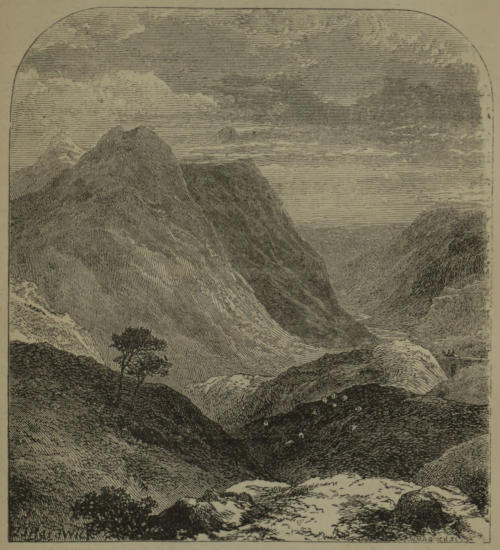
Glencoe.
It was fortunate that the prince understood the character of the
young MacIan, and granted his request. The guard was duly posted,
and the mansion of the Dalrymples received no injury. When we
consider that old Lord Stair was the author of the massacre of
Glencoe, and that revenge among the Highlanders was almost a
sacred duty, we cannot withhold our admiration from the chief
who could restrain his men on such an occasion, and from the men
who voluntarily submitted to such restraint. The name of young
MacIan of Glencoe is worthy of being ranked with those of Scipio
and other heroes of antiquity, who knew how to practise, under the
pressure of strong temptation, the difficult duty of self-denial.
“This murderous chief, this ruthless man,
This head of a rebellious clan,”
spared the mansion of his hereditary foe.
Such were the elements of which our Highland regiments were
formed. When the mountaineers transferred their services to the
House of Hanover, they did not lose their distinctive character;
they shrank from no duty, however dangerous, but they never
inflicted unnecessary suffering on the unprotected. The latter were
always prepared to express their sense of their forbearance, and to
lament their removal to another station. After the battle of
Waterloo the 78th Regiment did garrison duty at Brussels till
1816, when they received orders to return home. The inhabitants
had come to regard them as a part of themselves, and
requested the mayor to try to prevent their removal. This could
not be done, but the mayor expressed the feeling of his fellow-citizens
by issuing the following document:—“As Mayor of
Brussels, I have pleasure in declaring that the Scotch Highlanders
who were garrisoned in this city during the years 1814 and 1815
called forth the attachment and esteem of all by the mildness and
suavity of their manners and excellent conduct, insomuch that a
representation was made to me by the inhabitants, requesting me to
endeavour to detain the 78th Regiment of Scotchmen in the town,
and to prevent their being replaced by other troops.” The mayor’s
eulogium applies to all the Highland regiments stationed at
Brussels, but the 78th were the best known because they had been
longest there. Les braves Flamands witnessed their departure with
the liveliest feelings of regret. “They are kind as well as brave;”
“they are part of ourselves” (enfans de famille); “they are lions in
the field, lambs in the house.” Such were the expressions that
greeted the plumed warriors of the North as they marched for the
last time through the streets of Brussels.
Nor was it in foreign lands alone that the Highlanders secured
the confidence and esteem of the inhabitants by their good conduct.
The 92nd, or Gordon Highlanders, who were embodied in 1794,
and derived their name from having been raised chiefly on the estates
of the Duke of Gordon, in the counties of Aberdeen, Banff, and
Inverness, were ordered to Ireland in 1798, to assist in quelling the
insurrection which had broken out in that unfortunate country.
Nothing could be more trying to the temper of the men than the
duties they had to perform. They were constantly moved from
place to place in the midst of a hostile population. On one occasion
they had to march ninety-six Irish miles in three successive
days, with arms, ammunition, and knapsacks. Notwithstanding
their arduous duties, and the avowed hostility of the population to
the red-coats, the Gordon Highlanders conducted themselves with
such forbearance, that, on their being removed elsewhere, public
testimony was borne to the fact that they had been “exemplary in
all duties; sober, orderly, and regular in quarters.” They had
earned the same good character when stationed in the island of
Corsica in 1795, and such was the estimation in which they were
held in Ireland, that a parting address was presented to the Marquis
of Huntly, the colonel of the regiment, in which it is said that
“peace and order were re-established, rapine had disappeared, confidence
in the government was restored, and the happiest cordiality
subsisted since his regiment came among them.” Many of the
privates in this regiment belonged to a different class from those
who usually enter the army; they were the sons of respectable
farmers, who had been induced to enlist by the personal influence
and blandishments of the beautiful Duchess of Gordon, the mother
of their colonel.
In the Peninsula the conduct of the 92nd was as exemplary as in
Ireland. Unmoved by hunger and the example of others, they
respected the lives and property of those who could offer no resistance.
Napier has rendered his readers familiar with the horrors
which followed the capture of St. Sebastian in Spain. A more
pleasing picture is presented by the conduct of the Gordon Highlanders
and the old “fighting 50th” when they drove the French
from the town of Aire on the 2nd of March, 1814. Places thus
captured were almost invariably given up to pillage and destruction,
and the miserable inhabitants deemed themselves fortunate if they
escaped with their lives. On this occasion there was not a single
act of plunder or violence; the Highlanders took quiet possession
of the town, and paid for every article they required. Their
generous forbearance produced such an impression on the
inhabitants of Aire, that they presented an address to Colonel
Cameron expressive of their gratitude for exemption from plunder
and rapine, the usual fate of the defenceless in times of war. The
Highlanders have always been popular in Ireland; they are sprung
from the same Celtic stock, and speak a dialect of the same language.
Though they had no sympathy with the Irish during the rebellion
of 1798, and took an active part in quelling it, they were guilty of
no unnecessary cruelty, and discharged their duty in such a way as
to conciliate the esteem of those who were opposed to them. It was
said of them that “their conduct and manners softened the horrors
of war, and they were not a week in a fresh quarter or cantonment
that they did not conciliate and become intimate with the
people.”
At this period duelling was an established custom in the British
army, and some of the Highland officers were as ready to take offence
as Sir Lucius O’Trigger in The Rivals, or the redoubtable Captain
MacTurk in St. Ronan’s Well. They were jealous of their personal
honour, and as ready to challenge one another as those of a different
race. We read of a Captain Campbell who fought a duel in a dark
room without seconds, and killed his opponent. The absence of
witnesses led the jury to give a verdict of murder, and the unfortunate
man was hanged. A duel was fought at Gibraltar, in 1795,
between Captain, afterwards Colonel Cameron, and Lieutenant, afterwards
Sir John Maclean, in consequence of some disputed point
of precedency. Both escaped without any serious injury. The
Marquis of Huntly, the colonel of the 92nd, to which Cameron and
Maclean belonged, took them to task for their conduct, and warned
his officers against the practice of duelling. “I have the more right
to insist upon this,” he said, “as I believe you are all, more or less,
connected with my father’s estates.” The hot-blooded Cameron
started to his feet. “I,” he exclaimed, “have no connexion with
your father’s estates or your father’s clan; such an argument, therefore,
cannot apply to me.” The marquis knew how to soothe his
wounded feelings, and this was his first and last duel. Nothing
more readily rouses a Highlander’s ire than any insult offered to
his country, his language, or his dress, and strangers, ignorant of
this peculiarity, were sometimes involved in quarrels without any
intention of giving offence. We remember the case of an English
officer, the nephew of an archbishop, who happened to be seated at
a mess-room table opposite to a Highlander who wore the national
costume, the uniform of his regiment. They were strangers to one
another, and it was their first and last meeting in this world. The
English officer made some bantering remark on the Highlander’s
dress, which was regarded by the latter as an insult, and led to an
immediate challenge. They agreed to settle their difference at
once, and on the first exchange of shots poor Mr. ⸺, the
English officer, fell. Highland soldiers have now learned to bear
any amount of “chaff” on their national peculiarities without
taking offence, but national feeling was stronger and more
sensitive in former days, and the barbarous custom of duelling
often led to death in cases where an apology would now be
deemed ample atonement. It is somewhat remarkable that the
horror excited by the death of an Indian officer, slain in mortal
combat by his own brother-in-law, an officer of the Life Guards,
and a Highlander by birth, produced such a reaction, that the
custom of duelling—that barbarous relic of a barbarous age—may
now be regarded as obsolete.
An interesting work might be written on the female warriors of
all nations, including the standing army of the King of Dahomey.
In every country and in every age there have been men who, in
point of valour, were women; and women who, in point of valour,
were men. The Amazons of antiquity, the vivandières of France,
and the camp followers of the British army, would all be entitled to
some passing notice; but more attractive still would be the personal
history of those women who, instigated by the promptings of
valour or love, have entered the army and served for years without
their sex being discovered. The wives of soldiers who have followed
their husbands to the field, sharing their dangers and ministering to
the wants of the wounded, might also find place in such a work, to
which we willingly present the following contribution. Towards
the close of last century, a stalwart, buxom Scottish lass became the
wife of a private in the 42nd Highlanders, and was permitted to
accompany the regiment when it embarked, in 1795, to take part in
the expedition to the West Indies. She soon learned to share in all
the hardships and dangers of a soldier’s life, was frequently under
fire, and became as skilful in dressing wounds as the most experienced
surgeon. She was known to every one in the regiment, and
was equally a favourite with officers and men. She was present at,
and took part in, the attack on the island of St. Vincent, then
occupied by the French and the insurgent natives. In one of the
skirmishes between the 42nd and the enemy, Lieutenant-Colonel
Graham was severely wounded, and left insensible on the field.
After a time his own men returned and, believing him to be dead,
dragged his body across the rough channel of the river to the
sea-beach. The motion elicited some signs of life, and they
hastened in search of a surgeon; meanwhile the body was borne
along in a blanket for about four miles till they reached a post
occupied by the 42nd. Colonel Graham still continued insensible,
and no surgeon could be found to dress his wounds or restore him
to consciousness. It was plain then, unless something were done at
once he could not long survive, as a bullet had entered his side,
come out beneath his breast, and shattered two of his fingers. He
was already exhausted with the loss of blood. Fortunately for him
our Highland Amazon was at this post, and at once proceeded to act
the part of the good Samaritan. She washed his wounds, and bound
them up with such skill that the surgeons, on their arrival, did not
find it necessary to unloose the dressing. The colonel remained in a
dangerous state for three weeks, when he was removed to England,
where he gradually recovered and rose to the rank of Lieutenant-General
and Governor of Stirling Castle. It is to be hoped that he
did not forget the kind-hearted woman to whom he owed his life.
Be that as it may, she accompanied the 42nd in their different
expeditions, and proved herself a skilful nurse in hospital, a fearless
leader on the field of battle. Wherever her husband went she
followed, watching over his safety, and threatening to avenge him
if he fell. There is reason to believe that, like other veterans, she
came at length to love fighting for its own sake, and that anxiety
for the safety of her husband was only a cloak to justify her
presence amid the wild excitement of the battle-field. On one
occasion, before the commencement of an attack, the officer in
command, being anxious to expose her husband to as little danger
as possible, left him in charge of the men’s knapsacks, which they
had thrown aside before rushing up the hill. He remained at his
post, but his wife, borne along by an irresistible impulse, rushed
forward at the head of the attacking columns, and cheered them on
to victory. No man could refuse to follow where a woman led the
way. Three redoubts were carried in rapid succession, and just as
the officer was giving orders to charge the fourth and last, he was
suddenly tapped on the shoulder. On turning round he beheld his
friend, the female warrior, with her clothes tucked up to her knees,
and the proud expression of victory in her lace. Seizing his hand,
and shaking it heartily, she exclaimed, “Well done, my Highland
lad! See how the brigands scamper, like so many deer! Come,”
she continued, “let us drive them from yonder hill.” Her advice
was acted on, and the success of the Highlanders was complete.
When the fighting was over, friend and foe shared alike in her
sympathies. Her skilful hand, like the spear of Achilles, could heal
the wounds it had made.
About forty years ago, in almost every village in Scotland might
be seen tall, erect, gray-headed old men, retired veterans, who, after
fighting the battles of their country in every quarter of the globe,
had returned to the place of their birth, the memory of which had
haunted them during long years of absence and exile. They were
the leaders of public opinion in the small community in which they
lived—the village Nestors, from whose lips dropped words of
wisdom, tales of strange adventure, and dangers encountered by
sea and land. They feared God and honoured the king; they had
only one failing—an overweening love of the bottle; they were the
oracles of every tap-room, where, amid the applause of their boon
companions, they fought their battles o’er again, even to the thrice
routing of all their foes and the thrice slaying of the slain. It was
not the mere love of drink that led them there; mingled with this
weakness was the pleasure of recalling scenes in which they had
borne a part, battles in which they had fought and conquered.
Often the schoolboys on the village green would cease from their
sports and gather round one of these veterans in an admiring circle,
as, seated beneath a shady tree and leaning on his crutch, he told of
the gallant deeds of the Gordon Highlanders or the Old Black
Watch. His rude eloquence never failed to awaken the enthusiasm
of his audience, and many a Scottish soldier was first led to think
of the profession of arms, and to long, like Norval, to follow some
brave chieftain to the field, from listening to these veterans. They
have now gone the way of all living; we know of only one veteran
survivor of Waterloo in the North, but we can recal many who
lived and flourished a quarter of a century ago. Old Hyderabad
stands before us at this very moment. There he is, with all the
towering majesty of six feet and some additional inches, with shaggy
eyebrows and straggling hair as white as snow, with a rough, stern,
but not unkindly face, rendered still more stern by a sabre-cut on
the brow, with his formidable pikestaff in one hand, and his ram’s-horn
“sneeshin’-mull,” or snuff-box, in the other. His real name
was James Bruce, but he was universally known as Hyderabad,
from the interminable stories he told of the capture of that Indian
city, at which he assisted. His stories occasionally exceeded the
bounds of credence; for example, he used to relate that any eccentricity
of manner observable in his conduct arose from a singular
accident which happened to him at Hyderabad. He was fighting
his way through the streets, when a bullet-wound in the leg laid
him prostrate; one of his assailants rushed upon him and laid open
his skull with a cut of his sabre. “I put up my hand to my head,”
said James, “to feel what was the matter; it so happened that I
had just been takin’ a pinch and forgot to put up my mull. Aweel,
you see, I was so startled at the size of the hole in my head that I
lost hold of my sneeshin’-mull, and it dropped inside my skull. Up
came the doctor, and, without thinking of the mull, he clapped the
skull together and trepanned it; the wound soon healed, but sometimes
I feel a little queer in the head.” No wonder that he did,
considering that he believed that there was a ram’s-horn in the
place where his brains should have been. The delusion had
originated from a sunstroke which he received in India, and which
would have killed any other man than Hyderabad. It is worthy of
remark that, though he was universally known as Hyderabad, few
ever ventured to address him by that sobriquet; it was dangerous
to take liberties with one whose pikestaff was ever ready to punish
any impertinence. We can only recal one occasion when James
was thus addressed. He was walking with stately gait through a
country fair, when a young urchin, set on by his older companions,
walked up to him, and said in his most winning way, “How d’ye
do, Old Hyderabad?” Had the earth yawned beneath James’s
feet he could not have looked more surprised than he did on hearing
these ominous words; here was an urchin who barely reached his
knee addressing him familiarly by that name which the boldest
never ventured to mention in his presence. It was like a mouse
insulting a lion, but what could he do? He was too tender-hearted
to touch a child, but such liberties must be repressed, so he
flourished his pikestaff in the air and gave a yell such as a savage
gives when he despatches his foe. Years have elapsed since James
uttered that yell; his voice is now among the voices of the night;
but it is still ringing in the ears of him who evoked it, and who
fled in terror from the redoubtable presence, and equally redoubtable
pikestaff, of Old Hyderabad.
Nor have we forgotten Old Corunna, the one-eyed veteran, who
fought with Abercrombie in Egypt, and helped to lay the green
turf on the grave of Sir John Moore in Spain. Many were the
stories he used to recount of that disastrous retreat, of that fatal
embarkation. We have seen his one eye dimmed with a tear as he
spoke of Moore, that gallant leader who was dear to his men amid
all their sufferings; we have seen it lighted up with genuine
humour as he told of wealthy officers marching at the head of their
men without shoes or stockings, and the latter whispering to one
another, “There goes ten thousand a year.” Unlike Hyderabad,
Corunna was of small stature, but wiry as a terrier, retaining his
vigour to the last, and ready to meet all comers. The fame of one
of his encounters still lives in his native parish, and has long survived
him. At the period when he flourished, it was not unusual
for professional prizefighters to visit country fairs and to challenge
the rustics to a friendly combat. If the challenge was not accepted,
they claimed, and usually received, a certain sum of money; if they
fought and failed to win, the money belonged to the victor. It so
happened that Corunna was refreshing himself in a booth or tent at
one of these country fairs when a noted pugilist appeared and gave
the usual challenge. No one seemed disposed to take it up, till Old
Corunna, over-brimming with whisky and valour, rushed from the
tent, divested himself of his great-coat, and went at the bully with
such thorough good will and masterly science that victory soon
declared in his favour. That was, perhaps, the proudest day in
poor Corunna’s existence. During the fight a thief had stolen his
great-coat, but this loss was very soon made up, and Corunna
remained to his death the champion of the parish. He has several
sons now serving in the British army.
CHAPTER X. THE PIPERS OF OUR HIGHLAND REGIMENTS.
Our sketch of the Highland Regiments would be incomplete
without some allusion to the men whose martial
music inspired them with courage, and often rose loud
and triumphant amid the din of battle. The bagpipe has always
been a favourite instrument of music among the Celtic race. There
is reason to believe that its invention is almost coeval with the
origin of the human race; traces of it, at least, are to be found in
the bas-reliefs of those ancient cities which have been brought to
light by modern explorers. It was known to the Hindoos, the
Chinese, and the Assyrians; it is still valued and appreciated by
the natives of Ireland and Brittany. It may be justly regarded as
the national instrument of Scotland, inasmuch as all our Scottish
regiments are provided with pipers; and our Highland soldiers
have always preferred their inspiring strains to every other kind of
music. This feeling of preference has been well expressed by the
poet:—
“Then wild and high the Cameron’s gathering rose,
The war-note of Lochiel, which Albyn’s hills
Have heard, and heard, too, have her Saxon foes.
How in the noon of night that pibroch thrills,
Savage and shrill! But with the breath which fills
Their mountain pipe, so fill the mountaineers
With the fierce daring which instils
The stirring memory of a thousand years;
And Evan’s, Donald’s fame rings in each clansman’s ears.”
The influence of music depends very much upon association.
The Marseillaise, for example, is to most men simply a warlike air,
inferior to many others with which they have been familiar from
infancy, while to the Frenchman it is the sacred chant of liberty,
presaging the downfall of tyrants, and the destruction of all that
stand in the way of human progress; the Ranz des Vaches awakens
no unusual emotion in the breast of him who hears it for the first
time, while to the Swiss, wandering in foreign lands, it brings back
the snow-capped mountains, the wooden chalets, the tinkling of the
cow-bells in the deep valleys, and all the other reminiscences of
his native land. The sound of the bagpipe may be to the Saxon
the least or the most disagreeable of all sounds; it revives no past
associations; it awakens no patriotic feeling; it rather repels by
its harsh and discordant strains. Nor is this effect confined to any
one race or class; it extends to all who have not been accustomed
to the war-pipe from infancy. If you ask an Englishman, “Do
you like the bagpipes?” he answers with a significant smile, “Yes;
but I like them best at a distance.” Habit, however, is all-powerful
in modifying this feeling of dislike; we have known English officers
and soldiers serving in Highland regiments who came to prefer the
pibroch to every other kind of music, and became, in this respect,
more Scottish than the Scotch themselves. But we question
whether a Frenchman, with all his acknowledged politeness, was
ever betrayed into any expression bordering on admiration of Highland
music. We have a lively remembrance of the expressive shrug
which a Frenchman gave, when we asked him how he liked the
bagpipes, and of the comical way in which he stopped his ears, as
if still haunted with the horrible sound. A genuine Celt would
attribute such symptoms of aversion to prejudice, affectation, or
even to some worse motive; you could never convince him that
the shrill notes of his favourite war-pipe could cause an unpleasant
sensation on your tympanum.
An amusing illustration of this Celtic obtuseness of perception
may be given. About half a century ago an accomplished young
French nobleman, who recently held an appointment of importance
at the Court of St. James’s, was fortunate enough to secure the
hand of a Scottish lady, who was heiress to a title in her own right,
and to extensive estates in the north. After his marriage, which
was celebrated in England, the happy couple went to spend the
honeymoon at an ancient castle belonging to the lady in a remote
part of the Highlands. This was, perhaps, rather a mistake, as the
French do not understand our English institution of the honeymoon,
and consider that throwing two young people together for a
month tends rather to make them tired of one another’s society.
Be that as it may, they reached the Highlands in safety, and spent
the first night in the ancient castle. The excitement and fatigue of
the journey kept the Frenchman awake the greater part of the
night, and he had just dropped quietly asleep at an early hour in the
morning, when all at once he was roused to consciousness by a loud
discordant noise beneath his window. Springing to his feet, he
drew aside the curtains to ascertain the cause of this disturbance.
It was a charming morning, the grass on the lawn was glistening
with dew-drops, and the heath-clad mountains were tipped with
the golden rays of the rising sun. But he had no eye for the
beauties of nature; every other feeling was absorbed in indignation
at being roused from his pleasant slumber by an old fellow in the
Highland garb, who was strutting backwards and forwards on the
lawn and playing “Hey, Johnnie Cope, are ye waukin’ yet,” to his
own intense satisfaction. If the indignant Frenchman had stopped
to inquire, he would have found this was old Donald, the family
piper, who had been in the habit of waking the family by this
morning serenade ever since he entered on his office; but his only
thought was how to get rid of this nuisance, so he shouted, “Allez,
allez-vous en, tout de suite!” “Sir!” said Donald, surprised at
hearing himself addressed in a language which he did not understand.
“Go, go away,” said the Frenchman. “Your music is
execrable; it is murderous; it will kill me.” If the earth had
yawned before him, Donald could not have stood more aghast than
he did on hearing these words. The sound of the bagpipes was to
him the most delightful of all music, and he could not understand
how it could be otherwise than pleasing to everyone else. But here
was a man who actually ordered him, the family piper, away; who
pronounced his music murderous, and declared it would kill him.
There must be some mystery in this, some secret cause for this unaccountable
dislike. The bagpipes were silent; but Donald walked
backwards and forwards on the lawn, holding his head erect,
distending his nostrils, and sniffing with indignation at the insult
offered to him. “Maybe the carl (fellow) does na like music,” he
at length burst forth; “or maybe he does na like me. What ails
him at the bagpipes? By my faith, I have it now; he heard a
little too much of them at Waterloo!”
While our Scottish regiments have ceased to be composed
exclusively of Scotchmen, they have still retained their pipers.
They are not the only musicians attached to these regiments, for
there are the brass bands besides; but the national music is always
most appreciated by those who belong to the north. When the
drum and the fife cease, and the bagpipes strike up some well-known
pibroch or march, you can tell by their heightened colour
and beaming eyes who are the Scotchmen in the ranks; cheered on
by that music, they will rush on to danger or to death without
dismay. It was a mistake to deprive these regiments of their
pipers, as was done in some cases; and Scotland ought to cherish
the memory of William IV. for restoring them to the Scots Fusilier
Guards.
The number attached to each regiment was originally twelve,
but it has now, in some instances, been reduced to six. While the
pipers may be regarded as non-combatants, they have contributed
largely to every victory gained by their countrymen, not only by
the animating strains of their music, but by their coolness and
self-possession in the hour of danger. Many instances of this
might be given; in truth, the pipers imagined that the result of the
day depended in no small measure on the unceasing shrillness of
their war notes and their constant presence in the thickest of
the battle. The 42nd Highlanders formed part of the attacking
party which captured Fort Washington in 1777. Determined to
have their own share of glory, they scrambled up the precipice,
holding on by the brushwood and shrubs which grew out of the
crevices of the rocks. The first to reach the summit was one of the
pipers, who, as soon as he had made good his footing, began to
play; he knew that he was thus concentrating all the fire of the
enemy on himself; but what was death to him so long as his
comrades secured the victory? His body, riddled with bullets, fell
from point to point till it reached the bottom of the rock, mangled
and disfigured; but the Highlanders went on with a ringing cheer,
and carried everything before them. The piper had the soul of a
hero, and who will say that he died in vain?
At the battle of Porto Novo, which was fought in 1780, Macleod’s
Highlanders, now known as the 71st, or Glasgow Light
Infantry, was the only British regiment on our side. The whole
army under Sir Eyre Coote did not exceed eight thousand men,
while the force under Hyder Ali consisted of twenty-five battalions
of infantry, four hundred Europeans, between forty and fifty
thousand horse, and above one hundred thousand matchlock men
and peons, with forty-seven pieces of cannon. Notwithstanding
their superiority of numbers, the enemy were driven from all their
entrenchments, and compelled to retire. The 71st, or 73rd as it
was then called, was on the right of the first line, and led all the
attacks. Their unbending firmness and daring courage called forth
the warm approval of General Coote, who acknowledged that he
was mainly indebted to them for his victory. During the battle
his attention was particularly attracted to one of the pipers, who
never ceased to play, and gave forth his loudest and most warlike
notes when the fire became hottest. This music was more eloquent
than any words; it told them they must conquer, as their fathers had
conquered before them. “Well done, my brave fellow,” cried the
General, “you shall have a pair of silver pipes for this!” There
was no Victoria Cross in those days, or he would have had it.
When the battle was over Sir Eyre did not forget his promise; a
handsome pair of pipes was presented to the regiment, with an
inscription bearing witness to the General’s appreciation of their
high character. Need we add that this gift has been sacredly
preserved?
At the battle of Assaye, where the Duke of Wellington, then
known as General Wellesley, established his character as one of the
first leaders of the day, the 78th Highlanders acted a distinguished
part. The British army was drawn up in a line of fifteen battalions,
with the 78th on the right and the 74th on their immediate left.
In the advance, the 78th had to attack a battery of nine guns
which supported the enemy’s left; before they reached it a body
of eight hundred infantry rushed forward with the apparent intention
of forcing their way between the 78th and the 74th, and
thus breaking the line of attack. In order to intercept them
these two regiments obliqued their march, and moved forward
with ported arms. On observing this movement, the enemy drew
up on the other side of a muddy ditch and kept firing till their last
man fell. They were impelled by religious fanaticism, and next
morning upwards of five hundred bodies were found lying near the
ditch. The loss of the British was trifling; the 78th, who were
exposed to the hottest fire of the enemy, had only nine men killed
and twenty-one wounded. At the commencement of the battle, the
musicians of the 78th had received orders to attend to the wounded
and to carry them to the surgeons in the rear. This office was
usually entrusted to the members of the band, but the orders were
not intended to include the pipers, who were expected to accompany
the regiment and to animate the men by their war notes.
One young piper, who had never taken part in a battle before,
from a mistaken sense of duty, laid aside his instrument and
devoted himself to the wounded. His conduct was regarded as a
dereliction of duty by his comrades, and exposed him to their
reproaches and ridicule. It was all very well for the flutes and
hautboys to cease their music; they could well be spared; but
who ever heard of a piper sinking himself to the same level, and
doing work which specially belonged to them? It was his duty to
be in front of the battle, in the hottest of the fight; to go to the
rear with the whistlers, as the bandsmen were derisively termed,
was contrary to all the proprieties of Highland etiquette. The
poor fellow, who had erred from ignorance and was not deficient
in courage, felt these reproaches very deeply, and longed for an
opportunity to retrieve his character. He had not to wait long;
the battle of Argaum soon followed that of Assaye; in the advance
the young piper played with such animation and evoked such soul-stirring
notes from his instrument, that the Highlanders could
scarcely be restrained from breaking the line and rushing upon the
enemy before the preparations were completed. The Colonel, in
fact, could only restrain his men by silencing the musician, who
thus recovered his good name, and led on his comrades in many a
future fight.
The colonels of Highland regiments, knowing the influence
exercised over the men by the pipers, have usually treated them
with a consideration due rather to that influence than to their
mere rank. This has been specially the case when the colonels
happened to be Highlanders themselves. Every mountaineer is
passionately fond of the mountain pipe; it awakens a thousand
associations of the past; it inflames the glow of patriotism; it
speaks to his heart at once. It tells him of scenes of joy and
sorrow where it has enlivened or soothed him in the far north; it
recals the coronach that was played at his father’s grave, the
pibroch to which his clansmen have ever marched to victory; it
reminds him of the strains that shall welcome his return when the
sword has been restored to its scabbard. In foreign lands, after
years of exile, the rude sound of the mountain pipe rouses in the
soberest Highlander a species of enthusiasm; his foot involuntarily
beats time to the music; he can scarcely restrain himself from
dancing as he used to dance in the days of his youth; often he
throws aside his bonnet, and dances as if he were still a youth.
He looks rather ashamed when the performance is over, and his
grandchildren begin to congratulate him on his agility, but he
cannot help it; the sound of the bagpipe, like the sting of the
tarantula, sets him a-whirling at once. An amusing proof of this
recently occurred within our knowledge at a semi-religious fête
which was held in the open air, in one of our most distant colonies,
for the purpose of clearing off the debt on a Scotch church. The
Scotchman, like Froissart’s Englishman, takes his pleasure sadly;
everything was as grave and decorous as possible, till all at once a
venerable piper, an old pensioner of the 42nd resident in the colony,
produced his bagpipe, and struck up a lively Scottish air. The
thing was wholly unpremeditated; but in a moment every one,
young or old, selected his partner, took his place on the green
sward, and danced as if he had been possessed. The piper played
his best, and the reels only ceased when the sun went down. In
the enthusiasm of the moment, the people forgot the object of the
meeting; the piper was the master of the occasion, to whom even
the minister had to give place; his music blew away the load of
cares and years, and made them all young again. We remember
another instance: Some years ago we were residing in a certain
town in the east where there were a good many Scotchmen. In
truth, there are few towns, east or west, north or south, where
Scotchmen are not to be found. The sound of the bagpipe had
probably never been heard there before; but one night, at a late
hour, the pibroch of Donuil Dhu was heard in the streets. It had
the same effect on the Highlanders as the sound of the trumpet on
the war-horse; it roused them from their midnight slumbers, and
brought them into the street, where they formed an admiring circle
around the performer, an eccentric wanderer, who had travelled
over the greater part of India and China. Goldsmith’s flute enabled
him to visit France and Italy; the Highlander’s bagpipe had carried
him over the greater part of the continent of Asia. Those who did
not like his music bribed him to go away, so that in either case he
found the means of subsistence. Need we add that every house
was thrown open to him; that parties were got up to do him
honour; that he was fêted and feasted for months, and at length
dismissed with the means of continuing his travels without the aid
of his bagpipe.
The Highlander will admit at once that the bagpipe is not the
gentlest of instruments, nor the one best adapted to a drawing-room;
but there is no affectation in the assertion that its effect
upon him is different from that of any other music. The feelings
which other instruments awaken are general and undefined; but
the bagpipe speaks to his heart at once, and reminds him of his
own romantic land. The colonels of our Highland regiments do
well to encourage the pipers, for they have contributed by their
music to almost every success which their comrades have won. In
almost every field of danger, in many an hour of victory, the proud
warlike strains of the pibroch have been heard; and often, when
every other instrument has been silenced amid the din of battle, the
war-pipe has been carried by its devoted bearer into the very
thickest of the fray, where it was hushed at length by the hand of
death.
We have always looked upon Colonel Cameron, of the 92nd
Highlanders, who fell at Quatre Bras, as the beau idéal of a Highland
officer; no one entered more warmly into the feelings of his
men, or was more successful in gaining their confidence. They
looked up to him as their natural chief and protector; they appealed
to him when they had any grievance, and they never appealed in
vain. They delighted to observe that he had all the tastes and
feelings of a Highlander; that he was familiar with the accents of
the mountain tongue, and was passionately fond of Highland music.
He was proud of the pipers of his regiment, whom he always treated
with the greatest kindness and consideration. When marching at
the head of his regiment, it was his delight to see them around
him, and to listen to their martial music. He thus acquired an
influence over his men, which no officer, ignorant of their language,
music, and most cherished associations, could ever have obtained.
They were ready to follow him anywhere, and when he fell, they
wept for him as a father. At the battle of Vittoria, he was ordered
to seize the heights, and to hold them while he had a man left. No
order could have been more welcome; he ordered the pipers to
play the “Cameron’s Gathering,” and inspired by the war-notes of
this favourite pibroch, the 92nd rushed up the steep declivity and
carried all before them. They made good their position, and
retained it, though exposed to a most destructive fire, which
thinned their ranks, but failed to shake their courage or to silence
the shrill notes of their favourite instrument.
At the battle of Maya, which was fought soon after, the Highlanders
had to maintain the conflict for ten hours against five times
their number. Napier, the historian of the Peninsular war, thus
alludes to their conduct and that of their leader on this occasion:
“That officer (Cameron) still holding the pass with the left wings
of the 71st and 92nd, then brought their right wings and the
Portuguese guns into action, and thus maintained the fight; but so
dreadful was the slaughter, especially of the 92nd, that it is said
the advancing enemy were actually stopped by the heaped mass of
dead and dying; and then the left wing of that regiment coming
down from the higher ground smote wounded friends and exulting
foes alike, as mingled together they stood or crawled before its
wasting fire. Never did soldiers fight better—seldom so well.
The stern valour of the 92nd would have graced Thermopylæ.
They held their ground till their ammunition was almost expended,
and some of them began to hurl stones at the enemy, when General
Burnes despatched a considerable body of troops to their assistance.
Their strength was so reduced that they were forbidden to charge;
but seized with a warlike enthusiasm, they rushed upon the enemy
and drove them from the ground they had lost. The pipers contributed
in no small degree to produce this enthusiasm; they headed
the charge, and struck up the favourite war-tune, “The Haughs
of Crowdale,” composed centuries ago to commemorate a celebrated
battle in which the Highlanders took part. Their warlike music
inspired their comrades with a fury which nothing could resist; but
the loss was fearful. The strength of the regiment was about 750
men; nearly half that number fell, and nineteen officers were
killed or wounded. Well might the poet exclaim, on hearing of
such deeds of heroism—
“And oh! loved warriors of the minstrel’s land,
Yonder your bonnets nod, your tartans wave;
The rugged form may mark the mountain band,
And harsher features and a mien more grave.
But ne’er in battle throbbed a heart so brave,
As that which beats beneath the Scottish plaid;
And when the pibroch bids the battle rave,
And level for the charge your arms are laid,
Where lives the desperate foe that for such onset stayed!”
These redoubtable musicians exhibited occasionally a sort of grim
humour in the tunes which they selected. When the 92nd and
71st surprised General Gérard with three thousand of the finest
French troops in Spain, at the village of Aroys des Molinos, and
took or destroyed more than two-thirds of them, the first intimation
of their presence was given by the pipers playing, “Hey,
Johnnie Cope, are you waukin’ yet?” a highly appropriate tune,
composed originally on the occasion of the defeat of Sir John Cope
by the followers of the Pretender at the battle of Prestonpans.
There is an old song sung to the same air, of which we remember
only one verse—
“Charlie wrote a letter from Dunbar,
Saying Johnnie meet me if ye daur.
And I’ll teach you the art of war,
So early in the morning.”
After the defeat of the French, the Highlanders amused themselves
by composing a song to the air of “Johnnie Cope,” with the
refrain, “Hey, Monsieur Gérard, are you waukin’ yet?” which is
more remarkable for patriotic feeling than poetical power. One
verse may be given.
“Go and tell Napoleon, go,
While Freedom’s laws he tramples low,
That Highland boys will be his foe,
And meet them all in the morning.”
No wonder that Cameron appreciated and respected a class of
men who did more by their music than mere valour could have
effected, and animated their comrades by the strains familiar to
them from infancy. A characteristic anecdote is related by General
Gordon, of Lochdhu, who served during the Peninsular war in the
50th regiment, and had frequent opportunities of witnessing the
gallantry of the 92nd. He and Cameron were fording the river
Nive, at Cambo; the French opposed their passage, and a hostile
bullet struck down Cameron’s favourite piper, who was marching
by his side. If his own brother had fallen, he could not have
exhibited deeper feeling or anxiety. He stopped to render assistance,
and, on finding that the poor piper was beyond the reach of
all human aid, exclaimed, in a tone of deep emotion, that he had
rather have lost twenty men of his regiment.
At the battle of St. Pierre, which was fought a few days after the
passage of the Nive, the 92nd charged early in the day against two
French regiments, which yielded and broke; but Soult brought
such a storm of artillery to bear on them, that they in their turn
were forced to retire. The 50th and the Portuguese held their
ground and fought desperately till the 92nd had time to reform.
Then Cameron gave the word to advance; the pipers sounded the
charge, and the Highlanders rushed forward with colours flying and
music playing. They were but a small force compared to the
enemy, but nothing could resist their impetuosity; and they drove
the French across the valley, remaining in possession of the field.
Napier thus alludes to their conduct on this occasion: “How
gloriously did that regiment come forth again to charge, with their
colours flying, and their national music playing as if going to a
review. This was to understand war. The man who in that
moment, and immediately after a repulse, thought of such military
pomp, was by nature a soldier.”
No one will question the justice of this remark; but some praise
is also due to the pipers, who were as jealous of the honour of the
regiment as Cameron himself. His last hours were soothed by the
music he loved so well. He was present on the evening of the
15th of June, at the celebrated ball given by the Duchess of Richmond,
and was requested by the Duke of Wellington to withdraw
privately from the room, and to march with all speed to Quatre
Bras. He lost no time in executing this order; animated by the
martial strains of the Cameron’s Gathering, the 92nd were in front
of the enemy by 2 P.M. Deserted by the Belgian horse, and assailed
by fearful odds led on by the fiery Ney, the Highlanders and the
Black Brunswickers repelled the attacks of the enemy again and
again; many gallant officers and about three hundred privates
were struck down, but they never dreamed of retiring. At length
Cameron asked permission of the Duke, who was stationed among
them, to charge the enemy. “Have patience,” said the Duke,
“and you will have plenty of work by-and-by.” The French
advanced, and took possession of the farm-house; the Duke waited
till they began to push on to the Charleroi road, when, turning to
the Colonel, he exclaimed, “Now, Cameron, is your time—take
care of that road.” On hearing these words, the 92nd cleared the
ditch at a bound, rushed upon the enemy, and drove them back;
but, in the moment of victory, a shot fired from the upper story of
the farm-house, passed through the body of their gallant leader,
and his horse, pierced by several bullets, sunk to the earth. A
wild wail of sorrow rose from his devoted followers, as they rushed
madly on the house to avenge the death of one whom they loved as
a father. Ewen Macmillan, his faithful foster-brother, aided by
another private, bore him beyond the reach of the enemy’s fire, to
a deserted house near the village of Waterloo, where they stretched
him on the floor. His first inquiry was for his beloved Highlanders;
on hearing that they had fought with their usual gallantry and success,
he said: “I die happy, and I trust my dear country will believe
that I have served her faithfully.” None ever served her
better, or shed his blood more willingly in her defence.
His remains were hastily interred in the Allé Nerte, on the
Ghent road. Next year they were conveyed in a man-of-war to
Scotland, and buried in the aisle of the old church of Kilmallie,
in Lochaber, where so many of his forefathers sleep. No less than
three thousand Highlanders accompanied the funeral cortége, and
the wailing notes of the coronach were echoed back from the heath-clad
mountains, as they conveyed him to his last home. A monument
was erected to his memory; the inscription was written by
Sir Walter Scott, who tells us in his “Field of Waterloo” how
“Cameron in the shock of steel,
Died like the offspring of Lochiel;”
and thus alludes to him in his “Dance of Death”—
“Apart from Aleyn’s war array,
’Twas there Grey Allen sleepless lay—
Grey Allen, who for many a day,
Had followed stout and stern,
Where, through battle, rout, and reel,
Through storm of shot and hedge of steel,
Led the grandson of Lochiel,
The valiant Fassiefern.
Through steel and shot he leads no more;
Low laid ’mid friends’ and foemen’s gore;
But long his native lake’s wild shore,
And Sunard rough, and wild Ardgour,
And Morven long shall tell;
And proud Ben-Nevis hear with awe,
How, at the bloody Quatre Bras,
Brave Cameron heard the wild hurrah
Of conquest as he fell.”
It is a characteristic fact that his last prayers were offered up
in his own mountain tongue, and that his last hours were soothed
by that mountain music which was blended with his earliest
associations and his proudest reminiscences. Other Highlanders
have shown on their death-beds the same predilection for that
music which, however harsh and unmeaning it may sound in the
ears of a stranger, is dear to the heart of every mountaineer,
animating him in the hour of danger, and soothing him in sorrow.
A singular anecdote is related of Rob Roy, the celebrated freebooter,
whose name is familiar to all the readers of Scott’s well-known
story. The bold outlaw was often threatened with the gallows,
but his cunning and daring enabled him to escape that fate. He
died in his own house at an advanced old age. As his end was
approaching he learned that a friend who had once been his foe,
and was still regarded by him with suspicion, was about to pay him
a visit; he roused himself at once, and prepared to meet him. No
sign of weakness or approaching dissolution must be witnessed
by his former rival; attired in full Highland costume, he seated
himself in his arm-chair and ordered his piper to play his favourite
tune. When the visit was over, he lay quietly down and died.
At the storming of Ciudad Rodrigo, which was captured on the
6th of April, 1812, after a desperate resistance on the part of the
French, Lieutenant Alexander Grant, of the 74th Highlanders,
leading the advance, was the first to enter the castle, but fell in the
moment of victory. John M’Lauchlan, the regimental piper, particularly
distinguished himself on this occasion. He was the foremost
in the escalade, and on mounting the castle wall, began to
play the regimental quick step, “The Campbells are coming.”
Animating his comrades by the lively strains of this favourite air,
he marched along the ramparts at the head of the advance, with as
much coolness as if he had been on the parade ground. A shot
from the enemy pierced the bag of his instrument, and stopped his
music for a time, but John realized the importance of the occasion,
and proved himself equal to it. If the music ceased, the courage of
his comrades might flag, and the victory, already half won, might
be lost: it should never be said that he failed in his duty; so he
quietly seated himself on a gun carriage, and amid a hurricane of
shot and shell, began to repair his instrument, which was speedily
done. In a few minutes “The Campbells are coming” was heard
again amid the roar of battle, and John had the satisfaction of witnessing
the surrender of the fortress. If he attributed the success
of the day partly to his own almost superhuman efforts, we must
not be too hard upon him. “As proud as a piper” has become a
proverbial expression in the north, and whoever has witnessed a
contest of some score of pipers, and seen them strutting backward
and forward on a raised platform, with inflated cheeks and waving
tartans, will at once perceive its accuracy.
Much more might be said of our friends, the pipers, and we are
almost loth to part with them. We might have told how one who
was attacked by a French cuirassier at Waterloo took deliberate
aim at him with his pipe, when the Frenchman, believing it to be
some infernal machine, turned his horse and rode off at full speed,
and how another, assailed by a tiger in India, blew such a blast on
his instrument that the animal rushed into the thickest depths of
the jungle to escape from the fearful sound.
But space fails us. The golden age of the pipers is gone for
ever; the college of Skye has ceased to issue its diplomas, and the
wail of the pibroch may be heard more frequently in Canada and
Australia than in the Highlands of Scotland. The warlike race
who fought our battles and shed their blood so profusely in our
defence, has removed to other lands, and the bleating of sheep may
be heard in the valleys they once occupied. Lowland lairds, without
the shadow of a claim to rank as chiefs, without a drop of Celtic
blood in their veins, have gratified their vanity and striven to
enhance their importance by surrounding themselves with pipers,
and have thus incurred the sarcasm of Bon Gaultier in one of his
witty poems:—
“Fhairshon swore a feud
Against the clan M’Tavish,
Marched into their land
To plunder and to ravish.
“For he did resolve
To extirpate ta vipers,
With four-and-twenty men
And five-and-thirty pipers.”
It is easy to find players on the bagpipes; performers whose
accent proves that they belong to the Highlands of Highgate or
Holborn Hill, may be heard in any street of London; but the
genuine race of pipers, with their chivalrous spirit, and their undying
devotion to their own regiments, has died out. The pipers
even of our Scottish regiments are rarely Highlanders by birth:
they have generally been instructed in the use of the instrument
after entering the army. Such men may play tolerably well, but
they cannot be expected to have the old esprit de corps.
A favourable exception is to be found in Ewen Henderson, the
pipe-major of the 1st battalion of the Scots Fusilier Guards, who
is at once a good piper and a genuine Highlander. He is a son of
Angus Henderson of Annat, who joined the 92nd when first raised,
served with it till the battle of Waterloo, rose to the rank of
colour-sergeant, and lived till a few years ago to enjoy his well-earned
pension. Ewen is a worthy son of a worthy sire: a living
representative of what the pipers once were; a favourable specimen
of the Celtic race. He feels the dignity of his position as pipe-major
of a gallant regiment, and the sound of his war-pipe has
been heard at Alma and Inkerman. It has also sounded in more
peaceful scenes. He had the honour of performing before the
Princess of Wales at Buckingham Palace a few weeks after her
arrival, and was rewarded with some kind words and a golden
Napoleon, which he wears at his watch chain and will not part with
till his dying hour. “Will you take five pounds for it, Henderson?”
said an officer to whom he showed it. “No, sir, not five hundred!”
said Ewen, with the chivalrous feeling of an old paladin. The
intrinsic value of the coin was less than a pound, but who shall estimate
its value in Ewen’s eyes? Long may he be spared to wear it!
CHAPTER XI. COLONEL BELL AND THE VICTORIA CROSS.
In a previous chapter we traced the history of the Royal
Welsh Fusiliers (23rd Regiment). We showed how
they won their laurels in Egypt, in Spain, in the West
Indies, in the Pyrenees, and at Waterloo. We described the act
of humanity by which Corporal Shields and Dr. Sylvester earned
the Victoria Cross, and the gallant deed by which Sergeant (now
Captain) Luke O’Connor attained the same honourable distinction.
But the roll of heroes among the Royal Welsh is not yet exhausted,
and we are now about to show how Colonel (then Captain) Bell
conducted himself with such gallantry as to justify his sovereign in
bestowing on him the Cross of Valour. Mr. Desanges’ picture
No. IX., which has been faithfully copied by our artist, introduces
Captain Bell in the act of capturing one of the enemy’s guns at the
battle of the Alma. In order to understand this event, it is necessary
to glance briefly at the position which the Royal Welsh occupied
during the battle. The soldiers of No. 1 company, under the
command of Major Lysons, had the honour of being the first British
troops that landed in the Crimea. As soon as they had disembarked,
Brigadier Airey sent them to attack some arabas, or Russian waggons,
which were seen in the distance; on coming up to the Cossack
escort, they fired upon them and put them to flight. This was the
commencement of the campaign. Fourteen arabas, full of firewood
and fruit, with their drivers and bullocks, remained in the possession
of the Royal Welsh, and were the first waggons used in the
Land Transport of the army.
From the period of disembarkation till the battle of the Alma,
the Royal Welsh had no opportunity of distinguishing themselves.
In this engagement they formed part of Sir George Brown’s right
brigade, which was under the command of General Codrington, an
officer of the Guards, who, having visited the East from motives of
curiosity, was induced to accept this important charge. The only
orders he had received from Sir George were to advance with his
brigade till he had passed the river which flowed through the valley
at the foot of the heights where the Russians were drawn up. When
a general has confidence in his subordinates, he does well to allow
them a certain freedom of action, as it is impossible to anticipate all
the eventualities which may occur on the day of battle. The left
brigade of the Light Division was under the command of General
Buller, who is said to have received the same instructions as
Codrington. The two brigades advanced steadily in the direction
of the river, the bank of which, on the Russian side, varied from
eight to fifteen feet in height, but was not so steep as to prevent
our men from obtaining a footing on it. The river itself was of no
great depth, but the bank on the side of the allies was covered with
gardens and vineyards, which our men could not cross without
getting into disorder. As they advanced they became exposed to
the fire of the enemy, who had erected on the opposite heights two
batteries mounted with brass guns which swept the plain. When
the Welsh Fusiliers and their companions of the right were brought
within long range, they deployed and halted. It was a bright,
sunny day—not a cloud in the sky, nor a breath of air stirring—and
our men, suffering from thirst and fatigue, helped themselves
to clusters of grapes, and lay down leisurely on the ground, careless
of the balls which were whizzing past them and occasionally thinning
their ranks. The vineyards afforded them a scant shelter
from the fire of the enemy; but when the final order was given to
advance, our men were thrown into some confusion, owing to the
broken ground, overgrown with the tendrils of the vines, on which
they had to form. Codrington’s brigade was the first to advance,
carrying with them the 19th Regiment, who were only too glad to
place themselves under the guidance of such an impetuous leader.
The Russians poured on them the fire of all their batteries, and
many fell before they could find cover beneath the steep bank on
the opposite side. There they halted to reform, and at this moment
three Russian regiments advanced, and poured down a vertical fire
upon them from the summit of the bank. A leader less resolute
than Codrington might have given orders to retreat; but it was his
first battle, and the gallant guardsman was bent on winning his spurs.
He rode his small Arab charger round to a spot where the bank was
less precipitous, and with some difficulty contrived to reach the
summit. It was unfortunate that, instead of the plumed hat of a
general, he wore an officer’s foraging cap, and, being recently
appointed to the command of the brigade, few of his men recognised
him. Still, the sight of an officer forcing his way almost alone up
the heights was enough to inspire his men with the desire of
following, and Colonel Yea, of the 7th Fusiliers, rode his cob up the
steep bank, encouraging the soldiers, by his voice and example, to
come on.
It was impossible for the regiments to form on the broken ground
which they occupied, but the whole of Codrington’s Light Division
cleared the bank, carrying with them the 19th and 95th Regiments,
who were only too eager for the fray. These brave fellows were
the first to begin the battle of the Alma. If the Russians had had
the courage to charge them as they appeared on the summit of the
bank, broken and breathless, they might have rolled them back into
the river below; and the fate of battles often depends on a first
success. A column of the enemy descended the hill with this
intention, and advanced towards the ground occupied by the 19th
Regiment and some of the left companies of the 23rd, who opened
such a smart fire upon them that they retreated, and found shelter
in a hollow near the Great Redoubt. Having thus got quit of their
assailants, they joined their comrades, who were pressing on towards
the Great Redoubt in broken columns and much disorder. As yet
the Russian battery was silent, but when our men had reached some
three hundred yards from it, first one gun and then another began
to fire upon them with round shot, grape, and canister. They
were crowded so closely together that every round shot which
pierced their ranks cut its way through, leaving a long furrow of
dead behind. But the open space thus left was at once filled up,
and our men pressed forward as gallantly as before in the direction
of the Great Redoubt. The slaughter was fearful, and none suffered
more than the 23rd, who had twelve of their officers and half of
their rank and file smitten down before they reached the guns
which were dealing death amongst them. Their gallant leader with
the foraging cap and the eye-glass was still in front, and wherever
he went they were prepared to follow. A sort of half-cry rose from
their lips as his horse fell and a cloud of dust concealed him for a
moment from their view; but it was only for a moment. Mounting
his horse, he turned gaily to his followers, and said, “I am all
right, lads. Twenty-third, be sure I’ll remember this day.”
It was such a day as can never fade from the memory of those
who took part in it; but the Welsh Fusiliers have special reason
to remember it. Their ranks were thinned, but they still pressed
forward, and followed their gallant leader as he leaped his horse
into the midst of the enemy’s works to show his men there was no
danger. The Russians were seized with a sort of panic; the artillerymen
began to limber up their guns and to fall back upon their
reserves, which were posted in the rear. A sort of cry of disappointment
rose from our men at the thought that there was no
more fighting to be done—“The Russians are retreating; they are
limbering up. Stole away! stole away!”
But the fighting was not over; there was still bloody work to be
done on the heights of the Alma. The enemy’s artillery continued
their fire as they retreated, and many of our men were struck down
as they approached the empty embrasures. The first to mount them
was young Anstruther, who carried the colours of the Royal Welsh.
Though an officer of that regiment, he was a Scotchman by birth,
and his conduct that day will invest a name already distinguished
in the annals of the North with a halo of glory. He was a mere
boy, fresh from school, but he was determined to do some deathless
deed on this the morning of his first battle. Leaping and running
are favourite pastimes in Fife, as in every Scottish county, and
none could run better than the light, boyish figure that held aloft
the colours of the Royal Welsh, and pressed forward before all
the others. He was the first who gained the redoubt, and, planting
the butt-end of the colours in the centre of the parapet, he stood for
a moment clutching it in his arms, breathless and silent, as if surprised
at his own audacity. There were hundreds of hearts beating
high with admiration as they saw the slim figure of the Scottish
youth on the summit of the parapet. Alas! it was seen there only
for a moment. A bullet passed through his body, and he fell,
dragging with him the flag-staff, as if he would not part with it
even in death. The crimson folds of the colours, which covered his
body like a pall, were stained with a deeper dye as his heart’s
blood ebbed away. The soul of the young hero was gone. But it
was no time for tears; the colours were in danger, and the colours
must be saved. Butler, the other colour-officer, was slain; but
William Evans, a swift-footed Welshman, mounted the parapet,
drew the flag-staff gently from the hands of the dying boy, and held
it aloft, to show that the Royal Welsh were the first to mount the
Great Redoubt. He then, in accordance with military etiquette,
handed the colours to Corporal Luby, his superior officer, who, in
turn, delivered them up to Sergeant Luke O’Connor, with whom
they remained during the rest of the day. No wonder that young
Anstruther fell: no less than seventy-five bullets passed through
the colours, and the pole of one of them was shot in two, and had
to be spliced with a cord.
It was on this occasion that Colonel E. W. D. Bell, of the 2nd
Battalion of the Royal Welsh, gained the Victoria Cross. This
decoration, so coveted and prized, was devised by her whose name
it bears in 1856, and was intended to be a reward of valour for all
who distinguished themselves, whatever their rank might be. Its
value is enhanced by the fact that Victoria confers this Cross with
her own hand whenever this is practicable—an honour which cannot
fail to be appreciated by the happy recipient. Our readers
have a good idea of its form from the initial letter to our first
chapter, but a brief description may not be out of place. It is a
Maltese cross of bronze, with the royal crest in the centre, beneath
which is an escroll bearing the words, “For Valour;” the date
of the act of bravery is inscribed on the centre of the reverse, and
the name and corps of the recipient are engraved on the bar to
which the ribbon is attached. A sprig of laurel is embossed on
this bar, which is attached to the cross by the letter V suspended
on a red ribbon or a blue one, as he who gains it happens to be a
soldier or a sailor. This decoration, however, is not confined to
the army and the navy; civilians who have distinguished themselves
by their bravery have as good a claim to it as those who
belong to the profession of arms, and several of this class nobly
earned it during the Indian Mutiny. Every private or non-commissioned
officer thus decorated is entitled to a pension of 10l. a
year; every fresh act of bravery equal to the first procures for him
an additional bar and a further pension of 5l. There is no danger,
therefore, of the wearers of the Victoria Cross being tempted to rest
on their laurels; they have an intelligible motive for striving to
increase them. Their names are published in the London Gazette,
along with the record of the deeds of bravery by which they earned
the distinction.
“A king may make a belted knight,
A marquis, duke, and a’ that,”
but distinguished bravery alone can make a Victoria Cross man. A
marquis or a duke may have attained his rank by means that would
not bear too close inspection, but the Victoria Cross invites your
inspection; its wearer must always be sans peur, if not sans
reproche.
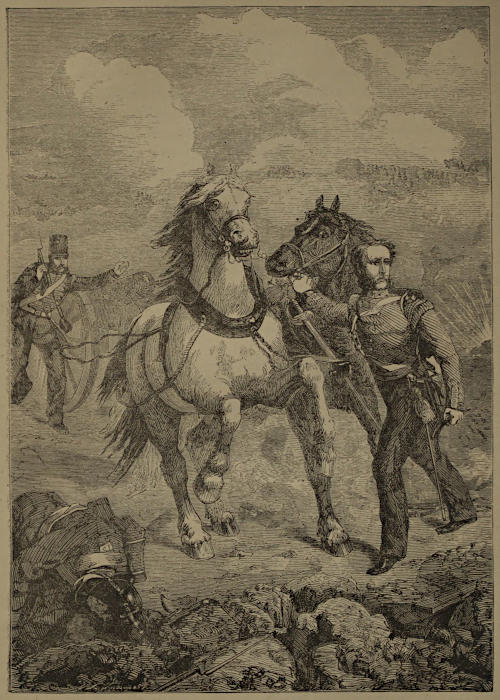
Captain Bell, Royal Welsh Fusiliers, capturing a
Russian Gun at the Battle of the Alma.
No one will grudge Colonel Bell the distinction which he earned
at the Great Redoubt on the heights of the Alma. He was charging
at the head of his company at the moment when the Russians were
retreating with those guns which had dealt such havoc among our
men. All had been drawn away by the artillery horses except a
brass 24-pound howitzer, which still remained in position, and gave
rise to a singular contest among our soldiery. Each was anxious to
claim it as his own, so as to point to it afterwards as a proof of his
prowess, and an officer of the 33rd, named Donovan, is said to have
been the first who scratched his name upon it. Bell, however,
took no part in this contest; his thoughts were elsewhere. Farther
on, in the rear of the redoubt, he saw a Russian driver urging on
with whip and spur three horses which were dragging a brass 16-pounder
gun; in a moment he was alongside the driver, and held a
revolver to his head. The latter understood the significance of such
an act, and, slipping from his horse, took to his heels. Bell seized
the bridle of one of the horses, and, aided by a soldier of the 7th
Fusiliers, named Pyle, led them round the shoulder of the parapet
to the rear of our line, where he met Sir George Brown, the general
in command of the Light Division. Now, it is the duty of a captain
to be at the head of his company, and the general is said to
have reminded him of this fact in language of considerable emphasis.
There was no help for it; Bell had to relinquish his prize, and to
return to his company, but the gun was safe; the horses drew it
down the hill, where it remained till after the battle. The gun is
now to be seen at Woolwich, and the horses were put into our
“Black Battery.” At the close of the war, Captain Bell’s heroism
was not forgotten; he was decorated with the Victoria Cross, and is
now a colonel.
We have already alluded to Lieutenant Anstruther’s heroic death,
after he had planted the flag-staff of the Royal Welsh on the summit
of the parapet. When he fell, the Queen’s colour was picked up by
a private, who gave it to Corporal Luby; it was afterwards carried
till the end of the battle by Sergeant Luke O’Connor. The gallant
sergeant was shot in the breach, and fell at the same time as young
Anstruther; but his wound was not mortal; he soon recovered
himself, and refused to go to the rear, though urged to do so by
Lieutenant Granville. He received the highest praise from Major-General
Codrington on the field, and was rewarded with a commission
in his own gallant regiment, in which he now holds the rank
of captain. He was also present at the assault on the Redan, on the
8th of September, 1855, where he behaved with great gallantry,
and was shot through both thighs. At the close of the war he
received the Victoria Cross and the Sardinian war medal. The
latter decoration was also bestowed upon Corporal Luby, who was
instrumental in saving the Queen’s colour at the battle of the
Alma.
The British casualties in this battle were 25 officers killed, and
81 wounded; 337 non-commissioned officers and men were killed,
1550 wounded, and 19 missing. No regiment suffered more than
the Royal Welsh Fusiliers. Eight of their officers were killed, and
5 wounded (one of them mortally); 3 sergeants and 40 rank and
file were killed, or died of their wounds; 9 sergeants and 143 rank
and file were wounded; 2 were missing. The slaughter among the
senior officers was so great that the command of the regiment
devolved on Captain Bell, who brought it out of action. The
regimental colour was carried by Sergeant Honey Smith after
Lieutenant Butler fell; it was intrusted to him by Major-General
Codrington, as no officer could be spared from his company. In a
letter written from the seat of war, Corporal Harwood gave a
graphic description of the circumstances under which the Royal
Welsh were so fearfully cut up:—“The 23rd was in the Light
Division, and on we went, covered by two companies of the Rifle
Brigade. We crossed a vineyard, and were led by Colonel Chester
through the river, the opposite bank of which was very steep. The
colonel went through with us—we all shared alike—and, as we
clambered out, the enemy gave us a fierce fire, the cannons belching
forth murderous volleys of grape and round shot, and musket-balls
fell as thick as hail. The men fell dead and wounded before me
and at my side. They fell in every direction, and mechanically I
still pressed on, untouched. Up the hill we went with the Rifle
Brigade, and half-way up the heights we reached the cannons’
mouths which were planted on the embankments. Our regiment
was about to cross the stockade in the enemy’s position, when the
word was given, ‘Cease firing, and retire!’ because we were in
danger of firing on the French. Our colonel rushed in front of us,
shouting, ‘No, no; on, lads!’ He fell with the word on his lips;
he never spoke or raised his head again. We did retire then, and
an unfortunate mistake it was; for the enemy returned to the guns
we had once silenced, and gave us some terrific volleys; but we
soon rallied, and, supported by the 7th, 33rd, a portion of the
Guards, and the Highlanders, we rushed up the hill again, and the
enemy fled in every direction.” This and other letters written by
our soldiers during the Crimean War took the nation by surprise;
they proved that there were men, unknown to fame, in the ranks of
the British Army who could use the pen or the sword with equal
skill.
There are certain acts of courage which compel our admiration
without obtaining the unqualified approval of our cooler judgment.
Colonel Bell’s daring in capturing the Russian gun must be placed
in this category. No one will question his courage, or dispute his
right to the Cross of Valour; no one will wish his deed undone, or
desire that he had acted otherwise. And yet it must be admitted
that in leaving his own men he was guilty of a breach of discipline
which is more worthy of admiration than imitation. It was his
duty to have remained with his company; and if every officer were
to yield in battle to the same impulsive bravery, all discipline would
be at end and the results would be most disastrous. The first duty
of all soldiers is implicit obedience to the commands of superior
authority; to this rule there is no exception, save in the case of
officers of high rank, who on the field of battle must always be
guided partly by circumstances in executing the orders they have
received. We are not, therefore, to condemn Sir George Brown
for expressing his emphatic disapproval of Captain Bell’s conduct
in leaving his company to seize the Russian gun. Sir George,
doubtless, admired his courage, but he must have felt that courage
ought in every case to be subordinate to discipline. Such was the
opinion of Sir Colin Campbell at the storming of the Secunder Bagh at
Lucknow. We shall describe in a future chapter the fearful scene
of carnage which took place there in consequence of the massacre at
Cawnpore. The tumult was at its height when a Highland officer
rushed up to the spot where Sir Colin, mounted on his grey horse,
stood in the centre of his staff. The Highlander was wild with
excitement, and bore on his person traces of the bloody work in
which he had taken part. One word of praise from those stern lips
was the richest reward his heart could covet. Extending the red
banner which he held in his hand towards the general, he joyfully
exclaimed, “I have killed the last four of the enemy with my own
hand, and here, sir, are their colours.” A Highlander himself,
Sir Colin could appreciate the impetuous courage of his countryman,
but his duty as a general was imperative; he could not applaud
an act which was a violation of discipline. “Confound the colours,
sir! where’s your regiment? Go back to your regiment, sir! I
thank you for your zeal and gallantry, but go back to your regiment.”
The excited and impulsive Highlander obeyed this command, and,
doubtless, felt at the moment that the reproof, though grave, was not
unmerited. Such also must have been the feelings of Captain Bell
when he received the stern command to return to his company and
relinquish the Russian gun. If that gun had not remained in our
possession after the battle, we doubt whether Colonel Bell’s undisciplined
valour would have met with the same recognition from his
grateful country. Success may sometimes justify such a step, but
we repeat that such deeds of impulsive bravery are more to be
admired than imitated. It must be borne in mind, however, that
Colonel Bell received the Victoria Cross, not only for capturing the
Russian gun at the Alma, but also for bringing the regiment out of
action when his superior officers had fallen, and exhibiting the same
daring spirit on many subsequent occasions. It is a pleasure to
see his manly figure among the other heroes in the Victoria Cross
Gallery, and we hope he will long continue to wear the badge of
distinction which his sovereign conferred upon him.
CHAPTER XII. COMMANDER (NOW CAPTAIN) FIOTT DAY, R.N., AND THE VICTORIA CROSS.

Our sailors do not occupy a very prominent place in
Mr. Desanges’ Victoria Cross Gallery. We find that
only four of his paintings have been devoted to the
gallant deeds of our naval heroes, but we must not infer from this
that British sailors are inferior to British soldiers, or that blue
jackets have deteriorated since the days of Nelson. This is far
from being the case, as we all know. But two conditions are
necessary to constitute a hero: it is not enough that a man be
brave, he must also have an opportunity of displaying his bravery.
There are, doubtless, many Hampdens sleeping in our village
churchyards, and many Nelsons serving on board our ships; all
that has been wanting is the opportunity of displaying their
patriotism or their courage. We are all more or less the creatures
of circumstances; the race is not always to the swift, nor the battle
to the strong, because the swift and the strong are often debarred
by fate from either running or fighting. Time and chance, as the
wise man tells us, happen to all. Nelson would never have been a
hero if he had not robbed an orchard, and Fiott Day might have
been known only as a very intelligent commander in the British
navy if it had not been for the Crimean war.
It was one of the oratorical or conversational hits of Lord Palmerston,
that if the Crimean war had no other advantage, it at least
extended our knowledge of geography. Some hard-headed people
may imagine that we paid dear for the lesson, but not one will deny
that the long-protracted contest did increase our knowledge of
those semi-barbarous regions, the names of which, we fear, were
little familiar even to those schoolboys who had gained the first
prizes in geography. Knowledge thus acquired, however, is seldom
permanent; when the war ceased, our interest in the localities
where the great battles were fought became less vivid. It is well
that the rising generation, in whom all the hopes of England are
centred, should be familiar with the courage, the endurance, and
the heroic deeds of those who took part in that disastrous war;
such knowledge excites their sympathy, stimulates their ambition,
and elicits that spirit of adventure which has made Britain the
mistress of an empire far more extended than that of ancient Rome.
Mr. Desanges has trusted more to his pencil than his pen in
depicting the gallant deed by which Captain Day obtained the
Victoria Cross. We read that “with great gallantry this officer
landed and twice successfully carried out a reconnoissance within
the enemy’s lines at Genitchi, advancing to within about 200 yards
of the enemy’s gun-vessels.” Most readers will exclaim, “Where
is Genitchi?” Few even professed geographers would be able to
answer such a question, and as our interest in paintings depends
much on our intimacy with the scenes they represent, we invite our
young readers to do as we have done—to open their atlases at
Russia in Europe, and to examine the map. It may save time to
state at once that this incident occurred during the Crimean war,
and that Captain Day commanded one of the vessels engaged in the
expedition. Now, on examining the southern extremity of Russia
in Europe, it will be seen the only entrance from the Sea of Azov
into the Senish or Putrid Sea is through the Straits of Genitchi.
These straits are very narrow in most maps—in fact, so narrow
that we have to strain the eye a little before we can perceive them.
On the right-hand side of these straits stands the town of Genitchi,
from which they derive their name. It is situated on the slope of
a lofty eminence, and is a place of considerable strength.
During the Crimean war it was strongly garrisoned with nearly
twenty thousand Russian troops, to protect it from the attacks of
the allies. To the left is the Spit of Arabat, which was occupied
by strong bodies of Cossack horse artillery and cavalry, which
formed a continuous line of pickets all the way to Arabat. It is
about seventy miles in length, and of an average breadth of half a
mile, though in some places it is not more than two hundred yards.
Its broadest part is opposite the town of Genitchi, where it is
between three and four miles across. At this particular point it is
covered with numerous lagoons and strips of water, varying in size,
all of which are covered with thick rushes and weeds, and are a
favourite resort of different kinds of water-fowl. We have mentioned
that pickets of Cossacks were stationed along the whole of the Spit
of Arabat, and there were constant skirmishes between them and
our sailors. Such slight exchanges of civility tended to vary the
monotony of naval life, but the adventure in which Captain Day
distinguished himself was of a far more dangerous character.
It is said that he advanced within two hundred yards of the
enemy’s gunboats; but to understand the exact nature of this
heroic deed we must enter more into detail. On the inner side of
the Spit of Arabat, opposite the town of Genitchi, were several
guard-houses, in front of which four gunboats were moored, in such
a position as to cover the entrance of the straits, and to bring under
their fire any vessel that attempted to force its way. Setting aside
these gunboats, it would have been a most hazardous undertaking
for any boat to have attempted to pass the town so as to reach the
Sivash, as the passage is not more than three hundred yards broad,
and the whole of the heights which command it were lined with
troops and field-pieces. Any boat that attempted to run the passage
would have been within range of the fire of all these field-pieces,
and exposed to almost certain destruction. Still it was of the last importance
that the passage should be made, as it was only in this way
that the supplies which were poured into the Crimea and enabled
the Russians to prolong the contest could be cut off. These supplies
were conveyed from the mainland by the Chingan bridge, and
the great object of the naval expedition was to destroy this bridge.
Still the undertaking, as we have said, was most hazardous, and
another plan had been attempted. To Captain S. Osborne belongs
the honour of having first discovered the position of this bridge.
Captain Osborne is, doubtless, known to all our readers as a
charming writer as well as a brave sailor, and he had recourse to
an ingenious expedient to obtain the desired information. He
caused two light boats, which he had transported across the narrowest
part of the Arabat spit at night, to be launched on the
Sivash, and approached near enough to the bridge to ascertain its
exact position. It was a work of great difficulty to get even these
light boats pushed through the mud, and Osborne narrowly escaped
being captured. It would have been impossible, of course, to navigate
heavily-armed boats on the muddy straits, supposing that our
sailors had succeeded in getting them across the spit. Several
experiments were made, but the attempt was given up as impracticable.
Soon after the fall of the south part of Sebastopol, Captain Day
was stationed in the Recruit, which was under his command, off the
Straits of Genitchi. While cruising along the coast, he had his
attention directed to the fact that the enemy’s forces appeared to
be less numerous than usual, more especially in the vicinity of the
town and on the opposite spit. He at once despatched two gunboats
to explore; on their return they reported that few of the enemy
were to be seen. A brilliant idea occurred to Captain Day; it
struck him that now was the time to make his way across the spit,
and to capture the gunboats which covered the passage. He at
once proceeded to act upon it. At this time, the writers of leaders
in the daily press were very critical in regard to our navy, and
easily proved upon paper that it was practicable to force a passage
through the Genitchi Straits. There was a feeling among our
sailors that if the thing could be done it would be acceptable, not
only to the admiral in command, but also to the public at home.
Good people at home, who carelessly criticise the exploits of our
soldiers and sailors by their comfortable firesides, little imagine
what daring deeds are done to secure their applause. “What will
they say at home?” was the exclamation of Nelson after one of his
great victories; and the man who does not value the good opinion
of his fellow-citizens is not likely ever to do a heroic deed, or to
occupy a niche in the temple of Fame.
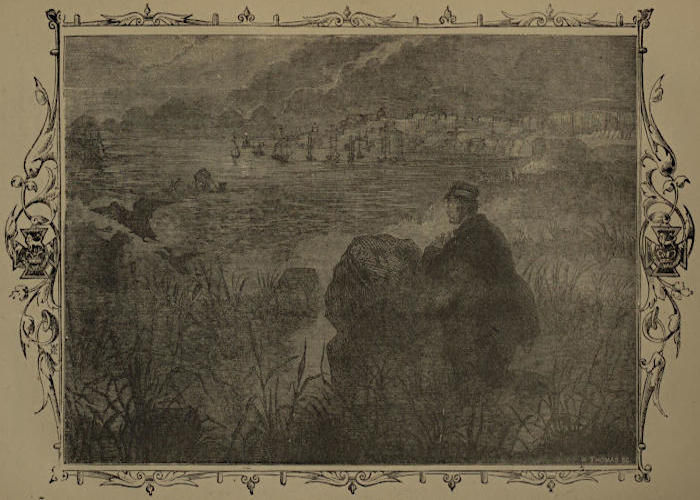
Commander George Fiott Day, R.N., reconnoitering
within the Enemy’s Lines at Genitchi.
Captain Day was not ignorant of the danger of attempting this
reconnoissance. About a month before, Captain L’Allemand, of the
French steam-vessel Mouette, had done so, and failed. He not only
lost his own life, but several of the sailors who accompanied him
were killed. Captain Day had the sagacity to perceive that this
disaster was the result of the Frenchman’s imprudence. He had
taken with him some twenty of his men—a force too small to offer
any effectual resistance in the event of discovery, and too numerous
to be able to escape detection. It occurred to him that one man
might succeed where twenty had failed; but where was that man
to be found? No one could hope to succeed, unless he had the
step of an Indian and the eye of a hawk. In his earlier days,
Captain Day had learned to stalk the red-deer on the mountains of
the North, and the acuteness of vision and stealthiness of tread he
had thus acquired were now employed for the benefit of his country.
It is not to be supposed that self is altogether forgotten in the hour
of heroic self-devotion; promotion, the world’s applause, and Westminster
Abbey are dimly present to the mind of the most unselfish
of men when undertaking some daring enterprise. To secure the
applause of his admiral and a step in the service may have weighed
a little with Captain Day; but we are sure that the danger itself
had a certain irresistible attraction to his mind. He waited anxiously
for a night suitable for the attempt, and on the 19th of September
he was enabled to take the bearings of the Russian gunboats from
the mast-head of his ship; he was enabled at the same time to
mark the exact position of the guard-houses on the spit. He then
resolved to land as soon as it was dark, and to try to make his
way across without being observed. Accordingly, as soon as
evening set in, he put a couple of sailors in his smallest boat, and,
taking a small pocket-compass, some matches, his double glasses,
and revolver, he at once landed. He took the precaution to put
his commission in his pocket, so that his rank might be recognised
if he were taken prisoner. He landed on the beach abreast his
own ship, and told the sailors to remain in the boat at a sufficient
distance from land to be beyond the reach of the enemy’s fire, in the
event of a surprise; they were to remain there and not to make
any noise, whatever might happen, unless he hailed them to pull in.
It would be impossible to relate all the adventures of that night;
suffice it to say that our hero did make his way across, after a long
and wearisome journey, without being detected. He passed through
many of the enemy’s pickets, which, as he had anticipated, were
few, and widely scattered. He was thus enabled to have a good
view of the Russian gunboats, which he found were moored close to
the shore, and likely to remain in that position. The idea occurred
to him that they could easily be surprised, as they were very slightly
armed, and no attack was expected by the enemy. Nothing, however,
could be done without the sanction of Captain Osborne, and
our hero had reluctantly to retrace his steps. He reached the beach
about two o’clock in the morning, after tramping about among bogs
and morasses for more than seven hours, and found his boat all
safe. He was in constant danger of detection, in consequence of
the numerous water-fowl with which the lagoons abounded being
disturbed by his approach, and thus putting the sentries on the
alert; but his old deer-stalking habits stood him in good stead: he
was not discovered.
On the following day Captain Osborne arrived, and Commander
Day communicated to him all that he had witnessed during the
previous night. It was fortunate that in Osborne he had a leader
quite as bold and daring as himself, who entered warmly into his
plans, and admitted that the attempt might be crowned with success.
He received from him the promise that, if an expedition were
sent, he should take part in it—an assurance which afforded him
much satisfaction. On the following day Captain Osborne was
obliged to leave, and Commander Day, on cruising along the coast,
observed that the enemy appeared to be as numerous as ever. It
occurred to him, as he anchored for the night off his old anchorage,
that it would never do to allow the expedition to be undertaken with
so many of the enemy scattered about, as it would only end in
disaster and the capture or slaughter of all who took part in it. To
prevent such a calamity, he resolved to make another reconnoissance.
After the statement he had given to Osborne about the
number of the enemy, he felt that a great responsibility rested upon
himself, and that it was far better to expose his own life to danger
a second time than involuntarily to cause the loss of many valuable
lives. None but a gallant and good man would have reasoned
thus, or incurred so great a danger. He determined, therefore, to
land at once, in order to ascertain the real strength of the enemy,
and thus be enabled to report to Captain Osborne whether it would
be advisable to undertake the expedition. He felt it to be his duty
to do this, as he had led him to believe that the enemy’s forces
were far less numerous than they now appeared to be.
Accordingly, employing the same tactics as before, he landed at
sunset. The night was bitterly cold, and so intensely dark that he
had to grope his way at every step. He soon discovered that he
was off the right track, and more deeply involved among the Russian
sentries than was at all pleasant or desirable; but he never
for a moment lost his presence of mind, and it was to this cause
that he owed his safety. He crept along with all the stealthiness
of a Red Indian, stopping every moment, and feeling his way at
every step. He soon saw enough to satisfy him that the enemy’s
forces were far too numerous to admit of the possibility of their
being captured or surprised. There was no help for it; the expedition
must be abandoned, and he must try to reach his vessel in
safety. This was no easy undertaking; if it was difficult to
advance, it was still more difficult to retreat. The place was full
of quagmires and pits, into which he repeatedly fell, and, to add to
other delightful sensations, more than one ball came whizzing past
his ears in such close proximity as to be far from pleasant. It was
his impression at the moment that the sentries had discovered him
and were firing at him; but he was satisfied afterwards that this
was not the case. They were only firing in accordance with their
usual custom, to show that they were on the alert, and thus avert
the attack they dreaded.
After nine hours’ wandering he reached the beach, and the sight
of the blue waves must have been as grateful to him as the first
glimpse of the ocean to the Ten Thousand Greeks in their retreat.
But his dangers were not yet at an end: he looked everywhere for
his boat, but it could not be seen; he waded up to the waist in the
water, and, putting his mouth close to its surface, so as to veil the
sound, he shouted to them to come in. There was no answer. In
his desperation he drew his pistol from his belt, and, placing it close
to the water, fired. It did not strike him at first that this act was
more likely to attract the attention of the enemy than that of the
men in the boat; but as soon as he heard the report of the pistol
he was alive to the extent of the danger which he had incurred
through his imprudence. His safety lay in the proximity of his
own vessel, which was so close to the beach that the Cossacks could
not approach the shore without being under range of her guns. It
was a fearful position to be placed in. He was shivering with cold,
his feet were benumbed, and his clothes saturated with wet. Overpowered
with fatigue and half-dead with exposure, he threw himself
down on the beach and prayed earnestly for the dawn. It was one
of those hours which may concentrate in themselves more than the
agony of a whole lifetime. Such hours are never forgotten in after-life,
and are often the starting-point of a new existence. But we
need not dwell upon those weary hours that preceded the dawn. A
little before daylight, Mr. W. H. Parker, an officer of Commander
Day’s vessel, pulled in along shore to see if he could see anything
of one who, it was feared, was either dead or in the hands of the
enemy. He found him prostrate on the beach, and nearly frozen
to death. But such men have a wonderful tenacity of life. He
soon recovered sufficiently to inquire why his men had not pulled
in when he hailed them. It appeared that they had heard the
report and seen the flash of his pistol, but thought it might have
been some of the sentries near the beach. They imagined that
they heard him approach the shore, but thought that they were
carrying out his instructions in not approaching nearer to the land,
as he had told them that in the event of his being chased he would
swim out to the boat. They listened and watched, but as they
heard nothing more they imagined that he had not come down.
The following morning he was too ill to move. A less powerful
frame would have succumbed under the physical suffering of that
night. Captain Osborne, who had returned, visited him the same
day on board his ship, and persuaded Captain Day to address to him
that despatch which elicited a letter of approval from the Admiralty
and earned for him the Victoria Cross.
Captain Day was, undoubtedly, the only man in England who
felt any surprise when his sovereign conferred on him this proof of
her favour. It has been cynically remarked that no man is a hero
in the eyes of his valet. It is certain that no true hero is ever
esteemed to be so by himself. There is a glorious absence of all
self-consciousness in true genius and heroism. The man whom
the whole world admires is often the least conscious of his own
merits.
CHAPTER XIII. LIEUTENANTS MOORE AND MALCOLMSON, AND THE VICTORIA CROSS.
Who among our readers has not been interested about
Persia—that mysterious land in which such wonders
have been said to exist? So many of the tales in
the “Thousand and One Nights” refer to Persia, that most boys,
at least, are well acquainted with some of the peculiarities of the
people.
Although it is difficult to pronounce any decided judgment as
regards the actual antiquity of any Eastern nation, yet there seems
to be but little doubt that before England had even emerged from
a condition of semi-barbarism, civilization had made considerable
progress in Persia; and although that nation is principally famous
to us on account of its tales of winged monsters, dragons, enchanters,
and genii, yet this peculiarity may be in consequence of
early travellers bringing to us that which was at the time the most
acceptable; and as we in England can scarcely assume to have been
lovers of science and truth during more than three hundred years, it
is possible that any profound or philosophical truths brought from
the East would have been formerly as little appreciated as a book
of algebra would be in a nursery. The laws of the Medes and
Persians are referred to in the Bible, and in the book of Esther
reference is made to a King Ahasuerus, who it is said ruled over
one hundred and twenty-seven provinces, which then constituted
the kingdom of Persia.
It is stated by some of the earliest writers that the Persians
were a nation of shepherds, hardy and warlike, that they gradually
increased in numbers and power, and conquered and brought under
their rule less powerful nations, until they became almost the
greatest people of the East.
The most celebrated of the ancient kings of Persia was Cyrus,
who organized the Persians, gave them special laws for their
guidance, political institutions, and established a well-disciplined
army. This Cyrus not only became King of Babylon, Media, and
Persia, but at length, by the right of conquest, obtained absolute
dominion over the greater part of Asia.
Cyrus was succeeded by his son Cambyses, who was a man that
delighted in war. He died in consequence of a hurt which he
received while mounting his horse.
Following Cambyses was Artaxerxes; and we then come to
Darius, who loved conquest better than had any of his predecessors.
This king was desirous of obtaining the homage even of Greece,
and sent heralds to claim it, but without success. He then raised
a large army and invaded Greece, but the Athenians under
Miltiades met him, and gained a great victory, known as the battle
of Marathon, and fought two thousand three hundred and fifty-two
years ago.
Xerxes succeeded Darius, and continued the attack on Greece.
It was during this war that Leonidas, with his band of Spartans,
defended the pass of Thermopylæ against such overwhelming odds—a
deed which would certainly have gained him the Victoria Cross
in modern times.
Darius III. had reached the dangerous condition of a very rich
but not a warlike king; when then, he, by means of his wealth,
incited other nations to make war upon Alexander, King of
Macedonia, this great conqueror determined to attack Persia—a
feat which he accomplished with so much success that he everywhere
defeated the Persians, who for upwards of a hundred years
were, in a great measure, under the yoke of Greece.
In more modern times Persia has been invaded by the Tartars, a
vagrant race of hunters and shepherds who were warlike and
organized enough to subjugate Persia.
With the exception of the early wars with the Greeks already
referred to, the Persians, up to the year 1700, had not met in
battle any of the armies of Europe. Peter the Great of Russia
had, however, for a long time been desirous of extending his territory
to the banks of the Caspian Sea, and had merely waited for a
pretext to wage war with Persia. He did not seek an opportunity
in vain, for a Russian caravan returning from China was plundered
by the Persians, and this offence so irritated the Russian autocrat
that he put himself at the head of his army, sailed from the Volga,
and landed at Daghestan. Shortly after hostilities ceased, and
Russia obtained from the Persians the towns of Baku, Derbund,
and several provinces. During this period the Persians were also
at war with the Afghans, who had invaded Persia and had been the
cause of much misery.
The late Czar Nicholas of Russia had no sooner ascended the
throne than he commenced war with Persia, and at length, in 1828,
concluded a treaty by which he gained several provinces.
About the years 1836, 1837, a collision took place between the
Persians and the Afghans. It was the object of the Persians to gain
possession of the district of Herat. Now this district lies on the
north-west of India, and may be called one of the barriers to our
Eastern Empire, and as such it is essential to be preserved as an
independent state. In July, 1837, the Persians marched an army
against the Afghans, and, after a siege of ten days, succeeded in
capturing Ghorian, and in December commenced the siege of
Herat.
Various remonstrances had been made to the Persians by the
British authorities in connexion with the attack upon Herat, but
without avail, and they merely had the effect of making the English
unpopular. At this time a confidential messenger bearing despatches
for the British minister was insulted and detained by the
Persians. This and one or two other similar proceedings on the
part of the Persians, in addition to their attack upon our then allies
the Afghans, rendered amicable communications with them out of
place, so that in June, 1838, our minister quitted the Persian
court and ceased any friendly communication with the Persians.
During March, 1839, Sir Frederick Maitland, commander-in-chief
of the naval forces in India, landed some men from the
Wellesley at Bushire. It appears that there was only one locality
at which a landing or embarkation ought to have taken place, and
in the present instance this custom was not paid attention to, and
it was nearly leading to unfortunate results, as the Resident was
threatened by a large party of armed men. Fifty marines and about
thirty sepoys were provided with sixty rounds of ball cartridge
each, and, under the command of Captain (now Lieutenant-General
Sir S.) Ellis, approached the shore. Upon coming within range a
heavy fire was opened on this small party, wounding several men,
but fortunately killing none. A rapid pull, a leap on shore, and
steady advance towards the position occupied by the Persians, had
the effect of driving the enemy away, and the small body of
Europeans effected an entrance into the Residency and commenced
preparations for carrying off the Resident to the ships.
At this time, however, a heavy gale of wind sprang up, which
lasted three days, and entirely prevented communication by boats
between the vessels and the shore. The Persians, knowing this,
rather anticipated the capture or massacre of the small party left on
shore, but so decided were the proceedings of the officer in command
and so judiciously were his arrangements made, that his
enemy, although numbering ten to one, thought it more prudent to
leave him alone.
During each evening of these three days the Persians used to
assemble to the number of several hundreds and make demonstrations
as though they purposed attacking our men, but no sooner
did they appear than the little garrison was turned out and kept
under arms, ready and willing for a fight should the Persians feel
so disposed. This bold proceeding seemed to have the effect of
awing them, for no attack was made, and even a field-work that
was being constructed in front of the Residency was not continued,
upon Captain Ellis’s intimation that he would fire upon the working
party the instant a spade was put into the ground.
On the fourth day after landing, a reinforcement was sent from
the ships, and the whole party, including the Resident, safely
passed through the armed throngs and embarked in the boats.
Each of these, provided with a gun, pulled out, showing a muzzle
directed on the rabble and ready to discharge its iron hail should a
shot be fired at the boats.
Towards the end of 1855 it was evident that the Persian Government
did not intend to keep faith with England, for in December
Prince Sultan Moorad Meerza set out from Tehran in command of
an army that was to act against Herat. Whilst our Government
was remonstrating with that of Persia on this proceeding, several
insults were offered to the British officials at Tehran, and the right
of asylum accorded to the residence of the British mission was
violated. After various futile attempts to obtain redress, war was
at length decided upon, and an expedition was despatched to the
Persian Gulf from India.
In January, 1857, the expedition embarked, and reached its
destination at the end of the month, and shortly after was landed at
Bushire. The Arabian and Persian coasts on either side of the
entrance to the Gulf are desolate in the extreme; steep cliffs without
any sign of vegetation rise from the water’s edge, whilst inland
there seems no sign of a habitation; several barren islands stud the
coast on both sides, and are the residence of a few sea-birds only.
The village of Bushire, which was captured with scarcely any
opposition, is a place of some importance. It is imperfectly defended
by a wall, with towers at intervals to afford a flank defence. The
town itself is composed of narrow streets or alleys, whilst the
buildings are square and solid-looking. The places of interest in
the town are the church, the bazaar, and a reservoir. In the background
is a range of mountains which is usually covered with snow.
The troops forming the Persian expedition were very soon
actively employed. On the 3rd of February the entire force was
assembled and drawn up in order of march. This force consisted
of the 64th Regiment, 78th Highlanders, 20th and 26th
Regiments of Native Infantry, the 2nd Light Infantry, and 4th
Bombay Rifles, 3rd Light Cavalry, some horse artillery, and field
batteries—a somewhat diminutive army with which to invade a
kingdom, but one which was found efficient enough for the work it
was called upon to perform.
During the first two days’ march this little army encountered two
of the most disagreeable incidents of a tropical climate. First a
gale of wind sprang up, carrying with it a huge cloud of sand,
which penetrated not only the eyes, nose, mouth, and ears, but
seemed actually to force its way into the pores of the skin. When
the army halted, and were bivouacked in order of march, a tremendous
thunderstorm burst upon them, rain and hail coming down in
torrents, when both officers and men were drenched to the skin, for
they had no cover such as tents or trees. A piercing cold wind
blew upon them, and rendered their condition more trying than can
easily be imagined except by those who have experienced similar
inconveniences. But many examples have shown that nothing can
daunt the courage or decrease the ardour of the British soldier,
especially when led, as he was in this instance, by such a man as
Outram.
It was known that the Persians were in order of battle at about
eight or nine miles from the spot on which the troops had
bivouacked on the night of the 4th of February; therefore, before
proceeding on the march on the morning of the 5th, the loaded
arms were discharged and reloaded, in order to avoid the damaging
effects of the night’s rain.
Shortly after mid-day the Persian army was discovered in an
intrenched position. A short halt took place, in order to get the
regiments into their proper positions, when, to the annoyance of
our men, the enemy were seen in full retreat, which they continued
at such a pace as to prevent their being overtaken, except by a few
of our cavalry who attacked their rear-guard.
Our troops immediately took possession of their intrenched camp,
in which were large quantities of ammunition, grain, and camp
equipage. The intrenched position was found very weak, and would
easily have been taken by our little army, whereas a village near,
termed Brás-Joon, had it been but slightly fortified, would have
become a most formidable position.
During the 6th and 7th of February the troops were occupied in
destroying military stores and searching for hidden guns, treasure,
&c. On the night of the 6th an alarm occurred in the camp, and
the whole force stood to their arms. Fortunately, the moon shone
brilliantly, and thus a probable disaster was avoided, for one of the
corps mistook a patrol of the Poonah Horse for a party of the
enemy, and skirmished up to it, but fortunately discovered the
mistake before a shot was fired.
These night alarms—especially with soldiers not thoroughly
trained—are invariably dangerous, the probability being that
friends are mistaken for enemies, and shots not unusually exchanged.
We were once witness to a scene which, although ludicrous
afterwards and to the lookers-on, was certainly unpleasant
to the principal performer. It happened that a soldier in his shirt
and trousers had wandered some distance from our camp during
the night, when an alarm arose that the enemy were upon us.
Men scarcely awake rose to their feet, rifle in hand, and seeing a
white object in the distance rushing towards them opened fire on it.
The more the unfortunate man shouted (for he was within the
white object, which was his shirt) the more rapid was the firing at
him, until he came sufficiently close to be recognised. Fortunately
the darkness of the night and the hurried manner in which the
men fired saved him from being hit.
On the evening of the 7th of February the return march of the
army commenced towards Bushire, the enemy having been observed
retreating amidst the fastnesses of the mountains far away. Until
midnight all was quiet, and no enemy was expected, when suddenly
the discharge of musketry in the rear caused the forces to be on
the alert, and it was then found that the rear-guard was attacked.
In less than half an hour the whole army was surrounded by
skirmishers and galloping horsemen, who yelled and trumpeted,
making as much noise as possible. One of the Persian buglers,
who was acquainted with the English calls, sounded the “Cease
firing” repeatedly, close to the Highlanders.
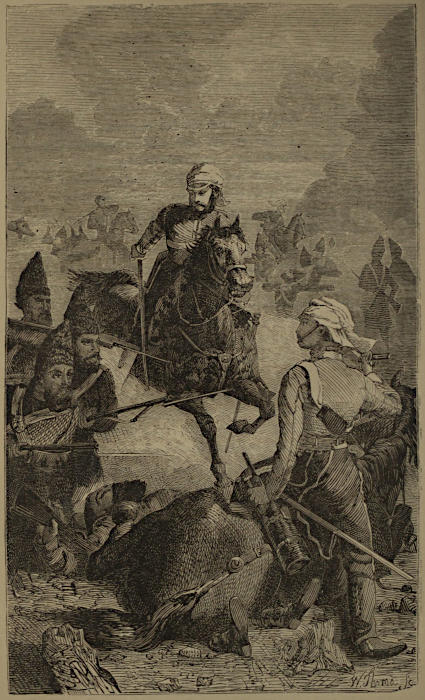
Lieutenant John Grant Malcolmson, 3rd Bombay Light
Cavalry, rescuing his brother officer, Lieutenant and Adjutant Arthur
Moore, at the battle of Kooshab.
Our troops, although surprised in a great measure, were as
steady as though on parade, and received the charges of the
enemy’s cavalry with a fire which emptied many saddles. This
exhibition of courage and discipline was the more commendable,
considering very few of the men had ever previously been under
fire.
During the greater part of the night the Persians kept up a
desultory fire, which, however, produced but little damage, and
when at daybreak the fire slackened it was feared that there would
not, after all, be any real battle; but as the morning fogs dispersed
the enemy were seen in position, their right resting on a village
called Khoosh-aub. Several dry watercourses were in their front,
and these were lined with skirmishers. There were also large
bodies of cavalry on both flanks, and altogether a force of about
8000 (one-fourth of which was cavalry) was assembled to
oppose us.
As soon as there was light enough a rapid cannonade commenced
on both sides, whilst a change of front was made by our own commander,
immediately after which the advance was made with but
little loss, considering the heavy firing brought against us.
The fire from the Persian guns was soon almost silenced by that
from our own, which was carried on at a tolerably close range.
Our cavalry, consisting of some irregulars and the 3rd Bombay,
finding some of the enemy’s horsemen opposed to them, made a
brilliant charge, fairly sweeping the enemy before them. There
were only two or three of the regular battalions of the Persians
that stood their ground at all or retired in regular order. The 3rd
Cavalry charged through these men, who received them with tolerable
steadiness. It was on this occasion that Lieutenant A. Moore
gained the Victoria Cross.
Lieutenant Moore was first within the square at which his regiment
charged. His horse fell dead beneath him, and he would soon
have fallen a victim had not a brother officer (Lieutenant Malcolmson)
fought his way back and assisted him with difficulty out of the
crowd of the enemy. Both Lieutenants Moore and Malcolmson
gained the Victoria Cross for their conduct on this occasion.
The result of this battle was the entire rout of the enemy, who
were defeated at every point, and in the retreat were cut up by the
artillery and cavalry. A couple of brass guns were captured, a
standard, and a large number of muskets. The Enfield rifle, which
was used in this affair, cast terror on the Persians. On one occasion
a horseman, who was making threatening demonstrations at a
distance of 800 yards, was neatly picked off by a good shot, an
officer in the 2nd European Light Infantry. About 700 dead were
found on the field, and a vast number of wounded were carried
away.
The troops, after the battle, moved off a short distance and
bivouacked, but were very shortly disturbed by heavy rain, which
continued without interruption during several days. The roads
became almost impassable, the soil—a mixture of clay and sand—being
ankle-deep in mud. The troops at length were forced to
halt, and without complaining stretched themselves in the mud, and
took that rest which all so much required. Although the distance
from the field of battle to the lines at Bushire was over forty miles,
yet it was passed by the troops, under all the disadvantages named,
in thirty hours. The loss on our part during these proceedings
consisted in one officer and eighteen men killed, four officers and
sixty men wounded.
Shortly after these events another expedition was undertaken by
our troops, and with complete success, the Persians, although brave
men, lacking that essential to make them good soldiers—viz., discipline.
There are several nations of the East—the Chinaman,
Hindoo, and others—who have scarcely any fear of death, and who
would rather cast themselves on their own swords and thus perish
than fall into the hands of an enemy, and yet when these men meet
in battle our own soldiers they invariably suffer an almost ignominious
defeat, in consequence of their want of discipline and of
steadiness under fire.
The soil and climate of Persia do not appear to be very favourable:
during the day it is intensely hot, and during the night
equally cold. In summer, likewise, the heat is intense. Vast
deserts of sand occur in many places, and long ranges of sterile
mountains cross the country in various parts. Vegetation is not
very abundant, and cultivation is carried on but scantily. Game,
however, abounds in many places, deer, antelopes, partridges, and
wild-fowl being found, and the lion is also said to be occasionally
seen.
Whether we consider the Persians as soldiers, their country as a
paradise, or their cities as noble works of art, we find ourselves
disappointed; for the first are little better than a half-trained
rabble, their country is not fertile, and their cities are badly constructed
and dirty. So that after contemplating these items we can
candidly exclaim, “There’s no place like home.”
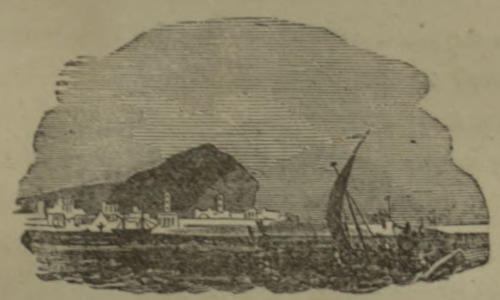
Bushire
CHAPTER XIV. CAPTAIN W. A. KERR, SOUTH MAHRATTA HORSE, AND THE VICTORIA CROSS.
On the evening of the 8th of July, 1857, a party of
officers belonging to different regiments in the Indian
service were seated round the mess-room table in the
barracks of Sattara, in the Bombay Presidency. An expression of
anxiety was depicted on all their faces, and they spoke in that hushed
subdued tone which men usually assume in moments of great peril.
And they had reason to look anxious. The Indian Mutiny had
already broken out, and recent events showed that its limits were
not to be confined to the Bengal Presidency. The seeds of disaffection
had been sown among their own men, and they knew not at
what hour they might be called upon to meet them in open mutiny.
The Orientals can veil the most treacherous designs under the
deepest secrecy, and every officer felt, as it were, that he was
carrying his life in his hands. At any hour the men, outwardly so
respectful and obedient, might enter the very room where they sat
and shoot them down at the mess-table. They had done so in
other cases, and what guarantee had these that their lives were
more secure? The inhabitants of Sattara were at no pains to
conceal their rebellious tendencies, and their men were only
restrained by that discipline which soldiers find it so difficult to
shake off from openly expressing their sympathies with them. In
truth, the whole country was in a state of slumbering rebellion,
and no one could tell when the embers of disaffection might burst
forth into an open flame. They felt as Prometheus might have
felt if he had been bound to the sides of Mount Etna, in hourly
expectation of an eruption. Escape there was none. If it came to
the worst, they could meet their fate like brave men, and die sword
in hand.
One young officer, whose stalwart frame and slight accent betokened
his Northern origin, took a more hopeful view of the subject.
This was Lieutenant William Alexander Kerr, of the South
Mahratta Horse, an officer who had already secured the confidence
and respect of the wild troopers under his command. He expressed
his conviction that, however treacherous the other native troops
might prove, he could always count on the loyalty of the South
Mahratta Horse, and if any emergency should occur it would be
seen that their courage was equal to their loyalty. The words had
scarcely passed his lips, when an orderly entered the room and
delivered a slip of paper to the officer in command. The door was
carefully closed to prevent the servants from hearing, for at that
trying period almost every native was suspected to be a rebel in
disguise. The paper was then read aloud. It proved to be a telegraphic
message from Kolapore, a town about seventy-five miles
distant from Sattara. Its contents were such as might well appal
the bravest heart. The 27th Regiment of Bombay Native Infantry
had suddenly mutinied and murdered all the officers on whom they
could lay their hands. Those who escaped had taken shelter in
the Residency, where they were guarded by a troop of the South
Mahratta Horse and the Kolapore Light Infantry. The mutineers,
from carelessness or ignorance, had neglected to cut the telegraph
wires, and the beleaguered party had thus been enabled to communicate
with their countrymen at Sattara, to whom they made an
urgent appeal for assistance. Almost destitute of provisions, and
surrounded by a merciless foe thirsting for their blood, they could
not hold out long, and if they yielded their fate was certain. In
this the hour of their need they turned to their countrymen for
assistance.
A momentary silence ensued. It was not that they were unwilling
to incur any risk in order to aid those whose case was so
desperate; the only question was whether they could trust their
men in such an undertaking. Kerr was not the man to unsay
the words he had just spoken. He had expressed the confidence he
reposed in the loyalty and courage of his men; he was now prepared
to prove that that confidence was not misplaced.
His position as adjutant of the regiment afforded him the best
opportunities of becoming acquainted with the personal character
of the men. He was brought into daily contact with them; had to
listen to all their grievances; had to receive the complaints made
against defaulters; and, in minor cases, to decide the punishments
to be awarded. Unswerving firmness and impartial justice are the
two qualities most requisite to enable one to obtain a powerful
hold on the Oriental mind, and these two qualities Lieutenant Kerr
possessed in the highest perfection. He knew his men, and his
men knew him; they could, therefore, trust one another in the
hour of danger. He at once volunteered to lead a party of the
South Mahratta Horse to the rescue; all the assistance that could
be spared was fifty men. Small as that number was for such an
undertaking, he did not hesitate to take the command. No time
was consumed in needless preparation; in half an hour he was in
the saddle and on the road. We use the expression “road” in a
figurative sense; literally speaking, there was no road at all, merely
a rough path leading through the cotton-fields, where the horses
sank to the fetlocks, often to the knees, in the mud. The distance
to be travelled was only seventy-five miles: a short distance to
those accustomed to railways and steamers, but those familiar with
the roads in India will appreciate the difficulties which Kerr and
his gallant little party had to surmount. It was the middle of the
monsoon season; the rain descended in torrents; the country was
half flooded; the smallest streams were converted into dangerous
rivers. But the gallant band went on; swam their horses over
three large and two smaller rivers, besides seven nullahs, all swollen
with the heavy rains, and reached Kolapore within twenty-six
hours. We have all heard of Dick Turpin’s ride to York; but the
rapid advance of Lieutenant Kerr and his party, in such a country,
and at such a season, was scarcely less wonderful.
They did not arrive a moment too soon. The mutineers, elated
by a temporary success, were ready to offer them battle. They
had already encountered the Kolapore Light Infantry, and defeated
them with considerable loss. After this they had taken up their
position in a pagah, or fortified square with circular bastions,
situated near the town. This pagah was a place of considerable
strength, and the attacking party had no artillery to effect a breach
in the walls. Recourse was had to the rajah, who lent them a
couple of old guns, which, on trial, were found to be useless.
Night was at hand, and Kerr knew well the danger of delay; if he
waited till morning, his men, worn out and discouraged, might
refuse to follow him. All his hopes of success depended on an
immediate attack; so he resolved at once to carry the place by
storm. His men had already witnessed his courage; he had
headed the party which occupied the brushwood outside the pagah;
he had laid the guns at thirty yards’ range from the western bastion
under a heavy fire; he had passed through all this unhurt. The
Orientals, fatalists by creed and by constitution, have the greatest
faith in the luck that attends certain leaders; they recognised in
Kerr one of the favourites of Allah, and were prepared to follow
him wherever he chose to lead.
He did not give them long to wait. Causing the sowars to dismount
from their horses, he placed himself at their head and led
them on to the attack. On approaching the walls they found that
the task they had undertaken was one of no ordinary difficulty.
The only entrance to the place was by small doors of thick teak-wood,
from five and a half to six feet in height, which the mutineers
had taken the precaution to block up with large stones, so as
to render them almost as solid as the walls. If they had been provided
with guns this obstacle might easily have been removed; but,
as the event proved, the two lent by the rajah were evidently
intended more for ornament than use.
But Kerr was not a man to be easily discouraged. His conduct
proved the truth of the good old adage, that “where there’s a will
there’s a way.” Among the dismounted sowars there was, fortunately,
one who entered readily into his plans, and volunteered to
share with him the danger. This was Gumpunt Row Deo Ker, a
gallant trooper, worthy to be known and admired by all who can
appreciate valour in the field, though the singularity of his name
will, we fear, prevent it from ever becoming familiar to our readers
as a household word. Kerr and Gumpunt armed themselves with
crowbars and marched through the heavy fire of the enemy till
they reached one of the small doors. Both plied their instruments
so well that they soon made an aperture sufficiently wide to admit
a man in a stooping attitude. It seems almost miraculous that no
hostile bullet should have reached them while thus engaged, but
they escaped unhurt. The opening was made, but who would have
the courage to be the first to enter? To do so was almost certain
death: the rebels were waiting and watching to shoot down the
first man who appeared inside the walls, and yet there was not a
moment’s hesitation. Kerr rushed through the opening, followed
by Gumpunt Row and others whose courage was inspired by the
example of their daring leader. As soon as he appeared within
the pagah, twenty of the mutineers took deliberate aim and fired a
volley at him. He had the presence of mind to retain his stooping
position, and all the bullets passed harmlessly over his head. He
did not give them time to reload, but rushed at them sword in
hand. They fought with bayonets, and kept their ground for a
time, till several of them were killed and wounded. Nothing
could resist the impetuous onset of the stormers: the rebels were
driven back till they found refuge in a house which covered the
other entrance. It so happened that this house was loopholed, and
the rebels were thus enabled to continue their resistance. They
fired heavy volleys upon the attacking party as they advanced, and
did everything they could to make good their position; but it was
all in vain. Kerr, followed by his brave sowars, got round the
flanks, set fire to the building, and burnt the enemy out. The
other mutineers retreated through the door already alluded to, and
began to barricade it. This spot now became the central point of
attack and defence; the mutineers quitted the other bastions which
they had been defending, and joined the party who had formed the
barricade. Knowing the fate that awaited them if they yielded,
they fought with all the fury of despair.
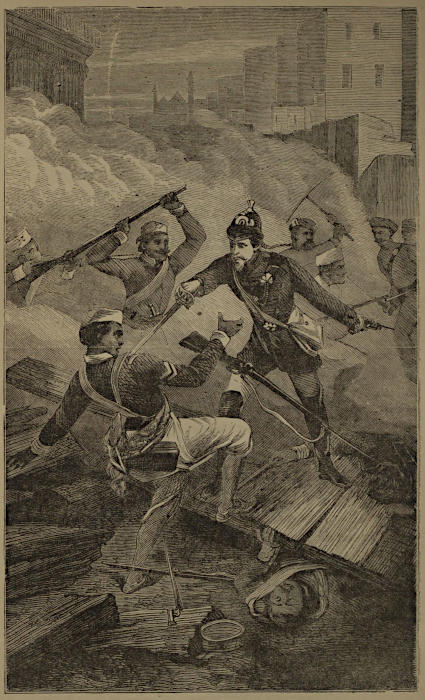
Captain William Alexander Kerr, South Mahratta Horse, at Kolapoor.
The great point was to effect an entrance. This could only be
done by removing the barricade. This was a task of no ordinary
danger; whoever undertook it had to count on concentrating on
himself the whole fire of the enemy. Here again Lieutenant Kerr
boldly exposed his life to almost certain destruction by rushing
forward, crowbar in hand, and emulating the vigour of the Black
Knight in “Ivanhoe” in the ponderous blows he struck. It seemed
that day as if he bore a charmed life; the bullets of the rebels
whistled around him in every direction, but still he plied his
crowbar till the barricade began to yield. At length, as on the
former occasion, he made an opening wide enough to admit a
person in a stooping position. As soon as this was done he rushed
through, followed by his faithful attendant, Gumpunt Row, who
was resolved to share his leader’s fate. The rebels were waiting
their approach, and no sooner had they appeared within the walls
than they were met by a volley, from which they fortunately
escaped unhurt. Without giving them time to reload they rushed
upon the mutineers, and a desperate hand-to-hand combat ensued.
The rebels were far superior in numbers, but that was their only
advantage. The storming party, animated by the example of their
gallant leader, already counted on victory. For a time the event
seemed doubtful; the enemy, driven to their last corner, offered an
obstinate resistance. A ball cut the chain of Lieutenant Kerr’s
helmet, another hit his sword-blade with such force that it turned
the edge. The faithful Gumpunt Row, though wounded in the
foot, never quitted his master’s side; at one moment, when his life
was exposed to imminent danger, he shot the assailant dead. Another
mutineer rushed up and discharged his musket so close to Lieutenant
Kerr’s face that for an instant he was blinded by the powder.
It was only for a moment, and as soon as he recovered his sight he
ran his sword through the body of his adversary with such force
that it required a violent effort to withdraw it. While he was
struggling to do so, one of the enemy, watching his opportunity,
rushed up and struck him a violent blow with the butt-end of a
musket. Such a blow would have placed a less powerful man hors
de combat; as it was, Lieutenant Kerr staggered beneath it and
almost lost his consciousness. Another rebel, observing his helpless
condition, ran forward to dispatch him, but Gumpunt Row,
watching over his master’s safety, was ready to receive him. A
bullet from his musket stretched him lifeless on the ground. Lieutenant
Kerr, instantly recovering himself, killed a second. Assailants
and defendants were now enveloped in such a cloud of smoke
that it was difficult to distinguish one another or to mark the
various incidents of the contest, which raged with the greatest fury.
Lieutenant Kerr, though severely wounded, pressed the advantage
he had gained by driving the enemy before him; he knew that all
depended upon his example and courage; if he had fallen or hesitated
for a moment the sowars would have retreated and the enemy
escaped. As it was, they followed him wherever he went, and
showed by their conduct that the natives of India, when properly
led, are capable of the most heroic deeds.
The mutineers were pressed so hard that they at length gave
way, and took refuge in the inner keep. This building had been
used as a temple, and was a place of considerable strength. The
rebels barricaded the door and began to fire through an opening
on the storming party. The latter had consisted originally of
seventeen sowars; of these only six or seven continued to follow
their gallant leader; all the rest had been killed or disabled.
Lieutenant Kerr advanced with this handful of men to attack the
rebels in their last refuge. On approaching the door, it was found
that the crowbars made no impression upon it, and that some other
means of forcing an entrance must be adopted. Lieutenant Kerr
proved himself as ingenious in resources as he was gallant in attack.
Observing a quantity of hay close at hand, he seized some of it and
carried it to the door of the temple. He was closely followed by
Gumpunt Row, who set fire to the hay. The door was gradually
consumed, and the stormers, who during this interval had been
exposed to a heavy fire, rushed in. None of the mutineers escaped;
all of them were either captured or slain.
This brilliant affair, in which Lieutenant Kerr bore such a distinguished
part, was attended with the most important consequences: it
checked the rising spirit of revolt in the province
where it occurred, and revived the confidence of the officers in the
native regiments under their command.
The loss sustained by the storming party was very severe.
Their leader was seriously wounded. Of his seventeen followers
eight were killed on the spot, and four subsequently died of their
wounds. Not one of them escaped unhurt. If we take into account
the obstinate resistance of the enemy, the smallness of Kerr’s troop,
and the heavy fire to which they were exposed, the only ground for
surprise is that any of them should have escaped at all. It was
impossible that such gallant conduct should have passed unnoticed
or unrewarded. The press of India was loud in expressing the
admiration which was felt by all, and Colonel Maugan, the officer
commanding at Kolapore, brought Lieutenant Kerr’s distinguished
conduct under the notice of the Adjutant-General of the Bombay
army, in the following terms:—
“Lieutenant William A. Kerr, of the Southern Mahratta Irregular
Horse, took a prominent share in the attack of the position, and at
the moment when the capture was of great public importance, he
made a dash at the gateway with some dismounted horsemen, and
forced an entrance by breaking down the gate. This attack was
completely successful; and the defenders (to the number of thirty-four,
all armed with muskets and bayonets) were either killed,
wounded, or captured—a result which may with perfect justice be
attributed to Lieutenant Kerr’s dashing and devoted bravery. I
would therefore beg to be permitted to recommend Lieutenant
Kerr for the highly honourable distinction of the Victoria Cross.”
Our readers, after reading the above narrative of Lieutenant
Kerr’s exploits at Kolapore, will agree with us that he deserved this
honourable distinction, so dear to every soldier’s heart. Soon after
these events he returned to England, where he was invested with
the Victoria Cross, and afforded Mr. Desanges an opportunity of
perpetuating the remembrance of his gallantry. He has now
returned to Bombay, and holds the rank of captain in the South
Mahratta Horse. If circumstances should ever arise demanding
such displays of valour, it will be found that his arm is as strong
and his heart as brave as when he stormed the pagah at Kolapore
and repressed the mutiny of the 27th Bombay Native Infantry.
CHAPTER XV. PRIVATE HENRY WARD, V.C., 78TH HIGHLANDERS.
It is a remarkable fact that Private Henry Ward and Sir
H. M. Havelock, Bart., the officer whose life he saved,
have both been decorated with the Cross of Valour.
The career of Havelock, the avenger of Cawnpore, the deliverer of
Lucknow, is matter of history; but the important services and
distinguished bravery of his son, who owes his life to Private Ward,
ought to be recorded for the admiration and imitation of all who
wish to deserve well of their country. He was born at Chinsurah,
in the Bengal Presidency, in the year 1830; his father, then a
lieutenant in the 13th Regiment, had formed the acquaintance of
the Baptist missionaries at Serampore, and was married on the 9th
of February, 1829, to Hannah Shepherd, the youngest daughter of
the Rev. Dr. Marshman, a distinguished member of that body.
Henry Marshman Havelock was the first fruit of this marriage, and
had to share from his earliest infancy in all the vicissitudes and
dangers of a soldier’s child in India. While still an infant under
twelve months of age, he had to accompany his parents on a voyage
up the Ganges and was seized with a sudden attack of illness. On
this occasion his father exhibited the same calm courage and presence
of mind which he afterwards displayed on many a battle-field.
“To render the case more disheartening,” he wrote, “we were
entirely destitute of the only remedies which we believed likely to be
effectual. We had no calomel, and no lancet, and no skilful hand
to use it; and the young sufferer grew worse every hour. The
danger seemed imminent, and our distress was not trifling. I
therefore determined myself to try my skill as an operator, and
with a very indifferent substitute for a lancet, and, I fear, not a
very steady hand, succeeded in giving relief to my first patient. I
should think this a very tedious story to write to one who did not
know how the human heart, even the heart of one who has passed
through many scenes of suffering and danger, attaches itself to
these little ones in their years of helplessness. My clumsy attempts
were certainly blessed beyond our hope, for the little sufferer
soon became calmer and calmer, and his fever sensibly diminished.”
We record this incident, because it proves that tenderness of heart
is not incompatible with the sternest courage: the two qualities
may, and often do co-exist.
It is unnecessary to dwell on the education or boyhood of young
Havelock: from the earliest period he had expressed a desire to
adopt his father’s profession, though, judging from his subordinate
rank in the army, he had little reason to expect rapid promotion.
He obtained his commission in 1847, and at the commencement of
the Indian Mutiny held the rank of lieutenant in the 10th Regiment.
When his father received the command of the moveable
column which was to be formed at Allahabad, and to consist of the
64th Regiment and 78th Highlanders, he was appointed Deputy-Assistant
Adjutant-General of this force, and accompanied them in
their advance to Cawnpore. He had already held the appointment
of adjutant in his own regiment, and acted for a time as aide-de-camp
to his father on this his first campaign. He was present at
the battle of Futtehpore, where his gallantry attracted the notice
and excited the admiration of his father, who, in the original draft
of the despatch he had written, thus alludes to his services:—“I shall
incur risk of suspected partiality when I further record that the boldness,
and activity, and quick perception of Lieutenant Havelock,
10th Foot, my son, and aide-de-camp, on this his first action on
shore, inspired me with the hope that he will do his country good
service long after I am in the grave.” No one can read these words
without emotion, or fail to sympathize with the father of such a son
and yet such was the tenderness of Havelock’s conscience, the almost
morbid dread that paternal partiality might have led him to exaggerate
the merits of his aide-de-camp, that the passage was omitted
in the revised copy of the despatch. We question whether there
be many officers in the service who would exhibit the same reticence,
or practise the same self-denial under similar circumstances;
but Havelock was one of a thousand. Though he had the Spartan
self-denial to omit his son’s name in his published despatch, he
speaks of “the boy H.” in admiring terms in his private letters,
and circumstances soon occurred which led him to believe it to be
his duty to recommend him for the distinction of the Victoria
Cross.
A brief statement of these circumstances may not be out of
place. On the 16th of July, 1857, Havelock was close upon
Cawnpore, and after allowing his exhausted troops a few hours’
rest in a mango grove, until the fierce heat of the mid-day sun had
abated, prepared for action. Nana Sahib, having completed his
work of butchery in the town, had marched forth with his army,
and taken up a strong position at Atherwas, the point where the
road leading to the cantonment branches out from the main trunk-road
to Cawnpore. He there commanded five villages, with
numerous intrenchments, armed with seven guns; his infantry was
stationed in the rear. Havelock perceived at once that the guns
could not be silenced, or the intrenchments carried without sacrificing
many valuable lives, and with his small army he had none to
spare. He therefore quietly wheeled his force round to the left of
the enemy’s position, behind a screen of clumps of mango. When
the rebels detected this manœuvre, they endeavoured to strengthen
their left flank by bringing up their cavalry, and opening fire in
that direction with all their artillery. Then followed a series of
operations which proved, in the most striking manner, the superiority
of the British infantry to the recreant foe opposed to them;
though inferior in numbers, and exhausted by their long march,
they advanced under a heavy fire with as much coolness as if they
had been on parade; and when the word was given, “Charge,” they
rushed forward with a ringing cheer, and drove the enemy before
them at the point of the bayonet. Four villages were thus taken
in rapid succession, and seven guns fell into our hands. As a last
effort the enemy planted a 24-pounder on the cantonment road, by
which our men had to advance, and inflicted severe loss on the
gallant little band. Our artillery cattle were so exhausted with
heat and fatigue, that the guns could not be dragged forward to
silence the 24-pounder, and the enemy, encouraged by their temporary
success, began to rally with the evident intention of renewing
the engagement. The moment was critical: all depended upon the
capture of the enemy’s gun. This task was assigned to the 64th
Regiment, who advanced along the road amid a shower of grape,
under the command of Major Stirling. An officer commanding a
regiment ought always to be mounted, especially in action: he is
thus a conspicuous object to his men, and his presence inspires
them with fresh courage. Unfortunately, Major Stirling’s horse
had been wounded by the bursting of a shell, and he was obliged
to lead on his men on foot. It does not appear that there was any
hesitation or irresolution on the part of the 64th, anything, in short,
to justify another officer in attempting to supersede the one already
in command; on the contrary, their conduct throughout the day
was rewarded with the highest praise in a public despatch. While
they were in the act of advancing, young Havelock, perceiving no
officer at their head, and knowing how much depended on the capture
of the gun, yielded to an almost irresistible impulse by riding
forward, and placing himself at the head of the regiment. Gallantly
he advanced in front of them, amid a storm of grape, cheering
them on by his voice and example, till he rode his horse to the very
mouth of the cannon which had arrested our progress. It was
seized by the 64th, and the enemy losing all heart fell back on
Cawnpore, where they blew up the magazine, and then went on to
Bithoor.
General Havelock, who had witnessed the gallantry of his son,
resolved to recommend him for the Victoria Cross. We have already
seen how on a previous occasion he had omitted his name from a
public despatch lest he should be suspected of partiality: this circumstance,
perhaps, rendered him more anxious to do justice to
him now. There was no reason in the world why he should be
debarred from this honour if he had fairly earned it, because his
father happened to be the officer in command. It appears, however,
that he himself wished the affair to be overlooked. It is not for
us to specify the motive by which he was actuated: it may have
been a tender regard for his father’s character of impartiality, or an
apprehension of the storm of hostility which the bestowal of this
honour would excite, or the consciousness that he was not justly
entitled to it. Be this as it may, the fact is certain that he persuaded
his father to suppress the telegram which he had prepared
for the Commander-in-Chief. He was more anxious that his own
merits should be overlooked than that his father’s good name should
be impugned: he was willing to wait. On the return of the troops
to Cawnpore after the battle of Bithoor, General Havelock having
occasion to recommend another officer for the Victoria Cross, no
longer felt himself justified in overlooking the claim of his own son.
“I also recommend for the same decoration Lieutenant Havelock,
10th Foot. In the combat at Cawnpore he was my aide-de-camp.
The 64th Regiment had been much under artillery fire, from which
it had suffered severely. The whole of the infantry were lying
down in line, when perceiving that the enemy had brought out
their last reserved gun—a 24-pounder—and were rallying around
it, I called up the regiment to rise and advance. Without any
other word from me, Lieutenant Havelock placed himself on his
horse in front of the centre of the 64th, opposite the muzzle of the
gun. Major Stirling, commanding the regiment, was in front, dismounted;
but the lieutenant continued to move steadily on in front
of the regiment, at a foot pace, on his horse. The gun discharged
shot till the troops were within a short distance, when they fired
grape. In went the corps, led by the lieutenant, who steadily steered
on to the gun’s muzzle, until it was mastered by a rush of the 64th.”
It is worthy of remark, that this recommendation was concealed
from his son, and only communicated to him after his father’s
death by Lieutenant Hargood, General Havelock’s aide-de-camp.
This circumstance is to be regretted on many grounds: if the telegram
had been submitted to young Havelock before it was forwarded
to the Commander-in-Chief, we are certain, from our
personal knowledge of his character, that he would have so modified
certain expressions it contains as to have avoided wounding the
tender sensibilities of those who felt aggrieved by them. Without
doing any injustice to himself he might have done more justice to
Major Stirling, and the officers of the 64th; but the responsibility
rests not with him but with his father, who, before the storm
excited by the publication of this telegram had burst forth, had
already gone the way of all living, and was indifferent to popular
praise or blame. The Cross of Valour was awarded to Lieutenant
Havelock in March, 1858, and on reading it in the Gazette, the
officers of the 64th Regiment, considering that they had just cause
of complaint against both father and son, addressed a letter of
expostulation to Sir Colin Campbell, the Commander-in-Chief in
India. There is no reason to believe that the gallant old chief was
actuated by any personal feeling in the matter, but he felt it to be
his duty to forward the letter of expostulation to His Royal Highness
the Duke of Cambridge, accompanying it with certain strictures
implying grave censure on father and son.
Men who have spent so many years in the service as Lord Clyde
are naturally opposed to innovations. There is a certain period in
life when we all become conservative in principle. Old men, since
the days of Homer, have ever been prone to exalt the past at the
expense of the present; and Lord Clyde was no exception to
this rule. He regarded the Victoria Cross with the same distrust
with which he regarded every other innovation. In his own hot
youth he had exhibited the most daring courage at Badajoz, and
elsewhere, when there was no Victoria Cross to be earned; and he
held that courage, like virtue, was its own reward. Devotion to
duty, without regard to after consequences, was the principle by
which he himself was guided during his long career; the soldier
who was animated by a sense of duty required no outward stimulus.
The promise or expectation of some badge of distinction as a reward
for heroism or gallantry in the field was sufficient, in his opinion,
to incite young officers ambitious of honour and reckless of their
own lives to rush into rash enterprises without consulting their
superiors. Discipline, or, in other words, subjection to lawful
authority, he esteemed the highest ornament in every young soldier;
no heroic action could atone for any violation of this primary
duty.
It is not necessary here to expose the fallacy of such reasoning.
Our soldiers were quite as brave when there was no Victoria Cross
at all as they are at the present moment: that Cross was intended
not to create, but to reward valour. The British soldier
requires no outward stimulus, no promised reward, to incite him
to do his duty: a true hero will prove himself to be a hero, because
it is his nature to be so, and he cannot help it. Nelson never
thought of ribbons or peerages when he was fighting our battles at
sea; his only ambition was to conquer or to die. The soldier or
sailor who distinguishes himself in action never dreams of reward:
he is a hero, and he does heroic deeds almost without knowing it.
Of all the men who wear the Victoria Cross upon their breasts,
there is not one, we believe, who ever thought of that badge of
distinction at the moment he earned it. It was innate heroism or
tender humanity that placed him at the head of the forlorn hope, or
led him to risk his own life to rescue a wounded comrade. The
man who would do such deeds from such a purely mercenary
motive as the love of applause, would be unworthy of the name of
soldier; his selfishness would be even more remarkable than his
courage. The Queen’s own Cross was not intended to encourage
such selfishness, or to reward such courage; nor has it ever done
so. Many of those who wear it were surprised at its being
awarded to them, so humble was their estimate of the value of the
deeds by which they obtained it; no one ever performed those deeds
for the purpose of being awarded the Victoria Cross. It is the expression
of our national admiration for deeds which demand some public
recognition, and cannot be adequately rewarded in any other way.
These remarks have been elicited by the strictures with which
Sir Colin Campbell accompanied the letter of expostulation from the
officers of the 64th Regiment, which he forwarded to His Royal Highness
the Duke of Cambridge. In that letter they complained, with
much appearance of reason, that their own honour and that of the
regiment had been compromised by an officer of the staff usurping
the place of Major Stirling, the officer in command, when there
was nothing to justify him in doing so. Major Stirling was at the
head of his regiment, and the 64th were discharging the duty
assigned to them. If he was not mounted, there was a sufficient
reason for this: his horse had been wounded by the bursting of a
shell, and was unable to carry him. If the regiment had betrayed
any irresolution, or hesitated to advance, the occasion might have
justified young Havelock’s interference; but they positively denied
that such was the case, and requested that some steps might be
taken to vindicate their honour, which had been impugned by
awarding the Victoria Cross to one whose conduct was more deserving
of censure than of praise.
It is difficult to take a cool, dispassionate view of this affair;
our sympathies are naturally with the young lieutenant, but we
must endeavour to be just. No one can find fault with the officers
of the 64th for writing such a letter: to a soldier reputation is
everything; and the fair fame of a regiment, like that of a woman,
if once lost can never be regained. Every regiment in the service
has its distinctive character, as much as every soldier who belongs
to it; it was clearly, therefore, the duty of the officers of the 64th
to protest against a measure which reflected on them and the
soldiers under their command. Their silence would have been a
tacit admission that there was ground for such reflections; their
protest was a natural appeal against them.
We have the sincerest respect for the memory of General
Havelock: no one can read his life, or trace his career, without being
convinced that he was a good man and a gallant soldier. This conviction,
however, does not imply that he was perfect, or exempt from
those weaknesses to which the very best men are subject. A
father is always liable to the charge of partiality when judging of
the merits of his own son, and is often blinded by paternal affection
to the actual merits of the case. It would be improper for him to
form one of a jury while his son was being tried, much more
so to sit upon the bench as the presiding judge. This was the
position which General Havelock occupied on this occasion, and
we must not blame him too much if, in his anxious desire to do
justice to his son, he inadvertently failed to do justice to Major
Stirling, and the officers and men of the 64th Regiment. He acknowledges
that Lieutenant Havelock placed himself on his horse in front
of the centre of the 64th, and that he did so without any orders from
him. He admits the fact: the only question is, was he justified in
doing so? If the regiment had been repulsed, or had hesitated to
carry out the orders they had received, any officer of the staff
would have been justified in taking the command, and in leading
them on to victory. It has never been attempted to be shown that
such was the case. The 64th were steadily advancing under the
command of Major Stirling, when Lieutenant Havelock, acting on
the impulse of the moment, rushed forward and placed himself at
their head. The general, in his telegram, contrasts the position
occupied by Major Stirling with that occupied by his son:—“Major
Stirling, commanding the regiment, was in front, dismounted;
but the lieutenant continued to move steadily on in front
of the regiment, at a foot pace, on his horse.” It is unfortunate
that he should have omitted to state that Major Stirling was dismounted
because his horse had been wounded by the bursting of
a shell; there would thus have been no ground for the suspicion
that he was dismounted from choice, and not from necessity. It
may be that the general was ignorant of this fact; but he ought to
have ascertained why Major Stirling was dismounted before he
mentioned it in a telegram, which must, sooner or later, become
public. The indignation of the officers and men of the 64th was
only natural, and Sir Colin Campbell truly expresses their feeling
when he says, “By such despatches as the one alluded to it is
made to appear to the world that a regiment would have proved
wanting in courage, except for an accidental circumstance; such a
reflection is most galling to British soldiers, indeed, is almost intolerable,
and the fact is remembered against it by all the other
corps in Her Majesty’s service. Soldiers feel such things most
keenly. I would, therefore, beg leave to dwell on the injustice
sometimes done by general officers when they give a public preference
to those attached to them, over old officers who are charged
with the most difficult and responsible duties.”
No one will accuse Sir Colin of having ever been influenced by
this undue preference; his desire ever was to do justice to all, and
he saw no merit in any action which was not strictly connected with
the discharge of duty. He had no sympathy with impulsive acts
of bravery, because he considered them to be subversive of discipline,
and often injurious to others. At the battle of the Alma
he threatened the 42nd with a punishment which they all dreaded, if
they left the ranks to succour the wounded; at the relief of Lucknow
he publicly reprimanded a Highland officer, his personal friend,
who had left his regiment to show him a flag which he had just
taken from the enemy. He was actuated by no personal feeling, he
was only expressing his own inward conviction when he thus alluded
to Lieutenant Havelock’s impulsive act. “This instance is one of
many in which, since the institution of the Victoria Cross, advantage
has been taken by young aides-de-camp and other staff-officers to
place themselves in prominent situations for the purpose of attracting
attention. To them life is of little value, as compared with the gain
of public honour; but they do not reflect, and the generals to whom
they belong do not reflect, on the cruel injustice thus done to gallant
officers, who, beside the excitement of the moment of action,
have all the responsibility attendant on this situation.”
Sir Colin’s judgment, in estimating the motives by which Lieutenant
Havelock was actuated in placing himself at the head of the
64th Regiment, was evidently biassed by the prejudices he entertained
against the Victoria Cross. There is no reason to believe
that the love of public honour, or any such selfish feeling, induced
that gallant officer to expose his life; his own anxious desire that
his conduct should be overlooked proves the contrary. If his
object had been to obtain the Victoria Cross, he would certainly
never have persuaded his father to suppress the telegram in which
he recommended him for that honour. His father’s good fame was
dearer to him than any honour which his country could confer, and he
knew that his father could not allude to him as he had done without
raising a storm of opposition. He wished, therefore, that the matter
should be overlooked and forgotten. He had acted on the impulse
of the moment; all depended on the steadiness with which the 64th
advanced; he saw them without a mounted leader, and, without
stopping to inquire the cause, he rushed forward and placed himself
at their head. When he discovered afterwards that Major Stirling’s
horse was wounded, and that he had supplanted that officer in the
command of his regiment while faithfully discharging his duty, he
must have felt that he had inadvertently treated him with injustice,
and that the public recognition of his conduct as desiring reward
would increase the wrong. He owed Major Stirling an apology for
having usurped his place, but he had done nothing to earn the
Victoria Cross, which was never intended to be an incentive to
impulsive acts of undisciplined valour. It must have been with
feelings of surprise and regret that he read his father’s telegram,
which was not published in India till after his death, and learned
that the Victoria Cross had been awarded to him for this particular
deed. In the interval he had done other deeds of valour which fully
merited this honour, and excited the admiration of every British
soldier in India; it was unfortunate that the father, in his anxious
desire to do justice to the son, should not have waited a little longer.
The remonstrance on the part of the officers of the 64th Regiment
was only natural and just; it was their duty to vindicate their own
honour now that Major Stirling was no longer able to answer for
himself and for them. That unfortunate officer died soon after he
was promoted to the rank of lieutenant-colonel, on the special
recommendation of General Havelock, for the part he acted at the
battle of Cawnpore. This fact is sufficient to prove that he had
not failed in his duty, and that there was nothing in his conduct to
justify another in usurping his place. The general, also, bestowed
the highest praise upon the regiment. In his despatch, after the
battle, he says: “Nor was the gallant 64th behind; charging with
equal bravery another village on the left, and firing four volleys as
they rapidly advanced up the rising ground, they soon made the
place their own, and captured its three guns.... But the 64th,
led by Major Stirling and my aide-de-camp, who had placed himself
at their front, were not to be denied. Their rear showed the
ground strewed with wounded, but on they silently and steadily
came; then, with a cheer, charged and captured the unwieldy
trophy of their valour.” In the general order, which appeared on
the morning after the battle, he says: “64th, you have put to
silence the jibes of your enemies throughout India. Your fire was
reserved till you saw the colour of your enemies’ moustaches—this
gave us the victory.” It is unfortunate that the general should
have revived those jibes, by making it appear to the world that the
64th would have failed in the hour of danger, had it not been that
his own son placed himself at their head.
These remarks, we trust, will not be misunderstood. We willingly
acquit the present Sir H. Havelock of all blame in the matter.
He did not wish to obtain the Victoria Cross for this particular act;
it was, in a measure, forced upon him without his knowledge or
consent. But having once obtained it, he was determined to show
that none could be more worthy to wear it. He acted as deputy-assistant
adjutant-general to the army which advanced under the
command of his father and Sir J. Outram for the relief of Lucknow,
and greatly distinguished himself at the passage of the Charbagh
bridge, where the enemy offered an obstinate resistance to our
entrance. From this bridge to the Residency was a distance of
about two miles; and this interval was intersected by trenches,
traversed by palisades, and commanded by loopholed houses. Between
eight and nine o’clock on the morning of the 25th of September,
1857, the army of rescue received the order to advance;
as soon as the first brigade, under the command of Sir J. Outram,
had passed the advanced picket, they were assailed by a heavy fire
in front, and Captain Maude, R.A., pushed bravely forward with
the loss of one-third of his men. His coolness and courage opened
a passage for our army till they reached the Charbagh bridge, which
crosses the canal. This bridge was defended by six guns—one of
them a 24-pounder—which swept the passage and threatened destruction
to all who approached. Here the enemy had resolved to
make their stand, and no position could have been better chosen.
The houses on either side were loopholed and flat-roofed, each one
forming a separate fortress, from which the enemy could fire upon
our men with comparative safety. So severe was the enemy’s fire
that our troops were obliged to halt for a time, and to lie down
wherever they could find shelter. Owing to the narrowness of the
road, only two of Maude’s guns could be brought forward, and the
men who worked them, being without cover, were killed or wounded,
so that they had to be replaced by volunteers from the infantry.
General Neile, who commanded the first brigade in the absence of
Sir James Outram, ordered the Madras Fusiliers to advance and to
storm the enemy’s battery. The words had scarcely passed the
general’s lips when young Arnold, of the Fusiliers, who was ever
first when danger was to be faced, dashed across the bridge followed
by a few of his men. Two mounted staff-officers, Colonel Tytler
and Lieutenant Havelock, swept across the bridge with this little
band of heroes, who were assailed by a storm of grape from the
enemy’s battery. Arnold was shot through both legs; Colonel
Tytler’s horse was killed; few of the little band survived that fatal
fire. Lieutenant Havelock was the only one who appeared on the
bridge when the smoke cleared away; seated calmly on his horse,
the mark for a hundred bullets, he waved his sword in the air, and
encouraged the Fusiliers, by voice and gesture, to advance. Wherever
an officer leads the way the British soldier will not hesitate to
follow; officers and men dashed forward over the prostrate bodies
of their comrades amidst a storm of grape, seized the enemy’s guns,
and bayoneted all who dared to resist their onset. It would be
difficult to overestimate the value of Lieutenant Havelock’s gallant
conduct on this occasion. He seemed to bear a charmed life, and
his gallant stand on the Charbagh bridge, when all around him had
fallen or been put hors de combat, ought never to be forgotten. In
the days of chivalry such a deed would have won him his spurs;
no one will attempt to deny that it fully entitled him to the Victoria
Cross. Sir James Outram, who came up in time to witness
the rush of the Fusiliers and the capture of the enemy’s battery,
thus alludes to his conduct in a letter addressed to his father:
“Throughout the tremendous fire of guns and musketry which the
enemy directed across the Charbagh bridge, Lieutenant Havelock,
with the Madras Fusiliers, stormed the bridge, took the guns, and
cleared the streets sufficiently to allow of the troops in the rear
closing up. I cannot conceive a more daring act than thus forcing
the bridge; and the officers who led the Fusiliers on that occasion,
in my opinion, most richly deserve promotion. But hazardous as
was their position, they being on foot, and, therefore, not readily
distinguished from their men, risked little comparatively with
Lieutenant Havelock, the only officer on horseback, who cheered
the men on at their head, and became the target of the enemy’s
musketry. I shall feel truly delighted to learn that you accept my
recommendation of this brave officer, and I shall deeply regret
having divested myself of the command during the advance on
Lucknow, if, from what I regard as a morbidly sensitive delicacy,
you withhold from Lieutenant Havelock, because he is your relative,
the reward to which, as a soldier, he has so unmistakably
established a first claim.”
General Havelock, being ignorant of the result of his first recommendation,
cordially adopted the suggestion of “one whose proved
gallantry and devotion to the service peculiarly fitted him to
judge of these qualities in another,” and recommended Captain
Maude, R. A., and Lieutenant Havelock for the Victoria Cross. Intermediately,
before his despatch could reach England, the Cross had
been awarded to Lieutenant Havelock for his services at the battle
of Cawnpore, and no additional honour was conferred upon him.
In terms of the Royal Warrant of the 29th of January, 1856, those
who, after receiving the Cross, perform a second act of distinguished
bravery, may be rewarded with an additional clasp or bar, and Sir
James Outram was much disappointed that this reward was not
conferred upon Lieutenant Havelock. That he had fairly earned it
at the Charbagh bridge, cannot be denied even by those who dispute
his claims at the battle of Cawnpore; it is easy to conceive,
but unnecessary to specify, the reasons why it was withheld from
him. It is sometimes good for young soldiers “to learn to labour
and to wait:” the son would have lost nothing if this truth had
been present to the father’s mind after the action at Cawnpore.
We come now to the particular incident which afforded Private
Henry Ward, 78th Highlanders, an opportunity of gaining that
Cross which was also to be worn by him whose life he saved. After
cheering on the Fusiliers to victory, Lieutenant Havelock received
orders to look to the safety of the convoy, as the baggage, the
wounded, and the followers defiled over the bridge. The heroic
bravery of the 78th, who performed the convoy, repelled every
attack of the enemy, and, after a sanguinary struggle of three
hours, the last waggon crossed the bridge. Lieutenant Havelock
had just given orders for the Highlanders to be withdrawn, when
he was shot by a musket-ball through the left elbow joint, and fell
down insensible. No time was to be lost; he was raised from the
ground, placed in a doolie, and carried forward with the other
wounded. In the chapter on Dr. Home and the Victoria Cross
we will tell how it fared with our wounded on that fearful night,
and the gallant Havelock would have been butchered with those
who fell into the hands of the enemy, if Henry Ward had not
stood by him as his guardian angel. When the convoy of litters
containing the wounded, guided by Mr. Thornhill, of the Civil
Service, who had mistaken the way, entered a large open square
they were enveloped in the enemy’s fire, and the escort, consulting
their own safety, rushed across, leaving the litters behind.
A little band of heroes still stood by the wounded, and braved
that murderous fire; among these was Henry Ward, who had
charge of Lieutenant Havelock’s doolie. When the native doolie
bearers threw down their burdens and fled, Henry Ward encouraged
his to remain, and to press forward through that fearful fire. One
of his comrades, Private Pilkington, who belonged to the escort, was
wounded, and knowing the fate that awaited him if left behind,
threw himself into the doolie where Havelock lay. The bearers
were about to drop their double load and to make their escape,
when Ward, who was too generous to leave a comrade behind,
compelled them to press on, and never left the doolie till it reached
the Residency. The wounded in the other doolies were murdered
by the enemy to the number of thirty or forty, and Lieutenant
Havelock’s escape is almost miraculous. He owes his life to Henry
Ward, who for this act of intrepid gallantry was rewarded with
the Victoria Cross.
Lieutenant Havelock succeeded his father in the baronetcy, and
the pension of 1000l. per annum which had been awarded to him
by Government. Before he left India, in 1859, he had attained the
brevet rank of lieutenant-colonel, and obtained his company in the
18th Royal Irish. We have already mentioned that the Victoria
Cross was conferred upon him in March, 1858, and on his return to
England it was affixed to his breast by the hands of our gracious
Sovereign, and the memory of the father was thus honoured in the
person of the son. Amid the honours and acclamations which
awaited his return, he did not forget the gallant Highlander who
saved his life. Henry Ward accompanied him to Aldershot, where
he was employed on the staff as his servant, but occupied rather the
place of a humble friend. Master and servant were both decorated
with the Victoria Cross, and bound together by closer ties than that
relation usually implies. Ward was proud of his master, and, we
need scarcely add, that his master was proud of Ward. A feeling
of justice compels us to mention that Henry Ward, though he has
served his time in a Highland regiment, is not a Highlander by
birth; he is a native of Norfolk, but, like many other Englishmen
who have assumed the tartan, he has the esprit de corps quite as
strong as if he were a genuine son of the Gael.
When, in 1863, the 2nd battalion of the 18th Royal Irish were
ordered to New Zealand, to aid in repressing the Maori rebellion,
Lieutenant-Colonel Sir H. M. Havelock proved his devotion to his
country by at once resigning his staff appointment, and hastening to
rejoin his regiment. If the rules of the service had permitted it,
Henry Ward would have accompanied him, and shared in the
dangers of Maori warfare; as it was he had to return to his regiment,
the gallant 78th. The military career of Lieutenant-Colonel
Havelock in New Zealand has been as distinguished as in India.
Soon after his arrival he was appointed to the staff in the Quarter
Master General’s department, and continued to hold that appointment
till he left for England, in the beginning of 1865. In February,
1864, he exhibited great gallantry during a skirmish with the
enemy at Mangapiko, in the Waikato; the rebels had attacked a
party of our men, who were imprudently bathing in the river, and
would have cut them off, if Lieutenant-Colonel Havelock had not
hastily collected a small band of imperial and colonial forces, and
hurried to their assistance. After a smart engagement the rebels
were dispersed, and the colonial officer, who co-operated with
Lieutenant-Colonel Havelock, was recommended for the Victoria
Cross, though he occupied a subordinate place, and acted a less
distinguished part. His leader had already obtained this honour,
but we mention this circumstance to show that he has earned it
again and again. At the capture of the pa, at Orakau, on the
1st of April, 1864, he exposed his life with a boldness almost
bordering on recklessness, and contributed much to the success of
the day by the promptitude with which he brought up the mortars
from Awamutu, when every other expedient had failed. A gallant
soldier, a good Christian, he is worthy of the name he bears and
of the honours he has received, while his conduct to Henry Ward
proves that he can appreciate bravery in others, and that he is not
ungrateful to the man who saved his life.
CHAPTER XVI. LIEUTENANT ANDREW CATHCART BOGLE, V.C., 78TH HIGHLANDERS (NOW CAPTAIN 10TH FOOT).
All our readers are more or less familiar with the
distinguished part which the 78th Highlanders acted in
the suppression of the Indian Mutiny. In our last
chapter we showed how Henry Ward, a gallant private of this
regiment, won the Victoria Cross by saving the life of the present
Sir H. M. Havelock, then a lieutenant in the 10th Regiment, when
he was severely wounded at the relief of Lucknow. The high
opinion which the elder Havelock had formed of the Highlanders,
when they were serving under him on the Euphrates during the
Persian war, led him to rejoice when he found that they formed
part of the moveable column with which he was to advance for
the relief of Cawnpore. He thus alludes to them in one of his confidential
reports:—“There is a fine spirit in the ranks of this
regiment. I am given to understand that it behaved remarkably
well at the affair of Rhooshab, near Bushire, which took place
before I reached the army; and during the naval action on the
Euphrates, and its landing here (in Persia); its steadiness, zeal,
and activity under my own observation were conspicuous. The
men have been subjected in this service to a good deal of exposure,
to extremes of climate, and have had heavy work to execute with
their entrenching tools, in constructing redoubts and making roads.
They have been, while I had the opportunity of watching them,
most cheerful, and have never seemed to regret or complain of
anything but that they had no farther chance of meeting the enemy.
I am convinced the regiment would be second to none in the
service if its high military qualities were drawn forth. It is proud
of its colours, its tartan, and its former achievements.”
The battle of Cawnpore, fought on the 16th of July, 1857, justified
the opinion thus expressed, and proved that the wearers of the
tartan were worthy of their predecessors who conquered at Maida
and Assaye. Our victory was complete; but it failed to save the
lives of the helpless women and children who had fallen into the
hands of that bloodthirsty monster Nana Sahib, whose name will
ever live in the annals of the Indian mutiny as the impersonation
of all that is perfidious and cruel. He was the adopted son of
Bajee Row, the Peishwa, or head of the ancient Mahratta confederacy,
and proved himself worthy of such a father. Bajee Row,
in 1818, endeavoured in the most treacherous manner to destroy
Mr. Mountstuart Elphinstone, the British resident at his court;
but, having failed in this attempt, he was driven from Poona, his
capital, and, after being chased through the country for several
months, was defeated at the battle of Kirkee. His power was
thoroughly crushed, so that he might have been forced to surrender
at discretion; but he was admitted to terms, and endowed with an
annuity of 90,000l., which he lived to enjoy for thirty-two years.
After his death his immense wealth was inherited by his adopted
son, who had established himself at Bithoor, about sixteen miles
from Cawnpore, and lived on terms of intimacy with the officers of
the garrison, who never suspected his loyalty or good faith. For
years he had contrived to dissemble the bitter spirit of hostility to
the English which was rankling at his heart, and which sprang from
no other cause than the withdrawal of the pension enjoyed by his
father. When the native troops at Cawnpore began to exhibit
symptoms of disaffection, he volunteered to aid Sir H. Wheeler in
protecting the treasury from their rapacity, and his offer was
accepted. It was only when the Sepoys broke into open mutiny that
he threw off the mask, placed himself at their head, and ruthlessly
butchered all the European and native Christians who had not been
able to escape to the entrenchment. With his thirst for blood
whetted rather than allayed by this carnage, he now closed round
the entrenchment, the last refuge of the Europeans, and directed all
his efforts to compel the gallant little garrison to surrender. Their
heroic defence, protracted from day to day and from week to week,
in the vain hope of relief, amid exposure, privation, and the incessant
fire of the enemy’s artillery, is one of the most touching
episodes in the history of British India, and cannot be read without
a feeling of deep emotion. The men would rather have died sword
in hand than negotiate with the murderer of the fugitives from
Futtyghur; but their hearts were melted by the sufferings of the
helpless women and children crouching in holes dug out beneath
the walls of the entrenchment; and for their sakes, on the very
day when Havelock assumed command of the column intended for
their relief, they began to think of capitulating.
The cannonade had continued for more than three weeks, and of
the 870 persons who survived, 330 were women and children.
While they were still hesitating, a message was brought from Nana
Sahib, offering the garrison a safe conduct to Allahabad, with
permission to take their arms, baggage, and ammunition with them,
on condition that they surrendered at once. Sir H. Wheeler,
anxious if possible to save the women and children from that
death which was already staring them in the face, reluctantly
agreed to accept this offer: he seems to have done so contrary to
his better reason, and almost with a presentiment of the calamity
that was about to overtake them. But it seemed their only chance
of safety, and a fearful responsibility would devolve upon him if
he neglected or rejected it. The Nana took an oath on the waters
of the Ganges, which to a Hindoo and a Brahmin is the most
sacred and binding of all oaths, that he would carry out the terms
of capitulation to the very letter; and it was scarcely conceivable
that he could prove faithless to his engagement, and perjure himself.
They knew nothing of his deep-rooted hatred of the English
race, his long-cherished scheme of revenge, his burning thirst for
human blood; they remembered only his pleasant parties at
Bithoor, and imagined that from such a man they had nothing to
dread. At first all seemed to be well: when they left the entrenchment,
they found boats prepared to convey them to Allahabad,
and the women and children were greeted with expressions of sympathy
and solicitude, which were as sincere as the caresses the
tiger bestows on its victims. No sooner were the whole party
seated in the boats than three signal guns were fired, and a
destructive fire was opened on the helpless fugitives from guns
concealed along the bank, and the pieces with which the rebels
were armed. The shrieks of despairing mothers, clasping their
infant offspring to their breasts, and striving to shield them from
the murderous fire, were heard amid the booming of the guns, the
rattle of musketry, and the maddening yells of the inhuman fiends
to whom the work of destruction was entrusted. It was a pre-concerted
massacre: bands of native infantry and cavalry had been
stationed on either bank of the river to cut off the retreat of those
who tried to escape from the boats by swimming; only one or two
contrived to elude their vigilance, and to reach a place of safety.
Two hundred women and children were taken back to the town:
with solemn hands and beating heart we draw the veil of silence
over their fate. The well at Cawnpore can never be forgotten, and
the feeling of confidence which we once reposed in the natives of
India may not be restored for centuries.
After his victory of the 16th of July, Havelock allowed his
exhausted troops to rest for the night on the field of battle, and
entered the town the following morning. No language can describe
the scenes of horror which greeted them on every side when they
reached the entrenchment, and learned the hideous revelations of
the slaughter-house and the well. It was enough to melt a heart
of adamant; and we know that men, usually callous and indifferent
to human suffering, cannot allude to what they witnessed on that day
without a startled expression, as if the scene were still before them.
Some will tell you, that for nights after they woke up in an agony
of terror, so powerful was the impression left on their minds by that
fearful spectacle. The floor of the slaughter-house was covered with
blood; the lower part of the walls was marked with sword-cuts aimed
at the helpless creatures crouching together on the ground; tresses
of long hair were still adhering to the walls and pillars; articles of
female attire were scattered about saturated with the blood of those
who once had worn them; leaves of the Bible, of the Prayer Book,
and of a work entitled “Preparation for Death,” were picked up on
every side by the horror-struck soldiers. One man picked up a
piece of paper with the words “Ned’s hair, with love,” written on
it; on opening it he found a lock of boy’s hair; his mother had
not parted with it till she parted with life. On the walls, written
in pencil, or scratched in the plaster, were such inscriptions as
these:—“Think of us;” “Avenge us;” “Your wives and families
are here in misery, and at the disposal of savages;” “Oh, oh! my
child, my child!” The last words are the most touching of all;
there was no thirst for vengeance, no solicitude for self, in that
mother’s breast; her only thought was of her child, and its impending
fate. Well might one of the officers exclaim—“Oh! how
thankful I am that I have no wife, no sisters out here!” One
sickens and shudders at the very thought of such scenes: what
effect must they have produced on those who actually witnessed
them, who saw the blood-stained floor, and the limbs of murdered
babes and women protruding from the well into which they had
been thrown? The deepest emotions are those which can find no
expression: few words were spoken; but as the Highlanders looked
into one another’s faces, a strange expression came over them: the
rugged brows were knit, the quivering lips were sternly compressed,
and the fierce glare of the eye told of the conflicting passions
within. There was unspeakable pity for those tender babes and
women so cruelly murdered; but stronger and more overwhelming
was the thirst for vengeance which found expression on many a
battle-field, in the shout “Remember Cawnpore!” and in the deadly
bayonet thrust. The deepest emotion was excited by the discovery
of the body of Sir Hugh Wheeler’s daughter, for it was
already whispered among the soldiers that this heroic woman had
displayed the spirit of a Judith in avenging her insulted honour.
The exact circumstances attendant on her death will never be
known; but it is certain that by her example she taught her
countrywomen to prefer death to dishonour. In one version of
the story, she shot five Sepoys in succession with a revolver, and
then threw herself into a well to escape from the others; in another
version, she is said to have cut off the heads of no less than
five men with a sword; while Mr. Shepherd, one of the survivors
of the massacre, relates that, having been forced by a trooper of
the 2nd Native Cavalry to accompany him to his hut, she rose in
the night, seized his sword, killed him and three other men, and
then threw herself into a well. It is certain that she behaved like
a high-souled English gentlewoman, and there was something in
the story of her fate that touched the heart of every soldier that
entered Cawnpore. It has been related, that the Highlanders with
reverent and loving hands committed her body to the dust; but,
before doing so, removed the hair from her head, sent part of it
to her relations, and divided the rest among themselves; counted
every hair, and swore a solemn oath, that for every one a mutineer
should die. We can understand the feeling which might have
dictated such an oath; but the expression of it in the manner
related, is too sensational and melodramatic for the stern, rugged
nature of the Highlanders; it had no foundation in truth, and, like
the story of Jessie Brown at Lucknow, was evidently got up for
stage effect.
But we must hurry on from these maddening scenes to the battle
of Oude, where Captain Boyle, then a lieutenant in the 78th
Highlanders, gained the Victoria Cross. The victory of Cawnpore
failed to produce that feeling of elation among our soldiers which
usually accompanies such an event. The following day a deep
silence reigned throughout the encampment, broken at intervals by
the melancholy wail of some Highland dirge as the dead were conveyed
to their last home; for cholera had begun to decimate our
little army, and proved a more formidable foe than the mutineers in
arms against us.
As the Nana had still a considerable army under his command,
it was considered probable that an attempt would be made to regain
Cawnpore, and General Havelock marched his troops on the
morning of the 18th of July to a position west of the town, where
he was safe from attack, and could intercept the enemy if they tried
to advance from Bithoor. By selecting volunteers from the infantry
he was enabled to increase his irregular horse from nineteen
to sixty, and this small troop rendered important services during
the remaining part of the campaign. Dreading that his men might
give way to intemperance, he caused the commissariat to buy up
all the intoxicating liquors that were to be found in the town, and
to give out only such quantities as might be taken with safety.
On the morning of the 19th, he learned from the spies who had
been sent out to watch the movements of the enemy, that their
army was broken up; the Sepoys, seized with a sudden panic, had
deserted their ranks, and sought for safety on the other side of
the river; the Nana himself had fled from the field on a swift
elephant, accompanied by a few of his followers, and never halted
in his flight till he reached the kingdom of Oude. On receiving
this intelligence, General Havelock despatched a party of his men
to take possession of Bithoor; no resistance was offered by the
enemy, and the greater part of the plunder which had been carried
off from Cawnpore was recovered. That town was not left defenceless;
a field-work was constructed, and a small garrison of 300
men was left to occupy it. Having completed his arrangements,
he prepared, on the morning of the 21st of July, to advance to the
relief of Lucknow. The passage of the Ganges was a most difficult
undertaking; the river, swollen by the heavy rains, was more than
1600 yards wide; the bridge of boats had been destroyed by the
rebels; the boatmen had disappeared, and it would have been
dangerous to entrust the transit of the men to inexperienced hands.
After some delay and difficulty, a number of the old boatmen were
tempted to return by the promise of pardon for their past misconduct,
and additional pay; and in four days the whole of our troops found
themselves on the Oude bank of the Ganges, where the general,
who had superintended the embarkation in person, joined them.
The gallant Neil was left to hold Cawnpore during his absence, and
displayed an energy which inspired the minds of the disaffected
with terror; he had only three hundred men under his command,
but with this little force he restored the prestige of our army
throughout the surrounding districts by capturing many rebels, and
recovering public property, and by organizing a body of irregular
cavalry, which kept the road open between Cawnpore and Allahabad.
In addition to this, he had charge of all the sick and
wounded who had been left behind; but this heroic man, whose
career was soon to be cut short at Lucknow, was indefatigable in
the discharge of his numerous duties. It is the characteristic of
such men as Havelock, that they can impart to others something of
that dauntless courage and unflagging energy by which they themselves
are animated.
On the 28th of July, Havelock’s army reached Mungulwar, a
village situated six miles from the Ganges, on a ridge elevated
about two hundred feet above the surrounding country, where they
might have held their ground against all the rebels in Oude. But
their only desire was to push on to Lucknow; they might still be
in time to rescue the beleaguered garrison from the rebels, who were
hemming them in on every side. This desire was strengthened by
the arrival of a messenger, who contrived to elude the vigilance
of the rebel army at Lucknow, and reached our camp in safety,
bringing with him a plan of the town, and a valuable report from
Brigadier Inglis, written partly in Greek characters as a measure of
precaution. Havelock saw all the danger of the undertaking. “If
the worst come to the worst,” he said to his son, “we can only die
sword in hand.” Death to him had no terrors: the only question
was whether he could fight his way to the Residency with 1500
men, and ten badly-equipped guns. The enemy were closing in
upon him in front and rear; he must cross the bridge across the
Sye at Bunnee, which the rebels had entrenched and covered with
their guns; he must be prepared to repel the 3000 men which the
Nana had collected to intercept his retreat. With their minds fresh
from the horrors of Cawnpore, there was only one desire among our
men—to go on, to conquer or to die. Havelock expressed the
feeling of all, when writing to the Government, on the 28th July,
he said, “The communications convince me of the extreme delicacy
and difficulty of any operation to relieve Inglis; it shall be
attempted, however, at every risk.” There spoke the spirit of a
true soldier, of one in whose mind every other consideration was
subordinate to a sense of duty.
The little army started at daybreak on the morning of the 29th
of July, and, after advancing about three miles, reached the town
of Oude, which was occupied by the enemy. Their position is
thus described by the general, in the despatch which he wrote after
the battle:—“The enemy’s right was protected by a swamp, which
could neither be forced nor turned; his advance was drawn up in a
garden enclosure, which, in this warlike district, had, purposely or
accidentally, assumed the form of a bastion. The rest of his
(advance) force was posted in and behind a village, the houses of
which were loopholed. The passage between the village and the
town of Oude is narrow. The town itself extended three quarters
of a mile to our right. The flooded state of the country precluded
the possibility of turning in this direction. The swamp shut us in
on the left. Thus an attack in front became unavoidable.”
The general perceived that the enemy enjoyed every advantage
of position, but he lost no time in commencing the attack. The passage
between the village and the town of Oude was very narrow,
but it was along this passage that our troops had to advance, as
they were hemmed in by the swamp on one flank, and on the other
by the floods which had swept over the adjoining country. There
were two regiments in whose courage and steadiness under fire the
general had the fullest confidence; to them was assigned the post of
honour. On the 29th of July, about six o’clock in the morning,
the 78th Highlanders and the 1st Madras Fusiliers advanced along
the passage, supported by two guns, and met with a determined
resistance. The bastioned enclosure was carried at the point of
the bayonet, and the enemy fell back on the village, where they
opened a destructive fire upon our men from the loopholed houses.
On this the general ordered the 64th and 84th Regiments to attack
a gateway on the left, and the 78th Highlanders to force an entrance
by a narrow passage on the right. Private Patrick Cavanagh, of
the 64th Regiment, was the first to clear the wall behind which the
enemy were sheltered; he stood there alone, confronted by at least
a dozen of troopers, but the intrepid Irishman never dreamed of
turning his back on the foe. He stood there immovable as a
rock, till he was literally cut to pieces before his comrades could
come to his aid; by his side lay three of the enemy, whom he had
killed with his own hand. Havelock was ever ready to distinguish
merit wherever it appeared, and after the battle he thus alluded to
this incident: “There were men among you whom I must laud to
the skies. Private Patrick Cavanagh, of the 64th, died gloriously,
hacked to pieces by the enemy, when setting a brilliant example to
his comrades. Had he survived, he should have worn the Victoria
Cross, which never could have glittered on a braver breast. But
his name will be remembered as long as Ireland produces and
loves gallant soldiers.”
Another gallant soldier, who equally distinguished himself on
this occasion, met with a better fate. When the 78th Highlanders
advanced along the narrow passage to the right, they found the end
of it barricaded by a wall breast high, with the houses loopholed
on either side. The enemy were thus enabled to bring a cross fire
to bear upon our men as they approached the wall, and it was
necessary to dislodge them. This task was assigned to the Light
Company of the 78th Highlanders, who swarmed around the gateway,
and strove in vain to effect an entrance. Crowded together
in a narrow space, the men were exposed to the enemy’s cross fire
without being able to retaliate, and several of them were struck
down. They tried the wall on every side, like bees rushing against
a hive the door of which has been closed, but it resisted all their
efforts. A gun was sent for to enlarge the opening and break
down the barricade, but the gunners, being exposed to the enemy’s
fire, were soon either killed or wounded. Little impression can be
made on a mud wall by artillery, and the enemy, emboldened by their
temporary success, began to believe their position to be impregnable.
But the sequel proved that it was not so. Andrew Cathcart
Bogle, a young lieutenant of the 78th, saw before him an opportunity
of distinction, by which he did not fail to profit; he knew
that by forcing that gateway he was holding his life in his hand,
but he was prepared for such a sacrifice if his country required it.
Collecting a few men of his own regiment, whom he knew and
could trust, he gave the word of command, and charged in at
their head through the narrow opening in the gateway. A
shower of bullets descended on the devoted little band, but on they
went, driving the enemy before them and clearing the way for their
comrades, who could not refuse to follow such an example. The
gallant leader of this forlorn hope was struck down with the cheer
of victory on his lips, but strong arms raised him gently from
the ground, and bore him to a place of safety. He was severely
wounded, but he thought little of his wounds when, on the following
day, he received a visit from the general, who esteemed it
his duty to thank him personally for the daring courage he had
displayed, and the noble example he had set before his men. Nor
did Havelock’s appreciation of his conduct end here; he was
resolved that his courage should meet with a more signal and
permanent form of reward than any language, however complimentary,
could convey, and drew up a special report of his gallantry,
which was forwarded to His Royal Highness the Commander-in-Chief.
In consequence of this report, the young lieutenant, who
soon recovered from his wounds, and has done good service to his
country elsewhere, was decorated with the Victoria Cross, which
he still continues to wear on his manly breast. Over the gateway
at Oude might well have been inscribed the words which Dante
read over another gateway, and has bequeathed to us in his
“Inferno”—
“Lasciate ogni speranza, voi ch’ entrate”—
but true courage rises superior to every difficulty, and the gleaming
sword can arrest hope in her flight.
The greatest results often bring on the smallest events, and it is
the work of the historian to trace the connexion between effects
and their causes. The charge through the gateway at Oude was not
an isolated act of bravery, important only to the immediate actors;
it was one of those daring deeds which tell upon armies, and
inspire them with confidence in their own courage. The smallest
reverse may lead to a panic, and strip a regiment or an army of
that prestige which it has already acquired; while one daring deed
thrills with electric force through officers and men, and produces
the conviction that they are invincible. Such a conviction was a
needful element of power in such an army as Havelock’s, where
every man had to confront ten of the enemy, and to fight as if the
rescue of Lucknow depended on his single arm. Regarded in this
light, the entrance through the gateway at Oude may be regarded
as one of the most important events in the Indian campaign, and
the young Highlander who led the forlorn hope on that occasion
was well entitled to the Cross of Valour, and deserves to live in
the annals of the Indian campaign. He now belongs to a different
regiment, but his heart still warms at the sight of the tartan, and
he is not likely ever to forget how his trusty Highlanders stood by
him on that day.
The rebels fought on this occasion with a courage worthy of a
better cause; when the village was set on fire, they continued to
occupy the loopholed houses, and offered the most determined
resistance. But nothing could withstand the ardour of our troops;
they forced their way through the village, drove the enemy before
them, and captured their guns. At length our little army was
enabled to debouch between the village and the town of Oude,
where they saw the rebels drawn up in great strength in an open
plain—infantry, cavalry, and artillery. Havelock perceived at once
that their object was to obtain possession of the town, and thus
arrest him on his first day’s march. Without a moment’s hesitation
he pushed forward his troops, already elated with success,
till they reached a patch of dry ground, about half-a-mile in extent,
surrounded on every side by swamps. Having thus obtained a
position between Oude and Lucknow, he drew up his force in line,
with four guns in the centre and two on each wing, all bearing on
the high road in front, along which the enemy were rapidly advancing.
The latter were vastly superior in numbers, but Havelock,
unencumbered with native troops, could count on the fidelity
and courage of his men, and calmly awaited the approach of the
rebels, till they halted in front of our line, and commenced the
action. Our artillery then opened fire upon them, and tore through
their dense columns massed together on the narrow highway; every
discharge left an open passage in their ranks, and told how well our
gunners had done their work. In vain they attempted to deploy
their force and escape our murderous fire; their guns were engulphed
in the swamp; the bullets from our Enfield rifles emptied
the saddles of their cavalry; all discipline was at an end; the
enemy fled before us in confusion. Then arose the cry, “Remember
Cawnpore!” and hundreds of our soldiers, thirsting for
vengeance, leaped into the swamp, wading up to the knee and
sometimes to the waist, in pursuit of the fugitives, who met with
all the mercy they deserved. As the high road was crowded with
them, two guns were rapidly moved forward, and their heavy fire
prevented them from rallying, and completed their discomfiture.
The enemy’s artillerymen fought with desperate courage; when
their companions in guilt thought only of consulting their safety by
flight, they stood by their guns to the last, and scorned to retreat.
If all the rebels had fought with the same spirit the result might
have been different; as it was, our victory was complete; fifteen
guns fell into our hands; the high road was covered with heaps of
dead and wounded; and the enemy’s loss would have been still
greater, if we had had cavalry to follow up the pursuit.
Thus ended the action at Oude, with a loss of 300 men to the
enemy. Havelock, acting on the principle of the ancient Roman,
who thought that nothing was done so long as anything remained to
be done, took immediate steps for following up his success; after
a halt of three hours for refreshment, the bugle sounded, the men
fell into their ranks, and marched forward to Busherutgunge. This
was a walled town, intersected by the Lucknow road, with wet
ditches and a gate defended by a round tower, four pieces of cannon,
and loopholed buildings within the walls; on the other side was a
deep broad pond, or sheet of water, crossed by a causeway. It was
a position of such strength, that a few brave men might have
defended it for days against a whole army; but the rebels, discouraged
by their recent reverses, were unable to withstand the
impetuosity of our attack. To the Highlanders and Fusiliers, in
whom he could always trust, Havelock gave orders to advance,
under cover of the guns, to capture the earthworks and enter the
town, while the 64th Regiment made a flank movement to the left,
so as to cut off all communication with the town by the chaussée
which crossed the lake. The attacking party, being exposed to a
heavy fire, were ordered to lie down for a little, till our artillery had
weakened the enemy’s defences, and caused their fire to slacken;
then, on receiving the order to advance, they sprung to their feet,
rushed to the trench, cleared it at a bound, and passed through the
gate with that wild cheer at which the enemy had already learned
to tremble. At the same time the 64th appeared in their rear, and
the discomfiture of the enemy was complete; abandoning their
guns, they fled in confusion through the town and over the causeway,
pursued by the victors. If the 64th had executed the orders
they received, and taken possession of the causeway, the whole
body of the rebels, intercepted in their flight, might have been put
to the sword or taken prisoners; but that regiment for some
unknown reason lagged behind, and failed to reach their destination
in sufficient time to cut off the enemy’s retreat. In vain the
general despatched his aide-de-camp, and urged them to advance; it
was too late; the golden moment was past, and night closed in on
our weary soldiers, who had been on the move from sunrise to
sunset. The general rode on some distance, and then returned by
the causeway, which was crowded by the Highlanders and Fusiliers
leaning on their arms. All were glad to see the brave old man
who had twice led them to victory in one day, and from the ranks
rose the enthusiastic cry, “Clear the way for the general!” “My
lads,” he replied, with that ready wit which wins the hearts of
soldiers, “you have done that to-day already.” Such praise was
neither unmerited nor unappreciated by those on whom it was
bestowed. “God bless the general!” burst from a hundred lips;
they were but a handful of men, but under such a leader they were
prepared to withstand a host, and already counted on victory.
Thus, on the 29th of July, 1857, Andrew Cathcart Bogle won
the Victoria Cross, and General Havelock two battles. Our loss
amounted to twelve killed and seventy-six wounded, while the
enemy are supposed to have lost half as many men as our whole
army. The value of such actions is not to be calculated by their
immediate results so much as by the moral influence they exercise;
they did not enable Havelock to advance at once to the relief of
Lucknow, but they inspired the men with confidence in their
general themselves, and produced the conviction that they would
yet subdue the flames of rebellion which were burning so fiercely
around them.
CHAPTER XVII. DR. J. JEE, C.B., V.C., SURGEON; ASSISTANT-SURGEON V. M. M’MASTER, V.C.; AND LIEUTENANT AND ADJUTANT HERBERT T. MACPHERSON, V.C.
No less than six Victoria Crosses were awarded to the
78th Highlanders, for distinguished conduct in the field
during their heroic march to relieve the beleaguered
garrison at Lucknow. We have already shown how this honourable
distinction was attained by Private Henry Ward, and Lieutenant
Bogle: it now remains for us briefly to relate the circumstances
under which four other officers of the same regiment—one
of whom does not occupy a place in Mr. Desange’s Gallery—earned
for themselves the Cross of Valour.
On the 29th of July, 1857, General Havelock fought two battles
and gained two victories. The mutinous Sepoys, who had taken
up a strong position in the town of Oude, which is intersected by
the great road from Cawnpore to Lucknow, endeavoured to intercept
the army of rescue in their advance, but were driven from
their position with considerable loss. They then fell back upon
Busherutgunge, another fortified town, but Havelock gave them
little time to rest; in a few hours he was upon them: the 78th Highlanders
and the Madras Fusiliers rushed forward with their usual
impetuosity, and carried everything before them. The loss of the
enemy in these two battles amounted to more than a thousand
men; it would have been still greater if Havelock had been provided
with cavalry to follow up his victory. The road to Lucknow
was now open to him. Many a prayer was offered up for his
speedy arrival by the half-famished garrison, whose only hope of
deliverance was in him. But was he in a position to advance?
Cholera, that insidious foe which almost invariably follows in the
track of an army in the field in India, had struck down one-fourth
of his gallant band; men who had charged with irresistible fury
in the morning, found themselves at night writhing with agony in
the deadly grasp of their invisible enemy. In the two battles he
had lost nearly a hundred men in killed and wounded; the number
was small, but a few more such victories would leave him
without an army. He had yet to advance thirty-six miles through
a country occupied by the enemy, before he could reach Lucknow,
and he had not more than twelve hundred men able to march.
This number might be diminished by one-fourth, as he would require
a convoy of three hundred men to escort the sick and wounded.
It was a severe struggle, but the conclusion was irresistible: the
garrison at Lucknow could not be rescued from the fifty thousand
rebels that environed them on every side by Havelock’s
available force, which fell short of the full complement of a single
regiment.
There was no help for it; he must retrace his steps to Cawnpore,
and wait there for reinforcements. He was not the man to hesitate
in the path of duty; the order was given to fall back on Oude,
where his army spent the night. The Highlanders and Fusiliers,
flushed with their recent successes, and confident in their own
courage, listened to this order with dismay. The road to Lucknow
was before them, and why should the general refuse them permission
to advance? Did he distrust their courage? They had stood
by him in seven battles, and won him as many victories. In such
moments of enthusiasm, men’s feelings are strung to the highest
pitch; rough-bearded soldiers were seen to wipe the tears from
their eyes when, for the first time, they turned their backs upon
the enemy. No doubt Havelock felt it as much as any soldier
under his command; but he was a man who never allowed feeling
to interfere with duty, and when he had once made up his mind
nothing could swerve him from his purpose.
The beginning of the month of August was gloomy in the extreme;
the garrison at Lucknow, with the massacre of Cawnpore
fresh in their memories to remind them of the fate that awaited
them if they fell into the hands of the bloodthirsty wretches who
hemmed them in on every side, fought as the Greeks fought at
Thermopylæ, and chose rather to bury themselves beneath the
ruins than surrender. It may be that Havelock suffered more than
they did: his heart bled for them; he was prepared to make any
sacrifice to save them; but their safety depended on his having a
sufficient army to effect their rescue. Neile behaved like a gallant
soldier: every man who could be spared from Cawnpore was sent
to his aid, and every man who came was welcomed as a treasure.
Gradually the little army swelled in numbers till it reached an
efficient strength of 1400 men, which it never exceeded; but there
were no cowardly, treacherous natives in the ranks, and the general
and his soldiers had the fullest confidence in one another.
Again the faces of the men were turned towards Lucknow, and
their former enthusiasm revived. On the 4th of August the army
was on the march, and the small body of volunteer cavalry was
sent forward to reconnoitre. They dashed through Oude without
interruption; but on reaching the scene of Havelock’s second victory,
they found the enemy had taken possession of a series of
hamlets between the town and the lake, with the evident intention
of blocking up our line of communication. On the same evening
they galloped back to Oude, and informed Havelock that the rebels
were waiting his approach. After a night’s bivouac, the army
resumed their march, and soon joined issue with the enemy on the
scene of their former victory. The result was not long doubtful:
shelled from the town by our guns, the rebels were chased through
the hamlets by the Highlanders and Fusiliers, and pursued to an
open plain beyond. The day was ours, but the victory led to
nothing; the enemy again awaited our advance, and Havelock was
obliged to retire to his former quarters.
The letters which the gallant old man wrote at this juncture to
his family and friends, prove that this was one of the most trying
periods of his life. His conduct was liable to misconstruction
even among his own men; but he was sustained by a sense of duty,
and the inward consciousness of right. If he had ever entertained
any doubts about the necessity of falling back upon Cawnpore, they
were removed by the position of things in that town. On his arrival,
Nana Sahib, the butcher of Bithoor, had collected a body of troops,
and was threatening our army on every side; his cavalry swept
through the suburbs, and even attempted to force their way through
the town. Our communications with Allahabad were threatened,
and an immediate blow must be struck. While Havelock was preparing
to recross the Ganges, on the morning of the 11th of August,
a succession of spies brought him information that four thousand
rebels had advanced from Nawabgunge to Busherut, the scene of his
former victory, with the evident intention of hanging on his rear,
and attacking his column during the passage. To have crossed the
river under such circumstances would have been fraught with
difficulty, if not with danger, and the rebels would have boasted
that they had driven the British forces from the province of Oude
by their superior valour. Havelock, knowing that an apparent
success on the part of the enemy would destroy the prestige of his
former victories, and spread the flame of rebellion through the
province, turned round like a lion at bay, and advanced for the
third time to encounter the rebel army. On the afternoon of
the 11th, his column was in motion, and his advanced guard drove
the enemy from the town of Oude. On reaching Busherut, he
found their army spread out to a great distance to the right and
left, and strongly entrenched in the centre. Their numbers have
been estimated at 20,000 men, and their position had been chosen
with great skill: their right rested on a village on the main road,
where they had established a battery among the gardens; their left,
on a rising ground, protected by three guns. Their line is said to
have extended five miles, and Havelock saw the necessity of postponing
his attack till the following day. His wearied troops
returned to Oude, where they bivouacked on the wet ground, and
spent the night without shelter amid a deluge of rain. But nothing
could daunt their ardour. They rose on the morning of the
12th ready to follow their leader to victory. Our right wing,
which consisted of the 78th Highlanders, the Fusiliers, the Sikhs,
and part of the Volunteer Cavalry, began the attack, and steadily
advanced, till their progress was arrested by a swamp, which in the
distance presented the appearance of dry land. As soon as they
were within range, the enemy unmasked their battery, which
poured forth a deadly shower of round shot, shell, canister, grape,
and shrapnel; but, fortunately, their guns were pointed too high,
and our men were withdrawn without suffering much loss. The
Highlanders moved on to the main road, while the Fusiliers, supported
by four guns, diverged to the right. It was no time for
manœuvring; an effort must at once be made to silence the enemy’s
fire—the most severe we had yet encountered. A flanking fire was
opened on the enemy’s line, which threw them into confusion, and
at the same moment the Highlanders, now reduced to about a
hundred, steadily advanced till they were within a short distance
of the enemy’s guns, when they dashed forward with a shout,
rushed upon the principal redoubt, and carried it at the point of
the bayonet, without firing a shot. The honour of being the first
to enter the redoubt was equally divided between two of their
officers; and when the officers lead the way, the men will never
refuse to follow. The enemy’s infantry broke and fled, and the
Highlanders, seizing two of their guns, turned them against them,
and drove them through the hamlets to an open plain beyond.
Our loss amounted to thirty-two men, while the rebels lost upwards
of three hundred; and the general having attained the
object he had in view, slowly retraced his steps to Cawnpore, with
the two guns he had captured. On reaching that town, the gallantry
of the Highlanders in carrying the enemy’s redoubt was recognised
in the order of the day; and the general promised to recommend
for the Victoria Cross the officer, non-commissioned officer, or
soldier who had been the first to enter this work. The Highlanders
had charged with such impetuosity, that Colonel Hamilton,
their commanding officer, had some difficulty in ascertaining to
whom the honour belonged: in such cases, it is best to leave
the matter to the decision of the men themselves, and this was
done in the present instance. It appeared that two young officers,
Lieutenant Campbell and Lieutenant Crowe, cleared the wall of
the redoubt at the same moment; the honour was equally divided
between them, and both would doubtless have been decorated
with the Cross of Valour if they had survived the campaign:
but poor Campbell was cut off by cholera the following day, and
the distinction was awarded to Lieutenant Crowe, who still continues
to enjoy it. This was the second Victoria Cross bestowed
upon the 78th Highlanders since Havelock assumed the command
of that gallant regiment.
But the fighting was not yet over; other opportunities of distinction
awaited those who knew how to profit by them. No sooner
had Havelock brought his column across the Ganges, on the 13th
of August, than he began to concert his plans for striking a blow at
Nana Sahib, who had resumed his former position at Bithoor. On
the 14th, the men enjoyed a day’s repose; on the 15th, the gallant
Neile left his entrenchment with a mere handful of soldiers, surprised
the enemy’s left wing, and drove them, with considerable
loss, from the vicinity of Cawnpore. On the 16th, Havelock advanced
in the direction of Bithoor with a body of 1300 men, nearly
all the available forces that could be collected in the town. After
a fatiguing march of eight hours beneath the fierce rays of a
tropical sun, they came upon the enemy, who had taken up a
strong position in front of Bithoor. They had two guns, and an
earthen redoubt in and near a plantation of sugar-canes and castor-oil
trees, which reached above the heads of the men, while their
batteries, effectually masked, were defended by thick ramparts
flanked by entrenched quadrangles. Their position was also flanked
by two villages, with loopholed houses and walls: in the hands of
a braver foe it would have been almost impregnable; but the
Highlanders and Fusiliers, mindful of their past victories, advanced
with the certainty of success. After a brief exchange of artillery-fire,
those two regiments received the order to charge: the Fusiliers
soon cleared the entrenched quadrangles of the enemy, and drove
them before them at the point of the bayonet; while the Highlanders
rushed upon the battery which was immediately in front of
them. On they went, alternately lying down and starting up again,
so as to escape the fierce discharges of grape and canister with
which the rebels strove to arrest their progress. Now they are in
front of the battery, and the foremost of them have cleared the
parapet; for a moment the rebels dared to cross bayonets with
them, but it was only for a moment; they quailed beneath the
stern gaze of the mountaineers, turned, and fled. They were driven
through the town of Bithoor, which fell into our hands; it was
impossible to pursue them farther, and our troops bivouacked on
the ground they had so bravely won. Here, as on every other occasion
when victory crowned our arms, the want of cavalry was
severely felt: we reaped all the honours, but few of the solid
advantages which attend success.
The battle of Bithoor was the conclusion of Havelock’s first brief,
but brilliant campaign for the relief of Lucknow. In a few weeks
with a single column he had defeated the enemy, who were vastly
superior to him in numbers, in five pitched battles; thrice he had
advanced in the direction of Lucknow, and thrice he had been
compelled to retire, not by the rebels, but by the ravages of disease,
and the want of transport for his sick and wounded. Every
victory he gained weakened his numbers, and might almost have
justified the exclamation of Pyrrhus—“Another such victory, and
I am undone.” Every urgent appeal for reinforcements remained
unheeded, and his little army required repose. It was not that
the authorities were unwilling to reinforce him, but they had really
no troops to spare, so fiercely had the tide of rebellion set in on
every side. When he returned to Cawnpore on the 19th of August,
he had seventeen officers and four hundred and sixty-six men
on the sick list; or, in other words, about one-fourth of his army
was unfit for service, and the rest were so exhausted that they
could scarcely take the field. Havelock and Neile thirsted to encourage
their handful of men by leading them against the enemy;
but they knew that personal feeling must be subordinate to the one
great object of the campaign—the relief of Lucknow. It would
have defeated that object to have frittered away their forces in
gaining victories which ended in nothing; all that could be done
was to recruit the exhausted energies of their men, and to wait
for reinforcements.
The rebels, encouraged by their apparent inactivity, and mistaking
its cause, assembled in great force on the Oude side of the
river, and threatened to cross at two different places; while, on the
other bank, the small British force from Calpee was exposed to the
attacks of the Gwalior Contingent. This compulsory delay was
equally trying to all; but what could be done with an “army” of
seven hundred men, when opposed to thirty-seven thousand armed
and disciplined soldiers? Every day the general’s telegrams became
more urgent and importunate. He was prepared “to fight anything
and at any odds;” but he knew that it would be madness to
advance to Lucknow with the mere handful of men under his command.
There were twenty thousand rebels between him and that
town; and though the fact was well established, that the Asiatics
were unable to withstand the fierce onset of the smallest number of
British troops, yet no victory was gained without a certain amount
of loss on our part; and this loss, added to the ravages of disease,
would have caused his little army to melt away before he reached
Lucknow. On the 21st of August, he announced that, if he were
not speedily reinforced, he would abandon the enterprize as hopeless,
and return to Allahabad, from which he had begun his career
of victory about two months before. Meanwhile, he continued to
strengthen his position at Cawnpore, and to send his sick and
wounded to Allahabad, so that all who remained might be able to
take the field.
It would be difficult to say which of the two—Havelock or Inglis—was
most to be pitied. The former, after he was compelled to
retreat, wrote a note, which the messenger contrived to convey to
Inglis in safety. Nothing was concealed; his failure was freely
admitted, and he concluded by saying, “You must aid us in every
way, even to cutting your way out; if we can’t force our way in.
We have only a small force.” Inglis received this note on the 15th,
and on the 23rd the messenger, who was seven days on the way,
and had many narrow escapes, brought back his reply. The garrison
at Lucknow was reduced to the last extremity: within the
walls of the Residency were 120 sick and wounded men; 220
women, and 230 children; their stock of provisions was almost
exhausted; officers and civilians had to toil from morning to night
like common labourers; cholera and the bullets of the enemy were
gradually thinning their numbers: but amid all their privations
and sufferings they never dreamed of surrendering. It was better
to die within their entrenchments than to be massacred in cold
blood by the ruthless foe without; so they continued to hold out
till the end of the month, when hope again began to dawn upon
the little army of rescue at Cawnpore. Two thousand men belonging
to different regiments were on their way from Calcutta to
join them; and the Naval Brigade, which was composed of five
hundred “blue jackets,” under Captain Peel, who had already
distinguished himself in the Crimea, had left by steamer on the
20th. There was a quarter of a million of public money in the
Residency at Lucknow; but the Governor-General wrote to
Havelock to leave it behind, or to use it in any way that might
best contribute to the deliverance of the garrison.
A new actor now appears upon the scene. The gallant Outram,
the Bayard of India, “sans peur et sans reproche,” having brought
the Persian war to a successful conclusion, hurried back to Calcutta,
and was appointed to the chief command in the Cawnpore
district. He entered on his command at Cawnpore on the 18th of
August, two days after Havelock had gained his tenth victory over
the rebels. On the 1st of September he reached Allahabad,
where he found himself at the head of nearly 1700 men of different
regiments. Leaving 300 to garrison the town, he hurried on with
the rest to reinforce Havelock. Officers and men were equally
anxious to have a brush with the “Pandies,” and to prevent the
horrors of Cawnpore from being repeated at Lucknow. After
cutting off a body of 300 insurgents who were about to cross the
Ganges into Doab, Outram joined Havelock on the 15th of September,
and in the exercise of a noble self-denial which will endear
his name to posterity more than all his brilliant achievements, offered
to serve as a volunteer in that army which he had a right to command.
In the spirit of true charity, he sacrificed personal feeling
to a higher sense of justice, and insisted that Havelock should
complete the work he had so well begun. He admired Havelock
with that sincere, unselfish admiration which none but such generous
souls can feel, and scorned the idea of robbing him of his laurels.
On the 16th he issued an order, announcing that Havelock was
promoted to the rank of major-general, and would continue to hold
the command of the army until the relief of Lucknow had been
achieved; he himself would accompany it as a volunteer, proud to
serve in any capacity under such a leader. Havelock’s heart was
touched by this “characteristic generosity of feeling,” which had
the best effect upon the men, and infused into them something of
that chivalrous feeling of which Outram had given such a noble
display.
Before leaving Cawnpore, the two generals telegraphed to the
Governor-General to inquire whether, if Lucknow were recaptured,
they should hold it at all hazards, so as to maintain the prestige of
the British arms, and received the following sensible reply:—“Save
the garrison; never mind our prestige just now, provided you
liberate Inglis: we will recover prestige afterwards. I cannot just
now send you any more troops. Save the British in the Residency,
and act afterwards as your strength will permit.” Better advice
could not have been given, and the two generals proceeded at once
to act upon it. Two months had elapsed since Havelock entered
Cawnpore as a conqueror; his noble spirit chafed at the thought
that his victories had contributed nothing to the rescue of the garrison;
but now a brighter prospect opened up before him; his army
was reinforced, and he and Outram marched forth from Cawnpore
with the stern resolve to save the half-famished women and children
at Lucknow, or perish in the attempt. All ranks were
animated by the same feeling; they had confidence in their generals
and in themselves, and they already counted on success.
On the 19th of September they crossed the Ganges into Oude by
a bridge of boats which had been constructed by Captain Crommelin,
and the enemy assembled on the banks offered only a feeble
resistance. The rapid advances of our men enabled them to overtake
them on the 21st, when they rushed upon them, turned their
right flank, drove them from their position, and captured four of
their guns. No wonder that success attended an army in which
Outram was serving as a volunteer: during the day he headed one
of the charges, and the men, inspired by his example, carried everything
before them. The enemy were pursued with such rapidity
that they had not time to destroy the Bunnee bridge over the Sye,
and on the 23rd Havelock again overtook them. They had now
taken up a strong position, and were resolved to make a desperate
stand: their left was posted in the enclosure of the Alum Bagh,
and their centre and right on low hills. This position was so close
to Lucknow that the firing could be distinctly heard in the Residency;
and when Havelock discharged his biggest guns, to tell them
that help was at hand, the garrison thought it the grandest feu de
joie they had ever heard. The dying seemed to receive new life;
some wept, others prayed; all prepared to welcome their deliverers.
But though they were now only two miles from Lucknow, they had
still many difficulties to encounter, and Havelock saw the necessity
of giving his wearied troops, who had been marching three days
under a deluge of rain, a little repose before entering on the final
struggle. On the 24th he pitched his camp, and allowed his men
to rest till the morning of the 25th, when, leaving his baggage and
tents under the charge of an escort in the Alum Bagh, he resumed
his march.
It is unnecessary here to describe the heroic advance of our little
army, the fierce resistance they encountered, the losses they sustained,
and the decisive victory they at length obtained; all this
is matter of history, and can never be forgotten. If we confine our
attention to the Highlanders, and the part they acted in the rescue
of Lucknow, we do so from no desire to depreciate the courage of
others who shared in the dangers of the day; our only object is to
show in what way three brave men earned for themselves the Cross
of Valour and a place in Mr. Desanges’s gallery. The Highlanders,
the 90th Light Infantry, and the Sikh Regiment of Ferozpore
formed the second infantry brigade, under the command of Colonel
Hamilton, who held the temporary rank of brigadier. After the
desperate resistance of the rebels at the Char Bagh bridge had been
overcome by the gallant charge of the Madras Fusiliers, the Highlanders
received orders to advance by the Cawnpore road to the
Residency, so as to cover the passage of the troops and baggage, and
protect them while the heavy guns captured from the enemy were
being thrown into the canal. While the rest of the troops defiled
to the right, and began to thread their way through the narrow
lane which led to the Residency, the Highlanders maintained their
position at the head of the street till the camp followers, with the
baggage and wounded, had crossed the bridge. For three hours
they remained there, immovable as a rock, unshaken by the menaces
of the insurgents; again and again the rebels dashed themselves
against them in overwhelming numbers, and were driven back at the
point of the bayonet; their supply of ammunition had repeatedly to
be renewed; their ranks were gradually thinned by the murderous
fire to which they were exposed; but they only drew the closer
together, and fought on as before. This, the post of danger, had
been assigned to them; they were determined to guard it to the
last.
Maddened by their own losses and the continued resistance of
the Highlanders, the rebels had recourse to another mode of attack.
Two brass 9-pounders were dragged forward, and brought to bear
on the Highlanders; not a moment was to be lost; the first discharge
would leave furrows of dead and wounded in their ranks.
Herbert Macpherson, the adjutant of the regiment, proved himself
equal to the occasion. This brave young officer was endeared to
the men from family connexion and personal character; he was a
son of that Colonel Macpherson who commanded the regiment for
many years, and shared their dangers in almost every part of the
globe. He was almost a son of the regiment, and the feeling of
attachment which the men cherished toward him on his father’s
account, was increased by the considerate kindness with which he
discharged the duties of adjutant. He had only to lead the way,
and they would follow him anywhere. There were the guns
drawn up in front of them, ready to pour forth their murderous
fire; Macpherson leaped forward, waving his sword; he was not
left alone; others were soon by his side; then came a rush, a
cheer, a brief conflict, and all was over. The two guns were
seized by brawny arms, and hurled into the canal: after this the
Highlanders calmly resumed their former position, and continued
to act on the defensive. The impetuosity of their attack was only
equalled by their firmness under fire, and these two qualities are
rarely united in the same men. The non-combatant officers were
animated by the same spirit, and proved themselves worthy of the
regiment to which they belonged. Numbers of wounded Highlanders
were scattered along the streets of Lucknow in the course
of that bloody conflict, and the two surgeons of the regiment frequently
risked their own lives in ministering to their wants and
superintending their removal. Ten officers and one-fourth of the
men were killed or wounded; the skill, the courage, and the energy
of the surgeons were taxed to the utmost. Soldiers are not ungrateful,
and the Highlanders proved on this occasion that they
could appreciate the calm courage of M’Master, who bound up their
wounds while the bullets of the enemy were whistling around his
head, as well as the dashing bravery of Macpherson, who led them
on when they seized the two guns and hurled them into the canal.
Two Victoria Crosses were awarded to the regiment, and it was left
to the corps to decide who were the men most worthy to wear
them. One was assigned to Lieutenant and Adjutant (now Major)
Macpherson, for the deed of distinguished courage which we have
already described; the other was bestowed, by the universal acclamation
of the soldiers, on Assistant-Surgeon Valentine M’Master,
for the devoted gallantry with which he risked his life in binding
up the wounds and securing the retreat of the men under his
charge disabled by the bullets of the enemy. The same honour
was afterwards conferred on Dr. J. Jee, the surgeon of the regiment,
who had displayed the greatest courage and humanity in
bringing in and attending to the wounded.
In two months the Highlanders had fought twelve battles; in
four days they had lost one-third of their number; their march
through the streets was like a march through a sea of fire; but
onward they went, dauntless, though not unscathed. And now they
are within the walls of the Residency, where the ladies are pressing
around them, and rendering thanks to heaven for their deliverance,
and yielding their babes to the fond caresses of those stern warriors
whose eyes, still glaring with the fury of battle, are soon suffused
with tears, as they restore them to their mothers and turn aside to
talk of comrades who have fallen, or of the dear ones they have left
behind. The Rachels of Lucknow had no occasion that night to
weep for their children because they were not; a strong hand and
a mighty arm had brought them deliverance; and many a lip
trembled with the grateful prayer of the Hebrew warrior: “Not
unto us, not unto us, O Lord! but unto Thy name do we give
glory.”
CHAPTER XVIII. “LUCKNOW” KAVANAGH AND THE VICTORIA CROSS.
The Siege of Lucknow
forms one of the most
interesting episodes in
the history of the Indian
Mutiny. No event connected
with the war
excited a deeper interest
in this country, and it is impossible, even
after the lapse of nine years, to reflect
on the gallant defence of a small body of
soldiers and civilians shut up within the
Residency, the patient endurance of the women, and the heroic
efforts to effect their deliverance, without a certain thrill of emotion.
Among the many who distinguished themselves at this critical
period, a prominent place is held by T. Henry Kavanagh, an Irish
gentleman belonging to the uncovenanted service, who happened to
be stationed at Lucknow with his wife and children. The report
of the massacres at other stations induced the Kavanaghs to remove
from their own house to two rooms in the Post Office near the
Residency, and these they continued to occupy during all the privations
and miseries of the subsequent siege, and until the final
rescue. As soon as the native regiments mutinied, the small garrison
of Europeans at Lucknow, under the command of Sir Henry Lawrence,
prepared to defend themselves to the last: provisions were
collected, the fortifications strengthened, and the civilians enrolled
into companies of combatants. Before the middle of June, 1857,
the whole province of Oude had cast off its allegiance to the British
Crown; the English residents had perished or betaken themselves
to flight; Lucknow alone remained, like a mighty rock, with the
British flag displayed on its summit, dashing back the waves of
insurrection and mutiny. All the rage of the rebels was concentrated
against it: again and again they advanced to the attack; but
the gallant band of defenders, though weakened by suffering and
thinned by the bullets of the enemy, proved to their recreant
assailants that they would sooner bury themselves beneath the
ruins than surrender; and India, in truth, could not have been
retained as an appendage of our Crown if it had not been defended
by men equal in courage to those who first reduced it to subjection.
The garrison, not satisfied with maintaining the defence, sent
small bodies of cavalry to rescue their countrymen at the neighbouring
stations, and occasionally made sorties against the enemy.
In one of these affairs they were overpowered by numbers at a
place called Chinut, and obliged to retire within their entrenchments
with considerable loss. This disaster, coupled with the
massacre of Cawnpore, of which they had just heard, had a depressing
effect upon the garrison at first; but the thought that a
similar fate awaited their wives and children if they fell into the
hands of the enemy, inspired the men with the courage of despair.
Their numbers were reduced, but still they held out. Every mine
of their assailants was countermined; every rent in their walls
was repaired almost as soon as made. In the obstinacy of their
defence they equalled the inhabitants of Saragossa; and there was
many a fair maid who lauded their courage, tended the sick, and
prayed with the dying. During the first part of the siege,
Kavanagh was so prostrated by illness that he could render no
assistance; he lay chafing in his bed, like the wounded knight in
“Ivanhoe,” listening to the din of battle and bemoaning his hard
fate. The report of gallant deeds done by others filled his heart
with such rapture, that, he tells us, it would have burst if a friend
had not leaned on his chest to keep down its emotions. There is
no instance, perhaps, on record where strong mental emotion exercised
a more powerful influence over the physical frame than in
Kavanagh’s case. On the 20th of July he was able to leave his
bed, and from that day to the final rescue he proved himself brave
amongst the brave. He tells us that from the years of his boyhood
he had longed to do some deed to immortalise his name, and his
youthful aspirations met with so little sympathy that his uncle
assured him he was born to be hanged. But Kavanagh is not the
first who has been misunderstood in early life. When he returned
from India, the admired of all admirers, his friends were better able
to appreciate his character.
Towards the end of July, cholera, fever, and smallpox joined
their ravages to those of war, and cut off many of the garrison.
On the 7th of August, Kavanagh had a narrow escape from death.
He had left his house to report himself to his superior officer, and
unwittingly exposed himself to the fire of the enemy, from which
he was rescued by two of his friends who saw his danger. His
courage was not of a calculating character, and his warlike enthusiasm
having led him to fire without orders, he was placed
under arrest. He was soon released, and, taught by experience,
was content for the future to check his undisciplined ardour and to
obey the directions of his superiors. August passed drearily away.
The defenders, when there was a lull in the attack, climbed to the
roofs of their houses and looked out, like sister Anne, for assistance
which never came. Hope and despair alternately gained the
mastery over them. They rejoiced as they thought of the serried
ranks of their countrymen advancing; they shuddered as they
thought of their wives, and sisters, and children, exposed to the
same fate as the victims of Cawnpore. At one time they amused themselves
with reckless gaiety in writing lampoons upon one another;
now they gave way to unreasoning despondency, and cursed the
heartlessness of their countrymen in leaving them thus to perish
amid the ruins. In this, as in similar straits, the women were far
more hopeful and unselfish than the men: they concealed their
own fears, and often starved themselves that their husbands and
children might eat. The ministering angels of that beleaguered
fort, their presence exercised a wholesome power which gave hope
to the despairing and courage to the feeble. Had there been none
of the gentler and weaker sex in Lucknow, it is doubtful whether
its garrison of strong men would have stood out so long.
September passed slowly away without bringing the expected
aid. The enemy changed their tactics, and tried to reduce the
garrison by hunger. Our countrymen, no longer roused to exertion
by the fierce excitement of fighting, sank into a sort of stupor,
and bewailed the dull monotony of their existence, which was
occasionally relieved by the bands of the mutineers playing familiar
airs, and more especially the National Anthem. Meanwhile Havelock,
with his gallant little force, was fast advancing to their help.
The Highlanders were on the march to Lucknow, though the shrill
music of the war-pipe was not yet heard within its walls. Our
readers are all, doubtless, familiar with the story of Jessie Brown,
the Scottish servant-maid, whose watchful ear drank in the slogan
and pibroch of her advancing countrymen when others could hear
nothing. It is always an invidious task to dispel a pleasing illusion,
but a sacred regard for truth compels us to state that Jessie
is a purely mythical being—a creature of the imagination as much
as Mrs. Harris. The story of Jessie is one of those canards with
which French journals delight to entertain their readers; it first
appeared in the Pays, was dramatised and introduced on the stage,
and Jessie’s paternity, we understand, has been the subject of
litigation. Notwithstanding our protests, she will doubtless live
in the future history of Lucknow till a second myth-destroying
Niebuhr appear to vindicate the truth. On the afternoon of the
25th of September the garrison could hear, not the sound of the
bagpipe, but the boom of Havelock’s artillery, and all who could
walk hurried to the roofs of the houses and strained their eyes to
catch the first glimpse of their countrymen. On they came, a
small but resolute body, driving the enemy before them at the
point of the bayonet, and pressing them into the river, where many
of them perished. Little resistance was offered till the advance
column began to force their way through the Red Gate, where the
enemy opened a murderous fire of small arms upon them. There
was no time to pick up the wounded or rescue the bodies of the
slain. A rush was made, and Havelock’s band was within the walls.
The enthusiasm of the garrison knew no bounds: they cheered,
they waved their hats, they wept with irrepressible joy, they embraced
and implored blessings upon their deliverers. Poor Kavanagh,
with true Milesian hospitality, offered his last three bottles of
liquor to the exhausted soldiers, who required no pressing to induce
them to empty them.
For a time all was joy within the garrison, but there was still
much work to be done, much suffering to be endured. The Red
Gate was still in the possession of the enemy: Kavanagh undertook
to conduct a party to a spot where they could seize it by surprise.
At the moment of danger the two young officers in command lost
courage, and treated their guide as a drunken madman. An unsuccessful
attempt was made to reach the Alum Bagh, where there
was a small garrison of our men. On this occasion Kavanagh was
one of the first to advance, the last to retreat; he often spent whole
nights in the mines, worked his way into those of the enemy, and
brought his revolver to bear upon them with deadly effect. A
master of Hindustani, he could scold as well as shoot, and it was
difficult to say whether his tongue or his rifle was more galling to
the enemy. Havelock’s men brought no provisions with them,
and, as there were now more mouths to be fed, the rations were
reduced in quantity. We have heard many a soldier say that he
would rather go without his dinner than his pipe, and the poor
smokers had to use dried tea and bitter herbs as a substitute for
tobacco. But the sufferers bore up manfully, and their sufferings
were all but forgotten when, on the 9th of November, a spy arrived
with a despatch from Sir Colin Campbell, announcing that help was
at hand. Plans had been previously drawn up for the guidance of
the Commander-in-Chief in effecting his entrance into the Residency,
but it was felt that they could be of little use unless some
one familiar with the locality could reach his camp for the purpose
of explaining them.
Here was an undertaking of no ordinary danger. The guide
would have to pass through the hostile ranks of the mutineers in
disguise; if detected, he would have to submit to a death of torture.
No wonder, then, that the bravest heart quailed before such an
adventure. But the moment was urgent; the provisions were
nearly exhausted; if the relieving army met with a check the
whole garrison might perish. In this emergency Kavanagh came
forward and offered his services. Not from mere recklessness.
He knew the extent of the danger. He had counted the cost, and
was prepared for success or failure. In Sir James Outram, the
Chief Commissioner, he found a kindred spirit who could appreciate
such an act of self-devotion: Outram entered readily into all his
plans, and undertook to afford him every assistance. At first the
native spy refused to encounter the risk of passing through the
ranks of the enemy in company with a European in disguise, but
his scruples were overcome. Kavanagh borrowed from the natives
the different articles of clothing he required to complete his disguise,
and when, arrayed in Oriental costume, he entered Outram’s
quarters, his appearance was so altered that his most familiar friends
failed to recognise him. The painter of the pictures composing the
Victoria Cross Gallery, Mr. Desanges, has chosen this meeting as a
subject for his canvas. The dignified Oriental is Kavanagh; the
short, thick-set figure, who, cigar in mouth, is holding a plan of
Lucknow in one hand, and giving the last touch to Kavanagh’s
beard with the other, is the late Sir James Outram, and he is
surrounded by officers of the garrison; in the background are
Kunoujee Lal, the native spy, and some servants. At half-past
eight o’clock on the evening of the 9th of November Kavanagh
started on his arduous mission, followed by the prayers and best
wishes of all who were intrusted with the secret. His most anxious
thoughts were of his wife and children, who believed that he was to
spend the night in the mines. The darkness of the hour was
favourable to the enterprise. On reaching the river Goompty they
had to strip and wade across. After crossing the river they crept
up a trench for about three hundred yards, till they came to a
grove of trees, where they stopped to dress. A man came down to
the river to wash, but, fortunately, he did not observe them; they
regained their confidence, and advanced towards the huts of the
enemy in front. Kavanagh exchanged greetings with a matchlockman,
taking care to be the first to speak. On proceeding about
seven hundred yards farther they reached the iron bridge across the
Goompty, and were challenged by a native officer. Kavanagh
remained a little in the shade: the officer, satisfied with the answers
of the guide, allowed them to pass. They continued to advance
along the left bank of the river, where they were met by numbers
of sepoys, till they reached the stone bridge, where they glided
past the sentry, and found themselves in the principal street of
Lucknow. As it was part of their policy to court rather than
avoid observation, they advanced along the main street, where no
one challenged them, till they reached the open country, when a
watchman inquired who they were. The answer was satisfactory,
and they passed on cheerfully for four or five miles through the
fragrant groves and beautiful woods which surround Lucknow,
when they discovered that they had taken the wrong road and were
close to the pickets of the enemy. The native guide was alarmed
lest Kavanagh should suspect his honesty; but, reassured on this
point, he endeavoured to find the right path. In wandering through
the fields they met with singular adventures: they tumbled into
ditches, and were nearly drowned; they alarmed the dogs of the
native villages, and had to conceal themselves in a canal; they
entered a wretched hut, and persuaded the female inmates to point
out the way. About one o’clock in the morning they came upon
an advanced picket of the enemy. Kavanagh marched up to them
boldly, and, after answering their challenge, was allowed to pass.
They were now close to the Alum Bagh, which was garrisoned by
the English, but the native guide dissuaded Kavanagh from attempting
to pass through the numerous rifle-pits and detachments
of the enemy by which it was surrounded. At three o’clock they
reached a mango grove, where a native sentinel, hearing their
approach, gave the alarm, and the guard was called out. Startled
by this unexpected danger, the native guide lost courage, and
threw away the despatch for Sir Colin Campbell. It was a trying
moment, but Kavanagh retained his presence of mind, and disarmed
their suspicions by his confident bearing and ready answers.
The guide had the politeness to show them the way to Umroula, a
village on the route to the English camp, which, they said, they
wished to reach; and, after walking on for some distance, they
tumbled into a jheel, or swamp, and were once more nearly
drowned. They continued to advance with the water often as high
as their necks: Kavanagh, being the taller of the two, had often to
hold up Kunoujee Lal by the neck to keep him from sinking.
Their clothes were torn from their bodies by the tall reeds, and,
worse than this, the paint was washed from Kavanagh’s hands by
the muddy water: it was fortunate that it did not reach his face.
After floundering in the swamp for two hours, they reached the
land in such a state of exhaustion that they had to rest for a
quarter of an hour.
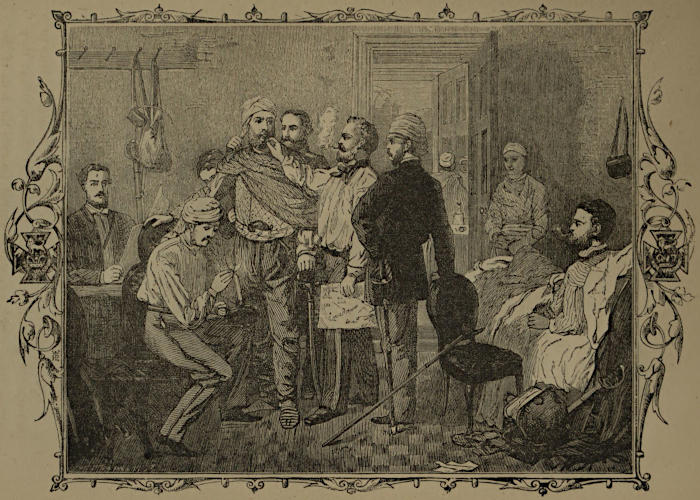
Thomas Henry Kavanagh completing his Disguise in
the Residency at Lucknow.
Resuming their route, they entered the village, and found several
men sleeping near the chubootra, or native office. Rousing one of
the sleepers, they informed him that they were spies sent to discover
the strength of the enemy, and requested him to direct them
to the English camp. The sleeper, enraged at being disturbed, gave
them a surly answer; and, advancing, they passed to the other
guards about three hundred yards apart. It was fortunate for them
that the enemy had thrown out no sentries, and were seated in a
half-drowsy state around their watch-fires. They passed between
the two fires without being challenged, and soon after met some
villagers, who informed them that they were fleeing before the
English. They inferred from this that Sir Colin Campbell’s encampment
must be close at hand; and, after losing their way and
again nearly falling into the hands of the rebels, they reached a
grove about four o’clock in the morning, and Kavanagh, regardless
of the remonstrances of the guide, threw himself on the ground to
sleep for an hour. Before he had closed his eyes he was startled
by the challenge, in a native accent, “Who comes there?” and
sprang to his feet. Perhaps those three simple English words,
pronounced by native lips, were the sweetest words he ever heard
in his life. They had stumbled upon a picket of Sikhs, and the
officer in command requested two Sowars to conduct them to the
advance-guard.
Kavanagh was almost dead with cold and fatigue, but a kind-hearted
officer of the 9th Lancers supplied him with clothes and
refreshments. The adventures of the past night seemed to him
like a fearful dream; now that they were past he could scarcely
realize them. The whole English camp was struck with admiration
of a deed unsurpassed in the annals of the heroic ages, and each
vied with the other in doing honour to one whom they were proud
to call their countryman. Even the stern and impassive old
Scottish chief—usually so sparing in his praise, so severe in his
reproof—was touched by the unselfish heroism of such a deed. In
the darkened tent, unseen by human eye, Kavanagh knelt down
and expressed his gratitude to Him who had taken him from the
miry clay and conducted him in safety through the hosts of the
enemy. His next thought was of his wife and children; and before
lying down to rest he had the flag of the semaphore in the Alum
Bagh hoisted as the signal of his safety. It was in vain that he
tried to sleep; his over-excited brain refused to be lulled to rest.
At eleven o’clock he was seated at Sir Colin’s table, surprising his
entertainer by the strangeness of his adventures and the strength
of his appetite. His assistance was invaluable in explaining the
plans drawn up by Sir James Outram, and in pointing out the best
route for advancing through Lucknow. By exposing his own life he
saved that of many a gallant soldier who would otherwise have been
lost; and Sir Colin showed his appreciation of his conduct by
retaining him near his person. Next morning the army of rescue
was on the march, and after a feeble resistance reached the Alum
Bagh. On the 14th of November they advanced against Lucknow,
under the guidance of Kavanagh, who was familiar with the neighbourhood
of the city. The cowardly Sepoys fled before our men,
and sought refuge within the walls of Lucknow. On reaching the
banks of the river the English army halted, and spent the night
under arms, waiting anxiously and eagerly for the hour when the
Massacre of Cawnpore was to be avenged. The night was dark
and chilly; Kavanagh slept by the side of Sir Colin Campbell on
the cold floor; the foe attempted nothing to disturb their repose.
With the earliest dawn Sir Colin was mounted on his charger,
riding from post to post and giving his orders for the day. A new
route proposed by Kavanagh, as preferable to that indicated by
Outram, was at once adopted; but during the following night a
heavy cannonade was kept up to mislead the enemy from the real
point of danger. Next morning our men advanced rapidly through
the tortuous lanes and thick plantations, meeting with little resistance
from the enemy, who expected to be attacked in another
quarter, till they reached the Secunder Bagh. Here a heavy fire
of musketry was opened upon them, and the first man who
tried to pass was shot in the hip and fell. Kavanagh leaped
from his horse, took the poor fellow in his arms, and bore him in
safety to a neighbouring hut. Others pressed forward and surrounded
the building; the artillery seized an embankment which
commanded the gate; the enemy were deprived of all means of
escape. The Highlanders were the first who entered; arrested in
their progress by a dead wall, they mounted the roof, tore off the
tiles, and leaped into the midst of the mutineers. At the same
time a breach was made in the walls of the Secunder Bagh; Sikh
and Highlander vied with one another in being the first to reach
it; many were hit, but nothing could resist their impetuous
bravery. They forced their way in, and, maddened with resistance
and the remembrance of Cawnpore, they showed no mercy; the
bayonet did its deadly work till all was still, and two thousand of
the mutineers were piled together in one gory mass as a monument
of our vengeance. Humanity shudders at the remembrance of such
a scene, but the murderers of helpless women and children at
Cawnpore deserved no quarter.
Our men, worn out with fatigue and hunger, remained under
arms the whole night, waiting anxiously for daybreak. Sir Colin
slept outside the Secunder Bagh, with Kavanagh by his side; with
the earliest dawn the whole army was on the move. The enemy,
disheartened by their reverses, offered little resistance, and began to
retreat; Kavanagh, who had advanced to examine their position,
was mistaken for a spy, and had a narrow escape from being shot
by his countrymen. Undaunted by the danger to which he was
exposed from the peculiarity of his dress and appearance, he led a
party of our men to the Motee Mahul, which was occupied by the
enemy, and, finding that the wall could not be broken through
without sappers, he returned to Sir Colin for assistance. After an
amusing altercation between him and his impetuous chief the
required aid was granted, and the British flag soon waved on the
summit of the building. After this success Kavanagh pressed
forward in the hope of being the first to reach Sir James Outram;
he passed in safety through the fire of the enemy till he met a
soldier of the 64th Regiment, who conducted him to the spot
where a group of officers were standing. It was Sir James Outram
and his staff; as soon as they recognised their former comrade in
arms they shouted, “It is Kavanagh! three cheers for him! he
is the first to relieve us.” The warmth of this greeting was felt
at the moment to be a sufficient recompense for all the dangers
he had encountered; no wonder that tears rose to his eyes as he
grasped the hands of those whom he had parted with a little
before, doubtful whether he should ever meet them again. There
was more joy in that meeting than falls to the lot of many men
in the whole course of their lives—a joy such as can only be experienced
by those who have risked their own safety in behalf of
others.
After the first congratulations, he offered to conduct Sir James
and his staff to the commander-in-chief. It was an undertaking of
some danger, but the Bayard of India never knew fear. They
passed unscathed through a shower of grape and bullets, and Sir
James took shelter in the shade of a hut while Kavanagh went to
announce his arrival to Sir Colin Campbell. The meeting between
these two gallant men was like the meeting between Wellington
and Blucher after Waterloo; but there was no time for empty
compliments; they had to make good their retreat from Lucknow
without a moment’s delay. Havelock, the good Christian, the
gallant soldier, tottered forward to welcome his deliverer; seven
days later he was carried to his grave, lamented and respected by all
who have learned to appreciate his heroic bravery, his humble piety.
Three better or braver men than Havelock, Outram, and Campbell
have never met; they have all passed away now; but such men
can never die; they will live for ever in the memory and affections
of their grateful and admiring countrymen. Nor was Kavanagh
forgotten at that meeting. Sir Colin spoke of him in such terms
of admiration as rarely issued from his stern lips, and expressed
his sense of the value of his services in his despatch to the Government
of India. “His escape at a time when the intrenchment was
closely invested by a large army, and when communication,
even through the medium of natives, was almost impossible,
is, in Sir Colin Campbell’s opinion, one of the most daring feats
ever attempted; and the result was most beneficial; for, in the
immediate subsequent advance on Lucknow of the force under the
Commander-in-chief’s directions, the thorough acquaintance with
the localities possessed by Mr. Kavanagh, and his knowledge of the
approaches to the British position were of the greatest use; and his
excellency desires to record his obligations to this gentleman, who
accompanied him throughout the operations, and was ever present
to afford valuable information.” But dearer to Kavanagh than the
praises of despatches or the congratulations of comrades were the
tender reproaches of his wife, as she clasped him to her breast and
wept her joy and admiration in his arms. The poet who sang the
parting of Hector and Andromache could alone do justice to such a
meeting; it lies not within the province of simple prose. He
appeared in the midst of that beleaguered garrison as a bearer of
safety—a messenger of mercy; the very soldiers blessed him as
he passed, the heart of the widow and the captive sang aloud for
joy, and many pressed into his house that they might “only have a
look at him.” Few rewards have been more justly earned or more
gratefully paid.
After effecting the rescue of the garrison, Sir Colin Campbell
retired by forced marches to Cawnpore, where his presence soon
reassured the forces, disheartened by the attacks of the enemy
during his absence. Kavanagh accompanied him to Cawnpore, and
soon after started for Calcutta, where the refugees from Lucknow
met with a generous and hospitable reception from the governor-general
and the British residents. The guide who had acted such
an important part in the enterprise was not forgotten; all met with
much sympathy; but there was a ringing cheer, such as none but
English can give, when “Lucknow” Kavanagh (the name by which
he has ever since been known, and a prefix as worthily gained
as that which distinguished the Confederate general “Stonewall”
Jackson) appeared with his wife and family. But such a restless
spirit could not remain inactive at Calcutta while the fighting was
going on in Oude; he no longer belonged to the uncovenanted
service, and was at liberty to go wherever he pleased. He made
his way up the country, formed the acquaintance of the Times’
correspondent, Dr. Russell, who persuaded him to mount an unruly
horse that nearly broke his neck, and at last joined the army of Sir
Colin Campbell, then a second time advancing from Cawnpore to
Lucknow.
During the subsequent fighting he exposed himself to the fire of
the enemy with almost reckless bravery; his constant immunity
from danger gave rise to a sort of half belief that he bore a charmed
life, and this belief was almost justified by the result. Many a
gallant English officer bit the dust at Lucknow, but the bullets
of the enemy seemed to be turned aside by some invisible
hand from the person of Kavanagh. If the old Greek mythology
had not been obsolete, we should have been tempted to believe that
some friendly god or goddess was watching over our hero, and
guarding him alike from friend and foe, as Aphrodite and Poseidon
watched over Æneas at the siege of Troy. More than once he was
in danger of being shot by his countrymen as a deserter; he had
hand-to-hand combats with the enemy, whom he was ready to meet
at any odds; he was thrown from horses, precipitated from dog-carts,
tumbled into wells, was shot through the shoulder, wounded
in the ankle, and survived to thrill the world by the story of his
strange adventures, which borders on the realms of romance.
When fighting was over at Lucknow he resumed his civil duties,
and used all his influence to protect the miserable natives who had
returned to their homes, and to check the thieving propensities of
the gallant Sikhs and savage little Ghoorkas. In June, 1858, he
offered to proceed to the camp of the enemy with a flag of truce, to
persuade them to lay aside their arms and submit to the British
rule; but the authorities at Lucknow—wisely, as we think—refused
to expose his life to such a danger. Soon after this he was
ordered to Muliabad, where he was intrusted with the command of
a certain number of Sikhs and native police, whom he frequently
led against the enemy. In these encounters he had many hair-breadth
escapes; on one occasion his horse was disabled by a shot,
and threw him to the ground. It was deemed a mark of merit on
the part of Sir Hugh Widdrington that he could fight upon his
stumps; Kavanagh was a hero of the same calibre; though dismounted
he was not disarmed, and such was his determined bravery
that he not only beat off his assailants, but seized one of them by
the throat, and made him prisoner. At the fort of Birrwa he summoned
the enemy to surrender, promising them their lives if they
yielded without further resistance; they expressed their readiness
to do so, if they could only have faith in his promises. On this he
threw aside his arms, pushed past his own men who were between
him and the enemy, walked into the centre of the yard where they
stood, and thus placed his life at their mercy. They were awed by
the courage of the act, and threw themselves at his feet in token of
surrender; and thus, by yet one more daring deed, many lives
were again saved by him. Such generous devotion was calculated
to produce a powerful impression on the native mind; the Sikhs
under his command looked up to him as a superior being, and
once, when in great jeopardy, two of them saved his life at the
expense of their own. After an absence of nine months he
returned to Lucknow to rejoin his wife, who had suffered much
uneasiness from the frequent reports of his death, and welcomed
him almost as one from the dead. The joy of their meeting was
scarcely over when he received orders to proceed to Sundeela and
place his valuable services at the disposal of Brigadier Barker, who
was advancing to attack two rebel chiefs who had shut themselves
up within the fortresses of Birrwa and Rohya. He took an active
part in reducing these strongholds, and in bringing back the
Talookdars, or native barons, to submission to the British rule.
It was only when all resistance had ceased that he returned to his
civil duties, and reluctantly exchanged the sword for the pen. In
May, 1859, he returned with his family to England, and published
a brief account of his adventures.
Such a man assuredly deserved the Victoria Cross, which has
often been the reward of isolated acts of bravery. He merited it
not only for acting as a guide to Sir Colin Campbell at Lucknow,
but also for frequently exposing his life to danger in the field. Our
readers, then, will learn with some surprise that, when Lord Canning
recommended him for the Victoria Cross, the Court of Directors
refused to forward his recommendation to the Queen, under the
pretence that “he would be entitled to the medal which they anticipate
her Majesty will confer upon the garrison and relieving army
of Lucknow.” They doubtless esteemed the Victoria Cross too
great an honour for a member of the uncovenanted service. This
was a last failure of expiring red-tapeism in the East; for Kavanagh
had soon after the satisfaction of announcing a new régime in the
capital of Oude, and of wearing the Victoria Cross on his manly
breast. He was the means of saving 300,000l. of public treasure
at Lucknow, and no one will say that he was too liberally rewarded
by the gift of 2000l. and the appointment of Assistant-Commissioner
in Oude. In one sense, the doers of deeds like Kavanagh’s can
never be adequately rewarded by gifts or offices: their richest
recompense is to be found in the high esteem of their fellow-men
and the grateful remembrance of posterity.
CHAPTER XIX. LIEUTENANT BUTLER AND THE VICTORIA CROSS.
During several years previous to the Indian mutiny the
kingdom of Oude had been a source of much anxiety to
the Governors of India. It was formerly an independent
province, in which were about 3,000,000 people, but in 1856 it
became a province of British India. The capital of Oude is
Lucknow, one of the largest cities in India, containing at least
300,000 inhabitants; it is a straggling place, extending over nearly
three miles, but contains many large important buildings, forts, &c.
The streets are very narrow and winding, thus rendering it difficult
for any troops to march through it when an enemy is in possession
of the neighbouring buildings. A fine river—the Goomtee—runs
past the town, and bounds it on one side.
It was on or about the 24th of May, 1857, that the first indications
of an outbreak became manifest at Lucknow; at this date
there were about 500 available European troops, whilst the mutineers
of the native regiments numbered about 4000. In addition to
these, the whole of the inhabitants of the district were in rebellion,
being led by various leaders, and formed bands of brigands, whose
principal object was to hunt down and murder Europeans.
Sir Henry Lawrence was at this time Chief Commissioner of
Oude, and, being possessed of great foresight and skill, prepared to
receive the coming shock. He put a portion of Lucknow, termed
the Residency, into a state of defence, stored it with ammunition
and provisions, fortified also a place termed the Muchhee Bhowun,
and then waited the course of events.
After having defended himself in these two places from the
30th of May, he, on the 29th of June, sallied out in the hope of
cutting off a party of mutineers, but, having ventured farther than he
intended, he discovered a most powerful body of the mutineers, and
was obliged to retreat with considerable loss, more especially as the
artillery he had taken with him deserted their guns and joined the
enemy. Shortly after this he found that, with his diminished
numbers, it was imprudent to hold two places. Thus the Muchhee
Bhowun was abandoned, and the whole garrison were brought into
the Residency, and a defence commenced which was certainly one
of the most marvellous that has ever been recorded in history.
The ruling mind in Lucknow was from the commencement that
of Sir H. Lawrence, and many brave men were accustomed to look
to him for advice or directions in various trying circumstances.
When, then, he died, on the 4th of July, from the effects of a
wound produced by a shell which burst in the room in which he
was sitting, his loss cast a gloom on the devoted band within the
Residency, and rendered for a time their position even more than
ever perilous.
Day by day and night after night a continued fire of artillery
and musketry was directed upon the Residency, and the only
defence on the part of the besieged, in many instances, was to
remain under cover, and thus to escape from the iron hail above
them. Among the many singular events that occurred during the
siege of Lucknow, there were none that were more exciting to
those concerned than the underground combats. The mutineers,
having been trained by our own Sappers and Miners, were
thoroughly acquainted with the principles and use of mines, and
they applied their knowledge in the present instance to the
attempted destruction of their enemy. Let any of us imagine
ourselves to be shut up in a fort surrounded by a merciless enemy,
unable to show even a hand above the walls of the defences without
having a shower of bullets aimed at it, and then to know that
from several directions there were galleries being driven underground
until a spot could be reached beneath us in which a
sufficient quantity of powder could be placed to send us, our fort,
and guns a hundred feet in the air.
Fatal as the mine undoubtedly is, it, like the deadly rattlesnake
of America, invariably makes a noise before it strikes its blow, and
thus it was impossible for the mutineers to work underground and
yet make no sound; so that the garrison by watchfulness could
hear the blows of the enemy’s pickaxe and spade, and could then
make what was called a counter-mine, and at the proper time blow
up the work of the besiegers. In many cases the defenders broke
their way into the galleries made by the mutineers, and shots were
exchanged in the darkness underground. In only one instance did
the mutineers succeed in their mines; this occurred in consequence
of a mine being directed against an outer wall of the Sikh cavalry
lines, the noise of the horses’ feet preventing the sound of the
miners from being heard. This mine, upon being exploded,
buried half-a-dozen drummers in its ruins, and opened a breach
large enough to have admitted the enemy, who were, however, too
cautious to venture upon an encounter at close quarters, even with
a foe which they outnumbered in the proportion of ten to one.
In many instances the counter-mines of the besieged produced
most destructive effects on the enemy. In one case where the
mutineers commenced a mine a counter-mine was immediately
attempted, which, when exploded, blew up the enemy’s gallery,
a house near it, and some three dozen men.
In spite, however, of these successes, the condition of the besieged
was bad enough.
During the whole of June, July, and August, this devoted band
maintained themselves against their innumerable foes. The massacre
at Cawnpore had shown them what they might expect if
they surrendered, and thus, in spite of sickness, want of provisions,
and other evils, they held their ground, until, on the 23rd of
September, the firing of artillery in the distance informed them
that help was at hand. So strangely are some constitutions framed
and kept up by excitement that, as we were informed by an eye-witness,
in many instances the besieged during several weeks took
no other nourishment than a little water and a few mouthfuls of
bread per day, feeling quite unable to touch any other food, and,
in fact, having no appetite for it.
On the 25th of September, Generals Outram and Havelock commenced
their attack upon Lucknow, and early in the morning the
first brigade commenced its march. It was soon found that the
enemy had made most extensive preparations to meet them, each
suitable station being selected for cannon, which played with
murderous effect upon the advancing troops. During six hours
the gallant band of warriors, each member of which deserved a
cross of honour, struggled forward to the relief of their comrades—the
English women and children shut up in the Residency. During
the afternoon a temporary halt was ordered under the walls of a
palace termed the Fureed Buksh; but ere long darkness coming on
rendered the next movement one of considerable importance. The
Residency was yet half-a-mile distant, and large bodies of the
enemy were between it and the palace. To delay till the morning
the relief of the besieged might be an unwise proceeding, for the
ferocious mutineers might during the night make a successful
attack, and a massacre would be the result. It was therefore decided
that the 78th Highlanders and another regiment should advance.
This decision having been arrived at, a short half-hour only was
passed before men, women, and children, who had almost ceased to
hope, suddenly found themselves in comparative safety, delivered
by the skill and courage of Havelock and his column of relief.
The besieged, who had during a hundred days been shut up in
the Residency, were actually surprised by the arrival of succour.
Although several intimations had been received to the effect that a
relieving force was coming, yet there was no appearance of it even
on the morning of the 25th, although considerable commotion was
observable among the armed men and sepoys in the town. At
about 5 P.M. volleys of musketry were heard in the streets, and the
peculiar hiss of the Minié ball was audible. A few minutes later
the English troops were seen fighting their way gallantly, and then
from every loophole and embrasure, from hospital and house, arose
a cheer and shout from every living being within that inclosure
that had so long been a prison, and was so near being a grave.
Yet, after all, this relief proved to be merely “succour,” for, as
about 30 officers and 500 men were killed and wounded during the
march through the town, and as also in the previous actions many
men had been lost, the army of 3000 that had left Cawnpore to
relieve Lucknow had dwindled into a mere handful. There was
also a difficulty about food, for the increase in numbers caused a
demand for more provisions, and already there was a scanty supply
even for those who previously occupied the Residency.
Those who have been much exposed to “fire” have often experienced
many hair-breadth escapes and singular incidents. Several
are related in connexion with the defence of Lucknow. An officer
was handing a glass of water to a companion, the glass being held
low down, when a bullet struck the glass and smashed it to pieces,
without, however, hurting either man. Three prisoners were
brought in, and were being tried by a drum-head court-martial,
when the proceedings were suddenly cut short by a round shot,
which, without ceremony, killed the three prisoners, after which
the court was dissolved.
It was soon found that the sepoys, having discovered how small
a force had joined the garrison, were determined to pursue their
attack with renewed vigour, and continued the siege until the intrenchments
were deserted on the 19th of November.
We in England who live at home at ease, and perform our
morning toilets with composure, can scarcely imagine the effect that
would be produced upon us by an event such as the following,
related with great coolness by a lady in her “Diary of the Siege
of Lucknow:”—
“This morning an 18-pounder came through our unfortunate
room again. It broke the panel of the door, and knocked the
whole of the barricade down, upsetting everything; my dressing-table
was sent flying through the door.”
When the relief had overcome the various obstacles that had
been opposed to its entrance into Lucknow, and had joined the
besieged garrison, it was found necessary to give up the Residency.
This was accomplished by a ruse, and during the night, when the
women and children, the wounded and sick, were conveyed in
safety to the Alum Bagh, thence to Allahabad, leaving Lucknow to
be dealt with by men alone.
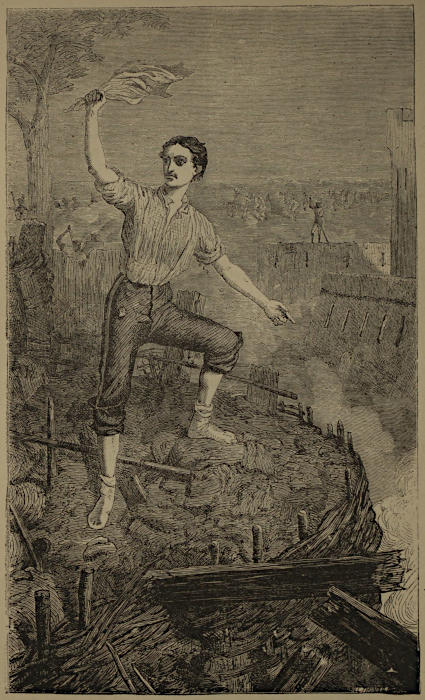
Lieutenant Thomas Adair Butler, 1st Bengal Fusiliers,
at Lucknow.
It was not till early in March, 1858, that Sir Colin Campbell
appeared with a large British force before Lucknow. At this time
there were about thirty thousand Sepoys in arms in the city, besides
which there were fully fifty thousand armed volunteers and
irregulars. The commander-in-chief’s preparations had been most
ably planned and carried out. A bridge was soon thrown across
the Goomtee, with very little opposition. On the 7th of March
twenty-two guns, all of large calibre, were sent across this bridge,
and joined Sir J. Outram’s force on the opposite side. On the 8th
a decided step was made towards the capture of the city. A heavy
fire had been maintained all day on the Martinière, and Sir Colin
determined to assault it very soon.
It was on this day that the officer whose exploit we this month
illustrate gained the Victoria Cross. An officer, who also gained the
Cross on the same day, had led a portion of his company against a
two-gun battery and spiked the guns; thus the most advanced
position of the troops was secure from artillery fire. It was of great
importance that the skirmishers on the opposite side of the river
should be made acquainted with this success, and Lieutenant
Thomas Adair Butler, 1st Bengal Fusiliers, swam across the
Goomtee, climbed the parapet, and remained for some time exposed
to a heavy fire of musketry. He, however, gave the information
that he wished, and was prominently mentioned by Major-General
Outram in general orders. For this act of coolness and bravery he
was allotted the Victoria Cross: an honour well deserved. There
are many men who, in the heat and excitement of action, will take
a prominent lead, and will then perform more than they would be
disposed to do in moments of calmness; but when a man swims
across a broad river in the face of an enemy, and remains by himself
exposed to a severe fire, he must indeed possess those characteristics
entitling him to be called brave.
Sir Colin Campbell was well acquainted with the peculiar style of
fighting preferred by the mutineers. If behind stone walls, earthworks,
or in buildings, the rebel sepoys would remain under fire all
day. If, however, they were brought into close contact with cold
steel, their courage deserted them, and they made the best use of
their legs. In his orders for the attack on the Martinière, he
particularly insisted on the application of cold steel. “The men
employed in the attack will use nothing but the bayonet. They are
absolutely forbidden to fire a shot till the position is won.” The
description of the Highlanders’ advance is thus graphically given by
Dr. Russell:—“Our guns were now thundering away, mortars,
howitzers, and 24-pounders, at the pits, huts, and Martinière, from
which the enemy kept up an incessant fusillade of the weakest sort,
the only thing remarkable about it being its pertinacity. The time
wore on, and at last the Highlanders and Sikhs came marching from
their camp, and drew up behind the Dilkoosha. The enemy had remained
steady in their trenches under the fire of six mortars and ten
heavy guns and howitzers. But the instant they caught sight of our
bayonets, and that the lines of the Sikhs and Highlanders came in
view, we observed them, by twos and threes and groups, and at last
in masses, running and marching at the double, as fast as they could
clear out of the works, and moving to the rear, or stealing off under
cover of their parapets. We saw the Highlanders, with skirmishers
thrown out in front, advancing rapidly, without a sound in their
ranks, towards the Martinière, while the Sikhs, on their flank, agile
as panthers, ran at full speed towards the trenches, from which the
enemy, firing a few hurried shots from their muskets, were flying so
fast that not a man was left inside by the time our troops were
within two hundred yards of the Martinière. In less than ten
minutes we saw Highland bonnets among the trees in the park, and
the Sikhs rushing through the vines in the rear, looking in vain for
an enemy.”
By the 19th of March the entire city was in our possession,
being thus gained after sixteen days’ fighting, counting from the
first advance of Sir Colin from the Alum Bagh. Taking all things
into consideration, the heat of the climate, the number of the
enemy, and the fact of his fighting from behind stone walls or
earthworks, this advance on and capture of Lucknow is a most
marvellous achievement, especially when we consider the small loss
that our troops suffered.
Every private English soldier in India at that time was worth a
considerable sum, for his loss could not be easily replaced, and thus
a wise and prudent general had to spare his men as much as possible,
and to calculate previous to a battle whether even success
could afford to be purchased by the loss of a given number of men.
When Lucknow was entered by our troops a scene was witnessed
that baffles all description. The wealth of India has ever been
known as immense, and much of this had been collected in Lucknow.
The palaces of princes and private houses of rich natives were alike
open to view, the owners having left them in the greatest haste upon
the arrival of the English conquerors. Soldiers, whose spare pay
amounted to scarcely more than a few pence per day, were able to
lay hands upon gold and silver ornaments, watches, and jewels
enough to buy a king’s ransom. In one instance a box, which was
being carelessly handled by some men, was stated by those well
informed to contain jewels to the value of one hundred thousand
pounds. Unfortunately, this fell into the hands of some one unknown,
who shortly disappeared with the box, and neither was
afterwards heard of. Camel and elephant loads of rich brocades
were carried away from the city, whilst wealth of every kind was
scattered about in wild confusion.
Not only in India and England, but in all Christian countries,
the defence and capture of Lucknow caused great excitement and
interest. The massacre of upwards of eight hundred men, women,
and children at Cawnpore had sent a thrill of horror throughout
Europe at such cruelty and disregard of life, and as our forces in
India were comparatively few, it did not seem improbable that the
brave defenders of Lucknow might meet a similar fate. Thus the
encounters during the first two weeks of March, 1858, will be
remembered by all; and those who on these occasions gained the
Victoria Cross, must feel and be known as men who risked their
lives in a great and glorious cause, not only for the honour of their
name and country, but for the triumph of Christianity and mercy
over cruelty and vice.
CHAPTER XX. DR. HOME AND DR. BRADSHAW AND THE VICTORIA CROSS.

When the gallant Havelock effected his entrance into
Lucknow on the 25th of September, 1857, a considerable
number of our wounded men who were being
conveyed in “doolies,” or hospital litters, were left behind near the
Motee Munzil under the charge of a military escort. As soon as
the army of rescue had made good its position in the Residency,
General Outram, who had assumed the command, despatched a
party of 250 men to effect a junction with Colonel Campbell, of the
90th, and to assist him in bringing in the wounded. They ultimately
succeeded in this object, but some idea of the dangers they
had to encounter may be formed from the following narrative.
The doolies containing the wounded remained during the night of
the 25th of September in the passage in front of the Motee Munzil
Palace without attracting the notice of the enemy. On the morning
of the 26th the mutineers opened fire upon them, and numbers
were killed by the shot and shells. The surgeons in charge of the
wounded behaved with the greatest coolness and courage. One of
them, an assistant-surgeon in the artillery, requested one of his
brother officers to assist him in an operation. On their way to the
spot they were exposed to a constant fire. “Well, Bartrum,” said
one of them, “I wish I could see my way out of this.” “Oh,” said
the other, “there is no danger whatever.” The words had scarcely
passed the lips of the assistant-surgeon when he was shot down.
Two minutes before he was speaking of his wife and child, and the
pleasure he would have in meeting them in the Residency. They
were destined never to meet in this world. The position of the
wounded now became critical; they were separated from the main
body of the army by about a mile; they were surrounded on all
sides by the enemy; their only hope of safety lay in forcing their
way to the intrenched camp.
Such was the opinion of Colonel Campbell, of the 90th, who had
charge of the escort. Addressing Dr. Home, whom he believed to
be the senior medical officer present, he informed him that he had
completed his arrangements for conducting the wounded to the
Residency, and requested him to take charge of the party. It was
of importance to secure the services of some one acquainted
with the locale to act as guide. Mr. J. B. Thornhill, a gallant
young civilian, anxious for the safety of his relative, Lieutenant
H. M. Havelock, who was still among the wounded, expressed
his readiness to perform this arduous duty, and the offer
was at once accepted by General Outram. He reached the Motee
Munzil in safety, and Dr. Home’s party prepared to start under
his guidance. Colonel Campbell informed them that after traversing
a space of about 340 yards they would no longer be
exposed to the fire of the enemy, as there was a way through the
palaces skirting the river where they would be sheltered from
attack. The military escort of 150 men was placed under the
command of Major Simmonds, of the 5th Fusiliers, one of the best
and bravest officers we have ever known. He subsequently died
of his wounds, leaving a young widow in Mauritius to deplore his
loss. No time was lost in collecting the doolies. When all was
ready a rush was made for Martin’s house, a stone building about
forty yards from where they stood. The moment they left the
gate the enemy opened fire on them from a battery across the river.
No time was lost in reaching Martin’s house, where they looked
for shelter. Their position there was as unsafe as before; the
round shot from the enemy’s battery pierced the walls of the house
in every direction. After a delay of half on hour they resumed
their dangerous march. Major Simmonds advanced in front with
the escort to clear the way, followed by the doolies in long procession.
They continued their march for two hundred yards without
suffering any loss, till they reached a “nullah,” or pond, three or
four feet deep, through which they had to wade. Some of the
doolie-bearers and wounded were drowned or killed by the enemy’s
grape; those who succeeded in crossing reached a street where they
were partly sheltered by a high wall.
Major Simmonds did all that could be done for their safety.
The gallant escort were shot down right and left, but they kept up
a steady fire and never ceased to advance. On leaving this street
the guide lost his way; instead of pursuing the path by the river
he led them into an oblong square lined on three sides with sheds,
which is now familiarly known to every resident in Lucknow as
Doolie-square. No sooner had they entered this square than the
enemy, who had posted themselves on the roofs of the sheds and
behind the walls, opened fire upon them and shot down many of
the escort and doolie-bearers. Many of the latter threw down the
doolies in despair, and no threats or entreaties on the part of the
officers in charge could induce them to take them up again. They
either fled or met their fate with stoical indifference; it was the
will of Allah, and to Allah’s will they must submit. In the
case of a few the instinct of self-preservation was stronger than
their creed; they ran the gauntlet of the enemy’s fire and escaped.
The medical officers and those who accompanied them rushed
through the square till they reached a covered archway opposite to
a corner house occupied by the enemy, who fired into them with
such destructive effect at the distance of a few yards that the same
bullet often passed through several men. If they left the archway
they were exposed to the fire of the enemy who were concealed on
the roofs of the sheds; to remain there was certain destruction.
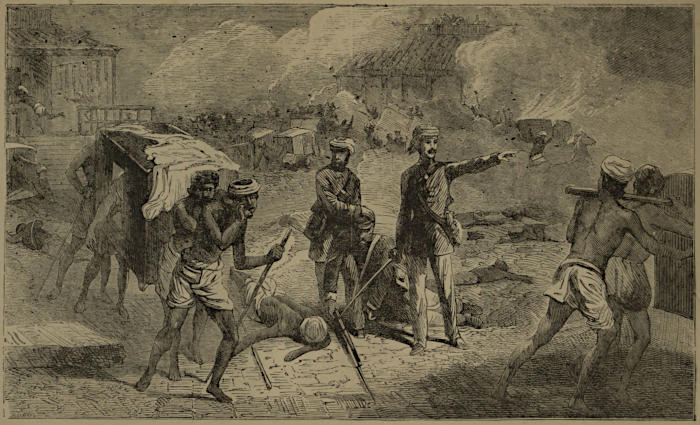
Drs. Home and Bradshaw superintending the removal of
the wounded to the Residency at Lucknow.
Mr. Thornhill, the guide, who had unwittingly brought them
into this danger, now proposed that they should retrace their steps
and turn the doolies back. This could no longer be done, as the
doolie-bearers had abandoned the wounded already in the square,
but an effort was made to prevent others from entering it. Dr.
Bradshaw and Dr. Home’s apothecary went back and persuaded the
doolie-bearers in the rear to resume their burdens and to follow
them along the path by the river which the guide had missed; in
this way they reached the Residency in safety. Poor Thornhill in
passing through the square was twice wounded; one of these
wounds proved mortal. Those who remained beneath the archway
looked out in every direction for some place of shelter. There was
no time to be lost; armed soldiers were entering the square and
murdering the helpless men in the doolies. It was a harrowing
scene, but Dr. Home never lost his coolness or presence of mind;
he stuck to the doolies as a young ensign would stick to his colours
in the hour of danger.
On the right side of the archway was an open door leading into a
house; here a small party sought for shelter. It consisted of Dr.
Home, Captain Becher, of the 40th Native Infantry, Swanson, of
the 78th Highlanders, nine soldiers as yet unhurt, and three
wounded men. This small party of fifteen persons were hemmed
in on every side by the enemy; their only chance of safety lay in
holding out till assistance reached them from the Residency. It
was now about ten o’clock in the morning; they might not have
long to wait. They screened themselves as much as they could
from the fire of the rebels, who crowded round the door and might
have forced their way in had it not been for the gallant conduct of
Private Patrick McManus, of the 5th Fusiliers. This heroic Irishman
stood in the gateway as their guardian angel; ensconcing
himself behind a pillar near the door, he kept up a steady fire on
the enemy for half an hour, and thus prevented them from effecting
an entrance. His hand was so steady, his aim so certain, that
whenever he raised his piece the cowardly Sepoys fled from their
loopholes or prostrated themselves on the ground. There stood
McManus, a hero in the strife, keeping the whole multitude of the
mutineers at bay. He had not even to fire; he had only to show
his rifle, when all the cowardly wretches trembled before him—such
was the influence exercised over them by the bearing of one
undaunted man. The house at the gateway became the central
point of attack; the mutineers assembled there from all quarters,
and yelled like beasts of prey thirsting for human blood. As in
the Homeric battles, the combatants were so close that they could
revile one another. Sometimes the assailants would advance within
twenty yards of the house. “The Feringees are cowards,” they
would say; “why do they not come into the street?”—an unreasonable
question, considering that the Feringees were only
fifteen in number and the enemy more than a thousand. On this
the redoubted McManus would show his rifle, when the cowards
became silent through abject fear. Ah, Patrick McManus, my boy,
if the mother that bare you had seen you that day, her old heart
would have been proud of you!
The leader of the mutineers abused them for their cowardice.
“Come on!” he would say; “what are you afraid of? There are
only three Feringees.” On hearing this the gallant little party,
wounded and all, would give a loud shout to make the enemy
believe that they were more numerous than they really were, and
Patrick McManus would peep out from behind his pillar. They
also strengthened their position by barricading the door with
lumber and with sandbags, to form which they stripped the dead
Sepoys of their “cummerbunds,” or waistcloths. The mass of
dead bodies which had accumulated round the door served as a
barrier to prevent the mutineers from entering. On finding that
they could not force the house they directed their fire against the
wounded in the doolies, and killed about forty of them.
At this moment an incident occurred which serves to prove
what sacrifices our soldiers are ready to make for officers whom
they love. In one of the doolies close to the beleaguered house
lay Captain Arnold, of the Madras Fusiliers, a gallant officer who
had been severely wounded. Among the holders of the house was
Private Ryan, of the same regiment, who resolved to make an
effort to rescue him from his dangerous position. As he could
not do this alone he called for some one to assist him, when Patrick
McManus stepped out from behind his pillar and offered to
accompany him. He was already wounded in the foot, but a
wound was nothing when danger had to be encountered. The
two brave men cleared the barricade, rushed through the gateway
amid a shower of bullets, and reached the doolie in safety. Here
they had to encounter a new difficulty. Their united strength
could not raise the doolie from the ground, so they took poor
Arnold in their arms and bore him to the house. It is a remarkable
fact, that while the ground around them was torn with
musket-balls, and Captain Arnold received a wound in the thigh
which afterwards proved mortal, both of his deliverers escaped
unhurt. Encouraged by their success, they ventured forth a
second time and carried in a wounded soldier whose piteous cries
had excited their compassion. The result was the same as before;
they were safe, but the soldier received two mortal wounds and
died before he reached the house. Such incidents almost justify
the belief that the age of miracles has not yet passed away.
During this struggle the duties that devolved on Dr. Home, the
only unwounded officer in the house, were most arduous. He had
to direct and encourage the men by his example, to dress the
wounded, and to assist in shooting down their assailants. In all
this he was ably assisted by Private Hollowell, of the 78th Highlanders,
who proved himself worthy of such a leader. When the
rebels found that they could not force an entrance, they stole
stealthily up to the window and fired through the plastered venetians.
Our men lay down on the floor; the bullets thus passed
harmlessly over them. The Sepoys then attempted to rush the
house, when Hollowell, watching his opportunity, shot down their
leader, an old man, armed with sword and shield, and dressed in
white with a red waistband. One man was now told off to fire
from each window and three from the door. Dr. Home kept watch
and ward at one of the windows with his revolver in his hand; he
could see all that was passing in the street through a hole made by
a bullet. A Sepoy crept stealthily up to the window at the distance
of three yards; the doctor shot him dead with his revolver.
Hollowell gave another his quietus, and then for a time all was still.
About an hour elapsed before the attack was resumed. During
this interval the beleaguered party broke through the plaster and
took up their position in the outer room. Thus far they had made
good their defence, but a still greater danger awaited them. As
they were congratulating themselves on their success they heard a
dull, heavy, rumbling noise. Home started up and shouted, “Now,
men, or never! Let us rush out and die in the open air, and
not be killed like rats in a hole. They are bringing a gun on us!”
The men were preparing to act on this advice, when they observed
that it was not a gun but a screen, moved on wheels, which the
rebels pushed up against the door. A minié rifle fired at the distance
of a few yards made no impression on it. On observing this
our men retreated into the room they had formerly occupied, while
the enemy mounted on the roof, broke through the plaster, and
threw lighted straw down upon them. The house took fire; their
position was no longer tenable, and death seemed to stare them in
the face.
What were they to do? One thing was evident—they could no
longer remain in the house; the smoke and heat had become
intolerable. Raising the three most helpless and wounded in their
arms, they rushed through the back door into the open square. At
the distance of about ten yards they observed a shed on the north
side of the square and made for it. During the passage the three
wounded men were hit, and subsequently died of their wounds,
while those who carried them escaped unhurt. Among the wounded
was Lieutenant Swanson, of the 78th, whose name has been already
mentioned. They found the floor of the shed covered with dead and
dying Sepoys. This movement took the enemy by surprise; they
had expected them to issue forth by the door, and not by the way
they came; and though the little party was exposed to the fire of
at least six hundred men, none but the wounded were hit. On
rallying their forces they found that they had six men capable of
bearing arms, and four wounded able to do duty as sentries. It was
now three o’clock in the afternoon, and, though their position seemed
desperate, no one dreamed of surrendering; they knew that they
could expect no mercy from their ruthless assailants, and determined
to hold out to the last. Their position must be known to the
general; Havelock was not a man to abandon them in the hour
of danger. Could it be that his gallant little army had been
destroyed by the rebels, and that they were the last survivors? If
so, their only resource was to hold out to the last and to sell their
lives as dearly as possible.
Such were the thoughts that presented themselves to the minds
of these heroic men. No time was to be lost; the enemy was
already upon them. The shed, which was loopholed in every
direction, afforded little shelter; it had been used the day before
by the mutineers for the purpose of firing on our army. Two shots
were suddenly fired on the little party through a broken passage in
one end of the shed; a sentry was placed there to guard it against
the enemy. Such was their cowardly terror, that the presence of
one man was sufficient to ward them off. They now came creeping
stealthily up to the walls, discharged their pieces through the loopholes,
and then made off. To guard against this annoyance a
sentry was placed at every loophole; the wounded men cheerfully
did their duty the same as the others. So long as they had
remained in the house at the archway, they had been able to protect
the doolies from the attacks of the enemy, but now that they
had changed their position they could no longer afford them any
assistance. On observing this, the Sepoys came rushing through
the gate, and began to massacre the wounded men; some were
burnt alive in the doolies; others were cut to pieces by their savage
assailants. Their countrymen were saved the horror of witnessing
this spectacle, as the enemy, while engaged in this massacre, kept on
the other side of the doolies, so as to escape observation; but their
blood was chilled and their own sufferings intensified by the piercing
shrieks of the tortured men, who were now beyond the reach of all
human aid.
At this moment a singular incident occurred. While the Sepoys
were passing from doolie to doolie engaged in their ruthless work,
they came to one which contained Lieutenant Knight, a wounded
officer of the 90th Regiment. A Sowar drew aside the curtain and
made a thrust at him with his sword. With that sudden energy
which is often imparted to the helpless in the hour of danger,
Knight sprang through the opening in the other side of the doolie,
and ran off in the direction of the rear-guard, pursued by the
enemy, who had witnessed his escape. He was already wounded in
the leg, but, notwithstanding this drawback, he succeeded in distancing
all his pursuers. More than fifty shots were fired at him,
two of which struck him in the legs, making three wounds in all; he
had strength, however, to continue his flight till he reached the
rear-guard, where he found himself in safety.
On finding that the loopholes in the walls of the shed were
guarded, the Sepoys mounted the roof, made holes through it, and
began to fire on the party below. Though the muzzles of their
pieces were only about four feet from our men, none of the latter
were seriously wounded; in truth, the miraculous escapes that
occurred on this occasion are so numerous and surprising as to be
almost incredible, if they were not well authenticated. As the shed
was no longer tenable, they bored through the wall into the courtyard,
so as to escape for a moment from the heavy fire from the
roof. Their position was desperate; the most sanguine had almost
ceased to hope; the strongest were prostrated by hunger, heat,
anxiety, and fatigue; the wounded, parched with thirst and terror-struck
by the shrieks of the tortured, longed to escape from such
misery, and prayed for death at the hands of their countrymen.
We have heard men who shared in the horrors of this fearful scene
declare that, if they had not been restrained by Christian principle,
they would have laid violent hands on themselves, or courted death
from the bullets of the enemy.
Such feelings may have sprung up in their minds as they listened
to the shrieks of the tortured, and thought of their own fate if they
fell into the hands of the enemy; but the love of life is strong, and
they continued to defend themselves. Was there no other place of
shelter than the shed they occupied? On looking out from the
courtyard they observed the rear of a large building at the distance
of thirty yards. Dr. Home and one of his party stole cautiously
out to reconnoitre; night was setting in, and the darkness
was favourable to their undertaking. They reached the building
without attracting the notice of the Sepoys, and discovered that it
was a large mosque, with an arched opening about eight feet from
the ground. By mounting on the shoulders of his companion,
Dr. Home was enabled to enter the building through this opening,
and found himself in a spacious courtyard looking into a garden.
No pious Mussulman was performing his devotions there; the place
seemed to have been designed by Providence for their preservation;
and Dr. Home, after advancing a short distance into the mosque,
returned to the opening in the wall, and beckoned to the others to
join him. They hesitated to do so, and during this delay Dr. Home
and his companion were discovered by the enemy, who opened fire
on them from the roof of the shed, and drove them back to their
former position. Their enterprise was not altogether fruitless;
inside the mosque they had found a chatty of excellent water
belonging to the Sepoys—a prize at that moment far more precious
in their eyes than all the gold of Ophir or the diamonds of Golconda.
They had been biting cartridges all day; their lips were dry and
cracked with thirst; but they thought of the wounded, whose sufferings
were still more intense, and carried with them the chatty of
water for their relief. All partook of the reviving draught, which,
to borrow their own expressive language, “made them twice the
men they were before.” It is a common belief among physiologists
that water only increases the sufferings of those who have long been
unable to satisfy their thirst; but it was not so in this instance. It
made them twice the men they were before, and thus enabled them
to continue their resistance.
Sentries were told off for the night, and every man who could
stand had to take his share of duty. Every loophole had its guardian;
owing to the length of the shed none were left unemployed.
The darkness which had now set in was favourable to our men; it
prevented the enemy on the roof from watching their movements or
observing the position they occupied, and enabled them to fire
through the roof with the additional advantage of knowing from the
sound of their feet where the Sepoys stood. On discovering this,
the latter quitted the roof, and for a time all was still; it seemed as
if they had given up the attack as hopeless. When the firing ceased,
a reaction set in after the fierce excitement of the day; the stoutest
hearts were almost appalled by a sense of their desperate condition.
They had long since ceased to hope for deliverance; they clung to
life with that instinctive feeling which leads the shipwrecked
mariner to cling to a plank, though he knows that escape is all but
impossible. If the shed was forced, their only thought was to rush
forth and sell their lives as dearly as possible. As they listened to
the shrieks of the tortured, they swore in their hearts that, come
what might, they would never fall into the hands of the enemy.
Death had lost all its bitterness; the grim king was stripped of all
his dark imagery of terror. If he had come of his own accord, they
would have welcomed him as a friend, but as Christian soldiers,
whose lives were not their own, they were bound to wait for his
coming. And all through the long, dreary hours of that night of
horror they did wait for him, but he came not; those who retained
their consciousness almost envied the wounded who had become
delirious. Their ammunition was almost exhausted; there only
remained about seven rounds for six men; if the enemy renewed
the attack, all would soon be over. But the enemy did not renew
the attack; they found it easier and safer to torture the wounded
in the doolies than to dislodge or destroy a few resolute men driven
to bay.
Sleep would at times overpower them; they sank down on the
floor, but the mental tension was too great to permit them long to
rest. Their fearful position was still present to their minds, and
after a few minutes of troubled sleep, they would start to their feet
with the impression that the enemy were upon them. No enemy
appeared; on finding that it was a false alarm, they would keep
watch for a time, till, overpowered by sleep and exhaustion, they
again sank upon the floor. One desperate man proposed to his
comrades to rush forth and fight their way back to the rear-guard;
two offered to join him in the attempt; the others refused to leave
the wounded in the hands of the enemy.
About two o’clock in the morning they were roused to a fresh
life by the sound of heavy firing close at hand. Their hearts leaped
to their mouths as they heard the sharp crack of the Enfield rifles
and the rush of the enemy over their heads. Hurrah! Havelock
had not forgotten them; it was their own countrymen advancing
to the rescue. The revulsion of feeling made them wild with joy;
they shouted with all their might, “Europeans! Europeans!” they
cheered them on to the attack—“Charge them! charge them!
Keep to your right!” The firing died away in the distance; in a
few minutes all was silent. They listened for the advancing tramp
of armed men, but no such sound was heard; again they gave
themselves up to despair. Any fate was preferable to further suspense;
they agreed to fight their way to the Residency or perish in
the attempt; but on creeping forward under the shadow of the
building, they observed a large body of men clustered round a fire
in the archway. Escape in that way was evidently impossible; it
would have been madness for a few starving men to attack a body
of the enemy who had just repulsed our own troops; so they crept
back to their former place of shelter. The bitterness of death was
already past; they could meet their fate with indifference. The
dreary hours passed silently on till a little after daybreak, when
they heard the sound of distant firing; it failed to rouse them from
their apathy; the hope of deliverance had died out within them.
The sound came nearer and nearer, till at length they could distinguish
the sharp crack of the Enfields, and the regular rattling
volleys which told them that their countrymen were at hand.
Ryan, the sentry, with the usual vivacity of his country, was the
first to express the feelings of his comrades; jumping up with
sudden energy, he shouted, “Oh, boys! them’s our own chaps!”
Ryan’s language was far from being elegant or correct; but their
position was too critical for weighing the niceties of speech, and we
question whether Demosthenes himself could have spoken more to
the point. Its effect was immediate and striking; those who were
prostrated by despair sprang to their feet with renewed energy, and
shouted to their deliverers to keep to the right. “Cheer together,
men,” cried Home. They cheered, and waited anxiously for the
result. They had not long to wait; a ringing cheer came back
from their countrymen, which told them that deliverance was at
hand. They had still a few charges remaining; these were expended
on the Sepoys, who were firing from the loopholes on our
men. The enemy were soon dislodged; the party of rescue forced
their way into the shed; Dr. Home received the congratulations of
his countrymen on his successful resistance, and the wounded, whom
he had defended to the last, were conducted in safety to the
Residency.
When the report of their gallant conduct reached England, Home
and Bradshaw were rewarded with the Victoria Cross. Mr. Desanges
has assigned them a place in his Gallery. All who have read this
simple narrative of their heroic defence of the wounded intrusted to
their care, will admit that they were entitled to this honourable
distinction.
CHAPTER XXI. ROSS L. MANGLES, ESQ., V.C., BENGAL CIVIL SERVICE, ASSISTANT-MAGISTRATE AT PATNA.
The town of Arrah, near which Mr. Mangles earned the
Cross of Valour, is about twenty-four miles from
Dinapoor, from which it is separated by the river Sone.
It is the chief place in the district of Shahabad, and when the 7th,
8th, and 40th Regiments of Bengal Native Infantry mutinied at
Dinapoor, on the 25th of July, 1865, they advanced against Arrah,
where they expected to meet with little resistance, as there were no
European troops at that station. It so happened, however, that the
chief authority was vested in Mr. Wake, the resident magistrate,
who proved himself equal to the occasion. He had not been
trained to the profession of arms, but he possessed that calm
courage and undaunted energy which most of our Indian civilians
exhibited during the mutiny, and which contributed largely to the
re-establishment of our power. Familiar with the manners and
language of the natives, he had watched the progress of events with
an anxious eye, and already foresaw the storm that was about to
break forth; as he could not avert it, he prepared to meet it like
a man. He had already warned the authorities at Calcutta that the
licentiousness of the native press must sooner or later lead to an
outbreak, and that symptoms of disaffection had already begun to
appear in his own district; but the forces at Dinapoor, consisting
of Her Majesty’s 10th Regiment, two Companies of the 37th, and
two Companies of Artillery, were deemed sufficient to overawe the
natives. They would have been so, if they had been under the
command of an efficient officer; but the major-general was an old
man, too infirm to be able to mount his horse without assistance, and
utterly unfit to cope with the difficulty. The consequence was that
the mutineers, who might easily have been disarmed or imprisoned,
were allowed to escape, and proceeded to plunder the neighbouring
towns. There were few Europeans left in the town of Arrah; the
workmen who were employed on the railway, frightened by the
symptoms of mutiny around them, and apprehensive for their own
safety, had deserted the place in the beginning of June; but Mr.
Wake, who remained at the post of danger, induced them by his
example to return. He applied everywhere for assistance, but no
troops could be spared till the 11th of July, when he received a
small detachment of Sikh police from Patna.
On the evening of the 25th of July, intelligence reached Arrah
that the native regiments at Dinapoor had mutinied, and crossed
the river Sone. There was no time to be lost; the fifteen Europeans
in Arrah had to decide at once what course they were to
pursue: in a few hours the enemy would be upon them. There
was not a single soldier in the place; the local police had fled at
the first intimation of danger; there was no fort or stronghold
where the Europeans could find refuge. No one could have
blamed them if they had consulted their safety in flight; but that
band of brave civilians scorned the idea, and resolved to remain at
their posts. Mr. Boyle, an engineer of the main-trunk railway,
was the only one amongst them who had made some preparations to
meet this emergency; he had anticipated the danger, and some
weeks before had begun to fortify with stones and timber a detached
two-storied house, about fifty feet square, which stood in the same
compound as his bungalow, and to collect a store of provisions.
Mr. Boyle’s preparations for the coming danger had been the source
of many a joke to his less thoughtful companions; but their levity
gave place to gratitude on the 26th of July, when the mutineers
were upon them. The ladies and children had already been sent
away; the fifteen civilians who remained shut themselves up in
Mr. Boyle’s house, with the fifty Sikhs of Captain Rattray’s police
battalion. Their store of provisions was limited; their only
weapons were rifles, revolvers, and hogspears; but they had
abundance of ammunition, and an indomitable courage, which
supplied every deficiency. On the morning of the 27th the mutineers
marched into the town, released the four hundred prisoners
in the gaol, and seized eighty thousand rupees which they found in
the treasury. They then concealed themselves among the trees
and buildings near Mr. Boyle’s house, where they kept up a galling
fire during the day, and invited the Sikhs to join them; but these
brave fellows had the virtue to refuse the bribes which they
offered. On the 28th they procured two small cannon, with which
they opened fire on the house, which was now riddled with balls;
but its brave defenders never dreamed of surrendering. One of
the cannon was mounted on the roof of Boyle’s bungalow, so as to
enable the mutineers to fire into the house at the distance of sixty
yards. “Nothing,” says Mr. Wake, “but the cowardice, ignorance,
and want of unanimity of our enemies prevented our fortification
from being brought down about our ears.” The gallant
defenders offered something more than a passive resistance; every
mine of the enemy was countermined; every new battery was met
by a fresh barricade. The Sikhs, inspired by the example of the
Europeans, vied with them in courage; when provisions ran short,
they sallied forth one night and brought in four sheep. One of
them was dangerously wounded; singular to relate, this was the only
casualty that happened to the little garrison; all the others escaped
with slight scratches or bruises. When the supply of water failed,
the Sikhs dug a well underneath the house, and continued their
labour till they found a spring; in short, the honours of the
defence are equally divided between them and the Europeans. For
seven days and nights the siege went on, and the gallant little band
had to defend themselves against three thousand assailants. They
looked for assistance, but they looked in vain; the authorities at
Dinapoor seemed to have left them to their fate. They might have
left their stronghold with all the honours of war; the mutineers,
weary of the siege, and almost despairing of success, were willing
to spare their lives, but all their offers were contemptuously
rejected. They would never condescend to negotiate with rebels:
they would rather fight it out to the last.
We must now direct attention to the steps which had been taken
for the relief of the little garrison. As we have already mentioned,
Major-General Lloyd was in command at Dinapoor; it was unfortunate
that the control of military affairs, at such a moment,
should have been vested in one who was worn out with years and
infirmities, and should have been enjoying his well-earned
pension at home. Arrah lay within his district, and it was his
duty to take measures for the relief of its gallant defenders. This
duty was peculiarly distasteful to a man whose culpable irresolution
had already led to such disastrous results, and for two days
nothing was done. Mr. Taylor, the civil magistrate at Patna,
within whose district Arrah was situated, assembled all the
European residents at his house as soon as he heard of the outbreak
at Dinapoor, and invited them to act with him in case of an
attack. This took place about one o’clock on the 25th; two hours
afterwards a distant firing announced that the mutineers were
engaged with the European forces; soon after, the report reached
Patna that they had marched off in the direction of Arrah. Mr.
Taylor at once improvised an expeditionary force of about one
hundred men, made up of Sikhs, Nujeebs, recruits, and volunteers,
and despatched it that same day in the direction of Arrah, to watch
the movements of the mutineers. Mr. Mangles, who held the
appointment of assistant-magistrate at Patna, joined this expedition
as a volunteer, and accompanied them on their march till they
were recalled by the commissioner, who had received alarming
reports from the neighbouring stations, and deemed their presence
necessary for the safety of the principal town. On the day after
the mutiny, Mr. Taylor wrote to Major-General Lloyd, urging him
to place a small body of European troops at his disposal; but the
latter refused to comply with his request, on the ground that he
had only six hundred soldiers under his command, and that he
could render no assistance. Knowing the urgency of the occasion,
Mr. Taylor resumed his application, and proposed to raise a corps
of volunteer cavalry among the officers and gentlemen of Patna and
Dinapoor, if the general would send two hundred men to co-operate
with them for the relief of Arrah.
The general had already made an unsuccessful attempt to rescue
the little garrison from their perilous position. He thought only of
his own safety till the 27th of July, when, feeling more reassured,
he sent a detachment of the 37th Regiment from Dinapoor toward
Arrah, for the purpose of dispersing the mutineers. The troops
embarked on board the Horungotta steamer, and might have reached
Arrah in a few hours, but a sort of fatality seemed to attend everything
which the general undertook. After three hours’ steaming,
the Horungotta ran aground, and as she could not be got off the
troops quickly returned to Dinapoor. The general was now willing
to accept Mr. Taylor’s proposal, and a second expeditionary force,
consisting of detachments of Her Majesty’s 10th, and 37th Regiments,
some native troops, and the corps of volunteer cavalry was
organized, and embarked on the evening of Tuesday, the 28th of
July, on board the steamer Bombay, which had arrived at Dinapoor
in her downward passage on the Ganges, and was detained for
the public service. If the defence of Arrah forms one of the brightest
episodes in the history of the Indian mutiny, the disaster which
overtook this ill-fated expedition may be regarded as one of its
gloomiest pages: it was not the mere loss of men at a critical
juncture, though that was considerable; it was the destruction for
the moment of that prestige which has almost invariably followed
our arms in India, and by which alone we have acquired our
ascendancy in that vast peninsula. The expedition was placed
under the command of Captain Dunbar, of the 10th Regiment.
Mr. Mangles belonged to the corps of volunteer cavalry. The
mutineers, who were cognizant of all their movements, had formed
themselves into an ambuscade, and attacked them on the night of
the 29th of July. Our soldiers fought with their usual gallantry,
but were overpowered by superior numbers, and compelled to
retreat. Captain Dunbar was killed; only a few of his men
effected a retreat to the boats; the rest were butchered by the
enemy, who gave no quarter. It was on this occasion that Mr.
Mangles distinguished himself by his humanity, and thus became
entitled to wear the Queen’s Own Cross. He had been wounded,
and would have been justified, under the circumstances, in consulting
his own safety; but his generous heart led him to think
more of others than of himself. A soldier of the 37th Regiment
had been struck down by his side; wounded himself, and weak
with the loss of blood, he was induced, from a feeling of humanity,
and without any prospect of reward, to make an effort to save his
life. If he left him in the hands of the enemy, his fate was certain;
the murderers of helpless women and children would show
no mercy: all this must have been present to his mind, as he
hurriedly bound up his wounds, careless of the murderous fire to
which he was exposed. Nor was this all. When he had dressed
his wounds, he raised him on his shoulders and carried him for
several miles, till they reached the boats in safety. When we
consider that almost the whole detachment were killed or wounded,
their escape seems to us to border on the miraculous, and no one
will question Mr. Mangles’ right to a place in Mr. Desanges’
Gallery, or grudge him the Cross of Valour. The permanent
record of his heroic conduct and tender-hearted humanity may
stimulate others to imitate his example, and may thus exercise a
beneficial influence on the rising generation. The Victoria Cross
was awarded to Mr. Mangles in the Government Gazette of the 6th
of July, 1859, and Mr. Desanges’ pencil has conveyed to the minds
of thousands a more vivid conception of the act by which he gained
it, than we can expect to produce by this brief narrative.
We now turn from the disaster of the 29th of July, 1857, to
relate how a second and far more successful attempt was made to
relieve the beleaguered garrison. The name of Major Vincent Eyre
will ever be associated with this event, as the instrument, in the
hands of a Higher Power, for the rescue of those who must
otherwise have perished. When the mutiny broke out, this
officer was recalled from Burwah, and embarked at Calcutta for
the Upper Provinces, on the 10th of July, having under his command
No. 3 Horse Field Battery, with the 1st Company 5th Battalion
Artillery attached. Allahabad was the rendezvous where the
different detachments of the relieving army were to assemble, and
Major Eyre reached Dinapoor on the evening of the 25th of July,
the very day when the three native regiments had broken into
open mutiny. He lost no time in placing himself and his men at
the disposal of Major-General Lloyd, and at his request landed
three guns. Next morning these guns were re-embarked, and
Major Eyre resumed his voyage. As yet he knew nothing of the
beleaguered garrison at Arrah: he only heard of their gallant
defence on the 28th of July, on reaching Buxar, where the
greatest anxiety was felt for their safety. If he had consulted his
own feelings he would have hurried at once to their assistance; but
a sort of panic had broken out at Buxar, from the idea that the
mutineers were advancing to destroy the valuable stud property
there, and he detained the steamer till the following morning,
when, finding that there was no immediate danger, he started for
Ghazeepoor, where a weak company of the 78th Highlanders had
been stationed to overawe a half-mutinous native regiment. On
reaching that town on the afternoon of the 29th, he placed himself
in communication with Colonel Davies, of the 37th Regiment, who
was in command; and at his request landed two guns under the
charge of Lieutenant Gordon, Royal Artillery. He received in
return a detachment of twenty-five men of the 78th Highlanders
to aid him in the relief of Arrah; and the Honourable Captain
Hastings, superintendent of the stud at Buxar, who happened to be
at Ghazeepoor, volunteered to accompany him.
The steamer anchored off Buxar at nine P.M. on the evening of
the 29th, where Major Eyre found a detachment of 160 men of
Her Majesty’s 5th Fusiliers, who had just arrived in the James
Hume steamer. They were under the command of Captain
L’Estrange, a gallant young officer, who, on this and other occasions,
greatly distinguished himself. The 5th Fusiliers had been
stationed in Mauritius, and were on their way to China; on
landing at Calcutta, and hearing of the horrors of the Indian
mutiny, Lord Elgin at once placed them at the disposal of the
Governor-General, who lost no time in despatching them to the
disaffected districts. Captain L’Estrange, on learning what had
occurred at Arrah, entered warmly into Major Eyre’s projected
enterprise, and no time was lost in organizing a field force. On
the morning of the 30th, three guns and 150 men of the 5th
Fusiliers were landed; the Highlanders would willingly have
joined them, but their presence was necessary at Ghazeepoor,
where they rejoined their company. During the day the little
army was reinforced by fourteen mounted volunteers, who were
placed under the command of Lieutenant Jackson, of the 12th
Native Infantry. Captain Hastings was appointed staff-officer of
the force: his local knowledge and unflagging energy enabled him,
in the course of a few hours, to procure the necessary carriage and
commissariat supplies. Every moment was precious; all were
eager to start; no time was lost in extricating the waggons from
the hold of the steamer; the artillery ammunition-boxes were
mounted on light carts, which were found equally serviceable.
India was not re-conquered by ordinary routine: every leader had
to exercise his own judgment, and to trust in his own fertility of
invention.
At five P.M. all was ready, and the little army commenced its
march. Officers and men were inspired by the same chivalrous
spirit; no knight-errant of old, hurrying to the rescue of injured
innocence, could have been more eager for the fray. Our soldiers
have their faults, but they cannot be taxed with inhumanity, or a
want of sympathy with the sufferings of others; and the gallant
defence of the little garrison had excited their sympathy as well
as their admiration. After a march of six miles, they were joined
by four elephants, which Mr. Ban, Civil Service, had induced the
Dumraon Rajah, a native prince of doubtful loyalty, to send. With
all their zeal their progress was slow: the roads were bad; the
bullocks fresh from the plough; it was daybreak before they
reached their first encampment at Nya Bhojepoor, which is only
fifteen miles from Buxar. The enemy had despatched a mounted
spy to watch their movements, but the unerring aim of one of the
volunteers closed his eyes for ever. He was recognised as one of
the confidential men of Koer Singh, the brother of the Dumraon
Rajah, who had always professed his warm attachment to the
British rule, and lived on terms of intimacy with the English
residents. He was a man of superior ability, and possessed of
great influence over the Rajpoots of Shahabad; but his affairs
were embarrassed, and his large estates heavily mortgaged. It
was owing to this circumstance, and Brahminical influence, that he
proved a traitor to our cause, and placed himself at the head of
the mutineers at Dinapoor, who proclaimed him King of Shahabad.
It was he who instigated them to revolt, and furnished them with
boats to cross the river to Arrah, where he was now conducting
the siege in person. The death of the spy prevented him from
obtaining the information he so much desired.
The little army halted at their first encampment till the hottest
part of the day was over; at four P.M. they resumed their march, and
on the morning of the following day, the 1st of August, they
reached the village of Shahpoor, where they received letters from
Buxar, conveying the first intelligence of the destruction of Captain
Dunbar’s expeditionary force by the mutineers, who had entrapped
them into an ambuscade. They learned, at the same time, that several
of the bridges between Shahpoor and Arrah had been destroyed by
the enemy in order to impede their progress; but the gallant little
band, though far inferior in numbers to the detachment which had
been cut off, resolved to proceed at all hazards. No time was lost;
no fear or anxiety was expressed; at two P.M. they were already on
the march. After advancing about four miles, they found a party
of hostile villagers in the very act of destroying one of the bridges
they had to cross, and an hour was lost in repairing it. They
continued to advance without further interruption till darkness
closed upon them, when they bivouacked for the night: a party of
fifty of the 5th Fusiliers was sent forward to guard a bridge leading
to the native village near which they were encamped. Meanwhile a
party of mutineers had advanced from Arrah, and taken up their
position in a thick, extensive wood about a mile from the village,
with the intention of attacking them unawares, and cutting them off
as they had done in the case of the other rescuing party. The
line of march lay directly through this wood, which extended
on either flank. At daybreak, when they were close upon it, they
heard bugles sounding the assembly, and knew that the rebels were
at hand. Major Eyre was too prudent to neglect the warning
which the enemy had thus inadvertently given, and halted his force
to reconnoitre. The enemy now appeared in overwhelming numbers,
and extended themselves along the wood on either flank, with
the evident intention of hemming in and destroying the little band
opposed to them. On perceiving this, Major Eyre drew up his
forces on the open plain to the right of the road, in the hope that
the enemy would venture forth to attack him, and opened fire on
them to the front and flanks with the three guns. They had not
the courage to attack him openly, but sought shelter behind the
broken ground between the two positions, where they could fire at
our men with comparative safety. On this Major Eyre sent forward
a party of skirmishers of the 5th Fusiliers to draw them from
their positions, and, after a brief resistance, they fell back upon the
wood where they had spent the night. The road, as we have
already mentioned, lay directly through the middle of this wood,
and Major Eyre concentrated his fire upon it with the view of
forcing a passage. The enemy dispersed themselves right and left,
leaving the road clear, the baggage and guns were moved forward
under cover of the Enfield rifles, and our gallant little army pushed
through the wood before the enemy had time to close their divided
wings or renew the attack.
Having failed in this their first attempt to intercept the army of
rescue, the mutineers fell back upon a village about two miles
ahead, where they destroyed a bridge, and took up a strong position
among the houses. Our men continued to advance along the
road, which was a sort of elevated causeway with partially inundated
paddy-fields on either side, till they were within a short
distance of the bridge, when Major Eyre halted for refreshment,
and sent out scouts to search for a ford across the river. During
the engagement in the wood, the four elephants sent by Dumraon
Rajah, after disembarrassing themselves of the soldiers’ great coats
and bedding with which they were loaded, went over to the enemy;
it seemed almost as if they were possessed with the same spirit of
disaffection as their master. The scouts returned without having
discovered a ford, and Major Eyre diverged from his line of march
toward the nearest point of the railway, which was only about a
mile from the village. While the infantry and baggage pushed
forward in this direction, the guns opened fire on the enemy, for
the purpose of distracting their attention from this movement.
This ruse succeeded for a time, but as soon as the enemy discovered
that our men had changed their line of march, they advanced in
great strength to intercept them at the angle of a wood close to the
railway. The two armies pursued a parallel course on the opposite
sides of the stream till they reached the railway, when Major Eyre
attempted to dislodge the enemy from their position in the wood.
Greatly superior in numbers, and sheltered by the cover of the
wood, the mutineers fought with every advantage on their side;
twice they rushed forward to seize our guns, which, in the heat of
combat, were almost deserted; twice they were driven back by
showers of grape. Pressed by superior numbers, and encircled by
a wall of fire, the brave Fusiliers began to lose ground; it was one
of those critical moments when all depends on the decision of one
man. If Major Eyre had hesitated for a moment, the garrison at
Arrah would have resisted in vain, and another disaster overtaken
our arms; but he proved himself equal to the occasion. He knew
that the British bayonet, wielded by manly British arms, has often
turned back the tide of victory, and retrieved the honours of the
day; when he gave the word “Charge!” the Fusiliers cleared the
stream with a ringing cheer; at a single bound they were in the
midst of the enemy, dealing death on every side. The mutineers
were twenty times their number; but though they had been a
thousand times stronger the result would have been the same:
they have never been able to sustain a hand-to-hand combat with
the fierce Feringees. Panic-struck by the sudden attack, they
broke and fell back in the greatest confusion, while long lines were
opened through the retreating mass by the crushing fire of our
artillery. In a few moments all was over; the victory was complete;
the ground was strewn with dead and dying; but not one of
the five thousand, who an hour before threatened our little army
with destruction, now stood up to oppose their passage. Our
soldiers obtained the victory, but they fought for something more;
they thought of the beleaguered garrison at Arrah, of their gallant
and long-protracted resistance, of the fearful fate that awaited them
if they suffered a repulse; all their hearts throbbed with such
thoughts as they bounded across the stream with levelled bayonets,
and carried everything before them. After these defeats at the
railway the mutineers fled precipitately to Arrah, where they had
barely time to remove part of their plunder to the jungle when the
victorious little army marched into the town.
They did not arrive a moment too soon; the house, so gallantly
defended for seven days and nights by sixteen Europeans and fifty
Sikhs against three regiments of mutineers and Koer Singh’s levies,
was found to be so effectually ruined, that a few hours’ delay must
have completed its destruction. The deliverance of the little garrison
from the worst of fates was little short of miraculous, and we
can trace the working of a Higher Power in arranging the different
steps by which that deliverance was effected. A leader less resolute
and energetic than Major Eyre would have quailed before the
difficulties and dangers that opposed his progress; nothing but
their own unflinching fortitude could have enabled the little garrison
to hold out so long. For more than a week they were
harassed by the fire of the enemy, which was so close and continuous
that not a loophole could be approached with safety, and
yet they inflicted far more loss on their assailants than they suffered
themselves. Only one of them was severely wounded, while no
less than fifty or sixty of the enemy are believed to have fallen.
This result is to be attributed to the precautions they used for their
own protection, and their superior skill in the use of the rifle: the
unerring aim of Mr. Littledale, a civilian, inspired the mutineers
with a salutary dread, and drove them to seek shelter behind every
available corner. The defence of Arrah must ever occupy a conspicuous
place in the annals of the Indian mutiny.
A week was spent in restoring the country around Arrah to
order; martial law was proclaimed; the people were disarmed;
about thirty wounded Sepoys, and several native officials who had
aided the mutineers, were hanged. Meanwhile Major Eyre had
applied to the authorities at Dinapoor for some reinforcements to
enable him to follow up his victory, and on the 8th of August a
detachment of two hundred men of the 10th Regiment, under the
command of Captain Patterson, arrived at Arrah. This regiment
had suffered severely on the occasion when Mr. Mangles so greatly
distinguished himself, and the men were burning with the desire
to avenge their comrades, and obliterate the remembrance of that
disaster. Major Eyre was not the man to balk them in their purpose;
he resolved to lead them at once against Judgespoor, the
stronghold of Koer Singh, where he and the mutineers had taken
shelter. He was joined by eight of the garrison of Arrah, and the
fifty Sikhs who had shared in the defence under the command of
Mr. Wake, and by a further reinforcement of one hundred of
Rattray’s Sikhs, under Lieutenants Roberts and Powers. The attack
on Judgespoor was generally considered to be a dangerous, if
not a desperate undertaking, but at two P.M. on the 11th of August,
Major Eyre marched forth from Arrah with the certainty of
victory.
After a march of eight miles they reached an open plain, where
they bivouacked for the night. The following morning they
resumed their march, and found the road more difficult as they
advanced. At ten o’clock they halted an hour for refreshment. Two
miles farther on they came in sight of the enemy, who had taken
up a strong position in the belt of jungle surrounding Judgespoor,
with a river in their front. In their centre was the town of
Dulloor, before which some breastworks had been raised; between
it and our army was a native village, occupied by an advanced
picket, which soon retired before the fire of our skirmishers. The
mutineers lay so close in the jungle and broken ground as to
be almost invisible; but a few discharges of grape made them
shift their position more to the right. Now was the time for the
10th to wipe out the remembrance of the ambuscade, and such was
their impatience that almost before the order to charge could reach
them they rushed forward with a cheer, and charged to within
sixty yards of the enemy, who broke and fled for refuge to the
town of Dulloor, and the adjacent jungle. Meanwhile their left
and centre had been repulsed by the detachment of the 5th Fusiliers
under Captains L’Estrange and Scott, who now took part in the
pursuit.
During the engagement Koer Singh’s irregular lines on the left
had moved round, and were threatening our right wing under
cover of the jungle and broken ground, but they were checked by
the fire of the Sikhs and volunteer yeomanry, and of a howitzer
under the skilful management of Staff-Sergeant Melville, Royal
Artillery. After an hour’s resistance the whole body of the enemy
fell back on Judgespoor, pursued by our men, who captured
two guns during their flight, and followed them up to the walls
of the stronghold, which consisted of an extensive mass of
buildings, protected by lofty walls with loopholes for musketry,
and capable of offering a protracted resistance if properly defended.
The mutineers were seized with such a panic that they offered no
resistance, and our men entered Koer Singh’s fortress in triumph
at one P.M., where they found ample accommodation and refreshment
after their rapid march. Koer Singh had evacuated his
stronghold only one hour before the triumphant entry of our men,
and fled in the direction of Jutoorah, seven miles to the south,
where he had another fortified residence in the jungle. He was
pursued by eighty men of the 5th Fusiliers, under Captain
L’Estrange, and the Volunteer Yeomanry, who, on reaching Jutoorah,
found that he had continued his flight towards Sasseram with
the remains of the 40th Regiment of Native Infantry, who alone
of all the rebel army still continued to share his fortunes. Captain
L’Estrange not having sufficient forces to follow up the pursuit,
contented himself with destroying the place, and then returned to
Judgespoor. Our troops found abundance of provisions there;
the stores of grain alone would have sustained twenty thousand
men for six months; they were distributed among the starving
villagers, who had been plundered by Koer Singh and his followers.
At two P.M. on the 15th of August, Judgespoor was
evacuated, and the stronghold, including a new Hindoo temple,
on which large sums had been expended, was blown into the air.
Major Eyre then advanced as far as Peeroo in pursuit of Koer Singh,
when he received instructions from Sir James Outram to return to
Arrah, and to join the force which was now on its march for the
relief of Lucknow. Major Eyre’s battery and the detachment of
the 5th Fusiliers shared in all the honours and dangers of that
successful enterprise, and suffered severely while forcing their way
into the town. The gallant L’Estrange, whose name has occurred
so often in the course of this narrative, and who was known to us
as a young officer of superior intellect and studious habits, was
mortally wounded; three of his brother officers shared the same
fate. Mr. Mangles still survives to enjoy the reward which he
earned by his courage and humanity.
CHAPTER XXII. CAPTAIN HENRY EVELYN WOOD, 17TH LANCERS.

No young officer in the service has had greater opportunities
of distinguishing himself than Captain Wood, or
earned a better title to the distinction of the Victoria
Cross. He is a son of Sir John Page Wood, Bart., of Rivenhall-place,
near Witham, Essex, and a nephew of Sir W. Page Wood,
Vice-Chancellor of England. Our readers, on reading this simple
record of his numerous acts of bravery, will be surprised to learn
that he has not yet completed his twenty-eighth year; in truth,
his name became familiar to the world at a period when most
boys of his age and position are still seated on the benches at Eton,
mastering the intricacies of the Latin grammar and reading of the
deeds which similar heroes in ancient times performed. He was
intended at first for the sister branch of the service, and entered
the navy as a midshipman. During the Crimean War he had an
opportunity of serving on board H.M.S. Leander, under the command
of the gallant and much lamented Sir William Peel, who
had the rare faculty of inspiring all around him with the same
heroic spirit by which he himself was animated. Henry Evelyn
Wood soon secured the confidence and won the admiration of the
captain of the Leander, whom we find writing to Sir John Page
Wood, on the 18th of April, 1855, in the following terms:—“You
will be glad to hear that not only has your son shown the most
beautiful courage in battery, but his conduct and his manners are
as exemplary as his courage.”
Such tributes of praise are the most precious reward of parents
whose sons are fighting the battles of their country. Our young
hero had soon an opportunity of justifying, in the eyes of the public,
the praises bestowed upon him by his leader, to whom, at his own
request, he was appointed aide-de-camp—no mere honorary appointment,
as the sequel will show. On the 18th of June an attack
was made on the Redan, and young Wood, who was foremost in
the fray, was wounded by a grape-shot in the arm. Such a wound
would have placed most men hors de combat, but the young sailor
thought only of his duty. With the huge grape-shot protruding
from his arm, he assisted in placing one of the scaling ladders
against the walls of the Redan, and continued on the scene of
combat throughout the day. His gallant conduct and patient
endurance of physical suffering excited the admiration of all who
took part in this affair, and called forth the warmest approval of
our leaders in the Crimea. The following day Sir Stephen Lushington
wrote to his uncle, Captain Mitchell, R.N.:—“You will be
sorry to hear that your young nephew, Wood, has been wounded in
the arm by a grape-shot. The shot struck the bone obliquely, and
was cut out when he got into camp. I saw him in the trenches, and
he bore it like a hero. He was Peel’s aide-de-camp, and Peel endeavoured
to keep the boy from the murderous fire into which they
plunged with the scaling ladders; but he would take no refusal,
and went out with the rest. Wood will be at Razatch to-day, in
Lord Raglan’s carriage.”
Lord Raglan knew how to appreciate such conduct: not satisfied
with placing his carriage at the disposal of the wounded sailor, he
thus marked his sense of approval in one of his despatches:—“Amongst
those who greatly distinguished themselves were Captain
Peel, Mr. Daniels, and Mr. Wood.” Official etiquette prevented
Lord Raglan from alluding more particularly to Wood’s conduct
in a public despatch, but on the 21st of June he wrote the following
kind note to Captain Mitchell:—“I am very glad to have had the
opportunity of being in any, the smallest degree, useful to your
nephew, Mr. H. E. Wood, whose distinguished career cannot fail to
enlist everybody in his favour. I am rejoiced to hear that he is
going on well. I am assured that the bone is not injured.” It was
by such little acts of kindness that Lord Raglan endeared himself to
all who had the honour of serving under him, and such tributes of
praise are naturally cherished by their relations as the most precious
relics.
Nor was Sir William Peel backward in testifying to the distinguished
valour of his gallant aide-de-camp. Writing to his brother,
Frederick Peel, Esq., M.P., on the same occasion, he says:—“Would
you let Sir Page Wood know that his gallant son behaved
with extreme intrepidity? He was, or is, my aide-de-camp, and
received a severe wound from a grape-shot, but will not lose his
arm. I can assure you I thought more of that boy than of anything
else, and tried in vain to plead some excuse for getting him
out of the way, but he would be my aide-de-camp, and it would
have been a worse blow to have denied him. Thank God he is
safe, and it was such a relief to me.” This letter gives us a keen
insight into the character of both. No one can read of the ardent
impatience of the young sailor-boy to share in the dangers of the
field, the reluctant consent wrung from Peel by his importunity,
the consciousness of the latter that a refusal would have been more
keenly felt than the wound itself, his anxiety about his safety
throughout the day, and his gratitude to God for the preservation
of his life, without feeling that the most heroic courage is often
accompanied by an almost feminine tenderness of heart. We
admire Peel for his bravery shown on many a battle-field, but we
love his memory for the care with which he watched over the
sailor-boy placed under his charge on the 18th of June, and the
joy he felt and expressed on finding that his wound was not mortal.
Others besides Peel testified to his gallant bearing on this occasion.
Sir Stephen Lushington, Commander of the Naval Brigade,
writes:—“I can strongly recommend this young officer for his
gallantry and good conduct during the whole time he was under my
command. He was severely wounded on the 18th of June, when
conveying the ladders.” Lord Lyons also thus alludes to him in a
speech which he made at the Mansion House:—“Nothing in the
annals of chivalry contains a brighter instance of devotion than
was exhibited by Captain Peel and his aides-de-camp, one of whom,
Mr. Wood, when wounded placed the scaling-ladders against the
walls of the Redan.” On the 6th of September, 1855, Captain Peel
addressed the following letter to Sir John Page Wood:—“Your son
was only known to me through his gallant behaviour. On the 17th
of October he volunteered, with Mr. Daniels, my other aide-de-camp,
to bring up powder from the rear, through a fire which
daunted others; and the spirit he showed on that occasion was not
exceptional, but was maintained throughout. It was the more
noble as there were no spectators. The names of these two heroes
are known through the whole army; and I almost thought it inconvenient
having two such spirits around me. I trust his wound is
doing well. It must be very tedious and painful.”
Owing to the severe wound he had received at the attack on the
Redan, Wood was obliged to return to England to recruit his
health. For reasons which need not now be specified, he was
induced to transfer his services from the navy to the army, and in
September, 1855, he received his commission as a cornet in the
13th Light Dragoons. The Lords Commissioners of the Admiralty
testified the value of his services in the navy, and their secretary,
Mr. Phinn, addressed the following letter to his father in their
name:—“In accepting the resignation of your son, Mr. H. E.
Wood, I am to express their Lordships’ regret that so gallant an
officer is lost to the naval service.” It might have been expected
that Mr. Wood’s gallantry at the Redan would have been at once
rewarded with the Victoria Cross; in the age of chivalry many
knights had earned their spurs by less heroic deeds. But our
young hero had yet to wait for years, and to perform still more
daring deeds of valour, before his claim to wear the symbol of his
sovereign’s favour upon his breast was recognised. He had not yet
completed his eighteenth year, and it may be that his youth stood
in the way of his obtaining this honourable distinction. Be that as
it may, it formed no obstacle to his being enrolled in the Legion of
Honour, and an effort was made by those who knew how to appreciate
his gallantry to procure for him the Cross. Sir Stephen
Lushington forwarded his name, and wrote to him:—“I still hope
to see the Victoria Cross on your breast.” Admiral Richards, one
of the Lords of the Admiralty, supported his claims, and was so
sanguine of success, that he wrote to his father as follows:—“You
may rely upon it that none of his class can be recommended for the
Cross of Valour without your brave boy being one. His is now a
world-wide fame, and requires no certificates, no testimonials, to
bolster it up. It is difficult to imagine what kind of naval merit
can include if his excludes.”
Our readers will experience the same difficulty in discovering
the grounds on which Mr. Wood’s claim was disallowed, and his
name omitted from the list of those who received the Cross of
Valour. Political considerations ought to have no influence in
deciding the claims of those who aspire to this honour; where all
are equally brave, all ought to be equally rewarded. But it was
not so in this case. It was in vain that his friends remonstrated,
and Sir Stephen Lushington wrote thus strongly in his favour:—“It
is still my opinion that Mr. Wood deserves the Victoria Cross
as much as any one that I recommended at the same time, not
excepting his gallant chief, the late Sir William Peel; and it will
afford me much pleasure to hear that he has received the much-desired
honour.... He was one of the first officers I recommended
for it, and certainly one of the most gallant in the Naval
Brigade.” The writer of this letter went even so far as to remonstrate
with the authorities on the omission of Mr. Wood’s
name, but all this led to nothing; and our young hero, tired of
inaction, and longing for other opportunities of distinction, exchanged
into the 17th Lancers, and embarked for India.
His indefatigable perseverance in mastering the native languages,
aided by the high character he had already attained in the field,
soon procured for him the favourable notice of his superiors in
India. After a residence of one year and nine months, thirteen of
which were spent in fighting and hard marching in pursuit of the
rebels, Lieutenant Wood passed the examination for interpreter
in Hindostani, thus justifying Sir Joshua Reynolds’s remark, that
genius is only another name for perseverance. Young men of
Wood’s indomitable courage and perseverance must ultimately
attain to distinction in any career; the world may be careless at
first, but it cannot always ignore their claims. We have the
testimony of a distinguished Indian officer, Major-General Beatson,
that, after a residence of eighteen months, he already knew more of
the native languages than most officers who had spent ten years in
India. The continuance of the rebellion afforded him opportunities
of proving that intellectual effort is not incompatible with the
highest courage. During the action at Sindwaho, he greatly
distinguished himself. Owing to the paucity of officers in the 3rd
Bombay Cavalry, he had volunteers to command, a troop of the
3rd Light Cavalry, during the campaign; and in the hottest of the
fight he rode up almost single-handed and attacked a body of
the enemy. His gallantry on this occasion was recognised by His
Excellency the Governor-General of India, whose attention had
been directed to it by Lieutenant-Colonel Curtis, 1st Bombay
Lancers, and Colonel De Salis. He had continued to act as
brigade major to Brigadier Somerset, and on the breaking up of
the field brigade under his command, the latter recommended
him in the strongest terms to the favourable notice of the
Assistant-Adjutant-General. Some idea may be formed of the
value of Lieutenant Wood’s services at this period, from the
following extract from Brigadier Somerset’s letter:—“It only
remains for me to say, that, in the various duties which have
devolved upon Lieutenant Wood, as my only staff officer, while
under my command he has shown the most unwearied zeal,
particularly on occasion of the rapid pursuit of the enemy—calling
for the utmost exertion from all—especially from one whose position
did not admit of his taking advantage of a few short hours
that others had for rest—as well as the highest intelligence and
facility for the management of native Indians, quite unusual in one
so recently arrived in this country.”
Brigadier Somerset concluded by recommending him for employment
upon the staff of the army, or with native cavalry; and
this recommendation was not without its immediate effect. In
times of peace such appointments are usually given to those who
are backed by the strongest influences; but such are the exigencies
of the service during the prevalence of war, that merit cannot be
altogether overlooked. A general, in the selection of his staff,
consults only his own interests in striving to have the right man
in the right place. General Michel at once appointed him to the
command of a troop of irregular cavalry, and in August, 1859, he
was acting as Brigade Major under General Beatson, who thus
alludes to his abilities in the command of native troops:—“In this
officer I have a strong proof that it is not having passed a long
time with native troops which alone renders an officer fit for
irregular cavalry. Lieutenant Wood’s knowledge of his duties as
a cavalry officer, his zeal and energy in all situations, render him
more valuable as a staff officer with irregular troops than most
officers I have met with in India, who have been all the period of
their service with native corps.... He has all the qualifications
of a first-rate soldier, in addition to the highest principles of a
gentleman.”
Lieutenant Wood’s services in the Crimea and India were of such
a nature that they could not be altogether forgotten, and though
they were overlooked for the moment, circumstances eventually
occurred which brought them fresh to the remembrance of the
public, and enabled him to secure that honourable distinction to
which he had never ceased to aspire. At the commencement of
the year 1860 the Indian mutineers, disheartened by repeated
reverses in the field, broke up into detached parties, and concealing
themselves in the jungle, endeavoured to protract the contest by
plundering the inhabitants of the surrounding districts. Among
those who had suffered most from their depredations was a potail
of the name of Chemmum Singh, who resided in the vicinity of the
jungles between Beora and Muksudnugger. The rebels who had
taken refuge there committed frequent depredations in the Barseah
district, and though frequently attacked by different parties had
always contrived to escape. Chemmum Singh, whose loyalty was
doubtless intensified by personal loss, was naturally anxious to get
rid of such unpleasant neighbours, and made known their movements
to the commander of the district. Intelligence of this reached
the ears of the rebels, who resolved to have their revenge.
Issuing forth at night, they seized the unfortunate potail and
carried him and his relations off to the jungle, with the intention
of reviving that species of trial which, in the old Border warfare,
was known as Jedburgh or Jeddart justice. They meant to hang
him first, and try him afterwards.
It would have fared ill with the poor potail if it had not so
happened that Lieutenant Wood arrived at this juncture, after a
long march, at Sindhora, the post where his regiment was stationed.
Though worn out with his long march, he no sooner heard of what
had happened than he resolved at once to attempt a rescue.
Hastily collecting a Duffadar and four Sowars of his own regiment,
and a Naick and six Sepoys of the Bareilly levy, he started with
this small body of men in search of the rebels. He knew that
success depended not so much on the numbers as the courage of
his men, and forced his way into the jungle in the direction where
the rebels were supposed to be concealed. After proceeding
twelve miles from Sindhora, without perceiving any traces of the
enemy, his practised eye detected the glare of a fire in a dense part
of the jungle. He at once suspected that this had been kindled by
the robbers whose lurking-place he was trying to discover, and
made up his mind to attack them before they were aware of his
presence. He dismounted, and leaving three Sowars to take charge of
the horses, advanced through the jungle on foot with the other two
of his party. For three miles they crept through the dense bush,
using every precaution so as not to attract the notice or excite the
alarm of the robbers. At length their perseverance was rewarded: at
one o’clock P.M. Lieutenant Wood witnessed a tableau vivant in the
dense jungle of Sindhora, which he is not likely ever to forget.
There, in the midst of the bush, at the distance of twenty-six feet
from the place where the party of rescue lay concealed, were the
whole of the robbers, stretched on the ground, and fast asleep, some
five of their number, who kept drowsy watch over their comrades,
and the unfortunate potail, who was waiting his doom with all the
calm indifference of Oriental fatalism. They were roused up in a
manner they little expected. The party of rescue fired a volley;
and Lieutenant Wood rushed forward into the nullah amongst the
rebels, followed by the Duffadar and Sowar of his regiment. The
latter, inspired by his example, followed him into the thickest of
the danger; but the Naick and six Sepoys of the Bareilly levy
consulted their safety by remaining in the rear. If he had been
properly supported, the whole body of the rebels might have been
killed or captured; as it was, they were seized with a panic and
fled into the jungle, leaving their arms and several of their comrades
who had fallen, behind. Thus one brave man, with two
native followers, routed and put to flight a body of seventy rebels,
who were well armed and familiar with the country. While such
a deed may not be altogether unrivalled in the annals of the suppression
of the Indian Mutiny—a period when our countrymen
seem to have vied with one another in the display of the most
daring courage—it may at least be affirmed that it has never been
surpassed, or accompanied with more excellent effect. The band of
robbers, routed and put to flight, never ventured to return to the
scene of their former depredation, and the inhabitants of the surrounding
country were indebted to Lieutenant Wood for the safety
of their lives and property. Chemmum Singh and his relatives
were restored to liberty, and the party of rescue having accomplished
the object of their expedition, returned to Sindhora.
Lieutenant Wood’s services on this occasion were honourably
mentioned in a despatch by Colonel Sir Richmond Shakespeare,
and gratefully acknowledged by the Governor-General of India.
It might have been expected that such distinguished conduct, on
repeated occasions, would now have secured for this gallant young
officer that Cross of Valour which had ever been to him an object
of honourable ambition. Fresh difficulties, however, arose, and
the authorities at home were slow to recognise his claims. General
Sir J. Michel, who had ever taken a warm interest in his career,
and had the best opportunities of studying his character, had
already, in April, 1859, addressed a letter to the chief of the staff,
recommending Lieutenant Wood to his favourable notice. By the
regulations of the service, he was precluded from general promotion;
but Sir John Michel recommended him for a brevet majority,
as soon as he should obtain the rank of captain. “His services
under my command,” writes Sir John, “are as follows:—
“On marching from Mhow, in August, 1858, the left wing, 3rd
Bombay Cavalry, being deficient in officers, he volunteered to take
charge of a squadron, and whilst in command was present at the
actions of Raggurh, where his squadron did excellent service; he
also commanded these men at the actions of Sindwaho and
Kerai.
“On the formation of a light column under Lieutenant-Colonel
Benson, on the 8th of November, 1858, he was named staff
officer, and was present at the different rapid pursuits under Colonel
Benson and Colonel Somerset, and present at the fight of Baroda,
1st of January.
“His extraordinary activity, zeal, energy, and judgment, together
with his utility, from having rapidly passed in the Hindostani
language, combine to render him a most valuable officer, and one
whose services deserve reward, and whose promotion would be an
advantage to the service.
“This young officer’s career has been so brilliant, that I trust I
may be permitted to attach to this letter a former memorial of his
in reference to the Victoria Cross, that his lordship may be able to
judge of his antecedents.”
The important services enumerated above were performed previous
to the successful attack on the band of robbers. After this
brilliant affair, Sir J. Michel again intervened in his favour, but
without success, as we learn from the following note addressed by
him to Lieutenant Wood:—
“You are doomed to be, in respect to the Victoria Cross, unlucky.
“However, go on as you are doing, and your steady good
conduct and gallant bearing will eventually bring fruit.
“Recollect, in your military career, as long as I hear well of
you, of which I have no doubt, you will always find me a sincere
friend.
“I will never apply to any one to do anything for you as a
favour, but with the strength of my position will support your
wishes, on the grounds of your merits and your services.”
Circumstances occurred in 1860 which induced Lieutenant
Wood to resign his appointment in the Indian service. It is not
our intention to dwell upon the causes which led him to abandon
the field of labour in which he had so greatly distinguished himself.
It may be sufficient to mention, that he had threatened a
treacherous rajah with arrest, and this incurred the censure of his
former chief, Sir R. Shakespeare. Every one acquainted with the
facts of the case will admit, that if he erred it was an error of
judgment, springing from excess of zeal for the public service, and
therefore deserving to be leniently dealt with. Censure proceeding
from such a quarter deeply wounded his highly sensitive spirit,
and, notwithstanding the remonstrances of his friends, he retired
from the Indian service, and prepared to return to England. His
departure elicited the sincerest expressions of regret, and the
most cordial recognition of his services from those who had
witnessed his brilliant career. Major Mayne, the well-known
commander of Mayne’s Horse, whose painful duty it had been to
convey to him the censure of Sir R. Shakespeare, wrote to the
latter, on the 7th of August, 1860, as follows:—
“Lieutenant Wood has, in consequence, sent in his resignation
of his appointment, which I forward for your consideration. I
have remonstrated with Lieutenant Wood, but he is too discouraged
to remain under present circumstances.
“I greatly regret that there has been cause for his incurring your
censures, but it is my duty to report to you the essential services
that this officer has rendered since he joined me, in carrying out the
harassing details of organizing the second corps of my horse: his
unwearied energy; his close attention to details; his admirable
temper; his strict discipline; the physical activity he daily exerts
to teach his men the use of arms and horses; his unceasing intercourse
with his officers and men; his unremitting endeavours to
make himself thoroughly acquainted with their habits and language;
his disregard of self and personal trouble, and the critical
knowledge he has obtained of his profession, form a very long list
of high qualifications.
“But I have daily noticed them with intense satisfaction—I may
say hourly—for from where I write I can see—hardly avoid observing—all
that passes at Lieutenant Wood’s quarters.
“I have never yet met with an officer of Lieutenant Wood’s age
(not yet twenty-three years) who gave higher promise of making a
brilliant soldier. His whole heart and soul are in his work, and he
is an impersonation of Sir Charles Napier’s beau idéal of an Irregular
horseman, for he is intent on his duty in eating, drinking,
and sleeping, while his gallantry and devotedness in the field
have won for him the recorded praise of Lord Raglan, Sir William
Peel, and all who knew him in the Crimea, where he was recommended
for the Victoria Cross, and all under whom he has served
in India.... Lieutenant Wood is much loved in the brigade,
and I consider his resignation as a loss to the public service.”
Major Mayne also recorded his sense of his merits in Brigade
Orders, and such proofs of esteem must have been soothing to his
spirit as he bade adieu to the shores of India. That he did so
with sorrow the reader will readily imagine; no one can renounce
the prospect of a brilliant career without regret. Kind and appreciating
friends were waiting to welcome him to his native shore;
home, with all its endearing ties, was waiting his return; and yet,
even at the last hour, he turned a longing eye to the scene of his
former labours, and began to think of accepting employment in the
Indian service at some future period. On the 4th of October, 1860,
immediately before embarking for England, he wrote to Colonel
Travers, Commanding Central India Force, requesting him to keep
him in view if a vacancy should occur, and stating that he would
rather command the 1st or 2nd corps, on the present system, than
any other regiment. This letter produced a kind reply from
Colonel Travers, who expressed the warmest admiration of his
qualifications as an officer, and promised to place him in command
of the first cavalry regiment where a vacancy occurred, provided
that he could do so without injustice to others. Satisfied with this
assurance our young hero set out for England, where he found
that fame had preceded him, and won for him the tardy recognition
of his services. In truth, the Victoria Cross had been awarded to
him before he left India, though he only learned this on reaching
England. In the Gazette of September 4th, 1860, it was announced
that the Queen was about to confer the decoration of the Victoria
Cross on Lieutenant Henry Evelyn Wood, 17th Lancers, on
account of acts of bravery performed by him in India, as recorded
against his name—viz., Lieutenant H. E. Wood, 17th Lancers, for
having, on the 19th of October, 1858, during action at Sindwaho,
when in command of a troop of the 3rd Light Cavalry, attacked
with much gallantry, almost single-handed, a body of rebels who
had made a stand, whom he routed; also for having subsequently,
near Sindhora, gallantly advanced, with a Duffadar and Sowar of
Beatson’s Horse, and rescued from a band of robbers a potail,
Chemmum Singh, whom they had captured and carried off to the
jungles, where they intended to hang him.
Soon after his return to England Lieutenant Wood was invested
with the Cross of Valour, and promoted to the rank of captain in
the army. The rescue of Chemmum Singh from the band of
robbers has been reproduced on canvas by Mr. Desanges, in the
admirable painting marked XLVI. in the Catalogue of the Victoria
Cross Gallery. We have already dwelt sufficiently on the incidents
of that event to enable our readers to recognise the leading characters
in the group.
Any eulogium on the career of such an officer as Captain Wood
would be entirely out of place; it speaks for itself. We have only,
in conclusion, to express the belief that in this period of wars and
rumours of wars many years of distinguished service are yet before
him, and to point out the lesson taught by his brief but brilliant
career. It teaches all young men, be they soldiers or civilians, to
learn to labour and to wait, to persevere in the path of duty, to
aspire to distinction in their own walk, whatever their profession or
business may be, and to cherish the assurance that the world, however
cold or unappreciative it may seem to be at first, will, sooner
or later, recognise deserving merit.
CHAPTER XXIII. SAMUEL MITCHELL AND THE VICTORIA CROSS; OR, THE GATE PA AT TAURANGA.
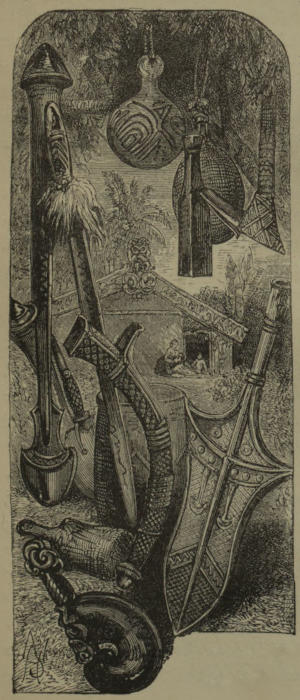
New Zealand Arms.
When the intelligence
of the Gate Pa disaster
reached England from New
Zealand, the news was received
with feelings of sorrow
and surprise. The public
at home were not prepared
to hear of the disaster which
had overtaken our arms in
that distant colony. We have
been so long successful by
land and by sea, that we have
come almost to regard victory
as our right, and when
our arms meet with any reverse
we are apt to be unjust,
and to ascribe our failure to
any but the true cause. Sir
Duncan A. Cameron, the general
commanding the forces
in New Zealand, has been
most unjustly assailed as the
cause of the recent disaster
at Tauranga, and a portion
of the English press have been
unmeasured in their abuse of
that distinguished officer. He
has been charged with incapacity,
mismanagement, and the reckless sacrifice of valuable lives;
and while such charges can have no effect upon those who
are on the spot, and have had frequent opportunities of witnessing
his capacity for command, they have doubtless tended
to injure him in the opinion of those who have only an imperfect
knowledge of the circumstances of the case. Though
we were not present at the attack on the Gate Pa, we have
derived our information from some of the principal actors in that
unfortunate affair, so that the following narrative may be safely
accepted as a faithful account of what occurred. We shall confine
ourselves to the simple facts of the case, and leave our readers to
draw their own conclusions.
Tauranga is the native name of a district on the east coast of
New Zealand, about a hundred miles south of Auckland. It has
long been the site of a missionary establishment under the charge
of Archdeacon Brown, who has laboured among the natives during
more than twenty years, and remained unmolested at his field of
duty during the progress of the present war. A few British settlers
had established themselves there for purposes of trade, and a
resident magistrate was appointed to watch over the interests of
justice. The Maoris of Tauranga are and always have been a warlike
race, but there was no reason at first to question their loyalty.
During the prevalence of the war in the Waikato district, the principal
seat of the late campaign, the Maoris at Tauranga remained
faithful in their adherence to the British Crown. It was only after
the hostile tribes, driven from their land in the Waikato by the
advance of our army, had dispersed themselves in the south, that
symptoms of disaffection appeared among the natives of Tauranga.
The fugitives excited the alarm of their countrymen by asserting
that they also would be stripped of their lands, and thus inciting
them to revolt. The effects of these incentives to rebellion became
so marked, that the 68th and 43rd Regiments, which had recently
arrived from India, were sent to Tauranga to overawe the disaffected.
This movement brought matters to a crisis; a small portion
of the natives remained faithful to the British Crown, while
the great majority left their homes and joined the insurgents. Our
forces encamped on a small peninsula called Te Papa, which is connected
with the mainland by a narrow isthmus: the command was
intrusted to Lieutenant-Colonel Greer, of the 68th Regiment. The
hostile natives continued to hover round our camp, cutting off our
supplies, and seizing the commissariat cattle within a few hundred
yards of our sentries, without any attempt on our part to punish
their audacity. Emboldened by our supineness and their own success,
they resolved at length to erect a pa, and the site they selected
would have secured the approval of Vauban, if he had been still
alive. In truth, the Maoris of New Zealand, though they have
never studied at Woolwich, are adepts in military engineering;
instinct in their case has supplied the want of science. The sites
of their pas, which are simply redoubts built of earth and inclosed
with a wooden palisade, have always been chosen with the double
intention of inflicting the greatest possible injury on their assailants,
and securing their own retreat when their position becomes
untenable. No attempt was made to restrain the natives from
erecting a pa at Tauranga; the work went on for weeks, and our
men quietly looked on. It is a far easier matter to prevent the
erection than to effect the capture of a pa, but there may have been
causes for this inactivity unknown to us. Be that as it may, the
pa was built without interruption on the narrow slip of land which
connects the peninsula of Te Papa with the mainland. This
isthmus is the gate which commands the entrance to the whole
district; hence the pa erected on it was known as the Gate Pa. On
either side was a swamp extending to the water, so that it was
impossible for our men to force their entrance into the interior
without dislodging the enemy from their stronghold. An order
had been issued for the 43rd Regiment to proceed to Auckland,
but Colonel Greer, in the exercise of a wise discretion, retained
them at Tauranga, in the belief that their services would soon be
required.
On the night of Thursday, the 28th of April, General Cameron,
who had arrived at Tauranga with his staff some days before,
commenced his preparations for attack. The forces under his
command seemed to be amply sufficient for securing success: they
consisted of the 68th Light Infantry, the 43rd, the Flying Column,
made up of detachments from the 14th, 65th, and 70th Regiments,
and the Naval Brigade, consisting of more than two hundred sailors
from the different men-of-war stationed there. The attacking party
were strong in artillery, having with them eleven Armstrong guns,
besides two howitzers and six mortars. The only arms possessed
by the enemy, whose numbers did not exceed six hundred men,
were their rifles and tomahawks; but this inferiority was compensated
for by the advantage of fighting behind the walls of the pa.
The general’s object was to intercept the enemy in the rear, and
thus cut off their retreat. Under cover of the night, the 68th
Regiment and thirty men of the Naval Brigade forced their way
through the swamp, and took up their position in the rear of the
pa, without attracting the notice of the insurgents. April is one of
the brightest and sunniest months in New Zealand, but the morning
of the 28th was dark and lowering; heavy rains began to fall, and
the rays of the sun were obscured by the murky atmosphere. By
the imperfect light of dawn the 68th could be seen extended in
skirmishing order behind the pa, so that the enemy were completely
hemmed in. They might hold out for a time, but it was
only a question of time; the general’s arrangements were perfect,
and no doubt was entertained of our ultimate success. At half-past
seven o’clock the cannonade began; the artillery, officers and
men, displayed the greatest courage and skill in working the guns;
shot and shell continued to be poured upon and into the redoubt
without intermission till four o’clock in the afternoon. The few
natives who had appeared in the rifle-pits at the commencement of
the attack were soon dislodged, and retreated into the pa by a hole
not larger than an ordinary covered drain. During the cannonade
they seldom returned our fire; the general impression was, that
the shot and shell had done their deadly work so effectually as to
leave few of them alive. The general, however, delayed his attack
till a breach had been effected in the walls sufficiently large to
admit the storming party—a fact which seems to have been wilfully
ignored by his assailants at home, who have unjustly accused
him of recklessly sacrificing the lives of his officers and men by
commanding them to mount an impracticable breach, when his
proper course would have been a mine or a distant cannonade.
All that could be done by a distant cannonade was already effected;
the breach was there staring them in the face; the storming party
had only to enter in and take possession. The wanton sacrifice of
human life is the last charge that would be brought against General
Cameron by those who have taken part in this campaign; in this
respect he resembles his friend and countryman Lord Clyde, who
never exposed his men to unnecessary danger. If human skill
could always command success, he had a right to count upon victory;
but we need not anticipate. At four o’clock in the afternoon
the storming party, consisting of the Naval Brigade and the 43rd
Regiment, were formed into line, while the covering party advanced
within a hundred yards of the pa, and opened fire. The enemy
showed themselves on the walls, and briskly replied. The storming
party, led by Commander Hay, of the Harrier, now advanced swiftly
in column; the men were in the highest spirits, and rushed forward
with a ringing cheer. Nothing could withstand the impetuosity of
their attack; in a moment they had cleared the ditch, scaled the
embankment, and plunged through the breach into the redoubt.
The reserve party thought that the day was won; for a time no sound
was heard save a straggling shot or an occasional cheer. But this
silence was not to last; it was only the treacherous lull that precedes
the storm. That storm soon burst forth with the greatest
fury; all at once the pa, the supposed grave of its Maori defenders,
became instinct with life; volley succeeded volley in rapid succession;
in the intervals might be heard savage yells such as never
issued from any British throat. It was a moment of intense interest
to the spectator, who for a time could see nothing but the
clouds of smoke that rose from the pa after each volley; enough,
however, soon became visible to show that our arms had met with
a sudden reverse. Soldiers and sailors, mixed up in confusion,
came thronging through the breach, plunged into the ditch, and
rushed forward in the wildest disorder; some sudden panic had
seized them, but there might still be sufficient time to turn the tide
of war and retrieve the honour of the day. General Cameron at
once ordered the supports to advance; a braver officer than Captain
Hamilton, of the Esk, could not have been found to lead them on.
If a single arm could have changed the fortune of the war, the
disaster of the Gate Pa would never have occurred; but the supports
came too late. The gallant Hamilton sprang upon the
embankment, waved his sword in the air, and shouted, “Follow
me, men!” Scarcely had the words passed his lips when a bullet
struck him on the head, the sword dropped from his hand, and he
fell to rise no more. The death of their leader increased the panic
of the men; the supports became mixed with the fugitives; all
discipline was forgotten; all remonstrance on the part of the officers
was unavailing; sauve qui peut became the order of the day. The
enemy, profiting by this panic, took deliberate aim, and poured a
destructive fire into the retreating mob, whose only thought was of
escape. The day was lost; the instrument had broken in the
hands of him who knew how to use it so skilfully. It was too
much for even the strongest nature to bear with equanimity; the
general dashed his field-glass on the ground, turned his back on
the fugitives, and retired to his tent to conceal his emotion.
Various causes have been assigned for this disastrous retreat.
It has been affirmed that the storming party, on entering the pa,
met with no resistance, and saw no traces of the enemy, except a
few wounded Maoris lying on the ground, apparently abandoned by
their comrades. Believing that the redoubt was evacuated, they
threw aside their arms, and began to help themselves to the plunder
which was scattered about. It may be that the Maoris had
recourse to this artifice in order to throw them off their guard, as
they are already familiar with the looting propensities of the
British soldier; it is certain that they had not all evacuated the pa.
A considerable number had done so; but the majority had concealed
themselves in chambers dug out in the ground, and covered
with boughs of trees and earth. They had remained there during
the cannonade, and it is a singular fact, worthy of the notice of
military strategists, that the storm of shot and shell which descended
upon the pa for upwards of eight hours could not reach them.
The killed and wounded were those who exposed themselves on the
walls; no shot or shell could reach their more prudent comrades,
who with heroic patience awaited the result in their subterraneous
retreat. When the defenders of the walls retreated before the
impetuous onset of the storming party, and tried to escape by the
rear, the others remained in their hiding-place, and bided their
time. When they saw through the thin covering of boughs and
earth that the storming party had abandoned their arms and given
themselves up to plunder, they opened a destructive fire upon them.
The effect was much the same as if a volcano had suddenly opened
beneath their feet, and begun to pour forth volumes of smoke and
flame; many of our men were killed and wounded at the first
discharge; discipline might have done much, but all discipline was
at an end; mere courage could avail nothing against this invisible
foe. Our officers behaved with their usual coolness and bravery,
but every effort to restore order was unavailing; the confused mass
staggered and reeled like a drunken man, as volley after volley was
poured into them from beneath. Meanwhile the insurgents who
had striven to escape by the rear, repulsed by the steady fire of the
68th, returned to the pa, and increased the panic by the suddenness
of their attack. The cry rose among our men that the enemy were
being reinforced by the arrival of fresh troops: some one, it is said,
gave the order to retire. Be that as it may, the day was already
lost; the panic became general; soldiers and sailors rushed in a
confused mass to the walls, and precipitated themselves into the
ditch below. It was at this moment that Captain Hamilton came
up with his supports: he came soon enough to find a death of glory
on the walls of the Gate Pa, but too late to turn the tide of war.
The supports were borne back by the flood of fugitives, and the
Maoris remained masters of the field.
The soldiers blame the sailors as the cause of this disastrous
retreat, and the sailors are ready enough to retaliate. It is matter
of regret that they should have been mixed up together during the
attack. Both fight well in their own way, but they fight best apart.
The soldier has not the dash of the sailor, and the sailor is wanting
in the steadiness of the soldier. It is certain that on entering the
pa both became mixed up together, and the confusion which thus
ensued prevented the officers from exercising that authority over
the men which they might otherwise have done. When a panic
once sets in, all discipline is at an end. The officers encouraged the
men by voice and example; they remained at the post of duty
when those under their command began to retreat; this fact alone
is sufficient to explain the great disproportion between officers and
men killed and wounded. It is painful to relate that our soldiers
and sailors abandoned their wounded officers to their fate, and left
them in the hands of the enemy; but there was one honourable
exception. Samuel Mitchell, captain of the foretop of Her Majesty’s
ship Harrier, who formed one of the storming party, did all that
could be expected from the British sailor in the hour of danger.
He entered the pa with Commander Hay, and when that officer was
mortally wounded he refused to leave him, though repeatedly urged
by him to consult his own safety. The gallant sailor listened to
the voice of humanity, and refused to leave his dying officer;
raising him in his arms, he carried him outside the pa amid a
shower of bullets. There must have been a cherub aloft watching
over his safety and sheltering him from danger; no hostile bullet
reached his person; the body of his leader was rescued from falling
into the hands of the enemy. Mitchell, on this occasion, was doing
duty as captain’s coxswain, and his heroic deed was not overlooked
or forgotten. It was reported to Commodore Sir William Wiseman,
who recommended him for the decoration of the Victoria Cross,
and we are glad to observe, from the London Gazette of the 26th of
July, that this honourable distinction has been awarded to him.
Long may he be spared to wear it!—a living witness that England
can appreciate and reward such acts of gallantry. We were
glad to learn that the services of Dr. Manley, R.A., had met with
the same recognition. The duties of an army surgeon rarely afford
him an opportunity of displaying gallantry in the field; but he has
often to exhibit a moral courage as worthy of our admiration as the
dashing bravery of him who heads a forlorn hope. It requires no
usual amount of courage to minister to the wants of the wounded
and dying on the field of battle amid the bullets of the enemy, and
this was done by Dr. Manley with as much sang froid as if he had
been performing an operation in St. George’s Hospital.
It has often struck us how little faith can be placed in the best
historical narratives, when we consider the difficulty, if not the
impossibility, of attaining to the truth regarding an affair of recent
occurrence, even when we have an opportunity of consulting the
principal actors. The storming of the Gate Pa is no exception to
this rule. The fugitives assert that an officer gave the order to
retire; the officers deny that such an order was ever given. We have
mentioned above that the panic originated from the return to the
pa of the Maoris who had endeavoured to escape, and were driven
back by the fire of the 68th; we have heard it strenuously urged
that the Maoris never left the pa, but had merely concealed themselves
in the subterraneous chambers, where they lay perdus till
they heard the approach of the storming party. It went the round
of the papers that the 68th Regiment three times in succession
endeavoured to storm the pa, and were as often repulsed. It was
not the duty of the 68th to storm the pa; they were assigned their
position in the rear to cut off the enemy’s retreat; they indignantly
deny that they ever attempted an assault or suffered a repulse.
Their trifling loss in killed and wounded renders it impossible that
they ever quitted their position. We merely mention these discrepancies
to show that a little scepticism is not out of place in the
study of history, and that the future historian of the war in New
Zealand will find some little difficulty in arriving at the truth.
The night of the 29th of April was, in the British camp at
Tauranga, a night of deep humiliation and mutual reproach. The
men were disgraced in their own eyes, and what would the people
of England say? There is not a more gallant regiment in the
service than the 43rd; Napier, who belonged to them, has commemorated
their deeds of valour in the Peninsula, and the memory
of the numerous engagements in which they have taken part is
preserved on their colours. But now where were all the laurels they
had won in the Peninsula and India? Soiled and trampled in the
dust, and by whom? Not by forces equal to them in arms and
discipline; not by foemen worthy of their steel; but by a horde of
half-naked, half-armed savages, whom they had been taught to
despise. They erred in despising them overmuch; they forgot, or
they had never learned, that the defenders of that pa belonged to a
race reckless of life, loving war for its own sake, who were then
fighting, as such a race ever will fight, for their homes, their lands,
their liberty, their all.
The time may come when the Maori race will be subdued, but
that will only be when the Maori race has been extirpated. Would
that the people of England knew this as well as the colonists of New
Zealand! A disgraceful chapter in the future history of our
country might then have never to be written. The storming party
learned when it was too late that the courage of despair rises superior
to all human calculations of success, and that no bounds can be
assigned to the heroic powers of endurance of men fighting for their
liberty. It could be no ordinary race that waited patiently for
eight hours, with no other shelter from the descending hurricane of
shot and shell than a few boughs of trees covered with earth, till
the moment had arrived for rushing forth and rolling back their
assailants like a broken wave. It adds nothing to our glory to
detract from the virtues of our adversaries. In the Maori character
there is much to condemn, but much also to admire and to imitate.
If, instead of being exterminated, they were embodied into regiments,
commanded by men who spoke their language and studied
their character, they would be found as useful as the Sikhs in
India; and, on the ground of public expediency as well as of
Christian principle, it would be better to save than to destroy.
The Maori race once extinguished can never be restored, and it
would be impious to imagine that any one race has been created
in vain.
But what was the fate of the wounded and dying officers left in
the pa? Night closed over them and concealed them in impenetrable
darkness. No less than seven officers of the 43rd were there,
besides others belonging to the navy. They were in the hands of
those who cut off Captain Lloyd’s head, and sent it round among
the other tribes as a trophy of victory. The vanquished soldiery
could hear the yells of triumph from the pa; some even imagined
that they heard the shrieks of their tortured countrymen, but this
was only the work of the imagination. The Maoris remembered
mercy in the hour of victory, and treated our dying officers with
humanity worthy of the imitation and admiration of all civilized
nations. No hostile hand hastened on the hour of death, already
fast approaching. Their persons and their property were alike
respected. An effort was made to relieve the sufferings of those
who were still alive. Lieutenant-Colonel Booth, commanding the
43rd, was shot through the spine and the arm. His wounds,
though mortal, did not produce immediate death. He stood
leaning against the wall of the pa, suffering intensely from thirst;
around him lay his slaughtered officers. Our pen shrinks from
recording the sufferings he endured throughout the night of horror
which he survived. He had risen rapidly to command, and was in
the very prime of his strength and manhood. Tall, erect, and
powerful, he looked like a man who could ward off death for half a
century; he had done so in India and elsewhere, but now he had
met his fate at the Gate Pa at Tauranga. This was the first time
that he had led his regiment into action, and had they behaved in
a manner worthy of their high reputation? Alas!
There lay the two Glovers, the sons of an English clergyman, on
the field of gore, but not of glory. They were lovely in their lives,
and in death they were not separated. We had seen the elder fall
in the foremost of the fray, and the younger, who loved him with
more than a brother’s love, rush forward with a loud and bitter
cry. A brother’s love may do much, but it cannot reverse the iron
decrees of fate, which take no account of human affection or sorrow.
It was in vain that he raised him in his arms, and strove to bear
him from the field—a hostile bullet brought both the brothers to
the ground, and left them side by side, with the tide of life ebbing
fast away. If there is a mother in some distant English rectory
weeping, like Rachel, for her children, because they are not, or a
father lamenting their loss, let us comfort them with the assurance
that in life and in death they were all that the fondest parent
could wish.
We have read of a martyr’s sufferings at the stake: we question
whether in intensity they equalled those endured by Colonel Booth
during that fearful night. He never lost his consciousness, and an
occasional groan escaped from his lips. An armed Maori stole up
to him. There was no sorrow in the thought that he had come to
give him the coup de grâce; but it was not so. The heart of the
half-savage man was touched by the spectacle of woe. Colonel
Booth read this feeling in his face, and muttered, “Water.” The
Maori shook his head, to show that there was none in the pa, and
slipped out in search of some. He never returned, but next
morning his body was found at the brink of the swamp, with a
pannikin by his side. A soldier of the 68th, ignorant of his purpose,
had fired at him with fatal precision, and arrested him on his
errand of mercy. The will must be taken for the deed. The
exposure of his life to all but certain death from the humane desire
to give a cup of water to a dying enemy shall not be without its
reward.
In the course of the night the insurgents abandoned the pa, and
made good their retreat by the rear, without suffering much loss
from the 68th, who had been placed there to intercept them. No
blame can be attached to the 68th; no regiment has ever been able
to prevent the Maoris from effecting their escape. They pass with
ease through swamps where the British soldier could never gain a
footing. Amphibious in their habits, they are as much at home in
the water as on land. Their loss on this occasion was trifling: it
certainly did not exceed thirty men, while ours amounted to 104
killed and wounded, including a larger portion of officers than on
any other occasion where British troops have been engaged. The
causes of this disproportion are already known to our readers.
For a time it was not known in the British camp that the enemy
had evacuated the pa. The frantic yells had died away—no sound
was heard to disturb the stillness of the night. Tempted by the long-continued
silence, Major Greaves, of the 70th, stole up to the ditch,
mounted the breach, and found the pa empty. Returning to camp,
he reported what he had seen, but no attempt was made to enter
the pa till daybreak. The enemy had fled, carrying their wounded
with them. Colonel Booth was still alive, but the surgeon told him
that his hours were numbered. He was borne to the camp, where
he survived till the following day. Before his death he was visited
by General Cameron. “I endeavoured, sir, to carry out your
orders; I am sorry that I have failed. I at least tried to do my
duty.” “You have done so nobly,” was the general’s reply, as he
pressed the hand of the dying soldier, in whose breast the sense of
duty was stronger than the love of life. It is pleasing to record the
virtues of men who, in this inglorious warfare, have gone down to
the grave unwept, unhonoured, and unsung, because England takes
little interest in a war with savages, and dismisses the subject for
others more attractive. The other dead or dying officers were
removed from the pa. Captain Hamilton, of the 43rd, breathed
only once after his body was found. A bullet had passed through
his head, and so altered his features that it was difficult to recognise
the handsome face with which we were once so familiar. We had
known him years ago in the East, when he was an ensign in the 10th
Regiment. During the interval he had served throughout the
whole of the Indian campaign, and followed Havelock to Lucknow.
He belonged to a race of soldiers, and was every inch a soldier
himself. Poor Hamilton! we think of him still as he sat at the
mess-table, expatiating on the capture of Lucknow, or some cognate
subject, to a group of admiring ensigns who loved him for the
dangers he had passed. He served in the 10th Regiment with the
present Sir Henry Havelock, now on the staff in New Zealand, who
always spoke of him with respect as a gallant soldier, and betrayed
the deepest sorrow on learning that he had fallen.
The cause of the sudden panic which seized our men at the
Gate Pa will never be known with certainty. It would be easy to
show, from ancient and modern history, that the best troops are
subject to such panics, which often spring from the most trifling
causes. Terror, like courage, is sympathetic; it spreads like an
infectious disease, from man to man, till all are swept away before
it. At the battle of Fridlingen, fought on the 14th of October,
1702, between the French and Austrians, the former almost lost
the day through a sudden panic which seized their ranks. The
infantry had reached the summit of a hill to dislodge the German
cavalry, and had succeeded in doing so, when a voice suddenly
exclaimed, “Nous sommes coupés!” On this every regiment turned
and fled. It was fortunate that in Marshal Villars they had a leader
equal to the occasion. “Allons, mes amis!” he cried; “la victoire
est à nous! Vive le roi!” “Vive le roi!” replied the soldiers, still
retreating as fast as they could. With some difficulty Villars rallied
them, and led them back to victory; but if a single regiment
had attacked them at that moment the result would have been the
same as at the Gate Pa. The most trifling incident may make a
whole army retire in confusion. Such an incident occurred during
the Indian campaign. A body of our men were on the march,
preceded by some of their officers on horseback. A horse became
restive, and threw its rider; other horsemen rushed to his assistance;
clouds of dust were raised; the cry rose from the ranks that
the rebels were upon them; a sudden panic was the result, and our
soldiers fled when no one pursued. It was fortunate no enemy was
at hand to profit by the confusion and terror occasioned by the
nowise remarkable incident of a surgeon falling from his horse.
The 43rd Regiment have already atoned for the disaster at Te
Papa. A few weeks after that event they again encountered the
enemy at Te Ranga, and proved themselves worthy of their Peninsular
fame and the glorious names inscribed on their standards. A
temporary reverse is no proof that a regiment has degenerated;
it is often the occasion, as in this instance, of eliciting the display
of a higher amount of courage than might have attended ordinary
success, and of teaching a deeper respect for those whose military
spirit and capacity we have been disposed to under-estimate.
CHAPTER XXIV. ENSIGN M’KENNA AND THE VICTORIA CROSS.
Little is known in England of the war which has
been carried on in New Zealand. Despatches are occasionally
published, and the names of those who have distinguished
themselves in the field are honourably mentioned; but
the seat of war is too remote for the people of England to feel
anything but a passing interest in a contest which they entered
upon with reluctance, and would gladly see finished. And yet in
this struggle between British soldiers and hostile Maoris, deeds of
valour have been performed which history will not willingly let
die; and the name of McKenna will be as gratefully remembered in
New Zealand as those of the heroes of the Victoria Cross Gallery
in England. We hope the day is not very far distant when he will
figure in that gallery with the other brave men who have carved
their way with their swords into Mr. Desanges’ temple of fame.
We listened to McKenna’s simple narrative the other evening in
a rude hut at the camp of Awamutu, in the very centre of the seat
of war. We have heard some of the most brilliant speakers of the
day, and been enthralled by the magic power of their eloquence;
but the interest excited by the charms of such oratory was less
thrilling than that produced by the soldier’s plain story of deeds in
which he himself was the principal actor. Before submitting that
narrative to our readers, which we shall do as much as possible in
McKenna’s own words, we may simply premise that, while of Irish
descent, he is a native of Leeds, and has served seventeen years in
the 65th Regiment, the greater part of that time as a non-commissioned
officer. He is an intelligent, well-educated man, in the very
prime of life, well adapted to occupy the rank which has been
assigned to him, and worthy to wear the Queen’s own Cross on his
breast. He has always borne an excellent character in a regiment
which is distinguished for the excellent conduct of its soldiers, and
the strong feeling of attachment which they cherish to their officers,
from the kindness and consideration with which they have been
treated during eighteen years’ service in this remote island. This
is McKenna’s story.
“In the beginning of July, 1863, the 65th Regiment was stationed
in Auckland. We were all expecting immediate orders to
embark for England, and our hearts beat high at the thought of
seeing our native land, which, after the absence of many years, had
never been forgotten, and was now dearer than ever. The 2nd
Battalion of the 18th Royal Irish had just landed, and were daily
expecting to receive orders to embark, when, to our great surprise,
we were told to hold ourselves in readiness for active service in the
field. It was no use grumbling, so in a few hours we were ready.
Some of us, I dare say, liked the excitement of a campaign more
than the monotony of a long sea-voyage; and a few inspiriting
words from the colonel made us forget all thoughts of home in the
excitement of the coming struggle. On the 9th of July we marched
from Auckland, and, though I say it myself, a better regiment than
ours never was, and never will be, seen in this country. We bade
farewell to our wives and children, and camped for the night at
Otahahu, nine miles from Auckland. Thence we proceeded to the
Queen’s Redoubt, which 300 of our men left on Sunday, the 12th
of July, for Tuakan, under the command of our dear old chief,
Colonel Wyatt, C.B. Tuakan is about sixteen miles from the
Queen’s Redoubt. It stands on a precipitous cliff overlooking
the Waikato river. It is the site of an old Maori fortification, and
is naturally a place of great strength. The road was difficult and
dangerous, with the dense bush on either side, but we reached
Tuakan in safety, where we soon cleared the ground and erected a
redoubt, which, in honour of our dear young Princess of Wales,
was named Alexandra. If she saw it she would not be ashamed of
it, for there is not a better one in the island. Well, perhaps the
Queen’s Redoubt is a little better, as in right it ought to be; but
in strength and beauty of design ours is next best.
“It was nearly finished on the 19th of July, when Colonel
Wyatt withdrew one-half of the men, and left the other 150 under
the command of Captain Swift. He is dead now, poor fellow, and
no words of praise from me can reach his ear; but a better officer
never carried sword or wore the Queen’s uniform. God bless
him! I was only a poor sergeant; but if I had been his own
brother, he could not have been kinder to me. His example told
upon us all; we all liked our duties, and tried to do all we
could to suppress the rebellion. His first act was to seize a number
of rebel canoes and to man them with crews from his own detachment;
in this way we contrived to seize large quantities of potatoes
and other provisions from the hostile natives. But he did more
than this: he extemporized a body of Forest Rangers, who scoured
the dense bush around the redoubt, kept the natives at a distance.
He had heard of atrocities they had committed on defenceless
women and children, and longed for an opportunity of meeting
them in the field. Poor fellow! he little dreamed that his first
meeting with them would be his last. But such are the chances of
war. If he had lived, the world would have heard more of him,
for there was never a braver or a better officer in the British or
any other service.
“Well, things went on as usual till the 7th of September. On
the morning of that day we had a visit from Mr. Armitage, the
resident magistrate of the township of Havelock. He had charge
of five large canoes, manned by natives, and loaded with forage and
provisions, which were proceeding from Camerontown, a friendly
Maori pa, to the Queen’s Redoubt. The forage had been brought
up from the Waikato Heads; the barque City of Melbourne had
conveyed it there from Auckland. The river transport had been
established in consequence of the difficulty of transporting stores
by the great South Road; and as the canoes were paddled by
friendly natives, no one imagined that there could be much danger
of their being attacked.
“I shall never forget the morning of the 7th of September.
Captain Swift was asleep in his tent when Mr. Armitage arrived.
He wanted one of the large canoes we had seized, and I had to go
three times to the captain’s tent before I could wake him. He was
usually a light sleeper, but it was different on this occasion. It
did not strike me much at the moment, but I have often thought
of it since. Well, Mr. Armitage left, and nothing unusual happened
till about eleven o’clock. I was down at the landing-place
superintending some work, when all at once I heard the report of
several shots. I stood and listened. The shots were followed by
successive volleys, which gradually subsided into the regular, or
rather irregular, firing of a smart skirmish. This went on for
about a quarter of an hour. I knew from the direction of the
sound that the fighting was going on at Camerontown. I hurried
to the captain, and told him I was sure the rebels had attacked Mr.
Armitage’s party. While I was speaking, all at once we saw a
large volume of smoke curling up in the air close to the pa. We
both came to the conclusion that the rebels had set fire to a house
which had been recently built for Mr. Armitage.
“About half an hour after this we saw a canoe, paddled by
four natives, coming up the river. We knew from the way
they used their paddles that something was wrong. Their faces
were as green as the French Emperor’s at Solferino, and their teeth
were chattering with terror. They were so panic-struck that it
took some time before we learned from them that the rebels had
formed an ambuscade, and attacked them while off their guard.
Mr. Armitage and two white men had been killed, and all the
friendly natives dispersed or slain; these four only survived to
tell their fate. Thirty or forty men, women, and children, had
perished.
“We are pretty well used to such things out here, so no time
was wasted in idle words. In half an hour we had a party, consisting
of Lieutenant Butler, myself, two sergeants, one bugler, and
fifty rank and file, under arms, the whole under the command of
Captain Swift. We were all too eager for the fray to care much
for eating, so we snatched a hasty dinner and were off by one
o’clock. People at home can have no idea of a march through the
bush. We had to cross nine or ten miles of swamp, intersected by
rivers scarcely practicable for regular troops, so as to strike the
foot of the wooded range of hills on a spur of which stands the pa
of Camerontown. We had to creep through the dense bush, but
there is no difficulty persistent pluck may not surmount. We
were all tired enough when we reached a small clearing about half-past
four o’clock in the afternoon, and felt the need of the evening
tot of rum which was now served out. One sergeant and ten
privates, on receiving theirs, were sent on in advance; the main
body followed a little after. On proceeding a few hundred yards
they discovered that the advanced guard had strayed from the right
path, and we could not shout without attracting the notice of the
natives. We felt it rather hard to be deprived of their services,
as we had no men to spare, but it was decided that we should go
on. Our force was now reduced to two officers and forty-three
men, but Captain Swift was a host in himself; we would have
followed him anywhere and against any odds.
“It was at this juncture that I had an opportunity of showing
some qualities which have brought me under the notice of General
Cameron, and procured for me such honours as have rarely, if
ever before, been bestowed on a British soldier. There are as
good men as I am in the ranks, unknown to fame, but time and
chance happeneth to all. I never dreamed of honours—my only
desire was to do my duty. I asked and obtained leave from
Captain Swift to advance forty or fifty yards in front of the men to
act as scout, an office for which I was well qualified from former
experience. I took a direct course through the bush towards the
spot where the natives were supposed to be. About five o’clock I
reached a large opening, where I could plainly see the rebels’
encampment in the bush, about four hundred yards in advance.
Crossing the clearing in a stooping position and at a smart pace, I
again made for the bush, followed by the whole detachment. Five
minutes after we could distinctly hear the sound of the rebels’
voices, and Captain Swift, imagining that they were advancing by
the same path to attack us, threw his men into ambush. On
finding that they refused to advance, I crept stealthily up to within
a few yards of them. Unlike most Maori war parties, they were
laughing and chattering, which led me to think they had been
making free with the rum they had seized in the canoes. I
returned and reported this to Captain Swift, who came to the same
conclusion as myself, that they were all drunk. The order was at
once given to fix bayonets and charge. Our men advanced, led by
Captain Swift, Lieutenant Butler, and myself, three abreast, the
path not admitting more. When we had stolen up to within a few
yards of the rebels, our leader gave the word ‘Charge!’ The
word had scarcely passed his lips when, as if by enchantment, the
whole bush was lighted up with a terrific volley. It seemed as if
one of the extinct volcanoes so common here had suddenly opened
its crater and begun to belch forth flames. The enemy were so
close when they fired that some of their coarse powder was actually
found sticking in the faces of our soldiers. For a moment our men
staggered beneath this heavy fire, but it was only for a moment, for,
immediately recovering themselves, they closed up in a line of
skirmishers in the bush, and brought their rifles to bear on their
dusky foes. I had taken cover behind a tree close to Lieutenant
Butler, for the purpose of reloading my rifle, and even in that hour
of danger I could not help admiring his bravery. He stood at the
left front, a little in advance, cheering on the men by his voice and
still more by his example. I saw him discharge his revolver right
and left; three Maoris fell beneath his fire, and were dragged into
the bush by their friends. I was still admiring his heroic courage
and gallant bearing, when all at once I saw him sink slowly to the
ground, as if his spirit were struggling against some mortal blow.
I sprang forward with two others to his assistance, and on raising
him in my arms he said, ‘Lead on the men, McKenna.’ Surprised
at such an order, I looked round to see where the captain was, and
there he lay by his side mortally wounded. No language can
express the anguish I felt on seeing one who, though my superior
officer, had always treated me with the greatest kindness, in this
condition. If he had been my own brother I could not have felt it
more. Poor Captain Swift! I shall never forget the last look you
gave me, or cease to regret your loss.
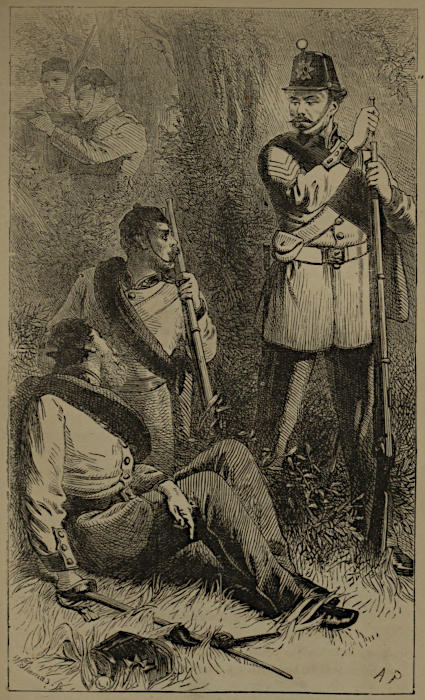
Captain Swift directing M’Kenna to take command of the detachment.
“‘Are you wounded, sir?’ was my first exclamation.
“‘Oh, yes, McKenna; very severely,’ he replied.
“On seeing me loading my rifle, he said—
“‘Never mind loading. Take my revolver and lead on the
men.’
“These were the last words this good and gallant soldier ever
spoke to me. I mechanically took up the revolver, gave one last
look at my dying officer, and then shouted, like one possessed—
“‘Men, the captain is wounded; charge!’
“I rushed on at the head of the men, and we drove the natives
before us like sheep. We now found ourselves in a small opening
on the crest of the hill. The natives found shelter in the bush to
our left and front, where they opened fire on our little band of
thirty-eight men. Our position was critical. One of our officers
was mortally, the other severely, wounded; ten miles of swamp
and bush lay between us and any succour; around us were three
hundred savages thirsting for our blood. I think it was God who
gave me strength to act as I did that day. Assuming an air of
coolness (which, in my heart, I was far from feeling), I ordered my
men to extend in skirmishing order across the clearing, and to keep
up a steady fire. My object was to hold the place for a time, till
the advanced guard, attracted by the firing, should join Corporal
Ryan and the four men left in charge of the wounded officers, so as
to have them carried well on to the redoubt before the approach
of night compelled us to retire.
“The Maoris had been encamped on the spot now occupied by
our party, and had left a great many things, such as tents, sacks
and kits of potatoes, behind. These our men formed into a sort of
breastwork, and kept as well under cover as they could. Several
of the natives climbed up the trees in order to fire over the breastwork,
and one of them was brought down in splendid style by
Private Smith of ours, his fall causing a thud like the fall (though
louder) of a plump partridge. After waiting till about six o’clock,
I resolved to retire by the way we came; but I had scarcely given
the order when we were met with a tremendous volley from the
very quarter by which we intended to retreat. The enemy took
deliberate aim, and three of our men fell badly wounded. I then
brought the party back to our former position, and sent for my
brother sergeant to consult with him as to what should be done.
His proposal was to run the gauntlet through the Maoris, and to
make for Mr. Armitage’s pa, which was about 150 yards farther
on in the bush. He thought we could establish ourselves there and
hold out till we received assistance; but I knew that the thing was
impracticable. The pa was commanded by a hill from which the
enemy could have amused themselves by shooting us at leisure; in
short, the place was untenable.
“A poor fellow of the name of Stephen Grace being close at
hand when I put the question, and always ready to offer his advice,
proposed that we should form three sides of a hollow square, and
retire down the hill to our rear, which was not wooded. I could
scarcely help smiling at such a foolish proposal, when all at once
I heard a deep sigh at my elbow, and on turning round saw poor
Grace rolling down the hill in mortal agony, till his head lodged in
a fern-bush, and all was over. I ordered the bugler to take his
rifle and belt, and to cover him over with fern. I had no stretcher,
and it was impossible for the men to carry his body with safety to
themselves; he was now beyond the reach of harm, and we left
him there with the green fern as his mort-cloth.
“At a quarter past six o’clock, I ordered the wounded to be
taken down the hill to the rear by a path that led across the valley
to the dense bush on the other side. I felt sure that a native
path in that direction would lead to the Mauku or Pa Kekoe,
both military posts. I knew that all depended on our coolness and
self-possession. If we fell into confusion, or showed any signs of
fear, we were lost; so I told the front rank of skirmishers to fire a
volley and retire down the hill, giving at the same time a ringing
cheer as if about to charge. As soon as they were established
below, I ordered the rear rank to do the same thing. Nothing
could be better than the conduct of the men at this trying moment;
the movement was executed with as much steadiness as if they had
been on parade. On reaching the foot of the hill we found, to our
infinite delight, a beautiful stream of clear water. We saw by the
footprints on the bank that the Maoris had been there; we knew it
to be them because they turn their feet inward when walking, and
spread their toes out like a duck in crossing swampy ground. They
soon gave us clearer evidence of their presence by rushing out of
the bush and opening a heavy fire on our men, who as readily
returned it. The cowardly villains had not courage to descend
from the crest of the hill, but kept up their fire there till our
party entered the bush.
“About eight o’clock we began to make our way through the
bush, but soon discovered that we had lost the path. On this I
told my men that we must remain where we were till next morning.
I then formed them into a square, and ordered every man to
speak his name, so as to ascertain whether any were missing. Two
men failed to answer; both were wounded—Private Whittle
slightly, across the scalp, and Private Bryne severely through the
right hand. On inquiry, I found that, after drinking at the stream,
they had pushed on by themselves instead of waiting for the main
body, and diverged from the path without being missed; but we
shall have more to say of their adventures presently. I then gave
my orders for the night: every man had to put on his great-coat
(all had brought them with them folded across their right shoulders);
to sit with his rifle ready in his hand; no pipes to be lit;
not a word to be spoken. I knew that this was the only way to
elude the enemy and to reach the redoubt in safety. Under the
tender mercies of Divine Providence, my efforts proved successful.
About four o’clock next morning I placed myself at the head of my
men, and we resumed our march through the bush. We pushed
our way with difficulty through the dense masses of supplejack and
creepers; we crossed over hills thickly covered with wood; we
descended ravines that were almost perpendicular. No word of
complaint was heard—all struggled on for their lives. At length,
at eight o’clock A.M., our gallant little band emerged from the bush
and found themselves in the open country about seven miles from
the redoubt, which they could see in the distance. Rushing
straight ahead, they met Colonel Murray with a hundred men of
the 65th Regiment coming to their assistance. We now knew that
we were safe, and it would have done your heart good to have
heard the hearty English cheer that burst forth from both parties
on first seeing one another. I know, too, that many a heartfelt,
grateful prayer was breathed to Almighty God for having preserved
them through all their dangers.
“Our joy was mingled with tender regret on learning that
Captain Swift was no more. He died at seven o’clock the previous
night. Corporal Ryan and Privates Talbot and Bulford remained
with him to the last. They carried him in their arms for some
distance after he had received his death-wound, but the agony he
suffered was so intense that he requested them to lay him down on
the ground. They placed him behind a fallen tree and concealed
him as well as they could; they then crept down beside him. On
hearing the heavy firing, he said to Corporal Ryan, ‘I am sure
McKenna has gained the pa.’ Soon after they heard the natives
coming through the bush; the report of firearms told them that
the Maoris had attacked the advanced guard who were hastening
to their assistance.
“After a short skirmish the advanced guard had to retire to make
for the redoubt, which they reached about nine o’clock the same
night. In this affair the natives, in firing, actually came behind the
tree under which Captain Swift was lying with Ryan, Bulford, and
Talbot. He begged of them not to leave him. They assured him
that they never dreamed of doing so; they would stay by him till
the last; they were ready to die with him if necessary. They told
him that his moaning might attract the notice of the enemy. On
hearing this, the poor fellow placed his hand on his mouth to
restrain his agony till the Maoris retired. His last words to
Ryan were, ‘Give me your hand.’ He pressed it, and then died as
quietly as if he had fallen asleep, which I am sure he did in Jesus.
With reverent and loving hands they covered the body with fern,
and started for the redoubt at break of day. On their way they
met the party sent to their relief.
“I must now return to Lieutenant Butler. Privates Thomas
and Cole remained with him all night in the bush. He suffered
much from his wound, and complained bitterly of the cold, though
the men had thrown their two great-coats over him. There is no
sacrifice a soldier will not willingly make for an officer he loves.
Private Thomas took off his blue serge shirt and put it over him,
remaining all night in his cotton shirt and trousers. Well, I agree
with you it was a generous act; but so great is the attachment of
our well-commanded regiment to their officers, that they would go
through fire and water to serve them.
“I sent back a guide with Colonel Murray’s party to conduct
them to the scene of action, and pushed on for the redoubt, which
we reached at eleven o’clock A.M. We were much worn out, but
grateful to God for our deliverance. In the evening Colonel Murray’s
party returned; they brought in Captain Swift’s body, but
could find no traces of the two men who were missing. They gave
up the search as hopeless, and, embarking on board the steamer
Arrow, returned to head-quarters. About ten o’clock next morning
100 men of the 70th Regiment marched into the redoubt; they
had been guided through the bush from the Queen’s Redoubt by
that most efficient officer Captain Greaves, of the 40th. We left
the Alexandra Redoubt under their charge, while 100 of our men,
under the command of Lieutenant Warren, started in search of
their missing comrades, Captain Greaves accompanying the party.
We reached the scene of action about four o’clock P.M., but found
that the Maoris had disappeared. In a subsequent despatch Captain
Greaves estimated that they must have amounted to little short of
300 men, and, judging from their number of sleeping-places and
other indications on the spot, I am inclined to think that this estimate
was not beyond the mark.
“I struck the tracks of the missing men at the bottom of the hill
where they had last been seen. A little farther on we found one of
their pannikins in the road. Darkness setting in we were obliged
to return, but not before we had visited the pa at Camerontown,
where we found quantities of maize, bran, and oats scattered about
the beach, partly burned and rendered unfit for use. We found a
canoe on the beach which I wished to destroy, but was prevented
by Captain Greaves, who thoughtfully observed that it might be the
means of saving one or both of the poor fellows who were missing.
We now made for the redoubt, bearing with us the body of Private
Grace, which we found on the same spot where we had left it. We
reached the redoubt at half-past twelve o’clock the following morning,
when we learned that Whittle, one of the missing men, was on
the other side of the river calling for help. From our long residence
in the colony we have many skilful paddlers in the ranks; in
a few minutes a canoe was manned, and in half-an-hour the poor
fellow was inside the redoubt, carefully attended by Assistant-Surgeon
Styles, of the 40th Regiment. He had been exactly sixty
hours without food, and was much exhausted.
“When, sufficiently recovered, he informed us that after leaving
the party on the 7th, he and Bryne took the path to the left, instead
of following the one to the right as we did. He had not proceeded
far when he became unconscious; how long he remained in that
state he could not tell. On being restored to consciousness by the
drops of rain falling on his face, he found himself alone; Bryne
had gone on. For two days he wandered about the bush, trying in
vain to find an opening; at one time, while following a native path,
he nearly fell into the hands of a party of rebels. He was close
upon them, when, warned by the sound of their voices, he crept
back into the bush without being seen. A still more singular incident
occurred to him the previous evening. He heard the footsteps
of our party at Camerontown, and, rushing forward, caught
sight of them as they were entering the bush on their return from
the canoes. Such was the impression produced by this sight that
all his faculties, bodily and mental, were completely paralysed; he
could neither speak nor move; when he recovered from his temporary
prostration the party had disappeared. For a moment he was
tempted to believe that he was labouring under some mental hallucination,
the result of over-anxiety and bodily weakness, but it was
not so. Finding no traces of our party, he hurried down to the
river, where he found the canoe which Captain Greaves had the
foresight to preserve. Using a rough piece of board as a paddle,
he contrived to make his way up the river till he found himself
within four hundred yards of the redoubt, but on the opposite side.
Here he had the misfortune to drop the piece of board, and could
only save himself from being swept away in the canoe by clinging
to the long weeds in the shallow part of the river till his cries
brought his comrades to his assistance.
“Poor Bryne, the other missing man, was less fortunate. He
wandered about in the bush till he was surprised by a party of the
enemy. We learned afterwards that he begged hard for his life,
but he had to deal with wretches who knew no mercy. Five balls
were lodged in his body, and he was stark and stiff when we found
him. My story is now told; every one admits that it was one
of the most desperate affairs that have occurred in the course of
this war.
“I arrived at the Queen’s Redoubt, and was immediately sent for
by General Cameron. I found him surrounded by his staff, but the
moment he saw me he advanced and shook me warmly by the hand.
‘Sergeant,’ he said, ‘you have done well.’ ‘And I am amply
rewarded by this honour,’ was my immediate answer; ‘not to
myself alone, sir, but to the brave fellows who were with me, is the
credit due.’ ‘I know it,’ said the general; ‘there is not another
corps in the colony could have done as the 65th.’ Nor was this all;
in his despatch to Governor Grey, General Cameron expressed his
admiration and approval of our dear old regiment in the most complimentary
terms, and it was on his recommendation that I received
my commission and the Victoria Cross. Corporal Ryan was also
gazetted for the Victoria Cross, but never lived to wear it. His
death was in keeping with his life; he was accidentally drowned
near Tuakan while trying to save a drunken comrade. Three
months after their gallant conduct, Privates Bulford, Talbot, Cole,
and Thomas received the medal for distinguished conduct in the
field, the first two for remaining with the body of Captain Swift,
and the two latter for waiting on Lieutenant Butler and conveying
him towards the Redoubt.”
“In all this desperate affair did you ever think of your wife and
children, McKenna?”
“Not once, sir. She asked me the same question the first time we
met, and seemed a little put out when I gave her the same answer,
but she understood it all afterwards. In the excitement of an engagement
a soldier can only think of immediate duty; when the
danger is past he feels how grateful he ought to be to Him who
has preserved his life for those who are dearer to him than life
itself.”
CHAPTER XXV. SERGEANT-MAJOR LUCAS, OF THE 40TH REGIMENT, AND THE VICTORIA CROSS.
We had the pleasure, a few weeks ago, of seeing
Lieutenant-General Sir Duncan A. Cameron, K.C.B.,
the officer commanding the forces in New Zealand,
attach with his own hands the Cross of Valour to McKenna’s
breast, and declare, in the presence of his own regiment, that a
more chivalrous soldier had never been invested with this symbol
of his Sovereign’s favour. Sir Duncan, at the same time, expressed
his regret that he who had shared in the danger could not
share in the reward, but rejoiced to think that Corporal Ryan’s
death was in keeping with his life, which he had lost in trying to
save a comrade from drowning. Three cheers were given for
Ensign McKenna, and none joined more heartily in those cheers
than Sergeant-Major Lucas, of the 40th Regiment, who had received
the same decoration from the hands of the general at the close of
the Taranaki war in 1861.
A brief sketch of the island, and the causes that have led to
that and the present war, will not be without interest. The
aboriginal inhabitants of New Zealand are known by the name
of Maoris—a word which in their language signifies indigenous to
the soil—and are about 60,000 in number. They are supposed to
have emigrated, about four centuries ago, from the Society and
Sandwich Islands, and to have dispossessed another race, many
traces of whose existence are still to be found in New Zealand. In
appearance they bear a striking resemblance to those gipsies who
may still occasionally be seen in the neighbourhood of Norwood
and the Crystal Palace. They are a fine, powerful, muscular race,
naturally fond of war, and possessed of great energy of character.
They have made great progress in civilization since the island was
first discovered, in 1642, by Abel Tasman, a Dutch navigator, who
named it after his own country. It was visited in 1769 and 1777 by
Captain Cook, who took possession of it in the name of the English
Government, and suggested that it should be used as a penal settlement.
He introduced pigs, cabbages and turnips into the island,
and his name is still familiar to the natives as one of their greatest
benefactors. There are several fountains known as Cook’s Springs,
and the rum he occasionally distributed among them is gratefully
remembered as “Te wai toki a rangi”—Cook’s sweet water of
heaven. While the natives were kind and hospitable to those who
treated them well, they were ever ready to revenge any injury they
received, and murdered the crews of several vessels of whose misconduct
they had reason to complain. Thus, in 1809, the sailors
on board the Boyd, an English ship, under the command of Captain
Thompson, were massacred at Wangaroa. This melancholy event
was the result of the captain’s imprudence. Among the passengers
was a Maori chief, who had visited Sydney, and was now on his
way to his native land. Being short of hands, the captain requested
him to assist the sailors in working the ship. On his refusal to do
so he was tied to the mainmast and flogged. This degrading
punishment roused all the savage passions of his nature, but, disguising
his feelings, he persuaded the captain to visit Wangaroa, of
which he was the leading chief. All suspicion was disarmed by the
friendly bearing of the natives, who were only biding their time.
Watching for a favourable opportunity, they attacked the ship, and
murdered the captain, the crew, and many passengers. A similar
calamity had overtaken the crews of two French vessels, in consequence
of their having unintentionally desecrated the place set apart
for the burial of the natives.
When the Maoris were plundering the Boyd’s cargo, they came
upon some boxes of seed, which was scattered about as useless. It
took root, however, and in a few years the surrounding district was
overgrown with garlic and parrot’s-bill acacia (Clianthus Puniceus),
which yields a beautiful flower used by the natives as an ornament
for the ear. After this the island was little visited except by
whaling ships (the captains of which were sometimes so accommodating
as to lend their ovens to prepare the banquets of human flesh
so much relished by the Maoris) till 1839, when the New Zealand
Land Company obtained a charter and began to form settlements in
the south. It is worthy of remark, that so early as 1835 Great
Britain formally recognised the independence of the natives and
bestowed on them a national flag; but no sooner had the new company
begun to buy extensive tracts of land from the natives, than
the missionaries interfered and induced the home government to
send out a governor. As a governor over an independent race would
have been a contradiction in terms, the difficulty was obviated by
inducing a number of natives to assemble at Waitangi, and to
attach their signatures to a treaty in which they acknowledged the
supremacy of our Queen. Rum and blankets were liberally distributed
among the natives, who were ready to sign anything. Such
was the origin of the treaty of Waitangi, on which alone our claims
to the loyalty and obedience of the Maori race can be said to rest.
It was a mere farce, unworthy of the ministers of religion who
originated it—equally unworthy of the great nation who sanctioned
it. As well might the nine tailors of Tooley-street, who dubbed
themselves the men of England, have undertaken to dispose of the
liberty of their countrymen, as the signers of the Waitangi treaty to
barter away for rum and blankets the future independence of the
Maori race. And yet it is in virtue of this worthless document, the
authors of which in any civilized country would have been liable to
an indictment for conspiracy, that we profess to treat the Maoris as
a subject race, and make war against them as rebels when they try
to assert their independence.
Notwithstanding the treaty of Waitangi, the Maoris continued to
retain their own customs, manners, and laws, and to act in every
way as an independent people. Their chiefs, far from acknowledging
the supremacy of the British crown, frequently waged war against
us and with one another. When they fell into our hands they were
never treated as rebels. In short the Maoris tolerated our presence
in the island because they found our colonists useful for purposes
of trade; but when they discovered that the British population
was constantly on the increase, and their lands fast slipping
from their possession, they resolved to assert their ancient independence,
and to pass such laws as would prevent the alienation of
their property. They were willing that the colonists should remain
subject to their own Sovereign and laws, but they claimed the same
right for themselves, and in the exercise of that right elected one
of their chiefs to be Maori king, and formed themselves into a
league to prevent any lands from being sold by any individual
member of a tribe without the consent of the whole. Such a league
would at once be pronounced illegal in England, where it is a
recognised principle that every man has a right to do as he likes
with his own; but the Maori tenure of land is different. It rarely
belongs to a single family or to a single individual; it is the property
of the whole tribe, much in the same way as a common in
England is the property of all whose lands are adjacent. Every
member of a tribe has the right to hunt and fish over the land which
belongs to the whole community; no man, not even a chief, has a
right to dispose of any part of that land without the consent of the
whole tribe. When a piece of land is sold the money is distributed
equally among all who are entitled to a share, the chief rarely
retaining anything for himself. The only way in which a piece of
land can become private property is by an individual selecting and
cultivating it with the consent of the tribe; it then belongs to all
the descendants of the original cultivator, who may be dispersed
among other tribes, and it cannot be sold without their consent.
Now this peculiar tenure of land was the cause of the Taranaki war
of 1860-61, and of the present war in which so many valuable lives
have been lost. The establishment of a Maori sovereignty would
have ended in nothing; the Maori king was a mere puppet in the
hands of a few ambitious chiefs; the great body of the nation would
never have acknowledged his supremacy; and the movement would
have covered its originators with ridicule. But when the local
government interfered with the rights of property, and violated the
first principles of Maori law by purchasing from an individual
land which belonged to the whole tribe, and enforcing possession by
violence, they struck at the root of Maori independence, and
brought on that fierce struggle of which we have not yet seen the
end. The Maoris are fighting for their lands and liberty, while we
are fighting for British supremacy. The settlers have already more
land than they can cultivate, but this has not prevented them from
coveting that which belongs to the natives. If they had waited
patiently, a period would have arrived when the Maoris would have
seen it to be to their own advantage to part with lands which
they cannot turn to any profitable account, but they were unwilling
to wait, and endeavoured to compel the natives to enter into their
views. Such a policy was as imprudent as it was unjust; there
were few troops in the colony; and when the natives flew to arms
in 1860, the government had to appeal to the Australian colonies
for assistance.
The appeal was not made in vain; all the troops that could be
spared were despatched at once to the seat of war, including four
companies of the 40th Regiment, detachments of which were stationed
at Melbourne and Hobart Town. Sergeant-Major Lucas,
who then held the rank of colour-sergeant, arrived in New Zealand
in 1860, and took part in all the engagements we had with the
enemy till the temporary cessation of hostilities in 1861. The
Maoris do not fight in the same way as Europeans; it is part of
their policy to avoid giving battle in the open field. Their mode
of warfare is to conceal themselves in the bush, and to fire upon
our men when off their guard; or to erect pas or redoubts, surrounded
by a ditch, and surmounted by wooden palisades. Inclosed
behind the walls of these pas, they coolly await the approach
of our men, and pour upon them destructive volleys while they are
advancing to the assault. When their position is no longer tenable,
they evacuate the pa, and such is their perfect knowledge of the
country that they often contrive to escape through the ranks of our
men with little loss. The evacuation of a pa is not considered a
defeat; they select a favourable site, and proceed at once to erect
another, which has also to be stormed. Many valuable British
lives are thus lost, and the war would be interminable, were it not
that we may cut off their supplies and ultimately starve them into
subjection.
The late war was carried on in the Province of Auckland;
but it was in Taranaki, the capital of which is New Plymouth,
that Sergeant-Major Lucas won his laurels. He is a fine, soldierly-looking
man, a native of the South of Ireland. He entered the
army at an early period of life, and has served eighteen years
in the same regiment. One of his brothers, a soldier of the 40th,
was severely wounded in the Taranaki war, and allowed to retire
from the service with a pension: he himself, though he took part
in every engagement, escaped unhurt, and now occupies the
highest rank that a non-commissioned officer can attain. The
war in Taranaki had been carried on with varying success till
March, 1861: the British forces under the command of Major-General
Pratt had erected a series of redoubts for the purpose
of keeping the enemy in check and protecting the town of New
Plymouth. These redoubts were occupied by detachments of our
men, and skirmishing parties were daily sent out to scour the
neighbouring bush, where the enemy were known to be lurking.
On the 18th of March, 1861, a party consisting of about thirty
men of the 40th Regiment was sent out in front of No. 7 redoubt,
situated on the river Waitara, in search of the enemy. Between
the redoubt and the bush there intervened an open space of some
eight hundred or nine hundred yards in breadth, over which our
men were allowed to advance without resistance; but no sooner
had they entered a narrow defile, surrounded on either side by bush
and fern, than a heavy fire was opened on them by an invisible foe.
Captain Richards, who was in command of the party, threw out his
men in skirmishing order, and ordered them to fire in the direction
whence the smoke proceeded. The enemy being concealed in the
bush had the advantage of being able to take deliberate aim, and
several of our men were killed or wounded. Lieutenant Rees, who
was next in command to Captain Richards, seized a rifle which a
wounded soldier had dropped, and encouraged the men by his example
to keep up a steady fire. At the same time he requested
Colour-Sergeant Lucas to send two men to remove two of the
wounded who were badly hit. As the men were preparing to
execute this order, a fresh volley from the enemy placed one of
them hors de combat, and a bullet hit Lieutenant Rees in the right
groin. He staggered and fell, when Colour-Sergeant Lucas, with
much presence of mind, ran up to his assistance, and sent him to
the rear under the charge of the soldier who remained unhurt.
Three wounded men and four stand of arms still remained on the
field, and the gallant sergeant resolved to present a bold front to
the enemy till he was relieved. Sheltering himself behind a tree,
he opened a brisk fire on the enemy, and kept them at bay. So
long as he remained behind the tree he was safe, but whenever he
left this shelter to take aim, he became exposed to the fire of the
enemy, who, deterred from advancing by his gallant resistance,
endeavoured to shoot him down. Two soldiers had the courage to
stand by him, and for a quarter of an hour they kept the enemy at
bay without being hit, though they were exposed to a constant fire
from a distance of only thirty yards. Several of the Maories were
wounded, and carried off by their companions; the brave little
band, anxious but not discouraged, still continued to hold out.
The amount of danger incurred by Sergeant Lucas may be
learned from the following incident:—The tree behind which he
found shelter had several creepers suspended from its top; a bullet
from the bush hit one of these creepers and cut it in two at the
distance of a few inches from his head. If the Maoris had been
better marksmen the whole of the little party must have perished,
and the wounded men have fallen into the hands of a relentless
foe; but in moments of excitement the natives fire wildly, without
taking aim at any particular object. It was to this fortunate
circumstance that Sergeant Lucas and his two followers owed
their lives; the enemy were excited, and so fired without precision.
As it was, they were enabled not only to continue their resistance,
but also to inflict considerable loss on the enemy. For a quarter of
an hour the unequal combat was kept up till a party under Lieutenants
Gibson and Whelan came up to their assistance, on which
the enemy retired. Only one of the three wounded men recovered,
and Lieutenant Rees, in consequence of the severity of his wounds,
was obliged to return to England. It would be difficult to overestimate
the importance of Sergeant Lucas’s gallant conduct on
this trying occasion; he prevented the bodies of his wounded
comrades from falling into the hands of the enemy, and saved four
stand of arms. Nor was this all: the moral consequences of his
heroic resistance were soon evident. The next morning the white
flag was hoisted by the natives, and this was the last engagement
in the Taranaki war.
In August, 1862, Colour-Sergeant Lucas was appointed sergeant-major
of his regiment, and has continued ever since to discharge
the duties of that office in such a way as to secure the confidence
and esteem of his superior officers. His conduct was not overlooked
or forgotten by the general in command. A full account of
the affair was transmitted to the authorities at home, and the
following notice appeared in the London Gazette of the 19th of
July, 1861:—
“Colour-Sergeant John Lucas, 40th Regiment.—On the 18th of
March, 1861, Colour-Sergeant John Lucas acted as sergeant of a
party of the 40th Regiment, employed as skirmishers, to the right
of No. 7 redoubt and close to the Huirangi Bush, facing the left of
the position occupied by the natives. At about four o’clock P.M. a
very heavy and well-directed fire was suddenly opened upon them
from the bush and the high ground on the left. Three men being
wounded simultaneously, two of them mortally, assistance was
called for in order to have them carried to the rear; a file was
immediately sent, but had scarcely arrived when one of them fell,
and Lieutenant Rees was wounded at the same time. Colour-Sergeant
Lucas, under a very heavy fire from the rebels, who were
not more than thirty yards distant, immediately ran up to the
assistance of this officer, and sent one man with him to the rear.
He then took charge of the arms belonging to the killed and
wounded men, and maintained his position until the arrival of supports
under Lieutenants Gibson and Whelan.”
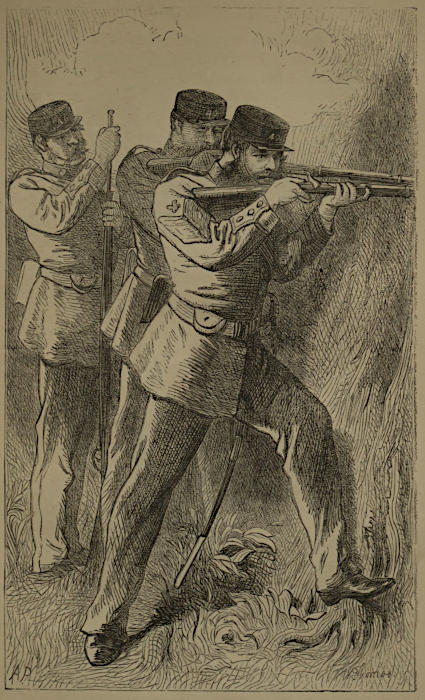
Sergeant-Major Lucas, 40th Regiment, defending a position
against the Maoris on the 18th March, 1861.
On the 2nd of November, 1862, all the troops in garrison at
Auckland were assembled on the racecourse to witness the decoration
of Sergeant-Major Lucas with the Cross of Valour. The
soldiers formed a square, in the centre of which stood General
Cameron and his staff. The sergeant-major took his stand in front
of them, and the gallant old general, after expressing his admiration
of his conduct, which he invited his comrades to imitate,
placed on his breast that distinctive mark of his Sovereign’s favour
which is dearer to the soldier’s heart than any other. Our readers
will feel with us the hope that Sergeant-Major Lucas may long be
spared to wear it, and to take part in other wars reflecting more
credit on our arms and our honour as a nation than the present
struggle in Zealand.
CHAPTER XXVI. THE HEROES OF THE VICTORIA CROSS IN NEW ZEALAND.
We have already described some of these heroes, and the
gallant deeds by which they earned the Cross of
Valour. We have shown how Sergeant Lucas, of the
40th, defended two of his wounded comrades from the attacks of
the Maoris till a party was sent to his relief; how McKenna of
the 65th stood by his dying officer to the last, and proved himself
worthy of the command that had devolved upon him, by conducting
his comrades through the fire of the enemy and the intricacies
of the bush to the redoubt which they had left; how Samuel
Mitchell, that true-hearted sailor, stood by Commander Hay, of the
Esk, in the Gate Pa at Tauranga, and refused to leave him till all
was over.
Since that time we learn from the London Gazette that the
Victoria Cross has been awarded to Lieutenant-Colonel McNeill,
of the 107th Regiment; to Assistant-Surgeons Temple and Manley,
and Lieutenant Picquard, of the Royal Artillery; and to Ensign
Down and Drummer Stagpoole, of the 57th Regiment, in recognition
of gallant deeds done in New Zealand. The bestowal of the
Cross on Assistant-Surgeon Temple, R.A., was a tardy act of justice;
it was awarded to him by the unanimous voice of the army for
humanely exposing his life to almost certain destruction in hurrying
to the assistance of Captain Mercer, R.A., who was mortally
wounded. This occurred during the attack on Rangiriri, the great
pa or stronghold of the Maoris on the banks of the Waikato river,
about sixty miles from Auckland. The Taranaki war began in
1860, and was carried on with various success till 1862, when
it was supposed to be over. There was no truce or peace concluded
with the enemy, but the settlers indulged the hope that
they might now live in peace. On the 4th of May, 1863, they were
roused from this state of false security by the report that two
officers and eight men had been fired upon by an ambuscade, and
all, with one exception, killed; this act was denounced as murder,
but we must remember that they were marching through the
enemy’s country with arms in their hands, and were thus almost
inviting their fate. General Cameron wished to take precautions
against such attacks, but the governor assured him that there was
no danger, as the war was over. Then came the abandonment of
the Waitura, the disputed territory, and, a month later, the battle
of Kuitikara, in which twenty-five Maoris were slain. After this
the province of Auckland became the seat of war. The governor
issued a proclamation denouncing all the natives as rebels who
should not surrender their arms and take the oath of allegiance
within a week: the result was such as might have been expected;
the Maoris cleared out with all their valuables, and fell back into
the interior. Their forces were concentrated at Pokewu, or the
Queen’s Redoubt, a place thirty-five miles south of Auckland, close
to the Waikato river. Our troops advanced against them, and a
battle was fought at Roheroa, a mountainous ridge, two miles south
of Pokewu, where the insurgents had encamped and fortified their
position with a series of rifle pits, from which they opened a heavy
fire on their assailants as they ascended the steep declivity. The
regiment opposed to them consisted of young recruits who had
never been under fire before; for a moment they hesitated, and all
might have been lost, if General Cameron had not rushed forward
in front, waving his riding-whip and cheering them on to victory.
He thus saved the character of a young battalion. The Maoris
dispersed, and found refuge in the neighbouring swamps, leaving
twenty-two killed on the field of battle. Their loss was not great,
considering that the force opposed to them was as three to one.
On the same day a Maori ambuscade attacked an escort under the
command of Captain King, of the 18th Royal Irish, in the neighbourhood
of the Queen’s Redoubt; our men, who were straggling
along the road, smoking and chatting, with their rifles uncapped,
resisted as much as they could, and escaped with the loss of four
men, twelve rifles, and the carts and horses left on the field. If
any of the Maoris fell, their bodies were removed; no traces of
them were to be found the following day.
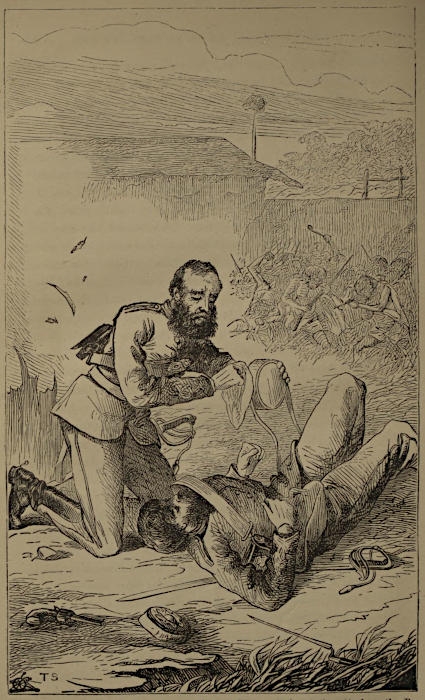
Assistant-Surgeon Temple, R.A., assisting Captain Mercer,
R.A., at the attack on the Pa of Rangiriri.
Redoubts were then erected for the protection of Auckland; the
bush was cut down for hundreds of yards on either side of the
Great South Road; a Commissariat Transport Corps of nearly
1000 men was raised; four regiments of Militia were recruited,
chiefly in Australia and the South; the strength of the Imperial
forces was raised to 10,000 men; including local corps, we had
about 25,000 men under arms to cope with the enemy, who have
never been able to bring more than 600 men into the field. If the
country had been open, the war would soon have been brought to
a close; but our men had to pass unfordable streams and to force
their way through the bush. The enemy fell back to a place called
Mere Mere, situated on a rising ground on the Waikato, about nine
miles from the Queen’s Redoubt. The enemy’s only artillery
consisted of two old ship’s guns loaded with tenpenny nails; but
the place was believed to be impregnable, and our men remained in
camp there for three months. It was the old story of Sir Richard
Strahan and the Earl of Chatham. General Cameron was longing
to be at them, but he had to wait for Sir George Grey, and Sir
George Grey was waiting for nobody knows what. The expense
of supporting such an army in the field is enormous; three millions
of money have already been expended. At length our troops
advanced to attack the Maori stronghold; the preparations were
as elaborate as Uncle Toby’s for the siege of Dunkirk, and something
brilliant would doubtless have occurred if the Maoris had
been a little less impatient. They evacuated Mere Mere, and fell
back to Rangiriri, where they had a strong pa on the summit of a
rising ground situated midway between the Waikato and an inland
lake. If we were too slow at Mere Mere, we were a little too fast
at Rangiriri; because the former was a place of no great strength
it was inferred that the latter was the same. A rush was made;
the outer works were carried; but the attacking party fell back on
finding themselves confronted by other works of still greater
strength. To retreat was to lose the prestige of our arms, and to
invite the neutral tribes to rebellion. The place must be taken at
all hazards; a second rush was attempted; the officers advanced in
front, and cheered on the men, but the men refused to stir. The
general then turned to the fifty artillery men who accompanied
him, and, armed with swords and revolvers, they rushed forward,
stopped to breathe for a moment in a gully, and reached the
parapet, which some of them mounted. They were led by Captain
Mercer, R.A., one of those brave, gallant, God-fearing men who
are an honour to the service and to humanity itself. He had a
presentiment that he would fall, but he was prepared to die; like
Havelock, he had been preparing for death for years, and it did
not take him by surprise. A Maori bullet struck him in the jaw,
carrying away the lower part of the face; he rolled backwards on
the ground mortally wounded. His party was repulsed. Was
there a man there brave enough to advance to his assistance? He
must hold his life cheap; he will have to pass through the double
fire of the enemy. But what sacrifice will our soldiers not make
for an officer they love? First one soldier advances, and then
another and another, but it was only to meet with speedy death. It
was at this moment that William Temple, an assistant-surgeon of the
Royal Artillery, learned that his friend Mercer stood in need of his
aid. Without balancing chances, or hesitating for a moment, he
went where duty called—it might be to death, it could not be to
dishonour. He reached the spot so fatal to the others; the most
sanguine could scarcely indulge the hope that he could escape.
For a moment he was enveloped in smoke; every eye was strained
till it cleared away. A sort of sigh of relief rose from many a
breast as he was seen by Mercer’s side, doing all that could be done
to alleviate his sufferings. From instinct more than from intention,
he stooped when exposed to the fire of the enemy, and thus
their bullets passed harmlessly over his head. General Cameron,
who had witnessed his devotion to duty, only expressed the desire
of the whole army in recommending him for the Cross of Honour,
which was awarded to him in the Gazette of the 23rd of September,
1864. Lieutenant Picquard, R.A., obtained the same honour
for carrying water to the wounded at the risk of his own life.
The Artillery having failed, the general sent for the blue-jackets,
told them his only hope was in their courage, and pointed to the
pa. “Go on, my lads,” said their leader, “I’ll not be far behind
you.” It would have been better, perhaps, if he had been a little
before them; as it was, they advanced to within fifty yards of the
pa, and then retired below the crest of the hill. One poor little
middy of fourteen was shot through the head while in advance of
the others. What could be done? The general was ready to
receive any suggestion. The officer commanding the Engineers
proposed mining, which was attempted; but the fuse was damp,
and refused to explode. The Engineers then advanced under
cover, and effected a breach in the wall. On perceiving that their
position was no longer tenable, the Maoris hoisted a white flag, and
surrendered at dawn. William Thompson, the great chief of the
rebellion, had escaped, with most of his followers: only 183 prisoners
fell into our hands. They could easily have escaped if they
had chosen, but they had waited on in the hope of being reinforced.
The loss of the Maoris was about forty-five killed, while ours
amounted to six officers killed or died of wounds, and nine
wounded; forty men killed, and eighty wounded. The attacking
force amounted to 1000 men; about one-seventh of them were
killed or wounded; the defenders of the pa could not have
amounted to more than four or five hundred men; forty-five were
killed on the spot; the wounded were carried off.
One or two steamers were placed on the Waikato river, and our
troops advanced to Ngaruawahia, the royal residence of Potatau II.,
whose palace of reeds may still be seen there. This town is situated
about twenty-six miles to the south of Rangiriri, at the confluence
of the Waipa and the Horatiu, whose united waters form
the Waikato river. The governor had promised to meet W.
Thompson, the Maori king-maker, here, and to settle the conditions
of peace; but for reasons unknown to us he failed to appear,
and our troops pushed on till they reached Piko Piko, a strong pa
on the summit of a hill overlooking the Waipa, about thirty miles
to the south of Ngaruawahia. We remained encamped opposite
this stronghold for three weeks without attempting an assault; our
experience at Rangiriri had taught us to be cautious. We had
3900 men under canvas; the defenders of the pa could not have
exceeded one-fourth of that number; but, notwithstanding this disproportion,
no attempt was made to dislodge the enemy. At the
end of three weeks we turned their position, and advanced to the
villages of Awamutu and Kilu Kilu, from which they derived their
supplies; on this they were obliged to evacuate their stronghold
and retreat into the interior. A skirmish took place at Rangiawahia,
a native village three miles from Awamutu, during which a venerable
Maori lady distinguished herself by coolly occupying a chair in her
verandah, and firing deliberately on our men, who retaliated by
burning down a native wharze, or hut, which contained some
warriors who refused to surrender, and were consumed in the
flames. We then constructed a line of redoubts, extending from
Maugautautari, a stronghold on the Horatiu, which W. Thompson
had evacuated, to Te Rori on the Waipa, for the purpose of
keeping the enemy in check. This was not so easily done as we
imagined. In March some three hundred natives advanced to
Ohapau, a village five miles from Awamutu, and began to construct
a pa in the midst of a grove of peach-trees. It was captured on
the 2nd of April, but Rewi, the ringleader, escaped.
On the 30th of March the incident occurred which procured for
Lieutenant-Colonel McNeill the honour of the Victoria Cross. He
holds the appointment of aide-de-camp to General Cameron, who
was then at Pukerimu, and had occasion to communicate with
Brigadier Carey, who was in command at Awamutu. The distance
from Pukerimu to Awamutu is eighteen miles; midway between
these two stations stands the redoubt of Ohapau, occupied by a
detachment of the 40th Regiment. Rough bridges have been
erected at the different creeks, but there is no regular road, merely
a native path leading through the bush. Near Ohapau is a clump
of trees admirably adapted for an ambuscade. Lieutenant-Colonel
McNeill had no other escort than a private of the Defence Force (a
colonial corps consisting of 250 troopers) of the name of Vosper,
who acted as his orderly. Nothing remarkable occurred during
the journey till they had occasion to pass the clump of trees near
Ohapau, when a party of insurgents opened fire upon them.
Private Vosper was thrown from his horse, and Lieutenant-Colonel
McNeill succeeded in catching him. Vosper then remounted, and
both rode off. The fire of the Maoris is said to have been very
close and very severe; under such circumstances the escape of the
horses and riders without being grazed by a single bullet is little
short of miraculous. It is unfortunate, perhaps, that there were
no other spectators of the scene than the immediate actors.
Private Vosper has to vouch for the gallantry of Lieutenant-Colonel
McNeill, and Lieutenant-Colonel McNeill for the danger
incurred by Private Vosper. When the affair was reported to
General Cameron, he recommended his aide-de-camp for the decoration
of the Cross of Valour; and he was duly invested with it
on the 6th of December, in the presence of all the troops that
could be assembled to witness this interesting ceremony.
Lieutenant-Colonel McNeill is a good and gallant soldier; he
proved himself to be so during the Indian campaign, when he
served on the staff of Sir Edward Lugard, and was honourably
mentioned in public despatches. It is right that these services
should be known to the public, as they have contributed to procure
for him the honour of the Victoria Cross, the wearer of which,
like Cæsar’s wife, should be beyond suspicion. We should be glad
to see some public recognition of the bravery displayed by a sergeant
of one of the colonial corps near the same spot, five days
before Lieutenant-Colonel McNeill and his orderly were attacked.
On the 25th of March this sergeant had left Pukerimu in company
with a civilian who had been visiting his brother there, and was
now on his way to Awamutu. Both were well mounted, and
nothing remarkable occurred till they were within four miles of the
camp, where the road passes near the first of the lakes lying between
Ohapau and Te Rori. The two horsemen were riding quietly along,
thoughtless of danger, when an ambuscade of some thirty or forty
Maoris opened fire upon them from the bush; the sergeant felt that
his horse was hit, and spurred him on with all his might, in the
hope that he might still be able to carry him beyond the reach of
danger. On the first impulse of the moment he had thought only
of his own safety; but he had only proceeded a short distance when
he became anxious for the fate of his companion. On turning
round, he saw his horse lying dead on the road: in another minute
the civilian would have been lifeless beside him. He was rushing
along with all his might, pursued by a Maori, who was rapidly
gaining upon him, and had already poised his spear to strike. The
sergeant wheeled his horse round, and with the rapidity of thought
rushed to the rescue. One shot from his revolver laid the Maori
prostrate; in another minute the civilian was mounted behind him,
and then away for their lives. The noble horse seemed to know
what results depended on his speed, for, though wounded and weak
from the loss of blood, he never halted till he reached the rising
ground that overlooks Awamutu, when he fell down dead. He had
carried them three miles with seven bullets in his body, till they
were beyond the reach of the Maori rifles. When the danger was
past he lay down and died. The incident created much sensation
at the moment. The sergeant’s coolness and courage excited the
admiration of the whole camp; but many months have passed away
without bringing with them any public recognition of his heroism.
This, doubtless, has arisen from oversight. We shall be much
gratified if our present remarks lead to further inquiries being made.
Civilians have obtained the Victoria Cross in India; there is no
reason why it should not be bestowed on those who are equally
worthy in New Zealand.
Our readers are already familiar with the attack on the Gate Pa
at Tauranga, on the 29th of April, when our soldiers and sailors,
after effecting an entrance into the Maori stronghold, were seized
with a sudden panic, and retreated in the greatest disorder. It
is rare indeed for our soldiers or sailors to desert their officers in
the hour of danger; but on this occasion terror was more powerful
than the sense of duty. It was not so with all, however; there
were one or two honourable exceptions. When Commander Hay
fell mortally wounded inside the pa, one gallant sailor stood by
him, and refused to leave him, though frequently urged to do so.
It was right that such an act of distinguished devotion to duty
should be recognised as an encouragement to others to imitate his
example, and Samuel Mitchell now carries on his breast the Cross of
Valour as a memorial of the humanity and courage he displayed at
the Gate Pa. On the same occasion, Assistant-Surgeon Manley, of the
Royal Artillery, distinguished himself by exposing his life to great
danger in entering the pa with the generous intention of offering
assistance to Commander Hay. That unfortunate officer was beyond
the reach of human aid, but this detracts nothing from the praise
due to Assistant-Surgeon Manley, who remained with him to the
last, and did all that human skill could suggest to alleviate his sufferings.
Nor was this all; on learning, after his return to the camp,
that there were other wounded officers in the pa who might require
his aid, he offered to proceed to their assistance. To have done so
would have been to expose his life to certain destruction, as the
insurgents had now resumed possession of their stronghold; the
service cannot afford to lose such men as Assistant-Surgeon Manley.
While this generous offer was refused, it was felt that he had already
made good his title to the distinction of the Victoria Cross, which
has now been conferred upon him. Assistant-Surgeons Temple
and Manley belong to the same branch of the service, and it is
honourable to the medical profession that two of its members
should have attained to the same distinction in the course of one
year.
While the province of Auckland has been the principal seat of the
present campaign, a sort of desultory warfare has been carried on
at the same time in the district of Taranaki, where the 57th Regiment
is stationed. This district, which has been often described as
the garden of New Zealand, extends along the western coast of the
North Island; its capital, New Plymouth, is situated at the base of
Mount Egmont, a solitary, snow-capped mountain, about 10,000
feet high, rising out of a densely-wooded plain. There is no harbour,
and the loud roar of the waves breaking on the inhospitable
shore is constantly to be heard. An English settlement was formed
there in 1841, but at this time there were only ninety natives,
living for security in the cliffs around Mount Egmont, or in holes
among the sugar-loaf rocks; the rest had fled to Cook’s Straits or
been carried off into captivity. The whole district was a waste,
and Governor Hobson bought for 400l. the right which Te Whero
Whero, a native chief, had acquired over it in virtue of conquest;
after it had passed into our hands the fugitives began to return, and
nothing could equal their surprise on finding their lands parcelled
out among strangers. Twisting their long arms round the gigantic
trees, which had long been tapu or sacred, they besought the woodmen
to spare them; their spirit was broken by conquest; as yet
they offered no open resistance. It was only when our arms had
suffered reverses in other parts of the island that the natives of
Taranaki began to show a more independent spirit, and to reclaim
the lands which had now passed from their hands. The matter
was referred to Governor Fitzroy, who decided that the settlers
were only entitled to 3500 of the 60,000 acres to which they laid
claim; the natives resumed possession of the rest. This decision
increased the bitterness of feeling which had already sprung up
between the two races, and has been the cause of all the subsequent
disturbances at Taranaki. The settlers are anxious to purchase, but
the natives refuse to part with their lands. “Money,” they say,
“soon melts away, but the land remains.” In order to preserve
and sustain this conservative feeling, they formed themselves into
the Anti-Land-Selling League, the nature of which may be learned
from its title, and absolutely refused to part with a single acre.
The war of 1860-2 and 1863-4, which is not yet over, originated
from an attempt on the part of the Colonial Government to suppress
this league by purchasing lands from any of the natives who
were disposed to part with them. If these purchases had been
confined to the actual possessors of the soil no objection could have
been made to them, every man having a right to do what he likes
with his own, but no man has a right to sell what belongs to his
neighbours. This was actually done at Taranaki, and unfortunately
the Government, in order to assert a principle, took possession
by force of the land thus purchased. This brought the two
races into immediate collision, and the war has been lingering on
for years. It would be foreign to our purpose to describe its
leading events; it is sufficient to remark that it has been carried
on with various success, and that the 57th Regiment, under the
command of Colonel Warre, C.B., has taken an active part in the
Taranaki campaign. An engagement took place at Poutoko on the
2nd of October, 1863, during which Ensign Down and Drummer
Stagpoole, of the 57th Regiment, distinguished themselves by carrying
off two wounded men who would otherwise have fallen into
the hands of the enemy. Stagpoole had already attracted the
notice of his commanding officer by volunteering to rescue a
wounded soldier on a previous occasion, and the announcement in
the London Gazette that he and Ensign Down have had the Cross of
Valour awarded to them has given general satisfaction in New
Zealand. Courage is not the exclusive property of any one class;
it is to be found among all ranks in our army and navy; it is
right, therefore, that that Cross, which is intended expressly to be
the reward of courage, should be bestowed impartially upon every
one who has made good his claim, whether he bear her Majesty’s
commission or be merely a drummer-boy. Chivalry admitted none
to its ranks save those who were of noble birth, but many of the
most chivalrous deeds of modern times have been done by men
who have no claim to illustrious descent, and owe everything to
themselves. The Cross of Valour is a standing recognition of this
fact; it is far more precious than garters and ribbons, or the other
gewgaws of rank; it is the special reward of the brave, and none
but the brave deserve to wear it.
Peace will never be established on a solid basis in New Zealand
till the settlers and aborigines have learned to treat one another
with more respect. At present they regard one another with
mingled feelings of hatred and contempt. The Englishman thinks
that he has a right to despise brown-skinned men who were once
cannibals, who know nothing about title-deeds, live in dog-kennels,
feed on fern-roots and putrid fish, and render their faces hideous
by tattooing. He hates them as the only obstacle between himself
and those valuable lands with which they refuse to part; he is
tempted to believe that the only way to pacify New Zealand is not
to leave a single Maori alive. “The black fellows,” or “niggers,”
as they are contemptuously called, conscious of the existence of
these feelings, are ready enough to retaliate. They have the
firmest belief in their own superior courage. “You white people,”
said a native chief, “are very good for building houses and ships,
for buying and selling, for making cattle fat, and for growing beans
and cabbages; you are like the rats, always at work; but as to
fighting, you are like them also, you only know how to run.”
During this war they have had occasion to revise their opinion
regarding our courage; they have also taught us to respect
their heroic powers of endurance, and to believe that many virtues
may be found beneath a brown skin. If the experience of the past
prevents us from looking forward with too much confidence to the
future destiny of this noble race, who have decreased to one-half of
their number since they welcomed the Anglo-Saxon race to their
shores, we have at least a right to expect that they shall be treated
with justice, and nothing be done to hasten on that fate which
seems already to be impending over them. England will thus be
saved the remorse of wilfully neglecting to take any measures to
avoid those calamities to which the contact of civilized with semi-barbarous
races has hitherto given rise, and the Maori may yet
become a sharer in those blessings which civilization and Christianity
can alone bestow.
CHAPTER XXVII. THE NAVAL BRIGADE IN INDIA.
While a few of our sailors have forced their way into
Mr. Desanges’ Gallery, and made good their title to the
Cross of Valour, it must be evident to the most
casual spectator that the “blue jackets” have not been so fortunate
as the “red coats” in securing this reward of gallantry. It
would be unfair, however, to infer from this fact that our sailors
are inferior to our soldiers in courage; both belong to the same
race, and are animated by the same warlike spirit: but of late
years sailors have not had the same opportunity of displaying their
valour as in the days of Nelson, Jervis, and Duncan. Since the
conclusion of the great French war in 1815, we have not been
brought into collision with any of the great maritime powers.
The battle of Navarino, where the united fleets of three European
nations combined to destroy the naval power of Turkey, and to
release Greece from the chains of slavery, redounded but little to
our credit; and Russia, during the late war, afforded us few opportunities
of gaining laurels by sea. It is true, that during the
Crimean war some of our sailors earned themselves a name to live
in the annals of fame; but it was not on that element peculiarly
their own that they acquired this honourable distinction. It was
not at sea, but on land, fighting side by side with our soldiers,
that they proved themselves the worthy successors of the men who
conquered at Trafalgar and swept our enemies from the ocean. If
only a few obtained the Victoria Cross, the reason was that comparatively
few were permitted to take any active part in the Russian
war, and that no man can prove himself to be a hero unless he
has the chance of doing so.
Sailors have a natural taste for fighting, and they felt it very
hard during the siege of Sebastopol that the soldiers should have
the largest share. When any of them, by good conduct, became
entitled to a holiday, it was not an unusual request to be allowed to
spend it ashore, “to have a day’s shooting with them ’ere red
coats.” They regarded such an event with as much interest as the
keenest sportsman does when he talks of the 1st of September and
looks forward to its arrival, and their ambition was equally great to
make a good bag. It was the same during the suppression of the
Indian Mutiny: the sailors who composed the Naval Brigade, led
by the gallant young Peel, marched up the country with as much
alacrity as if they had landed merely to enjoy themselves.
When, about the middle of May, 1857, intelligence reached
Calcutta of the disasters at Meerut and Delhi, Lord Canning, the
Governor-General, telegraphed immediately for aid to Bombay,
Ceylon, and Madras. He knew that Lord Elgin and General
Ashburnham were on their way to China, and urged in the most
pressing manner that some of the troops under their command
should be sent at once to Calcutta, to assist in suppressing the
mutiny. It was fortunate for our future interests in India that
Lord Elgin was generous enough to take upon himself the responsibility
of diverting to the shores of the Ganges part of those troops
which were intended to aid in the attack on Canton. About the
middle of July, while he was waiting at Hong-Kong for the arrival
of reinforcements, he received a despatch from Lord Canning,
announcing that the revolt was spreading on every side and asking
for farther aid. Lord Elgin at once started for Calcutta, taking
with him a force of fifteen hundred seamen and marines, most of
whom belonged to the two war steamers, the Pearl and the
Shannon. These active, hardy men were organized into “Naval
Brigades,” and rendered the most important services under the
command of their gallant chief, Captain Peel.
This distinguished officer was a younger son of the late Sir
Robert Peel, and his brief but glorious career shed additional
lustre on the name he bore. He loved his profession for its own
sake: he delighted in the excitement of war; he was never more
in his element than when he had planted one of those immense
guns he knew how to handle so skilfully against the walls of
Sebastopol and Lucknow, where he would continue to work it
amid a shower of shot and shell. Genius is only talent directed
into one particular channel, and the talent he inherited from his
father was devoted to the noble profession he had adopted. He
had already distinguished himself in the Crimea, and had accompanied
Lord Elgin to China in command of Her Majesty’s ship
Shannon, when our sailors and marines were organized into naval
brigades. He was placed at the head of the one which was
intended to aid in the relief of Lucknow, and nobly did he
discharge the duties which then devolved upon him. His was that
daring but thoughtful courage that wins the confidence as well as
the admiration of all who witness it; the earnest force of character
that surmounts every difficulty and triumphs over every obstacle;
the gentle, kindly bearing, the courteous manner, which tells more
upon our soldiers and sailors than words of stern command; the
influence which a noble nature exercises on all around. It would
be difficult to overestimate the value of his services during the
seven months he commanded the Naval Brigade in the north-west
provinces. We cannot trace his whole career; it is sufficient for
the present to remark, that he died at Cawnpore, on the 27th of
April, 1858, of smallpox. He had been wounded in the thigh
during the last attack upon Lucknow, and was on his way to
Calcutta when he was attacked at Cawnpore by the dangerous
malady to which he succumbed. The recent annals of the British
Navy can show no name which has better claims to be remembered
than that of William Peel, of whom it may be truly said that he
died too soon for his country but not for his own fame.
Lord Elgin arrived at Calcutta early in the month of August,
1857, bringing with him two war steamers, the Shannon and the
Pearl, which were placed at the disposal of the Indian Government.
Peel, who had so gallantly managed a naval battery in the Crimea
during the siege of Sebastopol, was commissioned to organize a
naval brigade, and entered on the task with his usual energy.
Aided by the resources of the two war steamers, he succeeded in
forming a splendid naval brigade, the most effective, perhaps, we
have ever possessed, consisting of four hundred able British seamen,
and ten of those enormous 68-pounder guns which such seamen can
handle so skilfully. They started from Calcutta, up the Hooghly
and the Ganges; their progress was necessarily slow; the half of
August and the whole of September passed wearily away on this
most tedious voyage. The ardent spirit of the seamen would have
chafed and fretted beneath this compulsory delay, if they had been
under the command of a leader less esteemed and admired; as it
was, his presence and example told upon all. Week after week
elapsed; the gallant band made but slow progress against the
stream; their ponderous guns rendered it still slower. On the
30th of September, Peel reached Benares with 286 of his brigade.
Without waiting for the arrival of the rest, he hurried on to Allahabad,
which he reached on the 3rd of October, with 94 men; he
remained there four days when he was joined by the others, with
their enormous guns and stores of ammunition. These guns—the
chief cause of delay—were now found to be useless, as no means of
transport could be found for conveying them across the country,
and they were abandoned at Allahabad with regret. They had still
their 24-pounders to trust to, one of which was proudly named the
Shannon, after the war steamer to which she belonged. Urged by
the authorities at Patna to afford them some relief, Peel formed a
small naval brigade, which was placed under the command of
Captain Sotheby, to be employed against the insurgents in the
neighbourhood.
The wearisome voyage up the Ganges was now concluded, and
on the 4th of October, soon after his arrival at Allahabad, Peel
received the following telegram from Sir Colin Campbell, then at
Calcutta:—“In the course of about a week there will be a continuous
stream of troops, at the rate of about ninety a day, passing
on to Allahabad, which, I trust, will not cease for the next three
months.” Peel was now in his element, and the Naval Brigade
under his command found abundant employment in facilitating the
passage of troops and artillery from Allahabad to Cawnpore.
Their strength was increased by the arrival of 126 naval officers
and seamen under the command of Lieutenant Vaughan, who
joined them on the 20th of October. This reinforcement was
composed of sailors of the merchant service at Calcutta, who
volunteered to join the brigade, and rejoiced in the opportunity of
serving under such a distinguished commander. On the 23rd, four
siege-train 24-pounders were on the way to Cawnpore, under the
charge of 100 men of the Naval Brigade; on the 27th, other four
24-pounders and two 8-inch howitzers were despatched with an
escort of 170 seamen; and on the same day a large amount of
ammunition was forwarded. Peel infused something of his own
energy into every seaman under his command, and personally
superintended every arrangement; so that on the 28th of October
he was ready to start for Cawnpore, and was joined on the way by
Colonel Powell, with the head-quarters of Her Majesty’s 53rd
Regiment. On the 31st they reached Shured, where they received
the alarming intelligence that the Dinapore mutineers had crossed
the Jumna with three guns, and were preparing either to attack
Futtehpore or to force their way into Oude. The soldiers and
sailors under the command of Powell and Peel did not exceed 700
men, while the number of the enemy did not fall short of 4000;
our men, moreover, were encumbered with the charge of a large
and valuable convoy of siege and other stores, the loss of which at
such a juncture would have been irreparable; still it was of the
last importance that something should be done to arrest the progress
of the rebels, and the two leaders, Powell and Peel, resolved to
offer them battle.
As a general rule, it is injudicious to allow sailors and soldiers
to be mixed together during an attack, and frequent disasters have
resulted from overlooking this fact; but on this occasion, from our
inferiority in numbers, we had no choice. On the evening of the
31st our men reached the camping ground at Futtehpore, where
they were joined by a small detachment of the 93rd, or Sutherland
Highlanders, who were also on the way to Lucknow. The following
morning a column, consisting of 500 soldiers and sailors,
marched to Kudjna, a distance of twenty-four miles, to attack the
enemy. The latter had taken up a strong position, with their right
occupying a high embankment screened by a grove, and their left
extending on the other side of the road, which was commanded by
their artillery. Our column was divided into three parts: one
advanced to attack the enemy’s guns, while the other two supported
it on either side. Our soldiers and sailors rushed forward with
their usual impetuosity; but the rebels, having every advantage of
position, maintained their ground for two hours, and kept up so
severe a fire of musketry that many of our men, including Colonel
Powell, who received a musket-ball in the forehead, were killed.
At this moment, Captain Peel, on whom the command devolved,
displayed such coolness and presence of mind as proved that,
though a sailor, he was fitted for the highest military command.
Perceiving that the enemy could not be dislodged without incurring
the loss of many lives, none of which could well be spared, he
changed the mode of attack by marching his men round the upper
end of the embankment, and their forces being thus divided, they
were driven from all their positions, leaving their camp equipage
and two of their tumbrils in our possession. If there had been a small
body of cavalry to follow up this success, the whole body of the
enemy might have been dispersed or destroyed; but no pursuit
could be organized, as our men had marched seventy-two miles in
three days, and exhausted nature could do no more. The column,
after collecting the dead and wounded, returned to Binkee, and
after a little rest resumed their march to Cawnpore. The enemy
are supposed to have lost about one-fifth of their number, and
abandoned the idea of marching into Oude: that terrible column
of blue jackets and red coats had shown them what they might
expect when they dared to cross bayonets with the redoubtable
Feringees.
We need not trace the advance of the Naval Brigade, which was
now reduced to 250 men, from Cawnpore to Lucknow: it is sufficient
to remark, that they and their gallant leader reached the
Alum Bagh early in November, and placed themselves under the
command of Sir Colin Campbell. Our readers will bear in mind
that Lawrence maintained his position in the Residency until his
death, early in July; and that the command then devolved upon
Inglis, who continued the defence until September, when he was
relieved by Outram and Havelock. It was known that the small
garrison was hemmed in on every side by the rebels, and every
effort was made to relieve them; it was with this object in view that
Sir Colin Campbell had concentrated his forces around the city of
Lucknow on the 14th of November. The name of this gallant veteran
will ever be dear to the people of England. The son of a Glasgow
tradesman, he obtained his commission while still a boy through
the influence of an uncle, and had served forty-nine years as an
officer of the British army. Being unable to purchase, he could
not look for rapid promotion, but, like Havelock, he had learned to
labour and to wait. He had shed his blood freely in the service of
his country; his gallantry had been acknowledged in public despatches;
but many years elapsed before he obtained his company.
In the course of nearly half a century he had fought in almost
every quarter of the globe; he served in the Walcheren expedition;
then in the Peninsular war, including the battles and sieges of
Vimiera, Corunna, Barossa, Vittoria, San Sebastian, and Bidassoa;
then in North America; then in the West Indies; then in the first
Chinese war; then in the second Sikh war; and lastly, in the
Crimea. When the news of General Anson’s death reached
England on the 11th of July, Sir Colin was offered the post of
Commander-in-Chief in India, which he at once accepted. When
the question was put to him, “When will you be ready to start?”
his reply was “To-morrow.” He kept his word: the next day he
was on his way to India, taking very little with him but the clothes
on his back. Sir Charles Napier was wont to say, that two towels
and a piece of soap was ample luggage for an officer serving in
India: Sir Colin Campbell seems to have held the same opinion.
He travelled by the quickest route: by rail to Folkestone, steam to
Boulogne, rail to Marseilles, steam to Alexandria, rail and other
means to Suez, steam from Suez to Calcutta. How his ardent
spirit must have chafed during the many weeks he was detained at
Calcutta! But that time was not lost. He attended to the minutest
details; he remodelled the whole system of military machinery in
India; he arranged with the Governor-General the plan of the
ensuing campaign. He admired with all the unselfish admiration
of a true soldier the heroic resistance of the garrison at Lucknow;
the struggles of Havelock’s little army; the combined efforts of
Havelock and Outram. At length, on the 28th of October, he
left Calcutta, travelling like a common courier, and caring nothing
for the pomp and glitter of military rank. After several narrow
escapes by the way, he crossed the Ganges on the 9th of November,
and commenced his attack on Lucknow on the 14th, with a miscellaneous
force of 4000 men.
The gallant old chief had one guiding principle throughout the
whole Indian campaign—never to sacrifice the life of a British soldier
unnecessarily. He was resolved that Lucknow should be taken,
but with the least possible expenditure of human blood. Knowing
that Havelock and Outram had suffered severely in cutting their
way through the town two months before, he formed a plan of
approach through the south-western suburb, and trusted to his
artillery and the Naval Brigade to batter down the enemy’s defences
step by step and day after day, so as to open up a passage for his
infantry with comparatively little loss. To this plan he steadily
adhered, and for several days there was a series of partial sieges,
each directed against one of the enemy’s strongholds. Our army
pushed its way slowly, but success was certain in the end. On the
first day he drove the enemy, after a running fight of two hours,
from the Dil Roosha Park, and then from the Martinière College,
an institution for the education of half-caste children, founded by
Claude Martin, who came out to India as a private soldier, and
rose to the rank of major-general. During these operations the
heavy guns of the Naval Brigade served to keep the enemy in
check, and rendered important assistance. After completing his
preparations on the 15th, and exchanging signals with Havelock and
Outram, Sir Colin crossed the canal on the morning of the 16th,
and advanced to the Secunder Bagh, a high-walled enclosure about
a hundred and twenty yards square, loopholed on every side, and
strongly garrisoned by the enemy, who fought with the greatest
obstinacy. In vain the guns of the Naval Brigade thundered
against the walls; the noise grew deafening; the ardour of our
troops could no longer be restrained; two companies of Highlanders,
with fixed bayonets, reached a plateau, and rushed forward
till they were stopped by a dead wall. “In at the roof, Highlanders!”
shouted the old chief, whose blood was now up; “in
through the roof; tear off the tiles. Go on!”
They needed no second order; in a moment the plumed bonnets
and tartan kilts vanished through the tiles and broken bamboos,
and the enemy, driven from their position, retired with the loss of
two guns.
At length the breach in the main building was declared practicable;
the hole was barely large enough for a single man to pass,
but all were impatient of further delay. The gallant old chief
thought of Badajoz, where he was the first to storm the breach, and
would willingly now have been the first to pass through the fiery
opening if duty had permitted; as it was, he uncovered his grey
hairs, and waved the Sikhs and Highlanders to the assault. Then
followed a gallant race between the mountaineers of India and of
Scotland: a Sikh is the first to enter and—to die. He is followed
by a Highlander; a bullet passes through his body, the plumed
bonnet rolls from his head, and he sinks lifeless to the ground.
Another and another press forward and meet the same fate, but
their comrades step across their bodies and make good their
entrance. The gate was violently forced, and the whole body of
Sikhs and Highlanders poured into the Secunder Bagh, and then
came the hour of retribution. “Remember Cawnpore, boys! No
quarter! Think of our women and children! Mercy? no mercy
for you!” Such were the cries that rose from our men as the
bayonet did its deadly work. No quarter was given, and many of
the enemy threw themselves into the flames which were now
spreading through the building. The massacre of Cawnpore was
avenged at the Secunder Bagh; two thousand of the enemy met
their death within its walls.
The Naval Brigade, under the command of the gallant Peel, was
then ordered to the front, and advanced toward the Shah Nujeef—a
domed mosque with a garden, which had been strongly fortified
by the enemy, with the intention of arresting the progress of our
army. The walls of the garden had been loopholed on every side;
the entrance was built up, and the summit of the building crowned
with a parapet. On the left was a village held by the rebels;
Brigadier Hope and Colonel Gordon drove them from this position
before the Naval Brigade opened fire on the Shah Nujeef. Peel
was aided by a field battery and some mortars, but the enemy
defended the post with the greatest obstinacy, and kept up an
incessant fire of musketry from the mosque and the loopholed
walls of the garden. It was on this occasion that three members
of the Naval Brigade displayed such conspicuous bravery as attracted
the notice of the Commander-in-Chief, and secured for them
the distinction of the Cross of Valour. The Shannon 24-pounder,
which bore the name of the war steamer from which it had been
taken, was entrusted to the charge of Lieutenant Young and
William Hall, A.B., who proved themselves worthy of the confidence
reposed in them. Though exposed to a heavy fire of
musketry and assailed by hand-grenades thrown from the walls,
they led up their heavy gun to within a few yards of the building,
and opened fire on it with as much coolness as if they had been
alongside an enemy’s frigate and fighting on their own element.
It was, to borrow the words of Sir Colin Campbell, “an action
almost unexampled in war,” and excited the admiration of all who
witnessed it. For three hours a heavy cannonade was kept up
against the walls of the mosque, and our sailors would have suffered
more at the hands of the enemy if they had not been covered by
the withering fire of the Highlanders in the rear. Sailors always
like to mingle a little fun with fighting, and Lieutenant Nowell
Salmon, of the Naval Brigade, who was known as an unerring
marksman, had recourse to an ingenious expedient to arrest, or
at least to weaken, the enemy’s fire. Close by the walls of the
mosque stood a lofty tree, whose spreading branches overlooked
the building, and offered a tempting cover to any one who was
venturous enough to climb it. Lieutenant Salmon perceived at a
glance all the advantages of such a position, where he could see
without being seen and shoot without being shot. Having obtained
the necessary leave, he mounted the tree in true sailor
fashion, and, sheltered amid its leafy recesses, took deliberate
aim and picked off the enemy’s sharpshooters when they ventured
to show themselves in the mosque or the garden. He was ably
seconded by a private of the 93rd Highlanders, who, standing
below, received the discharged rifles, loaded them, and handed
them up again. We can conceive the surprise and consternation
of the rebels as they saw their ranks thinned and their comrades
shot down by an irresistible foe, and the enjoyment of the reckless
sailor as he witnessed the effect of his unerring fire. At length
Sir Colin, impatient of delay, gave orders to storm the place, which
was done in the most intrepid manner by the soldiers and sailors,
who forced their way through the garden and drove the rebels
from the mosque. The gallantry of the Naval Brigade at the capture
of the Shah Nujeef was acknowledged in a public despatch;
Lieut. Young, William Hall, A.B., and Lieut. Salmon, who was
badly wounded, were decorated with the Victoria Cross; and
Captain Peel became Sir William Peel.
It would be foreign to our purpose to follow the army of rescue
in all their operations till they effected their entrance into the
Residency, or to describe the emotions of Campbell, Outram, and
Havelock, as they grasped one another’s hands and felt that their
work was done. All the three have now passed away; but they
did noble service to their country, and their names will not be
speedily forgotten. The early struggles, the patient discharge of
duty in a subordinate position, the perseverance and the final
success of Campbell and Havelock, ought to be a lesson and
encouragement to the young men of England who have to tread
the same path and aspire to reach the same goal.
Wherever the Naval Brigade served during the Indian campaign,
they displayed the same coolness and courage as at the capture of
the Shah Nujeef. It was part of Sir Colin’s tactics to employ
artillery as much as possible so as to save his infantry, and whenever
walls were to be battered down he had only to summon Peel
and his now famous brigade to the front. Their gallant achievements
in Oude must ever occupy a prominent place in Indian
history, and the name of Peel received additional lustre from the
brave young sailor who perished in his prime. In the scarcity of
regular troops, they occupied a middle position, and did the work
of soldiers and sailors with equal readiness: well-drilled and accustomed
to active movements, they were ready to march at a
moment’s notice, and moved their heavy guns with a rapidity and
ease hitherto unknown in field operations. They were favourites
wherever they came; their unfailing good-humour and almost
boyish exuberance of spirits were contagious, and spread to all
who served by their side. When the campaign was over and the
mutiny suppressed their services were not forgotten; the residents
of Calcutta did honour to themselves by honouring them with a
public reception and a grand banquet. We can conceive the
hearty enjoyment of the blue jackets as they partook of the
delicacies which had been prepared for them, and listened to
the kind, graceful words in which Outram, their fellow-guest,
told of their services as witnessed by himself at Lucknow during
the previous winter. “Almost the first white faces I saw, when
the lamented Havelock and I rushed out of our prison to
greet Sir Colin at the head of our deliverers, were the hearty,
jolly, smiling faces of some of you Shannon men, who were
pounding away with two big guns at the palace; and I then,
for the first time in my life, had the opportunity of seeing and
admiring the coolness of British sailors under fire. There you
were, working in the open plains, without cover or screen, or
rampart of any kind, your guns within musket range of the enemy,
as coolly as if you were practising at the Woolwich target. And
that it was a hot fire that you were exposed to, was proved by
three of the small staff that accompanied us (Napier, young
Havelock, and Sitwell) being knocked over by musket balls in
passing to the rear of those guns, consequently further from the
enemy than yourselves.”
Such words, spoken by the Bayard of India, must have been
grateful to the Naval Brigade after all their toils and privations.
When the banquet was over, they were dispersed among the different
vessels to which they belonged. Peel and his Naval Brigade have
ceased to exist, but if England should require their services other
Peels and other brigades will spring up to prove that our sailors
have not degenerated—that they belong to the same race and
inherit the same qualities as those who in former times secured
for Britannia the empire of the waves, and the enjoyment of that
freedom which we still prize as our noblest birthright.
CHAPTER XXVIII. THE VARIOUS RANKS IN THE BRITISH ARMY, AND HOW TO DISTINGUISH THEM. — ARMY DRESS. — DRESS AND RANK. — RANKS. — COMMISSARIAT DEPARTMENT. — WAR DEPARTMENT. — RELATIVE RANKS OF ARMY AND NAVY OFFICERS. — LIFE GUARDS AND HORSE GUARDS. — Non-Commissioned Officers. — IN THE CAVALRY. — The Royal Artillery. — The Royal Engineers. — The Military Train. — Infantry.
The civilian is often wofully puzzled when trying to make
out the rank of a military man in uniform. He sees
a venerable, soldier-like man, in scarlet or blue, marching
beside a body of men. This personage is crowned with a cocked
hat with white plumes, with all the pomp of sword, &c., and
is immediately selected as “the General.” Impressed with the
appearance of the hero, his importance and rank, the speaker
inquires who the general officer is, and in reply will be informed
“that is the quartermaster, who has just been promoted from the
rank of serjeant-major.” Again, a ferocious-looking man, who,
with long beard and moustache, walks (not marches) in rear of the
regiment, with cocked hat and trailing sword, is neither a fire-eating
general nor dashing colonel, but our kind medical friend, who
looks at our tongue and feels our pulse. A quiet-looking man, in
a dark frock coat, who is the least conspicuous of a group of
officers, is General Sir Blank Blanco, K.C.B., the hero of so many
battles.
The two principal points by which rank is indicated are the
collars and sleeves of the various coattees and jackets. A crown
and star, used either singly or in combination, denote three different
degrees of rank. Commencing at the highest rank, viz., Field-Marshal,
we will now describe the principal peculiarities of dress,
so that the reader may be able to form a generally correct opinion
of the rank and occupation of each member of the military
service.
A Field-Marshal’s dress consists of a single-breasted scarlet
tunic, the collar laced round with inch lace. At each end of the
collar are two batons, crossed, and formed of crimson velvet and
gold, worked on a wreath of laurel embroidered in silver. The
cuff, which is three inches and a quarter deep, has two rows of
inch lace round the top, and there is a scarlet pointed slashed
flap on the sleeve, laced with inch lace. On the left shoulder is a
double gold cord, with a small button to retain the sash.
The buttons are gilt, and have on them two batons, crossed, and
encircled with laurels.
Cocked hat, with a plume of long white swan feathers, drooping
downwards and outwards, with scarlet feathers underneath.
The trousers are dark blue, with oak-pattern gold lace two and
a half inches wide down the sides.
The sword is scimitar shape, and contained in a brass scabbard.
The hilt is gilt, with an ivory grip, two batons crossed, and
encircled with oak leaves on the handle. The sword belt is of
Russian leather, one and a half inches wide, embroidered with
three rows of gold embroidery. A sash of gold and crimson silk
net is worn over the left shoulder, the ends of fringe hanging
downwards.
The above is the full dress. The undress consists of double-breasted
frock coat of dark blue. The collar and cuffs of blue
velvet with cross batons on the collar, a double gold cord on the
left shoulder to retain the sash. The trousers are dark blue, with a
broad red stripe down the side. A forage cap with gold embroidered
peak, and band of gold oak leaf lace two inches wide round
the cap.
The full dress of a General is the same as that of a Field-Marshal,
except that on the collar there is, in place of the cross
batons, a silver embroidered crown and star an inch and a quarter
long. The buttons are gilt, but instead of cross batons they have
on them a sword and baton crossed. The handle of the sword also
has on it a sword and baton crossed.
The undress of a General is blue frock coat, with sword and
baton on collar; in other respects like a Field-Marshal’s.
The dress of a Lieutenant-General, a Major-General, and a
Brigadier-General is the same as a General’s, with the exceptions
that a Lieutenant-General has on his collar a crown only,
instead of a crown and star. A Major-General has on his
collar a star only, whilst a Brigadier-General has the collar plain,
without star or crown.
We now come to the three principal divisions of the remainder of
the regular officers, viz., Field Officers, Captains, and Subalterns.
Field Officers are all those above the rank of Captain and below
the rank of General; they consist therefore of Colonels, Lieutenant-Colonels,
and Majors. The distinguishing
mark of a Field Officer is the
lace or embroidery on his sleeves,
which comes to a point up the arms;
the annexed illustrations show the
sleeve of a Field Officer of the Artillery.
In all line regiments and in several others, the
Full Colonel may be known by his wearing the
dress of his regiment, and having on
his collar a crown and star. A Lieutenant-Colonel
has a crown only, whilst a Major has a
star on his collar.
The sleeves of Line Officers are not embroidered, but the collar
trimmings also indicate their rank, the Field Officers having lace
round the top and bottom of the collar, down the edge of the skirts
behind, on the edge of the skirt flaps and edge of the sleeve flaps,
and two rows of lace round the top of the cuffs.
Officers below the rank of Field Officer have lace on the top only
of the collar, one row round the top of the cuff and none on the
edge of the skirts. Then on the collar a Captain has a star and
crown, a Lieutenant a crown, and an Ensign a star.
When the frock coat is worn, the collar will indicate the rank of
the Field Officer. The crown and star being the mark of the
Colonel, a crown for Lieutenant-Colonel, and the star for the Major.
The same marks are used for the various ranks when the shell jacket
is used; but in both these cases there is in the Line no difference
between the dress of a Captain and
a Lieutenant or Ensign, but in
the Royal Artillery and Engineers
the cuff lace will indicate
to which rank the wearer belongs.
a, Field Officer’s patrol jacket; b,
Captain’s sleeve for full dress; c,
Lieutenant’s sleeve.
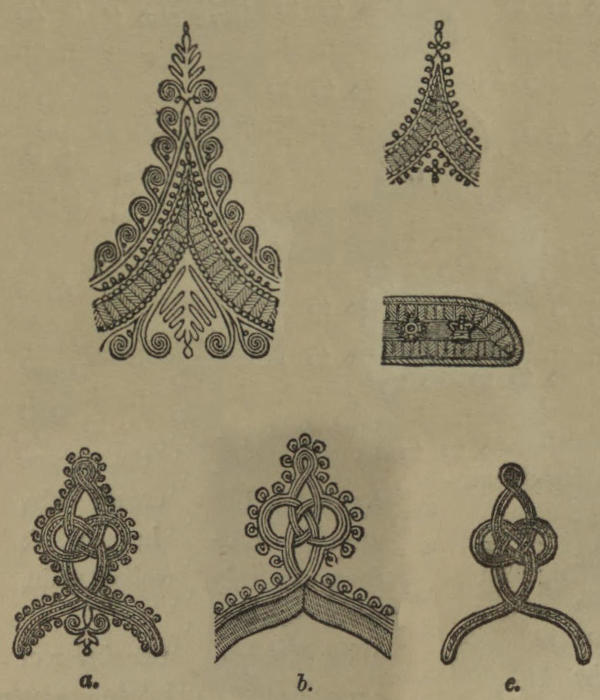
a. b. c.
The distinguishing marks on the collar and sleeves
of the majority of the army serve to indicate the
rank of the various officers, but we have also to
deal with other details.
Commencing with the Medical Department, we
shall be able to distinguish the Surgeon and Assistant-Surgeon
principally by the belt, which is of black leather.
They also wear the black shoulder-belt and instrument case; in
other respects their uniform is the same as is that of the other
officers of the regiment to which they belong, with the exception
of wearing a cocked hat with a black cock’s-tail feather, drooping,
and five inches in length.
When medical officers belong to what is called the “Staff,” and
not to any particular regiment, their full-dress is a scarlet tunic
with black velvet collar and cuffs, blue cloth trousers with gold
lace, two and a half inches wide for a Director-General or Inspector-General,
and one inch and three quarters for officers below that
rank; cocked hat with black cock’s-tail feathers, shoulder-belt
and sword-belt of black morocco.
In undress a double-breasted blue frock coat, two rows of buttons
down the front, trousers of dark blue with scarlet stripe, the breadth
of the stripe varying according to the rank, the same as the lace.
The forage cap consists of blue cloth with black leather peak and
chin strap, black silk oak leaf pattern band, surmounted by a crown
embroidered in gold on the front. A shell jacket is also worn in
undress, and is the same as for infantry officers, the collar and cuffs
of black velvet.
The various ranks in the Medical Department are—
Director-General of the Army Medical Department, who ranks
as Brigadier until he has served three years in that rank, when he
ranks as Major-General. The latter rank is distinguished by inch
lace round the collar with a star at each end, whilst a crown and star
in silver with half-inch lace on the collar indicate the former rank.
A Deputy Inspector-General ranks as a Lieutenant-Colonel until
he has served five years, after which he ranks as a Colonel; he has
the same lace, with a crown at the end of the collar. This also is
the dress of a Surgeon-Major, who ranks as a Lieutenant-Colonel in
the army.
A Staff-Surgeon ranks as Major, and has half-inch lace round
the top and bottom of the collar, with a star in silver at each end.
An Assistant-Surgeon ranks as Lieutenant until he has served
six years, when he takes rank as Captain. He has the same lace
on his collar as a Staff-Surgeon, but has a crown only at each end.
All the Medical Staff who rank equal to or above a Major have
two rows of half-inch lace round the top of the cuff, whilst officers
below that rank have one row only bound on the cuff.
The officers equal to the rank of Major or above it have the
badges of their rank as a crown or star on their collar, whilst
officers below that rank have their collars plain. Thus the Medical
Department generally may be recognised by their cocked hats with
black plume, the black belt, and also by the buttons, which have
V. R., with a crown, and “Medical Department” written round.
With every regiment there are, besides the medical officers, a
Quartermaster and a Paymaster. The Quartermasters wear the
dress of their regiment, but wear also a cocked hat, this being the
insignia of what is termed the Staff of an Army, viz., of General
Officers, Aides-de-Camp, Surgeons, Quartermasters, Adjutant-Generals,
&c. The Paymasters also wear the dress of their regiments
with cocked hats, the Quartermaster’s hat having a white cock’s
feather five inches long, mushroom shape, with red underneath,
whilst the Paymasters wear no feathers. The waist-belts are black
for both these departments.
In almost all the Cavalry Regiments, including the 1st and 2nd
Life Guards, the ranks are distinguished as follows—
All Field Officers have a row of embroidery round the collar
and cuffs, whilst those below that rank have none. A Full Colonel
has a crown and star in silver at each end of the collar, with
embroidery; a Lieutenant-Colonel a crown only, with embroidery;
a Major, with star and embroidery; a Captain, crown and star;
Lieutenant, crown; Sub-Lieutenant, star. The Veterinary Surgeon
has a cocked hat with a red feather.
We next come to a long list of Staff Officers, among whom are
Adjutant and Quartermaster-Generals with their Deputies, Assistants
and Deputy-Assistants, Brigade Majors, Military Secretaries,
Aides-de-Camp, Staff of Garrisons, &c. The general principles of
these dresses are the same. The tunic is scarlet or blue, edged
round with gold cord; on each side of the breast four loops of the
same cord with caps and drops.
The ranks of Staff Officers are distinguished by the knot on the
cuff and the crown and star. All the Staff wear the cocked hat,
the general form of feather being upright, with white and red
swan feathers.
In many cases officers of the rank of General or Field-Marshal
are Colonels of particular regiments. The present Commander-in-Chief,
for example, being Colonel of the Royal Artillery. When
this is the case, and any duty specially concerning Artillery is
carried on, it is usual for an officer not to attend in the dress of a
General or Field-Marshal but in that of the Colonel of the regiment
to which he belongs.
Next to Field-Marshals come Full Generals. After a General
comes a Lieutenant-General, and then a Major-General. The
civilian usually makes a mistake in the relative rank of these
two officers; for as a Major is higher in rank than a Lieutenant,
so he considers a Major-General must be higher than a Lieutenant-General.
The principle by which to remember this, however, is
to deduct from General the prefix, and the remainder indicates the
rank thus, deducting Lieutenant from General we have a larger
remainder than if we deduct Major.
Colonel and Lieutenant-Colonel come next; then Major, Captain,
First Lieutenant, Second Lieutenant, and Cornet or Ensign.
A Second Lieutenant takes precedence of a Cornet or Ensign.
These ranks being fixed and known, we can now compare the
staff and civil branches of the army with them. The great advantage
of “rank” to the civil branches is not merely the position,
but the power of choosing quarters in garrison, cabins on board
ship, &c., before officers who are junior in rank. No nominal rank
allows any person except a regular officer to have any military
command; thus, if an Ensign were on board ship with troops, as
also an old Surgeon and Paymaster, the Ensign would command
the troops, though the Surgeon and Paymaster both rank as
Captains.
The following are the relative ranks of the Staff Officers named
below:—
| Paymasters |
Rank as Captains. |
| Surgeons |
Rank as Captains. |
| Assistant-Surgeons |
Rank as Lieutenants. |
| Veterinary Surgeons during the first ten years of their service |
Rank as Cornets. |
| Ditto after ten years |
Rank as Lieutenants. |
| Ditto after twenty years |
Rank as Captains. |
| Quartermasters |
Rank as Lieutenants. |
In the Medical Department there are various titles, each of which
ranks according to the following list:—
| Inspector-General |
Ranks as Brigadier-General. |
| Deputy Inspector-General |
Ranks as Lieutenant-Colonel. |
| Staff Surgeon, 1st Class |
Ranks as Major. |
| Regimental Surgeon and Staff Surgeon, 2nd Class |
Ranks as Captain. |
| Apothecary |
Ranks as Captain, but junior of that rank. |
| Assistant-Surgeon |
Ranks as Lieutenant. |
| Deputy Purveyor |
Ranks as Lieutenant. |
| Medical Clerk |
Ranks as Ensign. |
| Commissary-General |
Ranks as Brigadier-General. |
| Deputy Commissary-General, if of three years’ standing |
Ranks as Lieutenant-Colonel. |
| Ditto under three years’ standing |
Ranks as Major. |
| Assistant Commissary-General |
Ranks as Captain. |
| Deputy Assistant Commissary-General |
Ranks as Lieutenant. |
| Deputy Clerks |
Rank as Ensigns. |
| Storekeepers, Barrackmasters of 1st Class |
Rank as Majors. |
| Deputy Storekeepers, Barrackmasters, 2nd Class |
Rank as Captains. |
| Barrackmasters of 3rd & 4th Class |
Rank as Lieutenants. |
| Clerks |
Rank as Ensigns. |
Chaplains attached to Brigades rank as Majors, whilst those
attached to Regiments take rank as Captains.
| An Admiral of the Fleet |
Ranks with Field-Marshal of the Army. |
| Admirals |
Rank with Generals. |
| Vice-Admirals |
Rank with Lieutenant-Generals. |
| Rear-Admirals |
Rank with Major-Generals. |
| Commodores |
Rank with Brigadier-Generals. |
| Captains after three years |
Rank with Colonels. |
| Captains during first three years |
Rank with Lieutenant-Colonels. |
| Commanders |
Rank with Majors. |
| Lieutenants, Masters, and Paymasters |
Rank with Captains. |
| Mates |
Rank with Lieutenants. |
| Midshipmen |
Rank with Ensigns. |
The givers of dinners in country places where relative ranks are
not well understood may take a hint from this list, for they not
unusually commit a breach of etiquette in ceding the first honours
to an army Major when a navy Captain is present, being unaware
that the latter is the officer of the higher rank. It is not, of course,
expected that every lady or gentleman is to be a perambulating Army
and Navy List, but a glance at either publication and a comparison
with the invitation list may often prevent an officer from feeling
snubbed—we having ourselves frequently seen a grey-headed veteran
naval Captain put on one side, whilst a young army Major was requested
to conduct the lady of the house from the drawing-room;
the reason assigned being that military and naval men were so punctilious
and scrupulous about ranks, and Major ranks above Captain.
In no case, however, can a naval officer command a military
officer on shore, or a military a naval officer at sea.
We next come to that valuable branch of the army termed the
Non-Commissioned Officers, and dealing first with the Cavalry we
have the following ranks:—
- Schoolmasters.
- Regimental Corporal-Major.
- Quartermaster Corporal.
- Corporal Instructor of Musketry.
- Armourer-Corporal.
- Saddler-Corporal.
- Farrier-Majors.
- Troop Corporal-Majors.
- Bandmaster.
- Trumpet-Major.
- Corporals.
Corporal-Majors rank with Sergeant-Majors, and Corporals of
the Life Guards and Horse Guards rank with Sergeants of Cavalry
and Infantry.
- Schoolmaster.
- Regimental Sergeant-Major.
- Quartermaster-Sergeant.
- Sergeant Instructor of Musketry.
- Paymaster-Sergeant.
- Sergeant-Armourer.
- Sergeant-Sadler.
- Farrier-Major.
- Hospital Sergeant.
- Bandmaster.
- Troop Sergeant-Major.
- Trumpet-Major.
- Sergeants.
- Corporals.
In the Royal Artillery there are as follows for each Brigade and
Battery, and each rank is distinguished by the following marks on
the sleeve:—
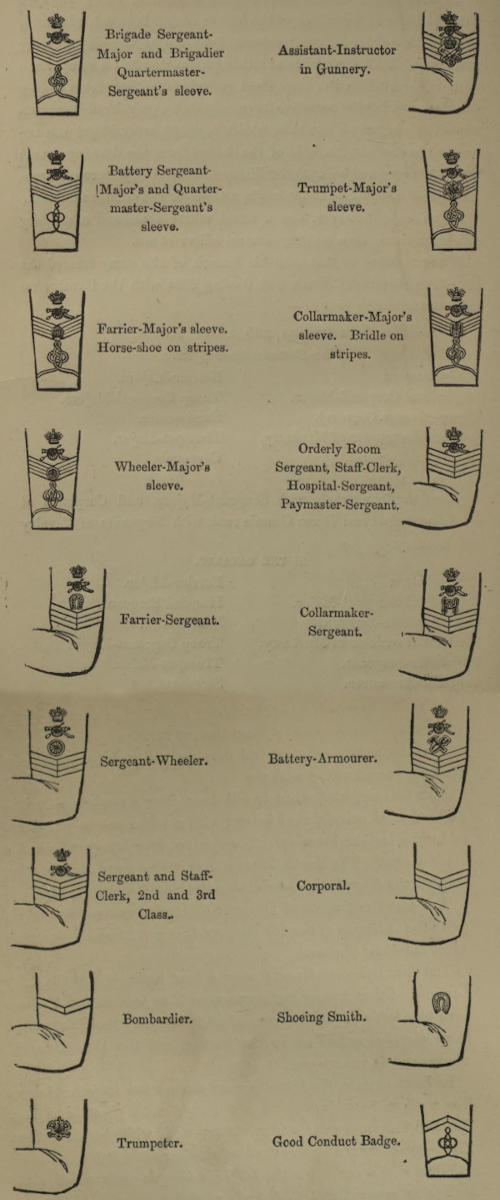
| Brigade Sergeant-Major and Brigadier Quartermaster-Sergeant’s sleeve. |
Assistant-Instructor in Gunnery. |
| Battery Sergeant-Major’s and Quartermaster-Sergeant’s sleeve. |
Trumpet-Major’s sleeve. |
| Farrier-Major’s sleeve. Horse-shoe on stripes. |
Collarmaker-Major’s sleeve. Bridle on stripes. |
| Wheeler-Major’s sleeve. |
Orderly Room Sergeant, Staff-Clerk, Hospital-Sergeant, Paymaster-Sergeant. |
| Farrier-Sergeant. |
Collarmaker-Sergeant. |
| Sergeant-Wheeler. |
Battery-Armourer. |
| Sergeant and Staff-Clerk, 2nd and 3rd Class. |
Corporal. |
| Bombardier. |
Shoeing Smith. |
| Trumpeter. |
Good Conduct Badge. |
It will be seen that the badges on the cuffs indicate a higher rank
than when placed on the arm above the elbow: thus for Brigade
Sergeant-Major and Orderly Room Sergeant the badge is the same;
but one is on the cuff, the other above the elbow.
A man whose conduct has been good, and who has not received
any punishment for a certain period, is granted a good conduct
badge, which entitles him to one penny a day. Some Soldiers have
three or four of these on their arm, but to distinguish these men
from Sergeants, the peak of the badge points upwards, whereas that
of the Sergeants, &c. is downwards.
The distinguishing marks for other branches of the army,
although not strictly the same as those given above, are yet sufficiently
alike to enable us to decide the rank and occupation of the
various non-commissioned officers that we meet.
We now come to the general dress of the various branches of
the army, commencing with the
Life Guards, who, when in full dress, wear a scarlet tunic, with
polished steel cuirass, steel helmet with a white plume, jack-boots
and white leather breeches. The farriers wear blue tunics and a
black plume. The Horse Guards have a blue tunic, but in other
respects the dress is the same except the plume, which is red.
The seven regiments of Dragoon Guards wear scarlet uniform
(with the exception of the 6th Dragoon Guards), brass helmets, with
white horsehair plumes.
The 6th Dragoon Guards wear a blue tunic, as also the 17th
Lancers. Other Lancer regiments wear blue jackets, and Hussars
have blue tunics. The trousers of all the cavalry are blue, except
those already named as having leather, and the 11th Hussars,
whose overalls are crimson.
In head dresses, the Hussars wear a black low sable head dress
like a short bearskin, termed a “busby,” with plume and bag.
The 2nd Dragoons wear a bearskin cap with white hackle feather.
The Lancers wear a square top black leather skull cap.
When cloaks are worn the 1st Life Guards wear a red cloak
with blue cape; 2nd Life Guards scarlet cloak with blue cape;
Horse Guards, blue with scarlet collar. The remainder of the
cavalry blue cloaks, with collars the same as the facings of their
regiment, which are as follows:—
| REGIMENT. |
UNIFORM. |
FACINGS. |
| 1st Dragoon Guards |
Scarlet |
Blue. |
| 2nd ” |
” |
Buff. |
| 3rd ” |
” |
Yellow. |
| 4th ” |
” |
Blue. |
| 5th ” |
” |
Dark Green. |
| 6th ” |
Blue |
White. |
| 7th ” |
Scarlet |
Black. |
| 1st Dragoons |
” |
Blue. |
| 2nd ” |
” |
” |
| 3rd ” |
Blue |
Blue. |
| 4th ” |
” |
” |
| 5th ” |
” |
Scarlet. |
| 6th ” |
Scarlet |
Yellow. |
| 7th ” |
Blue |
Blue. |
| 8th ” |
” |
” |
| 9th ” |
” |
Scarlet. |
| 10th ” |
” |
Blue. |
| 11th ” |
” |
Crimson overalls. |
| 12th ” |
” |
Scarlet. |
| 13th ” |
” |
Blue. |
| 14th ” |
” |
” |
| 15th ” |
” |
” |
| 16th ” |
Scarlet |
” |
| 17th ” |
Blue |
White. |
| Madras 18th Hussars |
” |
Blue. |
| Bengal 19th ” |
” |
” |
| ” 20th ” |
” |
” |
| ” 21st ” |
” |
” |
The uniform for the Royal Artillery is dark blue with red facings.
The Horse Artillery wear a jacket in full dress; the Foot Artillery
a tunic. The jacket of the Horse Artillery is braided in front with
yellow horizontal stripes; the head dress is a black busby with
white plume and red bag (the full dress), and for undress a forage
cap with gold band.
The Royal Engineers, or Sappers and Miners, as they are also
called, wear a red tunic or jacket with blue facings, Oxford mixture
trousers with red stripe; the head dress a fur busby of black
seal skin, white plume, and blue bag.
A dark blue tunic or jacket with white facings; shako of black
cloth with black horsehair plume, dark blue trousers with white
stripe.
There are 109 regiments of Infantry, without the Rifle Brigade.
The uniform of each is as follows:—
Guards wear scarlet tunic single-breasted, black trousers with
scarlet welt, and black bearskin cap. The Grenadiers wear a white
plume; the Coldstreams a red plume; the Scots Fusiliers no plume.
The Line uniform consists of single-breasted red tunic, black
trousers with scarlet welt for winter, and dark blue trousers in
summer; shako, dark blue cloth with red and white ball tuft.
Undress a jacket and forage cap, the number of the regiment being
in front of the cap.
Rifles wear tunic and trousers of rifle green cloth.
Light Infantry have the shako surmounted by a green horsehair
plume instead of the ball tuft; in other respects the uniform is the
same.
Fusiliers have a white horsehair plume instead of the ball tuft,
except the 5th, where the plume is red and white.
Five of the Highland Regiments wear the kilt, viz., the 42nd,
78th, 79th, 92nd, and 93rd. Three, viz., the 71st, 72nd, and 74th,
the trews. The kilted regiments, as also the 72nd, wear a bonnet
of black ostrich feathers, with tartan plaid skull, with white or red
feather. The facings of the regiments vary; a so-termed Royal
Regiment having blue facings, the others consist of different colours,
yellow, white, red, buff, and green being the variations.
Commissariat.—The dress of this service consists of dark blue
tunic, blue velvet facings, dark blue trousers, red stripe, dark shako,
and tuft.
The Medical Department wear scarlet tunic, black facings, blue
trousers with gold or red stripes, cocked hat and black plume.
The Army Hospital Corps wear dark blue with grey facings.
Among the extras to be seen in uniform in most garrison
towns, are Bandmasters, Bandsmen, Drummers, &c., and Schoolmasters.
The Bands of the Infantry have white tunics with regimental
or scarlet facings. The Bandmaster usually wears a black frock
coat in undress, and the regimental dress with gold in full dress.
Schoolmasters wear a blue frock coat with shoulder knots,
crimson silk sash, oilskin cap, black trousers in winter, blue serge
in summer.
The Militia of Great Britain consists of Artillery and Infantry,
and is equipped in the same manner as is the regular army, except
that the lace is silver instead of gold, and the buttons white metal
instead of brass.
In the present day, when soldiering is popular and when each
town or district sends forth its volunteers, we naturally see an
endless display of uniforms, some of which are difficult to identify.
Taking, however, the preceding remark about gold lace and silver,
red and blue uniforms, numbers on caps, &c., any non-military
man may be able to form a very good estimate of the branch of the
service and the rank to which each person belongs, a little practice
being sufficient to soon train the eye to mark the various peculiarities.
When regiments are formed on parade for reviews or any similar
purpose, they are usually placed in the order of their precedence.
This order being as follows:—
The Life and Horse Guards have the precedence of all other
corps.
The Horse Artillery, whether mounted or dismounted, take the
right of all other cavalry.
The Cavalry always take the right of Infantry.
The Royal Artillery take the right of Infantry.
The Royal Engineers take rank next to the Royal Artillery.
The Foot Guards follow next to the Royal Engineers.
The Regiments of the line follow in the order of their number.
The Royal Marines take rank after the 49th Regiment, and the
Rifle Brigade after the 93rd.
When Militia regiments of different parts of the United Kingdom
meet, that regiment takes precedence which belongs to the county
in which the meeting occurs.
CHAPTER XXIX. A GRAND REVIEW.
A review of the armies of Europe, Austrian, Prussian,
French, Russian, British, Italian, Turkish—is only to
be achieved on paper. According to a recent calculation
it appears that the numerical strength of the armies of Europe
is 4,735,782, and, however brilliant the spectacle might be, it
would occupy a weary while to see so many men pass by in
marching order. On paper it may be done, and so in imagination
we take our stand by the reader, to point out the finest
troops, or call attention to this or that particular regiment, as the
living panorama of disciplined men sweeps on before us. The air
resounds with the strains of martial music; the earth seems to
shake beneath the feet of the legions, and the eye is dazed with a
blaze of colour.
The Austrians—the standing army of Austria is the oldest in
Europe—lead the van. The neatly-made white tunics of the
infantry, collars and facings marking the distinction between the
regiments, and their straight-peaked shakos made of black cloth,
present a very noble appearance. The sergeants and corporals are
distinguished by woollen stars on their collars, broad black and
yellow cords on their shakos, and sword-knots of the same unvarying
colour made of wool. The knapsacks of the men are of
dark brown calf skin, and their cloaks are fastened on the top
of their knapsacks. The men are armed with short light muskets,
but to every regiment there are a certain number of grenadiers.
The officers, you observe, are fewer in comparison than those of so
large a body of men in an English army. To command this body
of infantry we should have at least two generals, four colonels,
some ten lieutenant-colonels, majors, and fifty-five captains; here
the duty is performed by one colonel, six field officers, and thirty-two
captains. Perhaps, say you, it is too few. Perhaps. But these
fellows march in excellent order—tramp, tramp! and the drummers
play with wonderful precision.
These fellows in the light grey tunics are rifles—a good colour,
grey. How much better than the old invisible green, which was
always visible! And how well the men look in that Swedish felt
hat with one side turned up and fastened by a brush. They are
some 32,000 strong, these men of the rifle, and the regiments are
justly regarded as the finest in the service.
Next in order of march come the border infantry, raised originally
in the reign of Maria Theresa; you may know them by their
coffee-brown tunics and black cross-belts. Disciplinary companies
follow close upon them. They march well, but if you look closely
at some of the fellows you may notice a rollicking daring in them
quite foreign to the regular troops. These disciplinary corps are
established for the purpose of drafting in those untamed spirits
that have not yet learned how to obey, and the discipline is pretty
sharp. You would not like it! you would be writing to the Times
about it, if you dared!
General Discipline in the Austrian army?—Well—almost as
unpopular an officer as Corporal Punishment—pardon so dull a
joke on so bright a day—well, the discipline is not so sharp as it
used to be. We don’t hear so much of the stick, and running the
gauntlet has quite gone out of fashion. That running of the
gauntlet was terrible work. Stripped to the waist the culprit was
marched through the ranks of his comrades, every soldier armed
with a cane, every soldier striking a blow—a punishment so severe
that many a time a man having endured it has asked for a draught
of water, and died before the water could be brought. Now they
do these things better: imprison the culprit, put him to shot piling
or on extra drill, but—
Oh these men of iron! Hardy and brave as the men of iron who
served under old iron-handed Charlemagne! These are the Austrian
heavy cavalry—these the cuirassiers with their breast-plates of
black polished iron, but no back-plates. They wear low leathern
helmets and a brass crest; they have white tunics, and grey trousers
covered with leather to the knee. Powerful horses carry these
powerful men, but we doubt whether the grey-clad riflemen could
not bring them down, notwithstanding their iron breast-plates.
Amid a cloud of dust the Cuirassiers and Dragoons ride on, and
close in their rear come the Lancers with their short dark green
tunics, with red collars and facings, richly decorated with yellow
epaulettes, aiguillettes and cords, green trousers with red stripe,
white cloaks and low-crowned chapkas of various colours with a
tuft. Each man carries a long lance decorated with a black and
yellow pennon. These Lancers are followed by the Hussars, wearing
tightly fitting tunics and trousers; and after that, thundering over
the ground, the Artillery—an Artillery equal to that of any in
Europe. The gun carriages and limbers are painted yellow with
black wheels, and the men are riding on long jaunting cars, their
uniform consisting of brown tunics with red cuffs and facings,
light blue trousers, long grey cloaks, and felt hats with one brim
turned up and fastened by a black and yellow tuft. Their belts
are white, and they carry a short infantry sword.
A small company in dark brown tunics with blue facings, and
small low shakos, follow next. These form the Land Transport
Corps. After them come the Engineers, with a special corps for
Pontoons, and another Special Corps for Flotilla purposes; and,
lastly, 19,000 strong, march the Gendarmerie, as fine a body of
men—to look at—as ever trod the ground.
The oldest standing army in Europe is that of Austria. Its
history is indissolubly connected with that of the Empire; but,
while there is no army in Europe which displays stronger traces of
the Middle Ages, no pains have been spared to make it the most
efficient by a ready adoption—since 1850—of all modern improvements.
The army, like the Empire, is a strange compound of nationalities.
Germans, Sclavons, Hungarians, Wallachs—all are included,
the army being made up by conscription through all the provinces
of the Empire, and all classes, with some few very exceptions, being
subjected to it. The army belongs to the Emperor and not to the
Empire, and hence an officer may serve in it for years without
having any claim to the protection of the State. Foreigners, ever
since the period of the Thirty Years’ War, have held high rank in
the Emperor’s army, and it is asserted that one-half of the officers
now holding commissions in the Austrian army are not Austrians
by birth.
By the latest returns it appears that a considerable reduction is
taking place in the numerical strength of the Austrian army.
The expenses, which in 1863 were estimated at a sum equivalent to
10,000,000l., were reduced in 1865 to 9,000,000l., and the estimates
for 1866 are no more than 8,000,000l.
You notice that the men are marked by strange contrasts of
physiognomy; they are marked also by strong animosity to each
other, not as individuals, but as nations. The troops raised in one
dependency of Austria hate with a thorough hatred troops raised
in another, and it is very difficult sometimes to keep peace
between them. It is a rule also that troops raised in any particular
district should never be permitted to garrison that district; and,
in fact, that no troops should remain long in any one place. By
this means all familiarity with civilians is cut off; the men must
associate together—the officers must associate together. As to the
men, they are tolerably well paid—always enough to secure them a
good breakfast, dinner, and supper, with twopence or threepence
over for a dram. The officers—especially those holding high
rank—are nothing like so well paid as officers similarly commissioned
in England. They do not meet at mess, but each officer
dines where he pleases, and thus—
But here come the soldiers of Prussia, the soldiers of the Great
Army, which bears something of the impress of Frederick the
Great.
Here are the Prussian Rifles, in dark green tunics, with red
collars and facings, grey infantry trousers, and a shako with a peak
before and behind, and a horsehair brush. Their belts are of black
leather, and the couteau de chasse, which can be used as a bayonet,
is worn on the same belt as the cartouche-box. They are all capital
marksmen, and rapidity of firing is regarded as a sine quâ non.
The Rifles are closely followed by the whole body of Prussian
infantry, on a war footing, 360,436 strong. They wear short
tunics of blue cloth, the collars red in the front and blue behind.
Why blue behind? Because the helmet would soon wear the
other colour dirty. The head covering—pickelhaube—is a round
helmet with projecting pike, the line wearing the regimental number
in front, while the Guard is distinguished by a star. The
Guard is also distinguished by horsehair plumes. Who are those
who wear a cross in front of their helmets? These are the Landwehr
Infantry. There is, if you will look closely, something in the
uniform to distinguish the corps: the regiments of Prussia Proper
and Pomerania have white shoulder straps; those of Saxony and
Brandenburg, red; those of Posen and Silesia, yellow; those of
Westphalia and the Rhine, light blue. The trousers of the men
are of dark grey cloth with a red piping down the side; they all
wear boots, but on march put gaiters over them; their cloaks are
of dark grey cloth, and their belts are of black leather.
This strong body of cavaliers—every horse a model—forms the
Prussian Cavalry. Here are the Garde du Corps and Grand
Cuirassiers. They have back and breast-plates of polished steel,
and wear short white tunics with red, blue, green, yellow, black,
or orange colour cuffs and collars, according to their regiments;
their trousers are of dark grey cloth; their helmets of polished
steel; their principal weapon, the long cut-and-thrust sword, worn
in a white buffalo belt.
Here come the heavy Landwehr Regiments, in dark blue tunics
and bright helmets; in their rear ride the Italians, their dark blue
jackets, all picked out with red, are armed with long lances with
black and white pennons. These are followed by the Dragoons,
in light blue tunics with different coloured facings; Hussars, with
black fur shakos and cloaks, and trousers of light grey. And after
them thunder the Artillery, on a war footing, with some 34,000
horses and a proportionate number of men.
In time of peace the Prussian army is only 122,260 strong, with
5500 officers; while on a war footing it numbers 299,401 men,
who can take the field, while 95,957 men are left behind for home
contingencies. The difference between the peace and war establishment
of Prussia is greater than in any other European
nation.
Universal service is the rule in Prussia, and every healthy man,
without distinction of rank, must personally perform military duty;
but the period a soldier remains in the standing army is short.
The majority only serve three years—from twenty-one to twenty-four;
after which they are enrolled for two further years in the
reserve, and then pass to the Landwehr of the final levy. The
Prussian is aware from his earliest years that he will have to enter
the army, and hence even his childish amusements bear a military
stamp, and military drill forms part of his common education.
It is no small thing to demand of a nation that its entire population
must belong to the army up to the thirty-fifth year, and be ready
at any moment to quit home and family and to march wherever it
is commanded. But so it is in Prussia.
The non-commissioned officers of the Prussian army as a body
are probably the best in the world. They have the privilege before
them of a civil appointment after twelve years’ service, and they
would rather work hard for this than obtain a commission. There
is a striking difference between them and the French sergeants,
whose only ambition seems to be to rise from the ranks—to pluck
at the bâton which is found—with how much of difficulty!—in
every man’s knapsack.
The French! Well, the French, you know, are an enthusiastic
people—they lead, in civil as well as military circles, rather stagey
lives. Have you seen Gustave Doré’s admirable pictures illustrative
of the life of a certain Captain Castagnette? Now he loses an eye—now
an arm—now two legs; now he has a bomb in his back
which cannot be extracted; and now, finally, sans everything, he
dozes by the fireside, sets fire to his wooden leg, expels that ugly
lodger, the bomb in his back, and is himself dashed into a thousand
or more pieces, nothing remaining but the Cross of the Legion!
All is lost, save honour! It is very French.
But here are the Frenchmen, ready to fight for honour and glory.
Vive l’Empereur! Here are they, 500,000 strong. “L’Empire c’est
la Paix,” is it? Every Frenchman is a soldier by birth. Born in
the purple were the imperial children of Rome—born, or cradled
in the buckler are these children of the modern Empire! It may
serve the turn of a Russian or a German to aver that the most
stupid soldiers are the best—that it is not a soldier’s business to
think, but simply to obey. Not so think the Frenchmen. Intelligent,
active, independent, are these brave Gallic heroes.
“Your hand, brave comrade—nay, never apologize. If the right
hand has been knocked off in fair fighting, give me your left
hand.”
Here are the Infantry, in light blue tunics, longer and wider
than those of Prussia, a black belt, to which is attached cartouche
box, bayonet, and sabre sheath; knapsack of brown calf-skin; large
fringe epaulettes, red trousers, small low shako of blue cloth, with
a brass shield in front, short half-boots, and gaiters. Here are the
buglers and sappers, armed with short rifles, and here are twenty
battalions of light infantry, each battalion numbering more than
1200 men. There are the Chasseurs, consisting entirely of picked,
active, strong soldiers—hardy mountaineers of Auvergne, the
Vosges, the Ardennes, the French Alps, the Pyrenees, and Corsica.
Here are the bronze-visaged sons of Algeria, the Zouaves, their
ranks recruited by a vast number of Frenchmen, and a sprinkling
of Germans, Poles, and Italians, attracted by the fiery impetuosity,
almost boyish fun, and Oriental costume of the band. They
number about 8000 men. They are closely followed by battalions
of Light African Infantry, four battalions of Native
African Skirmishers, wearing the Zouave dress; and these, again,
by the old Foreign Legion, made up of Germans, Prussians, Bavarians,
Poles, Hungarians, Spaniards, and Italians. Next come the
Disciplinary Corps, 1600 strong; and, lastly, six companies of
Hospital Orderlies, amounting to 1600 or 1700 men.
The helmeted men who ride those powerfully made horses, that
you might swear were raised in Normandy, are the Cuirassiers.
They are all tall, athletic men; so also are the Carbineers, who
follow them. Next come the Dragoons, forming a total of seventy-two
squadrons, who can take the field with 13,000 horses, and forty-eight
squadrons of Lancers, with 8,000 horses. The Light Cavalry
consists of twelve regiments of Chasseurs à Cheval and nine Hussar
regiments—on a war footing, 24,000 or 25,000 strong. The Hussar
and Chasseur are only distinguished from each other by their gay
and overladen uniform; their arms and horses are very much
alike. They ride little, strong, but terribly ugly horses, reared in
the mountainous parts of France. Next come the Chasseurs
d’Afrique, numbering about 3,000. They wear light blue tunics
of the Polish cut, red shakos, and white capote cloaks. They are
armed with long rifles and light sabres. The Spahis—numbering
about 3,000 men, principally natives of Algeria, mounted on
Moorish stallions, their uniform, armament and horse equipment
perfectly Oriental in style—next pass in review; and then the eye
is dazzled by the splendid spectacle of the Cent Gardes. Their
uniform is magnificent, and every man is fit for a sculptor’s model.
And lastly, there is a large body of the Imperial Guard—the
Cuirassiers—splendidly built fellows, mounted on sturdy horses of
the Norman breed.
Here’s the Artillery—the finest arm of the French service. Has
not the Emperor himself written a hand-book on artillery practice?
The uniform of the men is tasteful and richly decorated; red-fringed
epaulettes and red-bordered shakos, short dark blue jacket
with red facings, trousers of the same with a broad red stripe. All
the foot artillerymen are armed with a short straight sword; all
who serve on horseback carry cavalry sabres. The guns are horsed
by country-bred horses—compact, strong brutes, not particularly
attractive to the eye, but useful, and well able to stand any climate.
If the French Artillery were placed on the war establishment, it
would number 60,000 strong, with 49,000 horses and nearly
1200 guns. The Commissariat troops and the indispensable
Engineers, in their blue tunics, come next, and while they pass
before us we may offer a few words on the army in general.
The French army on a full war establishment is represented by
580,000 men, 82,000 cavalry horses, and 1182 guns; there is also
a reserve, made up of old non-commissioned officers and conscripts,
whom it has not been found necessary to call out, amounting to at
least 150,000 men. All the men are thoroughly in earnest; they
don’t wear the “Emperor’s coat,” but the uniform of their country;
the regiments do not bear the name of any varying possession, but
has its own number and permanent place in history. “We did so
and so at Austerlitz,” say the men to this day, in speaking of the
regiment to which they belong. In France, too, any good soldier
can become a corporal, any corporal a lieutenant, and so on in
military rank. The words of the Great Emperor will never be
eradicated from the minds of the French troops: “Every soldier of
France carries a marshal’s bâton in his knapsack;” and indeed
many a man who entered the service in a blouse has died in a
General’s uniform.
Ah, my friend, I see you are inattentive. I know what means
that glow upon your cheek and sparkle in your eyes; I hear the
strain as well as yourself:—
“Our plumes have waved in combats
That ne’er shall be forgot,
Where many a mighty squadron
Reel’d backward from our shot.
In charges with the bayonet
We lead our bold compeers,
But Frenchmen like to stay not
For British Grenadiers.
“Once boldly at Vimiera
They hoped to play their parts,
And sang fal lira lira
To cheer their drooping hearts.
But English, Scotch, and Paddy-whacks,
We gave three hearty cheers,
And the French soon turned their backs
To the British Grenadiers.
“And what could Buonaparte,
With all his Cuirassiers,
In battle do at Waterloo
With British Grenadiers?
Then ever sweet the drum shall greet
That march unto our ears,
Whose martial roll awakes the soul
Of British Grenadiers!”
You know the old colours, and the old familiar music of the “spirit-stirring
drum” and “ear-piercing fife” is a welcome sound. Hurrah,
for our soldiers! One, two, three! and a ringing one over the
young recruits. Now for another one after that. What is that
for? The Volunteers, of course.
The number of effectives in the British army by the last return
was 204,057. They are scattered all over the world, scarcely
more than 30,000 being at any one time at home; and under so
many varied temptations as they must be exposed to, both abroad
and at home, it says much for the men that during the last year
there were only 1438 deserters and 466 cases of corporal punishment.
As to what British troops have achieved—is not the history
of England full of it? The sheer pluck they have displayed under
all sorts of disadvantages has made them famous through the
world. All sorts of disadvantages—at home not over well paid,
not over well cared for in garrison; not incited to exertion by the
prospect of promotion above that of a non-commissioned officer;
not encouraged to feel himself a man as well as a soldier; exposed
to a degrading punishment; clad in a costume totally unfitted for
the field or the march; armed with heavy and cumbersome weapons;
sent to all parts of the globe in precisely the same uniform; no
proper provision made for his comfort or convenience; not taken
care of by the authorities, not allowed to take care of himself;
not—
“Upon the plains of Flanders
Our fathers long ago,
They fought like Alexanders
Beneath old Marlborough!”
I know it, my friend, but they fought under great disadvantage.
They were ill-provided with everything; they were badly paid,
and their pay, small as it was, was kept; their sheer pluck, as we
said before, won the battle—
“And still in fields of conquest
Our valour bright has shone,
With Wolfe and Abercrombie,
And Moore and Wellington.”
I am aware of it all, but they would have thrashed their foes as
surely, and certainly with less inconvenience to themselves, had
they been better cared for. “If you had to fight the battle of
Waterloo again, how would you like to be dressed?” said the
Prince Regent to a Guardsman. “In my shirt sleeves, your
Majesty!” was the highly practical reply. Do you remember what
use they made of the Grenadiers’ bearskin caps in the Crimea?
They filled them with mud, and found them excellent building
material. Do you remember the outcry there was when the stiff
dog collars were taken off our half-strangled soldiers? Do you
recollect how Miniés and revolvers were ridiculed by plethoric old
officers? “I’ll tell you what, sir, our men didn’t want Miniés and
revolvers and such new-fangled bosh at Waterloo, sir. They won
without them, and can do it again, sir.”
I observe that you are observing the march of the British
soldiers, more than my observations. Well—’tis a grand sight.
Chobham and Aldershot have done something for them. Those
are the Guards: the Household Brigade, composed of the Grenadiers,
of three battalions, the Coldstream, of two, and the Fusiliers,
of two battalions: forming a total of seven battalions, each with a
strength of 900 men. They are fine, tall, powerful fellows—picked
men. How bravely they bestirred themselves that foggy morning at
Inkermann, when the Russians dropped in before breakfast! Who
can forget that soldiers’ battle? The men who follow are the
Infantry Regiments of the Line, all armed with rifles. There
are 100 regiments, numbering somewhere about 130,000 men.
There are the Rifle Brigade, in their uniform of dark green cloth
and dull metal buttons; then a company of Amazons—no, the
Highlanders, in their national garb. The pibroch tells of their
coming:
“Think on Scotia’s ancient heroes,
Think on foreign foes repelled;
Think on glorious Bruce and Wallace,
Who the proud usurpers quelled!
“See the northern clans advancing!
See Glengarry and Lochiel!
See the brandished broadsword gleaming!
Highland hearts are true as steel.”
And now the Cavalry appears on the scene—the so-called
“Heavies” more lightly, however, mounted than the French,
Prussian, or Austrian Cuirassiers; counterbalanced, perhaps, by the
extreme heaviness of the Light Dragoons when compared to continental
Hussars. The Heavy Cavalry is composed of three regiments
of Guards, nine Heavy Dragoon regiments, one Carabineer
regiment; altogether thirteen regiments, comprising a strength of
about 6,000 men, with the same number of horses. The Guards
form Her Majesty’s Body Guard, and there is not a finer body of
men in the world. The English Light Cavalry is composed of
Dragoons, Lancers, and Hussars.
The Artillery consists of what is called the Royal Regiment of
Artillery, which has a strength of about 800 officers, 1500 non-commissioned
officers, 1900 rank and file, with 4200 horses. In
addition to this Artillery Regiment, there is a brigade of Horse
Artillery, comprised of 70 officers, 150 non-commissioned officers,
and 2200 rank and file, with 1900 horses. All the material is
excellent, no expense being spared to raise this branch of the
service to a proper degree of efficiency. The Engineer Corps is
an important addition to the army.[3] At Woolwich there is a
splendid school for the non-commissioned officers.
And here are the Volunteers!
“Altogether,” you say, “a splendid show, these British fellows.
Only a small item in this grand parade of European armies, but
clearly there is the might of men in them. They afraid!
“‘Come, if you dare!’ our trumpets sound.
‘Come, if you dare!’ the foes rebound.
‘We come, we come!’
Says the double beat of the thund’ring drum.
Now they charge on amain!
Now they rally again!
The gods from above the mad labour behold,
And pity mankind that will perish for gold.
The fainting foemen quit their ground,
Their trumpets languish in their sound—
They fly! they fly!
Victoria! Victoria!”
Ah, my dear friend, when your enthusiasm has a little cooled
will you kindly direct your attention to the troops now passing
under your Roman—no—I mean your British—nose. These are
Russians. How stolidly they march, and how alike they are.
There is a company of the Guards, and all the men have light
hair and blue eyes; there’s a company of the Guards again, and
all the men have black hair and dark eyes. Order is Russia’s first
law, and, this confest, all are and must be very like the rest. One
day a ship, with many officers and men on board, went down in the
Neva. The order was passed to the soldiers to save in the first
place the officers of the Guard. They therefore anxiously inquired
of each officer they got hold of if he belonged to the
Guard? The poor fellows could not answer, as their mouths
were full of water, so they were allowed to drown. On another
occasion, as it was very dusty, the soldiers were ordered to water
the field for exercise. While employed in this duty it came on to
rain heavily, but they continued the task with the utmost gravity.
They had been ordered to do it, and that was enough. During the
siege of Warsaw a young grenadier addressed a veteran, and
pointing to the entrenchments, said, “Do you think, comrade, we
shall take them?” “I do not think we shall,” the other replied;
“they are too strong.” “But,” said the young man, “if we are
ordered to take them?” “Oh, that will be another thing; if we
are ordered to take them of course we shall do so.”
Out of 65,000,000 to 70,000,000 men subject to the Czar,
40,000,000 to 45,000,000 are liable to the conscription. The
infantry of the Russian Imperial Guard consists of five grand
infantry divisions, each composed of two brigades, and these again
subdivided into four regiments. The Grenadier Corps is divided
into six brigades or twelve regiments. There are also attached
three Carabineer regiments. There are six Infantry Corps, each
consisting of three divisions of six brigades, or twelve regiments.
One rifle regiment is attached to each division. The Circassian
Corps is subdivided precisely like the line infantry, but the regiments
are much stronger. The Finland Corps only consists of one
division of two brigades, subdivided into twelve battalions, equal
to 12,600 men. The Siberian Corps is composed of one division;
the Oremberg Corps also comprises one division. The total strength
of Russian infantry amounts to about 540,000 fighting men. The
total strength of the Russian cavalry is estimated at 80,000 men.
Those magnificent fellows that just now rode by, in their white
uniforms and black helmets and cuirasses, are the picked men—the
Cuirassiers of the Guard. The Russian Artillery is formed of nine
foot and two horse divisions—14,000 guns and 44,000 men.
Who are these? These are the Italians, just drawing long
breaths of liberty; and these, soldiers of Spain and Portugal; and
these, sons of Mohammed—weak descendants of a mighty race,
who set the world aflame from Delhi to Grenada!
All the colours of the rainbow, all the tongues of Babeldom,
all the varied physiognomies of all the races in all the world—they
troop past us: the wild, weird Cossack, with his tremendous lance;
the dapper English Volunteer, with his rifle sure as David’s sling;
the Zouave, with his cat upon his knapsack; the Prussian officer,
very bare in pocket, but proud of the “King’s coat”—here they
pass before us; the air resounding with the strains of military
music, the rat-a-plan of the French troops, the clash of Turkish
cymbals, the ringing sound of the English bugle, the shrill note of
the Highland pibroch. Yes—here are our fighting men, ready to⸺well—may
Heaven grant that their swords may rest in their
scabbards, and that their artillery shall thunder only to usher in—with
soldiers’ music—a Millennium of Peace!
CHAPTER XXX. A SOLDIER’S FUNERAL.
When a soldier dies notice is at once given to the officer
in command of his troop or company, and an inventory
is taken of his effects.
The coffin is made (and paid for by means of the effects of the
man, which are sold by auction in the garrison after his funeral),
and this, with a few trifling fees, is the only expense. The coffin
is carried to the grave either on a gun carriage or by men belonging
to the man’s company, according to the service to which the man
belongs.
The band, or the drums and fifes or bugles, of the regiment to
which the man belonged attend the funeral, and lead, playing the
dead march; then come a firing party, which are provided with
three rounds of blank cartridge; then the coffin and pall bearers,
after which the mourners.
When any of the relatives of a soldier attend his funeral they
follow immediately behind the coffin; then come the men of the
troop or company, the order at a funeral being, that the juniors
march nearest the coffin, the seniors last. In all cases of the funeral
of private soldiers there is an officer in attendance, usually a subaltern
officer, who commands the party, and in the march follows
in rear.
The firing party mainly indicates the military rank of the deceased
soldier. A private soldier or corporal being entitled to thirteen
rank and file; a sergeant to nineteen; a cornet or ensign to thirty;
a lieutenant to forty; a captain to one hundred; a major to two
hundred; a lieutenant-colonel to three-hundred, and a colonel by
his own regiment.
When an officer above the rank of colonel is buried, there are
cannon employed instead of small arms. A brigadier’s funeral is
attended by two squadrons and one battalion, and a salute of nine
cannon is given. A major-general’s is attended by three squadrons
and two battalions and eleven pieces of cannon. A lieutenant-general’s
thirteen pieces of cannon, three battalions and four
squadrons. A general’s with fifteen pieces, four battalions, and six
squadrons. And a field-marshal’s saluted with seventeen pieces of
cannon, and attended by six battalions and eight squadrons.
When a general or flag officer is being conveyed to the grave,
minute guns are fired; but these are not to exceed the number to
which the officer was entitled when alive.
When an officer dies in any garrison town, it is customary to send
round with the orders, which are read by every officer each evening,
a notice to the effect that the funeral will take place on a particular
day, and any officers wishing to attend are to be at a place named
at a given hour. It is usual for every officer belonging to the
regiment or corps of the deceased in the garrison to attend, if not
otherwise occupied, and personal friends of the deceased follow
also.
All officers who attend funerals appear in full dress with a piece
of black crape above the elbow of the left arm, this being the only
mourning allowed in the army. The pall-bearers, who should be
of the same rank as the deceased, usually wear a crape scarf in
addition to the crape on the arm.
When the officer belonged to the royal artillery or cavalry his
charger is led to the grave, saddled and equipped, the boots of his
master being suspended on each side of the saddle, the heels turned
to the front. On the coffin, the busby, helmet, or shako is placed,
and the officer’s sword-belt and gloves.
There are few things more imposing in outward appearance than
a soldier’s funeral. The slow, measured beat of the drum, the
firing party marching with their arms reversed, a position highly
emblematic of grief, the strange mixture of uniform and black pall,
invariably tend to make the bystanders feel that a soldier’s funeral
is far more solemn and impressive than is that of a civilian.
When the procession approaches the grave the firing party file
to the right and left, and thus form on either side; they then rest
upon their arms reversed, whilst the coffin is borne between the
ranks. When the coffin has been lowered into the grave and the
service completed, three rounds of blank cartridge are fired in the
air as a feu de joie—a somewhat inappropriate term for the occasion—but
modified by an old corporal who instructed us in the
goose step, and who used to order us to fire a “few de joy—as
for the Queen’s birthday,” or “a feu de wo for a funerial.”
A soldier’s life is, when on service, passed amidst scenes of danger,
and thus probably he to a certain extent becomes indifferent to
death; to say the least, he has not time to grieve very long. Thus
no sooner has the ceremony of depositing his comrade in the earth
been accomplished, than the band, or drums and fifes, which so
solemnly performed the dead march when proceeding to the burial
place, strike up a cheerful quick march, and the soldiers return to
barracks to the tune of “Here we are again,” forgetful of the scene
in which they have lately been actors, and regardless of the probability
of themselves being the next claimants for six feet of
earth.
The most important military funeral of late years, and one which
everybody went to see who could do so, was that of the Duke of
Wellington. Famed throughout the world for his brilliant military
and civil career, as well as for the genius which characterized all
his acts, the nation with one voice called for a public and gorgeous
funeral, as a last tribute of its estimation of so far-famed a chieftain.
It was on a dark November morning that hundreds and thousands
of persons, long before dawn, wended their way through the streets
of London, intent on obtaining a good position on the pavement or
to be sure of reaching the house and thence the window, which had
been previously secured and from which the procession could be
best seen.
Even as early as six o’clock in the morning, large bodies of
cavalry and infantry are marching through the streets, whilst
officers in uniforms ride up and down, giving orders and arranging
the positions for various bodies of men who are yet to make their
appearance. In all the principal open spaces troops are mustering;
behind the Horse Guards and in St. James’s Park, all branches of
the service being represented, from the little known uniforms of
Indian soldiers to that of our own guards; for the Great Duke had
culled his first laurels on the fields of India, and soldiers from the
then East India Company’s service attended as representatives of that
branch of our army.
The course taken by the procession was from the Horse Guards
to St. Paul’s, and an enormous number of troops were required to
keep the ground along the course, this crowd being immense. Not
only were the streets crowded, walking being almost impossible,
but it was estimated that upwards of two hundred thousand seats
were sold to sight-seers.
In the actual procession were six battalions of infantry, nine
guns from the field batteries, five squadrons of cavalry, and eight
guns from the horse artillery.
The Duke’s regiments were of course represented on the occasion,
and gave an additional interest to the scene. There was the
“Brigade,” of which Arthur Duke of Wellington was Colonel-in-Chief,
and also the regiment in which young Arthur Wellesley
learned the goose step and how to “shoulder arms.”
The military, however, formed only a portion of the procession,
for the Great Duke was a man of many honours; for Russia,
Prussia, Spain, Portugal, Hanover, and the Netherlands had conferred
upon him the marshal’s bâton, and these nations were each
represented on the occasion. Besides these foreigners, many of
whom had served with the Duke, there were men of our own
country, whose names were well known, and whose reputation
would have shone brighter had they not been dimmed by comparison
with that of the Duke. In the procession and around the
grave there might be seen one of our most far-seeing and able
Generals, Sir Charles Napier, the man whom the Duke had selected
to go to India at a period of emergency, and to whom he looked as
one alone capable of playing the requisite part at that time. Near
him was the dashing gallant Lord Gough, who loved to fight side
by side with his men; Lord Seaton, Viscount Combermere, Sir W.
Cotton, Sir A. Woodford, &c., names familiar as household words,
were grouped around the grave of their loved chief.
The contrast on this day was marked indeed between the
grandeur and brilliancy that appeared in St. Paul’s, and the silent
deserted appearance of Apsley House, where every blind was down
and every shutter closed.
It was remarked that as the procession wended its way through
the streets, and as the somewhat gorgeous-looking vehicle that contained
the coffin passed, every person from the highest to the most
humble, bared his head and seemed to be awe-struck, and reminded
that fame, rank, and genius are no more free from the call of death
than are poverty, misery, and insignificance.
The Duke’s titles having been repeated by Garter, King of Arms,
the ceremony was concluded, but will long be remembered by those
who were witnesses to the imposing scene.
On the 6th April, 1864, a military funeral took place at Woolwich
which was attended by a large body of officers, and was a good
specimen of a military funeral.
Colonel Bingham, the Deputy Adjutant-General of the Royal
Artillery, died at Brighton, to which place he had gone for change
of air. His body was conveyed to Woolwich for the purpose of
being interred with military honours, and he was buried at Old
Plumstead Church. In consequence of the rank of the deceased
officer, but more especially from the great respect in which he was
personally held, every officer who could obtain leave from out-stations
was present on the occasion. Not only did every officer
of his own regiment attend, but very many from other branches of
the service, so that altogether upwards of three hundred officers
followed in the procession.
The weather on the occasion was fine and bright and well-suited
for a military display. At one o’clock the troops in garrison paraded,
and a large body was told off to line the road from Woolwich
Common to the Church, a distance of nearly three miles. At two
o’clock the coffin was brought from the house and placed on a gun
carriage, covered with a Union Jack, the drums in attendance
giving muffled rolls. On the coffin were placed the Colonel’s
cocked hat and sword, and the carriage was drawn by six horses.
The procession then moved on in the following order—
- Detachments of Horse Artillery, mounted.
- Eight Batteries of Royal Artillery, on foot, with arms reversed.
- The Royal Marine Band, playing the Dead March.
- Nine Guns of Royal Horse Artillery.
- The Royal Artillery and the Bugle Band.
- The Garrison Chaplains.
- The Corpse.
- On either side of the Coffin, four Colonels Royal Artillery as Pall-bearers.
- The Deceased’s Horse.
- Private Mourners.
- Officers of the Adjutant-General’s Department.
- The Gentlemen Cadets.
- The Clerks of the Adjutant-General’s Departments.
- The various Officers who attended.
- Mounted Detachments of Royal Horse Artillery.
- Private Carriages.
The procession altogether extended considerably over a mile,
and at the slow pace at which the march was carried on nearly
an hour and a half elapsed before the church was reached.
The small church of Plumstead had rarely if ever been filled by
so many military celebrities as on this occasion. Among those
whose names are familiar to the public were Field-Marshal the
Duke of Cambridge, Sir Richard Airey, Sir J. Scarlet, Sir Edward
Lugard, General Foster, General Bloomfield, and others.
The troops were formed in the churchyard and in a field near.
The nine guns were drawn up on a higher portion of ground, and
at some distance from the church, for the discharge of a cannon
not uncommonly breaks windows, and thus these implements of
warfare were removed to a safe distance. When the funeral service
had been read and the body lowered into the grave the Armstrong
guns fired their salute, and the last offices were paid to a good and
noble soldier as well as to a most just and honourable man.
The funeral of a soldier who dies amidst scenes of civilization,
where the last honours can be paid to him in the manner just described,
is certainly an imposing scene, but to some minds it seems
less solemn than it might be, and too much of a show. The high
probability that among many of those who attend such a funeral
there are several who knew little or nothing personally of the man
whose body they are following to the grave, may possibly tend to
do away with a portion of the real grief which some people are
accustomed to see habitually displayed at a funeral. The gaping
crowd also, who are usually free critics on the dress and personal
appearance of the various members of the procession, render a large
military funeral by no means that quiet scene which we all thirst
for when the heart has been saddened by the departure of a loved
friend. But we can conscientiously state that at those funerals of
which we have been eye-witnesses the conduct of those personally
engaged, as well as of the lookers-on, has been such as to harmonize
with the sensitive state of those who were nearly allied by blood
or friendship to the deceased.
When a soldier meets a soldier’s death, and is buried “with his
martial cloak around him,” and when no band of music attends his
funeral, or other pomp is added to his last honors, the last offices
are not less solemn, the whole scene not less impressed on the
memory, and the sudden reminder that in the midst of life we are
in death not less efficient in its results. When we see a friend gradually
sicken and day by day become weaker, whilst doctors shake
their heads and relatives despond, we are prepared at last for the
final scene. When, however, we breakfast with a comrade, walk
with him to the parade, march beside him as we approach an
enemy’s position, hear him suddenly cease speaking when in the
middle of a sentence, and look round to see him sinking to the
earth lifeless; and when, after a smart brush with an enemy, we
return to attend the funeral of this comrade, who has been to us
perhaps more than a brother for months or years—we seem to be
nearly allied to death, for we may on the following night be consigned
in the same way to six feet of ground, our security for life
being no greater than was our comrade’s.
In many cases, where the number of slain can be counted by
hundreds, the day following a great battle is a sad one. Experienced
was the general who exclaimed—“Nothing but a defeat is
more sad than a victory, for the losses of the latter are only exceeded
by those of the former.” To give each man a separate
grave, or to pronounce a funeral service over each man, would
occupy more time than could be spared; thus, a large hole, and
a funeral service for 100 men, who are rapidly covered with earth,
and who, shroudless and coffinless, are thus disposed of, is the other
side of the scene of pomp which we have described as a soldier’s
funeral at home.
FOOTNOTES
FINIS.
Printed by H. J. Wicks, 7 & 8 Rolls Buildings, Fetter Lane, E.C.
Eight Illustrations, cloth, gilt edges, 3s. 6d.; Ivory Enamel, 7s.; Green or Blue
Enamel, 7s.; Tortoiseshell, 7s.; Morocco, 7s. 6d.; Morocco extra, 10s. 6d.
MOXON’S POPULAR POETS.
EDITED BY WILLIAM MICHAEL ROSSETTI.
The Press and the Public, alike in Great Britain and her Colonies, and in the
United States, unite in their testimony to the immense superiority of Messrs.
Moxon’s Popular Poets over any other similar collections published by any other
house. Their possession of the Copyright Works of Coleridge, Hood, Keats, Shelley,
Wordsworth, and other great National Poets, places this series above rivalry.
- 1. Byron’s Poetical Works.
- 2. Longfellow’s Poetical Works.
- 3. Wordsworth’s Poetical Works.
- 4. Scott’s Poetical Works.
- 5. Shelley’s Poetical Works.
- 6. Moore’s Poetical Works.
- 7. Hood’s Poetical Works.
- 8. Keats’s Poetical Works.
- 9. Coleridge’s Poetical Works.
- 10. Burns’s Poetical Works.
- 11. Tupper’s Proverbial Philosophy.
- The Four Series now first Complete in One Vol., with Portrait.
- 12. Milton’s Poetical Works.
- 13. Campbell’s (Thos.) Poetical Works
- 14. Pope’s Poetical Works.
- 15. Cowper’s Poetical Works.
- 16. A Selection of Humorous Poems.
- 17. A Selection of American Poems.
- 18. Mrs. Hemans’ Poems.
MOXON’S LIBRARY POETS.
The complete and continuing success of MOXON’S POETS, in the popular
Three-and-Sixpenny Series, has induced the house to commence the publication of
a LIBRARY EDITION of Moxon’s Poets.
PRICE FIVE SHILLINGS PER VOLUME.
NOW READY.
- LONGFELLOW.
- TUPPER.
- MILTON.
- KEATS.
Handsomely printed on good paper, either half Roxburgh or cloth, gilt edges.
These Volumes will be regularly issued until the Library Edition is complete.
E. MOXON, SON, & CO., Dover Street, W.,
and Amen Corner, Paternoster Row, E.C.
Just published, in folio, cloth gilt, gilt edges, Engravings, 21s.; Proofs, 42s.
KEATS’S Poetic Romance, ENDYMION.
ILLUSTRATED BY E. J. POYNTER, A.R.A.
Six magnificent Engravings on Steel by F. Joubert, from Paintings by E. J. Poynter.
This will undoubtedly prove the grandest Present Book of the Season.
THE HOOD-DORÉ.
THOMAS HOOD. Illustrated by Gustave Doré. With Nine
Engravings on Steel, from Original Drawings by Gustave Doré, and many
Woodcut Illustrations, folio, 21s., cloth gilt, gilt edges.
THE TENNYSON-DORÉ SERIES.
With Engravings on Steel from Drawings by Gustave Doré, in cloth gilt, gilt edges.
- THE IDYLLS OF THE KING. 37 Engravings. In One magnificent
folio Volume, 73s. 6d.
- ELAINE. Nine Engravings, folio, 21s.
- ENID. Nine Engravings, folio, 21s.
- VIVIEN. Nine Engravings, folio, 21s.
- GUINEVERE. Nine Engravings, folio, 21s.
⁂ Vivien and Guinevere, bound in One Volume, 42s.
Just published, large 4to, cloth gilt, gilt edges, 21s.; proofs, India, mounted, 42s.
THOMAS HOOD. Again Illustrated by Birket Foster.
Twenty-two Drawings by Birket Foster. Engraved on Steel by William
Miller, of Edinburgh.
Containing—
- The Dream of Eugene Aram.
- The Flower.
- The Elm Tree.
- The Lay of the Labourer.
- The Haunted House.
- A Storm at Hastings.
- The Romance of Cologne.
- The Plea of the Midsummer Fairies.
- The Mermaid of Margate.
- Hero and Leander.
- A Legend of Navarre.
- Our Lady’s Chapel.
Also, uniform with the above, Engravings, 21s.; Proofs, 42s.
THOMAS HOOD. Illustrated by Birket Foster. First Series.
Now ready, New Edition, fcap. 4to, cloth gilt, gilt edges, 21s.
HOOD’S MISS KILMANSEGG and HER PRECIOUS LEG.
Illustrated by Sixty Etchings from Drawings by Thomas Seccombe.
Price 10s. 6d., crown 8vo, half Roxburgh.
A COMPARATIVE ESTIMATE OF MODERN ENGLISH POETS.
By J. Devey, M.A., Barrister-at-Law.
⁂ Messrs. Moxon and Co., in announcing this Volume—a Criticism and
Comparative Estimate of the Poets of the Nineteenth Century—believe that,
as a Companion Volume to their Series of the Poets, it will be received by all
lovers of verse in the light of a guide, philosopher, and friend. The rival schools of
poetry are here described and valued by a competent hand, and errors of judgment
and taste pointed out, whether of one or another school.
In the Press, New Volume of the Haydn Series.
A DICTIONARY of POPULAR MEDICINE and HYGIENE;
comprising all possible Self-aids in Accidents and Disease: being a Companion
for the Traveller, Emigrant, and Clergyman, as well as for the heads of all
Families and Institutions. Edited by Edwin Lankester, M.D., F.R.S.,
Coroner of North Middlesex. Assisted by Professors of the Royal College of
Physicians and Surgeons.
E. MOXON, SON, & CO., Dover Street, W.,
and Amen Corner, Paternoster Row, E.C.
HANDSOME PRESENTATION VOLUMES.
Richly bound, gilt edges, price 15s.
SABBATH BELLS CHIMED BY THE POETS. With Coloured
Engravings by Birket Foster and other Artists.
London,
Warwick House, Paternoster Row.
New Books and New Editions
PUBLISHED BY
WARD, LOCK, & TYLER
FOR FAMILY READING AND REFERENCE.
Second Edition, price One Guinea, cloth gilt, and gilt edges (or in Two Volumes, 25s.).
BEETON’S GREAT BOOK OF POETRY. From Cædmon and
King Alfred’s Boethius to Browning and Tennyson. Containing nearly Two
Thousand of the Best Pieces in the English Language. With Sketches of the
History of the Poetry of our Country, and Biographical Notices of the Poets.
Presenting a Collection of Poems never before gathered together within the limits
of a Single Volume.
Four Hundred English Poets are represented in this Volume. A Separate
Collection of American Poems, with Biographies, is added to these. Thus, in one
book, a view of the Growth and Changes of the English Language, as seen in its
Highest Developments, is possible. Not less than a Thousand Volumes have been
examined in order to form a selection worthy to receive respect and regard from all
Lovers of the Divine Art of Poesy.
Second Edition now Ready, elegantly bound, gilt edges. Chromic Title and
Frontispiece, 7s. 6d.
BEETON’S BOOK OF NEEDLEWORK. Consisting of Instructions,
Illustrations, and Designs by English, German, and French Artists,
Engraved in London, Berlin, Paris, and Brussels. Every Stitch Described and
Engraved with the utmost Accuracy, and the Quantity of Material requisite for
each Pattern stated.
Comprising:
- Tatting Patterns.
- Embroidery Patterns.
- Crochet Patterns.
- Knitting and Netting Patterns.
- Monogram and Initial Patterns.
- Berlin Wool Instructions.
- Embroidery Instructions.
- Crochet Instructions.
- Knitting & Netting Instructions.
- Lace Stitches.
- Point Lace Patterns.
- Guipure Patterns.
In all, upwards of Five Hundred Accurate Patterns, and New and Old Stitches.
⁂ Just as The Book of Household Management takes due precedence of
every other Cookery Book, so this extraordinary collection of Needlework Designs
will become the book, par excellence, for Ladies to consult, both for Instruction in
Stitches and all kinds of Work, and Patterns of elegant style and irreproachable
good taste.
Beeton’s “All About It” Books.
Just Ready, handsomely bound, price 2s. 6d. each.
1. ALL ABOUT COOKERY. Being a Dictionary of Everyday
Cookery. By Mrs. Isabella Beeton.
2. ALL ABOUT EVERYTHING. Being a Dictionary of Practical
Recipes and Everyday Information. An entirely New Domestic
Cyclopædia, arranged in Alphabetical Order, and Usefully Illustrated.
3. ALL ABOUT GARDENING. Being a Dictionary of Practical
Gardening.
4. ALL ABOUT COUNTRY LIFE. A Dictionary of Rural Avocation,
and of Knowledge necessary to the Management of the Farm, &c.
Price One Shilling, containing 208 pages, 477 Recipes, and Formulæ for Mistresses
and Servants. Also, with Coloured Plates, price 1s. 6d.
MRS. BEETON’S ENGLISHWOMAN’S COOKERY BOOK.
Comprising Recipes in all Branches of Cookery, and accurate Descriptions of
Quantities, Times, Costs, Seasons, for the various Dishes.
⁂ The capital Coloured Plates render the Eighteenpenny Edition of The
Englishwoman’s Cookery Book absolutely unapproachable in point of excellence
and cheapness. There are infinitely more Recipes in this volume than in any other
Cheap Cookery Book, their accuracy is beyond question, and the addition of these
Coloured Plates removes all possibility of successful rivalry which maybe attempted
by imitative and meretricious displays.
Price 3s. 6d., 476 pages, with many Engravings in the Text, and Coloured Plates
exquisitely produced by the best Artists.
BEETON’S EVERY-DAY COOKERY and HOUSEKEEPING
BOOK. Comprising Instructions for Mistress and Servants, and a Collection of
Practical Recipes. With 104 Coloured Plates, showing the Modern Mode of
sending Dishes to Table.
Two Hundred and Seventh Thousand.
New Edition, post 8vo, half bound, price 7s. 6d.; half calf, 10s. 6d.
BEETON’S (Mrs.) BOOK OF HOUSEHOLD MANAGEMENT.
Comprising every kind of Practical Information on Domestic Economy and Modern
Cookery, with numerous Woodcuts and Coloured Illustrations.
“Mrs. Isabella Beeton’s ‘Book of Household Management’ aims at being a compendium of
household duties in every grade of household life, from the mistress to the maid-of-all-work. It is
illustrated by numerous diagrams, exhibiting the various articles of food in their original state,
and there are also coloured plates to show how they ought to look when dished and ready for the
table. The verdict of a practical cook of great experience, on returning the book to her mistress,
was, ‘Ma’am, I consider it an excellent work; it is full of useful information about everything,
which is quite delightful; and I should say any one might learn to cook from it who never tried
before.”—The Athenæum.
Beeton’s Legal Handbooks.
Now Ready, in strong Linen Covers, price 1s. each.
- 1. Property.
- 2. Women, Children, and Registration.
- 3. Divorce and Matrimonial Causes.
- 4. Wills, Executors, and Trustees.
- 5. Securities, Sureties, and Liabilities.
- 6. Partnership and Joint-Stock Companies.
- 7. Landlord and Tenant, Lodgers, Rates and Taxes.
- 8. Masters, Apprentices, Servants, and Working Contracts.
- 9. Auctions, Valuations, Agency, and Wagers and Insurance.
- 10. Compositions, Liquidations, and Bankruptcy.
- 11. Conveyance, Travellers, and Innkeepers.
- 12. Arbitrations, Agreements, Deeds, and Arbitrations.
Cloth elegant, gilt edges, price 3s. 6d.
BEETON’S BOOK OF BIRDS; showing How to Rear and
Manage them in Sickness and in Health.
⁂ This volume contains upwards of One Hundred Engravings and Six exquisitely
Coloured Plates, printed Facsimile from Coloured Sketches by Harrison
Weir.
Cloth elegant, gilt edges, price 3s. 6d., uniform with the “Book of Birds.”
BEETON’S BOOK of POULTRY & DOMESTIC ANIMALS,
showing How to Rear and Manage in Sickness and in Health—Pigeons, Poultry,
Ducks, Turkeys, Geese, Rabbits, Dogs, Cats, Squirrels, Fancy Mice, Tortoises,
Bees, Silkworms, Ponies, Donkeys, Inhabitants of the Aquarium, &c.
⁂ This Volume contains upwards of One Hundred Engravings and Five
Coloured Plates from Water-Colour Drawings by Harrison Weir.
Price 5s., numerous Illustrations, cloth, gilt edges.
BEETON’S HOUSEHOLD AMUSEMENTS AND ENJOYMENTS.
Comprising Acting-Charades, Burlesques, Conundrums, Enigmas,
Rebuses, and a number of new Puzzles in endless variety. With folding Frontispiece.
In Coloured Boards, price 6d. (A wonderful Collection of Information.)
BEETON’S COTTAGE MANAGEMENT. Comprising Cookery,
Gardening, Cleaning, and Care of Poultry, &c.
MURRAY’S REPRINTS.
Now Ready. Price 4s.
HALLAM’S VIEW OF THE STATE OF EUROPE
DURING THE MIDDLE AGES. Crown 8vo, cloth, 720 pp.
New Edition, just ready. Price 6s.
HISTORY OF ENGLISH POETRY, FROM THE
ELEVENTH TO THE SEVENTEENTH CENTURY. By Thomas
Warton, B.D., Poet-Laureate, Fellow of Trinity College, Oxford, and of the
Society of Antiquaries, and late Professor of Poetry in the University of Oxford.
Crown 8vo, cloth, 1032 pp., formerly 10/6.
Price 3s. 6d.
ESSAYS—LITERARY, MORAL AND POLITICAL.
By David Hume, the Historian. Crown 8vo, cloth, 558 pp.
Price 3s. 6d.
MEMOIRS OF THE COURT AND TIMES OF
QUEEN ELIZABETH. By Lucy Aikin. Crown 8vo, cloth, 530 pp.
Crown 8vo, toned paper, cloth, lettered.
CHURCH AND STATE. Being a View of the State
of Europe during the Middle Ages; History of Ecclesiastical Power; The Constitutional
History of England; On the State of Society in Europe. By Henry
Hallam, LL.D., F.R.A.S.
The following of these valuable Reprints are in hand, and will be shortly
Published.
EARLY BRITAIN, UNDER TROJAN, ROMAN,
AND SAXON RULE. By John Milton. England under Richard III. By Sir
Thomas More. England under Henry VII. By Francis Bacon, Lord Verulam.
CHOICE PIECES. By Edmund Burke. Speech on
the Law of Libel; Reflections on the Revolution in France; On the Sublime
and Beautiful; Abridgment of English History.
POEMS AND SATIRES. By Andrew Marvel, M.P.
for Hull, 1658. With Memoir of the Author.
ESSAYS ON BEAUTY AND TASTE. On Beauty,
by Francis, Lord Jeffrey; On Taste, by Archibald Alison, LL.D.
The Haydn Series of Manuals.
Price 18s. cloth; 21s. half calf; 24s. calf; 32s. morocco.
HAYDN’S DICTIONARY OF DATES, relating to
all Ages and Nations. For Universal Reference. Thirteenth Edition,
with Supplement bringing the History of the World down to
the end of 1870. By Benjamin Vincent, Assistant Secretary
and Keeper of the Library of the Royal Institution of Great Britain.
“Indocti discant et ament meminisse periti.”
In paper wrapper, price 2s.
A SUPPLEMENT TO HAYDN’S DICTIONARY
OF DATES. Containing the Chronicle of the Franco-Prussian
War, and a Summary of the History of the World, 1868-1870.
In thick demy 8vo, strong covers, price 18s. cloth.
HAYDN’S UNIVERSAL INDEX of BIOGRAPHY.
From the Creation to the Present Time. For the Use of the
Statesman, the Historian, and the Journalist. Containing the Chief
Events in the Lives of Eminent Persons of all Ages and Nations,
arranged Chronologically and Carefully Dated; preceded by the
Biographies and Genealogies of the Chief Royal Houses of the
World. Edited by J. Bertrand Payne, M.R.I., F.R.S.L.,
F.R.G.S.
In thick demy 8vo, strong covers, price 18s.
HAYDN’S DICTIONARY OF SCIENCE. Comprising
Astronomy, Chemistry, Dynamics, Electricity, Heat, Hydrodynamics,
Hydrostatics, Light, Magnetism, Mechanics, Meteorology,
Pneumatics, Sound, and Statics. Preceded by an Essay
on the History of the Physical Sciences. Edited by G. Farrer
Rodwell, F.R.A.S., F.C.S.
In thick demy 8vo, strong covers, price 18s.
HAYDN’S DICTIONARY OF THE BIBLE. For
the Use of all Readers and Students of the Holy Scriptures of the
Old and New Testaments, and of the Books of the Apocrypha.
Edited by the Rev. Charles Boutell, M.A.
London: E. Moxon, Son, & Co., 44 Dover, Street, W.;
and 1, Amen Corner, Paternoster Row, E.C.
Drawing Books.
Now Ready. New and Revised Edition, demy 8vo, cloth, 2s.
Drawing Book (The Illustrated). Comprising a Complete Introduction
to Drawing and Perspective; with Instructions for Etching on Copper or
Steel, &c. &c. By Robert Scott Burn. Illustrated with above 300 Subjects
for Study in every branch of Art.
Demy 8vo, cloth, 2s.
Architectural, Engineering, and Mechanical Drawing Book
(The Illustrated). By Robert Scott Burn. With 300 Engravings.
New Edition, Just Ready, demy 8vo, cloth, 2s., 144 pp.
Steam Engine (The): Its History and Mechanism. Being Descriptions
and Illustrations of the Stationary, Locomotive, and Marine Engine. By
Robert Scott Burn.
Demy 8vo, cloth, 2s.
Mechanics and Mechanism. By Robert Scott Burn. With
250 Illustrations.
New Work on Ornament and Design. Demy 8vo, cloth, 2s.
Ornamental Drawing and Architectural Design. With Notes,
Historical and Practical. By Robert Scott Burn, Author of “The Illustrated
Drawing Book,” &c., &c. With nearly 300 Engravings of Interior and Exterior
Decorations for Churches, Houses, &c., &c.
“We can heartily recommend Mr. Burn’s book as a useful guide to an art that all men of education
are required to study.”—Athenæum.
Scientific Treatises. By Frederick Schoedler. Translated
and Edited by Henry Medlock, &c. With numerous Illustrations.
Post 8vo, cloth limp, 1s. each.
- 1. Elements of Astronomy.
- 2. Elements of Botany.
- 3. Elements of Chemistry.
- 4. Elements of Geology and Mineralogy.
- 5. Elements of Natural Philosophy.
- 6. Elements of Zoology and Physiology.
Half bound, 6s.
Treasury of Natural Science. From the German of Professor
Schoedler, with numerous additions by Henry Medlock, F.C.S. Fourth
Edition. With copious Index, and upwards of 500 Engravings.
JUST READY.
Price One Guinea each, exquisitely bound, cloth, gilt edges, the best Books ever
produced in Colours, and eminently fitted for Christmas and New Year’s Gifts
The FIELDS and the WOODLANDS, depicted by Painter
and Poet. Consisting of 24 Pictures, painted in the highest style of Chromographic
Art by Leighton Brothers. With Verses of Character and Beauty
appropriate to the Pictures. Printed on thick toned paper.
PICTORIAL BEAUTIES of NATURE. With Coloured
Illustrations by Famous Artists. This magnificent Book forms a Companion
Volume to “The Fields and the Woodlands,” and the splendid Collection of 24
Pictures is unrivalled by anything ever brought within the bounds of a Single
Volume. Nearly 500 pages and 100 Illustrations. Handsomely and quaintly
bound, cloth, gilt edges.
JUST READY.
THE NEW GUINEA FAMILY BIBLE.
With Coloured Pictures, Family Register, and Woodcuts, handsomely bound in cloth
gilt, Illuminated Lettering.
COBBIN’S ILLUSTRATED FAMILY BIBLE and PEOPLE’S
COMMENTARY. With Family Register for Births, Marriages, and Deaths,
and General Family Events; several Hundred Illustrations of Biblical Localities,
Buildings, Animals, Figures, Warlike and Domestic Articles, Events, Scenery,
&c.; also 150 magnificent Cartoons, designed from the famous Pictures of
Incidents from the Holy Scriptures, by Overbeck, Rethel, and other great
Scriptural Artists; with 20 Original Coloured Pictures.
TEACHER’S PICTORIAL BIBLE and BIBLE DICTIONARY.
The Authorized Version. Illustrated by Graphic Engravings and
Maps, containing the Old and New Testaments, translated out of the Original
Tongues, and with the former Translations diligently Compared and Revised by
His Majesty’s Special Command. Appointed to be read in Churches. With
the most approved Marginal References, and Historical and Descriptive Illustrations
appended to each Book and in the Dictionary. By the Rev. INGRAM
COBBIN, M.A., 8vo., cloth.
Just ready, price 21s. cloth gilt.
CHARACTER SKETCHES, DEVELOPMENT DRAWINGS:
Pictures of Wit and Humour done in Permanent Lines for Posterity. By the
late CHARLES H. BENNETT and ROBERT B. BROUGH.
“By the testimony of all his contemporaries, the late C. H. Bennett was unequalled
in his peculiar walk as a draftsman. He certainly was unrivalled altogether in the
thoughtfulness of his compositions. His early death was a great loss. As an author,
Robert Brough shares, to the full, in the general opinion entertained of his friend and
colleague in the work now first produced as a whole. He was a writer whose
attainments were exceedingly great, and whose wit and humour have been universally
acknowledged and enjoyed.”
Just Published, New and Revised Edition, crown 8vo, cloth, 7s. 6d.
A MILLION of FACTS of CORRECT DATA, and ELEMENTARY
Information in the Entire Circle of the Sciences, and on all Subjects of
Speculation and Practice. Much enlarged and carefully revised and improved,
and brought down to the Present Year. A large amount of New Matter added.
⁂ With an elaborate Index to the Volume.
Beeton’s Country Books.
One Shilling each.
New Editions, and New Wrappers Printed in Colours.
Poultry and Pigeons. How to Rear and
Manage them. Coloured Plates.
British Song and Talking Birds. Coloured
Plates.
British Song Birds. How to Rear and
Manage them. Coloured Plates.
Rabbits and Squirrels. How to Rear
and Manage. Coloured Plates.
The Parrot Book. How to Rear and
Manage them. Coloured Plates.
Birds’ Nests and Eggs, and Bird Stuffing.
Coloured Plates.
Bees, Silkworms, the Aquarium, Ferns,
&c. Coloured Plate.
Dogs and Cats. How to Rear and
Manage them. Coloured Plate.
To all who take an interest in Domestic Pets, these Volumes will be found to
contain all the necessary information as to their rearing and management.
Now Ready, Uniform with Beeton’s Shilling Gazetteer, containing Five
Hundred and Twelve Columns of closely-printed matter.
BEETON’S BIBLE DICTIONARY.
Price 1s.; in cloth boards, 1s. 6d.; half bound, 2s.
Many Dictionaries and Helps to the Bible have been published, but nothing has
appeared of the kind at so low a cost as that which is now offered. A Shilling
Bible Dictionary is unprecedented in the publishing trade.
The following general principles have governed in the preparation of the work:—
It is thoroughly Biblical and purely unsectarian. No word, with a few necessary
exceptions, is introduced as the subject of an article which is not found in the
Canonical Books of the Authorized Versions of the Old or New Testaments. Words,
the meaning of which may be found in any ordinary Dictionary, are omitted. Theological
expressions, excepting those which are strictly Biblical, are excluded. The
Pronunciation of the Names, both of Persons and Places, is given, together with
the signification of the word. All practical use is made of the information furnished
by Modern Travellers and Residents in the East, and of Scientific Discoveries and
Explorations. The Chronology adopted is that of Bishop Usher, which answers
to that of the Authorised Version of the Scriptures.
The Work has been designed and produced for those who have neither leisure nor
money to search and possess heavy folios of Ancient Learning, and to whom the
cost of modern books of travel and research render them so many closed volumes.
The object conscientiously kept in view has been that of furnishing, on the cheapest
terms, a copious fountain of Biblical knowledge in the simplest and most available
form, and of a character completely unexceptionable.
⁂ To Bible Teachers, Sunday School Teachers, Schoolmasters, Pupil Teachers,
and all interested in aiding the Study of the Scriptures, Special Terms will be
given when a number not less than a Dozen Copies of Beeton’s Bible Dictionary
are ordered.
WITH EIGHT ILLUSTRATIONS.
Moxon’s Popular Poets.
Edited by WILLIAM MICHAEL ROSSETTI.
In elegant cloth gilt, gilt edges, 3s. 6d.; morocco extra, 10s. 6d.; morocco
antique, 7s. 6d.; ivory enamel, 7s.; tortoiseshell, 7s.
The Press and the Public, alike in Great Britain and her Colonies and in the
United States, unite in their testimony to the immense superiority of Messrs.
Moxon’s “Popular Poets” over any other similar collections published by any
other house. Their possession of the Copyright Works of Coleridge, Hood,
Keats, Shelley, Wordsworth, and other great National Poets, places this
Series above rivalry.
- 1. Byron’s Poetical Works.
- 2. Longfellow’s Poetical Works.
- 3. Wordsworth’s Poetical Works.
- 4. Scott’s Poetical Works.
- 5. Shelley’s Poetical Works.
- 6. Moore’s Poetical Works.
- 7. Hood’s Poetical Works.
- 8. Keats’s Poetical Works.
- 9. Coleridge’s Poetical Works.
- 10. Burns’s Poetical Works.
- 11. Tupper’s Proverbial Philosophy.
- The Four Series Complete for the First Time in One Volume, with Portrait.
- 12. Milton’s Poetical Works.
- 13. Campbell’s (Thos.) Poetical Works.
- 14. Pope’s Poetical Works.
- 15. Cowper’s Poetical Works.
- 16. A Selection of Humorous Poetry.
- 17. A Selection of American Poetry.
- 18. Mrs. Hemans’ Poems.
Now ready, in folio, cloth gilt, gilt edges, 21s.; Proofs, India, mounted, 42s.
KEATS’S POETIC ROMANCE, ENDYMION. Illustrated by
E. J. Poynter, A.R.A. Six magnificent engravings on steel by F. Joubert,
from paintings by E. J. Poynter.
Moxon’s Illustrated Gift Books.
Cloth gilt, gilt edges, price 73s. 6d.
- 1. The Idylls of the King. Tennyson—Doré.
Price 21s.
- 2. Elaine. By Tennyson—Doré.
- 3. Enid. ” ”
- 4. Vivien. ” ”
- 5. Guinevere. ” ”
- 6. Story of Elaine.
- 7. Hood. Illustrated by Doré.
- 8. Miss Kilmansegg. Illustrated by Seccombe.
- 9. Hood. Illust. by Birket Foster.
- 10. Hood again Illust. ”
Price 42s.
- 11. Hood again Illust. Artist’s Proofs.
Post 8vo, half bound, price 7s. 6d.; half calf, 10s. 6d.
BEETON’S DICTIONARY OF GEOGRAPHY: A Universal
Gazetteer. Illustrated by Coloured Maps, Ancient, Modern, and Biblical. With
Several Hundred Engravings of the Capital Cities of the World, English County
Towns, the Strong Places of the Earth, and Localities of General Interest, in
separate Plates, on Tinted Paper. Containing in all upwards of Twelve Thousand
Distinct and Complete Articles. Edited by S. O. Beeton, F.R.G.S.
Uniform with “Beeton’s Dictionary of Geography,” half bound, price 7s. 6d.;
half calf, 10s. 6d.
BEETON’S DICTIONARY OF BIOGRAPHY: Being the Lives
of Eminent Persons of all Times. With the Pronunciation of every Name. Illustrated
by Portraits, Engraved after Original and Authoritative Pictures, Prints,
&c. Containing in all upwards of Ten Thousand Distinct and Complete Articles.
This Biographical Dictionary contains, in the most compact form possible,
and within a compass of some 700 or 800 pages, an account of the Lives of Notable
and Eminent Men and Women in all epochs. Carefully compiled in its original
edition, this new issue has had conscientious revision, and will show that many
errors, inseparable from first compilations, have been corrected, and that a large
number of new names have been added. The Portraits, printed on tinted paper,
are faithfully reproduced from original or authoritative sources. These Engravings
form a totally new feature in Beeton’s Biographical Dictionary,
none having appeared in the First Edition.
Beeton’s Humorous Books.
Price One Shilling each.
- 1. Bret Harte: Poems and Prose.
- 2. Artemus Ward: His Book.
- 3. Riddles. By “Beeton’s Christmas Annual” Authors.
- 4. Burlesques. By Ditto.
- 5. Charades. By Ditto.
- 6. The Biglow Papers. By J. R. Lowell.
- 7. Poems. By J. G. Saxe.
- 8. Joe Miller’s Jest Book.
- 9. Connubial Bliss. By A. A. Doughty.
- 10. Model Men and Model Women. By Augustus Mayhew.
With numerous Illustrations.
- 11. The Flirt, and Evening Parties. By Albert Smith. With
numerous Illustrations.
- 12. The Gent, and Stuck-up People. By Albert Smith.
Numerous Illustrations.
- 13. The Ballet Girl, and the Idler upon Town. By Albert
Smith. With numerous Illustrations.
- 14. Humbug and Mince Pies. By Angus Reach. With numerous
Illustrations.
- 15. Hearts are Trumps. By Hannay; and “Change for a
Shilling.” By Mayhew. With numerous Illustrations.
- 16. Pusley; or, My Summer in a Garden. By Charles Dudley
Warner.
S. O. Beeton’s National Reference Books
FOR THE PEOPLE OF GREAT BRITAIN AND IRELAND.
Each Volume complete in itself, and containing from 512 to 590 Columns.
Price 1s. in wrapper; cloth, 1s. 6d.; half bound, 2s.
Beeton’s British Gazetteer: A Topographical and Historical Guide
to the United Kingdom. Compiled from the Latest and Best Authorities. It
gives the most Recent Improvements in Cities and Towns; states all the Railway
Stations in the Three Kingdoms, the nearest Post Towns and Money Order
Offices.
Beeton’s British Biography: From the Earliest Times to the Accession
of George III.
Beeton’s Modern Men and Women: A British Biography from the
Accession of George III. to the Present Time.
⁂ The above Two Volumes bound in one, price 2s. 6d.
Beeton’s Bible Dictionary. A Cyclopædia of the Geography, Biography,
Narratives, and Truths of Scripture.
Beeton’s Classical Dictionary: A Cyclopædia of Greek and Roman
Biography, Geography, Mythology, and Antiquities.
Beeton’s Medical Dictionary. A Safe Guide for every Family, defining
with perfect plainness the Symptoms and Treatment of all Ailments, Illnesses,
and Diseases. 592 columns.
Beeton’s Date Book. A British Chronology from the Earliest Records
to the Present Day.
Beeton’s Dictionary of Commerce. A Book of Business for all Men.
Beeton’s Modern European Celebrities.
1s. cloth, cut flush; 1s. 6d. cloth boards.
Beeton’s Ready Reckoner. A Business and Family Arithmetic.
With all kinds of New Tables, and a variety of carefully digested Information
never before collected.
Beeton’s Sixpenny Ready Reckoner. 96 Pages.
Price One Shilling each.
Beeton’s Guide Book to the Stock Exchange and Money Market.
With Hints to Investors and the Chances of Speculators.
Beeton’s Investing Money with Safety and Profit.
New Edition, now Ready, price One Shilling; or neat limp cloth, 1s. 6d.
BEETON’S BOOK OF SONGS. Being a Collection of the
National and Popular Songs of England, Scotland, and Ireland, with the Music
to which many of them are sung. Fcap. 8vo, 180 pp., fancy wrapper.
Handsome Presentation Volumes.
Now Ready, price 10s. 6d., a New Volume by Henry Southgate, Author of
“Many Thoughts of Many Minds,” “Musings About Men,” &c.
Noble Thoughts in Noble Language: A Collection of Wise and
Virtuous Utterances, in Prose and Verse, from the Writings of the Known Great
and the Great Unknown. With an Index of Authors. Compiled and Analytically
Arranged by Henry Southgate, Author of “Many Thoughts of Many Minds,”
“Musings About Men,” “Woman,” &c., &c.
This Volume will especially recommend itself to those who can appreciate and
value the best thoughts of our best writers.
Demy 8vo, price 7s. 6d., handsomely bound; half calf, 10s. 6d.
Palestine: Its Holy Sites and Sacred Story. Amply Illustrated
with Maps and more than 300 Wood Engravings, executed by Eminent Artists.
The design of the work is to provide a Consecutive History of Palestine, from the
time of Abram to that of the final Destruction of Jerusalem under Titus. It also
furnishes, in immediate association with the events recorded, a Topographical
Description of the Land.
“Palestine” furnishes a contemporaneous view of the two kingdoms—Israel
and Judah; and supplies a Connected Narrative to fill up the interval which occurs
between the days of Ezra and those of Herod: it also continues the history
beyond the accounts found in the Acts of the Apostles till those dreadful days came
when Jerusalem, after a siege more remarkable for its horrors than any other on
record, was downtrodden of her enemies, and her beautiful house consumed by fire.
Complete in One handsome Volume, cloth lettered, 15s.; elegantly bound in
bevelled boards, gilt edges, price 21s.
Dalziel’s Illustrated Arabian Nights’ Entertainments. With
upwards of 200 Pictures, drawn by J. E. Millais, R.A., J. Tenniel, J. D.
Watson, A. B. Houghton, G. J. Pinwell, and T. Dalziel, together with
Initial Letters, Ornamental Borders, &c., &c., engraved by the Brothers Dalziel.
Beautifully bound in cloth gilt, price 7s. 6d.; in bevelled boards, gilt edges,
price 10s. 6d.; in morocco, price 21s.
Dalziel’s Illustrated Goldsmith. Comprising “The Vicar of Wakefield,”
“The Traveller,” “The Deserted Village,” “The Haunch of Venison,”
“The Captivity: an Oratorio,” “Retaliation,” “Miscellaneous Poems,” “The
Good-Natured Man,” “She Stoops to Conquer,” and a Sketch of the Life of
Oliver Goldsmith by H. W. Dulcken, Ph.D. With 100 Pictures, drawn by G.
J. Pinwell, engraved by the Brothers Dalziel.
Handsomely bound in cloth, gilt sides and edges, price 21s.
Old English Ballads. Illustrated with 50 Engravings from Drawings
by John Gilbert, Birket Foster, Frederick Tayler, Joseph Nash, George
Thomas, John Franklin, and other eminent Artists.
Fcap. 4to, cloth, gilt side, back, and edges, price 21s.
Christmas with the Poets. A Collection of Songs, Carols, and
Descriptive Verses relating to the Festivals of Christmas, from the Anglo-Norman
Period to the Present Time. Embellished with 53 Tinted Illustrations by Birket
Foster. With Initial Letters and other Ornaments printed in Gold, and with
Frontispiece in Colours.
NEW PRESENTATION VOLUMES FOR BOYS.
Now Ready, 8vo, 1,104 pages, with Forty Page-Engravings, printed on toned paper,
and upwards of One Hundred and Twenty Wood Engravings in
the Text, price 5s.; extra gilt and gilt edges, 6s.
BEETON’S FACT, FICTION, HISTORY, & ADVENTURE.
Containing: Cressy and Poictiers; or, The Story of the Black Prince’s Page, by
the late J. G. Edgar (Illustrated). A Coasting Voyage from the Thames to the
Tyne (Illustrated). Papers on Natural History, by the Rev. J. G. Wood, M.A.
(Illustrated). The Adventures of Reuben Davidger: A Tale, by James Greenwood
(Illustrated). Scientific Articles (Illustrated). Chemistry (Illustrated).
How to Make a Small Organ, Galvanic Battery, Model Steamer, Marine Engine,
&c. (Illustrated). The Story of the British Navy, by Edwin F. Roberts (Illustrated).
Up in the Alps, by Sir Lascelles Wraxall (Illustrated). The Young
Norseman, by W. B. Rands (Illustrated). Poetry, Puzzles, &c., &c.
Now Ready, 8vo, 1,104 pages, with Forty Page-Engravings, printed on toned paper,
and upwards of One Hundred and Twenty Wood Engravings in
the Text, price 5s.; extra gilt, and gilt edges, 6s.
BEETON’S HISTORICAL ROMANCES, DARING DEEDS,
AND ANIMAL STORIES. Containing: Runnymede and Lincoln Fair: A
Story of the Great Charter, by the late J. G. Edgar. Anthony Waymouth; or,
The Gentleman Adventurers, by William H. G. Kingston. The Zoological
Gardens, by the Rev. J. G. Wood. King Lion. Historical Stories. Scientific
Stories. Victoria Cross Gallery. Sports and Pastimes. Poetry, Puzzles, &c.
Just Ready, 1,088 pages, 8vo, with numerous Engravings, Full Page, and in the
Text, cloth gilt, price 5s.; gilt edges, 6s.
BEETON’S BRAVE TALES, BOLD BALLADS, and
TRAVELS BY SEA AND LAND. Containing: Historical Stories, by W. H.
D. Adams. Hubert Ellis, a Story of the Days of Richard the Second. Ingonyama,
the Caffre Chief; a Tale of South Africa, by Capt. Drayson. Highland
Regiments as they Once Were. King of Trumps. A School Story. Poems, by
Beranger, &c. Return of the Emperor, by Walter Thornbury. Scientific
Papers. Miscellaneous Papers. Silas the Conjuror; his Travels and Perils, by
the Author of “Reuben Davidger.” Sports and Pastimes. Victoria Cross
Gallery. Wigs’s Exploits. The Zoological Gardens, by the Rev. J. G. Wood,
M.A., F.L.S., &c.
New Volume. Uniform with the above. Cloth, plain edges, 5s.; gilt edges, 6s.
BEETON’S TALES of CHIVALRY, SCHOOL STORIES,
MECHANICS AT HOME, AND EXPLOITS OF THE ARMY AND
NAVY. A Book for Boys. Illustrated by separate Plates and numerous Woodcuts
inserted in the Text.
Containing Ten Thousand More Words than Walker’s Dictionary.
Royal 16mo, linen boards, price 6d.
Webster’s Pocket Pronouncing Dictionary of the English Language.
Condensed from the Original Dictionary by Noah Webster, LL.D.;
with Accentuated Vocabularies of Classical, Scriptural, and Modern Geographical
Names. Revised Edition, by William G. Webster, son of Noah Webster.
Eighth Edition, thick 32mo, half bound, price 3s. 6d.
German-English and English-German Dictionary. To which is
added a Pocket Companion for Travellers, containing a Collection of Conversations,
a Geographical Vocabulary, and Table of Coins, &c. By Dr. F. E. Feller.
Also, in Two Parts: English-German, 1s. 6d. German-English, 1s. 6d.
One Hundred and Tenth Thousand.
Demy 8vo, cloth, gilt lettered, 1s.; coloured extra cloth, gilt edges, 2s.;
coloured cloth, sprinkled edges, 1s. 6d.
Webster’s (The Illustrated) Spelling Book. Embellished with
upwards of 250 splendid Engravings by Gilbert, Harvey, Dalziel, and other
eminent Artists, 128 pp., new and accented type, upon the principle of “Webster’s
Dictionary of the English Language.”
Just Ready, New Edition. Demy 8vo, 160 pp., cloth, gilt back and side, 1s. 6d.;
or in wrapper boards, 1s.
Webster’s (The Illustrated) Reader. Containing Two Hundred
Lessons on General Subjects, suited to the capacity of Young Learners, with Explanatory
Introduction and Questions for Examination, on the plan of Noah
Webster, the Lexicographer. Embellished with numerous first-rate Engravings
from Designs by eminent English and Foreign Artists.
USEFUL BOOKS FOR SCHOOLS, FAMILIES, AND SELF-LEARNERS.
Fourth Edition, Just Ready, price 3s. 6d., 364 pp., crown 8vo, half bound.
Dictionary (The) of Everyday Difficulties in Reading, Writing,
and Speaking the English Language; or, Hard Words Made Easy. A Complete
Epitome of Valuable Explanations and Definitions of Difficult English and Foreign
Words, Phrases, and Expressions, with the Correct Pronunciation of each Word.
New Edition, Just Ready. Royal 16mo, 216 pp., cloth gilt, 2s.;
roan gilt, 2s. 6d.
Mackenzie’s Synonyms: A Practical Dictionary of English Synonyms.
Alphabetically Arranged by D. L. Mackenzie.
One Thousand Illustrations, price 10s. 6d., half-bound.
The Self-Aid Cyclopædia for Self-Taught Students. Comprising
General Drawing; Architectural, Mechanical, and Engineering Drawing;
Ornamental Drawing and Design; Mechanics and Mechanism; the Steam Engine.
By Robert Scott Burn, F.S.A.E., &c. Author of “Lessons of My Farm,” &c.
690 pp., demy 8vo.
Price 7s. 6d., Coloured Plates; half calf, 10s. 6d.
BEETON’S BOOK OF GARDEN MANAGEMENT. Embracing
all kinds of Information connected with Fruit, Flower, and Kitchen
Garden Cultivation, Orchid Houses, Bees, &c., &c. Illustrated with Coloured
Plates of surpassing beauty, drawn from nature, and numerous Cuts.
The directions in Beeton’s Garden Management are conceived in a practical
manner, and are, throughout the work, so simply given that none can fail to
understand them. The Coloured Plates will show more than a hundred different
kinds of plants and flowers, and assist in the identification of any doubtful
specimen.
Uniform with Mrs. Beeton’s “Household Management,” half bound,
price 7s. 6d.; half calf, 10s. 6d.
BEETON’S BOOK OF HOME PETS: Showing How to Rear
and Manage in Sickness and in Health—Birds, Poultry, Pigeons, Rabbits, Guinea
Pigs, Dogs, Cats, Squirrels, Tortoises, Fancy Mice, Bees, Silkworms, Ponies,
Donkeys, Goats, Inhabitants of the Aquarium, &c., &c. Illustrated by upwards
of 200 Engravings and 11 beautifully Coloured Plates by Harrison Weir and
F. Keyl.
Post 8vo, half bound, 7s. 6d.; half calf, 10s. 6d., copiously Illustrated.
BEETON’S DICTIONARY OF NATURAL HISTORY: A
compendious Cyclopædia of the Animal Kingdom. Illustrated by upwards of
Two Hundred Engravings.
Plainly written and carefully illustrated information upon the Animal Kingdom
is entitled to rank high amongst the aids to knowledge, and we believe that
the present work will materially assist readers and students in following their
examination of Comparative and Human Physiology, as well as give the answers
to every-day questions in Natural History. Apart from the study of Animated
Nature being peculiarly a healthy and ennobling pursuit, it leads not infrequently
to practical results of a very utilitarian character. Nothing tends more towards
the effectual training of the intellectual powers than the habit of closely examining
the natural living wonders which surround us on every side.
Now Ready, cloth gilt, 1536 pp., price 10s. 6d.
BEETON’S LAW BOOK. A Compendium of the Law of England
in Reference to Property, Family, and Commercial Affairs, including References
to about Ten Thousand Points of Law, Forms for Legal Documents, with numerous
Cases, and valuable ample Explanations. With an exhaustive Index of
150 pages.
How frequently a want is felt of better legal knowledge upon points which continually
arise in the practical experience of most persons. To supply this want is
the aim of Beeton’s Law Book. It will be found a most valuable and reliable
work for consultation on all ordinary legal questions. The information is given
in the most simple manner, so as to be easily understood by the non-professional
student. It will save its clients from the bill of costs often so very unsatisfactory.
Published by Ward, Lock, and Tyler.