CAMBRIDGE UNIVERSITY PRESS
London: FETTER LANE, E.C.
C. F. CLAY, Manager
Edinburgh: 100, PRINCES STREET
Berlin: A. ASHER AND CO.
Leipzig: F. A. BROCKHAUS
New York: G. P. PUTNAM’S SONS
Bombay and Calcutta: MACMILLAN AND CO., Ltd.
All rights reserved
BRASSES
BY J. S. M. WARD
B.A., F.R.Hist.S.
Cambridge:
at the University Press
1912
Cambridge: PRINTED BY JOHN CLAY, M.A. AT THE UNIVERSITY PRESS
With the exception of the coat-of-arms at
the foot, the design on the cover is a
reproduction of one used by the earliest known
Cambridge printer, John Siberch, 1521
PREFACE
Of late years there has been a marked awakening
of general interest in monumental brasses.
Previously, the more imposing realism of statuary—either
in single figures or in groups—may be said to
have deprived these ancient relics of the recognition
they deserved. But recently it has begun to dawn
upon the more artistic members, at least of the
thinking public, how much of real archaeological
interest attaches to memorial brasses, hitherto known
and appreciated only by the few.
As yet, however, there has been no cheap and
handy manual which will give the ordinary man in
the street a fair idea of the classes into which they
may most readily be grouped, and at the same time
furnish him with such essential details as will enable
him to distinguish instinctively the salient points of
the subject, and assimilate them to the full. It is
hoped that this little volume will succeed in fulfilling
this aim.
The arrangement of the chapters is into periods
corresponding with those of History instead of the
artificial method of grouping into knights, knights
and ladies, demi-figures, etc. Those who would wish
to follow up the subject in more extended form
should read Mr Macklin’s excellent work The
Brasses of England, also Haines’ Manual and
Boutell’s Monumental Brasses.
Most of the illustrations are from the author’s
own collection of rubbings (numbering over 1500),
and practically all the letter-press and descriptions
are based on his personal observations either from
the rubbings or from the brasses themselves. In a
few cases where this is not so, the author is indebted
to one or other of those authors above mentioned.
The Editor of The Builder has kindly given us
permission for the use of two of the blocks made
from the author’s rubbings, which appeared in a
recent number of that paper.
The study of monumental brasses is one for which
Englishmen have special opportunities, for in England
there are more brasses than in all the other countries
of Europe put together. The English brasses moreover
differ curiously from those of the Continent.
On the Continent the early engravers, probably influenced
by the Limoges plates and incised slabs which
preceded them, engraved figures, inscriptions and
other details on rectangular plates. The monument
of Geoffrey Plantagenet, 1150, father of Henry II of
England, which is now in the Museum at Le Mans
is such a plate. The enamelled effigy rests on a
diapered background. The earliest brass is that of
Bishop Iso von Wilpe, 1231, at Verden. (See Ch. XIII.)
In England, as the engravers copied the stone
figures without backgrounds, they took the gravestone
itself for the groundwork, and figures, canopies, inscriptions,
etc. are each set into separate casements.
The earliest matrix (at St Paul’s, Bedford) shows a
large Latin cross and is believed to commemorate
Sir Simon de Beauchamp, 1208. The earliest brass
now extant is that of 1277 at Stoke d’Abernon. To
the first period belong in all twenty brasses (see
Appendix).
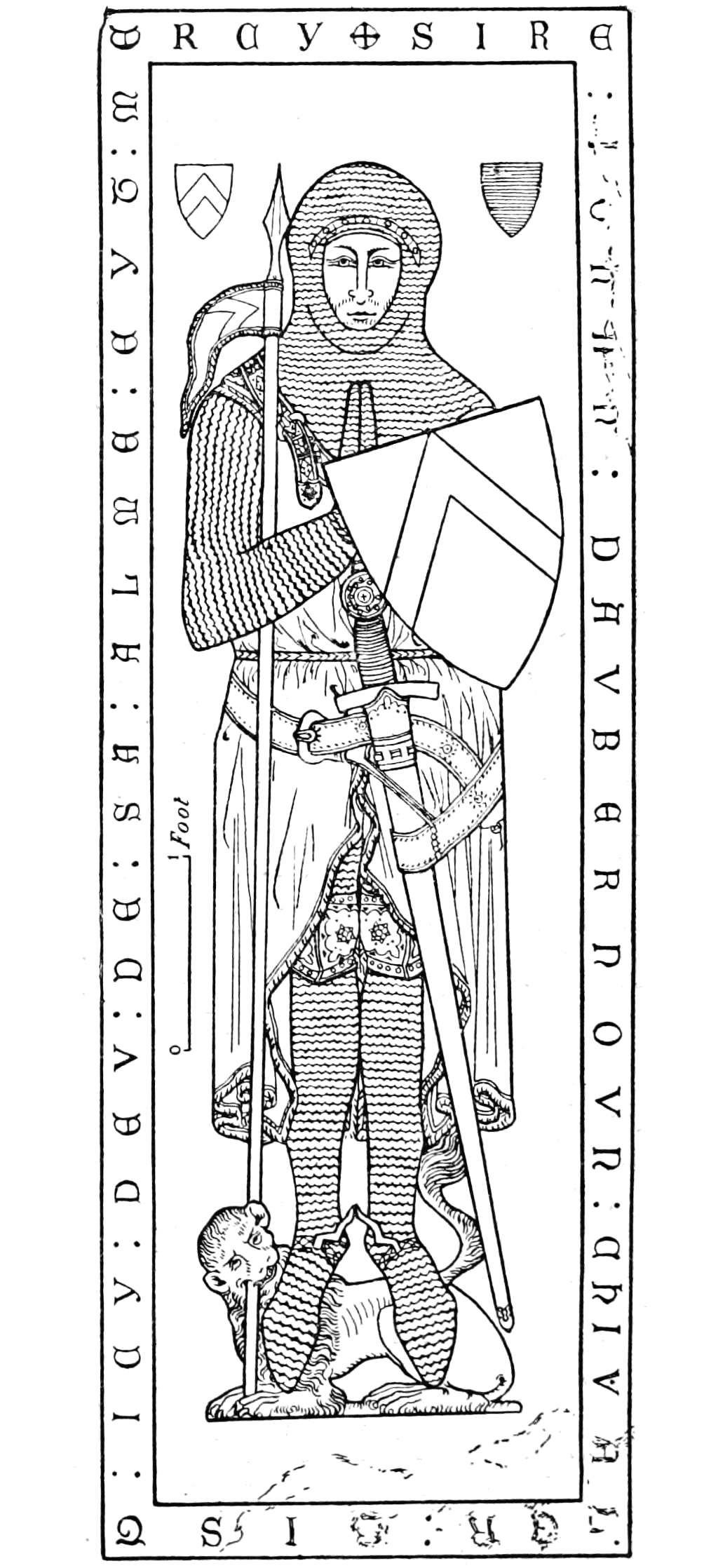
Fig. 1. Sir John Daubernon, 1277, Stoke d’Abernon, Surrey
The figure of Sir John
Daubernon (1) shows the
armour which had been
worn for the last three
centuries. He is in chain
mail with coif de mailles,
hawberk and chausses complete,
but the junctions of
these are not distinct.
Single-pointed prickspurs
are buckled round the
ankles. The only sign of
the coming change to plate
armour are the genouillères,
which protect the
knees and are adorned with
a fine pattern. They were
probably at first made of
leather, but later were of
plate.
Over the mail is a
linen surcoat, drawn tight
round the waist by a cord.
Suspended upon his left
shoulder is his shield, small
and heater-shaped, charged
with his arms: azure, a
chevron or. The ground of
the shield is in actual enamel—an almost unique
feature. The cross-handled sword is attached to a
broad belt and hangs in front of the body. This is
the only brass which shows the lance. His feet rest
on a lion, which is said to signify that he fell in
battle.
Sir Roger de Trumpington differs from Sir John
in several points. He has ailettes on his shoulders
charged with his arms—three trumpets—and his
shield is long instead of heater-shaped. Further, the
great tilting helmet is placed under his head and is
secured to his waist by a chain, and his legs are
crossed. In 1270 he went on the Seventh Crusade
with Prince Edward. So far as can be discovered,
this is the only brass extant of a Crusader, but several
other brasses of the same date have their legs crossed.
This does not prove that they were Crusaders, but
only that in some way they were benefactors to the
Church.
Sir Richard de Boselyngthorpe (a demi-figure)
wears gloves of fish-scale plates and holds a heart.
Sir Robert de Bures is considered to be the finest
military figure among all the brasses of England.
Sir Robert de Setvans is bare-headed and his
gloves hang loosely from the wrists, leaving his hands
bare. His arms (winnowing fans, hence the name
Setvans) are shown on his surcoat, ailettes, and long
shield. Both he and Sir Robert de Bures are
cross-legged. There is probably French influence in
this brass.
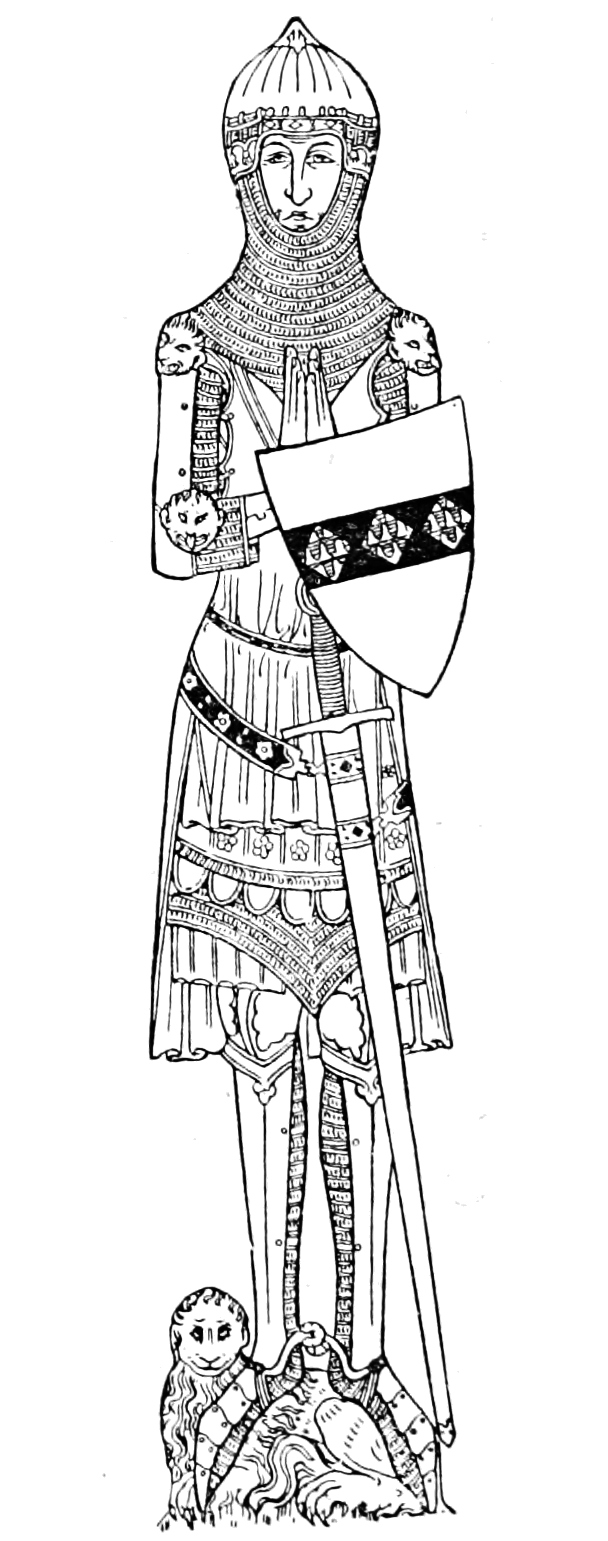
Fig. 2.
Sir John de
Creke, c. 1325,
Westley Waterless,
Cambs.
Next follow two transitional figures at Pebmarsh
and Gorleston. Both originally had canopies, which
have now entirely disappeared. In these
the outsides of the upper and forearms
are protected by steel plates strapped
over the mail, small elbow-pieces are
added, and round plates are fixed in front
of the shoulders and at the bend of the
arms. Shin plates may also be noticed.
Sir John de Creke is a fair example
of a fourteenth century knight clad
almost entirely in plate armour, for we
now pass definitely to the second type
of armour known as the “cyclas.” This
garment is shown in the illustration and
is also depicted in the brass of Sir John
Daubernon II. It takes the place of
the surcoat, is slit up the sides, and is
shorter in front than behind.
It therefore shows beneath, first the
gambeson, then the hawberk of mail, and,
finally, the padded haqueton. The hands
are bare and the hawberk sleeves short,
thus showing the forearms entirely protected
by vambraces of plate worn under,
not over, the mail. The upper arms have pieces of
plate over the chain, as before. A steel bascinet is
on the head, and the quatrefoil device on its apex
was probably meant to hold a crest or a lady’s favour.
Sir John (II) has the earliest ogee-arch canopy.
There was a fine double one at Westley Waterless,
but not a vestige of it remains.
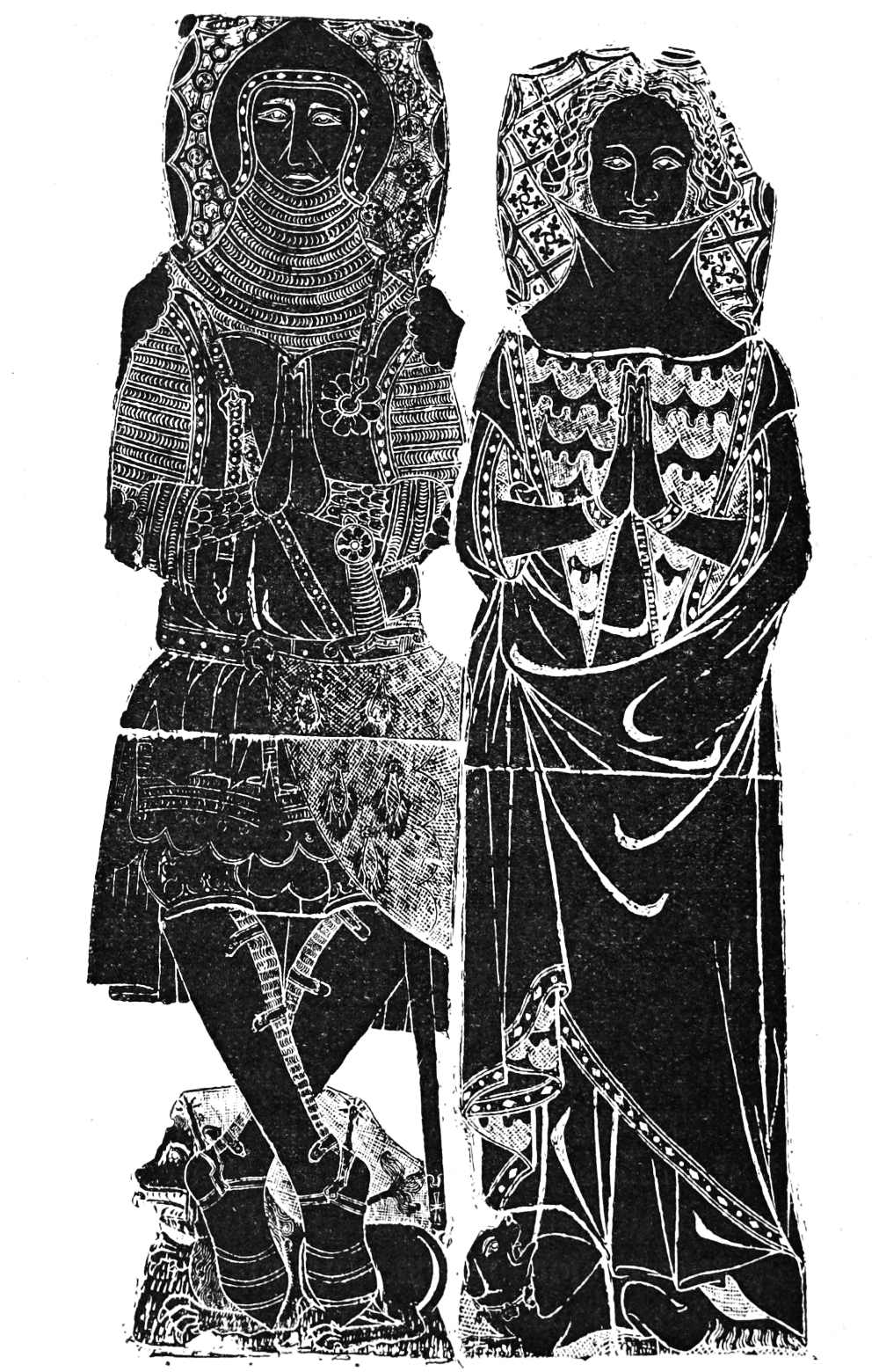
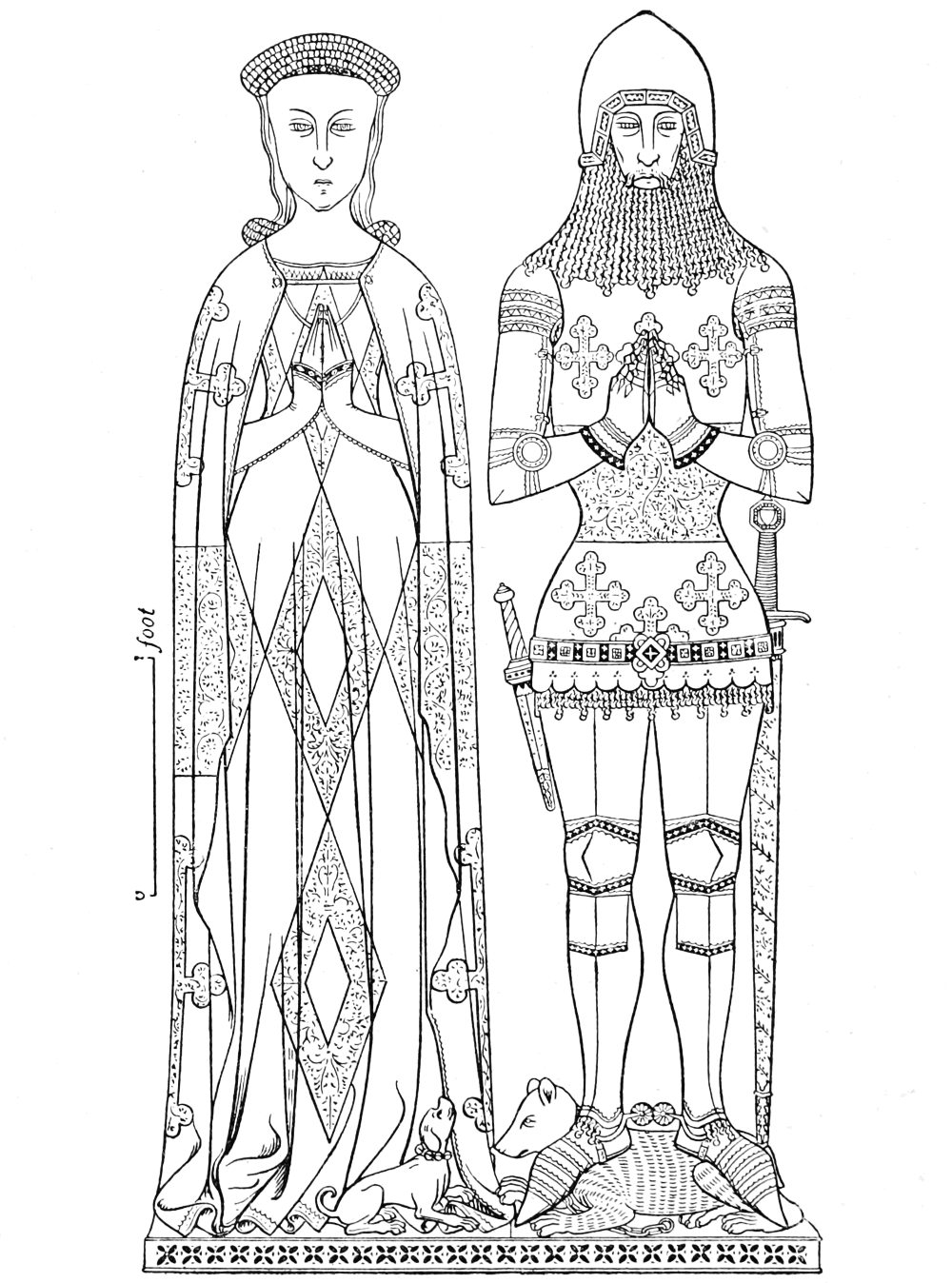
Sir John de Northwode’s effigy is almost certainly
the work of a French craftsman. His shield hangs at
his left hip instead of on his arm, which was a very
usual method in France. The style of the engraving,
too, points in the same direction. His helmet is secured
by a chain, his head rests on a pillow and his forearms
are protected by scale-armour. About 1510, the lower
portion of the figure having been lost, new legs were
engraved. Though an effort has been made to preserve
the style of 1330, yet the new work is obviously
Tudor. The altered shape of the feet and badly depicted
lion readily show this. At the same time, a
strip was cut out of the middle to make the knight of
the same length as his wife! This removed the arm
of the cross in his shield, as shown in the illustration,
but the missing piece has recently been restored.
Fig. 3. Sir John and Lady de Northwode,
c. 1330, Minster-in-Sheppey, Kent
Fig. 4. Lady Joan de Cobham, c. 1320, Cobham, Kent
We must now consider the costume of the ladies,
of whom the first is Margarete de Camoys, c. 1310.
There was originally a canopy of the earlier, or straight-sided
type, and a border inscription in Lombardic
letters. Further, there were eight shields and thirty-one
stars or other devices on the slab. The figure alone
survives and has on it nine
blank shields, probably the
matrices of shields of
enamel.
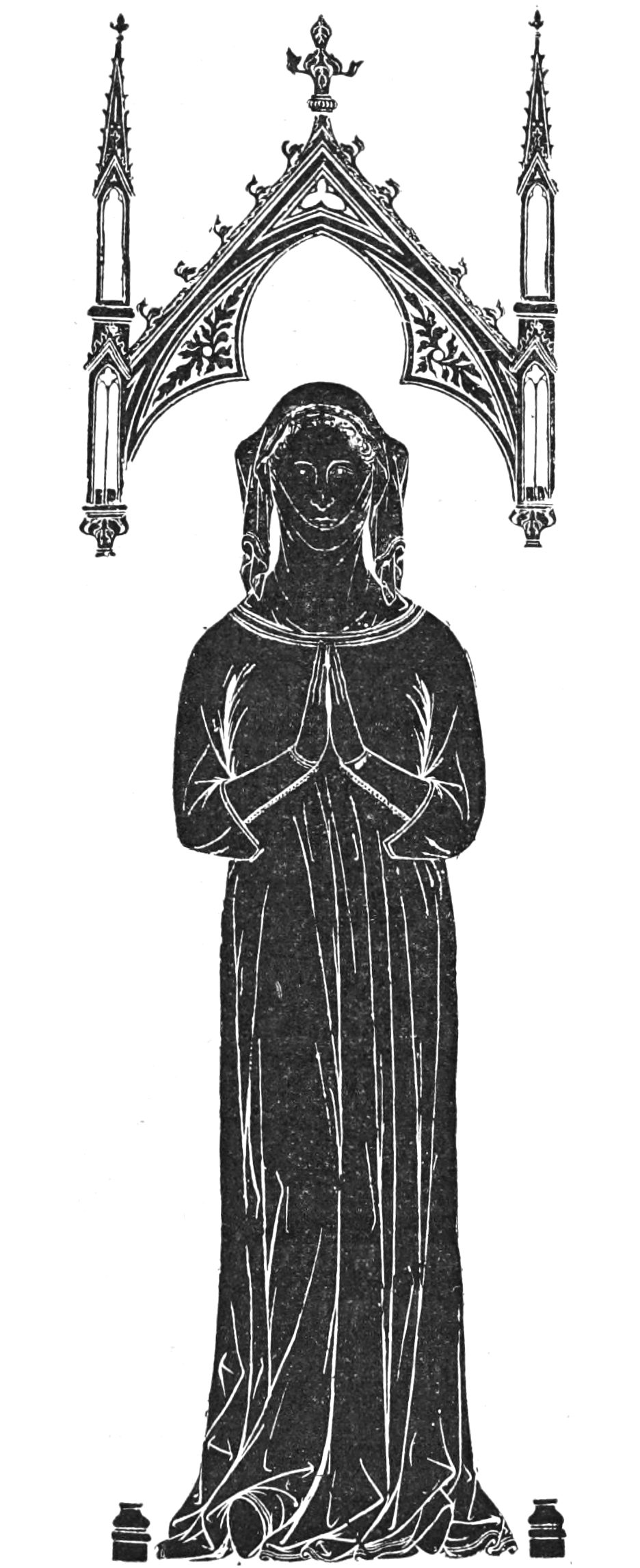
Joan de Cobham, c. 1320,
is the next lady. Her
straight-sided canopy is the
only survivor of this early
type. She wears a loose-fitting
robe with short
sleeves, below which can
be seen the sleeves of her
kirtle. Her head and neck
are covered with a veil and
wimple.
Lady de Creke wears a
long mantle fastened across
the breast by a cord and
gathered up under the arm.
The mark of the engraver
is at her foot. This is
almost unique.
Lady de Northwode has
a mantle with side openings,
through which the arms
pass. It is turned back in
front to show the lining of
variegated fur. The head
is bare and the hair plaited; a stiff wimple covers
the neck. Her head rests on a handsome cushion.
Maud de Bladigdone has a dress similar to Joan
de Cobham’s.
She and her husband are small demi-figures in
the centre of an octofoil cross, most of which had to
be restored in 1887. He wears a tunic buttoned
down the front, with tight sleeves having long lappets
from the elbows and a tippet over his shoulders. His
beard is small and forked.
The remaining brasses are to priests in mass
vestments, excepting Archbishop Wm. de Grenefeld.
But we shall deal with the vestments of the clergy in
a separate chapter.
The Chinnor, Merton College and Woodchurch
brasses are in varying forms of crosses. Chinnor has
only the head in the centre, Merton a fine demi-figure,
and Woodchurch a small figure. Until 1857
there existed a fine, large brass to a priest Adam de
Bacon (1310), at Oulton in Suffolk. Unfortunately in
that year it was stolen (and probably melted down).
The two remaining priests are simple demi-figures.
There was originally a fine canopy over Archbishop
Grenefeld with side shafts containing saints. All this
has long since perished and 18 inches of the lower
portion of the figure were stolen in 1829.
These early figures all have very curly hair.
CHAPTER II EDWARD III AND RICHARD II. 1328-99
We now find brasses commemorating members of
almost every class, but the first to claim our attention
will be the military ones.
A small group of three transitional but mutilated
brasses must be taken first:
Of these that of Sir Hugh Hastings (1347) at
Elsing, in Norfolk, is the most interesting. His legs
are now missing, but from an old rubbing in the
British Museum we know they were enclosed in chain
mail. The cyclas, worn shorter than hitherto, only
reaches to the middle of the thighs. Upon it is the
maunche or sleeve of the Hastings family, richly
diapered, and differenced with a label of three points.
This also appears on his small heater-shaped shield.
A belt hangs over his hips with the sword on the left
side, fastened in front. A hawberk of mail was worn
beneath the cyclas and the haqueton shows at the
wrists. A bascinet protects his head and a gorget
of plate encircles his neck. Additional plates are
attached to the arms, and roundels are placed at the
elbows and below the shoulders. Cuisses of pourpoint
appear for the first time upon the thighs. These
were of leather (cuir-bouilli) studded with small steel
plates.
The canopy (now much mutilated) is very fine.
Originally there were four canopied niches on either
side with “weepers,” or mourners, in the military
costume of the day. Three were missing, though of
these one, Lord Grey de Ruthyn, was preserved at
the Fitzwilliam Museum, Cambridge, and has lately,
we believe, been restored to its place. Those left
are: Top dexter side, Edward III crowned, with the
arms of England and France on his cyclas. Below
him, Thos. de Beauchamp, holding a lance. Top
sinister side, the Earl of Lancaster—Henry Plantagenet,
the next is lost, then Lord Stafford, and
then Almeric, Lord St Armand, who wears a ridged
steel hat with a broad rim over his bascinet, which is
almost unique.
Within a circle in the arch of the canopy is
St George, and beneath him the soul is being borne
upwards by two angels.
There are several other interesting details which
it would take too long to describe. The brass at
Wimbish, in Essex (1347), consists of a much mutilated
cross, which contains within its head Sir John de
Wantone and his lady. He greatly resembles Sir
Hugh, save that his legs are partly clad in plate, as
in the de Creke brass.
Sir John Giffard (1348) at Bowers Gifford in
Essex, has a suit of banded
chain with very few pieces
of plate, and at first sight
might be considered a reversion
to the type of Sir
John Daubernon I, but a
closer inspection will show
that his linen cloak is much
more like the jupon, which
was destined very soon to
take the place of the cyclas.
The head is lost. The Giffard
coat-of-arms (six fleurs-de-lys)
is displayed on his
shield.
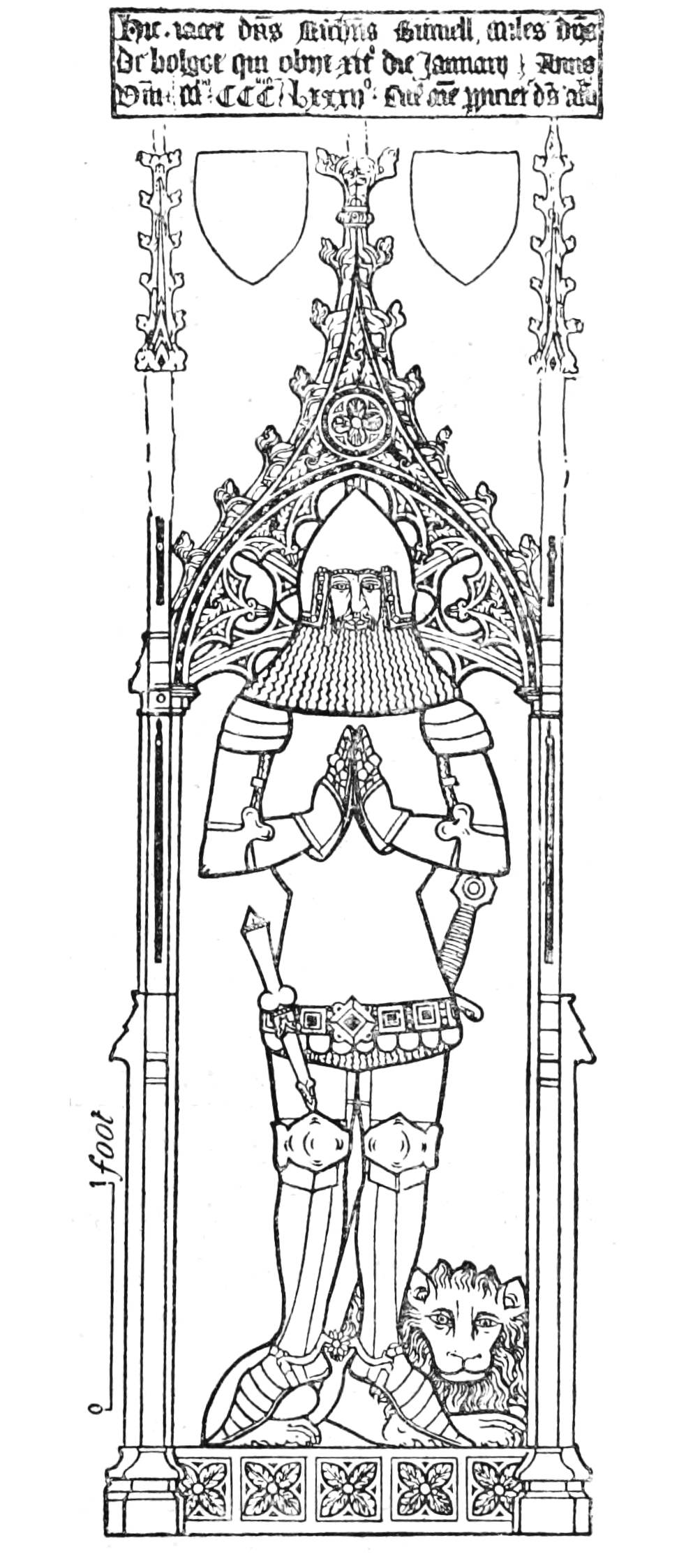
Fig. 5. Sir Nicholas Burnell, 1382, Acton Burnell, Salop
The Hundred Years’
War caused a development
of armour which lasted
practically unaltered for
fifty years.
The type is clearly depicted
in the illustration of
Sir Nicholas Burnell, 1382,
Acton Burnell, Shropshire.
The hawberk of mail has
shrunk to a vest and shows
only at the armpits and
lower edge. A cuirass of
steel covers this and has over it a leather jupon,
which is often ornamented with its owner’s coat-of-arms.
The Burnell brass here illustrated shows the
armour of this type. The sharply-pointed bascinet is
connected with the body armour by a camail of chain,
hence this style of armour is often called the camail
style. The arms and legs are entirely enclosed in
plate in the later examples, but in the earlier
cuirasses of pourpoint are used for the thighs, as in
the brass of Sir John de Cobham, 1365. A bawdric,
or broad belt, worn straight round the hips, held
on the right a misericorde (dagger) and on the left a
sword.
The dress of ladies of this period consists usually
of a close-fitting kirtle, buttoned tightly from neck
to waist and from elbow to wrist, and sometimes
right down the front. Over this is worn a mantle,
open in front, and kept in position by a cord across
the breast, see illustration.
Sometimes a third dress appears (with or without
the mantle) over the kirtle. It has two forms, one
very like the kirtle, but with close-fitting sleeves cut
short at the elbow, with long lappets; the other form
is the sideless cote-hardi. This is slit up at the sides
and edged with fur at the openings. It has no sleeves
or sides as far as the hips.
The first form is seen at Gt. Berkhampstead, Herts.,
1356, Bray, Berks., 1378, and elsewhere. The second
is found at Lingfield, Surrey,
c. 1370, and Cobham, Kent,
1375.
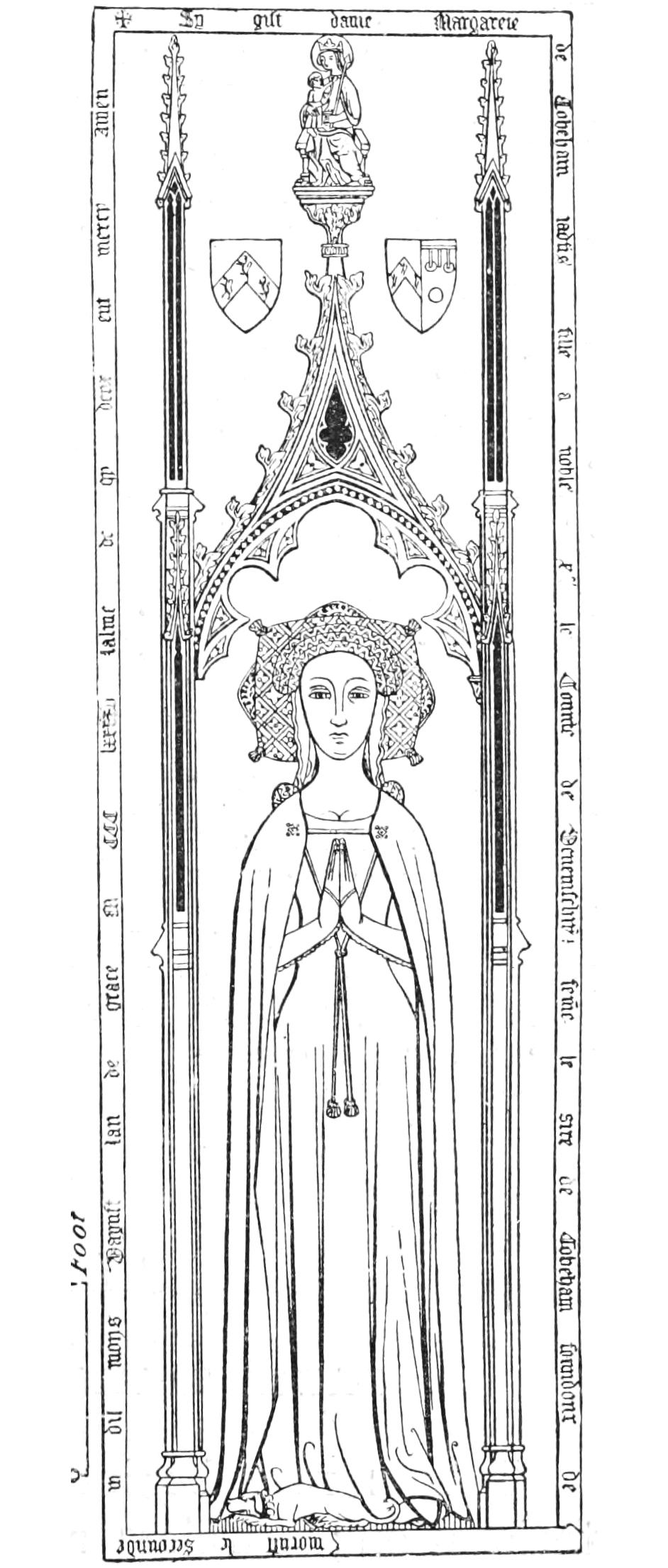
Fig. 6. Margaret, Lady Cobham, 1395, Cobham, Kent
A long overcoat sometimes
takes the place of the
mantle, as at Chinnor, Oxford,
c. 1385. The hair is
usually enclosed in a net
and plaited. Mittens are
often worn. Widows wear
a veil with a barbe and
wimple and are often hard
to distinguish from Vowesses,
i.e. ladies who at the
death of their husbands take
the vows in a nunnery.
Alianore de Bohun,
Duchess of Gloucester (1399),
being a vowess, is illustrated
in the chapter dealing with
the religious orders. With
its triple canopy it is one of
the most splendid brasses
still existing.
The Cobham brasses especially
should be noticed.
This church has the most
magnificent series extant
anywhere. They number 19 and most of them have
fine canopies. A visit to this little village is therefore
well repaid.
We must now turn to the civilians. These are
often of considerable interest.
By far the finest is the mutilated brass of Walter
Pescod. He lies beneath a fine canopy and super-canopy,
and further reference will be made to this
in the chapter on architectural detail. He wears a
close-fitting tunic buttoned down the front, and a
mantle with a hood. In the small demi-figures the
mantle is usually omitted.
Frankelins wore a tunic, hood, and mantle buttoned
over the right shoulder. From the girdle
hung an anlace, or short sword. This dress can be
seen at King’s Somborne, Felbrigg and Wimington.
Beards are usually, though not always, worn. Richard
Torrington’s feet rest on a lion, as if he were a
knight, but this is unusual. (See list.)
CHAPTER III LANCASTRIAN PERIOD. 1400-1453
There now begins to be evident a slight deterioration;
careless and poor work is found side
by side with some of the very finest. In part this is
because so many different classes were now adopting
this type of monument.
About 500 brasses belong to this period, including
clergy and laity.
The armed figures may be conveniently divided
into three groups, and it will be found that their
wives naturally fall into similar divisions.
The first is practically the same as that of the
later Plantagenets and still retains the camail. (See
list (I).)
Sir Wm. Bagot and his wife wear the collar of S. S.
This collar was conferred by Henry IV and the other
Lancastrians on their friends. It is found on many
brasses during this period and is worn by ladies as
well as knights. We may appropriately refer here
to the Order of the Garter. Unfortunately there are
not many instances of its being shown on brasses,
only six or seven being known. (See Appendix.)
Fig. 7. Thomas de Beauchamp, Earl of Warwick, 1401,
St Mary’s, Warwick
Our illustration of Thomas de Beauchamp, Earl
of Warwick, not only shows the style of armour, but
also that the armorial charges on his jupon and on
his wife’s mantle are wrought with a beautiful diaper
work. This way of depicting arms (by lightly engraving
the surface with dots, instead of lines) is
unique.
The ladies in this division, like their husbands,
wear practically the same costume as before. But
at the same time other brasses were being laid down
showing that changes were taking place. The jupon
was abandoned, and the plain cuirass shown. This
has a skirt of hoops, known as taces. These cover
the mail shirt, which gradually disappears. The
camail is likewise covered by a gorget of steel and
later abandoned. The bascinet becomes globular.
An interesting example of the transitional period
is the brass of Sir Thos. Swynborne and his father
at Little Horkesley in Essex. The father, Sir Robert
(died 1391), is shown in the armour of that date, while
his son shows the armour of 1412.
Later, roundels are placed at the elbow and in
front of the armpits. (See list (II).)
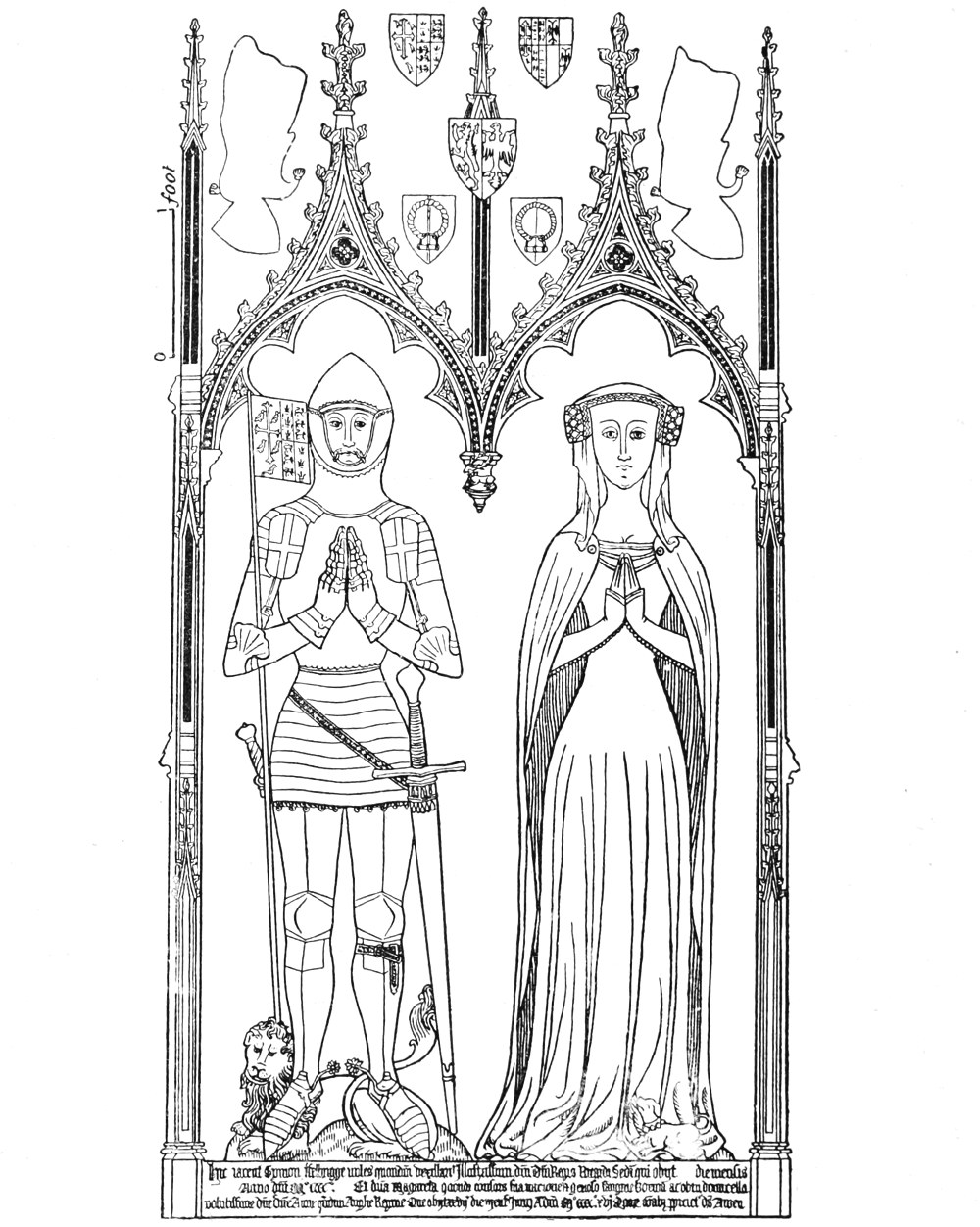
The illustration of Sir Simon Felbrigge is of
special interest. He holds the Royal Standard in
his right hand charged with the arms of Edward
the Confessor impaling France and England. He
was the Royal Standard bearer during Richard II’s
reign, yet was made K.G. by Henry V. He did not
die till 1443, but probably prepared his tomb in
1416. The palettes at his armpits are charged with
the cross of St George, and he wears the Garter.
Additional plates are placed on the shoulders and
cuirass. More changes now occur, the left side
begins to be more fully protected than the right,
since the extra weight would have prevented free
action. Tuilles or plates are strapped to the lowest
tace, and other slight changes become noticeable.
For examples of these changes see list (III) in
the Appendix.
Fig. 8. Sir Symon de Felbrigge, K.G., and Margaret, his wife,
1416, Felbrigg, Norfolk
Sir Christopher Baynham (c. 1448) at Newland,
Gloucester, has a most curious crest—a miner with
a candle in his mouth, a bag on his back and a pickaxe
in his hand. The brass is unfortunately rather
mutilated.
In the last section (section (iv)) the helmet is
discarded and the hair is close-cropped. The skirt
of taces is very long, having often ten hoops; tuilles
are not used. Pauldrons are worn on the shoulders.
The ladies do not vary in costume so much. The
mantle is often omitted and a high-waisted gown
with long sleeves and turned-down collar worn. The
hair is gathered into a net and a kerchief draped
over the top.
Examples may be found at Routh, Yorks., c. 1410;
East Markham, Notts., 1419; Digswell, Herts., 1415;
Horley, Surrey (canopy), c. 1420.
From 1420-1450 we find the plain kirtle and
mantle (occasionally the sideless cote-hardi, as at
Trotton) and the horned or mitred head-dress. This
means that the hair, enclosed in a net, is raised above
the head in the design indicated and then draped
with a kerchief. Most of the ladies depicted with
their husbands follow this arrangement.
Examples alone, at Hever, Kent, 1419; Lingfield,
Surrey, 1420; Cobham, Kent, 1433, etc.
The civilians are of great importance during this
period, and two groups demand special attention, the
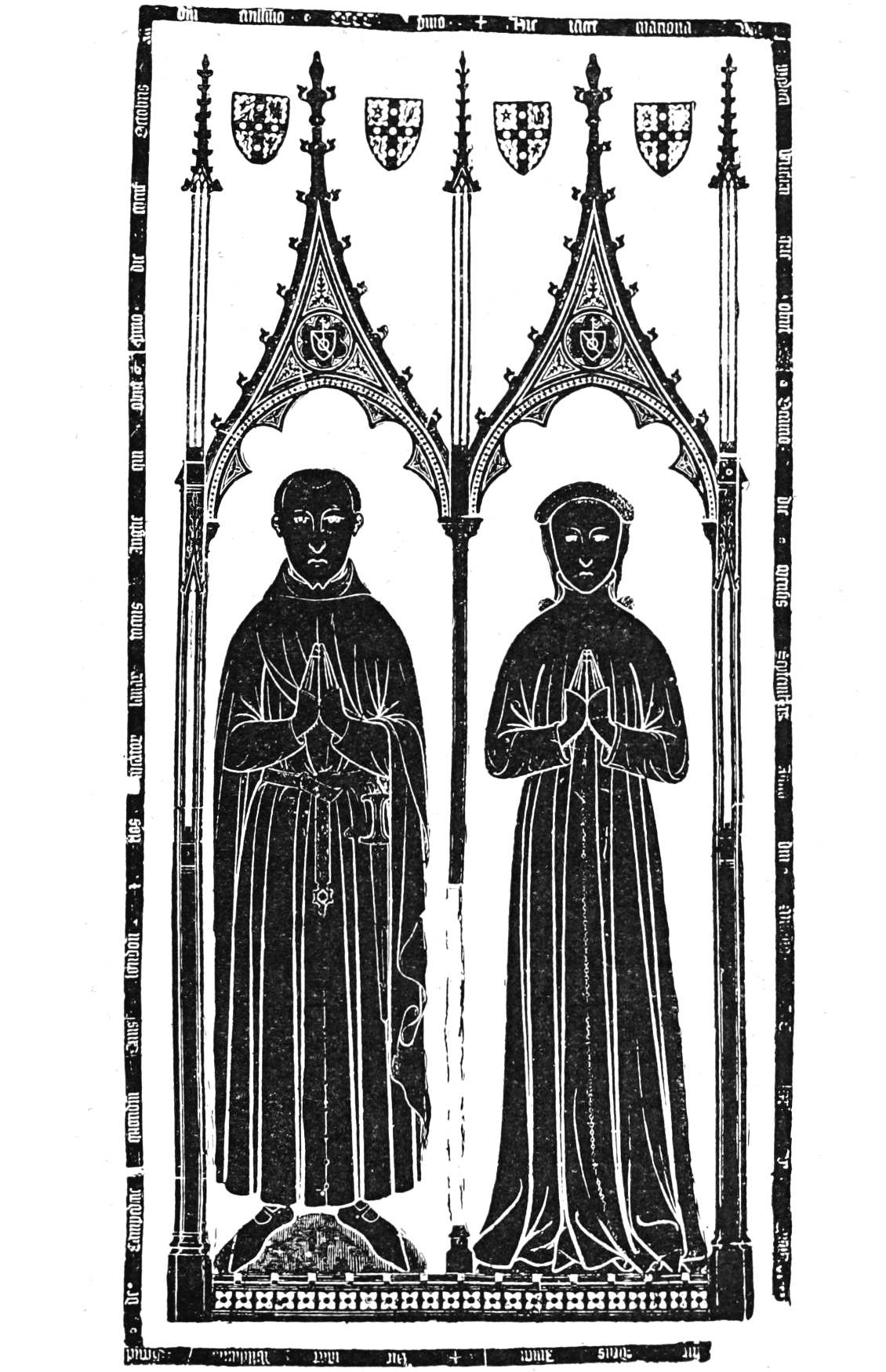
Woolmen and the Judges. Wm. Grevel and wife,
Chipping Campden, Glos., 1401 (woolman) may be
taken as an example of the earlier type. He wears
a long gown buttoned right down the front, a belt
with an anlace, and mantle opening at the right
shoulder. His wife has no mantle and wears a
similar dress to that of the Plantagenet period. The
magnificent double canopy has a central column, a
rare feature.
Fig. 9. William Grevel (woolman) and wife, 1401,
Chipping Campden, Glos.
This type of dress, with slight variations, continued
for the whole of the Lancastrian period. Towards
its close, however, certain changes became more and
more common. Mantle and hood are seldom seen,
except as a sign of municipal office. The dress
becomes shorter, reaching only a little below the
knees, the hair is cropped and there is no beard.
Nicholas Canteys, St John’s, Margate, 1431, is an
exception, having a long beard.
The brasses of the woolmen are the finest, as
they were the richest. Their feet often rest upon
woolpacks or lambs.
In many brasses, merchants’ marks on shields will
be found, as in Grevel’s. At Fletching, Sussex, there
is a curious brass to Peter Denot, glover, 1450. It
consists of a pair of gloves and an inscription.
The fine series of woolmen’s brasses at Northleach
are specially noticeable, and Gloucestershire takes
the lead throughout England, Lincolnshire coming
next.
We cannot leave the subject of the civilians without
referring to the legal profession. The judges
are by far the most important. (See Appendix.)
John Cottusmore and his wife (1439) have two
brasses; the first large, with a fine canopy on the
floor, the second small, on the wall, showing them
kneeling.
The costume consists of a gown reaching to the
feet, with close sleeves. A fur tippet, a mantle lined
with minever, a hood and a close cap or coif.
Fig. 10.
Sir John Cassy
and wife (part
of marginal inscription
omitted),
1400, Deerhurst,
Glos.
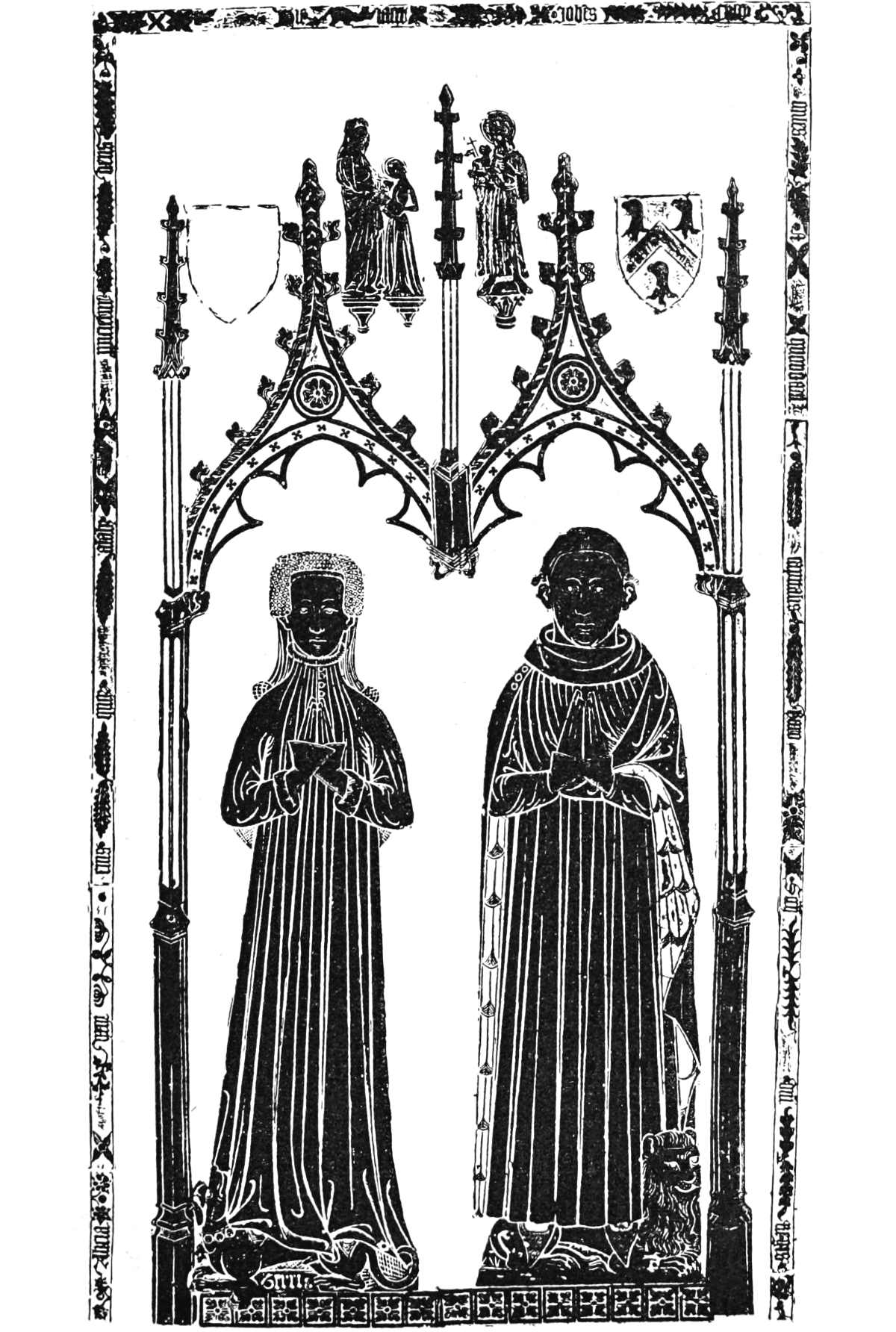
Sir John Cassy, chief baron of the Exchequer
(1400), has a magnificent brass at Deerhurst. He
shows most of these features but the tippet, which
is concealed. The fine double canopy no longer has
the figure of St John the Baptist, which was still
there when the rubbing was taken. The other figure
is of St Anne and the Virgin as a child. The
inscription, as is often the case in Gloucestershire,
is in raised letters with curious leaves, and a dragon
separating the words, but the lower part is here
omitted. The dog beneath Lady Cassy’s feet was
evidently meant to represent an old pet. It has a
collar of bells round its neck and its name, Terri,
underneath. This is the only named pet now extant,
but a “Jakke” existed formerly at Ingham, Norfolk,
on the brass of Sir Bryan de Stapleton, 1438. It
was sold as old metal in 1800.
Three Serjeants-at-law belong to this period:
John Rede, Checkendon, Oxon. (triple canopy), 1404,
Nich. Roland and wife, Cople, Beds., c. 1410, and
Thos. Rolf, Gosfield, Essex, 1439.
Thomas Rolf has the most characteristic dress,
consisting of a cassock and academical tabard, a
tippet, hood with two bands and a coif.
These include most types of civilian brasses, but
there are numerous variations, and therein lies the
interest of the subject.
CHAPTER IV THE YORKIST PERIOD. 1453-1485
During the Wars of the Roses, England was
practically isolated from the Continent. It is therefore
not surprising that this period has a character
of its own.
There are about 350 brasses, and these include
an entirely distinct type of armour and a characteristic
female head-dress.
There are not many really fine brasses, canopies
are few and heavy in design, and the engraving is
poor. The proportions are often bad. In particular
the head is often made too big or too small.
The great characteristic of the armour of this
period is the addition of extra pieces of huge size
and curious shape. Yet all were the outcome of the
exigencies of the time. So too were the ridges and
flutings which were meant to deflect the point of a
weapon. The armour was also decorated with punching,
engraving, etc.
During the wars in France, the knights had often
dismounted and fought on foot. During the Wars
of the Roses, they usually charged on horseback.
This explains why the heavier armour is on the
upper part of the body, while the lower is more
lightly protected.
Often the upper half therefore seems out of
proportion.
Usually the head is bare, but occasionally the
“sallad” or shell helmet is found, as at Castle
Donington, Cirencester, Addington, Sprotborough
and elsewhere. Among other peculiarities, a hooked
lance-rest is often screwed to the right side of the
cuirass, as at Hildersham. The elbow-pieces often
attain to an enormous size. The tuilles have been
re-introduced. The shoes are long and pointed, the
sword slung in front.
Fig. 11. Sir William and Lady Vernon, 1467, Tong, Salop
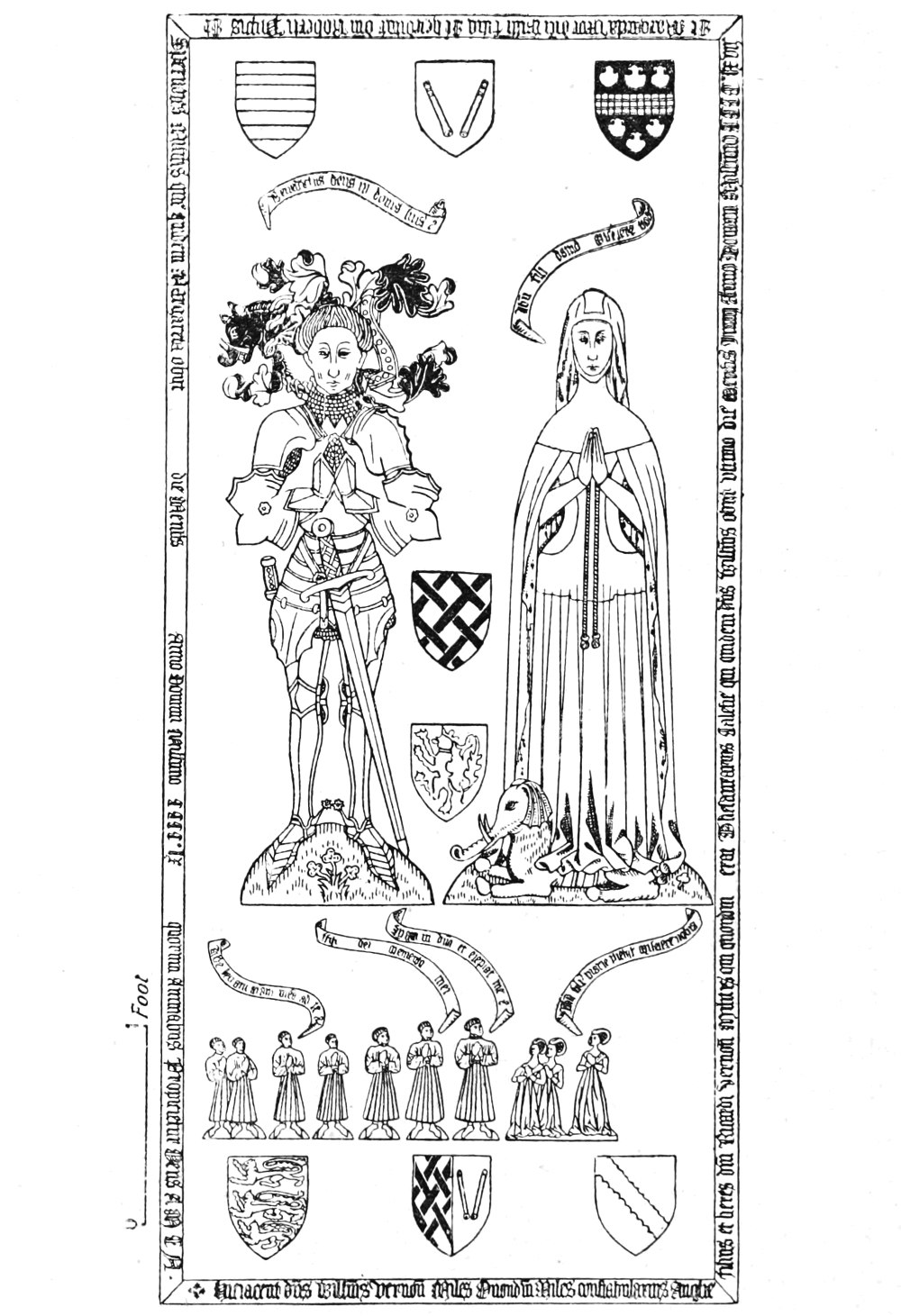
The illustration of Sir Wm. and Lady Vernon, Tong,
Salop, 1467, betrays one of the signs of deterioration:
the head rests on the helmet with crest, yet the
figure stands on a field of grass. His wife wears
kirtle, sideless cote-hardi, mantle, veil and the
widow’s wimple. Her feet rest against an extraordinary
dragon. This is probably in allusion to
her name and patron saint, Margaret, whose emblem
was a dragon.
In the Morley brass (1470) the knight rests his
head on his helmet and stands on grass and flowers.
The two wives wear the mitre head-dress and there
are three saints above. These are St Christopher,
St Anne and the Virgin, and St Mary and Child.
During this period, armorial tabards and heraldic
kirtles and mantles became common.
The earliest tabard is at Amberley, Sussex, 1424.
Examples during the Yorkist period are found as
follows: Wm. Stapilton and wife, Edenhall, Cumberland,
1458; Hen. Grene and wife, Lowick, Northants.,
1467; Sir Jn. Say and wife, Broxbourne, Herts., 1473;
Sir Thos. Sellynger and wife, St George’s Chapel,
Windsor, 1475; Philip Mede and two wives, St Mary,
Redcliff, Bristol, 1475.
The Yorkist collar of stars and roses takes the
place of the S.S. It is found at Broxbourne, St
Albans, Little Easton, 1483, and elsewhere.
The horned head-dress of the ladies changes to
the mitred, as at Thornton and Morley. The
memorial of Ly. Joyce Tiptoft, Enfield, Middlesex,
c. 1470, is one of the few really fine brasses of the
period and shows the dress and armorial bearings
well. The canopy is fine, possibly copied from that
of the Duchess of Gloucester (1399) in Westminster
Abbey. The arrangement of shields hung from the
shafts of the canopy is only one of several similar
features. The head is far too large, as is often the
case at this date, and spoils the general effect. Her
jewelled necklace should be noticed (page 57).
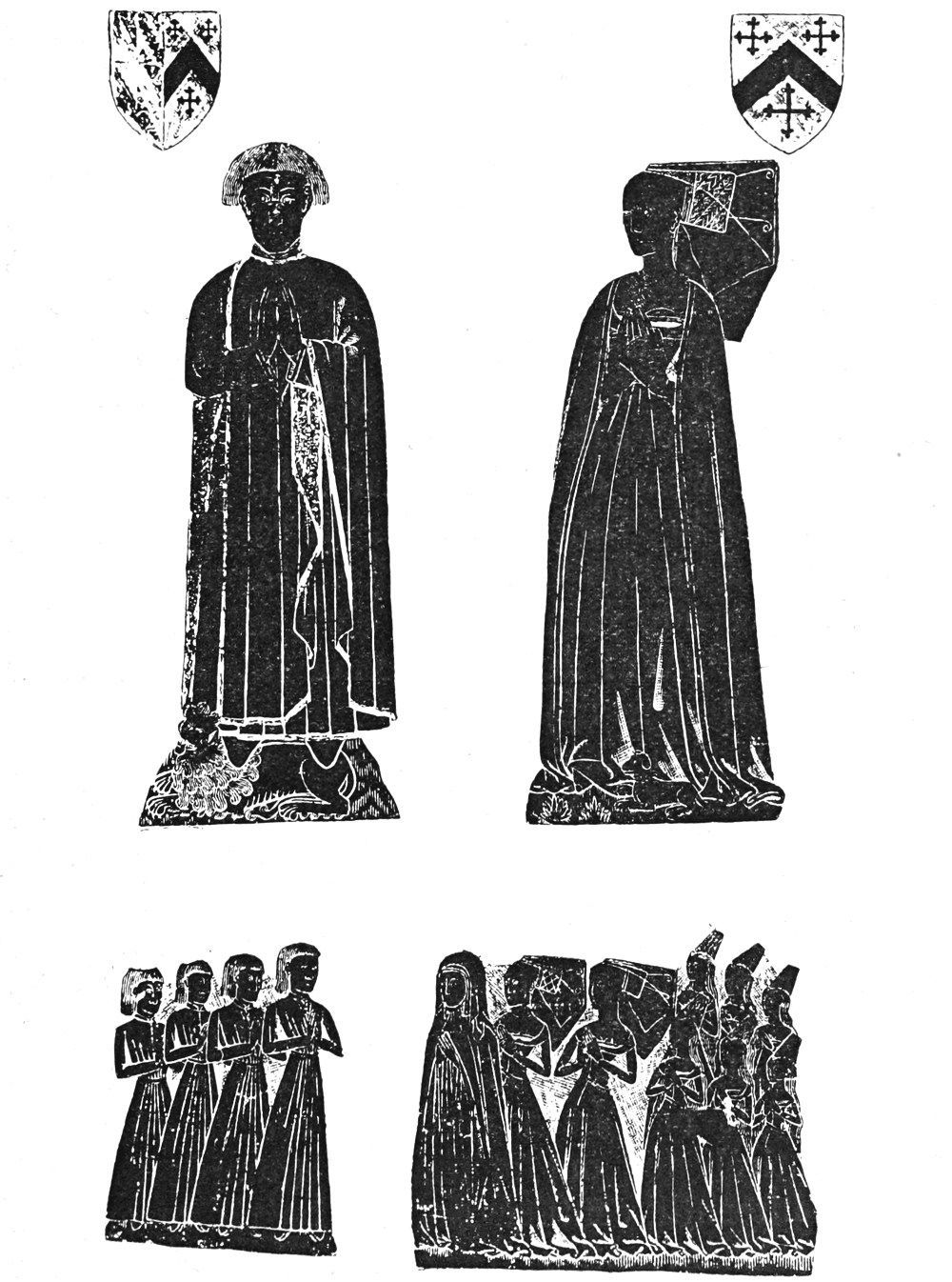
Fig. 12. Sir Thomas Urswyk and family, 1479, Dagenham, Essex
The butterfly head-dress begins to replace the
mitred head-dress, hitherto in vogue. A veil of
gauze was extended over wires. In real life it was
doubtless light and beautiful, but in brass it looks
heavy and ungainly. The wife of Sir Thos. Urswyk,
Dagenham, Essex, shows this type of coiffure. She
also wears a low-necked gown, showing the upper
part of the corsage. Her cuffs and necklace are
characteristic, and her somewhat awkward poise is
typical of the period. Her daughters are of special
interest. The head-dresses of the six younger are
formed by conical nets of several designs, their long
hair hanging down behind. These examples are
unique. The eldest daughter is a nun, and the other
two resemble their mother, but wear no mantle.
The sons wore the ordinary civilian costume of the
time, but have quite recently been stolen.
Widows still wear the wimple, and maidens have
long, flowing hair.
There is but little variety in the dress of civilians.
The anlace becomes rare and its place is often taken
by a rosary. The hair is close-cropped, and the
figures usually small. Mantles are only worn as a
sign of office.
The Woolmen and the Lawyers represent the
best work to be seen at this epoch. Of the latter,
Sir Thos. Urswyk, 1479, Chief Baron of the Exchequer,
already mentioned, will serve as an example. He is
bare-headed, and the fur lining of his mantle is visible,
as is his rosary. His sons display the usual costume
of the day without the mantle.
Notaries wear a plain gown with pencase and
inkhorn hanging from the belt. A scarf and a cap
are fastened on the left shoulder. (Appendix.)
We have now come to the close of the Middle
Ages. The signs of deterioration of this, as of other
medieval arts, are apparent.
The question may be asked—In what language
and type were the inscriptions engraved? Briefly,
the earlier (in Norman French) are engraved in
separated Lombardic letters which were inserted
round the edge of the slab. This gave place
to a border fillet. This fillet soon began to be
engraved in Gothic characters. In the fifteenth
century Latin became the usual language—from the
beginning it had been used for ecclesiastics. It
never entirely fell out of use, but towards the end
of the fifteenth century English began to appear.
During the sixteenth and seventeenth centuries the
latter takes the place of Latin to a large extent.
Roman characters replaced Gothic in the seventeenth
century.
The arbitrary contractions of words employed by
the engravers from the earliest to the latest periods
render the deciphering of a large proportion of the
inscriptions no easy task.
CHAPTER V MEDIEVAL CLERGY
Deacons.
There is no complete brass to a deacon now
extant, and there exists but one solitary mutilated
example at Burwell, Cambridge, on the reverse of
part of the brass of John Lawrence, Abbot of
Ramsey.
The dalmatic was their distinguishing vestment.
It was shorter than an alb, slit up on either side for
a short distance and had a straight edge before and
behind. The left side and lower edge were fringed
for a deacon, both sides when worn by a bishop.
When St Stephen, St Philip or St Lawrence
appear in canopies, they wear this vestment.
The tunicle was worn by sub-deacons. It is
similar to the dalmatic, but of linen, whereas the
latter was usually of silk and often richly decorated.
Mass Vestments.
The most numerous brasses to the clergy are to
the incumbents of our country churches, and these
are usually depicted in mass vestments. The average
country parson was, as now, a man of modest means,
and so it is not surprising that these brasses as a
rule are small, and very few have canopies or even
marginal inscriptions. There is but little development
in any of the vestments, as these had become
fixed in their main features many centuries earlier.
The chief characteristic change is that the hair
of early ecclesiastics is long and curly and tends to
become less so, till by Tudor times it is absolutely
straight. In fourteenth century brasses the material
of the vestments seems to be thin and fits closely to
the body, whereas later it is stiff and heavy.
The fylfot cross is found on the vestments of
many priests, as at Kemsing, Kent, c. 1320, and in
the brass of Rich. de Hakebourne, Merton College,
Oxford, 1310. This ancient symbol, known in the
Sanscrit as the swastika, is found on Buddhist
inscriptions in India and China, on Greek vases and
Roman pavements (as at Brading, I.o.W.) and on Runic
inscriptions and elsewhere. On brasses it is mainly
found upon those of the fourteenth century.
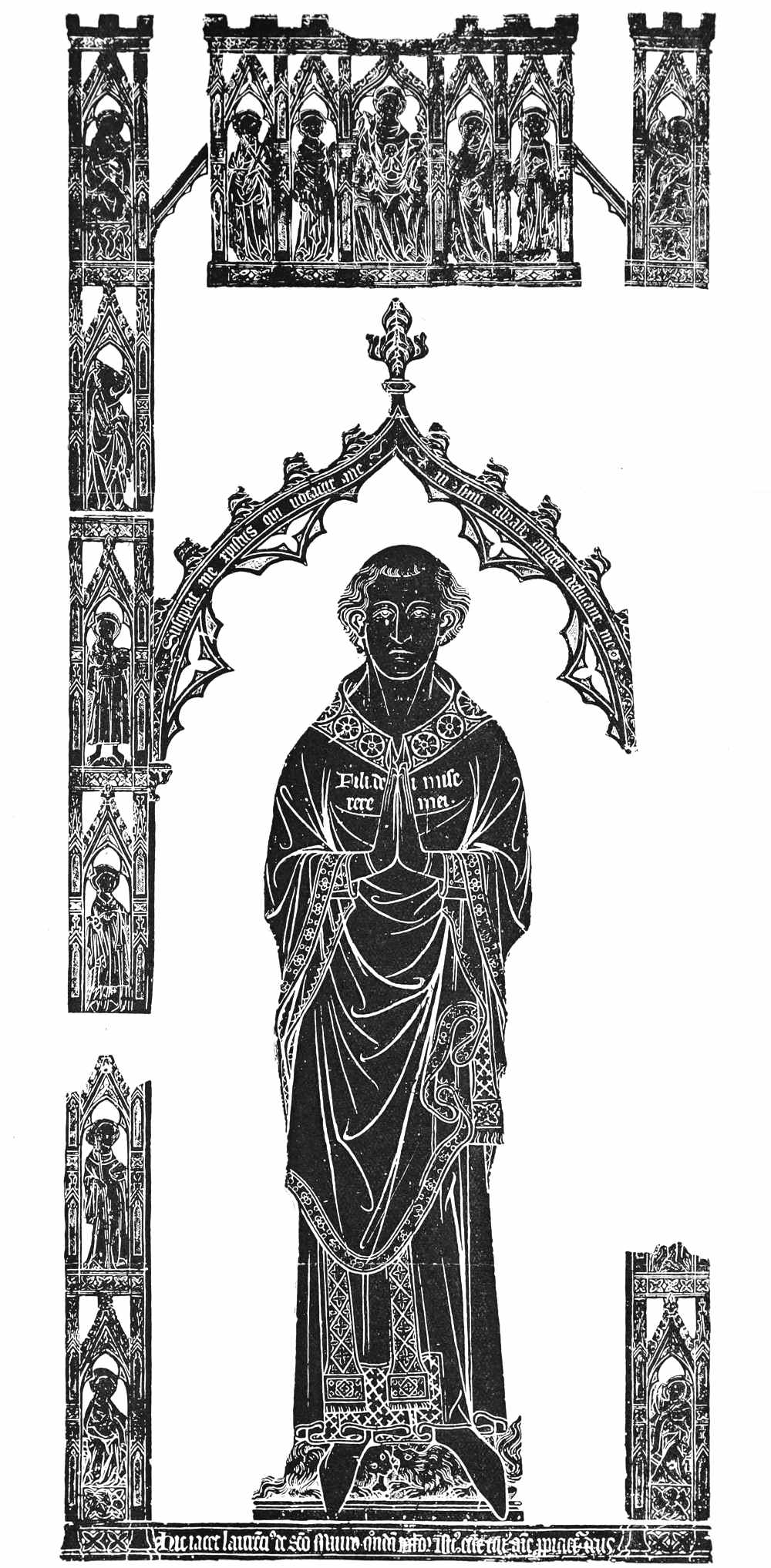
We will consider in detail the monument of
Lawrence de St Maur, 1337; at Higham Ferrers,
which must serve for all the others (see frontispiece).
It is by far the finest, and, indeed, there are only four
or five others with canopies at all, and hardly a dozen
have effigies over three feet long. The central panel
of the canopy contains God the Father, the soul and
two angels, St Peter and St Paul, St Andrew and
St Thomas. At the four corners are the Evangelists.
Then, St Gabriel opposite (perhaps) St Mary; St
John Baptist opposite (perhaps) the Magdalene; St
Stephen opposite (perhaps) St Lawrence; the Abbot
St Maur opposite St Christopher, whose bare feet can
be seen standing in a river. Beneath the priest’s
feet are two dogs quarrelling over a bone.
The total length of the brass is 8 ft. 3 inches, and
breadth 3 ft. 5 inches.
The figure wears an alb with apparels at the foot
and on each arm. In the earliest brasses these
pieces of embroidery went right round the wrists,
but they were soon reduced to simple squares. The
amice encircles the neck and is like a handkerchief
with a strip of embroidery along one side. As worn
it looks like a collar. The stole was crossed over the
breast and held in place by the girdle of the alb.
Usually, as here, only the ends can be seen. At
Sudborough, Northants., 1415, at Horsham, Sussex,
c. 1430, and at Upwell, Norfolk, 1435, it can be seen
in entirety. Over the left arm hangs the maniple,
a strip of embroidery, similar to a stole. Over all
he wears a fine chasuble. In this case there is a
narrow band of embroidery round the edge, but this
is unusual. The ordinary type is perfectly plain.
In the sixteenth century a central pillar of embroidery
or orphrey is common. It is also found on the
chasubles of bishops and abbots at an earlier date.
Occasionally, the whole ground was covered with a
pattern.
It will be noticed that many priests are represented
holding chalices. There is quite a considerable
group of brasses consisting of chalices only.
They all commemorate priests. The selected list in
the Appendix will be useful to those who wish to
study them more closely. It was customary to bury
pewter chalices with priests who were interred in
their mass vestments. The author himself has one
of these coffin chalices. It was probably from this
custom that the idea originated of making chalice
brasses. The earliest are in Yorkshire; there are
many in Norfolk, but few outside these counties.
Robt. Wodehowse’s brass at Holwell, Beds., 1515,
has as a rebus two wode-howses, or wild men, with
clubs, on either side of the chalice.
There is a peculiar brass at Winwick, Lancashire,
to Sir Peter Legh, 1527. On the death of his wife,
he gave up his calling as a knight and became a
priest.
He is bare-headed and has a tonsure. Over his
armour he wears a chasuble, and between his hands
is a coat-of-arms.
CHOIR AND PROCESSIONAL VESTMENTS
The Almuce.
Except when at Mass, the usual vestments worn
were cassock and surplice, almuce, hood and cope.
The cassock was the ordinary walking dress of the
clergy. In a few cases it is shown alone. (Appendix.)
The almuce was a large cape turned down over
the shoulders and lined with fur. D.D.’s and canons
wore one lined with grey fur, and the former had the
outside cloth scarlet.
All others wore dark-brown fur. The tails of the
animals were sewn round the edge and two long
lappets hung down in front. The fur lining is the
only part shown in brasses, and this is usually represented
by cutting away the metal and filling up the
surface with lead or coloured earths. Of these there
are a fair number. (Appendix.)
The Cope.
More usually the cope accompanies the almuce.
Over a hundred brasses of coped priests remain.
Many are both large and fine, with canopies. They
usually commemorate Church dignitaries.
The cope was a beautiful and costly vestment,
shaped like a cloak, and was fastened across the
breast by the morse. Orphreys adorned the straight
edges. The general surface was usually plain, though
occasionally covered by a pattern, as in the case of
Robt. Langton, Queen’s College, Oxford, 1518, and
John White, Winchester College, Hants., c. 1548.
This is generally a sign of late work. A small, semicircular
hood attached to the back of the cope was
usually hidden by the upper part of the almuce,
the lappets of which are also visible beyond the long
sleeves of the surplice.
The two following are among the finest extant:
John Sleford, Balsham, Cambs., 1401, was Rector
of Balsham, Master of the Wardrobe to Edward III,
Chaplain to Queen Philippa, Canon of Wells and
later of Ripon, Archdeacon of Wells, etc. The whole
composition measures 8½ ft. × 4½ ft., and the figure is
5 ft. 2 in. long. The triple canopy supports a shrine
which is divided in half. The lower portion shows
the soul of the deceased supported in a sheet by two
angels. He is being borne up to the Holy Trinity,
who are represented in the upper story. Two
seraphim are poised on the finials of the two side
arches.
The shields are: dexter, quarterly Old France
and England; sinister, the same impaling Hainault.
The arms of the See of Ely (three crowns) are shown
on the third shield, and the fourth is lost.
Down the orphreys of the cope are depicted five
pairs of saints under embattled canopies: St Mary
and St John Baptist; St John the Evangelist and
St Etheldreda; St Catherine and St Peter; St Paul
and St Margaret; St Mary Magdalene and St Wilfred.
The sacred monogram I. S. is shown on the
morse and also on two roundels.
The other brass is equally fine and measures
8 ft. 9 in. × 4 ft. 1 in.
John Blodwell was Dean of St Asaph, Prebend
of Lichfield and of Hereford, Canon of St David’s
and Rector of Balsham. His canopy is of a different
type to Sleford’s. It has a single arch resting on
broad shafts, in each of which are four niches with
saints. The cope has saints down the orphreys which
are rather worn. The whole surface is adorned with
lions’ heads. The inscription is in a dialogue between
Blodwell and his guardian angel. The Dean’s words
are in relief.
The alb and amice are substituted for surplice
and almuce at Horsham, 1411, Upwell, 1428 and
1435, Beeford, Yorks., 1472, Hitchin, 1498, and
Rauceby, 1536.
Canons of Windsor, instead of a cope, wore the
mantle of the Order of the Garter. It has a small
cross on the left shoulder and is found on the brasses
of Roger Parker (headless demi), Northstroke, Oxon.,
1370; Unknown, Bennington, Herts, (mutilated, an
ordinary cope with badge on shoulder), c. 1450; Roger
Lupton, Eton College, 1540; Arthur Cole, Magdalen
College, Oxford, 1558.
Academic Dress.
There are a considerable number of brasses
showing the academic dress, in all 75 to 80.
About one-third are at Oxford and Cambridge,
and the rest are widely scattered. The distinction
between the various degrees being usually made by
the colour and material rather than by the shape
renders the task of differentiating difficult.
The academic tabard without sleeves, the cape or
tippet, and the hood are usually worn over a cassock,
as on the brasses of Thos. Mason, M.A., of Magdalen,
Oxford, 1501, and of John London, M.A., S.T.P., of
New College, Oxford, 1508. Sometimes the academic
tabard has short sleeves.
The taberdium talare is longer and probably
implies a B.D., though it is worn by others who had
not this degree. Good examples are to be seen on
the brasses of John Bloxham, B.D., Merton College,
Oxford, c. 1420 (with John Whytton on bracket) (see
Chap. XIV), and of Wm. Blakwey, Little Wilbraham,
Cambs (kn.), 1521.
D.D.’s have the cappa clausa. This is a plain,
sleeveless gown, and the arms appear through a
single opening, which only reaches to the waist.
The tippet is usually of fur, and a cap is worn. The
latter is either a skull cap or raised one or two
inches and brought to a low point in the centre.
The first type is shown in the brass of Dr Billingford,
St Bene’t’s, Cambridge, 1432; the second in the brass
of Dr Towne, at King’s College, Cambridge, 1496.
Doctors of other faculties wear the cap and
pallium, a long gown similar to the taberdium talare.
It must not be confounded with the pallium of an
archbishop. Many academic persons wear the cope
or almuce, sometimes with the doctor’s cap. There
are a few academic brasses of Elizabethan and
Jacobean date. They usually show the long, civilian
gown of the period. From it has developed the
present University gown, which has not sprung from
the ancient tabard.
Bishops.
Bishops and Mitred Abbots wore the mass vestments
of the priests with certain additions. The
tunicle and dalmatic were worn below the chasuble.
The former is often of the same length as the
dalmatic and so cannot be seen. Sandals adorned
with jewels and gloves similarly ornamented were
usually worn. The episcopal ring had a single precious
stone.
The mitre and crozier are perhaps the most
characteristic vestments. The earliest mitres were
low with plain edges; they gradually became higher
and crockets were added to the sides of the horns.
In brasses the extreme height to which they developed
is not shown. They were made of plain linen, of
embroidered linen and of precious metals. Two
narrow strips of silk called “infulae” hung down
from the back of the mitre. These can be seen in
the brasses at York and East Horsley.
The crozier and pastoral staff are the same, the
cross staff of the archbishop is not really a crozier
at all. The latter represents the shepherd’s crook.
A scarf was often fastened to the knob below the
crook. It was called either an “infula”—like the
ribbons of a mitre—or “vexillum.” The latter name
refers to the Cross banner of Constantine.
Croziers and mitres are depicted long after vestments
had fallen into disuse. The last crozier, 1631,
is at Chigwell, Essex. Mitres are found even later,
but are probably used as a crest.
Archbishops generally hold the cross staff instead
of a crozier and wear the pall. It was simply a
narrow loop of white lamb’s wool placed round the
neck and with a weighted band hanging down before
and behind.
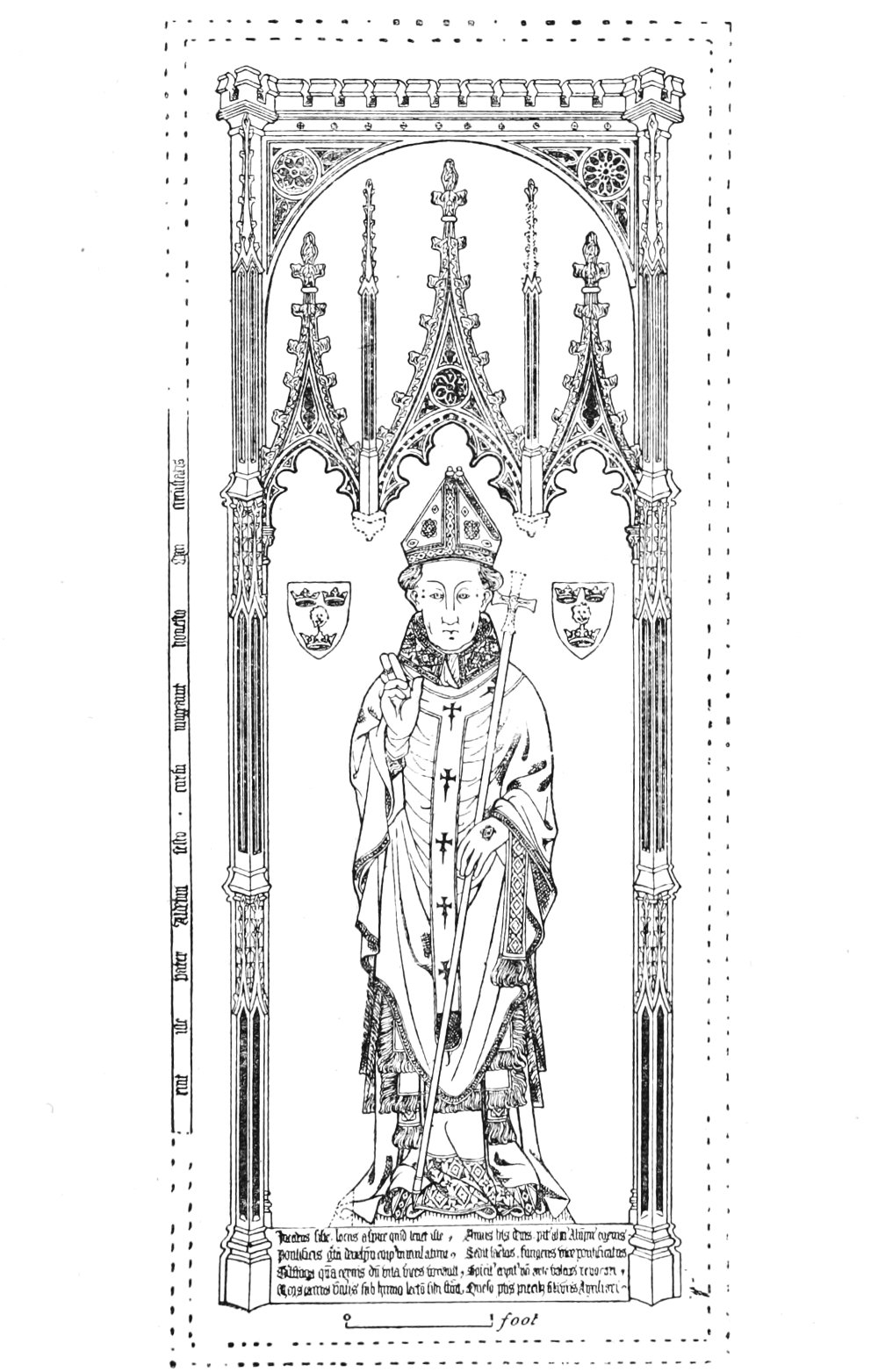
Fig. 15. Thomas Cranley, Archbishop of Dublin, 1417,
New College, Oxford
Thos. Cranley, 1417, clearly shows all the vestments;
his cross, as was often the case, was a
crucifix. The triple canopy with super-canopy is
exceptionally fine, though somewhat mutilated.
The crozier, or cross, is usually held in the left
hand. The mitred abbots wore exactly similar
robes.
Bishop Wyvil of Salisbury, in three-quarter length,
1375, is shown within a battlemented castle with
his champion standing under the gate beneath. This
commemorates his recovery of Sherborne Castle for
his See.
The Edenham brass (c. 1500) was formerly in a
panel on the outer face of the church tower, 40 feet
from the ground. It is now inside the church.
Probably it represents St Thomas à Becket, the
patron saint of the donor of the tower.
Bishop Goodryke of Ely, 1554, wrote “My duty
towards my neighbour,” and holds the prayer book
in his hand. He also holds the Great Seal, as he was
formerly Lord Chancellor. Both he and Bishop
Bell died during the reign of Mary, which might
be considered sufficient explanation of their wearing
vestments. Bishop Pursglove, however, whose brass
is at Tideswell, died in the middle of Elizabeth’s
reign.
The fact is that vestments only gradually fell into
disuse. They were undoubtedly worn by some of
the clergy right into the seventeenth century.
The figure of John Bell at St James’s, Clerkenwell,
the lower part of which is lost, was sold in 1788 when
the old church was pulled down. It passed into the
collection of Mr J. B. Nichols and on his death was
replaced in the new church.
The vestments in which the king is crowned are
largely of an ecclesiastical nature. They include the
dalmatic, the surcoat, the belt, the stole and a surplice
without sleeves. On monuments, kings are shown
wearing a long tunic with close sleeves, a cloak, or
cope, and a tippet of ermine. The only brass is a
demi-figure, c. 1440, at Wimborne Minster, Dorset,
laid down in memory of King Ethelred, martyred
872 A.D. He is crowned and holds a sceptre.
CHAPTER VI THE MONASTERIES
The influence of the monasteries during the
Middle Ages was considerable, and it was in them
that the lamp of learning and art was kept burning.
The causes which led to their destruction would be
too long a matter to discuss here. In justice we
must say that the charges of gross immorality levied
against the monks were neither fair nor were they
the real reason for the dissolution of the monasteries.
The last monastery had fallen by 1540. In most
cases the churches were destroyed, and even when
they were preserved the brasses were taken from
the gravestones and sold by the Commissioners who
confiscated the property.
Thus at St Albans there were over 270 brasses,
and now there are hardly a dozen. In all England
there are barely 30 monastic brasses left. They
include seven monks and a friar, two abbesses, a
prior and five vowesses, besides one or two doubtful
examples.
Besides the three abbots already mentioned as
showing episcopal vestments, there are four mutilated
fragments on the reverse of palimpsests (see
below). These will be given in the list of palimpsests.
The dress of a monk included the tunic, an undergarment,
with the gown over it, the scapula and cowl
or hood. The tonsure is much larger than that of
a parish priest.
Abbot John Lawrence at Burwell, 1542, was
originally shown in full vestments, but as he survived
the dissolution his brass was changed. He
now appears in cassock, surplice and almuce. The
upper part of the figure is new, but the lower shows
on the reverse the original engraving. There is a
canopy, part of which is palimpsest and shows, on
the reverse, part of a deacon, c. 1320.
The Benedictines were by far the richest and
largest of the Orders. The Cluniacs were a reformed
order of Benedictines. The chief difference
was that each monastery was under the direct supervision
of Cluny, and not of the mother monastery
from which it sprung. In England there was an
exception and Lewes stood in the position of Cluny
to the other English Cluniac monasteries. It alone
was directly under Cluny.
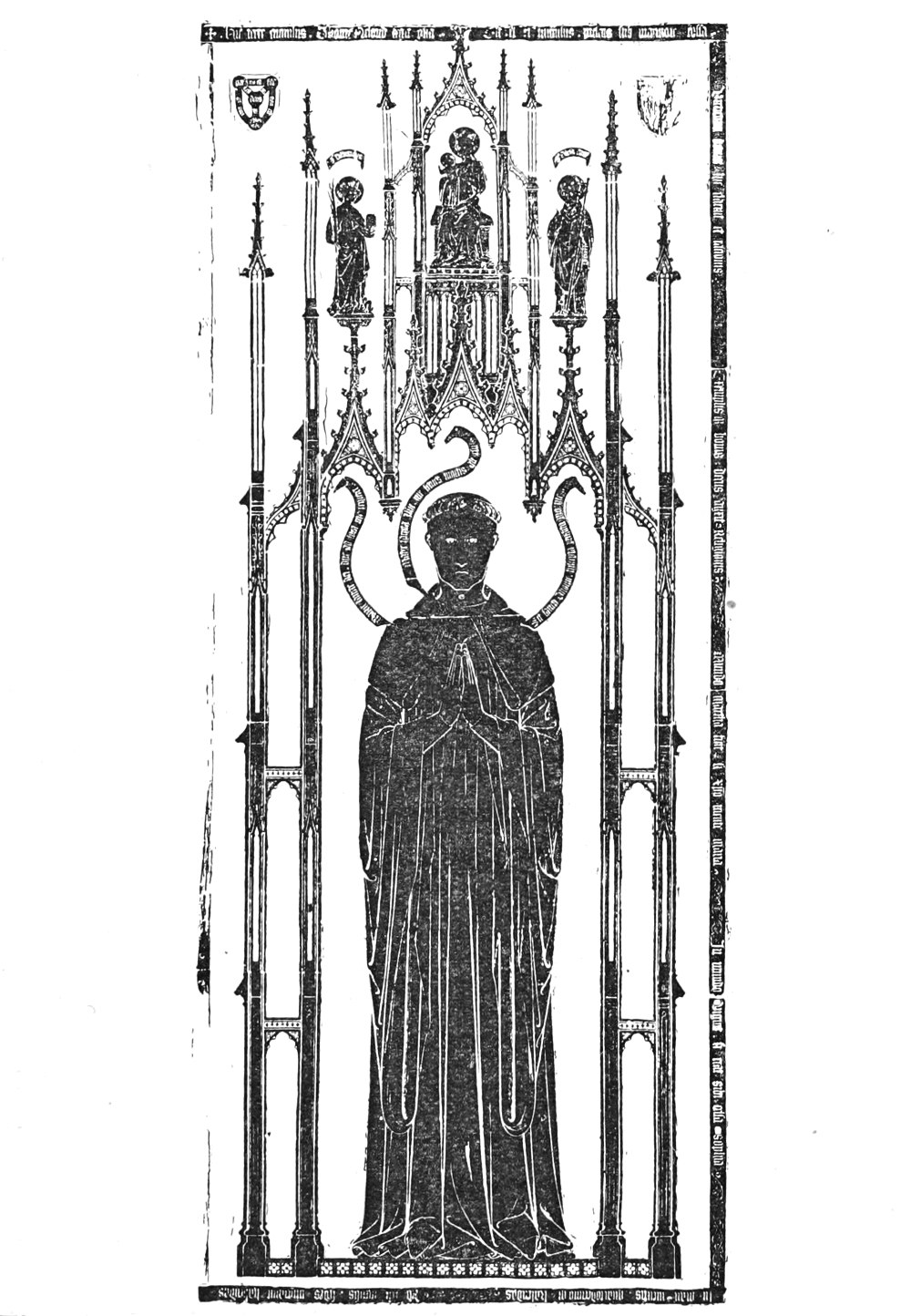
Fig. 16. Thomas Neolond, Prior of Lewes, 1433, Cowfold, Sussex
Prior Neolond, here illustrated, was therefore a
very important man. His dress is exactly similar
to that of the Benedictines. The canopy, as shown,
is the finest still extant of purely English type. The
central pediment is itself triple and holds a shrine
with the Virgin and Child within. St Pancras
and St Thomas à Becket stand on the finials of
the other pediments. The whole brass measures
10 ft. 2 in. × 4 ft. 3 in.
The Augustinian abbot wears gown and cowl over
the ordinary choir vestments. The crozier rests on
the right arm and he wears no mitre.
A vowess was a widow who took monastic vows.
It is not easy to distinguish the dress from that of
the ordinary widow.
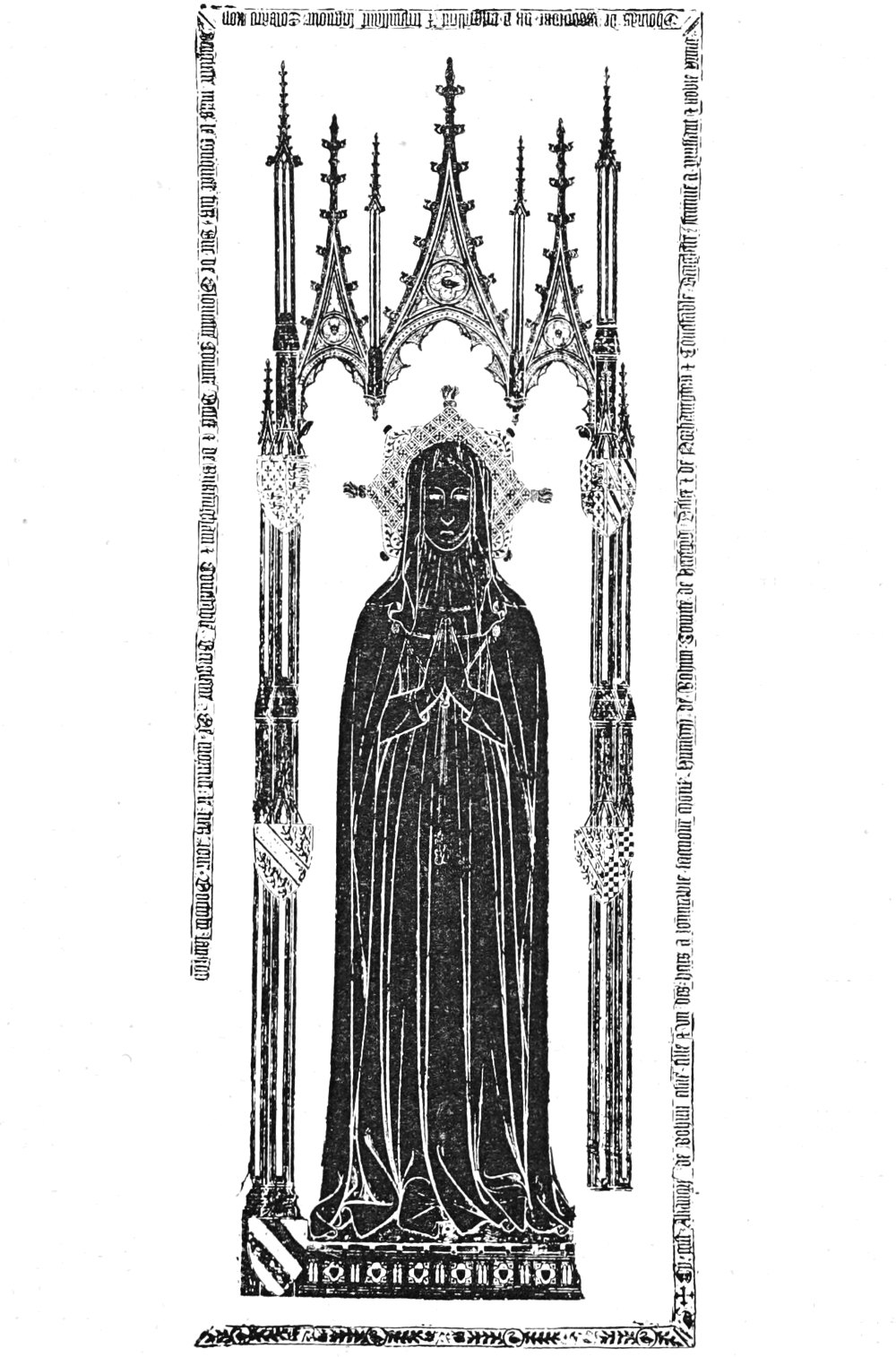
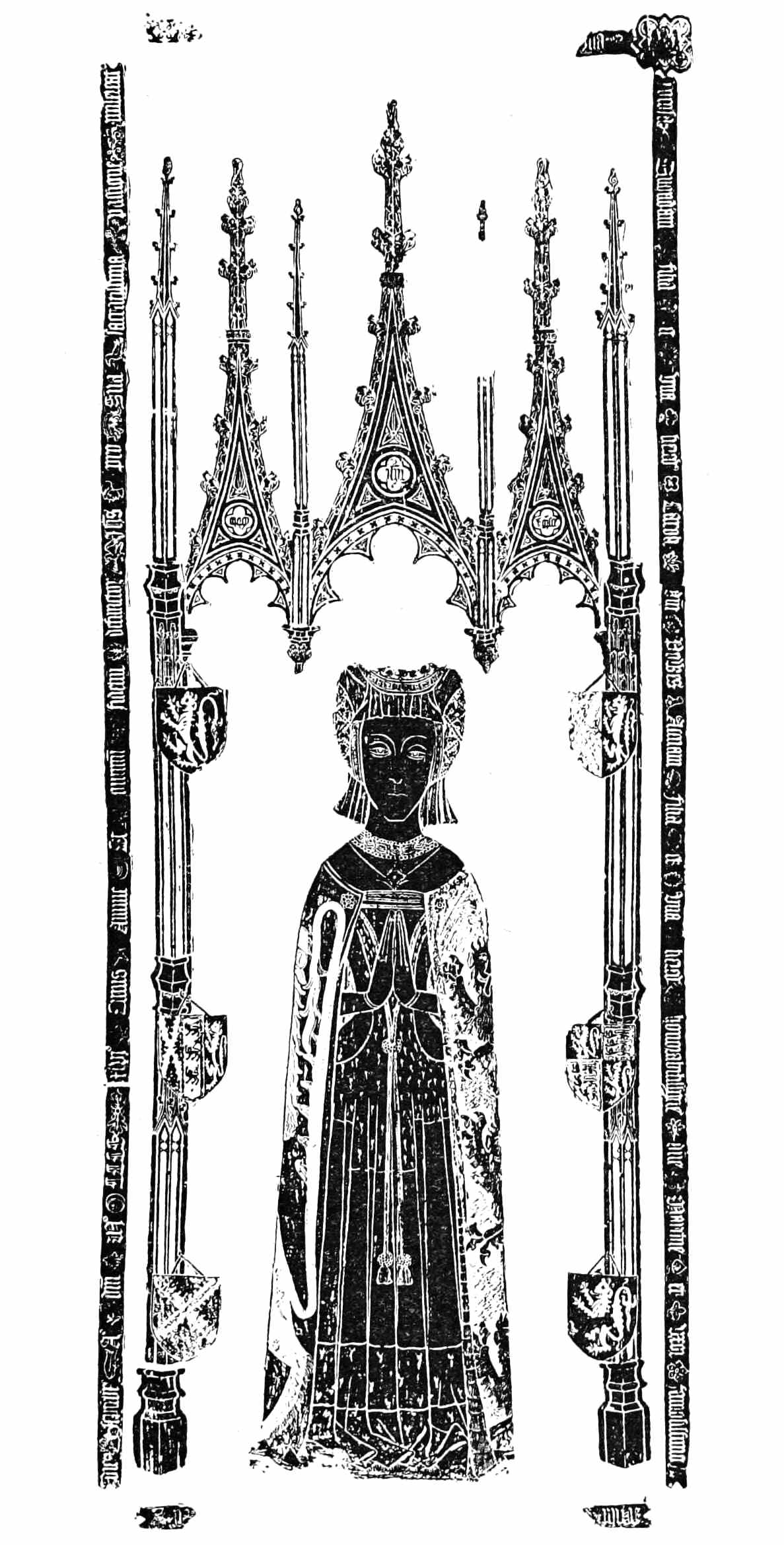
The Duchess of Gloucester, after the murder of
her husband in 1397, entered the nunnery at Barking,
Essex, and died there two years later. She appears
in the first act of Richard II. Her brass lies on
an altar tomb in St Edmund’s Chapel, Westminster
Abbey. Her heraldic badge—the swan—adorns the
inscription and the central pediment of her triple
canopy. Five armorial shields still hang from the
shafts, but the sixth is lost. The pinnacle between
the central and the sinister arch is now lost, but
was still intact when this rubbing was taken. (See
illustration.) Thus year by year portions of these
ancient monuments are carelessly lost or stolen.
Fig. 17. Eleanor de Bohun, Duchess of Gloucester (Vowess),
1399. Westminster Abbey
The friar, in gown and cowl, with knotted cord
(c. 1440), at Denham, Bucks., is on the reverse of
Amphillis Peckham, 1545.
The other brasses call for no further attention,
save that in the case of the two nuns from Sion their
convent had already been dissolved. The abbess is
shown without her crosier and Margaret Dely without
her mantle.
Palimpsest Brasses.
By this we mean brasses which have been twice
used. The dissolution of the monasteries led to
thousands of brasses being sold for old metal, both
from the churches destroyed and from those that
were allowed to remain. In 1551 an order was issued
confiscating all the church plate. It is therefore not
surprising that great numbers of brasses were stolen.
It is noteworthy that Elizabeth disapproved of these
proceedings and ordered that fresh plate should be
procured, and that the damaged monuments should
be restored. The stolen brasses often went into the
melting pot, but sometimes they were re-engraved and
used to commemorate contemporary persons.
Palimpsests are produced in three ways:
I. By engraving the back of the brasses.
II. By re-engraving and altering the figures.
III. By simply substituting a fresh inscription.
Those contained in the first group are probably
the most numerous, and are subdivided into three
groups:
(a) Plunder from English churches at the Reformation;
(b) plunder from Flemish churches at the
same period; (c) shop-wastes and earlier stolen
brasses.
The Flemish or German brasses, about 50 in
number, were probably plunder from the Dutch
churches, which were sacked by the Calvinists in
1566. So complete was the destruction wrought in
that short week that to-day there are fewer complete
Flemish brasses in their original home than there
are fragments of Flemish brasses in England. (See
Appendix.)
The reverses vary considerably in date and subject.
Those laid down from 1540-1570 show that
even before the great outbreak of iconoclasm of
1566 a good many brasses had been stolen.
Taillor at Hadleigh, in Suffolk, was burnt during
the Marian persecution in 1555, and an inscription
was laid down in 1560. The reverse, c. 1500, shows
the head and shoulders and hands of a civilian on
a diapered background with certain other details.
The Margate brass, 1582, shows on the reverse
scenes from the life of man. One is of a child
catching butterflies, and the other, two boys walking
on stilts.
Besides these groups there is a third type consisting
mostly of shop-wastes, i.e. sometimes a brass
which had been ordered was not approved; the
engraver then either melted it down or re-engraved
it on the other side. Also, brasses were stolen and
sold to the brass engravers, who would use them
again in the same way. Many of these are quite
early and often only a few years separate the engravings
on the two sides.
In a few cases the same person is depicted with
certain details altered. John Lawrence of Burwell
has already been mentioned.
The demi-figure of Thos. Cod, St Margaret’s,
Rochester, 1465, is a striking example. The reverse
shows him in almuce and cope, but for some unknown
reason this apparently was disapproved. He
is therefore shown on the obverse with an amice in
place of the almuce.
A late example is at Walton-on-Thames. John
Selwyn, 1587, was Gentleman Keeper of the Royal
Park at Oatlands. At a stag-hunt in the presence of
Elizabeth he leapt from his horse on to the back of
the stag when both were going at full speed. There
he kept his seat, with his sword guided the animal
towards the Queen, and then plunged the steel into
its throat so that it fell dead at her feet.
This is depicted on a small plate placed between
the heads of Selwyn and his wife. The subject is
engraved on both sides. The reverse was lightly
sketched and was rejected. It shows him hatless
holding the stag’s right horn.
The two remaining groups, II and III, are much
less numerous. Group II consists of figures which
have been altered.
Examples of this kind are Robt. Hanson, 1545,
Chalfont St Peters, Bucks., altered (by adding
shading, etc.) from a priest, 1440. Humphrey Oker
and wife, 1538, Okeover, Staffs., altered from Wm.
Lord Zouche and two wives, c. 1447. The figure of
one wife was left intact and the other was turned
over and engraved with the children and an oak-tree
bearing a shield.
There are a few other examples, but perhaps the
most interesting is that to Walter Curzon and wife,
Waterperry, Oxon., 1527, altered from c. 1445. A
new head and shoulders were engraved, the palettes
were partly erased and shading was added on arms,
cuirass and legs. The taces have been re-engraved
to form a skirt of mail. The ends of the shoes have
been partly erased and the toes rounded. The upper
half of the lady is Tudor, the lower half has had
shading added to the lines, and a chain hanging from
the belt added.
Group III consists of appropriate brasses which
have not been re-engraved. A new inscription, and
sometimes shields, are merely added.
Good examples of this group are the brasses of
Sir John Dyve, 1535, wife and mother, Bromham,
Beds., appropriated from Thos. Wideville and two
wives under triple canopy, c. 1435; John Wybarne
(in armour), c. 1546, Ticehurst, Sussex, appropriated
from c. 1370; Laughton, Lincs., 1549, man under
triple canopy, appropriated from c. 1400; Joan ffenner,
1516, Horley, Surrey, appropriated from c. 1420,
with fine canopy.
There are several other examples and they must
be carefully distinguished from those brasses which
have been copied from an earlier brass, as has
happened in the effigy of Peter Rede at St Peter
Mancroft, Norwich.
CHAPTER VII THE EARLY TUDORS. 1485-1547
During this period more brasses were laid down
than in the whole of the preceding time. Over 1100
belong to the reigns of Henrys VII and VIII. From
Edward I to Richard III, 1000 were laid down.
But the work shows lamentable signs of steady
deterioration; metal and engraving are usually poor,
the former thin and the latter shallow and with too
much detail. There is a greater variety of design,
but many are in bad taste, such as figures shown in
shrouds or as skeletons. At this date brasses are often
placed on the wall, and sometimes are quadrangular.
The latter must be carefully distinguished from foreign
ones (see later).
Canopies are few and heavy, but continue to
follow the traditional lines.
In the military brasses a sudden change becomes
noticeable. The Yorkist armour is changed to the
Tudor between 1490 and 1500. Its characteristics
are that the placates are omitted, the pauldrons are
single and have passe-gards to protect the neck,
shorter tuilles are attached to the taces, a skirt of
mail has been re-introduced and reaches well down
over the thighs. The graceful, pointed sollerets—which
must have been rather uncomfortable—were
replaced by sabbatons with large rounded or square
toes.
The sword is usually hung across the back of the
legs. The hair is long and straight. Most of these
and other characteristics will be seen in the illustration
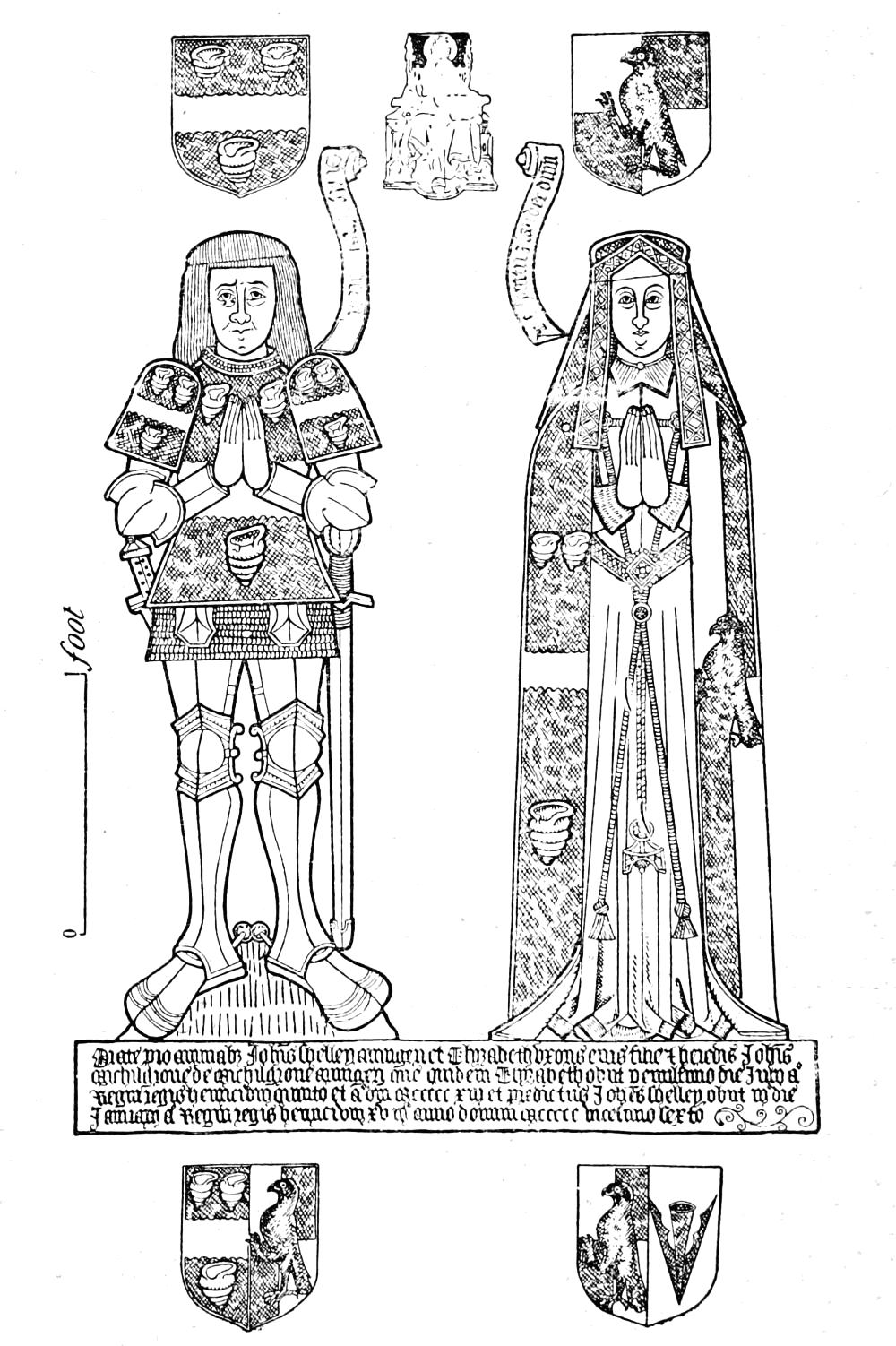
of John Shelley and wife, Clapham, Sussex, 1526. The
Tabard of Arms covers the body armour.
Fig. 18. John Shelley and wife, 1526, Clapham, Sussex
The Yorkist armour was certainly more beautiful,
but one is apt to get rather an unfair impression
from the brasses. There still survives a considerable
amount of actual armour of this period, and from it
we can see that it was often truly magnificent. At
times it was engraved and embossed, and there are
several variations not shown in the brasses, such as
the skirt of plate. Those interested in the subject
should study the fine collections at the Tower of
London and elsewhere. It is most fortunate that our
national collection of armour was begun just when
the brasses by deterioration began to furnish less
trustworthy evidence. Of the armour previous to
the Yorkist period, practically none survives, hence
the importance of the good engraving of the earlier
brasses. (See Appendix.)
Serjeants-at-arms usually carry maces.
One of the most characteristic features of the
period is the armorial tabard. Often, too, the wife has
an armorial mantle: as in the brass of John Shelley
and his wife, 1526, Clapham, Sussex, here shown. The
arms are repeated on Shelley’s sleeves and his wife
bears her own arms impaling those of her husband on
her mantle. The Holy Trinity is shown above the
figures.
The tabard replaced the heraldic jupon of the
Plantagenets during the Lancastrian period. The
earliest is to John Wantele, 1424, Amberley, Sussex,
but the arms are not repeated on the sleeves. There
are but few examples, however, till the Yorkist period,
and they only became plentiful under the Tudors.
They died out in the opening years of Elizabeth, the
last being to Sir John Tregonwell, Milton Abbey,
Dorset, 1565.
Examples of Tabards of Arms during the Yorkist
period are: Sir John Say and wife, Broxbourne,
Herts., 1473, and Philip Mede and two wives, St Mary,
Redcliff.
Fig. 19.
Lady Tiptoft (Partly covered),
c. 1470, Enfield, Middlesex
Lady Tiptoft at Enfield, Middlesex, c. 1470 (here
illustrated), is a very splendid brass, and shows the
armorial bearings well. (See Appendix.)
The colour of the coats-of-arms was probably shown
by means of lead for argent, coloured earths for colour,
and the plain brass for or. At Ardingley, Sussex, are
three brasses in all of which the coloured earth is still
in place. Unless this has been replaced later, it is a
striking example, for in most cases all trace of the
coloured earths has vanished. At Broxbourne, real
enamel was used (as also at Stoke d’Abernon, 1279),
and in consequence most of the colour is still in
place.
It is held by some that all engraved lines on all
brasses were filled in with black wax or some similar
substance, just as in our modern inscriptions. That
this was so in some cases seems certain, and at the
Victoria and Albert Museum in the foreign brass to
Henry Oskens (canon) from Nippes, near Cologne,
1535, much of the wax is still there. It is, of course,
impossible to make a good rubbing of such a brass.
It does not seem likely that most of the brasses
were so treated, but it would take too long to go into
all the evidence which leads one to hold this view,
nor is it desirable to use it now.
The ladies’ dress also changes at the same time as
their husbands’. The butterfly head-dress gives way
to the kennel head-dress. This has a stiff point in front
and is carried back like the roof of a kennel (hence
the name) and has long side lappets, usually of
embroidery. In some of the earlier examples these
are pinned up (Ardingley), but, as a rule, they fall
straight down (Clapham).
The dress is close-fitting and has a square collar
and fur cuffs. Round the waist is a girdle with a
chain pendant in front, to which is attached an ornament
of varying shape. Occasionally mantles are
worn, as at Cobham, Kent, but seldom, except when
they bear a coat-of-arms.
Quite often babies will be found wrapped in
chrysoms with swaddling bands round them. This
robe was placed on the child by the priest as soon as
it was baptised (which was when it was only a few
days old). It was worn till the mother came to be
churched, when it was returned to the priest. These
brasses therefore show that the child died during the
time that elapsed between baptism and the churching.
Chrysom children are
found alone or with
parents. This type of
brass survived till the
middle of the seventeenth
century.
Occasionally brasses
are found commemorating
women who died
in childbirth. The infant
is then usually
shown in a chrysom
robe, and in later
brasses the mother is
often shown lying on
a four-post bedstead.
Anne Asteley, Blickling,
Norfolk, 1512, probably
belongs to this group.
During the reign of
Elizabeth, several examples
of bedstead
brasses are found. The
first is at Heston,
Middlesex, 1581, another
is at Halling,
Kent, 1587, and there
are several others.
The civilians at this period are numerous, but not
particularly interesting. The hair is long and straight,
the gown reaches to the feet and is usually lined and
edged with fur. The sleeves are wide, and a girdle
surrounds the waist, from which hangs a short rosary
and a purse. Broad-toed shoes are worn. The brass
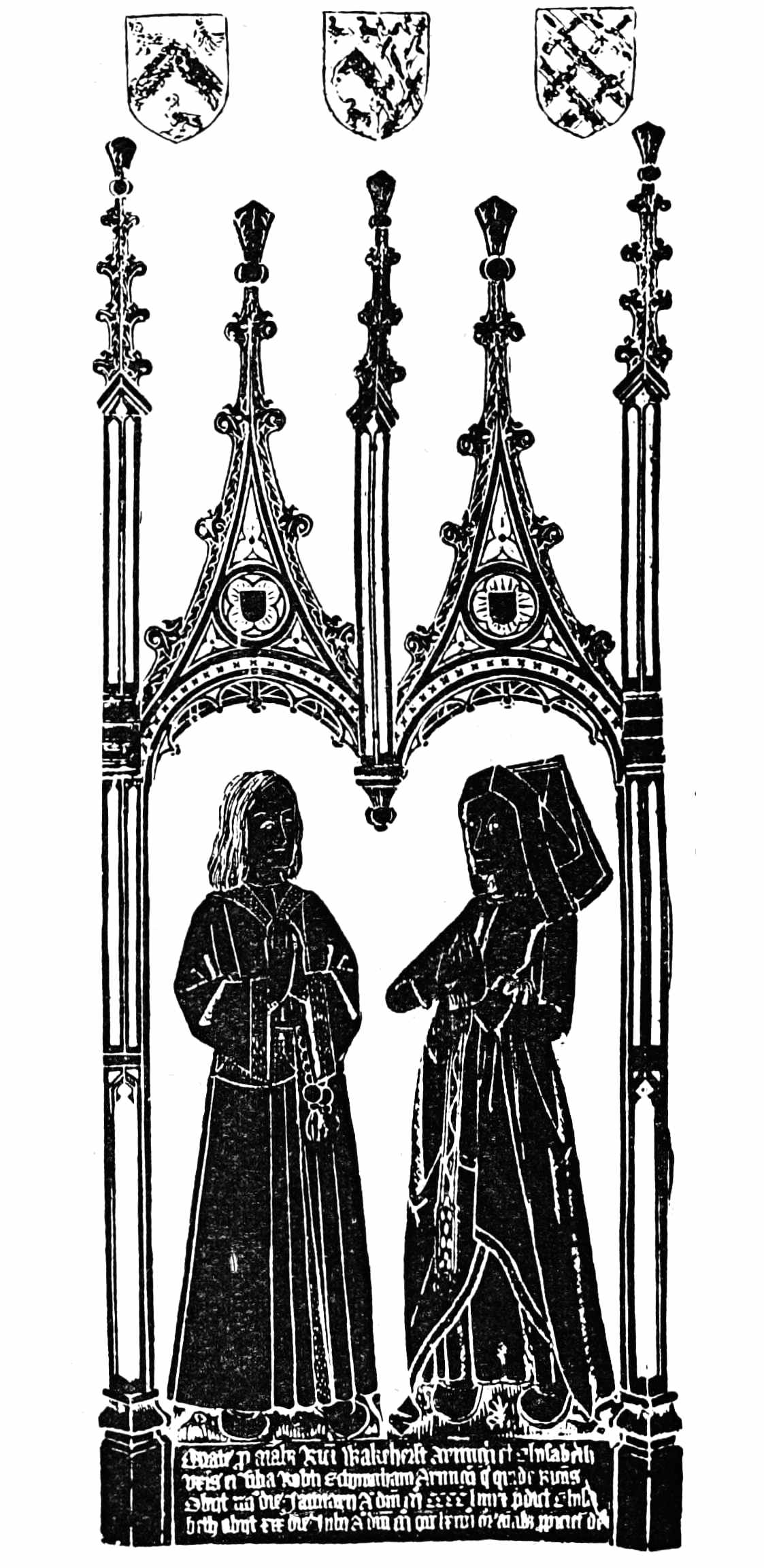
at Ardingley shows this dress, the canopy is an unusual
feature.
Fig. 20. Richard Wakehurst and wife, engr. c. 1500, Ardingley, Sussex
CHAPTER VIII EDWARD VI AND MARY. TRANSITIONAL PERIOD
During this period not more than sixty brasses
were laid down. This was largely due to the religious
and political turmoil of the period and is the more to
be regretted, especially in the case of the clergy, as
the brasses might have thrown much light on the
question of the vestments worn during the time when
the first and second Prayer Books of Edward VI were
in use.
The engraving grows steadily poorer and the metal
thinner.
Of the ecclesiastics, the following is believed to be
a complete list for both reigns, but the Marian clergy,
being naturally in full vestments, have for the most
part been mentioned before.
Hugh Brystowe (parson), Waddesdon, Bucks. (in shroud),
1548.
Jn. White (Warden of Winchester College and later Bp. of
Winchester), Winchester College is in cope, laid down in
1548.
Thos. Magnus (archdeacon), Sessay, Yorks. (cope), 1550.
Bp. Goodryke of Ely, Ely Cathedral (full vestments), 1554.
Bp. Bell of Worcester, St James, Clerkenwell (ditto), 1556.
James Coorthopp (Dean of Peterborough), Christ Church,
Oxford (in almuce), 1557.
Arthur Cole (Canon of Windsor), Magdalen College, Oxford
(in mantle of the Order), 1558.
Robt. Brassie (in almuce), King’s College, Cambridge, 1558.
The largest number of transitional brasses represent
men in armour either with or without the tabard
of arms.
The chief changes are that the mail skirt has often
an indented edge, the taces are divided at the lower
part by an arched opening between the tuilles, and
frills are worn at the wrists.
The most noteworthy change in the ladies’ attire
is that the kennel head-dress is abandoned. The hair
is parted in front and a linen cap supports a bonnet,
often of velvet and having a jewelled edge. It is
generally of horseshoe shape. A kerchief hangs down
over the neck and shoulders behind. This head-dress
is continued during the reign of Elizabeth and was
known as the Queen Mary cap, at first after Mary
Tudor, and later after Mary Stuart. The sleeves are
slashed and puffed at the shoulders and from the belt
hangs a mirror or other ornament. The collar is
thrown open and reveals a gathered underbodice.
A long cloak with false sleeves is often found, and
heraldic mantles are still worn when the husband
appears in a tabard. These died out in the opening
years of Elizabeth, as already stated.
Of civilians little need be said. Their wives follow
the new style, but little alteration in their own dress
is noticeable. Three examples may be given, the
last a woolman, the other two judges. These are
Henry Bradschawe and wife, Halton, Bucks., 1553;
Wm. Coke and wife, Milton, Cambridge, 1553;
Anthony Cave and wife, Chicheley, Bucks., 1558.
CHAPTER IX ELIZABETH AND JAMES I. 1558-1625
During this last period there was a considerable
revival both in the number and quality of brasses.
About 800 were laid down in these two reigns and at
first there is a marked improvement in the engraving.
It is usual to speak as if the deterioration continued
steadily from the time of Henry VIII through the
Edwardian and Elizabethan brasses to the final
disappearance of the art in the eighteenth century.
This is not quite the case. The Elizabethan brasses
(with which are included those of James I) are
decidedly better in many instances than those of the
Transitional period. Even some of the Caroline
examples are better than those laid down between
1547 and 1558.
Early in the reign of Elizabeth, the plate of brass
itself began to be manufactured in England. It was
usually thin, however, and the engraving as in the
Transitional brasses was shallow and too much detail
and shading were attempted. The thinness of metal
led to their becoming battered and worn and they
are often in far worse condition than those laid down
a couple of centuries earlier.
Many brasses were, however, fixed to the walls
and these are in a much better state of preservation.
These sometimes take the form of rectangular plates:
at times the figures are fixed against the wall in a
recess over a tomb. They are then usually depicted
kneeling at desks.
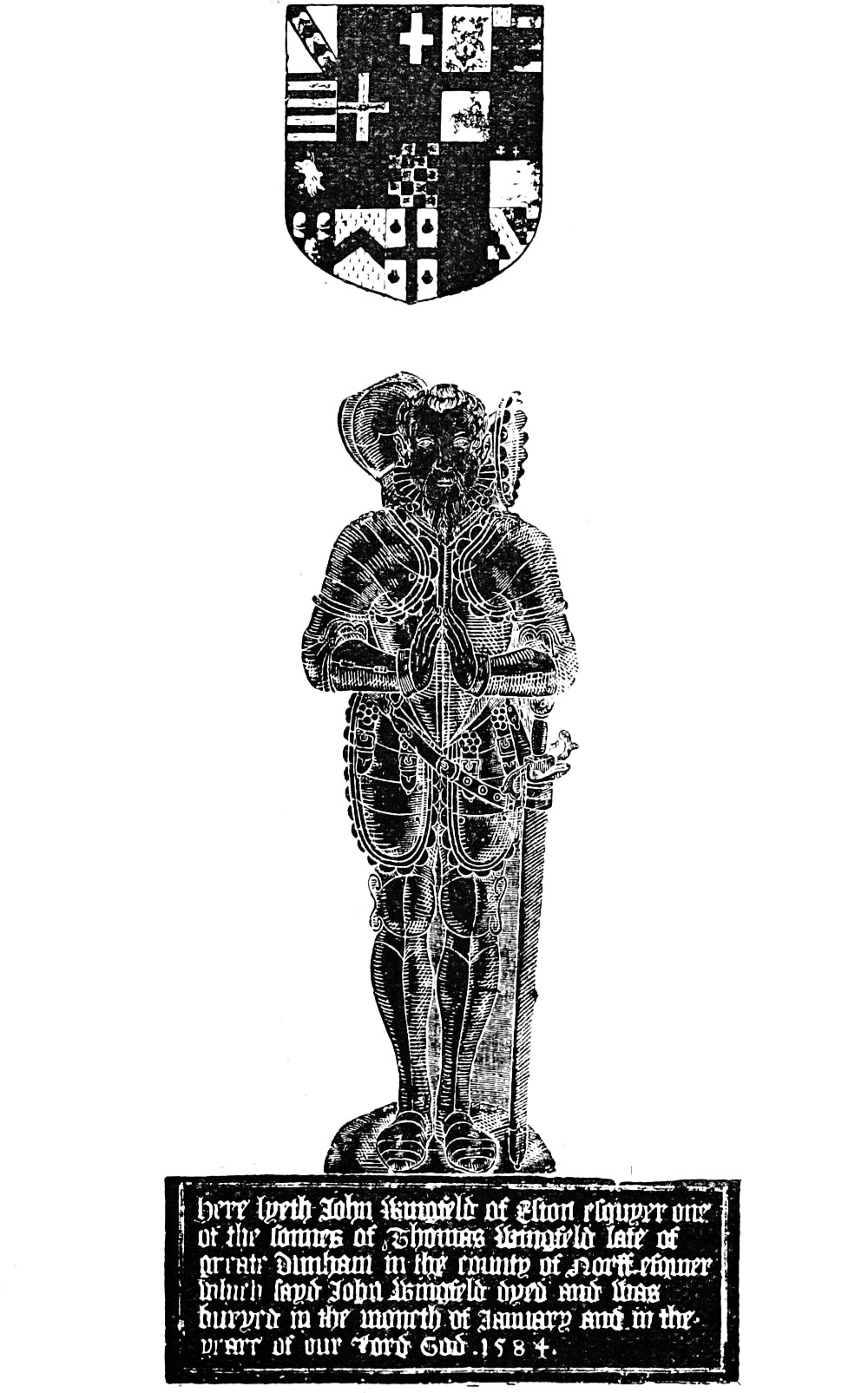
The new style of armour which took the place of
that worn in the Transitional period became finally
established by 1575. Its main characteristics are
these: The use of the long-waisted doublet and the
short hose rendered the old style of armour unwearable.
The cuirass becomes long and is brought
forward to a peak with a projecting rim. It is known
as a “peascod.” The pauldrons are large and have no
ridges, they are lined with leather the escalloped edge
of which is allowed to extend beyond the plates. The
neck is encircled by a ruff, as are the wrists. The
helmet is seldom worn, but is often placed behind the
head, though the figure is depicted standing.
Kneeling figures in many cases have the helmet
on the ground, together with the gauntlets.
The front of the thighs are protected by laminated
cuissarts under the trunk hose, and the legs by knee-caps
and greaves. The sollerets are of a more graceful
shape and fit the feet closely. Two long tassets are
buckled to the edge of the cuirass, and hang down
over the trunk hose. They are all formed of several
hinged plates and take the place of tuilles. They are
not infrequently rounded at the lower edge and are
fastened by straps to the breeches. The sword hangs
at the left side from a leather belt and the dagger at
the right side from a sash. Swords usually possess
guarded hilts.
Fig. 21. John Wingfield, 1584, Easton, Suffolk
The illustration of Wingfield, Easton, Suffolk, shows
these characteristics, and there are but few variations.
The most noticeable is where, the puffed breeches not
being worn, continuous plates from knee to cuirass
protect the legs. This type is shown in the brasses of
Thos. Hawkins, Boughton-under-Blean, Kent, 1587,
and Thos. Nevynson and wife, Eastry, Kent, 1590.
It is remarkable how, in spite of gunpowder being
in general use, the men of the age of Elizabeth were
still encased in a panoply of plate.
The ladies fall naturally into two divisions. The
Transitional form, or Queen Mary dress, changed
about 1560. The gown is fastened only at the waist
by a sash, and thus shows below an embroidered or
quilted petticoat. Between the bodice and the throat,
the bust is covered by a gathered partlet with a frill
and the Paris bonnet continues in use. From about
1575 a new style comes into vogue and is well shown
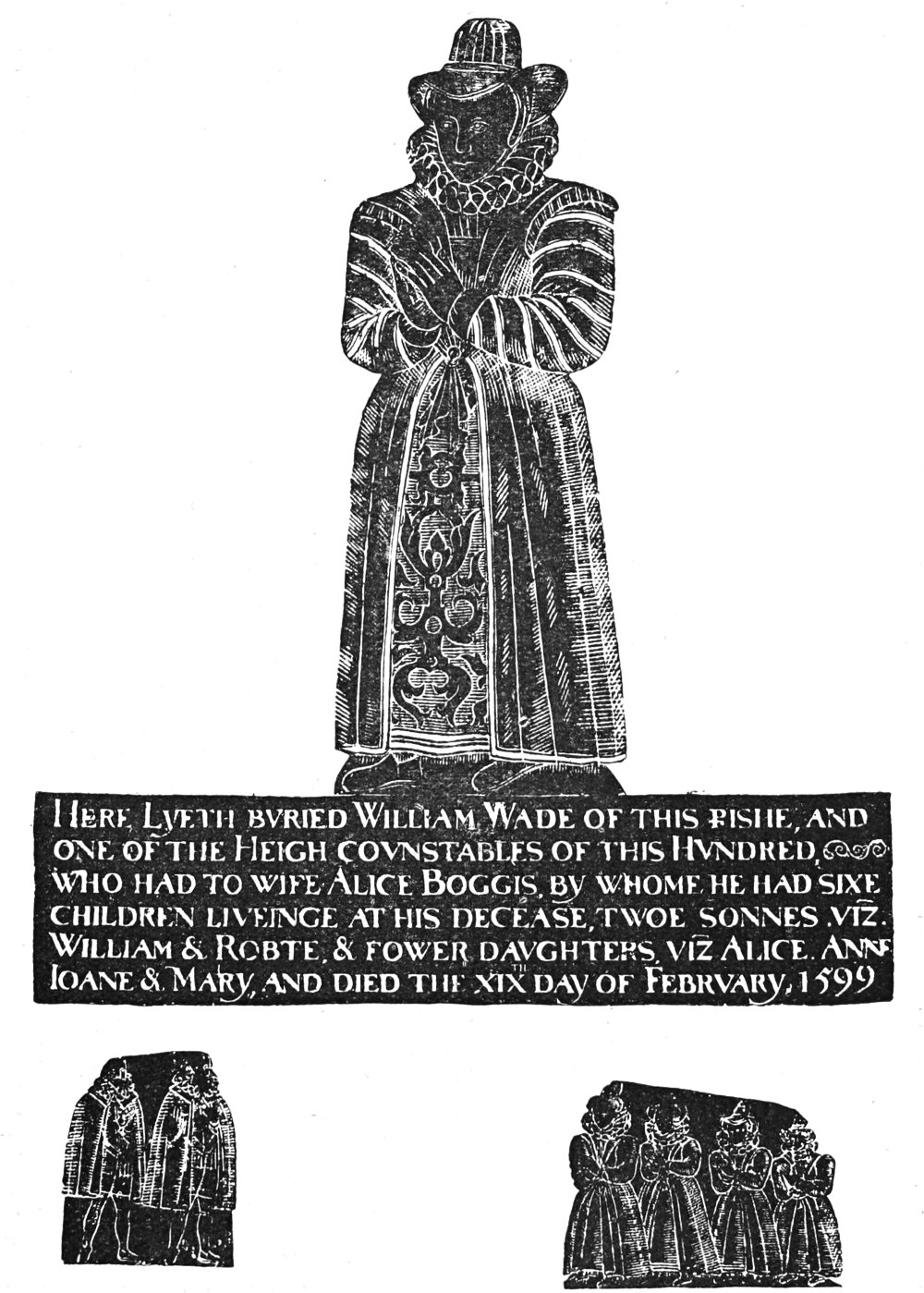
in the illustration of the wife of Wm. Wade, Bildeston,
Suffolk, 1599. Her skirt is distended at the hips by
the farthingale and shows the embroidered petticoat
beneath. The sleeves are slashed and a large ruff is
round the neck. Usually frills are also worn at the
wrists, but here Alice Wade is an exception. A broad-brimmed
hat is worn.
Fig. 22. Alice, wife of William Wade, 1599, Bildeston, Suffolk
There are several variations. The lappet of the
bonnet is sometimes turned up over the head, and
when it comes far enough forward to shade the face,
it is called a “Shadow.” At the end of the period, a
large veil was substituted. Sometimes the hair is
brushed up to a lace crown, supported by a wire
frame. This fashion is shown in the brass of Margt.
Chute, Marden, Hereford, 1614. She wears besides
the wheel farthingale, a peaked stomacher, and a
starched collar ornamented with point lace.
The bedstead brasses have already been mentioned
in reference to the chrysom children, but are really a
peculiarity of this period.
The civilian costume is not over-interesting, because
doublet and hose are usually covered by a long
gown, such as is seen in the memorial to Wm. Dunche
and wife, quadrilateral plate, Little Wittenham,
Berks., engraved c. 1585. Here husband and wife
kneel at desks under two classical arches. Two sons
kneel behind their father. They wear short cloaks,
doublet and hose. This is also the costume of the
sons of Alice Wade, who wear pointed beards.
The brasses of children, especially boys, become
fairly numerous and are not without interest, as they
exhibit the doublet and hose under a short cloak.
The brass of W. Browne, Holton, Oxon., 1599, is a
good example, showing the long hose fastened above
the knee by garters of ribbon.
The clergy for the most part wear the ordinary
civilian dress of the day without cassock or surplice,
and a long gown with long sleeves, known as the
Geneva gown. Some also wear a hood to denote they
hold a degree, as does Dr Wm. Bill, Dean of Westminster,
Westminster Abbey, 1561.
Of clergy in surplice and cassock only two brasses
now survive. Formerly at Denham, Bucks., there was
one portraying Leonard Hurst, 1561, in cassock and
surplice opening in front like a college surplice and a
long scarf. It is now lost, but is illustrated in Haine’s
Manual. The two that still survive are Wm. Dye
(priest), Westerham, Kent, 1567, who wears cassock,
a closed and gathered surplice and a scarf, and
Nich. Asheton, Winchford, Warwick, 1582, very similar
to the lost brass at Denham, Bucks.
The remaining clergy are in civilian costume, but
one or two wear a scarf over the Geneva gown, as at
Stonham Aspal, 1606.
In many cases the title of the ecclesiastic is given,
and these are of some interest. (See Appendix.)
Tyndall’s figure is 5 ft. 4 in. long and there is a
border fillet and several shields.
There are three bishops, but Robt. Pursglove,
1579, is in full mass vestments, and has been mentioned
before.
Edmund Geste, Bishop of Salisbury, in his
Cathedral, 1578, wears rochet and chimere, a scarf
and lawn sleeves. Instead of a crozier, he holds a
walking stick in his right and a book in his left hand.
It should be remembered that this was the outdoor
garb, hence probably the walking stick.
H. Robinson, Bishop of Carlisle, 1616, has two
brasses, that at Queen’s College, Oxford, being
copied and put over his grave in Carlisle Cathedral.
His brass, like Airay’s, who succeeded him as Provost
of Queen’s, differs from the usual type. They resemble
the copper plates used in books and are very finely
engraved and filled with many additional emblems.
A good rubbing cannot be taken owing to the thinness
of the engraving, which nevertheless is well done.
On a quadrilateral plate, Robinson kneels in front
of Queen’s College and Carlisle Cathedral. There are
three sheep folds to signify he was a shepherd to his
flock. Several peasants with their tools and in the
dress of the period stand in one corner and dons are
entering Queen’s College in the other. He wears a
skull cap and ruff, rochet and chimere. In his left
hand he holds his crozier, which has a human eye in
the centre, and a stork on the outer curve of the
volute. The infula is a napkin and bears the word
“Velando.”
From the Elizabethan period some attempt at
portraiture is made: in the case of Robinson and
Airay with considerable success. The brass to
Erasmus Williams, Rector at Tingewick, Bucks., 1608,
is probably by the same hand as these two and is
signed R. Haydock. It is very similar in general
treatment to them, and on Airay’s brass are the same
initials R. H.
CHAPTER X THE CAROLINE BRASSES. 1625-60
The art of monumental brasses shows signs of
rapid deterioration, and from it there was to be no
recovery. About 150 were laid down during the
reign of Charles I and 13 during the Commonwealth.
Only two are really fine: Archbp. Harsnett’s
brass at Chigwell, 1631, and Sir Edw. Filmer’s, here
shown.
Fig. 23. Sir Edward Filmer and family, 1638, East Sutton, Kent
Armour is seldom worn, knights being usually
depicted in civilian dress, and where it is worn, it
generally consists of a demi-suit of cuirass, with
laminated plates for the thighs and small knee pieces.
Jack boots protect the legs. There are many variations,
but the brass of Sir Edw. Filmer and wife,
East Sutton, Kent, is fairly typical.
Of the nine sons, only one wears armour and
none wear ruffs. The eight daughters are similar to
their mother, who wears a gown without farthingale
and a veil over the head. The brass consists of two
large rectangular plates and though too much shading
is put in, yet is a good example for the period.
The ladies have abandoned the farthingale and
wear more graceful gowns, sometimes with ruffs and
sometimes with falling collars. A light veil often
covers the head. Sometimes the embroidered petticoat
can be seen underneath the gown, which is
divided in front. An example is to be found at
Ardingley, Sussex, to Eliz. Culpeper, aged 7, 1634,
and also in a larger brass to her mother.
The civilians are still fairly numerous, but the
engraving is usually poor. The long gown is worn no
more, the costume being the tunic with falling collar,
knee-breeches, stockings and shoes or jack boots and
a short cloak. Sometimes a ruff is worn instead of a
collar. Most of these details will be seen in the sons
of Sir Edw. Filmer. Point lace was often worn and
is occasionally seen, as in the small, badly engraved
brass of Thos. Holl, 1630.
The brass of John Moorwood and wife is characteristic.
He kneels opposite his wife, Grace, at a
desk. Besides the costume described above, he
wears a ruff and a skull cap. His hair is long and
he has a moustache and a pointed beard. His sons
are similar, save that they are hatless and have no
beard or moustache. His wife has a very plain dress
and a high-crowned hat, her daughters have no ruffs,
veils, or bonnets.
The six at Llanrwst, Denbigh, are quite distinct
and represent either the work of a local school or
of a special artist. There was also a local school at
York. Its peculiarity was that the figures were large
demi-figures, usually on a quadrilateral plate, which
was narrower at the top than at the bottom. A
considerable amount of fur is displayed, and the
faces appear to be good portraits. The Elizabethan
have already been mentioned in the last chapter,
but there are several others.
There is one good Caroline brass—that to Thos.
Atkinson, All Saints, North St., York, 1642. It may
have been engraved a few years earlier.
Among ecclesiastics there is but one fine example,
and that is perhaps the best Caroline brass still
extant. It commemorates Samuel Harsnett, Archbp.
of York at Chigwell, Essex, 1631. He had left
special instructions in his will as to how it was to
be made. The metal was to be an inch thick and to
be rivetted right through the stone so that it could
not easily be torn up. The result is a fine monument.
He wears cope, rochet, chimere and a mitre. He
holds his crozier in his left hand and a book in the
right. The face is evidently a portrait. There is a
border inscription with the evangelists at the corners.
The figure is 6 ft. long. The crozier is not a cross,
but a crook and has a rose in the volute.
During the Commonwealth naturally few brasses
were laid down, and the distrust with which all
representations of the human form were regarded
by the Puritans, who considered them a breach of
the Second Commandment, probably gave the death
blow to the failing art. Besides those already mentioned,
the following have been noticed: Ralph
Assheton (in armour) and wife, Middleton, Lancs.,
1650; Adam Beaumont (in armour) and wife, Kirkheaton,
Yorks., 1655. These are the only men in
armour. Assheton was a leader on the Puritan side
and did good service. Beaumont was his son-in-law
and is clad in similar style. The armour is a demi-suit,
consisting of skirted cuirass, pauldrons, elbow-pieces
and laminar cuissarts extending to the top of
his tall boots.
There is no actual representations of a cleric, but Dan.
Evance, rector, quadrilateral plate, Calbourne, I.o.W.,
1652 is commemorated by a plate with a drawing of
Time and Death.
Most of these are but miserable caricatures and
reveal the final stage of decay. Yet they are not
without interest, though perhaps a melancholy one.
During the Caroline period many brasses to young
children were laid down. Sometimes the babe is
shown lying on a tomb, at others it is represented
in its cradle. Two in St George’s Chapel, Windsor,
may be quoted, and commemorate the children of
Dr John King. They are dated 1630 and 1633.
CHAPTER XI THE LAST BRASSES. 1660-1773
The last few brasses are of little artistic value.
(See Appendix.)
Robt. Shiers, 1668, is perhaps the best of them.
He wears a long, flowing gown reaching to the feet
and holds a book in his hand. Nicholas Toke is in
Jacobean armour, but with a fall collar and long
hair. Probably his figure was copied from an earlier
brass, for his daughters, who are on a separate plate,
are very crudely drawn.
The last two brasses are the only Georgian ones
known to exist and they are separated by a great
space of time from the others. Whether they were
each engraved at the dates given on the plates or
whether they were both done at the same time is
difficult to say. Benjamin Greenwood’s brass is
certainly the best, his wife’s figure being very crude.
She has on a plain gown and a veil. He is in a coat
with open skirts, a figured waistcoat, knee-breeches,
and wig. He points to a skull with his left hand
and to a ship with his right. Probably he was a
merchant captain.
Both plates have a pair of cherubs’ heads in the
upper corners and are upon separate gravestones;
the engraving is very thin.
Thus we have seen the art of the engravers rise
in the thirteenth century and die in the eighteenth.
CHAPTER XII SPECIAL TYPES
Besides the ordinary figure brasses, there are a
certain number of special types. Those representing
Scriptural subjects are perhaps the most interesting.
They are less numerous than might be expected and
usually form part of a canopy, or, at any rate, part
of a composition which includes large figures.
The Holy Trinity is the most common emblem
and is depicted as a venerable man seated, holding
Christ crucified. The Holy Ghost in the form of a
dove is sometimes perched on one arm of the Cross,
or hovers over the head, but it is often omitted.
The Holy Trinity is found at Cobham, 1407;
Peperharrow, 1487; Shirburn, 1493, and Witney,
Oxon., 1500; Childrey, Berks., 1507; Floore, Northants.,
1510; Wooburn, Bucks., 1520; Clapham, Sussex,
1526; Beaumaris, Anglesea, c. 1530; Cheam, Surrey,
1542.
The Virgin is found at Cobham, 1395; Bottesford,
Leics., 1404; Morley, Derbys., 1470; Etwall, Derbys.,
1512; St George’s Chapel, Windsor, 1522; and elsewhere.
Numerous other saints are depicted as well as
those in canopy niches and on the orphreys of copes.
The Annunciation is found in several places.
That at Fovant, Wilts., 1492, is contained in a rectangular
plate commemorating Geo. Rede, rector.
He wears cassock and scarf, kneels on a chequered
pavement and prays to the Virgin, who, dressed in
mantle, sideless cote-hardi and kirtle, with a wreath
of roses on her head, kneels at a prie-dieu in the
centre of the plate. A pot of lilies stands behind
her and an angel kneels on the further side, wearing
an alb and mantle. The Dove flies towards the
Virgin from a cloud in the corner. The whole
composition is reminiscent of foreign work, but is
almost certainly English. An Annunciation is to be
seen at March, Cambs. (1517), above the figures of
Antony Hansart and his wife. A third is in the
canopy of William Porter, S.T.P., 1524, Hereford
Cathedral.
The Adoration of the Shepherds is found at
Cobham, Surrey, c. 1500.
The Resurrection is more widely distributed, and
in two forms according as (a) there are or (b) are
not soldiers round the tomb.
Of class (a), those at Swansea, c. 1500; Cranley,
Surrey, 1503; All Hallows, Barking, c. 1510; and
Narburgh, Norfolk, 1545, are characteristic.
Of class (b), examples may be seen at Stoke
Charity, Hants., 1482; Stoke Lyne, Oxon., 1535 and
Burwell, Cambs., 1542. Of this latter class, the
Burwell brass is the best. The Saviour’s form is
unclothed and the lower half hidden within the tomb;
His hands are raised and He holds no cross.
Class (a) is the more interesting. The Cranley
and Swansea representations are the best. In the
former, which is to Robt. Hardyng and his wife, 1503,
Christ steps from the sarcophagus unclothed save
for a loin cloth. Four out of the five wounds are
thus plainly shown. He holds a cross (in His left
hand) bearing a pennon, with a cross in its centre.
A nimbus is around His head. The four soldiers are
clad in armour with morions on their heads and
halberts in their hands.
The Swansea representation measures 12 × 11
inches and is to Sir Hugh Johnys and his wife, c. 1500.
He was a knight of the Holy Sepulchre, and fought
against the Turks under John, at that time Emperor
of Constantinople. One of the soldiers round the
tomb evidently represents a Saracen. He is shown
sleeping with a scimitar at his left, a spiked mace at
his right side.
One other curious pictorial example must not be
omitted. It represents the Mass of St Gregory.
The Pope kneels before an altar, while the figure of
our Lord rises from behind the chalice, changed
from the consecrated wafer. It is in the brass of
Roger Legh and wife (lost), Macclesfield, Cheshire,
1506, and is unique. The original story is in the
Golden Legend.
Heart Brasses.
The next curious type is that known as Heart
Brasses. A heart is often shown held in the hands
of the deceased, as at Buslingthorpe, Lincs., c. 1290.
At other times it is found quite separate from the
figure and often with two or three inscribed scrolls
coming from it. Thos. Knyghtley, Fawsley, Northants.,
1516, is typical of this class.
But the name applies more especially to those
monuments in which the heart appears alone.
Often these doubtless marked the spot where the
heart alone was buried. We have many authentic
records of men who ordered their hearts to be buried
apart from their bodies. Some of these were knights
who perished abroad and ordered their bodies to be
buried where they died, but their hearts to be brought
back to England. From the inscription upon one
of the four scrolls of the Wiggenhall brass, Cuius
cor hic humatur, we may reasonably infer that the
heart only lies beneath the stone. There are several
stone monuments showing only hearts, which records
prove cover only that organ. Thus, Sir Thos.
Neville’s body was buried at Billing, 1535, and his
heart at Mereworth, Kent. At the latter place his
stone monument consists of a heart held by two
hands.
Heart brasses proper fall into two main divisions:
(a) plain, sometimes inscribed or with scrolls, (b) held
by hands, usually coming out of a cloud.
Class (a) includes Thos. Smyth, priest, St John’s,
Margate, Kent, 1433; an unknown person, Kirby
Bedon, Norfolk, c. 1450; and Sir Robt. Kervile,
Wiggenhall St Mary, Norfolk, c. 1450.
Good representatives of class (b) are the brasses
of John Merstun, priest, Lillingstone Lovell, Oxon.,
1446; Wm. Stapilton, Helbroughton, Norfolk, c. 1450;
Dionysius Willys, Loddon, Norfolk, 1462; and Thos.
Denton, Caversfield, Bucks., 1533. (See Appendix.)
Shrouds.
These and the following group are neither beautiful
nor pleasing monuments. They are signs of the
morbid feeling that seems to have begun to spread
over England about the middle of the fifteenth
century and which did not pass away until the
nineteenth.
Many stone monuments exist showing reclining
figures in the costume of the period on a raised
tomb, while beneath, visible through openings in the
sides, are the same persons shown as skeletons or
shrouded figures. This contrast is seldom exhibited
in brasses, but the kneeling figure of Lionel Dymoke,
Horncastle, Lincs. (1519), in armour, is engraved
upon a small plate on the wall, while on the pavement
below he is represented by a shrouded figure.
In some cases the brass was laid down on the
death of one of those commemorated. The latter
is then shown in a shroud, while those who survived
are shown in the dress of the period.
Women can be recognised by their long, flowing
hair, and priests by their tonsure. The purpose of
this type of brass was probably to remind us that
“such as we are, such shall ye be.” (See Appendix.)
Under the Tudors, this type of brass increased in
favour, and its persistence is remarkable.
The last brass of 1660 was probably inspired by the
earlier one of 1505.
At Childrey, c. 1520, husband and wife rise from
their tombs, but at Oddington devouring worms crawl
out of the body, which is almost a skeleton.
This leads us to
Skeletons.
They are not so common as shroud brasses, but
belong to the same class. Indeed, some of the former
are really shrouded skeletons.
Other designs.
A few other designs may be found scattered up
and down the country. Perhaps the most interesting
is to Roger Morris, Margate, Kent, 1615. He
was an official in the Navy and his brass consists
of a square plate showing a three-masted square
rigged man-o’-war. It has a lion figure-head, high
poop and many guns showing through the port
holes.
CHAPTER XIII FOREIGN BRASSES
Brasses on the Continent, as already stated, were
engraved on quadrilateral plates, the inscription,
canopy and background, all being engraved on the
same plates, there is therefore no background of
stone, as in England. Any space left over was usually
filled with diaper work or some similar pattern.
Many of those which still survive on the Continent
are remarkably splendid. There were originally at
least three great schools, besides several minor subdivisions.
These were the German, Flemish, and
French. The Revolutionaries destroyed almost all
those in France and the Reformers played sad havoc
with the Dutch and German monuments. Still, many
fine examples remain of the German and Flemish
schools. The former are found at Ringstead, Denmark,
engr. c. 1350, to King Eric and Queen Ingeborg,
at Lübeck, Schwerin, Stralsund (Pomerania), Thorn
and elsewhere. The latter exist at Ghent 14th c.,
Brussels 1398, Bruges 15th c. Most of these were
Hanse towns and all carried on trade with England.
Merchants from them settled in England and in some
cases had their brasses made abroad. It thus came
about that 14 remain of undoubtedly foreign work,
besides two which were bought abroad and are now
in the Victoria and Albert Museum. These form an
entirely separate group and must be dealt with apart.
On the other hand, one English brass is known to
exist on the Continent. It is at Constance, to the
memory of an English bishop who died at the Council
of Constance.
The finest foreign brasses are those of the fourteenth
century, and are as follows: Adam de Walsokne
and wife, King’s Lynn, Norfolk, 1349; Abbot Thos.
Delamere, St Albans Abbey, c. 1360; Simon de
Wenslagh, priest, Wensley, Yorks., c. 1360; a Priest,
North Mimms, Herts., c. 1360; Robt. Braunche and
two wives, King’s Lynn, Norfolk, 1364; Ralph de
Knevyngton (in armour, small) Aveley, Essex, 1370;
Alan Fleming, Newark, Notts., c. 1375; and Thos. de
Topclyffe and wife, Topcliffe, Yorks., 1391.
There seems little doubt that these fall into two
schools—North German and Flemish.
The first may be called North German, and five
brasses of Hanseatic merchants are so exactly alike
that they must come from the very same workshop.
They are the two at King’s Lynn and one each at
St Peter’s, Lübeck, 1356, at Thorn, 1357, and at
Stralsund, 1361.
The trefoils on the background are similar, and so
are the cushions on which rest the heads of the
figures. A woodhouse (a wild man) struggles with an
animal between the feet of the merchant, in each case.
The most interesting feature in each is that beneath
the feet of the figures a long compartment is reserved
for a scene. In the Walsokne brass, a horseman
carrying corn to be ground at a mill is followed by
two men bearing their master on a litter. There are
also hunting scenes and a forester fighting with an
outlaw. In the Braunche brass there is a representation
(probably) of the mayor’s feast at Lynn.
Braunche was mayor in 1349 or 1359. The three
peacocks are being borne by fair ladies heralded by
trumpets.
There is in every brass a magnificent canopy with
figures either of saints or of “weepers” in niches. The
soul, a small naked figure, is being borne aloft by
angels to God the Father.
The large number of figures included may be
judged when we consider that the Walsokne brass has
57 alone. The principal figures are clad in the civilian
costume already described, and their wives in the
mantle, sideless cote-hardi and kirtle. In some the
mantle is omitted, when it is easier to see the beautiful
figured pattern with which the kirtle is adorned.
The Walsokne brass measures 9 ft. 10 in. × 5 ft. 8 in.,
and the Braunche 8 ft. 10 in. × 5 ft. 1 in., and some of
the Continental ones are even larger.
The second group springs from a second workshop
and includes three ecclesiastical brasses and the Royal
brass at Ringstead. The former are at St Albans,
Lübeck and Schwerin (1347) respectively. The distinguishing
feature of this group is that the cushions
are omitted. A few other details differ, but in the
main they follow the same lines as the others of North
Germany. These two sub-groups probably both came
from Lübeck, but are by different hands.
The Newark brass is also North German, but of
later work than the other, for, though dated 1361, it
was probably engraved about 1375. The most striking
difference is that the canopy is drawn in perspective,
with very unsatisfactory results. It is rather similar
to the huge brass of Bishops Godfrey and Frederic de
Bulowe at Schwerin, 1375. The latter measures
13 ft. 6 in. × 6 ft. 5 in. and is the largest in the world.
The Newark brass measures 9 ft. 4 in. × 5 ft. 7 in. It
is unfortunately much worn, and has been removed
from its original position and placed against the
wall.
The Wensley brass is also North German. The
robes of the priest are embroidered in a similar
design to those of Abbot Delamere, but there is no
canopy or background.
The North Mimms brass is similar, but not so well
engraved and the figure is only 27 inches long. The
canopy has niches with the apostles, two angels with
censor and the soul in the arms of the Father. There
is no background, but probably it was cut away by
the English workmen who laid it in the stone to make
it suit English ideas. The composition rises from a
bracket on which is a coat-of-arms and two lions.
The Aveley and Topcliffe brasses are almost
certainly Flemish. The former is very small, but
beautifully engraved; there is a canopy, and the
background has no design, being simply cross-hatched.
The other brass measures 5 ft. 9 in. × 3 ft. 1 in. and
represents a civilian and his wife. The ground work
is a diaper pattern, and there is a fine canopy. On
the reverse of several pieces earlier work exists and
in one place a Flemish inscription.
There are five other English brasses of foreign
work, and two foreign ones are in the Victoria and
Albert Museum. There are also a few fragments
among the palimpsests (see Chap. VI) and a fragment
in the British Museum. (See Appendix.)
CHAPTER XIV ARCHITECTURAL DETAILS
(See special articles on this subject by the author in The
Builder, vol. CII.)
Brasses frequently contain a considerable amount
of architectural detail in their composition. Sometimes
they were placed on altar tombs under stone
canopies, but it is of those details depicted in the
brass itself that the author purposes to write.
Canopies are by far the most important group,
and the magnificence of some of these can be but
faintly realised from the illustrations.
The earliest follow the Decorated style which was
in fashion when they were laid down.
The first type consists of slender shafts supporting
a pediment, of which the upper sides are straight,
forming a triangle ornamented with crockets and
terminated by a bunch of foliage. The arch beneath
is trefoil and the cusps are filled with leaves. This
form lasted from 1300 to c. 1325, but unfortunately
only one example survives—that of Joan de Cobham,
Cobham, Kent, 1320 (cf. p. 7). The side shafts
were missing, but have, we believe, been restored.
This is the second lady to be depicted on a brass,
and she leads the fine series of nineteen brasses at
Cobham. The slab of Margarete de Camoys, Trotton,
Sussex, c. 1310, shows the matrix of a similar canopy.
The fragments of the canopy of Sir Hugh Hastings,
1347, Elsing, Norfolk, also appear to belong to this
type, but with later variations. In it, as in the
canopy of Lawrence de St Maur, the canopies in the
shafts are straight-sided.
This low pedimental form was soon superseded
by the ogee arch rising to a considerable height.
This is supported by equally tall side shafts. Sometimes,
in place of a bunch of foliage, figures of saints
are seen on the finial, as on several examples at
Cobham, Kent, notably Lady Margaret (cf. p. 13).
At other times a shield with a coat-of-arms takes its
place, as in the brass of Archbishop Waldeby, Westminster
Abbey, 1397.
The next development was to widen the shafts,
so as to form panels or niches containing canopied
saints. Often these are surmounted by a super-canopy.
The brass of Lawrence de St Maur, Higham
Ferrers, Northants. (cf. fig. 13) shows this type.
Canopies over mass priests are very rare and this
is by far the finest. The details have been given
before, so we will turn to another variation of this
type.
Instead of canopy and super-canopy, an embattled
canopy with an ogee pediment within is found. A
splendid example is to a former Dean of St Asaph’s
and rector of Balsham, John Blodwell, 1462 (cf. p. 37).
It measures 8 ft. 9 in. × 4 ft. 1 in.
Another development was, in place of a single
arch to have double or triple arches. The former
type was used almost exclusively where two persons
were commemorated. The latter was sometimes used
over three figures, but more often over one. Thus
in the brass of the Duchess of Gloucester, Westminster
Abbey, 1399 (cf. p. 47), we have a truly magnificent
brass. Five shields hang from the shafts (the sixth
is lost) and between the finials of her triple canopy
are two other finials, one of which has been lost
since this rubbing was made. A tabernacle with
the Holy Trinity is often placed above the ogee arch
in place of the central finial, as in the brass of Sir
Nicholas Hawberk, Cobham, Kent, 1407. But not
only the finest of this group, but of all English
brasses now extant is the monument to Thomas
Neolond, Cluniac Prior of Lewes, at Cowfold, Sussex,
1433 (cf. p. 45). This has a tabernacle with the
Virgin and Child, and, moreover, the finials of the
other two arches support St Pancras and St Thomas
à Becket. Further, the central arch is also triple,
and the shafts are supported by side shafts and
connected by flying buttresses, as is likewise the
tabernacle. The entire scheme is very graceful and
recalls the lantern at Ely in its lightness. It is
10 ft. 2 in. × 4 ft. 3 in. A somewhat similar brass is
that to John Sleford at Balsham, 1401.
The earlier canopies were not groined, one of the
earliest exceptions being that over Lord Nicholas
Burnell, Acton Burnell, Salop, 1382 (cf. p. 11).
But during the fifteenth century this became more
common (see the canopy of John Bloxham and John
Whytton). It is an unsatisfactory feature, and characteristic
of the gradual deterioration and coarsening
of the engraving. This latter is also shown by the
heavy finials and crockets.
In the sixteenth century, these peculiarities became
more marked, though canopies still follow the
traditional lines. There are two or three early Renaissance
canopies, e.g. a large, triple one to Wm. Porter,
S.T.P., Hereford Cathedral, 1524, and Dean Frowsetoure,
in cope, Hereford Cathedral, 1529.
It is difficult to say whether the classical arches
shown in a few of the later brasses can be termed
canopies. An example is to be found to Wm. Dunche
and wife, Little Wittenham, Berks, (double) engr.,
c. 1585. (See Appendix.)
Brackets.
The idea of this group probably originated with
the brackets supporting figures of saints, which were
common in our churches before the Reformation.
The brackets usually projected from a wall or column,
and a small pillar helped to support them. Above
was a canopy of carved stone or wood.
One would naturally expect that, if this idea
were copied, the bracket would hold a saint and the
deceased would kneel before it. There are, however,
only two examples extant. The brass of John Spycer
and wife, Burford, Oxon., 1437, is terribly mutilated.
The canopy and Virgin and Child are lost, and only
the deceased couple remain, kneeling on either side
of the stem. The other example is practically
complete and is to John Strete (priest in academics),
Upper Hardres, Kent, 1405 (cf. p. 93). St Peter
and St Paul stand on the bracket, and there is no
canopy.
Fig. 24. John Strete, M.A. 1405, Upper Hardres, Kent
In all other cases the deceased persons themselves
stand on the bracket. The earlier ones are much
mutilated, and only one fourteenth century brass is
at all perfect. It is to Sir John Foxley and two wives,
Bray, Berks., 1378. The canopy is lost. The three
figures are on a bracket with a short stem rising
from the back of a fox, the family crest. The total
length of the composition is just over 5 ft. Though
the ladies are standing, the knight rests with his
head on his helm and his feet on a lion.
The fifteenth century brasses are far more complete.
(See Appendix.)
The Merton College brass is one of the finest.
The stem rises from a tabernacle holding the Lamb
with the banner.
In the sixteenth century should be noted the
brasses of Sir Roger le Strange, Hunstanton, Norfolk,
1506; John Terry and wife, St John, Maddermarket,
Norwich, 1524; John Marsham and wife, St John,
Maddermarket, Norwich, 1525; and Robt. Rugge
and wife, St John, Maddermarket, Norwich, 1558.
Sir Roger stands on a low bracket without a
stem, placed within, not supporting, a magnificent
canopy with figures of weepers in the side shafts.
The other three evidently come from a local school
of engravers. Terry’s bracket resembles a tree, the
branches support pedestals for himself, his wife and
for his children. The whole is on a single plate.
The Marsham bracket has a stem like that of a
table and the top is covered with skulls and bones.
In the Rugge brass there is only a corbel supporting
an inscription.
So far as is known, there are no later bracket
brasses.
Crosses.
These also form a group which may conveniently
be dealt with here. At one time they were very
numerous, but provoked the wrath of the Reformers
more than any other type of brass, hence barely
thirty remain. Matrices are still numerous and many
might doubtless be restored as has been successfully
done at Ely.
They fall into three main divisions: (1) plain
crosses, (2) crosses with some saint in the centre,
(3) crosses with the deceased in the centre.
This last group may be subdivided into: (a)
quatrefoil, (b) octofoil. (See Appendix.)
(1) These vary considerably in form. At Higham
Ferrers, the arms terminate in the Evangelistic
symbols. At Royston, a bleeding heart and the
four wounds are shown. At Eversley, the whole
cross is formed of interlocking bands, or links of a
chain. The cross at Floore, Northants., is drawn in
perspective.
(2) There are but few examples of the second
type. The best is to Robt. de Paris and wife,
Hildersham, Cambs., 1379, here shown. The figures
kneel on either side of a cross with an octofoil head,
in which is the Holy Trinity. Robt. de Paris wears
a long cloak, thrown open so as to show his undergarment,
which stops short above the knees. A belt
holds an anlace and his legs are covered with long
hose.
Fig. 25. Robert de Paris and wife, 1379, Hildersham, Cambs.
Another example is that of John Mulsho and wife,
Newton-by-Geddington, Northants., c. 1400, commemorated
by a quatrefoil cross, holding a figure
of St Faith. This brass was restored by Messrs
Waller, but there seems little reason to doubt that
the design is correct.
The brass of Robt. de Brun (priest), Chelsfield,
Kent, 1417, is a much mutilated crucifix; the figure
of St John is lost, the head of the Virgin and most
of the cross. On the ground are Adam’s skull,
Jacob’s ladder and the jawbone of an ass. The latter
refers to the scriptural legend that from it flowed a
stream of water to revive Samson’s spirit (Judges
xv. 19).
(3) (a) This division includes a small group of
much interest. Some of the earliest belong to it,
and many others—of the fourteenth century—have
perished. They are used to commemorate priests.
These are: Rich. de Hakebourne (priest), Merton
College, Oxford, c. 1310; A Priest, Chinnor, Oxford,
c. 1320; Nichol. de Gore (priest), Woodchurch, Kent,
c. 1320; and Britell Avenel (priest), Buxted, Sussex,
1408.
The first three brasses have lost their stems.
The Merton and Chinnor crosses hold a demi-figure
and a head respectively. Nicholas de Gore is a
small, full-length figure, and the composition is very
pleasing. The Buxted cross is the only one which
is nearly perfect. The priest is a demi-figure, resting
on a diapered background. There is a border
inscription.
(b) Octofoil crosses are more numerous. Those
at East Wickham, 1325, and Wimbish, 1347, have
already been described.
The East Wickham brass had the missing parts
restored in 1887. The Taplow cross (c. 1350) rises
from a dolphin, an appropriate emblem for a fishmonger.
The octofoil consists of eight ogee arches, alternately
large and small, with finials of foliage.
Other Architectural Features.
There are several brasses in which architectural
features are included which do not come under these
headings. Thus, Bishop Wyvil, Salisbury Cathedral,
1375, is shown as a demi-figure within a castle, with
his champion at the portcullis below. This commemorates
his recovery of the Castle of Sherborne
for the See. There are several rabbits at the foot
of the castle, and these probably commemorate
his recovery of a piece of ground known as “The
Warren.”
Bp. Robinson’s brass shows Carlisle Cathedral
and Queen’s College, Oxford, and many sixteenth
century brasses show walls, pillars, etc.
In an interesting series of three sixteenth century
brasses, probably by the same hand, to Robt.
Honywode, St George’s Chapel, Windsor, 1522; Robt.
Sutton, St Patrick’s, Dublin, 1528; and Geoff. Fyche,
St Patrick’s, Dublin, 1537; what is really a view of a
side-chapel is shown.
At Windsor, beneath the Tudor arch, Honywode
kneels at a prie-dieu before a statue of the Virgin
and Child. In the Irish examples, the resemblance
to a side-chapel is still more complete. Fyche kneels
at a faldstool before an altar with a picture above it
of the descent from the Cross. The vaulting of part
of the roof is visible, and the walls have linenfold
panelling. A shield hangs from a hook at one side
bearing a bush with several birds on it and the initials
F. G., which evidently refer to and are probably
meant as a pun on his name—Finch for Fyche.
The floor is laid with tiles and a Renaissance arch
forms a kind of canopy in the foreground. Parts
of rooms are often shown in sixteenth century
brasses.
In a few cases, brasses were laid down to founders
of churches. They usually hold a model of the
church in their hands. An example exists at Cobham,
to Sir John de Cobham, 1365. The building is in
the decorated style, has a small spire and a large
porch.
CHAPTER XV CONCLUSION
The great fascination of monumental brasses can
only be realised by studying them on the spot. One
of the best methods is to take rubbings of them.
Most of our readers doubtless know the method,
but since a few may not, some particulars are
appended.
A piece of cobblers wax should be procured from
some boot repairer. The black kind is the only one
which produces satisfactory results on white paper.
It can usually be got in small lumps about the size
of a halfpenny across. Melt down six of these to
make a single ball. Procure a roll of plain white
ceiling paper, the thinner the better, from a paper-hanger’s.
It should cost from 6d. to 8d. according
to quality. A penny nail-brush and a duster complete
the outfit.
First ask permission from the Rector or Vicar.
This should not be omitted, and will avoid unpleasantness.
The clergy are usually most considerate
in the matter, and very rarely refuse. But naturally
they do not like absolute strangers to take rubbings
without first asking permission. So far as the writer
knows, permission is refused only at two churches,
though probably there are a few others. In those
cases the reason given was that it wore away the
brass. We have never seen any real cause to think
this can be correct. If we did, we should be the
last to advocate brass-rubbing.
There is a kind of rubbing which does damage.
Well-meaning vergers have been known to polish
an old brass. This is absolutely destructive of the
engraving.
Permission granted, remove the mat which probably
covers and protects it. Brush off the accumulated
dust, finishing off with the duster. Then carefully
spread the paper over it and fix it down by weights
round the edge. For these, hassocks are handy;
prayer-books should be avoided, their misuse causes
offence.
Then rub the paper down well with a clean part
of the duster, so as to mark the main features and
edges, and after that the rubbing with the wax ball
itself will be easy.
The aim should be to produce a clear, dark
impression. To get it, the rubbing must be hard
and the paper must not slip. If there is a canopy,
it will probably be found that the wax will mark
parts of the paper beyond the design itself. In such
a case, the rubbing should be cut out and mounted
on paper or calico. Paste is better than gum for
this purpose. The rubbing should always be polished
by rubbing over with a clean part of the duster
before being removed from the brass.
The completed rubbing may be mounted on rollers.
A good way of cataloguing, is to photograph each
rubbing, mount a print in a book, and then number
and name print and rubbing alike.
The proper treatment of the brasses themselves
demands considerable attention. We spend huge
sums on buying old pictures by foreigners, yet we
take no trouble to preserve these matchless works of
art, the work of our own ancestors.
There have been four great periods of destruction,
each with its own characteristics. Indeed, from the
Reformation down to the present day the work has
gone on intermittently.
During the sixteenth century, the extreme
Reformers united with those bent on plunder to
rob our churches of these monuments. Brass has
at all times been a valuable metal, and when religious
zeal is combined with greed of gain, it is not surprising
that thousands of brasses perished. The
destruction of the great monastic churches brought
with it of necessity the spoliation of their tombs
which stood within; but even the parish churches
were not safe. So keen was the thirst for plunder
that the ministers of Edward VI confiscated even
the church plate and the money for the poor.
Elizabeth,—all credit to her,—disapproved of
such conduct and ordered that the plate should be
replaced, though at whose cost is unknown; and,
further, that all monuments broken down should be
restored. If possible, this was to be done at the
cost of those who had wrought the damage, otherwise
the parish was to bear the burden.
The latter command seems to have been but
slightly enforced, and there are but few examples
of Elizabethan restoration of earlier monuments or
brasses, though a few do exist.
During the seventeenth century, the Parliamentarians
wrought tremendous havoc, but have had
more than their fair share credited to them. Nearly
as much destruction was wrought during the eighteenth
century through neglect, and often these
losses are laid to the door of the Puritans by the
modern guide.
But perhaps the most lamentable devastations
are those wrought in the nineteenth century. They
were usually done by those who claimed to be
“restoring” their parish churches. For example,
while restoring a certain country church some twenty
or thirty years ago, the architect found there were
several old brasses which were being abominably
treated. He informed a well-known firm of art metal
workers, who sent down one of the partners. He
found the workmen using one of the figures as a
frying-pan over a wood fire in the churchyard!
He rescued it, and many others which had been thrown
out into the churchyard. Then he brought the
matter to the notice of the incumbent, who absolutely
refused to have anything to do with them, and
declared that he would not have them in the church.
Further, he told the partner that he could take
them away. The latter hesitated to do so, and left
them behind. A few days later, he received a box
containing them. Not knowing what to do with them,
he stored them away and forgot all about them.
Some twenty years later, they were re-discovered
by his son, who showed them to some friends, and
in the end he returned them to the church, suggesting
that they should be restored to their proper places.
He never even received an acknowledgement, but
learnt later they were still lying neglected in the box.
The little value attached by many to brasses may
be judged from the fact that Gilbert Scott replaced
the fine brass at St John’s College, Cambridge,
beneath the organ loft; and Pearson hid another
away in the crypt of Truro. Often this scant
respect was not shown, and they were sold as old
metal, or, at best, torn from their stone matrices and
fixed to a wall.
This latter is a constant trick of restorers, and
should be strongly discouraged. Within the last
year it has happened at Merstham, Surrey, and,
indeed, hardly a year passes but it takes place somewhere.
Firstly, the stone should not be removed at
all, if in its original spot it marks the grave of the
deceased, and this alone should be a sufficient reason
for not removing it. If it must be removed and
placed against the wall, the whole stone should be
moved, and not merely the brass. Brass and stone
are one and should not be separated. They may
fitly be compared to a jewel and its setting.
Moreover, in raising them, the brasses become
bent and twisted, and parts are nearly always lost.
Further, if in its original matrix, one can fairly
accurately judge of what is missing and, if it is
desired, restore it.
Sometimes the excuse given for the removal is
that it is to preserve them from the wear of people
walking over them. This can be far better done by
placing carpet or matting over them.
Even where only the matrix remains, it should
be carefully preserved, as it is often of considerable
interest and always the remnant of ancient work.
They are of far more interest than a series of slabs
of black and white marble or a series of modern
machine-made tiles.
In some cases they might be carefully restored.
The matrix gives a very faithful guide, and sometimes
descriptions still exist. In the case where only part
of the brass is lost, this should most certainly be done.
Recently the author helped to restore an old brass
at Shere, Surrey, the cost of the work being most
generously borne by the Rector (Mr Hill).
John Touchet, Lord Audley, was executed on the
charge of high treason by Henry VII in 1490. An
altar tomb was set up in his memory about 1525.
It showed a figure in armour with a marginal
inscription on a chamfered edge. About 1745 the
tomb was destroyed, and the top slab laid in the
floor of the chancel. As the chamfered edge would
thus be hidden, some person stole the brass fillet.
About 1800 the lower half of the effigy was also
stolen. When the church was restored in 1896, a
parishioner gave the Rector a piece of the inscription
which she had found hidden away in an old cottage
she had recently bought. Not knowing to what
figure it belonged, he fastened it to a window sill.
Recently the writer drew his attention to the fact
that it undoubtedly belonged to the mutilated figure,
and suggested that a fresh matrix should be cut
round the edge of the stone, and that the remainder
of the inscription and the legs should be restored.
To this he agreed, and the work was carefully
executed by Messrs Gawthorp of 16, Long Acre.
Fortunately the piece of inscription contained almost
all the personal details save the year of Touchet’s
death. This was discovered from documentary
evidence to be 1490. A description of the legs was
also found, taken just before they were stolen. This
was fortunate, as one would not otherwise have known
that there was a greyhound between his feet. Our
thanks are due to Mr Mill Stephenson for much
valuable advice and information. Every care was
taken to make the new work as exactly like the old
in colour and engraving as possible. But to prevent
deception, each new piece was marked on the back
with the date, 1911, and, further, a careful rubbing
was taken before the restoration, showing the old
work and the matrix, and this was framed and hung
in the South Porch.
The matrix of a fine cross with a prior kneeling
at the foot was restored some years ago at Ely.
Where a brass is loose, it should be refixed.
Palimpsests may cause some difficulty. By far the
best method is to have careful electrotypes made of
the reverses and fastened up in the church, and the
originals should then be permanently refixed in their
matrices.
One cannot close without emphasizing the terrible
destruction of these priceless works of art.
In St Albans Abbey, a few years ago, no less
than 270 matrices were counted. Durham Cathedral,
once paved with brasses, has not one left!
These matrices should be preserved, and, as yet,
a complete catalogue of them has not been made.
It is to be hoped that some antiquary will ere long
undertake the task. There are still a great number—perhaps
6000—and often of unique interest. In
several cases these slabs are older than the earliest
surviving brasses. For example, the earliest of all
is at St Paul’s, Bedford. It is believed to commemorate
Sir Simon de Beauchamp, 1208, mentioned
by Leland. There was a large cross 5 ft. 9 in. × 2 ft.
6 in. springing from a plate with an inscription, and
having a small shield on either side of the head.
There was also a border fillet.
Again, there is a splendid matrix at Durham,
now carefully protected beneath a thick carpet. It
is to Bp. Beaumont, 1333, and is larger and finer
than any brass now extant, measuring 15 ft. × 10 ft.
As a very complete description of it exists in a
sixteenth century book, it would be comparatively
easy to restore it to its former magnificence. And
it must have been a splendid brass! The bishop is
in full canonicals and a small angel censing him on
either side, he stands beneath a fine triple canopy
with super-canopy and saints. The shafts contain
niches with the apostles, and on either side are side
shafts connected to the canopy by flying buttresses
and containing twelve figures of his ancestors. There
are two lions beneath his feet and a border fillet,
besides other interesting details. Is it too much to
hope that some day money will be forthcoming to
restore it?
Though we advocate a judicious restoration, it
must be well done, or not at all. We all know the
harm that has been wrought by zealous “restorers”
of our churches, and we must not allow the same
evil to befall the brasses.
The right lines to follow, in the author’s opinion,
have already been described. The wrong way is to
break the following rules:
(1) Never destroy any of the original brass.
(2) Never destroy the original matrix, and always
let it act as a guide.
(3) Be sure and use the proper alloy. The old
latten is of different alloy from the ordinary brass of
modern commerce, which is much softer.
(4) Do not get an amateur or a local artist, who
has had little or no experience in this kind of work,
to do it. Go to one of the few firms which have
made a special study of this kind of work. They
may seem a little expensive, but in the end it is well
worth the difference.
(5) If you want advice, write to the Monumental
Brass Society, London, or, if you prefer it, to the
author, who would always be glad to help in any way
he could.
(6) See if there are any rubbings or description
extant in the British Museum or elsewhere.
Perhaps this is an appropriate place at which to
draw attention to the latent possibilities of a revival
of brasses for modern memorials. When one reflects
on the over-crowded state of some of our finest
cathedrals with hideous and cumbersome monuments,
the desirability of this revival becomes apparent.
They would take up practically no space, and therefore
would not interfere with the architecture of the
building, as do the statues in Westminster Abbey.
They are in keeping with the Gothic style of most
of our churches. If good, they can be of considerable
beauty and interest; if bad, a mat readily hides them
from view.
One difficulty undoubtedly obtrudes itself, viz.
modern dress. However, both Church and Army lend
themselves to picturesque and fortuitous treatment.
For the civilian, university gowns, mayoral and civic
robes and even court dress are quite amenable to
the engraver’s art.
As to women’s attire, a simple arrangement of
veil or scarf about the head would be acceptable and
dignified, in conjunction with garments of flowing
and harmonious lines. Grotesque contours and
eccentric mannerisms of attire would naturally be
avoided. In this matter one need but follow in the
steps of the old engravers.
The faces would either be portraits or not, as
seemed desirable to those who had the brass laid
down.
Two types might be followed:
(1) The old Gothic, with the figures recumbent,
in which case the brass should be placed on the
floor.
(2) The Renaissance, with the figure kneeling,
as in many of the Elizabethan examples. These
should be affixed to the wall. The faults of these
latter are usually:
(a) Thin metal.
(b) Too much detail.
(c) Lack of depth in graving.
All these defects could be avoided to-day.
Certain modern specimens do exist, but cannot,
as a rule, be placed in the front rank. An exception
must be made in favour of a modern brass on the
old lines laid down by Messrs Gawthorp at Islip,
Northants. It is meant to replace a fifteenth century
brass long since entirely vanished. A civilian and
his wife, in the dress of c. 1460, stand beneath a
double canopy, and the effect is most pleasing.
There is also a rather fine one to W. S. Sanders,
Rector of St Nicholas, Guildford, 1901, and two in
Westminster Abbey.
But so far no really fine example showing the
figures in modern dress has been laid down. In the
author’s opinion, it is to be hoped that the art of
enamelling brasses will not be restored to favour at
the same time. Nor does he consider that the
engraved lines should be filled in with coloured
matter or black wax.
In conclusion; if even a few, by reading this little
book, are persuaded to study and help to preserve
the ancient relics of the past, the author will feel
that it has not been written in vain.
There is undoubtedly a decided awakening of
interest in the subject, but it behoves us to exert
ourselves to make all realize how priceless are the
four thousand which alone survive out of the large
number (some 150,000, including inscriptions) which
were at one time or another laid down.
APPENDIX
I. 1277-1327 Nearly life-size figures are marked with a star, and d = demi.
Sir John Daubernon, Stoke d’Abernon, Surrey, 1277. *
Sir Roger de Trumpington, Trumpington, Cambs., 1289. *
Sir Rich. de Boselyngthorpe, Buslingthorpe, Lincs., c. 1290. d
Unknown Knight, Croft, Lincs., c. 1300. d
Sir Robert de Bures, Acton, Suffolk, 1302. *
Sir Robert de Setvans, Chatham, Kent, 1306. *
Margarete de Camoys, Trotton, Sussex, c. 1310. *
Rich. de Hakebourne (priest), Merton Coll., Oxford, c. 1310. d
Archbishop Wm. de Grenefeld, York Minster, 1315. *
Sir —— Fitzralph, Pebmarsh, Essex, c. 1320. *
Sir —— Bacon, Gorleston, Suffolk, c. 1320. *
Joan de Cobham, Cobham, Kent, c. 1320. *
Nichol de Gore (priest), Woodchurch, Kent, c. 1320.
A Priest, Chinnor, Oxford, c. 1320. d
Thos. de Hop (priest), Kemsing, Kent, c. 1320. d
A Priest, Wantage, Berks., c. 1320. d
John de Bladigdone and wife (civilian), demi, in cross, East
Wickham, Kent, c. 1325. d
Sir John de Creke and wife, Westley Waterless, Cambs.,
c. 1325. *
Sir John Daubernon II, Stoke d’Abernon, Surrey, 1327. *
Sir John de Northwode and wife, Minster-in-Sheppey, Kent,
c. 1330. *
II. 1327-1399 In this list those which are starred * show armorial jupons,
and those with daggers † have canopies.
The following is believed to be a complete list of the military
brasses of this period:—
Sir John de Cobham (with church), Cobham, Kent, 1354. †
John Bodiam, Bodiam, Sussex (small), c. 1360.
Wm. de Aldeburgh (on bracket), Aldborough, Yorks., c. 1360. *
Sir Philip Peletoot, Watton, Herts., 1361.
Unknown, Gt. Berkhampstead, Herts., c. 1365.
John de Cobham, Cobham, Kent, c. 1365.
Sir Thos. de Cobham, Cobham, Kent, 1367. †
Sir Adam de Clyfton, Methwold, Norfolk, 1367. †
Thos. Cheyne, Drayton Beauchamp, Bucks., 1368.
Ralph de Knevyngton, Aveley, Essex, 1370.
Sir John de la Pole and wife, Chrishall, Essex, c. 1370. †
Unknown, Freshwater, I. o. W., c. 1370.
Sir Henry Redford and wife, Broughton, Lincs., c. 1370.
Edmund Flambard (on bracket), Harrow, Middlesex, c. 1370.
Sir John de Foxley and two wives (on bracket), Bray, Berks., 1378.
Unknown, Calbourne, I. o. W., c. 1380.
Unknown, St Michael’s, St Albans, Herts., c. 1380.
Roger de Felbrigg, Felbrigg, Norfolk, c. 1380.
A Dallingridge and wife, Fletching, Sussex, c. 1380. †*
A Quinton, Clyffe Pypard, Wilts., c. 1380.
Rich. de Feversham, Graveney, Kent, 1381.
Sir John de Argentine, Horseheath, Cambs., 1382.
Lord Nicholas Burnell, Acton Burnell, Salop, 1382. †
Sir John Harsyck and wife, in armorial mantle, Southacre, Norfolk, 1384. *
Regd. de Malyn and two wives, Chinnor, Oxon., 1385.
Sir Thos. de Audley, Audley, Staffs., 1385.
Esmoun de Malyn and wife, Chinnor, Oxon., 1386.
Sir Robt. de Grey, Rotherfield Grays, Oxon., 1387.
Sir Wm. de Echingham, Etchingham, Sussex, 1388.
Sir John de Wyngefield, Letheringham, Suffolk, 1389. †
Sir Andrew Louttrell, Irnham, Lincs., 1390.
John Flambard, Harrow, Middlesex, c. 1390.
Robt. Russel, Strensham, Worc., c. 1390.
Sir Wm. Kerdeston and wife, Reepham, Norfolk, 1391. †
Thos. Ld. Berkley and wife, Wootton-under-Edge, Glos., 1392.
John Gray, Chinnor, Oxon., 1392.
Sir Thos. Walsch and wife, Wanlip, Leics., 1393.
Henry English and wife, Wood Ditton, Cambs., 1393.
Ld. Rich. Atte Lese and wife, Sheldwich, Kent, 1394. †
Sir Edw. Cerne and wife, Draycott Cerne, Wilts., 1394.
Ld. Wm. de Bryene, Seal, Kent, 1395.
Sir Jn. de Quintin and wife, Brandsburton, Yorks., 1397.
John Bettesthorne, Mere, Wilts., 1398.
Some examples of ladies alone, in addition to those included in
the text, are given:—
Unknown, Norbury, Staffs., c. 1350.
Joan Plessi, Quainton, Bucks., c. 1360.
Isabella Beaufo, Waterperry, Oxon., c. 1370.
A Cobham, Lingfield, Surrey, c. 1370.
Ismayne Winston, Necton, Norfolk, 1372.
Lady Margaret de Cobham, Cobham, Kent, 1375.
Lady Maud de Cobham, Cobham, Kent, 1380.
Margt. Holes, Watford, Herts., c. 1390.
Margery Wyllughby, Spilsby, Lincs., 1391.
Lady Margaret de Cobham, Cobham, Kent, 1395.
Alianore de Bohun, Duchess of Glo’ster, Westminster Abbey, 1399.
Civilians: a selection.
Man and wife, Upchurch, Kent, demi, 1340.
Rich. Torrington and wife (fine), Gt. Berkhampstead, Herts., 1356.
John de Walden, Ashbury, Berks., demi, c. 1360.
A frankelein and a priest (fine), Shottesbrook, Berks., c. 1370.
John de Feversham and mother, Graveney, Kent, demi, c. 1370.
A frankelein, Cheam, Surrey, c. 1370.
Two Civilians, Kings Somborne, Hants., c. 1380.
Symon de Felbrigg and wife, Felbrigg, Norfolk, c. 1382.
Unknown, Hampsthwaite, Yorks., c. 1380.
John Alderburne, Lewknor, Oxon., demi, 1380.
John Corp and granddaughter, under peculiar double canopy, Stoke Fleming, Devon, 1391.
John Curteys and wife, under double canopy (a woolman), Wimington, Beds., 1391.
Unknown, Temple Church, Bristol, 1396.
Walter Pescod (wife lost) under fine double triple canopy, Boston, Lincs., 1398.
III. 1400-1453
(i)
Sir Geo. Felbrigg, Playford, Suffolk, 1400.
Sir Thos. Massingberd and wife, Gunby St Peter, Lincs. (double canopy), c. 1400.
Unknown (triple canopy), Laughton, Lincs., c. 1400.
Thos. de Beauchamp, E. of Warwick, and wife, St Mary’s, Warwick, 1401.
Sir Nich. Dagworth, Blickling, Norfolk, 1401.
Sir Wm. Fienlez, Hurstmonceaux, Sussex (canopy), 1402.
Sir Reg. Braybrok, Cobham, Kent (canopy), 1405.
Sir Roger Drury and wife, Rougham, Suffolk, 1405.
Sir Nich. Hawberk, Cobham, Kent (canopy), 1407.
Sir Wm. Bagot and wife, Baginton, Warwick, 1407.
Wm. Snayth, Esq. and wife, Addington, Kent (double canopy), 1409.
Lord Bourgchier and two wives, Halstead, Essex, 1409.
Wm., Lord Willoughby d’Eresby and wife, Spilsby, Lincs.
(double triple canopy), 1410.
Sir Thos. Burton and wife, Little Casterton, Rutland, c. 1410.
Sir Robt. Swynborne, Little Horkesley, Essex (triple canopy),
1412. (See below.)
Robt., Lord Ferrers and wife, Merevale Abbey, Warwick, 1412.
Sir Geo. Felbrigg and Sir Wm. Bagot (1400) at Playford in
Suffolk, (1407) at Baginton, Warwick, wear armorial
jupons.
The Order of the Garter is found at Exeter Cathedral, 1409,
Felbrigg, Norfolk, 1416, and Trotton, Sussex, 1419. These wear
the Garter only. Perhaps at Tattershall, Lincs., 1455, and certainly
at Little Easton, Essex, 1483, both Garter and Mantle
are worn. Finally, Thos. Bullen, Hever, Kent, 1538, wears the
full insignia. There is a palimpsest (see Palimpsests) fragment
c. 1530 showing part of the Mantle and Garter at Holy Trinity,
Chester.
Transitional examples:—
Sir Reg. de Cobham, Lingfield, Surrey, 1403.
John Hanley and two wives, Dartmouth, Devon, 1408 (triple canopy).
Thos. Seintleger, Otterden, Kent, 1408.
John Wylcotes and wife (canopy), Gt. Tew, Oxon., 1410.
Sir Thos. Swynborne and father (under double triple canopy),
Little Horkesley, Essex, 1412.
(ii) Typical Lancastrian examples.
Sir Jn. Routh and wife (with S.S.), Routh, Yorks., c. 1410.
Thos. de Crewe and wife, Wixford, Warw. (canopy and additional badges), 1411.
Jane Keriell, Ash-next-Sandwich, Kent (peculiar head-dress), c. 1460.
Christine Phelip, Herne, Kent (peculiar), 1470.
Marg. Elmes, All Saints, Stamford, Lincs., 1471.
Joan Haselden, Oxted, Surrey, 1480.
Margery Clopton and Alice Harleston, Long Melford, Suffolk (heraldic), c. 1480.
Lawyers.
(a) Judges.
Nich. Assheton and wife, Callington, Cornwall, c. 1465.
Sir Peter Arderne and wife, Latton, Essex, 1467.
Sir Wm. Yelverton and wife, Rougham, Norfolk, c. 1470 (in
armour, mantle, coif and hood, and wearing collar of roses
and suns).
Sir Wm. Laken, Bray, Berks, (wife lost), 1475.
Sir Rich. Byngham and wife, Middleton, Warw., 1476.
Sir Thos. Urswyk and wife, Dagenham, Essex, 1479.
Sir Thos. Billyng and wife, Wappenham, Northants., 1481.
Brian Rouclyff, Cowthorpe, Yorks, (wife lost), 1494.
The last may be included here, as his costume belongs more
nearly to the Yorkist than to the Tudor period. It was a most
interesting brass, including the model of the church, which he
founded, and a bier commemorating his uncle. It had also a
double canopy. Several of the most interesting features remain,
but the rest was stolen a few years after Waller described it in
1841.
Alex. Inglisshe, with chalice, Campsey Ash, Suffolk, 1504.
Thos. Warner, Soulderne, Oxon., 1508.
Thos. Symons, Gt. Greenford, Middlesex, c. 1515.
John Wright, with chalice, Clothall, Herts., 1519.
Wm. Grey, with chalice, Evershot, Dorset, 1524.
John ap Meredyth, with chalice, Bettws, Montgy., 1531.
Wm. Wardsworth, with chalice, Betchworth, Surrey, 1533.
Wm. Harman, with chalice, Eton College, Bucks., 1535.
Robt. Hanson (small), Chalfont St Peter, Bucks., 1545.
In a few brasses the stole or maniple is omitted. These are
probably the work of careless local engravers. Examples are
found at Dronfield, Derby, 1399; Clothall, Herts., 1404; Newton
Bromshold, Northants., 1426; Sparham, Norfolk, 1490; Blockley,
Worc., c. 1500; Laindon, Essex, c. 1510; and elsewhere.
Chalice Brasses.
(a) Yorkshire.
Rich. Kendale, Ripley, 1429.
Peter Johnson, Bishop Burton, 1460.
Wm. Langton, St Michael Spurriergate, York, 1466.
Thos. Clarell, St Peter’s, Leeds, 1469.
(b) Norfolk.
John Smyth, St Giles, Norwich, 1499.
Rich. Grene, Hedenham, 1502.
Robt. Northen, Buxton, 1508.
Rich. Louhouwys, Surlingham, 1513.
Edmund Ward, North Walsham, 1519.
Wm. Westow, Little Walsingham, c. 1520, and several others.
There are but few elsewhere, such as:
Robt. Wodehowse, Holwell, Beds., 1515.
Thos. Elys, Shorne, Kent, 1519.
Thos. King, Rendham, Suffolk, 1523.
Unknown, Gazeley, Suffolk, 1530.
Cassock alone.
Thos. Awmarle, Cardynham, Cornwall, c. 1400.
Unknown (kn.), peculiar, Aspley Guise, Beds., c. 1410.
John Lewys (kn.), Quainton, Bucks., 1422.
Unknown, Cirencester, Glos., c. 1480.
Unknown, North Creake, Norfolk, c. 1500.
Rich. Bethel, Shorwell, I. o. W., 1518.
John Yslyngton, with chalice, Cley, Norfolk, c. 1520.
Wm. Lawnder (kn.), Northleach, Glos., c. 1530.
Almuce.
John Morys, First Warden, Winchester College, Hants., 1413
Win. Whyte, Arundel, Sussex, 1419.
John Huntington, Warden, Manchester Cathedral, 1458.
Thos. Dalyson, Clothall, Herts. (no almuce), 1541.
John White, Winchester College, 1548.
Thos. Magnus, Sessay, Yorks., 1550.
[1] Hewke’s cope was one in use at the College at the time,
and a contemporary description of it still survives. It was of
red samite.
Academic Dress: a selection.
Unknown in cap, Gt. Brington, Northants., c. 1340.
John Hotham, Chinnor, Oxon., demi in cap, 1361.
John Strete, M.A., in skull cap, Upper Hardres, Kent, 1405
(kneeling before bracket, see Illus.).
Eudo de la Zouch, St John’s College, Cambridge, c. 1410
(large, but mutilated).
Wm. Calwe, Ledbury, Heref., sm., kn., c. 1410.
John Mottesfont, B.C.L., Lydd, Kent, 1420.
John Lowthe, New College, Oxford, in skull cap, 1427.
Priest and parents, large, Melton, Suffolk (mut. trip. canopy),
1430.
Wm. Hautryve, D.D., New College, Oxford, in skull cap, 1441,
and several others.
John Darley, Herne, Kent, skull cap, c. 1450.
Wm. Snell, M.A., Boxley, Kent, 1451.
John Alnwik, M.A., Surlingham, Norfolk, 1460.
Unknown, Harrow, Middlesex, c. 1460.
Thos. Sondes, Magdalen College, Oxford, 1478, and several
others.
Unknown, D.D., Little St Mary’s, Cambridge, skull cap, c. 1480.
Unknown, Little Shelford, Cambs., c. 1480.
Unknown, with chalice, Barking, Essex, c. 1480.
Nich. Wotton, LL.B., Gt. St Helen’s, Bishopsgate, London, 1482.
Philip Worthyn, M.A., Blockley, Worc., kn., 1488.
Geo. Rede, Fovant, Wilts., quadrilateral plate (peculiar),
1492 (he kneels before a large Annunciation).
Wm. Towne, D.D., in cap, King’s College, Cambridge, 1496,
and others.
Wm. Heyward, Abingdon, Berks., 1501.
David Lloyde, LL.B., and Thos. Baker, demi, All Souls,
Oxford, 1510.
John Trembras, M.A., St Michael Penkevil, Cornwall, 1515.
Arthur Vernon, M.A., Tong, Salop, 1517.
John Yslyngton, S.T.P., Cley, Norfolk, in cap with chalice, c. 1520.
Bryan Roos, LL.D., Childrey, Berks., 1529.
Unknown, Trinity Hall, Cambridge, c. 1530.
Unknown, Queens’ College, Cambridge, c. 1535.
Unknown, Christ’s College, Cambridge, c. 1535.
Wm. Bill, Westminster Abbey, 1561.
Bishops and mitred Abbots: a complete list.
Wm. de Grenefeld, Archbp. of York, York Minister, 1315.
John Trilleck, Bp. of Hereford, Hereford Cathedral (canopy),
1360.
Thos. Delamere, Abbot of St Albans, St Albans, c. 1360 (very
fine foreign work, canopy, etc.).
Robt. Wyvil, Bp. of Salisbury, Salisbury Cathedral (peculiar),
1375.
Unknown, Adderley, Salop, c. 1390.
John de Waltham, Bp. of Salisbury, Westminster Abbey (with
fine but mutilated canopy), 1395.
Robt. de Waldeby, Archbp. of York, Westminster Abbey
(canopy), 1397.
Abbot Moote (lower half), St Albans Abbey, 1401.
Thos. Cranley, Archbp. of Dublin, New College, Oxford
(canopy), 1417.
John Bowthe, Bp. of Exeter, East Horsley, Surrey, 1478
(small, side view).
Rich. Bell, Bp. of Carlisle, Carlisle Cathedral (worn, canopy),
1496.
John Estney, Abbot of Westminster, Westminster Abbey,
patron of Caxton (canopy), 1498.
Unknown Archbp., Edenham, Lincs., c. 1500.
Jas. Stanley, Bp. of Ely, Manchester Cathedral, 1515.
John Yong, Titular Bp. of Callipolis (headless), New College,
Oxford, c. 1525.
Thos. Goodryke, Bp. of Ely, Ely Cathedral, 1554.
John Bell, Bp. of Worcester, St James’s, Clerkenwell, 1556.
Robt. Pursglove, Suffragan Bp. of Hull, Tideswell, Derbys.,
1579.
VI
Monastic brasses.
A Monk, Watton, Herts., c. 1370.
The head of a Nun, St Mary’s, Kilburn, c. 1380.
The Duchess of Gloucester, Vowess, Westminster Abbey
(canopy), 1399.
Joan Clopton, Vowess, Quinton, Glos., c. 1430.
Thos. Neolond, Cluniac Prior of Lewes, Cowfold, Sussex
(canopy), 1433.
Dame Maria Gore, Prioress, Nether Wallop, Hants., 1436.
Geof. Langley, Benedictine Prior of Horsham St Faith,
St Lawrence, Norwich, 1437.
John Pyke, Friar, Denham, Bucks. (palimpsest), c. 1440.
A Nun, daughter of a Lady, c. 1440, on reverse of inscription
to Nich. Suttherton, St John, Maddermarket, Norwich.
A Benedictine Monk, St Albans Abbey, c. 1450.
Wm. Jernemut, Monk, demi, c. 1460, on reverse of Alice
Swane (1540), Halvergate, Norfolk.
Martin Forester, Monk, demi, on a lectern, Yeovil, Somerset,
c. 1460.
Robt. Beauver, Benedictine Monk, St Albans Abbey, c. 1470.
A Benedictine Monk, demi, St Albans Abbey, c. 1470.
An Abbot (or Bishop), one of the children of Wm. Lucas,
Wendensloft, Essex, c. 1470.
A Nun, one of the children of Sir Thos. Urswyk, Dagenham,
Essex, 1479.
A Nun, one of the children of Thos. Mountford, Hornby,
Yorks., 1489.
A Nun, one of the children of Sir Thos. Barnardiston, Gt.
Cotes, Lincs., 1503.
Juliana Amyell, Vowess, Witton, Norfolk, c. 1505.
John Norton, with cope and crozier, South Creake, Norfolk,
1509.
A Monk and a Nun, among children of John Hampton,
Minchinhampton, Glos., c. 1510.
Rich. Bewfforeste, Augustinian Abbot of Dorchester, Dorchester,
Oxon., c. 1510.
John Stodeley, Augustinian Canon of St Frideswide’s, Oxford,
Over Winchendon, Bucks., 1515.
Joan Braham, Vowess, Frenze, Norfolk, 1519.
Thos. Rutlond, Sub Prior, St Albans Abbey, 1521.
Dame Eliz. Herwy, Benedictine Abbess, Elstow, Beds., c. 1525.
Joan Cook, Vowess, St Mary de Crypt, Glos., 1529.
Susan Kyngeston, Vowess, Shalston, Bucks., 1540.
Dame Agnes Jordon, Abbess of Sion, Denham, Bucks.,
c. 1540.
John Lawrence, Benedictine Abbot of Ramsey, Burwell,
Camb. (palimpsest), 1542.
Marg. Dely, Nun, Treasurer of Sion, Isleworth, Middlesex,
1561.
It is believed that this includes all those brasses which can in
any way be regarded as monastic, and one or two of these are
doubtful. The most complete series are those of the Benedictines
at St Albans.
Palimpsests engraved on back.
(a) From English Churches: a selection.
St Lawrence, Reading, 1538 (Walt. Barton). Rev. parts of
brass of Sir John Popham, 1463.
Hedgerley, Bucks., 1540 (Bulstrode). Rev. various parts of
abbot, etc., c. 1312-1530.
Taplow, Bucks., 1540 (Manfelde). Rev. eight pieces, c. 1470-1490.
Halvergate, Norf., 1540 (Swane). Rev. bust of Wm. Jernemut
(monk), c. 1460.
Tolleshunt Darcy, Essex, c. 1540 (a lady). Rev. part of
abbot, c. 1400.
Upminster, Essex, c. 1540 (a civilian). Rev. part of abbot,
c. 1410.
Odiham, Hants., c. 1540 (a knight). Rev. several pieces, c. 1460.
Cheam, Surrey, 1542 (Fromondes). Rev. several pieces, c. 1500.
Holy Trinity, Chester, 1545 (Gee). Rev. part of Garter
knight, c. 1530.
All Hallows, Barking, London, 1546 (Thynne). Rev. several
pieces, c. 1510-1530.
Winchester College, 1548 (White). Rev. part of a widow,
c. 1440.
Manchester Cathedral, 1548 (Ordsall). Rev. a lady, c. 1450.
Sessay, Yorks., 1550 (Magnus). Rev. several pieces, c. 1450.
Cobham, Surrey, c. 1550 (a knight). Rev. a priest, c. 1510.
Binfield, Berks., 1558 (Turner). Rev. part of abbot, c. 1420.
St John Maddermarket, Norwich, 1558 (Rugge). Rev. an
abbot, c. 1320.
Morland, Westmorland, 1562 (Blythe). Rev. two knights,
c. 1520.
Howden, Yorks., 1621 (Dolman). Rev. part of civilian, c. 1520.
There are about one hundred brasses included in this type.
(b) From Flemish or German Brasses.
Winestead, Yorks., c. 1540 (Hildyard). Rev. frag. of civilian,
c. 1360.
Isleworth, Middlesex, 1544 (Chase). Rev. saint in niche,
c. 1360.
Upminster, Essex, 1545 (Wayte). Rev. frag. of abbot,
c. 1480.
Aylesford, Kent, 1545 (Savell). Rev. canopy, possibly French,
c. 1530.
Bayford, Herts., c. 1545 (Knighton). Rev. frag. of abbot,
c. 1480.
Ossington, Notts., 1551 (Peckham). Rev. frag. of lady, etc.,
c. 1360.
Hadleigh, Suffolk, c. 1560 (Taillor). Rev. civilian and angel,
c. 1500.
Westerham, Kent, 1563 (Potter). Rev. column and shield,
c. 1530.
St Peter Mancroft, Norwich, 1568 (Rede). Rev. civilian,
c. 1500.
Haseley, Warw., 1573 (Throkmorton). Rev. canopy work,
c. 1390.
Constantine, Cornwall, 1574 (Gerveys). Rev. man in armour,
c. 1375.
Harrow, Middlesex, 1574 (Frankishe). Rev. border and lady,
c. 1360 and c. 1370.
St Peter-in-the-East, Oxford, 1574 (Atkinson). Rev. canopy,
c. 1520.
British Museum, fr. Wimbish, Essex, 1575 (fragment). Rev.
marginal inscription, c. 1420.
Cookham, Berks., 1577 (Moore). Rev. head and background,
etc., c. 1380 and c. 1480.
Wardour Castle, Wilts., c. 1577 and 1578 (Arundell). Rev.
part of saint, canopy, etc., 1374.
Yealmpton, Devon, 1580 (Copleston). Rev. head, saint, etc.,
c. 1460.
Holme-next-Sea, Norfolk, 1582 (Strickland). Rev. canopy,
c. 1400.
Margate, Kent, 1582 (Flitt). Rev. border, c. 1400.
(c) Shop-wastes etc.
A priest, Temple Ch., Bristol, c. 1460. Rev. lady, c. 1460.
A lady, Ampton, Suffolk, c. 1490. Rev. lady, c. 1470.
A lady (demi) on bracket, c. 1360. Rev. cross-legged knight,
c. 1300. At Clifton Campville, Staffs.
Thos. and Isabel Englysche, 1525, Ipsden, Oxon. Rev. a lady
and inscription, c. 1420.
VII
Early Tudor Canopies.
The following are remarkably fine:
Winwick, Lancs., triple, 1492.
Westminster (Estney), triple, 1498.
Hunstanton, Norf. (with saints), triple, 1506.
Wyvenhoe, Essex, triple, 1507.
Ardingley, Sussex, small, double, c. 1500. Illustrated.
In three cases bishops are commemorated by a mitre:
Arthur Lake, Bp. of Bath and Wells, Wells Cath., 1626.
John Prideaux, Bp. of Worcester, Bredon, Worc., 1650.
Henry Ferne, Bp. of Chester, Westminster Abbey, 1661.
Commonwealth Civilians and Women.
Bonham Faunce and two wives, Cliffe, Kent, 1652.
Jn. Davids, Haverfordwest, Pembrokes., 1654.
Anne Cary (a child), Clovelly, Devon, 1655.
Thos. Carewe and wife, quadrilateral plate, Haccombe, Devon,
1656.
Thos. Lawe (mayor), demi, Boston, Lincs., 1657.
Mary Hall, Sheriff Hutton, Yorks., 1657.
Lady Mary Mostyn, Llanrwst, Denbigh, 1658.
Rich. Breton and wife, Barwell, Leics., 1659.
XI. 1660-1773.
John Harris and wife, Milton, Cambs., 1660.
The Llanrwst series.
Philip Tenison, S.T.P., in shroud, Bawburgh, Norfolk, 1660.
Mary Thorne and three daughters, St Mary, Bedford, 1663.
Robt. Shiers, Gt. Bookham, Surrey, 1668.
Shrouded Effigy on tomb, Thornton Watlass, Yorks., 1669.
Nich. Toke in armour and three daughters kneeling, Gt. Chart,
Kent, 1680.
Edm. West, Serjeant-at-law, in armour, and wife, quadrilateral
plate, Marsworth, Bucks., 1681.
Ann Dunch, a child, quadrilateral plate, Little Wittenham,
Berks., 1683.
Edw. Turpin and wife, Bassingbourn, Cambs., 1683.
Dorothy Williams, Pimperne, Dorset., 1694.
John Price (naval officer) and wife, Leigh, Essex, 1709.
John Massie and family, St Peter’s, Leeds, Yorks., 1709.
Thos. Lund (mayor), Newark, Notts., 1715.
Philadelphia Greenwood, quadrilateral plate, St Mary Cray,
Kent, 1747.
Benj. Greenwood, St Mary Cray, Kent, 1773.
XII
Special Types: Heart Brasses.
Some others which differ in various ways from the two types
described in the text are included below:
Anne Muston, Saltwood, Kent, 1496.
Unknown, Fakenham, Norfolk, c. 1500.
Unknown, Higham Ferrers, Northants., c. 1510.
Crystofer Tonson and wife, Melton Mowbray, Leics., 1543.
Thos. Hodges, Wedmore, Somerset, c. 1630.
Grace White, Ludham, Norfolk, 1633.
In the Saltwood and Wedmore brasses it is distinctly stated
that only the bowel or heart is buried there.
Sir Thos. Hodges was killed at the siege of Antwerp 1583, and
asked that his body should be buried there and his heart sent
home to his wife.
At Saltwood an angel, rising from a cloud, holds a heart.
At Fakenham there are four double hearts inscribed “Jhu,
mercy,” “Lady, help.” It is evidently to the memory of a husband
and wife whose names are unknown.
Shroud Brasses.
John Brigge, Sall, Norfolk, 1454.
John Manfield, Taplow, Bucks., 1455.
Thos. Pethyn, priest, Lytchett Maltravers, Dorset, c. 1470.
Man and wife, Sedgefield, Durham, c. 1470.
Thos. Fleming, New Coll., Oxford, 1472.
A Priest, Stifford, Essex, c. 1480.
Man and wife, Baldock, Herts., c. 1480.
Tomesina Tendryng, Yoxford, Suff., 1485.
Thos. Spryng and wife, Lavenham, Staff., 1486.
Several at Hitchin, Herts., 1480-1490.
A Man and wife, Sawston, Cambs., c. 1500.
A Lady, Gt. Fransham, Norfolk, c. 1500.
Ralph Hamsterley, a priest, Oddington, Oxon., c. 1500.
Wm. Gibsson and wife, Watlington, Oxon., 1501.
Thos. Tyard, priest, Bawburgh, Norfolk, 1505.
Joan Strangbon, Childrey, Berks., 1507.
Man and wife, West Molesey, Surrey, c. 1510.
Hen. Scolows and wife, St Michael Coslany, Norwich, 1515.
Rich. Notfelde, St John’s, Margate, Kent, c. 1446.
Thos. Childes, St Lawrence, Norwich, 1452.
Three Skeletons, Weybridge, Surrey, c. 1520.
A Skeleton in shroud, Hildersham, Cambs., c. 1530.
Barbara Ferrer, St Michael-at-Plea, Norwich, 1588.
XIII
Later Foreign Brasses.
Roger Thornton and wife, All Saints, Newcastle-on-Tyne,
1429.
Thos. Pownder and wife, St Mary Quay, Ipswich, 1525.
Margaret Hornebolt, Fulham, Middlesex, 1529.
Andrew Evyngar and wife, All Hallows, Barking, c. 1535.
Duncan Liddell, M.D., St Nicholas, Aberdeen, 1613.
The Newcastle brass measures 7 ft. × 4 ft. 4 in. The civilian
and his wife completely fill the spaces under the canopy, so that
no background is necessary. There are saints and angels in the
niches, and each soul is shown borne aloft by angels and again
in God the Father’s arms.
Below the main figures are seven sons and seven daughters,
each under a canopy. It is probably North German work. There
are no less than 92 figures altogether.
The brasses to Pownder and Evyngar are both Flemish, and
somewhat similar in size and design. These sixteenth century
brasses are much smaller than those of the fourteenth century.
Pownder’s has a marginal inscription and an outer border of
foliage. The merchant and his wife stand beneath a Renaissance
canopy. Two sons and six daughters kneel at his feet.
Evyngar’s brass is very similar, but there is no border, and the
inscription is at the foot instead of round the edge.
Margaret Hornebolt was the wife of a Flemish painter from
Ghent. The brass is lozenge-shaped and shows her as a demi-figure
in a shroud with angels supporting the inscription. The
Scotch brass was engraved in Antwerp by the instruction of
Liddel’s brother John. It is just over 5 ft. high. There is a
marginal inscription, and half the space within it is also filled
with inscription.
The doctor is shown above this seated at table, with books,
writing materials, etc. around him. It reminds us of the
seventeenth century brasses to Airay and Bp. Robinson.
In the Victoria and Albert Museum are two other foreign
brasses. The larger is also Flemish, to Sire Louis Corteville and
wife, 1504. It was originally in the ruined chapel of the Castle
of Corteville, Flanders, thence passed to a shop in Antwerp and
thence to the Jermyn Street Museum. Recently it has been set
up at South Kensington. It has a fillet of foliage and within
that a border inscription. The places of the four Evangelists at
the corners are filled by shields; there is no canopy. Above the
knight, his crest, helmet and coat-of-arms appear, above his wife,
a coat-of-arms is supported by an angel. The heads of both rest
on embroidered cushions, and the background is covered with a
design of foliage.
The armour of the knight, though similar to that of the same
date in England, shows several minor variations, which should be
studied by those interested in the subject.
The other brass is much smaller and is of German origin. It
is to Henry Oskens, canon, from Nippes, near Cologne, 1535. It
is beautifully engraved. Oskens kneels in adoration to the Virgin.
Rays of light stream from behind her. These are coloured red,
the rest of the engraving being mostly filled in with black wax or
some similar substance. This, coupled with the fineness of the
engraving, renders it impossible to take a good rubbing.
This completes the list of foreign brasses in England. It will
be noticed that the majority of the earlier ones are German, and
the later Flemish.
One or two other brasses show traces of foreign (probably
French) work, but to them reference has already been made.
Thus the knights at Chartham and Minster, and the priest at
Horsmonden were probably engraved by French craftsmen.
Since, however, only five or six late brasses still survive in France,
it is impossible to say for certain.
XIV
Canopies: a selection.
Fourteenth Century.
Several at Cobham.
Hereford Cathedral, canopy and super-canopy, 1360.
Fletching, Sussex, double with centre shaft, c. 1380.
Letheringham, Suffolk, single, 1389.
Fulbourn, Cambs., single, 1391.
Stoke Fleming, Devon, double (peculiar), 1391.
Westminster Abbey, single, 1397.
Boston, Lincs., double triple, with super-canopy and saints in
shafts, 1398.
Fifteenth Century.
Balsham, Cambs., triple, 1401.
Bottesford, Leics., triple, 1404.
Burgate, Suffolk, double, 1409.
Kidderminster, Worcs., triple, 1415.
Lynwode, Lincs., double with super-canopy, 1419.
Trotton, Sussex, double with super-canopy, 1419.
Horley, Surrey, single, c. 1420.
Warbleton, Sussex, single, 1436.
Okeover, Staffs., triple, 1447.
Hildersham, Cambs., single, 1466.
Enfield, Middlesex, triple, c. 1470.
Thornton, Bucks., quadruple, 1472.
Isleham, Cambs., triple, 1484.
Westminster Abbey, triple, 1498.
Sixteenth Century.
Two, Ardingley, Sussex, double, engraved c. 1500 and 1504.
Cobham, double, 1506.
Hunstanton, triple with figures in side shafts, etc., 1506.
Wyvenhoe, Essex, triple, 1507.
Hillingdon, Middlesex, double, 1509.
Northleach, Glos., double, 1526.
Faversham, Kent, double, 1533.
Ashbourn, Derbs., double, 1538.
Fifteenth century brackets.
A Lady, Southfleet, Kent, 1414.
A Priest, Cotterstock, Northants. (with canopy), 1420.
A Priest, Cobham, Kent (with triple canopy), c. 1420.
John Bloxham and Jn. Whytton, priests, Merton Coll., Oxford,
c. 1420.
Wm. Harwedon and wife, Gt. Harrowden, Northants., 1433.
Prior Langley, St Lawrence, Norwich, 1437.
Thos. Roose and wife, Sall, Norfolk, 1440.
Civilian and wife, St George, Colegate, Norwich, 1472.
Plain Crosses.
Unknown, Grainthorpe, Lincs., c. 1380.
Thos. Chichele and wife, Higham Ferrers, Northants., 1400.
Wm. de Herleston (priest), Sparsholt, Berks., c. 1360.
A priest in civil dress, Merton College, Oxford, 1372.
A priest in cope, Hereford Cathedral, c. 1390.
John Lumbarde (priest), Stone, Kent, 1408.
BIBLIOGRAPHY
General.
Manual for the Study of Monumental Brasses (Oxon., 1848).
Boutell’s Monumental Brasses (Lond., 1849).
Haines. Manual of Monumental Brasses (1861).
Waller’s Series of Monumental Brasses (Lond. and Oxford, 1863).
H. W. Macklin. Monumental Brasses (1890).
H. W. Macklin. The Brasses of England (Methuen, 1907).
Counties.
Cotman’s Brasses of Norfolk (1813-16).
Second Edition (Lond. 1839).
Brasses in Cambridge. Camden Society (1846).
F. Hudson. Brasses of Northamptonshire (1853).
G. Kite. Brasses of Wiltshire (1860).
E. H. W. Dunken. Brasses of Cornwall (1882).
C. T. Davis. Brasses in Worcestershire and Herefordshire (1884).
W. D. Belcher. Kentish Brasses (1888).
Rev. E. Farrar. Brasses of Norfolk (1890).
Ja. Thornely. Brasses in Lancs. and Cheshire (1893, Hull).
Grace Isherwood. Brasses in the Bedfordshire Churches.
W. F. Andrews. Brasses in Herefordshire (1903).
The Transactions of the Monumental Brass Society, London,
since 1886.
Foreign.
Monumental Brasses and Incised Slabs in Belgium (1849).
Books of Facsimiles of Monumental Brasses of the Continent of
Europe by Rev. W. F. Creeny, 1884.
Fig. 13. Laurence de St Maur, 1337, Higham Ferrers, Northants.
Fig. 14. John Blodwell, Dean of St Asaph, 1462, Balsham, Cambs.
INDEX
This index is meant as a guide to the most interesting brasses in
each county. At the same time, though it includes all mentioned
in this manual, it does not profess to be exhaustive. Where there
are several brasses at one church the author has often only given one
or two, knowing that when there the brass-rubber will look round for
others.