As a stranger's attention is frequently diverted from noticing many
interesting features of a scene in the hurried moment of his visit,
an index  is placed at the head of each section, pointing only to
the most remarkable objects—a peculiarity which, it is presumed,
will be found extremely useful to those who have little time to
spare for minute examination or research.
is placed at the head of each section, pointing only to
the most remarkable objects—a peculiarity which, it is presumed,
will be found extremely useful to those who have little time to
spare for minute examination or research.
Our arrangement of the subjects supposes the reader to start from a
point nearly central, and pursue his tour of the island in a
regular progress, without frequently retrograding, or considerably
deviating either to the right or left. This order must prove
convenient for reference at all events, let the visitor commence
his journey from any of the principal towns.
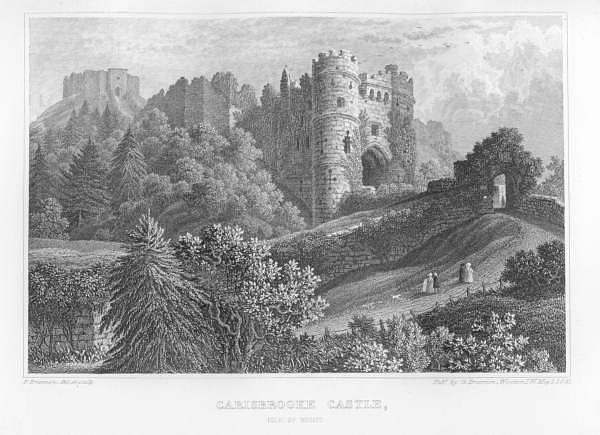
CARISBROOKE CASTLE, ISLE OF WIGHT.
"Still farther in the vale a castle lifts
Its stately towers, and tottering battlements,
Drest with the rampant ivy's uncheck'd growth."
The chief curiosities within the castle are ... the Keep,
the immense Well, and the apartments which were the
Prison of King Charles I and his family.
The high antiquity of this beautiful ruin, which occupies the crown of a
hill only one mile westward of Newport, renders it an object of the most
pleasing interest with all classes of visitors to the Isle of Wight; and
it is the only local specimen of ancient fortification deserving a
stranger's notice. It is known to have existed for at least fourteen
centuries, having in that long period been subjected of course to many
mutations. The Saxon chronicles mention it as a place of strength and
importance in the year 530, when Cerdic subdued the island; and it was
subsequently rendered almost impregnable, according to the mode of
fortification which prevailed among the Normans, by William
Fitz-Osborne, to whom the island was given by the Conqueror. And in the
reign of queen Elizabeth, it received the most substantial repairs and
ample additions; when the outer trenches and bastions were formed upon
the plan of those of Antwerp—circumscribing about 20 acres.
On our nearly reaching the top of the hill by the carriage-road, we see
first the ancient Keep, peering above the rest of the ruins;
and next, the principal and well-guarded entrance to the interior of the
fortress. Passing through an ivied gateway, built in the reign of queen
Elizabeth, as appears by the legible inscription (40 E.R. 1520,) on a
shield over the arch: we proceed to another gateway in a spacious square
building, whose angles are strengthened by two noble round towers: this
opens into the interior area; had several prison rooms, and was armed
with a portcullis: but the whole of it is now in a sad condition,
"Defac'd by time, and tott'ring in decay!"
Nothing can be more picturesque than the first view of this venerable
scene: the most luxuriant ivy everywhere mantles the grey walls and
mouldering battlements, interspersed with the waving branches of wild
vegetation: and the surrounding terraces are adorned with the opposing
tints of pines and every variety of deciduous trees.
Being admitted through the curious old oaken wicket to the inner court,
the attendant cicerone will lead the visitor to several objects in due
succession: the most remarkable are ...
The place in which the unfortunate king Charles I was confined (1647),
and his children imprisoned after his death: but the apartments are so
dilapidated that it is next to impossible to decide upon their
arrangement: the window however is shown through which he vainly
attempted an escape: this is generally examined with a greater share of
interest than perhaps any other part of the castle, and is often obliged
to contribute as a relic, some minute portion of its crumbling walls.
THE KEEP is certainly the most ancient part of the fortress, having been
built either prior to, or early in the time of the Saxons: and was
rendered an appendage to the more ample fortifications constructed by
the Normans. It is reached by a flight of 72 stone steps (nine inches
each); was guarded by a portcullis-gate; and provided with a well 310
feet deep, since partially filled by the falling ruins.
At the S.E. angle are the remains of another very ancient tower called
Montjoy's: the walls in some places are eighteen feet thick.
The Well-house is to many persons the most attractive object
within the walls of the castle,—for should the solemn ruins fail to
impress that sentiment of reflection which proves to others the very
zest of their visit, they will at least be not a little amused by the
apt performance of a docile ass, whose task it is to draw up water from
a well 300 feet deep! This office he performs by treading rapidly inside
of an immense windlass-wheel (15½ feet in diameter,) whereby he gives
it the necessary rotatory motion. The natural longevity of these patient
laborers is here exemplified by the instances on record; one done the
duty for above 50 years, another 40, and another nearly 30. To afford
some idea of the depth of the well, a lighted candle is lowered: and
water is thrown down from a bucket, which produces quite a startling
noise,—it will be three or four seconds in falling. For the same
purpose, pins were formerly employed, but these were strictly forbidden,
on account of their deleterious tendency on the water.
The Chapel, the Governor's apartments, the Barracks, Powder Magazine,
&c. are also pointed out; but to go over the whole works of this
venerable monument of antiquity, and give a minute detail of the several
parts usually shown to strangers, would be tedious to the reader,
though doubtless every spot and fragment must be viewed by the visitor
with a lively interest.
If a party be not pressed for time, they should go round the outer
terrace, reckoned a mile in circumference, the walk is in some parts
sequestered and most pleasingly solemn, in other points presenting very
charming views; and altogether calculated to raise our admiration, and
give a more perfect idea of this beautiful specimen of ancient
fortification.
The open space in the outworks, called the Place of Arms, is where the
Archery Club resort during the season for exercise; no spot certainly
could be more convenient: though by the bye, there is a degree of modish
gaiety on such occasions, which is not altogether in character (at least
to a picturesque eye,) with the solemnity of a scene betraying ...
"The grey and grief-worn aspect of old days!"
The military establishment of the castle is at present altogether a
sinecure; formerly this was the regular seat of the insular
government; but now it is quite deserted, save by the individual
who has the privilege of showing the place to strangers, and his
attendants.
Is an extremely pretty place, and still very populous, though much less
so than formerly, when it enjoyed the consequence of a city,
guarded by the only fortress in the island to which the inhabitants
could fly for refuge in the moment of invasion: it rises on a hill
opposite that on which stand the venerable ruins of the Castle: and in
the intervening valley a beautiful stream winds its course towards
Newport, sufficiently copious to turn several mills—the springs
supplying water highly esteemed for its purity. The church is of great
antiquity: and its tower is a very handsome specimen of Gothic
architecture, proudly relieving itself from the surrounding trees and
habitations. There are several genteel residences, and a few good
lodging-houses in the village, whose neatly dressed gardens,
interspersed with lofty trees, and environed by the most agreeable
scenery, give to the place altogether an uncommon air of rural beauty.
"How picturesque the view, where up the side
Of that steep hill, the roofs of russet thatch
Rise mix'd with trees, above whose swelling tops
Ascends the tall church-tower, and loftier still
The hill's extended ridge, crown'd with yellow corn—
While slow beneath the bank, the silver stream
Glides by the flowery isles and willow groves."
To form an idea merely of the Town, it will be sufficient for a
stranger to pace two or three of the principal streets—the High-st. of
course from one end to the other; he will then see the
TOWN-HALL: the old Parish-church, situated in the
Corn-market; the public Library in the Beast-market; and the
ancient Grammar-school. The most inviting short walks are
over Montjoy's to Carisbrooke—to the top of Pan
Down—and to Hurststake, on the banks of the River, at
high tide.
Newport is allowed by most travellers to be as clean and pretty
a country-town as any in the kingdom. The houses are of a modern and
respectable construction: the streets regular and well paved, with
sufficient descent to be always clean; and two copious streams water it
on the east and west.
Being closely surrounded by an amphitheatre of lofty downs, beautifully
checquered by pasture and cultivation, cottages and villas,—the
environs are of the most agreeable and inviting character, and the
climate mild and salubrious; to those therefore who love to blend social
intercourse with the pleasures of a cheerful yet quiet retreat, Newport
presents many decided attractions. Years ago it was observed, that
"there were few provincial towns which could afford independence more
sources of rational enjoyment:" and since then there has been a great
accession to the local means of intellectual pleasure, in respect of
philosophical and literary institutions, private and professional
reading societies, a Mechanics' Institution, circulating libraries, &c.
&c. The places of public worship too have equally increased; being three
episcopal (two of recent erection), two for Independents, two for
Wesleyan and Primitive Methodists, a Bible-Christian, a Roman-catholic,
a Unitarian, and a Particular-baptist. There are five respectable inns,
in the town (see the List), and two assembly-rooms.
From its central position, it is well calculated for being the principal
market-town, and, as it were the metropolis, of the island. On the
Saturdays in particular, it presents a very animated scene: being
frequented by all classes who are obliged to attend for the purposes of
business, or upon judicial affairs; which would naturally induce many
other parties to visit in favorable weather, were it only for the sake
of a pleasant jaunt.
These advantages of course give it a steady trade in almost every branch
of business; and latterly the shops have exchanged much of their
antiquated country appearance for the more imposing style of the
fashionable towns,—where dazzling glare is resorted to as the chief
attraction.
Though Newport does not depend, like the watering-places, upon the
annual influx of visitors engaging their lodgings for a season, yet
many of the best situated and most convenient houses are handsomely
fitted-up for the purpose; and should the river be ever
sufficiently deepened to admit a passage steamer to ply at regular
hours without regard to the state of the tide, Newport might defy
all competition, by the rapid improvement of its various local
capabilities which would necessarily follow.
The River (called the Medina, from dividing the island in the middle,)
is navigable from Newport to Cowes for vessels of sixty or seventy tons
burthen, during high water. The banks are beautifully dressed with
scattered groves and copse-wood: and interspersed with the arable fields
and meadows are several churches, seats, villas, farms, and cottages, on
either side: and as the lands rise rather boldly, the while scene is
viewed to advantage from the water, and will be found to afford a very
delightful trip on a summer's day, to or from Cowes; the party leaving
by the returning tide after about two hours' stay at either place.
The gayest season at Newport is during the Whitsuntide Fair, and
three successive Saturdays at Michaelmas, the time when the
agricultural servants receive their wages, and re-engage for the
following year. The old custom of the female-servants assembling at
one part of the town, and the men at another, for the purpose of
engaging in new situations, is still partially kept up; these
occasions are familiarly called the "Bargain-fair Saturdays," the
middle or principal one falling on the first Saturday in October.
Of these the most conspicuous is the Guildhall, situated nearly
in the centre of the town: it is rather a stately edifice of the Ionic
order. Here the magistrates of the whole island meet every Saturday for
hearing and deciding upon petty causes: and examining and committing
prisoners to the Winchester assizes, or in, minor offences to take their
trials at the quarter sessions for the Isle of Wight, formerly held at
Winchester, but which are now very properly adjourned, to save the
inhabitants the great inconvenience and expense of crossing the water.
There are also the quarter sessions for the borough; and that excellent
institution, the County Court for the settlement of small debts.—In the
area beneath the hall is held the Saturday's market for poultry, eggs,
and butter.
Another showy building is the Isle of Wight Institution, or
permanent public Library, to which nearly all the neighbouring gentry
subscribe. Besides the reading-room and library it contains a museum for
local curiosities, &c. Temporary residents in the island may become
subscribers for six months by a payment of 25s.
The Free-Grammar School is the only building claiming respect
for its antiquity (besides the parish-church), situated in the street
leading to the Cowes road: it was erected by subscription in the year
1619, and duly endowed. Though recently having been repaired throughout,
its appearance is still rather picturesque: and possesses considerable
historic interest, from the memorable conference held here between the
parliamentary commissioners and king Charles the First, up to the
unfortunate moment when he was unexpectedly seized and imprisoned in
Hurst Castle.
The PARISH-CHURCH is considered to be of the age of Henry II, as it is
dedicated to St. Thomas-a-Becket: it is spacious, and has a fine lofty
square tower; but there is nothing very particular either in its
architecture or antiquities to call for minute description. The chief
curiosities are ... the Pulpit, remarkable for its rich and ingenious
carving: a monument to Sir Edward Horsey; and the spot where the second
daughter of King Charles was buried: she died while the family were
prisoners at Carisbrooke—and it was only by accident in the year 1793
that the vault was discovered.—St. John's Church, built a
few years ago on the south side of the town, at the foot of Montjoy's,
is a conspicuous object in most points of view: and though plain in
appearance, is very convenient in its interior arrangements: it is
supported on the voluntary principle.
Newport returns two members to parliament.—The number of inhabitants in
the town, which has considerably extended beyond the limits of the
borough, is about 7000. The corporate body consists of 24 members; but
since the passing of the Municipal Reform Act, there can of course be
nothing peculiar in their constitution of which the reader need be
informed.
A Lace-factory on a very extensive scale is established just
without the town, on the east side, going to Ryde: in the town is
also an establishment which gives employment to many females in the
lace-embroidering process.
The following villages and hamlets are nearly connected with, or
gradually approximating the town:—
On the eastern side, surrounded by meadows, is BARTON's VILLAGE, near
which a neat little church has lately been opened, on the road to
Ryde;—just above it is a gentleman's seat called Bellecroft.
SHIDE, half a mile to the south, is picturesquely seated at the foot of
the steep and high down called Pan: the river Medina flows through the
grounds, and there are several respectable villas in its immediate
neighbourhood.
Westward is the NEW VILLAGE, a street of genteel and comfortable houses
(some of which are furnished for lodgings,) leading to Carisbrooke:
behind it is the hill called Montjoy's, from whose lofty summit is
obtained the most comprehensive view of Newport, its river, and the
adjacent country. There is also a small hamlet on Hunny-hill,
north of the town.
FAIRLEE is a principal seat, a mile north of Newport. The house is large
and of respectable appearance: standing at the head of an extensive and
beautiful lawn which slopes to the eastern bank of the river, surrounded
by close and open groves.
About a mile from Newport, on the road to West Cowes, stands the HOUSE
OF INDUSTRY, a very large building, generally containing between 500 and
600 paupers; it includes within its walls a lunatic asylum, hospital,
school, and chapel: and has an extensive garden attached.
Its internal affairs and out-door relief are regulated by a Board
of Guardians and Directors, consisting of a certain number of
respectable inhabitants, chosen from every parish in the
island,—under the provisions of an Act of Parliament obtained in
the year 1770 for the parochial consolidation of the whole island.
They are therefore independent of the Poor-law Commissioners, and
have adopted only as much as they thought proper of the general
statute.
ALBANY BARRACKS, on the opposite side of the road, are capable of
accommodating nearly 2000 troops—for a long time however the complement
stationed here seldom exceeded a few companies, and for months together
there would not be even a serjeant's guard: but latterly the depots of
several regiments have been removed hither: so that there are now often
from 1000 to 1500 men at the same time.
Westward of the Barracks, bordering the Yarmouth road, is the extensive
tract called Parkhurst Forest, planted a few years since with
oaks and Scotch firs, by order of Government.
PARKHURST PRISON, to the north of the barracks, is an extensive range of
buildings, dedicated to the benevolent purpose of reclaiming from
infamy, if possible, a large number of juvenile criminals of the male
sex.
To accomplish this truly desirable object (as punishment ought
certainly to be corrective in the best sense of the word), the
boys are regularly instructed by competent tradesmen, in such
branches of popular business as may be best suited to their
respective capacities: in conjunction with the most approved course
of common school-education. Particular attention is likewise paid
to the elevation of their moral character, so likely to be
permanently influenced by means of impressive friendly admonition,
the frequent inculcation and daily observance of religious duties,
and the exciting hope of reward for good behaviour in a mitigation
of their sentence: in short, by the most encouraging and kind
treatment, as far as is compatible with the strictness of prison
discipline. None therefore, but the thoroughly incorrigible, can
leave the institution without being greatly improved in their
habits and dispositions, if not altogether reformed; since Order,
Cleanliness, Activity, and Industry, must become almost natural
to them by the time they are discharged,—their understandings
cultivated, and their minds more or less impressed with the
sentiments of virtue and religion.
It would be injudicious to enter in detail on the subject of the
routine management, or the particular discipline adopted in the
respective wards: as very probably many alterations will be
introduced from time to time, as experiment and practice may
suggest: and moreover, as a "Report" is annually published by order
of Government (at a low price), containing the most minute
particulars in every department of the Asylum. For the same reasons
we have avoided any description of the architectural plan of the
prison, a pretty good idea of which may be formed in passing by on
the high-road.—We must however mention one fact that speaks highly
favorably of the salutary system adopted, namely, that during the
five years from the opening of the institution in 1838, there
occurred but two deaths among the boys, though the number averaged
about 250 at the same time.
The establishment has been visited by several eminent persons, who,
after having particularly examined the course adopted in every
department, expressed themselves so well pleased with its
management and beneficial tendency, that another building at a
short distance was erected in 1843; and altogether there is
sufficient room now for 700 or 800 delinquents. No stranger is
admitted without an order from the Home Secretary of State.
The newly erected residences of the officers and other parties connected
with the prison, barracks, &c., altogether form quite a village, known
by the general term of Parkhurst.
The transient visitor here should immediately inquire for the
Parade—pass by the Castle on the beach, to the
bathing-machines—retrograde by the carriage-road under the New
Church—mount the hill at the back of the Castle—reach the
Old Church, which is contiguous to Northwood
Park—and then return, to cross over to E. Cowes.
The decided advantages of Cowes are ... its excellent shore for
bathing—and its safe and commodious harbour—which recommend it
strongly as a fashionable watering-place, and the resort of gentlemen
fond of aquatic amusements.
The appearance of this town from the water, particularly when approached
by the passage from Southampton, is extremely pleasing; as the acclivity
of the hill on which it stands is sufficiently bold to admit of the
houses being seen above each other, as if built on a succession of
terraces, while their starting formality is charmingly relieved by the
intervening shrubberies and groups of lofty trees. To a stranger
however, who may confine his walk to the streets just where he lands,
this favorable impression would be almost obliterated,—for they are
both narrow and crowded: though in these respects there is some
improvement the further he goes either to the east or the west; but it
is near the Castle that he must look for the greatest share of united
beauty and respectability. The truth is, the lower part near the quay is
of course occupied by tradesmen, for the advantages of business, and
convenient landing-places; and as their houses stand at the edge of the
water, many parties prefer their lodgings to those in the more open
quarters on the top of the hill,—and many of them are therefore
elegantly furnished for letting.
The Parade affords a delightful promenade, being on the water's
edge. Here are several first-rate houses, standing at the foot of the
steepest part of the hill, which is luxuriantly clothed with hanging
shrubberies and several groups of majestic trees, presenting a perfectly
unique picture of sylvan and marine beauty. The Royal Yacht-Club House,
with its ample awning, and the very elegant Gothic villa of Sir John
Hippesley, will be particularly noticed.
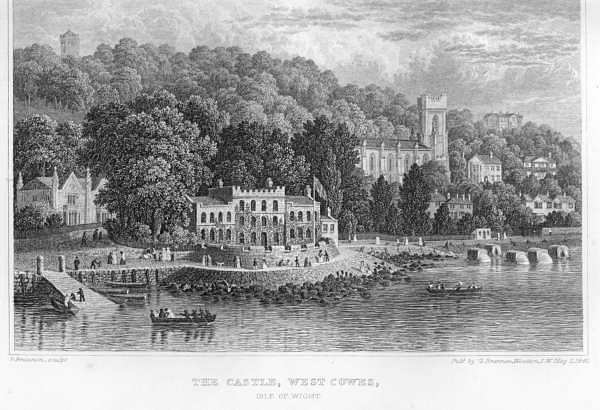
THE CASTLE, WEST COWES, ISLE OF WIGHT
THE CASTLE stands westward of the Parade: but were it not for a small
battery of eleven guns in front, the stranger might search in vain for a
fabric which he could identify as "a Castle," at least by any portion of
its modernized architecture and surrounding embellishments. In fact, the
original dwelling was a few years ago greatly enlarged—made a story
higher—the open ground at the back inclosed (!)—with other alterations
to render it a fit residence for nobility. It was built by king Henry
VIII, about the same time as those at Sandown, Yarmouth, and Calshot,
for the purpose of securing the coast against the then frequent attacks
of pirates, as well as the more formidable invasions of the French.
Beyond the Castle are the bathing-machines; the villas of Earl Belfast
and Lord Grantham; and behind these several others built in various
tasty styles, and acquiring a picturesque effect from being more or less
screened by the copse-wood on the steep slope at their back. But the
chief ornament of this quarter is the new Episcopal chapel, whether
viewed near, or from a distance on the water,—being a chastely-elegant
structure in the Gothic style, in a most commanding situation: it is
private property. Should the stranger feel disposed to extend his walk
for about a mile further on the beach, which he would find very
agreeable—he will come to a gentleman's residence distinguished by an
air of antiquity, named Westcliff, though the neighbourhood is popularly
called Egypt.
We make this remark, because there is a lane close by, which turns
up to the high-road from Cowes to Gurnard Bay, and by this road we
would recommend the visitor by all means to return, for the sake of
the magnificent prospect which it affords, and on the peculiar
character of which the permanent attractions of the place so much
depend. But to do this justice, the reader must have recourse to
his Map. The most prominent objects are Calshot Castle, standing
apparently isolated at the mouth of Southampton Water, and the tall
tower of Eaglehurst, seated on the neighbouring shore.
By "permanent attractions," we mean, that many landscapes of the
most romantic character fail to attract our attention for any
considerable time, on repeated visits, if destitute of those
ever-varying circumstances which have in some degree the interest
of novelty such for instance as the rural, and more
particularly the marine prospects of the Isle of Wight; these
afford an endless source of amusement to the speculative
eye,—whether directed to the soft and gradual changes on the
variegated face of Nature under cultivation, or to the more
animated, and constantly shifting scene exhibited in a crowded
sea-port, or where there are other safe and ample roadsteds for the
heaviest ships of war. In these advantages Cowes and Ryde stand
pre-eminent.
"Scenes must he beautiful, which daily viewed,
Please daily, and whose novelty survives
Long knowledge, and the scrutiny of years—
Praise justly due to those that I describe"
We are now supposed to have reached the top of the hill, where the old
Church is situated: this is a spacious, plain building, having
a very tall square tower, as destitute of beauty as anything of the kind
can well be: yet as it peers loftily above all the surrounding objects,
is a great improvement to the outline of the hill, when viewed from any
considerable distance. Contiguous to the crowded cemetery stands ...
NORTHWOOD HOUSE, a large and elegant mansion in the Palladian style of
architecture. The Park is an extensive demesne, and profusely
planted; there are however comparatively few of those venerable sylvan
honors which constitute the beauty of park-scenery.
On the eastern slope of the hill, where the high-road turns off for
Newport, stands Westhill, a charming cottage-ornee in the
centre of a smooth sloping lawn interspersed with magnificent elms and
close shrubberies.—In the environs of Cowes are several other genteel
residences: Moor-House is distinguished by its Gothic pinnacles
and commanding station: and near Gurnard Bay is a pretty retired seat,
appropriately called Wood-vale.
Besides the two churches, there are Catholic, Independent, and Wesleyan
chapels. There are three large Hotels (see the List), and several minor
places of good accommodation; reading-rooms, a Mechanics' Institution,
&c.
The town itself has nothing to interest a stranger: but in the
vicinity are several first-rate seats and marine villas—the most
distinguished being Osborne, Norris, and East
Cowes Castle.
This little town is separated from West Cowes by the river Medina, which
here joins the sea. From the unexpected concurrence of various favorable
circumstances, it is looking-up to be a place of some importance: the
value of property has already considerably advanced, and trade in
general improved. It has one good Hotel, several respectable
lodging-houses: a neat episcopalian church, and an Independent chapel.
Having a large shipwright's yard, and a number of marine stores, wharfs,
&c., where merchant-ships lie alongside to take in or unload their
cargoes, it often exhibits much of the bustling appearance of a sea-port
town. There is a private landing-place near the ferry, for the
accommodation of Her Majesty. The Custom-house has been removed to the
other side of the harbour.
The immediate neighbourhood of East Cowes has long been extremely
beautiful, from being almost entirely covered with charming seats and
villas, whose luxuriant groves and shrubberies give the scenery an
uncommonly rich effect: and her Majesty having made this part of the
island her marine residence, it now possesses a proud distinction in
point of interest with the British public.
A stranger should make his perambulation by first ascending the hill by
the old carriage-road, passing several villas (see list) secluded by
dense shrubberies and large trees; a circumstance little to be
regretted, as their chief boast is the amenity of their location. But
through the tall plantations on the right our eye will be delightfully
attracted by the picturesque turrets of East Cowes Castle, and the
surrounding beautiful grounds. At the pretty lodge-entrance to the
castle, the road divides,—the left-hand branch running to Norris, the
right to Osborne and Newport; and in about eight or ten minutes' further
walk, we can return by the new road through "East Cowes Park."
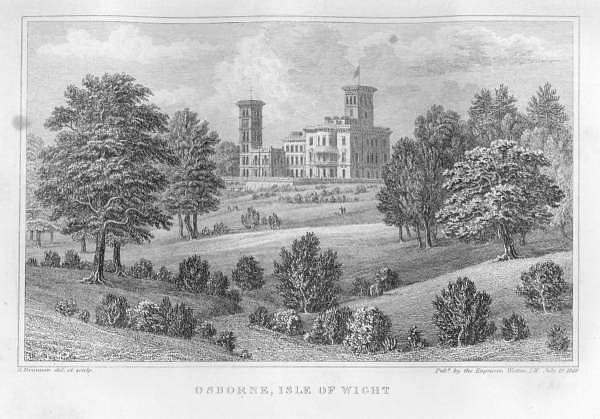
OSBORNE, ISLE OF WIGHT
OSBORNE, the property of her most Gracious Majesty, is
entitled, equally from public interest and its own importance, to the
first notice under this head.—The situation is everyway eligible for
the marine residence of a sovereign of the British Isles: for it
commands a most extensive and animated prospect, including Spithead
and other naval stations: has a beautiful sea-beach (with a private
landing-place); and is sheltered by extensive woods and plantations. The
original seat was a plain family mansion surrounded by park-like
grounds, which have been extended by the purchase of several
farms—including Barton (whose fine old Elizabethan manor-house
has received a complete and judicious reparation): so that the estate is
now most conveniently bounded on the west by the high-road from East
Cowes to Newport; on the south by a branch of the same road to Ryde; on
the east by a sheltered cove called King's Quay (as tradition will have
it from the circumstance of King John there concealing himself for a
time when opposed by the barons): and on the north-east by the beautiful
Solent Channel. Thus compassed by the sea and the best roads in the
island, it extends from north to south about two miles and a half, by
nearly two miles from east to west; enjoying the most delightful variety
of scenery, from the simple picture of rural life to the grandeur of our
naval glory, and the majesty of the ocean itself.
The quality of the soil differs very considerably; but the worst is
well adapted for oak-plantations; and the thorough draining and
other improvements now carrying on will make the whole admirably
suited for agricultural pursuits, to which H.R.H. the Prince
Consort is very partial. A great part of the estate is enclosed by
a park-fence; and through the luxuriant woods and undulating
grounds, several miles of excellent private carriage-roads have
been constructed, much more being in progress.
The Palace occupies the site of the old house; it is in the
Palladian style (which so admirably admits the application to domestic
architecture of the most beautiful features of the Grecian orders).
Within the ballustrade of its lofty flat roof is a charming promenade in
fine weather.
The flag-tower is 107 feet in height, the clock-tower 90, the first
terrace-wall 17, and the second 10. The Royal Apartments are contained
in the loftiest part of the building—they are handsome and spacious,
and standing altogether in advance, command on every side the most
uninterrupted views: at the back is the flag-tower, communicating with
an open corridor which extends the whole of the north-west face of the
building; and on the other side of the tower is the carriage-entrance,
opening on pleasure-grounds adorned with the choicest varieties of
ornamental shrubs—thriving with a luxuriance which promises well for
the appearance of the estate, when the whole shall have been finished.
The builder is T. Cubitt, esq.; but the design, we believe, was
principally furnished by His Royal Highness Prince Albert himself—whose
taste, and knowledge of the fine arts, well qualify him for the
undertaking.
As it would be almost impossible to convey by verbal description a
correct idea of the general appearance of this noble structure, we
beg to refer our readers to the annexed Engraving—and also to the
Views of Osborne, recently published in the "Vectis Scenery," and
which may be purchased separately at 1s. each.
NORRIS is a noble specimen of the castellated mansion, having been
built in imitation of an ancient Norman fabric—massive in its
construction, and remarkable for a stern simplicity of style disdaining
all minute decoration. From this circumstance, and some of the loftiest
towers being enveloped in the most luxuriant ivy, the whole building has
so venerable an air of antiquity, even when closely examined, that we
can hardly suppose it to be the production of modern days: and enjoying
too as it does an uncommonly fine position on the most northern hill of
the island, its general aspect is truly magnificent in every point of
view. It is scarcely necessary to add, that the castle commands a most
interesting marine prospect.
Some of the rooms are of elegant dimensions, and the arrangement of the
whole considered good—such indeed might be expected from the reputation
of the architect, the late Mr. Wyatt. The stables, &c., are also on a
very ample scale, and in the same plain, substantial style as the
castle, for which they have not unfrequently been taken by strangers at
the first glance.
The grounds are now well timbered: the plantations beautifully dressing
the steep slope even to the water's edge. The utmost privacy might be
enjoyed, for there is the accommodation of a good landing-place, and a
carriage-road thence to the house.
Norris was the property of the late Lord Henry Seymour, who was
engaged many years in its construction, and must in the course of a
long period have expended immense sums in improvements that may be
said to be now buried from our view. After his demise, it was
two seasons chosen for the residence of their R.H. the Duchess of
Kent and the Princess Victoria (during which time the latter
improved remarkably in her health): and has since been purchased on
very moderate terms by R. Bell, esq.—who greatly extended the
scope of the grounds by fresh purchases of land, especially by some
belonging to the Osborne estate—previously to her Majesty's
negociating for its possession.
EAST COWES CASTLE, which enjoys a truly enviable site (for it combines
an uncommon degree of shelter with the most extensive and animated
prospect), is built in the bold style usually termed the Moorish, and
has three handsome fronts of varied elevations, with a tasteful
diversity of towers, mantled more or less by the most luxuriant ivy, and
a great variety of elegant flowering plants. The Conservatory is a
splendid addition; and the grounds, though not extensive, are very
beautiful.
East Cowes Castle was built by, and continued for many years to be
the favorite residence of the late John Nash, esq., and was with
him a sort of architectural pet, receiving from time to time such
additions and alterations as appeared to be improvements to the
general design, or called for on the score of enlarged
accommodation; a circumstance certainly not calculated to insure
the greatest amount of domestic convenience (as regards the size
and arrangement of the rooms), though no doubt contributing largely
to the picturesque effect of the exterior. On Mr. Nash's demise it
was purchased by Earl Shannon,—and after his death by N. Barwell,
esq., who in 1846 sold off all the furniture, and valuable
productions of art which adorned this beautiful object of interest
to visitors.
Is the title of a very extensive building speculation, which comprehends
above 100 acres of land, lying between Osborne and East Cowes. This
tract was a few years back laid out for the erection of a number of
elegant villa-residences, each to be surrounded with its garden and
shrubbery, yet to command a delightful marine view. Excellent roads were
made, having on either side a foot-path, flower-border, and neat iron
pallisade; handsome gateways erected; and a pier, botanic garden, and
other attractive improvements commenced or projected. The speculation
did not however meet the success it merited, and comparatively few
houses have as yet been built.
To which Cowes is principally indebted for its origin and present
importance, enjoys a high character for safety as well as convenience:
it is used by vessels of heavy tonnage, either in waiting for a
favorable wind, or for the purpose of repairing damages sustained at
sea; and after stormy weather, is often crowded with ships of various
nations, in addition to those registered at the place—this being the
port for the whole island.
There are spacious dockyards, patent slips, &c., both at East and West
Cowes: at the latter, excellent dry docks. The naval builders have long
held a high reputation for skill: several men-of-war were built here
during the last century; and of late years numerous beautiful
pleasure-yachts, merchantmen, sloops of war, and other
vessels—including the Medina, a first-rate steam-ship (lost on the
West India passage), and some large steamers for various foreign
governments.
THE ROYAL-YACHT-SQUADRON
Make Cowes their port of rendezvous: they contribute largely to the
maritime gaiety of the place, and give particular classes of
tradesmen an extensive share of employment; but the town altogether
does not, it is said, derive that degree of fostering patronage
from their presence which might be expected. The Royal Thames
Yacht-club often make this their summer-station.
THE REGATTA
Generally takes place in August, and is an exciting source of
hilarity with the inhabitants of Cowes, as well as numerous
visitors from every part of the island and opposite coast,—should
the weather prove favorable at the time. The sailing-matches are
now mostly confined to the members of the Royal Yacht-squadrons:
and it is to be regretted, that owing to the distance which they
sail, and the number of days engaged, comparatively little pleasure
is afforded to the mere spectator: there is however usually one
day's continued amusement—when sailing and rowing matches for
liberal subscription-prizes likewise take place between the local
watermen, &c.—excellent bands of music attend,—and in the evening
there is a brilliant display of fire-works, both from the shore and
from the yachts in various parts of the harbour. On these occasions
the appearance of the whole is animated beyond description; and to
a person from the country, the exhibition of such a numerous
assemblage of the most beautiful vessels in the world must prove a
lively gratification, for they are of every size and variety of
rig, from the stately ship of 4 or 500 tons burthen down to the
yawl of only 10.
Cowes lies extremely convenient for parties fond of aquatic trips:
for which purpose a number of experienced watermen ply excellent
boats: they are most frequently engaged in the short and pleasant
excursions to Beaulieu, Netley, Southampton (on the opposite
coast), and Newport; sometimes to Alum Bay, and even for a voyage
round the island.
The bathing here is considered very excellent: particularly so at
W. Cowes, from the boldness and pebbly character of the beach,
admitting the machines to be put in requisition in all states of
the tide,—a very great advantage. There are also hot and other
baths for the use of invalids, both at the machines and at certain
parts of the town.
WHIPPINGHAM CHURCH stands near the second mile-stone, on the ascent of a
hill rising from the eastern bank of the Medina: it is perhaps the
neatest old ecclesiastical structure in the island, and is frequently
attended by her Majesty and Prince Albert when residing at Osborne.
Close by are the Parsonages and Padmore House, embosomed in
groves, and commanding an extensive prospect—the nearest object on the
opposite side of the river being the ancient though plain church of
Northwood. Altogether this is a very pleasing rural spot, and to visit
it will make the difference of only a few minutes in diverging from the
regular road.
Here we pass over an inlet of the sea, indifferently called Fishbourne
Creek or Wootton River; the cottages border the road on either side, and
have a remarkably clean and comfortable appearance. There are also a few
good houses: the Parsonage, though rather secluded, enjoys a charming
marine prospect; and Kite-hill will be known by its antique aspect and
screen of lofty firs. But the pride of the place is FERNHILL, a
first-rate seat: the house is built in the light Gothic style, and
stands at the head of an extensive lawn sloping to the water,
interspersed with groups of trees and flourishing plantations.
We shall often see the prospect-tower of Fernhill peering above the
masses of variegated foliage; and indeed the whole has much the air
of a religious structure, enjoying one of those happy localities
which distinguished such retreats of former days. The opposite
banks of the river, or rather lake, are clothed with the finest
oak-woods in the island, feathering from the very water's edge; and
the whole neighbourhood presents the rich appearance of an
extensive forest covering hill and dale. Should therefore the
visitor reach this spot at the favorable concurrence of high water
on a calm sunny day, he will agree with us that the whole forms a
splendid landscape,—rock being in fact the only feature denied
to make it perfect.
Excellent roads have recently been made (by the proprietor of the
estate,) on the west side of the river, below the bridge: affording
a very pleasant drive; and as they open many delightful sites, will
probably cause a considerable accession of buildings in that
direction.
At the mouth of the creek on the east side is a large hamlet called
FISHHOUSE, including a dockyard, where several frigates have been
built.
Wootton Common is a mile nearer Newport: and affords an
instance within a few years of a wild tract of gorse and brambles being
profitably converted to tillage and garden. Here too are several
scattered dwellings forming an improving hamlet; and in one of them
(called in courtesy Landscape Cottage,) was produced in all its
stages the present little work, as well as its other kindred
publications.
About midway between Wootton and Ryde, on the sea side of the road, we
pass the remains of
The most considerable ecclesiastical establishment ever founded in the
Isle of Wight, which had, like every other part of Great Britain,
previous to the Reformation, its full share of monastic and other
religious institutions. This was among the first settlements of the
Cistercian Order in England, having been built in the 12th century; was
most amply endowed, and had several illustrious persons buried in the
chapel, to whose memory sumptuous monuments were erected; but after its
dissolution, the property was purchased by a merchant of Southampton,
and the sacred edifice reduced for the value of the bare materials.
The merchant's son afterwards sold the estate to the Lord Chief
Justice, Sir Thomas Fleming, with whose descendants it still
remains. Some of the outer walls are still extant, and must have
circumscribed at least 20 acres. A foot-path passes through the
grounds to Ryde, &c.
Of this once-magnificent establishment little now remains; merely
portions of the appendant offices, which were converted into barns,
&c., for farm-purposes. What was spared in the moment of ruthless
spoliation, lay long buried under heaps of rubbish and weeds—till
a few years since, when one of the occupiers, with laudable zeal,
rescued from total annihilation the few remaining fragments, which
are now open to the view of strangers.
Scattered through the island were ... a Priory at St. Helen's; one
at Appuldurcombe; one at St. Cross, near Newport; and another at
Carisbrooke, vestiges of which may still be traced; together with a
great number of oratories, chantries, chapels, and religious
houses, amounting in the whole to 70 or 80, exclusive of the
regular parish-churches;—and yet scarcely any of these interesting
monuments have survived their reckless doom to ruin and neglect;
not even a spiry fragment sufficiently large or romantic to form a
pleasing subject for the pencil, invite the mind to contemplation,
or aid the poet's retrospective muse.
BINSTEAD, to which there is a good foot-path from Quarr through the
woods, is about a mile westward of Ryde. Several genteel residences,
mostly built in a pleasing cottage-style, adorned by groups of trees and
shrubs, are scattered over a wide space of broken ground, where
extensive stone-quarries have been worked for many centuries. It is a
favorite walk with the inhabitants of Ryde, across the fields to the
church (not seen from the road), which has lately been considerably
enlarged and improved. The names of the respective villas will be found
in the List of Seats.
The best may of seeing this populous town, by those who have
little inclination, or perhaps less time, for perambulation is,
from the Pier, to enquire first for Brigstock
Terrace—walk on for about five minutes still
westward—returning, pass by the Church, and round the
Town-hall, and Market-place, St. James's
Chapel, and the Theatre;—look into the Arcade, a
little below;—traverse the street nearly opposite the theatre,
which will open the eastern part of the town, where there is a
handsome new Church—and the very agreeable Environs in
the direction of Appley and St. John's, which ought to be visited
if time could be spared, going first on the beach, and returning by
the high-road, a circuit of about two miles.
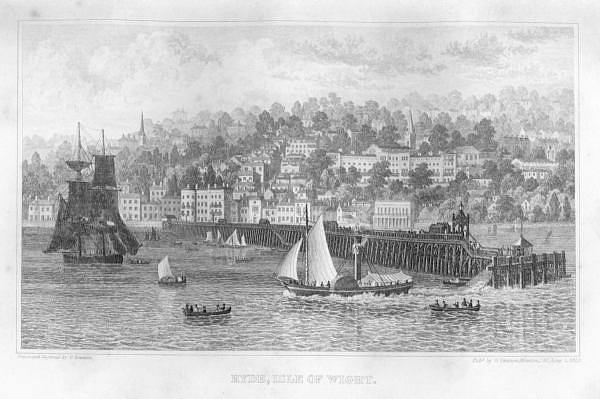
RYDE, ISLE OF WIGHT.
Ryde now ranks the first town in the island for the number of its
elegant modern erections, both public and private; and if building
should be carried on with an equal degree of spirit for a few years
more, it will also be considerably the most populous. It occupies two
sides of a lofty hill, falling with a regular descent to the sea on the
north, opposite Portsmouth, from which it is about five miles across.
This short passage, from its perfect safety and general convenience,
proves a great local advantage, being performed several times a-day by
superior steam-vessels in about half an hour. But besides these
established means of conveyance, large-sized wherries (most excellent
sea-boats,) are in constant attendance to take parties across on
moderate terms, or for hire by the day upon any aquatic trip, even to
Brighton.
The town used formerly to be distinguished into Upper and Lower Ryde,
from having several fields between, but now it is only the difference of
position which calls for any term of distinction; for where the green
meadows then formed the separation, is now the most closely built upon;
and at the beginning of this century, Yelf's Hotel stood a new and
isolated object.
The principal streets are very open, clean, and well-paved; regularly
disposed, most of them crossing each other nearly at right angles.
Several of the handsomest run parallel almost in a direct line to the
beach, thus affording the very desirable advantage of an interesting
sea-view.
THE PIER being the first object to interest a stranger, and having
contributed more than anything else to the advancement of the town, is
well entitled to priority of notice.
Up to the year 1814, when it was constructed by a company in
subscription shares of £.50 each, landing or embarking was rendered
generally a miserable task, except during very favorable weather,
at the moment of high tide. The practice then was, to cram the
passengers promiscuously into a common luggage-cart, till it was
drawn out upon the almost level sands sufficiently far for a large
wherry to float alongside, into which they were then transferred,
and conveyed to the sailing-packet, perhaps lying off at some
considerable distance. The reader will readily believe that this
united cart and boat process of reaching the vessel or shore could
not be very inviting at the best of times; but it was really
terrific to weak and timid persons during the concurrence of a
heavy rain, and the tide perhaps at its lowest ebb!—to say nothing
of the horrors of a dark and squally night.
The length of the Pier is now nearly half a mile (being double the
extent it was originally), having had 500 feet added in the year
1824: the same augmentation again in 1833; and in 1842 it received
the crowning addition of a most spacious and well constructed
Head, which was rendered everyway more convenient for
passengers landing or embarking. This last improvement must afford
a most delightful accommodation for the gentry who prefer the pier
for their usual promenade; and where, from the great extent it
stretches out into the open sea, those invalids who are precluded
from exercise, may more conveniently enjoy the invigorating
sea-breeze. It is firmly constructed of timber: has four or five
landing-places at different distances to suit the state of the
tide: a strong railing on each side; and is furnished with several
open and covered seats.
The TOWN-HALL and Market-house affords the best proof of the
public spirit of the inhabitants of Hyde in regard to local
improvements: for this handsome edifice is on a scale to accommodate
three or four times the present population. It was first opened in the
year 1831: and the commissioners for improving the town endeavoured to
establish a permanent market for cattle, &c., to be held in the large
open space in front, but the attempt proved abortive—Newport lying so
much more conveniently for the general resort of agriculturists and
tradesmen from every quarter of the island.—It is remarkable, however,
considering the spirit of the inhabitants for public improvements, that
it should have been left to the year 1840, before the town was lighted
with gas!
The Arcade is an elegant piece of architecture, though it does
not make that imposing figure of its exterior, which the visitor would
expect, when previously told that it cost at least £10,000. It contains
14 shops, and a very large room for the exhibition and sale of works of
art: every portion being finished in the best style of workmanship.
This bold undertaking for a private individual, we are sorry to
say, has not yet realized a remunerating return. The mistake seems
to have been in fixing upon a site which had no local advantages to
recommend it for a fashionable promenade; nor likely ever to become
a much-frequented thoroughfare, popular and busy. Moreover, the
tradesmen generally find it more to their advantage to engage
respectable houses in the best streets, where they can profitably
let lodgings, and make a much more attractive exhibition of their
goods. These remarks will also serve to explain, why comparatively
so few persons avail themselves of the extensive accommodation
which the Market-house affords.
Brigstock Terrace is a fine range of first-rate houses built
according to a very judicious, uniform design, furnished by the late Mr.
J. Sanderson. They command a beautiful marine prospect, as they stand at
the head of a sloping lawn-like field, interspersed with several oaks
and elms: indeed the terrace is the most conspicuous part of Ryde when
viewed from the sea.
On the west side of the town too is a very spacious square, comprising a
great variety of tastefully-embellished mansions; indeed in every
direction a number of elegant houses are constructing,—tenants being
found for most of them even before they are completed.
A very few years ago it was quite an easy task to point out by
distinctive marks all the most important houses—it was only to
name Westmont, and the two unobtrusive villas of the Duke of
Buckingham and Earl Spencer. The stranger could then have no
difficulty in discriminating these: but now, to give a List of all
the residences that are entitled to notice with an equal share of
pretensions, however judiciously described, would prove perfectly
futile, and only calculated to mislead the stranger.
CHURCHES and other public places of divine worship.—These of course
increase with the population; for only as late as the year 1827, the old
chapel, now distinguished by its graceful spire (and seen at the back of
the terrace), was so inadequate in its accommodations, as to require
being considerably enlarged: and in the same year another was commenced
as a private speculation by Hughes Hughes, esq., this is a long, low
edifice, remarkable for its neat interior: a third has since been
erected on the eastern side of the town, of a handsome design both
inside and out, and very conspicuous from its open situation and lofty
spire:—all three being episcopalian chapels of ease to Newchurch. The
Independents, Wesleyans, and Primitive-methodists have also their
respective chapels, and one for Catholic worship has been lately built,
of the most elaborate style of architecture, especially the interior.
The Family Hotels, Inns, &c.—Of these there are several, of
various ranks, some of them vying in splendor and extent of
accommodation with the best in the county (see the List). The
lodging-houses are of course very numerous, and in every grade, from the
humble jessamy or myrtle cottage at 20 or 30 shillings per week, to
the lordly mansion at as many guineas.
During the latter summer months, the theatre is usually opened by a
talented company of comedians. The shops are generally very imposingly
fitted-up and well stocked: and in the literary and fancy lines are
several excellent establishments—news-rooms, circulating-libraries,
bazaars, &c.
THE ROYAL VICTORIA YACHT-CLUB, established in 1845, numbers amongst
its members many gentlemen of the highest rank, and owners of as
fine yachts as any in the world. Their Club-house is a handsome and
commodious building on the beach west of the Pier; and they have an
annual Regatta in the latter part of the summer, when several
pieces of plate, etc., are sailed for by the vessels of this and
other clubs. There is also a Town Regatta held about the
same time, for the purpose of giving encouragement to the skilful
and deserving watermen: the sailing matches being between the
wherries of the place, which are of a large size, and esteemed by
nautical men to be the finest sea-boats in the kingdom: and as the
race is confined to a circuit which can be distinctly seen from the
whole of the Pier, there is as much interest excited as if the
prizes were contested between larger craft. Rowing-matches also
take place; good bands attend—and the diversions of the day
usually end with a splendid display of fireworks, a dinner, or a
ball. In short, nothing can exceed the gaiety of the scene, when
the weather is at all fine: as it is made the occasion of a general
festivity by the inhabitants—and resorted to as a holiday by great
numbers from Newport, and the eastern parts of the island.
The Shore presents, when the tide is at its lowest ebb, a wide
expanse of sand, stretching for miles both eastward and westward of the
Pier, preserving upon an average the breadth of a mile: here and there
interspersed with ledges of rock, and the banks beautifully feathered
with groves and shrubberies. In some parts the sand has accumulated over
the mud in sufficient quantity to bear wheel-carriages (which is the
case near the Pier): and is found to be gradually increasing both in
depth and extent. The best time to take a walk upon the shore is
directly after the tide has begun to ebb,—for the sand is then firm and
cool to the feet; but after a few hours' powerful sun in calm weather,
it is rendered sufficiently hot to give the flowing sea almost the
temperature of a warm bath, on which account the bathing here is
preferred by many parties to a bolder shore.
That part called the Duver (now built on,) was remarkable
as having been chosen for interring the crew of the Royal George, a
ship of 108 guns, which sank at Spithead on August 29th, 1782, by a
sudden squall, while undergoing a careening of her bottom, when
nearly 1000 persons perished.
Near the Pier are the bathing-machines, well attended, and in full
operation; together with hot, tepid, and other baths for invalids.
THE PROSPECT.—As the amenity of every situation depends, we
consider, greatly on the range and beauty of the view which it
commands, we here give a faint sketch of the one obtained from Ryde
and its neighbourhood: by which, however imperfect, it will be seen
by the reader, that few prospects in England can surpass this,
perhaps even in point of pleasing composition—but certainly not as
a perpetual source of the most amusing observation.
The foreground of the Pier generally presents a most animated
picture,—crowded with promenading fashionables; and surrounded by
numerous wherries, steam-packets, and other craft, at anchor or
gaily sailing about; a busy scene which forms a striking contrast
to the quiet sylvan charms of the home-coast extending many miles
east and west, and embellished by several delightful villas and
other marine residences, among which are Osborne Palace (indicated
by a lofty prospect-tower),—and Norris Castle, just beyond. We
have the Solent Channel seen from here to peculiar advantage,—on
the one hand contracting to the appearance of a noble river, and on
the other expanding and uniting with the open sea. The far-famed
anchorage of Spithead occupies the centre, with St. Helen's to the
eastward, for ships of war; and westward, the Motherbank and
Stokes's Bay, for merchantmen and colliers; hourly altering their
position with the changing tides, and their number as suddenly
increased or diminished with every adverse or propitious breeze.
"Majestic o'er the sparkling tide,
See the tall vessel sail,
With swelling winds, in shadowy pride,
A swan before the gale!"
The eye is soon caught by a splendid range of houses called
Anglesea Villa, on the opposite nearest shore, contiguous to
Monkton Fort; and is thence carried to immense mass of brick
buildings that form the grand naval hospital of Haslar, with the
town of Gosport in its rear; opposite which are the celebrated
fortifications of Portsmouth, with its noble harbour affording calm
security to the maritime glory of England:—Southsea Castle stands
a little to the eastward, and beyond that is the low level of
Hayling Island, where several handsome houses have recently been
built.
The line of Portsdown hills, on one of which is Nelson's monumental
pillar, usually bounds the view to the north; but in clear weather
our range of perspective embraces a portion of the South Downs
which is crossed by the London road near Petersfield: and on the
left, the beautiful retiring banks of Southampton Water to the town
to itself, backed by the woodland heights of the New Forest;—while
to the right it extends to the spire of Chichester Cathedral; but
with the aid of a glass even to Beachy-head, which appears in the
east like a faint cloud upon the horizon of the sea.
May be characterized as being beautifully rural, enlivened by peeps or
open prospects of the sea: for this is the best wooded quarter of the
island, adorned with several charming seats and villas, and intersected
by good roads.
But perhaps it ought to be here explained to the stranger, that by
good roads, in the Isle of Wight, is only meant that they are
kept in tolerably good order: not that they are level, or even
gently undulating: for the very charm of the island consists in its
sudden alternation of hill and dale, producing a constant change of
scenery: one moment you may be enclosed in a sylvan theatre; and
the next minute stand on the brow of a hill, sufficiently lofty to
command an interminable panoramic prospect of land and sea.
We will first conduct our friends along the shore eastward of the
town, for the distance of two or three miles. The principal objects to
the westward have been already noticed (p. 41, &c.)
Appley (about half a mile,) is a marine villa celebrated for
its amenity: hence an excellent road to St. John's, where several very
eligible sites for building on are to be disposed of: and a neat little
church has recently been erected.
St. Clare, another delightful residence: the house built in the
castellated style: and the pleasure-grounds and very extensive gardens,
truly exquisite.
Puckpool, a sequestered Swiss Cottage.
Spring-vale, a pretty hamlet composed of lodging-houses.—A
carriage-road hence by the back of St. Clare.
Sea-view (two miles), another pleasant hamlet, containing
several lodging-houses: and having near it the beautiful villas of
Sea-field, Fairy-hill, Sea-grove, &c. A road
hence to Nettlestone Green.
The grounds of the Priory extend eastward for about a mile: the sandy
beach the whole of the distance is remarkably fine.
From the above it is apparent, that a Party may have a very
pleasant saunter just as far as may prove agreeable, according to
their ability for walking; as there is a choice of roads by which
to return, thus making a circuit of any extent they like.
We now start by the regular carriage-road for the rocky coast (commonly
called the Back of the island), and first reach a hamlet on the rise of
the next hill, named Oak-field, and then ...
St. JOHN's, a first-rate seat,—mansion plain, but admirably
situated for prospect, and screened by beautiful wood, as will appear
in the road making several sudden turns, over-arched by lofty trees,
especially the silver fir. Shortly the tower of St. Clare appears on our
left: Westridge in a valley on the right; and several other
minor seats are successively passed,—some partially seen through the
woods and shrubberies, and others quite secluded.
From the hamlet called Nettlestone Green (about two miles from
Ryde,) a carriage-road leads down to Sea-view, by which the party
may on another occasion return on the beach to Ryde, passing the
back of St. Clare.
THE PRIORY is three miles from Ryde: it takes its name from having been
the site of an ancient monastic cell—is a spacious, plain mansion, and
ranks among the finest seats in the island: here too, much of the wood
is uncommonly fine, notwithstanding its exposure to the sea-air.
Arriving at ...
St. HELEN's GREEN,
We are presented with a beautiful view of the Peninsula of Bembridge,
Brading Haven, and the British Channel. The houses are mostly scattered
round a large verdant square (which gives the name): and a spacious
building, to answer the purposes both of a parish school and chapel, has
been lately supplied by the liberality of a resident gentleman. But the
chief object of curiosity here is the old Church-tower,
standing now at the water's edge, and still struggling against the
further "encroachment of the sea," which in the year 1719, was such as
to oblige the parishioners to build another place of worship in a more
secure situation: this we passed near the Priory. The old tower was
strengthened with a thick facing of brick-work, and painted white; for
it was required to be preserved as a landmark to ships entering the
roadsted. There is something extremely tranquil and pleasing in the
whole of the scene,—and though the composition is simple, forms an
excellent subject for a sketch.
The Party may either cross the ferry with their vehicle to
Bembridge—for there is a good horse-boat in attendance, and drive
round Yaverland and Brading; or they may go to the latter place at
once; returning over the downs to Ashey Sea-mark, which affords an
almost unrivaled prospect,—and hence descend towards Ryde, making
altogether a charming circuit of about sixteen miles.
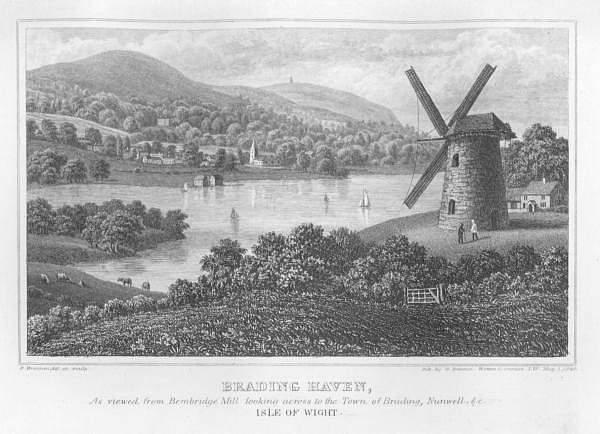
BRADING HAVEN, As viewed from Bembridge Mill looking
across to the Town of Brading, Nunwell, &c. ISLE OF WIGHT.
Exhibits during high water the beautiful appearance of an extensive
lake: but at the recess of the tide, a mere waste of sand and ooze,
comprehending above 800 acres.
As the sea comes through a very narrow inlet at St. Helen's,
several unsuccessful attempts have been made to recover from its
usurpation so valuable a tract of land:—in 1630 the famous Sir H.
Middleton was engaged, and indeed succeeded for a short time, by
means of a bank of peculiar construction. But the sea brought up so
much sand, ooze, and weeds, as to choke up the passage for the
discharge of the fresh water, which accumulating, in a wet season
and a spring-tide, made an irreparable breach, and thus ended an
experiment which then cost altogether about £7000. "And after
all, the nature of the ground did not answer the expectations of
the undertakers; for though that part adjoining Brading proved
tolerably good, nearly one-half of it was found to be a light
running sand." But it should be observed, that previous to the
above attempt, several of the rich meadows contiguous to the haven
were at different times taken in.
One circumstance was very remarkable: namely, a well,
cased with stone, was discovered near the middle of the haven;—an
incontestible evidence, that at some remote period, the spot was in
a very different condition.
To the very remarkable change which appears (by the
discovery of a well,) to have taken place in the condition of the
haven—and the threatened existence of St. Helen's Church, from the
"encroachment of the sea,"—we beg to call the attention of our
more reflecting readers. History and tradition are silent as to the
cause; and the popular opinion of the present day briefly dismisses
the question by ascribing it to an increased elevation of the sea.
But this hypothesis is not supported by the appearance of the coast
immediately to the westward of the haven, where some creeks or
inlets have become dry; a circumstance which induced the Rev. P.
Wyndham, who wrote almost the first intelligent Guide to the
island, to conclude that there actually had been a secession of
tides in this quarter; yet, singular enough, he makes no allusion
either to the haven or the church. Now as there is really no
evidence whatever in the neighbourhood that would lead us to
suppose in the slightest degree, that the sea has encroached upon
the land by its gaining a higher general level (an
idea deprecated by many eminent geologists), we must take the
alternative in accounting for the phenomenon, and infer that the
land of the haven must have sunk at some very distant
period, and that more recently, the same fate attended the
foundations of the church, which certainly could not have been
originally built so very close to the water's edge, as to be
constantly enveloped in sea-foam during every fresh breeze from the
east.
Analagous to the above mutation in the state of the land, is the
following singular fact related by Sir Rd. Worsley, of
Appuldurcombe, who, living as it were on the spot, was not likely
to be imposed upon. The reader is to picture to himself three very
high downs standing nearly in a line,—St. Catharine's, Week, and
Shanklin: the latter, when Sir Richard wrote the account in 1781,
he guessed to be about 100 feet higher than Week Down, but which
"was barely visible" over the latter from St. Catharine's, in the
younger days of many of the old inhabitants of Chale, and who had
also been told by their fathers that at one time Shanklin could be
seen only from the top of the beacon on St. Catharine's. "This
testimony, if allowed," says the worthy baronet, "argues either a
sinking of the intermediate down, or a rising of one of the other
hills, the causes of which are left for philosophical
investigation:" and so with respect to the haven and the church, we
leave it as a curious question to amuse our scientific
friends—whether it is the sea that has risen, or the land which
has subsided?
This is a peninsula about three miles long by one broad,
terminating abruptly on the sea-side in a range of sublime
chalk precipices. The part easily accessible to strangers is
White-cliff Bay, two miles from the ferry.
On account of the inconvenient situation of Bembridge as to the
usual routes, it is not so much visited as Freshwater, whose
precipices are on rather a grander scale, and the most celebrated
in Great Britain of this magnificent species of coast scenery. For
this reason, and also as the cliffs of both places agree almost
precisely in their geological character (for they are but the
termini of the same chain of hills), we shall merge the general
description of the former in that of the latter; but we would
advise the stranger who may sojourn at Ryde, by all means to visit
Bembridge, if he should decline going to Freshwater; and if in a
good boat on a fine day, so much the better,—he will be well
gratified with the brilliant spectacle which these noble "white
cliffs of Albion" present.
Before the year 1830, Bembridge seemed to be shut out from intercourse
with the world: it was very rarely visited; possessed no facilities of
communication; and had no charms to call the traveller aside from the
routine track. But owing to the wise and spirited exertions of
a resident gentleman, it was soon rendered a populous village.
Among the first improvements was the erection (by public subscription)
of a handsome little church for the accommodation of the inhabitants,
who before had no place of episcopalian worship nearer than Brading: the
next consideration was the establishment of a horse-boat, and other
regular means of passage across the haven:—land was sold off on
eligible terms for building; several tasty villas were soon erected, and
ample shrubberies formed:—new roads were projected, the old ones
widened and repaired, and travelling altogether rendered more agreeable.
A respectable Hotel was also built at the same time, near the beach.
The face of the country about Bembridge is pleasant enough, being
agreeably checquered by grove and meadow, cultivation and open
pasturage: but it is the surrounding prospect which yields the
chief pleasure. The situation of the Church and other principal
buildings, is sufficiently evident to the visitor from St. Helen's, or
as he crosses the ferry.
The chalk precipices of Bembridge are named the Culvers, from the
circumstance it is said, of their having been the haunt of immense
numbers of wild pigeons; and they are now, as has been already mentioned
(p. 21), resorted to in the summer months by prodigious flights of
various sea-fowl. There is a small cavern called Hermit's Hole
in the face of the cliff, about thirty feet from the top; the descent to
it however is steep and narrow, and it is comparatively but seldom
visited.
Bembridge Ledge is a dangerous reef of rocks, stretching out
into the sea a considerable distance: a floating beacon-light called
"the Nab" is always moored within a short distance, to warn ships of
their position.
YAVERLAND. This is a straggling village near the sea-shore, between
Brading and Sandown Fort. The little parish-church and the adjoining
mansion (now converted into a farm house,) exhibit a venerable
appearance, and being surrounded by groves of magnificent elms, the
whole presents one of the prettiest rural scenes in the island; and to
the amateur of sketching, it must prove a treat. The Parsonage too will
be admired for its appropriate character and pleasant
situation.—Passing a few scattered cottages, our road will be on the
pebbly beach to ...
SANDOWN,
Altogether an extensive village, containing several new houses built
near the sea-shore, intended for letting as summer lodgings: some of
them are large and splendidly furnished: and enjoy a beautiful view of
the British Channel, the dazzling cliffs of Bembridge, and the range of
coast for two or three miles in the direction of Shanklin. There is a
church, newly erected in the upper part of the village: and a neat inn
on the beach.
Midway between Sandown and Shanklin we pass through Lake, a
pretty hamlet, having a few cottages that let occasionally for lodgings
during the summer months.
Consists of one long, ancient street (through which is the chief
thoroughfare from Ryde to Shanklin and the Undercliff,) and a few good
houses recently built on the outskirts: it lies about half a mile from
the haven; and still retains some of the privileges of an ancient
borough. The Church is considered the oldest in the island; as it was
certainly in existence early in the eighth century, though some date its
erection so high as the sixth, and contend that the first islanders
converted to Christianity were here baptized. On account of its
antiquity, the numerous relics which it contains, together with the many
well written inscriptions to be found on the tombstones in the cemetery
(the most noted of which perhaps is the one erected to the memory of
"Little Jane,") it is very frequently visited by parties making the
southern tour. The surrounding country too is agreeably varied by wood
and water, arable and pasture, and a very fine outline of hill and dale.
To return to Ryde or Newport over the downs from Brading, will be found
exceedingly interesting to those strangers who delight in the
contemplation of grand prospects, and a most fertile and well
cultivated country:—having no objection at the same time to a hilly
road as the price of their enjoyment, and which we call the most
beautiful in the island.
But as artists are often enraptured with passages of scenery that
to others prove comparatively uninteresting, we subjoin a sketch by
Sir H. Englefield, showing the deep interest and pleasure
the surrounding landscapes are capable of affording:—
"To enjoy in all its glory, the complete view of the northern
tract, which in detail presents so many separate beauties, we must
ascend the chalk range that rises immediately from the woods of
Nunwell. When the weather is clear, it is impossible to describe
the magnificent scene which these hills command, from Brading
Downs, by Ashey Sea-mark, and soon quite to Arreton chalk-pit.
"To the north, the woodlands form an almost continued velvet
carpet of near 10,000 acres, broken only by small farms, whose
thatched buildings relieve the deep tints of the forests. The
Wootton River winds beautifully among them, and beyond the whole
the Solent Sea spreads its waters, which in clear weather is tinged
with an azure more deep and beautiful than any I ever saw. The
Hampshire land rises in a succession of hills quite lost at length
in blue vapour. The inland view to the south is far from
destitute of beauty, though less striking than the northern scene.
The vale between the chalk range and the southern hills is seen in
its full extent: and the southern hills themselves rise to a
majestic height. To the eastward the sea is again visible over
the low lands of Sandown, and by its open expanse affords a fine
contrast to the Solent Channel.
"The nearer objects on the southern slope are also very
interesting: Knighton House, with its venerable grey fronts mantled
with luxuriant ivy, and bosomed in the richest groves, is as
beautiful at a distance, as it is interesting on a nearer approach.
Arreton is also surrounded with trees, which group happily with the
pretty church and an old mansion now converted into a farm: and
from the western end of the downs, the country about Newport and
Carisbrooke is seen to great advantage. Such is the faint outline
of a scene, which, in richness of tints, and variety of objects,
surpasses anything I ever saw."
Note.—Since this was written, Knighton House has been pulled
down.
Our course will be for the first three miles due west. On the north side
is NUNWELL, the oldest seat in the island, having been awarded by
William the Conqueror to the ancestors of Sir William Oglander, the
present proprietor. Noble specimens of every kind of forest-tree are to
be found in the park: particularly oaks, several of which are many
centuries old, the family having long employed every possible means of
preserving these venerable chiefs of the grove. The house (a large,
plain building,) stands at the foot of the down, and therefore is not
seen from the road: but the surrounding park, woods, and farms of the
estate, spread before the eye in a most beautiful style ...
"With swelling slopes and groves of every green."
ASHEY SEA-MARK is very conspicuously seen, being seated on a high down,
three miles from Brading, four from Ryde, and five from Newport: it is a
perfectly plain, triangular object, erected in the middle of the last
century to assist pilots in navigating St. Helen's anchorage.
On the south side of the down appears the pretty village of NEWCHURCH,
in the direct road from Ryde to Godshill, &c. The situation of the
Church is rather romantic, being nearly on the edge of a remarkably
steep sand-cliff, through which the road is cut, feathered with
brushwood and several overhanging trees.
If the tourist be returning to Newport, he will pass through the long
village of ARRETON, whose church stands at the foot of the down of that
name: it is of considerable antiquity,—and though its style of
architecture is certainly heavy, is upon the whole both picturesque and
singular. Its chief internal decoration is a beautiful mausoleum to the
memory of Sir Leonard W. Holmes, bart.: and in the churchyard is buried
the young woman celebrated for her piety in the popular tract of "the
Dairyman's Daughter."


