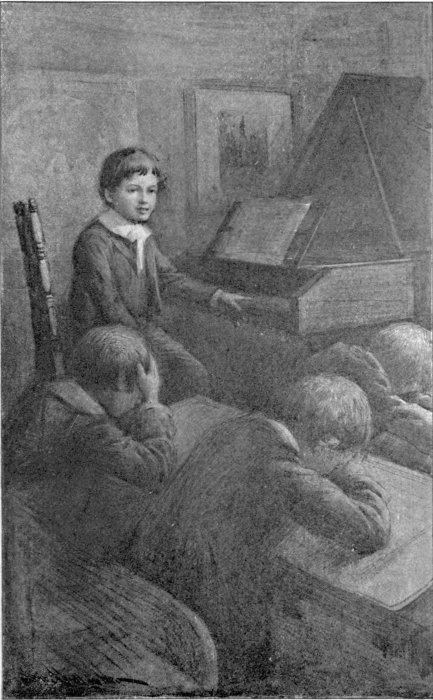
"No, no, Hans, you are too loud, and Frieda goes too fast! Just listen
to Otto's trumpet and watch my cane, all of you, and then you'll be
right."
The tone was an emphatic one, and the speaker pounded sharply on the
floor with his walking stick.
He was a small boy, whose flaxen hair hung straight and thick on either
side of his face. He was panting with excitement, his eyes were
sparkling, his lips were set.
Before him, on the floor, sat six boys and girls in a semi-circle,
attending earnestly to his commands. One boy possessed a toy horn; two
others, mouth organs; a fourth, a chubby girl, had dropped a tin fife in
sheer fright; and the fifth and sixth clung to drum and dinner-bell
respectively.
"This time," went on the conductor sternly, "I want you to begin when I
bring my cane down. Now watch! One, two, three, four,—one!"
As the big baton descended with the leader's vehement "one," a
deafening uproar burst from the obedient orchestra.
"Keep on, keep on! You're going it now! Slower, Frieda! One, two,
three, four!"
The director swung his cane vigorously, shouting his orders above the
strains of the lusty symphony. A few measures were bravely rendered,
when the conductor suddenly threw down his stick with a look of extreme
exasperation.
"Peter," he said quietly, in the tone of a teacher sorely tried but
patient, "please don't jingle the bell. Take the clapper in your hand,
and tap it when I say 'one' and 'three.' Like this!" and seizing the
bell, he illustrated his meaning, compelling the fat offender to perform
the feat to his satisfaction before going on with the rehearsal. When
the bell-ringer had been sufficiently drilled, the director once again
took up his baton and ordered a fresh beginning.
They were playing in good earnest, for this imperious conductor desired
something far above the discordant blasts that are usually obtained from
musical toys. Weeks before he had assigned to each playmate a certain
instrument, teaching him in private to draw real melody from it; and
to-day he had assembled the six performers in his bedroom, introducing
them to the delight of joining together in a familiar musical theme.
To be sure, the toys were shrill and piping, the players often faulty
and careless, but after an hour's persistent and perspiring labor on the
part of all concerned, the Duke's Military March rang through the house
in creditable time and tune.
While the music continued with true martial spirit, the door opened
softly, and a plump, fair girl of sixteen peeped into the room.
Perceiving the occupation of the children, she smiled brightly and
slipped away. A moment later another form appeared upon the threshold,
that of an elderly, dignified man. His hair was white, his eyes were
protected by huge gold spectacles, his shoulders were slightly bent; but
a close observer would have readily detected a resemblance between the
handsome old gentleman and the leader of the orchestra. One bore the
markings of age, the other the dimples of childhood; but they plainly
displayed a kindred will, energy, and intelligence, although one was
seventy and the other but seven.
Mr. Händel was the town surgeon of Halle, appointed by the Duke of
Sächse, and the flaxen-haired boy was the idolized child of his
declining years.
At first sight of the juvenile orchestra the visitor smiled as
indulgently as had the girl before him, entering the chamber
unobserved, and seating himself in a distant corner where he could watch
the highly interesting performance. But he turned quickly grave when his
eye fell upon the small director, who was bending anxiously forward, his
whole being absorbed in the sounds that issued from the toys at signal
of his cane. The flush that burned the leader's cheek, the intensity of
his glance, and the strained alertness of his lithe young body, seemed a
forbidding vision to the old gentleman, for his face clouded and he
shook his head in increasing disapproval.
Presently the concert ended, the children scrambled noisily to their
feet, and the conductor leaned upon his cane, regarding them with the
serene composure of a man who has wrought successfully and is modestly
proud of the fact.
"We must go home, Georg," said Peter, exchanging his bell for his cap.
"I'm going to run, 'cause I'm so dretful hungry," announced Frieda,
disappearing in quest of curds and seed cakes.
"You may all go now," consented the director affably, "but," raising a
commanding finger, "we will practise again at seven o'clock to-morrow
morning, and whoever is one minute late won't be invited to my party in
the afternoon."
"Oh, Georg," wailed Frieda, recalled from the corridor by this edict,
"must I come at seven, whether I've had any breakfast or not?"
The leader bowed.
"Whether you have had any breakfast or not," he rejoined firmly.
The children trooped down the stairs, leaving their chief to gather up
the toys and place them carefully upon the table.
He was about to leave the room when, for the first time, he discovered
that he was not alone.
"Father!" he exclaimed, bounding gladly to the old man's side, and
laying one hand affectionately upon his shoulder. "Did you hear us
play? Didn't we do well? If only we had a fiddle we could make much
better music. Oh, father, it is such fun—why—what's the matter,
father? I sharpened your pens and aired your dressing-gown."
The boy's hilarious comments ceased as he became aware of his father's
darkened expression, and he hastened to allay the doubts that he
supposed to be the cause of this unlooked-for displeasure.
"I know, Georg, that you sharpened the pens, and I believe you when you
tell me that you aired the dressing-gown, but I shall give you a new
duty to-day. See that you perform it promptly!"
Georg listened in wonder, for never before had his father addressed him
with such hardness of manner, and instinctively the boy drew a pace
backward.
"A new—duty?" he stammered.
"I want you to take those musical toys and throw them into the pond, or
give them to some one who never comes into this house."
Georg was dumfounded.
"Throw them away—my trumpet, my fife, my—"
Breathless with consternation the boy rushed to the table and gathered
his treasures protectingly in his arms.
"These—I must—keep," he asserted chokingly, eying his father from the
breastworks of drum and bell.
For answer Mr. Händel pointed to the door, and Georg, reading naught but
doom in that significant gesture, dropped his toys with a crash and
clasped his father's arm beseechingly.
"Father, don't make me throw them in the pond! Tell me why it is wrong
for me to have them; please, father, tell me!"
The old gentleman's face expressed both resolution and kindness.
"Listen, Georg. When I gave you those toys at Christmas time, I expected
you to amuse yourself with them as other children do, in turn with
balls, kites, and sleds. But this you have failed to do, and every
play-hour since that time you have given to these musical toys. Now,
Georg, I mean to give you a thorough education, so that when you are a
man you may become a jurist, capable of following a respectable career
and earning a snug fortune. Ever since you were born I have planned and
saved for this purpose, and I cannot have my arrangements upset by these
silly mouth organs. Tut, tut!" as the boy endeavored to speak, "no
words, my son, over this matter! If I allow you to keep these things and
play with them, day in and day out, as you have been doing, you will
grow into a musician, and then where will my jurist be? No, no, it is
not to be thought of. When I came in to-day, you were so deep in the
Duke's March that you did not know that I was near. No, boy, you cannot
have them any longer. I would have taken them away before, had I
realized that you were so set upon them."
"Please, father—" whispered Georg, quaking, but persistent.
"You must either throw them away or give them away to-day. You shall
have an hour to decide which you wish to do, and at the end of it, I
shall expect the matter to be settled for all time. Also, Georg, I wish
you to see no more of four of those children who were here to-day.
Frieda and Peter seemed dull enough, but the others were too musical by
far to be fit companions for you. You may tell them that I forbid them
the house from to-day."
At this stroke of fate, Georg threw himself at full length on the floor,
sobbing tempestuously. His father departed without further parley, and
the boy was left alone to battle with his disappointment.
As the hour drew to a close, he mastered his emotion as well as he was
able, washed from his face the traces of weeping, and hurried out to
call a meeting of his orchestra by the pond-side.
He would not confess to his mates that he was grieved with the message
he had for them, but delivered it with an air of mannish bravado.
"I shan't have an orchestra any more, and I have brought you all of my
instruments. I'll give you each the one you've been using, so you can
play hereafter. You needn't come to-morrow to rehearse, for I can't lead
any longer."
"No orchestra! You won't lead!" chorused the musicians blankly, as they
received the cherished toys into their hands.
"Never again," affirmed Georg loftily, but he must needs set his teeth
hard upon his lower lip, lest its trembling should betray his stinging
regret.
"You see," he explained with the easy patronage of a captain who has led
his troops to victory, but who is about to be promoted out of their
midst, "it is not as though I were to be a musician when I grow up. It
is all well enough for you fellows to play on these things every day,
but I really ought not to waste my time with them, for," importantly,
"when I am a man, I am going to be a jurist."
"A what?" demanded his hearers in one breath, much impressed by the
high-sounding title.
"A jurist," Georg repeated, folding his arms, much gratified at the
effect his announcement had produced.
"What does a—a jurist do?" inquired Frieda, feminine curiosity
conquering her awe.
"Oh," replied Georg easily, "a jurist, Frieda, writes down in a book
everything that people ought to do, and when they don't do just as he
has written, he cuts off their heads."
"Ach!"
"Their heads?"
"You will learn to cut them off?"
Georg bowed.
"Now you understand why I must give up the orchestra. If you decide to
keep on without me, perhaps, sometime—"
He was turning away with a kingly wave of the hand, his last sentence
unfinished, when a question from Peter recalled him to the second and
most distressing part of his mission.
"You'll have your party to-morrow afternoon? We needn't play on things,
you know."
The blood mounted to Georg's forehead, and his fingers twitched
uncomfortably; but he managed to speak so boldly that his listeners were
quite unaware of his struggle.
"I am glad you mentioned the party, Peter, for I had nearly forgotten
it. No, I won't have any party, and I must tell you—at least, father
says—that—that Hans and Otto and Gretchen and Leopold must not come to
my house any more. Of course," he added hastily, seeking to drown the
gasps of his troopers, "it isn't that you're not good enough and nice
enough for me to play with, but father says that you four are very
musical, and you might make me musical too; but Frieda and Peter can
come, for they are dull."
"I hate your old tunes and notes, anyway," protested Peter, much
injured; but Frieda cut him short with the excited proposal,—
"Let's have your party for Peter and me and you, to-morrow!"
"Have your party! Have your party!" sneered Otto; and Hans informed
Georg in biting tones that he wouldn't forget this when his birthday
came next month.
Here Georg visibly weakened, for he remembered that Hans was expecting
either a violin or a flute upon that occasion, and he nearly lost his
studied indifference with the recollection. He was obliged to face
about, to hide the sudden teardrops that glistened on his cheeks; and,
marching proudly toward his father's pasture, with head high in air, and
back steadily kept toward his forsaken band, he called out,—
"I'm not mad at you, but you can be mad at me if you like. I won't have
a party to-morrow for Frieda and Peter, 'cause I like Hans and Otto
better than I do them, 'cause they know how to keep time when I beat."
He had reached the pasture with the last word of parting, and flinging
himself over the bars, he fled across the green as though twenty scouts
of the enemy were close upon his heels. The mask that he had worn to
conceal his heartburning had fallen, and he was crying bitterly as he
ran.
Old Kappelstahr, Georg's special pet since the days when she was a
sportive calf, stood mildly chewing her cud near the inner fence. As her
master dashed among the kine in evident agitation, the heifer turned to
look after him, apparently surprised that he had passed her by without a
word of greeting.
Georg, glancing backward, happened to catch that look of gentle
interest. He halted irresolutely, then, rushing to her side and throwing
his arms about her neck, the dejected jurist sobbed out his woe upon her
warm brown shoulder.
During the succeeding days and weeks, Georg felt as lonely as a
shipwrecked mariner cast upon a deserted island of the sea.
Instinctively, when lessons were done, he reached out for amusement to
the musical toys that were his no longer. Sometimes he heard sounds
arising from the pond-side, where his forbidden orchestra rehearsed
under Otto's direction. That he might neither make music nor mingle with
those who did, filled him with blank dismay; and hour by hour he
wandered about the house and garden, unable to attach himself to other
interests or games. His father required him to make an industrious use
of his school hours, even adding to the regular course certain studies
that he deemed useful to one preparing for a serious profession.
The old gentleman was sorry indeed when he saw how the absence of the
musical toys and companions affected Georg, and he even sought to modify
the discipline by presenting to the boy a complete set of carpenter's
tools.
Georg thanked him for the gift, but what was the old gentleman's
surprise, a week later, upon seeing the chest in his son's room, still
unopened, with every tool in place, and across the wooden lid a series
of black and white keys painted, in imitation of a harpsichord.
Mr. Händel frowned, but made no reference to the matter before Georg.
Mrs. Händel believed that her husband was right at all times, and would
not have reversed his decision regarding the musical affair, if she
could; but her sister Anna, the plump fair girl who had peeped in upon
the last rehearsal of the orchestra in Georg's room, sympathized warmly
with the boy, and sought to console him in every way possible.
Anna was barely sixteen, herself scarcely more than a child, blue-eyed,
yellow-haired, and a member of the Händel household. Her sweet temper
and merry heart had long before won Georg's devotion, and in his present
trial no one was admitted to his confidence but this youthful aunt.
Never a word of disrespect or rebellion did Anna utter against Mr.
Händel, for she believed implicitly in a child's obedience to his
parents; but, being of a musical temperament herself, she entered into
the boy's trouble as though she, too, were under the ban. In a certain
sense she was, there being no musical instrument in the house, and often
she felt stirred by the same impulse that wrought so constantly upon her
nephew.
"Never mind, Georg," she would say, "let Hans and Frieda have the mouth
organ and the drum. Just you attend to your school, and when your father
sees that you mean to study hard and carry out his wishes, he will give
them back to you."
But weeks dragged wearily by, and, despite Georg's diligence at school,
Mr. Händel did not relent. Frieda and Peter came occasionally, but they
had never been Georg's chosen comrades, and he joined their games
mechanically, plainly relieved when they took their departure. He longed
unceasingly for Otto, who was clever with the trumpet, and for Hans, who
was now the possessor of a violin.
He became restless and dissatisfied, and his mother despaired of a child
who went about with such a sober face.
He never gave voice to the discontent that surged in his breast, for
parental authority was strict in the Händel household, and he would have
been sharply punished for outspoken protest. But he did not recover from
his disappointment, as his father had so reasonably expected; a slight
paleness crept over his plump cheeks, his lively spirit was tinged with
melancholy, and from his compressed lips was seldom heard his former
ringing laugh.
Every one in the house noticed the change, but all except Anna thought
the mood would presently pass away if properly ignored, and no mention
was made in his hearing of the subject that lay nearest his heart. The
girl, however, realized that Georg was seriously unhappy, and right
heartily did she try to divert him from his consuming desire.
One November afternoon, as Georg sat studying before the sitting-room
fire with his mother, who had fallen asleep over her knitting, his
attention was attracted by a pebble being thrown against the window.
Raising his eyes, he beheld his aunt beckoning to him from the garden.
Down went the book and out went the boy.
"What is it, Aunt Anna?"
For answer, the girl caught him about the neck and whirled him madly up
and down the gravelled path.
"It's a secret, Georg, the best and biggest secret in the whole world.
Nobody is to know it but you and me, and it is so lovely that I can't
keep from spinning like a top!"
"Wait! Stop! Let loose!" and the boy broke from her clasp,
half-strangled by the joyful energy of her arm. "What is the secret?
Hurry and tell!"
The girl stood smiling and speechless, unable to find words to frame her
tidings. Then glancing about to assure herself that no one was near, she
bent quickly and whispered,—
"You remember, Georg, that poor Granny Wegler died last week. Well, her
daughter, Mrs. Friesland, who came from Munich to take care of her,
called here to-day to tell me—what do you suppose?"
"I don't know."
"She said that she had found a note written by Granny, saying that when
she died, she wanted to leave her clavichord to me. Just think of it,
Georg, I am to have that dear, beautiful little clavichord that stood in
Granny's parlor, and you and I can play on it whenever we please!"
Georg's face went from red to white and back to red again with this
stupendous news. Afraid that a shout would serve to recall him to house
and book, he sought to express his delight by rolling over and over in
the crackling brown grass and pulling up the dead blades by handfuls.
Suddenly, however, he ceased his tumbling about, and sat up, his hair
filled with bits of leaves and grass.
"Ought I to play on it, Aunt Anna? Will father care?"
Georg's voice shook with apprehension, but the girl hastened to reassure
him.
"When your father made you give away the toys, he never said a word
about clavichords. It can't be wrong to play on it when you never have
been forbidden."
Anna's idea of obedience was very strict, and in the present case she
was wholly sincere, never doubting for an instant that they were about
to proceed in the straight path of duty.
"Oh, no," murmured the boy, much relieved, "he didn't mention
clavichords, I'm sure."
"Now this is to be a secret of yours and mine, and while the others are
gone to the Kirmess to-morrow, I shall have the darling brought over and
carried up to the garret."
"Ho, ho! Hurrah for our secret! Hurrah! hurrah!"
When, next day, Georg saw the clavichord borne to the shadowy chamber
under the eaves and set up in all its thrilling reality against the warm
brick chimney, he pressed both hands over his mouth in the fear that his
cries of exultation might reach his father's ears in town.
When the carriers were gone, he approached the instrument timidly, and
only after Anna had played several tunes, could he be induced to touch
its yellowed keys. But when he had once overcome the awe that filled
him at sight of his heart's desire, he clung to it as a thing of life,
passing every hour thereafter that he could snatch from his school
studies, in the company of this glorious toy. In the beginning, Anna
taught him the few rudiments of musical art that lay within her ken, but
before many weeks had passed, the pupil turned teacher, so far
outstripping his aunt that he was able to give her many helpful
suggestions.
That Georg speedily recovered his vaulting spirits, every one remarked;
but none guessed the reason. The good surgeon supposed that the boy's
regret for his lost playthings and companions was forgotten, and he
smiled to see his son as noisy and mischief-loving as before the
September episode.
The conspirators were for a time in terror of discovery, but the tones
of the clavichord were so thin and muffled that their tinkling would
never disturb a drowsy garret mouse, much less penetrate the oaken
floors to the chambers under foot. No one but Georg's mother ever
visited the attic region, and during this important season, she chanced
to be afflicted with acute rheumatic pain that prevented her climbing
the steep stair leading to the treasure-house.
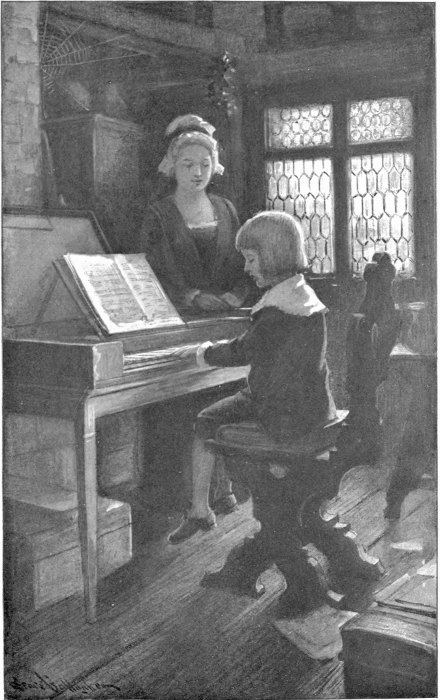
The winter was a long one and cold, but Anna and Georg, in their high
retreat, were as happy and comfortable as meadow-larks. Trunks, chests,
old clothing, and discarded furniture abounded there; bunches of dried
herbs were strung to the cross-beams, and cobwebs draped the outlying
nooks; but the great chimney emitted a cosy warmth, and the clavichord
provided unceasing entertainment.
"The clavichord provided unceasing entertainment."
As time went by, Anna's interest waned considerably, owing to the
succeeding preparations of Christmas gifts, March birthday festivities,
and spring finery; but when months had rolled away and summer suns were
once more ripening the fruit and coloring the flowers, Georg was as
intently absorbed in the clavichord as on the day of its first
appearance.
One June morning he was starting for a day's visit with some cousins who
lived on the most fashionable street in Halle. He was attired for the
occasion in his best suit of shining black satin. A deep collar of
Mechlin lace, a pair of gleaming silver shoe-buckles, and a silver cord
wound around his broad black beaver filled him with satisfaction as he
emerged from the house door.
At this juncture Mr. Händel drove into the gravelled plaza lying between
stable and street, and Georg observed with surprise that the carriage
was festooned with yellow streamers, that Mummer, the staid mare, was
groomed until she shone, and tricked out in the yellow harness and
tassels reserved for state occasions.
"Where are you going, father?" called Georg.
"To Weisenfels. The duke sent for me this morning. He wishes a report
of the state of health in Halle."
"Oh, father, please take me with you! I've never seen the court, and I
want to go so much!"
"Not this time, Georg. I have business to attend to, and I cannot look
after you."
"You needn't look after me," insisted the lad, laying his hand upon the
door of the slowly moving vehicle. "I'll be good and do everything you
say, and Christian will take care of me. Please, father, take me!"
"No, no! Some other time I'll take you, but this time I shall be too
busy. Get up, Mummer!"
With the touch of the whip, the ancient mare broke into a gentle
dogtrot, the only gait more swift than a walk in which she ever
indulged.
Georg saw the carriage roll through the gates and take the road toward
Weisenfels.
To go to the duke's court was something that he had long desired, and
this seemed a wholly favorable time for the undertaking. Had his
father's denial been decisive, Georg would have accepted it with the
best grace he could muster, and gone on about his visit; but he had seen
that the surgeon was merely preoccupied, refusing the petition absently
in order that his reflections should not be disturbed, rather than that
he cared to forbid the journey.
"If he only knew how much I wanted to go, he would have said 'yes,'"
thought Georg. "Father nearly always lets me do things when I ask him.
He really didn't hear what I said,—didn't hear inside him, I mean,—or
he would have taken me. I'll go! I'll go anyway, and when I get there
father will be sure to let me stay."
Fired with this determination, Georg set off, running nimbly behind the
carriage, taking pains all the while to keep out of the surgeon's sight.
Although Mummer was not very fleet as horses go, she jogged steadily
along, and the boy, following close behind the carriage, began to wonder
why she never stopped to catch her breath and cool herself. Up and down
hill, over bridges, through strips of forest, went horse, carriage, and
boy; and, as the sun blazed down, and the road grew dusty to choking,
the last one of the procession became so hot and breathless that he
feared he must stop or die.
At twelve o'clock the carriage drew up before a roadside inn; and when
the hostler came to take charge of Mummer, Mr. Händel opened the door
and stepped out upon the flower-bordered driveway.
The flash of a silver hat-cord seemed to twinkle before his eyes, and
seized with a sharp suspicion, the old gentleman strode quickly round to
the back of the carriage only to see a pair of small black legs
disappearing under the vehicle.
"Georg!" he ejaculated. "Come out, instantly! What are you doing here?"
A dusty, sheepish boy crawled slowly into sight, murmuring confusedly as
he rose,—
"I knew you'd let me go if you thought about it, so I came—"
Dizzy from heat and fatigue, Georg clutched the wheel to keep himself
from falling; and the surgeon took him anxiously by the shoulder.
"You foolish boy! What possessed you to undertake such a tramp! I didn't
care particularly if you came. Here, let's go into the inn and get
dinner! You will feel better when you have had warm food and time to
rest. I'll send a messenger back to your mother, so she will know that
you have come with me. You foolish child!"
The evening was spent in the ducal palace, whither the surgeon had been
summoned with his professional report; and the novel sights and sounds
proved so exciting to Georg that long after he was tucked into his cot
he lay wide awake, thinking of all that he had enjoyed. When sleep did
finally overtake him, he dreamed of the gayly uniformed guards stationed
inside and outside the palace, of the massive corridors, rich with works
of art, and the vast assembly room where the duke had held an audience,
while he himself had looked down from an upper gallery upon the throngs
of men and women, the flowers, the banners, and listened to the music
wafted from the musicians' balcony opposite.
Christian Händel, a nephew of Georg's, although more than twice the
boy's age, was a member of the duke's train, and he had piloted the
small visitor about the place, pointing out to him the things that would
prove of especial interest. He had likewise introduced his young
relative to the musicians, and they, attracted by the boy's
straightforward manner and intelligent replies, cordially received him
among them.
Morning came before Georg realized that he had been asleep, and with
it, Christian, who shook him awake.
"Dress yourself quickly, Georg, for the duke goes to church this
morning, and when he attends, nobody else in the house is permitted to
stay away."
Christian conducted Georg to the organ-loft, that he might better see
the sumptuous chapel and the duke with his richly apparelled retinue
passing in for service.
The white-haired organist, whom Georg had met the night before, greeted
him pleasantly; and Christian left him in care of the aged musician,
while he hurried down to take his place among the crimson-clad
retainers.
When, an hour later, the duke sat in his apartment at breakfast, the
sound of the organ fell upon his ear. Himself a passionate lover of
music, he could readily distinguish the touch of the various players at
court; but this soft and unfamiliar strain caused him to bend forward
with a puzzled look. Gradually the music grew more distinct, and soon
the palace resounded with a strong and stately melody.
"Who is at the organ?" the duke demanded suddenly, glancing inquiringly
at one of his attendants.
"It is the little Händel from Halle, your grace," replied Christian.
"A relative of yours?"
The young man blushed, for he was unwilling to confess to an
eight-year-old uncle; but he told the truth and satisfied his pride by
explaining distinctly,—
"He is my grandfather's youngest son."
"Bring him hither, and his father also."
Christian disappeared, and presently Mr. Händel entered by one door,
just before his son and grandson appeared on the threshold of the other.
The duke motioned the old gentleman to a distant corner, and beckoned
the boy to approach.
Georg, bereft of Christian's support, and unaware of his father's
presence, became so frightened that his breath almost failed as he
advanced, and he wondered wildly if the trembling of his knees could be
detected by the company. He carried his black beaver on his arm, as he
had seen the courtiers do, and when he came within a few feet of the
ducal chair, he bowed with a curious little bob that set the whole room
laughing.
"Silence!" commanded the duke sternly; then turning, he kindly asked his
small auditor what his name might be.
"Georg Friedrich Händel," replied the boy tremulously, but with the
sound of his own voice his terror dissolved, and he stood before the
Duke of Sächse with respectful composure.
"When did you learn to play the organ, my manikin?"
"This morning, your grace."
"This morning!" echoed the duke, astounded. "Can it be true that you
have never tried the instrument before to-day?"
"Well, you see, we have no organ at home," returned Georg
apologetically.
The duke studied him for a moment, as though seeking for traces of
falsehood, but Georg's utter simplicity was strangely convincing.
Quietly the duke put his next question.
"Upon what instruments have you played before?"
"Last winter and this summer I have played every day on my aunt's
clavichord, your grace."
Here a loud gasp was heard from a distant corner, but the duke frowned
for silence.
"And what before the clavichord, my boy?"
"A mouth organ, a tin trumpet, a fife, a drum, and a dinner-bell, your
grace."
A dozen irrepressible titters burst from the attendants, but the duke
grew very grave.
"And that is all, lad?"
"All, your grace."
"No lessons?"
"No—except when Aunt Anna and I taught each other. But you mustn't
tell father about the clavichord, your grace, because it is a secret,
and father told me to give away my own instruments, and Aunt Anna
wouldn't like to give away her clavichord, so please don't let him know
about it."
"I am afraid that he knows already," said the duke, smiling; and at his
signal, the Halle surgeon emerged from his corner, pale with amazement.
Georg was so confounded at sight of his parent, that, unable to meet his
expected look of condemnation, he buried his face in the folds of the
duke's breakfast cloth.
"I am sorry, Mr. Händel," said the duke, "that I betrayed the child's
secret. Had I known there was anything confidential in the interview, I
should have held it in private. But now that the mischief is done, will
you tell me why you oppose the musical study that Georg desires?"
"Merely, your grace, because he neglects his school for music when I
allow it. I am a music-lover myself, but I wish to educate my son for a
jurist, and I cannot have the plan interfered with, even by music."
"Let me suggest, then, that you allow the music lessons and compel the
school lessons, taking away the instrument if he fails at school; and
when he is old enough and wise enough to be a jurist, he will be capable
of choosing for himself the work of his life."
"I thank you, your grace! The advice is fair and judicious, and I shall
be happy to act upon it. If I have made a mistake, it was out of concern
for the child's best good, your grace."
"An error on the safe side, Mr. Händel. A-ha, my small minstrel, do you
hear how your father and I have arranged matters?"
Georg had not fully understood the conversation, but he gathered that
the duke had somehow persuaded the surgeon to allow his little son to
play upon the clavichord as much as he wished, if he were faithful at
school.
"Does the prospect please you?" asked the duke, his eyes twinkling.
"It does, it does!" cried Georg, his face radiant. "I am obliged to your
grace, and I am sure that you are almost as good and fine a person as my
Aunt Anna."
One night, in London, a concert was given at a certain music-hall, and
the money earned from the sale of tickets was to be used to relieve the
poor children of the city.
Such a throng of people crowded into the hall that every seat was
promptly filled, and the door-keepers were obliged to turn away many who
desired to attend.
King George II. appeared in the royal box, and when he had been
respectfully saluted by the people, the hall grew still. The stage was
filled with singers, and soon the room resounded with the thrilling
notes of a new piece called "The Messiah."
The people had expected to be only pleasantly entertained, but as one
strain followed another, they bent forward entranced. Such harmonies
they had never listened to before, and the people in the hall were moved
to the point of tears. At length the sounds grew so impressive that the
king could contain himself no longer, but leaped to his feet. Instantly
the people, following the lead of their sovereign, rose impulsively in
their places, and so standing, they waited until the glorious chorus was
ended.
Throughout the performance, a fine old gentleman sat quietly on the
stage near the singers, listening intently. His face wore a look of
noble earnestness, and he did not smile until the last note died away,
and from every part of the house voices cried,—
"Händel! Händel!"
For a moment he did not respond to their calls, but as the hall fell
into a tumult, and the shout increased to a deafening roar, the
white-haired gentleman rose and quietly bowed.
This did not satisfy the crowd, and from above, below, from right and
from left, excited men and women demanded that he should play for them.
The old gentleman bowed again, but finding that the audience would not
depart until he had yielded to its desire, he turned toward the massive
organ at his right.
Before he had taken a step, one of the singers hurried to his side, laid
a hand upon his arm, and conducted him slowly to the organ-bench. Then
it was that any stranger would have learned what all London
understood,—that the courtly old gentleman was blind.
At the first rich chord from the organ, a hush fell upon the room, and
when the silvery-haired musician finished, and rose to his feet with
another stately bow, the people silently filed out, too stirred by the
grandeur of his music for ordinary speech.
That night, in the city of London, hundreds of suffering and friendless
children were gathered into places of refuge, and were fed, warmed, and
clothed with the money earned by the genius and loving-kindness of Georg
Friedrich Händel.