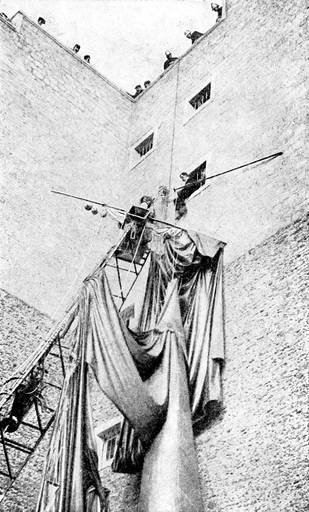
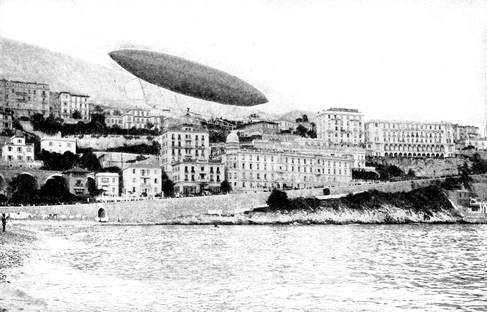
Severo's Balloon, the "Pax," which on its First
Ascent at a Height of about 2,000 feet,
Burst and Exploded, Sending to a Terrible
Death both M. Severo and his Assistant
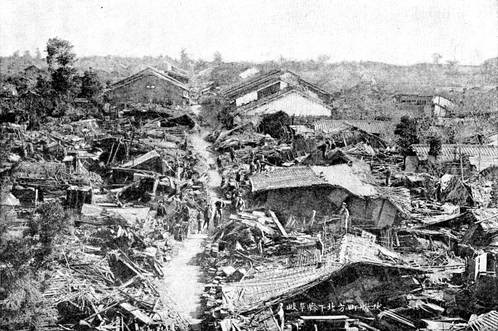
This and the pictures following on pages 89, 101, 111, are from
Japanese photographs reproduced in "The Great Earthquake
in Japan, 1891," by John Milne and W. K. Burton.
The Work of the Great Earthquake of 1891 in
Neo Valley, Japan
The kinks are caused by seismic disturbances, and they show
how much distortion a cable can suffer and still remain
in good electrical condition, as this was found to be.
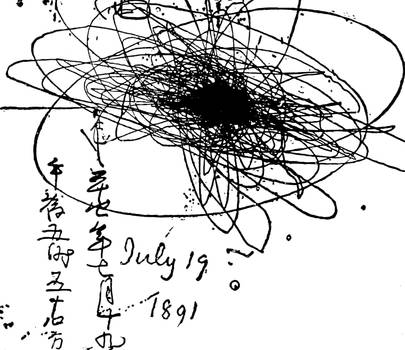
Record made on a Stationary Surface by the
Vibrations of the Japanese Earthquake of
July 19, 1891
"Not infrequently gas collects, forming a miniature mountain,
with a crater at its summit, and blowing a magnificent
fountain of flame, lava, and dense white vapour high
into the air, and roaring all the while in a most terrifying
manner."
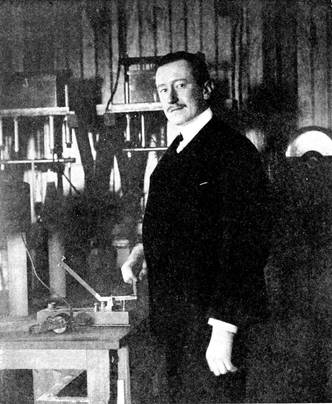
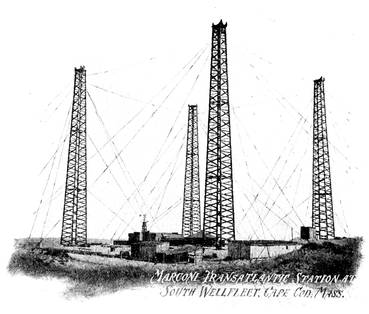
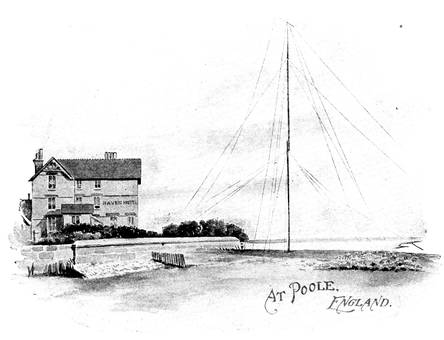
January 18, 1903, marks the beginning of a new era in
telegraphic communication. On that day there was sent by
Marconi himself from the wireless station at South Wellfleet,
Cape Cod, Mass., to the station at Poldhu, Cornwall,
England, a distance of 3,000 miles, the message—destined
soon to be historic—from the President of the United
States to the King of England.
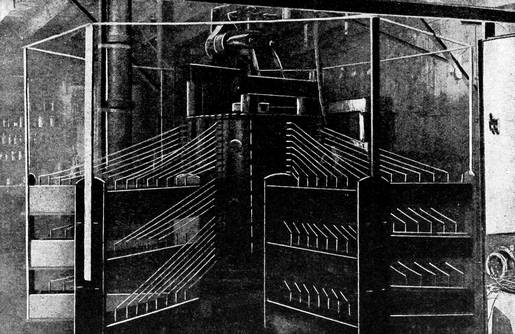
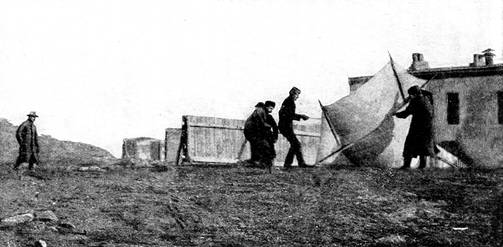
Preparing to Fly the Kite which Supported the
Receiving Wire
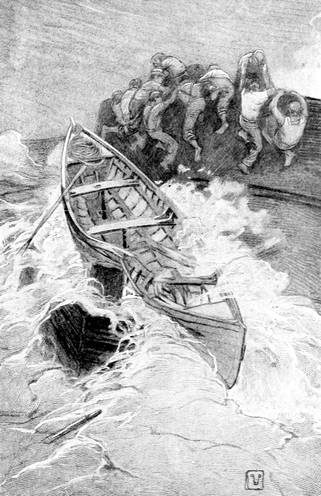
Just after the cylinder had been set in place, and while the
workmen were hurrying to stow sufficient ballast to secure
it against a heavy sea, a storm forced the attending
steamer to draw away. One of the barges was almost
overturned, and a lifeboat was driven against the cylinder
and crushed to pieces.
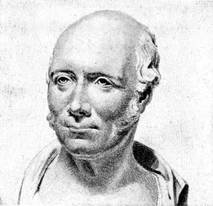
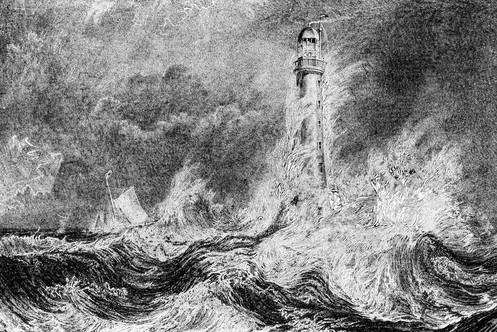
Robert Stevenson, Builder of the Famous Bell
Rock Lighthouse, and Author of Important
Inventions and Improvements in the System
of Sea Lighting
From the painting by Turner. The Bell Rock Lighthouse was
built by Robert Stevenson, grandfather of Robert Louis
Stevenson, on the Inchcape Reef, in the North Sea, near
Dundee, Scotland, in 1807-1810.
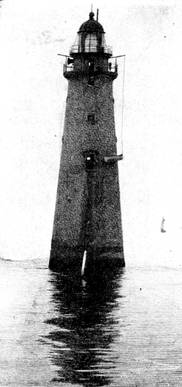
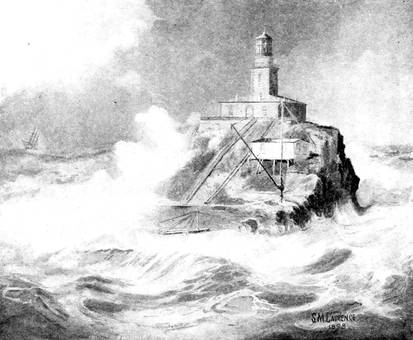
The Present Lighthouse on Minot's Ledge, near
the Entrance of Massachusetts Bay, Fifteen
Miles Southeast of Boston
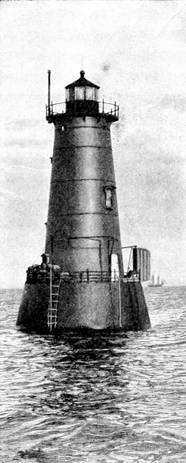
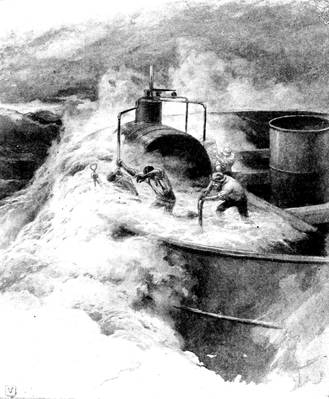
When the builders were towing the unwieldy cylinder out to set
it in position, the water became suddenly rough and
began to fill it. Workmen, at the risk of their lives,
boarded the cylinder, and by desperate labours succeeded
in spreading sail canvas over it, and so saved a structure
that had cost months of labour and thousands of dollars.
Great Waves Dashed Entirely Over Them, so that
They had to Cling for Their Lives to the
Air-Pipes
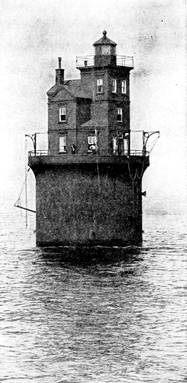
In erecting the Smith Point lighthouse, after the cylinder was
set up, it had to be forced down fifteen and a half feet
into the sand. The lives of the men who did this, working
in the caisson at the bottom of the sea, were absolutely
in the hands of the men who managed the engine
and the air-compressor at the surface; and twice these
latter were entirely deluged by the sea, but still maintained
steam and kept everything running as if no sea
was playing over them.
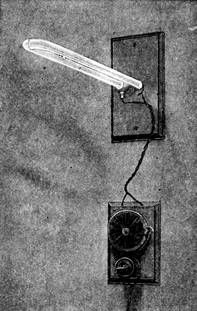
The circular piece just above the switch button is one form of
"boosting coil" which operates for a fraction of a second
when the current is first turned on. The tube shown
here is about an inch in diameter and several feet long.
Various shapes may be used. Unless broken, the tubes
never need renewal.
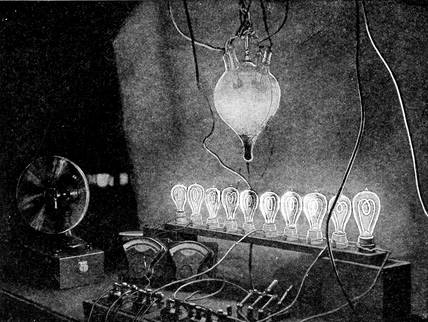
The row of incandescent lights is used, together with a voltmeter
and ammeter, to measure strength of current, resistance,
and loss in converting.
BOYS' SECOND BOOK OF
INVENTIONS
CHAPTER I THE MIRACLE OF RADIUM Story of the Marvels and Dangers of the New Element Discovered by Professor and Madame Curie
No substance ever discovered better deserves
the term "Miracle of Science," given it by a
famous English experimenter, than radium.
Here is a little pinch of white powder that
looks much like common table salt. It is one
of many similar pinches sealed in little glass
tubes and owned by Professor Curie, of Paris.
If you should find one of these little tubes in
the street you would think it hardly worth
carrying away, and yet many a one of them
could not be bought for a small fortune. For
all the radium in the world to-day could be
heaped on a single table-spoon; a pound of it
would be worth nearly a million dollars, or
more than three thousand times its weight in
pure gold.
Professor and Madame Curie, who discovered
radium, now possess the largest amount
of any one, but there are small quantities in
the hands of English and German scientists,
and perhaps a dozen specimens in America,
one owned by the American Museum of
Natural History and several by Mr. W. J.
Hammer, of New York, who was the first
American to experiment with the rare and
precious substance.
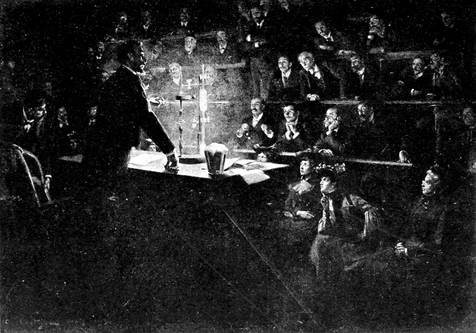
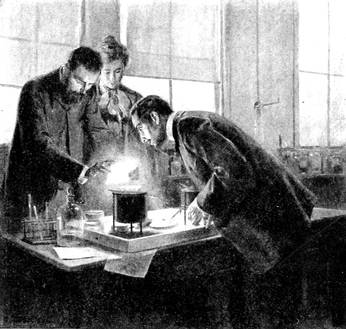
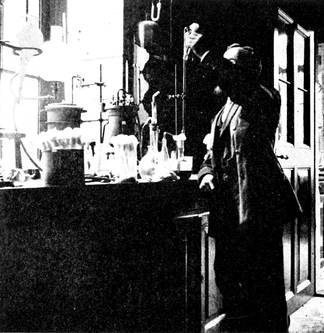
M. Curie Explaining the Wonders of Radium at the Sorbonne.
And perhaps it is just as well, at first, not
to have too much radium, for besides being
wonderful it is also dangerous. If a pound
or two could be gathered in a mass it would
kill every one who came within its influence.
People might go up and even handle the
white powder without at the moment feeling
any ill-effects, but in a week or two the mysterious
and dreadful radium influence would
begin to take effect. Slowly the victim's skin
would peel off, his body would become one
great sore, he would fall blind, and finally
die of paralysis and congestion of the spinal
cord. Even the small quantities now in hand
have severely burned the experimenters. Professor
Curie himself has a number of bad
scars on his hands and arms due to ulcers
caused by handling radium. And Professor
Becquerel, in journeying to London, carried
in his waistcoat pocket a small tube of radium
to be used in a lecture there. Nothing happened
at the time, but about two weeks later
Professor Becquerel observed that the skin
under his pocket was beginning to redden and
fall away, and finally a deep and painful sore
formed there and remained for weeks before
healing.
It is just as well, therefore, that scientists
learn more about radium and how to handle
and control it before too much is manufactured.
But the cost and danger of radium are only
two of its least extraordinary features. Seen
in the daylight radium is a commonplace white
powder, but in the dark it glows like live fire,
and the purer it is the more it glows. I held
for a moment one of Mr. Hammer's radium
tubes, and, the lights being turned off, it
seemed like a live coal burning there in my
hand, and yet I felt no sensation of heat. But
radium really does give off heat as well as
light—and gives it off continually without
losing appreciable weight. And that is what
seems to scientists a miracle. Imagine a coal
which should burn day in and day out for
hundreds of years, always bright, always giving
off heat and light, and yet not growing
any smaller, not turning to ashes. That is the
almost unbelievable property of radium. Professor
Curie has specimens which have thus
been radiating light and heat for several years,
with practically no loss of weight; and no
small amount of light and heat either. Professor
Curie has found that a given quantity
of radium will melt its own weight of ice
every hour, and continue doing so practically
for ever. One of his associates has calculated
that a fixed quantity of radium, after throwing
out heat for 1,000,000,000 years, would
have lost only one-millionth part of its bulk.
What is the reason for these extraordinary
properties? Is it not "perpetual motion"?
All the great scientists of the world have been
trying in vain to answer these questions. Several
theories have been advanced, of which I
shall speak later, but none seems a satisfactory
explanation. When we know more of radium
perhaps we shall be better prepared to say
what it really is, and we may have to unlearn
many of the great principles of physics and
chemistry which were seemingly settled for all
time. Radium would seem, indeed, to defy the
very law of the conservation of energy.
The practical mind at once sees radium in
use as a new source of heat and light for mankind,
a furnace that would never have to be
fed or cleaned, a lamp that would glow perpetually—and
the time may really come, the
inventor having taken hold of the wonder that
the scientist has produced, when many practical
applications of the new element may be
devised. At present, however, the scarcity and
cost and danger of radium will keep it in the
hands of the experimenter.
Another astonishing property of radium is
its power of communicating some of its
strange qualities to certain substances brought
within its influence. Mr. Hammer kept his
radium tubes for a time in a pasteboard box.
This being broken, he removed the tubes and
threw the pasteboard aside. Several days
later, having occasion to turn off the lights in
the laboratory, he found that the discarded box
was glowing there in the dark. It had taken
up some of the rays from the radium. Nearly
everything that comes in contact with radium
thus becomes "radio-active"—even the experimenter's
clothes and hands, so that delicate
instruments are disturbed by the invisible shine
of the experimenter. Photographs can be
taken with radium; it also makes the air
around it a better conductor of electricity.
And still more marvellous, besides being an
agency for the destruction of life, as I shall
show later, it can actually be used in other
ways to prolong life, and the future may show
many wonderful uses for it in the treatment
of disease. Already, in Paris, several cases of
lupus have been cured with it, and there is evidence
that it will help to restore sight in certain
cases of blindness. I held a tube of
radium to my closed eye and was conscious of
the sensation of light; the same sensation was
present when the tube was held to my temple,
thus showing that the radium has an effect on
the optic nerve. A little blind girl in New
York, who had never had the sensation of
light, began to see a little after one treatment
with radium, and experiments are still going
on, but cautiously, for fear that injuries may
result.
We now come to the fascinating story of
the discovery and manufacture of radium. It
has long been known that certain substances
are phosphorescent; that is, under the proper
conditions they glow without apparent heat.
Everybody has seen "fox-fire" in the damp
and decaying woods—a cold light which scientists
have never been able to explain.
To M. Henri Becquerel of the French Institute
is generally given the credit for having
begun the real study of radio-activity,
although, as in every great discovery and invention,
many other scientists and practical
electricians had paved the way by their investigations.
In 1896 M. Becquerel was
conducting some experiments with various
phosphorescent substances. He exposed some
salts of the metal uranium to the sunlight
until they became phosphorescent, and then
tried their effect upon a photographic plate.
It rained, and he put the plate away in a
drawer for several days. When he developed
it he was surprised to find on it a better image
than sunlight would have made. And thus,
by a sort of accident, he led up to the discovery
of the Becquerel rays, so called.
Uranium is extracted from a metal or ore
called uranite by mineralogists, and popularly
known as pitch-blende. Every young college
student who has studied geology or chemistry
has heard of pitch-blende.
Two years after Becquerel's discovery of
the radio-activity of uranium Professor Pierre
Curie and Madame Curie, of Paris, made the
discovery that some of the samples of pitch-blende
which they had were much more powerful
than any uranium that they had used.
Was there, then, something more powerful
than uranium within the pitch-blende? They
began to "boil down" the waste rock left at
the uranium mines, and found a strange new
element, related to uranium but different, to
which Madame Curie gave the name polonium,
after her native land, Poland.
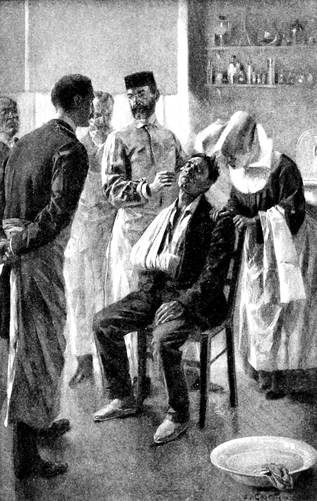
Dr. Danlos Treating a Lupus Patient with Radium at the
St. Louis Hospital, Paris.
Then they did some more boiling down, and
succeeded in isolating an entirely new substance,
and the most radio-active yet discovered—radium.
Shortly after that Debierne
discovered still another radio-active substance,
to which he gave the name actinium.
Thus three new elements were added to the
list of the world's substances, and the most
wonderful of these is radium. In a day,
almost, the Curies became famous in the scientific
world, and many of the greatest investigators
in the world—Lord Kelvin, Sir
William Crookes, and others—took up the
study of radium.
Very rarely have a man and woman worked
together so perfectly as Professor Curie and
his wife. Madame Curie was a Polish girl;
she came to Paris to study, very poor, but possessed
of rare talents. Her marriage with
M. Curie was such a union as must have produced
some fine result. Without his scientific
learning and vivid imagination it is doubtful
if radium would ever have been dreamed of,
and without her determination and patience
against detail it is likely the dream would
never have been realised.
One of the chief problems to be met in finding
the secrets of radium is the great difficulty
and expense, in the first place, of getting any
of the substance to experiment with. The
Curies have had to manufacture all they
themselves have used. In the first place,
pitch-blende, which closely resembles iron in
appearance, is not plentiful. The best of it
comes from Bohemia, but it is also found in
Saxony, Norway, Egypt, and in North Carolina,
Colorado, and Utah. It appears in small
lumps in veins of gold, silver, and mica, and
sometimes in granite.
Comparatively speaking, it is easy to get
uranium from pitch-blende. But to get the
radium from the residues is a much more complicated
task. According to Professor Curie,
it is necessary to refine about 5,000 tons of
uranium residues to get a kilogramme—or
about 2.2 pounds—of radium.
It is hardly surprising, therefore, considering
the enormous amount of raw material
which must be handled, that the cost of this
rare mineral should be high. It has been
said that there is more gold in sea-water than
radium in the earth. Professor Curie has an
extensive plant at Ivry, near Paris, where the
refuse dust brought from the uranium mines
is treated by complicated processes, which
finally yield a powder or crystals containing
a small amount of radium. These crystals
are sent to the laboratory of the Curies where
the final delicate processes of extraction are
carried on by the professor and his wife.
And, after all, pure metallic radium is
not obtained. It could be obtained, and Professor
Curie has actually made a very small
quantity of it, but it is unstable, immediately
oxidised by the air and destroyed. So it is
manufactured only in the form of chloride and
bromide of radium. The "strength" of radium
is measured in radio-activity, in the power
of emitting rays. So we hear of radium of
an intensity of 45 or 7,000 or 300,000. This
method of measurement is thus explained.
Taking the radio-activity of uranium as the
unit, as one, then a certain specimen of radium
is said to be 45 or 7,000 or 300,000 times as
intense, to have so many times as much radio-activity.
The radium of highest intensity in
this country now is 300,000, but the Curies
have succeeded in producing a specimen of
1,500,000 intensity. This is so powerful and
dangerous that it must be kept wrapped in
lead, which has the effect of stopping some of
the rays. Rock-salt is another substance which
hinders the passage of the rays.
English scientists have devised a curious
little instrument, called the spinthariscope,
which allows one actually to see the emanations
from radium and to realise as never
before the extraordinary atomic disintegration
that is going on ceaselessly in this strange
metal. The spinthariscope is a small microscope
that allows one to look at a tiny fragment
of radium supported on a little wire over
a screen.
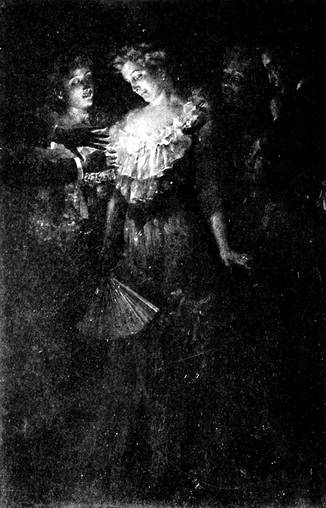
Radium as a Test for Real Diamonds.
At the approach of Radium pure gems are thrown into great
brilliancy, while imitations remain dull.
The experiment must be made in a darkened
room after the eye has gradually acquired
its greatest sensitiveness to light. Looking
intently through the lenses the screen appears
like a heaven of flashing meteors among which
stars shine forth suddenly and die away. Near
the central radium speck the fire-shower is
most brilliant, while toward the rim of the circle
it grows fainter. And this goes on continuously
as the metal throws off its rays like
myriads of bursting, blazing stars. M. Curie
has spoken of this vision, really contained
within the area of a two-cent piece, as one of
the most beautiful and impressive he ever
witnessed; it was as if he had been allowed to
assist at the birth of a universe. Radium
emits radiations, that is, it shoots off particles
of itself into space at such terrific speed that
92,500 miles a second is considered a small
estimate. Yet, in spite of the fact that this
waste goes on eternally and at such enormous
velocity, the actual loss sustained by the radium
is, as I have said, infinitesimal.
We now come to one of the most interesting
phases of the whole subject of radium—that is,
the influence which its strange rays have upon
animal life. Mr. Cleveland Moffett, to whom
I am indebted for the facts of the following
experiments, recently visited M. Danysz, of
the Pasteur Institute in Paris, who has made
some wonderful investigations in this branch
of science. M. Danysz has tried the effect of
radium on mice, rabbits, guinea-pigs, and
other animals, and on plants, and he found
that if exposed long enough they all died,
often first losing their fur and becoming blind.
But the most startling experiment performed
thus far at the Pasteur Institute is one
undertaken by M. Danysz, February 3, 1903,
when he placed three or four dozen little larvæ
that live in flour in a glass flask, where they
were exposed for a few hours to the rays of
radium. He placed a like number of larvæ
in a control-flask, where there was no radium,
and he left enough flour in each flask for the
larvæ to live upon. After several weeks it was
found that most of the larvæ in the radium
flask had been killed, but that a few of them
had escaped the destructive action of the rays
by crawling away to distant corners of the
flask, where they were still living. But they
were living as larvæ, not as moths, whereas in
the natural course they should have become
moths long before, as was seen by the control-flask,
where the larvæ had all changed into
moths, and these had hatched their eggs into
other larvæ, and these had produced other
moths. All of which made it clear that the
radium rays had arrested the development of
these little worms.
More weeks passed, and still three or four
of the larvæ lived, and four full months after
the original exposure one larva was still alive
and wriggling, while its contemporary larvæ
in the other jar had long since passed away
as aged moths, leaving generations of moths'
eggs and larvæ to witness this miracle, for
here was a larva, venerable among his kind,
that had actually lived through three times
the span of life accorded to his fellows and
that still showed no sign of changing into a
moth. It was very much as if a young man
of twenty-one should keep the appearance of
twenty-one for two hundred and fifty years!
Not less remarkable than these are some
recent experiments made by M. Bohn at the
biological laboratories of the Sorbonne, his
conclusions being that radium may so far
modify various lower forms of life as to actually
produce new species of "monsters," abnormal
deviations from the original type of
the species. Furthermore, he has been able to
accomplish with radium what Professor Loeb
did with salt solutions—that is, to cause the
growth of unfecundated eggs of the sea-urchin,
and to advance these through several
stages of their development. In other words,
he has used radium to create life where there
would have been no life but for this strange
stimulation.
So much for the wonders of radium. We
seem, indeed, to be on the border-land of still
more wonderful discoveries. Perhaps these
radium investigations will lead to some explanation
of that great question in science, "What
is electricity?"—and that, who can say, may
solve that profounder problem, "What is
life?"
At present there are two theories as to the
source of energy in radium, thus stated by
Professor Curie:
"Where is the source of this energy? Both
Madame Curie and myself are unable to go
beyond hypotheses; one of these consists in
supposing the atoms of radium evolving and
transforming into another simple body, and,
despite the extreme slowness of that transformation,
which cannot be located during a
year, the amount of energy involved in that
transformation is tremendous.
M. and Mme. Curie Finishing the Preparation of some Radium.
"The second hypothesis consists in the supposition
that radium is capable of capturing
and utilising some radiations of unknown nature
which cross space without our knowledge."
CHAPTER II FLYING MACHINES [1] Santos-Dumont's Steerable Balloons
Among the inventors engaged in building
flying machines the most famous, perhaps, is
M. Santos-Dumont, whose thrilling adventures
and noteworthy successes have given him
world-wide fame. He was the first, indeed,
to build a balloon that was really steerable
with any degree of certainty, winning a prize
of $20,000 for driving his great air-ship over
a certain specified course in Paris and bringing
it back to the starting-point within a
specified time. Another experimenter who
has had some degree of success is the German,
Count Zeppelin, who guided a huge air-ship
over Lake Geneva, Switzerland, in 1901.
Carl E. Myers, an American, an expert balloonist,
has also built balloons of small size
which he has been able to steer. And mention
must also be made of M. Severo, the
Frenchman, whose ship, Pax, exploded in the
air on its first trip, dropping the inventor and
his assistant hundreds of feet downward to
their death on the pavements of Paris.
It will be most interesting and instructive
to consider especially the work of Santos-Dumont,
for he has been not only the most
successful in making actual flights of any of
the inventors who have taken up this great
problem of air navigation, but his adventures
have been most romantic and thrilling. In
five years' time he has built and operated no
fewer than ten great air-ships which he has
sailed in various parts of Europe and in
America. He has even crowned his experiences
with more than one shipwreck in the
air, an adventure by the side of which an ordinary
sea-wreck is tame indeed, and he has
escaped with his life as a result not only of
good fortune but of real daring and presence
of mind in the face of danger.
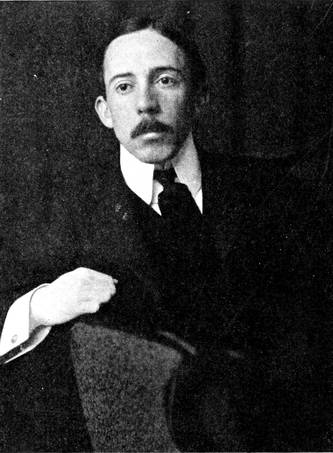
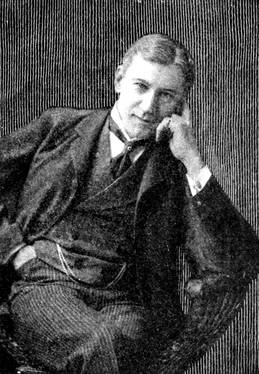
M. Alberto Santos-Dumont.
For an inventor, M. Santos-Dumont is a
rather extraordinary character. The typical
inventor—at least so we think—is poor, starts
poor at least, and has a struggle to rise. M.
Santos-Dumont has always had plenty of
means. The inventor is always first a dreamer,
we think. M. Santos-Dumont is first a
thoroughly practical man, an engineer with a
good knowledge of science, to which he adds
the imagination of the inventor and the keen
love and daring of the sportsman and adventurer,
without which his experiments could
never have been carried through.
It would seem, indeed, that nature had especially
equipped M. Santos-Dumont for his
work in aërial navigation. Supposing an inventor,
having all the mental equipment of
Santos-Dumont, the ideas, the energy, the
means—supposing such a man had weighed
two hundred pounds! He would have had to
build a very large ship to carry his own weight,
and all his problems would have been more
complex, more difficult. Nature made Santos-Dumont
a very small, slim, slight man, weighing
hardly more than one hundred pounds, but
very active and muscular. The first time I
ever saw him, in Crystal Palace, London,
where he was setting up one of his air-ships
in a huge gallery, I thought him at first glance
to be some boy, a possible spectator, who was
interested in flying machines. His face, bare
and shaven, looked youthful; he wore a narrow-brimmed
straw hat and was dressed in
the height of fashion. One would not have
guessed him to be the inventor. A moment
later he had his coat off and was showing his
men how to put up the great fan-like rudder
of the ship which loomed above us like some
enormous Rugby football, and then one saw
the power that was in him. Brazilian by nationality,
he has a dark face, large dark eyes,
an alertness of step and an energetic way
of talking. His boyhood was spent on his
father's extensive coffee plantation in Brazil;
his later years mostly in Paris, though he has
been a frequent visitor to England and America.
He speaks Spanish, French, and English
with equal fluency. Indeed, hearing his
English one would say that he must certainly
have had his training in an English-speaking
country, though no one would mistake him in
appearance for either English or American,
for he is very much a Latin in face and form.
One finds him most unpretentious, modest,
speaking freely of his inventions, and yet
never taking to himself any undue credit.
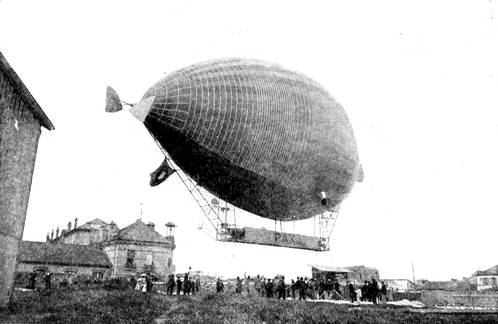
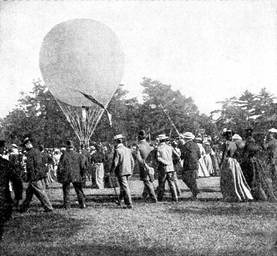
Severo's Balloon, the "Pax," which, on its First Ascent at a Height of about 2,000 feet,
Burst and Exploded, Sending to a Terrible Death both M. Severo and his Assistant.
Santos-Dumont is still a very young man to
have accomplished so much. He was born in
Brazil, July 20, 1873. From his earliest boyhood
he was interested in kites and dreamed of
being able to fly. He says:
"I cannot say at what age I made my first
kites; but I remember how my comrades used
to tease me at our game of 'Pigeon flies'! All
the children gather round a table, and the
leader calls out: 'Pigeon flies! Hen flies!
Crow flies! Bee flies!' and so on; and at each
call we were supposed to raise our fingers.
Sometimes, however, he would call out: 'Dog
flies! Fox flies!' or some other like impossibility,
to catch us. If any one should raise a
finger, he was made to pay a forfeit. Now
my playmates never failed to wink and smile
mockingly at me when one of them called
'Man flies!' For at the word I would always
lift my finger very high, as a sign of absolute
conviction; and I refused with energy to pay
the forfeit. The more they laughed at me, the
happier I was."
Of course he read Jules Verne's stories and
was carried away in imagination in that author's
wonderful balloons and flying machines.
He also devoured the history of aërial navigation
which he found in the works of Camille
Flammarion and Wilfrid de Fonvielle. He
says, further:
"At an early age I was taught the principles
of mechanics by my father, an engineer
of the École Centrale des Arts et Manufactures
of Paris. From childhood I had a passion
for making calculations and inventing;
and from my tenth year I was accustomed to
handle the powerful and heavy machines of
our factories, and drive the compound locomotives
on our plantation railroads. I was constantly
taken up with the desire to lighten
their parts; and I dreamed of air-ships and
flying machines. The fact that up to the end
of the nineteenth century those who occupied
themselves with aërial navigation passed for
crazy, rather pleased than offended me. It is
incredible and yet true that in the kingdom of
the wise, to which all of us flatter ourselves we
belong, it is always the fools who finish by
being in the right. I had read that Montgolfière
was thought a fool until the day when
he stopped his insulters' mouths by launching
the first spherical balloon into the heavens."
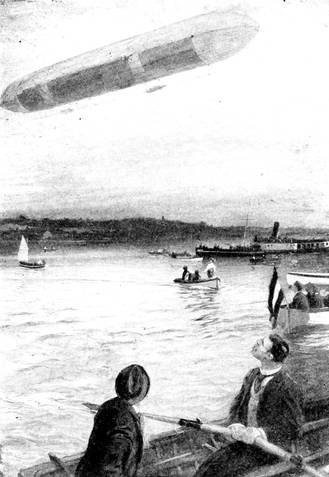
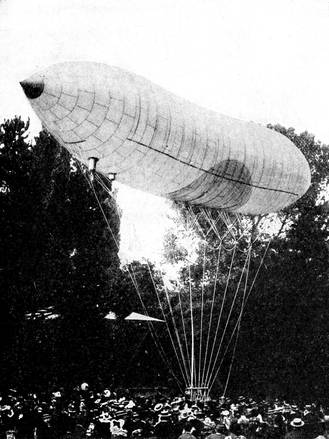
The Trial of Count Zeppelin's Air-Ship, July 2, 1900.
Upon going to Paris Santos-Dumont at
once took up the work of making himself familiar
with ballooning in all of its practical
aspects. He saw that if he were ever to build
an air-ship he must first know all there was to
know about balloon-making, methods of filling
with gas, lifting capacities, the action of
balloons in the air, and all the thousand and
one things connected with ordinary ballooning.
And Paris has always been the centre of
this information. He regards this preliminary
knowledge as indispensable to every air-ship
builder. He says:
"Before launching out into the construction
of air-ships I took pains to make myself familiar
with the handling of spherical balloons.
I did not hasten, but took plenty of time. In
all, I made something like thirty ascensions;
at first as a passenger, then as my own captain,
and at last alone. Some of these spherical
balloons I rented, others I had constructed
for me. Of such I have owned at least six
or eight. And I do not believe that without
such previous study and experience a man
is capable of succeeding with an elongated
balloon, whose handling is so much more delicate.
Before attempting to direct an air-ship,
it is necessary to have learned in an ordinary
balloon the conditions of the atmospheric medium;
to have become acquainted with the caprices
of the wind, now caressing and now brutal,
and to have gone thoroughly into the difficulties
of the ballast problem, from the triple
point of view of starting, of equilibrium in
the air, and of landing at the end of the trip.
To go up in an ordinary balloon, at least a
dozen times, seems to me an indispensable preliminary
for acquiring an exact notion of the
requisites for the construction and handling of
an elongated balloon, furnished with its motor
and propeller."
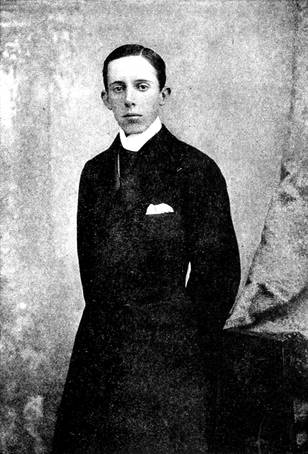
M. Santos-Dumont at Nineteen.
M. Santos-Dumont's First Balloon (Spherical).
His first ascent in a balloon was made in
1897, when he was 24 years old, as a passenger
with M. Machuron, who had then just returned
from the Arctic regions, where he had
helped to start Andrée on his ill-fated voyage
in search of the North Pole. He found the
sensations delightful, being so pleased with the
experience that he subsequently secured a small
balloon of his own, in which he made several
ascents. He also climbed the Alps in order to
learn more of the condition of the air at high
altitudes.
In 1898 he set about experimentation in the
building of a real air-ship or steerable balloon.
Efforts had been made in this direction by former
inventors, but with small success. As far
back as 1852 Henri Gifford made the first of
the familiar cigar-shaped balloons, trying
steam as a motive power, but he soon found
that an engine strong enough to propel the
balloon was too heavy for the balloon to lift.
That simple failure discouraged experimenters
for a long time. In 1877 Dupuy de Lome tried
steering a balloon by man power, but the man
was not strong enough. In 1883 another
Frenchman, Tissandier, experimented with
electricity, but, as his batteries had to be light
enough to be taken up in the balloon, they
proved effective only in helping to weigh it
down to earth again. Krebs and Renard, military
aëronauts, succeeded better with electricity,
for they could make a small circuit with
their air-ship, provided only that no air was
stirring. Enthusiasts cried out that the problem
was solved, but the two aëronauts themselves,
as good mathematicians, figured out
that they would have to have a motor eight
times more powerful than their own, and that
without any increase in weight, which was an
impossibility at that time.
M. Santos-Dumont's Workshop.
Santos-Dumont saw plainly that none of
these methods would work. What then was
he to try? Why, simple enough: the petroleum
motor from his automobile. The recent
development of the motor-vehicle had produced
a light, strong, durable motor. It was
Santos-Dumont's first great claim to originality
that he should have applied this to the
balloon. He discovered no new principles, invented
nothing that could be patented. The
cigar-shaped balloon had long been used, so
had the petroleum motor, but he put them together.
And he did very much more than
that. The very essence of success in aërial
navigation is to secure light weight with great
strength and power. The inventor who can
build the lightest machine, which is also strong,
will, other things being equal, have the greatest
success. It is to Santos-Dumont's great
credit that he was able to build a very light
motor, that also gave a good horse-power, and
a light balloon that was also very strong. The
one great source of danger in using the petroleum
motor in connection with a balloon is
that the sparking of the motor will set fire to
the inflammable hydrogen gas with which the
balloon is filled, causing a terrible explosion.
This, indeed, is what is thought to have caused
the mortal mishap to Severo and his balloon.
But Santos-Dumont was able to surmount this
and many other difficulties of construction.
The inventor finally succeeded in making
a motor—remarkable at that time—which,
weighing only 66 pounds, would produce 3½
horse-power. It is easy to understand why a
petroleum motor is such a power-producer for
its size. The greater part of its fuel is in the
air itself, and the air is all around the balloon,
ready for use. The aëronaut does not have to
take it up with him. That proportion of his
fuel that he must carry, the petroleum, is comparatively
insignificant in weight. A few
figures will prove interesting. Two and one-half
gallons of gasoline, weighing 15 pounds,
will drive a 2½ horse-power autocycle 94 miles
in four hours. Santos-Dumont's balloon
needs less than 5⅓ gallons for a three hours'
trip. This weighs but 37 pounds, and occupies
a small cigar-shaped brass reservoir near
the motor of his machine. An electric battery
of the same horse-power would weigh 2,695
pounds.
"Santos-Dumont No. 1."
Santos-Dumont tested his new motor very
thoroughly by attaching it to a tricycle with
which he made some record runs in and around
Paris. Having satisfied himself that it was
thoroughly serviceable he set about making
the balloon, cigar-shaped, 82 feet long.
"To keep within the limit of weight," he
says, "I first gave up the network and the outer
cover of the ordinary balloon. I considered
this sort of second envelope, holding the first
within it, to be superfluous, and even harmful,
if not dangerous. To the envelope proper I
attached the suspension-cords of my basket directly,
by means of small wooden rods introduced
into horizontal hems, sewed on both
sides along the stuff of the balloon for a great
part of its length. Again, in order not to pass
the 66 pounds weight, including varnish, I was
obliged to choose Japan silk that was extremely
fine, but fairly resisting. Up to this time
no one had ever thought of using this for balloons
intended to carry up an aëronaut, but
only for little balloons carrying light registering
apparatus for investigations in the upper
air.
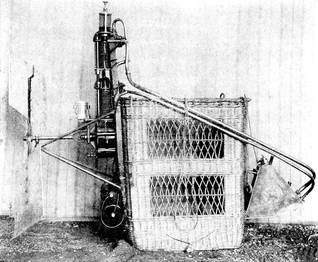
Basket of "Santos-Dumont No. 1."
Showing propeller and motor.
"I gave the order for this balloon to M. Lachambre.
At first he refused to take it, saying
that such a thing had never been made,
and that he would not be responsible for my
rashness. I answered that I would not change
a thing in the plan of the balloon, if I had to
sew it with my own hands. At last he agreed
to sew and varnish the balloon as I desired."
After repeated trials of his motor in the
basket—which he suspended in his workshop—and
the making of a rudder of silk he was
able, in September, 1898, to attempt real flying.
But, after rising successfully in the air,
the weight of the machinery and his own body
swung beneath the fragile balloon was so great
that while descending from a considerable
height the balloon suddenly sagged down in
the middle and began to shut up like a portfolio.
"At that moment," he said, "I thought that
all was over, the more so as the descent, which
had already become rapid, could no longer be
checked by any of the usual means on board,
where nothing worked.
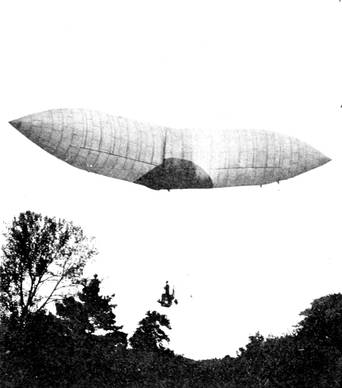
"Santos-Dumont No. 1."
Showing how it began to fold up in the middle.
"The descent became a rapid fall. Luckily,
I was falling in the neighborhood of the soft,
grassy pélouse of the Longchamps race-course,
where some big boys were flying kites.
A sudden idea struck me. I cried to them to
grasp the end of my 100-meter guide-rope,
which had already touched the ground, and to
run as fast as they could with it against the
wind! They were bright young fellows, and
they grasped the idea and the guide-rope at
the same lucky instant. The effect of this help
in extremis was immediate, and such as I had
expected. By this manœuvre we lessened the
velocity of the fall, and so avoided what would
otherwise have been a terribly rough shaking
up, to say the least. I was saved for the first
time. Thanking the brave boys, who continued
to aid me to pack everything into the air-ship's
basket, I finally secured a cab and took
the relic back to Paris."
His life was thus saved almost miraculously;
but the accident did not deter him from going
forward immediately with other experiments.
The next year, 1899, he built a new air-ship
called Santos-Dumont II., and made an ascension
with it, but it dissatisfied him and he at
once began with Santos-Dumont III., with
which he made the first trip around the Eiffel
Tower.
He now made ready to compete for the
Deutsch prize of $20,000. The winning of
this prize demanded that the trip from Saint-Cloud
to the Eiffel Tower, around it and back
to the starting place, a distance of some eight
miles, should be made in half an hour. For
this purpose he finished a much larger air-ship,
Santos-Dumont V., in 1901. After a trial,
made on July 12, which was attended by several
accidents, the inventor decided to make
a start early on the following morning, July
13. As early as four o'clock he was ready, and
a crowd had begun to gather in the park.
At 6.20 the great sliding doors of the balloon-house
were pushed open, and the massive
inflated occupant was towed out into the open
space of the park. The big pointed nose of the
balloon and its fish-like belly resembled a shark
gliding with lazy craft from a shadow into
light waters. In the basket of the car stood
the coatless aëronaut, who laughed and chatted
like a boy with the crowd around him.
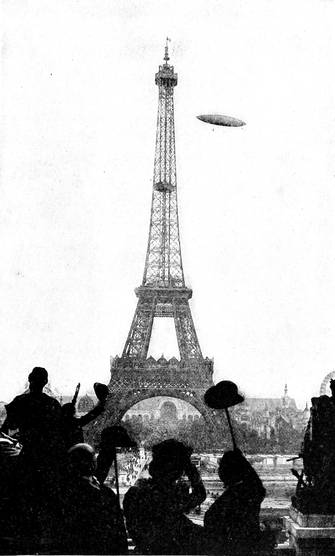
"Santos-Dumont No. 5" Rounding Eiffel Tower, July 13, 1901.
From the very first the conditions did not
show themselves favourable for the attempt.
The wind was blowing at the rate of six or
seven yards a second. The change of temperature
from the balloon-house to the cool morning
air had somewhat condensed the hydrogen
gas of the balloon, so that one end flapped
about in a flabby manner. Air was pumped
into the air reservoir, inside the balloon, but
still the desired rigidity was not attained. But,
more discouraging yet, when the motor was
started, its continuous explosions gave to the
practised ear signs of mechanical discord.
Nevertheless, Santos-Dumont, with his
sleeves rolled up, fixed himself in his basket.
His eye took a careful survey of the entire air-ship
lest some preliminary had been overlooked.
He counted the ballast bags under
his feet in the basket, he looked to the canvas
pocket of loose sand at either hand, then saw
to his guide-rope.
There is a very great deal to look after in
managing such a ship, and it requires a calm
head and a steady hand to do it.
"Near the saddle on which I sat," he writes,
"were the ends of the cords and other means
for controlling the different parts of the mechanism—the
electric sparking of the motor, the
regulation of the carburetter, the handling of
the rudder, ballast, and the shifting weights
(consisting of the guide-rope and bags of
sand), the managing of the balloon's valves,
and the emergency rope for tearing open the
balloon. It may easily be gathered from this
enumeration that an air-ship, even as simple
as my own, is a very complex organism; and
the work incumbent on the aëronaut is no
sinecure."
Several friends shook his hand, among them
Mr. Deutsch. The place was very still as the
man holding the guide-rope awaited the signal
to let go. Then the little man in the basket
above them raised his hands and shouted.
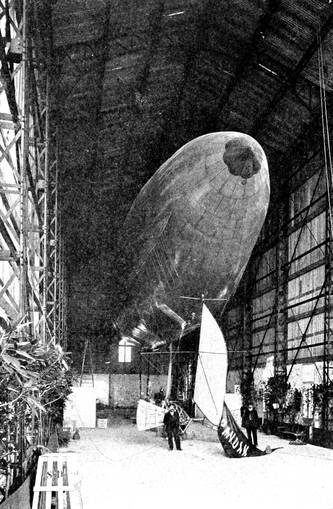
The Interior of the Aërodrome.
Showing its construction, the inflated balloon, and the pennant with
its mystic letters.
At first it did not look like a race against
time. The balloon rose sluggishly, and Santos-Dumont
had to dump out bag after bag of
sand, till finally the guide-rope was clear of
the trees. All this gave him no opportunity to
think of his direction, and he was drifting toward
Versailles; but while yet over the Seine
he pulled his rudder ropes taut. Then slowly,
gracefully, the enormous spindle veered round
and pointed its nose toward the Eiffel Tower.
The fans spun energetically, and the air-ship
settled down to business-like travelling. It
marked a straight, decided line for its goal,
then followed the chosen route with a considerable
speed. Soon the chug-chugging of the
motor could be heard no longer by the spectators,
and the balloon and car grew smaller and
smaller in its halo of light smoke. Those in
the park saw only the screw and the rear of the
balloon, like the stern of a steamer in dry dock.
Before long only a dot remained against the
sky. Gradually he came nearer again, almost
returning to the park, but the wind drove him
back across the river Seine. Suddenly the motor
stopped, and the whole air-ship was seen to
fall heavily toward the earth. The crowd
raced away expecting to find Santos-Dumont
dead and his air-ship a wreck. But they found
him on his feet, with his hands in his pockets,
reflectively looking up at his air-ship among
the top branches of some chestnut trees in the
grounds of Baron Edmund de Rothschild,
Boulevard de Boulogne.
"This," he says, "was near the hôtel of Princesse
Ysabel, Comtesse d'Eu, who sent up to
me in my tree a champagne lunch, with an invitation
to come and tell her the story of my
trip.
"When my story was over, she said to me:
"'Your evolutions in the air made me think
of the flight of our great birds of Brazil. I
hope that you will succeed for the glory of our
common country.'"
And an examination showed that the air-ship
was practically uninjured.
So he escaped death a second time. Less
than a month later he had a still more terrible
mishap, best related in his own words. He
says:
"And now I come to a terrible day—August
8, 1901. At 6.30 A.M., I started for the Eiffel
Tower again, in the presence of the committee,
duly convoked. I turned the goal at the end of
nine minutes, and took my way back to Saint-Cloud;
but my balloon was losing hydrogen
through the automatic valves, the spring of
which had been accidentally weakened; and it
shrank visibly. All at once, while over the fortifications
of Paris, near La Muette, the screw-propeller
touched and cut the suspension-cords,
which were sagging behind. I was obliged to
stop the motor instantly; and at once I saw my
air-ship drift straight back to the Eiffel
Tower. I had no means of avoiding the terrible
danger, except to wreck myself on the roofs
of the Trocadero quarter. Without hesitation
I opened the manœuvre-valve, and sent my
balloon downward.
The Fall into the Courtyard of the Trocadero Hotel.
"Santos-Dumont No. 5."
"At 32 metres (106 feet) above the ground,
and with the noise of an explosion, it struck
the roof of the Trocadero Hotels. The balloon-envelope
was torn to rags, and fell into
the courtyard of the hotels, while I remained
hanging 15 metres (50 feet) above the ground
in my wicker basket, which had been turned
almost over, but was supported by the keel.
The keel of the Santos-Dumont V. saved my
life that day.
"After some minutes a rope was thrown
down to me; and, helping myself with feet and
hands up the wall (the few narrow windows
of which were grated like those of a prison),
I was hauled up to the roof. The firemen
from Passy had watched the fall of the air-ship
from their observatory. They, too,
hastened to the rescue. It was impossible to
disengage the remains of the balloon-envelope
and suspension apparatus except in strips and
pieces.
"My escape was narrow; but it was not
from the particular danger always present to
my mind during this period of my experiments.
The position of the Eiffel Tower as
a central landmark, visible to everybody from
considerable distances, makes it a unique winning-post
for an aërial race. Yet this does
not alter the other fact that the feat of rounding
the Eiffel Tower possesses a unique element
of danger. What I feared when on the
ground—I had no time to fear while in the
air—was that, by some mistake of steering,
or by the influence of some side-wind, I might
be dashed against the Tower. The impact
would burst my balloon, and I should fall to
the ground like a stone. Though I never seek
to fly at a great height—on the contrary, I
hold the record for low altitude in a free balloon—in
passing over Paris I must necessarily
move above all its chimney-pots and steeples.
The Eiffel Tower was my one danger—yet
it was my winning-post!
"Santos-Dumont No. 6"—The Prize Winner.
"But in the air I have no time to fear. I
have always kept a cool head. Alone in the
air-ship, I am always very busy. I must not
let go the rudder for a single instant. Then
there is the strong joy of commanding. What
does it feel like to sail in a dirigible balloon?
While the wind was carrying me back to the
Eiffel Tower I realised that I might be killed;
but I did not feel fear. I was in no personal
inconvenience. I knew my resources. I was
excessively occupied. I have felt fear while
in the air, yes, miserable fear joined to pain;
but never in a dirigible balloon."
Even this did not daunt him. That very
night he ordered a new air-ship, Santos-Dumont VI.,
and it was ready in twenty-two
days. The new balloon had the shape of an
elongated ellipsoid, 32 metres (105 feet) on
its great axis, and 6 metres (20 feet) on its
short axis, terminated fore and aft by cones.
Its capacity was 605 cubic metres (21,362
cubic feet), giving it a lifting power of 620
kilos (1,362 pounds). Of this, 1,100 pounds
were represented by keel, machinery, and his
own weight, leaving a net lifting-power of
120 kilos (261 pounds).
On October 19, 1901, he made another attempt
to round the Eiffel Tower, and was at
last successful in winning the $20,000 prize.
Following this great feat, Santos-Dumont
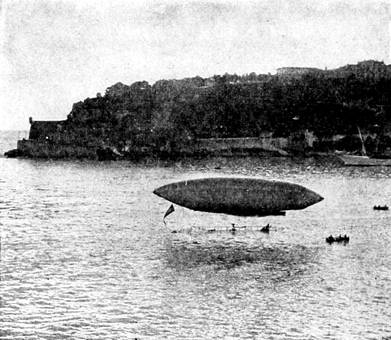
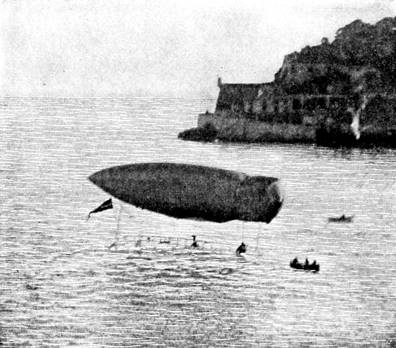
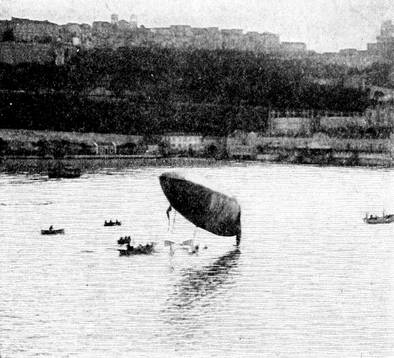
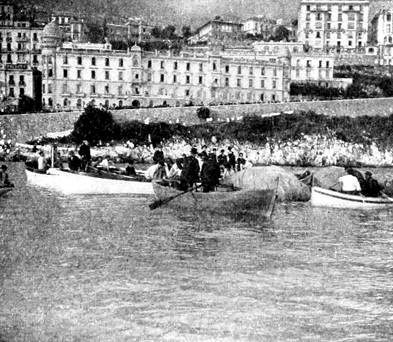
continued his experiments at Monte Carlo,
where he was wrecked over the Mediterranean
Sea and escaped only by presence of mind,
and he is still continuing his work.
The future of the dirigible balloon is open
to debate. Santos-Dumont himself does not
think there is much likelihood that it will
ever have much commercial use. A balloon
to carry many passengers would have to be
so enormous that it could not support the
machinery necessary to propel it, especially
against a strong wind. But he does believe
that the steerable balloon will have great importance
in war time. He says:
"I have often been asked what present
utility is to be expected of the dirigible balloon
when it becomes thoroughly practicable.
I have never pretended that its commercial
possibilities could go far. The question of the
air-ship in war, however, is otherwise. Mr.
Hiram Maxim has declared that a flying
machine in South Africa would have been
worth four times its weight in gold. Henri
Rochefort has said: 'The day when it is established
that a man can direct an air-ship in a
given direction and cause it to manœuvre as he
wills ... there will remain little for the
nations to do but to lay down their arms.'"
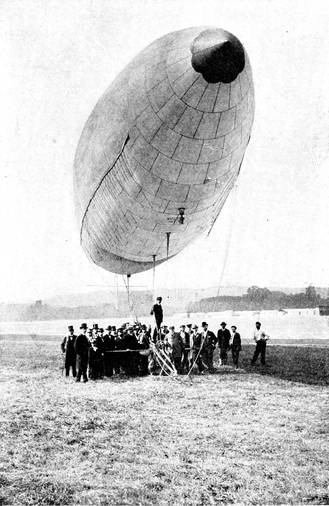
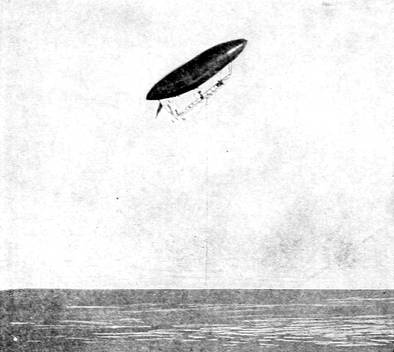
Air-Ship Pointing almost Vertically Upward.
Falling to the Sea.
Just Before the Air-Ship Lost all its Gas.
Losing its Gas and Sinking.
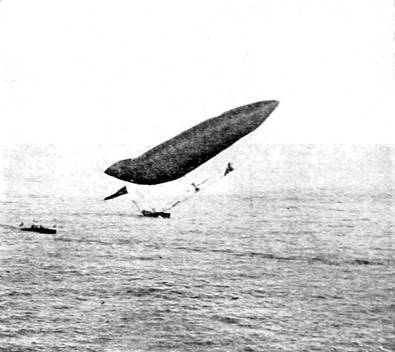
The Balloon Falling to the Waves.
Boats Around the Ruined Air-Ship.
But such experiments as Santos-Dumont's,
whether they result immediately in producing
an air-ship of practical utility in commerce or
not, have great value for the facts which they
are establishing as to the possibility of balloons,
of motors, of light construction, of air
currents, and moreover they add to the world's
sum total of experiences a fine, clean sport in
which men of daring and scientific knowledge
show what men can do.
Manœuvering Above the Bay at Monte Carlo.
CHAPTER III THE EARTHQUAKE MEASURER Professor John Milne's Seismograph
Of all strange inventions, the earthquake recorder
is certainly one of the most remarkable
and interesting. A terrible earthquake
shakes down cities in Japan, and sixteen minutes
later the professor of earthquakes, in his
quiet little observatory in England, measures
its extent—almost, indeed, takes a picture of
it. Actual waves, not unlike the waves of the
sea blown up by a hurricane, have travelled
through or around half the earth in this brief
time; vast mountain ranges, cities, plains, and
oceans have been heaved to their crests and
then allowed to sink back again into their
former positions. And some of these earthquake
waves which sweep over the solid earth
are three feet high, so that the whole of New
York, perhaps, rises bodily to that height and
then slides over the crest like a skiff on an
ocean swell.
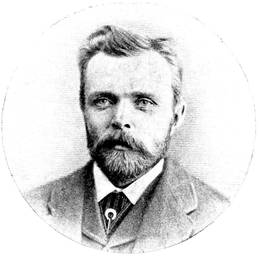
Professor John Milne.
From a photograph by S. Suzuki, Kudanzaka, Tokio.
At first glance this seems almost too strange
and wonderful to believe, and yet this is only
the beginning of the wonders which the earthquake
camera—or the seismograph (earthquake
writer, as the scientists call it)—has
been disclosing.
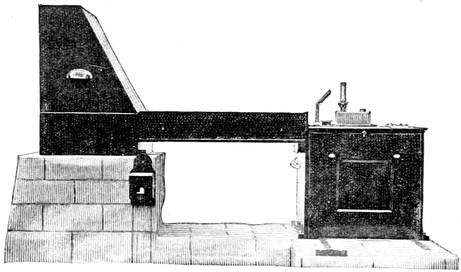
Professor Milne's Sensitive Pendulum, or Seismograph,
as it Appears Enclosed in its Protecting Box.
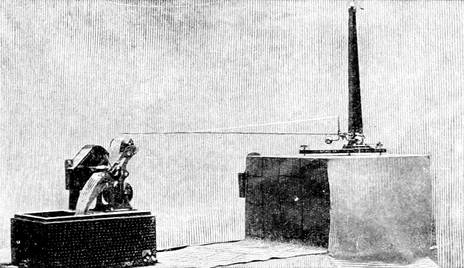
The Sensitive Pendulum, or Seismograph, as it Appears
with the Protecting Box Removed.
The earthquake professor who has worked
such scientific magic is John Milne. He lives
in a quaint old house in the little Isle of
Wight, not far from Osborne Castle, where
Queen Victoria made her home part of the
year. Not long ago he was a resident of
Japan and professor of seismology (the science
of earthquakes) at the University of
Tokio, where he made his first discoveries
about earthquakes, and invented marvellously
delicate machines for measuring and photographing
them thousands of miles away.
Professor Milne is an Englishman by birth,
but, like many another of his countrymen, he
has visited some of the strangest nooks and
corners of the earth. He has looked for coal
in Newfoundland; he has crossed the rugged
hills of Iceland; he has been up and down the
length of the United States; he has hunted
wild pigs in Borneo; and he has been in India
and China and a hundred other out-of-the-way
places, to say nothing of measuring earthquakes
in Japan. Professor Milne laid the
foundation of his unusual career in a thorough
education at King's College, London,
and at the School of Mines. By fortunate
chance, soon after his graduation, he met
Cyrus Field, the famous American, to whom
the world owes the beginnings of its present
ocean cable system. He was then just
twenty-one, young and raw, but plucky. He
thought he was prepared for anything the
world might bring him; but when Field asked
him one Friday if he could sail for Newfoundland
the next Tuesday, he was so taken
with astonishment that he hesitated, whereupon
Field leaned forward and looked at him
in a way that Milne has never forgotten.
"My young friend, I suppose you have read
that the world was made in six days. Now,
do you mean to tell me that, if this whole
world was made in six days, you can't get together
the few things you need in four?"
Gifu, Japan, after the Earthquake of 1891.
This and the pictures following on pages
89,
101,
111,
are from Japanese photographs reproduced
in "The Great Earthquake in Japan, 1891," by John Milne and W. K. Burton.
And Milne sailed the next Tuesday to begin
his lifework among the rough hills of
Newfoundland. Then came an offer from
the Japanese Government, and he went to the
land of earthquakes, little dreaming that he
would one day be the greatest authority in the
world on the subject of seismic disturbances.
His first experiments—and they were made
as a pastime rather than a serious undertaking—were
curiously simple. He set up rows of
pins in a certain way, so that in falling they
would give some indication as to the wave
movements in the earth. He also made pendulums
made of strings with weights tied at
the end, and from his discoveries made with
these elementary instruments, he planned
earthquake-proof houses, and showed the engineers
of Japan how to build bridges which
would not fall down when they were shaken.
So highly was his work regarded that the
Japanese made him an earthquake professor
at Tokio and supplied him with the means for
making more extended experiments. And
presently we find him producing artificial
earthquakes by the score. He buried dynamite
deep in the ground and exploded it by
means of an electric button. The miniature
earthquake thus produced was carefully measured
with curious instruments of Professor
Milne's invention. At first one earthquake
was enough at any one time, but as the experiments
continued, Professor Milne sometimes
had five or six earthquakes all quaking together;
and once so interested did he become
that he forgot all about the destructive nature
of earthquakes, and ventured too near. A
ton or more of earth came crashing down
around him, half burying him and smashing
his instruments flat. All this made the Japanese
rub their eyes with astonishment, and by
and by the Emperor heard of it. Of course
he was deeply interested in earthquakes, because
there was no telling when one might
come along and shake down his palace over
his head. So he sent for Professor Milne,
and, after assuring himself that these experimental
earthquakes really had no serious intentions,
he commanded that one be produced
on the spot. So Professor Milne laid out a
number of toy towns and villages and hills in
the palace yard with a tremendous toy earthquake
underneath. The Emperor and his
gayly dressed followers stood well off to one
side, and when Professor Milne gave the word
the Emperor solemnly pressed a button, and
watched with the greatest delight the curious
way in which the toy cities were quaked to
earth. And after that, this surprising Englishman,
who could make earthquakes as easily
as a Japanese makes a lacquered basket, was
held in high esteem in Japan, and for more
than twenty years he studied earthquakes and
invented machines for recording them. Then
he returned to his home in England, where he
is at work establishing earthquake stations in
various parts of the world, by means of which
he expects to reduce earthquake measurement
to an exact science, an accomplishment which
will have the greatest practical value to the
commercial interests of the world, as I shall
soon explain.
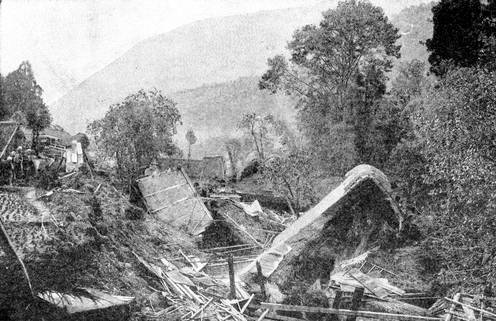
The Work of the Great Earthquake of 1891 in Neo Valley, Japan.
But first for a glimpse at the curious earthquake
measurer itself. To begin with, there
are two kinds of instruments—one to measure
near-by disturbances, and the second to measure
waves which come from great distances.
The former instrument was used by Professor
Milne in Japan, where earthquakes are frequent;
the latter is used in England. The
technical name for the machine which measures
distant disturbances is the horizontal
pendulum seismograph, and, like most wonderful
inventions, it is exceedingly simple in
principle, yet doing its work with marvellous
delicacy and accuracy.
In brief, the central feature of the seismograph
is a very finely poised pendulum, which
is jarred by the slightest disturbance of the
earth, the end of it being so arranged that a
photograph is taken of every quiver. Set a
pendulum clock on the dining-table, jar the
table, and the pendulum will swing, indicating
exactly with what force you have disturbed
the table. In exactly the same way the delicate
pendulum of the earthquake measurer
indicates the shaking of the earth.
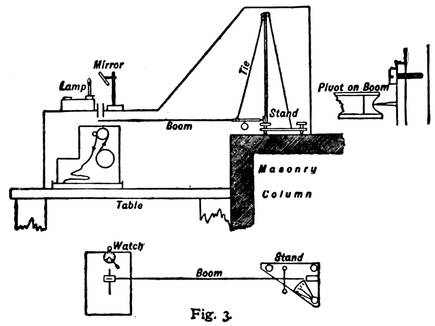
Diagram Showing Vertical and Horizontal Sections of the
More Sensitive of Professor Milne's Two Pendulums,
or Seismographs.
The accompanying diagram gives a very
clear idea of the arrangement of the apparatus.
The "boom" is the pendulum. It is
customary to think of a pendulum as hanging
down like that of a clock, but this is a horizontal
pendulum. Professor Milne has built
a very solid masonry column, reaching deep
into the earth, and so firmly placed that nothing
but a tremor of the hard earth itself will
disturb it. Upon this is perched a firm metal
stand, from the top of which the boom or
pendulum, about thirty inches long, is swung
by means of a "tie" or stay. The end of the
boom rests against a fine, sharp pivot of steel
(as shown in the little diagram to the right),
so that it will swing back and forth without
the least friction. The sensitive end of the
pendulum, where all the quakings and quiverings
are shown most distinctly, rests exactly
over a narrow roll of photographic film, which
is constantly turned by clockwork, and above
this, on an outside stand, there is a little lamp
which is kept burning night and day, year in
and year out. The light from this lamp is
reflected downward by
means of a mirror
through a little slit in
the metal case which
covers the entire apparatus.
Of course this
light affects the sensitive
film, and takes a continuous
photograph of the
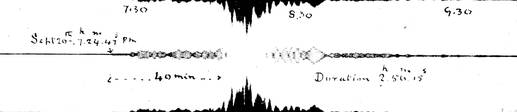
end of the boom. If
the boom remains perfectly
still, the picture
will be merely a straight
line, as shown at the
extreme right and left
ends of the earthquake
picture on this page.
But if an earthquake
wave comes along and
sets the boom to quivering,
the picture becomes
at once blurred
and full of little loops
and indentations, slight
at first, but becoming
more violent as the
greater waves arrive, and then gradually subsiding.
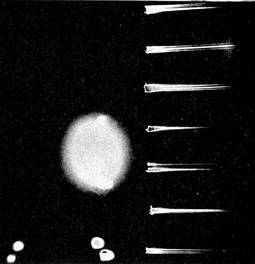
In the picture of the Borneo earthquake
of September 20, 1897, taken by Professor
Milne in his English laboratory, it will
be seen that the quakings were so severe at the
height of the disturbance that nothing is left
in the photograph but a blur. On the edge
of the picture can be seen the markings of the
hours, 7.30, 8.30, and 9.30. Usually this time
is marked automatically on the film by means
of the long hand of a watch which crosses the
slit beneath the mirror (as shown in the lower
diagram with figure 3). The Borneo earthquake
waves lasted in England, as will be
seen, two hours fifty-six minutes and fifteen
seconds, with about forty minutes of what are
known as preliminary tremors. Professor
Milne removes the film from his seismograph
once a week—a strip about twenty-six feet
long—develops it, and studies the photographs
for earthquake signs.
Seismogram of a Borneo Earthquake that Occurred September 20, 1897.
Besides this very sensitive photographic
seismograph Professor Milne has a simpler
machine, not covered up and without lamp or
mirror. In this instrument a fine silver needle
at the end of the boom makes a steady mark
on a band of smoked paper, which is kept
turning under it by means of clockwork. A
glance at this smoked-paper record will tell
instantly at any time of day or night whether
the earth is behaving itself. If the white line
on the dark paper shows disturbances, Professor
Milne at once examines his more sensitive
photographic record for the details.
It is difficult to realise how very sensitive
these earthquake pendulums really are. They
will indicate the very minutest changes in the
earth's level—as slight as one inch in ten miles.
A pair of these pendulums placed on two
buildings at opposite sides of a city street
would show that the buildings literally lean
toward each other during the heavy traffic
period of the day, dragged over from their
level by the load of vehicles and people pressing
down upon the pavement between them.
The earth is so elastic that a comparatively
small impetus will set it vibrating. Why,
even two hills tip together when there is a
heavy load of moisture in a valley between
them. And then when the moisture evaporates
in a hot sun they tip away from each
other. These pendulums show that.
Nor are these the most extraordinary things
which the pendulums will do. G. K. Gilbert,
of the United States Geological Survey, argues
that the whole region of the great lakes
is being slowly tipped to the southwest, so that
some day Chicago will sink and the water outlet
of the great fresh-water seas will be up
the Chicago River toward the Mississippi,
instead of down the St. Lawrence. Of course
this movement is as slow as time itself—thousands
of years must elapse before it is hardly
appreciable; and yet Professor Milne's instruments
will show the changing balance—a marvel
that is almost beyond belief. Strangely
enough, sensitive as this special instrument is
to distant disturbances, it does not swerve nor
quiver for near-by shocks. Thus, the blasting
of powder, the heavy rumbling of wagons,
the firing of artillery has little or no effect
in producing a movement of the boom. The
vibrations are too short; it requires the long,
heavy swells of the earth to make a record.
Professor Milne tells some odd stories of
his early experiences with the earthquake
measurer. At one time his films showed evidences
of the most horrible earthquakes, and
he was afraid for the moment that all Japan
had been shaken to pieces and possibly engulfed
by the sea. But investigation showed
that a little grey spider had been up to pranks
in the box. The spider wasn't particularly
interested in earthquakes, but he took the
greatest pleasure in the swinging of the boom,
and soon began to join in the game himself.
He would catch the end of the boom with his
feelers and tug it over to one side as far as
ever he could. Then he would anchor himself
there and hold on like grim death until the
boom slipped away. Then he would run after
it, and tug it over to the other side, and hold
it there until his strength failed again. And
so he would keep on for an hour or two until
quite exhausted, enjoying the fun immensely,
and never dreaming that he was manufacturing
wonderful seismograms to upset the scientific
world, since they seemed to indicate
shocking earthquake disasters in all directions.
Mr. Cleveland Moffett, to whom I am indebted
for much of the information contained
in this chapter, tells how the reporters for the
London papers rush off to see Professor
Milne every time there is news of a great
earthquake, and how he usually corrects their
information. In June, 1896, for instance, the
little observatory was fairly besieged with
these searchers for news.
"This earthquake happened on the 17th,"
said they, "and the whole eastern coast of
Japan was overwhelmed with tidal waves, and
30,000 lives were lost."
"That last is probable," answered Professor
Milne, "but the earthquake happened on the
15th, not the 17th;" and then he gave them
the exact hour and minute when the shocks
began and ended.
"But our cables put it on the 17th."
"Your cables are mistaken."
And, sure enough, later despatches came
with information that the destructive earthquake
had occurred on the 15th, within half a
minute of the time Professor Milne had specified.
There had been some error of transmission
in the earlier newspaper despatches.
Again, a few months later, the newspapers
published cablegrams to the effect that there
had been a severe earthquake at Kobe, with
great injury to life and property.
"That is not true," said Professor Milne.
"There may have been a slight earthquake at
Kobe, but nothing that need cause alarm."
And the mail reports a few weeks later confirmed
his reassuring statement, and showed
that the previous sensational despatches had
been grossly exaggerated.
Professor Milne is also the man to whose
words cable companies lend anxious ear, for
what he says often means thousands of dollars
to them. Early in January, 1898, it was
officially reported that two West Indian cables
had broken on December 31, 1897.
"That is very unlikely," said Professor
Milne; "but I have a seismogram showing
that these cables may have broken at 11.30
A.M. on December 29, 1897." And then he
located the break at so many miles off the
coast of Haiti.
This sort of thing, which is constantly happening,
would look very much like magic if
Professor Milne had kept his secrets to himself;
but he has given them freely to all the
world.
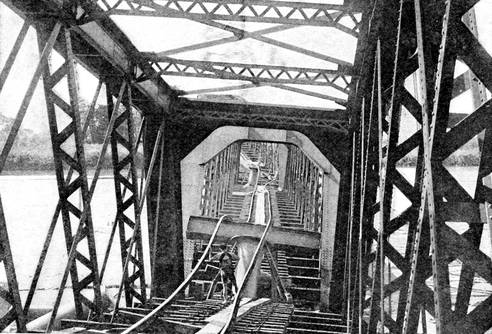
Effect of the Great Earthquake of 1891 on the Nagara Gawa Railway Bridge, Japan.
Professor Milne has learned from his experiments
that the solid earth is full of movements,
and tremors, and even tides, like the
sea. We do not notice them, because they are
so slow and because the crests of the waves
are so far apart. Professor Milne likes to
tell, fancifully, how the earth "breathes." He
has found that nearly all earthquake waves,
whether the disturbance is in Borneo or South
America, reach his laboratory in sixteen minutes,
and he thinks that the waves come
through the earth instead of around it. If
they came around, he says, there would be two
records—one from waves coming the short
way and one from waves coming the long
way round. But there is never more than a
single record, so he concludes that the waves
quiver straight through the solid earth itself,
and he believes that this fact will lead to some
important discoveries about the centre of our
globe. Professor Milne was once asked how,
if earthquake waves from every part of the
earth reached his observatory in the same
number of minutes, he could tell where the
earthquake really was.
"I may say, in a general way," he replied,
"that we know them by their signatures, just
as you know the handwriting of your friends;
that is, an earthquake wave which has travelled
3,000 miles makes a different record in
the instruments from one that has travelled
5,000 miles; and that, again, a different record
from one that has travelled 7,000 miles,
and so on. Each one writes its name in its
own way. It's a fine thing, isn't it, to have
the earth's crust harnessed up so that it is
forced to mark down for us on paper a diagram
of its own movements?"
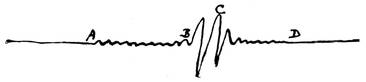
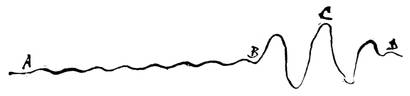
He took pencil and paper again, and dashed
off an earthquake wave like this:
"There you have the signature of an earthquake
wave which has travelled only a short
distance, say 2,000 miles; but here is the signature
of the very same wave after travelling,
say, 6,000 miles:"
"You see the difference at a glance; the
second seismogram (that is what we call these
records) is very much more stretched out than
the first, and a seismogram taken at 8,000
miles from the start would be more stretched
out still. This is because the waves of transmission
grow longer and longer, and slower
and slower, the farther they spread from the
source of disturbance. In both figures the
point A, where the straight line begins to
waver, marks the beginning of the earthquake;
the rippling line AB shows the preliminary
tremors which always precede the
heavy shocks, marked C; and D shows the
dying away of the earthquake in tremors similar
to AB.
"Now, it is chiefly in the preliminary tremors
that the various earthquakes reveal their
identity. The more slowly the waves come, the
longer it takes to record them, and the more
stretched out they become in the seismograms.
And by carefully noting these differences,
especially those in time, we get our information.
Suppose we have an earthquake in
Japan. If you were there in person you
would feel the preliminary tremors very fast,
five or ten in a second, and their whole duration
before the heavy shocks would not exceed
ten or twenty seconds. But these preliminary
tremors, transmitted to England, would keep
the pendulums swinging from thirty to thirty-two
minutes before the heavy shocks, and each
vibration would occupy five seconds.
"There would be similar differences in the
duration of the heavy vibrations; in Japan
they would come at the rate of about one a
second: here, at the rate of about one in
twenty or forty seconds. It is the time, then,
occupied by the preliminary tremors that tells
us the distance of the earthquake. Earthquakes
in Borneo, for instance, give preliminary
tremors occupying about forty-one minutes,
in Japan about half an hour, in the
earthquake region east of Newfoundland
about eight minutes, in the disturbed region
of the West Indies about nineteen or twenty
minutes, and so on. Thus the earthquake is
located with absolute precision."
Most earthquakes occur in the deep bed of
the ocean, in the vast valleys between ocean
mountains, and the dangerous localities are
now almost as well known as the principal
mountain ranges of North America. There is
one of these valleys, or ocean holes, off the
west coast of South America from Ecuador
down; there is one in the mid-Atlantic, about
the equator, between twenty degrees and forty
degrees west longitude: there is one at the
Grecian end of the Mediterranean; one in the
Bay of Bengal, and one bordering the Alps;
there is the famous "Tuscarora Deep," from
the Philippine Islands down to Java; and
there is the North Atlantic region, about 300
miles east of Newfoundland. In the "Tuscarora
Deep" the slope increases 1,000 fathoms
in twenty-five miles, until it reaches a depth
of 4,000 fathoms.
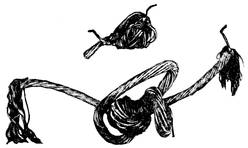
Pieces of a Submarine Cable Picked Up in the Gulf of
Mexico in 1888.
The kinks are caused by seismic disturbances, and they show how much
distortion a cable can suffer and still remain in good electrical
condition, as this was found to be.
And this brings us to the consideration of
one of the greatest practical advantages of the
seismograph—in the exact location of cable
breaks. Indeed, a large proportion of these
breaks are the result of earthquakes. In a recent
report Professor Milne says that there
are now about twenty-seven breaks a year for
10,000 miles of cable in active use. Most of
these are very costly, fifteen breaks in the Atlantic
cable between 1884 and 1894 having
cost the companies $3,000,000, to say nothing
of loss of time. And twice it has happened
in Australia (in 1880 and 1888) that the
whole island has been thrown into excitement
and alarm, the reserves being called out, and
other measures taken, because the sudden
breaking of cable connections with the outside
world has led to the belief that military operations
against the country were preparing by
some foreign power. A Milne pendulum at
Sydney or Adelaide would have made it plain
in a moment that the whole trouble was due to
a submarine earthquake occurring at such a
time and such a place. As it was, Australia
had to wait in a fever of suspense (in one
case there was a delay of nineteen days) until
steamers arriving brought assurances that neither
Russia nor any other possibly unfriendly
power had begun hostilities by tearing up the
cables.
There have been submarine earthquakes in
the Tuscarora, like that of June 15, 1896, that
have shaken the earth from pole to pole; and
more than once different cables from Java
have been broken simultaneously, as in 1890,
when the three cables to Australia snapped in
a moment. And the great majority of breaks
in the North Atlantic cables have occurred in
the Newfoundland hollow, where there are
two slopes, one dropping from 708 to 2,400
fathoms in a distance of sixty miles, and the
other from 275 to 1,946 fathoms within thirty
miles. On October 4, 1884, three cables, lying
about ten miles apart, broke simultaneously at
the spot. The significance of such breaks is
greater when the fact is borne in mind that
cables frequently lie uninjured for many
years on the great level plains of the ocean
bed, where seismic disturbances are infrequent.
The two chief causes of submarine earthquakes
are landslides, where enormous masses
of earth plunge from a higher to a lower
level, and in so doing crush down upon the
cable, and "faults," that is, subsidences of
great areas, which occur on land as well as at
the bottom of the sea, and which in the latter
case may drag down imbedded cables with
them.
It is in establishing the place and times of
these breaks that Professor Milne's instruments
have their greatest practical value; scientifically
no one can yet calculate their value.
Record Made on a Stationary Surface by the Vibrations
of the Japanese Earthquake of July 19, 1891.
Showing the complicated character of the motion (common to most
earthquakes), and also the course of a point at the centre of
disturbance.
In addition to the first instrument set up by
Professor Milne in Tokio in 1883, which is
still recording earthquakes, there are now in
operation about twenty other seismographs in
various parts of the world, so that earthquake
information is becoming very accurate and
complete, and there is even an attempt being
made to predict earthquakes just as the
weather bureau predicts storms. In any event
Professor Milne's invention must within a few
years add greatly to our knowledge of the
wonders of the planet on which we live.
CHAPTER IV ELECTRICAL FURNACES How the Hottest Heat is Produced—Making Diamonds
No feats of discovery, not even the search for
the North Pole or Stanley's expeditions in the
heart of Africa, present more points of fascinating
interest than the attempts now being
made by scientists to explore the extreme
limits of temperature. We live in a very narrow
zone in what may be called the great
world of heat. The cut on the opposite page
represents an imaginary thermometer showing
a few of the important temperature points
between the depths of the coldest cold and the
heights of the hottest heat—a stretch of some
10,461 degrees. We exist in a narrow space,
as you will see, varying from 100° or a little
more above the zero point to a possible 50° below;
that is, we can withstand these narrow
extremes of temperature. If some terrible
world catastrophe should raise the temperature
of our summers or lower that of our
winters by a very few degrees, human life
would perish off the earth.
But though we live in such narrow limits,
science has found ways of exploring the great
heights of heat above us and of reaching and
measuring the depths of cold below us, with
the result of making many important and interesting
discoveries.
I have written in the former "Boys' Book of
Inventions" of that wonderful product of science,
liquid air—air submitted to such a degree
of cold that it ceases to be a gas and becomes
a liquid. This change occurs at a temperature
312° below zero. Professor John Dewar, of
England, who has made some of the most interesting
of discoveries in the region of great
cold, not only reached a temperature low
enough to produce liquid air, but he succeeded
in going on down until he could freeze
this marvellous liquid into a solid—a sort of
air ice. Not content even with this astonishing
degree of cold, Professor Dewar continued
his experiments until he could reduce
hydrogen—that very light gas—to a liquid,
at 440° below zero, and then, strange as it
may seem, he also froze liquid hydrogen into a
solid. From his experiments he finally concluded
that the "absolute zero"—that is, the
place where there is no heat—was at a point
461° below zero. And he has been able to
produce a temperature, artificially, within a
very few degrees of this utmost limit of cold.
Think what this absolute zero means.
Heat, we know, like electricity and light, is a
vibratory or wave motion in the ether. The
greater the heat, the faster the vibrations.
We think of all the substances around us as
solids, liquids, and gases, but these are only
comparative terms. A change of temperature
changes the solid into the liquid, or the gas
into the solid. Take water, for instance. In
the ordinary temperature of summer it is a
liquid, in winter it is a hard crystalline substance
called ice; apply the heat of a stove
and it becomes steam, a gas. So with all
other substances. Air to us is an invisible
gas, but if the earth should suddenly drop
in temperature to 312° below zero all the
air would fall in liquid drops like rain and
fill the valleys of the earth with lakes and
oceans. Still a little colder and these lakes
and oceans would freeze into solids. Similarly,
steel seems to us a very hard and solid
substance, but apply enough heat and it boils
like water, and finally, if the heat be increased,
it becomes a gas.
Imagine, if you can, a condition in which
all substances are solids; where the vibrations
known as heat have been stilled to silence;
where nothing lives or moves; where, indeed,
there is an awful nothingness; and you can
form an idea of the region of the coldest cold—in
other words, the region where heat does
not exist. Our frozen moon gives something
of an idea of this condition, though probably,
cold and barren as it is, the moon is still a
good many degrees in temperature above the
absolute zero.
Some of the methods of exploring these
depths of cold are treated in the chapter on
liquid air already referred to. Our interest
here centres in the other extreme of temperature,
where the heat vibrations are inconceivably
rapid; where nearly all substances known
to man become liquids and gases; where, in
short, if the experimenter could go high
enough, he could reach the awful degree of
heat of the burning sun itself, estimated at
over 10,000 degrees. It is in the work of exploring
these regions of great heat that such
men as Moissan, Siemens, Faure, and others
have made such remarkable discoveries, reaching
temperatures as high as 7,000, or over
twice the heat of boiling steel. Their accomplishments
seem the more wonderful when we
consider that a temperature of this degree
burns up or vaporises every known substance.
How, then, could these men have made a furnace
in which to produce this heat? Iron in
such a heat would burn like paper, and so
would brick and mortar. It seems inconceivable
that even science should be able to produce
a degree of heat capable of consuming
the tools and everything else with which it is
produced.
The heat vibrations at 7,000° are so intense
that nickel and platinum, the most refractory,
the most unmeltable of metals, burn like so
much bee's-wax; the best fire-brick used in lining
furnaces is consumed by it like lumps of
rosin, leaving no trace behind. It works, in
short, the most marvellous, the most incredible
transformations in the substances of the earth.
Indeed, we have to remember that the earth
itself was created in a condition of great heat—first
a swirling, burning gas, something like
the sun of to-day, gradually cooling, contracting,
rounding, until we have our beautiful
world, with its perfect balance of gases,
liquids, solids, its splendid life. A dying volcano
here and there gives faint evidence of
the heat which once prevailed over all the
earth.
It was in the time of great heat that the
most beautiful and wonderful things in the
world were wrought. It was fierce heat that
made the diamond, the sapphire, and the ruby;
it fashioned all of the most beautiful forms
of crystals and spars; and it ran the gold and
silver of the earth in veins, and tossed up
mountains, and made hollows for the seas. It
is, in short, the temperature at which worlds
were born.
More wonderful, if possible, than the miracles
wrought by such heat is the fact that
men can now produce it artificially; and not
only produce, but confine and direct it, and
make it do their daily service. One asks himself,
indeed, if this can really be; and it was
under the impulse of some such incredulity
that I lately made a visit to Niagara Falls,
where the hottest furnaces in the world are
operated. Here clay is melted in vast quantities
to form aluminium, a metal as precious
a few years ago as gold. Here lime and carbon,
the most infusible of all the elements, are
joined by intense heat in the curious new compound,
calcium carbide, a bit of which dropped
in water decomposes almost explosively, producing
the new illuminating gas, acetylene.
Here, also, pure phosphorus and the phosphates
are made in large quantities; and here
is made carborundum—gem-crystals as hard
as the diamond and as beautiful as the ruby.
An extensive plant has also been built to
produce the heat necessary to make graphite
such as is used in your lead-pencils, and for
lubricants, stove-blacking, and so on. Graphite
has been mined from the earth for thousands
of years; it is pure carbon, first cousin
to the diamond. Ten years ago the possibility
of its manufacture would have been scouted
as ridiculous; and yet in these wonderful furnaces,
which repeat so nearly the processes of
creation, graphite is as easily made as soap.
The marvel-workers at Niagara Falls have
not yet been able to make diamonds—in quantities.
The distinguished French chemist
Moissan has produced them in his laboratory
furnaces—small ones, it is true, but diamonds;
and one day they may be shipped in peck
boxes from the great furnaces at Niagara
Falls. This is no mere dream; the commercial
manufacture of diamonds has already had
the serious consideration of level-headed, far-seeing
business men, and it may be accounted
a distinct probability. What revolution the
achievement of it would work in the diamond
trade as now constituted and conducted no one
can say.
These marvellous new things in science and
invention have been made possible by the
chaining of Niagara to the wheels of industry.
The power of the falling water is transformed
into electricity. Electricity and heat are both
vibratory motions of the ether; science has
found that the vibrations known as electricity
can be changed into the vibrations known as
heat. Accordingly, a thousand horse-power
from the mighty river is conveyed as electricity
over a copper wire, changed into heat and
light between the tips of carbon electrodes,
and there works its wonders. In principle the
electrical furnace is identical with the electric
light. It is scarcely twenty years since the
first electrical furnaces of real practical utility
were constructed; but if the electrical furnaces
to-day in operation at Niagara Falls alone
were combined into one, they would, as one
scientist speculates, make a glow so bright
that it could be seen distinctly from the moon—a
hint for the astronomers who are seeking
methods for communicating with the inhabitants
of Mars. One furnace has been built in
which an amount of heat energy equivalent to
700 horse-power is produced in an arc cavity
not larger than an ordinary water tumbler.
On reaching Niagara Falls, I called on Mr.
E. G. Acheson, whose name stands with that
of Moissan as a pioneer in the investigation
of high temperatures. Mr. Acheson is still a
young man—not more than forty-five at most—and
clean-cut, clear-eyed, and genial, with
something of the studious air of a college professor.
He is pre-eminently a self-made man.
At twenty-four he found a place in Edison's
laboratory—"Edison's college of inventions,"
he calls it—and, at twenty-five, he was one
of the seven pioneers in electricity who (in
1881-82) introduced the incandescent lamp in
Europe. He installed the first electric-light
plants in the cities of Milan, Genoa, Venice,
and Amsterdam, and during this time was one
of Edison's representatives in Paris.
Mr. E. G. Acheson, One of the Pioneers in the Investigation
of High Temperatures.
"I think the possibility of manufacturing
genuine diamonds," he said to me, "has dazzled
more than one young experimenter. My
first efforts in this direction were made in
1880. It was before we had command of the
tremendous electric energy now furnished by
the modern dynamo, and when the highest
heat attainable for practical purposes was obtained
by the oxy-hydrogen flame. Even this
was at the service of only a few experimenters,
and certainly not at mine. My first experiments
were made in what I might term the
'wet way'; that is, by the process of chemical
decomposition by means of an electric current.
Very interesting results were obtained, which
even now give promise of value; but the diamond
did not materialise.
"I did not take up the subject again until
the dynamo had attained high perfection and
I was able to procure currents of great power.
Calling in the aid of the 6,500 degrees Fahrenheit
or more of temperature produced by
these electric currents, I once more set myself
to the solution of the problem. I now had,
however, two distinct objects in view: first,
the making of a diamond; and, second, the
production of a hard substance for abrasive
purposes. My experiments in 1880 had resulted
in producing a substance of extreme
hardness, hard enough, indeed, to scratch the
sapphire—the next hardest thing to the diamond—and
I saw that such a material, cheaply
made, would have great value.
"My first experiment in this new series was
of a kind that would have been denounced as
absurd by any of the old-school book-chemists,
and had I had a similar training, the probability
is that I should not have made such an
investigation. But 'fools rush in where angels
fear to tread,' and the experiment was made."
This experiment by Mr. Acheson, extremely
simple in execution, was the first act in
rolling the stone from the entrance to a veritable
Aladdin's cave, into which a multitude
of experimenters have passed in their search
for nature's secrets; for, while the use of
the electrical furnace in the reduction of
metals—in the breaking down of nature's
compounds—was not new, its use for synthetic
chemistry—for the putting together,
the building up, the formation of compounds—was
entirely new. It has enabled the chemist
not only to reproduce the compounds of
nature, but to go further and produce valuable
compounds that are wholly new and were
heretofore unknown to man. Mr. Acheson
conjectured that carbon, if made to combine
with clay, would produce an extremely hard
substance; and that, having been combined
with the clay, if it should in the cooling separate
again from the clay, it would issue out
of the operation as diamond. He therefore
mixed a little clay and coke dust together,
placed them in a crucible, inserted the ends of
two electric-light carbons into the mixture,
and connected the carbons with a dynamo.
The fierce heat generated at the points of the
carbons fused the clay, and caused portions
of the carbon to dissolve. After cooling, a
careful examination was made of the mass,
and a few small purple crystals were found.
They sparkled with something of the brightness
of diamonds, and were so hard that they
scratched glass. Mr. Acheson decided at once
that they could not be diamonds; but he
thought they might be rubies or sapphires. A
little later, though, when he had made similar
crystals of a larger size, he found that they
were harder than rubies, even scratching the
diamond itself. He showed them to a number
of expert jewellers, chemists, and geologists.
They had so much the appearance of natural
gems that many experts to whom they were
submitted without explanation decided that
they must certainly be of natural production.
Even so eminent an authority as Geikie, the
Scotch geologist, on being told, after he had
examined them, that the crystals were manufactured
in America, responded testily:
"These Americans! What won't they claim
next? Why, man, those crystals have been in
the earth a million years."
Mr. Acheson decided at first that his crystals
were a combination of carbon and aluminium,
and gave them the name carborundum.
He at once set to work to manufacture them
in large quantities for use in making abrasive
wheels, whetstones, and sandpaper, and for
other purposes for which emery and corundum
were formerly used. He soon found by chemical
analysis, however, that carborundum was
not composed of carbon and aluminium, but of
carbon and silica, or sand, and that he had, in
fact, created a new substance; so far as human
knowledge now extends, no such combination
occurs anywhere in nature. And it was made
possible only by the electrical furnace, with its
power of producing heat of untold intensity.
The Furnace-Room, where Carborundum is Made.
"A great, dingy brick building, open at the sides like a shed."
In order to get a clear understanding of the
actual workings of the electrical furnace, I
visited the plant where Mr. Acheson makes
carborundum. The furnace-room is a great,
dingy brick building, open at the sides like a
shed. It is located only a few hundred yards
from the banks of the Niagara River and well
within the sound of the great falls. Just below
it, and nearer the city, stands the handsome
building of the Power Company, in
which the mightiest dynamos in the world
whir ceaselessly, day and night, while the waters
of Niagara churn in the water-wheel pits
below. Heavy copper wires carrying a current
of 2,200 volts lead from the power-house
to Mr. Acheson's furnaces, where the electrical
energy is transformed into heat.
There are ten furnaces in all, built loosely
of fire-brick, and fitted at each end with electrical
connections. And strange they look to
one who is familiar with the ordinary fuel
furnace, for they have no chimneys, no doors,
no drafts, no ash-pits, no blinding glow of
heat and light. The room in which they stand
is comfortably cool. Each time a furnace is
charged it is built up anew; for the heat produced
is so fierce that it frequently melts the
bricks together, and new ones must be supplied.
There were furnaces in many stages
of development. One had been in full blast
for nearly thirty hours, and a weird sight it
was. The top gave one the instant impression
of the seamy side of a volcano. The heaped
coke was cracked in every direction, and from
out of the crevices and depressions and from
between the joints of the loosely built brick
walls gushed flames of pale green and blue,
rising upward, and burning now high, now
low, but without noise beyond a certain low
humming. Within the furnace—which was
oblong in shape, about the height of a man,
and sixteen feet long by six wide—there was
a channel, or core, of white-hot carbon in a
nearly vaporised state. It represented graphically
in its seething activity what the burning
surface of the sun might be—and it was almost
as hot. Yet the heat was scarcely manifest
a dozen feet from the furnace, and but
for the blue flames rising from the cracks in
the envelope, or wall, one might have laid his
hand almost anywhere on the bricks without
danger of burning it.
Taking Off a Crust of the Furnace at Night.
The light is so intense that you cannot look at it without hurting
the eyes.
In the best modern blast-furnaces, in which
the coal is supplied with special artificial draft
to make it burn the more fiercely, the heat may
reach 3,000 degrees Fahrenheit. This is less
than half of that produced in the electrical
furnace. In porcelain kilns, the potters, after
hours of firing, have been able to produce a
cumulative temperature of as much as 3,300
degrees Fahrenheit; and this, with the oxy-hydrogen
flame (in which hydrogen gas is
spurred to greater heat by an excess of oxygen),
is the very extreme of heat obtainable
by any artificial means except by the electrical
furnace. Thus the electrical furnace has fully
doubled the practical possibilities in the artificial
production of heat.
Mr. Fitzgerald, the chemist of the Acheson
Company, pointed out to me a curious glassy
cavity in one of the half-dismantled furnaces.
"Here the heat was only a fraction of that in
the core," he said. But still the fire-brick—and
they were the most refractory produced in
this country—had been melted down like butter.
The floors under the furnace were all
made of fire-brick, and yet the brick had run
together until they were one solid mass of
glassy stone. "We once tried putting a fire-brick
in the centre of the core," said Mr. Fitzgerald,
"just to test the heat. Later, when
we came to open the furnace, we couldn't find
a vestige of it. The fire had totally consumed
it, actually driving it all off in vapour."
Indeed, so hot is the core that there is really
no accurate means of measuring its temperature,
although science has been enabled by
various curious devices to form a fairly correct
estimate. The furnace has a provoking
way of burning up all of the thermometers
and heat-measuring devices which are applied
to it. A number of years ago a clever German,
named Segar, invented a series of little
cones composed of various infusible earths like
clay and feldspar. He so fashioned them that
one in the series would melt at 1,620 degrees
Fahrenheit, another at 1,800 degrees, and so
on up. If the cones are placed in a pottery
kiln, the potter can tell just what degree of
temperature he has reached by the melting of
the cones one after another. But in Mr.
Acheson's electrical furnaces all the cones
would burn up and disappear in two minutes.
The method employed for coming at the heat
of the electrical furnace, in some measure, is
this: a thin filament of platinum is heated red
hot—1,800 degrees Fahrenheit—by a certain
current of electricity. A delicate thermometer
is set three feet away, and the reading is
taken. Then, by a stronger current, the filament
is made white hot—3,400 degrees Fahrenheit—and
the thermometer moved away
until it reads the same as it read before. Two
points in a distance-scale are thus obtained as
a basis of calculation. The thermometer is
then tried by an electrical furnace. To be
kept at the same marking it must be placed
much farther away than in either of the other
instances. A simple computation of the comparative
distances with relation to the two
well-ascertained temperatures gives approximately,
at least, the temperature of the electrical
furnace. Some other methods are also
employed. None is regarded as perfectly
exact; but they are near enough to have
yielded some very interesting and valuable
statistics regarding the power of various temperatures.
For instance, it has been found
that aluminium becomes a limpid liquid at
from 4,050 to 4,320 degrees Fahrenheit, and
that lime melts at from 4,940 to 5,400 degrees,
and magnesia at 4,680 degrees.
There are two kinds of electrical furnaces,
as there are two kinds of electric lights—arc
and incandescent. Moissan has used the arc
furnace in all of his experiments, but Mr.
Acheson's furnaces follow rather the principle
of the incandescent lamp. "The incandescent
light," said Mr. Fitzgerald, "is produced by
the resistance of a platinum wire or a carbon
filament to the passage of a current of electricity.
Both light and heat are given off. In
our furnace, the heat is produced by the resistance
of a solid cylinder or core of pulverised
coke to the passage of a strong current
of electricity. When the core becomes white
hot it causes the materials surrounding it to
unite chemically, producing the carborundum
crystals."
The materials used are of the commonest—pure
white sand, coke, sawdust, and salt. The
sand and coke are mixed in the proportions of
sixty to forty, the sawdust is added to keep
the mixture loose and open, and the salt to
assist the chemical combination of the ingredients.
The furnace is half filled with this
mixture, and then the core of coke, twenty-one
inches in diameter, is carefully moulded in
place. This core is sixteen feet long, reaching
the length of the furnace, and connecting at
each end with an immense carbon terminal,
consisting of no fewer than twenty-five rods
of carbon, each four inches square and nearly
three feet long. These terminals carry the
current into the core from huge insulated copper
bars connected from above. When the
core is complete, more of the carborundum
mixture is shovelled in and tramped down
until the furnace is heaping full.
Everything is now ready for the electric
current. The wires from the Niagara Falls
power-plant come through an adjoining building,
where one is confronted, upon entering,
with this suggestive sign:
DANGER
2,200 Volts.
Tesla produces immensely higher voltages
than this for laboratory experiments, but there
are few more powerful currents in use in this
country for practical purposes. Only about
2,000 volts are required for executing criminals
under the electric method employed in
New York; 400 volts will run a trolley-car.
It is hardly comfortable to know that a single
touch of one of the wires or switches in this
room means almost certain death. Mr. Fitzgerald
gave me a vivid demonstration of the
terrific destructive force of the Niagara Falls
current. He showed me how the circuit was
broken. For ordinary currents, the breaking
of a circuit simply means a twist of the wrist
and the opening of a brass switch. Here,
however, the current is carried into a huge
iron tank full of salt water. The attendant,
pulling on a rope, lifts an iron plate from the
tank. The moment it leaves the water, there
follow a rumbling crash like a thunder-clap,
a blinding burst of flame, and thick clouds of
steam and spray. The sight and sound of it
make you feel delicate about interfering with
a 2,200-volt current.
The Interior of a Furnace as it Appears after the Carborundum has been Taken Out.
This current is, indeed, too strong in voltage
for the furnaces, and it is cut down, by
means of what were until recently the largest
transformers in the world, to about 100 volts,
or one-fourth the pressure used on the average
trolley line. It is now, however, a current of
great intensity—7,500 ampères, as compared
with the one-half ampère used in an incandescent
lamp; and it requires eight square inches
of copper and 400 square inches of carbon to
carry it.
Within the furnace, when the current is
turned on, a thousand horse-power of energy
is continuously transformed into heat. Think
of it! Is it any wonder that the temperature
goes up? And this is continued for thirty-six
hours steadily, until 36,000 "horse-power
hours" are used up and 7,000 pounds of the
crystals have been formed. Remembering
that 36,000 horse-power hours, when converted
into heat, will raise 72,000 gallons of
water to the boiling point, or will bring 350
tons of iron up to a red heat, one can at least
have a sort of idea of the heat evolved in a
carborundum furnace.
When the coke core glows white, chemical
action begins in the mixture around it. The
top of the furnace now slowly settles, and
cracks in long, irregular fissures, sending out
a pungent gas which, when lighted, burns
lambent blue. This gas is carbon monoxide,
and during the process nearly six tons of it
are thrown off and wasted. It seems, indeed,
a somewhat extravagant process, for fifty-six
pounds of gas are produced for every forty of
carborundum.
"It is very distinctly a geological condition,"
said Mr. Fitzgerald; "crystals are not
only formed exactly as they are in the earth,
but we have our own little earthquakes and
volcanoes." Not infrequently gas collects,
forming a miniature mountain, with a crater
at its summit, and blowing a magnificent fountain
of flame, lava, and dense white vapour
high into the air, and roaring all the while in
a most terrifying manner. The workmen call
it "blowing off."
Blowing Off.
"Not infrequently gas collects, forming a miniature mountain, with
a crater at its summit, and blowing a magnificent fountain of
flame, lava, and dense white vapour high into the air, and roaring
all the while in a most terrifying manner."
At the end of thirty-six hours the current
is cut off, and the furnace is allowed to cool,
the workmen pulling down the brick as rapidly
as they dare. At the centre of the furnace,
surrounding the core, there remains a
solid mass of carborundum as large in diameter
as a hogshead. Portions of this mass
are sometimes found to be composed of pure,
beautifully crystalline graphite. This in itself
is a surprising and significant product,
and it has opened the way directly to graphite-making
on a large scale. An important and
interesting feature of the new graphite industry
is the utilisation it has effected of a product
from the coke regions of Pennsylvania
which was formerly absolute waste.
To return to carborundum: when the furnace
has been cooled and the walls torn away,
the core of carborundum is broken open, and
the beautiful purple and blue crystals are laid
bare, still hot. The sand and the coke have
united in a compound nearly as hard as the
diamond and even more indestructible, being
less inflammable and wholly indissoluble in
even the strongest acids. After being taken
out, the crystals are crushed to powder and
combined in various forms convenient for the
various uses for which it is designed.
I asked Mr. Acheson if he could make diamonds
in his furnaces. "Possibly," he answered,
"with certain modifications." Diamonds,
as he explained, are formed by great
heat and great pressure. The great heat is
now easily obtained, but science has not yet
learned nature's secret of great pressure.
Moissan's method of making diamonds is to
dissolve coke dust in molten iron, using a carbon
crucible into which the electrodes are inserted.
When the whole mass is fluid, the
crucible and its contents are suddenly dashed
into cold water or melted lead. This instantaneous
cooling of the iron produces enormous
pressure, so that the carbon is crystallised in
the form of diamond.
But whatever it may or may not yet be able
to do in the matter of diamond-making, there
can be no doubt that the possibilities of the
electrical furnace are beyond all present conjecture.
With American inventors busy in its
further development, and with electricity as
cheap as the mighty power of Niagara can
make it, there is no telling what new and
wonderful products, now perhaps wholly unthought-of
by the human race, it may become
possible to manufacture, and manufacture
cheaply.
CHAPTER V HARNESSING THE SUN The Solar Motor
It seems daring and wonderful enough, the
idea of setting the sun itself to the heavy work
of men, producing the power which will help
to turn the wheels of this age of machinery.
At Los Angeles, Cal., I went out to see
the sun at work pumping water. The solar
motor, as it is called, was set up at one end of
a great enclosure where ostriches are raised.
I don't know which interested me more at
first, the sight of these tall birds striding with
dignity about their roomy pens or sitting on
their big yellow eggs—just as we imagine
them wild in the desert—or the huge, strange
creation of man by which the sun is made to
toil. I do not believe I could have guessed the
purpose of this unique invention if I had not
known what to expect. I might have hazarded
the opinion that it was some new and
monstrous searchlight: beyond that I think
my imagination would have failed me. It
resembled a huge inverted lamp-shade, or
possibly a tremendous iron-ribbed colander,
bottomless, set on its edge and supported by
a steel framework. Near by there was a little
wooden building which served as a shop or
engine-house. A trough full of running water
led away on one side, and from within
came the steady chug-chug, chug-chug of machinery,
apparently a pump. So this was the
sun-subduer! A little closer inspection, with
an audience of ostriches, very sober, looking
over the fence behind me and wondering, I
suppose, if I had a cracker in my pocket, I
made out some other very interesting particulars
in regard to this strange invention. The
colander-like device was in reality, I discovered,
made up of hundreds and hundreds
(nearly 1,800 in all) of small mirrors, the
reflecting side turned inward, set in rows on
the strong steel framework which composed
the body of the great colander. By looking
up through the hole in the bottom of the colander
I was astonished by the sight of an
object of such brightness that it dazzled my
eyes. It looked, indeed, like a miniature sun,
or at least like a huge arc light or a white-hot
column of metal. And, indeed, it was white
hot, glowing, burning hot—a slim cylinder of
copper set in the exact centre of the colander.
At the top there was a jet of white steam like
a plume, for this was the boiler of this extraordinary
engine.
Side View of the Solar Motor.
"It is all very simple when you come to see
it," the manager was saying to me. "Every
boy has tried the experiment of flashing the
sunshine into his chum's window with a mirror.
Well, we simply utilise that principle.
By means of these hundreds of mirrors we
reflect the light and heat of the sun on a single
point at the centre of what you have described
as a colander. Here we have the cylinder of
steel containing the water which we wish
heated for steam. This cylinder is thirteen
and one-half feet long and will hold one hundred
gallons of water. If you could see it
cold, instead of glowing with heat, you would
find it jet black, for we cover it with a peculiar
heat-absorbing substance made partly of lampblack,
for if we left it shiny it would re-reflect
some of the heat which comes from the mirrors.
The cold water runs in at one end
through this flexible metallic hose, and the
steam goes out at the other through a similar
hose to the engine in the house."
Though this colander, or "reflector," as it
is called, is thirty-three and one-half feet in
diameter at the outer edge and weighs over
four tons, it is yet balanced perfectly on its
tall standards. It is, indeed, mounted very
much like a telescope, in meridian, and a common
little clock in the engine-room operates
it so that it always faces the sun, like a sunflower,
looking east in the morning and west
in the evening, gathering up the burning rays
of the sun and throwing them upon the boiler
at the centre. In the engine-house I found a
pump at work, chug-chugging like any pump
run by steam-power, and the water raised by
sun-power flowing merrily away. The manager
told me that he could easily get ten
horse-power; that, if the sun was shining
brightly, he could heat cold water in an hour
to produce 150 pounds of steam.
Front View of the Los Angeles Solar Motor.
The wind sometimes blows a gale in Southern
California, and I asked the manager what
provision had been made for keeping this
huge reflector from blowing away.
"Provision is made for varying wind-pressures,"
he said, "so that the machine is always
locked in any position, and may only be moved
by the operating mechanism, unless, indeed,
the whole structure should be carried away.
It is designed to withstand a wind-pressure of
100 miles an hour. It went through the high
gales of the November storm without a particle
of damage. One of the peculiar characteristics
of its construction is that it avoids
wind-pressure as much as possible."
The operation of the motor is so simple
that it requires very little human labour.
When power is desired, the reflector must be
swung into focus—that is, pointed exactly
toward the sun—which is done by turning a
crank. This is not beyond the power of a
good-sized boy. There is an indicator which
readily shows when a true focus is obtained.
This done, the reflector follows the sun closely
all day. In about an hour the engine can be
started by a turn of the throttle-valve. As
the engine is automatic and self-oiling, it runs
without further attention. The supply of
water to the boiler is also automatic, and is
maintained at a constant height without any
danger of either too much or too little water.
Steam-pressure is controlled by means of a
safety-valve, so that it may never reach a dangerous
point. The steam passes from the
engine to the condenser and thence to the
boiler, and the process is repeated indefinitely.
Having now the solar motor, let us see what
it is good for, what is expected of it. Of
course when the sun does not shine the motor
does not work, so that its usefulness would be
much curtailed in a very cloudy country like
England, for instance; but here in Southern
California and in all the desert region of the
United States and Mexico, to say nothing of
the Sahara in Africa, where the sun shines
almost continuously, the solar motor has its
greatest sphere of usefulness, and, indeed, its
greatest need; for these lands of long sunshine,
the deserts, are also the lands of parched fruitlessness,
of little water, so that the invention
of a motor which will utilise the abundant
sunshine for pumping the much-needed water
has a peculiar value here.
The Brilliant Steam Boiler Glistens in the Centre.
The solar motor is expected to operate at
all seasons of the year, regardless of all climatic
conditions, with the single exception of
cloudy skies. Cold makes no difference whatever.
The best results from the first model
used in experimental work at Denver were
obtained at a time when the pond from which
the water was pumped was covered with a
thick coating of ice. But, of course, the length
of the solar day is longer in the summer, giving
more heat and more power. The motor
may be depended upon for work from about
one hour and a half after sunrise to within
half an hour of sunset. In the summer time
this would mean about twelve hours' constant
pumping.
Think what such an invention means, if
practically successful, to the vast stretches of
our arid Western land, valueless without water.
Spread all over this country of Arizona, New
Mexico, Southern California, and other States
are thousands of miles of canals to bring in
water from the rivers for irrigating the deserts,
and there are untold numbers of wind-mills,
steam and gasoline pumps which accomplish
the same purpose more laboriously.
Think what a new source of cheap power will
do—making valuable hundreds of acres of
desert land, providing homes for thousands of
busy Americans. Indeed, a practical solar
motor might make habitable even the Sahara
Desert. And it can be used in many other
ways besides for pumping water. Threshing
machines might be run by this power, and,
converted into electricity and saved up in
storage batteries, it might be used for lighting
houses, even for cooking dinners, or in fact
for any purpose requiring power.
These solar motors can be built at no great
expense. I was told that ten-horse-power
plants would cost about $200 per horse-power,
and one-hundred-horse-power plants about
$100 per horse-power. This would include the
entire plant, with engine and pump complete.
When it is considered that the annual rental
of electric power is frequently $50 per horse-power,
whether it is used or not, it will be seen
that the solar motor means a great deal, especially
in connection with irrigation enterprises.
The Rear Machinery for Operating the Reflector.
And the time is coming—long-headed inventors
saw it many years ago—when some
device for the direct utilisation of the sun's
heat will be a necessity. The world is now
using its coal at a very rapid rate; its wood,
for fuel purposes, has already nearly disappeared,
so that, within a century or two, new
ways of furnishing heat and power must be
devised or the human race will perish of cold
and hunger. Fortunately there are other
sources of power at hand; the waterfalls, the
Niagaras, which, converted into electricity,
may yet heat our sitting-rooms and cook our
dinners. There is also wind-power, now used
to a limited extent by means of wind-mills.
But greater than either of these sources is the
unlimited potentiality of the tides of the sea,
which men have sought in vain to harness, and
the direct heat of the sun itself. Some time
in the future these will be subdued to the purpose
of men, perhaps our main dependence for
heat and power.
When we come to think of it, the harnessing
of the sun is not so very strange. In fact, we
have had the sun harnessed since the dawn of
man on the earth, only indirectly. Without
the sun there would be nothing here—no men,
no life. Coal is nothing but stored-up, bottled
sunshine. The sunlight of a million years ago
produced forests, which, falling, were buried
in the earth and changed into coal. So when
we put coal in the cook-stove we may truthfully
say that we are boiling the kettle with million-year-old
sunshine. Similarly there would be
no waterfalls for us to chain and convert into
electricity, as we have chained Niagara, if the
sun did not evaporate the waters of the sea,
take it up in clouds, and afterward empty the
clouds in rain on the mountain-tops from
whence the water tumbles down again to the
sea. So no wind would blow without the sun
to work changes in the air.
In short, therefore, we have been using the
sunlight all these years, hardly knowing it,
but not directly. And think of the tremendous
amount of heat which comes to the earth
from the sun. Every boy has tried using a
burning-glass, which, focusing a few inches
of the sun's rays, will set fire to paper or cloth.
Professor Langley says that "the heat
which the sun, when near the zenith, radiates
upon the deck of a steamship would suffice,
could it be turned into work without loss, to
drive her at a fair rate of speed."
The knowledge of this enormous power
going to waste daily and hourly has inspired
many inventors to work on the problem of the
solar motor. Among the greatest of these was
the famous Swedish engineer, John Ericsson,
who invented the iron-clad Monitor. He constructed
a really workable solar motor, different
in construction but similar in principle
to the one in California which I have described.
In 1876 Ericsson said:
"Upon one square mile, using only one-half
of the surface and devoting the rest to buildings,
roads, etc., we can drive 64,800 steam-engines,
each of 100 horse-power, simply by
the heat radiating from the sun. Archimedes,
having completed his calculation of the force
of a lever, said that he could move the earth.
I affirm that the concentration of the heat
radiated by the sun would produce a force
capable of stopping the earth in its course."
A firm believer in the truth of his theories,
he devoted the last fifteen years of his life and
$100,000 to experimental work on his solar
engine. For various reasons Ericsson's invention
was not a practical success; but now that
modern inventors, with their advancing knowledge
of mechanics, have turned their attention
to the problem, and now that the need of the
solar motor is greater than ever before, especially
in the world's deserts, we may look to
see a practical and successful machine. Perhaps
the California motor may prove the solution
of the problem; perhaps it will need
improvements, which use and experience will
indicate; perhaps it may be left for a reader
of these words to discover the great secret and
make his fortune.
CHAPTER VI THE INVENTOR AND THE FOOD PROBLEM Fixing of Nitrogen—Experiments of Professor Nobbe
No lad of to-day, ambitious to become a scientist
or inventor, reading of all the wonderful
and revolutionising discoveries and inventions
of recent years, need fear for plenty of
new problems to solve in the future. No, the
great problems have not all been solved. We
have the steam-engine, the electric motor, the
telegraph, the telephone, the air-ship, but not
one of them is perfect, not one that does not
bring to the attention of inventors scores of
entirely new problems for solution. The further
we advance in science and mechanics the
further we see into the marvels of our wonderful
earth and of our life, and the more there
is for us to do.
As population increases and people become
more intelligent there is a constant demand
for new things, new machinery which will enable
the human race to move more rapidly
and crowd more work and more pleasure into
our short human life. One man working to-day
with machinery can accomplish as much
as many men of a hundred years ago; he can
live in a house that would then have been a
palace; enjoy advantages of education, amusement,
luxury, that would then have been possible
only to kings and princes.
And the very greatest of all the problems
which the inventors and scientists of coming
generations must solve is the question—seemingly
commonplace—of food.
We who live in this age of plenty can
hardly realise that food could ever be a problem.
But far-sighted scientists have already
begun to look forward to the time when there
will be so many people on the earth that the
farms and fields will not supply food for
every one. It is a well-known fact that the
population of the world is increasing enormously.
Think how America has been expanding;
a whole continent overrun and settled
almost within a century and a half!
Nearly all the land that can be successfully
farmed has already been taken up, and the
land in some of the older settled localities, like
Virginia and the New England States, has
been so steadily cropped that it is failing in
fertility, so that it will not raise as much as it
would years ago. In Europe no crop at all
can be raised without quantities of fertiliser.
While there was yet new country to open
up, while America and Australia were yet
virgin soil, there was no immediate cause for
alarm; but, as no less an authority than Sir
William Crookes pointed out a few years ago
in a lecture before the British Association, the
new land has now for the most part been
opened and tamed to the plough or utilised for
grazing purposes. And already we are hearing
of worn-out land in Dakota—the paradise
of the wheat producer. The problem, therefore,
is simple enough: the world is reaching
the limits of its capacity for food production,
while the population continues to increase
enormously: how soon will starvation begin?
Sir William Crookes has prophesied, I believe,
that the acute stage of the problem will be
reached within the next fifty years, a time
when the call of the world for food cannot be
supplied. If it were not for our coming inventors
and scientists it would certainly be a
gloomy outlook for the human race.
But science has already foreseen this problem.
When Sir William Crookes gave his
address he based his arguments on modern
agricultural methods; he did not look forward
into the future, he did not show any faith in
the scientists and inventors who are to come,
who are now boys, perhaps. He did not even
take cognisance of the work that had already
been done. For inventors and scientists are
already grappling with this problem of food.
In a nutshell, the question of food production
is a question of nitrogen.
This must be explained. A crop of wheat,
for instance, takes from the soil certain elements
to help make up the wheat berry, the
straw, the roots. And the most important of
all the elements it takes is nitrogen. When
we eat bread we take this nitrogen that the
wheat has gathered from the soil into our own
bodies to build up our bones, muscles, brains.
Each wheat crop takes more nitrogen from
the soil, and finally, if this nitrogen is not
given back to the earth in some way, wheat
will no longer grow in the fields. In other
words, we say the farm is "worn out,"
"cropped to death." The soil is there, but the
precious life-giving nitrogen is gone. And so
it becomes necessary every year to put back
the nitrogen and the other elements which the
crop takes from the soil. This purpose is accomplished
by the use of fertilisers. Manure,
ground bone, nitrates, guano, are put in fields
to restore the nitrogen and other plant foods.
In short, we are compelled to feed the soil that
the soil may feed the wheat, that the wheat
may feed us. You will see that it is a complete
circle—like all life.
Now, the trouble, the great problem, lies
right here: in the difficulty of obtaining a sufficient
amount of fertiliser—in other words, in
getting food enough to keep the soil from
nitrogen starvation. Already we ship guano—the
droppings of sea-birds—from South
America and the far islands of the sea to put
on our lands, and we mine nitrates (which contain
nitrogen) at large expense and in great
quantities for the same purpose. And while
we go to such lengths to get nitrogen we are
wasting it every year in enormous quantities.
Gunpowder and explosives are most made up
of nitrogen—saltpetre and nitro-glycerin—so
that every war wastes vast quantities of this
precious substance. Every discharge of a 13-inch
gun liberates enough nitrogen to raise
many bushels of wheat. Thus we see another
reason for the disarmament of the nations.
A prediction has been made that barely
thirty years hence the wheat required to feed
the world will be 3,260,000,000 bushels annually,
and that to raise this about 12,000,000
tons of nitrate of soda yearly for the area
under cultivation will be needed over and
above the 1,250,000 tons now used by mankind.
But the nitrates now in sight and available
are estimated good for only another fifty
years, even at the present low rate of consumption.
Hence, even if famine does not
immediately impend, the food problem is far
more serious than is generally supposed.
Now nitrogen, it will be seen, is one of the
most precious and necessary of all substances
to human life, and it is one of the most common.
If the world ever starves for the lack
of nitrogen it will starve in a very world of
nitrogen. For there is not one of the elements
more common than nitrogen, not one present
around us in larger quantities. Four-fifths of
every breath of air we breathe is pure nitrogen—four-fifths
of all the earth's atmosphere is
nitrogen.
But, unfortunately, most plants are unable
to take up nitrogen in its gaseous form as it
appears in the air. It must be combined with
hydrogen in the form of ammonia or in some
nitrate. Ammonia and the nitrates are, therefore,
the basis of all fertilisers.
Now, the problem for the scientist and inventor
takes this form: Here is the vast store-house
of life-giving nitrogen in the air; how
can it be caught, fixed, reduced to the purpose
of men, spread on the hungry wheat-fields?
The problem, therefore, is that of "fixing" the
nitrogen, taking the gas out of the air and
reducing it to a form in which it can be handled
and used.
Two principal methods for doing this have
already been devised, both of which are of
fascinating interest. One of these ways, that
of a clever American inventor, is purely a
machinery process, the utilisation of power by
means of which the nitrogen is literally sucked
out of the air and combined with soda so that it
produces nitrate of soda, a high-class fertiliser.
The water power of Niagara Falls is used to
do this work—it seems odd enough that Niagara
should be used for food production!
The other method, that of a hard-working
German professor, is the cunning utilisation
of one of nature's marvellous processes of
taking the nitrogen from the air and depositing
it in the soil—for nature has its own beautiful
way of doing it. I will describe the second
method first because it will help to clear
up the whole subject and lead up to the work
of the American inventor and his extraordinary
machinery.
Nearly every farmer, without knowing it,
employs nature's method of fixing nitrogen
every year. It is a simple process which he
has learned from experience. He knows that
when land is worn out by overcropping with
wheat or other products which draw heavily
on the earth's nitrogen supply certain crops
will still grow luxuriantly upon the worn-out
land, and that if these crops are left and
ploughed in, the fertility of the soil will be
restored, and it will again produce large
yields of wheat and other nitrogen-demanding
plants. These restorative crops are clover,
lupin, and other leguminous plants, including
beans and peas. Every one who is at all familiar
with farming operations has heard of
seeding down an old field to clover and then
ploughing in the crop, usually in the second
year.
The great importance of this bit of the wisdom
of experience was not appreciated by
science for many years. Then several German
experimenters began to ask why clover
and lupin and beans should flourish on worn-out
land when other crops failed. All of these
plants are especially rich in nitrogen, and yet
they grew well on soil which had been robbed
of its nitrogen. Why was this so?
It was a hard problem to solve, but science
was undaunted. Botanists had already discovered
that the roots of the leguminous
plants—that is, clover, lupin, beans, peas, and
so on—were usually covered with small round
swellings, or tumors, to which were given the
name nodules. The exact purpose of these
swellings being unknown, they were set down
as a condition, possibly, of disease, and no
further attention was paid to them until Professor
Hellriegel, of Burnburg, in Anhalt,
Germany, took up the work. After much experimenting,
he made the important discovery
that lupins which had nodules would grow in
soil devoid of nitrogen, and that lupins which
had no nodules would not grow in the same
soil. It was plain, therefore, that the nodules
must play an important, though mysterious,
part in enabling the plant to utilise the free
nitrogen of the air. That was early in the
'80s. His discovery at once started other investigators
to work, and it was not long before
the announcement came—and it came, curiously
enough, at a time when Dr. Koch was making
his greatest contributions to the world's
knowledge of the germ theory of disease—that
these nodules were the result of minute
bacteria found in the soil. Professor Beyerinck,
of Münster, gave the bacteria the name
Radiocola.
It was at this time that Professor Nobbe
took up the work with vigour. If these nodules
were produced by bacteria, he argued that
the bacteria must be present in the soil; and
if they were not present, would it not be possible
to supply them by artificial means? In
other words, if soil, say worn-out farm-soil or,
indeed, pure sand like that of the sea-shore
could thus be inoculated, as a physician inoculates
a guinea-pig with diphtheria germs,
would not beans and peas planted there form
nodules and draw their nourishment from the
air? It was a somewhat startling idea, but all
radically new ideas are startling; and, after
thinking it over, Professor Nobbe began, in
1888, a series of most remarkable experiments,
having as their purpose the discovery of a practical
method of soil inoculation. He gathered
the nodule-covered roots of beans and peas,
dried and crushed them, and made an extract
of them in water. Then he prepared a gelatine
solution with a little sugar, asparagine, and
other materials, and added the nodule-extract.
In this medium colonies of bacteria at once
began to grow—bacteria of many kinds.
Professor Nobbe separated the Radiocola—which
are oblong in shape—and made what is
known as a "clear culture," that is, a culture
in gelatine, consisting of billions of these particular
germs, and no others. When he had
succeeded in producing these clear cultures he
was ready for his actual experiments in growing
plants. He took a quantity of pure sand,
and, in order to be sure that it contained no
nitrogen or bacteria in any form, he heated
it at a high temperature three different times
for six hours, thereby completely sterilising it.
This sand he placed in three jars. To each of
these he added a small quantity of mineral
food—the required phosphorus, potassium,
iron, sulphur, and so on. To the first he supplied
no nitrogen at all in any form; the second
he fertilised with saltpetre, which is largely
composed of nitrogen in a form in which
plants may readily absorb it through their
roots; the third of the jars he inoculated with
some of his bacteria culture. Then he planted
beans in all three jars, and awaited the results,
as may be imagined, somewhat anxiously.
Perfectly pure sterilised water was supplied
to each jar in equal amounts and the seeds
sprouted, and for a week the young shoots in
the three jars were almost identical in appearance.
But soon after that there was a gradual
but striking change. The beans in the first jar,
having no nitrogen and no inoculation, turned
pale and refused to grow, finally dying down
completely, starved for want of nitrogenous
food, exactly as a man would starve for the
lack of the same kind of nourishment. The
beans in the second jar, with the fertilised soil,
grew about as they would in the garden, all
of the nourishment having been artificially
supplied. But the third jar, which had been
jealously watched, showed really a miracle of
growth. It must be remembered that the soil
in this jar was as absolutely free of nitrogen
as the soil in the first jar, and yet the beans
flourished greatly, and when some of the plants
were analysed they were found to be rich in
nitrogen. Nodules had formed on the roots
of the beans in the third or inoculated jar only,
thereby proving beyond the hope of the experimenter
that soil inoculation was a possibility,
at least in the laboratory.
With this favourable beginning Professor
Nobbe went forward with his experiments
with renewed vigour. He tried inoculating
the soil for peas, clover, lupin, vetch, acacia,
robinia, and so on, and in every case the roots
formed nodules, and although there was absolutely
no nitrogen in the soil, the plants invariably
flourished. Then Professor Nobbe
tried great numbers of difficult test experiments,
such as inoculating the soil with clover
bacteria and then planting it with beans or
peas, or vice versa, to see whether the bacteria
from the nodules of any one leguminous
plant could be used for all or any of the others.
He also tried successive cultures; that is, bean
bacteria for beans for several years, to see if
better results could be obtained by continued
use. Even an outline description of all the
experiments which Professor Nobbe made in
the course of these investigations would fill a
small volume, and it will be best to set down
here only his general conclusions.
Trees Growing in Water at Professor Nobbe's Laboratory.
These wonderful nitrogen-absorbing bacteria
do not appear in all soil, although they
are very widely distributed. So far as known
they form nodules only on the roots of a few
species of plants. In their original form in
the soil they are neutral—that is, not especially
adapted to beans, or peas, or any one particular
kind of crop. But if clover, for instance,
is planted, they straightway form nodules and
become especially adapted to the clover plant,
so that, as every farmer knows, the second crop
of clover on worn-out land is much better than
the first. And, curiously enough, when once
the bacteria have become thoroughly adapted
to one of the crops, say beans, they will not
affect peas or clover, or only feebly.
Another strange feature of the life of these
little creatures, which has a marvellous suggestion
of intelligence, is their activities in
various kinds of soil. When the ground is
very rich—that is, when it contains plenty of
nitrogenous matter—they are what Professor
Nobbe calls "lazy." They do not readily form
nodules on the roots of the plants, seeming
almost to know that there is no necessity for it.
But when once the nitrogenous matter in the
soil begins to fail, then they work more sharply,
and when it has gone altogether they are
at the very height of activity. Consequently,
unless the soil is really worn out, or very poor
to begin with, there is no use in inoculating it—it
would be like "taking owls to Athens," as
Professor Nobbe says.
Experimenting with Nitrogen in Professor Nobbe's Laboratory.
Having thus proved the remarkable efficacy
of soil inoculation in his laboratory and
greenhouses, where I saw great numbers of
experiments still going forward, Professor
Nobbe set himself to make his discoveries of
practical value. He gave to his bacteria cultures
the name "Nitragen"—spelled with an
"a"—and he produced separate cultures for
each of the important crops—peas, beans,
vetch, lupin, and clover. In 1894 the first of
these were placed on the market, and they have
had a steadily increasing sale, although such
a radical innovation as this, so far out of the
ordinary run of agricultural operation, and so
almost unbelievably wonderful, cannot be expected
to spread very rapidly. The cultures
are now manufactured at one of the great
commercial chemical laboratories on the river
Main. I saw some of them in Professor
Nobbe's laboratory. They come in small glass
bottles, each marked with the name of the crop
for which it is especially adapted. The bottle
is partly filled with the yellow gelatinous substance
in which the bacteria grow. On the
surface of this there is a mossy-like growth,
resembling mould. This consists of innumerable
millions of the little oblong bacteria. A
bottle costs about fifty cents and contains
enough bacteria for inoculating half an acre
of land. It must be used within a certain number
of weeks after it is obtained, while it is
still fresh. The method of applying it is very
simple. The contents of the bottle are diluted
with warm water. Then the seeds of the
beans, clover, or peas, which have previously
been mixed with a little soil, are treated with
this solution and thoroughly mixed with the
soil. After that the mass is partially dried
so that the seeds may be readily sown. The
bacteria at once begin to propagate in the soil,
which is their natural home, and by the time
the beans or peas have put out roots they are
present in vast numbers and ready to begin
the active work of forming nodules. It is not
known exactly how the bacteria absorb the
free nitrogen from the air, but they do it successfully,
and that is the main thing. Many
German farmers have tried Nitragen. One,
who was sceptical of its virtues, wrote to Professor
Nobbe that he sowed the bacteria-inoculated
seeds in the form of a huge letter N in
the midst of his field, planting the rest in the
ordinary way. Before a month had passed
that N showed up green and big over all the
field, the plants composing it being so much
larger and healthier than those around it.
The United States Government has recently
been experimenting along the same lines and
has produced a new form of dry preparation
of the bacteria in some cakes somewhat resembling
a yeast-cake.
The possibilities of such a discovery as this
seem almost limitless. Science predicts the
exhaustion of nitrogen and consequent failure
of the food supply, and science promptly finds
a way of making plants draw nitrogen from
the boundless supplies of the air. The time
may come when every farmer will send for
his bottles or cakes of bacteria culture every
spring as regularly as he sends for his seed,
and when the work of inoculating the soil will
be a familiar agricultural process, with discussions
in the farmers' papers as to whether two
bottles or one is best for a field of sandy loam
with a southern exposure. Stranger things
have happened. But it must be remembered,
also, that the work is in its infancy as yet, and
that there are vast unexplored fields and innumerable
possibilities yet to fathom.
Wonderful as this discovery is, and much
as it promises in the future, its efficacy, as soon
as it becomes generally known, is certain to
be overestimated, as all new discoveries are.
Professor Nobbe himself says that it has its
own limited serviceability. It will produce a
bounteous crop of beans in the pure sand of
the sea-shore if (and this is an important if)
that sand also contains enough of the mineral
substances—phosphorus, potassium, and so
on—and if it is kept properly watered. A
man with a worn-out farm cannot go ahead
blindly and inoculate his soil and expect certain
results. He must know the exact disease
from which his land is suffering before he
applies the remedy. If it is deficient in the
phosphates, bacteria cultures will not help it,
whereas if it is deficient in nitrogen, bacteria
are just what it needs. And so agricultural
education must go hand in hand with the introduction
of these future preservers of the
human race. It is safe to say that by the time
there is a serious failure of the earth's soil for
lack of nitrogen, science, with this wonderful
beginning, will have ready a new system of
cultivation, which will gradually, easily, and
perfectly take the place of the old.
Before leaving this wonderful subject of
soil inoculation, a word about Professor Nobbe
himself will surely be of interest. I visited
his laboratory and saw his experiments.
Tharandt, in Saxony, where Professor
Nobbe has carried on his investigations for
over thirty years, is a little village set picturesquely
among the Saxon hills, about half an
hour's ride by railroad from the city of Dresden.
Here is located the Forest Academy of
the Kingdom, with which Professor Nobbe is
prominently connected, and here also is the
agricultural experiment station of which he is
director. He has been for more than forty
years the editor of one of the most important
scientific publications in Germany; he is chairman
of the Imperial Society of Agricultural
Station Directors, and he has been the recipient
of many honours.
We now come to a consideration of the
other method—the fixing of nitrogen by machinery:
a practical problem for the inventor.
Every one has noticed the peculiar fresh
smell of the air which follows a thunderstorm;
the same pungent odour appears in the vicinity
of a frictional electric machine when in
operation. This smell has been attributed to
ozone, but it is now thought that it may be due
to oxides of nitrogen; in other words, the electric
discharges of lightning or of the frictional
machine have burned the air—that is, combined
the nitrogen and oxygen of the air,
forming oxides of nitrogen.
Mr. Charles S. Bradley.
Mr. D. R. Lovejoy.
The fact that an electric spark will thus
form an oxide of nitrogen has long been
known, but it remained for two American inventors,
Mr. Charles S. Bradley and Mr. D.
R. Lovejoy, of Niagara Falls, N. Y., to work
out a way by inventive genius for applying this
scientific fact to a practical purpose, thereby
originating a great new industry. I shall not
attempt here to describe
the long process of experimentation
which led up to
the success of their enterprise.
Here was their raw
material all around them
in the air; their problem
was to produce a large
number of very hot electric
flames in a confined space
or box so that air could be
passed through, rapidly burned, and converted
into oxides of nitrogen (nitric oxides and
peroxides), which could afterward be collected.
They took the power supplied by the
great turbine wheels at Niagara Falls and produced
a current of 10,000 volts, a pressure
far above anything ever used before for practical
purposes in this country. This was led
into a box or chamber of metal six feet high
and three feet in diameter—the box having
openings to admit the air. By means of a revolving
cylinder the electric current is made to
produce a rapid continuance of very brilliant
arcs, exactly like the glaring white arc of the
arc-lamp, only much more intense, a great deal
hotter. The air driven in through and around
these hot arcs is at once burned, combining the
oxygen and nitrogen of which it is composed
and producing the desired oxides of nitrogen.
These are led along to a chamber where they
are combined with water, producing nitric or
nitrous acid; or if the gases are brought into
contact with caustic potash, saltpetre is the result;
if with caustic soda, nitrate of soda is
the product—a very valuable fertiliser. And
the inventors have been able to produce these
various results at an expense so low that they
can sell their output at a profit in competition
with nitrates from other sources, thus giving
the world a new source of fertiliser at a moderate
price.
Eight-Inch 10,000-Volt Arcs Burning the Air for Fixing
Nitrogen.
Machine for Burning the Air with Electric Arcs so as to Produce Nitrates.
In this way the power of Niagara has become
a factor in the food question, a defence
against the ultimate hunger of the human
race. And when we think of the hundreds of
other great waterfalls to be utilised, and with
our growing knowledge of electricity this
utilisation will become steadily cheaper, easier,
it would seem that the inventor had already
found a way to help the farmer. Then there
is the boundless power of the tides going to
waste, of the direct rays of the sun utilised
by some such sun motor as that described in
another chapter of this book, which in time
may be called to operate upon the boundless
reservoir of nitrogen in the air for helping
to produce the future food for the human
race.
MARCONI.
The Sending of an Epoch-Making Message.
January 18, 1903, marks the beginning of a new era in telegraphic
communication. On that day there was sent by Marconi himself
from the wireless station at South Wellfleet, Cape Cod, Mass.,
to the station at Poldhu, Cornwall, England, a distance of
3,000 miles, the message—destined soon to be historic—from
the President of the United States to the King of England.
CHAPTER VII MARCONI AND HIS GREAT ACHIEVEMENTS New Experiments in Wireless Telegraphy
No invention of modern times, perhaps, comes
so near to being what we call a miracle as
the new system of telegraphy without wires.
The very thought of communicating across
the hundreds of miles of blue ocean between
Europe and America with no connection, no
wires, nothing but air, sunshine, space, is almost
inconceivably wonderful. A few years
ago the mere suggestion of such a thing would
have been set down as the wildest flight of
imagination, unbelievable, perfectly impossible.
And yet it has come to pass!
Think for a moment of sitting here on the
shore of America and quietly listening to
words sent through space across some 3,000
miles of ocean from the edge of Europe! A
cable, marvellous as it is, maintains a real connection
between speaker and hearer. We feel
that it is a road along which our speech can
travel; we can grasp its meaning. But in
telegraphing without wires we have nothing
but space, poles with pendent wires on one side
of the broad, curving ocean, and similar poles
and wires (or perhaps only a kite struggling
in the air) on the other—and thought passing
between!
I have told in the first "Boys' Book of Inventions"
of Guglielmo Marconi's early experiments.
That was a chapter of uncertain
beginnings, of great hopes, of prophecy.
This is the sequel, a chapter of achievement
and success. What was only a scientific and
inventive novelty a few years ago has become
a great practical enterprise, giving
promise of changing the whole world of men,
drawing nations more closely together, making
us near neighbours to the English and the
Germans and the French—in short, shrinking
our earth. There may come a time when
we will think no more of sending a Marconigram,
or an etheragram, or whatever is to be
the name of the message by wireless telegraphy,
to an acquaintance in England than we
now think of calling up our neighbour on the
telephone.
Every one will recall the astonishment that
swept over the country in December, 1901,
when there came the first meagre reports of
Marconi's success in telegraphing across the
Atlantic Ocean between England and Newfoundland.
At first few would believe the reports,
but when Thomas A. Edison, Graham
Bell, and other great inventors and scientists
had expressed their confidence in Marconi's
achievement, the whole country, was ready to
hail the young inventor with honours. And
his successes since those December days have
been so pronounced—for he had now sent messages
both ways across the Atlantic and at
much greater distances—have more than borne
out the promise then made. Wireless telegrams
can now be sent directly from the
shore of Massachusetts to England, and
ocean-going ships are being rapidly equipped
with the Marconi apparatus so that they can
keep in direct communication with both continents
during every day of the voyage. On
some of the great ships a little newspaper is
published, giving the world's news as received
from day to day.
It was the good fortune of the writer to
arrive in St. John's, Newfoundland, during
Mr. Marconi's experiments in December,
1901, only a short time after the famous first
message across the Atlantic had been received.
Three months later it was also the writer's
privilege to visit the Marconi station at Poldhu,
in Cornwall, England, from which the message
had been sent, Mr. Marconi being then
planning his greater work of placing his invention
on a practical basis so that his company
could enter the field of commercial telegraphy.
It was the writer's fortune to have many talks
with Mr. Marconi, both in America and in
England, to see him at his experiments, and to
write some of the earliest accounts of his successes.
The story here told is the result of
these talks.
Mr. Marconi kept his own counsel regarding
his plans in coming to Newfoundland in
December, 1901. He told nobody, except his
assistants, that he was going to attempt the
great feat of communicating across the Atlantic
Ocean. Though feeling very certain of
success, he knew that the world would not believe
him, would perhaps only laugh at him
for his great plans. The project was entirely
too daring for public announcement. Something
might happen, some accident to the apparatus,
that would cause a delay; people
would call this failure, and it would be more
difficult another time to get any one to put
confidence in the work. So Marconi very
wisely held his peace, only announcing what
he had done when success was assured.
Mr. Marconi landed at St. John's, Newfoundland,
on December 6, 1901, with his two
assistants, Mr. Kemp and Mr. Paget.
He set up his instruments in a low room of
the old barracks on Signal Hill, which stands
sentinel at the harbour mouth half a mile from
the city of St. John's. So simple and easily
arranged is the apparatus that in three days'
time the inventor was prepared to begin his
experiments. On Wednesday, the 11th, as a
preliminary test of the wind velocity, he sent
up one of his kites, a huge hexagonal affair
of bamboo and silk nine feet high, built on
the Baden-Powell model: the wind promptly
snapped the wire and blew the kite out to sea.
He then filled a 14-foot hydrogen balloon,
and sent it upward through a thick fog bank.
Hardly had it reached the limit of its tetherings,
however, when the aërial wire on which
he had depended for receiving his messages
fell to the earth, the balloon broke away, and
was never seen again. On Thursday, the
12th, a day destined to be important in the
annals of invention, Marconi tried another
kite, and though the weather was so blustery
that it required the combined strength of the
inventor and his assistants to manage the tetherings,
they succeeded in holding the kite at
an elevation of about 400 feet. Marconi was
now prepared for the crucial test. Before
leaving England he had given detailed instructions
to his assistants for the transmission
of a certain signal, the Morse telegraphic S,
represented by three dots (...), at a fixed
time each day, beginning as soon as they received
word that everything at St. John's was
in readiness. This signal was to be clicked out
on the transmitting instruments near Poldhu,
Cornwall, the southwestern tip of England,
and radiated from a number of aërial wires
pendent from masts 210 feet high. If the inventor
could receive on his kite-wire in Newfoundland
some of the electrical waves thus
produced, he knew that he held the solution of
the problem of transoceanic wireless telegraphy.
He had cabled his assistants to begin
sending the signals at three o'clock in the
afternoon, English time, continuing until six
o'clock; that is, from about 11.30 to 2.30
o'clock in St. John's.
Preparing to Fly the Kite which Supported the Receiving Wire.
Marconi on the extreme left.
At noon on Thursday (December 12, 1901)
Marconi sat waiting, a telephone receiver at
his ear, in a room of the old barracks on Signal
Hill. To him it must have been a moment of
painful stress and expectation. Arranged on
the table before him, all its parts within easy
reach of his hand, was the delicate receiving
instrument, the supreme product of years of
the inventor's life, now to be submitted to a
decisive test. A wire ran out through the window,
thence to a pole, thence upward to the
kite which could be seen swaying high overhead.
It was a bluff, raw day; at the base of
the cliff 300 feet below thundered a cold sea;
oceanward through the mist rose dimly the
rude outlines of Cape Spear, the easternmost
reach of the North American Continent. Beyond
that rolled the unbroken ocean, nearly
2,000 miles to the coast of the British Isles.
Across the harbour the city of St. John's lay
on its hillside wrapped in fog: no one had
taken enough interest in the experiments to
come up here through the snow to Signal
Hill. Even the ubiquitous reporter was absent.
In Cabot Tower, near at hand, the old
signalman stood looking out to sea, watching
for ships, and little dreaming of the mysterious
messages coming that way from England.
Standing on that bleak hill and gazing out
over the waste of water to the eastward, one
finds it difficult indeed to realise that this wonder
could have become a reality. The faith of
the inventor in his creation, in the kite-wire,
and in the instruments which had grown under
his hand, was unshaken.
Mr. Marconi and his Assistants in Newfoundland: Mr. Kemp on the Left, Mr.
Paget on the Right.
They are sitting on a balloon basket, with one of the Baden-Powell kites in the background.
"I believed from the first," he told me, "that
I would be successful in getting signals across
the Atlantic."
Only two persons were present that Thursday
noon in the room where the instruments
were set up—Mr. Marconi and Mr. Kemp.
Everything had been done that could be done.
The receiving apparatus was of unusual sensitiveness,
so that it would catch even the faintest
evidence of the signals. A telephone receiver,
which is no part of the ordinary
instrument, had been supplied, so that the
slightest clicking of the dots might be conveyed
to the inventor's ear. For nearly half
an hour not a sound broke the silence of the
room. Then quite suddenly Mr. Kemp heard
the sharp click of the tapper as it struck
against the coherer; this, of course, was not
the signal, yet it was an indication that something
was coming. The inventor's face
showed no evidence of excitement. Presently
he said:
"See if you can hear anything, Kemp."
Mr. Kemp took the receiver, and a moment
later, faintly and yet distinctly and unmistakably,
came the three little clicks—the dots
of the letter S, tapped out an instant before
in England. At ten minutes past one, more
signals came, and both Mr. Marconi and Mr.
Kemp assured themselves again and again
that there could be no mistake. During this
time the kite gyrated so wildly in the air that
the receiving wire was not maintained at the
same height, as it should have been; but again,
at twenty minutes after two, other repetitions
of the signal were received.
Thus the problem was solved. One of the
great wonders of science had been wrought.
But the inventor went down the hill toward
the city, now bright with lights, feeling depressed
and disheartened—the rebound from
the stress of the preceding days. On the following
afternoon, Friday, he succeeded in
getting other repetitions of the signal from
England, but on Saturday, though he made
an effort, he was unable to hear anything.
The signals were, of course, sent continuously,
but the inventor was unable to obtain continuous
results, owing, as he explains, to the fluctuations
of the height of the kite as it was
blown about by the wind, and to the extreme
delicacy of his instruments, which required
constant adjustment during the experiments.
Even now that he had been successful, the
inventor hesitated to make his achievement
public, lest it seem too extraordinary for belief.
Finally, after withholding the great news
for two days, certainly an evidence of self-restraint,
he gave out a statement to the press,
and on Sunday morning the world knew and
doubted; on Monday it knew more and believed.
Many, like Mr. Edison, awaited the
inventor's signed announcement before they
would credit the news. Sir Cavendish Boyle,
the Governor of Newfoundland, reported at
once to King Edward; and the cable company
which has exclusive rights in Newfoundland,
alarmed at an achievement which threatened
the very existence of its business, demanded
that he desist from further experiments within
its territory, truly an evidence of the belief of
practical men in the future commercial importance
of the invention. It is not a little
significant of the increased willingness of the
world, born of expanding knowledge, to accept
a new scientific wonder, that Mr. Marconi's
announcement should have been so
eagerly and so generally believed, and that
the popular imagination should have been so
fired with its possibilities. One cannot but recall
the struggle against doubt, prejudice, and
disbelief in which the promoters of the first
transatlantic cable were forced to engage.
Even after the first cable was laid (in 1858),
and messages had actually been transmitted,
there were many who denied that it had ever
been successfully operated, and would hardly
be convinced even by the affidavits of those
concerned in the work. But in the years since
then, Edison, Bell, Röntgen, and many other
famous inventors and scientists have taught
the world to be chary of its disbelief. Outside
of this general disposition to friendliness, however,
Marconi on his own part had well earned
the credit of the careful and conservative scientist;
his previous successes made it the more
easy to credit his new achievement. For, as
an Englishman (Mr. Flood Page), in defending
Mr. Marconi's announcement, has pointed
out, the inventor has never made any statement
in public until he has been absolutely certain
of the fact; he has never had to withdraw
any statement that he has made as to
his progress in the past. And these facts unquestionably
carried great weight in convincing
Mr. Edison, Mr. Graham Bell, and others
of equal note of the literal truth of his report.
It was astonishing how overwhelmingly credit
came from every quarter of the world, from
high and low alike, from inventors, scientists,
statesmen, royalty. Before Marconi left St.
John's he was already in receipt of a large
mail—the inevitable letters of those who would
offer congratulations, give advice, or ask favours.
He received offers to lecture, to write
articles, to visit this, that, and the other place—and
all within a week after the news of his
success. The people of the "ancient colony"
of Newfoundland, famed for their hospitality,
crowned him with every honour in their power.
I accompanied Mr. Marconi across the island
on his way to Nova Scotia, and it seemed as
if every fisher and farmer in that wild country
had heard of him, for when the train stopped
they came crowding to look in at the window.
From the comments I heard, they wondered
most at the inventor's youthful appearance.
Though he was only twenty-seven years old,
his experience as an inventor covered many
years, for he began experimenting in wireless
telegraphy before he was twenty. At twenty-two
he came to London from his Italian home,
and convinced the British Post-Office Department
that he had an important idea; at twenty-three
he was famous the world over.
Following this epoch-making success Mr.
Marconi returned to England, where he continued
most vigorously the work of perfecting
his invention, installing more powerful
transmitters, devising new receivers, all the
time with the intention of following up his
Newfoundland experiments with the inauguration
of a complete system of wireless transmission
between America and Europe. In the
latter part of the year 1902 he succeeded in
opening regular communication between Nova
Scotia and England, and January 18, 1903,
marked another epoch in his work. On that
day there was sent by Marconi himself from
the wireless station at South Wellfleet, Cape
Cod, Mass., to the station at Poldhu, Cornwall,
England, a distance of 3,000 miles, the message—destined
to be historic—from the President
of the United States to the King of England.
It will be interesting to know something of
the inventor himself. He is somewhat above
medium height, and, though of a highly strung
temperament, he is deliberate in his movements.
Unlike the inventor of tradition, he
dresses with scrupulous neatness, and, in spite
of being a prodigious worker, he finds time to
enjoy a limited amount of club and social life.
The portrait published with this chapter, taken
at St. John's a few days after the experiments,
gives a very good idea of the inventor's face,
though it cannot convey the peculiar lustre of
his eyes when he is interested or excited—and
perhaps it makes him look older than he really
is. One of the first and strongest impressions
that the man conveys is that of intense nervous
activity and mental absorption; he has a way
of pouncing upon a knotty question as if he
could not wait to solve it. He talks little, is
straightforward and unassuming, submitting
good-naturedly, although with evident unwillingness,
to being lionised. In his public addresses
he has been clear and sensible; he has
never written for any publication; nor has he
engaged in scientific disputes, and even when
violently attacked he has let his work prove
his point. And he has accepted his success
with calmness, almost unconcern; he certainly
expected it. The only elation I saw him express
was over the attack of the cable monopoly
in Newfoundland, which he regarded as
the greatest tribute that could have been paid
his achievement. During all his life, opposition
has been his keenest spur to greater effort.
Though he was born and educated in Italy,
his mother was of British birth, and he speaks
English as perfectly as he does Italian. Indeed,
his blue eyes, light hair, and fair complexion
give him decidedly the appearance of
an Englishman, so that a stranger meeting
him for the first time would never suspect his
Italian parentage. His parents are still living,
spending part of their time on their estate
in Italy and part of the time in London. One
of the first messages conveying the news of
his success at St. John's went to them. He
embarked in experimental research because he
loved it, and no amount of honour or money
tempts him from the pursuit of the great
things in electricity which he sees before him.
Besides being an inventor, he is also a shrewd
business man, with a clear appreciation of the
value of his inventions and of their possibilities
when generally introduced. What is
more, he knows how to go about the task of
introducing them.
No sooner had Marconi announced the success
of his Newfoundland experiments than
critics began to raise objections. Might not
the signals which he received have been sent
from some passing ship fitted with wireless-telegraphy
apparatus? Or, might they not
have been the result of electrical disturbances
in the atmosphere? Or, granting his ability to
communicate across seas, how could he preserve
the secrecy of his messages? If they
were transmitted into space, why was it not
possible for any one with a receiving instrument
to take them? And was not his system
of transmission too slow to make it useful, or
was it not rendered uncertain by storms? And
so on indefinitely. An acquaintance with
some of the principles which Marconi considers
fundamental, and on which his work has
been based, will help to clear away these objections
and give some conception of the real
meaning and importance of the work at St.
John's and of the plans for the future development
of the inventor's system.
In the first place, Mr. Marconi makes no
claim to being the first to experiment along
the lines which led to wireless telegraphy, or
the first to signal for short distances without
wires. He is prompt with his acknowledgment
to other workers in his field, and to his
assistants. Professor S. F. B. Morse, the inventor
of telegraphy; Dr. Oliver Lodge and
Sir William Preece, of England; Edison,
Tesla, and Professors Trowbridge and Dolbear,
of America, and others had experimented
along these lines, but it remained for
Marconi to perfect a system and put it into
practical working order. He took the coherer
of Branley and Calzecchi, the oscillator of
Righi, he used the discoveries of Henry and
Hertz, but his creation, like that of the poet
who gathers the words of men in a perfect
lyric, was none the less brilliant and original.
Marconi Transatlantic Station at
South Wellfleet, Cape Cod, Mass.
In its bare outlines, Marconi's system of
telegraphy consists in setting in motion, by
means of his transmitter, certain electric waves
which, passing through the ether, are received
on a distant wire suspended from a kite or
mast, and registered on his receiving apparatus.
The ether is a mysterious, unseen,
colourless, odourless, inconceivably rarefied
something which is supposed to fill all space.
It has been compared to a jelly in which the
stars and planets are set like cherries. About
all we know of it is that it has waves—that the
jelly may be made to vibrate in various ways.
Etheric vibrations of certain kinds give light;
other kinds give heat; others electricity. Experiments
have shown that if the ether vibrates
at the inconceivable swiftness of 400 billions
of waves a second we see the colour red, if
twice as fast we see violet, if more slowly—perhaps
230 millions to the second, and less—we
have the Hertz waves used by Marconi in
his wireless-telegraphy experiments. Ether
waves should not be confounded with air
waves. Sound is a result of the vibration of
the air; if we had ether and no air, we should
still see light, feel heat, and have electrical
phenomena, but no sound would ever come
to our ears. Air is sluggish beside ether, and
sound waves are very slow compared with
ether waves. During a storm the ether brings
the flash of the lightning before the air brings
the sound of thunder, as every one knows.
At Poole, England.
Electricity is, indeed, only another name for
certain vibrations in the ether. We say that
electricity "flows" in a wire, but nothing really
passes except an etheric wave, for the atoms
composing the wire, as well as the air and the
earth, and even the hardest substances, are all
afloat in ether. Vibrations, therefore, started
at one end of the wire travel to the other.
Throw a stone into a quiet pond. Instantly
waves are formed which spread out in every
direction; the water does not move, except up
and down, yet the wave passes onward indefinitely.
Electric waves cannot be seen, but
electricians have learned how to incite them,
to a certain extent how to control them, and
have devised cunning instruments which register
their presence.
Electrical waves have long been harnessed
by the use of wires for sending communications;
in other words, we have had wire telegraphy.
But the ether exists outside of the
wire as well as within; therefore, having the
ether everywhere, it must be possible to produce
waves in it which will pass anywhere, as
well through mountains as over seas, and if
these waves can be controlled they will evidently
convey messages as easily and as certainly
as the ether within wires. So argued
Mr. Marconi. The difficulty lay in making
an instrument which would produce a peculiar
kind of wave, and in receiving and registering
this wave in a second apparatus located at a
distance from the first. It was, therefore, a
practical mechanical problem which Marconi
had to meet. Beginning with crude tin boxes
set up on poles on the grounds of his father's
estate in Italy, he finally devised an apparatus
from which a current generated by a battery
and passing in brilliant sparks between two
brass balls was radiated from a wire suspended
on a tall pole. By shutting off and turning
on this peculiar current, by means of a device
similar to the familiar telegrapher's key, the
waves could be so divided as to represent
dashes and dots, and spell out letters in the
Morse alphabet. This was the transmitter.
It was, indeed, simple enough to start these
waves travelling through space, to jar the
etheric jelly, so to speak; but it was far more
difficult to devise an apparatus to receive and
register them. For this purpose Marconi
adopted a device invented by an Italian, Calzecchi,
and improved by a Frenchman, M.
Branley, called the coherer, and the very crux
of the system, without which there could be no
wireless telegraphy. This coherer, which he
greatly improved, is merely a little tube of
glass as big around as a lead-pencil, and perhaps
two inches long. It is plugged at each
end with silver, the plugs nearly meeting
within the tube. The narrow space between
them is filled with finely powdered fragments
of nickel and silver, which possess the strange
property of being alternately very good and
very bad conductors of electrical waves. The
waves which come from the transmitter, perhaps
2,000 miles away, are received on a suspended
kite-wire, exactly similar to the wire
used in the transmitter, but they are so weak
that they could not of themselves operate an
ordinary telegraph instrument. They do,
however, possess strength enough to draw the
little particles of silver and nickel in the coherer
together in a continuous metal path. In
other words, they make these particles "cohere,"
and the moment they cohere they become
a good conductor for electricity, and a
current from a battery near at hand rushes
through, operates the Morse instrument, and
causes it to print a dot or a dash; then a little
tapper, actuated by the same current, strikes
against the coherer, the particles of metal are
jarred apart or "decohered," becoming instantly
a poor conductor, and thus stopping
the strong current from the home battery.
Another wave comes through space, down the
suspended kite-wire, into the coherer, there
drawing the particles again together, and another
dot or dash is printed. All these processes
are continued rapidly, until a complete
message is ticked out on the tape. Thus Mr.
Kemp knew when he heard the tapper strike
the coherer that a signal was coming, though
he could not hear the click of the receiver itself.
And this is in bare outline Mr. Marconi's
invention—this is the combination of
devices which has made wireless telegraphy
possible, the invention on which he has taken
out more than 132 patents in every civilised
country of the world. Of course his instruments
contain much of intricate detail, of marvellously
ingenious adaptation to the needs of
the work, but these are interesting chiefly to
expert technicians.
Nearer View of South Foreland Station.
Alum Bay Station Isle of Wight.
In his actual transoceanic experiments of
December, 1901, Mr. Marconi's transmitting
station in England was fitted with twenty
masts 210 feet high, each with its suspended
wire, though not all of them were used. A
current of electricity sufficient to operate some
300 incandescent lamps was used, the resulting
spark being so brilliant that one could not
have looked at it with the unshaded eye. The
wave which was thus generated had a length
of about a fifth of a mile, and the rate of vibration
was about 800,000 to the second. Following
the analogy of the stone cast in the
pond with the ripples circling outward, these
waves spread from the suspended wires in
England in every direction, not only westward
toward the cliff where Marconi was flying his
kite, but eastward, northward, and southward,
so that if some of Mr. Marconi's assistants had
been flying kites, say on the shore of Africa,
or South America, or in St. Petersburg, they
might possibly, with a corresponding receiver,
have heard the identical signals at the same
instant. In his early experiments Marconi
believed that great distances could not be obtained
without very high masts and long, suspended
wires, the greater the distance the
taller the mast, on the theory that the waves
were hindered by the curvature of the earth;
but his later theory, substantiated by his Newfoundland
experiments, is that the waves somehow
follow around the earth, conforming to
its curve, and the next station he establishes in
America will not be set high on a cliff, as at
St. John's, but down close to the water on
level land. His Newfoundland experiments
have also convinced him that one of the secrets
of successful long-distance transmission is the
use of a more powerful current in his transmitter,
and this he will test in his next trials
between the continents.
And now we come to the most important
part of Mr. Marconi's work, the part least
known even to science, and the field of almost
illimitable future development. This is the
system of "tuning," as the inventor calls it, the
construction of a certain receiver so that it
will respond only to the message sent by a certain
transmitter. When Marconi's discoveries
were first announced in 1896, there existed no
method of tuning, though the inventor had its
necessity clearly in mind. Accordingly the
public inquired, "How are you going to keep
your messages secret? Supposing a warship
wishes to communicate with another of the
fleet, what is to prevent the enemy from reading
your message? How are private business
despatches to be secured against publicity?"
Here, indeed, was a problem. Without secrecy
no system of wireless telegraphy could
ever reach great commercial importance, or
compete with the present cable communication.
The inventor first tried using a parabolic copper
reflector, by means of which he could radiate
the electric waves exactly as light—which,
it will be borne in mind, is only another kind
of etheric wave—is reflected by a mirror. This
reflector could be faced in any desired direction,
and only a receiver located in that direction
would respond to the message. But there
were grave objections to the reflector; an enemy
might still creep in between the sending
and receiving stations, and, moreover, it was
found that the curvature of the earth interfered
with the transmission of reflected messages,
thereby limiting their usefulness to short
distances.
Marconi Room SS Philadelphia.
In passing, however, it may be interesting
to note one extraordinary use for this reflecting
system which the inventor now has in
mind. This is in connection with lighthouse
work. Ships are to be provided with reflecting
instruments which in dense fog or storms
can be used exactly as a searchlight is now
employed on a dark night to discover the location
of the lighthouses or lightships. For instance,
the lighthouse, say, on some rocky
point on the New England coast would continually
radiate a warning from its suspended
wire. These waves pass as readily through
fog and darkness and storm as in daylight.
A ship out at sea, hidden in fog, has lost its
bearings; the sound of the warning horn, if
warning there is, seems to come first from one
direction, then from another, as sounds do in
a fog, luring the ship to destruction. If now
the mariner is provided with a wireless reflector,
this instrument can be slowly turned until
it receives the lighthouse warning, the captain
thus learning his exact location; if in distress,
he can even communicate with the lighthouse.
Think also what an advantage such an equipment
would be to vessels entering a dangerous
harbour in thick weather. This is one of the
developments of the near future.
The reflector system being impracticable for
long-distance work, Mr. Marconi experimented
with tuning. He so constructed a receiver
that it responds only to a certain transmitter.
That is, if the transmitter is radiating 800,000
vibrations a second, the corresponding receiver
will take only 800,000 vibrations. In exactly
the same way a familiar tuning fork will respond
only to another tuning fork having exactly
the same "tune," or number of vibrations
per second. And Mr. Marconi has now
succeeded in bringing this tuning system to
some degree of perfection, though very much
work yet remains to be done. For instance,
in one of his English experiments, at Poole in
England, he had two receivers connected with
the same wire, and tuned to different transmitters
located at St. Catherine's Point. Two
messages were sent, one in English and one
in French. Both were received at the same
time on the same wire at Poole, but one receiver
rolled off its message in English, the
other in French, without the least interference.
And so when critics suggested that the inventor
may have been deceived at St. John's
by messages transmitted from ocean liners, he
was able to respond promptly:
"Impossible. My instrument was tuned to
receive only from my station in Cornwall."
Indeed, the only wireless-telegraph apparatus
that could possibly have been within
hundreds of miles of Newfoundland would be
one of the Marconi-fitted steamers, and the
"call" of a steamer is not the letter "S," but
"U."
The importance of the new system of tuning
can hardly be overestimated. By it all
the ships of a fleet can be provided with instruments
tuned alike, so that they may communicate
freely with one another, and have
no fear that the enemy will read the messages.
The spy of the future must be an electrical
expert who can slip in somehow and steal the
secret of the enemy's tunes. Great telegraph
companies will each have its own tuned instruments,
to receive only its own messages, and
there may be special tunes for each of the important
governments of the world. Or perhaps
(for the system can be operated very
cheaply) the time will even come when the great
banking and business houses, or even families
and friends, will each have its own wireless
system, with its own secret tune. Having
variations of millions of different vibrations,
there will be no lack of tunes. For instance,
the British navy may be tuned to receive only
messages of 700,000 vibrations to the second,
the German navy 1,500,000, the United States
Government 1,000,000, and so on indefinitely.
Transatlantic High Power Marconi Station
at Glace Bay, Nova Scotia
Tuning also makes multiplex wireless telegraphy
a possibility; that is, many messages
may be sent or received on the same suspended
wire. Supposing, for instance, the operator
was sending a hurry press despatch to a newspaper.
He has two transmitters, tuned differently,
connected with his wire. He cuts the
despatch in two, sends the first half on one
transmitter, and the second on the other, thereby
reducing by half the time of transmission.
A sort of impression prevails that wireless
telegraphy is still largely in the uncertain experimental
stage; but, as a matter of fact, it
has long since passed from the laboratory to
a wide commercial use. Its development since
Mr. Marconi's first paper was read, in 1896,
and especially since the first message was sent
from England to France across the Channel
in March, 1899, has been astonishingly rapid.
Most of the ships of the great navies of Europe
and all the important ocean liners are
now fitted with the "wireless" instruments.
The system has been recently adopted by the
Lloyds of England, the greatest of shipping
exchanges. It is being used on many lightships,
and the New York Herald receives
daily reports from vessels at sea, communicated
from a ship station off Nantucket.
Were there space to be spared, many incidents
might be told showing in what curious and
wonderful ways the use of the "wireless" instruments
has saved life and property, to say
nothing of facilitating business.
And it cannot now be long before a regular
telegraph business will be conducted between
Massachusetts and England, through the new
stations. Mr. Marconi informed me that he
would be able to build and equip stations
on both sides of the Atlantic for less than
$150,000, the subsequent charge for maintenance
being very small. A cable across the
Atlantic costs between $3,000,000 and $4,000,000,
and it is a constant source of expenditure
for repairs. The inventor will be able to
transmit with single instruments about twenty
words a minute, and at a cost ridiculously
small compared with the present cable tolls.
He said in a speech delivered at a dinner
given him by the Governor at St. John's that
messages which now go by cable at twenty-five
cents a word might be sent profitably at a
cent a word or less, which is even much cheaper
than the very cheapest present rates in America
for messages by land wires. It is estimated
that about $400,000,000 is invested in
cable systems in various parts of the world.
If Marconi succeeds as he hopes to succeed,
much of the vast network of wires at the bottom
of the world's oceans, represented by this
investment, will lose its usefulness. It is now
the inventor's purpose to push the work of installation
between the continents as rapidly as
possible, and no one need be surprised if the
year 1902 sees his system in practical operation.
Along with this transatlantic work he
intends to extend his system of transmission
between ships at sea and the ports on land,
with a view to enabling the shore stations to
maintain constant communication with vessels
all the way across the Atlantic. If he succeeds
in doing this, there will at last be no escape
for the weary from the daily news of the
world, so long one of the advantages of an
ocean voyage. For every morning each ship,
though in mid-ocean, will get its bulletin of
news, the ship's printing-press will strike it
off, and it will be served hot with the coffee.
Yet think what such a system will mean to
ships in distress, and how often it will relieve
the anxiety of friends awaiting the delayed
voyager.
Mr. Marconi's faith in his invention is
boundless. He told me that one of the projects
which he hoped soon to attempt was
to communicate between England and New
Zealand. If the electric waves follow the
curvature of the earth, as the Newfoundland
experiments indicate, he sees no reason why he
should not send signals 6,000 or 10,000 miles
as easily as 2,000.
Then there is the whole question of the use
of wireless telegraphy on land, a subject
hardly studied, though messages have already
been sent upward of sixty miles overland.
The new system will certainly prove an important
adjunct on land in war-time, for it
will enable generals to signal, as they have
done in South Africa, over comparatively long
distances in fog and storm, and over stretches
where it might be impossible for the telegraph
corps to string wires or for couriers to pass
on account of the presence of the enemy.
Work on the Smith Point Lighthouse Stopped by a
Violent Storm.
Just after the cylinder had been set in place, and while the workmen
were hurrying to stow sufficient ballast to secure it against a heavy
sea, a storm forced the attending steamer to draw away. One
of the barges was almost overturned, and a lifeboat was driven
against the cylinder and crushed to pieces.
CHAPTER VIII SEA-BUILDERS The Story of Lighthouse Building—Stone-tower Lighthouses, Iron Pile Lighthouses, and Steel Cylinder Lighthouses
A sturdy English oak furnished the model
for the first of the great modern lighthouses.
A little more than one hundred and forty
years ago John Smeaton, maker of odd and
intricate philosophical instruments and dabbler
in mechanical engineering, was called
upon to place a light upon the bold and dangerous
reefs of Eddystone, near Plymouth,
England. John Smeaton never had built a
lighthouse; but he was a man of great ingenuity
and courage, and he knew the kind
of lighthouse not to build; for twice before
the rocks of Eddystone had been marked, and
twice the mighty waves of the Atlantic had
bowled over the work of the builders as easily
as they would have overturned a skiff. Winstanley,
he of song and story, designed the
first of these structures, and he and all his
keepers lost their lives when the light went
down; the other, the work of John Rudyerd,
was burned to the water's edge, and one of the
keepers, strangely enough, died from the effects
of melting lead which fell from the roof
and entered his open mouth as he gazed upward.
Both of these lighthouses were of wood,
and both were ornamented with balconies and
bay-windows, which furnished ready holds for
the rough handling of the wind.
Robert Stevenson, Builder of the Famous Bell Rock
Lighthouse, and Author of Important Inventions
and Improvements in the System of Sea Lighting.
From a bust by Joseph, now in the library of Bell Rock Lighthouse.
The Bell Rock Lighthouse, on the Eastern Coast of Scotland.
From the painting by Turner. The Bell Rock Lighthouse was built by Robert Stevenson, grandfather of
Robert Louis Stevenson, on the Inchcape Reef, in the North Sea, near Dundee, Scotland, in 1807-1810.
John Smeaton walked in the woods and
thought of all these problems. He tells
quaintly in his memoirs how he observed the
strength with which an oak-tree bore its great
weight of leaves and branches; and when he
built his lighthouse, it was wide and flaring at
the base, like the oak, and deeply rooted into
the sea-rock with wedges of wood and iron.
The waist was tapering and cylindrical, bearing
the weight of the keeper's quarters and
the lantern as firmly and jauntily as the oak
bears its branches. Moreover, he built of
stone, to avoid the possibility of fire, and he
dovetailed each stone into its neighbour, so
that the whole tower would face the wind and
the waves as if it were one solid mass of granite.
For years Smeaton's Eddystone blinked
a friendly warning to English mariners, serving
its purpose perfectly, until the Brothers
of Trinity saw fit to build a larger tower in
its place.
In England the famous lighthouses of Bell
Rock, built by Robert Stevenson, Skerryvore,
and Wolf Rock
are all stone towers;
and in our
own country, Minot's
Ledge, off
Boston Harbour,
more difficult of
construction than
any of them, Spectacle
Reef light in
Lake Huron, and
Stannard Rock
light in Lake Superior
are good
examples of Smeaton's
method of
building.
The Present Lighthouse on
Minot's Ledge, near the Entrance
of Massachusetts Bay, Fifteen
Miles Southeast of Boston.
"Rising sheer out of the sea,
like a huge stone cannon,
mouth upward."—Longfellow.
The mighty
stone tower still
remains for many
purposes the most
effective method
of lighting the
pathways of the
sea, but it is both
exceedingly difficult
to build, and it is
very expensive.
Within comparatively
recent years busy
inventors have
thought out several
new plans for lighthouses,
which are
quite as wonderful
and important in
their way as wireless
telegraphy and the
telephone are in the
realm of electricity.
One of these inventions
is the iron-pile
or screw-pile
lighthouse, and the
other is the iron cylinder
lighthouse. I
will tell the story of
each of them separately.
The Lighthouse on Stannard
Rock, Lake Superior.
This is a stone-tower lighthouse,
similar in construction to the
one built with such difficulty on
Spectacle Reef, Lake Huron.
The skeleton-built
iron-pile lighthouse bears much the same relation
to the heavy stone tower lighthouse
that a willow twig bears to a great oak. The
latter meets the fury of wind and wave with
stern resistance, opposing force to force; the
former conquers its difficulties by avoiding
them.
A completed screw-pile lighthouse has the
odd appearance of a huge, ugly spider standing
knee-deep in the sea. Its squat body is
the home of the keeper, with a single bright
eye of light at the top, and its long spindly
legs are the iron piles on which the structure
rests. Thirty years ago lighthouse builders
were much pleased with the ease and apparent
durability of the pile light. An Englishman
named Mitchell had invented an iron pile having
at the end a screw not unlike a large
auger. By boring a number of these piles
deep into the sand of the sea-bottom, and using
them as the foundation for a small but durable
iron building, he was enabled to construct a
lighthouse in a considerable depth of water at
small expense. Later builders have used ordinary
iron piles, which are driven into the
sand with heavy sledges. Waves and tides
pass readily through the open-work of the
foundation, the legs of the spider, without disturbing
the building overhead. For Southern
waters, where there is no danger of moving
ice-packs, lighthouses of this type have been
found very useful, although the action of the
salt water on the iron piling necessitates frequent
repairs. More than eighty lights of this
description dot the shoals of Florida and adjoining
States. Some of the oldest ones still
remain in use in the North, notably the one
on Brandywine shoal in Delaware Bay; but
it has been found necessary to surround them
with strongly built ice-breakers.
Two magnificent iron-pile lights are found
on Fowey Rocks and American Shoals, off
the coast of Florida, the first of which was
built with so much difficulty that its story is
most interesting.
The Fowey Rocks Lighthouse,
Florida.
Fowey Reef lies five miles from the low
coral island of Soldier Key. Northern storms,
sweeping down the Atlantic, brush in wild
breakers over the reef and out upon the little
key, often burying it entirely under a torrent
of water. Even
in calm weather
the sea is rarely
quiet enough to
make it safe for
a vessel of any
size to approach
the reef. The
builders erected
a stout elevated
wharf and store-house
on the key,
and brought
their men and
tools to await
the opportunity
to dart out when
the sea was at
rest and begin
the work of
marking the
reef. Before
shipment, the lighthouse, which was built in
the North, was set up, complete from foundation
to pinnacle, and thoroughly tested.
At length the workmen were able to remain
on the reef long enough to build a strong
working platform twelve feet above the surface
of the water, and set on iron-shod mangrove
piles. Having established this base of
operations in the enemy's domain, a heavy iron
disk was lowered to the reef, and the first pile
was driven through the hole at its centre.
Elaborate tests were made after each blow of
the sledge, and the slightest deviation from
the vertical was promptly rectified with block
and tackle. In two months' time nine piles
were driven ten feet into the coral rock, the
workmen toiling long hours under a blistering
sun. When the time came to erect the superstructure,
the sea suddenly awakened and
storm followed storm, so that for weeks together
no one dared venture out to the reef.
The men rusted and grumbled on the narrow
docks of the key, and work was finally suspended
for an entire winter. At the very first
attempt to make a landing in the spring, a tornado
drove the vessels far out of their course.
But a crew was finally placed on the working
platform, with enough food to last them several
weeks, and there they stayed, suspended
between the sea and the sky, until the structure
was complete. This lighthouse cost $175,000.
The famous Bug Light of Boston and
Thimble Light of Hampton Roads, Va., are
both good examples of the iron-pile lighthouse.
Now we come to a consideration of iron
cylinder lighthouses, which are even more wonderful,
perhaps, than the screw-piles, and in
constructing them the sea-builder touches the
pinnacle of his art.
Imagine a sandy shoal marked only by a
white-fringed breaker. The water rushes over
it in swift and constantly varying currents,
and if there is a capful of wind anywhere on
the sea, it becomes an instant menace to the
mariner. The shore may be ten or twenty
miles away, so far that a land-light would only
lure the seaman into peril, instead of guiding
him safely on his way. A lightship is always
uncertain; the first great storm may drive it
from its moorings and leave the coast unprotected
when protection is most necessary.
Upon such a shoal, often covered from ten to
twenty feet with water, the builder is called
upon to construct a lighthouse, laying his
foundation in shifting sand, and placing upon
it a building strong enough to withstand any
storm or the crushing weight of wrecks or ice-packs.
It was less than twenty years ago that sea-builders
first ventured to grapple with the difficulties
presented by these off-shore shoals.
In 1881 Germany built the first iron cylinder
lighthouse at Rothersand, near the mouth
of the Weser River, and three years later
the Lighthouse Establishment of the United
States planted a similar tower on Fourteen-Foot
Banks, over three miles from the shores
of Delaware Bay, in twenty feet of water.
Since then many hitherto dangerous shoals
have been marked by new lighthouses of this
type.
Fourteen-Foot Bank Light Station,
Delaware Bay, Del.
When a builder begins a stone tower light
on some lonely sea-rock, he says to the sea,
"Do your worst. I'm going to stick right
here until this light is built, if it takes a hundred
years." And his men are always on hand
in fair weather or foul, dropping one stone
to-day and another
to-morrow,
and succeeding
by virtue of
steady grit and
patience. The
builder of the iron
cylinder light pursues
an exactly opposite
course. His
warfare is more
spirited, more
modern. He
stakes his whole
success on a single
desperate throw.
If he fails, he loses
everything: if he
wins, he may
throw again. His
lighthouse is
built, from foundation
caisson to lantern, a hundred or a thousand
miles away from the reef where it is
finally to rest. It is simply an enormous cast-iron
tube made in sections or courses, each
about six feet high, not unlike the standpipe
of a village water-works. The builder must
set up this tube on the shoal, sink it deep into
the sand bottom, and fill it with rocks and
concrete mortar, so that it will not tip over.
At first such a feat would seem absolutely
impossible; but the sea-builder has his own
methods of fighting. With all the material
necessary to his work, he creeps up on the
shoal and lies quietly in some secluded harbour
until the sea is calmly at rest, suspecting
no attack. Then he darts out with his whole
fleet, plants his foundation, and before the
waves and the wind wake up he has established
his outworks on the shoal. The story
of the construction of one of these lighthouses
will give a good idea of the terrible difficulties
which their builders must overcome.
Not long ago W. H. Flaherty, of New
York, built such a lighthouse at Smith's Point,
in Chesapeake Bay. At the mouth of the Potomac
River the opposing tides and currents
have built up shoals of sand extending eight
or ten miles out into the bay. Here the waves,
sweeping in from
the open Atlantic,
sometimes drown
the side-lights of
the big Boston
steamers. The
point has a grim
story of wrecks
and loss of life;
in 1897 alone,
four sea-craft
were driven in
and swamped on
the shoals. The
Lighthouse Establishment
planned to set up
the light just at
the edge of the
channel, and 120
miles south of
Baltimore.
The Great Beds Light Station,
Raritan Bay, N. J.
A specimen of iron cylinder
construction.
Eighty thousand
dollars was
appropriated for
doing the work. In August, 1896, the contractors
formally agreed to build the lighthouse
for $56,000, and, more than that, to
have the lantern burning within a single year.
By the last of September a huge, unwieldy
foundation caisson was framing in a Baltimore
shipyard. This caisson was a bottomless
wooden box, 32 feet square and 12 feet high,
with the top nearly as thick as the height of a
man, so that it would easily sustain the weight
of the great iron cylinder soon to be placed
upon it. It was lined and caulked, painted
inside and out to make it air-tight and water-tight,
and then dragged out into the bay, together
with half an acre of mud and dock
timbers. Here the workmen crowned it with
the first two courses of the iron cylinder—a
collar 30 feet in diameter and about 12 feet
high. Inside of this a second cylinder, a steel
air-shaft, five feet in diameter, rose from a
hole in the centre of the caisson, this providing
a means of entrance and exit when the
structure should reach the shoal.
Upon the addition of this vast weight of
iron and steel, the wooden caisson, although
it weighed nearly a hundred tons, disappeared
completely under the water, leaving in view
only the great black rim of the iron cylinder
and the top of the air-shaft.
On April 7th of the next year the fleet was
ready to start on its voyage of conquest. The
whole country had contributed to the expedition.
Cleveland, O., furnished the iron plates
for the tower; Pittsburg sent steel and machinery;
South Carolina supplied the enormous
yellow-pine timbers for the caisson; Washington
provided two great barge-loads of stone;
and New York City contributed hundreds of
tons of Portland cement and sand and gravel,
it being cheaper to bring even such supplies
from the North than to gather them on the
shores of the bay.
Everything necessary to the completion of
the lighthouse and the maintenance of the
eighty-eight men was loaded aboard ship.
And quite a fleet it made as it lay out on the
bay in the warm spring sunshine. The flagship
was a big, double-deck steamer, 200 feet
over all, once used in the coastwise trade. She
was loaded close down to her white lines, and
men lay over her rails in double rows. She
led the fleet down the bay, and two tugs and
seven barges followed in her wake like a flock
of ducklings. The steamer towed the caisson
at the end of a long hawser.
In three days the fleet reached the lighthouse
site. During all of this time the sea
had been calm, with only occasional puffs of
wind, and the builders planned, somewhat exultantly,
to drop the caisson the moment they
arrived.
But before they were well in sight of the
point, the sea awakened suddenly, as if conscious
of the planned surprise. A storm blew
up in the north, and at sunset on the tenth of
April the waves were washing over the top of
the iron cylinder and slapping it about like a
boy's raft. A few tons of water inside the
structure would sink it entirely, and the builder
would lose months of work and thousands
of dollars.
From a rude platform on top of the cylinder
two men were working at the pumps to keep
the water out. When the edge of the great
iron rim heaved up with the waves, they
pumped and shouted; and when it went down,
they strangled and clung for their lives.
The builder saw the necessity of immediate
assistance. Twelve men scrambled into a life-boat,
and three waves later they were dashed
against the rim of the cylinder. Here half of
the number, clinging like cats to the iron
plates, spread out a sail canvas and drew it
over the windward half of the cylinder, while
the other men pulled it down with their hands
and teeth and lashed it firmly into place. In
this way the cylinder shed most of the wash,
although the larger waves still scuttled down
within its iron sides. Half of the crew was
now hurried down the rope-ladders inside the
cylinder, where the water was nearly three feet
deep and swashing about like a whirlpool.
They all knew that one more than ordinarily
large wave would send the whole structure to
the bottom; but they dipped swiftly, and
passed up the water without a word. It was
nothing short of a battle for life. They must
keep the water down, or drown like rats in a
hole. They began work at sunset, and at sunrise
the next morning, when the fury of the
storm was somewhat abated, they were still at
work, and the cylinder was saved.
A Storm at the Tillamook Lighthouse, in the Pacific, one mile out
from Tillamook Head, Oregon.
The swells were now too high to think of
planting the caisson, and the fleet ran into the
mouth of the Great Wicomico River to await
a more favourable opportunity. Here the
builders lay for a week. To keep the men
busy some of them were employed in mixing
concrete, adding another course of iron to the
cylinder, and in other tasks of preparation.
The crew was composed largely of Americans
and Irishmen, with a few Norwegians, the
ordinary Italian or Bohemian labourer not
taking kindly to the risks and terrors of such
an expedition. Their number included carpenters,
masons, iron-workers, bricklayers,
caisson-men, sailors, and a host of common
shovellers. The pay varied from twenty to
fifty cents an hour for time actually worked,
and the builders furnished meals of unlimited
ham, bread, and coffee.
On April 17th, the weather being calmer,
the fleet ventured out stealthily. A buoy
marked the spot where the lighthouse was to
stand. When the cylinder was exactly over
the chosen site, the valves of two of the compartments
into which it was divided were
quickly opened, and the water poured in. The
moment the lower edge of the caisson, borne
downward by the weight of water, touched
the shoal, the men began working with feverish
haste. Large stones were rolled from the
barges around the outside of the caisson to
prevent the water from eating away the sand
and tipping the structure over.
In the meantime a crew of twenty men had
taken their places in the compartments of the
cylinder still unfilled with water. A chute
from the steamer vomited a steady stream of
dusty concrete down upon their heads. A
pump drenched them with an unceasing cataract
of salt water. In this terrible hole they
wallowed and struggled, shovelling the concrete
mortar into place and ramming it down.
Every man on the expedition, even the cooks
and the stokers, was called upon at this supreme
moment to take part in the work. Unless
the structure could be sufficiently ballasted
while the water was calm, the first wave would
brush it over and pound it to pieces on the
shoals.
Saving the Cylinder of the Lighthouse at Smith Point,
Chesapeake Bay, from being Swamped in a High Sea.
When the builders were towing the unwieldy cylinder out to set it in
position, the water became suddenly rough and began to fill it.
Workmen, at the risk of their lives, boarded the cylinder, and by
desperate labours succeeded in spreading sail canvas over it, and
so saved a structure that had cost months of labour and thousands
of dollars.
After nearly two hours of this exhausting
labour the captain of the steamer suddenly
shouted the command to cast away.
The sky had turned black and the waves
ran high. All of the cranes were whipped in,
and up from the cylinder poured the shovellers,
looking as if they had been freshly rolled
in a mortar bed. There was a confused babel
of voices and a wild flight for the steamer.
In the midst of the excitement one of the
barges snapped a hawser, and, being lightened
of its load, it all but turned over in a trough
of the sea. The men aboard her went down
on their faces, clung fast, and shouted for
help, and it was only with difficulty that they
were rescued. One of the life-boats, venturing
too near the iron cylinder, was crushed
like an egg-shell, but a tug was ready to pick
up the men who manned it.
So terrified were the workmen by the dangers
and difficulties of the task that twelve of
them ran away that night without asking for
their pay.
On the following morning the builder was
appalled to see that the cylinder was inclined
more than four feet from the perpendicular.
In spite of the stone piled around the caisson,
the water had washed the sand from under one
edge of it, and it had tipped part way over.
Now was the pivotal point of the whole enterprise.
A little lack of courage or skill, and
the work was doomed.
The waves still ran high, and the freshet
currents from the Potomac River poured past
the shoals at the rate of six or seven miles an
hour. And yet one of the tugs ran out daringly,
dragging a barge-load of stone. It
was made fast, and although it pitched up and
down so that every wave threatened to swamp
it and every man aboard was seasick, they
managed to throw off 200 tons more of stone
around the base of the caisson on the side
toward which it was inclined. In this way
further tipping in that direction was prevented,
and the action of the water on the
sand under the opposite side soon righted the
structure.
Beginning on the morning of April 21st
the entire crew worked steadily for forty-eight
hours without sleeping or stopping for meals
more than fifteen minutes at a time. When
at last they were relieved, they came up out
of the cylinder shouting and cheering because
the foundation was at last secure.
The structure was now about thirty feet
high, and filled nearly to the top with concrete.
The next step was to force it down 15½ feet
into the hard sand at the bottom of the bay,
thus securing it for ever against the power of
the waves and the tide. An air-lock, which is
a strongly built steel chamber about the size of
a hogshead, was placed on top of the air-shaft,
the water in the big box-like caisson at the
bottom of the cylinder was forced out with
compressed air, and the men prepared to enter
the caisson.
No toil can compare in its severity and danger
with that of a caisson worker. He is first
sent into the air-lock, and the air-pressure is
gradually increased around him until it equals
that of the caisson below; then he may descend.
New men often shout and beg pitifully
to be liberated from the torture. Frequently
the effect of the compressed air is such
that they bleed at the ears and nose, and for
a time their heads throb as if about to burst
open.
In a few minutes these pains pass away, the
workers crawl down the long ladder of the air-shaft
and begin to dig away the sand of the
sea-bottom. It is heaped high around the
bottom of a four-inch pipe which leads up the
air-shaft and reaches out over the sea. A
valve in the pipe is opened and the sand and
stones are driven upward by the compressed
air in the caisson and blown out into the water
with tremendous force. As the sand is mined
away, the great tower above it slowly sinks
downward, while the subterranean toilers grow
sallow-faced, yellow-eyed, become half deaf,
and lose their appetites.
When Smith's Point Light was within two
feet of being deep enough the workmen had
a strange and terrible adventure.
Ten men were in the caisson at the time.
They noticed that the candles stuck along the
wall were burning a lambent green. Black
streaks, that widened swiftly, formed along
the white-painted walls. One man after another
began staggering dizzily, with eyes
blinded and a sharp burning in the throat.
Orders were instantly given to ascend, and the
crew, with the help of ropes, succeeded in escaping.
All that night the men lay moaning
and sleepless in their bunks. In the morning
only a few of them could open their eyes, and
all experienced the keenest torture in the presence
of light. Bags were fitted over their
heads, and they were led out to their meals.
Great Waves Dashed Entirely Over Them, so that They
had to Cling for Their Lives to the Air-Pipes.
In erecting the Smith Point lighthouse, after the cylinder was set up,
it had to be forced down fifteen and a half feet into the sand.
The lives of the men who did this, working in the caisson at the
bottom of the sea, were absolutely in the hands of the men who
managed the engine and the air-compressor at the surface; and
twice these latter were entirely deluged by the sea, but still maintained
steam and kept everything running as if no sea was playing
over them.
That afternoon Major E. H. Ruffner, of
Baltimore, the Government engineer for the
district, appeared with two physicians. An
examination of the caisson showed that the
men had struck a vein of sulphuretted hydrogen
gas.
Here was a new difficulty—a difficulty never
before encountered in lighthouse construction.
For three days the force lay idle. There
seemed no way of completing the foundation.
On the fourth day, after another flooding of
the caisson, Mr. Flaherty called for volunteers
to go down the air-shaft, agreeing to accompany
them himself—all this in the face of the
spectacle of thirty-five men moaning in their
bunks, with their eyes burning and blinded
and their throats raw. And yet fourteen men
stepped forward and offered to "see the work
through."
Upon reaching the bottom of the tower they
found that the flow of gas was less rapid, and
they worked with almost frantic energy, expecting
every moment to feel the gas griping
in their throats. In half an hour another shift
came on, and before night the lighthouse was
within an inch or two of its final resting-place.
The last shift was headed by an old caisson-man
named Griffin, who bore the record of
having stood seventy-five pounds of air-pressure
in the famous Long Island gas tunnel.
Just as the men were ready to leave the caisson
the gas suddenly burst up again with
something of explosive violence. Instantly
the workmen threw down their tools and made
a dash for the air-shaft. Here a terrible struggle
followed. Only one man could go up the
ladder at a time, and they scrambled and
fought, pulling down by main force every man
who succeeded in reaching the rounds. Then
one after another they dropped in the sand,
unconscious.
Griffin, remaining below, had signalled for
a rope. When it came down, he groped for
the nearest workman, fastened it around his
body, and sent him aloft. Then he crawled
around and pulled the unconscious workmen
together under the air-shaft. One by one he
sent them up. The last was a powerfully built
Irishman named Howard. Griffin's eyes were
blinded, and he was so dizzy that he reeled
like a drunken man, but he managed to get
the rope around Howard's body and start him
up. At the eighteen-inch door of the lock the
unconscious Irishman wedged fast, and those
outside could not pull him through. Griffin
climbed painfully up the thirty feet of ladder
and pushed and pulled until Howard's limp
body went through. Griffin tried to follow
him, but his numbed fingers slipped on the
steel rim, and he fell backward into the death-hole
below. They dropped the rope again,
but there was no response. One of the men
called Griffin by name. The half-conscious
caisson-man aroused himself and managed to
tie the rope under his arms. Then he, too,
was hoisted aloft, and when he was dragged
from the caisson, more dead than alive, the
half-blinded men on the steamer's deck set up
a shout of applause—all the credit that he ever
received.
Two of the men prostrated by the gas were
sent to a hospital in New York, where they
were months in recovering. Another went insane.
Griffin was blind for three weeks. Four
other caisson-men came out of the work with
the painful malady known as "bends," which
attacks those who work long under high air-pressure.
A victim of the "bends" cannot
straighten his back, and often his legs and
arms are cramped and contorted. These terrible
results will give a good idea of the heroism
required of the sea-builder.
Having sunk the caisson deep enough the
workmen filled it full of concrete and sealed
the top of the air-shaft. Then they built the
light-keeper's home, and the lantern was ready
for lighting. Three days within the contract
year the tower was formally turned over to
the Government.
And thus the builders, besides providing a
warning to the hundreds of vessels that yearly
pass up the bay, erected a lasting monument
to their own skill, courage, and perseverance.
As long as the shoal remains the light will
stand. In the course of half a century, perhaps
less, the sea-water will gnaw away the
iron of the cylinder, but there will still remain
the core of concrete, as hard and solid as the
day on which it was planted.
It is fitting that work which has drawn so
largely upon the highest intellectual and moral
endowments of the engineer and the builder
should not serve the selfish interests of any
one man, nor of any single corporation, nor
even of the Government which provided the
means, but that it should be a gift to the world
at large. Other nations, even Great Britain,
which has more at stake upon the seas than
any other country, impose regular lighthouse
taxes upon vessels entering their harbours;
but the lights erected by the United States
flash a free warning to any ship of any land.
Peter Cooper Hewitt.
With his interrupter.
CHAPTER IX THE NEWEST ELECTRIC LIGHT Peter Cooper Hewitt and His Three Great Inventions—The Mercury Arc Light—The New Electrical Converter—The Hewitt Interrupter
It is indeed a great moment when an inventor
comes to the announcement of a new
and epoch-making achievement. He has been
working for years, perhaps, in his laboratory,
struggling along unknown, unheard of, often
poor, failing a hundred times for every
achieved success, but finally, all in a moment,
surprising the secret which nature has guarded
so long and so faithfully. He has discovered
a new principle that no one has known before,
he has made a wonderful new machine—and
it works! What he has done in his laboratory
for himself now becomes of interest to
all the world. He has a great message to give.
His patience and perseverance through years
of hard work have produced something that
will make life easier and happier for millions
of people, that will open great new avenues for
human effort and human achievement, build
up new fortunes; often, indeed, change the
whole course of business affairs in the world,
if not the very channels of human thought.
Think what the steam-engine has done, and
the telegraph, and the sewing-machine! All
this wonder lies to-day in the brain of the inventor;
to-morrow it is a part of the world's
treasure.
Such a moment came on an evening in
January, 1902, when Peter Cooper Hewitt, of
New York City—then wholly unknown to the
greater world—made the announcement of an
invention of such importance that Lord Kelvin,
the greatest of living electricians, afterward
said that of all the things he saw in
America the work of Mr. Hewitt attracted
him most.
On that evening in January, 1902, a curious
crowd was gathered about the entrance of the
Engineers' Club in New York City. Over the
doorway a narrow glass tube gleamed with a
strange blue-green light of such intensity that
print was easily readable across the street, and
yet so softly radiant that one could look directly
at it without the sensation of blinding
discomfort which accompanies nearly all brilliant
artificial lights. The hall within, where
Mr. Hewitt was making the first public announcement
of his discovery, was also illuminated
by the wonderful new tubes. The light
was different from anything ever seen before,
grateful to the eyes, much like daylight, only
giving the face a curious, pale-green, unearthly
appearance. The cause of this phenomenon
was soon evident; the tubes were
seen to give forth all the rays except red—orange,
yellow, green, blue, violet—so that
under its illumination the room and the street
without, the faces of the spectators, the clothing
of the women lost all their shades of red;
indeed, changing the very face of the world
to a pale green-blue. It was a redless light.
The extraordinary appearance of this lamp
and its profound significance as a scientific
discovery at once awakened a wide public interest,
especially among electricians who best
understood its importance. Here was an entirely
new sort of electric light. The familiar
incandescent lamp, the invention of Thomas
A. Edison, though the best of all methods of
illumination, is also the most expensive. Mr.
Hewitt's lamp, though not yet adapted to all
the purposes served by the Edison lamp, on
account of its peculiar colour, produces eight
times as much light with the same amount
of power. It is also practically indestructible,
there being no filament to burn out; and it
requires no special wiring. By means of this
invention electricity, instead of being the most
costly means of illumination, becomes the
cheapest—cheaper even than kerosene. No
further explanation than this is necessary to
show the enormous importance of this invention.
Mr. Hewitt's announcement at once awakened
the interest of the entire scientific world
and made the inventor famous, and yet it was
only the forerunner of two other inventions
equally important. Once discover a master-key
and it often unlocks many doors. Tracing
out the principles involved in his new lamp,
Mr. Hewitt invented:
A new, cheap, and simple method of converting
alternating electrical currents into
direct currents.
An electrical interrupter or valve, in many
respects the most wonderful of the three inventions.
Before entering upon an explanation of
these discoveries, which, though seemingly difficult
and technical, are really simple and easily
understandable, it will be interesting to know
something of Mr. Hewitt and his methods of
work and the genesis of the inventions.
Mr. Hewitt's achievements possess a peculiar
interest for the people of this country.
The inventor is an American of Americans.
Born to wealth, the grandson of the famous
philanthropist, Peter Cooper, the son of
Abram S. Hewitt, one of the foremost citizens
and statesmen of New York, Mr. Hewitt
might have led a life of leisure and ease, but
he has preferred to win his successes in the
American way, by unflagging industry and
perseverance, and has come to his new fortune
also like the American, suddenly and brilliantly.
As a people we like to see a man deserve
his success! The same qualities which made
Peter Cooper one of the first of American
millionaires, and Abram S. Hewitt one of the
foremost of the world's steel merchants, Mayor
of New York, and one of its most trusted citizens,
have placed Mr. Peter Cooper Hewitt
among the greatest of American inventors and
scientists. Indeed, Peter Cooper and Abram
S. Hewitt were both inventors; that is, they
had the imaginative inventive mind. Peter
Cooper once said:
"I was always planning and contriving, and
was never satisfied unless I was doing something
difficult—something that had never been
done before, if possible."
The grandfather built the first American
locomotive; he was one of the most ardent
supporters of Cyrus Field in the great project
of an Atlantic cable, and he was for a score of
years the president of a cable company. His
was the curious, constructive mind. As a boy
he built a washing machine to assist his overworked
mother; later on he built the first lawnmower
and invented a process for rolling iron,
the first used in this country; he constructed
a torpedo-boat to aid the Greeks in their revolt
against Turkish tyranny in 1824. He
dreamed of utilising the current of the East
River for manufacturing power; he even experimented
with flying machines, becoming so
enthusiastic in this labour that he nearly lost
the sight of an eye through an explosion which
blew the apparatus to pieces.
Watching a Test of the Hewitt Converter.
Lord Kelvin in the centre.
It will be seen, therefore, that the grandson
comes naturally by his inclinations. It was
his grandfather who gave him his first chest
of tools and taught him to work with his
hands, and he has always had a fondness for
contriving new machines and of working out
difficult scientific problems. Until the last few
years, however, he has never devoted his whole
time to the work which best pleased him. For
years he was connected with his father's extensive
business enterprise, an active member,
in fact, of the firm of Cooper, Hewitt & Co.,
and he has always been prominent in the social
life of New York, a member of no fewer than
eight prominent clubs. But never for a moment
in his career—he is now forty-two years
old, though he looks scarcely thirty-five—has
he ceased to be interested in science and mechanics.
As a student in Stevens Institute,
and later in Columbia College, he gave particular
attention to electricity, physics, chemistry,
and mechanics. Later, when he went
into business, his inventive mind turned naturally
to the improvement of manufacturing
methods, with the result that his name appears
in the Patent Records as the inventor of many
useful devices—a vacuum pan, a glue clarifier,
a glue cutter and other glue machinery. He
worked at many sorts of trades with his own
hands—machine-shop practice, blacksmithing,
steam-fitting, carpentry, jewelry work, and
other work-a-day employments. He was employed
in a jeweller's shop, learning how to
make rings and to set stones; he managed a
steam launch; he was for eight years in his
grandfather's glue factory, where he had
practical problems in mechanics constantly
brought to his attention. And he was able to
combine all this hard practical work with a
fair amount of shooting, golfing, and automobiling.
Most of Mr. Hewitt's scientific work of
recent years has been done after business hours—the
long, slow, plodding toil of the experimenter.
There is surely no royal road to success
in invention, no matter how well a man
may be equipped, no matter how favourably
his means are fitted to his hands. Mr. Hewitt
worked for seven years on the electrical investigations
which resulted in his three great
inventions; thousands of experiments were
performed; thousands of failures paved the
way for the first glimmer of success.
His laboratory during most of these years
was hidden away in the tall tower of Madison
Square Garden, overlooking Madison Square,
with the roar of Broadway and Twenty-third
Street coming up from the distance. Here he
has worked, gradually expanding the scope of
his experiments, increasing his force of assistants,
until he now has an office and two workshops
in Madison Square Garden and is building
a more extensive laboratory elsewhere.
Replying to the remark that he was fortunate
in having the means to carry forward his experiments
in his own way, he said:
"The fact is quite the contrary. I have had
to make my laboratory pay as I went along."
Mr. Hewitt chose his problem deliberately,
and he chose one of the most difficult in all the
range of electrical science, but one which, if
solved, promised the most flattering rewards.
"The essence of modern invention," he said,
"is the saving of waste, the increase of efficiency
in the various mechanical appliances."
This being so, he chose the most wasteful,
the least efficient of all widely used electrical
devices—the incandescent lamp. Of all the
power used in producing the glowing filament
in the Edison bulb, about ninety-seven per
cent. is absolutely wasted, only three per cent.
appearing in light. This three per cent. efficiency
of the incandescent lamp compares very
unfavourably, indeed, with the forty per cent.
efficiency of the gasoline engine, the twenty-two
per cent. efficiency of the marine engine,
and the ninety per cent. efficiency of the
dynamo.
The Hewitt Mercury Vapour Light.
The circular piece just above the switch button is one form of "boosting
coil" which operates for a fraction of a second when the current
is first turned on. The tube shown here is about an inch in
diameter and several feet long. Various shapes may be used.
Unless broken, the tubes never need renewal.
Mr. Hewitt first stated his problem very
accurately. The waste of power in the incandescent
lamp is known to be due largely to the
conversion of a considerable part of the electricity
used into useless heat. An electric-lamp
bulb feels hot to the hand. It was therefore
necessary to produce a cool light; that is,
a light in which the energy was converted
wholly or largely into light rays and not into
heat rays. This, indeed, has long been one of
the chief goals of ambition among inventors.
Mr. Hewitt turned his attention to the gases.
Why could not some incandescent gas be made
to yield the much desired light without heat?
This was the germ of the idea. Comparatively
little was known of the action of electricity
in passing through the various gases,
though the problem involved had long been
the subject of experiment, and Mr. Hewitt
found himself at once in a maze of unsolved
problems and difficulties.
"I tried many different gases," he said, "and
found that some of them gave good results—nitrogen,
for instance—but many of them produced
too much heat and presented other difficulties."
Finally, he took up experiments with mercury
confined in a tube from which the air
had been exhausted. The mercury arc, as it
is called, had been experimented with years
before, had even been used as a light, although
at the time he began his investigations Mr.
Hewitt knew nothing of these earlier investigations.
He used ordinary glass vacuum
tubes with a little mercury in the bottom which
he had reduced to a gas or vapour under the
influence of heat or by a strong current of
electricity. He found it a rocky experimental
road; he has called invention "systematic
guessing."
"I had an equation with a large number of
unknown quantities," he said. "About the
only thing known for a certainty was the
amount of current passing into the receptacle
containing the gas, and its pressure. I had to
assume values for these unknown quantities in
every experiment, and you can understand
what a great number of trials were necessary,
using different combinations, before obtaining
results. I presume thousands of experiments
were made."
Many other investigators had been on the
very edge of the discovery. They had tried
sending strong currents through a vacuum
tube containing mercury vapour, but had
found it impossible to control the resistance.
One day, however, in running a current into
the tube Mr. Hewitt suddenly recognised certain
flashes; a curious phenomenon. Always
it is the unexpected thing, the thing unaccounted
for, that the mind of the inventor
leaps upon. For there, perhaps, is the key he
is seeking. Mr. Hewitt continued his experiments
and found that the mercury vapour was
conducting. He next discovered that when
once the high resistance of the cold mercury
was overcome, a very much less powerful current
found ready passage and produced a very
brilliant light: the glow of the mercury vapour.
This, Mr. Hewitt says, was the crucial
point, the genesis of his three inventions, for
all of them are applications of the mercury arc.
Thus, in short, he invented the new lamp.
By the use of what is known to electricians as
a "boosting coil," supplying for an instant a
very powerful current, the initial resistance of
the cold mercury in the tube is overcome, and
then, the booster being automatically shut off,
the current ordinarily used in incandescent
lighting produces an illumination eight times
as intense as the Edison bulb of the same
candle-power. The mechanism is exceedingly
simple and cheap; a button turns the light on
or off; the remaining apparatus is not more
complex than that of the ordinary incandescent
light. The Hewitt lamp is best used in
the form of a long horizontal tube suspended
overhead in a room, the illumination filling all
the space below with a radiance much like
daylight, not glaring and sharp as with the
Edison bulb. Mr. Hewitt has a large room
hung with green material and thus illuminated,
giving the visitor a very strange impression
of a redless world. After a few moments
spent here a glance out of the window
shows a curiously red landscape, and red
buildings, a red Madison Square, the red coming
out more prominently by contrast with the
blue-green of the light.
"For many purposes," said Mr. Hewitt,
"the light in its present form is already easily
adaptable. For shopwork, draughting, reading,
and other work, where the eye is called on
for continued strain, the absence of red is an
advantage, for I have found light without the
red much less tiring to the eye. I use it in my
own laboratories, and my men prefer it to
ordinary daylight."
In other respects, however, its colour is objectionable,
and Mr. Hewitt has experimented
with a view to obtaining the red rays, thereby
producing a pure white light.
"Why not put a red globe around your
lamp?" is a common question put to the inventor.
This is an apparently easy solution
of the difficulty until one is reminded that red
glass does not change light waves, but simply
suppresses all the rays that are not red. Since
there are no red rays in the Hewitt lamp, the
effect of the red globe would be to cut off all
the light.
But Mr. Hewitt showed me a beautiful
piece of pink silk, coloured with rhodimin,
which, when thrown over the lamp, changes
some of the orange rays into red, giving a better
balanced illumination, although at some
loss of brilliancy. Further experiments along
this line are now in progress, investigations
both with mercury vapour and with other
gases.
Testing a Hewitt Converter.
The row of incandescent lights is used, together with a voltmeter and an ammeter, to
measure strength of current, resistance, and loss in converting.
Mr. Hewitt has found that the rays of his
new lamp have a peculiar and stimulating
effect on plant growth. A series of experiments,
in which seeds of various plants were
sown under exactly the same conditions, one
set being exposed to daylight and one to the
mercury gaslight, showed that the latter grew
much more rapidly and luxuriantly. Without
doubt, also, these new rays will have value in
the curing of certain kinds of disease.
Further experimentation with the mercury
arc led to the other two inventions, the converter
and the interrupter. And first of the
converter:
Hewitt's Electrical Converter.—The converter
is simplicity itself. Here are two kinds
of electrical currents—the alternating and the
direct. Science has found it much cheaper and
easier to produce and transmit the alternating
current than the direct current. Unfortunately,
however, only the direct currents are
used for such practical purposes as driving an
electric car or automobile, or running an elevator,
or operating machine tools or the presses
in a printing-office, and they are preferable
for electric lighting. The power of Niagara
Falls is changed into an alternating current
which can be sent at high pressure (high voltage)
over the wires for long distances, but
before it can be used it must, for some purposes,
be converted into a direct current. The
apparatus now in use is cumbersome, expensive,
and wasteful.
Mr. Hewitt's new converter is a mere bulb
of glass or of steel, which a man can hold in his
hand. The inventor found that the mercury
bulb, when connected with wires carrying an
alternating current, had the curious and wonderful
property of permitting the passage of
the positive half of the alternating wave when
the current has started and maintained in that
direction, and of suppressing the other half; in
other words, of changing an alternating current
into a direct current. In this process there
was a loss, the same for currents of all potentials,
of only 14 volts. A three-pound Hewitt
converter will do the work of a seven-hundred-pound
apparatus of the old type; it will cost
dollars where the other costs hundreds; and it
will save a large proportion of the electricity
wasted in the old process. By this simple
device, therefore, Mr. Hewitt has in a moment
extended the entire range of electrical
development. As alternating currents can be
carried longer distances by using high pressure,
and the pressure or voltage can be
changed by the use of a simple transformer
and then changed into a direct current by the
converter at any convenient point along the
line, therefore more waterfalls can be utilised,
more of the power of coal can be utilised, more
electricity saved after it is generated, rendering
the operating of all industries requiring
power so much cheaper. Every electric railroad,
every lighting plant, every factory using
electricity, is intimately concerned in Mr.
Hewitt's device, for it will cheapen their power
and thereby cheapen their products to you
and to me.
Hewitt's Electrical Interrupter.—The third
invention is in some respects the most wonderful
of the three. Technically, it is called an
electric interrupter or valve. "If a long list
of present-day desiderata were drawn up,"
says the Electrical World and Engineer, "it
would perhaps contain no item of more immediate
importance than an interrupter which
shall be ... inexpensive and simple of
application." This is the view of science; and
therefore this device is one upon which a great
many inventors, including Mr. Marconi, have
recently been working; and Mr. Hewitt has
been fortunate in producing the much-needed
successful apparatus.
The chief demand for an interrupter has
come from the scores of experimenters who
are working with wireless telegraphy. In
1894 Mr. Marconi began communicating
through space without wires, and it may be
said that wireless telegraphy has ever since
been the world's imminent invention. Who
has not read with profound interest the news
of Mr. Marconi's success, the gradual increases
of his distances? Who has not sympathised
with his effort to perfect his devices,
to produce a tuning apparatus by means of
which messages flying through space could be
kept secret? And here at last has come the invention
which science most needed to complete
and vitalise Marconi's work. By means of
Mr. Hewitt's interrupter, the simplicity of
which is as astonishing as its efficiency, the
whole problem has been suddenly and easily
solved.
Mr. Hewitt's new interrupter may, indeed,
be called the enacting clause of wireless telegraphy.
By its use the transmission of powerful
and persistent electrical waves is reduced
to scientific accuracy. The apparatus is not
only cheap, light, and simple, but it is also a
great saver of electrical power.
The interrupter, also, is a simple device.
As I have already shown, the mercury vapour
opposes a high resistance to the passage of
electricity until the current reaches a certain
high potential, when it gives way suddenly,
allowing a current of low potential to pass
through. This property can be applied in
breaking a high potential current, such as is
used in wireless telegraphy, so that the waves
set up are exactly the proper lengths, always
accurate, always the same, for sending messages
through space. By the present method
an ordinary arc or spark gap—that is, a spark
passing between two brass balls—is employed
in sending messages across the Atlantic. Marconi
uses a spark as large as a man's wrist, and
the noise of its passage is so deafening that the
operators are compelled to wear cotton in their
ears, and often they must shield their eyes
from the blinding brilliancy of the discharges.
Moreover, this open-air arc is subject to variations,
to great losses of current, the brass balls
become eroded, and the accuracy of the transmission
is much impaired. All this is obviated
by the cheap, simple, noiseless, sparkless mercury
bulb.
"What I have done," said Mr. Hewitt, "is
to perfect a device by means of which messages
can be sent rapidly and without the loss
of current occasioned by the spark gap. In
wireless telegraphy the trouble has been that
it was difficult to keep the sending and the
receiving instruments attuned. By the use of
my interrupter this can be accomplished."
And the possibilities of the mercury tube—indeed,
of incandescent gas tubes in general—have
by no means been exhausted. A new
door has been opened to investigators, and no
one knows what science will find in the treasure-house—perhaps
new and more wonderful
inventions, perhaps the very secret of electricity
itself. Mr. Hewitt is still busily engaged
in experimenting along these lines, both in the
realm of abstract science and in that of practical
invention. He is too careful a scientist,
however, to speak much of the future, but
those who are most familiar with his methods
of work predict that the three inventions he
has already announced are only forerunners
of many other discoveries.
The chief pursuit of science and invention
in this day of wonders is the electrical conquest
of the world, the introduction of the
electrical age. The electric motor is driving
out the steam locomotive, the electric light is
superseding gas and kerosene, the waterfall
must soon take the place of coal. But certain
great problems stand like solid walls in the
way of development, part of them problems
of science, part of mechanical efficiency. The
battle of science is, indeed, not unlike real war,
charging its way over one battlement after another,
until the very citadel of final secret is
captured. Mr. Hewitt with his three inventions
has led the way over some of the most
serious present barriers in the progress of
technical electricity, enabling the whole industry,
in a hundred different phases of its
progress, to go forward.
THE END
[1]:
In the first "Boys' Book of Inventions," the author devoted
a chapter entitled "Through the Air" to the interesting work of
the inventors of flying machines who have experimented with
aëroplanes; that is, soaring machines modelled after the wings of a
bird. The work of Professor S. P. Langley with his marvellous
Aërodrome, and that of Hiram Maxim and of Otto Lilienthal, were
given especial consideration. In the present chapter attention is
directed to an entirely different class of flying machines—the
steerable balloons.
Transcriber's Note:
Obvious punctuation errors have been silently repaired.
Inconsistencies, for example in hyphenation and spelling, have been
retained.
Page 182: "Burnburg" is actually called "Bernburg".