In my travels about the world I
have made the acquaintance of
a great many children, and I
might tell you many things about their
dress, their speech, and their habits of
life in the different countries I have visited.
I presume, however, that you would
rather hear me relate some of my adventures
in which children participated, so
that the story and the information shall be
given together. Ours is not the only country
in which children must frequently begin at
an early age to do their share of work and
accustom themselves to make their way in life.
I have found many instances among other
races, and in other climates, of youthful courage,
4and self-reliance, and strength of character,
some of which I propose to relate to you.
This one shall be the story of my adventure
with a little post-boy, in the northern part of
Sweden.
Very few foreigners travel in Sweden in
the winter on account of the intense cold.
As you go northward from Stockholm, the
capital, the country becomes ruder and wilder,
and the climate more severe. In the sheltered
valleys along the Gulf of Bothnia and
the rivers which empty into it, there are farms
and villages for a distance of seven or eight
hundred miles, after which fruit-trees disappear,
and nothing will grow in the short, cold
summers except potatoes and a little barley.
Farther inland, there are great forests and
lakes, and ranges of mountains where bears,
wolves, and herds of wild reindeer make their
home. No people could live in such a country
unless they were very industrious and thrifty.
I made my journey in the winter, because
5I was on my way to Lapland, where it is
easier to travel when the swamps and rivers
are frozen, and the reindeer-sled can fly along
over the smooth snow. It was very cold indeed,
the greater part of the time; the days
were short and dark, and if I had not found
the people so kind, so cheerful, and so honest,
I should have felt inclined to turn back
more than once. But I do not think there
are better people in the world than those who
live in Norrland, which is a Swedish province
commencing about two hundred miles north of
Stockholm.
They are a tall, strong race, with yellow
hair and bright blue eyes, and the handsomest
teeth I ever saw. They live plainly, but very
comfortably, in snug wooden houses, with
double windows and doors to keep out the
cold; and since they cannot do much out-door
work, they spin and weave and mend their
farming implements in the large family room,
thus enjoying the winter in spite of its severity.
6They are very happy and contented, and
few of them would be willing to leave that
cold country and make their homes in a
warmer climate.
Here there are neither railroads nor stages,
but the government has established post-stations
at distances varying from ten to twenty
miles. At each station a number of horses,
and sometimes vehicles, are kept, but generally
the traveller has his own sled, and simply
hires the horses from one station to another.
These horses are either furnished by the
keeper of the station or some of the neighboring
farmers, and when they are wanted a man
or boy goes along with the traveller to bring
them back. It would be quite an independent
and convenient way of travelling, if the horses
were always ready; but sometimes you must
wait an hour or more before they can be
furnished.
I had my own little sled, filled with hay
and covered with reindeer skins to keep me
7warm. So long as the weather was not too
cold, it was very pleasant to speed along
through the dark forests, over the frozen
rivers, or past farm after farm in the sheltered
valleys, up hill and down until long after the
stars came out, and then to get a warm supper
in some dark-red post cottage, while the
cheerful people sang or told stories around
the fire. The cold increased a little every
day, to be sure, but I became gradually accustomed
to it, and soon began to fancy that
the Arctic climate was not so difficult to
endure as I had supposed. At first the thermometer
fell to zero; then it went down ten
degrees below; then twenty, and finally thirty.
Being dressed in thick furs from head to foot,
I did not suffer greatly; but I was very glad
when the people assured me that such extreme
cold never lasted more than two or three days.
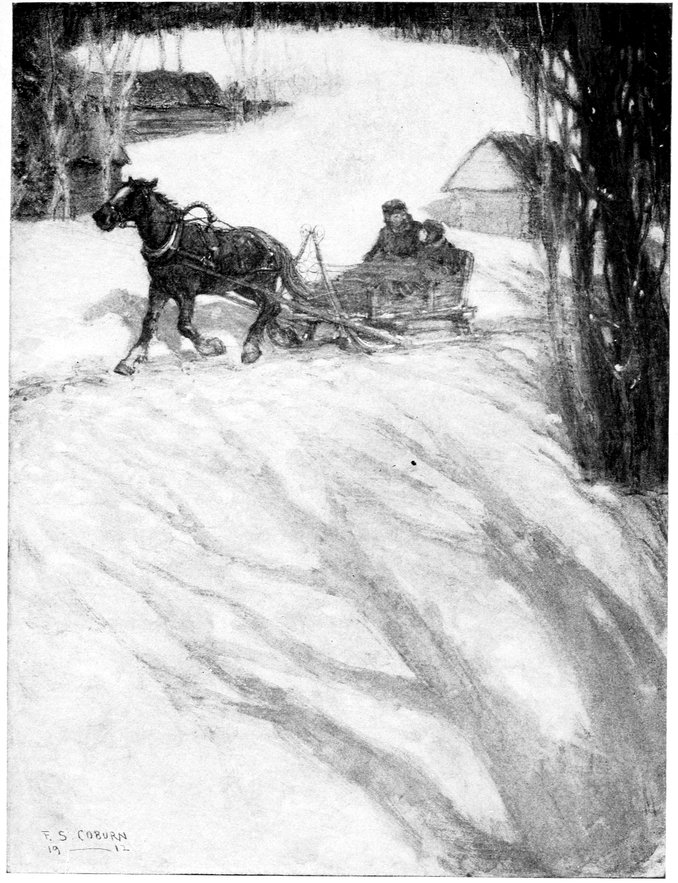
Boys of twelve or fourteen very often went
with me to bring back their fathers’ horses,
and so long as those lively, red-cheeked fellows
8could face the weather, it would not do
for me to be afraid.
One night there was a wonderful aurora in
the sky. The streamers of red and blue light
darted hither and thither, chasing each other
up to the zenith and down again to the northern
horizon with a rapidity and a brilliance
which I had never seen before. “There will
be a storm soon,” said my post-boy; “one
always comes after these lights.”
Next morning the sky was overcast, and
the short day was as dark as our twilight.
But it was not quite so cold, and I travelled
onward as fast as possible. There was a long
tract of wild and thinly settled country before
me and I wished to get through it before stopping
for the night. Unfortunately it happened
that two lumber-merchants were travelling
the same way and had taken the horses;
so I was obliged to wait at the stations until
horses were brought from the neighboring
farms. This delayed me so much that at
seven o’clock in the evening I had still one
more station of three Swedish miles before
reaching the village where I had intended to
spend the night. Now, a Swedish mile is
nearly equal to seven English, so that this
station was at least twenty miles long.
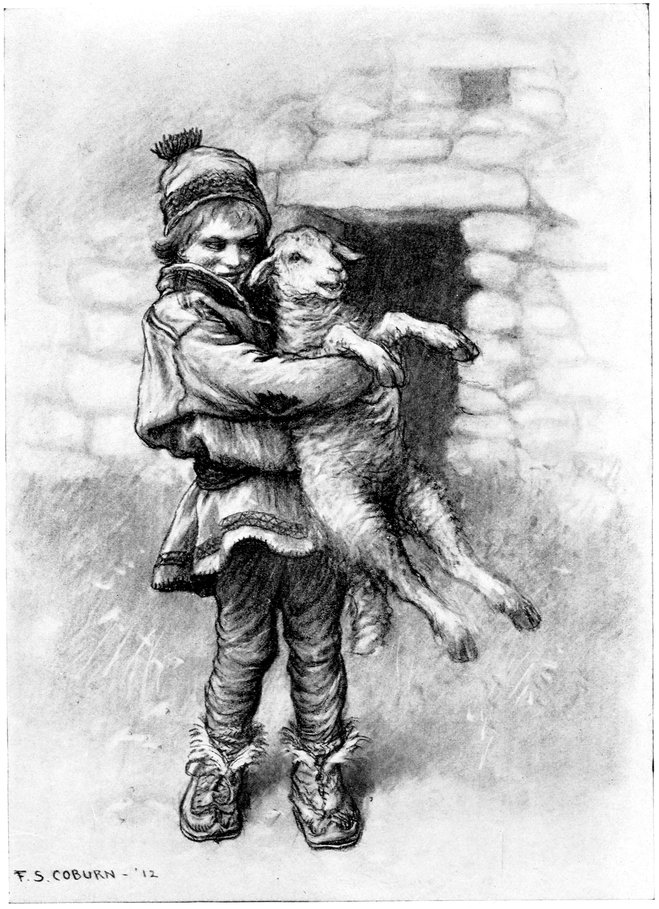
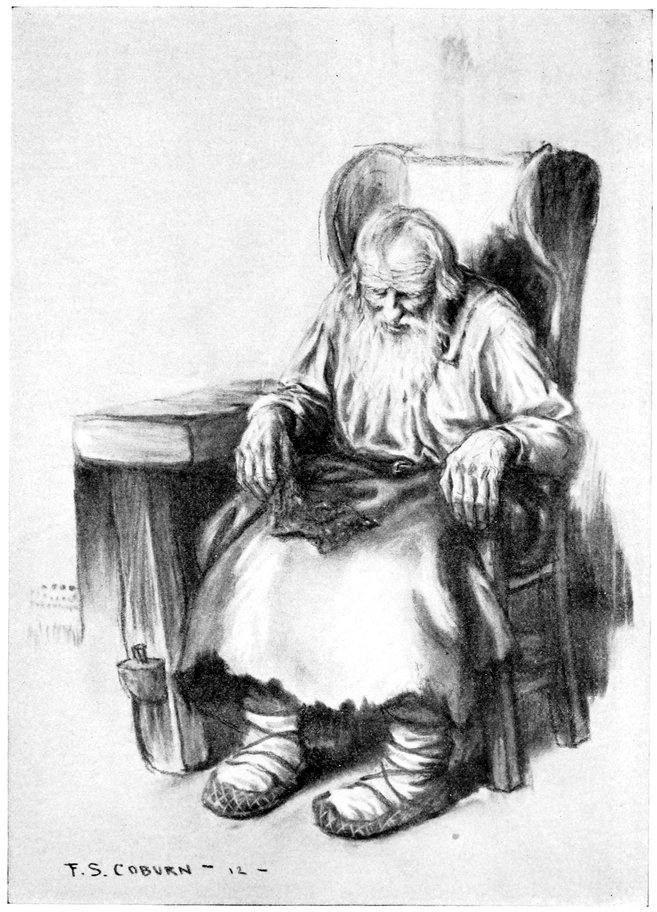
“Boys of twelve or fourteen very often went with me to bring back their father’s horses”
Drawing by F. S. Coburn
9I decided to take supper while the horse
was eating his feed. They had not expected
any more travellers at the station, and were
not prepared. The keeper had gone on with
the two lumber-merchants; but his wife—a
friendly, rosy-faced woman—prepared me
some excellent coffee, potatoes, and stewed
reindeer-meat, upon which I made a satisfactory
meal. The house was on the border of
a large, dark forest, and the roar of the icy
northern wind in the trees seemed to increase
while I waited in the warm room. I did not
feel inclined to go forth into the wintry storm,
but, having set my mind on reaching the village
that night, I was loath to turn back.
“It is a bad night,” said the woman, “and
10my husband will certainly stay at Umea until
morning. His name is Niels Petersen, and I
think you will find him at the post-house
when you get there. Lars will take you, and
they can come back together.”
“Who is Lars?” I asked.
“My son,” said she. “He is getting the
horse ready. There is nobody else about the
house to-night.”
Just then the door opened, and in came
Lars. He was about twelve years old; but
his face was so rosy, his eyes so clear and
round and blue, and his golden hair was blown
back from his face in such silky curls, that
he appeared to be even younger. I was surprised
that his mother should be willing to
send him twenty miles through the dark woods
on such a night.
“Come here, Lars,” I said. Then I took
him by the hand, and asked, “Are you not
afraid to go so far to-night?”
He looked at me with wondering eyes, and
11smiled; and his mother made haste to say:
“You need not fear, sir. Lars is young, but
he’ll take you safe enough. If the storm
doesn’t get worse, you’ll be at Umea by
eleven o’clock.”
I was again on the point of remaining; but
while I was deliberating with myself, the boy
had put on his overcoat of sheep-skin, tied the
lappets of his fur cap under his chin and a
thick woolen scarf around his nose and mouth
so that only the round blue eyes were visible,
and then his mother took down the mittens
of hare’s fur from the stove, where they had
been hung to dry. He put them on, took
a short leather whip, and was ready.
I wrapped myself in my furs, and we went
out together. The driving snow cut me in
the face like needles, but Lars did not mind
it in the least. He jumped into the sled,
which he had filled with fresh, soft hay, tucked
in the reindeer-skins at the sides, and we
cuddled together on the narrow seat, making
12everything close and warm before we set out.
I could not see at all, when the door of the
house was shut, and the horse started on the
journey. The night was dark, the snow blew
incessantly, and the dark fir-trees roared all
around us. Lars, however, knew the way,
and somehow or other we kept the beaten
track. He talked to the horse so constantly
and so cheerfully, that after a while my own
spirits began to rise, and the way seemed
neither so long nor so disagreeable.
“Ho there, Axel!” he would say. “Keep
the road,—not too far to the left. Well done.
Here’s a level; now trot a bit.”
So we went on,—sometimes up hill, sometimes
down hill,—for a long time, as it seemed.
I began to grow chilly, and even Lars handed
me the reins, while he swung and beat his
arms to keep the blood in circulation. He no
longer sang little songs and fragments of
hymns, as when we first set out; but he was
not in the least alarmed, or even impatient.
13Whenever I asked (as I did about every five
minutes), “Are we nearly there?” he always
answered, “A little farther.”
Suddenly the wind seemed to increase.
“Ah,” said he, “now I know where we are;
it’s one mile more.” But one mile, you must
remember, meant seven.
Lars checked the horse, and peered anxiously
from side to side in the darkness. I
looked also but could see nothing.
“What is the matter?” I finally asked.
“We have got past the hills on the left,”
he said. “The country is open to the wind,
and here the snow drifts worse than anywhere
else on the road. If there have been no
ploughs out to-night we’ll have trouble.”
You must know that the farmers along the
road are obliged to turn out with their horses
and oxen, and plough down the drifts, whenever
the road is blocked up by a storm.
In less than a quarter of an hour we could
see that the horse was sinking in the deep
14snow. He plunged bravely forward, but made
scarcely any headway, and presently became
so exhausted that he stood quite still. Lars
and I arose from the seat and looked around.
For my part, I saw nothing except some very
indistinct shapes of trees; there was no sign of
an opening through them. In a few minutes
the horse started again, and with great labor
carried us a few yards farther.
“Shall we get out and try to find the road?”
said I.
“It’s no use,” Lars answered. “In these
new drifts we would sink to the waist. Wait
a little, and we shall get through this one.”
It was as he said. Another pull brought us
through the deep part of the drift, and we
reached a place where the snow was quite
shallow. But it was not the hard, smooth surface
of the road; we could feel that the ground
was uneven, and covered with roots and
bushes. Bidding Axel stand still, Lars jumped
out of the sled, and began wading around
15among the trees. Then I got out on the
other side, but had not proceeded ten steps
before I began to sink so deeply into the loose
snow that I was glad to extricate myself and
return. It was a desperate situation, and I
wondered how we should ever get out of it.
I shouted to Lars, in order to guide him, and
it was not long before he also came back to
the sled. “If I knew where the road is,” said
he, “I could get into it again. But I don’t
know; and I think we must stay here all
night.”
“We shall freeze to death in an hour!” I
cried. I was already chilled to the bone. The
wind had made me very drowsy, and I knew
that if I slept I should soon be frozen.
“Oh, no!” exclaimed Lars cheerfully. “I
am a Norrlander, and Norrlanders never
freeze. I went with the men to the bear-hunt,
last winter, up on the mountains, and we were
several nights in the snow. Besides, I know
what my father did with a gentleman from
16Stockholm on this very road, and we’ll do it
to-night.”
“What was it?”
“Let me take care of Axel first,” said Lars.
“We can spare him some hay and one reindeer-skin.”
It was a slow and difficult task to unharness
the horse, but we accomplished it at last. Lars
then led him under the drooping branches of
a fir-tree, tied him to one of them, gave him an
armful of hay, and fastened the reindeer-skin
upon his back. Axel began to eat, as if perfectly
satisfied with the arrangement. The
Norrland horses are so accustomed to cold
that they seem comfortable in a temperature
where one of ours would freeze.
When this was done, Lars spread the remaining
hay evenly over the bottom of the
sled and covered it with the skins, which he
tucked in very firmly on the side towards
the wind. Then, lifting them on the other
side, he said: “Now take off your fur coat,
17quick, lay it over the hay, and then creep
under it.”
I obeyed as rapidly as possible. For an
instant I shuddered in the icy air; but the next
moment I lay stretched in the bottom of the
sled, sheltered from the storm. I held up the
ends of the reindeer-skins while Lars took off
his coat and crept in beside me. Then we
drew the skins down and pressed the hay
against them. When the wind seemed to be
entirely excluded Lars said we must pull off
our boots, untie our scarfs, and so loosen
our clothes that they would not feel tight
upon any part of the body. When this was
done, and we lay close together, warming
each other, I found that the chill gradually
passed out of my blood. My hands and feet
were no longer numb; a delightful feeling of
comfort crept over me; and I lay as snugly
as in the best bed. I was surprised to
find that, although my head was covered,
I did not feel stifled. Enough air came
18in under the skins to prevent us from feeling
oppressed.
There was barely room for the two of us to
lie, with no chance of turning over or rolling
about. In five minutes, I think, we were
sound asleep, and I dreamed of gathering
peaches on a warm August day at home. In
fact, I did not wake up thoroughly during the
night; neither did Lars, though it seemed to
me that we both talked in our sleep. But as
I must have talked English and he Swedish,
there could have been no connection between
our remarks. I remember that his warm, soft
hair pressed against my chin, and that his feet
reached no further than my knees. Just as I
was beginning to feel a little cramped and stiff
from lying so still I was suddenly aroused by
the cold wind on my face. Lars had risen up
on his elbow, and was peeping out from under
the skins.
“I think it must be near six o’clock,”
he said. “The sky is clear, and I can
19see the big star. We can start in another
hour.”
I felt so much refreshed that I was for
setting out immediately; but Lars remarked,
very sensibly, that it was not yet possible to
find the road. While we were talking, Axel
neighed.
“There they are!” cried Lars, and immediately
began to put on his boots, his scarf and
heavy coat. I did the same, and by the time
we were ready we heard shouts and the crack
of whips. We harnessed Axel to the sled, and
proceeded slowly in the direction of the sounds,
which came, as we presently saw, from a company
of farmers, out thus early to plough the
road. They had six pairs of horses geared to
a wooden frame, something like the bow of a
ship, pointed in front and spreading out to a
breadth of ten or twelve feet. The machine
not only cut through the drifts but packed the
snow, leaving a good, solid road behind it.
After it had passed, we sped along merrily in
20the cold morning twilight and in little more
than an hour reached the post-house at Umea,
where we found Lars’s father prepared to
return home. He waited, nevertheless, until
Lars had eaten a good warm breakfast, when
I said good-bye to both, and went on towards
Lapland.
Some weeks afterwards, on my return to
Stockholm, I stopped at the same little station.
This time the weather was mild and bright,
and the father would have gone with me to
the next post-house; but I preferred to take
my little bed-fellow and sled-fellow. He was
so quiet and cheerful and fearless that, although
I had been nearly all over the world,
and he had never been away from home,—although
I was a man and he a young boy,—I
felt that I had learned a lesson from him, and
might probably learn many more, if I should
know him better. We had a merry trip of
two or three hours, and then I took leave of
Lars forever. He is no doubt still driving
21travellers over the road, a handsome, courageous,
honest-hearted young man, perhaps with
his own son growing up to take his place, and
help some later stranger like myself through
a winter storm.
II The Pasha’s Son
25
A good many years ago I spent
a winter in Africa. I had intended
to go up the Nile only
as far as Nubia, visiting the great temples and
tombs of Thebes on the way; but when I had
done all this, and passed beyond the cataracts
at the southern boundary of Egypt, I found the
journey so agreeable, so full of interest, and attended
with so much less danger than I had
supposed, that I determined to go on for a
month or two longer, and penetrate as far as
possible into the interior. Everything was
favorable to my plan. I crossed the great
Nubian Desert without accident or adventure,
reached the ancient region of Ethiopia, and
continued my journey until I had advanced
26beyond all the cataracts of the Nile, to the
point where the two great branches of the
river flow together.
This point, which you will find on your
maps in the country called Sennaar, bordering
Abyssinia on the northwestern side, has become
very important within the last twenty
or thirty years. The Egyptians, after conquering
the country, established there their
seat of government for all that part of Africa,
and very soon a large and busy town arose
where formerly there had only been a few
mud huts of the natives. The town is called
Khartoum, and I suppose it must contain, by
this time, forty or fifty thousand inhabitants.
It is built on a sandy plain, studded here and
there with clumps of thorny trees. On the
east side the Blue Nile, the source of which
was discovered by the Scotch traveller, Bruce,
in the last century, comes down clear and
swift from the mountains of Abyssinia; on the
west, the broad, shallow, muddy current of
27the White Nile, which rises in the great
lakes discovered by Speke and Baker within
the last twenty years, makes its appearance.
The two rivers meet just below the town, and
flow as a single stream to the Mediterranean,
a distance of fifteen hundred miles.
Formerly all this part of Africa was considered
very wild, barbarous, and dangerous
to the traveller. But since it has been brought
under the rule of the Egyptian government,
the people have been forced to respect the
lives and property of strangers, and travelling
has become comparatively safe. I soon grew
so accustomed to the ways of the inhabitants
that by the time I reached Khartoum I felt
quite at home among them. My experience
had already taught me that, where a traveller
was badly treated, it was generally his own
fault. You must not despise a people because
they are ignorant, because their habits are
different, or because they sometimes annoy
you by a natural curiosity. I found that
28by acting in a kind yet firm manner towards
them, and preserving my patience and good-nature,
even when it was tried by their slow
and careless ways, I avoided all trouble, and
even acquired their friendly good-will.
When I reached Khartoum, the Austrian
Consul invited me to his house; and there
I spent three or four weeks in that strange
town, making acquaintance with the Egyptian
officers, the chiefs of the desert tribes, and
the former kings of the different countries of
Ethiopia. When I left my boat, on arriving,
and walked through the narrow streets of
Khartoum, between mud walls, very few of
which were even whitewashed, I thought it
a miserable place, and began to look out for
some garden where I might pitch my tent,
rather than live in one of those dirty-looking
habitations. The wall around the Consul’s
house was of mud like the others; but when
I entered I found clean, handsome rooms
which furnished delightful shade and coolness
29during the heat of the day. The roof was of
palm-logs, covered with mud, which the sun
baked into a hard mass, so that the house was
in reality as good as a brick dwelling. It was
a great deal more comfortable than it appeared
from the outside.
There were other features of the place, however,
which it would be difficult to find anywhere
except in Central Africa. After I had
taken possession of my room, and eaten breakfast
with my host, I went out to look at the
garden. On each side of the steps leading
down from the door sat two apes, who barked
and snapped at me. The next thing I saw
was a leopard tied to the trunk of an orange-tree.
I did not dare to go within reach of his
rope, although I afterwards became well
acquainted with him. A little farther, there
was a pen full of gazelles and an antelope
with immense horns; then two fierce, bristling
hyenas; and at last, under a shed beside
the stable, a full-grown lioness, sleeping in
30the shade. I was greatly surprised when the
Consul went up to her, lifted up her head,
opened her jaws so as to show the shining
white tusks, and finally sat down upon her
back.
She accepted these familiarities so good-naturedly
that I made bold to pat her head
also. In a day or two we were great friends;
she would spring about with delight whenever
she saw me, and would purr like a cat whenever
I sat down upon her back. I spent an
hour or two every day among the animals,
and found them all easy to tame except the
hyenas, which would gladly have bitten me
if I had allowed them a chance. The leopard,
one day, bit me slightly in the hand; but I
punished him by pouring several buckets of
water over him, and he was always very
amiable after that. The beautiful little gazelles
would cluster around me, thrusting up
their noses into my hand, and saying, “Wow!
wow!” as plainly as I write it. But none of
31these animals attracted me so much as the
big lioness. She was always good-humored,
though occasionally so lazy that she would
not even open her eyes when I sat down on
her shoulder. She would sometimes catch
my foot in her paws as a kitten catches a
ball, and try to make a plaything of it,—yet
always without thrusting out her claws.
Once she opened her mouth and gently took
one of my legs in her jaws for a moment;
and the very next instant she put out her
tongue and licked my hand. There seemed
to be almost as much of the dog as of the cat
in her nature. We all know, however, that
there are differences of character among
animals, as there are among men; and my
favorite probably belonged to a virtuous and
respectable family of lions.
The day after my arrival I went with the
Consul to visit the Pasha, who lived in a large
mud palace on the bank of the Blue Nile.
He received us very pleasantly, and invited us
32to take seats in the shady courtyard. Here
there was a huge panther tied to one of the
pillars, while a little lion, about eight months
old, ran about perfectly loose. The Pasha
called the latter, which came springing and
frisking towards him. “Now,” said he, “we
will have some fun.” He then made the lion
lie down behind one of the pillars, and called
to one of the black boys to go across the
courtyard on some errand. The lion lay quite
still until the boy came opposite to the pillar,
when he sprang out and after him. The boy
ran, terribly frightened; but the lion reached
him in five or six leaps, sprang upon his back
and threw him down, and then went back to
the pillar as if quite satisfied with his exploit.
Although the boy was not hurt in the least, it
seemed to me like a cruel piece of fun. The
Pasha, nevertheless, laughed very heartily,
and told us that he had himself trained the
lion to frighten the boys.
Presently the little lion went away, and
33when we came to look for him, we found him
lying on one of the tables in the kitchen of
the palace, apparently very much interested in
watching the cook. The latter told us that
the animal sometimes took small pieces of
meat, but seemed to know that it was not permitted,
for he would run away afterwards in
great haste. What I saw of lions during my
residence in Khartoum satisfied me that they
are not very difficult to tame,—only, as they
belong to the cat family, no dependence can
be placed on their continued good behavior.
Among the Egyptian officers in the city was
a Pasha named Rufah, who had been banished
from Egypt by the Viceroy. He was a man
of considerable education and intelligence, and
was very unhappy at being sent away from his
home and family. The climate of Khartoum
is very unhealthy, and this unfortunate Pasha
had suffered greatly from fever. He was
uncertain how long his exile would continue; he
had been there already two years, and as all
34the letters directed to him passed through the
hands of the officers of government, he was
quite at a loss how to get any help from his
friends. What he had done to cause his banishment,
I could not ascertain; probably he
did not know himself. There are no elections
in those Eastern countries; the people have
nothing to do with the choice of their own
rulers. The latter are appointed by the Viceroy
at his pleasure, and hold office only so long
as he allows them. The envy or jealousy of
one Pasha may lead to the ruin of another,
without any fault on the part of the latter.
Probably somebody else wanted Rufah Pasha’s
place, and slandered him to the Viceroy for
the sake of getting him removed and exiled.
The unhappy man inspired my profound
sympathy. Sometimes he would spend the
evening with the Consul and myself, because
he felt safe in our presence, to complain of the
tyranny under which he suffered. When we
met him at the houses of the other Egyptian
35officers, he was very careful not to talk on the
subject, lest they should report the fact to the
government.
Being a foreigner and a stranger, I never
imagined that I could be of any service to
Rufah Pasha. I did not speak the language
well, I knew very little of the laws and regulations
of the country, and moreover, I intended
simply to pass through Egypt on my return.
Nevertheless, one night, when we happened to
be walking the streets together, he whispered
that he had something special to say to me.
Although it was bright moonlight, we had a
native servant with us, to carry a lantern.
The Pasha ordered the servant to walk on in
advance; and a turn of the narrow, crooked
streets soon hid him from our sight. Everything
was quiet, except the rustling of the
wind in the palm-trees which rose above the
garden-walls.
“Now,” said the Pasha, taking my hand,
“now we can talk for a few minutes, without
36being overheard. I want you to do me a
favor.”
“Willingly,” I answered, “if it is in my
power.”
“It will not give you much trouble,” he
said, “and may be of great service to me. I
want you to take two letters to Egypt,—one
to my son, who lives in the town of Tahtah,
and one to Mr. Murray, the English Consul-General,
whom you know. I cannot trust the
Egyptian merchants, because, if these letters
were opened and read, I might be kept here
many years longer. If you deliver them safely,
my friends will know how to assist me, and
perhaps I may soon be allowed to return
home.”
I promised to deliver both letters with my
own hands, and the Pasha parted from me in
more cheerful spirits at the door of the Consul’s
house. After a few days I was ready to
set out on the return journey; but, according
to custom, I was first obliged to make farewell
37visits to all the officers of the government.
It was very easy to apprise Rufah Pasha
beforehand of my intention, and he had no
difficulty in slipping the letters into my hand
without the action being observed by any one.
I put them into my portfolio, with my own letters
and papers, where they were entirely safe,
and said nothing about the matter to any one
in Khartoum.
Although I was glad to leave that wild town,
with its burning climate, and retrace the long
way back to Egypt, across the Desert and
down the Nile, I felt very sorry at being
obliged to take leave forever of all my pets.
The little gazelles said, “Wow! Wow!” in
answer to my “Good-bye”; the hyenas howled
and tried to bite, just as much as ever; but
the dear old lioness I know would have been
sorry if she could have understood that I was
going. She frisked around me, licked my
hand, and I took her great tawny head into
my arms, and gave her a kiss. Since then I
38have never had a lion for a pet, and may never
have one again. I must confess, I am sorry
for it; for I still retain my love for lions (four-footed
ones, I mean) to this day.
Well, it was a long journey, and I should
have to write many days in order to describe
it. I should have to tell of fierce sand-storms
in the Desert; of resting in palm-groves near
the old capital of Ethiopia; of plodding day
after day, through desolate landscapes, on the
back of a camel, crossing stony ranges of
mountains, to reach the Nile again, and then
floating down with the current in an open
boat. It was nearly two months before I
could deliver the first of the Pasha’s letters,—that
which he had written to his son. The
town of Tahtah is in Upper Egypt, near Siout;
you will hardly find it on the maps. It stands
on a little mound, several miles from the Nile,
and is surrounded by the rich and beautiful
plain which is every year overflowed by the
river.
39There was a head wind, and my boat could
not proceed very fast; so I took my faithful
servant, Achmet, and set out on foot, taking a
path which led over the plain between beautiful
wheat-fields and orchards of lemon-trees.
In an hour or two we reached Tahtah,—a
queer, dark old town, with high houses and
narrow streets. The doors and balconies were
of carved wood, and the windows were covered
with lattices, so that no one could look
in, although those inside could easily look out.
There were a few sleepy merchants in the
bazaar, smoking their pipes and enjoying the
odors of cinnamon and dried roses which
floated in the air.
After some little inquiry, I found Rufah
Pasha’s house, but was not admitted, because
the Egyptian women are not allowed to receive
the visits of strangers. There was a shaded
entrance-hall, open to the street, where I was
requested to sit, while the black serving-woman
went to the school to bring the Pasha’s
40son. She first borrowed a pipe from one of
the merchants in the bazaar, and brought it to
me. Achmet and I sat there, while the people
of the town, who had heard that we came from
Khartoum and knew the Pasha, gathered
around to ask questions.
They were all very polite and friendly, and
seemed as glad to hear about the Pasha as if
they belonged to his family. In a quarter of
an hour the woman came back, followed by
the Pasha’s son and the schoolmaster, who had
dismissed his school in order to hear the news.
The boy was about eleven years old, but tall
for his age. He had a fair face, and large dark
eyes, and smiled pleasantly when he saw me.
If I had not known something of the customs
of the people, I should have given him my
hand, perhaps drawn him between my knees,
put an arm around his waist and talked familiarly;
but I thought it best to wait and see
how he would behave towards me.
He first made me a graceful salutation, just
41as a man would have done, then took my hand
and gently touched it to his heart, lips, and
forehead, after which he took his seat on the
high divan, or bench, by my side. Here he
again made a salutation, clapped his hands
thrice, to summon the woman, and ordered
coffee to be brought.
“Is your Excellency in good health?” he
asked.
“Very well, praised be Allah!” I answered.
“Has your Excellency any commands for
me? You have but to speak; you shall be
obeyed.”
“You are very kind,” said I; “but I have
need of nothing. I bring you greetings from
the Pasha, your father, and this letter, which I
promised him to deliver into your own hands.”
Thereupon I handed him the letter, which
he laid to his heart and lips before opening.
As he found it a little difficult to read, he
summoned the schoolmaster, and they read it
together in a whisper.
42In the meantime coffee was served in little
cups, and a very handsome pipe was brought
by somebody for my use. After he had read
the letter, the boy turned to me with his face a
little flushed, and his eyes sparkling, and said,
“Will your Excellency permit me to ask
whether you have another letter?”
“Yes,” I answered; “but it is not to be
delivered here.”
“That is right,” said he. “When will you
reach Cairo?”
“It depends on the wind; but I hope in
seven days from now.”
The boy again whispered to the schoolmaster,
but presently they both nodded, as if
satisfied, and nothing more was said on the
subject.
Some sherbet (which is nothing but lemonade
flavored with rose-water) and pomegranates
were then brought to me, and the boy
asked whether I would not honor him by
remaining during the rest of the day. If I
43had not seen his face, I should have supposed
I was visiting a man,—so dignified and self-possessed
and graceful was the little fellow.
The people looked on as if they were quite
accustomed to such mature manners in children.
I was obliged to use as much ceremony
with the child as if he had been the governor
of the town. But he interested me, nevertheless,
and I felt curious to know the subject of
his consultation with the schoolmaster. I was
sure they were forming some plan to have the
Pasha recalled from exile.
After two or three hours I left, in order to
overtake my boat, which was slowly working
its way down the Nile. The boy arose, and
walked by my side to the end of the town,
the other people following us. When we
came out upon the plain, he took leave of me
with the same salutations, and the words,
“May God grant your Excellency a prosperous
journey!”
“May God grant it!” I responded; and
44all the people repeated, “May God grant it!”
The whole interview seemed to me like a
scene out of the Arabian Nights. To me it
was a pretty, picturesque experience, which
cannot be forgotten; to the people, no doubt,
it was an every day matter.
When I reached Cairo, I delivered the
other letter, and in a fortnight afterwards left
Egypt; so that I could not ascertain, at the
time, whether anything had been done to
forward the Pasha’s hopes. Some months
afterwards, however, I read in a European
newspaper, quite accidentally, that Rufah
Pasha had returned to Egypt from Khartoum.
I was delighted with the news; and I shall
always believe, and insist upon it, that the
Pasha’s wise and dignified little son had a
hand in bringing about the fortunate result.
III Jon of Iceland — I — II — III — IV — V — VI — VII — VIII
47
The boys of Iceland must be content
with very few acquaintances
and playmates. The valleys
which produce grass enough for the farmer’s
ponies, cattle, and sheep are generally scattered
widely apart, divided by ridges of lava so hard
and cold that only a few wild flowers succeed
in growing in their cracks and hollows. Then,
since the farms must be all the larger, because
the grass is short and grows slowly in
such a severe northern climate, the dwellings
are rarely nearer than four or five miles apart;
and were it not for their swift and nimble
ponies, the people would see very little of each
48other except on Sundays, when they ride
long distances to attend worship in their
little wooden churches.
But of all boys in the island, not one was
so lonely in his situation as Jon Sigurdson.
His father lived many miles beyond that
broad, grassy plain which stretches from the
Geysers to the sea, on the banks of the swift
river Thiörvǎ. On each side there were
mountains so black and bare that they looked
like gigantic piles of coal; but the valley
opened to the southward as if to let the sun
in, and far away, when the weather was clear,
the snowy top of Mount Hecla shone against
the sky. The farmer Sigurd, Jon’s father,
was a poor man, or he would not have settled
so far away from any neighbors; for he was
of a cheerful and social nature, and there were
few at Kyrkedal who could vie with him in
knowledge of the ancient history and literature
of Iceland.
The house was built on a knoll, under a cliff
49which sheltered it from the violent west and
northwest winds. The walls, of lava stones
and turf, were low and broad; and the roofs
over dwelling, storehouses, and stables were
covered deep with earth, upon which grew
such excellent grass that the ponies were fond
of climbing up the sloping corners of the wall
in order to get at it. Sometimes they might
be seen, cunningly balanced on the steep sides
of the roof, grazing along the very ridge-poles,
or looking over the end of the gable when
some member of the family came out of the
door, as much as to say, “Get me down if you
can!” Around the buildings there was a
square wall of enclosure, giving the place the
appearance of a little fortress.
On one side of the knoll a hot spring bubbled
up. In the morning or evening, when
the air was cool, quite a little column of steam
arose from it, whirling and broadening as it
melted away; but the water was pure and
wholesome as soon as it became cold enough
50for use. In front of the house, where the sun
shone warmest, Sigurd had laid out a small
garden. It was a great labor for him to
remove the huge stones and roll them into a
protecting wall, to carry good soil from the
places where the mountain rills had gradually
washed it down from above, and to arrange it
so that frosts and cold rains should do the
least harm; and the whole family thought
themselves suddenly rich, one summer, when
they pulled their first radishes, saw the little
bed of potatoes coming into blossom, and the
cabbages rolling up their leaves in order to
make, at least, baby-heads before the winter
came.
Within the house, all was low and dark and
dismal. The air was very close and bad, for
the stables were only separated from the dwelling-room
by a narrow passage, and bunches
of dry salt fish hung on the walls. Besides,
it was usually full of smoke from the fire of
peat, and, after a rain, of steam from Sigurd’s
51and Jon’s heavy woollen coats. But to the
boy it was a delightful, a comfortable home,
for within it he found shelter, warmth, food,
and instruction. The room for visitors seemed
to him the most splendid place in the world,
because it had a wooden floor, a window with
six panes of glass, a colored print of the
King of Denmark, and a geranium in a pot.
This was so precious a plant that Jon and his
sister Gudrid hardly dared to touch its leaves.
They were almost afraid to smell it, for fear of
sniffing away some of its life; and Gudrid,
after seeing a leaf of it laid on her dead sister’s
bosom, insisted that some angel, many hundred
years ago, had brought the seed straight
down from heaven.
These were Sigurd’s only children. There
had been several more, but they had died in
infancy, from the want of light and pure air,
and the great distance from help when sickness
came. Gudrid was still pale and slender,
except in summer, when her mild, friendly
52face took color from the sun; but Jon, who
was now fourteen, was a sturdy, broad-breasted
boy, who promised to be as strong as his
father in a few years more. He had thick
yellow hair, curling a little around his forehead;
large bright blue eyes; and a mouth
rather too broad for beauty, if the lips had not
been so rosy and the teeth so white and firm.
He had a serious look, but it was only because
he smiled with his eyes oftener than with his
mouth. He was naturally true and good, for
he hardly knew what evil was. Except his
parents and his sister he saw no one for weeks
at a time; and when he met other boys after
church at Kyrkedal, so much time was always
lost in shyly looking at each other and shrinking
from the talk which each wanted to begin,
that no very intimate acquaintance followed.
But in spite of his lonely life, Jon was far
from being ignorant. There were the long
winter months, when the ponies—and sometimes
the sheep—pawed holes in the snow in
53order to reach the grass on the bottoms beside
the river; when the cows were warmly stabled
and content with their meals of boiled hay;
when the needful work of the day could be
done in an hour or two, and then Sigurd sat
down to teach his children, while their mother
spun or knit beside them, and from time to
time took part in the instruction. Jon could
already read and write so well that the pastor
at Kyrkedal lent him many an old Icelandic
legend to copy; he knew the history of the
island, as well as that of Norway and Denmark,
and could answer (with a good deal of
blushing) when he was addressed in Latin.
He also knew something of the world, and
its different countries and climates; but this
knowledge seemed to him like a strange
dream, or like something that happened long
ago and never could happen again. He was
accustomed to hear a little birch-bush, four or
five feet high, called “a tree,” and he could
not imagine how any tree could be a hundred
54feet high, or bear flowers and fruit. Once, a
trader from Rejkiavik—the chief seaport of
Iceland—brought a few oranges to Kyrkedal,
and Sigurd purchased one for Jon and Gudrid.
The children kept it day after day, never
tired of enjoying the splendid color and
strange, delightful perfume; so when they
decided to cut the rind at last the pulp was
dried up and tasteless. A city was something
of which Jon could form no conception, for
he had never even seen Rejkiavik; he imagined
that palaces and cathedrals were like large
Icelandic farm-houses, with very few windows
and turf growing on the roofs.
55
Sigurd’s wealth, if it could be called so,
was in a small flock of sheep, the pasture
for which was scattered in patches for miles
up and down the river. The care of these
sheep had been intrusted chiefly to Jon,
ever since he was eight years old, and he
had learned their natures and ways—their
simple animal virtues and silly animal vices—so
thoroughly that they acquired a great
respect for him, and very rarely tried to be
disobedient. Even Thor, the ram, although
he sometimes snorted and tossed his horns in
protest, or stamped impatiently with his forefeet,
heeded his master’s voice. In fact, the
sheep became Jon’s companions, in the absence
of human ones; he talked to them so much
during the lonely days that it finally seemed
56as if they understood a great deal of his
speech.
There was a rough bridle-path leading up
the valley of the Thiörvǎ; but it was rarely
travelled, for it struck northward into the
cold, windy, stony desert which fills all the
central part of Iceland. For a hundred and
fifty miles there was no dwelling, no shelter
from the fierce and sudden storms, and so
little grass that the travellers who sometimes
crossed the region ran the risk of losing their
ponies from starvation. There were lofty
plains of black rock, as hard as iron; groups
of bare, snowy-headed mountains; and often,
at night, you could see a pillar of fire in the
distance, showing that one of the many volcanoes
was in action. Beyond this terrible
wilderness the grassy valleys began again, and
there were houses and herds, increasing as
you came down to the bright bays along the
northern shore of the island.
“In fact the sheep became Jon’s companions in the absence of human ones”
Drawing by F. S. Coburn
57More than once, a trader or government
messenger, after crossing the desert, had rested
for a night under Sigurd’s roof; and many
were the tales of their adventures which Jon
had treasured up in his memory. Sometimes
they spoke of the trolls or mischievous fairies
who came over with the first settlers from
Norway, and were still supposed by many persons
to lurk among the dark glens of Iceland.
Both Sigurd and the pastor at Kyrkedal had
declared that there were no such creatures,
and Jon believed them faithfully; yet he could
not help wondering as he sat upon some
rocky knoll overlooking his sheep, whether a
strange little figure might not come out of the
chasm opposite, and speak to him. The more
he heard of the terrors and dangers of the
desert to the northward, the more he longed
to see them with his own eyes and know them
through his own experience. He was not the
least afraid; but he knew that his father
would never allow him to go alone, and to disobey
a father was something of which he had
58never heard, and could not have believed to
be possible.
When he was in his fifteenth year, however
(it was summer, and he was fourteen in April),
there came several weeks when no rain fell in
the valley. It was a lovely season for the
garden; even the geranium in the window put
forth twice as many scarlet blossoms as ever
before. Only the sheep began to hunger; for
the best patch of grass in front of the house
was carefully kept for hay, and the next best,
further down the river, for the ponies. So
Jon was obliged to lead his flock to a narrow
little dell, which came down to the Thiörvǎ,
three or four miles to the northward. Here,
for a week they nibbled diligently wherever
anything green showed itself at the foot of the
black rocks; and when the pasture grew scanty
again, they began to stare at Jon in a way which
many persons might have thought stupid. He
understood them; they meant to say: “We’ve
nearly finished this; find us something more!”
59That evening, as he was leading his flock
into the little enclosure beside the dwelling,
he heard his father and mother talking. He
thought it no harm to listen, for they had
never said anything that was not kind and
friendly. It seemed, however, that they were
speaking of him, and the very first words he
heard made his heart beat more rapidly.
“Two days’ journey away,” said Sigurd,
“are excellent pastures that belong to nobody.
There is no sign of rain yet, and if we could
send Jon with the sheep——”
“Are you sure of it?” his wife asked.
“Eyvindur stopped to talk with me,” he
answered; “and he saw the place this morning.
He says there were rains in the desert,
and, indeed, I’ve thought so myself, because
the river has not fallen; and he never knew
as pleasant a season to cross the country.”
“Jon might have to stay out a week or
two; but, as you say, Sigurd, we should
save our flock. The boy may be trusted,
60I’m sure; only, if anything should happen
to him?”
“I don’t think he’s fearsome,” said Sigurd;
“and what should happen to him there that
might not happen near home?”
They moved away, while Jon clasped the
palms of his hands hard against each other,
and stood still for a minute to repeat to himself
all he had heard. He knew Eyvindur,
the tall, strong man with the dark, curling
hair, who rode the swift, cream-colored pony
with black mane and tail. He knew what
his father meant—nothing else than that he,
Jon, should take the sheep two days’ journey
away, to the very edge of the terrible wilderness,
and pasture them there, alone, probably
for many days! Why, Columbus, when he
set sail from Palos, could not have had a
brighter dream of unknown lands! Jon went
in to supper in such a state of excitement that
he hardly touched the dried fish and hard
oaten bread; but he drank two huge bowls of
61milk and still felt thirsty. When, at last,
Sigurd opened his lips and spake, and the
mother sat silent with her eyes fixed upon her
son’s face, and Gudrid looked frightened, Jon
straightened himself as if he were already a
man, and quietly said: “I’ll do it!”
He wanted to shout aloud for joy; but
Gudrid began to cry.
However, when a thing had once been
decided in the family, that was the end of any
question or remonstrance, and even Gudrid
forgot her fears in the interest of preparing
a supply of food for Jon during his absence.
They slept soundly for a few hours; and then,
at two o’clock in the morning, when the sun
was already shining on the snowy tops of the
Arne Mountains, Jon hung the bag of provisions
over his shoulder, kissed his parents
and sister, and started northward, driving the
sheep before him.
62
In a couple of hours he reached the farthest
point of the valley which he had ever
visited, and all beyond was an unknown
region. But the scenery, as he went onward,
was similar in character. The mountains
were higher and more abrupt, the river more
rapid and foamy, and the patches of grass
more scanty—that was all the difference. It
was the Arctic summer, and the night brought
no darkness; yet he knew when the time for
rest came, by watching the direction of the
light on the black mountains above. When
the sheep lay down, he sought a sheltered
place under a rock, and slept also.
Next day the country grew wilder and
more forbidding. Sometimes there was hardly
a blade of grass to be seen for miles, and he
63drove the sheep at full speed, running and
shouting behind them, in his eagerness to
reach the distant pasture which Eyvindur had
described. In the afternoon, the valley appeared
to come suddenly to an end. The
river rushed out of a deep cleft between the
rocks, only a few feet wide, on the right hand;
in front there was a long, stony slope, reaching
so high that the clouds brushed along its summit.
In the bottom there was some little grass, but
hardly enough to feed the flock for
two days.
Jon was disappointed, but not much discouraged.
He tethered Thor securely to a
rock, knowing that the other sheep would
remain near him, and set out to climb the
slope. Up and up he toiled; the air grew
sharp and cold; there was snow and ice in
the shaded hollows on either side, and the
dark, strange scenery of Iceland grew broader
below him. Finally, he gained the top; and
now, for the first time, felt that he had found
64a new world. In front, toward the north,
there was a plain stretching as far as he could
see; on the right and left there were groups
of dark, frightful, inaccessible mountains,
between the sharp peaks of which sheets of
blue ice plunged downward like cataracts,
only they were silent and motionless. The
valley behind him was a mere cleft in the stony,
lifeless world; his sheep were little white dots,
no bigger, apparently, than flowers of life-everlasting.
He could only guess, beyond the
dim ranges in the distance, where his father’s
dwelling lay; and, for a single moment, the
thought came into his mind and made him
tremble,—should he ever see it again?
The pasture, he reflected, must be sought
for in the direction from which the river came.
Following the ridge to the eastward, it was
not long before he saw a deep basin, a mile
in diameter, opening among the hills. The
bottom was quite green, and there was a
sparkle here and there, where the river wound
65its way through it. This was surely the place,
and Jon felt proud that he had so readily
discovered it. There were several glens which
furnished easy paths down from the table-land,
and he had no difficulty, the next morning,
in leading his flock over the great ridge.
In fact, they skipped up the rocks as if they
knew what was coming, and did not wait for
Jon to show them the way into the valley.
The first thing the boy did, after satisfying
himself that the sheep were not likely to stray
away from such excellent pasturage, was to
seek for a cave or hollow among the rocks,
where he could find shelter from storms.
There were several such places; he selected
the most convenient, which had a natural
shelf for his store of provisions, and, having
dried enough grass to make a warm, soft bed,
he found himself very comfortably established.
For three or four days he was too busy to
feel his loneliness. The valley belonged to
nobody; so he considered it his own property,
66and called it Gudridsdale, after his sister.
Then, in order to determine the boundaries
of this new estate, he climbed the heights in
all directions, and fixed the forms of every
crag and hollow firmly in his memory. He
was not without the secret hope that he might
come upon some strange and remarkable
object,—a deserted house, a high tree, or a
hot fountain shooting up jets like the Great
Geyser,—but there was nothing. Only the
black and stony wilderness near at hand, and
a multitude of snowy peaks in the distance.
Thus ten days passed. The grass was not
yet exhausted, the sheep grew fat and lazy,
and Jon had so thoroughly explored the neighborhood
of the valley that he could have
found his way in the dark. He knew that
there were only barren, uninhabitable regions
to the right and left; but the great, bare
table-land stretching to the northward was
a continual temptation, for there were human
settlements beyond. As he wandered farther
67and farther in that direction, he found it harder
to return; there was always a ridge in advance,
the appearance of a mountain pass,
the sparkle of a little lake,—some promise of
something to be seen by going just a little
beyond his turning-point. He was so careful
to notice every slight feature of the scenery,—a
jutting rock here, a crevice there,—in case
mist or rain should overtake him on the way,
that the whole region soon became strangely
familiar.
Jon’s desire to explore the road leading to
the northward grew so strong, that he at last
yielded to it. But first he made every arrangement
for the safety of the sheep during his
absence. He secured the ram Thor by a
long tether and an abundance of cut grass,
concealed the rest of his diminishing supply of
provisions; climbed the nearest heights and
overlooked the country on all sides without
discovering a sign of life, and then, after a
rest which was more like a waking dream
68than a slumber, began his strange and solitary
journey.
The sun had just become visible again, low
in the northeast, when he reached the level of
the table-land. There were few clouds in
the sky, and but little wind blowing; yet a singular
brownish haze filled the air, and spots
of strong light soon appeared on either side
of the sun. Jon had often seen these “mock
suns” before; they are frequent in northern
latitudes, and are supposed to denote a change
in the weather. The phenomenon, and the
feeling of heaviness in the air, led him to
study the landmarks very keenly and cautiously
as he advanced. In two or three hours
he had passed the limits of his former excursions;
and now, if a storm should arise, his
very life might depend on his being able to
find the way back.
During the day, however, there was no
change in the weather. The lonely, rugged
mountains, the dark little lakes of melted
69snow lying at their feet, the stony plain, with
its great, irregular fissures where the lava had
cracked in cooling,—all these features of the
great central desert of Iceland lay hard and
clear before his eyes. Like all persons who
are obliged to measure time without a watch
or clock, he had a very correct sense of the
hours of the day, and of the distances he
walked from point to point. Where there
was no large or striking object near at hand,
he took the trouble to arrange several stones
in a line pointing to the next landmark behind
him, as a guide in case of fog.
It was an exciting, a wonderful day in his
life, and Jon never forgot it. He never once
thought of the certain danger which he incurred.
Instead of fear, he was full of a joyous,
inspiring courage; he sang and shouted
aloud, as some new peak or ridge of hills arose
far in front, or some other peak, already
familiar, went out of sight far behind him.
He scarcely paused to eat or rest, until nearly
70twelve hours had passed, and he had walked
fully thirty miles. By that time the sun was
low in the west, and barely visible through the
gathering haze. The wind moaned around
the rocks with a dreary, melancholy sound,
and only the cry of a wild swan was heard in
the distance. To the north the mountains
seemed higher, but they were divided by deep
gaps which indicated the commencement of
valleys. There, perhaps, there might be running
streams, pastures, and the dwellings of
men!
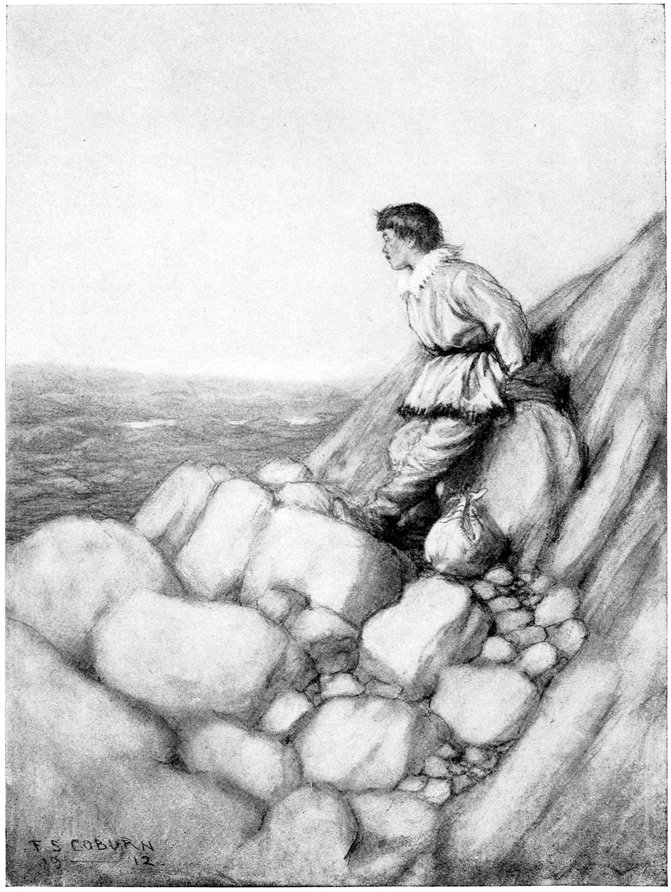
“All these features of the great central desert of Iceland lay hard and clean before his eyes”
Drawing by F. S. Coburn
71Jon had intended to return to his flock on
the morrow, but now the temptation to press
onward for another day became very great.
His limbs, however, young and strong as they
were, needed some rest; and he speedily decided
what to do next. A lighter streak in
the rocky floor of the plain led his eye toward
a low, broken peak—in reality, the crater of
a small extinct volcano—some five miles off,
and lying to the right of what he imagined to
be the true course. On the left there were
other peaks, but immediately in front nothing
which would serve as a landmark. The crater,
therefore, besides offering him some shelter
in its crevices, was decidedly the best
starting-point, either for going on or returning.
The lighter color of the rock came from
some different mixture in the lava of an old
eruption, and could easily be traced throughout
the whole intervening distance. He followed
it rapidly, now that the bearings were
laid down, and reached the ruins of the volcano
a little after sunset.
There was no better bed to be found than
the bottom of a narrow cleft, where the winds,
after blowing for many centuries, had deposited
a thin layer of sand. Before he lay
down, Jon arranged a line of stones, pointing
toward the light streak across the plain, and
another line giving the direction of the valleys
to the northward. To the latter he added
two short, slanting lines at the end, forming a
72figure like an arrow-head, and then, highly
satisfied with his ingenuity, lay down in the
crevice to sleep. But his brain was so excited
that for a long time he could do nothing else
than go over, in memory, the day’s journey.
The wind seemed to be rising, for it whistled
like a tremendous fife through the rocky
crevice; father and mother and Gudrid seemed
to be far, far away, in a different land; he
wondered at last whether he was the same
Jon Sigurdson who drove the flock of sheep
up the valley of the Thiörvǎ—and then, all
at once, he stopped wondering and thinking,
for he was too soundly asleep to dream even
of a roasted potato.
73
How much time passed in the sleep he
could never exactly learn; probably six to
seven hours. He was aroused by what seemed
to be icy-cold rats’ feet scampering over his
face, and as he started and brushed them
away with his hand, his ears became alive to
a terrible, roaring sound. He started up,
alarmed, at first bewildered, then suddenly
wide awake. The cold feet upon his face
were little threads of water trickling from
above; the fearful roaring came from a storm—a
hurricane of mixed rain, wind, cloud, and
snow. It was day, yet still darker than the
Arctic summer night, so dense and black was
the tempest. When Jon crept out of the
crevice, he was nearly thrown down by the
force of the wind. The first thing he did was
74to seek the two lines of stones he had arranged
for his guidance. They had not been blown
away as he feared; and the sight of the arrow-head
made his heart leap with gratitude to the
Providence which had led him, for without
that sign he would have been bewildered at
the very start. Returning to the cleft, which
gave a partial shelter, he ate the greater part of
his remaining store of food, fastening his thick
coat tightly around his breast and throat, and
set out on the desperate homeward journey,
carefully following the lighter streak of rock
across the plain.
He had not gone more than a hundred
yards when he fancied he heard a sharp, hammering
sound through the roar of the tempest,
and paused to listen. The sound came rapidly
nearer; it was certainly the hoofs of many
horses. Nothing could be seen; the noise
came from the west, passed in front of Jon,
and began to die away to the eastward. His
blood grew chilled for a moment. It was all
75so sudden and strange and ghostly that he
knew not what to think; and he was about to
push forward and get out of the region where
such things happened, when he heard, very
faintly, the cry which the Icelanders use in
driving their baggage-ponies. Then he remembered
the deep gorge he had seen to the eastward,
before reaching the crater; the invisible
travellers were riding toward it, probably lost,
and unaware of their danger.
This thought passed through Jon’s mind
like a flash of lightning; he shouted with all
the strength of his voice.
He waited, but there was no answer. Then
he shouted again, while the wind seemed to
tear the sound from his lips and fling it away—but
on the course the hoofs had taken.
This time a cry came in return; it seemed
far off, because the storm beat against the
sound. Jon shouted a third time, and the
answer was now more distinct. Presently he
distinguished words:
76“Come here to us!”
“I cannot!” he cried.
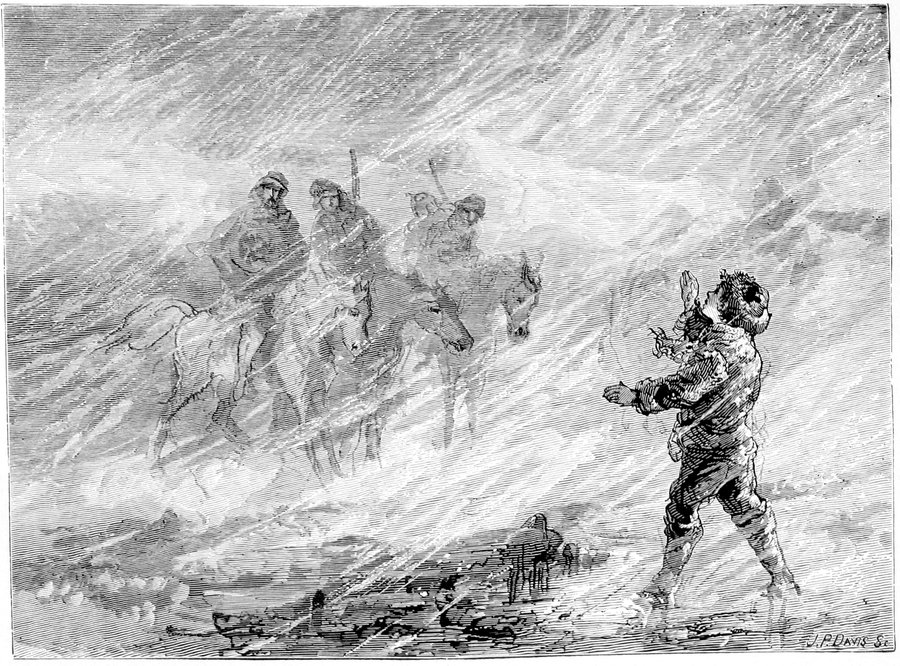
In a few minutes more he heard the hoofs
returning, and then the forms of ponies
became visible through the driving snow-clouds.
They halted, forming a semicircle in
front of him; and then one of three dim, spectral
riders leaning forward again called:
“Come here!”
“I cannot!” Jon answered again.
Thereupon, another of the horsemen rode
close to him, and stared down upon him.
He said something which Jon understood to
be: “Erik, it is a little boy!”—but he was
not quite sure, for the man’s way of talking
was strange. He put the words in the wrong
places, and pronounced them curiously.
The man who had first spoken jumped off
his horse. Holding the bridle, he came forward
and said, in good, plain Icelandic:
“Why couldn’t you come when I called
you?”
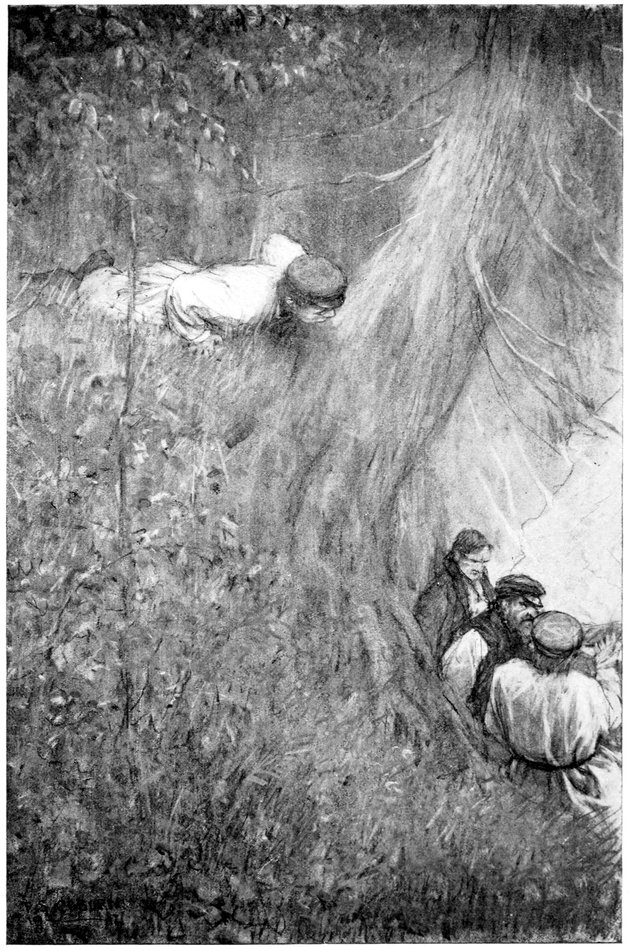
“Jon’s meeting with the horsemen”
77“I am keeping the road back,” replied Jon;
“if I move, I might lose it.”
“Then why did you call us?”
“I was afraid you had lost your way, and
might get into the chasm; the storm is so bad
you could not see it.”
“What’s that?” exclaimed the first who
had spoken.
Jon described the situation as well as he
could, and the stranger at last said, in his
queer, broken speech: “Lost way—we; can
guide—you—know how?”
The storm raged so furiously that it was
with great difficulty that Jon heard the words
at all; but he thought he understood the
meaning. So he looked the man in the face,
and nodded, silently.
“Erik—pony!” cried the latter.
Erik caught one of the loose ponies, drew
it forward, and said to Jon:
“Now mount and show us the way!”
“I cannot!” Jon repeated. “I will guide
78you: I was on my way already, but I must
walk back just as I came, so as to find the
places and know the distances.”
“Sir,” said Erik, turning to the other traveller,
“we must let him have his will. It is our
only chance of safety. The boy is strong and
fearless, and we can surely follow where he
was willing to go alone.”
“Take the lead, boy!” the other said;
“more quick, more money!”
Jon walked rapidly in advance, keeping his
eyes on the lighter colored streak in the plain.
He saw nothing, but every little sign and
landmark was fixed so clearly in his mind
that he did not feel the least fear or confusion.
He could hardly see, in fact, the
foremost of the ponies behind him, but he
caught now and then a word, as the men
talked with each other. They had come
from the northern shore of the island; they
were lost, they were chilled, weary; their
ponies were growing weak from hunger and
79exposure to the terrible weather; and they
followed him, not so much because they
trusted his guidance, as because there was
really nothing else left for them to do.
In an hour and a half they reached the first
landmark; and when the men saw Jon examining
the line of stones he had laid, and then
striking boldly off through the whirling clouds,
they asked no questions, but urged their
ponies after him. Thus several hours went
by. Point after point was discovered,
although no object could be seen until it was
reached; but Jon’s strength, which had been
kept up by his pride and his anxiety, at last
began to fail. The poor boy had been so
long exposed to the wind, snow, and icy rain,
that his teeth chattered in his head, and his
legs trembled as he walked. About noon,
fortunately, there was a lull in the storm; the
rain slackened, and the clouds lifted themselves
so that one might see for a mile or
more. He caught sight of the rocky corner
80for which he was steering, stopped and pointed
toward one of the loose ponies.
Erik jumped from the saddle, and threw
his arms around Jon, whose senses were fast
vanishing. He felt that something was put
to his lips, that he was swallowing fire, and
that his icy hands were wrapped in a soft,
delicious warmth. In a minute he found that
Erik had thrust them under his jacket, while
the other two were bending over him with
anxious faces. The stranger who spoke so
curiously held a cake to his mouth, saying:
“Eat—eat!” It was wonderful how his
strength came back!
Very soon he was able to mount the pony
and take the lead. Sometimes the clouds fell
dense and dark around them; but when they
lifted only for a second, it was enough for Jon.
Men and beasts suffered alike, and at last
Erik said:
“Unless we get out of the desert in three
hours, we must all perish!”
81Jon’s face brightened. “In three hours,”
he exclaimed, “there will be pasturage and
water and shelter.”
He was already approaching the region
which he knew thoroughly, and there was
scarcely a chance of losing the way. They
had more than one furious gust to encounter—more
than one moment when the famished
and exhausted ponies halted and refused to
move; but toward evening the last ridge was
reached, and they saw below them, under a
dark roof of clouds, the green valley-basin,
the gleam of the river, and the scattered
white specks of the grazing sheep.
82
The ram Thor bleated loudly when he saw
his master. Jon was almost too weary to
move hand or foot, but he first visited every
sheep, and examined his rough home under
the rock, and his few remaining provisions,
before he sat down to rest. By this time,
the happy ponies were appeasing their hunger,
Erik and his fellow-guide had pitched a white
tent, and there was a fire kindled. The
owner of the tent said something which Jon
could not hear, but Erik presently shouted:
“The English gentleman asks you to come
and take supper with us!”
Jon obeyed, even more from curiosity than
hunger. The stranger had a bright, friendly
face, and stretched out his hand as the boy
entered the tent. “Good guide—eat!” was
83all he was able to say in Icelandic, but the
tone of his voice meant a great deal more.
There was a lamp hung to the tent-pole, an
india-rubber blanket spread on the ground,
and cups and plates, which shone like silver,
in readiness for the meal. Jon was amazed
to see Erik boiling three or four tin boxes in
the kettle of water; but when they had been
opened, and the contents poured into basins,
such a fragrant steam rose as he had never
smelled in his life. There was pea-soup, and
Irish stew, and minced collops and beef,
and tea, with no limit to the lumps of sugar,
and sweet biscuits, and currant jelly! Never
had he sat down to such a rich, such a wonderful
banquet. He was almost afraid to take
enough of the dishes, but the English traveller
filled his plate as fast as it was emptied, patted
him on the back, and repeated the words:
“Good guide—eat!” Then he lighted a cigar,
while Erik and the other Icelander pulled out
their horns of snuff, threw back their heads,
84and each poured nearly a teaspoonful into his
nostrils. They offered the snuff to Jon, but
he refused both that and a cigar. He was
warm and comfortable, to the ends of his toes,
and his eyelids began to fall, in spite of all
efforts to hold them up, after so much fatigue
and exposure as he had endured.
In fact, his senses left him suddenly,
although he seemed to be aware that somebody
lifted and laid him down again—that
something soft came under his head, and
something warm over his body—that he was
safe, and sheltered, and happy.
When he awoke it was bright day. He
started up, striking his head against a white,
wet canvas, and sat a moment, bewildered,
trying to recall what had happened. He
could scarcely believe that he had slept all
night in a tent, beside the friendly Englishman;
but he heard Erik talking outside, and
the crackling of a fire, and the shouting of
some one at a distance. The sky was clear
85and blue; the sheep and ponies were nibbling
sociably together, and the Englishman, standing
on a rock beside the river, was calling
attention to a big salmon which he had just
caught. Gudridsdale, just then, seemed the
brightest and liveliest place in Iceland.
Jon knew that he had probably saved the
party from death; but he thought nothing of
that, for he had saved himself along with
them. He was simply proud and overjoyed
at the chance of seeing something new—of
meeting with a real Englishman, and eating
(as he supposed) the foreign, English
food. He felt no longer shy, since he had
slept a whole night beside the traveller. The
two Icelandic guides were already like old
friends; even the pony he had ridden seemed
to recognize him. His father had told him
that Latin was the language by which all educated
men were able to communicate their
ideas; so as the Englishman came up with his
salmon for their breakfast, he said, in Latin:
86“To-day is better than yesterday, sir.”
The traveller laughed, shook hands heartily,
and answered in Latin, with—to Jon’s great
surprise—two wrong cases in the nouns:
“Both days are better for you than for me.
I have learned less at Oxford.”
But the Latin and Icelandic together were
a great help to conversation, and almost before
he knew what he was doing, Jon had told
Mr. Lorne—so the traveller was named—all
the simple story of his life, even his claim to
the little valley-basin wherein they were
encamped, and the giving it his sister’s name.
Mr. Lorne had crossed from the little town of
Akureyri, on the northern shore of Iceland,
and was bound down the valley of Thiörvǎ to
the Geysers, thence to Hekla, and finally to
Rejkiavik, where he intended to embark for
England. As Jon’s time of absence had
expired, his provisions being nearly consumed,
and as it was also necessary to rest a day for
the sake of the traveller’s ponies, it was arranged
87so that all should return in company
to Sigurd’s farm.
That last day in Gudridsdale was the most
delightful of all. They feasted sumptuously
on the traveller’s stores, and when night came
the dried grass from Jon’s hollow under the
rock was spread within the tent, making a soft
and pleasant bed for the whole party.
Mounted on one of the ponies, Jon led the
way up the long ravine, cheerily singing as he
drove the full-fed sheep before him. They
reached the level of the desert table-land, and
he gave one more glance at the black, scattered
mountains to the northward where he
had passed two such adventurous days. In
spite of all that he had seen and learned in
that time, he felt a little sad that he had not
succeeded in crossing the wilderness. When
they reached the point where their way descended
by a long, deep slope to the valley of
the Thiörvǎ, he turned for yet another farewell
view. Far off, between him and the
88nearest peak, there seemed to be a moving
speck. He pointed it out to Erik, who, after
gazing steadily a moment, said, “It is a man
on horseback.”
“Perhaps another lost traveller!” exclaimed
Mr. Lorne; “let us wait for him.”
It was quite safe to let the sheep and loose
ponies take their way in advance; for they
saw the pasture below them. In a quarter of
an hour the man and horse could be clearly
distinguished. The former had evidently seen
them also, for he approached much more rapidly
than at first.
All at once Jon cried out: “It is our pony,
Heimdal! It must be my father!”
He sprang from the saddle as he spoke, and
ran towards the strange horseman. The latter
presently galloped up, dismounted, walked a
few steps, and sat down upon a stone. But
Jon’s arms were around him, and as they
kissed each other, the father burst into
tears.
89“I thought thou wert lost, my boy,” was all
he could say.
“But here I am, father!” Jon proudly
exclaimed.
“And the sheep?”
“Fat and sound, every one of them.”
Sigurd rose and mounted his horse, and as
they all descended the slope together Jon and
Erik told him all that had happened. Mr.
Lome, to whom the occurrence was explained,
shook hands with him, and, pointing to Jon,
said in his broken way: “Good son—little
man!” Whereupon they all laughed, and
Jon could not help noticing the proud and
happy expression of his father’s face.
On the afternoon of the second day they
reached Sigurd’s farmhouse; but the mother
and Gudrid, who had kept up an anxious lookout,
met them nearly a mile away. After the
first joyous embrace of welcome, Sigurd whispered
a few words to his wife, and she hastened
back to put the guest-room in order.
90Mr. Lorne found it so pleasant to get under a
roof again, that he ordered another halt of
two days before going on to the Geysers and
Hekla. No beverage ever tasted so sweet to
him as the great bowl of milk which Gudrid
brought as soon as he had taken his seat, and
the radishes from the garden seemed a great
deal better than the little jar of orange marmalade
which he insisted on giving in exchange
for them.
“Oh, is it indeed orange?” cried Gudrid.
“Jon, Jon, now we shall know what the taste
is!”
Their mother gave them a spoonful apiece,
and Mr. Lorne smiled as he saw their wondering,
delighted faces.
“Does it really grow on a tree?—and how
high is the tree?—and what does it look like?—like
a birch?—or a potato-plant?” Jon
asked, in his eagerness, without waiting for
the answers. It was very difficult for him to
imagine what he had never seen, even in pictures,
91or anything resembling it. Mr. Lorne
tried to explain how different are the productions
of nature in warmer climates, and the
children listened as if they could never hear
enough of the wonderful story. At last Jon
said, in his firm, quiet way, “Some day I’ll
go there!”
“You will, my boy,” Mr. Lorne replied;
“you have strength and courage to carry out
your will.”
Jon never imagined that he had more
strength or courage than any other boy, but
he knew that the Englishman meant to praise
him, so he shook hands as he had been taught
to do on receiving a gift.
The two days went by only too quickly.
The guest furnished food both for himself and
the family, for he shot a score of plovers and
caught half a dozen fine salmon. He was so
frank and cheerful that they soon became
accustomed to his presence, and were heartily
sorry when Erik and the other Icelandic guide
92went out to drive the ponies together, and
load them for the journey. Mr. Lorne called
Sigurd and Jon into the guest-room, untied a
buckskin pouch, and counted out fifty silver
rix-dollars upon the table. “For my little
guide!” he said, putting his hand on Jon’s
thick curls. Father and son, in their astonishment,
uttered a cry at the same time, and
neither knew what to say. But, brokenly as
Mr. Lorne talked, they understood him when
he said that Jon had probably saved his life,
that he was a brave boy and would make a
good, brave man, and that if the father did not
need the money for his farm expenses, he
should apply it to his son’s education.
The tears were running down Sigurd’s
cheeks. He took the Englishman’s hand,
gave it a powerful grip, and simply said, “It
shall be used for his benefit.”
Jon was so strongly moved that, without
stopping to think, he did the one thing which
his heart suggested. He walked up to Mr.
93Lorne, threw his arms around his neck, and
kissed him very tenderly.
“All is ready, sir!” cried Erik, at the door.
The last packages were carried out and tied
upon the baggage-ponies, farewells were said
once more, and the little caravan took its way
down the valley. The family stood in front
of the house, and watched until the ponies
turned around the first cape of the hills and
disappeared; then they could only sit down
and talk of all the unexpected things that had
happened. There was no work done upon
the farm that day.
94
The unusual warmth of the summer, which
was so injurious to the pastures lying near
the southern coast, brought fortune to
Sigurd’s farm. The price of wool was much
higher than usual, and owing to Jon’s excursion
into the mountains, the sheep were in
the best possible condition. They had never
raised such a crop of potatoes, nor such firm,
thick-headed cabbages, and by great care
and industry a sufficient supply of hay had
been secured for the winter.
“I am afraid something will happen to us,”
said Sigurd one day to his wife; “the good
luck comes too fast.”
“Don’t say that!” she exclaimed. “If we
were to lose Jon——”
“Jon!” interrupted Sigurd. “Oh, no; look
95at his eyes, his breast, his arms, and his legs—there
are a great many years of life in them!
He ought to have a chance at the school in
Rejkiavik, but we can hardly do without him
this year.”
“Perhaps brother Magnus would take him,”
she said.
“Not while I live,” Sigurd replied, as he
left the room, while his wife turned with a
sigh to her household duties. Her family,
and especially her elder brother, Magnus, who
was a man of wealth and influence, had bitterly
opposed her marriage with Sigurd, on account
of the latter’s poverty, and she had seen none
of them since she came to live on the lonely
farm. Through great industry and frugality
they had gradually prospered; and now she
began to long for a reconciliation, chiefly for
her husband’s and children’s sake. It would
be much better for Jon if he could find a home
in his uncle’s house when they were able to
send him to school.
96So, when they next rode over to Kyrkedal
on a Sabbath day in the late autumn, she took
with her a letter to Magnus, which she had
written without her husband’s knowledge, for
she wished to save him the pain of the slight,
in case her brother should refuse to answer or
should answer in an unfriendly way. It was
a pleasant day for all of them, for Mr. Lorne
had stopped a night at Kyrkedal, and Erik
had told the story of Jon’s piloting them
through the wilderness; so the pastor, after
service, came up at once to them and patted
Jon on the head, saying; “Bene fecisti, fili!”
And the other boys, forgetting their usual
shyness, crowded around and said: “Tell us
all about it!” Everything was as wonderful
to them as it still seemed to Jon in his memory,
and when each one said: “If I had gone
there I should have done the same thing!”
Jon wondered that he and the boys should
ever have felt so awkward and bashful when
they came together. Now it was all changed;
97they talked and joked like old companions,
and cordially promised to visit each other during
the winter, if their parents were willing.
On the way home Sigurd found that he had
dropped his whip, and sent Jon back to look
for it, leaving his wife and Gudrid to ride
onward up the valley. Jon rode at least half a
mile before he found it, and then came galloping
back, cracking it joyously. But Sigurd’s
face was graver and wearier than usual.
“Ride a little while with me,” he said; “I
want to ask thee something.” Then, as Jon
rode beside him in the narrow tracks which
the ponies’ hoofs had cut through the turf,
he added: “The boys at Kyrkedal seemed to
make much of thee; I hope thy head is not
turned by what they said.”
“Oh, father!” Jon cried; “they were so
kind, so friendly!”
“I don’t doubt it,” his father answered.
“Thou hast done well, my son, and I see
that thou art older than thy years. But suppose
98there were a heavier task in store for
thee,—suppose that I should be called away,—couldst
thou do a man’s part, and care properly
for thy mother and thy little sister?”
Jon’s eyes filled with tears, and he knew
not what to say.
“Answer me,” Sigurd commanded.
“I never thought of that,” Jon answered,
in a trembling voice; “but if I were to do my
best, would not God help me?”
“He would!” Sigurd exclaimed with energy.
“All strength comes from Him, and all fortune.
Enough—I can trust thee, my son;
ride on to Gudrid, and tell her not to twist
herself in the saddle, looking back!”
Sigurd attended to his farm for several
days longer, but in a silent, dreamy way, as
if his mind were busy with other thoughts.
His wife was so anxiously waiting the result
of her letter to Magnus, that she paid less
attention to his condition than she otherwise
would have done.
99But one evening, on returning from the
stables, he passed by the table where their
frugal supper was waiting, entered the bedroom,
and sank down, saying:
“All my strength has left me; I feel as if
I should never rise again.”
They then saw that he had been attacked
by a dangerous fever, for his head was hot,
his eyes glassy, and he began to talk in a wild,
incoherent way. They could only do what
the neighbors were accustomed to do in similar
cases,—which really was worse than doing
nothing at all would have been. Jon was
despatched next morning, on the best pony,
to summon the physician from Skalholt; but,
even with the best luck, three days must
elapse before the latter could arrive. The
good pastor of Kyrkedal came the next day
and bled Sigurd, which gave him a little
temporary quiet, while it reduced his vital
force. The physician was absent, visiting
some farms to the eastward,—in fact, it was
100a full week before he made his appearance.
During this time Sigurd wasted away, his fits
of delirium became more frequent, and the
chances of his recovery grew less and less.
Jon recalled, now, his father’s last conversation,
and it gave him both fear and comfort.
He prayed, with all the fervor of his boyish
nature, that his father’s life might be spared;
yet he determined to do his whole duty, if the
prayer should not be granted.
101
At the end of two weeks, Sigurd’s wife
received a letter from her brother, and it was
better than she had dared to hope. Magnus
wrote that his wife was dead, his son was
a student in Copenhagen, and he was all alone
in the big house at Rejkiavik. He was ready
to give Jon a home, even to take herself and
her husband, provided the latter could sell
his farm to good advantage and find some
employment which would add to his means.
“He must neither live an idle life nor depend
on my help,” Magnus said; and his sister
felt that he was right, although he told the
truth in rather a hard, unfriendly way.
She read the letter to Sigurd the next
morning, as he was lying very weak and
quiet, but in his right mind. His eyes slowly
102brightened, and he murmured, at last, with
difficulty:
“Sell the farm to Thorsten, for his eldest
son, and go to Magnus. Jon will take my
place.”
Jon, who had entered the room in time to
hear these words, sat down on the bed and
held his father’s hand in both his own. The
latter smiled faintly, opened his lips to speak
again, and then a sudden quivering passed
over his face, and he lay strangely still. It
was a long time before the widow and children
could believe he was dead. They said
to each other, over and over again, amid their
tears: “He was happy; the trouble for our
sakes was taken away from his heart;”—and
Jon thought to himself: “If I do my
best, as I promised, he will be still happier in
heaven.”
When Sigurd’s death was known, the neighbors
came and helped them until the funeral
was over, and the sad little household resumed,
103as far as possible, its former way of life.
Thorsten, a rich farmer of Kyrkedal, whose
son was to be married in the spring, came, a
few weeks later, to make an offer for the farm.
No doubt he hoped to get it at a low price;
for money has a greater value in Iceland,
where there is so little of it. But the widow
said at once, “I shall make no bargain unless
Jon agrees with me;” and then Jon spoke up,
looking a great deal more like a full-grown,
honest man than he supposed:
“We only want the fair value of the farm,
neighbor Thorsten. We want it because we
need it, and everybody will say it is just and
right that we should have it. If we cannot
get that, I shall try to go on and do my father’s
work. I am only a boy now, but I shall get
bigger and stronger every year.”
“Thy father could not have spoken better
words,” said Thorsten.
He made what he considered a fair offer,
and it was very nearly as much as Jon and his
104mother had reckoned upon; the latter, however,
insisted on waiting until she had consulted
with her brother Magnus.
Not many days after that, Magnus himself
arrived at the farm. He was a tall man, with
dark hair, large gray eyes, a thin, hard mouth,
and an important, commanding air. It was a
little hard for Jon to say “uncle” to this man,
whom he had never seen, and of whom he had
heard so little. Magnus, although stern, was
not unfriendly, and when he had heard of all
that had been said and done, he nodded his
head and said:
“Very prudent; very well, so far!”
It was, perhaps, as well that the final settlement
of affairs was left to Uncle Magnus, for
he not only obtained an honest price for the
farm, but sold the ponies, cows, and sheep to
much better advantage than the family could
have done. He had them driven to Kyrkedal,
and sent messengers to Skalholt and Myrdal,
and even to Thingvalla, so that quite a number
105of farmers came together, and they had dinner
in the church. Some of the women and children
also came, to say “good-bye” to the
family; but when the former whispered to
Jon, “You’ll come back to us some day, as
a pastor or a skald” (author), Magnus frowned
and shook his head.
“The boy is in a fair way to make an honest,
sensible man,” he said. “Don’t you spoil
him with your nonsense!”
When they all set out together for Rejkiavik,
Jon reproached himself for feeling so
light-hearted, while his mother and Gudrid
wept for miles of the way. He was going to
see a real town, to enter school, to begin a
new and wonderful life; and just beyond
Kyrkedal there came the first strange sight.
They rode over the grassy plain toward the
Geysers, the white steam of which they had
often seen in the distance; but now, as they
drew near a gray cone, which rose at the foot
of the hill on the west, a violent thumping
106began in the earth under their feet. “He is
going to spout!” cried the guide, and he had
hardly spoken when the basin in the top of
the cone boiled over furiously, throwing huge
volumes of steam into the air. Then there
was a sudden, terrible jar, and a pillar of
water, six feet in diameter, shot up to the
height of nearly a hundred feet, sparkling like
liquid gold in the low, pale, sunshine. It rose
again and again, until the subterranean force
was exhausted; then the water fell back into
the basin with a dull sound, and all was over.
They could think or talk of nothing else for
a time, and when they once more looked about
them the landscape had changed. All was
new to the children, and only dimly remembered
by their mother. The days were very
short and dark, for winter was fast coming on;
it was often difficult to make the distance
from one farmhouse to another, and they
twice slept in the little churches, which are
always hospitably opened for travellers
107because there are no inns in Iceland. After
leaving the valley, they had a bitterly cold
and stormy journey over a high field of lava,
where little piles of stones, a few yards apart,
are erected to guide the traveller. Beyond
this, they crossed the Raven’s Cleft, a deep,
narrow chasm, with a natural bridge in one
place, where the rocks have fallen together
from either side; then, at the bottom of the
last slope of the lava-plains, they entered the
Thingvalla Forest.
Jon was a little disappointed; still he had
never seen anything like it. There were
willow and birch bushes, three or four feet
high, growing here and there out of the cracks
among the rocks. He could look over the
tops of them from his pony, as he rode along,
and the largest trunk was only big enough to
make a club. But there is no other “forest”
in Iceland; and the people must have something
to represent a forest, or they would have
no use for the word!
108It was fast growing dark when they reached
Thingvalla, and the great, shattered walls of
rock which inclose the valley appeared much
loftier than by day. On the right, a glimmering
waterfall plunged from the top of the cliff,
and its roar filled the air. Magnus pointed
out, on the left, the famous “Hill of the
Law,” where for nearly nine hundred years the
people of Iceland had assembled together to
discuss their political matters. Jon knew all
about the spot, from the many historical
legends and poems he had read, and there was
scarcely another place in the whole world
which he could have had greater interest in
seeing. The next morning, when it was barely
light enough to travel, they rode up a kind of
rocky ladder, through a great fissure called the
Almannagjá, or “People’s Chasm,” and then
pushed on more rapidly across the barren
table-land. It was still forty miles to Rejkiavik,—a
good two days’ journey at that
season,—and the snows, which already covered
109the mountains, were beginning to fall on
the lower country.
On the afternoon of the second day, after
they had crossed the Salmon River, Magnus
said:
“In an hour we shall see the town!”
But the first thing that came in sight was
only a stone tower or beacon, which the students
had built upon a hill.
“Is that a town?” asked Gudrid; whereupon
the others laughed heartily.
Jon discreetly kept silent, and waited until
they had reached the foot of the beacon, when—all
at once—Rejkiavik lay below them. Its
two or three hundred houses stretched for half
a mile over a belt of land between the sea and
a large lake. There was the prison, built all
of cut stone; the old wooden cathedral, with
its square spire; the large, snow-white governor’s
house, and the long row of stores and
warehouses, fronting the harbor—all visible
at once! To a boy who had never before seen
110a comfortable dwelling, nor more than five
houses near together, the little town was a
grand, magnificent capital. Each house they
passed was a new surprise to him; the doors,
windows, chimneys, and roofs were all so different,
so large and fine. And there were
more people in the streets than he had ever
before seen together.
At last Magnus stopped before one of the
handsomest dwellings, and helped his sister
down from her pony. The door opened, and
an old servant came forth. Jon and Gudrid,
hand in hand, followed them into a room which
seemed to them larger and handsomer than
the church at Kyrkedal, with still other rooms
opening out of it, with wonderful chairs, and
pictures, and carpets upon which they were
afraid to walk. This was their new home.
111
Even before their arrival, Jon discovered
that his Uncle Magnus was a man who said
little, but took good notice of what others
did. The way to gain his favor, therefore,
was to accept and discharge the duties of the
new life as they should arise. Having adopted
the resolution to do this, it was surprising
how soon these duties became familiar and
easy. He entered the school, where he was
by no means the lowest or least promising
scholar, assisted his mother and Gudrid wherever
it was possible, and was so careful a messenger
that Magnus by degrees intrusted him
with matters of some importance. The household,
in a little while, became well-ordered
and harmonious, and although it lacked the
freedom and homelike feeling of the lonely
112farm on the Thiörvǎ, all were contented and
happy.
Jon had a great deal to learn, but his eagerness
helped him. His memory was naturally
excellent, and he had been obliged to exercise
it so constantly—having so few books, and
those mostly his own written copies—that he
was able to repeat, correctly, large portions
of the native sagas, or poetical histories. He
was so well advanced in Latin that the continuance
of the study became simply a delight;
he learned Danish, almost without an effort,
from his uncle’s commercial partner and the
Danish clerk in the warehouse; and he took
up the study of English with a zeal that was
heightened by his memories of Mr. Lorne.
We cannot follow him, step by step, during
this period, although many things in his life
might instruct and encourage other earnest,
struggling boys. It is enough to say that he
was always patient and cheerful, always grateful
for his opportunity of education, and never
113neglectful of his proper duties to his uncle,
mother, and sister. Sometimes, it is true, he
was called upon to give up hours of sport,
days of recreation, desires which were right in
themselves but could not be gratified,—and
it might have gone harder with him to do so,
if he had not constantly thought: “How would
my father have acted in such a case?” And
had he not promised to take the place of
his father?
So three years passed away. Jon was
eighteen, and had his full stature. He was
strong and healthy, and almost handsome;
and he had seen so much of the many strangers
who every summer come to Rejkiavik—French
fishermen, Spanish and German sailors,
English travellers and Danish traders—that
all his old shyness had disappeared. He was
able to look any man in the eyes, and ask or
answer a question.
It was the beginning of summer, and the
school had just closed. Jon had been assisting
114the Danish clerk in the warehouse; but
toward noon, when they had an idle hour,
a sailor announced that there was a new arrival
in the harbor; so he walked down the
beach of sharp lava-sand to the wooden jetty
where strangers landed. A little distance off
shore a yacht was moored; the English flag
was flying at the stern, and a boat was already
pulling toward the landing-place. Jon rubbed
his eyes, to be sure that he saw clearly; but
no! the figure remained the same; and now,
as the stranger leaped ashore, he could no
longer contain himself. He rushed across
the beach, threw his arms around the man,
and cried out, “Lorne! Lorne!”
The latter was too astonished to recognize
him immediately.
“Don’t you know me?” Jon asked; and
then, half laughing, half crying, said in Latin,
“To-day is better than yesterday.”
“Why, can this be my little guide?”
exclaimed Mr. Lorne. “But to be sure it is!
115There are no such wise eyes in so young a
head anywhere else in the world.”
Before night the traveller was installed in
the guest-room in Uncle Magnus’s house; and
then they truly found that he had not forgotten
them. After supper he opened a box,
and out there came a silver watch for Jon; a
necklace, that could not be told from real
pearls, for Gudrid; and what a shawl for the
mother! Even Uncle Magnus was touched,
for he brought up a very old, dusty bottle of
Portugal wine, which he had never been
known to do before, except one day when the
Governor came to see him.
“And now,” said Mr. Lorne, when he was a
little tired of being thanked so much, “I want
something in return. I am going, by way of
the Broad Fiord, to the northern shore of Iceland,
and back through the desert; and I shall
not feel safe unless Jon goes with me.”
“Oh!” cried Jon.
“I am not afraid this time,” said Gudrid.
116Magnus looked at his sister, and then nodded.
“Take the boy!” he said. “He can
get back before school commences again; and
we are as ready to trust him with you as you
are to trust yourself with him.”
What a journey that was! They had plenty
of ponies, and a tent, and provisions in tin cans.
Sometimes it rained or snowed, and they were
wet and chilly enough at the end of the day,
but then the sun shone again, and the black
mountains became purple and violet and their
snows and ice-fields sparkled in the blue of the
air. They saw many a wild and desolate landscape,
but also many a soft green plain and hay-meadow
along the inlets of the northern shore;
and in the little town of Akureyri Jon at last
found a tree—the only tree in Iceland! It is
a mountain-ash, about twenty feet high, and
the people are so proud of it that every autumn
they wrap the trunk and boughs, and
even the smallest twigs, in woollen cloth, lest
the severity of the winter should kill it.
117They visited the Myvatn (Mosquito Lake)
in the northeastern part of the island, saw the
volcanoes which in 1875 occasioned such terrible
devastation, and then crossed the great
central desert to the valley of the Thiörvǎ.
So it happened that Jon saw Gudridsdale
again, but under pleasanter aspects than before,
for it was a calm, sunny day when they
reached the edge of the table-land and descended
into the lovely green valley. It gave
him a feeling of pain to find strangers in his
father’s house, and perhaps Mr. Lorne suspected
this, for he did not stop at the farm,
but pushed on to Kyrkedal, where the good
old pastor entertained them both as welcome
guests. At the end of six weeks they were
back in Rejkiavik, hale and ruddy after their
rough journey, and closer friends than ever.
Each brought back his own gain—Mr.
Lorne was able to speak Icelandic tolerably
well, and Jon was quite proficient in English.
The former had made the trip to Iceland
118especially to collect old historical legends and
acquire new information concerning them. To
his great surprise, he found Jon so familiar
with the subject, that, during the journey, he
conceived the idea of taking him to Scotland
for a year, as an assistant in his studies; but
he said nothing of this until after their return.
Then, first, he proposed the plan to Magnus
and Jon’s mother, and prudently gave them
time to consider it. It was hard for both to
consent, but the advantages were too evident
to be rejected. To Jon, when he heard it, it
seemed simply impossible; yet the preparations
went on,—his mother and Gudrid wept
as they helped, Uncle Magnus looked grave,—and
at last the morning came when he had to
say farewell.
The yacht had favorable winds at first.
They ran along the southern shore to Ingolf’s
Head, saw the high, inaccessible summits of
the Skaptar Jökull fade behind them, and
then Iceland dropped below the sea. A misty
119gale began to blow from the southwest, forcing
them to pass the Faroe Islands on the
east, and afterward the Shetland Isles; but,
after nearly coming in sight of Norway, the
wind changed to the opposite quarter, and the
yacht spread her sails directly for Leith. One
night, when Jon awoke in his berth, he missed
the usual sound of waves against the vessel’s
side and the cries of the sailors on deck—everything
seemed strangely quiet; but he
was too good a sleeper to puzzle his head
about it, so merely turned over on his
pillow. When he arose the quiet was still
there. He dressed in haste and went on
deck. The yacht lay at anchor in front of
buildings larger than a hundred Rejkiaviks
put together.
“This is Leith,” said Mr. Lorne, coming
up to him.
“Leith?” Jon exclaimed; “it seems like
Rome or Jerusalem! Those must be the
King’s palaces.”
120“No, my boy,” Mr. Lorne answered, “they
are only warehouses.”
“But what are those queer green hills
behind the houses? They are so steep and
round that I don’t see how anybody could
climb up.”
“Hills?” exclaimed Mr. Lorne. “Oh, I
see now! Why, Jon, those are trees.”
Jon was silent. He dared not doubt his
friend’s word, but he could not yet wholly
believe it. When they had landed, and he saw
the great trunks, the spreading boughs, and
the millions of green leaves, such a feeling of
awe and admiration came over him that he
began to tremble. A wind was blowing, and
the long, flexible boughs of the elms swayed
up and down.
“Oh, Mr. Lorne!” he cried. “See! they
are praying! Let us wait a while; they are
saying something—I hear their voices. Is
it English?—can you understand it?”
“The halt on the journey”
121Mr. Lorne took him by the hand and said:
“It is praise, not prayer. They speak the
same language all over the world, but no one
can understand all they say.”
There is one rough little cart in Rejkiavik,
and this is the only vehicle in Iceland. What
then, must have been Jon’s feelings when he
saw hundreds of elegant carriages dashing to
and fro, and great wagons drawn by giant
horses? When they got into a cab, it seemed
to him like sitting on a moving throne. He
had read and heard of all these things, and
thought he had a clear idea of what they
were; but he was not prepared for the reality.
He was so excited, as they drove up the
street to Edinburgh, that Mr. Lorne, sitting
beside him, could feel the beating of his heart.
The new wonders never ceased: there was
an apple tree with fruit; rose bushes in
bloom; whole beds of geraniums in the little
gardens; windows filled with fruit or brilliant
silks or silver-ware; towers that seemed
to touch the clouds, and endless multitudes of
122people! As they reached the hotel, all he
could say, in a faltering voice, was, “Poor
old Iceland!”
The next day they took the train for Lanark,
in the neighborhood of which Mr. Lorne
had an estate. When Jon saw the bare,
heather-covered mountains, and the swift
brooks that came leaping down their glens, he
laughed and said:
“Oh, you have a little of Iceland even
here! If there were trees along the Thiörvǎ,
it would look like yonder valley.”
“I have some moorland of my own,” Mr.
Lorne remarked; “and if you ever get to
be homesick, I’ll send you out upon it to
recover.”
But when Jon reached the house, and was
so cordially welcomed by Mrs. Lorne, and
saw the park and gardens where he hoped to
become familiar with trees and flowers, he
thought there would be as much likelihood of
being homesick in heaven as in such a place.
123Everything he saw tempted him to visit and
examine it. During the first few days he
could scarcely sit still in the library and take
part in Mr. Lorne’s studies. But his strong
sense of duty, his long habits of patience and
self-denial soon made the task easy, and even
enabled him to take a few more hours daily
for his own improvement. His delight in all
strange and beautiful natural objects was
greatly prolonged by this course. He enjoyed
everything far more than if he had rapidly
exhausted its novelty. Mr. Lorne saw this
quality of Jon’s nature with great satisfaction,
and was very ready to give advice and information
which he knew would be earnestly
heeded.
It was a very happy year; but I do not
believe that it was the happiest of Jon’s life.
Having learned to overcome the restlessness
and impatience which are natural to boyhood,
he laid the basis for greater content in life as
a man. When he returned to Rejkiavik, in
124his twentieth year, with a hundred pounds
in his pocket and a rich store of knowledge
in his head, all other tasks seemed easy. It
was a great triumph for his mother, and especially
for Gudrid, now a bright, blooming
maiden of sixteen. Uncle Magnus brought
up another dusty bottle to welcome him,
although there were only six more left; and
all the neighbors came around in the evening.
Even the Governor stopped and shook hands,
the next day, when Jon met him in the street.
His mother, who was with him, said, after the
Governor had passed: “I hope thy father sees
thee now.” The same thought was in Jon’s
heart.
And now, as he is no longer a boy, we must
say good-bye to him. We have no fears for
his future life; he will always be brave and
manly and truthful. But, if some of my readers
are still curious to know more of him, I
may add that he is a very successful teacher
in the school at Rejkiavik; that he hopes to
125visit Mr. Lorne, in Scotland, very soon; and
I should not be in the least surprised if he
were to join good old Dr. Hjaltalin, and pay
a visit to the United States.
IV The Two Herd-Boys
129
When I was in Germany, several
years ago, I spent a few weeks of
the summer-time in a small town
among the Thuringian Mountains. This is a
range on the borders of Saxony, something like
our Green Mountains in height and form, but
much darker in color, on account of the thick
forests of fir which cover them. I had visited
this region several times before, and knew
not only the roads but most of the footpaths,
and had made some acquaintance with the
people; so I felt quite at home among them,
and was fond of taking long walks up to the
ruins of castles on the peaks, or down into the
wild, rocky dells between them.
The people are mostly poor, and very laborious;
130yet all their labor barely produces enough
to keep them from want. There is not much
farming land, as you may suppose. The men
cut wood, the women spin flax and bleach
linen, and the children gather berries, tend
cattle on the high mountain pastures, or act
as guides to the summer travellers. A great
many find employment in the manufacture of
toys, of which there are several establishments
in this region, producing annually many thousands
of crying and speaking dolls, bleating
lambs, barking dogs, and roaring lions.
Behind the town where I lived, there was a
spur of the mountains, crowned by the walls
of a castle built by one of the dukes who
ruled over that part of Saxony eight or nine
hundred years ago. Beyond this ruin, the
mountain rose more gradually, until it reached
the highest ridge, about three miles distant.
In many places the forest had been cut away,
leaving open tracts where the sweet mountain
grass grew thick and strong, and where there
131were always masses of heather, harebells, foxgloves,
and wild pinks. Every morning all
the cattle of the town were driven up to these
pastures, each animal with a bell hanging to
its neck, and the sound of so many hundred
bells tinkling all at once made a chime which
could be heard at a long distance.
One of my favorite walks was to mount to
the ruined castle, and pass beyond it to the
flowery pasture-slopes, from which I had a
wide view of the level country to the north
and the mountain-ridges on both sides. Here
it was very pleasant to sit on a rock, in
the sunny afternoon, and listen to the continual
sound of bells which filled the air.
Sometimes one of the herd-boys would sing,
or shout to the others across the intervening
glens, while the village girls, with baskets of
bark, hunted for berries along the edges of the
forests. Although so high on the mountain,
the landscape was never lonely.
One day, during my ramble, I came upon
132two smaller herds of cattle, each tended by a
single boy. They were near each other, but
not on the same pasture, for there was a deep
hollow, or dell, between. Nevertheless they
could plainly see each other, and even talk
whenever they liked, by shouting a little. As
I came out of a thicket upon the clearing, on
one side of the hollow, the herd-boy tending
the cattle nearest to me was sitting among
the grass, and singing with all his might the
German song commencing,
“Tra, ri, ro!
The summer’s here I know!”
His back was towards me, but I noticed that
his elbows were moving very rapidly. Curious
to learn what he was doing, I slipped quietly
around some bushes to a point where I could
see him distinctly, and found that he was
knitting a woollen stocking. Presently he
lifted his head, looked across to the opposite
pasture and cried out, “Hans! the cows!”
133I looked also, and saw another boy of about
the same age start up and run after his cattle,
the last one of which was entering the forests.
Then the boy near me gave a glance at his own
cattle, which were quietly grazing on the slope,
a little below him, and went on with his knitting.
As I approached, he heard my steps
and turned towards me, a little startled at
first; but he was probably accustomed to
seeing strangers, for I soon prevailed upon
him to tell me his name and age. He was
called Otto, and was twelve years old; his
father was a wood-cutter, and his mother spun
and bleached linen.
“And how much”, I asked him, “do you
get for taking care of the cattle?”
“I am to have five thalers” (about four dollars),
he answered, “for the whole summer; but
it doesn’t go to me—it’s for father. But then
I make a good many groschen by knitting,
and that’s for my winter clothes. Last year I
could buy a coat, and this year I want to get
134enough for trousers and new shoes. Since
the cattle know me so well, I have only to
talk and they mind me; and that, you see,
gives me plenty of time to knit.”
“I see,” I said; “it’s a very good arrangement.
I suppose the cattle over on the other
pasture don’t know their boy? He has not
got them all out of the woods yet.”
“Yes, they know him,” said Otto, “and
that’s the reason they slip away. But the
cattle mind some persons better than others;
I’ve seen that much.”
Here he stopped talking, and commenced
knitting again. I watched him awhile, as he
rapidly and evenly rattled off the stitches. He
evidently wanted to make the most of his time.
Then I again looked across the hollow, where
Hans—the other boy—had at last collected
his cows. He stood on the top of a rock, flinging
stones down the steep slope. When he had
no more, he stuck his hands in his pockets and
whistled loudly, to draw Otto’s attention; but
135the latter pretended not to hear. Then I left
them; for the shadow of the mountain behind
me was beginning to creep up the other side
of the valley.
A few days afterwards I went up to the pasture
again, and came, by chance, to the head of
the little dell dividing the two herds. I had
been wandering in the fir-forest, and reached
the place unexpectedly. There was a pleasant
view from the spot, and I seated myself in
the shade, to rest and enjoy it. The first
object which attracted my attention was Otto,
knitting as usual, beside his herd of cows.
Then I turned to the other side to discover
what Hans was doing. His cattle, this time,
were not straying; but neither did he appear
to be minding them in the least. He was
walking backwards and forwards on the
mountainside, with his eyes fixed upon the
ground. Sometimes, where the top of a rock
projected from the soil, he would lean over it,
and look along it from one end to the other,
136as if he were trying to measure its size; then he
would walk on, pull a blue flower, and then a
yellow one, look at them sharply, and throw
them away. “What is he after?” I said to
myself. “Has he lost something, and is he
trying to find it? or are his thoughts so busy
with something else that he doesn’t really
know what he is about?”
I watched him for nearly half an hour, at
the end of which time he seemed to get tired,
for he gave up looking about and sat down in
the grass. The cattle were no doubt acquainted
with his ways—(It is astonishing
how much intelligence they have!)—and they
immediately began to move towards the forest,
and would soon have wandered away, if I had
not headed them off and driven them back.
Then I followed them, much to the surprise of
Hans, who had been aroused by the noise of
their bells as they ran from me.
“You don’t keep a very good watch, my
boy!” I said.
137As he made no answer, I asked, “Have you
lost anything?”
“No,” he then said.
“What have you been hunting so long?”
He looked confused, turned away his head,
and muttered, “Nothing.”
This made me sure he had been hunting
something, and I felt a little curiosity to know
what it was. But although I asked him again,
and offered to help him hunt it, he would tell
me nothing. He had a restless and rather
unhappy look, quite different from the bright,
cheerful eyes and pleasant countenance of
Otto.
His father, he said, worked in a mill below
the town, and got good wages; so he was
allowed half the pay for tending the cattle
during the summer.
“What will you do with the money?” I
asked.
“Oh, I’ll soon spend it,” he said. “I could
spend a hundred times that much, if I had it.”
138“Indeed!” I exclaimed. “No doubt it’s all
the better that you haven’t it.”
He did not seem to like this remark, and
was afterwards disinclined to talk; so I left
him and went over to Otto, who was as busy
and cheerful as ever.
“Otto,” said I, “do you know what Hans
is hunting all over the pasture? Has he lost
anything?”
“No,” Otto answered; “he has not lost
anything, and I don’t believe he will find anything,
either. Because, even if it is all true,
they say you never come across it when you
look for it, but it just shows itself all at once,
when you’re not expecting.”
“What is it, then?” I asked.
Otto looked at me a moment, and seemed
to hesitate. He appeared also to be a little
surprised; but probably he reflected that I
was a stranger, and could not be expected to
know everything, for he finally asked, “Don’t
you know, sir, what the shepherd found, somewhere
139about here, a great many hundred years
ago?”
“No,” I answered.
“Not the key-flower?”
Then I did know what he meant, and understood
the whole matter in a moment. But
I wanted to know what Otto had heard of the
story, and therefore said to him, “I wish you
would tell me.”
“Well,” he began, “some say it was true,
and some that it wasn’t. At any rate, it was
a long, long while ago, and there’s no telling
how much to believe. My grandmother
told me; but then she didn’t know the man;
she only heard about him from her grandmother.
He was a shepherd, and used to
tend his sheep on the mountain,—or maybe
it was cows, I’m not sure,—in some place
where there were a great many kobolds and
fairies. And so it went on from year to year.
He was a poor man, but very cheerful, and
always singing and making merry; but sometimes
140he would wish to have a little more
money, so that he need not be obliged to go
up to the pastures in the cold foggy weather.
That wasn’t much wonder, sir, for it’s cold
enough up here, some days.
“It was in summer, and the flowers were
all in blossom, and he was walking along after
his sheep, when all at once he saw a wonderful
sky-blue flower of a kind he had never seen
before in all his life. Some people say it
was sky-blue, and some that it was golden-yellow;
I don’t know which is right. Well,
however it was, there was the wonderful
flower, as large as your hand, growing in the
grass. The shepherd stooped down and broke
the stem; but just as he was lifting up the
flower to examine it, he saw that there was a
door in the side of the mountain. Now he had
been over the ground a hundred times before,
and had never seen anything of the kind. Yet
it was a real door, and it was open, and there
was a passage into the earth. He looked into
141it for a long time, and at last plucked up heart
and in he went. After forty or fifty steps, he
found himself in a large hall, full of chests of
gold and diamonds. There was an old kobold,
with a white beard, sitting in a chair
beside a large table in the middle of the hall.
The shepherd was at first frightened, but the
kobold looked at him with a friendly face, and
said, ‘Take what you want, and don’t forget
the best!’
“So the shepherd laid the flower on the
table, and went to work and filled his pockets
with the gold and diamonds. When he had
as much as he could carry, the kobold said
again, ‘Don’t forget the best!’ ‘That I won’t,’
the shepherd thought to himself, and took
more gold and the biggest diamonds he could
find, and filled his hat, so that he could
scarcely stagger under the load. He was
leaving the hall, when the kobold cried out,
‘Don’t forget the best!’ But he couldn’t
carry any more, and went on, never minding.
142When he reached the door in the mountainside,
he heard the voice again, for the last time,
‘Don’t forget the best!’
“The next minute he was out on the pasture.
When he looked around, the door had
disappeared: his pockets and hat grew light
all at once, and instead of gold and diamonds
he found nothing but dry leaves and pebbles.
He was as poor as ever, and all because he
had forgotten the best. Now, sir, do you
know what the best was? Why, it was the
flower, which he had left on the table in the
kobold’s hall. That was the key-flower.
When you find it and pull it, the door is
opened to all the treasures under ground. If
the shepherd had kept it, the gold and diamonds
would have stayed so; and, besides,
the door would have been always opened to
him, and he could then help himself whenever
he wanted.”
Otto had told the story very correctly, just
as I had heard it told by some of the people
143before. “Did you ever look for the key-flower?”
I asked him.
He grew a little red in the face, then
laughed, and answered: “Oh, that was the
first summer I tended the cattle, and I soon
got tired of it. But I guess the flower doesn’t
grow any more, now.”
“How long has Hans been looking for
it?”
“He looks every day,” said Otto, “when he
gets tired doing nothing. But I shouldn’t
wonder if he was thinking about it all the
time, or he’d look after his cattle better than
he does.”
As I walked down the mountain that afternoon
I thought a great deal about these two
herd-boys and the story of the key-flower.
Up to this time the story had only seemed to
me to be a curious and beautiful fairy-tale;
but now I began to think it might mean
something more. Here was Hans, neglecting
his cows, and making himself restless and
144unhappy, in the hope of some day finding the
key-flower; while Otto, who remembered that
it can’t be found by hunting for it, was attentive
to his task, always earning a little, and
always contented.
Therefore, the next time I walked up to the
pastures, I went straight to Hans. “Have
you found the key-flower yet?” I asked.
There was a curious expression upon his
face. He appeared to be partly ashamed of
what he must now and then have suspected
to be a folly, and partly anxious to know if I
could tell him where the flower grew.
“See here, Hans,” said I, seating myself
upon a rock. “Don’t you know that those
who hunt for it never find it. Of course you
have not found it, and you never will, in this
way. But even if you should, you are so
anxious for the gold and diamonds that you
would be sure to forget the best, just as the
shepherd did, and would find nothing but
leaves and pebbles in your pockets.”
145“Oh, no!” he exclaimed; “that’s just what
I wouldn’t do.”
“Why, don’t you forget your work every day?”
I asked. “You are forgetting the best
all the time,—I mean the best that you have
at present. Now, I believe there is a key-flower
growing on these very mountains; and,
what is more, Otto has found it!”
He looked at me in astonishment.
“Don’t you see,” I continued, “how happy
and contented he is all the day long? He
does not work as hard at his knitting as you
do in hunting for the flower; and although
you get half your summer’s wages, and he
nothing, he will be richer than you in the fall.
He will have a small piece of gold, and it
won’t change into a leaf. Besides, when a
boy is contented and happy he has gold and
diamonds. Would you rather be rich and
miserable, or poor and happy?”
This was a subject upon which Hans had
evidently not reflected. He looked puzzled.
146He was so accustomed to think that money
embraced everything else that was desirable,
that he could not imagine it possible for a
rich man to be miserable. But I told him of
some rich men whom I knew, and of others
of whom I had heard, and at last bade him
think of the prosperous brewer in the town
below, who had so much trouble in his family,
and who walked the streets with his head
hanging down.
I saw that Hans was not a bad boy; he
was simply restless, impatient, and perhaps
a little inclined to envy those in better
circumstances. This lonely life on the mountains
was not good for a boy of his nature,
and I knew it would be difficult
for him to change his habits of thinking
and wishing. But, after a long talk, he
promised me he would try, and that was as
much as I expected.
Now, you may want to know whether he
did try; and I am sorry that I cannot tell
147you. I left the place soon afterwards, and
have never been there since. Let us all
hope, however, that he found the real key-flower.
V The Young Serf — I — II — III — IV — V
151
It was towards the close of a September
day. Old Gregor and his
grandson Sasha were returning
home through the forest with their bundles of
wood, the old man stooping low under the
weight of the heavier sticks he carried, while
the boy dragged his great bunch of twigs and
splints by a rope drawn over his shoulder.
Where the trees grew thick, the air was already
quite gloomy, but in the open spaces
they could see the sky and tell how near it
was to sunset.
Both were silent, for they were tired, and it
is not easy to talk and carry a heavy load at
152the same time. But presently something gray
appeared through the trees, at the foot of a
low hill; it was the rock where they always
rested on the way home. Old Gregor laid
down his bundle there, and wiped his face on
the sleeve of his brown jacket, but Sasha
sprang upon the rock and began to balance
himself upon one foot, as was his habit whenever
he tried to think about anything.
“Grandfather,” he said, at last, “why
should all the forest belong to the Baron, and
none of it to you?”
Gregor looked at him sharply for a moment
before he answered.
“It was his father’s and his grandfather’s;
it has been the property of the family for
many a hundred years, and we have never
had any.”
“I know that,” said Sasha. “But why did
it come so first?”
Gregor shook his head. “You might as
well ask how the world was made.” Then,
153seeing that the boy looked troubled, he added
in a kinder tone, “What put such a thought
in your head?”
“Why, the forest itself!” Sasha cried.
“The Baron lets us have the top branches and
little twigs, but he always takes the logs and
sells them for money. I know all the trees,
and he doesn’t; I can find my way in the
woods anywhere, and there’s many a tree
that would say to me, if it could talk, ‘I’d
rather belong to you, Sasha, because I know
you.’”
“Aye, and the moon would say the same
to you, boy, and the sun and stars, maybe.
You might as well want to own them,—and
you don’t even belong to yourself.”
Gregor’s words seemed harsh and fierce,
but his voice was very sad. Sasha looked at
him and knew not what to say, but he felt
that his heart was beating violently. All at
once he heard a rustling among the dead
leaves, and a sound like steps approaching.
154The old man took hold of his grandson’s arm
and made a sign to him to be silent. The
sound came nearer, and nearer, and presently
they could distinguish some dusky object
moving towards them through the trees.
“Is it a robber?” whispered Sasha.
“It is not a man unless he uses his knees
for hind feet. I see his head; it is a bear.
Keep quiet, boy! make no noise; take this
tough stick, but hold it at your side, as I do
with mine. Look him in the face, if he comes
close; and if I tell you to strike, hit him on
the end of the nose!”
It was, indeed a full-grown bear, marching
slowly on his great flat feet. He was not
more than thirty yards distant, when he saw
them, and stopped. Both kept their eyes
fixed upon his head, but did not move. Then
he came a few paces nearer, and Sasha tried
hard not to show that he was trembling
inwardly, more from excitement than fear.
The bear gazed steadily at them for what
155seemed a long time: there was an expression of
anger, but also of stupid bewilderment, in his
eyes. Finally he gave a sniff and a grunt,
tossed up his nose, and slowly walked on,
stopping once or twice to turn and look back,
before he disappeared from view. Sasha lifted
his stick and shook it towards him; he felt
that he should never again be much afraid of
bears.
“Now, boy,” said Gregor, “you have
learned how to face danger. I have been as
near to a loaded cannon as to that bear, and
the wind of the ball threw me on my face; but
I was up the next minute, and then the gunner
went down! Our colonel saw it, and I
remember what he said—ay, every word! He
would have kept his promise, but we carried
him from the field the next day, and that was
the end of the matter. It was in France.”
“Grandfather,” Sasha suddenly asked, “are
there forests in France?—and do they belong
to the barons?”
156“Pick up your fagot, boy, and come along!
It will be dark before we get to the village
and the potatoes are cooked by this
time.”
The mention of the potatoes revived all
Sasha’s forgotten hunger, and he obeyed in
silence. After walking for a mile as rapidly
as their loads would permit, they issued from
the forest, and saw the wooden houses of the
village on a green knoll, in the last gleams of
sunset. The church, with its three little copper-covered
domes, stood on the highest point;
next to it the priest’s house and garden; then
began the broad street, lined with square log-cabins
and adjoining stables, sloping down to
a large pond, at the foot of which was a mill.
Beyond the water there was a great stretch
of grazing meadow, then long, rolling fields of
rye and barley, extending to the woods which
bounded the view in every direction. The
village was situated within a few miles of the
great main highway running from Warsaw to
157Moscow, and the waters of the pond fed the
stream which flowed into one of the branches
of the river Dnieper.
The whole region including the village and
nearly all the people in it, belonged to the
estate of Baron Popoff, the roofs of whose
residence were just visible to the southward,
on a hill overlooking the road to Moscow.
The former castle had been entirely destroyed
during the retreat of Napoleon’s army, and the
Baron’s grandfather suffered so many losses
at the time that he was only able to build a
large and very plain modern house; but the
people always called it “the Castle,” or “the
Palace,” just as before. Although the Baron
sold every year great quantities of timber,
grain, hemp, and wool from his estates, he
always seemed to be in want of money. The
servants who went with him every winter to
St. Petersburg were very discreet, and said
little about their master’s habits of life; but
the people understood, somehow, that he often
158lost large sums by gambling. This gave them
a good deal of uneasiness, for if he should be
obliged to part with the estate, they would all
be transferred with it to a new owner—and
this might be one who had other estates in
other parts of Russia, to which he could send
them if he were so minded.
At the time of which I am writing, twenty-two
millions of the Russian people were serfs.
Their labor, even their property, belonged to
the owner of the land upon which they lived.
The latter had not the power to sell them to
another, as was formerly the case with slaves
in the South, but he could remove them from
one estate to another if he had several. Baron
Popoff was a haughty and indifferent master,
but not a cruel one; the people of the village
had belonged to his family for several generations,
and were accustomed to their condition.
At least, they saw no way of changing it,
except by a change of masters, which was more
likely to be a misfortune than a benefit.
159It was nearly dark when old Gregor and
Sasha threw down their loads, and entered
the house. Their supper was already waiting,
for Sasha’s sister, little Minka, had been
up to the church door to see whether they
were coming. In one corner of the room a
tiny lamp was burning before a picture of the
Virgin Mary and Child Jesus, all covered with
gilded brass except the hands and faces, which
were nearly black, partly from the smoke, and
partly because the common Russian people
imagine that the Hebrews were a very dark-skinned
race. Sasha’s father, Ivan, had also
lighted a long pine-splint, and the room looked
very cheerful. The boiled potatoes were
smoking in a great wooden bowl, beside which
stood a dish of salt, another of melted fat,
and a loaf of black bread. They had neither
plates, knives nor forks; only some coarse
wooden spoons, and all ate out of the bowl,
after the salt had been sprinkled and the fat
poured over the potatoes. For drink there
160was an earthen pitcher of quass, a kind of thin
and rather sour beer.
Old Gregor sat on one side of the table,
and his son Ivan with Anna, his wife, opposite.
There were five children, the oldest being
Alexander (whom we know by his nickname
“Sasha,” which is the Russian for “Aleck”
or “Sandy”), then Minka, Peter, Waska, and
Sergius. Sasha was about thirteen years old,
rather small for his age, and hardly to be
called a handsome boy. Only there was
something very pleasant in his large gray eyes,
and his long, thick, flaxen hair shone almost
like silver when the sun fell upon it. However,
he never thought about his looks. When he
went to the village bath-house, on a Saturday
evening, to take his steam-bath with the rest,
the men would sometimes say, after examining
his joints and muscles, “You are going to be
strong, Sasha!”—and that was as much as he
cared to know about himself.
The boy was burning with desire to tell the
161adventure with the bear, but he did not like to
speak before his grandfather, and there was
something in the latter’s eye which made him
feel that he was watching him. Gregor first
lighted his pipe, and then, in the coolest possible
manner—as if it were something that
happened every day—related the story. “Pity
I hadn’t your gun with me, Ivan,” he said
at the close; “what with the meat, the fat
and the skin, we should have had thirty
roubles.”
The children were quite noisy with excitement.
Little Peter said: “What for did you
let him go, Sasha? I’d have killed him and
carried him home!” Then all laughed so
heartily that Peter began to cry and was soon
packed into a box in the corner, where he
slept with Waska and Sergius.
“Take the gun with you to-morrow, father,”
said Ivan.
“It’s too much, with my load of wood,”
Gregor answered; “the old hunting-knife is
162all I want. Sasha will stand by me with a
club; he’ll not be afraid, the next time.”
Sasha was about to exclaim: “I wasn’t
afraid the first time!” but before he spoke,
it flashed across his mind that he did tremble
a little—just a very little.
By this time it was dark outside. Two
pine-splints had burned out, one after the
other, and only the little lamp before the
shrine enabled them dimly to see each other.
The older people went to bed in their narrow
rooms, which were hardly better than closets;
and Sasha, spreading a coarse sack of straw
on the floor, lay down, covered himself with
his sheep-skin coat, and in five minutes was
so sound asleep that he might have been
dragged about by the heels without being
awakened.
163
The next day, in the forest, old Gregor
worked more rapidly than usual. He spoke
very little, in spite of Sasha’s eagerness to
talk, and kept the boy so busy that all the
wood was gathered together and the bundles
made up two or three hours before the usual
time.
They were in a partially cleared spot, near
the top of some rising ground. The old man
looked at the sky, nodded his head, and said
with a satisfied air: “We have plenty of time
left for ourselves, Sasha; come with me, and
I’ll show you something.”
He set out in a direction opposite from
home, and the boy, who expected nothing
less than the finding of another bear, seized a
tough, straight club, and followed him. They
164went for nearly a mile over rolling ground,
through the forest, and then descended into
a narrow glen, at the foot of which ran a
rapid stream. Very soon, rocks began to
appear on either side, and the glen became a
chasm where there was barely room to walk.
It was a cold, gloomy, strange place; Sasha
had never seen anything like it. He felt a
singular creeping of the flesh, but not for the
world would he have turned back.
The path ceased, and there was a waterfall
in front, filling up the whole chasm. Gregor
pulled off his boots and stepped into the
stream, which reached nearly to his knees:
he gave his hand to Sasha, who could hardly
have walked alone against the force of the
current. They reached the foot of the fall,
the spray of which was whirled into their
faces. Then Gregor turned suddenly to the
left, passed through the thin edge of the falling
water, and Sasha, pulled after him, found
himself in a low, arched vault of rock, into
165which the light shone down from another
opening. They crawled upwards on hands
and feet, and came out into a great, circular
hole, like a kettle, through the middle of
which ran the stream. There was no other
way of getting into it, for the rocks leaned
inward as they rose, making the bottom considerably
broader than the top.
On one side, under the middle of the rocky
arch, stood a square black stone, about five
feet high, with a circle of seven smaller stones
resembling seats around it. Sasha was dumb
with surprise at finding himself in such a
wonderful spot.
But old Gregor made the sign of the cross,
and muttered something which seemed to be
a prayer. Then he went to the black stone,
and put his hand upon it.
“Sasha,” he said, “this is one of the places
where the old Russian people came, many
thousand years ago, before ever the name of
Christ was heard of. They were dreadful
166heathen in those days, and this was what they
had in place of a church. A black stone had
to be the altar, because they had a black god,
who was never satisfied unless they fed him
with human blood.”
“Where is he now?” Sasha asked.
“They say he turned into an evil spirit,
and is hiding somewhere in the wilderness;
but I don’t know whether it’s true. His name
was Perun. Most men do not dare to say it,
but I have the courage, because I’ve been a
soldier and have an honest conscience. Are
you afraid to stand here?”
“Not if you are not, grandfather,” said
Sasha.
“If your heart were bad and false, you
might well be afraid. Come here to me.”
Sasha obeyed. The old man opened the
boy’s coarse shirt and laid his hand upon his
heart; then he made him do the same to himself,
so that the heart of each beat directly
against the hand of the other.
167“Now, boy,” he then said, “I am going to
trust you, and if you say a word you do not
mean, or think otherwise than you speak, I
shall feel it in the motion of your heart. Do
you know the difference between a serf and
a free man? Would you rather live like your
father, without anything he can call his own,
or like the Baron, with houses and forests
that nobody could take away from you—unless
it might be the Emperor?”
Sasha’s heart gave a great thump, before he
opened his mouth. The old man smiled, and
he said to himself: “I was right.” Then he
continued: “I should be a free man now, if
our colonel had lived. Your father had not
wit and courage enough to try, but you can do
it, Sasha, if you think of nothing else and
work for nothing else. I will help you all I
can; but you must begin at once. Will you?”
“Yes! yes!” cried Sasha, eagerly.
“Promise me that you will say nothing to
any living soul; that you will obey me and
168remember all I say to you while I live, and be
none the less faithful to the purpose when I
am dead!”
Sasha promised everything, at once. After
a moment’s silence, Gregor took his hand
from the boy’s breast, and said: “Yes, you
truly mean it. The old people used to say
that if anybody broke a promise made before
this stone, the black heathen god would have
power over him.”
“Perhaps the bear was the black god,”
Sasha suggested.
“Perhaps he was. Look him in the face,
as you did yesterday, remember your promise,
and he can’t harm you.”
As they walked slowly back through the
forest, Gregor began to talk, and the boy kept
close beside him, listening eagerly to every
word.
“The first thing,” he said, “is to get knowledge.
You must learn, somehow, to read
and write, and count figures. I must tell you
169all I know, about everything in the world, but
that’s very little; and it’s so mixed up in my
head, that I don’t rightly know where to begin.
It’s a blessing that I’ve not forgotten much;
what I picked up I held on to, and now I see
the reason why. There’s nothing you can’t
use, if you wait long enough.”
“Tell me about France!” Sasha cried.
“France and Germany, too! I was two or
three years, off and on, in those foreign parts,
and I could talk smartly in the speech of
both—Allez! Sortez! Donnez-moi du vin!”
Gregor stopped and straightened his bent
back, his eyes flashed, and he laughed long
and heartily.
“Allez! Sortez! Donnez-moi du vin!” repeated
Sasha.
Gregor caught up the boy in his arms, and
kissed him. “The very thing!” he cried:
“I’ll teach you both tongues,—and all about
the strange habits of the people, and their
houses and churches, and which way the battle
170went, and what queer harness they have on
their horses, and a talking bird I once saw,
and a man that kept a bottle full of lightning
in his room——.”
So his tongue ran on. It was a great delight
to him to recall his memories of more than
thirty years and he was constantly surprised
to find how many little things that seemed
forgotten came back to his mind. Sasha’s
breath came quick, as he listened; his whole
body felt warm and nimble, and it suddenly
seemed to him possible to learn anything and
everything. Before reaching home, he had
fixed twenty or thirty French words in his
memory. There they were, hard and tight; he
knew he should never forget them.
From that day began a new life for both.
Old Gregor’s method of instruction would
simply have confused a pupil less ignorant
and less eager to be taught; but Sasha was
so sure that knowledge would in some way
help him to become a free man that he seized
171upon everything he heard. In a few months
he knew as much German and French as his
grandfather, and when they were alone they
always spoke, as much as possible, in one or
the other language. But the boy’s greatest
desire was to learn how to read. During the
following winter he made himself useful to the
priest in various ways, and finally succeeded
in getting from him the letters of the alphabet
and learning how to put them together. Of
course, he could not keep secret all that he
did; it was enough that no one guessed his
object in doing it.
One day, in the spring, just after the Baron
had returned with his wife from St. Petersburg,
Sasha was sent on an errand to the castle. He
was bareheaded and barefooted; his shirt and
wide trousers were very coarse, but clean,
and his hair floated over his shoulders like a
mass of shining silk. When he reached the
castle, the Baron and Baroness, with a strange
lady, were sitting on the balcony. The latter
172said, in French, “There’s a nice-looking
boy!”
Sasha was so glad to find that he understood,
and so delighted with the remark, that
he looked up suddenly and blushed.
“I really believe he understands what I
said,” the lady exclaimed.
The Baron laughed. “Do you suppose my
young serfs are educated like princes?” he
asked. “If he were so intelligent as that,
how long could I keep him?”
Sasha bent down his head, and kicked the
loose pebbles with his feet, to hide his excitement.
The blood was humming in his ears;
the Baron had said the same thing as his
grandfather—to get knowledge was the only
way to get freedom!
173
The summer passed away, and the second
autumn came. Gregor had told all he knew;
told it twice, three times; and Sasha, more
eager than ever, began to grow impatient for
something more. He had secured a little
reading-book, such as is used for children, and
studied it until he knew the exact place of
every letter in it, but there was none to give
the poor boy another volume, or to teach him
anything further.
One afternoon, as he was returning alone
from a neighboring village by a country road
which branched off from the main highway,
he saw three men sitting on the bank, under
the edge of a thicket. They were strangers,
and they seemed to him to be foreigners.
Two were of middle age, with harsh, evil
174faces; the third was young, and had an anxious,
frightened look. They were talking
earnestly, but before he could distinguish the
words, one of them saw him, made a sign to
the others, and then he was very sure that
they suddenly changed their language; for it
was German he now heard.
He felt proud of his own knowledge, and
his first thought was to say “Good-day!” in
German. Then he remembered his grandfather’s
command, “Never show your knowledge
until there’s good reason for it!” and
gave his greeting in Russian. The young
man nodded in return; the others took no
notice of him. But in passing he understood
these sentences:
“He will bring a great deal of money....
There’s no danger—he will be alone....
Grain and hemp both sold to-day.... It
will be already dark.”
“Sasha never afterwards could explain the impulse which led him to dart under the trees as soon as he was out of sight, to get in the rear of the thicket, crawl silently nearer on his hands and knees, and then lie down flat within hearing of the men’s voices.”
Drawing by F. S. Coburn
175Just beyond the thicket the road made a
sharp turn and entered the woods. Sasha
never afterwards could explain the impulse
which led him to dart under the trees as soon
as he was out of sight, to get in the rear of
the thicket, crawl silently nearer on his hands
and knees, and then lie down flat within hearing
of the men’s voices. For a moment, he
was overcome with a horrible fear. They
were silent, and his heart beat so loudly that
he thought they could no more help noticing
it than a blacksmith’s hammer.
Presently one of them spoke,—this time in
Russian. “There’s a hill from which you can
see both roads,” he said; “but he’ll hardly
take the highway.”
“Are you sure his groom was not in the
town?” asked another.
“It’s all as I say—rely upon that!” was the
answer. “For all his title he’s no more than
another man, and we are three!”
In talking further, they mentioned the name
of the town; it was the place only a few miles
distant, where the grain, hemp, and other products
176of the estate were sold to traders—and
this was the day of the sale! The plot of the
robbers flashed into Sasha’s mind; and if he
had had any remaining doubts they were soon
dissipated by his hearing the Baron’s name.
The latter was to be waylaid—plundered—killed,
if he resisted. Then the oldest of the
three men said, as he got up from the bank
where they were sitting:
“We must be on our way. Better be too
early than too late.”
“But it’s a terrible thing,” the youngest
remarked.
“You can’t turn back now!” the other cried.
Sasha waited until he could no longer hear
their footsteps. Then he started up, and
keeping away from the road they had taken,
ran through the woods and thicket in the
direction of the town. His only thought was
to reach the hill the robbers had mentioned,
from which both roads could be seen. He
knew it well; there was a bridle-path, shorter
177than the main highway, and the Baron would
probably take it, as he was on horseback. The
hill divided the two roads; it was covered with
young birch trees, which grew very thickly on
the summit and almost choked up the path.
But there was a long spur of thicket, he
remembered, running out on the ridge, and
whoever stood at the end of it could almost
look into the town.
Sasha was so excited that he took a track
almost as short as a bird flies. He tore
through bushes and brambles without thinking
of the scratches they gave him; he jumped
across gullies and ran at full speed over open
fields; he was faint, and bruised, and breathless,
but he never paused until the farthest
point of the thicket on the hill was reached.
It was then about an hour before sunset, and
only one or two foot-travellers were to be
seen upon the highway. The town was half
a mile off, but he could plainly see where
the bridle-path issued from a little lane between
178the houses. Carefully concealing himself
under a thick alder-bush, he kept his
eyes fixed upon that point.
He was obliged to wait for what seemed a
long, long while. The sun was just setting
when, finally, a horseman made his appearance,
and Sasha knew by the large white horse that
it must be the Baron. The rider looked at
his watch, and then began to canter along the
level towards the hill. There was no time to
lose; so, without pausing a moment to think,
Sasha sprang out of his hiding-place, and
darted down the grassy slope at full speed,
crying “Lord Baron! Lord Baron!”
The rider, at first, did not seem to heed.
He cantered on, and it required all Sasha’s
remaining strength to reach the path in
advance of him. Then he dropped upon his
knees, lifted up his hands, and cried once more,
“Stop, Lord Baron!”
The Baron reined up his horse just in time
to avoid trampling on the boy. Sasha sprang
179to his feet, seized the bridle, and gasped,
“The robbers!”
“Who are you?—and what does this
mean?” the Baron asked in a stern voice.
But Sasha was too much in earnest to feel
afraid of the great lord. “I am Sasha, the
son of Ivan, the son of Gregor,” he said; and
then related, as rapidly as he could, all that he
had seen and heard.
The Baron looked at his pistols. “Ha!”
he cried, “the caps are taken off! You may
have done me good service, boy. Wait here;
it’s not enough to escape the rascals; we must
capture them!”
He turned his horse, and galloped back at
full speed towards the town. Sasha watched
him, thinking only that he was saved at last.
It was growing dark, when the boy’s quick ear
caught the sound of steps in the opposite
direction. He turned and saw the three men
approaching rapidly. With a deadly sense of
terror he started and ran towards the town.
180“Kill the little spy!” shouted, behind him,
a voice which he well knew.
Sasha cried aloud for help as he ran; but
no help came. He was already weak and
exhausted from the exertion he had made, and
he heard the robbers coming nearer and nearer.
All at once it seemed to him that his cries
were answered; but at the same moment a
heavy blow came down upon his head and
shoulder. He fell to the ground and knew no
more.
181
When Sasha came to his senses, it seemed
to him that he must have been dead for a long
time. First of all, he had to think who he was;
and this was not so easy as you may suppose,
for he found himself lying in a bed, in a room
he had never seen before. It was broad daylight,
and the sun shone upon one of his
hands, which was so white and thin that it did
not seem to belong to him. Then he lifted
it, and was amazed to find how little strength
there was in his arm. But he brought it to his
head at last,—and there was another surprise.
All his long, silken hair was gone! He was
so weak and bewildered that he groaned
aloud, and the tears ran down his cheeks.
There was a noise in the room, and presently
old Gregor bent over the bed.
182“Grandad,” said the boy—and how feeble
his voice sounded!—“am I your Sasha still?”
The old man, crying for joy, dropped on
his knees and said a prayer. “Now you will
get well!” he cried; “but you mustn’t talk;
the doctor said you were not to talk!”
“Where am I?” Sasha asked.
“At the palace! And the Baron’s own
doctor comes every day to see you; and they
let me stay here to nurse you—it will be a
week to-morrow!”
“What’s the matter?”—“what has happened?”
“Don’t talk, for the love of Heaven,” said
Gregor; “you saved the Baron from being
robbed and killed; and the head robber struck
your head and broke your arm; and the Baron
and the people came just at the right time;
and one of them was shot, and the other two
are in jail. O my boy, remember the altar
of the black god, Perun; be obedient to me;
shut your eyes and keep quiet!”
“The old man, crying for joy, dropped on his knees and said a prayer.”
Drawing by F. S. Coburn
183But Sasha could not shut his eyes. Little
by little his memory came back, and a sense
of what he had done filled his mind and made
him happy. He felt a dull ache in his left
arm, and found that it was so tightly bandaged
he could not move it; so he lay quite still,
while Gregor sat and watched him with sparkling
eyes. After a time the door opened, and
a strange gentleman came in; it was the physician.
The old man rose and conversed with
him in whispers. Then Sasha found that a
spoon was held to his lips; he mechanically
swallowed something that had a strange,
pleasant taste, and almost immediately fell
asleep.
In a day or two he was strong enough to
sit up in bed, and was allowed to talk. Then
the Baron and Baroness came, with the lady
who was their guest, to see him. They were
all eager to learn the particulars of the occurrence,
especially how Sasha had discovered
the plot of the robbers. He began at the
184beginning, and had got as far as the latter’s
change of language on seeing him, when he
stopped in great confusion and looked at his
grandfather.
Gregor neither spoke nor moved, but his
eyes seemed to say plainly, “Tell everything.”
Sasha then related the whole story to the
end. The Baroness came to the bedside,
stooped down, kissed him, and said, “You
have saved your lord!”
But the other lady, who had been watching
him very curiously, suddenly exclaimed:
“Why, it’s the same nice-looking little serf I
saw before; and when I spoke of him in
French he blushed. I’m sure he understood
me! Don’t you understand me now, my
boy?”
She asked the question in French, and
Sasha answered in the same language, “Yes,
madam.”
The lady clapped her hands in delight; but
185the Baron asked very sternly, “Where did
you learn so many languages?”
“From me!” Gregor answered. “The boy
likes to know things, and I’ve always thought—saving
your opinion, my good lord—that
when God gives any one a strong wish for
knowledge He means it to be answered. So
I opened to him all there is in this foolish old
head of mine, while we were together in the
forest; and it was such a pleasure for him to
take that it came to be a pleasure for me to
give. You understand, my lady?”
“Yes,” said the Baroness, “I understand
that without Sasha’s knowledge of German,
my husband would probably have been murdered.”
“That’s not so certain,” the Baron replied.
“But some celebrated man has said ‘All’s
well that ends well,’ The fellow did his duty
like a full-grown man, and I’ll take care of
him.”
Therewith they went out of the room, and
186Sasha immediately asked, in some anxiety,
“Grandfather, you meant I should tell?”
“Yes,” Gregor answered; “for the youngest
robber has already confessed that they
spoke in German, and thought themselves
safe, while you were passing. They are vagabonds
from the borders of Poland, and knew a
little of three or four tongues. It is all right,
my boy; the Baron is satisfied, and means to
help you. Your chance has come sooner than
I expected. I must have a little time to think
about it; my head is like a stiff joint, hard to
bend when I want to use it. It’s good luck
to me that you can’t get out of bed for a
week to come!”
He laughed as he left the bedside, and took
his seat on the broad stone bench beside the
stove. Sasha kept silent, for he knew that the
old man’s brain was hard at work. He tried
to do a little thinking himself, but it made him
feel weak and giddy; in fact, the blow upon
his head would have killed a more delicate boy.
187His strength came back so rapidly, however,
that in a week he was able to walk out,
with his arm in a sling. He was still pale,
and looked so strange in his short hair that
on his first visit home his mother burst into
tears on seeing him. Then Minka, Peter,
Sergius, and Waska lifted up their voices and
cried; and Ivan, who was at first angry with
them, finally cried also, without knowing why
he did it. All this made Sasha feel very
uncomfortable, and he was on the point of
saying “I won’t do it again!” when old Gregor
made silence in the house. He had looked
through the window and seen some of the
neighbors coming; so the whole family became
cheerful again as rapidly as they could.
By this time, Gregor had made up his mind.
Sasha knew that he could not change it if he
would, and he was therefore very glad to find
how well his grandfather’s notions agreed with
his own. While he was waiting for the Baron
to speak again, he was not losing time; for
188the strange lady who was visiting at the castle
took quite a friendly interest in teaching him
French and German, and giving him Russian
books which were not too difficult to read.
He was so eager to satisfy her, that he really
made astonishing progress.
When the robbers were tried before the
judge, he was called upon to give testimony
against them. One of the three having been
killed, the youngest one was not afraid to confess,
and his story and Sasha’s agreed perfectly.
The boy described the unwillingness
of the former to undertake the crime; even
the Baron said a word in his favor; and the
judge, at last, sentenced him to be banished
to Siberia for only ten years, while the older
robber was sent there for life.
That evening, the Baron asked Sasha,
“Would you like to be one of my house-servants,
boy?”
Just as his grandfather had advised him,
Sasha answered: “It is not for me to choose
189my lord; but I think I can serve you much
more to your profit if you will let me try to
become a merchant.”
“A merchant!” the Baron exclaimed.
“Not all at once,” said Sasha; “I could be
of use now, as a boy to help carry and sell
things, because I can count and speak a little
in other tongues. I should make myself so
useful to some merchant that he would give
me a chance to learn the whole business in
time. Then I should earn money, and could
pay you for the privilege.”
The Baron had often envied noblemen of his
acquaintance, some of whose serfs were rich
manufacturers or merchants, and paid them
large annual sums for the privilege of living for
themselves. Here seemed to be a chance for
him to gain something in the same way. The
boy spoke so confidently, and looked in his
face with such straightforward eyes, that
he felt obliged to consider the proposition
seriously.
190“How will you get to St. Petersburg?” he
asked.
“When you go, my lord,” said Sasha, “I
could sit on the box at the coachman’s feet. I
will help him with the horses, and it shall cost
you nothing. When I get there, I know I
shall find a place.”
The Baron then said, “You may go.”
191
Here, as a boy not yet fifteen, Sasha begins
his career as a man. The task he has undertaken
demands the industry, the patience, and
the devotion of his life, but he has been prepared
for it by a sound, if a somewhat hard,
experience. I hope the boys who read this
feel satisfied already that he is going to succeed;
yet I know, also, that they like to be
certain, and to have some little information as
to how it came about. So I will let fifteen
years pass, and we will now look upon Sasha,
for the last time, as a man of thirty.
He has a store and warehouse on the great
main street of St. Petersburg, which is called
the Nevsky Prospekt,—that is the Perspective
of the Neva, because when you look down it
you see the blue waters of the Neva at the
192end. Over the door there is a large sign,
with the name, “Alexander Ivanovitch.”
(Ivanovitch means “the son of Ivan”; Russian
family names are formed in this manner,
and therefore the son has a different name
from the father, unless their baptismal names
are the same.) He employs a number of
clerks and salesmen, and has a servant who
would go through fire and water to help him.
I must relate how he found this man, and why
the latter is so faithful.
On one of his journeys of business, five years
before, Sasha visited the town of Perm, on
the western side of the Ural Mountains. It
is on the main highway to Siberia, and criminals
are continually passing, either on the way
thither in chains, or returning in rags when
their time of banishment has expired. One
evening Sasha found by the roadside, in the
outskirts of the town, a miserable-looking
wretch who seemed to be at the point of
death. He felt the man’s pulse, lifted up his
193head, and looked in his face, and was startled
at recognizing the younger of the three robbers.
He had him taken to the inn, tended
and restored, and, after being convinced of his
earnest desire to lead a better life, gave him
employment. The robber was not naturally a
bad man, but very ignorant and superstitious.
It seemed to him both a miracle and a warning
that he should have been saved by Sasha, and
he fully believed that his soul would be lost if
he should ever act dishonestly towards him.
Keeping his heart steadily upon the great
purpose of his life, Sasha rose from one step
to another until he became an independent
and wealthy merchant,—far wealthier, indeed,
than the Baron supposed. He paid the latter
a handsome annual sum for his time, and sent
only small presents of money to his parents, for
he knew how few and simple their needs were.
He felt a thousand times more keenly than
old Gregor what it was to be a serf. The old
man was still living, but very feeble and helpless,
194and Sasha often grew wild at the thought
that he might die before knowing freedom.
His plan of action had long been fixed, and
now the hour had come when he determined
to try it. He had for years kept a strict watch
over the Baron’s life in St. Petersburg, knew
the amount of his increasing debts and the
embarrassment they occasioned him, and
could very nearly calculate the moment when
ruin would come. He was not disappointed
therefore, at receiving an urgent summons
from his master.
“Sasha,” said the latter, laying his hand
upon the serf’s shoulder with a familiarity he
had never displayed before, “you are an honest,
faithful fellow. I need a few thousand
roubles for a month or two; can you get the
money for me?”
“I have heard, my lord,” Sasha answered,
“that you are in difficulty. I knew why you
sent for me; and I come to offer you a way
out of all your troubles. Your debts amount
195to more than a hundred thousand roubles;
would you like to be relieved of them?”
“Would I not!—but how?” the Baron
cried.
“I will pay them, my lord; but you will do
one thing for me in return.”
“You?—You?”
“I,” Sasha quietly answered; “I will free
you, and you will free me.”
“Ha!” the Baron cried, springing to his
feet. His pride was touched. He was fond
of boasting that he also had a serf who was
a rich merchant, and the fact had many a time
helped his credit when he wanted to borrow
money. Unconsciously, he shook his head.
“You have not the money,” he said.
Sasha, who understood what was passing
through the Baron’s mind, suffered so much
from his cruel uncertainty that he turned
deadly pale.
“I am well known,” he answered, “and can
procure the money in an hour. How much is
196my serfdom worth to you? My annual payment
is hardly one tenth of the usurious interest
which your debt wrings from you. I offer
to release you from all trouble and thus add
not less than eight thousand roubles a year to
your income. And my freedom, which you
can now sell back to me at such a price, may
be mine without buying in a few years more.”
The Emperor, Alexander II., had at that
time just succeeded to the throne, and his
intention to emancipate the serfs was already
suspected by the people. Sasha knew that he
was running a great risk in what he said; but
his clasped hands, his trembling voice, his eyes
filled with tears, affected the Baron more powerfully
than his words.
There was a long silence. The master
turned away to the window, and weighed the
offer rapidly in his mind; the serf waited, in
breathless anxiety, in the centre of the room.
Suddenly the Baron turned and struck his
clenched fist on the table. Then he stretched
197out his hand, and said: “Alexander Ivanovitch
I am glad to make your acquaintance as a
friend. I am no longer your master.”
Sasha took the hand, kissed it, and his tears
fell fast. “Dear lord Baron!” he cried;
“give also the freedom of my father and
grandfather and I will add a payment of five
thousand roubles a year, for ten years to
come!”
“And your ancestors for five hundred
years back,” the Baron answered laughing.
“I don’t know their names, but they can be
all thrown into the deed, in one lump.”
Before another day it was done. Sasha
and the living members of his family were
free, and his ancestors would also have been
free if they had not been dead. With the
parchment, signed and sealed, in his pocket,
he took a carriage and post-horses and
travelled day and night until he reached his
native village. No one knew the stranger
in his rich merchant’s dress; his father and
198brothers were in the fields at work, and his
mother had stepped out to see a neighbor;
old Gregor was alone in the house. He was
leaning back in a rude arm-chair with a
sheep-skin over his knees; his eyes were
closed, his mouth slightly open, and his face
so haggard and sunken that Sasha thought
him dead.
He kneeled down beside the chair, and
placed his hand on the old man’s heart, to see
if it still beat. Presently came a broken
voice: “The black god—the truth, my boy!”
and Gregor feebly stretched a hand toward
Sasha’s breast. The latter tore open his
dress, and spread the cold, horny fingers over
his own heart, the warmth of which seemed to
kindle a fresh life in the old man. He at last
opened his eyes. “Little Sasha,” he said,
“little Sasha will keep his word.”
“I have kept it, grandfather!” Sasha
cried.
“Old Gregor was alone in the house.”
Drawing by F. S. Coburn
199“It’s a man, a brave-looking man,” said
Gregor; “but he has the boy’s voice—and I
know the boy’s hand is on my heart.”
Sasha could no longer restrain himself.
“And the boy is a free man, grandfather!”
he exclaimed; “we are all free; here is the
Baron’s deed, which says so, with the seal of
the Empire upon it. Look, grandfather!—do
you understand?—you are free!”
Gregor was lifted to his feet, as if by an
unseen hand. At that moment Sasha’s parents
and brothers entered the house. The old
man did not heed their cries of astonishment;
clasping the parchment to his breast, he looked
upward and exclaimed in a piercing voice:
“Free at last,—all free! I’ll carry the news
to God!” Then, with a single gasp, he reeled,
and, before any one could reach him, fell at
full length on the floor, dead.
VI Studies of Animal Nature
203
I have always had a great respect
for animals, and have
endeavored to treat them with
the consideration which I think they deserve.
They have quick perceptions and
know when to be confiding or reticent.
I have learned no better way to gain their
confidence than to ask myself, “If I were
such or such an animal, how should I
wish to be treated by man?” and to act upon
that suggestion. The finest and deepest parts
of their natures can be reached only by an
intercourse which is purely kind and sympathetic.
In the first place, animals have much more
capacity to understand human speech than is
204generally supposed. The Hindoos invariably
talk to their elephants, and it is amazing how
much the latter comprehend. The Arabs
govern their camels with a few cries, and my
associates in the African desert were always
amused whenever I addressed a remark to the
big dromedary who was my property for two
months; yet, at the end of that time, the beast
evidently knew the meaning of a number of
simple sentences. Some years ago, seeing the
hippopotamus in Barnum’s Museum looking
very stolid and dejected, I spoke to him in
English, but he did not even move his eyes.
Then I went to the opposite corner of the
cage, and said in Arabic, “I know you; come
here to me!” He instantly turned his head
towards me; I repeated the words, and thereupon
he came to the corner where I was
standing, pressed his huge, ungainly head
against the bars of the cage, and looked in my
face with a touching delight while I stroked
his muzzle. I have two or three times found
205a lion who recognized the same language, and
the expression of his eyes, for an instant,
seemed positively human.
I know of nothing more moving, indeed,
semi-tragic, than the yearning helplessness in
the face of a dog who understands what is
said to him and cannot answer. We often
hear it said that no animal can endure the
steady gaze of the human eye; but this is a
superstition. An intelligent dog or horse not
only endures, but loves it. The eye of a
beast is restless from natural habit, but hardly
more so than that of savage man. Cats,
birds, and many other animals seek, rather
than avoid, a friendly human eye. It is possible
that tigers may have been turned away by
an unflinching gaze, but I suspect the secret
lay in the surprise of the beast at so unusual
an experience, rather than in direct intimidation.
Thieves are said to have the belief that
a dog, for the same reason, will not attack a
naked man, but I do not remember any
206account of a burglary where they have tried
the experiment. Cattle, however, are easily
surprised. Once, in 1849, on the Salinas
Plains in California, I escaped exactly the
same onset of a vast herd of wild cattle as Mr.
Harte describes in his Gabriel Conroy, by sitting
down upon the ground. They were so
unaccustomed to seeing a man except on
horseback, that the position was an absolute
bewilderment to them. The foremost halted
within a hundred feet, formed a line as regular
as a file of soldiers, and stared stupidly, until
a team, luckily approaching at the right time,
released me from my hazardous situation.
Few persons are aware of the great effect
which quiet speech exercises upon the most
savage dog. A distinguished English poet
told me that he was once walking in the country
with Canon Kingsley, when they passed a
lodge where an immense and fierce mastiff,
confined by a long chain, rushed out upon
them. They were just beyond his reach, but
207the chain did not seem secure; the poet would
have hurried past, but Kingsley, laying a hand
upon his arm, said, “Wait a moment, and see
me subdue him!” Thereupon he walked up
to the dog, who, erect upon his hind feet, with
open jaws and glaring eyes, was the embodiment
of animal fury. Kingsley lifted his
hand, and quietly said, “You are wrong! You
have made a mistake; you must go back to
your kennel!” The dog sank down upon his
fore feet, but still growled angrily; the Canon
repeated his words in a firm voice, advancing
step by step, as the dog gave way. He continued
speaking grave reproof, as to a human
being, until he had forced the mastiff back
into his kennel, where the latter silently, and
perhaps remorsefully, lay down.
I cannot now tell whether I remembered
this story, or acted simply from a sudden
instinct, in a very similar case. I was in San
Francisco, and went to call upon a gentleman
of my acquaintance who lived upon Rincon
208Point. The house stood a little distance back
from the street, in a beautiful garden. I
walked up between clumps of myrtle and
fuchsia to the door and rang the bell. Instead
of answer, there was a savage bay; a giant
dog sprang around the corner of the house,
and rushed at me with every sign of furious
attack. I faced him, stood still, and said,
“I am a friend of Mr. ——, and have come to
visit him. You must not suppose that I
mean any harm. I shall wait to see if the
bell is answered; you may stay and watch me.
I am not afraid of you.” The animal paused,
listened intently, but was evidently not
entirely convinced; he still growled, and
showed his teeth in rather an alarming manner.
Then I said, “I shall ring once more; if
there is no answer, I shall go away.” He followed
me up the steps to the door, glared
fiercely while I rang, and would undoubtedly
have dashed at my throat had I made a suspicious
gesture. As no one came to the door
209I finally said, “I see there is nobody at home,
so I shall go, as I told you I would.” His
growling ceased; side by side we went down
the walk and when I had closed the gate he
turned away with a single dignified wave of
the tail, which I understood as a combined
apology and farewell.
Brehm, the German naturalist, gives a very
curious account of a chimpanzee at the Zoölogical
Garden in Hamburg. He satisfied
himself that the animal understood as much
human speech as an average child of two
and a half years old. For instance, when he
asked, “Do you see the ducks?” the chimpanzee
would look about the garden, passing over
the geese and swans, until he found the birds
indicated. At the command, “Go and sit
down!” uttered without any inflection of voice
or glance towards a chair, he would promptly
obey; on being told, “You are naughty,” he
would hang his head, with an expression of
distress; and he very soon learned to express
210his affection by kisses and caresses, like the
children whom he saw.
I presume it is a very common observation
of persons who own intelligent dogs, that if
they happen to describe to a visitor some fault
for which the animal has been scolded or punished,
in the latter’s presence, he will exhibit
an uneasy consciousness of what is said, even
sometimes quietly slink away. But the extent
to which a horse, also, may be taught
to understand speech, is not so generally
known. The simple fact that he likes to be
talked to makes him attentive to the sounds,
and I am convinced that in a great many cases
he has an impression of the meaning. I have
at present a horse that served his country during
the war, and came to me only after its
close. His experience while on scouting service
made him very suspicious of any gray
object, as I soon discovered; he would shy at
a fallen log in a thicket, a glimpse of mossy
rock, or a laborer’s coat left in a fence-corner.
211By stopping him whenever this happened, and
telling him, in an assuring tone, that there was
nothing to fear, he was very soon completely
cured of the habit. But he still lifts up his
head, and would, if he could, cry “Ha! ha!”
when he hears the sound of the trumpet.
The affection and fidelity of the horse have
always been admitted. My first acquaintance
with these qualities was singular enough to be
related. When a boy of fourteen, I was walking
along a lonely country road with a companion
of the same age, and came upon an old
gray horse, standing in the middle of the
track, over a man who was lying upon his
back. We hastened up to give assistance, but
presently saw that the man, instead of being
injured, was simply dead drunk. He had
tumbled off, on his way home from the tavern,
and a full bottle of whiskey, jolted out of his
pocket in falling, lay by his side. The forefeet
of the horse were firmly planted on each
side of his neck, and the hind feet on each
212side of his legs. This position seeming to us
dangerous for the man, we took the animal
by the bridle and attempted to draw him
away; but he resisted with all his strength,
snorting, laying back his ears, and giving
every other sign of anger. It was apparent
that he had carefully planted himself so as
completely to protect his master against any
passing vehicle. We assisted the faithful
creature in the only possible way,—by pouring
the whiskey into the dust,—and left him until
help could be summoned. His act indicated
not only affection involving a sense of duty,
but also more than one process of reasoning.
Darwin, as I understand him, is still doubtful
whether there is a moral sense in animals.
We can judge only from acts, of course, but
our interpretation of those acts depends upon
our sympathetic power of entering into the
feelings of the animal. This is an element
which Science will not accept; hence I doubt
whether her deductions may not fall as far
213short of the truth as a vivid imagination may
go beyond it. To me, it is very clear that
there is at least a rudimentary moral sense in
animals. I have had two marked evidences
thereof, which are the more satisfactory inasmuch
as they include a change of conduct
which can be explained only by assuming an
ever-present memory of the fault committed.
If this be not a lower form of conscience in its
nature, its practical result is certainly the very
same. Were we to judge a strange man by
his actions, his speech being wholly unintelligible
to us, we should give him the credit of
a positive conscience in like circumstances.
Why should we withhold it from an animal?
Let the reader decide for himself! I have
a horse that is now not less than forty-one
years old, and it is possible that he is a year
or two older; for thirty-eight years ago he was
broken to use. He is at present on the retired
list, only occasionally being called upon to
lend a helping shoulder to his younger colleague;
214but his intellect is as fresh and as full
of expedients as ever. No horse ever knew
better how to save himself, to spare effort and
prolong his powers; no one was ever so cunning
to slip his halter, open the feed-box, and
supply the phosphates, the necessity of which
to him he knew as well as any “scientist.” I
have seen him, through a crack in a board
shanty used while the stable was building, lift
and lay aside with his teeth six boxes which
were piled atop of one another, until he found
the oats at the bottom. Then, when my head
appeared at the window, he instantly gave up
his leisurely, luxurious munching of the grain,
opened his jaws to their fullest extent, thrust
his muzzle deep into the box, and gravely
walked back to his stall with at least a quart
of oats in his mouth. This horse had a playful
habit of snapping at my arm when he was
harnessed for a drive. (I always talk to a
horse before starting, as a matter of common
politeness.) Of course I never flinched, and
215his teeth often grazed my sleeve as he struck
them together. One day, more than a dozen
years ago, he was in rather reckless spirits and
snapped a little too vigorously, catching my
arm actually in his jaws. I scarcely felt the
bite, but I was very much surprised. The
horse, however, showed such unmistakable
signs of regret and distress that I simply said,
“Never do that again!” And he never did!
From that moment, he gave up the habit of
years; he laid back his ears, or feigned anger
in other ways, but he never again made believe
to bite. This, certainly, goes far beyond the
temporary sorrow for an unintentional injury
which may be referred to an animal’s affection.
What else is conscience than knowledge of
wrong made permanent by a memory which
forbids the repetition of the wrong?
The other instance was furnished by a
creature which is popularly supposed to be as
stupid as it is splendid,—a peacock! This,
being a long-lived bird, and therefore dowered
216with a richer experience than other domestic
fowls, ought to be wiser in proportion; yet I
have never heard of the peacock being cited
as an example of either intelligence or moral
sense. The bird is vain, it is true; but if vanity
indicates lack of intelligence, what will
become of men and women? I have often
watched “John” (the name we gave him and
which he always recognized) spreading his tail
before a few guinea-fowl, who were so provokingly
indifferent to the rayed splendor that he
invariably ended by driving them angrily away.
On the other hand, can I ever forget the
simple, untiring attachment of the gorgeous
creature? The table at which I wrote stood
near a bay-window, so that I had the true left-hand
side-light, with a window at my back.
As soon as I took my place there, after breakfast,
the peacock flew upon the window-sill,
and, whenever I failed to notice him, the sharp
taps of his bill upon the glass reminded me of
his presence. Then I turned, and, as in duty
217bound, said, “Good morning, John!” after
which he continued to sit there, silent and
content, for two or three hours longer. The
peacock is ordinarily a shy fowl, but John was
bold enough to eat out of our hands.
As often as spring came, however, it was
impossible to prevent his depredations in the
garden. He had a morbid taste for young
cabbage and lettuce plants, especially when
they were just rooted after being set out, and
he would sometimes pick a whole bed to
pieces while the gardener’s back was turned.
For awhile I amused myself by testing his
powers of dissimulation. I waited behind a
clump of bushes until he was fairly on his way
to the garden, making long, swift strides, with
depressed neck and tail, and then I suddenly
stepped forth. In the twinkling of an eye
John stood upright, walked leisurely in the
opposite direction, and seemed quite absorbed
in the examination of some trifling object.
His air and manner, to the tips of his feathers,
218expressed the completest ignorance of a garden.
He would spread his tail, call to the
other fowls, peer under the hedge, and in
similar ways attempt to beguile me out of
sight of his secret aim. If I humored him for
a few moments, he was always found a good
many yards nearer the garden when I turned
again. I have never seen a more hypocritical
assumption of innocence and indifference in
any human being.
There came a season when even the patience
of old friendship was too severely tried.
The peacock was presented to a friend, who
lived two or three miles away and was the
possessor of a couple of hens. I missed the
morning tap at my window, the evening perch
on the walnut-tree, the unearthly cries which
used so to startle guests from the city, but
consoled myself with thinking that our loss
was his gain, for we had never replaced his
lost spouse. He had been gone about a
week, when one evening the familiar cry was
219heard from a grove on the farm, nearly half a
mile from the house. Next day, John was
seen in a weedy field, but slipped out of sight
on finding he was detected. We let him
alone, and in the course of a fortnight he had
advanced as near as the chestnut-tree which I
proudly exhibit to strangers as one of the
antiquities of America, for it was growing
when Charlemagne reigned in Aix-la-Chapelle
and Haroun al-Raschid in Bagdad. He now
allowed himself to be seen, but utterly refused
to recognize any member of the family. When
we called him by name, he instantly walked
away; when we threw him food, he refused to
touch it. Little by little, however, he forgave
us the offence; in another fortnight he roosted
on the walnut-tree, and at the end of the
second month I heard his tap of complete
reconciliation on the window. But the exile
and mortification had chastened his nature.
From that day the young plants were safe
from his bill; he lived with us three or four
220years longer, but was never once guilty of the
same fault. No one denies that an animal is
easily made to understand that certain things
are forbidden. Discipline, alone, may accomplish
thus much. But when two creatures so
far removed as a horse and a peacock assimilate
the knowledge to such an extent that the
one gives up a habit and the other resists a
tempting taste, we must admit either the germ
of a moral sense or an intellect capable of
positive deduction.
The same horse once revealed to me the
latter quality in a surprising way. On telling
the story privately, I find that it is sometimes
incredulously received; yet I am sure that no
one who cherished the proper respect for animals
will refuse it credence. In the company
of a friend, I was driving along a country road
in a light, open buggy. I paid no attention
to the horse, for he could turn, back, or execute
any other manœuvre in harness, as well
without as with a driver. Halting at a house
221where my friend wished to call, I waited for
him outside. Presently the horse looked back
at me, twisting his body between the thills in
a singular fashion. I perceived that he had
some communication to make and said, “What
is the matter now, Ben?” Thereupon, by
twisting a little more, he managed to hold up
his right hind foot, and I saw that the shoe
had been lost. “That’s right,” said I; “you
shall have a new shoe as soon as we get to
the village.” He set down his foot, and for a
moment seemed satisfied. Then the same
turning of the head and twisting of the body
were repeated. “What, Ben! is anything
else the matter?” I asked. He now lifted up
the left hind foot, which was still shod. I was
quite at a loss to understand him, and remained
silent. He looked back at me, out
of the corner of his eye, and evidently saw
that I was puzzled, whereupon he set down
his foot and seemed to think. Almost immediately
he lifted it up again, and shook it
222vigorously. The loose shoe rattled! There
was a positive process of reasoning in this act,
and it is too simple and clear to be interpreted
in any other way.
I have had plenty of opportunity, yet very
little time, to study bird nature; but ever
since I saw a gentleman, in the park at
Munich, entice the birds to come and feed
from his hand by standing perfectly still and
whistling a few soft, peculiar notes, I have
been convinced of the possibility of a much
more familiar intercourse. Simply by feeding
such birds as remain through the winter, and
keeping sportsmen off the place, all varieties
of birds soon became half tame. In the summer,
when the windows were opened, they
entered the house every day, and I frequently
found that a bird which had once been caught
and released readily allowed itself to be caught
a second time. Once a little red-breasted creature,
with a black head, lay exhausted in my
hand, overcome with the terror and mystery of
223a glass pane. At first I thought it dead; but
suddenly it hopped upon its feet, looked in
my face with bright, piercing eyes, and chirped
a few notes, which distinctly said, “Did you
deliver me? Am I really free?” Then, still
chirping, it slowly hopped up my arm to the
shoulder, sang a snatch of some joyous carol,
and flew away, brushing my cheek as it went.
Another time, when I picked up some callow
cat-birds out of the deep grass and replaced
them in the nest, the parents actually dashed
against my head in their distress and rage;
but after I had retired a few minutes to let
them be reassured, they allowed me to
approach the nest without interrupting their
talk with the young ones. Even a hummingbird,
drenched and chilled by a September rain
soon learned to be happy in a basket of warm
cotton, and to sip sugared water out of a
teaspoon.
We had a parrot but once, and that only
for a few weeks. The bird was a mystery to
224me, and I found him almost too uncanny to
be a pleasant acquaintance. Our parrot came
directly from a vessel, but from what port I
neglected to learn; he apparently understood
the English language, but would not speak it.
He preferred toast and coffee to any other
diet, and was well-behaved, although tremendously
exacting. When he became a little
accustomed to us, he would sing the gamut,
both upward and downward, in an absent-minded,
dreamy way, as if recalling some
memory of an opera-singer. He would sit
beside me on a perch, seemingly contented,
until he saw that I was absorbed in writing.
Then he mounted to the table, planted himself
on the paper directly in the way of the
pen, or managed, by nips of the ears and hair,
to get upon the top of my head and make
coherent thought impossible. Once, remembering
Campbell’s ballad, I ventured—though
with some anxiety, for I half expected to
see him flap round the room with joyous
225screech, drop down and die—to speak to him
in Spanish. He was surprised, interested, and
at first seemed inclined to answer in the same
tongue; but after reflecting half an hour upon
the question he shook his head and kept the
secret to himself. No phrase or word of any
kind could be drawn from him; yet the same
bird, seeing my daughter a week after we had
given him away to a friend, suddenly called
her by name! The parrot should have been
the symbol of the Venetian Council of Ten.
Three weeks after the great fire in Chicago,
in 1871, I saw a parrot which had saved
itself from the general fate of all household
treasures there. It had belonged to my old
friend, Mrs. Kirkland, and was doubly cherished
by her daughter. When it was evident
that the house was doomed, and the red wall of
flame, urged by the hurricane, was sweeping
towards it with terrific speed, Miss Kirkland
saw that she could rescue nothing except what
she instantly took in her hands. There were
226two objects, equally dear,—the parrot and the
old family Bible; but she was unable to carry
more than one of them. After a single moment
of choice, she seized the Bible and was
hastening away, when the parrot cried out, in
a loud and solemn voice, “Good Lord, deliver
us!” No human being, I think, could have
been deaf to such an appeal; the precious
Bible was sacrificed and the parrot saved.
The bird really possessed a superior intelligence.
I heard him say “Yes” and “No” in
answer to questions, the latter being varied
so as to admit, alternately, of both replies;
and the test of his knowledge was perfect.
In the home where he had found a refuge there
were many evening visitors, one of whom, a
gentleman, was rather noted for his monopoly
of the conversation. When the parrot first
heard him, it listened in silence for some time;
then, to the amazement and perhaps the confusion
of all present, it said very emphatically,
“You talk altogether too much!” The gentleman,
227at first somewhat embarrassed, presently
resumed his interrupted discourse. Thereupon
the parrot laid his head on one side, gave
an indescribably comical and contemptuous
“H’m-m!” and added, “There he goes again!”
If the little brain of a bird contains so much,
manifested to us simply because its tongue
may be taught to utter articulate sounds, why
have we not a right to assume a much greater
degree of intelligence in animals to whom
articulation is impossible? If dogs or horses
were capable of imitating our speech, as well
as comprehending it, would they not have a
great deal more to say to us? Articulation is
a mechanical, not an intellectual peculiarity;
but in the case of the parrot, and notably the
mino, it is generally so employed as to prove
very much more than routine and coincidence.
I never saw a mino but once. I entered the
vacant reading-room of a hotel early in the
morning, took up a paper, and sat down, when
suddenly a voice said, “Good morning!” I
228saw nothing but what seemed to be a black
bird in a cage, and could not have believed
that the perfectly human voice came from it,
had it not once more said, in the politest tone,
“Good morning!” I walked to the cage, and
looked at it. “Open the door and let me out,
please!” said the bird. “Why, what are
you?” I involuntarily exclaimed. “I’m a
mino!” answered the amazing creature. It
was the exact voice of a boy of twelve.
When we turn to the lower forms of life, a
feeling of repulsion, if not of positive disgust,
checks our interest. Very few persons are
capable of fairly observing snakes, toads,
lizards, and other reptiles which suggest either
slime or poison. The instinct must be natural,
for it is almost universal. I confess I
should never select one of those creatures as a
subject of study; but in a single case, where
the creature presented itself unsolicited, and
became familiar without encouragement, it
soon lost its repulsive character. It was a
229huge, venerable toad, which for years haunted
the terrace in front of my house. Strict orders
had been given, from the first, that he was not
to be molested; and he soon ceased to show
alarm when any one appeared. During the
warm weather of summer, it was our habit to
sit upon the terrace and enjoy the sunset and
early twilight. From hopping around us at
such times, the toad gradually came to take
his station near us, as if he craved a higher
form of society and was satisfied to be simply
tolerated. Finally he seemed to watch for our
appearance, and whenever we came out with
chairs and camp-stools for the evening he
straightway hopped forth from some covert
under the box-bushes and took his station
beside some one of us. He was very fond of
sitting on the edge of my wife’s dress, but his
greatest familiarity was to perch on one of my
boots, where his profound content at having
his back occasionally stroked was shown in the
slow, luxurious winking and rolling of his
230bright eyes. His advances to us had been
made so gently and timidly that it would have
been cruel to repel them; but we ended by
heartily liking him and welcoming his visits.
For several summers he was our evening companion;
even the house-dog, without command,
respected his right of place. One May
he failed to appear, not from old age, for his
term of life was far beyond ours, but probably
from having fallen victim to some foe against
which we could not guard him.
I found field-tortoises with dates nearly
a hundred years old carved on the under shell.
Such an aged fellow never shows the same
fear of man as those of a later generation.
Instead of shutting himself up with an alarmed
hiss, he thrusts out his head, peers boldly into
your face, and paws impatiently in the air, as
much as to say, “Put me down, sir, at once!”
I once placed one of them on the terrace, and
let him go. Nothing could surpass the prompt
business-like way in which he set to work. In
231a few minutes he satisfied himself of the impossibility
of squeezing through the box-edgings,
and recognized that there was no way of
escape except by the steps leading down to
the lawn. This was an unknown difficulty;
but he was ready to meet it. After a careful
inspection, he mused for the space of a minute;
then, crawling carefully to the edge, he thrust
himself over, quickly closing his shell at the
same time, and fell with a thump on the step
below. When he reached the lawn, I noticed
that he struck an air-line for the spot where I
found him.
I give these detached observations of various
features of animal nature for the sake of
the interest they may possess for others. The
man of science may reject evidence into which
the element of sympathy enters so largely; but
he may still admit the possibility of more complex
intelligence, greater emotional capacity,
and the existence of a faculty allied to the
moral sense of man. If one should surmise a
232lower form of spiritual being, yet equally
indestructible, who need take alarm? “Yea,
they have all one breath; so that a man hath
no pre-eminence above a beast; for all is vanity,”
said the Preacher, more than two thousand
years ago. But Goethe is more truly in
accord with the spirit which came with Christianity,
when he put these words in the mouth
of Faust:
“The ranks of living creatures Thou dost lead
Before me, teaching me to know my brothers
In air, and water, and the silent wood.”
VII A Robber Region of Southern California [1]
235
I was lying upon my back, with
my handkerchief over my face,
trying to imagine that I was
asleep, when the welcome voice of the
arriero shouted in my ear: “Ho! Placero!
up and saddle!—the morning is coming
and we must reach Tepic to-day.” We
fed our horses and sat on the ground for
an hour before the first streak of dawn
appeared. Three or four leagues of travel
through a rich meadow-land brought us to the
foot of the first ascent to the table-land. Our
horses were fast failing, and we got off to walk
236up the stony trail. “I think we had better
keep very close together,” said my friend;
“these woods are full of robbers, and they may
attack us.” Our path was fenced in by thorny
thickets and tall clumps of cactus, and at every
winding we were careful to have our arms in
readiness. We walked behind our horses all
the afternoon, but as mine held out best, I
gradually got ahead of the arriero. I halted
several times for him to come up, but as he did
not appear, I thought it advisable to push on
to a good place of rest. My caminador had
touched the bottom of his capability, and
another day would have broken him down
completely. Nevertheless, he had served me
faithfully and performed miracles, considering
his wasted condition. I drove him forward
up ravines, buried in foliage and fragrant
with blossoms. Two leagues from Tepic, I
reached the Hacienda of La Meca, and quartered
myself for the night. One of the rancheros
wished to purchase my horse, and after
237some chaffering, I agreed to deliver him in
Tepic for four dollars!
1. An episode from Taylor’s Eldorado. A narrative of Travel
on the Pacific Coast, 1849.
Tepic is built on the first plateau of the
table-land.
I had been directed to call at the posada of
Doña Petra, but no one seemed to know the
lady. Wandering about at random in the
streets, I asked a boy to conduct me to some
mesón. I followed him into the courtyard
of a large building, where I was received by
the patron, who gave my done-over horse to
the charge of the mozo, telling me I was just
in time for breakfast. The purchaser of my
horse did not make his appearance, notwithstanding
I was ready to fulfil my part of
the bargain. I went the round of the different
mesóns, to procure another horse, and at last
made choice of a little brown mustang that
paced admirably, giving my caminador and
twenty dollars for him.
Leaving the mesón on a bright Sunday noon,
I left the city by the Guadalajara road. The
238plaza was full of people, all in spotless holiday
dress; a part of the exercises were performed
in the portals of the cathedral, thus turning
the whole square into a place of worship.
At the tingle of the bell, ten thousand persons
dropped on their knees, repeating their aves
with a light, murmuring sound, that chimed
pleasantly with the bubbling of the fountain.
I stopped my horse and took off my sombrero
till the prayer was over.
My priéto—the Mexican term for a dark-brown
horse—paced finely, and carried me to
the village of San Lionel, ten leagues from
Tepic, two hours before nightfall. I placed
him securely in the corral, deposited my saddle
in an empty room, the key of which, weighing
about four pounds, was given into my possession
for the time being, and entered the kitchen.
I found the entire household in a state of
pleased anticipation; a little girl, with wings of
red and white gauze, and hair very tightly
twisted into ropy ringlets, sat on a chair near
239the door. In the middle of the little plaza,
three rancheros, with scarfs of crimson and
white silk suspended from their shoulders and
immense tinsel crowns upon their heads, sat
motionless on their horses, whose manes and
tails were studded with rosettes of different
colored paper and streamers of ribbons. These
were, as I soon saw, part of the preparations
for a sacred dramatic spectacle—a representation,
sanctioned by the religious teachers of
the people.
Against the wing-wall of the Hacienda del
Mayo, which occupied one end of the plaza,
was raised a platform, on which stood a table
covered with scarlet cloth. A rude bower of
cane-leaves, on one end of the platform, represented
the manger of Bethlehem; while a
cord, stretched from its top across the plaza
to a hole in the front of the church, bore a large
tinsel star, suspended by a hole in its centre.
There was quite a crowd in the plaza, and
very soon a procession appeared, coming up
240from the lower part of the village. The three
kings took the lead; the Virgin mounted on an
ass that gloried in a gilded saddle and rose-besprinkled
mane and tail, followed them,
led by the angel; and several women, with
curious masks of paper, brought up the rear.
Two characters of the harlequin sort—one
a dog’s head on his shoulders and the other a
bald-headed friar, with a huge hat hanging on
his back—played all sorts of antics for the
diversion of the crowd. After making the circuit
of the plaza, the Virgin was taken to the
platform, and entered the manger. King
Herod took his seat at the scarlet table, with
an attendant in blue coat and red sash, whom
I took to be his Prime Minister. The three
kings remained on their horses in front of the
church; but between them and the platform,
under the string on which the star was to slide,
walked two men in long white robes and blue
hoods, with parchment folios in their hands.
These were the Wise Men of the East, as one
241might readily know from their solemn air, and
the mysterious glances which they cast towards
all quarters of the heavens.
In a little while, a company of women on the
platform, concealed behind a curtain, sang
an angelic chorus to the tune of “O pescator
dell’onda.” At the proper moment, the Magi
turned towards the platform, followed by
the star, to which a string was conveniently
attached, that it might be slid along the line.
The three kings followed the star till it reached
the manger, when they dismounted, and
inquired for the sovereign whom it had led
them to visit. They were invited upon the
platform and introduced to Herod, as the only
king; this did not seem to satisfy them, and,
after some conversation, they retired. By this
time the star had receded to the other end of
the line, and commenced moving forward
again, they following. The angel called them
into the manger, where, upon their knees, they
were shown a small wooden box, supposed
242to contain the sacred infant; they then retired,
and the star brought them back no more.
After this departure, King Herod declared
himself greatly confused by what he had
witnessed, and was very much afraid this
newly-found king would weaken his power.
Upon consultation with his Prime Minister,
the Massacre of the Innocents was decided
upon, as the only means of security.
The angel, on hearing this, gave warning
to the Virgin, who quickly got down from the
platform, mounted her bespangled donkey
and hurried off. Herod’s Prime Minister
directed all the children to be handed up for
execution. A boy, in a ragged sarape, was
caught and thrust forward; the Minister took
him by the heels in spite of his kicking, and
held his head on the table. The little brother
and sister of the boy, thinking he was really
to be decapitated, yelled at the top of their
voices, in an agony of terror, which threw the
crowd into a roar of laughter. King Herod
243brought down his sword with a whack on the
table, and the Prime Minister, dipping his
brush into a pot of white paint which stood
before him, made a flaring cross on the boy’s
face. Several other boys were caught and
served likewise; and, finally, the two harlequins,
whose kicks and struggles nearly shook
down the platform. The procession then went
off up the hill, followed by the whole population
of the village. All the evening there were
fandangos in the mesón, bonfires and rockets
on the plaza, ringing of bells, and high mass
in the church, with the accompaniment of two
guitars, tinkling to lively polkas.
I left San Lionel early in the morning, rode
thirty miles, to the village of Santa Ysabel,
before breakfasting, and still had twenty-one
miles to Ahuacatlan, my stopping-place for
the night.
At the mesón of that place I found no
one but the hostess and her two little
sons; but the latter attended to my wants
244with a childish courtesy, and gravity withal,
which were charming. The little fellows
gave me the key to a room, saw my priéto
properly cared for, and then sat down to
entertain me till the tortillas were made
and the eggs fried. They talked with much
naïveté and a wisdom beyond their years.
After supper they escorted me to my room,
and took leave of me with “pasa ustê muy
buena noche!”
My priéto began to feel the effects of hard
travel and I therefore stopped for the night at
the inn of Mochitilte, an immense building,
sitting alone like a fortress among the hills.
The key of a large, cheerless room, daubed
with attempts at fresco ornament, was given
to me, and a supper served up in a cold and
gloomy hall. The wind blew chill from the
heights on either side, and I found priéto’s
blanket a welcome addition to my own, in
the matter of bedding.
I slept soundly in my frescoed chamber, fed
245priéto, and was off by sunrise. In the little
town of Magdalena, where I breakfasted,
I gave priéto a sheaf of oja and two hours’
rest before starting for the town of Tequila.
No quiere ustê tomar ausilio?—hay muchos
ladrones en el camino (“Don’t you want a
guard?—the road is full of robbers”), asked the
vaquero of the house. “Every traveller,” he
continued, “takes a guard as far as Tequila,
for which he pays each man a dollar.” I told
him I had no particular fear of the robbers,
and would try it alone. “You are very courageous,”
he remarked, “but you will certainly
be attacked unless you take me as an ausilio.”
The road now entered a narrow pass, following
the dry bed of a stream. Its many
abrupt twists and windings afforded unequalled
chances for the guerillas, especially
as the pass was nearly three leagues in length,
without a single habitation on the road.
After riding two hours in the hot afternoon
sun, which shone down into the pass, a sudden
246turn disclosed to me a startling change of
scenery. At my very feet lay the city of
Tequila, so near that it seemed a stone might
be thrown upon the square towers of its
cathedral.
I rode down into the city where at the
Mesón de San José—the only inn in the place—I
found a large company of soldiers quartered
for the night. The inner patio or courtyard,
with its stables, well, and massive trough of
hewn stone, was appropriated to their horses,
and groups of swarthy privates, in dusty blue
uniforms, filled the corridors. I obtained a
dark room for myself, and a corner of one of
the stalls for priéto, where I was obliged to
watch until he had finished his corn, and keep
off his military aggressors. The women were
all absent, and I procured a few tortillas and
a cup of pepper-sauce, with some difficulty.
The place looked bleak and cheerless after
dark, and for this reason, rather than for its
cut-throat reputation, I made but a single stroll
247to the plaza, where a number of rancheros sat
beside their piles of fruit and grain, in the light
of smoky torches, hoisted on poles.
When I arose, the sun, just above the hills,
was shining down the long street that led to
Guadalajara. I had a journey of eighteen
leagues to make, and it was time to be on the
road; so, without feeding my horse, I saddled
and rode away. A little more than four
leagues across the plain, brought me to the
town of Amatitlan; where, at a miserable mud
building, dignified by the name of a mesón, I
ordered breakfast, and a mano de oja for my
horse. There was none in the house, but one
of the neighbors began shelling a quantity of
the ripe ears. When I came to pay, I gave her
a Mexican dollar, which she soon brought
back, saying that it had been pronounced
counterfeit at a tienda, or shop, across the way.
I then gave her another, which she returned,
with the same story, after which I gave her a
third, saying she must change it, for I would
248give her no more. The affairs of a few hours
later caused me to remember and understand
the meaning of this little circumstance. At
the tienda, a number of fellows in greasy sarapes
were grouped, drinking mescal, which
they offered me. I refused to join them: “Es
la ultima vez” (It is the last time), said one of
them, though what he meant, I did not then
know.
It was about ten in the forenoon when I left
Amatitlan. The road entered on a lonely
range of hills. The soil was covered with
stunted shrubs and a growth of long yellow
grass. I could see the way for half a league
before and behind; there was no one in sight.
I rode leisurely along, looking down into a
deep ravine on my right and thinking to myself,
“That is an excellent place for robbers to
lie in wait; I think I had better load my pistol”—which
I had fired off just before reaching
Tequila. Scarcely had this thought passed
through my mind, when a little bush beside
249the road seemed to rise up; I turned suddenly,
and, in a breath, the two barrels of a musket
were before me, so near and surely aimed,
that I could almost see the bullets at the bottom.
The weapon was held by a ferocious
looking native, dressed in a pink calico shirt
and white pantaloons; on the other side of me
stood a second, covering me with another
double-barrelled musket, and a little in the rear
appeared a third. I had walked like an unsuspecting
mouse, into the very teeth of the trap
laid for me.
“Down with your pistols!” cried the first,
in a hurried whisper. So silently and suddenly
had all this taken place, that I sat still
a moment, hardly realizing my situation.
“Down with your pistols and dismount!”
was repeated, and this time the barrels came
a little nearer my breast. Thus solicited, I
threw down my single pistol—the more readily
because it was harmless—and got off my
horse. Having secured the pistol, the robbers
250went to the rear, never for a moment losing
their aim. They then ordered me to lead my
horse off the road, by a direction which they
pointed out. We went down the side of the
ravine for about a quarter of a mile to a patch
of bushes and tall grass, out of view from the
road, where they halted, one of them returning,
apparently to keep watch. The others,
deliberately levelling their pieces at me, commanded
me to lie down on my face—“la boca
à tierra!” I cannot say that I felt alarmed:
it had always been a part of my belief that the
shadow of Death falls before him—that the
man doomed to die by violence feels the chill
before the blow has been struck. As I never
felt more positively alive than at that moment,
I judged my time had not yet come. I pulled
off my coat and vest, at their command, and
threw them on the grass, saying: “Take what
you want, but don’t detain me long.” The
fellow in a pink calico shirt, who appeared to
have some authority over the other two,
251picked up my coat, and, one after the other,
turned all the pockets inside out. I felt a
secret satisfaction at his blank look when he
opened my purse and poured the few dollars
it contained into a pouch he carried in his belt.
“How is it,” said he, “that you have no more
money?” “I don’t own much,” I answered,
“but there is quite enough for you.” I had,
in fact, barely sufficient in coin for a ride to
Mexico, the most of my funds having been
invested in a draft on that city. I believe I
did not lose more than twenty-five dollars by
this attack. “At least,” I said to the robbers,
“you’ll not take the papers”—among which
was my draft. “No,” he replied—“no me
valen nada.” (They are worth nothing to me.)
Having searched my coat, he took a hunting-knife
which I carried, examined the blade
and point, placed his piece against a bush
behind him and came up to me, saying, as he
held the knife above my head: “Now put your
hands behind you, and don’t move, or I shall
252strike.” The other then laid down his musket
and advanced to bind me. They were evidently
adepts in the art: all their movements
were so carefully timed, that any resistance
would have been against dangerous odds. I
did not consider my loss sufficient to justify
any desperate risk, and did as they commanded.
With the end of my horse’s lariat, they
bound my wrists firmly together and having
me thus secure, sat down to finish their inspection
more leisurely. My feelings during this
proceeding were oddly heterogeneous—at one
moment burning with rage and shame at
having neglected the proper means of defence,
and the next, ready to burst into a laugh at the
decided novelty of my situation. My blanket
having been spread on the grass, everything
was emptied into it. The robbers had an eye
for the curious and incomprehensible, as well
as the useful. They spared all my letters,
books, and papers, but took my thermometer,
compass, and card-case, together with a number
253of drawing-pencils, some soap (a thing the
Mexicans never use), and what few little articles
of the toilette I carried with me. A bag
hanging at my saddle-bow, containing ammunition,
went at once, as well as a number of
oranges and cigars in my pockets, the robbers
leaving me one of the latter, as a sort of consolation
for my loss.
Between Mazatlan and Tepic, I had carried
a doubloon in the hollow of each foot, covered
by the stocking. It was well they had been
spent for priéto, for they would else have certainly
been discovered. The villains unbuckled
my spurs, jerked off my boots and examined
the bottoms of my pantaloons, ungirthed
the saddle and shook out the blankets,
scratched the heavy guard of the bit to see
whether it was silver, and then, apparently
satisfied that they had made the most of me,
tied everything together in a corner of my best
blanket. “Now,” said the leader, when this
was done, “shall we take your horse?” This
254question was of course a mockery; but I
thought I would try an experiment, and so
answered in a very decided tone: “No; you
shall not. I must have him; I am going to
Guadalajara, and I cannot get there without
him. Besides, he would not answer at all for
your business.” He made no reply, but took
up his piece, which I noticed was a splendid
article and in perfect order, walked a short
distance towards the road, and made a signal
to the third robber. Suddenly he came back,
saying: “Perhaps you may get hungry before
night—here is something to eat;” and with
that he placed one of my oranges and half a
dozen tortillas on the grass beside me. “Mil
gracias,” said I, “but how am I to eat without
hands?” The other then coming up, he said,
as they all three turned to leave me: “Now
we are going; we have more to carry than we
had before we met you; adios!” This was
insulting—but there are instances under which
an insult must be swallowed.
255I waited till no more of them could be seen,
and then turned to my horse, who stood
quietly at the other end of the lariat: “Now,
priéto,” I asked, “how are we to get out of this
scrape?” He said nothing, but I fancied I
could detect an inclination to laugh in the
twitching of his nether lip. However, I went
to work at extricating myself—a difficult
matter, as the rope was tied in several knots.
After tugging a long time, I made a twist which
the India-rubber man might have envied, and
to the great danger of my spine, succeeded in
forcing my body through my arms. Then,
loosening the knots with my teeth, in half an
hour I was free again. As I rode off, I saw
the three robbers at some distance, on the
other side of the ravine.
It is astonishing how light one feels after
being robbed. A sensation of complete independence
came over me; my horse, even,
seemed to move more briskly, after being
relieved of my blankets. I tried to comfort
256myself with the thought that this was a genuine
adventure, worth one experience—that,
perhaps, it was better to lose a few dollars
than have even a robber’s blood on my head;
but it would not do. The sense of the outrage
and indignity was strongest, and my single
desire was the unchristian one of revenge. In
spite of the threats of the robbers, I looked
in their faces sufficiently to know them again,
in whatever part of the world I might meet
them. I recognized the leader—a thick-set,
athletic man, with a short, black beard—as
one of the persons I had seen lounging about
the tienda, in Amatitlan, which explained the
artifice that led me to display more money
than was prudent. It was evidently a preconceived
plan to plunder me at all hazards,
since, coming from the Pacific, I might be supposed
to carry a booty worth fighting for.
I rode on rapidly, over broad, barren hills,
covered with patches of chapparal, and gashed
with deep arroyos. These are the usual hiding-places
257of the robbers, and I kept a sharp
lookout, inspecting every rock and clump of
cactus with a peculiar interest. About three
miles from the place of my encounter, I passed
a spot where there had been a desperate
assault eighteen months previous. The robbers
came upon a camp of soldiers and traders
in the night, and a fight ensued, in which
eleven of the latter were killed. They lie
buried by the roadside, with a few black
crosses to mark the spot, while directly above
them stands a rough gibbet, on which three of
the robbers, who were afterwards taken, swing
in chains. I confess to a decided feeling of
satisfaction, when I saw that three, at least,
had obtained their deserts. Their long black
hair hung over their faces, their clothes were
dropping in tatters, and their skeleton-bones
protruded through the dry and shrunken flesh.
The thin, pure air of the table-land had prevented
decomposition, and the vultures and
buzzards had been kept off by the nearness of
258the bodies to the road. It is said, however,
that neither wolves nor vultures will touch a
dead Mexican, his flesh being always too
highly seasoned by the red-pepper he has
eaten. A large sign was fastened above this
ghastly spectacle, with the words, in large
letters: ASI CASTIGA LA LEY LADRON Y EL
ASESINO. (“Thus the law punishes the robber
and the assassin.”)
I hurried my priéto, now nearly exhausted,
over the dusty plain. I had ascended beyond
the tropical heats, and, as night drew on, the
temperature was fresh almost to chilliness.
The robbers had taken my cravat and vest,
and the cold wind of the mountains, blowing
upon my bare neck gave me a violent nervous
pain and toothache, which was worse than the
loss of my money. Priéto panted and halted
with fatigue, for he had already traveled
fifty miles; but I was obliged to reach
Guadalajara, and by plying a stick in lieu
of the abstracted spur, kept him to his pace.
259An hour and a half brought me to the suburbs
of Guadalajara.
I was riding at random among the dark
adobe houses, when an old padre, in black
cassock and immense shovel-hat, accosted me.
“Estrangero?” he inquired; “Si, padre,” said
I. “But,” he continued, “do you know that
it is very dangerous to be here alone?”—then,
dropping his voice to a whisper, he added:
“Guadalajara is full of robbers; you must be
careful how you wander about after night; do
you know where to go?” I answered in the
negative. “Then,” said he, “go to the Mesón
de la Mercéd; they are honest people there,
and you will be perfectly safe; come with me
and I’ll show you the way.” I followed him
for some distance, till we were near the place,
when he put me in the care of “Ave Maria
Santissima,” and left. I found the house
without difficulty, and rode into the courtyard.
The people, who seemed truly honest,
sympathized sincerely for my mishap, and
260thought it a great marvel that my life had
been spared. For myself, when I lay down
on the tiled floor I involuntarily said: “Aye,
now I am in Guadalajara; the more fool I;
when I was at home I was in a better place;
but travelers must be content.”
THE END
TRANSCRIBER’S NOTES
Silently corrected typographical errors and variations in spelling.
Archaic, non-standard, and uncertain spellings retained as printed.