THE farm barn with its loft hung with cobwebs
and the great hay mows, and the farm
wagons to scramble out and in is surely a delight
to the country boy; but if one corner of the barn
has a big pile of clean, smooth blocks and sticks
of kindling wood, the charm of the place will be
redoubled.
A glance, only, at a heap of ordinary, everyday
kindling wood will suggest all sorts of plays
to the resourceful boy. With the aid of a few
simple tools, a hammer, a light saw, and some
wire nails, the pieces of wood may be changed
into crude, but realistic toys that will give the
little folks quite as much pleasure as any to be
found in a toy shop.
Look, first, at the building possibilities of a
pile of kindling wood. The long, straight sticks
may be balanced on the barn floor to represent
a regiment of soldiers. With penciled faces,
and soldier caps they make very fine little men;
and if there are two opposing armies, a most exciting
sham battle may be carried on with horse
chestnuts and green apples for ammunition, and
a prize for the general whose kindling-wood
forces stand up the longest.
A miniature pig pen may be built by piling up
kindling-wood sticks in log-cabin fashion. The
sticks selected for the pen should be, as nearly
as possible, of the same length. Two sticks
should be laid parallel. These are then connected
by laying other sticks across their ends.
The boy should continue building in this manner
until the pig pen is of a good height. A
very fine, fat pig may be made of a small cucumber,
having twigs stuck into his body for legs,
one of the vine tendrils for a curly tail and melon
seeds for ears.
A log house is constructed by building a foundation
similar to the pig pen. The roof is
formed by laying a row of sticks, quite close together,
across the top. A family of little clothes
pin dolls may live most comfortably in a kindling
wood house.
In front of the house there should be a strong,
rail fence to protect the inmates from any Indians
who may come in while the builder is away.
To build a Virginia rail fence, two sticks of
kindling wood should be crossed in the shape of
a letter V. A third stick is added at a similar
angle with the second stick. This form of building
is continued until the fence is of the required
length. Going back to the first stick, a second
layer of sticks is started on top of the first layer;
and the fence may be built as high as one wishes
by the addition of a third and a fourth layer.
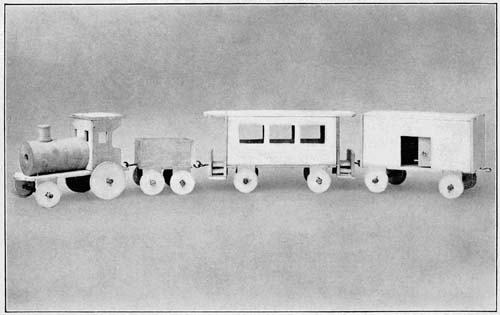
There are ever so many playthings that can
be built from the wood found in the wood pile.
A boy who is clever with his jack knife will be
able to make a set of ten pins from sticks of
kindling wood by carving little round heads at
the ends of the sticks. Very straight bits of
wood which will balance well should be chosen
for the ten pins. He can also carve quaint
wooden dolls for the little sister.
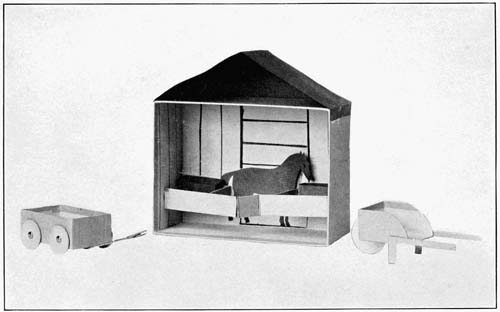
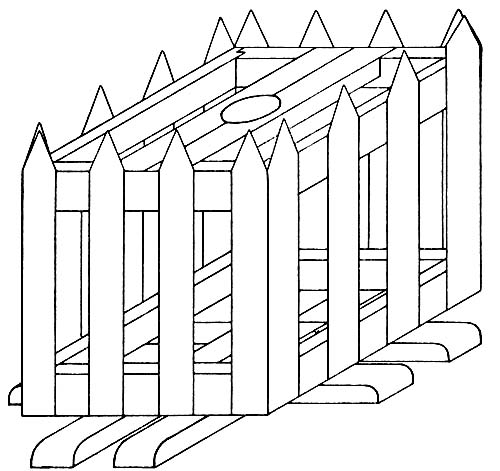
The accompanying illustration shows a toy
barnyard that was made by a group of children.
Their only tools were a couple of hammers, a toy
saw, some nails and a jack knife. The only materials
used were found in the wood pile in the
wood-shed.
The barnyard fence is constructed from lath.
Long strips are used for the bars of the fence.
The fence posts are bits of lath, also, carved in
six-inch lengths, pointed at the top with a knife,
and nailed to the longer strips. Bits of leather
are tacked in place for the gate hinges. Bits of
kindling wood split into narrow sections are
nailed together for the pig pen and the cow shed.
Some old wooden boxes are used for the farm
wagon and the wheelbarrow, the curved edges of
the wheelbarrow being made with a jack knife.
The box cover is used as wheel material, two
circles being cut out of the soft wood with a jack
knife and fastened to the body of the wagon with
dowel sticks. Another box is mounted on a
standard of lath and forms a very realistic pigeon
house. The chicken coops are little wood
squares nailed together at an angle of 90° with
bits of lath fastened across the front. With the
addition of a rude barn made from scraps of
wood, a dog house—which is only a small edition
of the barn—and a cattle shed, the farmyard
is complete—a crude but unfailing source of
amusement for many rainy days.
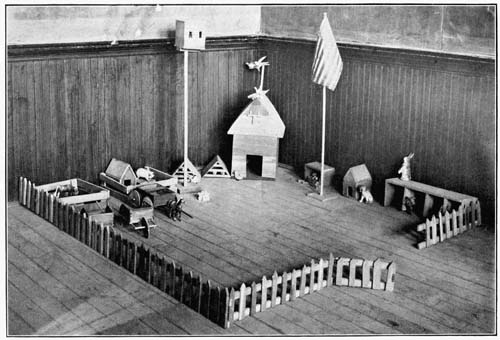
TOY BARNYARD MADE OF KINDLING WOOD
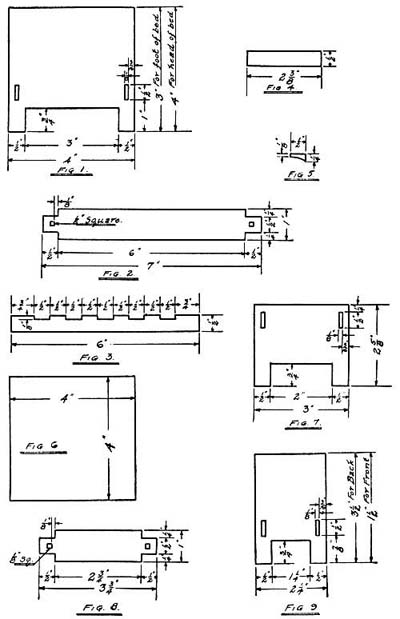
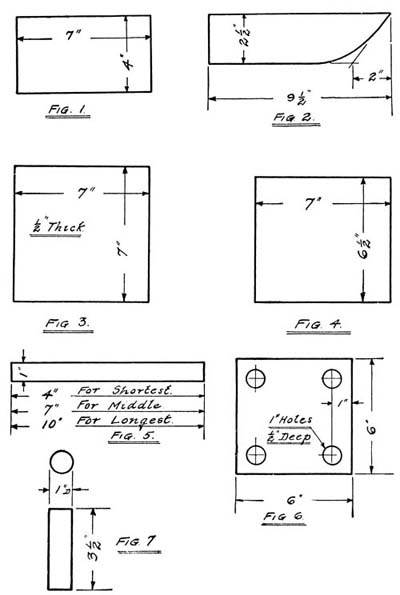
Diagrams of a Sled, a Chicken Coop and a Table.
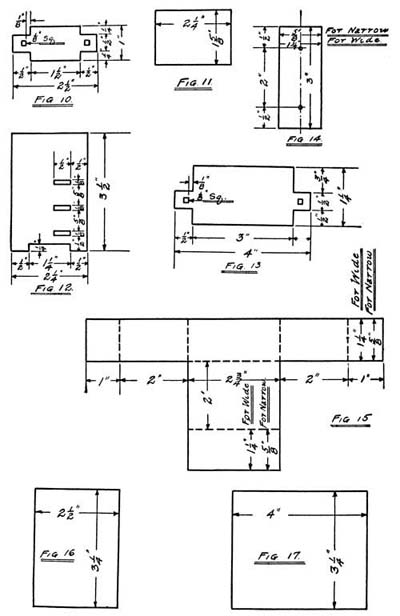
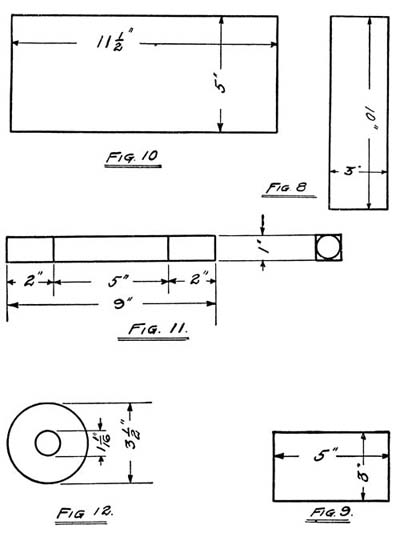
Diagrams of a Cart.
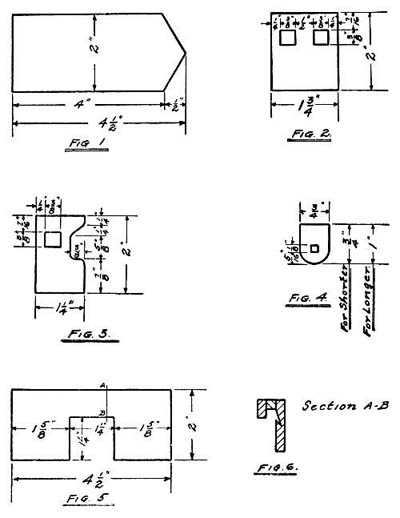
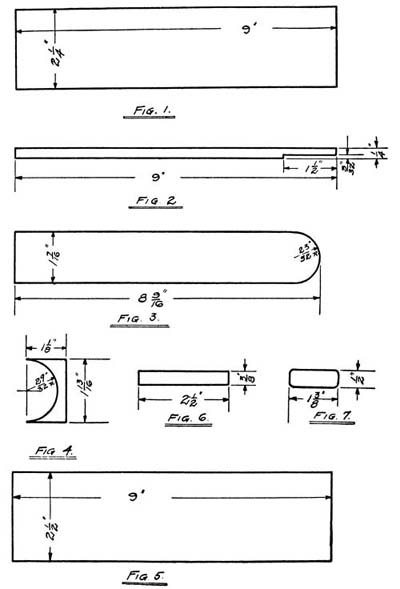
One of the simplest toys to make of wood basket
scraps is a little play sled. For this you will
need three oblong pieces of wood—one of them
(Fig. 1) measuring four inches wide by seven
inches long, and the other two (Fig. 2) measuring
two and a half inches wide by nine and one-half
inches long. Some pieces of an old packing
box about a half inch thick will do very nicely for
these. Mark the outlines first with a pencil; then
cut them out with the saw, and “true them up”
with a knife—that is, take off the little roughnesses
that the saw has left, and make the edges
perfectly straight and square. Next the two long
side pieces which you have made must be shaped.
Measure off on the lower edge (with the piece
standing in position as though it were on the
sled), two inches from the front end. Connect
this by a line with the upper front corner, and
cut it. Then round off the lower end of this cut
so that it curves into the bottom. Now make a
nail hole near the front end of each side piece for
a string to go through, nail the side pieces to the
other oblong which you made for the top, and the
little sled is done.
Another very simple toy to make of this material
is a little chicken coop. This is made of
one square piece of wood and another piece which
is almost square. The first piece (Fig. 3) measures
seven inches each way, and the other one
(Fig. 4) measures seven inches in one direction,
and in the other direction seven inches less the
thickness of the wood. This is because one piece
laps over the end of the other, and the end of the
first piece forms part of the other side of the
coop. When these pieces are cut and made perfectly
square and true, lap the longer piece over
the end of the shorter so that it will be just even
with the surface, and nail in position. For the
slats (Fig. 5) cut some strips an inch wide and
thinner than the sides of the coop. Lath is good
if you have it. Two of these strips are ten inches
long, two are seven inches, and two are four
inches. The longest ones are nailed across the
open sides of the coop, one on each side, an inch
above the bottom. The middle-sized ones are
nailed two inches above these, and the shortest
ones two inches higher. Then the ends of these
strips are sawed off almost even with the coop.
A little table may be made from one block of
wood six inches square, and four cylinders three
and a half inches long. For the table top (Fig.
6) select a piece of wood about an inch thick.
Make this true, and smooth the top with sandpaper.
Then mark on the under side a square
which is four inches on a side, and exactly an
inch away from each side of the table top. At
the corner of this inside square are to be made the
holes for the table legs. For these holes you will
have to use a bit and brace, and make the holes
one inch in diameter and a half inch deep. If
you haven’t a bit and brace, you can, with a little
more trouble, whittle out the holes. For the
table legs (Fig. 7) take four pieces of wood one
inch square and three and one-half inches long.
By whittling off each long corner edge you can
make these from square prisms into octagonal, or
eight-sided prisms. Then keep shaving off these
corner-edges until the prisms are so many-sided
that they are practically round. Smooth them
with sandpaper, and glue in place in the holes in
the under side of the table top.
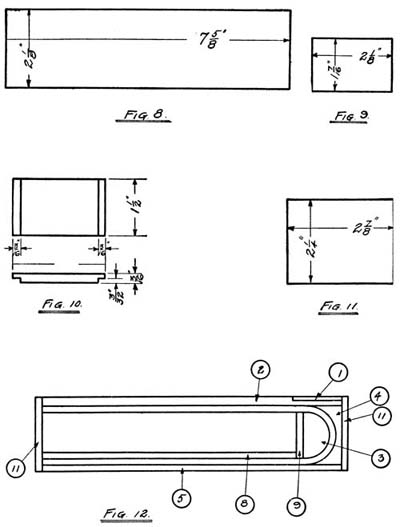
A strong little cart may be made almost as
easily as these other wood toys. Cut from
some pieces of wood three quarters of an inch
thick, two side pieces (Fig. 8) measuring three
inches by ten inches, two end pieces (Fig.
9) three inches by five inches, and one bottom
piece (Fig. 10) five inches by eleven and a half
inches. In the center of one of the end pieces
make a nail hole for the string to go through.
Nail the sides and ends together, lapping the end
pieces over the ends of the side pieces. Then
nail the bottom piece on. For the shafts of the
wheels (Fig. 11) take two pieces of wood nine
inches long and one inch square. For a space
of two inches in from each end make the shafts
cylindrical just as you did the table legs, leaving
the center portion, which is five inches long,
square. Nail these shafts to the bottom of the
cart at points two and a half inches from each
end. Next cut from 1 inch-thick wood four
wheels (Fig. 12), three and a half inches in diameter.
These may be cut out roughly with a saw,
and worked down to the marked line with the
knife. Then cut in the center of each of these
wheels a hole about one and one-sixteenth inches
in diameter—enough larger than the shaft so that
the wheels will turn easily. Slip the wheels in
place, and drive into the shaft from opposite sides,
outside of each wheel, two small finishing nails.
These are to keep the wheels in place, and must
be driven in carefully so as not to split the shafts.
These are all attractive wood basket toys to
make, and besides this, each one of them may be
adapted, by enlarging, for some real use. The
sled, with the addition of iron strips for runners,
may be really used; or by using two sleds
and an extra board fastened to both so that
they will turn, it may be made into a “bob-sled”
or “double.” The chicken coop, enlarged, will
comfortably accommodate the mother hen and
her brood of chicks which are the beginning of
every boy’s first poultry venture. The little table
may grow into a flower stand, and the cart, made
larger and stronger, will rival any shop-bought
express wagon for durability and comfort.
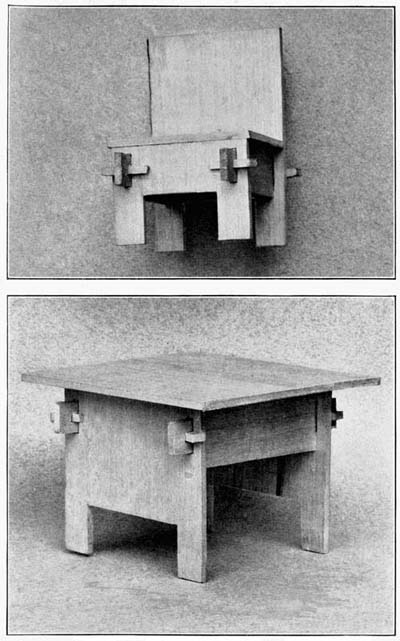
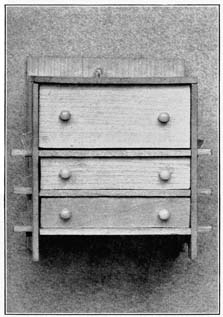
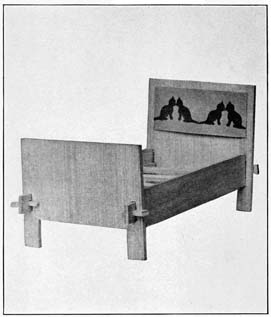
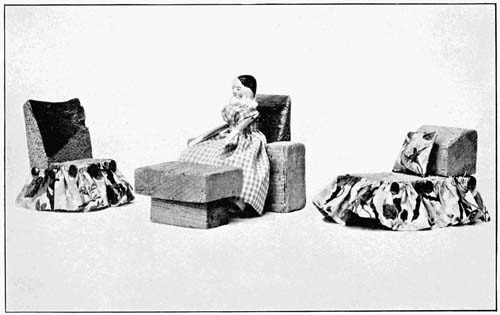
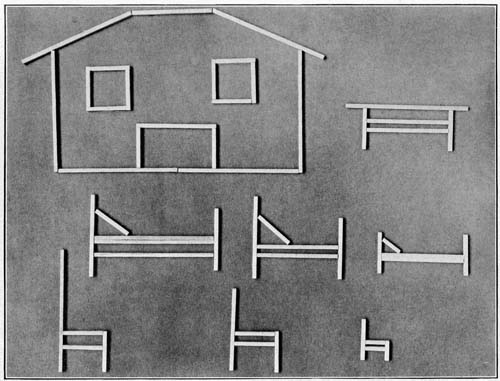
A SET OF DOLLS’ FURNITURE MADE BY GLUEING TOGETHER BLOCKS OF KINDLING WOOD