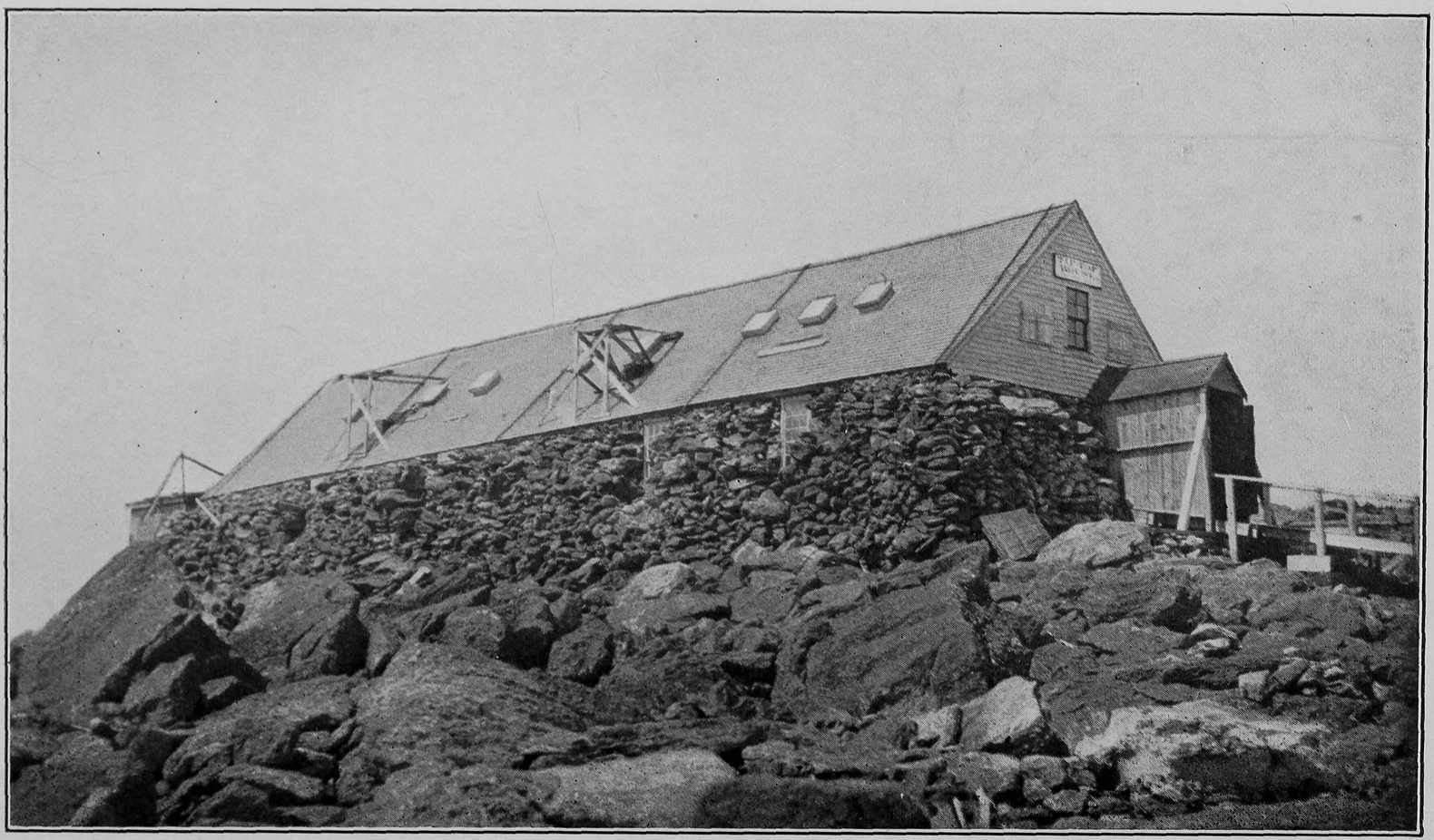
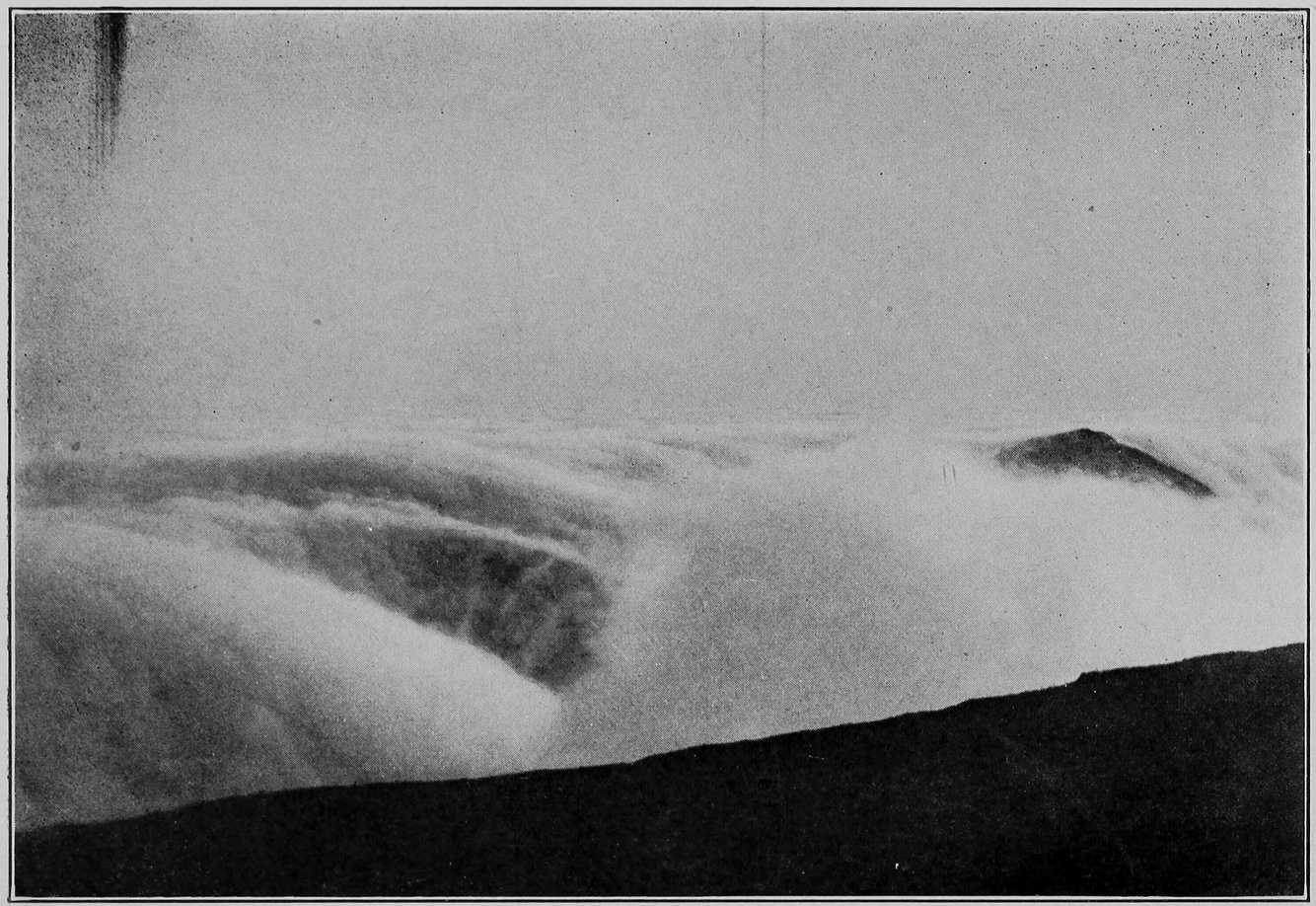
Over the Lafayette Ridge, with a Dinner
Party at the End
The two adventurers must have dropped off to
sleep toward daylight, for they were both conscious
of being shaken and told to get up.
Peanut rubbed his eyes. “Gee, I dreamed one
of those burglars had grabbed me and was dragging
me into Lost River,” he said.
“I suppose if I’d slapped your face you’d have
dreamed of Alice Green,” Lou laughed. “Come on,
get up and wash yourself. Golly, but you’re dirty!”
Peanut and Art were certainly dirty. They had
gone on their expedition the night before without
hats, and their hair was full of dust, their faces
smeared with it, and their hands almost black from
clinging to the dusty trunk rack behind the motor.
They both got up, and took off their clothes, shaking
clouds of dust out of them. Then they went down
to the brook, shivering in the chill morning air (it
was full daylight, but the sun was still hidden behind
the high eastern wall of Liberty) and washed
themselves. When they returned to camp, they
found breakfast waiting.
“Well, well, it pays to be a hero,” said Peanut.
“Somebody else does the work for you, then.”
“Don’t worry, it won’t happen often, Mr. Modesty,”
said Frank. “We were too hungry to wait, that’s all.”
After breakfast they doused their fire, packed up,
and went down the road to the Flume House. It
was still so early that none of the guests in the old
hotel were astir, though servants were about, sweeping
the verandas.
Peanut, Art and Rob showed where the rope had
been stretched across the road, with a red lantern on
it, to stop the escaping motor, and then led the way
to the garage. The two watchmen, pistols in hand,
were sitting before the door.
“Hello, boys!” the head watchman said. “We
still got ’em in there, in the corner room. Sheriff’s
coming over from Littleton for ’em as soon as he
can get here. You’d better not look at ’em—might
make ’em unhappy,” he added to Peanut, who was
trying to look in the high window.
Peanut laughed. “We did rather gum their
game, didn’t we?”
“You sure did. Here, stand on this chair.”
The boys all took a turn looking in the window.
What they saw was two men evidently asleep on a
blanket on the floor.
“Don’t seem to trouble ’em much,” said Peanut.
“Where’s their car?”
One of the watchmen led the way into the garage,
and showed them the car, which had come six miles
on the rims.
“Stolen, of course,” he said. “It’s a five thousand
dollar car, too. Somebody else will thank you, beside
Mr. Goodwin. Oh, say, I nearly forgot. The
sheriff says to hold you boys till he comes, because
you’ve got to give evidence.”
“Oh, no!” they all exclaimed. “We’ve got to
get up Lafayette!”
“Tell the sheriff we’ll be at Mr. Goodwin’s at
seven this evening, and he can take the boys’ affidavits
then,” said Mr. Rogers.
“Well, I dunno. He told me particular to keep
’em.”
“You can’t keep ’em if they want to go, you
know, without a warrant,” Mr. Rogers smiled.
“Here, keep their names and addresses for him,
and tell him, Mr. Goodwin’s this evening.”
“Well, you got a fine day for the mountain,” the
watchman said. “Go see the Pool and the Flume
first, and then just keep right up the head of the
Flume. You’ll hit the path.”
“How long will it take us to make Lafayette?”
asked Rob.
“Six hours, I guess,” he answered.
“Easy,” said they. “Goodbye.”
They had turned away before Art and Peanut remembered
to tip off the watchman about the third
thief, Jim, at the Profile stables. Then they started
once more.
The party now crossed the road, and entered a
path through the woods, marked “The Pool.” After
a short walk through dense woods, they descended
rapidly through a break in a cliff wall, for nearly a
hundred and fifty feet, and stood beside the strangest
little lake they had ever beheld. It was about a
hundred and fifty feet across, more or less circular
in shape, and surrounded by high cliffs which made
it seem like a pond at the bottom of a crater. The
water, which was astonishingly clear, came into it
at the upper end in the form of a cascade, and escaped
not far from the boys through a fissure, or
tiny cañon, in the rocks.
“My, I’d like to swim in that! What a place to
dive in!” cried Art. “How deep is it?”
“About fifty feet, I believe,” said the Scout Master.
“Looks a thousand,” said Peanut. “Come on,
let’s all have one dive.”
Rob felt of the water. “One would be about all
you’d want,” he said. “Besides, we haven’t time.”
The Scouts left the Pool reluctantly, climbed back
up the cliff, and found the path to the Flume. This
Flume, they soon discovered, resembled almost exactly
the flume on Kinsman, save that the walls were
higher and stood farther apart, and it was also
longer. But the path to it was much more traveled,
and there was a board walk built up through it beside
the brook, so that it did not seem so wild nor
impressive as the smaller flume on Kinsman. They
soon passed through it, found the path up Liberty,
and began to climb.
As on all the White Mountains, the first part of
the climb led through woods, and no views were to
be had, neither of the summit ahead nor the valley
behind. It was a steep path, too, much steeper than
the Benton Trail up Moosilauke, though not so steep
as the Beaver Brook Trail down which they had
tumbled the day before. At first everybody was
chattering gaily, and Peanut and Art were telling
over again all their experiences of the night before.
But gradually, as the sun mounted, as the trail grew
still steeper and rockier, as their packs and blankets
got heavier and hotter, conversation died out.
Everybody was panting. Rob, who was pacemaker
for the morning, would plod away, and then set
his pack down to rest. The others rested when he
did, and no oftener. Climbing began to be mechanical.
Art consulted his watch and his pedometer.
“That Appalachian guide book isn’t far from
right,” he admitted to Mr. Rogers. “We aren’t
making much over a mile an hour.”
“That’s enough, in this heat,” the Scout Master
replied. “Better fill canteens at the next spring,
Rob,” he called ahead. “I don’t know whether
we’ll get any more water to Lafayette. I’ve forgotten
this trail.”
At the next spring they all took a long drink and
a long rest. Shortly after, they emerged above
timber, and found themselves to the northwest of the
peak of Liberty, and almost at its base, while ahead
of them the path pointed up the rocky ledges toward
Haystack. With full canteens to add to their load,
they plodded on.
Now they could see below them, far down into the
Notch, and across the Notch they could see the
steep side of Kinsman going up, and the peak where
they had unfurled the flag on the Fourth of July.
They began to realize for the first time, too, how
difficult it could become in a cloud to keep the path,
for where the trail led over bare rocks it was almost
indistinguishable under foot, and you had to look
ahead to find a pile of stones, or a place where it
wound through the mountain cranberries or other
Alpine plants, to find it. The sun was very hot on
their backs, and all of them, under the blankets and
knapsacks, were perspiring freely.
“I’m wringing wet,” said Peanut. “Wish we
had the Pool right here. Would I go in? Hm——”
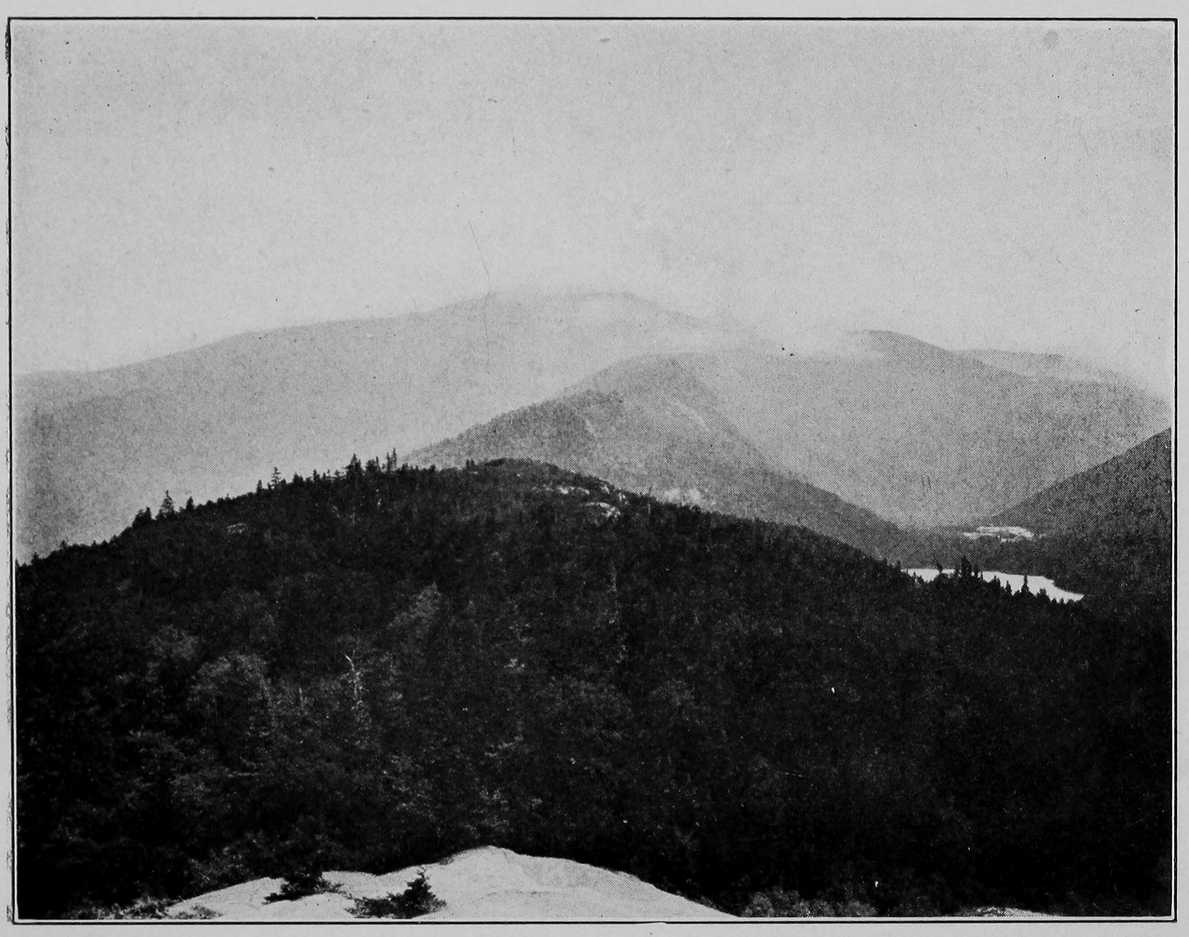
Echo Lake, Franconia Notch, and Mount Lafayette from Bald Mountain
But this lofty, bare space was also swept by a
breeze, which curiously enough dried the perspiration
on their faces, and when they paused to rest,
taking off their packs, dried out their shirts so rapidly
that the evaporation made them cold.
Once on top of Haystack, their way over the summit
of the ridge lay plain before them, the view
opened out on both sides, and they dropped their
burdens to have a long look.
Straight ahead, the path dropped down to the
col between Haystack and Lincoln—a col being the
connecting spine, ridge, or saddle between two
peaks. This col was certainly a spine, bare, wind-swept,
narrow, nothing but an edge of gray tumbled
rock. The mountain dropped down sharply on both
sides, and the boys exclaimed, almost in a breath:
“Gee, I’d hate to cross that with the winter storms
sweeping it!”
“I’d hate to be anywhere above timber line, in a
winter storm,” said Mr. Rogers, “unless I was dressed
like Peary on his dash to the Pole, and the path was
plain.”
It was perhaps a mile across the col to Lincoln.
“And beyond that another mile or more—up all
the way—to Lafayette!” the Scout Master cried.
“Shall we make Lafayette before we lunch, or not?”
The Scouts all voted for it, and moved on again,
across the col to Lincoln. The path lay entirely
over stones, not great levels of ledge, but small,
broken stones, making walking with anything but
very stout boots on extremely trying to the feet.
All the way, on their left, they could see down into
the forests of the Notch, and they could look, too,
down upon the Lonesome Lake plateau, and even
upon the top of Kinsman, for they were higher than
Kinsman already. On the other side, toward the
east, they looked down into a spectacle of indescribable
desolation—a wild region of deep ravines and
valleys separated by steep mountains, and the entire
region stripped to the bare earth by the lumbermen.
On some of the steep hillsides, slides had followed,
to complete the destruction. This desolation extended
as far eastward as they could see, and was
evidently still going on, for off to the south they
could see a logging railroad emerging from the
former forest, and once they heard, very faint and far
off, the toot of a locomotive whistle.
“When I was a boy your age, Rob,” said Mr.
Rogers, “all that country in there, which is known
as the East Branch region, because the East Branch
of the Pemigewassett rises in it, was primeval
wilderness. There was a trail through from North
Woodstock over Twin Mountain to the Twin Mountain
House, with branches to Thoreau Lake and
Carrigain. It was wonderful timber—hemlocks a
hundred and fifty feet tall, great, straight, dark
spruces like cathedral pillars! I tramped through it
once—took three days as I remember. And look at
it now!”
“Oh, why do they allow it!” cried Rob. “Why,
they haven’t planted a single new tree, or let a single
old one stand. They’ve just stripped it.”
“Yes, and spoiled the soil by letting the sun bake
it out, too,” said Lou.
“We aren’t such a progressive people, we Americans,
as we sometimes think we are,” the Scout
Master replied. “In Germany they’d have taken
out only the big trees, and planted little ones, and
when the next size was bigger, they’d have taken
them out, and planted more little ones, and so on
forever. And we Scouts could be hiking down
there, beside a rushing little river, in the depths of a
glorious forest.”
“I’m never going to read a Sunday paper again—’cept
the sporting page!” Peanut answered.
“Do you read any more of it now?” Art asked.
“It wasn’t the Sunday papers which stripped that
region,” said Mr. Rogers. “It was a lumberman,
who made boards and beams of the timber. What
did he care about the future, so long as he got rich?
Still, I blame the state and the nation more than I
blame him. He should never have been allowed to
lumber that wasteful way—nobody should. Look,
boys, there’s a cloud on Washington again.”
The boys had almost forgotten Washington in
their interest in the stripped forest below them.
They looked now far off to the northeast, twenty-five
miles away as the crow flies, and saw just
the blue bases of the Presidentials, wearing a white
hood.
“Say, will that cloud come over here?” asked
Peanut. “Kind o’ lonesome up here, as it is.”
“Ho, we’ve got a compass. We could always
just go west, down to the Notch road,” said Art.
Peanut looked down into the Notch. “Thanks,”
he said, “but if you don’t mind I’d rather go by a
path.”
“I guess we’ve nothing to fear from those clouds,”
said the Scout Master. “The wind is west. They’re
nothing but local.”
By this time they had reached the top of Lincoln,
after a steady upward toil. Another col lay ahead
of them—just a huge knife blade of jagged stone,
with the path faintly discernible winding across it
and stretching up the rocky slope of the final stone
sugar loaf of Lafayette.
“There’s journey’s end!” cried Mr. Rogers.
“All aboard for the final dash to the Pole!”
They descended rapidly from Lincoln, and soon
began the ascent again, across the rising slope of
the col, and then up the cone of Lafayette itself.
“I’m getting sort of empty,” said Frank. “What
time is it, Art?”
Art looked at his watch. “No wonder!” he said.
“It’s one o’clock, and after—twenty minutes after.
What interests me is, how are we going to cook any
lunch up here on top?”
“We can’t,” Mr. Rogers said. “Of course,
there’s no wood. We’ll just have to eat something
cold, or else wait till we can get down to timber
line.”
“Oh, dear! How long will that be?” said Frank.
“I should fancy we could make timber in half an
hour from the top.”
“That would be two, even if we didn’t stay on top
any time, wouldn’t it?”
“I gotter stay on top long enough to dry my
shirt,” Peanut answered. “It’s sticking to me.”
“Then you’ll have to eat emergency rations and
sweet chocolate,” said Art. “There’s nothing else
which doesn’t have to be cooked.”
“We ought to bake some bread and have a bit of
potted ham, or something like that, for noon lunches,”
said Rob. “I move we do it to-night.”
“To-night?” sniffed Peanut. “To-night, I guess
you forget, we dine on roast beef and plum pudding,
because Art and I are heroes!”
“I did forget, both facts,” Rob laughed.
“Well, which is it, emergency rations, or wait till
we get down to timber?” asked the Scout Master.
“Emergency rations!” said Lou and Frank.
“Wait!” said Art and Peanut (who had eaten
emergency rations before).
“It’s up to you to cast the deciding vote,” said
Mr. Rogers to Rob.
Rob winked at the Scout Master and said, “Well,
if Art and Peanut are such heroes, a bit of nice,
chewy pemmican won’t hurt ’em. I vote to stay on
top.”
“For two cents,” said Peanut, “I’d punch you in
the eye.”
As they neared the top of the peak, they suddenly
heard voices, which sounded strange way up there,
far above the world, where for hours they had heard
nothing but the rushing of the wind.
“Hello!” exclaimed Mr. Rogers, “there’s a party
here ahead of us.”
“I’ll bet there are women in it, too,” cried Peanut.
“And I wanted to dry my shirt!”
“Hm,” said Art. “Seem to be times when even
you don’t want women around.”
There were, however, no women in the party. As
the Scouts crested the final broken fragment of rock,
they found themselves on a summit no larger than a
city back yard, and on that summit an old foundation
hole, where once a small summit house had
stood. Down in this hole, sheltered from the wind,
were three men. Like the Scouts, they wore khaki.
They, too, had packs and blankets, and they all
needed shaves. They were eating their lunch as the
boys suddenly appeared just above them.
“Hello!” they called up. “Where did you come
from?”
“Up from the Flume,” said the boys.
“Took the wrong way,” said the men. “That’s
the way to go down. You got the long trail up.”
“We like hard work,” Peanut retorted. “Excuse
me while I dry my shirt.”
He took off his pack and blanket, and then peeled
himself of his outer and undershirt, spread them on
a rock in the wind and sun—and began to shiver.
“Wow! How this wind evaporates you!” he
cried.
“Get down out of it,” commanded the Scout Master,
“and keep moving. You’ll get cold if you don’t.”
Peanut jumped into the foundation hole, out of
the wind, and swung his arms like a coachman in winter.
Art took off his shirts, too, and did the same
thing. The rest decided to wait till they made camp
at the base.
“And now for the emergency rations,” cried Rob,
undoing his pack.
(“Look at those guys—sandwiches! Oh, dear,
wish you had a gun to hold ’em up, Art!” whispered
Peanut.)
(“I’d like to,” the other whispered back. “‘Your
sandwiches or your life!’ eh?”)
Rob, meanwhile, had produced a small blue tin,
and was opening it. The three strangers looked on
with an amused curiosity. Rob sniffed the contents,
assured himself that it was fresh, and with his knife
blade dug out a chunk for each member of the
party.
“Gee, is that all I get for lunch?” said Frank,
contemplating the piece in his hand, no bigger than
an English walnut.
“It’ll be all you’ll want, believe me,” said Peanut.
“And all you need to stop your hunger and nourish
you till night,” Rob added. “That’s condensed
food.”
Peanut took his piece over to the three men. “I’ll
swap this excellent and nourishing morsel for a ham
sandwich,” he said.
The men laughed. “You will not!” one of them
answered, hastily stuffing the last of his sandwich
into his mouth. “I’ve tried that before, myself. If
you’ve got a little water to soften it up in, and a bit
of bread to put it on, it’s not so bad, at that.”
One of the other men passed over a sandwich—but
not to Peanut. He gave it to Rob. “Divide
the bread,” he said. “It’ll make your rations go
better.”
Each boy, then, got a third of a slice of bread, and
a tiny morsel of ham. On this they put their chunk
of emergency rations, softened with the last of the
water from the canteens, and began to eat. Nobody
seemed to be enjoying the food very much, but
their expressions grew less pained the longer they
chewed.
“Beats all how long you can chew this before it
disappears,” said Lou. “Gets sweeter, too.”
“Maybe that’s the bread. Bread almost turns to
sugar if you chew and chew it without swallowing,”
said Rob. “But this pemmican stuff certainly is
filling.”
“What’s it made of?” Lou asked.
“Rats and rubber boots,” said Peanut.
Mr. Rogers laughed. “Not exactly—put on your
shirt, Peanut,” he said. “Pemmican was originally
made of dried venison, pounded up with fat and berries.
Now it’s made of dried beef pounded up with
dried fruits and fats, and packed into a jelly cake to
harden. That’s about what this is, I fancy. It’s
very nourishing.”
“All right, but where’s the sweet chocolate?”
Peanut demanded.
Rob passed out the chocolate for dessert, and after
it was eaten, everybody began to complain of being
thirsty. The canteens were empty.
“There’s a spring just below the summit,” said one
of the three strangers.
“You mean there was,” laughed a second. “You
drank it all dry on the way up.”
“Let’s get there on the way down before he does,”
cried Peanut.
“No fear,” the first speaker laughed, “we are going
down over the ridge, the way you just came up.
We’re doing Moosilauke to-morrow.”
“By the Beaver Brook Trail?” the boys asked.
“Yes. Have you been over it? How is it?”
“It ain’t,” said Peanut. “It was, but it ain’t.”
“What do you mean?”
“He means it’s eroded into pretty steep drops in
places,” Rob put in. “We thought when we came
down that it would be an awful pull up.”
“There’s a good logging road across the brook,
though,” one of the men said. “If you’d taken that
instead of the trail you’d have had no trouble. I was
over it last year.”
“I’m glad we didn’t,” Art said—“at least as long
as we were coming down.”
Both parties now packed up their loads, took a
last good look at the view, with Washington still
under the clouds, and said good-bye, the three
strangers going off down the ridge, the Scouts turning
northwest, and winding down the summit cone,
over the rough, broken stones of the path. At the
base of the cone, they found the spring, a small,
shallow basin in the stones, so shallow that the water
had to be dipped gingerly to keep from stirring up
the bottom. By the time the last boy had drunk his
fill, in fact, there wasn’t enough water left to dip.
Then the path turned due west, and descended at a
more gradual angle, still over small, flat, sharp fragments
of stone, toward a little pond in a hollow of
the mountain’s shoulder, just below the line where
the dwarf trees stopped entirely.
They were soon on a level with this lake, which is
called Eagle Lake, but the path was two or three
hundred feet south of it, and to get in to it meant
fighting through tough dwarf spruce and other verdure,
only waist high, but as good as a wire fence.
They stuck to the trail, which led through this dwarf
vegetation almost on a level for some distance, then
actually began to go up-hill again, on to the west
shoulder of the mountain.
“Oh, rats!” cried Peanut. “I’ve gone up enough
to-day!”
“Heroes shouldn’t be tired,” said Frank.
“Heroes need sleep, just the same,” Peanut retorted.
The ascent, however, was not for long. Soon they
swung northwest again, entered timber at last, and
began to descend rapidly. After a mile or so on this
tack, the timber growing ever taller, they brought up
against the end of Eagle Cliff, which rose straight up
in front of them. Here the path swung west again,
and began its final plunge to the Profile House. It
was a good, generous path through the woods. In
years gone by it used to be a bridle path, for people
ascended Lafayette on horseback.
“I’d hate to be the horse, though,” Peanut said,
as he put his pole ahead of him, and cleared six feet
at a jump.
It was, indeed, a steep path, and they came down
it at a high rate of speed.
“Gee, we go up about a mile an hour, and we
come down about six!” Art exclaimed, catching a
tree beside the path to stop himself.
They began to have glimpses of the Profile House
between the trees. The trail suddenly slid out nearly
level in front of them; other paths appeared, crossing
theirs; and before they realized where they were,
they stood in the clearing, by the railroad station,
and just beyond them was the huge Profile House
and the colony of cottages.
Peanut and Art sprang ahead. “Whoa!” cried
Mr. Rogers. “Suppose we leave our packs and
stuff in the depot, and prospect light-footed, eh?”
The baggage master at the depot recognized Art
and Peanut. He had been one of the pursuing party
the night before. He stowed their things in his baggage
room. “Guess you can have the freedom of
the city!” he said. “Wouldn’t wonder, if you went
to the hotel, they’d give ye something cold.”
“Come on!” cried Peanut.
“No,” said Art, “I ain’t so thirsty I have to be
treated. I don’t think we want to do that, do you,
Mr. Rogers?”
“What do you think—on second thought, Peanut?”
asked the Scout Master.
“Well, we’re taking a dinner from Mr. Goodwin,
ain’t we?”
“Yes,” said Art, “but that’s different. We helped
save his silver and stuff. And it’s just in his family.
Up there at the hotel, there’d be a crowd around—women,
and things. Looks kind of as if we were
trying to get into the lime-light.”
“Guess you’re right,” Peanut replied. “Come
on, then, and show us the Old Man of the Mountain,
Mr. Rogers. But ain’t there a place where we can
buy a drink?”
“We’ll find one—after we’ve seen the face,” the
Scout Master laughed. He looked at his watch.
“After four, boys,” he added. “We’ve got to get a
camp ready, and spruce up before dinner, and I’ve
got to go to the hotel and get a shave.”
They stepped up from the railroad station to the
road. Directly before them was the Profile House,
a large wooden hotel, facing south. Behind it rose
the steep wall of Cannon Mountain, and south of it,
on the lowest terrace of the slope, was a double row
of cottages, ending, on a bend, with a group including
Mr. Goodwin’s. Behind the boys, back where
they had come, they could see the first steep, wooded
slope of Lafayette, and to the north the great rocky
precipice of Eagle Cliff. Looking south again, the
road disappeared between the landslides of Lafayette
on the one hand, and the wall of Cannon on the
other, a narrow notch, not much wider than the road
itself. The opening where the boys stood was only
large enough to hold the hotel and cottages, and
three or four tennis courts, on which a crowd was
playing.
The party went south down the road, Peanut and
Art pointing out Mr. Goodwin’s house, and the
track taken by the burglars, and quickly left the
houses behind. After a quarter of a mile or so, the
woods opened out ahead, and presently the boys
stood in a place where the road was enlarged to the
left into a semicircle, and in that semicircle a team
or a motor could stop for the view.
“It’s the place!” cried Peanut. “Here’s where
they left the car! And those are the bushes we
crawled into, Art!”
“And there’s the Old Man of the Mountain,” said
Mr. Rogers.
The Scouts followed his finger. Looking through
an opening in the trees across the road, toward the
southwest, they saw first a beautiful little lake, so
still that it mirrored every reflection, and then, rising
directly out of the woods beyond this lake a
huge cliff, curved at first, but gradually attaining
the perpendicular till it shot up like the side of a
house, fifteen hundred feet into the air. At the very
top of it, looking southward down the valley, was,
indeed, the Old Man of the Mountain—a huge knob
of rock thrust forth from the pinnacle of the precipice,
and shaped precisely like a human profile, with
sunken eye under a brow like Daniel Webster’s,
sharp nose, firm mouth, and, as Mr. Rogers said,
“quite literally a granite chin.”
The boys looked at it in silence for a moment, and
then Peanut said, “But it looks so much bigger in
all the pictures in the geographies. Why, it really
looks as small up there as—as the moon.”
“That’s because the photographs of it are taken
with a telescope lens, I guess,” said Frank. “My
camera would make it look about six miles off.”
“How big is it?” asked Lou.
“They say about eighty feet from forehead to
chin,” the Scout Master replied. “And it’s about
fifteen hundred feet up the cliff.”
“I’d like to see it in full face,” Lou added. “Could
we walk down the road and see it that way?”
“We’ve not time, I’m afraid,” Mr. Rogers replied.
“We’d have to walk a mile or more. It isn’t so
impressive full face. In fact, this is the only spot
where the human likeness is perfect. At many
points along the road the full face view shows only
a mass of rocks.”
Lou was still looking at the great stone face gazing
solemnly down over the valley.
“It’s like the Sphinx, somehow,” he said. “I’ve
always thought of the Sphinx looking forever out
over the desert, and this old man of the mountain
looks just the same way forever down the Notch. It
gives me a funny feeling—I can’t explain it. But
somehow it seems as if he ought to be very wise.”
Peanut laughed, but Mr. Rogers didn’t laugh.
“Lou has just the right feeling about it,” he said.
“Lou has just the feeling they say the Indians had.
To the Indians, the Great Stone Face was an object
of veneration. Did any of you ever read Hawthorne’s
story, ‘The Great Stone Face’?”
None of the boys ever had.
“Well, you ought to be ashamed of yourselves,”
said the Scout Master. “I’m going to see if Mr.
Goodwin has the book, and read it to you. How
would you like to take to-morrow off, and climb up
to his forehead, and read the story there, and then
go over to the Crawford House by train, instead of
hiking the twenty-five miles over, on a motor road
full of dust?”
“Hooray! Me for that!” cried Peanut.
“Me, too!” cried the rest of the Scouts.
“Well, we’ll do it, if I can borrow the book,” said
Mr. Rogers. “Now, back to make a camp!”
At the depot the boys shouldered their packs
again, and Mr. Rogers directed them to go north
up the road till they came to Echo Lake.
“Leave your packs at the little store,” he said,
“and go down to the boat house and get the man to
take you out in a launch. I’ll get a shave and meet
you there.”
The Scouts set off up the road, and the Scout
Master went into the hotel. When he had been
shaved, he followed up the road, and as he drew
near Echo Lake, a beautiful little pond at the foot of
a great cliff just north of Eagle Cliff, he heard the
long-drawn note of a bugle floating out over the
water, and echoing back from the cliff. He called
the boys in from the landing.
“Oh, that’s lovely!” Lou exclaimed. “The
sound just seems to float back, as if somebody was
up on top of the cliff with another bugle, answering
you!”
They paid the boatman and went back to the
little store, where the boys had already consumed
two sodas apiece, and Peanut had bought two
pounds of candy. From there they went still farther
north up the road, and suddenly plunged down
a path to the left, into a ravine, with a brook at
the bottom, and in among a grove of gigantic hemlocks.
“There are real trees!” said Mr. Rogers. “They
are relics of the forest primeval. ‘This is the forest
primeval, the murmuring pines and the hemlocks’—and
so forth.”
“Only there’s no ‘deep-mouthed neighboring
ocean,’” Rob laughed.
“There’s a brook,” said Lou.
The hemlocks were indeed giants. They were
three or four feet thick, and rose sixty or eighty feet
without a limb, their tops going on up fifty feet
more.
In among these superb trees, the boys made camp,
selecting a spot some way from the path, and hidden
by underbrush. They all took a bath in the
cold brook, put on their one change of clean clothes,
washing out their socks and underclothes and hanging
them on twigs around the camp to dry. Then
they carefully combed their hair, dusted their boots,
and tied each others’ neckties neatly. (Peanut’s tie
was badly crumpled, for it had been in his pocket all
day.)
It was dark in the woods before they were ready,
and it suddenly occurred to them that they’d have
trouble finding the camp again, later in the evening.
“We might leave the lantern burning—if it would
last,” said Lou.
“No, some one would see it, going by on the path,”
Art replied. “We don’t want to risk having our
stuff pinched.”
“I know—tie a white handkerchief to a bush by
the path where we turn off to camp, and then count
the number of steps back to the road,” said Frank.
“Almost human intelligence,” Rob laughed,
“And take the lantern with us, to find the handkerchief
with.”
“Right-o!” said Peanut.
It was time now to start for the dinner party.
They tied the handkerchief to the bushes by the
path, and everybody counted his own steps out to
the road, in case the mark should be lost, or taken
down by some passer-by. Then they moved up the
road, past the gaily lighted Profile House, where
they could see the guests eating in the big dining-room
with its large plate glass windows, and again
rang the bell of Mr. Goodwin’s house—but more
quietly this time.
A servant ushered them in, and Mr. Goodwin and
his wife and son and daughter at once came forward
to greet them. The house was elaborately furnished
for a summer “cottage,” and the boys were rather
conscious of their scout clothes and especially of their
hobnail boots.
“Gee,” whispered Art, “keep on the rugs all you
can, or we’ll dig holes in these hardwood floors.”
“So these are Peanut and Art,” said Mr. Goodwin,
after introductions all around, turning to the
pair who had given the alarm the night before.
“I’m sorry to say, we can’t have dinner till the
sheriff has disposed of you two chaps. He’s waiting
in the library now with a stenographer.”
Mr. Goodwin led the way into his library, where,
sure enough, the sheriff was sitting.
“Here are your men,” said the host. “Don’t
keep ’em too long. We’re all hungry.”
The rest of the party sat near by and listened, while
the sheriff swore in Art and Peanut. First they had
to hold up their right hands and swear to tell the
truth, the whole truth, and nothing but the truth.
Then they gave their names, ages and residence,
while the stenographer’s pencil was busy making
shorthand marks which Peanut, regarding out of the
corner of his eye, thought looked more like hen tracks
than anything else.
“Now, tell me exactly what happened last night,
from the beginning,” said the sheriff. “I don’t want
to ask you to come way up here from Massachusetts
for the trial, so I’m taking this sworn testimony now.
I think we have evidence enough to make your
actual presence unnecessary.”
Peanut started in on the story, told of his being
awakened by the sound of the motor stopping in
the road, of waking Art, of their sneaking out
through the bushes, and hearing the two burglars
talk.
“What did they say, as exactly as you can remember
it?” asked the sheriff.
Peanut turned red, and glanced toward Mrs.
Goodwin and her daughter. “Have I got to tell
exactly?” he stammered. “We ain’t allowed to
talk that way in the Scouts, even without ladies
present.”
Everybody laughed, and the officer with them.
“You can put in blanks,” he answered.
Peanut, with Art’s help, and also Rob’s, who came
upon the scene at this point, as the reader will remember,
and also with the aid of many “blanks,”
reconstructed the conversation as well as he could.
Then Art took up the narrative, and described the
ride up the valley, the cutting of the tires, the pulling
out of the wire in the engine (which the burglars
had put back again), and the subsequent arousing of
the neighborhood.
“Well, that’s some story!” said the sheriff, with
admiration. “That’s what I call quick action, and
brave action. One thing you didn’t do you might
have—you might have cut out a piece of that wire
so they couldn’t have put it back. But if you had,
they wouldn’t have tried to get away in the car, but
would have taken to the mountain, and perhaps
escaped, so it’s just as well.”
He shook hands heartily with Art and Peanut,
and then with the rest of the boys, and departed.
“Now for dinner!” cried Mr. Goodwin.
Mrs. Goodwin led the way to the dining-room,
while her husband explained to the boys as they
went along that all the wedding presents had been
shipped back to a New York vault, under guard
that day, to avoid the chance of another scare.
They took their places at the big table, which was
gay with candles, Art and Peanut having places of
honor beside Mrs. Goodwin and her daughter.
There were great, snowy napkins to spread on their
laps, and there was iced grape fruit to begin on, and
soup, and roast beef, and all sorts of good things,
ending up with ice-cream. As it was after seven
thirty before they sat down, and the boys had eaten
nothing but emergency rations at noon, you may be
sure that nobody refused a second helping of anything,
just to be polite. In fact, Mrs. Goodwin saw
to it that everything came around twice.
“My, nobody has eaten like this in my house for
a long time!” she said, “and a housekeeper does
like to see her food enjoyed. John”—this to her
husband—“why don’t you climb Lafayette every
day, so you can get up a real appetite?”
“I wouldn’t, alas!” he laughed. “I’d just get
lame legs and a headache. Lafayette’s for the
young folks. Have some more ice-cream, Peanut?”
“Gee, I’d like to—but I’m full,” said Peanut, so
honestly that everybody roared.
“I don’t suppose you carry an ice-cream freezer
in your packs, do you?” Mrs. Goodwin laughed.
“We don’t,” said Rob, “nor grape fruit nor napkins,
either. I’m afraid this luxury will spoil us for
camp to-morrow!”
“Do you know,” Mr. Goodwin said, “I’m tired of
luxury, myself. If I was twenty years younger, I’d
get a blanket out and go with you boys for the next
few days, and eat bacon and flapjacks out of tin
plates, and have the time of my life.”
“Come on!” the Scouts cried.
And Peanut added, “You ain’t old. Why,
Edward Payson Weston’s lots older than you
are!”
“And he walked from San Francisco to New York
didn’t he?” Mr. Goodwin laughed. “Well, I guess
his legs are younger than mine. Where do you go
to-morrow, by the way?”
This reminded Mr. Rogers of the book, so he
asked if he could lend him a copy of Hawthorne’s
“Twice Told Tales.”
“If you can,” he said, “we are going up Cannon
to-morrow morning and read ‘The Great Stone
Face,’ and then go over to the Crawford House
on the train, to be ready for the Bridle Path the
next day.”
“Have we got it—the book?” Mr. Goodwin asked
his wife.
She shook her head, but the daughter spoke—“The
Andersons have a copy, I know. I’ll run
over and get it after dinner.”
“Fine—and as to that train—nothing doing,”
said Mr. Goodwin. “You’ll all get in my touring
car after lunch, and the driver’ll take you over to
Crawford’s, and show you some sights on the way.
I’ll tell him to take you through Bethlehem first.
Now, don’t say no! I want to do that much for
you.”
The Scouts thanked him, and agreed to be ready
at two o’clock, on the next day, for the start. They
rose from dinner now, and strolled out-of-doors.
There was music at the Profile House.
The entire party loitered along the board walk in
front of the cottages, with the great, dark wall of
Lafayette going up against the stars directly across
the road, and sat on the Profile House veranda a
while, listening to the music within. Dancers came
out and walked back and forth in front of them between
dances—men in evening clothes, girls in low-necked
white dresses. It was very gay. But how
sleepy the Scouts were becoming! Mr. Rogers saw
it, and whispered to their hostess. They walked
back to the house, got the book, said good-night,
and once more tramped down the road.
“Gee, it’s ten o’clock,” said Art. “Awful dissipated,
we are.”
Peanut yawned. “Bet I’ll hate to get up to-morrow.
Wow, some class to that dinner, though!
Ain’t you glad we were heroes, boys?”
Lou was lighting his lantern. “I’m glad you
picked out Mr. Goodwin to warn,” he laughed.
They were alongside of Echo Lake now. “If I
wasn’t so sleepy, I’d like to go down there and make
an echo now, in the night,” said Lou. “It would be
kind of wild and unearthly.”
“Yes, and easy to do, seeing’s we have no bugle
and no boat,” said Frank. “Me for bed.”
They now turned in from the road, and followed
the path, each one counting his steps. But, as the
path was down-hill, and they had counted first when
going up-hill, everybody was still many paces shy
when Lou, who was leading with the lantern, suddenly
spied the handkerchief, still tied to a bush.
They turned into the underbrush, and after considerable
stumbling in the dark, amid the undergrowth
and the gigantic hemlock trunks, the lantern light
fell on a shimmer of white—one of the shirts hung
up to dry—and they found their camp. It wasn’t
five minutes later when the camp was once more
dark and silent.