There was no story telling that night. Dinner
was late, and afterwards the dusk came earlier
up here under the shadows of the great cliffs, and
every one except the two women was glad enough
to crawl in early. Joe was gladdest of all. He had
to confess that he was tired, as well as sore—and
now he realized that he had disobeyed all orders not
to climb and take strenuous exercise. But he felt
of his head, as his mother used to do, and could
detect no fever, and he had not coughed once, so he
did not worry enough to keep himself awake more
than one minute and a quarter. In the morning, he
was awake almost as soon as the Ranger, and sat
up feeling fine. Lucy was the next up, as usual,
and once more her cheerful self. She gathered fresh
wild flowers—a great bunch of yellow columbine
and blue false forget-me-nots, for the “table,” while
Joe was cooking, and asked him how he felt, and
sang softly to herself, and then asked him again if
the fresh, clear, morning air way up here in these
high mountains was not the most wonderful thing in
the world.
145
“It’s medicine to me, all right,” Joe answered,
looking up and watching the sun come over the rock
bastions of Citadel and turn to pink and gold the
snow-fields on Fusillade. “Gee, I think mountains—big
mountains—are just the best ever!”
“The best ever, that’s what they are, Joe, and
you’re going back East so big and strong that your
own mother won’t know you. You must write to
me and tell me about it, won’t you?”
“You bet I will,” Joe replied, turning red over his
fire. It certainly was almost like being home to
have some one like Lucy Elkins be so interested in
him, and kindly and sweet. The fire was very
smoky, and got into Joe’s eyes, and he had to wipe
them—but Lucy did not see, or, if she did, she pretended
not to.
“Well,” said Mills, after breakfast, “everybody
pack. We’ve got a long day ahead of us, if we stop
any time to see the sights.”
“And where are we going?” somebody asked.
“Over Gunsight Pass, and down to Lake McDonald,”
the Ranger answered, pointing up to the Great
Divide at the head of Gunsight Lake.
“Do you mean to tell me we are going over that
place?” demanded Mrs. Jones.
“Why not?” said Mills.
“Why not? Well, I’m not one of these Rocky
Mountain goats I hear about.”
“Your horse is,” the Ranger laughed.
As soon as camp was struck, and the horses
brought from the upper meadows, where they had
146
wandered in the night, and packed, the party started
up the trail.
“Gunsight Pass—I like that name,” said Bob.
“But how did it get the name?”
“You’ll see when we reach it,” Mills replied.
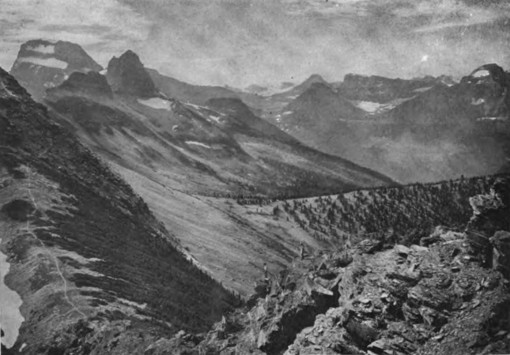
The trail over Gunsight is one of the most interesting
in the entire Park. The head wall of the
horseshoe of rocks which holds the green lake is too
steep to climb, so the path gets to the summit by
working up the shoulder of Jackson, in a long series
of inclines, with sharp, steep switchbacks every little
way, to boost it a little higher up the steep slope.
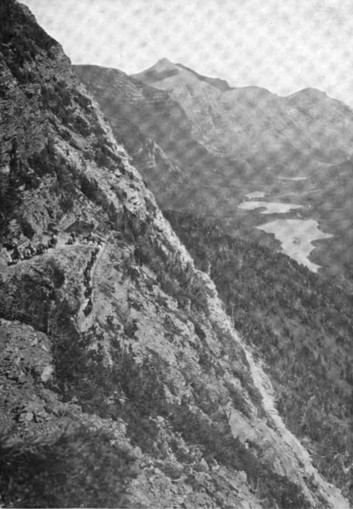
After climbing for, perhaps, two miles, they
reached what appeared to be the level of the Divide
ahead of them, but they were still around on one
side of the horseshoe, and had to make their way
along the tremendously steep wall of the mountain
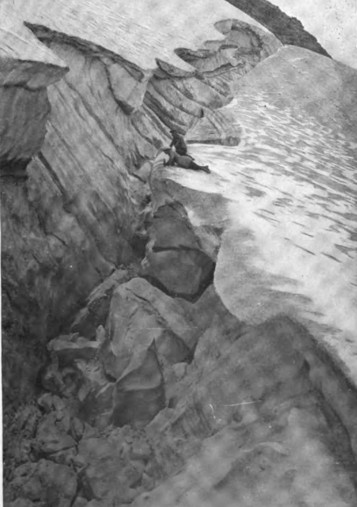
till they got to the pass at the centre. Between them
and this pass lay a huge snow-field, two hundred
yards wide, and extending half a mile up the slope,
and as far down, and ending at the bottom right on
the top of a precipice, which dropped off into the
lake. They could hear the melting water from this
snow-field falling down far, far below, over the precipice.
Mills stopped his horse, and studied the ground,
while the two women looked at the steep, gleaming,
slippery field of snow, steeper than a house roof, at
the yawning hole at the bottom, and declared in loud
tones that they would not go across.
But other parties had been across, and somebody
147
had shoveled out a path, about three feet wide, to
make level footing for the horses. Still, even so, it
was a ticklish place, for if a horse once slid off, there
would be no stopping him short of the lake two
thousand feet below.
“Everybody off!” Mills ordered.
“Joe, Dick, Val,” he commanded, “lead all the
horses over, one at a time, and then two of you
come back.”
After the horses were across—and they did not
have the least fear, even when one of their feet
would cut through the soft snow, and they appeared
to be in danger of slipping—Joe and Dick returned,
and, with Mills, led the two women and the girls
over, and helped them back into their saddles. Bob
and the two congressmen came alone, and in the
centre of the slide, Bob made a big snowball, and let
it roll down. Inside of a hundred feet it appeared
to be traveling a mile a minute, growing bigger all
the time, and finally it hit a rock at the bottom with
a loud report, and the broken pieces flew out over
the hole below.
“Say, Joe,” he called, “great place for skis,
eh?”
Joe laughed, but not very mirthfully. The thought
of going down that slope on skis made you sick in
the pit of your stomach.
It was but a few steps now, around a hanging
ledge, to the pass, and as they came out into the
small level space on top of the Divide, they saw in
front of them, forming the northern gate-post of the
148
pass, as it were, a big rock pile shaped exactly like
the front sight of a rifle—a sight several hundred
feet high.
“Now you see why it’s Gunsight Pass,” said Mills
to Bob.
“Some gun!” the boy answered.
Those ahead moved to the western side of the
Divide, and suddenly Joe heard the girls screaming
with delight. As soon as he got there, he realized
why, for never before had he seen anywhere such a
wonderful view.
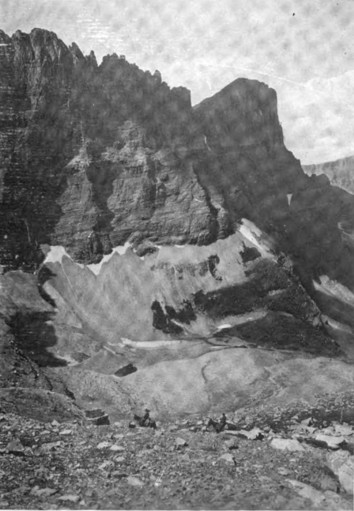
Right below them, eight hundred or a thousand
feet, lay the loveliest little lake in all the world, oval
in shape, a beautiful green in color, possibly half or
three-quarters of a mile long. Out of one side sprang
up the red precipices of Mount Jackson, from the
upper end rose the wall of the Divide to their feet,
on the other side, sweeping around in a circular
curve carved by some ancient glacier as smooth as a
drill hole, was the precipice of Gunsight Mountain.
At the farther end of the lake the land just dropped
away out of sight, and far off in the distance they
could see range after range of purple mountains.
Right at their feet, almost at the top of the Divide,
was a pine tree, the only one, the very outmost
sentinel of timber-line. It was only eight feet tall,
though the trunk was two feet thick, and it was torn
and twisted and gnarled by the winds till it looked
like a grim old fighter who had left all the rest of
his company far below and battled his way on up,
almost to the top.
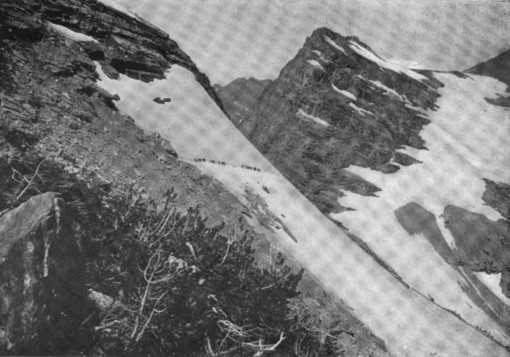 Party Crossing Near Top of Gunsight Pass
Even Mrs. Jones stopped her horse and admired
this view.
“It’s really worth coming for,” she said.
“And how she hates to admit it,” Val whispered
in Joe’s ear, for the whole party was now gathered
together on the edge, looking at the prospect.
“What’s the name of that heavenly little lake?”
Lucy asked.
“Lake Ellen Wilson,” Mills answered.
“Oh, dear, it shouldn’t be—it ought to have a
beautiful Indian name, like Eye-of-the-morning, or
something,” said she.
“Let’s name it Lake Lucy Elkins,” Bob suggested.
“Seems to suit you.”
Joe thought so, too, but he did not say anything.
Lucy laughed. “If we only could rename it,” she
answered, “I certainly would find a pretty Indian
name. I think it’s terrible, the way we take the
land away from the Indians first, and then give
everything new names, in the bargain.”
The trail now descended in switchbacks to the
very shore of the lake, for, although it had to climb
up again at the lower, west side, the precipices were
so steep in between that the only way to get from
one point to the other was to descend to the shore.
“And this water is really going to the Pacific
Ocean,” said Mr. Jones, as they reached the lake.
“We are over the Great Divide, Bob!”
“Yes, I feel a change in the climate,” the irrepressible
Bob answered.
150
“That’s not such a joke as you think, at that,” Mills
said. “The climate is different over here, as you’ll
see presently.”
They had still another pass to go over—Lincoln
Pass (not a part of the Divide) before they could
begin the final descent to Lake McDonald, and from
the lake shore they began to climb again, with the
green water between them and the tremendous red
walls of Jackson, where long, narrow snow-fields
clung in the hollows. At the top of Lincoln Pass
was a meadow, on the edge of a precipice, a meadow
full of snow-fields, wild flowers, and a few stunted,
twisted pines, for it was on the very edge of timber-line.
Here Mills ordered a halt for lunch.
“Charlie Chaplin sandwiches again, Joe,” he said.
“You can make tea if you want to, and can find any
wood.”
Joe and Bob and the girls between them managed
to scrape together enough dead wood to make a
small fire, and the water Joe got from the little brook
flowing out from under a snow-field and starting on
its long journey to the Pacific Ocean.
After lunch, everybody wanted to sit around for a
bit, and enjoy the view of Lake Ellen Wilson and
Mount Jackson, and Joe and Lucy got their cameras
from their packs, and took pictures of each other on
horseback, of the party, of Bob and Alice climbing
down over an edge of the cliff beside a waterfall, and
finally of a wonderful, twisted pine.
“I love the old trees at timber-line,” Joe said.
“They look so sort of—of heroic.”
151
“Guess they are, all right,” Bob laughed. “I’d
feel heroic if I stood up here in winter!”
Almost as soon as they started again, they began
to drop down a steep, rocky trail to the Sperry camp,
a chalet built up on the slopes to accommodate the
people who want to climb over the Divide just behind
it to Sperry Glacier; and then to drop, by a wide,
good trail, past rushing brooks, into the first real
forest Joe had seen. The climate certainly was different
over here—he began to feel it. It seemed
warmer, and the air wasn’t quite so vividly clear.
There was a faint suggestion of haze over the lower
blue ranges out to the west. It must be different,
he told himself, there must be more rainfall, anyhow,
and less severe winter cold, or the trees wouldn’t be
so much larger.
Down and down they dropped, through spruces
and pines and larches, growing ever taller and larger,
till suddenly the trail went into the most wonderful
forest Joe had ever seen. It was entirely composed
of one kind of tree, tall, straight, ghostly gray trees,
with a thin bark that shredded in strips on the smaller
trunks; and these trees grew so thickly together
that their tops made a solid canopy over the ground
below, shutting out all sunlight, so that it was almost
twilight deep in the heart of the forest. Not a living
thing grew on the forest floor; it was simply a
carpet of brownish, tiny needle-like dead leaves, and
of dead sticks and fallen tree trunks.
Joe heard Lucy, ahead of him, saying it reminded
her of the woods that Hop-o’-my-thumb and his
152
brother got lost in. It reminded him of some great
forest he once dreamed about in a nightmare; and
yet it was beautiful, because of the ghostly gray of
the tall trees, and the utter hush and silence of its
dim recesses.
“What kind of trees are these?” he called back
to Val. “They look like some sort of cedar.”
“You can search me,” Val answered. “I couldn’t
tell a tree from a cauliflower. Great place for bears,
though.”
The trail here was so wide that Joe could trot
ahead and ask Mills.
“Yes, they are cedars,” Mills said. “They call
’em white cedars, I believe. The wood is much
softer than your slow-growing cedar in the East.
It’s a great forest, isn’t it?”
“Makes me sure I want to be a forest ranger,”
Joe answered. “Val says it’s a great place for
bears.”
“Hi, bears, ma!” yelled Bob. “Val says there’s
lots of ’em here. Say, Mr. Mills, how soon are you
going to show us that bear? You know you promised
one to-day.”
“You’ll see it yet—I never break a promise,” the
Ranger answered.
They rode on, down through the cedar forest, for
a mile more, and suddenly saw light through the
trees ahead, trotted into a clearing, and almost immediately
found themselves by a good-sized hotel,
built out of this very cedar lumber, and on the shore
of a big lake.
153
“Lake McDonald,” said the Ranger.
“And a hotel!” cried Mrs. Jones. “You can all
camp where you like, but I’m going to have a room
with a bath to-night.”
“I wouldn’t mind one myself,” said her husband.
“Me, too,” the other congressman put in.
“Well, I suppose that means we have to sleep in
a stuffy old room to-night, Alice,” said Lucy, “and
eat in a dining-room with a lot of people. Oh, dear,
I prefer Joe’s cooking!”
“Looks as if you were going to have a snap to-night,
Joe,” said Mills. “You want a room with a
bath, too?”
“Oh, no,” said Joe. “I’m going to take my
blankets up into those cedars and sleep.”
“You are?” Bob cried. “Then I’m with you.
We won’t be quitters, anyhow. Us for the rough
life—and the bears.”
“No, Bob, you’ll come to the hotel with the rest
of us,” said his mother.
“Aw, no, ma, let me go with Joe! Gee whiz,
here we come three thousand miles to rough it in
the Rocky Mountains and you go and bunk up in a
flossy hotel—roughing it with hot and cold water,
and a valet to black your boots!”
Everybody laughed, and Mr. Jones said, “Let the
boy have a good time, mother. I guess he’ll fare as
well with Joe as he would in the hotel. Joe’s a Boy
Scout, aren’t you, Joe?”
“Yes, sir,” Joe answered.
It was finally settled that way, and while the party
154
went into the hotel to get their rooms, Joe, the
guides and Mills unpacked the horses and stabled
them, took the dunnage bags of the party to the
hotel, and all but Joe found their quarters in the
annex. Joe picked out blankets for two, an axe,
some grub and a few cooking utensils, and as soon
as Bob came back, the two boys carted them back
a few hundred yards into the deep woods, in a wild
spot well off the trail, made themselves a fire pit
against a big stone, which was so covered with
green moss they first thought it was a stump, spread
Joe’s poncho for a bed, on a raked up and smoothed
heap of the dead needles, and then went back to
have a look at the lake before supper.
It was still early, and the girls were out on the
pier in front. Bob spied a canoe for hire, and
promptly engaged it. They all four got in, with
Joe as bow paddle and Bob as stern, and paddled
straight out into the lake, which was quiet now as
the wind died down with the setting sun. As they
drew away from the shore, they began to realize
what a big lake it is—ten or twelve miles long, with
great, dark cedar and evergreen forests coming right
down to the water’s edge, and by the time they were
near the middle, they saw how above these forests
here at the upper end rose peak after snow-covered
peak, piling up to the Great Divide.
“It looks like a lake in Switzerland, doesn’t it?”
said Alice.
Joe, of course, had never been to Switzerland, so
he looked all the harder.
155
“Only I like it better,” Lucy answered, “because
here, except for the hotel and those few cottages near
it, you don’t see anything but forest and wilderness.
It’s so wild and lonely! Oh, dear, I’d like to live
here!”
“I’d like to sail an ice boat here in winter!” said
Bob.
“And I’d like to fish here now,” said Joe, as a
fish jumped half out of the water just ahead of the
canoe.
“Fish! Hooray! Say, Joe,” Bob called, “if I get
a fish early to-morrow, will you cook him for breakfast?”
“You bet!”
“You horrid things,” said Alice. “We’ll probably
be eating breakfast food and canned peaches in
the hotel. I hope you don’t get your old fish.”
“Ain’t that just like a girl!” said Bob.
They paddled slowly and reluctantly back, as the
sunset lit the snow-fields on the great peaks to the
east, and turned them pink. The supper gong rang
as they landed.
“Now, Bob, be back right after supper, if you want
to see that bear,” Mills called, and Joe and Bob hurried
to their camp to get a quick supper.
All they bothered with was soup, some fried ham,
and pancakes, with tea. They had large quantities
of those things, however, and didn’t stop to wash the
dishes.
“This is no time to be fussy,” Bob said. “I’ll
never tell. We gotter see old Mr. Bear.”
156
So they hurried back to the trail, where Joe took
out a handkerchief, and tied it to a branch.
“What’s the big idea?” Bob demanded.
“Well, it’s so dark here now you can just barely
see the trail,” Joe said. “We could never tell where
to turn off by the time we get back. Don’t want to
be hunting all night for our camp.”
“I get you, Sherlocko,” Bob replied. “Now for
the bear. Hurry up!”
The entire party was waiting when they reached
the hotel, and Mills led the way, back by another
road into the cedars, which were now very dark. A
lot of other guests were moving in the same direction.
After a way, a strong smell began to assault
the nose.
“Smells to me like swill,” said Bob.
“Garbage, Robert, is a nicer word,” said his mother.
“Well, it doesn’t change the smell any,” he answered.
Mills said nothing, but walked on, while the smell
grew stronger, and in a moment, by the dim light,
they saw that the hotel garbage had been dumped
on both sides of the roadway. Just ahead a group
of people had stopped, and Mills led the way up to
this group.
“There,” said he, “I promised you one, but I see
five.”
“Where? I don’t see anything,” said Congressman
Elkins.
He was standing on the extreme edge of the road,
and just as he spoke something big and dark and
157
mysterious gave a grunt and with a crash of broken
sticks reared up not six feet from him.
The congressman jumped back and nearly upset
Mrs. Jones, who screamed.
At her scream, two other dark forms close to the
road moved, and in the dim light the party could see
one of these forms go ten feet up the trunk of a half
fallen tree. Peering into the dark of the woods, Joe
could at last count, as the Ranger said, five bears,
two of them huge ones, three smaller (including the
one up the tree), and not one of them more than fifty
feet away.
“The two big ones are silver tips?” he asked.
“Sure,” said Mills. “Want to pat one?”
“No, thanks.”
“I must say, bears are dirty animals, if this is what
they eat,” Mrs. Jones put in, sniffing. “I don’t think
I like them so near me.”
“I’m sure I don’t,” Mr. Elkins laughed. “Of
course, I know these are tame, and all that, but—well,
it’s like the dog the man said wouldn’t bite.
‘I know it, and you know it,’ said the other fellow,
‘but does the dog know it?’”
Just then the big grizzly nearest them, which was
standing on his hind legs, gave a low, snarling growl,
as if he was mad at being disturbed at supper, and
Mrs. Jones announced determinedly that she was
going back.
And she went. Joe, Bob, and the girls wanted
to linger, but the older people called them, and they
had to go.
158
“Well, that wasn’t very exciting!” Bob complained.
“Gee, you could have patted ’em, ’most.
I wanted to see you shoot one, Mr. Mills.”
“I’d as soon shoot a cow as a tame bear,” the
Ranger told him. “You can’t shoot anything but
lions and coyotes in the Park, and only Rangers can
shoot them. We’re protecting game here, not killing
it.”
“Wouldn’t you kill a bear if it came for you?”
Mills laughed. “I’d try a tree first,” he said.
But Joe had noted that all the time he stood near
the bears, he had his hand on his hip, where his big
automatic rested in its holster; and the scout suspected
that he wasn’t quite so sure about the bears
being entirely tame as he pretended.
Back at the hotel, the first thing they saw was
Val, in the lobby, with a clean shave, his hair cut and
plastered down in a smooth part, a clean shirt and a
bright red necktie on, and his best white fur chaps,
with silver buckles, on his legs.
“Oh, look at Val, all dressed up like Astor’s
horse!” Bob shouted.
“Where are you going, Val?” the girls demanded.
“Oh, down to the big struggle,” said the young
cowboy.
“The what?” they asked.
“The big struggle—the dance,” said he.
“A dance? A dance? Where?”
“Down to the hall. Better come.”
“Sure—come, Joe, come, Bob,” Lucy cried, and
grabbing poor Joe by the hand—for Joe was scared
159
stiff at a dance, being a poor performer, and besides,
he had on his worn scout suit and heavy boots—she
led him off, while Alice grabbed her equally reluctant
brother.
The hall was a little annex to the hotel, and when
they got there the piano was going, and a lot of
people, cowboy guides, waitresses, guests, everybody,
was dancing. Almost nobody was dressed up
for a party as we dress in the East—any kind of
rough clothes and stout boots went here, alongside
of silk dresses and satin slippers, worn by some of
the hotel guests.
“Gee, I can’t dance any more ’n a cow,” Joe
stammered to Lucy.
“Nonsense,” she said, “I’ll bet you can dance
very nicely. Anyhow, you’ve got to try just one
with me.”
So they danced a one-step, and Joe managed to
get through it without treading on anybody’s toe.
“There—what did I tell you!” Lucy laughed.
“Of course you can dance. I don’t know why it is
boys always say they can’t.”
“I got around with you all right,” Joe answered.
“But with most girls I feel ’s if I had about twenty
pair o’ feet.”
“All you need is practice,” said she.
“Hi,” called Bob, who had been dancing with his
sister, “come over here and pipe the pantalettes!”
Joe and Lucy went into the alcove where he and
Alice were, and there they saw a stuffed and mounted
mountain goat—the first Joe had ever seen except in
160
pictures. It stood about three feet high, with long,
pure white hair, hanging down in a beard under its
chin, and hanging down its legs to a point, as Bob
said, “just above the tops of its boots, if it wore
boots.” This hair on its legs did look exactly like
the pantalettes you see in pictures of little girls
back in the days before the Civil War.
“There ain’t no such animal!” Lucy laughed.
“I wish we could see one, alive,” said Bob.
“I’m going to hunt one later with a camera—me
and Spider—he’s my chum up at Many Glacier.”
At the other end of the dance hall was a mounted
sheep—a big old ram, almost six inches taller than
the goat, with a magnificent pair of horns which
curved up, back, and around till the points touched
the base, making a complete circle. Even stuffed
and mounted, he was a magnificent creature, proud
and alert.
“Oh, I think it’s a crime to kill such beautiful
animals!” Lucy exclaimed.
“Me, too,” said Joe. “I’d rather hunt ’em with a
camera, get a picture, and leave the animal alive for
somebody else to see.”
“Well, I’d like to have a head for my den,” said
Bob. “Wish they let you hunt in the Park.”
Joe and Bob were both so sleepy that they soon
left “the big struggle,” and started back for the
camp. It was almost pitch black now in the cedars,
and after they had walked up the trail as far as they
thought was right, they had to hunt some minutes
before they found the handkerchief. Turning off
161
from the path, they stumbled through the woods till
they caught the glimmer of red coals from their fire,
threw on some fresh wood to get light, and prepared
for bed. Rolled up tight in their blankets, they were
soon fast asleep.
It was still pitch dark, and it seemed as if he’d just
gone to sleep, when Joe was awakened by a noise
close by. He felt as much as heard the presence of
somebody or something. The fire had again died
down to a heap of coals, and only a faint red glow
dimly lit the base of the great, ghostly tree trunks
close around. Joe sat up, straining every nerve of
eye and ear. Suddenly a dead stick broke with a
loud snap not far away, on the side toward the provisions,
which had been placed in the fork of a half
fallen tree trunk. Bob woke up at this, with a jump
that brought him, too, into a sitting posture.
“Wha’s ’at?” he exclaimed, in the startled voice
of one half awake.
The answer was another crash of broken sticks
and a deep, guttural growl. At the same instant, by
a sudden flicker of flame from the fire, a ray of light
shot between the trees and in a flash that was gone
almost as quickly as it came, the two boys saw a
gigantic shadowy form rear up, it seemed to them
ten feet into the air.
“It’s a grizzly!” Bob yelled.
“Shut up!” Joe commanded. He reached over
to the bare ground beside him and grabbed a fistful
of dry needles and flung them on the fire. The
blaze jumped up again brighter, and for just a
162
second they caught a flash of reflection like two
sparks, from the bear’s eyes, and then the great
shadowy bulk dropped down and they heard a
crashing through the woods, receding rapidly.
Joe threw off his blankets and piled wood on the
fire till it blazed brightly. Then he looked at Bob,
and laughed. The boy was still sitting up on the
poncho, his blankets half off, his mouth half open,
and his eyes big with fright.
“Brace up,” Joe said. “He was only after our
grub. They’re tame around here.”
“Tame your grandmother!” Bob retorted. “I
don’t care if they are. Do you think I’m goin’ to
sleep with a grizzly bear ’most under my bed?”
He began to get up.
“Where you going?” said Joe.
“Back to the hotel.”
“What good’ll that do? Nobody’ll be up to let
you in.” He looked at his watch. “It’s two
o’clock,” he added.
“Well, there’s a couple of hammocks on the veranda.
That’s good enough for yours truly.”
“Going to leave me here alone?”
“I don’t give a hang what you do. You can let
the old bear sleep with you if you want to. It’s me
for the hotel.” And he began lacing up his boots.
“Well, I’m not going to stick around here all
alone—besides, you’d never find your way back
alone in the dark.”
“That’s a good alibi!” said Bob. “Guess you
don’t want to stay much yourself.”
163
“As a matter of fact, I don’t—not alone,” Joe
admitted.
They gathered up their provisions and blankets,
poured the water for their morning coffee on the fire,
and started back for the trail. It was hard work
finding it, in the inky dark, and every time they
heard a noise in the blackness around them Bob
yelled, “Beat it, you bear!” with the evident idea
that would drive the creature away. They knew
when they reached the trail only by the feeling of
hard, even ground under their feet, but at the hotel
the starlight over the lake was clear and comforting,
and sneaking up on the veranda, they spread their
blankets in the hammocks, and went to sleep again,
with the soft lap, lap, lap of the water on the beach
just below as a lullaby.
Joe woke early and roused Bob.
“Say, if we don’t want to be guyed for the rest of
the trip, we’ve got to beat it from here now, ’fore
anybody spots us, and get our breakfast up the shore
some place.”
“I know!” Bob whispered. “We’ll take a fish-pole
and a boat from the boat-house and catch a
breakfast! We can pay for the boat when the man
gets up. What time is it?”
“Four o’clock.”
“Only four? Gee, it’s day already, too. Come
on.”
They piled their stuff into a boat, took a fish-pole
from the eaves of the boat-house, found some
bait in a pail, and rowed out as noiselessly as they
164
could, and up along the shore. Joe rowed, while
Bob kept casting from the stern. Finally he gave a
yell, and Joe saw his line go under, and stopped
rowing to watch the sport. He had a big one, all
right, and it fought well. Bob was fifteen minutes
in landing him, but had him in the boat finally, and
hit him over the head.
The fish was as much as eighteen inches long, or
more, and must have weighed four pounds.
“What’s it, anyhow?” Bob asked.
“Cut-throat trout,” said Joe. “I saw a man catch
two or three at Lake McDermott. I’ll bet it’s good,
too. Come on—we’ll have some breakfast! Good
job you did landing him, too, without a reel. I
thought your old line would bust two or three
times.”
They rowed in to the heavily wooded shore, built
a fire right by the lake, cleaned the fish, and Joe
fried the choicest parts, with a few thin strips of
bacon, coffee and biscuits.
Then they fell to. The grizzly, the restless night,
the early rise—they’d really had only four hours of
good sleep—were all forgotten while that hot, sizzling,
delicious breakfast lasted.
“Say,” Bob remarked, as he swallowed his last
mouthful, “I feel like licking my chops, the way our
old cat does! You sure are some cook. I’m going
to learn to cook, too, and go camping every summer.
This is the life!”
“Bears and all,” Joe laughed.
“Aw, forget the old bear! Don’t seem so bad,
165
now it’s daylight. Say,—not a peep, remember,
about that old bear.”
“I won’t say anything if you don’t,” Joe promised.
They rowed back now, and found the boat-keeper
up. Bob explained why they took the boat, and
paid the rental for it, and for the fish-pole. The man
was good-natured and made no complaint.
“Guess it’s all right,” he said. “’Course, if you
hadn’t got a fish I’d had to charge you more.”
“I suppose if we’d got two fish you’d have given
us the boat free,” Bob laughed.
They carried their stuff back to the stable, where
the rest of the packs were, and had returned to the
hotel lobby and were busily writing souvenir postcards
to all their friends back at home when the party
came down to breakfast.
“Hullo, boys!” everybody said. “Where’s that
fish?”
Bob rubbed his stomach.
“Did you really get one?” Lucy demanded.
“And you’ve eaten it all yourselves? Oh, you
mean, greedy things!”
“Well,” Bob declared, “you folks wouldn’t camp
with us. Go in and eat your old canned peaches and
hunks of whisk broom and condensed cream. Gee,
Joe ’n’ I have had some night, all right! Old Big
Ben woke us up——”
“Careful!” Joe cautioned.
“What do you mean—Big Ben?” asked Bob’s
mother.
“Oh, just our name for a pet bear we’ve acquired,”
166
Bob laughed, ignoring Joe’s caution. “A
dear, pretty, tame old silver tip who came right into
camp and tried to kiss old Joe, but Joe slapped his
face and said, ‘Naughty, naughty,’ and he got real
cross.”
“What do you mean? Did a bear come into
your camp? Oh, how lovely!” Alice cried.
“Lovely! Well, I must say——” Mrs. Jones
began.
“What really happened?” Bob’s father demanded.
“Yes, tell the truth, Bob, now you’ve put your
foot in it,” Joe laughed.
“Oh, gosh, I can’t keep an old secret,” said the
boy. “Me and Joe—Joe and me——”
“Joe and I——” said his mother.
“Well, Joe and I were snoring away like a couple
o’ buzz saws, when snap went a stick, and woke me
up, and Joe was sitting up already, and gosh all
hemlock, but it was dark! And then the fire flickered,
and we saw old Big Ben on his hind legs not
two feet away——”
“Oh, six feet, make it six!” Joe laughed.
“Well, six, and he was ten feet tall, and growling
like anything, or sort of snarling, and I said, ‘Go
’way, you spoiled my dream’—just like that, and he
went, and then Joe said he wouldn’t stay there any
more, ’cause he didn’t like to be disturbed that way,
so——”
“I said it! Well, I like that!” Joe cried.
Bob grinned. “Well, anyhow, you wouldn’t stay
after I went, you know you wouldn’t,” he said. “So
167
we beat it for the hotel, and slept in the hammocks
on the porch till four, and then we got a boat and I
caught a four pound trout——”
“How do you know it was a four pounder?” his
father asked.
“Weighed him by his own scales,” Bob replied.
“And then Joe cooked him, and we had some breakfast.
Thank you all for your kind attention, ladies
and gents. This concludes our portion of the entertainment.”
Everybody laughed but Mrs. Jones. She couldn’t
get over the idea that her son had really “been exposed
to a bear,” as she put it.
“Was Bob as gay as this last night?” Lucy asked
Joe, as the party headed toward the dining-room.
“He was not!” Joe answered. “Made me promise
not to tell a soul that we’d been scared back to
the hotel.”
“Aw, well,” Bob laughed, “I got more fun out of
telling than keeping an old secret. Besides, I don’t
care who knows you were afraid! Come on down
and see the motor boats, while they’re eating their
whisk brooms.”