The Project Gutenberg eBook, Boy Scouts at Sea, by Arthur Astor Carey,
Illustrated by Harold James Cue
Note:
Images of the original pages are available through
Villanova University Digital Library. See
https://digital.library.villanova.edu/Item/vudl:404832
BOY SCOUTS AT SEA
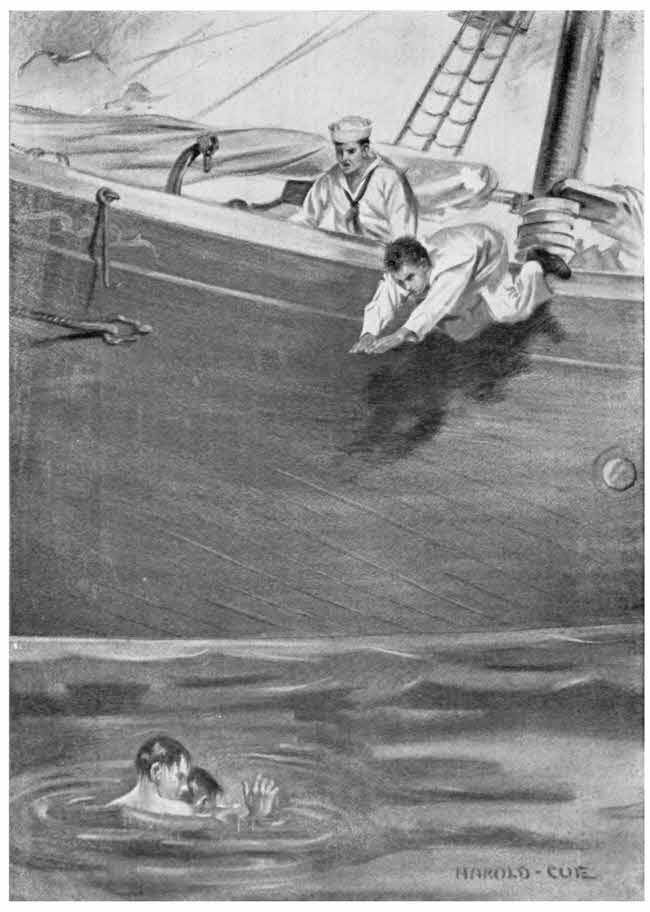
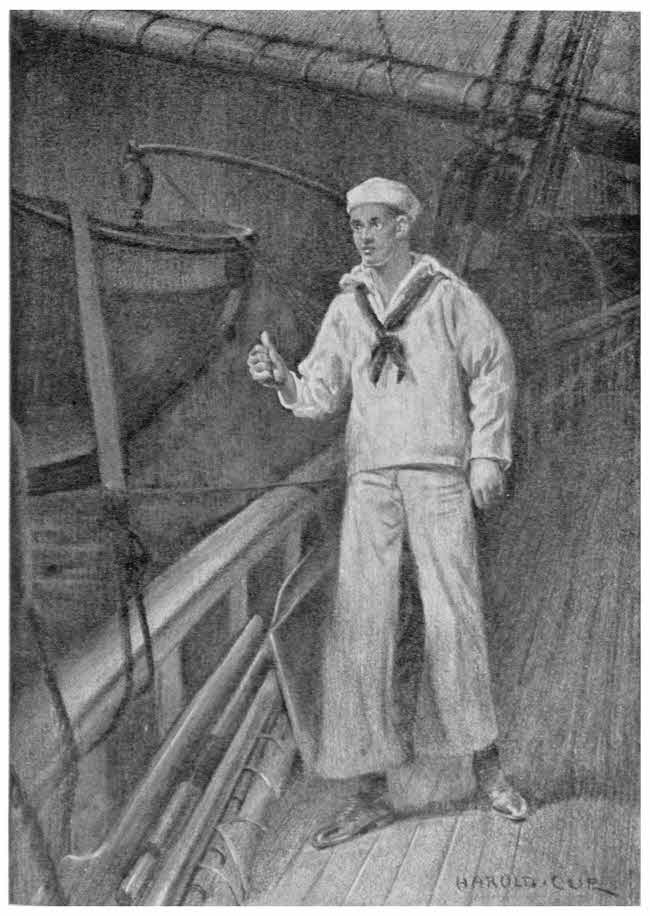
Without thinking of the side-ladder, he dove off the rail. Frontispiece.See page 205.
BOY SCOUTS AT SEA OR A CHRONICLE OF THE B. S. S. BRIGHT WING
BY
ARTHUR A. CAREY
WITH ILLUSTRATIONS BY
HAROLD JAMES CUE
BOSTON LITTLE, BROWN, AND COMPANY 1918
Copyright, 1918, By Little, Brown, and Company.
All rights reserved
Published, September, 1918
THE UNIVERSITY PRESS, CAMBRIDGE, U. S. A.
TO
MY SHIPMATES
ON THE
BOY SCOUT SHIP PIONEER
PREFACE
This is not a boys’ “book of adventure”
but an imaginary chronicle based upon the
setting of an actual cruise. It is believed
that there are Sea Scouts who will recognize
familiar surroundings and will recall the
ideas which are associated with them; and
it is hoped that Land Scouts will feel, on
the Bright Wing, the same spirit that they
associate with the inspiration of the camp
fire.
“Say, George, won’t you come down to
the island this afternoon and spin us a
yarn? You know we’re going to Boston
to-morrow to ship on board the Bright
Wing, and we want to talk things over;
perhaps you could give us some extra
points.”
The speaker was Dick Gray, who had
been an apprentice Sea Scout ever since
the previous autumn, and was now about
to take his first summer cruise on the Boy
Scout ship with his two companions, Tom
Sheffield and Chippie Smith. He was talking
to his brother George, a midshipman
just home from Annapolis for his vacation,
and he naturally looked up to him as an
authority in nautical matters. Besides,
George had recently returned from a long
trans-Atlantic cruise, and he had only
just heard of Dick’s interest in the Sea
Scouts. Much had happened since
George’s last visit home, and Dick was
eager to tell him all about it and to win
his sympathy and approval.
The headquarters of the three boys was
a little shack on Duck Island, which formed
part of the home farm, where, for a couple
of years past, they had kept their pets and
hatched all the plans for their various adventures.
George was a good deal older than Dick,
and had recently—within the last few
days—heard a story which had impressed
him so deeply that his idea of all his duties
as an officer had been changed and heightened.
When, therefore, Dick asked him
to come down to the island and to spin a
yarn to the boys, this story immediately
jumped into his mind and he wondered
whether he could tell it in such a way as
to create in them the same feeling that it
had aroused in him.
“I wish I knew more about your Boy
Scout business, Dick. Can’t you tell me
something about it?” he asked.
“Well, now,” answered Dick, “to pass
for apprentice we have to know more
knots than the Land Scouts do to pass for
tenderfoot, and to swim twenty-five yards
farther.”
“That isn’t exactly what I’m after,”
replied George. “I understand that the
Land Scouts learn more woodcraft and
such things than the Sea Scouts, and that
the Sea Scouts are supposed to be more
at home in the water. What I would
like to know is what the Boy Scouts are?
I met some one the other day who explained
to me that there were two branches of the
service—corresponding to the Army and
the Navy—but he did not tell me exactly
what the service itself was. Now, in the
Navy, it’s our duty to defend the country
by sea, and all our education is intended
to make us efficient in seamanship and the
art of war. The object of the whole thing
is just the same in the Navy as in the
Army, except that the one fights by sea
and the other by land. It’s the protection
and service of our country in either
case, and both branches take the oath of
allegiance.”
“That’s it!” said Dick eagerly. “We
have an oath, too, and it’s the same oath
for the Sea Scouts as it is for the Land
Scouts. I guess it’s the same for Boy
Scouts all over the world; although, of
course, they use different words and speak
in different languages.”
George asked his brother to repeat the
oath, and then he remarked:
“I’m glad to know that oath, Dick. It
has helped me to understand more about the
whole thing.”
“I’ll get you the manual,” said Dick,
“and you can look that over and see for
yourself what the law is.”
“The law? Oh, I suppose that’s a sort
of Regulations. Run and get me the book
and I’ll come down and spin you a yarn
before supper time. When do you expect
the other boys?”
“At four o’clock.”
Dick ran off delighted, and hastened
over to the island to put everything
straight for the meeting in the afternoon.
Then he came back to the house and
telephoned to Tom Sheffield in the town,
for fear he might possibly make a mistake
in the time or forget to come, and asked
him not to forget to bring Chippie with
him either.
They arrived on time, sure enough; and
George and Dick were already on the island
to receive them. After they had squatted
down on the floor of the shack, George
lost no time in beginning.
“Before I begin my yarn, fellows, I want
to say that I have had a good talk with
Dick about the Boy Scouts, and I have also
been reading carefully the scout oath and
law, and other things given in the manual.
I understand more about it than I did before,
especially about the first point of your
oath, which is: ‘To serve God and my
country, and to obey the Scout Law.’ In
the Navy, we have to take an oath of allegiance,
too, but are supposed to serve our
country principally through fighting, while
you are trained to serve your country in
all sorts of different ways. In the Navy and
the Army we have to fight with shot and
shell and cold steel; but this is not the
only kind of fighting a fellow may have to
do in order to serve his country. He has
got to fight the evil in himself in order to be
trustworthy, helpful, brave, and all the
other things that your scout law requires.
These things that you have to learn are
the very foundations of service; and, if you
should engage in military work later on,
your training in these things will make you
far better soldiers or sailors than you
otherwise would be. I can only say that
I wish I had had such training before I
went to Annapolis. The fact is, every man
has to know how to fight, whether he is a
soldier, or a sailor, or a civilian; and, unless
you know how to fight against meanness,
and falsehood, and cowardice beforehand,
you won’t make so good a military man or
so good a citizen when the time comes.”
“How about your story, George?” remarked
Dick.
“All right,” replied George. “Here goes:
I was staying with my chum, John Stimson,
over the week-end a while ago, and, as we
were going in to dinner with his father,
Admiral Stimson, I stepped back at the
door to let the old gentleman pass, but he
held out his hand and signed for me to go
first—I suppose because he was my host.
As he did so, he said with a smile, ‘After
you, pilot!’ Of course I walked in ahead
of him, in obedience to his order, but I
couldn’t make out what he meant by
‘pilot’, and the conversation was such that
I could not butt in with a question about it.
After dinner I got hold of John, who explained
to me that it was a custom in the
Navy, commemorating the act of Captain
Craven of the U. S. S. Tecumseh at the
battle of Mobile Bay.
“John said his father was never tired of
telling the story, and was sure that he would
be glad to tell it to me then and there. He
asked me to wait a minute while he went to
his father’s study to find out, and returned
in a few minutes with this message: ‘By
all means,—come in right away.’
“Well, boys, I wish I could tell it to you
the way the old Admiral told it to John
and me. But, as I can’t do that, I’ll just
give you the facts: The Confederate fleet
were up in the bay, protected below by
strong coast fortifications on either side.
The Tecumseh was the first ship in the line
of Union vessels which were fighting their
way up into the bay against the bombardment
of the forts. Captain Craven was
up in the turret with the pilot, who was
pointing out the channel through the mine
fields which had been carefully prepared
by the enemy. But a mistake was made
in the ship’s course which brought her into
contact with a mine, striking her so that
she went on her beam ends.
“You understand what this means?”
said George, after a little pause, and he
held up his two hands to indicate the angle
to which the deck of the vessel would rise
under the circumstances.
“Then she settled down with a kind of
shivering motion and began to sink as the
sea flowed in through the gash in her
side.
“The inside of the turret was a small
place and the two men shut up there were
in close quarters. The only way out was
the way they had come in, through an
opening in the turret deck, like one of the
manholes you see leading underground
from the surface of the street. There was
a little ladder in this manhole, and only
room enough for one man to pass at a
time. As the vessel settled and sank, it
was inevitable that the water should rise
in the manhole and ultimately fill the turret.
There was no time to lose if either one was
to make his escape from the death trap.
It must have seemed a long wait to the
two men as they stood facing one another
and taking in their situation. But it
probably wasn’t as long as it seemed before
Captain Craven pointed to the manhole
with the words that Admiral Stimson had
quoted to me:
“‘After you, pilot.’
“You see, boys, Captain Craven had a
law similar to your scout law; and, according
to that, the captain of a sinking ship
cannot think of saving himself until everyone
else on board has been rescued. He
obeyed this law of his calling without
hesitation; and, when the pilot had made
his escape down the manhole and been
picked up and rescued, the water rose and
filled the turret, and the captain went
down with his ship. The whole thing
could not have lasted more than a few
minutes, although it must have seemed
much longer; and, in that time, Captain
Craven had maintained his honor and that
of his country at the expense of his own
life, while at the same time saving the life
of another human being.”
George had realized the scene with so
much vividness as he told the story, that
all the three boys present felt as if they,
too, had witnessed Captain Craven’s act
of heroism. Dick felt, somehow, as if
the opening of the manhole were right
before them in the middle of the floor of
the shack, and all three of them shared in
his feeling. There was a long pause during
which they visualized that scene in the turret
of the Tecumseh.
George finally broke the silence:
“When the Admiral had finished, I sat
back in my chair in a quiet kind of way,
and after a while, the old gentleman
spoke.
“‘You see, Gray,’ said he, ‘Craven only
did his duty; but what enabled him to do
his duty at that moment so nobly was the
fact that he had done it hundreds of times
before—again, and again, and again—in
the ordinary affairs of his life and work.
If he had been in the habit of shirking his
studies, or of being mean to other fellows,
or of yielding to fear in his ordinary life
from day to day, he would have formed
habits which would have made it difficult
or impossible for him to be generous and
manly when the supreme test came.’
“I couldn’t say very much,” continued
George, “except to thank the old gentleman,—but
I thought to myself, ‘You’re
just such another one as Craven; and, if
you were to ask me to cut off my finger,
or my hand, I’ll be hanged if I wouldn’t
do it.’
“Well, after that,” George went on, “I
began to think about the Academy, and
I seemed to see a thousand things that I
might have done differently and better;
and it seemed to me that I could hardly
wait until vacation was over to get back
to my work. Maybe, when you come back
from your cruise, Dick will write me a letter
and say how you got on, but I advise
you to do the same thing that I’m going
to do,—to think of that story every day
and to put more push into doing the things
that my oath requires.
“I suppose you fellows are going to
have your meeting now, and I’ll go up to
the house and unpack my trunk; I’ll see
you again at supper.”
There was another pause after George
had left the three boys, until finally Chippie
remarked:
“I never thought of that before, fellows;
but, when you do act in one way right
straight along, you learn to do it better
all the time. You remember a year ago
I couldn’t knock up a ball decently; but
I worked at it quite a lot, and the more
I did it, the easier it came.”
“That’s so,” remarked Tom, “and you
can knock up about as well as I can, now;
but it seems kind of different with games
and sports from what it does with other
things that aren’t so much fun.”
“You bet it is,” chimed in Dick; “my
mother gave me a letter to mail last week,
and I found it in the pocket of my jacket
three days after—a scout is trustworthy,
eh? I tell you what it is,” continued
Dick, “you know we have called ourselves
a club and nobody knows it but ourselves,
and we’ve been stickin’ up for each other at
school and in the town when other fellows
have tried to pitch into us, and that’s all
right. But it seems to me that we could
do more than that, and I’ll ask you two
fellows to give me a dig in the ribs,—or if
that doesn’t work—a punch in the nose,
when you see me going to do a mean thing.
I want to keep the scout law and my oath
as much as I want anything, and I don’t
see why you shouldn’t help me do that as
well as to stick up for me when some other
cove calls me names behind my back!”
Chippie and Tom looked at each other for
a moment, and finally exclaimed together:
“Gee!”
“Then,” answered Tom, “why shouldn’t
we all do the same thing? You know how
hard it is to do things on time; and there’s
no ‘being trustworthy’ unless you do. So
Chippie, you and Dick just kick me out of
bed when it’s time to get up, and I’ll be
much obliged to you. Dad says I’m lazy,
and I know he’s right, but I’ve got to learn
to keep this scout law—or bust!”
All three assented cordially to the idea
that they should join forces as brothers-in-arms
against everything that stood in the
way of their scout duty.
“I say,” cried Chippie, “this is what I
call a club! And, see here, there are just
three of us. Why not call it The Triangle
Club?”
“And I vote,” said Tom, “we make this
our motto:
“After you, Pilot!”
CHAPTER II Getting Ready
Two weeks before the founding of the
Triangle Club, referred to in the last
chapter, Ship’s Company Number 1, of the
Sea Scouting Branch of Northbridge Boy
Scouts, were holding their last meeting in
their regular assembly room before the
beginning of the summer cruises.
The B. S. S. Bright Wing was to sail from
the Boston Navy Yard in just two weeks,
and some of the younger boys were already
beginning to feel that they must get their
sea legs on so as to “be prepared.”
Dick Gray showed keen interest and
great enthusiasm for this new venture in
scouting; and because he was a good swimmer
and loved the water, he hoped to
prevail upon his father to apply for a
berth on the Bright Wing during her first
cruise of the season. He was a painstaking
boy, and had always been useful
about the house since he was “knee-high
to a grasshopper.” His mother, though
not an invalid, was very far from being
robust; and, as Mr. Gray could not afford
many servants, her household duties might
often have been too much for her if Dick
had not been there to take hold and lend a
hand. Though not tall for his age, he was
strongly built, and, if it had not been for
occasional dark and gloomy moods, he
would have been almost indispensable both
in the house and on the farm. Naturally,
every one was glad when they heard that
there was a chance for Dick to go on a real
cruise, for they knew that the boy’s personal
interests—however willing he always was
to keep them in the background—all lay
in the direction of seafaring.
“I do hope,” said old Robert, the farm
hand, to Mr. Gray, “that boy will get his
chance at the sea, this year! He does
deserve it, if ever a boy did.”
“Yes,” replied Mr. Gray, much pleased
with Robert’s approval of his son, “I
think it will do him good. He’s a good
home-body, we know, but we don’t know
how he’ll turn out as a sailor among a lot
of other boys; I can’t be sure how he’ll
behave away from home when one of his
‘moods’ comes over him.”
While Mr. Gray liked Dick’s enthusiasm,
he felt that he ought to find out as much as
possible about the conditions of the life on
board before making a decision, and that is
what had brought him this evening to one
of the regular Sea Scout meetings, to learn
for himself, as much as he could, what the
idea and the spirit of the undertaking really
were. After he had been greeted by the
scout master in charge—Mr. Howard Miller—while
the boys all stood at attention—one
of the older scouts, Jack Perkins, was
detailed to stand by and give him all the
information he possibly could.
Jack had been a boatswain’s mate for
two summers running, and there was nothing
he enjoyed more than explaining the
details of the work to a new acquaintance;
so he placed two chairs for himself and Mr.
Gray on the low platform at the rear of
the hall, where they could command a full
view of all the proceedings, and then began
talking to him in a low voice:
“You see, sir, the room here is arranged
so as to be as much like the deck of a ship
as possible. This broad platform that we
are sitting on, with the colors hoisted in
the center, is the ‘quarter-deck’ where
only senior officers are allowed, with the
exception of Sea Scouts on watch and of any
seaman whose duty brings him here. That
door over there, by which we came in,
stands for the vessel’s bow, because it is
just opposite the quarter-deck; but this
is only so in a general way to indicate the
direction of bow and stern, or ‘fore and
aft,’ because it is also used as the gangway
by which every one passes over the ship’s
side either to come aboard or leave the
vessel.”
“I understand,” said Mr. Gray. “I
must confess that I did not know that I
was stepping over a ship’s side when I
passed through the door a few minutes
ago!”
“Why!” exclaimed Jack, “didn’t you
hear the boatswain’s call as you entered
the room, sir?”
“Sure enough, sure enough,” said Mr.
Gray. “I heard a whistle with a peculiar
musical trill, but I did not know what it
meant.”
“Well, sir,” said Jack, with a certain
quiet dignity, “that is the salute that is
always given to visiting officers when they
come on board.”
Mr. Gray’s face lit up with a smile of
intelligence. “Well, to tell the truth, I
did feel something pleasant; and, now that
I think of it, you boys were standing at
attention at that very time when Mr. Miller
came up and shook hands with me.”
“That’s right, sir,” said Jack. “We
older Sea Scouts like these little bits of
ceremony, especially because it’s just what
happens when we are aboard the old
Bright Wing, and brings back the taste of
the salt water and the feel of the breeze on
your face.”
“I see—I think I understand,” said the
older man with a pleasant smile, and looking
down the room, his smile broadened
as he took in the bright and cheerful scene
before him.
The Sea Scouts were all in their white
jumpers and hats, for the idea of a ship’s
deck of course included that of “out of
doors”, and hats were only removed when
something happened, like the arrival of a
mother or sister.
The boys were grouped according to
their sections (corresponding to patrols),
in four little knots, each surrounding a
table at which one of the boatswain’s
mates, the scout master, or some other
instructor, was presiding. They were sitting
around their little tables like Land
Scouts around a camp fire, listening and
talking in low tones, so as not to interfere
with what was going on in the other groups.
One set of boys was tying knots and splicing
bits of rope with a marlinspike made by
themselves out of good hard wood. Dick
had done so well with his knots that he had
been put in charge of this group in the
absence of the regular instructor. At another
table a chart was spread out, and the
parallel rules and dividers were traveling
back and forth over the ocean amid contented
murmurs and eager questions from
the boys. In another corner the boatswain’s
mate was putting his men through
an informal examination in signalling. The
whole scene, while very varied and animated,
had the delightful atmosphere of
combined activity and contentment.
Mr. Gray felt that every boy there was
having a good time, and could not help
catching the contagion of contented work.
He made some further inquiries of Jack,
and learned that each section rarely was
kept on one subject more than twenty
minutes or half an hour at a time, and
that the instructors went from one group
to another.
“You see, sir,” said Jack, “this is not
intended to be like school, and we don’t
want to keep a scout working at one thing
until he gets tired of it. It is something
like feeding your dog! He should have an
appetite for more at the end of every meal.”
Mr. Gray sat musing quietly for a few
minutes while his mind wandered back to
his own boyhood. “I wonder,” thought
he, “that there was nothing of this sort
in existence when I was a boy!” Presently
he turned to his companion with the question,
“What is that green light in the right-hand
corner and the red one on the opposite
side?”
“Those are the starboard and port side-lights,
sir, that are always run up at sunset
when under way, and it is good for the new
fellows to get used to their right position
before they go to sea. I think you remember
things by pictures in your mind
better than you do by words. You see, sir,
the boys have to light and lash these lamps
in their proper places before every meeting;
and then, when ‘Colors’ are over and the
boatswain blows ‘stow away all gear’, the
lamps and all other things have to be taken
down and properly stowed away. That’s
another thing, sir, I learnt from sea scouting
that no one could ever pound into me on
land. Before I went to sea I was the most disorderly
lubber you ever set your eyes on; but
on a ship there’s just so much space allowed
to every man, and so every one is obliged to
have a place for everything and everything
in its place. Some fellows laugh at me now,
but it makes me feel funny if I don’t find
my shoe brush hanging on its own hook.
If the fellows did not feel that way aboard
ship, the whole place would be a mess and
a litter in no time, and none of the gear
would be in its place when needed; it
would certainly cause delay and confusion,
and might sometimes even be dangerous.
“These two groups on the right-hand
side of the hall, where the green light is
placed, are the two first sections of each
division; and the other two, on the left-hand
side as we face the door, are the two
second sections of each division, on the
same side as the red side-light. Of course,
you understand, sir, that these are the four
sections of a ship’s company as they stand
on the deck of the Bright Wing,—each
one being also the regular crew of one of
the cutters or of the launch.”
Mr. Gray nodded assent, and then said
with a laugh, “You mustn’t tell me anything
more to-night, my boy, for I have
taken in enough for one evening. You have
given me a great deal to think about, and
I am happy to believe that Dick—”
Just then the bugle rang through the
hall, and, after a few sharp words of command
from the scout master, the boys fell
into formation for “trooping the colors.”
Each section was represented by its color
bearer and color guards, while the rest of
the ship’s company were drawn up on
either side fore and aft. At the word of
command the section colors were marched
up to the quarter-deck, two on each side
of the national ensign, facing one another.
Then the whole company present faced
about towards the Stars and Stripes while
the bugler sounded “Evening Colors.”
At the final salute the section colors were
smartly dipped, while every man’s hand
was raised to his hat, and the color bearers
marched down again to their places in
formation.
All hands were then dismissed, and the
formal activities came to a close. Only
one thing remained to be done, and that
was the stowing away of all gear. Mr.
Miller stood with watch in hand while the
boatswain piped the order, and Mr. Gray
noticed Dick rushing across the hall to
stow away the ship’s bell, while other boys
were carrying the side-lights, the bill-boards,
and all the other articles for which
they were responsible. Presently Mr.
Miller’s voice rang out: “One minute and
fifty-two seconds! Record time!”
Just then Dick came running up to his
father. “Well, Father, what do you say
about the Bright Wing—don’t you think
this is just about right?”
Mr. Gray assented smilingly and said:
“I tell you what, Dick, if you will get this
young man here to give you a little coaching
before you go aboard,—well, I have nothing
more to say.”
For about a second Dick seemed struck
dumb with pleasure, while his eyes sparkled.
“Sure!” cried he, “won’t you, Jack?
Say, when can I come around and see you?
and may I bring Tom Sheffield and Chippie
Smith along, too?”
Jack thought for a minute and then
turned to Mr. Gray. “I will be glad to
help them all I can, sir. Dick, you come
around with the other fellows to-morrow
after supper.”
“Gee!” Dick seemed to grow two inches
taller in the next minute, and then rushed
off to find Chippie and Tom.
CHAPTER III Jack—Chief Boatswain’s Mate
The next evening Jack cleared the table
for his mother after supper and got
the dining room all snug and shipshape.
His own room was very small and at the top
of the house; and, as his mother had offered
to bring in some refreshments for the boys
later in the evening, Jack asked permission
to hold his meeting in the dining room.
His father had gone out to his Lodge,
and Mrs. Perkins was very much interested
in Jack’s interview with the younger boys.
Her father had been a sea captain, and there
was a picture of one of his ships hanging
over the mantelpiece in this very room.
Some beautiful large shells which he had
brought home from one of his voyages
stood over the fireplace, under the picture
of his vessel, the Sally Smart—an old-fashioned
clipper ship—famous in her
time for her speed and style. The whole
room had a somewhat nautical flavor;
and in one corner was a low long lounge
with a broad shelf partially overhanging
it, which gave the general appearance of a
ship’s bunk.
When Jack had won the cup for the broad
jump, representing the Northbridge High
School, Mrs. Perkins, in her motherly pride,
had put the pewter cup alongside of her
father’s shells on the mantelpiece.
It was a warm, spring evening. The
scent of the lilacs was wafted in through the
open door, and Jack could hear the boys’
footsteps as they came through the dooryard
up to the porch. He met them at the
door and led them into the dining room.
“You come right in here, kiddies, and
make yourselves at home. You might as
well get into the bunk there in the corner,
all of you, and be as comfortable as you
can before I begin with you, for I hope to
get you good and tired by the time I get
through!”
The small chaps could not help feeling at
ease under the influence of Jack’s cordiality.
He was really glad to see them, and they
knew it, and so they took him at his word,
and all three—Dick, Tom, and Chippie—snuggled
into the bunk together, half
sprawling and half sitting, like a litter of
young pups.
“Fire away now,” cried Dick, “we don’t
care whether school keeps or not; and,
whatever you’ve got to say, I guess we can
stand it!”
“Well,” replied Jack, “joking apart, I’m
feeling pretty well this evening myself, for
I have just had news from Mr. Miller
that I am appointed Chief Boatswain’s
Mate of the Bright Wing for the first cruise.
Now, you lazy lubbers, take notice that the
Chief Boatswain’s Mate is the father of the
crew, and you’ve got to mind what I tell
you, or you will have to stand on the seam,
or walk the plank, or do anything else that
Dad says.”
All this was said so good-naturedly that
even Chippie, the youngest, was encouraged
to answer back; so he called up with his
small voice out of the recesses of the bunk:
“Gee, boys, he talks as if he were the
Captain and Mate and the Admiral of the
fleet all at once; but I guess he means
well enough!”
“Good luck to you, Boatswain’s Mate,”
called out Tom, “it’s a good thing to get
some of your ideas ahead of time, and then
we’ll know what to expect.”
“Say,” said Dick, “aren’t there any
officers above you, or are you and the crew
the whole show?”
Jack sat listening to these flying remarks
with quiet satisfaction. “No matter what
I am,—you’ll find that out soon enough;
but I’ve been thinking myself that there is
nothing like ‘being prepared’ when you
have a good job ahead of you. I shall have
to see that you lubbers are licked into shape
the first or second day on board, and I
might as well begin now, and so have more
time for the others later on!—See?
“But, before we begin, I’d like to find
out whether you know what ‘standing at
attention’ means; for if you get that right
from the start, it will save you and your
officers a lot of bother.”
The boys began getting up out of the
bunk; and, before they had all stood up,
Jack gave the command “Attention!”
All three were on their feet in an instant,
and then Jack formed them in line and made
his inspection.
Dick, in his eagerness, was stiff and
leaning over backwards; Tom stood fairly
erect with chest up, but his fists were
clenched; and Chippie stood with one foot
about six inches ahead of the other. None
of them looked straight ahead with quiet
eyes.
Jack corrected all these mistakes very
carefully, impressing upon each one the
necessity of practising by himself until he
could stand with heels together, chest up,
back erect, little fingers on the side seam of
trousers, and eyes looking straight ahead,
without thinking of the details, but, as it
were, automatically. Then he gave the
command “At Ease!” and explained that
they could take any position they chose,
provided that one foot remained in the
same place.
“Now tumble into your bunk again, for
we’ve lots more to talk about. When you
get home, look up the subject of ‘Etiquette’
in the pamphlet, ‘The Organization
of Sea Scouts’, and there you can find out
when you are supposed to stand at attention,
and how to salute, with a few other necessary
things.” Jack then drew himself up
with an air of great authority: “Ladies
and Gentlemen, I will now proceed with
my instructions to this pirate crew. The
subject will be divided into three parts:
The first, Officers and Petty Officers;
second, the Plan of the Deck; third,
Etiquette and ‘A Sailors’ Cheer.’
“Number one: I have been asked
whether there are officers higher in rank
than myself. It might have occurred to
the intelligent inquirer that—the—Captain—is—in—charge—of—the—vessel.
All orders come from or through
him; but, just as on board a man-of-war,
the Secretary of the Navy would be higher
in rank than the Captain;—so, on board
a Boy Scout ship, the Chairman of the Sea
Scouting Committee outranks the Captain.
Under the Captain are the Mate and Sea
Scout Master of equal rank, the First Mate
being the Captain’s assistant in sailing
the vessel, and the Sea Scout Master being
in command of the crew of boys. For the
rest of the organization I refer my audience
to the same interesting pamphlet, ‘The
Organization of Sea Scouts.’ My own
responsible office, upon which I will permit
no reflections, is that of the first of the four
Boatswain’s Mates, or the Chief Boatswain’s
Mate, as I think I have before
remarked. I am in command of the first
section of the first (or forward) division in
particular, and of all four sections in general.
I am the chief Boy Officer; but, while
occupying this exalted position, I recognize
the authority of my superiors and the
authority of the scout law. I am immediately
responsible to the Sea Scout Master
and his assistants, but may also receive
orders from the Boatswain, the Mate, the
Captain, and the Chairman of the Committee.
If I were to get a ‘swelled head’
and refuse to obey orders (which is impossible,
I trust), it would be the duty of
the First Mate to deal with me in the traditional
manner of first mates on all self-respecting
vessels.
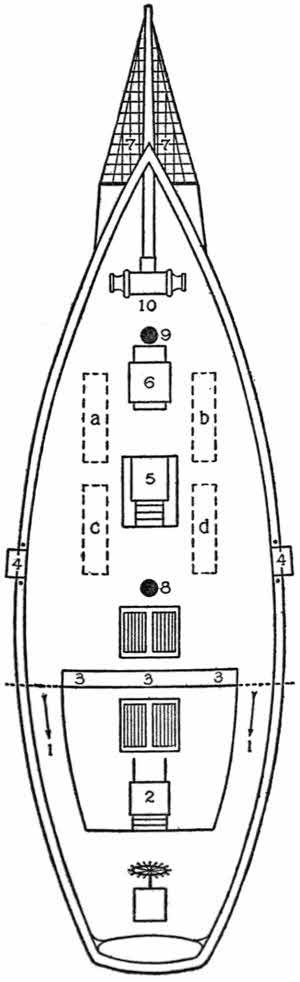
Sketch of Deck Plan of the Boy Scout Ship “Bright Wing”
1. Quarter-deck (aft of
dotted line, in direction
of arrows).
2. Cabin Companionway.
3. Crew’s Day Bunk.
4. Side Ladders.
5. Berth-deck Companionway.
6. Forecastle Companionway.
7. Jib Netting.
8. Mainmast.
9. Foremast.
10. Windlass.
a, b, c, d, regular positions
of the four sections
at quarters.
“Number two: I have drawn up a diagram
of the ship’s deck, showing the position
of the quarter-deck (Number 1);
the cabin companionway (Number 2);
the crew’s day bunk (Number 3); the
side ladders (Number 4); the berth deck
companionway (Number 5); the fo’castle
companionway (Number 6); and the jib
netting (Number 7); the latter being an
airy place suspended between sky and sea,
where sleepy scouts off duty can take a nap
after dinner.
“Gentlemen will please copy this diagram,
so that, if necessary, they will be
able to reproduce it in their sleep and find
their way about the deck in the dark.
There are many other things to learn about
the ship, both inside and out, but this is
just to give you a start. I shall be glad to
answer any questions at the proper time.”
A confused mixture of voices came out
of the bunk. The boys had become much
interested in Jack’s lecture, and three
pairs of eyes gazed out upon him from
the dim light, one pair peering from under
a shock of red hair belonging to Chippie
Smith; one black pair that belonged to
Dick; and a blue pair that shone out of
the freckled face of Tom’s cropped towhead.
“Say, who’s the chairman?”
“What’s a companionway?”
“What are the side ladders for?” etc.,
etc., etc., etc., and right in the middle of the
uproar, Jack rose and gave the command
“Attention!” All sprang from the bunk
and stood facing the door from the kitchen
which had just swung open. Mrs. Perkins
stood in the doorway with a tray in her hands,
upon which were a pitcher of lemonade and
some hot gingerbread, fresh from the oven.
All the boys stood as quiet as mice until
she had deposited the tray on the table.
When Jack had thanked his mother, he
gave the command “At Ease!” and she
turned to the boys, almost with anxiety,
to find out whether Jack had made his
talk pleasant and interesting.
She had a sailor’s blood in her veins,
and she knew that a ship’s company must
be a happy one if it was to do anybody any
good. So she seconded Jack’s efforts with
the true sailor’s cheer and the boys felt
nothing but pleasure and enjoyment in
connection with their little taste of drill in
nautical knowledge. They all sat down to
their supper, but Jack reminded the boys
that he had not reached the third point
of his lecture, namely that of Etiquette,
and then asked his mother’s permission to
round up the evening’s instruction, which he
did quite simply and without any more
mock heroics.
“Now the next thing I want to tell is
about the quarter-deck. You see, boys,”
he said, “in ancient times every ship carried
a crucifix high up aft, and the National
Ensign was flown just below it. These
two symbols represented together the idea
of God and the King, and therefore were
saluted whenever a man passed over the
side, either on arriving aboard or leaving
the ship, and whenever a man came up
from below on to the deck. We preserve
the same custom now both in our Navy and
on Boy Scout ships; because, although the
crucifix and the King have disappeared, the
ideas of God and our country always remain,
and the custom of saluting the quarter-deck—whether
the flag is flying at the time or
not—is an expression of the first words of
the scout oath: ‘On my honor I will do my
best to do my duty to God and my country.’”
It was interesting to note the change in
Jack’s manner as he solemnly repeated
these words. Any one could have seen
that he regarded them as very important
and as expressing an idea to be held in
reverence. The younger boys listened
attentively and, after a little pause, during
which his words seemed to be sinking into
their minds, they thanked Jack for giving
them such a good send-off, and then thanked
his mother with real gratitude for her
friendliness and the good little supper which
they had so much enjoyed.
All hands parted in high spirits, full of
expectation of the time when they should
actually tread the deck of the Bright Wing.
As they were going home, Tom suddenly
said: “Gee, I guess I’ll get up an hour
earlier to-morrow morning and work on
that diagram!”
“Say,” said Chippie, “he didn’t tell us
the positions of the four sections on the
deck; I’d like to mark them on my drawing.
I’ve half a mind to go back and ask
him now!”
“Oh! come along,” said Dick, “it’s too
late; my Dad says you mustn’t drive a
willing horse too far.”
“All right, Dick!”
And so they separated, each one to his
own home and bed, to dream of bunks, and
quarter-decks, and companionways, all
mixed up together.
CHAPTER IV All Hands Aboard!
On Tuesday, the twenty-third of June,
the Bright Wing lay in the berth
assigned to her at the Navy Yard, all prepared
to set sail at noon. There was a
moderate breeze down the harbor, the tide
was high at eleven o’clock, and all she would
need would be a tow out for a mile or so to
get out of the way of the shipping.
Everything was shining on board. The
ship carried a new suit of sails, and her
paint and bright work were all gleaming
in the sunlight. At the fore topmasthead
the Boy Scout flag was rippling, and at
the main truck the long pennant was waving
gracefully. The ensign did not catch the
wind so well, being under the lee of a big
battleship docked close by. Everything
looked as if the Bright Wing were chuckling
to herself in anticipation of her coming
venture.
The three Northbridge boys had come
up by the early train, accompanied by Mr.
Sheffield and Tom’s sister Eleanor, and
Chippie had immediately gone below to
hunt up his locker, where he was putting
the contents of his sea bag in order. The
other two boys remained on the dock, taking
in the scene before them with pride and
pleasure; Dick talked with Mr. Sheffield
about different points of special interest,
while Tom’s beaming face spoke more
eloquently than words as he and Eleanor
listened to the conversation.
“She’s like a duck in the sunshine!”
said Dick.
“Yes, right after her morning dip,” said
Tom.
Presently Mr. Sheffield and Eleanor bade
the boys good-by and Tom and Dick
jumped on to the deck.
Some of the other boys had come on
board the night before and had already put
their lockers in order and got into their
white uniforms. Dick and Tom received
their individual “station billets” upon
which they found all the information as
to their bunks, lockers, divisions, sections,
and special duties in the different emergency
drills, written out clearly, so that
they could set to work at once to find out
where they belonged, what was expected
of them, and how to make themselves
comfortable.
At a quarter to eleven the boatswain’s
pipe was heard, loud and clear, and the
order “all hands aboard” rang out. The
few scouts who were left on the wharf cut
their good-bys short and quietly clambered
down the ratlines or jumped on to the deck.
Then the gangway was hauled up, the
hawsers released, and the Bright Wing
sat, like a gull, free in the water. In the
meantime the Government tugboat had
backed up within easy distance and thrown
her line on board; and, as the vessel drifted
into the channel, the tug got under way,
the line tightened, and the Bright Wing
followed in her wake.
The regular watch were at their posts on
deck as a matter of course,—the lookout
in the bow, the boatswain’s mate with
his quartermaster and other seamen just
in front of the quarter-deck, while the
rest of the boys climbed up the rigging,
shaking their hats in final farewell to their
friends ashore.
It was not long, however, before they
were far enough out in the channel for the
tug to leave them. Jack Perkins was in
the bow in charge of the line; the Captain
was at the wheel; Jack was waiting for the
order to “let her go”, and, as soon as the
words reached his ears, he cast off the line
which slipped into the water and left the
Bright Wing to her own resources. The
Captain of the tug waved his hand in salutation,
the sails filled, and a sense of living
motion was felt by all on board as the Bright
Wing rolled over slightly and began cleaving
the water under the pressure of her sails.
Tom and Dick were standing near the
rail, well forward on the windward side.
“Gee!” cried Dick, “what a difference
there is between sailing and being towed.”
“You bet,” said Tom, “something like
being alive or dead!”
Soon after they had parted from the tug,
the bugle sounded for mess inspection, and
the scout master passed up and down the
line. After that, all hands waited “at
ease” until the cabin boy came up on deck
and announced dinner to the ranking officer.
The boys then marched aft by twos,
followed by the officers, and stood at their
places at the tables until after grace.
Dick, Tom, and Chippie, much to their
disappointment, found themselves in different
sections, so that they did not sit together
at meals; but Dick sat next to his boatswain’s
mate, who was Clarence Ellsworth.
“Say,” said Dick, when he got a chance
to speak, “why do the boys go down to
dinner before the officers? You’d think
the officers would march down first.”
“Well, you see,” said Ellsworth, “those
who go down first have to wait for the others,
and the officers come down when everything
is ready to pitch into the food. Something
like getting into a boat,—we have
to go down first to get things ready. (Law
Number 5.) It’s the same for Sea Scouts
and for all sailors everywhere.”
“Oh, I understand,” said Dick.
The boys’ table ran down the whole
length of the berth deck—fore and aft—on
the starboard side, while the smaller
officers’ table was on the port side. Jack
sat at the head, or forward end, of the
boys’ table as chief boatswain’s mate.
The talk was very animated and rather
loud, for, of course, the boys felt the pleasant
excitement of new surroundings and
unaccustomed conditions. Some of them
were shy and a little awkward on account
of the strangeness of things they had
never seen before; but, under the influence
of good food and good humor, they all
gradually unbent, and the boys of each
section soon felt at home with one another.
Of course it was the business of the boatswain’s
mates to help this feeling along as
much as possible, so that they could get
the best work out of their men; for it is a
rule, both on land and sea, that the best
work is done when the men who work
together do it in a friendly and a happy
spirit. This, you will remember, is what
Mrs. Perkins had learnt from her father,
the captain of the Sally Smart. She had
taught it to Jack, and Jack had taught it
to the other boatswain’s mates.
Before dinner was over, Dick noticed the
new watch go on deck to relieve the old
one, and the old watch come down to take
their share of the good things. By the
time all the boys had returned on deck,
it seemed to him that they had gone about
half the way to their anchorage at Hull. The
remainder of the afternoon was spent
principally in putting their belongings in
order and in asking questions about the
different parts of the ship and their uses.
By half-past four they dropped anchor at
Hull, and the sails were furled; and, at
five o’clock, the bugle sounded for the first
General Quarters of the cruise.
First, the boys were drawn up in two rows
on each side facing each other, while the
setting sun threw long shadows to starboard
on the deck; they were then faced about
toward the quarter-deck to hear the first
official words addressed to them by the
Chairman of the Committee. He was a
tall man with gray hair and dressed in a blue
suit; you could see that he was fond of his
job, and Dick thought that his eyes were
noticing everything that was going on. He
spoke in a clear voice that you could hear
all over the ship, although it was not
particularly loud, and there was absolute
attention on the part of the boys.
“I’m mighty glad, boys,” said he, “to
welcome you on board this ship. You
know, of course, that we are here for a
serious purpose. The Bright Wing is not a
yacht, and we are not here just to enjoy
ourselves, although we probably shall have
a much better time than if we were. We
are here to learn to apply the spirit of the
scout law to the art of seamanship. I do
not want to keep you long now, but I
want to point out to you at the outset the
fact that you have a real responsibility as
the crew of this vessel.
“Men who are in the habit of facing
danger look it squarely in the face and do
not pretend that it does not exist. There
is always a certain amount of risk in life
at sea, although many sailors seem to think
it is more dangerous to cross Washington
Street or Broadway during business hours
than to face the most adverse winds and
dangerous currents; but, for the sake of
those we have left at home, as well as
for other good and sufficient reasons, the
safety of the vessel is something we are
bound in honor to ensure to the utmost
of our ability.
“Now there are three things which are
essential to this safety. The first is the
soundness of the vessel and her tackle, and
for this the Sea Scouting Committee, of
which I have the honor to be the Chairman,
is responsible; the second is the knowledge
and skill of the Captain, and for this
both he and the Committee are responsible;
and the third is the handiness and good
discipline of the crew, and for this YOU
are responsible.
“Both the Committee and I are satisfied
with the soundness of the vessel and her
tackle, and also with the skill and knowledge
of our Captain or Navigating Officer;
it remains for you to prove that you are
equal to the share of the responsibility
which devolves upon you, and I heartily
believe that you will prove yourselves
worthy of the trust.”
After this the boys were dismissed until
Mess Inspection and supper at half-past five.
“I say,” said a quiet boy, nudging Dick’s
elbow, as they sat eating their baked beans,
“that old Chairman seems to mean what
he says all right.”
“Yep,” replied his companion, “you
bet he does. And he expects us to toe
the mark. Any duffer can see that!”
After supper Dick found the other two
members of the Triangle Club, and they
voted unanimously that the Chairman was
“all right.”
Before prayers, the names on the Anchor
Watch were posted by Mr. Miller, with
particular instructions for the scout on
duty, and the first watch was from eight to
nine. This hour was always assigned to
one of the youngest boys, and Chippie
happened to be the one selected the first
night on board. As soon as prayers were
over, Mr. Miller hastened to join him to
make sure that he understood just what
his duties were, and to repeat to him the
instructions already posted on the berth
deck.
It was Chippie’s business to know the
name of the Sea Scout who succeeded him
at nine o’clock, and also the exact position
of his bunk. He was to keep a sharp lookout
on all sides of the vessel and to notice
if anybody hailed the ship from shore.
He was to watch the riding lights fore
and aft and to see that they were brightly
burning. He was to give notice of any
boats or other vessels approaching or hailing
the ship. On noticing anything that called
for attention he was immediately to report
to the scout master. In case of change of
weather, he was to call Mr. Wilson, the mate.
He was provided with a card called the
“Rough Log” ruled off into several different
headings on which, before the end of his
watch, he was to note down the state of
the weather, the state of the sea, the cloud
formations, the direction of the wind, and
the direction of the ship’s head, stating
the time of his observations. This card
was then passed on to his successor, so
that the complete record for the night
contained observations for every hour.
At five minutes of nine he was to go below
and wake up his successor. Then he was to
return on deck and ring the ship’s bell (two
bells) at nine o’clock. After that he was
to remain on duty until relieved; but, if
his relief failed to put in an appearance at
five minutes past nine, he was to go below
and turn him out of his bunk. He was
then to return on deck until relieved, and
under no circumstances to leave his post
before the arrival of the new watch.
“Remember,” said Mr. Miller, in conclusion,
“you are responsible for the safety
of the ship during your watch, and you are
on your honor.”
The boys had all turned in, and taps had
sounded by the time Mr. Miller had finished.
Left to himself, Chippie began pacing the
deck, stopping every few minutes to peer
out into the darkness and to listen to every
sound.
The binnacle lamp was always kept burning
so that the compass could be read; and,
in the light of this lamp, Chippie filled
out the spaces provided on the Rough Log.
He wet his thumb and held it up in the air
to judge which way the wind was blowing,
and was surprised to find how difficult it
was to make up his mind. Finally concluding
that there was no wind (a fact
which in his great earnestness he had failed
to notice), he put down a good big zero
under the heading “Direction of the Wind.”
He wet his thumb and held it up in the air to judge which
way the wind was blowing. Page 52.
“Good joke,” thought Chippie; “I guess
it won’t take me so long to find that out
next time,” and then turned his attention
to the “direction of the ship’s head”,
“the state of the sea”, “the state of the
sky”, etc.
Any job, when you are not accustomed to
it, seems awkward, and Chippie filled out
his last space with a sense of relief. Then
he ran forward to look at the ship’s clock
in the companionway, and found, to his
surprise, that it was already one minute
to nine, and he should have gone below
to wake the next watch four minutes before.
But luckily the new watch had been lying
awake in his bunk with his clothes on, and
saved Chippie the trouble of going below
by appearing at the top of the ladder just
as Chippie was about to go down. So then
Chippie went straight to the ship’s bell and—“ding-ding”—“two
bells”—rang out
into the night.
“Gee, but I’m in luck,” whispered
Chippie to himself.
Then he went aft with the new watch,
showed him the Rough Log and the list of
directions, and finally went forward again,
slipped down the companionway, and
crawled into his bunk.
“I wonder if some of the other fellows will
be trying to study out which way the wind
is blowing!” thought Chippie as he pulled
off his clothes. Then his thoughts went back
to his home in Northbridge for a while; and
presently the Bright Wing began rocking
gently in the roll of a passing steamer. He
was just awake enough to notice the motion
and then sailed off to the land of dreams.
At ten o’clock it was Dick’s turn on watch.
The last members of the crew ashore—the
carpenter and first mate—had come
aboard at half-past nine, and there were no
more hails to listen for. The boats were
all on their davits, the boat booms and side-ladders
were up, and the Bright Wing was
tucked up and snug for the night.
After Dick had finished his observations
of the weather, etc., and had filled out the
Rough Log, he watched the sky for a long
time. He did not know the stars very
well, but they had a great attraction for
him. He looked around until he found the
Great Dipper, which was the constellation
he was most familiar with, and then the
Pole-star by following the direction of the
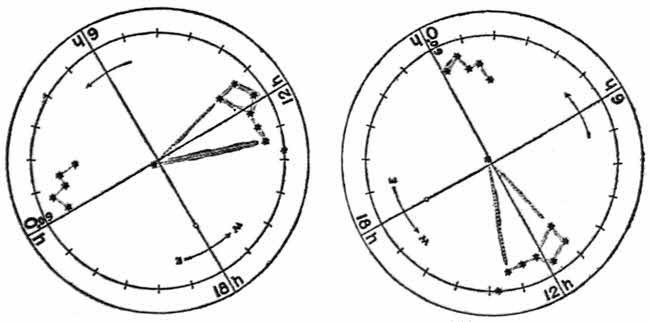
pointers. He noticed that the Dipper was
to the right of the Pole-star and below it.
Then he noticed the constellation called
Cassiopeia—in the shape of a “W” to
the left of the Pole-star and above it.
“Here’s my chance,” thought Dick, with
a sudden inspiration, “to see if the northern
stars do really turn around the pole like
a wheel as they are supposed to do.” He
then looked at the buildings on shore to
find some landmark by which to test the
turning of the stars. But his watch on
deck was already half over, and he had not
time enough to make his experiment properly.
If he had been on land it would have
been easier, but the ship was swinging at her
anchor with the tide as it ran in, and there
were no very prominent buildings in sight.
When the next boy came up to stand his
watch, Dick tried to interest him in his
astronomical observations, but he got no
response, and so promised himself to begin
his experiment in plenty of time at the
very next opportunity.
CHAPTER V The First Forenoon at Anchor
At the sound of reveille the next morning,
the boys were all out of their
bunks in short order; and, after a cup of
cocoa with some crackers, they got the
gear out of the way preparatory to scrubbing
the decks, and the cabin skylights and
portholes were closed.
“What the dickens is the use,” said
Dick to Tom, “of having all these things
done on the very minute? A fellow has
hardly time enough to look around!”
“That’s all right,” answered Tom, “the
things have all got to be done sometime,
and the quicker they’re put through, the
better. There’s no sense in wasting time
over the chores.”
“Right you are, Tom,” said Perkins,
who was standing near, “and on board a
vessel you have to be even quicker than on
land; for otherwise we should be knocking
our heads together—there are so many
of us in a small space. That’s why things
have to go like clockwork.”
While the decks were being scrubbed with
salt water, the officers in the cabin heard the
swish of the water up against the portholes
as they were dressing below. Suddenly an
exclamation was heard from the cabin
companionway, immediately followed by
the scout master’s whistle and the cry,
“Boatswain’s Mate!”
The boatswain’s mate ran down and
found Mr. Miller wiping the back of his
neck which had just been soused by a
stream of salt water coming through an
unclosed porthole.
“Who is responsible for closing the portholes,
Perkins?”
“On the starboard side, Sir? I will
find out at once. It must be some one in
the second division, first section.” Jack
returned on deck and found the boatswain’s
mate of that section. “Gray,”
was the answer, “Number 4,” and Jack
went back to the cabin and reported to
Mr. Miller.
“Put him on report,” said he, “and bring
the matter up at ‘Mast.’”
“Ay, Ay, Sir,” said Jack, and the incident
was closed for the time being.
Then the scrub-deck gear was stowed,
portholes and skylights were opened up
again, all hands began washing, for which
they were allowed four buckets of fresh
water, and pretty soon, at the sound of the
boatswain’s pipe, which seemed especially
musical in the morning air, a lot of hungry
boys—followed by their officers—went
below with raging appetites.
“Colors” came immediately after, and,
at the command “Attention!” every man
and boy on deck stood up straight and
practically motionless, facing the quarter-deck.
One minute later, at the words
“sound off”, it was interesting to observe
the quartermaster as he held the ensign
under his left arm, deftly wound up, so
that it should not touch the deck or the
rail, and then gave the halyard a quick haul.
The ensign broke out clear and ran up to its
staff head without a hitch. At the end of
the bugle call, all the right hands on deck
went up in salute, and then everybody was
dismissed and the ceremony was over.
Morning “Colors” is the beginning of the
official day on board a vessel in the Navy
or in the service of the Boy Scout brotherhood.
No visitors are expected on board
before this time, and nobody need feel the
necessity of being completely dressed before
breakfast, which comes half an hour earlier.
Scrubbing and washing down the decks is
done in bare feet and legs with the trousers
rolled up over the thighs—a custom which
originated the fashion of the “bell shape”
characteristic of sailors’ trousers. A ship’s
company before morning “Colors” is very
much like a household when people are
dressing or doing early morning chores in
slippers and dressing gown, the difference
being that there is more “housework” to
be done at that early hour on board ship.
The raising and saluting of the ensign is not
alone an act of respect to the flag, reminding
us of the first point of the scout oath and
of our duty to our country, but it is like
opening the front door of a house and saying
good morning to the world at large.
This is true even in a more literal sense;
for, immediately after morning “Colors”,
the boat booms are let down and the boats
lowered—thus providing means of communication
with the shore and other vessels;
and, at the same time, the side-ladders,
which give general access to the ship, are
put in position.
For the time being—as they stood at
attention during the bugle call—both
Chippie and Dick had clean forgotten
their little adventures of the night before.
Everything was so different from the way
things look during the night watches. The
deck of the vessel, alive with boys and men,
only arrested in their activity by the brief
ceremony of “Colors”, other vessels in the
neighborhood all astir with preparations
for the day, the sun shining brightly in
the east and reflected in the rippling surface
of the water, broken only by the
shadows of the hulls and their spars,—how
different a scene was this from that in which
Chippie had been the central figure as he
stood in the dark the evening before, with
not a soul in sight, solemnly holding up his
thumb in the still air to see which way the
wind was blowing!
All that was outside of Chippie’s thoughts
now as completely as if it had never
happened; but it would return again
later with many other shifting scenes; and
through them all there was something in
the back of his mind which could always be
recalled whatever his outward surroundings
and circumstances might be. He had no
father, and he was his mother’s only son.
She was a hard-working woman who had
made it possible for him to have everything
he needed ever since he could remember.
She had made it possible for him to come
on this cruise, and he was deeply grateful
to her for all her goodness. He remembered
what Jack Perkins had told them that
evening at his house about saluting the flag
not only as the emblem of our country but
also as the emblem of our duty to God;
and this morning, as he stood there “at
attention”, he thought to himself: “I
guess the biggest duty I’ve got is to stand
by my mother!”
Just before “Colors” the coxswains,
who had cleaned their respective boats
before breakfast, reported them to the
scout master as ready for inspection; the
quartermaster reported the clocks wound,
and the watch was relieved.
The new watch consisted of Clarence
Ellsworth, boatswain’s mate, a coxswain,
a quartermaster, and five ordinary and
apprentice seamen, of whom Dick Gray
was one and served as messenger. This
watch was on duty for four hours, from eight
to twelve, and the boatswain’s mate was
responsible for all the routine orders during
that time. Immediately after the old
watch had been relieved, Mr. Miller handed
to Ellsworth a slip of paper upon which
were written these routine orders. He was
supposed to blow his “call” and to give his
orders in a clear, audible voice and then
to see that they were carried out as stated.
It was the special duty of the master-at-arms
to help in carrying out orders by
mingling with the boys, setting them a
good example, and giving the slow or lazy
ones a good-natured shove ahead. The
boatswain’s mate cannot be in two places
at once, and the master-at-arms is a great
help to him in this respect, and must necessarily
be a boy of ability and character; for
the master-at-arms could not possibly have
the right influence with the boys if he merely
tried to order them around; he is obliged
to be good-humored and dignified, and to
keep his mind on his job all the time. The
master-at-arms at this time was admirably
suited to fill all these requirements.
As the boatswain’s mate of the watch
sounded the call for “Mast”, the boys all
lined up on the starboard side just forward
of the quarter-deck, and the captain and
scout master stood facing them. Dick was
the only Sea Scout on report, and was
charged with not properly closing a porthole
before washing decks. He pleaded guilty
and was let off with a warning, as this was
his first offense. All hands then joined
in the “setting up” exercises before going
over the masthead.
The master-at-arms was an “able seaman”
by the name of Young, who came
from Attleboro, an inland town, where
there were few facilities for practicing
seamanship; he was a boy who was earning
his living and the leader of a small gang
who had formed themselves into a section
of Sea Scouts. He had received a good
many hard knocks, and, through them, some
knowledge of human nature; and there
was a good-humored determination about
him which made him a natural leader
whom it was easy to follow. There was
nothing showy about Bertie Young, but
you could not have found a boy on board
who did not value his regard. Nothing
special was apt to occur for the master-at-arms
to attend to, during the morning
hours at anchor, except to exert a steady
influence for order and quiet; and, without
having to think of it, he habitually kept
track of the time and of the messenger in
ringing the ship’s bell. But one of his chief
jobs came in the evening; namely, that of
keeping the berth deck quiet after tattoo
and taps had sounded.
At a little after half-past eleven, Young
happened to look at his watch, and it
struck him that he had not heard the ship’s
bell sound seven bells as it should have done
a few minutes before. Looking over toward
the day bunk, he noticed Dick, the messenger,
fooling with some of the boys who
were off duty, and quietly walked up to him.
“Say, Dick,” said he, “didn’t you forget
to strike seven bells?”
“No, it isn’t time yet,” retorted Dick
somewhat crossly.
“You’d better look at the cabin clock
and see,” answered Young. “Say, Dick,”
continued the master-at-arms, “you have
no business to be here on the day bunk
when you’re one of the watch on duty.”
Dick flung off in a huff to look at the
clock and found that he was six minutes
late. Then he started forward to ring the
bell and bumped up against Chippie Smith.
“Get out of the way there, Chip; don’t
you see I’ve got to strike the bell? I’m
six minutes late now, but I don’t care
whether it’s six or sixteen! I’m tired to
death of all this doing things on time and
splitting the day up into seconds! It’s all
bosh, I say.”
“You go and strike the bell,” retorted
Chippie, “and do your talking afterwards!”
And then he thought to himself:
“I guess it’s about time to have another
meeting of the club. I’ll go and find Tom.”
CHAPTER VI Sports by Land and Water
The evening before, Mr. Miller had
engaged the Hull baseball field for
this afternoon; and, as all the boys were
to be allowed liberty, some of them went
down to the cabin at half-past two to ask
for a little of their money which was kept
in the ship’s safe. At a quarter to three
the bugle sounded for liberty inspection,
and a few of the greener boys were found
to have tied their black kerchiefs with wrong
knots, causing a laugh among the older
ones.
“How do you expect your rope knots to
hold, if you can’t tie your neck-gear right?”
said Jack Perkins, as they all tumbled into
the ship’s cutters and rowed ashore.
Mr. Miller and Perkins were chosen captains
for the two teams, and Boatswain
Fred Hamilton was elected umpire. Then
Mr. Miller and Jack began choosing their
men alternately; and, as they stood in
two bunches opposite each other, “the
Blues” and “the Reds” appeared to be
fairly evenly matched.
About half a dozen boys who had not
been lucky enough to be chosen for the
teams, sat on the benches and improvised
score cards, hoping that some of them
might be called upon as substitutes before
the game was over. Mr. Miller himself
was a good player for “the Blues.” He
was more than an average player, having
served on his freshman nine at college,
and having always gone out regularly as a
candidate for the “Varsity” up to his senior
year. On two or three occasions he had
even played as a substitute on the “Varsity”,
and was looked upon as a valuable
and reliable man in reserve. “The Reds”,
on the other hand, had a first-rate player
in their captain, Jack Perkins, who, besides
being a prize-winner at track athletics,
had served as captain of his class
nine at the Northbridge High School.
Both Mr. Miller and Jack usually took
the position of catcher. Mr. Graham
Wentworth, the assistant scout master,
was made pitcher for the “Reds”, and
Clarence Ellsworth pitcher for the “Blues.”
At the toss up, the “Blues” won their
first innings and went in with Mr. Miller
at the bat. He knocked a swift grounder,
which was picked up by the shortstop,
Tom Sheffield, and thrown to first base,
so that Mr. Miller was put out at the very
beginning of the inning. Chippie Smith, who
was sitting on the benches, climbed up and
waved his hat frantically at this good play
of his chum’s, and the spectators, who had
now begun to gather around the stands, gave
a round of applause. Tom was surprised
at himself, and began muttering “steady,
now, steady!” to keep from getting excited.
Mr. Miller felt rather queer as he sat
down on the grass and watched Ellsworth
go to the bat. The latter helped the
situation for the “Blues” somewhat by
making a two-base hit to left field. He
held second base all right, and the “Blues”
felt a little better. Ellsworth, however,
tried to steal third, but was put out by
a pretty cross-diamond throw from the
pitcher, Mr. Wentworth. This made two
out for the “Blues”, and it looked as if
the first inning was to end unluckily for
them. Nobody scored, that inning, until
all had been at the bat excepting Dick
Gray, who got his first base on a “single”
to right field, but then, to the astonishment
of everybody, kept on running to second.
Guy Plummer, who was playing right field,
picked the ball up quickly and threw it to
second, at just about the same time that
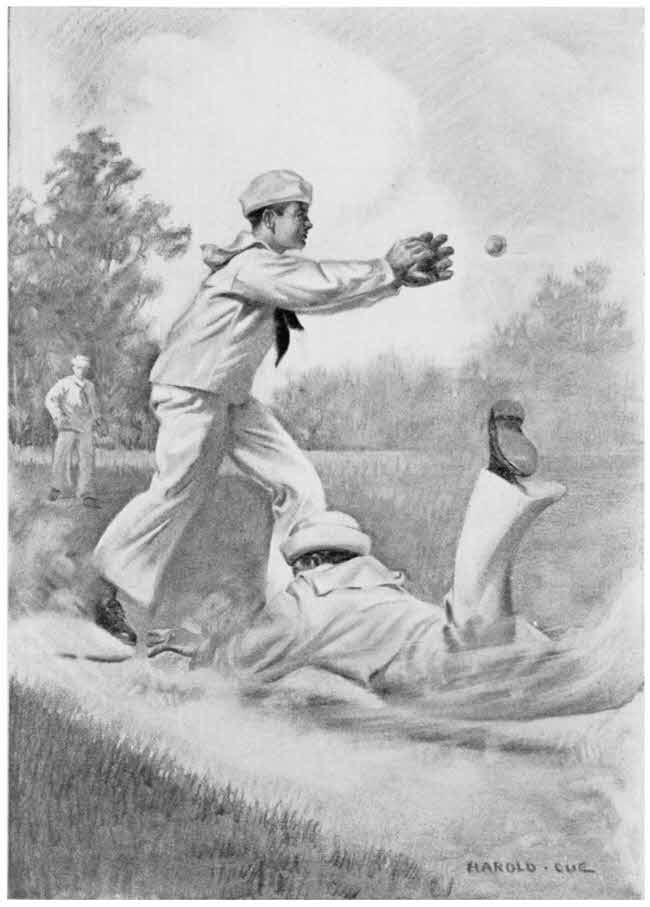
Dick dove forward on the ground to touch
the base. The second baseman, Sidney
Malloy, was a good player but rather a
small boy, and immediately turned to the
umpire and claimed that Gray was out;
but Dick gave him a dig in the ribs; and,
at the same time grabbed the base, loudly
claiming that he had made good.
Dick dove forward on the ground to touch the base.
Page 70.
The umpire took a few minutes to consider,
and then decided that Gray was
“not out.” Plummer had been in a pretty
good position to see what had actually happened
and he thought it was a clear case
of “out”; at the same time, it was quite
possible that Gray had honestly believed
that he had touched the base before the
ball was caught. Nobody really had any
unpleasant feeling over the incident, except
Malloy, the second baseman, and
Mr. Wentworth, who from the pitcher’s
box had noticed the ugly look in Dick’s
face when he told the small-sized second
baseman to “shut up!”
This made “three out” at the end of
the first half of the first inning. The
“Reds” only made one run in their half,
and this was scored by Perkins on a “three-bagger”
to left field, caught, but dropped,
by the left fielder. During the next four
or five innings no very remarkable work
was done on either side. There was some
good hitting, but the fielding was rather
poor; and, at the beginning of the sixth
inning, the score stood at seven to six in
favor of the “Reds.” During this inning,
however, Mr. Wentworth began improving
in his pitching. He seemed to have got his
second wind and threw his balls with a
kind of regular swing, and with greater
swiftness and accuracy.
One of the “Blues” was put out on three
strikes and Clarence Ellsworth struck a
ball which went almost straight into the
air, and was well judged and caught by
the second baseman, Malloy, who had
previously been roughly handled by Dick.
After this the “Reds” began to forge
ahead still further, and the hopes of the
“Blues” were finally dashed when Mr. Miller,
after having made a two-base hit,
was put out on third,—the final score
being eleven to six in favor of the “Reds.”
Thus ended the first game of the season
for the “Blues” and the “Reds” of the
Bright Wing; and, after cheering one
another and giving the Boy Scout yell,
they started to walk through the town on
their way back to the dock.
The long boat, with Mr. Miller on board
and Tom Sheffield as coxswain, got under
way first; and, as the ship was about half
a mile from the shore, it gave the boys a
good chance for a stretch after their game.
The two other boats started together about
seven minutes after the long boat, and the
idea of a race occurred to the two coxswains
at the same moment. Mr. Wentworth,
the officer in command, gave his
assent. The two coxswains, Chippie Smith
and Sidney Malloy, looked their men over
carefully with a view to balancing the
boats; and, after one or two changes of
position, it was agreed that Mr. Wentworth
should give the word. The latter
picked out the corner of a certain building
on one side of the bay and the mast of a
ship lying at anchor on the other side.
The imaginary line connecting these two
points would be about at right angles to
the course the boys would have to row to
get to the Bright Wing. Mr. Wentworth
ordered the two bow men to report when
both bows were as nearly as possible on
this line with their heads turned in the
direction of the ship; and, after a little
backing and pulling, with the boats about
a hundred feet apart, Mr. Wentworth gave
the order, “Stand by;—give way together!”
Once started, Mr. Wentworth, of course,
said nothing more, but, in his seat in the
stern, next the coxswain, left the management
of the boat entirely to him.
“Easy, now! Easy!” called Chippie,
as his men, in their haste to get away, began
interfering with one another, instead
of pulling all together.
Malloy’s crew made a little better start,
for he had taken pains to warn them to go
easy for the first six strokes until they
had got the rhythm of the oars into their
heads and bodies.
By the time Chippie’s men had got out
of their little mess, Malloy’s boat was about
a length ahead; and, after that, both
crews settled down to work with a good
steady swing.
In such a short race as this, one boat’s
length at the start was of some importance,
and Chippie felt that they must do their
best to make up for the loss as quickly
as possible. It was not a question of keeping
strength in reserve, as he would have
done if there had been a mile to row instead
of a half-mile.
The Bright Wing was lying broadside on
to them, and it had been agreed that they
would row across her bow,—the first boat
going across being the winner. They knew,
of course, that there would be plenty of
boys on board who would crowd into
the jib netting to act as judges.
Both coxswains were counting steadily
to keep the rowing smooth and even, and
Chippie’s boat had already caught up to
the extent of half a length, when an angry
exclamation escaped one of the boys who
had “caught a crab”, and, at the same time,
lost his balance—tumbling over backwards
with his feet in the air.
“All but Number Three keep on rowing,”
cried Chippie. “Easy, there, Number
Three! You must not pull the boat around.
All right, Dick. Now, all together,—keep
stroke! One, two!—one, two!—one,
two!—” Thanks to Chippie’s presence
of mind, the incident had only cost them
one boat’s length, so that they found themselves
a length and a half behind the other
boat, instead of half a length, as they had
been before.
“It was your fault, Guy,” muttered Dick
under his breath, to the boy behind him.
“Keep your mouth shut and your oar
going, Dick,” cried the coxswain; “we’ve
got to save this race first, and you can
blame other people afterwards.”
Some of the boys in the other boat, when
they had noticed Dick’s mishap, had begun
to laugh and sensibly slackened up their
pace. Chippie noticed this, and it gave
him a new interest in gathering his men
together to do their best.
“Now, boys,” said he, in a low but distinct
tone, “pull yourselves together, and
we may win out yet. The other crew have
begun wool-gathering, and that will give
us a chance either to win or make it a tie.”
Then, “one, two!—one, two!—” he
began his firm rhythmical count, and
every boy in the boat felt the effect of
Chippie Smith’s quiet determination.
In another minute the chuckling boys of
the other crew were surprised to notice
that they were only a half length ahead.
Then they stopped grinning, and Malloy
got back on his job, which he realized he
should never have left for a moment.
But now it seemed that they had come
too near to the goal to recover themselves
entirely. Chippie Smith’s boat had too
strong a headway, and the whole crew were
working together like animated clockwork.
They managed to cross the line practically
at the same time as their opponents,
and the question of which boat actually
was the winner had to be referred to a
committee of three boys who were in the
jib netting at the finish. The race was
so close that the committee itself was not
unanimous, although Chippie Smith’s boat
was declared the winner by the distance of
a mere hair’s breadth.
When it was all over, Mr. Wentworth
sent for Chippie and shook hands with
him.
“I call that pretty work, Smith; you
were in a hard position when that mistake
was made, and you held your men together
well.”
Chippie was standing at attention and
brought his hand up to salute. There
was no mistake about the “smile of the
scout” on his face at that moment. It
was more eloquent even than his hearty
“Thank you, sir!”
The interest in the race had been so keen
among both officers and boys that the
memory of the baseball game was almost
cast into the shade.
Sidney Malloy’s crew were a little
ashamed of themselves, but they were
foremost in their appreciation of the grand
way in which their opponents had rallied
and made such a fine showing at the end.
All the boys in Chippie’s crew felt that
they owed their victory—such as it was—to
the coxswain, and were for carrying
him on their shoulders around the deck,
but Chippie got away and climbed up the
mast to the crosstrees, from which superior
strategic position he threatened to
annihilate any one who should be so bold
as to pursue him.
After Chippie had come down and the
excitement had begun to subside, he began
to feel uncomfortable about Dick,
and wondered what was the matter with
him. He thought about the incident of
the bell, and then about Dick’s accident
in the boat.
“I never saw him so awkward in a boat
before,” thought he, “I wonder what’s
got into him?”
Then he thought of the meeting on Duck
Island when they had all three agreed to
keep one another up to the scout standard,
and felt troubled and unhappy. He went
off to talk it all over with Tom.
The only other member of this crew who
was not happy was Dick Gray himself,
and it was hard to make out just what
was the matter with him. In talking
him over with the Chairman, Mr. Wentworth
remarked:
“I can’t quite make that boy out, sir.
He may need some special help. I can’t
make out his signals.”
CHAPTER VII Under Way for Marblehead
Immediately after reveille next
morning, the boys were surprised to
hear the boatswain’s call followed by the
command to “stand by to set sail.” The
boatswain’s mates “got busy” very quickly
and could be seen sending their boys to
different parts of the deck,—some to the
bowsprit to remove the jib stops, some
to the fore boom to release the foresail,
and the others to the parts of the ship to
which they belonged.
After the fore and main sails had been
set, all hands were ordered forward to the
windlass and began hauling up the anchor.
It was hot work, and there was not room
enough for all the boys to get on to the
job at the same time; but Dick managed
to get on among the first, while Tom and
Chippie were in the outside ring who stood
ready to jump in and “spell” their comrades.
Then,—after the anchor had been
broken from the ground,—came the manning
of the halyards,—first the main,
then the fore, and then the jumbo and the
jib halyards.
As the head sails ran up, they were filled
by a light northwest breeze which somewhat
tempered the heat. The night had
been very warm, and the boys were all
glad to get up on deck and very much interested
in the prospect of sailing; the
reef-points beat a cheerful tattoo on the
canvas, as it quietly slatted back and
forth, while the ship’s bow headed westward
to pass through the gut into the outer
harbor. Once outside, she settled down to
a long leg on the port tack, and then the
anchor was hoisted up and lifted over the
rail.
While this was going on, Jack Perkins
was active in seeing that the boatswain’s
orders were carried out. The mate stood
on the quarter-deck giving his commands,
while the boatswain repeated them forward
with the musical accompaniment of
his call. Jack not only had his own division
to look after, but it was his business
also to see that the other B. M.’s were on
their jobs, and that every scout of every
division was doing his allotted work.
This was the first time that the crew had
performed this particular manœuvre, and
it was not surprising that there was a
hitch here and there. Some small boys
would stand looking on while the others
were hauling on the halyards, but on inquiry
it was found that they were under
the impression that only the “huskies”
were considered worthy of this work. This
idea was quickly dispelled, however; and,
before the mainsail was finally set, every
available boy was on the halyards, each
one contributing his share of the pull,
however small it might be. Other boys
who hesitated were mostly green hands who
had not caught the spirit of acting together,
while one of the little fellows was found in
the jib-net admiring the view, and another
curled up on the day bunk reading a book.
Altogether it was a good opportunity for
Mr. Miller to distinguish the wool-gatherers
from the workers, but he felt sure that it
was only practice that was needed to get
this crew pulling together in true and
shipshape style.
By this time it was 7:45, and there was
just time to scrub decks and then wash up
before breakfast. It was a pleasant thing
to hear the trill of the boatswain’s call as
the mess cooks scrambled down to set the
tables; and better still to sit down to
breakfast after the early morning’s work.
The breeze was not strong but held out
steadily while the routine work was going
on, and also through “quarters” and
“mast.” At “quarters” the “lucky bag”
was brought out for the first time and was
found to contain a jumper, a couple of
towels, and a lanyard and knife. Mr.
Miller explained the principle of the “lucky
bag” as follows:
“The master-at-arms will pick up everything
that he finds lying about the decks
and put it in the ‘lucky bag’; they may remain
in the bag at the discretion of the sea
scout master until he decides to open it at
‘quarters.’ At this time articles lost may
be claimed by those who have missed them,
but a penalty may be imposed upon the
owner before the lost article is returned to
him. As this is the first time the ‘lucky
bag’ has been opened on this cruise, no
penalties will be exacted on the return of
these articles. The Sea Scouts are warned
that in the future they will be expected to
be shipshape in their habits, and that
articles left carelessly lying about will not
be returned to their owners until due penalty
in the shape of extra duty has been
paid.
“But there is another matter to which
I must call your attention at the present
time. It is one thing to approve of discipline
in theory and quite another to
submit to it in practice. Most of you boys
are familiar with stories of good seamanship,
but very few of you have ever experienced
before this cruise the training which made
such seamanship possible. Almost everybody
is naturally lazy, and doing things on
time is irksome and disagreeable to lazy
people. ‘Oh, I guess to-morrow’ll do as
well’, or ‘All right, I’ll be there in a few
minutes’—these are the common expressions
of lazy lubbers who have not yet
learnt to like the promptness and alertness
which good seamanship requires. I warn
you boys of this now, at the beginning of
the cruise, because I know the temptation
comes to almost every one, and you might
as well give up the idea of being Sea Scouts
unless you are morally strong enough to clear
all such lazy stuff out of the way. Orders
must be carried out on the run and on the
jump, and there is no room for a grouch on
board of this ship.
“Since this cruise started, I have seen
some boys hanging back and doing their
work in a poor-spirited way; I did not
always blame them, because I knew they
were acting from ignorance and did not
yet know the absolute necessity on board
ship of a prompt and cheerful spirit. But,
after this, I shall expect all hands to put
their best foot foremost and to show that
they have in them the making of good
sailors and Sea Scouts.
“Those who are not able to live up to
this standard will loaf their way along
until they drop out,—maybe at the next
port we make. They will not come on
another cruise and they will have missed
all the training as well as all the fun and
enjoyment that comes from putting your
heart into your work and doing what you
have to do with all your might.”
While Mr. Miller was talking, you could
see some of the boys here and there
straighten up in sympathy with his words.
Tom and Chippie, especially, looked at
one another significantly and hoped that
Dick was taking it all in as eagerly as they
were. But they were disappointed, for
the grouchy look on Dick’s face had not
cleared away.
The instruction that morning was
“Knots and Splices”, “Boxing the Compass”,
“Ship’s Rigs”, and “Chart-work
with the Captain.” Tom liked the chart-work
best and found no difficulty in remembering
the symbols for lights, buoys,
shoals, etc., and felt as if he were on a
cruise within a cruise, exploring the waters
of some foreign land. Chippie felt most at
home with his knots and splices, because
it was less like studying than any of the
other subjects; and both boys were surprised
to find how much they had to learn
about ship’s rigs. Dick, on the other
hand, did not seem to take much interest
in anything, and if there had been any
motion of the sea he would have been suspected
of being seasick.
About ten o’clock the breeze died down
while they were still a good distance from
Marblehead. It was hot, but as there was
no swell on the water, everybody felt comfortable
in spite of the heat. The boys
had begun to feel at home in their new surroundings,
and were too much absorbed
in the interest of their work, as each division
passed from one instructor to the
next, to mind the discomfort of the heat.
As there was no particular hurry in
getting to Marblehead, which was their
destination for that day, the Captain decided
not to use the launch to tow the
ship unless it should become necessary
toward the afternoon. So the Bright Wing
lay with her sails flapping quite lazily,
and with the jaws of the main gaff creaking
and snarling, as it swayed from side to
side, until eleven o’clock; when the bugle
sounded “retreat from drill”, and there
was nothing more but play and good fun
until dinner time.
After dinner a change in the weather set
in, in the form of gathering clouds toward
the northwest, which at first were scarcely
noticeable; while the ship’s band—in
the form of a good Victrola—played
some lively airs, in which the boys often
joined in chorus. By about three o’clock
the wind was blowing in light but sudden
gusts and the clouds in the northwest
had gathered thickly, with streamers
extending overhead, indicative of more
wind.
Jack climbed up into the crosstrees to
take a good look at the sky and reported
to the Captain, when he came down, that
there was smoke in the direction of Marblehead,
but he could not make out whether
it was at Marblehead itself or beyond.
Pretty soon the smoke became quite perceptible
on deck as the wind increased
to a fresh breeze.
The Captain sent word to the Chairman;
and, as soon as he came on deck, he noticed
the cloud of smoke which was now quite
conspicuous in the northwestern sky, and
stretching like a long streamer over the
sea.
“There may be something for us to do
when we get to Marblehead,” said he to
Mr. Miller, who was standing by. “It
must be a big fire to cause so much smoke
as that.”
For the next half-hour the Bright Wing
bounded along in a spanking breeze, and
every boy on board felt the new exhilaration
and life of the wind and motion. It
did not take them long to get into port,
and they dropped anchor in Marblehead
harbor at about a quarter of four. The
boys were all at their places for lowering
the sails; but, once lowered, they were
ordered to make them only temporarily
secure with the stops, without careful furling,
in view of the Chairman’s haste to
get ashore and on to the scene of the fire
as quickly as possible. It was decided to
leave one of the four sections on board to
finish the furling and make all fast, and
then to follow the rest of the company; these
got into the boats as soon as they could
be lowered, and headed for the nearest
wharf.
Dick appeared to have got over his grouch
during the day, and his section was the
first to leave the ship.
CHAPTER VIII The Salem Fire
As soon as the main party arrived at
the landing they inquired eagerly where
the fire was, and learned very soon that it
was in Salem, and had started in the northwestern
section of the city.
Marblehead lies about southeast from
Salem, and the wind was blowing from
west to east, veering to northwest,—so
that the fumes of smoke, driven by blasts
of heated air, kept pouring over the houses
of the little old-fashioned town, making the
atmosphere decidedly disagreeable in the
streets below.
Mr. Miller was in command of the company;
and, after a brief consultation between
himself, Mr. Wentworth, and the
boatswain’s mates, it was decided to separate
into divisions, to march within easy
call of one another toward Salem, and to
reach, if possible, the headquarters of the
Salem Fraternity or Boys’ Club. Here,
they felt, they would be sure to find other
boys with their leaders who could give
them all the information they required and
plenty of work to do.
The distance to Salem was about four
miles; and, during the second half of
their walk, the smoke became thicker and
hotter. Here and there burning embers,
carried by the wind, fell along the road
and on the roofs of adjoining houses. All
along the streets people were hurrying
from one place to another in more or less
excitement; and, on the housetops, groups
were busy wetting down their roofs and
putting out burning cinders. A little later
they came upon piles of furniture on the
sidewalks, and furniture vans carrying the
household possessions of families to places
of safety. The activity increased as they
entered the city proper. As they walked
northward, the wind and smoke came
from a direction on their left; and, as they
advanced nearer to the heart of the fire,
they could see the flames springing out of
the wreckage below, spreading from one
house to another under the influence of
the wind; could hear the crash of falling
buildings, and watch great showers of
sparks and burning material being carried
along by the gusts of air.
Presently they found themselves surrounded
by a crowd of people, and the
order was passed along to each division
to walk in Indian file. Tom Sheffield was
the last boy in the line and suddenly his
attention was attracted by a knot of people
that had gathered quickly around some
one who was lying in the street. This had
happened after the other scouts had got
well ahead of him, so that he was the only
one who had noticed the occurrence. He
ran quickly up to the spot and saw a
woman lying in the midst of the group
with broken pieces of crockery all around
her and a large spot of blood on the left
sleeve of her white shirt waist. Her eyes
were closed, and her face was pale. An
elderly woman held her head on her lap
but was evidently frightened and did not
know what to do. A little child in the
crowd was crying excitedly, and at the same
time a man called out, “Get a doctor,
somebody,—she’s bleeding to death!”
Tom then quickly ripped up her sleeve
with his knife and laid the wound bare.
He saw at once from the pulsations and
color of the blood that an artery had been
severed. He then felt in his pocket for
his first-aid kit but found that he had left
it behind. Quickly he whipped out his
pocket handkerchief and folded it over to
serve as a bandage, tying it tightly above
the wound. He then exerted even more
pressure by inserting a lead pencil and
twisting the bandage around. When the
crowd noticed that the blood had stopped
flowing, there were exclamations of surprise.
“Good for you, sonny,” called out the
burly man.
“He’s one of them Boy Scouts,” remarked
another, “you can tell by the suit he
wears.”
“Come,” called out Tom, “you fellows
had better stop talking and hurry up the
doctor. Has anybody gone for him?”
“That’s all right, son; here he is now.”
And a brisk young man stepped out of
an automobile that had just slowed up at
the outskirts of the little crowd.
After a glance at the improvised bandage
and tourniquet, the doctor nodded at Tom
with a smile and went back to get more
permanent apparatus out of his bag. This
was quickly applied and then, after asking
a few questions and learning that the
woman’s house had been burnt down, he
lifted her up in his arms, and carried her to
the automobile.
“Here, you Scout! I want your help.
Jump into the automobile and support
her head as I lift her in.”
Tom instantly obeyed, and the next
minute the patient’s head was resting upon
his shoulder, and the doctor was driving
the car to the Beverly Hospital. Once
there the attendants took charge under
the doctor’s orders; and, left to himself,
Tom began to wonder how he could best
communicate with Mr. Miller.
He decided to telephone from the hospital
to the Salem Fraternity, and leave a
message there; and, as he was coming
out of the telephone booth, he ran across
the doctor who had come from the wards
to telephone himself.
“Oh! Hullo!” cried he, addressing Tom
with a hearty greeting, “I was afraid you
had run away, Scout; I wanted to shake
hands with you and compliment you on
your work. But we doctors are beginning
to take good work for granted, when we
see your uniform.”
Tom laughed. “I guess the good work
wouldn’t stay good long,” said he, “if we
were to bank on the uniform.”
“Where are you going now?” asked the
doctor. And, when Tom had explained,
he continued, “I’ll drive you to the Fraternity
building myself, and probably we
shall get there about as soon as your troop
does. I’m sorry we had to drive that
poor woman so far, but the Salem Hospital
is partly burnt. She bore the journey all
right, however; she had just regained
consciousness when I left, and I will call
up and inquire about her this evening.”
After another half-hour’s drive, during
which Tom was much impressed by the
distress of the people and the great amount
of work to be done, they arrived at the
Fraternity building, and he at once reported
to Mr. Miller.
When Tom had bolted toward the crowd
surrounding the fainting woman, his absence
had not been noticed because so many
things were happening on all sides. The
main body of boys soon came to a place
where they had an unobstructed view of
the fire and where the people were standing
in a compact mass looking on at the
awe-inspiring but brilliant scene. The
street, however, was blocked, and the people
were not allowed to approach any nearer to
the fire. Many of them were excited;
and, every now and then, two or three
would surge forward in advance of the line,
pushing ahead of them a rope that had
been roughly secured to bar the way.
As the boys approached the scene, they
heard a voice calling out: “Stand back!
Stand back!” and Jack Perkins a few
moments later called out:
“Say, boys, we are not the only scouts
here!”
Dick Gray was near the front, behind
Jack, and there were two or three rows of
people tightly pressed together ahead of
him, so that he could not see what was
going on in the front, but he ducked down
and got through between their legs and
saw a Boy Scout, with a patrol leader’s
badge in his hat and staff in hand, guarding
the line and holding back the crowd.
“Hullo, Bob!” called out Dick from
somewhere near the ground. He had recognized
Bob Peters of the second Beverly
troop, who had made a record for high
jumping at the last Boy Scout rally.
“Hullo!” called back Bob, with a grin.
“What are you doing there down cellar?”
“Hunting for the fire hose!” cried Dick,
quick as a wink, and disappeared behind
the legs of the crowd again.
As they could not get through in this
direction, it became necessary to find some
other and more roundabout way, so they
turned off to the right, making a semicircle
and avoiding the thickest part of the smoke.
Finally they came to the Fraternity building
on Central Street, which was out of the
path of the wind and fire.
As they entered the building, the smell
of cooking attracted their attention first,
and they met several boys passing through
the hall carrying loaves of bread and
pitchers, which they very soon discovered
contained soup. While some of the scouts
and other members of the Fraternity were
patrolling the city in search of good turns
to homeless people, others were waiting
to carry supplies of food wherever they
might be needed.
The superintendent of the Salem Fraternity
happened to be absent at the time,
and a well-known scout master, Mr. Shallack,
from an adjoining town was organizing
the boys for service. The first thing
he had done was to requisition food and
other supplies, such as kitchen utensils,
etc., from a number of business men, and
then he had organized an efficient soup
kitchen to supply food to the many who
would soon be in need.
Mr. Miller immediately offered the services
of his ship’s company, and they were
sent out in groups of two or three to find
people who needed immediate help, and
to give them whatever service was in their
power.
It was not until he was arranging these
groups of boys that Mr. Miller noticed
Tom Sheffield’s absence and inquired of
each of the other boys where they had
last seen him. Ellsworth Randall was his
boatswain’s mate and was really responsible,
but could give no explanation.
“I don’t understand it, sir,” said he,
“but I think he must have stopped to look
at something, and then lost his way before
he could catch up.”
“H’m,” said Mr. Miller, “that doesn’t
sound like Sheffield; he’s no wool-gatherer!”
Meanwhile Dick had come up and begged
that he might be allowed to go and hunt
for Tom, but just then the telephone bell
in the office rang.
“Some one to speak to Mr. Miller,”
said the attendant, and to his intense relief,
Mr. Miller heard Tom’s voice, talking
over the wire from the Beverly Hospital.
“I’m sorry, sir,” he heard him say,
“but I had to run and lend a hand. I’ll
explain it all to you as soon as I can get
there.”
CHAPTER IX Scouts to the Rescue
After Tom had returned and reported
to Mr. Miller, he, Chippie, and Dick
were ordered off in quest of good turns.
They had been directed toward a certain
street which was on the very edge of the
fire; and, after they had walked ten minutes
in this direction, they heard cries proceeding
from a house on the opposite side
of the road. They crossed over and entered
the house, which was an old-fashioned
single dwelling turned into a building with
a tenement on each floor. Two women—one
elderly and the other comparatively
young—were carrying down-stairs, with
some difficulty, a large trunk containing
all the household goods and clothes they
had managed to scrape together, while a
little girl was crying passionately at the
foot of the stairs:
“The kitty, oh! the kitty! We have
left the kitty up-stairs and she can’t get
out!”
The house had caught fire on or near the
roof, and the top story was almost gone.
It was a five-story house, and the fourth
story was already burning, with the smoke
and flames penetrating into the third; and
out of this third story the two women and
the little child had escaped just about in
time, but leaving behind them many things
they would have liked to save. Among
these was the cat, of whom they had not
thought until the little girl had begun crying
for it at the foot of the stairs. It was
too late to go back in the ordinary way,
because the smoke had gathered so thickly
about them that it would have been almost
impossible to get through; but
Chippie suddenly remembered the directions
in the Boy Scout Handbook about crawling
along the floor, and so getting enough air
to breathe while making one’s way through
a burning house. He turned to one of the
women and asked her on what floor their
apartment was, and then, after thinking
for a moment, he said:
“I’ll see whether it’s possible to get
through on my hands and knees and bring
the cat out.”
“Right you are, Chip,” said Dick, “and
you, Tom, take hold of that trunk and
carry it out into the middle of the street,
while I get around into the back yard and
see if there is any way of climbing up to
the windows of the third story.”
Chippie darted up-stairs, and the last
they saw of him was the soles of his boots
over the top step of the staircase, as he
began pushing his way first on hands and
knees and then crawling on his stomach.
The little girl—who evidently had no
anxiety for her own safety—clapped her
hands with delight, while the two women
looked on with satisfaction and relief as
Tom took hold of the handle of the trunk
and dragged it out through the door.
In the meantime Dick had run around
to the back of the house; and, after looking
carefully for some time along the row
of windows on the third story, recognized
something white in the corner, pushing up
against a pane of glass. He looked steadily
for about half a minute, when he saw it
move, and made up his mind that it was the
cat. Quickly he measured the distance
to the window with his eye, and noted the
fact that a stone wall ran up about four
feet, and also that a rain-pipe ascended from
the top of the wall up to and past the window
at a distance of about two feet to the
left. If he could only climb up that rain-pipe
and open the window, in case it was
unbolted, he could give the cat a chance to
jump upon his shoulder.
But there was something in Dick that did
not want to do it; something that told
him it would be a mighty unpleasant
thing to slip down and get killed just then,
or even to break an arm or leg. He knew
what a painful thing a broken arm was,
for he had been with his aunt once when she
had slipped upon the ice and fallen backward,
striking her elbow on the hard surface.
He knew how much she had suffered,
even after the arm was set, before she had
regained the use of it. All these thoughts
went through his mind in a flash. Then
there came to him the voice of the little
girl crying for her kitty; and then, again,
like a quiet voice rising from somewhere
inside of him, the familiar words, “A
scout is brave.” It brought up the scene
at prayers on the berth deck of the Bright
Wing and the sound of another voice
that was saying: “Without honor life is
not worth living.” And all of a sudden
Dick made up his mind that nothing was
of any consequence to him at that moment
but to save the kitten. The next
instant he thought of Chippie, crawling on
his way through the suffocating smoke,
and ran back to the front door and up the
stairs as far as he could go, calling out to
him to come back, for they could rescue
the cat through the window. To his surprise
Chippie was already on his way out,
having found it impossible to force the
inner door, which was secured by a latch
from within. Dick hurried him out into
the fresh air and around to his station at
the back of the house.
“Here, Chippie, give me a boost up this
wall, and I guess I can get up the waterspout
all right.”
It was difficult work, because he could
not get his legs fully around the pipe, for
it was too near the wall; but Dick had a
pretty good knee grip from having ridden
bareback at home, and he managed to
hold with his knees enough of the distance
that he had gained with his hands to make
some headway. He would grasp with
both hands and lift up his knees, and they
would slide down again about half-way;
but, nevertheless, he would make on an
average about six inches every pull, and at
the end of five minutes’ strenuous work his
shoulder was above the level of the window.
Here, luckily, a brick had fallen out of the
wall, making a little place where he could
rest one foot; and so he waited for a
minute or two to get his breath before
reaching out to the window. He soon recovered
his wind and stretched out his
hand; but, although the window was not
bolted, he could not raise it because his
hand was too far from the center. He
then determined to break the pane of glass
nearest to him; and, reaching into his
pocket, pulled out his jackknife, and, with
two sharp strokes, knocked a hole into the
pane without injuring his hand. But his
arm was not long enough to reach the kitten,
and all that he could do was to hold
it out within easy distance for her to step
on. Kitty’s fur was bristling with fear,
but it was interesting to note with what
daintiness she managed to step over the
broken glass on to the outer sill. Then
came a few moments of apparent reflection
while she seemed to be measuring the distance
to a really secure footing on Dick’s
shoulder. He encouraged her with his
voice; and, with a single spring, she landed on
his shoulder with her claws piercing through
his coat and dangerously near his skin.
She seemed to be measuring the distance to a really secure
footing on Dick’s shoulder. Page 109.
Then Dick began his journey downward,
which was, of course, easier than the upward
climb. It was a question of putting
on the brakes, but did not take more than
forty seconds.
In the meantime, Chippie had got most
of the smoke out of his eyes, and had been
watching Dick with breathless interest.
Then they thought of the little girl and
the two women and started off in pursuit;
and they soon noticed, at a little
distance, a large trunk being carried by a
woman and a boy, with an old woman and
a little girl accompanying them. In another
minute Dick was handing the kitty to
her small mistress; and, when the little
girl had done all she could to show her
delight, Dick and Chippie took charge of
carrying the trunk to relieve Mrs. Green
and Tom, and they all kept together until
they reached the Common.
Here they found a large number of people
who had taken refuge with their household
goods and chattels; and, when they had
discovered a vacant bench for the two
women and the little girl, they sat down on
the ground themselves to hold a council
of war. It was now six o’clock and pretty
near supper time. Was there room at the
Salem Fraternity to give shelter to their
party for the night, or was there room in
any of the tents pitched on the Common?
But Dick cut all these considerations short
by saying:
“The first thing to do is to report to Mr.
Miller, tell him all the facts, and receive
our instructions. Tom, you and Chippie
stand by the ladies here in case they should
want anything immediately, and I will go
back to the Boys’ Club. You will probably
hear from me again in half or three-quarters
of an hour.”
Dick reported the facts as briefly as
possible to Mr. Miller, who took down the
names of Mrs. Mitchell and her daughter,
Mrs. Green, and listened to Dick’s description
of the place on the Common where
they were sitting under the protection
of Tom and Chippie. After consulting
with the superintendent, he told Dick to
take supplies for supper, and to inform the
party that they would be welcome in tent
Number 6, where two other families, similarly
situated, were to pass the night.
In the meantime, the fourth division
from the Bright Wing had arrived, and
had been at work for some time. Sleeping
quarters were provided for the boys in rooms
at the top of the Boys’ Club; and, when
it was time for them to turn in, they felt
mighty well after all their hard work, and
mighty tired.
For some reason or other, Dick’s thoughts
wandered away from the exciting experiences
of the day, and kept returning to
that game of baseball, when his touching
second base had been questioned; he did not
feel happy about it, and as he went to sleep,
the words, “A scout is trustworthy”, kept
rising up and passing through his mind.
Chippie Smith dreamed of a procession
of white and black cats climbing up the
waterspout to the top of a house, crossing
the roof, and then quietly walking down like
flies on the other side.
CHAPTER X In Marblehead Harbor
At the request of the superintendent of
the Boys’ Club, the Sea Scouts remained
in Salem one more day and night.
By that time the militia had arrived, and
the worst of the emergency was over. The
fire had been put out since the night after
their arrival, and the relief committee for
the whole city was thoroughly organized
and in working order. When they had
said good-by to the superintendent and as
many of their new friends as they could
find at the moment, the boys started, after
breakfast, on their way back to the ship.
The scene was quite different from that
through which they had marched on that
first afternoon. There was no fire burning
anywhere; and, in the high wind, most of
the cinders had been blown out to sea;
but there were desolate proofs of the destruction
wrought in the charred and
broken walls of the forsaken houses which,
only a few days before, had been cheerful
and comfortable homes. They passed by
groups of people who were walking about
inspecting the ruins, and overheard an old
man saying:
“They say fire is a good servant but a
poor master—and I guess they’re right.
What do you say, Joe?”
Dick Gray, Tom, and Chippie walked
together and talked over their adventures.
Soldiers belonging to the militia were
standing sentry at different points to protect
the property that had not yet been
removed, and they also had charge of the
street traffic, so that no carriages or automobiles
that were not engaged in rescue
work were permitted within the burnt
district.
Dick told the other boys of the rescue
of a blind man by one of the Salem scouts.
The poor fellow had been found in the
railway station, hearing the strange sounds
and feeling the fire creeping nearer, but
not knowing which way to turn. Tom,
on the other hand, told them about his
first-aid adventure with the woman and
the doctor, of which he had not spoken
previously to any one except Mr. Miller.
Then it suddenly occurred to him that,
as they were all three together and practically
alone, this would be a good opportunity
to speak to Dick about a matter
which he and Chippie had talked of together,
and which had been on their minds
for some days past. So Tom changed the
subject rather suddenly and said:
“Dick, Chip and I have been wondering
what you have had such a grouch about
lately; can you tell us?”
“What do you want to know for?”
answered Dick rather gruffly.
“Well,” replied Tom, “it has something
to do with the law about being cheerful—hasn’t
it? And aren’t we three sworn
brothers-in-arms to see that we keep the
law?”
Dick did not answer at once, and he
didn’t seem to relish what Tom was saying.
But Chippie piped up next:
“Don’t you remember, Dick, when you
said you wanted to learn to keep the
scout law, or bust? and we all three agreed
to stand by each other?”
There was no answer, and they walked
along in silence, until finally Dick said, in
quite a different tone:
“Say, fellows, I’ve got something to tell
you,” and in their interest to hear what
he had to say, the two others stopped
walking and the three heads bent forward
together.
After about five minutes’ talk, they resumed
their walk and soon reached the
wharf. They all three had a rather
troubled expression as they joined their
comrades, got into the boats, rowed out
to the ship, clambered up the side-ladder
and saluted the quarter-deck,—all seemed
in a kind of daze. Most of the other
boys felt as if they had been asleep, too,
and had just waked up from an exciting
dream. They gathered around the day
bunk, talking over the incidents of the past
two days, when suddenly “first call” to
quarters was sounded. This finally woke
them up completely and brought them to
a realization of present duty.
As they stood up in their places at quarters,
there was a general inspection of
clothing; some of the working suits were
so badly used up as to be almost beyond
repair.
Before the company was dismissed, the
Chairman made a few remarks, during
which he praised the work of the company
in general, and told the boys there would
probably be more to say on the subject
after the meeting of the next officers’
conference, which would sit as a Court of
Honor. It was also announced that there
would be no instruction or drill for the remainder
of the day, but that all the boys
could go in swimming and take a rest
until supper time. Wind and weather
permitting, the ship was to sail for Northbridge
the following morning. Everybody
noticed that the Chairman and Mr. Miller
were in high good humor.
There was a good swim that afternoon
and a lot of frolicking in the water off the
ship’s side; and, although a few of the
boys were so tired that they crawled into
their bunks and slept until they heard the
bugle call for “mess cooks below”, most
of them were gathered in groups, either on
the day bunk or in the jib netting, to talk
over the events of the last two days.
The chief work that the boys had done
was in carrying food to people on the Common
and in helping to load baggage and
furniture that was taken out of the houses
upon trucks and vans; and, when Chippie
told the story of Dick Gray’s rescue of the
white cat, some of the company took it
more as a joke than anything else, and
thought it was not much of a thing to do,
considering how easy it was to get a cat
whenever you wanted one, and how many
kittens were drowned every day.
Chippie took up the cudgels for Dick
and thought that it was no joke for any
creature, either animal or man, to burn to
death.
“If you could ask the cat what she thinks
of it, I guess she’d say it was a mighty good
job!”
Dick was entirely silent throughout the
controversy; but, somehow or other, his
mind seemed to have got the habit of recalling
parts of the scout law on every
possible occasion. And now, as he listened
to the clamor of the talk around him, he
heard again that same quiet voice which
had spoken to him as he contemplated
the waterspout in Mrs. Green’s back yard.
This time it kept repeating the words,
“Shall protect all harmless life.” Then
that old idea of the baseball game and
second base came jumping up into his mind
again, and he thought to himself:
“Why shouldn’t I have a talk with Mr.
Miller about that?” There was something
queer going on in Dick’s mind that he did
not quite understand himself.
At the recreation hour, after supper,
there were several good sparring matches
and a lot of singing; and, during one of
the less noisy intervals, Dick noticed Mr.
Miller standing all alone and leaning up
against the foremast stays. He seemed to
be quietly watching the scene in front of
him, and every now and then the flicker of
a smile played over his features.
“Now’s my chance,” said Dick to himself.
“There’s a full fifteen minutes before
prayers.”
Dick’s working trousers had been
pretty badly worn on the waterspout,
and he had been wondering whether
he should have to patch the holes, or
whether, considering the circumstances, he
could get a new pair,—but it was not
about his trousers that he was waiting to
speak to Mr. Miller. He had a kind of
sickish feeling that seemed to be getting
worse and worse as time went on. He
felt as if he were two boys instead of one.
The boy who had been working along with
Tom Sheffield and Chippie Smith all over
Salem—the boy who had climbed up
the waterspout, and who had beaten down
the desire to shirk and be a coward—was
not the same boy who had played in the
baseball game at Hull. On the other hand,
that boy of the baseball game seemed to be
not unlike the boy who had been scared to
risk his neck in saving the little girl’s cat.
It is not a pleasant thing to have two
people inside of you when they are fighting
with one another. And this is what seemed
to be happening to Dick Gray; and the
more he tried to do his duty as a scout,
the more these two boys inside of him
wanted to fight and kick up a dust. So,
as Dick was looking at Mr. Miller standing
in the dusk against the evening sky,
Dick Number 1 repeated:
“I guess now is the time,” and started
to walk forward in the right direction;
but he hadn’t got much more than half-way
toward Mr. Miller when Dick Number
2 whispered:
“Never mind about the baseball game;
ask him about your working pants!” and
the next moment he was standing before
Mr. Miller with his hand lifted to the
salute. Mr. Miller did not notice the
suppressed excitement in his face, nor did
he hear the thumping of his heart, as he
remarked, with assumed quietness:
“I got my pants badly torn in Salem
the other day, sir, and I’d like to know
whether I can get another pair?”
“You coward! You coward!” whispered
Dick Number 1 inside, before Mr.
Miller could answer.
“Oh! let me see,” said Mr. Miller.
“They are rather badly done up, aren’t
they? How did you get them torn so
badly?”
“Climbing a waterspout, sir,” said Dick.
Mr. Miller smiled, and then there was
a little pause.
“That is not a question you should
come to me with, Gray; report to your
boatswain’s mate, and he will report to
me for the whole section. Lots of other
boys have torn their clothes.”
“Ay, ay, sir,” replied Dick, with a salute,
and turned away.
But he did not get any fun out of the
sports on deck that night, and the words,
“You coward! You coward!” kept ringing
in his ears.
After taps that evening there was officers’
conference in the cabin; and, when
certain routine matters had been disposed
of, the rescue work in Salem was talked
over very thoroughly. All the boys had
behaved well, and some of the little ones
had done almost too much. Jack Perkins
had been in immediate charge of organizing
the groups and of overseeing their work,
and he had managed his task so well that
he had been able to make careful notes
of pretty nearly everything that had been
done.
This, of course, was a great help to the
Court of Honor in awarding their commendations,
and it was voted first that
Jack Perkins should be commended at
quarters the following day. Five other
boys, including Chippie and Tom, who
had done especially hard work in saving
and carrying valuables out of burning
houses, were commended, and besides it was
decided to give Tom a commendation for
the incident with the doctor.
Finally, the question of Dick Gray and the
cat came up; and although it was undoubtedly
a genuine case of saving life, a doubt
arose as to whether such an act as Dick’s
constituted “life saving” in its real sense.
There was an interesting discussion on
this point, and it was finally decided that
the meaning of “life saving”, in its connection
with the merit badge, could only
refer to the saving of human life, but that
Dick’s act was an emphatic instance of
obedience to Law Number 6:
“He is a friend to animals. He will not
kill nor hurt any living creature needlessly,
but will strive to save and protect all harmless
life.”
The Court also found that it involved,
though perhaps less conspicuously, an upright
obedience to Law Number 10: “A
scout is Brave.”
It was therefore decided to award Dick
not the medal for “life saving”, but a
special commendation.
The officers present felt that the same
doubt which had arisen in some of their
own minds would naturally arise in the
minds of the boys, and particularly hoped
that the Chairman would make the whole
question clear at quarters on the following
day.
When the meeting was over, all the officers
seemed pleased at the result, and,
after a stroll on deck, Mr. Miller and the
Chairman went below.
“Good night, sir,” said Mr. Miller to the
Chairman, after they were in their bunks.
“Something is going on inside of that
boy, Gray. There is no doubt that he did
a plucky and unselfish thing, and it will
probably help him to see some other things
in their true light.”
“That’s just what I think, Mr. Miller;
I believe in the boy. Good night,” and
the Chairman turned over in his bunk and
went to sleep.
CHAPTER XI Dick’s Confession
Next morning all hands were on deck
at five o’clock to weigh anchor and
set sail. It was a beautiful morning with
a light breeze from the northeast which
was just about a head wind.
The Captain was on the quarter-deck
giving his orders, which were repeated by
the mate a little forward of amidships.
The boatswain was forward near the jib
halyards, and Jack Perkins was busy looking
out for his own section and watching
to see that the other “B. M.’s” were doing
the same thing. The master-at-arms was
down below, hurrying up a couple of lazy
lubbers who were inclined to dawdle instead
of getting out on deck.
Mr. Wentworth stood with watch in
hand ready to time the different operations
for the ship’s log, and Chippie Smith, who
had been detailed as recorder, waited with
pencil and paper in his hand. Everything
went more smoothly than usual, and the
work was watched with great interest by
the Chairman, who wanted the boys to
grow even more skilful and efficient in
handling the ship. No noise was allowed
while the work of getting under way was
going on,—no whistling, or singing, or
anything which might possibly drown the
voice of the Captain in giving orders, or
of the other officers in repeating them.
The consequence was that the Captain
could give his commands in a comparatively
low tone which was distinctly heard; and
this, in itself, tended to prevent confusion.
The jib and jumbo went up respectively
in three and two minutes; the foresail and
the mainsail in six and eight minutes.
Jack Perkins, as Chief Boatswain’s Mate,
had prepared for the morning’s work the
night before by holding a little council
with the three other “B. M.’s” and going
over with them in detail the duties and
stations of the four different sections.
As a result, the work was very prompt,
each “B. M.” at his station with his own
section listening carefully to get the orders
either from the Captain or the mate, or
the boatswain, according to his position
on deck, and then repeating them promptly
and quietly to his own boys and leading
them in carrying out the manœuvre—whatever
it might be.
When the anchor was hoisted, the sails
caught the breeze on the starboard tack
and the Bright Wing worked out of the
harbor against the wind. Once outside,
the breeze began to rise, and everybody
felt the delight that comes from the buoyancy
of the water and the freshness of the
wind and spray.
“I’m glad it’s a head wind,” said Tom
to Dick, who was sitting alongside him on
the day bunk, “because it will take us
longer to get to Northbridge, and we’ll
get more of a sail.”
“You bet,” said Dick, “shouldn’t wonder
if we got a spanking breeze pretty
soon. I thought I saw a little water coming
through a lee scupper for’ard, just
now. The old ship seems to sail best on
her side, anyway.”
The conversation was interrupted by
the boatswain’s whistle for “scrub and
wash clothes”; and all who did not belong
to the watch went down and started
scrubbing their clothes. In ten minutes
the clothes were up on the lines, and the
decks were being scrubbed—after the
cabin skylight and portholes had been
securely closed—with a smile in memory
of Mr. Miller’s discomfiture two days
before. Then came personal washing for
every individual, followed by mess inspection
and breakfast.
Everybody had been so busy all the
early morning that the great event of the
day which was to happen at quarters had
been temporarily forgotten; but, after
the first keen edge of appetite was satisfied,
interest and curiosity asserted themselves
as to what was going to be done
about the work at Salem, and who was to
receive awards or commendation.
Of course everybody knew that Jack
Perkins had done a lot of good work, and
had been responsible for seeing that orders
were carried out. He was always a valuable
man in any kind of business, because
he never forgot things himself and always
reminded his subordinates when they were
apt to forget. As far as the boys could
judge, they all had tried their best, but of
course some had been more successful
than others. As regards Dick Gray, the
company were divided in opinion, some
believing that the rescue of a cat would
not be even mentioned in an official Order
of the Day, and others asserting their
belief that he would receive the medal for
“life saving.” Tom and Chippie were
especially earnest advocates of the value
of Dick’s achievement.
“It wasn’t his fault that it was only a
cat,” said they. “He would have done the
same thing if it had been a boy or girl!”
Dick had been up on deck among the
very first that morning and had enjoyed
getting under way in the fresh morning
air. He went below to breakfast with
the others in high spirits; but when he
heard the talk about the coming awards
and so forth, it made him feel queer, and
the feeling stuck to him—even after he
was on deck again polishing brasses.
After the usual roll call at quarters, the
“setting up” exercises caused a good deal
of amusement because the deck was rather
sharply inclined, and the vessel was bounding
along quite briskly. Some of the green
hands kept losing their footing and tumbling
about, and the regular climbing over
the masthead was omitted. Then came
the command, “Attention,—About face”,
and all turned toward the quarter-deck to
hear what the Chairman was going to say.
“Boys,” said he, “I am glad we had the
opportunity of going ashore at Marblehead
and giving a little help at the Salem
fire. It is a thing that we shall all remember,
and the next chance we get we shall be
able to do better because of this experience.
But we must not forget that such things as
these are all in our day’s work, and should
be careful not to feel that we have done
anything very great or exceptional in trying
to help people in an emergency. It is
something that our training is intended to
help us to do as a matter of course, and all
the different things that we do for the sake
of training are made much more interesting
than they otherwise would be, by using
them in practical service whenever an opportunity
occurs.
“But, although we want to be careful
not to be vain or foolish because we have
had the privilege of doing such things as
it is the duty of every scout to do, when
he gets a chance, we must recognize good
work when we see it, so as to encourage
one another to do more such work,
and to do it better and better as time
goes on.”
He then turned and spoke in a low voice
to Mr. Miller, who immediately gave the
command:
“Perkins—front and center!”
Jack immediately marched down and
stood directly opposite the Chairman.
“Perkins,” said the Chairman, “the
Court of Honor, especially convened to
consider the work of the ship’s company
at the Salem fire, have decided that your
work ashore was of excellent quality and
deserves the commendation of the Court.
The Court commends you for carrying out
your instructions promptly and with good
judgment.”
Jack saluted, and, at the word of command,
marched back to his regular position.
Malloy, Young, Ellsworth, and Smith
were then ordered to “front and center”
and stood “at attention” before the
Chairman.
“It gives me pleasure to tell you, boys,”
said the Chairman, “that you have been
especially commended for good work at the
Salem fire.”
All saluted, and at the words “About face—march”,
from Mr. Miller, returned to
their positions with a grin upon their faces.
Then Tom was ordered forward, and
received a commendation for efficient first-aid
work in helping to save a woman by
stopping the flow of blood from a severed
artery. There was general surprise at
Tom’s first-aid commendation, for none of
the boys knew about the incident except
Dick and Chippie.
“Just like him,” muttered Malloy;
“with all his talk about Gray and the cat,
he hasn’t let on about himself at all!”
“Gray, front and center,” was the next
command.
Dick took his position “at attention”
before the Chairman, with the most solemn
face you could possibly imagine.
“Boys,” said the Chairman, addressing
them all together, “the Court finds that
the case of Gray is somewhat different
from the others and requires special attention.
Not only did he do good work in
helping in a rescue and in moving belongings
to a place of safety, but he actually
saved life, although the life was only
that of a little animal,—a little girl’s
pet. The regular medal for ‘life saving’
could not be awarded in such a case, because
that is reserved as a reward for the
saving of human life only; for, while the
law recognizes the sacredness of all harmless
life, it makes an important distinction
between the value of human life and that
of an animal. However, the qualities of
unselfishness and courage which Gray has
shown in saving a kitten from the third
story of a burning house are qualities
which he or any other would need in
saving human life under similar circumstances.”
While the Chairman was saying these
words, Mr. Miller was watching Dick’s
face attentively, for it was getting paler
and paler, more and more troubled.
“The Court, therefore,” resumed the
Chairman, “not only commends”—here
the Chairman paused as he noticed the expression
on Dick’s face.
“What’s the matter, Gray?” he asked
kindly, in a low voice.
“I—I—can’t take it!” muttered Dick.
“Don’t ask me now. May I speak to Mr.
Miller for a minute?”
All this had been said in an undertone,
and the whole company was stirred by a
feeling, partly of curiosity, and partly of
discomfort. Mr. Miller was standing
within earshot, and the Chairman nodded
to him. Then Mr. Miller beckoned to
Dick and led him down the ladder into
the cabin.
The boys were then ordered to remain
“at ease”, and every one looked at his
neighbor as if to say:
“I wonder what is going to happen
next?”
Presently Mr. Miller appeared on deck
again and reported to the Chairman in a
low voice; and, in a few minutes more,
he went back to get Dick, and they both
stood alongside the Chairman.
The general feeling of suspense by this
time had grown extremely acute, when
the Chairman said:
“Boys, Gray has asked permission to
say something to us all before we go on
with awarding the honors. I ask you to
listen to him with careful attention. His
only object in talking to you now is to do
his full duty as a Boy Scout under very
trying circumstances.”
Dick had had a good, frank talk with
Mr. Miller in the cabin below, and had
cleared his mind of a weight that had been
pressing down on him for some time past,
although he had not, until that morning,
faced the necessity for action with perfect
clearness. He now had determined to
make a clean breast of the whole matter
and to accept his just penalty—whatever
that might be—like a man.
“I want to say, fellows,” said he, “that
the umpire was wrong in the game at Hull,
when he decided in my favor about second
base. I never touched it. I got
around to third and then home without
ever having come within six inches of
second base, except after I had been fairly
put out. I haven’t any excuse; I knew
it was wrong, but I did not know how
wrong it was. I have done other things
like that before, and I thought they were
smart. Now you know it, and maybe I
shall lose my scout badge. I have lost the
right to wear it, anyway, and you can see
as well as I that I can’t accept any honor
for what happened at Salem.”
He then turned to the Chairman, who
said with a very quiet voice:
“You may go below for the present,
Gray.”
The Chairman, Mr. Miller, and Mr.
Wentworth then consulted together, and
finally asked Jack Perkins to join them.
The whole company was impressed by
the solemnity of the incident. The Chairman
explained to the boys that the question
of awarding an honor to Gray under
the present circumstances must be reconsidered
in the light of his confession.
“But,” said he, “I can assure you of
one thing: however wrong Gray has been
in the past, I respect him for his straight-forwardness
to-day. Let me warn you
boys against treating this matter in any
way that might appear to be mean or
disrespectful to a fellow scout. It would
be a base and brutal thing to treat lightly
such humiliation as this.”
Judging from the faces of the boys as
they separated when they were dismissed,
it seemed as if the warning of the Chairman
were hardly necessary. They were
all sorry for Dick and greatly surprised,
but owing to his frank and public confession,
they had a feeling of confidence that
everything would turn out right in the
end.
CHAPTER XII Another Meeting of the Club
During the evening recreation hour,
when everybody was on deck, Tom,
Chippie, and Dick had a quiet talk below,
sitting on Tom’s locker. Each one
of the three felt the urgent need of their
getting together and talking over, with
the utmost frankness, everything that had
happened since the morning of the baseball
game at Hull; but now that they were
sitting alone face to face, there did not
seem so very much to say after all, because
of their talk on the way back from Salem
and Dick’s manly confession before all
the boys.
“I’m glad you came out with it all,
this morning, Dick,” said Tom. “It must
have hurt to have all the fellows know
about it, and there was nothing to force
you to tell except your honor.”
“Yes,” chimed in Chippie, “you might
have covered it up and taken the commendation,
and no one would have been any
the wiser!”
“Yep,” retorted Dick, with a grim look,
“but how do you think I would have
felt? Don’t you suppose that dirty trick
I played at Hull would have gnawed inside
of me? I don’t suppose you fellows
know how much it hurts—when you
have a right to know better. If it hadn’t
been for our talk on the way back from
Salem, and the cat, and all that they
brought up to me about honor and the
scout law, maybe I might have forgotten
the Hull business—for the time, anyway;
but I’m mighty glad I didn’t. Say, boys,”
said he, with a sudden gleam of animation,
“it’s like when you’ve eaten something
that goes against you; you can’t get right
till you’ve thrown it up!”
“To-morrow is Sunday,” said Tom,
“and we expect to drop anchor in Northbridge
to-night. All hands are going ashore
to church in the morning, and there’s
liberty in the afternoon. What do you
fellows say to a meeting of the Club on
Duck Island?”
“A-1!” answered Dick.
“Bet your life!” exclaimed Chippie,
“I’d like to hear that story over again
about ‘After you, pilot’, and the fellow
that went down the manhole. I say,
Tom, I think we ought to write that out
and keep it in a secret and safe place in
the shack. I’m thinking we may like to
remind ourselves of that story once in a
while. You see this time it was Dick that
made a break, and I guess it was because
he forgot all about his oath in the excitement
of the game. But maybe next time
it would be you or me, Tom, that would
be tempted in some such way. We might
as well be prepared for the worst, and then
the enemy can never catch us asleep.”
“You’re a good one, Chip,” cried Dick,
and gave his comrade a thump on the
back. “That makes me feel that we’re
working together, and that the Club is a
real live thing. Before you said that, I
had a sneaking feeling that nobody could
be as bad as I was, and that makes a fellow
feel kind of washed out and discouraged.”
“Now it’s time to go on deck, for the fellows
will be coming down to prayers in a
few minutes,” said Tom. “We’ll write
that story out carefully with ink in the
shack to-morrow afternoon”; and, as they
approached the companionway, Chippie
gave Dick a shove up ahead of them and
whispered in his ear: “After you, pilot!”
There were only a few minutes to wait
on deck before prayers, and Dick felt
relieved and refreshed, first, because the
load of unacknowledged guilt had rolled
off him and had seemed to sink to the
bottom of the sea; and secondly, because
he felt the respect and sympathy of his
brothers-in-arms. Dick Number 1 was in
the saddle, and ready for action.
They came to anchor at Northbridge
at about nine o’clock that evening, and
the next morning all hands landed and
went to church. The Northbridge boys
then joined their families for dinner, while
the others returned on board and landed
again in the afternoon to take a hike
through the surrounding country. Tom,
Dick, and Chippie met, according to their
agreement, at the shack on Duck Island
at four o’clock.
“You call the meeting to order, Tom,”
said Chippie, “that’s your business; and,
as Dick’s brother was the one who told us
the story, I vote Dick had better tell it to
us the best he knows how, only slowly—and
I’ll write it down, and you can tell us
when you think we’re off the track.”
“Chip’s a pretty good manager, eh,
Dick?” said Tom. “Here he orders me
to call the meeting to order and then goes
on and tries to run it himself! What do
you think of that, sonny?”
“All right, Tom, it’s your show,” said
Chippie, “only for goodness’ sake, begin.”
“This meeting will now come to order,”
said Tom solemnly. “Does everybody
agree to what Chippie has said? If so,
get your pen and paper ready, Chip,
and you, Dick, begin the story.”
There was a pause, and then Dick asked:
“What was the name of the ship?”
“Tecumseh,” said Tom.
“Write that down, Chip,” said Dick,
“the name of the ship was Tecumseh”;
and then he went on with the facts of the
story, helped along by suggestions from
Tom and Chippie. It took them quite
a long time to get through, but finally
they came to the last sentence: “And so
Captain Craven gave up his life to do his
duty as a good scout, and to keep his
oath and law; and so, to remind them of
his brave and courteous act, the officers
of the Navy have the custom of saying,
‘After you, pilot’ when one of them steps
back to make way for another; and also,
because we want to be reminded of his
brave and courteous act and faithfulness
to his oath and law, we—the members of
the Triangle Club of Duck Island—have
written out this story to read once in a
while, and have taken ‘After you, Pilot’
as our motto.”
“I move,” cried Chippie, “that we adopt
this as the charter of the Club.”
“What’s a charter?” asked Dick.
“It means what the Club’s about,”
said Chippie quickly.
“Well, if that’s so,” answered Dick,
“I think there ought to be something else
in the Charter.”
“What’s that?” asked the others eagerly.
“Why, what we said in the beginning,
when we first read the story, that each one
of us pledges himself to do his best, first,
to keep the law himself as well as he can,
and then to help the others to do the same
thing; and—not only that—but each
one will tell any other, when he sees him
sliding off, the way you talked to me
coming back from Salem.”
Dick’s motion was unanimously agreed
to, and then all three stood up and took
hold of hands to confirm their pledge,
thus also forming the triangle which was
the symbol of the Club. They then all
three solemnly signed the document, affixing
their scout signs:
CHAPTER XIII A Green Hand
While the meeting of the Triangle
Club was going on at the Grays’
farm, Mr. Wentworth went ashore with
the yeoman,—Bob Brackett—to meet
a new boy who was to join the ship that
afternoon.
As soon as they had arrived at the
landing, however, they were approached
by a tall, elderly man who looked as if
he had come from the country, and had
rather a small boy at his side in the Land
Scout uniform.
“My name is Jackson,” said he, addressing
Mr. Wentworth, “and I have brought
my nephew, William Brown, for whom,
I understand, a berth has been reserved on
the Bright Wing.”
“Yes, sir,” replied Mr. Wentworth cordially,
“and I am very much obliged to
you for being on hand so promptly, for
you have saved me the trouble of looking
you up at the hotel.”
After shaking hands, Mr. Wentworth
turned to Brown with a friendly nod, and
then, facing Bob, he said:
“This boy with the mail bag, Brown, is
our yeoman, and we shall have to wait
until he has been to the post office, before
returning to the ship. Do you think, Mr.
Jackson, that your nephew would like to
go to the post office with the yeoman? It
might be pleasant for him to make friends
with one of the crew before he goes aboard.”
Mr. Jackson assented, and Billy Brown
saluted awkwardly by throwing his arm
out on one side and then bringing it up to
the back of his head. “He’s a queer
duck,” thought Bob, but his meditations
were interrupted by Mr. Wentworth.
“You can go now, Yeoman, and be as
quick as you can. Remember you are on
duty, and you have no other errand but
to post the outgoing and to fetch the incoming
mail.”
Mr. Wentworth spoke with decision;
but his tone was so friendly that any
boy would have felt inclined to obey him.
The two scouts went off together at a
smart pace; and, as they walked up the
street, Mr. Wentworth noticed a great
contrast in the way they held themselves.
The same thought seemed to have entered
Mr. Jackson’s mind.
“I’m in great hopes,” he said, “that
the drill and discipline on the Bright Wing
may improve Billy’s physical condition.
He is a studious boy, but he does not get
enough fun or activity out of doors.”
“I understand, sir,” said Mr. Wentworth;
“he has an intelligent face and a
good bright eye, but his body isn’t well
gathered together. He seems to have a
little stoop in the shoulders. For how
long is he to be on board, sir?”
“His berth is engaged for two weeks,
but if there is room for him, he might possibly
stay longer.”
“Well,” said Mr. Wentworth, “a good
deal can be done in two weeks if a boy is
intelligent and willing,—I mean in the way
of a start. A good brain and willing disposition
are the best sort of help to a boy for
getting his body into shape; for, if he can get
a strong idea of physical balance into his
mind, it will give him an interest in keeping
his body up to the mark. But, of course, he
needs practice and exercise, too. I understand,
sir, that you are also coming on
board?”
“Yes,” replied Mr. Jackson, “I’m going
as far as Provincetown, and then I shall
have to take the train for home. I have
not had a good sail for many years, and
am looking forward with great pleasure
to being on a Boy Scout ship.”
Mr. Wentworth was very glad of this
opportunity to find out the special needs
of the new boy, and he looked forward
particularly to reporting everything he had
learned to the Chairman and Mr. Miller.
“I shouldn’t wonder,” thought he to
himself, “if we made a good light-weight
boxer of the lad before he leaves the ship;
but the main thing is to teach him to gather
himself together and to swim and row well.”
He had a quick eye for such things.
The conversation had not continued
much longer when Bob and Billy reappeared
with a heavy load of letters and
bundles in the mail bag.
Fred Hamilton, the boatswain, was in
charge of the launch that lay alongside
the landing. Mr. Wentworth ordered the
boys into her stern, and then got in himself
to give Mr. Jackson a hand. He then
went forward to the wheel and the boatswain
stood by the engine.
When they returned to the ship, it was
recreation hour, and the music of the
“ship’s band” greeted the newcomers
across the water. Half a dozen hands
were stretched over the side to catch the
painter of the launch as she approached
the side ladder. The Chairman and the
Captain were standing on deck ready to
welcome Mr. Jackson.
Bob immediately took the mail below
and sorted it out according to regulations,
while Mr. Wentworth went to the clothes
locker to find a suit of “whites”, and a
blue working suit to fit the new apprentice
seaman, William Brown.
Billy’s “Station Billet” was made out
within half an hour from the time he arrived,
and Bob was detailed to explain it to him.
Billy made out that he was Number 6
in the Second Division, Second Section,
which was in charge of Harold French, as
“B. M.”, and Bob offered to take him to
French so that he could report at once.
French looked him over quietly and
then said, “You know how to swim, I
suppose?”
“Yes,” said Billy, “I’ve done my fifty
yards.”
“How about diving?” asked French.
Billy put his hand on his stomach with
a smile and said with a peculiar drawl,
“I’ve had a good many slaps right here.
I’m not much good at that.”
“Probably you don’t swim under water,
then,” replied the “B. M.”
“No,” said Billy, “and we never went
beyond our depth where I learned swimming.”
“Well,” said French, “we’ll have to go
with you under water the first chance we
get, and I guess we can teach you a thing
or two.”
Billy answered these questions with a
deliberate air and without any evidence
of being ill at ease. He evidently was in
the habit of thinking before he spoke, and
carefully listening to what was said; and,
although his carriage was poor and his
physique not particularly strong, French
liked the clear, steady look in his eyes.
As Billy was turning away, the “B. M.”
called after him, “Say, young fellow, have
you put your things into your locker and
got them in order yet?”
“Yes,” replied Brown.
“Well,” said the “B. M.”, looking at
his watch, “we’ve got twenty-five minutes
before prayers, and I guess we can go forward
and have ten minutes’ drill.”
Then he turned for a minute to Dick
Gray who had just returned on board, and
said in an undertone: “You just keep an
eye on him, Dick, and show him the ropes.”
At that moment there happened to be
nobody on the forward deck, so that
French and Billy and Dick had it all to
themselves. French gave his commands
in a comparatively subdued voice, so as
not to attract a crowd, and then suggested
to Brown a few simple ideas about the attitude
of respectful attention and the significance
of it in the daily life of a scout,
while Dick took the position to illustrate
what French meant.
Billy was rather awkward, and his large
round eyeglasses and prominent ears gave
him a queer look of somehow being out of
place in his new surroundings; but French
noticed that he seemed to enjoy the drill
and to take a genuine interest in what he
was being taught.
“Heels together, little finger on the
seam of your trousers, chest up, stomach
in,—don’t bend backwards, balance on
the instep—neck straight, chin in. There,
sonny, that’s the way you want to hold
yourself at quarters, or any time ‘at attention.’
But you can’t expect to do it
easily without teaching your body to be
strong in the right places. You seem kind
of soft now, and here’s a little medicine
that will help harden you a bit.”
Then he and Dick showed him an exercise
in deep breathing and stretching. “Do that
six times, two or three times a day, and I
guess it will give you a lift,” said French.
Billy thought of thanking French, but
somehow or other felt that his gratitude
would not be appreciated,—or else that
he had better show it by making progress
rather than by words,—so he drew himself
up straight and waited to see what
was going to happen next. Just then the
boatswain’s call sounded out sharp for
prayers, and they all went down the companionway
to the berth deck.
Billy’s locker and bunk were not far
from Dick’s, and after “tattoo” they undressed
together and talked about a number
of things that had aroused Billy’s
curiosity. They were interrupted by the
sounding of “taps”; and a minute after
Bertie Young, the master-at-arms, made
his rounds to see that all were in their
bunks and that everything was quiet.
“He knows mighty little about a vessel,”
thought Dick, as he turned over in
his bunk, “but he’s a great one for asking
questions, and I shouldn’t wonder if he
knew the whole thing before long.”
In the next bunk but one, Billy lay
thinking about the farm and the home
folks. “I wonder,” thought he, “whether
Roger has remembered the special feed for
the calf.” Then, in another minute, he
was thinking of the ship again, and of
his present surroundings, and wondered
how he could have come into so entirely
different a world within only fifty miles
of the world he had left behind him.
“There are lots of things on board this
ship,” thought he, “that I never heard of
in my life; but I’ll do my best to learn
every one of them, and won’t the boys at
home be surprised!”
CHAPTER XIV The Key of the Keelson
The next morning, much to every one’s
disappointment, the ship’s departure
was delayed by a dead calm, and so the
“routine at anchor” continued uninterrupted.
Meantime Mr. Jackson was making
the most of his opportunities for
observing the life on board. After following
the instruction of the four sections
from one o’clock to half-past two, he
promised himself to have a good talk with
the Chairman and the Captain when the
boys should have gone ashore for their
liberty and everything on board would
be comparatively quiet.
Billy had his first experience of going
over the masthead that morning; and, as
he was rather a sedentary boy, the thought
of it made him feel a little queer. He did
not like climbing or high places particularly,
but he simply used his common
sense, and told himself that the thing
had to be done and that there was no use
thinking any more about it. Dick managed
to get up just behind him so that
he could watch him and give him a word
of encouragement, if necessary, and things
went on all right until they got nearly to
the crosstrees. Then Dick noticed that
Billy hesitated, and he reached his own arm
well up beside him and whispered to him
just where to put his hands and feet. The
sound of Dick’s voice was all that little
Bill needed, and he rallied immediately and
climbed to the top, and then stepped across
and began going down the other side.
In the afternoon Mr. Jackson watched
the string of white hats and jumpers disappear
down the cabin companionway,
as the boys went to get some of their
money before going ashore; and then
the inspection of the same string drawn
up in line on deck before they got into
the boats at three o’clock. He watched
them row away from the ship with the
“long boat” a little in advance,—their
white hats and jumpers like so many dots,
and their oar blades sparkling in the afternoon
sun.
As he turned his head away from this
cheerful scene, he noticed the Chairman
standing by his side and looking in the
same direction.
“They’re not a bad lot of youngsters,”
said the latter, “and there’s just mischief
enough in them to keep us busy.”
“Have they all gone ashore?” asked
Mr. Jackson.
“All but a few,” replied the Chairman,
and he blew his whistle.
“Dick,” said he, turning to the messenger,
who had just run up in answer to
the signal, “find out how many boys are
left on board.”
In a few minutes Dick returned and
gave the result of his search.
“There are five, sir: the Chief ‘B. M.’,
reading a book in the jib netting, sir;
two forward, scrubbing sails for extra
duty; Tom Sheffield and the new boy,—Brown,
sir, I think is his name.”
“That makes six, counting you,” said
the Chairman.
“Yes, sir, I’m on duty as messenger
until the liberty party returns.”
“That’s well! Now go and ask Brown
to come up and speak to me.”
Billy clambered up the berth deck ladder,
and, as he stood at salute before the
Chairman and Mr. Jackson, the latter
thought he already saw a change for the
better in his bearing.
“Sit down, Brown. This is a slack
time, and I thought perhaps you’d like
to have a little visit with your uncle.”
“Yes, sir,” answered Billy, and he still
spoke with the old-fashioned deliberation
that Mr. Wentworth had noticed the evening
before at the landing.
As he sat down, Mr. Jackson asked:
“Well, how do you like it, Bill, as far as
you have got?”
“I like it first rate, uncle; seems to me
I’m seeing something new every minute,
and I like it, too! I find I get twisted with
so many new names of things, but I guess
that will get all straightened out in a few
days.”
“What do you find hardest, Bill?”
“Well, I guess it’s hardest for me to remember
to stand up straight; but that
‘B. M.’ of mine—what’s his name—he’s
a pretty good sort of a fellow, and
gives me a dig in the ribs now and then;
and then there’s Dick—I don’t know his
last name—he’s a good ’un! Oh! That
reminds me,” exclaimed Billy suddenly,
“I had almost forgotten something!”
Then turning to the Chairman:
“Will you please tell me, sir, where I
can find the key of the keelson?”
A faint smile played over the Chairman’s
face as he asked the boy why he
wanted it.
“Well, the quartermaster, I think they
call him, told me to get it, because the
‘B. M.’ asked him for it, and he said he
had not seen it for some time; so I went
and asked the messenger, and he didn’t
know where it was, and sent me to the
boatswain; and the boatswain, he didn’t
know where it was, and sent me to the
mate, and the mate sent me to the Officer
of the Day, and he said I’d better ask
the Chairman of the Committee. It’s a
mighty funny thing how a thing like that
can get lost on board ship, for I haven’t
noticed many things lying around loose.”
The Chairman was silent for a few
seconds, and then, “It is a funny thing,
Brown,” said he, “but I’ll tell you what
you do. The Captain is down in the
cabin at this moment. You go and report
to him from me, tell him your story, and
say that I am sure that he can help you
out.”
“Shall I go now, sir?” asked Billy.
“Yes,” said the Chairman, “unless Mr.
Jackson has something else to say to you.”
But Mr. Jackson had nothing more to
say just then except this:
“When you have found out where the
key of the keelson is, Bill, I wish you
would ask permission to show it to me,
and then—bring the keelson along, too,
so that we can examine it carefully and
see whether the key really fits.”
There was the slightest possible twinkle
in Mr. Jackson’s eyes as he made this
remark, and Bill looked at him earnestly,
as if to fathom its meaning. He then
turned to the cabin companionway and
disappeared below.
Just then Mr. Jackson’s eye was arrested
by a boy up on the mainmast crosstrees,
and he recognized Jack Perkins.
“Why, there’s your chief ‘B. M.’,” said
he to the Chairman, “taking a view of the
ocean.”
“Yes,” was the reply, “that’s Jack, and
he’s having his regular constitutional. It
is pretty good exercise for a boy who is
as strong as he is, but I should hate to do
it myself.”
The Chairman then explained that Jack
was in the habit of beginning at the jib
stay and climbing up to the foremast
crosstrees hand over hand, with only the
slight support he could get from his knees
and feet. He then would proceed in the
same manner over to the mainmast crosstrees,
a distance of twenty-seven feet,
and finally come down by the main topping
lift to the quarter-deck.
“That means a pretty good head,”
said Mr. Jackson, “besides good muscle.”
Just then Billy reappeared, and with a
broad grin on his face, addressed the Chairman.
“I’m mighty sorry to have troubled you,
sir, about that key. I guess the works
inside my thinker have run down, sir.”
Then, turning to Mr. Jackson, “Perhaps
I’d better wait until after the cruise,
uncle, and I’ll bring you the keelson in
my gripsack!”
“He seems to be the right stuff!” remarked
the Chairman as Billy walked off.
Having found out from the Captain the
exact position and use of the keelson—to
bind the ship’s timbers to the keel—Bill
lost no time in spreading the information
among the ship’s company after their
return on board. He was as much interested
in sharing a new piece of information
as he was in acquiring it originally; and
before supper was over, the story of his
investigation and its result had spread
from quarter-deck to forecastle.
That evening, after the riding lights
were up, two choice spirits were cleaning
the sidelights, and, hoping to squeeze a
little more fun out of Bill, casually remarked:
“Look—Brown—hurry up, will you,
and get me the green oil for the starboard
light!”
Billy, in his great desire to help, started
toward the companionway, then hesitated,
and finally turned back, remarking dryly:
“I guess, Johnnie, if you want to go
find it yourself, you’ll find the green oil
just alongside the red oil, and you’ll find
them both—I should say—in the same
locker with the ‘key of the keelson’.”
Soon after this, the Triangle Club met
in the jib netting.
“What do you think of the new fellow—Brown?”
asked Dick.
“If he goes on asking questions at this
rate,” replied Chippie, “his cocoanut’ll
bust before long.”
“Not much,” retorted Tom; “he’ll
make a good master-at-arms one of these
days. He’s good stuff!”
CHAPTER XV Seasickness
The following morning at quarters, as
an easterly breeze had sprung up during
the night, it was announced that the ship
would sail immediately after “mast”,
which would be at a quarter of ten. This
meant another opportunity for the “B. M.’s”
to see how well they could handle
their sections in getting under way; and,
as soon as “mast” was over, Jack called
Ellsworth and the two other boatswain’s
mates together to remind them of the
details of their jobs. Then he went over
and talked with Bertie Young, the master-at-arms.
“Look, Bertie,” said he, “don’t let
any lubbers loiter down below after the
call for getting under way has been
sounded.”
“Sure, Jack,” said Bertie, “I’ll be on
the job.”
Meantime the sky had become overcast,
and the wind had freshened, and it still
blew from the northeast as it had done the
day before. While going over the masthead,
the boys noticed quite heavy clouds
near the horizon. There was also more
moisture in the air, and everything looked
as if a northeaster were making up its mind
to visit the coast. The wind, however,
was not strong enough to warrant taking
in any reefs, and the Bright Wing sailed
briskly away from her anchorage with a
motion that gradually increased as they
cleared the harbor. The lee scuppers were
all under water by this time and no mistake,
and the vessel flew like a gull when
the wind catches its outspread wings and
carries it along without resistance. The
tide was running out, also, and they slipped
off so quickly that an hour later, when the
boys were looking back at the shore, the
familiar spires and headlands had almost
disappeared in the distance.
The manœuvre of getting under way
had been carried out as smoothly as the
last time, and now the master-at-arms
was busy warning the smaller and greener
boys off the lee rail.
“The weather’s too cold for a bath this
morning, you lubbers; and, besides, the
Captain doesn’t want to stop her headway
to pick you up,” cried Bertie. “Gee,
what a spanking breeze!”
Now and then a boy might be noticed
lingering at the foot of the foremast stays
to leeward, looking intently at the water,
and then coming back with a wistful look
upon his face. As time went on, these
little visits seemed to become more frequent;
and then Mr. Miller and Mr.
Wentworth were observed by the Chairman
tucking boys away in different corners
of the deck wrapped up in their
blankets; and these blanketed bundles of
boys deposited in the more sheltered nooks
began to increase until there were half a
dozen or more scattered about in different
places.
Just then Jones passed along and said
to one of the boys with a jeer: “Seasick,
eh! I thought so!”
“No, sir!” answered Chip, “I was sick,
but I’m feeling better. Next time she
goes about, I think I’ll take a hand with
the rest of them.”
“Ready about! Hard-a-lee!” rang out
across the deck.
Chippie jumped to his feet in an instant.
“Gee,” muttered he, “but that was a
short tack,” and ran to report to his
“B. M.”
“That’s good, Chippie,” said Ellsworth,
“you take hold right here,” and in another
minute the Bright Wing gave a spring and
was off again on the port tack.
Harold French and Randall Turner were
the two “B. M.’s” of the second division,
and they both began cheering up their
invalids and pointing to Chippie, who was
right as a trivet, though his face still looked
a little paler than usual.
At mess inspection there were only three
boys missing; but some of those who had
begun to feel well as long as they were
on deck, asked suddenly to be excused
before the end of dinner, and scrambled
up the ladder into the fresh air as fast
as they could. In the meantime Bertie
Young, the master-at-arms, had given cups
of broth to the patients who had remained
on deck, and was urging them to chew
some pieces of hard tack.
“Put something into your stomachs,
boys, and that will make them feel more
homelike.”
They were all feeling better by this
time, and Dick Gray called out, lifting his
head from underneath his blanket:
“Say, fellows, here’s a conundrum for
you: Which would you rather do,—feel all
O.K. ashore, or sick as a boiled owl at sea?”
“Gee,” growled out a voice from another
gray blanket, “I know what answer
I’d a’ given to that two hours ago, but it’s
different now! So, here goes, fellows,”
and he jumped to his feet. “I call for
three times three cheers for the Bright
Wing and ‘being sick at sea!’”
The other two also sprang to their
feet; and, as the Captain and Mr. Miller
were coming up on deck, they heard, to
their surprise, the sounds of the cheering,
“Rah, Rah, Rah—Rah, Rah, Rah—Rah,
Rah, Rah—Sea Scouts—Sea Scouts—Sea
Scouts—Bright Wing, Bright Wing,
Bright Wing—S-i-c-k a-t S-e-a!”
A roar of laughter followed from the
former patients of the hospital ward, and
it was so contagious that it reached way
forward to the galley where the mess cooks
were washing up after dinner.
“See here, we’re not all through yet,”
cried Dick, as a new blanketed figure lay
down. Chippie noticed the pale face of
Jones.
“Can I get you anything, Jones?” asked
Chippie innocently.
“No,” answered Jones, with a groan and
sour face.
“He doesn’t feel as perky as he did,”
thought Chippie to himself, with a grin.
There was always a “band concert”
of half an hour after dinner when the ship
was at sea; and, under the influence of
the music from the Victrola, the last remnants
of squeamishness disappeared, except
in the case of poor old Jones.
“Pride comes before a fall,” said Dick
to Chippie; “I guess he’d have done better
to own up before.”
Some of the huskies even tried dancing
up and down on the windward side of the
deck. The wind also seemed to be backing
round to the westward, and the motion
of the waves was not quite so lively.
Mr. Wentworth was Officer of the Day;
and, after the band concert and dance were
over, the Chairman and Mr. Miller went
below. Mr. Wilson, the mate, was at the
wheel giving some of the older boys a
spell from time to time, and the Captain
had already gone below to write some
letters.
After Turner, French, and Perkins each
had been at the wheel for about twenty
minutes, the lookout shouted, “Light-ho!”
The mate immediately responded in a
loud singing voice, “Wh-e-r-e—away?”
“Three points off the port bow!” came
the answer from the lookout.
“Can you make her out?” called the
mate.
And the lookout sang back, “I think it’s
Whale’s Back Light, sir.”
Just then the cry, “Messenger!” was
heard coming up through the cabin companionway,
and Sidney Malloy, who was
the messenger on duty, came running aft
to answer the summons.
“Messenger, sir,” said he, as he saluted,
standing beside the Chairman’s bunk.
“Oh! Sidney, is that you?” said the
Chairman, “are there any more sick boys
on deck?”
“No, sir,” answered Sidney, “only one;
but a few of ’em look a little green-like,
sir.”
“Who are they?”
“Well, sir, there’s Dickie Gray and
Chip Smith—they don’t seem to be quite
first-rate yet, sir.”
“Send Gray down to me,” said the
Chairman, who then got out of his bunk
and took his coat down from the bulkhead.
There was a sound of running feet on
the deck, for the messenger always did
his errands on the run, and, in another
minute, Dick was in the cabin.
“You sent for me, sir?”
“Yes,” said the Chairman, “sit down
there on the locker a minute. How far
are we from ‘Whale’s Back’?”
“The lookout has just reported ‘Whale’s
Back’ in sight, sir.”
“Really,” said the Chairman, “that is
very interesting; because now you can
tell me how far we are from Portsmouth
Harbor.”
“How is that, sir?” asked Dick.
“Well, if you don’t know, I can tell you
in a few minutes; and then you can pass it
on to some of the other boys. Go and ask
the yeoman to give you a plumb line and
half-circle, and then bring it here to me.”
Dick ran off very much interested and
found the yeoman writing a letter on the
berth deck.
“Say, Bob,” said Dick, “what’s a half-circle
and plumb line? Have you got
one?”
“Sure,” answered Bob, “what do you
want it for?”
“The old man has just sent me down to
get it. Hurry up there, quick.”
Bob Brackett, as yeoman of the ship,
besides being always responsible for carrying
the mail, had charge of the stationery,
postage stamps, games, and instruction
material; and now he dove down into one
corner of his yeoman’s locker and pulled
out a board shaped like a half-circle with
a straight edge or diameter of eight inches.
“There’s the board,” said he, and tossed
it on the table; “the plumb line seems to
have gone adrift.”
Then, after rummaging a little longer,
he called out:
“Here it is,” and handed Dick a leaden
sinker fastened to a string.
“Now wait a minute,” said Bob, “and
I’ll tack the string on for you. You see
it’s got to be fastened just in the right
place,—at the center of the straight edge.”
He fastened the string down with a
thumb tack, and then Bob took it and
ran aft again to the cabin.
“Have you had anything about angles
and circles at school, Gray?” asked the
Chairman.
“Yes, sir, but I don’t remember much
about ’em.”
“Well, I guess you’ll remember enough
to understand what I am going to tell
you.”
Then he pointed out the degree marks
that ran along the curved edge of the half
circular board.
“Now if you hold the board up with the
straight edge on top and horizontal, you’ll
notice that the plumb line falls at right
angles to the horizontal line and, at the
edge of the circumference, passes through
a point marked zero—but you must
have seen a thing like this before, haven’t
you? It’s what they call a ‘protractor.’”
“I’ve seen something like it, I think,
sir, but I never understood what it was
for.”
“Well,” said the Chairman, “you’ll see
now how easy it is to understand, when
you put your mind to it! This point
marked zero that the plumb line passes
through when the straight edge is horizontal,
is exactly in the middle of the
curved edge of the semicircumference.
Now, from zero along the curve to the end
of the straight edge, on both sides of zero,
are ninety little points marking ninety
degrees, making two halves of a semicircle,
or in other words, one-half of a whole
circle of 360 degrees.
“If you hold the straight edge of the
board up to your eye and move the further
end upward from the horizon, while keeping
the center steady, the plumb line
moves away from zero toward your body,
and at the same time along the face of
the semicircle, and registers a certain number
of degrees from zero. If you imagine
yourself standing in the middle of a circle,
you can also imagine a lighthouse or a
church steeple at the circumference of the
circle. This distance to the circumference
will be the radius. Then imagine
that radius held fast at your end, but
swinging upward and pointing to the sky.
It will measure ninety degrees when it is
pointing straight up from where you are
standing to a point in the heavens directly
above your head, and forty-five degrees
when pointing to a place in the sky half-way
between the horizon and a point
directly above, and less than forty-five
degrees when pointing to a place in the
sky nearer the horizon. The straight edge
of this board represents the direction of
the sight line, or radius; and, as you tip
the end up above the horizon until it
reaches the top of the tower or steeple
you are measuring, the same number of
degrees will be registered by the plumb line
at the bottom of the board, counting from
zero, as the line appears to move toward
yourself. Now, if you are holding your
board with your right hand, just put the
finger of your left hand on the plumb line
to keep it in place while you look to see
what it registers,—this way,” and the
Chairman went through the motion with
his hands.
“Thank you, sir,” said Dick, “I understand
that very well, but I don’t see how it
gives the distance to the lighthouse.”
“No,” replied the Chairman, “of course
not, and that is just where the most interesting
part of the operation comes in. I
have shown you how to measure the height
of your lighthouse in degrees along the
edge of a circumference; and now we must
find out how to measure the distance of
the lighthouse, or the radius of the circle,
from the center where we are standing,
to the point in the circumference where the
lighthouse stands.”
Dick looked up with interest and said,
“I don’t see, sir, how that can be done,
because we want the distance in miles
or yards, and there is nothing to show
us the number of miles or yards in a
degree.”
“That’s true,” said the Chairman, “but
happily for us, some old fellow a long time
ago had a bright idea. He knew that, in
every circle, the length of the radius is
always in the same proportion to the length
of the circumference, and so he laid out a
line equal in length to the radius along the
circumference, and found that it was equal
to a little more than 57 degrees. Supposing,
then, that you found your lighthouse
to be four degrees above the horizon,
you could then calculate what fraction of
the length of the radius the height of your
tower is by finding the number of times
that four is contained in 57. Let me see,—that
would be about 14 1/4, wouldn’t it?”
“I guess so, sir,” said Dick.
“Now,” continued the Chairman, “if
your lighthouse is 300 feet high, this 300
feet will be the same part of the distance as
4 degrees is of 57 degrees. But 4 goes
into 57, 14 1/4 times; therefore, the length
of the distance will be 300 feet × 14 1/4,
which is 4,275 feet, or about four-fifths of a
mile.”
“Oh, I see,” cried Dick, “but how do
we find out the height of the lighthouse?”
“That’s a good question,” said the
Chairman; “we can’t find the distance
unless the height is given, and for that
reason the heights of lighthouses and other
conspicuous objects are usually given on
the charts. But, if we knew our distance
from the lighthouse, we could easily find
its height by similar reasoning.”
Just then the Captain, who had been
writing at the cabin table, looked up and
said: “I’ll show you the chart, Gray—I
don’t just remember the height of
‘Whale’s Back’,” and he reached out for
the chart of Portsmouth Harbor, which
was rolled up in its place on the cabin
bulkhead. When he had unrolled it he
showed Dick the figures.
“Thank you, sir,” said Dick. “Mr.
Chairman, is there any time when you’d
like me to report about this?”
“Come and speak to me, right after
‘colors’,” replied the Chairman.
Dick saluted and climbed up on deck
as quickly as he could. He felt a kind of
new opening in his brain, and was keen
on making his observation and calculation
as soon as possible. Every trace of seasickness
had vanished.
CHAPTER XVI The Commandant’s Inspection
The next morning Billy Brown went
through “washing clothes” and
“scrubbing decks”, “colors”, “bright
work”, “quarters”, and “mast” with his
eyes and ears wide open; and, all the
time, he was looking out for an opportunity
to practice the exercise which his
“B. M.” had given him as medicine for his
“softness.” During morning instruction
he had “knots and splices” for one period,
“boxing the compass” for another, and
“ship’s tackle” with the mate for the third.
He came out very well with the first two,
but was of course quite ignorant when it
came to ship’s tackle. As was always
the case, however, the more ignorant he
was, the more anxious he seemed to learn,
and quite a shower of questions fell about
the ears of the mate before the instruction
period was over.
While drill was going on among the boys,
the Captain and the Chairman were making
a regular inspection below to prepare
for the visit of the Commandant of the
Portsmouth Navy Yard, who was expected
on board at 11:30 to inspect the
ship and crew.
Several boys’ lockers were found in disorder
and reported to their respective
“B. M.’s.” But the Chairman was delighted
with the excellent condition of the
galley and the forecastle.
“Ketchy”, the cook’s assistant, also
served as cabin boy on board, and he was
particularly careful that morning to see
that the officers’ quarters were as well up
to the mark, at least, as any other part of
the vessel.
At half-past ten Mr. Miller left in the
launch to call for the Commandant at the
Navy Yard; and Dick Gray, who was one
of the regular watch, was detailed to keep
a sharp lookout for the return of the launch
and report it at once to Mr. Wentworth,
who was Officer of the Day.
All the boys were in their “whites” in
honor of the impending visit; and they
were just about finishing the third instruction
period when Dick noticed the launch,
flying the “Jack” in her bow, turn the
corner of the fort at the entrance of Little
Harbor. He immediately reported to Mr.
Wentworth, and the “B. M.” on watch
blew his call and sounded “Retreat from
drill.”
“Side boys—stand by!” was the next
command, and two “B. M.’s” with their
respective quartermasters took their positions
at the starboard side-ladder. Meantime
the rest of the crew was ordered to its
regular stations as at “quarters”, and only
the watch were left to lend a hand as the
launch drew up to the side.
The Commandant was rather a stout
officer with a pleasant look. A good-humored
smile lit up his face as he stepped
on deck between the side boys standing at
salute and noticed the trill of the boatswain’s
call. His hand was first raised to
acknowledge the salute, and he then shook
hands with the Captain and the Chairman
who were waiting to receive him.
They introduced Mr. Jackson as their
guest, and all three walked aft to the
quarter-deck and sat down under the
awning.
The boys were then ordered to “stand at
ease” until after the inspection of the ship,
and their visitor inspected her carefully
from stem to stern, looking into every
corner, and asking to have the lid removed
from everything that was covered up.
While they were in the galley he examined
carefully the back of the range to see
whether there was any danger from fire;
and then, pointing to a ring in the deck
beneath their feet, “What’s that?” asked
he.
“A coal bunker,” answered the Captain;
and, lifting the corner, which was a little
stiff, he showed the place between the
deck and the timbers below where the range
coal was kept.
The Commandant then asked questions
about the storage of gasoline for the launch
and where the kerosene for the lamps was
kept. It was explained to him that the
only supply of gasoline was kept in the
bow of the launch itself, and that the kerosene
was lashed inside of a crate out on
deck. He examined the boatswain’s
lockers with a good deal of interest and expressed
himself as satisfied with the result.
When they came back to the deck, the
boys were drawn up at “Attention” and
he walked up and down the lines deliberately
and carefully, taking in all there
was to be seen.
Then, turning to one of the officers, he
said: “How long does it take you to get
one of the boats into the water fully
manned?”
“Would you like to see them try it, sir?”
asked the Chairman.
As the Commandant assented, the Captain
spoke to Jack Perkins.
As usual, when lying at anchor, all the
boats were in the water, swinging from the
boat booms, whereas the Commandant’s
question evidently referred to lowering a
boat from its davits into the water; so
that the long boat—which was the cutter
belonging to Jack Perkins’s section—first
had to be hauled up on the davits and
made secure in the position it occupied
when the ship was at sea. Then Mr.
Wentworth took out his watch while Jack
Perkins gave the command:
“First division, first section, attention!
Stand by to lower the long boat!”
The boys jumped to their places at the
davits, while Chippie Smith, the coxswain,
climbed into the boat at once and began
shipping the rudder. Tom had hold of
the painter as the boat dipped into the
water with Chippie in the stern. Five of
the section then climbed over the side, and
finally Tom—the last one—took his
seat in the bow with the painter in his
hand. He quickly seized the boat hook;
and, in answer to Chippie’s “shove off”,
the boat swung away from the ship and
the oars dropped into their rowlocks.
“That was pretty good,” said the Commandant;
“how long did it take, Mr.
Scout Master?”
“Just one minute and twelve seconds,”
replied Mr. Wentworth.
“Well,” continued the Commandant,
“lowering a boat properly is no joke,—your
boys have the right idea, Captain;
but I should say they needed a little practice.
It’s a nice little bit of team work,
and I suppose you have a competition between
your three boats’ crews occasionally.
Now, Mr. Chairman,” he went on, “may
I have the pleasure of saying a word to the
boys before I leave?”
The crew was then ordered into its accustomed
position at “mast”, facing aft,
while the Commandant stood on the quarter-deck
with the other officers beside him.
“I am glad to have seen you and your
ship, boys, and to have had the pleasure
of talking to your officers.
“I have examined the ship as thoroughly
as I could, in the short time at my
disposal, and I find her A-1 for cleanliness
and order. There is nothing so clean as
a clean sailor in a clean vessel, and there
is nothing so filthy as a dirty one.
“I don’t know whether all of you boys
appreciate your surroundings on board
this vessel, both as regards the ship and
your officers; but, if you knew as much
as I do about the life of seamen, I am sure
you would be grateful for the opportunities
you are enjoying, and I have no doubt
you are.
“But don’t make the mistake of accepting
all this without feeling the necessity
for making a just return; and this you
can do best by attending to your work as
thoroughly as possible, and preparing yourselves
to serve your country.
“I don’t mean only in a military way,
for that is but one of many kinds of service
needed; but, if you follow the lines given
in your scout law, you cannot fail to be
useful wherever you are.”
After a few more words with the Chairman,
the Commandant, accompanied by
Mr. Miller, entered the launch and waved
a good-by to the Bright Wing and its crew.
All stood at attention until the launch
had shoved off. They were then dismissed
and went below for dinner.
CHAPTER XVII Storm-bound at Provincetown
The entrance to Little Harbor at Portsmouth,
between Great Island and the
breakwater, was so narrow that it would
have been impossible to get out to sea
against the tide unless a westerly wind
had been blowing. As it was, the wind
was light and easterly, so that the Bright
Wing was obliged to adapt herself to the
tide, which began to run out as early as
three in the morning. At four o’clock,
therefore, all hands were called to the
windlass, and, as soon as she was free, the
ship slipped out past the breakwater and
the fort, toward the rising sun, with her
sails slightly shaking in the breeze.
The course was about south by east as
far as Thatcher’s Island; and, from there,
about south-half-east for Race Point on
the tip end of the Cape,—the whole distance
being roughly seventy miles. So
long as the wind held easterly, or at least
did not veer around in a southerly direction,
it would be possible for them to sail the first
thirty miles or so on one long leg, fairly close
hauled; but, from Thatcher’s Island on,
they would be able to slack off their sheets.
The plan of the cruise included a short
stay at Provincetown, to give Mr. Jackson
a chance to get ashore, and from there
around the Cape to Martha’s Vineyard;
then through the Cape Cod Canal to home
waters at Hull.
As the Bright Wing slipped along through
the water at a moderate speed, everything
on board was going like clockwork.
There was no seasickness to interfere with
the routine instruction, and the light easterly
breeze made it cool and pleasant, although
it was very hot ashore. At quarters it was
announced that Randall Turner, “B. M.”
of the second division, first section, had
left the ship at Portsmouth the night before,
in response to a telegram announcing
his mother’s serious illness, and that Ronald
Jones, the coxswain of the same section,
had been appointed “B. M.” in Turner’s
place. At dinner time they were just
about opposite the twin lights on Thatcher’s
Island; and, when the new watch
came on deck after dinner, they noticed
that the wind had shifted to the north of
east, and that the sky was beginning to
be overcast. The breeze, also, was freshening,
and, as the sheets were let out to
catch more of the wind, the Bright Wing
began running rather faster, with the
breeze on her port quarter. The mate
and Mr. Wentworth were walking up and
down, sniffing the air.
“Guess we’ll make Provincetown in short
order, if this wind holds,” said the mate;
then, looking up at the clouds, he added,
“I shouldn’t wonder if it thickened a little
before to-morrow morning, and I notice
the glass has gone down since we left
Portsmouth.”
This was the first time some of the
younger boys had sailed in a strong fair
wind. The motion, of course, seemed far
less than if they had been obliged to beat
up against it, and there was little or no
discomfort, in spite of the fact that the
wind was gradually increasing and the
weather thickening.
At about four o’clock in the afternoon,
it began to rain, and all hands on deck
got into their oilskins and rubber boots.
Fortunately, however, there was no fog,
and Cape Race light soon loomed up clearly
across the port bow. Once passed, it
became necessary to beat to the northward
against the wind, so that they did not drop
anchor in Provincetown Harbor until after
dark.
In the meantime the weather had developed
into a storm, and the Bright Wing,
along with a number of fishing schooners
that were moored in the harbor, dropped
extra anchors as a matter of precaution.
It was not possible to send the launch
ashore that night for the mail, and it
seemed a strange thing to the younger boys
to feel the motion of the ship, and to hear
the sound of the wind blowing through
the rigging, while at the same time they
knew that they were at anchor.
Dick Gray had been getting more and
more into his work since the crisis he had
passed through some days before. He
felt as if he had thrown off a great load
that used to weigh him down while he was
working, and had taken more than half
the fun out of his play. He had a new
sense of freedom which he had never felt
before; and, at the same time, a tremendous
desire to make good in whatever
he was called upon to do. Dick “Number
1” was not only in command, but using
all his force and intelligence to make a
good and obedient servant of Dick “Number
2.” He began to feel a new sense of
enjoyment in his life which he, himself,
did not quite understand; but the truth
was very simple: he was becoming a man,
and learning to appreciate a man’s responsibilities.
Ronald Jones, the new “B. M.” who had
succeeded Turner, was a boy who had
got ahead in his tests for ratings and merit
badges rather by book learning than from
actual experience. Of course all the senior
officers as well as the “B. M.’s” were interested
to see whether he had in him the
right stuff for a petty officer; and Mr.
Wentworth, as Officer of the Day, watched
with even greater care than usual to see
whether Jones gave his commands on time,
and also whether they were properly carried
out. The boy, of course, did not realize
how carefully he was being observed,
and seemed rather pleased with himself
than otherwise, until Mr. Wentworth asked
him why the order for the first instruction
period of the afternoon was three minutes
late. Jones mumbled out an excuse of
some sort; but, as a matter of fact, it had
really never occurred to him that three
minutes would make any difference one
way or the other.
“You remember, Jones, I explained to
you when I gave you your watch billet
that every routine order must be given and
carried out on the dot by the deck clock.
If you have not remembered to give the
order within sixty seconds of the right time,
you are clearly at fault, and no excuse will
be accepted. Until you have had some
practice, you will not find this an easy
thing to do, and it may be that you will
never be able to accomplish it. All men
cannot be officers, for they haven’t got it
in them, and yet they may be very good
privates. It is the same with boys, and
now you have your chance of proving
whether you can make good or whether
you can’t.”
Jones might have understood from Mr.
Wentworth’s serious tone that there was
need for mending his ways; but he seemed
to take his new authority more as a feather
in his cap than as a serious responsibility.
This was not the first time he had been
“called down” since noon, when he and
his section had been put in charge of the
watch. His “life buoy” (whose duty it is
to stand on the leeward side, prepared to
throw the buoy at any moment) was
lolling most of the time on the cabin
house instead of being alert on his two
feet. There were four or five more routine
orders on Jones’s watch bill to be
given before he was relieved at four o’clock;
and, of those, only two were punctually
and properly carried out.
At the officers’ conference that evening,
Mr. Wentworth reported, among other
things, on Jones’s first watch that afternoon,
and it was decided to give him another
forty-eight hours to see whether he
could make good as a petty officer.
The next morning Mr. Jackson, who was
anxious to take the train to Boston, found
to his surprise that it was impossible to
get ashore, for the storm had risen to unusual
violence. The Captain and the mate
kept a close watch on the anchor cables,
for they feared the anchors might drag at
any moment. On account of the rain,
quarters, setting up exercises, and instruction
were all held on the berth deck; but
toward noon there came a break in the
clouds, and, with the first gleams of sunshine,
the wind began to abate.
It was not until after dinner, however,
that the launch was sent ashore with Mr.
Jackson, the yeoman, and Billy Brown,
who accompanied his uncle to the train;
and, as soon as they had landed, the yeoman
started for the post office, while Mr.
Jackson and Billy walked to the railway
station.
“Say, uncle,” said Billy, “seems a long
time since you and I came aboard at
Portsmouth, doesn’t it? You can tell the
folks I’m having the time of my life;
but just find out, will you, whether Roger
has remembered the calf.”
Mr. Jackson promised. Bill watched
the train roll out of the station, and then
found his way back to the wharf where
Bob Brackett was waiting for him, and
they both returned to the ship just in time
for the afternoon swim.
The weather had cleared by three o’clock,
the sun was shining brightly, and all together
the conditions were just right for
a good dip, although there was more motion
in the water than usual, even inside the
harbor. Jack Perkins was in charge of
the swimming party, and was particularly
interested in teaching Billy Brown, who
seemed to have great difficulty in getting
over a natural aversion for the water.
Brown knew the stroke well enough, but
would tighten up from lack of confidence,
and Jack was trying hard to teach him to
swim in a quiet and leisurely way instead
of working in spasms.
They were all swimming off the ship’s
side to leeward, as the Captain and mate
were preparing to row ashore, and Jack
suddenly remembered a letter which he
had forgotten to give to the yeoman to
mail.
“Captain,” he called from the water,
“are you going near the post office?”
and, as the Captain nodded, he said, “I
forgot to give the yeoman a letter I wrote
home,—would you mind mailing it for
me, sir?”
At the Captain’s cordial assent, Jack
scrambled up the side-ladder and disappeared
down the berth deck companionway.
Meantime, Brown had been swimming
pretty well—for him—and struck out
from the ship’s side, followed by Chippie
Smith, who knew Billy’s peculiarities as a
swimmer and was keeping a friendly eye
on him. But the tide happened to be
bearing away from the vessel, and suddenly
Chippie noticed that Billy was sputtering
and struggling ahead of him in a
kind of panic.
“It’s all right, Bill—take your time
and swim back here to me,” called out
Smith in a reassuring tone.
Little Billy felt the force of the current
against him, and finally scrambled through
about six feet of water to where Smith
was; but, having completely lost his presence
of mind, frantically grabbed him
round the neck from behind and began
weighing him down into the water. One
of the boys near the ship noticed what
was going on and gave a loud call for help
which reached Dick’s ears while he was
writing a letter home on the day bunk.
He had no sooner heard the cry than he
bounded to the ship’s side and took in the
situation at a glance. Without thinking
of the side-ladder, he dove off the rail,
clothes and all, and came up again about
four feet from where the two boys were
struggling. Approaching close to Chippie,
he said quietly:
“Knock the back of your head against
his nose, Chip; that will break his hold,
and then I’ll pick him up.”
Smith had been careful to keep his
mouth closed while his head was under
water, and took in a deep breath whenever
he could manage to wriggle to the surface.
Now Dick’s voice gave him just the support
he needed, and he quietly bumped
against Billy’s face with the back of his
head. He purposely did not do it hard
the first time; but the second time he
knocked just hard enough, and Bill relaxed
his grasp. Dick then turned over
on his back; and, catching Billy under
the arms, quietly swam back to the side
of the ship.
It did not take long to lift Billy to the
deck, and it was found that he was really
more frightened than anything else. The
Chairman, the Captain, and almost the
whole ship’s company had formed a ring
around him as he lay there on his back.
Mr. Miller knelt beside him for a few minutes;
and, when he had reported his pulse
fairly good and their anxiety had been
allayed, one of the boys cried out: “Look
at Dick Gray!” and burst out laughing.
All eyes followed those of the laughing
boy, and the merriment became general
and hearty as Dick—dripping from head
to foot—gazed with an earnest look upon
the little figure lying on the deck, his fountain
pen sticking up at a sharp angle from
his mouth, in the same position it had occupied
when he first started from his writing
on the day bunk and jumped off the rail
into the water!
“What’s the matter with me?” he blurted
out.
“Don’t talk with your mouth full!”
shouted Chippie, and only then did Dick
become conscious of his pen.
“How about your letter, Gray?” asked
the Chairman, with a twinkle in his eye.
“I guess I’d better change my clothes before
I finish it, sir,” said Dick, with a grin.
Meantime Billy Brown had got up on
to his feet, and was ordered to report to
the Chairman as soon as he had changed
his clothes.
CHAPTER XVIII A Clearing Sky and a Fresh Start
At prayers that night, the talk turned
naturally enough on Law Number
10,—“A Scout is Brave.”
“There are very few men,” said the
Chairman, “and perhaps fewer boys, who
do not suffer from fear of some sort at one
time or another. If they let the fear get
the best of them without making any
effort to overcome it, they become cowards,
and their weakness goes on increasing and
tends to weaken them in everything they
undertake to do. A thoroughgoing coward
is the most untrustworthy kind of man
possible; and, at the same time, the most
to be pitied, for he has no refuge from his
fear, and must continue to suffer till he
has faced and overcome it. It does not
matter what we are afraid of, so long as
we give in to fear; and, if one terror is removed
from the outside, another is likely
to take its place at any time. I want you
boys to understand this: that nothing in
the world is more frightful than to be under
the control of selfish fear; and, when we
have the habit of controlling our fear,
nothing in the world is unendurable, and
nothing in the world need be terrifying.
“Some people are born with certain
special kinds of fear, like the fear of water
or of fire, and such things are no more
their fault than the color of their eyes or
hair; but it is very decidedly their fault if
they do not work and learn to overcome
them. It is the greatest mistake to imagine
that they cannot be controlled and entirely
conquered. I have had a good
talk with Brown this evening, and he understands
that the panic he was in while
swimming was in itself a contemptible
thing, but he does not propose to let it
control him. Panic, or uncontrolled fear,
is very selfish; and, in this case, Brown
sees that he might have drowned Smith
as well as himself if his hold hadn’t been
broken. He understands that his own
life would not be worth saving if this weakness
should continue to master him, and
of course he will make it his particular
business to get the best of it.
“Lots of boys have been through hard
fights with themselves about such matters,
and there is not one of us here to-night
who has not some weak spot over which
he must keep a careful watch for the sake
of his honor,—his obligation to duty and
to God.”
“Please, sir,” said a small voice from the
back row, “the first time I went over the
masthead, I was so scared I thought I
never should get down again; but the
next time it went better, and the next
time after that I didn’t mind it at all.”
The Chairman recognized in the speaker
one of the younger scouts; and, before he
could make any reply, Brown piped up
from the other side of the deck:
“That’s the same as me, sir, only Dick
Gray, he helped me over the worst of it.
Now I had just as lief go over as eat my dinner.”
“That’s well,” replied the Chairman.
“What you’ve got to do from now on is to
learn to like the water—and the deep
water—as much as you like going over the
masthead.”
The weather was somewhat uncertain
when they turned into their bunks that
night, and, at about half-past one the
next morning, Mr. Miller climbed up on
deck very quietly, to find out what the
prospects were for sailing around the Cape.
The wind seemed to have veered to the
northwest and blew cool in his face as he
looked up to the sky. There appeared to
be no clouds in any direction, and the
stars were shining brightly wherever the
sky could be seen. He did not see the
anchor watch at first, although the rough
log was in its place near the binnacle
light on the cabin house. He walked forward,
thinking that the watch might be for
the moment in the jib netting; but, as
he turned around to come aft again, he
noticed the small figure of a boy in a
watch cap coming down the fore rigging.
He recognized Dick Gray as the latter
stepped on to the deck and saluted.
“What were you doing up aloft, Dick?”
asked Mr. Miller.
“Looking at the stars, sir. You can’t
see them so well from the deck, on account
of the spars and rigging.”
“Have you got the log all written up?”
“Yes, sir,” replied Dick, “and she’s
heading just about north, the same direction
that I was looking.”
“What were you trying to make out?”
They spoke with subdued voices so as not
to disturb the sleepers.
“Well, sir, I was trying to make out the
great wheel turning around the Pole-star;
that is, I was trying to see it turn, but the
water’s so unsteady that it’s hard work
telling whether you can see it turn or not.”
Now Mr. Miller was very much interested
in the stars, and was fond of coming
up on deck at night to take a look at the
heavens now and then, and so the question
Dick had raised was one that interested
him quite as much as it did Dick.
After he had thought for a few minutes
he finally said:
“It is a difficult thing to observe unless
you have some fixed and conspicuous object
in the landscape to watch the turning
stars go past. If we could stay here
all night, though, or even for three or four
hours, we would easily notice the change
in their positions. But our night watches
aren’t arranged for the study of astronomy;
it’s too bad, isn’t it?”
“I was thinking, sir, if I could make a
little rough chart of the principal northern
stars as they are now, it might be interesting
to compare their positions with the
way they look in the early evening.”
“That’s a good idea,” said Mr. Miller
cordially, “have you anything to draw a
circle with?”
“No, I haven’t up here, sir.”
“Well, here’s a fifty-cent piece, and you go
aft and make your chart while I keep my eyes
and ears open toward the water for you.”
“Thank you, sir,” said Dick, and ran
aft with the fifty-cent piece. First he
drew the circle and then made two lines
crossing each other through the center at
right angles. The whole circle represented
the course of the stars in twenty-four hours,
and each quarter, of course, would represent
six hours. He made just a dot for the
North Star, close to the center, and then
placed the Great Dipper, with its pointers,
in the right position at one extremity of the
circle, and “Cassiopeia”, in the shape of a
“W”, nearly opposite to it, on the other
side, in this way:
1.30 A.M.7.30 P.M.
“Now,” thought he, “if I get a chance
to-night before prayers, I’ll make another
sketch then. That’ll be about eighteen
or nineteen hours from now, and they
ought to have turned about three-quarters
of the way round the circle by that time.”
He then took a look at his watch, and
found he had three minutes to wait before
ringing four bells at two o’clock; so
he returned the silver coin to Mr. Miller and
took his station near the bell, watch in hand.
Meantime Mr. Miller went below, and
Dick slipped down the berth deck ladder
to call his successor, who happened to be
Tom Sheffield. They came on deck together
and Tom rubbed his eyes sleepily.
“See,” said Dick, as he turned to go down
the ladder to his bunk, “if you want to
look at something nice, when you’ve got
through with the log, just crawl up the fore-rigging
to the crosstrees and look around.
So long!”
Next morning the wind was blowing
moderately from the northwest, the sky
was bright and clear, but there was quite
a heavy sea rolling from the effects of the
storm. Everything was favorable to an
early start, and the weather was especially
good for getting around the Cape, for no
seamen like to pass anywhere near Pollock
Rip and the other rocks on the eastern
side in thick or foggy weather. After
they were out of the harbor, and had passed
Long Point Light, they beat up against
the wind for a couple of hours till they
got about three miles outside of Race
Point, where the sheets were slackened and
the ship ran free. It was not altogether
a comfortable motion for the green hands;
for, as they were running with the wind,
they did not feel the breeze in their faces,
and a fresh breeze in your face is a great
thing for seasickness; but the air, such as
it was, was cool and clear, and the ship
was all alive with the rolling motion of
the waves. The wind held in about the
same direction pretty much all day; and,
having made a particularly early start, by
four o’clock in the afternoon they were
off the southeast corner of the Cape.
They had set sail at four o’clock that
morning, and Clarence Ellsworth was on
watch with his section until after breakfast.
From eight o’clock till noon, Ronald Jones—the
new “B. M.”—came on; but, much
to Mr. Miller’s disappointment, he did not
seem to be doing any better, so that even
his messenger was tardy with the ship’s bell.
The westerly wind seemed to put a keen
edge on all the appetites aboard, and at
dinner the conversation was quite as lively
as the knives and forks.
Jones’s section sat at the end of the table
opposite the Chief “B. M.” and, during a
comparative lull in the general noise and
clatter, Jones’s voice was heard saying, in
a domineering tone:
“Didn’t you hear what I told you? I
told you to eat up that piece of fish,—the
whole of it.”
The general attention was arrested by
the sound of this unusual command, and
another boy’s voice was heard to answer:
“It’s a second help, Ronald, and I got
too much; I can’t help that.”
Jones’s voice grew more angry, and he
did not seem to realize that the whole
company were listening to his remarks.
“I don’t care whether it’s your second
help or your twenty-second. You do what
I say, or I’ll put you on report!”
There was no answer to this remark
excepting the fact that the order was not
obeyed, as the signal was given to leave
the table before the remaining quantity
of fish could be consumed; and, in accordance
with his threat, Jones reported
the matter to Jack Perkins—as Chief
“B. M.”—immediately after dinner.
“It’s too bad,” said Mr. Wentworth,
when Jack brought the matter to him.
“I’m afraid that’s another bad mark
against Jones. He’s too slack with his orders
about work, and he’s over-keen about
trifles and his personal authority. It takes
more common sense than that to make a
good petty officer.”
During the afternoon they passed Chatham
on their starboard side, and hauled
in the sheets off Monomoy Island to make
the passage through Pollock Rip Slue and
then past Shovelful and Handkerchief lightships.
Just as they were finally heading
directly for Vineyard Haven, the lookout
cried: “Ship ahoy!”
“Where away?” called the voice of the
Captain, who was at the wheel.
“Straight ahead, sir,” was the answer
of the lookout.
“Can you make her out?”
“Seems like a rowboat full of people!”
was the answer.
The Captain called the mate to the
wheel and sent the messenger for his glasses,
then he went forward himself and made
a careful examination of the little dot on
the water to which the lookout had called
his attention. The glass revealed the fact
that there was a small mast in the boat,
although she carried no sail, at which a
flag was flying upside down, evidently as
a signal of distress. Meantime the Chairman
and Mr. Miller had come up and
joined the Captain in the bow, and it was
decided to keep the vessel right on her
course until they reached the boat ahead
of them.
“They must have had to abandon their
ship somewhere outside,” remarked the
Chairman, “and, when the wind changed
after the storm, they had to row against
it to make for shore.”
“Yes,” answered the Captain, who still
had the glasses up to his eyes. “I caught
a glimpse of an oar just then, in the sunlight,
but they can’t have more than two,
and it’s a long pull they have ahead of
them in a rough sea, with a load like that.”
“I suppose they are making for Nantucket,
but that must be fourteen miles
off, and they couldn’t possibly get there
before nightfall.”
So they talked back and forth until
gradually they began to make out more
and more distinctly the details in and
about the boat and its crew.
Chippie was standing near by as the
conversation between the Chairman and
the Captain took place. He immediately
ran off to find Tom and Dick and tell
them the news, which spread like wildfire
all over the ship; and it was as much as the
boys on watch could do to attend to their
regular duties without stopping frequently
to peer at the little boat in the distance
ahead of them.
CHAPTER XIX A Rescue
The sea was still rough from the after
effects of the storm, and, although
the waves had somewhat subsided, yet
they were high enough to tumble over
one another—forming white-caps and
streamers of spray when caught by the
wind. All hands on board who had no
definite posts of duty had their eyes fixed
upon the boat ahead, and the boys were
taking turns in looking through a marine
glass which they had borrowed from the
Chairman. The lifeboat must have been
about five miles off when first sighted by
the lookout, and it was not long before they
could distinguish, by help of the glasses,
a number of people in the boat. There
seemed to be eight or ten men, and the
boat appeared to be about twenty feet
long. In the stern was a pile of what
looked like bundles or sacks with some
one lying down and partly supported by
them. The light was still good, and the
declining sun shed its rays full upon the
object of their attention. When they had
come within about a mile of the boat, they
observed that it was an old man, probably
weak or ill from exhaustion, who lay in the
stern.
She was shipping some water forward,
although not very much, and one of the
men was busy bailing her out a little aft
of amidships.
“Maybe she’s leaking a little,” suggested
the mate. “These lifeboats often get
shrunken seams from not being in the
water for a long time. But it wouldn’t
take more than twenty-four hours in the
water to swell her up tight; and, if that’s
why she’s leaking, they can’t have been
away from their ship more than a day and
a night.”
“Maybe it’s only the surface spray that’s
filled her up,” answered the Captain.
The men in the boat were rowing against
the wind; and, as they evidently had
only one pair of oars on board, they were
making very slow headway. As the Bright
Wing approached, they slackened their
efforts and, putting both oars on the leeward
side, merely kept the boat’s head up
into the wind. The Captain meantime
had been making up his mind how best to
approach them, and decided to give the
Bright Wing a good “full” to starboard
and then to luff up and shoot into the
wind so that the lifeboat would be to leeward
of the Bright Wing on the starboard
side. He timed his little manœuvre with
great skill so that the ship’s headway,
counteracted by the wind as she shot up
with her sails shaking, was just enough to
bring her to a standstill at about ten yards
to windward of the boat.
“Boat ahoy!” called out the Captain.
“Can you row up alongside?”
The oars were immediately adjusted and
dipped into the water; and, in a few
strokes, the boat had come up to within
ten feet.
The sea had still enough motion to make
it a somewhat delicate matter to handle
the boat so that there would be no bumping
or unnecessary jar in getting the people
aboard. The mate and Perkins had the
largest fenders hanging close to the side-ladder;
and Bertie Young threw out a
line toward the bow of the boat, while
Ellsworth threw out another toward the
stern. These were immediately made fast,
but the Captain ordered them kept fastened
with some slack, so as to allow enough free
play between the boat and the vessel to
prevent unnecessary strain.
One man, who seemed to be the Skipper,
was giving directions on the lifeboat, which
kept rising and falling with the waves,
alongside the Bright Wing.
The man lying in the stern was old and
sick; but his eye watched what was going
on, though his body remained motionless.
As soon as the lines were made fast, the
Skipper on the lifeboat signed to one of
the younger men to get aboard the ship;
and this one, watching his chance, waited
until the boat had risen on the top of a
wave,—and then, grasping one of the
stays of the Bright Wing, lightly stepped
on to the rail, and down upon the deck.
He then stood holding out his arms over
the side-ladder toward the crew of the
boat, while the Skipper held up a small
boy of about twelve, who was lifted on
deck without any difficulty.
After that, five able-bodied men jumped
on board, each watching his chance, until
only the Skipper and the sick man were
left. Meantime the Captain leaned over
the rail and asked the Skipper whether he
had any tackle by which the invalid could
be raised, as he was evidently unable to
walk; the Skipper shook his head, and the
Captain then threw him a swimming belt
and line which had been used on the
Bright Wing in exceptional cases, to teach
beginners to swim.
The bowline was then hauled in until
the lifeboat drew close to the boat boom,
which had been let down by the Captain’s
orders. The Skipper then hauled on the
boom lines until the stern of the lifeboat
lay close to the tip end of the boom. He
then strapped the belt around the old man’s
waist and fastened the line attached to it
with a bowline knot to the end of the boom.
As soon as the patient had been properly
strapped up, the Captain gave the signal,
and his frail old body was hoisted into the
air slightly above the height of the rail.
Then the boat boom was swung over the
rail, and, as soon as the bent body of the
old man had passed over the side, hanging,
with a slight swinging motion, about
two feet above the deck, Mr. Wentworth
took him in his arms and Jack Perkins unfastened
the belt. Then they carried him
to the day bunk, and the boys supported
him with pillows, while Mr. Wentworth
and Jack went back to help haul the
lifeboat alongside the ship. The Skipper
passed up several cases containing a sextant,
compass, and chronometer,—also a
long tin tube in which was a roll of charts,—and
then, in his turn, he stepped on to
the deck.
Meantime the old man had been left
on the day bunk in charge of Tom, Dick
and Chippie, who happened to be the boys
nearest at hand, when—suddenly—they
noticed that he had turned deadly pale
and had evidently fainted.
“Take the pillows from under his head,
Tom,” said Dick. “We’ll lay him perfectly
flat, and, Chippie, you unbutton his
shirt and free his throat and chest. I’ll
take off his boots and rub his legs upward.”
“Now, Tom, go below and get some fresh
water and a towel.”
The boys worked so quietly together—without
any excitement or haste—that
hardly any one else knew that the old
gentleman was unconscious until gradually
the other boys gathered around the day
bunk, when Tom said:
“Stand back, fellows, you’re cutting off
the air from him; one of you run and
report to Mr. Miller what has happened.”
In another minute Mr. Miller was looking
over the heads of some of the smaller
scouts at the patient on the day bunk,
and smiled his approval of the way in
which the three boys were working. Just
then the old man opened his eyes, and
Mr. Miller leaned over to feel his pulse.
“It’s fairly good, and I think we can
put back the pillows now, and he’ll feel
more comfortable. But we’ve got to keep
him warm, Smith, so run down below and
get a couple of blankets. We’ll let him
stay up in the fresh air as long as we
can.”
While all this had been going on, hardly
a word had been spoken, excepting by
the Captain and the Skipper and the boys
at the day bunk; and the sense of relief
from suspense—when the Skipper finally
stepped aboard—was so great that a
cheer arose, beginning at the forecastle
and taken up by the boys, to vent their
feelings of happiness at the rescue.
Finally the lifeboat itself was fastened
astern while the cook began busily preparing
hot coffee and broth, and bread
and butter.
After the old man had rested for half an
hour or so, and had taken a few sips of
broth, he was carried down into the officers’
cabin and put into Mr. Wentworth’s bunk;
and to Mr. Wentworth the care of the
patient was assigned. It was also arranged
that there should be a Sea Scout
attached to him as special attendant, to
be relieved every three hours, and Dick
Gray, who was the first to whom this duty
was allotted, sat down on the cabin locker
next the old man’s bunk with mingled
feelings of sympathy and pride.
The watch on duty had stuck to their
post admirably during these exceptional
circumstances, and now the Captain ordered
the sails close hauled and pointed
the ship as nearly as possible into the
wind while waiting instructions as to their
future course.
While taking his coffee in the cabin,
the Skipper explained that they were
bound for Boston, having lost their ship,
the Monmouth from Cardiff, by fire, about
fifty miles from the coast.
“There is another lifeboat still adrift, as
far as I know,” said he, “which abandoned
the ship some hours before we did, but I
believe it is likely to have been picked up
by some coastwise vessel, just as our own
boat has been picked up by the Bright
Wing. The Monmouth was a tramp ocean
steamer of about two thousand tons, laden
with Welsh cannel coal, for Boston. Now
the first thing I want to do, after thanking
you, gentlemen, for saving our lives, is
to get into communication, if possible,
with the crew of the other lifeboat; and
I suppose the best way to do this would
be to get to a telegraph office and communicate
directly with the nearest wireless
station, or with the British Consul in
Boston, or both.”
The Chairman at once sent for the Captain;
and, considering the direction of the
wind, which had slightly veered to the
northward, it was decided to keep on their
original course to Vineyard Haven and
send out telegrams of inquiry from there.
As they were only about thirty miles away,
they would probably drop anchor in the
Haven in about three or four hours, and
before the closing of the telegraph office.
After this decision the Captain returned on
deck and gave the order to slacken sheets;
and in another five minutes the Bright Wing
had gathered herself together and was sliding
along in a straight line for Vineyard
Haven.
It was necessary to detail an extra
helper for the cook; and, at half-past five,
the regular supper time, all the crew of the
lifeboat, with the exception of the sick man
and the Skipper, were given seats at the
boys’ table; while the Skipper as the
guest of the Chairman sat at the officers’
table; eight of the boys had their supper
separately, after the others.
During the meal the talk, of course,
turned on the shipwreck and fire at sea.
“We discovered the fire,” said the Skipper,
“two days before we left the ship.
Some of the coal had caught fire in the
hold and had gained sufficient headway,
before being discovered, to make it impossible
to quench it by water. The heat,
of course, was intense; and the harder
we worked with the pumps at one end, the
more the fire seemed to gain in intensity
at the other. Finally I gave the order to
batten down all the hatches and try to
smother it; while, at the same time, we
put on full steam in the hope of making
Boston Harbor in time to save the ship,
although her cargo would, in any case, be a
dead loss. But, unfortunately, the great
heat in the hold not only made it impossible
to stay in the engine room and fire
room, but also interfered with the working
of the machinery; and it soon became
evident that there was nothing to do but
to let her burn, so I gave orders for all
hands to try and save what they could of
their personal belongings.
“One of the stokers was overcome by
the heat and would have burned to death
at his post if the Chief Officer and I had
not got him out of the fire room just in
time to avoid being suffocated by the
fumes ourselves. There were only two
lifeboats aboard, and we lowered the stoker
who had so nearly lost his life into the first
one.
“Six men and the two assistant engineers
took their places in the first lifeboat in
charge of the Chief Officer, and were
equipped with three pairs of oars, a compass,
three cases of food, and two jugs of water.
I estimated that they could live for three
days, by great economy, and they all felt
confident that they would be picked up
long before the three days were up.
“It was a relief to me to feel that at least
half of the crew were in a fair way to be
rescued. The old gentleman in the cabin
is my father-in-law, who is on his way out
West to join a married daughter, living in
Vincennes, Indiana; and the boy is his
grandson, whose parents have recently
died, and who is going with the old man to
find a new home on American soil. I preferred,”
said he, “to keep the members of
my family with me, although it might
possibly have been safer for them to get
away in the first lifeboat; but there were
still a number of things for me to do before
leaving the ship.
“The northeast storm was just about
at its tag-end when lifeboat Number 1 left
the Monmouth. The wind was in her
favor, in a general way, and the water,
though still rough, was gradually calming
down. After seeing them off and waving
my hat as they drew away from the vessel,
I went over in my mind all the things that
should be got together and put into the
second boat. The belongings of the crew
did not fill more than three or four sea-bags
and were quickly gathered. The
cash, the instruments, and the ship’s papers
were carefully deposited in the bottom
and covered with oilskin; and now, when
we were all ready to step aboard, the
Second Officer reported that he could find
only one pair of oars! There was a mast,
but no sail; and we would have to be very
careful not to break or lose either of the
two oars upon which so much depended.
“But the sky was clearing, and we were
all delighted to leave the heat and desolation
of the burning ship. It was six
o’clock in the evening as we left her; and,
although we were obliged to travel slowly,
our course lay toward the pleasant gleams
of the setting sun—which meant a friendly
shore and the beginning of a new chapter.”
While the Skipper was telling his story
at the supper table, every man and boy
stopped to listen with bated breath; and,
as soon as supper was over and the boys
had scrambled on deck, Tom, Dick, and
Chippie found one another, as if by magnetic
attraction, and with the same idea
in their minds.
“Did you notice the Skipper was the
last man to leave the ship?” said Chippie.
“You bet!” answered Dick and Tom in
a single breath. “After you, Pilot!”
CHAPTER XX Vineyard Haven
It was nine o’clock in the evening when
the Bright Wing dropped anchor in
Vineyard Haven; and the long boat, with
a picked crew of four boys, took the Skipper
and the Chairman ashore as quickly as
possible. Much to their disappointment,
however, they found the telegraph office
closed; but, at the landing, they met the
chaplain of the Sailors’ Bethel, who was
an old friend, and he entered very heartily
into their plans for trying to communicate
with the crew of lifeboat Number 1. He
had been at his present post for many years
and had much experience of shipwrecked
seamen.
“It would probably not be any use to
telegraph to the British Consul in Boston
to-night,” said he, “for the office would
be closed by this time; and, unless your
other lifeboat had been picked up by some
steamer equipped with wireless, there would
probably be no information about her
as yet at the radio station. The quickest
and best way, both of giving and receiving
information, would be to wait until to-morrow
morning and then to report to the
British Consulate by long-distance telephone.
In that way you can get an answer
at once, and the Consul will let you know
if he is in touch with the other members of
your crew. But won’t you come over to
the Bethel for a while and make us a little
visit?”
“Why, thank you,” answered the Chairman.
“We would like to go, I am sure,
and I would especially like the boys to
see your place.”
The boat’s crew consisted of Dick, Tom,
Perkins, and Young; and, on arriving at
the Bethel, they found half a dozen seafaring
men reading the newspapers and
magazines, or playing checkers. When they
heard from the chaplain what had happened,
they all gathered around the Skipper and
plied him with questions about the fire and
the wreck, and everything that had occurred
since. The Skipper had taken an observation
at noon the very day they abandoned
the Monmouth, and so was able to tell them
just where they had left the burning wreck.
He answered all their questions clearly and
fully, giving many nautical details which
are always interesting to seafaring men.
“I guess you must feel,” dryly remarked
an old salt, “as if you had just dropped off
the gridiron.”
“Yes,” answered the Skipper with a
smile, “but not into the fire. First we
dropped into the water to cool off a bit, and
then we dropped into the arms of our
friends.
“Say, Chaplain,” continued he, addressing
their host, “isn’t there something in the
Good Book about being ‘covered with His
Wings’?”
“Why, yes,” answered the chaplain,
“‘He shall cover thee with His feathers,
and under His wings shalt thou trust.’”
There was a pause—and all were silent,
as they seemed to reflect upon the words
quoted by the chaplain.
“Well,” remarked the Skipper meditatively,
“I have seen a good many vessels
in my life, but I never saw one just like
that little schooner we came off just now,—the
Bright Wing, they call her. I shouldn’t
wonder if she was one of them wings of the
Almighty that we are told to trust in.”
“She might be one of the little feathers,”
said the Chairman, with a smile. “She
floats lightly enough upon the water!”
“If you ever need a friend in a tight
place, boys,” resumed the Skipper, “I can
recommend the Sea Scouts; I understand
that’s what they call the boys aboard of
her.”
They must have talked for about two
hours; and, when the visitors got up to
say good night, some of the men wanted
to shake hands, and all of them felt the
way soldiers do when they have heard a
thrilling tale of battle or adventure. Their
attention had been of the deepest kind
because the talk was about things that they
understood through and through, and cared
more about than almost anything else.
The chaplain walked back to the landing
with his guests; and, as they neared the
wharf, the boys ran ahead to unfasten the
painter and get the boat ready.
“Say,” said Dick, “that Skipper’s a
corker. What do you think, Jack?”
“He seems to know his business all
right,” answered Jack, “and to have kept
his head cool in spite of the fire. Sh-h!
Take your positions, boys, here they come.”
As the two men got into the boat, the
Chairman said:
“We’ll see you again to-morrow morning,
Chaplain, and report progress.”
With that they waved good-by and
disappeared in the darkness to the rhythmic
sound of the oars.
Hammocks had been swung for the men
of the Monmouth, partly on the main deck
and partly on the berth deck with the boys.
There were also two extra bunks in the
forecastle prepared for them, and the
Skipper shared a double berth in the cabin
with the Second Officer. Mr. Wentworth
and Mr. Miller slept on the day bunk,
facing one another, under the open sky.
There was no better place on the ship to
sleep in than this, on summer evenings at
anchor; but as the day bunk ran directly
under the main boom, it was exposed to a
steady draught whenever the ship was
sailing, and only the green hands occasionally
wanted to sleep there when they
were under way.
Jimmie, the little cabin boy of the
Monmouth, had become great friends with
Chippie Smith, and the latter had found a
cosy corner for him near his own bunk. It
was astonishing to see what a difference
it made on the Bright Wing to have such a
lot of new people aboard and so many new
faces, although the work went on just the
same as usual.
Orders had been given privately the
night before through the “B. M.’s” to all
the Sea Scouts that routine duties were to
go on precisely the same as under ordinary
circumstances, and that the newcomers were
to be considered and treated as guests of
the ship; and the hospitality of the ship
required that every scout and officer on
board should be willing to share the use of
his belongings with their guests and feel
responsible for their comfort and safety.
After consulting with the Chairman and Mr.
Miller, regular stations at quarters were
assigned to the officers and seamen of the
Monmouth and they were also informed of
the ship’s regulations through the Skipper
and the Second Officer. Among the Monmouth’s
men—besides the Second Officer
and Mr. Apthorp who had served as steward—were
the chief engineer, two firemen,
Jimmie, the cabin boy, and three seamen.
They fully entered into the spirit of their
new situation, and even proposed to the
Second Officer that they should form a
ship’s band from among their own number;
for they had a concertina, a bugle, and a
flute among them, which they had been able
to carry away from the wreck uninjured.
The Skipper thought they had better
wait awhile before making permanent
plans, for, much as they enjoyed the good
time they were having on the Boy Scout
ship, they could hardly, under the circumstances,
expect to stay there long.
It was Thursday evening when they
reached Vineyard Haven, and on Friday
morning, immediately after “colors”, the
Chairman and the Skipper went ashore
again, in the launch this time, accompanied
by Mr. Wilson, the mate, and the boatswain.
When they returned, two of the boat’s
crews were out for rowing practice, while the
two other sections were on deck splicing
ropes and practising their bandaging for
“first aid.”
The Chairman knew, of course, that the
Skipper would first of all want to have a
talk with his own men and tell them the
result of his effort to communicate with the
Consul; and so he offered them the use of
the cabin, and they all trooped down the
after companionway. In about ten minutes
the Skipper put his head above the cabin
house and invited the Chairman to come
down and join them.
“Mr. Chairman,” said he, “I have told
my men here, including Mr. Apthorp, my
father-in-law, what we learnt over the
telephone this morning. Of course, we
are mighty glad at the news that the crew
of lifeboat Number 1 was picked up by the
Mauretania and taken to New York. So
long as they are in communication with
the British Consul in Boston, we need not
decide anything about meeting them until
we get to his office. But there is one thing
we’ve got to attend to straight off, and that
is to shake hands with you, and every man
and boy aboard your ship. There’s no
way that we can make a return, except
by passing along what you have done for
us to some other poor devils, if we should
ever get the chance. So, all we have to
say now, sir, is ‘God bless you’, and put us
ashore as quick as you can.”
“I think,” answered the Chairman, “we
had better let you off at Wood’s Hole,
which is about the nearest railroad terminus
on the mainland. It is only about six miles
from here, as the crow flies, and about three
hours by rail from Boston. I am sorry to
part so soon, just as we were beginning to
get acquainted,” continued he, “for, if
this wind holds, it will not take us long to
get across the sound. What does your
father-in-law think of this plan?”
Mr. Apthorp had insisted on putting on
his regular clothes that morning, and was
sitting in one of the cabin chairs when he
was thus referred to.
“I think, sir,” said he, “the plan is a
good one; I am beginning to feel like a new
man from the rest I have had on board
your ship; but we crowd you up more
than is comfortable for you. I advise you
to get rid of us as quickly as you can, sir,
because, when we get good and used to your
way of seafaring, we’ll all want to stay with
you forever!”
There was nobody ashore, so they were
able to set sail at once. Dick Gray was on
duty as messenger that morning, and he
took the message to the Captain to get under
way as soon as he was ready.
The sails were set, and the anchor weighed
in short order, for the crew of the Monmouth
insisted on being allowed to do their share
at the ropes and windlass. A stiff breeze
was blowing from the same direction as the
night before,—a little north of northeast,—so
that they would have to tack out against
the wind until they passed the mouth of the
harbor, and then would have a straight
course for Wood’s Hole, with the wind
abeam on the starboard tack. But, just as
they were about to hoist the anchor, the
chaplain of the Bethel arrived alongside in
his launch and offered them a tow. This,
of course, was a great help, as the wind
was too strong for a tow by the ship’s
launch, so the offer was gratefully accepted,
and it became unnecessary to tack against
the wind.
The chaplain’s launch was a powerful
boat which he was in the habit of using
to visit incoming vessels and to bring their
crews ashore to the Bethel. It did not
take him long to tow the Bright Wing out
to where she could head directly for Wood’s
Hole, and then he cast off the line and waved
his hand for good-by.
Ellsworth was up in the bow at the time,
with Dick Gray, and immediately began
hauling in the line and coiling it up in its
place. Dick watched the launch disappear
in the distance until it was only a speck
upon the water.
“I guess he’s done his good turn for
to-day,” said he to Ellsworth.
“Yes,” replied the “B. M.”, “but you
can’t trust that sort of fellow; he’s likely
to do a half dozen more before the day’s
over.”
“That’s right,” assented Dick, “I suppose
you get the habit, like—after a
while.”
CHAPTER XXI Disrating and Promotion
The Sea Scouts were drawn up in line
as their guests went over the side at
Wood’s Hole, a short time afterward, accompanied
by Mr. Miller, who saw them
off on the train for Boston. As the train
was moving out of the station, Jimmie was
sitting by the open window and Mr.
Miller reached up his jack-knife.
“Here, Jimmie,” said he, “is a souvenir
of the Bright Wing. Get a lanyard and
put it round your neck and it will bring
you luck.”
The next moment the train was out of
sight behind the station, and Mr. Miller
turned to walk down to the water.
“It’s funny,” thought he to himself, “I
feel as if I had known that bunch of men for
years, and yet it is only twenty-four hours
since they came on board.”
As soon as he had returned to the ship
and reported to the Chairman, they weighed
anchor and passed between the islands into
Buzzard’s Bay on the way to the Cape Cod
Canal. It seemed a tame piece of business
to tow through the “ditch”, when they
might have had a grand old sail around the
Cape again, but they were due in Hull on
Saturday morning, at the latest, and another
ship’s crew was waiting to get aboard
the following Monday.
A special conference of officers was called
by the Chairman immediately after dinner,
where the question of Ronald Jones’s fitness
as a petty officer was brought up and
carefully discussed. None of the officers
felt that he was able to carry the responsibilities
of a “B. M.”, and they knew that
he would lower the standard of discipline
if allowed to remain in this position. It
was voted to disrate him, in the usual way,
by asking the Chairman to explain the
matter to the boy carefully beforehand;
so that, if possible, he would himself see
the justice of the decision.
Then the question came up as to who
would be his successor. The next day—which
was Saturday—was the regular time
for awarding ratings and promotions at the
end of the cruise, and it was also the time
appointed for the settlement of the question
of Dick Gray’s commendation for
efficient conduct during the Salem fire. The
idea of his promotion to succeed Jones
occurred to everybody present at the same
time. The matter of his foul play at baseball
was considered absolutely settled and
atoned for by the sincere and manly confession
he had made of his fault, and the
complete change in his bearing and work
since that event.
“That boy was the greatest kicker on
board at the beginning of the cruise,” said
Mr. Miller, “and even objected to striking
the bell on time, but now he positively
enjoys being punctual and is one of the
most trustworthy boys in the ship’s company.”
“Apart from the other matter,” remarked
the Chairman, “that is just the quality we
need in a ‘B. M.’, provided he is far enough
along in his seamanship; and the spirit
he showed in coming to the rescue of Smith
and little Brown, the other day, in itself
speaks volumes for his gain in manliness
and efficiency.”
“We all feel the same way about that,”
replied the Captain; “and, besides, there
was never any trouble about Gray’s understanding
things. It was only a question
with him of being willing and straightforward.
He seems to have learnt that
now, and it won’t be hard to put him wise
where he may be lacking in points of
seamanship.”
As the end of the cruise was drawing near,
it was decided to call the company to special
quarters that very afternoon, as soon as
the Chairman had finished his talks with
Jones and Dick; for, of course, it was
necessary that the latter should be warned
of his coming promotion.
Boys who read this book are familiar
enough by this time with the way official
announcements are made at quarters,—the
main idea being that whatever is said
is intended to be publicly noted by everybody
on board.
In his talk with Jones, the Chairman explained
carefully the difference between the
duties of an officer and his official relations
to the men under his command, on the one
hand, and the actions of a vulgar boss, or
“bucko mate” on the other.
“The latter,” said the Chairman, “is a
man who puts his own self-will in the place
of law, because his mind is not large enough
to grasp the idea of law. His only notion
is that he is bigger than the other fellow,
and he wants to prove his bigness. The
true officer, on the other hand, is personally
humble and knows that his only authority
comes from the law which he represents, and
which he himself must be even more careful
to obey than the best of his subordinates.
“You see, Jones, a true officer respects the
personal liberty of his men so long as it
does not interfere with duty. For instance,
a boy has a right to judge for himself, on
ordinary occasions, whether he has had
enough to eat or not. It is an officer’s
duty to respect his personal liberty as
well as to enforce whatever has to do with
his official duty. If a boy is not doing
his work properly, he should be reprimanded
and reported, if necessary; but an officer
has no right to make him stand on his head,
or to give him any merely arbitrary command
in the name of his official authority.
Do you see what I mean?”
“I think I do,—a little, sir,” answered
Jones. “You mean that orders should be
given for the good of the whole thing, and
not just because an officer wants this or
that done for the fun of it.”
“That’s right, Jones, and I can tell you
it is a great thing, that, and is worth thinking
a lot about. It’s a big principle or law
of life. If a man is big enough to grasp it, so
that he can carry it out in his actions, he
has in him the making of an officer or leader,
because he inspires confidence in others.
You have proved that you do not possess
this quality now, but you have shown me
that you are capable of understanding it,
which is the first step toward becoming
that kind of a fellow. Whether you ever
do so or not depends on how much you
care to work for it. If you care enough, and
will give up always thinking of yourself
first, that will be so much to the good.”
“Well,” said Jones, “it’s all new to me,
sir, and I’d like sometime to have another
chance. I’m not sure that I am big enough,
sir; it’s like being in new waters where
you don’t know your bearings.”
“We are here to give you your bearings,
Jones,” replied the Chairman, “but you
are the only person that can supply the
headway; and, as I said, if you care enough,
and will give up other things for the sake of
it, you will have all the strength you need
for this. If you should come aboard next
summer, with a good record ashore from
now on, I, for one, would be in favor of
giving you another chance as a ‘B. M.’”
“Thank you, sir,” exclaimed Jones, “I
feel as if I’d like to try.”
“You know you will be helping us if
you succeed, don’t you? In work like
this we all need one another’s help; and,
perhaps one of these days you’ll be passing
it along to some other fellow.”
As Jones stepped on deck he was surprised
that he did not feel more unhappy
about his failure to make good. It was
not that he did not care, for he cared more
than ever before. He had not understood
the responsibilities of a petty officer before;
and, now that he did understand them,
he was not surprised that he had failed;
he wondered, rather, that he had not made
a worse botch of it.
“Now,” thought he, “I’ll go and tell
the fellows of my section what’s happened,
and explain to them what I’ve found
out.”
The Chairman’s talk with Dick was very
brief.
“The officers are of the opinion, Gray,
that you are doing your work better than
when you first came on board; do you think
they are mistaken?”
“Well, sir,” answered Dick, “I’m sure
of one thing; it’s not half as good as it
ought to be, but I do care more than I did.
I never knew what ‘trustworthy’ meant,
sir, until that day when I found out that I
had been untrustworthy, and had taken a
mean advantage. I learnt something that
time, and I guess I’ll never forget it.”
“I believe you never will, Dick, and the
officers of the ship agree with me that you
should have more responsibility laid upon
you. There is to be a special call to quarters
in half an hour and you are to be appointed
‘B. M.’ of the first section, second division.”
Dick looked up with evident surprise
and exclaimed:
“Half an hour, sir! That’s a short time
to get on to my job!”
“I trust you for that, my boy. Many
of the duties you are, of course, already
familiar with. The backbone of the job is
to see that your men learn the same sense
of responsibility that you have gained
yourself. As regards necessary points of
seamanship, in which you may be lacking
at present, go to the Chief ‘B. M.’; and,
if necessary, he will pass you on to the
boatswain. If you realize what you don’t
know, you can very soon find out all you
need to know. The worst thing is to
imagine that you know when you don’t.”
“What’s the matter with Jones, sir?”
asked Dick.
“I think Jones is coming along all right,”
replied the Chairman. “His appointment
was a mistake, although it would have been
difficult to know it beforehand. There
are other things that he must learn first
before he can be a petty officer, and I
believe that he has begun to learn them
already. You might go up and have a
little talk with him before quarters.”
The two boys had their little talk then,
and it turned out to be the first of many
talks—some very long ones, in which they
exchanged ideas and compared notes. That
afternoon on the Bright Wing was the
beginning of a friendship which bids fair
to last all their lives.
CHAPTER XXII Friendly Things and a New Point of View
They got through the Canal late in
the afternoon; and, during the playtime
between supper and prayers, it seemed
as if the boys were keen on making the most
of their last evening on board.
There was a sparring match between Jack
Perkins and the boatswain for heavyweights,
and between Dick Gray and Chippie Smith
for lightweights. Then there was wrestling
between Bertie Young and Ellsworth, and
some “cock fighting” between the younger
boys. After that the boatswain got out his
fiddle, and half a dozen of the crew danced
the hornpipe, both single and double—including
the Captain, who, in addition to
the hornpipe, performed the “skipping rope
dance” for which he was especially famous,
and which was the envy of all beholders.
“There isn’t a boy on the ship who is as
lightfooted as the Captain,” remarked Mr.
Wentworth.
“And there isn’t a man who has a better
head on him,” said Jack Perkins. “Three
cheers for Captain Goodfellow!—Cool and
steady!—Always ready! Rah, Rah, Rah!
Good-fel-low!”
As the cheers arose, all eyes looked around
to find the Captain; but he had a way of
disappearing when bouquets were handed
around and didn’t turn up again until it was
time for him to take his trick at the wheel.
Meantime, while all the merriment was
going on, Billy Brown crept away from the
crowd and went forward of the windlass to
think a little by himself. He was feeling
very badly; and, after a while, Dick, who
happened to be standing by the starboard
fore-rigging, noticed him there.
“What’s the matter, Billy?” he asked,
and sat down on a coil of rope beside him.
Brown did not answer at first; and then,
with some difficulty, muttered:
“Well—you see—Dick—it’s the swimming!”
And then, changing his manner, as if
the floodgates of his grief or his anger were
opened—he broke out in a torrent of
words, and Dick hardly knew whether he
was going to cry or challenge him to fight.
“What do you s’pose is the matter with
me? I’m scared blue in the water, and I
can’t seem to help it. The old man says
I’ve got to get over it, but I don’t see how
I’m going to! Blast you—how do you do
it?”
Dick thought for a few seconds and then
remarked quietly:
“Well, seems to me I’ve heard that, when
you are afraid to do a thing, there’s only
one way out, and that is to do it.”
“Isn’t that just what I’m doing?” said
Bill, with vehemence. “I plunge in all
right, but it’s after I’ve got in that I’m
scared if anything different happens!”
There was another pause, and a longer one
than the last, and then Dick’s face lit up
with a bright smile.
“I have it,” said he; “look, Billy, it’s
as plain as the nose on your face.”
“What?” asked Bill incredulously.
“It’s because you don’t feel friendly with
the water. Now, don’t say a word until I
tell you what I mean. My Dad, he has a
story that I’ve heard him tell fifty times,
about when he was a young man and was
walking along the road for two or three
days with two other fellows to a lumber
camp in Maine. He says whenever they
came to a village, the dogs of course would
run out to see who they were; and there
was one among them (whom Dad calls Bob)
that the dogs would always bark at much
worse than they did at Dad and the other
fellow. Well, Bob didn’t like getting particular
attention from the dogs; and, after
a while, he got so cross that he used to put
stones in his pocket all ready to throw at
them. Dad and the other fellow kept
wondering what it was about Bob that made
the dogs hate him as if he were a natural
enemy; and, finally, they decided it was
because Bob was scared of the dogs. Then
they began asking him questions about his
home and what he used to do when he was
a boy, and they found that he never had a
dog of his own, and didn’t understand dogs.
“‘I don’t like ’em,’ said he, ‘and I
guess I come by it rightly, for Mother she
was fond of cats, and never would have a
dog about the place.’
“Dad,—he mulled over this, and he got
more and more sure and certain that the
reason the dogs didn’t like Bob was because
he was scared of them. Dogs like folks
who are friendly with ’em, says Dad, and
when you’re scared you’re only thinking
about yourself and your own safety, and
so you can’t be friendly.”
“But I don’t understand,” answered
Billy. “I can see how you can be friendly
with a dog, but how can you be friendly with
the sea when it’s liable to drown you?”
“How can you be friendly with a dog
when he’s liable to bite you?” retorted
Dick. “The sea is no more liable to
drown you, if you treat it right, than the
dog is liable to bite you if you’re not afraid
of him.”
Just then Ellsworth and Chippie came
up and joined them, and Dick repeated
earnestly to them what he and Brown
had been talking about.
“Of course,” said Ellsworth, “you can’t
expect to get along in the sea unless you
keep the rules of the sea. A bird knows the
rules of the air, but can’t get along under
water because he isn’t made so that he
can keep the rules of the water. But you
and I, Bill, are made so that we can
learn the rules of the sea and of the air, as
well as those of the land, if we want to,
and aren’t scared to try. You have to
have a brain to keep your balance, wherever
you are—and your brain has to know how
to do it; and it can learn if it isn’t scared.
For instance, take the rules of the land; you
can keep up on the two wheels of a bicycle
so long as you’re moving, because you’ve
got a brain; but the bicycle can’t by itself,
and falls over unless you prop it.”
“What’s that got to do with swimming?”
asked Billy in a dull tone.
“Why,” answered Ellsworth, “you’ve
got to learn to balance in the water and on
the water, just as you do on a bicycle,—only
it’s a little different; and, if you do,
the water will prevent you from drowning.
When you know how to balance on the
water, you can lie down on it and float,
very much as you’d lie down on the floor;
and it will keep you up, so long as your
balance is right, in the same way that the
floor does. But the hard thing about it is
that you can’t keep your balance if you’re
scared.”
“And,” broke in Dick, “if you’re friendly
with the water, you can’t be scared.”
“That’s a funny thing,” said Brown
thoughtfully, “I guess I don’t understand
the water. Just the same as that friend
of your Dad’s didn’t understand dogs. Is
that what you mean, Dickie?”
“You bet,” answered Dick, “that’s just
right. But you don’t seem to see that the
sea is friendly. All it asks is for you to
understand and keep its rules, the same
as you have to keep the regulations on
board ship.”
Brown had brightened up a little during
the last part of the conversation; but,
after a while, he grew sober again.
“What are you fellows talking about,
anyway? The sea isn’t a man that can
be friendly or unfriendly any more than a
table or a chair can. It hasn’t got as much
brains as a dog! It can’t even bark, let
alone talk to a fellow.”
“Do you hear that, Chippie?” asked
Dick, with a smile, “he says the sea can’t
talk! It seems to me I’ve heard it roaring
and bellowing among the rocks lots of
times. I’ve heard it laughing, too, only it
speaks to your eyes as well as to your ears.
It smiles too, sometimes, and sometimes
it looks cross; but, on the whole, it’s a
great big friendly thing, and is a mighty
handy help in getting from one place to
another.”
Chippie and Ellsworth listened with
interest to what Dick was saying, and it
was a wonder to them that Billy didn’t see
it just as they did.
“He’s right, when he says he doesn’t
understand the sea,” thought Dick. “The
sea not able to speak! You might as well
say that the sun isn’t able to shine and that
the stars can’t blink at a fellow.”
At this point Ellsworth and Chippie left
them and joined some of the other boys on
the day bunk.
Billy was silent for a long time and
Dick sat by, waiting for him to say something.
“Do you know, Dick,” said Billy, after
a long pause, “I’ve never thought about
things that way in my life before! Does it
mean that everything is friendly if you
treat it right?”
“Yes,” answered Dick, “something like
that.”
“But how about shipwrecks, when hundreds
and hundreds of people are drowned?”
“Shouldn’t wonder,” answered Dick
slowly, “if—a good many times—the
laws of the sea were broken; and then,
of course—when the right time comes—death
is just what a fellow needs!”
“What do you mean?” asked Billy,
almost fiercely.
“Well, Dad says death is like changing
cars on the railroad. If we didn’t change
cars, we wouldn’t get to where we belong.
He says it’s only a station in life, and the
folks who have been friendly with the
other things along the road, are always
friendly with death.”
“Well, that beats anything I ever heard!”
exclaimed Billy. “How do you know when
‘the right time comes’?”
“Well—there’s a Conductor—he’s
friendly, too. He tells you when it’s time
to change cars, and he never makes a
mistake. We needn’t worry about that,
Dad says.”
“I’d like to see your Dad, Dick!”
“Maybe you will some day, Bill; he’d
like to see you, I’m dead certain.”
“What makes your Dad like that, Dick?
My Dad died when I was a little shaver, but
I never heard of his saying such things.”
“Well, maybe my Dad didn’t always
feel that way himself. I shouldn’t wonder,
Billy, if he used to have to do a lot of
fighting in himself—something like what
you’re doing.”
“I’d like to see him—sure!” repeated
Brown.
“You could come over any time,” said
Dick cordially; “only Sunday would be
the best day. Your town, Northbridge,
is the same as ours, only we generally use
the East Northbridge station.”
“I’d like to mighty well! Maybe next
Sunday! Has your Dad always been a
farmer?”
“Yes, and he’s a grand farmer, Father
is! You ought to see him with his live
stock. There isn’t a calf, or a pup, or a
chicken, that he doesn’t know as well as
you know me; and they know him, too.
Oh, he’s friendly, is Dad—and he’s brave,
too!”
Just as the “B. M.” of the watch was
beginning to blow the call for prayers,
Dick turned to Brown and said:
“Billy, if I were you, when I got scared
in the water, I’d just roll right over on
my back and float, and then wait till the
scare blew over.”
“I’ll try it,” said Bill, and slipped down
the companionway.
CHAPTER XXIII The Four Square Club
At prayers the talk turned on fighting,
and Brown got a little mixed as to
how you could be friendly and fight at the
same time.
“A fellow told me to-day, sir,” said he,
“that being friendly helps your grit. I
don’t see how you can fight without grit,
nor how you can fight and be friendly at
the same time.”
“That does seem funny,” answered the
Chairman, “but haven’t you ever noticed,
when fellows are fighting, that the fellow
who gets mad and excited is apt to get the
worst of it?”
“Well, I never thought of it, but maybe
that’s so,” replied Brown.
“You bet it’s so!” exclaimed Chippie
Smith. “It’s as bad as losing your wind,
sir! You begin to hit wild—I know
that’s right, Billy!”
“Of course it is our sacred duty to fight
at certain times,” went on the Chairman.
“For instance, our ‘Duty to Our Country’
requires it in time of war, just as ‘Our Duty
to God’ requires us, in addition, to fight
against temptation every day of our lives.
But, in both these cases, we are fighting
for something as well as against something,
and we are friendly with the something we
are fighting for,—whether it is our country
and the folks at home, or whether it
is the strong and clean man within ourselves.
When you are fighting with a big,
friendly feeling in your heart, you can’t
feel mean and hateful, even to a mean and
hateful enemy. You will hate the meanness,
but that will only make you sorry for
the poor devil who is under the control of
his own weakness; you will keep a clear
mind and a steady hand, and you will be
able to give good, strong blows,—straight
from the shoulder. If you get the worst of
it, you’ll do your best to come up smiling;
and, if you punish the other fellow, you
will shake hands with him right away.”
“It’s the spirit you fight with, isn’t it,
sir?” suggested Mr. Miller.
“Yes,” answered the Chairman, “when
a man has conquered his own bad temper
or anger, he becomes able to fight in a
generous spirit; and that is probably what
your friend meant, Brown, when he said
that being friendly helped you to be brave.
You see it helps you to keep your mind
quiet, and so to keep your judgment true
and your balance even.”
“My balance! Yes—that’s right,”
thought Billy to himself, with eagerness,
thinking of what Ellsworth had been saying
just a little while before.
They reached their old anchorage at
Hull at about ten o’clock that evening,
and the night watch went on duty every
hour from then on. Most of the boys
below were so fast asleep that they did not
hear the rattle of the chain; but there was
one who lay awake for some time after,
and that was Billy Brown.
The most important of the anchor
watches is from four to five in the morning,
because all the lights have to be put
out at sunrise, in addition to making out
the log and the other duties. It so happened
that Dick Gray came on at four
o’clock, and Tom Sheffield at five. After
putting out the lights and looking around
for a while in the early morning light, Dick
sat down behind the binnacle to write up
the log. Just as he had finished his task,
he heard a slight splashing sound in the
water; and, by the time he had got amidships,
he noticed a boy’s head swimming
away from the ship’s side.
He was so surprised, that—for the
moment—he did not know what to do;
and, as he was trying to make up his mind,
he saw the boy turn over and float upon
his back, with his face toward the ship.
He at once recognized Brown and remembered
the talk they had had the evening
before.
“Gee! the little beggar is testing himself!”
thought Dick. “He seems to be
getting along all right. He’s doing just
what I told him to, and will soon make
himself feel at home in the water.”
Billy didn’t stay on his back long, but
went on toward a catboat that was moored
about fifty yards away from the ship.
As Dick stood watching, the boy’s head
disappeared behind her bow and then
reappeared again around her stern; and,
to Dick’s great satisfaction, he saw that
Billy was heading back toward the ship.
But he seemed to like his little manœuvre
of rolling on to his back, for he repeated
it several times on the home stretch.
“He doesn’t seem to have thought how
he is going to get back over the side,”
continued Dick, soliloquizing; “I guess I’d
better put the side-ladder down for him.”
Dick was so absorbed in watching the
swimmer that he almost forgot to ring the
ship’s bell at five o’clock; and, just as he
was doing it, Tom crawled sleepily out of
the companionway and joined him.
“What do you s’pose, Tom,” said Dick
eagerly, but in a low voice, “there’s Billy
Brown got into the water, unbeknownst
to any one, five minutes ago, and has swum
round that boat there, fifty yards off, and
is swimming back again—rolling over on
his back every now and then, like an old
sea-dog, to take a nap. What do you suppose
has got into him?”
“Dunno,” said Tom, rubbing his eyes.
“Is he the fellow that nearly drowned
Chip the other day in a funk?”
“Sure,” replied Dick, decidedly, “that
very same. Something must have oiled
his works inside.”
“It beats me,” said Tom, and walked
off to look at the log.
When Billy got near the ship he noticed
the side-ladder and gave Dick a grin which
showed that he appreciated the help. He
climbed up all dripping and was for grabbing
Dick round the waist in his eagerness
to give vent to his feelings, not only of
gratitude for the ladder, but of relief at
the result of his self-imposed test.
“Keep your slimy flippers off me, you
porpoise!” said Dick and grinned back at
him with sympathy and pleasure.
“Well, you’re a good ’un,” said Brown.
“I should have been in a fix if it hadn’t
been for the side-ladder. I never thought
of how I was going to get back.”
“Get below, now, as quickly as you
can,” said Dick, “or maybe the anchor
watch will put you on report.”
“Don’t say a word,” said Bill; “I got
special permission from the old man last
night!”
He then dripped down the companionway
to his bunk and managed to escape
attention, while Dick went forward and
got a mop to wipe up the pool at the spot
where they had been talking.
After the regular morning duties were
over, the officers met in the cabin to hand
in their marks in the different branches of
instruction during the cruise. Then the
boys were called down, one at a time, to
submit to a final test, and it was three
hours before they were all through their
examinations. The total result was that
eleven boys had passed for the rating of
Ordinary Seaman, five for Able Seaman,
and half a dozen had received commendations
in different subjects,—including three
in advanced swimming.
Special quarters were held immediately
after dinner, and the ratings and commendations
given out as a result of the examination.
The sails were then set for the last
time, all hands called to the windlass, the
anchor weighed, and the Bright Wing
quietly dropped down the harbor to her
berth in the Navy Yard.
But, before she got there, an important
matter was settled by the members of the
Triangle Club, who held their meeting in
the jib netting. It was Tom who called the
meeting to order, and Dick explained the
important change he had noticed early
that morning in Billy Brown.
“I tell you what, boys,” said he, “it’s
no joke for a fellow to break up a habit like
that, and I’m dead certain that Billy has
made a good start. He’ll make a fine
swimmer before long, and he’s shown a
lot of grit. I vote we make him a member.”
Tom objected at first, as he hadn’t
known Billy particularly well; but, when
he realized the struggle that the boy had
been through, he heartily gave his consent.
The only difficulty was how to fit a
fourth member into the “triangle”; and
finally Dick proposed that they should
change the name and call it the “Four
Square Club.” He then pulled a book
out of his pocket; and on the fly-leaf
drew the following device:
Billy was immediately informed of his
unanimous election and accepted the honor
with surprise and delight.
“You’ll have to go through your initiation
when we get home!” said Chippie
with a grin.
Then came a final “sweep down, fore
and aft” to clean up the deck; and, after
the sails had all been carefully furled and
the gear stowed away, the last good-bys
were said and the “Four Square Club” left
the dock for the station and took the train
to Northbridge together. Dick went along
as far as East Northbridge—one station
nearer—and the last thing he said was:
“Remember the meeting on Wednesday,
boys, and we’ll put Bill through the initiation.
Gee!” said he, looking out of the
window as the train slowed up, “I’ll be
blowed if that isn’t Dad out there now,
come to fetch me, with the little mare!”
Every member of the Club turned to
gaze at Dick’s father, and watched Dick
sling his sea-bag into the back of the open
buggy. Then, as he lightly took his seat,
the mare, who had been prancing a little,
gave a slight spring forward, and they
were off.
“Did you notice,” said Tom to the
other fellows, “how he gave the mare
her head? No hauling and tugging at
her mouth!”
“You bet I did!” answered Bill.
CHAPTER XXIV A Guest of the Club
The initiation of Billy took place at
the old shack on Duck Island a few
days later; and the first formal meeting
of the Four Square Club was held immediately
after.
Tom called the meeting to order as
usual, and they all four sat down on the
floor in the customary way; only this
time they were careful to sit in the four
corners of an imaginary square instead
of in a triangle. In the middle of the
square thus formed Tom had laid a small
iron hoop which he had found in the cellar,
and explained that it was intended as a
memorial of the manhole in Captain Craven’s
turret, like the circle in the center
of the square in the Club emblem, and it
was voted to use the hoop as a symbol at
every formal meeting.
Then the Charter of the Club was read
by Dick, and, after that, there was a pause
which Tom was the first to break:
“Say, fellows, do you remember what
it was the old Admiral said to George Gray
about Captain Craven after he had told
him the story?”
“I remember,” answered Chippie, “it
was something about how the Captain had
been doing the same thing every day, all
his life, and so he was all prepared to do
it then.”
“How’s that?” asked Bill.
“Why, you know, he had to take an
oath—the same as we do—and he had
been working hard to do his duty and keep
his oath in all his work, no matter what it
was,” said Tom.
“And so,” Dick went on, “when it
suddenly was his duty to get drowned to
save the other fellow—why, he just kept
right on, doing his duty, and got drowned!”
“Oh, I see,” said Bill, with a little
shiver. “Was he friendly with the
water?”
“He was friendly enough not to run
away from it, anyway!” answered Chippie.
“I say we put that all down in the
Charter,” exclaimed Dick.
“Dick!” said Billy earnestly, “I wish
we could talk to your Dad about that, and
see what he’d say. You know you said
I might see him sometime!”
“That’s a grand idea,” chimed in
Chippie. “We’ll ask him to come down
to the next meeting! What do you think,
Dick?”
“Well, he could come down any time
after working hours,” said Dick reflectively.
“But I tell you what I’d better
do. I think I’d better tell him all about
the baseball game and what I did first.”
“Yes, sir!” replied Bill earnestly, “and
tell him about my funk and all. The
more he knows about us the better. What
do you say, Tom?”
“I say the same thing,” said Tom.
“What I like about this Club is, that
we’re all working together for something
that’s worth while, and that something
is all in the Charter. But—Gee!—the
more I think of it, the bigger it seems to
me; and an older fellow, like Dick’s Dad,
ought to be able to help us a lot.”
Then the meeting adjourned; and that
evening at home, Dick had a heart-to-heart
talk with his father and told him
everything of importance that had happened
during the cruise.
Mr. Gray’s face clouded over when
Dick made his confession about his foul
play at second base, but it soon began to
brighten as Dick spoke of the torment
which began working inside of him afterwards
from time to time, and finally the
revolt of his spirit against any further
deception when he was about to receive
the commendation for having saved the
little girl’s cat.
“You gained a victory over yourself,
then, Dick, and I thank God! There
has always been a mean streak in you
which showed itself in what we used to
call your ‘dark moods.’ You conquered
that mean streak then, and you will be
able to conquer it again. Have you had
any of the dark moods since?”
“Yes, father, but they have been lighter,
and I have been able to drive them away
without much trouble.”
“Good,” replied his father, “you could
not have told me anything that would
have given me more real satisfaction.
God bless you, and help you to keep on
the same track.”
Mr. Gray listened attentively and with
great interest, also, to the story of Billy
Brown’s struggle with fears, and every
now and then asked a brief question to
make sure that he had understood all that
had occurred, and all that had been going
on in the boys’ minds. He had never
heard the story of Captain Craven before,
and was delighted with it, as an example
of the spirit of loyalty to duty and heroic
courtesy.
Finally, when Dick explained the reason
why the boys wanted him to come to their
next meeting:
“Sure!” he exclaimed warmly, “I
wouldn’t miss it, Dick! I’ll explain it to
your mother, too, and she wouldn’t have
me miss it, either! It means a lot to me
to see you and these other lads catching
on—while you are still boys—to ideas
which it has taken me a lifetime to reach,
through all kinds of experience, and some
of it pretty tough, too. You tell the other
boys that I’ll be there, and that their motto
means just as much to me as it does to them.”
At the time of the meeting the following
Sunday, Dick had brought over a chair
for Mr. Gray to sit in while the four boys
took their accustomed places, and he assured
them that he would be quite ready
to adopt their charter as a rule of life.
Then, lowering his voice, and at the same
time talking more earnestly, he said:
“Dick has told me, boys, of some of your
difficulties and victories during this cruise,
and your desire to carry on the same warfare
against evil, now that you have come
ashore again. I believe that there is more
of the man in every one of you than there
was when you first started on this cruise.”
“Would you like us to read the Charter,
sir, before we begin?” asked Tom. “Because
it’s about that especially that we
want you to tell us. Say, Bill, you ask
him what you want to know. But we’ll
hear the Charter first.”
So Dick read the Charter through and
ended with the words: “and so Captain
Craven gave up his life to do his duty as
a good scout, and to keep his oath and
law; and so, to remind them of his brave
and courteous act, the officers of the navy
have the custom of saying: ‘After you,
Pilot’, when one of them steps back to
make way for another; and also, because
we want to be reminded of his brave and
courteous act and faithfulness to his oath
and law, we—the members of the Four
Square Club of Duck Island—have written
out this story to read once in a while, and
have taken ‘After you, Pilot’, as our motto.”
After a little pause, Mr. Gray said:
“What was it, Bill, that you wanted
especially to know?”
Bill felt a little shy, but he was already
beginning to control his feelings more, and
so pushed through the shyness and began
to talk.
“At the last meeting, sir, Dick was
saying that there ought to be something
else in the Charter about how it was that
Captain Craven was strong enough to do
the way he did. And the old Admiral,
when he first told the story to George
Gray, he said that it was because Captain
Craven was in the habit of doing his duty
every day of his life—no matter what it
was. What do you think of that, sir?”
“I think that’s right,” replied Mr.
Gray, “and it would be a good thing to
put it in the Charter, because it shows
that each one of us can be preparing every
day to do whatever may be required of us
in an emergency.”
“‘Be Prepared’ is the Boy Scout motto,
sir,” said Chippie.
“I know it is,” continued Mr. Gray,
“and ‘Be Prepared’ is the motto to act
upon every day of our lives, if we want
to be strong enough to say: ‘After you,
Pilot’, when we get our chance.”
“I see that, sir,” answered Bill, “but if
you want to have grit in the water, you
have to be friendly with it; and what I
wanted to know was, whether Captain
Craven was friendly with the water, and
if that was the reason he did not mind
drowning?”
Mr. Gray thought for quite a while
before answering this question; and,
while they were waiting in silence for his
answer, the boys listened to the lapping
of the little waves on the beach near by.
“Of course you know, Bill, no one can
say for certain just what passed through
that man’s mind; but I, for my part,
would say that he had done lots of things
in his life that were harder to do than just
dying, and that there was no reason for
his not feeling friendly with the water. I
think he did.”
“It makes me shiver,” said Bill, “to
think of getting drowned, in spite of the
fact that I am able and willing to swim in
deep water any time; it’s being friendly
with the water that’s helped me to get my
balance, but—Captain Craven—he knew
he was going to drown, so what was the use
of his keeping his balance?”
“I guess, Bill, that Captain Craven
loved the water because he had conquered
all fear of it years ago, if he ever had any,
and some of the happiest times of his life
had been spent in doing his duty at sea.
But I’m thinking that he had another
habit that prepared him for this emergency.
If he hadn’t been drowned at that
time he would have reported to Admiral
Farragut, his superior officer, every detail of
the explosion; and now,—when there was
no possibility of reporting to the Admiral,—he
may have thought to himself, ‘this
drowning will be over in a few minutes, and
then I’ll report to the Great Captain, whose
child I am and whose will is my duty,
wherever I see it.’”
“Won’t you come to another of our
meetings some time, sir?” asked Tom
after a pause.
“That I will,” answered Dick’s father,
“and I tell you what it is, boys; I won’t
forget this meeting in a hurry, either!”
As they got up and left the shack, the
sun was just setting.
“It’s time for ‘colors’,” said Tom, “will
you give the command, sir?” and all
stood at attention while Dick slowly lowered
the flag.
The End
Transcriber’s Notes:
Illustrations have been moved to paragraph breaks near where they are
mentioned.
Punctuation has been made consistent.
Variations in spelling and hyphenation were retained as they appear in
the original publication, except that obvious typographical errors
have been corrected.
p. 108: Missing words were assumed to be as follows:
the (force the inner)
latch (a latch from)
into (out into the)
at (station at the)