“What do you suppose is delaying Mr. Livingston?
He should have been here half an hour ago.”
Uneasily, Jack Hartwell glanced at his wristwatch
and then toward the entranceway of the Savoy
Hotel terrace dining room.
There was no sign of the Scout leader. George
(Happy) Livingston, advisor to Explorer Post 21,
had invited the four Scouts to meet him promptly at
7:30 p.m. for dinner at the hotel. Now it was pushing
eight o’clock, and he’d neither shown up nor sent
word.
Three times a waiter had pointedly asked the
Scouts if they cared to order. It was getting harder
to stall.
“Maybe Mr. Livingston forgot he invited us.”
This remark came from Willie Medaugh, a tow-headed
fifteen-year-old with broad, powerful shoulders.
He was assistant crew leader, and wore the
green Explorers’ uniform.
8
The others, Jack of the twinkling blue eyes, serious
Ken Dougherty and Warwick Washburn, were
fellow members of the Rover Crew, Post 21. “War,”
a lean, freckled youngster with great enthusiasm and
a peppery temper, was the newest recruit, a willing
if untried member of the tough, efficient little band.
“Mr. Livingston never would have forgotten his
appointment with us,” Ken Dougherty said in answer
to Willie’s remark. “Not Hap!”
“No, you can bet something important held him
up,” agreed Jack. “He’ll be along, or send word.”
Quiet-spoken, the crew leader had an easy, assured
manner which inspired confidence. Next term
he would be a senior at Belton High School. He was
an outstanding athlete, hard of muscle and ever
ready for adventure.
“Hey, Jack’s right!” Willie suddenly warbled.
“Here comes Mr. Livingston now!”
A powerfully built man of thirty-eight strode
across the dining room to the table by the garden
railing. Before becoming a Scout leader, he had
spent ten years in FBI work.
“Sorry to be late, fellows,” he apologized, seating
himself beside Ken.
After ordering for the group, he explained that
an important conference had delayed him. “You
wonder why I invited you here tonight?” he remarked,
a twinkle in his eyes.
“Is it about our trip to Minnesota?” Jack inquired.
“Yes, Jack. I’m afraid it’s off for this year.”
9
As the news sank in, every face mirrored disappointment.
For months, the Explorers had planned
a canoe trip to the Minnesota lakes. And now it was
off!
“It’s like this,” Mr. Livingston explained. “I have
a chance to head an expedition to Peru. It looks
pretty good and I hate to pass it up.”
If a rocket had exploded in their midst, the four
Rovers could not have been more astonished.
“Peru?” echoed Willie. “Way off in South America!”
“Right. In many sections, the country still is wild
and unexplored. I hate to give up our canoeing trip,
but this may be the chance of a lifetime.”
“I don’t blame you,” Jack replied politely. “Peru,
gosh!”
“You’ll go by boat?” inquired Ken.
“No, by plane. Our expedition supplies will be
sent ahead by freighter. A man named Captain Carter
will look after that detail. He’s to meet me here
later tonight to discuss the plans.”
“Who’ll go with you?” asked War. “When do you
leave? And what’s the purpose of the trip?”
“One question at a time. First of all, I expect to
take all the Rovers.”
War dropped his fork. The other Scouts were
jolted into rapt attention.
“You’re inviting us all to go to Peru?” Jack demanded
in disbelief.
“That’s right.”
“But the Rovers haven’t much folding money.”
10
“All expenses will be paid.”
“Say, that’s great!” Jack exclaimed. “But it’s fantastic!
Who is the easy-mark willing to pay for this
pleasure jaunt?”
“I didn’t say the expedition would be a pleasure
trip,” Mr. Livingston warned. “The mission will be
a tough one—harder than anything we ever attempted
before. Mr. Monahan, our backer, is a level-headed
business man. He’ll expect results.”
By this time, the waiter had brought chicken and
steaks, but the four Rovers were too excited to do
full justice to the appetizing food set before them.
They fairly bombarded Mr. Livingston with questions.
“Here’s the meat of it,” he said. “For many years—twelve
to be exact—Mr. Monahan’s brother, Burton,
lived in Peru. Recently, through a meeting with
a missionary in a little coastal village, he learned of
an unexplored ancient Inca temple where great
treasure had supposedly been hidden at the time
Spaniards conquered the country.”
“Weren’t the Incas an Indian race?” Willie inquired.
“Correct. They excelled at road building, stone
work and in the arts. When the Spaniards looted the
country about 400 years ago, the Incas saved some
of their vast treasure by dumping it into lakes or
burying it in caves.”
11
“We’re going to Peru to search for lost treasure?”
demanded War excitedly.
Mr. Livingston shook his head. “No, the lost treasure
concerns us only as it may account for Burton
Monahan’s strange disappearance.”
“Tell us more,” urged Jack.
“Burton Monahan learned of the lost Inca temple
through a parchment which an old Peruvian missionary
translated for him.”
“A parchment?” echoed Willie thoughtfully. “One
of those animal skin things the old timers wrote on?”
“Right. It was a curious document, written by a
Portuguese explorer in the early eighteenth century.”
“What became of the parchment?” Ken demanded.
“Who has it now?”
“Why, I have,” Mr. Livingston replied in an offhand
manner. “Accurately speaking, it’s a rough
translation. I’ll show it to you in a minute. First, let
me tell you more about the expedition.”
As the Scouts listened attentively, he explained
that the parchment translation had been given to
him only a few minutes earlier by Albert Monahan,
brother of the missing explorer.
12
“Burton Monahan sent the copy to his brother
more than a year ago, hoping to get him to finance
a treasure search,” Mr. Livingston related. “Albert
Monahan considered the tale about hidden gold
pure fantasy. He refused the request. Burton undertook
the search alone and poorly equipped. He vanished.
That was fully six months ago.”
“No one ever heard of him again?” questioned
Ken.
“A few half-hearted search parties were organized,
but little came of them. Captain Carter, who
was the last white man to see Burton after he
started into the wilds, seems to have a few clues as
to the route the missing man took. He’s persuaded
Mr. Monahan to finance an expedition to learn
whether or not Burton still is alive.”
“So we owe the trip to Captain Carter?” commented
Jack.
“Quite the contrary. Captain Carter expected to
control the expedition. He didn’t much like the idea
of having me put in charge.”
“Then how did we get accepted?” Jack asked,
puzzled.
“Mr. Monahan doesn’t entirely trust Captain Carter,
I suspect. At any rate, in financing the trip, he
specified that I was to be in charge. I insisted upon
having you fellows along. I’ve already cleared with
your parents, so if you’re game to tackle a really
tough proposition, the expedition is set.”
“Peru, here I come!” Warwick chortled.
“Just lead me to the Inca treasure!” added Willie,
his eyes sparkling.
13
“It’s quite a responsibility,” said Jack soberly. “I
hope we’ll be equal to it.”
“You will be. I have full confidence in every member
of our little team, and told Mr. Monahan so.”
“The parchment translation should be helpful in
tracing Burton’s route,” Ken remarked thoughtfully.
“You were going to show it to us, Mr. Livingston.”
The Scout leader nodded and laid several sheets
of folded yellow paper upon the table. He picked
one at random, and after studying the fine writing,
read aloud:
“‘One afternoon we had drawn near unto the blue
mountains, and were struck by their strangely jagged
peaks—a wild sierra, whose walls gleamed with
quartz crystals, betokening the presence of gold.
“‘That evening we stood entranced at the glory of
the sunset falling on the jeweled rocks, touching
them into splendor until cascades of fire seemed to
spring from rock to rock. It was a country of strange
and unearthly beauty, but over all there seemed to
brood a spirit of mystery, an omen of fear.’”
As if to whet their curiosity, Mr. Livingston deliberately
broke off.
Forgetting the manuscript for a moment, he next
brought forth from his pocket a bit of multi-colored
rope. The cord was tied at intervals with tiny knots.
“Now this,” he explained, “is an ancient Inca
quipu or book.”
14
“Those knots were used by the Incas to record
figures, weren’t they?” Ken recalled from his reading.
“Yes, Ken, for our purpose it has no practical
value. The parchment translation however, might
lead us to Burton Monahan. Particularly if we can
find the old missionary who gave it to him originally.”
“Read some more,” urged Jack. “That stuff about
‘a spirit of mystery’ sort of intrigues me.”
Before Mr. Livingston could pick up the manuscript
a waiter approached to say that he was
wanted on the telephone.
“It may be Mr. Monahan calling,” the Scout leader
said, getting up quickly. “Excuse me, fellows. I’ll
be right back. Meanwhile, see what you can make
of the writing.”
After Mr. Livingston had gone, the four Explorers
pored over the translation. They were still trying to
puzzle out the difficult writing when the waiter reappeared
to tell them that they too were wanted in
the lobby.
“Must be Mr. Livingston,” said Jack. “But why
does he send for us, instead of coming back?”
“Go and see,” War advised with a shrug. “I’ll wait
here.”
15
The other three went quickly to the hotel lobby.
Mr. Livingston was not there, nor did they find him
in the telephone booth. After trying vainly to learn
who had summoned them, they started back to the
terrace dining room.
“Where’s War?” Ken demanded, noticing that
their table was now deserted.
Just at that moment, they caught a glimpse of the
freckle-faced boy, coming from the opposite direction.
“I was looking for you,” War greeted them cheerfully.
“Took you an awful long time—say, why that
dead-pan look, Jack? What’s wrong?”
“The parchment! You didn’t go off and leave it
lying unguarded on the table?”
“Why, just for a minute,” War admitted, looking
scared. “But no one would touch it. Take it easy,
Jack! I can see that bundle of colored cord still
there.”
Without replying, Jack went quickly to the deserted
table. True, the quipu lay on the tablecloth
beside Ken’s half-empty water glass. But the parchment
translation was nowhere visible.
Could a breeze have blown the manuscript to the
floor? Jack was convinced otherwise, but to make
certain he searched under the table and along the
terrace railing.
“War,” he said, keeping his voice low, “you’re sure
you didn’t take those papers with you?”
Miserably, the boy shook his head. “I left ’em
lying right here on the table. They can’t be gone!”
16
“But they are,” Jack said, his voice grim with
worry. “That call to the lobby was a trick by someone
to get us away from this table. Mr. Livingston
trusted that translation to us, and now it’s been
stolen!”
17
Chapter 2 CAPTAIN CARTER
“A fine Scout I prove to be!” Warwick berated
himself. “Why, I’ve messed up the expedition to
Peru! Without that translation, there may be no
trip.”
The other three Rovers knew that War might be
right about the expedition. However, careless as he
had been in leaving the manuscript unguarded, they
did not blame him.
“It wasn’t your fault,” Ken said, to make him feel
better. “We all fell for that telephone gag.”
“Whoever took that translation can’t be far from
here,” Warwick muttered. “Why, I wasn’t away
from this table five minutes, if that long.”
As the four Explorers searched the terrace floor, a
waiter came over to inquire if anything had been
lost. Jack told him about the missing papers and
asked if anyone had visited the table during their
absence. The waiter recalled that a man had stopped
there for a moment and then had left the terrace.
“Can you describe him?” Willie asked eagerly.
“He was heavy set, deeply tanned. Why, there he
is now—leaving the hotel grounds.”
18
The waiter indicated the retreating figure of a
stockily built man, dimly outlined against the dark
shrubbery. The stranger moved swiftly, away from
the terrace.
“He’s the one who snatched the parchment!” War
exclaimed with instant conviction. “Let’s nail him!”
To the dismay of the waiter, the four Explorers
leaped nimbly over the terrace railing onto the lawn
below.
By this time the man they pursued was midway
across the hotel grounds. Unaware that anyone followed,
he paused beside a tall evergreen and bent
over as if to place something at its base. Now that
the stranger was beyond the reflection of the terrace
lights, the Scouts could not discern his movements
clearly.
“He’s pitching that manuscript!” Warwick whispered.
“Let’s grab him quick!”
“We can circle in from behind,” Ken advised. “Be
quiet and careful.”
“We might be making a mistake,” Jack advised
uneasily, but the others did not heed.
Moving softly through the darkness, they suddenly
surrounded the stranger. War grabbed him firmly
by the arm.
“We got you, mister!” he asserted. “Hand over
that manuscript!”
19
The man pulled angrily away. He was powerfully
built, with a close-cropped head of chestnut colored
hair. Ken and Willie moved in close, cutting off all
possible escape.
“Manuscript!” the stranger exclaimed. “What are
you blubbering about anyhow? What’s the big
idea?”
“You know well enough!” War accused. “You
took that translation from our hotel table just now!”
“Say, are you kids crazy?”
“We want those papers,” War insisted. “Hand ’em
over!”
“You little hoodlum, you!” the man snarled. “If
you don’t stop pawing in my pants pocket, I’ll sock
you! I’ve had enough of this!”
“Maybe you can explain what you were hiding by
this evergreen,” Willie suggested pointedly.
“Well, jar my rigging! You kids have got bats in
the belfry! I was looking for my wristwatch.”
“Your wristwatch!” War said scornfully, “That’s
good!”
“The strap unfastened and it slipped off. It’s here
somewhere.”
Taking no part in the conversation, Jack had devoted
himself to inspecting the ground beneath the
evergreen.
“Is this your watch, sir?” he inquired, holding up
the shiny object.
“It is! I hope you realize now that you’ve made a
blasted mistake.”
20
“But—I was sure—” Warwick stammered, completely
deflated. “The waiter said he saw you at our
table on the terrace. Maybe you’ll explain what you
were doing there.”
“I went to the terrace to see a guy named George
Livingston. They told me that was his table. No one
there. Only empty dishes. So I left.”
“You were to see Mr. Livingston?” Jack repeated.
“Then you must be—”
“Captain Carter. Captain Edmund Carter, skipper
of the Shark.”
“Jumping hop toads!” War muttered. “I—I guess
I’ve made another bad mistake.”
The captain’s laugh was unpleasant. “I should
complain to the police,” he said. “But forget it. No
use getting one’s wind up over trifles.”
“That’s very decent of you,” Jack replied. “We
apologize, Captain Carter.”
“It was an unfortunate mistake,” added Ken.
“Happy—Mr. Livingston had shown us the parchment
translation. We left it on the table when we
were called away, and it disappeared.”
“So you tag me?”
“It was a mistake,” Jack said patiently. “By the
way, when you stopped at our table, did you see the
manuscript?”
“Oh, so now you want to put me through the third
degree! It’s not enough that you grab me from behind
and maul me?”
21
“We’re only trying to learn what became of a very
valuable property,” Jack answered, carefully holding
his temper in check.
“Son, I didn’t see your papers or whatever it was
you lost. Get that straight?”
“Yes, sir.”
“Okay, that’s settled. Now do you know where I’ll
find this character, Livingston?”
Jack resented the captain’s manner of referring to
the Scout leader. He answered briefly. “He’s at the
hotel.”
“Can you take me to him?”
“I guess so.”
“Then cast off,” Captain Carter ordered. “We’ll
forget that you tried to manhandle me. Lucky for
you I got a milk-and-honey disposition.”
Unconcerned by the Scouts’ loss of the manuscript,
the seaman strode down the path toward the
hotel.
In the darkness, he could not see the faces of the
four Rovers which all too plainly mirrored their private
thoughts as to the captain’s “milk-and-honey”
temperament.
At the hotel once more, the boys could not find
Mr. Livingston in the lobby. Somewhat puzzled by
his prolonged absence, they returned to their original
table with the captain.
22
As he studied the menu, the Explorers were able
to examine his ruddy, unfriendly face. A jagged scar
marred his left cheek. As for his dark eyes, they had
a quick trick of shifting, and never seemed to return
a steady, even gaze.
Willie, trying hard to make conversation, said:
“You must know a lot about Peru, Captain Carter.”
“I’m wondering—” Jack began, and broke off.
“Have you been there often?”
“Too often.”
“It must be an interesting country.”
“Lousy,” the captain growled. “Three areas—coastal,
the sierra region and the heavily forested
slopes that lead to the Amazonian plains. Rain, heat,
freezing cold. Lima, the capital, ain’t so bad. They
ought to chuck the rest of the country into the
Pacific.”
“Oh, it can’t be that bad,” Ken protested. “I hope
not, because we’re going there with Mr. Livingston.”
Captain Carter laid aside his menu and stared directly
at Ken. In that unguarded moment, concern
and hostility were reflected in his lined face.
“You mean I got to nursemaid a bunch of kids?”
he demanded.
“That’s an unflattering way of putting it,” Ken replied.
“We’ve never been to Peru, but we’re not
softies.”
“I’ll vouch for that,” said a voice directly behind
the captain.
Unnoticed, Mr. Livingston had crossed the terrace
to the table.
23
“Oh, here you are!” exclaimed Jack in relief. “We
couldn’t find you anywhere, Mr. Livingston.”
“I see you’re in good company,” replied the Scout
leader, shaking hands with Captain Carter. “Sorry to
have been held up. Anything wrong?”
“Plenty,” Warwick answered. Without mentioning
the unfortunate episode with Captain Carter, he
told of the manuscript’s disappearance.
The loss plainly startled the Scout leader. Nevertheless,
he said very little and did not blame Warwick.
“Don’t worry about it,” he advised the Scouts.
“I’m mighty sorry to lose the translation, but if we’re
lucky enough to find that old missionary who made
it, we should be able to duplicate the information.”
As Captain Carter ate his dinner, the Scouts listened
attentively to his talk with Mr. Livingston.
The seaman ignored them entirely as he discussed
details of the proposed trip.
“According to the arrangement, I’ll be off for Peru
next week,” he growled. “See to it that all your
heavy supplies are at the dock ready for loading on
the Shark by noon of the sixth.”
“Everything will be there,” Mr. Livingston promised.
“We’ll follow next month by plane and meet
your boat at the coastal port of Cuertos. Right?”
“Right,” the captain scowled. “I’m warning you
though, this is no expedition for a bunch o’ kids.”
24
“The Explorers are well seasoned,” Mr. Livingston
returned. “They’re tough and efficient. I know
I can depend on them. That’s why I told Mr. Monahan
I wouldn’t attempt the search for his brother
without their help.”
“That’s a laugh! If you run afoul of a tribe of wild
Indians, you figure to hold ’em at bay with your
Scout knives?”
“I doubt that would be our way, captain. There
are methods of handling a situation that do not involve
force.”
“Yeah? Well, give me my two fists or a round of
ammunition!” Captain Carter had finished his dinner.
He shoved back his chair. “I’ll be going now,”
he announced. “My job is to get your supplies
through to Cuertos on time. The Shark will be there.
Just don’t come cryin’ to me when the going gets
rough!”
With barely a nod to the four Scouts, the seaman
left the terrace. Without comment, Mr. Livingston
settled the bill for all the dinners.
“Pleasant character,” Jack remarked. “Tough as
an old lanyard knot!”
“I wonder where Mr. Monahan found him?”
speculated Ken.
“Captain Carter introduced himself—sold the expedition,
so to speak. He knows Peru thoroughly.”
“He certainly took a dislike to us,” Jack commented.
“Not that I blame him too much.”
25
War himself related to Mr. Livingston how he
had mistaken the captain for a thief.
“I sure am sorry I jumped him the way I did,” he
said contritely. “I guess I’m in the doghouse now.”
“No such thing,” the Scout leader smiled. “You
acted a bit impulsively, without thinking through
the situation. Next time you’ll react more wisely.”
“You still want me to make the trip?”
“I certainly do.”
“Thanks,” War said, his eyes shining. “I’ll do my
best to prove worthy. I’m going to try to find out
what became of that missing manuscript.”
“That’s a job for all of us,” Jack amended. “We’re
all equally responsible for the loss.”
Before leaving the hotel, Mr. Livingston and the
Rovers talked to several of the waiters and other
diners. No one had seen any person except Captain
Carter visit their table.
“I’m wondering—” Jack began, and broke off.
“Wondering what, Jack?” prompted Mr. Livingston.
“Well, maybe my suspicions are unfounded. But
it hit me that maybe we made a mistake not to
search Captain Carter.”
“We got into enough trouble as it was,” Warwick
muttered.
“Supposing—just for speculation—that Captain
Carter knew we were following him and dropped
that watch into the shrubbery.”
26
“So that when we found it we’d assume we’d
made a terrible mistake!” Willie exclaimed. “Maybe
he had the translation in his pocket all the time!”
“We were chumps not to have searched him,” asserted
War.
Mr. Livingston smiled. “An interesting speculation,”
he commented. “Off hand though, I can’t
imagine why Captain Carter would want the translation.
For that matter, had he asked to see it, I certainly
would have shown it to him. We’re all supposed
to be working together to find Burton Monahan.
So a motive for the theft seems to be lacking.”
“I guess so,” Jack admitted reluctantly.
“Bear in mind that we’re saddled with Captain
Carter for the duration of the trip.”
“And it’s poor policy to stir up bad feeling before
we’re even on our way.”
“Exactly, Jack,” the Scout leader agreed. “We
must do our level best to get along with the captain.
He’s not the man of my choice. But if he once gets
the idea that we’re unfriendly or watching him, he
could cause us a peck of trouble.”
27
Chapter 3 PATH TO ADVENTURE
During the next few weeks, the entire Scout organization
buzzed with the news that Ken, Jack,
Willie and War were to set off on a great adventure.
Younger Scouts eyed them enviously. Belatedly,
there was a rush by boys over 14 to join the Rovers.
Applications readily were accepted, but the newcomers
quickly learned that the trip to Peru was a
closed expedition except for those who had proven
their ability to endure real hardships.
As for the fortunate four, they scarcely could believe
their own good luck. It seemed a miracle that
they had been selected, that all expenses would be
paid, and that their parents had given consent.
Their enthusiasm boundless, the young Explorers
spent hours at the public library, reading about
South America. Jack, in particular, studied Spanish
grammar, trying out phrases on his friends.
According to a carefully worked out plan, Captain
Carter was scheduled to sail without delay for Cuertos,
an almost unknown dog-hole port on the Peruvian
coast.
28
The trip through the Canal would take many
weeks, while the Rovers, by clipper, would reach
their destination speedily. Captain Carter’s Shark
was expected to arrive at Cuertos well ahead of Mr.
Livingston’s party. A meeting date was set for the
following month.
As preparations rapidly went forward for the sailing,
the four Explorers saw little of Captain Carter.
Occasionally, they ran into him at Mr. Livingston’s
home, but always he shunned them. Though they
tried to be friendly, he would not respond.
“He won’t get over his grudge,” Willie remarked.
“A nice way to start a long trip!”
“It’s not our fault,” Jack returned. “We’ve done
everything we can to make amends. He distrusts
us, and between you and me and the gatepost, I
feel the same about him!”
The Explorers consoled themselves with the
thought that once their equipment and stores had
been delivered at Cuertos, they would be done with
Captain Carter. Few freighters, they were told, ever
visited the out-of-the-way port.
“Don’t underestimate Captain Carter,” Mr. Livingston
advised the Rovers. “He can be very useful
to us if we win him over. He knows the ropes and
can put us in touch with the right people.”
“You’re not expecting trouble on this trip?” Jack
asked quietly.
29
“It’s well to be prepared. Our expedition may end
at Cuertos. If we learn that Burton Monahan is
dead and can establish it, that terminates our mission.
On the other hand, if we discover that he went
into the old Inca country, it will be our duty to
trace him as far as we can. That’s why we’re sending
plenty of supplies ahead.”
“I sure wish we hadn’t lost that translation,” War
said gloomily.
“Forget it,” the Scout leader advised. “It’s gone,
and we may as well stop worrying about it.”
Equipped with lists Mr. Livingston supplied, the
Explorers packed carefully for the trip. Nothing was
left to chance. Informed that they might expect extremes
of weather in Peru, sweltering heat in the
lowlands and frigid temperatures if their journey
took them high into the mountains, they chose each
item with great care.
Mr. Livingston personally inspected all luggage
that was to go by boat. Every unnecessary item was
discarded.
Finally, the last box was labeled and sent to the
dock for shipment. On the day of sailing, the Rovers
drove to the waterfront to see the Shark on her way.
Mr. Livingston, having important duties elsewhere,
was unable to accompany the group.
The vessel proved to be a small, rather filthy-looking
schooner, which regularly carried cargo through
the Panama Canal.
30
Bent upon exploring the vessel from stem to stern,
the four Rovers started up the gangplank. A sailor
stopped them.
“Sorry,” he said curtly. “No visitors.”
“But we came to see our stuff loaded,” Willie
replied. “Captain Carter knows us. He won’t object.”
“There’s the Captain now!” cried War, spying the
officer on deck. “Hi, Captain! May we come aboard?”
“We sail in thirty minutes,” the Captain returned
shortly. “You’d only be in the way.”
War would have pressed the matter, but Jack
gave him a quick nudge.
“Let it slide,” he advised. “No use getting the
Captain’s goat again. Come on, we can watch the
loading from shore.”
Hiding their annoyance, the Explorers sought a
patch of shade in the lee of a large warehouse.
Stevedores trundled boxes and barrels of cargo
aboard. Captain Carter remained on deck personally
supervising the job.
The boxes marked for the Scout expedition were
raised in a great net and swung down into the hold.
The stevedores then moved the overflow up the
gangplank.
In an ugly temper, Captain Carter berated the
men for being slow. One fellow, who carried an
especially heavy load, stumbled on the uneven
planking. Either by accident or design, he permitted
a box to slip from his shoulder into the water.
31
“Stupid idiot!” Captain Carter shouted. “Brainless!
Can’t you watch what you’re doing?”
Jack and Ken instantly leaped to their feet. Seizing
a grappling hook, they tried to raise the sunken
box from the shallow water.
“Lay off that!” Captain Carter shouted, even more
furiously.
Startled by the violence of the outburst, Jack
gazed up into the enraged face of the Captain. In
that instant, he fancied that the surly, pouch-like
face mirrored not only anger but fear. What reason
might the Captain have for not wanting the Explorers
to help retrieve the lost cargo?
“Ken and I were only trying to help,” he said
quietly.
“When I want your assistance, I’ll tell you so!” the
Captain growled. “Aboard the Shark, I’m in command.
Now get away from the gangplank!”
“Okay,” Jack muttered, eyes blazing. He’d learned
in early Scouting days that it nearly always paid to
hold one’s tongue.
War, however, could not resist making a muttered
comment.
“What was that?” Captain Carter bellowed at
him.
“Oh, peddle your fish!” War exclaimed. “I’m glad
we’re not passengers on your old tub!”
“A sentiment shared, young man. When I see you
in Peru, it will be soon enough!”
32
“Just be sure you deliver our stuff safely!” War
shouted back. “Don’t be dumping any more of it!”
To break up the useless repartee, the other Explorers
pulled War away from the dock.
One and all, they smarted under the Captain’s
rude treatment. He was being well paid to transport
the expedition supplies to Peru. Why then, should
he have taken such a dislike to them?
“It’s because of that parchment translation incident,”
Willie declared as the four stepped back to
watch two sailors recover the sunken box. “The old
boy won’t forget or forgive.”
Later that afternoon, after the Shark had sailed,
Jack and Ken related the unfortunate loading affair
to Mr. Livingston.
“Captain Carter is a surly fellow, I’m afraid,” the
Scout leader commented. “Fortunately, we won’t
run into him again until we hit Peru. And we
shouldn’t have too close an association after that.”
“I sure wish we were leaving tomorrow,” Jack
declared with a grin. “How’ll we wait?”
“The days will pass fast enough,” Mr. Livingston
assured him.
He was right. Almost before the Explorers realized
it, the long weeks had slipped by.
On the night before the party was scheduled to
board the clipper for Peru, the Scout organization
held a final meeting.
33
For the four Rovers, the occasion was a solemn,
impressive one. Well they knew that weeks, perhaps
months, might elapse before they would meet again
in formal session. Even so, they had no inkling of the
exciting adventures that lay ahead or of the part that
Captain Carter was to play in their lives.
During the early part of the evening, movie slides
were shown on Peru. Jack, as crew leader, thanked
the committee for the fine program presented, and
then, with regret, announced that it was time to end
the meeting by closing the log.
A hush fell upon the throng. War arose, and
soberly closed the big book in which were recorded
minutes of the organization.
Never had the simple ceremony been more impressive
than on this night. On the table beside Jack
was the Explorer’s Emblem—wings, anchor and
compass—symbolic of air, sea and land activities.
In front of it were two glowing candles. To the left
stood the American flag, and on the right, the unit
banner.
Jack himself turned to extinguish the candles,
symbolic of the ideals lighting the way of all Explorers.
“This emblem is to remind us that we are part of
a great organization,” he said soberly. “An organization
made up of thousands of fellows in troop, crew
and post everywhere.”
34
Normally, the ceremony would have ended there,
but Jack went on. With deep feeling, he added the
words of the Scout oath:
“‘On my honor, I will do my best
To do my duty to God and my country and to obey the Scout Law;
To help other people at all times;
To keep myself physically strong, mentally awake and morally straight.’”
The other Explorers joined in, speaking each word
with sincerity. All eyes were glued upon Jack, Ken,
Willie and Warwick.
At that impressive moment, knowing that on the
morrow they would be speeding far from America,
the four felt their responsibility keenly.
Hadn’t they been singled out for an important
mission? They must try hard to make Mr. Livingston
and the other Scouts proud of them! Come
what would, they dared not fail or falter.
35
Chapter 4 A MISSION
“Six days overdue, and no sign of the Shark! What
a help Captain Carter proved to be!”
Jack delivered the remark as he lay on the steep
hillside overlooking Cuertos harbor in Peru. His
sentiment was shared by the other Explorers, Willie,
Ken and War. Six days of waiting in a desolate
coastal town had left the four Rovers decidedly
restless and impatient.
Behind them now were a thrilling plane journey
from the States, exciting days in Lima. But nearly a
week had elapsed since they had registered at the
little Cuertos Hotel in this sleepy town seldom
visited by tourists.
To the annoyance of Mr. Livingston and the
Scouts, the Shark had not yet made port. What, they
wondered, had delayed Captain Carter and their
supplies?
On this sunny morning, while Mr. Livingston conferred
with government officials, Jack and his
friends had decided to watch the harbor for a possible
glimpse of the long overdue vessel.
36
“Maybe Carter never will show up,” War remarked,
tossing a stone into the waves which broke
gently on the shore below. “I don’t trust him.”
“The Shark may have run into bad storms,” Jack
replied. “It’s hard waiting, though—especially when
we can’t pick up any information about Burton
Monahan.”
“Apparently the only one who knows anything
about him is that old missionary who lives on the
hill,” Ken said thoughtfully. “And he won’t see us.”
A week ago, the day of their arrival, the Scouts
and Mr. Livingston had called at the crumbling old
mission overlooking the sea. Politely but firmly, a
servant had informed them that Father Francisco
Manoel was ill and would receive no visitors. For
five straight days, the answer always had been the
same.
“It’s an excuse not to see us!” Willie asserted, getting
up from the rocks. “Father Francisco just does
not want to tell what he knows about Burton Monahan
or that old parchment!”
“Oh, we can’t be sure,” Jack drawled. “Father
Francisco may be sick. We didn’t expect this job to
be an easy one. Or did we think Burton Monahan
would be sitting conveniently on a rock pile waiting
for us?”
“I’m getting tired of perching on this one!” War
announced. “Let’s move!”
“Where?”
“We might amble into the village again.”
37
“Okay,” Jack agreed. “We’re not to meet Hap for
a couple of hours. Plenty of time.”
Slowly, the Rovers climbed a crooked path which
twisted up the steep hillside. Midway to the summit
they met an old woman with a brilliantly colored
parrot perched on her shoulder.
“Buenos dias,” croaked the bird.
“Good day, yourself!” Jack responded.
He halted, intending to inspect the saucy parrot.
But the bent old native woman glared angrily at
him and shuffled hurriedly on.
“Guess she didn’t like the way I spoke to her pet,”
Jack said with a shrug. “Or was she suspicious of
our Explorers’ uniforms?”
At the top of the hill, the four Scouts paused to
breathe deeply of the salt air. Willie snapped several
pictures of the old mission, and then he and War
wandered on.
Left behind, Jack and Ken watched the sea for
a while before starting in the direction their companions
had taken. In passing the old mission door,
Jack impulsively paused to knock.
“No use,” Ken discouraged him. “There’s never
any answer.”
But even as he spoke, they heard footsteps. Surprisingly,
the massive door swung open and a servant
peered out at them.
“Father Francisco see you now,” she informed
them in broken English. “Enter!”
38
“Well, what d’ you know!” Ken murmured startled.
“We must have pressed the magic button!”
The servant motioned for the two Scouts to follow
her down a tiled corridor. Eventually, they came
to a pleasant half-underground library whose long,
wide window provided a view of the ocean. On
three sides, the walls were lined with books.
Father Francisco sat facing the sea, but he turned
slowly as the Scouts entered. He was a small, bent
old man in a black dressing robe and sandals. Pillows
braced his back.
Motioning Ken and Jack into well-worn leather
chairs, he said in precise but perfect English: “I
regret I have been ill and could not see you when
first you called. My arthritis has been most painful.
Mr. Livingston did not accompany you?”
Jack replied that their leader was in conference
with government officials. He and Ken both were
uncomfortably aware of the old missionary’s intent
scrutiny. They had an odd feeling that he not only
knew everything about them and their party, but
could read their innermost thoughts.
“How do you like Peru?” Father Francisco inquired
politely.
“We haven’t seen very much of it,” Jack confessed.
“Cuertos though, isn’t exactly as we pictured it.”
39
“The coastal area is very dry,” the missionary said,
fingering a long, gold neck chain. “Here at Cuertos
we have a good rain at least once a century. Earthquakes,
I regret to say, are more frequent.”
An awkward silence fell. Father Francisco broke
it by inquiring: “You are Scouts from America?”
“Explorers,” Ken said proudly. “I guess you already
know why we are here.”
Father Francisco eyed the pair quizzically. “You
are searching for Burton Monahan? Or is it the
treasure which intrigues you?”
“We’re trying to find Mr. Monahan,” Jack replied
earnestly.
“One must be very brave or very foolhardy to
venture far into the wilds. A mule-back trip across
Peru consumes weeks.”
Ken and Jack nodded, remaining silent.
“Many of our mountain roads are mere tracks,”
Father Francisco continued. “Only caves or stone
huts offer shelter. To venture far one must have a
trusted arriero or muleteer to act as guide. A dependable
man is not easy to find.”
To Jack and Ken it was clear that the missionary
deliberately was trying to discourage them. They
listened attentively as he mentioned the many dangers
that might beset a traveler. When he had
finished, Jack said quietly:
“We realize, Father, that our mission won’t be
easy. All the same, a few hardships won’t bother us.
You knew Burton Monahan?”
40
“Very well. Ah, he was a reckless one! But with
the courage of a lion! From the first, the old tale of
treasure fascinated him. Yet in fairness, I must say
it was not lust for Inca gold that spurred him on, as
it does so many adventurers who come to this
country. No, it was the lure of the unknown that
drew him irresistibly to his fate.”
“His fate?” Ken repeated, startled. “Then you
believe that Burton Monahan is dead?”
Father Francisco shrugged his thin shoulder.
“Quien sabe?” he murmured in Spanish. “Who
knows? There is one who might provide the answer,
if he would. I fear however, that the truth will never
pass his lips. Not if it profits him to remain silent.”
“Who is this man?” questioned Jack.
The missionary did not answer. The Explorers
were certain he heard and that deliberately he withheld
his reply.
“I would assist you if I could,” Father Francisco
resumed after a moment. “Unfortunately, I can do
nothing.”
“Tell us everything you know about Mr. Monahan’s
disappearance,” Jack urged.
“For many weeks he studied the ancient parchment
which I have here—taking notes, trying to
figure out the route of the Portuguese explorers who
so faithfully recounted their discovery of the hidden
pre-Inca city. Finally, disregarding all advice, he
organized a party and set off into the most desolate
section of the mountains. That was many months
ago.”
41
“And that was the last you ever heard of him?”
Ken inquired.
“Word filtered back. As the journey became more
difficult, his natives began to desert. Finally, even
Captain Carter abandoned him.”
“Captain Carter!” exclaimed Jack, startled. “The
skipper of the Shark?”
“The same.”
“Why, we didn’t know he had a close association
with Mr. Monahan,” Ken declared. “Captain Carter
is bringing our equipment here on the Shark. In
fact, he promoted the expedition.”
Father Francisco eyed the two Scouts with a
fixed rigid smile. “So Captain Carter is to be a member
of your party?” he asked softly.
“Mr. Monahan—Burton’s brother—thought he
could be helpful to us,” Ken explained.
“Ah, yes, Captain Carter could be of assistance,
if he chose,” murmured the old missionary. “I regret
to say he is not known in Cuertos for his cooperative
qualities. Captain Carter—”
Abruptly, the missionary broke off, as if he had
been on the verge of making an unintended disclosure.
“You must excuse me now,” he said apologetically.
“It is the hour of my siesta. As for the temple treasure
and Burton Monahan, I advise you for your
own safety, to banish all thought of an expedition.”
42
Disappointed by the dismissal, Ken turned to
leave. Jack, however, was unwilling to be discharged
so easily.
He sensed that mention of Captain Carter’s name
somehow had been unfortunate. Seemingly, Father
Francisco had become distrustful of their association
with the skipper of the Shark.
“Captain Carter was assigned to our expedition
by Burton Monahan’s brother,” he informed the
missionary. “We have no liking for him. Right now
we’re annoyed because the Shark hasn’t made port
with our cargo.”
“We’ve counted on your help,” Ken added earnestly.
“If we don’t get it, the expedition will bog
down right here at Cuertos.”
“I believe that you are sincere,” the old missionary
said after a long silence. “This much I will tell
you. Captain Carter has an ugly reputation among
our people.”
“Because of the Monahan affair?” interposed Jack.
“There were whispers that after Monahan left
here, he fell in with Carter,” the missionary explained
reluctantly. “Some believe that together they
came upon the hidden city and that for lust of gold,
Carter removed Monahan from the picture.”
“But the captain has claimed to be working to
save Monahan!” Jack exclaimed.
43
“I cannot vouch for the truth of the tale. I do
know that Captain Carter has unsavory connections,
both here and inland. As master of the Shark he has
many profitable lines only indirectly connected with
the transportation of cargo.”
“But why would Carter ask financial assistance
from Burton Monahan’s brother?” Jack asked in
perplexity. “If he did away with Burton, why pretend
to be seeking him?”
“Who can fathom the depths of a twisted mind?”
murmured Father Francisco. “I cannot vouch for
the truth of the rumors. Possibly, Captain Carter has
been misunderstood and misjudged.”
Seeking to gain information, Jack and Ken asked
other questions. The missionary politely evaded
them. Abruptly changing the subject, he offered to
show the Scouts the ancient Portuguese manuscript
which long had been in his possession.
Painfully pulling himself from the pillows, he
hobbled to a walnut cabinet.
“I spent many years translating the manuscript
which is written in Portuguese,” he informed the
Explorers as he unlocked the heavy double doors.
“You are familiar with the history of Peru?”
“We’ve read a lot lately,” Jack returned. “Especially
about how the Spanish general Pizarro conquered
the country in 1532.”
44
“Peru then was under Inca domination,” the missionary
said, warming to his subject. “The Inca
ruler, you know, was regarded as a representative of
the Sun God, head of the priesthood and the army.
“When Pizarro took the country, he forced the
Indians to turn over vast amounts of treasure to
ransom their king, who had been made a captive.
But the Incas were betrayed, for their ruler was put
to death. Angered, they dumped much of their gold
into lakes and streams or hid it in caves. One such
treasure lake, so this ancient manuscript discloses,
lies hidden ‘inside a mountain.’ The phrase has been
variously interpreted. According to ancient belief,
the treasure mountain is visible from here.”
“From this mission?” Jack asked incredulously.
“Yes, but as I presently will show you, the clue
has little value.”
Almost reverently, Father Francisco spread the
parchment on a table before the Scouts. Eagerly,
they peered at the fine-grained skin which had been
scraped and rubbed with pumice to permit writing
on either side.
“Imagine being able to read that!” Ken said in
awe.
“The manuscript begins thus,” the missionary
translated. “‘We wandered ten years in the wilds,
seeking gold. Little did we find until in the year—’”
45
Abruptly, Father Francisco broke off, his attention
diverted toward the door of the library. The Scouts
had heard no unusual sound, but the missionary
seemed disturbed.
“Someone, I believe, loiters in the passageway!”
he whispered. “Be quick! See who it is that listens
by the door!”
46
Chapter 5 AN ANCIENT MANUSCRIPT
Following Father Francisco’s direction, Jack darted
swiftly to the library door.
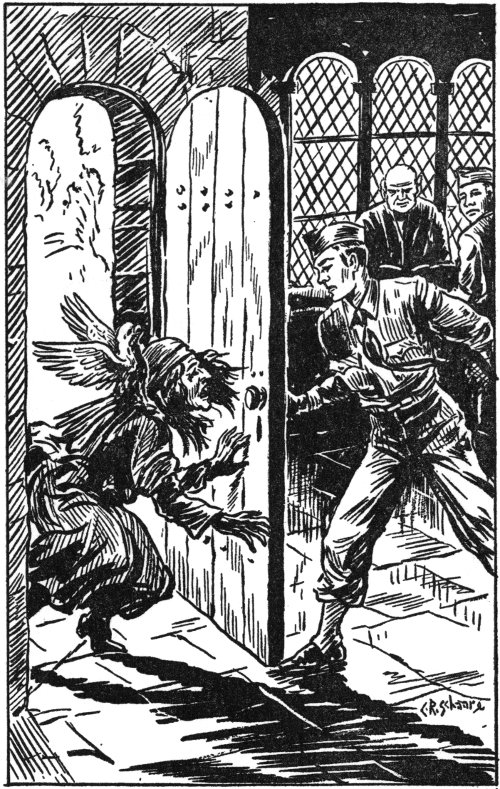
As he jerked it open, an old woman with a parrot
on her shoulder, stumbled forward into the room.
Obviously, she had been listening at the keyhole.
Jack recognized her at once as the same unfriendly
native he and Ken had met earlier on the path.
In a torrent of Spanish, the woman apologized
to Father Francisco. He scolded her soundly for her
behavior and bade her be gone.
Still chattering, the woman backed out of the
room and vanished into the corridor.
“Do you suppose she followed us here?” Ken
speculated. “Our presence in the village seems to be
stirring plenty of excitement.”
“Lolita has ears like a sponge,” said Father Francisco.
“She is a friend of Captain Carter’s. One of
his few supporters in the village.”
47
Forgetting the parrot woman, the Scouts once
more examined the ancient Portuguese manuscript.
At their request, Father Francisco read aloud a passage
in which the Portuguese adventurers described
their first glimpse of the treasure area.
“‘Our native Indians said it was a country whose
Gods did not wish it to be known,’” he recited,
“‘and that they would visit wrath and terror upon
all intruders.’”
Skipping through the manuscript, the missionary
read several beautiful passages, including one in
which the writer told of making camp near the
treasure mountain.
“‘Darkness made terrifying the unearthly landscape
of chasm, precipice and gorge,’” Father Francisco
quoted. “‘At dawn, the sun lit up frightful
precipices which none could scale, and in the bush-strewn
and craggy path we took at the foot of these
weird mountains, we had to step warily because of
lurking rattlesnakes. Had we been bitten, of antidote
there was none.’”
Glancing up from his reading, the missionary
smiled at the two Scouts.
“There is more, much more. This, however, gives
you a faint idea of what you might expect to encounter
should you decide to try to follow the route
taken by Burton Monahan.”
“Does the manuscript give directions for reaching
the hidden city?” Ken asked, undaunted.
“In a vague way. My thought is that the Portuguese
deliberately gave incorrect information so that
others could not find the treasure.”
48
“Why didn’t they go back themselves?” questioned
Jack.
“According to legend, the few men who survived
the expedition, did attempt to return many years
later, but could not retrace their way. Many men
since have tried and failed.”
“I’d like to read every word of the manuscript!”
Ken declared.
“If you linger awhile in Cuertos, I gladly will
translate it for you,” offered the missionary. “The
tale is most absorbing. The Portuguese adventurer
relates that the secret entrance to the city was discovered
by an Indian. While gathering wood for the
camp, he suddenly saw a cleft by means of which
the rocks could be scaled.”
“Do you believe that the ancient Inca city exists?”
Jack asked.
Father Francisco hesitated and then answered:
“There is considerable evidence that this manuscript
was based on fact. The city herein described might
be such a one as Cuzco, the ancient capital of the
Incas. The Portuguese’s account of ruins tallies in
all respects with those which have come to light in
recent years.”
“Strange that the city never has been spotted from
the air,” remarked Ken thoughtfully.
“Planes seldom fly in that area. In any case, the
ruins would be well-hidden by centuries of vegetation.”
49
“You doubt though, that Burton Monahan reached
his objective?” Ken persisted.
“If he did, he either lost his life or is being held
captive by hostile Indians.” Father Francisco
frowned and added as a question: “You noticed the
mantilla Lolita wore? The fastening—a gold pin in
the form of a fish?”
Ken and Jack admitted that they had failed to
note the ornament.
“That pin disturbs me,” the missionary said. “The
workmanship is unusually fine. I should judge that
the ornament is of Inca or pre-Inca origin.”
“How did the woman get it?” Jack speculated.
“Ah, if I knew the answer to your question, I
might know also what became of Burton Monahan.
Lolita has worn the pin for many months now, ever
since Captain Carter returned here from the unsuccessful
expedition.”
“Then you think he gave it to her!” Jack exclaimed.
“Perhaps for some service?”
“I would not know,” Father Francisco returned.
“It has occurred to me that Captain Carter may have
reached the hidden city, or contacted natives who
have had access to its treasures. This he has denied.
As for Lolita, she has told me repeatedly that she
bought the pin at a native market.”
50
“If Captain Carter reached the ancient Inca city,
he must know what became of Burton Monahan,”
Jack asserted, lost in thought. “Wait until we see him
again!”
“You will not have long to wait, I think,” the missionary
predicted with a smile.
At Jack’s look of astonishment, he inclined his
head toward the expanse of window overlooking his
area. In the distance, a small freighter could be seen
plying its way toward the harbor.
“The Shark, I believe,” Father Francisco identified
the vessel. “Captain Carter should drop anchor within
the hour. But I advise that you refrain from questioning
him about Lolita’s pin.”
Jack and Ken were troubled by the information
the old missionary had given them. Distrust of Captain
Carter which had been kept in close check, now
flared anew. Yet they realized that without specific
facts and proof, they dared not accuse the seaman.
To hint even, that they thought he had withheld
vital information about Burton Monahan, would be
to invite a quarrel which might wreck the expedition
before it was well underway.
“If the Shark is coming in, we ought to find Willie
and War,” Ken suggested, eager to get back to the
waterfront. “Maybe they’ve already sighted her.”
“May we come here later to go over the parchment
with you in detail?” Jack asked the missionary.
“Mr. Livingston will want to see it too.”
“I will give you what help I can,” Father Francisco
promised.
51
“You mentioned that the treasure lake supposedly
lies within a mountain,” Ken reminded him as he
and Jack were ready to leave. “Does that mean it is
hidden behind a mountain chain?”
“The phrase has been variously interpreted. Burton
Monahan believed, as do I, that the lake and the
secret city are hemmed in by high mountains.”
“Yet this treasure mountain is visible from the mission?”
Jack probed.
“So the manuscript reports. Come, I will show
you.”
Leaving the parchment on the table, the old missionary
moved with tottering steps to an arched
doorway which opened upon the street. With a
bony hand, he indicated the rim of mountains
visible in the far distance.
“Yonder you see the highest, most inaccessible
ranges of the Andes,” he said. “Even intrepid travelers
have found many of the chasms and valleys impassable.”
“Which is the secret mountain?” Ken asked eagerly.
Father Francisco pointed out one of the ranges,
which in the sunlight seemed afire with spears of
red and gold.
“Have explorers never reached those peaks?” Jack
questioned. “In all these years, it seems impossible
that no one would have gone there.”
52
“Many have attained the heights, my son. But little
gold has been found. As for the lost city, it remains
as elusive as in the sixteenth century when
the Portuguese first set eyes upon it.”
“Mr. Monahan took a direct route to yonder
mountain?” Ken asked, his eyes on the rim of blue.
“No, it was his belief that the directions given
in the parchment were incorrect. Either the Portuguese
were mistaken in their bearings, or deliberately
misleading.”
“You know the route he took?”
“To a certain point, yes. Beyond that, there is no
definite information. We have only Captain Carter’s
word—”
A startled expression came upon the missionary’s
kindly face. The two Scouts followed his gaze upward
to the expanse of adobe wall where an ugly,
jagged crack had appeared.
Even as they stared in astonishment, the crack
widened. Plaster began to fall. They felt the floor
tremble beneath them.
“An earth tremor!” Father Francisco announced
calmly, grasping the doorway for support. “Quickly!
Seek the safety of the street!”
53
Chapter 6 EARTHQUAKE TREMORS
A second, harder tremor jarred the room, nearly
knocking Jack and Ken off their feet.
“This mission is soundly built,” the old missionary
said in a quiet voice. “These ancient walls have sustained
a dozen severe quakes. But you will feel safer
outside.”
The two Scouts were reluctant to leave Father
Francisco, who scarcely seemed able to maintain his
balance.
“Come with us,” Jack urged, taking his arm.
“No, I must toll the bell. When my people hear
the bell, they know that the quake is not a hard one.
It reassures them and prevents panic. I must ring
it now.”
Painfully, the missionary moved toward the long
corridor. Another shock came, knocking a small
statue from a niche in the wall. Plaster dust filled the
air.
“Where is the bell?” Jack demanded. “We’ll ring
it for you.”
“Across the patio,” Father Francisco directed.
“The bell tower is to the right, beyond the kitchens.”
54
The very walls seemed to weave as Jack and Ken
raced for the tower. Outside the mission, all was
confusion. The Scouts could hear the frightened
screams of terrified natives who sought the streets.
Reaching the bell tower, they seized the long rope.
A dozen times they tolled the bell.
Another heavy tremor shook the mission. For a
moment, Jack and Ken feared that the bell tower
would come toppling down upon their heads. But
the danger passed and even to their ears, the steady,
clear clang of the bell was reassuring.
Minutes passed and there were no further quakes.
Jack dropped the bell rope.
“The worst is over now, I think,” he said. “Let’s
see what has happened to the village.”
Outside, natives were milling in the streets and
running toward the mission. In two places the cobblestones
had heaved up, leaving a wide, deep crevass.
Faces mirrored fear and anxiety, but there was
no panic.
Heavy dust hung over the street. Some distance
away, a house was on fire. Already the villagers were
fighting the flames with buckets of water. Jack and
Ken helped, and then, when the blaze was out,
looked about for Warwick and Willie.
“I guess they must have gone back to the waterfront,”
Ken said. “Or maybe to our hotel. We ought
to find ’em.”
55
“Think we should make certain Father Francisco
is all right before we go?”
“A good idea,” Ken nodded. “Quakes are old stuff
to him, I guess. But at his age a little excitement
might bring on a heart attack. Let’s go back to say
goodbye.”
The outside mission door stood wide open. Meeting
no one, the two Scouts went down the deserted
corridor to pause hesitantly at the entrance to the
library.
Evidently, the elderly missionary had not expected
them to return. His back was toward them.
He was searching rapidly through the miscellaneous
papers which cluttered the table.
“It’s over, I guess,” Jack remarked in a purposely
loud voice. “No great damage done.”
Startled, Father Francisco turned around quickly.
“Oh, yes, yes,” he said, almost vaguely.
“Is anything wrong, Father?” Ken inquired, aware
that the missionary seemed gravely disturbed.
“The old Portuguese manuscript,” Father Francisco
muttered. “Did either of you pick it up when
you went to ring the bell?”
“Why, no,” answered Ken.
“It was lying on the table when we left,” Jack
added.
56
“So I thought,” declared Father Francisco in a
troubled voice. “I went to the street for a few minutes
to quiet my people. When I returned a moment
ago, I could not find the parchment.”
“Might your housekeeper have taken it?” suggested
Ken.
“Impossible. My servants are trained never to
touch any of my papers.”
“Has anyone else been in the library?” Jack questioned.
“For instance, that parrot woman we caught
listening at the door?”
“Lolita would have no use for the manuscript. She
has no schooling and can neither read nor write.”
The Scouts became aware that Father Francisco
was regarding them with a peculiar, thoughtful expression.
Belatedly, it dawned upon them that they
might be under suspicion.
“I hope you don’t think we took that parchment!”
Jack blurted out. “We’re Scouts. It’s part of our
creed to be honest and trustworthy.”
“I believe you,” the missionary said. “Give the
matter no further thought. True, I value the parchment
highly, but sooner or later, the culprit will reveal
himself.”
“There’s something mighty queer about that
manuscript taking wings,” Ken remarked. “First, we
lose the translation. Now the original is gone—just
when we need it too.”
“We can’t blame this on Captain Carter,” Jack
pointed out. “His boat is probably making harbor
about now.”
57
“That parchment might have helped us find Burton
Monahan.”
Father Francisco told the Scouts that although he
had no copy of the Portuguese manuscript, he had
pored over it so often he could recall countless passages
from memory. He promised that he would
write as much as he could remember in English and
have it for the boys if they came again.
“We’ll return,” Jack assured him. “Having a copy
of that manuscript means a lot to us.”
Taking leave of the missionary, Ken and Jack
went directly to the beach. Father Francisco had
made no mistake in identifying the Shark. The familiar
schooner was anchored some distance from
shore. Even now, a small boat was plying its way
across the harbor.
“There’s Captain Carter!” Jack cried, recognizing
the man in the bow. “Let’s head him off.”
At the dogtrot, the Scouts started down shore. But
they were too far away to hail the Captain. His
boat touched the beach some distance away, and
without seeing them he started off alone in the opposite
direction.
Determined to overtake him, Ken and Jack followed.
Captain Carter was still some yards away
when abruptly he halted to talk to a woman at an
open-air vegetable stall.
58
“The parrot woman!” Ken exclaimed, stopping
short. “Father Francisco was right! They’re old
friends.”
The two Explorers were too far away to hear the
conversation, even if they could have understood
the rapid flow of Spanish. But they noted that the
two spoke most earnestly together.
And then Lolita, with a movement so swift that
Ken and Jack nearly missed it, whipped something
from her dress front. She handed the bulky object
to Captain Carter, who thrust it under his coat.
“What was that?” Jack demanded alertly.
“It looked like the missing parchment to me!”
“I thought so too! But why would she have
snatched it for Captain Carter? He couldn’t have
told her to do it, because he only now made port.”
“You got me,” Ken responded. “But she certainly
slipped him something. Shall we buzz ’em?”
“Let’s wait,” Jack decided after a moment of
thought. “No use tipping our hand.”
Unnoticed, they watched the two talk together
for a few minutes longer. Captain Carter took money
from his billfold, giving it to the parrot woman.
She then slipped away behind the vegetable stall.
Ken and Jack made no attempt to intercept the
Captain until he had started on. As they came up behind
him, he whirled suddenly and reached toward
his hip as if for a weapon.
59
“Oh, it’s you,” he said relaxing. “Well! Well! I
just came ashore to tell Livingston his cargo is here
safe and sound.”
“Six days late,” Jack remarked.
“We were delayed by a gale. Where’s Livingston?”
Jack explained that the Scout leader was in conference
with government officials.
“Still set on going inland?”
“That’s the plan,” Ken told him.
“It’s a mistake,” Captain Carter said gruffly. “If
anyone goes off on a wild chase looking for Monahan,
I’m the man to do it, because I know this country.
Now if Livingston could see it that way, you
could park yourselves comfortably—like at Lima.
I’d take the expedition in and either find Monahan
or learn what became of him.”
“You know then where he disappeared?” Jack
asked, watching the seaman closely.
Captain Carter shot a quick, suspicious glance
at him. “No such thing,” he denied. “I know where
he made his last camp before he started into hostile
Indian territory. I tried to get him to turn back, but
he wouldn’t listen.”
60
Ken and Jack remained silent. Nevertheless, they
were convinced that the master of the Shark was
lying. More than ever they were of the opinion that
he knew more about Burton Monahan’s disappearance
than he had revealed. Why, they wondered,
was he eager to head an expedition and yet unwilling
to have them go along?
“I was hired to haul your cargo here, and the job’s
done,” the Captain continued. “If you’re asking for
advice, though, I’m telling you to forget the expedition.”
“That’s what Father Francisco said, too,” Ken replied.
“Father Francisco?” Carter’s face twisted with
dislike. “What did that old fossil tell you about me?”
“Not very much,” Jack answered. “It may interest
you to know that while we were at the mission,
Father Francisco lost the Portuguese parchment
which described the secret mountain and the lost
Inca city. It was stolen from the library during the
earthquake.”
“So?”
“We saw Lolita at the mission,” Ken took over.
“In fact, she listened at the door. Weren’t you talking
to her just now?”
“What if I was? You want to make something of
it?”
“We were wondering—”
“Well, don’t!” Captain Carter cut in belligerently.
“Keep out of my affairs, or I’ll teach you a lesson you
won’t find in the Boy Scout manual! Lolita’s an old
friend of mine. I got a lot of friends in this port.”
With that, the master of the Shark swaggered
away, to disappear in a water-front tavern.
61
Chapter 7 SCOUT CARGO
“How we got ourselves hooked with a guy like
Captain Carter I’ll never know,” Jack commented in
disgust. “But if he figures we’re going to back out
on the expedition, or let him take over, he can guess
again.”
“I wonder when he’ll get our gear ashore?” Ken
speculated.
“Probably when he’s good and ready to ask clearance
from the port inspectors. He won’t hurry. You
can be sure of that.”
The Scouts turned once more toward the sea.
Before they had walked far, they spied Warwick and
Willie and hailed them.
“Hi!” War greeted the pair. “We’ve been looking
everywhere for you two. Hap sent a message.”
“Where is he?” Jack asked quickly. “Still with
those government men?”
Willie nodded. “He figures on being tied up
half the day. Our little party may stall right here at
Cuertos.”
“How come?”
62
“Well, the authorities aren’t keen on having us
start for the high sierras. Captain Carter’s name
seems to be poison here. We’re under a cloud because
of our association with him.”
“He’s here, by the way,” Ken informed the pair.
“As unco-operative as ever, too.”
“When did the boat get in?” Willie demanded
eagerly.
“Only a few minutes ago,” Ken answered. “Captain
Carter’s visiting his ‘friends’ around town. After
he’s talked out, maybe he’ll get around to moving
our stuff ashore.”
The sun by this time was high overhead. Bored
by inactivity, the Scouts returned to their hotel for
lunch.
Throughout the afternoon, they waited for Mr.
Livingston. Twice he sent word that he had been
delayed longer than expected.
“The expedition’s run into a snag,” Willie remarked
in discouragement. “We may never get out
of this hole!”
By dinner time, the Explorers were thoroughly
disturbed by Mr. Livingston’s long absence. A note
assured them that he would be at the hotel without
fail by nine o’clock.
“I’ve run into unexpected difficulties,” he wrote.
“Hope to have everything ironed out so we can
leave Cuertos within forty-eight hours.”
63
After eating, the Scouts strolled to the market,
and then to the water front. In the fast gathering
shadows, they could dimly make out the Shark riding
at anchor.
“Let’s go aboard,” Willie suddenly proposed.
“How’ll we get there?” Ken asked. “Swim? No,
thanks! I’m not offering myself as shark bait.”
Willie, however, had sighted a fisherman whose
motorboat was tied up nearby. “Let’s make a deal
with him to take us out there,” he suggested.
“Captain Carter may not like it,” Jack reminded
him. “He wouldn’t let us go aboard once before.”
“We can try,” Willie insisted. “Come on! Anything’s
better than just standing around.”
The others followed willingly enough. By means
of Jack’s Spanish and a dollar from Ken, they were
able to persuade the fisherman to take them out to
the Shark.
As the craft came alongside, Jack loudly hailed
the vessel. At first there was no answer. Finally, a
lone sailor thrust his head over the railing to peer
suspiciously down at the visitors.
In Spanish he demanded to know what they
wanted.
Jack asked for Captain Carter, only to be told that
he was not aboard.
“I can’t make out all he’s saying,” the Scout crew
leader reported to his chums. “I gather though, that
he’s alone. The others must have been given shore
leave.”
“Let’s go aboard,” War urged.
64
Before the others could deter him, he seized a
rope, and went up hand over hand. Oblivious to a
torrent of Spanish which poured from the lips of the
Shark’s watch, he then lowered a ladder for his
friends.
Ken and Willie quickly climbed aboard. Jack hesitated.
Before reluctantly following, he instructed the
boatman to wait.
“I feel like a pirate coming here while Captain
Carter is gone,” he admitted, leaping lightly down
on the gently rolling deck. “He has it in for us now.
If he finds us here, he’ll have just cause for complaint.”
“We have a right to find out about our cargo,”
Willie insisted. “Haven’t we waited all day? I need
some of my stuff.”
“We can’t take anything,” Jack pointed out. “Every
box will have to pass customs.”
“Inspection doesn’t amount to much in this port,”
Willie scoffed. “Let’s see if we can locate our boxes.”
“Even if we do, we’re not taking any of them from
the Shark,” Jack said firmly.
“Okay,” Willie agreed. “It won’t do any harm to
look around though.”
Descending to the hole, the Scouts quickly found
a compartment where a pile of boxes had been
stored. All were marked in the name of the Scout
organization.
65
“Say, this one is water-stained,” War observed,
pointing to a box on the top of the stack. “It’s the
one that went overboard when Captain Carter
loaded for the trip.”
“Hope nothing was ruined,” War said anxiously.
“Let’s have a look.”
“Better not,” Ken advised.
“It’s our stuff, isn’t it?” War demanded, taking out
his Scout knife.
He began to pry off the top boards. Finally, one
came loose. Willie focused the beam of his flashlight
on the opening.
“Say! What’s this?” he exclaimed. “We must have
broken into the wrong box.”
“This isn’t our stuff,” War confirmed. “But the box
is marked with our name! How do you figure it?”
His curiosity piqued, the boy went to work energetically
prying loose another board. As he ripped
it loose, the others obtained their first clear view of
what was inside the box.
In amazement and silence, they beheld the contents.
Then War burst out indignantly: “Well, I’m a
jumping horn toad! That two-timing, double-crossing
Captain Carter!”
The box contained several sawed off shot guns
and ammunition.
“This can’t be our equipment!” Jack declared.
“How’d it get into boxes marked in the Scout name?”
66
“We didn’t bring in a single weapon,” Ken said
soberly. “I know, because I helped Hap check every
box.”
“This looks bad—mighty bad,” Jack murmured.
“No wonder Captain Carter wouldn’t let me help
pull this box out of the water,” Willie asserted. “He
was afraid we’d find out what it held.”
“Maybe these other boxes don’t contain what
they’re supposed to, either!” War said suspiciously.
“I’ll bet Captain Carter has been using us to promote
some scheme of his own!”
“This may explain those unsavory rumors that
have been floating around Cuertos,” Jack added
thoughtfully. “Captain Carter must be mixed up in
some dirty business, just as Father Francisco
hinted.”
“And we’re tied up with him,” Ken declared. “No
wonder Hap is having such a tough time getting
clearance for our expedition. If the authorities find
this ammunition in Scout boxes, we’ll be finished
here!”
Quickly, he pulled another box out where it could
be opened. With War’s help, he pried the top
boards wide enough apart so he could run a hand
inside.
“More guns,” he announced grimly.
67
A third and a fourth box likewise were inspected.
One contained ammunition and the other, hand grenades.
No longer could the Scouts have the slightest
doubt. Unquestionably, under cover of the Scout
name, Captain Carter was bringing illegal cargo into
the country!
The discovery of guns and ammunition in the
Shark’s hold, thoroughly alarmed the Explorers.
“No wonder we’re in bad here!” Willie burst
forth. “It’s because of our hook-up with the captain!
I’ll bet he’s smuggling this stuff in to help Revolutionists!”
“If officials find these boxes with the Scout name
on ’em, we’ll be pulled into this ugly business too!”
added War.
“Another thing,” contributed Ken grimly. “Once
Captain Carter discovers we’ve opened this ammunition,
he may not let us have our stuff. He’ll be
nasty.”
“I sure wish Hap were here,” Jack said uneasily.
“I wish—”
He stiffened. A small boat had grated against the
Shark’s hull.
“Must be our boatman,” War muttered. “We told
him to stay.”
The Scouts waited rather tensely, listening. A
moment later they heard heavy steps on the deck
above them.
Motioning for the others to remain where they
were, Jack moved noiselessly to the companionway.
Cautiously, he peered out on deck. His worst fears
were confirmed. It was not their boatman who had
come aboard, but Captain Carter!
68
Chapter 8 CONTRABAND
Jack slipped back into the hold to report to his
companions.
“It’s the old boy himself,” he whispered. “We’re
in a pickle!”
“What do we do now?” War asked. “Hide?”
“Captain Carter must know someone is aboard, if
our boatman waited,” Jack reasoned. “He’ll find us
here quickly enough.”
“He’ll make hash of us!”
“Relax!” Jack advised. “Captain Carter seems to
be alone. There are four of us.”
“Anyway, he’s the one to do the explaining—not
us,” Ken pointed out. “Our gear is aboard the Shark,
or it’s supposed to be. We’ve got a right to be here.”
“He may be armed,” Jack warned. “We’ll have to
be on the alert. Now let’s go on deck before he
comes down here.”
Quickly, they all went up the companionway. As
they emerged into the cool evening air, Captain
Carter loomed in front of them.
69
“Well, blister my timbers!” he exclaimed wrathfully.
“It didn’t take you long to get out here after
you thought I was away! What were you doing in
the hole?”
“Looking for our cargo,” Ken told him coldly.
“Didn’t I tell you to stay off this vessel?”
“You did,” Ken replied, “but I think we have a
right to be here. Especially as you spent the day at
a tavern instead of getting our stuff ashore.”
“You’ll get your cargo in good time.”
“We found some of the boxes in the hold,” Jack
said. “They were marked for our expedition. But
they didn’t contain our equipment.”
“So you opened ’em?”
“We certainly did,” War cut in, enjoying the captain’s
consternation. “They contained guns and ammunition—that’s
what!”
“Why, you blithering little sneaks!” the captain
muttered.
“Maybe you can explain it,” Jack said quietly.
“I’ll explain nothing! Get off this vessel and stay
clear! You hear me! Get off!”
“We want our equipment. Mr. Livingston—”
“Mr. Livingston—” Captain Carter mocked. “Mr.
Livingston! I’m so sick of that name I could vomit!
I’m sick of all you meddling, stupid little boys. You
call yourselves Rovers—Explorers! One night in the
hills and you’ll be whimpering for your mothers.
One flurry of poisoned Indian arrows and you’ll
come flying back to Cuertos crying for your morning
milk!”
70
The seaman’s words infuriated the Scouts. War’s
fists clenched tightly and he began to stammer:
“Why, you-y-you—”
Jack placed a restraining hand on the younger
boy’s arm. It was evident that Captain Carter deliberately
had made the personal remarks, hoping to
distract them from asking further questions.
“Suppose you tell us why those boxes were
marked in the name of the Scout organization?” he
persisted.
“Because Mr. Livingston ordered it.”
Jack eyed the captain steadily. “That’s not so,” he
replied quietly. “Ken and I helped check every box
that went aboard the Shark. There were no guns or
ammunition.”
“Those particular boxes were picked up in the
Canal Zone—at Mr. Livingston’s orders.”
One and all the Explorers showed by their expressions
that they did not believe the captain.
“I’m getting your stuff off this vessel right now,”
the seaman announced. “Then I don’t want to hear
any more squawks!”
Shoving Willie aside, he went down into the
forecastle hold.
Soon, with the aid of the watch, all cargo stamped
with the Scout name, had been brought on deck.
Jack counted twelve boxes which he was certain
had not been in the original shipment.
71
“What are you doing with our stuff?” he demanded.
Captain Carter did not answer. Ignoring the
Scouts, he started to supervise the loading of a small
motor tender.
“Shake it up!” he ordered his helper. “We got to
move this stuff fast. First, those boxes of grenades.”
The Scouts witnessed the loading with increasing
misgiving. They were firmly convinced that Mr.
Livingston never had ordered guns or grenades for
the expedition. But without him there to confirm it,
they hesitated to tangle with Captain Carter.
“How will this stuff go through customs?” Ken
muttered, watching as another box was lowered to
the tender. “It doesn’t make sense to me!”
“Nor to me,” Jack agreed. “I’m sure Hap had no
hand in this business. You notice the captain isn’t
moving the regular Scout boxes—only the guns and
ammunition.”
“He’s in a mighty big hurry too! Say, maybe he’s
scared of custom officials, and is trying to get rid of
the stuff while it’s dark!”
“We could stop him.”
“Maybe,” Ken conceded. “He’s armed though,
and someone would be likely to get hurt.”
“I’m going for Mr. Livingston,” Jack announced
with sudden decision.
“How?” Ken drawled. “You aim to swim?”
“Our boatman—”
72
“Gone. Either he went off while we were below, or
more likely, Captain Carter dismissed him.”
“We’re stranded here then!”
“We are, unless we can ride in on the tender. So
maybe we should wait a bit and pretend to play
along.”
The Scouts clustered together, silently watching.
Approximately half of the boxes containing weapons
had been lowered onto the tender, when Willie
heard the splash of oars.
“What was that?” he demanded in an undertone.
“Our boatman coming back maybe?”
Peering out across the rail into the darkness, the
Scouts at first could see no one. Then, they made out
a small rowboat coming directly toward the Shark.
“Ahoy!” called a cheery voice. “Anyone aboard?”
“That sounds like Hap’s voice!” War cried excitedly.
Captain Carter also had heard the approaching
boat. Speaking rapidly in Spanish, he ordered the
sailor in the tender to shove off.
The Scouts shouted to Mr. Livingston, urging him
to hurry. Eagerly, they helped him aboard.
“I’m relieved to find you fellows here,” the Scout
leader asserted. “What a day I’ve had with government
officials! Our troubles aren’t over either, I’m
afraid.”
“You don’t know the half of it,” Ken said, looking
directly at Captain Carter.
73
He waited for the master of the Shark to take the
initiative in mentioning the boxes of ammunition.
The captain however, smiled arrogantly, and remained
silent.
Unaware of the tense situation, Mr. Livingston
remarked casually:
“I’m mighty glad the Shark finally made port. We
should get our expedition on its way within a few
days, providing government officials give us clearance.
So far, they’ve refused.”
“Refused?” Willie demanded. “Why?”
“Well, it’s ridiculous. But a lot of nasty rumors
seem to have circulated about our party. We’re under
suspicion of aiding a group of would-be revolutionists,
who have taken refuge in the back country.
I think I finally managed to convince them of our
good intentions. At any rate, port inspectors are
coming aboard in a few minutes to make sure we’re
not bringing in any contraband. Once our personal
cargo passes inspection, the way should be cleared
for us to leave Cuertos.”
“Jumping hop toads!” exclaimed War in dismay.
“You mean if those government men should find
guns or ammunition aboard, they’d hold up our
trip?”
“If they came upon anything of that sort, they’d
probably toss us in jail,” Mr. Livingston chuckled.
74
The Scouts could not share their leader’s amusement.
Even Captain Carter had been jarred by Mr.
Livingston’s casual announcement.
“The port authorities are coming here?” he demanded
harshly. “Tonight?”
“Why, yes, that’s my understanding. I told them
we’d welcome a thorough check.”
“You babbling idiot! You’ve done it now!”
“Done what?” Mr. Livingston coldly inquired.
“Ruined all my plans. The authorities haven’t inspected
my vessel in four voyages! Now you bring
’em down on me!”
Amazed by the seaman’s blast of anger, Mr. Livingston
demanded: “Any reason why inspectors
shouldn’t check the cargo?”
“Any reason?” Carter mocked savagely. “If I’m
caught, so are you!”
“Kindly explain.”
“Take a fast look at some of those boxes and you’ll
have your answer,” Jack grimly informed the Scout
leader, indicating the cargo which remained on
deck.
“What’s wrong, Jack?”
“Plenty. These boxes are marked for our expedition.
They’re loaded with hand grenades, sawed-off
shotguns and the like. Captain Carter has moved
one load to shore already.”
“Guns!” Mr. Livingston turned coldly toward the
seaman. “So it’s true, Captain Carter—you’re aiding
Revolutionists!”
75
“No, it’s not!” the captain denied.
“Then explain these boxes.”
“I have use for those grenades. You’ll hear about
it in good time. Now if you’ll climb down the mast,
I might cut you in on a good deal.”
“We want no deal with you, Captain Carter.”
“Figure you’re above me, eh? You and your high
ideals!”
“We believe in honesty.”
“Yeah!” the captain sneered. “Well, let me tell
you this—you got a lot to learn!”
“We’ll be no shield for a revolutionist.”
“You got me all wrong, I tell you!” Captain Carter
shouted. “I’m not denying I used your boxes to
haul in a little ammunition. I need it for a special
purpose. What’s the harm? Your stuff is all here. I’ll
set it ashore and no questions asked.”
“You can’t get by with it, Captain Carter.”
“I can if you’ll keep your mouth shut. You and
your nice little boys!”
“The answer is no.”
“Oh, so you aim to turn me in, eh?” the captain
sneered. “Don’t forget, Scoutmaster, you’re tarred
with the same stick!”
“We’ll have no part in this ugly mess. From the
start, your name and reputation have been a drag to
the expedition.”
76
“The guns are in your name,” Captain Carter reminded
him. “If they’re found aboard the Shark,
your expedition is finished. You’ll never set foot inland—not
one step. You’ll find yourself under suspicion,
bound head and foot with government red
tape!”
Ken had been peering intently over the railing.
Not only had his keen ears picked up the sound of
a fast-approaching motor launch, but he could see its
outline some distance to starboard.
Jack too, heard the sound, and joined Ken at the
railing.
“That boat’s heading straight for the Shark,” he
observed uneasily.
“A government launch too,” added Ken. “It looks
very much as if the red tape is on its way!”
77
Chapter 9 CAPTAIN CARTER’S DECEPTION
Captain Carter moved swiftly to the rail to ascertain
that Ken spoke the truth.
“It’s the customs boat all right!” he exclaimed.
“They’ll search the Shark from stem to stern. If any
of these boxes are found, I’m a dead duck!”
“You admit you’ve been helping the Revolutionists?”
Mr. Livingston demanded.
“I admit nothing! What’s more, if you have any
thought of trying to find Burton Monahan, you’ll
keep clear of this. Help me get these boxes overboard!”
“Overboard?”
“You don’t want the government men to find ’em,
do you?” Captain Carter snarled. “They’re your
boxes, remember! Come on, there’s not a second to
lose.”
“You’ll get no help from me.”
“Then you’re cooking your own goose! Either you
lay hold and help heave the guns overboard, or I’ll
deny all knowledge of the cargo.”
“That lie wouldn’t get you far.”
78
“You think not? I’m afraid, my dear Livingston,
that you don’t know Peruvian officials as I do.
They’ll believe me all right.”
Seizing a fire ax, the captain smashed open a box
bearing the Scout name. Hauling out dynamite and
other explosives, he dropped them overboard.
By this time, the government boat was drawing
close to the schooner.
Abandoning the axe, Captain Carter dragged the
filled boxes to the port railing. One by one he shoved
them overboard. The heavily laden containers fell
with loud splashes, sinking slowly out of sight into
the dark water.
Silently, Mr. Livingston and the four Explorers
witnessed the disposal of the contraband cargo.
Once, as the Scout leader tried to halt the dumping,
Captain Carter drew his revolver.
“Keep back!” he warned. “Move out of my way!”
He dropped the last telltale box into the water,
letting it fall carefully to avoid a heavy splash.
The government boat emerged from the dark a
moment later, pulling alongside the Shark.
“Shark, ahoy!”
“Ahoy, there!” Captain Carter returned the shout.
“We’re coming aboard for inspection!”
“Come ahead,” the captain jovially invited.
The government boat made fast and three men
came smartly aboard. Suspiciously, they looked
about the deck.
79
“We heard a splash as we came up,” their spokesman
commented.
“Some refuse we were getting rid of,” the captain
replied easily. “You’ll find everything in order here.”
“We’ll have a look below.”
“Go right ahead, gentlemen,” invited the captain
with elaborate courtesy.
At this point, Mr. Livingston quietly informed the
officials that the seaman had dumped ammunition
only a few moments before the government boat had
arrived.
“That’s a blasted lie!” Captain Carter exclaimed
wrathfully. “Gentlemen, this pest has it in for me,
because I’ve refused to help him start on a wild hunt
for Burton Monahan! He swore he’d get even, and
this is the way he’s trying to do it!”
The Scouts gathered beside their leader, staunchly
supporting his story.
“This is a frame up, gentlemen,” Captain Carter
said smoothly to the officials. “You know me—I
wouldn’t try to pull the wool over your eyes. Search
the vessel and see if you can find any contraband!”
“We know you very well, Captain Carter,” was
the grim response.
While Mr. Livingston and the Scouts waited, the
customs men made a thorough check of the vessel.
Coming upon equipment marked for the Scout expedition,
they dragged the boxes out into the open.
80
As the first one was smashed apart, the Explorers
squirmed uneasily, wondering what might be
brought to light. They need have had no misgiving.
The box contained only tents and sleeping bags.
Another box held heavy clothing for high altitudes.
A third was filled with dehydrated foods and
tinned goods.
“You see!” Captain Carter said triumphantly. “Everything
in order, just as I said. These Boy Scouts
are a bunch of trouble makers. They got it in for
me!”
“That’s not so!” War cried hotly. “You dumped
six boxes and you can’t deny it!”
“It’s not so. Even if it was, you got no proof. You
can’t tie up my boat on the say-so of these irresponsible
kids and their Scoutmaster!”
The government officials conferred privately. At
the end of their conference, they politely informed
the captain that no charge would be placed against
him. They also told Mr. Livingston that he might
move the Scout cargo ashore. The government boat
then pulled away.
No word was spoken until the craft was well beyond
the point at which voices would carry.
Captain Carter then slapped his thigh and
laughed boisterously.
“Well, Scoutmaster, how’d I do? Anyone who gets
ahead of Captain Carter has to get up mighty early
in the morning.”
81
“You may hear from those government men
again,” Mr. Livingston warned.
“Oh, sure! They’ve been watching me for a year,
but they know they got to have proof! They’ll keep
an eye on me, but they ain’t makin’ any false
moves.”
“You managed to get a tender load of grenades
and other stuff ashore,” Jack said coldly. “What do
you aim to do with that contraband? Sell it to the
Revolutionists hiding out in the hills?”
“You’re crazy!” Captain Carter’s eyes smoldered
angrily. “I told you I’m not helping any Revolutionists.”
“Then what are you doing with the stuff?”
“You’d like to know, wouldn’t you?” the captain
sneered. “Well, let me tell you this, young man. I
was the one person who could have helped you find
Burton Monahan. But would you play along? You
would not! So now you’re on your own, and bad luck
to you!”
“What do you mean, you’re the one person who
could have helped us find Mr. Monahan?” the Scout
leader asked quickly. “You have information you’ve
withheld?”
“No such thing,” the captain denied. “I was the
last white man to see him alive, and I know the
country. But you and me can never get along.”
82
“A true observation,” Mr. Livingston returned.
“We want no association with a man who would aid
revolutionists.”
“High and mighty, ain’t you?” Captain Carter
sneered. “Without me, you got no chance of ever
finding Burton Monahan.”
“You know what became of him?”
“Maybe I got an idea,” the seaman returned, his
eyes glinting. “Maybe if you’d play along my way—forget
all your grand and glorious ideals, we could
work together.”
“Just what do you propose? That we help you get
your contraband cargo to a Revolutionist leader?”
“Oh, stow that talk, will you? You jar my compass!
Can’t you get it through your thick skull that I’m not
tied up with any revolutionists? Maybe in the old
days, I picked up a dollar here and there bringing in
stuff for Carlos Vandetti, but that’s behind me.”
“Then why were you bringing in grenades and
ammunition?”
“I got a good use for ’em. One tender load made
shore before you brought those sneakin’ officials
down on my back. It ain’t enough for my purpose,
but I’ll make it do.”
“You’re not making yourself clear, Captain,” Mr.
Livingston said coldly. “Why not come to the
point?”
“It’s like this,” the seaman replied. “I got a reason
for wanting to go along on this expedition into the
mountains.”
83
“We figured so.”
“All this loose talk about me helping the Revolutionists
has made government officials suspicious.
They watch me like a hawk. If I team up with your
expedition, no questions will be asked.”
“Only a few minutes ago, you were trying to
wreck the expedition by accusing us!”
“I was in a hank. A trigger temper’s one of my
weaknesses. Now, if we can make a deal—”
“You’re proposing to trade on the Scout name.
You want to move your hand grenades and what
ammunition you have left under our banner?”
“I wouldn’t put it like that. I’ll go along with the
expedition and give you the benefit of my experience.
As I said, I got mighty good use for those
grenades. If you help me, maybe I’ll help you.”
“You’ve betrayed Mr. Monahan by pretending you
were sincere in trying to find his brother!”
“Who says I double-crossed him? Maybe, if you
play along, I’ll lead you to Burton.”
“You do know what became of Burton Monahan,”
Mr. Livingston accused. “I’ve suspected it for a long
while.”
“Hold on, I didn’t say that!”
84
“Nevertheless, I think it may be so. Because Mr.
Monahan wanted me to co-operate with you, I’ve
tried in every way to obey his wishes. But this is
the end, Captain. Even if you were able to guide us
to Burton Monahan, I know you would do it only
for your own profit!”
“Then it’s no deal?”
“No deal,” Mr. Livingston repeated firmly. “From
this hour on, the Scouts go it alone. We’re severing
all connection with you.”
Captain Carter’s amused smile implied that the
decision was of no great moment.
“Okay, if that’s the way you want it,” he replied
with a shrug. “Your cargo will be set ashore tomorrow
morning. Now get off the Shark and keep out of
my sight! Because I’m warning you that next time
we meet, I’ll do you no favors!”
85
Chapter 10 FURY OF A MOB
True to his word, Captain Carter set all the Scout
equipment ashore before dawn the next morning.
The various boxes were delivered to the hotel, and
a careful inspection satisfied Mr. Livingston and the
Explorers that nothing was missing.
Of the captain, no more was seen. Following the
unfortunate affair aboard the Shark, the officer carefully
avoided the party.
“But don’t think we’ve heard the last of him,” Mr.
Livingston predicted. “He’ll pop up when we least
expect him and make trouble! I’ll be glad when
we’re well away from this village.”
Intent upon making a start on the trip inland, the
Scout leader absented himself from the hotel most
of the morning. He conferred for several hours with
Father Francisco, obtaining maps and a great deal
of useful information.
As for the Explorers, they whiled away their time
at the village and the waterfront. Always, the Shark
drew their eyes like a magnet. The vessel remained
at anchor, rolling in the swells, but there was no
evidence of activity aboard.
86
“Wonder what Captain Carter will do now that
we’ve turned down a deal with him?” Willie speculated.
No one answered. In fact, the attention of the
others had been diverted to the narrow strip of
beach. The tide was very nearly at its high point,
coming in strong.
Jack halted abruptly, staring at a pile of debris
which had been washed up some distance away.
“Wow! Are we in a jam!” he exclaimed in dismay.
“See what’s lying on the beach!”
“Where?” demanded Warwick, squinting into the
bright sunlight.
Jack pointed up shore to a pile of rocks, against
which giant greenish-blue waves were smashing.
“I still don’t see anything.”
“Then you sure need glasses! If that isn’t a box,
I’m losing my own eyesight!”
“Jack’s right!” Ken exclaimed. “It is a box, and
what’s worse, it looks like one of ours. Or rather,
one of Carter’s that was stamped with the Scout
name.”
“Golly, gee!” War cried. “How could it be? All
of those boxes with ammunition and guns were sunk
to the bottom of the bay!”
“The bay is shallow at this point,” Jack reminded
him. “And the tide is coming in strong.”
87
“Ye fishes!” Willie muttered in consternation.
“Suppose that is one of the boxes with the Scout
name on it! Then what?”
“Captain Carter will get his!” War chortled.
“Those custom officials will have proof that he was
lying when he denied dumping the stuff last night!”
“They’ll also see our name printed on the boxes,”
Jack reminded the group. “We’re almost certain to
be involved.”
“And that would mean we can’t get out of Cuertos
tomorrow,” added Ken. “As things stand now, Mr.
Livingston practically has everything arranged.”
“We’d better find out if that is one of our boxes,”
Jack declared, starting off across the beach. “Come
on!”
Walking fast and dodging waves which washed
high on the pebbles, they reached the rock pile. A
water-soaked, battered box lay partially buried in
wet sand.
“It’s one that Captain Carter dumped last night!”
Jack asserted, turning it over. “What wretched luck
that it had to wash up here!”
“And another is coming in!” War exclaimed,
sighting a container which was rolling and twisting
in the heavy sea.
The wave broke on the sand, leaving its telltale
debris behind. War waded through ankle-deep
water to drag the second box high on the beach.
“What’ll we do with ’em?” he asked.
88
“If these boxes are found here, custom officials
are certain to hear about it,” Ken declared in a
worried voice. “We don’t dare let the stuff lie.”
Quickly he scanned the deserted beach. No one
was in sight.
“We could hide ’em—” he suggested slowly.
“Hap might not approve,” Jack replied. “On the
other hand, he told the customs men the truth and
they accepted his word. Now if we produce this
evidence to nail Captain Carter, there’s no telling
what wild story he’ll come up with to save his skin.”
“We know he’ll try to involve us deeply,” Ken
asserted. “He warned us he’ll make trouble if he can.
I’m in favor of hiding the boxes. We can tell Hap
later, and if he wants us to dig them up, we’ll have
to do it.”
“Okay, let’s get at it!” jack consented. “No time
to lose.”
Quickly the four Rovers dragged the two boxes to
a small dune which rose in front of the dark cliff.
Working fast, they dug deep holes and buried the
ammunition. Then they smoothed out their own
footprints left on the sand.
“Well, that’s done!” Willie said, wiping perspiration
from his forehead. “Think anyone saw us?”
“I dunno,” War returned, scanning the cliffs above
the beach. “A native woman has been standing there
for a minute or two.”
89
“It’s that old gal with the parrot,” Ken recognized
her. “She’s watching us all right!”
“Think she saw us bury the boxes?” Jack asked
uneasily.
“It’s hard to tell.”
“Even if she did, she wouldn’t know what was in
’em,” Willie said, taking the cheerful view. “Let’s
move off before she gets suspicious.”
Accepting his advice, the others sauntered casually
along the shore. However, as they walked, they
kept an alert gaze upon the cliff, and they also
watched the sea for evidence of other boxes.
“That native woman is leaving,” Ken presently
reported in an undertone. “We won’t need to be so
careful now.”
Selecting a spot not far from the dune where the
contraband cargo had been buried, the four Rovers
sat down to watch the sea.
By this time, the tide definitely had turned.
While Ken, Willie and War rested, Jack made a
quick tour of the beach. He returned shortly to
report that the other boxes apparently had not
washed ashore.
“They may roll up tomorrow, or maybe never,”
he declared.
“Captain Carter sure would get a big kick out of
this,” Willie remarked. “He’d consider it a huge joke
on us. It certainly goes against my grain to do him
a favor.”
90
“We’re doing ourselves a bigger one,” Ken pointed
out. “If we don’t get out of Cuertos soon, I have a
hunch our expedition will stall for good!”
“Maybe Father Francisco is right,” War remarked
thoughtfully. “Maybe it is foolish for us to
try to find Burton Monahan. If he’s been gone so
many months, he must be dead.”
“Hey, listen!” Willie suddenly exclaimed.
The others became silent. A peculiar sound, distinguishable
as the hum of many angry voices,
plainly could be heard.
“What’s up?” Jack muttered, scrambling to his
feet.
At first the Explorers could see no one. Then they
sighted at least thirty villagers armed with clubs,
coming down a steep cliff trail.
“A regular mob!” War observed nervously. “Heading
this way too!”
“Toward us,” added Willie. “Say, they mean business!”
“There’s that parrot woman who was watching
us,” Jack said, recognizing her amid the angry
throng. “She’s stirred up the natives against us!”
“But why?” Ken demanded. “Did she see us bury
the boxes?”
“She may have,” Jack replied. “Anyway, she’s
Carter’s friend. He may be behind this!”
“We’ll have some tall explaining to do in a minute
or so,” Ken said. “How’s you’re Spanish, Jack?”
91
“Not equal to that gang! They’re out for blood!”
Even as he spoke, a stone was hurled from above.
It clattered down over the cliff, barely missing
Willie’s head.
“Let’s get out of here fast!” he proposed.
A shower of stones now was falling on the beach.
To remain was to invite injury.
“Hey, I don’t want to run,” War protested, holding
back. “We’ve done nothing wrong. We can
explain—”
“Listen, brother!” Jack said, grasping him by the
arm. “You can’t explain anything to a crazy mob.”
“Especially when you can’t speak the language
decently,” Ken added urgently.
The villagers now were very close, led by the
chattering parrot woman. Shaking their sticks, the
natives shouted ugly threats.
“Come on!” urged Jack, leading the flight. “We’ve
got to move out of here fast! Unless we do, our
escape will be cut off!”
92
Chapter 11 INTO THE WILDERNESS
The route to the hotel already had been blocked
by the approaching villagers. Moving hurriedly
down the beach, the Explorers climbed a steep path
which wound up a high hill to the rear of the
mission.
If the Scouts had hoped so easily to elude their
pursuers, they learned otherwise. The villagers kept
coming on, shouting angry threats, only the general
import of which the boys understood.
“They’re plenty mad, and I don’t think it’s about
those buried boxes either,” Jack said, looking back.
“Something has stirred ’em up. If they try to lay
hands on us, it could end in a bloody free-for-all.”
“Let’s make a stand and face ’em,” pleaded War,
halting.
Ken pulled him along. “We’d come off badly
against so many,” he advised. “Besides, if we get
into a fight, we’ll be finished in this village. The
Scouts would get a bad name.”
93
“That’s right,” Jack supported him. “But we’ll
have to think of something quick! We can’t make it
back to our hotel this way. Some of that wild bunch
are coming up the street now to head us off!”
By this time, the group had reached the mission
on the hilltop. Ken studied the high rear wall.
“Father Francisco is about to have four uninvited
guests!” he announced with a grin. “Over we go!”
Quickly, he boosted Willie to the top of the
sturdy stone barrier. The latter then helped Jack
and War, who in turn, pulled Ken to the safety of
the ledge.
Just as a group of villagers came pounding up the
path, they leaped lightly down into the enclosed
garden.
At a table beside an under-nourished, stunted tree
sat Father Francisco. The missionary calmly was
sipping a cup of tea. He seemed more amused than
annoyed by the unexpected intrusion.
“Excuse us, Father,” Jack apologized, brushing
dust from his uniform. “We were a little pressed for
time or we would have used the door.”
“A mob is after us!” War burst out. “We don’t
know why, but the whole village is ready to tear us
apart. Hear ’em yell? Any minute, they’ll try to
break in here!”
“I think not,” smiled the missionary. “You are
quite safe within these walls.”
Summoning his servant, he ordered the woman to
bar the mission door. “And bring four cups and a
fresh pot of tea,” he added.
94
The Explorers sat down and tried to relax. As
casual as if he were utterly unaware of the shouting
crowd on the other side of the wall, Father Francisco
told the boys that Mr. Livingston had left the
mission only a half hour earlier.
“I tried to dissuade him from starting in search
of Burton Monahan and the lost city,” he informed
the group. “His mind is made up. So I have agreed
to give him what assistance I can. All arrangements
have been made for you to leave on the morrow.”
“Tomorrow?” Willie repeated. “Say, that’s great!”
“We’ve worn out our welcome in this village,
that’s sure,” Jack added ruefully. “I wonder what
stirred everyone against us?”
“Drink your tea,” the missionary urged, “and I
will seek the answer.”
Moving painfully with the aid of a cane, Father
Francisco went through the patio and thence to the
front entranceway where the mob had gathered.
When he rejoined the Scouts fifteen minutes later,
his face was grave.
“This is more serious than I thought,” he reported.
“Lolita has turned the villagers against you.”
“We suspected she was at the bottom of it,” Ken
nodded. “What’s it all about?”
“Lolita has convinced the villagers that your expedition
is for the sole purpose of obtaining sacred
Inca treasure from the ancient temples.”
95
“But that isn’t so,” Jack denied instantly. “Can’t
we explain to them?”
“I tried, and I believe my words carried some
weight. Nevertheless, my advice is to leave Cuertos
as soon as you can. Tonight if possible. Or at the
very latest, early tomorrow morning.”
“We don’t know much about Mr. Livingston’s
plans,” Jack replied, rather worried. “We’ve scarcely
seen him all day.”
“He is arranging for you to leave here by car,” the
missionary disclosed. “At Cuya you will pick up a
reliable guide, who will assist in hiring natives to accompany
you. That part will be easy. Later steps of
the journey will become increasingly hard.”
“We’re not expecting an easy time,” Jack replied
quietly.
“Wherever you are, my prayers will go with you.
I must admit that I am greatly relieved that Captain
Carter is not to be a member of your party.”
Before anyone could reply, the servant woman
came hurriedly to the garden. She addressed Father
Francisco rapidly in Spanish.
“This is most annoying,” the missionary said to
the Scouts. “The throng becomes unruly again.
Lolita has stirred them up once more. The villagers
demand that I turn you over to them.”
“We didn’t mean to cause you trouble by coming
here,” Ken apologized. “If only we could make them
understand—”
96
“That, at the moment, is doubtful. But do not be
disturbed. We will retire to the library, and presently
they will go away.”
“They’re making a worse clatter every minute,”
Jack remarked with a shake of his head. “They may
try to break down the door.”
Unmindful of the noise from outside, Father Francisco
guided his visitors to the library. There, he
produced a half dozen sheets of beautifully written
manuscript.
“This is the translation I promised to make for
you,” he said, placing the script in Jack’s hand.
“Some of the passages are missing because my memory
grows faulty with advancing years. I must confess
too, that all portions of the manuscript are not
strictly accurate. You may have this copy, and I
sincerely hope it will be of use to you.”
“You never recovered the original parchment?”
Jack inquired after he had thanked the missionary
for the laborious work.
Father Francisco shook his head. “Lolita may
have stolen it,” he remarked. “On a number of occasions
I have scolded her for her behavior.”
Jack skimmed through the closely written pages.
“Say, this is rich stuff!” he asserted. “Listen,
fellows! ‘Around the camp fire which we lit that
night, we held council and decided that next morning
all of us would set off cautiously down the trail
to the city of the dead....’”
97
“There is a break at that point,” Father Francisco
apologized. “My memory failed me completely.”
Jack read on:
“‘We came into the open from the trail, approached
towering walls and passed under a gigantic
entrance of three lofty arches. These were built
of colossal stones, the center arch dominating the
others.’”
“That’s an account of the Portuguese explorers’
first view of the ancient city?” War asked in awe.
The missionary nodded. “The original offers a
most graphic description of ‘an ethereal region that
served as a throne for the wind and stars.’ My translation
is not the best, and my recollection of it, even
poorer. It should, nevertheless, serve your purpose.”
“Is the city’s location given?” Ken asked hopefully.
“Yes, but the directions are too general to be of
much help. Briefly told, the manuscript relates how
the explorers, after many hardships came to the
mountains, whose sides seemed aflame. This they
took to be an omen of good fortune.
“Finding the mountains almost impossible to
scale, the explorers made camp. Next day, in a
search for fire wood, an opening was found between
the cliffs. Upon investigating the cleft, they discovered
they could climb to the summit.
98
“When finally they emerged, they beheld the hidden
city stretched before them. Now, the tale might
have been discredited, save for one thing.”
“What was that?” War prompted.
“Bear in mind that the manuscript was written in
the sixteenth century. The description given by the
explorers of the ancient Inca city might fit any number
of ruins which since have been discovered. Yet
at the time the manuscript was written, they were
utterly unknown. Uneducated adventurers scarcely
could have invented such vivid detail as the manuscript
contained.”
“So Burton Monahan and other explorers who
went before him believe that the city actually existed?”
Ken remarked. “That it was never discovered
after the Portuguese left it?”
“True. Remember that the way is difficult and that
cargo animals cannot be taken far on the trail. The
climate ranges from cold to extreme heat, so that a
considerable amount of equipment must be carried.
Few are willing to undertake such a venture.”
“What happened after the Portuguese reached the
hidden city?” inquired War, eager to hear more of
the story.
“Here’s a hint,” declared Jack, reading at random
from the manuscript.
99
“‘The grandeur of these mighty remains awed
every man’s tongue into silence. We tiptoed in the
shadow of the ruins. The stones were black with age.
No one spoke above a whisper and orders were
given in a low voice. High above the crown of the
middle arch, strange and unknown characters were
engraved.’”
The reading at this point was interrupted by loud
shouting and pounding on the outer mission door.
“They’re going to break in here!” Willie asserted,
getting to his feet.
“Do not be disturbed,” said Father Francisco.
“There is a secret way out. I will show you.”
He beckoned for the Scouts to follow him. Crossing
the library, he pressed a hidden spring. To the
amazement of the Scouts, one of the wide bookshelves
swung inward.
Behind it was revealed a low, arched-over tunnel.
“This escape was very useful in the early days of
the mission,” Father Francisco observed cheerfully.
“Today it has little practical value, save on a rare
occasion such as this.”
“Where does it lead?” War asked, peering into the
tunnel’s dark interior. He could not see its end.
“It twists through the hillside to emerge in a
small cave overlooking the sea. Once there, you will
be near your hotel. I suggest that you go directly
there and remain until your departure from
Cuertos.”
“We will,” Ken promised gratefully.
100
“Wait,” Father Francisco bade the Scouts as they
would have started into the tunnel. “You will need
a light to guide you. A candle—”
“No need,” Jack said. “I have my pocket flashlight.
Thanks for everything.”
Switching on the light, he started ahead of the
others into the low, narrow passageway. A half
dozen wide, well-worn stone steps led downward to
a lower level.
Moving fast, the Scouts followed an uneven dirt
floor in a crazy pattern of turns and zigzags. Soon
they had lost all sense of direction.
“Shouldn’t this thing be coming to an end?” Willie
presently demanded. “We’ve gone a mile.”
“Not even half that far,” Jack corrected, pausing
to look back.
“Anyone behind us?” Willie asked.
“Nope. Father Francisco will look after that detail
for us. You know, he’s a mighty good egg!”
“He pulled us out of a tight spot,” Ken agreed.
“When we find the hidden city, we can send him
some Inca gold as a token of our gratitude!”
“Let’s get out of here,” Willie urged impatiently.
“This place makes me feel like a trapped rat.”
Jack went on again, closely followed by the other
three Scouts. The tunnel widened for a short distance,
then became so narrow that they scarcely
had space to squeeze through.
101
“We’re coming to steps,” Jack advised those behind
him. “I can see daylight too.”
A few yards farther on, and the beam of his flashlight
focused upon large slabs of rock imbedded in
the hillside. The Scouts climbed at a sharp angle.
Then, just as the missionary had promised, they
found themselves in a cave with ceiling so low that
they could not stand upright.
The exit to the cave was blocked by stones which
at first seemed firmly fixed. But after Willie and Ken
had worked a while, they were able to roll them
aside and crawl out onto a narrow rock shelf overlooking
the sea.
“Come on out!” Willie called jubilantly to the
others. “The view’s great!”
“Any sign of the villagers?” Jack asked, switching
off his flashlight.
“Nary a sign,” chuckled Willie. “I guess we outwitted
’em.”
Before crawling down from the ledge, the Explorers
carefully replaced the pile of stones at the
exit to the cave.
The task accomplished, they cautiously descended
the steep slope, took their bearings, and returned to
the hotel without encountering anyone.
There they learned that Mr. Livingston anxiously
had awaited them for nearly an hour.
“I’m glad you came,” he told the four. “How soon
can you be ready to leave here?”
102
“We can’t pull out too fast to suit us,” Jack replied
for the group. “Not after what just happened.”
He then related the unfortunate incident of the
beach and mission, and their close call with the
unruly mob.
“That settles it,” Mr. Livingston said tersely.
“Captain Carter is behind this, I’m convinced! Once
we shake him, I’ll breathe easier. Pack your duds,
fellows, and we’ll be off.”
“You mean we’re leaving right now?” Ken asked.
“Just as soon as we can get off. I’ve already arranged
for two cars to take us to Cuya where the
road ends. All our equipment, medicines and trading
goods have been loaded. So throw your personal
stuff together, and we’ll be on our way.”
Thrilled that the long period of inactivity at last
was to come to an end, the Scouts soon had their
gear ready. Within an hour, the hotel bill had been
settled and two wretched-looking touring cars were
at the door.
“Not too modern, boys,” Mr. Livingston said with
a smile as the Scouts piled in. “But the tires are
sound. With luck, we’ll reach Cuya by late tonight.”
Without incident, the two cars chugged through
the crooked village streets and out into open country.
Mr. Livingston, Willie and War rode in the lead
automobile, while Ken and Jack ate dust in the
vehicle behind.
103
Speed was impossible. Sections of the highway
had been paved, but the many rough patches made
driving hazardous.
After awhile, the pavement, such as it was, gave
way to a road of hard surface clay. Vegetation was
scanty, scarcely more than a few tufts of grass and
an occasional twisted algarroba tree.
The two cars were about an hour out of Cuertos
when Jack noticed that a gray car was following
some distance behind.
At first, he gave it only casual attention. However,
when his own driver slowed to a standstill before
attempting to cross a narrow log bridge, he was
surprised to see the other automobile pull up some
distance back.
“That’s funny,” he remarked aloud.
“What is?” Ken demanded. Half asleep, he pulled
himself upright to look back down the road.
“No matter how slow we travel, that car behind
never tries to pass us.”
“The road’s narrow.”
“Even so, Ken, not many drivers would eat dust
for fifty miles. He’s had several chances to pass.”
Now that his attention had been drawn to the
vehicle behind the two Scout cars, Ken kept watch.
Not until their own automobile had crossed the log
bridge, did the following car start up.
104
As the road presently widened, Jack directed the
driver to slow down and give the car behind every
chance to pass. Instead of doing so, it too, slackened
speed.
“You were right, Jack!” Ken asserted, completely
convinced. “We’re being trailed!”
105
Chapter 12 A MYSTERIOUS FOLLOWER
Dusk came on, and still the mysterious automobile
kept behind the two Scout touring cars. At times the
vehicle was lost to view, but when the Explorers
thought they had seen the last of it, they glimpsed it
once more far down the highway.
“Maybe Captain Carter is trailing us,” speculated
Jack. “That driver stays just far enough back so we
can’t see who is in the car.”
“I can’t figure out why Carter’s so keen on going
along on our expedition,” Ken responded, slapping a
mosquito which had made a three-point landing on
his arm. “Not because of any tender feeling for Burton
Monahan!”
“Maybe he’s learned the location of the old Inca
city, Ken.”
“I’ve thought that for quite a while. Gold would
lure him from his ship, all right. If he tags along,
we’re in for real trouble!”
“No use borrowing it ahead of time,” Jack
shrugged, peering once more at the darkening road
behind them. “I can’t even see the car now. No
headlights either.”
106
Five minutes later, the lead automobile in which
Mr. Livingston rode, pulled up to change a tire.
Taking advantage of the delay, the Scouts opened
up some of their rations and prepared a quick but
tasty supper along the highway. Nearly an hour
elapsed before the two cars again were ready to
proceed.
During this time, no other automobile passed.
“Either we were wrong about that car trailing us,
or the driver pulled up somewhere,” Ken declared
as he climbed into the back seat beside Jack.
“Quit worrying about it,” the other advised with
a laugh. “If Captain Carter is following us, we’ll
find out all too soon!”
By nine o’clock the Scout party had reached
Cuya, nestled pleasantly in a valley below a range
of snow-capped peaks. On Mr. Livingston’s map, the
village had been marked as the first stop.
Here the Scouts were to pick up a guide with
whom arrangements had been made. The next
stage of the journey would be undertaken by burro.
At the Peru Hotel, a dingy structure, the boys
were shown to their rooms. While the others rested,
Mr. Livingston and Jack went downstairs to talk to
the hotel clerk and check on details for the next
morning’s departure.
“Where will I find a guide named Miquel?” the
Scout leader inquired.
107
The clerk spread his hands in an apologetic
gesture. “Senor, I deeply regret, you not find him.
Miquel leave Cuya three hours ago.”
“He left?” Mr. Livingston repeated in dismay.
“But he had orders from Father Francisco to meet
us here! He was paid in advance to have everything
ready for our departure.”
“Miquel say he go to visit grandmother in another
village.”
“When will he return?”
“Two weeks—two months. Quien sabe?”
“The rascal disappeared on purpose with our
money!” Mr. Livingston exclaimed. “Are other
guides to be had?”
“Si, Senor, for a price. But they do not know the
mountain country as does Miquel. He is very good
guide, but muy perezoso—very lazy.”
“There may be more to it than that,” Mr. Livingston
replied. “He may be afraid of the trip, or possibly
he was bought off.”
The Scout leader obtained the names of other
guides and, with Jack, started making the rounds.
After hours of dickering, they finally were able to
engage a stubby little man named Pedro, who for
twice the amount that Miquel had been paid agreed
to accompany the party.
“We’ve made a poor start,” Mr. Livingston admitted
as he and Jack returned to the hotel after midnight.
“I hope we can depend on Pedro, but I have
my doubts.”
108
On one point only, the Scout leader was encouraged.
Conversation with the hotel man confirmed
that months before, Burton Monahan’s party had
passed through Cuya. Natives later had returned
with reports of great hardship encountered on the
trail. Many had deserted after only a few days
travel. Miquel had kept on to the second base camp,
there refusing to go further.
Jack and Mr. Livingston were abroad most of the
night, checking equipment and arranging for burros.
By dawn however, all was in readiness for the
departure into the mountains. Fortified by a hearty
breakfast, the Scouts set off single-file on the start
of a tortuous trail.
Pedro, his olive skin glistening in the bright sunlight,
led the expedition. Behind followed Ken and
Mr. Livingston. War, Willie and Jack brought up
the rear, the latter astride a sturdy but temperamental
burro he had nicknamed “High Hat.”
On the first day, the route took them into a great
valley, fed by streams which during the wet season
gushed down the ravines with great force. Well-seasoned,
the Scouts found the going no test of their
endurance.
The trail became increasingly difficult on the second
day. Before the Scouts had attained much altitude,
Ken, who was leading, let out a yelp: “Rock
slide ahead!”
109
There was no way around the barrier. Rocks had
to be laboriously lifted and moved.
“This little jaunt may not be quite the breeze we
pictured it,” Willie puffed, looking ruefully at his
blistered hands. “It’s worth while though, if we
learn what became of Burton Monahan.”
After hours of hard, tedious work, a path was
cleared. Once more the expedition started on. Jack,
however, could not get High Hat to budge. He
coaxed the stubborn animal, prodded him with a
stick and finally, in desperation, whacked him hard.
The animal still refused to move.
“High Hat have bad habit—very bad,” Pedro
informed him cheerfully. “When you make stop on
trail, High Hat think time come to make camp.”
“Yeah! So I gathered!” Jack muttered in disgust.
“How do I convince him otherwise?”
“Have to unload him, Senor. No other way.”
“For crying out loud!” Jack exploded. “I spent a
long while this morning getting everything packed
on his stupid back just the way I wanted it!”
“Spend much longer time here, unless Senor
unpack.”
Submitting to the inevitable, Jack removed the
duffle bags, one by one. High Hat then permitted
himself to be led. Jack laboriously repacked him,
and the burro went on again without complaint.
110
“Keep going, you fellows ahead!” he advised good
naturedly. “I don’t want to have another brush-to
with High Hat.”
Three times though, when the party was halted
by minor rock slides, Jack was compelled to go
through the same tedious procedure of unpacking
and repacking the burro. His patience sorely tried,
he was glad when Mr. Livingston called an early
halt for the day.
Camp was made by a stream, a rugged cliff wall
serving as windbreak. Nearby, the party saw considerable
evidence of earlier Inca life. Mr. Livingston
pointed out the ruins of an ancient bath where
clear water still flowed. The Scouts themselves came
upon niches in the wall where idols once had been
placed.
According to pre-arranged plan, Jack and Ken put
up the tents, while Mr. Livingston and Willie started
a fire and prepared the evening meal. War set off to
search for additional firewood.
Twenty minutes later he hastened back, his arms
laden. He was breathing hard and laboring under
great excitement.
“What’s the matter, War?” Jack teased, driving in
the last tent stake. “Did you see an Inca priest lurking
behind a rock? Or maybe you’ve already found
the secret entrance to the hidden city!”
War dropped his firewood. “You needn’t be
funny!” he retorted. “I saw something else that gave
me the jim-jams.”
111
“A llama?” Ken asked with a grin. “Maybe a
caravan of ’em?”
“Aw, cut it out, fellows! I’m serious. I was standing
at the edge of the cliff, looking down, when I
saw a flash of light.”
“The setting sun?” Jack chuckled. “Reflected on
a rock?”
“It was a flash of sunlight all right. But I’m sure
it was a signal.”
The grins had faded from the faces of the other
two Scouts. By this time, Mr. Livingston, and Willie
also had joined the group.
“What’s that about a signal, War?” the Scout
leader asked soberly.
“I’ve been trying to tell these two know-it-alls! It
was as if someone were flashing a mirror. The signals
came like dots and dashes. Only I don’t think it
was in Morse code.”
“Sure you didn’t imagine it, War? We’ve had a
pretty exhausting day—”
“I saw those signals, Mr. Livingston,” War insisted.
“They came from the trail below us. Come
and I’ll show you.”
He led them along the trail to an open space
through which they could obtain a view of the valley
and the deep gorges below.
“I was standing right here when a flash of light
hit me squarely in the face. It was as if someone had
done it deliberately!”
112
Ken carefully adjusted his powerful field glass to
study the terrain below.
“See anything?” Mr. Livingston asked him.
For a moment, Ken did not answer. Then he
nodded.
“Someone has made camp down there. I can see
two or three men—one of them doesn’t look like a
native either. He looks a lot like—”
Breaking off, Ken offered the glass to Jack, who
quickly raised it to his eyes.
“You tell me who it is,” he directed.
“It’s Captain Carter!” Jack exclaimed, stunned by
his observation. “We all know what that means!”
“That bird must be trailing us deliberately!” burst
out War. “He’s put out because we wouldn’t include
him in the expedition. Now he’s following us just to
be ornery!”
113
Chapter 13 A POISONED ARROW
It was bitterly cold when Jack, still drugged by
sleep, forced himself to roll out of his eiderdown
sleeping bag.
The fire, kept up during the night, had dwindled
to glowing embers.
He quickly fed the coals fresh wood, noticing that
the pile of fuel was low.
Once the fire was going well, he stretched his
stiff legs by taking a brisk hike down trail to where
the burros had been left for the night.
Mabel, Jude, Babe and the others were there,
looking fresh and willing. But High Hat was nowhere
to be seen.
The reason was readily apparent. During the
night, the animal had slipped her ropes and wandered
off.
A second look convinced Jack that High Hat had
not accomplished her escape without help. Someone
deliberately had stolen or set the animal free.
“It must have been done for sheer meanness!” he
told himself. “Who would pull such a trick?”
114
His gaze swept the circle of humans near the
fire. Pedro was sleeping peaceful as a baby in his
blankets and the other bearers were stretched out
around him. It was highly improbable that any of
them had released the animal, Jack decided.
Below the Scout camp, a thin column of smoke
was rising lazily through the early morning mists.
“Captain Carter or one of his men may have been
sneaking around here last night,” Jack thought. “I’d
like to catch him at it!”
Loss of High Hat would be a serious matter,
though not necessarily fatal. But he didn’t look with
enthusiasm upon the prospect of toting High Hat’s
load over the steep, narrow trails.
Jack estimated the distance to the camp below
as not more than three-quarters of a mile. He knew
he could make it easily going down, but the climb
back would consume time and energy. Still, he
might be lucky enough to recover High Hat, and at
the same time pick up important information.
War, Willie, Ken and Mr. Livingston were sleeping
snugly in their warm bags. No need to awaken
them, he decided. They’d need their energy later
for the day’s journey. Better to go quickly, and get
back before breakfast was ready.
His mind made up, Jack scribbled a note and
swung off down the mountainside. A mist hung over
the valley, blocking his view of the snow-capped
peaks above.
115
Boulders and stones littered the path, such as it
was, delaying him more than he had expected.
When finally he approached the camp below, there
was no one about. The fire had been put out and
the campers had departed.
Disgusted that his trip had been a waste of time,
Jack nevertheless looked carefully about. He noted
evidence that four or five men had slept there during
the night. Footprints clearly showed the direction
in which the party had gone.
“This must have been Captain Carter’s camp,”
Jack reflected. “Furthermore, he’s taking our same
route. Only he probably figures on getting out ahead
of us.”
Unable to find any trace of High Hat, the Scout
retraced his way. It was hard going, and when he
finally reached camp, his heart was pounding from
too fast a climb.
The other Scouts had delayed breakfast because
of his absence.
“Hey! What was the idea of wandering off?”
Willie greeted him. “You gave us a bad scare.”
“Didn’t you get my note?”
“Sure,” Willie answered, pouring hot chocolate.
“But you’ve been gone a long while. Look at the
sun.”
“Did you find the burro?” Ken questioned.
Jack disgustedly admitted his failure.
116
“I guess I didn’t use my head,” he confessed ruefully.
“I thought I could find High Hat and at the
same time learn if Captain Carter has been following
us.”
“We’ll have to worry along without the burro,”
Mr. Livingston said. “I know you went after the
animal with the best of intentions, Jack, but it was
a risky thing to do.”
“I realize that now.”
“Henceforth, the rule must be that no one is to
leave camp alone or without permission.”
“I’ll remember,” Jack promised. “Since we’re not
in hostile Indian country yet, I didn’t think there
would be any danger.”
“On these trails anything can happen. You might
take a bad fall and have no one to help you. Or you
might have run into trouble with those campers
below. Also, we can’t tell how the natives will treat
us, even in this area.”
“We’ve scarcely seen a native since we left Cuya,”
remarked War.
“Nevertheless, we’ll be coming to villages before
long. Even though we see no one, take my word that
news of our expedition precedes us.”
“I’m sorry,” Jack said. “You may be sure it won’t
happen again.”
The Scouts finished breakfast and quickly broke
camp. All morning they struggled over the trails, at
times looking down into chasms that brought their
hearts into their throats.
117
On either side of sharp, razor-back ridges, the
path descended into a deep, terrifying abyss. Occasionally,
the Scouts saw the bleaching bones of dead
animals, and vultures hovered overhead.
Shortly before dusk they came to a village where
they had hoped to recruit extra bearers to replace
two who had deserted. None could be hired.
However, they were made welcome at the home
of a missionary doctor, who told them that Burton
Monahan’s party had passed that way many months
before, never to return. It was the doctor’s opinion
that the explorer had been killed by hostile Indians.
“Beyond this village you will have rough, unfrequented
trail,” he advised the Scout leader. “Your
map will be useless to you. Better roll it up and
return.”
Mr. Livingston’s smile gave reply.
For two comparatively pleasant days, the Scouts
rested and relaxed in the doctor’s home. A blister on
War’s foot healed, and good food and plenty of sleep
revived the spirits of everyone.
On the trail once more, the Explorers found the
doctor’s prediction all too true. Hours were required
to travel even a short distance. The path they pursued
became no more than a narrow ledge high
above a valley floor. A single mis-step would mean
certain death.
As for Captain Carter, the Scouts caught no
glimpse of him, or of the party of campers which
had drawn Jack’s investigation.
118
One evening as they camped by a fast-flowing
stream, Ken fancied he saw a light flashing on a
distant cliff. But by the time he had called Mr.
Livingston, it had disappeared.
“An Indian torch perhaps,” the Scout leader decided.
“We’ve seen no Indians in days, yet I have a
feeling they are everywhere around us.”
An uneasiness pervaded the entire camp, which
the Scouts tried to dispel by being especially cheerful.
But the hardships of the trail had left their toll.
Muscles ached, and the food, though plentiful, had
become monotonous.
Though Mr. Livingston had not said so, the Scouts
sensed that even he had begun to doubt they ever
could find the fabled lost Inca city.
“If you ask me, that old Portuguese manuscript
was a phony,” asserted War one night as the Scouts
lounged around the camp fire. “We’ve followed directions
precisely, but what have we found? Nothing!”
“I keep wondering what became of Captain Carter,”
Jack said, ignoring the remark. “I have a
hunch he knows the location of that hidden city.”
“In that case,” Ken grinned, “it might be smart to
trail the captain—save us a lot of trouble.”
“It might at that, if we could catch up with him.
Seems as if he or someone else is out ahead of us,
and heading for the same general locality. Sooner
or later—”
119
Jack broke off, startled by a sudden commotion.
Those gathered at the fire could hear native bearers
chattering excitedly.
“Something’s wrong!” Mr. Livingston exclaimed,
pulling himself painfully to his feet.
He and the Scouts went quickly to investigate.
The bearers had clustered about Pedro, who was
examining some object he held in his hand.
“What is it, Pedro?” Mr. Livingston questioned.
“Poison arrow.”
“Where did you get it, Pedro?”
“Found on trail near camp.”
“Apparently shot with an atlatl or throwing stick,”
Mr. Livingston said. “The ancient Incas used them.”
Pedro nodded solemnly.
“Very bad omen,” he asserted. “Arrow poisoned.”
“But it wasn’t shot at any member of our party,”
Mr. Livingston pointed out. “Tell your boys that
finding the arrow means nothing.”
The guide shook his head. “Arrow a warning,” he
insisted. “My boys say they go no farther. Party must
turn back or harm befall!”
120
Chapter 14 DISASTER
Mr. Livingston carefully inspected the long dart.
After showing it to the four Rovers, he broke and
threw it aside.
“You no heed the warning, Senor?” Pedro asked.
“No, Pedro. We have come too far to turn back
now. I was told in Cuya that the natives in this section
of the country are not friendly, but neither are
they considered dangerously hostile.”
“Someone maybe stir them up, Senor,” Pedro declared
with a troubled shake of his head. “No good
come to go on.”
“Captain Carter may have had something to do
with this,” Willie suggested. “If he could turn the
Indians against us, he would.”
“Senor change his mind? Turn back?”
“No, Pedro,” Mr. Livingston refused again.
Breakfast over, the Scouts broke camp, pushing
doggedly on. Their way mounted by steps, each
more severe and difficult. At noon, the party lunched
by a thundering cataract.
121
The trail by this time had played out. Mr. Livingston
had long abandoned the map as useless and
trusted to his compass. He and Pedro hacked a path
ahead, finding the going harder by the hour.
That night the Scouts spent bitterly cold hours on
the mountainside, unprotected from the icy wind.
All about were jagged peaks, hemming them in.
Even the shadows seemed oppressive, and the
Explorers shivered despite their warm clothing.
There was little conversation as they gathered about
the fire to eat the hot food Ken and Willie had
prepared.
“The mountains give you a closed in feeling,” Jack
presently remarked. “A sort of consciousness that
the Gods are watching. Or does it hit anyone else
that way?”
“I’ve had the same sensation all day,” Ken returned.
“For that matter, I have a hunch we have
been watched.”
“By Indians?”
Ken shrugged as be stirred the fire. “Probably.”
“Hap doesn’t seem to think they’ll cause trouble.”
“I’m not so sure he believes that,” Ken answered
soberly. “He’s kept his revolver handy all day. But
he knows we can’t turn tail without abandoning the
mission.”
“You know, I got a feeling we may be close to our
goal,” Jack went on after a long moment of silence.
“These mountains are a lot like those described in
the manuscript.”
“All mountains are quite a bit alike, Jack.”
122
“Oh, sure, but these peaks are more formidable.
Somewhere in this maze we may stumble on a hidden
plateau or valley. We may never find the hidden
city or Burton Monahan, but I think there’s a good
chance we may learn what became of him.”
“Maybe we’ll come across that ancient Inca city
too,” Willie contributed. “Captain Carter must think
it exists, or he wouldn’t have been so keen on an
expedition. Wonder what became of him?”
“We haven’t seen his party in days—or any other
white man,” War remarked, nursing a large welt on
his cheek. “I suspect—”
Suddenly he broke off, springing up from a
crouched position by the fire.
“What was that?” he demanded in a half whisper.
“Something swished past my ear just now!”
Alerted, the other Scouts moved out of the circle
of firelight.
The object had sped past War to lodge in a tent
pole some distance beyond. Jack pulled an arrow
from the wood.
“Another warning,” he muttered. “Only this time
it’s more serious.”
“Indians must be all around this camp,” War said
nervously. “If they should decide to attack—”
Aware that something was amiss, Mr. Livingston,
who had been looking after the burros, came
quickly. Jack showed him the arrow.
“It barely missed War,” he told the Scout leader.
123
“The miss was deliberate,” Mr. Livingston replied.
“But that doesn’t make the situation any less
serious. We’re in a bad spot, unless we can convince
the natives that our intentions are friendly.”
Disturbed by War’s close call, the Scout leader
ordered a search of the area surrounding the camp.
The bearers were reluctant to venture from the protection
of the group. They huddled together, chattering
excitedly. Pedro, Mr. Livingston and Jack
made a cautious investigation of the area themselves.
Not a sign of anyone could they find, yet they
were certain that Indians were all about them.
“We’ll take no chances,” Mr. Livingston advised.
“Stay in camp boys, and keep your eyes open. We’ll
post a double guard tonight.”
The shooting of the second arrow had filled everyone
with uneasiness. Was it possible, they speculated,
that in preceding them, Burton Monahan
had fallen victim to just such a group of hostile
Indians?
“I’ve heard about explorers being held captive
for years,” War remarked morosely. “Maybe—”
“Pipe down!” Ken advised him. “Keep away from
the firelight too, unless you want an arrow through
your gizzard!”
Mr. Livingston advised the Scouts to try to catch
some sleep.
“I’ll stay up and keep watch until midnight,” he
promised. “After that, Pedro can take over.”
124
“Let me,” Jack offered.
“No, you need your sleep, Jack. We’ll have a hard
day tomorrow.”
No further disturbance marred the slumber of the
Scouts that night. However, when Jack pulled out
of his bag at dawn, he knew instantly that some new
disaster had befallen.
During the night, all of the native bearers save
Pedro, quietly had deserted, taking with them five
burros and nearly a third of the remaining supplies.
Mr. Livingston called a brief council that morning
after breakfast.
“You know the situation,” he said. “We may as
well face the truth. We’re entering hostile Indian
country. Our bearers have deserted, leaving us barely
enough rations to get safely back to Cuya. Pedro
advises that we turn back.”
“He’s been advising that ever since we left there,”
growled Ken. “Now he’s worried about those
arrows.”
“No use ducking it, Ken. We’re in a bad spot. We
can’t ignore the warnings.”
“We’ve not seen a single Indian,” Jack said
thoughtfully. “Maybe Captain Carter is lurking
around somewhere, and is trying tricks to scare us
out.”
“That’s possible,” the Scout leader conceded, “but
hardly probable.”
125
“What do you think we should do?” Willie asked.
“Turn back as Pedro suggests.”
“If I were alone, I’d be sorely tempted to go on.
I confess I have a feeling—call it a hunch, if you
will—that we’re close to our goal.”
“I’ve had the same feeling!” Jack asserted.
“But we can’t depend on hunches,” Mr. Livingston
continued soberly. “Other explorers have been
betrayed time and time again, by that same yearning
to keep on despite the odds.”
“You’re saying we must return to Cuya?” War
prompted.
“I think it’s a decision we must make together.
Frankly, I owe your parents a duty. I’m responsible
for your welfare, and I have no right to take you
headlong into danger.”
“We didn’t come on this trip with our eyes
closed,” Ken reminded him.
“True, but you had no idea what you were up
against. For that matter, neither did I. I knew this
trip would be rugged, but I didn’t think we’d run
into hostile Indians.”
“How long will our supplies last?” Jack inquired.
“It seems to me that’s the basis for our decision.”
“I’ve made a careful check,” Mr. Livingston replied.
“We have enough to get back to Cuya with
probably a three or four day leeway.”
“If we’d cut our rations by half?” Jack suggested.
126
“Naturally that would give us more travel days.
We could stand up under shortened intake probably,
but what about the Indians?”
“Are we in any worse situation than we were
before?” Ken speculated. “Our bearers wouldn’t
have been much good in an attack.”
“No, they’d have deserted.”
“Personally, I’m in favor of going on for at least
another day or two,” Jack suddenly proposed, his
mind made up. “I’m not saying the prospect doesn’t
scare me a little. But we’ve come a long way now,
and I’d hate to turn tail. How would it sound, telling
the fellows back home, that we quit because someone
shot an arrow at us?”
“I feel the same way,” announced Ken quietly.
“If we mind our own business and make no hostile
moves, those Indians should tumble to the idea that
we’re friendly.”
“We can leave some of our trade goods here at
camp when we start on,” contributed War. “A sort
of peace offering.”
“Unfortunately, we haven’t very much left,” Mr.
Livingston said ruefully. “Our bearers helped themselves
when they sneaked away last night.”
The matter was debated for awhile longer. In the
end, however, the Scout leader agreed to proceed
one day’s journey farther.
127
“I knew you fellows would take this attitude,” he
declared. “I’m proud of you. I just hope we’re making
no mistake.”
Pedro accepted the decision in gloomy silence.
He made it clear by his attitude, however, that he
felt Mr. Livingston was courting almost certain
trouble.
Breaking camp, the Scouts shouldered their packs
and started doggedly on. With only one burro remaining,
practically all supplies and camp equipment
had to be carried on their backs.
The climb became so difficult that frequent halts
had to be called for rest. Mr. Livingston’s seemingly
indefatigable strength began to fail.
“Don’t know what’s the matter with me,” he muttered
when Jack remarked upon his pallor. “I
thought I had more stamina. This hard climbing
seems to be doing me in.”
“Want to camp?”
“No, Jack, with our rations so short, we’ll have to
push on without delay, or turn back. I’m thinking
maybe I made the wrong decision this morning.”
“We’ve had no more trouble from the Indians.”
“I know, Jack, but they may be everywhere
around us. We’re in a precarious position and must
be very careful.”
As the day wore on, the party proceeded at a
slower and slower pace. Mr. Livingston had developed
a sudden fever which came on after the
midday halt for lunch.
128
Though he insisted it was nothing serious, the
Scouts were alarmed to see that he shivered violently
and alternately burned with heat.
Toward the end of the afternoon, Pedro, Jack and
Ken decided to take the burro and all heavy supplies
and push on ahead of the others.
“We’ll make camp and have supper ready by the
time the rest of you get there,” Jack promised. “With
Hap sick, you can’t go as fast as we can. I’m worried
about him.”
“If he isn’t better tomorrow, we’ll have to turn
back and forget Burton Monahan,” declared Willie
morosely. “Bad luck is coming in large doses now.”
Before pressing on, Ken and Jack persuaded the
Scout leader to take another measure of quinine.
“This may be just a passing attack,” he said, trying
to reassure them. “Tomorrow will tell. If I get
down, leave me, and start back to Cuya.”
“Oh, sure,” Jack joked. “We’ll toss you to the
Indians!”
Nevertheless, he and Ken were well aware that
Mr. Livingston’s illness, coupled with loss of their
supplies, might add up to a very serious situation.
“We’re about at the end of our trail,” Ken remarked
after they had left the slower party. “Hap
may snap out of his sickness, but I have a feeling
he’ll be worse tomorrow instead of better.”
129
“Same here,” agreed Jack, studying the crude map
the leader had given him. “It begins to look as if
we’re licked! But then, we never had too good a
chance from the start. Our clues were too vague.”
“Sometimes I think we made an error not to team
up with Captain Carter. He’s a reptile all right, but
I’ll bet he could have led us to Burton Monahan.”
“Then why didn’t he lay his cards honestly on the
table?”
“Carter’s not the type,” Ken replied. “Besides, he
has to be the whole show. It hurt his ego to be
hooked up with Scouts.”
Despite comparatively fast travel, the two Explorers
and Pedro were overtaken by dusk long before
they had reached their destination. Finally,
while it remained light, they brought up at a deep
ravine over which hung a suspension bridge of
withes.
The structure was not unlike other bridges on
which the Scouts previously had passed. It looked
older though, as if no one had crossed it in many
years.
Four stout cables of braided withes were anchored
on either side to a pair of heavy stones.
Across the cables, at right angles, twigs had been
laid to form a pathway. Above, two smaller cables
provided handrails.
“According to directions from Hap, we’re supposed
to camp across the river,” Jack said, studying
the map. “The distance here was a lot longer than
he figured. Maybe we ought to stop right now.”
130
“No decent place to make camp,” Ken pointed
out. “It looks like wild country on across the bridge
too!”
Jack nodded, gazing in awe at the strangely
jagged peaks ahead. In the last gathering rays of
sunset, the rocks gleamed as if inset with gold and
precious jewels.
“‘It was a country of strange and unearthly
beauty,’” he quoted thoughtfully, “‘but over it all
there seemed to brood a spirit of mystery, an omen
of fear.’”
“Shut up—you!” growled Ken. “Isn’t this place
eerie enough without you adding to it? Don’t remind
me of that parchment at a moment like this—all
that junk about strange Gods visiting wrath and
terror on intruders!”
“Somehow, a fellow feels as if he were an intruder
here, Ken. And doesn’t the locality fit the description
Father Francisco gave us?”
“In a way, yes. But we’ve been saying that every
time we come to a particularly impressive gorge.”
“This one tops them all, Ken. Well, do we go on?”
“I guess so,” Ken decided reluctantly. “Let’s leave
a note here for Hap under a pile of stones. That
bridge doesn’t look any too safe though, so we’ll
have to check it before trying to cross.”
The two Scouts scribbled a message, placing it
conspicuously near the bridge.
131
Pedro meanwhile, was repacking a duffle bag. The
task finished, he led the burro to the entrance of the
bridge. There the animal balked.
“Hey, wait!” Jack called. “That bridge may not
be safe!”
Pedro either did not hear or understand the command.
He tugged at the halter and succeeded in
getting the timid burro started across the weaving
suspension bridge.
To the horror of the two watchers, the withes
underfoot suddenly gave way. The burrow crashed
through.
Pedro clutched wildly for the supporting cables.
His pack slipped from his shoulders.
He could not save himself despite his frantic
efforts. The entire end of the bridge gave way,
carrying him with it. Uttering an agonizing cry, he
dropped into the chasm below.
132
Chapter 15 INTO THE CHASM
Rushing to the edge of the drop-off, Jack and
Ken saw that Pedro had fallen into the stream below.
The impact, they were certain, must have broken
his back.
But, to their great relief, they saw him begin to
move. With feeble, dog-like strokes, he swam toward
the sheer walls of the chasm.
“Keep swimming!” Jack shouted encouragement.
“We’ll get you out!”
Already Ken had uncoiled a long length of nylon
rope which had served the party well in several
previous emergencies.
The weighted line fell with a splash into the
water close to the struggling Pedro. He managed to
grasp it, and the Scouts pulled him to the rocks
below. There, he gained more substantial support,
dragging himself out on a shelf, where he lay exhausted.
“Jeepers! We’re in a pickle now,” Ken muttered,
studying the terrain below. “Without help, it’s going
to be hard to get Pedro out of that chasm.”
“And the burro is gone—with most of our stuff!
We’re lucky though that Pedro wasn’t killed.”
133
“He’s badly hurt, Jack. If we can’t pull him out,
we’ve got to get down there and give him first aid.”
“We can get down all right, but to get out is a
different proposition.”
“Pedro should have tested that bridge before he
started across,” Ken said with a worried frown.
“Wonder why it collapsed? Age probably.”
“It seemed to give way everywhere at once.”
Ken examined the withes, and the muscles of his
lean, brown jaw tightened.
“Jack, this bridge was deliberately weakened!”
“You’re sure?”
“See for yourself, Jack. The underpinning’s been
cut with a sharp knife. Quite recently too! Maybe
today or within the last few hours!”
The discovery rather unnerved the two Scouts.
With Pedro helpless on the rocks below, and Mr.
Livingston somewhere behind them, suffering from
fever, their situation seemed to be growing more
precarious by the moment.
“Hostile Indians probably,” Jack muttered. “Something
like this is to be expected after those warning
arrows. They’re trying to prevent us from going on.
We’re at the fringe of the forbidden country.”
“If the Indians get it into their heads we’re here
to despoil treasure temples, I hate to think of the
revenge they might wreak on us! We’re in a spot,
Jack.”
134
“I sure wish Hap would get here,” Jack declared,
casting an uneasy glance back toward the darkening
crags. “No chance for a few hours.”
“Pedro’s safe enough on the ledge, but we’ve got
to get down to him. You’ll have to lower me on the
rope.”
“Getting back won’t be so easy.”
“We’ll worry about that later. It’s no good trying
to make camp on this side of the stream. Too exposed.
If an attack should come, we’d have no protection
whatsoever.”
“We’ve lost most of our supplies,” Jack said grimly.
“This finishes us, even if Pedro isn’t in a bad
way.”
The fading sunlight, splashing on the great rocks,
transformed them into glowing fire. But the two
Scouts had no thought for the splendor of the
scenery.
Working feverishly against darkness, Jack managed
to lower Ken to the rock shelf above the
stream. He provided first aid, and made a crude
splint for Pedro’s leg which had a cracked bone.
Then Ken called excitedly that he could see a
balsa raft made of logs, hidden in a clump of bushes
close by.
“If I can get Pedro onto the balsa, we can ferry
downstream where we can make camp,” he called
up to Jack. “It’s our best bet.”
135
“Okay,” Jack agreed after considering the proposal.
“I’ll lower the duffle bags, and then try to get
down there without breaking my neck.”
He left another note for Mr. Livingston, after
making certain that the following party was nowhere
in view of the mountainside. Anchoring the
rope to a stone support of the wrecked bridge, he
slid down onto the narrow shelf.
Pedro lay moaning with pain, unable to take a
step by himself.
Leaving him for a few moments, Ken and Jack
investigated the balsa, which proved to be in sea-worthy
condition.
Ken took the stern paddle and Jack the bow.
Steering in close to the rock shelf, they managed to
lower Pedro onto the raft. What few supplies that
remained, were piled in the center of the craft.
“This river evil,” whispered Pedro, stirring beneath
the blanket Jack spread over him. “Dangerous
to cross.”
Only too well, Jack and Ken were aware of the
risks involved. The surface of the fast-moving stream
was broken by a series of rapids, a warning that a
waterfall might await them beyond the first bend.
“We may as well shove off,” Ken urged.
The balsa slid easily through the foaming water,
close to shore. Rocks were everywhere and the current
was deceptively swift.
136
Jack dipped his paddle cautiously, studying the
opposite shore. Where could they land? He knew
the stream was treacherous, and that once the awkward
raft was out into the main draw, they might
not be able to stay its progress down river.
“Think we can make it?” he asked doubtfully.
“We’ve got to, or we’re licked,” Ken answered.
“We could just wait here for Hap.”
“He’s expecting us to have a camp ready, Jack.
Besides, I don’t like to wait here. I’ve got one of
those feelings.”
A rather terrifying silence had fallen upon the river.
The Scouts had seen no one. Yet they sensed as
certainly as if they had stared directly into a hostile
coppery face, that their every movement was being
watched.
“With Pedro laid up, Hap coming down with fever,
and most of our supplies gone, we’re at the end,”
Ken asserted. “The best we can do is make some sort
of camp tonight, and start back in the morning.”
“I reckon so,” Jack agreed gloomily. “It’s tough to
be licked, but I guess we are. That weakened bridge
shows you what the natives will do, if they get good
and sore at us.”
The balsa crept on down stream, until finally Ken
shoved it out into the swift current.
“Dig in!” he shouted as the craft moved faster and
faster.
137
The water seethed and eddied about the balsa,
but Ken and Jack kept it under control. They were
nearing the opposite shore and already had selected
their landing spot, when suddenly arrows began to
splash in the water ahead of them.
“Jeepers!” Jack exclaimed, nearly dropping his
paddle. “Now what?”
He could see no one in the gathering darkness.
Not a single face. But the warning arrows kept coming
from the shore.
“They’ll kill us if we try to land,” Ken cried. “We’ll
have to turn back.”
“We can’t against this current. We have to keep
on.”
Passing the point where they had expected to
land, the Scouts continued down river. The balsa
bounded wildly through the rapids, barely missing
projecting rocks and boulders. The current was running
stronger by the moment.
“Listen!” Jack suddenly cried.
His keen ears had detected the unmistakable roar
of a waterfall ahead!
The rapid might not be a very formidable one, but
its thunder struck terror to the three on the bouncing
balsa. Pedro began to whimper piteously and to
whisper a prayer.
“Paddle!” Jack shouted to Ken. “Try for shore!
It’s our only chance!”
138
Chapter 16 CAPTURE
Ken and Jack fought the current desperately, but
could not delay the swift progress of their balsa
downstream. Irresistibly, they were drawn closer
and closer to the brink of the waterfall.
The stern swung around, and the craft went
broadside, striking a large boulder. Pedro was spilled
into the boiling waters.
In trying to save him, Jack and Ken lost their paddles,
and also were thrown into the stream. The former
grasped a rock, and managed to extend a helping
hand to Pedro, who clung desperately.
But in assisting the guide, Jack lost his own grip
on the rock. The current swept him on. He swam
frantically, exerting all his strength. Exhausted and
grasping for breath, he finally pulled himself out on
shore.
Dragging himself to his feet, he peered back to
see what had become of Ken and Pedro. Both were
clinging desperately to the rocks, but at any instant
might be swept on over the falls. The balsa and all
their vitally precious stores were gone.
139
“Hold on!” he shouted hoarsely. “Don’t let go!”
Jack had no rope. He knew he could expect no
help from the Indians.
“Stay back!” Ken shouted, as he started to wade
toward the boulder. “You’ll be swept off your feet!”
Feeling the vicious tug of the current, Jack retreated
to the fringe of trees. His gaze fastened upon
a long, tough vine which hung within reach.
Ripping it down, he waded as far as he dared out
into the shallow water. He floated the vine rope toward
the boulder, but it was only after a fourth desperate
try, that he reached his objective.
Ken seized one end and tied the vine about Pedro’s
waist. Working fast, and fearful that at any instant
the make-shift rope would snap, Jack pulled
the guide to safety.
Moaning with fright, Pedro collapsed on the
beach.
Once more Jack paid out the vine. Ken was able
to grasp it on the second try, and also was hauled to
shallow water.
Resting briefly, he and Jack then carried Pedro
back among the trees. Darkness now covered their
movements, but they knew the forest was alive with
unfriendly Indians.
140
The two Scouts were too shocked and discouraged
to discuss their desperate predicament. The loss of
the balsa and their stores was a serious matter. Their
only hope, it seemed, lay with Mr. Livingston and
the other Scouts. Yet if the following party should
arrive at the broken bridge, it might find itself ambushed.
“We ought to warn ’em what they’re running into,”
Jack muttered. “But how?”
He fished in his packets. His Scout knife was gone,
but there remained a metal, water-proof container
of matches.
“I’ll get a fire started,” he announced.
“Won’t it draw the Indians?”
“It may,” Jack conceded, “but you can be sure
they’re watching our every move anyway. So there’s
nothing to be gained by freezing to death. Besides,
if Hap reaches the bridge, he’ll be able to see the
fire.”
“But he won’t know it’s ours, Jack. He may think
it’s a native camp.”
“Anyway, let’s have a fire,” the other urged. “We
can dry out our clothes at least.”
While Ken did what he could to make Pedro more
comfortable, the crew leader searched for suitable
wood.
The matches had remained dry. Choosing a protected
spot where a large boulder provided a windbreak,
he built a small fire. Then, while Ken and
Pedro warmed themselves, he gathered more wood.
This he stacked nearby, intending to throw it all on,
should there be any evidence that Hap’s party had
arrived at the broken bridge.
141
The fire cheered the three and gave them a measure
of reassurance.
“No attack yet,” Ken remarked hopefully. “Maybe
those Indians intend to leave us alone.”
“Don’t count on it,” Jack replied. “They’re just
being deliberate.”
Time wore on. Pedro slept fitfully, but Ken and
Jack were afraid to doze off even for an instant. They
kept the fire going and maintained a ceaseless vigil
for their friends.
“Hap should be at the bridge by this time,” Ken
said anxiously. “Something’s happened.”
Jack felt particularly sick at heart, blaming himself
for the disaster that had befallen.
“We made our first bad mistake in not testing the
bridge,” he said.
“That was Pedro’s error, Jack.”
“Yes, but we should have watched him. Then I
misjudged the swiftness of the current.”
“We both did,” Ken corrected. “No use blaming
yourself, Jack. What’s done is done.”
“This means the end of the expedition, even if we
weren’t beaten before,” Jack went on. “It will be
nip and tuck getting back to Cuya with only the
supplies Hap, Willie and War have on their backs.
And there’s Pedro—”
142
“Let’s meet one problem at a time,” Ken advised.
“Our first is to make contact with Hap before the
Indians do. Try to catch some sleep now while I
watch.”
Jack settled himself as comfortably as possible,
but he was too tense to doze. Some time later, Ken
touched his arm. Instantly, he was alert.
“What gives?”
Without speaking, Ken pointed along the shore.
“Alive with savages!” Jack gasped, pulling himself
to his feet. “They’re going to attack!”
Beyond the rim of firelight, he dimly could see the
banks lined with Indians, who had landed in canoes
and balsas. They wore no feather headdress, but
their faces had been made grotesque with red paint
from the juice of forest berries.
“We’re sunk unless we can convince ’em we’re
friendly!” Ken declared. “I’ll go down to meet
’em—”
“Don’t risk it,” Jack warned, grasping his arm.
“Those boys mean business this time.”
His words were drowned by a sudden shout which
came from the savages. A shower of arrows, shot
with great force from powerful bows, descended on
the camp site.
Ken and Jack retreated from the fire, dragging the
trembling Pedro with them. The three huddled in
the underbrush, tensely waiting.
“We might have a fighting chance if we were
armed,” Jack muttered. “As it is, we’re wholly at
their mercy.”
143
“It’s better we’re unarmed,” Ken returned. “Maybe
if we don’t return the fire of arrows or make any
hostile moves, they may get it through their thick
skulls that we mean them no harm. Wow!”
The exclamation was wrung from his lips as an
arrow whizzed by his ear to bury itself in the bark
of a tree trunk directly behind.
“Sure, we can convince ’em we’re friendly!” Jack
exclaimed. “If one of those arrows ever hits us, we
won’t be doing any talking!”
The three flattened themselves upon the earth.
For a while the rain of arrows kept up but then subsided.
Cautiously, the Scouts raised themselves up to
survey the situation.
Natives were swarming in from behind the trees,
moving swiftly and menacingly. Those in advance
carried throwing sticks. Behind them were others
with battle axes and war clubs.
“We’re surrounded!” Ken gasped. “They’ve got
us!”
Jack went forward to meet the oncoming swarm.
His hand was flung up in a salute, a token of good
intentions.
“Amigos! Friends!” he shouted.
All about him, he beheld only leering, hostile
faces. An Indian with a long spear seized him by
the arms, spinning him around.
144
He struggled and tried to shake off his captor. But
he was powerless to move. His arms were held as if
by bands of steel. A heavy object crashed down on
his head and he knew no more.
145
Chapter 17 HOSTILE INDIANS
Jack opened his eyes to find Ken anxiously bending
over him. Gradually, he came to a realization
that he was lying on a pile of straw in a darkened
hut. He could hear the monotonous beat of drums
beyond the open doorway, through which flickered
the light of a moving torch.
“Feeling better?” Ken asked.
Jack rubbed the swelling on his head, and managed
a sickly grin. “Where are we?” he asked
hoarsely.
“Your guess is as good as mine. We’re in one of
the villages.”
“Pedro?”
“He’s here. His leg keeps him hobbled, but he’s
not in too much pain now.”
“Hap?”
Ken shook his head. “After you passed out, Jack,
they brought us to this village upriver from the falls.
I’d judge it’s four hours journey from the suspension
bridge.”
“What time is it now?” Jack asked, trying to orient
himself.
146
“They took my wristwatch—not that it would be
much good after that river ducking. I figure it lacks
a couple of hours until dawn.”
“We’re prisoners in this hut?”
“Nothing else but! A guard is posted at the door.”
Jack lay for awhile, staring into the darkness. His
head throbbed and he seemed incapable of rational
thought. He tried not to think of Happy, War and
Willie. Had they reached the broken suspension
bridge? And if so, what had happened to them?
“Any water?” he mumbled after a time.
Ken pressed a vessel into his hands. “This was left
for us,” he said. “I guess they don’t aim to make us
die of thirst, at least.”
Jack drank deeply. The water was warm and unpleasant
of taste.
Getting unsteadily to his feet, he staggered to the
doorway of the hut. A native with hair cropped
short, a spear in his hand, guarded the exit.
Some distance from the hut a big fire had been
started. Around it in a semi-circle were grouped the
Indian warriors, their heads moving sideways in
rhythm to the beat of the drums.
Jack tried to pass the guard, only to be shoved
back into the hut.
“No use getting him riled,” Ken cautioned. “If you
do, we may get pretty rough treatment.”
“Any chance we can make a break for freedom?”
147
“Where’d we go, Jack? Our compass, supplies,
everything is gone.”
“If we were lucky, we might make contact with
Hap.”
“We’d have to be darned lucky, Jack. Even if we
could get away, the Indians would be after us in a
flash. Besides, Pedro can’t move on that bad leg.”
“Then our only chance is to wait and hope that
somehow Hap will be able to help us.”
“That’s about the size of it,” Ken admitted reluctantly.
“It’s a slim chance, I know, but something
may turn up.”
As the night wore on, the never-ending beat of
the drums hammered at Jack’s nerves. Restlessly, he
moved about the hut, trying desperately to hit upon
a plan for escape. Ken and Pedro slept at intervals
but his own body was too tired and battered to feel
its own fatigue.
Dawn came, driving back the shadows. As the
sun rose, the natives began a solemn dance, rocking
from side to side.
The central figure, whom Jack took to be a chief,
wore his hair cut short with two plaits at the ears,
ornamented with bright red plumes. About his neck
was a collar of large green stones.
“Get a load of that bird!” Jack directed Ken who
had been awakened by the louder throb of the
drums. “Do you suppose those stones can be emeralds?”
148
“They look like it. Look at the size of ’em! As large
as pigeon eggs!”
“That horse collar is worth a fortune if those stones
are real emeralds, Ken!”
“You can bet they’re genuine, all right! And look
at this water vessel.”
Ken picked up the container in which there now
remained a scant inch of liquid. The jar was of curious
design in the shape of an animal head. Obviously,
it was of pre-Inca design and very old.
“Pure gold,” he commented briefly.
“Then it’s possible, Ken, that we’re close to the
sacred city and the treasure temple!”
“Maybe. Either that, or rich mines are situated
near here. Many were lost at the time of the Spanish
conquest.”
Ken put the jug on the floor and joined Jack near
the doorway. Their guard stood like a statue, staring
straight before him.
“Get a load of the robe that chief is wearing!”
Jack directed. “Embroidered in gold and silver
thread!”
“This must be a special ceremonial occasion. I
hope we’re not the occasion!”
In silence the Scouts watched the dancing which
had mounted in frenzy. Then, into the circle came
a strange looking creature in blue striped trousers,
his face covered by a cougar animal mask.
149
To the amazement of the two prisoners, he danced
with the finish of a professional. He completed his
sprightly routine with a handspring which brought
chuckles of delight from the circle of natives.
“That old boy must be a medicine man,” Jack declared.
“He’s good!”
“Too good.”
“What d’you mean, Ken?”
“Did you ever see dancing like that before?”
“On the stage.”
“That’s the point, Jack. That native—if he is one—has
picked up some pretty showy tricks. Either
he’s been taught by a white man, or he is white.”
“You might be right, at that,” Jack agreed, impressed
by the other’s alert observation. “If he’s
white, he should help us, if he can.”
“Whoever he is, it’s plain he has influence over
these savages. If we bide our time, we may get a
chance to try to talk to him.”
“I can wait,” Jack returned with a feeble grin.
“Right now, I have nothing more pressing to do!”
As the morning wore on, the scouts made several
attempts to talk to their guard. He neither understood
English nor Spanish, speaking a strange dialect
which Ken and Jack did not recognize.
By gestures they did convey that they were
hungry and thirsty. But several hours elapsed before
a native woman brought them another jug of water
and a pudding made of ground maize.
150
Though encouraged by the treatment they had
received, the Scouts were fretting under confinement.
What, they speculated, would be their fate
and Pedro’s? Happy certainly would attempt to find
them, and in so doing might lose his life. Their prospects
were too dismal to contemplate.
As the sun rose higher, the village became quieter.
Armed warriors went exhausted to their hammocks
and the camp fires died down. The medicine man,
whose strange costume and actions had attracted the
Scouts’ attention, vanished from view.
“We’ve lost our chance to try to talk to him,” Jack
said in disgust. “If he should be a white man, he
probably doesn’t even know that we’re being held
here.”
Sunk in gloom, the two abandoned conversation.
Because there was nothing else to occupy their
minds, they alternately looked after Pedro, and
slept. The guide had abandoned all hope, taking no
interest in his surroundings. His depression dragged
even lower the faltering spirits of the two Scouts.
Jack had fallen into another light doze, when he
felt Ken’s touch on his arm. Instantly, he was awake.
“Something’s up!” the other informed him in a
half whisper.
The drums were rolling once more, and natives
could be seen pouring excitedly out of their huts.
Ken and Jack tried to peer out the doorway, but
the guard blocked their view deliberately. He jabbed
at them with his spear, forcing them back.
151
As the hubbub and tumult increased, their curiosity
steadily mounted. What was causing such excitement
in the village? Were visitors expected or
had the natives captured other unfortunate prisoners?
And then, unexpectedly, the cause of the commotion
was made known to them. The guard moved
aside. Through the hut doorway, supported on
either side by Warwick and Willie, staggered Mr.
Livingston!
152
Chapter 18 THE MEDICINE MAN
Shocked to see their friends, Jack and Ken helped
to lower Mr. Livingston onto the pallet of straw.
“What happened?” Jack asked grimly.
“We were captured at the suspension bridge,”
Willie explained. “The Indians surrounded us, and
we didn’t have a chance. Hap’s in bad shape. He
needs a doctor.”
“We’ve lost our quinine supply,” War added miserably.
“Those natives stripped us of everything except
our clothes.”
Many hours, of which the Scouts kept painful
account, slowly passed. Mr. Livingston tossed fitfully,
calling often for water.
Ken and Jack took turns sitting beside him, giving
War and Willie opportunity to sleep. Repeatedly,
they tried to make the guard at the hut door understand
their urgent need for medicines, but he eyed
them blankly.
153
At dusk, a native woman again brought food. By
signs, the Scouts tried to convey the idea of Mr.
Livingston’s desperate need. She gave no indication
she understood. But shortly after she had left, a
medicine man came to the hut. He wore an animal
mask, and the Scouts recognized him as the same
one who had danced so professionally.
“Me Ino,” the man announced.
“You speak English?” Jack cried. “Our leader is
down with fever and we’ve got to get him out of
here! Will you help us?”
“Me Ino,” the medicine man repeated.
“He didn’t understand a word of what you said,”
Ken said despairingly. “That ‘Me Ino,’ is the only
phrase he knows.”
The medicine man however, had crossed the hut
to gaze at the prostrate Mr. Livingston. In that instant,
Jack had the uncomfortable feeling that despite
the native’s apparent lack of comprehension,
he understood English perfectly.
Acting upon this conviction, he tried again to talk
to Ino. But it was useless. The medicine man shook
his head and kept repeating the foolish phrase.
Squatting beside Mr. Livingston, he laid a black
handkerchief on the floor of the hut.
“He’s going to try some of his magic stuff!” War
muttered. “That’s all we need to make this a jolly
occasion!”
The cloth laid out, Ino sprinkled it with leaves,
examining the manner in which they fell. Then he
seemed to lapse into a semitrance, muttering cabalistic
phrases.
154
The magic incantations finished, the medicine
man prepared a hot brew of herbs made from a
white root which resembled a turnip.
As he thrust the brimming gourd to Mr. Livingston’s
lips, Willie leaped forward, intending to strike
the cup from Ino’s hand.
“Don’t do that, Willie!” Ken ordered sharply.
“But it may be poisoned.”
“I don’t think so. Ino is trying to help us. Maybe
his herbs will do Hap some good.”
“It’s a cinch something has to be done,” added
Jack. “The tea probably won’t do any harm, and it
may help.”
Mr. Livingston himself reached out, and with a
trembling hand, took the gourd. He sipped the hot
liquid cautiously and made a wry face. Then he
slowly drained the entire gourd. A few minutes later,
as the Scouts anxiously watched, he dropped off into
deep sleep.
“Hap’s been drugged,” Willie asserted. “He may
never come out of it.”
“He seems to be sleeping quite naturally,” Ken
observed. “Take it easy, Willie. I have a hunch this
old medicine boy knows his stuff.”
“I’d like to get a peep beneath that animal mask
he wears,” Jack muttered. “I have a notion to—”
A quick shake of the head from Ken made him
change his mind about trying to expose the native’s
face to view. Sober thought convinced him that any
such action would be sheer folly.
155
The medicine man remained a few minutes longer
in the hut, briefly examining Pedro. He nodded approvingly
at the manner in which Ken and Jack had
set the guide’s leg, and then vanished.
“You know, Ino isn’t as dumb as he pretends,”
Jack declared when the native had gone. “He’s been
around white folks—you can tell that from the way
he acts and the manner in which he danced.”
“He means to be friendly,” Ken asserted. “If we
play our cards right, he may help us get out of here.”
“I don’t trust him,” Willie declared.
“I keep thinking he may be a white man,” Jack
went on, paying no heed to the other’s remark. “At
any rate, he knows more English than that silly
phrase, ‘Me Ino.’”
“I thought so too,” nodded Ken. “Several times
when Willie was talking, I noticed that he was listening
as if he understood. But if he knows English,
why didn’t he reveal himself?”
“Maybe he doesn’t trust us any more than we do
him,” Jack returned. “We didn’t tell him anything
about why we’re here, or who we are. We didn’t
even let him know we’re Scouts.”
“I didn’t figure it would mean anything to him.”
“Probably not, Ken. But I can’t help wishing we’d
tried to convince him that we’re trying to find
Burton Monahan, not to steal Inca gold.”
156
Dusk came on and still Mr. Livingston slept as
one dead to the world. Later, however, he aroused
and seemed somewhat better. His temperature had
dropped and he no longer was wracked by sudden
chills. Though he could not eat, he insisted that he
felt greatly improved.
“Guess I was wrong about Ino,” Willie admitted.
“That vile looking brew of his turned the trick.”
Food had been brought to the hut at regular
intervals and its quality improved. This, the Scouts
also attributed to Ino’s influence. The medicine man
himself, did not reappear.
Throughout the night, the Explorers again took
turns watching Mr. Livingston and Pedro. For the
most part, both slept, and required little attention.
Another day passed, a monotonous repetition of
the previous one. Mr. Livingston improved steadily,
suffering only a few minor relapses during which his
fever mounted.
“I’m well on the way to recovery, thanks to that
herb tea or whatever it was,” he told the Scouts.
“How to get out of here is our next problem. The
natives aren’t unfriendly. If we bide our time, they
may release us.”
“Ino’s working for us,” Jack insisted. “Even
though we haven’t seen him, you can tell by the
way we’re treated now, that we’re not distrusted as
we were.”
157
During the early part of the night, he took his
turn watching Mr. Livingston, and then tried to
sleep after Ken had relieved him. Toward morning,
he was aroused, and discovered his friend bending
over him.
“Get up, Jack! Our guard has gone!”
“What?” Jack came fully awake. “Are you sure?”
“Not a sign of him. The entire village seems deserted.
The warriors have gone off somewhere.”
Getting to his feet, Jack awakened Willie and
War. Excitedly, they studied the possibilities of their
situation.
“This is our chance to escape,” Ken declared, “but
it may be a trap.”
“Even if we get away, what of Mr. Livingston and
Pedro?” Jack asked in an undertone. “We can’t leave
them behind, and they’re in no condition to travel
even under favorable condition.”
“It must be a trap,” Willie insisted. “These natives
are stupid. But not stupid enough to leave
this hut unguarded unless they want us to walk off.”
“They’ve been drinking chicha or whatever it is,
pretty steadily since we were dragged in here,”
War pointed out. “Maybe they’ve all passed out,
including our guard.”
“Don’t you believe it,” Ken advised bluntly.
“Some sort of celebration is in full swing all right,
but our guard had his wits about him a half hour
ago. There’s something mighty queer about this
exodus.”
158
“At any rate, there’s no future in staying here,”
Jack announced. “I’m going to slip out and look
around. The rest of you wait and see if I get peppered
with arrows!”
While the other Scouts watched anxiously, he
moved some distance from the hut. Cautiously, he
surveyed the darkened village. No one was visible.
Though he had no way of accurately telling time,
he judged that it lacked about two hours of dawn.
A fire, in which a lamb had been roasted whole
earlier in the night, still smoldered. Otherwise,
there was no sign of life or activity. Had the natives
suddenly decided to abandon their villages, and if
so, why?
“This sure is queer,” Jack muttered. “I don’t get
it.”
He made a quick tour of the village, seeing not a
man, woman or child. Some distance away, through
the dense trees, he caught the flash of lighted straw
torches. There were a great many of them, and they
were moving away from the village.
“This is the best chance we’ll ever have to get
out of here,” Jack told himself. “But dare we take
it?”
His common sense advised that Mr. Livingston
and Pedro could never endure the rigors of the
trail in their present conditions. He had only a
vague idea as to their whereabouts, and no compass.
A lack of supplies made the situation even
more hopeless.
159
“Maybe our hut door was left unguarded because
the natives know we can’t run away,” he speculated.
“That must be it.”
Turning over various plans in his mind, Jack
went quickly back to rejoin his friends. He revealed
the situation, and then made his proposal.
“I’ll hit for Cuya alone. If I can make it, I’ll send
help. If I fail, you’ll be no worse off than you are
now.”
“No Jack.” The voice was Mr. Livingston’s. Unobserved
by the Scouts, he had arisen from his
pallet of straw.
“You’re feeling better!” Jack cried.
“My fever has mostly gone,” the Scout leader
answered. “I’m weak in my legs, but otherwise
quite strong. I can make it, if the decision is to pull
out of here. But we must all stick together.”
Jack’s gaze fell upon Pedro and he remained silent.
He knew that Mr. Livingston, although remarkably
better was not as strong as he believed.
And it would be utterly impossible to take the
guide with them.
Pedro himself solved the latter problem, by declaring
that under no circumstance would he risk
trying to leave the hut.
“We may be able to forage a little food in the
huts,” Jack said dubiously. “And if we’re real lucky,
we may come upon an Indian canoe.”
160
“Whatever we do, we’ll have to do it fast,” Ken
urged. “Our chances to get away lessen every minute.”
“Okay, let’s go,” proposed War. “Anything’s better
than this hut.”
Thinking of Pedro, Jack still hesitated. “Go,” the
guide advised. “Send help. Go!”
“We’ll make it to Cuya somehow,” Jack assured
him. “Before you know it, we’ll be back here for
you.”
Their minds now made up, the four Scouts quitted
the hut. War and Willie supported Mr. Livingston,
while Jack and Ken went ahead to search for supplies.
They were midway through the deserted village
when an indistinct figure glided toward them. The
Scouts halted, and waited tensely.
Then they saw that it was Ino, the Medicine Man.
Strangely, he spoke no word, but motioned for
them to follow him. At the same time, he pressed
into Jack’s hand two canteens of water, and a supply
of concentrated food.
“Canteens!” the crew leader exclaimed. “Not
ours either! This concentrated food though, is some
that must have been taken from Hap, War and
Willie when they were captured.”
“Ino’s trying to help us!” Ken cried. “Maybe he
was responsible for everyone being away from the
village. Our pal!”
161
Obedient to the medicine man’s gestures, the
Scouts followed him through the empty village.
Walking fast, Ino conducted them along a rugged
path. They came to a spring where he permitted
everyone to drink deeply and fill the canteens.
Jack noticed another trail leading upward at a
steep angle. He turned as if to take it, only to have
Ino reprimand him sharply. The medicine man
pointed to the other path which descended.
“Follow trail,” he ordered.
“Say, you speak pretty fair English,” Jack remarked.
“Thanks for helping us out of this mess.
But before we go, how about telling us who you
really are?”
“Yeah, who are you?” Willie demanded.
“Me Ino.”
“He answers that way to everything,” War
chuckled. “For once, it came exactly right! He
doesn’t understand much we say, but he’s our
friend just the same.”
Jack had his own opinion of Ino’s comprehension.
Nevertheless, he kept his thoughts to himself.
Grasping Ino’s rough hand, he pressed it in token
of gratitude. He then offered Mr. Livingston a supporting
arm, and began the long trek.
162
Chapter 19 THE TUNNEL
“‘Follow trail—’” Willie mimicked the old medicine
man. “That’s all very nice. But where does the
darn thing lead?”
The Scouts had paused on the path to let Mr.
Livingston rest. Since leaving Ino at the spring,
they had walked as fast as the rough ground would
permit.
“This trail leads to the river, I suspect,” commented
Ken. “We may find a balsa there.”
“Probably with our names engraved on it,” Jack
returned ironically. “Everything’s too convenient!
Why was Ino so eager to have us get away?”
“He felt sorry for us,” War answered.
Jack nodded thoughtfully. “I’m convinced Ino
isn’t a native,” he said. “He understands English
pretty well.”
“That ‘follow trail’ of his, popped out very easily,”
agreed Ken. “But if he’s a white man, why didn’t
he reveal himself to us?”
“Yeah, why does he live here with the natives?”
Willie demanded. “He’d have to have a strong motive.”
163
“A lost gold mine perhaps, or the Inca city,” Jack
suggested reflectively.
“You think Ino may be a trader who stumbled
onto some secret after getting in the good graces
of the Indians?”
“It could be. I’m sure Ino wanted to get us away
from the village while the natives were gone. You
noticed how sharply he spoke when I started to
take that other trail by the spring.”
“I did!” Willie exclaimed. “He was afraid we’d
go that way.”
“That path must lead to something Ino doesn’t
want us to see,” Jack went on with conviction. “If
we weren’t in such a tough spot—”
“We have to go on,” Ken urged, glancing at Mr.
Livingston. “Right now, too.”
Supported by Willie and Ken, the Scout leader
dragged himself along. He was shaking again, and
his teeth chattered. Finally he halted.
“No use kidding ourselves, boys. I’ll never last.
You fellows go on without me.”
“Never!” Jack replied. “We’ll carry you.”
“That wouldn’t work, and you know it, Jack.
Even without me, you’ll have a tough time getting
back to Cuya.”
“We’ll never leave you,” Ken insisted.
Mr. Livingston lacked the strength to argue.
Sagging down by a tree, he sipped water which
War gave him.
164
Jack, Ken and Willie drew aside to discuss their
situation. In whispers, they agreed that without
natives to help carry their leader, they never could
make it. Even if they were lucky enough to find a
canoe or balsa, they could not expect to get farther
than the broken bridge.
“Hap’s got to rest a few minutes, no matter what
we do,” Jack said, thinking it over. “Meanwhile,
one of us should go ahead to look for a canoe. I’ll
slip back to the spring to see where that other path
leads.”
“Curiosity will prove your finish yet,” Ken predicted
soberly.
“We may be close to the sacred Inca City, Ken.
Before we leave here, I want to satisfy myself on
that point.”
Further discussion ended with a decision that
Jack should explore the trail leading from the
spring. Willie would try to reach the river to look
for a canoe.
“Both of you, hurry!” Ken advised. “If the natives
return to their village and discover we’ve walked
off—curtains!”
“If I’m not back in half an hour—before dawn—start
for the river without me,” Jack advised grimly.
165
After the two Scouts had gone their separate
ways, Ken settled down to wait beside Mr. Livingston
and War. He was plenty worried. Hap kept
throwing off a protective jacket. At one moment
he suffered chills, and the next, seemed to burn
with high fever.
“That medicine man’s dope wasn’t so wonderful
after all!” War scoffed.
“Hap is better today, even so,” Ken replied. “If
he had a day to get on his feet, we might make it
out of here.”
“A day! We’ll be lucky to have another hour of
freedom!”
The first streaks of light were lining the horizon,
and still neither Willie nor Jack returned. Nervously,
Ken paced up and down the path.
“Listen!” he suddenly exclaimed.
From a far distance, high within the mountain,
could be heard a strange, weird cry. The sound
seemed to arise from many throats.
“A chant to the dawn!” Ken declared. “These
Indians must be sun worshipers, just as were the
ancient Incas!”
“There should be a temple near here, Ken. Maybe
Jack was right about that hidden Inca city!”
“Right or not, I wish he’d get back. It’s clear
now why the village was deserted. The natives all
went off to greet the dawn with special ceremonies.”
“Someone’s coming now.” War suddenly warned.
As the two waited tensely, a low whistle told
them that it was Willie who approached. He came
up a moment later, panting from the fast climb.
“Did you reach the river?” Ken demanded.
166
Willie nodded. “Couldn’t find a canoe or a balsa,”
he reported. “If we had more time—”
“Sure, if we just had more time,” Ken echoed.
Sorely beset, he hesitated in making a decision.
As he turned over various plans in his mind, Jack
came into sight. Greatly relieved that the crew
leader had returned safely, Ken grasped his hand.
“Learn anything, boy?” he demanded hopefully.
“The path leads to a solid wall of rock. But get
this! I found a gap that looks as if it may be a tunnel.
I didn’t dare take time to investigate it.”
“Not the hidden city you were sure you’d find,
Jack?”
“That passageway may lead to it, Ken! I could
hear natives close by, yelling and chanting. Couldn’t
see anyone though.”
“What’ll we do?” Ken demanded. “Here we are
on the verge of an important discovery, but our
situation is desperate. If we try an escape by river,
we’re not even certain of having a balsa.”
“We could hide out for a day and hope Hap will
get stronger.”
“Our supplies are low now,” Ken said, frowning.
“Another thing, once the natives take after us, they’ll
try the river first of all. How far away is this tunnel
through the rocks?”
“Close by, Ken. It’s a steep climb though.”
“Any chance to find a good hide-out up there?”
167
“The rocks near the tunnel entrance offer some
protection. Better than this, but not good.”
“Let’s make for it then,” Ken suddenly advised.
They told Mr. Livingston of their plan, and he
nodded agreement. Ken hoisted him onto his back
in a fireman’s carry, toting him as far as the spring.
There they splashed water on his fevered face, and
went on again. When the path became very steep,
the Scout leader managed to walk with support on
either side.
Presently they reached the ridge to find themselves
surrounded by rocks which had weathered
into weird shapes. As they examined the passage
entranceway through the great mass of twisted
stone, Jack suddenly became tense.
“Listen!” he bade the others.
The chanting in the distance had ceased. But the
Scouts could hear the hum of voices coming closer,
and the pounding of feet on hard stone.
“The natives are returning this way!” Jack muttered.
“Take cover!”
Quickly, the party retreated behind the eroded
rocks, flattening themselves on the rough floor.
Moments passed.
Then single file, like a swarm of hornets, the warriors
began to pour out of the tunnel. The procession
continued for so long that the Scouts lost count of
those who passed through.
168
Finally, no more came. After waiting another ten
minutes, Jack crept out to investigate. He returned
to report that the natives had returned to their village
and that the passageway seemed empty.
“I went a short distance in,” he told the others
excitedly, “I could see daylight ahead, so the tunnel
must be short. I thought I could make out the ruins
of an old roadway.”
“The ancient Inca city,” murmured Mr. Livingston,
pulling himself to a sitting position. “Our
goal?”
“I’m not sure, but I think so! If we dare press on,
we’ll soon know. What do you say?”
“Let’s go,” War urged instantly. “We can’t be
any worse off than we are now.”
“Except that the city may be regarded as sacred,”
Jack pointed out. “If we were found there, it could
mean our finish.”
No one spoke for several minutes. Then Mr.
Livingston gave answer by trying to pull himself to
his feet. “We go on,” he said grimly. “Our chance
to escape by the river already is gone. We must
hide at least until nightfall.”
“Sure, and while we’re waiting, why not learn
all we can!” cried War, well pleased with the decision.
169
The passageway, though narrow, permitted the
Scouts to walk very nearly upright. With Jack leading
they groped their way along the smooth rocks.
At length, they came into the open once more.
Blinking as they gazed directly into the bright
morning sun, the Scouts looked about. Below rolled
a green sea of forest and the winding river.
Beneath their tired feet were the remains of an
ancient roadway, leading on to a large, clear area
devoid of all save a few scrub trees.
“Where’s the sacred city?” demanded War.
Mr. Livingston and the other Explorers were too
disappointed to answer.
Instead of the old Inca ruins they had expected
to find, only a barren scene spread before their
eyes.
170
Chapter 20 THE HIDDEN CITY
The disappointment of the five was so great that
for a time no one made any comment on the failure
to reach the ancient Inca city.
Leaving his friends near the tunnel exit, Jack
went on to see what he could discover. Upon his
return, he reported that the area’s chief attraction
was a deep quarry pool.
“This ends our search, I guess,” he admitted ruefully.
“When first I found the tunnel, I thought it
must lead to the hidden city. No such luck.”
“With natives in the village below us, we can’t
hope to escape before nightfall,” Ken said gravely.
“Let’s find a hide-out until dark.”
Selecting a rock shelter not far from the quarry
lake, the Scouts scooped out a bed for Mr. Livingston
in the earth.
“Don’t worry about me, boys,” he advised as they
took turns staying beside him. “The fever is down
again. I feel better.”
At lunch time, the Scouts doled out only skimpy
portions of the concentrated food Ino had given
them.
171
“At least we have enough water,” Willie remarked,
drinking deeply from one of the canteens.
“We can refill these at the spring when we slip out
tonight.”
“I wish we could find Ino again,” Ken said. “He
might help us get a balsa.”
The thought kept nagging at him, and finally
he went out through the tunnel to see what chance
he would have of reaching the medicine man. He
was gone three hours, so long that the others became
very uneasy over his absence.
“No luck,” he reported as he rejoined the group.
“I couldn’t get near the village. It’s swarming with
natives, and they’re mighty excited about something!”
“Our disappearance probably,” War commented.
“It’s more than that, I think. They seemed to be
entertaining a distinguished visitor—another chief
probably.”
“Then maybe this is our chance to sneak away!”
Willie proposed. “Did you find a balsa?”
“Couldn’t reach the river. Natives everywhere.
I didn’t see Ino either. Until nightfall there’s nothing
to do but wait here.”
“We might swim,” War proposed with a grin.
“I’ve been thinking about it all day. I sure could
go for a nice dip in the quarry.”
“How would you ever get out?” Jack discouraged
him. “Those rock walls are sheer.”
172
“I’ve been looking it over. A long rock shelf runs
along one side. I made a rope out of vines, and you
guys can haul me up after I’ve had my swim.”
“You think of everything, don’t you!” Jack exclaimed.
“What if the rope should break?”
“It won’t. I made it strong.”
“Let’s see that rope,” Jack demanded.
He tested it, grudgingly admitting that War had
done a good job.
“A swim is pretty risky,” he said weakening.
“What if the natives should decide to pop up here
while you’re taking your dip?”
“We can post a guard to watch the tunnel. What
d’you say?”
“I wouldn’t mind a swim myself,” Jack admitted,
sorely tempted. “What do you think, Hap?”
Mr. Livingston knew that both boys were excellent
swimmers. He told them they might go ahead,
but to make the dip a brief one.
Willie posted himself at the entranceway to the
tunnel, promising that if he saw anyone approaching
on the trail, he would whistle twice.
Jack and War stripped to their shorts and dived
from the rocky ledge deep into the cooling waters.
Down, down, down, they went into the dark depths,
enjoying the descent.
Finally, growing short of air, Jack pulled up his
head and came to the surface, gulping air.
173
War broke water close by, and swam in a circle
with a smooth, easy crawl stroke. Above, on the
rock ledge, Ken and Mr. Livingston watched somewhat
anxiously.
“Make it snappy,” Ken advised. “This isn’t the
Y pool, you know.”
Jack swam a few minutes longer, then pulled himself
to a low rock shelf only a few feet above the
lake surface. From this position, he dived again,
taking it at a long slant.
His body scraped rock, and he realized with a
shock that he had barely missed diving head foremost
into a projecting shelf which had not been
visible from above.
Still under water, his right hand touched a hard,
small object lying on the projection. Involuntarily,
his fingers closed upon it. Then, in need of air, he
surfaced again.
Pulling himself out onto the wide shelf below
Ken and Mr. Livingston, he opened his fist to see
what it was he had found.
Within his fingers was a tiny ornament, plainly
a corroded, blackened earring. But even to Jack’s
untrained eye the metal was pure gold, very old,
and set with a large emerald.
“Hey, look what I’ve found!” he shouted, holding
up the trinket.
“Pipe down!” Ken warned him. “Where do you
think you are? Grand Central Station?”
174
War had by this time crawled out onto the ledge
beside Jack. He too became excited as he examined
the bit of treasure.
“Say, maybe this lake is loaded with gold and
gems!” he cried. “Look at the size of that emerald!
Man! No wonder Burton Monahan went off his
rocker when he hunted for the secret Inca city!”
Jack tossed the ornament up to Mr. Livingston
and Ken who shared the enthusiasm as they examined
it.
“This is either Inca or pre-Inca work,” the Scout
leader asserted. “The jewelry probably was thrown
into the water centuries ago as a sacrificial offering.”
“Or maybe to keep General Pizarro from getting
it when he looted Peru,” added Ken.
“If you found an earring, Jack, there must be lots
of other stuff down there!” War declared, preparing
to dive.
“Hold on,” Jack stopped him. “This lake is so
deep, I doubt you ever could reach bottom without
an air tank or a diving suit. Don’t try it.”
“Trying to keep all the treasure for yourself, eh?”
“Don’t be an egg, War,” Jack grinned. “You’re
welcome to all you can bring up. I’m trying to tell
you that I found this earring on a rock shelf not very
far down. Don’t crack your thick skull by diving
into it.”
“Thanks, pal. I’ll watch it. I’m off now to scoop
up a handful of treasure!”
175
Studying the water momentarily, War plunged
in. From above, the others could see his dark shadow
moving slowly along the shelf. Presently, gasping
for breath, he surfaced.
“Get anything?” Ken called eagerly.
“Nothing,” War admitted in disgust. “Not a darn
thing.”
Jack decided to try his luck. Taking a deep breath,
he dived diagonally along the shelf. In the dark
water, he could dimly see the rocks, but nothing
more. Working fast, he groped his way along until
he came to a sudden drop-off.
A small fish, silvery in color with dark spots, shot
past him. Intent upon regaining the surface, Jack
paid it no heed.
Therefore, he was taken completely off guard
when it swerved and came at him savagely. He felt
a sharp pain in his left arm.
For an instant, Jack could not believe that the
fish had bitten him. Then in a flash, realization
came—he had been attacked by the terrible caribe
fish, a cannibal more dangerous than the shark!
176
Chapter 21 CANNIBAL FISH
Those who watched anxiously from above, suddenly
saw Jack’s short-cropped head appear above
the rippled water. He was thrashing wildly.
“Something must have attacked him!” War exclaimed,
preparing to dive to the rescue of his
friend. “He’s hurt!”
Jack was grasping his left arm, trying to staunch
the flow of blood. His face was agonized by intense
pain.
“Keep out, War!” he called. “Caribe fish!”
Still grasping his injured arm, Jack scissored to
the rock ledge. War pulled him to safety. Blood
kept gushing from the wound in his forearm.
Thoroughly alarmed, Ken lowered the vine rope.
War boosted from below, and Jack was hoisted to
the rim.
“The wound isn’t very deep,” he muttered as
Ken examined it anxiously. “That savage little fish
would have taken off a finger if I hadn’t swerved!
His teeth sunk into me like a razor!”
“Teeth!” Ken echoed incredulously as he bound
Jack’s wound with a handkerchief. “A fish with
teeth?”
177
“That’s right,” supplied Mr. Livingston. “Caribe
fish sometimes are under-rated because of their
small size. But in large numbers they are exceedingly
dangerous. That’s because they’re equipped
with teeth which work like shears, opening and
closing by means of powerful jaw muscles.”
Ken had finished tying up Jack’s arm. “The
wound isn’t deep, but it may get infected,” he said
anxiously. “I wish we had some iodine and a first
aid kit!”
“I’ll be okay,” Jack replied carelessly. “All in all,
I’m lucky to be in one piece.”
“That’s so,” returned Mr. Livingston, his face
grave. “Cannibal fish will kill a bird instantly, if
one is unfortunate enough to drop into infested
waters.”
“How do you figure War and I weren’t attacked
when we first dived in?”
“You were wearing shorts. That probably helped.
I’ve read that caribe fish are less likely to recognize
flesh and blood if a man is clothed.”
“That pool must be alive with ’em,” Ken shuddered.
“As far as I’m concerned, the Incas can keep
their treasure!”
“Funny thing,” Jack said thoughtfully, “that one
fish was the only one I saw. There may be others,
but not many.”
178
A low whistle from the pool belatedly reminded
the three that War still was on the rock ledge below.
Jack and Ken lowered the vine rope, pulling him up.
“The fish can keep their old pool!” War exclaimed,
shivering as he began to dress. “I’ve had enough—”
His words trailed off. From the direction of the
tunnel, the three heard two sharp whistles.
“Willie’s signal!” Mr. Livingston exclaimed. “Take
cover!”
Grabbing up his clothes and the vine rope, Jack
followed the others into the shelter they had selected
for their hide-out.
“Where’s Willie?” he worried.
Before the group could settle itself, the other
Scout came bounding into view. He slid down behind
the rocks, breathless from running.
“The natives are heading this way!” he announced.
“You weren’t seen going through the tunnel?”
Ken demanded.
“I don’t think so, but I’m not sure.”
“What’s bringing those Indians back here now?”
War asked irritably. “Why don’t they stay in their
village where they belong?”
“Quiet!” Jack warned him. “If we’re caught, it
won’t be funny.”
The Scouts did not have long to wait. A swarm
of natives came through the tunnel, reforming at
the exit in a procession.
“They’re carrying the Chief on a golden litter!”
War whispered in awe. “Or is it our friend Ino?”
179
At first the Scouts and Mr. Livingston could not
see the face of the man who sprawled comfortably
beneath the feather-adorned canopy.
The great personage was borne ceremoniously by
six sturdy Indians with skirts of gold cloth and
headdress of waving red plumes.
“Some style!” Willie chuckled. “It’s like a circus
parade!”
Behind the litter, trooped natives with javelins,
war clubs and painted shields.
Presently the man on the litter shifted his position
so that his face became visible to those crouched
behind the rocks. The Scouts stiffened in shocked
surprise.
It was Captain Carter!
“How did that conniving little crook get here and
in the good graces of the natives?” Jack muttered.
“Why, they’re treating him as if he were a king!”
“Do you suppose he was in the village at the time
we were captured?” speculated Ken. He went on,
to answer his own question. “Maybe, but I doubt
it.”
“It’s clear he has top rating with the natives,” Jack
declared. “I suspect he’s tumbled to some vital
secret. Otherwise, you may be sure he wouldn’t
waste time here. He must practically have his
greedy hands on Inca gold!”
180
The Scouts became silent for the procession now
had drawn close. As they watched, the litter was
carried past the lake and on to a mass of quartz
rock which glistened in the late afternoon sun.
Two of the natives rolled aside a huge stone,
which hitherto had escaped the attention of the
Explorers. Even from a distance, they could see
that it gave entrance to another small tunnel.
Captain Carter alighted from the litter. A native
motioned for him to enter the narrow passageway.
The seaman hesitated, seemingly suspicious that
he might be walking into a trap. But after a moment
of indecision, he stooped and crawled through
the opening. One by one, the natives followed.
“Where can they be taking him?” War speculated.
“He certainly isn’t a prisoner.”
“They’re treating him like a ruler!” Jack snorted
in disgust. “What do you make of it, Hap?”
“How he managed to ingratiate himself, I
wouldn’t know,” Mr. Livingston replied with a wry
smile. “But I’m sure he’s been here before. Unless
I have the wrong slant, the Indians have just revealed
to him a most closely guarded secret—the
entranceway to the ancient Inca city!”
181
Chapter 22 INDIAN SECRETS
The unexpected arrival of Captain Carter had
stunned the Explorers, leaving them for a moment
without a plan.
They were convinced however, that Mr. Livingston’s
appraisal of the situation was correct. The
old sea captain somehow had gained the confidence
of the natives and had been conducted to the
mysterious hidden city.
Warwick and Willis both urged that they be permitted
to follow, in an attempt to learn what lay
beyond the tunnel.
“Not alone,” the Scout leader advised. “If we
decide to risk it, we’ll all wait here until nightfall.
Even then, we may be caught.”
“The Indians aren’t mistreating Captain Carter,”
Willie pointed out. “They seem to think he’s a
God.”
“His case is different,” replied Mr. Livingston.
“Probably through an earlier visit here, he managed
to impress them. But if we were caught in the
secret city, we might be dealt with most harshly.”
182
The Scouts knew that their leader was right.
Nevertheless, the temptation to explore further was
very hard to resist.
“We’ll have to wait until dusk,” Jack insisted,
siding with Mr. Livingston. “Then we can decide
whether to attempt the tunnel or hike for the
river.”
During the fading hours of the afternoon, the
Scouts kept constant watch of the tunnel exit.
Neither Captain Carter nor any of the bearers,
who had escorted him, reappeared. Three times
they saw natives enter the narrow passageway, on
each occasion replacing the stone barrier.
As dusk came on, the Scouts again held counsel,
deciding that if ever the venture were to be made,
it must be soon. Because no one was willing to remain
behind, it was agreed that all should attempt
the passage together. Jack and Ken were assigned
to start ahead and to give a warning in the event
of impending trouble.
Emerging from their rock shelter, the Scouts
cautiously heaved aside the heavy stone barrier.
Noiselessly, they trod through the passageway
which narrowed until they were forced to crawl.
At last, however, Ken and Jack saw open sky
above, and signaled to those behind that the way
was clear.
183
As they emerged into the starlight, they stopped
short at the sight which lay before them. Scarcely
a quarter of mile ahead were the slumbering ruins
of a long-dead Inca city.
Visible against the dark sky were three lofty
entranceway arches, built of colossal stones.
The grandeur of the sight awed the group to
silence. Ken, the first to find voice, whispered:
“It’s just as the parchment described! We’ve found
the sacred city!”
Mr. Livingston leaned against a rock as he gazed
beyond the massive arches to the ruins of the old
habitation.
“Ahead lies the temple of the ancient Incas,”
he murmured. “Few white men ever have viewed
the sights we are about to see.”
Imbued by a deep excitement, the Explorers
pushed on. Almost on tiptoe, they passed beneath
age-blackened entranceway arches. Not a native
was visible.
“It’s like a city of the dead,” whispered Ken.
Entering upon what once had been an Inca
street, the Scouts picked their way amid a litter
of broken pillars and masonry.
On either side were remains of houses whose
porticos were decorated with elaborate carvings.
All had been built of great stone blocks, joined
perfectly but without the use of mortar.
184
With cat-like tread, the Scouts moved on to the
main plaza. In its center stood a tall, black stone
column, on which was poised a statue of a man.
To the right were ruins of a once magnificent temple
approached by a flight of broken steps.
“It is the ancient city Burton Monahan sought,”
Mr. Livingston said with conviction. “We may
never know whether or not he ever reached here.”
“But you can bet Captain Carter has the answer,”
Warwick muttered.
The Scouts had caught no further glimpse of the
arrogant seaman, but they guessed that he might
be sleeping or feasting inside one of the ruined
buildings beyond the plaza. Farther on, they could
see camp fires, and smell the aroma of roasting
meat.
“We can’t stay here,” Mr. Livingston advised.
“Either we must return the way we came, quickly—or
find a hide-out.”
“How about one of these ruined houses?” Ken
proposed, pointing out a fairly well preserved stone
building some distance from the plaza. “If we hole
in there, it will give us a chance to look over the
situation.”
Jack nodded, for there was no alternative. As
they crept into the stone dwelling, he noticed that
Mr. Livingston was breathing hard.
“Fever coming up again?” he asked anxiously.
“I’ll be all right,” Mr. Livingston replied, lowering
himself onto the dusty floor. “All the comforts
of home here.”
185
Jack covered him with his jacket and gave him
the last of the water from the canteen. After the
Scout leader had fallen into a restless sleep, he and
Ken quietly conferred.
“Our situation is desperate,” Jack said. “We
can’t possibly escape down river with Hap as he
is now. And if we stay here until dawn, we’re certain
to be captured. Maybe we should find Carter
and throw ourselves on his mercy.”
“That guy doesn’t know the meaning of the
word.”
“He’s a white man, and so are we. He might give
us a break if we hit him right.”
“We don’t even know where the old boy has
staked himself out for the night,” Ken objected.
“If we try to find him, the natives will get us first.”
“We’ll have to think of something,” Jack insisted
soberly. “We can’t stay here many hours.”
“We need water.”
“I’m going after it,” Jack announced with sudden
decision. He had seen a stone basin in the
plaza, its four carved serpents spouting spring
water from their mouths. Twice he had observed
natives fill their jugs.
“It’s risky, Jack.”
“No more so than staying here. By nosing around
I may find out where Captain Carter’s keeping
himself.”
“Okay,” Ken agreed reluctantly, “but be careful.”
186
Taking the empty canteens, Jack made his way
toward the water fountain. Moving stealthily in
the darkness, he stared at the great ruined temple,
unroofed and open to the stars. Somewhere within
that building, or perhaps in the palace, Captain
Carter must lie sleeping.
For what enormous stakes was the seaman risking
his life? The vast Inca treasure? And where,
he wondered, might it lie hidden? At the bottom of
the quarry lake perhaps, or in another hiding place
equally inaccessible.
Half way across the plaza, Jack saw a native
with a lighted straw torch, mounting the broad
steps of the temple. He ducked into a stone doorway
to wait until the plaza again was empty.
Beyond the temple and the palace, all buildings
lay in complete ruin. Great chasms told him the
cause of the terrific upheaval. The area had been
shaken by a devastating earthquake which in a
single, mighty blow had toppled pillars and shattered
massive walls.
After satisfying himself that the plaza again was
deserted, the crew leader went swiftly to the water
fountain.
He filled the first canteen and had reached for the
second, when he heard a sound directly behind
him.
187
Jack whirled around. Against the background of
blackened stone, a man stood watching him. For a
nerve shattering instant, he thought that it was a
hostile native who had come upon him. Then he
was relieved to recognize Ino.
As he grasped the canteens, uncertain whether
to stand his ground or flee, the medicine man came
slowly toward him. In the starlight, the horrible
animal face mask had a terrifying appearance.
“You!” the medicine man muttered. “Why did
you not go when you had the chance?”
“So you do speak English!” Jack retorted boldly.
“Why not rip off that animal face and come clean?
Who are you anyhow?”
Ino ignored the question. He seized Jack’s arm,
giving him an angry little shake.
“Fool!” he cried, keeping his voice low so that it
would not echo in the empty street. “If you are
found here in the sacred city, it may mean your
death! Where are your friends?”
Jack indicated the stone house where the others
waited.
“Why did you risk coming here?” Ino demanded.
“You were free to go.”
“Our leader is too sick to travel. Besides—”
“Besides, you were impelled by the lust for gold!”
Ino accused. “You are friends of Captain Carter!”
“No! Absolutely not. And we didn’t come here
looking for gold either. We came—”
188
Ino did not permit him to finish. “You cannot
stay here,” he insisted. “You do not realize your
danger. You must leave now—at once—while there
still is time.”
“I tell you we can’t go with Mr. Livingston so
weak and sick,” Jack returned in exasperation.
“Why don’t you take off that silly animal mask and
reveal yourself. Are you a trader?”
“You ask too many questions,” Ino answered.
“Take me to your friends and we’ll see what can be
done. You must be away from here before dawn.”
“Anxious to get rid of us, aren’t you?”
“I’ve told you,” Ino retorted irritably. “You don’t
realize your own danger! Once these natives are
stirred up, there’s no telling what they’ll do.”
“Captain Carter seems safe enough.”
“Captain Carter is the one who has excited the
Indians!” Ino asserted. “He has half convinced them
that he is a God greater than their own ruler, Panomuna.
Tomorrow at dawn there is to be a test of
their powers—a challenge to the Sun God. One or
the other will be victorious and gain control. The
winner, I fear, will not be Panomuna.”
“And if Captain Carter is the winner?”
189
“He’ll make short work of me. Captain Carter has
no scruples. He’d have done me in a long while ago
had he dared.” The voice behind the animal mask
crackled with ironical laughter. “The natives, you
see, believe that I am a skilled medicine man. My
knowledge of first aid and a few herbs has stood me
in good stead.”
“Why have you remained here?” Jack demanded.
“Tell me your name.”
“It would mean nothing to you.”
“It might,” Jack retorted, annoyed by the man’s
unwillingness to disclose his identity. “Are you, by
any chance, Burton Monahan?”
His question evoked only silence.
Jack decided upon a bold move. Before the other
suspected his intention, he lunged forward to snatch
the mask from his face.
190
Chapter 23 BENEATH THE MASK
Jack stared into the countenance of a clean
shaven man who might have been thirty-five years
of age. The resemblance to photographs of Burton
Monahan was marked.
“You are Albert Monahan’s missing brother!” he
accused.
Ino made no attempt to replace the mask. He
smiled. “So you know my name, lad. How did you
learn it?”
“From your brother. He financed our expedition
here in search of you.”
“My brother sent a party here? Well, if that isn’t
one for the book!”
“You are Burton Monahan?” Jack pressed him.
“You don’t deny it?”
“Deny it? Why should I? I’d have revealed myself
before this, if I had known you were searching
for me. I thought you were only here for gold.”
“Nothing could be further from our purpose.
Your brother assigned us to find you and bring you
back to civilization. Why do you smile?”
191
“Because this is the first I knew that I was considered
lost. Evidently, my brother never received
the message I sent.”
“Message? What message?”
“One that Captain Carter was supposed to deliver.
He was to inform my brother that I was safe
here. I take it he pulled a worse double-cross than I
thought.”
“Captain Carter told your brother that you had
been missing many months. He induced him to finance
this rescue party. Carter supposedly was to
help us, but instead he made everything as difficult
as possible.”
“That I can believe,” Burton Monahan rejoined.
“Captain Carter is a scoundrel. He has only one
objective—to gain the Inca treasure.”
“Is that what brought him back here?”
“It is,” Burton Monahan said shortly. “I’ll tell you
more about it later. Take me to your friends now.
We must see what can be done before dawn. I’ve
not exaggerated in saying that your party is in very
grave danger.”
The man readjusted the animal mask, though not
before Jack had obtained another clear view of his
clean-cut face. He was tall and exceedingly thin,
but with hard, firm muscles.
192
“It is dangerous to remain here in the plaza,”
Burton said uneasily. “Captain Carter must not see
you.”
“Where is he?” Jack asked, leading the way toward
the stone house where his friends waited.
“Asleep in the palace. He’s been in a half-drunken
stupor ever since the natives brought him to this
sacred city.”
“I take it the natives have inducted him into all of
their secrets?”
“Not yet. Captain Carter expects to play his
trump card tomorrow after he discredits Panomuna.
Then, unless I can prevent it, I fear he’ll try to make
off with the treasure.”
“Is the treasure hidden here in the sacred city?”
Jack questioned.
“No,” Burton Monahan answered. “Had it been
stored in the plaza, adventurers long ago would
have carted it away. The Incas hid their gold and
priceless ornaments in a diabolically clever manner.
So far, even Captain Carter hasn’t been able to get
his hands on it.”
“This treasure isn’t at the bottom of the lake?”
“I may reveal the secret to you in good time,”
Mr. Monahan responded. “First though, I must
satisfy myself that you really were sent here by my
brother. Tell me how you came to know Captain
Carter.”
193
Starting at the beginning, Jack swiftly related the
manner in which the expedition had been organized.
Mr. Monahan seemed satisfied with the account.
“I’ll tell you about myself,” he offered, “but the
story must wait until I’ve talked to your leader.”
Inside the stone dwelling, Mr. Monahan made
himself known to the other Scouts and Mr. Livingston.
“Our mission has been accomplished,” the latter
said weakly, grasping the explorer’s hand. “It appears,
though, that I may never get back to report
to your brother.”
“You will return,” Burton Monahan assured him.
“This fever from which you suffer, will pass. It is
Captain Carter who presents the hazard.”
“Tell us how you met him,” Mr. Livingston urged.
“And why have you remained here with the
natives?”
“I’ve spent much of my life in Peru,” Mr. Monahan
began his strange story. “Always the tale of this
lost Inca city fascinated me. A few archaeologists
shared my belief that it existed, while others were
convinced that the ancient parchment was born of
some writer’s imagination.
“At any rate, I set off to find the locality. One
misadventure after another beset my party—no
need to bore you with the details, because you are
familiar with the difficulties which befall. We encountered
hostile Indians, and my natives deserted.
194
“I was taken prisoner. I do not mean that I was
mistreated, but I was not permitted to leave the
village. It was during this period of captivity that
I gained an inkling that I was near an ancient Inca
temple and the sacred city which the Indians desired
to keep from the view of white men.”
“What made you pose as a medicine man?” Ken
questioned.
“I’m coming to that. Because of my knowledge
of first aid and medicine, it was easy to impress the
natives with my skill. Gradually, I won their friendship,
and adopted the medicine man role as an
added protection for myself. As my knowledge of
the language improved, I began to pick up additional
scraps of information about the hidden city
and a treasure said to lie inside a mountain.”
“By this time, I was reluctant to return to civilization,
although I no longer was held prisoner. Village
life was not too unpleasant. I lingered on, hoping to
be permitted to view the sacred city. Even after I
learned how entrance was gained, I dared not attempt
it lest I be killed.”
“And what of Captain Carter?” questioned Willie.
“He came into camp one night with a few natives.
Captain Carter at that time, was supplying a bandit
leader with ammunition, but they had missed contact.
He stumbled upon the village quite by accident.”
195
“But we thought you and the captain were together
in your search for the city!” exclaimed Ken
in astonishment.
“Captain Carter is an adventurer without scruples.
I wish I never had set eyes on him! Unfortunately,
I trusted him at first.”
“Didn’t the natives make trouble for him?” Jack
inquired.
“They did not. Captain Carter on his first visit
here was well supplied with guns. He used the ammunition
to good advantage, impressing the natives,
and disposing of the few who challenged his
authority. Had it not been for the ruler, Panomuna,
he would have been in full control here.”
“Carter, I take it, learned of the treasure?” remarked
Mr. Livingston. He had pulled himself to a
sitting position, his back to the stone wall.
“Yes, he was as familiar as I with the old legend.
Stupidly, I accepted him as a friend and imparted
my knowledge of the sacred city and the treasure.
It was my hope to obtain the priceless archaeological
objects and get them safely back to government
officials. Captain Carter pretended to fall in with
my plan. All the while, he was plotting to seize the
treasure for himself.”
196
“Why didn’t you return to Cuya and ask assistance?”
Mr. Livingston asked.
“To have done so would have started a stampede
here,” Mr. Monahan explained. “Captain Carter
and I both knew that special equipment would be
required to lift the treasure from its resting place.
So it was agreed that while I remained in the village,
Captain Carter would return to my brother to
obtain the necessary funds and equipment. We both
felt that if the natives gained any inkling of what
we were about, no white man ever again would be
permitted near the sacred city.”
“Carter did see your brother,” Mr. Livingston informed
him. “But he told an entirely different
story.”
“I realize that now,” Mr. Monahan said bitterly.
“Captain Carter is so certain of his position that he
boasted to me not six hours ago that he intends to
seize all the treasure and then turn the natives
against me.”
“Surely he couldn’t do that!” exclaimed Warwick.
“You’re in good with ’em yourself!”
“They regard Carter as a God. He has impressed
them with his use of gunpowder. Why, he’s challenged
Panomuna to a fire making ceremony at
dawn. Carter has boasted that no matter how
quickly the old Inca ruler can produce fire, he’ll do
it quicker. You know, of course, who will win that
competition.”
197
“Carter,” Jack muttered.
“He’s sure of himself or he wouldn’t have risked
a challenge. I don’t know his scheme, but he’ll use
some modern trick which will impress the natives.
Then, after Panomuna is discredited, it’s my guess
Carter will have no opposition in bringing up the
treasure. He’s brought in everything he’ll need for
the job.”
“You haven’t told us where the treasure lies,” Ken
reminded him.
Mr. Monahan did not answer the question. Instead,
he said: “Carter aims to take care of me when
the time comes. As yet, I doubt that he knows of the
presence of your party here. You must get away tonight
while there is time.”
“You’ll go with us?” Ken asked.
“No, I must remain. Too much is at stake to abandon
everything to that scoundrel Carter!”
“We’re sticking,” Jack announced stoutly. “Maybe
we can get a hold of that ammunition.”
“Not a chance. Carter has it with him in the
palace where he is sleeping.”
“Can’t we jump him before dawn?”
198
“That would be too dangerous. He has a guard
of natives and they honor him as a God. As for
yourselves, if you were seen here, you probably
would be put to death.”
“You’ll not leave with us?” Ken asked once more.
“I can’t. It’s my duty to try to save those treasures
from a vandal like Carter!”
“Then I guess we’ll stick with you,” Jack said,
speaking for the others. “How about it, Mr. Livingston?”
“It’s the only thing to do,” he replied quietly.
“You can’t remain here,” Mr. Monahan informed
them.
“Isn’t there a safer place where we can hide?” Ken
demanded.
“I could guide you through the mountain to the
hidden lake,” Mr. Monahan offered after a long
hesitation.
“Through the mountain?” Jack repeated, struck
by the phrase.
“Come, we must hurry!” Mr. Monahan said impatiently,
without explaining what he meant. “There
is no time to lose. Very soon the natives will start
coming here for the dawn ceremony.”
Stooping, he lifted Mr. Livingston onto his powerful
back, disregarding the Scout leader’s insistence
that he was able to walk.
199
Unseen, the group moved through the dead city,
silently passing the massive statue near the ruined
temple. Mr. Monahan led the way up an uneven
rocky path. Burdened by Mr. Livingston’s weight,
he climbed slowly.
Presently however, they came to a low passageway
through the rocks. Here, the Scout leader had
to crawl for a considerable distance. But at length,
they all came out into the starlight again.
“You are now inside the mountain, so to speak,”
Mr. Monahan told the Scouts. “I brought you to
this hidden spot because I know you are to be
trusted with the secret.”
Below, only dimly visible in the fading starlight,
lay a circular lake, smaller than the one into which
Jack and War had dived earlier that day.
With a sweep of his hand, Mr. Monahan indicated
the dark waters.
“There lies the fabulous treasure of the Incas.
When Peru was conquered by the Spaniards, the
Indians hurled great quantities of gold into this
lake.”
“Are there two treasure pools?” asked Jack, puzzled.
“This one lying inside the mountain, and the
other at the site of the ruined city?”
200
“No,” Mr. Monahan explained, “the other lake
contains little of value. An underground stream
connects the two. Occasionally, a bit of treasure
washes down into the lower lake. Also, a few trinkets
have been offered there as sacrifice to the Sun
God.”
“I suppose that explains how we happened to find
a single earring.”
“Quite true, Jack. You might dive fifty times
again and find nothing. Here, it is a different story.
The lake bottom literally is covered with valuable
relics of a past civilization.”
“The lake is very deep?” asked Willie.
“On the contrary, it is quite shallow. By daylight
one can see bottom.”
“In that case, can’t the treasure be brought up?”
demanded Ken eagerly.
“Impossible.”
“Because the natives keep guard, you mean?”
asked War.
“The pool has its guardians—placed here ages
ago by Inca priests.”
“Guardians?” Jack repeated in wonder. “What
sort of guardians?”
“Cannibal fish. The waters are infested with
them. I assure you they are very old and very vicious.
Should anyone fall or dive into the pool, his
life would be forfeit.”
Silently the Scouts and Mr. Livingston gazed into
the dark waters. Guarded by cannibal fish! Even
the thought of it gave them the shivers.
201
“A few of the smaller, practically harmless fish
have found their way to the pool below,” Mr. Monahan
went on. “But the guardians of this lake are a
different proposition.”
“Is there no way the treasure can be brought to
the surface?” inquired Jack reflectively.
“Oh, there are many ways, but all involve preparation
and equipment. That was why Captain
Carter went to my brother. It was our plan to work
quietly and to bring the treasure up before news
leaked out what we were about. As you have informed
me, Captain Carter worked only for himself.”
“You’re convinced he intends to seize the gold?”
Mr. Livingston questioned. He had seated himself
with his back to a large rock.
“I am. As for myself, I have no desire to profit,
but only to turn over the priceless relics to the government.”
“Discovery of this city with its temple and remarkable
treasure should make you famous,” the
Scout leader remarked.
“Indeed, that would be my reward. I’ve risked
my life to remain here. I feel that Captain Carter
is not entitled to any of the gold. He is a cheap adventurer,
unscrupulous and grasping!”
From directly behind the speaker, there came an
unexpected scraping of rock.
202
Startled by the sound, Mr. Monahan and the
Scouts turned quickly. A shadowy figure had
emerged from the tunnel exit.
Before anyone could recover from surprise, Captain
Carter himself confronted the group. With indolent
ease, he covered them with his automatic.
In the half-light, his smile was triumphant and evil.
“Avast there, Monahan!” he growled. “Have a
care how you blacken my good name! Now stand
against yon rock, all of you! And reach for the stars!”
203
Chapter 24 CAPTAIN CARTER’S SCHEME
Slowly, Mr. Monahan and the Scouts obeyed the
captain’s terse command to raise their hands. He
lined them up against the rock, but, observing Mr.
Livingston’s weakened condition, did not force him
to arise.
“I should do you all in now and put an end to
this cat-mouse game,” he said in a bored tone. “It
would be so easy.”
“I rather doubt that, captain,” Mr. Monahan
answered, matching his cool, detached manner.
“True, you might shoot and toss us to the fish, but
in doing so, you certainly would bring the wrath of
the natives down upon your head. Don’t forget that
as Ino, the Medicine Man, I still swing a little
weight. Do away with me, and you’ll bring the pack
down on your back!”
“You over-estimate your quack medical powers,
Monahan,” Captain Carter sneered. “But that’s beside
the point. Why work against each other when
we can make a deal?”
“A deal?”
204
“This lake holds enough treasure for both of us,
with a few trinkets left over for the Scouts to take
home to their mamas. Why not team together to get
it out?”
“Team with you!” Mr. Monahan exclaimed.
“You’ve already betrayed and cheated me! Instead
of revealing to my brother that I was safe, you gave
him quite the opposite impression. You defrauded
him.”
“He’ll get his cash back,” the captain retorted. “I
was stony broke when we parted company, and
didn’t have enough money to pay off my crew. I
had to raise cash fast to get back here with the
equipment we needed to pull off the job.”
“Apparently, it never occurred to you to tell my
brother the truth. Or to go to government authorities.
That was because you expected to do me in
and grab everything for yourself!”
“Oh, I considered it,” Captain Carter admitted
with a shrug, “but the scheme offers risks. First, the
Scouts loused up my deal by bringing the authorities
down on my head. As a result, I got here with a
minimum of the explosives I’ll need.”
“You intend to dynamite the lake?”
“That might be the general idea. Know of a better
way to get rid of those man chewin’ fish?”
“It might work,” Mr. Monahan conceded grudgingly.
“But the point is, what will the natives do
when you set off an explosion?”
205
“I always was one to go for the big chance—take
all, lose all, that’s me. First, I aim to set myself up
as the big Chief, deposing old mud-in-the-mouth
Panomuna. Once that’s done, I’ll say hocus-pocus
and toss some grenades into this lake. That should
do the trick.”
“You make it sound very easy,” Mr. Monahan replied.
“Just how do you propose to depose Panomuna?”
“It’s simple,” Captain Carter boasted. He flashed
a cigarette lighter. “I’ll do a snappy job of starting
a fire with this little gadget.”
“You think of everything, captain!” Mr. Monahan
remarked sarcastically.
“That’s me. Well, what do you say? Are you playing
along?”
“Just what is your proposition?”
“We’ll split the treasure two ways—half yours,
half mine. You let me get out of the country before
you tip government officials. That’s all I ask.”
“No! All of the treasure must be turned over to the
proper authorities.”
“You’re a stubborn fool!” Captain Carter asserted
angrily. “Okay, if you don’t want to play along, I’ll
take all the treasure and you can’t stop me. You and
your boys can take your chances on getting out of
here alive. Your decision is final?”
“It is.”
206
“Okay then,” Carter said, lowering his automatic.
“If we can’t be friends, then it’s each man for himself,
and the Devil catch the hindmost. I’m warning
you though—don’t try any tricks either tonight or
tomorrow. I’m setting myself up as a ruler, and if
you try to interfere, I’ll turn the natives loose on
you.”
The captain started to leave. In passing Mr. Livingston,
he scrutinized him briefly.
“Fever, eh?” he remarked. “You’ll all be down
with it before long.”
“Could you spare me a cigarette?” the Scout
leader asked.
“Sure, anything for a pal,” the captain replied
sarcastically.
Mr. Livingston fumbled with the cigarette which
the seaman gave him, and then asked for a match.
Captain Carter offered him the cigarette lighter.
As he lit the fag, Jack suddenly moved forward as
if to attack the captain.
“Oh, no you don’t!” the officer snarled, whipping
out his automatic again. “No tricks, I warned you!”
“Jumpy, aren’t you?” Jack taunted. “I wasn’t even
starting your way.”
“No? Well, remember what I told you, or it will
be the worse for you all.” His gaze upon the grinning
Scout, Captain Carter reached out to snatch the
cigarette lighter from Mr. Livingston’s fingers.
Then, his automatic still trained upon the group,
he backed slowly toward the tunnel.
207
“You’re all invited to the ceremony at dawn,” he
called in parting. “I advise you though, to watch
from a distance. If I catch a glimpse of you, I’ll
sick my natives onto you. Furthermore, once I’ve
finished off old Mud-in-the-Mouth, I may find it
expedient to purge the Forbidden City of strangers.”
After the captain had gone, the Scouts, Mr. Livingston
and Mr. Monahan, put in uncomfortable
hours by the lake. Though they discussed any number
of plans, none of them seemed feasible.
Captain Carter, they knew, was quite capable of
carrying out his threat. Aware of their hostility, he
would be more than ever on the alert.
“If we show ourselves in the city, he’ll finish us
off,” Mr. Monahan asserted. “My advice is to wait
here until dawn. Even then, I don’t know what we
can do. If we try to overpower Carter, the natives
will turn on us.”
“Don’t give up hope,” Mr. Livingston encouraged
the little band. “The captain may outsmart himself.
I thought of a scheme, but we can’t know until tomorrow
whether or not it will work.”
Near exhaustion, the Scout leader closed his eyes
and slept. Toward morning he was aroused by his
companions, who whispered that the hour of dawn
was upon the mountain.
“Willie will stay here with you,” Jack told him.
“The rest of us are going to sneak down to the plaza
to see what happens.”
208
Mr. Livingston aroused himself. “I’m stronger,”
he insisted, stretching his cramped legs. “My fever
is down again. We’ll all go together.”
The others could not dissuade him. Aided by
Jack and Ken, the Scout leader made it through
the tunnel. Still shielded by semi-darkness, the
group found a hiding place not far from the scene of
activity.
“This is going to be like watching a spectacle
movie!” War remarked, thrilled by the sight.
In the plaza, hundreds of chanting natives knelt
before the temple, their heads bowed. As a prelude
to the ceremonial test between Captain Carter and
the Inca ruler, replicas of the Sun and Moon were
paraded on the temple steps. An impressive silence
fell upon the throng.
“This is it,” Jack whispered to his crouching companions.
“Here comes Panomuna!”
A procession of priests wound its way to the
broken stone steps. Moving with great dignity, the
Inca ruler took his place in front of the great crowd.
He wore a flame colored robe and held aloft a magnificent
golden bowl.
As the first rays of the sun came over the mountain
peak. Panomuna turned to face the horizon.
Raising his hand, he chanted:
“Capak inti-illariymin.”
The Indians bowed before him, replying in chorus
to the chant.
209
“Now, Panomuna will kindle the sacred fire on
the altar,” Mr. Monahan informed the group. “He
will concentrate the rays of the sun upon tinder in
the golden bowl. Then Captain Carter will do the
trick faster.”
The native ruler held his great bowl aloft, catching
the rays of the sun as he pronounced his weird
chant.
Soon he had created his fire, which he deposited
with ceremony on the altar. The multitude cheered.
Gradually, the cries subsided and deep silence
came upon the throng. Every eye fastened upon
Captain Carter. Confident and sure of himself, he
strode down the temple steps.
“I hope he uses that cigarette lighter!” Mr. Livingston
murmured. “It would be just our luck for
him to use a match.”
“The natives already are familiar with matches,”
Mr. Monahan commented. “That wouldn’t impress
them and Carter knows it.”
By this time Jack had caught the gleam of bright
metal in the captain’s hand.
“He’s using the cigarette lighter!” he exclaimed
jubilantly.
Carter raised his hands and in an imitation of
Panomuna, entoned a meaningless chant to the Sun
God.
“Now, I produce fire!” he shouted.
But the flames were not forthcoming.
210
Three times the captain tried with the cigarette
lighter and failed completely to produce a spark.
The natives, at first attentive, began to rumble with
displeasure.
“His silly old lighter won’t work!” War chortled,
scarcely able to control his laughter. “Serves him
right for trying to set himself up as king. Say—”
Warwick’s gaze sought first Mr. Livingston and
then Jack. Both were grinning from ear to ear. “I
get it!” he cried. “Mr. Livingston, you emptied the
fluid out of that lighter, didn’t you?”
“While Jack created a diversion,” the Scout leader
confessed. “Captain Carter doesn’t have a very
good memory, or he would have recalled that I
never smoke cigarettes. He was easy to fool. I was
afraid though, that he’d check the lighter before
the ceremony.”
“Hey, watch!” Willie interrupted the conversation.
“There’s going to be fireworks now! Not created
by his royal highness, Captain Carter, either!”
The captain appeared stunned by his failure to
produce fire, and then dismayed. Well he might
be fearful. Triumphant that his rival had failed,
Panomuna now danced down the temple steps, inciting
the natives to take their revenge upon the
intruder.
“Keep back, you!” the captain snarled. “Keep
back I say!”
211
He drew his automatic and as a native came up
the temple steps to seize him, deliberately fired.
The man fell, moaning.
Captain Carter fired twice into the crowd. Then,
leaping down from the temple steps, he fled up the
trail toward the entrance to the treasure lake.
“The man is mad!” Mr. Monahan exclaimed. “Now
that he has discredited himself, he should try to
escape before the natives turn upon him completely.”
“He’s heading straight for the treasure lake!”
Jack cried in alarm. “I’ll bet he has explosives
hidden up there somewhere!”
Minutes passed. From their hiding place, the
Scouts watched the angry natives pursue the fleeing
seaman. Their own position, they realized, was
highly precarious. But escape, even through the
lower passageway, was cut off. They could only
wait and hope that if the situation became critical,
Ino might influence the natives in their favor.
Suddenly the Scouts heard a series of muffled
explosions which shook the earth.
“What was that?” Ken demanded, startled.
“Sounded like dynamite all right!”
“Hand grenades being exploded under water,”
Mr. Monahan informed the group. “Carter brought
in a supply of them. He’s determined to get the
gold, even if it costs him his life. And I think it will.
Nothing can save him now.”
212
In the plaza, a native was pounding an alarm on
the temple gong. Bong! Bong! Bong! Weirdly the
sound echoed through the streets of the village.
“Even if Captain Carter succeeds in killing
the cannibal fish, how can he hope to hold the natives
at bay while he brings up the treasure?” Jack
speculated.
“It’s madness!” Mr. Monahan asserted.
“Maybe he thinks we’ll help him,” Willie began.
“Maybe—”
His speculation ceased at that point, for the
ground beneath his feet began to shake and tremble.
For an instant the Scouts thought that Captain
Carter had touched off another mighty explosion,
more powerful than anything that had preceded it.
But their reasoning told them better. No man-made
dynamite could cause an entire area to be
so convulsed.
Walls of stone houses lining the streets were
weaving and crackling. A massive pillar came tumbling
down.
Great chasms had developed in the earth, so deep
that they seemed without bottom. Monoliths of immense
size were hurled down.
“An earthquake!” cried Willie, seizing a rock
for support.
“One of the worst this area has had since I’ve
been here!” gasped Mr. Monahan.
213
A great dust rose from the ruined city. Everywhere
there was screaming, shouting and terror
as natives sought refuge.
“The wrath of the Gods is being visited upon the
city,” murmured Mr. Monahan.
“Surely, you don’t really believe that,” returned
Mr. Livingston.
“Of course not,” the other admitted. “But that is
what the natives will think, if any survive this awful
upheaval.”
Another hard tremor shook the area, leveling the
statue in the plaza. Crouching together for protection
against the falling stone, the Scouts tensely
waited.
No further upheavals followed. After awhile,
Mr. Monahan decided to creep from the shelter
to see what could be done to help the injured.
“Stay here until I test the temper of the natives,”
he warned the others. “In their present mood, there’s
no telling what they may do. Those explosions and
the quake have thrown them into a panic.”
Cautiously, Mr. Monahan moved out into the
devastated street. But before he could start toward
the shattered temple, he was brought up short by
the wild cries of a mob which approached the plaza
from the inner lake trail.
Into view came the Indian warriors, their dust-streaked
faces contorted with both fear and fierce
triumph. On their shoulders they bore the lifeless,
battered body of Captain Carter.
214
“They’ve done for him!” exclaimed the Scout
leader.
“They have,” grimly agreed Mr. Monahan. “He
brought it on himself by setting off those explosions!”
“Now what?” Jack asked, watching as the strange
procession proceeded to the temple steps. “Are they
offering prayers to the Gods?”
Mr. Monahan nodded. “And may they be appeased!”
he murmured. “If they show displeasure
by further earth tremors, all our lives may be forfeit!”
215
Chapter 25 INCA GOLD — Boy Scout Explorers at Treasure Mountain — BOY SCOUT EXPLORERS By Don Palmer — DAN CARTER BOOKS By MILDRED A. WIRT — THE BOY SCOUT EXPLORERS By DON PALMER
In the garden of Father Francisco’s mission, the
Scouts, their leader and Mr. Monahan sat sipping
limeade from tall, frosted glasses.
Three weeks had elapsed since the fateful morning
when Captain Carter had set off a series of explosions
in the lake within the mountain. Since that
day, many events had transpired, some of which
were not pleasant to recall.
The terrifying earthquake had completed the
wreckage of many of the impressive structures in
the hidden Inca city. The great temple had been
half destroyed. Five natives had died in the disaster,
and many more had suffered injury.
That the earth tremor had been caused by the
wrath of the gods over Carter’s desecration of the
treasure lake, the natives had become firmly convinced.
Angered, they had set upon him, taking his
life.
216
“So you see,” Mr. Livingston soberly related to
the missionary, “everything considered, we are fortunate
to have escaped. The natives accepted us
only because Mr. Monahan was able to convince
them that we were not there to loot the pool. After
the quake we cared for the injured, and that too,
helped win friendship.”
“What of the treasure?” the missionary inquired.
“A major portion already has been removed and
transported to Lima under guard,” Mr. Monahan
answered. “Government officials are at the scene to
complete the job. Our responsibility is ended.”
From a jacket pocket, Ken removed the ancient
parchment he first had seen in Father Francisco’s
library.
“We return this to you, Father,” he said, offering
the manuscript. “It was found in Captain Carter’s
dunnage after his death.”
“That old parrot woman must have stolen it and
turned it over to him,” contributed Jack. “Captain
Carter knew you had the parchment, Father. He
probably wanted it to prevent adventurers, and particularly
our party, from seeking the lost city.”
“Your theory must be correct,” the missionary
said meditatively. “However, Captain Carter did
not arrive in Cuertos until after your party came.”
“We figure he probably tipped Lolita off about
the parchment before he left here for America,”
Willie offered his opinion. “She must have watched
her chance to snatch it, and probably was paid well,
either in jewelry or cash.”
217
“I’m afraid my directions for reaching the lost
city were not very helpful,” Father Francisco apologized.
“I gave you the best information available,
but unfortunately, I was deceived.”
“Deceived?” Warwick asked quickly. “In what
way?”
“I have always believed that according to the
story, the mountain of the lost city could be seen
from the doorway of this mission.”
“Actually, it can’t be,” remarked Ken.
“The wording of the manuscript was not incorrect—only
our interpretation,” declared the missionary.
“Come, I will show you.”
Walking with difficulty, Father Francisco led the
party through the garden, into the mission. Surprisingly
he did not conduct them to the door with
which they were familiar. Instead, he took them
once more to the half-underground library.
There, the Scouts were astonished to see that the
walls had been severely cracked. Plaster still lay
untouched on the carpets.
“The quake which was so severe where you were,
also struck here,” the missionary disclosed. “The
mission as you have noted, suffered some damage.
In taking down a wall here in the library, another
door, which had been plastered over, was revealed.”
“And from this original door, one would gaze
directly toward the treasure mountain!” exclaimed
Jack. “No wonder so many explorers were thrown off
the track!”
218
Mr. Livingston told Father Francisco that he
and the Scouts planned to return to the United
States as soon as flight tickets could be obtained.
Burton Monahan would remain a few weeks longer
to assist government officials in cataloging the treasures
taken from the Inca city.
Mr. Monahan turned gratefully to the Scouts. “I
can’t thank you fellows enough for undertaking a
dangerous mission in my behalf,” he told them. “If
it hadn’t been for you, I’m afraid Captain Carter
would have accomplished his evil purpose. Alone,
I’d never have been a match for him.”
“It was Mr. Livingston’s trick with the cigarette
lighter that proved his undoing,” Ken chuckled at
the recollection. “’Course, the earthquake helped.
Even now, the natives can’t be convinced that Carter
didn’t set off the earth tremors with those grenade
explosions.”
“All in all, it’s been a real trip of exploration,”
Jack contributed. “One we’ll never forget. After
Peru though, it will be hard to tame ourselves down
enough to schedule a canoe trip to Minnesota.”
“Oh, I don’t know,” drawled War. “Right now,
I can’t imagine anything that would be more fun
than to hit white water.”
“Or a quiet fishing trip,” added Ken.
“Depends on the kind of fish you go after,” declared
Willie with a grin. “Perch or cannibals?”
“I’ll settle for muskies,” Ken laughed. “Even a
nice peppy bass!”
219
“The Minnesota trip may have to wait awhile,”
Mr. Livingston told the Explorers.
“Oh, that’s all right,” Ken assured him. “After
a long, hard trip such as this, we won’t need another
vacation for awhile. Belton is good enough for us.”
“How long you fellows stay there will be strictly
up to you,” the Scout leader hinted. “The truth is—I
hate to tell you this—”
“Go ahead,” Willie urged. “After what we’ve
been through, we can take anything.”
“You can, and that’s a fact,” Mr. Livingston responded
warmly. “I’ve told you before, and I repeat,
you fellows more than lived up to my hopes and
expectations on this trip.”
“Tell us the news,” Jack interrupted impatiently.
“What’s in the wind, Hap?”
“Word of our successful mission here has spread.
I’ve already had an offer of another expedition—one
which would bring us back to South America.”
“To Peru again?” questioned Ken.
“No,” Mr. Livingston replied, “but possibly to
an even more interesting country. How does that
strike you?”
“It hits me from the ground floor up,” asserted
War. “When do we take on this new job?”
220
“Not for awhile,” Mr. Livingston said, smiling
at his eagerness. “We all need a little rest, and I
want to rid myself completely of fever before I
lead you off on another jaunt. For that matter, other
offers may develop.”
“Then, for the immediate future, it’s Belton?”
Ken asked.
“Right. We should have our flight tickets by tomorrow.”
“Just think of the yarns we can spin when we tie
up with the fellows again,” chuckled Ken, relishing
the prospect. “Lucky we still have a few Inca trophies,
or I’m afraid no one would believe our story.”
“So it’s back to the USA and good old Post 21,”
announced Jack with a flourish.
“To paved roads and plenty of hot running water,”
added War.
“To hamburgers and double-dip ice cream sundaes,”
completed Willie, his eyes twinkling. “Peru’s
great, but right now, I’d trade every souvenir in the
world for a nice restful day at home!”
The lure of Inca gold led Burton
Monahan on a dangerous trip to the
mountains of Peru. When word is
brought back that he has apparently
disappeared, his brother asks “Hap”
Livingston and his Boy Scout Explorers
to try to find out what happened.
An ancient parchment provides
clues to the location of the Treasure
Mountain but it cannot forewarn the
Explorers of the many hazards—both
natural and man-made—that
must be surmounted before their
goal can be reached.
An exciting, live-action story, filled
with thrilling incidents of courage
and bravery, sure to hold the interest
of every adventure enthusiast.
The BOY SCOUT EXPLORERS is a
part of the BOY SCOUTS OF AMERICA,
a world wide organization that helps to
mold the boys of today into the men of
tomorrow.
The Boys of Explorer Post No. 21
have a very good leader named George
(Happy) Livingston. He directs the regular
meetings of the Post, and also takes
them on various outings, camping trips,
etc.
Follow the adventures of this group
of boys, as they search for a lost treasure,
etc. and run into many thrilling
experiences.
THE TITLES ARE:
1. BOY SCOUT EXPLORERS at EMERALD VALLEY.
2. BOY SCOUT EXPLORERS at TREASURE MOUNTAIN.
3. BOY SCOUT EXPLORERS at HEADLESS HOLLOW.
An exciting series of action stories about a
group of youngsters and the fun they enjoy
as CUB SCOUTS, the junior organization of
the BOY SCOUTS. Every boy will get a kick
out of the adventures of DAN CARTER and
how he and his Pack help to solve some thrilling
mysteries. For boys eight to eleven.
1 Dan Carter Cub Scout
2 Dan Carter and the River Camp
3 Dan Carter and the Money Box
4 Dan Carter and the Haunted Castle
5 Dan Carter and the Great Carved Face
6 Dan Carter and the Cub Honor
THE BOY SCOUT EXPLORERS, senior
branch of THE BOY SCOUTS of AMERICA,
is an organization dedicated towards molding
the good character of our boys and promoting
their good citizenship. It seeks to instill them
with a spirit of civic duty and readiness to
help others by stimulating their interest in
wholesome and creative activities.
Every boy will enjoy reading about the interesting
adventures of The Boys of Explorer
Post No. 21 and their capable Scout Leader,
George (Happy) Livingston. Ideal stories for
boys from 10 to 14.
1 Boy Scout Explorers at Emerald Valley
2 Boy Scout Explorers at Treasure Mountain
3 Boy Scout Explorers at Headless Hollow
For sale at all book and department stores.
CUPPLES & LEON COMPANY
200 Fifth AvenueNew York 10, N. Y.
Transcriber’s Notes
Copyright notice provided as in the original—this e-text is public domain in the country of publication.
Silently corrected palpable typos; left non-standard spellings and dialect unchanged.
In the text versions, delimited italics text in _underscores_ (the HTML version reproduces the font form of the printed book.)