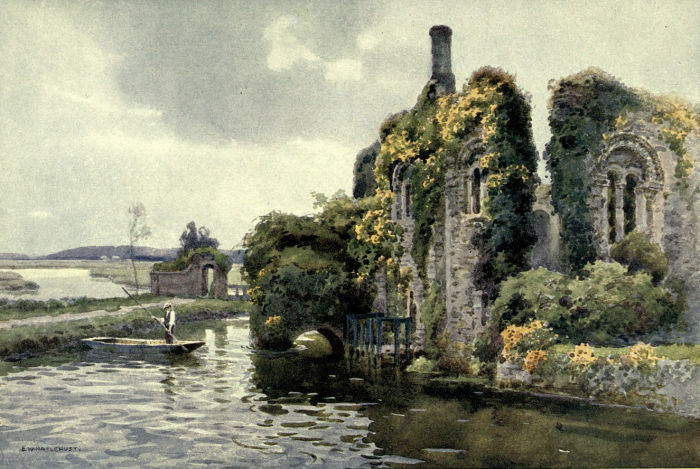
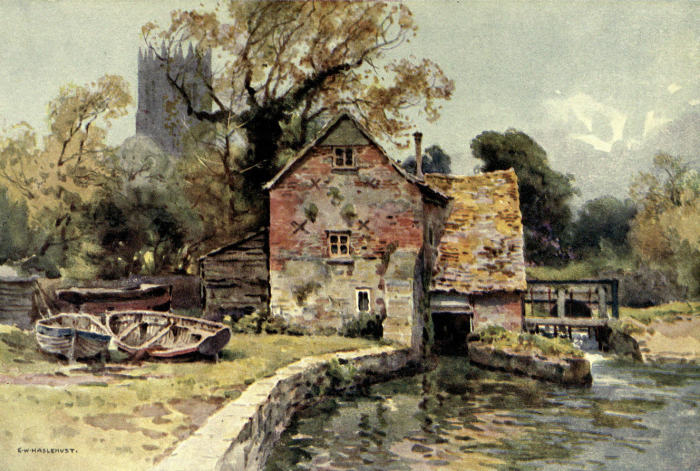
The scenery which impresses most of us is certainly that in which Nature
is seen in her wild and primitive condition, telling us of growth and
decay, and of the land's submission to eternal laws unchecked by the
hand of man. Yet we also feel a certain pleasure in the contemplation of
those scenes which combine natural beauty with human artifice, and
attest to the ability with which architectural science has developed
Nature's virtues and concealed natural disadvantages.
To a greater extent, perhaps, than any other spot in southern England,
does Bournemouth possess this rare combination of natural loveliness and
architectural art, so cunningly interwoven that it is difficult to
distinguish the artificial from the natural elements of the landscape.
To human agency Bournemouth owes a most delightful set of modern
dwelling-houses, some charming marine drives, and an abundance of Public
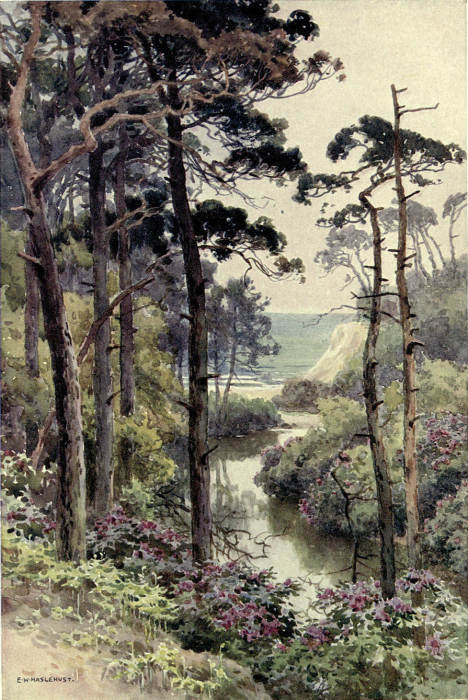
Gardens. Through Nature the town receives its unique group of Chines,
which alone set it apart from other watering-places; its invigorating
sea-breezes, and its woods of fir and pine clustering upon slopes of
emerald green, and doing the town excellent service by giving warmth and
colour to the landscape when winter has stripped the oak and the elm of
their glowing robes.
Considerably less than a century ago Bournemouth, or "Burnemouth",
consisted merely of a collection of fishermen's huts and smugglers'
cabins, scattered along the Chines and among the pine-woods. The name
"Bournemouth" comes from the Anglo-Saxon words burne, or bourne, a
stream, and mûtha, a mouth; thus the town owes its name to its
situation at the mouth of a little stream which rises in the parish of
Kinson some five or six miles distant.
From Kinson the stream flows placidly through a narrow valley of much
beauty, and reaches the sea by way of one of those romantic Chines so
characteristic of this corner of the Hampshire coast, and of the
neighbouring Isle of Wight.
Besides offering the usual attractions, Bournemouth Pier is the centre
of a very fine system of steamship sailings to all parts of the coast.
A century ago the whole of the district between Poole on the west and
Christchurch on the east was an unpeopled waste of pine and heather, and
the haunt of gangs of smugglers. So great had the practice of smuggling
grown in the eighteenth century, that, in 1720, the inhabitants of Poole
presented to the House of Commons a petition, calling attention to "the
great decay of their home manufacturers by reason of the great
quantities of goods run, and prayed the House to provide a remedy". In
1747 there flourished at Poole a notorious band of smugglers known as
the "Hawkhurst Gang", and towards the close of the same century a famous
smuggler named Gulliver had a favourite landing-place for his cargoes at
Branksome Chine, whence his pack-horses made their way through the New
Forest to London and the Midlands, or travelled westward across Crichel
Down to Blandford, Bath, and Bristol.
Gulliver is said to have employed fifty men, who wore a livery, powdered
hair, and smock frocks. This smuggler amassed a large fortune, and he
had the audacity to purchase a portion of Eggardon Hill, in west Dorset,
on which he planted trees to form a mark for his homeward-bound vessels.
He also kept a band of watchmen in readiness to light a beacon fire on
the approach of danger. This state of things continued until an Act of
Parliament was passed which made the lighting of signal fires by
unauthorized persons a punishable offence. The Earl of Malmesbury, in
his Memoirs of an Ex-Minister, relates many anecdotes and adventures
of Gulliver, who lived to a ripe old age without molestation by the
authorities, for the reason, it is said, that during the wars with
France he was able to obtain, through his agents in that country,
valuable information of the movement of troops, with the result that his
smuggling was allowed to continue as payment for the services he
rendered in disclosing to the English Government the nature of the
French naval and military plans.
Warner, writing about 1800, relates that he saw twenty or thirty wagons,
laden with kegs, guarded by two or three hundred horsemen, each bearing
three tubs, coming over Hengistbury Head, and making their way in the
open day past Christchurch to the New Forest.
On a tombstone at Kinson we may read:—
"A little tea, one leaf I did not steal;
For guiltless blood shed I to God appeal;
Put tea in one scale, human blood in t'other,
And think what 'tis to slay thy harmless brother".
The villagers of Kinson are stated to have all been smugglers, and to
have followed no other occupation, while it is said that certain deep
markings on the walls of the church tower were caused by the constant
rubbing of the ropes used to draw up and lower the kegs of brandy and the cases of tea.
That many church towers in the neighbourhood were used for the storage
of illicit cargoes is well known, and the sympathies of the local clergy
were nearly always on the side of the smugglers in the days when a keg
of old brandy would be a very acceptable present in a retired country
parsonage. Occasionally, perhaps, the parson took more than a passive
interest in the proceedings. A story still circulates around the
neighbourhood of Poole to the effect that a new-comer to the district
was positively shocked at the amount of smuggling that went on. One
night he came across a band of smugglers in the act of unloading a
cargo. "Smuggling," he shouted. "Oh, the sin of it! the shame of it! Is
there no magistrate, no justice of the peace, no clergyman, no minister, no——"
"There be the Parson," replied one of the smugglers, thinking it was a
case of sickness.
"Where? Where is he?" demanded the stranger.
"Why, that's him a-holding of the lanthorn," was the laconic reply.
It was early in the nineteenth century that a Mr. Tregonwell of
Cranborne, a Dorset man who owned a large piece of the moorland, found,
on the west side of the Bourne Valley, a sheltered combe of exceptional
beauty, where he built a summer residence (now the Exeter Park Hotel),
the first real house to be erected on the virgin soil of Bournemouth. A
little later the same gentleman also built some cottages, and the
"Tregonwell Arms", an inn which became known as the half-way house
between Poole and Christchurch, and so remained until it was pulled down
to make way for other buildings.
These, however, were isolated dwellings, and it was not until 1836 that
Sir George Gervis, Bart., of Hinton Admiral, Christchurch, commenced to
build on an extensive scale on the eastern side of the stream, and so
laid the foundations of the present town. Sir George employed skilful
engineers and eminent architects to plan and lay out his estate, so that
from the beginning great care was taken in the formation and the
selection of sites for the houses and other buildings, with the result
that Bournemouth is known far and wide as the most charming, artistic,
and picturesque health resort in the country. This happy result is due,
in a large measure, to the care with which its natural features have
been preserved and made to harmonize with the requirements of a large
residential population. It is equally gratifying to note that successive
landowners, and the town's Corporation, following the excellent example
set by Sir George Gervis, continue to show a true conservative instinct
in preserving all that is worthy of preservation, while ever keeping a
watchful eye on any change which might detract from the unique beauty of Bournemouth.
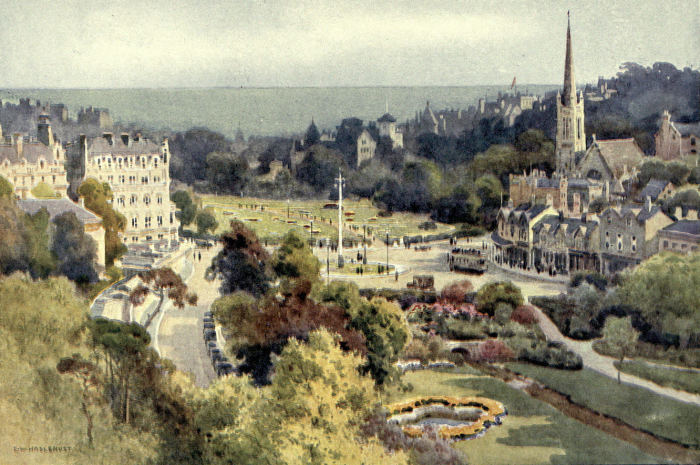
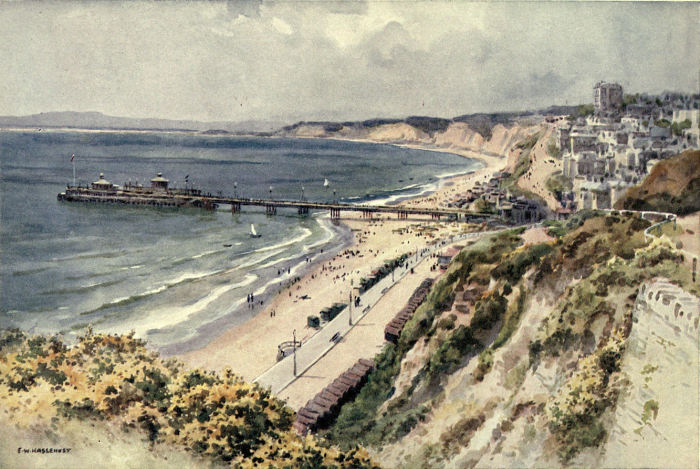
The town is situated on the curve of a large and open bay, bounded by
lofty if not precipitous cliffs, which extend as far west as Haven
Point, the entrance to Poole Harbour, and eastwards to Hengistbury Head,
a distance of fourteen miles from point to point.
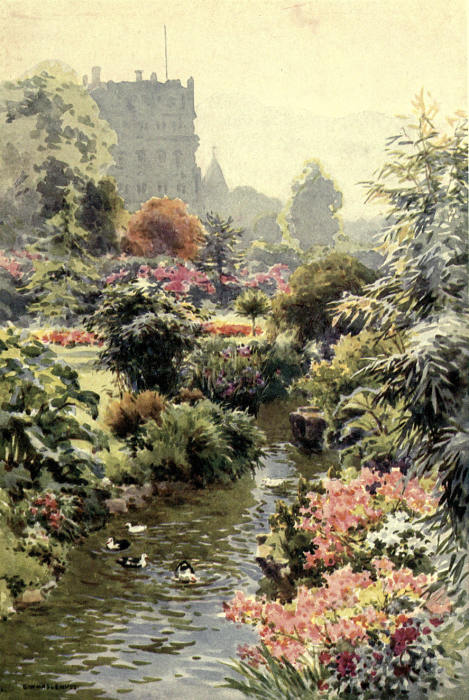
In addition to its splendid marine drives, its retiring vales, its
pine-woods, and its rustic nooks and dells, the town is splendidly
provided with Public Gardens, excellently laid out, and luxuriously
planted in what was once mere bog and marsh land. The Gardens contain a
liberal supply of choice evergreens, and deciduous shrubs and trees,
while it is noticeable that the Ceanothus azureus grows here without
requiring any protection. The slopes of the Gardens rise gradually to
where the open downs are covered with heaths, gorse, and plantations of pines and firs.
It was not long after the first houses had been built that the true
source of Bournemouth's attractiveness was realized to be her climate,
her salt-laden breezes, and her pine-scented air. Since then she has
become more and more sought, both for residential and visiting
purposes. Year by year the town has spread and broadened, stretching out
wide arms to adjacent coigns of vantage like Parkstone, Boscombe,
Pokesdown, and Southbourne, until the "Queen of the South" now covers
many miles in extent.
It is one of those favoured spots where Autumn lingers on till
Christmas, and when Winter comes he is Autumn's twin brother, only
distinguishable from him by an occasional burst of temper, in the form
of an east wind, soon repented of and as soon forgotten. Thus it is that
a large number of holiday visitors are tempted to make their stay a long
one, and every winter brings an increasingly greater number of
new-comers to fill the places of the summer absentees, so that, taking
the year through, Bournemouth is always full.
Contrast is one of the charms of the place; contrast between the shade
and quietude of the pine-woods, and the whirl and movement of modern
life and luxury in its most splendid and pronounced development.
It is a town whose charm and whose reproach alike is its newness; but
unlike many an ancient town, it has no unlovely past to rise up and
shame it. The dazzle and glitter of the luxury which has descended upon
her wooded shores does not frighten Bournemouth, since she was born in
splendour, and the very brightness of her short life is compensation
enough for the lack of an historical, and perhaps a melancholy past.
With the exception of the soil on which she stands, and the growths of
that soil, everything in Bournemouth is modern—churches, houses, and
shops—but all are as beautiful as modern architects and an unlimited
supply of money can make them. There are hundreds of costly houses,
charming both within and without; their gardens always attractive in the
freshness of their flowers, and in the trimness of their tree-lined
lawns. On every side there is evidence of a universal love and culture
of flowers, due, no doubt, to the wonderful climate. Nowhere are
geraniums larger or redder, roses fairer or sweeter, or foliage beds
more magnificently laid out; while in few other parts of the country can
one find so many large houses, representative of the various schools of
modern architectural art, as in Bournemouth and her tree-clad parks.
Another factor that has played a large part in the rapid development of
the town is the excellence of the railway services from all parts of the
country, and particularly from London. During the summer months several
trains run daily from Waterloo to Bournemouth without a stop, doing the
journey in two hours; so that if the London and South Western Railway
Company are fortunate in having a monopoly of this traffic, the town is
equally fortunate in being served by a railway company which has made it
almost a marine suburb of London.
Bournemouth West Railway Station, situated on Poole Hill, was completed
and the line opened in the summer of 1874. In 1884-5 the Central
Station, or Bournemouth East as it was then called, was built, and the
two stations connected by a loop-line.
The whole of the Bournemouth district lies in the western part of the
great valley or depression which stretches from Shoreham, in Sussex, to
near Dorchester, occupying the whole of South Hampshire and the greater
part of the south of Sussex and Dorset. The valley is known as the chalk
basin of Hampshire, and is formed by the high range of hills extending
from Beachy Head to Cerne Abbas. To the north the chain of hills remains
intact, whilst the southern portion of the valley has been encroached
upon, and two great portions of the wall of chalk having been removed,
one to the east and one to the west, the Isle of Wight stands isolated
and acts as a kind of breakwater to the extensive bays, channels, and
harbours which have been scooped out of the softer strata by the action
of the sea. Sheltered by the Isle of Wight are the Solent and
Southampton Water; westward are the bays and harbours of Christchurch,
Bournemouth, Poole, Studland, and Swanage. The great bay between the
promontories of the Needles and Ballard Down, near Swanage, is
subdivided by the headland of Hengistbury Head into the smaller bays of
Christchurch and Bournemouth.
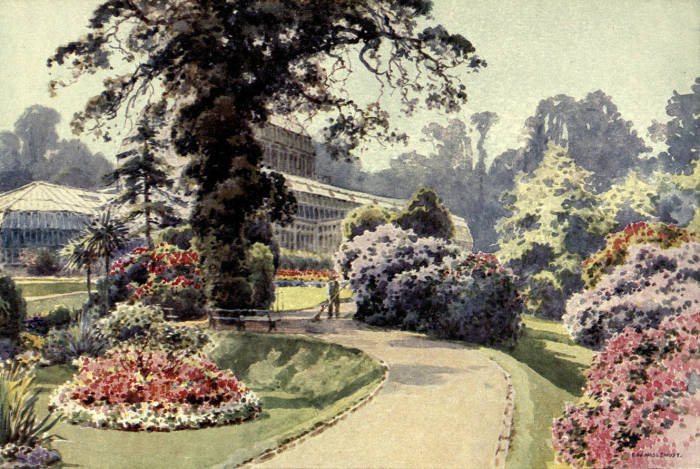
The famous Winter Gardens and spacious glass Pavilion where concerts are
held are under the management of the Corporation. Bournemouth spends a
sum of £6000 annually in providing band music for her visitors.
The site of the town is an elevated tableland formed by an extensive
development of Bagshot sands and clays covered with peat or turf, and
partly, on the upland levels, with a deep bed of gravel.
The sea-board is marked with narrow ravines, gorges, or glens, here
called "Chines", but in the north of England designated "Denes".
For boating people the bay affords a daily delight, although
Christchurch and Poole are the nearest real harbours. At the close of a
summer's day, when sea and sky and shore are enveloped in soft mist,
nothing can be more delightful than to flit with a favouring wind past
the picturesque Chines, or by the white cliffs of Studland. The water in
the little inlets and bays lies still and blue, but out in the dancing
swirl of waters set up by the sunken rocks at the base of a headland,
all the colours of the rainbow seem to be running a race together.
Yachts come sailing in from Cowes, proud, beautiful shapes, their
polished brass-work glinting in the sunlight, while farther out in the
Channel a great ocean liner steams steadily towards the Solent,
altering her course repeatedly as she nears the Needles.
And yet, with all her desirable qualities and attractive features,
Bournemouth is not to everyone's taste, particularly those whose
holidays are incomplete without mediæval ruins on their doorsteps. The
town, however, is somewhat fortunate even in this respect, since,
although she has no antiquities of her own, she is placed close to
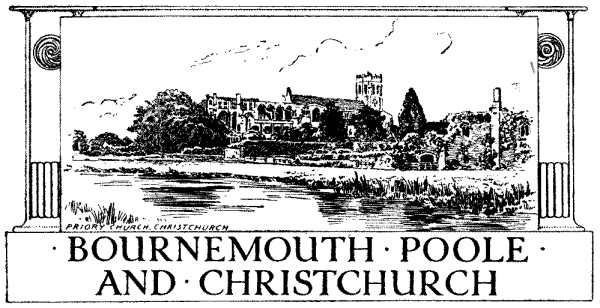
Wimborne and Poole on the one hand, and to Christchurch, with its
ancient Priory, on the other. Poole itself is not an ideal place to live
in, while Wimborne and Christchurch are out-of-the-way spots,
interesting enough to the antiquary, but dull, old-fashioned towns for
holiday makers. The clean, firm sands of Bournemouth are excellent for
walking on, and make it possible for the pedestrian to tramp, with
favourable tides, the whole of the fourteen miles of shore that separate
Poole Harbour from Christchurch. By a coast ramble of this kind the bold
and varied forms of the cliffs, and the coves cutting into them, give an
endless variety to the scene; while many a pretty peep may be obtained
where the Chines open out to the land, or where the warmly-coloured
cliffs glow in the sunlight between the deep blue of the sea and the
sombre tints of the heather lands and the pine-clad moor beyond.
The clays and sandy beds of these cliffs are remarkable for the
richness of their fossil flora. From the white, grey, and brownish clays
between Poole Harbour and Bournemouth, no fewer than nineteen species of
ferns have been determined. The west side of Bournemouth is rich in
Polypodiaceæ, and the east side in Eucalypti and Araucaria. These,
together with other and sub-tropical forms, demonstrate the existence of
a once luxuriant forest that extended to the Isle of Wight, where, in
the cliffs bounding Alum Bay, are contemporaneous beds. The Bournemouth
clay beds belong to the Middle Eocene period.
Westwards from the Pier the cliffs are imposing, on one of the highest
points near the town being the Lookout. A hundred yards or so farther on
is Little Durley Chine, beyond which is a considerable ravine known as
Great Durley Chine, approached from the shore by Durley Cove. The larger
combe consists of slopes of sand and gravel, with soft sand hummocks at
the base; while on the western side and plateau is a mass of heather and
gorse. Beyond Great Durley Chine is Alum Chine, the largest opening on
this line of coast. Camden refers to it as "Alom Chine Copperas House".
The views from the plateaux between the Chines are very beautiful,
especially perhaps that from Branksome Chine, where a large portion of
the Branksome Tower estate seems to be completely isolated by the deep
gorges of the Chine. This estate extends for a considerable distance to
where a Martello tower, said to have been built with stones from
Beaulieu Abbey, stands on the cliff, from which point the land gradually
diminishes in height until, towards the entrance to Poole Harbour, it
becomes a jumbled and confused mass of low and broken sand-hills. These
North Haven sand-hills occupy a spit of land forming the enclosing arm
of the estuary on this side. Near Poole Head the bank is low and narrow;
farther on it expands until, at the termination of North Haven Point, it
is one-third of a mile broad. Here the sand-dunes rise in circular
ridges, resembling craters, many reaching a height of fifty or sixty
feet. Turning Haven Point, the view of the great sheet of water studded
with green islands and backed by the purple hills of Dorset is one of
the finest in England. From Haven Point one may reach Poole along a good
road that skirts the shores of the harbour all the way, and affords some
lovely vistas of shimmering water and pine-clad banks.
Poole Harbour looks delightful from Haven Point. At the edge of Brownsea
Island the foam-flecked beach glistens in the sun. The sand-dunes
fringing the enclosing sheet of water are yellow, the salt-marshes of
the shallow pools stretch in surfaces of dull umber, brightened in
parts by vivid splashes of green. On a calm day the stillness of utter
peace seems to rest over the spot, broken only by the lapping of the
waves, and the hoarse cries of the sea-birds as they search for food on
the mud-banks left by the receding tide. With such a scene before us it
is difficult to realize that only a mile or two distant is one of the
most popular watering-places in England, with a throng of fashionable
people seeking their pleasure and their health by the sea.
These Gardens are contained within the Branksome estate, and are
consequently thrown open to visitors only by the courtesy of the owner.
It is well worth while to take a boat and pull over to Brownsea. The
island, which once belonged to Cerne Abbey, is elliptical in shape, with
pine-covered banks rising, in some places, to a height of ninety feet.
In the centre of the isle is a valley in which are two ornamental lakes.
In addition to a large residence, Brownsea Castle, and its extensive
grounds, there is a village of about twenty cottages, called Maryland,
and an ornate Gothic church, partly roofed and panelled with fine old
oak taken from the Council Chamber of Crossby Hall, Cardinal Wolsey's
palace. The island once had a hermit occupier whose cell and chapel were
dedicated to St. Andrew, and when Canute ravaged the Frome Valley early
in the eleventh century he carried his spoils to Brownsea. The Castle
was first built by Henry VIII for the protection of the harbour, on
condition that the town of Poole supplied six men to keep watch and
ward. In 1543 the Castle was granted to John Vere, Earl of Oxford, who
sold it to John Duke. In the reign of Elizabeth it was termed "The
Queen's Majestie's Castell at Brownecksea", and in 1576 the Queen sold
it, together with Corfe Castle, to Sir Christopher Hatton, whom she made
"Admiral of Purbeck". In the early days of the Great Rebellion the
island was fortified for the Parliament, and, like Poole, it withstood
the attacks of the Royalists. In 1665, when the Court was at Salisbury,
an outbreak of the plague sent Charles II and a few of his courtiers on
a tour through East Dorset. On 15th September of that year Poole was
visited by a distinguished company, which included the King, Lords
Ashley, Lauderdale, and Arlington, and the youthful Duke of Monmouth,
whose handsome face and graceful bearing were long remembered in the
town. After the royal party had been entertained by Peter Hall, Mayor of
Poole, they went by boat to Brownsea, where the King "took an exact view
of the said Island, Castle, Bay, and Harbour to his great contentment".
Little could the boyish Duke of Monmouth have then foreseen that fatal
day, twenty years later, when he crossed the road from Salisbury again
like a hunted animal in his vain endeavour to reach the shelter of the
New Forest; and still less, perhaps, could his father have foreseen that
Antony Etricke, whom he had made Recorder of Poole, would be the man
before whom his hapless son was taken to be identified before being sent
to London, and the Tower.
The next owner of Brownsea was a Mr. Benson, who succeeded Sir
Christopher Wren as first surveyor of works. When he bought the island,
he began to alter the old castle and make it into a residence. The
burgesses of Poole claimed that the castle was a national defence, of
which they were the hereditary custodians. Mr. Benson replied that as he
had paid £300 for the entire island the castle was naturally
included. In 1720 the town authorities appealed to George II, and in
1723 Mr. Benson and his counsel appeared before the Attorney-general,
when the proceedings were adjourned, and never resumed, so that the
purchaser appears to have obtained a grant of the castle from the Crown.
Mr. Benson was an enthusiastic botanist and he planted the island with
various kinds of trees and shrubs. He also made a collection of the many
specimens of plants growing on the island.
During the next hundred and thirty years Brownsea had various owners,
including Colonel Waugh (notorious for his connection with the
disastrous failure of the British Bank) and the Right Hon. Frederick
Cavendish Bentinck, who restored the castle and imported many beautiful
specimens of Italian sculpture and works of art. At the end of 1900 the
estate was bought by Mr. Charles Van Raalte, to whose widow it still belongs.
Shortly before his death Mr. Van Raalte wrote a brief account of his
island home, which closed with the following lines:—
"All through the island the slopes are covered with rhododendrons,
juniper, Scotch firs, insignis, macrocarpa, Corsican pines, and
many other varieties of evergreens, plentifully mingled with cedars
and deciduous forest trees. Wild fowl in great variety visit the
island, and the low-lying land within the sea-wall is the favourite
haunt of many sea-birds; and several varieties of plover, the
redshank, greenshank, sandpiper, and snipe may be found there. The
crossbill comes very often, and the green woodpecker's cry is quite
familiar. But perhaps the most beautiful little winged creature
that favours us is the kingfisher."
A prominent feature on the mainland as seen from Brownsea is the little
Early English church of Arne, standing on a promontory running out into
the mud-banks of the estuary, and terminating in a narrow tongue of land
known as Pachin's Point. At one time Arne belonged to the Abbey of
Shaftesbury, and it is said that the tenants of the estate, on paying
their rent, were given a ticket entitling them to a free dinner at the
Abbey when they were passing through Shaftesbury. The vast size of
Poole Harbour is realized when we consider that, excluding the islands,
its extent is ten thousand acres, and from no other spot does the sheet
of water look more imposing than from the wooded heights and sandy
shores of Brownsea. At low tide several channels can be traced by the
darker hue of the water as it winds between the oozy mud-banks, but at
high tide the whole surface is flooded, and there lies the great salt
lake with her green islands set like emerald gems on a silver targe.
Eastwards from Bournemouth Pier the cliffs are bold and lofty, and are
broken only by small chines or narrow gullies. On the summit of the
cliff a delightful drive has been constructed, while an undercliff
drive, extending for a mile and a half between Bournemouth Pier and
Boscombe Pier, was formally opened with great festivities on 3rd June,
1914. Boscombe Chine, the only large opening on the eastern side of
Bournemouth, must have been formerly rich in minerals, and Camden, who
calls it "Bascombe", tells us that it had a "copperas house". On the
eastern side of the Chine a spring has been enclosed, the water being
similar to the natural mineral water of Harrogate. The whole of the
Chine has been laid out as a pleasure garden, although care has been
taken to preserve much of its natural wildness. Unlike most of the other
chines along this stretch of shore, the landward termination of
Boscombe Chine is very abrupt, which is the more remarkable as the
little stream by which it is watered occupies only a very slight
depression beyond the Christchurch road on its way down to the sea from
Littledown Heath. Boscombe House stood formerly in the midst of a fine
wood of Scotch pines. The estate is now being rapidly developed for
residential purposes. The house was the home for many years of
descendants of the poet Shelley, who erected a monument in Christchurch
Priory to the memory of their illustrious ancestor. The house lies
between the Christchurch road and the sea, and was almost entirely
rebuilt by Sir Percy Shelley about the middle of the nineteenth century.
The rapid growth of Boscombe may be gauged by the fact that between
thirty and forty years ago Boscombe House and a few primitive cottages
were the only buildings between Bournemouth and Pokesdown. Like her
parent of Bournemouth, whom she closely resembles, Boscombe is built on
what was once a stretch of sandy heaths and pine-woods. A pier was
opened here in 1889 by the Duke of Argyll. It was built entirely by
private enterprise, and it was not until 1904 that it was taken over by
the Corporation. To the east of the pier the cliffs have been laid out
as gardens, much of the land having been given by the owners of Boscombe
House on their succeeding to the estate. The roads here are very
similar to those of Bournemouth, with their rows of pines, and villas
encircled by the same beautiful trees. A peculiar designation of Owl's
Road has no direct connection with birds, but is commemorative of The
Owl, a satirical journal in which Sir Henry Drummond Wolfe, a large
landowner of Boscombe, was greatly interested.
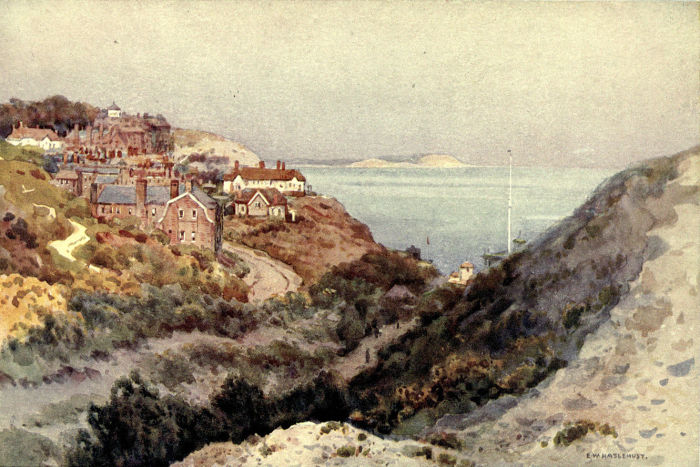
From Boscombe Pier very pleasant walks can be taken along the sands or
on the cliffs. From the sands a long slope leads up to Fisherman's Walk,
a beautiful pine-shaded road, although houses are now being built and so
somewhat despoiling the original beauty of the spot. The cliffs may be
regained once more at Southbourne, and after walking for a short
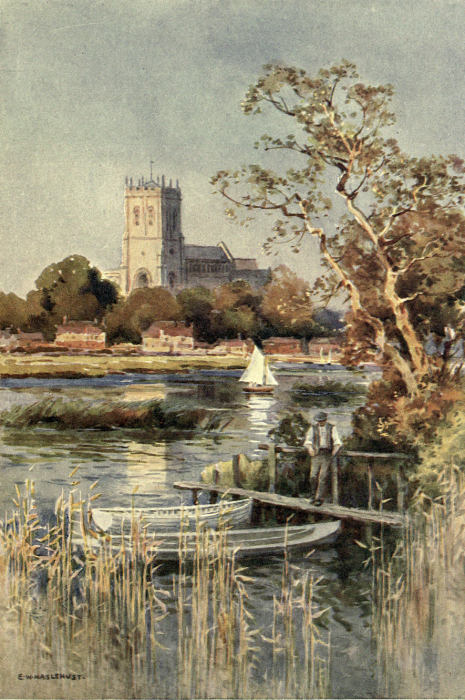
distance towards Hengistbury Head the road runs inland to Wick Ferry,
where the Stour can be crossed and a visit paid to the fine old Priory
of Christchurch. Wick Ferry is one of the most beautiful spots in the
neighbourhood, and is much resorted to by those who are fond of boating.
Large and commodious ferry-boats land passengers on the opposite bank
within a few minutes' walk of Christchurch. The main road from
Bournemouth to Christchurch crosses the Stour a short distance inland
from Wick Ferry by Tuckton Bridge with its toll-house, a reminder that,
by some old rights, toll is still levied on all those who cross the
Stour, whether they use the bridge or the ferry.
Bournemouth is very proud of her Public Gardens, as she has every right
to be. Out of a total area of nearly 6000 acres no fewer than 694 acres
have been laid out as parks and pleasure grounds. The Pleasure Gardens
are divided by the Square, that central meeting-place of the town's
tramway system, into two portions, known as the Lower and the Upper
Gardens. These follow the course of the Bourne stream, and they have had
a considerable influence in the planning of this portion of the town.
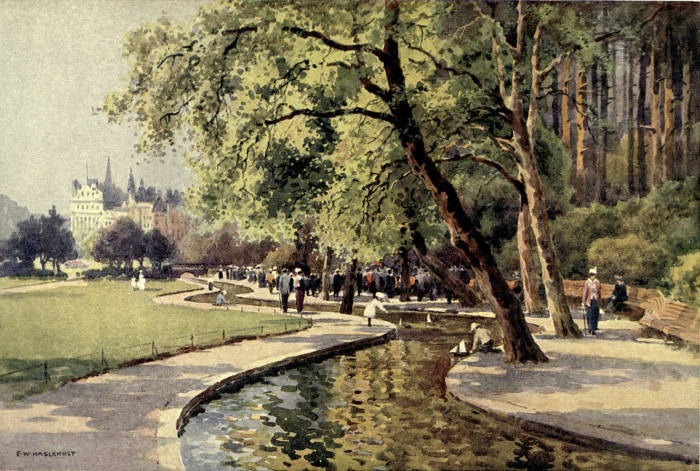
The Pinetum is the name given to a pine-shaded avenue that leads from
the Pier to the Arcade Gate. Here, in storm or shine, is shelter from
the winter wind or shade from the summer sun, while underfoot the fallen
acicular leaves of the pines are impervious to the damp. These Gardens
are more than a mile and a half in extent, and are computed to possess
some four miles of footpaths. The Upper Gardens are contained within the
Branksome estate, and are consequently thrown open to the public only by
the courtesy of the owner. They extend to the Coy Pond, and are much
quieter and less thronged with people than the Lower Gardens, with their
proximity to the Pier and the shore.
Another of those picturesque open spaces which do so much to beautify
the town is Meyrick Park, opened in 1894, and comprising some hundred
and twenty acres of undulating land on which an eighteen-hole golf
course has been constructed. Another course of a highly sporting
character is in Queen's Park, reached by way of the Holdenhurst Road.
Beyond the Meyrick Park Golf Links lie the Talbot Woods, a wide extent
of pine forest which may fittingly be included in Bournemouth's parks.
These woods are the property of the Earl of Leven and Melville, who has
laid down certain restrictions which must be observed by all visitors.
Bicycles are allowed on the road running through the woods, but no motor
cars or dogs, and smoking is rightly forbidden, as a lighted match
carelessly thrown among the dry bracken with which the woods are
carpeted would cause a conflagration appalling to contemplate.
The famous Winter Gardens are under the management of the Corporation,
and in 1893 the spacious glass Pavilion was taken over by the same
authority. It may be mentioned incidentally that Bournemouth spends a
sum of six thousand pounds annually in providing band music for her
visitors. The full band numbers no fewer than fifty musicians, and is
divided into two portions, one for the Pier, the other for the Pavilion.
The Winter Gardens are charmingly laid out with shrubs and ornamental
flower beds, and on special gala days clusters of fairy lights give an
added brilliancy to the scene.
Boscombe possesses her own group of gardens and open spaces. Boscombe
Chine Gardens extend from the Christchurch Road to the mouth of the
Chine. At the shore end is an artificial pond where the juvenile natives
meet the youthful visitors for the purpose of sailing toy ships. The
Knyveton Gardens lie in the valley between Southcote Road and Knyveton
Road, and cover some five acres of land. King's Park, and the larger
Queen's Park, together with Carnarvon Crescent Gardens, show that
Boscombe attaches as much importance as Bournemouth to the advantages of
providing her visitors and residents with an abundance of open spaces,
tastefully laid out, and having, in some cases, tennis courts and bowling greens.
The piers of both Bournemouth and Boscombe are great centres of
attraction for visitors, apart from those who only use them for the
purpose of reaching the many steamboats that ply up and down the coast.
A landing pier of wood, eight hundred feet long and sixteen feet in
width, was opened on 17th September, 1861. It cost the modest sum of
£4000. During the winter of 1865-6 many of the wooden piles were found
to have rotted, and were replaced by iron piles. A considerable portion
of the pier was treated in a similar manner in 1866, and again in 1868.
With this composite and unsightly structure Bournemouth was content
until 1878, when the present pier was commenced, being formally opened
in 1880. It was extended in 1894, and again in 1909. Boscombe Pier, as
already stated, was opened in 1889 by the then Duke of Argyll.
Owing to their proximity to the Pier and the shore, these Gardens are
much frequented by the people and afford great delight to children.
Of Bournemouth's many modern churches that of St. Peter, situated at the
junction of the Gervis and the Hinton Roads, has interesting historical
associations, apart from its architectural appeal.
In the south transept John Keble used to sit during his prolonged stay
at Bournemouth in the closing years of his life. He is commemorated by
the "Keble Windows", and the "Keble Chapel", within the church, and by a
metal tablet affixed to the house "Brookside", near the pier, where he
passed away in 1866. The churchyard is extremely pretty, being situated
on a well-wooded hillside. The churchyard cross was put up in July,
1871. In the churchyard are buried the widow of the poet Shelley,
together with her father, Godwin the novelist, and her mother, who was
also a writer of some distinction. Taken altogether, this church, with
its splendid windows and richly-wrought reredos and screens, is one of
the most pleasing modern churches in the country, both with regard to
its architecture and its delightful situation.
This hillside churchyard under the pine trees, together with
"Brookside", where Keble lived, and Boscombe Manor, with its memories of
the Shelleys, are the only literary shrines Bournemouth as yet possesses.
Mary Godwin, whose maiden name was Wollstonecraft, was an Irish girl who
became literary adviser to Johnson, the publisher, by whom she was
introduced to many literary people, including William Godwin, whom she
married in 1797. Their daughter Mary, whose birth she did not survive,
became the poet Shelley's second wife. Mary Wollstonecraft Shelley was
one of the earliest writers on woman's suffrage, and her Vindications
of the Rights of Women was much criticized on account of, to that age,
the advanced views it advocated. Among her other books was a volume of
Original Stories for Children, illustrated by William Blake.
Her father, William Godwin, was a native of Wisbeach, where he was born
in 1756, and at first he was ordained for the Presbyterian ministry. He
was the author of a good many novels and philosophical works. In the
later years of his life he was given the office of "Yeoman Usher of the Exchequer".
It was Mary Godwin with whom Shelley eloped to Italy in 1814, and whom
he married in 1816, on the death of his first wife, Harriet Westbrook,
who drowned herself. In 1851, Mary Shelley was laid by the side of her
father and mother, brought down from St. Pancras Churchyard, and her own
son, and the woman who was loved by that son, all now sleep their last
sleep under the greensward of St. Peter's Church. To many of us it is
the one spot in Bournemouth most worth visiting. Climbing the wooded
hill we stand by the Shelley grave, and think of how much intellect,
aspiration, and achievement lies there entombed, and of the pathetic
cenotaph to the memory of the greatest of all the Shelleys in the fine
old Priory of Christchurch, five miles away.
Previous to his coming to Bournemouth to recover his health, John Keble
was vicar of Hursley, near Winchester. The Christian Year, upon which
his literary position must mainly rest, was published anonymously in
1827. It met with a remarkable reception, and its author becoming known,
Keble was appointed to the Chair of Poetry at Oxford, which he held
until 1841. In the words of a modern writer, "Keble was one of the most
saintly and unselfish men who ever adorned the Church of England, and,
though personally shy and retiring, exercised a vast spiritual influence
upon his generation". His "Life" was written by J. D. Coleridge in 1869,
and again, by the Rev. W. Lock, in 1895.
The Stour valley, with its picturesque river scenery, forms a charming
contrast to the seaboard of Bournemouth and her suburbs of Boscombe and
Southborne, while to those who are fond of river boating the whole
district is full of attraction. For the pedestrian the valley is very
accessible. The route from Bournemouth is by way of the Upper Gardens,
and right through the Talbot Woods to Throop, where the banks of the
river are covered with trees. The village is a straggling one, and the
mill and weir give an additional charm to some of the prettiest river
scenery in the neighbourhood. A short distance from Throop is the
village of Holdenhurst, which, with Throop, forms one parish.
While in this district a visit may be paid to Hurn, or Heron Court, the
seat of the Earl of Malmesbury. The house, largely rebuilt since it was
owned by the Priors of Christchurch, is not shown to the public, but the
park, with its beautiful plantation of rhododendrons, may be seen from
the middle of May till the end of June, that is, when the flowers are in
full bloom. From Holdenhurst the return journey may be made by way of
Iford, and so on to the main road at Pokesdown, whence Bournemouth is soon reached.
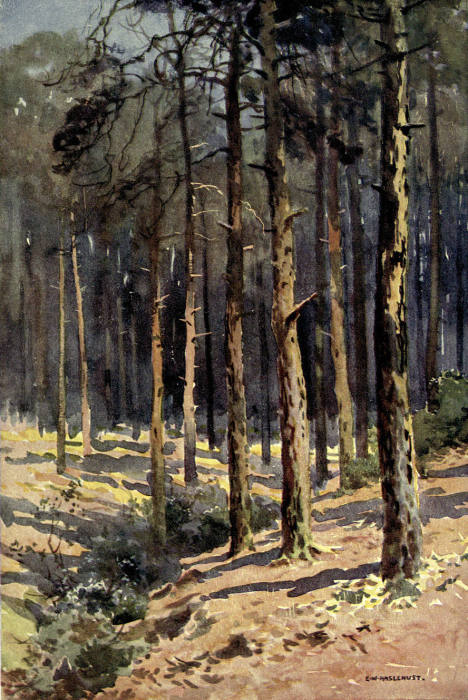
To those who visit the ancient town of Poole for the first time by road
from Bournemouth, it is difficult to tell where the one town ends and
the other begins, so continuous are the houses, shops, and other
buildings which line each side of the main thoroughfare; and this
notwithstanding that to the left hand of the road connecting the two
places lies the charming residential district of Parkstone, where the
houses on a pine-clad slope look right over the great harbour of Poole.
As a matter of fact Bournemouth is left long before Parkstone is
reached. The County Gates not only mark the municipal boundaries of
Bournemouth, but they indicate also, as their title implies, that they
divide the counties of Hampshire and Dorset. Thus it is that although
the beautiful houses of Branksome and Parkstone are linked to those of
Bournemouth by bricks and mortar, as well as by road, rail, and tramway,
they otherwise form no part of it. They are in Dorset, and county
rivalry is never stronger or keener than where two beautiful residential
districts face each other from opposite sides of a boundary line.
Bournemouth would dearly like to take Parkstone, a natural offshoot from
herself, under her municipal care, but if this were done Dorset would
lose some of her most valuable rateable property, as, between them,
Poole and Parkstone pay no less than one-fifth of the whole of the
county rate of Dorset.
Just beyond Parkstone a lovely view is obtained of Poole Harbour from
the summit of Constitution Hill.
Poole and Hamworthy, with their many industries and busy wharves, form
a piquant contrast to spick-and-span Bournemouth with her tidy gardens
and well-dressed crowds; but whatever the port of Poole may lack in
other ways she has an abundance of history, although her claim to figure
as a Roman station has been much disputed. We do know, however, that
after the Norman Conquest Poole was included in the neighbouring manor
of Canford, and its first charter was granted by William Longspée, Earl
of Salisbury. It was not until the reign of the third Edward that the
town became of much importance. This monarch used it as a base for
fitting out his ships during the protracted war with France, and in 1347
it furnished and manned four ships for the siege of Calais. The lands
that lie between Poole and Hamworthy were held in the Middle Ages by the
Turbervilles, of Bere Regis, and during the Stuart period by the Carews,
of Devonshire. In the reign of Queen Elizabeth the town had a
considerable commerce with Spain until the war with that country put a
stop to this particular traffic. As some compensation for their losses
in this direction Elizabeth granted the town two new charters, and
confirmed all its ancient privileges. During the Great Rebellion the
town was held for the Parliament, and in 1642 the Royalist forces,
under the leadership of the Marquis of Hertford, attempted its capture,
but were forced to retreat.
The town is situated on a peninsula on the north side of Poole Harbour,
and at one time it was the home of many smugglers. Part of an old
smuggler's house has recently been discovered in the town.
The quayside is always a busy spot, and a good deal of shipbuilding and
repairing is still carried on. The town is full of old houses, although
many of them are hidden behind modern fronts.
In 1885 the late Lord Wimborne presented the Corporation with some forty
acres of land to be converted into a Public Park. This land has been
carefully laid out, and includes tennis courts and a spacious cricket ground.
As a seaport the town was of great importance and the Royalists spared
no efforts to effect its capture, but like the other Dorset port of Lyme
Regis, so gallantly defended by Robert Blake, afterwards the famous
admiral, Poole held out to the end. Clarendon, the Royalist historian of
the Great Rebellion, makes a slighting reference to the two towns. "In
Dorsetshire", he says, "the enemy had only two little fisher towns,
Poole and Lyme." The "little fisher towns", however, proved a thorn in
the sides of the Royalists, some thousands of whom lost their lives in
the fierce fighting that took place at Poole, and particularly around Lyme Regis.
The merchants of Poole became wealthy by their trade with Newfoundland,
a commerce that commenced in the reign of Queen Elizabeth, and lasted
until well on in the reign of Queen Victoria. The trade is said to have
been conducted on the truck system, and the merchants grew rich by
buying both their exports and imports wholesale while disposing of them at retail prices.
Not far from the quay is an almshouse, built in 1816 by George Garland,
a wealthy merchant of the town, who, on the occasion of a great feast in
1814, presented "one honest plum-pudding of one hundredweight" towards
the entertainment. Farther on is a house built in 1746 by Sir Peter
Thompson. It is a good specimen of Georgian architecture, and still
bears the heraldic arms of the merchant who built it. Sir Peter's house
is now Lady Wimborne's "Cornelia Hospital". Most of the other old houses
of the town's merchants have been modernized and sadly disfigured. The
oldest almshouses—and the number of ancient almshouses in a town is a
sure guide to its old-time prosperity—were built originally in the
reign of the fifth Henry, and for many years belonged to the Guild of
St. George. In 1547, at the Reformation, they passed to the Crown, with
all the other property of the Guild, and in 1550 they were purchased by
the Corporation. Needless perhaps to say, they have been rebuilt more
than once, although they have continuously provided for the poor for
more than five hundred years.
An interesting antiquarian find was made in a ditch near Poole a few
years ago of the seal of John, Duke of Bedford, under whose rule as
Regent of France Joan of Arc was burned. The occurrence of the seal on
this spot was due, without doubt, to this noble having been Lord of
Canford and Poole.
Near the church, a modern building on the site of an older one, is a
small gateway which may possibly have been a water gate, as traces of
sea-weed were found clinging to it when the adjacent soil was excavated.
Older than any other buildings in Poole are the so-called "Town
Cellars", referred to variously in the town's remarkable collection of
records as the "Great Cellar", the "King's Hall", and the "Woolhouse".
The original purpose of the building has not yet been definitely
determined. It is largely of fourteenth-century date, and its doorways
and windows have a decidedly ecclesiastical appearance. At the same time
there is no evidence whatever that it ever formed part of a monastic
foundation, or was ever built for religious purposes. The old battered
building was the scene of at least one fierce fight, when a combined
French and Spanish fleet attacked the town to revenge themselves on the
dreaded buccaneer, Harry Paye, or Page, who had been raiding the shores
of France and Spain. When the hostile fleets entered Poole Harbour early
one morning five hundred years ago, the town was taken by surprise. The
intrepid "Arripay", as his enemies rendered the name, was absent on one
of his expeditions, but his place was worthily taken by his brother, who
was killed in the fighting. The Town Cellars were full of stores and
munitions of war, and when the building had been captured and set on
fire, the townsmen retired, while the victorious Spaniards, who had been
reinforced by the French after a first repulse, returned with a few
prisoners to their ships, and sailed out of the harbour, having given
the mariners of Poole the greatest drubbing they have ever received in
the long history of the place.
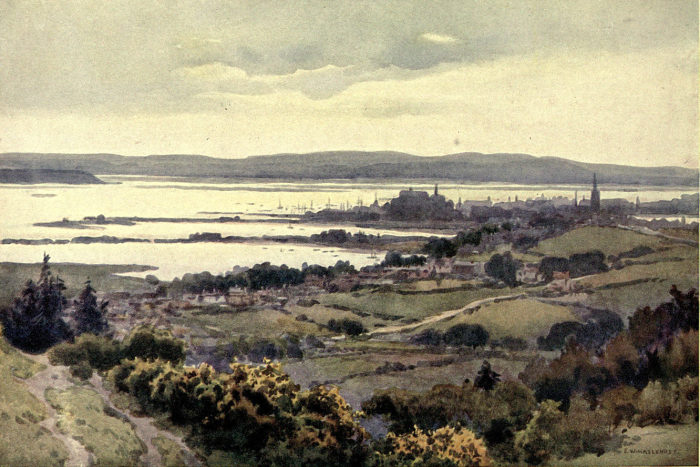
Near Poole is Canford Manor, the seat of Lord Wimborne and the "Chene
Manor" of the Wessex novels. There was a house here in very early times,
and in the sixteenth year of his reign King John, by letter-close,
informed Ralph de Parco, the keeper of his wines at Southampton, that it
was his pleasure that three tuns "of our wines, of the best sort that is
in your custody", should be sent to Canford. In the fifth year of Henry
III the King addressed the following letter to Peter de Mauley:—
"You are to know that we have given to our beloved uncle, William, Earl
of Sarum, eighty chevrons (cheverons) in our forest of Blakmore, for the
rebuilding of his houses (ad domos) at Caneford. Tested at Westminster, 28th July."
The present house occupies the site of the old mansion of the Longspées
and Montacutes, Earls of Salisbury, of which the kitchen remains, with
two enormous fireplaces, and curious chimney shafts. The greater part of
the old mansion was pulled down in 1765, and the house which was then
erected became, for a short time, the home of a society of Teresan nuns
from Belgium. In 1826 it was again rebuilt by Blore, and in 1848 Sir
John Guest employed Sir Charles Barry to make many additions, including
the tower, great hall and gallery, leaving, however, the dining-room and
the whole of the south front as Blore had designed them. A new wing
containing billiard and smoking rooms was added so recently as 1887.
Lady Charlotte Guest, mother of the late Lord Wimborne, was a
distinguished Welsh scholar, whose translation of the Mabinogion gave
an extraordinary impulse to the study of Celtic literature and folk-lore
in England. She was twice married, her first husband being Sir J. J.
Guest, and her second Mr. Schreiber, member of Parliament for Poole.
In addition to a great literary talent Lady Charlotte had a considerable
love for the more mechanical side of the bookmaker's art, and for many
years Canford could boast of a printing press. In the year 1862 serious
attention was turned to the production of beautiful and artistic
printing. Although Lady Charlotte was the prime mover in this venture,
she received valuable assistance from her son (Lord Wimborne), Miss Enid
Guest, and other members of the family. It is thought that the first
book printed here was Golconda, the work of a former tutor to the
family. The most important books produced at this amateur press were
Tennyson's The Window, and The Victim, both printed in 1867. One of
the Miss Guests had met Tennyson while staying at Freshwater, and the
poet sent these MSS. to Canford in order that they might be printed. On
the title page of The Victim there is a woodcut of Canford Manor. A
copy of this book was recently in the market. It contained an autograph
inscription by the late Mr. Montague Guest to William Barnes, the Dorset
poet. Only two other copies have changed hands since 1887, and these
Canford press publications are eagerly sought by collectors. So long
ago as 1896 a copy of The Victim realized £75 at the sale of the
Crampton Library.
The ancient town of Wimborne, with its glorious minster, is very easily
reached both from Poole and from Bournemouth. The town stands in a
fertile district which was once occupied by the Roman legions, but the
chief glory of the place is its magnificent church with its numerous
tombs and monuments. Here are the last resting-places of such famous
families as the Courtenays, the Beauforts, and the Uvedales, and here
also lie the two daughters of Daniel Defoe, who joined Monmouth's
Rebellion at Lyme Regis. In the south choir aisle is the tomb of Antony
Etricke, before whom the Duke of Monmouth was taken after his flight
from Sedgemoor. The chained library, near the vestry, consists chiefly
of books left by William Stone, Principal of New Inn Hall, Oxford, who
was a native of the town. In 871 King Ethelred I died of wounds received
in a battle against the Danes near Wimborne. He was buried in the
minster, where he is commemorated by a fifteenth-century brass, this
being the only memorial of the kind that we have of an English monarch.
One cannot wander in these quiet old streets that surround the minster
without recalling to memory the nuns of Wimborne, who settled here
about the year 705, and over whom Cuthberga, Queen of Northumbria, and
sister of Ina, King of the West Saxons, presided as first abbess. It was
with the nuns of Wimborne that St. Boniface, a native of Crediton, in
Devon, contracted those friendships that cast so interesting a light on
the character of the great apostle of Germany.
In addition to its minster church, Wimborne has a very old building in
St. Margaret's Hospital, founded originally for the relief of lepers.
The chapel joins one of the tenements of the almsfolk, and here comes
one of the minster clergy every Thursday to conduct divine service. Near
a doorway in the north wall is an excellent outside water stoup in a
perfect state of preservation.
Comparatively few visitors to Bournemouth and Poole are aware to how
large an extent the culture of lavender for commercial purposes is
carried on at Broadstone, near Poole. Although it is only during
comparatively recent years that the cultivation of lavender in this
country has been sufficiently extensive to raise it to the dignity of a
recognized industry, dried lavender flowers have been used as a perfume
from the days of the Romans, who named the flower lavandula, from the
use to which it was applied by them in scenting the water for the bath.
It is not known for certain when the lavender plant was brought into
England. Shakespeare, in the Winter's Tale, puts these words into the mouth of Perdita:
"Here's flowers for you;
Hot lavender, mint, savory, marjoram;
The marigold, that goes to bed with the sun,
And with him rises weeping: these are flowers of
Middle summer".
The Bard of Avon laid his scene in Bohemia; but the context makes it
evident that the plants named were such as were growing in an English
cottager's garden in the reign of Queen Elizabeth.
Broadstone was the spot chosen by Messrs. Rivers Hill and Company for
the purpose of growing lavender for their perfume distilleries. It is an
ideal spot, where a large tract of heather land, on a portion of Lord
Wimborne's estate, rises in a series of undulations from Poole Harbour.
Although it is quite a new industry for Dorset, it has already proved of
great value in finding constant employment, and an employment as healthy
as it is constant, for a large number of men and women. Unfortunately,
perhaps, it is an industry which demands peculiar climatic conditions to
render it commercially profitable. A close proximity to the sea, and an
abundance of sunshine, give an aroma to the oil extracted from the
flowers that is lacking when lavender is grown inland.
The farm has its own distillery, where the oil essences are extracted
and tested. The lavender is planted during the winter months, and two
crops are harvested—the first in June or July, and the second in August
or September. The reaping is done by men, and the flowers are packed
into mats of about half a hundredweight each.
The fields are not entirely given over to the cultivation of lavender,
for peppermint, sweet balm, rosemary, elder, and the sweet-scented
violets are also grown here. In addition to the people occupied in the
fields a large number of women and girls are employed to weave the
wicker coverings for the bottles of scent, forwarded from this Dorset
flower farm to all parts of the world.