A young bride had become the gossip of the rich merchant society of
Paris—that class that was ousting the old noblesse from power. She
was a beautiful, a remarkable woman; her wit was repeated in the
drawing-rooms, she had all the accomplishments; her charming
name—Madame Lenormant d’Etioles.
Draw aside the curtains of the past and we discover our little Jeanne
Poisson—grown into this exquisite creature. It has come about in
strange fashion enough. The father—a scandalous fellow—having
fingered the commissariat moneys in ugly ways to his own use, had been
banished for the ugly business. Nor is Jeanne’s mother any better than
she should be; and the wags wink knowingly at the handsome and rich
man of fashion, Monsieur Lenormant de Tournehem, who has been the
favoured gallant during the absence of the light-fingered Poisson.
And, of a truth, Lenormant de Tournehem takes astonishing interest in
the little Jeanne—watching over her up-growing and giving her the
best of education at the convent, where she wins all hearts, and is
known as “the little queen.” The truth spoken with wondrous prophecy,
if unthinkingly, as we shall see. Complacent Poisson came home, and
took the rich and fashionable, bland and smiling Lenormant de
Tournehem to his arms. Has he not wealth and estates? therefore as
excellent a friend for Poisson as for Madame Poisson. The girl Jeanne
leaves the convent to be taught the accomplishments by the supreme
masters of France, the wits foregather at Madame Poisson’s, and the
brilliant Jeanne is soon mistress of the arts—coquetry not least of
all; has also the most exquisite taste in dress. Under all is a heart
cold as steel; calculating as the higher mathematics. She has but one
hindrance to ambition—her mean birth. Lenormant de Tournehem rids her
even of this slur by making his nephew, Lenormant d’Etioles, marry
her, giving the young couple half his fortune for dowry, and the
promise of the rest when he dies—also he grants him a splendid
town-house, as splendid a country seat. And consequential
self-respecting little Lenormant d’Etioles is lord of Etioles, amongst
other seignories. So Jane Fish appears as Madame Lenormant d’Etioles,
seductive, beautiful, accomplished, to whose house repair the new
philosophy, the wits, and artists. She has a certain sense of virtue;
indeed openly vows that no one but the king shall ever come between
her and her lord. But, deep in her heart, she has harboured a fierce
ambition—that the king shall help her to keep her bond. She puts
forth all her gifts, all her powers, to win to the strange goal;
confides it to her worldly mother and “uncle,” Lenormant de Tournehem;
finds keen allies therein to the reaching of that strange goal. The
death of the Châteauroux clears the way. At a masked ball the king is
intrigued as to the personality of a beautiful woman who plagues him
with her art; he orders the unmasking. Madame Lenormant d’Etioles
stands revealed, drops her handkerchief as by accident; the whisper
runs through the Court that “the handkerchief has been thrown!” The
king stoops and picks it up. A few evenings later she is smuggled into
the “private apartments.” She goes again a month later; in the morning
is seized with sudden terror—she daren’t go back to her angry lord
lest he do her grievous harm; he will have missed her. The king is
touched; allows her to hide from henceforth in the secret apartments;
promises the beautiful creature a lodging, her husband’s banishment,
and early acknowledgment as titular mistress—before the whole Court
at Easter, says the pious Great One. But he has to join the army to
play the Conqueror at Fontenoy; and it is later in the year
(September) before Madame d’Etioles is presented to the Court in a
vast company and proceeds to the queen’s apartments to kiss hands on
appointment. Thus was Jeanne Poisson raised to the great aristocracy
of France in her twenty-third year as Marquise de Pompadour.
Boucher had been one of the brilliant group of artists of the
d’Etioles’ circle. That the Pompadour’s influence had much effect upon
his position at Court for a year or two is unlikely; for she had to
fight for possession of the king day and night, as the Châteauroux
had done, against the queen’s party and the unscrupulous enmity of
Maurepas. To set down Boucher’s favour at Court to her is ridiculous.
He was painting for the queen’s apartments at thirty-one when the
Pompadour was a school-girl of twelve. But in the year following her
rise to power, Boucher painted four pictures for the large room of the
Dauphin, which were “placed elsewhere”; and, the year after that, he
was at work upon two pictures for the bedroom of the king at the
castle of Marly. It is likely enough that the Pompadour directed this
order. She had almost immediately secured the office of the
Director-General of Buildings, which covered the direction of the
royal art treasures, for “uncle” Lenormant de Tournehem, who was also
a friend of the artist. And from this year it is significant that
Boucher paints no more for the opposing camp of the Queen and Dauphin.
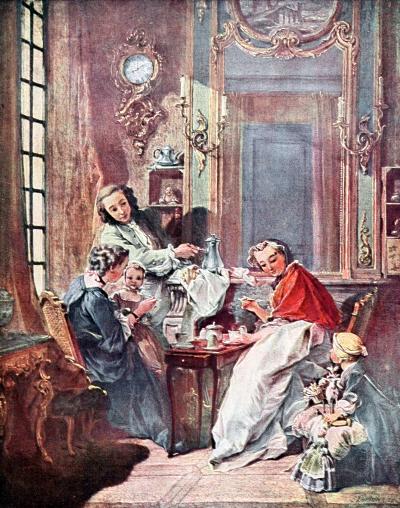
PLATE VII.—INTERIEUR DE FAMILLE
(In the Louvre)
Boucher had a quick ear for the vogue. Twice he found the Home to be
in the artistic fashion; and each time he painted Home life in order
to be in the mode. This interior, showing a well-to-do French family
of the times at the midday meal, is not only rendered with glitter and
atmosphere, but it is valuable as a rich record of the manners and
furnishments of his day.
He was now giving all his strength to the “Rape of Europa” that he
painted for the competition ordered by the Academy at the command of
Lenormant de Tournehem in the king’s name, in which ten chosen
Academicians were to paint subjects in their own style for six prizes
and a gold medal, to be awarded in secret vote by the competing
artists themselves. Boucher won, by his amiable nature, the good-will
of them all by proposing that they should so arrange as to share the
prizes equally, and thus prevent any sense of soreness inevitable in
the losers.
But greatly as he won the good-fellowship of his fellow-artists by it,
this picture caused a murmur to rise amongst the critics who,
aforetime loud in his praise, now began to complain of his “abuse of
rose tints” in the painting of the female nude. The fact was that
Diderot and the men of the New Philosophy were turning their eyes to
the whole foundations upon which France was built, art as well as
society, and were beginning to demand of art “grandeur and morality in
its subjects.” They were soon to be clamouring for “the statement of a
great maxim, a lesson for the spectator.” Diderot, with bull-like
courage, picked out the greatest, and turned upon Boucher, blaming him
for triviality.
The nations, weary of war, concluded the peace of Aix-la-Chapelle in
the October of 1748. No sooner was peace concluded than Louis
relapsed into his old habit of dandified indolence and profligate
ease; and, putting from him his duties as the lord of a great people,
he gave himself up to shameless intrigues. He allowed the Pompadour to
usurp his magnificence and to rule over the land. He yielded himself
utterly, if sometimes sulkily, to her domination; and for sixteen
years she was the most powerful person at Court, the greatest force in
the state—making and unmaking ministers, disposing of office,
honours, titles, pensions. All political affairs were discussed and
arranged under her guidance; ministers, ambassadors, generals
transacted their business in her stately boudoirs; the whole patronage
of the sovereign was dispensed by her pretty hands; the prizes of the
Church, of the army, of the magistracy could be obtained solely
through her favour and good-will. Her energy must have been
prodigious. Possessed of extraordinary talents and exquisite tastes,
she gave full rein to them, and it was in the indulgence of her better
qualities that Destiny brought Boucher into the friendship of this
wonderful woman. She became not only his patron but his pupil,
engraving several of his designs.
But this, her sovereignty over the king, easy and light in its outward
seeming, was a haggard nightmare to the calculating woman who had so
longed for it. She knew no single hour’s rest from the night she won
to the king’s bed. She had to fight her enemies, secret and open, for
possession of the king’s will, day and night; and she fought—with
rare courage. She won by consummate skill and unending pluck. She made
herself an essential part of the king’s freedom from care. The Court
party fought her for power with constant vigilance. Maurepas brought
all his unscrupulous art, all his ironic mimicry, all his vile jibes
and unchivalrous hatred to bear against her. He had made himself a
necessity to the king; and he never slept away a chance of injuring
her. He knew no mercy, no nobility, no pity. He made her the detested
object of the people. With his own hands he penned the witty verses
and epigrams that were sung and flung about the streets of Paris.
But she had an enemy more subtle than any at the Court—hour by hour
she had to dispute the king with the king’s boredom. And it was in the
effort to do so that she created her celebrated theatre in the
private apartments, calling Boucher and others to her aid in the doing
of it. Here the noblest of France vied with each other to obtain the
smallest part to play, an instrument in its orchestra, an invitation
to its performances.
Boucher left the Opera to become its decorator in 1748, and did not
return until her death. For her, he also decorated her beautiful rooms
at Bellevue. She bought at high prices many of his greatest
masterpieces.
The Pompadour’s power so greatly increased that she openly took
command of the king’s will; dared and succeeded in getting his
favourite Maurepas banished; and herself took to the use of the kingly
“we.” Her rascally father was created Lord of Marigny; her brother,
whom the king liked well and called “little brother,” was created
Marquis de Vandières; her only child, Alexandrine, signed her name as
a princess of the blood royal, and would have been married to the
blood royal had she not caught the small-pox and died. She amassed a
private fortune, castles, and estates such as no mistress had dreamed
of; and into them she poured art treasures that cost the nation
thirty-six millions of money. She created the porcelain factory of
Sèvres, kept keen watch over the Gobelins looms, and founded the great
Military School of St. Cyr amidst work that would have kept several
statesmen busy, and of deadly intrigues at Court that would have
broken the spirit of many a brilliant man.
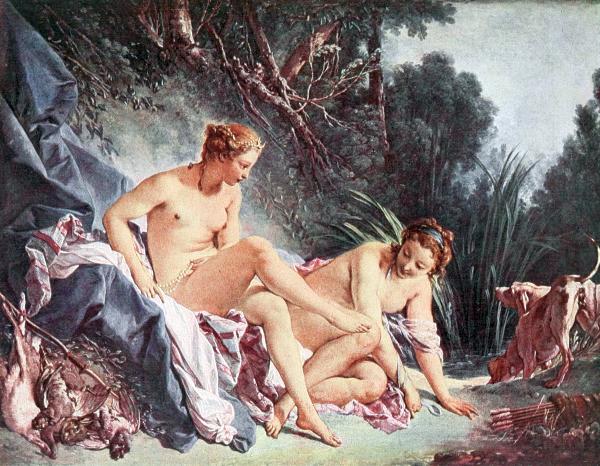
It was in her hectic desire to keep the king from being bored that she
stooped, and made Boucher stoop, to the employment of his high
artistry in the painting of a series of indecent pictures wherewith to
tickle the jaded desires of Boredom, and thereby gave rise to the
widespread impression that Boucher’s art was ever infected by base
design. But Boucher was, at his very worst, but a healthy animal; and
even in these secret works for the king he did not reach so low as did
many an artist of more pious memory who painted with no excuse but his
own pleasure.
As a matter of fact, the Pompadour has been blamed too much for this
evil act, and too much forgotten for her splendid patronage of the man
who, under it and during these great years of his forties, produced a
series of masterpieces that place him in the foremost rank of the
painters of his century. It is impossible to reckon the number of the
pastorals and Venus-pieces that his master-hand painted and loved to
paint, during these the supreme years of his genius. It is significant
that they were painted during the years that saw the Pompadour in
supreme power.
Boucher was so firmly established in 1750, his forty-seventh year,
that he moved into a new house in the Rue Richelieu, near the Palais
Royal. Disappointed in not receiving a studio and apartments at the
Louvre, he was allowed to use a studio in the king’s library. He was
now making money so easily that he was able to collect pictures and
precious stones and the gaily coloured curiosities that appealed to
his tastes.
The critics were becoming more and more censorious; and one of them
hits true with the comment that in his pastorals his shepherdesses
look as if they had stepped over from the Opera and would soon be off
again thereto.
In his forty-eighth year Boucher’s art was at its most luminous
stage—his atmosphere clear and subtle and exquisitely rendered; his
yellows golden; his whites satin-like and silvery; his flesh-tones
upon the nude bodies of his goddesses unsurpassed by previous art. The
beauty of it all was not to last much longer.
Lenormant de Tournehem died suddenly in the November of 1751; the
Pompadour’s brother, Abel Poisson de Vandières, was appointed
Director-General in his stead at the age of twenty-five—and soon
afterwards, on the death of his father, created Marquis de Marigny—a
shy, handsome youth, a gentleman and an honourable fellow, whom the
king liked well, and against whom his sister’s sole complaint was that
he lacked the brazen effrontery of the courtiers of the day. No man
did more for the advancement of the art of his time. A pension of a
thousand livres falling vacant, the young fellow secured it for
Boucher; and almost immediately afterwards, a studio becoming vacant
at the Louvre owing to the death of Coypel, first painter to the king,
Boucher came to his coveted home, eagerly moving in with his family as
soon as its wretched state could be put into repair.
The decoration of the new wing to the palace at Fontainebleau brought
the commission for the painting of the ceiling and the principal
picture in the Council Chamber to Boucher, who had already decorated
the Dining-Room. This was the period of his painting the “Rising” and
the “Setting of the Sun” for the Pompadour, now in the Watteau
collection, two canvases that were always favourites with the painter,
bitterly as they were assailed by the critic Grimm.
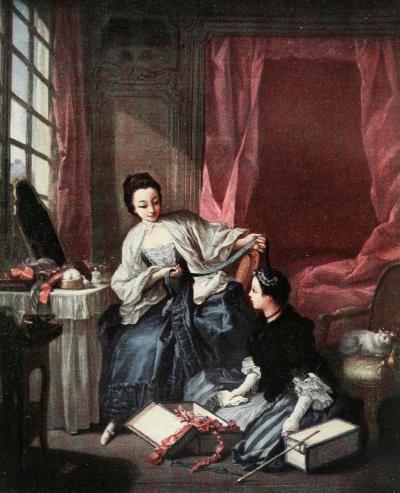
PLATE VIII.—LA MODISTE
(In the Wallace Collection)
The “Modiste” that now hangs at the Wallace is a slight variation on
the “Toilet” that went to Stockholm, commissioned by the Swedish
Ambassador as “Morning” (with three others, to represent the Midday,
Evening, and Night of a fashionable woman’s day, but which were never
painted). The “Modiste” or “Morning,” was engraved by Gaillard as “La
Marchande de Modes,” which adds somewhat to the confusion of its
title.
He was turning out so much work that it was impossible to give as much
care to his pictures as he ought. For he refused sternly, his life
long, to raise his prices; by consequence he had to create a larger
amount of work in order to meet his expenditure. It was about this
time that Reynolds, passing through Paris, went to visit him and found
him painting on a huge canvas without models or sketches. “On
expressing my surprise,” writes Reynolds, “he replied that he had
considered the model as necessary during his youth until he had
completed his study of art, but that he had not used one for a long
time past.”
He soon had not the time, not only to paint from nature but even to
give his pictures the work necessary to complete them. The feverish
haste which took possession of him in his frantic endeavour to meet
the vast demand for his pictures, and the eager efforts of his
engravers to satisfy the public call for engravings after his works,
gave him less and less leisure to joy in their doing. And his eyesight
began to fail. His flesh-tints deepened to a reddish hue; and he
stands baffled before his work, suspecting his sight, since what every
one cries out upon as being bright vermilion, he only sees as a dull
earthy colour. Boucher has topped the height of his achievement; he
has to “descend the other side of the hill.” Boucher begins to grow
old.
In Boucher’s fifty-first year an ugly intrigue of the queen’s party at
Court to sap the Pompadour’s influence over the king by drawing away
the king’s affections towards Madame de Choiseul-Romanet, a reckless
young beauty of the Court, brought about a strange alliance. The Count
de Stainville, one of the Pompadour’s bitterest enemies, was shown the
king’s letter of invitation to his young kinswoman; and he, deeply
wounded in his pride that his kinswoman should have been offered to
the king, went to the Pompadour and exposed the plot. A close
alliance followed; and De Stainville thenceforth became her chief
guide in affairs of state. It was at her instance that the king called
him to be his Prime Minister, raising him to the Duchy of Choiseul—a
name he made illustrious as one of the greatest Ministers of France.
In his fifty-second year Boucher was appointed to the directorship of
the Gobelins looms, to the huge delight of the weavers and all
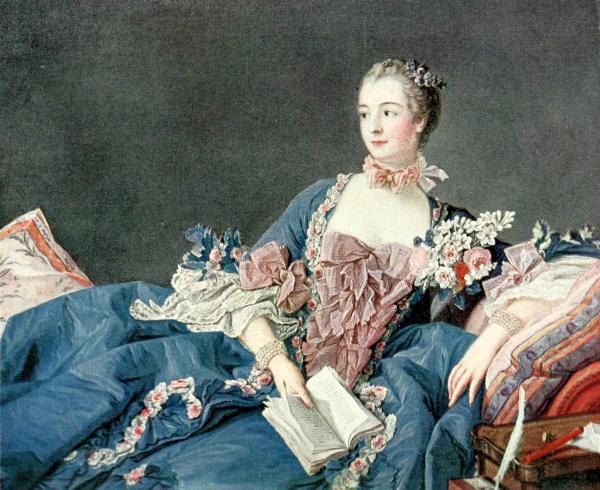
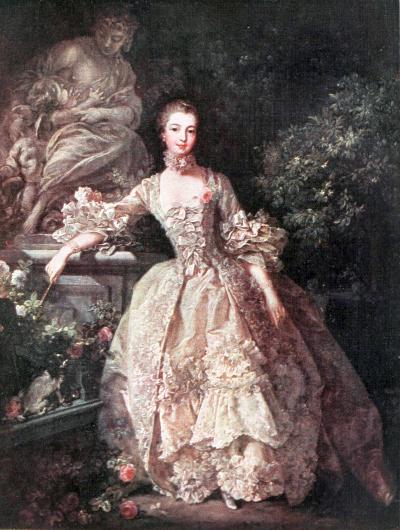
concerned with the tapestry factory. This was the year of his painting
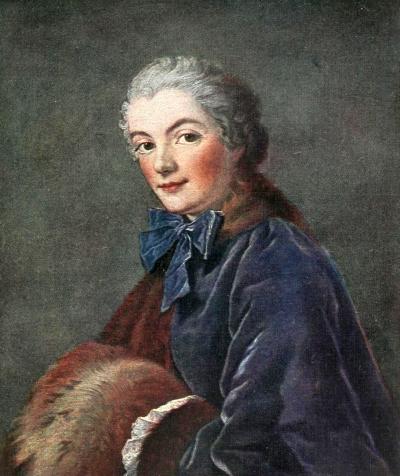
the famous portrait of the Pompadour, to whom he several times paid
this “tribute of immorality.” For the Gobelins looms he produced many
handsome designs; and he was painting with astounding industry. But
his hand’s skill began to falter. His art shows weariness in his
sixtieth year, and sickness fell upon him, and held him in servitude
now with rare moments of respite. The critics, notoriously Diderot,
were now attacking him with shameless virulence. Boucher passed it all
by; but he felt the change that was taking place in the public taste.
The ideas of the New Philosophy were infecting public opinion; the Man
of Feeling had arisen in the land; and France, humiliated in war, and
resenting the follies and the greed of her shameless privileged class,
was openly resenting it and all its works. Choiseul had planted his
strength deep in the people’s party, and was come near to being its
god. His masterly mind had checked Frederick of Prussia to the North;
and the nations, exhausted by the struggle, signed the Peace of Paris
in 1763. Choiseul, with France at peace abroad, turned to the blotting
out of the turbulent order of the Jesuits at home. Their attempt to
end the Pompadour’s relations with the king made this powerful woman
eager to complete his design; the chance was soon to come, and the
Order was abolished from France and its vast property seized by the
state.
The Pompadour lived but a short while to enjoy her triumph. Worn out
by her superhuman activities, assailed by debt, she fell ill of a
racking cough, dying on the 15th of April, 1764, in her forty-second
year, keeping her ascendancy over the king and the supreme power in
France to her last hour. Death found her transacting affairs of state.
Louis, weary of his servitude, had only a heartless epigram to cast
at the body of the dead woman as she passed to her last resting-place.