WHAT we commonly call plants, such as corn or buttercups or an oak tree,
are so familiar that a definition of what plants are may seem needless.
It would be quite so if these generally recognized examples comprised
all the plant kingdom. Actually what are ordinarily thought of as plants
make up only a fraction of the great plant world. The fact that our
familiar roadside and garden plants produce blossoms followed by a fruit
and seed, such as peas and beans and all the ordinary flora of any
region, separates them at once from that other large group of plants
that do not. Common examples of the latter class are the green scum on
the ponds, moss, seaweed, the rust on wheat, yeast, disease-causing
bacteria, the smallest of all known plants, and many others. Most of
these organisms are so small that they can be distinguished only under
the higher powers of the microscope. Some of them in their habits and
growth are like the minute animals described in the volume of this
series devoted to that subject. In fact there are organisms about which
scientists are still in doubt as to their animal or vegetable character.
One or two characteristics common to most plants, however, separate them
from animals and these are their method of getting food and their
practically immovable mode of life. Animals, however simple, do eat and
digest their food, plants take various mineral substances from the earth
or air or water in the form of inorganic matter such as oxygen, carbon,
nitrogen, and all the food materials found in the soil, and transform
them, with the aid of sunshine, into the structure that characterizes
each particular form. Plants, then, may be defined as any living
organism that, with minor exceptions, has the power to assimilate
inorganic substances and transform them into organic matter. Nothing
else in all the realm of nature has this power. It is a possession
beyond all price, this ability to take from the soil and air and water
simple chemical substances and under the magic of sunlight transform
them into the wonderful plant life of the world. But this faculty has
its handicaps, for it is usually, though not always, associated with
inability to move from place to place, which, in some measure, even the
simplest animals can accomplish.
It will be readily understood that this definition of plants includes
many other things that are commonly attributed to the plant kingdom. For
our purpose the discussion of these relatively unfamiliar forms of plant
life will be left until later. A rough and ready distinction between
those plants that everyone recognizes as such and those others like
yeast and microbes, which are plants to most of us only by virtue of the
definition given above, is that the first group produce flowers and
seeds and the second do not. It should not be forgotten, and it will be
shown later, that this is not a true distinction, but for practical
purposes of dividing the plant kingdom it suffices.
The fact of outstanding importance to everyone who really looks at most
plants is that part of them are above ground and part below. This simple
observation carries with it the recognition of a fundamental difference
of plant structure, namely roots and stem. Most plants bear obvious
leaves, and at some time in their life flowers, inevitably followed by
fruits and seeds. The ideally perfect plant would consist, then, of
root, stem, leaves, flowers, fruit, and seed. These are subject to many
changes of form, sometimes they are put to strange uses, and
occasionally one or two may be lacking, as the stem is apparently from
many violets, and leaves from some cactus and from the Tjemoro tree of
Malaya. In fact, so varied are the different forms of these common
attributes of most plants, so important are these differences of
structure that no right understanding of plant life can be had without
examining each in some detail.
The obvious purpose of the roots of plants is to serve as an anchorage
or holdfast. Their other and equally important function is to secure
food for the plant, a process that will be described in the part devoted
to Plant Behavior. Certain plants bear no roots and attach themselves to
the roots of other plants in which case they literally steal their food,
as does the mistletoe and some others.
Roots are of various kinds, depending upon the soil in which they grow
and upon the kind of plant to which they are attached. In the case of
annuals, which live only one year, as does the purslane, and biennials, which live only two years,
as does the fringed gentian, the roots are mostly fibrous (Figure 1) and
apt to be only slightly under the surface. In perennials, which live
many years, such as the dandelion, the root is deeper and forms what is
known as a taproot (Figure 2). In shrubs and trees they are harder,
woodier, and often penetrate to great depths.

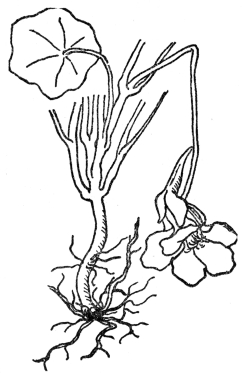 FIG. 1.—FIBROUS ROOTS
As illustrated by the common garden nasturtium.
If we examine the roots of a tree, we find a large part of them are
woody, often as thick as the smaller branches, and it is only toward
their extremities that they branch out into the multitude of rootlets
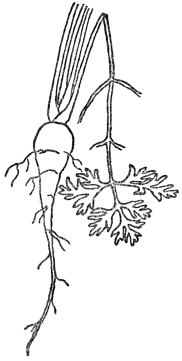 FIG. 2.—TAP ROOT OF CARROT
A store of food for the second year.
that creep through the earth seeking food for the tree. Some, as in the
spruce or hemlock, do not go very deep but spread great distances
through the soil in search of food, others, like the hickory, go nearly
straight down. The interesting feature of these tree roots is that the
part nearest the trunk is all but dead, and acts mostly as an anchor,
while the fibrous rootlets or even finer subdivisions known as root
hairs at the extremities are the food gatherers. At the very end of all
rootlets and of roots is a rootcap (Figure 3), harder than the rest of
the threadlike rootlet. This rootcap is, if not quite dead, at least useless as a food gatherer, but
serves as a tiny pioneer wedge which forces its way among stones or
other obstructions, so allowing the living root hairs just behind to
gather the food to which it leads the way. In certain of the rocky
islands of the Bahamas wild fig trees may be seen, growing on the bare
rocks, their roots sprawling in every direction in search of a crevice
through which the rootcap can force its way. Such roots may extend
thirty or forty feet from the trunk of the tree over the bare rock in
search of a favorable crack where they plunge to the cool depths and
secure the food and water necessary for life.
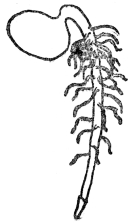 FIG. 3.—TAP ROOT OF SEEDLING
The figure shows the root cap at the extremity.
Roots are not always of this common type. Sometimes, particularly in
certain biennials, they are swelled to form great thickened portions,
often weighing many pounds. The sweet potato is a familiar example, and
a related plant, one of our morning-glories, has an enormous perennial
root, known to weigh as much as fifty pounds. This swelling of the
roots of plants is a quite common characteristic of certain kinds and
has great commercial significance. Carrots, turnips, rutabagas, beets,
and parsnips are familiar examples. The purpose of such roots is to
store food for the plant, and this thrifty habit of some roots has been
turned by the gardeners to our advantage.
It is a common sight to see parts of a sidewalk heaved up by a tree root
and their force in this respect is tremendous. One of our common ferns
has been known to raise a weight of over 500 pounds, and even to break
through a concrete walk. Such is the force exerted by the roots of
plants that we can truly think of roots as pushing through the earth
almost regardless of obstacles, binding the soil together and not only
serving the needs of the plants, but actually holding the soil on steep
slopes. Where fire or ruthless lumbering has stopped this natural
process the washing away of the soil and exposure of the bare rocks
leaves desolation behind it.
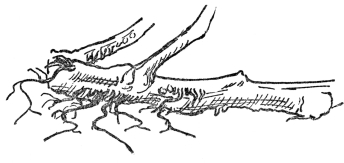 FIG. 4.—ADVENTITIOUS ROOTS OF THE TOMATO
Produced from joints or injured places.
While most roots live under the surface many grow in the air, and a few
grow from stems that are injured. The tomato vine often produces roots
at the joints or where it has been injured. Such roots, known as
adventitious roots (Figures 4 and 5), are fairly common in many
plants, the common garden practice of making cuttings, which take root
under favorable conditions, being based upon this fact.
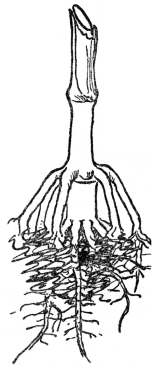 FIG. 5.—PROP ROOTS OF THE INDIAN CORN
Usually produced from the first joint above ground and serving as
additional anchor and food gatherers.
But some plants produce roots in the air, as in poison ivy and the
trumpet creeper, without injury or the gardener’s skill, and are known
as aërial roots. They are some of the most peculiar and fantastic of
nature’s devices for allowing plants to grow in apparently unfavorable
places. In many orchids, some relatives of the pineapple, and a few
other air-inhabiting plants, the roots live wholly in the air, the
plants being fastened to a tree or even to a telegraph wire. Such plants
live on the air and water vapor, and are mostly inhabitants of moist
tropical regions.
Quite the most extraordinary of aërial roots are those produced in
certain kinds of fig trees. Starting perhaps a hundred feet in the air
and no thicker than a lead pencil they appear first as slender vine-like
streamers blown hither and yon by the wind. Eventually they reach the
ground and penetrate it, grow often to a great size and even form
trunklike connections with the tree top. The banyan tree of India is the
best known case of this peculiar habit. One which started from a single
trunk, subsequently sending out great numbers of aërial roots, has now
spread to such a size that it is over 2,000 feet in circumference, has
3,000 trunks, and once sheltered 7,000 soldiers.
A variation of this habit is the case of a giant fig tree of the West
Indies in which a bird may deposit the seed of another tree. The
seedling soon develops, sending out long, at first threadlike, aërial
roots which are wrapped around the tree trunk. As the roots increase in
size and further encircle the trunk they ultimately reach the ground,
where they are frequently a foot in diameter. Then the true nature of
the process becomes evident. For these apparently innocent aërial roots,
as they reach the ground, have so completely inclosed the old trunk and
their pressure is so great that they literally strangle the tree from
which they started. It is slower but just as deadly as the strangulation
of an animal by a boa constrictor, for these encircling roots cut off
by strangulation the ascent of the sap, thus killing the tree. Fate
sometimes overtakes them, however, as it is a common sight to see the
strangler meet the same end. Some of nature’s most ruthless battles are
fought out in this way, very silently, but very effectively.
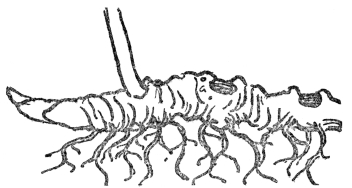 FIG. 6.—ROOTSTOCK OF SOLOMON’S SEAL
The figure shows roots and bud scars together with the ascending stem of
the year’s growth.
Nothing dies harder than generally accepted delusions, particularly
those regarding plant lore, and of all such incorrect impressions the
one that a potato is a root, is the hardiest and most difficult to kill.
Yet, the “eyes” of a potato give it away if one stops for a moment to
reflect that the eyes are only buds and buds grow only on stems. That is
one of the chief uses of stems—to support in the air the leaves and
flowers that come from its buds, and no matter if the stem, as in the
potato and many other plants, be ever so deeply buried their true stem
nature cannot be mistaken. Sometimes these underground stems are not
thickened but lengthened out, in which case, notably in common garden
iris, they are called rootstocks. Again, these buried stems may be
swollen, as in the potato, when they are known as tubers. Onions and
the jack-in-the-pulpit bear still other kinds of underground stems, and
there are many more, but they cannot be mistaken for roots, for it will
be seen from Figures 6-9 that on their under sides they bear roots
themselves. Besides this they bear buds or shoots, which no true root
ever does.
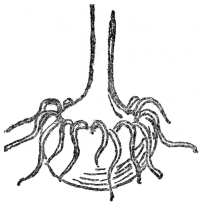 Fig. 7.—CORM OF JACK-IN-THE PULPIT
(After Gray)
Really an underground stem.
Stems above ground, which is the most usual form for them, are of many
kinds, all serving the purpose of support to the leaves and flowers, and
as a means of carrying sap from the roots or underground stems to the
upper part of the plant, and also to carry certain foods to the roots
from the leaves, of which more anon. In the case of herbs, like
goldenrod or daisy, the stem may be apparently all pith on the inside,
with only a thin outer coating of harder substance, not unlike bark, but
usually green. If we examine the cut-off trunk of a tree, a quite
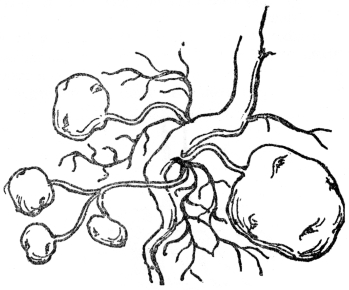 FIG. 8.—TUBERS OF THE COMMON POTATO
Potatoes are swollen portions of rootstock.
different structure is apparent. Any lumberman can point out at once
“heartwood” and “sapwood” (Figure 78), and his distinctions are just as
good as those of the scientist, for he says in these two words as
plainly as can be said that heartwood is the oldest and sapwood the
youngest. The sapwood is nearer the bark and is honeycombed with
passages which serve to carry the sap from the roots to the tree top,
while just under the bark is the bright, green, living layer, known as
cambium, which is renewed each year. The phloem is the carrier for
the food made in the leaves to the roots. It is the successive layers of
cambium, year after year, that gives to tree trunks their annual
rings. The age of almost all trees can be reckoned exactly by counting
these, one representing a year’s growth, and the tree’s rate of growth
estimated from the closeness of the rings. Fires or droughts, perhaps
long forgotten, here find a lasting record in rings so close together as
to be all but invisible. The part nearest the center of the trunk is the
heartwood, usually quite lifeless, yet in its maturity furnishing us
with lumber. It may be and often is completely decayed, without injuring
the flow of sap or the life of the tree for many years.
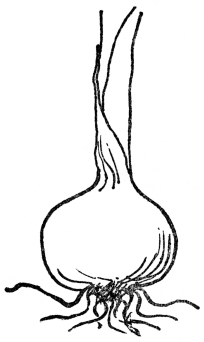 FIG. 9.—BULB OF THE ONION
Showing root and leaf growth.
These two streams of sap, one going up and the other returning to the
roots, each in its proper channel, are interspersed with air chambers
that extend from the center of the tree out toward the bark, where they end in inconspicuous
dots called lenticels. It is as though nature had provided an
air-cooling device for the constant activity of these diverse currents.
These lenticels are prominent on the bark of cherry, but whether obvious
or not they are found in nearly all woody stems and insure a constant
supply of fresh air to the busy interior.
In palms, sugar cane, corn, bamboo, and many other plants there is not
any distinction between heartwood and sapwood (Figure 82), and in place
of bark there is nothing but an outer rind, harder than the interior
tissue. Such stems do not usually rot first at the center, have no
cambium, and have no annual rings. This method of growth and structure
is associated nearly always with definite leaf and flower forms peculiar
to it and differing from most other plants. So fundamental are these
characteristics, so uniform their occurrence and so clear are the
distinctions between them and other plants that botanists have divided
all flowering plants into those belonging to this group or to some
others. More will be said of this in the chapter on the Families of
Plants and Their Relationship.
The stems of some plants, such as the Big Trees of California, for
instance, are among the oldest and most permanent of living things.
“General Sherman,” one of the biggest in that most famous grove, was
nearly three thousand five hundred years old when Columbus discovered
America; it has lived through all the great periods of modern history,
and to-day it is over 270 feet high and 35 feet in diameter. No living
thing is so large or has lived so long. In Australia are great forests
of blue gum trees even taller than our Californian Big Trees, but not so
old nor so thick.
In the Pacific, off the coast of Oregon and British Columbia, a seaweed
is commonly found with stalks over 500 feet long, and in India the
rattan palm climbs over the tree tops for great distances, a single stem
not much thicker than a broomstick measuring over 700 feet long. The
search by leaves for light and air results in the stems of some plants
performing almost incredible feats. Whether it is one of the Big Trees
with a great massive trunk, or the rattan palm with its sinuous winding
through the topmost heights of the tropical forests of India, the result
is always upward to a “place in the sun.” This struggle for sunlight has
taken many forms in different plants, the ordinary vines like
morning-glory or grapevine, for instance, where the climbing stem is of
great advantage. Some vines always twine to the left, as the hopvine,
others to the right, as in the morning-glory, all seeking support from
something else, each adopting its own most useful way of getting its
leaves in the most advantageous position to catch the life-giving
sunshine. If we could look down on any forest from an aeroplane, the
striking efforts of nearly all plants, whether herbs, shrubs, vines, or
trees, to get the utmost sunshine for their leaves would be evident at
once. No apparently impossible twisting or bending of tree trunks or
reaching out of stems of vines but is to be found in the inexorable
struggle of stems to fulfill their task of giving the plant its chance
to reach “a place in the sun.” Sometimes mere climbing or twining does
not seem sure enough—it seems as though winds or the elements might
break loose the vine from its support and thereby kill its chances. In
certain vines this contingency appears to have been foreseen, and as if
to clinch their opportunity of growing onward they are provided with
special helps. Slender green tendrils, delicate prolongations of the
stem, begin, almost insidiously, to catch hold of the nearest support
and by a couple of turns about it and subsequent strengthening of their
tissues make a permanent holdfast. The grapevine is a case in point. And
as if this were not enough, certain other plants, such as the Boston
ivy, have small disks which attach themselves to bare walls or tree
trunks. This is to make assurance doubly sure, and it is this that makes
the Boston ivy so useful to the gardeners for covering walls.
Some stems accomplish their purpose not by holding fast to a support in
the air, but by creeping along the ground, as in the running blackberry,
and often in the Virginia creeper. The purpose is the same, and, as if
to confirm it, a few otherwise quite prostrate vines have their tips
turned upward to the light, notably in the case of the creeping
speedwell.
In certain plants the stem may assume curious forms due to special
conditions under which they live and to which adjustment is necessary
for the plant’s existence. In deserts, for instance, the cactus produces
practically no leaves (Figure 10) and the green stem performs not only
the function of leaves but acts as a storage for water. Where water is
scarce this is of tremendous advantage, a single cactus having been
known to store up 125 gallons. A similar habit of the cactuslike spurges
in South Africa gives as weird an atmosphere to parts of their
landscapes as we find in Arizona. It is as if the stem of such plants,
being unable to push its leaves (it has none) up into the light, takes
over some of the functions of leaves and makes up the deficiency by
adopting other methods
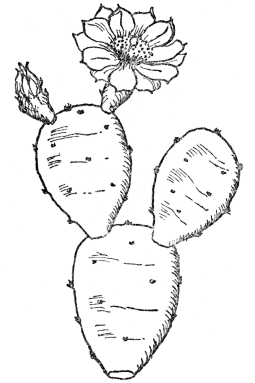 FIG. 10.—COMMON PRICKLY PEAR CACTUS
(Opuntia Opuntia)
Native along the Atlantic Coast. The green joints of the stem function
as leaves and store water.
to secure the plant’s survival. Other stems, looking and acting like
leaves, reveal their true nature by producing buds, and the curious
feature of the common butcher’s-broom (Figure 11), often colored scarlet
for Christmas decorations, bearing flowers from the middle of what is
apparently a leaf, but is actually a modified stem, is explained by this
ability of stems to modify their habits to suit conditions. The
butcher’s-broom is an inhabitant of dry regions along the Mediterranean,
where a reduction or
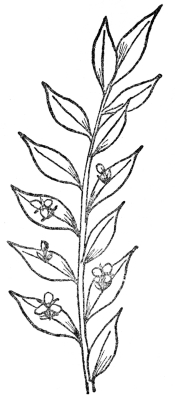 FIG. 11.—BUTCHER’S-BROOM
(Ruscus aculeatus)
Note leaflike stems with flowers arising from the center.
absence of leaf surface is a decided advantage. In many partly desert or
dry regions this production of leaflike stems or branches is common, an
excellent garden example being asparagus, which came originally from
Europe and the feathery growth of which is all stem. In Tasmania a kind
of yew tree produces no leaves, all the foliage being modified stem,
which is true of many kinds of spurge in the West Indies, where an
almost impenetrable scrub is largely made up of a shrub which is
apparently covered with leaves, all actually part of the branches and
stems.
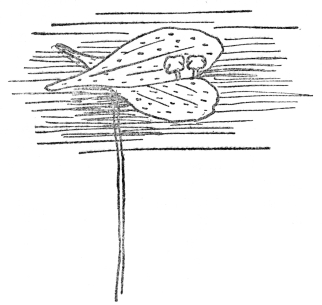 FIG. 12.—DUCKWEED
The smallest known flowering plant, with no leaves and tiny leaflike
stems floating on the surface. Flowers are borne from the margin of the
stem. (Eight times natural size).
While stems, such as the Big Trees or the giant cactus, may be among the
largest of nature’s creations they may be also the smallest, as the
duckweed that floats on ponds is the tiniest of all flowering plants and
its flat expanded surface is wholly stem. Figure 12 on this page better
illustrates this strange modification of a stem than words could do.
From what has been read it will be seen that stems are not “just
stems”—they are among nature’s most ingenious devices to secure the
survival of the plant. Whether buried in the ground, and producing,
almost by stealth, buds that develop into mature plants, or thrusting
leaves to the utmost limits of their reach, or climbing by an
intricately varied mechanism, or changing their character to suit desert
conditions, or floating on the water—it matters not. Each modification
of form or use secures to the individual plant its chances to survive;
and in most cases its only chance, as anyone may see by the sudden death
which follows a series of changes which prevents a stem from performing
its proper tasks.
As the palm reader is supposed to be able to tell your history and
future from veins in your hand, and as the veins in the wing of a
butterfly tell their story to an entomologist, so the veins of a leaf
are more significant than almost any other characteristic of a plant.
Most leaves have their veins, or skeleton, with a single midrib and many
branches off it on each side, which themselves break up into a fine
network of veins. Such leaves are netveined (Figures 13-24). Others,
such as corn and grass, have the veins running side by side from one end
of the leaf to the other, sometimes with small branches off them, but
instead of the veins forming a network they are parallel, and such are
called parallel-veined leaves (Figure 38). In the chapter on Plant
Families and Their Relationship more will be said as to the amazing
regularity with which netveined leaves are associated with certain kinds
of flowers and parallel-veined with other kinds, how these distinctions
have been recognized since hundreds of years before Christ, long before
their true import was understood. There are variations from both
these
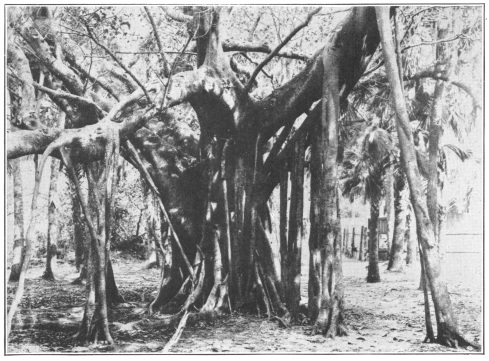
Banyan Tree (Ficus bengalensis). A fig tree of India,
whose adventitious roots make frequent connection between the tree top
and the ground. Starting as thin, whiplike streamers these roots
ultimately form new trunks. (Courtesy Brooklyn Botanic Garden.)
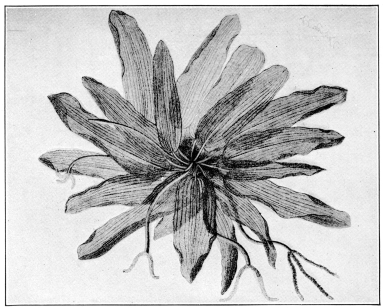
Laceleaf (Aponogeton fenestralis). A submerged aquatic
plant, with permanently skeletonized leaves, and an inhabitant of forest
pools in Madagascar. (After Engler & Prantl. Courtesy of Brooklyn
Botanic Garden.)
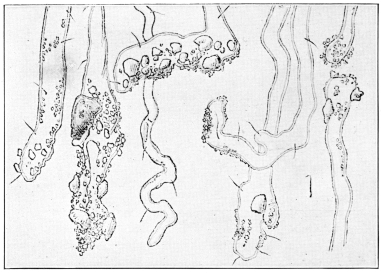
Root Hairs with Fine Soil Particles Attached. Note soil,
water, and air spaces. Much magnified. (After U. S. Department of
Agriculture. Courtesy of Brooklyn Botanic Garden.)
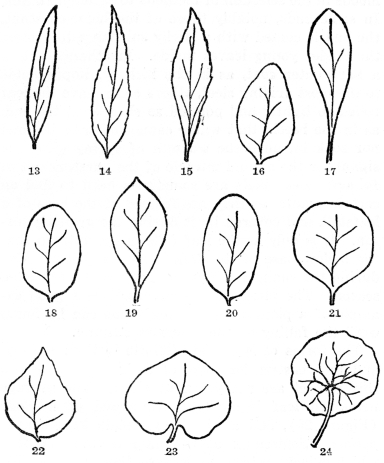 FIG. 13-24.—FORMS AND TIPS OF LEAVES
Fig. 13. A linear leaf with an acute tip. Fig. 14. Lanceolate leaf with
an acuminate tip. Fig. 15. Oblanceolate leaf broadest above the middle.
Fig. 16. Ovate, broadest below the middle. Fig. 17. Spatulate, broadest
above the middle and with an elongated base. Fig. 18. Elliptical. Fig.
19. Obovate in which the general shape is ovate, but broadest toward the
tip. Fig. 20. Oblong. Fig. 21. Orbicular or nearly round. Fig. 22.
Deltoid or somewhat triangular, an ovate leaf with a broad base. Fig.
23. Kidney-shaped or reniform with heart-shaped base. Fig. 24. Peltate
leaf of common garden nasturtium; note circular blade with leafstalk
attached to the center.
types, but in nearly every case, once the difference is noted—and
scarcely any other character of a plant is so much worth notice—they
cannot be mistaken.
During the winter nearly all leaves are folded in various ways in a bud
for protection from the elements. Nature shows herself in some of her
wisest moods in the selection of methods to accomplish this. In some
buds, notably those of the horse-chestnut, the bud is coated with a
sticky substance to protect the tender young leaves inside. In others
there is a hard outer coat, as in the hickory, impregnable to the most
driving sleet, others again have the leaf rolled so tightly and pointed
so sharply at the end, as in the beech, that water cannot cling to the
bud nor soak in, until the warmth of spring gives the signal for the
annual miracle of the bursting out of foliage. Leaf buds are sometimes
hard to find on certain plants, as they are formed at the base of a
leafstalk and covered by it during the growing season. It is only as the
leaf falls in the autumn that the hollow base of its stalk is seen to
have hidden during the summer the young bud for the following season.
The plane tree or sycamore is a good example of a plant where no leaf
buds can be found until the falling of the leaves in autumn.
The forms of leaves are infinite in their variety, and the reasons for
some of their peculiarities in this respect are not yet understood. The
average netveined leaf is obviously composed of a blade (Figure 25),
and at the base a stalk known as a petiole. Sometimes at the base of
the petiole—which is lacking in many leaves—there are two tiny
leaflike appendages, called stipules, which are of no apparent use to
the plant, and, as if in recognition of this fact, they often fall off
long before autumn. In some plants, however, stipules are permanent,
while in certain others they are never found, as, for instance, in the
horse-chestnut tree.
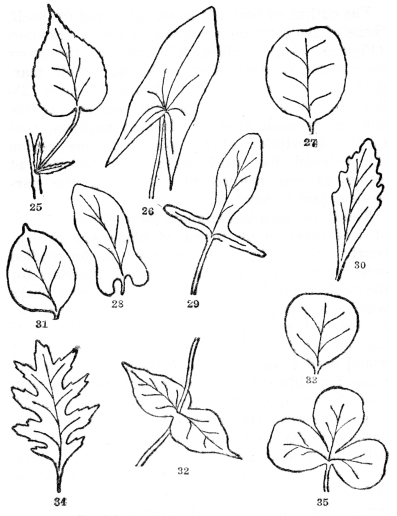 FIG. 25-35.—FORMS AND BASES OF LEAVES
Fig. 25. Simple leaf with blade, leafstalk (petiole), and two stipules
at the base. Margins of the leafblade serrate or saw-toothed. Fig. 26.
Leaf with a sagittate base, or shaped like an arrowhead, the lobes
pointing downward, and with entire margins. Fig. 27. Retuse or
emarginate tip, somewhat indented. Fig. 28. With the base auriculate or
with rounded basal lobes. Fig. 29. Hastate, like an arrowhead but the
lobes pointing outward. Fig. 30. With cuneate base (wedge-shaped). Fig.
31. Cuspidate tip with a usually hard and stiff point. Fig. 32.
Perfoliate, the leaf bases joined and the stem passing through them.
Fig. 33. Truncate, the top flattened. Fig. 34. Pinnately lobed, with
deep indentations cut toward the midrib. Fig. 35. Palmately lobed, out
toward the top of the leafstalk.
The outline of leaves is as varied as nature itself. Some of the common
kinds are shown in drawings (Figures 13-24), which tell more of the
story than pages of description could do. Their margins, too, their
tips, their bases (Figures 25-35), all parts of them, in fact, are so
variable and yet in each kind of plant so uniform, that in the
description of the plants of any region the botanist has used these
characteristics of leaves as one method of identifying the particular
plant in hand.
The terms used to designate these different kinds of leaf margins or
forms of blade are precise, nearly universally used, but need to be
studied only by those who, because of special fondness for the subject,
are likely to need them in using books which are beyond the scope of the
present one. If, for instance, the reader is interested in finding out
what his native roadside plants are, he would need a book describing
them, and there are many for different parts of the country. In such
books he would find these terms, which say so much in a single word
(there are other sets of terms for flowers, fruits, and seeds) totally
unfamiliar and quite likely to disgust him at the start. A little study
may open up to him that most interesting and easily accessible of
recreations, a first-hand familiarity with the wild flowers of one’s own
neighborhood.
All leaves are not as simple as the figures show them to be. In many the
midrib or principal vein is much elongated and there are small
leaflets, sometimes even scores of them, all fastened to a common
stalk. Such are called compound leaves (Figures 36-37), which may be
found in ash, hickory, rosebushes, blackberries, peas, beans, and
thousands of other plants.
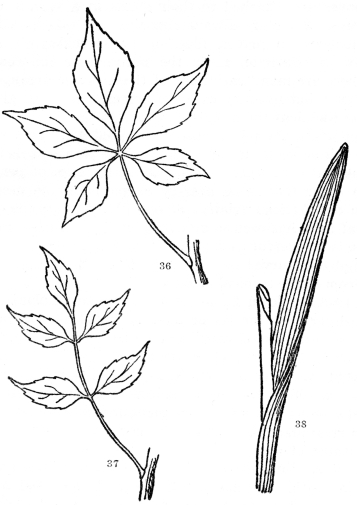 FIG. 36-38.—COMPOUND AND PARALLEL-VEINED LEAVES
Fig. 36. Palmately compound leaf, the five leaflets all arising from the
tip of the common leafstalk. Fig. 37. Pinnately compound leaf, the
leaflets arising from the sides of the common leafstalk. Fig 38. A
parallel-veined leaf. All the other leaves figured are netted-veined.
While leaves are literally factories in which one of the most wonderful
things in the world is produced, it is so much a part of what plants do
or their behavior that the story of it will be given in the chapter on
Plant Behavior. Sunlight is absolutely necessary for the process, and to
reach this sunlight leaves are attached to their stems in a variety of
ways. Some are always opposite each other, as in the common privet,
lilac, or honeysuckle; others always alternate, as in the mustard or the
rose. There are many variations of these simple arrangements, but in
every case the process results in giving each leaf the utmost exposure
to the light without which the plant must wither and die. So vital is
this exposure to light that in some plants parts of the leaves produce
tendrils, as in the case of peas, in order that some near-by support
may be used. In one African relative of our lily, this change of leaf
form has been so great that its long slender leaf tip is wonderfully
adapted to reaching up and catching by its curved tip some support to
lift it from the gloom of the tropical forest floor.
Looking down from above on any small plant or bush, or from the sky on a
forest, about all that can be seen are the thousands of leaves, all so
arranged that it is as though some celestial photographer asked every
one of them to so place themselves that they would all be “in the
picture.” The competition between leaves on the same plant and between
leaves on rival plants is infinitely keener than the friendly pushing of
a crowd to get in a picture, and it lasts forever. Furthermore,
failure to get in means certain death. So intricate is the method of
leaf arrangement, so marvelous the adjustments that all plants must make
to insure ample light, that it is not inaptly called leaf mosaic. As
we shall see in the chapter on Plant Distribution, particularly in forests, certain variations or partial
failures of the process have far-reaching results.
If leaves did not perform this most important function to perfection,
all animals, including man as well, would perish, and it would almost
seem that their obligation to us and the plant world might stop there as
long as their success in reaching the light is so overwhelming. But
there are no union hours of labor, no regulation as to the kind of work
leaves may perform, and some actually reach out for new tasks to do, and
do them. In one, our common pitcher plant, the leaf, as is implied by
the name, is formed into a slender hollow pitcher, wide at the mouth,
but narrow at the base. Inside the pitcher are slender downward-pointing
hairs so arranged that an insect may crawl in, but never out. The lower
down the luckless insect gets the more certain is its death, and, to
clinch matters, there is a tiny pool at the bottom where it is not only
drowned, but, due to the composition of the mixture in the pool,
digested. Only a very few plants can do this; only a minute fraction of
the world’s vegetation can digest animal matter. Some experiments on the
pitcher plant, which grows in bogs, show that it will digest bits of
beefsteak dropped into the liquid at the base of the pitcher.
In the East Indies and in Africa there is a pitcher plant—in fact,
scores of varieties of them—which grows up on the branches of trees. In
this case the pitcher may be as long as some of our American kinds,
often twelve to eighteen inches, and many of them are attached to a
slender leafstalk two to three feet long, by which they hang suspended.
Insects, literally by the thousands, are caught in these gaudy traps,
for many of the pitchers are beautifully colored, and near the opening
they secrete a sweetish liquid that lures their prey. They are, in fact,
such curious and handsome plants that they are commonly grown in
greenhouse collections.
Nature sometimes finds still other ways of using strange and
curious-shaped leaves, and in our American bogs is a group of plants,
also insect digesters, still more unusual than the pitcher plants. In
bright sunny places in open bogs one may often find small reddish,
glistening plants, called sundews, usually only a few inches tall,
covered with sticky hairs. In fact, the glistening is due to the
secretion of the sticky substance, a tiny drop of which may be found at
the end of each hair. Flying insects are caught in these leaves, and, as
a fly on fly paper, the greater the struggle the more involved does the
insect become among the sticky threads. Once caught by such a plant,
escape is practically impossible.
Lying in ambush for chance insects, as these sundews and pitcher plants
do, may seem nearly the limit of what is to be expected of leaves.
Merely to be always on the job, with a plentiful supply of insect
digester, might seem to be all that could well be expected from what,
after all, are only modified leaves. But nature’s devices are infinite,
and there are still other ways to accomplish the apparently impossible.
In a small section of the southeastern States there grows a plant that
not only lies passively in wait for insects, but actually captures them.
This flycatcher, known as Venus’s flytrap, has two valves to the leaf
blade, supported on a stout broad stalk so arranged that their fringed
surfaces face each other. If an insect—and many do—alights between
these valves, they close together rapidly and the prisoner is hopelessly
caught by the interlocking marginal bristles that fringe each valve. In
this case there are glands on the face of the valves, against which the
live insect is tightly pressed, and which secrete a digestive fluid.
When nothing remains the valves slowly open and are ready for the next
victim. They may be made to close by slight irritation with a lead
pencil, and it is the impact of the insect that releases one of the most
curious examples of movement in leaves known to us. There are a few
other plants in different parts of the world that by still other
modifications of their leaves catch and digest insects, but none of them
are to be considered as “insect eaters,” or other names implying that
they have definite designs on the life of passing insects. The process
is sufficiently remarkable, the success of the operation so sure, that
there is nothing gained by attributing to such plants, as many have done
in the past, malignant characters that are possibly confined only to
man. The whole wonderful process is more reasonably explained by
realizing that all these insectivorous plants are so by virtue of
necessity, that many of them are bog plants, which are often hard put to
it to get suitable food, and that the extraordinary change of shape and
function is but one more contribution of leaves to the economy of
nature.
In dry or desert regions, where the conservation of moisture is
essential to plant growth, water storage by leaves is nearly as great an
aid to the plant as we have seen it to be in the stems of cactus, South
African spurges, etc. Our common century plant, whose leaves are, in
some kinds, a hundred times thicker than in ordinary foliage leaves, is
a good example of leaves adapted to water storage. In our southwestern
deserts hundreds of species of plants can exist only by virtue of the
fact that their leaves are so changed in their form or structure that
they serve as reservoirs for water storage. This may be accomplished by
thickening, or it is more often contrived by a thick coating of hairs.
The surfaces of thousands of different kinds of leaves are clothed with
hairs either on the upper or lower side, or sometimes on both sides. In
many cases they are quite obviously protection from too rapid drying out
of the leaf. In others, as in the nettle, the hairs secrete a stinging
substance which seems to insure the plant against grazing animals.
Leaves, then, are for something more than to provide the beautiful
foliage which is their most spectacular accomplishment. So varied is
this in its beauty, from plain green leaves to the wonderful coloring
found in begonias, coleus, and many other garden plants, that the sheer
beauty of the panorama of foliage is likely to blind us to the more
important uses of leaves. First of all must we consider them the
factories, in which night and day are produced the food of all plants
and most animals. Then in certain cases we have seen that, by every
ingenious device known to nature, they perform other special work, such
as helping the plant to climb where that is necessary, catching or even
capturing insects and digesting them when that peculiar service is
demanded of them, and, finally, serving as storage reservoirs in regions
where water is scarce. Probably no part of the plant works so
unceasingly each season at its varied tasks. In the autumn, dropping to
the forest floor, its decomposition furnishes still other food for the
plant, and, to crown all, this busy life and by no means unprofitable
death leaves behind it, as a promise for the continuance of the work, a snugly protected leaf bud which will
repeat the process the next season.
While the plant’s and, consequently, our debt to the leaf is seen to be
tremendous, it cannot be ignored that, if plants produced nothing but
leaves, the end of all plant life would come with the death from old age
or disease of the present generation of plants. Except for those kinds
that reproduce themselves by division or extension of their rootstocks,
which bear buds, there would be no provision for increase. As only a
comparatively small number of plants can reproduce by this method, it is
obvious that something more must be provided to secure new generations
of plants. Flowers, and the fruits and seeds which inevitably follow
them, do this. All plants, with some exceptions to be noted later,
produce flowers at some time in their life. In the case of the century
plant, only once, after which they die. But except for ferns, mushrooms,
seaweed, yeast, bacteria, and some other forms of so-called flowerless
plants, a flower or blossom is to be found at some stage in the life of
all plants.
If we examine the leaves of a goldenrod, we find that they are large
below and diminish in size toward the top. Just below and among the
flower clusters they are so much reduced in size and often changed in
color that they cease to be ordinary foliage leaves, and are known as
bracts. The occurrence of bracts is nearly universal in flowering
plants, and they form not only an apparently transitional stage between
leaves and flowers, but an actual one.
In a complete and perfect flower there are, at the bottom of it, a row
of green leaflike sheaths which
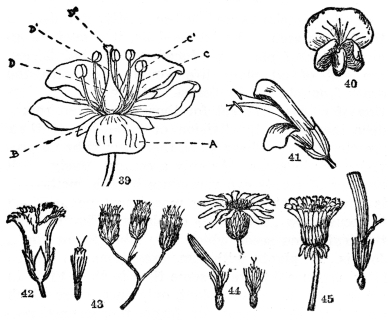 FIG. 39-45.—THE FLOWER
Fig. 39. A perfect and complete flower. A, petals, all of them forming
the corolla; B, sepals, all of them forming the calyx; C, the
stamen, composed of (C) the filament, and (C1) the anther, which
produces the pollen; D, the pistil, consisting of the swollen base
(D) the ovary, a slender shank (D1) the style, and the swollen or
branched tip (D2) the stigma. (H. D. House, “Wild Flowers of New
York.”) Fig. 40. Typical flower of the pea family. Two petals unite to
form the keel (below), two more unite to form the wings (center), the
remaining and larger petal forms the standard. In most plants of this
family the stamens and pistils are concealed within the keel. Fig. 41.
Two-lipped inequilateral flower, common in such plants as Salvia,
Snapdragon, etc. Note the united calyx and corolla. Fig. 42.
Gamopetalous or united and regular corolla of the Fringed Gentian. Figs.
43, 44, and 45, flowers of the Compositæ or daisy family. Many small
flowers grouped in heads and usually surrounded by one or more series of
bracts. Fig. 43. Flowers all tubular, the small one at the left being an
individual flower. Common examples are Boneset and the common garden
Ageratum. Fig. 44. Flowers both tubular and with rays, the tubular in
the center and the rays on the margin. Below is an individual tubular
flower on the right, and on the left an individual ray flower. Note that
its five united divisions correspond to the five petals in other plants.
Common examples are the daisy, sunflower, black-eyed Susan, etc. Fig.
45. Flowers all ray flowers, an individual one at the right. The
Compositæ with only ray flowers usually have a milky juice and have
often been grouped in a separate family, the Cichoriaceæ. Common
examples are dandelion, chicory, and lettuce.
surround and often half inclose the brightly colored petals within. This
outer covering of flowers is called calyx (Figure 39 B), the
individual parts of it, where they are separated, sepals. Their chief
use is to protect the interior petals while they are inclosed in the
bud. The calyx may or may not have bracts just underneath it, as it does
very conspicuously in the case of the flowering dogwood, whose white
“flowers” are really only brightly colored bracts. The transition
between bracts and calyx is not difficult to see in many plants, and
where it is impossible the evidence from their internal structure
confirms what our eye might be inclined to doubt.
Just inside the calyx is what most people call the “flower,” which is
really composed of more highly colored sepals, but which we call
petals (Figure 39A). Where these are joined together the collection,
which forms tubular flowers like the lily of the valley, is called a
corolla. It is, of course, the petals or corollas of flowering plants
that give our landscapes their greatest beauty, their most gorgeous
coloring. While this from one point of view amply justifies a prodigal
nature in strewing the earth with beautiful flowers, the true value of
the color to the plant is in quite other directions, which will be
explained a little later.
Toward the base of the corolla, or sometimes on the petals or sepals,
may be found a series of slender appendages, usually threadlike or a
little thicker, crowned at the top by a distinctly large knob. The
individual appendage is known as a stamen (Figure 39 C), its
threadlike portion a filament (Figure 39 C), and the knoblike top an
anther (Figure 39 C1).
Directly in the middle of the flower there is still another organ,
usually swollen at the base, slender in the shank, and either thickened
or branched at the tip. This central part of nearly all flowers is
called collectively a pistil (Figure 39 D), its swollen base an ovary (Figure 39 D), the
slender shank the style (Figure 39 D1), and the thickened or
branched tip a stigma (Figure 39 D2). A perfect and complete
flower, then, is composed as follows:
Calyx
or
sepals, |
+ |
Corolla
or
petals, |
+ |
Stamens consisting
of filaments
and anthers, |
+ |
Pistil consisting
of ovary, style,
and stigma.
|
The stamen is the male organ of reproduction and the pistil the female.
The actual process of fertilization, pregnancy, the forming of the fruit
and later the seed, and the latter’s birth of a new plant, comprise one
of the most fascinating of those provisions of nature which secure the
perpetuation of the plant world. In the life history of even the
commonest weed along the roadside there is this constant renewal of life
by sexual reproduction, just as in animals and in man. In the chapter on
“How Plants Produce Their Young” will be found some account of this
supreme function of flowers, after which, as if their usefulness were
over, they wither and perish.
Not all flowers are perfect or complete. Some lack petals, as the
buckwheat, where the colored calyx replaces petals. Others have neither
calyx nor corolla, as in the sycamore or plane tree. Most plants,
however, have both calyx and corolla. In some very few plants certain of
the flowers have no stamens, when they are said to be pistillate or
female flowers, and certain others have no pistils, when they are called
staminate or male flowers. In other words, the sexes are in different
flowers in the same cluster or plant, as is true of the walnut and
hickories, when they are said to be monœcious. In still others the
sexes are on entirely different plants, in which case they are
diœcious, as in practically all willows. In the latter case there are
pistillate or female plants and staminate or male plants.
While it is a commonplace that peas do not look like daisies, nor a
carnation like a rose, this simple observation does not begin to tell us
of the wonderfully different flower shapes and colors that are to be
found along any roadside. The perfect and complete flower that we have
been studying is quite regular, composed as often as not of four or five
petals, as many sepals, with five or ten stamens and perhaps a single
pistil. Yet there is literally no limit to the variations from this
scheme, and some of these must be understood here in order that the
life-histories and behavior of plants discussed in later chapters may
tell their full story.
The figures on page 44 show a regular flower, with five separate petals
and sepals (Fig. 39). Such flowers are said to be polypetalous, i.e.,
separate petals. Sometimes three of the petals are larger, two smaller,
in which case the flower is lopsided or, as it is said, inequilateral.
Again all the petals are united to form a regular and equilateral tube,
as in lily of the valley, when they are gamopetalous, i.e., united
petals (Figure 42). As we shall see in the chapter on Plant Families,
this is a distinction between two great groups of plants, as important
in their classification as negro and white man are in classifying
humans.
In peas, beans, the locust tree, and related plants the petals are much
changed to form an irregular flower, with a keellike or prow-shaped part
made from the uniting of two petals. Two more unite to form the wings,
and the remaining and larger petal forms the standard. Figure 40 and the
explanation under it illustrate this unusual form of flowers.
Our common garden salvia shows still another type of flower, which is
tubular and irregular (Figure 41). There is an arching, hoodlike
structure at the top overhanging a lower lip. This kind of irregularity
is common in thousands of different sorts of plants and, usually, it is
a device to insure fertilization of the flower by insect visitors. So
necessary are these for pregnancy in many plants, that an orchid, once
discovered in Madagascar with a tube eighteen inches deep, puzzled the
botanists, who were unable to understand how the plant produced seed in
the absence of any known insect with a tongue as long as that. Darwin
said at once that such an insect would one day be discovered on that
island. Years after, Baron von Humboldt, a German naturalist, found the
insect and explained the mystery.
Perhaps there is no feature of plant life that shows such an amazing
amount of variation as the forms of flowers, and while only a few of the
simplest deviations from the normal have been discussed here, it must
not be forgotten that this infinite variety is a reflection of the
ingeniousness of nature in securing a plentiful supply of seed. Form,
color, the secretion of sweetish nectar, the night or day blooming of
different kinds of flowers, every device that will make fertilization
certain, by the flower itself, by insects, or even by the wind, is used
in such prodigal fashion, that we come to see the importance of it to
all plants only by a realization of the complexity of it and the
provisions against its failure.
One apparently most lavish method of securing fertilization is the
arrangement of flowers in clusters. While many flowers are quite
solitary, the great mass of individual plants produce a few or dozens,
or even hundreds of flowers—in fact, certain relatives of the common
carrot may produce over a thousand flowers in a single cluster. The form
and plan of arrangement of these clusters follows a rather definite
scheme, and here, as in the case of leaves and parts of individual
flowers, the figures tell the story better than words. In the common
dandelion and daisy, and their thousands of relatives, the “flower”
(Figures 43-45), as commonly understood, is really composed of scores or
even hundreds of true flowers in each head. In the case of the daisy the
yellow center, if picked apart, is seen to be really made up of scores
of tiny tubular flowers, each just as truly a flower as a single rose.
The rays, or what are incorrectly called “petals,” which fringe the
golden center with white, if carefully separated and examined closely,
will be found to be also a complete flower, the true petals of which are
all joined to make the strap-shaped ray. If one looks sharply, the
united edges of these petals may be seen by the ridges or channels that
represent their joined edges. Because plants of this sort produce two
sets of flowers in each head, one conspicuous by its brightly colored
rays and with another tubular set in the center which makes doubly
certain the fertilization and seed supply, they are considered the most
highly developed of all plants. It is not a close aristocracy, nor an
exclusive one, for over eleven thousand different kinds of plants,
scattered all over the world, have their flowers arranged in this
fashion or some slight modification of it. They possess, above all
others, the certainty that there will be no slip in their fertilization,
pregnancy, and subsequent birth of a new generation. Because this is
the great object of all flowers, and these daisylike plants have brought
it to such perfection, they are most surely to be classed as the highest
type upon the earth to-day.
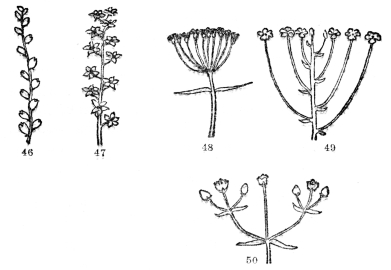 FIG. 46-50.—TYPES OF FLOWER CLUSTERS
Fig. 46. A spike, the individual flowers attached directly to the common
stalk. Fig. 47. A raceme, a spikelike cluster where individual flowers
are stalked. Fig. 48. An umbel, the individual flower stalks all arising
from one point. Fig. 49. Individual flower stalks of different lengths
but the cluster usually flat-topped (corymb). Fig. 50. A flower cluster
in which the end of the stem is terminated by a flower from the base of
which side branchlets similarly tipped with flowers arise (cyme).
While highly irregular flowers are common in nature, conspicuous
examples being the orchids in any florist’s window, or the milkweeds
along the roadside, they can nearly always be seen to have various
changes in the shape of their petals, or sepals, or stamens, or pistils,
which are adaptations to their mode of life, but which always result in
fertilization. Some plants, true monstrosities of nature, are not only
far from having the usual arrangement of flower parts, but they even
produce increased numbers of one part at the expense of others.
Double buttercups, and hundreds of our most beautiful garden blossoms,
have been rescued by cultivation or the arts of the gardeners. Some
roses seem to be practically all petals, but for every increase of
petals there must be a decrease of some other part of the flower, and
more often than enough it is the stamens and pistils that lose out in
this transformation. Just as there is a decrease almost to the vanishing
point in the birthrate when people become too effete and cultivated, so
in plants there seems to be a point beyond which they cannot be pushed
without suffering partial or often complete inability to produce young.
The more highly they have been developed, oftentimes the greater their
beauty, the less able are they to see to it that the chief function of
flowers is accomplished. Such garden plants are increased by root
division, cuttings and other arts of the gardener. Naturally true double
flowers are almost unknown in wild plants, and the habit seems to have
been brought about by too easy a time of it, too little struggle, too
much food, or by any other of those things that produce effete but
beautiful things, charming in their way, but of no significance in the
sturdy struggle for existence that all wild plants must meet or perish.
Another curious modification of a flower bud is cauliflower. Here the
bud has been so developed, its calyx, sepals, etc., so transformed that
the large, cabbagelike head, produced at the apex of the main stem of
the plant, has by so much lost all semblance of a flower that it is
actually a vegetable.
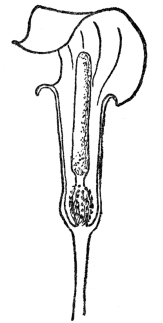 FIG. 51.—FLOWER ARRANGEMENT PECULIAR TO THE ARUM FAMILY
Fig. 51. The outer leaflike tubular or hooded spathe surrounds in our
common Jack-in-the-Pulpit a clublike spadix, upon which are crowded the
tiny flowers.
No feature of a landscape gives us more pleasure than its flowers, over
which poets have sung and artists have painted their most charming
pictures, even a musician has composed a very beautiful piano piece, “To
a Water Lily.” But their true place in the scheme of nature has a deeper
significance: the wonderful color and symmetry of their parts, the plan
of their arrangement, their transformation into curious forms, like the
Madagascar orchid, and hundreds of others—all these point to their
supreme function, an act of self-sacrifice comparable only to the fall
of a leaf when its task is done. Petals, too, wither and die when the
fertilized ovary, already a mother, begins the slow process of maturing
its young and the end of the flowering stage is reached. Such a climax
is this in certain plants that the whole plant dies, as we have already
noted in the case of the century plant. The toddy or wine palm of India,
often sixty or seventy years old and more than a hundred feet tall,
flowers only once, and, as if in recognition of the fact that it has
done that for which it grew, slowly dies as the seed ripens. More humble
annuals, like buckwheat, and hundreds of others, live only one brief
growing season, produce flowers and seeds, and then die, leaving behind
them the only means of perpetuating their kind. The dormant seed carries
over the winter the life they were themselves unable to maintain, as
perennials and woody plants do in their buds.
The number of different kinds of fruits that one can buy even in the
greatest markets in the world is so small, compared to all fruits that
are annually produced by plants, that they might almost be likened to an
ear of corn as against a Missouri cornfield. If, as we have seen, all
flowering plants must produce fruits, then what we commonly call such
can be only a fraction of what actually makes up nature’s annual
harvest. It follows that fruits often occur in unfamiliar disguises and,
as we shall see presently, some of the things we have been calling
fruits may be so only partly, if at all.
Disregarding what we call fruits and looking at it from the plant’s
point of view, a fruit is anything in which, or upon which, a seed is
developed or ripened quite without regard as to whether it is edible by man or not. As the ovary is the
female organ of reproduction and contains the yet undeveloped seed, it
follows also that fruits are practically always a development of some
part or modification of the ovary or the upper end of the flower stalk
upon which it rests and from which it is often scarcely separable.
Familiar enough is the distinction between dry fruits, such as a pea pod
and fleshy ones like oranges, and this quality of being fleshy or dry is
practically universal. Among fleshy fruits a few well-known types may be
mentioned, such as the orange, tomato, grape, gooseberry, and cranberry,
all true berries. There are, of course, thousands of less familiar
examples of berries, but, whether with a hard rind as in the orange or
not, they are a direct development, or often a mere swelling of the
ovary, with sometimes the adhering calyx, and contain the seed. In
apples and pears, known as pomes, the fleshy part is a development of
part calyx and part the receptacle upon which the ovary is supported
while still in the flower. The ovary in these fruits is the
parchmentlike interior which contains the seed. Plums and cherries,
which have a single stone, instead of numerous seeds buried in the
flesh, are known as drupes. These familiar examples are matched by
thousands of others of which we hear nothing, all drupes and all
formed directly from the ripened ovary and without much change, except
the increase of size, juiciness and large development of the tiny
immature seed, now transformed into a stone. In the watermelon, pumpkin,
and related plants, is still another kind of fleshy fruit, called a
pepo. All of this, including the hard rind, is transformed ovary and
calyx completely incorporated, and forming in the pumpkin perhaps the
largest fleshy fruit known. In a considerable number of plants there is
not a single ovary, but several, or in some cases many. These
occasionally all develop into what is called an aggregate fruit, of
which examples are the blackberry, mulberry, magnolia, and many others.
While it would be logical to think that these fleshy fruits were
designed to make delicious food for man, that, in the light of what we
have seen to be the real function of the flower, is an assumption which,
while flattering, is far from the truth. It is much more certain that
fleshy fruits help plants in the dispersal of their seeds and that this
fleshy, juicy character is just one more device of nature to see to it
that not only do plants produce seeds, but that the seeds are carried
and so spread the plant over considerable areas. Birds and animals eat
such fruits in enormous quantities and, in fact, bird migrations are
thought to be not so much response to winter cold as to the fact that
fruits are scarce then. When it is remembered that some birds make
tremendous flights, often over 10,000 miles in a few days, their
capacity to spread seeds through their droppings may be imagined. In the
chapter on plant distribution some truly remarkable cases of such seed
dispersal will be given.
The chance of having seed carried great distances, because it is
embedded in a fleshy, often brightly colored fruit, would seem to put
plants having dry fruits at a disadvantage. Birds and animals cannot be
expected to look after the dispersal of those fruits that are neither
tempting to the sight nor to the taste. And it must be confessed that
quite other qualities in dry fruits insure their dispersal. Some are so
nutritious, like the acorn, that thrifty squirrels store them over
the winter, as they do many other seeds which are harvested from dry
fruits. Various grains are often so stored by man, and rice, wheat,
buckwheat, and other cereals are common cases. In nearly all grains the
seed fills so completely the fruit that cereals are very generally, but
mistakenly, called seeds. A grain of wheat or corn is just as complete a
fruit as a watermelon. Only its outer coat and inner seed are so closely
welded together as not to be usually recognized as a fruit, with the
seed inside.
One of the commonest types of dry fruit is the capsule (Figure 53),
well named, as it is almost an exact counterpart of the capsule of the
druggist, in that it is in many cases composed of a lower part and an
upper, usually merely a domed lid. Others again, instead of splitting
around the sides, split from top to bottom. Still others, as peas and
beans, known as legumes (Figure 57), are pods that not only split
lengthwise, but have no central partition, as do many other fruits of
the same general type. When the seed is ripe nearly all pods and
legumes finally split open, and the seed or seeds tumble out. A few,
as in the violet and touch-me-not or jewelweed, apparently realizing
that merely to spill out ripe seeds at the proper time will not spread
the species very far, open their fruits with a sudden explosion and
literally shoot their seeds considerable distances. The artillery plant,
commonly grown in greenhouses, a delicate feathery herb from tropical
America, opens its flowers with a report like a toy popgun and shoots
its small pollen grains for several feet, but not its seeds as stated by
some.
But many fruits do not open at all and seem to be at the greatest
disadvantage in the effort to insure
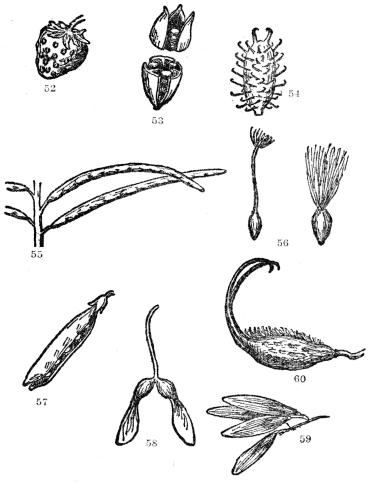 FIG. 52-60.—TYPES OF DRY FRUITS
Fig. 52. The strawberry. The fleshy part consists of the modified upper
end of the flower stalk or receptacle, while the true fruits are the dry
achenes on or embedded in the surface and popularly called the seeds.
Fig. 53. A three-celled capsule splitting lengthwise as in the common
Iris. Fig. 54. Fruit of the cocklebur, the hooked prickles of which are
admirably adapted for clinging to the fur of animals. Fig. 55. Pods of a
plant of the Mustard family, which split down both edges, unlike the
true peas, which split down only one edge. Fig. 56. Two types of achenes
of the daisy family tipped with plumed bristles, greatly aiding their
carriage by the wind. Fig. 57. Common garden pea—a typical legume. Note
that it splits only on one side. Fig. 58. The samara or two-winged fruit
of the maple. Fig. 59. The samara or single-winged fruit of the ash.
Fig. 60. The dry two-pronged and bristly fruit of the unicorn plant
(Martynia), admirably adapted for dispersal by animals.
dispersal of their seeds. Greater food value to birds and animals
overcomes this in some kinds, and another help is that some fruits of
this sort are covered with hooked prickles or barbs (Figures 54 and 60).
The common weedy burdock, the barbed fruits of which may often be found
sticking to the fur of animals in great quantities, is a case in point.
There are whole groups of plants that rely on this method for seed
dispersal, notably the avens, tick-seed, tick trefoil, and many shrubs
in the tropical regions.
Where the fruits are neither barbed nor very good to eat, and so
apparently doomed to be more or less permanent stay-at-homes, nature has
provided some of them with the proper equipment for flight through the
air. Winged fruits like the maple are to be seen on any windy day during
their season scurrying before the breeze, and consequently spreading
their kind over considerable distances. In the maple there are two
wings, joined at the base where the seeds are embedded in the wings, and
the fruit is known as a samara (Figure 58), or key fruit, from a
slight resemblance to an old-fashioned key. Ash trees bear fruits that
are a slight modification of this type and may be carried considerable
distances by the wind (Figure 59).
In the dandelion, daisy, and nearly all its thousands of relatives, this
faculty of setting sail in the air has been carried to the greatest
perfection, just as we saw its flowers were. In this family of plants,
the largest in the world, the fruit is mostly tipped or surrounded by a
small collection of very fine bristles. The fruit, known as an achene
(Figure 56), is so light that with the added buoyancy of this tiny
collection of down it can be transported great distances. Some have
been known to fly hundreds of miles in severe storms, and, as we shall
see in the chapter on plant distribution, these tiny plant balloons have
played a conspicuous part in spreading their kind over the face of the
earth. Cat-tails also, together with many other plants, have this
faculty and make up by its possession for the lack of fleshy or
otherwise desirable fruits that might be carried. All achenes are not
winged, those which dot the surface of the strawberry being imbedded in
the luscious flesh, which is not really fruit at all. Only the achenes
on the strawberry are true fruits, the fleshy part being merely a
development of the upper part of the flower stalk and not of the ovary
(Figure 52).
Fruits, then, cannot be restricted to the common understanding of them.
They are transformations of the ovary, in which or upon which seeds are
nursed, and upon which most plants depend for the dispersal of their
seeds. We shall see later on how fruits have fulfilled their destiny,
how some are fit for their true function only when they have been eaten
by birds, and when some digestive juice has released them from the
impotence they would suffer without being eaten, how a whole forest has
been changed in the West by the busy activity of squirrels upon the
fruits and seeds of a single kind of fir tree; how the fruit of the
coconut palm has been spread throughout the tropical world because it
can float in the sea securely protected from injury from salt by the
impervious coverings of its fruits.
As the final stage in the development of all plants is their seed, with
the dropping of which they bid good-by to their fellows, it is not
perhaps remarkable that in the seed of all flowering plants is the germ
for the new generation. To seeds which may be as small as the mustard,
so often mentioned in the Bible, or as large as the coco de mer, or
double coconut, from the Seychelles Islands, often fifty pounds or over,
is intrusted by cunning nature the one final and most important act in
the whole kingdom of the plant world. Nearly all plants would die off
forever if seeds did not have in them the germ of life, apparently quite
dead, but actually only dormant. This living germ may persist for years,
sometimes even a hundred years, and yet with the proper conditions it
never fails to sprout.
Seeds have inside them a tiny plantlet folded and ready to grow when the
seed splits to release it. Also, in the seed is stored up food to
sustain the new plant until such time as its own roots begin to act.
This young plantlet is known as the embryo, and to this all actions of
the seed are subservient.
As the seed splits, and the young plant develops its first leaves and
rootlets, there is shown one of the most remarkably uniform tendencies
in plant life. In all plants with net-veined leaves the young plantlet
starts life with two leaves, or cotyledons, as these first leaves are
called, and this whole group of plants are thus known as dicotyledons.
In plants with parallel-veined leaves the young plantlets start out with
a single cotyledon and are therefore called monocotyledons. In only
the pines, spruce, and a few other evergreen trees the seedling plants
have several cotyledons and are known as polycotyledons. All the
flowering plants in the world belong to one of these groups, so that
merely to see the germinating seed tells the story at once. The linking
of parallel-veined leaves and a single seed leaf, and net-veined leaves
with two seed leaves, is also associated with very definite arrangement
of their flower parts, their method of growth and other characters.
Something has already been said of this in the discussion of stems and
leaves, and more will be found in the chapter on plant families. No more
beautiful example of the plan or scheme of nature is to be found than
these characteristics of all plants, and in seeds we find the first hint
as to which army the plant will join, under which banner it will fight,
and under what generalship it will develop. Nothing tells us so much as
these first seed leaves, pushing their way up through the soil and
revealing, as they burst above ground, to what place in nature their
destiny will consign them.
Flowering plants, which make up the bulk of the vegetation of the earth,
have been discussed in some detail, not only because they furnish us
with all the things that make life possible, but also because they show
perhaps better than anything else the division of labor, all striving
for one end. Roots, the food gatherers. Stems, the framework for the
foliage and its means of reaching the light, or as a storage house for
reserve food. Leaves of many kinds, all factories working night and day
to make the necessary food. Flowers of every hue and shape to lure
insects, or by other means secure union of male and female. Fruits to
ripen the result of this mating of the sexes. And, finally, the seed
carrying with it the yet unborn life. Each part occasionally losing
itself in order that the end may be accomplished, many of them changing
their form or even their function where that is of advantage, all in
their separate ways doing their task, the end of which they cannot see, and the fruits of which
they will never enjoy. Nowhere is it so true as in plants that to save
oneself there must be the capacity to give oneself. Untold millions of
leaves fall, or trees crash down, or seeds are developed, each
fulfilling their destiny which is to insure the perpetuation of their
kind. As we shall see later on, there are many mistakes, many apparently
futile attempts, thousands are wiped out that one may be saved, and in
the past multitudes have gone out forever. Yet the result of it all is
the plant world as we know it to-day, each kind struggling to increase
its sphere of influence, or to cover more of the earth’s area. The
combat between different kinds is inexorable, yet the capacity for
sacrifice on the part of different organs, in order that a certain
individual kind may win, is literally beyond belief.
In the light of what has been said about flowers it may well be
questioned how anything can be a plant and still have no flower. The
fact is that flowers as we commonly understand them are unknown in the
plants about to be discussed, but that what corresponds to a flower,
and performs the function of a flower all plants must and do have. In
the case of most flowering plants the possession of flowers is one of
the beauties of nature in its most resplendent mood, while in the
so-called flowerless plants the functions of flowers are performed by
tiny microscopic organs, even the existence of which has been only
recently discovered. Because flowering plants produce their sexual
organs in such a gorgeous setting, for all the world to see their
matings they have been called phanerogams, which means literally
visible marriage, while the flowerless plants which perform similar
functions in more secret ways are called cryptogams, meaning hidden
marriage.
These cryptogams or flowerless plants occur in far greater numbers in
the world than flowering plants, but their size in most cases is very
much less. Many individuals are so small, as in the case of bacteria,
that a single one can only be seen after it has been magnified many
hundreds of times by the microscope. Of the cryptogams some of the
largest, certainly the most beautiful, and probably the best known are
In nearly all woods one may find delicate feathery plants with graceful,
usually much divided leaves that nearly always start up from the ground
like a slowly opening, but somewhat fuzzy coil. (Figure 62.) Ferns, at
least most of those that grow in America, uncoil their leaves in this
way, almost without exception. The accompanying figure shows the
procedure, and in addition to this character one may hunt in vain for
flowers.
While they bear no flowers we already know that nature could not leave
them with no means of reproduction without abandoning them to a
childless old age and the consequent extinction of the race of ferns. So
far from the truth is this that ferns make up a goodly proportion of the
world’s vegetation, and there are many hundreds of different kinds
known. The lack of flowers, of course, explains why ferns do not bear
seeds which are matured in a fruit or ripened ovary.
On the back of the leaves of most ferns, along or near the edges of the
finer subdivisions, one may
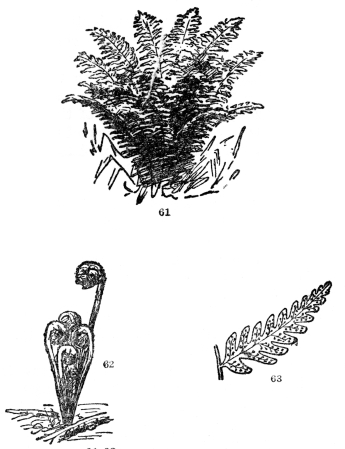 FIG. 61-63.—COMMON WOODLAND FERN
Fig. 61. A general view. Fig. 62. Its uncoiling spring condition. Fig.
63. The back of one of the smaller divisions of the leaf showing the
collection of spore cases (sori). These are sometimes borne on special
leaves, but in most of our American kinds on the backs of ordinary
foliage leaves.
find, at the proper season, collections or rows of tiny, usually
brownish dots. These contain often thousands of microscopic objects
known generally as spores, and from this fact the dots are called
spore-cases, or more technically sori. (Figure 63.) The process by
which new plants are formed is a
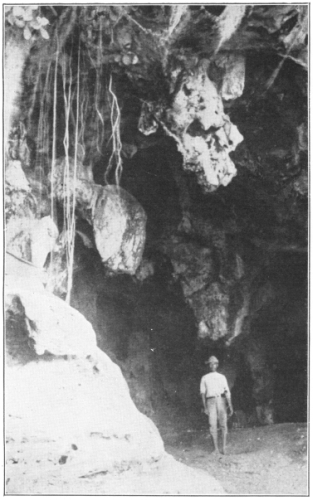
Aerial Roots of Fig Trees Hanging Over the Edge of a Cave
in the Rain Forest, San Lorenzo, Santo Domingo. (Photo by the author.
Courtesy of Brooklyn Botanic Garden.)
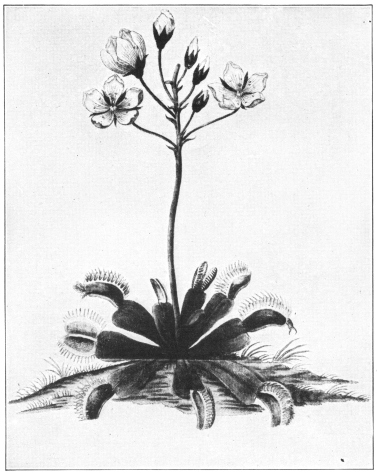
Venus’s Flytrap, an Insectivorous Plant of the
Southeastern United States. The fringed valves of its leaves close
together when an insect alights between them. (Courtesy of Brooklyn
Botanic Garden.)
somewhat complicated one, but the spores in these brown dots are the
agency which makes reproduction possible, and the actual mechanism of
it, one of the most interesting achievements in plant life, will be
described in the chapter on “How Plants Produce Their Young.” Sometimes
the spores are not borne on the backs of ordinary foliage leaves but on
special leaves that bear, very often, nothing else.
Ferns are much like ordinary flowering plants; except for their lack of
flowers, they have all the root, stem, and leaf characters of their more
showy neighbors. While most of them have compound leaves, even sometimes
twice or thrice compounded, a few have simple, narrow leaves without
teeth, and one kind in tropical America has threadlike leaves. In many
tropical rain forests, so called from their dripping wet condition,
ferns form large trees, and these tree ferns are among the most graceful
and feathery of all plants. There are, too, a few climbing kinds—one,
called the climbing fern, is a native of the eastern United States. Then
there is the walking fern, that seems to upset the statement that plants
do not move as animals do. It sends out delicate runners that, rooting
at the tips, form new plants, often several feet from the parent plant.
The characteristic of having, even in the simplest form, stems, leaves,
and roots, with all that this implies in their internal structure, marks
them off at once from all other flowerless plants. In ferns there is
always some internal equipment for carrying food from one part of the
plant, the roots, to another, and this ability is possessed by virtue of
ducts or vessels through the stem and leaves. This system, found in all
flowering plants and ferns, but nowhere else in the plant world, is
called the vascular system, or literally, a vessel system. We shall
see how important was the acquirement of this system of vessels, when we
get to the chapter on the History of the Plant Kingdom. Its appearance
upon the earth marks as important a stage in the development of plants
as the dawn of a definite backbone did upon animal life.
Ferns, then, are vascular cryptogams because they do have conducting
vessels in their stems, and they produce their young by a process of
hidden marriage which will be described later. All other cryptogams or
flowerless plants are without this system of vessels and are called
therefore non-vascular cryptogams. Numerically they are tremendously
important; upon them depend many manufacturing processes like bread
making, brewing, and all arts using fermentation. But they are hardly
recognized as plants by the general reader, and because of their size
and the necessity of studying them with a microscope in order to
understand their structure they will be treated here only briefly.
The remaining flowerless plants, having no duct system in their make-up,
are, as we know, called non-vascular cryptogams. This is a general
term for a very large group of plants, some quite obvious and well known
like a mushroom, for instance; others so small or of such uncertain
structure that they are not even well known by experts. This great mass
of plant life, more numerous than all the other kinds of plants
combined, contains many different forms, some of which are of gigantic
size. A single plant of a certain Pacific Coast seaweed regularly
exceeds in length the height of the tallest
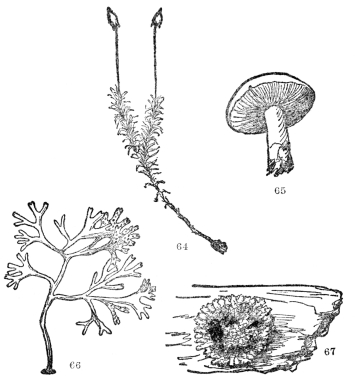 FIG. 64-67.—TYPES OF FLOWERLESS PLANTS
Fig. 64. A moss plant. Fig. 65. A mushroom, a common type of the fungi,
which include also puffballs, molds, and many disease-causing
microscopic organisms. Fig. 66. A common seaweed, a representative of
the algæ, which include the green scum on the top of ponds, and the kelp
from which fertilizer is now being made. Fig. 67. A lichen, a common
cryptogamous plant on logs and rocks. Our native kinds are usually
grayish-green in color.
known trees. And yet other inhabitants of the water, certain kinds that
float freely, are microscopic in size. The latter occur in such enormous
numbers that their tiny decomposed skeletons after dropping to the
bottom of the sea form the diatomaceous earth, so much used in polishing
machinery. The commercial product now comes from deposits of these
skeletons laid down in past ages, which, due to changes in the land and
water surfaces of the earth, are now found in Virginia, Nevada,
California, and in Bohemia. All these must have been in the bed of
waters long since gone, which teemed with these microscopic organisms.
To-day there are over ten thousand different kinds known, yet so small
are they that their dimensions are measured in thousandths of an inch!
Somewhat lower in the scale of life—and by this we mean simpler in
structure—than the ferns are the mosses. (Figure 64.) There are
thousands of different kinds, but everyone is familiar with the
collective growth of the commoner sorts which makes the velvety mossy
carpet in our woods. The individual plants are small, but in many kinds
sufficiently large to be seen without a microscope. Most important of
all, practically every one of them has the ordinary green color of the
better known plants, and as we shall see in the section devoted to
“Leaves as Factories for the Making of Food,” that stamps them at once
as plants, if other things did not.
Mosses are almost infinite in their habits, some growing on the dry
rocks or trunks of trees, many growing in moist woods, some in the
water, and immense quantities of certain kinds in bogs. The peculiar bog
mosses, known as sphagnum, play an important part in forming peat and
perhaps coal. While mosses are otherwise not of much commercial
importance, they are among nature’s most beautiful ground covers,
carpeting many a nook and dell with a soft, velvety, almost cushionlike
growth.
Although they are rather small, they appear to have a somewhat definite
stem and tiny leaflike appendages of it, without, however, having the vascular system found in all ferns.
Mosses might almost be considered miniature ferns, of which they are
perhaps only simple ancestors. Their vegetative or green parts vary much
in shape, size, and the arrangement of the tiny leaflike appendages, and
while most of them are a beautiful bright green, nearly all the bog or
sphagnum mosses are rather ashy gray in color. In most of the typical
mosses there arises from among the vegetative growth of them a slender
stalk, at the top of which is a small capsulelike organ. This contains
the spores, and it is upon this long slender stalk and its spore-filled
capsule, really marvelous in its internal structure and mechanism for
the discharge of the spores, that mosses depend for their reproduction.
As in the case of the ferns this process will be considered later, along
with that of some other plants. This whole story of how plants produce
their young, perhaps the most fascinating of any part of the study of
plant life, is so fundamentally a part of their history and shows nature
in her most maternal moods, that a special chapter will be devoted to
it. There we shall see, as a whole, how these vastly different acts of
fertilization and reproduction are, in different groups of plants, all
responses to that insistent command for life, more life, in a
never-ending stream.
The chief characters to remember about mosses are that they are very
simple, but practically always green plants that have some
differentiation into stem and leaf; that, while they have no vascular
system, their structure and particularly the mode of reproduction
suggests that they are not very distant from the ferns, and quite likely
simple ancestors of them. These characters are of more importance than appears on the surface, as we shall
presently see, for they mark mosses off from many other nonvascular
flowerless plants which have quite different structure and altogether
different mode of life.
If you will turn to the chapter on Plant Behavior and read particularly
the sections on “Leaves as Factories for the Manufacture of Food” and
“Borrowing from the Living and Robbing from the Dead,” you will see in
the food habits of the plants there noted the great difference that
exists between plants, like mosses and ferns, that have green coloring
matter in them, and those we are about to mention that never do. The
lack of this green coloring substance tells us at once that plants of
this sort live only on the dead remains of other plants. In the case of
these nonvascular flowerless plants there are certain modes of growth
that, in some forms at least, are always associated with this
scavenger-like food habit.
The common mushroom (Figure 65) is the best known of that large group of
plants, called generally fungi, which produce no green coloring matter,
have no leaves attached to a stem, and always live on decayed
vegetable, or sometimes inhabit living animals, even man himself. The
mushroom with its brownish stalk and buttonlike dome is familiar enough,
but there are literally thousands of different kinds, a common sort
forming “brackets” on the trunks of trees. While perhaps everyone would
recognize these as plants, peculiar as they are in their often weird
shapes and unusual as they nearly always are in their color, there are
many minute kinds of fungi that scarcely anyone would even think of as a
plant, and yet for better or worse they are incomparably the most
powerful plants in the world. For upon these microscopic fungi man
depends for many things. It is certain kinds of them that make the
manufacture of cheese possible. They turn milk sour (pasteurizing milk
is merely stopping their work), give to yeast its power of “raising”
bread, all brewing depends upon them, every process of fermenting the
juice of fruits for wine making or for whatever else, the decay of
wood—all these processes and scores of others, whether for the good or
evil of mankind, depend upon the work of these plants, any one of which
is so small that a single individual must be magnified hundreds of times
to detect it. Many of them are the “germs”—better called bacteria—that
cause diseases like tuberculosis, cholera, typhoid, anthrax, and
diphtheria. All surgeons wage incessant warfare against a host of them
that attack wounds and form pus. They live in our intestines and have
much to do with digestion, and unhappily with indigestion, so that we
may be said to carry about with us a whole flora of them! Nearly all the
diseases of plants, like the blight of potato and the rust on wheat, are
caused by them. Some other kinds live in the soil, and many flowering
plants depend absolutely for getting their food upon the work of these
fungi. Unfortunately their minute size and consequently obscure mode of
life demand technical skill and the use of the microscope to detect
them, so we must leave them here, always keeping in mind that these
smallest of all plants are charged with a power for good or evil; so far
as man’s life is concerned, greater perhaps than all other plants.
While most fungi, particularly those familiar ones like mushrooms and
puffballs, are inhabitants of the land, the remaining group of
nonvascular flowerless plants are nearly all water plants. Most of the
better known ones live in the sea, and as the wrack or tangle washed up
on the shore we recognize them as seaweed. The algæ (Figure 66), which
is a general name for such plants—and they live in the sea, in fresh
water, and even on dry land—are, so far as structure is concerned, the
simplest of all plants.
Those that are fastened to rocks are often beautifully colored, much
branched, and many kinds bear small bladders that act as buoys. These
coast seaweeds are generally of different colors, those nearest the
surface being generally greenish, the deeper water kinds reddish or
brown. None of these seaweeds are found at great depths, because the
really deep parts of the ocean are almost, if not quite, dark. Seaweeds,
and in fact all the algæ, have green coloring matter in them, even where
this is masked by reds and browns, as is the case in some particularly
showy kinds. As you will find in the section on “Leaves as Factories for
the Making of Food,” no plant with green coloring matter can live in the
dark. That is why seaweeds are not found in the great deeps of the sea,
some of which are several miles below the shore line along the coasts,
and are so cold and dark that neither plants nor animals can grow in
them.
Those seaweeds that grow along the coast, and are uncovered by the
retreating tides, are well known by everyone, but by far the greater
number of algæ float without anchorage of any kind. One kind that has
been torn from its anchorage occurs in such enormous quantities that off
the coast of America it has formed literally a floating island composed
entirely of dense mats of a species of seaweed. This place, known as
the “Sargasso Sea” from the name of the seaweed forming it, was the
terror of old mariners and Columbus’s ship was fouled in it for two
weeks. The area occupied by the weed is several hundred miles long and
wide, and while old sea yarns about ships being caught in it and never
escaping are gross exaggerations, it is certainly one of the most
curious of plant growths, due entirely to a nonvascular cryptogam.
Of those kinds that are never anchored the number is legion, and in
addition to those forming the diatomaceous earth, already mentioned,
there are many more. They form almost the only food of hosts of
creatures of the sea, but because of their floating freely in the water,
the consequent difficulty of collecting them, and their unusually minute
size, little is likely to be known of them, except by the experts.
Other algæ are always found in fresh water and form the scum found on
stagnant pools. Individuals of any of these are so minute that, while
under the microscope they are of the greatest beauty, their structure
must remain for most of us a sealed book.
We have now traced, in only the briefest fashion, the outlines of what
plants are, reversing the order of nature in beginning with those most
complex but best known, the flowering plants. As we shall see later,
these are the climax of prodigal nature and are to be considered the end
rather than the beginning of plant life on the earth. Then, and still
more briefly, have we stopped to see those less known plants that
produce no flowers, such as the ferns, mosses, fungi, and finally the
seaweeds or algæ. These are all to be considered as the ancestors of
flowering plants, the ferns the nearest to them and the algæ probably
the most distant relatives. The development of plants from the minutest
alga up to our most gorgeous flowering plant, is an infinitely slow and
painful process. With many mistakes, with its pathway strewn with the
wreckage of forlorn hopes and false starts, it is incomparably the most
dramatic story in the plant world. Some of its details will be told in
the chapter on the “History of the Plant Kingdom.”
Nor can we leave the discussion of what plants are without some mention
of the thing that really makes up their structure, whether it be a
microscopic bacterial organism or the Big Tree of California. For the
unit of all animal and plant life is the cell. In its simplest form it
is merely a minute sac with a definite wall and inside the wall is a
substance known as protoplasm, literally protos, first, and
plasma, thing formed. It is protoplasm that forms the living tissue of
all plants and animals; it is life itself. No one has ever succeeded in
making any, notwithstanding that many learned men have tried for years.
Its inclosure in the cell wall, its power of self-division and
consequent multiplication of the units, make up those first things about
which most of us can never know much, but the end of which we recognize
in the beauty of plant life all about us. For only under the highest
powers of the microscope may cells be seen and studied. Just as bankers
reckon mills as a definite unit of a cent, and yet none of them has ever
seen a mill, so we must think of cells as the definite unit of all
living things, although most of us will never see a cell. But, unlike
the mill, cells may be seen by those equipped to see them, and this
study, the development and grouping of them to form all the varied
objects that inhabit the plant world, is known as histology. It is
literally the internal history of plants and animals, and lies quite
outside the scope of this book. What we must never forget is that
whatever knowledge we have gained, either from the foregoing account of
what plants are, or from our observation of them, is, after all, only a
partial notion of them, as unsatisfactory as our estimate of what people
really are, from merely looking at the outside of the houses in which
they live. The outer form we may know and admire, the inner substance
must ever remain for most of us a secret treasure house the value of
which is certain, but the key to which we do not possess.