PHANEROGAMOUS PLANTS—DICOTYLEDONÆ—I. DICHLAMYDEÆ.
§ I.—THALAMIFLORÆ.
In all the plants contained in this chapter
the receptacle is a fleshy substance called the
thalamus, or disk, which is surrounded by the
calyx, and out of which the carpels or seed-vessels,
the stamens, and the petals, all grow
separately from each other. Sixty-five orders
are included in this division, but I shall only
describe those which contain plants which have
been introduced into Britain, except where the
orders chance to contain plants well known
in commerce.
ORDER I.—RANUNCULACEÆ.
The plants belonging to this order are known
by their numerous stamens, the anthers of which
burst outwardly; by their carpels growing close
together without adhering, except in one or
two instances; and by the stem-clasping petioles
of their leaves, which are generally deeply cut.
The flowers when regular have five petals and
five sepals, but they differ widely in shape, and
the calyx of several of them is coloured so
as to resemble a corolla. The seeds are fre quently
cariopsides; and the plants abound in
a watery juice which is acrid, and in most cases
poisonous.
ORDER II.—DILLENIACEÆ.
This order resembles Raminculaceæ in having
five petals, five sepals, and numerous stamens;
but the anthers burst inwardly instead of outwardly,
and there are never more than five
carpels, and seldom more than two, which often
grow into a berry-like fruit, as in the genus
Dillenia from which the order takes its name.
One species of this genus is occasionally seen in
English hothouses, Dillenia speciosa. It has
yellow flowers with the five petals apart at the
base, and the sepals edged with white. The
fruit consists of five carpels growing together
with a sort of crown formed by the spreading
stigmas. Another genus, some of the species of
which are found in British greenhouses, is
Hibbertia. The species are generally climbing
plants, with flowers like those of Dillenia, but
smaller, though H. dentata has the petals close
together. The difference between the genera
consists principally in the carpels, which in
Hibbertia are distinct with long filiform styles
curving inwards. All the plants contained in
this order are evergreen exotic shrubs and trees
with simple alternate leaves, and, with only two
or three exceptions, the flowers are yellow.
ORDER III.—MAGNOLIACEÆ.
This order was divided by De Candolle into
two tribes: viz. Illicieæ, the Aniseed tribe;
and Magnolieæ, the Magnolia tribe. The first,
which is now made a distinct order, under the
name of Winteraceæ, contains three genera,
only one of which, Illicium, is common in this
country. The only hardy species of this genus,
I. floridanum, the Florida Aniseed tree, has
very dark purple flowers, which appear to be
double from the great number of the petals,
which are from twenty to thirty. The carpels
are also numerous, and arranged so as to form
a star. All the plants in this tribe are highly
aromatic, and one species, Drimys Winteri, which
has white fragrant flowers, produces an aromatic
bark that is used in medicine.
The tribe Magnolieæ is distinguished by the
fruit consisting of a number of carpels arranged
so as to form a cone. There are six genera in
this order, the most remarkable of which are
Magnolia, Liriodendron, Talauma, and Michelia,
the last genus consisting of stove trees, with
very fragrant flowers, which are generally of a
pale yellow, and only one species of which, M.
Champaca, has been introduced.
Of these genera Magnolia is undoubtedly
the best known; as nearly all the species are
common in British gardens. This genus is
divided into two sections, one containing the American
Magnolias, and the other those from Asia,
which are principally from China and Japan.
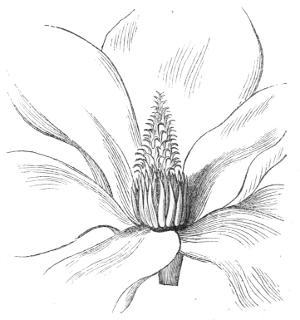
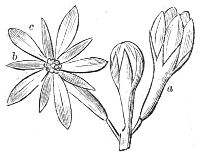
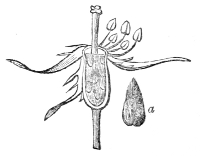
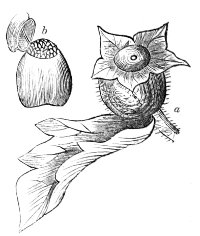
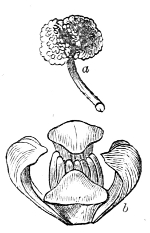
Fig. 104.—Flower of Magnolia conspicua opened to show the
stamens and pistil.
The latter may be illustrated by Magnolia
conspicua, sometimes called M. Yulan. The
flower-buds are inclosed in a brown hairy case
formed of two short bracts which become loose at
the base, and are pushed off by the expanding
flower. The flower itself (see fig. 104) is cup -shaped,
and it is divided into six white fleshy
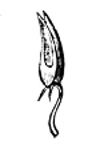
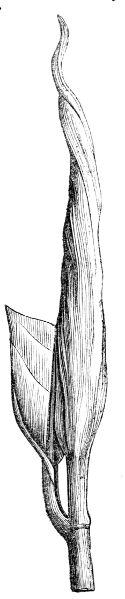 Fig. 105.—The flower-bud
of the Evergreen
Magnolia.
petals. The calyx consists of
three sepals,—which fall off soon
after the petals expand. In the
centre of the flower is the receptacle,
drawn up into a fleshy cone,
with a great number of carpels
attached to it, each of which
has one cell containing two ovules,
and a curved stigma. Around
this cone grow the stamens,
with very long anthers standing
up like palisades, and very
short thick filaments. The fruit
is oval, with the ovaries somewhat
distant from each other. The
flowers appear before the leaves.
The other Asiatic species are
M. gracilis or Kobus, M. discolor,
obovata, or purpurea, and M.
fuscata; the former two forming
handsome shrubs in the open
ground, and having cup-shaped
flowers which are white within and
purplish on the outside, and the
latter being a greenhouse plant,
with brown very fragrant flowers.
Fig. 105.—The flower-bud
of the Evergreen
Magnolia.
petals. The calyx consists of
three sepals,—which fall off soon
after the petals expand. In the
centre of the flower is the receptacle,
drawn up into a fleshy cone,
with a great number of carpels
attached to it, each of which
has one cell containing two ovules,
and a curved stigma. Around
this cone grow the stamens,
with very long anthers standing
up like palisades, and very
short thick filaments. The fruit
is oval, with the ovaries somewhat
distant from each other. The
flowers appear before the leaves.
The other Asiatic species are
M. gracilis or Kobus, M. discolor,
obovata, or purpurea, and M.
fuscata; the former two forming
handsome shrubs in the open
ground, and having cup-shaped
flowers which are white within and
purplish on the outside, and the
latter being a greenhouse plant,
with brown very fragrant flowers.
The American species of Magnolia
differ in having their flower- buds
enveloped in one long spathe-like bract,
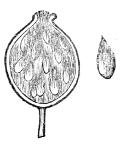
as shown in fig. 105. The ovaries grow close
together; and, when ripe, the carpels, which
look like the scales of a
fir-cone (see fig. 106),
burst by a slit down the
back; and the seeds,
which are covered with a
red juicy pulp, burst out,
and hang down by a long
white thread, which in
the course of a few days
withers away. The principal
species of American
Magnolias are the evergreen
Magnolia, or Big
Laurel (M. grandiflora);
the Umbrella Tree (M.
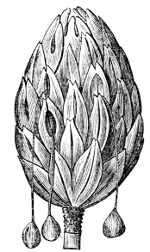 Fig. 106.—The ripe fruit and
seeds of the Evergreen
Magnolia.
tripetala), which grows
like a shrub with several stems rising from the
ground; the Cucumber-tree (M. acuminata), the
flowers of which are bluish and the leaves pointed;
Beaver wood (M. glauca), the flowers of which
are small, and the leaves covered with a glaucous
bloom; M. auriculata, M. pyramidata and M.
macrophylla, which are nearly allied to the Cucumber-tree;
and M. cordata, the flowers of which
are yellowish. All these Magnolias produce their
leaves before their flowers; and in this also they
differ from M. conspicua, the flowers of which
appear before the leaves.
Fig. 106.—The ripe fruit and
seeds of the Evergreen
Magnolia.
tripetala), which grows
like a shrub with several stems rising from the
ground; the Cucumber-tree (M. acuminata), the
flowers of which are bluish and the leaves pointed;
Beaver wood (M. glauca), the flowers of which
are small, and the leaves covered with a glaucous
bloom; M. auriculata, M. pyramidata and M.
macrophylla, which are nearly allied to the Cucumber-tree;
and M. cordata, the flowers of which
are yellowish. All these Magnolias produce their
leaves before their flowers; and in this also they
differ from M. conspicua, the flowers of which
appear before the leaves.
The genus Liriodendron contains only two
species differing slightly in the leaves. Both
are lofty trees, with cup-shaped flowers of
six petals curiously stained with red and yellow,
and bent back at the tip. The calyx consists
of three sepals, which remain on as long as the
petals. The fruit is cone-shaped, but the
carpels, which are each furnished with a kind of
wing, instead of opening when ripe, fall with
the seed enclosed.
The genus Talauma differs from Magnolia
principally in the carpels, which open irregularly
by valves; and in the number of petals, which
vary from six to twelve. Only two species are
common in British hothouses, T. Candolli, commonly
called Magnolia odoratissima; and T.
pumila, sometimes called M. pumila and sometimes
Liriodendron lilifera: both are natives
of Java, and both have cream-coloured, or
yellowish flowers, which are remarkably fragrant
at night.
ORDER IV. ANONACEÆ.—THE CUSTARD-APPLE
TRIBE.
The hardy plants belonging to this order, that
are well known in Britain, were formerly included
in the genus Anona; but now the only
species retained in that genus are stove plants,
natives of the West Indies, with yellowish
brown or dark purple flowers, the calyx of
which is in three sepals, and the corolla in three
or six thick fleshy petals, and which have numerous
stamens with large angular anthers, and
very short filaments. The carpels are numerous,
but they grow altogether into a fleshy eatable
fruit, divided into many cells, each containing
one seed. This fruit is called the custard apple
or sour sop in the West Indies; and it differs
in flavour in the different species, but the most
delicious kind is produced by A. Cherimolia, a
native of Peru. The hardy species included in
Anona by Linnæus have been separated from
that genus, and formed into another under the
name of Asimina, the principal distinction between
them being in the fruit; which in the
genus Asimina consists of two or three berry-like
carpels growing together, not eatable, and each
containing many seeds. A. triloba, the hardiest
species, is a large shrub, with dark brownish purple
flowers. The plants in this order are all aromatic.
ORDER V.—MENISPERMACEÆ.—THE COCCULUS
TRIBE.
All the plants contained in this order are
climbing exotic shrubs, generally with drooping
racemes of small delicate flowers, the male and
female flowers being on different plants. The
number of sepals and petals varies in the different
genera, and sometimes the petals are
wanting. The stamens frequently grow together
into a central column; and the fruit is a drupe
or one-seeded berry, generally scarlet, but
sometimes black. The principal plants in this
order which are known in England, are, Menispermum
canadensis (the Canadian Moon Seed),
a very ornamental hardy, climbing, shrub;
Cocculus palmatus, the root of which is a tonic
drug, called Columba root; Anamirta Cocculus,
which produces the berries called Cocculus
indicus in the shops, which are said to be used
in porter to give it an intoxicating property;
Schizandra coccinea, a greenhouse climber with
scarlet flowers; and Kadsura japonica, a climbing
shrub with white flowers and red berries,
which proves quite hardy in the open air. Kadsura,
Schizandra, and three other genera, little
known in this country, have been formed into
a new order under the name of Schizandriaceæ.
The qualities of all these plants are tonic.
ORDER VI. BERBERIDEÆ.—THE BERBERRY TRIBE.
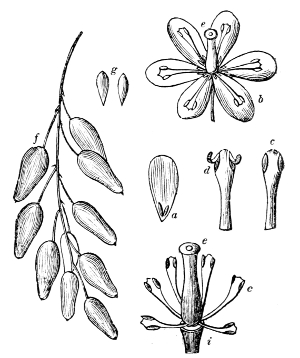
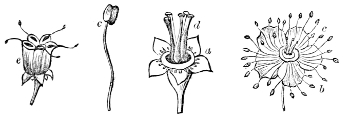
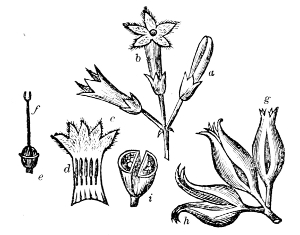
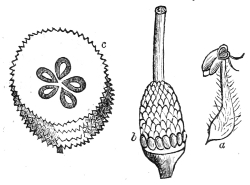
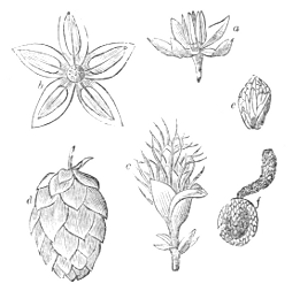
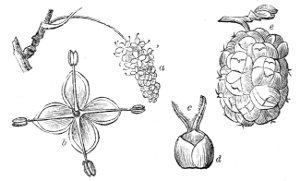
Fig. 107.—Details of the flower and fruit of the common
Berberry, partly magnified.
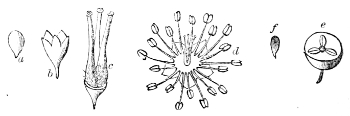
Each flower of the common Berberry (Berberis
vulgaris) has on the outside three little bracteal
scales, which are reddish on the back, and soon
fall off. The flower itself consists of a corolla
of six petals, and a calyx of six sepals, though
as these divisions are all of the same size and
shape, and of the same colour and texture, it is
not very easy to distinguish the calyx from the
corolla. The petals will however be found on
examination to have each two little glands at
the base, as shown at a in fig. 107, which the
sepals are without. The sepals are placed exactly
behind the petals, so that the one appears
a lining of the other; and, being concave, the
petals serve as a kind of cradle to the stamens,
as shown at b. There are six stamens, which
have broad filaments; and instead of anthers
the filaments are widened at the tip, and each
contains two cases for the pollen (c); these cases
are each furnished with a valve-like lid (d), which
opens and curls back when the pollen is ripe.
The pistil (e) is pitcher-shaped, with a very
thick style, and a flat stigma. It stands erect,
while the stamens are spread out so as to be a
long way from it, but they are so irritable that
the slightest touch makes them spring forward
and discharge their pollen on the stigma, afterwards
falling back into their former places.
The flowers are yellow, and they are produced
in long drooping racemes; and they are succeeded
by red oblong berries (f), each of which
contains two seeds (g). The receptacle, with
the stamens growing out of it from beneath the
pistil, is shown at i. The common Berberries
are all deciduous shrubs, with simple leaves,
which are produced in tufts, as shown in fig.
108, each leaf being delicately fringed with hair-like
teeth. Each tuft of leaves has two or
three sharply-pointed stipules, which are easily
distinguished from the leaves, by their margins
being without teeth; and below these are three
spines, which, when young, are soft and look
like folded leaves, but which, when older, be come
hard, and sharply pointed. These spines
are considered by some botanists to be abortive
branches. There are many different kinds of
Berberry, which differ principally in the size of
the flowers and in the colour of the fruit; but
which also vary in the size and shape of the
leaves, and in the manner in which they are
toothed.
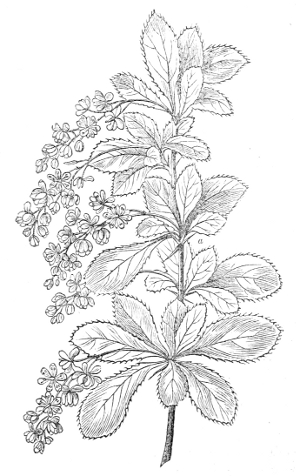
Fig. 108.—Flowers of the Berberry, natural size.
The Ash-leaved Berberries were formed into
a separate genus called Mahonia by Nuttall;
and this genus has been adopted by Professor
de Candolle, and other botanists. Dr. Lindley,
however, includes all the species in the genus
Berberis, and he has been followed by Mr.
George Don in his new edition of Sweet’s
Hortus Britannicus. Whether the genus Mahonia
be a good one or not, the plants composing
it are very distinct from the true
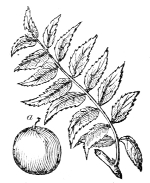
Berberries. The leaves of the Mahonias are
evergreen, and pinnate; and the leaflets instead
of being fringed with fine hairs, are broadly
serrated, the points being tipped by a sharp
prickle or mucro (see a in fig. 109); and the
petiole is articulated, and somewhat stem-clasping
at the base (b). The flowers are in
erect racemes, and smaller than those of the
Berberry; they are also more globular, being
less widely opened, and the petals are without
any glands. The filaments of the stamens have
two hair-like teeth just below the lobes of the
anthers; and the fruit has from three to nine
seeds in each berry; while the Berberries have
only one or two. There are many kinds of
Magnolia, but the handsomest is M. Aquifolium,
a hardy shrub, with dark green shining leaves,
like the holly. All the species both of Berberis
and Mahonia have yellow flowers; and the
Mahonias all flower very abundantly, and very
early in spring.
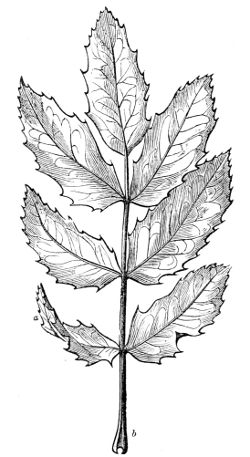
Fig. 109.—A compound leaf, being that of Mahonia aquifolium.
The principal other plants belonging to this
order are, Nandina domestica, a very pretty
shrub with white flowers, from China, which
requires a greenhouse in England; several
species of Epimedium, some of which are from
Japan, with purple and white flowers; a few
species of Leontice, pretty plants with yellow
flowers; and a plant called Diphylleia cymosa,
with white flowers and blue berries, a native of
North America. All these plants are easily recognised
by their broad stamens, and the curling
back of the valves of their anthers.
ORDER VII. PODOPHYLLACEÆ.—THE MAY-APPLE
TRIBE.
This order contains only two genera; viz.,
Podophyllum and Jeffersonia; both of which have
a calyx of three or four sepals, and a white corolla
of from six to nine petals. Podophyllum has
numerous stamens, and a fleshy berry with only
one cell, which does not open when ripe; and
Jeffersonia has eight or nine stamens, and a
capsule which opens all round the apex. Podophyllum
peltatum is the May-apple, and its fruit
is eatable when ripe, though very acid; the
leaves are very large, and peltate, that is, with
the footstalk attached to the centre; and
Jeffersonia diphylla is a little plant, without any
stem but that which supports the flower. Both
are natives of America, where they are found
in moist shady places.
ORDER VIII. HYDROPELTIDEÆ.
This order, which many botanists combine
with the preceding one, also consists of only
two genera; viz., Cabomba and Hydropeltis;
and of these Cabomba aquatica is a stove aquatic,
and Hydropeltis purpurea is a hardy water plant,
with peltate leaves, and dull purple flowers.
ORDER IX. NYMPHÆACEÆ.—THE WATER-LILY
TRIBE.
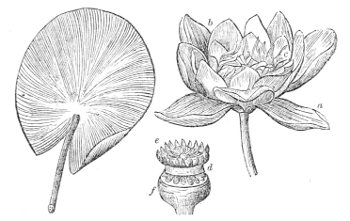
Fig. 110.—The flower, leaf, and seed-vessel of the White
Water-lily, greatly reduced in size.
The principal genera in this order are
Nymphæa, Euryale, Victoria, Nuphar, and
Nelumbium. The flowers of the common White
Water-lily (Nymphæa alba) consist of numerous
sepals, petals, and stamens, all of which
might be mistaken for petals, being principally
distinguished by their colour. The sepals, (a
in fig. 110,) are green on the outside, but they
are white within, and of the same fleshy substance
as the petals (b). The stamens (c) look
like narrow yellow petals; they are pointed,
and bear the pollen in two lobes near the point,
which open longitudinally when ripe. The
inner row of stamens are without anthers, and
form a kind of vandyke edging to the pistil, as
shown at e. The pistil consists generally of sixteen
carpels, growing together into a vase-like,
many-celled berry, as shown at d; the spreading
stigmas, which have also grown together,
forming a kind of lid. The carpels are completely
enclosed by the receptacle which rises
up round them, and forms a thick fleshy covering,
as shown at f. The seeds are numerous,
and they are covered with a thick leathery
skin. The embryo is small, and it is surrounded
by a great mass of floury albumen. The
leaves (g) are large and nearly round; and the
main root, which is called a rhizoma, is thick
and fleshy, and is, indeed, an underground
stem. There are several kinds of Nymphæa,
the most remarkable of which is the Egyptian
Lotos (N. Lotos), the flowers of which are white
tinged with pink; and both the roots and seeds
of which are eaten. Euryale is a genus of
South American Water-lilies, generally with
small flowers, and large rough leaves; and
Victoria regina, also a native of South America,
is perhaps the most magnificent Water-lily in
the world; the leaf, which is peltate and turned
up at the brim, being of a deep crimson on its
lower surface, is upwards of six feet in diameter;
and the flowers are more than a foot in diameter,
with a corolla of more than a hundred
large white petals tinged with pink.
The genus Nuphar consists of only three or
four species, the most common of which is N.
lutea, the common yellow Water-lily, a native of
Britain. The flower has a cup-shaped calyx
of five large yellow sepals, the tips of which
curve inwards. The petals are small, truncate,
and flat, with a small pore on the back of each;
and the stamens, which are very numerous, have
broad petal-like filaments. They differ, however,
very much in appearance from those of
the genus Nymphæa, and they are differently
placed, springing from the base of the vase-like
pistil, and not from the upper part. There are from
sixteen to twenty carpels enclosed in the dilated
receptacle, to which the stigmas form a ray-like
cover; and each carpel contains several
seeds. The leaves are somewhat cordate, and
rise rather above the surface of the water, and
the rhizoma, or root-stem, is very thick. The
common yellow Water-lily, or Brandy-bottle,
as it is sometimes called from the smell of its
flowers, is common in every part of England,
and it is generally found in small ponds or
ditches. The other species are mostly natives
of North America.
The Indian Lotos (Nelumbium speciosum)
differs so much from both the preceding genera,
as to be considered by some botanists to form
a different natural order. The sepals and petals
are so intermingled in the flower as to be
scarcely distinguishable; but the filaments of
the stamens are less broad and petal-like. The
disk is still elevated, but it has lost the vase-like
form, and it appears as though the top had been
abruptly cut off; while the carpels are no longer
joined together, but are plunged each separately
in the fleshy receptacle, or torus, with their
stigmas quite distinct. As the carpels are only
half immersed in the torus, and thus show their
styles and stigmas, they have a very singular
and bottle-like appearance; and the torus,
when they are taken out of it, looks like a
piece of honey-comb. The rhizoma is white
and fleshy. The stalks of the flowers and leaves
rise considerably above the water; and thus
the flowers have not the graceful appearance of
those of the Nymphæa, which seem to repose
on the surface. The leaf is very large, being
sometimes one or two feet in diameter; and it
is always peltate, with the stalk exactly in
the centre. There is only one seed in each
carpel of the Nelumbium; and this seed, which
has no thick leathery skin, is of about the size
and shape of an acorn. It is very good to eat,
having a sweet milky flavour, and in botanical
construction it resembles the common bean,
having no albumen, but a very large embryo.
This is probably the reason why it has been
supposed to be the bean of Pythagoras, and why
it is called the Sacred Bean of India. One of
the Hindoo fables represents the god Bramah
as first appearing in the form of a child, cradled
on a Lotos leaf, and floating on the waste of
waters.
There are several kinds of Nelumbium, one
of which, a native of America, has double
yellow flowers; and they all require a stove in
England.
ORDER X. SARRACENIEÆ.—THE SIDE-SADDLE
PLANT.
There is only one genus in this order, which
can never be mistaken for any other, from the
pitcher-shaped petioles of its leaves, and its singular
flowers. It is a native of Canada, but it
rarely flowers without a stove in England. It
is a dwarf plant, and it is thus easily distinguished
from the Chinese Pitcher plant, which
grows eight or ten feet high, and which belongs
to quite a different order.
ORDER XI. PAPAVERACEÆ.—THE POPPY TRIBE.
This tribe contains several genera, all of which
have a thick glutinous juice when broken,
which poisons by stupifying. The genera most
common in British gardens are Papaver,
the Poppy; Argemone, the Prickly Poppy;
Meconopsis, the Welsh Poppy; Sanguinaria,
Blood-root; Eschscholtzia; Hunnemania; Rœmeria;
Glaucium, Horned Poppy; Chelidonium,
Greater Celandine or Swallow-wort; Hypecoum;
Platystemon, and Platystigma. Most of these
plants are either annual, or last only two or
three years, and they have all very handsome
flowers, which are generally large and of showy
colours.
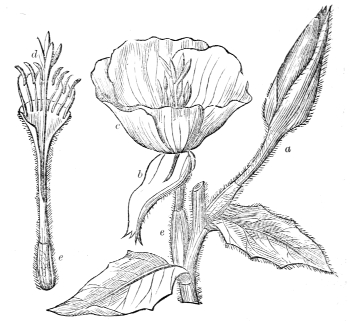
The common Corn Poppy (Papaver Rhœas)
has a showy flower, the corolla of which consists of
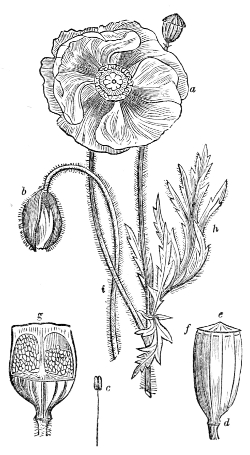 Fig. 111.—Flower, leaf, and seed-vessel of
the common Poppy.
four very large
scarlet petals,
the outer two
much exceeding
the others in
size (see a in fig.
111). The calyx
is green,
and it is divided
into only two
sepals, (see b,)
which fall off
soon after the
expansion of the
flower. The petals
are all curiously
crumpled
in the bud, and
they present
quite a wrinkled
appearance
when the flowers
are first opened.
The stamens are very numerous, and the anthers,
which are black, are of the kind called innate;
that is, the filament is only attached to them at
the lower part (c). The seed-vessel of the Corn
Poppy is, when ripe, a dry leathery capsule (d)
with numerous angles, each angle indicating a
carpel; for the capsule of the Poppy, though
one-celled when ripe, consists, in fact, of a
number of carpels grown together. The remains
of these imperfect carpels are perceptible
in the little valves shown at f, which open at the
top of each to discharge the seed when it is ripe;
and in the slightly-peaked cover (e), which consists
of as many stigmas grown together as there
appear to have been carpels. When the capsule is
cut open (as shown in the capsule at g, from
which the fourth part has been removed), remains
of the carpels will be found in several projections
from the sides, which partially divide
the inside of the capsule into several imperfect
cells, in which the young seeds are formed;
though none of these portions reach the centre.
The ovules, when first formed in the ovary, are
attached to these projections, which are called
parietal placentæ; but as the seeds ripen they
become loose, and if a dry Poppy-head be
shaken, they will be found to rattle. The leaves
of the Corn Poppy are what is called pinnatifid,
(see h in fig. 111,) that is, they are so deeply
cut as to appear almost in separate leaflets;
and the whole plant (except the petals and the
capsule) is covered with short bristly hairs (i),
which stand out horizontally.
Fig. 111.—Flower, leaf, and seed-vessel of
the common Poppy.
four very large
scarlet petals,
the outer two
much exceeding
the others in
size (see a in fig.
111). The calyx
is green,
and it is divided
into only two
sepals, (see b,)
which fall off
soon after the
expansion of the
flower. The petals
are all curiously
crumpled
in the bud, and
they present
quite a wrinkled
appearance
when the flowers
are first opened.
The stamens are very numerous, and the anthers,
which are black, are of the kind called innate;
that is, the filament is only attached to them at
the lower part (c). The seed-vessel of the Corn
Poppy is, when ripe, a dry leathery capsule (d)
with numerous angles, each angle indicating a
carpel; for the capsule of the Poppy, though
one-celled when ripe, consists, in fact, of a
number of carpels grown together. The remains
of these imperfect carpels are perceptible
in the little valves shown at f, which open at the
top of each to discharge the seed when it is ripe;
and in the slightly-peaked cover (e), which consists
of as many stigmas grown together as there
appear to have been carpels. When the capsule is
cut open (as shown in the capsule at g, from
which the fourth part has been removed), remains
of the carpels will be found in several projections
from the sides, which partially divide
the inside of the capsule into several imperfect
cells, in which the young seeds are formed;
though none of these portions reach the centre.
The ovules, when first formed in the ovary, are
attached to these projections, which are called
parietal placentæ; but as the seeds ripen they
become loose, and if a dry Poppy-head be
shaken, they will be found to rattle. The leaves
of the Corn Poppy are what is called pinnatifid,
(see h in fig. 111,) that is, they are so deeply
cut as to appear almost in separate leaflets;
and the whole plant (except the petals and the
capsule) is covered with short bristly hairs (i),
which stand out horizontally.
The Opium Poppy (Papaver somniferum)
differs from the Corn Poppy in several respects.
First, the whole plant is glabrous, that is, devoid
of either hairs or bristles; the capsule also is
much larger and more fleshy in an unripe state,
and the crown-like lid is smoother, and curved
over like a plume of feathers, (see a in fig. 112.)
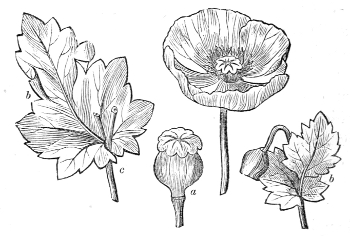
Fig. 112.—The flower, bud, leaves, and capsule of the Opium
Poppy, much smaller than the natural size.
The fleshiness of the unripe seed-vessel of the
Poppy puzzled me extremely at first, as I knew
that the ripe capsule of this Poppy is always
dry and leathery; but it was soon explained to
me, that this fleshy substance is, in fact, an
elongation of the receptacle or disk, which rises
up round the carpels, and envelops them, in
the same way as the disk of the Water-lily
grows round the pistil and carpels of that plant,
but which dries up as the fruit ripens. The
leaves of the Opium Poppy (b) differ from those
of the Corn Poppy, in being much broader, and
only slightly cut or notched; they are also
glaucous, that is, of a bluish or sea-green, and
they are clasped round the stem at their base
(as shown at c). All the Papaveraceæ abound
in a thick glutinous juice, which in the Poppies
has the colour and appearance of milk, and
which possesses stupifying properties; but in the
Opium Poppy this juice is particularly abundant.
Opium is, in fact, procured by wounding the
fleshy capsule with a sharp knife, and suffering
the milky juice which exudes to dry in the sun;
after which it is scraped off with a blunt instrument,
and pressed into cakes for sale. The
opium of commerce is produced in hot countries;
but even in England, any one who chooses may
procure a small quantity of opium, by wounding
the fleshy capsule of the common White Poppy
when it is about half ripe. A milky juice will
issue from the wound, which when dry becomes
opium, and would be poisonous if taken in
excess. The capsule of the White or Opium
Poppy has, when ripe, a little window-like opening
under each stigma for the discharge of
the seeds, which contain abundance of oil, and
may be safely eaten, though the rest of the
plant is poisonous.
There are many different kinds of Poppy; but
they all agree in the corolla of their flowers
being in four petals, or in some number divisible
by four; and in the calyx, which is generally in
two sepals, dropping off as soon as the flowers
expand. All the species abound in a milky
juice, which poisons by stupifying; and they all
agree in the general construction of the capsule,
with its fleshy envelop and its stigma-formed
lid. The petals are always crumpled in the bud,
and they fall very soon, so that the beauty of the
flowers is very short-lived. The flower-buds
droop; but when the flowers expand, the stalk
becomes erect, and remains so while the capsule
containing the seeds is ripening; a wise provision,
common to many plants, to prevent the seeds
from falling too soon. The calyx of most
of the Poppies is in only two sepals; but in the
two showy perennial species, called P. orientale
and P. bracteatum, the calyx is in three sepals.
Among the other plants belonging to the
order Papaveraceæ, may be mentioned the
Horned Poppy (Glaucium luteum), which,
instead of an obovate capsule, has a long horn-like
pod, divided into two cells, the valves
opening from the top to the bottom. The
whole plant is glaucous; and the leaves, which
are broad and notched, clasp the stem at their
base, like those of the Opium Poppy. The
Prickly Poppy (Argemone mexicana) has the
whole plant covered with strong prickles; the
leaves are wrinkled and curved up at the margin;
the calyx has three sepals; and the capsules
are in four or five valves, the stigmas
forming a kind of cross at the top. The stem
and leaves when bruised give out a thick glutinous
juice, which, instead of being white like
that of the Poppy, is yellow.
The Eschscholtzia is the last genus of the
order Papaveraceæ that I shall mention here,
and it deserves a particular description, both
from its popularity and the beauty of its
flowers, and from the singularity of its botanical
construction. The bud when it first appears is
enfolded in a calyx, which is pointed at its
upper extremity, and appears to have a kind of
rim near its base. When the flower is ready to
expand, the calyx detaches itself all round
from the projecting rim, and rises gradually
without opening, till the flower actually pushes
it off. The detached calyx resembles an extinguisher,
and hence it is called calyptrate,
which has that signification. The flower is
cup-shaped; there are four petals and four
stigmas, two of which are much longer than the
others. The capsules are elongated like those
of the Horned Poppy, but they are distinguished
by the projection of the flat fleshy disk at their
base; they are two-valved and two-celled.
The leaves are glaucous, and finely cut. There
are three species, or perhaps varieties, which
differ principally in the degree of enlargement
of the receptacle or disk. They have all large
fleshy roots, which bleed copiously if wounded,
and for this reason the plants are difficult to
remove unless when quite young.
ORDER XII. FUMARIACEÆ.—THE FUMITORY TRIBE.
The flowers of plants of this order are so
peculiar in their shape, as when once seen to be
easily remembered. There are two small
sepals, which soon fall off, and four petals of an
irregular shape, two of them being drawn out
into a kind of spur. There are six stamens, and
the fruit is silique-formed. The plants have
somewhat of a smoky smell, and when broken
yield a watery juice. The principal genera are
Fumaria, Corydalis, and Diclytra.
ORDER XIII. CRUCIFERÆ.—CRUCIFEROUS PLANTS.
The Cruciferous plants form so natural an
order, that when one of them has been described
the others may be easily recognised.
They have all a separate calyx and corolla, each
in four divisions; the four sepals being placed
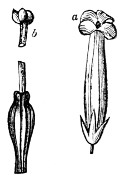
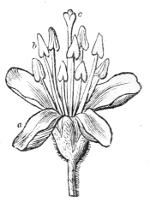
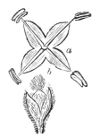
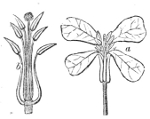 Fig. 113.—The flower and
stamens and pistil of the Sea-kale,
to illustrate the Cruciferæ.
alternately with the four
petals, the latter forming
a cross (as shown at
a in fig. 113), whence
the name of Cruciferous,
which signifies cross-bearing.
There are six
stamens (b), two of
which are much shorter
than the others; and two carpels with one
style, and a capitate or divided stigma. The
seed-vessel is a kind of pod, either short and
broad, like that of the Shepherd’s Purse (fig. 114),
where it is called a sillicle; or long and narrow,
Fig. 113.—The flower and
stamens and pistil of the Sea-kale,
to illustrate the Cruciferæ.
alternately with the four
petals, the latter forming
a cross (as shown at
a in fig. 113), whence
the name of Cruciferous,
which signifies cross-bearing.
There are six
stamens (b), two of
which are much shorter
than the others; and two carpels with one
style, and a capitate or divided stigma. The
seed-vessel is a kind of pod, either short and
broad, like that of the Shepherd’s Purse (fig. 114),
where it is called a sillicle; or long and narrow,
 Fig. 114.—A Sillicle.
like that of the Cabbage, which is
called a silique. The two valves of
the silique open naturally when ripe,
from the bottom curving upwards,
(see fig. 115,) and the seeds are deposited
on a thin membrane between
the cells, which is the dissepiment. All the
Cruciferæ, from abounding in nitrogen, have an
unpleasant smell when decaying, like putrid
flesh; and when cultivated, they even in a wild
state require abundance of animal manure;
hence, they are generally found near human
habitations, or where cattle are kept. When
wild, they have generally acrid properties; and
though these are in most cases softened by
cultivation, yet they are still perceptible in the
Fig. 114.—A Sillicle.
like that of the Cabbage, which is
called a silique. The two valves of
the silique open naturally when ripe,
from the bottom curving upwards,
(see fig. 115,) and the seeds are deposited
on a thin membrane between
the cells, which is the dissepiment. All the
Cruciferæ, from abounding in nitrogen, have an
unpleasant smell when decaying, like putrid
flesh; and when cultivated, they even in a wild
state require abundance of animal manure;
hence, they are generally found near human
habitations, or where cattle are kept. When
wild, they have generally acrid properties; and
though these are in most cases softened by
cultivation, yet they are still perceptible in the
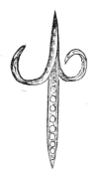 Fig. 115.—A Silique.
roots of the Horse-Radish, and
the common Radish, and in the
leaves and seeds of Mustard,
and the different kinds of Cress,
&c. This acridity, however, is
never so great as to be injurious;
and Cruciferous plants, particularly
if their texture be succulent
and watery, may always
be eaten with perfect safety.
Even those which, in a wild state, are
tough and stringy, such as the wild Cabbage
and the root of the wild Turnip, become excellent
by cultivation; and all Cruciferous plants
are so extremely nourishing as to be considered
next in this quality to animal food.
Fig. 115.—A Silique.
roots of the Horse-Radish, and
the common Radish, and in the
leaves and seeds of Mustard,
and the different kinds of Cress,
&c. This acridity, however, is
never so great as to be injurious;
and Cruciferous plants, particularly
if their texture be succulent
and watery, may always
be eaten with perfect safety.
Even those which, in a wild state, are
tough and stringy, such as the wild Cabbage
and the root of the wild Turnip, become excellent
by cultivation; and all Cruciferous plants
are so extremely nourishing as to be considered
next in this quality to animal food.
Among the many garden flowers which
belong to this order, few are more popular
than the common Wallflower (Cheiranthus
Cheiri). Its hardiness, and the facility with
which it is raised and cultivated—the gaiety of
its flowers, their profusion, and their delightful
fragrance, combine to make it a general favourite;
and I think I cannot take a flower to illustrate
the order which is more generally known and
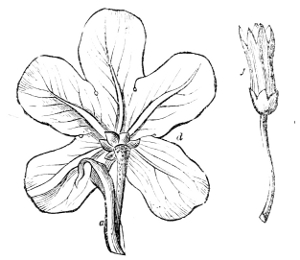
liked. The flowers of the Wallflower (see
fig. 116, a) consist of four petals, each of which
is furnished with a long tapering point, called
the claw (b), and a broad flat part called the
limb (c). The claws of the petals are buried in
a calyx of four sepals, placed alternately to the
petals, and somewhat swelled out at the base,
(see d). The stigma (e) is two-lobed, and forms
a kind of notched head. There are six stamens,
which appear at first to be all nearly of the same
height, but on examination it will be found that
two are somewhat shorter than the others. The
seed-vessel is of course the lower part of the
pistil; which, after the petals drop, becomes
elongated into a somewhat cylindrical silique,
which contains several flattish seeds.
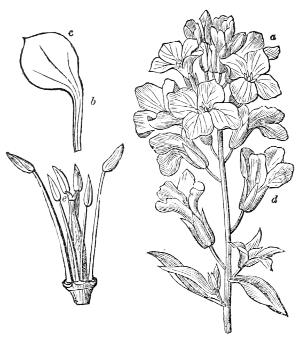
Fig. 116.—Flowers of the Wallflower.
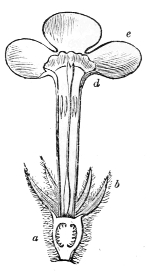
The Brompton Stock (Mathiola incana), and
the Ten-week Stock (M. annua), differ from the
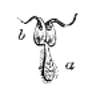
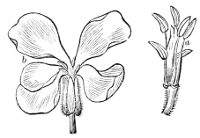 Fig. 117.—Flower of the Brompton Stock.
Wallflower principally
in the
shape of the
stigma (see fig.
117, a). The
petals have also
rather longer
claws, and hang
looser, as shown
at b. The Virginian Stock (Malcomia maritima)
has a roundish silique, and only one
stigma, which ends in a long tapering point.
The Candytuft (Iberis umbellata) has a short
pod or sillicle, which has the appearance of
being cut off at the point, and which contains
only one seed in each cell; and the outer two
petals of the flower are somewhat larger than
the inner ones. Many other Cruciferous plants
might be described, but I think my readers will
have pleasure in seeking them out themselves,
and examining them, to discover their points of
agreement and of difference; particularly as,
though the order is such a very large one, the
flowers of all the plants are so much alike, that
no one can be in doubt respecting their alliance.
Fig. 117.—Flower of the Brompton Stock.
Wallflower principally
in the
shape of the
stigma (see fig.
117, a). The
petals have also
rather longer
claws, and hang
looser, as shown
at b. The Virginian Stock (Malcomia maritima)
has a roundish silique, and only one
stigma, which ends in a long tapering point.
The Candytuft (Iberis umbellata) has a short
pod or sillicle, which has the appearance of
being cut off at the point, and which contains
only one seed in each cell; and the outer two
petals of the flower are somewhat larger than
the inner ones. Many other Cruciferous plants
might be described, but I think my readers will
have pleasure in seeking them out themselves,
and examining them, to discover their points of
agreement and of difference; particularly as,
though the order is such a very large one, the
flowers of all the plants are so much alike, that
no one can be in doubt respecting their alliance.
ORDER XIV.—RESEDACEÆ.—THE MIGNONETTE.
The common Mignonette (Reseda odorata)
was once included in the order Capparideæ;
but it is now made into a little order by itself,
called Resedaceæ. The flower, as is well
known, is by no means remarkable for its beauty,
though it is for its fragrance; but when examined
botanically, it will be found well deserving
of attention, from the singularity of its construction.
It has a green calyx of six sepals,
which are only remarkable for being what botanists
call linear; that is, long and narrow, and
of equal width throughout—a very unusual form
for sepals. Within the calyx are the petals,
six fleshy, green, heart-shaped bodies; with a
hair-like fringe round the lower part, and with
the upper part cut into a tuft of segments so
different in colour and texture from the lower
part, that it is scarcely possible to believe that
they are one. This upper part of the petal is
called the crest, and it is pure white; the segments
into which it is divided appearing to be a
great number of delicate little petals growing
out of a fleshy heart-shaped disk.
It is worth gathering a flower of Mignonette,
and taking off one of the petals to look
at it in a microscope; and one of moderate
size, which may be bought for 12s. at the
Bazaars, will be quite sufficient for the purpose.
It will then be found that the fleshy part of the
petal is as easily detached from the rest of the
flower as petals usually are, but that it is so
firmly fixed to the crest as to be inseparable
without cutting. The disk is, however, dilated
and curiously drawn out between the stamens
which are inserted in its base, and the petals,
as though to form a barrier between them. It
will be quite visible when the petals are removed,
as it is as firmly attached to the stalk of the
flower as the petals are to their crests. Between
this elevated part of the disk and the
calyx is a green substance which looks like a
part of the stalk, but which belongs to the disk.
There are twelve stamens, with large orange-coloured
anthers, which are at first erect, but
afterwards bend forward horizontally; and in
the middle of the stamens is the ovary, an
oblong hollow cell, with a three-lobed stigma,
forming three erect points. Inside the ovary
from each stigma runs the kind of nerve called
the placenta, and to each nerve are attached
three rows of seeds. The substance of the
ovary is always soft and leaf-like, even when it
becomes a ripe capsule; and though it is greatly
swelled out and bladdery, it retains the same
leaf-like and somewhat wrinkled appearance to
the last. When the capsule is ripe, each of
the pointed lobes, which formed its upper extremity,
opens down the middle, thus forming a
curious three-cornered mouth for the discharge
of the seed. The flowers form what is called an
upright raceme, springing from a succulent
main stem, which is, however, somewhat woody
at the base. The plant indeed, though treated
in England as an annual, is a shrub in the
plains of Barbary, of which it is a native; and
even in this country it may be made to assume
the character of a small tree, by keeping it
during winter in a hothouse or greenhouse. I
was very much surprised to find that Mignonette
has been introduced barely a century;
and it seems difficult to imagine how those of
our ancestors who were fond of flower-gardens
contrived to do without it. I have only
to add that there are several species of Reseda,
one of which (R. luteola) is a British plant used
in dyeing, and is called Dyer’s Weed, or Weld.
ORDER XV.—DATISCEÆ.
There is only one genus of three species,
which are coarse hardy perennials, having the
appearance of hemp; and only grown in England
in botanic gardens.
ORDER XVI.—CAPPARIDEÆ.—THE CAPER TRIBE.
This order is divided into two sections, viz.,
the true Capers, and the Cleomes; both of
which have very long and conspicuous stamens.
The common Caper (Capparis spinosa) has a large
and handsome flower, with a distinct calyx and
corolla, both in four parts. The petals are
white, and so delicate in their texture as to
fade in a few hours if exposed to the sun; and
the stamens, which are very numerous, have
rich purple filaments. In the centre is the
pistil, with a very long stalk, and the ovary
at the point, instead of at the base, with no
style, and a very small stigma. In consequence
of this curious construction, the seed-pod,
which is fleshy, and hangs downwards,
appears to be on a much longer stalk than the
flower. The shrub is spiny, and in its natural
habitat it grows among stones and rocks. It is
the unopened flower-buds that are pickled. The
genus Cleome consists principally of annuals,
with very handsome flowers, which have very
long stamens, and a pistil of the same construction
as in Capparis, but the fruit is a dry capsule.
The anthers of the stamens are often
enfolded in the flowers before they are fully
expanded, so that the filaments appear bent,
till at last they open fully and hang down.
There are a few other genera in the order, but
they are little known in England.
ORDER XVII.—FLACOURTIANEÆ.
The plants belonging to this order are mostly
Indian plants, little known in Europe.
ORDER XVIII.—BIXINEÆ.—THE ARNOTTA TRIBE.
Bixa Orellana is a shrub, a native of South
America, which requires a bark stove in England.
It has pink flowers with five petals, and
a green calyx of as many sepals. The stamens
are numerous; but they are on rather short
filaments. The leaves are very large and heart-shaped.
The fruit is a berry, and the pulp in
which the seeds are immersed, when dry, is the
Arnotta used in colouring cheese.
ORDER XIX.—CISTINEÆ.—THE CISTUS TRIBE.
There are only four genera in this order, viz.,
Cistus, Helianthemum, Hudsonia, and Lechea;
and though there are almost innumerable plants
comprised in it, they nearly all belong to the
first two.
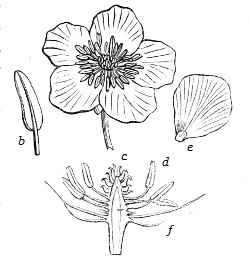
All the plants belonging to the genera Cistus,
the Rock-rose, and Helianthemum, the Sun-rose,
have showy flowers, each having five petals,
which are crumpled in the bud like those of the
Poppy; they also resemble the petals of the
Poppy tribe in falling almost as soon as they
have expanded, as every one must have observed
who has noticed the flowers of a Gum-Cistus.
The calyx in both Cistus and Helianthemum
generally consists of five sepals, two of which
are larger and of a paler green than the others,
and grow a little below them; and this calyx
remains on after the petals have fallen, and,
indeed, till the seed is ripe. In the Gum-Cistus,
however, and some other species, the two outer
sepals are wanting. There are a great many
stamens, which are rather short, and form a
tuft in the centre of the flower, surrounding the
pistil, which has a round flat-headed stigma, a
rather long style, and an ovary divided into
five cells. The seeds are numerous, and each
has a separate footstalk, by which it is attached
to the placentas, which, in the Cistus tribe, are
in the centre of the ovary, and not proceeding
from its sides, as in the Mignonette. The
capsule, which remains covered with the calyx
till it is quite ripe, divides into five or ten concave
valves, each having a placenta, to which
the seeds were attached, in its centre. The
seed of any plant belonging to the order Cistaceæ,
is remarkable when cut open for the great
size of the embryo enclosed in it, and the
curious manner in which it is curled up. The
embryo is the germ of the future plant, and it
is usually buried in a great mass of albumen, or
floury matter intended for the nourishment of
the young plant, till its roots are in a fit state
to supply it with nourishment. In the seed of
the Cistus, there is scarcely any albumen; but
in its stead a long narrow embryo, coiled up like
a sleeping snake.
The Gum-Cistus is generally called, in the
nurseries, Cistus ladaniferus; but it differs materially
from the plant so named by Linnæus,
as that has a ten-celled capsule, while the capsule
of the common Gum-Cistus (which botanists
call C. Cyperius) has only five cells. The leaves
also differ, the under surface of those of the
one kind being woolly, and of the other smooth;
the one is also a native of Spain and Portugal,
and the other, as the specific name imports, of
Cyprus. Both species, and also C. Ledon,
exude from their stems and leaves, a kind of
gum or resin called Ladanum or Labdanum,
which is used in medicine. It is from this gum
having been formerly always mixed with opium
when that drug was dissolved in spirits of wine,
that the name of laudanum is given to the tincture
of opium.
The two genera, Cistus and Helianthemum,
differ chiefly in the capsule, which in the latter
genus is triangular and one-celled, opening into
three valves, each of which has a narrow dissepiment
down its centre. To prevent any confusion
arising from the use of these terms, I may
here observe that when a capsule is divided into
several cells, having no communication with
each other, the membranes that separate them
are called dissepiments; while the nerve-like part
of it to which the seeds are attached is named
the placenta. Sometimes the placenta is
merely a nerve running down the side of the
capsule, when the capsule is one-celled, without
any dissepiment or division; and sometimes the
dissepiment does not spread across the capsule
so as to divide it into different cells, but only
projects a little way from the side towards the
centre, as in the one-celled capsule of the Poppy,
(see p. 260,) and in that of the Helianthemum,
when the seed-vessel opens naturally into different
parts, as in the Gum Cistus, these parts
are called valves, as are also the parts of pods,
as shown in the curled-up valves of the silique,
fig. 115, in p. 268.
To return to the Helianthemum, the species
of this genus are generally used for rockwork,
as they are all dwarf plants, though many of
the genus Cistus are large shrubs four or five
feet high. The English name of the Helian themum,
Sun-rose, is very appropriate, as the
flowers will only expand in sunshine, and will
even decay in the bud without opening at all,
when gloomy weather lasts for several days.
ORDER XX. VIOLACEÆ—THE VIOLET TRIBE.
The order Violaceæ, though not a large one,
contains several genera, but the most interesting
is the genus Viola, which includes among many
other species the Sweet Violet (Viola odorata),
and the Heartsease (V. tricolor). The flowers
of both species have many claims to admiration,
but they do not add the charm of regularity in
construction to their other attractions, as, in
fact, few flowers are less symmetrical. The
flowers of both are nearly alike in their details;
but to avoid confusion, I will describe them
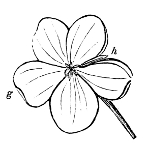
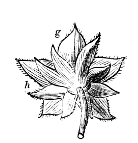
separately. The calyx of the Heartsease consists
of five pointed distinct sepals, two of them
rather smaller than the others. These sepals
are not attached, as in most other plants, at
their base; but so as to leave nearly a quarter
of their length standing up, far beyond the
place where they are fixed to the receptacle,
so as to form a sort of border or cup round
the stem, and between it and the flower.
The sepals are green, but they are edged
with a delicate whitish membrane at the margin,
scarcely to be seen without a microscope.
There are five petals which are also irregular
in their construction, two of them being much
larger than the others, and generally of a different
colour; and one even of the other three
being quite different in form to its companions.
The two large petals at the back of the flower,
which in the common Heartsease are generally
dark purple, are laid over each other, and behind
the two below them. These two side-petals,
which form the centre of the flower, are
both furred at the base; and the lower petal,
which is placed between them, has its claw
drawn out behind into a spur, which passes
between two of the sepals; and which, when
the flower is looked at from behind, appears to
be part of the calyx. The furred part of the
two side-petals forms a triangular, roof-like
opening, peeping out of which, is seen a small
pale-green ball-like substance, which a fanciful
imagination might liken to a head looking
through a dormer window; and this is all that is
to be seen in place of the usual apparatus of
stamens and pistils. As all seed-producing
flowers must have stamens and pistils, and as it is
well known that Heartseases and Violets do produce
seed in abundance, it is clear that these
important organs are not wanting; but where
are they? It is easy to guess, after being so
far initiated in the mysteries of botany, that the
little globular body is a part of the pistil; but
where are the stamens? It is necessary to pull
the flower to pieces to discover them. Commencing
this work of destruction, which I
always feel remorse at perpetrating, for I love
flowers too well not to feel pain at destroying
them; commencing this work, I repeat, the
petals and the sepals must be carefully removed
from the stem; a task of some little difficulty,
as both sepals and petals are firmly attached to
the receptacle, and the lower petal must have
its spur opened with a pin to avoid hurting the
delicate organs it contains. When the outer
coverings of calyx and corolla are thus both
removed, the seed-producing organs will be discovered,
and it will be found that they consist
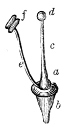
of five very curiously-formed stamens, with as
singular a pistil, in their centre. The stamens
have no apparent filaments, and the anthers,
which seem to be inserted in the receptacle,
look like seeds, each tipped with a bit of brown
skin, and having what appears to be a white rib
in front. This rib is the anther; and the
broader part is the dilated filament, which is
drawn out beyond it, on both sides, and above,
so as to form the brown tip above the anther
already mentioned. Two of the anthers have
each, in addition to these peculiarities, a long
tail, which the spur of the lower petal concealed,
when the flower was in a perfect state. The
pistil consists of a large ovary, full of ovules,
with a narrow style, which is drawn out into
the hollow globular termination which is seen
through the triangular opening in the flower.
The globe has an opening in front, under which
is a kind of lip, which looks like a shutter let
down to show the opening; and though, from
its thick fleshy nature, it looks like a stigma, it
is only the outer covering of that organ, for the
stigma lies within the opening. In this manner
the stigma and anthers are completely concealed;
and thus it will be seen, that nothing can be
more complex and intricate than the construction
of the flowers of the Heartsease.
Who could suppose that all these elaborate
details would be necessary to illustrate so simple
a flower as that of the Violet? And yet the
construction of the flowers of the Violet and
those of the Heartsease are essentially the same.
The sepals of the Violet are extended at the
base, like those of the Heartsease, and the
corolla consists of the same number of petals,
which are equally irregular in their form,
though not in their colour; the lower petal is
drawn out, in the same manner, into a spur,
which is much longer than that of the Heartsease,
though the rest of the flower is smaller.
The stamens are formed with the same regular
irregularity, only the tails of the two irregular
ones are larger and stronger, in the same proportion
as the spur is larger which is intended
to conceal them. The pistil is of the same
shape, with the same curiously constructed and
perforated style, which is bent in its narrow
part and swelled out into a hollow globe at the
tip; and in both species, the ovary is one-celled
with three parietal placentas, that is, with three
nerve-like projections from the sides of the
capsule, having four rows of seeds attached to
each. The capsule looks like a smooth shining
berry, and it remains partially shrouded by the
calyx, till the seeds are ripe; when it bursts
open with an elastic spring, and divides into
three valves, each of which has the placenta
bearing the seeds in its centre.
In all these points the Heartsease and the
Violet are alike; but they differ materially in
the leaves, which in the Violet are broad and
heart-shaped, without stipules; but in the
Heartsease are small and ovate, with such very
large and deeply-cut stipules, that they are by
most persons mistaken for the leaves. I may
here be asked what are stipules, and in what
do they differ from leaves? In answer to the
first question, I can only inform my readers that
stipules are generally little leaf-like bodies,
which seem to act as attendants upon leaves, as
bracts seem to wait upon flowers; but in what
they differ from leaves, except in size and shape,
I have not been able to learn. Even Dr. Lindley
in the last edition of his Introduction to Botany,
says, “What stipules really are is not well made
out.”
The Heartsease and the Violet differ also in
their habit of growth. The Violet is a creeping
plant with no stalks but those supporting the
flowers, while the Heartsease stands erect, with
a thick square stem, so strong, that, notwithstanding
its succulent nature, it may be trained
like a little tree.
ORDER XXI. DROSERACEÆ—THE SUN-DEW TRIBE.
There are three genera in this tribe that are
well known: Drosera, the Sun-dew; Dionæa muscipula,
Venus’s Fly-trap; and Parnassia palustris,
the Grass of Parnassus; all bog plants. The
species of the genus Drosera are remarkable
for the curious manner in which the leaves and
peduncles are coiled up when they first appear,
and in which they slowly unroll themselves as
they grow. They are also beautifully edged
with a sort of fringe of glandular red hairs, and
a fluid exudes from these glands which makes
them always appear as though covered with
dew. The common Sun-dew (D. rotundifolia)
is a British plant, with short roundish leaves;
but other species are natives of New Holland
and North America; and several of them have
long slender leaves like threads. Venus’s Fly-trap
(Dionæa muscipula) is a native of Carolina,
in North America; the leaves are curiously
formed of two lobes, which close and open as
if hinged, and they are furnished with glandular
hairs, which are so extremely irritable as to
make the leaves close at the slightest touch, and
thus to imprison any unfortunate insect that
may be within the lobes. The petiole is so
much dilated as to look like a leaf, but the real
leaf consists of only the two roundish lobes
edged with teeth that form the Fly-trap. The
flowers are white, and they are produced in
corymbs. The corolla has five petals, which do
not fall off when they wither, but roll up so as
to look like the cocoon of an insect.
ORDER XXII. POLYGALEÆ—THE MILKWORT
TRIBE.
The genus Polygala is well known from the
very handsome greenhouse plants which it contains.
The flowers at first sight appear to
resemble those of the Sweet Pea, having two
wings like a standard, and a sort of keel; their
construction is, however, very curious, and so
complicated, as to be very difficult either to
describe or to understand. The calyx is said
by modern botanists to consist of five sepals,
three of which are green and two lilac, these
last being the part that resembles the standard
of the Sweet Pea. The corolla is also said to
consist of five petals, two of which stand erect,
and the other three grow together to form the
keel. The latter have their upper part cut into
a kind of crest, like that of the Mignonette.
Below the crest, the united petals form a kind
of hood, under which are arranged the eight
stamens, four on each side. The stamens
themselves are as remarkable as the other parts
of the flower; the filaments grow together into
a thin kind of leaf, and each anther has but one
cell, and opens by a pore at the apex. The
pistil is also very curiously formed, as the style
and stigma have the appearance of a gaping
monopetalous corolla. The fruit is a flat two-celled
capsule, which, when ripe, opens by two
lips, separating from each other, and showing a
seed within each cell. Even the seeds are not
like other seeds, for each has a large white protuberance
at one end, called a corancula.
ORDER XXIII. TREMANDREÆ.
Slender New Holland shrubs, with the habit
of Heaths, rarely met with in British gardens.
ORDER XXIV. PITTOSPOREÆ.—THE PITTOSPORUM
TRIBE.
The principal genera included in this order
are Pittosporum, Billardiera and Sollya, all
resinous shrubs, with alternate leaves without
stipules, and the sepals and petals, each five in
number, and laid over each other like scales in
the bud. The seeds are numerous, and immersed
in fibrous pulp. The commonest species
of Pittosporum is P. Tobira, a native of China,
easily known by its thick leathery leaves, the
midribs of which are strongly marked, and
whitish. The flowers are erect, and produced
in cymes or heads; and the petals are united
into a tube with a spreading limb. The capsule
is one-celled, and two or three valved, with an
imperfect dissepiment in the centre of each
valve; and the seeds are numerous, and buried
in a resinous fibrous pulp. The Billardieras are
generally climbing shrubs, with pale greenish
bell-shaped, and almost erect flowers, which are
produced singly or in pairs, and which have the
tips of their petals turned back. The fruit is
a fleshy berry, with a shining skin of a deep
blue, and it is called the Apple Berry in
Australia, of which country the species are
natives. This fruit is said to be eaten in
Australia, but it seems difficult to imagine how
this can be the case; as though the outer part
of the berry is of a soft spongy nature, it is dry
and insipid; and there is no internal pulp, for
the seeds lie loose in the cells. In Sollya
heterophylla the flowers are drooping, on long
and very slender pedicels, and they are produced
in cymes. The corolla is campanulate, with
the tips of the petals not recurved, and the
anthers are much shorter than in Billardiera.
The fruit is a soft fleshy berry, divided into two
cells, each containing two rows of seeds immersed
in pulp, and when cut open, it smells
strongly of turpentine. The plant generally
called Sollya linearis has a dry and leathery
pericardium; and for this reason and on account
of the spreading of its anthers, it was placed by
Mr. Cunningham in a new genus, which he
called Cheiranthera.
ORDER XXV. FRANKENIACEÆ.—THE FRANKENIA
TRIBE.
The genus Frankenia consists principally of
the British weeds called Sea Heath; and the
other genera included in the order are seldom
seen in British gardens, from the seeds which
have been imported seldom arriving in a state
fit for vegetation.
ORDER XXVI.—CARYOPHYLLACEÆ—THE CARNATION
TRIBE.
The plants belonging to this order have so
strong a family likeness to each other as to be
easily recognised; and they are all distinguished
botanically by the swollen joints of their stems,
and their opposite undivided leaves, which are
generally connate, that is united, and sheathing
the stem. The order is divided into two sections,
viz.: Sileneæ, in which the sepals are
united into a tube, and which section includes
the genera Silene, Dianthus, Saponaria,
Lychnis, and Agrostemma; and Alsineæ, in
which the sepals are either quite distinct, or
only slightly cohering at the base, and which
includes Stellaria, Arenaria, Cerastium, Spergula,
and several other British weeds. The
Chickweed was called by Linnæus Alsine
media, but the genus Alsine is now united to
Stellaria.
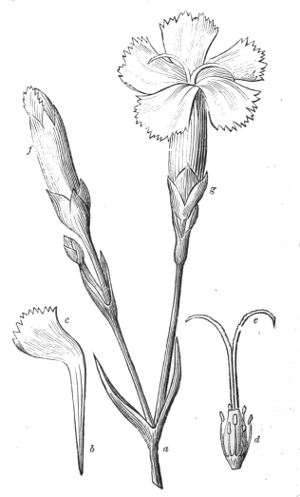
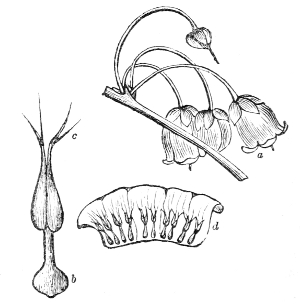
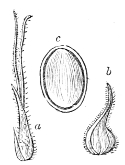
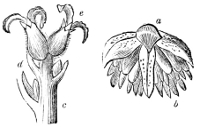
Fig. 118.—The Carnation.
The Wild or Clove Carnation (Dianthus
Caryophyllus), which may be considered the
type of the order, has an erect stem, swollen at
the joints, with connate leaves, (see a in fig. 118).
The flower, when single, consists of five petals,
each with a very long narrow claw (b), and a
rather broad limb or blade (c) serrated at the
edge. The calyx (f) is tubular, with five
vandyked teeth, which are in fact the tips of
five sepals, into which the tube of the calyx may
be easily divided with a pin. The tubular form
of the calyx is admirably contrived to support
the long claws of the petals, and to keep them
in their proper places; particularly when the
flowers are double, as the weight of the petals
in that case frequently bursts the tube of the
calyx. Every one fond of pinks and carnations
must have observed the miserable appearance
of the flower when thus deprived of its natural
support; and to prevent the premature destruction
of prize-flowers by this misfortune, professed
florists sometimes slip a curiously-cut
piece of card-board over the bud, which remains
on after the expansion of the flower, and prevents
the petals from falling out of place. Some
florists tie the calyx round with thread, instead
of using a pasteboard ring, which answers the
same purpose. At the base of the calyx are
two, four, or six leafy appendages (g), resembling
bracts, which are called the calycine
scales. These imbricated scales are, however,
only found in the genus Dianthus. There are
ten stamens (d) unequal in height, but none of
them longer than the ovary round which they
are placed. The ovary and the stamens are
concealed in the cup of the flower, but the
former is furnished with two styles, terminating
in two long stigmas (e), which project beyond
the flower, and which, when magnified, appear
delicately fringed.
The genus Dianthus includes the Carnation,
the Pink (Dianthus plumarius), the Chinese
Pink (D. sinensis), the Sweet William (D. barbatus),
and many ornamental flowers. Of these
the Sweet William has the claws of its petals
bearded; the flowers are produced in bundles or
fascicles; and the calycine scales are so numerous
and awl-shaped, that they give a bristly
appearance to the flowers. The different species
of Soap-wort (Saponaria) differ from Dianthus,
in having no calycine scales; and this is also
the case with the berry-bearing Campion (Cucubalus
baccifer), the fruit of which is a fleshy
capsule or berry, which finally becomes black,
and has a singular appearance in the centre of
the cup-like calyx, which remains on till the
fruit is ripe. The flower of this plant is white,
and the petals have a two-cleft limb. All the
numerous species of Catchfly (Silene) are also
without calycine scales, and the petals are generally
deeply two-cleft; but they are distinguished
by having a crown of petal-like scales in
the throat of the corolla. There are also three
styles instead of two; and the capsules are
three-celled at the base, ending in six teeth at
the top. The species have frequently a glutinous
frothy moisture on the stem, in which flies
sometimes become entangled, and hence the
English name of the genus. One species, the
Bladder Campion (S. inflata), has been used as
food, and its young shoots, when boiled and
sent to table like Asparagus, are said to have
the flavour of green peas. The different species
of Lychnis and Agrostemma resemble Silene
closely in every respect, except in the styles,
which are five, instead of three; these two
genera, Viscaria, and Githago, differ very
slightly from each other; and several of the
species are known by different names: thus
Ragged Robin (Lychnis flos cuculi) is made by
some botanists an Agrostemma; the Corn-cockle
is sometimes called Githago segetum, and sometimes
Agrostemma Githago; the common Rose
Campion is called sometimes Lychnis, and
sometimes Agrostemma; and the Rock Lychnis,
or Red German Catchfly, sometimes Lychnis
Viscaria, and sometimes Viscaria vulgaris.
ORDER XXVII.—LINACEÆ.—THE FLAX TRIBE.
The order Linaceæ is a very small one; and,
indeed, it consists principally of the genus
Linum. The Flax was formerly included in the
Caryophyllaceæ, which it resembles in having
five petals, five sepals, and five stamens; but it
also resembles the Mallow in its capsules, and
in its stamens growing together at the base;
and the Cistus in its persistent calyx, and the
disposition of its sepals. These links, which
connect one order with another, and make them
appear alike but not the same, form, I think,
one of the most interesting parts of the Natural
System. We are led on from one gradation to
another, by scarcely perceptible shades of difference
through the vegetable kingdom; and,
indeed, through the whole system of creation:
the beautiful harmony, and unity of design,
visible throughout, bearing the strong impress
of the Divinity whose power has made the
whole.
The common Flax (Linum usitatissimum),
though in its appearance only an insignificant
weed, is a plant of great benefit to man. The
fibres of the stem are used to make linen, and
the seeds (linseed) are crushed for oil. The
flowers are blue, and have five regularly-shaped
petals, which are twisted in the bud; and a
distinct calyx of five pointed sepals, two of which
grow from a little below the others, as in the
Gum Cistus; and, as in that plant, the calyx
remains on till the seeds are ripe. There are
five stamens, the filaments of which grow together
slightly at the base, and there are five little
points like filaments without anthers, rising
between the stamens. The petals are connected
with the ring formed by the united filaments,
and sometimes the petals themselves grow
slightly together at the base. The capsule
consists of five two-celled carpels, grown together;
each cell containing one seed, and each
carpel terminating in a rather slender style,
tipped with a ball-like stigma. When ripe, the
capsule opens naturally, by dividing into ten
valves, to discharge the seeds; which are flat
and shining, with a large embryo. These seeds
are called Linseed in the shops, from Linum,
the botanical name of the plant; and, as is well
known, they are not only used for various purposes,
but oil is expressed from them. The
stem of the common Flax, though it is only an
annual, consists of woody fibre, like that of a
tree in its young state; and it is this fibrous
part that makes the yarn for thread, after it
has been separated from the fleshy part, by
steeping the stems for a long time in water.
The perennial Flax (Linum perenne), which, as
its name imports, lasts several years, differs in
little else from the common kind, except that
its sepals are obtuse, and its leaves are much
smaller and narrower. Both these are natives
of Britain. There are many other species,
some of which have yellow flowers.
ORDER XXVIII.—MALVACEÆ.—THE MALLOW TRIBE.
All the plants belonging to Malvaceæ bear
so much resemblance to each other, that this
order may be considered a very natural one;
and it is one very remarkable for the botanical
construction of its flowers. In some respects it
resembles Linaceæ, quite enough indeed to show
clearly the chain by which they are so beautifully
linked together; but in others, it differs
so decidedly as to show how completely they
are distinct. Fig. 119, which represents the
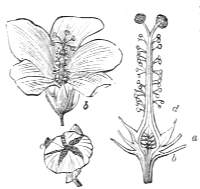 Fig. 119.—The flower, stamens,
and pistils of the Althæa frutex.
flower and seed-vessel
of the Althæa frutex
(Hibiscus syriacus),
will serve to show the
chief peculiarities of
this order. The calyx
consists of five sepals,
below which is an involucrum
of six or
seven leaflets, which
have the appearance
of a second calyx. The corolla is cup-shaped,
and consists of five petals, which are close together
at the base, and this is peculiar to the
genus Hibiscus. The capsule is round and
somewhat convex, being nearly in the shape of
what is called a batch-cake, as shown at c;
it consists of five carpels grown together, each
containing many seeds; and when ripe, it bursts
naturally into five valves, each of which has a
dissepiment down the centre. The filaments
grow together very curiously, inclosing the
styles, and forming a column in the centre of
the flower, which is the distinguishing mark of
the Malvaceæ. Some of the stamens are shorter
than others, and as part of each filament is detached,
the anthers form the fringe-like border to
the column, shown at d. The anthers are kidney-shaped
and one-celled, and this is another
of the characteristics of the order; but the
styles are terminated by five ball-shaped stigmas,
like those of the Linum. There are many
kinds of Hibiscus; but perhaps the best known
are: H. rosa sinensis, the species which is so
often represented in Chinese drawings, and the
petals of which are so astringent, that they are
said to be used in China by the men to black
their shoes, and by the women to dye their
hair; and the Bladder Ketmia (H. Trionum),
which takes its English name from its inflated
capsule. All the plants belonging to the order
Malvaceæ have a central column, round which
are placed numerous carpels, which grow together
and form a many-celled capsule; and they
all have kidney-shaped, one-celled anthers.
They have also always an involucrum below the
calyx, but this involucrum differs in the different
genera. In the genus Malva, the involucrum
consists of three leaflets, which in the common
Mallow (Malva sylvestris) are oblong. The
petals are wedge-shaped, and they are what
botanists call auricled; that is, they are set so
far apart at the base that light can be seen
through them. The stamens are all of nearly
the same height, and they form a kind of bunch
round the styles, which are pointed. The capsule
consists of a circle of woolly-looking carpels
growing close together, but so as to be easily
detached with a pin, and each fitting into a
little groove in the receptacle, in which they are
placed. As the seeds ripen, the involucrum falls
off, but the large loose-looking calyx remains
on. There is only one seed in each carpel; but
as there are generally eleven carpels in each
capsule, each seed-vessel contains this number
of seeds. The leaves are lobed and toothed;
and the whole plant is covered with long hairs,
which are disposed in little star-like tufts.
Fig. 119.—The flower, stamens,
and pistils of the Althæa frutex.
flower and seed-vessel
of the Althæa frutex
(Hibiscus syriacus),
will serve to show the
chief peculiarities of
this order. The calyx
consists of five sepals,
below which is an involucrum
of six or
seven leaflets, which
have the appearance
of a second calyx. The corolla is cup-shaped,
and consists of five petals, which are close together
at the base, and this is peculiar to the
genus Hibiscus. The capsule is round and
somewhat convex, being nearly in the shape of
what is called a batch-cake, as shown at c;
it consists of five carpels grown together, each
containing many seeds; and when ripe, it bursts
naturally into five valves, each of which has a
dissepiment down the centre. The filaments
grow together very curiously, inclosing the
styles, and forming a column in the centre of
the flower, which is the distinguishing mark of
the Malvaceæ. Some of the stamens are shorter
than others, and as part of each filament is detached,
the anthers form the fringe-like border to
the column, shown at d. The anthers are kidney-shaped
and one-celled, and this is another
of the characteristics of the order; but the
styles are terminated by five ball-shaped stigmas,
like those of the Linum. There are many
kinds of Hibiscus; but perhaps the best known
are: H. rosa sinensis, the species which is so
often represented in Chinese drawings, and the
petals of which are so astringent, that they are
said to be used in China by the men to black
their shoes, and by the women to dye their
hair; and the Bladder Ketmia (H. Trionum),
which takes its English name from its inflated
capsule. All the plants belonging to the order
Malvaceæ have a central column, round which
are placed numerous carpels, which grow together
and form a many-celled capsule; and they
all have kidney-shaped, one-celled anthers.
They have also always an involucrum below the
calyx, but this involucrum differs in the different
genera. In the genus Malva, the involucrum
consists of three leaflets, which in the common
Mallow (Malva sylvestris) are oblong. The
petals are wedge-shaped, and they are what
botanists call auricled; that is, they are set so
far apart at the base that light can be seen
through them. The stamens are all of nearly
the same height, and they form a kind of bunch
round the styles, which are pointed. The capsule
consists of a circle of woolly-looking carpels
growing close together, but so as to be easily
detached with a pin, and each fitting into a
little groove in the receptacle, in which they are
placed. As the seeds ripen, the involucrum falls
off, but the large loose-looking calyx remains
on. There is only one seed in each carpel; but
as there are generally eleven carpels in each
capsule, each seed-vessel contains this number
of seeds. The leaves are lobed and toothed;
and the whole plant is covered with long hairs,
which are disposed in little star-like tufts.
The genus Malope closely resembles the Mallow;
except that the petals are not wedge-shaped,
and that it has a still larger calyx, the
long sepals of which shroud the capsule as the
involucre of the filbert does the nut. The involucrum
is composed of three broad, heart-shaped
leaflets, which remain on till the seed is ripe.
The petals are also not so even along the margin;
and the carpels are so disposed as to form
a cone-shaped capsule, instead of a flat one.
The genus Lavatera has the leaflets of the
involucre joined to the middle, so as to form a
kind of three-cornered saucer below the capsule;
and the capsule itself is completely covered with
a part of the receptacle, which is dilated, and
curved down over it. Lastly, the genus Althæa,
the Marsh Mallow, has the involucrum cleft into
six or nine divisions, and the carpels united into
a globular capsule. The Hollyhock (A. rosea)
belongs to this genus. Many other genera
might be mentioned, but these will suffice to
give my readers a general idea of the order,
and of the points of difference which distinguish
one genus from another. Among the exotic
plants belonging to the order is the cotton tree
(Gossypium herbaceum), the cotton being the
woolly matter which envelops the seeds in the
capsule. All the Malvaceæ abound in mucilage,
and they all have woody fibre in their stems.
ORDER XXIX.—BOMBACEÆ.—THE SILK COTTON
TREE TRIBE.
This order is closely allied to Malvaceæ, and
it differs principally in the tube formed by the
stamens being divided into five bundles near the
top. It includes the Baobab, or Monkey-bread
(Adansonia digitata), said to be the largest tree
in the world; the Screw tree (Helicteres Isora),
so named from its curiously-twisted fruit; Carolinia
princeps; the Silk Cotton tree (Bombax
Ceiba); and the Hand-plant (Cheirostemon platanoides),—this
is the Hand-plant so named from
the lobes of its leaves resembling fingers,—all
stove plants in Britain.
ORDER XXX.—BYTTNERIACEÆ.—THE BYTTNERIA
TRIBE.
This order is divided into five sections, which
some botanists make distinct orders. It is very
nearly allied to Malvaceæ, but the anthers are
two-celled. The principal genus in the first
section (Sterculieæ) is Sterculia, which has
several carpels distinct and arranged like a star:
the species are trees with large handsome leaves
which are articulated at the base, and axillary
panicles or racemes of flowers. The second section
(Byttnerieæ) contains among other plants Theobroma
Cacao, from the fruit and seeds of which
Cocoa and Chocolate are prepared. The third
section (Lasiopetaleæ) is well known in England,
by the pretty Australian shrubs included in the
genera Thomasia and Lasiopetalum, the leaves
of which have their under surface downy, and
generally brown. The fourth section (Hermannieæ),
and the sixth (Wallichieæ), contain no
plant common in English gardens; and the
fifth (Dombeyaceæ) is best known by Astrapæa
Wallichii. The qualities of all the plants in this
order are mucilaginous.
ORDER XXXI.—TILIACEÆ.—THE LINDEN TRIBE.
The only genus belonging to the natural
order Tiliaceæ which is easily to be procured
in Britain is that of Tilia, the Lime trees. The
common Lime (Tilia europæa) is generally a
tall, well-formed tree, with rather broad leaves,
which are heart-shaped at the base, tapering at
the point, and serrated at the margin: they are
also smooth on the outer surface, thin, and of a
light and delicate texture; below there is a
little tuft of hair at the angle of the veins. The
flowers are produced in cymes or compound
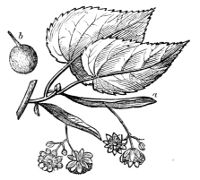 Fig. 120.—The flowers and seed-vessel
of the common Lime tree.
umbels (see fig.
120); and their
main pedicel appears
to spring
from one long entire
bract (a).
The calyx is in
five sepals, and it
falls off before the
corolla, which is
composed of five
pale yellow petals, which are very sweet-scented.
Fig. 120.—The flowers and seed-vessel
of the common Lime tree.
umbels (see fig.
120); and their
main pedicel appears
to spring
from one long entire
bract (a).
The calyx is in
five sepals, and it
falls off before the
corolla, which is
composed of five
pale yellow petals, which are very sweet-scented.
The stamens are numerous, and the filaments
separate, bearing two-celled anthers, which burst
by long slits. The ovary has only one style, the
tip of which is cleft into five small stigmas; and
it is divided into five cells, each containing one
or two ovules. The fruit or capsule (b) is round,
and has a leathery skin, covered with a soft
down; and when ripe, the cells often become
united so as to form one, with only one or two
perfect seeds in the whole capsule, the other
ovules proving abortive. The whole plant
abounds in mucilage, and the sap when boiled
affords sugar. The inner bark is so tough and
fibrous, that it is used for making what are
called bast mats: it being first rendered flexible
by steeping it for a long time in water. The
wood is of very fine texture, but soft and white,
and it is thus admirably adapted for carving.
The American Limes have a small scale at the
base of each petal of the flower; but the other
differences between the species are very slight.
ORDER XXXII.—ELÆOCARPÆ.—THE ELÆOCARPUS
TRIBE.
East India shrubs and trees, little known in
Britain. “The hard and wrinkled seeds of
Elæocarpus are made into necklaces in the
East Indies, and, set in gold, are sold in our
shops.”—(Hook.)
ORDER XXXII*.—DIPTEROCARPÆ.—THE CAMPHOR
TREE TRIBE.
There are two kinds of Camphor, one produced
by boiling the branches of a kind of laurel,
and the other (the Camphor of Sumatra) is
found in large pieces in the hollow parts of the
branches of Dryobalanops Camphora, one of the
species included in this order. None of these
trees have been introduced into Britain.
ORDER XXXIII.—CHELONACEÆ, OR HUGONIACEÆ.
Small trees and shrubs, natives of the East
Indies and Madagascar; only the genus Hugonia
is known in Britain.
ORDER XXXIV.—TERNSTRŒMIACEÆ.—THE
TERNSTRŒMIA TRIBE.
The principal plants in this order common in
England are Gordonia, Stuartia, and Malachodendron.
Gordonia Lasianthus, the Loblolly
Bay, is a small evergreen tree, with white
flowers, about the size of a rose. It is a native
of America; and Stuartia and Malachodendron
are beautiful low trees or shrubs, with large
white flowers from the same country. The
flowers have five large petals; the stamens are
numerous, with the filaments growing together
at the base, and attached to the petals; and
there are five carpels more or less connected.
Gordonia has its five sepals leathery, and
covered with a silky down; its stamens almost
in five distinct bundles, a five-celled capsule,
and its seeds each furnished with a wing.
Stuartia has a permanent calyx, five-cleft, but
not parted into distinct sepals, with two bracts
at the base, and a woody five-celled capsule,
with seeds without wings; and Malachodendron
(which was formerly called Stuartia pentagynia)
has a calyx similar to that of Stuartia, but the
edges of the petals are curiously crenulated, and
there are five distinct carpels, each containing
only one seed. Some botanists include the
Camellia and the Tea in the order Ternstrœmiaceæ.
ORDER XXXV.—CAMELLIACEÆ.—THE CAMELLIA
TRIBE.
There are two genera in this order, the
Camellia and the Tea. The flower-bud of the
Camellia is inclosed in a calyx of five, seven, or
nine concave sepals, on the outside of which are
several bracts, which remain on till the flower
has expanded, but which are distinguished from
the sepals by their dark brown colour. The
sepals and the bracts are laid over one another
like scales, and thus the flower lies encased in
a complete coat of mail. The single flower is
cup-shaped, with five, seven, or nine petals,
which are sometimes joined together at the
base. The stamens have long slender filaments,
which either grow together at the base, or are
separated into several bundles. The anthers
are elliptical and versatile; that is, they are
poised so lightly on the filament as to quiver
with the slightest breeze. The ovary is of a
conical shape, and it has three or five slender
styles, ending in as many pointed stigmas, and
growing together at the base. The capsule is
three or five-celled; and when ripe it bursts
into three or five valves, in the middle of each
of which is a dissepiment, which, before the
capsule opened, was attached to an axis or
column in the centre. The seeds are large
and few, and they are fixed to the central
placenta. There is no albumen, but the embryo
has two large, thick, oily cotyledons, which look
as if they were jointed at the base. The leaves
are leathery, dark-green and shining, and they
are ovate in form, ending in a long point, and
sharply serrated. The flowers spring from the
axils of the leaves, and grow close to the stem
without any footstalk; and the leaf-bud for
the ensuing shoot grows beside the flower-bud.
I have above described the Camellia japonica,
from which nearly all the Camellias in British
gardens have sprung; but there are some other
species. The finest of these is C. reticulata,
which has very large, loose, widely-spreading
flowers, of a remarkably rich crimson. The
leaves are oblong, flat, and reticulately veined,
being of a much finer texture than those
of C. japonica. The ovary is two or four-celled,
and it is covered with fine silky hairs.
C. maliflora is a very beautiful species with small
semi-double flowers, coloured like an apple blossom.
This Camellia is by some botanists
thought to be a variety of C. Sasanqua, an
elegant species with white fragrant flowers;
but the ovary of the first is smooth, and that
of the second covered with hairs, which most
botanists consider a specific difference.
The Tea tree (Thea viridis) is very nearly
allied to the Camellia; but there are many points
of difference. The flower of the Tea tree has a
footstalk; the calyx has only five sepals; the filaments
of the stamens do not grow together; the
capsules are three-seeded; and the dissepiments
are formed by the edges of the valves being bent
inwards, instead of being attached to a central
axis. The leaves are also much longer than
they are broad, and they are of a thinner texture
and pale green; and the outside of the
capsule, which is furrowed in the Camellia, is
quite smooth in the Tea tree. It is said that
both the green and the black Tea are made
from the leaves of Thea viridis; but there
is another species called Thea Bohea, which has
smaller leaves, and is a more tender, and less
vigorous-growing plant. The young leaves of
Camellia Sasanqua, and some of the other
Camellias, are also dried, and mixed with the
tea. All these plants are natives of Japan and
China, and require a slight protection in England
during winter.
ORDER XXXVI.—OLACINEÆ.—THE OLAX TRIBE.
Exotic trees from the East and West Indies,
little known in Britain. Heistria coccinea, a
native of Martinique, is said to be the Partridge
wood of the cabinet-makers.
ORDER XXXVII.—AURANTIACEÆ.—THE ORANGE
TRIBE.
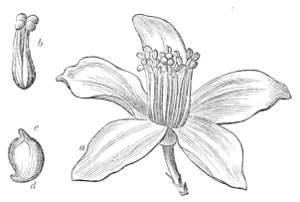
Fig. 121.—Flower and seed of the Orange.
The natural order Aurantiaceæ contains fourteen
genera; but the only one I think my
readers will feel an interest in is the genus
Citrus. This genus comprises, among several
other species, C. medica, the Citron; C. Limetta,
the sweet Lime; C. Limonum, the Lemon;
C. Paradisi, the Forbidden fruit; C. decumana,
the Shaddock; C. Aurantium, the Sweet Orange;
and C. vulgaris, the Bitter or Seville Orange.
to these may be added C. nobilis the Mandarin
Orange, the fruit of which is reddish, and which
parts naturally from its rind, which is sweet,
and may be eaten. All the species agree in
having a tube-like calyx, scalloped into five
short teeth, and a flower of generally five
fleshy petals, (see a in fig. 121), though the
number occasionally varies from four to nine.
These petals are elliptic in shape, concave, and
always widely opened. In the centre of the
flower are the stamens, varying from twenty
(which is the ordinary number) to sixty; the
anthers are two-lobed, and oblong, and the
filaments are somewhat thickened at the base,
and united there into several small bundles (b),
but free above. The pistil has a somewhat
globular ovary, with a cylindrical style, termi nating
in a stigma, which is slightly raised in
the centre. The disk in which the stamens
are inserted, forms a ring round the ovary.
The fruit (fig. 122), which is considered by
botanists to be a kind of berry, is in fact a seed-vessel
with numerous cells, divided by dissepiments
and a central placenta (a); the cells being
the quarters of the Orange, the dissepiments
the divisions between them, and the placenta
the central pith. When the flower first expands,
the ovary, if cut open and examined,
will be found to be divided into several cells,
each containing two rows of ovules. As in the
preceding genera, however, many of these ovules
become abortive; and as the cells fill gradually
with cellular pulp, the seeds become detached
from the placenta, and buried in it. The seeds
themselves are very interesting; they are
covered with a thick wrinkled skin, and they
show distinctly the hilum (c in fig. 121), the
chalaza (d) and the raphe or connecting cord
between them, parts which are seldom to be
distinguished in seeds with the naked eye.
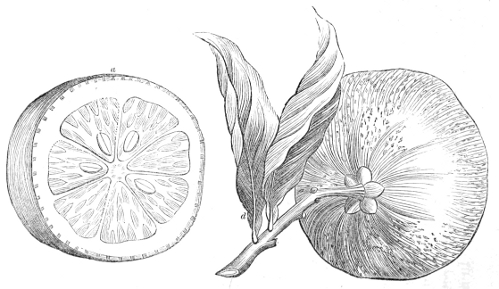
Fig. 122.—Leaf and fruit of the Orange.
The leaves, calyx, and petals of the Orange,
if held up to the light, appear covered with
little dots. These dots are cells, covered with a
transparent membrane, and filled with a kind
of oil, which is exceedingly fragrant. The rind
of the fruit is covered with similar cells, filled
with a pungent oily liquid. The leaves are
smooth and shining; and they are articulated;
that is, they can be separated from the petiole
or footstalk without lacerating them. In most
of the species, the petioles are winged; that is,
they are dilated into little leaves on each side
(see d in fig. 122). The different species vary
chiefly in the number of stamens, the thickness
of the rind, the shape of the fruit, and in the
wings of the petioles. In the Citron these wings
are wanting entirely, and instead of them there
are spines in the axils of the leaves; there are
generally forty stamens, and the rind of the fruit
is very thick. In the sweet Lime, the petioles are
slightly winged, and there are about thirty
stamens; the fruit is small and round, with a
slight protuberance at one end like that of the
Lemon, and the pulp is sweet. In the Lemon
the petioles are somewhat winged, the flowers
have about thirty stamens; the fruit is oblong,
with an acid pulp, and a thin rind. The Sweet
Orange has winged petioles, about twenty
stamens, and a fruit with a thin rind and sweet
pulp; and the Seville Orange differs principally
in having a thicker rind and bitter pulp. The
China, St. Michael, and Malta Oranges, with
many others, are all varieties of the Sweet
Orange (Citrus Aurantium); and there are
many other species, which I have not thought
it necessary to describe.—All the species above-mentioned
are natives of Asia, and most of them
of China, but they have been so long cultivated
in Europe and America, as to have become
almost naturalised.
ORDER XXXVIII.—HYPERICINEÆ.—THE
HYPERICUM TRIBE.
The genus Hypericum, or St. John’s Wort,
agrees with the orange in having its leaves full
of transparent cells; but these cells are filled
with a yellow, resinous juice, resembling gamboge
in its medicinal properties, and having a
very disagreeable smell. There are five petals
in the corolla; and the calyx consists of five
sepals, which are unequal in size and shape, and
joined together for only a short distance. Like
the orange the filaments grow together at the
base, in separate clusters or bundles; but in the
Hypericum these clusters are so perfectly distinct,
that the stamens may be readily separated
into three or five bundles (according to the
species), by slightly pulling them. The capsule
is dry, and of a membrane-like texture, and it
consists of three or five carpels, containing many
seeds, and each having a separate style, and a
pointed stigma. The flowers are very showy,
from their large golden yellow petals and numerous
stamens. The genus Androsæmum, the
Tutsan, or Park-leaves, has been separated from
Hypericum on account of its fruit being one-celled
and one-seeded, with a fleshy covering,
which yields a red juice when pressed. H.
calycinum, with large yellow flowers and five
tufts of stamens, is the handsomest species; but
H. perforatum is the true St. John’s Wort,
which the country people used formerly to
gather on midsummer eve, as a preservative
against witchcraft.
ORDER XXXIX.—GUTTIFERÆ.—THE MANGOSTEEN
TRIBE.
The only genus in this order that contains
plants interesting to the English reader is
Garcinia; and the most remarkable species are
G. Mangostana, the Mangosteen, said to be the
most delicious fruit in the world, and G. Cambogia,
the tree producing the gamboge, which
is a kind of gum that oozes out from the stem.
Both are natives of the East Indies.
ORDER XL.—MARCGRAAVIACEÆ.
Exotic shrubs, mostly natives of the West
Indies, with spiked, or umbellate flowers, and
alternate leaves. Very seldom seen in Britain.
ORDER XLI.—HIPPOCRATACEÆ.
Exotic arborescent, or climbing shrubs, generally
with inconspicuous flowers. Natives of
the East and West Indies.
ORDER XLII.—ERYTHROXYLEÆ.—THE RED WOOD
TRIBE.
Exotic shrubs, and low trees, remarkable
from the redness of their wood, but with small
greenish flowers. The leaves of Erythroxylon
Coca possess an intoxicating quality, and are
chewed by the Peruvians, in the same manner
as the Turks take opium.
ORDER XLIII.—MALPIGHIACEÆ.—THE BARBADOES
CHERRY TRIBE.
Several species of Malpighia, the Barbadoes
Cherry, are found occasionally in our stoves.
The corolla of these plants, when closed, bears
considerable resemblance to that of a Kalmia;
but the flower when expanded is more like that
of a Clarkia, from the long claws of the five
petals, and the distance they are placed apart.
Several of the species have their leaves and
stems beset with stinging bristles, which adhere
to the hands when touched. The fruit, which
is eatable, but insipid, is a berry-like drupe,
containing three one-seeded nuts. The species
are natives of the West Indies, and they require
a stove in England. The flowers are generally
rose-coloured or purplish; but they are sometimes
yellow. The common Barbadoes Cherry
is called M. glabra, and its leaves are without
stings. In Hiptage, another genus of this
order, four of the petals of the flowers are
white, and one yellow; and in Banisteria, the
species are generally climbing shrubs, always
with yellow flowers. Some of the species of
Banisteria are occasionally found in stoves in
this country, where their beautiful feathery
yellow flowers have very much the appearance
of those of the Canary bird flower (Tropæolum
peregrinum).
ORDER XLIV.—ACERINEÆ.—THE MAPLE TRIBE.
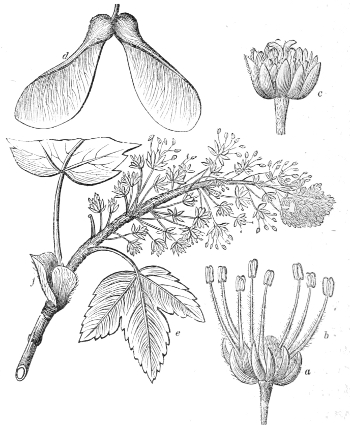
Fig. 123.—Flower and Samara of the Sycamore.
(Acer Pseudo-Platanus.)
The common Maple (Acer campestre) and
the Sycamore (A. Pseudo-Platanus) are the
only plants belonging to this order, that are
natives of Britain; though so many kinds of
ornamental Acers are now found in our parks
and pleasure-grounds. Few trees are indeed
more deserving of culture than the American
Maples, both for their beauty in early spring,
and for the rich shades of yellow and brown
which their leaves assume in autumn. The
Maple tribe is a very small one; it consists
indeed of only the genera Acer and Negundo,
and an obscure Nepal genus, of which there are
no plants in Britain. Of all the Acers, one of
the handsomest is the Sycamore tree (A.
Pseudo-Platanus); the flower of this species (see
e in fig. 123) is of a yellowish green; and as in
early spring, when it appears, we are delighted
at the sight of any thing in the way of flowers,
it really looks very beautiful. Before I began
to study botany, I had never noticed the blossoms
of the forest trees, and when I was shown the
light-feathery flowers of the Lime, and the
gracefully-drooping ones of the Sycamore, I
was quite astonished. The flowers of the Sycamore
grow in a drooping raceme; the calyx is
divided into five parts, but as it is scarcely
distinguishable from the petals, which are five
in number, and placed alternately with the
sepals, it appears to be in ten divisions (see a).
These flowers are partly male and female (see
b and c), and partly perfect. In the perfect
flowers there are eight stamens, and two stigmas;
and the ovary when ripe expands into a
curiously winged pod, called a samara (d), but
differently shaped to the samara of the Ash,
the thickened parts at the base of which contain
the seeds. There is no albumen in the seed,
which, when put into the ground, expands into
two long thin cotyledons, (a in fig. 124) which,
if once pointed out, will always be known again
instantly. If a ripe seed be opened when quite
fresh, the cotyledons or seed leaves will be found
within it, fresh, green, and succulent; and these
leaves (a in fig. 124), which rise above the
ground as soon as the seed begins to germinate,
differ widely in shape from the true leaves (b)
which are serrated, and of a much thicker
texture. The bracts of the Sycamore (f in fig.
123) are thick and leathery, and of a rich dark
brown. The leaves are serrated at the margin;
and the lower ones are cut into five lobes; but
those near the flowers have generally only three
lobes (e), and in all the leaves, two of the lobes
are not so deeply cut as the others.
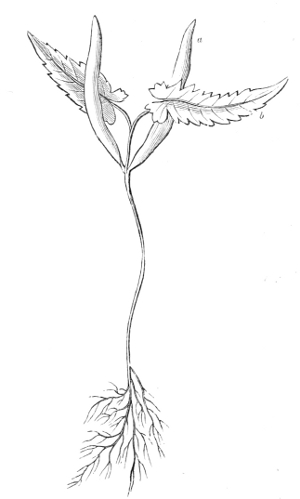
Fig. 124.—Young Sycamore.
There are many species of Acer, most of
which are tall trees; and they are chiefly distinguished
from each other by the shape of the
leaves and of the samaras, or keys, the wings of
which, in some species, are near together, as
shown at d in fig. 123, and in others widely
apart, as in the common hedge Maple (A. campestris),
and in the Norway Maples, as shown at
a in fig. 125. This figure represents the flowers
of the Norway Maple (Acer platanoides), which
are in what botanists call a corymb, and stand
erect, instead of drooping like those of the
sycamore. The leaves are deeply five-lobed,
and the lobes are so coarsely toothed, that the
teeth have almost the appearance of lobules.
The buds of this plant in winter are large and
red, and when they open in spring, the bracts
(b) curl back over the scales (c). The leaves
become of a clear yellowish red in autumn, and
the whole plant is very ornamental. When a
leaf of this tree is broken off, a milky sap issues
from the broken petiole or leaf-stalk, which is
of an acrid nature; differing in this respect,
materially from the sap of the trunk, which is
very sweet. Sugar indeed may be made from the
sap of the trunk of almost all the Maples; but
particularly in America, from that of the Sugar
Maple (Acer saccharinum). The flowers of the
red American Maple (Acer rubrum) are red, and
as from their colour, and their appearing a
fortnight before the leaves, they are very conspicuous,
I have given a magnified representation
of them in fig. 126, that my readers may
have an opportunity of examining the male
and female flowers from a living tree. In fig.
126, a a are male flowers, having no stigmas;
and b b are female ones, having no stamens.
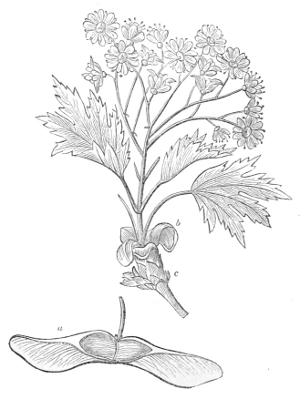
Fig. 125.—Flowers and Samara of the Norway Maple.
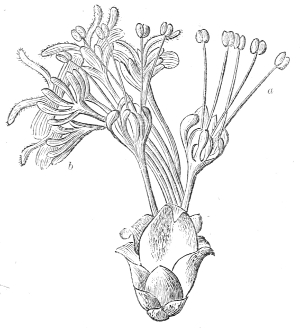
Fig. 126.—Flowers of the Red Maple (Acer rubrum).
The leaves of Acer rubrum become red in
autumn. The Tatarian Maple differs from the
other species in having entire leaves, and the
samaras are red when young; but all the other
kinds of Acer common in British gardens bear
a strong family likeness to each other. The
Ash-leaved Maple is now made into a separate
genus, and is called Negundo fraxinifolia. This
tree is easily distinguished from the Maples by
its compound leaves, which resemble those of
the Ash, and its long pea-green shoots, which
have very few buds. The male and female
flowers of the Negundo are on different trees,
and they are so small as to be seldom seen,
though the racemes of samaras or keys which
succeed the flowers are very conspicuous. The
Negundo is a native of America, and its leaves
turn yellow in autumn.
ORDER XLV.—HIPPOCASTANEÆ, OR ÆSCULACEÆ.
THE HORSE-CHESTNUT TRIBE.
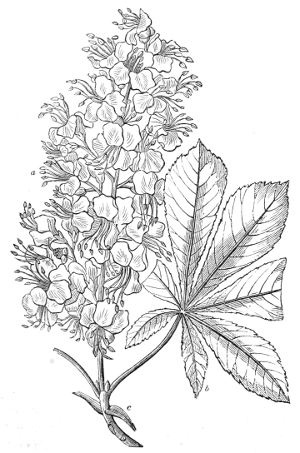
Fig. 127.—Flowers of the Horse-chestnut.
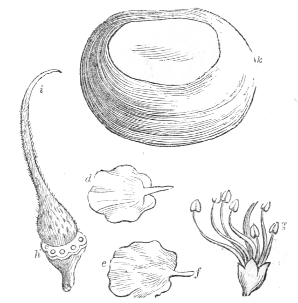
Fig. 128.—Horse-chestnut.
This order contains only two genera; viz.,
Æsculus, the Horse-chestnut, and Pavia, the
Buckeye; both of which are generally called
Horse-chestnuts, though the genera are easily
distinguished by their fruit, the husk of which
is smooth in the Pavias, but rough in the true
Horse-chestnuts. The buds of all the species of
both genera are covered with bracted scales,
most of which fall off when the leaves and
flowers expand; and those of the common Horse-chestnut
(Æsculus Hippocastanum) are very large,
and covered with a kind of gum. Four large
compound leaves, each consisting of five or seven
leaflets, and a raceme of sixty-eight flowers, have
 Fig. 129.—Young plant of
Horse-chestnut.
been unfolded on dissecting one of these buds,
before the leaves unfold in spring. The flowers
of this species are produced in large, upright
panicled racemes (see a in fig. 127); and the
leaves (b) are compound, consisting of five or
seven leaflets, disposed in a palmate manner.
Two of the inner bracts, which remain after the
outer scales (which are very numerous) have
fallen, are shown at c. I mention this particularly,
as these remaining bracts have very
much the appearance of stipules, and it is one
of the characters of the Horse-chestnuts that
their leaves are without stipules. The flowers
consist of five petals, two of which (d in fig.
128) are somewhat smaller than the others.
Each petal consists of a broad blade or limb
(e), and a very narrow claw (f). There are
seven stamens, three of which (g) are shorter
than the others. The filaments are inserted in
the receptacle (h), and surround the pistil,
which is hairy, and has a long style and a
curved stigma (i). The
ovary is two-celled, and
each cell contains two
ovules, but seldom more
than one seed ripens.
The nut (k) is large, and
covered with a shining
brown skin, which is
strongly marked with the
hilum. When put into
the ground, the cotyledons
do not appear in
the shape of seed-leaves,
but remain in the ground,
and the plumule and
radicle are protruded as
shown in fig. 129. The
Acorn germinates in a
similar manner, as already
shown in fig. 86
in p. 192.
Fig. 129.—Young plant of
Horse-chestnut.
been unfolded on dissecting one of these buds,
before the leaves unfold in spring. The flowers
of this species are produced in large, upright
panicled racemes (see a in fig. 127); and the
leaves (b) are compound, consisting of five or
seven leaflets, disposed in a palmate manner.
Two of the inner bracts, which remain after the
outer scales (which are very numerous) have
fallen, are shown at c. I mention this particularly,
as these remaining bracts have very
much the appearance of stipules, and it is one
of the characters of the Horse-chestnuts that
their leaves are without stipules. The flowers
consist of five petals, two of which (d in fig.
128) are somewhat smaller than the others.
Each petal consists of a broad blade or limb
(e), and a very narrow claw (f). There are
seven stamens, three of which (g) are shorter
than the others. The filaments are inserted in
the receptacle (h), and surround the pistil,
which is hairy, and has a long style and a
curved stigma (i). The
ovary is two-celled, and
each cell contains two
ovules, but seldom more
than one seed ripens.
The nut (k) is large, and
covered with a shining
brown skin, which is
strongly marked with the
hilum. When put into
the ground, the cotyledons
do not appear in
the shape of seed-leaves,
but remain in the ground,
and the plumule and
radicle are protruded as
shown in fig. 129. The
Acorn germinates in a
similar manner, as already
shown in fig. 86
in p. 192.
The flowers of the different species of Æsculus
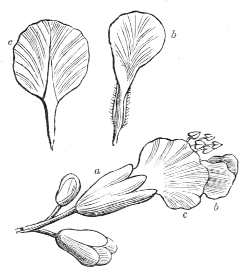 Fig. 130.—Scarlet Horse-chestnut.
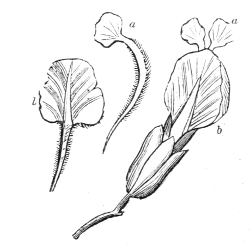 Fig. 131.—Yellow Horse-chestnut.
 Fig. 132.—Nut of the
Buckeye.
vary considerably; as, for example, in the
Scarlet Horse-chestnut (Æ. rubicunda), the calyx
is tubular (see a in fig. 130), and there are but
four petals, the upper two of which (b) are narrower
than the lower ones (c), and have bearded
claws. This species has sometimes eight stamens.
In the Yellow Horse-chestnut, or yellow
flowered American
Buckeye,
the upper petals
(a in fig. 131)
are very much
smaller than the
lower ones (b),
and both have
very long claws.
There are four
petals, which
conceal the stamens,
of which
there are frequently
only six.
The seed of Pavia
has only a
small hilum,
which resembles
the pupil of an
eye (see fig.
132); and hence
the genus has received
its American
name of
Buckeye. In
one species (P.
macrostachya), the nut is eatable, and very
much resembles that of a Sweet Chestnut when
boiled in milk. The stamens
in this species are much
longer than the petals, and
they give a peculiarly light
and elegant appearance to
the flowers; which, unlike
those of the other species, do
not appear till the latter end
of summer or autumn.
Fig. 132.—Nut of the
Buckeye.
vary considerably; as, for example, in the
Scarlet Horse-chestnut (Æ. rubicunda), the calyx
is tubular (see a in fig. 130), and there are but
four petals, the upper two of which (b) are narrower
than the lower ones (c), and have bearded
claws. This species has sometimes eight stamens.
In the Yellow Horse-chestnut, or yellow
flowered American
Buckeye,
the upper petals
(a in fig. 131)
are very much
smaller than the
lower ones (b),
and both have
very long claws.
There are four
petals, which
conceal the stamens,
of which
there are frequently
only six.
The seed of Pavia
has only a
small hilum,
which resembles
the pupil of an
eye (see fig.
132); and hence
the genus has received
its American
name of
Buckeye. In
one species (P.
macrostachya), the nut is eatable, and very
much resembles that of a Sweet Chestnut when
boiled in milk. The stamens
in this species are much
longer than the petals, and
they give a peculiarly light
and elegant appearance to
the flowers; which, unlike
those of the other species, do
not appear till the latter end
of summer or autumn.
ORDER XLVI.—RHIZOBOLEÆ—THE CARYOCAR
TRIBE.
Trees of large size, natives of tropical America.
Caryocar nuciferum produces the Suwarrow,
or Butter-nut of the fruiterers’ shops.
ORDER XLVII.—SAPINDACEÆ.—SOAP-TREE TRIBE.
The only plant in this order which will grow
in the open air in England is Kölreuteria paniculata,
a beautiful tree, with very elegant leaves,
and panicles of yellow flowers, which are succeeded
by a bladdery capsule, which is divided
into three cells in its lower part, though it is
only one-celled above. The rind and pulp of
the fruit of Sapindus Saponaria are used as
soap in those countries of which it is a native.
The nuts of this plant are round and hard, and
of such a shining black that they are made
into buttons and beads by the inhabitants of
Spanish America. The whole plant, if thrown
into ponds containing fish, will intoxicate, and
sometimes kill them. Another interesting plant
belonging to this order is the Chinese fruit
called Litchi (Euphoria or Nephelium Litchi);
which has its sweet eatable pulp enclosed in a
kind of nut, much wrinkled on the outside; so
that the fruit lies within the stone, instead of
being on the outside of it. These hard, stone-like
berries grow in loose racemes.
ORDER XLVIII.—MELIACEÆ.—THE BEAD-TREE
TRIBE.
Melia Azederach, the Pride of India, or Indian
Lilac, or Bead-tree, for it is known by all these
names, is a native of Syria, which has become
almost naturalised in the South of Europe,
particularly near the Mediterranean. The
leaves are bi-pinnate, the flowers are violet-coloured,
and the fruit, which resembles that of
the cherry, is of a pale yellow when ripe. The
pulp is poisonous, and the stones are used for
making rosaries in the Roman Catholic countries.
ORDER XLVIII*.—CEDRELEÆ.—THE MAHOGANY
TRIBE.
This order was at first united to Meliaceæ by
De Candolle, but it has been separated on
account of its winged seeds. It contains, among
other genera, the Mahogany tree (Swietenia
Mahagoni), and the West Indian Cedar (Cedrela).
The leaves of these trees are alternate
and pinnate, with unequal-sided leaflets; and
the flowers are in large spreading panicles composed
of numerous little cymes. The fruit is
capsular, and the seeds are winged. The genera
contained in this order, all require a stove in
Great Britain.
ORDER XLIX.—AMPELIDEÆ.—THE VINE TRIBE.
The natural order Ampelideæ contains several
genera, but of these only the Vine and the
five-leaved Ivy are common in British gardens.
It seems almost ridiculous to talk of the flowers
of the Vine, as the bunches, even when they
first appear, seem to consist of only very small
grapes, which gradually become large ones.
The flowers, however, though small and insignificant,
are perfect, and they have each a distinct
and regularly formed calyx and corolla. The
calyx of the common Grape (Vitis vinifera) is
very small, and remains on till the fruit is
ripe; there are five petals (a in fig. 133), which
never expand, but remain fastened together at
the tip, detaching themselves at the base, when
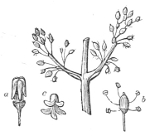 Fig. 133.—Flowers of the Vine.
it is necessary that
they should give room
to the ripening stamens
(b). The petals,
which form a kind of
extinguisher, when
they are raised by the
five stamens, fall off
(c), and occasion the
chaffy appearance observable in clusters of Vine-flowers.
The ovary is, when young, in two
cells, each containing two seeds; and it is
crowned with a nearly flat, round stigma, without
any style. When the fruit begins to swell,
the ovary becomes filled with a pulp, which is
solid, and not contained in bags like that of the
Orange; and the dissepiment that divided the
two cells gradually wastes away. Two, and
sometimes three of the seeds also frequently
disappear, so that four seeds are rarely found
in the ripe grape. The seeds themselves are
bony, and covered with a jelly-like matter; and
when they are cut open, they are found to
consist of a large quantity of hard albumen,
with a very small embryo at the tip. The Vine
is a climbing shrub, with lobed leaves, which
are frequently deeply cut; the bunches in which
the grapes are disposed are called branched or
thyrsoid racemes (see 137), and the tendrils,
by which the plant climbs, are supposed to be
abortive peduncles, drawn out into these long,
flexible, curling bodies, instead of producing
bunches of grapes. The footstalks of the leaves
are articulated, and will separate from the
branch without tearing them. The different
species of vines differ from each other chiefly
in their leaves; but in the American grapes
the calyx is sometimes entire, and sometimes
the stamens and pistils are in different flowers.
Fig. 133.—Flowers of the Vine.
it is necessary that
they should give room
to the ripening stamens
(b). The petals,
which form a kind of
extinguisher, when
they are raised by the
five stamens, fall off
(c), and occasion the
chaffy appearance observable in clusters of Vine-flowers.
The ovary is, when young, in two
cells, each containing two seeds; and it is
crowned with a nearly flat, round stigma, without
any style. When the fruit begins to swell,
the ovary becomes filled with a pulp, which is
solid, and not contained in bags like that of the
Orange; and the dissepiment that divided the
two cells gradually wastes away. Two, and
sometimes three of the seeds also frequently
disappear, so that four seeds are rarely found
in the ripe grape. The seeds themselves are
bony, and covered with a jelly-like matter; and
when they are cut open, they are found to
consist of a large quantity of hard albumen,
with a very small embryo at the tip. The Vine
is a climbing shrub, with lobed leaves, which
are frequently deeply cut; the bunches in which
the grapes are disposed are called branched or
thyrsoid racemes (see 137), and the tendrils,
by which the plant climbs, are supposed to be
abortive peduncles, drawn out into these long,
flexible, curling bodies, instead of producing
bunches of grapes. The footstalks of the leaves
are articulated, and will separate from the
branch without tearing them. The different
species of vines differ from each other chiefly
in their leaves; but in the American grapes
the calyx is sometimes entire, and sometimes
the stamens and pistils are in different flowers.
The five-leaved Ivy, or Virginian Creeper
(Ampelopsis hederacea), differs very little from the
Vine in the botanical construction of its flowers.
The calyx is, however, almost entire, and the
five petals separate in the same way as those
of other flowers; but in other respects they
closely resemble those of the Vines. The berries
are small, and not palatable, though they might
be eaten with perfect safety. The leaves are
palmate, and they are divided into three or five
stalked leaflets. The stems are climbing and
rooting; and the leaves take a beautiful deep
red in autumn. The genus Cissus also belongs
to this order.
ORDER L.—GERANIACEÆ.—THE GERANIUM TRIBE.
The order Geraniaceæ contains several genera
of well-known plants, the most popular of
which are Pelargonium, Erodium, and Geranium,
signifying Stork’s-bill, Heron’s-bill, and Crane’s-bill,
which differ very slightly from each other.
The greenhouse Geraniums, which are all either
natives of the Cape of Good Hope, or hybrids
raised in Europe from the species originally
imported, were, till lately, all included in the
genus Pelargonium; but what were sections of
that genus have, by some botanists, been now
made separate genera. As probably, however,
this rage for giving new and different names to
divisions and subdivisions will not be generally
adopted, I will not trouble my readers with
any other distinctions than those between the
three leading genera; and even these, I think
they will allow, appear very trifling. The calyx
of the Pelargonium is in five sepals, and two of
them end in a kind of spur; which is, however,
not very perceptible, as it runs down the peduncle
or footstalk of the flower, and grows to it,
so as to seem only a part accidentally enlarged.
The corolla is in five petals, the upper two of
which are generally larger, and differently
marked to the others. Sometimes there are
only four, and sometimes there are six petals;
but these are exceptions to the general rule.
The perfect stamens vary in number from four
to seven; but there are always ten filaments,
which are dilated, and grow together at the
base; and I was quite delighted with the
sparkling gem-like appearance of the membrane
which they form when thus united, when
I looked at it through my little microscope.
In the plant now before me (a hybrid called the
Duke of Sussex), the upper parts of some of the
stamens have turned into little petals, retaining
the white membrane-like part at the base, and
thus curiously exemplifying the manner in which
double flowers are formed, which is always by
the metamorphosis of the stamens, or of the
stamens and pistil, into petals. The pistil of
the Pelargonium appears, when young, to consist
of a five-celled ovary, with a long slender
style, the tip of which is divided into five slender
curved stigmas. The cells of the ovary are,
however, five one-seeded carpels, each having a
separate style; and though both the carpels
and styles appear firmly grown together when
young, yet, in fact, they only adhere to an
elongation of the receptacle (see a in fig. 134),
which is here called the central axis, and from
which, when ripe, they part with elasticity, and
curl up, as shown at b; the styles, or awns, as
they are sometimes called, being hairy inside.
The shape of the unripe seed-vessel, with its
persistent calyx, is shown at c, and a detached
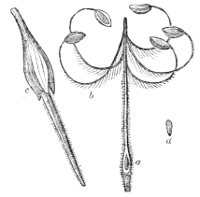 Fig. 134.—Seed-vessel of a Pelargonium.
seed at d. No plant
hybridises more
freely than the
Pelargonium; and
thus, the number
of new kinds raised
every year defies
all description, and
they have been so
mixed and intermixed
with each
other, that it is
not easy to say to what species the most
splendid hybrids are allied. A few species,
however, remain nearly unchanged, and the
best known of these are P. zonale, the Horseshoe
Geranium; P. inquinans, the common
scarlet, the juice of the leaves of which is said
to stain the fingers brown; P. graveolens, and
P. capitatum, the rose-scented Geraniums, and
P. tricolor. All the Pelargoniums have their
flowers in heads or umbels; and the calyx in
all of them remains on till the seeds are ripe.
The seed-vessel, or fruit, as it is called by botanists,
is long and pointed, forming some resemblance
to the head of a stork; the ovary shrouded
in the persistent calyx, representing the head
of the bird, and the long styles the beak. The
leaves vary in shape in the different kinds:
sometimes they are roundish, as in the Horseshoe
Geranium, and marked with a dark band
or zone, whence the specific name zonale; and
sometimes they are deeply cut, as in the rose-scented
kinds: some are shrubby, and some
herbaceous; and the stems of some species are
warted, and the roots of others tuberous.
Fig. 134.—Seed-vessel of a Pelargonium.
seed at d. No plant
hybridises more
freely than the
Pelargonium; and
thus, the number
of new kinds raised
every year defies
all description, and
they have been so
mixed and intermixed
with each
other, that it is
not easy to say to what species the most
splendid hybrids are allied. A few species,
however, remain nearly unchanged, and the
best known of these are P. zonale, the Horseshoe
Geranium; P. inquinans, the common
scarlet, the juice of the leaves of which is said
to stain the fingers brown; P. graveolens, and
P. capitatum, the rose-scented Geraniums, and
P. tricolor. All the Pelargoniums have their
flowers in heads or umbels; and the calyx in
all of them remains on till the seeds are ripe.
The seed-vessel, or fruit, as it is called by botanists,
is long and pointed, forming some resemblance
to the head of a stork; the ovary shrouded
in the persistent calyx, representing the head
of the bird, and the long styles the beak. The
leaves vary in shape in the different kinds:
sometimes they are roundish, as in the Horseshoe
Geranium, and marked with a dark band
or zone, whence the specific name zonale; and
sometimes they are deeply cut, as in the rose-scented
kinds: some are shrubby, and some
herbaceous; and the stems of some species are
warted, and the roots of others tuberous.
The genus Erodium consists principally of
European plants, three of which are natives of
England. The commonest of these (Erodium
cicutarium) is called in many parts of England
the Wild Geranium; and nearly allied to it,
but less common, is E. moschatum. The principal
points in which this genus differs from
Pelargonium are, that the filaments of the stamens
are very little united at the base; that
there are always five filaments which bear
anthers, and five that are sterile, and that the
latter have each a gland at the base. The calyx
is also without the spur, and the seed-pod is
thought to resemble a heron’s head more than
that of a stork. When it bursts, also, the
styles, which are hairy inside like those of the
Pelargonium, do not curl up in the same manner
as in that genus, but spirally.
The genus Geranium differs from Erodium
principally in having the stamens all perfect;
but the alternate ones are longer than the
others, and have a gland at the base of each.
The seed-pod is said to resemble the head of a
crane, and when it bursts, the styles, which are
smooth inside, curl up round and round like the
coil of a rope. The seeds of many of the kinds
are beautifully netted. Many of the species are
British weeds, and among the commonest of
these may be mentioned Herb Robert (Geranium
Robertianum), and the Meadow Crane’s-bill
(G. pratense). Dr. Lindley, in his Ladies’
Botany, mentions a curious and beautiful experiment
which may be performed by pressing the
petals of a Geranium between two pieces of
glass which have been previously wetted. He
says, that by pressing the two glasses firmly
together, all the air may be squeezed out of the
petal, and it will become transparent. “You
may then,” he adds, “with a pretty good magnifying
power, observe all the air-vessels of the
veins distinctly, looking like fine threads of
silver-wire twisted up like a spiral spring. It
is on account of this appearance that the air-vessels
are called, technically, spiral vessels.”
The experiment appeared to me so easy, and
at the same time so interesting, that I tried it,
but unfortunately without success; probably
owing to the want of power in my microscope.
ORDER LI.—LIMNANTHEÆ.
This little order contains only one plant, Limnanthes
Douglassi, a pretty Californian annual,
with yellow and white flowers. It resembles
Geraniaceæ in its botanical construction, but it
does not discharge its seeds with elasticity.
ORDER LI.—TROPÆOLACEÆ.—THE NASTURTIUM
TRIBE.
The well-known flowers called Nasturtium, or
Indian Cress, give their name to this order;
which, in fact, consists only of the genus Tropæolum,
and an obscure genus not yet introduced.
In the flowers of the Nasturtium, the
calyx and corolla are of nearly the same colour,
but they may be easily distinguished from each
other. The calyx is drawn out into a spur
behind, and the petals, which are unguiculate, or
claw-shaped, are fringed at the base. The
leaves and stem are succulent, and have the
taste of cress, and hence the plant has received
its popular name,—Nasturtium being the botanic
name of the water-cress. The Tropæolum has
five petals, eight stamens, and three carpels,
which are joined together into a trigonal fruit,
each carpel containing one seed, which adheres
to it. The embryo is large, and fills the whole
seed, which is without albumen. The unripe
carpels are sometimes pickled, and used as a
substitute for capers. The whole plant has not
only the taste, but the properties, of cruciferous
plants; and even the caterpillars of the cabbage-butterflies
feed upon it.
ORDER LII.—BALSAMINEÆ.—BALSAM TRIBE.
Nearly allied to the Geraniums, and resembling
them, in the opening of the seed-pods, are
the beautiful plants contained in the order Balsamineæ.
The two genera best known in British
gardens are Balsamina and Impatiens.
The common Balsam (Balsamina hortensis), has
a small green calyx of two sepals; there are
four petals, one of which is drawn out into a
short spur at the base. There are five stamens,
each bearing a two-celled anther. The ovary
is one-celled, but it separates into five valves,
when the seeds are ripe, bursting with elasticity,
and the valves curling inwardly from the
apex to the base. There are five stigmas, quite
distinct from each other, and appearing just
above the ovary, without any style; and the
peduncles are simple and one-flowered.
The genus Impatiens, which contains the
common Noli-me-tangere, or Touch-me-Not,
and other similar plants, though it agrees with
Balsamina in having five anthers, has only three
of them with two cells, the others having one
cell each. The stigmas also are joined together
at the base, and the capsule bursts at the
slightest touch, the valves coiling up spirally
from the base to the apex, and detaching themselves
from the plant at the same time that they
expel the seeds. The peduncles grow from
the axils of the leaves, and they are branched
and many-flowered. A separate order, called
Hydrocereæ, has been made of one of the species
of Impatiens (I. natans). It is an aquatic plant,
a native of the East Indies.
ORDER LIII.—OXALIDEÆ.—THE WOOD-SORREL
TRIBE.
The flowers of all the species of Oxalis, the
Wood-sorrel, are very pretty. The flowers
have five regular petals, each furnished with a
claw; and the petals are spirally twisted in the
bud. There are ten stamens, and five styles.
The capsule is five-celled, and five or ten valved,
the valves opening lengthways. Most of the
species are natives of South America, and
greenhouse plants in England.
ORDER LIV.—ZYGOPHYLLEÆ.—THE BEAN-CAPER
TRIBE.
The flowers of the Bean-caper are usually
yellow; and the five petals are long, narrow,
and placed widely apart. The botanic name
of Zygophyllum signifies “with the leaves in
pairs,” and this is the case to a remarkable
degree. Fagonia cretica is a very pretty plant,
with purple flowers very much like those of
Clarkia; and Guiacum, the Lignum Vitæ, is
remarkable for the hardness of its wood and
the gum it produces. Melianthus belongs to
this order.
ORDER LV.—RUTACEÆ.—THE RUE TRIBE.
This order has been divided into four sections;
three of which contain well-known plants,
and have been divided into three orders by
many botanists. The Rue (Ruta graveolens) is
well known from its strong and disagreeable
smell, which is produced by the oil secreted in
transparent cells in the leaves, which have the
appearance of dots, when the leaves are held up
to the light. The leaves are of a bluish green,
and the flowers of a greenish yellow; the latter
growing in cymes at the end of the branches.
There are four sepals, four petals, and eight stamens.
There are four carpels, seated on an elevated
receptacle, and each containing one cell,
which grow into a four-celled fruit. In Fraxinella
(Dictamnus) the petals are unequal; there are
ten stamens, one style, and the carpels are
two-seeded. In Diosma there are only five
stamens, the style is arched, and the capsule
consists of five-horned carpels. In Corræa the
leaves are opposite; there are eight stamens,
and the four petals grow together into a tube
at the base; and in Crowea there are five
sepals, five petals, and ten stamens; the leaves
are also alternate. The Diosmas have as strong
a scent as the Rue, and a perfume is made from
them called Bucku at the Cape of Good Hope,
of which country they are natives.
The section Zanthoxyleæ contains the Zanthoxylum,
also called the Toothache Tree, or
Prickly Ash, a native of North America, the
bark of which is very fragrant, and is said to be
a cure for toothache and rheumatism; Ptelea
or Shrubby Trefoil; and Ailantus glandulosa.
Zanthoxylum fraxineum has very pretty pinnate
leaves, and small purple flowers; Ptelea trifoliata
has curiously winged fruit, which resemble
those of the elm; and the Ailantus has remarkably
long compound leaves, one leaf having
been known to have fourteen pairs of leaflets,
and to be upwards of three feet long. The two
following orders are included in Rutaceæ by
some botanists.
ORDER LVI.—SIMARUBACEÆ.
Quassia amara, the bark of which is sometimes
used as a substitute for hops, is perhaps
the best known plant belonging to this order.
All the species are trees or shrubs, natives of
tropical America, with bitter bark, milky juice,
and pinnated leaves.
ORDER LVII.—OCHNACEÆ.
Tropical shrubs with yellow flowers and
shining leaves; seldom seen in British hothouses.
ORDER LVIII.—CORIAREÆ.
Only one species of this order is common in
British gardens, viz. Coriaria myrtifolia; the
leaves of which are astringent, and used in
dyeing black, and the berries are poisonous.
§ II.—Calycifloræ.
The plants comprised in this division have
their petals and stamens inserted in the calyx,
or in a lining of it formed by the dilated receptacle.
ORDER LIX.—CELASTRINEÆ.
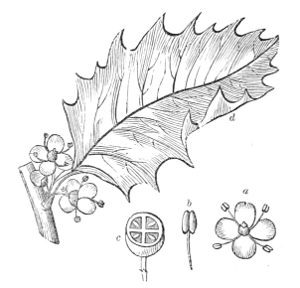
Fig. 135.—The Holly.
This order is divided into three sections, each
containing well-known plants. The first of these
takes its name from Staphylæa pinnata, the
Bladder-nut. In the flowers of this plant the
calyx is in five divisions, and white tinged with
pink, so as to be scarcely distinguishable from
the corolla. There are two or three carpels,
which are surrounded by the receptacle, and
the styles of which adhere slightly together.
The capsule is bladdery, and consists of two or
three cells, each containing one smooth, brownish,
bony seed, which looks as though one end
had been cut off at the hilum. The leaves are
compound, each having five leaflets. The second
section contains, among other plants, the
Spindle-tree (Euonymus europæus), Cassine,
and the Staff tree (Celastrus scandens). The
Euonymus has small whitish-green inconspicuous
flowers; but it is remarkable for the
beauty of its capsules, which are fleshy, and of
a bright rose-colour, while the seeds, which are
of a bright orange, are enwrapped in a covering
called an aril, by which they remain attached
to the capsule after the valves have opened.
Each capsule has five cells and five seeds, and
each seed has a little white stalk attached to its
aril, like the funicle of a pea. There are several
species. The Celastrus is a climbing shrub,
remarkable for its clusters of flowers, but which
has nothing else to recommend it. The third
section, Aquifoliaceæ, is made a separate order,
under the name of Ilicineæ, or Aquifoliaceæ, by
many botanists; some of whom place it in the
sub-class Corollæfloræ, because the petals are
connected at the base. The most common plants
that it contains are included in the genera Ilex
and Prinos. In Ilex aquifolium, the Holly, the
corolla (a in fig. 135), is in four or five petals
connected at the base; there are four stamens,
the cells of the anthers of which adhere to the
sides of the filament (b). The berry (c) is four -celled,
each cell containing a one-seeded nut.
The leaves (d) are simple, and smooth, shining
and prickly at the edges, which are curved
upwards. Prinos, the Winter-berry, is a little
evergreen shrub, with red berries.
ORDER LX.—RHAMNACEÆ.
The most interesting genera in this order are
Paliurus, Zizyphus, Rhamnus, and Ceanothus.
Christ’s Thorn (Paliurus aculeatus) is easily
known by its crooked prickly stem, and its singular
fruit, which, from its resembling a head
with a broad flat hat on, the French call,
Porte-chapeau. The flowers are yellow, but
they are too small to be ornamental. Zizyphus
Jujuba differs from Paliurus chiefly in its fruit,
which resembles a small plum, and from the
fruit of which the Jujube lozenges are made.
There are numerous species of Rhamnus, some
of which are trailing-shrubs, and others low
trees. Some of the species, such as R. Alaternus,
are evergreen shrubs, very useful in town-gardens,
as they are not injured by smoke;
others, such as the Purging Buckthorn (R. catharticus),
have deciduous, rough, feather-nerved
leaves, and the branchlets terminating in a
thorn. The berries of the plants in this division
are sold for dyeing yellow, under the name of
French or Avignon berries. Another division
includes the species which are without thorns.
All these plants have their male and female
flowers distinct. The last division of Rhamnus
has perfect flowers, and dark-purple berries, as
for example, the Berry-bearing Alder (R. frangula).
The genus Ceanothus is well known
from the beautiful C. azureus. The other species
have generally the same kind of terminal,
upright panicles of feathery flowers, but they
are very inferior in beauty. C. americanus, which
has white flowers, is sometimes called American
Red-root, or New Jersey Tea.
ORDER LXI.—BRUNIACEÆ.
Small heath-like shrubs, natives of the Cape
of Good Hope.
ORDER LXII.—SAMYDEÆ.
Tropical shrubs or trees with dotted leaves,
and inconspicuous flowers.
ORDER LXIII.—HOMALINEÆ.
This order contains the handsome evergreen
half-hardy shrub, Aristotelia Macqui; the
flowers are insignificant, but the berries are
black, acid, and eatable, and the leaves are
smooth, shining, and so abundant as to render
the plant an excellent screen.
ORDER LXIV.—CHAILLETIACEÆ.
African plants, with panicles of small white
flowers, and simple leaves.
ORDER LXV.—AQUILARINEÆ.
Trees, natives of Asia, little known in England.
ORDER LXVI.—TEREBINTHACEÆ.—THE
TURPENTINE TRIBE.
This order is divided by De Candolle into
seven sections; viz., 1. Anacardiaceæ, including
the Cashew-nut (Anacardium), the Mango
(Mangifera), and the Turpentine trees (Pistacia);
2. Sumachineæ, which contains Rhus,
Schinus, and Duvaua: 3, Spondiaceæ, containing
the Hog-plum (Spondias); 4. Burseraceæ,
including the Jamaica Birch (Bursera), and
the Balm of Gilead tree (Balsamodendron);
5. Amyrideæ, the West Indian Balsam tree
(Amyris); 6. Spatheliaceæ, the West Indian
Sumach (Spathelia); and 7. Connaraceæ,
containing Omphalobium, and other exotic genera.
Of these modern botanists make five distinct
orders, viz., Anacardiaceæ, including the
first, second, and fifth sections; Amyrideæ,
Spondiaceæ, Burseraceæ, and Connaraceæ.
Ptelea, which was originally included in this order,
is now generally placed in Xanthoxylaceæ.
The plants contained in this order have in
some cases perfect flowers, and in others, the
male and female flowers on different plants.
They all abound in a resinous gum; that
from the Mastic tree (Pistacia Lentiscum), and
several of the species of Rhus, is used for
making varnish; the gum of the Turpentine
tree (P. Terebinthus) is the Chian or Cyprus
turpentine. The flowers are small, and generally
produced in panicles, the petals are sometimes
wanting. The leaves are alternate, without
stipules, and often compound. The flowers
have generally five petals, and five or ten stamens;
and the fruit is drupaceous, or capsular,
varying in the different genera. In Anacardium,
the peduncle which supports the Cashew-nut
is fleshy and pear-shaped, so as to resemble
a fruit more than the nut itself. The Mango
has a fleshy drupe, with a woody, fibrous stone
or nut. In Pistacia, the fruit is a dry drupe
inclosing a nut, which is eatable in P. vera.
Both the male and female flowers in this genus
are handsome, though without petals, from the
anthers being yellow, and the stigmas crimson.
The different species of Sumach, or Rhus, are all
poisonous; and the Venetian Sumach (Rhus
cotinus) is remarkable from the appearance
presented by its flower-stalks in autumn; as all
the flower-stalks which do not bear fruit dilate,
after the flowers have dropped, and become
covered with a great quantity of white cottony
hair, which makes each panicle resemble a
powdered wig; and hence, the French call the
tree Arbre à perruque.
ORDER LXVII.—LEGUMINOSÆ.—(See Chap. II.
in P. 35.)
The plants belonging to this order have alternate
leaves, which are generally compound, and
frequently have the common petiole tumid;
they have also two stipules at the base of the
petiole, and frequently two others to each
leaflet. The pedicels are usually articulated,
and the flowers are furnished with small bracts.
The flowers have a five-parted calyx, and a
corolla, sometimes papilionaceous, and sometimes
spreading, which has never more than five
petals, though it has frequently less. The fruit
is a legume, though sometimes, when there is
only one seed, it has the appearance of a drupe.
There are eleven sections given in De Candolle’s
Prodromus, viz., 1. Sophoreæ, the Sophora tribe;
2. Loteæ, the Lotus tribe; 3. Hedysareæ, the
Sainfoin tribe; 4. Vicieæ, the Vetch tribe,
(including the Pea and Bean); 5. Phaseoleæ,
the Kidney-bean tribe; 6. Dalbergia, the Gum-dragon
tribe; 7. Swartzia; 8, Mimoseæ, the
Mimosa tribe; 9. Geoffrea, the Earth-nut tribe,
(including the Earth-nut Arachis, and the Tonquin
Bean, Dipterix); 10. Cassieæ, the Cassia
tribe; and 11. Detarieæ. Some botanists include
Moringa, the Horse-radish tree, in Leguminosæ,
but others make it a separate order
under the name of Moringeæ.
ORDER LXVIII.—ROSACEÆ.—(See Chap. III. in P. 50.)
The flowers have five sepals, combined in
their lower part into a tube, but divided above
into five lobes; and the corolla has generally
five petals. There are numerous carpels, which
are usually inclosed in the fleshy tube of the
calyx. The ovary is one-celled, and there is
seldom more than one seed, and scarcely ever
more than two. The leaves are alternate,
generally compound, and always furnished with
stipules. De Candolle divides the order into
eight tribes, viz., 1. Chrysobalaneæ; 2. Amygda lineæ;
3. Spiraceæ; 4. Neuradeæ; 5. Dryadæ,
or Potentilleæ; 6. Sanguisorbeæ; 7. Roseæ; and
8. Pomaceæ. Of these, the first, second, third,
and eight, are made separate orders; the fifth,
sixth, and seventh are retained in Rosaceæ.
Neuradeæ was first removed to Ficoideaceæ,
and afterwards made a separate order; and
another order has been made, called Quillageæ,
including only the genera Kageneckia and
Quillaja.
ORDER LXIX.—CALYCANTHACEÆ.
There are only two genera in this order,
both of which are remarkable for the fragrance
of their flowers. The American Allspice (Calycanthus
floridus) is a shrub, with very dark
blackish purple flowers, which botanists consider
to be all calyx, the plants in this order
having no petals. The lobes of the calyx are
somewhat leathery in texture, and lanceolate in
form; they are very numerous, and they are
disposed in several rows, like scales. The stamens
are numerous, but only the outer twelve
are fertile, and they soon fall off. The peduncle
is thickened below the flower; and the receptacle
is dilated, and drawn out over the carpels,
which are arranged in it like those of the rose,
which they closely resemble, but are much
larger. The leaves are opposite and feather-nerved.
Chimonanthus fragrans, so well-known
for its beautiful yellowish flowers, which are
produced about Christmas, belongs to this
order. In this plant the lobes of the calyx are
oval, and not nearly so numerous as in Calycanthus;
the outer lobes look like bracts. The
stamens are less numerous, and not deciduous;
and only five are fertile, which are united at the
base. This plant was formerly called Calycanthus
præcox.
ORDER LXX.—GRANATEÆ.
This order has only one genus and two
species. The Pomegranate (Punica Granatum)
has a tubular calyx, with a limb in five or
seven divisions, and the same number of petals
as there are segments to the calyx. The calyx
and corolla are both of the same colour. When
the petals fall, the tube of the calyx swells, and
becomes a many-celled berry, the limb of the
calyx remaining on, and forming a kind of
crown to the fruit. The cells are divided into
two parts, and they contain a great number of
seeds which are plunged in a juicy pulp. The
other species, P. nana, only differs in being a
dwarf plant, and in the leaves being narrower.
The Pomegranate was formerly included in
Myrtaceæ.
ORDER LXXI.—MEMECYLEÆ.
Tropical trees and shrubs, with white or
purplish flowers, and eatable fruit.
ORDER LXXII.-COMBRETACEÆ.
This order is well-known from the two beautiful
climbing stove-plants, Combretum purpureum,
and Quisqualis indica. The flowers of the
former are disposed in racemes, which have a
peculiarly light and graceful appearance, from
the great length of their stamens; and as
they are of a brilliant scarlet, the name of Purpureum
is very ill applied to the species. The
flowers of Quisqualis indica have a very long
slender tube to the calyx, and five velvet-like
petals, which vary in colour from a yellowish
white to red, changing in the course of one day.
ORDER LXXIII.—VOCHYSIEÆ.
Brazilian trees and shrubs, with yellow
flowers, and stipulate, feather-nerved leaves.
ORDER LXXIV.—RHIZOPHOREÆ.
The Mangroves (Rhizophora) are tropical
trees, growing in the soft mud of rivers, particu larly
in that of the Niger, so that, when the
rivers are full, they appear to grow out of the
water. The seeds have the singular property
of germinating in the capsule, and sending down
long roots while yet hanging on the tree, the
branches of which thus appear, at a little distance,
as if covered with long white strings.
All the genera belonging to this order require
a stove in England.
ORDER LXXV.—LOPHIREÆ.
The only plant contained in this order is a
beautiful shrub from Sierra Leone, with terminal
corymbs of white flowers, and coriaceous
leaves.
ORDER LXXVI.—ONAGRARIÆ.—(See Chap. IV.
in P. 75.)
The tube of the calyx generally adheres to
the ovary, and its limb is usually two or four
lobed, the lobes frequently adhering together.
The petals are either four, or equal in number
to the lobes of the calyx; they are inserted
in the mouth of the tube, and are twisted in the
bud. The fruit is generally a capsule, or a
berry, with two or four cells; and there are
numerous seeds. The leaves vary consider ably,
and are sometimes alternate, and sometimes
opposite, but never compound. De Candolle
divides this order into six sections: viz.
1. Montinieæ; 2. Fuchsieæ; 3. Onagreæ, containing
the Evening Primrose (Œnothera), and
the French Willow Herb (Epilobium); 4. Jussieuæ;
5. Circææ, including the Enchanter’s
Nightshade (Circæa), and Lopezia; and 6. Hydrocaryes,
containing the Water-caltrops (Trapa
natans). This last section is sometimes made a
separate order.
ORDER LXXVII.—HALORAGEÆ, OR CERCODIANÆ.
Most of the plants in this order are British
weeds; as for example, the Water Milfoil (Myriophyllum),
Water Starwort (Callitriche), and
Mare’s-tail (Hippuris); but some are natives of
North America, China, &c., and one genus has
lately been discovered in Australia, which Dr.
Lindley has named Loudonia aurea, and which
is a large shrub, with corymbs of golden yellow
flowers.
ORDER LXXVIII.—CERATOPHYLLEÆ.
British weeds called Hornwort.
ORDER LXXIX.—LYTHRARIEÆ, OR SALICARIÆ.
The principal plants in this order that are
interesting to amateurs, are included in the
genera Lythrum, Cuphea, Heimia, Lawsonia,
and Lagerstrœmia. The genus Lythrum contains
all those showy British plants which are
called the Willow Herbs. The flowers are
purple, and the petals, which are four or six in
number, are crumpled in the bud. The stamens
are either the same number as the petals, or
twice the number, and the capsule is two-celled.
The calyx, as in all the plants included in this
order, is tubular, with numerous lobes; and the
petals soon fall off. Cuphea is a genus principally
of annual plants, with six or seven dark
purple petals, unequal in size, and curiously inserted
in the calyx. Heimia is a genus of South
American shrubs, with yellow flowers. Lawsonia
inermis produces the Henna, which the
ladies of the East use to dye the palms of their
hands pink; and Lagerstrœmia is a beautiful
conservatory tree, with handsome flowers. This
plant is sometimes called the pride of India.
ORDER LXXX.—TAMARISCINEÆ.—THE
TAMARISK TRIBE.
There are very few plants in this order, and
the only ones common in British gardens are
the French Tamarisk (Tamarix Gallica), and
the German Tamarisk (Tamarix, or Myriacaria
Germanica); both of which are easily recognized
by their light airy branches, (which when young
are covered with closely imbricated leaves,
though the leaves drop off as the wood ripens,)
and their terminal erect spikes of whitish or
pink flowers. The seeds are large, and are
each furnished with a tuft of hairs at the end of
a kind of stalk. These plants are very suitable
for planting near the sea, as they are uninjured
by the sea-breeze.
ORDER LXXXI.—MELASTOMACEÆ.
This order consists of showy exotic plants,
most of which require a stove in Britain, and
which are easily known by their leaves being
marked with two or more deep lines running
parallel to the midrib. They are all free-growing
plants, with very handsome flowers, which
are generally purple or white.
ORDER LXXXII.—ALANGIEÆ.
There are two genera, Alangium and Marlea,
both handsome shrubs, natives of India.
ORDER LXXXIII.—PHILADELPHEÆ.—THE MOCK-ORANGE
TRIBE.
There are three genera in this order: viz.,
Philadelphus, the Mock-Orange or Syringa;
Decumaria and Deutzia, all which have white
flowers. There are many species of Philadelphus,
all of which are easily known by their
large white flowers, and large coarse-looking
leaves. The flowers of the common species
(P. coronarius) smell like those of the Orange,
and the leaves taste like cucumber. There is
only one species of Decumaria (D. barbara),
which is a native of Virginia and Carolina, and
is a climbing shrub, with terminal corymbs of
white, sweet-scented flowers. Deutzia scabra,
though only introduced in 1833, is already
common in gardens; and it is a general favourite
from the great abundance of its flowers.
Though it said to be not a true climber, its
stems are too weak to stand without support.
It is a native of Japan, and though generally
kept in pots, it is supposed to be quite hardy.
ORDER LXXXIV.—MYRTACEÆ.—THE MYRTLE
TRIBE.
No plants are more easily recognized than
those belonging to this tribe; as they are easily
distinguished by their entire leaves, which have
no stipules, and which, when held up to the
light, appear to be not only full of transparent
dots, but to have a transparent line round the
margin. The flowers have also abundance of
stamens on long slender filaments which look
like tufts of silk, and only four or five petals.
The whole of the plants are fragrant, and every
part of them seems full of an aromatic oil, which
is particularly visible in the flower-buds of Caryophyllus
aromaticus, which when dried form what
are commonly called cloves; and in the leaves
of some of the kinds of Eucalyptus. The genera
may be divided into two sections, viz.,
those with a dry capsule for the fruit; in which
are included Melaleuca and its allied genera,
Eucalyptus, Callistemon, Metrosideros and Leptospermum;
and those with berry-like fruit, the
most interesting of which are Psidium, the Guava;
Myrtus, the Myrtle; Caryophyllus, the
Clove; Eugenia or Myrtus pimenta, Jamaica
Allspice; and Jambosa Vulgaris or Eugenia
Jambosa, the Rose Apple. In some of the genera,
as for example in Eucalyptus, the sepals
of the calyx become detached at the base, and
being united above form a sort of cap or calyptra,
which is pushed off by the stamens when
the flower begins to expand. Besides the plants
already enumerated, some botanists add another
section to Myrtaceæ, which others consider a
separate order; under the name of Lecythideæ.
This section contains three genera, the most
remarkable plants in which are the Cannon
Ball-tree (Lecythis Ollaria), and the Brazil Nut
(Bertholletia excelsa). The fruit of this last
plant is fleshy, and as large as a child’s head,
opening with a lid, and containing sixteen or
twenty triangular seeds, laid over each other in
a regular manner, which are the Brazil-nuts sold
in the shops.
ORDER LXXXV.—CUCURBITACEÆ.—THE GOURD
TRIBE.
The plants included in this order have generally
the male and female flowers distinct. The
calyx is tubular, and generally five-toothed;
there are five petals usually connected at the
base, and which have strongly marked reticulated
veins. There are five stamens, four of
which are united so as to form two pairs, with
the fifth one free. The anthers are two-celled,
and generally very long. There are three or
five two-lobed stigmas, which are thick and
velvety. The fruit is fleshy, with numerous flat
seeds. The leaves are palmate, and very rough;
and the plants have succulent stems, and climb
by means of their tendrils. The principal genera
are, Cucumis, which includes the Melon (C.
melo), the Cucumber (C. sativus), the Mandrake
(C. Dudaim), the Water Melon (C. citrullus),
and the Colocynth (C. colocynthis); Bryonia,
best known by the White Bryony (B. dioica);
Momordica, including the Balsam Apple (M.
balsamea), and the Squirting Cucumber (M. elaterium);
and Cucurbita, including all the kinds
of Pumpkin (C. pepo), and Vegetable Marrow
(C. ovifera). To these may be added Lagenaria,
the Bottle Gourd; and Trichosanthes, the Snake
Gourd, plants far more curious than useful.
Some botanists include the Papaw-tree (Carica
Papaya) in Cucurbitaceæ, but others make it
into a separate order under the name of Papayaceæ.
ORDER LXXXVI.—PASSIFLOREÆ.—THE PASSION-FLOWER
TRIBE.
The plants belonging to this order may be
instantly recognized by the very singular arrangement
of the pistil and stamens. The
receptacle is raised in the centre of the flower
so as to form a long cylindrical stipe, on which
is placed the ovary, with its three styles, each
ending in a fleshy stigma; a little lower are five
stamens, with their filaments growing together
round the stipe, and with large anthers which
are attached by the back. At the base of the
stipe are two or more rows of filaments without
anthers, which are called the rays. There are
five petals and five sepals; but some botanists
consider the whole to be sepals, and that the
petals are wanting. The fruit of some of the
species is eatable. It is about the size of a
large egg, and contains numerous seeds, which
are enveloped in a kind of pulp.
ORDER LXXXVI.*—MALESHERBIACEÆ.
This order consists entirely of the plants belonging
to the genus Malesherbia; which are
mostly annuals, or biennials, with very showy
blue or white flowers, introduced from Chili in
1832. The genus was formerly included in
Passifloraceæ.
ORDER LXXXVII.—LOASEÆ.
All the species contained in this genus are
natives of North America, and most of them
are annuals, with very showy flowers. The
genera Loasa and Caiophora are covered with
glandular hairs or bristles, which sting much
worse than those of the nettle. Bartonia aurea
is one of the most splendid annuals in cultivation,
from its golden yellow flowers; Blumenbachia
has the fruit roundish and spirally twisted,
and Caiophora has the fruit horn-shaped, and
twisted in a similar manner. This curious construction
of the fruit may be seen in C. punicea,
the well known showy climber, generally called
Loasa aurantiaca, or lateritia. The fruit of the
true kinds of Loasa is plain and not twisted, as
may be seen in L. nitida, L. Placei, and in short
in all the other species of the genus. The
flowers of most of the plants in this order are
very curiously constructed, there being two sets
of petals quite distinct in form and colour, and
two sets of stamens. The five outer petals are
large and hooded, and in each is cradled a
bundle of four or more stamens. These petals
and stamens are turned back; but there is a
second set of five petals which are generally
blotched with red, which stand erect, and enclose
a second set of stamens also erect, which
surround the style.
ORDER LXXXVIII.—TURNERIACEÆ.
The only genus in British gardens is Turnera,
and the species are hothouse and greenhouse
herbaceous plants, with flowers very like those
of the Bladder Ketmia. On examination, however,
it will be immediately seen that they do
not belong to the Mallow tribe, as their stamens
are distinct, whereas those of all the Malvaceæ
are united into a central column.
ORDER LXXXIX.—PORTULACEÆ.—THE PURSLANE
TRIBE.
The ornamental plants belonging to this
order, are all included in the genera Calandrinia,
Portulaca, Talinum, and Claytonia; and
those belonging to the first two of these genera
have very showy flowers. In all the species the
flowers have a distinct calyx, generally of only
two sepals, which remains on till the seeds are
ripe; and a corolla of five regular petals, which
close in the absence of the sun. Each flower
has numerous stamens, and a single style with a
broad-lobed stigma which, is succeeded by a dry,
one-celled capsule, with a central placenta, to
which are attached numerous seeds. The capsule
opens naturally when ripe by splitting into
three or four valves. But the most distinctive
mark by which plants belonging to this order
can be distinguished from others with similarly
shaped flowers, is their remarkably thick
fleshy leaves, an example of which may be seen
in the leaves of Calandrinia discolor; and these
succulent leaves render all the ornamental
plants belonging to the order peculiarly liable to
be destroyed by frost or damp. Some botanists
make a second order out of the plants usually
included in Portulaceæ, to which they give the
name of Fouquieraceæ.
ORDER XC.—PARONYCHIEÆ.
Weedy plants, containing among other genera,
Knot-grass (Illecebrum), and Strapwort
(Corrigiola). The new order Scleranthaceæ
has been separated from this; and it takes its
name from the British weed, Knawel (Scleranthus).
ORDER XCI.—CRASSULACEÆ.—THE HOUSELEEK
TRIBE.
The common House-leek (Sempervivum tectorum)
grows, as is well known, on the tiles of
houses, or on walls, where there does not appear
a single particle of earth to nourish its roots.
The leaves are, however, so contrived as to
form a cluster of flat scaly circles, and thus to
shade and keep moist the roots beneath them.
The flowers, which are produced on a tall
flower-stem rising from the leaves, are pink,
and usually consist of a green calyx, cut into
twelve segments, and a corolla of twelve petals,
with twelve stamens and twelve carpels, which
spread out like a star in the middle of the
flower. The number of petals, &c., is by no
means constant, as it varies from six to twenty;
but the other parts of the flower vary in the
same manner, and always agree with each other,
except as regards the stamens, which are sometimes
twice the number of the petals, and
arranged in two series, those in one series being
abortive. At the base of each carpel is a kind
of scale or gland, and this is the case with most
of the genera included in the order. There are
several species of Sempervivum, natives of the
Canary Isles, which are very ornamental, and
which have yellow flowers; but this genus, and
that of Sedum, the Stone-crop, have been lately
remodelled by Mr. Philip Barker Webb, and
some new genera formed out of them. The
principal other genera in the order are Crassula
and Kalosanthes; the latter having been formed
out of the former, and including those species
of Crassula which have a tube-shaped corolla,
with a spreading limb, divided into five segments,
while the flowers of those species which
have been left in Crassula have five distinct
petals. All the plants belonging to the order
have succulent leaves; and in all of them the
number of the petals, sepals, and carpels, is the
same, and of stamens either the same, or twice
as many. In the common House-leek, the
anthers sometimes produce seeds instead of
pollen.
ORDER XCII.—FICOIDEÆ.—THE FIG-MARIGOLD
TRIBE.
The principal genus in this order is that of
Mesembryanthemum, the Fig-marigold. In the
species of this genus, the leaves are always
thick and fleshy, and sometimes in very singular
shapes; and sometimes they are covered
with a sort of blistery skin, which makes them
look as though covered with ice, as in the Ice-plant
(M. crystallinum). The leaves, when this
is the case, are said to be papulose. Some of
the species are annuals, others shrubby, and
others perennials; and they are all natives of
the Cape of Good Hope. The flowers, which
are generally showy, have a green, fleshy, tubular
calyx, with a four or five cleft limb, the tubular
part of which encloses the ovary; and a corolla
of numerous very narrow petals, which are
arranged in two or more series. The stamens
are very numerous; and the capsule has four or
more cells, each of which contains numerous
seeds. The valves of the capsule open when
the seeds are ripe, if the weather should be dry;
but remain firmly closed, so long as the weather
continues wet.
The genera Reaumuria and Nitraria, which
were formerly included in this order, have been
removed from it, and made into separate orders,
the latter of which is introduced here; and the
genus Grielum, which was formerly included in
Rosaceæ was first removed to Ficoideæ, and
afterwards made into a separate order, under
the name of Neuradiaceæ, which precedes Nitrariaceæ.
ORDER XCIII.—CACTACEÆ.—THE CACTUS TRIBE.
There is perhaps no order in the vegetable
kingdom which embraces plants so singular in
their forms as those comprehended in this
tribe. All the genera, with the exception of
Pereskia, are destitute of leaves, but they have
all succulent stems which answer the purposes
of leaves. The flowers of all the genera are
extremely showy; the calyx and corolla are
coloured alike, and confounded together; the
stamens are numerous, with versatile anthers
and very long filaments; the style is generally
long and slender, and the stigmas are numerous,
and either spreading or collected into a head.
The ovary is in the tube of the calyx, and it
becomes an eatable fruit, very similar to that of
the gooseberry. The genera are all natives of
tropical America. The principal kinds are the following:
viz. Mammillaria, the stems of which
are subcylindrical, and covered with tubercles,
which are disposed in a spiral manner; and
each of which is crowned with a little tuft of
radiating spines mixed with down. The flowers
are without stalks, and they are disposed in a
kind of zone round the plant. The Melon
Thistle or Turk’s-cap (Melocactus communis)
has a globose stem with deep furrows, the projecting
ribs having tubercles bearing tufts of
spines. The stem is crowned with a woolly
head, from which the flowers are protruded,
the flowers themselves resembling those of
Mammillaria, but being larger. The Hedgehog
Thistles (Echinocactus) have stems resembling
those of the different species of Melocactus,
but they have not the woolly head; and the
flowers rise from the fascicles or tufts of spines
on the projecting ribs. The Torch-Thistle
(Cereus) has generally an angular stem with
a woody axis, and it has tufts of spines on the
projecting angles. It has not a woolly head,
and the flowers, which are very large and
showy, either arise from the tufts of spines, or
from indentations in the angles. The limits of
this genus are very uncertain; and several
plants which are included in it by some botanists,
are placed in other genera by others. The Old-man
Cactus was once called Cereus senilis, but
it is found to have a woolly head of great
size, which has very much the appearance of
a sable muff, and as, consequently, it cannot
belong to that genus, it has been called Pilocereus.
This plant is covered with long white
hairs, and, when of small size, it looks very
much like an old man’s head. In its native
country, however, it grows to a great height,
and specimens have been imported fifteen feet
long, and not more than a foot in circumference.
The Peruvian Torch-Thistles (C. hexagonus and
peruvianus), in their native country, are upwards
of forty feet high, though not thicker than a
man’s arm. They grow close together without
a single branch, and form a singular sort
of prickly crest on the summit of some of the
mountains in South America. The creeping
Cereus (C. flagelliformis) has slender cylindrical
trailing stems, which hang down on every side
when the plant is grown in a pot. The flowers,
which are very numerous, are pink. The night-flowering
Cereus (C. grandiflorus) only opens
during the night, and fades before morning;
the rays of the calyx are of a bright yellow when
open, and the petals are snow-white. The stem
is angular, branched, and climbing, throwing out
roots at every joint. The common Torch-thistle
(C. speciosissimus) is an erect plant, with a
three or four angled stem, and very large
bright crimson flowers, which are purplish
inside; and C. speciosa, sometimes called Epi phyllum
phylanthoides, has thin leaf-like stems
with beautiful pale rose-coloured flowers. C.
Jenkinsonii is a hybrid between the last two
species. C. truncatus is another well-known
species. Opuntia has stems consisting of round,
flat, leaf-like bodies, united together by joints,
and generally covered with tufts of spines. The
most remarkable species are O. communis, the
Prickly Pear, grown to a great extent in the
South of Europe, and also in Brazil, as hedges,
the fruit of which is very good to eat; O. Tuna,
the Indian Fig, common in South America, and
much cultivated there, both as a hedge plant
and for its fruit; and O. cochinillifera, the
Nopal-tree, very much cultivated in Mexico
and South America, for the cochineal insect,
which feeds upon it. Rhipsalis has slender
cylindrical jointed stems, which look like samphire.
All these genera have only leaves when
quite young, and as soon as the plants begin to
grow, the leaves fall off. Pereskia, however,
is a genus belonging to this order which has
leaves like ordinary plants, which it retains
during the whole period of its existence. The
principal species are P. aculeata, the Barbadoes
Gooseberry, and P. Bleo, which has beautiful
rose-coloured flowers.
ORDER XCIV.—GROSSULARIEÆ.—THE GOOSEBERRY
TRIBE.
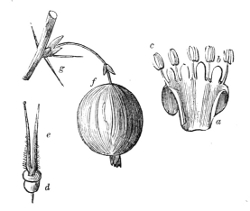
Fig. 136.—The Gooseberry. (Ribes Grossularia).
This order consists of only one genus (Ribes),
which includes all the Gooseberries and Currants;
the two kinds forming two distinct sections.
The first section, which embraces all the
Gooseberries, has prickly stems, and the flowers
are produced singly, or in clusters of not more
than two or three together. The flower of the
common Gooseberry (Ribes Grossularia) consists
principally of the calyx (a in fig. 136), the five
segments of the limb of which are turned back,
and coloured of a reddish-brown. The petals (b)
are white and erect, and bearded at the throat;
but they are so small and inconspicuous, that
few people would notice them if they were not
pointed out. The stamens (c) are five in number,
and erect, and the anthers burst lengthways
on the inside. The ovary (d) is below the
cup of the calyx, and the style, which is cloven
to the base (e), is always covered with hairs in
the common Gooseberry (R. Grossularia), and is
more or less hairy in the other species. There
are two little bracteoles (f) on the pedicel; and
a large bract, deeply cut, at the point from which
the pedicel springs (g). The leaves, which are
omitted in the engraving, also grow from the
same bud, and are three or five lobed, and
hairy; and there are three spines just below
them. The fruit is a many-seeded berry, with
the seeds immersed in pulp; and on cutting
open an unripe fruit, it will be found that the
seeds are each inclosed in an aril, with a separate
footstalk, by which they are attached to a
membrane lining the sides of the berry, and
which is called a parietal placenta. The segments
of the calyx remain on the ripe fruit.
Several of the ornamental species of Ribes belong
to this division, as, for example, R. triflorum,
which has white flowers; and R. speciosum,
which has crimson flowers, with the segments of
the calyx not reflexed, and long projecting
stamens like those of the Fuchsia. The fruit
and the whole of the stems and branches of this
species are covered with spines, and thus the
plant is easily distinguished from the common
gooseberry, the stem of which has no spines,
except three just below each bud.
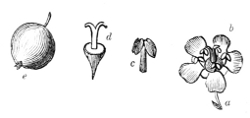
Fig. 137.—The Red Currant.
The Currants are distinguished by the stems
being entirely without spines, and the flowers
being produced in racemes. The leaves are cordate,
and bluntly three or five lobed, a little
downy beneath, but smooth above. The flowers
of the Red Currant (Ribes rubrum) are numerous,
and they are produced in drooping racemes,
with a little bracteole at the base of each footstalk
(see a in fig. 137). The calyx is flattish,
with the segments (b), which are of a pale
greenish colour, spreading widely, and not recurved.
The anthers (c) are loosely attached
to the filaments, and they burst sideways and
across. The style (d) is short, and divided into
two spreading stigmas at the apex. The fruit
is smooth and transparent, with many seeds,
and it retains the remains of the calyx (e) when
ripe. The white, and the striped or flesh -coloured
Currants, are varieties of R. rubrum.
The Black Currant (R. nigrum) has a more compact,
and campanulate flower (see a in fig. 138),
with the segments of the calyx reflexed; the
anthers (b) are more firmly attached to the
filament; the style (c) is not cleft, and the
stigma is two-lobed and capitate. The fruit (d)
has a thick opaque skin, and the eye of the
calyx is larger; the leaves are also covered on
the under surface with glands or cells, filled with
a fragrant oil formed by the limb, as shown at
(e), which represents the appearance of the leaf
when held up to the light. There is often a solitary
flower on a separate pedicel, at the foot of
the raceme; and there are frequently ten stamens
instead of five, and no petals, the petals having
been changed into stamens—a metamorphose
the reverse of that which generally takes place.
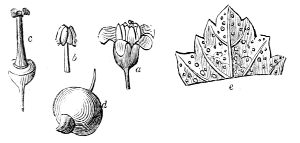
Fig. 138.—The Black Currant.
The most ornamental kinds of Currant are
R. multiflorum, with very long drooping racemes
of greenish flowers; R. sanguineum, the flowers
of which are crimson, and somewhat tubular;
R. aureum, which has the flowers of a golden
yellow, and quite tubular; and R. cereum, which
has roundish leaves covered with white waxy
dots on their upper surface, and racemes with
few flowers, which are rather large, and of a
pure white. A few species, such as R. saxatile
and R. Diacantha, appear to be intermediate
between the Currant and the Gooseberry, as
they have the racemes of fruit common to the
one, with the spines and habit of growth of the
other. There is said to be another species
nearly allied to R. sanguineum, with dark-purple
flowers, which has not yet been introduced.
ORDER XCV.—ESCALLONIACEÆ.
Of the genera included in this order (which
were formerly included in Saxifragaceæ), Escallonia
is the most important, as it contains several
species of ornamental South American shrubs.
The flowers of the different species vary considerably:
in E. rubra, they are produced singly,
and the corolla, which is pink, is tubular, with
a short, five-cleft limb; but in E. montevidensis
the flowers, which are white, are produced in
panicles, and have spread petals. The flowers
of both species have five stamens, and two carpels,
the styles of which are combined. The
leaves are simple, alternate, and without stipules.
Of the other plants contained in the
order, I may mention that Itea virginica is a
North American shrub, with white flowers;
and Anopteris glandulosa, which is also a shrub
with white flowers, is a native of Van Diemen’s
Land.
ORDER XCVI.—SAXIFRAGACEÆ.
The genus Saxifraga of Linnæus has been
divided so as to form several genera; but they
do not appear to be generally adopted. The
flowers of all the species are rather small, and
they are generally racemose, or panicled; and
the corolla consists of five spreading petals with
short claws, and there are twice that number of
stamens. Among the most common species
may be mentioned London Pride (Saxifraga or
Robertsonia umbrosa), and the Meadow Saxifrage
(Saxifraga or Leiogyne granulata), the flowers of
the latter being large, and produced singly.
In the genus Hydrangea the flowers are disposed
in corymbs, and they have five petals,
ten stamens, and from two to five styles; but
in the outer flowers of the corymb the stamens
and pistil are often wanting.
The genera Galax and Francoa, which were
first included in Crassulaceæ, and afterwards in
Saxifragaceæ, are now made into a new order
called Galacineæ, or Francoaceæ, which is introduced
here.
ORDER XCVII.—CUNONIACEÆ.
This order, which was separated from Saxifragaceæ
by Dr. Brown, contains principally
hothouse plants with erect spicate racemes or
panicles of small flowers. Weinmannia, Bauera,
and Cunonia are the principal genera.
ORDER XCVIII.—UMBELLIFERÆ—UMBELLIFEROUS
PLANTS OR THE PARSLEY TRIBE.
This is a very large order, but it is so natural
that no person who has seen Parsley in flower
can ever be in any doubt as to an umbelliferous
plant. Most of the species are either culinary
plants, such as the Parsnep and Carrot, Celery,
Parsley, Fennel, &c., or poisonous weeds, such
as Hemlock, and the Water Parsnep; and there
are very few ornamental plants included in the
order: among these few may, however, be mentioned
Didiscus or Trachymena cærulea, Eryngium,
and Bupleurum or Tenoria fruticosum, Angelica,
and Heracleum. Some of the species of
the latter, particularly the Gigantic Siberian
Cow Parsnep (H. asperum), are perfectly magnificent
objects. Notwithstanding the ease with
which these plants may generally be recognised,
as in some of the allied orders the flowers grow
in umbels or cymes, it may be necessary to remark
that Dr. Lindley defines umbelliferous plants
to consist of those which have their “flowers
growing in umbels, with inferior fruit, which,
when ripe, separates, or may be separated, into
two grains.” Thus the common Dogwood is
not an umbelliferous plant, though its flowers
grow in umbels, because its fruit is a berry.
ORDER XCIX.—ARALIACEÆ.
The most interesting plant in this order is
Hedera Helix, the common Ivy; a well-known
climbing evergreen shrub, which throws out
roots from its branches at intervals, which it
strikes into any substance to which it can adhere.
The flowers have all their parts in five
or ten divisions; even the lower leaves, which
are smooth and leathery, are five-lobed. The
leaves on the flowering branches, which are
always in the upper part of the plant, are entire.
The flowers are produced in umbels, and
they are succeeded by berries, which, in correspondence
with the parts of the flowers, are five
or ten celled. The large-leaved variety, called
the Irish Ivy, is a native of the Canary Isles;
and the gold and silver leaved, and golden
berried, are all varieties of the common kind.
There are, however, many exotic species, most
of which have not yet been introduced. The
genus Aralia, known by its two garden species,
A. spinosa and A. japonica, belongs to this
order. The first of these is called the Angelica
Tree, and is an old inhabitant of our gardens;
but A. japonica is of quite recent introduction.
ORDER XCIX.*—HAMAMELIDEÆ.
The most interesting plants in this order are
the Witch Hazel (Hamamelis virginica), and Fothergilla
alnifolia. In the first of these plants,
there are four long narrow petals, and the calyx
is four-lobed; and there are eight stamens, of
which four are fertile, and four barren. There
are two styles, and the capsules are leathery
and two-celled, and two-valved, with one seed
inclosed in an aril in each cell. The Witch
Hazel has the peculiarity of coming into flower
when it drops its leaves in autumn, remaining
in flower all winter, and forming its fruit in
spring, just as it is opening its new leaves. The
flowers are yellow, and very pretty from their
great abundance, and the light feathery effect
produced by the great length and narrowness
of the petals. The leaves are rough and feather-nerved,
like those of the Hazel. Fothergilla is a
pretty little shrub with terminal spikes of white
flowers with yellow anthers, which are sweet-scented
and appear before the leaves.
ORDER C.—CAPRIFOLIACEÆ, OR THE HONEYSUCKLE
TRIBE.
This order, as originally constituted, may be
divided into three tribes, viz., Corneæ, containing
Cornus, Benthamia, and, according to some,
Aucuba; Sambuceæ, containing Sambucus and
Viburnum; and Lonicereæ, containing Symphoria,
Caprifolium, Lonicera, Leycesteria, Linnæa,
&c. Cornus, Benthamia, and some other genera,
among which Dr. Lindley places Aucuba, are
now formed into a separate order, under the name
of Cornaceæ. The different species of Dogwood
(Cornus) are known by the smooth bark of their
stems and branches, which is frequently red, or
reddish brown; by their white flowers, which
are produced either in heads, or umbels, or in
corymbose panicles; by their red or blackish
berries; and by their coarse feather-nerved
leaves. The principal species of Cornus are
the wild or female Cornel (C. sanguinea); the
common Dogwood (C. alba); the male Cornel,
or Cornelian Cherry (C. mas); and American
Dogwood (C. florida). All these plants have a
very small four-toothed calyx, and a corolla of
four petals. There are four stamens and one
style. The fruit is a berry-like drupe. Some
of the species, as for example C. florida, have
a large involucre of four leaves, having the appearance
of petals. Benthamia fragifera, called
by Dr. Wallich C. capitata, has an involucre of
four leaves of yellow, tinged with red, surrounding
a head of small greenish inconspicuous
flowers. The fruit consists of a number of
drupes, grown together like a Mulberry, with
six, eight, or more seeds, surrounded with a
viscid pulp. The leaves are long and tapering,
of a fine texture, and of a light green above,
and silvery white below.
The genus Sambucus, the Elder, is characterised
by its pinnate leaves and terminal cymes
of flowers, which have a small five-lobed calyx,
a rotate corolla also five-lobed, five stamens
about the length of the corolla, no style, and
three obtuse stigmas. The berries are globular,
pulpy, and one-celled; each containing
three or five seeds, which are convex on the
outside, and angular within. The berries differ
in colour in the different species, those of the
common kind being a deep purplish black, and
those of S. racemosa being red. The stems and
branches are of a soft wood, having a white
spongy pith. The white-berried Elder is a variety
of the common kind.
The genus Viburnum contains several well-known
plants, among which may be mentioned
the Laurestinus (V. Tinus), the Guelder Rose
(V. Opulus), and the Wayfaring Tree (V. Lantana).
This genus is very nearly allied to Sambucus
in the flowers, but it is easily distinguished,
on examination, by its leaves, which are
not pinnate, and by its wood, which is hard and
not spongy. The berries have also only one
seed, and they are not eatable,—those of the
Laurestinus are, indeed, injurious. The Laurestinus
and some other species are evergreen;
but by far the greater number of species are
deciduous.
The genus Lonicera formerly included all the
kinds of Honeysuckle; but now only the upright
species, or what are called the Fly Honeysuckles,
are comprised in it, and the climbing
kinds are called Caprifolium. One of the upright
kinds, most common in gardens, is the
Tartarian Honeysuckle (L. tartarica), the
flowers of which are in twins. The corolla is
tubular and funnel-shaped, with a five-cleft
limb. There are five stamens, a filiform style,
and a capitate stigma. The berries are distinct
when young, but they afterwards grow
together at the base. The leaves are always
distinct. The genus Caprifolium embraces all
the climbing species, the flowers of which are
disposed in whorls, and the upper leaves are
connate, that is, growing together at the base,
so that two appear only one leaf, with the stem
passing through it. A single leaf of this kind
is called perfoliate. The flowers spring from
the axils of the leaves, and are what are called
ringent, that is, they are composed of five petals,
four of which grow together, almost to
the tip, while the fifth is only attached to the
others about half its length, and has the loose
part hanging down. Flowers of this kind,
with their lower part forming a tube, and their
upper part widely open, are said to be gaping.
In the Trumpet Honeysuckle (C. sempervirens)
the tube of the corolla is very long, and the
lobes of the limb nearly equal; and the flowers,
instead of springing from the axils of the
leaves, form terminal spikes, each consisting
of three or more whorls of flowers.
The Snowberry (Symphoria racemosa) bears
considerable resemblance to the upright Honeysuckles.
The flowers are funnel-shaped, and
four or five lobed. The berry has four cells,
but two of the cells are empty, and the others
have only one seed in each. The leaves are
oval, quite entire, and not connate.
Leycesteria is a very handsome shrub, with
white flowers, and very large and showy purple
and reddish bracts. The berries are of a very
dark purple, and they are nearly as large as a
gooseberry. L. formosa is a native of Nepaul,
but it appears tolerably hardy in British
gardens, and it stands the sea-breeze without
injury.
Linnæa borealis is a little for insignificant trailing
plant, which is included in this order, and
which is only worth mentioning on account of
its being named in honour of Linnæus. It is a
half-shrubby evergreen, with small bell-shaped
flesh-coloured flowers, which are said to be
fragrant at night.
ORDER CI.—LORANTHEÆ.
Four genera are included in this order, all
remarkable in different ways. The first of
these is the common Mistletoe (Viscum album),
a most remarkable parasite, a native of Britain,
and generally found on old apple-trees; and the
second is Loranthus europæus, a native of Germany,
closely resembling the Mistletoe, but
found generally on the oak, where the true
Mistletoe rarely grows. This plant is said to
have been introduced in 1824, but it is not now
in the country. There are other species of the
genera, one a native of New Holland. Nuytsia
floribunda, also a native of New Holland, a
very curious plant, is also included in this
order. It is a shrub about three feet high, so
covered with orange-coloured blossoms that the
colonists call it the Fire-tree. When the seed
of this plant germinates, it is said to have three
cotyledons. The last plant generally included
in this order is Aucuba japonica, though it is
probable this plant belongs to Cornaceæ. Of
this species we have probably only a variety,
from the variegation of the leaves; and it has
never produced seeds, as only the female plant
has been introduced.
ORDER CII.—CHLORANTHEÆ.
Inconspicuous plants with greenish flowers,
which require a hothouse in Britain.
ORDER CIII.—RUBIACEÆ. (See Chap. V. P. 85.)
This order is divided into thirteen sections,
most of which have been already described. In
all the species the tube of the calyx adheres to
the ovary, which is crowned with a fleshy
cup, from which arises the single style; and
the petals are united at the base, and attached
to the upper part of the tube of the calyx.
ORDER CIV.—OPERCULARIEÆ.
Exotic weeds, formerly included in Rubiaceæ.
ORDER CV.—VALERIANEÆ.—THE VALERIAN
TRIBE.
No person can ever have been in the neighbourhood
of Greenhithe, in Kent, without
having observed the red Valerian, which grows
in such abundance on the steep banks of the
chalk-pits in that neighbourhood; and probably
still more of my readers will be familiar
with the common wild Valerian, or All-heal,
which is found in moist places, generally among
sedges, in every part of England. Another
species of the same genus is common in Scotland,
so that the name of Valerian is familiar
to all persons who know anything of British
plants. Common as these plants are, however,
probably most of my readers are unaware of
the very curious construction of their flowers;
or of the very great variety exhibited by the
different species. The genus Valeriana is, indeed,
one which presents a remarkable instance
of variety of construction, united with a similarity
of form which makes all the species
recognisable at a single glance. In all the
species, the corolla is funnel-shaped, with a
long tube, and a five-lobed limb. In the red
Valerian (V. rubra), the lower part of the tube
is drawn out into a spur; and on this account
the plant is sometimes called the spurred Valerian,
and it has been placed by De Candolle
in a new genus, which he called Centranthus.
The other species of Valerian have the tube of
the flower gibbous, that is, much larger on one
side than on the other. In all the calyx is
tubular, with the limb curiously rolled, so as to
form a rim or crown to the fruit, like that on
the heads of basket-women. When the flowers
drop, the fruit, which is one-celled and one-seeded,
and which adheres closely to the tube
of the calyx, begins to swell, and as it does so
the limb of the calyx gradually unrolls, till at
last, when the fruit is ripe, it forms a sort of
feathery tuft to waft it away. The leaves of
plants of this genus vary exceedingly, even on
the same plant; but generally those of the red
Valerian are lanceolate; those of V. dioica are
pinnatifid; those of the wild Valerian (V. officinalis),
pinnate; and those of the garden Valerian,
the kind found in Scotland, (V. pyrenaica,)
are cordate. The flowers of V. dioica
are male and female, and are found on different
plants. The principal other genera in this
order are Valerianella, the Corn Salad or
Lamb’s Lettuce; and Fedia, the Horn of
Plenty.
ORDER CVI.—DIPSACEÆ.—THE TEASEL TRIBE.
The principal genera belonging to this order
are Dipsacus, the Teasel, and Scabiosa, the Scabious;
to which may be added a pretty little
annual called Knautia. The plants belonging
to this order bear considerable resemblance to
those included in Compositæ, as they consist of
a head of florets seated on a common receptacle,
which is chaffy, and surrounded by an involucre.
The florets are also furnished with what may be
called a double calyx, the limb of the inner
part being cut into long teeth, and resembling
the pappus of the Compositæ. In the genus
Dipsacus, the most important plant is the Fuller’s
Teasel (Dipsacus fullonum), in which the
receptacle is raised in the form of a cone, and
the chaffy scales are hooked, and so strong,
that the flower-heads when dry are used for
preparing broad-cloth. The leaves of this plant
are opposite, and united at the base. The
florets have a four-cleft corolla, and four distinct
stamens; differing in this respect decidedly
from the Compositæ, which have five
stamens, the anthers of which are always united
into a tube. Dipsacus sylvestris might be easily
mistaken for a kind of Thistle; but the difference
will be seen at once by examining the
anthers of the florets. The Devil’s-bit Scabious,
which is so called from the root looking as though
a part had been bitten off, has the same kind
of flower-head as the Dipsacus, but the receptacle
is flat, and the involucre much smaller.
In some of the species of Scabious, the florets
of the outer ring resemble those of the ray in
flowers of the Compositæ. The leaves of the
genus Scabious are as variable as those of the
genus Valeriana, scarcely two species being
alike.
ORDER CVII.—CALYCEREÆ.
Obscure American plants, nearly allied to
Compositæ.
ORDER CVIII.—COMPOSITÆ. (See Chap. VI. P. 98.)
Plants with heads of florets on a common
receptacle, surrounded by an involucre. The
florets are of three kinds, viz., ligulate, tubular,
and bilabiate; the heads consisting sometimes
entirely of florets of one kind, and sometimes
with ligulate florets forming the outer ring,
called the ray, and tubular flowers forming the
centre, called the disk. The calyx continues on
the ripe fruit, and its limb is frequently cut into
a kind of fringe called the pappus. The fruit
is of the kind called an achenium, that is, dry
and bony, and continuing enveloped in the persistent
calyx, but without adhering to it.
ORDER CIX.—LOBELIACEÆ.
The genus Lobelia is well known from the
pretty little blue-and-white flowering plants
that are so common in pots for windows and
balconies, and that continue flowering so freely
all the summer. There are two or three species
which are grown for this purpose, viz. Lobelia
Erinus, L. bicolor, and L. gracilis, all annuals,
which require to be raised on a hotbed by sowing
in February, and which will then flower
all the summer, with no other care than regular
watering. All these flowers have the tube of
the calyx united to the ovary, with a five-parted
limb. The corolla is irregular and tubular,
with the tube cleft on the upper side, and
thickened at the base. The limb of the corolla
is divided into two parts; one of which, called
the upper lip, is cut into two narrow sharp-pointed
segments, which stand erect; while the
lower lip, which is much the longer, and hangs
down, is cut into three rounded segments.
There are five stamens, the anthers of which
grow together, and at least two of them are
bearded. The capsule is oval, two-celled, two-valved,
and many-seeded, opening naturally at
the top when ripe. These general characters
will be found in all the numerous species of
Lobelia, as the genus at present stands, as they
all have the two horn-like segments of the upper
lip, and the rounded lobes in the pendulous
under lip; and many of the plants formerly
called Lobelia which differ in these particulars
have been placed in other genera. Thus Tupa,
which contains several of the large scarlet-flowered
species, has the segments of the limb
of the corolla united at the tip; the filaments
of the stamens cohering as well as the anthers,
and the stigma protruding. Siphocampylos has
the tube of the corolla ventricose in the middle,
the segments of the upper lip long and curving
over each other, and the lower lip very slightly
lobed, with both the filaments and the anthers
combined. In Dortmannia the filaments are
free, and only the anthers combined; in Parastronthus
(L. unidentata), there is scarcely any
tube to the corolla, and in Isotoma, the corolla
is salver-shaped. The beautiful little Clintonia
pulchella belongs to this order, and it differs
from Lobelia in its corolla having scarcely any
tube, and also, but more decidedly, in the very
long tube of its calyx. This is so long and slender
as to look like a part of the flower-stalk; as
does the capsule, which, when ripe, is triangular,
and is as long as the silique of a cabbage or
wall-flower, to which it bears considerable resemblance.
All the Lobeliaceæ have an acrid
milky juice, which is poisonous.
ORDER CX.—STYLIDEÆ.
This order contains three genera of New
Holland plants, only one of which has been
introduced. The flowers are tubular, with a
five-cleft limb, and they are covered with hairs,
terminating in capitate glands; the stamens
are united into a column, which is bent towards
the fifth or lower segment of the limb, which
is much larger than the others. The united
stamens are so irritable as to start forward
when touched with a pin.
ORDER CXI.—GOODENOVIÆ.
All the plants in this order are natives of
New Holland, and they bear considerable resemblance
to those included in Lobeliaceæ, but
they have not a milky juice, and the stigma,
which is very small, and without any style, is
surrounded by a curious cup called an indusium,
which is generally found full of pollen. This
very remarkable organ is probably rendered
necessary by the very small size of the stigma,
which can only absorb the pollen very slowly.
The most interesting genera contained in this
order are Lechenaultia and Euthales.
ORDER CXII.—CAMPANULACEÆ.—THE
CAMPANULA TRIBE.
The plants in this order have a bell-shaped
regular corolla, consisting of five petals, usually
grown together so as to form a monopetalous
corolla with five lobes, each lobe having a conspicuous
central nerve or vein. There are five
or more stamens, which are generally distinct,
and which have broad bearded filaments bending
over the ovary. The style is at first short,
but it gradually elongates itself, and both it and
the stigmas are furnished with tufts of stiff
hairs, which, as the style pushes itself through
the stamens, brush off the pollen, and retain it
till the stigma is in a proper state to receive it.
The anthers burst as soon as the corolla opens.
The capsules have generally two, three, or five
cells, and each cell contains many seeds.
In the genus Campanula, the capsule opens
by little valves, which look as though cut with
scissors. The juice of the plants is milky, but
not poisonous. The principal genera are Campanula,
Prismatocarpus (Venus’s Looking-glass),
Roellia, Phyteuma (the petals of which are
distinct), Trachelium, Wahlenbergia, and Adenophora.
Lobeliaceæ and Goodenoviaceæ were
formerly included in this order.
ORDER CXIII.—GESNERIEÆ.
The corolla is tubular and sub-bilabiate, with
a five-cleft limb. There are four stamens, two
longer than the others, with the rudiments of a
fifth. The anthers generally adhere in pairs;
the fruit is one-celled and many-seeded; the
leaves are thick and covered with a soft down;
and the roots are frequently tuberous. The
qualities are excellent. The species of the genus
Gesneria are usually hothouse plants, with
bright scarlet flowers; and those of Gloxinia
have generally purple flowers; and of Sinningia
the flowers are greenish.
ORDER CXIV.—VACCINIEÆ. (See Chap. VII. P. 130.)
This order includes the Whortle-berries, Bilberries,
and Cranberries, and it is very nearly
allied to Ericaceæ, from which it is distinguished
by the disk, which lines the calyx, entirely surrounding
the ovary, which is thus placed below
the rest of the flower, and is called inferior.
The fruit is a berry.
ORDER CXV.—ERICACEÆ. (See Chap. VII. P. 109.)
All the Heath tribe, including the Arbutus,
Rhododendron, Azaleas, &c., are distinguished
by their anthers, which have a little hole or
pore at the apex of each cell; each cell being
also generally furnished with a kind of spur at
its base. The stamens in all these genera grow
from beneath the ovary, and the filaments are
thick and fleshy. The fruit is a dry capsule, or
follicle.
ORDER CXVI.—PENEACEÆ.
Beautiful shrubs, natives of the Cape of
Good Hope, with the habit of Pimelea, and
corymbs of pale pink flowers. The calyx is in
two sepals, the stigma four lobed, and the
fruit four-valved, with two seeds in each cell.
§ III.—COROLLIFLORÆ.
The plants comprised in this division are
called monopetalous, as they have their petals
joined together, so as to form a cup for the stamens
and pistils quite distinct from the calyx;
and the stamens are attached to the corolla.
ORDER CXVII.—EPACRIDEÆ.
This order stands on debateable ground,
being by many botanists included in the last
division; but it seems properly placed in this,
as the stamens are attached to the petals,
which adhere together; and if a flower of any
species of Epacris be examined, it will be found
that the corolla, with the stamens attached to
the lining of the tube, parts readily from the
calyx without losing its natural form. The
flowers are tubular or campanulate, with a five-cleft
limb, and will divide readily into five
petals, each of which has the filament of a
stamen attached to it, leaving only the anthers
free. The anthers are one-celled and awnless,
and this is the principal distinction between this
order and Ericaceæ. The calyx is five-cleft,
coloured like the corolla; and there are five
scale-like bracts below it, which look like a
calyx. The capsule is dry, with the seeds attached
to a central column. The leaves are dry,
hard, and prickly. The species are natives of
Australia, where they supply the place which
the Heaths hold in Europe and Africa; no
Heath having been yet found in any part of
Australia.
ORDER CXVIII.—SYMPLOCINEÆ.
This order contains one genus, Symplocos, of
greenhouse and stove shrubs, from South America,
with small white flowers, and serrated
leaves, which turn yellow in drying.
ORDER CXIX.—STYRACINEÆ.
The plants in this order best known in
English gardens are Styrax officinale, the Storax,
and Halesia tetraptera, the Snowdrop-tree. The
flowers of both are white; those of Storax are
funnel-shaped, with a five-cleft limb; there
are ten stamens, growing together at the base,
with short filaments, and very long anthers.
The fruit is a drupe which is nearly dry, containing
a one-celled nut, enclosing from one
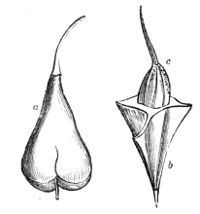 Fig. 139.—Snowdrop tree (Halesia
tetraptera).to three seeds. The seeds have two skins, the
inner one like a cobweb, and the outer one
spongy. The bark, when wounded, affords the
gum called storax. Halesia has drooping bell-shaped
white flowers, something like those of the
Snowdrop, (see a in
fig. 139,) with four
petals and twelve or
sixteen stamens combined
into a tube at
the base. The fruit is
a dry, winged drupe,
which has four angles
in H. tetraptera
(b), and two in H.
diptera; and which
contains a stone or
putamen (c), which
has two or four cells, and as many seeds. Some
botanists make Halesiaceæ a separate order.
Fig. 139.—Snowdrop tree (Halesia
tetraptera).to three seeds. The seeds have two skins, the
inner one like a cobweb, and the outer one
spongy. The bark, when wounded, affords the
gum called storax. Halesia has drooping bell-shaped
white flowers, something like those of the
Snowdrop, (see a in
fig. 139,) with four
petals and twelve or
sixteen stamens combined
into a tube at
the base. The fruit is
a dry, winged drupe,
which has four angles
in H. tetraptera
(b), and two in H.
diptera; and which
contains a stone or
putamen (c), which
has two or four cells, and as many seeds. Some
botanists make Halesiaceæ a separate order.
ORDER CXX.—MYRSINEÆ.
Showy shrubs, with evergreen leaves, and
cymes of white or red flowers, which require a
stove or greenhouse in England. The plants
belonging to this order may be easily known on
cutting open their flowers, as they are the only
monopetalous flowers among the stove plants
that have the stamens opposite the lobes of the
corolla; the general position of the stamens
being between the lobes. The principal genera
in this order are Myrsine, the species of which
are greenhouse shrubs; and Ardisia, the latter
being well-known stove shrubs, with white
flowers and red berries. Theophrasta, Clavija,
and Jacquinia, were included in this order; but
they are now formed into a new one, under the
name of Theophrasteæ.
ORDER CXXI.—SAPOTEÆ.
This order is best known by the genera Argania,
Sideroxylon, Chrysophyllum, and Bumelia,
all of which are stove or greenhouse plants.
The seeds of Achras Sapota contain abundance of
oil, which is so concrete as to have the appearance
of butter; and hence the tree is called the
Butter-tree. Sideroxylon has such hard wood
as to be called the Iron-tree. The juice of all
these plants is milky, and the milk is wholesome
as food.
ORDER CXXII.—EBENACEÆ.
The principal genus is Diospyros; which contains
the Ebony-tree (D. Ebenum), the Date-plum
or Lotus-tree (D. Lotos), both natives of
the East Indies; and the Persimon (D. virginiana),
a native of North America. The species
are trees with hard dark wood; that of Ebony
is quite black when old, and remarkably heavy.
The flowers are white and inconspicuous, and the
fruit, which is eatable, but insipid, is a berry,
placed in the centre of the calyx, which spreads
round it like a saucer. It is very harsh when
first gathered, and must be kept till it is half
decayed, like the Medlar, before it is eaten.
ORDER CXXIII.—BREXIEÆ.
Large stove trees, with axillary branches of
white flowers.
ORDER CXXIV.—OLEINÆ.—(See Chap. VIII. P. 136.)
This order comprises the common Ash, the
Manna Ash, the Olive, the Privet, the Fringe-tree,
the Phillyrea, and the Lilac. The flowers
of all have only two stamens, and a roundish
two-celled ovary, without any disk. The flowers
of the Ash have no corolla, and the fruit is a
samara. In the other genera, the flowers are
more or less funnel-shaped, and the fruit is a
capsule. The leaves are generally pinnate, and
always opposite. The seeds have a dense
albumen.
ORDER CXXV.—JASMINEÆ.—(See Chap. VIII., P. 134.)
This order has been separated from the last,
chiefly on account of the seeds having no albumen.
The principal genus is the Jasmine,
which has a funnel-shaped corolla, and pinnate
leaves. Some botanists insert, between Oleaceæ
and Jasmineæ, the new order Columellieæ,
which contains only one plant, Bolivaria trifida.
ORDER CXXVI.—STRYCHNEÆ.
Tropical trees. The principal genus Strychnos,
the fruit of which is the well-known poisonous
nut, Nux vomica. The genera Theophrasta and
Fagræa were formerly included in this order;
but the first is now placed in the new order,
Theophrasteæ (see p. 399); and the second is
placed in another new order introduced here,
and called Potaliaceæ.
ORDER CXXVII.—APOCYNEÆ.
Very showy plants from various parts of the
world, some of which require a stove in Britain,
while others are quite hardy. They also vary
in some of them being trees, others erect shrubs
or climbers, and others perennial; but they
are all easily recognised by the twisted direction
of the segments of the corolla, which has been
compared to the rays of St. Catharine’s-wheel.
The corolla is generally salver-shaped as in the
periwinkle (Vinca major), or funnel-shaped, as
in Taberna montana, and Allamanda cathartica,
or divided into equal segments as in Nerium
Oleander. The flowers are often bearded in the
throat, and furnished with hypogynous scales;
with the stamens inclosed in the flower, and the
anthers lying close together. The seed is contained
in two follicles, which are slender, and have
their seeds disposed in two rows. The species all
abound in an injurious milky juice; and two of
the genera, Cerbera and Tanghina, are virulent
poisons.
ORDER CXXVIII.—ASCLEPIADEÆ.
These plants are very nearly allied to the
last, and they differ chiefly in having the segments
of their corollas straight, in their stamens
being united into a sort of crown, and in their
pollen being found in masses of a waxy substance.
The seeds are also each furnished with
a tuft of fine long silky hair. The principal
plants are Periploca græca, a hardy, climbing,
shrub, with rich, dark, velvet-looking flowers,
which are said to be poisonous to flies, and Hoya
carnosa, a stove or greenhouse climber, with
waxen-looking, clustered, odoriferous flowers,
distilling honey; to these may be added Pergularia,
a stove climber, remarkable for its fragrance,
Physianthus, Gonolobus, Ceropegia, and
Asclepias, all singular-looking climbing plants;
and besides these, I may mention Stapelia, the
species of which are dwarf plants, with their
flowers hanging down below the pots in which
they grow, and the odour of which is so like
that of carrion, as to induce flesh-flies to lay
their eggs upon them.
ORDER CXXIX.—GENTIANEÆ.—THE GENTIAN
TRIBE.
The best known genera are Gentiana, (the
Gentian), Lisianthus, and Menyanthes (the
Buckbean). The flowers have a tubular calyx
and corolla, the latter plaited in the tube, and
with an equally-parted limb, which is generally
five cleft; and an equal number of stamens
with broad filaments, and arrow-shaped anthers.
The seeds are numerous, and are usually in two
follicles.
The orders Spigeliaceæ, Loganiaceæ, and
Menyanthaceæ, have been separated from Gentianeæ,
and are adopted by some botanists.
ORDER CXXX.—BIGNONIACEÆ.
The most interesting genera are—Bignonia;
from which Tecoma has been divided by some
botanists, on account of a slight difference in
the seed-pod; Jacaranda, said to produce the
rosewood of commerce; Eccremocarpus, and
Catalpa. All the plants included in this order
have winged seeds, and generally very long
horn-like seed-pods. The different species of
Bignonia or Tecoma have trumpet-shaped flowers
with a five-toothed calyx, and four stamens of
unequal length, with the rudiments of a fifth.
The capsule is very long and narrow, resembling
a silique in shape, but broad on the outside, and
the leaves are pinnate. Eccremocarpus, or Calampelis
scabra, is a well-known climber, with orange-coloured,
bag-like flowers, which are produced
in secund racemes; large, roundish warted
fruit, with winged seeds; and pinnate leaves,
with tendrils. In Catalpa the corolla has a
very short tube, and an unequal, five-lobed limb.
There are five stamens (only two of which are
fertile); and an exceeding long, cylindrical,
silique-shaped seed-pod, which is sometimes
two feet or more in length. The leaves of the
Catalpa are heart-shaped. In Jacaranda, the
capsule is above two feet long, and quite flat.
Crescentia cujète, the calabash-tree, belongs to
this order.
ORDER CXXXI.—COBÆACEÆ.
This order is restricted to one genus Cobæa,
of which one species (C. scandens) is common in
British gardens. This plant is an annual climber,
with showy bell-shaped flowers, which are first
green, and afterwards become purple. This
plant has remarkably long tendrils, which twist
themselves round any thing that comes in their
way.
ORDERS CXXXII. AND CXXXIII.—PEDALINEÆ AND
SESAMEÆ.
These orders are now united into one, under
the name of Pedalineæ; and the most interesting
genus is Martynia, consisting of half hardy
annual plants with bell-shaped flowers, and very
curious seed-pods.
ORDER CXXXIV.—POLEMONIACEÆ.
This is a very interesting order to the lovers
of ornamental flowers, from the beauty of those
of some of the genera. The genus Polemonium,
the Greek Valerian, has one species (P. cœruleum)
which is found wild in many parts of England,
and is known by the names of Charity and
Jacob’s Ladder. The corolla, which is of a
deep blue, softening into white in the centre,
is rotate, with the stamens, which are bearded
at the base, inserted in the throat. The capsule
is three-celled, and many-seeded, as is generally
the case with plants in this order, and the leaves
are pinnate. The Phloxes are well-known; all
the species are very handsome, but none are
more so than the beautiful annual (P. Drummondi).
The corolla of these plants is salver-shaped,
with an elongated tube, the limb twisted
in the bud, and wedge-shaped segments. The
stamens are inserted above the middle of the
tube, and the cells of the capsule are one-seeded.
Leptosiphon has the corolla funnel-shaped,
with a very long slender tube, and a
campanulate limb with oval lobes; the corolla
is covered with a great number of fine glandular
hairs, and the limb is twisted in the bud. The
stamens, which have very short filaments, are
inserted in the throat of the corolla. The calyx
consists of five sharply-pointed hairy lobes, connected
by a very fine membrane. The flowers
are surrounded by a great number of sharply-pointed
bracts. Similar bracts are very conspicuous
in the genus Collomia. Gilia and
Ipomopsis, so well known for their splendid
flowers, also belong to this order.
ORDER CXXXV.—HYDROLEACEÆ.
Elegant little plants, distinguished from the
preceding order by the flowers having two
styles, and a two-valved capsule. Retziaceæ,
an order containing only one Cape plant, is
inserted here by some botanists, who have
separated it from Convolvulaceæ.
ORDER CXXXVI.—CONVOLVULACEÆ.
The principal genera are Convolvulus, Ipomœa
and their allies. The genus Convolvulus formerly
included all the beautiful monopetalous flowers
with a folded limb, which are so common in gardens,
but it is now restricted to those which
have a two-celled capsule, with the cells two-seeded;
the stamens are inclosed in the corolla,
and the stigma is divided into two narrow
thread-like lobes. Ipomœa only differs in having
the lobes of the stigma capitate. In Quamoclit,
the little scarlet Ipomœa, the capsule is four-celled,
and the cells one-seeded; the corolla is
tubular, and the stamens project beyond the
throat. Batatas, the Sweet-potato, resembles
Quamoclit, but the corolla is campanulate, and
the stamens are inclosed. In Pharbitis (in
which genus the common Convolvulus major,
and the beautiful Ipomœa Learii, are both now
included), the capsule is three-celled, and the
cells are three-seeded; and in Calystigia, in
which is now placed the common bindweed of
the hedges, the capsule is one-celled and four-seeded;
and the flower, which in other respects
agrees with that of the genus Convolvulus, has
two bracts which serve as a sort of involucre.
All these flowers have the lobes of the corolla
marked with a decided fold or plait, and they
are climbing plants, generally annuals. Cuscuta
is a parasite belonging to Convolvulaceæ, which
though it springs from the ground, withers
just above the root as soon as it has twined
itself round any plant within its reach; drawing
its entire nourishment from the unfortunate
plant it has attacked, and which it soon
kills. The plants in this order produce an
acrid milk; and the roots of a kind of Convolvulus
yield the drug called Jalap, which
takes that name from the Mexican city Xalapa,
near which it is grown.
ORDER CXXXVII.—BORAGINEÆ.
The fruit of the plants included in this order
consists of four distinct carpels, each containing
a bony nut. These nuts frequently appear as
though a hole had been bored in them at the
base, and they are frequently striped or twisted.
The flowers are generally secund, or rather
they are produced in spikes which appear to
have flowers only on one side, from the spikes
being curiously rolled up before the flowers
expand, and uncoiling gradually as they open.
The corolla is generally salver or funnel shaped,
with a five-lobed limb, and five little scales just
within the throat, which appear to be placed
there to close up the orifice. There are five
anthers, which seem attached to the corolla,
without any stamens, and a slender style terminating
in a two-lobed stigma. The calyx is
tubular, and remains on the fruit till ripe; the
teeth of the calyx contracting at the point, so
as to cover the ripe carpels. The principal
genera are Pulmonaria (Lungwort), Symphytum
(Comfrey), Cerinthe (Honeywort), Lithospermum
(Gromwell), Echium (Viper’s Bugloss),
Anchusa (Bugloss); Myosotis (Scorpion-grass
or Mouse-ear), one species of which, M. palustris,
is the Forget-me-not; Omphalodes (Venus’
Navelwort), Cynoglossum (Hound’s-tongue),
and Heliotropium (the Heliotrope).
ORDER CXXXVIII.—CORDIACEÆ.
East India trees and shrubs of which Ehretia
is, perhaps, the best known. Nearly allied to
Boragineæ.
ORDER CXXXIX.—HYDROPHYLLEÆ.
This order is interesting from its containing
Phacelia, Eutoca, and Nemophila, all well
known Californian annuals.
ORDER CXL.—SOLANACEÆ (see Chap. IX. P. 141).
The genera Verbascum and Celsia have been
removed from this order, and formed by some
botanists into another called Verbascinæ, though
by Dr. Lindley they are included in Scrophularinæ.
The plants left in the order Solanaceæ
have all a tubular calyx, which remains on the
fruit till it is ripe; and the fruit itself is generally
round and fleshy, with two or four cells
and numerous seeds. In some of the genera,
the permanent calyx looks like a capsule, but
on opening it, the little berry-like fruit will be
found inside. There are five stamens, the anthers
of which are two-celled like those of most
other plants, and the filaments are inserted in
the corolla, which is generally partly tubular
with a spreading limb, the segments of which
are plaited, that is, each bears the crease of a
fold in the middle, as may be seen in the Petunia.
In the order Verbascinæ, the corolla is
rotate, and the segments are not plaited; the
anthers also are only one-celled. Most of the
plants belonging to Solanaceæ are poisonous in
a raw state; but they lose their deleterious
qualities when cooked.
ORDER CXLI.—SCROPHULARINÆ.
The Foxglove is generally taken as the type
of this order, and it has a tubular corolla (see a
in fig. 140) with a short limb (b), and a spreading
calyx (c). There are four stamens of unequal
length inserted on the base of the corolla
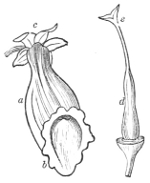 Fig. 140.—Foxglove
(Digitalis).and hidden in its tube; and
an oblong ovary (d), with
a long style, and a two-lobed
stigma (e). The
fruit is a dry capsule with
two cells, and numerous
seeds. The flowers of the
other genera are very irregular.
In the Snapdragon,
the corolla is what is
called personate; and in
the Calceolaria the lower lip is curiously inflated.
The stamens also differ. In most of the genera
there are four, but in Pentstemon there is a
fifth, long and slender, and hairy at the point,
but without any anther; and in Calceolaria and
Veronica there are only two. Among the genera
included in this order may be mentioned
Buddlea, the flowers of which grow in ball-like
heads; Paulownia, Maurandya, Mimulus, Alonsoa,
and Collinsia. The Toadflax (Linaria), and
several other British plants belong to it; but the
Yellow Rattle (Rhinanthus), and some other
allied plants, have been formed into a new order
called Rhinanthaceæ; Chelone and Pentstemon
have been formed into an order called Chelonaceæ;
and Sibthorpia, Disandra, &c., into one
called Sibthorpiaceæ. Trevirana or Achimenes,
and Columnea, are removed to Gesneriaceæ.
Fig. 140.—Foxglove
(Digitalis).and hidden in its tube; and
an oblong ovary (d), with
a long style, and a two-lobed
stigma (e). The
fruit is a dry capsule with
two cells, and numerous
seeds. The flowers of the
other genera are very irregular.
In the Snapdragon,
the corolla is what is
called personate; and in
the Calceolaria the lower lip is curiously inflated.
The stamens also differ. In most of the genera
there are four, but in Pentstemon there is a
fifth, long and slender, and hairy at the point,
but without any anther; and in Calceolaria and
Veronica there are only two. Among the genera
included in this order may be mentioned
Buddlea, the flowers of which grow in ball-like
heads; Paulownia, Maurandya, Mimulus, Alonsoa,
and Collinsia. The Toadflax (Linaria), and
several other British plants belong to it; but the
Yellow Rattle (Rhinanthus), and some other
allied plants, have been formed into a new order
called Rhinanthaceæ; Chelone and Pentstemon
have been formed into an order called Chelonaceæ;
and Sibthorpia, Disandra, &c., into one
called Sibthorpiaceæ. Trevirana or Achimenes,
and Columnea, are removed to Gesneriaceæ.
The new order Cyrtandraceæ, including Æschynanthus,
Streptocarpus or Didymocarpus,
Fieldia, and Amphicoma, is introduced here:
the first and last of these genera are new, and
the others were formerly included in Bignoniaceæ.
ORDER CXLII.—LABIATÆ.
Fig. 141.—A Labiate
Flower. | Fig. 142.—Black Horehound
(Ballota nigra). |
The plants belonging to this order include
Mint, Sage, Thyme, and other kitchen aromatic
plants, and several well-known British weeds.
They are all distinguished by a tubular, bilabiate
corolla with a projecting under lip (see a
in fig. 141). In some plants the corolla is ringent,
as shown in fig. 142, taken from Dr. Lindley’s
Ladies’ Botany, in which a is the galea or
helmet, and b the lower lip, which is three-lobed.
There are four stamens, two of which
are longer than the others, and the cells of the
anthers differ from those of most other plants
in spreading widely apart from each other, each
being joined to the filament only at the tip.
The pistil consists of four distinct carpels (c),
a very long style lobed at the tip, and furnished
with a very small stigma at the tip of each lobe
(d). The flowers of some of the plants belonging
to this order are disposed in a whorl round
the stem; as, for example, those of the Dead
Nettle (Lamium). Among the other plants
belonging to the order may be mentioned the
Bugle (Ajuga), and the Ground Ivy (Glechoma),
both common but very pretty British weeds.
ORDER CXLIII.—VERBENACEÆ.—THE VERVAIN
TRIBE.
The genus Verbena is well known, from the
many beautiful species now common in every
greenhouse. The fruit is two or four celled,
and a drupe or a berry, and the calyx of the
flowers is tubular, and persistent round it; but
the corolla is deciduous, and falls off long
before the fruit is ripe. In the genus Verbena
the calyx is tubular, with five distinct angles,
ending in five teeth. The corolla has a cylindrical
tube nearly double the length of the
calyx, and a flat limb divided into five unequal
segments, which are wedge-shaped and notched,
the central one of the lower three appearing to
have been slightly pinched; the throat of the
corolla is hairy. There are four stamens, two
longer than the others, the anthers having two
widely-spreading lobes, as in the Labiatæ. The
style is slender below, and thickest in the
upper part; and the stigma is two-lobed. The
leaves are opposite, and furnished with stipules
The flowers form a corymb in the Scarlet Verbena,
and a spike in some of the other kinds,
which elongates gradually as the flowers expand.
The principal other genera are Clerodendron,
or Volkameria, Vitex (the Chaste-tree),
Lantana, Aloysia (the Lemon-scented
Verbena), and Tectona (the Teak) which is so
much used in the East Indies for ship-building.
ORDER CXLIV.—MYOPORINÆ.
Australian and Polynesian plants, nearly
allied to Verbenaceæ. The principal genera
are Myoporum and Avicennia, the White
Mangrove of Brazil.
ORDER CXLV.—ACANTHACEÆ.
These plants are known by the elastic opening
of the capsules, which are two-celled, and
the hooked points of the seeds by which they
are attached to the placenta. The calyx remains
on the ripe fruit, but in most of the
plants it is so extremely small as to be inconspicuous,
and its place is supplied by three
large leafy bracts. The corolla varies considerably,
being sometimes two-lipped as in Justicia,
sometimes funnel-shaped as in Ruellia,
and sometimes campanulate, with a spreading
five-cleft limb, as in Thunbergia. There are
only two stamens in Justicia and some of the
other genera, but in Thunbergia, Acanthus,
and Ruellia, there are four of unequal length,
inclosed within the throat of the corolla. The
ovary is imbedded in the disk, and it is two
or many seeded; the style is simple, and the
stigma one or two lobed.
ORDER CXLVI.—OROBANCHEÆ.
Leafless parasites, with brown or colourless
scaly stems and flowers. The genera are Lathræa
and Orobanche.
ORDER CXLVII.—LENTIBULARIÆ.
Pretty little marsh plants, natives of Europe
and North America. Pinguicula has very
much the appearance of a violet, and the Utricularias
are floating plants.
ORDER CXLVIII.—PRIMULACEÆ, THE
PRIMROSE TRIBE.
The plants belonging to this order are easily
known by the stamens, or rather anthers, for
they have scarcely any filaments, being affixed
to the corolla in the centre of the lobes, instead
of being alternate to them, and by the capsule,
though five or ten ribbed, being only one-celled,
with a central placenta, to which the seeds are
attached. The calyx remains on the ripe fruit.
In the genus Primula (the Primrose), the calyx
is tubular, and strongly marked with five distinct
angles, which end in as many teeth; and
the corolla is salver-shaped, with a contraction
in the tube, at the insertion of the stamens,
the five segments of the limb being wedge-shaped
and notched. The style is slender, and
the stigma capitate. The capsule opens naturally
by ten teeth, which curl back. The Cyclamen,
or Sow-bread, one of the genera belonging
to this order, has the lobes of the
corolla bent back; and when the flower falls,
the peduncle coils up in a most curious manner,
so as to bury the seed-vessel in the earth.
These plants have tuberous roots, which are so
acrid as only to be eaten by the wild-boars.
The seed-vessel of the Pimpernel (Anagallis)
resembles a round case with a lid, which may
be taken off, when it displays a great number
of seeds, so closely packed, that no room is
lost. The principal other genera are the
American Cowslip (Dodecatheon), Bear’s-ear
Sanicle (Cortusa), Soldanella, the Water Violet
(Hootonia), and Loosestrife (Lysimachia).
ORDER CXLIX.—GLOBULARIÆ.
Pretty alpine plants, with blue flowers.
ORDER CL.—PLUMBAGINEÆ.
This order probably belongs to Monochlamydeæ.
The principal genera are Sea Lavender
(Statice), remarkable for the coloured footstalks
of the flowers; Thrift (Armeria); and
Leadwort (Plumbago). The corolla in these
plants is either monopetalous, with the stamens
free from the corolla and growing from beneath
the pistil, or with five petals, to which the stamens
are attached. There are five styles and
five stigmas, but only a one-celled and one-seeded
ovary. The fruit is thin and dry. The
pedicels of all the species of the Sea Lavender,
particularly of Statice arborea, are often mistaken
for the flowers.