THE BATTLE OF WORCESTER.
HOW CHARLES THE SECOND ARRIVED BEFORE WORCESTER, AND CAPTURED A
FORT, WHICH HE NAMED "FORT ROYAL."
During the Civil Wars, the old and faithful city of
Worcester suffered severely for its devotion to the royal cause. Twice was
it besieged—twice sacked by the Parliamentarians. In 1642, the
Earl of Essex marched with a large force against the place,
stormed and pillaged it, and sent several of the wealthier citizens
prisoners to London. Four years later—namely, in 1646—the
city again declared for the king, and being captured by the
Roundheads, after an obstinate defence, underwent harder usage
than before. Besides plundering the inhabitants, the soldiers of
the Commonwealth, exasperated by the resistance they had encountered,
did much damage to the public buildings, especially to
the cathedral, the interior of which magnificent edifice was grievously
injured. According to their custom, the troopers stabled
their horses in the aisles, and converted the choir into a barrack,
and the chapter-house into a guard-room. The organ was destroyed;
the rich painted glass of the windows broken; many
monuments mutilated; and the ancient records preserved in the
library burnt. The exquisitely carved stone cross in the churchyard,
from the pulpit of which Latimer and Whitgift had preached,
was pulled down. Before this, John Prideaux, somewhile Bishop
of Worcester, had been deprived of his see, and the dean and
prebends dismissed—Church of England divines having given
place to Presbyterian ministers, Independents, and Anabaptists.
But notwithstanding their sufferings in the good cause, the
loyalty of the Worcester Cavaliers remained unshaken. Heavy
fines and imprisonment could not subdue their spirit. To the last
they continued true to the unfortunate king, though any further
attempt at rising was checked by the strong garrison left in charge
of the city, and commanded by Colonel John James, one of the
strictest of the Republican leaders.
After the terrible tragedy of Whitehall, the Cavaliers of Worcester
transferred their allegiance to the eldest son of the royal
martyr and heir to the crown. All the principal citizens put on
mourning, and every countenance, except those of the soldiers of
the garrison, wore a sorrowful aspect. A funeral sermon, the
text being, "Judge, and avenge my cause, O Lord," was preached
by Doctor Crosby, the deprived dean, to a few persons assembled
secretly by night in the crypt of the cathedral, and prayers were
offered up for the preservation of Prince Charles, and his speedy
restoration to the throne. The service, however, was interrupted
by a patrol of musketeers, and the dean was seized and lodged in
Edgar's Tower, an old fortified gate-house at the entrance of the
cathedral close. Never had Worcester been so gloomy and despondent
as at this period.
Nor did the hopes of the loyal citizens revive till the middle of
August, 1651, when intelligence was received that Charles, who
had been recently crowned at Scone, had escaped Cromwell's
vigilance, and crossing the border with a considerable army, had
pursued the direct route to Lancaster. Thence he continued his
rapid march through Preston to Warrington, where he forced the
bridge over the Mersey, in spite of the efforts of Generals Lambert
and Harrison to arrest his progress. The young king, it was said,
was making his way to his faithful city of Worcester, where he
meant to establish his head-quarters and recruit his forces before
marching on London.
The news seemed too good to be true, yet it obtained ready
credence, and it was evident Colonel James believed it, for he
forthwith began to put the fortifications in order. The commandant,
in fact, had received a despatch from General Lambert,
informing him that he and General Harrison had failed in preventing
the young King of Scots from passing the bridge over
the Mersey at Warrington, and had been disappointed in their
expectation that he would give them battle on Knutsford Heath,
where they awaited him.
Favoured by night, the young king had continued his march
unmolested, it being understood from prisoners they had taken,
that he was making for Worcester. Charles Stuart's forces, Lambert
said, had been greatly reduced by desertions since he entered
England, and now amounted to no more than eight thousand
infantry and three thousand horse, and he was only provided with
sixteen leathern guns. As yet he had obtained few recruits, the
country gentlemen holding aloof, or being prevented by the
militia from joining his standard. But the Earl of Derby had
undertaken to raise large levies in Lancashire and Cheshire, and
had been left behind by the king for that purpose. It was to defeat
the earl's design that the two Parliamentary generals deemed it
expedient to remain where they were rather than pursue the royal
army. Many malignants, Papists, and Presbyterians, ill affected
towards the Commonwealth, would doubtless join Lord Derby,
who, unless he were speedily discomfited, might become formidable.
But discomfited he assuredly would be, and his forces scattered
like chaff, since the Lord would fight on the side of his elect. This
good work achieved, the two generals would hasten to the relief
of Worcester. Speedy succour might also be expected from the
Lord General Cromwell, who was in close pursuit of the Scots'
king, at the head of twelve thousand cavalry and infantry. Colonel
James was, therefore, exhorted to hold out.
General Lambert further stated in his despatch, that Charles
was accompanied by the most experienced leaders in the Scottish
army—by the crafty and cautious Colonel Lesley, who had so long
baffled Cromwell himself—by Generals Montgomery, Middleton,
Massey, and Dalyell, and by the valiant Colonel Pitscottie, with
his Highland regiment. Besides these, there were several English
and Scotch nobles, the Dukes of Buckingham and Hamilton, the
Earls of Rothes, Lauderdale, Carnworth, and Cleveland; Lords
Spyne, Sinclair, and Wilmot; Sir John Douglas, Sir Alexander
Forbes, and others.
While scanning this imposing list, and reflecting that the royal
forces numbered at least eleven thousand men, Colonel James
asked himself how he could possibly hold out against them with
a garrison of only five hundred? He was ill supplied with cannon
and ammunition, and the fortifications were ruinous. Moreover,
the citizens were hostile, and so far from lending him aid, were
ready to rise in favour of the king. He should have to contend
against foes within as well as enemies without. His position
seemed desperate, and though as brave a man as need be, he was
filled with misgiving.
Before proceeding, it may be proper to ascertain how far the
old city was capable of defence. Five years previously it had
stood a lengthened siege, but the circumstances then were wholly
different, for the citizens were arrayed against the besiegers,
and fought obstinately. The walls were much damaged at that
time, and had only been partially repaired, consequently the
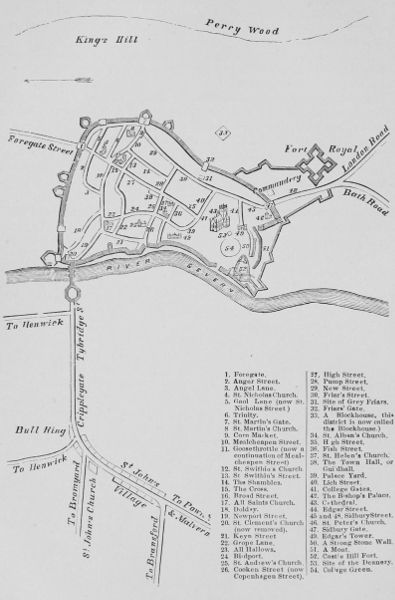
towers and bastions were in a dilapidated state. Outside the
walls, on the south-east, there was a strong detached fort of recent
construction. The castle, which in days of yore rose proudly on
the south side of the cathedral, completely commanding the navigation
of the Severn, had long since been pulled down, the only
vestiges of it left being some fragments of the donjon. The
mound on which the mighty fabric once stood could have been
easily fortified, if time had permitted, and would have formed an
important work. The city, which was of great antiquity, had
four gates, each flanked with towers. The strongest resembled a
barbican, and commanded the quay and the ancient stone bridge
across the river. On the north was the Foregate, "a fair piece of
work," as it is described by old Leland, and not far from it was
St. Martin's-gate. On the south was Sidbury-gate, giving access
to the London-road. The Sidbury-gate was covered by the
modern detached fort to which reference has already been made.
Deep dykes, supplied by the Severn, strengthened the defences
on the east and south-east, but the suburbs constituted a danger,
since the habitations would afford shelter to an enemy. Thus it
will be seen that the city was not in a condition to stand a siege,
and the commandant might well despair of holding out, even for
a few days, against the royal forces.
No city can be more charmingly situated than Worcester on
the banks of England's noblest river, in the midst of fair and
fertile plains, abounding in orchards and hop-gardens, and in full
view of the lovely Malvern Hills; but in the middle of the
seventeenth century it was eminently picturesque, as well as
beautiful. It was then full of ancient timber houses, with
quaintly carved gables and open balconies, from the midst of
which rose the massive roof and tower of the venerable cathedral,
and the lofty spire of St. Andrew's Church. The old walls, grey
and ruinous as they were, the fortified gates, the sculptured
crosses, and the antique stone bridge, with its many-pointed arches,
contributed to its beauty. The noble episcopal palace, the group
of old buildings near the cathedral, and the ruins on the castle
hill—all formed a striking picture when seen from St. John's on
the opposite side of the river.
"The wealth of Worcester standeth most by drapery," quoth
old Leland, who wrote in Henry VIII.'s time, and the place had
long been noted for its broadcloths and gloves. But many of the
wealthiest drapers, glovers, and hop-merchants had been ruined
by the heavy fines inflicted upon them by the grasping Parliamentarians,
and the city had scarcely yet regained its former prosperity.
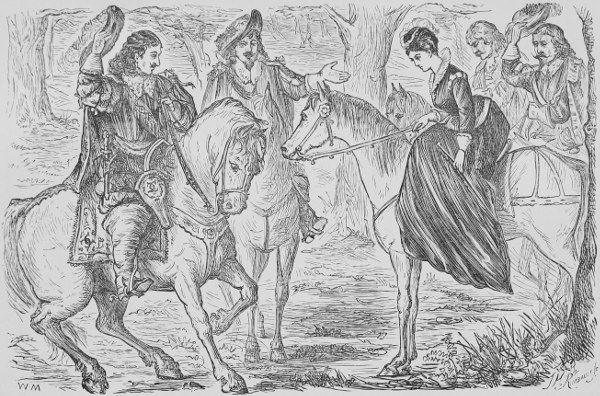
Almost simultaneously with the arrival of General Lambert's
despatch, a letter was brought by a secret messenger to Mr.
Thomas Lysons, then mayor of Worcester, and an avowed
Royalist. It came from Captain Fanshawe, the king's secretary,
and gave a very different version of the affair at Warrington from
that furnished by Lambert.
According to Fanshawe, his majesty had displayed great personal
courage on the occasion. He found the enemy, consisting
of about seven thousand men, united under Lambert and Harrison,
in possession of the bridge across the Mersey, which they had
partly broken down, and he immediately attacked them with his
advanced troops. His impetuosity proved irresistible. A passage
being forced, the whole army followed, and the enemy retreated
in great disorder, and with heavy losses. During the night, upwards
of three thousand of the "rebellious rogues," as Fanshawe
styled them, disbanded. The Parliamentary generals did not
venture to attack the king again, but allowed him to continue his
march towards Worcester without further interruption. The
faithful citizens might, therefore, prepare to welcome their sovereign,
who would soon be with them.
The mayor immediately called a public meeting in the Guildhall,
and read Captain Fanshawe's letter to the assemblage. Great
was the enthusiasm excited by it. The hall resounded with cries
of "Long live Charles II.!" The joyful intelligence quickly
spread throughout the city, and crowds collected in the High-street,
shouting "Down with the Commonwealth! Up with the
Crown!" The concourse was dispersed by Colonel James and a
troop of horse, but in the conflict several persons were wounded,
and some killed. The mayor and the sheriff, Mr. James Bridges,
were seized, and detained as hostages for the good behaviour of
the citizens—the commandant threatening to hang them both if
any further disturbance occurred. Luckily for the two gentlemen,
the city remained tranquil throughout the night, for most
assuredly the commandant would have been as good as his word.
Next day—Friday, the 22nd of August, 1651—the scouts sent
out by Colonel James reported that the first division of the royal
army, commanded by the young king in person, was close upon
Red Hill—already described as a woody eminence about a mile
distant, on the south of the city.
Shortly afterwards, the enemy's cavalry skirmishers could be
distinguished on Perry Wood. Then the advanced guard appeared—the
helmets and corslets of the cuirassiers glittering in the
sunbeams. Thousands of loyal citizens, who were forbidden to
mount the fortifications, climbed to the roofs of the houses, and to
the tops of the churches, to obtain a glimpse of the royal army,
and could not restrain their enthusiastic feeling when they beheld it.
Colonel James, who had been actively employed throughout the
whole night in making the best defensive preparations in his
power, had seen that all the engineers on the ramparts were at
their posts, and he now proceeded to the detached fort near the
Sidbury-gate.
Mounting to the summit, which bristled with cannon, he turned
his spy-glass towards the brow of the hill opposite to him, and
presently beheld a company of richly accoutred officers ride out of
the wood that clothed the eminence, and proceed to reconnoitre the
fortifications from various points. That the foremost of the troop
was the young king himself he had no doubt, as well from the
splendour of his accoutrements and the white plume in his hat, as
from the deference paid him by his attendants. Evidently his
majesty's brilliant staff was composed of the general officers and
nobles mentioned in General Lambert's despatch. That they were
planning the attack of the city was clear.
While watching the young monarch's movements and gestures
narrowly through his glass, Colonel James saw him sign to one of
his aides-de-camps, a fine-looking young man, and remarkably well
mounted, who instantly rode up at the summons.
Major Careless, the aide-de-camp in question, was as brave as
he was handsome, though somewhat rash, and an especial favourite
of the king. Having received his majesty's orders, he promptly
obeyed them. Accompanied only by a trumpeter bearing a flag
of truce, he galloped down the hill, shaping his course towards the
Sidbury-gate, and, within fifty yards of it, he halted, and the
trumpeter blew a blast so loud that the old walls rang again.
A shower of bullets from the battlements would have answered
the summons, if Colonel James had not previously sent word that
the flag of truce must be respected.
The men eyed the insolent Cavalier sternly, and one of them
called out, "If thou hast any message for the commandant of the
garrison, he will be found in yonder fort."
Thereupon Careless moved off, glancing haughtily and contemptuously
at the artillerymen on the ramparts as he rode
along.
On reaching the fort, he descried Colonel James stationed near
the edge of the parapets, and leaning upon his sword. Half a
dozen musketeers in their steel caps, buff coats, and bandileers,
were standing behind him.
"Are you the commandant?" he called out.
"Ay," replied Colonel James. "What wouldst thou with me?"
"Thus much," said Careless, in a loud authoritative voice: "In
the name of his majesty, King Charles II., who is on yonder hill
with his army, I require you to deliver up this his city of Worcester,
which you unlawfully hold as deputy of a presumptuous
and rebellious parliament. His majesty is willing to extend his
clemency towards you, and if you at once throw open the gates,
and lay down your arms——"
"Hold!" interrupted the commandant, sternly. "I do not
recognise the authority of him whom thou stylest king. The
house of Jeroboam, who sinned, and who caused Israel to sin, has
been cut off. I will not deny that the young man, Charles Stuart,
hath been crowned in Scotland, but in England he hath no rule.
His proclamation has been burnt by the common hangman in
London, and a counter-proclamation published by the Parliament,
declaring him, his aiders and abettors—of whom thou, thyself, art
one—guilty of high treason against the State, and punishable by
death. Shall I, an officer of the Commonwealth, and intrusted
with the charge of this city, open its gates to a proclaimed
traitor? Shall I command my men to lay down their arms to
him? Not so. I utterly disregard thy king's summons, and
though he be backed by the whole Scottish host, yet will I not
yield the city to him, but placing my trust in the Lord, will maintain
it against him."
"Provoke not the king by your obstinacy," said Careless, losing
patience. "If you force us to storm the fortifications, you can
expect no quarter. We will put you all to the sword."
Perfectly unmoved by the threat, Colonel James answered, in
the religious jargon then habitually adopted by the Republican
soldiers:
"The Lord of Hosts is with us. The God of Jacob is our
refuge. I doubt not we shall have timely succour."
"From whom?" demanded Careless, with a sneer.
"From the Lord General Cromwell, who is hastening hither
with his legions."
"The city will be ours, and thou and thy rebel horde will be
destroyed ere that arch-traitor and parricide can arrive," cried
Careless, fiercely.
"Keep guard upon thy tongue, or I will not answer for thy
safety," said the commandant, checking the musketeers behind
him, who were preparing to give fire. "Take back my answer to
the king, thy master. I have nothing to add to it."
"We will soon be with you," shouted Careless.
And, shaking his hand menacingly at the soldiers, he rode off
with his attendant.
While this interview took place, Charles remained on Perry
Wood with his generals. He was not in the least surprised to
learn from Careless that his gracious offer had been rejected by the
commandant.
"Let the attack be made at once," he cried. "I will lead it in
person."
"I admire your majesty's spirit," observed General Dalyell.
"But I pray you not to run so much risk."
"Risk, say you?" cried Charles, gaily. "Faith, Tom, you
would have all the credit of the affair. But you shall not rob me
of it. I mean to be first to enter yonder fort."
Generals Middleton and Montgomery likewise attempted to
dissuade him from his purpose, but ineffectually.
The general officers then rode off to give the necessary orders
for the attack. Trumpets were sounded, and shortly afterwards the
sides of the hill were covered with troops in rapid movement. Ere
they got half-way down, the guns of the fort opened upon them,
but did not check their progress. Presently the artillery of the
Royalists returned the fire of the Republicans, and the king, who
was at the head of the advanced guard, saw the cannon pointed.
His majesty being recognised, the commandant directed the
musketeers on the ramparts to make him their mark; but he really
seemed to bear a charmed life, for though an officer close beside
him was hit by a round shot, and his own horse was killed under
him, he himself was uninjured.
The leathern guns of the Royalists were worked so well, that
three of the fort guns were speedily silenced, and Charles then
ordered instant preparations to be made for the assault.
Scaling-ladders were placed against the walls. Several men
were struck down while executing this perilous task, but no
sooner was it accomplished than Charles caused the trumpet to be
sounded, and sword in hand, mounted the nearest ladder.
A soldier, armed with a pike, strove to hurl him from the
ladder, but the man was shot by Careless, who followed the king
closely.
Again, while springing over the parapets, Charles was opposed
by a musketeer, but he cut him down, and next moment the
heroic young monarch was joined by Careless, and instantly
afterwards by a dozen of his body-guard, and their number was
quickly augmented.
Charles was now master of the fort, for the Republican soldiers,
after an ineffectual resistance, were put to the sword.
In the struggle, Colonel James discharged a pistol at the king,
but missed his mark, and in his turn was attacked by Careless.
"I told you we would soon be with you," cried the Cavalier.
"Yield, and I will spare thy life."
"I would not accept life at thy hands," rejoined the commandant.
"Look to thyself!"
And beating down Careless's point with his heavy blade, he
stepped quickly backwards and disappeared. He had, in fact,
dashed down a narrow staircase communicating with the lower
chambers of the fort, and secured his retreat by pulling a trap-door
over the entrance.
Meanwhile, Charles had torn down the flag of the Commonwealth,
and replaced it by the royal standard. As soon as this
signal of victory could be distinguished by his forces loud cheers
were raised. Possession was immediately taken of the fort, but
no prisoners were made, for Colonel James, and the few of his men
left alive, had evacuated the lower chambers. They had fled, it
appeared, by a covered way, and had entered the city through a
postern near the Sidbury-gate.
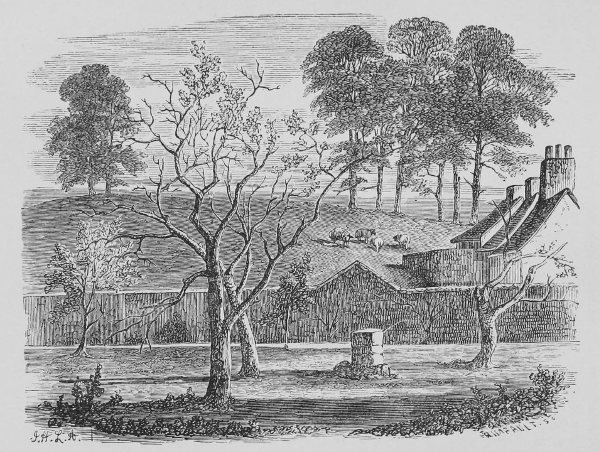
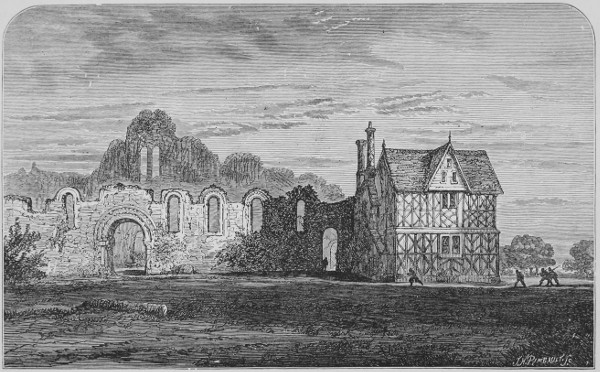
SITE OF FORT ROYAL.
By-and-bye the general officers came to congratulate the
king on his victory and express their admiration of his prowess,
and it then became a question whether the siege should be continued—General
Dalyell being of opinion that the city could be
captured before night, if an immediate attack were made upon the
fortifications; but Charles decided on waiting till the morrow.
"I have done enough for the day," he said. "Since I am
master of this fort, the city is at my disposal, and I can occupy it
at my leisure."
"Very true, my liege," observed Dalyell. "But the garrison
will take advantage of your forbearance to escape."
"I will not molest them if they adopt that prudent course,"
said the king, laughing. "They have ceased firing from the
walls."
"But the men are still at their posts."
"If they give us any further trouble, we can turn these guns
upon them. Hark ye, gentlemen. Henceforth this fort shall be
known as Fort Royal."
"A fitting designation, since your majesty has captured it," said
Dalyell.
"Let the tents be pitched," said Charles. "The day's work is
over. We can take our rest after our long march. To-morrow
we will enter the city in triumph."
All happened precisely as Charles had foreseen. Not another
shot was fired by the Republicans. The Royalists encamped
quietly on the hill. But though no apprehensions were entertained
of an attack, those within Fort Royal were kept on the alert
throughout the night.
Colonel James, however, had other designs. Convinced by what
had happened that the fortifications were no longer tenable, he
decided on abandoning them. With the whole of his men, he
quitted the city secretly at dead of night, taking the mayor and
the sheriff with him as prisoners. Crossing the bridge over the
Severn, he rode off in the direction of Gloucester.
The Royalists were aware of his retreat, but, in obedience to the
king's injunctions, did not seek to interrupt him.
SHOWING HOW THE MAYOR OF WORCESTER AND THE SHERIFF WERE TAKEN TO
UPTON-ON-SEVERN, AND HOW THEY GOT BACK AGAIN.
Fatigued by his long march of three hundred miles and
upwards, Charles slept so soundly in his tent on Perry Wood, that
neither the beating of the drum at daybreak, the challenging of
the sentinels, nor any of the customary camp sounds, disturbed
him. The men themselves answered very reluctantly to the
reveillé. However, the fresh morning air soon revived them. A
day of ease and enjoyment lay before them. No more toilsome
marches, no more skirmishes, but rest—for that day, at least. Two-thirds
of the infantry were without shoes, but being hardy Scots
they did not count this an inconvenience. They all bemoaned
the ragged and weather-stained condition of their uniforms, but
they had heard that Worcester was famous for broadcloth, and
the king had promised them better garments when they reached
the city.
The morn was lovely, and gave promise of a splendid day.
At that early hour, the view from the heights of the old and picturesque
city, with the broad river flowing past it, was enchanting,
and delighted even the rough soldiers who gazed at it. The fair
Malvern Hills, however, chiefly called forth their admiration as
reminding them of their native mountains, though they admitted
that few of the Scottish valleys could compare with the fertile
vale of the Severn.
While many a greedy eye was fixed on Worcester, and many
a cunning tongue was talking of its wealth, and the plunder it would
yield, if they were only allowed to pillage it, the attention of the
soldiers was attracted to the walls, which had now become thronged
with the citizens and their wives and daughters, while all the church
bells—and no church in the old city lacked its proper complement
of bells—began to ring forth joyous peals. It was clear that the
city was now awake and astir, and the half-famished soldiers
hoped that immediate preparations would be made for their refreshment,
and on an extraordinary scale.
It was about this time that Major Careless, who had attired
himself rather hurriedly, being excited by the prodigious clangour
of the bells, entered the king's tent, and found the young monarch
fast asleep—fast as a top.
"Zounds!" mentally ejaculated the aide-de-camp; "his majesty
must sleep soundly, since this din does not disturb him—but no
wonder. I'll give him another hour."
And he turned to depart, when Charles suddenly ceased breathing
hard, and opened his eyes.
"What sound is that?" he cried, raising himself on his
elbow and listening.
"The bells of Worcester ringing for your majesty's glorious
victory—that's all," replied Careless.
"And enough too," cried the king, looking well pleased.
"What has happened to the garrison?"
"Evacuated the fortifications—taken to flight."
"Just what I expected—just what I desired."
"But your majesty did not expect—nor, I presume, desire—that
Colonel James would take the mayor of Worcester and the
sheriff with him."
"'Sdeath!" exclaimed the king. "Has he had the audacity to
do so?"
"Even so, my liege. No doubt they were specially obnoxious
to him on account of their loyalty, and he might wish to hold
them for ransom. 'Tis lucky he didn't carry off others. There
are several prisoners of note in Worcester—Lord Talbot, Sir
John Pakington, and Colonel Mervin Touchet. But the rascal
contented himself with the mayor and the sheriff. At what hour
will it please your majesty to enter the city?"
"At noon," replied Charles.
"Not till noon! why, we have no rations," cried Careless, in
dismay. "Your army has nothing to eat. Will your majesty keep
the men fasting till noon? If you could only see how hungry
they look, you would feel some pity for them."
"They shall all have a good breakfast in Worcester—that I
promise them."
"There will be plenty of grumbling at the delay."
"Bah! they always grumble. I must give my loyal subjects
time to decorate their houses and make all necessary preparations
for my entrance, or I shall disappoint them of their anticipated
spectacle."
"Your hungry soldiers will pray that twelve o'clock may
come."
"Let them listen to the bells. How blithely they sound!"
"Excuse me, sire. When we are enduring the pangs of hunger
the sweetest sounds become a mockery. Spare us this aggravated
torture."
"Leave me; and let it be announced by sound of trumpet
throughout the lines that we shall make our triumphal entrance
into Worcester at noon."
As Careless went forth on his errand with a dissatisfied look
Charles sprang from his couch, and with the aid of a groom of
the chamber and a page, for he had brought a large retinue of
servants with him on his march, proceeded to dress himself, bestowing
infinitely more care on the decoration of his person than he
had done since he left Scotland.
His tall, fine figure was well displayed in doublet and hose of
crimson velvet and white satin; his yellow maroquin boots were
deeply fringed with lace, and he wore point-lace at his wrists
and around his throat. His shoulder-knot was enriched with
diamonds, his sword-hilt glittered with gems, and his plumed hat
was looped up by a large diamond brooch. His long black locks
were worn in the true Cavalier fashion, and fell over his shoulders.
All his princely ornaments were put on for the occasion, the
Garter, the George of Diamonds, and the Blue Riband.
Charles was then in the heyday of his youth, being just twenty-one.
Though his features were harsh—the nose being too large,
and not well-shaped—and his complexion swarthy as that of a
Spanish gipsy, his large black eyes, full of fire and spirit, gave
wonderful expression to his countenance, and made him, at times,
look almost handsome. His manner was singularly affable and
agreeable, and very different from the cold, repelling stateliness of
his ill-fated father.
The young king was adjusting his mantle before the little mirror
hung up in the tent, preparatory to going forth, when a noise outside
attracted his attention.
Next moment Major Careless entered the tent, his looks beaming
with satisfaction.
"How now, Will!" cried the king. "Have you found a breakfast
that you look so gay?"
"No, my liege, but I have found the mayor and the sheriff,
and that is more to the purpose. They have escaped from the
commandant, and have ridden up from Worcester to pay their
homage to you, and relate their adventures."
"Are they without?"
"Just alighted, sire. They are in a sorry plight, but in their
zeal to attend upon your majesty they would not tarry to change,
and hope you will excuse them."
"Excuse them! marry will I! I shall be delighted to receive
them. Bring them at once."
The two gentlemen were then introduced, and their habiliments
undoubtedly bore traces of the hardships they had undergone.
But Charles was better pleased to see them thus than if they had
been in their robes of office, and said so.
Mr. Lysons, the mayor of Worcester, and a wealthy draper of
the city, was a middle-aged man, but strong and active, and had a
ruddy, pleasant countenance. Mr. Bridges, the sheriff, and by
trade a glover, was a few years younger than the mayor, and not
quite so stout. Both of them had looked exhausted when they
arrived, but they brightened up wonderfully as they entered the
king's presence.
Charles advanced to meet them, and gave them his hand to
kiss in the most gracious manner possible. After congratulating
them heartily on their escape, he inquired, with an air of much
interest, how they had contrived it.
"Your majesty shall hear," replied the mayor. "It will always
be a feather in our cap to have escaped from Colonel James. With
what particular object he carried us off we know not, but it is
certain he meant to take us to Gloucester. Shortly after midnight
we were brought out of Edgar's Tower, where we had been imprisoned,
and were strictly guarded by the troopers as we rode
out of the city, but no attempt whatever at rescue was made by
our fellow-citizens. Probably no one knew at the time that we
were being carried off. Little did we dream as we rode across the
bridge that we should be back so soon.
"A dreary ride we had, and our thoughts, which were not very
pleasant, were disturbed by those psalm-singing Puritans. They
did not speak very respectfully of your majesty. But we told
them a day of reckoning was at hand, and that you would drive
them all before you. 'Let him first set your worship free, and
his honour the sheriff,' said one of the troopers—a snuffling rogue,
whom his comrades called Ezra. 'Ay, let him follow us to
Gloucester,' observed another, who was very appropriately named
Madmannah. 'Be sure that he will follow, and force you to
evacuate the city, as you have done Worcester,' I rejoined. In
such pleasantries the time was passed.
"A halt was made at Upton-on-Severn. Now the Roundheads
have no especial dislike to ale and cider, and do not hold it sinful
to indulge in those liquors if good. Knowing the drink they
delight in was to be had in perfection at the Red Lion, at Upton,
they roused the house, and compelled the host and tapster to
broach a cask of stout March ale and another of cider. The
troopers then dismounted, and tied up their horses while they
emptied their cans, leaving us to the care of Ezra and Madmannah.
"Apparently, no one suspected us of any attempt to escape;
yet we were already meditating flight, if any favourable opportunity
should occur. By the light of the lanterns we could see the
men filling their cans. The temptation soon became too strong
for Madmannah. He joined the others, but soon returned with a
bottle of cider for Ezra. While they were enjoying the pleasant
drink, we suddenly broke away and plunged into a hop-garden
that adjoined the inn-yard. Both musketeers fired at us, but did
us no harm. Fortunately the night was dark, and we were
screened by the tall hop-poles.
"Alarmed by the firing, several other musketeers joined in the
pursuit, but they got into each other's way, and created great
confusion, in the midst of which we reached a wood, and being well
acquainted with the locality, made our way for the meadows on
the banks of the Severn. Then we were safe.
"After keeping in these meadows for two or three miles, we
ventured on the high road, and galloped off at full speed for
Worcester, without hearing anything more of the troopers or their
commander. We caught sight of the old city just at daybreak.
'Here we are back again, after only a few hours' absence,' I remarked,
as we passed through the barbican at the head of the old
bridge. 'Who would have thought it!' 'Not I,' replied the
sheriff. 'We are in ample time for the rejoicings on his majesty's
glorious victory.' 'What if we ride up to the camp on Perry Wood,
and seek an audience of him?' I remarked. 'Not in this plight,'
said Mr. Bridges. 'His majesty will excuse us,' I replied."
"Ay, that I will, my good friends," cried Charles. "I am
truly glad that you came to me at once. With such subjects as
you I shall never stand upon ceremony. I have long known you
both as two of the king my father's most faithful adherents."
"We are equally devoted to the king, your father's son, my
liege," rejoined the mayor. "And now, having been honoured
by this audience, we will return to the city and prepare for your
majesty's reception."
"Before you take your departure, gentlemen," interposed
Careless, "permit me to remark to you that the entire army is
without provisions. The sooner, therefore, you can prepare for
us the better."
"We will expedite matters as much as possible," said the
mayor. "But I am afraid we shall require three or four hours."
"His majesty's forces number eleven thousand men, as I understand,"
said the sheriff. "It will be impossible to provide for so
many without some little delay."
"Quite impossible," observed the king. "I will only beg you,
as my loving subjects, to treat my Scottish soldiers hospitably,
even if you make a great sacrifice."
"Your majesty shall have no ground of complaint," said both
magistrates.
"There is a point on which I must address a caution to you,"
pursued Charles. "The greater part of my army, as you are
doubtless aware, is composed of members of the Scottish Kirk.
They are bitter sectarians, ever ready to dispute on religious
questions, and to reprove those who differ from them. Prevent,
if you can, all quarrels among them and your fellow-citizens."
"We have had plague enough already with those Anabaptists,
Presbyterians, and Independents," said the sheriff. "I am happy
to say there are very few left in faithful Worcester now we are
rid of the garrison. We will not quarrel with the Scots, since
they have come hither with your majesty. At noon all shall be
ready for your reception."
Making a profound reverence to the king, the two gentlemen
then withdrew, accompanied by Careless.
The king had lost his favourite charger at the attack on the fort
on the previous day; but another steed, in no respect inferior, had
been supplied him by the Duke of Buckingham, and mounted on
his new acquisition, he now proceeded to make an inspection of
the camp. He was attended by all his general officers, and by
the nobles who had accompanied him in his march from Scotland.
The men had begun to strike the tents at Perry Wood; for it
had been decided by his majesty, after consultation with Lesley,
Middleton, and Massey, that the main body of the army should be
moved lower down the hill, and not far from the Sidbury-gate,
while Dalyell, with his brigade, should fix his quarters at St.
John's, on the right bank of the river, and Middleton, with two
thousand men, should encamp on the Pitchcroft, a large plain,
extremely convenient for the purpose, on the north of the city,
and on the left bank of the Severn.
Having completed his tour of inspection, Charles rode down
with his staff to Fort Royal; and he was surveying the scene of his
late brilliant exploit, and receiving fresh compliments from his
attendants, when he was surprised to see Careless come forth.
"What are you doing here?" he demanded.
"Breakfast is served, sire," replied the aide-de-camp.
"Breakfast!" exclaimed Charles.
"By St. George! I am glad to hear it," cried the Duke of
Buckingham, Lord Wilmot, and several others. "I hope there is
enough for us all."
"Enough, and to spare," replied Careless.
Amid general exclamations of satisfaction the king and those
with him then dismounted, and were conducted by Careless into
a large chamber, where a plentiful repast awaited them.
HOW CHARLES MADE HIS TRIUMPHAL ENTRY INTO WORCESTER; AND HOW HE
WAS PROCLAIMED BY THE MAYOR AND SHERIFF OF THAT LOYAL CITY.
Meanwhile, an almost indescribable scene of bustle
and confusion was taking place within the city.
The pealing of bells, which, as we know, commenced at the
earliest hour of morning, continued almost without intermission.
Great fires were lighted on the Castle Hill, in the cathedral close,
on the quays, and at Pitchcroft, at which huge joints of meat
were roasted—barons of beef, entire muttons, barbecued hogs. All
loyal citizens were enjoined by the mayor to provide the best food
they could, and in the greatest quantity, for the king's army. It
would be a lasting disgrace to them, it was said, if any of their
brave deliverers should be stinted.
While part of each household was busily dressing food, the others
were engaged in decorating the habitations. The balconies were
hung with tapestry, gaily-coloured cloths and carpets, and the
crosses were adorned with flowers. The royal standard floated
over the Sidbury-gate, as well as on the summit of Fort Royal,
and flags were flying from all the steeples.
Such extraordinary zeal and activity were displayed, that, long
before the appointed hour, all the preparations were completed,
and the good folks began to be impatient for the coming of their
sovereign.
The entire host was now gathered on the hill-side, and presented
a magnificent spectacle, as viewed from the city walls, which were
densely thronged. The Sidbury-gate was thrown wide open, a
guard of halberdiers being drawn up on either side of the entrance;
while the mayor, the sheriff, and the aldermen, in their
full robes of office, were stationed beneath the archway.
At length the sound of martial music was heard, and a squadron
of glittering cuirassiers was seen riding down the hill. Then came
Charles, attended by his staff, and followed by Colonel Pitscottie's
regiment of Highlanders. The strange, picturesque garb, and
unusual weapons of these stalwart mountaineers—their claymores,
dirks, and targets—filled the beholders with amazement. Nor
were the citizens less astonished by the shrill, warlike notes of
the bagpipes, which they heard for the first time.
As soon as it was perceived that the king had set out, a loud
discharge of cannon took place from the walls; and this, if
possible, heightened the general excitement. Regiment after
regiment—cavalry and infantry—were now moving down the hill—colours
flying, bands playing—the accoutrements of the cavalry
flashing in the sunbeams like so many mirrors.
The splendour of the king's staff produced an immense effect—some
of the nobles being singularly fine-looking men. Indeed,
the Duke of Buckingham, who rode at the head of the brilliant
cortége with the Duke of Hamilton, was accounted the handsomest
and most accomplished Cavalier of his time. Lord
Wilmot was also a noble-looking personage—tall and well-proportioned.
Foremost among the military leaders rode General
David Lesley, who commanded one division of the Scottish
army. Thin and stern-looking, he had a thoughtful cast of countenance.
With him was Major-General Montgomery, who had
strongly-marked features and a keen eye, and looked like a
thorough soldier. Then came Lieutenant-General Thomas Dalyell,
who had served with distinction under Charles I., and in whom
the young king placed much confidence. With Dalyell was
Vandrose, a Dutch general. Generals Middleton and Massey
brought up the list.
Despite the rich apparel of the nobles and the splendid accoutrements
of the general officers, none of them pleased the beholders
so much—especially the female portion of them—as Colonel Pitscottie,
who, as he rode at the head of his Highlanders, looked the
beau ideal of a Scottish chieftain. He was strongly built, with a
red beard, and light blue eyes of extraordinary power. Pitscottie
was as brave as a lion, and as true as his own sword. Such
were the distinguished persons on whom the spectators gazed from
the city walls.
The whole space between the Sidbury-gate and the ancient
Commandery was thronged, but a space was kept clear for the
king, and for the passage of the troops, by halberdiers placed at
frequent intervals.
Here Charles was detained for a few minutes by the enthusiastic
demonstrations of the crowd, who would scarcely allow
him to proceed. They shouted, stretched out their arms towards
him, and hailed him as their rightful sovereign and their deliverer.
He could not fail to be touched by such manifestations of loyalty.
Though the sun was pouring down his fiercest radiance upon his
jet-black locks, he remained uncovered all the time, and bowed
around repeatedly with the grace peculiar to him.
As soon as he was able to move forward, the mayor, with the
sheriff and aldermen, advanced from the gateway to meet him,
and, bowing reverentially, bade him welcome to the city.
"The city of Worcester has ever been faithful to you, sire,"
said the mayor, "though constrained to yield to superior force.
We now joyfully open our gates to you and your victorious army,
and pray you to enter the city."
"I thank you heartily for your welcome, Mr. Mayor and gentlemen,"
replied Charles. "I never doubted your loyalty and devotion.
The king, my father, always spoke of Worcester as his
'Faithful City.' I shall never speak of it otherwise. Again I
thank you for the reception you accord me. It is precisely what
I expected from you."
Loud acclamations followed these gracious words, which were
delivered with admirable effect by the young monarch.
With the utmost despatch, the mayor and the civic authorities
then mounted their steeds, which were in readiness for them, and
preceded the king as he entered the city, the mayor carrying the
sword of state before his majesty.
Trumpets were blown, drums beaten, and the bells, which had
been silent during the ceremonial at the gate, began to peal joyfully
again as the royal cortége moved up Sidbury-street, and
shaped its course to the High-street, which it speedily reached.
This long and handsome street, which runs through the centre of
the city from the cathedral to the Foregate, is now totally changed
in appearance, though it occupies pretty nearly the same ground
as heretofore. The ancient street, however, being incomparably
more picturesque and striking than the modern thoroughfare, its
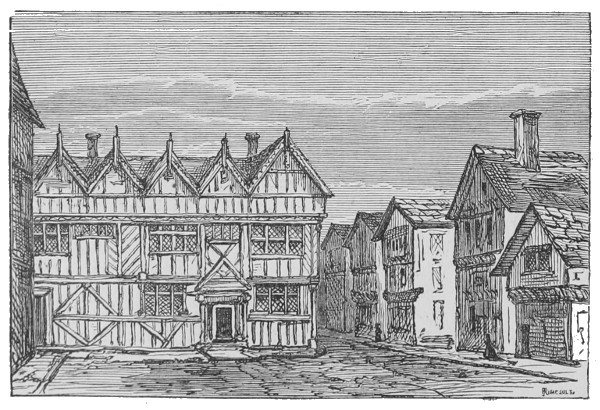
demolition cannot but be regretted. The houses, as already mentioned,
were built of oak, painted black and white, in the charming
fashion of the period, though not according to any uniform
design, so as to avoid a monotonous effect. In many instances
they were richly ornamented with curious and elaborate carvings.
One peculiarity belonging to them, and constituting a great charm,
was the possession of open balconies; and these were now, for
the most part, filled with well-dressed dames and damsels, some
of whom boasted considerable personal attractions. Worcester,
it is well known, has been at all times famous for pretty women.
The rails of the balconies were hung with tapestry, carpets, and
rich stuffs, and these decorations gave the street a very lively
appearance. The concourse on the footways contented themselves
with cheering the king as he passed along, and did not attempt to
press upon him, while the damsels waved their kerchiefs from
above. Had Charles been the handsomest young prince in Christendom
(which he certainly was not), he could not have captivated
more hearts than he did as he rode along the High-street, and gazed
at the well-filled balconies on the right and left. Each fair nymph
on whom his eye rested for a moment fancied herself the special
object of his admiration, while many a one—perhaps with some
reason—believed she had been distinguished by a bow from his
majesty.
In this manner Charles rode on—receiving fresh homage from
all classes of his subjects as he proceeded—till he came to the
Guildhall, where the civic authorities had already halted, and
where he himself alighted, in order to sign certain warrants.
Like almost all the other edifices in the street, the Guildhall has
been rebuilt, and though we have every respect for the modern
fabric, we should have been better pleased if the ancient structure,
with its recollections of the past, had been preserved. Allowing
the mayor and his fellows to conduct his majesty into the great
hall, we shall leave them there, having more to interest us outside.
Troops were now pouring into the city, and were marching
in different directions; some regiments being taken by their officers
to the Castle Hill, others to the cathedral close, and others to the
quays—at all of which places good eatables and drinkables, and in
the greatest abundance, were provided for them. On that day,
in all parts of the city, thousands of hungry soldiers were feasted—every
house being open to them. And to the credit of the
Scots it must be stated, that they in no wise abused the hospitality
shown them.
While his majesty was signing the warrants in the Guildhall, a
halt took place in the High-street, and when thus seen from above,
the various regiments of horse and foot, with their flags and
banners; now forming an almost solid mass, presented a splendid
spectacle. A good deal of animated conversation between the officers
and the damsels in the balconies took place during this interval,
and some amusing incidents occurred, one of which must be related.
Among the spectators collected nearly opposite the Guildhall
were an elderly dame and an exceedingly pretty damsel—the old
woman's grand-daughter, as it turned out. They evidently belonged
to the middle classes. With them was a sallow, ill-favoured
personage, whose closely-cropped black hair, steeple-crowned
hat, plain Geneva band, and black cloak, proclaimed him a
Puritan. It was certain that he was passionately enamoured of
the damsel, whom he addressed by the name of Mary, for
he watched her every look with jealous eyes; but it was by no
means equally certain that she returned his passion. Rather the
contrary, we should say.
Urso Gives, for so was pretty Mary's suitor named, was more
than double her age, and far from well-favoured, but he was
tolerably rich, and this was enough for Dame Rushout, Mary's
grandmother.
Urso Gives was a tailor, and had prospered in his business.
For a knight of the thimble, he was not devoid of mettle, and
somewhat quarrelsome and vindictive. He was decidedly a Republican,
and in religion an Independent. As may be imagined, this
was a bitter day for him, and he would not have come forth upon
it had it not been to watch over pretty Mary Rushout, who was
determined to see the young king. So he was compelled to place
Mary and her grand-dame in a good position opposite the Guildhall,
and there they had an excellent view of the young monarch,
and saw him dismount.
Mary Rushout was enchanted. Never had she beheld any one
so graceful, so majestic as the king. How royally he bestrode
his steed! How beauteous were his long black locks!—Urso must
let his own hair grow long. And then how his majesty's diamonds
sparkled! She could not help calling out "Long live the
king!" Charles noticed her, and told her, with a smile, "She
was the prettiest girl he had seen that day, and deserved a better
lover." Was not this enough to turn her head? Was it not
enough to madden the irritable and jealous Urso? The by-standers,
who were staunch Royalists, laughed at him, and this
exasperated Urso beyond all endurance. He broke out against the
king, called him the chief of the malignants, and the favourer of
heresy and profaneness, and would have gone on in the same strain
if he had not been soundly buffeted on all sides.
Mary Rushout and her grand-dame screamed, and their cries
attracted the attention of an aide-de-camp, who was waiting his
majesty's return. It was Major Careless. Seeing a pretty girl in distress
he pushed forward his steed, and quickly extricated her and the
old dame, while Urso took advantage of his interference to escape.
A Cavalier so gallant as Careless we may be sure did not retire
after such an introduction, and he found Mary Rushout very
willing to flirt with him. He soon learned all about her and about
Urso Gives, and that they both dwelt in the Trinity, and continued
chatting with her till Charles came forth from the Guildhall.
The royal cortége was once more put in motion, and proceeded
to the large open place near the Foregate, in the midst of which
stood the antique sculptured cross previously mentioned. The
place was now filled with people, but the assemblage was no farther
disturbed than was necessary to allow the troops to form a square
round it.
The mayor and the sheriff having made their way to the cross,
trumpets were sounded, and, amid the silence that ensued, the
mayor, in a sonorous voice, proclaimed Charles King of England,
Scotland, France, and Ireland. Tremendous acclamations followed,
and guns were fired from the top of the Foregate.
Even then the assemblage did not move, nor did the troops quit
their position.
Trumpets being again sounded, a Manifesto was published in
the king's name, declaring a general pardon to all the inhabitants
of the city as should henceforward conform to his authority; and
also announcing that warrants had just received the royal sign-manual
in the Guildhall, whereby his majesty summoned, upon
their allegiance, all the nobility, gentry, and others, of what degree
and condition soever, of the county of Worcester, from sixteen to
sixty, to appear in their persons, and with any horses, arms, and
ammunition they had or could procure, at Pitchcroft, near the city,
on Tuesday next, being the 26th of August, 1651, "where," pursued
the king, "ourself will be present to dispose of such of them
as we shall think fit for our service in the war, in defence of this
City and County, and to add to our marching army."
On the king's return to the city, the mayor ceremoniously conducted
him to his private residence, where a grand collation had
been prepared, of which his majesty and his suite partook.
HOW CHARLES WAS LODGED IN THE EPISCOPAL PALACE; AND HOW DOCTOR
CROSBY PREACHED BEFORE HIS MAJESTY IN THE CATHEDRAL.
The ancient episcopal palace—
which had been prepared, as
well as circumstances would permit, for the reception of the king
and his suite—was a large and stately pile, and, from its
size, grandeur, and the number of apartments it contained, was
well fitted to be the temporary residence of a monarch—even had
that monarch been firmly settled on the throne—and, indeed, it
was again occupied by royalty at a later date, when George III.
and his queen visited Worcester in 1788. By far the most important
mansion in the city, it occupied a commanding position
on the left bank of the river, and from its fine bay windows
presented a very imposing façade. The roof was lined with battlements,
towers, and belfries, and on the highest of these towers
the royal standard now floated, while sentries were stationed at
the river gate, and at the upper gateway. The palace was surrounded
by high embattled walls, within which was a garden laid
out in the old formal style, and boasting a broad terrace. The
garden had been utterly neglected by the Roundheads, and the
terrace was covered with grass. Internally, the mansion, which
was erected probably about the beginning of the sixteenth century,
contained a noble hall, with a richly carved screen, an exquisite
chapel, a carved oak staircase of great beauty, conducting to a
long gallery, the deeply embayed windows of which, while they
embellished the exterior, commanded fine views of the country,
and the broad intermediate tract once known as Malvern Chase,
but now a most fertile district, through which, as Dyer sings,
——the
wide
Majestic wave of Severn slowly rolls.
Considerable damage had been done to the gallery and the rooms
opening from it by the Roundheads, who had torn down the fine
old tapestry once adorning the oak panels, and injured the carvings.
Most of the old furniture, being of oak, had withstood a great
deal of barbarous usage, and an immense ponderous bedstead, in
which many a bishop had reposed, was prepared for his majesty.
A good many other beds had to be provided for the king's suite,
and for his large retinue of servants, but this was satisfactorily
accomplished, and luckily there were rooms enough to accommodate
all. Fortunately, also, the mansion possessed a vast
kitchen, having no fewer than three large grates, whence hospitality
had been dispensed by the worthy prelates in the olden
time. At these three grates cooks had been at work, roasting and
boiling, throughout the day.
The first persons presented to the king on his arrival at the
palace were Lord Talbot, Sir John Pakington, and Colonel
Mervin Touchet, who had been kept prisoners by the commandant
of the garrison. Lord Talbot and Sir John said they had only
waited to see his majesty, and were about to depart instantly to
raise recruits for his service, but Charles would have them stay
and dine with him. Another person whom the king was delighted
to see was Doctor Crosby, the loyal divine, who had suffered imprisonment
for his zeal in his majesty's behalf.
Dinner was served in the great hall, and what it wanted in
ceremoniousness was more than compensated for by abundance
of viands and excellence of wine. Not much form was observed.
The mayor occupied a seat on his majesty's right, and the sheriff
on the left. Grace was said by Doctor Crosby. We shall not
particularise the dishes, but we must mention that a Severn salmon
of prodigious weight—quite a regal fish, that had allowed itself
obligingly to be captured for the occasion—was set before the
king. Moreover, the stewed lampreys were an entirely new delicacy
to his majesty, and pleased him greatly.
Charles was in high spirits, and laughed and jested in the most
good-humoured manner with those near him. Of a very sanguine
temperament, he had never doubted the success of his expedition,
and the events—unimportant as they were—that had occurred
since his arrival before Worcester heightened his confidence. For
the first time he had been victorious, and had been warmly
welcomed by his subjects. He had been assured that a great
number of recruits could be raised in the county before the general
Muster took place at Pitchcroft, and he felt certain Lord Derby
would bring him large levies from Lancashire and Cheshire. He
would then give battle to Cromwell, defeat him, and march
on triumphantly to London. His confidence seemed to be shared
by all the nobles and general officers present—even by the cold
and cautious Lesley. While quaffing their claret and burgundy,
they predicted the utter defeat of old Noll and the destruction of
all rebels.
Next day, being Sunday, was comparatively calm after the
great previous excitement. Not that the city had by any means
resumed its ordinary aspect—that was clearly impossible with a
large army encamped outside the walls, and many regiments quartered
within them—but the Scottish soldiers, being strict observers
of the Sabbath, conducted themselves in a very orderly and
decorous manner. Much preaching was there in the camps at
Red Hill and Pitchcroft, and officers might be heard reading the
Bible and holding forth upon sacred texts to their men, who
listened with the profoundest attention.
All the churches—and Worcester, as we know, abounded in
churches—were filled with congregations in which the military
element predominated; but the cathedral—as might be expected,
since it was known that the king would attend divine service there—collected
within it all the principal personages of the city, all the
chief officers of the army, and as many regiments as the vast pile
could contain. Never, perhaps, before or since, has the interior of
this grand old edifice presented such a striking sight as it did on
this memorable occasion. Its marble monuments and effigies, its
chantry and lady-chapel, had been mutilated, as we have already
told, by the Roundheads, but these injuries were now concealed
from view by the throng collected within the aisles of the choir and
the retro-choir. Owing likewise to the attention being directed to
other objects, the loss of the splendid painted glass in the windows
was scarcely noticed. The majestic pillars lining the broad nave rose
up amid a mass of troops that not only occupied the body of the
fane, but the aisles. Seen from the entrance of the choir, paved
with steel caps, and bristling with pikes, muskets, and carabines—for
the men all carried their arms—the nave presented an extraordinary
coup-d'œil. Stationed within the south transept, Pitscottie's
Highlanders contributed materially to the effect of the
picture. All the nobles in attendance upon the king, with the
general officers, occupied the stalls in the choir—Charles being
seated in the bishop's throne.
As this was the first time on which the service of the Church of
England had been performed within the cathedral since its desecration
by the Parliamentarians, it may be conceived with what
satisfaction the members of that religion were enabled to resume
their own form of worship within it—and this satisfaction was
heightened by the circumstances under which they came back.
The organ was gone, but the military music substituted seemed
not inappropriate to an occasion when hymns of triumph were
sung. Certes, the drums, trumpets, and other martial instruments,
resounding from the roof, produced an extraordinary effect.
The sermon was preached by Doctor Crosby, and was a most
eloquent and fervid discourse. The pale countenance of the venerable
dean flushed, and his eyes blazed as with fire, while he denounced
the murderers of the martyr king, and declared that the
vengeance so long delayed would speedily fall upon them. Rebellion,
which had stalked unchecked through the land, would be
crushed, and the monarchy restored. To Charles he attributed
the highest spiritual authority, and spoke of him as "in all causes,
and over all persons, next under God, supreme head and governor"—expressions
at which his Presbyterian hearers took great offence.
The earnestness, however, of his manner could not fail to impress
them with a conviction of his sincerity.
A council of war was subsequently held within the palace,
and it was decided that the fortifications should at once be
thoroughly repaired, so as to enable the city to stand a siege, if
necessary, though no tidings had yet been heard of Cromwell.
After an early repast, Charles rode forth with his retinue into the
city, and was surprised to find the High-street so empty, and
almost all the houses shut up; but his surprise ceased when he
reached the camp at Pitchcroft, and found that the vast plain was
covered with people, and resembled a fair. The Scottish soldiers
were quiet, and took no part in the profane recreations of the dissolute
Cavaliers, who were everywhere swaggering about, and making
love to all the pretty damsels.
Charles was enthusiastically received, but he did not stay long
on Pitchcroft. After riding through the principal line of tents,
he returned and crossed the river to St. John's, where Dalyell's
brigade was placed to protect the approach to the bridge. Lower
down, on the meadows on this side of the river, Pitscottie's
Highlanders were encamped, and the king passed them on his way
to Powick, which he desired to see. From the Highlanders' camp,
which was almost opposite the episcopal palace and the cathedral,
the finest view of old Worcester could be obtained, and he paused
for some minutes, enraptured by the charming picture.
A delightful ride of a mile, or somewhat more, along this bank
of the Severn brought the king and his attendants to the Teme
at its point of junction with the larger river, and then following
its deeply-ploughed channel, and watching its swift-flowing current
through the fringing trees, they rode on to Powick.
Near Powick there was a woody island of some little extent,
round which rushed the river—here, as elsewhere, too deep to be
forded. The island was gained by a bridge from either bank, and
the importance of the point was so obvious, that the king determined
to place a battery upon it.
HOW CHARLES RODE TO MADRESFIELD COURT; AND HOW MISTRESS JANE LANE
AND HER BROTHER, WITH SIR CLEMENT FISHER, WERE PRESENTED TO HIS
MAJESTY.
Next morning another council of war was held at the
palace. No tidings as yet of Cromwell—no despatches from the Earl
of Derby. After an hour's deliberation the council broke up,
and the king proceeded to the Castle Hill, which was being
fortified under the superintendence of Lord Rothes and Sir William
Hamilton.
The city walls, in the reparation of which hundreds of men
had been employed since midnight, were next inspected by his
majesty, who was well satisfied with the progress made. He then
visited both camps, and while riding along the High-street with
his escort, attended by Major Careless, was loudly cheered. Ever
since the king's arrival at Worcester the weather had been splendid—a
circumstance that contributed in no slight degree to the gay
and festive air that prevailed within the city. The taverns were
full of roystering Cavaliers, smoking, drinking, dicing, and singing
bacchanalian songs.
On his return from the camp at Pitchcroft, Charles paid a
visit to the mayor at his private residence, and had a long
conference with him. Having given all the instructions he deemed
necessary, and feeling that his presence was no longer required,
Charles, anxious to escape from the ceaseless applications by which
he was beset, crossed the river, and, still attended by his escort
and Careless, rode in the direction of the Malvern Hills, his
destination being Madresfield Court, an old fortified mansion,
buried in the midst of thick woods of oak, beech, elm, and
other trees, stretching almost from Malvern to the banks of the
Severn.
The day, as we have said, was splendid, though excessively hot,
but shaded by the trees, which sheltered him with their mighty
arms from the oppressive summer heat, Charles found the ride
through the forest enchanting. He seemed to breathe more freely
now that he was away from the crowded city and the bustling
camps.
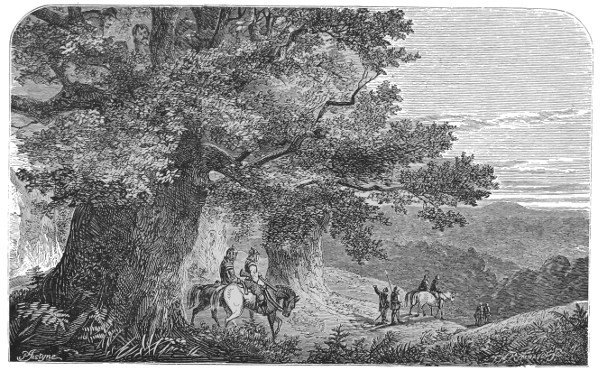
A lovely sylvan scene, such as he had not for some time contemplated,
was offered to his gaze. Madresfield Chase, which
formed part of the old forest of Malvern, boasted some trees of
great age and vast size. Generally the chase was flat, but occasionally
a knoll could be discerned, crowned with timber. A
long and beautiful glade of some miles in extent led towards the
ancient mansion, which could not, however, be distinguished.
Rising in front, above the trees, appeared the lovely Malvern
Hills, and their summits, bathed in sunshine, looked so exquisite
that Charles wished he could be transported to one of them.
"I never look at a mountain top," he remarked to Careless,
"without desiring to ascend to it."
"'Tis a natural wish I think, my liege," replied the aide-de-camp.
"At least, I have the same feeling. Those hills are not
difficult of ascent, and command a magnificent view. The highest
of them, and the nearest to Malvern, is the Worcestershire Beacon;
the other is the Herefordshire Beacon. Both noble hills."
"Can we ride to the top of the Worcestershire Beacon?"
"Easily, sire."
"Have you ever made the ascent on horseback?"
"Never—either on horseback or on foot, sire."
"Then you know nothing about it. However, the difficulties,
if there are any, won't deter me. I cannot resist the inclination
to ride up to the beacon. We will make the ascent in the evening,
when it grows cooler. 'Tis too sultry just now."
"Very true, sire. I should be loth to quit these trees for the
bare hill-side."
They then rode on till they came in sight of the grey old
structure, which was a very good specimen of a castellated
mansion, being strongly built, embattled, flanked with towers,
surrounded by a broad, deep moat, defended by a drawbridge,
and approached by a grand embattled gateway.
During the Civil Wars, Madresfield Court had been alternately
in the possession of the Royalists and the Roundheads.
Strongly garrisoned by Charles I., taken by Colonel Fynes at the
first siege of Worcester, retaken by the Royalists, and again captured
in 1646, it had remained, until within the last few days,
in the quiet possession of its owner, Colonel Lygon, who prudently
acted with the Parliamentarians. On the arrival of Charles at
Worcester, Colonel Lygon was driven forth, after an ineffectual
attempt at resistance, and his mansion seized and garrisoned for
the king. It was now in a condition to stand a siege, being
already well victualled, and well provided with arms and ammunition.
Falconets were placed on the gateway, and larger ordnance
on the battlements.
Charles was well pleased to see the royal standard displayed
from the roof of the old mansion, and to note the preparations for
defence. Trumpets were sounded and drums beaten on his
approach. The drawbridge was lowered, and the officers and
men prepared to turn out and receive his majesty. Charles, however,
halted beneath a spreading oak that grew on a wide lawn in
front of the mansion, and was contemplating the ancient edifice
with some pride in being once more its master, when Careless
drew his attention to three persons on horseback, who had just
issued from an avenue on the right. From their attire, and
from their steeds, the equestrians looked like persons of distinction.
One of the party, who specially attracted the king's attention, was
a young lady, slight in figure, and extremely graceful. Even
beheld at that distance, it might be safely asserted that she was
lovely, and when she drew near, she more than realised any
notions the king had formed of her beauty. Her companions
were Cavaliers undoubtedly—both fine-looking young men, distinguished
by their military bearing.
"Know you whom they are?" inquired the king of Careless.
"Unless I mistake not, sire, he in the black velvet doublet,
slashed with white, is Colonel Lane of Bentley Hall, in Staffordshire——"
"The Lanes are staunch Royalists?" interrupted Charles.
"Staunchest of the staunch, sire. With the colonel is his sister,
Mistress Jane Lane, one of the fairest damsels in the county, and
devoted to your majesty. He on the roan horse, and in the
green jerkin, laced with silver, is Sir Clement Fisher, of Packington
Hall, in Warwickshire."
JANE LANE PRESENTED TO CHARLES II.
"Jane Lane's suitor, I'll be sworn!" cried Charles.
"Your majesty has hit it," replied Careless, with a smile.
While this brief colloquy took place, the party had stopped, as
if awaiting permission to advance.
"Bring them to me, and present them," said Charles.
Careless, who was a preux chevalier, executed his task with
infinite grace. It was a charming sight to witness Jane Lane's
presentation to the young king. There was an ingenuousness
in her manner that delighted Charles. She seemed to possess
great spirit and force of character, and yet she had all the most
agreeable feminine qualities. As to her beauty there could be no
question. Brighter black eyes, features of greater delicacy and
refinement, tresses more exquisite, Charles had never beheld.
Though she coloured deeply when she first encountered the king's
gaze, she manifested no embarrassment.
There was a certain likeness between Colonel Lane and his
sister, though the colonel had strongly-marked traits, a firm mouth,
and a bold, determined look. But he had dark eyes like Jane,
and in them resided the expression that constituted the likeness.
Sir Clement Fisher was an admirable specimen of a Cavalier—handsome,
brave, chivalrous, he seemed formed to win a fair
lady's heart. Whether he had won that of Jane Lane will be seen.
"How is it I have not yet seen you at Worcester, gentlemen?"
inquired Charles.
"We are on our way thither, sire," replied Colonel Lane.
"You will see us at the Muster at Pitchcroft to-morrow. We
have not been lukewarm in your majesty's cause."
"Even I have done something for you, sire," said Jane. "This
morning I have secured your majesty forty horse; and I hope to
render you still better service before the day is over."
"My sister is zealous, you perceive, sire," remarked Colonel
Lane, with a smile.
"Were there a hundred like her I should soon have an army,"
observed Charles, highly pleased. "But what is the great service
you hope to render me?"
"Nay, sire," she rejoined, playfully, "you must allow me to
keep my secret. 'Twill be a surprise to you to-morrow."
"Then I will ask you no further questions, yet I would fain
know why you came here. You could not have expected to find
me at Madresfield."
"Pardon me, your majesty, I did expect to find you here."
"Oddsfish! you must be a witch," cried Charles, laughing.
"There is no sorcery in the matter, sire. Have you not sent
a messenger to Mr. Thomas Hornyold, of Blackmore Park, commanding
him to attend upon you at Madresfield this afternoon?"
"And you have seen the messenger?"
"I have, sire. I have read the message, and I told Tom
Hornyold I would come in his stead, and make his excuses. The
blame of his disobedience of your majesty's order must rest
entirely with me. I have sent him to Sir Rowland Berkeley."
"Indeed!" exclaimed Charles.
"He will do more good with Sir Rowland than here. But
that is not all. He has promised me to see Sir Walter Blount,
Sir John Winford, and Mr. Ralph Sheldon of Beoly. Will you
forgive now for my great presumption, sire?"
"Forgive you! I am beyond measure indebted to you."
"Sire!" she cried, with a look that bespoke her conviction of
the truth of what she uttered, "I believe that I am destined to
render you a signal service. My brother will confirm what I am
about to say. It was foretold of me when I was a child, by a
famous astrologer, that I should save a prince's life. The prophecy
must refer to you."
"It may be so," said Charles, smiling at her enthusiasm. "At
all events, I shall look upon you as my guardian angel."
"My heart beats only with loyalty, sire. I have no other feeling
in my breast."
"No other feeling, fair mistress?" said the king, glancing towards
Sir Clement.
"It is perfectly true, sire," observed the young baronet, with a
somewhat despondent look. "Mistress Jane Lane vows she will
never wed till your majesty is seated on the throne."
"And I will keep my vow," cried Jane.
"Then I trust ere long Sir Clement may be in a position to
claim you, and that I may be present at your nuptials," said
Charles. "But whither you go?" he added, seeing they were
preparing to depart. "Will you not enter the house?"
"We must pray your majesty to excuse us," said Colonel Lane,
bowing. "We have much to do. We are going to cross the
hills into Herefordshire.'"
"Nay, then you must stay till the heat of the day is abated, and
I myself will bear you company for part of your journey, for I
design to ascend the Worcestershire Beacon. 'Tis not fit your
sister should be exposed to this fierce sun."
"I am not one of those damsels that care for my complexion,
sire," observed Jane, laughing. "The sun will not melt me."
"Nay, then I will not detain you," rejoined Charles. "I shall
see you to-morrow at the Muster at Pitchcroft. You must not be
absent, fair mistress."
"Be sure I will not, sire," she replied.
Bending reverentially to the king, she rode off with the others.
"A noble girl!" exclaimed Charles, gazing after her with admiration.
"She is the incarnation of loyalty."
HOW CHARLES ASCENDED THE WORCESTERSHIRE BEACON; AND OF THE
AMBUSCADE PREPARED FOR HIM AS HE CAME DOWN.
After examining the preparations made for the defence of
the old mansion, Charles sat down with Careless and the officer in
command of the garrison to a repast prepared for him in the great
hall. When he had finished it he ordered his horses. The officer
asked if his majesty required his escort.
"No," replied Charles. "I am not about to return to Worcester.
I am charmed with this place, and shall sleep here to-night. I
mean to ride to Malvern. Major Careless will attend me."
So his majesty set forth, accompanied only by his aide-de-camp.
A pleasant ride through the woods brought them to the foot of the
giant hill, on a ridge of which stood the little secluded village of
Malvern. Yes, the little secluded village of Malvern. Where
terraces of well-built houses now spring above each other on the
hill-side—where countless white villas peer from out the trees,
contrasting charmingly with the foliage, and helping to form one
of the prettiest towns in England—a town as healthful as pretty—nothing
was then to be seen but a few small habitations, in the
midst of which rose the old priory church, and the beautiful
gateway adjoining it. The priory was pulled down at the Dissolution
of the Monasteries, and with it the glory of Malvern had
departed. Devotees were still attracted by the Holy Well, and
marvellous cures were said to be wrought by its waters, but such
pilgrims were rare, and Malvern remained an obscure, unfrequented
village, until its beauties and salubrity were discovered
in the early part of the present century.
Charles and his attendant halted on the ridge on which this
charming town is now built, and surveyed the extensive prospect
it commands. They were not aware that they were watched from
behind a tree by a tall, ill-favoured man, in the garb of a Puritan.
This eavesdropper, who had followed them cautiously for some
minutes, ascertained their purpose, and as soon as they began to
ascend the hill, he hurried down to the little inn near the priory
gate.
All difficulties in the ascent of the lofty hill, known as the
Worcestershire Beacon, have now been removed, and well-made
paths enable even invalids to reach its summit almost without
fatigue. But at the time when Charles and his attendant mounted
it, it had a stern, solitary air, and its silence was unbroken by
any sound except that of the sheep-bell, or the cry of a bird of
prey. Sheep-tracks alone led up its rugged sides, and conducted
the pedestrian through the broad patches of furze, or past huge
protruding rocks, to the smooth turf above. Charles being a
daring horseman, took the nearest road, and not unfrequently
came to places where it was too steep to proceed with safety,
and had to retrace his course and seek a less dangerous ascent.
The only person in sight was a shepherd tending his flock, and
he was far off. At length the king and his attendant gained
the rounded summit of the hill, which was covered by turf smooth
as velvet, and fragrant with thyme.
Hitherto, both Charles and Careless had been too much
occupied by the difficulties of the ascent to pay much attention to
the vast panorama opening upon them as they mounted the hill.
But as they now gazed upon it, they were lost in admiration, and
quite forgot the trouble they had experienced.
It boots not to describe the thoughts that passed through the
king's breast, as his eye ranged over that astonishing prospect,
which, comprehending as it does nine or ten counties, showed him a
large portion of his kingdom, and that perhaps not the least beautiful
portion. How many towns and villages—how many noble mansions—could
he count in that wide-spread landscape! On the left, and
almost as it seemed at his feet, lay the old and faithful city of Worcester,
with his army encamped around it. Two other cathedral
towns, with their church towers and steeples—Gloucester and Hereford—could
likewise be distinguished. Charles sought the Severn
for some time in vain. Owing to the height of its banks, it could
only be here and there discerned.
He hung long upon this incomparable prospect, and then turned
to the Herefordshire side of the hill, whence the view was almost
equally fine, three distinct mountainous chains, of beautifully varied
form, meeting his gaze.
On quitting the green sward the perils of the descent commenced,
and they were obliged to proceed with caution, the ground
being covered with loose stones and fragments of rock. They
proceeded singly, Charles taking the lead, and were skirting a
huge mass of granite that obstructed their course, when suddenly
half a dozen men, armed with muskets, whose steel caps and buff
coats showed they were Parliamentary soldiers, and who had
evidently been lying in ambush behind the rocks, sprang forward,
one of them seizing the king's bridle, and two others forcibly
preventing him from using his arms. Careless was treated in precisely
the same manner, and the capture was so quickly executed
that it was perfectly successful.
At the same time two persons appeared on the top of the rock,
which rose to some little height above them. In one of these
Careless recognised Colonel James; the other, who kept back, was
the spy we have previously mentioned.
"Release me, villains!" cried Charles, furiously, as he vainly
attempted to free himself from the grasp of the soldiers who held
him.
"Not so," said the leader of the ambuscade from above. "The
Lord hath delivered thee into my hand, as He delivered Jabin,
King of Canaan, into the hands of the children of Israel. I will
not put thee to death, but will take thee and thine officer as
prisoners to the Lord General, to deal with ye as he may see fit.
With thy capture the invasion of the men of Moab is at an
end."
Scarcely were the words uttered than a loud report was heard,
and he dropped on the rock, apparently mortally wounded.
"The Amalekites are upon us!" shouted the spy. "Save yourselves!"
So saying, he jumped down on the other side of the rock and
disappeared.
Supposing their commander killed, and not knowing what force
might be upon them, the soldiers did not dare to carry off their
prize, but sought safety in flight.
Next moment, from among the rocks beneath, issued Sir Clement
Fisher, who had fired the shot, while close behind him appeared
Colonel Lane and his sister.
"Heaven preserve your majesty!" shouted the two Cavaliers,
raising their hats; while Jane, whose dark eyes flashed, and whose
face was radiant with delight, echoed the loyal aspiration.
Charles heard them, and raised his hat in response.
"Haste thee to Madresfield Court," he said to Careless. "Bring
a detachment of horse to scour these hills. I will have the villains
who have dared to lay hands upon me."
"Your majesty——"
"Obey me. I shall have Colonel Lane and Sir Clement Fisher
with me. Away! Spare not the spur."
Thus enjoined, Careless dashed down the rocks at the hazard
of his neck.
Charles then descended to his preservers, who had moved to a
less rugged spot, and thanked them heartily.
"The prophecy is fulfilled," he said to Jane. "You have saved
my life."
"Nay, it was Sir Clement who delivered you, sire," she replied.
"But I may, at least, claim the merit of having perceived your
majesty's peril."
"You may claim more," remarked Sir Clement Fisher. "Had
it not been for your coolness and self-possession, we could not
have succeeded in effecting his majesty's deliverance."
"I said you are my guardian angel, and so you are," cried
Charles. "But I must learn what took place. Let me have the
description from your own lips."
"Since your majesty commands me, I must speak, though Sir
Clement could better explain the matter," she rejoined, blushing.
"Then, thus it was, sire. We had accomplished our errand,
and were returning through yonder pass between the hills, when
we observed your majesty and Major Careless near the beacon.
We could see you both quite distinctly, and our gaze never
quitted you till you were about to commence your descent. I
then begged my brother to quit the lower road, in order that
we might meet you as you came down. Your course lay towards
those rocks, and while gazing in that direction, I noticed some
armed men moving stealthily about among them, and pointed
them out to my brother and Sir Clement, who at once recognised
them as rebel soldiers, and felt sure that an ambuscade had been
placed there. What was to be done? Impossible to warn you.
A plan occurred to me. I showed my companions how, by keeping
among the rocks, we could approach the ambuscading party
unperceived, and they followed my counsel, as it seemed the sole
chance of saving your majesty. We got near enough to enable
Sir Clement to bring down the leader of the troop."
"And luckily not another shot was needed," said Sir Clement.
"I know not whether you were my deliverer or Sir Clement,"
said Charles. "But I am equally indebted to you both. And
now you must all accompany me to Madresfield Court. I shall
need your escort, gentlemen."
HOW COLONEL LEGGE BROUGHT IMPORTANT NEWS TO THE KING, AND HOW
HIS MAJESTY PAID A VISIT TO SEVERN END.
Careless was able to execute the king's commands much
more quickly than he expected. Encountering a small party of
dragoons near Malvern, he ordered them to scour the lower
part of the hill, while he himself re-ascended the heights. The
Roundheads, however, had made good their retreat. They had
hidden their horses, it appeared, in a deep chasm, on the hill-side,
and after their unsuccessful attempt, had descended into the
plain, where they were lost among the woods.
A singular discovery was made by Careless. On visiting the
rock, on which the commandant had fallen, he found the spot
stained with blood, but the body was gone. By whom had it
been removed? Not by the Roundheads—that was certain. In all
probability Colonel James had not been mortally wounded, as was
at first supposed, but had recovered sufficient strength to crawl
off. The search made for him proved ineffectual, and Careless was
obliged to return to Madresfield Court without having effected a
single capture. The king having by this time recovered his good-humour,
laughed at his aide-de-camp's ill success.
"Oddsfish!" he exclaimed. "I had nearly lost my crown by
that foolish ascent of the Worcestershire Beacon—rather too high
a price to pay for a fine view."
His majesty was alone, Colonel Lane and those with him having
proceeded to Worcester.
Next morn, Charles arose betimes, broke his fast lightly, and
had just mounted his charger with the intention of setting off to
Worcester, when his departure was stayed by the arrival of
Colonel Legge, one of his most gallant and trusted officers, and
familiarly called by his majesty "Honest Will."
Colonel Legge brought very important news. He had been
with a reconnoitering party to Evesham, and had captured
a couple of Roundhead scouts, from whom he had obtained
information respecting the enemy's movements. Cromwell was
approaching with a large army, having seventeen thousand horse
and foot under his own command; while the regiments of Lord
Grey of Groby, Fleetwood, Ingoldsby, Lambert, and Harrison,
together with the militia that had recently joined the Parliamentary
forces, swelled the amount to upwards of thirty thousand.
"Nearly treble my force," exclaimed Charles. "But were they
forty thousand I should not fear them."
"'Tis well you are prepared, sire," remarked Legge.
"Much has yet to be done," replied the king. "The passes
of the Severn and the Teme must be looked to. Upton, Powick,
and Bransford Bridges must be broken down. Haste thee to
Worcester, Will. Summon a council of war to meet me three
hours hence. By that time I shall have visited Upton and
Powick, and perhaps Bransford. Is Massey at Upton?"
"Massey's head-quarters are at Severn End, sire, the residence
of Judge Lechmere. The judge sides with the Parliament, but
I suspect he is a time-server, and will always support the party in
power. If your majesty is victorious, he will throw himself at
your feet. Severn End is a fine place, and Massey seems to like
his quarters. Judge Lechmere's nearest neighbour is loyal Tom
Hornyold, whom you will assuredly see at Pitchcroft to-day."
"Oddsfish! Judge Lechmere must be an astute fellow from thy
account of him, Will," replied Charles, laughing. "I will go first
to Severn End. Perchance I may see the judge. If so, I will
have a word with him."
"Fine him heavily, sire, or imprison him, if he will not join
you," said Legge.
"Humph! I like not to have recourse to harsh measures," rejoined
Charles. "Still, an example ought to be made of such a
man. Now, off with thee to Worcester, Will. Say to all that
thou hast left me in good spirits."
"I can say so with truth, my liege," replied Legge.
Careless undertook to conduct his majesty to Severn End, being
well acquainted with Judge Lechmere's residence. Their course lay
through the loveliest part of the chase, but Charles was too much
preoccupied to notice the beauties of the scene, and Careless did
not venture to disturb the profound reverie into which his royal
master had fallen, and which lasted till they came to the precincts
of a large, well-timbered park, in the midst of which stood a fine
old house embosomed in a grove of rook-haunted trees.
"Is this Severn End?" asked Charles.
"No, my liege; this is Blackmore Park, the abode of your
staunch adherent, Captain Thomas Hornyold."
"And a charming place it is," observed the king; "I would
all my staunch adherents were as well housed!"
After skirting the moss-grown park pales for a few minutes,
they came upon a long and stately avenue, down which a troop
of horse was riding, with their leader at their head.
"As I live that must be Tom Hornyold's troop!" cried Charles,
halting, while Careless signed to the king's escort to stop.
Seeing Careless ride towards him, and comprehending the aide-de-camp's
object, Captain Hornyold put his troop into a trot, and
presently drew up before the king.
Tom Hornyold's manly bearing, open countenance, frank
manner, and steady look prepossessed the king in his favour.
"I trust your majesty will pardon my inattention to your summons
yesterday," said Hornyold, after making an obeisance.
"Here are forty good men and true, who will fight well for you,
and I have had barely time to get them together."
"Mistress Jane Lane explained all to me, Captain Hornyold,"
rejoined Charles, graciously. "You did quite right, and I thank
you heartily. By my faith, you have brought me some famous
recruits."
As he moved towards the troop, he was welcomed with a shout
that startled the clamorous rooks overhead, and put to flight a
herd of deer that had been couching beneath the trees.
Well pleased with the appearance of the recruits, many of
whom were remarkably fine-looking young men, and all well
accoutred and extremely well mounted, the king thus expressed
his satisfaction:
"Good men—good horses—good weapons, and strong arms to
wield them—those you have brought me, Captain Hornyold, and I
thank you once more. Gentlemen," he added to the troops, "I cannot
tarry longer with you now, though I fain would say something
more, but I have much to do, as you are aware. I shall see you
again at Pitchcroft. Au revoir!"
Bowing graciously to Captain Hornyold, he then rode off,
attended by Careless and followed by his escort.
On quitting Blackmore Park, the king approached another
equally well-wooded domain, which he did not need to be told
belonged to Judge Lechmere.
It was, in sooth, Severn End, and their road towards the house
led them for a short distance near the bank of the river. The
grounds contained many noble trees, amongst which were several
towering elms and broad-armed oaks that delighted Charles, as did
a remarkably fine service-tree, which he pointed out to his attendant.
As they drew near the picturesque old mansion, it was easy to
perceive that it was under military occupation—sentinels being
placed at the entrance, while small parties of dragoons were
gathered on the terrace, as if awaiting orders; and a troop of
cavalry was drawn up on the lawn. A soldier was walking a
powerful charger to and fro before the porch.
Drums would have been beaten, and trumpets sounded, but
the king would not allow any announcement of his arrival to be
made. Leaving his escort at the extremity of the lawn, he rode
up to the portal with Careless. He then dismounted and marched
up the steps, merely returning the salutes of the officers he encountered.
Loud and angry tones were audible as he crossed the hall,
and guided him to the room in which General Massey could be
found. The door being partly open, Charles pushed it aside and
entered a large chamber with a somewhat low roof, panelled with
black oak, ornamented with several full-length portraits.
This was the dining-room, and in the midst of it stood General
Massey, booted and spurred, with his hat on, and his riding-whip
in hand, evidently prepared to mount his charger.
A fine, tall, broad-shouldered man was the general, and well
became his rich accoutrements. His back being towards the door
he did not notice the king's entrance. Full of wrath, as we
have intimated, he was pouring his fury on the head of a grave-looking
personage in a black velvet gown, and having a black
skull-cap on his head, who was standing calmly before him.
Perhaps this individual, whom Charles had no doubt was Judge
Lechmere, recognised his majesty. If so, he gave no sign, but
kept his keen grey eye steadily fixed on the irate general.
"Hark ye, judge," thundered Massey. "'Tis you, and such as
you, supporters of this rebellious Parliament, who ought to suffer
most, and by Heaven you shall suffer. You shall be forced to
contribute largely to the expenses of the war you have compelled
his majesty to undertake for the recovery of his throne. You
are fined five thousand pounds."
"By whom am I fined that large sum?" demanded Lechmere,
in a calm tone. "Not by the king, I am well assured. He
would not commit such an injustice."
"You are fined by me—that is sufficient. I have his majesty's
warrant for all I do."
"Not his written warrant," said the judge.
"I need it not," cried Massey. "What doth your Lord-General,
as you style him? I do not desire to imitate his ruthless and
robber-like proceedings. I do not intend, like him, to plunder
churches, hospitals, and private dwellings. I do not mean to break
open chests and carry off gold by the sack, and plate by the cart-load,
as he did at Worcester, after the first siege. But I will imitate
him in one thing. I will punish wealthy offenders like yourself
by fines proportionate to their means. You have amassed money,
I know, and, though a lawyer, I hope have come by it honestly.
Had you been loyal you might have kept your money. But since
you are a rebel, and a favourer of rebels, you shall disburse your
gains for the king's use. You shall pay me the five thousand
pounds I demand."
"And yet you affirm that you design not to plunder me," observed
Judge Lechmere, still with perfect calmness. "What call you this
but plunder on the greatest scale? Better strip my house of all
it contains—better carry off my pictures and my plate—than
fine me in a sum so large that I cannot pay it. Again I say,
I am certain the king would not allow this demand to be
made."
"His majesty will approve of what I do," rejoined Massey.
"But I will not bandy words with you. You are now in my court,
judge, and my decision holds good here. I will have the sum I have
named—no less. Two thousand pounds—the first instalment—must
be paid before noon on Thursday. That will give you two
days to raise it. If you fail, I will have you shot in your own
court-yard. You hear! No excuses will avail. Till then you
are a prisoner in your own house."
"If I am a prisoner, how am I to raise the money, general?"
asked the judge.
"That is your concern," rejoined Massey. "Have it I must—or
you die!"
As he turned to quit the room, he perceived Charles standing
behind him.
"Ah! sire," he exclaimed. "I did not know you were here."
"Am I indeed in the king's presence?" exclaimed Judge Lechmere,
with well-feigned astonishment.
"You are in the presence of the sovereign to whom your
allegiance is due, my lord judge," rejoined Charles, with
dignity.
"Whatever my feelings may be towards your majesty," said
Lechmere, "I cannot consistently——"
"You dare not declare yourself in my favour, eh, judge?"
cried Charles. "Well, I will give you till Thursday for reflection.
Naturally, you are included in the general pardon I have
published, and if you then return to your allegiance, I shall be
disposed to forget the past, and will remit the heavy fine imposed
upon you by General Massey. Nay, I will do more; I will
take you into my favour."
"I thank your majesty for your goodness. I will perpend the
matter."
"Methinks it requires little consideration," observed Charles,
somewhat sternly. "You have to choose between your lawful
king and a usurper. You will best consult your own interests in
serving me."
"I am inclined to believe so, sire—nay, I am certain—yet give
me till Thursday."
"I have said it," rejoined Charles. "I now leave you in General
Massey's hands."
With a grave bow to the judge, who had rushed forward as if
to throw himself at his majesty's feet, but stopped suddenly, he
quitted the room, followed by Massey.
As he crossed the hall he laughed heartily.
"Your judge will turn Royalist on Thursday, if nothing happens
to-morrow," he said.
On quitting Severn End, Charles accompanied General Massey
to Upton.
They rode through Hanley, where a stately pile belonging to
the Earls of Gloucester once stood, and where Massey's troops
were now encamped.
The general had with him a detachment of five hundred horse
and a regiment of dragoons, and he assured the king that he felt
confident of preventing the enemy's passage at Upton Bridge,
come in what force he might.
Together they carefully examined the fine old bridge, which,
like the bridges of Worcester and Powick, was somewhat narrow,
but had deep angular recesses. It was strongly built of stone, and
had several arches.
Charles advised its total destruction, but Massey was of opinion
that it would suffice to break down the central arch; and the
king giving his assent, a large body of men was at once set to
work upon the task.
After witnessing the commencement of the operations, Charles
took leave of Massey, urging him to be more than ever vigilant, as the
safety of the army now depended on him, and rode on with his
escort to Powick.
The security of this important pass seemed to be guaranteed by
the presence of General Montgomery and Colonel Kirke, with
two battalions of foot and a regiment of horse, and Charles, with a
mind very much quieted, crossed the river to Worcester.
OF THE COUNSEL GIVEN BY COLONEL LESLEY TO THE KING.
When Charles arrived at the palace, the war council was
already assembled. Several general officers, however, were necessarily
absent.
A long and anxious discussion ensued, and great diversity of
opinion prevailed—jealousies having sprung up amongst the commanders.
His grace of Buckingham hated the Duke of Hamilton,
and derided his plans; but his own rash counsels were rejected.
Charles felt sure, he declared, that he should be largely reinforced
by the levies which the Earl of Derby was bringing from
Lancashire and Cheshire. But he cared not if his army should
be inferior to that of the enemy in number.
"There is no fear of treachery," he said. "The loyalty of the
citizens of Worcester is unquestionable. They will fight for me
as bravely as they fought for the king, my father. No defeat will
subdue them. But why do I talk of defeat? Let us speak of the
victory, that is certain."
"The next battle must be decisive, sire," remarked the Duke of
Hamilton. "We must conquer, or die."
"We will conquer," cried Charles, energetically.
"We will," cried several voices.
Having remarked that Lesley took no part in the conference,
the king drew him aside and inquired the meaning of his sombre
looks.
"Are you afraid of Cromwell?" he asked.
"I am afraid of my own men, sire," replied Lesley. "They
are discontented, and do all I can, I am unable to remove their
dissatisfaction."
"Of what grievance do they complain?" asked Charles.
"I need not remind your majesty, that nearly five thousand
Scottish soldiers have returned to their own country since we
crossed the Border——"
"Deserted, if you please, colonel," interrupted Charles.
"Well, deserted, sire. But they had this excuse. Being zealous
Presbyterians, they had conscientious scruples against establishing
the Episcopal government in England by force of arms; and
like sentiments prevail, to a great extent, among the remainder
of the troops. Since our arrival at Worcester their discontent has
perceptibly increased. They do not like to fight with the Cavaliers.
For this reason, they are not pleased with the Muster
about to take place to-day, neither do they desire to be joined
by the levies promised by the Earl of Derby."
"They fear that my devoted adherents may become too strong
for them. Is it not so, colonel?" asked Charles, coldly.
"They deem that a preponderance of the royal party—strictly
so called—though we are all Royalists—would be contrary to the
true interests of Scotland, and to the welfare of the Kirk."
"Ah, I see!" exclaimed the king. "The Committee of the
Kirk of Scotland have troubled their consciences—meddlesome
fools that they are! But you must keep your men in good
humour, Lesley. They must fight this battle. Assure them that
I am a zealous partisan of the Covenant, and that when I ascend
the throne I will ratify all the conditions imposed upon me."
"Humph!" exclaimed Lesley. "I may give them these assurances,
but they will not believe me. So critical do I consider
the position, that if I dared to offer your majesty a counsel, it
would be to return to Scotland without hazarding an engagement."
"Return to Scotland!—never!" exclaimed Charles, indignantly.
"How dare you make a proposition so dishonouring to
me, Lesley. I have not advanced thus far into my kingdom to
go back again without a blow."
"I knew my advice would be distasteful to your majesty, but I
deemed it my duty to give it."
"No more!" cried the king. "Quell this mutinous spirit in
your men, Lesley—quell it, by whatever means you can. Mark
well what I say, and fail not to repeat it. When we have routed
the rebels—and we shall rout them—those who have fought best
for me shall receive the highest reward."
Before Lesley could make any reply, Pitscottie approached his
majesty.
"Where are your Highlanders, colonel?" demanded Charles.
"Drawn up in the college green, sire. I await your orders to
march them to the place of Muster."
"Have they heard that Cromwell is at hand?"
"Ay, sire; and they are eager to meet him."
"No discontent among them—ha?"
"Discontent! No, sire. They were never in better spirits.
All they desire is to prove their zeal to your majesty, and use
their broadswords against the foe."
"Brave fellows!" exclaimed Charles, glancing significantly at
Lesley. "They shall serve as my body-guard to-day."
OF THE GRAND MUSTER AT PITCHCROFT.
Ever since the old city of
Worcester was built and encircled
by walls, Pitchcroft has afforded its inhabitants a delightful place
for exercise and recreation. On this broad, flat plain, bounded on
the west by the Severn, and completely overlooked by a natural
terrace on the further bank of the river, many a grand tournament
has been held in the days of our earlier monarchs. Magnificent
pavilions and galleries have been reared upon the wide mead—splendid
cavalcades have come forth from the city gates—nobles,
knights, squires, jesters, and fair dames—and many a lance has
been splintered at the royal jousts of Worcester. In 1225,
these displays incurred the displeasure of the Church—a grand
tournament being held on Pitchcroft in that year, when all the
noble personages concerned in it were excommunicated by Bishop
Blois. Sports and pastimes of all kinds have been familiar to
the plain from time immemorial—games which, by a pretty
figure of speech, have been described as Olympian, and which,
we rejoice to say, are not altogether discontinued. Not only
has Pitchcroft been the scene of many a knightly encounter and
many a festive meeting, but when the loyal city was invested,
it witnessed frequent conflicts between Cavaliers and Roundheads,
and one well-fought action, in which the fiery Rupert took
part.
On the morning appointed for the Muster, Pitchcroft was even
more thronged than it had been on the previous Sunday, and presented
a far gayer and more animated appearance. A great
number of troops was assembled there, while the new levies were
continually pouring into the plain through Foregate-street.
Before proceeding to the place of rendezvous, the recruits
entered the city, and halted for a time in the area near the
Cross, where their numbers were registered by the mayor and
the sheriff, who acted as commissioners.
Among the principal names inscribed on the muster-roll were
those of Lord Talbot, Sir John Pakington, Sir Walter Blount,
Sir Ralph Clare, Sir Rowland Berkley, Sir John Winford,
Mr. Ralph Sheldon of Beoley, Mr. John Washburn of Witchinford,
and Mr. Thomas Hornyold.
Lord Talbot's troop, which was far more numerous than any
other, was composed almost entirely of gentlemen, whose accoutrements
and horses were far superior to those of ordinary cavalry.
The regiment was commanded by Lieutenant-Colonel Mervin
Touchet, and subsequently proved exceedingly efficient. Every
Cavalier who came singly to Worcester was included in some
troop or other.
These arrangements were made by Colonel Lane and Colonel
Legge, assisted by Sir Clement Fisher. As quickly as one troop
was filled up, it was sent off to the place of Muster. It was
calculated that two thousand Worcestershire Cavaliers, including
of course retainers and servants, answered the king's summons on
that day.
The sight of so many recruits tended materially to dissipate
the alarm not unnaturally excited by the rumours of Cromwell's
near approach. Having begun to distrust the Scottish
soldiers, the citizens were glad to have some defenders on whom
they could confidently rely. For this reason, as well as for their
gallant bearing and handsome equipments, the recruits were lustily
cheered as they appeared on the plain.
A large concourse was collected in Foregate-street, and on the
northern walls, to see the new troops come forth. The Scottish
regiments of cavalry and infantry excited but little curiosity;
the chief objects of interest being the numerous small bodies
of horse, extending for a quarter of a mile on the left—each
little troop with its officers in front.
The effect of this arrangement was extremely good, and
delighted the spectators on the city walls and those on the
west bank of the river.
The last troop had just got into its place, when the shrill
notes of the pibroch were heard, and the Highlanders, with
Colonel Pitscottie at their head, marched forth, and were received
with cheers by the crowd assembled in Foregate-street.
Acclamations greeted the king. His majesty looked extremely
well, and charmed the beholders, as he always did, by the
extreme affability of his demeanour. On this occasion he was
only attended by Careless and Colonel Blague. The recruits
instantly attracted his attention—their numbers giving him
manifest pleasure—and he expressed his satisfaction at beholding
them audibly to his attendants.
He had not proceeded far, when the mayor and the sheriff
advanced to meet him.
Opening a scroll which he held in his hand, the mayor in a
loud voice recited the long list of loyal gentlemen of the county
who had responded to his majesty's summons. The king looked
highly gratified, and repeated each name as it was given out.
When the mayor had made an end, Charles rode towards
Lord Talbot, who was nearest him on the left, and while surveying
his splendid troop with admiration, called out, so that all might
hear him:
"Why, my good lord, these are all gentlemen. Better mounted,
better equipped Cavaliers, I would not desire to see."
"They are all loyal gentlemen," replied Lord Talbot, bowing;
"and as such I am proud to present them to your majesty."
"Long live the king! Confusion to his enemies!" shouted the
gallant band, brandishing their swords.
The shout was caught up by the next troop, which was commanded
by Sir John Pakington, and was echoed far and wide.
After a few complimentary observations to Colonel Touchet,
Charles moved on, inspecting in turn all the new-raised troops.
Had loyalty been chilled in any breast, his majesty's gracious
manner would have kindled it anew—but all were loyal. The
king could not help noting that in almost every troop gentlemen
had joined, and horses and accoutrements were generally so good
that officers could scarcely be distinguished from privates.
Captain Hornyold's troop was stationed near the Scottish
cavalry—Sir Clement Fisher acting as second captain. But the
real commander, in the king's estimation, was Jane Lane, who was
posted in front of her steed.
A glance of triumph lighted up her fine eyes as Charles addressed
her:
"You only want arms to become a veritable Amazon."
"I will wear them if your majesty commands."
"No, you have brought me so many recruits that it is unnecessary.
How many troops have you helped to fill up?"
"I have done my best, sire, but I have not brought you half
so many as I could desire. The Worcestershire gentry are loyal,
but irresolute and cautious—I will not use stronger epithets.
They try to excuse their lukewarmness on the ground that they
suffered so much from fines and sequestrations during the Civil
Wars. But, as I tell them, that is no excuse. They ought to
risk all—sacrifice all, if need be—for their sovereign. Many
have come here to-day. But," she added, with a look of mingled
grief and indignation, "some, on whom I fully counted, are absent."
"I scarcely miss them. When I have won a battle, they will
hasten to rally round my standard, but I shall know how to distinguish
between late comers, and those who have been true to
me in the hour of peril."
"All here are true men, my liege. I would not say as much,
for yon Scottish soldiers." Then lowering her voice so as only
to be heard by the king, she added: "Do not trust Lesley, sire.
He may play you false."
"Why do you entertain these suspicions?"
"From what I hear of the conduct of his men, and of his own
discourse. Heaven grant my fears may prove groundless!"
"If Lesley proves a traitor I am undone, for he commands
the third of my army, and his men will obey no other leader.
But I will not believe him false."
"What news has your majesty of the Earl of Derby?" asked
Jane, still in the same whispered accents. "Pardon the question.
'Tis prompted by the deep interest I feel——"
"No messenger from the earl has arrived as yet. But I have
no apprehensions of a reverse. Doubtless, he is marching hither
with the levies he has obtained, but has been compelled to turn
aside from the direct route to avoid Cromwell."
"Would he were here now!" exclaimed Jane, earnestly.
"I would so too," responded Charles, with equal fervour. "But
he will not fail me at the right moment, and will cut through any
opposing force to join me."
"Is it not strange you have not heard from him, sire?"
"Not so strange—since the enemy is between us. Besides, if
he has not effectually disposed of Lilburn, he may be harassed by
him in his march. A few hours, I trust, will bring me tidings
of the friend on whom I reckon most."
Banishing the gloom that had gathered on his brow during his
converse with Jane, he turned to Captain Hornyold, and delighted
that loyal gentleman by his praises.
Having completed his inspection of the new troops, Charles
proceeded towards the centre of the plain, where Pitscottie and
his Highlanders were drawn up. Here he stationed himself, and
immediately afterwards it became evident, from the movement
that took place, that the recruits were about to march past.
With as much promptitude and precision as if they had belonged
to the regular cavalry, Captain Hornyold's troop came up. By
the side of their leader rode Jane Lane, but she proceeded no
further, being called upon by the king to take a place beside him.
Each little troop rode past in rapid succession—each being
commended by the king in no measured terms—and they all
deserved his praises, for a finer set of men were never got
together.
Almost all of them were in the full vigour of manhood, and
the ardour displayed in their looks and bearing, and in the
shouts they could not repress, formed a striking contrast to the
sullen visages and moody silence of the Scottish soldiers, who
seemed to regard their new comrades with aversion.
But the coldness of the Scots was more than compensated for
by the genuine enthusiasm of the citizens, who put no bounds to
their rapturous delight, and shouted lustily as the new troops rode
by. Every officer, and indeed almost every one in each company,
being known, they were familiarly addressed by name, and cheered
individually as well as collectively by the spectators.
After defiling past the king, the troops were formed into four
regiments of five hundred each—respectively commanded by
Colonel Mervin Touchet, Colonel Legge, Colonel Wogan, and
Colonel Lane.
Attended by Lord Talbot, Sir John Pakington, Sir Walter
Blount, Sir Ralph Clare, Sir Rowland Berkley, and Sir John Winford,
the king rode slowly past them—ever and anon raising his hat—and
manifesting by his looks the high gratification he felt.
Amid the loud and reiterated cheers of the concourse, his
majesty then returned to the city—preceded by Colonel Pitscottie
and his Highlanders, and attended by the gentlemen we have just
mentioned.
THE BIVOUAC ON THE PLAIN.
Shortly after the king's departure, two of the
newly-raised regiments proceeded to the quarters temporarily assigned them in
the city. Next day they encamped on the west side of the river.
The regiments left behind remained where they were, and
commenced their experience of military life by bivouacking on
the plain. They did not undergo much hardship, since the night
was fine and warm, and the moon being nearly at the full, every
object was as distinctly visible as during daytime.
As far as eatables and drinkables were concerned, the newly-enrolled
troops had no reason to complain. Plenty of provisions
and an abundant supply of good liquor—ale, perry, cider, canary,
sack, and other wines, were sent them by the mayor and sheriff.
Though novices in the art of war, the new soldiers were adepts in
drinking, and could empty their cups as well as the oldest campaigner.
Every Cavalier was welcome to a share of their runlet
of sack or claret—but they did not invite the Scottish soldiers.
Though the night was fine and warm, as we have described,
they kept up their fires, and sat around them to a late hour.
These groups, with arms piled, and horses picketed beside
them, lent a very picturesque appearance to this part of
the plain. Further on could be seen the tents of the Scottish
soldiers, bathed in moonlight, but few were stirring near them
except the sentinels. It would almost seem as if the Scots had
retired to rest earlier than their wont to avoid hearing the songs
and laughter of their roystering comrades. A great noise was
undoubtedly made, for a dozen Cavalier ditties were chanted at
the same time by different parties. At last, however, the recruits
grew tired of singing, and began to talk of the war. Round each
fire were collected individuals who had fought at both sieges
of Worcester, and these now favoured their companions with their
recollections of those stirring times.
"Nine years ago," said a burly-looking young man, who had
been addressed as Martin Vosper, "I was just nineteen—so
you will readily guess my age now—and I was then 'prentice to
Mr. Lysons, the present worthy mayor of Worcester. The city, as
you know, has always been loyal, and for that reason was regarded
from the very first with especial disfavour by the rebellious
Parliament. In 1642, our faithful Worcester, for I love to call it
so, declared for the king, opened its gates to Sir John Biron and
the three hundred Cavaliers he brought with him, and fortified
its walls. The Roundheads did not leave us long alone. Lord
Say and Colonel Fynes, with a large force, laid siege to the city;
whereupon the king sent word from Oxford that he would bring
fifteen hundred horse and twice as many foot to raise the siege.
Our satisfaction at this agreeable intelligence was damped by
hearing that Lord Essex was marching against us with fourteen
thousand men; but just as we were beginning to despair, Prince
Rupert, with his brother Maurice, threw themselves into the city
with a large body of troops. Then we felt able to set Old Noll
himself at defiance. Two successful stratagems were practised. But
I must first describe an action that took place on this very plain.
Determined to strike a decisive blow before Lord Essex could
bring up his forces, Prince Rupert, on the morning after his
arrival, with fifteen troops of horse, marched forth upon Pitchcroft,
and, sounding his trumpets loudly, challenged the enemy to battle.
A gallant sight his troops made, I can assure you, when drawn
up on the plain, for I watched them from the northern walls.
A word about the prince. Never did I behold a fiercer-looking
man. His eye went through you like a rapier. But to proceed.
At first the enemy appeared to decline the challenge, but they
were ready enough to fight, as it turned out, only their forces
were dispersed. Lord Say and Colonel Fynes were elsewhere,
as I shall presently explain, but Colonel Sandys and Colonel
Austine brought up their regiments, and the conflict began. 'Twas
a splendid sight. What tremendous charges Prince Rupert
made! How he mowed down the Roundheads! Still he could
not break their ranks. The fight lasted for a couple of hours
with varying success, but the advantage seemed to be with the
prince, when a troop of horse was descried coming from the
Blockhouse fields, and a cry arose that it was the Earl of Essex
with his reinforcements. The alarm proved false, for the troops
were those of Colonel Fynes, but on seeing them, the prince
ordered an instant retreat, and dashed precipitately into the
city, whither he was followed so quickly by the Republicans,
that the gate could not be shut, and a desperate fight ensued,
which lasted till midnight, the streets resounding all the time
with the rattle of musketry and the clash of steel. Many a Cavalier
died that night, but not before his sword was reddened with
the blood of his adversaries. The corn-market was full of wounded
and dying. Prince Rupert might have succeeded in driving out
the Republicans, if they had not been strongly reinforced by Lord
Say. At length the prince was compelled to abandon the city,
but he rode at the rear of his troops and drove back the Roundheads
who sought to follow him across the bridge."
"Those confounded Parliamentarians can fight, it must be
owned," remarked one of the listeners. "But what were the stratagems
you spoke of just now, Vosper?"
"You shall hear, Simon Terret," replied the other. "But
first give me a cup of sack to drink the king's health, and confusion
to all rebels. From what I am about to relate you will
perceive that the conflict on Pitchcroft was part of a cleverly-devised
scheme, that ought to have succeeded better than it did.
Prince Rupert having ascertained from his scouts that Lord Say had
taken a detachment of a thousand men to Powick, while another
equally large detachment had been taken by Colonel Fynes to Perry
Wood—the object of the two Republican commanders being
to surround the prince, as his highness perfectly understood—he
endeavoured to out-manœuvre them. With this design a clever spy
was sent to Powick, who represented himself as a servant to
the Earl of Essex, and stated, with an air of great plausibility,
that Cromwell had entered Worcester—and that, if Lord
Say advanced immediately, the retreat of the Royalists would
infallibly be cut off. Duped by the man's apparent sincerity,
Lord Say acted on the advice, and fell into an ambuscade that
cost him five-and-twenty men. Colonel Fynes was imposed on
in much the same manner. A messenger galloped up to Perry
Wood and informed him that Prince Rupert was advancing with
ten thousand men, whereupon he fell back four miles. But he
found out the stratagem rather too soon. It was his force that
subsequently alarmed Prince Rupert and caused his highness to
retreat into the city. Had not this discovery occurred, the prince
would have beaten the enemy in detail."
"I think I have heard that those two clever spies were hanged,"
remarked Terret.
"Ay marry, were they," replied Vosper. "They were hanged
with several other good citizens and staunch Royalists on a gallows
as high as Haman's, which was set up in the market-place by
Old Noll."
"Would Old Noll were hanged on a like gallows!" cried several
voices.
"The Jus Furcarum was an enviable privilege," remarked
one of the circle. "If I possessed the right, as did the old priors
of St. Mary, I would hang every Roundhead rogue of them all."
"Ha! ha! ha!" laughed the others.
"Ah! never shall I forget the barbarities practised by Essex's
soldiers when they took the city," observed Vosper. "Heaven
preserve us from a repetition of such dreadful usage. But all
these severities did not check the loyal spirit of the citizens.
You recollect the second siege in 1646, Trubshaw," he observed
to another person near him, "when Worcester was invested by
Sir William Brereton and Colonel Birch?"
"Ay, Colonel Henry Washington was governor at the time,"
replied Trubshaw—"as brave a man as ever drew sword, and as
loyal.
[4]
Several skirmishes occurred outside the walls, but there was
an affair at St. John's in which I, myself, took part. The Parliamentary
generals had blockaded the city on that side, lining the
approaches to St. John's with musketeers, and quartering a large
force behind the tower. Determined to dislodge them, Governor
Washington sallied forth one night with a couple of hundred
horse, of whom I myself was one, and five hundred foot. Tybridge-street,
which you know leads to the bridge from St. John's,
was strongly barricaded by the enemy, but we drove back their
advanced guard to Cripplegate, where being reinforced by horse
and foot, they made a stand, but they could not resist our brave
commander, who attacked them with such vigour that he quickly
routed them, and would have put them all to the sword if they
had not sought refuge in the church. We set fire to the houses
in Cripplegate, so they could no longer find shelter there. In
this sortie we killed a hundred of the enemy, and took ten prisoners.
Our own loss was trifling. Governor Washington gained
much credit by the achievement."
"Not more than he deserved," remarked another of the interlocutors
named Barkesdale. "Governor Washington was a man of
undaunted resolution, as his answer shows, when he was summoned
to surrender the city. 'It may be easy,' he wrote to General Fairfax,
'for your excellency to procure his majesty's commands for
the disposal of this garrison. Till then I shall make good the
trust reposed in me. As for conditions, if necessitated, I shall
make the best I can. The worst I know, and fear not.'"
"A brave answer!" cried Vosper. "Did you know Captain
Hodgkins? 'Wicked Will,' as he was called by the Roundheads?"
"Know him! ay," rejoined Barkesdale. "Captain Hodgkins
drank deeper, and fought harder, than any Cavalier of his day.
One night, after he had emptied half a dozen flasks of claret, he
crossed the bridge with a small band of boon companions, surprised
the enemy's guard at Cripplegate, drove them back as far as the
Bull Ring, which you know is close to St. John's, and put several
of them to the sword. In returning, he fell from his horse in
Tybridge-street, and not being able to walk, was tossed into a boat
and rowed across the Severn. In another sally, being somewhat
more sober, he brought back seven prisoners."
"Seven prisoners! ha! ha!" laughed the whole circle.
"'Tis a pity he did not die a soldier's death," observed Trubshaw.
"His body was found in the Severn below the city, near
Bunshill. Whether he was accidentally drowned, or thrown into
the river, is uncertain."
"Wicked Will's death was a judgment," observed a deep voice
behind them.
Trubshaw and some others turned at the remark, and perceived
a tall, thin man, moving away in the direction of the river.
Hitherto this person had eluded observation as he had been standing
among the horses.
"A spy has been amongst us!—a Roundhead!" cried Vosper,
springing to his feet.
"Seize the rogue and make him give an account of himself,"
cried Trubshaw, likewise starting up. "What ho! stand!" he
shouted.
The spy paid no heed to the summons, but speeded towards
the river. The Scottish sentries were too far off to challenge
him, and did not fire.
Vosper and Trubshaw started in pursuit. But the spy reached
the river before them, and jumped into a boat, which he had
doubtless moored to the bank.
When his pursuers came up he was pulling vigorously across
the stream. A pistol was fired at him by Vosper, but without
effect.
With a mocking laugh he then altered his course, and rowing
down the stream, soon disappeared beneath one of the narrow
arches of the bridge.
COLONEL ROSCARROCK RELATES NOW THE EARL OF DERBY WAS ROUTED AT
WIGAN.
Ill news came to Charles on the morrow.
He was in his cabinet with his secretary, Captain Fanshaw,
when Careless entered and informed him that Colonel Roscarrock
was without.
"Roscarrock!" exclaimed the king, struck by Careless's looks.
"What news brings he from the Earl of Derby?"
"Ask me not, I beseech you, my liege," rejoined Careless,
sadly. "The colonel will tell his own tale. I grieve to say he is
wounded."
Comprehending at once what had occurred, Charles merely
said, "Bring in Colonel Roscarrock."
And as the aide-de-camp departed, he arose and paced the
cabinet with anxious steps, trying to summon his firmness for the
painful interview.
Presently Careless returned supporting the colonel, whose
left arm was in a sling.
Roscarrock was a tall, soldier-like, handsome man, but loss of
blood and excessive fatigue gave a haggard expression to his features.
The dusty state of his apparel and boots showed that he
had ridden far.
"Alas, sire, I bring you bad news!" he exclaimed, in dolorous
accents.
"Be seated, colonel, and I will hear you," said Charles, aiding
him to a chair. "We have sustained a defeat, I perceive, but
ere you enter into details, relieve my anxiety respecting the Earl
of Derby."
"His lordship is sore hurt," replied Roscarrock, "but he is in
safety, and will be with your majesty ere many days."
"Thank Heaven for that!" exclaimed Charles, earnestly.
"You have lost many loyal subjects and brave soldiers, sire,"
pursued Roscarrock. "Lord Widdrington is mortally wounded,
if not dead. Sir William Throckmorton cannot survive. Sir
Thomas Tildesley, Colonel Boynton, Colonel Trollope, and Colonel
Galliard are slain."
"Alas! brave Widdrington! Alas! brave Tildesley! have I
lost you?" ejaculated Charles, mournfully. "Where did this dire
disaster occur?"
"At Wigan, in Lancashire, my liege," returned Roscarrock.
"At first, everything promised success. As your majesty's lieutenant,
the Earl of Derby had issued his warrant commanding all
your loyal subjects to meet him in arms at Preston, and he had collected
six hundred horse and about nine hundred foot. With this
force he marched to Wigan, with the design of proceeding to
Manchester, where he not only hoped to surprise Cromwell's regiment
of infantry but expected to obtain five hundred recruits. I
need not tell your majesty that I was with his lordship. In a lane
near the town we encountered Colonel Lilburn with a regiment
of horse. Our men shouted loudly as we dashed upon the
enemy, and fought so well that they drove Lilburn to the end
of the lane. But a reserve of horse coming up changed the
fortune of the day. What could our raw recruits do against
Lilburn's veterans? Owing to the earl's reckless daring, he was
wounded early in the conflict, which lasted upwards of an hour.
How can I relate the disastrous issue? Suffice it, the rout was
total. Our men were panic-stricken, and could not be rallied.
Hundreds were slain in flight. Pursued by a party of horse, the
earl dashed into Wigan, and turned into a narrow street. Observing
an open door, he flung himself from his steed and entered
the house. A woman recognised him, and barred the door,
enabling him to escape through a garden at the back before the
Roundheads could search the house. By a miracle almost the
noble fugitive got out of the town, which was filled with Parliamentary
soldiers, and shaped his course towards the south. I was
proceeding slowly in the same direction, when Providence—for I
like not to call it chance—brought us together near Newport. At
the house of a Royalist gentleman named Watson, we met another
true man, Mr. Snead, who volunteered to conduct us to a lonely
house called Boscobel, standing on the borders of two counties—Shropshire
and Staffordshire—where we could remain safely
hidden till our wounds were healed. We gladly accepted the
offer. I rested one night at Boscobel, when feeling able to proceed
to Worcester, I came on. Lord Derby was too weak to
accompany me, but bade me say that your majesty may count on
seeing him in a few days."
"I thought to see him with two thousand men at his back,"
exclaimed Charles, in a melancholy and somewhat despondent
tone. "But the hope ought never to have been indulged. Treat
it as we may, Roscarrock, this defeat at Wigan is a heavy blow
to our cause. 'Twill encourage the enemy, and dishearten our
own troops. Lilburn will join Cromwell."
"He has already joined him, sire, with his regiment of horse,"
remarked Roscarrock. "I should have been here before, had I not
experienced much difficulty in getting nigh Worcester, owing to the
enemy's numerous outposts. Would I had a sword like Widdrington's,
and an arm like his to wield it!" he continued, with a grim
smile. "Widdrington cut down half a dozen dragoons ere he
was overpowered. In losing him your majesty has lost the tallest
of your subjects, and the strongest."
"But not the bravest, while hardy Ned Roscarrock is left me,"
said Charles. "But you need refreshment and rest, colonel, and
you must have both, or you will never be able to fight for me,
and I may call upon you to attack Lilburn again before long."
"Your majesty will find me ready, call on me when you will,"
returned Roscarrock.
With Careless's assistance he then arose and withdrew, leaving
the king alone with his secretary.
HOW URSO GIVES WAS WEDDED TO MARY RUSHOUT.
Amid his manifold distractions, Careless had not
forgotten pretty Mary Rushout. Twice had he seen her at her grandmother's
dwelling in Angel-lane, but on the second occasion she prayed
him with tears in her eyes never to come to the house again.
"We must part," she said; "and it would have been better if
we had never met. Urso, you know, is exceedingly jealous, and
keeps the strictest watch over me. He saw you enter the house
last night, and waited outside till you departed."
"He must have waited long," remarked Careless, smiling.
"Ah! it's no laughing matter, I can assure you," cried Mary.
"Urso is a terrible man. I won't tell you how bitterly he reviled
you, but he said you had better look to yourself if you came to
Angel-lane again. I shouldn't wonder if he is on the watch now.
Ay, there he is of a surety," she added, stepping towards the little
lattice window, and peeping out into the lane.
"Heed him not," cried Careless, drawing her back. "I was
going—but, to punish him, I'll stay an hour longer."
"No, no—you mustn't—indeed you mustn't!" she exclaimed.
"It will drive him frantic, and when he is in one of his rages, he
is capable of killing me. You must go immediately."
"Impossible, sweetheart. I have much to say to you. Don't
trouble yourself about this jealous Roundhead. Leave me to deal
with him. I'll crop his ears still more closely to his head. Why
don't you give him up?"
"Unluckily, I've plighted my troth to him, or I would."
"Never mind that, sweetheart. I'll liberate you from your
pledge."
"You graceless Cavaliers will swear anything, and care not for
breaking your vows—that's what Urso says."
"Truce to Urso. You will believe me, when I swear that I
love you."
"No; because I find you do not regard an oath."
"Bah! promise to love me."
"No; because it would be sinful to make such a promise. Urso
himself would say so."
"Urso again!—confound him! I must find means to free you
from this tie—even if I sever it with my sword."
"That won't make me love you—rather hate you. But you
must really go. Pray do not quarrel with Urso."
"If he stops me, I shall assuredly chastise him. Adieu, sweetheart!
Expect me at the same hour to-morrow?"
"No, no—you must not come—indeed, you must not."
But she seemed so little in earnest, that Careless construed her
prohibition in the opposite sense, and believed she wished him to
come.
As he went forth, Angel-lane—a narrow street running nearly
parallel with the walls on the north of the city, in the direction of
All Hallows—appeared quite deserted, and he thought that Urso
Gives was gone. But he had scarcely reached the church, when a
tall figure stepped from behind a buttress and barred his path.
"Out of my way, fellow!" he cried, haughtily, feeling sure it
was Urso.
"Not till I have spoken with you," rejoined the other, maintaining
his ground.
The Independent then continued, in a stern, menacing voice,
"On the peril of your life, I forbid you to re-enter the house you
have just profaned by your presence. You have beguiled the
damsel who dwells there by your false speeches, and have sought
to corrupt her. You cannot feign ignorance that she is my
affianced wife, for I myself heard her tell you so."
"Since you have been playing the spy, you might easily have
learnt that I am coming again to-morrow night at the same hour,"
rejoined Careless, in a mocking tone.
"Think it not," rejoined Urso, fiercely. "Since you will not
be deterred from your evil courses by the warning given you,
look to yourself!"
And suddenly drawing forth the long tuck-sword which he
held under his cloak, he placed its point at the other's breast.
Careless sprang back and so saved his life, and drawing his
own sword, their blades were instantly crossed.
Notwithstanding his eminently peaceful vocation, Urso proved
no contemptible swordsman, and Careless failed to disarm him as
soon as he expected. The clash of steel roused the inmates of
the houses, and some of them opened their doors, but when they
perceived that an officer of rank was engaged with a Roundhead
they did not interfere.
Mary Rushout, however, came forth, screaming with terror,
and reached the combatants just as Careless, having knocked
Urso's weapon from his grasp, seized him by the throat, and
forced him down upon his knees, exclaiming:
"Sue for mercy, caitiff hound, or I will despatch thee!"
"Spare him, gentle sir!—spare him!" cried Mary, seizing the
Cavalier's arm.
"He owes his worthless life to your intercession, sweet Mary,"
cried Careless, spurning Urso from him. "If he is not sufficiently
grateful for the obligation, let me know, and I will sharpen his gratitude.
Adieu, till to-morrow!"
And sheathing his sword, he strode away.
Quite crestfallen at his discomfiture, and eager to escape from
the jeers of the neighbours who had come forth, Urso picked up
his tuck-sword and hurried back to the house with Mary.
What passed between them need not be recounted. It will be
sufficient to state the result.
Not till the second evening after the occurrence just described,
did Careless return to Angel lane. His duties to the king had
detained him in the interval.
After tapping softly at the door of Mary's dwelling, he raised the
latch, but the door was fastened, and he was compelled to knock
more loudly. Still, no answer to the summons. He listened intently,
but not the slightest sound was to be heard within;
neither was any light visible through the little lattice window.
While he was making another ineffectual attempt to obtain admittance,
a glover, who lived next door, came forth and told him
that Dame Rushout and Mary were gone.
"Gone! whither?" cried Careless.
"That is more than I am able to inform your honour," replied
the glover; "but you are not likely to see Mary again, since Master
Gives has taken her way."
"'Sdeath! did she consent to go with him?"
"She could not very well refuse, seeing that she has become his
wife," responded the glover.
"Amazement!" cried Careless. "I could not have believed she
would wed him."
"No one expected it, though the marriage has been long
talked of," said the glover. "But we think her grandam must
have wrought upon Mary to consent—for she herself seemed
wondrously reluctant. Be this as it may, and I cannot speak
for certain, she and Urso were married by the Rev. Laban Foxe,
an Independent minister, and soon after the ceremony—if ceremony
it can be called—Urso and his bride, with the old dame,
quitted Worcester."
Careless had heard enough, and strode away to hide his
vexation.
SHOWING HOW THE KING HAD FORTIFIED THE CITY.
The fortifications of Worcester having now been
completely repaired and considerably extended by Charles, it may be necessary
to take another survey of them.
[5]
On the south, the city was provided with a double enceinte—Sidbury-gate
and the Commandery being completely enclosed by
the newly raised lines. On the south-east, the outer fence extended
from Fort Royal almost to Friars'-gate. On the other
side, the new line of fortifications ran towards the Severn, covering
the Moat, and the strong old wall behind it—a boundary wall built
by a prior of the Convent of St. Mary early in the thirteenth
century—and forming an outer defence to the Castle Mound, with
which it was connected. The Castle Hill, as we have already had
occasion to remark, was strongly fortified, and had become almost
as formidable as Fort Royal itself, with which it was now linked
by the new line of fortifications. These new fortifications were
necessarily not very strong, but they answered their purpose. In the
fields opposite Friar's-gate, and facing Perry Wood, stood an old
blockhouse, which had more than once fallen into the hands of the
former besiegers of the city. Dismantled by Colonel James, the
Blockhouse had now been put into repair, and was garrisoned and
provided with ammunition, its commander being Colonel Blague, on
whose courage and fidelity Charles could perfectly rely. The district
in which the old fortress stood is still known as the "Blockhouse
Fields." Right and left of St. Martin's-gate, which looked towards
King's Hill, as the acclivity was naturally enough designated after
Charles's encampment upon it, a new bastion had been constructed.
Two more bastions strengthened the northern ramparts, and at the
north-west angle of the walls, not far from St. Clement's Church,
removed in later times, stood a strong fort, the guns of which
commanded the bridge. The tower in the centre of the bridge
was well armed and well manned, as was the fort at the western
extremity of the bridge. Proceeding along Tybridge-street to
Cripplegate, the scene of many a former conflict in the days of
Sir John Biron and Governor Washington, and of wild Will
Hodgkins's mad exploits, we come to St. John's, where General
Dalyells's brigade was quartered—all the approaches to this out-work
being as strongly barricaded, as when the dangerous suburb
formed a Leaguer for the Parliamentarians in 1646.
From the foregoing hasty survey, it will be seen that the city
was now in a thorough state of defence, and was especially strong
on the south and south-east. Owing to the active zeal and forethought
of the mayor and the sheriff, it was abundantly provisioned
and well stored with forage.
On the enemy's approach, as a precautionary measure, it was
resolved by the council of war to burn all the suburbs on
the north and east—a determination that inspired great terror,
since Foregate-street contained a large number of inhabitants,
and Lawrence-lane, leading from Friars'-gate to the Blockhouse
was also a populous district.
Fort Royal now mounted some large ordnance, and was regarded
by its defenders as impregnable. Including the fortifications, it
contained upwards of fifteen hundred men, among whom were the
most skilful engineers in the royal army. Fort Royal was commanded
by Sir Alexander Forbes, an officer of great experience and
resolution, and distinguished as the first knight made by Charles
in Scotland. The Duke of Hamilton's head-quarters were at the
Commandery—a hospital founded in the eleventh century by
Bishop Wulstan, the saintly prelate who commenced the present
cathedral. Two centuries later, the Master of the Hospital assumed
the title of Preceptor, or Commander, whence the designation
of the structure. The Commandery is one of the most
picturesque old edifices in Worcester. Of its beautiful refectory,
roofed with Irish oak, in which the king dined with the duke
on the day before the battle, we shall have to speak hereafter.
The command of the fort on the Castle Mound had been
intrusted to the Earl of Rothes, Sir William Hamilton, and
Colonel Drummond, who had under them two brigades of
Scottish infantry, with some artillery. Colonel Lesley's regiment
of cavalry was encamped on the slopes of King's Hill. But the
main body of the army, including the newly-raised troops, had
now been moved to the western side of the river, where the
camp extended for some miles towards Malvern. Pitscottie was
stationed at Wick, midway between St. John's and Powick, near
a cherry orchard, in which, nine years previously, the ambuscade
was successfully laid for Lord Say. Montgomery and Keith were
at Powick. Scattered troops were encamped on the left bank
of the Severn almost as far as Upton, where General Massey, as
we know, was posted to defend the pass.
Such was the disposition of the royal forces—when it was
found that Cromwell was pushing his outposts round the city
on the south and south-east, and that the main body of the
Parliamentary army was between Stoulton and White Lady
Aston, which latter place the Lord-General himself had made his
head-quarters.
Charles was not much disquieted by the intelligence. His
spirit rose with the difficulties he had to encounter, and his cheerfulness
and gaiety inspired confidence in all with whom he conversed.
But he had not overcome his suspicions of Lesley, and these
suspicions were almost confirmed by the conduct of the Scottish
leader, who persisted in maintaining his post on King's Hill,
whence secret communication with the enemy might most easily
be held.
Jane Lane still remained in Worcester. Charles entreated her
to quit the city before hostilities commenced, but she refused.
"I shall not go unless your majesty commands," she said.
"Then I must perforce obey. But I beseech you to let me
remain. I may be of some use; and my brother will take care
of me."
Naturally, there was much speculation amongst the Royalist
leaders as to where the attack would begin, some mentioning one
place, some another; but Jane ventured to remark to the king
that the first blow would be struck at Upton-on-Severn. She had
ridden thither with her brother and Sir Clement Fisher, and while
they were examining the broken bridge with General Massey, her
quick eye detected a small reconnoitring party of the enemy in
an orchard on the opposite side of the river. The Parliamentarians
were quickly put to flight by a few musket-shots from
Massey's dragoons, but Jane declared they would return, and in
much greater force. And she was right.
BY WHAT MEANS GENERAL LAMBERT GAINED THE PASS AT UPTON BRIDGE.
Early next morning—August 28th—Major-General
Lambert, who had crossed the Avon at Pershore on the previous day, and
passed the night at Strensham, advanced with a regiment of horse
and three troops of dragoons towards Upton Bridge, with the
condition of which he had been made acquainted by the reconnoitring
party he had sent on. No information of his movements
reached Massey, and as he approached the river he was sheltered
by the orchard previously described. On examination he found
that, although the central arch of the bridge was destroyed, a
plank had been most incautiously laid across the piers for the
convenience of foot-passengers. Moreover, not more than three
or four dragoons were on guard at the time. How so important
a passage, on the security of which the royal army mainly depended,
chanced to be so slenderly guarded, seemed inexplicable
to him. Nevertheless, he greatly rejoiced, and firmly believed
that Providence had favoured him.
At the very time when they ought to have been on the look-out,
watching for their active and daring foe, Massey's troops
were scattered about the single street, which formed the quiet
little town, as careless and unconcerned as if no surprise were
to be apprehended, and the fate of a great kingdom did not depend
upon their vigilance. General Massey himself was at breakfast
at the little hostel, and not a single officer was on duty. It is true
they were close at hand, since the street led direct to the bridge,
but not near enough, as the event showed.
General Lambert could not have chosen a more opportune moment
for his approach. He had taken the Royalists completely
unawares, and they certainly betrayed unpardonable negligence.
Even the few dragoons on guard seemed half asleep, and were
reclining drowsily against the parapets of the bridge.
Nothing could be more peaceful—nothing more lovely than the
scene—and yet how soon, how terribly, was its calmness to be disturbed!—its
beauty destroyed! Round the tower of the grey old
church the swallows were wheeling; some sounds arose from the
quiet little town, but they were not unpleasant to the ear; a few
barks were moored to the bank below the town, but their owners
seemed infected by the general indolence, as did some other persons
who were fishing lower down the stream. The smooth, broad
river flowed calmly on, save where its current encountered the
remains of the broken arch of the bridge, against which it split
and struggled. Partly destroyed as it was, the old stone bridge
somewhat marred the peaceful character of the scene, yet it did
not detract from its effect. Lambert was struck with the beauty
of the view as he gazed at it, yet he hesitated not to play the
part of a destroyer.
"Look yonder, Corporal Lightbound," he cried to a sour-visaged
soldier near him. "Behold how these malignants keep
guard. When they should be watchful, they are eating and drinking,
or slumbering on their posts. They have broken their bridge
to hinder us, yet have they foolishly laid down a plank whereby
we may pass over and destroy them. Of a truth this is the Lord's
doing. He has delivered them into our hands. Thou, corporal,
art chosen for the work. Take with thee a score of musketeers
on whom thou canst best rely. Cross over the plank as quickly as
thou mayest, and possess thyself of the church. Thou canst easily
maintain the post till I come to thine aid. The river must be
fordable yonder," he added, pointing to a place below the bridge,
where the current was rushing swiftly over a pebbly bed, and
where a man who had reached a large stone, almost in the mid-stream,
was fishing. The Severn, we may incidentally remark,
had not then been dammed up at intervals, as is now the case, to
preserve a constant depth of water for trading navigation.
"Truly, a fording party might well cross yonder, general," remarked
Lightbound.
"The position yon man has attained proves it. He must have
waded to that stone. There I will cross with the whole of my
force."
"You will find me within the church with my men, general."
"I nothing doubt it," rejoined Lambert. "Fear not. The
Lord is with thee, and will enable thee to surprise the enemy.
And now about the work."
A man of great resolution, and appalled by no danger, Corporal
Lightbound instantly obeyed. Selecting twenty musketeers, each
as stalwart and fearless as himself, and bidding them follow him,
he left the orchard.
So unlooked-for was the attempt, that the attacking party
reached the bridge, and indeed were only a few yards from
the broken arch, before they were discovered by the drowsy
guard.
"Let me go first, corporal," said a soldier. "Thy life is more
precious than mine."
"Nay, Zachariah; the command belongs of right unto me," cried
Lightbound, sternly and authoritatively. "I may not yield it—and
I will not."
But Zachariah pressed forward, and went on to his death.
So offended was Corporal Lightbound at this act of insubordination,
that he allowed all the others to pass on before him,
whereby his own life was preserved.
Meantime the Royalist guard, aroused at last to a sense of
danger, shouted loudly, "Arms! arms!" and sprang forward to
dispute the passage.
The foremost of them discharged his musket at Zachariah,
who was now crossing the plank, sword in hand. The shot took
effect. Zachariah tottered, and fell upon the huge stones lying
beneath him, scarce covered by water.
Another shot was instantly fired, and did execution upon the
second soldier, who likewise dropped into the river.
The Royalists shouted, but their triumph was short-lived, for
the bullets of the musketeers killed them both, and their comrades
took to their heels.
By this time the call to arms having been loudly beaten, troopers
and dragoons came rushing from the street to the scene of
action. But they were not quick enough to prevent the assailing
party from gaining possession of the church, the door of which,
fortunately for them, chanced to be left open.
Everything favoured them, and they might well think, as their
leader affirmed, that Heaven had declared itself on their side.
No sooner had they entered than the church door was closed and
barred. Musketeers were placed at each window—with others
behind them—and every possible precaution for the defence of the
place was taken by Corporal Lightbound. Churches constantly
served as fortresses in those days—and very good fortresses they
made, as we see.
Cursing his own imprudence, General Massey rushed from the
little hostel, sprang on his charger, and galloped to the bridge,
followed by a small body of cavalry.
His first aim was to dislodge the detachment that had gained
possession of the church, but when he rode into the churchyard
with his troopers for this purpose, they were received by
a well-directed volley from within, that killed several men and
horses, and threw the rest of the troop into confusion. Massey
himself was wounded in the hand.
Nothing daunted, the Royalists rode close up to the windows,
fired their pistols into the church, and tried to reach their enemies,
with their swords, but did them little hurt. The Parliamentarians,
on the contrary, returned the fire with deadly effect, being
able to aim deliberately at their opponents.
With the second volley, the churchyard was strewn with horses
and wounded and dying men. Attempts were made by the
Royalists to force an entrance to the church, but the windows were
secured by bars, and the door being fashioned of stout oak and
clamped with iron, their efforts were futile, and only excited the
derision of the enemy.
By this time a regiment of cavalry had come up, and all seemed
over with the brave men in the church. Massey ordered the
door to be blown open; but ere a petard could be fixed to it,
a fresh alarm was given.
The main body of the enemy was at hand.
While the attack on the church was taking place, Lambert had
succeeded in fording the river at the place he had indicated, without
any loss whatever, and was now hastening with his whole force to
support the small detachment previously sent over.
Massey prepared to meet him, but his troops were utterly unable
to resist the overwhelming force brought against them. Their
ranks were broken on the first charge, and they made a headlong
retreat into Upton, all Massey's efforts to check them being vain.
On gaining the street, which, as we have said, led to the
bridge, they were reinforced, and faced the foe; but the conflict
was of short duration, and ended in the complete rout of the
Royalists, numbers of whom were slain.
Massey performed desperate acts of valour, needlessly exposing
his life.
Surrounded by a party of dragoons, he extricated himself; and
although wounded in the attack on the church, and subsequently
hit in several places—two horses being shot under him—he
managed to conduct his shattered troops safely to Worcester.
Pursuit was not continued far by Lambert, who was more
intent on securing the pass he had gained than anxious to destroy
the enemy. He knew the immense importance attached by
Cromwell to the possession of Upton Bridge, and he also knew
the effect its loss would inevitably have on the young king's
fortunes.
Master of the all-important pass, he ordered the bridge to be
repaired with all possible despatch.
HOW CROMWELL RECONNOITRED THE CITY FROM RED HILL.
No attempt was made by either of the Royalist commanders
stationed on the western side of the Severn to repair Massey's disastrous
defeat at Upton. The first tidings received of the conflict
by Dalyell were from the wounded general himself, and it was
then too late to act. Montgomery did not dare to quit his post
at Powick, nor to detach Keith with any troops. Early next day,
Upton Bridge having been sufficiently repaired to allow them to
pass over it, Lambert was joined by Fleetwood, Ingoldsby, and
Harrison, with their regiments of horse and foot; so there were
now ten thousand Parliamentary soldiers at Upton. The Royalist
troops encamped at Old Hills, on Newland-green, and at Lewthorn,
drew closer to Worcester, and a new camp was formed
between Upper Wick and Pitmarston.
No one profited more by Lambert's victory than Judge Lechmere.
Not only did he escape payment of the fine imposed upon
him by Massey, which became due on the very day when that
general was worsted, but he got rid of his obnoxious guests, and
avoided all further pains and penalties, for if Massey had not
been compelled to beat a hasty retreat, he would assuredly have
carried him off as a prisoner. As soon as he could venture forth
with safety, the judge rode over to Upton to congratulate Lambert
on his victory. At the same time, he begged him to make
Severn End his head-quarters. The Parliamentary general willingly
accepted the offer, and was installed that night in the room
which his adversary had quitted in the morning, with the full
intention of returning to it.
Next day, the other generals who had just crossed the river
were established at Severn End, and treated by the judge with
the greatest hospitality. Whatever personal annoyance he had
endured, Judge Lechmere could not complain that his house
had been damaged or plundered by the Cavaliers; and this was
more than could be said of Captain Hornyold's residence—Blackmore
Park—which was stripped by the rapacious Republicans,
Colonels Goff and Gibbons. Madresfield Court was summoned by
Fleetwood to surrender, but the commander of the garrison refused,
and the siege was postponed.
Lambert's victory was in the highest degree satisfactory to
Cromwell. The seizure of the pass at Upton Bridge was part of
the Lord General's plan, but it had been accomplished more
expeditiously than he had anticipated. Though some miles off
on the south of the city with the main body of his army, he was
in constant communication with his generals, and directed all
their movements. On the 28th of August, as we have previously
mentioned, he made White Lady Aston, distant about
five miles from Worcester, his head-quarters; and on that evening
he was joined by Colonel Lilburn, who had arrived with his
victorious troops from Wigan, in Lancashire.
The old manor-house of White Lady Aston, which originally
belonged to a nunnery of the Benedictine order, situated in the
northern suburbs of Worcester, was now occupied by Mr.
Symonds, and by this gentleman, a thorough-going Republican,
Cromwell was heartily welcomed. Almost midway between this
place and Red Hill, until quite recently, had stood another fine old
manor-house, belonging to Sir Robert Berkeley, and it was in this
large mansion, the position of which perfectly suited him, that the
Lord General meant to fix his quarters; but he learnt from his friend
Mr. Symonds that the mansion no longer existed—it having been
burnt down only three days previously by the Scottish Presbyterians,
because Sir Robert Berkeley, its owner, when one of the
Justices of the King's Bench in the time of the late king, had given
his opinion for ship money.
Judge Berkeley, we may remark, had been very hardly used.
Impeached for high treason, he was fined twenty thousand pounds,
deprived of his office, and imprisoned in the Tower. His house
had been plundered by the Parliamentarians in the first siege of
Worcester, and now it was burnt down by the soldiers of the
sovereign, whose cause he warmly supported. Nevertheless, his
loyalty was unimpaired. It is to this high-minded and charitable
man that Worcester owes the Berkeley Hospital.
As Cromwell rode through Spetchley Park, on his way to Red
Hill, early next morning, he stopped to look at the blackened ruins
of the fine old mansion, with which he had been well acquainted,
and though not easily moved, he was touched by its melancholy
aspect. A pleasant spot it had been, but it was now an utter
ruin—nothing being left standing except the stables.
"These Scots," he remarked to Dighton, an inferior officer of
his life guards, who was in constant attendance upon him, "have
done worse than the men of Ephraim did, when they threatened
to burn down Jephtha's house upon him with fire. 'Tis a mean
and dastardly revenge, and they will pay for it. Those stables
are large," he said, observing them carefully; "and the rooms
connected with them must be commodious. I will pass the night
here. Hold thy peace, Dighton. I know what thou wouldst say—but
I care not if the rooms have been occupied by grooms."
Dighton gave the necessary orders while the Lord General rode
slowly along the noble avenue of elm-trees that led to the place
where the old mansion once stood. Within Spetchley Park,
which was charmingly wooded, and contained a fine sheet of
water, the main body of the Parliamentary army was encamped.
Next came Lord Grey of Groby's brigade, and the camp continued,
at intervals, to Red Hill, where Lilburn's regiment was
now stationed.
As Cromwell approached Red Hill, he heard the sound of
cannon, and, quickening his pace, soon learnt that the guns of
Fort Royal had opened upon Lilburn's troops while they were
taking up a position on the heights.
As no damage was done, Colonel Lilburn did not return the
fire. "Let them waste their ammunition if they will," he said to
his engineers. "They have not too much to spare."
Cromwell was of the same opinion.
"It would be useless to cannonade them from these heights,"
he said to Lilburn. "But I will soon get near enough to reach
them."
Accompanied by a regiment of musketeers and a train of artillery,
he then rode on to Perry Wood, which, as we know, faced
Fort Royal, and, in order that the movement might not be discovered
by the Royalists, he shaped his course through the
Nunnery Wood, so designated because it had once belonged to
the old convent we have alluded to in describing White Lady
Aston, and entered Perry Wood, where his men could be hidden.
He then gave orders that during the night a strong breastwork
should be raised on the south of the hill, and a battery of heavy
guns mounted, which would command Fort Royal.
This done, he returned as he came, attended only by a small
escort; but he halted for a short time at the Nunnery Farm to see
what the enemy were about. The engineers on Fort Royal had
not made any discovery of the troops concealed in Perry Wood,
and were still firing away uselessly at Lilburn's camp on Red Hill.
Throughout the day the Lord General remained with Lilburn,
and together they reconnoitred the enemy from various points of
Red Hill, examining the new lines of fortifications, which surprised
them by their extent, and being much struck by the
formidable appearance of the Castle Mount. But they had troops
as well as fortifications to examine—the main body of the king's
army being now posted on this side of the city.
This was what they beheld. From Friars'-gate on the east to
the south-west angle of the fortifications near the river, the city
was surrounded by troops. Lesley's brigade had descended from
King's Hill, and now occupied the Blockhouse fields. This Scottish
cavalry seemed to give Cromwell little uneasiness, and he smiled as
he pointed them out to Lilburn, but he did not regard with equal
indifference the large force under the Duke of Hamilton, which
occupied the London-road, and commanded the approach to the
Sidbury-gate. Nor did either of them think lightly of the regiments
respectively commanded by the Duke of Buckingham, Lord
Wilmot, Colonel Legge, and Colonel Lane. Lilburn thought
General Middleton's brigade likely to give him trouble. Middleton's
troops were posted near the river, on the spot where Diglis's
Bowling-green was subsequently laid out.
Such was the disposition of the royal forces on the south and
south-east sides of Worcester when the two Parliamentary leaders
examined them from Red Hill. Cromwell looked upon the troops
as already scattered and consumed. But Lilburn was struck by
their gallant appearance, and did not refuse them the tribute of a
soldier's admiration.
IN WHICH MASSEY PROPOSES A NIGHT ATTACK ON THE ENEMY.
The greatest consternation reigned
within the city. Massey's
defeat at Upton had been felt as a heavy blow, and the boldest
amongst the Cavaliers were much discouraged by it. The appearance
of the enemy on the southern heights increased the alarm of
the citizens, and some of the most timorous began to think of flight.
For the credit of the loyal city, and its brave inhabitants, we are
happy to record that these were very few in number. A proclamation
was made that all who desired to depart might do so, but
none availed themselves of the permission. The excitement caused
by the movement of the troops, and the cannonade from Fort Royal,
soon roused the spirits of the citizens, and enabled them to shake
off their depression. Charles showed no symptoms of misgiving;
but on the contrary, seemed full of energy and resolution. He
paid an early visit to Massey, whose wounds had detained him at
St. John's, but did not reproach the unfortunate general. Massey,
however, could not sufficiently deplore his error.
"I have committed a great fault," he said. "Your majesty
may forgive me; but I can never forgive myself. Here I am,
stretched on this couch, when I ought to be with my regiment!
Oh! that Heaven would grant me sufficient strength to meet
the enemy."
"Make yourself easy, general," replied Charles, kindly. "You
will soon be able to serve me again."
"I trust so, sire," groaned Massey. "I shall die if I am kept here
long. Cromwell, I am told, has appeared on Red Hill."
"Lilburn's regiment is on the brow of the hill. Cromwell is at
Spetchley," replied Charles.
"And I am here, and cannot face them," cried the wounded
man, in a tone of anguish.
"Be patient," said Charles.
"I cannot be patient, sire, when I think what might be done.
Were I able to move, I would attack Cromwell in his head-quarters
this very night, and either slay him, or sell my life in
the attempt. But I cannot do it—I cannot do it," he added,
sinking back with a groan.
"A night attack might be made upon Lilburn—or upon an
outpost," observed Charles.
"That is not enough, sire," rejoined Massey, raising himself,
and speaking with such earnestness that for the moment he forgot
his wounds; "Cromwell himself must be reached. I would give
twenty lives, if I had them, to win you the crown."
"I feel your devotion," said Charles. "The attempt might be
successful, but it is so desperate that none but yourself would
make it."
"Yes, sire, there are others—many others—who would not
shrink from the task, but the bravest, the most determined, the
most trustworthy of your generals, is Middleton. Let him take
my place."
"Will he take it, think you?"
"Joyfully, sire. I will answer for him as I would for myself.
He will need fifteen hundred of the best horse and foot. Let
him take with him Sir William Keith and Colonel Legge.
Both can be relied on. Let the word be 'Death to the
Regicide!' But they must not return until their work is
accomplished."
"I will summon a council forthwith, and lay the matter before
them," said Charles.
"I pray you do not, sire," rejoined Massey, earnestly. "If the
enterprise is to succeed, it must be kept secret. Confide it only
to those you can trust, as the Duke of Hamilton, Colonel
Drummond, and Sir Alexander Forbes. Above all, let not Lesley
hear of it. One word more, sire, and I have done. The camisade
must take place to-night—an hour after midnight—when
the rebels are lulled to repose. Then Middleton must dash through
Lilburn's camp, and cut his way through all other obstacles to
Spetchley."
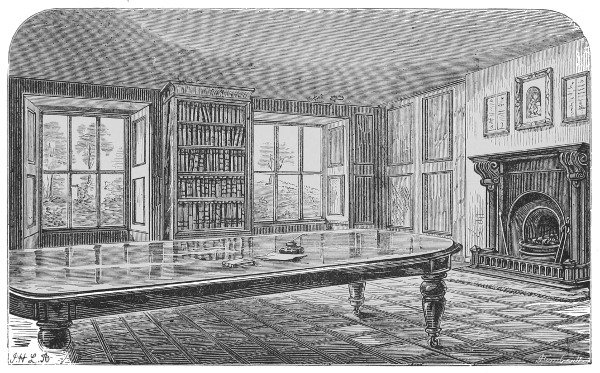
ROOM IN THE COMMANDERY.
"I am half inclined to lead the attack myself," said the king.
"It must not be, sire. You would throw away your life. The
chances are a thousand to one against Middleton's return. But,
that matters little if he can accomplish his object. Should the
enterprise succeed you will forgive me the loss of Upton Bridge."
"I have already forgiven you," replied Charles. "I will see
Middleton forthwith."
And, bidding Massey a kindly farewell, he took his departure.
The king had intended to visit the camp just formed at Wick,
but his plans being now changed, he crossed the bridge, and sent
on Careless with a message to Middleton, who was posted outside
the city, opposite Frog Gate, with his regiment, bidding
the general attend him without delay at the Commandery, and
bring with him Sir William Keith and Colonel Legge. We have
already mentioned that the Duke of Hamilton was quartered at
the Commandery, and on the king's arrival at the ancient hospital,
he found the duke in the refectory—a large and beautifully proportioned
hall, with an open roof of richly ornamented woodwork,
a minstrel's gallery, and lofty windows, filled with exquisitely
painted glass. With the duke was Sir Alexander Forbes, the commander
of Fort Royal, and the king remained in converse with them
until Careless appeared with General Middleton and the others.
The whole party then adjourned to an inner room, better
adapted than the refectory, for secret discussion, and Careless was
stationed at the door to prevent all chance of interruption.
The apartment looked on a small garden, and the day being extremely
warm, one of the windows was unluckily left open—unluckily,
we say, for a personage outside, apparently a gardener,
contrived to place himself so near it, that he overheard all that
passed within. The conference did not last long. General
Middleton, as Massey had foreseen, at once undertook the daring
enterprise, and both his companions were eager to share the danger
with him.
When all had been discussed and settled, General Middleton
said to the king:
"Your majesty need not fear that the design will be betrayed.
Not till the latest moment shall the men know on what enterprise
they are to be employed, and even then they shall not be
aware of our precise aim. Before dawn your majesty shall hear
that the blow has been struck, and if I cannot come myself, some
one more fortunate will bring you the glad tidings."
With this, he took his departure with his companions.
HOW THE SUBURBS OF THE CITY WERE BURNT.
Every moment of that eventful day had its employment for
the king, who had now a most painful duty to perform. Most reluctantly
had he given his assent to the execution of the stern decree
of the council of war, which enjoined that all persons dwelling
without the walls should remove their goods forthwith, and take
refuge within the city, since it was necessary that their habitations
should be burnt down, in order that they might not afford shelter
to the foe. Now, the suburbs of Worcester, as we have already explained,
were extremely populous, and consequently great numbers
of houses—indeed, several small streets—were thus doomed to destruction.
The greater part of the luckless occupants obeyed the
mandate without a murmur, though it deprived them of a home.
The mayor, the aldermen, and the sheriff rendered every assistance
in their power, and the goods of the poor folks thus ousted, were
temporarily placed in the churches. The king expressed his profound
sympathy for the sufferers, and promised them compensation
for their losses. Alas! it was but a promise.
The occasion called forth the active zeal of Jane Lane, and
never had it been more energetically displayed. Accompanied
by Sir Clement Fisher and her brother, she rode through all the
districts destined to destruction, and wherever she found a little
crowd assembled, or heard murmurs, she halted and earnestly exhorted
submission to the decree.
"Blame not the king," she said, "for this severe measure,
but blame the great rebel and regicide, who has rendered it
necessary. It is Cromwell, the murderer of your martyred sovereign,
who comes hither to ravage your city, and slay your
rightful king, that he may set himself up in his place, who thus
drives you from your homes. Charles, your king, loves you, and
would save you from this ruthless general and his fierce and fanatical
soldiery, who will put you all to the sword if they obtain the
victory. Resist, therefore, to the uttermost. Better that your
houses should be burnt down than that they should afford shelter
to such an enemy. Better your wives should be driven forth than
exposed to the insults of Cromwell's soldiery. Quit your homes
without hesitation and without murmuring, but with the deep determination
to be avenged upon the foe. 'Tis a sacrifice you are called
upon to make for your king—but we all make sacrifices for him.
Right, justice, truth are on our side: treason of the darkest dye,
rebellion and oppression, are on the other. Fight for your lawful
king. Place your trust in Heaven, and you will triumph over
these bloodthirsty rebels."
While uttering these stirring words, which produced an extraordinary
impression upon those who heard them, she looked as if
inspired. Her beautiful features assumed a very different expression
from that which they ordinarily wore. For the moment they
had lost all their softness, and when speaking of Cromwell, her
eyes flashed as with lightning, her proud nostrils distended, and
her delicate lips curled fiercely. Her beauty, her energetic language,
and fiery looks produced, as we have said, the strongest
effect upon her auditors, and roused within them a burning desire
of vengeance. No longer they thought it a hardship to quit
their homes, but were eager to fight for the king, and, if need
be, lay down their lives for him. All feelings of discontent were
subdued, and the greatest enthusiasm for the royal cause was
awakened. Even the women who listened to her were almost as
much roused as their husbands. Nor when she had departed did
the effect of her eloquence subside. Wrath against Cromwell had
now taken possession of every breast. Old Noll was the real
author of the cruel decree. Old Noll had driven them from their
homes. Old Noll would burn down the city itself, and massacre
them all, men, women, and children, if he could. But the king
would prevent it. Long live the king!—Down with the Republic!
Night had come on before all the necessary preparations were
completed. Combustibles having been placed in most of the
houses, and bands of men employed to set fire to them at a given
signal, the conflagration began almost simultaneously on every
side, and in a surprisingly short space of time the city was encompassed
by a semicircle of fire. The spires and towers of the
churches caught the red reflection of the flames, and a ruddy glow
illumined the massive roof and tower of the cathedral. All the
principal buildings were lighted up.
Viewed from the heights, it seemed as if the fire, which burnt
with great fierceness, was gaining upon the walls and gates; but
this was not so, all needful precautions having been taken to
prevent its too near approach. Luckily the night was almost
calm. A gentle breeze from the south carried the flames from
the city. Overhead hung a cloud of smoke. The spectacle was
magnificent; the soldiers could be seen on the gates and walls, the
engineers on the summit of Fort Royal and the Blockhouse, while
all the troops outside the city were clearly distinguishable.
The conflagration did the Royalists an unexpected service by
revealing the engineers engaged in raising the breastwork in front
of Perry Wood. The operations of these men were quickly
stopped by the guns of Fort Royal, to which they offered an excellent
mark. Two artillerymen and a matross were killed, and
the rest dispersed.
The defenders of the fort, having thus learnt that a detachment
of the enemy was hidden in Perry Wood, continued their cannonade
briskly, and sent shot into different parts of the thicket in
the hope of dislodging the Parliamentarians. Little did they think
that among those whom they had driven off was the Lord General
himself, who chanced at the time to be superintending the construction
of the breastwork. One of the artillerymen was killed
close beside him.
With the utmost calmness, Cromwell gave orders to the engineers
to suspend their work till the fire had burnt out, and
then deliberately withdrew to a place of safety, whence he watched
the progress of the conflagration, the cause of which he had comprehended
from the first. Several shots passed over his head and
shattered the trees beyond him, as he stood behind a hedge bank
with his constant attendant Dighton. His curiosity was excited,
for the fortifications were more completely revealed by this fierce
glare than by daylight. He could count the large guns on Fort
Royal, and the sakers, demi-cannons, culverins, and falcons on the
Blockhouse.
"Ha!" he suddenly exclaimed. "Methinks I see the young
man, Charles Stuart, on the summit of yon blustering fort, which
he took from Colonel James, and which I shall soon retake from
him. Were he wise, he would stop this furious and senseless
cannonading. But the noise pleases him. Dost note what he
has done, Dighton?"
"He has fortified the city strongly, according to my opinion,
your excellency."
"Ay, he has fenced it—doubly fenced it with high walls and
bulwarks—he has armed his forts better than I thought he could
have done, chiefly yon new fort on the Castle Hill, for this Blockhouse
hath no real ordnance—and he hath placed his troops with
some judgment; but neither troops nor defences will avail
him. There will soon be a breaking down of the walls, and then
woe to those within the city that has upheld him. I shall not
spare them. England must never again be invaded by a Stuart."
"This pretender to the throne must die on the same scaffold as
his father at Whitehall," observed Dighton.
"'Twere better he should die here at Worcester," rejoined
Cromwell, sternly. "Then these bigoted fools cannot make a
martyr of him. In any case, he must not escape to give me further
trouble. I mean not that he troubles me, but the state."
"I quite understand your excellency."
"Mark well what I say to thee, Dighton," pursued Cromwell.
"On the 3rd of last September, as thou knowest well, a great
victory was wrought at Dunbar; but on the anniversary of that
day, now close at hand, a still greater victory will be achieved
here at Worcester. The false light that has deluded so many will
then be as utterly extinguished as yon fire will be ere long,
and nothing more will be heard of Charles Stuart and his
pretensions to the throne. But the power of the army must
then be recognised, and——" He paused, as if unwilling to complete
the sentence.
But Dighton finished it for him, by adding:
"And the ruler of the country can be no other than the Lord
General Cromwell."
"I do not desire to rule, Dighton; but I would have my
country well governed and wisely."
"And no one could govern it so wisely and so well as your
excellency—of that I am assured."
"Thou flatterest me," said Cromwell, not displeased. "But
this is idle talk. The decisive battle has yet to be fought."
"I look upon it as already won," rejoined Dighton. "As the
Lord instructed Joshua how to take Ai, so will he instruct a
greater general than Joshua how to take this rebellious city."
"That the great work will be perfected I nothing doubt," said
Cromwell. "But I have seen enough of yon burning houses, and
will tarry here no longer. I must visit all the outposts, in case
a sally should be made; though, judging from appearances, I do
not think aught will be attempted to-night."
He then made his way through the wood, closely followed by
Dighton, and ere many minutes reached a sheltered spot where
his escort awaited him. Mounting his charger he next proceeded
to the camp at Red Hill, where he found Colonel Lilburn
and Lord Grey on horseback and attended by several officers.
They had been watching the conflagration which was now almost
extinguished. Cromwell and Lilburn visited all the outposts,
after which the Lord General rode through the park to Spetchley.
HOW URSO GIVES HAD AN INTERVIEW WITH THE LORD GENERAL IN THE
STABLE OF SPETCHLEY MANOR-HOUSE.
Viewed by torchlight, as Cromwell beheld it on his arrival
there, the large stable-yard of Spetchley manor-house presented a
very curious sight—being full of musketeers, cuirassiers, lancers,
and dragoons, with their horses. Closely adjoining the stable-yard,
and forming not the least interesting part of the striking
scene, were the blackened walls of the ancient mansion, now silvered
by the rays of the moon.
As Cromwell rode into the yard, attended by Colonel Lindsey
and Dighton, he remarked an elderly personage, guarded by two
musketeers.
"Ah! you have a prisoner yonder I see, Cornet Hardiman?"
he observed to the officer who came up to him. "Where was he
taken?—and who is he?"
"He was found in a summer-house in the garden, your excellency,
and refuses to give his name," replied the cornet. "As
he may be a spy, I have detained him till your return."
"You have done right," said the Lord General. "Bring him to
me."
"Advance, prisoner!" cried the officer.
And as the prisoner was brought forward, Cromwell was struck
by his grave looks and deportment.
"This man cannot be a spy," he thought, after a moment's
scrutiny. "Who art thou? And what dost thou here?" he
demanded.
"Truly it would appear that I am an intruder," replied the
prisoner, somewhat haughtily. "Yet I once was master of this
mansion."
"If so, you are Sir Robert Berkeley," rejoined Cromwell, surprised.
"Your excellency has said it," rejoined the other. "I am that
unfortunate man."
"Had you declared as much from the first, you would have
been set at liberty," observed the Lord General.
"I am not so sure of that," replied Sir Robert. "I do not
think my word would have been taken. But be that as it may,
I cared not to answer questions rudely put to me by your soldiers.
Mistake me not—I make no complaint of ill-treatment. Such
explanation as I have to offer your excellency I give readily.
My habitation having been burnt down, my stables occupied, I
had no place of refuge except my summer-house, where I sought
shelter for the night. There I was found, as hath just been stated."
"You have only yourself to thank for the detention, Sir
Robert," rejoined Cromwell. "Though your nephew, Sir Rowland
Berkeley of Cotheridge, is an avowed malignant, and you
yourself are known as an active partisan of Charles Stuart, I
will not discredit what you tell me. You are free; and, furthermore,
are free to speak of all you have seen or heard. You shall
be conducted to the nearest outpost, or, if you desire it, shall be
taken to White Lady Aston."
"I will rather sleep beneath a tree than under Mr. Symonds's
roof," replied the old judge. "If I might ask a favour of your
excellency it would be to be allowed to pass the night in my
summer-house."
"You seem to like the spot," remarked Cromwell, somewhat
suspiciously.
"'Tis all that is left me of the old place," replied the judge.
"Well, I will consider of it," said Cromwell. "Have you
supped, Sir Robert?"
"Neither dined nor supped."
"You have fasted too long for a man of your years. You shall
sup with me."
This was said in a more cordial tone than the Lord General
had hitherto adopted.
Dismounting, he gave his horse to a soldier, and ordered Cornet
Hardiman to show him the rooms prepared for him in the stables.
"Come with me, Sir Robert," he added to the old judge, who,
of course, complied with a request amounting to a command.
The stables being full of horses, it seemed at first that there
could be but little accommodation for the Lord General, but
the cornet mounted up a ladder-like flight of stairs, that brought
them to a room which might have been a hay-loft, but which
was now furnished with a table and a few old-fashioned chairs
saved from the wreck of the ruined mansion. On the table were
placed cold viands and a couple of flasks of wine. Covers were
laid for four, in case the Lord General should invite any of his
officers to sup with him, as was occasionally his wont. A lamp
set on the table scarcely illumined the loft, but its glimmer
showed the cobwebbed rafters overhead.
"Let Dighton wait below," said Cromwell. "I shall require
no attendance."
As the cornet withdrew, he took off his casque and gauntlets,
and pronounced, with considerable unction, a very long grace,
during which he kept Sir Robert standing. Grace ended at last,
he bade him sit down and fall to—setting him the example.
Though the old judge had fasted so long, he ate little in comparison
with his host, and drank only a single glass of wine.
Cromwell, however, partook with right good appetite of the plain
fare set before him, and emptied a large flagon of sack. While
thus employed, he scarcely spoke a word, but he afforded his
guest an excellent opportunity of studying his remarkable countenance.
With Cromwell's coarse features, disfigured by a large, ill-formed
red nose, against which the Cavaliers never ceased to direct their
scurril jests; with his stout, ungainly figure, utterly devoid of
dignity and grace, the reader must be familiar. Yet with all these
drawbacks, which have not been in the slightest degree exaggerated,
the Lord General's physiognomy was very striking. Chiefly
so, on account of its determined and formidable expression. His
eye possessed extraordinary power, and few could brook its glances
when he was angered, or when his suspicions were aroused. His
habitual expression was that of bluff sternness, and he looked like
a surly bull-dog, whom no one who valued a whole skin would care
to offend, and yet he could put off this morose and repelling look
when he pleased, and exchange it for one of rough good-humour.
But even when he unbent, he inspired fear. His character has
been too much darkened by some writers, and virtues have been
ascribed to him by others which he certainly did not possess.
Courageous, crafty, ambitious, hypocritical, almost a fatalist, cruel,
unjust, and unrestrained by any moral principle, by the sole force
of his indomitable will, he overcame every obstacle, and reached
the goal at which he aimed. His ambition being boundless, nothing
less than sovereign power would satisfy him, though he
affected to disdain the title of king, being perfectly aware that
the Royalists would never accept a regicide as king. Of
marvellous sagacity and penetration, he was rarely deceived in
his judgment of men, and always used them, where he could, as
instruments in furthering his designs. A profound dissembler,
and fully capable of using religion as a mask, had it been needful
to do so, it can scarcely be doubted that he was really religious;
though few entirely believed in the sincerity of his religious
professions. Cromwell's character is full of striking contrasts.
Abhorred by his enemies, he had multitudes of devoted friends.
For a time his memory was execrated. In latter days somewhat
more than justice has been done him. The great crime he committed
has never been pardoned—will never be pardoned. The
stain of blood cannot be washed out. As to his high military
genius all are agreed. Among great commanders he stands foremost.
And he would rank among the greatest of men, if his
crimes did not overshadow his virtues.
The accoutrements of the Lord General differed very little from
those of an officer of his own body-guard, except that they were
somewhat more ornamented, being filigrained with gold. They
consisted of an open casque and a very large gorget. But he had
neither breast-plate, nor cuisses—the stout buff coat with long
skirts which he wore affording sufficient protection to the
lower part of his person. A scarf was tied round his waist.
His strong buff boots were drawn far up the thigh, and from
his broad embroidered shoulder-belt hung a large basket-hilted
sword.
He was not unconscious that he was the object of his guest's
covert scrutiny, but the circumstance did not trouble him—perhaps
rather gratified him. It may be that he designed to
win over the old Royalist judge, or at least to produce a
favourable impression upon him, for as soon as he had finished
supper, he almost compelled Sir Robert to take more wine, and then
began a very friendly discourse with him, professing great regret
that Spetchley manor-house had been destroyed by the Scottish
soldiers, and expressing a hope that it might soon be rebuilt.
Their conversation, however, was interrupted by the entrance of
Dighton, who informed the Lord General that a man was without
who stated that he had matter of the utmost importance to communicate
to his excellency.
"What manner of man is he?" demanded Cromwell.
"I have reason to believe he is a spy from the city," replied
Dighton. "He delivered himself up to the vedettes on Red Hill,
conjuring them to bring him speedily before your excellency.
Accordingly, he hath been sent on from the first outpost. He
is the bearer of this letter, which he affirms is from Colonel
James, somewhile commandant of the garrison of Worcester."
Cromwell took the missive, and after glancing at its contents,
said, "The man hath spoken truly. His business is important.
I will see him."
"With your excellency's permission I will retire," said the old
judge, rising.
"I am sorry to lose your company," said Cromwell; "but this
is a matter that cannot be postponed. A bed must be found for
Sir Robert Berkeley," he added to Dighton.
"I know not where to find one, unless his worship is content to
sleep on straw," was the half-grumbling response.
"If I am allowed to occupy my old summer-house, I shall be
perfectly satisfied," replied the judge.
"Be it so, Sir Robert," said Cromwell. "I wish you sounder
repose than I myself am likely to enjoy. To-morrow's news
may surprise you."
The old judge did not venture to question him, but, bowing
deeply, departed with Dighton, and Cromwell was left for a
few moments alone.
"What says Colonel James?" he muttered. "'The bearer
of this may be trusted. He hath preserved my life, and, with
Heaven's grace, may be the happy means of preserving a life
in comparison with which mine is as naught.' The import of the
message is plain. The life to be preserved is mine own. 'Cursed
is the man that trusteth in man,' saith the prophet. Yet in whom
can I trust, if not in those who serve me? If there be a plot
against me, it were better for him who hath hatched it that he
had never been born."
Steps were now heard on the staircase, and the next moment a
tall, thin man, whose aspect was that of a Puritan, while his
habiliments were those of a Cavalier, was ushered into the presence
of the Lord General by Dighton. Behind them came a couple of
musketeers, but the guard advanced no further than the head
of the steps.
Cromwell fixed a long and searching glance upon the personage
thus introduced, who bore the scrutiny firmly.
Apparently satisfied, the Lord General signed to Dighton to
withdraw, bidding him, however, wait outside.
"Now, fellow, thy name?" demanded Cromwell of the man, as
soon as they were alone.
"Urso Gives, of Worcester, by trade a tailor," was the reply.
"An honest trade. I have naught to say against it," rejoined
the Lord General. "Men must be clothed, though it were better
they were clothed in sackcloth than in purple and fine linen.
Better still they were clothed in the garments of salvation. But
enough. Hath thy trade aught to do with what thou hast to
declare to me?"
"Nothing. I mentioned it for a reason which I will presently
explain to your excellency. I have come hither at the hazard of
my life to bring you timely intelligence of a daring and well-conceived
design, which, if it were successfully executed, would snatch
from you the victory and give it to Charles Stuart. What am I
to claim as a reward if I shall prove what I assert?"
"Go to. Bargain not with me. Thy reward shall be proportioned
to the importance of thy disclosure."
"But I may not live to receive it," rejoined Urso. "The risk
I run is great. When I depart hence I must return to Rabbah,
and I may fall into the hands of the Ammonites, who will show
me little mercy. What then becomes of the recompense promised
me?"
"Hast thou a wife?"
"Yea, verily," replied Urso; "a fair young wife, whom I have
just espoused. If I perish in my efforts to save Israel, shall she
have the reward?"
"Content thyself—she shall. I promise it to thee," rejoined
Cromwell. "Thou hast great faith in the constancy of women, I
perceive, and it is well."
"I cannot with truth affirm that I have great faith in the constancy
of her whom I have wedded," replied Urso. "But I love
her better than life."
"And she, I trust, will honour thy memory, as it deserves to be
honoured," remarked Cromwell, in a slightly contemptuous tone.
"But having made thy conditions beforehand, let me hear what
thou hast to tell. Be brief."
"'Tis not my wont to waste words," rejoined Urso. "But first
let me inquire the hour?"
"The hour! Thou shouldst know it as well as I. 'Tis past
eleven."
"Then in less than two hours' time General Middleton will
sally forth from the Sidbury-gate with fifteen hundred picked men,
all well mounted and well armed, wearing their shirts above their
breastplates for distinction. The malignant general has vowed
to take your excellency, dead or alive, and thus end the war, and
he will make every effort to fulfil his vow. Expecting to find
Colonel Lilburn wholly unprepared, he will pass through the
camp without attacking it, and cut his way through any other
opposing force further on, his aim being Spetchley, where he
hopes to find your excellency. Should he arrive, no quarter is
to be given."
"Thou art sure of this?" remarked Cromwell, with forced
calmness.
"I heard the project discussed and settled this very morning
at the Commandery between Charles Stuart, the Duke of Hamilton,
General Middleton, and some others. As I have said, Middleton
has vowed to accomplish your excellency's destruction, or to perish
in the attempt."
"And those engaged in the camisade are to sally forth an hour
after midnight, thou sayst?" observed Cromwell, calmly.
"That is the hour appointed. I would have given your excellency
earlier warning, had I been able to quit the city. But
I could not obtain an order, and only succeeded in getting out
during the burning of the suburbs."
"Thou hast arrived in time. The design can be easily frustrated.
Thy intelligence merits a good reward, and thou shalt not be disappointed
of it. If aught befalls thee, thy wife shall have the
reward. Moreover, I promise thee ample vengeance."
Cromwell, who did not seem at all disturbed by the alarming
intelligence he had received, but maintained the most perfect
composure, put several questions to Gives, and then said:
"Do not suppose that I doubt the truth of thy statement,
but I cannot allow thee to return to Worcester till the affair
is over."
"The danger to me will be far greater, if I return not before
daybreak," pleaded Gives.
"Why shouldst thou return? But like a doting fool, thou
canst not, I suppose, leave thy young wife."
He then called out for Dighton, who instantly answered the
summons, and said to him, "This man will remain here till I return,
or until I send an order for his release. Sit down at the
table, friend," he added to Gives. "Eat and drink and make glad
thine heart. Thou wilt see thy wife again ere long."
While thus speaking he had donned his casque and gauntlets,
and he then quitted the chamber, and proceeded to the stable-yard,
where he found Colonel Lindsey, the commander of his
life guards, and telling him he was about to proceed to Colonel
Lilburn's camp, bade him follow with three hundred men.
"The whole regiment must remain under arms throughout the
night," he added. "An attack may be expected."
Without a word more he mounted his charger, which was
ready for him, and attended by Dighton and a small party of
musketeers, rode at a brisk pace through the woods to Colonel
Lilburn's camp.
THE CAMISADE.
Good watch was kept—the sentinels were at
their posts—but
the quietude of the camp proved that no apprehensions of attack
were entertained.
"Kerioth would have been surprised and taken had I not received
this warning," mentally ejaculated Cromwell, as he rode
up to the commander's tent.
Lilburn had thrown himself on a couch, but hearing Cromwell's
approach he sprang to his feet, and met him at the entrance of
the tent.
After a brief consultation between the generals, it was decided
that neither drums should be beaten nor trumpets blown, lest the
sounds should be heard by the enemy, but that the slumbering
soldiers should be quietly roused to arms; and this was done by
Lilburn in person.
Meanwhile, Colonel Lindsey had arrived with the life guards
from Spetchley, and putting himself at their head, Cromwell
rode to the outpost nearest the city.
This outpost was about three hundred yards from the camp,
on the slope of the hill, not far from the London-road, and was
stationed in a field bordered on the north and north-east by high-banked
hedges.
The night can scarcely be described as dark, though the sky
was covered with lazily-moving clouds, but through these the
moon burst occasionally. The old city, with its towers, steeples,
and fortifications, could be distinguished through the gloom;
but no lights were visible within it, and no sounds from it
arose. So profound was the stillness, that it might have been
supposed that the inhabitants and their defenders were alike
buried in slumber, and that no attacking party could be waiting
to sally forth.
As Cromwell, with the life guards, cautiously descended the hill,
keeping under cover of the hedges, three-quarters past midnight
was struck by the cathedral clock—proclaiming that the hour was
close at hand.
The outpost reached by Cromwell was guarded by two hundred
and fifty foot and two hundred horse, but three hundred of the
best troopers in his army being now added, he deemed this force
quite sufficient to repel the attack.
Little time was left, but luckily those on guard at the outpost
were on the alert. Having placed his troops with the quickness
and skill peculiar to him, the Lord General stationed himself on a
small woody mound in the centre of the field, whence he commanded
the approach to the Sidbury-gate, and awaited the sortie
with some impatience, but without the slightest anxiety. Close
behind him were Dighton and a couple of cuirassiers.
He had not to wait long. While the single stroke of the
cathedral bell yet vibrated through the air, and was echoed by
the clocks of the other churches, the gate yawned wide, and a
troop of sheeted spectres—for such they seemed in the gloom—issued
forth. The ghostly band formed three regiments—the
first being commanded by General Middleton, the second by
Sir William Keith, the third by Colonel Legge.
The troops came forth from the Sidbury-gate and formed in
silence. If any orders were given they did not reach Cromwell's
ears, though he was listening intently; and the ghostly appearance
of the horsemen was fully preserved until Middleton dashed off
with the greatest rapidity, when the clatter of hoofs and the
jingling of arms proved that the phantoms were substantial soldiers.
The second regiment followed instantly, galloping along the
London-road as swiftly as the first; but a momentary interval
occurred before Colonel Legge started. The cause of this brief
delay was perfectly intelligible to Cromwell, and he gave some
orders to Dighton, who rode off at once to Colonel Lindsey.
Meanwhile, the two foremost regiments came on at full speed,
and dashed past the field in which the outpost was stationed, making
it evident that their point of attack was Lilburn's camp on the
brow of the hill, and showing that the outpost would be dealt
with by the regiment that followed.
In obedience to Cromwell's orders not a shot had been fired,
and Colonel Legge came on uncertain as to how he would be
received by the enemy. Easy access to the field could be obtained
at several points known to the Royalists, and small parties of men
entered at these places, but the main body, led by Colonel Legge,
broke through the hedge skirting the London-road, and were
received by ranks of pikemen three deep, the front rank kneeling,
the centre stooping, and the rear standing upright, and forming
an almost impassable barrier. On the flanks, right and left, were
posted musketeers, who poured a terrible volley upon the enemy
as they gained the field.
Several saddles were emptied. Nevertheless, Colonel Legge,
shouting to his men to follow, charged the pikemen with the
greatest intrepidity, but it was impossible to cut through their
ranks. Many horses were killed in the charge, and others so
desperately hurt that they bore back their riders in spite of all
efforts to force them on. Colonel Legge's charger, though badly
hurt, had still strength enough left to sustain its rider, but
would not again face the deadly pikes.
Caught as in a trap, it seemed as if the unfortunate Royalists
must all be slaughtered, but turning from the pikemen, Colonel
Legge charged the musketeers with a fury that proved irresistible.
Having gained the open field with such of his men as had been
able to follow him, he was joined by the others, who having
entered at different points had hitherto taken no part in the
conflict. But before they could form they were charged by
Colonel Lindsey, at the head of the life guards, and so shattered,
that they could not recover, but fled from the field in the greatest
disorder, hurrying towards the Sidbury-gate faster than they had
quitted it. Many were shot while jumping the hedges, or pressing
through the gates. Colonel Legge was the last to retreat. His
horse carried him out of reach of the foe, and then dropped.
Cromwell watched the conflict from the mound on which he
had taken his stand, and did not quit his position during the short
time occupied by the conflict.
"It is the Lord God that fighteth for us. He it is that hath
enabled us to scatter them thus quickly," he exclaimed, as the
Royalists fled in disorder. "Pursue them not, but prepare to cut
off the retreat of those pestilent malignants who have gone on to
attack the camp above—lest, peradventure, they escape the snare
laid for them."
It happened as Cromwell had foreseen. Instead of finding
Lilburn unprepared, when General Middleton and Sir William
Keith reached the camp on the hill, they quickly discovered that
their design had been betrayed. Duped by stratagems which
they ought to have suspected, they entered the camp, but had
scarcely done so, when they were completely surrounded by a force
more than trebling their own.
Thus entrapped it would seem that nothing was left to Middleton
but to surrender. But the brave general was undismayed by
numbers, and when summoned to surrender, answered by a charge
so fierce and impetuous that the ranks of the enemy opened, and,
ere they could close again, he and his two regiments had passed
safely through.
Down the hill they dashed at a headlong pace, and, though
hotly pursued by Lilburn, very few of them were captured.
Luckily for the fugitives, Cromwell was not able to get his life
guards out of the field in time to intercept them, or their utter
destruction would have been inevitable. As it was, they escaped
with very little loss, considering the terrible hazard they had
encountered.
On reaching the nearest outpost of the royal army, Middleton
found Colonel Legge, and learnt the disaster that had befallen
him.
"I cannot carry this bad news to his majesty," said Legge.
"Tell him what has happened."
"The king will not reproach you," said Middleton. "You have
done your best. We have been betrayed."
"That is certain," said Sir William Keith. "Lilburn was prepared
for us."
"And Cromwell himself was with the outpost when I attacked
it," said Colonel Legge. "I knew it not till too late."
"Would I had known it!" cried Middleton, furiously. "He
should not have lived to boast of this triumph. One of his spies
has served him well on this occasion. I will not rest till I have
discovered the traitor."
"Lesley may help you to find him," said Legge.
"No; Lesley knew nothing of this," rejoined Middleton. "But
come with me to the king, and get it over. A word will explain
all. We have been betrayed."
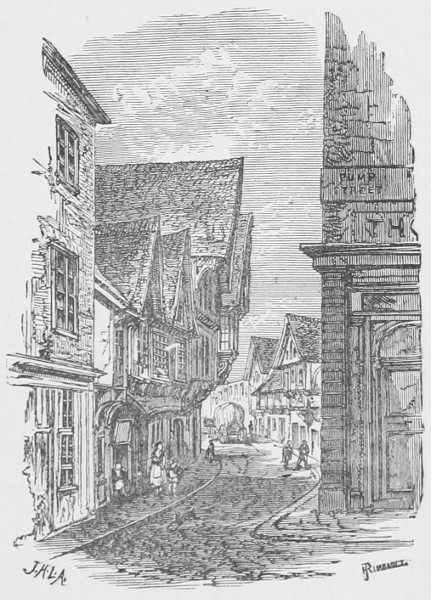
OLD HOSTELRY OF GREY FRIARS.
HOW URSO GIVES WAS ARRESTED.
About the same time that the interview took place
in the stable
at Spetchley between Cromwell and Urso Gives, Major Careless,
who had been upon the eastern walls to satisfy himself that the
fires in the suburbs were completely extinguished, descended from
the ramparts at Friars'-gate. This was one of the smaller gates, and
derived its appellation from a convent of Franciscan friars that stood
hard by—the old religious house having been subsequently converted
into a prison.
On quitting the ramparts, as just stated, Careless proceeded to
the old hostelry of the Grey Friars, where he knew that several
officers about to take part in the camisade would be assembled.
The old inn—an ancient timber-built house, with quaint gables,
and a projecting upper story—is still standing in Friars'-street.
In the principal room of the old hostel he found, as he expected,
a party of Cavaliers smoking, singing, and quaffing sack and
claret, as if they had no serious business in hand. They were thus
making merry to the last, since among them were Major Knox and
some others, who, two hours later, were killed in the attack on
the outpost. They were all fully armed with steel caps, gorgets,
cuirasses, pauldrons, and taches, but had divested themselves of
their swords and pistols. Beside each sword lay a small roll of
linen. This was the shirt which its owner meant to wear over his
armour, and which, in some cases, proved a winding-sheet.
All the Cavaliers rose on Careless's appearance, and gave him a
hearty welcome. He could not help being struck by the enthusiasm
they displayed. Not one of them but seemed proud of being
included in the dangerous enterprise. Not one but was ready to
lay down his life for the king. Careless never afterwards recalled
that meeting without heaving a sigh for the brave men who
perished in the camisade. However, at the moment, he thought
little of the hazard of the attack, and would gladly have joined in
it if the king would have allowed him. Sitting down, he emptied
the flagon of claret filled for him by Major Knox. Shortly afterwards
Colonel Legge entered the room, but left again almost immediately,
saying, as he departed, to Major Knox:
"Half an hour hence you must all be at the place of
rendezvous."
Shortly afterwards Careless took leave of the company, and was
proceeding along Friars'-street in the direction of the Sidbury-gate,
when he heard his name pronounced in a familiar voice, that instantly
awakened tender recollections, and turning, he perceived
that he had been followed from the hostel by a young woman
whose features were muffled in a hood.
Not doubting who it was, he exclaimed:
"Ah! is it you, Mary? I never expected to see you again."
"And you would not see me now, I can assure you, if I had
not something of importance to say," she rejoined, partially removing
her hood.
"Whatever has procured me the happiness of beholding you
once more, sweet Mary, I feel grateful for it," he rejoined.
"Speak not thus lightly," she said. "'Tis a grave matter."
"Before you mention it, then, let me ask now you came to
throw yourself away upon that detestable Roundhead? You must
be heartily sick of him already."
"If you persist in talking thus you will frighten me away, and
I shall leave unsaid what I have to tell you—and it is very important."
"Nay, by all that is bewitching, I swear you shall not go," he
cried, catching her hand.
"Be serious, if you can, for a single instant, and listen to me."
"Tell me you are resolved to abandon Urso, and I will be as
serious as you please."
"You put everything out of my head by your trifling talk.
How very different you are from Urso, to be sure! He is
always grave."
"Yes, I warrant me you rarely catch a smile on his sour
visage. But I hope there are few points of resemblance between
him and me. Again I ask, how could you marry such a man?"
"'Twas all my grandam's doing," she sighed.
"And you have bitterly repented of the foolish step ever since,
I'll be sworn. Confess, and I'll forgive you, though, I own, the
effort will be difficult."
"Then pray don't make it. Unless you listen to my warning,
you will fall into a snare that has been privily laid for you."
"Privily laid for me by Urso, eh? The Roundhead rogue had
better take care of himself, or you will speedily become a widow."
"It is not of Urso I would warn you. Do not take part in
the camisade to-night."
"The camisade!" he exclaimed, in surprise. "How do you
know there is to be a camisade? Who has told you of it?
Answer me that."
All his levity had vanished. As she did not answer, he repeated
the question still more peremptorily.
"No matter who told me," she rejoined. "If you value your
life you will not go. I have warned you. Do as you please.
Farewell!"
"Stay! we must not part thus. You spoke of a snare being
privily laid for me. What was your meaning?"
"I will tell you nothing more," she rejoined.
And breaking from him, she flew towards the inn.
Just as she reached the door the Cavaliers came forth in a
body. Some of them tried to stop her, but she pushed them aside
and got into the house.
Careless thought of following her and insisting on an explanation,
but after a moment's reflection he concluded that, since she
was lodging at the inn, she must have overheard the loud and indiscreet
talk of the Cavaliers, and so have ascertained the nature
of the enterprise on which they were engaged. As to the "privily-laid
snare" of which he had been warned, the expression savoured
strongly of Urso, and probably meant nothing in particular.
Having arrived at this conclusion he marched off, with the
fixed determination of paying another visit to the old hostel on the
morrow.
But before the morrow came he was undeceived, and he then
bitterly regretted that he had neglected the warning given
him.
So well was the secret kept, that only the troops actually
engaged in the camisade were aware of its object. Many heard
of the enterprise and of its failure at the same time. When
the attacking party was driven back, a call to arms was
instantly made by the Duke of Hamilton and all the commanders
stationed on the south and south-east, lest Cromwell should follow
up his success by an immediate assault on the city. But it soon
became apparent that he had no such design, and though the
Royalists remained on the alert, they were not disturbed during
the remainder of the night.
To Charles, who had made certain of success, the failure of
the enterprise was a terrible disappointment. But he bore it
manfully, as he bore all his reverses. He had remained at the
Commandery in order that he might receive the earliest intelligence
of the victory he so confidently anticipated, and was
seated in the refectory, trying to while away the time in light chat
with Careless, when General Middleton, followed by Sir William
Keith and Colonel Legge entered the hall. Charles read what
had happened in their downcast looks, and for a moment forbore
to question them.
"Fortune has played me another sorry trick, I perceive," he exclaimed,
at length. "I thought the fickle goddess would this time
have befriended me."
"All would have gone well, sire, if our plan had not been
betrayed," replied Middleton. "The enemy was prepared. We
found the whole of Colonel Lilburn's force under arms, and
were surrounded, but succeeded in cutting our way through
them."
"I have a further proof of treachery, sire," said Colonel Legge.
"Cromwell himself, with his body-guard of Ironsides, was with
the outpost when I attacked it."
Charles could not repress an exclamation of rage.
"That we have been bought and sold is certain," he exclaimed.
"But who can have betrayed us?"
"I think I can give a shrewd guess as to the villain who has
thus traitorously discovered the design," said Careless, "and if I
am right he shall not escape chastisement."
"Whoever the traitor may be," observed the king, "he must
have obtained early information, and have acted with the greatest
promptitude, or the enemy could not have been prepared at all
points for the attack. Cromwell must have clever and active spies in
the city."
"True, sire," replied Middleton. " And I now recollect that,
during our conference in the adjoining chamber, a man in the
garden approached somewhat near to the open window. At the
time I did not suspect his motive, but I now believe he was a spy."
"It may be so," observed Charles.
"Whether General Middleton is right or wrong in his suspicion,
I am certain I can discover the traitor, sire," said Careless.
"I have a clue to his hiding-place, and before many hours I
engage to produce him."
"It will be some satisfaction to hang the villain," observed
Charles.
"Your majesty may rely upon having that gratification," replied
Careless. "With your permission, I will set about his
capture at once. Nor will I rest till I have effected it."
And bowing to the king he quitted the hall.
In the court-yard of the Commandery was the king's ordinary
guard. Taking two of the men with him, Careless proceeded to
the Sidbury-gate, passed through the wicket with his attendants,
and in another minute was in Friars'-street.
So dark was the narrow street, owing to the projecting stories
of the ancient timber houses lining it on either side, that Careless
was unable to discern any object unless close at hand. A heavy,
measured tread, however, informed him of the approach of the
rounds, and the next moment the patrol came up.
Captain Woolfe, who was with the guard, immediately recognised
his superior officer, and on learning Careless's business, proffered
his aid. They proceeded together to the old inn, followed
by the whole party.
It would seem that all the inmates had retired to rest, but the
knocking of a halbert staff against the door soon caused it to be
opened by Master Kilvert, the host, who had hastily huddled on
his apparel, and in a trembling voice inquired the meaning of this
nocturnal visitation.
No explanation was vouchsafed him. Ordering the guard to post
themselves secretly on the other side of the street and be ready to
answer any summons, Careless and Captain Woolfe entered the
house, shutting the street door after them.
The terrified host conducted them to the principal room, and
setting down the light with which he was provided, humbly waited
their pleasure to address him.
"Answer truly the questions I shall put, and you have nought
to fear," said Careless. "You have a lodger named Urso Gives?"
"Your honour has been rightly informed," replied Kilvert.
"Master Gives, the tailor, with his wife and his wife's grandmother,
are lodging in my house. Master Gives is a worthy and
God-fearing man, or I would not have him as a guest."
"Your description of him is altogether inaccurate. He is a
traitor and a spy. Lead us to his chamber instantly, and call him
forth," said Careless, drawing his sword.
"I will lead your honour to his chamber," replied Kilvert, now
still more alarmed. "But it will be useless to call him, seeing he
is not there."
"I must be assured of this," said Careless. "Lead us to the
room."
"I shall not need to do so, for here comes his wife, who will
confirm what I have just declared to your honour."
And as he spoke Dame Gives entered, bearing a light. It was
evident from her attire that she had not been in bed. Careless
sheathed his sword on her appearance.
"Why have you come here at this hour? What do you want
with Urso?" she cried, rushing up to him.
Careless, however, turned away, and said, in a low voice, to
Captain Woolfe:
"Explain our errand to her."
"We have come to arrest your husband," said Woolfe.
"Arrest him! What crime has he committed?"
"The highest crime a man can commit," rejoined Woolfe.
"He has betrayed the king to his enemies."
"I hope he can disprove the charge—but you will not find him
here," she exclaimed. "Master Kilvert will satisfy you that he is
not in the house."
"I have striven to do so, but ineffectually," said the host.
"Since it appears that your husband has not returned from his
secret visit to the enemy's camp, we must wait for him," said
Careless. "Have him we will."
"The house must be searched. He may be concealed within
it," said Captain Woolfe. "Show me to the upper rooms," he
added to the host.
"Readily," replied Kilvert. "And should you discover him,
I will be content to take his place, and that I would not do for a
thousand pound. This way, captain! this way!"
As soon as they were gone, Dame Gives exclaimed, distractedly:
"Cruel and ungrateful man! Is this the way you reward me?
In my desire to serve you, I have destroyed poor Urso."
"You ought to thank me for ridding you of such a miscreant,"
rejoined Careless. "You do not seem to comprehend the magnitude
of his offence."
"Yes, I do comprehend it," she rejoined. "I regard the crime
with horror. But I am his wife. Save him! save him!"
"Impossible!" exclaimed Careless. "I would not save him if
I could. I am sorry for you, Mary, but I cannot feel the slightest
compassion for the villain you have married. It pains me that
his arrest cannot be accomplished without your taking part
in it."
"Oh! that I could warn him of his danger," she exclaimed. "If
I could only give him a signal!"
"The signal would be useless," said Careless. "A guard is
posted outside."
"But he will not enter from the street!" she cried. "The
door at the back is left open. I must fasten it."
And she would have rushed forth to execute her design if
Careless had not prevented her.
"I cannot allow you to stir, Mary," he said, detaining her.
She besought him to let her go, but he refused. Just then,
footsteps were heard in the passage.
"Ah, he is here!" she exclaimed.
Next moment Urso Gives entered the room, and started on
beholding his wife and Careless together. By an instant and rapid
retreat he might, perhaps, have escaped, for the way was then
clear, but yielding to a sudden impulse of jealous fury, he drew a
pistol and fired.
His aim was Careless, but the shot took effect on his wife, who
was slightly wounded in the arm. Uttering a scream, she would
have fallen if Careless had not caught her and placed her in a
chair.
The report of the pistol brought Captain Woolfe and Kilvert
into the room, and in another moment the guard rushed in from the
street. Urso, who attempted no resistance, was seized and secured.
"Is this the man you seek, Major Careless?" asked Captain
Woolfe.
"Ay, this is the accursed traitor," was the reply. "And now
he would have added murder to his other crimes."
"I should be satisfied if I had slain thee," rejoined Urso,
fiercely. "I have wrongs enough to avenge."
"Search him to see that he hath no concealed weapons," said
Careless. "He shall then be taken to the Commandery, in order
that his majesty may interrogate him."
"I know well what my doom will be, and am prepared for it,"
said Urso. "Before I am taken hence let me look for the last
time upon my wife."
Careless signed to the guard to bring him forward.
Poor Mary was still lying in the chair in which she had been
placed, and was tended by the hostess and a female servant, who
had come into the room. A handkerchief had been bound round
her arm by Careless to stanch the blood.
The prisoner gazed at her for some moments with a look of unutterable
affection.
"She will live," he murmured. "Heaven be thanked I have
not killed her!"
"No, thou art spared that crime," said Careless. "She is not
much hurt."
Bending down, Urso kissed her pallid brow. The contact of
his lips caused her to open her eyes, but on beholding him she
shuddered, and immediately closed them.
With a sharp pang Urso turned away.
Attended by the guard, the prisoner was taken at once to the
Commandery.
Though it was now close upon daybreak, Charles had not retired
to rest. He was so much disturbed by the result of the
night attack that, feeling he could not sleep, he remained in
converse with Middleton and the two other unsuccessful commanders.
The king and his companions were in the refectory, when
Careless entered and informed his majesty that he had captured
the spy.
He then explained how the arrest had been accomplished, and
after giving the king all needful particulars, the prisoner was introduced.
Urso Gives did not seem at all intimidated by the presence in
which he stood, but maintained a resolute demeanour. General
Middleton at once recognised him as the eavesdropper he had noticed
in the garden.
When interrogated by Charles, the prisoner refused to answer
any questions, and though threatened by Middleton with the
thumbscrew, declared, with a firmness that carried conviction with
it, that no torture should force him to make a confession.
After hearing Careless's relation, confirmed as it was by various
circumstances, and, above all, by the discovery on the person of
the prisoner of an order in Cromwell's handwriting, Charles could
entertain no doubt of Urso's guilt. He ordered him to be hanged
at mid-day on the Sidbury-gate, so that the spectacle of his
ignominious death might be witnessed by the rebel army.
The prisoner, who heard his sentence without betraying the
slightest emotion, was then removed, and taken by the guard to
Edgar's Tower, where the king had ordered him to be kept till
the hour appointed for his execution.
SHOWING HOW DAME GIVES BECAME A WIDOW.
Careless did not lose sight of the prisoner
until he had seen
him safely bestowed in Edgar's Tower. With the strictest injunctions
to watch carefully over him, he then committed him to
the custody of Martin Vosper, who, it may be remembered, was one
of the party that bivouacked on Pitchcroft on the night of the
Grand Muster. Vosper had since been promoted to the rank of
lieutenant. Placed in the strong room in which Dr. Crosby
had been confined by Colonel James, Urso immediately threw
himself upon the pallet that formed part of the scanty furniture,
and, being greatly fatigued, soon fell asleep. But his
slumber was disturbed by fearful dreams, and his broken exclamations
seemed to have reference to some dark deed he had committed.
These muttered words attracted the attention of Lieutenant
Vosper, who remained with him in the chamber. From the
first Vosper had been struck with the prisoner's resemblance to
the spy whom he and Trubshaw—now a corporal—had pursued,
and he now felt sure he was the same individual.
While the wretched sleeper was muttering some incoherent
words, but amidst which the name "Wicked Will" was plainly to
be distinguished, Vosper stepped up to the couch and shook him
violently.
Thus roused, the guilty wretch started up, looking the picture
of horror and despair. His hue was death-like, his eyes stared
wildly, and cold drops gathered thickly upon his brow.
"Lighten your breast of its heavy load," said Vosper.
"When you played the spy on me and my comrades at Pitchcroft,
you cried out in a solemn voice that Wicked Will's
death was a judgment. But you neglected to tell us who was
the instrument of the judgment. Supply the information now.
Who drowned him in the Severn?"
"Not I," replied Urso, shuddering. "If I have talked in my
sleep, as I do sometimes, my words must not be taken against
me."
"Die not with a lie on thy lips," said Vosper. "Since thou
art certain to be hanged, give yourself a chance hereafter, by confession
and repentance."
"I will not confess my transgressions to thee," rejoined Urso.
"If I may have some godly man to pray with me, I will lay
bare my breast to him. I would fain see the Reverend Laban
Foxe, who hath known me long and well."
"And needs not to be told of thine iniquities, I'll be sworn,"
said Vosper. "I know the Reverend Laban, and a cunning old
fox he is—his name suits him perfectly."
"A sorry jest, and ill-timed," said Urso. "Shall I see
him?"
"Content thee—thou shalt."
"I thank thee," replied Urso. "In return, I will tell thee how
Captain Hodgkins perished. Though I hated him as a bloodthirsty
and wicked malignant, I did not compass his destruction.
One evening, about dusk, he was staggering along the bank of
the Severn, raging and roaring from strong drink, when he fell
into the river."
"Wretch! you pushed him in," said Vosper, sternly.
"No," rejoined Urso. "It happened as I have said. I was
standing by, and could have saved him had I stretched out my
hand. But I hated him, and let him drown. Ah! I shall never
forget his agonised, imploring looks, for the cold water had
sobered him. I can see him now," he added, covering his eyes,
as if to exclude some terrible object.
"With such a crime on thy conscience, no wonder thou canst
not sleep soundly," said Vosper, regarding him with mingled pity
and abhorrence.
"Thou sayst truly," rejoined the wretched man. "Since that
night I have not been able to lay me down in peace. But I shall
soon sleep the quiet and unbroken sleep of death."
"Hast thou aught more to tell me?" asked Vosper, after a pause.
"Ay, I will tell thee of another matter, though I feel no
remorse for it," rejoined Urso. "Not many days ago I laid an
ambush for thy king on one of the Malvern Hills, which he was
foolish enough to ascend in company with Major Careless, whom I
bitterly hate. Had I captured Charles Stuart, as I hoped to do,
I should not be a prisoner here; and, better than all, I should
have been avenged of Careless."
"I heard of his majesty's providential escape," said Vosper.
"But I knew not that thou wert the contriver of the ambuscade."
"I can talk no more," said Urso. "I pray thee fulfil thy
promise to let me see the godly man I have named."
Lieutenant Vosper immediately opened the door, and conferred
for a moment with Corporal Trubshaw, who was standing outside.
This done, he re-entered the room.
Nearly an hour, however, elapsed before the corporal appeared
with the Independent minister, and during this interval Urso
turned his face to the wall, and maintained a profound silence,
which Vosper did not care to interrupt.
The Reverend Laban Foxe was a sour-visaged old man. He
wore a tall steeple-crowned hat and a long black cloak, but his
attire had nothing of the divine about it.
He seemed much moved on beholding Urso, who rose from the
pallet on his entrance, and a sad greeting took place between
them.
The minister prayed to be left alone with the prisoner. Vosper
assented and withdrew, but after awhile, thinking time enough
had been allowed, he returned, and found Urso listening to the
words of consolation addressed to him.
He therefore again retired, but returning after another long
interval, and finding the exhortation still going on, he deemed it
necessary to interrupt it.
"Since you sincerely repent of your sins, my son, I need say no
more," observed the minister. "Bear your cross with resignation.
Godly sorrow, like yours, worketh repentance to salvation." After
a moment's pause he added, "But have you no message for your
wife?"
"May I not see her?" cried Urso, casting an imploring look at
Vosper, who made no reply.
"Alas! she cannot come to you, my son, even were she permitted,"
interposed the minister. "Her wound is not dangerous,
but she has not strength for the painful interview."
"'Tis better thus!" exclaimed Urso, in a voice that betrayed
profound emotion. "The parting with her would be a greater
pang than death itself. Bid her an eternal farewell from me, and
say to her——"
And he stopped.
"What must I add, my son?" inquired the minister.
"Say that I have left her a good legacy," rejoined Urso.
"Know you not that any money you may have bequeathed her
will be forfeited?" remarked Vosper.
"Forfeited to whom?" demanded the prisoner.
"To whom should it be forfeited except to the king?" rejoined
Vosper.
"I am easy on that score," said Urso. "Charles Stuart will
not keep this money from her. The provision I have made
is secure. Tell her so," he added to the minister. "She may
not understand my meaning now, but she will understand it
hereafter."
"Your words shall be faithfully repeated," said the Reverend
Laban. "Farewell, my son!"
And with an earnest look at the prisoner, he departed.
When the hour fixed for the execution approached, a strong
mounted guard was drawn up in front of the beautiful old gateway.
Without a moment's delay, the prisoner was brought forth
by Lieutenant Vosper, Corporal Trubshaw, and a party of
halberdiers, who marched on either side of him.
Urso was bareheaded, his hands tied behind him, and a rope
coiled round his neck. Before him walked the hangman—a caitiff
apparently chosen for the revolting office from his savage and repulsive
looks. The mounted guard, previously mentioned, rode
on in front to clear the way.
As the cortége passed slowly down Edgar-street and along
Sidbury-street, Urso's appearance was everywhere greeted with
yells and execrations, and if the infuriated concourse could have
reached him, the hangman would have been spared a labour.
Ever since it had become known that the night attack had been
betrayed, the greatest indignation was manifested by the citizens,
who demanded that the severest punishment should be inflicted
on the traitor. Mere hanging was too good for him. They would
have him drawn and quartered, and his head fixed on the Sidbury-gate,
that Old Noll might see it.
Though Urso had nerved himself to the utmost, he was not
equal to the terrible ordeal he was exposed to, and his agony
during the march to the place of execution was far greater than
that which he subsequently endured.
At length the Sidbury-gate was reached, and being taken inside
the structure, he was for some minutes lost to sight.
The spectators awaited his reappearance with a fierce impatience,
which they did not seek to control or disguise. The
large area in front of the Sidbury-gate, which has been described
as surrounded by the new fortifications, was crowded with soldiers;
the ramparts of Fort Royal, the walls, the towers, were likewise
thronged by soldiers. But there were hundreds, nay, thousands,
of distant spectators of the tragic scene.
On the top of the Sidbury-gate a gallows had been reared.
So lofty was it, that it could be seen from most parts of the city,
while it formed a conspicuous object to the enemy on the heights.
Towards this extraordinary gallows every eye was now directed.
Deep silence pervaded the vast assemblage.
At length the hangman came forth, and, climbing the long
ladder quickly, seated himself astride on the transverse bar of
the gallows, and proceeded deliberately to fasten the fatal rope
to it.
While he was thus occupied, the prisoner appeared, still guarded
by Lieutenant Vosper, Trubshaw, and the halberdiers, and his
appearance was the signal for a renewal of the terrible outcries
that had before assailed him. He bore them undauntedly, continuing
perfectly motionless, until the executioner called out from
above that all was ready. He then sprang quickly up the ladder,
as if eager to meet his doom.
In another minute all was over, and his body swinging in mid
air; while a universal groan—though not a groan of pity—burst
from the spectators.
Thus died the traitor Gives, whose name is still execrated in
faithful Worcester.
At the moment when Urso was launched into eternity, the discharge
of a cannon from Fort Royal informed Cromwell that the
spy he had employed had been punished with death.
Cromwell, who was with Lilburn and Lord Grey of Groby on
Perry Wood at the time, could not control his rage.
"The man's execution is justified by the laws of war," he
said; "but it shall cost the citizens of Worcester dear. The great
service he rendered us last night shall be requited as he desired.
His widow shall have the reward I intended for him."
"How much is it to be?" asked Lord Grey.
"Two hundred pounds, and a pension of two hundred a year,"
replied Cromwell.
"A good reward, in sooth," said Lord Grey. "She will be well
consoled for his loss."
HOW THE EARL OF DERBY ARRIVED AT WORCESTER.
The end of August had arrived.
The anniversary of the battle
of Dunbar—fought on the 3rd of September, 1650—was close at
hand. Cromwell, as we have shown, had resolved to wait for this
auspicious day, if he should not be forced by the king to accept a
battle sooner. But Charles had been so much discouraged by the
failure of the camisade that he hesitated—perhaps too long—before
risking a general engagement. A few unimportant
skirmishes had taken place between the outposts, sometimes with
advantage to one party, sometimes to the other, but these were
all.
The interval was employed by Cromwell in making strong
intrenchments at Perry Wood, where he had mounted a battery
with heavy guns. As this battery threatened Fort Royal and the
city, Charles was eager to attack it, but was dissuaded from
the hazardous attempt by his generals. The jealousies among
the Royalist leaders, already alluded to, had increased in bitterness,
and, in consequence of these disputes, which he found it
impossible to check, he could form no plan with the certainty
of carrying it out. All his designs were frustrated.
Cromwell, on the other hand, took counsel from no one. His
instructions were implicitly obeyed. What his precise plans now
were could only be conjectured. They were known to Lambert,
Fleetwood, Ingoldsby, and the generals stationed at Upton, but to
no others.
Charles had recently changed his quarters, and had removed
to the ancient mansion belonging to the mayor, where he enjoyed
greater privacy than he could command at the palace. The residence
he had chosen is one of the largest old houses in the city,
and stands at the north end of New-street, looking into the Corn
Market. Over the porch is the appropriate inscription, "Love
God—Honour the King." Here he could retire when completely
worn out by the ceaseless toils of the day, certain of
being undisturbed.
On the evening of Monday, the 1st of September, he was seated
in a large old-fashioned room on the ground floor of the ancient
mansion referred to. The dark oak panels were hung with tapestry,
and the cumbrous oak furniture was of Elizabeth's time. He
had just dined, but had eaten little, and was in a very despondent
mood. Careless, who was in attendance, filled a large silver goblet
with claret, and handed it to him. The king raised the cup to his
lips, but set it down untasted.
"I never saw your majesty so downcast before," remarked
Careless. "A cup of wine will cheer you. The claret is good,
I'll answer for it, for I have emptied a flask."
"Wine will not rouse my spirits," rejoined Charles, gloomily.
"I am quite worn out. I will hold no more councils of war.
They are utterly unprofitable. There is no deliberation—no
unanimity of opinion—each plan, however promising, is violently
opposed. What will be the end of it all?—certain defeat."
"Yes, I own your generals are difficult to manage, my liege,"
replied Careless. "But you humour them too much, and in consequence
they presume on your good-nature, and disregard your
authority. Enforce obedience to your commands. That is Old
Noll's plan."
"Would you have me resemble him?" cried Charles.
"Yes, in that particular, my liege. He would not be where
he now is if he were not absolute. At your next council explain
your plans, but do not allow them to be discussed."
"Why summon a council at all, if those composing it are not
to deliberate?"
"Merely that your generals may hear the expression of your
will."
"Well, thy notion is not a bad one," replied Charles, smiling
for the first time.
"Let no one speak but yourself, my liege, and there can be no
wrangling, no contention."
"That is indisputable," said Charles.
At this moment a sound was heard in the passage.
"Some one is without!" exclaimed the king. "But be it
whom it may, I will not be disturbed."
Thereupon Careless left the chamber, but almost immediately
returned.
"I have disobeyed your majesty," he said; "but I am sure
you will pardon me."
As the very distinguished-looking personage who had entered
with him advanced slowly towards the king, Charles perceived
who he was, and sprang forward, exclaiming:
"Welcome, my dear Lord Derby! Welcome to Worcester!
Of all men living you are the one I most desired to see. Once
more, welcome! You have arrived most opportunely. We are
on the eve of a great battle—a battle that must decide my fate!—and
I could not have fought it successfully without you."
"Thank Heaven I have arrived in time!" cried the earl. "I
was aware that a battle was imminent, and almost despaired of
reaching Worcester in time to take part in it; but here I am at
last, ready to fight for your majesty."
"You can do more than merely fight for me, my lord," said
Charles. "You can give me the benefit of your advice. I sadly
want a counsellor."
"I fancied you had already too many counsellors, sire," observed
the earl.
"Nay, that is true," rejoined Charles. "But I want a leader
like yourself—entirely devoted to me—one who will not thwart
me. Heaven has sent you to me at the right moment, and my
hopes are now revived."
"If I had not been protected by Heaven, I could not have
overcome the difficulties I have had to encounter in coming
hither, my liege," replied the Earl of Derby.
"Have you quite recovered from the hurts you got at Wigan,
my dear lord?' asked the king, anxiously.
"Not entirely, my liege," replied the earl. "Six-and-twenty
wounds are not cured in a week. But I am able to sit a
horse, and wield a sword. Finding myself strong enough for
the journey, I left Boscobel this morn, attended by Captain
Giffard of Chillington and his brother, with a dozen of their
retainers. We got on without accident or interruption, till
within a few miles of Worcester, and though we had quitted
the high road, and taken to the fields and lanes in order to avoid
the enemy, we were discovered by a party of skirmishers, and
chased almost to the gates of the city. We found the Foregate
walled up, and so entered by St. Martin's-gate."
"The Foregate has been walled up as a matter of precaution,"
said Charles. "But you look pale, my good lord. Be seated, I
beg of you. A cup of wine, Careless."
The earl emptied the goblet proffered him.
"That has marvellously restored me," he said. "I did feel
somewhat faint and exhausted after my long ride."
The colour was now, in some degree, restored to the earl's
pallid countenance, but as Charles gazed at him with deep interest,
he saw how severely he still suffered from his numerous wounds.
Never did the spirit of loyalty burn more strongly in any breast
than in that of James Stanley, seventh Earl of Derby. This is
sufficiently proved by the earl's haughty response to Ireton, when
summoned to surrender the Isle of Man to the Parliament. "I
have received your letter with indignation," he wrote, "and with
scorn I return you this answer, that I cannot but wonder whence
you should gather any hopes from me that I should, like you,
prove traitorous to my sovereign, since you cannot be insensible of
my former actings in his late majesty's service, from which principle
of loyalty I am in no way departed. I scorn your proffers;
I disdain your favours; I abhor your treasons; and so far from
delivering this Island to your advantage, I will keep it to your
destruction. Take this final answer, and forbear any further
solicitations, for if you trouble me with any more messages upon
this occasion I will burn the paper and hang the messenger."
To Charles II. this loyal and chivalrous peer was as devoted as
he had been to that monarch's martyred sire.
Born in 1606, the Earl of Derby was still in the prime of manhood,
and was endowed with a frame of extraordinary vigour.
Skilled in all athletic exercises, brave to a fault, prompt, determined,
undismayed by danger, he would have been a great general but
for his excessive rashness. Somewhat below the ordinary height,
he was powerfully built and well proportioned. His features
were cast in a large and noble mould, and his dark, deep-sunk
eyes had a grave and thoughtful expression, that harmonised
with his sombre and melancholy aspect. Baines, the historian
of Lancashire, thus describes him: "His was one of the old
Stanley faces which we love to look upon as they darken in
their frames, and to associate with deeds of chivalry, as enduring
as the history of that country with whose annals their names are
so proudly connected."
The Earl of Derby was married to Charlotte, daughter of
Claude de la Tremouille, Duke of Thuars, and through this
union he became allied to the royal houses of Nassau and Bourbon.
The Countess of Derby was exceedingly beautiful, and her high
spirit was equal to her beauty. Her heroic defence of Latham
House for four months against the Parliamentarian forces is one
of the most memorable incidents of the Civil Wars.
Such was the seventh Earl of Derby, not the least illustrious
of a long and illustrious line. The earl's tragical end is well
known, and it forms one of the darkest pages in the sanguinary
annals of the period.
"I must now inquire after Roscarrock," observed the earl.
"He is here, I trust. But I have heard nought of him since he
left Boscobel."
"He arrived here safely nearly a week ago, and has well-nigh
recovered from his wounds," replied Charles. "Go find him, and
bring him here at once," he added to Careless.
"I shall only have to tell him that Lord Derby has arrived, and
he will hurry hither," replied Careless, who instantly departed on
his errand.
Left alone with the earl, Charles acquainted him with the present
posture of affairs, and explained his difficulties to him. After
listening with deep interest to all that was said by the king, the
earl replied:
"I am sorry to find your majesty thus embarrassed, but I
trust I shall be able to relieve you from your perplexities. I
have some influence both with Hamilton and Buckingham, and
I will use it to heal their differences. If they can be reconciled—and
this shall be my first business—there will be little
difficulty with the others, except perhaps with Lauderdale, but
I will endeavour to soothe his wounded pride. This is not the
moment for disputes. All quarrels must be settled after the
battle."
"You give me fresh heart, my dear lord," cried Charles. "I
was in despair, but you have restored my confidence. With my
father's best and staunchest friend by my side, I shall yet
triumph."
Just then the door opened, and Roscarrock entered, followed
by Careless. Joyful exclamations were uttered as the two companions-in-arms
embraced each other. There was something so
touching in their meeting that both Charles and Careless were
moved by it.
As soon as the excitement caused by seeing the earl was over,
Roscarrock made a reverence to the king, and said, in an apologetic
tone:
"I trust your majesty will pardon me. I have been carried
away by my feelings."
"The warmth of your feelings does you honour, colonel,"
observed Charles. "I am as rejoiced as yourself at the Earl
of Derby's arrival. His presence will animate my troops. He
will have the command of a regiment, and you will be with
him."
"I thank your majesty," replied Roscarrock, bowing. "Heaven
grant we may be more fortunate than we were at Wigan!"
"That disaster will now assuredly be repaired," observed
Charles; "though you will have Cromwell himself to contend
with. But you said the two Giffards of Chillington accompanied
you from Boscobel," he added to the earl. "Where are
they?"
"They are waiting to learn your majesty's pleasure respecting
them," replied Lord Derby.
"In the street?" cried Charles.
"Ay, in the street, my liege," said Roscarrock. "I spoke
with them as I came in. They have not dismounted. Your
majesty has not two more loyal subjects than Thomas and Charles
Giffard."
"That I will answer for," added Lord Derby. "And they
are brave as well as loyal."
"You praise them so highly that I must needs see them,"
remarked Charles, smiling. "Bring them to me, Careless.
Boscobel belongs to them, you said, my lord?"
"To Tom Giffard, the elder brother, my liege. The Giffards
are a very ancient Roman Catholic family, and have remained
constant to the faith of their forefathers."
"I do not dislike them for adhering to the old religion," said
Charles.
"Besides Chillington, they have another seat called White
Ladies," pursued the earl. "Your majesty will understand what
Boscobel is like when I mention that it is a secluded recusant's
house, full of priests' hiding-places, so wonderfully contrived, that
none concealed within them were ever discovered. I felt perfectly
safe there."
"A good place of refuge, no doubt," remarked Charles. "'Tis
well to know of it. But here come the Giffards."
As he spoke, the two brothers were ushered in by Careless.
Both were handsome, stalwart young men, and their good looks
and manly bearing very favourably impressed the king. A strong
family resemblance existed between them. They were fully
armed, as were all gentlemen at that distracted time. The king
accorded them a most gracious reception.
"I am glad to see you, gentlemen," he said. "And since you
have come to Worcester, I must, perforce, detain you till after the
battle. I want recruits—above all, such recruits as you."
"We have come to offer our services to your majesty," replied
Captain Giffard.
"I accept them," said Charles. "You shall serve under Lord
Derby."
"Your majesty has anticipated the request we were about to
prefer," observed Charles Giffard.
"My Lord of Derby," said the king to the earl, "you
must take up your quarters here. For many reasons I desire to
have you with me." The earl bowed, and Charles turned to the
two Giffards and said: "Gentlemen, you will likewise find
quarters here. The kindness and hospitality shown by you to Lord
Derby demand some return. Nay, nay, good sirs, you will not
incommode me. The house is large, and has plenty of rooms within
it. Major Careless will see you comfortably bestowed."
It need scarcely be said that this gracious proposition was gladly
accepted—indeed, it could not be declined. The Earl of Derby
and the two Giffards were lodged that night in the old mansion
in New-street with the king.
IN WHAT MANNER JANE LANE WAS CAPTURED, AND BROUGHT BEFORE
CROMWELL.
Though often urged to do so by the king,
Jane Lane did not
leave Worcester till the last moment, but when it became certain
that a battle was imminent, Charles insisted upon her departure.
Very early on the morning of the 2nd of September she quitted
the city, accompanied by Colonel Lane and Sir Clement Fisher.
By riding hard, she hoped to reach her home in Staffordshire
before night. Her companions were not going with her further
than Bewdley, where they hoped to procure a safe escort for her.
Having selected the road they deemed most secure, the party
were galloping along a lane near Hindlip, when they heard
a shout, and the next moment a party of musketeers, evidently
Parliamentarians, with an officer, came upon them from a cross
road. There was nothing for it but instant flight. As they
turned back, the musketeers galloped after them, and fired a few
shots—luckily without effect.
Thinking to escape more quickly, Jane Lane jumped a hedge
on the left, and gained a broad meadow. But neither her brother
nor Sir Clement followed her, while the sounds she heard convinced
her they were being hotly pursued. She rode partly across
the meadow, and then stopped, uncertain what to do, still hoping
her companions would join her. But they came not, and fresh
firing at a distance added to her fright. What was she to do?
She could not proceed on her journey alone, and yet a return to the
city was fraught with the utmost peril. Yet this was the course
she resolved on after a few minutes' consideration, and she rode
down to the bottom of the field, anxiously listening for any warning
sounds. The enemy, however, was nearer at hand than she
imagined, and she had no sooner got out of the field by clearing
another hedge than she was made prisoner by a couple of
musketeers. No rough usage was offered her, but seizing her
bridle, the men took her to their leader, who was posted beneath
a wide-spreading beech-tree, with a dozen troopers beside him.
"Soh! you have captured the Moabitish maiden," observed the
leader.
The words and the stern tone in which they were uttered
caused Jane to look at the speaker, and she then, to her astonishment,
perceived she was in the presence of the Lord General
himself. Instead of being alarmed by the discovery, she felt her
courage return.
"Thou knowest me, damsel, I perceive," observed Cromwell,
perceiving the effect he had produced upon her. "Answer truthfully
the questions I shall put, and you have no cause for fear."
"I have no fear," replied Jane, stoutly.
"Who were the malignants with you? Was Charles Stuart
one of them? Speak! I will have an answer."
His manner was so authoritative, that she felt almost compelled
to obey. Still she remained silent.
"I ask again, was Charles Stuart one of them?" said Cromwell,
still more sternly. "I have received intelligence from one not
likely to deceive me, that he meditates flight from the city on
this very morn. And I am here on the watch for him."
"You have received false intelligence," rejoined Jane. "The
king will never leave the city."
"Ah! you have plenty of spirit, I find," cried Cromwell.
"But you draw suspicion on yourself by your reluctance to
answer. For the third time, who were those with you?'
"My brother, Colonel Lane, and my brother's friend, Sir
Clement Fisher," she replied.
"And your own suitor, perchance," remarked Cromwell.
"You are right," rejoined Jane.
At this juncture several of the troopers returned, and Cromwell
called out:
"Have you captured the men of Moab? Have you smitten
them with the sword?'
"No, your excellency," replied Dighton, who commanded the
party. "They have escaped into the city."
"Heaven be thanked for that!" exclaimed Jane. "Then I
care not what becomes of me."
Cromwell regarded her fixedly, not without a certain admiration.
"You are a stout-hearted maiden," he said. "'Tis a pity you
cannot understand the truth."
"I understand some things," replied Jane, boldly. "I understand
treason and rebellion, and I will have nought to do with
traitors and rebels. Your excellency is fond of texts. Forget not
that it has been said, 'Rebellion is as the sin of witchcraft, and
shall be so punished.' Remember also what Rabshakeh said to
Hezekiah, 'On whom dost thou trust that thou rebellest?' Lastly,
I ask with Nehemiah, 'What do ye? Will you rebel against the
king?'"
"There is no king left," replied Cromwell. "The Lord has
smitten the house of Ahab, and the seed royal shall be destroyed."
"Not so, thou worse than Athaliah," said Jane. "The blood
of the royal Martyr cries for vengeance upon his murderers, and it
will not cry in vain. Thou mayest capture yonder city—mayest
destroy its brave and devoted citizens, but the king will escape—ay,
escape, I tell thee—and mount the throne when thou art
dust."
"While I live he shall never mount the throne," rejoined
Cromwell.
His brow had grown very dark as he listened to Jane's imprudent
speech, but he repressed his wrath, and a seasonable
interruption was offered by the arrival of another party of
musketeers under the command of Cornet Hardiman.
With them was a young and good-looking woman on horseback,
seated on a pillion behind a serving-man. She was habited
in deep mourning.
"How is this?" cried Oliver, angrily. "Can ye bring me
none but women as prisoners to-day?"
"May it please your excellency," replied Hardiman, "this
young dame is not a prisoner. She is the widow of that Urso
Gives who was hanged by Charles Stuart. Having heard that
you made some promise of a reward to her late husband, she
entreated me to bring her before you, and believing her story, I
consented."
"Is this the Widow Gives?" demanded Cromwell, regarding her
with attention.
"Ay, marry, your excellency," replied the young dame. "I
am the widow of that unfortunate man, who lost his life in
your service. I have been informed by the Reverend Laban
Foxe—a most godly minister—that your excellency promised
Urso a reward, and that if he perished I should receive it."
"It is true, and I will not fail one word of my promise,"
replied Cromwell. "You shall have the reward, but you must
be content to wait for it till the city is in my hands."
"Then I trust she will have to wait for it long," observed
Jane.
Cromwell took no notice of the remark, but said to the young
widow:
"You are passing fair, and I marvel not at your husband's
strong attachment to you."
"Of a truth, poor Urso was greatly attached to me," replied
the young widow, putting her handkerchief to her eyes.
"Be constant to his memory, if you can—though I fear 'twill
be a hard matter with you to be so," observed Cromwell. "But I
have no further time for idle discourse. Since there is no chance of
capturing Charles Stuart, I shall not tarry longer here. Take
charge of this damsel," he added. "Her friends have left her.
But mark me! she must not return to the city. Neither return
thither thyself, if thou wouldst live to enjoy thy pension."
"Your excellency's injunctions shall be obeyed," replied Dame
Gives, trembling.
"I thought I was a prisoner," remarked Jane, surprised.
"I do not make prisoners of women," replied Cromwell,
coldly.
With this, he gave the word to Dighton, and immediately rode
off in the direction of Perry Wood, followed by his troops.
No sooner was he gone, than Jane said to Dame Gives:
"Notwithstanding the Lord General's prohibition, I must, and
will, return to Worcester. I must relieve my brother's anxiety on
my account."
"Beseech you do not, dear lady," replied the young widow,
earnestly. "Come with me to Droitwich, whither I am going, and
I will undertake to provide you a faithful messenger, who shall
convey a letter or a token from you to Colonel Lane or Sir Clement
Fisher."
"You know me then!" cried Jane in astonishment.
"There are very few in Worcester who do not know Mistress
Jane Lane," replied Dame Gives.
"But your sympathies are with the enemy—not with us,"
cried Jane.
The very significant look given her by the young widow
satisfied her she was mistaken.
"Major Careless would tell you differently," whispered Dame
Gives, leaning forward.
"My doubts are removed," said Jane. "I will go with you to
Droitwich."
"You will not find your confidence misplaced," replied Dame
Gives. "And it will delight me to be of service to you."
They then rode off at a brisk pace, and were soon on the high
road to Droitwich.
WHAT CHARLES BEHELD FROM THE SUMMIT OF THE CATHEDRAL TOWER.
Brightly dawned the fatal 3rd of
September, 1651, as if the
day just breaking were destined to be one of peace and rejoicing
rather than of strife and bloodshed. But the gladdening influence
of the sunshine that gilded its towers, spires, and pinnacles
could not dispel the gloom hanging over the devoted city.
Men sprang from their restless couches oppressed with the sense
that the dreadful contest in which they must of necessity take
part was close at hand. Before night the king's fate would probably
be decided. If he fell, the city dedicated to his cause would
fall with him.
This conviction forced itself upon the minds of all who arose
that morn in Worcester. After arming themselves, many of
the soldier citizens looked round at their quiet homes as if taking
leave of them for ever, or gazed with unspeakable anguish at
their wives and children, well knowing the beloved ones would
not be spared if the ruthless Parliamentarians should obtain
the mastery. Some few were unmanned, but the majority faced
the terrible situation resolutely, and conquered their emotion. Of
victory they had now but little hope, yet they did not absolutely
despair, since in war there is always a chance. Their word had
been given to the king, and it must be kept, be the consequences
what they might. If they could not secure him the throne they
could die for him, and they were determined to sell their lives
dearly. As to surrender, such a thought never occurred to these
loyal folks, and if advantageous terms had been offered by Cromwell
they would have rejected the dishonouring proposal with
scorn.
Half an hour before daybreak the reveillé was beaten in the
streets, the citizens who belonged to the different corps having
been ordered to muster at an early hour on the College Green,
at the Cross, and in other places. To these different points
they were now marching, and the clank of arms resounded in all
quarters.
The men of Worcester were not inexperienced in military
service, most of them having been engaged in the two previous
sieges of the city. A considerable number were employed
on the walls and fortifications to assist the regular artillerymen,
but others were formed into companies, each corps being
commanded by a skilled officer. These companies were intended
as a reserve force. The city being under military rule, the authority
of the mayor was to a certain extent superseded, but he had
quite enough to do as commander of the mounted civic guard,
which being augmented by recruits brought by gentlemen of the
county new formed a regiment four hundred strong.
All the gates of the city were strongly guarded, and, as
already intimated, the Foregate, which formed the principal
outlet on the north, had been walled up. No one, without an
order, could cross the bridge; and no boats, except the large flat-bottomed
ferry-boats employed for the transit of troops and horses,
were allowed on the river.
Grim war had set its stamp on Worcester. Since the citizens
had all become soldiers, there seemed to be soldiers everywhere—none
but soldiers. No women were abroad; they were afraid to
stir forth, and would fain have barricaded their dwellings. The
clank of arms, the beating of drums, the call of the bugle, were
the only sounds heard in the streets.
The churches were open, and those who chose stepped in to
breathe a prayer—the last, perhaps, they might ever utter. Alas!
how those sacred edifices were soon afterwards profaned! The
taverns likewise were open—indeed, they had been open all night—and
were full of Cavaliers fortifying themselves before assembling
for duty with a morning's draught of canary. A large
body of the mounted civic guard was drawn up in front of the
Guildhall awaiting the mayor's appearance, while small detachments
were patrolling the streets. In the Corn Market the king's
body-guard was assembled, ready to escort his majesty to the
cathedral.
As soon as it became light, anxious looks were directed towards
the strong intrenchments thrown up by Cromwell on Perry
Wood, and to the camp on Red Hill, but no movements were
distinguishable at either place.
Charles was as early astir as any of the citizens. He had slept
soundly on the last night he was destined to pass at Worcester,
and awoke refreshed and in good spirits, fully prepared for any
perils and fatigue he might encounter. Had he known all he
would have to go through during the next twenty-four hours he
might have felt grateful for the good night's rest he had enjoyed.
Half an hour before daybreak he was roused by Careless, and
after making a hearty breakfast with Lord Derby, put on his
armour and rode with the earl to the cathedral.
A council of war had been summoned to meet the king soon
after daybreak on the summit of the cathedral tower, whence the
whole surrounding district could be surveyed, and the movements
of the enemy more easily discovered than from any other post of
observation in the city, and his majesty was now proceeding to
the place of rendezvous.
Alighting at the northern portal, Charles and the Earl of Derby
entered the sacred edifice, and found the Duke of Hamilton, the
Duke of Buckingham, the Earl of Lauderdale, Lord Talbot, Lord
Wilmot, Lord Rothes, and several other distinguished personages,
assembled in the nave.
All being fully armed, they formed a very striking group. The
anxious expression of their countenances, which none cared to
conceal, showed how deeply they were impressed with the perilous
position of affairs. Charles appeared far more hopeful than his
generals, and returned their grave salutations with a cheerfulness
that surprised some of those who expected to find him
despondent.
Massey had so far recovered from his wounds that he was able
to attend the council, and Pitscottie was likewise present; but
Montgomery, Keith, Drummond, Dalyell, and Sir Alexander
Forbes were necessarily absent, and Lesley had sent an excuse.
Several small groups of soldiers were collected within the
cathedral, and amongst them were half a dozen Highlanders, who
formed Pitscottie's guard.
Inviting the members of the council to follow him, the king
proceeded to the north aisle of the choir, in which was the entrance
to a spiral stone staircase communicating with the tower. Two
musketeers were stationed at this door. Careless mounted first;
the king went next, and the others followed, as they might, in no
particular order.
In the belfry, which he soon reached, Charles found Middleton
and Colonel Legge, and was well pleased to see them, but being
impatient, he scarcely paused a moment, and quickly ascended a
second circular staircase, narrower and steeper than the first, and
soon gained the summit of the tower.
A wide and beautiful prospect now lay before him, but it was
not the beauty or extent of the landscape that attracted him. The
lofty post he had attained enabled him to see the whole of the adjoining
districts on the south and south-east of the city, Red Hill
and Perry Wood, both banks of the river, the junction of the Teme
and the Severn, Powick with its church crowning a woody eminence,
and all the country skirting the right bank of the Severn,
and lying between Powick and Upton.
But before proceeding with our description, let us say a word
about the cathedral tower, on the summit of which the king
stood.
Some five centuries old, being finished in 1374, this structure,
one of the finest in the kingdom, and the richest in embellishment,
is upwards of one hundred and sixty feet high, measured
from the roof of the central transept from which it springs.
Exquisite tabernacle work surrounds the upper stage, and the
eastern façade is ornamented by figures, one of which represents
Edward III., at the latter end of whose reign the tower was
completed. Viewed from all points, owing to the position of the
reverend pile it adorns, the tower appears to singular advantage.
About fifty years subsequent to the date of our history, this noble
structure was repaired—judiciously repaired, we are bound to
add—and the existing pinnacles and battlements were erected.
In other respects it is unaltered since Charles II.'s time, except
what has been done internally in the belfry and clock-chamber by
the unwearied exertions of the Rev. Richard Cattley, one of the
present minor canons of the cathedral.
[6] As the battlements at
the time of our history were more than six feet high, a wooden
platform had been constructed to enable the king and his attendants
to look over them without inconvenience. Above the tower, on a
tall flag-staff, floated the royal standard.
Springing up the wooden steps Charles leaned over the south
parapet, and gazed eagerly at the posts of the enemy. In another
minute the whole of the battlements were thronged, and a dozen
field-glasses anxiously directed towards Perry Wood and Red
Hill.
The main body of the Parliamentary army which now occupied
the former post remained stationary, but it was evident that some
movement was taking place on the western slopes of Red Hill—probably
in the direction of the Severn—and thinking this might
be so, Charles directed his scrutiny to the near bank of the river,
but though he scanned it carefully for a couple of miles he could
discern nothing to justify alarm. The river that flowed past the
lofty pile on which he stood was nowhere disturbed. Next
following the Teme from its point of junction with the larger
river—its course being easily traced by the withies and willows
fringing its banks—his eye rested on the old bridge of Powick.
A desperate effort he had always felt would be made by the
enemy, early in the day, to secure this pass; but he did not foresee,
nor did any of his generals foresee, the skilful manœuvre by
which its capture would be effected.
Charles had every reliance on General Montgomery's vigilance
and bravery, supported as he was by Colonel George Keith.
Viewed from the cathedral tower on that bright morning,
Powick seemed close at hand, and though the old bridge was
partially veiled in a slight mist arising from the river, Montgomery's
brigade could be seen drawn up on Wykefield, a large
meadow, close beside it—the helmets and accoutrements of the
men flashing in the sunbeams.
Satisfied that Montgomery was on the alert, and that no immediate
danger threatened him, Charles continued his inspection,
and, with his field-glass, swept the district lying between Powick
and Upton.
Suddenly an exclamation broke from him that caused all the other
glasses to be turned in the same direction as his own, and it was
then perceived by all that a large body of cavalry was skirting the
Old Hills.
Almost immediately afterwards another regiment of horse could
be descried somewhat nearer the Severn. Both were evidently
advancing upon Powick Bridge.
"That must be Fleetwood's brigade," cried Charles, still keeping
his glass fixed on the troops.
"Your majesty is right," observed Massey, who was standing
behind the king. "It is Fleetwood's regiment—Ingoldsby is
nearer the river—and with him are Goff and Gibbons. The
troops coming through Woodsfield copse, if I mistake not, are
commanded by General Deane. Montgomery will have enough
to do to maintain the bridge against such odds."
"He must be reinforced—and quickly," cried Charles. "No
troops can be spared from the city. Dalyell must send a detachment
from St. John's. Careless shall take a message to him at once."
"I will go myself, sire," said Massey, "and take command of
the detachment."
"But have you strength enough for the task, general?"
"My strength will return when I meet the enemy," rejoined
Massey.
Charles did not attempt to stay him, and he departed.
Again the king watched the regiments advancing from Upton.
They came on slowly and cautiously, while the skirmishers scoured
the fields and lanes.
"How is this?" cried Charles, angrily. "Are they to be
allowed to reach Powick without hindrance?"
"Not so, my liege," replied Middleton, who had taken Massey's
place behind the king. "They will meet with a warm reception
anon. Look more closely, and you will perceive that the hedges
are lined with soldiers. Those are your new recruits, and they are
just the men for this sort of work. Ah! they are beginning
in earnest now."
As he spoke, firing was heard in the distance, and looking in
the direction of the sound, Charles perceived that several of the
skirmishers had been shot down, while the riderless horses were
careering wildly over the field.
A stronger party was instantly sent on to clear the hedges.
But this was no easy task. General Middleton was right. The
new recruits understood this kind of fighting. Excellent marksmen,
and well posted, they gave their enemies a vast deal of
trouble. Driven from one spot, they quickly took up another
position, and even while retreating managed to do considerable
execution. Their officers knew every inch of ground, and
where to place them. Advantage was taken of every lane and
defile, and the enemy's progress towards Powick was very considerably
checked.
Among the officers who commanded these gallant little bands,
which were scattered about the coppices and orchards in order to
distract the enemy, and if possible throw him into confusion, were
Colonel Lane, Captain Hornyold, and Sir Rowland Berkeley of
Cotheridge. Sir Rowland rode a piebald horse, and the peculiarity
of his steed caused him to be remarked by Colonel Goff.
In Sir Rowland's corps were Lieutenant Vosper and Corporal
Trubshaw, both of whom displayed great courage. Half of this
brave little corps were cut down; but the rest—and Vosper and
Trubshaw were among them—reached Powick Bridge, and were
then posted with Captain Woolfe in a water-mill on the banks of
the Teme.
HOW CROMWELL CONSTRUCTED A BRIDGE OF BOATS ACROSS THE SEVERN.
Charles and his council
were still watching with great interest
the desultory fighting previously described, and expressing surprise
and admiration at the courage and pertinacity displayed by the
recruits, when their attention was suddenly called to a circumstance
that materially tended to increase the king's anxiety.
About a mile below the city, on the left bank of the river, is a
woody acclivity called Bunn's Hill. It is a fine grassy slope, and
the land beyond the summit has a park-like appearance, being
ornamented with fine timber and coppices. The high road to Bath,
which passes over Bunn's Hill, is distant about half a mile from the
Severn. The hill itself slopes towards the river, and there is more
rough wood on that side than on the summit. After passing the
top, and getting on to the level, the slope towards the Severn
becomes somewhat more precipitous, until a place is reached, now
called "The Ketch"—about half a mile beyond the summit of
the hill. For some distance the bank is then a nearly perpendicular
marl rock, some thirty or forty feet in height. Bunn's
Hill is not quite half a mile from the confluence of the Teme
and the Severn. The appearance of Bunn's Hill was somewhat
wilder when Charles gazed at it from the cathedral tower than it
is at the present day, but its general features are unchanged.
While looking towards the woody slopes we have just described,
the king perceived a large body of soldiers, amounting perhaps to
a thousand, issue from a coppice that had hitherto screened them
from view. They had with them pontoon-carriages and some
cannon, and descending to the banks of the river, selected a favourable
spot for their purpose, and immediately began to construct a
bridge of boats.
The sight of this operation, which was carried on most expeditiously,
greatly excited Charles.
"This must be stopped," he exclaimed. "If yonder pontoon
bridge should be completed, Cromwell will cross the river and
outflank Montgomery. We ought to have foreseen it."
Then calling to Pitscottie, who stepped towards him instantly,
he added, "Haste to your regiment, colonel. Fortunately, it is
not far from the spot you have to reach. That bridge of boats
must not be completed, or if it should be finished before you arrive,
it must be destroyed."
"It shall be done, my liege, if I sacrifice all my men in executing
your majesty's order," replied Pitscottie. "Trust me, Cromwell
shall never set foot on the west bank of the Severn."
With that Pitscottie disappeared.
In an inconceivably short space of time he was seen crossing
the river in one of the large flat-bottomed boats we have before
mentioned. His charger and his guard of Highlanders were with
him. On reaching the bank, he quickly disembarked, and mounting
his steed, galloped off towards his camp, his swift-footed men
almost keeping up with him.
Not entirely satisfied with Pitscottie's ability to execute the
order given him, Charles was about to send Colonel Legge with a
detachment of men to Bunn's Hill to interrupt the pontoniers, but
the Duke of Hamilton dissuaded him from the design, saying
that the forces round the city must on no account be diminished.
"Rather let a general attack be made upon the enemy on Perry
Wood, sire," said Hamilton. "We shall thus most effectually
divert Cromwell from his designs on Powick. He cannot be
everywhere."
The Earl of Derby coincided with the duke in opinion, but
Charles, who had noticed that Fleetwood and Ingoldsby were
driving the recruits before them, and drawing near to Powick,
became very impatient, and cried out:
"Not till I have conferred with Montgomery and Keith—not
till I have seen yon bridge of boats destroyed—must the general
attack be made. If Montgomery is forced to retreat, we
shall be hemmed in. On my return, we will attack Cromwell's
intrenchments on Perry Wood, as proposed, and I will lead
the assault in person. To-day will decide our fate. To you, my
good Lord Rothes, and to you, brave Sir William Hamilton, a
word at parting, as I may not see you again till all is over. To
no better hands than yours could the maintenance of the Castle
Hill be confided. Hold it to the last. Those who can be spared
may accompany me to Powick. The rest must repair to their
posts, and hold themselves in readiness for the signal of attack."
Attended by the Duke of Buckingham, the Earl of Derby,
Lord Wilmot, and one or two others who eagerly availed themselves
of his permission to accompany him, Charles then quitted
the summit of the tower.
Hastily descending the circular stone staircase, he passed out
of the cathedral. In another moment he was joined by his attendants,
and the whole party proceeded quickly to the quay and
embarked in one of the flat-bottomed boats we have previously
mentioned. Their horses were brought over in a similar
conveyance, under the charge of Careless; and in a third boat
came half a dozen musketeers of the guard, who did not even
dismount as they were ferried across the river. No time was lost
in the disembarkation, and in a few minutes more the king and
his attendants were speeding towards Powick, followed by the
musketeers.
As they rode on, the continuous rattle of musketry was heard in
the direction of Bunn's Hill, and they all concluded that Pitscottie
was now actively engaged in checking the attempt of the Republican
corps to cross the river at this point by means of the bridge
of boats.
Such was the king's opinion—such the opinion of the Earl of
Derby—but in reality, before the Scottish leader could bring up
his regiment, the bridge of boats was completed.
HOW CROMWELL THREW A FLYING BRIDGE OVER THE TEME.
The first person to cross over was no other than Cromwell himself.
Under the Lord General's personal superintendence the pontoon
bridge had been constructed with the utmost rapidity, and, strange
to say, almost without opposition. He crossed the river on foot,
at the head of the column of men we have described, and at once
prepared for action, for he saw Pitscottie advancing with his
regiment of Highlanders to attack him. With the promptitude
which he ever displayed, the Lord General took up an excellent
position, and after a sharp conflict, during which he was reinforced
by a detachment of horse, he drove back the Highlanders
with great slaughter.
Pitscottie retreated towards Pitmarston, and satisfied with routing
him, Cromwell marched towards the Teme, his object being to
throw a flying bridge across that river, so as to allow reinforcements
to be sent to Fleetwood and Ingoldsby during their
attack upon Montgomery at Powick.
When this important manœuvre was accomplished, he felt he
should be master on the west side of the river, since a quick and
uninterrupted communication could be kept up with his generals.
His progress, however, towards the Teme was not unopposed,
but, on the contrary, was seriously obstructed by the Royalist
infantry. He had to pass through a meadow, the hedges of
which were lined with soldiers, who fired on his men as they
marched on. But these obstacles were removed by the troopers,
and the Teme being reached, a flying bridge across it was speedily
constructed. Thus Cromwell's able plan was accomplished, and
he inwardly exulted at its success.
Without a moment's loss of time he sent Dighton, with a detachment,
to Fleetwood, to acquaint that general with what had
been done.
"Say to him," he added, "that the enemy is now compassed
about, and bid him destroy them in the Lord's name."
Though he had no fear that the flying bridge across the Teme
could be reached by the enemy, he left a sufficient guard for its
protection, and then returned with the rest of his troops to the
bridge of boats across the Severn.
The communication between the two bridges was now unobstructed,
the enemy having been completely driven off. Cromwell,
however, posted a battalion on the west bank of the Severn to
defend this important pass.
Before crossing the river, he awaited Dighton's return. This
active messenger brought him very satisfactory intelligence.
Fleetwood and Ingoldsby had reached the village of Powick,
and were preparing to attack Montgomery's brigade. Lambert
was bringing up his regiment to reinforce them, so that their
success appeared certain.
"It is rumoured that Charles Stuart himself, with the Duke of
Buckingham, the Earl of Derby, and some others of the malignant
leaders, are with General Montgomery," observed Dighton.
"From what I could learn they have only just arrived, and will
not tarry long."
"They may tarry long enough to see Montgomery driven from
the bridge," rejoined Cromwell, with a grim smile. "But no—I
do Montgomery wrong. He is brave, and will hold his post as
long as it can be held. Colonel George Keith, also, is a good
soldier. Mark me, Dighton. Charles Stuart will hurry back to
the city as soon as he has given his orders. I will find him
employment there."
As he spoke, sharp firing was heard in the direction of Powick
Bridge.
"Ha! the attack has commenced," cried Cromwell, to whose
ears the sound was music. "Would I were with them. Yet
they do not need me. I have no better general than my son-in-law
Fleetwood, unless it be Lambert, and he is with him. Together
they are resistless."
After listening for a few minutes to the rattle of musketry,
which was now mingled with the sound of heavier guns, Cromwell
raised his hands, as if invoking a blessing, and exclaimed
aloud, so that all might hear:
"The Lord of Hosts go with them, and give them a glorious
victory!"
He then crossed the pontoon bridge, and mounting his charger
which was in readiness for him, rode up the pleasant slopes of
Bunn's Hill, ever and anon turning to look at the conflict going
on at Powick Bridge.
Halting for a short time at Red Hill, he gave his final instructions
to Lilburn and Lord Grey of Groby, both of whom
were arrayed for battle, and then rode on to Perry Wood.
On arriving there, he gave instant orders that the largest guns
in the battery should open fire on Fort Royal—preparatory to
storming the fort.
The order was instantly obeyed. The engineers on the fort
at once replied to the cannonade, and what would now be called
an "artillery duel" commenced. The outposts of the royal army
were likewise fired upon from other points, but no general attack
was made on either side.
THE FIGHT OF POWICK BRIDGE.
Meanwhile, a desperate conflict took place between the
contending forces at Powick Bridge—hundreds of lives being
sacrificed for the possession of this all-important pass.
The grey old bridge still stands, and if the stones could speak,
they would have a terrible tale to relate. The situation of the
old bridge is singularly peaceful and quiet. At the time of
which we treat, there were no habitations near it except a water-mill,
and two or three cottages, the village of Powick being
about three parts of a mile distant. The bridge is strongly
built, and narrow, with angular openings like those of Upton
Bridge.
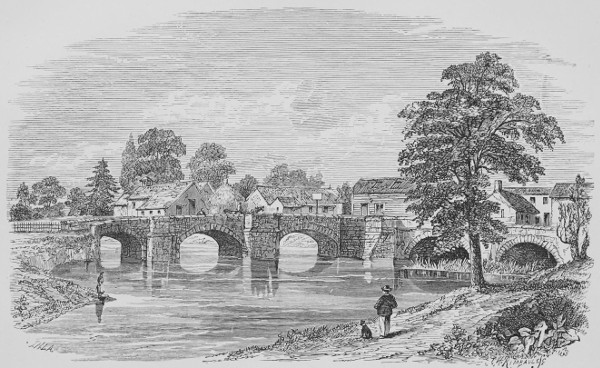
OLD BRIDGE AT POWICK.
Peaceful as is the spot, it had already been the scene of a
bloody conflict between the Parliamentarians and Royalists, in
1642, when Prince Rupert posted himself near a hawthorn-bush
on the brow of a bank adjoining Wykefield, and dashed upon the
Earl of Essex. But things were now destined to be changed. In
front of the bridge, on the road to Powick village, Montgomery's
infantry was posted, in ranks, five deep—the men being armed
with pikes and carabines.
Attacked by Fleetwood's dragoons, they sustained the onset
firmly, killing numbers of men and horses, but on the second charge
their ranks were broken, and they were driven across the narrow
bridge with great slaughter—many of them jumping into the
river to avoid the merciless dragoons who were hewing them down.
Deeply dyed with blood, the Teme was almost choked with
the bodies of the slain. But it was on the further side of the
bridge, at Wykefield, just mentioned as the scene of Rupert's
victory nine years before, that the severest part of the contest
took place.
On Wykefield, as three or four meadows hereabouts are designated,
Montgomery's main body was drawn up, and when the confusion
caused by the retreat of the advanced guard could be set right,
a fierce attack was made on the Parliamentarians, and so energetic
was it that the latter were driven back, and it seemed as if possession
of the bridge would be regained by the Royalists. But
the success was fleeting.
Another troop of horse came on—the bridge was cleared—Ingoldsby's
regiment passed over—and the fight became general
on the meadows, and soon extended as far as Rupert's hawthorn-bush.
Just below the bridge, on the left bank of the river, as we have
previously mentioned, was a water-mill, and near it were two
or three small cottages. The mill, which with its large wheel
formed a picturesque object from the bridge, was occupied by a
party of recruits, placed there by Montgomery. The party was
commanded by Captain Woolfe, and amongst those with him,
as we have already intimated, were Lieutenant Vosper and
Corporal Trubshaw. These recruits were excellent marksmen,
and being thus advantageously posted, did great execution upon
the dragoons during the conflict on the bridge. Orders were
given to dislodge them, but this was found impossible, owing
to the continuous fire kept up by Captain Woolfe and his men.
Nor would they have been driven out if the enemy had not
set the mill on fire. The old structure was speedily in flames,
and for a short time formed a striking object in the terrible
picture. The blazing mill and some wooden outbuildings connected
with it, which had likewise caught fire, were reflected
on the river already dyed of a sanguinary hue, and filled with
dying and dead.
While still burning, the mill was surrounded by dragoons, between
whom, and the Royalist recruits, a desperate fight took place.
With the fire at the back, and the enemy in front, no wonder
the Royalists fought fiercely. Some few escaped—but the greater
number were killed, or thrown back into the flames. Captain
Woolfe and Vosper fought their way out, but poor Trubshaw was
not so fortunate. His skull was split, and he staggered back into
the fire.
Wykefield was now a complete field of battle, in which many
marvellous acts of heroism were performed by the Royalists. Small
parties of Cavaliers might be seen scattered over the field engaged
against fearful odds—but still fighting furiously, and in some cases
overcoming their antagonists. With the remnant of his brave
regiment of Highlanders, Pitscottie had joined the fight, and lent
what aid he could. But despite their gallant efforts to maintain
their ground, the Cavaliers were driven back almost as far
as Rupert's hawthorn-bush. Still, the fight went on, though
the ranks of the Royalists were much thinned, and their ammunition
began to fail. On the other hand, the Parliamentarians
were being constantly reinforced.
Considering the inequality of the contending forces—the Parliamentarians
being now three to one—the duration of the fight at
Powick was remarkable. The contest lasted for nearly two hours,
and during this time the Royalists held their ground stoutly
against their adversaries.
Montgomery was severely wounded, and could with difficulty
sit his horse.
Keith, who had thrown himself into the thick of the fray, in
the vain hope of turning the tide, had been taken prisoner. Finding
all against him, Montgomery, at last, was compelled to order
a retreat, and strove to prevent it from being converted into a
total rout.
The advance of the victors was somewhat checked by the
soldiers, who lined the hedges, and fired at the enemy from
every sheltered spot.
A stand was made at Pitmarston, but it was brief and ineffectual.
The rout of the Royalists was then complete, and all who could
escape the enemy's sword fled to St. John's, where General
Dalyell's brigade was quartered, and where it was thought that
the victorious Parliamentarians would be stopped. But such was
not the case.
Earlier in the day, alleging that he could not spare them,
Dalyell refused to send a detachment of his men with Massey
to Powick, and now after a short resistance, which only reflected
disgrace upon him, he ordered his brigade to lay down
their arms to Fleetwood.
Having thus carried everything before them on the western side
of the river, Fleetwood and Ingoldsby prepared to cross the bridge,
and enter the doomed city.
HOW THE BATTERY ON PERRY WOOD WAS TAKEN BY THE KING.
The king was not present
during any part of the disastrous
conflict just described. On arriving at Powick Bridge with
his attendants, he found Montgomery and Keith at their post,
and confident of their ability to maintain it. No reinforcements
had been sent, as yet, by Dalyell, but doubtless they
would soon arrive, and Montgomery declared he did not require
them.
Continuous firing having been for some time heard in the
direction of the Severn, Montgomery, in obedience to his majesty's
command, was about to detach a party of men to support Pitscottie,
when a Highland soldier arrived in breathless haste bringing
intelligence that his leader had been routed by the enemy. Charles
could scarcely credit the news, but on ascertaining the full extent
of the disaster, he felt the necessity of immediately returning to
the city, and preparing against an attack on the south, which might
now be expected.
He therefore rode back with his attendants, crossed the river
at the palace-ferry, and at once proceeded to the Sidbury-gate,
where he found the Duke of Hamilton. From the watch posted
on the summit of the cathedral tower, the duke had already heard
of Pitscottie's defeat and the construction of the flying bridge across
the Teme. He did not for a moment attempt to disguise the
perilous position in which his majesty would be placed if Montgomery
should be worsted at Powick, and coincided with the
king in opinion that the general attack should not be delayed, but
advised that a visit should first be paid to Lesley, whom he had
not as yet seen that morning.
Acting upon this counsel, Charles, attended by the Earl of
Derby, Lord Wilmot, Careless, and a small escort, rode to the
Blockhouse fields, where Lesley was stationed with his Scottish
horse. He found him with the whole of his large force under
arms, and apparently ready for action. But he could not help
noticing that Lesley looked exceedingly grave, and not altogether
free from uneasiness.
"Is this man really the traitor he is generally thought?" mentally
ejaculated Charles. "I will try him. Colonel Lesley," he
cried, as he rode up, "I am resolved to take yon battery on Perry
Wood. Bid your men prepare for the attack. I shall lead them
in person."
On receiving this command, Lesley immediately drew near
the king, and said, in a low voice:
"I beseech you not to call upon them to make the attack, sire.
They will not follow you."
"Not follow me!" exclaimed Charles, fiercely. "Lesley, you
are a traitor!"
"I have already told you, sire," replied Lesley, in the same low
voice, "that the men are not to be relied on. They will not fight
with your Cavaliers."
"What will they do, then?" demanded Charles, sternly. "Will
they utterly desert me in my hour of need? Will they deliver
me to the enemy?"
"No, sire; but if, in obedience to your commands, I order
them to attack yon battery, not one of them will stir."
Just then the roar of artillery was heard. The battery had
opened fire on Fort Royal, and was immediately answered—as
we have already described—by the Royalist engineers. The din
was heightened by the smaller ordnance of the Blockhouse, which
now began to operate—though with little effect—against Cromwell's
intrenchments.
"Can you hear this, and stand tamely by?" observed Charles,
reproachfully, to Lesley.
"I cannot help it, my liege," was the Scottish leader's answer.
"My men are mutinous and will not obey me. Look at them
now, and you will be convinced that I speak the truth. But do
not, I entreat you, compel me to put their disloyalty to the
proof."
Charles cast his eye along the line nearest him, and the sullen
and discontented aspect of the men fully confirmed Lesley's
assertion.
The Earl of Derby had likewise taken a rapid survey of the
regiment, and came to a like conclusion.
"A mutinous spirit evidently prevails among the men," he
said to the king, "and may break out at once, if an attempt is
made to force them into action. Leave Lesley to manage them.
He can do it, if he will."
"'Tis the confounded Kirk committee that has been at work
with them," cried Charles. "Lesley," he added, in a low significant
tone to the Scottish leader, "you will gain nothing by
deserting me; but much—very much—by standing firmly by me
at this critical juncture."
"My liege," said Lesley, earnestly, "if you are in jeopardy,
I will bring you aid. I cannot promise more."
Obliged to be content with this, Charles rode off with his
attendants and escort, and regardless of the enemy's fire, which
was now extending along the heights and increasing in fury, proceeded
to visit his various outposts.
Very little impression was produced upon Fort Royal by the
heavy cannonade directed against it from Perry Wood, nor was
any immediate attempt made by the enemy to storm it.
Lilburn and Lord Grey of Groby gradually drew closer to the
Royalist outposts, but seemed to be awaiting the Lord General's
signal for the grand attack. And such, in reality, was the case.
From the apparent inertness of the enemy it was erroneously
supposed by the Royalists that most of the Parliamentary troops
had been drawn to the other side of the Severn. Cromwell,
however, had a motive for all he did, and if he delayed the
attack, it was because he deemed the right moment for making
it had not arrived.
Never was he more cheerful than he appeared to be throughout
this trying day. Confident of victory, he yet kept a
watchful look-out upon the enemy, and seemed surprised that
the attack, which he expected the king to make upon him,
should be so long delayed. For this attack, come when it
might, he was fully prepared; but as evening began to draw
on, and no movement was made by the royal forces, he grew
impatient.
"Time will scarcely be allowed us for the work," he said to
the officers with him, "yet will I not move till I have full assurance
that Fleetwood and Ingoldsby are masters of St. John's,
and ready to enter the city."
At this moment a messenger rode up bringing the intelligence
he so eagerly desired.
Montgomery was utterly routed—Keith a prisoner—Dalyell
had surrendered. Fleetwood and Ingoldsby were preparing to
cross the bridge, and enter the city. Lambert was marching
towards the bridge of boats, and would soon bring his regiment
to Perry Wood. Such was the sum of the despatch. The
messenger had to take a circuitous route, or it would have been
delivered sooner.
Cromwell could not conceal his satisfaction.
"The Lord of Hosts is with us," he exclaimed. "His holy
arm hath gotten us the victory. Nothing remains but to finish
the work so well begun. On this day twelvemonth, at Dunbar,
the word was, 'The Lord of Hosts.' So let it be to-day. The
signal then was, 'We have no white about us.' The same signal
shall serve now. Make this known throughout the regiments, and
then prepare for action."
While issuing these orders, Cromwell had noticed a movement
at the Sidbury-gate, and now fixing his field-glass upon the spot
he perceived that the main body of the royal army, horse and
foot, was coming forth from the gate, evidently for the purpose
of attacking him. He was at no loss to discover that the host
was commanded by the king in person, and that Charles was
attended by several of his most distinguished nobles. Indeed,
from a closer survey, he felt certain that the Dukes of Hamilton
and Buckingham were with him.
It was a splendid sight to see that gallant host issue forth from
the gate, and familiar as he was with such spectacles, Cromwell
watched it for some minutes with great interest—noting the
strength of each regiment, and making many shrewd observations
to his own officers.
"Charles Stuart hath come forth in all his bravery," he said.
"But he and all his host shall be utterly discomfited. Up, and
smite them. Spare none of the malignants. As to their prince,
take him not captive, but slay him without pity."
Many circumstances had conspired to prevent Charles from
making the attack he had meditated upon the enemy until so late
in the day. But when he learnt that Dalyell had surrendered he
no longer hesitated, but marched forth as we have just described.
He was accompanied by the Dukes of Buckingham and Hamilton,
the Earl of Derby, Lord Wilmot, Sir Alexander Forbes, and several
other distinguished personages, and had with him his best infantry
and cavalry, and his bravest Cavaliers.
The command of the right wing was given to the Duke of
Hamilton, that of the left to the Earl of Derby, with whom was
Colonel Roscarrock, while he himself commanded the centre.
Perry Wood was to be attacked on either side, while a charge
was made on the battery.
The plan was executed with remarkable quickness and precision.
No sooner were the men formed than a general charge
was made on Perry Wood, each division taking its appointed
course. Such was the impetuosity of the Cavaliers who formed
the central body led by the king, that they drove back Cromwell's
body-guard who rode down the hill to meet them, and
rushing on with irresistible fury broke through the pickets,
forced the intrenchments, and putting the artillerymen to the
sword, actually obtained possession of the enemy's largest guns.
For a brief space Charles, who had led this wonderful charge—the
most brilliant feat performed at the fight of Worcester—seemed
master of the position. He was on the very spot just
occupied by Cromwell himself, and had taken his guns. The
valiant Cavaliers who attended their sovereign raised a shout of
triumph, and struck the cannon with their swords.
With the king were Colonel Legge, Colonel Lane, Captain
Giffard, Colonel Blague, Marmaduke Darcy, Wogan, and Careless.
They had ridden close behind him, and had shared every danger he
incurred. Colonel Legge, indeed, had saved the king's life. It was
a singular sight to see the royal party on the top of the hill in the
midst of the Parliamentarian forces. But their position seemed
scarcely tenable, though Hamilton and Derby were pressing on,
on either side, to their aid.
Nevertheless, Charles exulted in his brief triumph, and his
exultation was shared by his companions. The hitherto invincible
Ironclads had retreated before him, and were still in confusion
and disorder, while both Hamilton and Derby, animated by the
king's success, were driving all before them. Moreover, a most
important result had been obtained by the capture of the guns.
Fort Royal, which had suffered considerably from the ceaseless
cannonade of the battery, was now left unmolested.
At this critical juncture, when his fate hung in the balance, and
when the Scottish horse might have helped him to victory, Charles
looked anxiously down to the spot where Lesley was posted. He
was still there with his troops. But they remained motionless,
although their leader must have been aware of the king's success,
and must have felt how important aid would be at that moment.
"Does he move?—is he coming?" cried Charles.
"No, sire," rejoined Legge, straining his eyes in the direction
of the Scottish cavalry. "He does not stir. Curses on him for
a traitor."
"Oh, that Montrose were alive and in his place!" ejaculated
Charles, bitterly. "He would not have served me thus!"
"No, sire," observed Careless. "Montrose would have secured
you the victory."
It may be that the battle of Worcester was lost by Charles,
owing to Lesley's inaction or treachery. If the king's extraordinary
success could have been at once followed up, victory
might have ensued. Who shall say?
HOW THE BATTLE OF WORCESTER WAS LOST BY THE KING.
Cromwell was somewhat disconcerted
by the unlooked-for advantage
gained by Charles, but he quickly brought his disordered
troops to their ranks, and prepared to bring forward his reserves.
Like Charles, he looked down to the Blockhouse fields to see
what Lesley would do, but was speedily reassured by finding the
Scottish horse remain motionless.
"The men of Sechem have dealt treacherously with Abimelech,"
he said, with a stern smile. "Had Lesley come to his master's
aid in time, he might have given me some trouble."
Detaching troops on either side to prevent a junction between
the three parties of Royalists, he himself made a determined
attack on the king.
The onset was terrible, but Charles and his Cavaliers bore it
firmly, and maintained their ground, giving abundant proofs
of valour, and showing of what stout stuff they were made,
since they could thus resist the attack of Cromwell's veteran
troops.
The conflict lasted for a considerable time—much longer, indeed,
than Cromwell expected—but when Lambert arrived with
his troops it became too unequal, and the Cavaliers were forced
to give way. Besides, their ammunition was completely exhausted,
and they were obliged to fight with the butt-ends of their muskets.
After a most obstinate but ineffectual resistance, they retreated
in disorder towards the city.
No junction had taken place between the battalions under
the Duke of Hamilton and the Earl of Derby, but neither of these
leaders were more successful than the king, though both fought
valiantly. The Duke of Hamilton routed a troop of horse, but
in a subsequent encounter his horse was shot under him, and he
himself was so severely wounded, that he had to be taken from
the field, and was conveyed to the Commandery. Sir John
Douglas was likewise mortally wounded, and Sir Alexander
Forbes, disabled by a shot through both legs, was left in this
lamentable condition in Perry Wood during the whole night.
Next day he was discovered by the enemy and taken prisoner.
Both the Earl of Derby and Roscarrock escaped unhurt, but the
battalion commanded by the earl was routed after a gallant
fight.
Overpowered on all sides, the Royalists, after sustaining fearful
loss, were compelled to retreat into the city. Lesley, who had
taken no part whatever in the fight, finding that the day had
gone against the king, moved his regiment towards Barbourne
Bridge, about a mile on the north of the city, and close to Pitchcroft.
No sooner did Cromwell's engineers regain possession of the
great guns than they began to cannonade Fort Royal with redoubled
fury. Under this tremendous fire a strong storming party
was detached to take the fort, with orders from the Lord General
to put all the troops within it to the sword unless they surrendered.
The barbarous order was executed. The fort being carried by
storm after an obstinate resistance, no quarter was given to its
brave defenders. The guns of the fort were then turned upon
the city, and being so close to it, caused terrible havoc, and drove
all the artillerymen from the walls.
But we must now return to the king. So long as a chance was
left him, Charles fought valiantly, and during the retreat, though
he failed to rally his disordered troops, he turned several times to
face the enemy.
While thus braving the foe for the last time he was left alone,
none of his attendants being aware that he had stopped. From
the richness of his accoutrements he was at once recognised, and
fierce cries were raised:
"'Tis Charles Stuart!—'tis Jeroboam! The Lord has delivered
him into our hands! Slay him—slay him!"
Several pistols were discharged at him, but though the bullets
struck his armour, no injury was done him. Most luckily his
horse was not hurt, but bore him swiftly and safely to the Sidbury-gate.
He was hotly pursued by the Roundhead troopers, who
would assuredly have cut him down, according to Cromwell's
order, if they had come up with him.
On reaching the Sidbury-gate he found, to his dismay, that it
was blocked up by an ammunition waggon, which had been
overturned there either by accident or design. One of the oxen
that had drawn the waggon was killed on the spot.
Without a moment's hesitation, the king threw himself from
his horse, and contrived to creep past the waggon. As he entered
Sidbury-street, Mr. William Bagnal, a staunch loyalist, who dwelt
in that quarter, rode towards him, and, instantly dismounting,
offered him his horse. The steed, thus opportunely provided for
his majesty, was of infinite service to him in the day, as will be
shown.
Once more on horseback, Charles rode up to the High-street,
and found it full of soldiers, most of them belonging to the
Scottish infantry. They had all a most dejected look, and on
seeing him, many of them threw down their arms, to intimate their
refusal to fight any longer. In vain he rode up and down their
ranks, with his feathered hat in his hand, addressing them with a
passionate eloquence that ought to have roused them.
"Stand to your arms!" he cried. "Fight like men, and we
shall yet conquer. Follow me, and I will lead you to victory.
Ours is the right cause, and truth and justice must prevail in the
end. Follow your king!"
Finding, however, that they would not stir, he called out in
accents of bitter reproach, "Recreants that you are to desert me
thus. If you will not fight, turn your arms against me. I
had rather you would shoot me than let me live to see the consequences
of this fatal day."
He then rode slowly off towards the College Green, still hoping
some might follow him, but none stirred.
HOW THE ENEMY ENTERED THE CITY, AND HOW THE KING QUITTED IT.
Meanwhile, a sharp conflict
was taking place outside the Sidbury-gate
between a party of flying Royalists and a troop of horse
under Colonel Pride. The unlucky Royalists were unable to enter
the city owing to the obstacle before mentioned, and, after a short
struggle, were slain to a man in front of the gate.
The ammunition waggon being removed, a regiment of infantry
rushed in through the Sidbury-gate, and encountering no opposition,
the men spread themselves through the lower streets of the
city, and commenced plundering the houses.
The loyal city was now paying the penalty of its devotion to the
king. Terror and confusion reigned everywhere. Doors were
burst open, and the most horrible threats were answered by shrieks
and cries for pity, but no pity was shown by the ferocious soldiery.
By this time Fort Royal had been stormed, as we have already
related, and its guns being turned upon the city, the destruction
caused in various parts by the shot heightened the terror of the
inhabitants. Desperate fighting was going on in all quarters,
and nothing was heard but the clash of steel, the sharp ring of
musketry, and the roar of artillery, mingled with shouts and cries.
Fleetwood and Ingoldsby had now forced their way across the
bridge, but their entrance into the city was furiously opposed by
such forces as could be rallied by Lord Wilmot, Colonel Blague,
Colonel Lane, and others, but the contest was too unequal, and could
not be long sustained.
As both horse and foot were now continually pouring into the
city on all sides, conflicts were taking place in almost every street.
There was desperate fighting on the west as well as on the east.
There was fighting on the quay—in Newport-street and Dolday—near
All Saints' Church—and in Broad-street. There was no
fighting near the Cross—for the Foregate, as already mentioned,
had been walled up—and, indeed, the enemy chiefly entered the
city from the Sidbury-gate, from Friars'-gate, and from the bridge.
But there was a great deal of fighting in Friars'-street, Lich-street,
and multitudes of armed citizens and artillerymen who had
been driven from the walls were running about in different directions.
Hundreds of these were killed, for quarter was given to none
with arms in their hands, and the streets were full of dead bodies.
The Scottish infantry tamely surrendered, and were shut up in
the cathedral. They had better have died valiantly, for they were
afterwards sold as slaves to the plantations. But other Scottish
regiments behaved with the greatest resolution, and if all had
done equally well, the result of the day might have been different.
Castle Hill, as we know, had been strongly fortified, and
was held by the Earl of Rothes, Sir William Hamilton, and
Colonel Drummond, with a party of brave and loyal Scots. The
fortress was attacked by Lambert and Harrison, but was so obstinately
defended that its leaders were able to capitulate on advantageous
terms.
Having thus endeavoured to describe the frightful condition to
which the city was reduced by the entrance of the enemy, we will
now return to Charles, whom we left proceeding in a most melancholy
frame of mind, and wholly unattended, towards the College
Green. So cast down was he at the moment that he scarcely took
note of anything that was passing around him, when he was suddenly
roused from his fit of despondency by seeing a large troop of horse
issue from the college gates. It was a party of Cavaliers headed
by the Earl of Derby, Lord Cleveland, Colonel Roscarrock,
Colonel Wogan, and Careless, and on making this discovery he
immediately rode up, and was welcomed with the greatest delight
by the Earl of Derby, as well as by his faithful attendant Careless.
The greatest uneasiness had been felt for his safety, and it was
feared he might have fallen into the hands of the enemy. Nor
were the Cavaliers composing the troop less delighted, and
their enthusiasm quickly raised his drooping spirits. He put
himself at their head, and, despite the entreaties of the Earl of
Derby that he would seek safety in flight, he led them towards
the Sidbury-gate.
But they had scarcely descended Lich-street when Colonel
Pride's regiment of horse was seen advancing, and an instant onset
upon it was made. As on all previous occasions, the first advantage
was with the Cavaliers, but Pride and his men were not to be driven
back. As soon as it was discovered that Charles was with the
party, an attempt was made by Pride to capture him, and it would
have been successful if Careless had not flown to his rescue.
The Cavaliers still made a desperate struggle, but it was evident
they could not hold out long. Charles, who had been left
for a few minutes in the rear after his rescue, was again about to
place himself at their head, but Careless earnestly besought him
to fly.
"The day is lost, my liege—utterly lost!" exclaimed this faithful
attendant. "Save yourself, while there is yet time. We can
hold out long enough to cover your escape. Fly, I entreat you."
"No. I cannot—will not—abandon my faithful followers," cried
Charles.
"Your presence unnerves us, my liege," implored Careless.
"See you not that the enemy is resolved to capture you, or slay
you. Baulk his design by instant flight. We will prevent all
pursuit till you are safe. Quit the city by St. Martin's-gate.
'Tis the only safe outlet. Ride on to Barbourne Bridge, where
those of us who are left alive will join you when all is over here."
Charles yielded to these entreaties, though with the greatest
reluctance, and Careless rushed to the front. Captain Woolfe and
Vosper chanced to be near the king at the time, and he ordered
them to follow him. Divining his intentions, they instantly
obeyed.
On the way to St. Martin's-gate, he had to pass the ancient
mansion which he had latterly made his private quarters, and wishing
to enter it for a moment to take off the heaviest part of his
armour, which might incommode him during his flight, and possess
himself of some valuables he had left behind, he dismounted, and
giving his steed to Vosper, entered the house.
His imprudence in doing so had well-nigh led to his capture.
He did not imagine that his flight had been discovered by the
enemy, but he was mistaken. Quick eyes had been upon him at
the time. Colonel James, who had recovered from his wounds,
was with the Parliamentarians, and seeing the king quit his
adherents, guessed his purpose.
But for some minutes pursuit was impossible, owing to the
obstinate resistance of the Cavaliers. At length, Colonel James,
accompanied by a dozen dragoons, forced his way into New-street,
and was galloping along it when he caught sight of
Woolfe and Vosper with the king's horse. They instantly disappeared,
but he had seen enough. He knew that Charles had
made that old mansion his private quarters, and felt convinced he
must be within it at the time.
Galloping up, he entered with half a dozen of his troopers,
leaving the rest on guard outside. Luckily for Charles, his
pursuers had neglected to secure a door that opened into the
Corn Market. Before moving off, Woolfe and Vosper gave
the alarm. The king had already divested himself of his armour,
and was prepared for flight. At the very moment that Colonel
James and his troopers entered, he passed out at the back.
Not many persons were in the Corn Market at the time, and the
few he encountered being staunch Royalists, would have protected
him with their lives, rather than have betrayed him. Woolfe and
Vosper were not in sight, but he learnt they had gone out by St.
Martin's-gate.
Hurrying thither, he passed through the gate without interference—for
the Parliamentarians had not yet placed a guard
there—and in another instant was joined by his attendants,
who brought him his horse.
Quickly mounting his steed, he galloped off in the direction
of Barbourne Bridge. He was not pursued—false information
being given to Colonel James, which led him to believe
that the royal fugitive had not quitted the city.
After awhile Charles slackened his pace, but just then he
heard the trampling of horse behind him, and fancying the
enemy was on his track, was about to gallop on, when he discovered
that his fancied pursuers were a small party of his own
cavalry. He then faced about, and as the troop drew nearer,
found that at its head were the Duke of Buckingham and the
Earl of Lauderdale. A painful meeting took place between the
king and the two nobles. They were seeking safety in flight,
and were rejoiced to find that his majesty had escaped.
Soon afterwards, several small parties of Royalists overtook
them—no other route being open to the fugitives. Charles,
therefore, had no lack of attendants.
On reaching Barbourne Bridge, to his great surprise, he found
Lesley and his regiment of horse.
"Soh! you are here," he cried, furiously. "I sought for you
in vain in the city. Your men must be fresh since they have
taken no part in the fight. Come back with me at once and
help me to retrieve the fortune of the day."
"Sire," replied Lesley, calmly, "the contest from the first has
been hopeless, and your troops are now annihilated. It would be
madness to return. I have been waiting for you here."
"Waiting for me?" exclaimed Charles.
"Ay, waiting for you, sire. I knew you would come this way,
since none other is open to you. I am ready to conduct you to
Scotland."
"But I will not return thither to be the slave I have been,"
cried Charles. "I will rather die in England."
"Humour him, my liege—humour him. He may be of use
now," observed Buckingham, in a low tone.
"Your majesty has now no option," remarked Lesley, coldly.
"You must go back to Scotland. I will insure you a safe retreat.
'Tis for that purpose I have reserved my troops."
"Say you so?" cried Charles. "Then I must needs go with
you. But I must wait here for my friends."
"Your majesty will have to wait long ere some of them join
you," said Lesley.
"At least they have not deserted me," rejoined the king.
THE LAST STAND MADE BY THE ROYALISTS.
Once more we must enter
the ill-fated city, which was now
completely in the power of the enemy, though many a conflict
was still going on within it. So inflamed with fury were
the Cavaliers, that they fell upon the foot soldiers who had been
plundering the houses, and were so much encumbered with booty
that they could not defend themselves, and slew such numbers of
them that Friars'-street was quite choked up with dead bodies.
On neither side was quarter given.
"The hour of vengeance is come," shouted the fierce Cromwellians.
"Slay the Amalekites. Destroy them utterly—so that
they may never more rise against us."
"Down with the rebellious sectaries!" cried the Cavaliers.
"Spare them not. Kill them as you would wild beasts."
Savage shouts like these were heard on all sides, proclaiming
the deadly animosity of the combatants which could be satisfied
with nothing but slaughter.
The last stand made by the Royalists was at the Guildhall, and
a more gallant stand was never made, because success seemed out
of the question.
A tolerably strong party of Cavaliers had been rallied by
Careless, Sir Rowland Berkeley, Colonel Legge, Colonel Lane,
and Captain Hornyold. They assembled, as we have said, in
front of the Guildhall. With them were the Earl of Cleveland,
Sir James Hamilton, Colonel Wogan, and some others. They
were attacked on the left by Fleetwood, and on the right by
Lambert, with whom was Cromwell in person. In the fierce
conflict that ensued, many were slain, and many more taken
prisoners, but all the leaders escaped, except Sir James Hamilton,
who was severely wounded.
Finding the contest hopeless, and that they should soon be shut
up within the city, without the possibility of escape, Careless and
the others dashed down Pump-street, and made their way to St.
Martin's-gate. Having thus got out of the city, they rode as
quickly as they could to Barbourne Bridge, where they found
the king.
Deprived of all its defenders, its bravest inhabitants slain, or
made captive, the city was then delivered over to the rapacious
and fanatical soldiery, who had obtained possession of it. On the
frightful atrocities perpetrated during that night upon the wretched
inhabitants by the barbarous hordes let loose upon them, we shall
not dwell. Suffice it to say that the sack of Rome under the
Constable de Bourbon scarcely exceeded the sack of Worcester in
horror.
Imagination cannot conceive scenes more dreadful than actually
occurred. No soldiers were ever more savage, more ruffianly,
more merciless than the Parliamentary troops. Cromwell himself
had left the city before the direst deeds were enacted, but he well
knew what would happen. He did not expressly sanction pillage
and rapine and all other atrocious acts, but he did not forbid them,
and, at all events, did not punish the offenders.
On that night, at the very time when the diabolical atrocities
we have hinted at, but cannot describe—when outrages the most
frightful were being committed by his soldiery, without the
slightest interference from his officers, the Lord General wrote in
these terms to the Parliament:
"This hath been a very glorious mercy, and as stiff a contest
for four or five hours as ever I have seen. Both your old forces
and those new raised have behaved themselves with very great
courage, and He that made them come out, made them willing to
fight for you. The Lord God Almighty frame our hearts to real
thankfulness for this, which is alone His doing."
The darkest part of the picture was carefully kept out of
sight, and nothing dwelt upon but the "glorious mercy"
vouchsafed him and his forces. Yet no mercy was shown by the
conquerors, on that dreadful night—the worst they ever had to
endure—to the miserable inhabitants of faithful Worcester.
THE CONSULTATION AT BARBOURNE BRIDGE, AND THE KING'S FLIGHT.
We left the king at Barbourne Bridge. By this time he had
been joined by the Earl of Derby, the Earl of Lauderdale, the
Lords Talbot and Wilmot, Colonel Roscarrock, Colonel Blague,
Charles Giffard, and many other Cavaliers, and a consultation
was held as to what course should be pursued. All were of
opinion that the day was irretrievably lost, and this opinion was
confirmed by the arrival of Careless and the others, who told how
they had been worsted in the last desperate struggle at the
Guildhall.
"More than half of this brave battalion are gone," exclaimed
Careless. "The rest are dispersed, and will never be got together
again. Such frightful havoc has been made among the citizens,
who have been slain by hundreds by these ferocious Roundheads,
that no more fighting men can be got together. All is lost!
Your majesty's standard has been torn down everywhere, and replaced
by the flag of the Commonwealth. From this spot you
may see their hateful standard floating on the cathedral tower."
Overpowered by this ill news, Charles could make no reply.
"All we can now do for your majesty is to save you from these
ravening wolves and regicides," cried the Earl of Derby, "and
that, with Heaven's grace, we will do!"
"We will defend your majesty to the last," cried the Lords
Talbot and Wilmot, and several others.
"Alas! how many are gone!" exclaimed Charles. "Brave
Sir John Douglas dead—the Duke of Hamilton mortally wounded.
Where is Lord Sinclair?—where are others of my Scottish peers?—where
is Sir James Hamilton?—where is Sir Alexander
Forbes?"
"Sir James Hamilton is killed, my liege," replied Careless. "Sir
Alexander Forbes is badly hurt—perhaps dead. Several of the
Scottish nobles have been taken prisoners in the city. But think
not of them—think of your own safety. What will you do?"
"Make all haste to London," replied the king. "By riding
hard I shall arrive there before tidings of the battle can be received."
"A good plan," cried Lord Wilmot. "Your majesty has
many staunch adherents in London."
"I like not the plan," cried the Duke of Buckingham. "If
adopted, it will end in your majesty's destruction. The moment
your defeat is known, your adherents will fall from you, and
you will be at the mercy of your enemies."
Almost all the others concurred with the duke in opinion, and
were strenuously opposed to the king's plan.
"Nay, then," he exclaimed, "there is nothing for it but Scotland.
I will go thither."
"Your majesty has decided right," observed Lesley.
"His approval is enough to make me change my mind," observed
Charles, withdrawing to a short distance with the Earl of
Derby.
"Go not to London, my liege, I entreat you," said the earl.
"'Tis the most perilous and rash scheme you could adopt. You
will have dangers enough to encounter in whatever direction you
proceed, but London is most dangerous of all. That you will
be quickly pursued, and a heavy price set on your head, is certain,
for Cromwell's victory will be shorn of half its splendour if you
escape him. In England your chance is lost. It grieves me to
say so, but I cannot hide the truth. You cannot get another
army together. To Scotland, I see, you like not to return. The
sole alternative, therefore, is an escape to France."
"That is what I desire," replied Charles. "But where can I
embark?"
"At Bristol, my liege, it may be—but that must be for after
consideration. Conceal yourself for a time, and no safer hiding-place
can be found than Boscobel, where I myself took refuge."
At this moment Colonel Roscarrock came up.
"How say you, Roscarrock?" asked the king. "Think you
I should be safe at Boscobel?"
"I am sure of it, my liege," replied the other. "Strange your
majesty should put the question to me, seeing I was just about
to counsel you to take refuge there."
"You have already described the house to me," observed
Charles. "But can the occupants be trusted?"
"Perfectly," said the Earl of Derby. "Your majesty has no
more faithful subjects than the Penderels of Boscobel. Charles
Giffard is here. Will your majesty speak with him?"
"Not now," replied Charles. "I would not have it known that
I am about to seek a place of concealment, and were I to confer
with Charles Giffard just now, my design would be suspected.
We have only one traitor here—but I must guard against indiscretion.
How far is it to Boscobel?"
"Some six-and-twenty miles, my liege," replied Roscarrock.
"Your horse looks fresh, and will take you there in a few hours,
if we are not interrupted. We must go by Kidderminster and
Stourbridge towards Wolverhampton."
"Lord Talbot is well acquainted with the country, and will
serve as guide," observed the Earl of Derby. "He has a
servant with him, who knows the whole district, and will be very
useful."
The king now signed to Careless, and taking him apart,
informed him of his design, but bade him say nothing about it,
except to Lord Talbot, Lord Wilmot, Colonel Lane, Charles
Giffard, and a few others. Careless entirely approved of the
plan, for he was terribly alarmed for the king's safety.
The word being now given that every one must shift for
himself, Sir Rowland Berkeley, Captain Hornyold, and several
other county gentlemen took leave of the king with such warm
expressions of unwavering devotion and loyalty as greatly touched
his majesty. Lesley, with his Scottish cavalry, took the direct
road northward by Newport.
Escorted by some sixty Cavaliers, all well mounted and well
armed, and accompanied by the Duke of Buckingham, the Earl of
Derby, the Earl of Lauderdale, Lord Wilmot, Colonels Roscarrock,
Lane, Blague, and Charles Giffard, and of course attended by
Careless, the king started on his flight.
End of the First Book