Boot and Shoe Manufacturers’ Assistant and Guide., by W. H. Richardson, Jr
Whole book · 12 sections
THE BOOT AND SHOE MANUFACTURERS’ ASSISTANT AND GUIDE. CONTAINING A BRIEF HISTORY OF THE TRADE. History of India-Rubber and Gutta-Percha, AND THEIR APPLICATION TO THE MANUFACTURE OF BOOTS AND SHOES. FULL INSTRUCTIONS IN THE ART, WITH DIAGRAMS AND SCALES, ETC., ETC. VULCANIZATION AND SULPHURIZATION, ENGLISH AND AMERICAN PATENTS. WITH AN ELABORATE TREATISE ON TANNING.
Transcriber’s Note:
The cover image was created by the transcriber and is placed in the public domain.
“SUTOR ULTRA CREPIDAM.”
COMPILED AND EDITED BY
W. H. RICHARDSON, Jr.
“Give good hearing to those who give the first information in business.”—Bacon.
BOSTON:
HIGGINS, BRADLEY & DAYTON,
20 Washington St.
1858.
Entered according to Act of Congress in the year 1858, by
W. H. RICHARDSON, Jr.,
In the Clerk’s Office of the District Court of Massachusetts.
PREFACE.
iii
In preparing the following pages, the author has aimed
to supply a want hitherto unsupplied. No work
devoted to the wants of the Boot and Shoe-maker, manufacturer,
or merchant, has ever been compiled. Able
articles upon the “Trade,” statistical statements, and
general comments upon matters of interest local in their
character, and having particular reference to the state
of the times in which they were written, have been published,
perused and forgotten. But no work, containing
a history of this important mechanical interest, together
with instructions in the science of the Boot and Shoe
manufacture, has ever been written. The Author does
not flatter himself that he has, by any means, exhausted
so fruitful a subject, but that he has prepared and compiled
important facts and rules, and submitted valuable
suggestions which are correct in theory, and practical
in their application, he has not a doubt.
Within a few years, this important industrial interest
has assumed almost wonderful proportions, and it now
towers in magnitude and importance, above all its compeers.
New elements have been introduced into the
manufacture of boots and shoes, and fortunes have been
expended in endeavoring to introduce new methods by
ivwhich to cheapen the process of manufacture, as well as
the raw material. The introduction of India-rubber and
Gutta-percha as articles of mechanical use, has quickened
the pulses of invention, and has already produced
wonderful, and important changes in all departments of
the mechanic arts, and more especially in that of boots
and shoes. Already have these important vegetable
gums, and the thousand uses of which they are susceptible,
attracted the attention of the world, and last but
not least, we are indebted to the discovery and use of
Gutta-percha for the successful insulation of the Atlantic
Cable, without which substance, the cable could not
have been safely submerged. Establishments for the
manufacture of India-rubber, and Gutta-percha, into almost
every conceivable shape, have sprung up, as it
were in a day. Patents for its use and application,
are constantly presenting themselves. Heretofore, it
has been the policy of all interested in the manufacture
of India-rubber and Gutta-percha, to surround their inventions
with an air of mystery. “No admittance”
has been blazoned upon their laboratories, and no
“open sesame” pronounced by the uninitiated, has succeeded
in opening the doors to their carefully guarded
treasures.
In this work, we have endeavored to make clear, simple,
but important facts, scientific discoveries and observations,
which, from practical experience, we know to
be of great utility. A collection of the most approved
recipes for the preparation of compounds of India-rubber,
and Gutta-percha, would alone, make a volume
worthy of preservation. But we have endeavored to
present all the important rules, practical hints, and
observations, necessary to the manufacture of boots and
shoes, also an important and economical method of repairing
the same.
vHerein may be found a history of the discovery of
India-rubber and Gutta-percha, its uses and applications,
the inventions which they have called into existence,
the patents that have been taken out, the “claims” set
forth by different individuals, the causes of the failures
of many of them, and a brief history of their pretensions.
We herein introduce a process of manufacturing boots
and shoes, of the most durable character, at about one-half
the expense of the old method, by a process so simple
that the humblest cordwainer in the land, no less than
the wealthy and extensive manufacturer, can at once
enter upon the field of competition; but time and experiment
will determine the real value and utility of
Gutta-percha as a substitute for “pegs” and “stitches,”
in the manufacture of boots and shoes.
Particular attention has been given to the application
of Gutta-percha, and India-rubber, in the manufacture of
boots and shoes, inasmuch as it is a new field, and much
interest is manifested by the “craft” to understand its
value and use.
Not least in the application of this process of shoe
manufacture, is the invaluable benefit to be derived by
all who wear thin soled shoes or boots, inasmuch as shoes
thus made are impervious to water from the sole, thus
allowing the most delicate lady to walk with impunity
upon ground, wet by the morning shower, or evening
dew. Perspiration of the foot is in no wise confined by
this process, as it escapes from the upper portion of the
shoe.
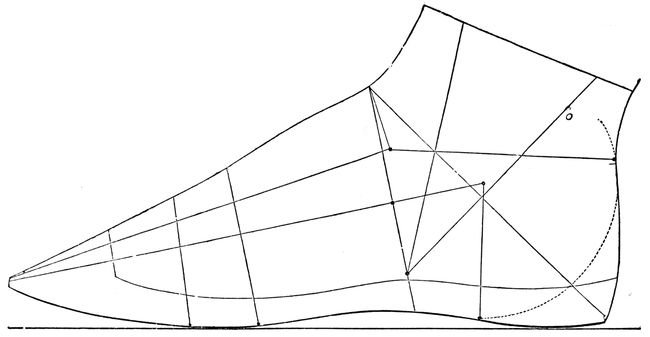
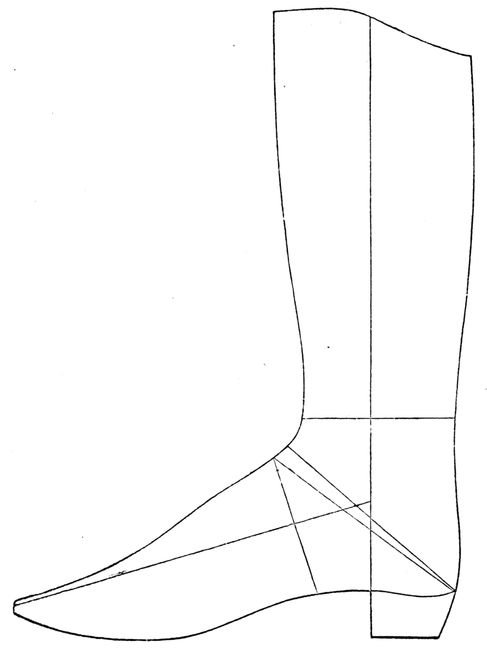
The system of cutting Patterns, herein set forth, is alone
worth the price of the work, as its simplicity, scientific
correctness, and application to every description of boot
or shoe, enables any mechanic possessing ordinary ingenuity,
to prepare sets of patterns for all classes of work
desired. Diagrams, to assist the beginner are explained
viso clearly, that every important rule is at once understood.
A “Treatise upon Tanning” is also introduced, in
which the subject is treated in a comprehensive manner,
and compilations from the most approved authorities
are made.
The history of Vulcanization, Adulterations of India-rubber,
(caoutchouc) and gutta-percha, will be found to
contain many important facts and suggestions.
The author is indebted to various sources for many of
the scientific and historical facts herein contained. First,
to a Boston gentleman of high standing, long identified
with the Boot and Shoe interest, for facts in the early
history of the trade in New England.
A great number of English works have been carefully
examined, and such of their contents as bear directly
upon the elucidation of facts, and theories set forth,
copied. The Scientific American, has also furnished us
with many important facts and suggestions.
All the practical and useful compounds herein described,
with a few exceptions, are the results of long,
patient, and laborious investigation; also the process of
making boots and shoes by the new method, are from
actual tests, and personal experiments. This portion of
the work, or rather the facts therein set forth, were furnished
by a gentleman who has devoted many years to
the prosecution of experiments in gutta-percha, and
India-rubber compounds. He is acknowledged to possess
great practical knowledge, and scientific research
in this department of mechanical art.
A general, rather than a scientific compilation has
been adopted, so that the work shall be found universal
in its application, although addressed especially to the
mechanic. All technicalities have been avoided as far
viias possible, and simple descriptions, and popular terms
substituted.
The “Assistant and Guide,” is dedicated to all interested
in the great industrial interest which it represents.
It is a humble pioneer in a new field, and is submitted
with the hope that it may be found a valuable “assistant”
to those just starting in the first years of their apprenticeship—a
“guide” to such as are desirous of perfecting
themselves in the calling to which their efforts
are directed, and a “companion” to the merchant, and
all who seek for information, in the thousand varied
channels through which it flows.
W. H. R. JR.
Boston, October, 1858.
CONTENTS.
ix
Introduction—An account of the various styles of “covering for feet,” before the Christian Era; with illustrations,
Middle Soles; Spur or Spring Lifts; To Prepare Leather Soles; To Prepare Counters; Preparation of Stock for Cloth Shoes; Preparation of the Upper Stock; To Prepare Uppers made of any description of Leather, or part Leather and Cloth; Instructions for Lasting; Cementing Processes after Lasting; Directions for applying Thick or Thin Soles to Shoes and Boots; Remarks on Finishing; Taps or Soles for Repairing; Preparing the Boot or Shoe to be Repaired; Important Facts for Manufacturers; Compounds for Heels of Shoes or Boots; Various Fibrous Compounds for Leather Soles, &c.; Practical Hints.
Diagrams on pages 82, 83, 84, 85, 87, 96, 97, 99; Fitting up Lasts for the Measurement of the Foot, 88; Cutting Boot Patterns, 89; Scales for Lasts, 91; Scales for Medium Proportions of Feet, 93; Directions for Pattern Cutting, 93–101.
CHAPTER III.
Instructions for Making French Custom Boots, Shoes and Gaiters,
Nathaniel Hayward, 109; Importance of the Discovery, 113; Causes of Failure, 114; Charles Goodyear, and Interesting Account of his Trials, 114–124; Results.
Marine Glue; India Rubber Armor; New Gutta Percha Composition; India Rubber Varnish; Water-Proofing Oil; India Rubber Teeth; Emery Paper, &c.; Cheap Method of Making Leather Water Proof.
First Patent by D. A. Brooman, fully described; Properties of Gutta Percha; Artificial Fuels; Elastic Applications; Applications in State of Solution; Patent for Improvements in Boots, Shoes and Gaiters, 181; Description of Patent, 182–186; Patent by Charles Hancock, Improvements in the Manufacture of Gutta Percha and its Application, 186: Description of Process of Making and Applying Varnishes to India Rubber Shoes, &c., 187; Method of Making Gutta Percha light, porous and spongy, 190; Varnishes, 192; Parke’s Improvements in Dyeing, 195; Hancock’s Patent for Improvements in Preparation of Gutta Percha, and Application to Manufacturing Purposes, 196–200; Re-Vulcanization, 200; Lorimier’s Patent for Combining Gutta Percha and Caoutchouc with other materials, 203; Compounds for Boots, Shoes, &c.; Hancock’s Specification for Making Water Proof Shoes, &c., 205; Claim for Making Shoes of Gutta Percha with other materials, 208; Cartley’s Patent for Varnishes, 210; Burke for Manufacture of Air-Proof and Water-Proof Fabrics, 211; Hancock’s Patent for Gutta Percha Heel Tips, 213; Varnishes, 214; Gerard’s Patent for Dissolving India Rubber and Gutta Percha, 217; Newton’s Patent Applicable to Boots, Shoes, and other coverings for the feet, 219; N. S. Dodge’s Improvements in Treating Vulcanized India Rubber and Gutta Percha.
Synopsis of American Patents, commencing 1813, ending 1858, 232–284; Chaffee’s Patent, Application of India Rubber to Cloth, 233; Goodyear’s Patent, Divesting India Rubber of its Adhesive Qualities, 234; Hayward’s Patent, Sulphur Preparation, 237; Chilcott & Snell’s Patent for Improvement in the Manufacture of Boots and Shoes, 255; Reynold’s Patent for Composition in Tanning, 257; Edward Brown, for Improvement in Porous Elastic Cloth for Gaiters, 258; Hyatt & Meyer, Improvement in Manufacture of Boot and Shoe Soles of Gutta Percha and India Rubber, 258; J. A. Pease’s Improvement in Over-Shoes, 262; Tyer & Helm’s Improvement in Manufacture of Boots and Shoes, 264; Parmlee’s Attaching Metallic Heels to India Rubber Soles, 265; Arthur’s Machine for Cutting Boot and Shoe Uppers and Soles from India Rubber, 266; Rice & Whorf Improvement in Lasting and Applying Soles to Shoes, 269–272; Tyer & Helm, Making India Rubber Cloth, 271–272; Crockett, Making Sheets of Leather from Currier’s Shavings or Buffings, 274; N. Hayward, Preparing Elastic India Rubber Cloth, 275; Thomas C. Wales’ Water Proof Gaiter Shoes and Boots, 279; Samuel Whitmarsh, Composition for Artificial Leather, 282; Boyden & Frederick’s Composition for Varnishing Leather, 283; F. Baschnagel, for Restoring Waste Vulcanized Rubber, 284; Descriptive Index of Chemical Patents Issued in 1855–66, 284–285.
Remarks.—Many of the Patents, described in this chapter, are not here referred to, as they are not particularly applicable to the Shoe and Leather interest
Jenkins’ Improved Heater and Press; Valuable Recipes for Gutta Percha and India Rubber Cement for Boots and Shoes; Varnishes, Gums and Glues, 331; Black Varnish for Boot and Shoe Edges and Heels, 333; Water-Proof Cement, 334; Shellac Varnish, 335; Glues, 336–339; Water-Proof Cloth, 340; Japanning Leather, 343; Gums, 344.
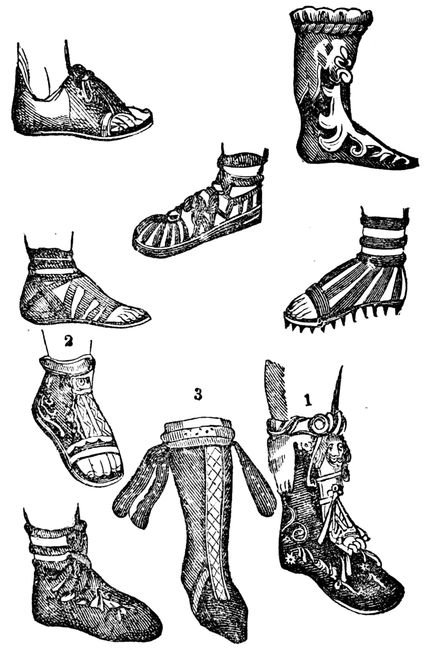
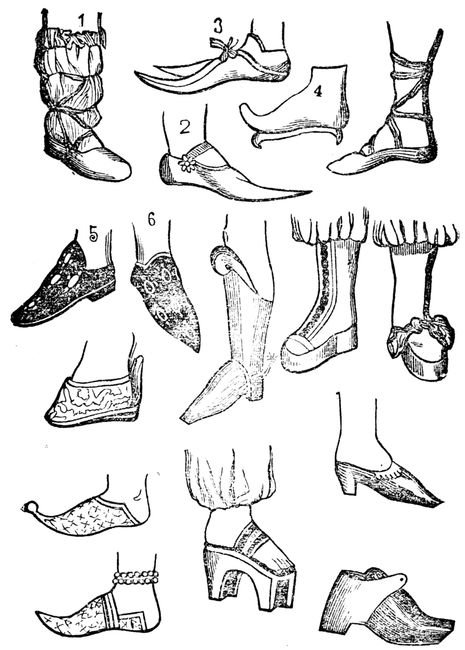
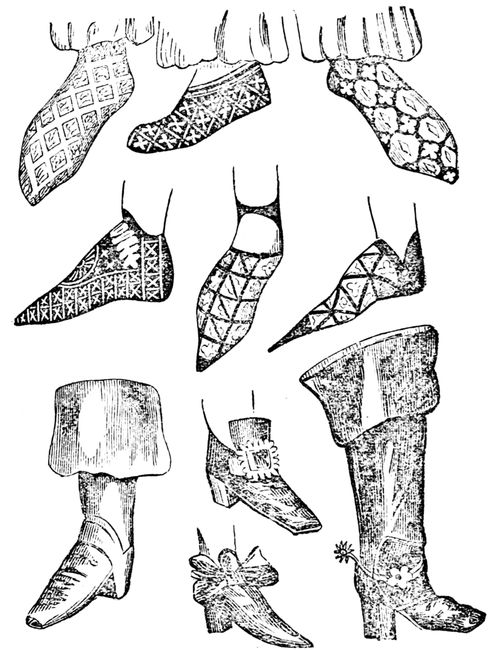
The readers of the “Guide” will be interested in an
examination of the various styles of shoes, or rather
“coverings for the feet,” that have prevailed, dating
some fifteen hundred years prior to the advent of
Christ. Some of the most unique, we have had
engraved from Cantrell’s designs, which we here
furnish, to give correct views.
The first attempt, of which we have any account,
to give style to the coverings of the feet, produced
the Sandal. These differed in style, though slightly
varied in form. Those used by the poorer classes
were constructed of flat slices of the palm leaf, which,
lapped over in the centre, formed the sole, and a
double band of twisted leaves secured and strengthened
the edge; a thong of the strong fibres of the
same plant was affixed to each side of the instep,
and was secured round the foot, while those indulged
in by the more wealthy classes were made of leather,
and were frequently lined with cloth, the point
or end turning up like a pair of modern skates. The
sandal reached its greatest perfection among the Romans.
The emperor Aurelian gave the royal permission
to the ladies of his time to wear sandals of various
colors, the men not being permitted to indulge in so
great a luxury. The Roman senators wore buskins of
xvia black color, with a crescent of gold or silver on
the top of the foot, while the soldiers wore simple
sandals fastened by thongs. In the reign of Edward
the Third, of England, those who worked at the shoe
trade, were denominated the “gentle craft,” as they
produced shoes of the most gorgeous description, the
richest contrasts of color were elaborated and the greatest
variety of pattern devised.
Fig. 1 in this plate displays a beautiful design. It is supposed to be worn by one of the royal family.
xviiThe English shoe of the middle ages is “beyond all
Greek, beyond all Roman fame.” The second specimen
in the engraving is simpler in design, but not less striking
in effect, being colored jet black, and worn with red
hose. Another curious fashion of those times was—see
Fig. 3. The left shoe was black and the stocking
blue, the other leg of the wearer being clothed in a
black stocking and a white shoe. This shoe was cut
very low over the instep, the heel being entirely covered,
and a band fastened by a small buckle or button
passing round the ankle secured it to the foot.
Coming down to the reign of Richard II., boots and
shoes were made of great length, so that they were chained
to the knee of the wearer, that he might walk with some
degree of freedom. Of course, only the nobility could
afford so expensive a method of locomotion. Extremes
were introduced from time to time, as in our own day.
During the reign of Edward III., it was enacted that any
shoemaker working for the “unprivileged classes,”
should not make any shoes, the toes which should exceed
two inches in length, under a penalty of twenty
shillings. This edict had the effect to widen the toes to
a most absurd extent; this fashion was followed by a
proclamation from Queen Mary, that the width of the
toes should not exceed six inches.
The mania for wearing expensive shoes, in 1588, was
only exceeded in folly by the Tulip excitement at a later
date in Holland. Large sums were expended in shoe
decorations. The poet Taylor alluding to this extravagance
thus writes of those who,
“Wear a farm in shoe strings edged with gold,
And spangled garters worth a copy hold.”
In the reign of Charles I., boots, which were made of
elegant Spanish leather, of a buff color, were cut so large
xviiiand wide at the top, that the wearer was obliged to
stride so ridiculously, that it afforded much sport for the
satirists of that age. In the time of Cromwell, large
boot tops were worn by the Puritans, but were not
adorned with lace. Upon the restoration of Charles II.
came the enormous French boot, in which the courtiers
of “Louis le grand” delighted to show their legs.
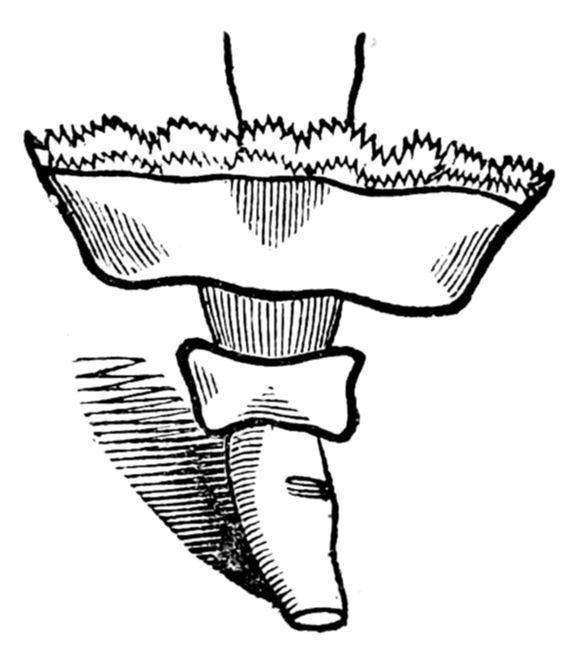
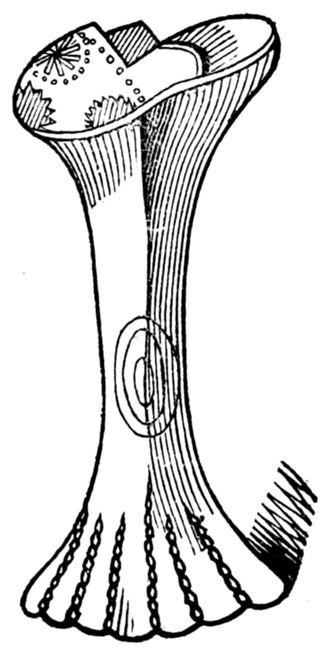
The accompanying cut will furnish an idea of the
amplitude of the tops. The boot is adorned with lace
around the upper part, and that portion of the boot into
which the leg is inserted was fitted with pliant leather;
over the instep is a broad band of leather, beneath which
the spur was fastened.
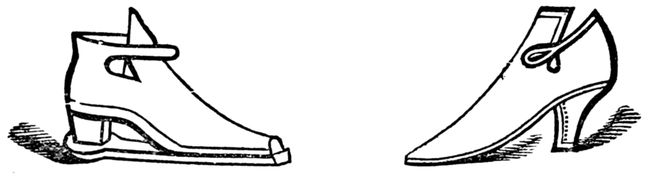
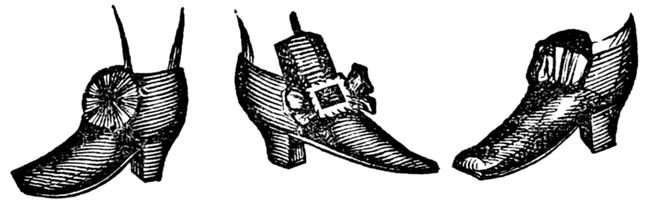
The shoes in the following cut were such as were
worn by the ladies during the reign of William III.
The clog beneath the shoe on the left side, was simply
a piece of stout leather, evidently intended to protect
the feet from excessive moisture. The distinguishing
xixmark of gentility in the reign of George I. and II.,
was red heels. The ladies preferred silk or velvet to
leather, and the favorite shoe worn by the ladies of the
court were made of figured blue silk with bright red
heels and silver buckles.
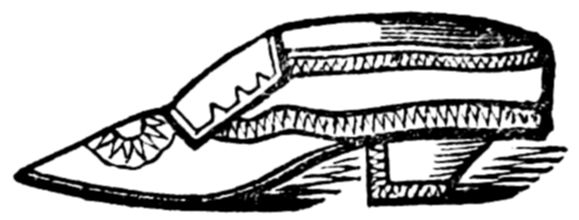
The above cut was the style worn in 1780. Ten years
later a change occurred by which ladies’ shoes were
made flat and low, like the slipper of the present day.
A picture by Fores was published in 1791, of a shoe
worn by the duchess of York. The shoe was made of
green silk, ornamented with gold stars, and bound with
scarlet silk; the heel was scarlet and shaped exactly in
the modern style.
Shoe buckles disappeared about the commencement of
the present century, and were succeeded by the plain
shoe string. In England the Prince of Wales endeavored
to preserve the custom, by persisting in their use,
in order to sustain the buckle-makers, but imperious
fashion was too powerful for even the influence of the
great.
The accompanying cut represents a variety of shoes
worn by females.
No. 1 is the sandal of a Russian lady of 1768. The
second that of a female of Finland, a low, slipper-like
shoe, secured by a band across the instep, having an
ornamental clasp, like a brooch, to secure it on each
side of the foot; it was probably a coarsely made piece
of jewelry, with glass or cheap stones set around it, as
the people of this country at that time were fond of
such showy decorations, particularly upon their shoes.
xxNo. 3 is a production of the same country, and is similar
to those worn by the matrons of the upper classes.
No. 4 is the shoe of a Tartarian lady of 1577. Nos. 5
and 6 are examples of the shoes of oriental ladies, which
are sometimes highly ornamented; the covering part
being wrought with gold, silver, and silk, and perhaps
set with jewels, real or imitated. The shoes of noblemen
are of similar construction. They were no doubt
easy to wear.
xxi
Not so are the ladies shoes, for they only were allowed
the privilege of discomfort, fashion having in this
country declared in favor of small feet, and the prejudice
of the people having gone with it, the feet of all
ladies of decent rank in society, are cramped in early
life, by being placed in so strait a confinement, that
their growth is retarded, and they are not more than
three or four inches in length, from the toe to the heel.
By the smallness of the foot the rank or high-breeding
of the lady is decided on, and the utmost torment is
endured by the girls in early life, to insure themselves
this distinction in rank; the lower classes of females not
xxiibeing allowed to torture themselves in the same manner.
The Chinese poets frequently indulge in panegyrics on
the beauty of these crippled members of the body, and
none of their heroines are considered perfect without
excessively small feet, when they are affectionately
termed by them “the little golden lilies.” It is needless
to say that the tortures of early youth are succeeded
by a crippled maturity, a Chinese lady of high birth
being scarcely able to walk without assistance. These
shoes are generally made of silk and embroidered in the
most beautiful manner, with flowers and ornaments in
colored silk and threads of gold and silver. A piece of
stout silk is generally attached to the heel for the convenience
of pulling up the shoe.
The Turkish ladies of the sixteenth century, and very
probably much earlier, wore a very high shoe known in
Europe by the name of a “chopine.” This fashion
spread in Europe in the early part of the seventeenth
century, and it is alluded to by Hamlet, in act ii., scene
2, when he exclaims, “Your ladyship is nearer heaven
than when I saw you last, by the altitude of a chopine,”
by which it appears that something of the kind was
known in England, where it may have been introduced
from Venice, as the ladies there wore them of the most
extravagant size.
Coryat, in his “Crudities,” 1611, says: “There is
one thing used by the Venetian women, and some others
dwelling in the cities and towns subject to signiory of
Venice, that is not to be observed (I think) among any
other women in Christendom.” The reader must remember
that it was new to Coryat, but a common fashion
in the East. The engraving is intended to represent
a singular fashion once adopted by the Venetians. It
is called a chapiney. They were of various heights,
some half a yard, the tallest being worn by the shortest
xxiiiwomen, although the height and ornament usually designated
the nobility. They were curiously painted and
gilded. It required the utmost skill to balance upon
the chapines: the ladies always in public, were supported
by two servants or old women, upon whose heads
the ladies placed their hands, and in this ridiculous
manner proceeded to their gondolas.
The sabot, a shoe peculiar to France, is here represented.
They are quite clumsy, but warm and comfortable.
Those usually worn are entirely plain, and the color of
the wood.
The modern styles of boots and shoes do not require
any particular description. The Gaiter Boot inaugurated
a new era in the history of “coverings for the feet,”
and its introduction is attributed to the Countess of
xxivBlessington. This boot was found to be troublesome,
owing to the necessity of lacing and unlacing, the tags
breaking off, holes wearing out, and such like annoyances.
All these difficulties were obviated in a great
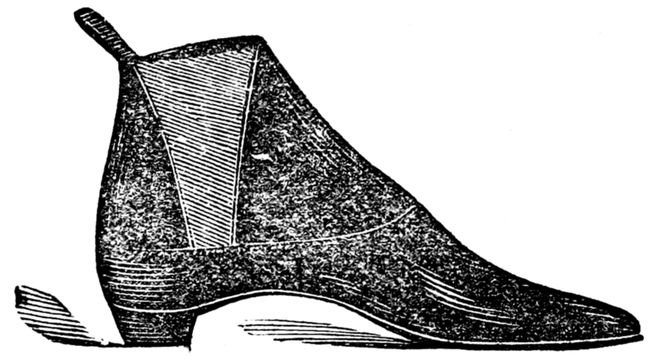
measure by the introduction of the Elastic Gaiter.
American skill and ingenuity has completely rivalled
the most elegant specimens of Parisian handicraft, and
the importation of French gaiters, which was once quite
extensive, has almost or quite ceased. Most of the so-called
French manufacture is the product of American
artizans. This “amiable deception” is practiced in
order to gratify the whims of those who lack confidence
in the skill and taste of American manufacturers. An
anecdote illustrative of this prejudice is general in its
application. The incident related, occurred in a Broadway
establishment, New York.
A lady, after examining the slippers of the tradesman,
said, “Mr. ——, why do you not import your slippers
from Paris?” “Madam,” was the reply, “I have
already sent out an order, and I expect every day the
arrival of an extensive assortment; if you will call in
in about a week, I think I can furnish you with just the
article you desire.” The lady left, promising to return,
and Mr. —— visited his printer and had a number of
“tickets,” bearing the name of an imaginary French
shoemaker, struck off, and by her next visit he was prepared
xxvwith a “very extensive assortment.” She was
fitted with a pair, and after extolling the style, elegance,
and comfort of her slippers, insulted the tradesman by
enquiring “why he did not make such shoes.”
The Americans are rapidly securing to themselves a
superiority over all other nations in this important manufacturing
interest, and in a few years boots and shoes
of American manufacture will be regarded as the ne
plus ultra of the art.
BOOK I. — CHAPTER I. IMPORTANCE OF THE BOOT AND SHOE TRADE. — CHAPTER II. RISE AND PROGRESS OF THE BOOT AND SHOE TRADE. — CHAPTER III. GUTTA-PERCHA—ITS PROPERTIES, MANUFACTURE, &c. — GUTTA-PERCHA IN THE FACTORY. — GUTTA-PERCHA BOATS. — GUTTA-PERCHA—MISCELLANEOUS APPLICATIONS. — GUTTA-PERCHA—ORNAMENTAL WORK. — GUTTA-PERCHA PIPES AND TUBES. — CEMENT EXPERIMENTS. — STEREOTYPING FROM GUTTA-PERCHA. — ACOUSTIC USES OF GUTTA-PERCHA. — CHAPTER IV. GUTTA-PERCHA—ITS FIRST APPLICATION AS A CEMENT IN THE UNITED STATES. — OBSERVATIONS CONCERNING GUTTA-PERCHA AND RUBBER IN THEIR USES IN THE MANUFACTURE OF BOOTS AND SHOES. — PROCESS FOR MANUFACTURING BOOTS OR SHOES BY SIMPLY CEMENTING THE EDGES OF THE IN SOLE AND OUTER SOLE. — CHAPTER V. GUTTA-PERCHA FOR BELTS, HARNESSES, &C. — GUTTA-PERCHA IN ITS APPLICATION TO WOOD WORK, &C.,—IMPORTANT TO SHIP AND BOAT BUILDERS. — TESTIMONIALS CONCERNING THE PRACTICAL VALUE OF GUTTA-PERCHA, AND ITS APPLICATION TO BOOTS AND SHOES, IN LONDON. — CHAPTER VI. INDIA-RUBBER, ITS DISCOVERY, USES, &C. — INDIA-RUBBER CLEANING PROCESSES. — MACKINTOSH CLOTH. — INDIA-RUBBER CUTTING PROCESSES. — INDIA-RUBBER LIQUID. — INDIA-RUBBER BRAIDS AND WEBS. — INDIA-RUBBER VULCANIZED. — INDIA-RUBBER OR (CAOUTCHOUC) AND GUTTA-PERCHA—COMPARISON OF THE CRUDE MATERIALS.
9
The great importance of the Boot and Shoe Trade
in the New England and Middle States, and the vast
amount of capital devoted to its development, the
energy, brains, and perseverance of its leading men,
place this branch of the mechanic arts high on the
list of the great industrial interests of the age. It
is, therefore, a matter of surprise, that some work
has not appeared which should contain important
scientific, statistical, and practical information concerning
the rise and progress of the Shoe and Leather
interests. Works upon Tanning have been published,
covering many of the collateral branches of that
science, and fugitive articles occasionally appear,
giving accounts of new discoveries, or new applications
of old methods, concerning the preparation of
leather, &c.; but in the manufacture of boots and
shoes, no work has ever appeared which would enable
the shoemaker to make any advancement in his calling,
other than that which his own observation or
genius might suggest. The Boston Board of Trade
10publish annual Reports in which appear able articles
upon the Shoe and Leather interests, but these, of
course, are mainly statistical and financial in their
character. There is published, also, in Boston, New
York, and Philadelphia, simultaneously, the Shoe
and Leather Reporter, by J. D. Field & Co., a valuable
journal, devoted exclusively to the trade in
boots and shoes, leather, hides and its collateral
branches, also market reports and correspondence
from various portions of the world. This paper is
the only organ, we believe, devoted exclusively to
the shoe and leather interests. Systems of measurement,
the cutting of patterns, preparation of stock,
all of which can be gained by study and application,
have been, as it were, sealed from the direct investigation
of the inquiring mind. In other branches of
the mechanic arts, volumes have been published,
and the ambitious student pursues his investigations
from primary principles to ultimate results in regular
gradations.
In the science of shoe manufacture, we must refer
for information principally to English works; and
even these are collateral, rather than direct, in their
application. Dodd’s British Manufactories, Brande’s
Encyclopedia, Dictionary of Arts and Sciences, Penny
Cyclopedia, Results of the Late Exhibition, (London,)—all
these are the repositories of much that
has been written upon the leather interests; sources
of information which none but the man of leisure,
or the enterprising compiler, would be likely to trace
out.
It may be said that the simplicity of this branch
11of the mechanic arts does not require that degree of
study and investigation which the more abstruse and
complicated sciences demand, and hence there is no
necessity for works upon the subject. This objection
is only true in part. It requires the nicest adaptation
of skill to make a perfectly fitting shoe or boot, and
no man, unless he who is fully conversant with the
rules and principles which enter into the preparation
of the stock, the correct measurement of the foot,
the “cutting out” of the several parts of the stock,
the lasting and fitting of the shoe or boot, can be
successful in his profession. The making of an easy,
elegantly fitting boot, requires a knowledge of the
anatomy of the foot, a familiar acquaintance with the
angles, lines and curves, which are involved in the
perfect adjustment of part to part, and their relative
positions. Most shoe manufacturers, and ordinary
village shoemakers, learn their trades from their
fathers, and the knowledge has been handed down
from generation to generation, without change or
improvement, and shoes are made to fit lasts, rather
than the feet which are to wear them. Hence intelligent
instinct has taken the place of intelligent knowledge,
and progressive investigation. The workman
knows nothing of the anatomy of the foot, the science
of pattern cutting, and therefore works on as though
all feet were cast in one mould, with the simple difference
which the “sizes” indicate. These “sizes,”
as is clearly shown in another portion of this work,
are regularly incorrect. Hence, in the absence of a
correct standard, the system of boot and shoe making
12is simply the following of established mechanical
rules, upon a false foundation.
We refer in these remarks to the manufacture of
what is known as “sale work.” There are many,
very many, “custom workers,” who proceed by correct
rules, and upon scientific principles; men who
understand how to adapt the shoe or boot to the foot,
so that when the customer first draws the boot or
shoe on, it fits naturally and easily, adapting itself
to any, and every deformity or slight irregularity
which the foot may present. We make general
statements, which every intelligent shoemaker, or
large manufacturer, will at once acknowledge. The
whole trouble arises from the want of some correct
standard by which to be guided in the preparation
of the stock for the workman. All this cannot be
gained but by study, patient investigation, and the
practical application of scientific rules.
The French are generally acknowledged to understand
the art of boot and shoe making better than
those of any other nation, and they have carried the
science to a degree of perfection not yet attained by
ourselves, except in a few comparatively isolated
cases. The whole secret of their success is their
patient perseverance, and artistic skill in understanding
the rules which are vitally essential to success.
In another chapter we have devoted considerable
space to the elucidation of the principles of
measurement, pattern cutting, and such instructions
as will enable the manufacturer—and in this term
we comprise all who are engaged in this important
13branch of our industrial interests—to become a
scientific proficient in his vocation.
This work, however, as its title indicates, is devoted
more specifically to the application of Gutta-Percha,
and the various Rubber compounds, in the
manufacture of boots and shoes. Yet we regard the
principles of their manufacture, as equally important,
and as vitally essential, to the perfect fitting of the
boot or shoe, whether sewed, pegged, or cemented.
14
The Boot and Shoe Trade of New England is
of comparatively modern date. The first vessel,
the sloop Delight, ever freighted at Boston with
a full cargo of boots and shoes, sailed for the port
of New York, in the month of May, 1818, consigned
to Spofford & Tileston, then the largest boot
and shoe jobbers in New York. This firm then commenced
supplying the shipping demand from that
port, instead of Boston. The manufacture, then,
was confined to the New England States, but it soon
commenced to take a wider scope. The trade increased
rapidly, but eleven years later, 1829, there
were only four jobbing houses in New York. In
Boston, the centre of the trade, the whole jobbing
trade for 1828 did not exceed but little over one
million of dollars. The trade has increased to an
almost wonderful extent. It now forms one-third
of the whole manufacturing power of the country;
New England and Pennsylvania retaining two-thirds.
In the city of Boston there are about two hundred
and eighteen wholesale and jobbing boot and shoe
15houses, doing business to the amount of fifty-two
millions of dollars annually. In New York there
are about fifty-five jobbing houses, whose aggregate
sales reach from fifteen to sixteen millions yearly.
The domestic and foreign boot and shoe trade of
the State of Massachusetts alone, amounts to between
fifty-five and sixty millions annually. The
shipments from Boston to San Francisco for 1856,
were $2,100,000.
The manufacture of boots and shoes is the largest
domestic trade in the States, and there is no country
or nation that can successfully compete with us,
either as regards prices or quality. Common styles
of goods, such as men’s pegged boots and brogans,
women’s pegged and common sewed shoes and gaiters,
are manufactured in the following villages of
New England, viz: Lynn, Haverhill, Worcester, Milford,
Natick, Randolph, Abington, the Readings, Danvers,
Georgetown, Stoughton, Woburn, and several
other towns in Massachusetts. The amount of capital
employed in the city of Worcester, in the boot
and shoe business, is one hundred and seventy-six
thousand dollars; the annual value of boots and
shoes manufactured, about one million of dollars.
The total value of boots manufactured in Milford,
Mass., in 1857, was upwards of two millions of
dollars. The amount would have greatly exceeded
that estimate had not the financial troubles of the
country prostrated this, in common with every other
manufacturing interest. According to present indications,
the manufactories of Milford, this year, 1858,
will nearly, or quite, reach the value of four millions
16of dollars. The city of Lynn, Mass., has employed
in this business, about five thousand workmen, and
its sales for the year 1857, exceeded four millions of
dollars.
Each New England village, town or city, where
this industry is carried on, is devoted to one kind of
boot or shoe, and whole communities are built up by
this special industry. Some idea of the importance
and extent of the boot, shoe and leather interest may
be inferred from the fact, that there are forty-one
thousand men in Massachusetts who work upon
leather, either in manufacturing the article or moulding
it into various forms. Every eighth man in the
State is a shoemaker.
The Shoe and Leather Trade of Boston takes its
date, as a prominent branch of commerce, about the
year 1830, caused principally by the change made in
conducting the business. It was formerly the custom
for Manufacturers and Dealers in Boots and
Shoes to seek a market for their goods, by consignment
on their own account, to New York, Philadelphia,
Baltimore, Charleston, Savannah, New Orleans,
Havana, and other West India Islands. It was
found to be remunerative for a while, but on the
increase and competition of trade, it became a losing
business. The leading houses failed. Since 1828
and 1829, an entire change in the method of conducting
the shoe business has taken place. Manufacturers
and Dealers now sell their goods on their
own account instead of consigning them to other
States. The consequence is that Boston is made
17not only the head-quarters for nearly all the manufactories
of New England; and although the city of
Lynn and the towns of Haverhill, Danvers, &c., sell
a large portion of their goods at home, a large number
of the manufactories have offices in Boston for
the sale of their goods. If the domestic trade of
Boston had been conducted on the home principle,
the expansion of the city would have greatly exceeded
its present limits.
The great industrial and trading interest is a correct
type of New England thrift and industry. No
branch of our mechanical pursuits is conducted with
so much safety, energy and intelligent perseverance,
as is the great Boot and Shoe interest. When convulsions
come which rend in pieces other commercial
or internal trading interests, the boot, shoe and leather
trade, is the last to succumb, and the first to reinstate
itself. The great financial crisis of 1857, thoroughly
tried the strength of this branch of trade, and
nobly did it sustain itself, even extending the helping
hand to such as required assistance. Especially applicable
is the latter remark to the merchants of
Boston. All this demonstrates the soundness of
their basis—the back-bone which enables the Shoe
and Leather interest to hold itself up under a pressure
which easily crushes all departments of trade
and commerce built up on a paper foundation.
The peculiar characteristics of the boot and shoe
trade, its democratic elements, its freedom from all
monopoly, gives it a strength and power which corporations
can never wield. Every man is his own
18director, and as all interested are subject to, and
dependent upon, their individual shrewdness and
enterprise, it is very seldom that success fails to
crown their efforts. The day is not far distant when
all our industrial interests will be conducted upon a
like basis, and corporations cease to exist.
19
The almost numberless uses to which this remarkable
gum has been, and is applied, has awakened
an interest in the public mind concerning its
discovery, and its uses, and especially the different
applications, and their methods.
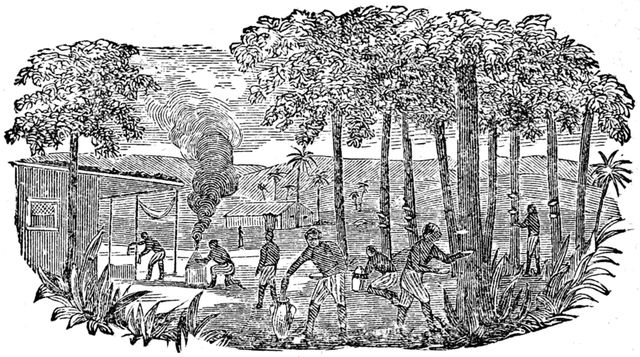
The discovery of Gutta-Percha is comparatively
recent. The first that was known of this wonderful
production by Europeans, was in the year 1845.
Dr. Montgomerie, an English gentleman, residing at
Singapore, observed in the hands of a Malay woodchopper,
a strange material used for a handle to his
axe. Curious to learn its nature, he questioned the
native, and ascertained that he procured it from a
tree in the form of sap; that upon exposure to the
air it became solid; also, that in immersing it in
hot water it became soft and plastic, and could be
moulded into any desired form. Dr. Montgomerie
at once obtained samples of the material, which he
forwarded to the London Society of Arts and Sciences,
with a description regarding it. After subjecting it
to various tests, the Society were unanimous in their
opinion concerning its great value. They awarded
to Dr. M. a gold medal for the valuable knowledge
20thus communicated to the manufactories of the
world.
It is observable, however, that this substance may
be said to have had two European discoverers, independent
of each other; for the tree, and the gum
which exudes from it, were discovered or observed
by Mr. Thomas Lobb. This gentleman visited the
islands of the Indian seas in 1842–3, on a botanical
mission, as agent to Messrs. Veitch, the scientific and
energetic florists of Exeter; and it was during his
rambles that he became acquainted with the gutta-percha
tree.
In proportion as the value of this substance has
become known, so has a desire extended to ascertain
the range of its growth in the East. It is now known
that the gutta-percha tree abounds in that extreme
south-eastern point of Asia, which obtains the name
of the Malay Peninsula; in the neighboring island
of Singapore; in the important Bornean island,
which Rajah Brooke has been the means of making
so familiarly known to us; and in various islands
which constitute the Eastern Archipelago. There
seems very little cause to apprehend any failure in
quantity; for even if the present supply from the
neighborhood of Singapore should be exhausted, the
capabilities of more distant islands are quite beyond
present calculation.
It appears that percha (of which the pronunciation
is pertsha, not perka or persha) is the Malayan name
for the tree which produces the gum; while gutta is
a general name for any gum which exudes from a
tree. The tree belongs, of course, to the group in
21which botanists place sapotaceous or gum-exuding
genera. The wood of the tree, being soft and
spongy, is applied to many useful purposes. The
fruit yields a thick oil, which is used by the natives
with their food; and either from this or some other
parts of the tree an ardent spirit is capable of being
distilled. But it is the sap which forms the most
valuable product of the tree. It circulates in small
vessels which run up between the bark and the wood.
Thrifty methods are teachable to rude islanders,
as to more civilised men, when the advantages have
been once made apparent. The natives around Singapore,
when they first found a market for the solidified
gum, proceeded ruthlessly to work; they killed
the bird which laid the golden eggs, by cutting down
the trees in order to obtain the gum. But they have
now been taught better; it is shown to them how,
by tapping or cutting notches in the branches at
certain intervals of time, the sap may be made to
flow, without endangering the life of the tree. Experiments
are now being made to determine whether
the gutta-percha tree can be planted so as to maintain
a continuous and inexhaustible store of gum or
sap; should these attempts succeed, the supply
would equal any imaginable demand.
The gutta-percha is sold at Singapore by weight,
according to the apparent quality of each lump;
but, when the consignment reaches England, it is
not unfrequently found that a large stone or a piece
of heavy wood is imbedded in the heart of it, to increase
the weight. It would entail a serious loss of
time to cut open each lump at the time of purchase;
22so that at present Oriental honesty is rather an important
element in the commercial value of this
article. There is, too, a great amount of difference
in the quantity of bark, leaves, and dirt, which become
accidentally mixed up with the gum.
The crude gum is imported to the extent of about
two millions of pounds annually.
The extensive and highly interesting establishment
of the Gutta-Percha Company, situated near the
City Road Basin of the Regent’s Canal, is worthy of
attention even beyond the general average of such
centres of industry, for the peculiar character of the
substance operated upon necessitates the employment
of new processes, new machines, and new tools. An
incessant course of invention has marked the manufacturing
history of this material during the brief
period of its existence. If the gutta-percha is to be
applied to some new useful purpose, tools and processes
of novel character have to be employed; if
an ornamental application is determined on, methods
are adopted for developing any natural beauty which
the grain of the substance may present; if an attempt
be made to supersede leather, or wood, or
papier-mache, or metal, by this singular gum, great
pains are bestowed on a study of the special qualities
to be imitated, and the process of imitation often requires
operations and tools differing considerably
from those before employed.
The first process consists in cutting the block into
slices. There is a vertical wheel, on the face of
23which are fixed three knives or blades; and while
this wheel is rotating with a speed of two hundred
turns a minute, a block of gutta-percha is supplied
to it, and speedily cut into thin slices—much on
the same principle as a turnip-cutter performs its
work. Woe to the steel edges if a stone be imbedded
in the block.
These slices show that the gutta-percha is by no
means uniform in different parts, either in color or
texture. To bring about a uniformity is the object
of the shredding or tearing process. The slices are
thrown into a tank of water, which is heated by
steam to such a temperature as to soften the mass;
dirt and heavy impurities fall to the bottom, leaving
a pasty mass of gum; and the mass being thrown
into another rotating machine, is there so torn and
rent, and dragged asunder by jagged teeth, as to be
reduced to fragments. The fragments fall into
water, upon the surface of which (owing to the
small specific gravity of the material) they float,
while any remaining dirt or impurity falls to the
bottom. These fragments are next converted into
a dough-like substance by another softening with hot
water, and the dough undergoes a thorough kneading;
it is placed in hollow heated iron cylinders,
in which revolving drums so completely turn and
squeeze and mix the now purified mass, that all
parts become alike, and every particle presents a
family likeness to its neighbor.
The kneaded state may be considered the dividing
line between the preparatory processes and those
which relate to the fashioning of the material. The
24soft ductile mass may be formed either into sheets
or tubes. In forming sheets the mass is passed between
steel rollers, placed at a distance apart corresponding
with the thickness of the sheet to be
made—whether for the heels of a rough-booted
pedestrian, or for the delicate “gutta-percha tissue,”
now so much employed by surgeons. By the time
that the substance has passed through the rollers it
has cooled sufficiently to assume a solid, firm consistency.
By the adjustment of a few knife edges,
the sheet may be cut into bands, or strips of any
width, before leaving the machine. In making tubes
and pipes, the soft mass of kneaded gutta-percha is
passed through heated iron cylinders, where a singular
modification of the wire-drawing process reduces
it to the desired form and dimensions.
From the sheets and tubes thus made, numberless
articles are produced by cutting and pressing. Machines,
somewhat like those used in cutting paper,
are employed to cut the gutta-percha into pieces.
If for shoe-soles, a cutting press produces a dozen or
so at one movement; if for string, or thread, narrow
parallel slips are cut, which are then rounded or
finished by hand; if for producing stamped decorative
articles, the sheets are cut into pieces, and each
piece is warmed and softened to enable it to take
the impress of a mould, or die. But the mode of
casing copper wire for electro-telegraphic purposes
is, perhaps, one of the most singular applications of
the material in the form of a sheet. Several wires
are laid parallel, a strip of gutta-percha is placed between
them, another strip is placed above them, and
25the whole are passed between two polished grooved
rollers; the pressure binds the two surfaces of the
gutta-percha firmly together and to the wires, while
the edges between the grooves indent the gutta-percha
so deeply, that it may easily be separated
longitudinally, each slip containing its own core of
copper.
When Lady Franklin fitted out an expedition in
search of her gallant husband, a year or two ago,
Captain Forsyth, the commander of the vessel, took
out with him a gutta-percha boat, presented for that
purpose by Messrs. Searle. His account of the behavior
of this boat, under the rough usage to which
it was subjected in the ice-bound regions of the north,
is most laudatory. He states that “whilst the other
boats constructed of wood suffered much by the cutting
of the young ice, the gutta-percha boat was not
in the least damaged, and returned to England in
almost as good condition as when she left, although
she underwent all the rough work of the voyage.”
Mr. Snow, who had especial charge of the gutta-percha
boat belonging to the ‘Prince Albert,’ has
detailed in a clear manner the remarkable way in
which this material resists the rude buffetings of those
regions. It must be remembered that the boat had
a skeleton of wood and a covering of India rubber.
Mr. Snow says, “The severest trial it endured, and
endured successfully, was on both my visits to Whaler
Point, Port Leopold. To those unaccustomed to
the nature of such ice as was there met with, it will
26be impossible fully to conceive the position a boat
was placed in. The mere transit to and fro, among
loose masses of ice, with the sea in a state of quiescence,
would have been quite enough to have proved
or not the value of gutta-percha boats; but when,
as in the present case, those masses were all in restless
agitation, with a sea rolling in upon an opposing
current, it might have been well excused—and without
deteriorating from the previously attested goodness
of the article—if it had not been able to
have resisted the severe shocks it received....
Sliding through and over the ice; sometimes lifted
completely out of the water by the sudden
contact of a resistless floe; and at others thrown
side-ways upon an adjoining craggy piece; I think
it would have been next to impossible for any other
kind of boat to have been otherwise than crushed or
stove on the instant.” It was in a right spirit that
the explorers gave the name of “Gutta-Percha Inlet”
to the spot where the boat had rendered them such
important service.
A rare catalogue we should present, if all the useful
applications of gutta-percha were duly set forth.
We should have to speak of breast-coating for waterwheels,
of galvanic batteries, of shuttle-beds for
looms, of packing for steam-engines and pumps,
of cricket and bouncing balls, of felt-edging for
paper making, of curtain rings whose merit is noiselessness,
of window-blind cord and sash lines, of
clothes’ lines (recommended to the laundress as defying
27all attacks of weather,) of bosses for flax-spinning
frames, of whips and sticks, of policemen’s and
‘special constables’’ staves, of flax-holders for heckling
machines, of skates, of fencing sticks, of washers
for the axles of wheels, of plugs or solid masses
used in buildings, of buffers for railway carriages,
of gunpowder canisters (which ‘keep the powder
dry,’) of sheet-covering for damp walls, of linings
for ladies’ bonnets, of jar covers, of sponge bags, of
foot baths, of funnels, of goldsmith’s bowls, of bobbins
for spinning machines, of covers for rollers, of
book covers, of moulds for electrotypes, of coffin
linings, of sounding boards, of portmanteaus, of
beds for paper-cutting machines, of fine and coarse
thread, of envelope boxes, of powder flasks, of portfolios,
of a stopping for hollow teeth—a tolerable
list, this, which shows how multiplied are the applications
for which this singular vegetable product is
available.
When softened by heat, this substance will take
the impress of a mould or stamp with delicate precision;
and in the course of a few minutes it reassumes
its tough state, retaining permanently the
pattern given to it. The power of application is
thus unlimited, or limited only by the inclination of
the purchaser. Whether the mould be of copper or
of brass, of pear tree or of box, an impress can equally
well be obtained from it. In practice, all these
four materials are employed, and sometimes others.
The mould being carved and in a state of readiness,
28the piece of gutta-percha (always, or nearly always,
in the form of sheet) is laid upon a marble slab,
which is heated by steam from beneath; and the gum
being thus brought into a pliant and yielding state,
it is placed on or in the mould, a counter mould is
laid upon it, and the action of a press forces the material
into the minutest parts of the device. If the
pattern be deep and the relief bold, a hydraulic pressure
of a hundred or a hundred and fifty tons is
brought to bear upon it; but if of lighter and
simpler character, a hand-press is brought into requisition.
In this way, aided by minor manipulation, are
produced the varied and ever-increasing specimens
of ornamental gutta-percha work. Trays are produced
of every imaginable (or at least of every
usable) form and pattern: bread trays, biscuit trays,
cotton or work-table trays, counter or card-table trays,
pen trays, pin trays, card trays, soap trays, shaving
trays, &c. Then there are work-baskets and hand
baskets, flower vases and bouquet holders, plates and
platters, decanter stands and watch stands, bas-reliefs
and alto-reliefs. The desk fittings admit of much
beauty in this material; inkstands are produced in
most diverse forms; while pen trays, paper weights,
wafer boxes, envelope boxes, &c., are beginning to
establish a formidable rivalry to the similar articles
made in papier-mache. Beauty, pattern, graining,
clouding, or whatever we may choose to term it, is
produced in a very remarkable way on the surface
of gutta-percha. Some specimens of gutta-percha
are darker than others, and all have a tendency to
29darken by age; and the workman dexterously avails
himself of these varying tints to produce a pattern.
He softens two or more pieces, of different tints,
passes them between two rollers to thoroughly unite
and amalgamate them, and then presses them into
the mould; leaving it to the freaks of chance to
bring out the wavy lines, the curls, the streaks, the
knots, which the intermixture of tints produces.
This diversity is not very apparent at first; but it
becomes developed when the substance is polished,
and considerably enhances the beauty of the article
produced.
Water-pipes have had a few vicissitudes in their
history. Those who remember the arrangements for
the water-supply of London, in past days, will have
been familiar, with the wooden pipes, formed of bored
trunks of trees, which were wont to be laid down
beneath the paving of the streets. These gave way
to iron. The smaller pipes have chiefly been made of
lead; but zinc in one quarter, brown ware in another,
glass in another, have invaded the domain of lead.
A new competitor now enters the field. Gutta-percha
claims to be not merely an efficient material for
water-pipes, but to possess certain sanitary qualities
very important in this sanitary age of ours. It is
very strong and tough (say the patentees); it possesses
much durability underground; it stoutly resists
frost; and it leaves the water as pure as it finds it.
Hence it is applied to pump barrels, to ships’ pumps,
to locomotive feed-pipes, to syphons and mine-pipes,
30and to fire-engine pipes. But if the testimony of
medical men is to be deemed authoritative, the substitution
of gutta-percha for lead as a material for
water-pipes is a matter of yet higher import. Dr.
Thomas Smith, of Cheltenham, states that “Many
serious and alarming disorders, such as mania, epilepsy,
sudden death, nervous affection, paralysis, consumption,
hydrocephalus, heart disease, &c., owe their
origin in some instances, their intractable character
in others, to the gradual and continuous infinitesimal
doses of lead, copper, &c., introduced into the system
through the channel of our daily drink.” It appears
that the carbonic acid contained in water has a tendency
to combine with the lead of the pipe which contains
it, and to generate a compound possessing poisonous
qualities. That gutta-percha resists such action,
all authorities agree; and although at first the gum
imparts a slight taste to the water, this effect seems
speedily to disappear.
There are many other circumstances which render
tubes of this material very advantageous for the conveyance
of water. It bears an amount of friction and
hard usage which is frequently surprising. At New
York there is a gutta-percha pipe a thousand feet in
length, which conveys the water of the great Croton
Aqueduct to Blackwell’s Island; the pipe lies along
the bed of the intervening river, and is kept down by
upwards of a hundred small anchors, and yet it resists
both the friction of the bed and the weight of the
anchors. With an immense pressure of water, gutta-percha
pipes have been found to remain unharmed,
where leather hose would be disrupted. It resists
31the action of marine insects, which would soon make
ravages on stout timber. If water be contained in
a gutta-percha pipe, it remains liquid at a temperature
which would produce ice in almost any other
pipes. For watering gardens and roads, for sprinkling
malt in a kiln, for applying water from a fire
engine, these pipes appear to be singularly well fitted,
since, with a great power of resisting pressure, they
may be bent, or twisted, or lengthened, or shortened,
in any required degree. Nor is this material, per se,
the only efficient part of such pipes; for a gutta-percha
pipe may be firmly united to a metal pipe in five
minutes, with no other cement than warm water; the
end of the pipe being softened in warm water, and
drawn over the end of the metal, the gum contracts
on cooling so as to grasp the metal tightly, and thus
form an impenetrable joint.
But if water be conveyed thus effectively through
tubes of gutta-percha, the qualities of the material are
still more remarkably displayed in the conveyance of
chemical liquids. Few persons are so ignorant of
chemistry as not to be aware that the stronger acids
and alkalies play sad havoc with the vessels and tubes
which contain them. On the other hand, there is an
obstinacy of constitution about this singular substance
which enables you to battle a whole host of formidable
opponents. It does yield, certainly, to concentrated
sulphuric and nitric acids; but if these acids
in a weaker state be the liquids in question, or if
muriatic, acetic, or hydrofluoric acids, or chlorine
(all of which have a very destructive action), then
the gutta-percha stoutly resists them, and renders
32good service. Carboys, pipes, dye-vats, flasks, funnels,
bowls, ladles, syphons, troughs, measures, buckets—all
are now made of this material, for use in
chemical works, print works, dye and bleach works,
and other establishments where strong chemical liquids
are employed.
The chemistry of cement is a curious one; for the
stony particles adhere with a force which is in some
instances almost equal to the power of stone itself.
The so-called Roman cement has long been famous
for its cohesive property; but the Portland cement
recently introduced far excels it. In an experiment
lately conducted, two solid blocks were prepared, one
of Roman and the other of Portland cement; and
they were placed in such positions that weights might
be suspended from them. The Roman cement yielded
to a disruptive force of eleven hundred pounds, but
the Portland cement stoutly maintained its integrity
till rent asunder by a weight of nineteen hundred.
But this cement has still more strikingly shown its
strength when used as a mortar in brickwork. On a
recent occasion in Hyde Park, a brick beam was built
up with Portland cement as a mortar. The bricks
were hollow, and were so ranged as to form a beam
about four feet in height by two in width. This beam
was rested at the two ends on supports more than
twenty feet asunder, and weights were suspended
from the centre; and not till the astonishing weight
of nearly seventy thousand pounds was thus applied
did the beam yield and break. It was not the actual
33binding power of the cement alone that resisted this
enormous force, for thin slips of iron were introduced
at different parts; but the experiment was intended
to show how much strength might be obtained by
hollow bricks and Portland cement, aided by a little
iron.
Mr. Muir, of Glasgow, has invented a mode of stereotyping,
managed in the following way. A page of
common type is first set up, and well fixed: a warm
cake of gutta-percha is applied to it, screwed down
tightly, and allowed so to remain a quarter of an
hour; when this gutta-percha mould is removed, it is
brushed over with fine black-lead, and an electro-copper
cast taken from it; the printing is then effected
from this cast. It is found that gutta-percha constitutes
a very convenient and efficient substance for the
mould, owing to the readiness with which it can be
softened, and its toughness when cold; while the
electro-copper cast is said to bear the action of the
printing press throughout a much greater number of
copies than an ordinary stereotype plate.
The same inventor also practices a plan in which
the gutta-percha performs not only its own work but
that of the electro-copper also. A mould is taken
from an engraved wood-block, in gutta-percha; and
this mould, when brushed over with black-lead, is
made to yield a cast also in gutta-percha, in an exactly
similar way; and from this cast the impressions are
printed. It seems difficult to conceive that, after this
double process, all the delicate lines of a wood engraving
34should be preserved on the surface of such a material
as gutta-percha; and yet, without this preservation,
the method would be practically valueless.
The conveyance of sound is, perhaps, the most
extraordinary service which gutta-percha tubes have
yet rendered.
There are two qualities required in a speaking tube;
first, that it shall concentrate a large amount of sound
into a small space; and secondly, that it shall not
stifle the acoustic vibrations within the tube itself.
Any material will answer equally well, so far as the
first-named quality is concerned, for it requires simply
a trumpet-shaped mouth at one end, and a very small
orifice at the other; but gutta-percha possesses rare
qualities in respect to the second kind of service.
Whether it is the smoothness of the texture, or the
peculiar kind and degree of elasticity, or the relation
of the substance to heat or electricity—whatever
may be the cause, a tube of gutta-percha preserves
sonorous vibrations with a surprising degree of clearness
and equability; and the modes in which this
quality are brought into useful requisition are also
very numerous.
There is, for example, the long ear-trumpet, with
a wide orifice at one end and a small one at the other;
and there is the portable ear-trumpet, differing from
the former only in bringing the speaker and the hearer
closer together, by a ‘French-horn’ system of twisting
in the tube. There is the ear-cornet, so small
and neat that one may be almost invisibly attached to
35or near each ear. There is the paraboloid trumpet,
in which the sound is echoed from a large concave
receiver before it enters the tube. There is the
trumpet with a long flexible tube, or with several
tubes, so that several persons round a table can communicate
in turn with the user. In short, there have
been almost as many useful variations of the principle
as there are variations in the social inconveniences of
those who require such aid.
A different group altogether is formed by those
contrivances which are intended to aid—not partially
deaf persons—but those whom noise or distance
would otherwise disenable from conversing
together. Drivers of omnibusses now sometimes communicate
with the conductors, and captains of steamboats
with the engine-men, by gutta-percha tubes.
But these are trifling services compared with such as
the tubes render at greater distances. The Domestic
Telegraph, as it has been called, is simply a gutta-percha
tube conducted from one apartment to another:
it is employed as a medium of transmitting messages,
and saves many a weary footstep to those who are at
the beck and call of others. The Medical Man’s
Midnight Friend (a lack-a-daisical sort of a title) is
a gutta-percha tube extending from the ‘doctor’s’
street-door to the doctor’s bed, by which a message
can be transmitted to the awakened practitioner,
instead of merely the sound of his bell. In factories
and large establishments such speaking tubes are
advancing extensively in favor; for the communication
between distant buildings is most complete. In
printing offices, spinning and weaving mills, in union
36poor-houses, in hospitals and infirmaries, and in
various other establishments of magnitude, the advantages
are so self-evident that the use is becoming very
general.
The church acoustic apparatus is in many respects
the most interesting and remarkable of these highly
curious applications. Let us conceive, for clearness
of illustration, that in a remote pew of a church is a
person who, though not deaf, yet fails in ability to
hear what is said in the pulpit or reading-desk. A
gutta-percha tube is laid down either on or beneath
the floor from the pulpit to the pew—the material
bends so easily that it may be carried in any form—and
a small ivory or hard wood ear-piece is attached
to one end, while the other end expands in trumpet-form.
Now the remarkable circumstance is, that the
required effect is brought about without necessitating
the approach of the speaker’s mouth to the tube; his
head may be two or three feet above, or below, or
behind, or at the side of the trumpet-mouth; and yet
the sound will reach the remote end of the tube in
audible quantity. The truth is, that if the tube
receives a mouth-full of sound (which it can in any
direction round and near the speaker), that quantity
is so economised, and so faithfully conveyed to the
other end, that it becomes condensed to an audible
pitch; if the trumpet-mouth be large, and the ear-piece
very small, we may liken the action to the
condensation of many threads of sound into one; and
the ear of the auditor becomes sensible to this condensed
power. In practice, the trumpet-mouth is
usually fixed to the front of the pulpit, mouth uppermost,
37and is stamped or moulded in an ornamental
form consistent with the decorations of the pulpit.
Beyond all this, the sound may be laid on, like gas,
to any pew or any quarter of the church; for there
may be a tube (which we will call the main-pipe) laid
along the centre aisle, and lateral tubes may spring
from this to any required spot. Some clergymen
have what they call a deaf pew; that is, a pew in
which those are congregated who may be collectively
benefitted by this admirable apparatus. This contrivance
has been used at some of the great meetings
(four thousand strong) at Exeter Hall, by those to
whom the speeches would otherwise have been little
else than dumb show.
Gutta-percha has been discovered in the British
province of Mergui, and though not precisely identical
with the gutta-percha of commerce, it possesses
all the valuable properties of that substance, including
plasticity in hot water, and the power of insulating
electric currents.
The tree from which the true gutta taban is produced
(erroneously misnamed gutta-percha, a gum
yielded by a different tree,) is one of the most common
in the jungles of Johore and the Malay Peninsula.
It is not found in the alluvial districts,
but in undulating or hilly ground. There is a great
uniformity in the size of the full grown tabans, which
rise with perfectly straight trunks from sixty to
eighty feet in height, and from two to three feet
in diameter, the branches being few and small. The
natives, after felling the tree, make an incision round
it, from which the milk flows. This is repeated at
38distances of six to eighteen inches along the whole
trunk. It appears that the taban, or milky juice,
will not flow freely like India rubber, but rapidly
concretes. Its appearance in this state, before being
boiled, is very different from that of the article as
imported and shipped. It has a dry, ragged look,
resembling shreds of bark, and instead of being
dense and tough, is light, and possesses so little cohesion
that it is easily torn to pieces.
Various statements are made as to the produce of
each tree, which is somewhat surprising, considering
the uniform size of the trees. It takes twenty
trees to produce one picul of 133 lbs., and as the
exports of gutta-percha, from the commencement
of the trade up to the close of 1853, amounted to
3,107 tons, it follows that upwards of one million
trees must have been destroyed to obtain that quantity
in nine years. The natives, however, do not
appear to be under any apprehension that the trees
will be extirpated, and smile at the probability when
suggested; for it is only trees arrived at their full
growth, or at least at a very considerable age, that
repay the labor of felling them and extracting the
gutta; and those of all inferior ages which are therefore
left untouched, will, it is supposed, keep up the
race.
The collection of the gutta has widely extended,
embracing now the Johore Archipelago, Sumatra,
Borneo and Java. Unfortunately, the quality has
deteriorated by the admixture of other inferior gums,
the products of different trees, which are often used
to adulterate the taban.
39
Gutta-percha, as a cement, was first introduced to
our notice in 1849. A medical gentleman having
received a severe cut upon one of his fingers, dissolved
a portion of the gutta-percha in chloroform,
then with a fine brush, first immersed in the solution,
passed several times around the finger in order to
produce the required thickness; then, immersing his
finger in water for a short time, thus formed a neat
and durable covering, air and water proof. Thus
protected, it healed quickly without soreness or farther
trouble. With this cement and crude gutta-percha,
we first applied it to Boots and Shoes, and
found it held very firmly the fibres of cloth and
leather together. A sample in sheet form, we applied
with a warm iron. It held with great tenacity,
and with an additional quantity, we applied it with
entire success, in the repairing of about five hundred
pairs of shoes. These shoes had cloth uppers, without
“foxing” around the heels, and were badly cut
in taking out the “raw” in finishing the knife work
around the heel. We have continued the use of
40gutta-percha as a cement for shoes, also as a water-proofing
substance between the inner sole and the
outer sole, and our experiments were fully successful.
This process also prevented the boots and shoes from
“squeaking,” that horror of nervous temperaments,
at the same time adding greatly to the durability of
the leather.
Among the many advantages we have observed
in our experiments in the use of gutta-percha in the
manufacture of boots and shoes, are its exceeding
fine grain, its perfect water and oil repellent properties,
which render it far superior to all rubber cements
and combinations ever offered to the public.
Gutta-percha is proof against water, acids, and oily
substances, dampness and decomposition. It is very
tenacious, clean, and sweet, and will stand all weathers,
and will not become sticky. The boots or shoes
made with it, may be worn in damp or dry localities,
through water, oily or acid combinations, without
injury to the cement. These statements are corroborated
by actual tests of the severest nature.
No one will doubt who will investigate the subject
of the application of gutta-percha to boots and shoes.
It is worthy the study of all engaged in the manufacture
of these articles, and will amply repay the
closest study and investigation. Nor can it be
doubted that it is destined, in a very brief period,
to supersede all other improvements in the manufacture
of boots and shoes.
41In 1855, the “The North American Patent Boot
and Shoe Co.” tested gutta-percha as a cement after
they had abandoned a rubber filament or cement as
useless. They continued to manufacture boots and
shoes by the use of gutta-percha, and found, after a
long and satisfactory trial, through all seasons of the
year, that it remained firm and uninjured, not being
in the least affected by the oleaginous substances or
fluids used in preparing the various kinds of upper
leather or sole leather. The oily matter here referred
to, destroys all the rubber cements, and the Company
found that gutta-percha continued as firm and tenacious
after their tests, as when first applied to the
shoe, and was not affected by other chemical combinations
used in the construction of the shoe. That
Company spared no pains or expense in perfecting
part of the manufacture of the shoes, whereby they
were enabled to produce a quality of goods never
before equalled in lightness, style, or practical utility,
exceeding, as they did, the most sanguine expectations
of all interested. They fully demonstrated
that shoes thus manufactured were far superior to
the sewing or pegging process, or rubber cements;
thus proving conclusively that the process is destined
to produce an entire revolution in the manufacture
of every description of fine shoes and boots.
Gutta-percha cement applied to sole leather renders
it water-proof just in proportion as it is mixed
with its fibres, and the quantity applied; at the same
time improving the leather more than one hundred
per cent. as it adds to its solidity and durability.
The mixing, mingling, or saturating the fibres of the
42leather, or other fibrous substances, as cloth, with the
cement, gives it its firm and tenacious hold on the
various substances to which it is applied in the manufacture
of boots and shoes, and all other combinations
that require a tenacious cement.
Objections are sometimes urged against the gutta-percha
sole as being liable to sweat the feet. This
objection we regard as purely mythical, as no such
result will follow unless the feet are encased in rubber
or gutta-percha. The top of the foot being
covered with leather, thus allowing the perspiration
to escape, the gutta-percha sole acts only as a protection,
thus avoiding the unpleasant effects realized
in wearing India-rubber shoes. Shoes or boots may
be made, if desired, by cementing the edges of the
inner sole and outer sole only. This process obviates
the objection just alluded to. We have manufactured
shoes in this manner, which have worn at least
one-third longer than when pegged or sewed, the
materials being the same. For perfectly dry walking
they are a very desirable article. Only about one-fourth
the quantity of cement is required when manufactured
in this manner.
43
Belts of leather may be put together by this cement,
which adds greatly to their wear and durability,
not being in the least affected by dampness, neither
by the oils which may come in contact with them
from the machinery. In cutting up belt for harness
leather, there is usually great waste and loss of stock,
as portions of the sides are very thin, and unfit for
use. But by this process every particle may be
saved. Cut the stock the proper width, stretch it,
then raise a strong thick fibre on all the thin parts
and the laps. Apply the cement hot with a brush to
all the thin portions and laps. Let it dry until the
solvent has evaporated; then heat the parts sufficiently,
and press together with a vice or clamps.
On all the thin places apply a piece of the cemented
leather until the belt is of an even thickness; press
firmly together, then shave off the projections with a
knife or cutting machine. Trim the edges: you
will thus produce a firm, smooth belt, without a
stitch, rivet, or lacing. All portions of a harness or
saddle may be cemented in the same manner. This
process is exceedingly simple, at the same time economical—a
44saving of time and money, and adds
greatly to their durability.
It may be applied to vats, drains, cisterns, sinks,
etc., to great advantage. All square joints should
be first prepared by raising a fibre, as in veneering
work. Apply the cement hot, as glue is spread. In
a few hours the solvent will evaporate; then heat the
parts sufficiently to melt the cement; press together
firmly. The gutta-percha will be found to be an
excellent cement for all leaky places in stone, brick
or wood work. Mix it with sand, or any fibrous
substance, apply hot, or melt it in with a hot iron.
The pure gutta-percha will cement broken stone,
marble or brick, so firmly that it will remain for
years. It is undoubtedly the best cement ever yet
discovered. Ornamental work, centre-pieces, etc.,
may be thus cemented to their position.
It is a well known fact, that sub-marine wires,
enclosed in the gutta-percha tube, are indestructible,
as all sea insects, worms, &c., never molest it. In
caulking all ships, boats, &c., oakum, or any fibrous
substance, may be saturated with pure gutta-percha,
and then pressed hot into the joints with a hot iron.
This process renders the joints proof against all
agencies. The joint thus cemented is made more
firm and solid than the plank itself.
45
Gutta-Percha Company of London, Oct. 1st, 1849.
The application of gutta-percha soles for boots
and shoes have been extensively and satisfactorily
tested, its merits having been acknowledged by all
who have worn them. Indeed, experience has
proved that gutta-percha soles wear twice as long
as leather, with great additional personal comfort,
and remain perfectly impervious to wet until worn
through.
Southampton Row, Sept. 1st, 1847.
Gentlemen: I write to thank you because I can
speak confidently of the advantages of gutta-percha
over leather soles. I made the first pair last October,
and wore them eight months before I wore the
soles through. I had them heeled six times, and
one pair of extra fronts I put to the same soles. I
only kept one pair in use to see how long they
would last. I will never wear another leather sole
so long as I can obtain gutta-percha soles, and I
walk from twelve to twenty miles a day.
C. Wright,
Boot and Shoe Maker.
To the Gutta-Percha Co.
Gutta-Percha Company’s Works.
Patent Gutta-Percha Soles.—The applicability of
gutta-percha soles for boots and shoes having been
extensively and satisfactorily tested, we can unhesitatingly
46recommend the material prepared for the
purpose, its merits having been acknowledged by
all who have tried it. Indeed, experience has proved
that gutta-percha soles wear twice as long as leather,
with great additional personal comfort, and they remain
perfectly impervious to wet, until quite worn
through.
London, Nov. 4th, 1847.
Gentlemen:—I have given the gutta-percha boot
soles what may be considered a fair trial, namely:
three month’s constant wear on a rough, gravelly
road, and can bear testimony to its usefulness. With
proper care in putting them on, and a little attention
afterwards, I am persuaded that it will last longer
than leather, and being impervious to wet, will be
found invaluable to persons subject to damp or cold
feet.
W. Diar,
Principal Officer of H. M. Customs, Whitstable.
Manchester, England, March 8, 1848.
To Mr. Henry Statham:
Dear Sir:—It is with pleasure that I bear testimony
to the good qualities of gutta-percha soles.
You are aware that my occupation requires me to be
on foot a great deal, upon all kinds of roads, and in
all weathers, and since I began to wear gutta-percha
soles, I have not had to complain of wet or cold feet.
The pair I have on now have been in almost daily use
for more than four months, and my fear is, that the
upper leather will be worn out first. I am quite sure
that I save from thirty to fifty per cent., in the cost of
shoes, in consequence of my family wearing gutta-percha
47soles, and, so long as I can get them, I intend
to wear them in preference to anything else I have
seen.
Yours respectfully,
Thomas Whitehead,
Gas Office, Town Hall, King Street.
London, April 1, 1848.
Gutta-percha Boot and Shoe Soles for Summer
Wear.—The fact of the total imperviousness of these
soles to water, enables the most delicate, by the use
of them to escape the suffering which the proverbial
uncertainty of our climate, even in summer, so
often inflicts upon the incautious. All injurious
effects may be entirely prevented by a sole so thin and
light, as to afford to the wearer a degree of ease and
comfort, unattainable in conjunction with security
against damp. At the same time the remarkable nonconducting
properties of gutta-percha, afford a most
valuable protection to those who are subject to suffering
or inconvenience by walking upon heated
pavements. No instance of failure has ever come to
the knowledge of the company, which may not be
ascribed to the neglect of the wearer.
The following article from the London Weekly
Despatch will be read with interest. The writer has,
evidently, not only a knowledge of the subject upon
which he writes, but an appreciation of the value of
gutta-percha, and its invaluable importance in the
mechanical arts.
“We have lately visited the extensive works belonging
to the Gutta-Percha Company, in Wharf-road
City-road, and confess that we were delighted and
48astonished. The premises in which the business of
the company is carried on cover a large area of
ground. Several floors of the building are devoted
to the operations of the workmen, amounting to nearly
one hundred and seventy individuals, including a
sprinkling of stout, hearty-looking boys. The basement
is occupied by two steam-engines, without whose
presence the works would by no means be complete.
These groan from “early morn to dewy eve,” in turning
lathes in the engineering department, in kneading
the gutta-percha, cutting out soles and heels for
boots and shoes, rolling out driving bands of every
dimension, and heating the steam-chests by which the
gutta-percha is rendered pliable and fit for the hands
of the workmen. On the principal floor there are
several hydraulic presses, used in the process of manufacture;
and we had the good fortune to witness
the production of a complete dessert service of the
most chaste and elegant pattern, and in imitation of
gnarled oak. The subjects of adornment were brought
out in high relief, and after undergoing the process
of varnishing, were surprisingly beautiful, light, and
incapable of being fractured or broken by a fall or
blow.”
Some of these sets were of the vine-leaf pattern, in
close imitation to nature. These things were pressed
out with some rapidity, but not without great manual
labor, notwithstanding the aid of the powerful presses
alluded to. Inkstands of the most beautiful character
were also fashioned in a short time; indeed, all
sorts of ornaments, elaborated with the most ingenious
devices, were made during our stay. We observed a
49vast deal of ornamental work, intended to supersede
the labor of the carver. There were frames of large
dimensions ready for the reception of pictures. We
were particularly struck with the appearance of one
intended for a large pier-glass. The foliage was of
the most sumptuous workmanship, and possessed a
sharpness and finish which the hand of man could
scarcely accomplish. A design for a bible cover was
exhibited. The subject harmonized with the nature
of the book it was intended to enclose, and was in
bold relief. It is believed that gutta-percha will, in
a short time, be in general use among book-binders,
not only in the shape of massive covers, but to supersede
the present cotton binding which has so pretty
an appearance, but is not of that lasting character as
to induce persons to adopt it in cases where strength
and durability are required. In other portions of the
factory, workmen were employed in making instruments
used by surgeons, to be employed in cases of
a delicate nature; others were finishing off the numerous
objects just turned out of the moulds. Amongst
the other articles of curiosity, we observed several
yards of gutta-percha rendered exceedingly thin by
machinery, and intended for ladies’ dresses. It was
of a light pink color, by no means displeasing to the
eye, and possessed of great strength. By the aid of
delicate machinery, the gutta-percha was run out into
thread, to be used in the manufacture of ladies’ work
bags, fishing nets, and for a hundred other purposes.
Large tubing, and some with an inconceivably small
bore, was run out to lengths of various dimensions.
Wagon and cart harness, of enormous strength, combined
50with lightness, we observed hanging up in the
establishment, besides gentlemen’s riding-whips, and
things of every kind. Greatly as we were delighted
with all these things, we had yet another treat to
come, which infinitely surpassed anything we had
seen. We were shown several specimens of enormous
panelling, on which the carving of the original design
was brought up with remarkable fidelity. Considering
that gutta-percha is an indestructible material,
we have little hesitation in stating, that the mansions
of the nobility will soon be decorated with ornamental
work produced by this new system of multiplying
objects, produced by the ancients to their glory and
eternal honor.
51
This important gum is known by a variety of names.
Caoutchouc, gum-elastic, and India-rubber. It is a
product of the syringe tree of South America. This
substance was first brought to Europe in 1735, by
some French astronomers, who were sent to Brazil to
make astronomical observations. It is found abundantly
in Peru, Brazil, and Quito, and has recently
been discovered in Asia. Considerable quantities of
it are now obtained in Java, Penang, Singapore and
Assam. In some places hundreds of miles are covered
with trees. They are very lofty, rising to the
height of fifty or sixty feet, without branches, but
covered with a rich tufted foliage. The bark is
exceedingly smooth, its leaves deep green, thick and
glossy, and six or seven inches in length. The fruit
consists of white almonds and is regarded by the
natives as very delicious. The process of obtaining
the liquid is very simple. A longitudinal gash is cut
in the bark of the tree with a hatchet, a wedge is
then inserted to keep the aperture open; the gum
52then oozes out in the form of a milky juice. A small
clay cup is attached to the tree into which the sap
flows. In the space of four or five hours the milk
ceases to run, and the quantity received is about five
table spoonsful. The cups are now emptied and the
process of smoking is commenced; this with the
forming process must be done as soon as the milk
coagulates. A fire is built upon the ground made of
the nuts of the wassou palm tree; over this fire an
inverted earthen pot, with a hole in the bottom is
placed, from whence issues a jet of pungent smoke.
The smoke changes the color of the gum very slightly
at first, but by exposure to the atmosphere it becomes
first brown, then quite black, presenting the appearance
which we see it has in articles of commerce.
The sap of the tree is laid on a mould in successive
layers, which are allowed to dry, and are formed
into bottles and cakes, in which form it is exported.
The natives of South America are very ingenious
in the uses to which they apply it. Boots, shoes,
53syringes, and tubes, are among the many articles
of domestic use into which it is converted. The
tubes they use as torches, which burn very clearly,
and emit but little odor. According to the celebrated
chemist, Faraday, its composition is carbon,
87.2, hydrogen, 12.8—a hydro-carbon. It melts
when exposed to a heat of 248°, and is resolved into
vapor at 600°, and can be condensed into a liquid
called caoutchoucin. In 1770, a cubic inch of India-rubber
was sold in London for seventy-five cents, to
erase pencil marks. It was not used to make water-proof
fabrics until about the year 1800. These were
first invented by Charles Mackintosh, of Glasgow,
who applied a naptha solution to the surface of two
pieces of cloth, then laid them together, passed them
between rollers and thus cemented them together.
NATIVES GATHERING GUTTA-PERCHA.
A “Mackintosh” was the name applied for many
years to a water-proof coat. Dr. Ure, although well
aware of Mr. Mackintosh’s invention, coldly passes it
over in his dictionary. It is supposed that personal
feeling was the cause of this, as Dr. Thomson and
Ure were once rival chemists in Glasgow, and Mackintosh
was the friend and pupil of the former. The
fabrics of Mackintosh had a most disagreeable smell,
still he was the first person who established India-rubber
manufactures in Britain, and perhaps the
world. He afterwards removed his factory to Manchester,
England. Various kinds of goods made of
India-rubber soon afterwards began to be manufactured
in England, but they were all decidedly objectionable
to use, until the grand discovery of sulphurization
was made; for this the world is indebted to an
54American inventor, Nathaniel Hayward of Woburn,
Mass.
This substance, or rather, compounds of it, is now
manufactured into so many articles of beauty and
usefulness, that it forms an object of no small wonder
to witness the rapidity with which such manufactures
have sprung into existence.
The following description of the India-Rubber tree
and its fruit is given by Chevalier D. Claussen,
inventor of the flax cotton. He says that in the
course of his travels in South America, he had occasion
to notice the different trees which produce the
India-rubber, and of which the Hancornia speciosa is
one. It grows on the high plateaux of South America,
between the tenth and twentieth degrees of latitude
south, at a height of from three to five thousand
feet above the level of the sea. It is of the family of
the Sapotacæ, the same to which belongs the tree
which produces gutta-percha. It bears a fruit, in form,
not unlike a bergamot pear, and full of a milky juice,
which is liquid India-rubber. To be eatable, the fruit
must be kept two or three weeks after being gathered,
in which time all the India-rubber disappears, or is
converted into sugar, and is then in taste one of the
most delicious fruits known, and regarded by the
Brazilians (who call it Mangava) as superior to all
other fruits of their country. The change of India-rubber
into sugar, led him to suppose that gutta-percha,
India-rubber, and similar compounds contained
starch. He therefore tried to mix it with resinous or
oily substances, in combination with tannin, and succeeded
55in making compounds which can be mixed in
all proportions with gutta-percha or India-rubber without
altering their characters. By the foregoing it
will be understood that a great number of compounds
of the gutta-percha and India-rubber class may be
formed by mixing starch, gluten, or flour with tannin
and resinous or oily substances. By mixing some of
these compounds with gutta-percha or India-rubber,
he can so increase its hardness that it will be like
horn, and may be used as shields to protect the soldiers
from the effect of the Minie balls, and some of
these compounds in combination with iron, may be
useful in floating batteries and many other purposes,
such as covering the electric telegraph wires, imitation
of wood, ship-building, &c.
A description of the various uses to which India-rubber
is applied, will be found exceedingly interesting
and instructive. The English have thus far
succeeded more perfectly, or rather more generally in
their application of it, than we, although since 1856,
rapid strides have been made in perfecting the manufacture
of the various fabrics in which it is used in
our country, especially New England. It must not
be forgotten that to an American is due the discovery
of the process of sulphurization, which discovery
immediately gave a new value, and a new impulse to
the application of this wonderful product of the forests
of South America.
The following account of the various uses to which
India-rubber is applied, is taken principally from
English sources, and refers to the manufactures of
that country.
56
The India-rubber, or caoutchouc, now imported to
the enormous extent of six or seven hundred thousand
pounds annually, reaches this country in masses of
varied shape, but mostly of a dark color. In its
imported state it is used for very few purposes; considerable
modifications being necessary for its adaptation
to practical service. It requires to be transformed
into cakes, or sheets, or tissues, or tubes, or
solutions, preparatory to its ultimate use; and this
transformation requires operations of a somewhat
peculiar kind, owing to the necessity of rendering the
whole mass homogeneous in substance.
The bottles, and masses, and fragments, as imported,
have much inequality in texture, and are, moreover,
contaminated with much dirt and refuse. To separate
these, the India-rubber is first cut into very small
fragments, and then steeped in warm water, by which
the dirt is precipitated. The fragments are dried,
and are then thrown into a kind of kneading machine,
where immense pressure is employed to bring them
to one homogeneous mass. The India-rubber, though
put in cold, becomes so hot by the agitation that it
could not be safely touched by the hand; it is necessary
to supply the machine with cold water, which is
made nearly to boil by the caloric driven out of the
elastic mass. So thoroughly is the mass pressed,
rolled, pricked, cut, and kneaded, by the severe turmoil
which it undergoes, that all dirt, air, water and
steam are expelled, and it presents the appearance of
a dark colored, uniform, smooth mass. It is put into
cast iron moulds of great strength, and brought, by
57hydraulic or screw pressure, to the form of blocks,
slabs, or cylinders, according to the purpose to which
it is to be applied.
The manufacture of the Mackintosh cloth is a singular
one. The material is merely two layers of cotton
cemented with liquid India-rubber; but the
junction is so well effected, that the three become to
all intents and purposes one. The stout and well-woven
cloth is coiled upon a horizontal beam, like the
yarn beam of a loom; and from this it is stretched
out in a tight state and a nearly horizontal position.
A layer of liquid or rather paste-like solution is applied
with a spatula, to a considerable thickness, and the
cloth is drawn under a knife edge, which scrapes the
solution and diffuses it equally over every part of the
cloth, which may be thirty or forty yards long. The
cloth is then extended out on a horizontal framework
to dry; and, when dried, a second coating is
applied in a similar way; and a third and fourth may
be similarly applied if necessary. Two pieces, thus
coated, are next placed face to face with great care,
to prevent creasing or distortion; and, being passed
between two smooth wooden rollers, they are so thoroughly
pressed as to be made to unite durably and
permanently. Cloth, thus cemented and doubled and
dried, may be cut and made into garments which
will bear many a rough trial, and many a deluging
before rain or water can penetrate.
58
It is as a sheet and as a thread that India-rubber
meets its most extensive application; and both of
these are made by cutting from the blocks and slabs.
A block is cut into sheets by an ingenious machine,
in which a sharp knife-edge has a rapid vibratory
motion in a horizontal plane, so adjusted as to cut
a thin film from a block of India-rubber supplied to
it by a steady motion. The knife requires to be
kept cool by a flow of water, or it would adhere to
the India-rubber. In this way thin sheets may be
cut, or thicker sheets from which stationers’ India-rubber
may be obtained, or sheets of any thickness,
great or small, according to the purposes required.
The separation of the material into shreds or narrow
strips is a very pretty operation, exhibiting
much nicety of manipulation. A continuous strip
may be cut from a bottle or any other curved mass
of the India-rubber. The bottom of the bottle is
cut off, and is pressed into a round and tolerably
flat form. The cake thus fashioned is fixed to the
end of the horizontal shaft, or lathe-axis, and is made
to revolve with great rapidity; and while so rotating,
a circular knife, rotating at high speed, cuts through
the substance, and advances steadily towards the
centre of the disc; thereby separating the disc or
cake into one continuous spiral thread. This thread
can be easily drawn out straightly, and can even be
separated into two or more finer threads, by drawing
it through a hole where one or more sharp-cutting
edges encounter it. If a bottle or any other hollow
piece of India-rubber can be drawn over a cylinder of
59uniform diameter, it may be cut into a continuous
thread, by a modification of the same machine; the
cylinder being made to revolve, a steel cutter is
placed against it, and as the cylinder has a slow
longitudinal motion given it, the gum is cut spirally
from end to end—just on the same principle as a
worm or thread is cut on a bit of iron by the screw-cutting
machine. Machines of this kind were invented
in France more than twenty years ago; but
the machines used in our own country are of English
invention and of later date.
When once it was discovered that India-rubber
may be dissolved in petroleum, in naptha, or in oil
of turpentine, it was speedily seen that a new and
extensive sphere of utility was given to it. The
coarsest pieces, as imported, the waste from the
kneading operations, and the parings and cuttings
from other manufacturing operations, are placed in
a close iron vessel, to which the liquid solvent is
added. A brisk agitation is kept up, and the heat
thereby generated in the elastic gum warms the
liquid and increases its solvent power, until at length
the whole of the gum is dissolved. This operation
is conducted on a somewhat extensive scale; for the
iron vessel is large enough to contain more than
half a ton of India-rubber, which requires three
days of constant agitation for complete solution.
The liquid thus produced has a consistency which
fits it to be used as a varnish, or as a water-proofing
medium, or as a cement, or for many other purposes
60which the sagacity and self-interest of manufacturers
have enabled them to discover.
If we glance among the stores of the India-rubber
manufacturers and retailers at the present day, we
find the braids and cords, webs and bands, form no
inconsiderable portion of the wares exposed for sale.
These, in most cases, require that the India-rubber
should be first made into blocks or cakes, next cut
into sheets, and then separated into threads, or cords,
or narrow strips. Supposing these preliminary cuttings
to be effected, the making of braids and webs
is exceedingly curious, for it involves a combination
of the India-rubber with other materials. Let us
briefly trace the processes. In the first place, the
narrow cords are stretched by a kind of wheel, and
kept extended till nearly deprived of their elasticity,
and till they form a thread of the desired thickness.
The thread is then put into a braiding machine
which is a complicated and very ingenious apparatus,
whereby a sheathing of cotton, silk, flax, or worsted,
is wound round the India-rubber thread. In such
a machine several threads are twisted round each
other, from three to nearly thirty in number; each
thread has its own bobbin, and all the bobbins revolve
round a common centre, giving out their threads in
the proportions and order required. Generally speaking,
the braiding machine is employed in making
stay-laces, braid, upholsterers’ cord, &c.; but it is
also applicable to making the numerous elastic cords
and webs which owe their elasticity to India-rubber.
61When an envelope of cotton, silk, flax, or worsted,
has been given to the thread of India-rubber by the
braiding machine, the threads are laid as warp in a
loom, and woven into the required kind of web,
whatever it may be. Then comes a curious development
of the properties of the material; in the
preliminary stretching, the India-rubber was made
somewhat stiff and unyielding; but by now exposing
it to the action of a hot smoothing iron upon a table,
the elasticity is restored, the riband or web contracts
in length, and the sheathing or envelope corrugates
or wrinkles up on the surface. The web thus produced
is very soft and elastic. The warp threads
may be alternated with others of non-elastic character;
and the weft-threads may be either elastic
or non-elastic, so that any desired degree of elasticity
may be obtained.
Why a piece of India-rubber, when it has been
somewhat modified by heat and chemical action,
should be deemed vulcanized, it is for the inventor
to say. Let us take the name simply as an expression
of a fact, that fire or heat has been brought to
bear upon this substance as a means of affecting its
qualities. The method was invented by Mr. Hancock
seven or eight years ago, and it has been the
means of giving a wide extension to the use of India-rubber.
This vulcanized India-rubber is in fact a compound
of sulphur with the vegetable gum. When a sheet
of India-rubber is immersed in liquid sulphur, a
62marked change takes place in its qualities; the
sulphur acts upon the gum and combines with it;
and indeed the two may almost be said to form a
new substance. The methods by which the combination
is brought about are varied, but the effect is
in all cases very remarkable. The strength of the
India-rubber is increased to an extraordinary degree.
The elasticity is rendered more permanent, analogous
in some respects to that of gutta-percha. The new
substance will absorb essential oils without injury,
whereas such oils would dissolve India-rubber. It
retains its properties at a temperature so low that
India-rubber would be too much hardened for use;
and at a temperature so high that India-rubber
would be destroyed. Later experimenters have
found that antimony, and many other substances,
may similarly be combined with India-rubber; and
it is reasonable to expect that many useful novelties
are in use for us in this “vulcanized” rubber.
Much ignorance exists in relation to the intrinsic
merits of gutta-percha and India-rubber. It is generally
supposed that there is so little difference that
it is hardly perceptible, and that the one or the other
may be used for the same purposes, with the same
results. In order to correct this impression and convey
an intelligent idea of their relative properties,
we here give an analysis of the two gums:
Gutta-percha when immersed in boiling water contracts
considerably in bulk, whilst India rubber, when
63immersed in boiling water, expands and very materially
increases in bulk. Gutta-percha juice also is of a
dark brown color, and consolidates in a few moments
after exuding from the tree, when it becomes about
as hard as wood. India-rubber sap, on the contrary,
is perfectly white, and of about the consistency of
thick cream; when it coagulates it gives from four
to six parts water out of ten. Gutta-percha first
treated with water, alcohol, and ether, and then dissolved
with spirits of turpentine and precipitated,
yields a substance consistent with the common properties
of gutta-percha; but India-rubber similarly
treated, results in a substance resembling in appearance
the gum arabic. Gutta-percha by distillation
yields 57⅔ per cent. of volatile matter; India-rubber
by the same process, yields 85¾ per cent.
India-rubber, or caoutchouc, is produced from a
milk-white sap taken chiefly from the Sephonca Cahuca
tree, afterwards coagulated, and the whey
pressed out or dried off by heat—the residue is the
India-rubber of commerce.
Gutta-percha is produced from the Isonandra, or
Gutta tree; is of a brownish color, and when exposed
to air, soon solidifies, and forms the gutta-percha
of commerce.
India-rubber of commerce, is of a soft, gummy nature,
not very tenacious, and astonishingly elastic.
Gutta-percha of commerce is a fibrous material,
much resembling the inner coating of white oak
bark, is extremely tenacious, and without elasticity,
or much flexibility.
India-rubber, when once reduced to a liquid state
64by heat, appears like tar, and is unfit for further
manufacture.
Gutta-percha may be melted and cooled any number
of times, without injury for future manufacture.
India-rubber, by coming in contact with oil or
other fatty substances, is soon decomposed and ruined
for future use.
Gutta-percha is not injured by coming in contact
with oil or other fatty substances—in fact one good
use of it is for oil cans.
India-rubber is soon ruined for future use, if
brought in contact with sulphuric, muriatic, and
other acids.
Gutta-percha resists the action of sulphuric, muriatic,
and nearly all other acids—in fact one great
use of it is for acid vats, &c., and other vessels for
holding acids.
India-rubber is a conductor of heat, cold and electricity.
Gutta-percha is a non-conductor of electricity, as
well as of heat and cold.
India-rubber, in its crude state, when exposed to
the action of boiling water, increases in bulk, does
not lose its elastic properties, and cannot be moulded.
Gutta-percha, in its crude state, when exposed to
the action of boiling water, contracts and becomes
soft like dough or paste, and may then be moulded
to any shape—which shape it will retain when cool.
India-rubber is vulcanized to reduce its elasticity
and give it more firmness than is natural to the
crude material.
65India-rubber, vulcanized, is not so perfectly a repellent
of water, as before being vulcanized.
India-rubber is not a perfect repellent of water,
but is more or less absorbent, according to quality.
Gutta-percha has an exceedingly fine grain, and its
oily property makes it a perfect repellent of liquids,
oils, acids, and all oleaginous substances, so that
when united to tanned leather, the oil in the leather
will not affect the adhesive properties of the gutta-percha.
Whereas oil in leather will decompose any India-rubber
cement that may be applied to it.
Pure gutta-percha is without smell or disagreeable
odor, and whenever it is found to produce any but a
perfectly sweet odor, it arises from its impurities, and
may be regarded as a test of its quality.
India-rubber when vulcanized has an odor about it
very disagreeable. It will decompose, become sticky
like tar, and much of it becomes entirely useless. It
is vulcanized to reduce its elasticity and give it more
firmness than is natural to the crude material, and
when exposed to friction, even after vulcanization, it
rolls up a dirty, sticky mass.
The foregoing analysis is so simple and clear, that
the attentive reader will at once comprehend the natural
as well as chemical differences existing in gutta-percha
and India-rubber, being not only chemically,
but mechanically and commercially different.
BOOK II. — CHAPTER I. PREPARATION OF STOCK. — MIDDLE SOLES, AND SPUR, OR SPRING LIFTS. — TO PREPARE IN-SOLES. — TO PREPARE COUNTERS OR STIFFENINGS. — PREPARATION OF STOCK FOR CLOTH SHOES.—PREPARATION OF THE UPPER STOCK. — TO PREPARE UPPERS MADE OF ANY DESCRIPTION OF LEATHER, OR PART LEATHER AND CLOTH. — INSTRUCTIONS FOR LASTING. — CEMENTING PROCESS AFTER LASTING. — DIRECTIONS FOR APPLYING THICK OR THIN SOLES TO SHOES AND BOOTS. — REMARKS ON FINISHING. — INSTRUCTIONS FOR PREPARING TAPS OR SOLES FOR REPAIRING. — INSTRUCTIONS FOR PREPARING THE BOOT, OR SHOE, TO BE REPAIRED. — HINTS TO REPAIRERS OF BOOTS AND SHOES. — IMPORTANT FACTS FOR MANUFACTURERS. — COMPOUNDS FOR HEELS OF SHOES OR BOOTS. — VARIOUS FIBROUS COMPOUNDS FOR IN-SOLES, STIFFENINGS OR COUNTERS, FOR ALL DESCRIPTIONS OF CEMENTED BOOTS AND SHOES. — PRACTICAL HINTS. — CHAPTER II. HINTS AND INSTRUCTIONS ON CUTTING PATTERN FOR BOOTS AND SHOES OF EVERY DESCRIPTION. — FITTING UP LASTS TO THE MEASUREMENTS OF THE FOOT. — CUTTING BOOT PATTERNS. — COMMON OR MEDIUM PROPORTIONS OF FEET. — CHAPTER III. INSTRUCTIONS FOR THE Manufacture of French Custom Boots, Shoes, and Gaiters. — CALF-LIKE MEASURE OF THE LEG.—LAST MEASURE. — INSTRUCTIONS FOR LASTING BOOTS. — SHOES. — GAITER BOOTS. — PREPARATION OF STOCK. — TO PREVENT SQUEAKING.
66
In the preparation of the leather for outer soles,
after it has been stripped up in the common form,
remove all the loose flesh by skiving or splitting, or
any other process. The stock should be thoroughly
dry. Then raise a thick and even fibre on the flesh
side, (remembering always, that the adhesive quality
is in proportion to the thickness of the fibre) with a
common card or rasp, or other convenient tool. The
cement should be applied hot, with a coarse paint
brush, as evenly as possible, then expose the leather
to dry air a day or two, in order to allow the solvent
to evaporate. If the first coat is too thin, apply a
second in the same manner, until the leather is well
coated. Then the leather should be again exposed,
as before, until completely dry. It may then be wet
in water, in the usual form, until properly tempered
or prepared. The leather is then in a condition to
be rolled, or hammered. If hammered it should be
first cut up into soles. If rolled it may be placed in
a cutting machine, and cut up in the usual form.
67Sole leather is cut to the best advantage by hands
with the proper patterns, or “dies.” After the soles
are properly rounded to the desired pattern, for all
thin edged work the cement should be featheredged,
from the edge of the sole at a proper distance,
in order to secure a good finish. This process prevents
the cement from adhering or sticking to the
upper, when the sole is pressed on.
After they have been properly fitted, ready for use
as in the common form, the parts should be dried
and a thick fibre raised, as before described for the
outer sole, only that a fibre should be raised on both
sides, as will be readily understood. Cement on both
sides. This process may be done before cutting into
soles or lifts, at the option of the manufacturer.
Cut from thin leather skirting or shavings. After
properly fitting to the pattern or last, the edges of
the in-sole should be reduced to a proper thickness.
A strong fibre should be raised on the side on
which the cement is to be applied, the stock being
previously dry. Then cement as before. One coat
is sufficient if the cement is thick. If not, spread
again upon the edge, as that portion of the sole should
receive the thickest coating, for the purpose of holding,
with great firmness the linings or upper, when
lasted, as the shoe may require.
68
After properly fitting and drying, cement on both
sides of the lower edges, corresponding to the cemented
portion of the lining or “upper.”
First cement the linings on both sides entirely
around, as far as they are to be drawn over the edge
of the last. Then cement inside of upper, to correspond
with the cemented portion of the linings.
Place them in position for drying, so that the cement
shall not be brought in contact with any other part of
the upper. In order to facilitate the cementing process,
the uppers or linings, may be so packed or
placed, the one upon the other, that large quantities
may be cemented at the same time. This should be
done before binding.
The linings, (if any are used), should be cemented
as described for the cloth shoe. The inside of the
leather portion or parts of the upper should be made
as fibrous as possible. Then apply the cement as
described for linings. When fully dry they are ready
for lasting.
The process of lasting is simple and may be done
with great despatch, when all parts of the stock composing
the shoe or boot are properly prepared, according
69to instructions. Tack the in-sole on the last, place
it in the “Improved Heater,” or other drying apparatus,
the heat being about 160° Fahrenheit, in which
place the counter or stiffening. Allow it to remain in
for two or three minutes, until the cement has softened
somewhat. At the same time place the upper inside,
or on the top of the “Heater.” Heat carefully,
but slightly, until the cement becomes tacky. Then
tack the inner sole on the last, on which place the upper.
Last over the linings, put on the counter, press
over evenly, then draw the upper over neatly and
smoothly to its proper position. Great care must be
observed in lasting over the lining or upper, to remove
all unevenness. On cloth uppers, all the superfluous
stock around the heel and toe, may be removed with
scissors, on leather uppers with a knife in the usual
form. At the same time press, rub, or hammer each
part that it may be retained firmly and evenly in its
proper position. If the uppers are small, tacks may
be used to hold each part in its place. In such cases,
do not remove the tacks until the cement is cold. If
during the operation of lasting, the cemented surfaces
become too cool to stick firmly, heat again over the
“Heater.” Then hammer the parts lightly. The
lasting thus prepared, (if wholly of cloth) are now
ready for the cement. If the upper is part leather,
the leather portion that is drawn over the edge of the
last, must have its grain or enamelled surface removed
as in Patent leather. This outer surface should be
very carefully removed with a rasp or knife. A rasp
is preferred as it leaves a desirable fibre. The grain
thus removed should extend no farther than the
70edge of the inner sole. The shoe is now ready for
the cement.
The cement should be spread on the inner sole,
and the edges of the upper that are lasted over,
smoothly and evenly, to the edge of the in-sole, and
no farther. Place the shoe or boot to dry in such a
position as shall prevent the cement from running, or
spreading over other portions of the shoe. One coat
of thick cement is usually sufficient. But thick cloth
of various descriptions, as Felting, Pilot cloth, etc.,
will require a double coating. Also some kinds of
leather, as buckskin, it being very porous on its surface.
All the fibres should be fully saturated with
the cement; the solvent of the cement should be
entirely dried out, or evaporated, before putting on
the outer sole. If the solvent is not entirely removed
the cementation soon decomposes. The drying process
is all-important.
First it must be remembered, that all heavy or thick
soles should be first wet in warm water, thus softening
them, so that they can be easily formed to the
shoe. Then wipe dry from the cemented surface,
place them in the “Heater,” (or other suitable
heating oven,) with the other portions of the
stock that are required in the construction of the
shoe or boot. Place the shoe upon the “Heater”
allowing it to remain only long enough to melt the
cement; then if the shoe be a “spring heel,” place it
71(the heel) upon the shoe. If for a double sole, place
the middle sole in its place, then the outer sole.
Hammer and rub down firmly, so as to exclude all
the air. Keep them in this condition by wetting
slightly with cold water, with a sponge, until they
are firmly united and cold. Thin stock does not
require wetting. This being done, the shoes are
ready for the finisher. The finisher may wet the
soles by soaking them in cold water, providing the
upper stock is not injured thereby, as would be the
case in bronzed or delicate stock. In such cases let
them be carefully wet with a sponge. They can then
be finished in the desired style.
[☞ By using due care, and following the directions as laid down,
any style of boot or shoe may be put together, from the coarsest
brogan, to the finest kid stock of any color, enamelled leather,
in short, all classes of stock without any damage to any portion
thereof. Also all kinds of cloth, from the coarsest Felting or Pilot
cloth, to the finest and most delicate satins. All may be made in a
superior style without the least defect.]
Sometimes by accident, there is seen some cement
pressed out, adhering to the upper, caused by fitting
the sole too full, or pressing over too far. In such
cases it can be readily removed after the sole has
been properly wet, by the use of a thick knife. Its
edges must be round and smooth so that it will not
cut or mar the upper. Warm the knife sufficiently
to soften the cement, then the outer sole may be set
off from the upper at a proper distance, sufficiently
to pare the edge neatly in finishing.
Caution.—Great care must be used in the use of
72the warm knife. If too hot, it burns the leather
upper. The finisher will soon learn the precise heat
required.
Having given full instructions concerning the
manufacture of the gutta-percha cemented shoe, we
will now proceed to the process of repairing every
description of boots and shoes, pegged, sewed, or
cemented. A discovery of great practical importance
involving cheapness, lightness, quickness and wonderful
durability, rendering them water-proof on the
sole, thus affording a protection against wet, or dampness
to the most delicate shoe; an invaluable consideration
when we remember that the primary cause of
nine-tenths of the colds that are experienced, arise
from damp or wet feet, which cannot be prevented
by the old process. Every considerate mind must
acknowledge the great advantage thus gained by the
water-proof sole. The sole thus prepared being a
non-conductor of heat, the shoe retains its warmth, no
matter how damp or cold the surface of the earth
may be. Shoes or boots thus prepared may be
emphatically denominated “health preservers.”
First to prepare leather taps, fit them in the usual
manner, by “skiving” or shaving off the proper portions
of the sole or tap to the desired thinness. The
stock being perfectly dry, next raise a thick fibre, and
cement as before described, for outer soles, As a
rule the cement will dry in the space of an hour, or
even in much less time, if desired.
73
Shave off the various portions in the usual manner
of repairing. The soles should be clean and dry.
Now raise a strong fibre, with a rasp or card, then
cement the loose or broken parts of the old sole, if
any, fully. When dry, the sole or tap being in the
same condition of dryness, properly heat them in the
“Heater,” as described for putting on the outer sole.
Hammer and rub them so that the tap shall unite
firmly to the shoe. Let them remain until cool, say
from four to six minutes. Then wet and finish as
before described. It is desirable to have a quantity
of taps on hand, ready for use when wanted. Stock
thus prepared will be sure to adhere, if properly put
on, until worn off, unless removed by improper exposure
to heat.
Boots or shoes made, or repaired by this process,
are made to be worn, not roasted and burnt, as is too
often the case, by the reckless and imprudent. The
feet may be warmed as thoroughly, and even more
so, with the gutta-percha cemented shoe, as with the
common pegged or sewed shoe. Yet care must be
used not to heat the shoe to the injury of the leather.
Persons wearing these shoes will soon learn that they
seldom require to be warmed, as the soles retain the
heat much longer than the common shoe. Hence,
whenever it becomes necessary to warm the feet,
much less heat is required, and less time in warming
them.
74
Repairers of the gutta-percha cemented shoes
will soon find that gutta-percha for a cement, is far
superior to the old method, for all kinds of repairing.
All the thin stock or bits of leather can be
cemented for taps, lifts, counters, or for any other
purpose, and worked up to the best advantage to all
concerned. He can apply leather, or sheet gutta-percha
for soles or taps, of any thickness desired.
Various compounds of fibrous substances can be
used and made by mixing and grinding gutta-percha
with the following substances, between heated rollers.
Artificial leather may be made by rolling and mixing
saw-dust of any kind, or other fibrous substance,
with gutta-percha, as chopped tow, flax, juto, cotton
waste, etc., etc. Take maple saw-dust, two parts,
gutta-percha one part. This compound thus prepared,
will resemble oak-tanned leather. For the
gutta-percha cemented shoe, this leather is considered
as being far superior to any leather in use, being
more durable, and leaving no waste, as all scraps
can be again mixed and rolled as at first. The more
it is mixed and rolled the better it becomes. Mahogany
saw-dust, or other red-wood saw-dust, mixed
and prepared as before, will produce an article resembling
red sole leather, or hemlock tanned.
For repairing shoes, these compounds, or artificial
leather, is superior to common leather, as it can be
moulded and heated and applied at once, without
the preparation required in common leather. It is,
75therefore, simply to heat and apply, as the gutta-percha
is thoroughly mixed and ready for use; or
it may be moulded into heels, in a solid form, and
then applied.
Take two parts gutta-percha, one part sand, ground
flint or granite, mix them well by passing between
heated rollers. It is now ready to be moulded into
heels, and will produce an article of wonderful durability.
The compounds may be varied to suit the
fancy of the manufacturer. The proportions may
be varied by mixing a portion of saw-dust, or other
fibrous substance. Heels thus made are exceedingly
cheap, and will out-wear the firmest leather.
It will now be observed, that we have processes
for the manufacturing of a purely vegetable leather,
far superior to any other, at one-third the price—which
will not decompose in any latitude, and is not
affected by atmospheric changes—is perfectly sweet,
and may be worn at any time, through heat or cold,
wet or dry—through acids or oily combinations,
with entire safety.
May be made by the same process as the artificial
leather, and rolled to any required thickness.
These compounds make the best counters for all
kinds of cemented boots and shoes, as they are
water proof, and easily fitted and moulded to the
shoe, after being properly warmed in the “Heater.”
76Old sail cloth, or cotton fabrics of every description,
that may have become useless for any other purpose,
make good in-soles, by rolling thereon a thin sheet
of gutta-percha, and may be combined to any required
thickness. Gutta-percha may be applied to
all kinds of pasteboard, straw-board, coarse paper
or cloth, thus forming a cheap and convenient water-proofing.
This may be done by simply spreading
the warm gutta-percha upon its surfaces. After the
cement has been submitted to a drying process of a
few hours, it should then be subjected to a heat of
about 180° for the space of five minutes. This
process completely expels the solvent, at the same
time causes the cement to penetrate the substance
upon which it is spread. This material for linings
and coverings of boxes, or boxes made of heavy
coarse paper thus prepared for packing boots and
shoes, all kinds of fine goods, medicines, vegetable
compounds, highly finished tools, etc., may be thus
shipped on long voyages, and subjected to damp,
mildew, and decomposition, with the utmost safety.
Edges of boxes may be cemented together with gutta-percha
by a warm iron, precisely like the soldering
process.
Common paper boxes may be made water-proof
by the process just described.
The cloth or paper thus prepared, forms an excellent
water-proof lining for trunks, valises, or chests.
Stout cloth thus prepared may be made into tubes
for conveying water to all parts of the house, or from
the spring to the house. Water thus conducted remains
as pure and sweet as when taken from the
77spring, and the tube is literally indestructible by all
ordinary agencies.
Excellent speaking tubes may be thus prepared at
a trifling expense.
Gutta-percha may be mixed and ground together
with almost an endless variety of substances, which
substances are usually regarded as of little or no
value in themselves; but being combined with gutta-percha,
are thus transformed into valuable articles
of mechanical manufacture. Much of the gutta-percha
which is introduced into the market is nothing
but a mixture of dirt, bark, and mineral substances,
which entirely destroy its value. Great
care should therefore be observed in its selection, as
its purity makes its value.
Gutta-percha must be mixed or combined with
what may be denominated imperishable substances,
or substances which the gutta-percha renders imperishable.
In many of its combinations found in commerce,
it is entirely destroyed and the manufactured article
made worthless. In very many instances which have
come to our knowledge, boots and shoes have been
thus rendered of little or no value, and were justly
returned to the manufacturers. Kid and leather
shoes, with baked or burnt upper stock, and combinations
of rubber cement, rot or decompose the fibres
of all cloth or leather to which it is applied that
contains any oleaginous substances. Thus kid and
leather shoes, with baked or burnt upper stock, and
combinations of RUBBER cement, which rot or decompose
78the fibres of all cloth or leather, which
contain any oleaginous substance to which it is
applied, have been thrown upon the market, thus
producing a prejudice in some minds, and destroying
confidence in their utility.
In England and France, where the use of gutta-percha
is better understood and appreciated, it has
been used in its application to shoes for several years.
Gutta-percha soles are prepared to suit the various
sizes of boots or shoes, and are thus sold in packages.
Prepared cement in small boxes with directions is an
article generally for sale. Thus any person can mend
his shoes without the aid of the cobbler. The process
is exceedingly simple, the sole requiring only to be
warmed and pressed upon the shoe with the hand.
Thousands are thus enabled, especially in the manufacturing
districts of those large commercial centres,
to mend their own shoes at less than one-half the
usual cost, and in a much superior manner. Foreigners,
on arriving in this country, are greatly surprised
at our lack of enterprise in this direction, and loudly
call for the gutta-percha taps, especially after using
the miserable, half-tanned, and poorly made, sewed
or pegged trash, which is so abundant, quantities of
which are sent to our Southern and Western markets.
This is well illustrated by the anecdote of a Southern
negro, who, having worn a pair of these cheap,
roughly-constructed brogans, and finding them falling
to pieces, said to his master, “What make these
shoes come to pieces so soon?” “Why,” said the
master, in reply, “those shoes grow at the East on
trees.” “Is dat it, massa; well, den dese was picked
before dey was ripe.”
79
It is well known to all shoe manufacturers, that
great difficulty and trouble is constantly arising for
the lack of some standard system of measurement,
which shall enable the workman who is dependent
simply upon his own unaided labors for a livelihood,
or the manufacturer who employs many “hands,” to
cut out their own patterns. As it now is, there are
“pattern cutters” to whom the workman must
apply for his sizes and patterns, thereby subjecting
him to expense and loss of time. In order that all
obstacles of that nature may be obviated and a reliable
system or plan of cutting patterns be introduced,
we herewith submit a system for cutting diagrams, or
patterns of boots and shoes. The plan is simple,
scientific, correct. For those whose experience has
been limited, this method will be a perfect key to
the mysteries of pattern cutting. The great desideratum
with all boot and shoe makers, is to construct
a neat, comfortable, well-fitting boot or shoe, so that
80in all cases they shall fit the foot. This can only be
done by having the last made to fit the foot properly,
and the upper cut to fit the last. Boots and shoes
are usually cut, and lasts are made, to suit the eye,
the fancy, whims, or traditions of manufacturers, as
they are the responsible parties, as from them all
“orders” emanate. Ask the manufacturer why the
lasts are made crooked on the bottom—why hollow
the shanks equally on both sides—why make a
hollow on the outside of the last affect a fulness on
the foot—why make the inner ball straight, when
in the foot it is always round. No satisfactory answer
can be given. Are these unnatural deformities
required to make a well fitting boot or shoe? Why
not make the last the natural shape, and let the
shank remain firm and solid? If the last is made
in perfect conformity to the foot, all parts of the
boot or shoe would then remain in their proper
positions, natural and easy to the foot. So far as
our observation extends, there is no established principle
in constructing lasts, as there is no conformity
as a general thing, to the shape of the foot. This
fault does not attach to the last maker, but to those
who order them.
As a rule, we may say, all lasts should be made
nearly straight on the bottom. The ball on both
sides should be equally distant from a longitudinal
line drawn from the centre of the toes to the centre
of the heel.
As the foot indicates, the inner shank should be
formed by rounding it from behind the large toe ball,
and near it and forward to the heel seat, and two-thirds
81across it, passing the centre of the last, leaving
the outside shank full and properly rounded to fit
the foot. All parts of the last should conform to
the shape and thickness of the foot. For ladies’ lasts,
the spring of the toes and bottom of the last should
be so concave as to give perfect ease and rest to the
foot when standing, as seen in Fig. No. 1. No. 2.
represents a last in common use; the upward course
from the centre of the heel to the back portion of
the heel, places it on an inclined plane, thus always
pressing the foot forward, and pinching the toes, until
from continuous pressure, the heel seat gives way
and the stitches or pegs start at every step. For
ladies’ high-heeled boots, see Fig. No. 3. By the
horizontal and perpendicular line of the last, as represented,
the foot is at rest. The slight curve prevents
the foot from pressing forward, at the same
time the elastic takes its proper position, thus allowing
the boot to be drawn on with ease, and to be
worn with comfort.
No. 4. represents a boot once very much in use, and
even at the present, frequently seen. The wearer
stands and walks, it will be observed, upon an inclined
plane.
86Every step presses the foot forward, causing the
shoe to slip up at the heel, and always crowding the
front portion of the foot and toes into a most uncomfortable
position. Thus causing great pressure
on the upper portion of the foot; if the foot is of a
side-lace cut, the lacings are strained, torn, or broken
by the continued efforts of the foot to bring the upper,
and sole, to the natural position of the foot. Shoes
thus cut, and made on such lasts are almost invariably
bent in the shank in order to conceal the ignorance
of the manufacturer or designer. But the foot
is sure to betray the deformity of the last and the
cut of the uppers. Boots and shoes thus made are
literally spoiled, unless the wearer can keep the ankle
back to an angle of forty or forty-five degrees, which
is the position of the foot when thrown forward, while
in a sitting position.
No. 5. represents a side view of a lady’s last for
high-heeled boots, and its block. The blocks are
changed to give any desired fulness on the same
lasts. The blocks are represented in Nos. 1, 2, 3.
Mr. John Kimball first invented and introduced them
to the public in 1827. Since that period they have
continued in general use, giving the most perfect
satisfaction both in style and comfort. The practical
utility of Mr. Kimball’s system is of the highest
importance to the shoe dealer and manufacturer.
It is equally clear that the same system should be
adopted for mens’ and boys’ lasts so as to indicate the
dimensions of boots or shoes by the use of a single
letter of the alphabet. The mechanical part of the
above mentioned system has been performed in a
very faithful and workman-like manner by Mr.
Joshua Hitchings, of Boston, Mass. The letters
used by Mr. Kimball to indicate the width of soles
and lasts are, A B C D E F. If a wider last is
wanted it would be called G.
88In taking the measures of the foot, the tailors’
tape is the best, as it is non-elastic. Great care
should always be used in taking measurements. In
taking the length of the foot, it should rest evenly
upon the size-stick, the weight of the body being
about equal in its position. In taking the measure
for the heel, place the end of the tape on the curve of
the instep, and pass it around the end of the heel
back to the centre or starting point; then place the
end of the tape about three-fourths of an inch forward
of the curve of the instep, pass it over the prominence
of the foot, entirely around it; next place the tape on
the ball of the large toe, pass it over the ball of the
small toe around to starting point. These are the
common measurements. Sometimes deformities of
the foot require variations on account of corns, etc.
For children, and youths, cut and fit them up full
to the measure, and in some cases fuller. For boys
and misses, fit full. For ladies fit closely, and be
guided by the foot, rather than the fashion, or what
is termed “style;” fit the heel full, the instep half an
inch less than the measure, and most of the other
measures one-quarter of an inch less. For Oxfordties,
fit them one-quarter of an inch less than measure;
the same for shoes with long quarters. For
short quarters, as brogans, &c., fit over the instep full
in order to produce ease. For coarse boots fit up
full to all parts of the measure; for kip boots if thin,
one-quarter of an inch less than the measure, but in
all cases be guided by the hardness and thickness of
the upper. In gentlemen’s fine boots, for all parts,
let taste and fashion be your guide in length, toes,
&c. Fit the heel up full to the measure, and all
other parts snugly to the foot; be guided by flexibility
89or hardness of the foot, making all due allowance
for tender parts, corns, callouses, or rolling of the
small toes, and fulness of great toe joints, by fitting a
piece on the last in the proper position and shape, to
correspond to the variations as above.
Opinions concerning the cutting of boots are very
numerous. There seems to be little or no uniformity
in the system of cutting. Mr. S. C. Shire, of Bloomsbury,
Pa., received a patent for a boot-drafting, cutting,
blocking machine, which patent bears date
August 14th, 1847. It has received the approbation
of the Southern and Western manufacturers, and has
been adopted as a guide by them. Many of our own
manufacturers have also adopted it. It operates with
ease and accuracy, and is easily adjusted to any size.
As the process of boot cutting is very simple, many
manufacturers cut by the eye. The apparatus alluded
to will assist all who are commencing the business.
Have the last agree with the foot in every part, then
cut the boot-upper to fit the last, so that in lasting, it
will come over the last easily and smoothly without
straining, as all such pressure is an actual damage to
the boot. Most boot-uppers are not crimped but
jammed and crushed into their position. The crimping
is of great importance and should be done with
care. The crimp should agree in its form to the last
in all its upper curves; then, when cut properly and
fitted, it will last over smoothly and all parts will
adapt themselves to their proper position, thereby
preventing all friction, which is the origin of corns,
90and the various diseases of the foot. It is absolutely
necessary that the measures be taken with great
accuracy, and the last fit the measure, and the boot
cut to fit the last, and all parts of the work done
well, then the wearer will enjoy the luxury of a
closely fitting boot, without any of the painful results
which are usually consequent upon wearing new
boots. The great secret of the ease, comfort, and
elegance of a French boot is its perfect conformity to
nature. The style of a boot is simply a matter of fancy.
The boot-trees should more nearly imitate the natural
limb, and not present that extreme swelled appearance,
as many do, thus causing the side seam to
burst out. Make the top of the boot leg slightly
larger than the heel measurement as a general rule,
and add to or diminish from it, as the instep is high
or low. In some cases of high instep more room is
wanted, consequently more leather in the instep;
this is obtained by cutting the upper fuller at the
bottom.
All lasts should be made with blocks, and high
combs, for all kinds of boots or shoes, as thus the
uppers are kept smooth, in good shape, and clean.
There is much confusion in the length of boots and
shoes. This is caused by the manufacturers using
the size sticks in common use, which are incorrect.
Thus shoes marked fives, are made on a four and a
half last; a five last should be made just ten inches
long, and all below that should vary just one-third of
an inch to each size, and all sizes above five should be
subject to the same variation.
91
WOMEN’S LASTS.
Marked
2
is
9
inches long.
Marked
3
9⅓
inches long
Marked
4
9⅔
inches long
Marked
5
10
inches long
Marked
6
10⅓
inches long
Marked
7
10⅔
inches long
Marked
8
11
inches long
BOYS’ LASTS.
Marked
1
is
8⅔
inches long.
Marked
2
9
inches long
Marked
3
9⅓
inches long
Marked
4
9⅔
inches long
Marked
5
10
inches long
MEN’S LASTS.
Marked
5
is
10
inches long.
Marked
6
10⅓
inches long
Marked
7
10⅔
inches long
Marked
11
12
inches long
Marked
12
12⅓
inches long
Marked
13
12⅔
inches long
Marked
14
13
inches long
The width of mens’ lasts on the bottom, vary one-twelfth
of an inch for each size, and three-twelfths of an
inch over the instep for each size. A man’s ten last
of a good fulness measures across the ball three and
three-eighths inches; across the heel two and five-eighths,
and in the same proportions of fulness; the
five’s last measure across the ball three inches, and
the heel two and three-eighths, and the same proportions
of fulness should for a ten’s last, girt ten
and one-half inches over the instep, and the five’s
should girt nine and one-quarter inches. A ten’s
vamp for men’s Oxford-tie, measures across its extreme
points, nine inches; five’s vamp, eight inches.
Draw a line across from one extreme point to the
other, and six and seven-eighths inches of that line
will give the length for the ten’s vamp, and six inches
will give the length for the five’s vamp. Five and
one-half inches will be the proper length for the base
line of a ten’s quarter; five inches for the five’s quarter;
92the quarter at the back of a ten’s upper is three
and one-half inches high; the five’s quarter is three
and one-sixteenth inches high. Draw a line from the
front point of the quarter, to the top of the heel line
on the quarter, and eight and one-quarter inches
gives its length, and seven and one-quarter the length
for the five’s; the front base line for the ten’s is three
and three-eighths of an inch long, the five’s three
inches long. Draw a line perpendicular from the
base of the ten’s quarter to the top point, and five and
one-eighths inches will give its height; four and five-eighths
will be the height for the five’s quarter. Draw
a line on the upper, after it is closed from the centre
of the toes, to the top of the quarter, and also to the
heel, and its length will be twelve and seven-eighths.
On a ten’s last it is eleven and five-eighths full. The
upper when folded and pressed together, will be three
and one-half sizes larger than the last.
The width of Mr. Kimball’s seven F last across
the ball is three and one-eighth inches; width of heel
two and one-sixteenth inches. The A’s seven last
across the ball is two and one half-inches, the heel
two and three-sixteenths. By this it will be seen
that his system for varying the width of his lasts, is
one-eighth of an inch for each size across the ball,
and one-sixteenth of an inch across the heel. With
his three marked C, M, F,[1] &c., you have three degrees
of fulness for each last, making it the most convenient
system in use. The upper of A. No. 6 ladies’
shoe, should measure eight and five-eighths inches
over the highest part of the instep; the No. 2 should
93measure seven and seven-eighths and one-sixteenth,
over the same part. In this manner, the variation
for each size is one-twelfth of an inch on each side of
the vamp; this is the same variation as in the men’s
uppers.
Children and misses shoes can all be arranged on
the same system of diagrams. Every Boot and Shoe
manufacturer and maker, should have full sets of
patterns. By having a pattern of each size and
style, there is no waste of time in drafting. The
patterns can be easily and correctly altered or varied
to meet any emergency that may arise. It is not
safe to trust to the eye as it is liable to mistakes.
By following the directions here given, together
with the instructions already laid down, any person
of common capacity and ordinary ingenuity, can cut
a full set of patterns for any description of boot or
shoe required.
MEN’S SIZES.
Size.
Length of foot.
Heel measure.
Over the instep.
6
10⅓
inches.
12½
inches.
9¼
inches.
7
10⅔
inches.
12½
inches.
9⅜
inches.
8
11
inches.
13
inches.
9⅜
inches.
9
11⅓
inches.
13½
inches.
9⅞
inches.
10
11⅔
inches.
14
inches.
10¼
inches.
11
12
inches.
14½
inches.
10½
inches.
LADIES’ SIZES.
Size.
Length of foot.
Heel measure.
Over the instep.
3
9⅓
inches.
11¼
inches.
8½
inches.
4
9⅔
inches.
11½
inches.
8¾
inches.
5
10
inches.
11⅞
inches.
9
inches.
6
10⅓
inches.
12
inches.
9¼
inches.
7
10⅔
inches.
12⅛
inches.
9¼
inches.
94BOYS’ SIZES.
Size.
Length of foot.
Heel measure.
Over the instep.
1
8⅔
inches.
10½
inches.
7⅞
inches.
2
9
inches.
11¼
inches.
8¼
inches.
3
9⅓
inches.
11½
inches.
8⅞
inches.
4
9⅔
inches.
12
inches.
8⅝
inches.
5
10
inches.
12¼
inches.
8⅞
inches.
YOUTHS’ SIZES.
Size.
Length of foot.
Heel measure.
Over the instep.
9
7
inches.
8¾
inches.
6½
inches.
10
7⅓
inches.
9
inches.
6¾
inches.
11
7⅔
inches.
9¼
inches.
7
inches.
12
8
inches.
9½
inches.
7¼
inches.
13
8⅓
inches.
10
inches.
7½
inches.
MISSES LASTS.
Size.
Length of foot.
Heel measure.
Over the instep.
10
7⅓
inches.
10
inches.
6⅔
inches.
11
7⅔
inches.
10⅓
inches.
6⅚
inches.
12
8
inches.
10⅔
inches.
7
inches.
13
8⅓
inches.
11
inches.
7⅙
inches.
1
8⅔
inches.
11⅓
inches.
7⅓
inches.
2
9
inches.
11⅔
inches.
7½
inches.
C LASTS.
All Children’s Lasts should always be made Block Lasts.
Size.
Length of foot.
Heel measure.
Over the instep.
10
7⅓
inches.
10
inches.
6⅔
inches.
9
7
inches.
9⅔
inches.
6½
inches.
8
6⅔
inches.
9⅓
inches.
6⅓
inches.
7
6⅓
inches.
9
inches.
6⅙
inches.
6
6
inches.
8⅔
inches.
6
inches.
5
5⅔
inches.
8⅓
inches.
5⅚
inches.
4
5⅓
inches.
8
inches.
5⅔
inches.
3
5
inches.
7⅔
inches.
5½
inches.
2
4⅔
inches.
7⅓
inches.
5⅓
inches.
1
4⅓
inches.
7
inches.
5⅙
inches.
0
4
inches.
6⅔
inches.
5
inches.
95Remarks.—The toes of the smallest sizes of children’s
lasts should be made two sizes wider proportionately,
than the largest size, i. e., one-sixth of an
inch, as the small foot is wide and soft, requiring
more room for its expansion. Thus the practical
advantages to be derived, by cutting the patterns by
the packed diagram principle, (No. 8,) are made
clear, as the foot of a child grows faster in length
than in width.
By the foregoing scale the length of the foot and
other measurements in inches, and all shoes from the
smallest child’s to men’s elevens, are obtained, and by
following the same rule, smaller or larger sizes may
be cut.
By having all lasts, diagrams, and patterns, made
by the scale, and all proportions of fulness of lasts
regularly graded, making the children’s much the
fullest in width, owing to the greater degree of roundness
of the foot, and wider in proportion, on account
of rapid growth. In preparing patterns for children,
due allowance must be made for the increasing fulness
of the ankle. The same caution is applicable
to misses, but not to so great a degree.
No. 6 is the side view of a gaiter boot upper, with
last and block, giving the “pitch” line, concerning
which there is quite a diversity of opinion, also the
heel line, instep, waist and toes.
98By measuring the instep of a foot with callippers,
one half of the distance gives the centre. Then
take the thickness of the large toe in the same manner
and half the thickness gives the centre; then
draw a line from that to the instep centre—carry
the line a short distance beyond, to where the callippers
strike the bottom of the foot just in front of the
heel, and the end of the last, (as seen by a dotted
line in the centre) whatever “pitch” you may give
the toes. The “pitch” is governed by the height of
the heel as seen in No. 3. Boot cutters make it a
convenient practice to draw from that centre, a perpendicular
line in order to give the centre of the
boot leg at the top, and all is governed by the height
of the heel.
By a little attention to the front line (No. 7,)
will be seen, the true shape of a boot form or crimp,
and the back line, the boot properly treed; the centre
line, the seam. By passing the eye up the instep
measure line, at the top is seen the curve that the
fulness represents. That curve, or line, from the toes
to the ankle line is carried in, or out, as the heel
measure may determine. By having a pattern of
that curved line, from the toes to the ankle line, all
the variety of fulness is obtained, as is readily seen.
The ankle measure in many cases, is three-eighths
of an inch shorter in a direct line than the heel
line; that is, when these lines are doubled, as seen
in No. 7.
100Having a pattern of that curve line from the
ankle to the toes, of all styles and varieties of boots
and shoes, by moving it out in the same direction as
the heel measure, to the instep, one-twelfth of an
inch, (as that is a size) as seen in Mr. Parrott’s diagram
for cutting uppers; that makes it a size fuller
and vice versa. As that curved line remains the
same through all the sizes, by having that pattern,
and one side of it properly curved, for the heel line,
and a portion of the same for the bottom line or
curve, and those lines properly divided off and numbered,
for each size of any desired design, by that
pattern all sizes may be cut with ease and accuracy.
Some have their several patterns fitted for the
varieties of shoes they wish to manufacture. For
custom work, they are very convenient. As the
measure of the foot is the proper guide, draw the
bottom line, then the heel, giving it the position
desired for the shoe or boot, then the width of the
toes, observing their elevation, as the shoe may be
heeled or not. Then apply the heel measure; draw
the instep line from the toes to the ankle, draw a
line for, or from the toes and ankle, and you have
the desired result.
Some cutters draw only one instep curve line, and
make one-third of a size allowance for the length on
the heel, and two-thirds of a size on the toes, for
each size, and one-twelfth of an inch on the bottom
at the heel, and a little more on the toes. It produces
about the same result, regulating the height
of the quarter by the same heel scale, as fancy may
dictate.
In 1832, we made the first full set of diagram
patterns that we ever used; since that time the
principle has spread from Maine to the far West, and
a change has been wrought in the manufacture of
shoes by machinery that causes the old-fashioned
manufacturers to blush at the reflection that new
tools, new machines, new ideas, have been introduced
successfully, in spite of their determined opposition.
101But it must be confessed that a great proportion of
the machines and tools now in general use, are
exceedingly imperfect. Most of the really important
improvements that have been made, are the products of
that class of mechanics who have brains, but shallow
pockets. The ideal must always precede the actual,
and the poor shoemaker who conceives an idea that
his superior genius discovers to be really practical,
is too often regarded as an idle dreamer, and the old
adage is at once applied, “Ne sutor ultra crepidam”—no
shoemaker should go beyond his last.
The science of shoe manufacturing is yet to be
greatly changed and improved. There is, in our
opinion, no branch of the mechanic arts more susceptible
of improvement than this; we mean in the
process of manufacture, none that admits of more
machinery and tools. All parts of the stock can be
cut and fitted by machinery, far superior to the hand
methods. The rounding of pump out-soles, feather
edging, the pricking of holes or stitches, all in-soles
for welted boots or shoes, can be fitted precisely alike.
All this work should be done by the “Boss” before
the work is distributed to the workmen, then, of
course, the shape of the shoe and edges would present
a uniform appearance.
The foregoing suggestions may be questioned by
those who have little perception and less knowledge,
but nevertheless, the march of progress will surely
witness factories arranged with perfected machinery,
so that all parts of the work will be done under the
supervision of skilful and practical workmen. By
improved processes of manufacture, boots and shoes
102will be made durable and firm as the stock will admit,
and the finish will far exceed that now produced by
the ordinary methods, while those who take the lead
in the market, by the facilities they possess, will be
able to introduce and form the prevailing styles or
fashions. There are many obvious advantages which
readily suggest themselves, to be gained by the
introduction of improved machinery which we have
not space to enumerate.
In collecting the “Hint’s and Facts,” here presented,
we have carefully considered the subject, and
examined those tools and machinery that are now
in general use in this country; also the drawings of
many and various machines, tools, etc., that have
been published in England and France. From these
sources, and our general observations, experiments,
etc., we are fully convinced that the day is not far
distant when marked and beneficial changes will be
successfully introduced into this all-important branch
of the mechanic arts. We will here remark, that
in conversation with very many of our most energetic
and leading shoe manufacturers, we have
found the most sanguine believers in the various improvements
suggested. New and improved machinery
for sewed, pegged and cemented work; cements for
rubber compounds, gutta-percha and chemical unions,
are now being successfully introduced, together with
new tanning combinations, all of which are yet to
take a prominent and important place in the manufacture
of boots and shoes.
103
BY FREDERICK LAUGENBECK.
First, place the foot to be measured upon a sheet
of white paper. Mark around the foot with a long
pencil, being careful to hold it in a perpendicular
position. Next, take the circumference across the
ball and instep with a tape measure. Next measure
the heel and calf.
For calf boots, the boot must be one-fourth of an
inch wider on the heel than the foot, and the ankle
one-fourth of an inch less than the heel measure.
The last must be one and one-half of a size
longer than the foot, and as wide as the widest part
of the foot.
For stubb toes, the last should be one size longer.
Proper allowance should be made for corns. Place
a round knob made of leather, or any other suitable
substance, on the last, just the size of the corn, or
enlargement, on one or both sides of the last, according
to circumstances.
104The instep must be one-eighth of an inch less than
measure.
For a sound, healthy foot, make the last one-fourth
of an inch less on the ball, and three-eighths of an
inch less on the instep.
Patent leather boots, around the ankle must be full
with the measure as the stitches contract.
If a boot is well cut, and not properly lasted, the
boot will not fit.
Soak the counters well in water. Paste between
each.
Draw the uppers smoothly over the last, as tightly
as the leather will bear.
In drawing the uppers over the last, the counter
should be left about half way into its place or
position.
After the uppers are well lasted over the ball, then
drive the heel last down to its place.
Now commence to last the boot in the shank;
smooth either side alternately, towards the toe, until
it fits smoothly.
Remarks.—Judgment should always be used in the
manufacture of boots or shoes for tender feet. No specific
directions can be given; the good sense and discretion
of the artizan will suggest such modifications
of the rules as the case requires. The instructions
given concerning “corns,” will usually correct the
difficulty, but in cases of general tenderness of the
feet, the alterations must be made throughout.
105Around the heel, the patent leather boot should
be three-eighths of an inch larger than is the calf
boot.
The last should be two sizes longer than the foot
in order to secure comfort. The reason is obvious;
the foot works farther into the shoe, than in the boot.
The last, at the instep, should be as wide as the
foot, because the stitching contracts the leather;
otherwise the shoe will cause great discomfort. The
shoe should be made one-fourth of an inch less than
measure across the ball of the foot.
The last should be made the same as for calf-skin
boots, whether patent leather, or other material.
Soak the leather well in water. Remove all the
fleshy substance, from stock of every description.
Draw the in-sole well over the last. Let it remain
until nearly dry. Hammer the in-sole after removal.
Next, cut the in-sole as required; by the sole thus
prepared, cut the other sole.
The remainder of the stock should be nearly dry
before cutting up.
Ruff the soles with a rasp, then paste between
them. Put every piece comprising the heel on separately,
rasp every lift, and paste as before.
BOOK III. — CHAPTER I. DISCOVERY OF THE SULPHURIZATION AND VULCANIZATION OF INDIA-RUBBER IN AMERICA. — CHAPTER II. VULCANIZATION. — CHAPTER III. VULCANIZATION. — CHAPTER IV. VULCANIZATION. — CHAPTER V. ADULTERATION OF INDIA-RUBBER—(Caoutchouc.) — COMMON WHITE BUFFER-RINGS, WASHERS, ETC. — HYPO-CLOTH FOR WATER-PROOF COATS, &C. — ADULTERATION OF INDIA-RUBBER, IN CONNECTION WITH THE MANUFACTURE OF INVALID WATER MATTRESSES AND CUSHIONS. — CHAPTER VI. VALUABLE RECIPES, ETC. PURIFYING GUTTA-PERCHA. — PURIFICATION OF GUTTA-PERCHA, — MARINE GLUE. — INDIA-RUBBER ARMOR. — NEW GUTTA-PERCHA COMPOSITION. — INDIA-RUBBER VARNISH. — WATER-PROOFING OIL. — INDIA-RUBBER TEETH. — EMERY PAPER. — SULPHURIZED OIL PAINT. — INDIA-RUBBER AND COAL TAR. — LIQUID GLUE. — ENORMOUS STRENGTH OF GUTTA-PERCHA TUBING. — CHEAP AND SIMPLE METHOD OF MAKING LEATHER WATER-PROOF.
106
It may be safely stated that no chemical discovery
within the last century, has produced such wonderful
results as those here alluded to. From being a simple
gum, the use of which was limited to the erasure
of the school boy’s blunder, or the merchant’s mistakes,
India-rubber, by the process of vulcanization,
has become one of our most important articles of
commerce. It is one of the most wonderful products
of nature that has ever been applied to the arts.
The first attempt to manufacture caoutchouc or
India-rubber into clothing, and articles of daily use
in this country, was upon the discovery that the
essential oils was a dissolvent of the gum sufficient to
107spread it upon cloth. This was the beginning of the
excitement. The idea of making water-proof clothing
took possession of the public mind at once. This
was about the year 1834. Spirits of turpentine was
the cheapest and most effectual solvent. A company
organized and established a large manufactory in
Roxbury, Mass., and the shares at $100 par value
soon went up in the market to 3 or 4 hundred.
It was soon found however, that they had not sufficiently
investigated the matter. In a few months,
or perhaps weeks, the manufactured articles which at
first presented a substantial face became soft again
and adhesive, so much so that masses of clothes
adhered together and became almost a solid body.
But the excitement continued as the real facts were
not made known to the public; companies were
formed, and factories were erected to a considerable
extent before the bubble burst.
The discovery of sulphurization in the United
States was made about the year 1835, by Mr. Nathl.
Hayward, a native of Easton, Mass. Mr. Hayward
was at this time a resident of Boston, the proprietor
of a livery stable. Being of an inventive turn, his
mind for a long time had been revolving the idea of
applying some substance which would remove the
cause of the adhesiveness of the manufactured article
so fatal to the success of this great enterprise. Not
possessing a thorough knowledge of chemicals or
their compounds, Mr. Hayward purchased at random
a great variety of drugs to mix with the dissolved
rubber. These he placed in the sun hoping that he
might, by chance hit upon that substance which
108would cause the rubber to become hard and retain
its consistency. White lead, and all other substances
which possessed the virtue of “driers” were successively
subjected to his alembic. For months Mr. Hayward
prosecuted his investigations, but hitherto without
success. Finally, becoming discouraged, he one
day collected all the various drugs, etc., which he
had purchased, and threw them indiscriminately into
a boiler, happening to have some sulphur in hand
which he had procured for his horses, he mixed that
in with the rest. Nil desperandum—the result of
this experiment was the key to the long sought for
secret. A fine substantial India-rubber cloth was
produced free from stickiness, and presenting the
peculiar appearance of sulphurized rubber.
The result was produced, but which of the agencies
had caused this wonderful transformation? For
months Mr. Hayward pursued his investigations,
until at length the mystery was unveiled. Thus by
ACCIDENT was this important discovery made.
Yet another discovery was necessary in order to
fully complete the magnificent results which Hayward
had developed. Sulphurized goods were found to
emit a very unpleasant odor, and what was of still
greater importance, the goods became rigid in cold
weather, and loose and elastic in warm weather.
These objections must be removed, or the discoveries
of Hayward would lose their chief importance. Vulcanization,
subsequently discovered by Goodyear, was
the important element to be applied. To Hayward
and Goodyear conjointly is the world indebted for
109the benefits which have followed as a sequence to
their discoveries. They stand like the Siamese twins
connected by reciprocal inventive faculties, the one
equally dependent upon the other for the success
which has crowned their united efforts. The intelligent
reader cannot fail to see the relative importance
which the one holds to the other, and how admirably
the genius of Goodyear completed what the untiring
energy of Hayward first disclosed. This much is
necessary at this point to introduce the reader to
what follows concerning vulcanization.
On the 24th day of February, 1839, Mr. Hayward
secured a patent for vulcanizing India-rubber by
means of sulphur, which patent was assigned to
Charles Goodyear—a man of shrewd and future
grasping mind. Some idea of the importance of this
improvement may be formed from the fact that it has
been a subject of continual litigation for a number of
years; yea, almost since the day the patent was
issued. It is the real vulcanizing substance now
used in the manufacture of India-rubber fabrics of
every description. The claim is in these words: “the
combining of sulphur with gum-elastic, whether in
solution or in substance, either by mixing with the
digested India-rubber, kneading it, or sprinkling it
on the surface of sheets and pressing it in.”
At the time of the famous contest between Goodyear
and Day, testimony was produced by which it
was endeavored to be proved that the vulcanization
of India-rubber was discovered in Germany by F.
Luedersdorff, six years before Hayward’s patent was
110granted. Some doubts have been expressed concerning
the statement. Whether true or false, we
cannot see why the circumstance should detract in
the least from the claims or position of Mr. Hayward,
inasmuch as it is very conclusive that his discovery
was purely accidental.
A Prussian pamphlet published at Berlin in 1832,
describes the experiments made by F. Luedersdorff
with India-rubber, and the production of sulphurized
India-rubber compounds. The Scientific American
in speaking upon this subject, and combating the
claims of the learned Prussian has the following:—
“The clamminess of dissolved India-rubber, and
its tendency to decomposition are attributed to its
resinous properties. On page 28, the following language
occurs: ‘After a long series of experiments,
in which neither deodorizing or oxidizing substances,
neither alkalies, nor mechanical means, which affected
the speedy drying, produced the desired result; I
succeeded at last in finding in sulphur the substance,
which even in very small quantities, perfectly prevented
the injurious effect of the resinous aggregation.’
Instructions are given how to prepare the
sulphur solution, by heating and stirring three parts
of flour sulphur in one hundred parts of rectified oil
of turpentine, bringing them to a boiling heat, then
dissolving the India-rubber in the solution. By Hayward’s
patent, one teaspoonful of sulphur was mixed
with that quantity of oil of turpentine required to
dissolve a pound of India-rubber, and in this respect,
there is little difference between his method and that
111of the Prussian doctor. It is the sulphur which is
the grand agent in the production of vulcanized India-rubber,
no matter how combined, in solution, or with
India-rubber softened by heat. Leave sulphur out of
the question, and we would have no vulcanized India-rubber
fabrics.
“The question now arises, what reliance is there to
be placed upon the authenticity of this pamphlet,
published six years before Hayward’s patent was
obtained? We have been assured that the original
work is in the College Library, at Providence, R. I.;
but it is rather singular, that in the many controversies
on this subject, and the numerous suits at law
which have taken place, respecting the originality of
the invention, that such information was not produced
as testimony before some tribunal.
“That Dr. Luedersdorff made the experiments described,
we will assume to be true in every respect,
but neither is our country or any other indebted to
him in the least, for the introduction and success of
India-rubber manufactures. To American inventors
alone, is the world indebted for the invention of vulcanized
India-rubber. Hayward was no doubt totally
ignorant of the Prussian doctor’s experiments; he
probably could not read German; he made the discovery
of sulphurized India-rubber by his own efforts,
and he is an original inventor, in this sense of the
term.”
We have thus given a brief account of this remarkable
discovery. Heretofore but little has been written
or published upon the discovery, and the subsequent
112inventions to which it gave rise. The books
which have been published have carefully avoided
full and complete statements or facts, and have contained
little or no information of value, but on the
contrary, have seemed, at least, to deal in generalities
calculated to befog and mislead.
In the long and tedious trials which tasked the
ingenuity and power of Webster and Choate, it was
clearly proven that the articles claimed to be made
by specifications there introduced, could not be manufactured
by such compounds. To all who are interested
in the facts, etc., elicited upon these celebrated
trials, we would refer them to “Day’s Bible” if
obtainable, containing the Genesis and Revelation of
all that could then be said or written upon the subject.
“The profits on the India-rubber business will reach
almost two millions of dollars in the year, and the
present manufactories cannot supply the demand.
Shoes which weigh nine ounces per pair have only
about three and a half ounces of rubber, the other
materials being worth only from one to six cents per
pound. One girl can make from twenty to thirty
pairs per day, hence, enormous profits have been
derived by the manufacturers of such goods. The
best valve packing is made of 30 lbs. of India-rubber,
6 lbs. of lampblack, 22 lbs. red or white lead, and
22 oz. of sulphur; these metalizing substances are
all very cheap. India-rubber is easily rendered plastic,
and combines readily with almost every substance,
such as the oxides of metal, clay, pulverized sand,
gums, carbon, saw-dust, ground cork, &c. It is, certainly,
113one of the most wonderful and useful products
of nature that has ever been applied to the arts.”
The importance of the discovery of the vulcanization
of India-rubber to the world, can hardly be over-estimated,
whether regarded in the light of science,
or political economy. But comparatively few years
have elapsed since its highest uses were discovered
and applied; and even now, with all the success
which has thus far crowned the efforts of those
engaged in its development, it is yet in its infancy.
Like many of the most important discoveries in the
mechanic arts, that of vulcanization was imperfectly
applied, and millions of dollars were expended in the
manufacture of improperly vulcanized goods, mills,
machinery, &c.
No sooner had the practicability of manufacturing
boots and shoes from India rubber been demonstrated,
than the attention of capitalists, and inventors, was
turned to this new field of enterprise. Without
stopping to test the nature of the gum which was to
be moulded in golden ingots, viz., the manufacture
of boots, shoes, etc., and the effect of the seasons
upon the manufactured articles, the anxious speculator,
and the enthusiastic manufacturer plunged boldly
into the sea of trade. All classes became interested
in its success, stock companies were formed, the
shares of which were eagerly snatched up, and visions
of untold profits were divided in anticipation. But
the “bubble” soon burst, goods manufactured and
solarized in April, became a sticky mass of useless
rubbish in July. The warm weather literally melted
114the hopes and expectations of the incautious adventurer.
A panic was the consequence, mills were
abandoned, thousands of artizans were suddenly
thrown out of employment, and this vast field of
enterprise so promising but a few months before, was
swept as by a hurricane. Hundreds of thousands of
tons of India-rubber, both raw and prepared were
either given away, or sold at ruinous sacrifices. Hilltops
blazed with its ignited masses, and the illuminations
of the fourth of July succeeding the failure,
were made unusually brilliant by the aid of the
India-rubber panic.
As before intimated, the cause of this great loss of
money and material, originated in the “indecent
haste” of the manufacturer. In the first place,
solarization, that is heating in the sun the cloth, or
other substance upon which the gum or compound of
rubber, and some foreign substances was spread, was
an imperfect process, as the heat of the sun was not
sufficiently powerful to evaporate the solvent, and
form a chemical union between the sulphur and the
rubber, which union constitutes perfect vulcanization.
The unfortunate result of the “experiment” was
so dearly purchased, that all who were engaged in
the traffic, abandoned it without an attempt to profit
by experience. It is at this point that we introduce
Mr. Charles Goodyear, a man of observation, possessing
a larger share of perseverance than is usually
found in any single individual, together with fair inventive
genius. He saw the sad results of that zeal
which is without knowledge, and resolved to find if
possible, the thread which should guide him safely
115through the labyrinth of this mystery. He undertook
the task alone, as the severe reverses which had visited
the pioneers in the movement, had disgusted
them with further attempts to correct, what appeared
to be insurmountable objections. Mr. Goodyear
seemed to be impressed with the idea that nature
never plays practical jokes, and that what had already
been accomplished in the uses of rubber was simply
an earnest of what might be realized. Acting upon
this conjecture, we see him devoting himself to the
elucidation of the mysterious problem. Two important
points were to be gained. To those acquainted
with the India-rubber or gum-elastic, it is well known
that after it has been subjected to a certain tension
for any considerable time, it loses its elasticity; also,
that during hot weather it melts and becomes sticky
or adhesive, and in cold weather becomes stiff and
rigid, and correspondingly less pliable. These important,
in fact, fatal objections must be removed, or
India-rubber would become comparatively valueless.
Mr. Goodyear engaged in the work with all the
enthusiasm of his nature, and notwithstanding he
was without money, and the sympathy of friends, and
was frequently the subject of privations, hardships,
and imprisonments, still he labored on, as though a
presentiment of the discovery of the long sought for
secret was continually before him, encouraging him
to work and he should finally triumph. His persistent
efforts were finally successful. The admixture
of sulphur with the gum at a heat of about 270°,
was the “open sesame” to the treasures which he
ultimately realized in the prosecution of his labors.
116The Commissioner of Patents of the United States,
the Hon. Joseph Holt, in his late decision upon the
“extension” of the Goodyear Patent, thus eloquently
discourses concerning the early efforts of Mr. Goodyear,
in the search of his ultimately wonderful discovery.
“As early as 1834–’5, Mr. Goodyear seems to have
formed a most exalted estimate of the capabilities, as
a material for manufacture, of the gum known as
caoutchouc or India-rubber. This gum had been
previously extensively employed in the fabrication of
a variety of articles, but, owing to their indifferent
quality, all concerned in these enterprises, as well as
in those which followed for a series of years afterward,
were involved in bankruptcy and ruin. The
fabrics thus made could not keep the market, because
they were found to grow rigid under the influence of
cold, and to soften and become sticky under that of
heat, while they rapidly decomposed when brought
into contact with perspiration and the animal oils.
The applicant was thoroughly convinced that these
qualities, which had proved so disastrous to the trade,
could be removed, and he set himself resolutely to
work to ascertain the process for accomplishing this
result. Sulphur had already been advantageously
combined with India-rubber by Hayward, so that the
discovery had been approached to its very verge.
The step, however, which remained to be taken, short
as it was, was indispensable, and without it all those
which had preceded it would have been unavailing.
Science could afford but little assistance in the
117inquiry, for, as the event proved, the most potent
element in the process was too subtle to be disclosed
by the severest chemical analysis. The applicant
had therefore to pursue the investigation gropingly;
but he persisted in it with an ardor and a courage
which nothing could abate or daunt. His aim was
definite, his conviction as to its attainability complete.
As one who searches for a hidden treasure in
a field where he knows it is to be found, so pursued
he his explorations in quest of this secret. He sought
it on the right hand and on the left, by day and
by night, in the midst of ceaseless toil and lavish
expenditure, and by the light of every form of experiment
which his most fertile genius and daring spirit
could suggest. He became completely master of
everything known in regard to the properties of the
material which it was his ambition to improve, and
so thoroughly was he imbued with the soul of his
inquiry, and so intensely quickened was his vigilance,
that no phenomenon, however minute, could meet
his eye, no sound, however faint, could fall upon his
ear, without his at once detecting and appreciating
its bearing upon the great problem whose solution he
was seeking. From four to five years were passed in
these unremitted labors, when an incident occurred
which at once revealed the long sought truth. And
it is a singular coincidence, that the spark of light
yielded by this incident, was elicited by a collision,
so to speak, the result of that intense zeal which, so
far as health and fortune were concerned, had been
the consuming fire of his life. In one of those animated
conversations so habitual to him, in reference
118to his experiments, a piece of India-rubber combined
with sulphur, which he held in his hand as the text
of all his discourses, was by a violent gesture thrown
into a burning stove near which he was standing.
When taken out, after having been subjected to a
high degree of heat, he saw, what it may be safely
affirmed would have escaped the notice of all others—that
a complete transformation had taken place,
and that an entirely new product—since so felicitously
termed “elastic metal”—was the consequence.
When subjected to further tests, the thrilling conviction
burst upon him that success had at length crowned
his efforts, and that the mystery he had so long
wooed, now stood unveiled before him. His history
in this respect is altogether parallel with that of the
greatest inventors and discoverers who have preceded
him. The lamp had swung for centuries in the
Cathedral of Pisa, but of the thronging multitudes
who worshipped there, none had heeded the lessons
which it taught. It was reserved for the profound
and observant intellect of young Galileo to extract
from its oscillations the true laws of the pendulum,
which led to the creation of an infallible measure of
time. The theory of universal gravitation loses nothing
of its grandeur or value because suggested by the
falling of an apple from the tree. In all lands, by
teeming millions, this phenomenon had been observed,
but to none had it imparted instruction—to none
had it spoken of that wonderful secret which lurked
beneath its simple features. At length its “still
small voice” fell upon the delicate and appreciative
ear of one whom it startled into inquiry. The light
119thus afforded, to which all had been blind, was indeed
dim and twinkling; but, following its guidance, as
one who traces back the dawn, the great Newton soon
plunged into the full-orbed splendors of a discovery
confessedly the most brilliant which has gilded and
ennobled the annals of science. On all the hearthstones
of the civilized world, for thousands of years
the kettle had boiled and lifted its lid by the expansive
power of its steam; yet for none had this seemingly
trite and ever-recurrent incident been significant—to
none had it announced that measureless
power of which it was the humble but distinct exponent.
At length the movement caught the eye of a
lonely student of nature, then a prisoner in the Tower
of London, and in the soil of his prolific mind it proved
the rapidly expanding germ of that steam-engine
whose triumphs have changed the social, political,
and commercial aspects of the globe. So India-rubber
in combination with sulphur may by accident
have been exposed to a high degree of heat often
before without attracting the attention of any; and
it is safe to allege that it might have been thus exposed
a thousand times afterwards, without the world’s
having been wiser or wealthier for it. The thorough
self-culture and training of the applicant and his
unwearied researches prepared him at once to seize
upon, to comprehend and embody in a practical form,
the truth he sought, the moment it presented itself,
no matter how dimly, to him. This was his merit—the
same in kind with that of the most illustrious
inventors who have appeared in the world, and by
that of but a few of them surpassed in degree. It is
120a figure of speech—but an exalted mode of expression—which
assigns to man any part in the work of
creation.”
The importance of this discovery is well understood.
Gum-elastic is thereby made permanently
elastic—it resists exposure to heat and cold—is
elastic under compression—is impervious to wet—resists
the action of solvents to a remarkable degree,
and the attacks of vermin of all kinds. It can be
moulded into almost every conceivable shape for use,
or beauty. In the mechanical arts it has been subjected
to a thousand uses, with remarkable success.
And here we may remark en-passant, that gutta-percha
was discovered subsequently, and is already a
formidable rival of India-rubber inasmuch as the
latter is affected by oils, and will, in a short time,
except as a hard gum, become decomposed, whereas
the former (gutta-percha) is not affected in the least
by oils or acids, in its pure state; and here is the
grand secret of the failure of those shoe manufacturers,
who, ignorant of the fact that those shoes or
boots cemented by a rubber filament would in a short
time become useless, owing to the decomposition of the
cement caused by the oil in the leather, were induced
to make heavy outlays in the fitting up of large manufacturing
establishments which were finally abandoned
from this cause alone. Gutta-percha is a
firmer and more consistent gum than India-rubber.
Gutta-percha when placed in boiling water contracts
considerably in bulk, while India-rubber expands.
Gutta-percha juice, when taken from the fire, is of
121a dark brown color, and consolidates in a few moments,
and becomes hard like wood. India-rubber
sap is perfectly white, and has the appearance of
thick cream; when it coagulates, it gives from four
to six parts water out of ten. Gutta-percha first
treated with water, alcohol, and ether, and dissolved
with spirits of turpentine and precipitated, yields a
substance consistent with the common properties of
gutta-percha; but India-rubber similarly treated,
results in a substance resembling in appearance
gum arabic.
Gutta-percha by distillation yields 57⅔ per cent. of
volatile matter; India-rubber by the same process,
yields 85¾ per cent.
But Mr. Goodyear’s discoveries of vulcanization,
as applied to the softer elastic compounds, did not
end there. He continued his experiments for the
space of five years from the time of his first grand
discovery, when he obtained his patent for Vulcanized
Hard Rubber. This invention was the crowning
result of his long, patient, and laborious researches.
Probably the entire history of inventions cannot
furnish an instance of more intense self-sacrificing,
entire self-immolation to the elucidation of a great
scientific principle, than is shown in the persistent
labors of Mr. Goodyear while in pursuit of the
crowning discovery of the age. Let us read the
glowing account of his toils and disappointments,
his defeats and victories, as given by the Commissioner
from whom we have previously quoted.
“From the first moment that the conception
entered his mind until his complete success—embracing
122a period of from sixteen to eighteen years—he
applied himself unceasingly and enthusiastically
to its perfection and to its introduction into use, in
every form that his fruitful genius could devise. So
intensely were his faculties concentrated upon it that
he seems to have been incapable of thought or of
action upon any other subject. He had no other
occupation, was inspired by no other hope, cherished
no other ambition. He carried continually about
his person a piece of India-rubber, and into the ears
of all who would listen he poured incessantly the
story of his experiments and the glowing language
of his prophecies. He was, according to the witnesses,
completely absorbed by it, both by day and
night, pursuing it with untiring energy and with
almost superhuman perseverance. Not only were
the powers of his mind and body thus ardently
devoted to the invention and its introduction into
use, but every dollar he possessed or could command
through the resources of his credit, or the influences
of friendship, was uncalculatingly cast into that
seething cauldron of experiment which was allowed
no repose. The very bed on which his wife slept,
and the linen that covered his table, were seized and
sold to pay his board, and we see him, with his
stricken household, following in the funeral of his
child on foot, because he had no means with which
to hire a carriage. His family had to endure privations
almost surpassing belief, being frequently without
an article of food in their house, or fuel in the
coldest weather—and indeed it is said that they
could not have lived through the winter of 1839, but
123for the kind offices of a few charitable friends. They
are represented as gathering sticks in the woods and
on the edges of the highways, with which to cook
their meals, and digging the potatoes of their little
garden before they were half grown, while one of
his hungry children, in a spirit worthy of his father,
is heard expressing his thanks that this much had
been spared to them. We often find him arrested
and incarcerated in the debtor’s prison, but even
amid its gloom his vision of the future never grew
dim, his faith in his ultimate triumph never faltered.
Undismayed by discomfitures and sorrows which
might well have broken the stoutest spirit, his language
everywhere, and under all circumstances, was
that of encouragement and of a profound conviction of
final success. Not only in the United States did he
thus exert himself to establish and apply to every
possible use his invention, but in England, France,
and other countries of Europe, he zealously pursued
the same career. In 1855, he appeared at the
World’s Fair in Paris, and the golden medal and
the Grand Cross of the Legion of Honor were awarded
to him as the representative of his country’s
inventive genius. Fortune, however, while thus
caressing him with one hand, was at the same moment
smiting him with the other; for we learn from
the testimony that these brilliant memorials passed
from the Emperor and reached their honored recipient,
then the occupant of a debtor’s prison among
strangers in a foreign land—thus adding yet another
to that long sad catalogue of public benefactors
who have stood neglected and impoverished in the
124midst of the waving harvest of blessings they had
bestowed upon their race. Throughout all these
scenes of trial, so vividly depicted by the evidence,
he derived no support from the sympathies of the
public. While the community at large seemed to
have looked on him as one chasing a phantom, there
were times when even his best friends turned away
from him as an idle visionary, and he was fated to
encounter on every side sneers and ridicule, to which
each baffled experiment and the pecuniary loss it
inflicted added a yet keener edge. The mercenary,
naturally enough, pronounced his expenditures, so
freely made, culpably wasteful; the selfish and the
narrow-minded greeted the expression of his enlarged
and far-reaching views as the ravings of
an enthusiast; while it is fair to infer from the depositions,
that not a few of the timid and plodding
who cling, tremblingly apprehensive of change, to
the beaten paths of human thought and action, regarded
him as wandering on the very brink of insanity,
if not already pursuing its wild and flickering
lights. Such in all times has been the fate of the
greatest spirits that have appeared on the arena of
human discovery, and such will probably continue
to be the doom of all whose stalwart strides carry
them in advance of the race to which they belong.
With such a record of toil, of privation, of courage
and of perseverance in the midst of discouragements
the most depressing, it is safe to affirm that not only
has the applicant used that due diligence enjoined by
law, but that his diligence has been, in degree and in
merit, perhaps without parallel in the annals of invention.”
125The change produced in the native gum has been
aptly compared to the change which is wrought
in the perishable hide by the process of tanning.
We can hardly estimate the uses to which this “vulcanite”
may be applied, or rather we may say we
shall find it quite as difficult to say what uses it
cannot be made to subserve. It can hardly be denominated
an improvement, but a creation. Daniel
Webster in his great plea, Goodyear vs. Day, eloquently
remarks that, “it introduces quite a new material
into the manufacture of the arts, that material being
nothing less than elastic metal. It is hard like a
metal, and as elastic as pure original gum elastic.
It is as great and momentous a phenomenon occurring
to men in the progress of their knowledge, as
it would be for a man to show that iron and gold
could remain iron and gold, and yet become elastic
as India-rubber.” Mr. Goodyear denominates this
improvement “metallic gum elastic.” This article
is extensively used, and may be wrought into thousand
shapes, from massive blocks to the thinnest
sheets. It is susceptible of a beautiful polish, and
possesses great firmness and durability. It already
constitutes an important staple of commerce. Millions
of dollars are invested in its manufacture, both
in Europe and America. It is largely wrought into
imitations of marble, wood, leather, whalebone, shell,
horn, &c. The imitation is so perfect as to deceive
even a practised eye, and while it so closely resembles
the various articles alluded to, it is more durable
and permanent than many of them, inasmuch as it
remains unaffected by heats or colds, dampness or
126extreme dryness; no corrosion, oxidation, nor decay.
It excels in beauty, nicety of finish, and in durability,
those trinkets of glass and jet, which, in the common
form, are so liable to instant destruction by children.
Few persons have any adequate conception of the
wonderful transformations to which vulcanite may be
changed, or its important position in the industrial
arts.
Having traced at length the discovery of vulcanization
and its contingent results, we now call attention
to remarks that have appeared in various English
scientific works, of acknowledged authority. The
whole process of vulcanization and its application
is fully and clearly set forth. And here we would
remark that the English have not been backward in
publishing with commendable liberality the various
discoveries and improvements as they were perfected.
On the other hand, all the American inventors have
studiously avoided, not only the publication of their
discoveries, but have endeavored to obstruct and
prevent all investigation, the publication of which
would simply make known to the world the results of
their genius. The object seems to have been to throw
an air of mystery around their discoveries, and by
thus preserving to themselves their secrets, be enabled
to place an undue value upon the manufactured
article. Were they not fully protected
in the manufacture and sale of their goods, by the
patents which have been so lavishly granted, American
inventors would be fully justified in preserving
as profound secrets, the results of their perseverance
and patient toil, but as it is, we can see no substantial
127reason for this endeavor to shield from the public
eye that which would add to the general stock of
scientific knowledge, and could but be honorable to
the manliness and genius of the discoverer.
We are indebted to the London Mechanic’s Magazine
for many of the valuable thoughts which we
shall now introduce to the reader.
128
We have attempted to show, that amongst the
number of advantages claimed for the hard vulcanized
India-rubber, is that of the power of closely
imitating almost any article, substance, or material.
In doing this, we ought to have referred to the Vulcanite
Court of the Crystal Palace for a full corroboration
of the position we desired to assume. We are
now about to advance a step farther, and shall put
forward proofs that hard India-rubber, submitted to
a certain facile process, not only has a right to be
placed side by side with almost all and every material
it affects to imitate, but has a further right to
be considered as superior. Of course there are exceptionable
cases to this, as in all rules, and these will
be pointed out during this attempt to give a thought-bearing
digest of the present position of this discovery.
The material produced by vulcanization being as
hard as, and capable of a greater amount of wear,
than iron, brass, and, in many cases, even than steel,
we have the element of durability to start with; and
129it must be recollected, that this wonderful power of
resisting wear, both from friction and the action of
the atmosphere is endowed by a process as facile as
that possessed by the baker of ship biscuits. That
while the mass or dough is in its soft state, it falls
into, and as it were, courts the required form of its
future existence with a fluency possessed by scarcely
any other material. Designs of the most exquisite
kind, or of the simplest character, may thus be turned
out like tea cakes, and like tea cakes carried to the
vulcanizing oven. But here, the simile stops, for
these biscuits of Mr. Goodyear defy the teeth of
time and the digestion of ages. There are manufacturers,
however, that cry out, “we don’t want articles
that will last.” This is a narrow view of things.
Experience is opposed to so unjust a sentiment. A
moment’s thought would forever dispel the illusion.
Is there any less demand for iron furniture or iron
household utensils, because such articles in that
metal will last longer than others? Or is the diamond
less prized because it is nearly indestructible?
The family of mankind, ever growing and increasing,
with its varied wants, its constant changes of fortune
and alterations in its tastes, its coquetry, and its
caprice, will find for the industry of the world quite
enough to keep it employed.
With the introduction of machinery there was to
have been a less demand for “hands;” with the introduction
of railways, horses were literally to go to
the dogs. Need instances be multiplied? Perhaps
it would be better to do so, while such a feeling is in
the ascendant; but space is imperative, although prejudice
130is stubborn. But, very naturally observes the
reader who has possessed himself of some one or
more of the specimens from the Crystal Palace,
“this quality of cheapness is a myth.” I for one
have put it to the test, and this stick, for instance,
cost me 5s. or this pencil 2s. Now, in the first place,
the stick or the pencil should be compared with any
other sticks or pencils professing all the recommendations
of those in question, to arrive at a fair appreciation;
and in the next, it should be remembered that
those examples are produced from abroad. They
bear a duty, and in many cases, they proceed from
small and experimental operations. We have made
especial inquiries into these facts, and find that such
is the case, and that such circumstances are no more
than reasonable, as appertaining to every invention
upon its first introduction.
The Daguerreotype is a case in point. The inventor,
and all those concerned in placing the discovery
before the public, take care that the prices shall be
kept so that a remuneration shall be obtained before
it is let down to the bare cost of production, added,
it may be, to interest upon capital employed.
The mass, in its soft stage, does its own work;
that is to say, a sheet of it may be laid over a mould,
and the bare weight of a shovel full of sand cast
upon it will press it into every lineament of the matrix.
This sheet of the soft material may have for its components,
a large proportion of oxide or of saw-dust,
as the desire may be either an imitation of bronze
or of some particular wood, or other material. * * *
Mr. Charles Goodyear, in an unpublished work
131upon the subject, states that the first pair of India-rubber
over-shoes were made by himself and daughter
in a cellar in New York. There are now millions
of them made each year at the various India-rubber
mills throughout America, France and Belgium.
But a singular desire to appreciate and follow sequences,
and an indomitable perseverance in conquering
difficulties, appears to have acted upon the industrious
mind of Mr. Goodyear, in this direction with
peculiar force. The India-rubber over shoe perfected,
Mr. Goodyear did not sit down quietly to contemplate
his work, even when apparently complete, but
strongly convinced that there was more to do than
covering the feet of nations with a water-proof substance,
however symmetrical in its form and comfortable
in its fit under almost every circumstance, he
felt that if the leather boot or shoe could be altogether
dispensed with, and there could be substituted
for it an India-rubber boot or shoe, a boon of priceless
worth would be conferred upon humanity, the
more so as the item of boots and shoes to a poor
family, or even to a person of moderate means, was
one of considerable importance. To reduce the cost
of this article of clothing, and to give to the poor
man a pair of boots at one-third of the present expense,
and not as now, at more than one-half of his
week’s wages, has been one of the special objects of
Mr. Goodyear’s untiring life. That he will succeed
in this, there now exists not a shadow of doubt. The
combinations of the hard, the semi-hard, and the soft
vulcanized India-rubber, have given him all the needful
elements of success, and ere long, boots and shoes
132of India-rubber which need not a morsel of leather
for their formation, will be as plentiful as over-shoes
are now, and even more so. The power of the hard,
the semi-hard, and the soft vulcanized India-rubber to
resist wear, is one of their extraordinary features.
Heels, for instance, made of the soft material, have
been put on to shoes of boys at the United Parish
School at Norwood, and on to the toes of the same
boots iron tips of the eighth of an inch have been
secured. The result of this test has been that the
iron has been worn out, and the heel, when removed
and weighed, has scarcely suffered the slightest appreciable
difference in weight or density. Mr. Goodyear
has already made arrangements to disperse heels
of this material by the hogshead. He fashions them
in a circular form making the outer margin of the
hard material and the inner circle of the soft. The
hard material is smooth and beautifully polished. It
does not require blacking, and will keep its lustre a
long time. The centre bulb projects beyond the surface
of the hard ring, and when trodden upon yields
and is flattened by the weight of the body. One of
the applications of this form of heel bears directly
upon the perfectibility of a boot or shoe wholly made
of India-rubber. In the first place, the rotary principle
of heel is employed which one might suppose
almost an unnecessary arrangement, and in the next,
the peculiar form of the bulb or lobe acts when pressed
upon as a valve or air-pump, and sends at every
step into those shoes or boots properly prepared, a
certain amount of air, or perhaps it would be more
correct to say, it displaces a certain amount of air
133which finds renewal from other parts of the boot.
Is a boot made unsightly?—not in the least. They
are really elegant in form and general contour. Our
readers are familiar with the corrugated dress boots.
The India-rubber boots we have seen closely imitated
these, but it may be added, that in thus copying, Mr.
Goodyear copies his own, as the corrugated dress
boot was introduced more to prepare the eye for what
was to follow, than to give the beau of New York, of
Paris, and of London, any particular style of dress
boot. In this, Mr. Goodyear displays a consummate
knowledge of human nature. Had he brought out a
corrugated boot without this avant courier and child of
fashion, his invention might have possessed very essential
recommendations but that of “optical familiarity,”
and the work of years would have been as
nought.
We may mention here a characteristic of Mr. Goodyear’s
inventive genius. He considers failures as
stepping-stones to success. He tells one of the many
well selected aids by whom he is surrounded, to do
such and such a thing. The mechanician returns
after giving his earnest attention to the task, with a
something so clumsy or so ridiculous that it either
raises the fear of censure or the dread of laughter as
the reward of his pains; but neither laughter or
censure await him. The result is just what its originator
expected; the practical application confirms
his views. A dozen failures, perhaps fifty, perhaps
two hundred, wait upon these efforts, but with this
valuable difference, that each failure approaches, directly
or indirectly, the something that the mind
134desired to arrive at. Thus, each thing is, as it
were, hemmed in; it is check-mated by these far-seeing
moves, and science, the antagonist in this
noble game, renders up the coveted object of an
intellectual struggle. In a word, it is a practical
exercise of inductive philosophy, or the algebra of
mechanics getting at positive and useful facts by
means mysterious and unintelligible to ordinary
comprehensions.
135
Camphine or turpentine, oil of sassafras, and all
the essential oils, are faithful tests of the quality of
gum elastic, and as certain in their tale-telling as
nitric acid is of the genuineness of gold. As the
native gums, and also the common manufacture of
gum elastic have the same general appearance as
those that are vulcanized, more particularly to persons
not acquainted with the manufacture nor judges of
the goods, these tests are of the utmost importance,
not alone to determine whether the goods are genuine,
but also to ascertain whether those that are vulcanized
are properly done. When these tests are
applied to any fabric of native gum, it is rendered
very adhesive, and so quickly as to destroy any light
fabric almost immediately, while upon goods that
are well vulcanized, they should have no such effect.
If they do so the manufacture is bad.
Although the manufacture of hard India-rubber
goods, by the process of vulcanizing, is extensively
known and appreciated in the United States, and in
France and Belgium, very little appears to be understood
in Great Britain. Indeed, in Birmingham,
136which is justly termed the “work-shop of the world,”
little or nothing, or if anything, a something amounting
to a misunderstanding, would comprise the quantity
of intelligence upon the subject. There can be
little doubt, however, that as the infinite capabilities
of the material become known, and justly esteemed,
and its amazing applications get manifested, no one
thing of late years, surprising as the changes have
been in that neighborhood, will have caused so great
a revolution in very many of the staple manufactures
of that town as will the introduction of this discovery.
As regards the power to be used in the manufacture,
steam has a decided advantage over water, as
in the plastic state of the mass there exists a variety
of proceedings, according to the nature of the material
to be made or the object to be imitated, in
which steam would have to play a conspicuous part.
But it must be in this country as in America and
elsewhere, that as the manufacture extends, so will
the best and most suitable machinery and power be
devised and rendered subservient to its development.
When the manufacture is favored with the advantages
of steam power, and large capital, the most profitable
results have been and are attendant upon it; and
perhaps there are few manufactures which require
less comparative space, and in which less waste is
consequent. There should not be a particle of the
substance lost, as all cuttings, sweepings of the factory,
and the very dust upon all things around, can
be re-worked with profit and advantage. Indeed, it
is here that we should make publicly known the fact
that every article of vulcanized India-rubber, bears
137its value according to its make and kind, however
old it may be.
As a general impression exists that India-rubber
when once vulcanized cannot be again used, this
statement should be borne in mind, and the greatest
publicity given to it in order that the millions of
pounds now lying waste in the shape of galoshoes,
&c., may not be heedlessly thrown away. The old
Jew clothesmen will at once open their eyes to the
fact, and the valet or humble servant girl will find in
their collection and sale an increase to their perquisites,
in proportion to the consciences of those with
whom they deal.
Here, then, we have important elements of economy,
at the very beginning and end of the manufacture,
if end that can have which has the attribute
of a renewal of usefulness. Galoshoes may
be called in as worn out sovereigns and shillings
are now, and returning to their mint, be melted up
and re-stamped for renewed circulation. Another
advantage in the manufacture is, that the same tools
are employed for its various branches, and the same
operatives can be turned from the making of one
description of an article to another, without delay or
expense. A girl, for instance, who may be engaged
as the maker of garments one day, may become the
next a trunk, a harness, or a shoemaker; and on the
third, find herself occupied in pressing out of the
soft and ductile mass brooches, and other articles of
adornment, which being afterwards vulcanized, and
thus rendered almost imperishable, may serve to
encircle the neck, clasp the arm, or hang pendant
138from the waist of Britain’s fairest daughters. The
machinery employed in the manufacture of India-rubber,
since the first attempts to work it, has been
subjected to variation and gradual improvement.
Numerous expedients and divers machines were
early tried for chopping, grinding and spreading the
gum, and also for flowing it in a liquid or semi-liquid
state, which have been abandoned. It is now generally
agreed by manufacturers in this business, that
the machinery is as near perfection as can be attained;
that is to say, they are all satisfied with it. But
in this age of improvements, we might see to-morrow
one machine doing the work of two or more, and all
calculations as to perfectibility obliterated, but to
begin again upon fresh data. It must however be
admitted that it is of the most simple kind, doing
the work well and with astonishing rapidity, although
requiring great mechanical power, owing to the
toughness and tenacity of the gum. The machine
used for cutting and washing the gum is the same
as that employed by paper-makers in cutting rags.
A large proportion of the India-rubber was nearly
useless from the quantity of bark in it until this
engine came into use. Gum-elastic or India-rubber
can be readily mixed or combined with almost every
other substance. It may be mixed with other gums,
oils, coal-tar, carbon, and with the earths, and
oxides or pulverized metals or ores. It can likewise
be combined with all fibrous products.
It is compounded in the manufacture with many
of the above substances, for the purpose of obtaining
particular advantages for special uses. Ground cork
139and other light materials are sometimes mixed with
the gum to increase the bulk, and make the articles
light. The oxides of metals, their filings and pulverized
silicas will give imitations of marble. The fibre
of cotton, or the dust of different woods will afford simulations
of wood of greater or less gravity, as may
be required. The combining of plumbago gives the
crayon; oxide of zinc, produces lithographic stone,
and so on, and on. Pigments and earths are used
for color and cheapness, and to increase the weight
of the fabric as in the case of carpeting. Bitumen
and rosin are sometimes used to give articles a finish,
or high lustre. Oxides of some of the metals are
used, but white lead and litharge are commonly preferred.
From two to four ounces of either of these
metals to the pound of gum cause the articles, and
particularly those that are thick or massive, to be
readily changed or vulcanized, and more completely,
or with greater uniformity. Sulphur is applied through
the medium of heat in different ways, according to
the nature of the articles or fabrics, and their uses.
It is generally mixed in the process of crushing or
grinding the gum, in the proportion of half an ounce
of sulphur to the pound of gum for the vulcanized
elastic goods, and about five or six ounces to the
pound of gum for the “vulcanite,” or hard goods.
In the former case, about 270° of heat are necessary,
and in the latter, 300 to 310°. At other times the
sulphur is dusted upon the articles in the form of
flour of sulphur before they are placed in the heater
or oven. This is commonly done in the manufacture
of elastic thread and other articles, which possess no
140extraneous mixture, in which case the gum is penetrated
or impregnated with the sulphur, without its
being mixed with the gum in the crude state.
Enough has been given in this chapter to permit of
the intelligent and thoughtful at once following us,
in the manufacture and finish of—we will say for
example—buttons. The mass in a tough but plastic
state, a toughness and plasticity in combination
with which there exists no approachable parallel—having
been so rendered by simply plunging it into
boiling water, becomes of as easy manipulation as
clay. Indeed the material in this stage being so like
clay, we can scarcely point to any better illustration
than the porcelain button manufacture, which being
familiar to most, there can be no need to detail.
Treated thus like clay, the moulds may be filled by
the gross, and the buttons afterwards submitted to
vulcanization. The moulds may bear any impress,
and however fine such patterns may be, the material
will receive and retain them after vulcanization, to
a degree which will defy every power that destroys
all other substances short of those of actual cutting,
filing, or grinding. Thus a button is produced at an
extraordinary economical rate, and with marvellous
ease, which, while comparing the facility of its origin
to that of the porcelain, possesses the superlative
qualities of being comparable with one made with
the properties and strength of iron or other metal,
and in imitation of bronze, ivory, cameo, and is,
indeed, a substitute for any other, and the very best
material or thing ever used for button making. In a
word, it may possess the closest similitude to the
141most exquisite carving, with the properties of bronze,
ivory, or any hard and scarce material. The applications
as far as results are concerned, are attended
with like favorable characteristics, whether the article
produced be nearly every one of those innumerable
and familiar things, which meet us at each turn,
either within the palace or cottage, or the many
others to be met with out of doors.
142
The importance of the improvements in gum-elastic
for educational purposes, has been previously commented
upon in previous portions of these notices,
and we would now give a little additional space to
some of the many purposes in this direction, which
assist in filling up the almost infinite measure of the
uses of vulcanized India-rubber. Much has been
done to perfect them, but enough has already been
accomplished to prove that the causes of education
will hereafter be promoted by the use of many articles
made of the vulcanized fabrics. The cheapness of
some of these articles, compared with the cost of those
of other materials, gives double assurance of the correctness
of this view. The expensiveness of globes,
for instance, which are admitted by all to be by far
the best means of imparting and obtaining geographical
and astronomical information, has rendered them
accessible to few persons, either pupils or teachers.
The adaptation and application of gum-elastic to
these purposes, will bring within the reach of every
youth in the commonest school, a perfect globe, at a
price within their means, and maps more durable
143than leather or parchment, at cheaper rates than
paper maps are now made when mounted on linen.
The outline maps which we have seen, are printed
upon the vulcanized India-rubber fabrics, both transparent
and opaque, and also upon various articles to
be used for other purposes besides maps, such as
piano covers, crumb cloths, and carpets. Arrangements
are being made for this manufacture, which
may facilitate the method of teaching from outline
maps by printing on this material, maps of the world,
upon a scale large enough for “papering” the sides
of an ordinary sized room of a school house, academy,
public lecture room, or dwelling. The same map,
when suspended at a suitable distance from the wall,
with lights placed behind it, may be used as a transparency
for teaching at night. A series of sectional
maps printed on a scale as large as can be conveniently
printed upon calenders, after the manner of
calico-printing, may be cemented together, and arranged
upon rollers.
The globe has heretofore been so expensive, as to
be found only in schools of the higher class. No
form of map or atlas can give so correct an idea of
the surface of the earth, or of the relative situation
of places, as a globe. An attempt appears to have
been made by Mr. Goodyear to make them of gum-elastic,
soon after the discovery of the “acid gas process.”
These attempts have been followed up at intervals,
until the production of the present process.
144They are made of various sizes, and when embossed
by the method described in the manufacture of hollow
ware—by steam and vulcanization—they may
be made to supply the present deficiency of globes
for the blind.
Their utility and importance to the cause of education
need not, we are sure, be insisted upon, when it
is understood that any child can be furnished with a
perfect globe at a price to come within ordinary
means. When used they are inflated with air, and
when collapsed, may be folded in so small a compass
as to be no incumbrance under any circumstances.
When the large sizes are filled with hydrogen they
become highly ornamental and beautiful objects.
145
Every article of commerce that is susceptible of
adulteration is sure to fall into the hands of those
who seem to be peculiarly educated to the work of
diluting, and reducing by various chemical processes
the real value of the article to be counterfeited. No
matter how cheap the pure substance can be obtained,
some method must be conjured up by which the
innocent purchaser or consumer is unconsciously
duped. India-rubber and gutta-percha are among
the vegetable gums, which have been most extensively
adulterated. It long since became a matter of scientific
research in England, to ascertain how great a
per cent. India-rubber could be reduced, by the admixture
of worthless compounds, and the same skill
has been thus perverted in our own country.
In Prussia, a law was passed in 1856, making the
adulteration of chemicals and articles of consumption
by which life shall be endangered, an offence punishable
with death. The simple adulteration of food
or drink with any deleterious substance, is punishable
146with fifteen years’ hard labor; and any other adulteration
is regarded as cheating (betrug), and is punished
accordingly. However severe or stringent
these laws may seem to a republican mind, they
are nevertheless just. What is the sale of an adulterated
article, but the obtaining of money under
false pretences, and why should not every rude
infraction of the law of right, be visited by some
adequate penalty?
A series of letters were published in 1856, in England,
under the above caption, which shows very
clearly the extent to which the practice of adulteration
had then been carried. We herewith give the
most important statement contained in those letters.
The letters referred to were written by William H.
Herbert, Esq., and addressed to the Editor of the
London Mechanics’ Magazine.
He commenced the series by remarking that as
adulteration by cheap compounds mixed with caoutchouc
or India-rubber, are extensively used by engineers,
he desires to submit a brief account of the
processes, etc., by which they are mixed. Java and
Para rubber will float upon water, and all manufactured
goods free of foreign matter, are of the same
density; and just in proportion as manufactured
articles, such as valves, rail buffers, carriage and
engine springs, washers, hose, &c., sink in water, so
in exact ratio, are they adulterated with some cheap
pigment, of which the following are a few, and usually
in extent from 30 to 100 per cent. Say then,
chalk, Paris white, Cornwall or porcelain clay, barytes,
oxide zinc, white and red lead, ivory black, lampblack,
147black lead, Spanish brown, &c., &c. Interested
manufacturers will tell you they improve the article,
bear greater pressure, &c.; but as a rule this is a mere
trade subterfuge, the truth being, it enables manufacturers
to obtain extortionate profits, which, when I
submit the exact formulas, will be very clearly seen.
Engineers do not seem sufficiently alive to this
question of density. Of course in colored articles, it
is necessary to use some pigment, but it is the monstrous
excess that I wish to expose, and applies more
particularly to the American inodorous system. I
think it only fair to Messrs. Mackintosh & Co., to
admit, that most of their goods I have examined float
on water; but I know nothing, and have no interest
whatever in their establishment, but simply state the
fact, because I have found they form the exception
to this adulterating or mixing system.
What I wish more especially to impress upon the
minds of engineers, is the ready mode they have of
discovering or ascertaining whose make is best and
cheapest, and it is more likely an India-rubber valve
of same dimensions at 2s. 6d. per lb., will cost more
money than one at 4s. 6d. per lb., arising solely from
the extravagant mixture of these cheap pigments,
and its great density over the latter. Java India-rubber,
which is mostly used, is at this moment about
7d. per lb., and best Para sheet about 1s. 11d. * *
If they are fair goods for usual work, then I trust
the information I supply may enable contractors to
obtain their wants by competition, furnishing their
own form. This will realize a great saving to them;
148but they must not be induced to accept goods of
greater density under the plea of being better. The
Java gum used in these adulterated articles is ground
without undergoing the process of cleansing, but in
all articles of light density, the cleaning machine
frees it from all gritty matter, and it is usually employed
in this cleansed state for such, as well as all
gray or white goods.
Messrs. Mackintosh & Co., claim in their patent
for vulcanizing all the preparations of sulphur, and
without it, so far as I know and believe, no substitute
has yet, or is likely to be discovered at a price which
can render it commercially available. Indeed, I
doubt whether any other than sulphurous bodies
will vulcanize, or render fit for the use of the engineers
the gum called India-rubber. Hence, the
reason why many of the manufacturers are licensed
under that firm, and subject to have their goods so
stamped. The American inodorous makers attempted
to shield themselves, (but on legally trying the point)
in vain. The screen against Mr. Mackintosh’s patent
was called, as a blind, “hypo.” It is prepared in
several ways, but is a compound of sulphur and lead,
and when perfect and the lime well washed away, is
a very excellent black, costing about 30s. per cwt.;
but its whole efficacy rests with the sulphur, and
without it would not vulcanize, (though lead works
kindly with caoutchouc). This chemical contains
about 20 per cent., of sulphur, consequently, five
pounds is about equal to twenty-five ounces of sulphur.
This extra cost was readily submitted to,
rather than to knuckle under to Messrs. Mackintosh’s
149patent. In many cases it was only said to be used,
and what really was used, was white lead or lampblack,
oxide of zinc, all in connection with sulphur,
according as the color of the goods required, rendered
necessary. It was pretended also, by these inodorous
manufacturers, that white goods, such as the elastic
beds, advertised as “Improved Hydrostatic Beds,”
and “Hospital Sheeting,” were vulcanized with sulphuret
of zinc, prepared chemically; when, in fact,
it is well known that the cost of manufacture is quite
prohibitory, and is only of value in proportion to its
richness in sulphur. What was in reality used, was,
and is, the “yellow sulphur,” and the “pure precipitate
of that article.” I mention these things to clear
the mystification it may be to the interest of manufacturers
to keep up, and as I only write from experience,
I have reason to believe your readers, who are
interested, will better understand the nature and
value of unmixed and mixed caoutchouc, after my
fund on this topic is exhausted. With these remarks
I will give the recipe for common black packing at
2s. 2d. per lb., in quantity, discount as agreed.
The chemical termed “hypo” is manufactured
thus: The sugar of lead is made into a solution
with water in a separate vessel. The sulphur and
lime are then boiled in water, so as to make a solution
of sulphur with the lime. The latter solution
(clear) is then poured into the former, which unites
with the sulphur, and the precipitate is the “hypo.”
The hypo is then washed and dried. The lime
merely enables the lead to take up the sulphur.
150
£
s.
d.
Grind
15
lbs. Java Caoutchouc at 7d.
0
8
9
Grind
15
lbs. Para Caoutchouc at 2s.
1
10
0
Grind
15
lbs. Oxide of Zinc at 3d.
0
4
0
Grind
16
lbs. China or Cornwall clay
0
0
3
Total,
16
lbs.
28
oz. Yellow Sulphur
0
0
3
Mill-costs at 3d. per lb., on 73 lbs.
0
18
3
Total,
3
5
3
Costs therefore, 10½d. per lb.
The above is 110 or 112 per cent. of adulteration.
I should here remark, there is also a kind of packing
in use, which perhaps is practically best known
as “Rag Packing,” made principally from the useless
cuttings in the manufacture of India-rubber
coats, where the gum is run or spread on calico
foundations, which is usually the case with water-proof
garments offered for sale at the shops. It is
made as follows:
Rag packing for valves, bearing springs, or in
sheets of any thickness, where less elasticity is required,
and great pressure.
£
s.
d.
Grind
35
lbs. Useless scraps, say
0
3
0
Grind
18
lbs. Black Lead, at 2¼d.
0
3
4½
Grind
16
lbs. Java Gum, at 7d.
0
9
4
Grind
1
lbs. Yellow Sulphur,
0
0
1½
Total,
70
lbs.
Mill-costs at 4d. per lb. on 70 lbs.
1
3
4
Total,
1
19
2
This is sold at 2s. per lb. in very large quantities,
or 1s. 6d., if a shrewd man, net, or a small discount
for cash.
151Our gardens, fire engines, brewers, and pump-makers
(for suction, &c.,) have found the value of
this gum, and the following is the form used with
success, and perhaps the adulterations are the best
substitutes for pure caoutchouc that the cheap compound
market offers.
£
s.
d.
Grind
20
lbs. Java, at 7d.
0
11
8
Grind
10
lbs. Para, at 2s.
1
0
0
Grind
14
lbs. White Lead, at 3d.}
0
7
0
Grind
14
lbs. Red Lead, at 3d.}
Grind
1½
lbs. Yellow Sulphur,
0
0
3
Total,
59
lbs. at 3d. per lb., Mill-costs,
0
14
9
Total,
2
13
8
Consequently costs 10½d. per lb.
This is spread upon flax cloth, (Messrs. Richards
& Co., Broad Street, are manufacturers,) which
weighs 10, 16, and 32 ounces to the square yard,
and is about the same cost as the compound, so that
the weight is the truest criterion of cost, and is so
calculated by the manufactory. * * * *
Excepting garments every other description of
black goods are made from such forms as I have figured,
with very little variation according to the requirements
of the engineer, and which needs very
little judgment or experience to meet. To those
who cling to these heavy goods, the formulas I have
rendered will enable them to have supplies at a fair
competing charge according to quality, and it is their
own fault entirely if they persist in purchasing 100
per cent. of cheap powder at the same charge as for
“pure caoutchouc” of a third of their density.
152Your readers must be good enough not to lose
the fact of “specific gravity,” and test all the above
goods made with pure, unadulterated India-rubber,
by their floating on water. Any deviation from this
is a proof of some cheap stuff unfairly introduced.
It will be just in proportion as they keep themselves
well posted up in this matter, that manufacturers
will be sly of throwing into their caoutchouc such
mad and infamous proportions of cheap adulterations,
and drive them (for they will not volunteer) to
the necessity of manufacturing from the pure gum,
and thus place better disposed traders upon a more
just footing, and enable the latter to compete (if need
be) upon their own terms, or upon recipes supplied
by the engineer. Another fact must not be lost
sight of, and that is the use of “light carbonate of magnesia,”
which, mixed with the gum, does not increase
its density, as will in some measure be illustrated
by the recipe I shall now figure out, merely remarking
that a somewhat heavy carbonate was used, as
well as in an unroasted, and hence the somewhat
increased density. This article is worth the attention
of buyers of rubber goods, as in a moderate
quantity it reduces the costs without correspondingly
injuring the manufacturer. (Light buffer spring just
sinks in water.)
Grind together
25
lbs. Clear Java Rubber,
5
lbs. Para Rubber,
10
lbs. Common Magnesia,
25
oz. Pure Sulphur.
Costs 19 cts. per pound—Sells for 60 cts. per pound.
This is brown at first, but in a few days the
sulphur blows over the surface grey or white, and
153would lead an amateur to judge they were of that
color throughout. Buffer springs and other moulded
goods from this compound are a little heavier
than Messrs. Mackintosh and Co.’s. A density railway
spring, at 4s. per lb. gross, and were made at
first to meet it, also sold at 2s. 6d. per lb. net. It
is a most useful spring, and in competition should be
bought at 1s. 3d. to 1s. 6d. per lb. net, but I should
strongly recommend that engineers try a substitute
of all “Java gum,” by obtaining a few away from
their usual manufacturer, ON TRIAL, as I believe their
quality as a spring would not be injured, and the price
would be reduced, and, moreover, it would guard
against the manufacturer being left tempted to do
so, without reducing the charge.
For the guidance of engineers, I remark, that a
spring of this quality and dimensions, 4½ × 2½ × 1,
pressed to half an inch, showed 3½ tons on the dial,
and one with equal quantities of oxide of zinc and
magnesia, of same size, &c., indicated 1½ tons on
equal pressure, while the quality of Mackintosh and
Co.’s, referred to before, and of which this was an
intimation, marked 1¾ tons on the dial; of course,
a spring with a smaller bore than 2½ inches would
show greater tonnage.
The next recipe is for grey packing, which is largely
and exclusively used by some dealers for marine
engines, &c., as well as in sheet; and if the price
(3s. 6d. per lb.) was not excessive for so much adulterated
matter, I would pass it over in silence as a
very fair and useful article, and if approved, my
form will enable the engineer to obtain it much
cheaper by competition.
154Say then,
Grind together
25
lbs. Para Rubber,
5
lbs. Cleaned Java,
16
lbs. Oxide of Zinc,
6
lbs. Carbonate of Magnesia,
3
lbs. Porcelain or Cornwall Clay,
2
lbs. Red Lead,
30
oz. Pure Sulphur.
So that it costs 25 cts. per lb., and hence I submit
that 75 cts. per lb. is excessive, with discount from
10 to 20 per cent. Unless the magnesia in this
packing is well calcined it will cut porous, but does
not show its valves cut to shape before vulcanizing.
It may seem I lay too much stress upon high prices,
and if the goods were bought in trifling quantities,
it would carry argument; but as the orders are
usually large, and show good monied invoices, there
is a wide margin for reduction; besides in many
cases these long prices prohibit the use of caoutchouc.
The prices are about right if the goods
were of pure India-rubber.
I ought to remark that in all formulas which I
use, Para rubber is used, which is now nearly four
times the cost of Java, and is frequently more. This
circumstance has for some time been attracting the
attention of manufacturers, and bids fair to shut out
almost the use of the former in all goods confined
in moulds to vulcanize. I would call the especial
attention of engineers to this fact, as Java materially
reduces the cost, and needs very little judgment on
their part to adopt it in these forms, in place of the
expensive kind. I do not say it is so strong a gum
155as Para, but I feel certain that the manufacturers
will be awake, and use it, without perhaps yielding
the advantage out of their own factories, and therefore
it is necessary for consumers to try how far they
can “assist themselves” without their benevolence,
especially as “Java gum” is now so readily and
cheaply cleansed of all dirt or gritty matter. These
remarks apply to the recipe I now hand, which is
termed—best pure spring, or washers, &c.
Grind together
30
lbs. Para Gum,
5
lbs. Oxide Zinc,
2
lbs. Carbonate Magnesia,
3
lbs. Common Chalk,
2
lbs. Porcelain or Cornwall Clay,
30
oz. Pure Sulphur.
This costs about 33 cts. per lb. and is sold at $1 per
lb., and though heavier, is intended to meet Messrs.
Mackintosh and Co’s. article at $1 12½. The difference
in density renders the latter the cheapest to the consumer,
while the reduced price of the former catches
the unsuspecting trader in these goods, and frequently
obtains his preference.
The companion quality to the above for large
valves, and packing sheets, is made as follows, and is
styled—best pure packing.
Grind together
30
lbs. Para Rubber,
5
lbs. Oxide Zinc,
5
lbs. Porcelain or Cornwall Clay,
28
oz. of Pure Sulphur.
This costs about 31 cts. per lb. and is sold at $1
per lb., and is a trifle heavier than the pure spring
quality.
156It will be perceived that sometimes pure sulphur
is used, and sometimes the common flour of sulphur;
the former is thought to render the goods
more soft and velvety, but the difference in their
relative cost is very wide, and the writer will not
undertake to say how far the marketable value of
the goods is improved, but thinks it will be admitted
that their intrinsic value to engineers is not altered
in any way.
I may here observe, that carbonates work best in
all moulded goods, but not otherwise, and it is necessary
they should be retained therein until quite cold,
or they swell out of shape; but in packing, &c., vulcanized
openly, oxides should be selected, as there is
little or no chemical action with sulphur or heat. I
have made no mention in these papers of very finely
pulverized talc, or French chalk, which, from its
cheapness, if well bought, and its being unaffected by
heat, and its slippery nature, is invaluable as a top
dressing, well rubbed in, upon the surface of all white
goods for open vulcanizing, as well as dusting the
sheet zinc upon which they are laid. It is equally
valuable in all goods cured in rolls, such as medical
sheeting, &c., and renders entirely unnecessary the
rays of the sun afterwards, needing only to be wiped
off with a dry cloth after vulcanizing.
There are many most respectable manufacturers,
and these should have their sense of honorable integrity
acknowledged, and, as far as possible, be protected
from their inferiors in morality. In writing these
papers off hastily, one is really tempted to get into a
157violent rage with this vicious system; especially when
one calls to mind that, no sooner does an ingenious
man invent something really valuable and useful, but
these kidnapping and adulterating traders counterfeit
the same instantly, and render their make to all appearance
(and to the unsuspecting) equally good,
though, in reality, not so, being merely cheapened by
this adulterating and tricky system. Added to which,
if the originator is not very sharp in obtaining his protection
for the really valuable service he has rendered
to science, and to the sale of which he is looking
very naturally and justly, as a remuneration of what
may have probably cost the inventor many days and
nights of weariness, and possibly involved the spending
of his money capital, and perhaps, even besides,
months of labor, disappointment, poverty, and sorrow,
I say, if he is not very quick in his protection, the
unblushing effrontery and impudence of these “second
hand people” will rob him of the whole. I believe
no pen can sufficiently protest against those individuals
who thrive “and make haste to become
rich” from the oozings of other men’s brains. Theirs
is the basest class of felony our laws cannot reach,
and, consequently, their infamous and nefarious habit
continues unheeded and untouched, and often (because
unknown) unscorned. This applies to caoutchouc.
Special reference to particular manufactures
must be discussed another day; but, if I am rightly
informed, Mr. C. Goodyear especially, and others, to
some extent, have suffered from these copyists very
egregiously and seriously. Though my testimony
would be confirmed by our best men in every branch
158of trade, where there is scope for genius. I must not
digress, and trust you will excuse my hasty protest
against this counterfeit coin.
I will therefore, at once, hand you the formula for
Grind
30
lbs. Java caoutchouc,
Grind
18
lbs. Oxide of zinc,
Grind
6
lbs. Carbonate of magnesia,
Grind
6
lbs. Clean chalk or whiting,
Grind
2
lbs. Flour of sulphur.
This costs about 13 cents per lb., and is sold at 50
cents per lb., and, as you will perceive, contains about
110 per cent. of adulterating matter. Considering
the mass of foreign substances in the above formula,
(and yet sold under the name of “caoutchouc,”
which should be pure Java gum, of less than half the
density, for a great deal less than 50 cents gross price),
one is almost astonished that the “gum-elastic”
should retain any of its original liveliness, mixed up
with so much dead weight; but so it is, as I shall
show, by stating that a buffer-ring (4½ × 2½ × 1 ins.)
of this quality exactly, and of the same size as those
of which I gave the tonnage in your Magazine of the
24th of October, indicated, on the same being pressed
to half an inch, 4½ tons on the dial. Of course the
weight of the ring was fully double those then remarked
upon, arising from increased density by adulteration.
Pursuing the same subject of density, I
have observed that these manufacturers have been
compelled to charge less than the actual weight of
their goods, as the people at Berlin would not pay
caoutchouc price for so much rubbish. This in the
159“good old red-lead time,” when the manufacturers,
with more faith than judgment, considered they could
not include too much of that metal, but they have
since become more crafty and subtle, and use it less
madly. I weighed a cylinder or spring some few
months since, of which a like quantity are now in
use by the London and North-western Railway, and, I
expect, at their station at Wolverton, which contained
at least, 100 to 130 per cent. of cheap, heavy adulteration;
and yet they paid 1s. 6d. per lb. in quantity
nett. The size was 6½ × 2½ × 4, and weighed close
upon 6 lbs. I should say, if the charge had been 9d.
per pound, no manufacturer could need a better trade,
hence I have chosen to throw a little a “free trade
light” upon the subject.
The washer trade is a very lucrative one to the manufacturers,
being principally cut from the spare or
waste ends unavoidable in the make of springs, cylinders,
and buffer-rings.
I will now give you the formula for what is
termed
Grind
30
lbs. Clean Java gum,
Grind
5
lbs. Lamp black,
Grind
11
lbs. Dry chalk, or whiting,
Grind
5
lbs. Sulphuret of lead.
Costing about 12½ cents per pound.
Sometimes the Para gum is used in this mixture;
but, though better, its use is not considered imperative
if the Java caoutchouc is well cleansed. A
cured coat, well vulcanized, is a great improvement
in all respects upon the filthy naptha or varnish
160coat, and should, when competition is thrown into
the market, exceed it very little in charge. As long
as the calico upon which these are run is covered,
the thinner that covering the better; and by far the
best I have seen are made by Messrs. Mackintosh and
Co., Moulton & Co., Moses, Son & Davis. I have
seen some very bad ones, ill-shaped, non-vulcanized,
and altogether only useful in bringing the better make
into unjust dislike by the public. The sooner these
latter daubs are improved, or withdrawn from sale,
the better for the reputation of the India-rubber
garment dealers. The cloth upon which the material
is spread weighs about four ounces by the yard, and
therefore the quantity of gum on each article is
readily assessed, and the scale will determine which
are lightest and best for a storm.
The article termed “sulphuret of lead” in the
formula, is the chemical I have before remarked upon,
and the screen or blind, nick-named (for reasons
therein explained) “hypo,” and is only useful in so
far as it is an excellent black pigment, which is only
of importance in the garment branch of the trade.
There is no necessity for the monstrous charges
at present made for these goods, and hence I desire
to open up the subject fearlessly. The amount of
adulteration necessary to bring up the desired color,
is from 4 to 10 per cent. of the pigment termed oxide
of zinc; but the formula used for the manufacture
161of the water or air mattresses and cushions referred
to, contains about thirty-five per cent. of this cheap
substitute for India-rubber. In writing thereon I
take leave to state at the outset, that, like the “air,”
or Mackintosh cushions or pillows we have known
for so many years, they can be had of any size or
shape, and differ from them in being of pure caoutchouc,
or elastic gum, (minus the adulteration) instead
of only a thin coating of pure gum, upon a
cloth or non-elastic foundation. Hence their increased
value to medical men in preventing bed
sores, &c.
In my judgment, what is understood in these days
by the word “humbug,” has gained such ascendancy
over common sense, that honorable people, who
disdain to practice it, are so out-distanced by the
many who do, that they lose thereby several of the
chances of trade. This “popular pet humbug” is,
therefore, largely dealt in by puffing advertisers
(even in these articles) who perpetually issue illustrated
catalogues, &c., under the word “patent,”
where none exists, “Improved Hydrostatic Water
Mattresses,” “Inventor” and “sole manufacturer,”
and a host of other fanciful and attractive names,
through our Post Office, to the whole medical profession
in the United Kingdom, as well as to the
staff of medical men connected with all the Hospitals,
Poor Law Union Infirmaries, East India and
other companies, &c., and these mattresses are now
in use at most of such establishments; and if the
retail prices were not highly extortionate, and altogether
beyond all reasonable limit, I would not throw
the “sunshine” upon this valuable medical appliance.
162It just strikes my memory that there is a quiet notification
in the interior of the envelopes of these circulars,
that a discount of 12½ per cent. is allowed to
the “profession,” (but which some refuse.) I may
as well add, that these dealers, of course, have no
exclusive right to the above names, as they would
lead the public to infer, the manufacture being as free
as the air we breathe; and of “hydrostatics,” they
understand about as much as they do about general
“chemistry,” and I am quite sure that of the latter
exquisite science they know only just as much as the
letterer can actually embody and make inherent
in the words he may be instructed to paint on the
door posts or facia outside. It is a melancholy truth,
that this lettering is now accepted as proof that the
“professor” inside, is in fact, a “practical” or
“operative chemist,” though he may live and keep
shop at the west end of the metropolis, and exhibit
a framed notification, that he is a member of the
“Pharmaceutical Society of Great Britain,” but without
examination.
It is incredible, moreover, how these people, by
their presumption, even seem to deceive medical practitioners,
judging from the numerous “good names”
they append to some of their valueless compounds of
exhausted roots. In many cases beyond the capacity
of informing an enquirer why, in “camphorated spirit”
the addition of “water” precipitates free camphor,
(to use a figure) they know no more of chemistry
than the writer’s “foot;” and yet if one had not
daily experience and proof that true science is modest
and retiring, one would be liable to put these “professors”
down as real living “Faradays,” “Herapaths,”
163“Redwoods,” and other equally illustrious chemists
instead of quacks. Excuse the digression, but these
characters who disgrace an intellectual science, will
cross one’s mind in writing.
Returning to the water mattresses, I will show in
figures, in the manufacturer’s price in 1850, and the
manufacturer’s charge in May, 1856, (and it must be
less at this moment,) and the uniform retail price, and
to this latter I invite the special attention of your
readers, and ask them carefully to note the retailer’s
profit on each, and decide the advantage to be derived
from purchasing of the manufacturer. I have no personal
interest in any of them. I will show also their
usual sizes, and their weight, as they are all sold by
the manufacturers, on this basis.
I trust this may stir up increased demand for so
useful and necessary an article for the alleviation of
human suffering, the use of which the immense retail
profits have hitherto prohibited among the middle and
humbler classes.
The formula for water mattresses and cushions—(India-rubber)
is:—
s.
d.
1 lb.
Fara Gum (in sheet,)
2
0
(Present cost, 1s. 7d., per lb.)
6 oz.
Oxide Zinc,
0
1½
1 oz.
Pure Sulphur, (common equally good,)
0
1½
Mill costs,
3
2
5
Or 1s. 7d. per lb.
Say of the above compound,
1
0
Making waste,
0
⅓
Grinding, running, cleaning and vulcanizing,
0
6
Add 36⅓ mill profit, or
0
10
is
3
2
per lb.
164This is the price per pound the weight should be
estimated at. The mattresses vary in size from
8 + 14 inches to 48 + 72—some with cells—some
without cells. The retail profits on these goods, over
the manufacturer’s prices, in 1856, ranged from 13s.
6d. to £7, 6s.—according to the size of the mattress.
Or in American currency, from about $3.00 to $36.00
profit on single mattresses.
Should so serviceable an article be thus clogged and
fettered by such immoderate charges by the retail
shop-keepers? It may probably be a guide to some of
our readers to state, the best size pillow is 17 + 22,
and that the celled mattresses 27 + 30, and 30 + 40,
are found most useful, and of adequate length to support
the trunk of invalids, and admit the other portion
of the body to rest upon the usual feather bed,
and thus steady a weak patient; as a full length mattress
of elastic gum, 33 + 72 is beyond the safe control
of such invalids.
The retailer, for obvious reasons, recommends the
larger mattresses, and which are not returnable, even
if the patient dies before they reach him.
165
H. H. Day, of New York, has obtained a patent
in England for extracting from gutta percha a peculiar
etheric oil which it contains, preparatory to its
being subjected to the process of vulcanization, by
submitting it to the action of a liquor which dissolves
out the etheric oil, and also, at the same time, by
acting upon the woody matter, disengages the sand
or other foreign substances held therewith. This
liquor is composed of caustic potash (hydrate of
potassa) dissolved in water, with an ether formed
from a solution of chloride of lime and alcohol
added, and after the crude gutta-percha is placed
therein the whole mass is heated to a boiling point,
and so kept for about nine hours, and then treated
between rollers under water, in the ordinary manner.
When taken out, the gum will consist of a pure and
solid mass, resembling India-rubber, and fully equal
to it in fineness, and in the readiness with which it
may be worked to prepare it for the additional process
of vulcanization.
166
By James Reynolds, of New York City. Gutta-percha,
in the raw state in which it is imported, contains
large quantities of bark, dirt, and foreign substances.
In the common processes of manufacture
these cannot be extracted, and bad results often
ensue. For example, in the covering of telegraph
wires, holes are often left wherever foreign substances
are present, and thus the insulation is impaired.
The only method heretofore employed, for preventing
the quality of the manufactured article from being
too much injured by the presence of these impurities,
has been to reduce the bark and dirt into fine particles,
by long-continued and tedious grinding, and
then incorporating them with the gum.
The object of the present improvement is to effect
the entire extraction of the bark and other foreign
particles, and thus improve to a very great degree
the quality of the manufactured article. The invention
consists in first cutting the gutta-percha into
extremely thin slices or sheets, and then submitting
it to heating, rubbing, and screening operations.
Under this treatment the foreign matters, are almost
entirely extracted, and the gutta-percha left pure.
This is a valuable invention.
Take one pound of India-rubber and then dissolve
it in the exact quantity of naptha, or oil of tar to
render it moderately thin, (about a gallon) to which
is added shellac, and the whole allowed to macerate
167for ten days, until it attains to a cream like consistency.
After which more shellac is added to make it
pretty stiff, when it is heated and then poured out
into plates. It is heated to 250°, when applied.
The mixture is that of India-rubber and shellac dissolved
in naptha. It is insoluble in water and not
affected by the heat of the sun.
In Paris a new kind of cuirass for the use of the
army, is shortly to be tried. This cuirass is of vulcanized
India-rubber, about half an inch thick. The
thickness, it is stated, is more than sufficient to resist
the action of a ball projected from any kind of firearm.
All the experiments tried have proved entirely
successful. The force of the ball is completely
broken by the elasticity of the India-rubber, and it
falls on the ground at the feet of the person against
whom it was sent.
Alfred H. Gaullie, Paris, patentee. This improved
composition is formed by mixing together equal
parts of gutta-percha and of Roman cement reduced
to a pasty consistence with ox-gall. The operation
of mixing is to be performed while the gutta-percha
is in a heated and plastic state, and the two ingredients
must be well masticated so as to cause them to
combine intimately together. Any kind of coloring
matter may be combined with the materials according
to the effect desired to be produced.
168
A. Ford, of London, has obtained a patent for
making solutions of India-rubber and gutta-percha,
which solutions can be used for water-proofing as a
varnish. The India-rubber or gutta-percha, is dissolved
in warm turpentine or naptha. The turpentine,
or naptha, is prepared by mixing a caustic
alkali, such as potash, in it—one pound to the gallon—then
agitating them in a suitable vessel, and
allowing them to stand for about three days, when a
dark colored residuum is found at the bottom. The
clear liquor is then poured off and used for dissolving
the India-rubber. It is stated that this makes
a very beautiful varnish.
A patent has been obtained by Alex. Parkes, of
Bury Port, Wales, for a preparation of oils similar
in its nature to the improvement of Mr. Daines. He
treats oils with the chloride of sulphur, which changes
their character, rendering them similar to vulcanized
India-rubber, and insoluble in mineral naptha
and sulphuret of carbon. He heats about 2 parts by
weight, of the chloride of sulphur with 8 parts, by
weight, of oil, up to about 250°, when the combination
of the two is effected. This vulcanized oil, it
is stated, can be mixed with gutta-percha or India-rubber,
to cheapen the manufactured articles made
from these materials. This, apparently, is also an
important invention.
Mr. Parkes has also taken out a patent for a varnish
made of gun cotton dissolved in alcohol, or any
169solvent of gun cotton. This varnish is transparent,
and he applies it to coat silk, sewing cotton, thread,
leather, plaster, wood, &c., to render them water-proof.
Gun cotton dissolved in chloroform is a well
known varnish.
This article, in the form of purified white India-rubber,
has been patented in England, for making
artificial teeth, gums, and palates. By its adoption,
many advantages hitherto impossible to be attained,
have been introduced. The adhesion is complete, it
can be moulded with perfection, to suit every inequality
of the gums and teeth, and supplies an
artificial periosteum, as it were, to the teeth, when
become painful by the wasting away of the gum,
added to these is the elasticity of the material, which
completely obviates the inconveniences that arise
from any motion with artificial teeth, as made by
other means.
The Moniteur Industriel mentions an ingenious
method of obtaining fine emery paper for polishing
metals. Strips of paper coated with fresh starch-size
are hung on ropes at different altitudes in a
small room, which is afterwards carefully closed.
A quantity of fine emery is then blown in by means
of a ventilator, through an aperture left for the purpose,
by which means a dense cloud of emery dust
fills the room, but only the finest particles rise in the
air to a sufficient height for them to be deposited on
170the upper slips; those of the second row receive a
somewhat coarser sort, and so on, while such particles
as are too heavy, and therefore too coarse for
delicate polish, fall to the ground at once. Thus
emery paper of different degrees of fineness may be
obtained by a single operation, and sorted with mathematical
certainty.
At a recent meeting of the Society of British Architects,
J. B. Daines stated that by subjecting eight
parts (by weight) of linseed oil and one part of sulphur,
to a temperature of 278°, in an iron vessel, he
obtained a species of paint possessing singularly preservative
properties. Applied to the surface of a
building with a brush, it effectually keeps out air and
moisture, prevents deposits of soot and dirt, and preserves
the beauty of the stone, wood, or brickwork to
which it is applied. It has long been known that a
portion of sulphur can be dissolved in oil, but until
recently such a composition, as a paint or varnish,
has attracted no notice; in fact, its preservative and
impervious qualities when dry, were unknown. It is
well known to chemists that sulphur, (the substance
employed to give body to the oil,) is unalterable in the
air, and is not acted on by moisture; hence its quality
as a preservative for coating the outside of structures
exposed to the weather. It is capable of preserving
plaster of Paris figures exposed to the air,
also monuments, and buildings of the brown freestone,
which are liable to detrition, from the action of
the weather. It is stated that it improves the color
171of the stone to which it is applied, as well as preserves
it; therefore it is a most useful paint, and deserves to
be very generally employed.
Mr. C. Goodyear has recently taken out a patent
in England, for a new compound, composed of India-rubber
and coal tar vulcanized with sulphur. Coal
tar is heated in an open boiler until it acquires
the consistency of melted rosin, when it is mixed
with India-rubber, in proportions which may vary
according to the character of the material to be
produced for a specific purpose. It is mixed with
sulphur and then heated to vulcanize it.
Dissolve two pounds of strong glue in one quart of
water, in a glue kettle, or in a water bath; when the
glue is entirely melted, add little by little to the
amount of ten ounces of strong nitric acid. This addition
produces an effervescence due to the disengagement
of hyponitric acid; when the whole of the acid
is added, remove the vessel from the fire and leave it
to cool.
Glue thus prepared, kept in a stopped flask, will
remain good for two or three years.
A series of interesting experiments have just been
concluded at the Birmingham Waterworks, relative
to the strength of gutta-percha tubing, with a view to
its applicability for the conveyance of water. The
172experiments were made (under the direction of Henry
Rolfe, Esq., engineer,) upon tubes three-quarters
of an inch in diameter and one eighth of gutta-percha.
These were attached to the iron main, and subjected
for two months to a pressure of 200 feet head of
water, without being in the slightest degree deteriorated.
In order to ascertain if possible, the maximum
strength of the tubes, they were connected with the
Water Company’s Hydraulic Proving Pumps, the
regular load of which is 250 lbs. on the square inch.
At this point the tubes were unaffected, and the pump
was worked up 337 lbs., but to the astonishment of
every one the tube still remained perfect. It was
then proposed to work the pump up to 500 lbs., but
it was found that the lever of the valve would bear
no more weight.
The utmost power of the hydraulic pump could not
burst the tubes.
The gutta-percha being somewhat elastic, allowed
the tubes to become slightly expanded by the extraordinary
pressure which was applied, but on its withdrawal,
they resumed their former size.—London Mechanics’
Magazine, Vol. LI.
Two pounds of tallow, a pound of hog’s lard, a half
pound of turpentine, and the same quantity of bees-wax
are melted together in an earthen pipkin. The
boots and shoes are dried and warmed, and the composition
is well rubbed into them with a piece of tow
dipped into it; the articles being held near a hot fire
173until they have imbibed as much as they can take up.
This mixture is used with very good effect by sportsmen.
Another mixture for the same purpose, which is
much used by fishermen, is applied in the same way.
It consists of a pound of bees-wax, a half pound of
rosin, and the same quantity of beef-suet.—Morfit.
BOOK IV. — CHAPTER I. GUTTA-PERCHA PATENTS. — PLASTIC APPLICATIONS. — APPLICATIONS IN STATE OF SOLUTION. — HANCOCK’S PATENT. — RE-VULCANIZATION. — CLAIMS. — DESCRIPTION OF HANCOCK AND CO.’S PATENT GUTTA-PERCHA HEEL TIPS. — CHAPTER II. AMERICAN PATENTS AND CLAIMS. INTRODUCTORY. — SYNOPSIS OF AMERICAN PATENTS. — DESCRIPTIVE INDEX OF CHEMICAL PATENTS ISSUED BY THE U. S. PATENT OFFICE, IN 1855-6.
174
Gutta-Percha is destined to exert a very important
influence in commerce and manufactures. Since its
discovery it has made rapid strides as a useful and
important agent in the arts. Its uses may be said to
be innumerable, and although it was discovered but
a few years since, it has completely superseded other
substances, which were before regarded as indispensable.
Our object is to give to manufacturers and all
interested in the use, history, or application of this
gum, as much insight as possible into the patents
which have been issued in relation to it, both in England,
France, and the United States. We have very
carefully examined all the English works which treat
upon the subject, and shall give a faithful history of
all that has been written upon it which is of practical
importance to the shoe manufacturer. A better
knowledge of its properties and uses cannot, we
think, be obtained than is set forth in the various
patents and communications which have been issued.
175Here may be found, not only a general idea of gutta-percha
as a gum, but the results of scientific investigation,
application, and analysis. We have, therefore,
carefully avoided all the superfluous technicalities
connected with patent papers, except such as are
important to the object proposed, and selected only
such as will be of real importance to the shoe manufacturer,
or the scientific enquirer.
The first patent ever issued in England, and which
may be considered as the master patent, was taken
out by Richard Archibald Brooman, of London.
Patent dated March 11, 1845. Specification enrolled
September 11, 1845.
After reciting the specification, the patent describes
the properties of the gum.
First. It is of a highly combustible quality, being
chiefly composed of carbon and hydrogen, while at
the same time it inflames only at a very high degree
of heat, and is not injuriously affected by any known
degree of atmospheric heat.
Second. It is soluble in essential oils, but resists,
to a great extent the action of grease and unctuous
oils.
Third. It mixes readily with paints, pigments,
and most other coloring matter.
Fourth. It is repellent of, and unaffected by cold
water or damp.
Fifth. It may be so softened by mere immersion
in hot water, or by exposure to steam or hot air, as
to be capable without further treatment, of being
kneaded or moulded, or rolled out, or spread in any
desired shape, and to any extent of tensity.
176Sixth. It is of a strongly adhesive or agglutinating
quality, and when dry is free from stickiness.
Seventh. In the dry or solid state it is flexible, of
great tenacity, and to a slight degree elastic.
Eighth. It is impermeable to, and not injuriously
affected by atmospheric air.
Ninth. It is, in a pure state, nearly inodorous.
Tenth.It is little, if at all injured by use, (except
as fuel), and may, after it has been employed in a
manufactured state, be recovered or renovated, and
manufactured anew.
In some of these properties, namely, its adhesive,
and water and air repellent properties, gutta-percha
resembles caoutchouc, or India-rubber, but it is advantageously
distinguished from it in its freedom
from stickiness when dry, in its not being so affected
by atmospheric heat, or by unctuous oils, and in its
being workable by means of hot water alone.
[The patentee then described how this substance may be applied,
either by itself, or in combination with other materials.]
1st. Artificial Fuels.—Five different sorts are
described, the peculiarity in all of which consists in
the substitution of the gutta-percha, in different forms
or proportions, for the coal tar, or other agglutinizing
substance ordinarily employed.
2d and 3d. Artificial mastics and cements.
The gutta-percha is directed to be first freed from
the fibrous and foreign matters with which it is usually
found intermixed, when first imported, after
which it is to be applied in any one of the three
states, namely, 1st, a plastic state; 2d, a granular
or pulverized state; and 3d, a state of solution.
177
The kneading machinery is similar to that used in
the manufacture of rubber. When it is desired to
give to the mass of gutta-percha a greater degree of
elasticity than is natural to it, I mix up and incorporate
with it, while it is going through the kneading
machine, either a portion of caoutchouc or a portion of
sulphur, or portions both of caoutchouc and sulphur.
The following are good average proportions: about
three parts caoutchouc for every six parts of gutta-percha,
or one part of sulphur for every eight parts
of gutta-percha, or two parts of caoutchouc, and one
part of sulphur for every six parts of gutta-percha.
When caoutchouc, however, is employed to increase
the elasticity of the gutta-percha, a degree of heat, of
not less than 150° Fahrenheit is necessary to effect
the amalgamation of the two substances. The caoutchouc
is most conveniently introduced into the machine
at the same time with the gutta-percha, but
the sulphur should be dropped into and upon the
gutta percha from time to time, and in small quantities
at a time. The gutta-percha takes up the other
materials readily, and the whole are, at the end of
the process, thoroughly amalgamated. Should it be
desired to give any color to the mass, the requisite
pigment or coloring matter is introduced in the same
manner as the sulphur, and also in small quantities
at a time. The coloring matter penetrates every part
of the mass, and becomes perfectly amalgamated and
identified with it. The gutta-percha may be also
improved in smoothness, by incorporating with it
some pulverized French or Turkey chalk, or other
178soft powder, adding it in same way as the sulphur,
or should it be desired to make it rough, and abrasive,
it may be mixed up with some ground emery,
sand, or other hard substance, in a granular state.
There are other combinations in which the gutta-percha
in its plastic state, intimately mixed or blended
with other materials, as for example:—There may
be added to the gutta-percha, while in the kneading
machine, paper pulp, wood dust, leather dust, hair
bristles, oakum, &c. (taking care when they are not
in a comminuted state, to cut them up small) and
compound fabrics will be thus produced very suitable
for paring, roofing, sheathing, and other purposes.
As before stated the gutta-percha may be dissolved
in most of the essential oils, and by the application of
a gentle heat, the patentee states that he prefers using
for the purpose, rectified naptha, or rectified oil of
turpentine. It may also be applied in a state of
solution to rendering water and air proof, or cementing
the various articles to which gutta-percha has
been before stated to be applicable for these purposes
in a plastic state, when sulphur imposed upon or
between the surfaces of articles. It may be applied
in this fluid state, to the saturation of cordage of all
sorts, in order to increase its strength, and render it
water proof, and as a size for stiffening silks, ribbons,
and other fabrics. And lastly, it may be employed
in this liquid state mixed with colors, for printing
silk, cotton, leather, and other fabrics.
179R. A. Brooman caused another patent to be issued,
under date of March 27, 1845.
The invention comprehended under this patent
is stated to have for its object the “the manufacture
of a thread of great strength and durability, and
perfectly water-proof, from the substance called
gutta-percha, and the application thereof to the
manufacture of piece goods, ribbon, paper, and other
articles.”
The specification then describes the manner in
which this object is carried out. The machinery is
very simple. It consists of a die-box kept hot by
steam, from the bottom of which a number of small
tubes project downwards into a tank filled with cold
water; and a cylinder and piston mounted on the
top of the box. The mode of operation is as follows:
A roll of the prepared gutta-percha is introduced
into the cylinder immediately above the die-box.
The piston is then replaced, and forced steadily
downwards by hand or other suitable power upon the
gutta-percha, which, becoming softened at the lower
end by contact with the hot die-box, escapes from
the pressure through the tubes in a series of threads,
which, as they drop into and are cooled in the water
in the tank, and carried around a roller, whence they
are conducted to and wound upon a set of revolving
reels, after the manner of hand-spinning, that is, by
working the thread between the fingers and thumb,
the thread may be stretched about four times the
original length. The threads are then wound off on
bobbins and ready for use.
I twist and spin two or more such threads together
180into one round thread, by means of a bobbin and fly
frame, such as is used in the manufacture of cotton.
Besides giving to the gutta-percha threads the desired
roundness, these whirling and twisting processes have
the effect of greatly improving them, in point of
elasticity.
A strong, and perfectly water-proof fabric is formed
by simply laying a number of gutta-percha threads
side by side upon a foundation of cotton or linen, or
other textile fabric, and passing the two materials
between heated rollers, which have the effect of cementing
the threads firmly to the cloth and to one
another; and such fabrics may, by using the threads
of different sizes and color, have every nicety of
striped appearance given them.
Articles resembling diaper, or mosaic work, are
made of gutta-percha threads of different colors or
shades, very rapidly and economically. In the manufacture
of paper, an article very difficult to rend, and
which will, therefore, be found extremely suitable for
documents exposed to much tear and wear, as bills
of exchange, certificates, also for wrappers, envelopes
of all sorts is formed by interposing between two
sheets of paper pulp threads of gutta-percha, laid
cross-wise like net work, at distances of an inch or
two apart, more or less, and combining the two sheets
by any suitable machinery as heated rollers. The
gutta-percha thread may also be plaited either in the
naked or sheet state, into hats, cans, bonnets, or into
bags, baskets, basket work, or into coverings for chairs
as a substitute for cane, or into whips, bridles, reins,
181or into any other similar articles—and finally, cordage
of great strength may be made by twining together
threads of gutta-percha with threads of flax,
or other durable fibrous material, by the same processes
as are ordinarily followed in the manufacture
of the different sorts of cordage.
The following described Patent for improvements
in Boots, Shoes, Gaiters, &c., is of great importance,
inasmuch as it fully describes the method of manufacture,
the solution used, &c. It will be observed
that Mr. Keene mixed caoutchouc or India-rubber
with gutta-percha. This process is now found to be
very detrimental to the durability of the boot, shoe or
gaiter, inasmuch as a rubber mixture is sure to become
decomposed by the oils in the upper stock or
soles. It also renders the shoe a nasty, sticky mass,
making it impossible to repair them. The process
has been tried here, evidently a copy of the Keene
patent. After an expenditure of thousands of dollars,
the manufacture of boots and shoes by this
admixture of India-rubber has been abandoned as
impracticable.
Gutta-percha, on the contrary, is not affected by
oils, and here is the grand secret of the success and
triumph of boots and shoes cemented by it. Goods
of various descriptions, including boots and shoes,
were largely manufactured in England, between 1845
and 1848, which, being made with a mixture of India-rubber
and other foreign matter, were thus rendered
valueless. In six months after many of these varieties
of elegant fabrics were put into the market, they
182were discovered to be a sticky mass of worthless
trash, or where the rubber was omitted became brittle
like glass. Whereas, goods that were manufactured
from the pure gutta-percha, such as picture frames, &c.,
remained uninjured to the present day, and are now
apparently as firm and indestructible as when first
made.
Here follows the Patent.
Charles Keene, of Sussex Place, Regent’s Park,
Esq., for improvements in Boots and Shoes, Gaiters,
Overalls, and other like articles. Patent dated May
29th: Specification enrolled November 29th, 1845.
My improvements in boots, shoes, gaiters, overalls,
and other like articles of apparel, consist in
rendering the same more or less weather and water-proof,
and more easy of wear, by the application of
the same, in whole or in part, of the substance recently
imported from the East Indies called gutta-percha.
First. I coat the pieces of leather, or other material,
of which the boots, shoes, gaiters, overalls, or
other articles of apparel, are made, on either one or
both sides, with a solution of gutta-percha, or a
solution of gutta-percha mixed with a portion or
portions of caoutchouc, or sulphur, or coloring matter,
or any other substance or thing which may be
calculated to improve the quality of the said solution
as directed and explained in the specification of
certain letters patent, of date March 11th, 1845,
granted to Richard Archibald Brooman, for “certain
improvements in the preparation and application of
artificial fuels, mastics, and cements,” and this I do
183either once, twice, or oftener, according to the thickness
of the solution, and the thickness desired to be
given to the coating; and sometimes, instead of so
coating the whole of the said pieces, I coat those
pieces which are likely to be most exposed to the
weather or wet, as for example, the outer sole and
upper leathers only.
Second. I protect in like manner the said pieces
of leather, or other material, some or all of them,
by covering the same, either on one or both sides,
with a layer or layers of gutta-percha in the plastic
state, or of gutta-percha combined in the said plastic
state with a portion or portions of caoutchouc, or
sulphur, or coloring matter, or of French chalk, or
other soft powder, as directed in the aforesaid specification
of the patent of Richard Archibald Brooman,
applying the said layer or layers by the means and in
the mode also described in the said specification.
Third. Instead of either coating or covering, as
aforesaid, the materials of which the boots and other
articles before mentioned are made, I sometimes interpose
between the same or certain portions of the
same, as for example, between the inner and outer
soles, or between the upper leathers and linings,
pieces of gutta-percha in any of the sheet states in
which it is manufactured under the said patent of
Richard Archibald Brooman.
Fourth. I manufacture boots, shoes, gaiters, overalls,
and other like articles, in whole or in part, of
a compound fabric, formed and described by the
specification of the said Richard Archibald Brooman,
by adding to the gutta-percha while in the kneading
184machine (whether previously combined, or not combined
with caoutchouc or sulphur, or coloring matter,
or French chalk, or other soft powder, as aforesaid)
a portion of leather, dust, or hair, or bristles, or
ground cork, or woolen shearings, or other membranous
or fibrous substances, in a finely comminuted state.
Fifth. I also manufacture boots, shoes, gaiters,
and other like articles, in whole or in part, of a
certain other fabric which is directed in the specification
of the said Richard Archibald Brooman to be
formed by saturating a bat or fleece of cotton wool,
or other fibrous material, with a solution of gutta-percha,
or a mixed solution of gutta-percha and
caoutchouc; preferring, however, for the purpose
of this part of my invention, such bats or fleeces,
as have been saturated with a solution containing in
it a portion more or less of sulphur and of some
coloring matter.
Sixth. I make boots and shoes, and the other articles
aforesaid, of gutta-percha, or of a mixture of
gutta-percha and caoutchouc, either sulphurized or
not sulphurized, all in one piece, without sewing or
stitching, as usual, by casting the same in cored
moulds, made of the required form of the boot, shoe
or other article. I either fill the mould with the
material in a state of hot solution, and leave it to
cool, or I fill it with the material in a granular state;
heat the mould till its contents become in a pulpy
state, and then set it to cool. I sometimes use a
single matrix only, and cause the material in a sheet
or in a plastic state, to assume the state of that matrix
by forcing it into the recesses thereof, by means
185of the pressure of water or air, and sometimes in
order to give greater springiness to the boot or shoe,
or other article, instead of casting it all in one piece,
I cast it in two or more pieces; as for example, I
cast the front part in one piece, and the heel or back
part in another piece, and unite the two parts by
means of an interposed piece or pieces of leather or
of gutta-percha in the sheet, and sulphurized state,
or some other like flexible material.
Seventh. Instead of uniting the different parts of
which boots and shoes, and other articles aforesaid
are made, by stitching or sewing, as usual, whenever
any two of these parts, or any one or two parts consists
of gutta-percha, or of a mixture of gutta-percha
and caoutchouc in any of the sheet states aforesaid,
I pass a hot iron over the joint or joints, which causes
the two surfaces to adhere firmly together.
Eighth. I take boots, shoes, gaiters, overalls, and
other articles as they are now ordinarily made of
unsulphurized caoutchouc, and greatly improve the
same in point of smoothness of texture, and capability
of resisting variations of temperature by exposing
them for from thirty to sixty minutes to the fumes of
sulphur, in a close vessel, heated to a temperature of
210 to 250 degrees more or less, or immersing them
for the same length of time in a bath of melted sulphur.
In either case, in order to prevent the articles
from sticking to one another, they should be done
over with a paste made of French chalk, flour and
water, and that paste allowed to dry before subjecting
them to the action of the sulphur. Boots, shoes,
and other articles made in whole, or in part of
186unsulphurized gutta-percha, may be treated in the
same way, but I prefer incorporating the sulphur in
the first instance with the gutta-percha, when it is in
the state of solution, or in the plastic state, or in any
of the other states of preparation and combination
aforesaid.
Lastly. I improve the shoes of horses by laying
upon and securing to the upper part of the same, a
sheet, or layer of sulphurized gutta-percha, or of
sulphurized caoutchouc, or by making the same wholly
of either of the said materials. In the former case,
the sheet or layer of sulphurized gutta-percha, and
sulphurized caoutchouc, may be either attached to
the shoe by rivets, before it is applied to the foot, or
it may be laid loosely between the shoe and foot
when the horse is being shod, and be made fast
by passing the shoe nails through it. It affords a
soft and yet firm footing to the animal, and resists,
without injury to its shape, very high degrees of heat
and pressure.
The following described patent was taken out by
Charles Hancock, of Grosvenor Place, for “certain
improvements in the manufacture of gutta-percha, and
its application alone, and its combination with other
substances.” Patent dated Jan. 12, 1846.
In copying these patents our aim is to make perfectly
plain and clear to all interested, certain chemical
facts, compounds and the like, which produce desired
results, and which have thus far been preserved, as
profound secrets. For example, in selecting certain
claims or descriptions in the Hancock Patent, we here
187describe the process of making and applying varnishes
to India-rubber shoes, etc., which varnishes are perfectly
sweet, “shutting in” all disagreeable odors,
from sulphur and other combinations.
These varnishes may be applied to leather or cloth,
giving them a beautiful glossy exterior, also rendering
them water-proof.
The inventor says—“My invention consists firstly,
in certain improved methods of preparing gutta-percha
for manufacturing purposes. If the gutta-percha
to be operated upon, is not very impure, it may be at
once submitted to the process hereafter described.
* * * * If impure, the gutta-percha may be
cleansed by the process as laid down by R. A. Brooman,
March 11, 1845.”
Mr. Hancock continues—“According to one of
my improved methods of preparing gutta-percha, I
place it in a plastic state in a cylindrical screw press,
kept hot by a steam jacket, or otherwise, and having
the bottom perforated with numerous holes, and
squeeze it through the strainer and perforated bottom,
from which it falls in a much purified state.
“This operation may, if necessary, be repeated; I
then transfer the gutta-percha in this purified state,
to a masticating machine, such as is commonly employed
in the preparation of caoutchouc, and kept hot
by any suitable means, and work and knead the gutta-percha
until it is brought to the consistence of
dough or putty. According to another of my modes
of preparing gutta-percha, instead of passing it
through the screw-press, as before described, I take
the plastic mass and pass it a number of times between
188heated rollers, kept hot by hot water, steam, or any
other convenient means. Or, thirdly, I take the gutta-percha
as imported, and dissolve it by means of rectified
oil of turpentine, or any other suitable solvent,
and filter the solution while warm, through flannel,
or felt, or fine wire gauze, after which I distil off the
solvent, and evaporate the residuum to the consistence
of dough or putty.”
Secondly, “My invention consists in making a
compound, elastic, water-repellent substance for manufacturing
purposes, by combining gutta-percha with
an elastic and water-repellent substance, called “jintawan.”
I combine the two substances in a masticator,
and then operate upon the two materials by that
machine; at the same time adding any coloring matter
that may be desired, continuing the operation of
the machine, until they are intimately blended together.
And I make the triple combination of ‘gutta-percha,’
‘jintawan,’ and ‘caoutchouc,’ and by
means of a masticator, in the same manner. For the
purpose of making these combinations. I vary the proportions
of the two, or of the three substances which
I combine according to the quality which it is desired
that the combined substance shall possess.”
Thirdly, “My invention consists in combining gutta-percha,
or gutta-percha, caoutchouc, and “jintawan”
with orpiment, liver of sulphur or other sulphurets,
having like chemical properties, which will
enable it to combine effectually with the other articles
above mentioned, and afterwards subjecting the compound
substance to heat, as herein described. * *
189A good compound for bands or tapes, is found by combining
50 parts of gutta-percha, 24 parts of “jintawan,”
20 parts of caoutchouc, and 6 parts of orpiment.
I may state as a general rule, deduced from the experiments
which I have made, that the proportion of
orpiment, or other sulphuret used, ought not to exceed
25 per cent.
“When jintawan, or caoutchouc is used in making
this compound article, the combination of the materials
will be much facilitated by previously moistening
the jintawan and caoutchouc, or such of them as are
used, with rectified oil of turpentine, or some other
solvent, so that they may be softened in the manner
aforesaid. The orpimented, or sulphureted compound
is next to be exposed to a heat of from 300° to 340°,
for a period varying according as the temperature is
higher or lower. With a heat of 300° Fahrenheit, I
keep the article exposed to it for about sixty minutes;
with a heat of 340°, for about fifteen minutes only.
The required heat may be obtained by means either
of high pressure steam, or water heated under pressure,
or of hot air.
“I consider the use of sulphur to be objectionable,
because of the offensive smell which it imparts to the
article, and of the tendency which sulphur has to effervesce,
or exude from the surface of it. And therefore
I prefer the use of orpiment or some other sulphuret
which will combine more effectually with the
other component parts of the article.”
190Fourthly, “My invention consists in a mode of rendering
gutta-percha, or a combination of that substance
with ‘jintawan’ and caoutchouc, or either of
them, of a light, porous, and spongy texture, forming
a species of artificial sponge, suitable for stuffing or
forming the seats of chairs, cushions, mattresses, saddles,
horse collars, buffers, and for many other useful
purposes.
“To gutta-percha, which is intended to be made
porous or spongy, for such purposes as aforesaid, must
be added about 10 per cent. of rectified spirit of turpentine,
or other proper solvent, and the whole mixed
together by any convenient means. And if any of
the above-mentioned compounds of gutta-percha is intended
to be similarly treated, the caoutchouc or
“jintawan” used therein, must be previously dissolved
in from 100 to 200 per cent. of a similar solvent,
the quantity of solvent being more or less, according
as the product is intended to be more or less spongy
and elastic. To the article which is intended to be
made porous and spongy, must be added alum or carbonate
of ammonia, or some other description of volatilizable
substance.
“If the article which is intended to be made porous
and spongy, is required to be made more permanently
soft and elastic, it should be combined orpiment,
liver of sulphur, or a sulphuret, in the same way as
described in the third part of my invention. A portion
of sulphur may, in such a case, be used, but I
prefer orpiment, liver of sulphur, or a sulphuret, for
the reasons I have before stated.
“The article which is intended to be made spongy
191and porous must then be thoroughly mixed with from
ten to twenty per cent. of alum, carbonate of ammonia,
or some readily-volatilizable substance, either in the
masticating machine, or by any other convenient
means. The material thus prepared, may be put into
moulds, or forms, or upon trays, or confined in such a
way as to cause it to assume the form which it is intended
to possess. The material is then put into an
oven or chamber, heated by steam or other convenient
means, to a temperature of from 250° to 260° of
Fahrenheit, at which temperature the article must be
kept from one to two hours, according to the desired
result. The effect of the exposure of the article to
this high temperature will be to drive off the solvent
with which it has been mixed, and at the same time,
the alum, carbonate of ammonia, or other volatilizable
substance before mentioned, cause the article to
swell, and will render it porous and spongy. When
the article has been exposed to this temperature for
about one hour, it will be in the most porous and
spongy state, and if the operation is further prolonged,
the effect will be to render it less elastic and more
rigid.”
Fifthly, “My invention consists in imparting, by
the following process, to gutta-percha and its various
combinations with caoutchouc and “jintawan,” when
orpimented or sulphureted as aforesaid, almost any
degree of hardness and tenacity, without injury to its
water-repellent properties. I take the gutta-percha,
or gutta-percha compound, after it has gone through
the process described under the third head of this specification,
and while it is yet in a plastic state, and
192press it into moulds, which I bind tightly together
with iron plates, screws and nuts. I then place these
moulds in a chamber or vessel raised by steam or hot
air to a temperature of from 300° to 380°, for from
one to five or six days, varying the degree of heat and
the time of exposure to it, according to the degree of
hardness and tenacity required, after which I set the
moulds aside to cool slowly. The gutta-percha and
gutta-percha compounds may be so hardened by this
means, as to be turned in the lathe, like wood or ivory.
And they are thus rendered applicable to a great
variety of purposes, for which they could not in any
other state be suitable, such as picture-frames, knife
and sword handles, door-handles and panels, walking-sticks,
chess-men, seal-holders, paper-cutters, combs,
flutes, musical-keys, buttons, pulleys, ornamental and
architectural decorations, &c.
“The material may be either at once formed into
any of these articles, by making the moulds of the
form and figure of the articles; or it may be produced
in the first instance in plain blocks, and afterwards
cut up and fashioned at pleasure, by such tools and
instruments as are ordinarily used for like purposes.”
Eighthly, “My invention consists in forming in
manner certain varnishes which may be applied to the
water-proofing of leather or cloth, and in applying
them either alone or mixed, without coloring matter,
to gutta-percha or its compounds, or to articles made
from them, they may have a fine, glossy exterior given
to them, and the smell of any ingredient which may
have been mixed up with them, and which may be of
an offensive nature, (such as sulphur) may be effectually
193shut in. For this purpose I take the gutta-percha,
or gutta-percha combined with “jintawan”
and caoutchouc, or either of them, orpimented or sulphureted
as before described, or sulphurize and dissolve
it by confining the mass in a steam-tight vessel,
and by placing that vessel in a chamber heated by
steam or other convenient means to a temperature of
300° to 380° Fah., or I mix gutta-percha and caoutchouc,
or gutta-percha and “jintawan” (using the
substance indifferently, so far as the proportion one
bears to the other,) with sulphur or orpiment, or other
sulphuret, in the proportion before directed to be
observed, where these substances are introduced with
about eight to ten parts of animal or vegetable wax,
or of animal or vegetable fatty matter, and then dissolved
in rectified spirits of turpentine, and evaporate
as before. As these varnishes combine readily with
colors, they afford the means of rendering a numerous
class of articles, such as elastic rings, bands, bandages,
straps, &c., much more extensively, suitable and
vendible than before. These varnishes mixed with
colors, may also be used for the purpose of painting
or printing cloth, leather, or any other fabric. These
varnishes will also be found very useful as cements,
particularly in combining gutta-percha and its compound,
with silk, cotton, and other textile fabrics.”
Eleventhly, “My invention consists in making cards
for carding cotton and other fibrous materials, in manner
following—I make the backs either of gutta-percha
alone, spread in a plastic state to a sufficient thickness
on a cloth, or felt, or other suitable foundation,
194or of any of the gutta-percha compounds which are of
sufficient flexibility and consistence for the purpose.
And I insert the metal teeth in these backs, according
to any of the known methods followed in the manufacture
of such cards.”
Twelfthly, “My invention consists in mixing with
the gutta-percha prepared in the manner first hereinbefore
described and exemplified in the masticating
machine, shellac, or resin, or asphalt, or some other
resinous or bituminous matter; and when the materials
are thoroughly amalgamated, I spread the mixture
while in a fluid state, upon cloth or leather, or
any other suitable foundation.
“For low priced articles, I sometimes combine caoutchouc
and sulphur with vegetable or Stockholm pitch;
and when spread into sheets or made up into other
forms, I vulcanize the compound. The proportions
may be varied very considerably, as well as the temperatures
at which they are vulcanized; but I find
the following to answer well: 8 parts caoutchouc, 2
sulphur, 3 pitch; or 8 parts caoutchouc, 2 sulphur, 1
pitch, submitted to a temperature of 290° for an
hour. To prevent blistering and porosity, if necessary,
I employ pressure by means of screw cramps
and plates, or otherwise, during the vulcanizing.
This material is applicable to railway packing, and
other rough uses.
“I also combine and vulcanize in the same manner
caoutchouc, sulphur, and resins, preferring on account
of its cheapness the common resin of commerce.
The proportions and temperature, as in the
195case of pitch, may be varied; but the following I
find to be useful for many purposes: 16 parts caoutchouc,
2 parts sulphur, 6 parts resin; or 16 caoutchouc,
4 sulphur, 2 resin. These compounds may
be submitted to the same treatment as in the case of
pitch, and are applicable to similar uses. For some
purposes, I also combine caoutchouc and sulphur with
wood or cork dust, or fibrous substances, such as
hemp and flax, or any other suitable material cut
into short lengths, and vulcanize such compounds,
either in blocks, or spread, or otherwise wrought
into sheets, or formed into figures, or embossed, or
ornamented as before described.”
The following account of “Parke’s Improvements
in Dyeing” will be found to be very important:
I will now proceed to describe another part of my
invention, which consists in dyeing caoutchouc and
gutta-percha alone, or in combination; and afterwards,
when desired, treating those matters by
changing agents, according to either of the methods
herein described.
To dye caoutchouc, or gutta-percha, or their compounds,
black, I boil the same from a quarter of an
hour to half an hour in the following preparation:
I take one pound of sulphate of copper dissolved in
one gallon of water, one pound of caustic ammonia,
or muriate of ammonia; or I take and boil one
pound of sulphate or bisulphate of potash, and half
a pound of sulphate of copper with one gallon of
water. To dye caoutchouc, or gutta-percha, or their
compounds, green, I take one pound of muriate of
196ammonia, half a pound of sulphate of copper, two
pounds of caustic lime, and one gallon of water, and
boil as before, from quarter to half an hour. Another
dye producing a purple tinge, I obtain by using
one pound of sulphate or bisulphate of potash, a
quarter of a pound of sulphate of copper, and a
quarter of a pound of sulphate of indigo, and boil
the caoutchouc, or gutta-percha, or compounds, from
one quarter to half an hour. The depth of color
may be varied by varying the proportion of the ingredients
used. When it is wished to color caoutchouc,
or gutta-percha, or their compounds, I employ
the following colors, but do not confine myself thereto,
nor do I make any claim to the same. For blue,
those known in commerce as Victoria blue and ultramarine.
For red, vermillion, carmine or rose lake.
For green, Brunswick green or acetate of copper.
For yellow, chrome yellow or oxide uranium. For
white, the color known as satin white; and I prefer
generally to use this color as a ground for the colors
above named, and I would here observe, that the
coloring processes precede those for “the change.”
To Charles Hancock of Grosvenor Place, Middlesex,
London, for certain improvements in the preparation
of gutta-percha, and in the application thereof,
alone and in combination with other materials, to manufacturing
purposes; which improvements are also
applicable to other substances. Sealed, February
10th, 1847.
197This invention relates, firstly, to the methods and
machinery employed for preparing gutta-percha for
manufacturing purposes.
Secondly, to certain improvements or processes
previously secured to the present patentee, and consisting
in sulphuretting gutta-percha, (since called
metallo-thionizing) and in applying these improvements
to the sulphuretting of caoutchouc and jintawan.
In the last-mentioned specification, the patentee
recommends that the sulphuretting of the gutta-percha
should be effected by means of sulphurets,
such as orpiment or liver of sulphur, in preference
to sulphur itself; and he there states that though a
portion of sulphur might be used in place of an
equal portion of sulphuret, yet he conceives the
use of sulphur to be altogether objectionable, because
of its offensive smell and tendency to effervesce. He
has since ascertained that if a minute portion of
sulphur be used along with a sulphuret, a better
result is obtained from a combination of the two than
from either substance alone. The proportions which
he finds to be the best are, 6 parts of sulphuret of
antimony, or hydrosulphate of lime, or some analogous
sulphuret, and 1 part of sulphur to 48 parts of gutta-percha:
when these materials have been mixed, the
compound is to be put into a boiler and heated
(under pressure) to a temperature of from 260° to
300° Fah.; and it is to be left in this state for a
period varying from half an hour to two hours,
according to the thickness of the materials; by
which times the gutta-percha becomes completely
198sulphuretted or metallo-thionized. The patentee
applies precisely the same combination of materials
(i. e., a sulphuret and a small quantity of sulphur)
to the sulphuretting of India-rubber and jintawan,
and in the same way. * * *
The fourth mode consists in making a paste of
the sulphuret and sulphur with the addition of a
small quantity of gutta-percha or caoutchouc solution,
brushing it over the material to be sulphuretted,
and then subjecting the same to one of the three
processes as described.
The invention consists, fourthly, in the following
means of improving gutta-percha, both in a sulphuretted
and unsulphuretted state, and in the application
of the same to caoutchouc and jintawan in the
like conditions.
The patentee either exposes the material for a
minute or two to the action of binoxide of nitrogen
gas, (obtained by the usual method of dissolving a
metal, such as zinc, copper, mercury, in nitric acid)
or he immerses it in a boiling and concentrated
solution of chloride of zinc, for a period varying
from one to five minutes, according to the strength
of the solution; and in either case, he afterwards
washes the material with some alkaline solution, or
with soft water. The material may be subjected to
the action of the binoxide of nitrogen gas, either by
putting it into the acid while the metal is in the
course of being dissolved and the gas evolved, or by
introducing it into a chamber in which the gas has
been collected for the purpose.
199Gutta-percha which has been thus treated (whether
sulphuretted or unsulphuretted), becomes exceedingly
smooth and of a lustre approaching to metallic:
so also does common unsulphuretted caoutchouc
(rubber) with the addition of being entirely freed
from that stickiness peculiar to it, while sulphuretted
caoutchouc acquires under such treatment, all the
downy softness of velvet. * * *
The sixth part of the invention consists in producing
a new compound of gutta-percha by mixing, in a
masticating machine, six parts thereof with one part
of chloride of zinc; and in forming new compounds
of caoutchouc and jintawan by a like proportional
combination. All these compounds admit of being
afterwards sulphuretted or sulphurized.
The seventh part of the invention consists in an
improved combination of materials for producing a
porous and spongy gutta-percha, fit for stuffing or
forming the seats of chairs, cushions, mattresses, saddles,
horse-collars, railway carriage-buffers, and other
like articles, similar to that described in the specification
before alluded to; and in the application of
the said improved combination of materials to the
rendering of caoutchouc and jintawan similarly porous
and spongy. The patentee takes 40 parts of
gutta-percha, India-rubber or jintawan (moistened
when a very light product is desired, with oil of turpentine,
naptha, bi-sulphuret of carbon, or other
proper solvent), 6 parts of hydrosulphuret of lime,
sulphuret of antimony, or any other analogous sulphuret,
10 parts of carbonate of ammonia, carbonate
of lime, or other substance that is either volatile or
200capable of yielding a volatile product, and one part
of sulphur. He mixes these materials together in a
masticator, and then subjects them to a high degree
of heat, observing the same conditions in respect
thereof, which are set forth in the specifications
alluded to; except only that the heat may be pushed
with advantage several degrees higher, say to from
260 to 300°.
The ninth part of the invention consists in producing
by the combination of gutta-percha, caoutchouc
and jintawan, with other materials, a fabric of a permanent
lustre, resembling that of japanned goods,
and in giving the like lustre to articles made of any
of these materials in a sulphuretted state. The
patentee takes the gutta-percha, caoutchouc, or jintawan
after it has been sulphuretted, and either before
or after it has been made into an article of use, and
brushes it over with a solution of resin in boiling oil;
he then places it for from two to five hours in a
chamber heated to from 75 to 100° Fahrenheit; and
afterwards polishes it by the means and in the manner
usually adopted by Japanners. In some instances
coloring matters are mixed with the Japanning materials,
which are to be applied by blocks, cylinders, or
rollers, in the usual way of floor cloth printing.
Patent dated December 30th, 1847, for “Improvement
in the Treating and Manufacture of Gutta-percha,
or any of the varieties of Caoutchouc.” Patentees,
Thomas Hancock, of Stoke Newington, and
Reuben Phillips, of Islington, chemists. Specifications
enrolled June 30, 1847.
201The patentees state that their improvements consist
in the dissolving of gutta-percha, or any of the
varieties of caoutchouc, or of reducing any of them
to a soft, pulpy, and gelatinous state after they have
undergone the process of “vulcanization or conversion;”
also in preparing or treating unvulcanized,
or unconverted solutions of any of these substances,
so as to bring them into a vulcanized or converted
state; and, lastly, in the moulds employed in the
manufacture of articles therefrom. The term “vulcanized”
or “converted” are used to designate certain
processes by which these substances are rendered
less liable to be injuriously affected by exposure to
comparatively high temperatures, and which were
described, the first in the specification of a patent
granted to Mr. Thomas Hancock,[2] November 21,
1843, and the record in that of a patent granted to
Mr. Alexander Parker,[3] August 25, 1846.
2. See London Mechanics Magazine, vol. xlii. pp. 112 and 150.
3. See London Mechanics Magazine, vol. xlv. p. 400.
The patentees desire to be understood, that when
employing the term gutta-percha, or any of the varieties
of caoutchouc, as referring to all those substances
known to the Indians, or natives of the country
where they are produced, under the names of saiknah,
gutta-tuban, gutta-percha, jintawan, dollah, &c.,
in this country of bottle, root, sheet, scrap, India-rubber,
&c. In operating upon any of these materials,
which have previously undergone the vulcanizing or
converting process, it is preferred to use the cuttings
or waste of them, as being an economical application
of what would otherwise be useless. These cuttings
202or waste, are first submitted to the action of rollers,
or other suitable machinery for reducing them to
shreds, and then boiled in oil of turpentine until
reduced to the requisite consistency. Other solvents
may be employed, such as coal, naptha, &c., but in
that case, in order that the solvents may attain to a
degree of temperature sufficiently high to dissolve
the material, close vessels must be employed, for
which reason, oil of turpentine is preferred.
No fixed rule, it is stated, can be given for the
guidance of the workman to enable him to determine
the relative proportion of the material to the solvent,
the time for conducting the operation, or the degree
of temperature, on account of the varieties of the
material, and the degree of vulcanization or conversion
to which it has been subjected; for these and
other details he must rely upon his own intelligence,
and the result of actual experience.
The rule which the patentees, however, state that
they have found to be the best, under ordinary circumstances,
it is to just cover the material when prepared
and placed in the vessel with the solvent, and
then to add about one-third more, and maintain the
mixture at the boiling point of oil of turpentine, for
about from 15 to 30 minutes. The consistency of
the mixture may subsequently be increased or diminished
by evaporating, or by the addition of oil of turpentine,
coal, naptha, or other solvent. When the
material has been rendered hard or horny by vulcanization
or conversion, the time necessary to dissolve
it or reduce it to a soft pulpy state would be so long,
as to render the preceding process worthless.
203The mode of operating under the second head consists
in mixing from eight to twelve parts of sulphur,
with every one hundred parts of the solid material
in solution, and then subjecting the mixture to the
necessary degree of heat to produce the vulcanized
or converted state.
The patentee mentions numerous applications of
these solutions, among which may be cited water-proofing,
and the employment of them as a medium
for colors in painting, and in printing calico, &c.
The improvements in moulds consists in making
them of a material easily soluble at low temperatures,
such as D’Arcet’s metal, &c., so that they may be
broken up, and easily removed from the moulded
article without injury to them.
To Anthony Lorimier, London, England. For improvements
in combining gutta-percha and caoutchouc
with other materials. (Sealed 10th of July,
1848.)
The first part of this invention consists in cutting
gutta-percha into very thin shavings, (which the patentee
prefers to effect by the use of certain described
machinery, or any other suitable means may be
employed); then drying the same by spreading them
over any suitable surface, and afterwards subjecting
the shavings of gutta-percha to the action of other
machinery, by which they are bent in various directions
and reduced or divided into smaller pieces; by
this means the impurities will be separated without
the use of heat or water, and the gutta-percha rendered
suitable for use at a very small cost.
204The second part of the invention consists in combining
gutta-percha with burned clay, burned flint,
broken articles of earthen ware and china, marble,
Portland, Cornish, or other stones, crushed and sifted,
likewise oxide of zinc, oxide of copper, hydrate of
lime, oxalate of lime, and also a compound of lime
slaked with oxalic acid dissolved in water; in preparing
this compound, about three pounds of acid are
used to each bushel of lime; the acid is first dissolved
in a sufficient quantity of water for slaking that
quantity of lime; and after the solution has been added
to the lime, the product is well dried and sifted.
Any one or more of these materials may be combined
with gutta-percha, with or without other materials, so
as to produce new compounds of gutta-percha, useful
for moulding articles, or for making sheets, suitable to
be cut into soles for boots and shoes, straps, bands and
other articles.
The above matters are to be ground very fine and
sifted; and the gutta-percha may be combined therewith,
by any convenient means; but the patentee prefers
to lay the gutta-percha on a heated plate, and roll
it into a sheet, then to sift the materials over the
sheet, and fold and re-fold the same, and to repeat the
rolling, folding and sifting of the materials, until the
desired compound is produced; or he rolls the gutta-percha
between two smooth heated rollers, then dusts
on the powder and folds the sheets, and again and
again rolls the same till the desired mixture is obtained.
He further states that in place of using the
“welding machine,” he can employ like means to
those just described for combining the small pieces or
205shavings of gutta-percha into a mass. The compound
of gutta-percha may, whilst still in a heated state, be
moulded to any desired form, or rolled into sheets.
When great elasticity is required, caoutchouc (India-rubber)
is mixed with such compounds of gutta-percha.
Charles Hancock, of Broughton, gentleman. For
“certain improved preparations and compounds of
gutta-percha, and certain improvements in the manufacture
of articles and fabrics composed of gutta-percha
alone, and in combination with other substances.”
Patent, dated May 11, 1848; specification enrolled
Nov. 11, 1848.
Specification.—In making water-proof shoes and
galoshoes of gutta-percha, I begin with casting the
gutta-percha in moulds into pieces or blocks, of a form
suitable for the purpose. * * * * I next take a
last of the form desired to be given to the shoe or galosh,
and draw upon, or otherwise fit closely to it,
some elastic or flexible material which may serve as a
lining for the gutta-percha, such as cotton or woolen
cloth, or knitted silk, or worsted, or cotton. I then
coat the outside of this intended lining, with a solution
of gutta-percha or caoutchouc, and leave it to
dry. I next select a gutta-percha block of the best
form, adapted in its general outline to the said last,
and, by heating it in any convenient way, bring it to
such a plastic state that it may be readily moulded by
the hand. I warm also the last, with its elastic or
flexible covering, but not to such a degree as to decompose
206the gutta-percha or caoutchouc solution
spread over it; and these preparations having been
made, I place the last upon the block, adjust by hand
the one to the other, and press the gutta-percha, of
which the block consists, into as close combination as
may be, with the elastic or flexible covering of the
last. But, as in the course of the preceding manipulations
some inequalities of surface may have been unavoidably
produced, or the limits between the sole
and the upper not have been sufficiently defined, I
once more bring the whole into a warm or plastic
state, by dipping the shoe or galosh (with the last
still inside of it) into hot water, or by exposing it to
steam or hot air, and then smooth it carefully all
over. When it becomes cold and hard, I run a revolving
stile or other suitable instrument over the
contour lines, after which the last is withdrawn, which
leaves the shoe or galosh complete. Sometimes I use
hollow lasts made of metal, glass, or earthen ware,
and heated by steam, hot air, or hot water.
When made in the manner just described, the article,
though water-tight, is of a dull appearance; but
it may have a high polish given to it, or to any part of
it, by applying glass or porcelain moulds to it, after it
has undergone the process last hereinbefore mentioned,
and while it is yet in a warm and impressible
state; each of these moulds being a fac simile in reverse,
in some portion only of the last, (as for example,
the sole or the upper) and not removed, after being
so applied, till the materials beneath have become
quite cold. Shoes made of gutta-percha, on foundations
of elastic or flexible materials, in the manner before
207described, possess this great advantage over
others, that the foundations take up and disperse the
perspiration of the foot, and prevent it from condensing,
to the injury of the health and comfort of the
wearer.
Exception has been taken to gutta-percha shoes and
galoshoes on account of their want of or deficiency in
springiness. I remedy this, (when desired) by making
the block out of which the sole and upper is
formed, of two sheets or pieces of gutta-percha, and
interposing between them, while they are yet in a
warm and plastic state, a thin plate of steel, slightly
bent in the direction from heel to tip, and press the
whole closely together, so that the metallic spring
may become permanently fixed, embodied in, and
combined with other materials.
Third. I paint and print articles and fabrics
made in whole or in part of gutta-percha, and also
other articles and fabrics of any color or colors, and
of any design or pattern, by using as a vehicle for
the pigments or other coloring matters, the following
compound: I take one part of caoutchouc and one
part of gutta-percha, each dissolved in spirits of
turpentine, (or other suitable solvent,) add thereto
four parts of gold-oil size; mix the whole of these
materials together in a bath of hot water, and then
thin with spirits of turpentine, it being of advantage
to use this compound in a very thin state. The pigments
or other coloring matters should be well
ground up in turpentine before they are mixed with
the vehicle. The proportions such as I have given,
are such as I find to answer, on the whole, best in
practice.
208In carrying out the different improvements which
I have hereinbefore specified, I uniformly prefer
employing such gutta-percha, or compound of gutta-percha,
as has been prepared by boiling or by masticating
it in a bath of water and muriate of lime, but
to this mode of preparation I do not here lay any
claim.
To make a compound preferable to any yet in use
for casting and moulding purposes, for water-proofing
cloth, leather, and other articles and fabrics, and for
coating ships’ bottoms, lining tanks and cisterns, &c.,
I mix with gutta-percha which has been first boiled
in a bath of muriate of lime, and then masticated
thoroughly, and while it is yet undergoing the process
of mastication, a compound of shellac and borax,
adding the same little by little as the mastication
proceeds, and using more or less, according as it is
desired to make the compound more or less tenacious.
The compound of shellac and borax is prepared by
boiling in a steam kettle over a common fire, five
parts stick lac, or shell lac, or seed lac, with one part
of borax, in so much water as will just cover these
materials, and evaporating the water according to
the thickness desired to be given to the compound.
Any desired color may be given to this mixture of
gutta-percha, shellac and borax, by mixing the requisite
pigment or coloring matter with the shellac and
borax compounds.
The improvements which I claim in my invention
are as follows:
First. I claim the mode of making shoes and
galoshoes of gutta-percha, combined with other materials
209first before described, in so far as regards the
combination of elastic or flexible foundations with
gutta-percha soles and uppers.
Second. I claim the employment of glass
moulds to give a polish to the exterior or parts of
the exterior of shoes and galoshoes made in whole
or in part of gutta-percha, as before described.
Third. I claim the making of backs and stocks
for brushes in whole or in part of gutta-percha, in
order to give springiness to the same.
Fourth. I claim the making of backs and stocks
for brushes in whole or in part of gutta-percha, as
before described and exemplified.
Fifth. I claim the employment for painting, printing,
or otherwise applying colors to articles and fabrics
made in whole or in part of gutta-percha, and
also to other articles and fabrics of the particular
compound or vehicle hereinbefore specified, but without
limiting myself to the exact proportions in which
each of the materials has been directed to be used
in such compound or vehicle, inasmuch as the said
proportions may be varied without affecting the general
result.
Sixth. I claim the employment, for all manufacturing
purposes to which the same are applicable, of
the several other improved preparations and compounds
of gutta-percha specified under the fourth
head of this specification, each in the peculiar combination
of materials of which the same consists, and
the peculiar process or processes by which it is prepared.
210James Cartley, of Harpenden, Hertford, manufacturing
chemist, for improvement in the manufacture
of varnishes from resinous substances. Patent dated
January 11, 1849.
This invention consists,
First. In manufacturing in manner following,
from resin spirit, and the gum resin called gutta-percha
or gutta taban, a new compound or varnish
which possesses the properties of being strongly adhesive
and perfectly water repellent. The patentee
puts into a pot three parts, by weight, of the gutta-percha
or gutta taban, as imported or as it may be
bought in the home market, and adds nine parts of
crude resin spirit, (obtained by the destructive distillation
of common resin) and subject them to a
heat of from 120° to 140° Fah., stirring the mixture
occasionally. The resulting solution forms a varnish
which answers well for the coating of all coarse
fabrics, such as tarpaulings, rick cloth, &c. But to
obtain a varnish of a purer and better quality, suitable
for fine articles, he rectified resin spirit, which
he obtains by passing a current of steam through the
crude resin spirit until the condensed product which
comes over exhibits a specific gravity of about 0.870,
at which point the process of distillation must be
stopped, all products of a higher specific gravity
being injurious to the quality of the spirit.
Claim 1st. The manufacture of the new varnish
compounded of gutta-percha and resin spirit, (crude,
rectified, or purified,) as before described.
Second. The manufacture of the new varnishes
compounded of gum damar and resin spirit, or of
211gum mastic and resin spirit, whether such spirit is
rectified and decolorized or rectified only, as before
described.
William Henry Burke, Tottenham, manufacturer.
For improvements in the manufacture of air-proof
and water-proof fabrics, and in the preparation of
caoutchouc and gutta-percha, either alone, or in combination
with other materials, the same to be applicable
to articles of wearing apparel, bands, straps, and
other similar useful purposes. Patent dated April
26, 1849.
First. Mr. Burke proposes to employ a compound
of antimony instead of sulphur, for the purpose of
rendering caoutchouc, gutta-percha, or their compounds
permanently elastic, and unaffected by changes
of temperature. The compound is prepared by mixing
1 part of crude antimony with 25 parts of crystallized
carbonate of soda, or 20 parts of carbonate of
potash, and 250 or 300 parts of water. The mixture
is boiled from half an hour to three-quarters, and
allowed to precipitate, when the supernatant liquid is
run off. The precipitate is then dried and incorporated
with the caoutchouc in a masticating machine
in the proportion of from five to fifteen per cent.
When bands or other articles are to be cut from
blocks of caoutchouc, it is taken, while warm, from
the masticating machine, and subjected to pressure
for one or two days.
Second. It is also proposed to manufacture driving
bands, by spreading the material dissolved in a
suitable menstrum, with calender rollers, upon pieces
212of calico or other fabric, powdered with French chalk,
to allow of the easy separation of the two, and to
increase the rigidity and durability of gutta-percha
driving bands, stripes of some fabric are to be affixed
to the wearing parts, and both surfaces coated with
the antimonized caoutchouc.
Third. To remove the shiny appearance of single
texture garments, &c., Mr. Burke coats them with
the antimonized caoutchouc, dissolved in some suitable
menstrum, and mixed with ground silk or cotton,
which is stated to have the effect of giving the article
the appearance of cloth.
Fourth. Gutta percha soles and heels are proposed
to be defended at the edges, where they are
exposed to great wear and tear, with metal tips,
shields, and guards.
First. The treating caoutchouc, gutta-percha, or
their compounds, with the antimony compound.
Second. The mode of manufacturing driving bands.
Third. Coating water proof articles with antimonized
caoutchouc, mixed with ground silk, cotton, or
wool.
Fourth. The manufacture of gutta-percha soles
and heels with metal tips, shields, and guards.
From the London Mechanics’ Magazine, Vol. LI.
Sir:—We are reminded weekly by the advertisement
in your Number, that gutta-percha “must be
213regarded as one of the blessings of a gracious Providence.”
Doubtless this, as well as every other natural
production, should be so regarded, although in
the state in which it is left by Providence it would be
of little use were it not for the additional blessings of
ingenious-minded men, (as the Hancocks and others)
by whose skill the crude gifts of Providence are manipulated
and presented to our acceptance in a thousand
beautiful and highly useful forms.
As weather-proof, and consequently health-preserving
soles for boots and shoes, gutta-percha most
assuredly stands unrivalled. The application of this
material to heels has not hitherto been equally successful,
from its being unequal to withstand the vast
amount of wear and tear, to which this part of our
understanding is subjected, one consequence of which
is liability to spread, and become worn and ragged on
its edges. For this defect, however, an efficient remedy
has been provided in the compound heel tips,
invented by Mr. B. Tyler, of Sheffield, and manufactured
under Messrs. Hancock & Co.’s patent. The
frame or border of this improved steel tip consists of
a rim of cast iron or steel, furnished with tangs or
projections. This frame is filled up with a tough
compound of gutta-percha and cork, which encloses
the tangs. The heel thus formed, requires no nailing
to affix it to the boot or shoe, a coating of solution
being sufficient for that purpose. Thus arranged,
the metal and gutta-percha mutually aid and
support each other; no spreading can take place, nor
can the edges become worn or ragged. These tips
never become loose, neither are they liable to become
214slippery. Having worn them for more than two
years, I can with confidence assert them to be the
best contrivance extant for the purpose. * * *
I am, Sir, yours &c.
William Baddeley,
29 Alfred Street, Islington.
Edward John Paine, Chancery Lane, London.
For improvements in marine vessels, in apparatus for
the preservation of human life, and moulding, joining
and finishing hollow and solid figures, composed
wholly or in part of a certain gum, or a combination
of a certain gum; also for improvements in dissolving
the aforesaid gums, and in apparatus or machinery
to be used for the purposes above mentioned. Patent
dated June 7, 1849.
A Water Proof Varnish.—Mix together 1 lb.
gutta-percha, 3 oz. gum opal, ½ lb. linseed oil, 8 oz.
sugar of lead, 2 lbs. spirits of turpentine. Place the
mixture in a tincture press, the cylinder of which is
heated by a sand bath, and the produce is the varnish
required.
A varnish with which colors may be mixed, and
very suitable for coating articles in gutta-percha.—Take
100 lbs. gutta-percha, 18 lbs. 12 oz. gum
opal, 50 lbs. linseed oil, 200 lbs. spirits of turpentine,
and mix the whole together.
A varnish for unpainted articles in rough
wood.—Take 50 lbs. India-rubber, 100 lbs. gutta-percha,
30 lbs. gum opal, 70 lbs. gum damar, 150 lbs.
linseed oil, 75 lbs. sugar of lead, 500 lbs. spirits of
turpentine.
215A varnish for articles of metal.—Take 100
lbs. gutta-percha, 20 lbs. gum opal, 75 lbs. linseed
oil, 25 lbs. sugar of lead, 200 lbs. spirits of turpentine.
W. Johnson. Improvements in the treatment,
preparation, or manufacture of sheet caoutchouc,
and in the combination thereof with cloth and other
fabrics. (A communication.) Dated October 3,
1856.
This relates to a mode of preparing sheets of caoutchouc,
and combining them firmly with cloth and
other fabrics, to produce goods for the manufacture
of articles of various degrees of elasticity, and consists
in preparing sheets of vulcanized caoutchouc, by desulphurizing
their surfaces by first boiling the sheets
in caustic alkali, and afterwards in salt pickle, to
neutralize the alkali remaining on the sheet, and
then washing the same. These sheets are then
roughed on their surfaces, and the fabric to which
they are to be applied is prepared by coating the surfaces
thinly with a solution of caoutchouc dissolved
in some solvent, and then thoroughly evaporating the
solvent.
F. C. Jeune. An improved manufacture of floor
cloth. Dated May 26, 1856.
The patentee mixes in a masticating machine,
India-rubber, (partly the waste of vulcanized rubber)
and gutta percha, to produce a binding substance,
and throws in ground cedar wood, or other
vegetable dust, for increasing the bulk, and reducing
216the cost. When the mixing is effected, he adds
fibrous substances in length, to impart toughness,
and rolls the compound between rollers into sheets,
which he submits to steam or hot air, to complete the
adhesion of the particles.
C. Goodyear. An improvement in combining gutta-percha
and asphalt or pitch. Dated August 30,
1856.
This consists in combining gutta-percha with asphalt
or pitch, by the aid of hot water. They are,
when desired, further combined with sulphur, with
India-rubber, or other matters; and compounds are,
when required, subjected to high temperature.
A. Lorimier. An improvement in re-working vulcanized
India-rubber. Dated October 20, 1856.
This consists in preparing the waste of vulcanized
India-rubber by crushing the same between pressing
rollers, then subjecting it to a considerable degree of
heat, and whilst so heated causing it to be stirred, by
which means the mass is progressively brought into a
fluid state. It is then allowed to cool, but before
becoming cold, a solvent of India-rubber is added, by
which an India-rubber cement is produced.
George Simpson, Newington, Butts, chemist, and
Thomas Foster, Stratham, manufacturer. For improvement
in manufacturing, or treating solvents of
India-rubber, and of other gums or substances. Patent
dated April 26, 1849.
First. Bisulphuret of carbon is placed in an iron
still, the top of which opens into an earthen ware
217vessel containing pentuchloride of antimony, and a
pipe leads from the top of this vessel, to the worm of
an earthen-ware condensor. The still and first vessel
are heated by steam jackets. The resulting product
flows from the condensor to a reservoir, after which,
it is rectified by lime and is then ready for use
as a solvent. Before rectification, the India-rubber,
gutta-percha, or other gum may be immersed in it,
or exposed to its fumes and thereby rendered less
liable to injury from the effects of cold or heat.
Second. Coal is purified and rendered applicable
as a solvent of these gums by being subjected to a
similar process, chloride of lime in solution being
substituted for the pentuchloride of antimony.
Claims. 1st, The manufacture of chloride and
bichloride of carbon, and its application as a solvent
of India-rubber, gutta-percha, and other gums not
soluble in water, and the mode of treating rubber, as
described.
Second. The mode of treating coal oil with chloride
of lime, for the purpose of obtaining a solvent of
the before mentioned gums.
To Gustave Eugene Michel Gerard, of Paris, in
the Republic of France. For improvements in dissolving
caoutchouc (India-rubber), and gutta-percha.
[Sealed May 7, 1850.]
This invention consists in certain improved means
of dissolving India-rubber and gutta-percha.
The patentee commences his specification by remarking
that heretofore all solutions of India-rubber,
whether clear or thick, have possessed great coherence
218and elasticity; the solvent, whatever it may
have been, has always expanded the gum to a great
extent; and as it is not until after this has taken
place that the real act of dissolving the gum commences,
a large quantity of the solvent is consequently
required. * * *
The new process consists in mixing with the solvent
(of whatever nature it may be) a certain quantity
of alcohol, and macerating therein the India-rubber
or gutta-percha, which will expand very little,
and at the end of twenty-four hours, it will be in the
state of paste, suitable for being moulded into any
desired form. The patentee prefers to employ as a
solvent, sulphuret of carbon, chloroform, sulphuric
ether, naptha, essential oils of coal, or turpentine,
and to add thereto from five to fifty per cent. of alcohol.
The caoutchouc is mixed with the alcoholized
solvents in all proportions, varying from equal parts
to thirty parts of the latter, to one of the former,
according to the thickness of the solution required,
and after one or two days, the paste is submitted to
the ordinary process of masticating, if the solution is
made of equal parts, or when it is made of small
quantities of the solvent; in other cases it is not necessary.
The patentee adopts the same system when
treating gutta-percha. He dissolves it in the alcoholized
sulphuret of carbon, and dilutes it until it arrives
at the consistence of thick syrup of sugar. In this
state he permits it to remain three or four days, during
which time, the impurities will be precipitated or
rise to the surface; and then he draws off the gutta-percha
in a state of complete purity.
219It will be seen that the character of the invention
is the mixture of alcohol with the solvent used for
dissolving caoutchouc, and gutta-percha. As alcohol
is the liquid which most quickly precipitates
India-rubber from its solutions, the patentee avails
himself of this property, by causing the alcohol, by
means of a solvent, to enter into the interior parts of
the India-rubber, or to detach all the adherent atoms
which form the mass of the caoutchouc. By the
addition of the alcohol, the particles are rendered
less adherent among themselves, and are easily separated
by pressure, retaining the form resulting from
this pressure, and not returning to their ordinary
form. On the solvent and the alcohol being evaporated,
the caoutchouc will return to its original state.
All liquids which possess the properties of alcohol
may be mixed with the solvents. The principle of
this invention is the causing matters which are not of
a solvent nature, to be introduced into the body of
the India-rubber by means of a solvent, such matters
having the property to disunite the parts constituting
the mass of India-rubber, and destroy the adherence
of the particles, whether these matters are combined
with the solvents, or introduced by themselves.
To William Edward Newton, of the Office of Patents,
66 Chancery Lane, London, England. For improvements
applicable to Boots, Shoes and other coverings
for, or appliances to the feet. [Sealed 6th of
June, 1850.]
The first part of this invention consists in providing
the under surface of India-rubber shoes, buskins,
220gaiters, boots, and over-shoes, with projecting metallic
points, permanently secured in or to the soles, so as to
render the same less liable to slip or slide, when used
in walking over snow, ice, or other smooth or slippery
surfaces.
In carrying out this improvement, the inventor
procures short metallic points, in the form of headed
rivets, in length very slightly exceeding the thickness
of the sole, having a head of any convenient size.
The diameter of the head is not material, but it should
not be less than an ordinary rivet-head; and the size
of the projecting portion should be, for light shoes,
about 1 20 of an inch in diameter, which may be increased
according to the size of the shoe,—care being
taken not to render the shoe burdensome. Before
the sole is applied to the shoe, these rivets or points
are inserted through perforations in the sole, so that
the heads shall rest upon the inner surface, and the
points project through and beyond the outer surface,
but so slightly that they can scarcely be felt in passing
the hand over the surface. The sole thus prepared, is
then applied in the usual manner, to the shoe. Another
mode of providing the sole with such points,
differs from the foregoing, in this respect only;—instead
of using a number of headed rivets, the patentee
takes a metallic plate, with projecting points, which
may be cast for the purpose, so that when the points
are inserted in the sole, the projecting points on the
outer surface will be similar to those prepared with
rivets as above described; while, on the inner surface,
instead of presenting several heads, there will be
one plate, which may be treated as one connecting
head for all the rivets.
221The third part of the invention relates to a method
of making that kind of shoes known as clogs, and consists
in making them of India-rubber, or the compounds
thereof, and of what the inventor denominates
India-rubber sponge, moulded of the desired form,
with the upper part of the sole, which comes in contact
with the sole of the shoe or boot, formed with a
ring all around, and protuberances, so as to give the
desired elevation with little weight.
The operator mixes sugar or resin with the India-rubber,
prepared in the usual manner for vulcanizing,
in the proportion of one-quarter of a pound of sugar
or resin to each pound of India-rubber; and after the
compound has been worked and treated in the usual
manner, he forms the clog thereof, in a mould, and
subjects it to the curing or vulcanizing process, by
which it is rendered spongy and light. The mould is
so formed as to make the sole thin, with a rim all
round and protuberances within, for the boot or shoe
to rest on, to give the foot the required elevation from
the ground. The sole thus prepared, can be provided
with a toe-piece and heel-strap, as described under
the second part of the invention, or it may be provided
with any other means of securing it to the foot.
The last part of the invention relates to a mode or
modes of making India-rubber shoes or coverings for
the feet pervious to perspiration, and yet impervious,
under ordinary circumstances, to water or damp.
This object may be effected by taking a quantity of
India-rubber sponge and rolling it into thin sheets,
which sheets may be made into boots, shoes, or coverings
for the feet, and as they will be found to be covered
222with a great number of very fine holes, they will
allow the perspiration to pass through, but will effectually
keep out the wet.
It is preferred, however, to perforate the India-rubber
by mechanical means, as a greater amount of regularity
may be thereby attained, and the perforating
process will be more under command. When the
sheet rubber is made up into boots or coverings for
the feet, it will be necessary either to leave those parts
of the boot nearest to the sole, and most exposed to
the wet, unperforated and impervious, or to cover
those parts with an impervious material, leaving only
the upper part pervious to perspiration. Under this
head of the invention the claim is for making boots,
shoes, and other coverings for the feet, pervious to the
perspiration of the wearer, by making such articles of
sheet rubber, previously perforated with minute
holes.
To Alfred Vincent Newton, of the Office of Patents,
in Chancery Lane, London, England. For improvements
in the preparation of materials for the
production of a composition or compositions applicable
to the manufacture of buttons, knife and razor
handles, inkstands, door-knobs, and other articles,
where hardness, strength and durability are required.
(Sealed 4th of March, 1851.)[4]
4. This is one of the most important patents ever taken out, being of
great practical utility.
This invention relates to the preparation and treatment
of caoutchouc and gutta-percha, either alone or
in combination, for the purpose of producing a new
223manufacture or composition, applicable to various
uses where hardness, strength and durability are required.
The composition designed to be produced,
will possess some of the characteristics of horn, ivory,
jet, and may, according to the color imparted to it,
be employed in place thereof; or it may be used as a
substitute for costly woods, and be applied to furniture
in the form of veneer.
In treating caoutchouc (India-rubber) for this purpose,
it is combined with sulphur,—the best proportion
being about equal parts, by weight, of each ingredient.
By combining sulphur in this proportion,
with the caoutchouc, and subjecting the compound
to the curing operation, (hereafter to be described)
a hard substance will be produced, but a
still better result will be obtained by the introduction
of magnesia or lime, or of carbonate, or sulphate of
magnesia, or carbonate or sulphate of lime, or calcined
French chalk, or other magnesian earth, into the
composition, in which case, the following proportions
will be found highly advantageous, viz.; one pound of
caoutchouc, half a pound of sulphur, and half a pound
of magnesia, or lime, or carbonate or sulphate of magnesia,
or carbonate or sulphate of lime, or calcined
French chalk, or other magnesian earth. The proportions
specified in both of these compounds, may be
considerably varied without materially changing the
result; but in no case is it desirable to use a much
less quantity of sulphur than four ounces to every
pound of caoutchouc. With either of these compounds
just described, gum lac, or gum shellac, may
be combined to great advantage,—say, in the proportion
224of from four to eight ounces of gum lac to every
pound of caoutchouc. Rosin, oxides or salts of lead
or zinc, of all colors, and other similar substances,
both mineral and vegetable, may be added in small
quantities, to either of the compounds, for the purpose
of imparting a polish, or a color thereto, and for making
the mixture work more easily; but no precise
rule for these additions can be given; nor, indeed, is
it necessary, as the taste and judgment of the operator
will be his guide in this particular.
The compounds produced according to the above
plans, are next treated in the manner to be presently
described; but, as this process is equally applicable to
the treatment of other compositions included in this
invention, the patentee first explains of what these
compositions consist. When using gutta-percha in
lieu of India-rubber, the inventor takes certain proportions
of gutta-percha, sulphur and magnesia, or
lime, or a carbonate, or a sulphate of magnesia or
lime, or calcined French chalk, or other magnesian
earth, and mixes them in a convenient manner.
The portions preferred are the following, viz.—one
pound of gutta-percha, six ounces of sulphur, and
from six to eight ounces of either magnesia or lime,
or a carbonate, or a sulphate of magnesia or of lime,
or calcined French chalk, or other magnesian earth.
Instead of using the specified proportion of the magnesia
or lime, or of the carbonate or sulphate of magnesia
or lime, or of calcine French chalk or other
magnesian earth, the same proportion of any two or
more of these substances combined, may be employed,
care being taken that the quantity of this third ingredient
225in the composition does not vary from the proportion
of six or eight ounces. These proportions
may, however, be slightly varied, without materially
changing the result.
To the composition above specified, a fourth ingredient
may be added, viz., gum shellac, by which a
still better article will be produced—the body thus
obtained being stronger and more easily worked. The
quantity of shellac, in such case, should be about four
ounces to every pound of gutta-percha.
Resin, oxide or salts of lead or zinc, of all colors,
and other like substances, both mineral and vegetable
may be added, in small quantities, to either of the
above compositions, for the purposes before stated
with respect to the India-rubber composition.
The compounds described may be mixed by a masticating
machine or other means, until the several ingredients
are thoroughly incorporated. The mineral
ingredients should be finely divided, and good results
are obtained by reducing them before mixture, to an
impalpable powder.
When rolled or moulded, the compounds are then
to be “cured.” This is effected by exposing the compound
to a high degree of artificial heat, using for
this purpose either steam, hot water, or hot air. The
degree of heat to which this compound is to be exposed,
and the duration of its exposure, will depend
somewhat upon the size and thickness of the article;
but in ordinary cases the heat should be raised to
about 260° or 270°, Fah., and the compound exposed
to such heat for about four hours; as a general rule,
however, it may be stated that the heat should range
226from 250° to 300°, Fah., and the time of exposure
from two to six hours. The compounds or compositions
by undergoing this heating or curing operation,
will become of a hard, stiff character, in many respects
resembling tortoise-shell, horn, bone, ivory,
and jet. In the compounds described as compositions
of caoutchouc, considerable proportions of gutta-percha
may be substituted for caoutchouc (rubber)
without injury; and, in the compounds described as
compositions of gutta-percha, considerable proportions
of caoutchouc may also be substituted for
gutta-percha without injury * * * *
The compositions, when hardened, may be worked
like wood or bone; but, in some instances, it is proposed
to mould, shape, or otherwise treat the compositions
so as to render them better suited to the purpose
for which they are intended, prior to submitting
them to the hardening process. Thus when it is
desired to use these new compositions in combination
with common flexible vulcanized caoutchouc, the
parts intended to be hardened may be united to a
connecting band, or connecting pieces of flexible
vulcanized caoutchouc, by cementing or pressing together
the surfaces required to be joined, before the
heating or curing process has been effected; by which
means, during the process of curing, the abutting
elastic and non-elastic surfaces will become firmly
united together.
Another mode of applying the composition consists
in uniting them in their plastic or green state with
iron, or other metals or rigid substances, which will
227bear a high degree of artificial heat without alteration
or damage, roughened in such portions of its
surface as are intended to be brought into contact
with the compound of caoutchouc or gutta-percha,
and the compound is then applied to the roughened
surface of the article. When it is desired that the
compound of caoutchouc or gutta-percha shall serve
as a covering to the iron or other substance, a thin
sheet of the compound (sometimes one thirty-second
part of an inch in thickness or less) is pressed with
great care, upon the iron or other substance, so as
to expel all air from between the adjoining surfaces,
and to cause the most perfect union and adhesion, as
the coated article is bound with strips or ribbons of
cloth, or other suitable material, whereby the compound
is kept in close contact with the article during
the process of hardening. The combined materials
thus treated, will be found to possess the qualities
desired—the iron or other substance giving strength
and the compound giving a hard and durable surface.
In this way may be produced many articles used in
and about harnesses or carriages, such as saddle trees,
buckles, terrels, bits, stirrups, martingale rings, dasher-irons,
and articles intended to be used as furniture,
either in whole or in part, and a great variety of
other useful objects.
A. Ford.Preparing and dissolving in naptha or
oil of turpentine, vulcanized India-rubber for the purpose
of water-proofing, and for all or any of the other
purposes for which the same not so prepared and dissolved
is now applicable, and expressly for the coating
of iron ships’ bottoms. Dated June 27th, 1856.
228The inventor first cuts the vulcanized India-rubber
into small pieces, and places it in a boiler, having
within it an agitator or stirrer, kept in constant
motion during the process. The only openings into
this boiler are a main hole with a screw top; a
safety-valve which comes into action only when the
pressure on the inner surface of the boiler exceeds
25 lbs. to the square inch, and the opening occasioned
by the passage of the stem of the agitator, which
passes in at the summit. He then applies heat in
such a manner as that three-fourths of the outer
surface of the boiler shall be at once exposed to its
influence, and at a temperature of never more than
300° Fah.; and he continues the same until the
India-rubber shall be reduced to the consistence of
dough, when he takes it out, and having mixed with
it a sufficient portion of French chalk in powder to
remove its adhesiveness, passes it a few times through
metal rollers, after which it is capable of being dissolved
in naptha or oil of turpentine in the manner
of ordinary India-rubber. The rationale of the
process is, that by means of the heat applied to the
boiler, he decomposes a small portion of the vulcanized
India-rubber, whereby a gas is generated which,
filling the interior of the boiler, acts upon the remaining
portion, and softens it. The not allowing
the gas to escape is, therefore, a very important
feature.
N. S. Dodge.Improvements in treating vulcanized
India-rubber or gutta-percha. Dated January
18th, 1856.
This invention relates to a mode of treating vulcanized
229India-rubber, for rendering scraps or waste
pieces, such as old shoes, &c., fit to be re-used without
requiring to be vulcanized. The material is
reduced into small pieces, and placed in a vessel
hermetically closed, and to it is added pure alcohol
and bisulphate of carbon (¼lb. of the former, and 10
lbs. of the latter, to 100 lbs. of the material,) the
alcohol and the bisulphate being previously mixed
together, and then poured over the material to be
treated. The vessel is then closed air-tight for two
hours, at the end of which the process is complete.
W. A. Turner.Improvements in the manufacture
of elastic tubing. Dated February 29th, 1856.
The invention relates to tubing made of India-rubber
and gutta-percha, either separately or in combination,
and is designed for rendering such tubing
capable of withstanding a pressure of from 50 to 100
lbs. on every square inch of surface. The novelty
consists in combining with the aforesaid material a
rigid substance, such as a helix or a series of rings
of metal or other material.
230
No sooner had the nature of India-rubber began to
be developed, than the spirit of American enterprize
commenced to work, in experimenting upon the various
uses to which it is susceptible. Of course, the
progress was at first slow and tedious. Charles Mackintosh,
of England, seems to be the first individual
who discovered the process of dissolving the gum in
spirits of turpentine, and to introduce the manufacture
of those goods which now bear his name. But it
seems that as early as 1813, eight years prior to Mackintosh’s
discovery, Jacob H. Hummel, of Philadelphia,
had secured a patent for “India-rubber varnish.”
What the method of preparation was, the
“report” does not state. From that date to 1831,
the spirit of investigation and experiment in this direction,
lay dormant.
The next step in this country, (in 1831,) was a patent
secured for “India-rubber Fluid,” to render articles
water-proof. In about one year from the issuing
of this patent, Wait Webster, of New York, secured
231a patent for attaching India-rubber soles to boots
and shoes. With the introduction of Chaffee’s patent
for India-rubber shoes, in 1832, the spirit of invention,
experiment and competition commenced, and has continued
until the present time. The new, curious, and
almost universal application of India-rubber and gutta-percha,
in the industrial arts, has wrought a wonderful
change, and has given an added stimulus to
our manufacturing and commercial interests. The
importance of these gums can hardly be over-estimated,
and, it is hardly too much to predict that discoveries
in the combination of gutta-percha and India-rubber
with other substances, will yet be made, which
will almost or wholly supersede the common sole-leather,
now so extensively used. Already have patents
been secured for artificial leather, that in appearance
is hardly distinguishable from the best sole-leather.
Its DURABILITY, it is contested, together with
its CHEAPNESS, will, when the processes of its manufacture
are perfected, give it a decided superiority
over all other leather.
In preparing and arranging the following list of
“American Patents and Claims,” we have given all
the really important ones ever issued. Some of the
descriptions are very brief, and necessarily so, from
the fact that the Patent Office Reports have given but
little more than the title, or “text” of the patent issued.
It is a very singular, and somewhat remarkable
fact, that our Patent Office Reports are exceedingly
barren of information concerning the nature and
description of inventions. Why this meagreness of
detail is put forth, and important information thus
232withheld or suppressed, is a problem that we cannot
solve. We have before alluded to the marked difference
which exists between the English and American
Patent Offices in this important particular, and while
we are able to give full, minute, and instructive descriptions
of English patents, we can only afford, in
many American patents herein referred to, but little
more than the announcement of the issue.
First American Patent, received by Jacob H. Hummel,
of Philadelphia, April 29, 1813, for India-rubber
Varnish.
Second, to George H. Richards, Washington, D. C.,
April 11, 1831, for India-rubber Fluid, to render articles
water-proof.
Third, to Wait Webster, New York, May 19, 1832,
for attaching India-rubber soles to boots and shoes.
Fourth, to Edwin M. Chaffee, Roxbury, Mass., Feb.
6, 1833, for India-rubber shoes.
Fifth, to Nathaniel Ruggles, Bridgeport, Conn.,
Feb. 20, 1833, for attaching India-rubber soles to
boots and shoes.
Sixth, to Samuel D. Breed, Philadelphia, Pa., April
4, 1833, for attaching soles to boots and shoes by
means of India-rubber.
Seventh, to Samuel D. Breed, Philadelphia, June
29, 1833, for hose from cloth and gum-elastic.
233Eighth, to Edwin M. Chaffee, Roxbury, Mass., Dec.
31, 1833, for India-rubber mail and travelling bags.
Ninth, to Edwin M. Chaffee, Roxbury, Mass., May
17, 1834, for boots and shoes from India-rubber.
Tenth, to Patrick Mackie, New York, Oct. 16, 1834,
for covering ropes with India-rubber.
Re-issued, Dec. 3, 1834.
Eleventh, to A. L. Van Horn, Philadelphia, Pa.,
June 26, 1835, India-rubber webbing for riding-saddles.
Twelfth, to Charles Goodyear, New Haven, Conn.,
Sept. 9, 1835, for India-rubber cement.
Thirteenth and Fourteenth to William Atkinson,
New York, Oct. 6, 1835, for cutting India-rubber into
threads; also, another patent same date, for spreading
and drying India-rubber upon cloth.
Fifteenth, to Patrick Mackie, New York, March 23,
1836, for dissolving India-rubber in naptha and sulphate
of zinc.
Sixteenth, to Ranson Warner, New York, May 18,
1836, for manufacturing gum-elastic suspenders.
Seventeenth, to E. M. Chaffee, Roxbury, Mass., May
31, 1836, for India-rubber application to cloth. Mr.
Chaffee obtained another patent in August, 1836, for
softening India-rubber and applying it to cloth, without
dissolving it, by pressing it between heated rollers.
This was and is, a very important patent. It is not
reported in the United States Patent Reports, and the
reason for its suppression is variously accounted for.
234Eighteenth. Specification of a Patent for divesting
caoutchouc or India-rubber of its adhesive qualities,
and also of bleaching the same, and thereby
adapting it to various useful purposes. Granted
to Charles Goodyear, New York City, June 17th,
1837.
Mr. Goodyear claims the discovery of a new and
improved mode or process of divesting caoutchouc,
gum elastic, or India-rubber, of its adhesive properties.
I employ the various acid solutions of the
metals, and with such metallic solution I wash over
the surface of the caoutchouc, of which I mean to
destroy the adhesive property; or instead of washing
the surface of the caoutchouc, I dip it, or the article
coated with it, into such a solution. * * *
The metallic solutions are not, by any means,
equally effective in destroying the adhesiveness of
the caoutchouc; the stronger acids being in all cases
preferred, as being perfect in their action, nor is it
indifferent what kind of metal is employed. The
strong nitric acid, undiluted, is that which I in general
prefer; and among the metals, I prefer either
copper or bismuth, forming a nitrate of copper, or
a nitrate of bismuth, as the full effect is produced by
these solutions in from one to five minutes. After
the action is thought to be complete, the article
acted upon is to be washed with water, so as
to remove the whole of the acid solution, and it will
be found that not only the surface of the caoutchouc
will resemble that of a soft cloth, but that the surface
may be worn off to a considerable depth, and the
new surface not manifest the slightest tendency to
235adhesiveness; it is indeed so far altered in its properties
as to resist, to a considerable extent, the action
of those menstrua by which it is ordinarily dissolved.
It may, for example, be washed in spirits of turpentine,
or in the oil of sassafras, without being rendered
sticky; and it will equally resist the action of solar
or of artificial heat, under all ordinary temperatures.
I have sometimes covered the surface of the caoutchouc
with the metallic powder known by the name
of bronze, and have afterwards washed it over with
nitric acid, which has produced the same effect as
the washing it with, or dipping it in the metallic
solution, such a solution being in this case immediately
produced by the action of the acid
upon the metal. It is a common practice to add
some of the absorbent earths, or some pigment,
to the dissolved caoutchouc, and when this is done
the metallic solution may be readily made to operate
to a greater or less extent throughout the whole mass
of a sheet of considerable thickness.
Instead of the process above described, or preparatory
to it, I combine the caoutchouc with quick
lime, as I have found this earth is preferable, in fitting
the sheet caoutchouc to be acted upon throughout
its whole thickness by the metallic solution; but
besides this, the lime has the property of bleaching
the caoutchouc, and of giving to it a surface and
texture adapting it to the receiving impressions from
copper plates, or by other modes of printing, rendering
it, either alone or when used as a coating for
cloth, applicable to the purpose of printing charts,
or other devices. The caoutchouc so prepared with
236lime, will be rendered adhesive by the action of heat
or of solvents, unless the metallic solutions be applied
to it; in which case much of the whiteness
communicated to it by the bleaching property of the
lime will disappear.
The following is the process:
I slake a portion of the finest quick lime, and
then mix and agitate it with so much water as that
it shall not be thicker than milk, when on allowing
it to stand at rest, all the coarser particles contained
in it will rapidly subside; the upper portion containing
the finer particles, is then to be poured off, and
the fine lime allowed to subside, the water left on
the surface of this being poured off, it is obtained in
a state fit for incorporation with the caoutchouc when
in that form of thick paste into which it is brought
by the manufacturer, preparatory to its being rolled
into sheets.
What I claim as my invention, and wish to secure
by letters patent, is the destroying of the adhesive
property not only of the surface of caoutchouc, gum
elastic, or India-rubber, but also to a considerable
extent below the surface, whether the same being in
sheets unconnected with cloth, or other substances,
or when used as a coating therefor, by the application
thereto of an acid solution of the metals, substantially
in the manner set forth.
I also claim the manner of preparing and incorporating
lime with the caoutchouc paste, for the
purpose of bleaching it, and giving to the sheets
formed of it a color and texture adapting it to receive
printing impressures and rendering it applicable
237to various other purposes, either without or with the
treatment by the metallic solutions, as set forth.
I further claim, as an entirely new manufacture,
the sheet caoutchouc prepared by the within described
process of treatment, by the metallic solutions
as herein described, as it is thereby so essentially
changed in its properties as to bear but little
resemblance to such articles as have, heretofore, been
manufactured out of the same material, and is rendered
applicable to a variety of new purposes hitherto
unattempted, or attempted without success.
Nineteenth, to Stephen C. Smith, New York, December
7th, 1837. Manufacture of India-rubber.
Twentieth, to Charles Goodyear, Roxbury, Mass.,
July 24th, 1838. For manufacturing India-rubber.
Twenty-first, to Nathaniel Hayward, Assigner to
Charles Goodyear, Boston, Mass., Feb. 24th, 1839.
For an Improvement in the mode of preparing India-rubber
for the manufacture of various articles.
Sulphur, it is known, is soluble in the essential
oils, which also are the solvents usually employed
for dissolving caoutchouc, the oil of turpentine being
generally employed for that purpose. I take the
essential oil, say oil of turpentine, and dissolve in it,
by digestion, a portion of sulphur generally using
about a teaspoonful of sulphur, in flour, to a
quantity of oil of turpentine which is to dissolve a
pound of India-rubber; the exact proportion not
being important, and that indicated being sufficiently
near for practical purposes. With this solution I
proceed as with the ordinary spirits of turpentine.
238Instead of making this solution of sulphur, I
sometimes use the flour of sulphur, or sulphur in
fine powder, and incorporate it in the proportion
above indicated with the gum when brought to a
pulpy mass by any of the common solvents, or when
worked by heated cylinders without any solvents,
taking care that it is intimately mixed with the mass.
Another mode of using the sulphur is to apply it to
the surface of the gum after it has been applied to
the cloth, or rolled into sheets, causing it to adhere
by pressure or otherwise. After which the gum is
to be submitted to the action of metallic salts, in
the manner described by Charles Goodyear.
The effect of the sulphur in whatever way it may
be added to the gum, is to cause it to dry more
perfectly, and to improve the whole substance thereof,
rendering it much superior to that prepared by
any other combination therewith. The subsequent
process of curing, or tanning, the surface above referred
to, as patented by Charles Goodyear, removes
all the odor of sulphur, and is intended to be generally
applied to all articles manufactured as above.
What I claim as my invention, and desire to
secure by letters patent, is the combining of sulphur
with gum elastic, whether in solution or in substance,
in either of the modes above pointed out, or in any
other that is substantially the same, and which will
produce a like effect.
Twenty-second, to Charles B. Rodgers, and E.
Arnold, Charlestown, Mass., June 21, 1841. Assigns
to E. Chaffee, Cambridgeport, Mass. For manufacturing
India-rubber Balls.
239Twenty-third, to Sewall Gleason, New York, Nov.
24, 1843. For Machine for making India-rubber
Hats.
Twenty-fourth, to Charles Goodyear, New York,
March 9, 1844. For India-rubber Fabrics.
Twenty-fifth, to Charles Goodyear, New York, June
15, 1844. For India-rubber Fabrics.
Twenty-sixth, to H. G. Tyer and J. Helm, New
Brunswick, N. J., October 9, 1844. For India-rubber
Cutting.
Twenty-seventh, to Horace H. Day, Jersey City,
N. J., October 12, 1844. For India-rubber Goods
corrugated and shirred.
Twenty-eighth, to Nelson Goodyear, Newton, Conn.,
April 22, 1845. For manufacture of India-rubber.
Twenty-ninth, to Nelson Goodyear, Newton, Conn.,
May 13, 1845. For India-rubber Fabrics.
Thirtieth, to James Bogardus, New York, May 21,
1845. For Sheering Machine for India-rubber.
Thirty-first, to Horace H. Day, Jersey City, N. J.,
June 7, 1845, H. G. Tyer, and J. Helm, New
Brunswick, N. J. For Machine for cutting India-rubber
Threads.
Thirty-second, to Charles Goodyear, New York,
June 10, 1845. For India-rubber Fabrics.
Thirty-third, to James Bogardus, New York, November
21, 1845. For Machine for cutting India-rubber
Threads.
240Thirty-fourth, to Horace Day, New York, June
15, 1846. For India-rubber Portable Boat.
Thirty-fifth, to J. W. Harrison, New York, June
15, 1846. For process for grinding India-rubber
previous to softening.
Thirty-sixth, to William F. Ely, New York, April
17, 1847. For preparing India-rubber.
Thirty-seventh, to Charles J. Gilbert, and Gamaliel
Gay, New York, July 17, 1847. For India-rubber
Fabrics.
Thirty-eighth, to Robert Story, and Thomas Hopper,
New Brunswick, N. J., August 17, 1847. For
India-rubber Shoes.
Thirty-ninth, to James Thomas, New York, September
4, 1847. For preparing India-rubber.
Fortieth, to Charles F. Durant, Jersey City, N. J.,
October 25, 1847. For process for softening and
dissolving India-rubber in Chloroform.
Forty-first, to Charles Goodyear, New Haven,
Conn., April 25, 1848. For process of making hollow
spheres, various hollow toys, or other hollow
articles of India-rubber (caoutchouc), the same consisting
in the employment of a mould, and heat, and
air, substantially in the manner above set forth.
Forty-second, to Charles F. Durant, Jersey City,
N. J., April 25, 1848. For application of per-chloride
of formyle, otherwise known as chloroform, to soften
and dissolve gutta-percha, and to soften and dissolve
rubber.
241Forty-third, to Horace H. Day, Jersey City, N. J.,
May 2, 1848. For finishing or treating cloth, or
other articles made wholly or partly of gutta-percha,
and cloth and fabric made of these, with Japan varnish,
such as is generally used in the manufacture of
patent leather.
Forty-fourth, to Horace H. Day, and Francis D.
Hayward, of New Brunswick, N. J., May 7, 1848, re-issued
November 7, 1848. For forming and rendering
elastic suspenders, shoulder braces, riding belts,
and other similar articles, by use in combination
therewith of the elastic rings, for the purpose of giving
spring and draught.
Forty-fifth, to Henry Bewley, Dublin, Ireland, May
23, 1848. For application of gutta-percha in any of
the states, and by any of the processes before specified,
to the manufacture of flexible syringes, tubes,
bottles, hose, or other like vehicles or vessels, or to
the improvement of such articles after manufacture.
Forty-sixth, to Charles Hancock, Grosvenor Place,
London, May 23, 1848. For a method of making
bands and belts of gutta-percha, or the compounds
thereof, by the process of forming, in combination
with the process of stretching or drawing out, substantially
as described; and this I claim irrespective
of the methods that may be employed for forming
and stretching, or drawing out the bands or belts.
Forty-seventh, to R. A. Brooman, London, England,
May 23, 1848. For manufacture of various
articles, by moulding, stamping, or embossing, &c.,
242to give to such articles the form required to be retained,
whether useful or ornamental, whereby I am
enabled to produce articles useful or ornamental, or
both, at less cost, more durable, more easily applied,
and in short, more valuable than when made of any
other known substance; and this I claim, whether
made of gutta-percha alone, or in combination with
such other substances as are herein specified.
Forty-eighth, to Charles Keene, Sussex Place, Regent’s
Park, England, May 23, 1848. For the manufacture
of boots, shoes, and other articles of any
known kind of cloth or leather, lined or coated, as
herein described, with gutta-percha in any of the
states of preparation or combination, by cementing
instead of sewing or stitching them together.
Forty-ninth, to Richard Solis, November 7, 1848.
For a mode of preparing the cloth for the rubber by
stretching, also placing the rubber on the cloth
obliquely.
Fiftieth, to H. G. Tyer and John G. Helm, January
30, 1849. For improvement in the manufacture
of India-rubber. We here disclaim the use of rubber
and sulphur alone, as also the submitting of rubber,
or rubber compounds to a high degree of heat, patents
having been granted for that process, in this and other
countries; neither do we wish to secure the right
of coloring rubber, such having frequently been done
by rubber manufacturers.
But what we do claim and wish to secure by letters
patent, is the combination of caoutchouc in its several
243varieties, with either carbonate of zinc, sulphate of
zinc, or the other salts of zinc with sulphur, in manner,
form and proportion as hereinbefore set forth.
Fifty-first, to H. G. Tyer and John G. Helm, Aug.
7, 1849. Re-issue. For improvement in the manufacture
of India-rubber goods by means of zinc compounds.
We here disclaim the use of rubber and sulphur
alone, as also the submitting of rubber or rubber compounds
to a high degree of heat; neither do we wish
to secure the right of coloring rubber, such having
frequently been done by rubber manufacturers.
But what we do claim as our invention, and desire
to secure by letters patent, is India-rubber fabrics
made by the combination of caoutchouc in its several
varieties, with zinc compounds, in their various forms,
as herein set forth, and sulphur; and in combination
with these, the submitting our compound to the action
of a high degree of heat; the whole being combined
and manufactured substantially as above described.
Fifty-second, to Nelson Goodyear, Oct. 16, 1849.
For improvement in elastic cords for suspenders. I do
not claim simply covering threads of metallic or vulcanized
rubber with braid, as this has long since been
done, but not whilst the India-rubber is in a state of
tension; nor do I claim simply combining non-elastic
cords with the button-hole pieces, and with the shoulder
straps of suspenders, by passing such cords
through loops or around rollers attached to the shoulder
straps, as this has also been long known; but—
244What I claim as my invention, and desire to secure
by letters patent, is the making of elastic cords for
suspenders, by braiding or winding silk, cotton, or
other threads, around cords of metallic or vulcanized
India-rubber, whilst in a partially distended state, substantially
as described, whereby springs of greater resisting
force are produced, than by any other known plan.
Fifty-third and fifty-fourth, to Charles Goodyear—re-issued—Dec.
25, 1849. For improvement in processes
for the manufacture of India-rubber. What I
claim as my invention, and desire to secure by letters
patent, is the curing of caoutchouc or India-rubber,
by subjecting it to the action of a high degree of artificial
heat, substantially as herein described, and for
the purpose specified.
And I also claim the preparing and curing the compound
of India-rubber, sulphur, and a carbonate or
other salt or oxide of lead, by subjecting the same to
the action of artificial heat, substantially as herein
described.
For improvement in felting India-rubber with cotton
fibre. What I claim as new and of my invention,
is incorporating the fibres of cotton or other substances,
with India-rubber, by pressing the fibres of a
fleece or bat of cotton or other fibrous substance into
a sheet of India-rubber in the green state, without
subjecting the fibres, after they have been incorporated,
to a stretching or drawing operation, substantially
as herein described.
Fifty-fifth, to Francis C. Hayward and J. C. Bickford,
of Colchester, Conn., March 19, 1850. For process
245of rolling India-rubber cloth. The “claim” is a
new or improved process of applying rubber to cloth,
by means of rollers; the process being a combination
of the method of spreading rubber by the pressure of
rollers, and the method of grinding and spreading, at
one and the same time, against and into the substance
of the cloth.
Fifty-sixth, to John Pridham, Assignor to Horace
H. Day, New York, March 19, 1850, for use of oxide
of tin, in the manufacture of India-rubber. He does
not claim the combining of ochre or pipe clay with
India-rubber, or submitting rubber to high heat, or
mixing sulphur with rubber. The specific claim is,
the combining rubber with tin, as set forth, and the
combination of these with sulphur and heat, whereby
is produced a fabric having a black surface, which is
capable of withstanding all the elements which distinguish
vulcanized from other preparations of rubber.
Fifty-seventh, to Fowler M. Ray, New York, April
2, 1850. For springs for cars, &c., of India-rubber.
A method of making cylinder or rolls of prepared India-rubber,
by rolling up a thin sheet of India-rubber,
on a mandrel, while the sheet is in a green state, and
as it comes from the heated calendering cylinders,
substantially as described. He also claims a mandrel
or cylindrical rod pressed against the periphery, or a
cylinder or roller, so that the thin sheet of prepared
rubber in the green state, and taken as it comes from
the calendering cylinder, may be wound upon the
mandrel, and the several windings made to adhere, by
pressure, substantially as described.
246Fifty-eighth, to S. T. Armstrong & C. J. Gilbert, of
New York, N. Y., for improvement in the process of
working gutta-percha. Sept. 17, 1850. What we
claim under the first part of our invention, consists
in the use of lime or other alkaline substance, with
heat, in the manner substantially as herein described,
in the cleaning of gutta-percha, to neutralize the acid
or acids contained in that substance in its crude or
native state, and thus preserve and render more permanent
its useful properties, as specified.
And in the second part of our invention, we claim
compounding lime with gutta-percha, substantially as
herein described, for the purpose of improving its
qualities, preserving it wholly or partly from deterioration,
and protecting it against the injurious effects
of the atmosphere and heat, substantially as described.
Remarks.—Two patents for improvement in the
manufacture of India-rubber, were granted in 1850.
The first of which is for the use of the hypo-sulphate
of zinc. This salt is prepared in the following manner.
In a solution of caustic lime, potash, or other
caustic alkali, boil flour of sulphur until the liquor is
saturated, and into this liquid pass sulphurous acid
gas, by any of the known means, for the purpose of
obtaining a hypo-sulphate of the alkaline base. The
liquid is allowed to stand and cool. The clear liquor
is then decanted into a vessel containing a suitable
quantity of a saturated solution of the nitrate or other
analogous salt of zinc. On mixing these solutions
the zinc is precipitated in a white powder, which is
regarded as the hypo-sulphate of zinc. It is then
washed on a filter, dried and subsequently ground in
247a paint-mill. Three pounds of this powder is mixed
with ten pounds of India-rubber, and heated from
three to five hours, at a temperature of 260° to 280°.
The rubber, according to the inventor, will be found
completely cured or vulcanized, and requires no free
sulphur to be used in any part of the process, and no
washing with alkali, as do the ordinary materials used
for vulcanizing. Hence it is alleged that this process
is adapted to the covering of silks and other delicate
textures, and colored fabrics.
Another patent was granted for a compound for
vulcanizing India-rubber. The mode of treatment is
much the same as the last, and produces the same results.
The material is the artificial bi-sulphuret of
zinc. The inventor claims the use of this composition
without the use of sulphur in any part of the process
of manufacture, and the washing with alkaline
solutions is not required, and is not used in this mode
of manufacture.
Fifty-ninth, to Fowler M. Ray, New York, Oct. 18,
1850. For vulcanized India-rubber springs. The
“claim” as set forth in the employment of a ring, or
rings, or disks, made of any of the preparations of
caoutchouc, known under the various appellations of
metallic or vulcanized rubber, as a substitute for
metal or other kinds of springs, heretofore known
and used, when such ring or rings, or disk or disks,
or the equivalent thereof are applied, in manner substantially
as described, whether made of metal or other
solid or non-elastic substance. Also making the
surfaces of all or either of the plates above and below,
and interposed between the elastic rings or their
248equivalents, or the surfaces of the elastic rings or
other of their convex, substantially in the manner
and for the purpose specified.
Sixtieth, to Jonathan Trotter, of New York, Dec.
3, 1850. For vulcanizing India-Rubber. The claim
is the use and employment of zinc, in a manner
whereby a hypo-sulphate or similar preparation of
zinc is obtained in combination with India-rubber, for
the purpose of curing or vulcanizing it, substantially
as set forth with the use of free sulphur in any way
in combination with the rubber.
Sixty-first, to Jonathan T. Trotter, New York,
January 1, 1851. For improvement in the manufacture
of India-rubber.
Having described my improved process of curing
rubber, I will state what I claim and desire to secure
by letters patent. What I claim, therefore, is the
use and employment of zinc, substantially as prepared
by the process above described, in combination
with India-rubber, for the purpose of curing or vulcanizing
it, in form and manner as herein set forth,
without the use of free sulphur in any way in combination
with the rubber.
Sixty-second, to David McCurdy, Newark, N. J.,
April 1, 1851. For improvement in the manufacture
of India-rubber.
Having described my invention, and the best mode
known to me of manufacturing the same, what I
claim as my invention, and desire to secure by letters
patent, is the combination of potash with rubber
and sulphur, and submitting the same to a high
249degree of heat, whereby to produce the change upon
rubber known as vulcanizing.
Sixty-third, to James Reynolds, New York, April
22, 1851. For improvement in machines for gutta-percha
tubing and covering wire.
What I claim as my invention, and desire to secure
by letters patent, is the use, for the purposes specified,
of feed-rollers, C, C, in combination with the stomach,
G, G, having a lip, or mouth, h, arranged and
operating substantially as shown and described.
Sixty-fourth, to Nelson Goodyear, New York, May
6, 1851. For improvement in the manufacture of
India-rubber.
I do not claim the heating or curing process, as it
is termed; that having been patented by Charles
Goodyear.
What I do claim as my invention, and desire to
secure by letters patent, is the combining of India-rubber
and sulphur, either with or without shellac,
for making a hard and inflexible substance, hitherto
unknown, substantially as herein set forth.
And I also claim the combining of India-rubber,
sulphur, and magnesia, or lime, or a carbonate, or
a sulphate of magnesia, or of lime, either with or
without shellac, for making a hard and inflexible
substance, hitherto unknown, substantially as herein
set forth.
Sixty-fifth, to Horace H. Day, Jersey City, N. J.,
May 20, 1851. For improvement in India-rubber
shoes.
250Having described the advantages of my improvement,
and the best way known to me of manufacturing
the same, what I claim as my invention, and
desire to secure by letters patent, is the manufacture
of rubber boots and shoes without cloth, being made
of separate pieces of different degrees of elasticity,
and each piece having its peculiar and requisite degree,
the shoe to possess different degrees of elasticity
in different parts, and uniform elasticity in each different
part, and having no part without some elasticity
in every direction, by the means herein described,
or any other substantially the same, whereby I lessen
the cost, obtain a shoe not liable to break, which can
be kept clean, stretched in every direction at the
same time, easier to the foot, adjustable to larger
boots, and yet not rendered useless to wear over
smaller, light and elegant, and retain permanently
their shape.
Sixty-sixth, to S. T. Armstrong, New York, June
24, 1851. For improvement in making gutta-percha
hollow ware.
What I claim as my invention, and desire to
secure by letters patent, in the process above described,
is the method, as described, of moulding
articles of gutta-percha, or the compounds of gutta-percha
with other substances, by first making the
same in the form of a pipe, and whilst in a partially
heated and plastic state, giving to it the form required
in a mould, by forcing a liquid inside to expand
the gutta-percha, as described.
251Sixty-seventh, to John Ryder, New York, June 1,
1852. For improvement in the process of manufacturing
gutta-percha.
The claim is the preparation of gutta-percha for
vulcanizing by a preliminary separate heating of it,
to such a degree as to expel its volatile ingredients,
which generally can be effected at the high temperatures
of from 285° to 430° Fah. Mr. Ryder also
claims the process of vulcanizing gutta-percha by
first heating it to a sufficiently high temperature to
expel all the volatile ingredients specified, which it
is believed can be done between 285° and 430°, and
then incorporating with it a hypo-sulphate, either
alone or in combination with metallic sulphurets or
whiting, or magnesia, or with all of them together,
and then subjecting the mixture to a temperature of
from 285° to 320° Fah., all the steps of the process
being performed as set forth. Mr. Ryder disclaims
the vulcanizing of gutta-percha in all cases save
when it has been prepared for the vulcanizing operation
by the aforesaid preliminary heating.
Sixty-eighth, to Frederick Bonner, Vera Cruz, Mexico,
Sept. 7, 1852. For preserving India-rubber.
The nature of my discovery, is by applying the
before mentioned quantity of Campeachy salt, or
muriate of soda, to the rubber, in its sap state, and
that by so doing, to prevent putrefaction and fermentation
of the juice, to which, more especially, I confine
the claim of my invention.
Sixty-ninth, to Charles Goodyear, New Haven,
Conn., October 12, 1852. For improvement in
252making India-rubber Bat cloth. The claim is passing
the bat or fleece cotton, flax, silk, or other fibrous
substance, together with dissolved or softened India-rubber,
gutta-percha or other vulcanized gum, or the
compounds or preparations thereof, between calendering
rollers, with an elastic substance interposed
between the bat or fleece, and one of the rollers as
described, or between the glazed apron and one of
the rollers, substantially described.
Seventieth, to John L. Kingsley, New York, January
18, 1853. For improvement in metallic gum
composition.
The nature of this invention consists in the process
of preparing and using compositions made by grinding
metals, earths, and other similar materials, with
the raw uncured gums of gutta-percha and caoutchouc
(India-rubber.)
Also claims—The making of stereotype moulds,
and plates of the raw uncured gum, combined with
the pulverized oxides of iron and antimony, or other
equivalents.
Seventy-first, to Richard Solis, of New Brunswick,
N. J., February, 1853. For India-rubber. I claim
the manufacture of India-rubber fabrics by the mixture
of ground or powdered vulcanized rubber, with
the ordinary India-rubber of commerce.
Seventy-second, to Charles Goodyear, New York,
April 12, 1853. For improvement in manufacturing
articles composed of gutta-percha.
This invention consists in using or employing sand,
pulverized soapstone, plaster, or some similar granular
253or pulverized or porous matter, or moulds made
of porous substances, to sustain and keep the form of
moulded or modelled article composed of caoutchouc
or its compounds, and other gums, during the process
of vulcanization, in proper shape and form. The
caoutchouc or other gums are taken in a green state,
and formed into the exact shapes desired, then covered
with pulverized soapstone, or other similar
granular or adhesive powder; they are placed in a
box and heated to 200° or 300° Fahrenheit, from
three to seven hours when the articles are vulcanized.
Seventy-third, to Charles Goodyear, and Robert
Haering, of New Haven, Conn., April 12, 1853.
(Assigners to Charles Goodyear.) Patented in England,
March 4, 1851. For manufacturing India-rubber
and gutta-percha.
The art or method of manufacturing articles composed
in part of caoutchouc, or other gums, susceptible
of vulcanization, by heating or vulcanizing the
same, when surrounded with and pressed upon, externally
or internally by or moulded in pulverized soapstone,
sand, plaster, or other similar granular, pulverized
or porous matter, or in moulds of plaster or
other porous substance, as described.
Seventy-fourth, to John L. Kingsley, New York,
June 14, 1853. For improvement in moulding gutta-percha
Stereotype Plates.
The nature of this invention consists in making
moulds for stereotyping of India-rubber, or gutta-percha,
by mixing the gums with the metallic or
254earthy substances, and by expelling all air from the
mould while it is being filled, to render the cast in
all respects perfect. (The process would require too
lengthy a description for this report.) The “claim”
is the process of expelling air from the surface of
the type when forming the mould, and from the surface
of the mould when forming the plate. Also
the method of dressing, levelling, or thickening the
moulds and plates, when made of any compounds
that run, so that all plates made shall be invariably
of the same thickness.
Seventy-fifth, to Lenardo Westbrook, of New York
City, July 19, 1853. For Gutta-percha Stereotype
Composition. An improvement on the patent of
Josiah Warren, dated April 25, 1846, first, the compound
described, of shellac, plumbago or graphite,
asphaltum and gutta-percha, treated by sulphate of
copper and water, as described, as a substitute for
type metal.
Seventy-sixth, to H. L. Novis, (Assigner to S. T.
Armstrong) New York City, July 26, 1853. Patented
in England, February 24, 1853, and in France, March
13, 1853. For preserving India-rubber in the liquid
state.
Mr. Novis claims the compound, consisting of
the native juice of the caoutchouc, with aqua ammonia
or the equivalent thereof, as set forth, when said
ammonia or its equivalent is mixed with said juice of
the caoutchouc in a liquid state, by means of which,
the juice above named is preserved for a great length
of time, and can be manufactured at less expense
255than the India-rubber of commerce, which is mixed
with other foreign substances.
And I also claim the solid elastic article when
manufactured from the said composition of matter as
described.
Seventy-seventh, to John Chilcott, and Robert
Snell, New York, September 13, 1853. For improvement
in the manufacture of Boots and Shoes.
The sole is made of three parts, viz., the India-rubber
sole, a leather lining, and a leather border, or
edge. The India-rubber sole is made smaller than
the sole it is intended to cover, and its edges are
bevelled off thin all around; the leather lining is of
the full size of the bottom of the boot or shoe, and
united to the upper side of the India-rubber sole by
water-proof adhesive material, leaving a margin of
the lining all around the edge of the India-rubber
sole; the leather border or edge is of the same thickness
as the India-rubber sole, and overlaps the bevelled
portion of it, and is also bevelled so thin that
its outer face will be level with the outer face of the
India-rubber. A solid sole is thus made of uniform
thickness, which may be secured to a boot or shoe,
by sewing, cementing, or pegging.
Claim connecting the whole or any portion of the
sole of a boot or shoe, substantially as described, of
India-rubber, with its inside or edges covered and
protected by leather, which is united with it by any
water-proof cement, with or without stitching, and
forms a hard, firm leather edge.
256Seventy-eighth, to Charles Goodyear, New York,
October 11, 1853. For improvement in coating metals
with gutta-percha.
The nature of this invention consists in the application
of “caoutchouc or gutta-percha” when mixed
with pulverized sulphur (six or eight ounces of sulphur
to one pound of gum) to the surface of metal.
The article covered is subjected to a high degree of
heat, from 260° to 300° Fahrenheit, from three to
seven hours. The hard compound covering may
then be polished and varnished.
Claim.—The art or method of coating articles
composed wholly or in part of metal with compound
of India-rubber or gutta-percha, and subjecting the
same to a high degree of artificial heat, or the process
of vulcanization, substantially as specified.
Seventy-ninth, to L. Otto P. Meyer, Newton, Conn.,
December 20, 1853. For improvement in the manufacture
of caoutchouc or other vulcanizable gums.
The nature of this invention consists in producing
by means of oil and other fatty substances, smooth
and glassy surfaces upon the material commonly
known as hard compound of vulcanized caoutchouc,
or gutta-percha, or other similar gums, which may
be manufactured according to the process described
in letters patent granted to Charles Goodyear, May
6, 1851.
Claim.—The producing smooth and glassy surfaces
upon hard compounds of caoutchouc and other vulcanizable
gums, by means of the use of oil, or other
equivalent substances, applied to the surface of the
257prepared gum, and between the gum and the plates
or the moulds.
Eightieth, to William E. Rider and John Murphy,
of New York. For improvement in sulphurizing gutta-percha
and like gums. Patented November 7,
1854. The improvement consists in the removal of
superfluous sulphur from India-rubber or gutta-percha,
when it has been vulcanized or is in the act of
being vulcanized, by filling the vulcanizing oven with
hydrogen gas during the heating process, called the
curing, and allowing the gas to escape as fast as it becomes
neutralized; by which, as the inventor alleges,
the after accumulation of sulphur upon the surface of
said gums, is prevented, and consequently the necessity
of boiling them in caustic alkali, entirely avoided.
Claim.—The claim covers the whole ground, substantially
as set forth. No illustration.
Eighty-first, to George Reynolds. For improvement
in composition for tanning. Patented Dec. 19,
1854. Twenty hides with the hair on, are steeped for
six weeks, in the following solution, viz.: 1 bushel of
muriate of soda, 1 bushel of alum, and 6 pounds of
sulphuric acid, diluted with three hogshead of water.
The hides are to be beamed, and when steeped as stated,
they are removed and dried, and then stuffed, or
rubbed with tallow or oil, according to circumstances.
But the hides are not steeped in tanning liquor till
finished. They are calculated to be used for mocassins,
&c., with the hair next the person.
Claim.—The claim is confined to the composition
stated.
258Eighty-second, to Edward Brown. For improvement
in porous elastic cloth for gaiters. Patented
Sept. 26, 1854. This improvement consists in cementing
between two pieces of stocking fabric, strips
of India-rubber, or a sheet of India-rubber previously
perforated, for the purpose of furnishing a material
pervious to moisture.
Claim.—The above described elastic fabric, the
India-rubber being confined between two thicknesses
of stocking-work, in the manner and for the purpose
set forth.
Eighty-third, to Elias C. Hyatt and Christopher
Meyer, of Milltown, N. J. For improvement in the
manufacture of boot and shoe-soles of gutta-percha or
India-rubber. Patented January 17, 1854. The material,
in its plastic state, is passed between two rollers,
marked 1 and 2 in the engraving, so as to form a
continuous sheet of various thicknesses in its different
parts, suitable for the heel, the shank, and the toe.
The external surface of the sole is formed by No. 2—a
being a corrugated surface for the toe parts, c for
the heel part, and b a smooth surface for the shank
part. After the continuous sheet has been formed
between the rollers, it is cut up into pieces of suitable
width for soles.
The inventors say: We are aware that India-rubber
has long since been reduced to sheets by rolling,
and that the rollers used for this purpose have
sometimes been engraved to produce a figured surface,
analogous to that often connected to the heels
and fore parts of shoes; but these sheets have been
substantially of uniform thickness, varying only in the
259slight indentations, &c., required to produce an ornamental
or figured surface. This we do not claim.
But we are not aware that India-rubber has ever been
rolled into sheets having a substantial variety of
thickness in its different parts. Nor are we aware
that shoe-soles, having the proper variety of thickness,
have ever been rolled out, or made in one solid piece,
before our invention; nor was it known that such
forms could be produced, as we have produced them,
in India-rubber, until our experiments practically illustrated
the fact.
What we claim, therefore, as our invention, and desire
to secure by letters patent, is—
1st. Producing a shoe-sole, or other analogous
manufacture, in India-rubber or gutta-percha, in one
piece, having a variety of thicknesses in its different
parts, by the use of rollers whose surfaces present
the reverse of the forms to be produced, at a single
operation, substantially as herein described.
2d. Forming soling of India-rubber or gutta-percha,
with shanks, fore-parts, and heels of appropriated
differences of thickness in one solid piece, at one
operation, as described—thus producing a useful,
economical, and novel manufacture.
3d. Also, forming such solings, or analogous manufacture,
in continuous sheets, at one operation, by
rolling, as described.
Eighty-fourth, to Charles Goodyear, of New Haven,
Conn. For improvement in treating vulcanizable
gums. Patented April 4, 1854. The improvement
and claims consist in the method of manufacturing
260compounds of caoutchouc, gutta percha, and other
gums susceptible of vulcanization, in sheets, by covering
the surface or surfaces of the sheets of gum with
sheets of paper or cloth, or the equivalent thereof,
and then confining the same during the process of
vulcanization, by pressure between plates of metal or
their equivalents, or otherwise, substantially as described.
No illustration.
Eighty-fifth, to Julius Herriet, October 24, 1854.
For improvement in gutta-percha Stereotype Composition.
Equal parts, by weight, of gutta-percha or caoutchouc,
and pulverized graphite, or soapstone, or
plaster of Paris, or chloride of lime, or peroxide of
manganese, or other equivalent, are mixed together,
heated, and moulded while hot. The proportions
may be varied to suit the desired softness or toughness
of the mass. The alleged qualities of the composition
are plasticity, sufficient hardness to present
sharp-angle lines and yet to resist pressure, aptness
to be remoulded, and cheapness.
Claim.—The making of moulds and plates, for
printing characters or figures, of gutta-percha or
India-rubber, compounded with some other substance,
substantially such, and for the purposes as described.
Eighty-sixth, to Henry Forstrick, Hoboken, N. J.
For working over vulcanized India-rubber.
I claim the manner of extracting inorganic matter
from vulcanized India-rubber, gutta-percha, and
other gums or their compounds, by the application
of diluted nitric acid and the use of fusel oil (grain
261oil) either in a heated state, mixed with the gum,
or in the shape of vapors, for the restoration of the
cleansed gums to the state of cohesion.
Eighty-seventh, to L. Otto P. Meyer, February 28,
1854. For improvement in vulcanizing India-rubber
and other gums.
The invention or claim consists in the heating or
curing of the material commonly known as the hard
compound of vulcanized caoutchouc, or other vulcanizable
gums, by means of the immersion of the
material in, or under water, or other suitable liquid,
heated to about 300° Fah., daring the process of
curing.
Eighty-eighth, to Ellsworth D. S. Goodyear, assignor
to the New York Rubber Company, March
28, 1854. For improvement in processes for treating
India-rubber.
The improvement refers to the manufacture of
hollow articles from India-rubber, and consists in
filling such ware, as balls, &c., to a certain extent,
with water, which being, during the process of vulcanization,
converted into steam, exercises the necessary
inside pressure to impart any desired pattern
to the exterior face of the article.
Claim.—The introduction of water or any other
liquid into the interior of articles which require
expansive force for their perfect formation against
the interior surface of moulds, said liquid to be converted
into steam, substantially as, and for the purposes,
specified.
262Eighty-ninth, to L. Otto P. Meyer, April 4, 1854.
For improvement in treating caoutchouc and other
vulcanizable gums.
The interposing between sheets of gum, &c., to be
cured, sheets of flexible material, when the series
of sheets thus piled are confined between plates of
iron during the process of vulcanization, being disclaimed,
the improvement and claim are restricted
to covering the surface of what is known as the hard
compound of caoutchouc with tin foil, or other equivalent
substances, to preserve the form previously
given by embossing or moulding, the contact of the
tin foil during the curing process having the effect
to preserve the form and the surface without pressure
or moulds.
Ninetieth, to Julius A. Pease, November 14, 1854.
For improvement in over-shoes.
The claim explains the character of this invention,
by reference to the accompanying figure. A. represents
the ribs, and B. the depressions between them.
Claim.—Making India-rubber or gum shoes with
the inner surface ribbed, corrugated, or otherwise
made uneven, for the purpose of allowing a circulation
of air between it and the boot or shoe over which
it is worn; and this, whether it be effected in the
precise manner stated, or by lining the shoe with a
similar ribbed, corrugated, or otherwise raised and
depressed surfaced fabric, as described.
Ninety-first, to John Murphy, May 30, 1854. For
improvement in the process of treating gutta-percha.
The improvement refers to the process of re-heating,
263as patented to John Rider, in June, 1852, and
consists in mixing two ounces of sulphur with ten
pounds of gutta-percha, and heating the latter to
about 285° Fah., preparatory to the regular vulcanization;
this amount of sulphur, although not enough
to vulcanize the gum, being alleged to serve the purpose
of expelling certain volatile ingredients preparatory
thereto.
Claim.—Incorporating with gutta-percha, substantially,
the proportion of sulphur, or its equivalent,
herein specified; and then subjecting it to such a
degree of heat, and for such a length of time, as to
expel therefrom its injurious volatilizable ingredients,
preparatory to vulcanizing the gutta-percha thus
treated, or of using it in the condition that said
process of treatment puts it into.
Ninety-second, to Daniel Haywood, August 29,
1854. For improvement in the manufacture of
India-rubber.
The improvement consists in the use of the steam-jacket
both for the mould and the die employed in
the manufacture of India-rubber goods, and in the
sudden introduction of cold water after the hot steam
into the jackets. By the first device the vulcanizing
of new articles is alleged to be more perfect, and the
remelting and remoulding of old, worn-out India-rubber
to be rendered attainable. By the second
device the degree of hardness of the product, or its
adhesiveness on the surface, can be moderated at
pleasure.
The drawings exemplify the improvement as applied
to manufacturing buckets.
264Claim.—The claim is confined to remoulding worn-out
India-rubber goods, by the means stated.
Ninety-third, to Henry G. Tyer and John Helm.
For improvement in the manufacture of boots and
shoes. Patented March 27, 1855. The object of this
improvement is to produce a boot or shoe combining
the qualities of India-rubber with the lightness and
elegance attainable by the use of other materials, and
capable of being re-soled when necessary.
The upper a and in-sole B having been cemented
together, perforations are made around and through
the upper a, until the cemented surface of the in-sole
B has been pierced. Then these holes are filled up
with cement, and the outer sole c properly cemented,
is pressed upon the in-sole. If sufficient strength be
used, slightly to separate those several parts of the
sole, see fig. 2, the rubber filament can be seen in
threads H. as represented in fig. 2.
The inventors say,—we disclaim the use or application
of this our device, or invention to any other
matter or thing than is described, and set forth. We
claim the uniting of the outer sole and upper, manufactured
wholly or in part of vulcanized India-rubber,
with the in-sole of boots and shoes, by means of
cement, the cement passing through preparations
made for that purpose in the upper, in the manner
substantially and for the purpose described.
Ninety-fourth, to John M. Wimley, (Assignor to
J. &. B. Shaw), June 12, 1855. An improvement in
attaching gutta-percha soles to Boots and Shoes.
265The melted gutta-percha is filled into mould A, up
to the rim B, and the shoe placed thereon and firmly
pressed down, until the sides of the shoe come in
contact all around with the rim B. The gutta-percha
is forced into, and through the holes purposely made,
through the in-sole and edges of the upper.
The inventor says, I am aware that India-rubber,
after being cut out, and shaped like a sole, has been
united to the in-sole and upper, by means of an intermediating
cement, caused to penetrate holes made in
the in-sole and upper, but I do not claim this, nor do
I claim uniting gutta-percha and leather for any
other purpose than that of manufacturing boots and
shoes as before described. But I claim manufacturing,
or making boots and shoes, with the outer sole
made entirely of gutta-percha, when the said outer
soles are simultaneously formed and united to the
upper and in-sole, by means of heat and pressure in a
mould substantially as described and set forth.
Ninety-fifth, to S. T. Parmelee, New Brunswick,
N. J., July 17, 1855. For improvement in attaching
metallic heels to India-rubber soles.
The India-rubber is vulcanized after having been
filled within the metallic casing. It could not be
done after the vulcanizing, as vulcanized rubber
cannot be rendered sufficiently soft. The inventor
claims having the metallic rings or casings formed
with recesses arranged in any proper way, so that the
soft or elastic India-rubber mixed with the proper
vulcanizing materials, may be fitted therein, and the
rubber and rings or casings be permanently locked
266together, by subjecting the rubber to steam heat, and
vulcanizing it when fitted within the rims or casings
for the purpose as set forth.
Ninety-sixth, to John Arthur, and Evan Arthur,
New Brunswick, N. J., July 24, 1855. For improvement
in Machine for cutting boot and shoe uppers,
soles, &c., from sheets of India-rubber.
After describing the machine the patentees set forth
the following as their
Claim.—1st. The cutting or separation of India-rubber
by placing it on a wet cloth, or other suitable
moistened surface, and submitting it to the pressure
of a heated die, having an edge of the form of the
article to be cut, substantially as set forth.
2d. The combination of one or more reciprocating
die-frames, each carrying a set of dies with a stove,
and with carrying and pressing apparatus, to carry
the sheet or piece of rubber, so that the dies by their
reciprocating movement, may be carried into the
stove to be heated, and then return to cut or stamp
out the pattern or article from the piece as set forth.
3d. The method of raising the die-frames to carry
the dies on their return movement towards the stove.
Providing pins for the ends of the die-frames to strike
against, to throw up the opposite ends carrying the
dies.
4th. The swinging frame with its fingers, arranged
and operating to conduct the points or ends of the
patterns, as soon as they are cut or separated between
the roller upon which the cutting is performed, and
another roller by which they are at once prevented
267curling it, and are conveyed along towards where
they are delivered from the machines.
Ninety-seventh, to Edwin B. Larchar, Baltimore,
Md., July 24, 1855. For improvement in making
gutta-percha boats.
Claim.—The method of making a safety boat or
other vessels of gutta-percha mixed glue, so that the
air chambers or other parts, if separately formed, may
together with the boat body, be so united and completed
at one pressure, that if the braces, thwarts,
knees, supporters, or other accessories to the boat
proper, are solid, the whole, with the inner and outer
forms, may be made or completed together at one
time, and at one pressure, as described.
Ninety-eighth, to William F. Converse, Harrison,
Ohio, April 17, 1855. For improvement in India-rubber
springs.
Ninety-ninth, to Sigismund Beer, assignor to Lewis
Feuchtuanger, and Sigismund Beer, New York, May
29, 1855. For improvement in de-vulcanizing India-rubber.
Claim.—The restoration of caoutchouc, gutta-percha
or other similar gums, which have undergone
the process of being cured or vulcanized, so that those
gums may be capable of being used again as a substitute
for native gums, may be capable of being used
again as a substitute for native gums of like character,
or in combination with such gums, by first treating
the vulcanized gum with alkalies, or compounds
of alkalies and oils, as potash with any common grease
or oil, for extracting the sulphur, &c., and then submitting
268the mass to heat and turpentine, or any
other liquid known to be a solvent of the gum in its
natural condition.
One hundredth, to Francis Baschnagel, New York,
Aug. 14, 1855. For improvement in compositions for
treating rubber and gutta-percha.
Claim.—The conversion or restoration of caoutchouc
or gutta-percha, whether they have been vulcanized
or not, into a soft, plastic, and workable state,
(by a new combination of chemical agents) so that
they may be re-manufactured in a state already vulcanized
or not, according as the substance converted
or restored had or had not been vulcanized; the
substances which I use for this purpose being bi-sulphuret
of carbon in conjunction with alcohol absolute,
and not common alcohol, without the addition
of any other chemical agent; and without the application
of heat.
One hundred and first, to James West, October 30,
1855. For improvement in roofing compositions.
The proportions are: Sixteen ounces naptha, half
an ounce of India-rubber, half an ounce of shellac,
and half an ounce of gutta-percha dissolved in linseed
oil, gum shellac dissolved in alcohol, two ounces
“puzzolan” (composed of pulverized glass,) quick
lime pulverized and sifted, and two ounces of smalt.
Claim.—The use of lime in combination with the
rubber, gutta-percha, and shellac solutions in the
composition, as set forth.
The solution of rubber, gum-shellac, gutta-percha,
and the naptha, are to be warmed to blood heat, then
269the “puzzolan” to be mixed therewith, and immediately
to be applied to the roof and rubbed smooth;
then the smalt is to be sifted on.
One hundred and second, to Charles Rice and
Sylvanus H. Whorf, Nov. 13, 1855. For improvement
in lasting and applying soles to shoes.
The sole and the upper are first placed together
upon a last A, the upper being made to overlap the
outer surface of the in-sole, and affixed thereto by
cement. The whole being thus prepared, is next
placed within the clamping bed, B, and the parts of
the latter closed; next the platten of the press is to
be depressed, so as to carry the punches.
Claim.—The holding clamp, B, and last, A, as
used together, and in connection with the pressing
or punching mechanism, or both, for the purpose of
fixing soles to shoes by cement, substantially as set
forth.
One hundred and third, to Charles Rice and Sylvanus
H. Whorf, Nov. 20, 1855. For improved
machine for preparing leather for the manufacture
of boots and shoes.
Claim.—The above described mechanism, or machine,
for preparing leather for the manufacture of
boots and shoes, the whole being arranged and made
to operate, substantially in the manner, and for the
purpose set forth.
One hundred and fourth, to H. G. Tyer and John
Helm, New Brunswick, N. J., Jan. 2, 1855. For
improvement in processes for making India-rubber
cloth.
270This improvement consists in subjecting the cloth,
which has been previously coated with a layer of
India-rubber, suddenly to a degree of heat from 140°
to 180° Fah. By this sudden application of heat
while the goods are still in a green, undried state,
the camphene used in the cement evaporating very
rapidly, and leaves the gum punctured with minute
orifices, which are too small to allow the passage of
globules of water through them, but are large enough
for the passage of air through them.
Claim.—The peculiar mode, so described, of preparing
the uppers of boots and shoes.
One hundred and fifth, to Charles Morey, citizen of
the United States, residing at Paris, France, Jan. 9,
1855. For improvement in re-working hard rubber
compounds.
The material is placed in an iron mould closed and
subjected to a powerful pressure. It is then placed
between two red-hot iron plates, and thus again
introduced into the press. When the mould is
sufficiently hot, it is put into cold water until it has
become cool. The soldering, after the article is taken
from the mould, is performed in the following manner:
The broken parts are scraped off; dust of hard
vulcanized India-rubber is introduced between the
scraped parts; the whole is submitted to a high
degree of heat and pressure, whereby the broken
parts are united in a perfect manner.
Claim 1st.—Forming or moulding scrapings, filings,
dust, powder, or sheets of hard vulcanized
India-rubber, into a compact, solid mass, by means
271of a high degree of heat and pressure, as above described.
Second.—The application of dust powder, filings
of hard vulcanized India-rubber for soldering or
uniting hard vulcanized India-rubber.
One hundred and sixth, to Henry G. Tyer and
John Helm, Jan. 30, 1855. For improvement in
processes for making India-rubber cloth.
The India-rubber compound, (in a plastic state)
is introduced at C, between cylinders 1 and 2, as it
passes between the said cylinders, and adhering to
cylinder 2, is carried round and down until it comes
nearly in contact with cylinder 3, when the end of
roll of cloth A is inserted between cylinders 2 and 3,
and the compound is pressed upon and into the cloth
by the action of the cylinders. When the cloth and
compound thus united on one side have passed
round cylinder 3 until they have have become nearly
in contact with cylinder 4, the end of the cloth from
roller B is inserted between cylinders 3 and 4 so as
to come in contact with the compound on cloth A.
The two pieces of cloth, with the compound between
them, then pass between cylinders 3 and 4, when the
two pieces of cloth become firmly united with the
compound.
Claim.—The process described of making elastic
fabrics without a previous preparation of threads,
strips, or sheets, or the coating of the cloth by cement.
One hundred and seventh, to Sylvanus H. Whorf,
assignor to himself and Charles Rice, Jan. 8, 1856.
272For improvement in the manufacture of boots and
shoes.
The inventor says: “I do not claim uniting the
sole to the upper by means of cement, made to extend
through the upper alone, but what I do claim
as my improvement, is the manufacture of a shoe by
cementing its sole and upper in extending the cement
not only through perforations in the upper, but in
and through the perforations made in and through
the in-sole or the outer sole, or both, the same presenting
great advantages, not only in securing the
parts together, but in rendering them water-proof
when the cement employed is of a character to resist
water.”
One hundred and eighth, to G. Tyer and John
Helm, New Brunswick, N. J., Jan. 9, 1856. For
improvement in making gum-elastic cloth.
Claim.—An elastic fabric composed of pieces
of cloth either woven with the threads of the weft
in a diagonal position to the threads of the warp or
of common cloth stretched so as to force the threads
into such relative diagonal position, combined and
caused to adhere together, exclusively by vulcanized
compound of India-rubber or gutta-percha, the two
pieces of cloth being first united by the vulcanizable
compound and the compound being vulcanized after
the union.
One hundred and ninth, to Sylvanus H. Whorf and
Charles Rice, March 4, 1856. For improvement in
the application of soles to boots and shoes, by means
of pressure, and gutta-percha or other cement.
273The nature of this invention will be understood
by reference to the claim. The machine for pressing
the sole to the upper is illustrated in the engraving,
where H represents a hollow last, into which steam
can be introduced by means of pipe I; and the sole
can be pressed to the upper by means of the pressing
apparatus and the platten C.
Claim.—We are aware that a gutta-percha sole
has been applied to a shoe by melting gutta-percha
in a mould and subsequently pressing the shoe therein.
We, therefore, do not claim such. We are also
aware that in book-binders’ presses, and in smoothing
irons, the platten of the one, and the body of the
other, have been provided with an air-chamber for
the reception of either steam or heated air, or other
means of heating. We, therefore, do not claim
such. As we use heat not for either drying or
smoothing alone, but for a different purpose, and in
a process of manufacture wherein it has not been
before applied, to our knowledge, in the way in
which we employ it, being used by us for softening
or melting gutta-percha, after it has been applied to
a last, as specified; and therefore we claim our improvement
in the process of manufacturing and finishing
shoes with either gutta-percha soles, or soles
formed of leather or other material, and united to
the upper and in-sole by means of gutta-percha or
its equivalent, and through the agency of pressing
mechanism, as specified, our improvement consisting
in supplying heat within a last by means of a chamber
and pipe and steam or means of heating said last,
the same not only enabling the gutta-percha of the
274sole to be softened or rendered adhesive while it is
being pressed upon the in-sole and upper, but also
serving to smooth and finish the upper, as described.
One hundred and tenth, to Richard McMullin,
March 17, 1856. For improvement in processes for
making elastic rubber cloth.
Claim.—Rendering vulcanized India-rubber, for
the manufacture of shirred goods, adhesive by boiling
it in a solution of potash, to remove the sulphur
from its surface, thus fitting the sheet of rubber to
receive a coat of cement, whereby it is caused to
adhere firmly to the cloth, or other fabric between
which it is placed, in the manner and for the purposes
substantially as herein set forth.
One hundred and eleventh, to John H. Cheever,
March 11, 1856. For improvement in the manufacture
of India-rubber belting or banding.
One hundred and twelfth, to Charles F. Crockett,
June 17, 1856. For improvement in making sheets
of leather from curriers’ shavings or buffings.
The inventor says: “I do not wish to confine myself
to any particular kind of cement, although I
found India-rubber cement to answer the best purpose.
Curriers’ glass is a good instrument to press
the edges together.”
Claim.—Making sheets of leather of any desired
size and thickness of curriers’ shavings or buffings,
by lapping and cementing them together while in a
moist state, and then subjecting the mass to pressure.
275One hundred and thirteenth, to Nathaniel Hayward,
Colchester, Ct., April 15, 1856. For improvement
in the manufacture of India-rubber.
One hundred and fourteenth, to Nathaniel Hayward,
Colchester, Ct., May 6, 1856. For process of preparing
elastic India-rubber cloth.
Claim.—The producing an elastic fabric of uniform
strength by uniting a sheet of rubber with
sheets of cloth thinly coated on one side with a vulcanized
compound of rubber; the sheet of rubber
before it is united with the sheets of cloth being in
the modes set forth so prepared that the central part
of it is completely vulcanized, while the surfaces are
not.
One hundred and fifteenth, to A. D. Puffer, Somerville,
Mass., May 20, 1856. For improvement in
lining metal pipes with gutta-percha.
One hundred and sixteenth, to James Reynolds,
New York, June 16, 1856. For improvement in
Mandrels for making gutta-percha tubing.
One hundred and seventeenth, to Austin G. Day,
Seymour, Ct., June 10, 1856. For improvement in
cleaning India-rubber.
One hundred and eighteenth, to James Reynolds,
New York, June 10, 1856. For improvement in
feed apparatus for working gutta-percha.
One hundred and nineteenth, to James Reynolds,
New York, July 29, 1856. For improvement in
gutta-percha apparatus for covering wire.
276One hundred and twentieth, to William F. Shaw,
Boston, Mass., August 12, 1856. For improvement
in treating India-rubber.
One hundred and twenty-first, to Jacob H. Howell,
Ansonia, Ct., Oct. 21, 1856. For improvement in
making India-rubber hose.
One hundred and twenty-second, to Henry Forstrick,
Hoboken, New York, Oct. 28, 1856. For improvement
in working over vulcanized India-rubber.
One hundred and twenty-third, to Nathaniel Hayward,
Nov. 4, 1856. For improved catch for India-rubber
shoes.
Claim.—The use of a steel rubber or other kind
of spring catch of any proper shape, in the heel of
an India-rubber over shoe or clog, having a projection
or lip extending out horizontally or through the quarter
as specified, whereby the over shoe is prevented
from slipping at the heel, and is susceptible of being
disengaged from the under boot or shoe without using
the hands.
One hundred and twenty-fourth, to T. Gault, Seymour,
Ct., Nov. 11, 1856. For process of cleaning
India-rubber.
One hundred and twenty-fifth, to Henry Davenport,
New York, Dec. 23, 1856. For improvement in
machines for cutting India-rubber threads.
One hundred and twenty-sixth, to James Reynolds,
New York, Dec. 9, 1856. For mode of making
gutta-percha cord.
277One hundred and twenty-seventh, to Charles Goodyear,
of New Haven, Conn., June 15, 1844. Re-issued
December 25, 1849, in two separate patents, being
Nos. 156 and 157 of re-issued Patents, viz. For India-rubber
fabrics.
No. 156. Processes for the manufacture of
India-rubber. I claim the curing of caoutchouc or
India-rubber by subjecting it to the action of a high
degree of artificial heat, substantially as described and
for the purpose specified.
And I also claim the preparing and curing the
compound of India-rubber, sulphur, and a carbonate
of other salt or oxyd of lead by subjecting the same
to the action of artificial heat, substantially as described.
No. 157. Felting India-rubber with Cotton Fibre.
I claim incorporating the fibres of cotton or other
substance with India-rubber by preparing the fibres of
a fleece or bat of cotton or other fibrous substance
into a sheet of India-rubber in the green state, without
subjecting the fibres, after they have been incorporated
to a stretching or drawing operation, substantially
as described.
One hundred and twenty-eighth, to James Reynolds,
of New York City. For Machine for making gutta-percha
pipes and covering telegraph wires.
This invention is for the purpose of forming, tubing,
or coating wires—both operations being substantially
alike—by forcing the gutta-percha, while rendered
plastic by heat, through a die. The necessary
pressure for this purpose is applied by a piston working
278in a cylinder, in which the material is placed and
kept heated, or by other suitable forcing apparatus.
One improvement consists in connecting the cylinder
with an air pump, or other suitable exhausting
apparatus, whereby any air remaining in the said cylinder
after it has been filled as full as possible with
gutta-percha and closed, may be extracted before
applying the pressure. The manufactured article is
thus rendered free from blow holes, and is perfectly
firm. This is a result of great importance for small
tubing and the covering of fine wire.
A second improvement consists in arranging the
die and core by which the tube is produced or the
covering of the wire performed, in a position transverse
to the direction in which the piston works to produce
the pressure, to allow a hollow core to be used for
the admission of air into the tube as fast as it is formed,
and also to prevent it from collapsing by the formation
of a vacuum within. The same arrangement
also permits the passage of the wire through the die
when it is being covered by the percha.
A third improvement consists in providing the
stomach in which the die is placed, with an opening,
to allow of the constant escape of a certain quantity
of material during the operation. By this means the
quality of the manufactured article is rendered more
uniform. Without such an arrangement it is almost
impossible to produce small tubing or cover fine wire
with any degree of uniformity of thickness.
A fourth improvement consists in the employment
of a continuously revolving trough of water, suitably
arranged to receive the tube or covered wire as fast
279as it leaves the die, and coil it up in the water to cool
it, to prevent the coils from sticking together.
One hundred and twenty-ninth, to Thomas C. Wales,
of Dorchester, Mass., February 2, 1858. For Water-proof
Gaiter Shoes and Boots.
I do not claim the vulcanizing process, nor do I
claim making articles of cloth cemented together with
rubber cement and afterwards vulcanizing them, nor
do I claim making shoes partly of leather and partly of
cloth, the same being made by connecting the leather
and cloth together by water proof caoutchouc cement,
as such when made partly of leather cannot be vulcanized,
owing to the fact that the great heat required
in the vulcanizing process, injures or destroys the
leather.
I claim a new or improved manufacture, or water-proof
vulcanized rubber and cloth gaiter shoe, made
in manner and with its external layer of cloth, and its
lining of cloth arranged together, and with respect to
the remainder or rubber parts or foxing, substantially
as specified.
One hundred and thirtieth, to Edwin M. Chaffee, of
Providence, R. I., February 26, 1858. For India-rubber
Door Mat.
I do not intend to confine myself to the lozenge
cells, as it is obvious that square and some other
forms will do as well.
Neither do I intend to confine myself to ribs or ridges
intersecting each other, as it is evident that ridges
forming various figures will answer much the same
purpose, such, for instance, as run circular, parallel,
280serpentine, zig-zag or angular, or any other raised
surface of rubber.
Nor do I confine myself to rubber alone as the only
gum, as gutta-percha, and other gums may be substituted
for it.
I claim the mat as formed by ridges or grating,
together with the cells or spaces, of whatever form,
the one to serve as scrapers to clean the foot, and the
other to contain the dirt, whether of rubber, gutta-percha,
or other flexible gums.
One hundred and thirty-first, to Gustavus Cuppers,
of College Point, N. Y., July 20, 1858. For manufacture
of Hard Rubber Goods.
I wish to have it distinctly understood that I do
not claim as my invention the heating or curing process,
as it is called, nor the combination of India-rubber
and gutta-percha with sulphur, nor any other
combination already patented and described.
But I claim the improvement in the hardening or
curing process of caoutchouc or India-rubber and of
gutta-percha, by which articles, wares, goods and
merchandize may be manufactured into any desired
size, form or shape, substantially as described.
One hundred and thirty-second, to Abraham Brower,
of New York City, July, 1858. For Water-proof
Cement.
I am aware that water-proof compositions for leather
consisting of tallow, suet, wax, rosin, tar, oil, and
India-rubber have been employed; these I do not
claim of themselves, singly or combined.
I am not aware, however, of shellac or glue ever
281having been employed in unctuous water-proof compositions
for leather; but these I do not claim of
themselves in my composition, apart from the other
ingredients, as all are required combined, to render
it so excellent for the purposes set forth.
What I claim is, the composition composed of all
the ingredients described, and in about the proportions
for the purpose set forth, the same constituting
an improved new and useful article of manufacture.
By a judicious compound of tallow, bees-wax, resin,
shellac and glue, the inventor produces a very superior
water-proof composition, the leather remains soft
and pliable, will take a polish, and repel water very
perfectly.
One hundred and thirty-third, to Austin G. Day, of
Seymour, Conn., August 10, 1858. For treatment
of caoutchouc.
I do not claim in the broad, vulcanizing rubber or
equivalent gums, and irrespective of the special process
used and product made. Therefore—
What I claim is, running the heat for vulcanizing
elastic hard rubber compounds as set forth through
the several grades of temperature, and the several
intervals of time described and illustrated in the specification.
I also claim making, as described, the elastic, hard
rubber composition of two parts by weight of rubber,
and one part of sulphur, when such composition is
made preparatory to the running of the heat through
the several grades of time and temperature as set
forth in the specification.
282I also claim equalizing the temperature in the heating
apparatus by mechanical means or by a current of
steam, or its equivalent, in the manner set forth.
One hundred and thirty-fourth, to Samuel Whitmarsh,
of Northampton, Mass. For Composition for
Artificial Leather.
I do not claim, broadly, the saturation of cloth and
other fabrics in linseed oil containing umber or other
substances.
But what I claim is the fabric specified, composed
of cotton or other fibrous substance, in a woven or
unwoven condition, saturated or coated with a compound
of linseed oil and burnt umber that has been
prepared as described.
Samuel Whitmarsh, of Northampton, Mass., has
invented a new fabric which is intended to supply the
place of leather in many of its applications. The fabric
is composed of cotton or other fibrous substances
either woven into cloth or in an unwoven state, and
saturated or coated with a compound of linseed oil
and burnt umber, prepared by boiling in every gallon
of oil about three pounds of umber in a powdered
state, for such a length of time, that the composition
when cool will roll in the hands without sticking.
The fabric may be made in forms suitable for the
soles of boots and shoes, coverings for trunks, traveling
bags, cap fronts, or as a substitute for carriage or
harness leather, or for machine belting or hose pipe.
The mode of producing the fabric differs to some
extent according to the use for which it is designed,
but the general principles are in all cases the same.
283The umber is stirred into the boiled oil until it reaches
the point desired, when it is ready to be applied in
the manner best calculated to produce special articles.
One hundred and thirty-fifth, to O. S. Boyden, and
M. C. Fredericks, of Newark, N. J. For Composition
for varnishing leather.
We claim the employment in the compounds used
in the manufacture of glazed, japanned, or painted
leather, cloth, silk, and paper—either wholly or in
part as a substitute for camphene or spirits of turpentine—of
a paste made of the glutinous properties of
flax seed, substantially as and for the purposes set
forth.
The compounds commonly employed for the first,
or first and second coats, in the manufacture of glazed
or japanned leather or cloth, is made by boiling a
certain quantity of umber in linseed oil, and adding
a quantity of lampblack or other coloring matter with
a quantity of camphene or spirits of turpentine, about
equal to one and a half times that of the linseed oil.
O. S. Boyden, and M. C. Fredericks, of Newark, N. J.
have invented an improvement on the above composition,
which consists in the substitution either wholly
or in part for the camphene or spirits of turpentine
in the compound, of a paste made by boiling flaxseed,
either whole or after the oil has been expressed,
and either ground into meal or unground, in water
till its glutinous property is extracted. The use of
this paste as a substitute for camphene and spirits of
turpentine not only reduces the cost of the compound,
284but also renders the goods more pliable, and
less likely to crack.
One hundred and thirty-sixth, to Francis Baschnagel,
of Beverly, Mass., assignor to the Beverly Rubber
Company. For restoring waste vulcanized rubber.
I claim the application of heat from 150° to 600°
Fahrenheit, to waste vulcanized rubber with or without
immersing it in cold water or any other cooling
fluid as specified for the purpose of restoring the
same, so that it may be used again in the manufacture
of India-rubber goods and substances, hereby
expressly disclaiming all and every right to the application
of artificial heat to new rubber, vulcanized or
not vulcanized, and to the application of heat to rubber
in any manner and for any purpose except as
above set forth.
The following is an epitome of the chemical patents
issued by the United States in 1855-6. It was prepared
by Dr. Daniel Breed, of the U. S. Patent office.
India-rubber Cloth.—Made pervious to air but not
to water by sudden drying (of fresh cement) at 160°
Fahrenheit, (evaporation of camphene makes the gum
porous): H. G. Tyer, and John Helm, January 2.
India-rubber and Gutta-percha.—Vulcanized or not,
rendered plastic by treatment with “bi-sulphurate”
of carbon (?) and absolute alcohol: Francis Baschnagel,
August 14.
285India-rubber Cloth.—Made by pressing cloth upon
each side of sheet-rubber by means of rollers: H. G.
Tyer, and John Helm, January 30.
India-rubber.—Scraps and powder of hard, vulcanized,
moulded and cemented by heat and pressure:
Charles Morey, January 9.
India-rubber, Vulcanized.—Treated with alkalies
and oil to remove sulphur: Sigismund Beer, May
29.
India-rubber.—Crushed, washed, treated with potash,
or soda, in vacuum, and washed to purify: A. G.
Day, June 10.
India-rubber Sheet.—With surfaces not vulcanized,
united to cloth: Nathaniel Hayward, May 6.
India-rubber.—Surface of vulcanized made rough,
then coated with cement, and heated to 235° to render
adhesive: Nathaniel Hayward, April 15.
India-rubber.—Treatment of sulphured rubber with
drying oils; or common rubber with sulphured oils:
Wm. F. Shaw, August 12.
India-rubber.—Treatment of vulcanized with nitric
acid and fusel oil, to purify and render adhesive:
Henry Forstrick, October 28.
India-rubber.—Boiling in potash to remove sulphur
from the surface of vulcanized and render adhesive:
Richard McMullin, March 18.
BOOK V. — CHAPTER I. TANNING. — CHAPTER II. TANNING AND THE TANNING WOODS OF AMERICA. — CHAPTER III. PRACTICAL HINTS ON TANNING. — CHAPTER IV. HIBBARD’S PROCESS OF TANNING. — CHAPTER V. TANNING PROCESSES. — THE PRELLER PROCESS. — TANNING BUCKSKIN. — NEW METHOD OF TANNING. — DEXTER’S PROCESS OF TANNING. — FAIR LEATHER. [5] — CHAPTER VI. PATENTS FOR TANNING.
286
The science or art of Tanning is the process by
which the animal hide or skin is converted into
leather, thus rendering it subservient to the use of
man. The art of tanning in its most simple form
was known to antiquity, and consisted simply in the
drying and cleansing the skins, which were then
converted into articles of clothing. Thus used, they
answered but a temporary purpose, as the re-absorption
of moisture would speedily cause them to decay.
The Egyptians were among the earliest tanners of
whom we have any definite account, and Thebes was
justly celebrated for its artificers in leather. But
unlike most of the arts in which the Egyptians excelled,
they do not seem to have reached an equal
degree of skill in the preparation of leather, although
it was wrought by them into tapestry, and made to subserve
various useful purposes. In later times this useful
art has been reduced to scientific principles, owing
to the investigations of Sir H. Davy, Sequin Proust,
287and others. Leather considered chemically is a
compound of tannin and gelatine, possessing the
qualities of durability, pliability, and insolubility in
water.
The important elements in the manufacture of
leather are, first, cleansing and softening the skins.
Second, the depilation or removal of the hair. Lime
is principally used for the latter purpose, although
any agent which possesses the power to soften or
destroy the roots of the hair, and facilitate its removal
is equally desirable.
The process of depilation with lime is slow, and
tanners have yet to learn that practically there are
other chemical processes which will greatly facilitate
it. Hydrosulphuret of calcium is recommended.
The great secret of tanning consists in so preparing
the cuticle or porous surface of the hide as that the
gluey or gelatinous tissue shall unite with the tannin.
This is produced by immersing the skins in an infusion
of oak bark, or other substances containing
tannin. Therefore any process which will open
the pores of the unhaired skins so that they become
light and spongy and thus facilitate the union of the
tannin with the tissue of the skin, is desirable. The
name of tan takes its origin from a coarsely powdered
bark, which contains the active principle in the
tanning process. The component is called tannin.
To Seguin, a celebrated French chemist, the discovery
of a property in nut-galls of combining with
the albumen and gelatine of skins, thus forming an
insoluble and unalterable compound, is due. This
is the key to the theory of tanning.
288Morfit’s definition of the principle is, “to saturate
a skin with tannin in such a manner as to promote
the slow combination of this principle with the gelatine,
albumen and fibrine contained in the former,
so as to form with them a new compound. This reaction,
in the operation of tanning, does not proceed
spontaneously, but is the result of a slow process,
requiring great care and skilful manipulation.”
Tannin exists in the bark of the trunks of nearly
all perennial trees, and especially that portion of the
bark next to the fibre and sap wood. It is found in
the leaves of trees in small quantities. The oak-tree
bark, leaves and fruit, contain a larger amount of
tannin than any other tree species in North America.
The bark is usually gathered from May to July, as
during those and the intervening months they contain
more tannin than during the other portions of
the season. There are various kinds of oak in the
United States, all of which yield a large amount of
tannin. There is a species of oak which grows in
Delaware, Maryland and Virginia, known by the
name of Spanish Oak, which is superior for its tannin
properties. The rock-chestnut oak, the black and
white oaks, and Spanish oak, are considered the most
valuable, and are used almost exclusively by the manufacturers
of leather in the United States. The
wood of almost every tree, the bark of which contains
tannin, is also useful for the same purpose.
There are several varieties of tannin. The pure
tannin and the impure tannin is a generic term for
the different varieties. It was a long time before
tannin was separated in a pure state. It is so intimately
289combined with other extractive matter that
it was with difficulty separated.
Chemists give us four varieties.
Natural tannin, comprising several species, originating
from the different proportions of extractive and
gallic acids. Also three kinds of artificial tannin,
obtained by the action of nitric acid upon charcoal;
also upon indigo and the various resins; also that
obtained by the action of sulphuric acid upon the
resins and camphor.
The best kinds of hides suitable for tanning into
leather are those of heifers. The large ox hides are
those which are used chiefly for conversion into sole
leather. The skins of horses, cows, bulls, and buffaloes,
are used for thick sole leather. For upper,
thin, and the various fancy leathers, the skins of
small animals, dogs, sheep, goats, seals, &c.
The quality of the leather depends upon several
circumstances; the nature of the skin, its condition
in curing, upon the method of tanning, also the
nature of the food upon which the animal fed, and
its healthiness. Hides from cattle slaughtered in
cold weather are said to produce five per cent. more
leather than when taken in the warm months. Dry
hides produce more leather than salted hides. For
the production of 40 pounds of leather, the average
is estimated 30 pounds of dry hide—60 pounds of
salted, or 74 pounds of market hide. Large supplies
of skins are imported from Buenos Ayres, Brazil,
California, and Texas. Sheep skins are received
from the Cape of Good Hope and Buenos Ayres;
goat skins from Barbary; lamb and kid from Italy.
290Very few hides, comparatively, are obtained at home.
In order to form some idea of the extent of the
leather trade, as represented in the tanning establishments,
a few figures will enable the reader to judge.
There are, according to Morfit, 6,263 Tanneries in
the United States, the largest number being in Pennsylvania.
These unitedly employ 20,909 persons, and
in which business is invested the sum of $18,900,557.
The value of the products is $32,861,796. About
6,000,000 skins of sheep, goats and other small
animals, are tanned and dressed annually, which are
not included in the above estimate.
The Scientific American, in alluding to Morfit’s
excellent work on the “Arts of Tanning,” had the
following notice which we here insert:
“In looking over this book, and reading the different
plans for improving leather, and for reducing
the time occupied in tanning a skin or hide, we are
more and more convinced of the important fact that
the tanning art has been greatly improved by modern
discoveries and application—a contrary opinion to that
held by the universal mass of the people. We know
it is very difficult to introduce new plans of tanning,
for tanners are, like others, wedded to old things;
thus the rolling of leather—an operation now generally
practiced—was opposed with much bitterness
by some of our most experienced tanners, one of
whom said ‘he never would roll a hide while he
lived,’ an assertion which he wisely lived either to
forget or repudiate.
“The whole science of tanning depends on two
principles, one the removal of the hair from the skin,
291with the least injury to the gelatinous matter of
which it is composed, and the other is the rendering
of the skin insoluble in water, and to resist the action
of the atmosphere, and yet be flexible. The hair
can be removed by lime, sweating, and other means,
but the employment of a substance or substances
that will combine with the gelatine of the skin to
form a new substance, insoluble in water and incapable
of being injuriously acted upon by the atmosphere,
offers a wide field for the historian of the tanning art,
and presents a subject for the study of every tanner
at least in our country. The art of tanning was
known, we suppose, before the flood; it is practised
among all nations, civilized and savage, and the gist
of it lies in soaking the skins in different solutions
of various vegetable substances of an astringent
character, until the tanning juices of those substances
have combined with the whole skin and rendered
it a new substance named leather. Oak and
hemlock barks, sumac, willow, blackberries, catechu,
kino, &c., are employed. Those who wish to get an
account of the various processes and substances employed,
must consult this book.
“We have only another remark to make, it is this,
we have never known any of the metallic solutions
to be employed in tanning, and from their nature, in
rendering some vegetable substances insoluble, we
believe that it would be worth the trouble for some
of our tanners to make a few experiments. We
would recommend the chloride of tin; it is made by
feeding drop-tin into muriatic acid until effervescence
ceases. The way to try it would be to make up a
292solution of it in a tub of cold water, until it stood
about 1½° in the hydrometer; the skin should have
undergone through the whole tanning process before
it is placed in this solution, in which it should lie
about two hours, and be stirred up two or three times.
After this it should be well washed in cold water,
and then finished in a milk-warm water bath, when
it will be ready for drying. It is our opinion that a
superior leather would be produced by this addition
to any of the present processes.”
293
The following letter in 1851 was addressed by Dr.
Reid, of Rochester, New York, to Dr. Gale, of the
United States Patent office, respecting the art of Tanning,
and the various substances which are, or may be
used in the processes. It is a very able and elaborate
document, and will be found to contain not only
facts, but important suggestions which must be valuable
to all interested in tanning.
Dr. Gale—Dear Sir: As a chemist interested in
the discovery of new chemical facts, and as an American
citizen in the development of all branches of
industry of our common country, permit me to call
your attention to the following remarks and suggestions.
For two years and a half past I have been engaged,
more or less of the time, in the investigation and
development of an improved system of tanning,
founded, as I flatter myself, upon a more correct
knowledge of the chemical affinities and qualities of
the various substances used, and of the processes
employed in making leather.
294The art of making leather embraces two species of
operation, viz., the chemical and mechanical: the
first includes all the changes produced in the raw
hide, by means of other substances applied to it, till
it becomes leather. The second, all the physical
labor expended upon it, whether by manual tools or
machinery. The first is by far the most essential
and important, and yet it is that which is least understood
by practical tanners. For the want of chemical
knowledge they are, in a great degree, incapable of
understanding and appreciating the chemical phenomena
daily passing before their eyes; hence improvement
in the art of leather-making has been very
slow: and those improvements which have been
attempted belong chiefly to the tools and machinery
employed. Very few tanners have ever ventured
upon an improvement in the chemical branch of their
art; and when they have, their supposed inventions
or discoveries were in direct contradiction of chemical
laws, and of course were impracticable and soon
abandoned: as, for instance, patents have been taken
out for the use of potash and soda ash, dissolved in
the tan liquor or ooze. One man, a few years since,
actually obtained a patent for the suspension of bags
of ashes in the tan vats. If he were a tanner he
must have known, what every practical tanner knows,
that lime, remaining in the hide, prevents the process
of tanning, besides making bad leather; but he did
not know that lime and potash were both alkalies,
and that tannin was an acid, and that alkalies and
acids neutralize each other, and therefore for his purpose,
incompatible, or he never would have made
such an absurd mistake.
295For the last fifty years, nearly all the improvements,
real or supposed, that have been patented,
were chiefly for tools or machinery, for the purpose
of expediting the mechanical labor necessarily employed,
but the discovery and improvements which I
have been investigating appertain solely to the chemical
processes of tanning. They were first proposed
by Harmon Hibbard, to whom letters patent were
granted, as you are already aware; and with which
improvements, and the chemical principles on which
they are founded, you are familiar, having given them
a careful and patient examination pending his application
for a patent. But it is not my purpose to discuss
these topics now, and I will dismiss this part of
my subject by a quotation from Dr. Ure, and by offering
a remark or two thereon.
In his dictionary of the Arts, Dr. Ure says:—“Various
menstrua have been proposed for the purpose
of expediting and improving the process of tanning;
among others, lime-water and a solution of
pearlash; but these two substances form compounds
with tannin, which are not decomposable by gelatine;
it follows that their effects must be prejudicial.
There is very little reason to suppose that any bodies
will be found, which, at the same time that they
increase the solubility of tannin in water, will not
likewise diminish its attraction for skin.”
Now the very objects here supposed by Dr. Ure to
be unattainable, are literally and perfectly accomplished
by Hibbard’s method, viz., a menstrum has
been found “for expediting and improving the process
of tanning,” and that, too, by “increasing at
296the same time both the solubility of tannin and its
attraction for gelatine or skin;” by means, also, so
simple, direct and obvious, that it is wonderful that
so learned a chemist as Dr. Ure should not himself
have made the discovery.
But I come now to the principle object in view in
this communication.
During the experiments and investigations above
alluded to, my attention has been directed to two
important branches of the manufacture of leather.
First. The chemical principles involved in the
several processes of making the various kinds of
leather, whether it be in “tawing,” as in making kid
glove leather, or in oil dressing, as in making buckskin
and chamois leather, or in tanning proper, as in
making morocco, upper and sole leather.
Second. The various species and qualities of the
tannin materials used, viz., the bark of hemlock, several
varieties of oak, American and Sicily sumac, and
terra japonica: these embrace the chief kinds used
in this country.
It is to this latter—the materials for tanning—that
I wish more particularly to call your attention.
We greatly need both a qualitative and quantitative
analysis of the several kinds of substances used for
tanning, especially of the hemlock bark—of the
white, black, red, Spanish, chestnut, oak, and other
varieties of the Quercus; also of the American and
Sicily sumacs, and of catechu or terra japonica. We
have many native trees and shrubs, of whose barks
an analysis might prove to be something more than
mere scientific curiosities.
297A writer in one of our scientific journals asserts
that the bark of the chestnut contains more tannin
than oak, and more coloring matter than logwood of
equal weights and qualities. On what authority he
makes this statement, I know not, but if the fact be
so, it should be established and known.
I am not ignorant that Sir Humphrey Davy and
other distinguished foreign chemists have investigated
this subject to considerable extent, but the barks and
substances examined by them were not our indigenous
products; besides, since their day, better and
more accurate methods of analysis have been discovered,
so that even their experiments need revision,
and many of their conclusions may need correction.
According to Sir H. Davy, terra japonica contains
about 54 per cent. of tannin, and is equal in tannin
properties, to 6 or 7 lbs. of English oak bark, and
to three lbs. of Sicily sumac. The tanners of this
country consider American sumac as possessing only
half the amount of tannin of the foreign and imported
article; and it is worth only half as much per ton:
hence it would require 6 lbs. of it to equal 1 lb. of
terra japonica or catechu, and is, therefore, equal in
tanning to English oak bark. But the hemlock of
this country has probably double the amount of tannin
that the white oak of the Northern States has;
hence it holds a middle rank between Sicily sumac
and terra japonica, and would consequently require 4
or 5 lbs. of it to equal one of the latter.
But the quality of the tannin, or rather the quality
of the leather produced by these different kinds of
tanning materials, is a matter of quite as much
298importance as the relative or absolute quantity of
tanning contained in each of them. While terra japonica
possesses the greatest quantity of tannin, it is
considered as producing the most inferior quality of
leather. So hemlock, which, excepting the Sicily
sumac, possesses the next highest quantity, produce
the next worst quality of leather; while the oaks,
which are the lowest in the scale of quantity, afford
the most superior in quality. And although the
American and Sicily sumacs may be considered to be
on a par with the oaks, as to quality, yet the same
law seems to hold with respect to each other; that is,
the American sumac, which possesses only about half
the amount of tannin, makes a better quality of
leather than the Sicily sumac.
Now pure tannin is probably the same in all cases,
then why this great diversity of quality in the leather?
A careful chemical analysis of the substances used,
would determine the question; but, in the absence of
such analysis, we readily and perhaps correctly conjecture,
that very different vegetable gums, resins,
acids, extracts, &c., must be combined with the tannin
in these several tanning materials, which being
also soluble in water, combine in some way with the
gelatine of the hide as well as the tannin, and become
fixed, although none of them could alone be made to
unite thus permanently with the hide. It becomes,
therefore, a matter of much importance to the tanner
to know what these several vegetable products are
which are combined with the tannin of each species
of bark, or substance used for tanning, and as they
are not merely useless, but injurious, to know how,
299if possible, he may get rid of them. Among these
products, there is in hemlock bark a large amount of
resin or pitch, a small portion of which, however, is
soluble, unless very hot water is used in leeching the
bark; but in all barks there is, besides extractive or
coloring matter, a large amount of acetite of potash,
which is nearly as soluble as tannin itself, and which
is always leeched out of the bark and forms a part of
the tan liquor or ooze in which the tanner steeps his
hides. That the potash, which abounds in all barks,
is leeched out, is evident from the fact, that ashes,
obtained from burning the leeched bark of tan yards,
will not afford a ley sufficiently strong to make soap.
The same thing is true of wood that has been long
soaked in water. The black oak or Quercitron—the
Quercus Tinetosia which is so valuable for its
coloring properties, is among the richest of barks in
tannin, and makes the best quality of leather, but it
is generally abhorred by tanners, and avoided in the
first stages of tanning. It abounds in a rich, deep
yellow precipitate, which attaches itself, like paint,
so tenaciously to the surface of the hides, that the
tannin penetrates very slowly. But by the Hibbard
process of tanning, the hydrochloric acid used decomposes
and neutralizes both the potash and coloring
matters leeched out of the bark, in a great degree, so
that the process of tanning is more rapid, and the
color of the leather much fairer and more beautiful,
besides it, the leather, being tougher and more pliable.
Here then, in the analysis of our indigenous barks,
is a field large enough to give useful and honorable
300employment to all the first chemists of the country.
Not possessing, myself, either the time, skill, or
requisite means to pursue this subject, but believing
that you possessed them all, in addition to a taste
and zeal for such pursuits, I have taken the liberty
to present those views and suggestions for your consideration.
There are other matters connected with this subject
which belong rather to the commercial and agricultural
business of the country, but are not wholly
devoid of interest to the naturalist and chemist. I
allude to the quality and quantity of tanning materials
as produced and influenced by latitude, locality,
and climate. In the Eastern, Northern, and Western
States the quality and quantity of tan barks are
far inferior to those of the Middle, Southern, and
South-western. The facilities and natural resources
of the South for manufacturing leather, over those of
the North, as far exceeds those of the latter, as the
actual amount of leather and shoes manufactured by
the North exceeds those manufactured by the South.
The South, in fact, ought to furnish the North with
leather; and should, moreover, produce all the sumac
needed for home consumption, both for dyeing and
tanning, of which we now import large quantities.
By procuring from the coast of the Mediterranean
the best varieties of sumac, viz., the Rhus Coriana
and the Rus Cotinus—the former used chiefly in
tanning, and the latter in dyeing, the South might
grow enough in a few years for export, and find it a
profitable branch of industry.
301
The Hon. Zadock Pratt, one of the largest Tanners
in the State of New York, has given some very
valuable information concerning the various tanning
processes which his experience and knowledge have
afforded him. We shall select a few of the most
important as furnished by him to Morfit’s valuable
work.
Skins with the hair on are first soaked in cold
water for forty-eight hours, and are then subjected
to the action of the machine (Monier & Ray’s Mill)
for an hour and a half; exposure for which time is
generally sufficient to render them pliable. Eight or
ten skins, according to their size and thickness, are
generally contained in the apparatus. The water is
then allowed to drain off, a sufficient quantity of
cream of lime is poured in and the skins are again
beaten for four hours, when they are taken out and
piled up. After having been left to drain for five
hours in this position, they are again fulled for a
time in the machine, and then are deprived of their
hair and fleshed by the workmen. They are then
302beaten for an hour and a half in the machine, and
cleaned and scraped with the slate. In order to
remove the lime, some of which remains attached to
the skins, they are now soaked in water containing
one hundredth part of sulphuric acid, and, after
being constantly stirred in this liquid for an hour, are
washed and rinsed in running water.
This method of preparing skins for tanning dispenses
with the laborious manipulations to which
they are commonly subjected, and preserves their
quality, not injured as they are in the old way, by
the hands of the workmen. It also presents the
additional advantage, that they do not require the
long exposure to the action of lime which is so apt
to injure their tissue.
Since I first commenced business, the gain of
weight in converting hides into leather, has been
increased nearly 50 per cent. That is, from a quarter
to a third more leather can now be obtained from a
given quantity of hides, than at the time when I
learned my trade at my father’s tannery, conducted
in the old fashioned way, some forty years ago. The
great improvement in weight seems to have been
gained by the judicious use of strong liquors, or
“ooze,” obtained from finely ground bark, and by
skilful tanning.
The loss and wastage upon hides, from hair, flesh,
&c., may be estimated at from 12 to 15 per cent.
To green hides, particularly, nothing can be more
injurious than to suffer them to remain too long in
weak ooze. On the other hand, however, the effects
of an early application of ooze, that is too strong and
303too warm, to green hides, is very injurious. It contracts
the surface fibres of the skin, tanning at once
the external layers so “dead,” as it is termed, as to
shut up the pores, and prevent the tannin from penetrating
the interior. In the impossibility of adapting
fixed rules to the innumerable variety of cases, nothing
can be depended upon but the judgment of the
practical tanner. In softening hides, and preparing
them for the process of tanning, a great deal depends
upon the judgment of the one superintending the
operation.
In “sweating,” the character of the hides, and
the temperature, are essential, but ever-varying considerations.
As a general rule, however, the milder
the process for preparing the hides for the bark, the
better. Too high a temperature is particularly to be
avoided. Hides that are very stiff and hard, resisting
all the ordinary modes of softening, are assisted
by a solution of ashes, potash, or even common salt
will be found beneficial; and particularly so in hot
weather.
The following table may be found useful in conveying
an approximation to a definite idea of the practice
in my tannery:
Soaking.
40° Days.
50° Days.
60° Days.
70° Days.
Buenos Ayres hides
10 to 12
8 to 12
6 to 8
3 to 6.
Carthagena and Laguaira
8 to 12
7 to 9
5 to 7
2 to 3.
Sweating.
Buenos Ayres hides
15 to 20
12 to 16
8 to 12
2 to 3.
Carthagena and Laguaira
15 to 20
10 to 15
6 to 8
2 to 3.
I would here remark that I changed the process
from liming to sweating in the sole leather in 1836—the
304only change I have made in tanning for twenty
years; and for sole leather, it has been proved to be
quite as good as liming, if not better, and somewhat
cheaper; besides yielding a greater gain of weight,
and when well tanned, making leather more impervious
to water. Liming and “bating,” however, for
light leather, is preferable. Salted hides do not require
more than two-thirds the time to soak; but
generally rather longer to sweat. After the hides
are prepared for tanning, the next process is what is
commonly called “handling,” which should be performed
two or three times a day in a weak “ooze”
until the grain is colored. New liquors, or a mixture
of new and old, are preferable for Spanish or dry
hides—old liquors for slaughter. They are then,
after a fortnight, laid away in bark, and changed
once in two or four weeks, until tanned. Much
care and judgment are necessary in proportioning
the continually increasing strength of the liquors to
the requirements of the leather in the different stages
of this process. The liquors should be kept as cool
as possible, within certain limits, but ought never to
exceed a temperature of eighty degrees; in fact, a
much lower temperature is the maximum point, if
the liquor is very strong; too high a heat, with a
liquor too strongly charged with the tanning principle,
being invariably injurious to the life and color
of the leather. From this it would seem that time
is an essential element in the process of tanning, and
that we cannot make up for the want of it by increasing
the strength of the liquor, or raising the
temperature at which the process is conducted, any
305more than we can fatten an ox or horse by giving
him more than he can eat.
Hides that are treated with liquor below the
proper strength become much relaxed in their texture,
and lose a portion of their gelatine. The
leather necessarily loses in weight and compactness,
and is much more porous and pervious to water. The
warmer these weak solutions are applied, the greater
this loss of gelatine. To ascertain whether a portion
of weak liquor contains any gelatine in solution, it
is only necessary to strain a little of it in a glass, and
then add a small quantity of a stronger liquor. The
excess of tannin in the strong, seizing upon the dissolved
gelatine in the weak liquor, will combine with
it, and be precipitated in flakes, of a dark, curdled
appearance, to the bottom. At the Prattsville Tannery,
the greatest strength of liquor used for “handling,”
as indicated by Pike’s bark-ometer, (an instrument
to test only FRESHLY made liquors,) is sixteen
degrees; of that employed in laying away, the
greatest strength varies from thirty-five to forty-five
degrees.
After the leather has been thoroughly tanned and
rinsed, or scrubbed by a brush-machine or broom, it
will tend very much to improve its color and pliability
to stack it up in piles, and allow it to sweat until
it becomes a little slippery from a kind of mucus that
collects upon its surface. A little oil added at this
stage of the process, or just before rolling, is found to
be very useful.
Great caution is necessary in the admission of air,
in drying when first hung up to dry. No more air
306than is sufficient to keep the sides from moulding,
should be allowed. Too much air, or in other words,
if dried too rapidly, in a current of air, will injure the
color, giving a darker hue and rendering the leather
harsh and brittle. * * * *
The average time of tanning in 1842, was five
months and seventeen days; of 1843, five months and
twenty-two days; 1844, six months; 1845, six
months and eleven days; average of the whole time,
five months and twenty-seven days. The average
weight of the leather was over eighteen and one-half
pounds per side. This, according to the best authorities
we have, is considerably below the time employed
in England. There, it is no uncommon thing for
eight or ten months to be employed in tanning a
stock of leather, and some of the heaviest leather,
it is said, takes fourteen and eighteen months. Such
deliberation undoubtedly insures a fine quality of
leather, but it may be questioned whether there is
not a great loss of weight—a loss of interest on
capital, and in consequence an unnecessary enhancement
of price, which does not suit the American
market.
The tanning of leather, more than almost any
other manufacture, is a chemical process, the success
of which depends almost wholly upon the skill and
judgment with which its complicated manipulations
are conducted. To attain the requisite skill in the
laboratory of the chemist, is evidently impossible;
it can only be acquired in tanning itself, by long and
careful attention and observation.
The labor in the loft and peeling bark during the
307above five years was 8820 days. One man will work
through the beam-house, in one year, 6260 sides.
One man will tan and finish 2228 sides. One cord
of bark tans 196 pounds.
The question has been frequently asked me, how
long does it take to tan sole leather. I answer, from
four to six months, according to the strength of the
liquor and the number of sides in the vats; and the
quicker tanned the better.
If the hides are fresh, they are capable of being
properly softened, and, if so, the process of tanning
may be completed much sooner than in the case of
old and hard hides, that cannot be softened with the
same facility.
If the hides have sufficient room in the vats, so as
not to lay crowded, they will tan much faster.
As the tanning advances, the liquor should be
renewed seasonably, and its strength increased in
a ratio proportionate to each stage of tanning.
The question, “Is the leather to be tanned so as
to barely pass in market, or to be well prepared, so
as to make firm and solid leather?” involves a consideration
of much importance.
Every one interested in the science of tanning
should purchase and study the able and elaborate
work upon the subject by Morfit. No portion of this
important art is left untouched, and the work gives
abundant evidence of laborious research, and intelligent
compilation, combined with a thorough knowledge
of the subject.
308
We herewith give the specification of this important
patent, allusion to which is made in the letter
of Dr. Reid:
To all whom it may concern:—Be it known that
I, William W. Reid, of the city of Rochester, in the
county of Monroe, and State of New York, assignee
of Letters Patent of the United States, granted to
Herman Hibbard, of the town of Henrietta, in the
county and State aforesaid, for certain improvements
in “Tanning by Tannin and acids,” which Letters
Patent, bearing date the 16th day of October, 1849,
were assigned to me on the 23d day of October, of
the same year, by deed, which deed was duly recorded
on the 24th of Nov., year aforesaid, believing that
said Letters Patent are inoperative, and invalid by
reason of a defective specification, have surrendered
the same, and according to the requirements of the
Acts of Congress in such case made and provided,
have applied for a re-issue of Letters Patent, for the
same improvements under the specification of the
words following, viz.: The invention and discovery
309of Herman Hibbard, consist in new and useful improvements
in the preparing of hides and skins for
tanning, and in the art or mode of tanning the same,
with or without the hair or wool upon them, thereby
making leather suitable for the various purposes to
which hides and skins thus tanned may be applied.
First, the nature of his invention, so far as relates
to the preparation of hides and skins for tanning,
consists in the use of a composition of lime, wood-ashes
or potash and salt, for the purpose of removing
hair or wool, and also for the process of “Liming,”
so called, instead of using lime alone as in the
old method.
Lime and ashes or potash, and even salt in weak solution,
have been used separately for the purpose of
removing hair and wool, and also for the process of
“Liming,” that is for removing grease, mucus, and
other impurities from hides and skins, but not as
above combined.
It requires several days and sometimes weeks to
effect these several objects, by the use of lime alone.
Moreover, lime being nearly insoluble, the hides
become impregnated therewith, so that bates and
drenches and much labor are required to remove it,
before the hides are in a suitable condition to receive
the tannin, in consequence of which, their muscular
fibre and texture are materially injured. But potash
being very soluble, is easily washed or worked
out by water alone; besides, it has a greater affinity
for fat or oil, and makes a soluble soap, which is also
easily worked out; but lime makes an insoluble soap,
which is removed with more difficulty; potash being
310soluble, penetrates and softens the hide more speedily,
and thus enables the lime itself to act sooner than
it could alone. But fresh quick lime loosens hair
sooner than potash. Thus the two conjoined, subserve
a better purpose than either singly.
Salt, in solution, also aids in softening dry or hard
hides. It protects the substance of the hide from
the too caustic action of the alkalies—loosens dirt,
grease, &c., and thereby purifies the skin. It might
be omitted in treating salted hides unless soaked too
long in water. But in all cases it preserves the substance
and weight of the hides, while undergoing the
liming process.
Second, the nature of Hibbard’s invention, so far
as it relates to the process of tanning, consists in the
use of a composition of salt, sulphuric acid, and
sumac, oak, hemlock bark, or any other tannin used
for tanning.
The salt, sulphuric acid, and tannin being mixed
together in water, in certain proportions hereafter
mentioned, a portion of the salt is decomposed by the
sulphuric acid, forming sulphate of soda and setting
the muriatic acid free, which (the muriatic acid)
being absorbed by the water acts directly and rapidly
on whatever of the alkalies may yet remain in the
skins, dissolving and removing them, while it acts
with equal rapidity on the hide itself, “raising it,”
or opening its pores, prepares it to receive the tannin,
which, being present also in the mixture, immediately
unites with the gelatine of the hide, forming leather
more expeditiously than by the old method.
311To enable others skilled in the art of tanning to
use this method, let them observe the following:
For unhairing and liming, so called, and for pulling
wool, prepare and use the following composition,
which we denominate—
Composition No. 1.—Good wood ashes, 1 bushel
(or potash about 5 pounds); fresh slaked lime 4
quarts; salt about 3 quarts; water about 100
gallons.
These ingredients may be mixed together and the
hides be put into the mixture, for unhairing and liming.
But for pulling wool, take lime and ashes equal
parts, and salt 1 quart, to one bushel of the mixture
and mix with water sufficient to make a thin paste,
which is to be applied to the flesh sides of the skins
in the usual way, and kept at a temperature of 60°
to 68° F.
Or a better method may be to leach the ashes, or,
when potash is used, to dissolve it in the water. To
the clear ley add the lime and salt, and use the mixture
for unhairing and liming. But for pulling wool
mix 1 bushel of lime and 1 quart of salt with good
strong ley, making a thin paste, which apply to the
flesh sides of the skins, as already described.
A little practice will enable the operator to judge
of the proper strength of composition No. 1. It
should have a slippery feel and quite a sharp alkaline
taste. It is readily made stronger by the addition of
more materials, or weaker by adding water.
The above quantities and proportions serve as a
general guide. The lime and ashes or potash may be
used in various proportions, but it is desirable that
312as little lime as possible to produce the desired effect,
should be used, because of its insolubility and of its
insinuating itself into the substance of the hide.
The hides or skins having been properly soaked, softened,
and broken, are to be put into composition No.
1, in a vat or vats, and handled in the usual way.
The temperature may be kept at 50° to 60° F.
As soon as the hair will come freely, they must be
taken out and put into clean soft warm water, and
soaked several hours, then thoroughly worked, flesh
and grain, on the beam. Then put back into the
water, soaked again and worked again, till they are
sufficiently reduced. They are then ready for the
tanning process. As a general thing, bates and
drenches will not be required, because the potash
being soluble, and the little lime used, are easily
washed out with water, and because composition No.
2, about to be described, used in the tanning, accomplishes
the identical objects to be obtained by bating
and drenching. If any prefer, they may prepare
their hides and skins after the old method. They
can be tanned just as well by composition No. 2, but
skins and hides prepared by the foregoing method
will make heavier and stronger leather, than when
prepared by the old process of tanning and bating.
For tanning, make and use the following which we
denominate—
Composition No. 2.—Take sumac, oak bark, quercitron,
or any other tanning material, either singly,
or combined; leach and make a strong infusion or
ooze. To every 100 gals. of ooze add salt, 20 lbs.;
sulphuric acid 2 pints.
313These quantities serve as a general rule. A little
experience will enable a workman to determine by
the color and taste, as to the requisite proportions
and quantities and strength of the composition without
weighing or measuring.
The salt should always be in excess over the acid.
If it is considerably more so, no harm can accrue,
but if the acid should be in excess, injury might be
done. There should be sulphuric acid enough to
decompose enough of the salt to liberate an equivalent
of muriatic acid, of which there should be as
much as is sufficient to give the hides a uniform
color, and cause them to swell or puff up slightly.
The muriatic acid thus generated by the decomposition
of the salt, by means of the sulphuric acid,
attacks the alkalies that may remain in the hides,
dissolves or converts them into soluble muriates of
lime or potash, and thus acts as a bate and drench on
the hides, to clean them, while at the same time it
opens their pores, so that they imbibe the tannin
more rapidly. It also precipitates or decomposes a
portion of the coloring matter of the ooze, and thereby
renders the color of the leather lighter, more
lively and beautiful.
If there is a deficiency of acid, so as not to neutralize
all the alkalies remaining in the hides, they will
be spotted or dark colored. They will not raise or
swell up. In such case, more of the sulphuric acid
must be added for the purpose of decomposing more
of the salt (which is supposed to be in excess) and
thus furnish more of the muriatic acid.
N. B.—Muriatic acid of commerce may be added
314to the tannin and salt, and they will produce nearly
the same result; the sulphate of soda would be
wanting, but this also may be added, and then we
should have the same composition, and precisely the
same results; and when economy would warrant it,
this course might be adopted, but at the present cost
of these materials, it is cheaper to use sulphuric
acid and salt, and thus generate both the muriatic
acid and sulphate of soda; this method is also more
simple.
The hides and skins having been prepared in Composition
No. 1, as already described, they are then to
be put into Composition No. 2, prepared as above, in
suitable vats, and handled often in the usual way.
The strength of the composition must be kept up by
additions of strong ooze, and also of salt and acid
when necessary, and in such quantities as will give
the original taste, color, &c.
The time required to accomplish the process of
tanning will depend on the quality and size of the
hides or skins, or kinds of leather to be made, and on
the strength and temperature of the composition.
It the strength be good, the temperature about 80°,
and the handling properly conducted, most kinds of
leather may be tanned in less than half the time
required by the old method of tanning now in use in
our country. When the hides are sufficiently tanned,
those designed to be curried may be curried and
finished in the usual way. If the process has been
properly conducted, they will require much less
scouring, whereby some hard labor is saved.
315When it is intended to black and finish on the
grain, in order to remove any excess of salt and acid
that may remain in them and interfere with the finishing,
after removing them from the vats, soak them
an hour or less in a clear ooze, made of the same
kind of tannin used in tanning them; then rinse and
strike them out of clear soft water, after which immerse
them in the following composition:—To every
gallon of soft water add, of good soft soap 1 quart;
best sperm or cod oil, 1 pint. Mix and beat these
ingredients well together; after being dipped in this
mixture let them “sammy” or dry partially, then
sham set and stuff them. For stuffing, use common
stuffing and soft soap, equal parts, or sad and cod oil,
equal parts; after which, if to be finished on the flesh
side, proceed in the usual way, but if it be blacked
on the grain, wet or sponge them, when nearly dry,
on the grain side with a weak solution of potash or
sal soda, then apply a thin coat of blood and acetate
of iron, as used by morocco dressers; let them nearly
dry, then repeat the coat of sal soda and mixture of
blood and acetate of iron. Then set them smooth on
both sides, and oil and dry them.
Deer, sheep, and similar skins, designed for buck,
or imitation of buck, such as are used for gloves, mittens,
and military trimmings, should be “frized”
after being prepared in Composition No. 1, and unhaired;
and then tanned in Composition No. 2, prepared
with sumac. When tanned, rinse and strike
them out of clean soft water, then hang up to dry.
When dry, finish on a perch with a stake, moon-knife,
and pumice stone; or, to make them soft and
316elastic, they may be milled first, before quite dry,
and then finished with perch, moon-knife, &c., the
same as in oil dressing, but without any oil.
In order to tan hides or skins with fur, hair, or
wool on, they must first be washed thoroughly clean
in a weak potash ley, or in soft soap and water (care
being taken not to keep them in so long as to start or
loosen the fur, &c.,) then flesh and break them;
rinse in clean soft water, then tan them in composition
No. 2. To make white leather, sumac should
be used in making composition No. 2. What I claim
and desire to secure by Letters Patent, is, first, the
process of removing the hair and wool from hides
and skins, and of liming them, so called, preparatory
to tanning by the use of a composition of lime, wood
ashes or potash, and of salt, called Composition No.
1, in the manner above described.
I also claim the use of a composition of lime and
wood ashes or potash, without the salt, but I do not
claim either of these materials separately by itself.
Second, I claim the process of tanning hides and
skins by the use of any kind of tannin, in combination
either with the muriatic acid of commerce, or
with muriatic acid generated by a mixture of sulphuric
acid and salt in water, with the tannin, in the
manner substantially as above described.
317
More than one hundred tanning processes have
been patented in the United States and Europe, and
the cry is, “still they come.” New methods, and
new works upon old methods are constantly presenting
themselves. The London Mechanics’ Magazine
states that an important improvement in the tanning
of skins and hides has recently been introduced into
that country by M. Funcke, a practical tanner and
currier, of Herdecke, Westphalia. It consists in counteracting
a too rapid action of the tannic acid upon
the surface of the skins. The mode of operation is
as follows:—
The unhaired skins or hides are first passed through
a weak liquor of the soda of commerce, then hung up
to dry. They are then steeped in a common oak,
hemlock, or other tanning liquor of the common
strength, to which has been added some vinegar.
In this liquor the pores of the skin are opened, and
thus the tannic acid is admitted to the interior. The
next tannic liquor in which the skins are steeped is
made a little stronger with the bark, also some more
318vinegar, and a little dissolved sugar is added. The
succeeding liquors to which the hides are subjected,
until they are finished, do not differ from those in
common use. The vinegar being a vegetable acid,
unites with the alkali of the soda in the hides, and
its carbonic acid is set free in the pores of the skin;
this expands them, and allows the tannin admission
to the centre of the hides in the first tanning liquor.
The sugar in the second tannin liquor, unites with
the vinegar, and forms a tannin mixture, it is said,
which is of a softening character, imparting elasticity
to the leather. The strength of the soda ley used to
steep the hides in the first stage, is not above 1°—very
weak—and a very small quantity of vinegar is
sufficient for the purpose stated. Any other vegetable
acid may be used in place of the vinegar, but it
is the cheapest.
The expanding of the pores of hides and skins by
generating a gas in the tanning liquor by the agency
of the carbonate of soda and an acid, such as sulphuric
and muriatic, is not new. It has been tried in
this country, and is known by the name of the “Hibbard
process.”
This discovery and application is highly approved
of in London.
After the hides or skins are unhaired in the usual
manner, they undergo a partial drying, and receive
a uniform coating of a peculiar paste composed of
various vegetable and saline substances. The vegetable
substances employed contain a large proportion
319of starch, such as barley, rice, or wheat flour, a little
gluten, some butter, or oil and grease, some common
salt, and some saltpetre. The hides are laid upon
tables and smeared on the fleshy side, with the said
paste, and in that state are put into the interior of
large drums, which receive a rotary motion, and by
which, the hides are greatly agitated, and the paste
(by pegs in the inside of the drums), is forced into
the pores of the hides or skins, or rather they are
kneaded along with the paste for two or three hours,
after which they are drawn out. They are then
found to be in a partial dry state, then hung up and
aired for two hours, and again laid upon the table,
where they receive another dose of the same paste,
and are again returned to the drums a second time,
when the same operation as that described is again
performed. After this they receive a third smearing
with the paste, and are kneaded in the drums, after
which they are taken out and hung up to dry, and
are then fit for the currying process. The leather
thus produced is stated to be much lighter than that
produced by oak or other tan barks, but is much
stronger and will wear much better. It is asserted
that for machinery bands it is twice as strong as oak-tanned
leather, and that sheep and goat skins are
rendered very tough and durable. It is said that calf
skins are tanned by this process in about three hours,
and the thickest ox-hide in three days.
In noticing this process the “Scientific American”
remarked as follows:—
We are not aware that any such process for tanning
is described in any work on the subject, or has
320been practiced in our country. It is our opinion that
it may make excellent uppers for boots and shoes,
but not so good sole leather as oak bark. It is stated
that the brains of animals is also used in the paste,
and that the salt and nitre are only employed to preserve
the animal and greasy matters from putrefaction.
The process has some resemblance to that
employed by many tribes of our Indians for tanning
their skins for moccasins and other purposes. They
use the brains of animals, mixed with ley made of
the wood ashes of their fires, and knead the skins
and rub them with the pasty mass, upon the same
principle as that employed in the “Preller process.”
When the tanning of the skins is completed according
to their notions, they are finished by drying them,
or rather smoking them, in a pit in the ground,
which is covered with bark and some earth. We
have seen very good brown leather made by this process.
We are not able to give the exact proportions
of the paste used by Preller, but this does not make
much matter, for some of our tanners can surely
make up a paste with flour, ox brains, and oil or
grease, &c., and give it a fair trial, by kneading a
skin or two in a tub, with a beetle, so as to test the
principle of the process. There is nothing like giving
everything (unless it is manifestly absurd) which is
set forth as an improvement, a fair trial, and this is
the reason why we have presented the foregoing
information, in order that it may be tested by some
of our tanners to see whether it has any merit or
not.
321
We present the following simple process for preparing
buckskin.
The Indians have long been distinguished for
making an exceedingly good and durable buckskin.
One day a friend of ours (one of the best practical
tanners and leather dressers in the United States)
watched with great earnestness, the mode by which
the squaws dressed their deer skins. He observed
that they used the brains of the deer mixed along
with ley made of wood ashes forming a kind of soap.
This solution was rubbed on the skins, allowing them
to dry at each operation—two or three times, until
the skins were completely saturated with the solution.
After this the skins were smoked, the same as hams,
in a pit dug in the ground. The idea suggested itself
to our friend, that there was no use of wanting shoes
when there were plenty of deer killed; but from a
distance in the woods they could not, and were not accustomed
to bring the brains of the animal; but a
remedy was at hand; he knew that soap was the same
composition, as that used by the Indians in tanning,
and he had plenty of that.
After the skins were properly prepared, a strong
solution of warm yellow soap was made up, in which
they were handled until cold; they were then dried
and went through the same process until the practical
tradesman saw that they were made into leather;
when they were afterwards smoked in the manner of
the Indians. From these operations an excellent
buckskin was made, which through the drenching of
rains and the frequent immersions in the swamps and
322everglades, retained its pristine softness and qualities.
Thus, in the wilds of Florida, a scientific tradesman
applied his knowledge and art, in a manner for which
many had reason to be thankful. In such situations
the mechanic rises far above the philosopher.
A process was discovered in Rochester, New York,
in 1850, by which leather could be tanned in the
short space of two hours. This is a “fast age,” and
“wonders” are now every-day occurrences. Formerly
it required fifteen months to properly tan and finish
leather. The leather here referred to, was tanned
by the “Journeymen Shoemakers Association” of
Rochester.
If this discovery is all that it is stated to be (of
which we have some doubts), viz., to make leather
equal to the French, in such a short time, it must be
one of the most valuable discoveries of the age. As
the process, however, is not laid down in black and
white, every man is justified in suspecting its reality.
A new process, however has come into our possession
lately, which is said to tan leather better and in less
time than by the old process. We give it for what it
is worth. Those in the art can make experiments for
themselves—the only way to test its merits. Three
liquors are made up, 1st. One made of 20 pounds of
alum, and 20 of the sulphate of potash, and ten of the
muriate of soda, all dissolved in warm water. 2d,
100 pounds of catechu, dissolved. 3d. 4 pounds of
alum, 2 lbs of the muriate of soda, dissolved. For a
hundred calf skins in a vat of sufficient size, put one
323fifth of No. 1; viz., 4 pounds of the alum and potash
and 2 of the muriate of soda, (common salt)—then
add one-tenth of the No. 2 solution, and one fourth
of No. 3. With this mixed solution enough of water
is put into the vat to cover the 100 skins and the temperature
is kept up so as the hand can bear it well.
Men with poles rounded at their ends stir the skins
for about one hour, when they are taken out. They
are then placed in another vat of the same kind of
solution, and the same strength, and stirred frequently
for about three hours, and let stand till next morning.
They are then removed, and one fifth of No. 1
mixture, and one-fifth of No. 2 added, when the skins
are returned to the vat, stirred frequently, and dripped
every day for five days, when all the liquors of the
solutions should be taken up, and about 20 pounds
more of dissolved catechu is to be added. The skins
are to be tried frequently, and more catechu is to be
added if necessary, and at the end of four or five
weeks the operations will be completed.
A few years since, Mr. J. D. Dexter, of Albany, N.
Y., discovered a process of tanning, which he claims
to be an important improvement. The main feature
of the invention consists in a compound of chemicals,
by which not only time, money and labor are saved,
but the leather thus prepared, possesses more strength
than that manufactured in the old way. This compound
is called “Dexter’s Electric Process.”
A sheep, calf, goat or deer skin is taken in a green
state, and in from eight to ten days it is manufactured
324into leather and is ready for market. From four to
six days are consumed in preparing a skin for tanning,
in the removal of the wool, hair, &c.; it is then
thrown into a tub, and washed in three chemical preparations,
which takes from one to two minutes; it is
then taken out and dried, and in twenty-four or forty-eight
hours after it is taken from the tub it is ready for
market. The time occupied in drying depends much
upon the weather; but after it is thoroughly dried it
can be finished in about twenty minutes or half an
hour. Under the old system of tanning, it takes from
three to four weeks to prepare the skin, and from
three to six months to bark tan and finish it.
By the discovery of this new process, a skin is converted
into leather, in as many days as it takes
months to bark tan, and besides, it is not only stronger
and more durable, but the leather is made water-proof.
They can manufacture sheep-skins by this
process, into leather, in six or eight days, which not
only resembles calf-skin, but for boots and shoes it is
preferred by those who have worn them, on account
of its being more durable, and softer than calf manufactured
in the old way. By this method of tanning,
there is a great saving. One hundred sheep-skins can
be tanned for 37 to 50 cents, while to bark tan them
would incur an expense of at least $6.
Patent leather is manufactured out of sheep-skins,
which is said to be more durable and less liable to
crack than that made of bark-tanned leather.
325
This leather, used for the soles of ladies’ shoes, is
made, preferably, from hides tanned with Spanish
oak. After having been soaked and scoured, they are
separately spread upon a clean table and sponged on
the grain side with the following mixture, reduced by
dilution with water.
The proportions for nine and a half pints, which is
the quantity required for twenty-five sides, are
Crystalized Chloride of Tin,
8
oz.
Muriatic Acid, free from Iron,
4
fluid oz.
Sulphurized Ether,
8
fluid oz.
Alcohol,
32
fluid oz.
Water,
40
fluid oz.
The tin salt is placed in a blue stone jar, with the
acid, and the whole is stirred until perfect solution is
effected. The ether, alcohol and water are then added
and stirred in successively.
This process, patented by Prof. J. C. Booth, of
Philadelphia, is founded strictly upon scientific principles.
The tin, salt and acid, are the bleaching
agents, while the alcohol, ether and water are dilutants
as well as protectives against any destructive
agent of the former. Its whitening effect extends
throughout the hide, and is not limited merely to the
surface. After the application of the liquor, the
leather is oiled, dressed and rolled, as in the usual
currying process.
This mixture is not applicable to leather tanned
with black oak-bark, as it colors it yellow.
326
The following described processes for Tanning
have been patented at different periods since 1849.
The first may be denominated Hibbard’s patent,
issued to Mr. Hibbard, of Henrietta, N. Y.
A patent for a modified process in tanning leather,
which is specially applicable to light skins, but may
be used in all kinds of tanning.
The gist of the invention consists first, in a modified
process of unhairing the skins, by a composition
of lime, potash and salt, by which the process is very
much shortened; and secondly, by combining what
is called the process of plumping with that of tanning.
It is alleged by the patentee that the process of
plumping, which consists in the use of acids, to open
the pores of the skins, is like that of rising dough by
yeast; namely, that after the pores have once been
fairly opened, if the tanning process is not commenced
immediately, they will soon begin to close;
as dough once raised, if not transferred at the proper
time to the oven to be baked, will fall, and an inferior
bread will be the result.
327The process of tanning therefore, as set forth by
the inventor, consists in the combination of the
plumping and the tanning process, so that as soon as
the acids have acted to open the pores of the skins,
the tannin present in the liquor, shall enter and perform
its part in the operation.
The next may be described as Towle’s process, or
improvement in tanning. Issued Oct. 7, 1851.
What I claim as my invention or discovery, as a
new and useful improvement, and desire to secure by
letters patent, is the use of arsenic or arsenious acid,
substantially in the manner and for the purposes
herein set forth; the peculiar properties of arsenic,
by which it tends to suspend the natural tendency
of the animal fibre to decomposition upon the extinction
of animal life, are well known, and of course
they are not patentable; but their application to the
processes of tanning, and otherwise preparing skins
and hides for useful purposes, by which they are rendered
stronger and more durable, is believed not to
have been heretofore known and used.
I do not, therefore, intend to limit my claim to
any particular mode or period of using the article;
but I shall apply it in such form, or in such strength
of solution, as the nature of the case may require, to
effect the objects named. Workmen should guard
against the absorption of the poisonous qualities of
the arsenic, while immersing or handling the skins in
the liquor, by using tools or wearing India-rubber
gloves. After the skins are taken out of the liquor
and rinsed thoroughly, the danger ceases.
N. C. TOWLE.
328A patent for the following method of tanning was
issued March 22, 1853, to Roswell Enos & Bela T.
Hunt, of St. Charles, Ill.
We claim the process of tanning with the use of
lime, salt, bran, sumac, and cutch, or any other tanning
in room of cutch, substantially in the manner
described, whereby we commence tanning, at the
same time that we commence reducing, as the salt
and bran overpowers the lime, the tan takes the place
of the lime, and converts the hide into more perfect
leather, and in less time than can be made in any
other way.
Hides are not liable to get damaged by our process,
as we do not use an article that is injurious to
leather.
It is not on the materials used that we claim letters
patent, but on the manner of applying them to
the hide, as set forth.
The next is to Roswell Enos. Improvement in
the process of tanning leather for soles. Patented
July 18, 1854.
The improvement and claim consist in commencing
the tanning operation upon the sides, by the use
of a salted infusion of sumac, and then completing
said tanning operation by the repeated use of the
strong oak or hemlock bark liquor, substantially as
set forth. It is stated that solid sole leather may be
produced by this process in an unusually short time.
APPENDIX. — JENKINS’ NEW AND IMPROVED HEATER AND PRESS, FOR MAKING CEMENTED BOOTS AND SHOES. — VALUABLE AND RELIABLE RECIPES FOR GUTTA-PERCHA AND INDIA-RUBBER CEMENT, FOR BOOTS AND SHOES. ALSO, VARNISHES, GUMS AND GLUES. — A HARD BRILLIANT BLACK VARNISH FOR BOOT AND SHOE EDGES AND HEELS. — WATER-PROOF CEMENT. — SEED-LAC VARNISH. — SHELLAC VARNISH. — OF GLUE. — TO MAKE PORTABLE GLUE. — TO MAKE GLUE THAT WILL RESIST MOISTURE. — ANOTHER METHOD. — TO MAKE PARCHMENT GLUE. — A VERY STRONG COMPOUND GLUE. — TO MAKE COMPOUND GLUE. — TO MAKE ISINGLASS GLUE. — TO MAKE ISINGLASS SIZE. — NEW WATER-PROOF CLOTH. — TO RENDER CANVAS WATER-PROOF. — JAPANNING LEATHER. — GUM. — GUM ARABIC CEMENTS.
329
This “Heater” is a new invention recently introduced,
to heat the soles and shoes of the most
delicate stock for cementation. The heat is applied
only to the cemented surfaces, which require uniting.
This process prevents the hardening and contracting
of the sole leather and uppers. The old “cooking”
process greatly damaged the stock, and frequently
spoiled it utterly, as it was simply a matter of pure
luck whether the stock was heated to a proper degree
or crisped by over-heating. This “Heater” can be
regulated to the exact degree of heat desired. They
are manufactured in a portable form for such as wish
to do a limited business. The heat from a single
lamp, or hot water, or steam can be used.
Jenkins’ Press, patented Sept. 7, 1858, is designed
to hold every description of shoes and soles, in their
proper position, while being pressed and cooled. The
330thinnest soles and taps, double-soles or welts, from the
finest ladies’ shoes to coarse brogans or kip boots
are held firmly by this Press. They are cooled in
a very short time and receive equal pressure on the
bottom of the shoe or its edges, together with the
clamping apparatus holding the shoe, soles and stock.
The Press can also be used as a “Heater” when desired,
by filling the base containing the water for cooling
the shoe, with hot air, steam, or hot water, thus
securing all the heat that is required for melting the
cement, and for uniting the various parts of the
shoe. The shoe can then be placed in a cold water-press
and cooled. It is then ready for the finisher.
By the use of this Press, all outer soles, middle soles,
lifts, &c., &c., may be cut with dies; this process is
of obvious advantage to the manufacturer, as all thin
or thick soles will not require paring off, or may have
their edges finished before they are put on, thus preventing
all cutting of the uppers in paring off, which
item is of great importance to the manufacturer.
331
The following highly important recipes have been
arranged and selected with great care. Some of
them are original discoveries, the result of personal
test and application, and are entirely reliable. Others
have been compiled from the highest sources, and are
submitted with full confidence in their virtues. The
cements for boots and shoes of India-rubber and
gutta-percha are of great practical utility, and the
information we thus furnish we regard as almost
invaluable to the boot and shoe manufacturer. The
varnishes are also equally important, and may be
relied upon as the best yet discovered. The Water-Proof
Cement and Glues are simple in their ingredients
and easily prepared.
Bisulphuret of Carbon is remarkable for its great
solvent powers, readily dissolving substances which
no other fluid can so effectually influence, such as sulphur,
phosphorus, iodine, etc. It has, however, a fetid
odor, and is inflammable, burning with a blue flame.
It has been used as a solvent of India-rubber, but for
332the common cements of rubber and gutta-percha the
triple refined camphene is preferable. The rubber
cement has long been used for cementing shoes in
Lynn, Roxbury, and other large shoe manufacturing
towns in Massachusetts. It is easily made, by dissolving
it in pure camphene and grinding it in a paint mill;
many manufacturers mix it in large portions of lampblack,
sulphur, zinc and charcoal. The charcoal is remarkable
for its indestructibility, resisting the most
intense heat; the fact is, that the more carbon an
organized body contains, so much the less liable
is it to decomposition, it is for this reason that it is
by some regarded as much better than lampblack,
for rubber cements. It is ground into the rubber in
large quantities, making a paint or mixture of any
required tenacity. The Bogarbus eccentric rubber
mill is most commonly used for grinding rubber
cements for shoes, or for spreading upon cloth.
Rubber cements are only good for cementing shoes
when the stock is perfectly free from oil or grease,
and kept free from such contact; a condition which
is hardly possible. All oleaginous substances are
sure to decompose rubber in all its common preparations,
vulcanized or not. Gutta-percha cements, on
the contrary, are not easily affected by oleaginous
substances, unless too much heat is used in perfecting
the union of the various parts of a boot or shoe.
Calf skins are frequently “stuffed” to full, thus
causing the grease to mix with the cement when first
applied in a heated state. To prevent this result,
use proper care in the application of the cement;
see that it is not too hot, also be careful that the
shoe itself is not too hot. These precautions well
333observed, will result in a cementation which will resist
the oil in the leather until it is completely worn out.
Gutta-percha cement is made by dissolving it
in triple refined camphene. Take from four to five
times its weight of camphene, place it into a common
glue kettle, boil it on a stove, or by a gas or spirit
lamp, as is most convenient; always keeping the
water around the vessel to prevent ignition; boil
until it is completely dissolved, then strain it, if it is
required, and it is ready for use. Always apply the
cement warm. If too thick to spread easily with a
brush, reduce it with camphene. Heat and mix by
stirring the compound well together.
Take three ounces shellac, one ounce sandarach,
reduce them to a coarse powder, add one half ounce
of lampblack, place them in a glass vessel, into which
pour a pint and a half of the best alcohol; cork
tight, and frequently shake the vessel to hasten solution.
This varnish will retain its brilliancy for years.
It may be spread with a sponge or brush. When it
is used for upper leather add half a pint of alcohol
and one ounce of turpentine or an ounce of gummastic.
By adding a small portion of sandarach varnish to
the common sponge blacking it will make it brilliant
and hard. By adding a small portion India-rubber
dissolved in triple refined camphene it renders the
blacking elastic and water-proof, and useful for boot
and shoe uppers, etc.
334Asphaltum is a smooth, hard, brittle, black substance,
which breaks with a polish, melts easily when
heated, and, when pure, burns without leaving any
ashes. It makes a cheap and brilliant varnish for
boot and shoe heels, by dissolving it in triple refined
camphene. It should be made thick so as to spread
with the finger or a brush.
India-rubber has been highly extolled for a varnish.
Dissolve in five times its weight of triple refined
camphene. By keeping it a few days, after it is cut
fine, then boil one ounce of this solution in eight
ounces of “drying” linseed oil, for a few minutes;
strain the solution and use it warm.
Take of the best glue four ounces, of isinglass
two ounces, and dissolve them in mild ale over a slow
fire, in a common glue kettle, to the consistence of
strong glue, when one ounce and a half of well
boiled linseed oil must be gradually added, and the
whole be well mixed by stirring. When cold and
made into cakes, it resembles India-rubber. When
wanted for use dissolve a piece of it in a proportionate
quantity of ale. This cement is applicable to all
joints of wood, to join earthen-ware, china, glass.
It is an excellent cement for leather, for harness,
bands for machinery, &c. The joints of these are to
be prepared as if for sewing, the cement to be applied
hot, laying a weight upon each joint as it is made, in
which state it is to be left six hours, when the joints
will be found nearly as firm as if they were of an
entire piece. By adding a little tow to the above,
you have an excellent cement for leaks in casks, &c.
335
Take three ounces of seed-lac, and put it, with a
pint of spirits of wine, into a bottle, of which it will
not fill more than two-thirds. Shake the mixture
well together, and place it in a gentle heat, till the
seed-lac appears to be dissolved: the solution will be
hastened by shaking the bottle occasionally. After
it has stood some time, pour off the clear part, and
keep it for use in a well-stopped bottle. The seed-lac
should be purified before it is used, by washing it
in cold water, and it should be in coarse powder,
when added to the spirit.
This varnish is next to that of copal in hardness,
and has a reddish-yellow color: it is, therefore, only
to be used where a tinge of that kind is not injurious.
Take five ounces of the best shellac, reduce it to
a gross powder, and put it into a bottle in a gentle
heat, or a warm, close apartment, where it must continue
two or three days, but should be frequently
well shaken. The lac will then be dissolved, and the
solution should then be filtered through a flannel
bag; and, when the portion that will pass through
freely is come off, it should be kept for use in well-stopped
bottles.
The portion which can only be made to pass
through the bag by pressure, may be reserved for
coarse purposes.
Shellac varnish is rather softer than seed-lac
varnish, but it is the best of varnishes for mixing
with colors to paint with, instead of oil, from its
working and spreading better in the pencil.
336
To prepare glue, it must be steeped for a number
of hours, over night, for instance, in cold water, by
which means it will become considerably swelled and
softened. It must then be gently boiled, till it is
entirely dissolved, and of a consistence not too thick
to be easily brushed over wood.
When glue, by repeatedly heating it, has become
of a dark and almost black color, its qualities are
impaired; when newly melted, it is of a light ruddy
brown color, nearly like that of the dry cake held up
to the light; and while this color remains, it may be
considered fit for almost every purpose. Though
glue which has been melted is the most suitable for
use, other circumstances being the same, yet that
which has been the longest manufactured is the best.
To try the goodness of glue, steep a piece three or
four days in cold water; if it swell considerably
without melting, and when taken out resumes, in a
short time, its former dryness, it is excellent. If it
be soluble in cold water, it is a proof that it wants
strength.
A glue which does not dissolve in water, may be
obtained by melting a common glue with the smallest
possible quantity of water, and adding by degrees
linseed oil rendered drying by boiling it with litharge;
while the oil is added, the ingredients must be
well stirred to incorporate them thoroughly.
A glue which will resist water, in a considerable
degree, is made by dissolving common glue in skimmed
milk.
Finely lixiviated chalk added to the common solution
of glue in water, constitutes an addition that
337strengthens it, and renders it suitable for boards, or
other things which must stand the weather.
A glue that will hold against fire or water, may
be prepared by mixing a handful of quick-lime with
four ounces of linseed oil: thoroughly lixiviate the
mixture, boil it to a good thickness, and then spread
it on tin plates in the shade; it will become exceedingly
hard, but may be dissolved over a fire, as ordinary
glue, and is then fit for use.
Take one pound of the best glue, boil and strain it
very clear; boil likewise four ounces of isinglass, put
it in a double glue-pot, with half a pound of fine
brown sugar, and boil it pretty thick; then pour it
into moulds; when cold, cut and dry them in small
pieces. This glue is very useful to draughtsmen,
architects, &c., as it immediately dilutes in warm
water, and fastens the paper without the process of
damping.
Dissolve gum sandarach and mastic, of each two
ounces, in a pint of spirit of wine, adding about an
ounce of clear turpentine. Then take equal parts of
isinglass and parchment glue, made according to the
directions in the preceding article, and having beaten
the isinglass into small bits, and reduced the glue to
the same state, pour the solution of the gums upon
them, and melt the whole in a vessel well covered,
avoiding so great a heat as that of boiling water.
When melted, strain the glue through a coarse linen
338cloth, and then put it again over the fire, adding
about an ounce of powdered glass.
This preparation may be best managed by hanging
the vessel in boiling water, which will prevent the
matter burning to the vessel, or the spirit of wine
from taking fire, and indeed it is better to use the
same method for all the evaporations of nicer glues
and sizes; but, in that case, less water than the proportion
directed, should be added to the materials.
A very strong glue, that will resist water, may be
also made by adding half a pound of common glue,
or isinglass glue, to two quarts of skimmed milk, and
then evaporating the mixture to the due consistence
of the glue.
Take one pound of parchment, and boil it in six
quarts of water, till the quantity be reduced to one
quart; strain off the fluid from the dregs, and then
boil it again till it be of the consistence of glue.
The same may be done with glovers’ cuttings of
leather, which make a colorless glue, if not burnt in
the evaporation of water.
Take common glue in very small or thin bits, and
isinglass glue: infuse them in as much spirit of wine
as will cover them, for at least twenty-four hours.
Then melt the whole together, and, while they are
over the fire, add as much powdered chalk as will
render them an opaque white.
339The infusion in the spirit of wine has been directed
in the recipes given for glue; but the remark on the
use of it in one of the preceding articles will hold
good also in this, and the mixture may be made with
water only.
Take very fine flour, mix it with white of eggs,
isinglass, and a little yeast; mingle the materials;
beat them well together; spread them, the batter
being made thin with gum-water, on even tin plates,
and dry them in a stove, then cut them out for use.
To color them, tinge the paste with Brazil, or vermilion
for red; indigo or verditer, &c., for blue;
saffron, turmeric, or gamboge, &c., for yellow.
This is made by dissolving beaten isinglass in
water by boiling, and having strained it through a
coarse linen cloth, evaporating it again to such a consistence,
that, being cold, the glue will be perfectly
hard and dry.
A great improvement is made in this glue by adding
spirit of wine or brandy after it is strained, and
then renewing the evaporation till it gains the due
consistence.
This may also be prepared in the manner above
directed for the glue, by increasing the proportion of
the water for dissolving it, and the same holds good
of parchment size. A better sort of the common
340size may be likewise made by treating cuttings of
glovers’ leather in the same manner.
According to a recent statement of M. Payen,
a chemist of some note, cloth is rendered water-proof
by the aid of alum and sugar of lead, without
the aid of India-rubber or gutta-percha, or
any other gums or oils. The process given is very
simple, and is claimed to render any species of tissue
water-proof. “Dissolve two pounds and a half of alum
in four gallons of water; dissolve, also, in a separate
vessel, the same weight of acetate of lead in the
same quantity of water. When both are thoroughly
dissolved mix the solutions together, and when the
sulphate of lead, resulting from this mixture, has
been precipitated to the bottom of the vessel in the
form of a powder, pour off the solution, and plunge
into it the tissue to be rendered water-proof. Wash
and rub it well during a few minutes, and hang it in
the air to dry.”
When dry, the fabric or cloth so treated will repel
rain and moisture, but allow the air or perspiration
to pass through it.
Immerse dry timber in a strong solution of alum,
and dry it in a kiln, the warmer the better, and we
will warrant it to be the best and cheapest substance
for preserving wood from decay and burning. To
those who are acquainted with the nature and effects
of alum, they know what a great heat alumina can
stand, and alum when deprived of its water by strong
heat, does not easily combine with it again, by any
341common means. Therefore, the reasonableness of the
foregoing statements.
By washing wood with strong soap suds, allowing
it to dry, and then washing it with a strong solution
of alum, a most excellent water-proof coating is the
result.
Make up a weak solution of soap containing a very
small quantity of glue, and immerse paper in it
until it is wet through. Now take it out, dip it into
a solution of alum, and dry it.
The alum, gluten, gelatine, and soap unite together,
and form an insoluble compound, which coats every
fibre of the textile fabric, and when dry repels water
like the natural oil in the feathers of a duck. There
are various substances which are soluble in water
singly, but when combined form insoluble compounds,
and vice versa. Alum, soap, and gelatine are soluble
in water singly, but form insoluble compounds when
united chemically. Oil is insoluble in water singly,
but combined with caustic soda or potash it forms
soluble soap. Such are some of the useful curiosities
of chemistry.
Take 7 lbs. of soap and dissolve it in two gallons of
water, and while at the boiling heat add 3½ lbs. of
the sulphate of zinc (white copperas). The sulphuric
acid of the salt combines with the alkali of the
soap, and the oxide of the salt combines with its oil
and forms an insoluble metallic soap, which, when
cold, rises to the surface and has the appearance of
a white hard mass. This is afterwards re-boiled to
342purify it. The next step to be taken is to boil 2⅛
gallons of linseed oil along with one pound of potash
until it assumes a soapy appearance. The whole is
now boiled along with two pounds of fine animal
charcoal and five quarts of water, which purifies the
mixture, after an hour’s boiling, when the whole is
filtered and is of a clear color. About one pound of
sugar of lead (acetate) and one pound of rosin is
mixed with the oil, and boiled for one hour. Into
this mixture is stirred at a boiling heat, 2 lbs. of the
metallic soap described above, and after it is dissolved,
about two quarts of India-rubber dissolved in
turpentine is added, and this completes the making
of the mixture. This is put on to the canvas with a
brush at the heat of 160° Fah. Two coats will be
found sufficient to make it water-proof. More however
may be applied. Each coat should be allowed
to dry before the other is put on. If copperas be
employed in this mixture, it will make it of a brown
color, and cobalt a blue.
To make leather water-proof, take equal quantities
of the metallic soap and raw linseed oil, mix them
together, and place the liquid in at a heat of 225°
and suffer it to cool gradually. The leather should
be dried in the atmosphere, when it will be perfectly
pliable. Any quantity of the above may be made, so
as the proportions are maintained.
This is a first rate composition for the purpose
stated, and one to which painters should give peculiar
attention, so should the manufacturers of glazed and
patent leather.
343
In November, 1838, William Gates, of Hanover,
N. Y., received a patent for preparing and applying
elastic japan to leather, to produce the kind now
known by the name of “glazed leather.” Two quarts
of linseed oil were boiled until the yellow scum disappeared,
and two ounces of umber and one of litharge
were added and boiled for an hour and a half.
The fire was then withdrawn, and all sediment allowed
to settle, after which the clear liquor was run off.
Eight ounces of India-rubber in shreds were then
heated in a close vessel with two quarts of turpentine,
and the two quarts of prepared linseed oil described
were added, and the whole kept boiling until the
India-rubber was dissolved, when eight ounces of
asphaltum were added. This constituted the japan
for the leather. It was put on the leather with a
sponge or brush and allowed to dry, which it did rapidly.
It was then rubbed down with pumice stone,
then another coat laid on, and so on successively, like
varnishing and polishing mahogany or rosewood.
This method of japanning leather is now public property.
This word stands for a number of substances which,
when dissolved in suitable liquids, possess a powerful
adhesive property, and the common and well-known
gum-arabic may stand as a type of the class. It
is the product of an acacia, and was originally imported
into Europe from Barbary and Morocco. In
344its purest condition, it forms white or rather yellowish
masses, which are destitute of any crystalline structure,
and break with a shell-like fracture. Its solutions
are wrongly called mucilage, which is an entirely
different substance. Gum-arabic dissolves in cold
water, from which the pure gummy soluble principle
can be precipitated by alcohol and by basic acetate of
lead. Arabin is composed of 42.1 per cent. of carbon,
6.4 per cent. of hydrogen, and 51.5 per cent. of oxygen,
which, by a curious chemical coincidence, is
exactly the composition of crystallized cane sugar,
and it illustrates the fact, that among organic bodies,
substances of the same ultimate composition may
have very dissimilar properties.
Another gum is mucilage, very abundant in linseed,
in the roots of the mallow, in salep, and in the
fleshy roots of the orchis and other plants. It is soluble
in cold water, but is less transparent than gum-arabic,
and it is precipitated by the neutral acetate or
sugar of lead.
Gum Tragacanth is chiefly composed of a kind of
mucilage to which the name of bassorin has been
given, and which does not dissolve in water, but simply
assumes a gelatinous aspect. Caustic soda or
potash will dissolve it. The principle use to which
this gum is put, is in the manufacture of marbled
paper, where it forms the bath on which the colors
are thrown, and from which they are taken up by the
paper.
Cerasin is the insoluble portion of the gum of the
cherry tree, and is nearly like bassorin. Mr. Schmidt
has determined the composition of these various substances,
345and has found them all more or less allied to
starch, invariably containing hydrogen and oxygen,
the proportions in which they form water, and all
when treated with acids yield grape sugar.
The jelly of fruits or pectin is closely related to the
gums, but as yet chemists have not paid much attention
to it, and consequently much that is said of it is
merely conjectural.
Gum arabic, dissolved in as small quantity of
water as may be, and diluted to a proper consistence
with gin, or any proof spirits, forms a very useful
cement for all purposes where gum-water is commonly
used, the spirit preserving it from becoming
putrescent. As the spirit evaporates, more should
be added. It should be stirred and mixed together
at the time of using. If plaster of Paris be added
to gum-water, it makes a cement useful to ladies in
filigree works.
Gum ammoniac added to the solution of gum-arabic
in proof spirits very much improves the
cement. It answers very well for joining broken
glass and ornamental articles of porcelain.
DIRECTORY.
347
348In order to enable strangers and merchants from
abroad, as well as those residing in New England, to
readily find some of the leading houses in Boston representing
the various branches in the Boot and Shoe
and Leather Trade, also some of its collateral helps, in
the way of Important Inventions, Agencies, &c., we have
inserted Advertisements and Cards of a few among the
many that we know to occupy highly respectable and
reliable positions. Our space is necessarily limited, and
we therefore present but a brief list, yet sufficiently
large to represent every important interest, also some
of the most valuable Labor-saving Machines and Inventions,
which are of great practical utility to the
manufacturer.
349
VULCANIZED RUBBER SOLES.
This Soling has been growing in favor with the public for the past
few years; and recommending itself as it does, for its
ECONOMY, DURABILITY AND COMFORT,
and as a great preserver of health, being perfectly WATER PROOF,
deserves general introduction to the people.
It is manufactured in sheets about thirty inches wide, and from one-sixteenth
to three-sixteenths of an inch thick, suitable for the thinnest
slipper or the heaviest boot.
Its application is perfectly simple. Cement for putting it on, being
furnished by the same manufacturers.
From the very flattering manner in
which our Machines have been received
by the public, (resulting in the sale of
upwards of TWENTY THOUSAND,)
we are led to believe that our endeavors
to manufacture a reliable machine have
been appreciated. We take this opportunity
to remark that this policy will
be unchanged, and that every machine
sold by us we shall not hesitate to warrant
in every respect.
350
AMERICAN ELASTIC CLOTH CO.,
MANUFACTURERS OF
ELASTIC CLOTH,
FOR
GORES IN CONGRESS BOOTS,
Warranted to wear as well, and give as good satisfaction as any
other Elastic goods ever made, and THIRTY PER CENT. CHEAPER.
GEO. N. DAVIS & BRO.,
Nos. 152 and 154 Congress St., Boston; and No. 165 William St., New York,
Commission Merchants, and Manufacturers’ Agents,
FOR THE SALE OF EVERY DESCRIPTION OF
INDIA RUBBER GOODS,
ENAMELLED CLOTHS, &c., &c.
An Illustrated and Descriptive Catalogue sent, on application, and
receipt of two Postage Stamps.
351
HOW BROTHERS,
IMPORTERS AND DEALERS IN
Shoe Manufacturers Goods.
ITALIAN CLOTHS,
WORSTED LASTINGS,
SERGE DE BERRIS,
UNION LASTINGS,
SATIN FRANCAIS,
CONGRESS RUBBER WEB,
BLEACHED DRILLS,
BROWN DUCKS,
BLEACHED DUCKS,
FRENCH GLOVE, CALF, MOROCCO AND KID SKINS,
SLIPPER PATTERNS,
MACHINE SILK,
MACHINE LINEN THREAD,
SILK, LINEN AND COTTON SHOE LACINGS,
SATIN RIBBONS,
SHOE BUTTONS,
BLACK AND COLOR’D UNION GALLOONS,
EYELETS,
ROSETTES, ORNAMENTS,
SLIPPER ELASTICS,
STANDARD 10 H. B. AND 3 H. B. SHOE THREAD.
All of which we are prepared to offer to the trade at the lowest
market rates.
NO. 11. PEARL ST.,
BOSTON.
352
BOOT & SHOE WAREHOUSE
HENRY L. DAGGETT,
WHOLESALE DEALER IN
Boots, Shoes and Leather,
AND IMPORTER OF
SHOE MANUFACTURERS GOODS,
SOLE AGENT FOR THE
Congress Rubber Company Elastic Webbing,
FOR GAITER BOOTS.
RUBBER BOOTS AND SHOES
on hand; a complete assortment at the lowest market rates. Jobbers
and Retailers supplied on very favorable terms.
Manufacturers and Dealers will find at this Warehouse a complete
assortment of goods in their line which will be sold at the lowest
prices for CASH, or approved paper.
Consignments solicited, and advances made.
No. 101 and 103 Pearl Street, Boston.
353
LINDSLEY, SHAW & CO.,
WHOLESALE DEALERS IN
BOOTS, SHOES,
AND
RUBBERS.
ALSO MANUFACTURE
Men’s Boy’s and Youth’s Calf Boots, and Kip and Calf Brogans and Oxford Ties,
OF QUALITIES ADAPTED TO THE NEW ENGLAND RETAIL TRADE.
PEARL ST., COR. HIGH, BOSTON.
Joseph C. Lindsley,
Theron V. Shaw,
Rufus Gibbs.
AMOS P. TAPLEY,
DEALER IN
BOOTS AND SHOES,
OF PRIME QUALITY,
FOR THE NEW ENGLAND AND WESTERN TRADE.
Chambers, Pearl, corner High St., Boston.
HENRY POOR & SON,
Hide and Leather Dealers, and Commission Merchants,
No. 84 North Street, Boston.
HENRY POOR,
EDEN S. POOR,
HENRY C. POOR,
JOHN O. POOR,
CHAS. C. POOR.
354
COMINS & CO.,
MANUFACTURERS OF
Patent, Enamelled, Buff and Split Leather,
NO. 22 DOCK SQUARE, BOSTON.
L. B. COMINS.
F. S. MERRITT.
JOHN B. ALLEY & CO.,
MANUFACTURERS OF
Patent, Enamelled, Split & Grain Leather,
CALF SKINS, &C.
COMMISSION MERCHANTS
FOR THE SALE OF
SOLE LEATHER,
AND IMPORTERS OF
BOOT AND SHOE MANUFACTURERS’ GOODS OF ALL DESCRIPTIONS,
Nos. 168 & 170 Congress St., Boston.
JOHN B. ALLEY,
H. D. SWEETSER.
TOWNSEND, MALLARD & COWING,
AUCTIONEERS,
AND WHOLESALE DEALERS IN
BOOTS, SHOES & LEATHER.
AGENTS FOR THE WAX-THREAD SEWING MACHINE.
Nos. 45 & 47 Pearl St., Boston.
ELMER TOWNSEND,
WARREN MALLARD,
WALTER H. COWING.
355
ATHERTON, STETSON & CO.,
Manufacturers and Commission Merchants,
Boots, Shoes and Leather,
constantly on hand and for sale at lowest market prices. A. S. & Co.
are the authorized AGENTS for New England States of the AMERICAN
ELASTIC CLOTH CO.’S ELASTIC GORING, a new and
superior article for
CONGRESS BOOTS.
34 PEARL STREET, BOSTON.
COCHRANE, KIMBALL & DIMICK,
Successors to Emerson, Cochrane & Co.,
Manufacturers and Wholesale Dealers in
BOOTS, SHOES & LEATHER,
Nos. 68 & 70 Pearl Street, Boston.
G. W. COCHRANE,
AARON KIMBALL,
(E. C. EMERSON, Special Partner,)
J. C. DIMICK,
J. T. SPALDING.
E. PACKARD,
(Formerly Holmes & Packard,)
Manufacturer of
Boot & Shoe, Sole & Upper Leather Cutters,
WESTBORO’, MASS.
Altering and Repairing done at short notice. Your orders are
solicited.
356
S. R. SPAULDING & SON,
Hide, Leather and Commission Merchants,
78 PEARL STREET,
BOSTON.
FIELD, CONVERSE & CO.,
COMMISSION MERCHANTS, & DEALERS IN HIDES, LEATHER & OIL,
88 & 90 North Street, Boston.
J. FIELD,
J. W. CONVERSE,
J. B. WHALL,
L. LITCHFIELD.
JAMES P. THORNDIKE,
COMMISSION MERCHANT, & DEALER IN HIDES, LEATHER & OIL,
93, 95 & 97 North Street, Boston,
WILLIAM TUTTLE,
WHOLESALE LEATHER DEALER,
WAX, AFRICAN KIP, SPLIT, &c.,
No. 8 Blackstone St., up-stairs, Boston.
N. SILVESTER,
Manufacturer of Boot and Shoe Patterns,
In all the different styles of this and other markets.
Manufacturers or others sending styles will please send the largest
size of the set wanted. All patterns made from my standards, of
which I have thousands, will be warranted to give satisfaction; if not,
they may be exchanged for any other kind, if they are returned in
good condition, and in a reasonable time. Please give me a Call
at
No. 8 Blackstone Street, Boston.
Terms—Cash on Delivery. Manufacturers and others sending by
Expressmen for Patterns, will please remember my terms.
357
SEWING MACHINES.
EXPRESSLY FOR
SHOE MANUFACTURERS.
LADD, WEBSTER & CO.
Desire to call the attention of all who have occasion to sew Leather,
to their very superior SEWING MACHINES, intended expressly for
that use. All the new valuable improvements have been added to
make the Sewing Machine sold by them the best, and in every respect
most satisfactory of all that are adapted to manufacturer’s purposes.
They make a strong lock stitch that cannot be Ravelled or Pulled
Out. They stitch Alike on Both Sides of the work, without
forming ridges underneath. They are Perfectly Simple, and the
management of them easily acquired.
Any spool of Cotton, Thread or Silk sold at the stores, may be used
without re-winding.
LADD, WEBSTER & Co’s.
FAMILY
Sewing Machines,
Are Unrivalled for Simplicity, Durability, Beauty and ease of Operation.
Let Manufacturers, Planters,
Farmers, Housekeepers,
or any other persons
in search of an instrument
to execute any kind of sewing
now done by machinery,
make sure they secure
the best, by examining ours
before purchasing.
LADD, WEBSTER & Co.,
SUCCESSORS TO HUNT, WEBSTER & Co.,
Cor. Essex & Lincoln Sts., Boston, 469 Broadway, N. Y.
358
MOSES HUNT & CO.,
AGENTS FOR THE SALE OF
A. RICHARDSON’S PATENT UNION
LEATHER SPLITTING MACHINES,
Also, Dealers in Leather, Tanners’ and Curriers’ Tools, &c.
with all the latest improvements, which they warrant on all kinds of
work. These machines have been thoroughly tested, and have been
preferred, in every case, over all others in use, as they do not get out
of order, or break down, are easily managed, cut quicker, and with
less noise than any other.
Orders by mail, with suitable reference in Lynn or Boston, promptly
attended to. Full instructions to operate sent with every machine.
Second Hand Machines, in good order, for sale cheap. All kinds
of Machines repaired, and satisfaction guaranteed.
KNOX & DITCHBURN,
8 Market Street, Lynn, Mass.
359
Goodyear Shoe Association.
CIRCULAR.
This Association, recently formed, desire to acquaint the public
with the causes which resulted in the combination known by the style
of the “Goodyear Shoe Association.”
During the years 1857 and 1858, the financial crisis was keenly felt
by the India Rubber Shoe interest, in common with other branches of
trade. The troubles experienced by the manufacturers of Rubbers
were greatly enhanced from the non-uniformity in prices and discounts,
between the various agencies. This absence of a regular
tariff was productive of distrust in the purchasers and great embarrassment
in the trade.
Some method of action whereby these disturbing causes and effects
could be reconciled, and harmony of action, and confidence in the
stability of the prices asked for goods be restored, was deemed of the
utmost importance.
To this end the several legalized Companies in the United States,
manufacturing Boots and Shoes under Goodyear’s Patent, agreed
upon a basis of action, and effected a consolidation, the principal
points of which are—
First. The establishment of two branch agencies, through one or
the other of which all goods manufactured by the Companies must
pass.
Second. By limiting the manufacture of goods so that the market
shall not be overstocked; but, so far as can be arrived at, the supply
and demand shall be equal.
Third. The establishment of a uniform tariff of prices and rate of
discount.
AGENTS.
WALES, EMMONS & Co.,
66 Pearl St., Boston.
BREDEN & SOUTHWICK,
107 & 109 Liberty St., New York.
N. N. HALSTEAD, President,
E. S. CONVERSE, Secretary.
360
UNITED STATES
AND
Foreign Patent Agency.
SAMUEL COOPER,
LATE PRINCIPAL EXAMINER OF PATENTS IN THE UNITED STATES PATENT OFFICE AT WASHINGTON.
Office, Webster Building, No. 13 Exchange Street,
BOSTON.
Patents procured in the United States, and in all other patent
granting countries. Specifications and Drawings prepared. Caveats
filed. Reconsiderations procured, of applications that have
been rejected upon imperfectly prepared papers. Interferences prosecuted.
Re-Issues and Extensions procured.
Those unacquainted with him are referred to following testimonials:
From the Hon. Charles Mason, Commissioner of Patents.
U. S. Patent Office, Feb. 28, 1855.
“I take great pleasure in stating that during the time I have been
acting as Commissioner of Patents, Samuel Cooper, Esq., of Boston,
has been engaged as solicitor, and has been engaged in that capacity
in constant correspondence and intercourse with the office; he has
evinced a thorough acquaintance with Patent Law, and with the rules
and practice of the Office, a close attention to the interests of his clients,
and a marked candor and courtesy that has rendered the transaction
of business with him a pleasure. I have no hesitation in
stating that I regard him as one of the very best agents for the transaction
of business with this Office, with whom I am acquainted.
Charles Mason, Commissioner.”
From theExaminersin thePatent Office.
“The undersigned, Principal and Assistant Examiners in the United
States Patent Office, have for several years been well acquainted with
Mr. Samuel Cooper, lately a Principal Examiner in this Office, and
take pleasure in stating that he is a gentleman of the highest moral
character, of unquestioned knowledge in the business and practice of
the Office, and that his scientific attainments are such as eminently
fit him for the business in which he is about to engage.”
Henry B. Renwick,
}
Principal Examiners.
L. D. Gale,
J. H. Lane,
T. R. Peale,
}
Assistant Examiners.
Thos. T. Everett,
P. Southgate Smith,
William C. Langdon,
“From long acquaintance, and intimate official relations with Mr.
Cooper, I fully and heartily concur in the foregoing recommendation
made by my late colleagues.”
Wm. P. N. Fitzgerald, late Principal Examiner of Patents
361
GENTLEMEN’S
Boot and Shoe Emporium,
NO. 10 SCHOOL STREET.
ISRAEL M. RICE, Proprietor.
This Establishment, of thirteen years’ standing, has long since
become the popular resort for gentlemen who desire first class Boots,
Shoes and Gaiters. I import, very largely,
French Boats, Shoes and Gaiters,
from the well known manufactories of Gan & Forr, and other
equally celebrated makers. I also make to measure, all styles of
work, from the choicest French Stock, of my own importation.
I employ none but scientific workmen, and all goods from my
establishment are warranted equal to the best.
ISRAEL M. RICE,
No. 10 School Street.
JENKINS’ PRESSES AND HEATERS.
JENKINS’ PATENT PRESSES AND HEATERS, for making
Cemented Boots and Shoes, are manufactured at Lynn, Mass., where
may be found Presses and Heaters in practical operation, and for
sale, of any required form or size, made under the immediate attention
of the Patentee, who will attend to putting them up in person,
and will give the manufacturer his assistance in preparing and making
the various Cements, and their proper application, in making any
form of Boot or Shoe, together with his practical application of
Gutta Percha to Boots and Shoes for the last nine years, including
his experience in making and using, for a number of months at
Ballardvale.
The Steam Lasts, invented and patented by Mr. Charles Rice and
the late Syranus H. Wharf, there also may be seen a full set of Steam
Lasts for making Boots and Shoes, according to said patents.
Any further information respecting the Presses or Heaters can be
obtained by addressing
THOMAS P. BANCROFT,
Lynn, Mass.
362
LASTS AND BOOT TREES.
SAMUEL COX & SONS,
Manufacturers of every description of
LASTS AND BOOT TREES.
FOR LEATHER WORK OF ALL KINDS.
ALSO FOR
INDIA RUBBER BOOTS AND SHOES,
all of which are manufactured from the best of Stock, thoroughly
seasoned.
Orders answered with promptness and seasonable despatch. The
Last Manufactory of Cox and Sons is one of the oldest in the United
States. The Manufactory is located at Malden, Mass.
Office, 92 Pearl Street, Boston.
THREADS, LINEN, COTTON & SILK,
FOR EVERY DESCRIPTION OF
SEWING MACHINES.
SHOE THREAD,
SADLERS’ do
GILLING do
MARSHALL’S do
CABLE THREADS,
SEA ISLAND COTTON,
ERMAN’S DIAMOND do
PHILLIP’S WAXED do
Also, TWINE of every variety.
ROSS & PEARCE,
No. 7 Liberty Square, Boston, Mass.
AGENT FOR LICENSES.
CHARLES RICE, 84 Pearl Street, Boston, is the Agent for the
NORTH AMERICAN PATENT BOOT AND SHOE CO. for granting
LICENCES for the manufacture of CEMENTED BOOTS AND
SHOES under Tyer & Helm’s Patent, allusion to which is made in
this work. Terms 2½ per cent.
363
RUBBER AND GUTTA PERCHA
SHOE FINDINGS,
VARIOUS RUBBER FABRICS & ARTICLES.
MATTSON & CO.,
Proprietors of the Roxbury Rubber Factory,
Are prepared to manufacture the following new articles required for
the CEMENTED BOOTS and SHOES, which are creating a new era
in the Shoe business:
Gutta Percha and Rubber Cements.
Counters or Stiffenings, of any required compound.
Water-Proof linings for the Uppers, superior to and
cheaper than Oiled Silk.
Water-Proof Middle Soling suited to pegged or sewed
Boots or Shoes, (a most desirable article.)
Gutta Percha Inner Soling of any required thickness
or compound, spread on cloth or otherwise.
Crude Gutta Percha cleaned and rolled into thin sheets,
suitable for making Cements.
ALSO ON HAND THE ORDINARY
RUBBER SOLING,
adapted in thickness to a lady’s slipper or a heavy boot, with Boxes
of CEMENT for putting on the same.
☞ We also manufacture the cheapest RUBBER COATS in the
United States, as well as those of the finest quality; UNDER-SHEETING
for the protection of Beds; Piano, Melodeon and Table Covers;
Air Beds, Pillows and Cushions, &c. Dr. Mattson’s ELASTIC
SYRINGES, to which Four Silver Medals had been awarded.
MATTSON & CO.,
No. 1 Tremont Temple, Boston.
364
BOSWORTH’S
$25 SEWING MACHINE.
This machine is decidedly the best in the market for Family Use,
and is warranted to sew on every fabric with cotton or silk on the
original spools; it will not drop stitches nor get out of order: no
charge made for repairs. It is the most simple and perfect machine
ever invented, and the inventor feels confident that all who purchase
it will find what they have long sought, a perfect and reliable
Machine at the low price ofTWENTY-FIVE DOLLARS.
Reference will be given to parties wishing to purchase, to many
families who have the machine in practical use, which is the only true
test by which a purchaser can be sure of obtaining a good machine.
All orders addressed to the subscriber will meet with prompt attention.
Agents will be supplied with machines at a liberal discount,
and towns secured to them. Only one Agent will be appointed in a
place; preference being given to the best location. ☞ All letters
must be addressed to the subscriber.
L. STETSON, Agent,
No. 3 Tremont Row, (Up Stairs,) Op. Head of Hanover St.
365
UPPER PATTERNS,
PROPORTIONED BY MACHINERY.
After long experience in the Last and Pattern Business, I
have accomplished that which has hitherto been considered an
impossibility, viz., Drawing and Proportioning correctly, sets of
BOOT AND SHOE PATTERNS,
of all sizes, from one model by machinery, giving each piece its
proportioned size and shape. For full description and illustration,
see Diagrams on pages 81 to 88, inclusive.
The machine is used by B. F. Parrott, No. 4 Exchange St.,
Boston, to whom all orders for patterns should be addressed.
Also on hand, a large assortment of BOOT and SHOE
MODELS, from which he will manufacture Patterns from Paper,
Pasteboard or Zinc. Pasteboard bound with Brass. Also Patterns
copied from any Boot or Shoe which may be sent as a
model.
I am also manufacturing WOMEN’S, MISSES’ and CHILDREN’S
LASTS and PATTERNS to correspond with, and fit
the patterns above referred to, by which means the Boot and
Shoe manufacturing is still further facilitated.
Further information may be obtained by applying to
G. W. PARROTT,
Mechanic Steam Mills, Broad St., Lynn, Mass.
The Patterns above referred to are used by the principal Manufacturers
in this city and vicinity.
366
ONE PRICE SHOE STORE.
LAMKIN & GREENE,
COOLIDGE BUILDING, OPPOSITE REVERE HOUSE,
BOSTON,
KEEP CONSTANTLY ON HAND
FRENCH & AMERICAN BOOTS & SHOES,
Of the most fashionable styles, which they offer at the lowest
prices.
☞BOOTS AND SHOES MADE TO ORDER,☜
J. H. GREENE.
G. LAMKIN.
R. & F. KNOTT,
LADIES SHOEMAKERS,
16 SCHOOL STREET,
BOSTON.
TRANSCRIBER’S NOTES
P. 164, changed “from about $300 to $36.00 profit” to “from about $3.00 to
$36.00 profit”.
Silently corrected typographical errors and variations in spelling.
Retained anachronistic, non-standard, and uncertain spellings as printed.