The proper place for a bookplate is in a book—Gordon of
Buthlaw—Spencer Perceval—William Wilberforce—A bookplate for a
special purpose—George Ormerod—Robert Surtees—Cathedral plates.
In the pages here following are recorded many British bookplates, none
of them very early; but they are referred to here, as, after all, this
book must chiefly appeal to readers in our own tongue.
If in this and other parts of this book the writer be thought to mention
too much of books and owners, it must be borne in mind that to the
writer a bookplate is first of interest as connected with a book, and a
book is of interest for its subject and its owner’s identity.
Gordon of Buthlaw. In the General Armoury Gordon of Lessmoir,
Aberdeenshire, is described as descended from William, second son of
John Gordon of Scudargue, Baronet, 1625, and title dormant since 1839.
The arms
are given as azure, a fess chequy argent and of the first, between three
boars’ heads erased or. Then the Gordon of Buthlaw arms are
distinguished from Lessmoir, with a mullet argent in chief for
difference. Crest a Doric pillar or. Motto: “In recto decus.” This old
bookplate here given is in a lately unearthed contemporary manuscript,
headed: “Observations upon the arise and progresse of the late
Rebellions against King Charles the first: In so far as they were
carried on by a male contented party in Scotland, under the pretext of
Reformation.” This is really the Memoirs of Henry Guthry, Bishop of
Dunkeld, and differs in some points from the printed version. On the
first leaf, down the margin, is written “Joannis Gordonii Buthlæi 1761.”
The Perceval arms, given by Burke, are argent on a chief indented gules,
three crosses pattée of the field. Crest a thistle erect, leaved proper.
The Wilson arms are sable, a wolf salient or; in chief three estoiles of
the last.
Spencer Perceval, born in Audley Square, London, in 1762, was the second
son of the second Earl of Egmont. At only ten years old he was sent to
Harrow School, and then to Trinity College, Cambridge, where in
December, 1781, he graduated M.A. In 1790 he married Jane, second
daughter of Sir Thomas Spencer Wilson, and then had six sons and six
daughters. Mr. Spencer Walpole, son of the fourth daughter, wrote, in
1874, a full biography of Spencer Perceval. When first married Spencer
Perceval and his wife lived in lodgings in Bedford Row; but in about
1793 they bought a good house in Lincoln’s Inn Fields, and it is just a
little curious that I bought this book, with his bookplate in it, but a
few yards from Lincoln’s Inn Fields close on thirty years ago. Spencer
Perceval, England’s Prime Minister during the Peninsuula War, was shot
dead as he passed through the lobby to the House of Commons on May 11th,
1812, and Bellingham, his assassin, was hanged a week afterwards.
The ex libris here reproduced looked at first a puzzle; but Mr.
Procter, at the British Museum, soon read the riddle. He made it an Earl
of Guildford, and then it was very easy sailing for me to come to anchor
at Frederick North, fifth Earl of Guildford, born 7th February, 1766,
Chancellor of the University of the Ionian Islands, and Knight Grand
Cross of the Ionian Order. There is a good account
of him by J. M. Rigg in the D. N. B. At Oxford he became an
accomplished Grecian, and an enthusiastic Philhellene. In 1791, on the
conclusion of the peace of Galatz, he evinced his accomplishment in
classical Greek by a scholarly and spirited Pindaric ode in honour of
the Empress Catherine.
In 1814 he was elected the first president of a society for the
promotion of culture, founded at Athens. Later he was active in the
formation of the British Protectorate over the Ionian Islands, in the
scheme to form an Ionian University. In 1824 the University, with him as
Chancellor, was established in Corfu. He lived there, spending money on
the University, and giving valuable printed books, manuscripts, and
other treasures to it.
In 1827 his state of health caused his recall to England. As a child he
had been exceedingly delicate. In England he still wore constantly the
classical costume, which had been adopted as the academic dress. He died
on October 14th, 1827. “He was a brilliant conversationalist, and ...
wrote and spoke German, French, Spanish, Italian, and Romaic with ease;
he read Russian, and throughout life maintained his familiarity with the
classics unimpaired.”
The next surname we come to in bookplates has been most familiar to the
present and immediate past generation, in the person of Samuel
Wilberforce, Bishop of Oxford. These few following remarks are from
private recollections. In the power of getting through a day of hard
labour, of mind and body, he was unequalled, and to the end of the hard
day’s work, with similar laborious days preceding and following, he
could display a marvellously ready wit. One evening at a dinner-party at
Cuddesdon Palace, the two lady guests on each side of the Bishop were
suddenly startled by the crashing fall of a pile of plates. The Bishop,
utterly unmoved, instantly remarked, “Oh, it’s nothing; it’s only the
coachman going out with the brake.” It was the coachman, and the brake
was the vehicle in frequent use. He would do some hours’ work no doubt
after his guests had retired, and do some good work before breakfast the
next morning. At Bisham Abbey, meeting at dinner two irrepressible
spinsters who would argue of ages, he drily remarked, as if addressing
the moon, the extraordinary fact in nature, that ladies’ ages always ran
thus: 1, 2, 3, 4, 5, 6, 7, 8, 9, 10, 11, 12, 13, 14, 15, 16, 17, 18, 18,
18, 18, 18, 18, 19, 20, 21, 22, 23, 23, 23, 23, 23, 23, and so on.
The bookplate of William Wilberforce is
from a fine large volume all in manuscript, giving a very full account
of the Yorkshire election contest, the poll opening on 20th May, 1807,
and only finally closing on the 5th June. This volume belongs to Mr.
Edward Feetham Coates, as does also an exquisite volume in pen-and-ink,
the work of the late Dr. Howard, who has taken Glover’s visitation of
Yorkshire, from MSS. Harl., No. 1,394, and besides drawing the arms most
exquisitely, and “Wilberforse” among the rest, has given most ample
pedigrees and an index. Dr. Howard gives the field argent and the eagle
sable; but otherwise Old Guillim’s account of Cotton would nearly hold
good:—
“The field is sapphire, an eagle displaied; Pearle, Membred Gules. These
armes appertaine to the Right worthy Sir Robert Cotten, of Connington,
Knight, a learned Antiquary, and a singular fauorer and preseruer of all
good learning and antique monuments. The eagle ... continually
practiseth that course of life whereunto nature hath ordained her: ...
her sharpnesse and strength of sight is much commended; and it is a
greater honour to one of noble offspring to be wise and of sharpe and
deepe understanding, then to be rich or powerfull, or great by birth.”
William Wilberforce, the owner of this plate, was born in the High
Street, Hull, on the 24th August, 1759, and came of a family settled at
Wilberfoss, eight miles from York, for many centuries. The election
which this volume above-named commemorates was very remarkable.
Wilberforce had a few months earlier had the satisfaction of seeing his
Bill for the abolition of the slave trade finally passed into law. Lord
Milton and Mr. Lascelles, who had been Wilberforce’s colleagues from
1796 to 1806, opposed him. A subscription of £64,455 was voluntarily
raised to pay his expenses. At the end of fifteen days he had scored
11,806 votes against his opponents’ 11,177 and 10,989. The story of Miss
Wilberforce recognised driving through York at election time is too
redolent of Wilberforce’s ready humour and Yorkshire heartiness to be
forgotten. The crowd welcomed her with the cry: “Miss Wilberforce for
ever!” She rejoined: “Not Miss Wilberforce for ever, thank you!”
A fine plate is the circular armorial ex libris of “Charles, Marquis
of Northampton.” The owner of this plate came of a noble house, worthy,
indeed, of a fine bookplate. A few notes about his forefathers may be
recorded.
Edmund de Compton’s son, Sir William Compton, Knight, was employed about
the household of bluff Harry the Eighth when Duke of York, and thus
winning his confidence, became the king’s companion in tournaments. Sir
William held high offices under the king, and fought with great bravery
in the Battle of Spurs. He died in 1528, leaving one son to succeed him,
who again left a son, Sir Henry Compton, Knight, who, in 1572, was
summoned to Parliament as Baron Compton of Compton. He married first a
daughter of the Earl of Huntingdon, and secondly a daughter of Sir John
Spencer of Althorp. By his first wife he left a son, William, who
inherited the title, and was in 1618 created Earl of Northampton and
installed Knight of the Garter. A letter bearing date 2nd July, 1630,
tells of his death: “Yesterday se’nnight the Earl of Northampton, lord
president of Wales, after he had waited on the king at supper and had
also supped, went into a boat, with others, to wash himself in the
Thames; and so soon as his legs were in the water but to his knees, he
had the colic, and cried out—Have me into the boat again, for I am a
dead man.” His son, Spencer Compton, the second Earl of Northampton,
risked and gave all for his sovereign’s cause. On March 19th, 1643, he
marched his men out of Stafford and fought the Parliament forces on
Hopton Heath. Although he had so few troops he routed the enemy’s
cavalry and took from them eight guns; but their infantry stood firm,
and finally he was himself killed, proudly refusing to surrender to base
rogues and rebels. He left three sons to nobly emulate, as brave
cavaliers, their father’s loyalty and valour. The second of them was at
Edgehill and Hopton Heath; and later, after engaging in many fights, he,
disguised and with only six men, surprised Beeston Castle in Cheshire,
cut down the drawbridge, seized the governor’s troop-horse, and took
thirty soldiers prisoners in their beds.
There is also a Northampton monogram bookplate. Above is an earl’s
coronet, and below a vast “N,” with the name “Castle Ashby” engraved
across it. In 1695 King William III. visited the Earl of Northampton at
Castle Ashby.
The following is an instance of a bookplate printed for a special
purpose. The block measures about five inches by two and a quarter, and
represents an ornamental frame enclosing the following printed
inscription:—
“Daily take Care to spend your Time and Breath
In right preparing for the Hour of Death.
So wish’d your deceas’d Friend,
S. Moore.”
It suits the size of the book into which it is pasted in its proper
place inside the front cover. On the last page of the book is printed a
list of “Some Books proper to be given at Funerals,” and lower down the
page, as a good catalogue note: “We may say of a Book, given at
Funerals, what the Divine Herbert says of a Verse. A Book may find him
who a Sermon flies, and turn a Gift into a Sacrifice.”
The leaf before the title-leaf is engraved with the tomb of the author:
“Edward Pearse, a servant of Jesus Christ. Obiit 1673: Ætat 40.” The
title reads: “The Great Concern: or, a Serious Warning to a timely and
Thorough Preparation for Death with Helps and Directions in Order
thereunto. By Edward Pearse. John ix. 4.... Recommended as proper to be
Given at Funerals. The twenty-eight Edition. London: Printed for R.
Robinson, at the Golden Lion in St. Paul’s-Churchyard. 1735.”
The author, a Nonconformist Divine, matriculated as a servitor from St.
John’s College, Oxford, in 1652, and graduated B.A. on 27th June, 1654.
In June, 1657, he was appointed Morning Preacher at St. Margaret’s,
Westminster. The Great Concern was reprinted as lately as 1840.
A good characteristic English, or shall we say Welsh, plate is that of
“Morgan Thomas,” “Palmer sculpsit,” with a floral-wreath decoration. The
arms were granted 8th September, 1768, to Thomas of Lettymaur, in
Carmarthenshire. Rees Thomas of Lettymaur died in 1759, leaving three
sons, one of whom was Morgan Thomas of Llanon, in the parish of
Lettymaur. He, in 1768, married Frances, the only child of Henry Goring,
of Frodley Hall, Staffordshire. Their grandson was Rees Goring Thomas of
Llanon, and of Tooting, Surrey, who was High Sheriff of Carmarthenshire
in 1830. This family, besides having a wreath in their crest and flowers
round their shield, perhaps had fine tastes, as the book in which I have
this Morgan Thomas plate is a very beautiful piece of English dated
binding. It is a 1660—Henry Hills and John Field—Bible, bound in black
morocco, beautifully blindtooled in Mearne style, and with initials “M.
M.” and date “1673” in the middle of each cover. The four outside
corners of the binding are covered
with silver on which are engraved flowers similar to those designed on
the leather.
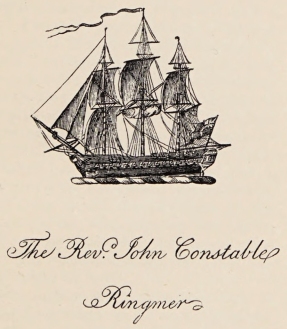
The bookplate over the inscription—“The Revᵈ John Constable,
Ringmer”—is simply a ship in full sail, and this is the crest of one of
the families of Constable. This plate is in a copy of Parson’s—His
Christian Directory, London, 1754. The volume also contains the
autograph “William Constable.” It so happens that another crest borne by
the Constables was a dragon’s head, and this may be seen on the
bookplate of William Constable, F.R.S. and F.S.A., pasted into an old
volume of manuscript escheats and inquiries in the county of York, which
belongs to Mr. E. F. Coates, and is probably one of the Dodsworth
volumes, which posterity owes to the thoughtfulness of the great Lord
Fairfax, who, when war was raging and devastation threatening, had
copies made of many old manuscripts for fear that the originals might be
lost.
It always adds to the interest when there is the owner’s signature to
his own bookplate. This is the case with a volume of a small
topographical work. The bookplate represents the arms and crest of the
famous clan Macintosh, with “C. C. M.” below, probably standing for
Charles Calder Macintosh. The owner and donor has made it read, “From
C. C. Macintosh to Charles Forbes. Bombay, 17th April, 1811.” This
would, of course, be Sir Charles Forbes, of Indian fame.
The arms of the ancient clan Macintosh are: Quarterly, first, or, a lion
rampant gules; second, argent, a dexter hand fesseways, couped at the
wrist, and holding a human heart gules; third, azure, a boar’s head
couped, or; fourth, or, a lymphad sable, surmounted by two oars in
saltire, gules. Crest a cat-a-mountain salient guardant proper. Over the
crest the motto: “Touch not the cat, but a glove.” The charge or, a lion
rampant gules, is on account of the descent from MacDuff. The third,
azure, a boar’s head couped, or, is for Gordon of Lochinvar. The fourth,
a lymphad, oars erect in saltire, sable, is for Clan Chattan. The lion
rampant of the ancient MacDuffs may be well accounted for, as King
Malcolm III. gave to MacDuff and his descendants the privileges of
leading the van of the Scottish army whenever the royal standard was
unfurled, and of placing the crown on the heads of the kings at their
coronation.
George Ormerod, well known as the historian of Cheshire, was the only
son of George Ormerod of Bury, Lancashire, and his wife
Elizabeth, daughter of Thomas Johnson of Tyldesley, and was born in High
Street, Manchester, 20th October, 1785.
In 1803 Ormerod matriculated from Brasenose College, Oxford. In 1807 he
received the honorary degree of M.A., and in 1818 was made a D.C.L.
Becoming the owner of Sedbury Park on the beautiful peninsula of
Beachley, between the Severn and the Wye, he lived there until his death
in 1873, nearly ninety years of age. In 1808 he married the eldest
daughter of John Latham, M.D., F.R.S., of Bradwall Hall, Cheshire. His
library was sold in 1875.
Arms as Ormerod of Ormerod (or three bars and a lion passant, in chief
gules), quartering Johnson of Tyldesley, Wareing of Walmersley, Crompton
of Hacking Hall, and Nuttall of Walmersley. Crest a wolf’s head couped
at the neck, barry of four, or and gules, holding in the mouth an
ostrich’s feather erect proper. This plate is in a book, the fine black
morocco gilt binding of which was reproduced by Griggs for the
Bibliography of Eikon Basilike.
In May, 1893, Sothebys sold the Bateman Heirlooms, the valuable library
of Printed Books and Manuscripts formed by the late Mr. W. Bateman, and
Mr. T. Bateman, of Lomberdale House, Youlgrave, Derbyshire. The books
had been well cared for, and sometimes annotated and extra illustrated.
Such was the case with the copy of Reliquiæ Sacræ, 1651, with armorial
bookpile bookplate: “Wm. Bateman, F.A.S., of Middleton by Yolgrave in
the County of Derby.”
Another plate is armorial. Burke gives the arms as or, three crescents,
within the horns of each an estoile gules. Crest a crescent and estoile,
as in the arms, between two eagles’ wings or. Motto: “Sidus ad sit
amicum.”
William Bateman, of Middleton-by-Youlgrave, married Mary, daughter of
James Crompton of Brightmet, Lancashire. He died on 28th August, 1861,
at Lomberdale House, near Bakewell. William Bateman’s father and
grandfather had both done much towards founding the family library and
museum.
A fine plate here illustrated is that of the Duke of Beaufort, from a
fine copy of the first edition of Eikon Basilike.
Mr. H. B. Wheatley, of Pepys fame, has kindly written me the following
notes regarding Conduitt bookplate:—
John Conduitt was born in the year of the Revolution, and was at
Westminster School in 1701, and at Trinity College, Cambridge, in
1705. He was M.P. for Whitchurch 1715-34, after which he was elected for
Southampton. He was Master of the Mint 1727-37. He succeeded Sir Isaac
Newton, but previously to the death of Newton he relieved him of his
most onerous duties for some years. He married Mrs. Catherine Barton,
Newton’s niece, on 20th August, 1717.
“His only daughter married Viscount Lymington, son of the first Earl of
Portsmouth, which accounts for the fact that Newton’s MSS., etc., are in
the possession of the Portsmouth family; also the magnificent portrait
of Newton by Kneller.
“Conduitt wrote, in 1730, Observations on the Present State of our Gold
and Silver Coins, which came into the possession of Dean Swift, and
after remaining many years in MS. was published in 1774. Jevons praised
the work very highly.
“Conduitt was buried in Westminster Abbey, close by Newton’s grave.
“There is a scandal connected with Mrs. Catherine Barton which
biographers of Newton have generally agreed to ignore. She is known to
have kept house for Charles Montague, Earl of Halifax (who died in May,
1715), and is generally spoken of as his mistress by the gossips of the
day. Augustus de Morgan wrote a book on the subject, which was published
after his death, and entitled, Newton, his Friend, and his Niece.
1885. In this De Morgan argued for the opinion which he had formed that
Lord Halifax (who died May, 1715) married Mrs. Barton privately about
April, 1706. He made out a fair case, but he could obtain no actual
evidence, and when Mrs. Barton married Conduitt she was described as a
spinster.”
Of his own bookplate, here reproduced, Mr. Henry B. Wheatley, F.S.A.,
kindly writes to me:—
“I gave Hamilton an account of its origin, which he printed in the
little book on members of the Society of Odd Volumes. The room
represented was on the back first floor of the house in Caroline Street,
Bedford Square, which had been built out for John Philip Kemble to
accommodate his fine collection of plays, now in the library of the Duke
of Devonshire. I used the room as my library during the six years I
lived in the house, and a very pleasant room it was, looking out upon
trees which occupied an open space between Caroline and Charlotte
Streets. It, with other houses, was pulled down soon after I left in
1889, and the
Bedford Mansions have been built on the site. Kemble lived in the house
from 1787 (when he married) to 1799, when he removed to a larger house
in Great Russell Street.”
A good plate is the ex libris of Robert Surtees of Mainsforth, the
well-known antiquary and topographer. It was drawn by himself, and
engraved by Samuel John Neele, who was born in 1758 and died in 1824.
Surtees was born in the South Bailey of the ancient city of Durham in
1779. On 28th October, 1796, he matriculated from Christ Church, Oxford,
and took his M.A. in 1803. His father had just died, so he now settled
at Mainsforth, the family home. As an undergraduate at Oxford he was
already planning to record the history of his native shire.
Settled at Mainsforth, he used to drive about the county with a groom;
and his friend and kindred spirit, James Raine, whose plate I give from
a book kindly lent me by the Rev. Prebendary Deedes, has recorded the
groom’s testimony that it was “weary work, for Master always stopped the
gig, and we never could get past an auld beelding.” Surtees suffered
from constant ill-health, but his house was always open to scholars and
antiquaries. He died at Mainsforth on February 11th, 1834.
This plate is in a volume of two tracts—one about Marston Moor, 1650.
On the inside of the end cover is a plate in the Bewick style: “T. Bell,
1797,” and the autograph facsimile “Thomas Bell.” This is no doubt the
bookplate of Thomas Bell, the antiquary, born at Newcastle-on-Tyne in
1785. He died in his native place in 1860, and his library, rich in
antiquarian lore, printed and in manuscript, was sold there after his
death.
An armorial plate of the palm-branch manner is that of “Thomas Langton”
in a book of sermons by Richard Hurd, D.D., 1788. As given by Burke, the
crest is an eagle displayed with two heads, vert, charged on the breast
with a trefoil, or. The motto is “Loyal au mort.”
A curious succession of bookplates connected one with another is shown
in two volumes before me. One work is “Vindiciæ Pietatis: ... By R. A.
London: Printed in the year 1663.” The other is a book as far asunder as
the poles. It is catalogued “Des Livres, Estampes & Desseins, du
Cabinet.... Appartenent Au Baron Tessin, Marèchal de la Cour du Roy &
sur-intendent de Batiments & Jardins Royaux de Suede.... Stockholm,
1712.”
The first volume has three bookplates, all armorial. First, the plate
of Sir William Lee, Knight, with the motto “verum atque decens.”
“Mutlow, sculp., York Street, Covent Garden.” Then a smaller and
different plate, but by the same engraver, and with the same arms,
crest, and motto, but pertaining to “William Lee Antonie, Esqʳ.” After
this, again, comes the third ex libris in the book, and this is
without name engraving, but is evidently Lee quartering Fiott.
John Fiott, a London merchant who died at Bath in 1797, married Harriet,
second daughter of William Lee, of Totteridge Park, Hertfordshire. Their
son John, fifth wrangler at St. John’s College, Cambridge, in 1805, and
LL.D. in 1816, assumed, in 1815, by royal licence, the name of Lee under
the will of William Lee Antonie, of Colworth House, Bedfordshire, his
maternal uncle. At the same time he acquired the estates of Colworth in
Bedfordshire, and Totteridge Park, Hertfordshire. He lived eighty-four
years, and in 1863, at the age of eighty, he was admitted a barrister of
Gray’s Inn. Between 1807 and 1810 he held a travelling bachelorship from
Cambridge, and made a learned tour through the Ionian Isles and other
parts. In 1828 he was elected a Fellow of the Society of Antiquaries,
and he left valuable collections to the Society. He was even more
interested in science than in antiquities, and in 1830 built an
observatory in the south portico of Hartwell House. Leaving no children,
his property passed to his brother, the Rev. Nicholas Fiott, who took
the surname of Lee. The Lee crest is a bear with a chain.
Guillim has recorded: “Hee beareth Sable, a Beare passant, Argent....
The Shee Beare is most cruelly imaged against any that shall hurt her
yong, or dispoile her of them: as the Scripture saith, in setting forth
the fierce anger of the Lord, that he will meete his aduersaries, as a
Beare robbed of her whelps. Which teacheth vs how carefull Nature would
haue vs to bee of the welfare of our children, sith so cruell beasts are
so tender harted in this kind.”
“Vindiciæ Pietatis: ... By R. A. London: Printed in the year, 1663.” The
author of this precious volume was Richard Alleine, born in 1611 at
Ditcheat, in Somersetshire. In 1641 he became Rector of Batcombe in the
same county. The Dictionary of National Biography is for once induced
to warmly clothe the dry skeleton, with which it has usually tried to
make us content. “For twenty years Alleine
remained at Batcombe, and was idolized by his parishioners.... Vindiciæ
Pietatis ... refused license by Sheldon ... was published without ...
was rapidly bought up and did much to mend this bad world. Roger Norton,
the royal printer, caused a large portion of the first edition to be
seized on the ground of its not being licensed, and to be sent to the
royal kitchen. But, glancing over its pages, he was arrested by what he
read, and on second thoughts it seemed to him a sin that a book so holy
and so saleable should be killed. He therefore bought back the sheets,
says Calamy, for an old song, bound them, and sold them in his own
shop.”
The closing lines of Vindiciæ Pietatis are: “But by the grace of God,
whilst God is a God of holinesse, whilst holinesse is the Image and
Interest of God, whilst these words of the Lord, Be ye holy, follow
holinesse, live righteously, soberly, and godly in this present world,
whilst these and the like words of the Lord, stand unrepeal’d, by the
Grace of God, I will be a Friend, an Advocate, a Confessor, a
Practitioner of Holinesse to the end of my days. This is my resolution,
and in this resolution I commit myself to God, and so come on me what
will.”
So much for the first book of the two. The second—Baron Tessin’s
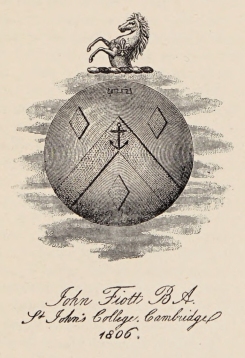
Catalogue—has two ex libris. The first is that of John Fiott before
he took the name of Lee. It is the plate of “John Fiott, B.A. / St.
John’s College, Cambridge, / 1806 /.” The plate shows a globe floating
in the air, with the Fiott arms engraved on it, and the crest, a horse
coupé, over it. Of course, as a wrangler he could not help being an
astronomer; but this indicates his early taste for studying the heavens.
Of this crest Guillim tells us:—
“A horse erected boult vpright may bee termed enraged, but his noblest
action is expressed in a saliant forme. This of all beasts for mans
vses, is the most noble and behoofefull either in Peace or Warre. And
sith his service and courage in the Field is so eminent, it may bee
maruelled why the Lion should be esteemed a more honourable bearing. But
the reason is because the horse’s seruice and strength is principally by
helpe of his Rider, whereas the Lion’s is his owne: and if the Horse be
not mounted, he fights auerse turning his heeles to his aduersary, but
the Lion encounters affront, which is more manly.”
The Duke of Sussex used two plates amongst
his books in Kensington Palace, one “Perkins and Heath. Patent Hardened
steel plate.” The main feature of this plate is a Knight of the Garter’s
chain forming a circle enclosing a lion on a coronet at the base of the
plate, a helmet on one side, and an owl on the other. The other plate is
here reproduced.
A pretty armorial plate of about this time, the shield resting on
flowers, and a palm branch at each side, is the ex libris of “Charles
Gordon Esqʳ of Beldorny and Wardhouse.” Below the shield is engraved a
ribbon, but without any inscription. The motto—“in hoc spes mea”—is
fittingly over the crest, which is described as a cross crosslet
fitchée. The arms of Gordon of Beldorny are quarterly, first and fourth,
azure, a lion rampant argent between three boars’ heads erased of the
second; second and third, azure, three boars’ heads within a bordure
engrailed argent.
Now for old Scotland—“Fraser of Ledeclune”; this is a splendid modern
ex libris. This plate is worthily found in a fine, large-paper copy of
“poems by goldsmith and parnell. london: printed by W. Bulmer and co.
Shakspeare Printing Office, cleveland row. 1795”. “To raise the art of
Printing in this country from the neglected state ... to combine the
various beauties of Printing, Type-founding, Engraving, and
Paper-making; as well with a view to ascertain the near approach to
perfection which those arts have attained in this country, as to invite
a fair competition with the best Typographical Productions of other
nations.... The whole of the Types, ... are executed by Mr. William
Martin, in the house of my friend Mr. George Nicol, whose unceasing
endeavours to improve the art of Printing &c.... The ornaments are all
engraved on blocks of wood, by two of my earliest acquaintances, Messrs.
Bewicks, of Newcastle upon Tyne and London, ... I may venture to say,
without being supposed to be influenced by ancient friendship, that they
form the most extraordinary effort of the art of engraving upon wood,
that ever was produced in any age, or any country....” Of the paper it
is only necessary to say that it comes from the manufactory of Mr.
Whatman.
Burke’s General Armoury gives:—
“Quarterly, first and fourth, azure, a bend engrailed between three
cinquefoils (or frasiers), argent, a canton gyronny of eight or and
sable; second and third, argent, three antique crowns gules (the latter
quartering was given
to Sir Simon Frazer for having thrice saved the life of Robert Bruce at
the battle of Methven). Crest a buck’s head, erased gules. Supporters,
two stags proper, attired and unguled or, collared azure, pendent
therefrom an escutcheon gyronny of eight gold-and-sable, each resting
one foot on an anchor of the last. Motto: ‘Je suis prêt.’ The branches
of yew in the bookplate are the ancient badge of the clan Fraser. This
book has been beautifully bound, evidently by Kalthoeber.”
“The Honourable Archibald Campbell Esqʳ. 1708” is engraved at the base
of an armorial plate, with mantling, and lions for supporters. This is
the plate of Archibald Campbell, second son of Lord Niel Campbell, who
was second son of Archibald, Marquis of Argyll. The owner of this plate
had a remarkable life. First, he is said to have taken part in the
rebellion headed by his uncle, the ninth Earl of Argyll, in 1685, and
then to have made his escape to Surinam.
That fine old Tory, Dr. Samuel Johnson, says of him, that after his
youthful whiggish days “he kept better company and became a violent
tory.” On the 25th of August, 1711, he was consecrated a bishop at
Dundee by Bishops Rose, Douglas, and Falconer. He died in London in
1744. This plate is in his interleaved and copiously annotated copy of
the New Testament in Latin: “Theodore Beza’s, Londini excudebat Thomas
Vautrollerius, Typographus, 1581.” It belongs to Mr. E. F. Coates.
The nice plate of “Campbell of Shawfield” gives a shield-of-arms, not
just corresponding with Burke’s General Armoury, which records:
Gyronny of eight or and sable, within a bordure of the first, charged
with as many crescents of the second. Crest a griffin erect, holding the
Sun between the forepaws. Motto: “Fidus amicis.”
Campbell of Shawfield might be dubbed doubly Campbell, as being a time
back represented by Walter Frederick Campbell, of Islay and Shamfuld,
son of Colonel John Campbell and his wife Charlotte, youngest daughter
of John, Duke of Argyll.
Guillim wrote: “This forme of helmet, placed sidelong and close, doth
Ger Leigh attribute to the dignity of a Knight, but in mine
understanding, it fitteth better the calling of an Esquier ... of these,
each Knight had two to attend him in the warres, withersoeuer he went,
who bare his helmet and shield before him; forasmuch, as they did hold
certaine lands
of him in scutage, as the Knight did hold of the King by Military
seruice.”
This Campbell of Shawfield plate is in a copy of The History of the
Siege of Toulon.... Done from the French Copy, Printed at Paris, and
Dedicated to the French King. London ... at the Raven in Pater Noster
Row. 1708.
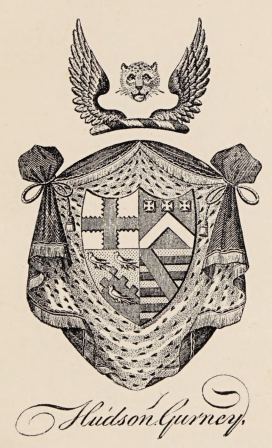
“Hudson Gurney” was born in Norwich on the 19th of January, 1775, his
father being Richard Gurney, of Keswick Hall, Norfolk. Hudson Gurney was
indeed a proper man to have a bookplate, and he had several. He gave his
money generously to help the publication of works of antiquarian
interest. From 1822 to 1846 he was a Vice-President of the Society of
Antiquaries. He had a library of from ten to fifteen thousand volumes,
and was not content merely to have his books, but was an ardent reader.
He was also very ready to help others: he was kind, liberal, and
hospitable. He died on the 9th November, 1864. His family, as the
ancient Norman family of De Gournay, owned Keswick Hall and West
Barsham, both in Norfolk, for many centuries. The arms (see Burke):
Argent, a cross engrailed gules. The smaller bookplate, not reproduced
here, represents one crest of the family, namely, on a chapeau gules,
turned-up ermine, a gurnet fish in pale, with the head downwards.
The Hastings bookplate is simply armorial with supporters, and
underneath it the inscription “Hastings.” The barony of Hastings,
created by Edward I. in 1290, having fallen into abeyance, the House of
Lords reported that Henry L’Estrange Styleman Le Strange, Esq., of
Hunstanton, Norfolk, and Sir Jacob Astley, Bart., were co-heirs to the
barony. Whereupon Sir Jacob had the abeyance terminated in his favour,
and was summoned to Parliament by writ in 1841 as Baron Hastings. On his
death, in 1859, he was succeeded by his elder son, Jacob Henry Delaval,
Baron Hastings, who died in 1871, and was succeeded by his brother, the
Vicar of East Barsham, in Norfolk. He died in September, 1872, and was
succeeded in the barony by his eldest son, who, however, dying in 1875,
unmarried, was succeeded by his next brother, George Manners. The arms
are: Quarterly, first, azure a cinquefoil pierced ermine within a
bordure, engrailed, or for Astley; second, argent a lion rampant gules
ducally crowned, or for Constable; third, argent two lions passant,
gules for L’Estrange; fourth, or a maunch, gules for Hastings.
Supporters, on either side a
lion gules, ducally crowned, and gorged with a collar or, therefrom
pendent an escutcheon of the arms of Hastings. The motto is “Justitiæ
tenax.”
Old Guillim illustrated the maunch, and wrote: “The Field is Topaze, a
Maunch Ruby. This Coat armour pertained to the honourable Family of
Hastings, Earles of Pembroke, and is quartered by the right Honourable
Henry Gray, now Earle of Kent. Of things of Antiquity, saith Leigh, that
are growne out of vse, this is one, which hath beene, and is taken for
the sleeue of a garment.”
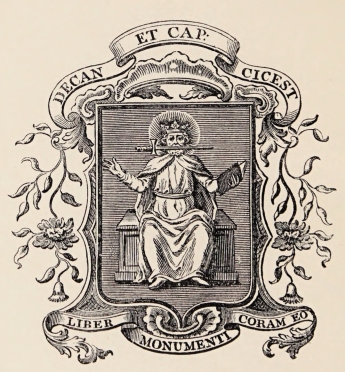
The view bookplate of the library of the Dean and Chapter of Winchester
is interesting. Beriah Botfield described the library as a long room
over the only remaining portion of the cloisters attached to that noble
building. It is curious to note that this bookplate is in a folio copy
of the Reliquiæ Sacræ, or writings of Charles I., and that many of the
chief books in the library were the generous bequest of Bishop Morley,
the friend of Charles I., and who, tradition says, helped the issue of
Eikon Basilike. The books are in the old open oak bookcases in which
they stood in the good bishop’s palace of Wolvesey. In the library is in
manuscript “A Catalogue of all the Bookes in his Lordship’s Library,
bequeathed by his Lordship’s Will to the Cathedral of the Holy Trinity
of Winchester; and which the longer his lordship lived, he declared by
his letters should be the more and not the fewer.”
The bookplate in the Bewick style of the “Revᵈ T. Newcome. Brook sculp.
302 Strand.” is in an imperfect volume of an eighteenth-century
duodecimo edition of Samuel Butler’s Hudibras.
Of cathedral libraries an interesting bookplate, and lent to me by Mr.
G. F. Barwick, is that of the Dean and Chapter of Chichester. The Rev.
Prebendary Deedes, of Chichester, has very kindly written to me the
following note:—
“This is the earlier of the two bookplates used in the Cathedral
Library. That at present in use, which is substantially the same design,
has no embellishment and is not so well engraved.
“See a paper on ‘The Arms of Chichester Cathedral’ in Sussex Arch.
Transactions, vol. xi., with illustrations from seals, now in the
possession of the Bishop or the Dean and Chapter. The design is intended
to represent our Lord as described by St. John the Divine in Revelation
i.
The heralds of the seventeenth century mistook it for ‘Prester John,’
the mythical Emperor of Abyssinia in the Middle Ages, and it is
sometimes so described in Heraldic Manuals. There is a difference of
treatment as to tinctures. The ‘field’ is, I believe, uniformly blue,
the throne gold, the figure usually gold, but occasionally white, which
my friend Dr. Codrington maintains is correct. The earlier seals
generally give a badge of the Holy Trinity, which is the Dedication of
the Cathedral. The motto—‘Liber monumente coram eo’—is the Vulgate
version of part of Malachi iii. 16.”
Of about this date, with a garland surrounding the shield and crest at a
little distance, and two palm branches crossed, is the bookplate of the
“Revᵈ. Manley Wood. Middle Temple.” The family is of North Taunton,
Devon, and the arms, as given by Burke: Sable, three bars or; on a
canton gules, a demi-woodman, holding a club over the dexter shoulder
or. Crest a woodman proper, wreathed about the temples and loins vert,
holding in the dexter hand an olive branch of the last. This bookplate
of a Devon man is in a Devon book, and it is “down along” all over. It
bears the inscription: “W. Beal ex dono authoris. Plymouth.” The book
is “the Plain Truth: ... By John Agate M.A.... Exon: Printed by Jos.
Bliss, and Sold by the Booksellers in Exon MDCCVIII.” I have only quoted
about a twentieth part of the title-page, but must give a scrap or two
from “To the Reader”: “Be it known, that supposing Mr. Wither had not
(as ’tis shamefully notorious he has) first broken the Peace, by drawing
me to the Press, yet his Harangue about Union and Moderation, is all
Banter and Grimace: for how ridiculous is an everlasting Cant and Din
about Peace and Union, from One who, ... if he does not Love, yet
manifestly lives by Divisions!...”
The armorial bookplate with large margin of “The Rᵗ Honᵇˡᵉ The Earl of
Suffolk, is in a splendid folio large-paper copy of The Book of Common
Prayer.... Printed by Thomas Buck and Roger Daniel, printers to the
Universitie of Cambridge. Anno Dom. 1638. The latter half of the volume
is the Whole Book of Psalmes, Collected into English metre, by Th.
Sternhold, John Hopkins, and others, ... with apt notes to sing them
withall:”—the same printer and date. The whole volume being ruled in
red lines in the very effective way used with special copies, and bound
in fine
old black morocco, gilt extra, evidently by good Thomas Buck of
Cambridge town.
The arms, with an earl’s coronet above, and lions for supporters, are
first, gules, a bend between six cross crosslets, fitchée, argent; on
the bend an escutcheon, or, charged with a demi-lion, rampant, pierced
through the mouth with an arrow, within a double tressure, flory-counter
flory, gules, for Howard; second, gules, three lions passant-guardant,
in pale or, and a label of three points, argent, for Thomas of
Brotherton; third, chequy, or and azure, for Warren; fourth, gules, a
lion rampant, argent, for Mowbray. Below the shield is the motto, “Nous
Maintiendrons.” The family of the Earls of Suffolk and Berkshire comes
from the famous house of Howard, springing from Thomas, fourth Duke of
Norfolk and his second wife.
In the ex libris of “HRH Princess Sophia” there seems something
delightfully simple and suitable to a virgin Princess. The Princess
Sophia, one of the numerous family of George III., was born in 1777, and
lived until 1848. This bookplate is a lesson in the art of simplicity.
It is in “Memoires du Prince Eugénie de Savoie ... A Londres 1811.”
Here, also, is the bookplate of “Bulkeley Bandinel DD Bodleian
Librarian, Oxford.” This little plate tells all that could be wished. It
is in a copy of the 1720 edition of Wishart’s Montrose, and has
Bandinel’s autograph. It has lately belonged to Mr. William Twopeny.
I give also the plate of Philip Bliss, another famous custodian of
Bodley’s. In any of his books which had not his bookplate he had a
playful habit of marking the B sheet signature.
The ex libris now mentioned is in a curious copy of a curious work.
“The North Briton ... London: Printed for J. Williams, near the Mitre
Tavern, Fleet Street. MDCCLXIII.” Two volumes bound in one, and
including all the forty-five numbers. The volume is bound in calf and
lettered “poison for the Scotch.” Inside is an armorial bookplate with
two winged monsters for supporters. It is evidently the bookplate of a
Fletcher. The arms that Burke gives are sable, a cross flory argent
between four escallops. Crest a bloodhound azure, ducally gorged or. The
motto is “Dieu pour nous.”
“Robert Plumptre”’s bookplate gives argent, a chevron between two
mullets pierced in chief, and an amulet in base sable, the arms of
Plumptre; and the crest a phœnix or out
of flames proper. The motto given is “turpi secernere honestum.” Another
small shield-of-arms is placed over the Plumptre shield,
Nottingham has been the chief abiding-place of the Plumptres for many
centuries.
This bookplate is in a copy of œuvres de Mr. Pavillon de C’Academie
Francoise. a la Haye, ... 1715.
There are two ex libris in a copy belonging to Mr. E. F. Coates, of
“Report of Proceedings ... Oyer & Terminer and Gaol Delivery. County of
York. held at the castle of York ... 1813.” The first is that of
“William Stretton Lenton Priory,” which words are engraved under a
simple armorial shield. Arms: argent, a bend engrailed sable, cotised
gules. The second plate has the inscription “Sempronius Stretton Lenton
Priory.” In this plate the shield, with different bearings from the
other, is represented as held by an eagle. This Sempronius Stretton of
Lenton Priory, in Nottinghamshire, was, I fancy, a colonel in the army;
and hanging just below the shield are two objects looking like war
medals.
In a fine copy of Baxter’s Anacreon—a rare little work—is the
armorial plate “Brown” (Waterhaughs, County Ayr, 1806). Burke gives:
Quarterly, first and fourth, gules, on a chevron between three
fleur-de-lis or, a ship sails furled sable, a bordure of the second;
second and third, gyronny of eight wavy, ermine and gules, for Campbell.
Crest a demi-lion proper, holding in his dexter paw a fleur-de-lis or.
A good plate here given is that of Sir J. S. Stewart, Baronet.
In a 1649 Eikon Basilike is a modern round bookplate of “John Bailey
Langhorne.” The arms were granted to the Langhornes of Bedfordshire 20th
January, 1610. Sable a cross argent; on a chief of the second three
bugle-horns of the field, stringed gules. Crest a bugle-horn sable,
stringed gules, between two wings expanded, argent.
“John Warren, BA, LLB.” The name and, to some extent, the arms will
remind incidentally bookplate collectors of the first historian of
English bookplates. The motto is “tenebo.” The arms are chequy or and
azure; on a canton gules a lion rampant argent. Crest on a chapeau
gules, turned-up ermine, a wyvern argent, wings expanded, chequy or and
azure.
“Thomas James Tatham,” an ex libris about fifty years old. Thomas
James Tatham lived in Bedford Place, Russell Square, and bore for
his own arms, argent, a chevron gules between three swans’ necks couped
sable. Crest, on a trumpet or, a swan with wings displayed sable. The
motto: “perseverance.”
A bookplate very interesting from the identity of its owner is that of
“Henry Crabb Robinson,” the warm friend of Lamb, Coleridge, Wordsworth,
Southey, and a host of other interesting characters. He died at his
house, 30, Russell Square, on February 5th, 1867, at the good age of
ninety-one years.
A sensible armorial plate is that inscribed at foot as “Right Honᵇˡᵉ.
Sir Robert Peel Bart,” and across the top “Drayton Manor.” The arms, as
granted to Robert Peel of Manchester, father of the first baronet, were:
Argent three sheaves of as many arrows proper, banded gules; on a chief
azure a bee volant or. Crest a demi-lion rampant argent, gorged with a
collar azure, charged with three bezants, holding between the paws a
shuttle or. Motto: “Industria.”
“Robᵗ D Mayne,” a facsimile signature, is under a modern plate, where,
of course, both arms and motto have something to say about hands. The
arms are: Ermine, on a bend sable, three dexter hands couped argent. The
motto runs: “manus justa decus.”
Of martial mottoes, “militavi non sine gloria” is a good specimen. It is
on the bookplate, about forty years old, which has under it the engraved
signature of “J Knight.” The crest is a spur between two wings.
“Wynfield.” This is a shield with Wynfield arms—vert on a bend argent,
three crosses patonce sable, and a host of quarterings; also two crests,
one a lion’s head, and the other a falcon. The motto is “aut vincere aut
mori.”
“William Holgate.” This is a plain armorial bookplate. Or, a bend
between two bulls’ heads, couped sable. The crest is, out of a mural
coronet argent, a bull’s head sable, gorged with a collar of the first,
charged with two bends gules.
“T. A. Dale.” A very small shield, with simply the name underneath. Arms
of Dale of Rutlandshire, confirmed in 1602: Paly of six argent and
gules, on a chief azure three garbs or. Crest three Danish battle-axes
erect, handled or, headed argent, enfiled with a chaplet of roses of the
first.
The bookplate, also armorial, with two palm leaves, of “Honᵇˡᵉ Edmund
Phipps.” The arms are, of course, the Normandy coat. Quarterly first and
fourth, sable, a trefoil slipped between eight mullets argent, for
Phipps; second and third, paly of six argent and azure; over all a bend
gules for Annesley. Crest, a lion’s gamb erect sable holding a trefoil
slipped argent. This in a 1648 copy of Eikon Basilike.
A pleasant variety in style is the plate of “George Cardale.” It is
evidently a real bookman’s bookplate. In good large letters on a scroll
around the shield are the words, “studendo et contemplando indefessus.”
In the arms and crest is seen the Cornish chough.
An Eikon Basilike, 1648, with a bookplate, “Revᵈ Charles Chester.”
Below and beside the armorial shield is a neat design of two palm
leaves. The arms, ermine, on a chief sable a griffin passant or, armed
argent. Crest, a dragon passant argent, are those of Chester of Blabie
in Leicestershire, descended from an uncle of the first Sir Robert
Chester of Royston, who, as one of the gentlemen of the Privy Chamber to
King Henry VIII., received from that monarch a grant of the monastery of
Royston.
“Fothergill sc” is on the ex libris of “Cecil D. Wray, A.M. / F.C.C.
Manchester.” Arms: azure, on a chief or, three martlets gules. Crest an
ostrich or. Motto: “et juste et vray.” The Rev. Cecil Daniel Wray,
Canon of Manchester Collegiate Church, was son and heir of the Rev.
Henry Wray, of Brogden House, in Kelfield, Lincolnshire, and his wife
the daughter of George Lloyd, of Holm Hall, near Manchester.
The Wrays come from Sir Christopher Wray, Lord Chief Justice of the
Court of Queen’s Bench in the days of Queen Bess.
A pretty little plate, and not armorial, is that of “John T. Beer.” The
centre represents an open mouth of a well, with an owl perched on the
further edge of it. At each side of the well rise tropical palms.
Besides the name ribbon are these three inscriptions: “knowledge is
high,” “truth is straight,” “wisdom is wealth.”
An unpretending ex libris is that of “Robert Buchanan Stewart.” These
words are inscribed on a circular strap enclosing a fancy monogram.
Below is “ubi thesaurus ibi cor.” Below are spaces for filling in
number, class, and case.
As a good specimen of a Society’s bookplate may be given one engraved
for the “Royal Institute of British Architects. Tite Donation 1868.” Sir
William Tite, the architect of the Royal Exchange and of many great
buildings,
was born in 1798 in the parish of St. Bartholomew the Great, London, and
died at Torquay in 1873. He represented Bath in the House of Commons
from 1855 until his death. His valuable library of early English books
and other rarities was sold at Sotheby’s after his death.
The Right Honorable Sir Gore Ouseley, Baronet, Grand Cordon of the
Persian Order of the Lion and Sun, and Grand Cross of the Imperial
Russian Order of St. Alexander Newski—a famous Oriental scholar, Fellow
of the Royal Society, and Fellow of the Society of Antiquaries—was born
in 1770, and created a baronet in 1808. His wife was Harriott-Georgiana,
daughter of John Whitelocke, Esq. In 1810 Sir Gore Ouseley became
Ambassador Extraordinary and Minister Plenipotentiary to the Court of
Persia, and afterwards at St. Petersburg. He died in 1844 at Hall Barn,
Beaconsfield, which had belonged to Edmund Waller, the poet, and which
he had twelve years before purchased from the poet’s descendant, Mr.
Waller of Farmington.
“Whalley Hamerton” is a good idea in bookplates. It looks like unto a
picture of some fine old seal. Whale’s heads for Whalley. It is in a
scarce book: Marshal Ney. Report of the trial ... Paris: Printed and
sold at Galignani’s ... 1815.
“A fenwyke! a fenwyke” is the motto at the foot of a Fenwick bookplate,
probably Fenwick and Robinson. First and fourth, six martlets
counterchanged, three cinquefoils. The Fenwicks were an intrepid race
haunting the northern borders, and the proud House of Percy never went
to battle without the valiant Fenwicks to help them.
“Richard Clark Esqʳ. Chamberlain of London.” Such are the words engraved
below the plain armorial plate. Argent on a bend gules three swans
proper, between as many pellets, a canton sinister azure charged with a
demi-ram mounting of the first, armed or between two fleur-de-lis in
chief of the last; on it a baton dexter of the field. The motto is “est
modus in rebus.”
Guillim remarks: “The Swan is a Birde of great Beautie, and strength
also: and this is reported in Honour of Him, that hee vseth not his
strength, to Prey or tyrannize ouer any other Fowle, but onelie to be
reuenged on such as first offer Him wrong; in which case he often
subdueth the Eagle.”
A good ex libris, engraved perhaps about 1820, and in an 1824 copy of
Eikon Basilike, is
the bookplate of “Harry Kerby Pott.” The motto is “fortis et astutus.”
The arms are: azure, two bars or, over all a bend of the last. The crest
a leopard, or ounce, sejant proper, collared, lined and ringed azure.
According to the Herald’s College, these arms were granted in 1583.
The quite modern, fantastic plate of “Thomas Bradshaw. Stackhouse.
Settle.” seems to represent Father Time with his scythe; and Father Time
seems to be expressed as an old man in a hurry, who has learnt to fly
without wings. This plate is in a Yorkshire West Riding poll-book of
1838, belonging to Mr. E. F. Coates.
A very pleasing modern non-armorial plate is “George Parker
Heathcote”’s. In a prettily formed rectangular frame is seen an angel
holding a shield and pointing to the monogram “G P H”, which occupies
the shield. The names in full are round the framework. This plate is in
a volume of the Camden Society.
Appropriately, in a copy belonging to Mr. E. F. Coates, of Poulson’s
Holderness, Hull, 1840, is a bookplate of a member of a family that
hails from Knaresborough. “John Rhodes” is the facsimile signature at
the foot of the plate, below the motto “ung durant ma vie.” The arms
are: argent on a cross engrailed, between four lions rampant gules, as
many bezants. Crest a leopard sejant or, spotted sable, collared and
ringed argent.
Two nineteenth-century ex libris—one of “Thomas Tindal Methold,” and
the other of “Henry Methold.” The Methold arms are: azure six escallops
or. The crest is a goat’s head erased argent, attire and beard sable.
The Metholds, or Methuolds, are an old Norfolk family.
A simple nineteenth-century ex libris is that of “Christopher
Roberts,” with the motto “un roy une foy une loy.” The arms, granted on
2nd June, 1614, to Roberts of Truro, Cornwall, are: azure, on a chevron
argent, three mullets pierced sable. Crest a demi-lion azure holding a
mullet argent, pierced sable.


