BOOK OF CATS AND DOGS, AND OTHER FRIENDS, FOR LITTLE FOLKS .
The Household Pet.
NATURAL HISTORY SERIES—BOOK FIRST.
By JAMES JOHONNOT.
NEW YORK ·:· CINCINNATI ·:· CHICAGO
AMERICAN BOOK COMPANY.
Copyright, 1884,
By D. APPLETON AND COMPANY.
Whole book · 42 sections
The Household Pet.
NATURAL HISTORY SERIES—BOOK FIRST.
By JAMES JOHONNOT.
NEW YORK ·:· CINCINNATI ·:· CHICAGO
AMERICAN BOOK COMPANY.
Copyright, 1884,
By D. APPLETON AND COMPANY.
Children love pets; they never tire of stories; and they are delighted with jingle and the fun of incongruity. Mother Goose reigns supreme in the fairy-land of infancy. Through these loves the little opening minds may be led to careful observation, comparison, and descriptions—steps at once necessary to mental growth, and leading up to the portals of science. By insensible degrees, play may be made to merge in study, and fun take on the form of fact.
Upon these ideas of the basis and method of thought, this little work has been constructed. A few familiar nursery-rhymes serve to connect the present with the past thought of the child. The pet of the household—the cat—is studied. From the obvious in structure and movement, the mind is led to see relations, and the adaptations of structure to functions and outward conditions. As each new animal is introduced, the study goes on by comparisons, showing resemblances and differences, and pointing toward scientific classifications.
This and kindred works will be of little use, however, if the lessons stop with the book. The whole intent of the method is to incite to a study of the animals themselves—the matter in the book directing attention, arousing interest, and serving as a guide to observation.
An endeavor has been made to present the pleasant side of animal life. To this end the affection, the intelligence, and the uses of our servants and friends have been dwelt upon, and ideas of violence have received but a passing notice. That we should be kind to animals is a necessary inference from observed relations, and this obviates the necessity of a formal exhortation or a cut-and-dried moral.
As a reader, this book is designed to supplement the regular reader of the grade. Common and familiar language is used, but no effort has been made to reduce the expressions to baby-talk, or to construct halting sentences with words of three or four letters only.
| LESSON | PAGE | |
| The Cat and the Fiddle | 9 | |
| Mother Hubbard and her Dog | 10 | |
| I. | What the Cat Does | 11 |
| II. | The Grateful Cat | 13 |
| III. | What the Cat Wears | 15 |
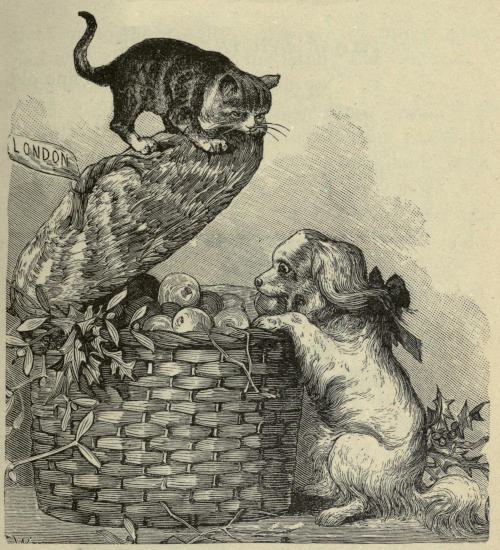
| Who Stole the Apples? | 17 | |
| IV. | Patch and the Mouse | 18 |
| Tommy and the Chickens | 20 | |
| V. | How the Cat Moves | 21 |
| VI. | Daisy and her Plays | 23 |
| VII. | How the Cat Eats | 25 |
| VIII. | Old Tom and the Eagle | 27 |
| IX. | How the Cat Sees | 29 |
| X. | Miss Muffet and Fluffy | 31 |
| Fluffy and the Mouse | 33 | |
| XI. | How Dogs Behave | 35 |
| XII. | How Nero Saved his Master | 37 |
| XIII. | How Dogs Look | 39 |
| XIV. | How Mungo Did | 41 |
| XV. | How Dogs Use their Feet | 43 |
| XVI. | The Dog and the Shadow—A Fable | 45 |
| The Boot-black and his Dog | 46 | |
| XVII. | How Dogs Use their Jaws | 47 |
| XVIII. | Lupo and Tiny | 49 |
| XIX. | How Dogs See and Smell | 51 |
| XX. | Puff and the Baby | 53 |
| Puff and the Rat | 55 | |
| XXI. | How the Horse Looks | 57 |
| XXII. | The Horse and his Friends | 59 |
| XXIII. | How the Horse Eats | 61 |
| XXIV. | How the Pony got Shod | 63 |
| XXV. | What the Horse Does | 65 |
| XXVI. | What the Horse can Do | 67 |
| XXVII. | How the Horse should be Treated | 69 |
| XXVIII. | How the Donkey Looks | 73 |
| XXIX. | What the Donkey Does | 75 |
| XXX. | What the Donkey can Do | 77 |
| Strange Doings | 79 | |
| XXXI. | How the Cow Looks | 81 |
| XXXII. | What Cattle Do | 83 |
| XXXIII. | What Cattle are Good for | 85 |
| XXXIV. | How the Sheep Looks and Lives | 87 |
| XXXV. | The Ways of the Sheep | 89 |
| XXXVI. | About Goats | 91 |
| XXXVII. | About Pigs | 93 |
| The Little Piggie Wig | 95 |
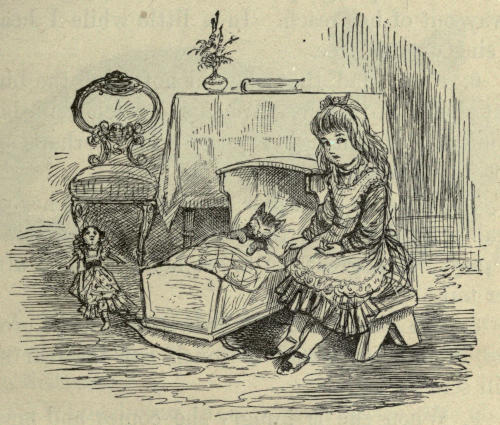
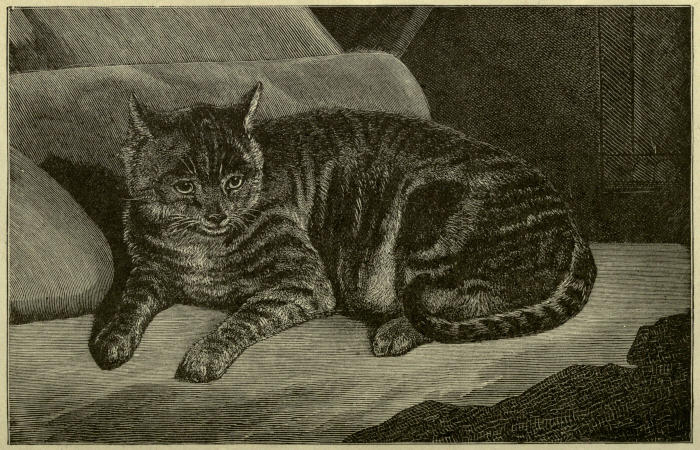
1. Come, Jessie! put your kitty up in the cradle, and take a good look at her. She looks very pleasant. Can you tell us anything about her?
2. Yes! the other day I saw her come out of the barn with a mouse in her mouth.
3. She would lay the mouse down and let it run a little way, and then would pounce upon it and catch it again.
4. By-and-by she got tired of playing with it, and then she bit off its head and ate it up.
5. One day I saw her creep slyly along the ground and spring upon a little bird; but it flew away out of her reach. In a little while I heard it sing up in a tree.
6. I was glad that she did not catch the bird, but she looked sorry. When she catches birds, I think she is a naughty pussy; but perhaps she does not know any better.
7. I like to hear her purr, and have her rub against my hand, for then she is good and ready to play. It is great fun to see her run round after her tail.
8. But sometimes she growls and looks cross, and then I am afraid to touch her for fear she will scratch me.
9. When she is hungry she comes and mews until she gets something to eat. Some cats will jump upon the table and steal meat, but my kitty knows better.
10. She does not like dogs. One day a strange dog came into the yard and barked at her.
11. Then her back came up, her fur stood out straight, and she growled and spit at him.
12. When he tried to bite her, she gave him a scratch on both sides of his nose, and ran up a tree out of his reach.
1. A lady tells this pretty story of how a cat showed its thanks to a kind friend who had helped it in distress:
2. While living in a country place, one day the cat ate some rat-poison, but not enough to kill it. It was very ill, and cried like a little child. Its pain and heat were so great that it would dip its paws in water to cool them, though cats nearly always keep away from the water.
3. At last it went to the lady, and, mewing and looking up to her in a most pitiful way, seemed to ask for help. The lady took the poor thing in her arms, and tried in all ways she could think of to relieve it.
4. She bound it up in cool, wet cloths, and gave it medicine and gruel, and took care of it all day and night. The cat was soon better, and after a day or two it was as well as ever; and this was the way it took to show how thankful it was to the lady for her kindness:
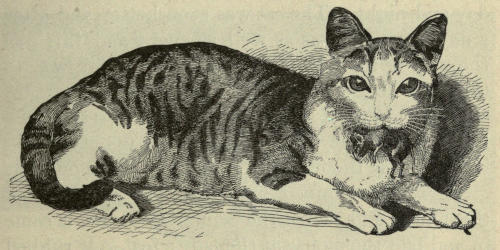
5. One night, after she had gone up-stairs, she heard a mew at the window; and, upon opening it, there was the cat with a mouse in its mouth.
6. It had climbed up a tree that grew against the house, and, when the window opened, it came in and laid the mouse at the lady’s feet. It rubbed against her, and purred loudly, as if it said, “See what a fine mouse I have brought you!”
7. The cat thought a mouse the best of all things, and this best it gave up for itself, and brought to its best friend, the lady.
8. This she did for a long time every day, and when, afterward, she caught mice for her kittens, one mouse was laid aside for the lady. If the kittens tried to eat this, she gave them a little pat, as if she said, “That is not for you.”
9. After a while the lady would take the mouse, and thank puss with a pleased look and a kind tone, and then give it to the kittens, the cat looking on well pleased while they ate it.
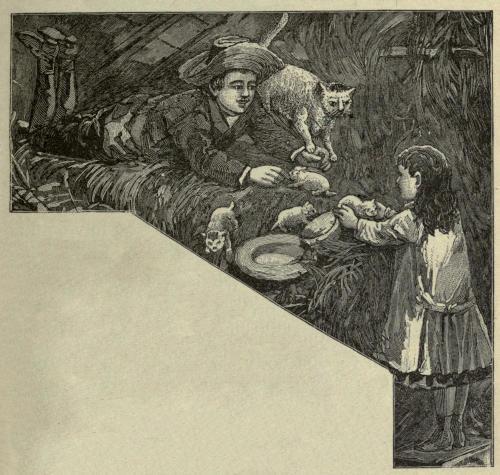
1. Come, Jessie, take your cat in your lap and look at her again. Can you tell something more about her?
2. Yes! Pussy has a thick coat of soft fur to keep her warm, so that she can run out of doors in cold weather.
3. She does not need to have clothes like ours, and mamma does not ever have to mend her coat. Her fur all grows one way, and it is so thick that, when it rains, the water runs off and does not wet her skin unless it rains hard.
4. She likes to have me stroke her from her head down, but she does not like to be rubbed the other way. I know for one that it hurts more to have the hair pulled up than down.
5. She has long whiskers on each side of her mouth and nose, and some folks call them smellers. This is what I read about them in the “Cat’s Picture-Book”:
6. “I dare say you have seen a cat stick his whiskers out straight on each side of his face. Let us see what he does it for.
7. “Have you not seen a cat creep through a hole that seemed too small for him? I have, and I used to wonder why he did not stick fast.
8. “But Tom knows what he is about. He comes to the hole and spreads out his whiskers, and if they can get through without touching, he knows there is room for his body, and so he goes on.”
9. Pussy’s ears are large and stand up straight, so that she can hear the least nibble of a mouse, or the sly tread of a rat.
10. She has paws on her fore legs which she uses like hands. Her paws have each five toes, but her hind feet have only four toes each. Some few cats have more toes on each foot.
11. Dogs wag their tails when they are pleased, but pussy waves hers from side to side when the boys plague her, and she is angry.
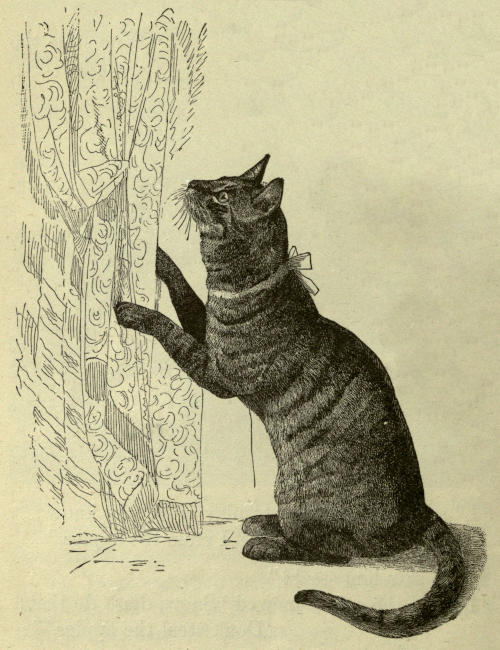
1. Patch was a fine old cat that lived in a farm-house, and looked after all the rats and mice that came about. She wanted to visit all the rooms where there were mouse-holes; so she learned to open doors for herself.
2. When she wanted to go out, she would jump up and hold on to the handle of the door with one paw, and with the other raise the latch; then she would drop down and push the door open.
3. One evening, as the lady of the house was sitting at the fire before the candle was lit, Patch came into the room with a live mouse, and began to play with it.
4. The mouse watched his chance and ran into the bedroom, the door of which stood open. Patch followed, but could not catch him.
5. Pretty soon the cat came out of the bedroom in a great hurry. She went to the lady and mewed, and then went to the candle and back several times. The lady thought the cat acted queerly, and at last she got up and lit the candle.
6. Patch started off for the bedroom, and looked back and mewed, as if asking the lady to come also. The lady took the candle and went in to see what was the matter.
7. The cat at once went up to a curtain, put up her paw as far as she could reach, and touched it. The lady shook the curtain, and down dropped the mouse, which Patch caught at once. Mousey had run up the curtain out of reach, and so Patch went and got the lady to come and help her catch it.
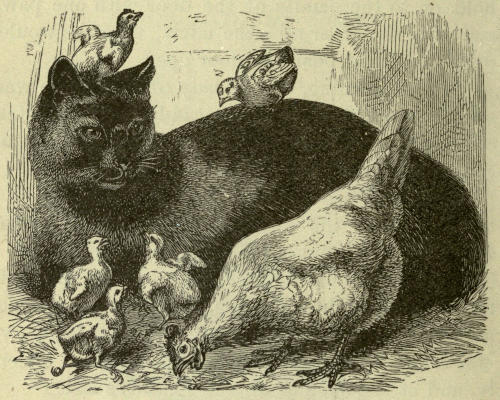
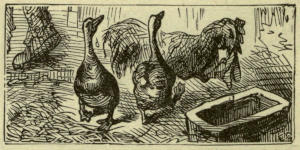
1. Tommy was a famous mouser, and he kept the house clear of rats and mice. He would catch birds, but he never ran after the chickens.
2. The hens were shy of him at first, but they became used to him and would scratch just the same while he was about. One day he was taking a nap on the grass, and the chickens mounted upon his back and head, as you see in the picture.
3. This was too much for Tom; so he got up and went upon the porch to finish his nap, where the chickens would not disturb him.
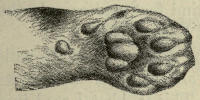
1. Now, Jessie, look at your kitty’s feet and see if you can tell us how she can catch mice and birds so easily.
2. I will try. Pussy has long and sharp claws, but they are drawn back into her foot, so I cannot see them.
3. The bottoms of her feet are covered with a thick skin, so that it does not hurt her to walk over stones and rough places.
4. When I feel of her feet, I find that the bottoms are soft, so that kitty is able to move about without making a noise.
5. When she is hunting, she creeps along so quietly that the mouse does not hear her until she is so near that she can spring upon it.
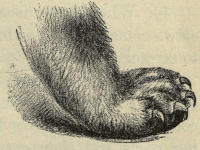
6. Then her sharp nails come out, as you see in this picture, and the little mouse is caught by his coat and cannot get away.
7. I see that the nails upon her hind feet are not so sharp as those on the front ones. She does not catch mice with her hind feet, and so only the nails of her fore feet need be very sharp.
8. When pussy runs up a tree, her sharp nails hold on to the bark, and she uses her hind claws as well as the fore ones. This is what I read in a book a little while ago about a cat’s claws, and I thought it very strange:
9. “The claws of a cat grow very fast, just as our nails do, and, if the cat did not rub them off, they would grow so long that she could not use them. So, when the cat feels that her nails are getting too long, she scratches something hard until she wears them down to the right length.
10. “You have seen the cat stretching up and scratching the side of the door or a tree: this is the way she has of paring her nails.”
11. When pussy is angry or afraid, her sharp claws come out of her foot, and she makes ready to scratch.
12. My pussy knows that a dog is stronger in the jaws than she is; and so, when a strange dog comes about, she gives him a scratch with both her paws, and then gets into some safe place as soon as she can.
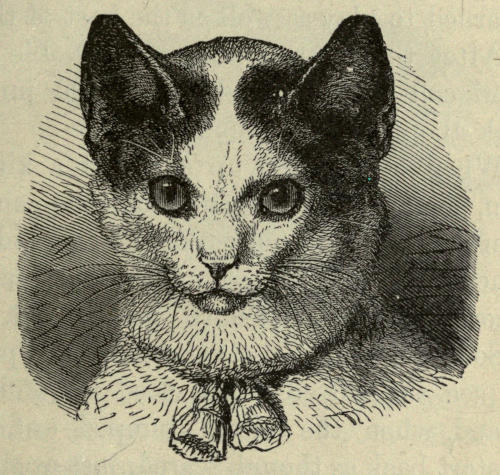
1. When Nellie was a little girl, she had a present of a pretty white kitten, which she named Daisy, and the two soon became good friends.
2. While Nellie was at breakfast, the kitten would sit at her side, and once in a while it would reach up and touch Nellie’s elbow, as if it said, “It is my turn now.” When Nellie walked out, Daisy went along like a little dog, and at night she had a soft, warm bed by Nellie’s side.
3. Little girls used to come and play with Nellie, and Daisy always took a part, and seemed to enjoy the fun as much as the children did. One of the games was hide-and-seek, and this Daisy soon learned to play as well as the best of them.
4. After this, at any time when Nellie would hide and call “coop,” the kitten would jump up and look about until it found her.
5. When Daisy grew up and had a kitten of her own, she taught the young one the game she had learned. The kitten would go and hide and give one mew, and the old cat would search in every corner of the room until she found it.
6. Sometimes the mother-cat would pretend not to see the kitten when close to its hiding-place, and, when the kitten jumped out, Daisy would start back as though scared, just as children often do.
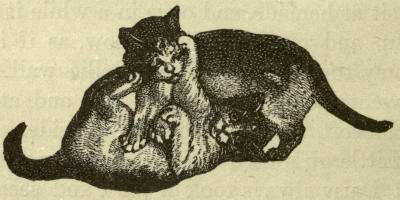
7. Then the two would roll over each other, and race about and have a great romp together.
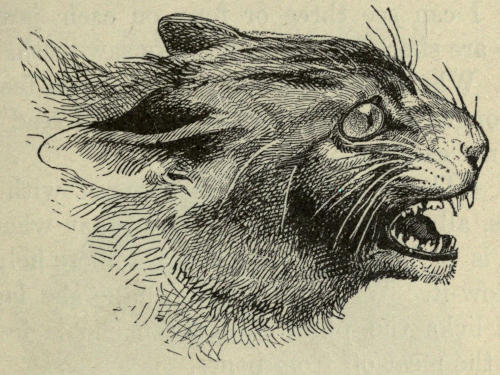
1. This time, Jessie, I wish you would tell us something about the mouth of your cat, if you are not afraid she will bite you.
2. No! my kitty will not bite me; she knows I will not hurt her. Come, pussy, open your mouth and let me take a good look at it.
3. I see four long teeth in the front part of her mouth. The two on the upper jaw are the larger, but the two on the under jaw are the sharper.
4. When she shuts her jaws, these teeth would easily go through the skin and flesh of a rat or mouse, and very likely would break its bones.
5. Between these long teeth in front I can count six funny little teeth on each jaw. They are too small to be of much use. Back of her long teeth I can see three or four on each jaw, and these are sharp and stand up like saw-teeth.
6. When pussy licks my hand, I can feel that her tongue is rough, and this is what I read about it in my cat-book:
7. “The cat’s tongue is covered with little hooks, all pointing backward, so that when the food is in her mouth, the rough tongue helps her swallow it. With this rough tongue she laps up milk, licks the plate clean when she is fed, and licks the meat off from bones.
8. “The dog’s jaws are strong, so he crushes bones and eats the meat, bones and all; but the cat’s jaws are not strong enough for that, so she gets the meat off with her rough tongue.”
9. My pussy keeps clean by licking her fur, the hooks on her tongue brushing the dirt off. It is funny to see her wash her neck. She first licks her paw and makes it wet, and then she reaches up to her neck and uses her paw like a brush.
10. The old mother-cat licks her kittens all over, and keeps them clean before they can do it for themselves. She uses her jaws to carry her kittens about before they can walk. She takes them up carefully by the nape of their necks.
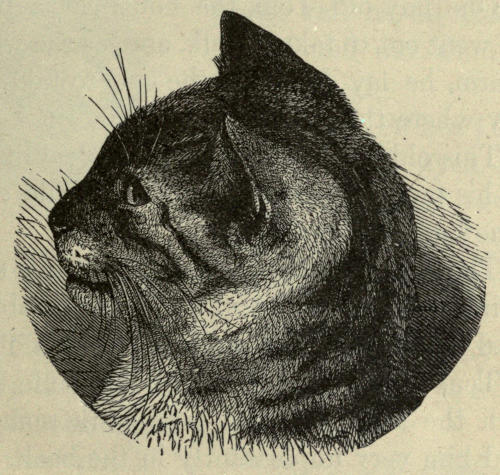
1. I will now tell you a story of a cat that made good use of his claws and teeth.
2. In a country place by the sea-shore an old eagle used to sail around in the air looking for something to eat.
3. If she saw a rabbit or a hare, or a little lamb or kid, she would pounce down and seize it in her strong claws, and fly away with it to her nest high up among the rocks.
4. The eagle became so bold at last that she would swoop down and carry off a chicken from the farm-yard close by the house.
5. One day old Tom, the house-cat, a big old fellow, went out to take a walk, and, as the weather was warm, he lay down in the sun to take a nap near by where the rabbits lived.
6. This old cat had done a great deal of hunting on his own account, and was not afraid of anything he had ever met.
7. The eagle saw Tom as he lay there asleep, and thinking she had found a nice, fat rabbit, she pounced down upon him and carried him off.
8. Tom awoke and found himself sailing through the air at a great rate, while something pinched him very unpleasantly in the back.
9. He turned and struck his sharp claws and teeth into the eagle, tore out her feathers, and then tore into her skin and flesh.
10. The eagle thought she had found a queer rabbit, and tried to let him go; but Tom held on and still tore and bit.
11. Soon the eagle began to lose strength and flapped slowly downward. At last she reached the ground so badly torn that she soon died, while the cat ran off with only a few scratches.
1. Now, Jessie, will you please tell us all that you have found out about your kitty’s eyes?
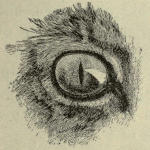
2. Yes! When I looked at my pussy’s eyes, in the bright sunshine, I saw that they are round and yellow, with a black streak in the middle running up and down.
3. The black spot in the middle of my eye is round, and I have read in a book that it is a hole to let in the light, and is called the “pupil.”
4. The black streak in pussy’s eye is the pupil, and it is almost shut up to keep out the bright light.
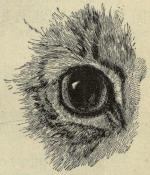
5. I looked into her eyes last night just before dark, and the pupil was large and round, as is shown in this picture.
6. When the pupil is opened so wide, more light is let in, and pussy can see very well when it is so dark I can not see anything.
7. In this way, with her big eyes open, she sees and catches rats and mice that come out of their holes in the night to get something to eat.
8. My kitty loves to sleep in the day-time on the nice bed in her basket, or on the rug before the fire. In summer she likes to go out and get a nap on the grass in the shade of a tree.
9. In the night, when she can see so well, she goes out to hunt and to make visits. When visitors come to see her in the night, we often hear an awful squalling, which I suppose is a “cat’s concert.”
10. In cold, winter nights, kitty mews to be let in, and she then likes to curl up on my bed.
1. Nobody knows where Miss Muffet came from. She walked into the kitchen one day and took her place by the warm fire, and she has been with us ever since.
2. Miss Muffet is a yellow-and-white cat. She is very quiet; but she likes fun for all that, and many a play the children have had with her.
3. When pussy had been with us about a year, we found her one bright May morning under the hedge in the garden with four tiny little kittens.
4. We got a basket and made a nice bed for them, and took them into the house. They grew up to be playful kittens; but one day poor Tinykins fell into a tub of water and was drowned.
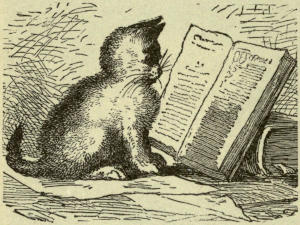
5. We liked Fluffy the best; she looked so wise and would do such queer things. We found her one day sitting in front of a large open book, and looking for all the world like a girl learning her lessons.
6. At other times she would sit all alone as if she were thinking over some very serious matter.
7. One day we found them all in the barn, where pussy had gone to teach them to hunt mice.
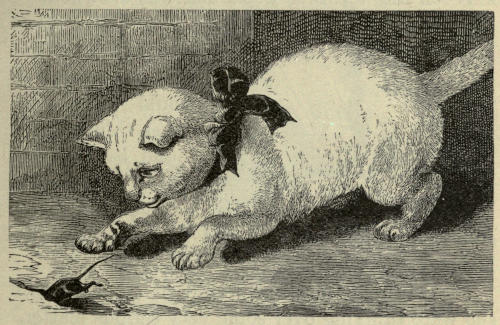
8. We found that Miss Muffet had caught a mouse, and put it before the kitties, and Fluffy was just ready to pounce upon it as we came in. We gave a great shout; two of the kittens sprang back to their mother, and one rushed head first into a large boot that lay in one corner, and the mouse got away. Here is the story in verse:
The Old House-dog.
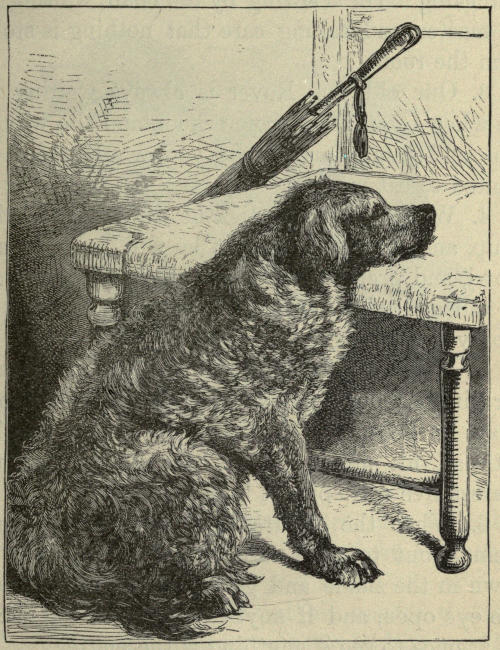
1. Now that Jessie has told us so much about her cat, we would like to hear about a dog. John, can you tell us something?
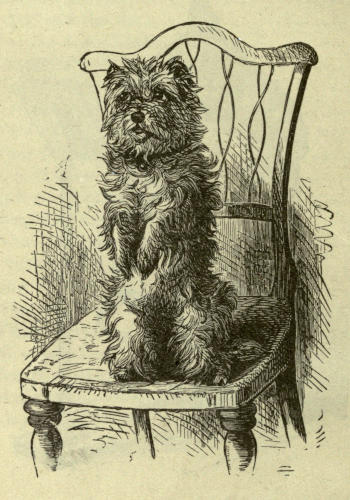
2. Yes! The dog in this picture is an old watch-dog. He is sitting by the chair, waiting for his master, and taking care that nothing is stolen from the room.
3. Our old dog Rover is always waiting for me when I get home from school, and the way he runs and jumps and barks, you would think he wanted to eat me up.
4. When I throw a stick he will run and bring it up, and if I try to get it he will hold on and growl, and pretend to be very angry; but he wags his tail and winks at me, to let me know that he is only in fun.
5. He is a good friend to our old Tabby and her kittens; but when a strange cat comes about, away he goes after her like the wind, barking with all his might. Then the cat goes up the nearest tree and spits at him.
6. When the children are at play, he follows them about to take care of them. He will lie down in the shade and go to sleep; but he keeps one eye open, and if anybody comes along, he is up at once to see if anything is the matter.
7. He loves to play with the children, and every day when nurse goes out with the baby, she gives him a ride on old Rover’s back.
Nero.
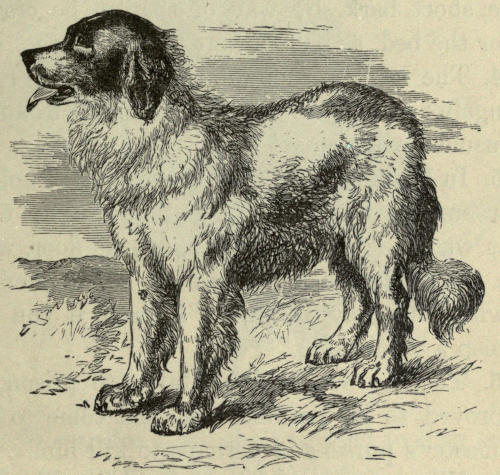
1. Nero was a dog that slept in a kennel in the yard to keep watch in the night, so that no thieves would come about and steal.
2. One night he followed his master up-stairs to his bedroom. The servant turned him out; but he howled and scratched at the door, and, when he was driven away, he soon came back.
3. At last his master, curious to see what he would do, ordered the door to be opened. The dog at once rushed into the room, and, giving a little, short bark, by way of thanks, he crawled under the bed, as if he meant to stay there.
4. The master thought the dog acted rather strangely; but he soon forgot all about it, and, at the usual time, went to bed.
5. In the middle of the night a great noise in the room woke the master, and he got up to see what was the matter. There, on the floor, was a man flat on his back, while Nero stood over him growling in a way that said, “Lie still if you wish to keep a whole skin.”
6. The man was tied and taken to prison, and he proved to be a robber who had come to steal the master’s purse, and perhaps to kill him.
7. What made the dog leave his own bed and go up to the room of his master nobody knew; but he seemed to think that his master was in danger, and so he went up to help him.
8. You may be sure that Nero was well treated after this, and he could sleep where he pleased; but he went back to his kennel, as though he knew it was his place to keep watch out-of-doors.
9. He lived to be a very old dog, and he had the best of care until he died.
1. Well, John, we shall be glad to hear something more about your dog to-day.
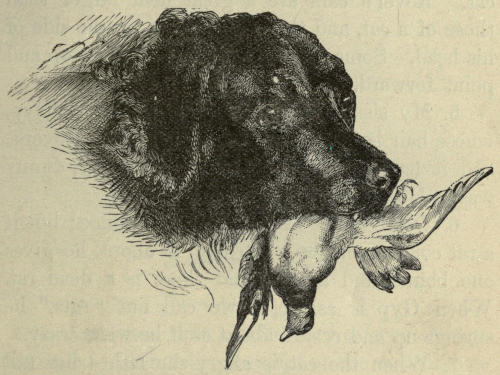
2. Here is a picture of Rover with a bird in his mouth. He has been trained to find the game that has been shot, and bring it to his master. When he takes the bird he is careful not to bite it.
3. Rover has a thick coat of long hair. It is not so fine as that of a cat, but it is enough to keep him warm in cold weather.
4. The cat has a round head, but Rover’s head is long and his nose is blunter than that of the cat. Rover’s ears are a great deal larger than those of a cat, and they hang down by the side of his head. Some dogs have ears that stand up and point forward.
5. My sister has a little white terrier, Gyp, whose hair is silky and much longer than Rover’s, and it hangs down over his eyes in a very funny way. He can see very well for all that.
6. Dogs do not hunt for rats and mice; but if a rat comes in sight when Gyp is about, he gives one bound and a snap, and there is a dead rat. When Gyp is asleep, if we call out “rats,” he springs up and rushes about as if he were crazy.
7. When the cat is angry she lashes her tail from side to side, but when the dog is angry he holds his tail out straight and stiff.
8. When the dog is glad he wags his tail as though he would wag it off. When the little black-and-tan dogs are very glad, you can’t tell whether the dog or the tail wags most.
9. The cat does not like to go into the water, but Rover likes nothing better than to swim out after a stick which I have thrown in. In summer he goes into the water every day to keep himself cool and clean.
1. Once on a time a miller had a large shaggy dog called “Mungo.” He slept at the mill nights, and took care that no thieves came about.
2. He was very fond of the children, and, when baby pulled his hair with both her hands, he looked pleased and would not let anybody know how much she hurt him.
3. In the morning, Mungo would place himself on guard at the upper doorway, while the miller went to look after his work in the lower part of the mill.
4. As soon as the miller came up, Mungo, without being told, would start for the house to get his master’s breakfast. He made two journeys, bringing a pitcher of milk and a dish of oatmeal tied up in a napkin.
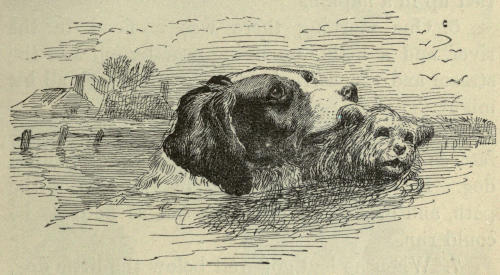
5. One morning there was a flood in the river, and a little dog living near by fell into the stream and was carried down yelping with all his might.
6. Mungo was coming with his master’s breakfast, as usual, when he heard the cry of the little dog. He set the dish down by the side of the path, and dashed off down stream as hard as he could run.
7. When he had got well below the little dog, he sprang into the river, and swam out into the middle of the stream, just in time to catch the helpless dog as he was swept down.
8. Mungo seized him by the neck in such a way as to keep his head above water, swam with him safely to the shore, and dragged him high and dry out of the water.
9. After shaking himself, he cuffed the little dog first with one paw and then with the other, as much as to say, “Now, you little dunce, keep away from the river.”
10. He then went back to where he had left the dish, and carried it to his master as usual.
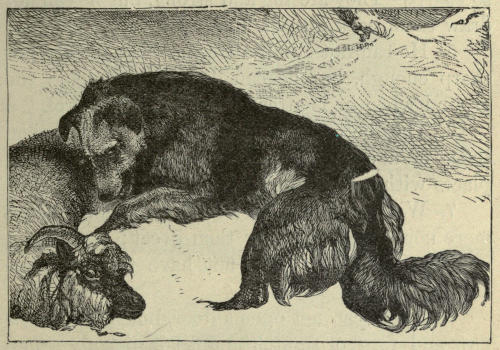
1. To-day, John, we should like to hear something about the dog’s feet and how he uses them. Have you something to tell us?
2. Yes! One way the dog gets about is by swimming. Last summer little Harry fell into the river when no one was near by, and Rover swam in and brought him out.
3. The folks made a great fuss over him then; but he did not mind it, only he seemed glad that Harry was not hurt.
4. I find my dog has just as many toes as a cat. His nails are longer than those of the cat, but not so sharp. They are big and strong, but he can not draw them back into his foot.
5. He can not climb a tree, as his nails are not sharp enough, but he can dig a big hole in the ground when he is after a rabbit or a squirrel.
6. The bottoms of his feet are harder than those of a cat, and he can run all day in rough places without hurting them.
7. With his hard feet and long nails he makes more noise when walking than a cat; but then it is no matter, for he does not have to catch mice and rats.
8. Rover can not open a door, but he raises his paw and raps or scratches until somebody comes and opens it for him.
9. Ask him to shake hands, and he will hold out his paw as well as anybody can, though he has not learned which is his right and which is his left paw.
10. When Gyp is hungry, it is funny to see him. He will whine a little, and then sit up straight and hold out his paws like a little beggar.
11. Then, if you offer him something to eat, he sniffs at it, and, if he does not like it, turns up his nose and goes off. He likes candy as well as I do.
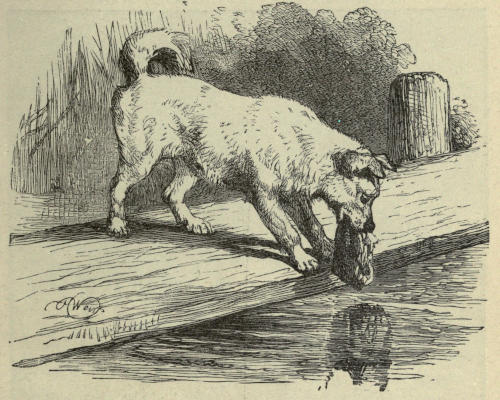
1. A dog with a fine bone in his mouth set out to cross a stream on a narrow bridge.
2. As he was crossing, he looked into the water and thought he saw another dog with a bone much finer than his own.
3. Being a very greedy dog, he dropped his own bone and made a snatch at the one he saw; and so, by trying to rob another, he got a good ducking and lost his dinner.
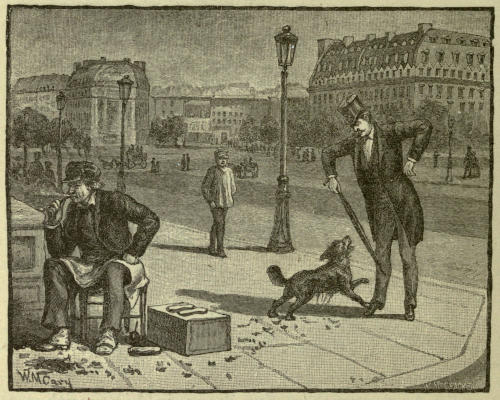
1. In a great city a man had a place near the river, where he blacked boots and shoes.
2. To get more custom, he had a little dog who would roll himself in the mud, and would then rub against the feet of people as they passed by.
3. After a time the trick was found out, and the man and his dog were sent away where they could make a more honest living.
1. To-day we would like to find out about a dog’s mouth and teeth. John, have you something to tell us?
2. Yes! When playing with Rover, last night, he opened his mouth, and I had a good chance to see what was inside.
3. His teeth are like those of the cat, only larger and stronger, and his jaws are so strong that tramps run away when he offers to bite them.
4. When Lion, the old bull-dog, gets his grip on anything, the only way to make him let go is to open his jaws with a bar of iron.
5. The cat uses both its claws and teeth in catching game; but the dog can bite so much harder, that he does not need sharp claws to help him.
6. When a dog eats, he swallows large pieces of meat without chewing, and he will crush a bone to get all the meat and the marrow inside. After he has eaten off the meat, he often swallows the bone.
7. His tongue is not so rough as that of a cat, but he laps water and milk with it, and he loves to lick the hands and faces of his friends.
8. In summer, when it is very warm, the dog does not sweat as we do, but he opens his mouth and pants, and the water runs off from his tongue.
9. When the dog is well, his nose always feels cool; but if he is ill, his nose gets warm.
10. It is funny to see how old Rover will act when some one comes around whose looks he does not like.
11. He just stands up straight and his hair begins to rise. Then he raises his upper lip so as to show his long teeth, and gives a very low growl.
12. Next he steps forward a little and gives two or three short and snappish growls, and then somebody would better look out.
13. One day my mother was coming up the lane, and met a tramp, who made a motion to take hold of her. Rover made one spring, and his jaws snapped. The fellow yelled, and, as he ran away, he limped as though he had been hurt. Since then he has not been about.
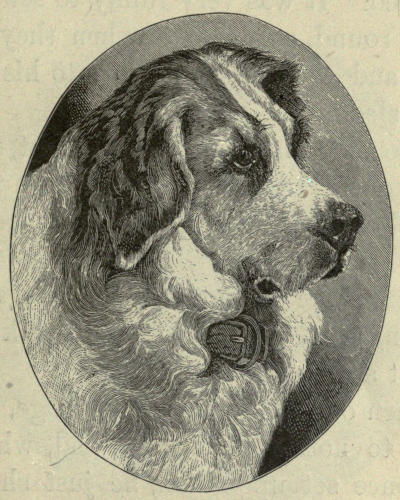
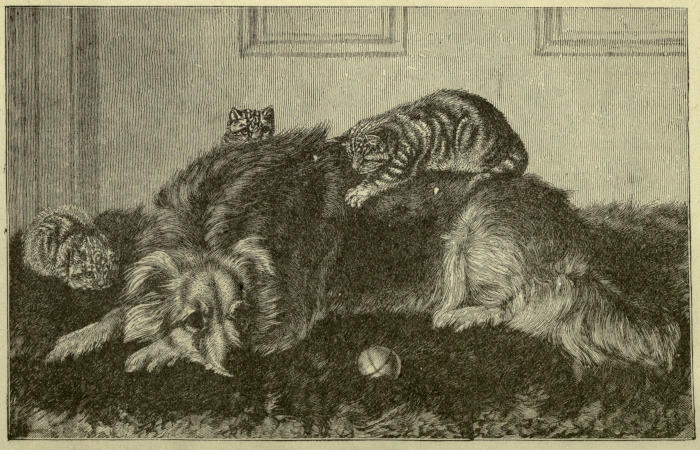
1. “Lupo” was a very large dog with a thick, white coat. He was so good-natured and faithful, that his master felt that the children were safe when Lupo was about.
2. In winter Lupo liked to stretch himself before the fire, and, when he did so, he took up the whole hearth-rug, and there was no chance for any one else.
3. “Tiny,” the little terrier, liked the fire as well as Lupo, but could find no place where it was not either too cold or too warm.
4. So she would climb up on to Lupo, and use him as a bed. It was very funny to see her tread round and round, as dogs do when they make up their bed, and then nestle down into his long hair and go to sleep.
5. When Tiny had her bed all right, she would not let Lupo move. If he stirred, she would fly at his head and bark and growl in a most spiteful way.
6. Then, if he did not stop at once, she would bite his long ears, and Lupo would sink back and lie as quiet as a lamb.
7. When out following the carriage, Lupo did not seem to notice little dogs, and, when a half dozen at once set upon him, he just shook them off and kept on his way.
8. But he was not always so good-natured. When a big dog came in his way, he seemed to feel that it was a duty to whip him.
9. There would be a growl and a snap, and away would go the other dog over Lupo’s head, with a piece of his hide gone or some of his bones broken.
10. As Lupo could not be broken of this habit, whenever he went out his master would put a muzzle on him so he could not bite.
1. I think John has something new to tell us about his dog to-day. Let us listen to him.
2. I have looked at my dog’s eyes, and I find that the pupil is round, like mine, and it does not shut up into a streak, as in a cat.
3. The dog does not see so well in the night as a cat, but his sense of smell is much more keen.
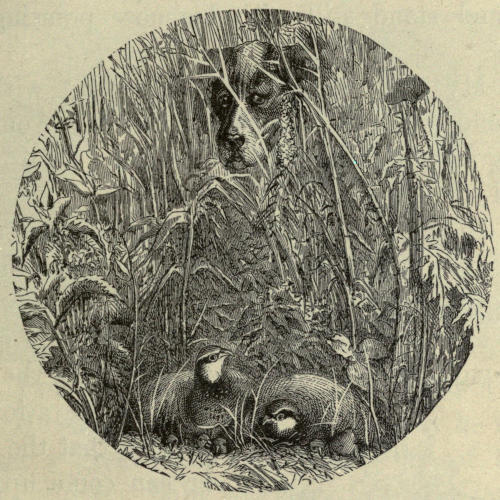
4. My uncle has a pointer-dog named “Grouse,” and one day I went out with them to hunt quails.
5. Grouse would run all about until he smelled the birds, and then he would creep along a little way and stand still with his nose pointing forward.
6. My uncle would then come up with his gun, and, when he was ready, the dog would go slowly forward scaring the birds up, when uncle would shoot them.
7. In this picture we see a dog pointing quails among the reeds. The birds hear him, and are just ready to fly.
8. A dog will follow the track of his master for a long distance, and hounds will follow the track of a wolf or a fox or a bear, so that the hunter can come up with it and kill it.
9. Rover is a good watch-dog, and, if he hears or smells any body about in the night, he makes a great racket.
10. He knows, too, where the other animals belong, and, if a cow or a pig gets into the garden or yard, he goes and drives it out.
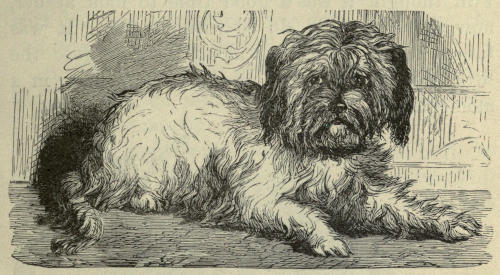
1. Puff was a tiny little terrier and a great pet. He came by his name from a way he had of making a great fuss, and getting out of breath about nothing. Baby was crazy to get hold of him, and, when she saw Puff, she would wriggle out of any one’s arms to get to him.
2. The children needed only say, “Baby, Puff is coming,” when she would give a crow of delight, and out went her little arms, fingers, and legs, all working together.
3. But Puff’s hair was long and his skin tender, and, when baby’s fingers got hold of him, his howls were dreadful, and he never got away without leaving some of his coat in baby’s fingers.
4. One day baby was asleep on the sofa, and Puff thought it was a good time to look at her, now that he could do so without fear. It was funny to see him creep along, peering into the little sleeping face, but ready to start back in a moment.
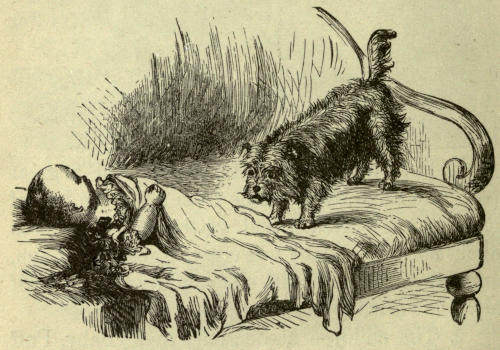
5. He went closer and closer, until his little cold nose touched baby’s mouth, when she woke with a sudden start, threw out her two little fat hands, and seized him by the whiskers.
6. Puff pulled and howled and backed off the sofa, dragging the baby after him; but she fell on top of him, and was not hurt.
1. When Puff would lie quite still out of doors, with his nose pointed one way for a long time, the children knew what was the matter.
2. There was a rat somewhere about, and Puff had seen him go into his hole and was watching for him to come out.
3. The boys would get a spade and begin to dig, and, when they had got in a little ways, Puff would take the matter into his own hand, and dash into the hole.
4. His little, short paws would make quick work, and he would dig in until even the tip of his tail could not be seen.
5. Then a squeak would be heard, and Puff would back out with a rat in his mouth, which he knew what to do with to prevent being bitten himself.
6. He would fling the rat into the air, and, as it would come down, he would catch it by the nape of its neck, give it a shake or two, and it was dead.
7. How proud he was then! He would lay the rat down in different places to see where it would look best, and then he would carry it round to each one in the house, until somebody took him and scrubbed the dirt off, so he was fit to be seen.
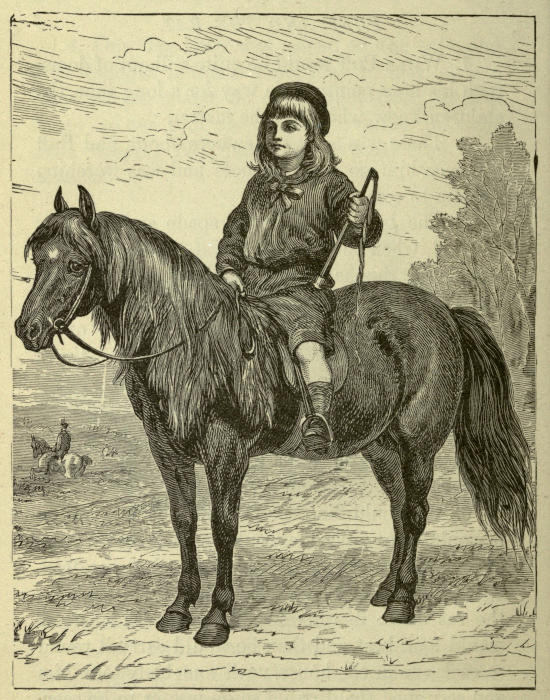
1. Here we have the picture of a boy and a pony. The boy is taking a ride; but he has stopped, and seems to be waiting for some one.
2. Now we must find out something about the horse, and, Charlie, I think you can tell us what we wish to know.
3. I can tell something how a horse looks and what he can do, for we have horses at home, and I help take care of them.
4. The horse is much larger than the cat or dog. His home is in the stable, and he does not come into the house, as they do.
5. His head is long, and, when he puts his nose to the ground, the top of his head is just about as high as the top of a flour-barrel.
6. His eyes are large and round; his nose is much wider than that of a dog, but he has smaller ears than some dogs, and they stand up straight.
7. Upon the top of his head, and along the top of his neck, he has a thick bunch of long hair, which is his mane.
8. He has a broad, strong back, and can carry a man all day without being very tired. There is room upon his back for two persons, and some times two ride at a time.
Full Speed.
9. He has long legs, so that his head is about as high as the top of a man’s hat.
10. He is covered with a thick coat of short hair, and this keeps him warm, except in very cold weather, when he needs a blanket.
11. Instead of claws, he has hoofs, hard like bone, so that it does not hurt him when he trots or runs on the ground.
12. When horses work, or travel over a hard road, they have iron shoes nailed to their hoofs, so that they will not be hurt by striking the stones.
13. The hoofs have no feeling on the outside, and it does not hurt the horse to have these shoes nailed on. They grow like our nails, and must be pared once in a while.
14. The horse can paw with his fore feet, and kick with his hind ones, and, when he kicks hard, he breaks things. He has a tail covered with long hair, and this he uses as a switch to keep off flies in summer.
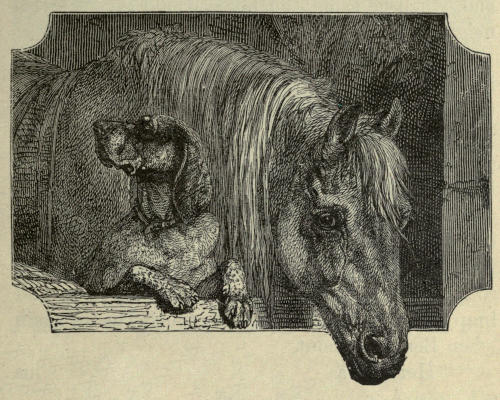
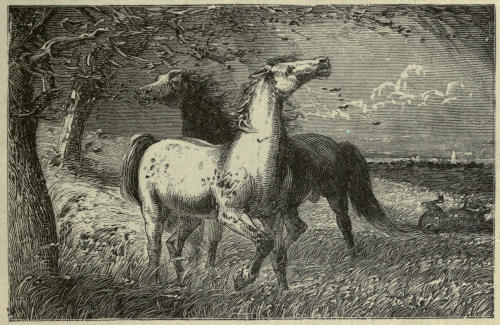
1. In some places men keep horses to ride when they go out to hunt foxes, and these horses are called hunters.
2. Dogs are also used in the hunt, and the horses and dogs are so much together that they often become the best of friends.
3. Once old “Hector,” a dog, had such a liking for his friend “Ben,” the hunter, that he would leave his own bed and go and sleep with Ben in the stable.
4. In the morning when Hector was let out, Ben would be very uneasy until he came back, and, when he came, the horse would give a joyful neigh.
5. Ben would stoop his head, and Hector would lick it all over, and then Ben would scratch Hector’s back with his teeth.
6. One day when they were out together a big dog set upon Hector and threw him down, and began to bite and tear him.
7. Ben saw the danger his friend was in, and rushed forward to help him. The strange dog felt a grip in the back, and then he was thrown so far that he was glad to be able to get up and limp away. He never tried to touch Hector again when Ben was about.
8. Here is another story of a horse and his friends: A poor stray kitten found its way into a stable and made its home there.
9. It soon made friends with a lame chicken and the pony, and the three were never quite happy except when together.
10. It was very funny to see the kitten and the chicken close together upon the pony’s broad back, while he would stand very still so as not to disturb them.
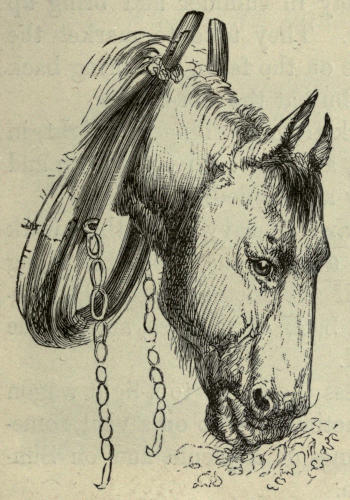
1. To-day we wish to find out something about a horse’s mouth, and how he eats. Can you tell us, Charlie?
2. Yes! I have looked at the horse’s mouth, and can tell about his teeth. In front, on each jaw, he has six teeth with sharp edges. These cut the grass when he feeds in the pasture.
3. Next back of these are four sharp teeth, one on each side of each jaw, and these are sometimes called tusks. They are in the same place in the jaw as the long teeth of the dog, and with them the horse can tear things.
4. Next back of the large teeth there is a place where there are no teeth, and this is the place where the bit of the bridle goes when we ride the horse or drive him in a carriage.
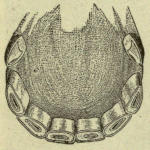
5. Next back are six broad, flat teeth, on each side of each jaw, and with these the horse grinds his food before he swallows it.
6. In summer, if our horses have not much to do, we turn them out to pasture, where they eat grass. In winter we give them plenty of hay and oats, and, when they work, we always feed them with grain.
7. Horses will eat grain of any kind, but they seem to like oats best. We sometimes feed them with corn-meal instead of oats.
8. The teeth of a horse change in looks every year until he is eight or nine years old, and men who are used to horses can tell how old they are by just looking at their teeth.
9. The horse does not lap his drink like a cat and dog, but he puts his mouth into the water and swallows whole mouthfuls. He will sometimes drink two or more large buckets of water at a time.
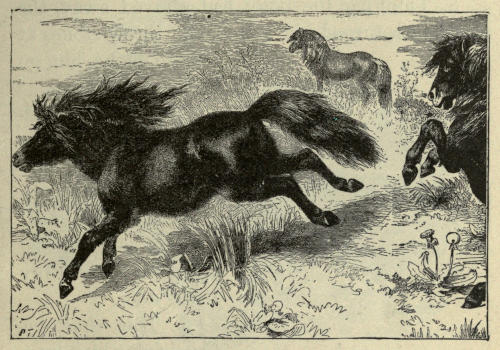
1. “Billy” was a fine pony, brought from Shetland for a little boy to ride to and from school, as the distance was too great to walk. When Billy first came he was barefoot, and when he began his daily journeys he was shod for the first time.
2. The blacksmith who put on the shoes lived quite a long distance from Billy’s home, and the pony had never been over the road but on the day he went to be shod. A few weeks after, the blacksmith saw Billy, without halter or bridle, coming up the road toward the shop.
3. Thinking the pony had strayed away, the blacksmith turned him round, and threw stones at him to make him go back toward home.
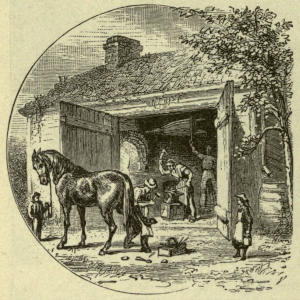
4. The pony trotted off; but the blacksmith had only fairly got to work again, when he heard a noise, and, looking up, there stood Billy at the door.
5. This time, before driving him away, the blacksmith took a look at his feet, and found that Billy had lost a shoe. He at once made a new one, and put it on, and then waited to see what Billy would do.
6. The pony looked at the blacksmith for a moment, as if asking whether he was done; then he pawed, to see if the new shoe was all right, gave a neigh for a “thank you, sir,” and set off for home on a brisk trot. His master knew nothing about the matter until next day.
1. To-day we are to find out what the horse is good for. Charlie will tell us whether the horse is of any use on the farm.
2. We could not get on very well without horses on the farm. They are very strong, and will do a great deal of work that a man can not do.
3. They carry us on their backs, and draw great loads that half a dozen men could not move.
4. With them we plow and harrow and prepare the ground for planting. If we did not have horses, or other animals that can do the same kind of work, a man could only plant a little patch that he could dig up with a spade.
5. They draw loads of grain and fruit to market, and bring back what is needed on the farm. They draw in the hay in summer and bring up the wood in winter. They take to market the things which we raise on the farm, and bring back the goods which we buy at the store.
6. They will work from morning till night, in all kinds of weather, and are ready to get up and be off whenever they are needed.
7. When they have a heavy load, they walk along slowly; when a light one, they trot along quite rapidly. But if the doctor is needed, somebody jumps on the back of a horse, and off he gallops like the wind.
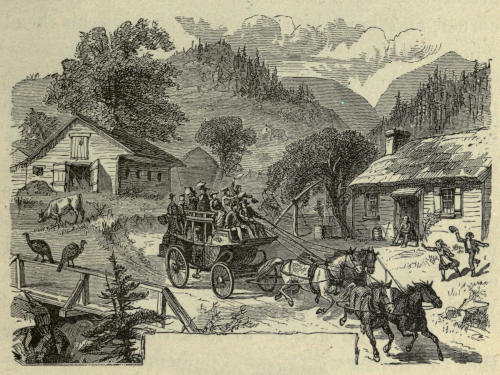
8. Then we harness the horses to a light wagon and take a ride; sometimes we go on a visit, sometimes to mill, sometimes on a picnic, and on Sundays we go to church.
9. In the winter, when snow is on the ground, horses draw sleighs instead of wagons. The sleigh makes but little noise in slipping over the snow, and a string of bells is put upon the horse to let people know that the sleigh is coming, so that no one need be run over.
10. When we go out sleigh-riding, all wrapped up in blankets and robes, the horses scud along, the bells jingle, and we have a gay time.
The Stage-Coach.
1. Horses, when they do not work too hard, love to play and have fun. They will race after each other, kick up their heels, and have a merry time. Here are two stories which a man tells of the kind of fun that the horse seems to enjoy:
2. “One of our horses, ‘Billy,’ used to give us a great deal of trouble, he knew so much. He had found out how to untie his halter, and open the stable-door, and so would get out when the door was not locked. One day Billy came out, and found little Harry in the yard. He did not attempt to hurt the child, but drove him into a corner, and kept him there by shaking his head whenever the little fellow tried to get away.
3. “I heard Harry cry, and led Billy away; but he gave a parting shake of his head to the boy, as much as to say, ‘Next time I will look after you closer.’
4. “Coming home one evening, I heard a couple of horses running and frisking about in the farm-yard at a great rate. The wall was high, and I could only see their heads, and once in a while a whisk of their tails.
5. “I found a hole to look through, and saw that the horses were amusing themselves by chasing a pig around the yard.
6. “They would drive it into a corner, and fling their heels into the air with great delight. They would not give the poor pig a moment’s rest.
7. “They would rest for a few minutes, and the pig would settle down to his cabbage-leaf, when they would rush at him from different sides, so that he had not the least idea where to run to get away from them.”
1. We see, from what Charlie has told us, how useful the horse is. We now would like to have him tell us how we should take care of horses.
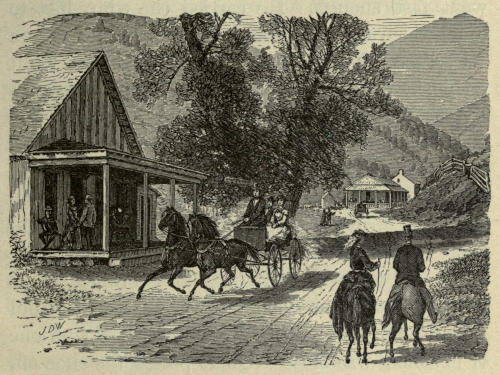
2. I will do so by telling a story. Last Saturday Uncle William hitched old Major and Ben to a big wagon, and took a load of boys to Oak Hill, to pick berries and have a good time.
3. I tell you uncle knows what boys and horses want, if anybody does. Pretty soon Bobby Jones wanted to drive. So uncle gave him the reins.
4. Bobby wanted the whip, too; but uncle said that we should not whip the horses, as they went fast enough. He carried the whip just to touch them up when there was any danger.
5. Then Bobby began to jerk the reins; but uncle showed him how the horses would move one way or the other by pulling the rein a little, and he told Bobby that jerking hurt their mouths.
6. When we went down Stony Hill, just before we came to the long bridge, uncle took the reins, and drove slowly, because, he said, it would make the horses lame to drive fast down hill.
7. As we were crossing the bridge, uncle jumped out to see what was the matter with old Major, who was limping a little, and he found one of his shoes was loose. Uncle pulled the shoe off, and threw it into the wagon, and then walked the horses until we came to the blacksmith’s shop, on the other side of the bridge.
8. Then they took old Major into the shop, and the blacksmith pared the hoof and set the shoe. In nailing on the shoe, he said he must be careful not to drive the nails too far in where the hoof was tender, or it would make the horse lame.
9. In going up Oak Hill, uncle would stop the horses every little way to let them rest. They would pant for a minute or two, then take a deep breath and go on. There was a cool spring close by, where we stopped to go into the berry-field, and here we hitched the horses in the shade.
10. They were very warm and thirsty, but uncle would not give them any water until they had time to cool. The flies were awful, but our horses switched them off with their long tails.
11. Near by was a little bob-tailed horse turned out to pasture; and, as he could not switch off the flies, they bit him so he could hardly get time to eat. If the man who owned that horse could have the flies bite him so for a few days, I don’t think he would cut off the tail of another horse.
12. We just filled our baskets with berries, and ate our dinner under the shade of some big trees that stood by the spring. Then we came home.
13. Uncle’s horses are steady, because he uses them well. He never jerks them, or whips them, or yells at them. When he goes near them they rub their noses against him, they are so glad to see him.
14. In winter he puts blankets on them when they stand still, for he says their coats are not thick enough to keep them warm. Then he gives them a good bed of dry, clean straw to lie on, and plenty of hay and grain to eat.
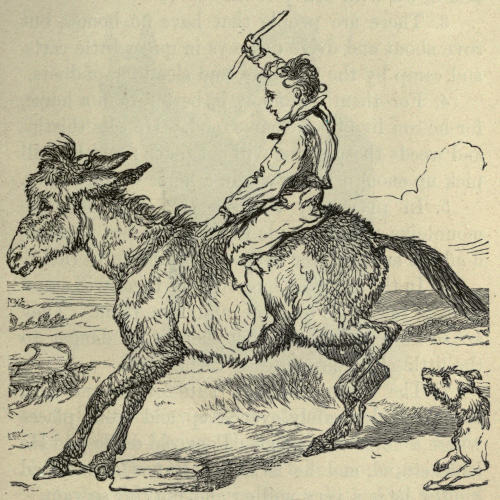
A ride, and what came of it.
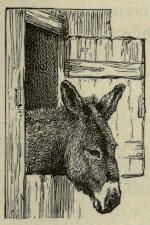
Good Morning.
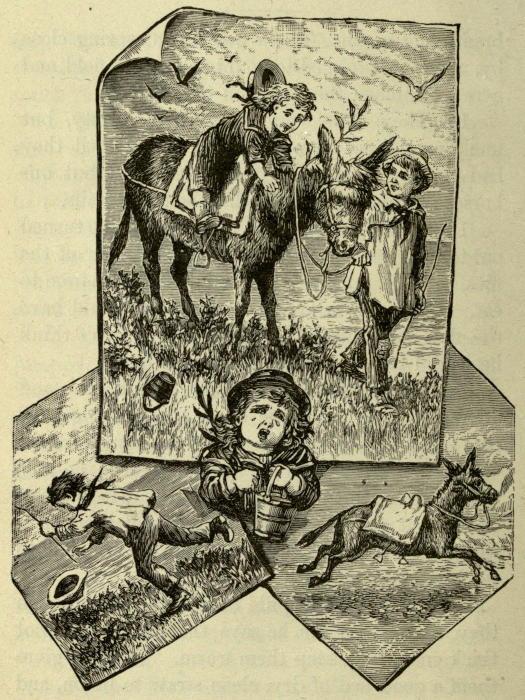
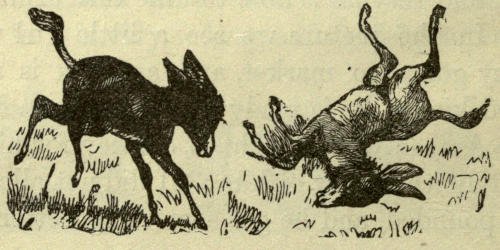
1. On the other page we see a boy on the back of a donkey, taking a ride. The donkey looks kind and steady, but look below and see what has happened!
2. We will call upon Harry to tell us something about the donkey—how he looks, and what he can do.
3. The donkey is much like a horse, only smaller. His head is larger and more clumsy than that of the horse, and his ears are much larger.
4. His nose is blunter than that of a horse, and his legs are shorter. He has some long hair between his ears, but no mane on his neck. His tail is long and slim, with long hair only on the end of it.
5. His feet have hoofs like those of a horse, but they are smaller, and he can travel in many places where a horse can not.
6. His coat is longer and thicker than that of the horse, and he can get along with much less care. He goes along with his head hanging down, as if it was too heavy for him to hold up, and he looks very awkward beside the horse.
7. He has teeth like those of a horse, so that we can put a bit in his mouth when we drive him.
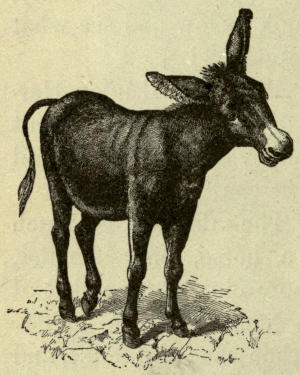
8. In color, most donkeys are brown, or a dirty white, with a black stripe along the back, from the head to the tail, and also a black stripe across the shoulders.
9. When the horse neighs, his voice is very pleasant; but the donkey’s bray is loud and harsh, and when he opens his mouth his voice is heard above all others.
10. I read the story of a man riding a donkey in the West, when the Indians caught him. As they were about to carry him off, the donkey gave an awful loud bray, which scared the Indians, so that they ran away and left the man to go on his journey.
1. Poor, old donkey! In some countries he is made to do all kinds of hard and dirty work, and he is driven about with many blows and kicks.
2. The rag-man, in the city, picks up a load for him out of the gutters; and the tinker, who goes about mending old pans and kettles, loads him down with heavy tools.
3. There are people that have no homes, but rove about and drive donkeys in queer little carts, and camp by the way-side, and sleep out-of-doors.
4. For them a donkey is better than a horse, for he can live upon coarse food. He eats thistles and weeds that a horse will not touch; and he will pick up enough to eat where a horse would starve.
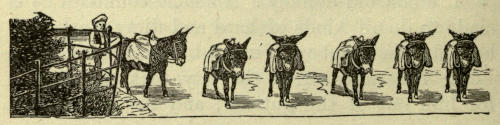
5. In places by the sea-side, or among the mountains, where people go to stay in hot weather, donkeys are kept for ladies and children to ride.
6. In the morning, long rows of them will stand waiting for ladies to come and hire them. They are so kind and steady, that there is no danger to the little children who ride them.
7. The donkey is very sure-footed, and will carry his rider safely over steep and stony places where a horse can not go. Poor, old donkey! He looks stupid, and he is slow. But, when treated kindly, he is a very willing and faithful servant.
1. The donkey is not as stupid as he looks, and he has often shown that he knows what he is about, and that he is able to take care of himself.
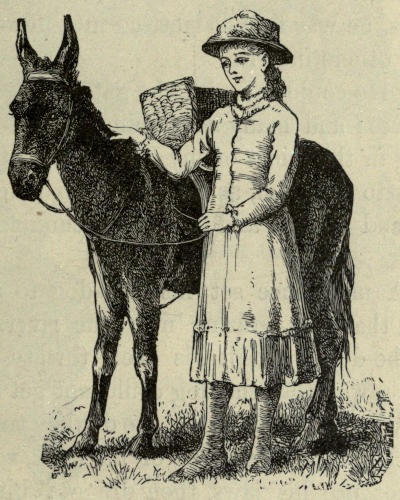
2. In the picture we see a little girl with a donkey going to market, and as Dick is always treated kindly, he is ready to do all he can for her.
3. A man who bought a donkey for his children, tells this story of him: “I did not allow him to be pounded, and he got something better to eat than thistles. My donkey proved to be no fool; but, like others, who have more wit than good manners, he was forever getting into mischief, and leading others into it.
4. “He could open all the gates, and climb all the fences; and many a morning he woke me by braying in the midst of my field of wheat. I was obliged to sell him, as he knew too much about doors and gates, and was too cunning to be kept.”
5. A man once set his bull-dog to attack a donkey that was grazing near the river. For a while the donkey kept his heels toward the dog in such a way that the dog could not get at him.
6. Watching his chance, the donkey turned and seized the dog by the nape of his neck, so that he could not use his jaws, then dragged him to the river, plunged him in, and lay down upon him, keeping his head under water until he was drowned.
Oxen at Work.
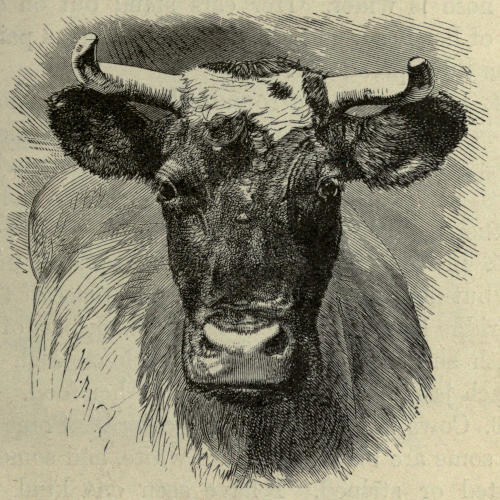
1. Among our four-footed friends the cow comes next, and we wish to find out something about her. Will, do you think you can help us?
2. Yes! Since we began these lessons I have watched our cows, and have found out some things that I did not know before.
3. The cow has a heavier body and shorter legs than a horse. She has a short neck, and a long tail, with a bunch of coarse hair on the end of it. Her head is larger than that of a horse, and her nose is wider. Her ears stand out on each side of her head, and above them she has a pair of horns that spread out.
4. Her hoof is not round, like that of a horse, but is split into two parts, and is called a cloven hoof. She has a thick coat of coarse hair, which keeps her warm in all but the very coldest weather.
5. In front, the cow has six teeth on her under jaw, but none on her upper jaw. In place of teeth is a ridge hard as a bone. In the back part of her mouth she has six broad, flat teeth on each side of each jaw, with which she chews her food.
6. Cows are of different colors. Some are red, some are black, some are white, and some are spotted or striped. I have seen one kind that looked like a black cow with a white blanket on.
7. When the cow eats grass, she swallows it without chewing. When she has enough, she stands still or lies down, and the grass comes up into her mouth in little balls, and these she chews fine and swallows again.
8. The ball she chews is called a “cud,” and she will chew one cud after another, until she has chewed up all the grass she has eaten.
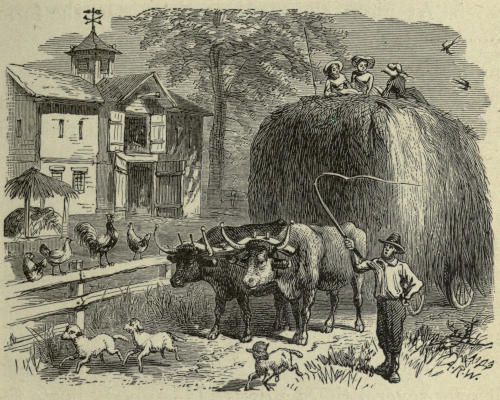
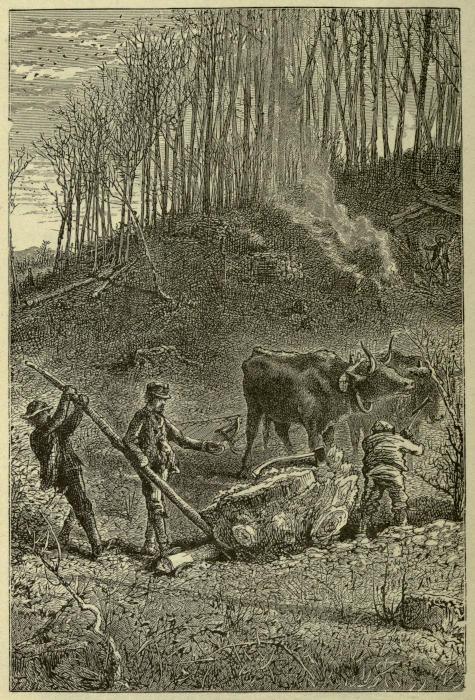
1. The ox is very strong, and can do work like a horse. When oxen are used, two are put together with a wooden yoke on their necks.
2. Oxen can draw large loads, and can work a long time without being tired; but they are so slow that they are not used much, except on farms.
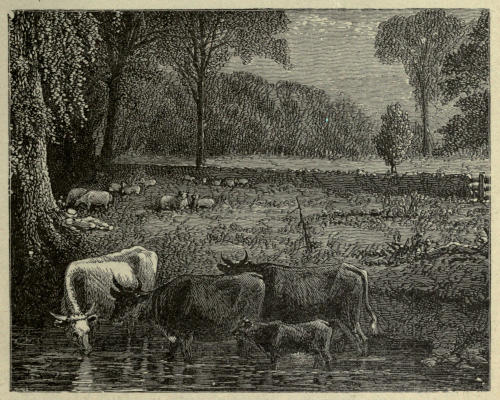
3. In summer, cattle run in the pasture and live upon grass. They gnaw it off close to the ground, and they feed most of the day.
4. In the middle of the day, when the weather is hot, they lie down in the shade, or stand up to their knees in the water, to keep cool.
5. At night the cows are driven to the farm-yard and milked, and in the morning they are milked again and driven back to the pasture.
6. In winter, cattle are kept in the stable, or in the farm-yard where there is a shed that they can go into when it storms or is very cold.
7. They are fed with hay; but cows that give milk, and working-oxen, are fed with grain also. Beets and turnips are sometimes fed to cattle.
8. When cattle stand in the shade chewing their cud, there is no other animal that looks so mild, and pleasant, and happy.
9. The cow is very fond of her calf, and licks it over several times a day. If anybody hurts the calf, he must look out for the old cow’s horns.
10. I have heard of a little lamb that had lost its mother, and was put into a lot with six cows. After a time he was taken out and put with the other sheep. But they all fought him, and he was sent back to his old pasture.
11. The cows all rushed up to meet him, and he ran to each in turn. Then one cow licked him all over, and he was passed to the next, and so on until all had done the same thing.
1. Cattle do not hunt rats and mice like the cat, nor watch like the dog, nor do we ride them as we do a horse or a donkey; but in some ways they are more useful to us than any of the others.
2. When Johnny sat down to breakfast this morning, a cow gave him that bowl of fresh, rich milk, which he ate with his bread. Then, when we drank the nice cup of coffee that mamma had made, the cow gave us the cream which we put into it.
3. When the dinner was put up for school, the cow gave the cheese and the butter that was spread upon the bread. In the nursery rhyme “Little Miss Muffet sat on a tuffet, eating the curds and whey” which the old cow gave her.
4. This morning Johnny’s hair was in a snarl, and mamma got it out with the help of the old cow, who gave the horn to make the comb.
5. When we go out in wet weather, the cow gives her hide to be made into the leather out of which our coarse boots are made; and the calf gives its hide for our fine boots and shoes.
6. When our new room was plastered, a little while ago, the cow gave the hair to mix with the mortar, so that the plaster would stick together and stay on the wall.
7. Before we get our chairs and tables, the cow takes off her hoofs and gives us the glue with which they are put together. Then Santa Claus could not bring Johnny his white-handled knife till the old cow had given a bone for the handle.
8. “Sleepy-head goes to bed” at night, and the candle he carries is another present from the old cow. The flesh of grown cattle that we eat we call beef, and the flesh of calves, veal.
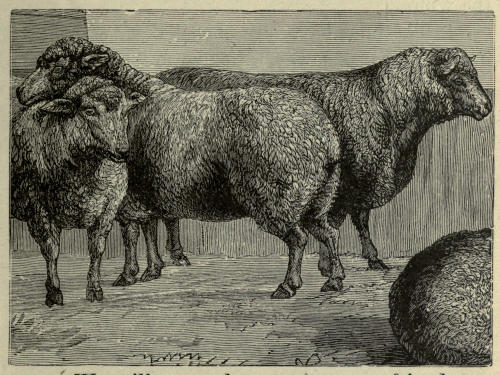
1. We will now take a look at our friend, the sheep. See it stand there, looking so kind, and harmless, and innocent!
2. The sheep is much smaller than a cow, and in size is like a large dog. Its nose is more pointed, and its ears are smaller, than those of a cow. It has small, cloven hoofs, and it eats grass and chews its cud in the same way that a cow does.
3. Its jaws are like those of a cow, with no teeth in its upper jaw in front, and with broad, flat chewing teeth back. Like a cow, it feeds upon grass in the summer, and upon hay and grain in the winter.
4. The rams have large horns that twist about in a very curious way. Lambs are playful, like kittens, and they hop and frisk about, and they sometimes have great games with old Rover or with the cat.
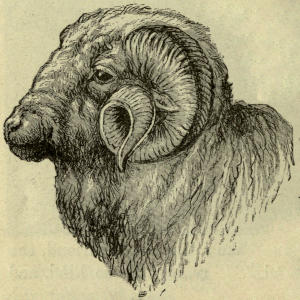
Head of Merino Ram.
5. Sheep are covered with a thick coat of wool, and this keeps them warm, so that they can live out-of-doors in the coldest weather. In summer their “fleece” of wool is sheared off. The wool is made into cloth, and the cloth is made up into clothes for folks to wear, so that the coat of a sheep makes the coat for a boy.
6. Besides our clothes and blankets, the sheep gives us fine, thin leather to bind books and make gloves, and tallow to make candles and soap. The flesh of sheep, which we eat, is called mutton.
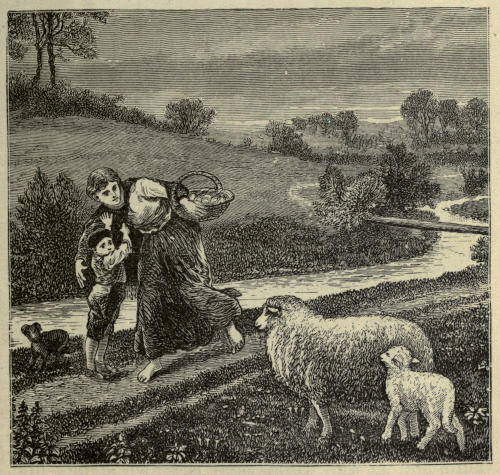
1. Sheep appear very helpless, but when they run wild they know how to take care of themselves very well.
2. They butt with their heads, and the large, old rams will run very fast, and strike a fearful blow.
3. When a flock of wild sheep is feeding, one is placed at some distance out on each side, to keep watch.
4. If an enemy is seen, the guards give a kind of whistle, and the whole flock scuds away to the rocks on the mountain.
5. If they can not get away, they place the lambs in the center of the flock, and the old sheep face outward, the biggest rams in advance.
6. When the fox or the dog is within a few yards, the rams rush at him, and they are nearly always successful in killing or driving him away.
7. The ewe has so strong a love for her lamb, that she will face any danger to protect it.
8. One day a shepherd saw a fox in a high, rocky place, trying to get a young lamb; but the old ewe kept her head toward the fox, and gave him no chance.
9. At last the fox made a spring and seized the lamb, and at the same time the ewe struck him with her head, and they all went over the rocks and were killed.
10. There are sheep in South Africa which have tails so large and fat, that the people tie them to small carts so that the sheep can get about. The fat is used for butter.
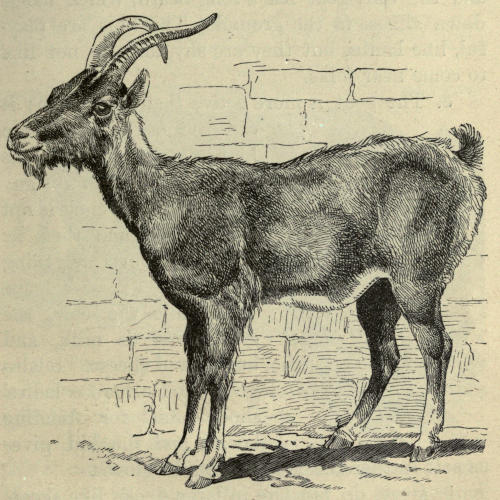
1. In many ways the goat is like the sheep. It is about the same size, and has the same kind of teeth and hoofs, and it eats the same kind of food. It has a thick coat of hair. Some goats have fine hair that is made into cloth and nice shawls.
2. All the goats have spreading, sharp horns, and the billy-goat has a long beard, which hangs down almost to the ground. The kids are playful, like lambs, but they are shy, and do not like to come near folks.
3. The goat is more active than the sheep; it can run faster and jump higher, and it climbs rocks where a sheep can not go.
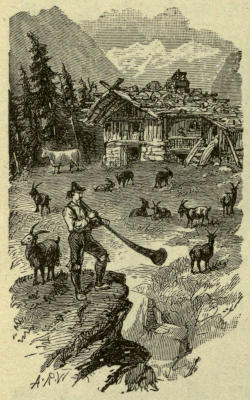
4. The billy-goat is apt to be cross, and then he runs and butts anything he meets.
5. Like the cow, the goat gives us milk, and butter, and cheese. It also gives fine leather for ladies’ shoes and for binding books, and the kid gives us soft leather which is made into gloves.
6. Goats do not live in large flocks like sheep, but they go about three or four together, and will pick up a living where a sheep would starve.
7. They are so sure-footed that they will climb up the sides of steep rocks, wherever they can find a place to put their little pointed hoofs.
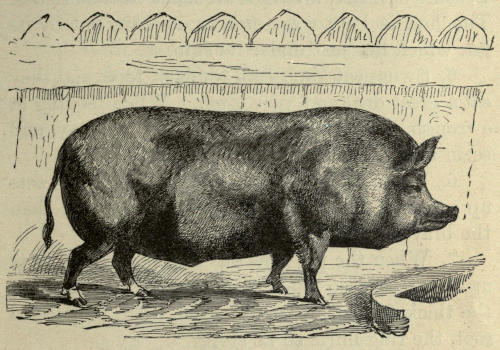
1. The hog is about as large as a sheep, but its legs are shorter. It has a cloven hoof, but it does not chew a cud like the sheep.
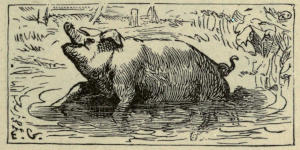
2. It has a long, blunt nose called a snout, and this it can move about to smell something to eat. It can use its snout, also, to root up the ground for seeds and other food.
3. Its ears are large and lop over; and it has a queer little curly tail. It has four large pointed teeth, called tusks, and with these it can inflict worse wounds than a dog.
4. It is covered with coarse hair called bristles. Brushes of nearly all kinds are made of the bristles. The hog is kept warm not by its hair, but by its fat, which lies just under its skin.
5. Swine eat almost all kinds of food, and they eat a great deal and very often. When feeding at a trough, they root each other out of the way, and seem in a great hurry to get all they can.
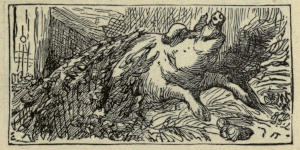
6. When a pig is caught, or is hungry, it sets up a fearful squeal, which is worse to bear than the bray of a donkey.
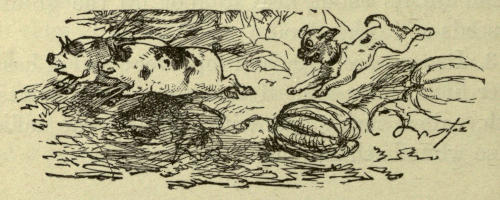
7. When the pig runs out in a pasture, it roots up the ground so much that a ring is put through the thick edge of its snout; then, when he tries to root, the ring hurts so he stops.
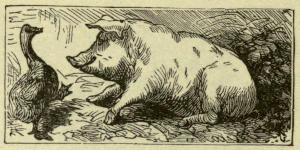
8. It is not best to meddle with little pigs, and make them squeal, when the old sow is about, for she is ready to fight for them at any time.
9. The flesh of swine is called pork, and when salted and smoked it is bacon.