SCORCHED and blasted as much of the ground about Glasgow is, this city
lies hard by some of the finest and most famed scenes of Scotland, to be
easily reached by land or water. Even busy Paisley, nurse of poets as
well as of weavers, has a point of high antiquarian interest in its
restored Abbey Church; and a stretch of moorland rises behind smoky
Greenock, with its monuments to James Watt and to “Highland Mary.” Not
to speak of land-and sea-scapes “down the water,” up the river,
Clydesdale shows us on what green banks and braes Glasgow once stood,
which may yet spread its octopus arms about Cadzow and Bothwell Castles
and the Tower of “Tillietudlem.” There has been talk of harnessing to
industry those rushing Falls of Clyde, the upper linn, Bonnington, a
miniature of Niagara that is already slave to the Philistines. Below
this fall, the mills of New Lanark record the well-meant industrial
experiments of David Dale and his son-in-law Robert Owen. In a cave near
the Stonebyres Fall, young William Wallace took hiding after he had
slain the English sheriff at Lanark, where now the hero’s statue stands
over the church door, strangely arrayed in a kilt that gives him
somewhat the aspect of that snuff-shop Scotsman. Wallace came from the
Renfrewshire Ellerslie, and many of his guerilla exploits were in this
west country, though his noblest monument has found a proper site near
Stirling. Ayr, town of “honest men and bonnie lasses,” cherishes other
legends and memorials of him, here almost forgotten in the renown of
Robert Burns’s birthplace near the mouth of his “bonnie Doon.” An hour’s
stroll along the seashore from Ayr brings us to that humble cottage,
better neighboured by “Alloway’s auld haunted kirk” than by the
pretentious classical monument that so ill fits Scotland’s “barefoot
Muse.” Then from this coast to Dumfries, the valleys of the Ayr and the
Nith are sown with memories and needless monuments of the poet who spoke
the people’s heart. Above Nithsdale, in the south of Lanark, rise the
Lowther Hills, that for height might call cousins with some Highland
Bens. Here stands Leadhills, the highest village in Scotland, birthplace
of Allan Ramsay; and near the wider pass, through which went the old
highroad to the south, may be sought out the “sudden and immense depths”
of the Enterkin, renowned by Defoe and by Dr. John Brown, as gloomy
scene of an encounter between persecuting dragoons and the armed
Covenanters, who had many a fastness in this hill-country.
The “Scott country” has its brightest associations in chivalric war. The
“Burns country,” which is also the Wallace country and the Bruce
country, has been the cradle of the strongest Scottish sentiment, as of
the most popular movements. Long before Burns was born, it got the
familiar name of the Whig country, as congenial soil

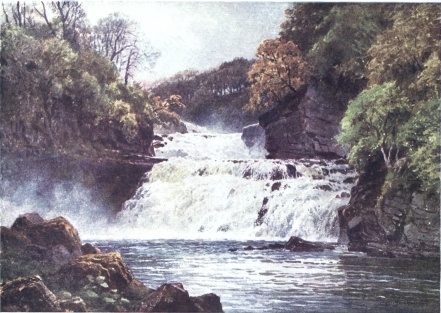 THE FALLS OF THE CLYDE, LANARKSHIRE
for those aspirations after both political and religious freedom that
have gone so far in shaping our constitution. Burns, it will be noted,
had sucked in the political better than the religious spirit of the
region; though he confesses that “the Muses were all Jacobites,” and
once in a way he fires up with—
The Solemn League and Covenant,
Cost Scotland blood,—cost Scotland tears,
But it sealed Freedom’s sacred cause.
Here first arose the nickname Whig or Whiggamore, as its opposite Tory
did in Ireland, both of them originally no compliments. A Whig of our
time is taken to be an eminently sober and staid, not to say lukewarm
politician; but the first Whigs were fierce and dour enthusiasts, one
derivation of the name connecting it with whey, as what should hint at
sour-faced sectaries. In the mouth of an Episcopalian, Whig meant a
Presbyterian, while a moderate Presbyterian used the word to stigmatise
those extremists whose doctrine was made white-hot by the perfervidum
ingenium natural to this nation. Moderate Presbyterian is a relative
term, Presbyterianism in general having been such a rebound from Popery
and Prelacy that it sought to hold itself toto coelo apart from them,
and in small matters as well as in great went to antipodes of
opposition, so that in some parts of Scotland, at this day, heathen
rites and customs are unwittingly better preserved than those of
Catholic Christendom. But indeed it was an Irish Orangeman who, being
asked for a death-bed profession of faith, desired to be furnished with
the heads of Roman doctrine, and “whatever they believe, I don’t.”
The south-west corner of Scotland, after being an early stronghold of
the Reformation, was the native heath of those stern non-conformists who
got the by-names of “West-country Whigs,” “Wild Whiggamores,” and so on,
known also with good reason as “Hillmen,” “Wanderers,” “Martyrs,” and in
history specially as the “Covenanters.” That Solemn League and Covenant
of theirs had been accepted on both sides of the Border; but the English
Independents came to flout it as no more binding than “an old Almanac,”
and to the Scottish Cavaliers it made a hated symbol of their long
eclipse, while the right Presbyterian clung to it as an almost inspired
standard of truth. When the reactionary measures of the Restoration
brought back Prelacy to Scotland, hundreds of ministers gave up their
homes and stipends to the more compliant “curates” that braved popular
scorn for the sake of a living. This feeling was not, indeed, national;
in the north, as has been shown, the adherents of Episcopacy held their
own, and sometimes had to be forcibly ejected after the Revolution
settlement. But in the “Whig Country” almost all the ministers left
their cures, gaining in reverence what they lost in stipend. The most
eloquent and zealous of them became, each in his sphere, nucleus of
those conventicles and hillside gatherings that drew from the parish
churches the cream of Presbyterian faith, along with some of the skim
milk, for Covenanting youngsters would find a carnal savour in
sermon-going that involved a chance of open-air adventure. Jock Elliot
or Kinmont Willie might have proved religious enough, when hard knocks
was the exercise of the day. Scott gives the Covenanting preachers
credit for taming the wild moss-troopers who had been recalled to
activity on the Borders by the troubles of that time. But fanaticism was
the main alloy in the devotion of old men and tender women, whose
sacrifices and sufferings for what they held the truth have endeared
their memory to their children, nay, to all Scotland.
Scott has been accused of prejudice against the Covenanters, as
represented in Old Mortality; but surely this charge is unjust. More
than one of his ancestors stood out on that side in those unhappy times,
a fact that would alone have bespoken his sympathy. To my mind—making a
little allowance for stage effect—his novel gives a not unfair view of
the two parties’ manners and motives; and as a historian he thus
describes the Covenanting conventicles, that left his countrymen with an
acquired taste for field preaching, till such ministrations had
degenerated into the scenes of Burns’s “Holy Fair”:—
“The view of the rocks and hills around them, while a sight so
unusual gave solemnity to their acts of devotion, encouraged them
in the natural thought of defending themselves against oppression,
amidst the fortresses of nature’s own construction, to which they
had repaired to worship the God of nature, according to the mode
their education dictated and their conscience acknowledged. The
recollection, that in these fastnesses their fathers had often
found a safe retreat from foreign invaders, must have encouraged
their natural confidence, and it was confirmed by the success with
which a stand was sometimes made against small bodies of troops,
who were occasionally repulsed by the sturdy Whigs whom they
attempted to disperse. In most cases of this kind they behaved with
moderation, inflicting no further penalty upon such prisoners as
might fall into their hands, than detaining them to enjoy the
benefit of a long sermon. Fanaticism added marvels to encourage
this new-born spirit of resistance. They conceived themselves to be
under the immediate protection of the Power whom they worshipped,
and in their heated state of mind expected even miraculous
interposition. At a conventicle held on one of the Lomond hills in
Fife, it was reported and believed that an angelic form appeared in
the air, hovering above the assembled congregation, with his foot
advanced, as if in the act of keeping watch for their safety. On
the whole, the idea of repelling force by force, and defending
themselves against the attacks of the soldiers and others who
assaulted them, when employed in divine worship, began to become
more general among the harassed non-conformists. For this purpose
many of the congregation assembled in arms, and I received the
following description of such a scene from a lady whose mother had
repeatedly been present on such occasions: The meeting was held on
the Eildon hills, in the bosom betwixt two of the three conical
tops which form the crest of the mountain. Trusty sentinels were
placed on advanced posts all around, so as to command a view of the
country below, and give the earliest notice of the approach of any
unfriendly party. The clergyman occupied an elevated temporary
pulpit, with his back to the wind. There were few or no males of
any quality or distinction, for such persons could not escape
detection, and were liable to ruin from the consequences. But many
women of good condition, and holding the rank of ladies, ventured
to attend the forbidden meeting, and were allowed to sit in front
of the assembly. Their side-saddles were placed on the ground to
serve for seats, and their horses were tethered, or piqueted, as it
is called, in the rear of the congregation. Before the females, and
in the interval which divided them from the tent, or temporary
pulpit, the arms of the men present, pikes, swords, and muskets,
were regularly piled in such order as is used by soldiers, so that
each man might in an instant assume his own weapons.”—Tales of a
Grandfather.
We know what rampagious Tories were John Wilson
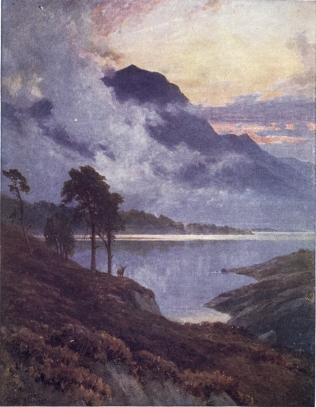 A HIGHLAND VIEW
and James Hogg, but one was a west-countryman by birth, and the other a
son of moorland hillsides; and even they are found testifying to the
cause of their kin. “The ancient spirit of Scotland,” exclaims the
shepherd at a Noctes, “comes on me from the sky; and the sowl within
me re-swears in silence the oath of the Covenant. There they are—the
Covenanters—a’ gathered thegither, no in fear and tremblin’, but wi’
Bibles in their bosoms, and swords by their sides, in a glen deep as the
sea, and still as death.... When I think on these things—in olden times
the produce o’ the common day—and look aroun’ me noo, I could wush to
steek my e’en in the darkness o’ death, for, dearly as I love it still,
alas! I am ashamed of my country.”
Alas! alas! indeed, for this rhapsody makes part of a fulmination
against Catholic emancipation, a question on which such whiskified
Protestants proved themselves too true sons of the Covenanters. The
proscribed Whigs were not less hot in testifying against all other
creeds than in asserting their own spiritual liberty. When the
Government offered their consciences some measure of relief, the “Black
Indulgence” proved as hateful as persecution, which, indeed, they would
willingly have directed against other sects, as against “right-hand
deflections and left-hand way-slidings” in their own body. The only sect
of that day that would not persecute was the Quakers, whose turn did not
come; and Quakerism, as judged by Wodrow, seemed but “a small remove
from Popery and Jesuitism,” or from what one of his heroes styled that
“stinking weed,” Prelacy. On the other side of the Atlantic Roger
Williams for the first time had begun to preach religious toleration;
but there the prevalent sentiment was expressed by a Puritan divine who
denounced “Polypiety as the greatest impiety in the world.” Puritan or
Prelatist, it was the party in power on which rested the guilt and the
shame of spiritual tyranny. On the other hand, the suffering party may
have entered into a renown of virtues beyond their desert. A generation
that hardly knows the Fourfold State even by name, sees little in
those martyrs but their wrongs, their harshness and narrowness forgot,
their own occasional crimes, their misspent zeal for “dogmas long since
dead, pious vituperation on antagonists long buried in dust and
forgetfulness; breathless insistence on questions which time has
answered with a yawn.”
At least the westland Covenanters bore manfully the scourge which they
looked on as an instrument of righteousness, but for the time laid on
the wrong shoulders. Their enthusiasm was not to be damped by the
scenery of their secret gatherings. Boldly they took the sword against a
conformity dictated by dragoon colonels, by selfish statesmen, and by
such a sacred majesty as Charles II.’s. If only they had added to their
faith the practical spirit of the English Roundheads, who did not
neglect discipline for doctrine!
In the Whig country was borne highest that blue banner inscribed in
letters of gold “For Christ’s Crown and Covenant.” At Lanark gathered to
a head the first rising of 1666, easily crushed among the Pentlands when
the rustic army had fallen back from the gates of latitudinarian
Edinburgh. At Rutherglen, near Glasgow, began the second outbreak,
stirred up by the brutal murderers of Archbishop Sharpe; then it was
near Loudon Hill, where the counties of Lanark, Ayr, and Renfrew meet,
that a half-armed congregation routed Claverhouse’s guardsmen on the
morass of Drumclog. This casual success was wasted on an army that, when
a few thousand strong, dared to defy the forces of the three kingdoms.
Torn by fanatical dissensions, paying more attention to loud-lunged
preachers than to prudent officers, it met at Bothwell Bridge the fate
that was a foregone conclusion. Cameron, leader of the “wild” or extreme
party, was followed up and slain in that desolate moorland region,
“without grandeur, without even the dignity of mountain wildness, yet
striking from the huge proportion it seemed to bear to such more
favoured spots of the country as were adapted to cultivation.” In caves
and remote cottages skulked the faithful remnant, while persecution
raged unchecked for years. Dark and bloody are the memories of that
“killing time,” and the superstitious legends that attached themselves
to the fame of the martyrs, to Cargill and Cameron, to Peden and others
in whom Scriptural gifts of prophecy blended with Celtic second sight.
Still darker stories were whispered of the persecutors, believed to have
sold themselves to the devil that they might have power over the Lord’s
people; of “bloody Mackenzie,” the Lord Advocate; of Grierson of Lag, in
whose hands a cup of wine would turn to blood; of the calm cruelty of
Claverhouse, charmed against bullets; of the ruthlessness of Dalziel,
who, with Tartar manners brought from Russian wars, with his bygone
dress and the outlandish beard unshaved since Charles I.’s execution,
might well seem an infernal monster. But all the slaughters, the
maddening tortures by boot and by thumbkins, the miserable imprisonments
on the Bass Rock and in Dunnottar Castle, the mockery of lighter spirits
among the populace, only went to harden Presbyterian endurance. The
Covenanter wrapped tighter about him his blood-stained cloak of
orthodoxy till that bitter wind blew over. Then the westland, so vainly
harried and dragooned towards conformity, proved a hot-bed of strong
Protestant and Presbyterian feeling, inspired by resentment as well as
by religion, a lesson in the use of persecution that stops short of
extermination.
The quartering of Highland clans was among those means of grace brought
to bear on the stubborn Whigs, with whose scruples the Gael as a rule
had scant sympathy. But the great western clan Campbell, neighbours of
the Whig country across the Clyde, obeyed chiefs otherwise tempered, two
of whom rank among the victims of Charles II.’s reign; and the House of
Argyll continued to furnish champions for the Whig and Presbyterian
interest. Over adjacent clans, the powerful Macallum More had too much
played the tyrant; then it was hatred to the Campbells as much as
loyalty to Charles or James that brought so many tartans round the
banner of Montrose and Dundee. On the other hand, sore memories of that
Philistine “Highland host” helped to keep the Whig country loyal in the
later Jacobite movements. It was long before “wild Highlandmen,” or
dragoons, would be looked on with a friendly eye by the sons of the
Covenanters. When the goodman one Saturday night had “waled a portion”
that led him to corrupt the verse, “another wonder in heaven, and behold
a great red dragoon”—he was interrupted by his wife, “I doot ye’re
making a mistake, John; there’s no’ many o’ that sort gets in there!”
but he had a sound answer ready: “Weel, woman, and doesna’ it say it was
for a wonder?” It was in another part of the country that some
misquoting Mac could chuckle over a text which seemed to make it easier
for a rich man to go through a needle’s eye than for a Cam’ell to enter
the kingdom of heaven.
Whatever they may have been in the past, no worse if more strong than
their neighbours, the Campbells of Argyll have risen on the flowing tide
of progress. The house lost nothing under that statesman who figures as
Jeanie Deans’s patron, nor under that host who so courteously
entertained Dr. Johnson, though his wife would not speak to Boswell. The
late Duke, a man of note in any station of life, was looked on as, in a
manner, chief of the Presbyterian establishment, even when—so have
times changed—he could not get one of his sons elected as member for
the county. But long before his time this Church had ceased to be one
and undivided, soon indeed showing strongly fissiparous energies, which,
till our day, kept it “decomposing but to recompose.”
More than once in these pages the writer has let the reader shy away
from a thistly exposition, which we may here yoke to and have done with
it. Nothing puzzles strangers more than the fact that till recently a
Scottish parish would have three Presbyterian Churches, differing not at
all in ritual, in discipline, or in such points of doctrine as are
visible to the naked eye unprovided with theological spectacles. It
would be difficult to give southron Gallios the faculty for splitting
controversial hairs possessed by minds trained to subtleness on the
Shorter Catechism; but an outline of the divisions of the Scottish
Church may perhaps be made plain to the meanest capacity. At least I
will try to be fair, which is more than have been all exponents of such
matters. Like most Scotsmen, I have an hereditary bias in these
controversies. One of my forebears was a Covenanter extolled among
Howie’s Scottish Worthies, who, after being persecuted under Cromwell
for loyalty to Charles, came to be hardly dealt with for conscience’
sake at the hands of that ungrateful king. I am proud to think of the
ancestress who, urged to move him to safe submission, answered like a
true Presbyterian wife, “that she knew her husband to be so steadfast in
his principles, that nobody needed deal with him on that head; for her
part, before she would contribute anything that would break his peace
with his Master, she would rather choose to receive his head at the
Cross.” Other friends were not so scrupulous, “two ladies of the first
quality” going so far as to send “a handsome compliment in plate” to the
“advocate’s lady,” who had the honesty to return this bribe or ransom
when she judged it impossible to save the prisoner’s life. All the same
it was saved, and he lived on till the Revolution year in a state of
proscription, sometimes hunted into hiding, but throughout a most
“faithful and painful” preacher, who “left many seals of his ministry,”
and steadily refused to put himself at ease by leaving the country, for,
“in his pleasant way,” he used to say “he would suffer where he had
sinned.” His son followed in his steps; and his grandson took a leading
part in the early movement of dissent which is presently to
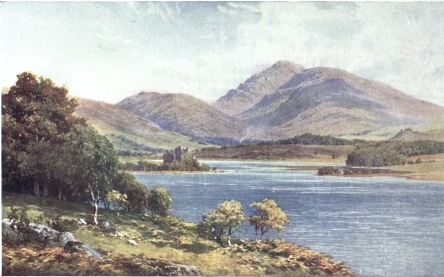 KILCHURN CASTLE, LOCH AWE, ARGYLLSHIRE
be shown as legacy from the Covenanting spirit. But if the memory of
these worthies weighs with me, I was brought up at an English knee, in a
church that held them much mistaken; and I was confirmed by the Anglican
Bishop of Gibraltar, within whose diocese the very Pope is a dissenting
minister. Since then I have sat at the feet of teachers from whom may be
learned that to know and to speak the truth of one’s fellow-men is the
only sure foundation for sound divinity. And perhaps an outsider may be
in a better position for taking the altitude of even the most celestial
bodies of faith.
The moving spirit of Presbyterianism has been a consciousness that
Christianity claims to be something far higher than any human
institution, the Court of Session, for instance, or even the British
Constitution. Other countries seem more willing to make practical
compromises between heaven and earth. One has heard of such a country,
whose chief ambassadors of heaven are appointed with a ceremony in which
the holiest influence is implored to direct a choice published weeks
before in every newspaper as fixedly made by very mortal authorities,
who may be notorious evil livers, open unbelievers, or what a sectarian
journal has politely qualified as “non-co-religionists.” But a
religiously minded Scot has too much logic, not to say sense of humour,
to take part in such a farce. For him the Gospel did not dawn from the
eyes of Boleyns and such like; he took his Scriptures as a law rather
than a title for rulers. His watchword has all along been Christ’s
headship of the Church, and his anathema the “Erastianism” that rendered
to Cæsar what man owes to God alone. The later Stuarts were not Cæsars
to wear any halo in his eyes; then all the more clearly he saw the
futility of their lay Popedom. That “wisest fool in Christendom” was
perhaps not so far out in his adage “no bishop, no king.” But Scotland
held its faith by the same title as he his crown; and he and his
successors found faith on the whole stronger than loyalty. The dogmas of
that faith are not the question. It was sadly coloured by the struggles
of its origin, by the character of the nation as well as the stern
scenery of the land, by persecution and by congenial Calvinistic logic
brought back from exile, and by the troubles of the time in which
Puritan influences were exchanged across the Border.
Scotsmen being, after all, but human, their serious and democratic view
of religion was held with two different degrees of intensity, which took
shape as the main parties of the Kirk. The one that came to be known as
“Moderate” was hotly reproached with Erastianism, a less unwillingness
to look on religion as a department of the Civil Service. The other had
various nicknames, the “Wild Party,” the “High-fliers,” but we may as
well call them the High Churchmen of Scotland, if it be borne in mind
that they favoured Evangelical doctrine while clinging to a union of
Church and State, in which the former was to be predominant. These were,
in fact, the heirs of the Covenanters, who on strongly Protestant soil
fought out the old quarrel between Pope and Emperor. And whereas the
English High Church has been strongest among the priesthood, in the
north, where presbyter is priest writ small, it is the laity that have
rather fostered ecclesiastic zeal. To Buckle’s representation of
Scotland as a priest-ridden people, Mr. H. G. Graham rightly objects
how it would be nearer the truth to speak of a people-ridden clergy.
The Revolution Settlement secured the victory of Presbytery over
Episcopacy, quieting the contention of a century. But when Episcopal
curates had been “rabbled” on what was a far from merry Christmas for
them, the extreme wing of the Covenanters were by no means satisfied
with King William’s toleration of unsound belief, and would accept no
status at the hands of an uncovenanted king. Long used to worship spiced
with peril, hardship, and hatred, they held aloof rather than seceded as
the Cameronians, a sect which, with its obscure sub-divisions of
Macmillanites, Russellites, Harleyites, Howdenites, and so on, still has
a feeble remnant of “Reformed Presbyterians,” while the mass of it
nearly two centuries later gravitated into the Free Church, then in part
representing their principles. The militant youth of this body had been
kept out of mischief by being embodied as the Cameronian Regiment, that
fought sturdily against Jacobites, Papists, and other enemies of a
Protestant succession, and still remembers its origin by carrying a
Bible in every knapsack, and not suffering its band to play on the
Sabbath.
But with changed times the Covenants began to lose their power as a
watchword. Having parted from its hottest gospellers in the Cameronian
following, then being cooled by milder spirits in Episcopal conformists,
presently admitted to the new order on easy terms, the Kirk’s clergy
became more moderate, not much to the satisfaction of their
congregations. The union of the kingdoms, carried through by crooked
ways, and its benefits long hidden in ignorance, soon called forth all
the “thrawn” aloofness of Scottish patriotism, for the nonce bringing
Jacobite and Cameronian sentiment into one focus. One of the early acts
of the united Parliament was to meddle with what has been a sorer
question north than south of the Tweed, the patronage of livings. The
right of patrons was now revived and confirmed by an Act making a “call”
from the congregation unnecessary to the placing of a minister. The
ministers themselves were more apt to sympathise with patronage as
easier road to a benefice than the ordeal of popular election; but the
people strongly resented the laird’s placing of a pastor over them, even
when this privilege was exercised with delicacy and conscientiousness,
and there were cases like that in Galt’s Annals of the Parish, when
the presentee had to be inducted by military force. This grievance,
then, became a standard in the battle between the Moderate and the High
Party, patronage being looked on as Erastianism in retail, when its
wholesale transactions in prelates and prayer-books were still angry
memories.
With hatred of patronage was involved a zeal for Evangelical doctrine,
which now began to take colour from other sources than Geneva, and to
blur out beyond the rigid lines of Calvinistic logic. Early in the
eighteenth century the Evangelical party got the name of Marrowmen, as
rallying round a little book which, published in England, gained
popularity north of the Tweed as the “Marrow” of Christian doctrine,
when edited by Boston of the Fourfold State. The “Marrow” came to be
condemned by a Moderate majority in the Assembly; then for teaching its
doctrines and rebuking the general luke-warmness
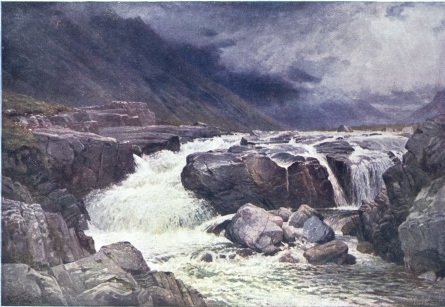 RIVER COE, GLENCOE, ARGYLLSHIRE
of the Church, the saintly Ebenezer Erskine was censured by his
Presbytery, and finally suspended from the ministry, along with three
sympathetic brethren, Alexander Moncrieff, William Wilson, and James
Fisher. In 1733 these four suspended ministers formed themselves into
the first Presbytery of the original Secession Church, with Fife as its
focus and Erskine as its leading spirit, whose younger brother Ralph in
some respects suggests himself as its Charles Wesley, giving scandal to
severe members by his love of music and songs not David’s.
The Seceders were, in fact, the Scottish Methodists, having an early
ally in Whitfield, who, however, became a stumbling-block through his
willingness to exercise Christian fellowship with the Erastian
establishment; he professed it his duty to preach to “the devil’s
people,” whereas the Seceders would monopolise him for “the Lord’s
people.” Nay, more, if testifying scandal-mongers are to be credited,
“that grand impostor” went so far as at Lisbon to “symbolise with
Popery” by attending a Catholic Lenten service, where the Crucifixion
was represented “in a most God-dishonouring, heaven-daring, ridiculous,
and idolatrous manner.” About the same time as the Secession, rather
earlier indeed, was formed the Glassite sect, still seated at Perth; but
they went off upon a narrow side track, and may be neglected in a
general view of Scottish religious life. A generation later Pennant
reports the population of Perth as 11,000, of whom 9000 still belonged
to the Kirk, the rest being Episcopalian, Non-jurors (these chiefly
“venerable females”), Glassites, and Seceders. Independents, Baptists,
and such like came later on from England, but these exotic congregations
are still a mere scattering, hardly found outside of large towns.
Carlyle might have remembered such exceptions, when he dogmatised that
“all dissent in Scotland is merely a stricter adherence to the National
Kirk in all points.”
The Secession Church soon began to disseminate itself, but almost as
soon developed a tendency to disintegration. Over the question of the
test exacted from municipal authorities the body split into Burghers and
anti-Burghers, the latter strongly holding it inconsistent to use a form
of oath as to “the true religion presently professed within this realm,”
when in their view the religion thus professed was far from the truth.
This “breach” was acrimoniously maintained even when Test Acts had been
abolished; then the Seceders underwent further fission into “Old
Lights,” “New Lights,” and others claiming to represent the original
doctrines of the Secession. Twenty years after that first schism, a
kindred but independent sect had come to birth under the title of the
“Relief Church,” seeking relief for tender consciences from Moderate
tyranny, while its leader, Thomas Gillespie, perhaps through association
with English nonconformity, made some scrupulous exceptions to the
former seceding platform, and some touch of innovation, as the use of
hymns, upon the Presbyterian practice.
The reader need not be troubled with all the sunderings of sectlets, one
or two of which still testify in out-of-the-way corners like “Thrums.”
This much may be noted, that Presbyterian differences have been not much
exported from Scotland, though, indeed, American Churches still show
some trace of fissions that began on this side the Atlantic. The root of
such differences was usually a narrowly pent-up earnestness that looked
not for truth beyond its own horizon; but the Scot abroad has more
readily seen for himself the proper proportions of his own little Bethel
in all Christendom. Then, of course, he does not carry beyond the Border
that bone of contention, the joint connecting Church and State. The
original Seceders had not been much concerned on that point; but a long
course of abstinence from public endowments gave them new views, till
the most conspicuous device on their banner came to be
“Voluntaryism”—that is, the practical notion that ministers should be
paid by those who wish to hear them.
While these dissenting sects were multiplying themselves, the Moderate
party in the Church throve the more by their absence. During the
philosophical eighteenth century the clergy declined upon “sanctified
common sense,” some of them, “a waeful bunch o’ cauldrife professors,”
making easy accommodations with worldliness, science, and even free
thought; and as, after the extinction of the Jacobite spirit, Scotland
settled down to a course of material improvement, its official teachers
waxed fat and lethargic, while the nonjuring Episcopalians for a time
enjoyed the wholesome discipline of persecution. The popular theology
indeed was never without champions in the Kirk pulpits. A collegiate
church might have two ministers, representing either party and preaching
against each other, as when, in Greyfriars Church, young Walter Scott,
if not a “half-day hearer,” sat alternately under Principal Robertson
and Dr. Erskine, the Moderate and the Evangelical leaders. But if the
warmer doctrine were cherished in the hearts of godly hearers,
Erastianism dominated the Church courts of a generation in which Pitt’s
viceroy Dundas practically governed Scotland, and robed bullies like
Braxfield sent to banishment political martyrs, inspired by the lurid
glow of the French Revolution.
Then, the long war with Napoleon having ceased to stifle free thought
and free speech, the Tory rule of Scotland had to face a rising demand
for reform, a movement heated through the sufferings brought upon the
working classes by shiftings of economic conditions after the peace, and
by the bungling interference of Government with trade’s natural course.
The new sentiment found champions in a knot of Whig lawyers, whose
weapon was the Edinburgh Review. The Church was stirred by sympathy
with the popular cause, whose name had sprung from its loins. A
religious revival came in on the flowing tide of Whiggism, and with the
passing of the Reform Bill the Evangelical party began to recover their
ascendency, led by the eloquent Chalmers, himself of Tory leanings and a
convert from Moderate indifference. A by-product of this enthusiasm was
the sect popularly but incorrectly dubbed the Irvingites, which found
more acceptance about London than in Scotland.
The new fermentation soon proved strong enough to burst old bottles that
had served for the moderate vintage of faith. The spirit of the
Covenanters came to life in the “non-Intrusion Controversy,” the gist of
which was the right of the people to choose their own mouthpiece of
edification. It is rare to find a new Scotch story; but here is one that
has never yet appeared in print. I remember as a lad hearing from an old
shepherd his account of such a dispute in his native parish. “There was
a chiel’ wi’ a
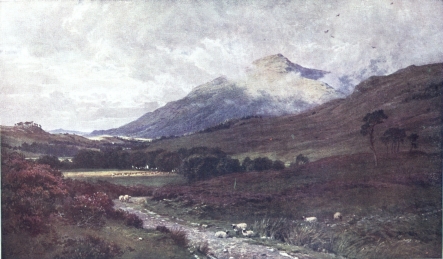 BEN CRUACHAN FROM INVERLOCHY, ARGYLLSHIRE
poodered heid cam’ doun frae Edinburgh,” was his account of the legal
proceedings, “and he made the folk a lang clishmaclavering speech—ye
never heard sic havers in yer born days! They needna’ care what like a
minister was pit in! It was a’ the same doctrine, and the mahn made nae
differ! But up gat an auld wise-like elder had sat in that kirk since he
was a laddie; and says he, ‘What did I hear the gowk saying? What is the
big, blethering brute tellin’ me?’ says he. ‘Does he mean for tae mak’ a
body believe that a saft, young, foozy, wersh turneep’s as guid as a
fine, auld Swedish one?’ says he.” Then this son of the Whig country
looked up to heaven, and never can I forget the solemnity with which he
declared, amid the silence of the eternal hills—“Mahn, it was a graund
answer!”
The first step was the resuscitation of a claim that the patron’s
nomination fell through unless countersigned by a call from the people.
The General Assembly passed an Act confirming this popular Veto, which
for a time went unchallenged, patrons having learned to “ca’ canny” in
the exercise of their rights. But, after some years, the momentous
Auchterarder case, where an obstinate patron persisted in forcing his
nominee on an objecting congregation, brought about a collision between
the laws of Church and State. A majority of the Court of Session,
confirmed by the House of Lords, pronounced the Veto illegal. The Church
accepted the judgment as affecting the temporalities of the living, but
refused to ordain the intruded pastor. All Scotland was in a blaze of
controversy; the very schoolboys took sides as Intrusionists and
non-Intrusionists. In the Strathbogie Presbytery seven ministers were
suspended by the Church for obeying the Court of Session, to whose bar
were brought seven others for not obeying it in the Dunkeld Presbytery.
A deadlock thus arose, out of which there appeared no escape but by
secession, so long as the Government refused to recognise the strength
of this popular movement.
A little patience would probably have brought relief by law; but the
perfervid sons of the Covenanters were in no mood for patience. The
“Headship of Christ” was in question, and no prospect of loss or
suffering appalled spirits exalted in such a cause. This movement, it
must be remembered, had small sympathy with the Voluntaryism of dissent.
Its leaders as yet strongly maintained the connection of Church and
State, only, in their eyes, the Church must stand above the State. The
Free Churchman’s attitude at the Disruption was a consistent one,
entirely reasonable from the premises on which his Church based its
teaching. He took the grand tone of the ages of faith; and there was
something noble in his disdain for mandates of earthly law, which he
treated as served by creatures of a day on the servants of the eternal
Jehovah.
The Disruption took place at the General Assembly of 1843. The retiring
Moderator, after reading a protest against the invasion of the Church’s
liberties, headed a procession to a spacious hall in the Canonmills
suburb, where, electing Dr. Chalmers as their first president, the
protesters constituted themselves the Assembly of what they maintained
to be the true Church of Scotland. The Government had expected a
secession of some score or two of hot heads; but nearly five hundred
ministers went out of their churches and manses, giving up all for
conscience’ sake with a courage that at once roused a wave of generous
sympathy. The building up of the new Church was set about with true
Scottish energy, prudence, ay, and generosity. For when Cockney jesters
sneer at Scottish poverty, they do not consider how ready this people is
to spend its savings and sparings on what it believes a good cause.
Mainly from the contributions of the poorer class was the Free Church
sustained. Most of the rich and mighty were against it, some of them
bitterly hostile, many landlords refusing ground for sites, so that at
first preachers and congregations had often some taste of the
Covenanters’ sufferings in open-air worship. Very bitter was the feeling
between the ruptured congregations and of the seceding ministers against
the “residuum,” that had to fill hundreds of empty livings in haste, not
always with the most fitting candidates. This ill-wind blew good to not
a few “stickit ministers,” who had little hoped to wag their heads in a
pulpit, and the old Adam in the Seceders found matter for much scornful
criticism of those “residuary cattle.”
Long before such animosity had died down, the new body had its churches,
manses, schools, and colleges built and endowed on a scale that gave
Scotland two Establishments instead of one. But its main strength was
the fact of its commanding the allegiance of the most spiritually minded
and intellectual among the people. Its very pride was no vainglory.
English dissent is apt to take a socially humble and apologetic
attitude. A Free Churchman never thought of himself as a dissenter, and
could not be looked down upon from any point of view. In all parts of
the country his Church took rank beside the Establishment; in some it
gained an ascendency. In the Highlands especially, where the exaltation
of warm Celtic blood goes to its highest, and where eloquent ministers
have inherited the devotion once inspired by warlike chiefs, the “Auld
Kirk” is often little more than empty walls and a stipend. There is a
tale of graceless laddies boasting against each other of their reckless
deeds. One brags of having been to the circus, which another caps by a
visit to the theatre, but the third is bold to avow a darker crime, “I
once went to the English Chaipel.” As told in some parts of the country,
this fable has a further climax of iniquity in the Established Church,
erst so dear.
While the Free Church went on flourishing apart, the Establishment was
moved to drop the main standard of so much controversy. Its General
Assembly petitioned for the abolition of patronage, which was brought
about so easily that most of the lairds interested did not choose to
demand the compensation voted to them for their thorny rights of
presentation. In principle nothing seemed to keep the Churches apart;
but the Establishment had been drifting into a broader theology and a
new toleration of liturgical worship, which separated it from an
organisation more conservative in religious matters, yet a school of
liberalism in politics that gave Mr. Gladstone his hold over Scotland.
The “Auld Kirk” lost more and more its suspicion of prelatical ways. Men
still alive can remember how Dr. Robert Lee was indicted for the
introduction of an organ and a prayer-book. Now such scandalous
innovations are perhaps the rule rather than the exception
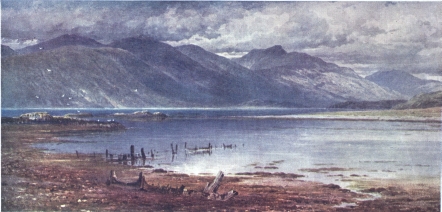 THE MORVEN HILLS FROM APPIN, ARGYLLSHIRE
in parish churches, and instrumental music has crept also into Free
Churches, where a generation ago the use of hymns was scouted as
unscriptural. For a time some faithful worshippers in the city
congregations insisted on conspicuously standing to pray and sitting to
sing psalms, like their fathers; but even in out-of-the-way places now
there is a gradual conforming to the customs once banned as English or
Papist.
The Dissenters, meanwhile, had been touched by the spirit of the time.
As far back as 1820, two of the chief sects came together again, their
walls of separation, indeed, having long fallen down. After the
Disruption a further movement of adhesion took place, and while some
congregations remained hugging their microscopic differences, most of
the dissenting bodies joined to form the United Presbyterian Church,
which, by a century’s practice rather than on original principle, has
evolved the doctrine of Voluntaryism as the backbone of its communion,
repudiating any interference of the State with the teaching of religion.
Certain fragments of secession, for their part, had been attracted into
the glowing mass of the Free Church. This Church, also, began to suffer
change. When the original stalwarts, who made much of a theoretical
relation of Church and State, died off into a minority, the second
generation was found less concerned about “Disruption principles” than
in sympathy with Evangelical doctrine. The position of Scottish
Presbyterians out of Scotland, where their differences of constitution
were idle words, helped to open shrewd eyes to the absurdity of three
Churches, all professing the same main doctrines, yet standing as
rivals to each other. As the heat of controversy grew cool, more
friendly relations became possible, and the ministers of the one might
fill the pulpits of the other. In certain parishes having a summer
population, it would be arranged to keep only one Church open in winter.
The waste of power in the three almost identical bodies could not but
strike a practical people sooner or later. The Established Church seemed
to flirt too boldly with deans and Oxford professors; but what hindered
the Free and the U.P. Church from making a match of it? After long
courtship and much discussion of settlements, their alliance was
celebrated in 1900, and now these two organisations are merged under the
title of the United Free Church.
This union was not consummated without hot opposition, a small remnant
of the Free Church standing outside and claiming at law the disposal of
the great endowments bestowed on certain principles now put into the
background. As I write, the House of Lords still delays its decision on
a question of momentous interest, which the Scottish Courts decided in
favour of the main body. There can be no doubt that what has already got
the nickname of the “Wee Free” Church better represents the views of its
spiritual fathers. But if all Churches were brought to payment of
ancestral debts, otherwise than in paper money of Creeds and
Confessions, some theological Statute of Limitations would be required.
Whatever be the result, it should prove a lesson against investing any
Church in a suit of clothes sure to be outgrown or to go out of fashion.
Perhaps the most remarkable feature of this particular case is, that
almost for the first time in Scottish ecclesiastical history there has
been talk of a compromise.
Another fragment had seceded some years before as the Free Presbyterian
Church, their raison d’être being testimony against the Declaratory
Act by which the Free Church Assembly had loosened the bonds of
subscription, that its doctrine might run in harness with the slightly
less stringent views of the uniting body. So, in more than one parish,
instead of three may now be found four Presbyterian places of worship:
the Established Church, the United Free Church, which often has
practically taken its place, the Free Presbyterian, and a congregation
belonging to that rump of the Free Church which denounced the Union.
There were scenes of violence in the Highlands, where Free Churches came
to be hotly defended against their new title by obstinate adherents of
the order half a century old, during which Laodicean humorists had
interpreted the bells of the Establishment as ringing out “I am the Old
Kirk,” to which the Free Church answered back in a deeper note, “I am
the true old Kirk,” but then the U.P. bell jangled back, “It’s me! it’s
me!” As for the Episcopal body that now holds its head so high, only in
the last century was it suffered to have a bell at all, long paying dear
for its spells of forced supremacy.
One weaned from the Church of his forefathers, yet not from what should
be the quod semper, quod ubique et quod ab omnibus of all beliefs, may
venture to give his opinion, without suspicion if not without offence,
that the Free Church of Chalmers and Guthrie best represented the true
soul of Scottish Presbyterianism and enshrined the strongest religious
life of its first generation. But in our generation this body has
generated an impulse that may lead to fresh flyting between two parties
now unequally yoked together. It had one divine eminently pious,
eminently learned, eminently loyal to his Church, unless in coming to
certain modern conclusions that are more or less freely accepted by
almost every mind qualified to judge. Him the more bigoted sort picked
out as quarry for one of the heresy-hunts which make a favourite sport
in the north. I heard the case against him put in a nutshell by one of
the old women who were too much deferred to in this matter. “It might be
true,” admitted this mother in Caledonian Israel, “that Moses did not
write the account of his own death; but if you began there where were
you going to stop?” so she was clear for muzzling that troublesome
scholar. He had been teaching his “unsound” views, without much
observation, to a few students in an out-of-the-way corner. According to
the milder laws of modern persecution, he was unwillingly driven into
renown, into wide influence, and into the arms of an English University,
that felt itself honoured in receiving such a scapegoat. All the more
enlightened spirits of his own Communion are now ashamed of the
silencing that sent him into famous exile. Many of them were ashamed of
it at the time; and the majority against him was partly made up of men
who knew that he spoke truth, but thought it not well that the truth
should be freely spoken. The theologians who take this tone are no
longer inspired by the virtue of the Covenanters, and have fallen away
from the heritage of that great preacher that feared not the face of
man, nor woman.
Enthusiasts like Knox are out of vogue in our day;
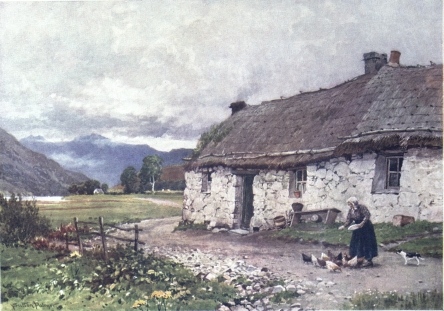 A CROFT NEAR LOCH ETIVE, ARGYLLSHIRE
but perhaps can be seen all the more clearly what we owe to the
stiffness with which they stood out, that neither King nor Pope should
bind the conscience, taught by freedom to claim its rights, too, against
Parliament and Presbytery. Out of the troubles of the time when Scotland
was a distressful country, somewhat given to “the blind hysterics of the
Celt,” came the resolute temper that has turned poverty to gain and is
turning superstition to knowledge. At all events, no account of “Bonnie
Scotland” is complete that does not take in the stern and wild, not to
say grim and gloomy aspects often presented by the Whig country.