Larger versions of most illustrations may be seen by right-clicking them
and selecting an option to view them separately, or by double-tapping and/or
stretching them.
BELGIUM: THE LAND OF ART. Its History, Legends,
Industry and Modern Expansion. Illustrated.
CHINA’S STORY, IN MYTH, LEGEND, ART AND
ANNALS. Illustrated.
THE STORY OF NEW NETHERLAND. Illustrated.
YOUNG PEOPLE’S HISTORY OF HOLLAND. Illustrated.
BRAVE LITTLE HOLLAND, AND WHAT SHE TAUGHT
US. Illustrated. In Riverside Library for Young People.
In Riverside School Library. Half leather.
THE AMERICAN IN HOLLAND. Sentimental Ramblings
in the Eleven Provinces of the Netherlands. With a map
and illustrations.
THE PILGRIMS IN THEIR THREE HOMES,—ENGLAND,
HOLLAND, AND AMERICA. Illustrated. In
Riverside Library for Young People.
JAPAN: IN HISTORY, FOLK-LORE, AND ART. In
Riverside Library for Young People.
MATTHEW CALBRAITH PERRY. A typical American
Naval Officer. Illustrated.
TOWNSEND HARRIS, First American Envoy in Japan.
With portrait.
THE LILY AMONG THORNS. A Study of the Biblical
Drama entitled The Song of Songs. White cloth, gilt top.
HOUGHTON MIFFLIN COMPANY Boston and New York
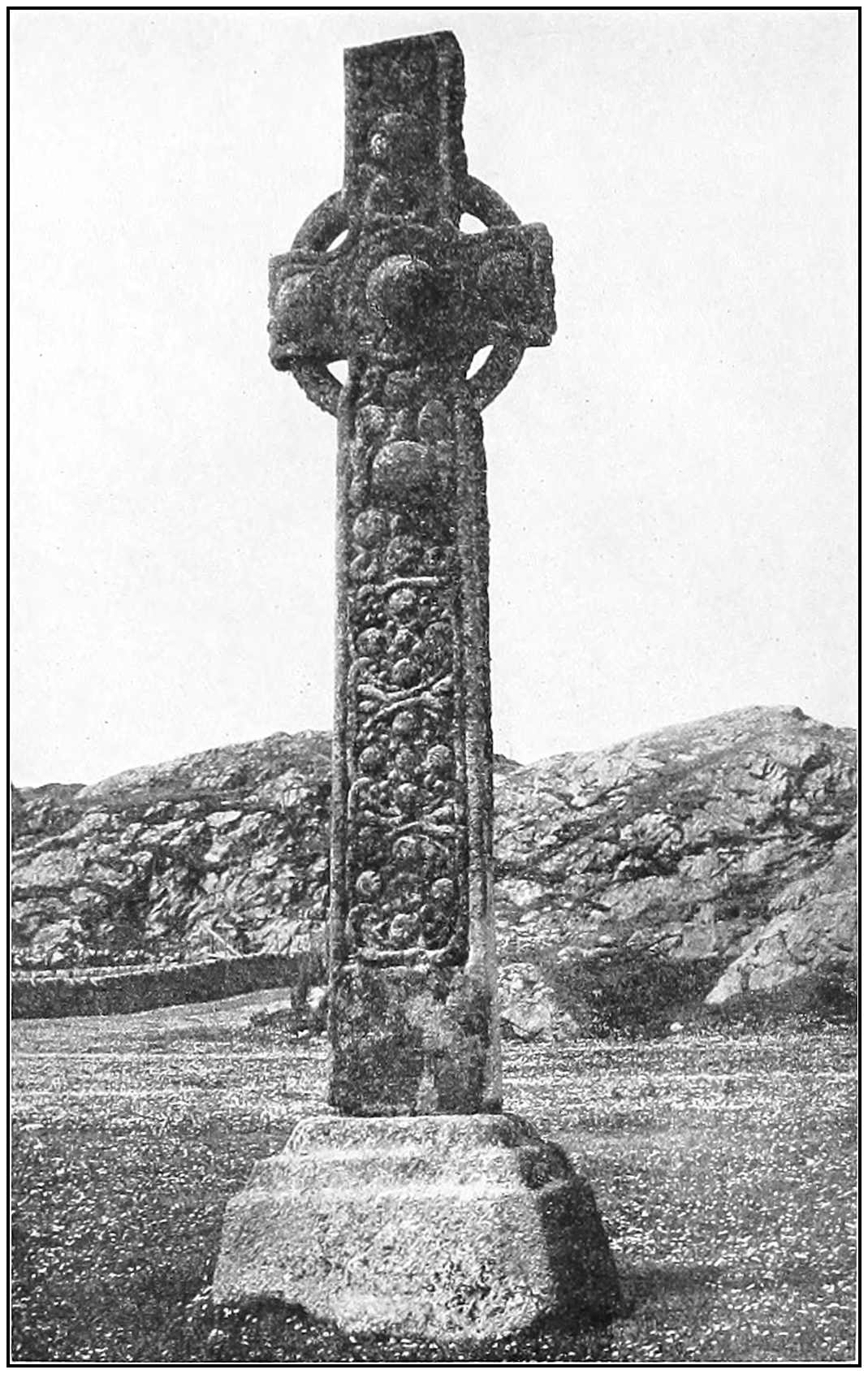
IONA, ST. MARTIN’S CROSS
BONNIE SCOTLAND AND WHAT WE OWE HER
BY
WILLIAM ELLIOT GRIFFIS
With Illustrations
BOSTON AND NEW YORK
HOUGHTON MIFFLIN COMPANY The Riverside Press Cambridge 1916
COPYRIGHT, 1916, BY WILLIAM ELLIOT GRIFFIS
ALL RIGHTS RESERVED Published October, 1916
DEDICATED
TO THE THREE WOMEN FRIENDS
QUANDRIL
LYRA
FRANCES
FELLOW TRAVELLERS AND GUESTS IN THE
LAND OF COLUMBA, MARGARET, BRUCE, BURNS
AND SCOTT
PREFACE
In the period from student days until within the
shadow of the great world-war of 1914, I made
eight journeys to and in Scotland; five of them,
more or less when alone, and three in company
with wife or sister, thus gaining the manifold benefits
of another pair of eyes. On foot, and in a variety
of vehicles, in Highlands and Lowlands, over
moor and water, salt and fresh, I went often and
stayed long. Of all things remembered best and
most delightfully in this land, so rich in the
“voices of freedom,”—the mountains and the
sea,—the first is the Scottish home so warm
with generous hospitality.
In this book I have attempted to tell of the
Scotsman at home and abroad, his part in the
world’s work, and to picture “Old Scotia’s grandeur,”
as illustrated in humanity, as well as in
history, nature, and art, while showing in faint
measure the debt which we Americans owe to
Bonnie Scotland.
BONNIE SCOTLAND — CHAPTER I THE SPELL OF THE INVISIBLE
As with so many of my countrymen, the dream
floated before the vision dawned. The American
who for the first time opens his eyes in Europe
is like the newborn babe, whose sight is not yet
focused. He sees double. There is continually
before him the Old World of his fancy and the
Europe of reality. War begins, as in heaven, between
the angels—of memory and of hope. The
front and the rear of his brain are in conflict.
While the glamour of that initial glimpse, that
never-recurring moment of first surprise, is before
him, he perforce compares and contrasts the ideal
and the reality, even to his bewilderment and confusion.
Only gradually do the two beholdings
coalesce. Yet even during the dissolving pictures
of imagination and optical demonstration, that
which is present and tangible wins a glory from
what is past and unseen.
From childhood there was always a Scotland
which, like Wordsworth’s “light that never was,
on sea or land,” lay in my mind as “the consecration
and the poet’s dream,” of purple heather,
crimson-tipped daisies, fair lasses, and brave lads.
It rose out of such rainbow tints of imagination
and out of such mists of fancy as were wont to
gather, after reading the poets and romancers
who have made Scotland a magnet to travellers
the world over. This far-off region, of kilts and
claymores, first sprang out of the stories of friends
and companions. Our schoolmates, whether born
on the moor or sprung from Scottish parents in
America, inherited the love of their fond forebears
and kinsmen, who sincerely believed that,
of all lands on this globe, Bonnie Scotland was
the fairest.
One playfellow, who afterwards gave up his
life at Bull Run for the land that had given him
welcome, was my first tutor in Scottish history.
If native enthusiasm, naïve sincerity, and, what
seemed to one mind at least, unlimited knowledge,
were the true bases of reputation, one might call
this lad a professor and scholar. As matter of
fact, however, we were schoolboys together on the
same bench and our combined ages would not
amount to twenty-five. He it was who first pictured
with vivid phrase and in genuine dialect the
exploits of Robert the Bruce and of William
Wallace. He told many a tale of the heather
land, in storm and calm, not only with wit and
jollity, but all the time with a clear conviction of
the absolute truth of what had been handed down
verbally for many generations.
He it was who, without knowing of the books
written in English which I afterwards found in
my father’s rich library of travel, stirred my curiosity
and roused my enthusiasm to read the “Scottish
Chiefs” and Sir Walter’s fascinating fiction,
and, by and by, to wander over the flowery fields
of imagination created by that “illegitimate child
of Calvinism,” Robert Burns.
Though the boy who became a Union soldier
was the first, he was by no means the last of
Scottish folk whose memories of the old country
were fresh, keen, and to me very stimulating. In
church and Sunday school, in prayer-meeting and
Bible class, I met with many a good soul who
loved the heather. I heard often the words of
petition and exhortation that had on them the burr
and flange of a pronunciation that belonged to
the Lowlands. As years of experience and discrimination
came, I could distinguish, even on
American soil, between the Highlander’s brogue
and the more polished speech of Glasgow and
Edinburgh.
When the time for college preparation came, I
had, for private tutor in the classics, a theological
student, who in physical frame and mental traits,
as well as in actual occupation, was Hugh Miller
all over again. He had been a stonecutter, believed
in “the testimony of the rocks,” and could
lift, move, or chisel a block of mortuary material
with muscles furnished for the occasion. In character,
he resembled in hard beauty the polished
rose-red granite of his native hills. Strictly accurate
himself, a master whose strength had grown
through his own surmounting of difficulties, he
was not too ready to help either a lazy boy or an
earnest student, while ever willing to give aid in
really hard places. He introduced me to Xenophon,
and his criticisms and comments on the
text were like flashlights, while his sympathy for
Klearchus and his comrades illuminated for me
my own memories of the camp life, the hard
marching, and the soldier’s experiences during the
Gettysburg campaign. From the immortal Greek
text he made vivid to me the reality of human
relations and their virtual identity, whether in
B.C. 400 or A.D. 1863.
By this Scotsman I had a window opened into
the Caledonian mind in maturity. Through him I
realized something, not only of its rugged strength,
its sanity, and its keen penetration, but I gained
some notion also of the Scottish philosophy of
common sense, which so long dominated colonial
America and especially Princeton—the mother
of statesmen and presidents, over which McCosh
presided in my earlier days.
It was this Caledonia of mind, made by the deposits
of human thought through many ages and
experiences, which seemed and yet appears to
me as an eternal Scotland, which, despite change
of fashions, of wars and calamities, shall never
pass away. So I must confess to the spell of invisible
Scotland, as well as to the fascination of
the storm-swept peninsula of heaths and rugged
hills.
Besides boyhood’s companions of Scottish blood
and descent, there were odd characters in the
Pennsylvania regiment in which I served as flag
corporal. My comrades under the Stars and
Stripes came from various shires of Caledonia.
Then, too, besides the bonnie maidens, like those
Burns and Ramsay talked with, whose ancestry
I knew, because I was often in their homes and
met their parents and their kinsmen, there was
the glamour of the dramatic poet’s creation. Immediately
in front of my father’s home, in Philadelphia,
was the famous Walnut Street Theatre,
where that mighty figure in histrionic art, Edwin
Forrest, was often seen. The tragedy of “Macbeth,”
which I have seen rendered more times
by famous actors than I have seen any other of
Shakespeare’s creations, gave a background, which
built in my imagination a picture of Scotland
that had in it the depths of eternal time. The
land and people had thus a perspective of history
such as nothing else could suggest, even though I
knew enough of the background of actual record
to realize that Shakespeare’s chronology often
passed the limits of Usher.
So with boyhood’s memories and the reading of
poets and romancers, with the more or less undefined
horizons of picture, painting, book, and the drama,
reinforced by what a college student might be supposed
to have absorbed, I was ready for wondrous
revelations when, with Quandril, my eldest sister,
I embarked in the Scottish Anchor Line steamer
Europa, Captain Macdonald, master, on the 26th
of June, 1869. It was after graduation and at the
end of the month of roses. We were bound for the
land of Macbeth, Bruce, Wallace, Scott, and
Burns.
CHAPTER II THE OUTPOST ISLES
It was fitting that our first sight of the Old
World should be also that of the homeland of those
who settled the Scottish Peninsula. It is commonplace
knowledge that, until well into the Middle
Ages, Europe’s most western isle was called “The
Land of the Scots.” Not until after the Norsemen
had frequently visited this “Isle of the
Saints” was Ireland called by its modern name.
From the ocean outpost, the natives left their ancestral
seats and crossed to a strange land—the
larger island of Britain, of which the northern
half became in time the country now, and for
nearly a millennium past, known to the world as
Scotland.
One wonders what his first sensations will be
when he approaches the mother continent. Some,
with keen olfactories, in a seaward breeze, smell the
burning turf, which tells of homes and firesides and
human companionship. We looked for the land
birds. Blown out over the waves, these feathered
messengers find shelter in the ship’s rigging and
welcome from sea-weary passengers.
To us, they were our first visitors. A terrific
storm had for a day and night lashed the ocean
into fury, split one of our booms and stove in
a lifeboat, only to be succeeded by a morning of
sunny splendor. Then both ocean and sky seemed
like twin sapphires. The tossing spray, which in the
sunbeams showered dust of rainbows, gradually
gave way to calm. Toward noon we welcomed
two little feathered messengers. They were made
happy by finding rest aloft in the shrouds. A third,
too exhausted to guide its course, fell upon deck.
We kept our eyes aloft, waiting for news from
the crow’s nest. Yet while we, with the old sea
dogs, captain and crew, were looking alternately
forward and upward, as yet discerning nothing, a
sailor, born in Michigan, who was the lookout for
the day, called out “Land ho!”
For the next few minutes we were contestants in
a game of rivalry, as to which eyes should see first
and best. Not many minutes sped, however, before
most of us had discerned a long, low, cloudlike
line, which, instead of shifting its form, like its
sister apparitions of the air, loomed on the horizon
in fixed defiance of change.
As if to tantalize us, fresh breezes soon condensed
new vapors and the land disappeared from view.
Again, for hours, we were in mist and fog, but
at high noon, the veil was lifted suddenly. There
before us, rising sheer out of the ocean and apparently
but a mile or two away, was the great green
glory of Ireland. Like a mountain of emerald
rising out of a sapphire sea, stood the land whose
name and color, in sentiment and in reality, is
Nature’s favorite, earth’s best counterpart to the
sky.
After seeing the Giant’s Causeway, meeting the
paddle-wheel steamer from Londonderry, and passing
Rathlin Island,—refuge once of Robert the
Bruce,—we sight the real land of our quest when
we discern the larger isle of Arran, which rises
like a minaret out of the sea. In law and geography,
as well as the outpost of history, it is recognized
as an integral part of Scotland. Still alertly peering
eastward, we behold in the thickening dusk
the mainland, whereupon our hats rise in salute
to Bonnie Scotland. The sun here does not set till
nine o’clock in the evening and sinks to-night
amid clouds which break into spires and turrets.
These, in the crimson glow, look like some sea-girt
castle in flames.
We are on the lookout for anything and everything
that may remind us of Robert the Bruce,
for in the history of Arran the chief name is
that of Scotland’s heroic king. On its western
coast he found shelter in what are still called
the “King’s Caves.” Of a trio of these he made
a regular apartment house; for one bears the
name of his kitchen, another of his cellar, a
third of his stable. On the land higher up is the
“King’s Hill,” and from a point called the “King’s
Cross,” he crossed over to Carrick, when the long-awaited
signal told him that the moment for the
liberation of his country had come. In Glen Cloy,
near by, his trusty followers lay concealed, and the
picturesque ruins still bear the name of “Bruce’s
Castle.” Other masses of ruins on Loch Ranza are
pointed out as representing what was his hunting-seat.
Are the Scots of Arran as greedy to boast
of as many places made famous by Bruce as are
Americans of Washington’s headquarters?
The name of Bruce is not the only one in the
long and glorious annals of Scotland that clings
to Arran. The earls of this insular domain were
nearly all members of the famous Hamilton family
which gave so many eminent men and women
to Scotland and England. How many more of
their shining names are as stars in the firmament
of our national history! The champion of free
speech, who owned the land which is now Independence
Square in Philadelphia, and whose
eloquence in New York city acquitted the German
editor Zenger in the great trial which inaugurated
and perpetuated free speech in America, was a
Hamilton. As the greatest constructive political
genius known to our country, the virtual father
of the United States Government, the name of
Alexander Hamilton is an inspiration to the Unionists
of Great Britain to-day.
Back of the pear-shaped island of Pladda—which
we passed and whose telegraph station notified
Greenock and Glasgow of our arrival in the
Clyde—are ancient standing stones, or cairns,
and many a memorial of remote antiquity which
witness to very early habitation by man on this
outpost island.
In the eyes of those to whom the past furnishes
a perspective more fascinating even than the promise
of the future, the little isle adjacent, which is
itself a finely marked basaltic cone, rising over a
thousand feet high and well called “Holy Island,”
is even more worthy of the visits of the reflecting
scholar. It holds an attraction even greater, in
human interest, at least, than the wonders of geology,
or the numerous witnesses to antiquity in
the form of upreared stones. Here St. Molios,
a disciple of St. Columba, founded a church. In
the Saint’s Cave, on the shore, may still be seen the
rocky shelf on which he made his bed. Like the
outraying sparkles of light from a gem, the lines
of influence from this saint’s memory have flashed
down the ages. To-day from sections of the Christian
Church, “high” or “low,” and from Christian
“bodies” with sectarian names, as many as
the letters of the alphabet, come visiting pilgrims
or happy tourists to pay their debt of admiration,
or to refresh for a moment their traditional faith.
In that wonderful sixth Christian century—as
remarkable in Asian and Buddhist, as in European
and Christian history—Ireland (not then
known by that name, but the old “Land of the
Scots”) was a shining centre of gospel light and
truth. Moreover, it was a hive of missionary activities,
sending off swarms of “apostles.” Happily,
this word means missionaries and nothing
else, connoting spiritual activities and not questions
of authority, over which paid ecclesiastics
will ever and in all lands wrangle lustily.
In modern days, the whole island is peaceful.
So far has the old Gaelic speech passed into “innocuous
desuetude,” that at the opening of this
century only nine persons were left who could use
but this one speech, though over a thousand natives
could speak both English and Gaelic. Instead of
the tranquil calm of to-day, however, few islands
have been oftener stained with the blood of warriors
and quarrelling clansmen. We who imagine
that only the dark-skinned nations were savages
must remember how recently both Englishmen
and Scotsmen emerged from barbarism. It was
but in the yesterday of historic time that Christians
burned one another alive, in the same spirit
that worshippers of Moloch cast their children
into the red-hot stomach of their brazen idol, or
Hindu mothers fed their babies to the crocodiles.
How numerous were the Scottish assassins and
victors who carried the heads of their enemies as
trophies on the top of pikes, like the Indians and
Pilgrims of colonial days! Yet no literature excels
that of the Scots, in the perfect frankness
with which the sons of the soil confess their recent
emergence from barbarism into the admired
civilization of to-day.
Thus the initial spell of the Scottish landscape
lay first of all upon us who had known Scotland
only through books or by word of mouth. Yet to
such the human appeal is immense. Who can
look upon this egg-shaped island of Arran, with
its jagged peaks and its singularly grand scenery,
without emotion? The conformation, as seen only
in part from the ship’s deck, appears shaggy, because
so mountainous and heathy, with many a
romantic glen and promontory; and there are
picturesque masses of columnar basalt forming a
link between the Giant’s Causeway and Staffa’s
wonder. In fact, we are told by the scientific men
that the geology of Arran is almost unique, displaying
as it does a greater succession of strata
than any other single portion of land of equal
extent, in the whole area of the British Isles.
In the gathering twilight, even though this was
prolonged, so that a lady could see to thread a
needle at 9.30 P.M., we catch glimpses of this
appendix to the land of Burns; for Arran belongs
in the poet’s native shire. In later years nearer
views enabled us to see again the trap rock, the
granite, and the slate, and to catch a glimpse of
some of the streams, one of which falls over a
precipice more than three hundred feet high. In
truth, the first impression of Arran furnished
even less delight than those in later years, when
we were saturated with Scottish lore; then the
island spoke with new tongues and even more eloquently
than at first sight, of nature and human
history.
We had left Ireland the day before, steaming
out from the Giant’s Causeway. Our steamer
ploughed her way, and perhaps may have cast
anchor during the night. In any event, after
breakfast, we were well into the Firth of Clyde.
In sunlight and in joy we moved swiftly up the
river of the same name. At Greenock, during a
pause, we saw granite docks. These, in contrast
to the wooden wharves of New York, mightily impressed
us with the solidity and permanence of
things in the Old World, though there were enough
smoky foundries to make the air black. At Greenock,
Burns’s “Highland Mary” is buried, but
is elsewhere glorified in a statue. Rob Roy once
raided the town, which has history as well as
romance. To us, on that day of first sight, the
chief interest of Greenock lay in the fact that our
honored Captain Macdonald, of the Europa, had
his home here. Brave man! He was afterwards
lost at sea and at the post of duty, when a colossal
wave, sweeping the ship, carried away the bridge
and the officers on it!
We steam up the river as rapidly as is safe in
a crowded, narrow channel. Our ship is now in
fine trim. Her masts have been scraped, her decks
scrubbed, and her sails enclosed in white canvas
covers, while from every mast floats a flag—the
Stars and Stripes over all. Swift river steamers
shoot past us and ten thousand hammers ring in
the chorus of labor on the splendid iron and steel
vessels, which are the pride of Scotland and of
world renown. We pass Cardross Castle in which
Robert the Bruce died—the last two years of his
life being written, as in the biography of Naaman—“a
mighty man, but a leper.”
On a high rock, nearly three hundred feet high,
looms Dumbarton Castle, which has played so
notable a part in Caledonian history. Even when
Scotland joined the Union and became one with
Great Britain, this was one of the four fortresses
secured to the Land of St. Andrew, whose cross
was laid on that of St. George to form the British
flag. Here Wallace was betrayed and kept a prisoner.
Here they have his alleged two-handed
sword, now known to be a spurious relic. Not
many miles away is Elderslie, his birthplace.
Touching one’s imagination even more profoundly
are the ruins of the old Roman wall built
across the lower end of Scotland, which we pass
as we sail by. The bright ivy covers it luxuriantly,
and as the summer breeze kisses its surface, the
lines of living green ripple, and dimple, and disappear
in the distance along verdant miles. How
it recalls the far past,—
“When Rome, the mistress of the world,
Of old, her eagle wings unfurled.”
Aloft is a monument, to which we take off our
hats, in honor of Henry Bell, who introduced
steam navigation into Europe.
Many times afterwards did we see the Clyde
and its great monuments of industry and history.
Yet one’s first impressions are almost always the
most vivid, and from this initial experience, which
holds longest the negatives of memory, are printed
the brightest pictures. It was two o’clock when
we moored off the dock. Passing the slight examination
of the polite custom-house officers, we
stepped once more upon solid earth,—the land
of Burns and Scott.
CHAPTER III GLASGOW: THE INDUSTRIAL METROPOLIS
“There is nothing so certain as the unexpected.”
Our first impression, after stepping upon the dry
land of Europe, was that it was “limited.” Not
that we had been obsessed by the spirit that dwelt
in that reinforced Western Yankee, who, while
on the island of Britain, was afraid to go to sleep
o’ nights lest he might fall off! Yet in Glasgow
the word “Limited” stared at us from every shop
sign. We had not yet in America adopted the
statute of financial limitations for trading firms,
but the laws of the United Kingdom even then required
that any one doing business with a limited
capital or accountability, must state the fact on
his shop sign or other public announcement. It
was this frequent expression of commercial conditions,
then a real novelty, that attracted our initial
attention.
It was the day before Scotland’s Sabbath, or,
in local dialect, “Sunday First,” that we had our
virgin view of Glasgow, and the excellent custom
of a Saturday half-holiday was in vogue. This afforded
us all the more ease in seeing the principal
thoroughfares, which, with the crowd absent and
the shops closed, made comfort, but gave to the
lengthened areas a deserted look. We sauntered
into St. George’s Square, where, in addition to
the imposing buildings surrounding it, rises the
lofty column on which stands the bronze effigy of
Sir Walter Scott. How marvellously did this Wizard
of the North delight millions, through many
generations, with his poetical numbers and his
weird romances! To-day, his name is a magnet
that annually brings to Scotland thousands of
tourists and millions of dollars. In the long run
there are no more valuable assets to a country
than its great men and its deathless literature.
There were other statues visible at this time,
but the larger number of those which to-day run
the risk of being destroyed by bombs from the
empyrean, in the new fashions prevalent in aerial
warfare, were not then in existence. So it was to
the cathedral that we hied, partly for the reason
that this was to be the first of the many great sacred
and historic edifices to be seen by us in the
Old World, but chiefly because the hoary pile
was almost the only one which survived the tumult
and destruction of the Reformation. Largely
by the “rascal multitude,” as Knox called the mob,
but also in the then prevalent conviction that these
structures, as then used, had survived their original
purpose, and should be reduced to ruins, cathedrals,
abbeys, and monasteries were levelled. For
her size, no country excels Scotland in ruins.
The Glasgow cathedral, in slow evolution during
centuries, was never finished. For a time its
inner area was divided off to make worship more
comfortable and also to bring the structure into
closer conformity with those new fashions in religion,
according to which the people were given sermons,
instead of masses, with more worship through
the intellect, and less through the senses and emotions.
Yet as we stood within its cold, damp walls,
on that July afternoon, we wondered how long
human beings, unless clothed in plenty of woollen
habiliments, could sit or stand on its stone floor.
Despite its age, the interior had an air of newness,
indeed, almost of smartness, for its architectural
restoration and interior cleansing had been
recent. The modern stained glass, made largely
in Munich, though very rich, had not yet softened
down into the mellowness which only centuries
can bestow. One noted that the subjects selected
and grandly treated with the glory, yet also within
the historic limitations, of the artist in stained
glass, were wholly taken from the New Testament.
These Biblical and eternally interesting subjects
compel thought and provoke contrast with the
more garish themes of the modern world.
Going out from the great cathedral, and its
wonderful crypt, we visited the Necropolis, Glasgow’s
beautiful city of the dead. Being set upon
a hill, it cannot be hid. Laid out in the form of
terraces, and with many imposing monuments, it
challenges our attention. Here sleep the merchant
princes of Glasgow and the mighty dead of Scotland.
The tombs are of the most costly character,
for the most durable materials in nature have
been summoned to record facts and to defy oblivion.
Everything which love of beauty, chaste refinement,
and abundant wealth could command
has been wrought with toil and taste to make this
lovely home of those at rest a fit resting-place for
the brave men and women who are still unforgotten.
The long roll of their names forms the brightest
page in Scotland’s history, and the native, even
when far from home, dearly loves to remember
them. On a lofty Doric column, high over all else,
is a statue of John Knox, and on its base is the
thrilling inscription:—
“Here lies one who never feared the face of
mortal man.”
Among the names, read at random on the sculptured
stone, were those of Sheridan Knowles, Dr.
John Dick, Melville the reformer, and many others
familiar and honored in Scottish history. Thus, as
out of the past centuries does the old cathedral, so,
in the modern day, do the shining monuments of
the departed dead look down upon the bustling
life that goes on noisily below. One here feels
that the spell of Scotland is not only in nature’s
glories, but in the matchless landscape of her
thought; nor is the empire of Scottish intellect
one whit less fascinating than that of her lochs,
her moors, her heather, or her granite hills. What
Scotland has contributed to religion, in both theoretical
study and in fruitage of practical results,
argues well for world-unity. Our debt as Americans
to her thought is immeasurable.
The next day is the Sabbath. The chimneys
are asleep, and after the showers of the night before,
even the air seems washed clean. “Like a
spell,” the “serene and golden sunlight” lies over
land and sea. One can now readily accept another
line of verbal genealogy. Remembering that coal
smoke is, after all, very modern, and chemical
fumes recent, it is easier to believe that “Glasgow”
is not derived from words meaning “dark
glen,” but is only a modified form of the old Celtic
word Gleshui, or Glas-chu, which means “dear
green spot,” from glas, green and chu, dear.
Indeed, there are antiquarians who tell us that
when the first Christian missionary, St. Kentigern,
came to convert the Britons of Strathclyde,
this antique term, expressing affection for the
place and its beauty, became the name of the settlement.
In days when the efficiency of particular
saints was believed in more than now, and before
the great American god Prosperity was so worshipped,
and before both we Yankees and the
people whom Napoleon bundled together as “a
nation of shopkeepers” did so bow before the golden
calf, every city, town, and even village had its
patron saint.
Such an association of ideas—of connecting
public welfare with holy men and prosperity with
obedience to their exhortations—was perhaps
fully as reasonable as is the modern desire of our
City Councils and Boards of Trade for railways,
electric lights, and the location within their municipal
bounds of factories and commercial establishments.
Even villages then welcomed the monks
with free hand, much as our towns boom their
reputation by offering building-sites free to those
who will locate. So also the reason why in Europe
we find so slight a variety of names for boys and
girls, and why in certain regions particular local
names are so frequently repeated, is because of
the zeal and industry of certain old-time saints.
According to the popularity of the holy man or
woman was the census of boys’ and girls’ names—as,
for example, in Holland, Kilaen and Fridolin;
in France, Henri or Denis; in Ireland, Patrick
and Bridget; in England, George and Mary;
and in Scotland, Mungo, Andrew, or some other
Christian name once borne by a spiritual pioneer,
whose story is one of inspiration.
In such a climate and era of opinion, Glasgow
took for its patron saint, Mungo, and the municipal
motto and arms are wholly identified with his
career. “Let Glasgow flourish by the preaching
of the Word” was his verbal gift and bequest,
though in ordinary use and conversation the municipal
motto is shortened to “Let Glasgow flourish.”
This is very much as in the Netherlands the
national motto, once much longer, is now abbreviated
to two words in Dutch (or rather French)
which in English mean “I will maintain.” Our
own native city has the advantage of having
adopted that scriptural command, or desire, which
begins a famous chapter in Hebrews, “Let Philadelphia
continue.”
Kentigern, whose name meant “chief lord,”
was one of the three pioneer apostles or missionaries
of the Christian faith in Scotland. Ninian
took as his task the converting of the tribes of
the south; St. Columba was the apostle of the
west and north; while Mungo restored or established
the religion of the British folk in the region
between the Clyde and Cumberland. Of high
birth and of early British stock, he saw the light
at Culross in the year 514. His mother Thenau
was the daughter of a saint of the Edinburgh
region. So dearly was he beloved by the monastic
brethren that his baptismal name of Kentigern
was exchanged in common speech for Mungo,
meaning “lovable,” or “dear friend.” Leaving
Culross, he made use of the chief forces of missionary
propagation in that age, by planting a
monastery at a place now known as Glasgow. He
became bishop of the kingdom of Cumbria, as the
region, partly in the later-named England and
partly in Scotland, was then called.
When this holy missionary lived, there were no
such specific regions, with boundaries fixed by
surveyors and known as England and Scotland,
nor were Highlanders or Lowlanders discriminated
by any such later and useful terms of distinction.
The region which Mungo first entered
was called Cumbria and was then and long afterwards
an independent kingdom. It has since been
broken up into Cumberland in England, and
that part of Scotland which is now divided into
the shires of Dumbarton, Renfrew, Ayr, Lanark,
Peebles, Selkirk, Roxborough, and Dumfries.
The name of Cumbria, notably differentiated from
what in recent centuries has been called England,
was governed by its own kings, who had their seat
at Dumbarton or Glasgow. The name still lingers
in the Cumbria Mountains. In this great knot of
peaks and hills lies the famous British “lake district,”
which is very much in physical features
like Wales, being unsurpassed in the British
archipelago for picturesqueness and beauty.
When the varied Teutonic tribes—Saxons,
Angles, Frisians, Jutes, and what not from the
Continent—pressed into the Lowlands, the natives
inhabiting the western and more mountainous
districts, north of the Forth and the Clyde,
had to be distinguished from the newcomers.
Then it was that these people of the hill country
received names not altogether complimentary.
They were called the “Wild Scots” or the
“Irishry of Scotland,” and only in comparatively
recent times “Scotch Highlanders.” The last
prince of Cumbria, named in the records, was the
brother and heir of King Alexander I of Scotland.
Glasgow is really a very modern city. As the
city on Manhattan is the evolution from a fortress,
so the cathedral was the nucleus around which
the ancient town of the “dark glen” grew. The
university, when founded, became also a magnet
to attract dwellers. In the twelfth century, King
William the Lion erected the settlement into a
burgh, with the privilege of an annual fair. Yet
even down to the sixteenth century, Glasgow was
only the eleventh in importance among Scottish
towns. It was the American trade, after the union
with England, which gave an immense stimulus
to its commerce. If “Amsterdam is built on herring
bones,” the Scottish city became rich through
the tobacco leaf. For a long time the merchants
of Glasgow, who traded with Virginia, formed a
local aristocracy, very proud and very wealthy.
For a century or more, this profitable commerce
lasted. Then our Civil War paralyzed it, but
other industries quickly followed.
The permanent wealth of Glasgow comes, however,
from its situation in the midst of a district
rich in coal and iron. Furthermore, the improvements
made in the steam engine by James Watt,
and the demonstration, by Henry Bell, that navigation
with this motive power was possible,
wrought the transformation of Glasgow into the
richest of Scottish cities. Speaking broadly, however,
as to time, Glasgow’s wealth is the creation
of the nineteenth century, and its influence upon
the world at large is not much older. As upon a
ladder, whose rungs are sugar refining, the distillation
of strong liquors, the making of soap, the
preparation of tobacco, the introduction of the
cotton manufacture, calico printing, Turkey-red
dyeing, beer-brewing, and the iron trade, including
machine-making and steamboat building, the
prosperity of Glasgow has mounted ever upwards.
The tourist seeking rest, refreshment, and inspiration
is but slightly interested in mere wealth
or prosperity that is wholly material. So, despite
the attractive solidity of its houses, built of free-stone,
and of its streets running from east to west,
in straight lines and parallel with the river, the
city of Glasgow, with its dingy and ever smoky
aspect, has little to attract the traveller whose
minutes are precious and whose days on the soil
are few. So on this first visit, a day and a night
sufficed us, and then we left the burgh of the
(once) dear green spot and took the train to
“Edwin’s burgh,” or Edinburgh.
Many times did we revisit Glasgow, noting
improvement on each occasion. We came to consider
this the model city of Great Britain in its
municipal spirit and constant improvement. We
blessed the Lord for electricity which is steadily
annihilating smoke and brightening the world.
“The city is the hope of democracy.”
CHAPTER IV EDINBURGH THE PICTURESQUE
It was late in the afternoon when we first arrived
in the most beautiful city in Scotland, and
the sun’s rays lay nearly level. Between the old
town on the hill—inhabited and garrisoned, perhaps,
from prehistoric times and sloping down
from the castle-crowned rock—and the new modern
fashionable quarter, with sunny spaces and
broad avenues, runs a deep ravine. In old times
this depression contained a lake called the “Nor’
Loch,” which, having been drained long ago, is
used by the railways. Thus entering Edinburgh,
by the cellar, as it were, we must ascend several
pairs of stairs from the Waverly Station, to reach
the ordinary street level.
Seeing far above us the hotel to which we
wished to go we walked up skyward toward it.
At the top of the stairs, turning to look, we were
at once “carried to Paradise on the stairways of
surprise.” One of those moments in life, never to
be forgotten, as when one beholds for the first
time Niagara, or has his initial view of the ocean,
or stands in presence of a monarch, was ours, as
we gazed over toward the old city and the cloud-lands
of history. We had known that Edinburgh
was handsome, historic, and renowned, but had
not dreamed that it was so imposing, so magnificent,
so unique in all Europe.
Beneath us lay the long, deep ravine, now
threaded with the glittering metal bands of the
railway and planted with parks and gardens brilliant
with flowers. High on the opposite bank,
and sweeping up toward the summit, lay the old
city. Its lofty irregular masses of stone buildings
and towers, with the castle crowning all, seemed
like a mirage, so weird and unearthly was this
unexpected appearance of “the city set upon a
hill.”
We gazed long at the enchanting sight and
then turned to visit the chief avenue of the new
city, Princes Street—a perfect glory of attractive
homes, with broad spaces rich in gardens and
statuary, the whole effect suggesting taste and refinement.
This we believe, despite Ruskin’s fiery
anathema of modern taste.
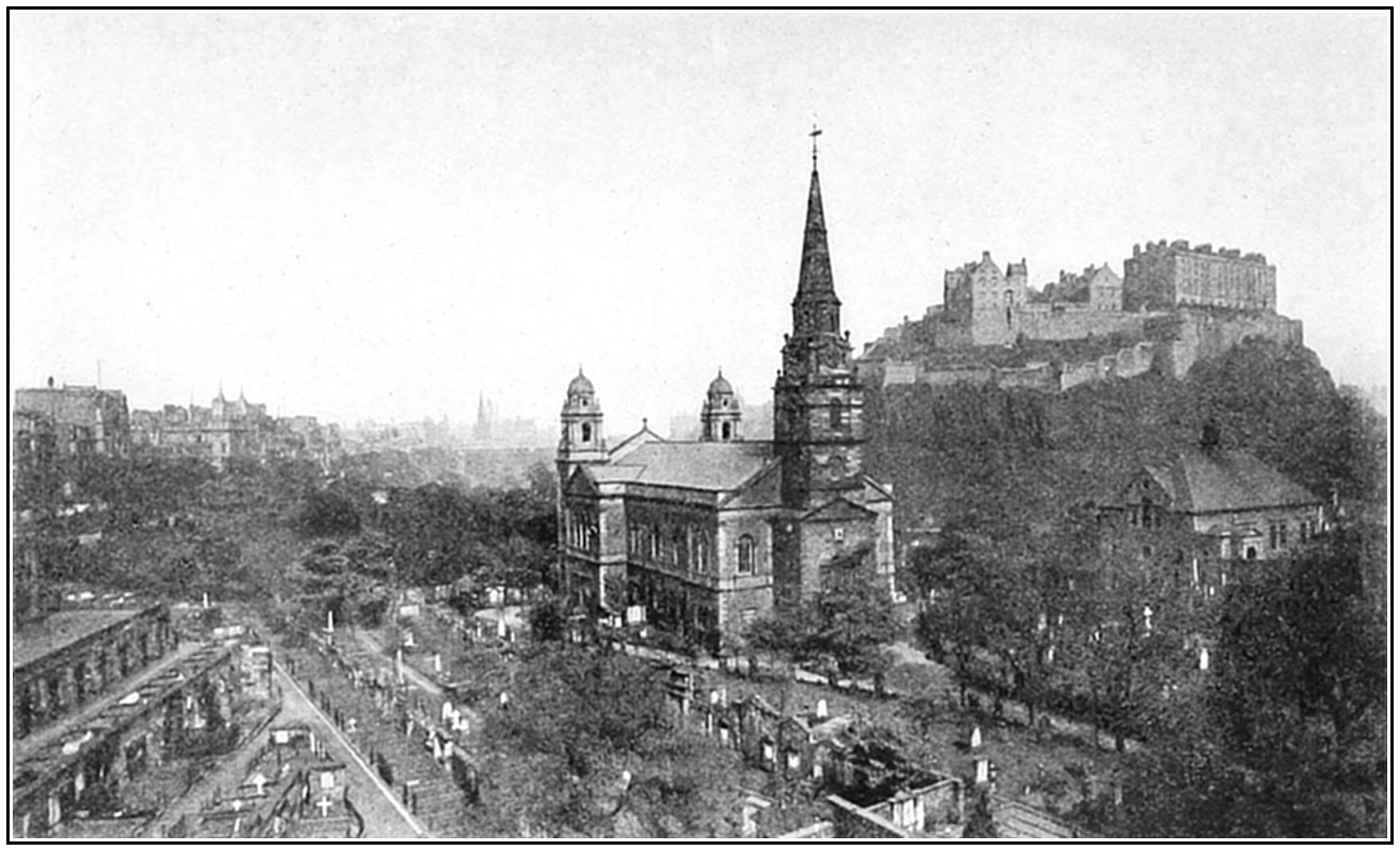
EDINBURGH
A splendid monument to Sir Walter Scott,
three hundred feet high and costing $90,000,
stands in the centre of the space opposite our
hotel. Though in richest Gothic style and a gem
of art, it was built by a self-taught architect.
Not far away, Professor Wilson, Allan Ramsay,
Robert Burns, and other sons of Scotland repose
in bronze or marble dignity. Indeed, the new city
is particularly rich in monuments of every description
and quality. Edinburgh’s parks and
open spaces are unusually numerous. Even the
cemeteries are full of beauty and charm, for it is
a pleasure to read the names of old friends, unseen,
indeed, but whom we learned to love so long
ago through their books.
To-day the American greets in bronze his country’s
second father, whose ancestors once dwelt
on the coin, or colony on the Lind; whence Father
Abraham’s family name, Lincoln. How we boys,
in the Union army in 1863, used to sing, “We
are coming, Father Abraham, three hundred thousand
strong”! How in 1916, the men of the four
nations of the United Kingdom, who have formed
Kitchener’s army, sang their merry response to
duty’s call, in the same music and spirit, and in
much the same words!
Edinburgh is really the heart of the old shire
of Midlothian, for it is the central town of the
metropolitan county, with a long and glorious history.
After James I, the ablest man of the Stuart
family, was murdered, on Christmas night, A.D.
1437, Edinburgh became the recognized capital
of the kingdom, for neither Perth, nor Scone, nor
Stirling, nor Dunfermline was able to offer proper
security to royalty against the designs of the turbulent
nobles. From this date Edinburgh, with
its castle, was selected as the one sure place of
safety for the royal household, the Parliament, the
mint, and the government offices. Thereupon in
“Edwin’s Burgh” began a growth of population
that soon pressed most inconveniently upon the
available space, which was very restricted, since
the people must keep within the walls for the
sake of protection. The building of very high
houses became a necessity. The town then consisted
only of the original main way, called “High
Street,” reaching to the Canon Gate, and a parallel
way on the south, long, narrow, and confined,
called the “Cow Gate.” It was in the days when
the sole fuel made use of was wood that Edinburgh
received its name of “Auld Reekie,” or
“Old Smoky.”
In other words, feudal and royal Edinburgh
was a walled space, consisting of two long streets,
sloping from hilltop to flats, with houses of stone
that rose high in the air. Somehow, such an
architectural formation, which might remind a
Swiss of his native Mer de Glace and its aiguilles,
recalls to the imaginative but irreverent American
the two long parallel series of rocks, which he
may see on the way to California, called “The
Devil’s Slide.” These avenues of old Edinburgh,
so long and not very wide, had communication
each with the other by means of about one hundred
dark, narrow cross-alleys or “closes,” between
the dense clusters of houses. Sometimes
they were called “wynds,” and in their shadowy
recesses many a murder, assassination, or passage-at-arms
took place, when swords and dirks, as in
old Japan, formed part of a gentleman’s daily
costume. In proportions, but not in character or
quality of the wayfarers, these two Scottish streets
are wonderfully like the road to heaven.
These houses were not homes, each occupied by
but one family. They were rather like the modern
apartment houses, consisting of a succession of
floors or flats, each forming a separate suite of
living-rooms, so that every structure harbored
many households. Of such floors there were seldom
fewer than six, and sometimes ten or twelve,
the edifices towering to an immense height; and,
because built upon an eminence, rendered still
more imposing. It was toward the middle of the
eighteenth century before the well-to-do citizens
left these narrow quarters for more extensive and
level areas beyond the ravine. There is now no
suggestion of aristocracy here, for these are now
real tenement houses. The hygienic situation,
however, even though the tenants are humble
folk, reveals a vast improvement upon the days
when elegant lords and ladies inhabited these lofty
rookeries, which remind one of the Cliff Dwellings
of Arizona—or those modern “cliff dwellings,”
the homes of the luxurious literary club men on
the lake-front of Chicago.
In old days it was a common practice to throw
the slops and garbage out of the upper windows
into the street below. The ordinary word of warning,
supposed to be good Scotch and still in use,
is “Gardeloo,” which is only a corruption of the
French “Gardez de l’eau” (Look out for the
water). It is but one of a thousand linguistic or
historic links with Scotland’s old friend and ally,
France.
In fact, until near the nineteenth century, Edinburgh’s
reputation for dirt, though it was shared
with many other European cities in which our
ancestors dwelt, was proverbial, especially when
refuse of all sorts was flung from every story of
the lofty houses. From the middle of the street to
the houses on both sides lay a vast collection of
garbage ripening for transportation to the farms
when spring opened. In this the pigs wallowed
when driven in, at the close of the day, from the
beech or oak woods by the hog-reeve. The prominent
features of the prehistoric kitchen middens,
which modern professors so love to dig into, were,
in this High Street, in full bloom and the likeness
was close.
How different, in our time, when municipal hygiene
has become, in some places at least, a fine
art! There is a reason why “the plague” no
longer visits the British Isles. Nor, as of old,
is “Providence” so often charged with visiting
“mysterious” punishment upon humanity. Science
has helped man to see himself a fool and to
learn that cleanliness is next to godliness. The
modern Scot, for the most part, believes that laziness
and dirt are the worst forms of original sin.
Yet it took a long course in the discipline of cause
and effect to make “Sandy” fond of soap, water,
and fumigation. In this, however, he differed, in no
whit, from our other ancestors in the same age.
After seeing Switzerland, and studying the behavior
of glaciers, with their broad expanse at the
mountain-top, their solidity in the wide valleys,
and then, farther down, their constriction in a
narrow space between immovable rocks, which,
resisting the pressure of the ice-mass, force it upward
into pinnacles and tower-like productions,
I thought ever afterwards of the old city of Edinburgh
as a river, yet not of ice but of stone.
Flowing from the lofty summit whereon the castle
lay, the area of human habitation was squeezed
into the narrower ridge, between ancient but now
valueless walls, which seemed to force the human
dwellings skyward. Yet it was not through the
pressure of nature, but because of the murderous
instincts of man, with his passions of selfishness
and love of destruction, that old Edinburgh took
its shape.
On our first visit, to cross from our hotel in
the new city and over into the ancient precincts,
we walked above the ravine, over a high arched
stone bridge, and turning to the right climbed up
High Street to the castle, and rambled on the
Esplanade. This is the picture—it is Saturday
afternoon and a regiment of soldiers in Highland
costume have been parading. Yet, besides the
warriors, you can see plenty of other men in this
pavonine costume, with their gay plaids, bare legs,
and showy kilts. We hear a strange cry in the
streets and then see, for the first time, the Edinburgh
fishwoman in her curious striped dress of
short skirts and sleeves, queer-looking fringed
neck-cover, and striped apron. Her little daughter
dresses like her, for the costume is hereditary.
On her shoulders is a huge basket of fish bound
by a strap over her head. These fish peddlers are
said to be a strange race of people living, most of
them, at Leith, and rarely intermarrying outside
of their own community.
At the castle we see that the moat, portcullis,
and sally port are still there. We pass through
the outer defences, which have so often echoed
with battle-cries and the clang of claymores, for
this old castle has been taken and retaken many
times. Reaching what are now the soldiers’ barracks,
we see a little room in which Mary Queen
of Scots gave birth to James the Sixth of Scotland
and First of England, in whom the two thrones
of the island were united. It seems a rough room
for a queen to live in.
The ascent of High Street is much like climbing
a staircase, resting on landings at the second,
third, or fourth floor. When, however, one reaches
the top and scans the glorious panorama, he feels
like asking, especially, as he sees that the highest
and oldest building is Queen Margaret’s Chapel,—a
house of worship,—“Does God live here?”
Of all the places of interest which we saw within
or near the great citadel, there was one little corner
of earth, with rocky environment but without
deep soil, set apart as a cemetery for soldiers’ pets
and mascots. The sight touched us most deeply.
Here were buried, with appropriate memorials
and inscriptions, probably twenty of the faithful
dumb servants of man, mostly dogs, from which
their masters had not loved to part.
It compels thought to recall the fact that, in
large measure, man is what he is because of his
dumb friends. What would he be without the
horse, the dog, the cow, the domesticated beasts
of burden, and our dumb friends generally? Without
the white man, the Iroquois of America and
the Maoris of New Zealand would undoubtedly
have arisen into a higher civilization, had they
been possessed of beasts of draught or burden, or
which gave food, protection, or manifold service.
Could they have made early use of the wonderful
gifts of the finer breeds of the dog and the horse,
what steps of advancement might they not have
taken? How far would the Aztecs, Incas, and
Algonquins have advanced without domestic fowls
and cattle? What would the Japanese islanders
have been, without the numerous domestic animals
imported from China in historic times?
What would Europe and America be, bereft of
the gifts they have both received from Asia?
How striking are the narratives of the early
colonists in America, that reveal to us the fact that
the aboriginal Indian had only a wolf-dog of diminutive
size and slight powers, while the canine breeds
of Europe not only showed more varied and higher
qualities, but were larger in size. Of these strange
creatures, the red men were usually more afraid
than of their white owners. How surprising was
the experience of the Mexicans, who, on beholding
the Spanish cavaliers, cased in steel, thought the
horse and the rider were one animal! What would
South America and her early savages have been,
if left without the friends of man imported from
the Asian continent?
As at The Hague and at Delft, one notes with
the statue of William the Silent the little dog that
saved his life; so at Edinburgh we see at the feet
of the effigy of Sir Walter, the poet and romancer,
his favorite dog Maida. Few episodes are more
touching than that of the dog Lufra, in Canto V
of the “Lady of the Lake.”
After such a picture of mutual devotion between
man and brute, it seems little wonder that in Scotland
has been bred what is perhaps the noblest
type of canine life. In the physical characteristics
of speed, alertness, fleetness, the Scotch collie is
second to none in the kingdom of dogs, while in
the almost human traits of loyalty to his master
and devotion to his interests, this friend of man
crowns an age-long evolution from the wild. Happily
in art, which is the praise of life, Scotland’s
collie and hound have found the immortality of
man’s appreciation. This is shown, not only in the
word paintings of her poets and romancers, but
on the canvas of Landseer, the Shakespeare of
dogs. In the Highlands this English painter found
some of his noblest inspirations.
Edinburgh, besides being a brain-stimulant, because
it is the focus of Scottish history, is also
a heart-warmer. Holyrood Palace, Arthur’s Seat,
Grey Friar’s Churchyard, St. Giles’s Church, the
University, Calton Hill—what memories do they
conjure up, what thought compel? A Scottish Sabbath—how
impressive! One can no more write
the history of Scotland or pen a description of the
country and people, and leave out religion, than
tell of Greece or Japan and make no mention of
art.
CHAPTER V MELROSE ABBEY AND SIR WALTER SCOTT
Always fond of fireside travels, I had, many a
time, in imagination, ridden with William of Deloraine
from Branksome Hall, through the night and
into the ruins of Melrose Abbey. His errand was
to visit the grave of Michael Scott, whose fame had
penetrated all Europe and whom even Dante mentions
in his deathless lines. Now, however, I had
a purpose other than seeing ruins. If possible, I
was determined to pick a flower, or a fern, from
near the wizard’s grave to serve as ingredient for
a philter.
Does not Sir Walter, in his “Rob Roy,” tell
us that the cailliachs, or old Highland hags, administered
drugs, which were designed to have
the effect of love potions? Who knows but these
concoctions were made from plants grown near the
wonder-worker’s tomb? At any rate, I imagined
that one such bloom, leaf, or root, sent across the
sea, to a halting lover, might reinforce his courage
to make the proposal, which I doubt not was expected
on the other side of the house. At least
we dare say this to the grandchildren of the long
wedded pair.
So glorified were the gray ruins of Melrose, in
Scott’s enchanting poetry, that I almost feared to
look, in common sunlight, upon the broken arches
and the shafted orioles; for does not Scott, who
warns us to see Melrose “by the pale moonlight,”
tell us that
“The gay beams of lightsome day
Gild but to flout the ruin gray.”
Yet the tourist’s time, especially when in company,
is not usually his own, and for me, though
often, later, at the abbey, the opportunity never
came of visiting “fair Melrose aright,” by seeing
its fascinations under lunar rays, or in
“the cold light’s uncertain shower.”
On the morning of July 11, we had our first
view from the railway. The ruins loomed dark and
grand. Approaching on foot the pile, closely surrounded
as it was by houses and Mammonites and
populated chiefly by rooks, the first view was not
as overpowering as if I had come unexpectedly to
it under the silver light of the moon. Yet, on lingering
in the aisles within the ruined nave and
walking up and down amid the broken marbles,
imagination easily pictured again that spectacular
worship, so enjoyed in the Middle Ages and beloved
by many still, which makes so powerful and
multitudinous an appeal to the senses and emotions.
The west front and a large portion of the north
half of the nave and aisle of the abbey have perished,
but the two transepts, the chancel and the
choir, the two western piers of the tower, and the
sculptured roof of the east end are here yet to
enthral. I thought of the processions aloft, of the
monks, up and down through the interior clerestory
passage, which runs all around the church.
Again, in the chambers of fancy, the choir sang,
the stone rood screen reflected torch and candlelight,
and the lamp of the churchman shed its
rays, while the “toil drops” of the knight William,
“fell from his brows like rain,” as “he
moved the massy stone at length.”
A minute examination of the carving of windows,
aisles, cloister, capitals, bosses, and door-heads
well repays one’s sympathetic scrutiny, for
no design is repeated. What loving care was that
of mediæval craftsmen, who took pride in their
work, loving it more than money! Proofs of this
are still visible here. Such beauty and artistic triumphs
open a window into the life of the Middle
Ages. From the south of Europe, the travelling
guilds of architects and masons, and of men expert
with the chisel, must have come hither to put their
magic touch upon the stone of this edifice, which
was so often built, destroyed, and built again. “A
penny a day and a little bag of meal” was the
daily dole of wages to each craftsman. One may
still trace here the monogram of the master workman.
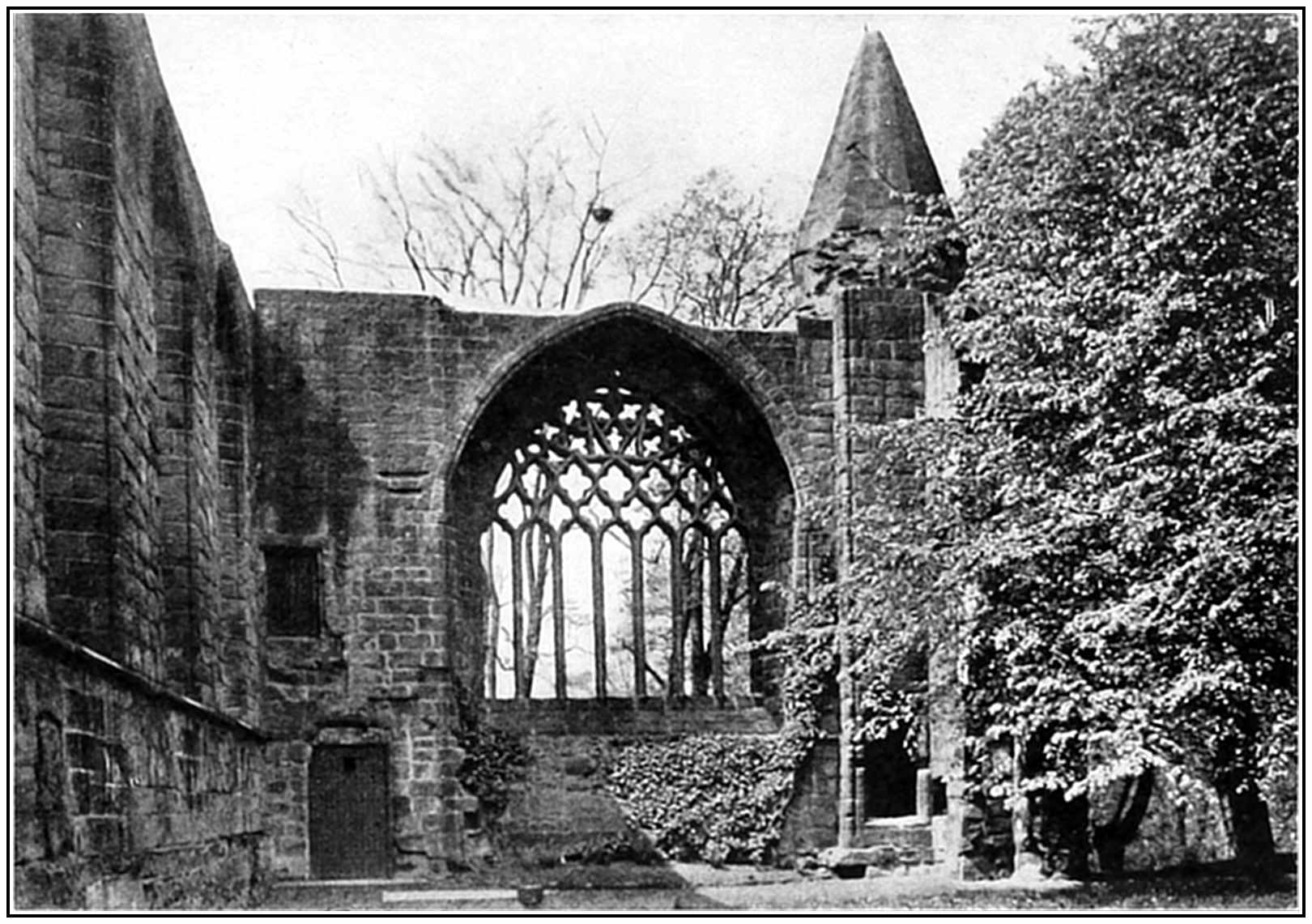
Under the high altar in this Scottish abbey,
the heart of Robert the Bruce was buried. Intensely
dramatic is the double incident of its being
carried toward Palestine by its valorous custodian,
who, in battle with the Saracens, hurled
the casket containing it at the foe, with the cry,
“Forward, heart of Bruce, and Douglas shall follow
thee.”
In the chancel are famous tombs of men whose
glory the poet has celebrated. Here, traditionally,
at least, is the sepulchre of Michael Scott,
visited, according to Sir Walter’s lay, by the monk
accompanying William of Deloraine. With torch
in hand and feet unshod, the holy man led the
knight.
It was “in havoc of feudal war,” when the
widowed Lady, mistress of Branksome Hall, was
called upon to decide whether her daughter Margaret
should be her “foeman’s bride.” “Amid the
armed train” she called to her side William of
Deloraine and bade him visit the wizard’s tomb
on St. Michael’s night and get from his dead hand,
“the bead, scroll, or be it book,” to decide as to
the marriage.
Now for Scott’s home! On the bank of Scotland’s
most famous river, the Tweed, two miles
above Melrose, was a small farm called Clarty
Hole, which the great novelist bought in 1811.
Changing the name to Abbotsford, he built a small
villa, which is now the western wing of the present
edifice. As he prospered, he made additions
in the varied styles of his country’s architecture
in different epochs. The result is a large and irregularly
built mansion, which the “Wizard of
the North” occupied twenty-one years. It has
been called “a romance in stone and lime.”
Knowing that the Tweed had been for centuries
beaded like a rosary with monasteries and that
monks had often crossed at the ford near by, Sir
Walter coined the new name and gave it to the
structure in which so much of his wonderful work
was done for the delight of generations. Curiously
enough, in America, while many places have been
named after persons and events suggested by
Scott’s fiction, only one town, and that in Wisconsin,
bears this name of Abbotsford.
With a jolly party of Americans, we entered
the house, thinking of Wolfert’s Roost at Tarrytown,
New York, and its occupant Washington
Irving, who had been a warm friend of Sir Walter.
It was he who gave him, among other ideas, the
original of Rebecca, a Jewish maiden of Philadelphia,
whose idealization appears, in Scott’s beautiful
story of “Ivanhoe,” as the daughter of Isaac
of York. Memory also recalls that Scott wrote
poetry that is yet sung in Christian worship, for
in Rebecca’s mouth he puts the lyric,—
“When Israel of the Lord beloved.”
In the dim aisles of Melrose Abbey, before
Michael Scott’s tomb, “the hymn of intercession
rose.” The mediæval Latin of “Dies Iræ” has
many stanzas, but Scott condensed their substance
into twelve lines, beginning;—
“That day of wrath, that dreadful day,
When Heaven and earth shall pass away.”
We were shown the novelist’s study and his
library, the drawing-room and the entrance hall.
The roof of the library is designed chiefly from
models taken from Roslyn Chapel, with its matchless
pillar that suggests a casket of jewels. While
many objects interested us both, it is clear, on the
surface of things, that our lady companion, Quandril,
was not so much concerned with what the
cicerone told to the group of listeners as were
certain male students present, who, also, were
slaves of the pen: to wit, that when Sir Walter
could not sleep, because of abnormal brain activity,
he would come out of his bedroom, through
the door, which was pointed out to us in the upper
corner, and shave himself. This mechanical operation,
with industry applied to brush, lather, steel,
and stubble, diverted his attention and soothed
his nerves. More than one brain-worker, imitating
Sir Walter, has found that this remedy for insomnia
is usually effectual.
Another fascinating monastic ruin is Dryburgh
on the Tweed. It was once the scene of Druidical
rites. The original name was Celtic, meaning the
“bank of the oaks.” St. Modan, an Irish Culdee,
established a sanctuary here in the sixth century,
and King David I, in 1150, built the fine abbey.
Here, in St. Mary’s aisle, sleeps the dust of
the romancer who re-created, to the imagination,
mediæval Scotland. Certainly her greatest interpreter
in prose and verse is one of the land’s jewels
and a material asset of permanent value.
The fame of Sir Walter yields a revenue, which,
though not recorded in government documents, is
worth to the Scottish people millions of guineas.
From all over the world come annually tens of
thousands of pilgrims to Scotland, and they journey
hither because the “Wizard of the North”
has magnetized them through his magic pen. Probably
a majority are Americans. Not even Shakespeare
can attract, to Stratford, at least, so many
literary or otherwise interested pilgrims of the
spirit, as does Burns or Scott.
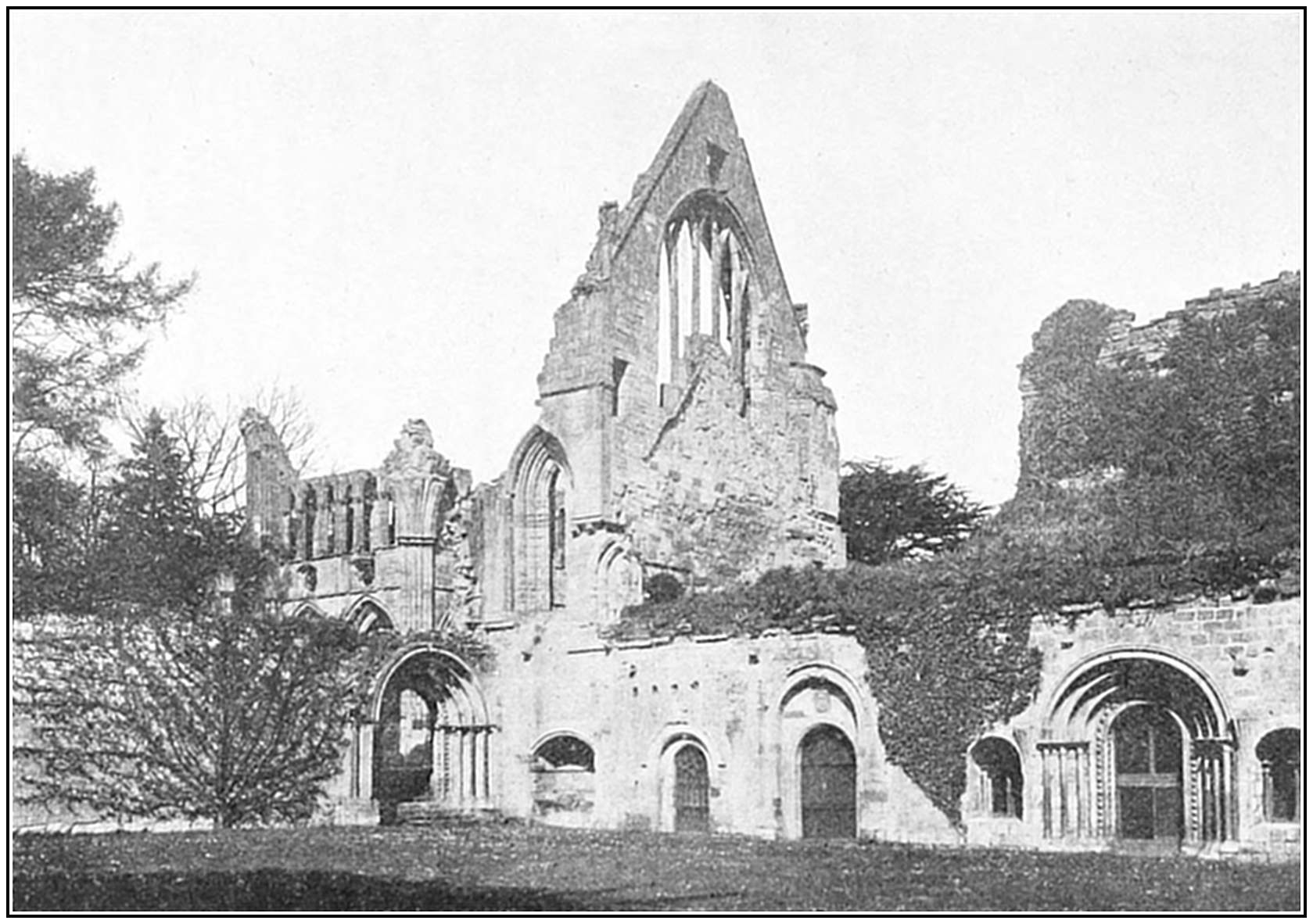
DRYBURGH ABBEY
We move next and still southward to Gretna
Green—for centuries mentioned with jest and merriment.
Of old, those rigid laws of State-Church-ridden
England concerning marriage, which made
the blood of Free Churchmen boil, while rousing
the contempt and disgust of Americans, compelled
many runaway couples from across the English
border to seek legal union under the more easy
statutes of Scotland. Gretna Green was the first
convenient halting-place for those who would evade
the oppressive requirements of the English Marriage
Act. For generations, thousands of nuptial
ceremonies were performed by various local persons
or officials, though chiefly by the village
blacksmith. Other places, like Lamberton, shared
in the honors and revenue also. One sign, visible
for many years, read, “Ginger Beer Sold Here,
and marriages performed on the most reasonable
terms.”
English law, framed by the House of Lords, compelled
not only the consent of parents and guardians,
but also the publication of banns, the presence
of a priest of the Established Church, fixed
and inconvenient hours, and other items of delay
and expense. All that Scotland required, however,
as in New York State, was a mutual declaration of
marriage, to be exchanged in presence of witnesses.
The blacksmith of Gretna Green was no more
important than other village characters, nor did
his anvil and tongs have any ritual significance,
because any witness was eligible to solemnize a
ceremony which could be performed instantly.
Gradually, however, as in so many other instances
of original nonentities in Church and State, the
blacksmith gradually assumed an authority which
imposed upon the credulity of the English strangers,
who usually came in a fluttering mood. In that
way, the local disciple of St. Dunstan is said to
have profited handsomely by the liberality usually
dispensed on such felicitous occasions. The couple
could then return at once to England, where their
marriage was recognized as valid, because the nuptial
union, if contracted according to the law of
the place where the parties took the marital vow,
was legal in the United Kingdom.
After the severity of the English law, under the
hammering of the Free Church had been modified,
Gretna Green was spoiled as a more or less
romantic place of marriages, and held no charms
for elopers. Scottish law, also, was so changed as
to check this evasion of the English statutes. No
irregular marriage of the kind, formerly and extensively
in vogue, is now valid, unless one of the
parties has lived in Scotland for twenty-one days
before becoming either bride or groom. Gretna
Green no longer points a joke or slur except in the
preterite sense.
Sir Walter Scott, who sentinels for us the enchanted
land we are entering, was in large measure
the interpreter of Scotland, but he was more.
In a sense, he was his native country’s epitome and
incarnation. His literary career, however, illustrated,
in miniature, almost all that Disraeli has
written in his “Curiosities of Literature,” and especially
in the chapter concerning “the calamities
of authors.” Happily, however, Scott’s life was
free from those quarrels to which men of letters
are so prone, and of which American literary history
is sufficiently full. Millions have been delighted
with his poetry, which he continued to
write until Byron, his rival, had occulted his fame.
He is credited with having “invented the historical
novel”—an award of honor with which, unless
the claim is localized to Europe, those who
are familiar with the literature of either China or
Japan cannot possibly agree. Yet, in English, he
was pioneer in making the facts of history seem
more real through romance.
Scott was born in a happy time and in the right
place—on the borderland, which for ages had
been the domain of Mars. Here, in earlier days,
the Roman and the Pict had striven for mastery.
Later, Celtic Scot and invaders of Continental
stock fought over and stained almost every acre
with blood. Still later, the Lowlanders, of Teutonic
origin, and the southern English battled with one
another for centuries. On a soil strewn with mossy
and ivied ruins, amid a landscape that had for him
a thousand tongues, and in an air that was full of
legend, song, and story, Scott grew up. Though not
much of a routine student, he was a ravenous
reader. Through his own neglect of mental discipline,
in which under good teachers he might have
perfected himself, he entered into active life, notably
defective on the philosophic side of his mental
equipment, and somewhat ill-balanced in his perspective
of the past, while shallow in his views of
contemporary life.
Despite Scott’s brilliant imagery, and the compelling
charm of his pageants of history, there
were never such Middle Ages as he pictured. For,
while the lords and ladies, the heroes and the
armed men, their exploits and adventures in castle,
tourney, and field, are pictured in rapid movement
and with fascinating color, yet of the real
Middle Ages, which, for the mass of humanity,
meant serfdom and slavery, with brutality and
licentiousness above, weakness and ignorance below,
with frequent visits of plague, pestilence, and
famine, Scott has next to nothing to say. As for
his anachronisms, their name is legion.
Nevertheless Scott had the supreme power of
vitalizing character. He has enriched our experience,
through imaginative contact with beings who
are ever afterwards more intimately distinct and
real for us than the people we daily meet. None
could surpass and few equal Scott in clothing a
historical fact or fossil with the pulsing blood and
radiant bloom of life, compelling it to stand forth in
resurrection of power. Scott thus surely possesses
the final test of greatness, in his ability to impress
our imagination, while haunting our minds with figures
and events that seem to have life even more abundantly
than mortal beings who are our neighbors.
Critics of to-day find fault with Scott, chiefly
because he was deficient in certain of the higher
and deeper qualities, for which they look in vain
in his writings, while his poetry lacks those refinements
of finish which we are accustomed to exact
from our modern singers. However, those to whom
the old problems of life and truth are yet unsettled,
and who still discuss the questions over which men
centuries ago fought and for which they were glad to
spill their blood in defence and attack, accuse Scott
of a partisanship which to them seems contemptible.
Moreover, his many anachronisms and grave historical
blunders, viewed in the light of a larger
knowledge of men and nations, seem ridiculous.
Yet after all censure has been meted out and
judgment given, it is probable that in frank abandon
for boldness and breadth of effect, and in
painting with words a succession of clear pictures,
his poems are unexcelled in careless, rapid, easy
narrative and in unfailing life, spirit, vigorous
and fiery movement. Had Scott exercised over his
prose writings a more jealous rigor of supervision,
and had he eliminated the occasional infusions of
obviously inferior matter, his entire body of writings
would have been even more familiar and
popular than they are to-day. It is safe to say
that only a selection of the most notable of his
works is really enjoyed in our age, though undoubtedly
there will always be loyal lovers of the
“Magician of the North,” who still loyally read
through Scott’s entire repertoire. Indeed, we have
known some who do this annually and delightedly.
Taking his romances in chronological order, one
may travel in the observation car of imagination
through an enchanted land, having a background
of history; while his poems surpass Baedeker,
Black, or Murray as guide books to Melrose Abbey,
through the Trossachs, to Ellen’s Isle, or along
Teviot’s “silver tide.”
CHAPTER VI RAMBLES ALONG THE BORDER
Where does the Scot’s Land begin and where
end? To the latter half of the question, the answer
is apparently easy, for the sea encloses the
peninsula. Thus, on three sides, salt water forms
the boundary, though many are the islands beyond.
On the southern or land side, the region was for
ages debatable and only in recent times fixed.
Scotland’s scientific frontier is young.
Sixteen times did we cross this border-line, to
see homes and native people as well as places. In
some years we went swiftly over the steel rails by
steam, in others tarried in town and country, and
rambled over heath, hill, and moor, to see the face
of the land. We lived again, in our saunterings,
by the magic of imagination, in the past of history.
Affluent is the lore to be enjoyed in exploring
what was once the Debatable or No Man’s Land.
What area is richer in ruins than that of the
shire counties bordering the two countries? Yet
there is a difference, both in nature and art. On
the English side, not a few relics in stone remain
of the old days, both in picturesque ruins and in
inhabited and modernized castles. On the other
or Scotch side, few are the towers yet visible, while
over the sites of what were once thick-walled places
of defence and often the scene of blows and strife,
the cattle now roam, the plough cuts its furrows,
or only grassy mounds mark the spot where passions
raged. Let us glance at this border region,
its features, its names, and its chronology. How
did “Scotland” “get on the map”?
This familiar name is comparatively modern,
but Caledonia is ancient and poetical. The Roman
poet Lucan, in A.D. 64, makes use of the term,
and in Roman writers we find that there existed
a district, a forest, and a tribe, each bearing the
name “Caledonia,” and spoken of by Ptolemy.
The first Latin invasion was under Agricola, about
A.D. 83, and a decisive battle was fought, according
to his son-in-law, Tacitus, on the slopes of Mons
Graupius, a range of hills which in modern days
is known as the “Grampian Hills.” To our childish
imagination, “Norval” whose father fed his flock
on these heathery heights, was more of a living
hero than was the mighty Roman. Of Agricola’s
wall, strengthened with a line of forts, there are
remains still standing, and two of these strongholds,
at Camelon and Barhill, have been identified
and excavated.
Perhaps the most northerly of the ascertained
Roman encampments in Scotland is at Inchtuthill.
Where the Tay and Isla Rivers join their waters—
“Rome the Empress of the world,
Of yore her eagle wings unfurled.”
The Romans left the country and did not enter
it again until A.D. 140, when the wall of Antoninus
Pius was built, from sea to sea, and other forts
erected. It was on pillared crags and prow-like
headlands, between the North and South Tynes,
along the verge of which the Romans carried their
boundary of stone.
The Caledonians remained unconquered and
regained full possession of their soil, about A.D.
180. Then the Emperor Septimus Severus invaded
the land, but after his death the Roman
writ never ran again north of the Cheviot Hills.
Summing up the whole matter, the Latin occupation
was military, without effect on Caledonian
civilization, so that the people of this Celtic northland
were left to work out their own evolution
without Roman influence and under the ægis of
Christianity.
If we may trust our old friend Lemprière (1765–1824),
of Classical Dictionary fame,—the second
edition of whose useful manual furnished, to a
clerk in Albany, the Greek and Latin names which
he shot, like grape and canister, over the “Military
Tract,” in New York State, surveyed by Simeon
DeWitt,—we may get light on the meaning of
“Caledonia” and “Scot.” The former comes from
“Kaled,” meaning “rough”; hence the “Caledonii,”
“the rude nation,”—doubtless an opinion
held mutually of one another by the Romans and
their opponents. The term survives in the second
syllable of Dunkeld. “Pict,” or “pecht,” is stated
to mean “freebooters.” “Scot” means “allied,”
or in “union,” and the Scots formed a united
nation. Another author traces Caledonia to the
term “Gael-doch,” meaning “the country of the
Gael,” or the Highlander.
After the invasions of the Romans, there followed
the Teutonic incursions and settlements,
which were by the mediæval kingdoms, and the
struggles between the Northerners and Southrons,
but no regular boundary was recognized until
1532. For a millennium and a half, or from Roman
times, this border land was a region given
up to lawlessness, nor did anything approaching
order seem possible until Christianity had been
generally accepted. Faith transformed both society
and the face of nature. By the twelfth century,
churches, abbeys, and monasteries had made
the rugged landscape smile in beauty, while softening
somewhat the manners of the rude inhabitants.
Yet even within times of written history,
nine great battles and innumerable raids, of
which several are notable in record, song, or ballad,
took place in this region. These, for the most
part, were either race struggles or contests for the
supremacy of kings.
In modern days, when “the border,” though no
longer a legal term, holds its place in history and
literature, it has been common to speak of the
country “north of the Tweed” as meaning Scotland.
Yet this river forms fewer than twenty
miles of the recognized boundary, which in a
straight line would be but seventy miles, but
which, following natural features of river, hill
burn, moor, arm of the sea, and imaginary lines,
measures one hundred and eight miles. The ridge
of the Cheviot Hills is the main feature of demarcation
for about twenty-five miles. A tributary of
the Esk prolongs the line, and the Sark and the
Solway Firth complete the frontier which divides
the two lands. The English counties of Northumberland
and Cumberland are thus separated from
the Scottish shires of Berwick, Roxburghe, and
Dumfries. In former times, “the frontier shifted
according to the surging tides of war and diplomacy.”
Even to the eleventh century, the old Kingdom
of Northumbria included part of what is now
Scotland, up to the Firth of Forth and as far west
as Stirling. In 1081, however, the Earl of Northumberland
ceded the district which made the
Tweed the southern boundary of the Kingdom
of the Scots. Hence the honor of antiquity belonging
to the Tweed as the eastern border-line!
On the west, however, William the Conqueror
wrenched Cumberland from the Scottish sceptre,
and ever since it has remained in England.
For six hundred years, from the eleventh to near
the end of the seventeenth century, war was the normal
condition. Peace was only occasional. In this era
were built hundreds of those three-storied square
towers with turrets at the corners, of which so
many ruins or overgrown sites remain. On each
floor was one room, the lower one for cattle, the
upper for the laird and his family, and a few
ready-armed retainers. Around this bastel-house,
or fortified dwelling, were ranged the thatched
huts of the followers of the chief. These, on the
signal of approaching enemies, or armed force,
crowded into the stronghold. In feudal days, when
these strong towers were like links in a chain,
prompt and effective notice of approaching marauders
could be sent many leagues by means of
beacon fires kindled in the tower-tops and on the
walls. Human existence in these abodes, during a
prolonged siege, may be imagined.
Perhaps the best picture of castle and tower life
in this era, though somewhat glorified, is that of
Branksome Hall, in “The Lay of the Last Minstrel.”
The nine and twenty knights, in full armor
night and day, “drank the red wine through their
helmets barred.” The glamour of Scott, the literary
wizard, makes castle life seem almost enviable—but
oh, the reality! Happily to-day lovely homes
have taken the place of these ancient strongholds.
On the Scottish side, besides numerous small
streams, are many stretches of fertile land with
rich valleys and intervales, while much of the
scenery is romantic and beautiful. In the southwestern
corner, one does not forget that from the
eighth to the twelfth century flourished the Kingdom
of Strathclyde, which bordered on the Clyde
River. In the Rhins of Galloway is the parish
of Kirkmaiden, which is Scotland’s most southern
point. The common, local expression, “from
Maidenkirk to John o’ Groat’s House,” is like
that of “from Dan to Beersheba.” Now, however,
not a few sites famous in song and story
and once part of the Scots’ land are in England,
notably, Flodden Field, and in the sea, Lindisfarne,
or Holy Isle, so famous in “Marmion.”
To-day, on Holy Isle, the summer tourists make
merry and few perhaps think of the story of Constance
the nun, betrayed by Marmion the knight,
condemned by her superior, incarcerated in the
dungeons, and sent to her death.
Probably the ages to come will show us that
the most enduring monuments of centuries of
strife, in this borderland, must not be looked for
in its memorials of stone, but in language. The
“winged words” may outlast what, because of
material solidity, was meant for permanence and
strength. Minstrelsy and ballad, poem and song,
keep alive the acts of courage and the gallantry
of the men and the sacrifice and devotion of the
women which light up these dark centuries. To
Scott, Billings, and Percy we owe a debt of gratitude,
for rescuing from oblivion the gems of poet
and harpist.
When feudalism gave way to industry, the
business of the moss trooper, the swashbuckler,
and the cattle-thief ceased to be either romantic or
useful. The same fate which, in the Japan of my
experience, met the ruffians and professional gentlemen-assassins,
was visited upon the Scottish
borderers. These fellows could not understand
just how and why they were now deemed common
ruffians and vile murderers, who had before been
powerful chiefs or loyal retainers. Instead of
minstrels singing in praise of their exploits, the
gallows, planted on a hundred hills, awaited them.
The Japanese handled their problem by ordering
to the common public execution grounds the cowardly
assassins of foreigners, instead of allowing
them, as gentlemen, to commit the ceremony of
hara-kiri, within decorated areas curtained with
white silk, to be followed by posthumous floral
offerings laid on their tombs by admiring friends.
In both Scotland and Japan, the effectual
method, in the new climate of public opinion, was
to deprive the thief and murderer of all glory and
honor. In both lands, the police took the place of
the military. The club of justice fell unerringly
on the right noddle, instead of having innocent
bystanders killed by the bullets of soldiers. In
place of harmless peasants suffering the loss of
their houses, crops, and cattle, the border malefactors,
who later furnished themes for the cheap
stage and the dime novel, paid in person the penalty
of their misdeeds.
Yet until a Scottish king sat on an English
throne, the attempts to create a peaceful border
region were more or less fitful and but partially
successful. It is true that the area had long before
been marked off into three districts, or marches,—east,
middle, and west,—with officers called
“wardens.” These, aided by commissioners, put
down petty insurrections and punished cattle-thieves.
Occasionally a warden would be slain at
a border meeting, as was Sir Robert Kerr, whose
murder was avenged by one of his loyal followers,
who pursued the assassin as far as York, dragged
him out of concealment, and brought his head to
their new master. This exploit almost duplicated
the approved episode of the Japanese Forty-seven
Ronins in Yedo, though on a smaller scale. Further
to carry out the fashion, which I used to see
often illustrated in Japan, the head was exposed in
Edinburgh, on the king’s cross.
One of the favorite games of the Scottish borderers
was to meet, ostensibly to play football,
but in reality to plan and execute a raid southward,
with a view to incendiarism and the theft
of butcher’s meat on the hoof. Was it from this
Scotch precedent that in the sport of American
college football—the first game being that between
Rutgers and Princeton in 1870, for which
we subscribed in student days—was borrowed
the violence which makes the rough-and-tumble
scuffle so fascinating to the “fans” of to-day?
Be this as it may, the earlier Scottish football
games, which made bullhide rather than pigskin
their chief goal, were broken up in Queen Elizabeth’s
time.
After a Scottish king had mounted the English
throne, border lawlessness became henceforth intolerable.
It had lasted long enough, and after
1605 was put down with ruthless energy. Those
shires in both England and Scotland, which had
formerly been the border counties and so often
given up to the ravages of the moss troopers, were
named by King James, in 1603, “the Middle
Shires of Great Britain.” By means of a band of
mounted police, twenty-five in number, led by Sir
William Cranstoun, murderers and robbers were
speedily brought to justice. In one year thirty-two
persons were hanged, fifteen banished, and over
one hundred and forty named as fugitive outlaws.
This list was next year increased and their names
were hung up at the market crosses and on the
doors of parish churches. Over two hundred and
sixty were nominated as persons to be pursued
with hue and cry, wherever they were found. The
nests of outlawry were thus broken up and the
houses of thieving families were searched for stolen
goods. Cranstoun, the Samson of the new age,
carried off the gates of the Philistines from the
Gaza of moss and heatherland. Their iron portals,
which had so long barred the entrance of
civilization, were removed and dragged away to
be turned into plough irons. Thus the work
went on.
Is it any wonder that, of all the States of the
American Union, Pennsylvania, so largely settled
by the Scots, has handled most wisely, efficiently,
and with least loss of property, life, or limb, the
turbulent foreign elements within her gates? Her
superb body of mounted police, the envy of other
States, is but a modern quotation from this page
of Scottish history. The system is the creation of
descendants of Scotsmen who settled the western
third of the Keystone State. Set one expert to
foil another!
It is inspiring to note what names of ancestors,
of those who are to-day most godly and respected
people, having brave sons and lovely daughters,
are found in these courts of justice in the time of
King James, of Bible translation time. So far is
this true that one calls to mind the rhyme of our
own poet, John G. Saxe, concerning those who are
warned not to study genealogy too eagerly, lest
“your boasted line
May end in a loop of stronger twine,
That plagued some worthy relation.”
Yet, let us not be afraid of being descended
from the Maxwells, Johnstons, Jardines, Elliots,
Armstrongs, Scotts, Kerrs, Buccleughs, Nevilles,
or whom not or what not of these days, now so
transfigured in romance. History and science both
agree that if we go back far enough, no race was
once lower than that to which each of us belongs,
whether Celtic, Teutonic, Slavic, or Aryan of any
sort.
It was and is necessary, for poet, novelist, dramatist,
and maker of moving-picture films, to show
that these illustrious persons, who were villains in
the eye of the law in one age and heroes of romance
in another, should be like those in the condition
that our Prescott the historian desired his
heroes to be—under the ground at least two
hundred years. By that time they are cooled off
and their passions reduced to the ordinary temperature
of graveyard dust. Their faults have
been left in the haze of oblivion, while their merits
take on a glamour that comes only from the past.
In the “distance that robes the mountain in its
azure hue” both persons and events can be transfigured
in poem, song, and story.
Think of the last of the desert chivalries and
enthusiasms—our cowboys—a century or two
hence! Behold how, even in the Hub of the Universe,
the street rioters active in the Boston
“Massacre” have their artistic monument! What
is a crime in one generation becomes something
to be gloried in, when success is won! With the
multitude, the end ever justifies the means. The
accepted history of almost all wars is that written
by the victors. The beaten foe is always in the
wrong. “Whatever is, is right.” All, save the
few starry spirits of mankind, say this.
Sir Walter evidently appreciated these phenomena.
Knowing human nature well, he did not
hesitate to be frank about his own forebears. He
made of the old scenes of slaughter a new enchanted
land, into which one can now travel unarmed and
without guards. As Roderick Dhu justified to
Fitz James the profession of cattle-lifting, which
he, like his ancestors, followed, so Lockhart tells
that when the last bullock, which Auld Watts
had provided from the English pastures, was consumed,
Mary Scott, the flower of Yarrow, placed
on her table a dish containing a pair of clean
spurs. This was a hint to the company that they
must bestir themselves for their next dinner. In
those days when the rule was to “love thy neighbor
and hate thine enemy” (is it yet repealed?)
cattle-stealing was a virtuous occupation just as
war is, and will be, unless the United States of
the World is formed.
ABBOTSFORD
By 1610 the mounted police had done their
work so well that the borders were reported, by
King James’s commissioners, to be as peaceable
and quiet as any part of any civil kingdom in
Christendom. In a word, the pioneers of civilization,
on either side of the frontier, were like men
who blast the rocks, fill up the swamps, and grade
the prairies and canyons, so that we can sleep in
the berths and eat in the dining-cars of the “Flying
Scotchman” or the “Overland Limited.”
Much of the waste land, long ago reclaimed, is
now covered with the gardens, fertile fields, and
fair homes of ladies, gentlemen, and Christians.
After the enormous mineral wealth of this region
had been exploited, moss troopers and cattle-thieves
were as much out of place as are the cowboys—except
on the stage, which is an indestructible
museum of antiquities.
Certainly, for the literary enjoyment of succeeding
centuries, it was a good thing that the
memorials of this period of turbulence were ultimately
transformed, by the relieved people, into
material for legend and song; yes, even so that
Scott could build Abbotsford without moat or
drawbridge. The poetry of the situation is vastly
more enjoyable to-day than was the prose of reality
during several centuries. In like manner, we,
who, in our upholstered chairs, with our feet
against the fender of the winter fire-grate, delight
in and admire the red Iroquois in Cooper’s novels,
necessarily take a different view of the whole Indian
“problem” than could our ancestors, so
many of whose scalps adorned the walls of the
Long House of the Forest Republic.
In our annals the name of General John Sullivan
as one who avenged the destruction of the
Scotch settlements on the Susquehanna, and
opened for our fathers the westward paths of
civilization, must go down to history with the
same halo of fame as that which surrounds Sir
William Cranstoun and his little company of
moss troopers of the new sort. Moreover, when
the white man is no longer busy in depositing
lead inside the redskin’s cuticle, while the copper-colored
savage ceases to raise the hair of his affectionate
white brother, there is a better common
understanding of one another’s psychology, besides
more room for mutual appreciation. Verily,
history fills with its oil the fragrant lamp of literature
that illuminates while it charms.
CHAPTER VII THE LAY OF THE LAND: DUNFERMLINE
How many people, in their inmost souls, wish
to be considered prophets! Andrew Lang, in his
“History of Scotland,” calls attention to that
“wisdom after the event,” which is so often exhibited,
not only by the commonplace person, who
loves to be an incarnate “I told you so,” but even
by those who pose as genuine prophets. To such,
the map of Scotland seems in part a foreshadowing
of her history. One thinks of the Highlands
as an extension northeastwardly of the older Scotia,
or Ireland, or as but the island itself moved
diagonally or in the direction named. Draw a line
reaching from Dumbarton, on the Clyde, to Stonehaven,
on the German Ocean, and you have, on the
north and west, Celtic Scotland. Here, for the
most part, are ranges of mountains, lines of hills,
and the great waterway from southwest to northeast.
In the extreme north, however, in Sutherland
and Caithness, both upraised land and flowing
water seem, for the most part, to run from
south to north.
In other words, one would suppose from the
map that the people dwelling on the rather flat
lowlands would be of one race and with one kind
of civilization, while the inhabitants of the hills
would greatly differ. In the Highlands, defence
would be easy and offence would be hard, strongholds
would be more numerous, general communication
impracticable, social improvement slow, and
common feeling with the Lowlanders be a long
time coming. The Celtic clansmen of the hills,
usually living and dying in the same glen, were not
famed as travellers. “All travel has its advantages,”
says Dr. Johnson. “If the passenger visits
better countries, he may learn to improve his own,
and if fortune carries him to worse, he may learn
to enjoy it.” So wrote Dr. Samuel Johnson, in his
“Journey to the Western Islands of Scotland.”
That famous book gave most Englishmen their first
idea of the region which is now a summer annex
to England—enormous tracts of the Highlands
being in latter days the property of English landlords.
Yet, while it is true that the map might lead an
observer to anticipate that the later comers, of
Germanic race and speech, would dispossess the
Celts and form a kingdom separate from and hostile
to theirs,—with no union until six hundred
years had passed by,—we may ask another question.
What is there, in Scottish topography, that
would be a prophecy of the northern half of the
British Isles separating into a Scottish nation
apart from England?
We may answer, without fear, that it was not
natural features or climate, but historical events,
that made two peoples, instead of one. These
events could not be foreseen by a mere student of
the topography. Even though the men of both
realms spoke the same language and were of the
same blood, originally, there issued an English and
a Scottish nation, which again had two stories of
development. The Highlands have a third, their
own story,—usually of isolated combats and clan
feuds,—with only the slow infiltration of ideas
that in time made a united island, bringing the
men of the glens in contact with the rest of Europe.
The chief scene of Scottish history, with its art,
architecture, commercial prosperity, and general
likeness to Christendom, is in the Lowlands. Here
are almost all her great cities, industries, and
monuments. In this region, and not in the Highlands,
Scotland’s two greatest, or at least most
famous, men were born and reared, and here are
the cities, which are “the hope of democracy.” In
fact, the Celtic Scots never produced a distinct
civilization of their own. The Celts, with all their
charming traits and bold achievements, have nowhere
brought to perfection this composite flower
of history.
For purposes of research in libraries, enjoyment
in rambles from a convenient centre, and for the
study of all classes of the people in town and country,
on moors and by the sea, we chose Dundee as
the seat of our summer sojourns, seven in number
from 1891 to 1913. There in Scottish homes and
with companions in plenty, both native and imported,
for picnics, tramps, river excursions, and
historical explorations, near and far, whether on
foot, awheel, by horse, boat, or motor-car, our
memories focus on “Scotia’s grandeur,” as well as
on “homely joys and destiny obscure,” and, not
least, on personal delights.
Before reaching Dundee, the American in Scotland
must visit the ancient capital of her kings,
Dunfermline, which is on the road thither. Birthplace
of “the librarian of the universe,” Andrew
Carnegie, and enriched by him with munificent
gifts, from money made in the United States, we
shall by visiting Dunfermline pay our respects to
Scotland’s ancient glories while renewing home
memories.
The city lies in the “ancient kingdom” and
modern County of Fife, probably of all Scottish
shires the richest in striking monastic, feudal, and
palatial ruins. Within its borders are Roman,
Celtic, and early Christian and mediæval remains.
Its name has no relation to a musical instrument,
although the screaming tube of military association,
comrade of the drum, seems an appropriate
symbol for a region so long identified with war.
The Tay and the Leven Rivers, within its borders,
are famous in song and story, and within the
bounds of Fife lie Cupar, St. Andrew’s, Dunfermline,
Falkland, Lindores, Kirkcaldy, Burntisland,
Crail, and Dysart, all of historical interest.
One who is curious to get at the linguistic secrets
locked up in Scottish names calls in the aid
of the Celtic scholar and learns that the word,
“Dunfermline,” when dissected, yields the meaning,
“The Castle of the Winding Stream,” or,
more precisely, “The Fort on the Crooked Linn,”
the latter word meaning a waterfall between two
rocks. When, however, we search into the origin
of Fife, the county’s name, we find it to be of
Frisian origin; that is, only another form of
“Fibh,” which, in Jutland, means “forest.” In
the fourth century, when the folk from the Continent
were crossing the German Ocean and settling
on the island, they gave the newfound woody
land a descriptive name true to the facts.
Situated three miles from the water and rising
above the level of the Firth, upon a long swelling
ridge, Dunfermline is an imposing place. Here, in
1070, King Malcolm Canmore founded an abbey
for the Benedictine monks, whom his English
Queen Margaret had brought from Canterbury.
Dunfermline brings up many memories of this
noble queen, to whose influence, greater probably
than that of any other one person, Bonnie Scotland
owes so much of its civilization.
In a sense, the town, though showing little of
royal grandeur, contains Scotland’s Westminster
Abbey. Dunfermline Abbey, besides being one of
the most important remains in Scotland, has, except
Iona, received more of Scotland’s royal dead
than any other place in the kingdom. Not only
were the sovereigns David, James, and Charles
born within the old castle walls, but here rest the
bodies of Malcolm Canmore, Queen Margaret, Edgar,
Alexander I, David I, Malcolm the Maiden,
Alexander III, Robert the Bruce, his queen Elizabeth
and his nephew Randolph, Anabella, queen of
Robert III, and Robert, Duke of Albany.
THE MONASTERY, DUNFERMLINE ABBEY
Who has not read how Robert Burns knelt
down and kissed, with a poet’s fervor, the broad
flagstone over the grave of Robert the Bruce?
What boy has not spoken the piece, “Scots whom
Bruce has often led”? In 1821 when building
the new modern edifice, they opened the tomb of
Robert the Bruce and found his skeleton entire.
The evidence of its being his consisted mainly in
the fact that the breastbone was sawn asunder, in
order to reach the heart, which had been extracted.
The remains were re-interred with fitting
pomp below the pulpit of the new church. In
1891, to bestow more honor on Scotland’s hero,
the pulpit was moved back and a monumental brass
inserted in the floor to indicate the royal vault.
The tomb of St. Margaret and Malcolm, which
was within the ruined walls of the Lady chapel,
was restored and enclosed at the command of
Queen Victoria. The nave of the abbey church
was of noble proportions, but of the abbey itself,
only portions of the refectory, tower, and arched
gateway remain. The devastating reformers of
March, 1560, spared the nave, which served as a
parish house of worship until the nineteenth century.
Now it forms the vestibule of the new
edifice.
Another interesting ruin is part of the palace
of the Stuart kings, overhanging the romantic
glen of Pittencrief. It is a noble wreck, showing
massive flying buttresses. The last royal tenant
of the palace was Charles II, who occupied it just
before marching south to the battle and rout of
Worcester in 1651. Within its walls also he
signed the National League and Covenant.
Dunfermline has a long ecclesiastical history.
The first settlers in this place, who brought news
of an unseen world, other than that inhabited by
those who sought the Eternal through the Druids,
were the Culdees. Then followed the Celtic, Anglican,
and modern forms of religion. In Dunfermline
arose also the modern Dissenters, Ralph
Erskine and Thomas Gillespie, who added a new
variety of Presbyterianism to the many forms already
existing, though the religious bodies which
they founded are now one, under the name of
“United Presbyterians,” whose influence, in both
Scotland and America, has been so notable.
In one sense, Andrew Carnegie, “the star-spangled
Scotchman,” is the most celebrated of
all Dunfermline’s sons, as he is certainly her
greatest benefactor. He gave to his birthplace its
Free Library, its public baths, and the estate of
Pittencrief Park and Glen, together with bonds
yielding $100,000 a year, in trust, for the maintenance
of the park, a theatre, the promotion of
horticulture among the working classes, periodical
exhibitions of works of art and science, and the
encouragement of technical education in the district.
The visiting American feels proud that this
once poor Scottish boy, without favor, rank, patrons,
or special opportunities, having amassed his
wealth in the United States, has used it so generously
all over the world—a type of America’s
mission. I have seen and met Mr. Carnegie on
many occasions, at public dinners, as guest of
honor, or presiding at famous celebrations, notably
when the double centenary of the birth of Benjamin
Franklin was celebrated by the Pennsylvania
University, in Witherspoon Hall, in Philadelphia.
I remember that, in bestowing upon a lady recipient
of a learned degree her diploma, he nearly
demolished her chignon. Nevertheless, the canny
Scot seemed greater in redeeming his fault than
even in doing successfully mightier things—the
mark of a master of men. One of the strongest
points in the career of the bonnie ironmaster has
ever been his power to neutralize the possible evil
effects of an error, whether that were a downright
blunder or a mistake in judgment. No one is
more fertile in those resources, which negative
what might, with an ordinary man, become a
calamity.
I last met this optimist at Cornell University,
to which he had come to see and hear the grand
organ in Bailey Hall, which he, through Dr. Andrew
D. White, had presented to the New York
State College of Agriculture. The gates of hell
had already been opened beyond sea, and international
insanity—the chronic disease of Europe—was
covering the plains of Belgium with blood
and corpses. I asked Mr. Carnegie whether he
was not discouraged, since, after all these years
of his working diligently for peace, war had again
broken out. “Discouraged?” said he, with vehemence.
“Don’t know the meaning of the word.”
Long live Andrew, with his incorrigible and invincible
optimism!
In this historic city my thoughts were mostly
of Queen Margaret, the gentle conqueror of the
Scottish people, and one of the greatest of all
women born in Britain. When, after the battle
of Hastings in 1066, the Saxon King Edgar fled
into Scotland, with his two sisters, King Malcolm
Canmore took Margaret, styled “the Beautiful,”
for his wife, and was wedded at Dunfermline.
Her husband, in 1093, refusing to be a vassal of
the South, and indignant at his reception by Rufus
at Gloucester, returned home. He then invaded
England, only to be met and slain, together with
his son, at Alnwick. This double blow, coming in
a moment of ill health, was too much for Margaret,
and she died in Edinburgh Castle. In the
violence of the times, when Celt and Saxon were
ever at war, her body may have been in danger
of outrage. So her corpse was quietly conveyed,
by way of the West Port of the then walled city,
under cover of a mist, and without ceremony was
removed to Dunfermline.
One sometimes wonders why the history of Ireland
and of Scotland, especially in their relations
to the larger island, England, are so different,
notwithstanding that the same race of men so
largely peopled the two countries. Yet, if we look
down the long perspective of the centuries, we see
how the political winds, which were so harsh to
Ireland, were so tempered to Scotland.
In “the Pope’s Green Isle,” nearly all the
changes that have been wrought by the English
or Normans came in the wake of conquest and
the sword; whereas in Scotland, the new ideas
and institutions introduced by the Anglo-Normans
entered slowly by infiltration. The potency
of initial changes, in the one case, was that of
man; in the other, of woman. It was an English
queen, with her English children, who wrought
gently but surely the reforms which brought Scotland
in harmony with the civilization of Europe.
Queen Margaret’s life was one long ministry of
reconciliation of Celt and Saxon mainly in direct
service of her people, through religion, in both
theory and practice. She was a saint in reality as
well as by canon.
In Ireland, even in the Church, there were, beside
a heritage of hate, a Celtic and an Anglo-Norman
party always at one another’s throats or
reputations. From such legacies of bitterness Scotland
was happy enough to escape because it was
through a wise woman’s wit and tact that the initial
changes were gently and gradually made. It
is no wonder that the Scots, as well as the office
of canonization, call her “Saint” Margaret.
CHAPTER VIII DUNDEE: THE GIFT OF GOD
When we look into the name “Dundee,” we
find that some derive it from the Latin “Donum
Dei” (the “gift of God”). Evidently those who
designed the town arms accepted this etymology,
for above the two griffins holding a shield is the
motto “Dei Donum.” Yet beneath their intertwined
and forked tails is the more cautious
motto, perhaps meant to be regulative,—for
“sweet are the uses of adversity,” in learning
as in life,—“prudentia et candore.” While prudence
bids us look forward, candor requires honesty
as to the past. So the diligent scholarship
and editorial energy of modern days delete the
claims of local pride, as belated, and declare them
“extravagant,” while asserting that so favorable
a situation for defence as has Dundee antedates
even the Roman occupation.
Others, not willing to abandon the legend savoring
of divinity, find the name in the Celtic “Dun
Dha,” the “Hill of God.” The probabilities are,
however, that Mars will carry off the honors, and
that the modern form is from the Gaelic name “Dun
Tow,” that is, the “fort on the Tay”; of which
the Latin “Tao Dunum” is only a transliteration.
All Britain was spotted with forts or duns,
and the same word is in the second syllable of
“London.”
The name “Dundee” first occurs in writing in
a deed of gift, dated about A.D. 1200, by David,
the younger brother of William the Lion, making
the place a royal burg. Later it received charters
from Robert the Bruce and the Scottish kings.
Charles I finally granted the city its great charter.
In the war of independence, when the Scots
took up arms against England, Dundee was prominent.
William Wallace, educated here, slew the
son of the English constable in 1291, for which
deed he was outlawed. The castle, which stood until
some time after the Commonwealth, but of which
there is to-day hardly a trace, was repeatedly besieged
and captured. In Dundee’s coat of arms
are two “wyverns,” griffins, or “dragons,” with
wings addorsed and with barbed tails, the latter
“nowed” or knotted together—which things
serve as an allegory. In the local conversation
and allusions and in the modern newspaper cartoons
and caricatures, the “wyverns” stand for
municipal affairs and local politics.
Such a well-situated port, on Scotland’s largest
river, Tay, must needs be the perennial prize of contending
factions and leaders. But when, after having
assimilated the culture of Rome, the new struggle,
which was inevitable to human progress, the Reformation,
began, and the Scots thought out their
own philosophy of the universe, Dundee was called
“the Scottish Geneva,” because so active in spreading
the new doctrines. Here, especially, Scotland’s
champion, George Wishart, student and schoolmaster
(1513–46), one of the earliest reformers,
introduced the study of Greek and preached the
Reformation doctrines. Compelled to flee to England,
he went also to Switzerland. In Cambridge,
he was a student in 1538. It is not known that he
ever “took orders,” any more than did the apostle
Paul. He travelled from town to town, making
everywhere a great impression by his stirring appeals.
Instead of bearing the fiery cross of the clans
as of old, Wishart held up the cross of his Master.
Patriotism and economics, as well as religion,
were factors in the clash of ideas. Cardinal Beaton
stood for ecclesiastical dependence on France,
Wishart for independence. Beaton headed soldiers
to make Wishart prisoner. Young John
Knox attached himself to the person of the bold
reformer and carried a two-handed sword before
Wishart for his defence. After preaching a powerful
sermon at Haddington, the evangelist was made
a prisoner by the Earl of Bothwell and carried to
St. Andrew’s. There, at the age of thirty-three,
by the cardinal’s order, Wishart was burned at
the stake in front of the castle, then the residence
of the bishop. While the fire was kindling, Wishart
uttered the prophecy that, within a few days
his judge and murderer would lose his life. After
such proceedings in the name of God, it seems hardly
wonderful that the mob, which had been stirred by
Wishart’s preaching, should have destroyed both
the cathedral and the episcopal mansion.
Was Wishart in the plot to assassinate the cardinal,
as hostile critics suggest? Over his ashes a
tremendous controversy has arisen, and this is one
of the unsettled questions in Scottish history.
There was another George Wishart, bailie of Dundee,
who was in the plot. Certainly the preacher’s
name is great in Scotland’s history.
One of the relics of bygone days, which the
Dundeeans keep in repair, is a section of the old
battlemented city wall crossing one of the important
streets. This for a time was the pulpit of the
great reformer. With mine host of the Temperance
Hotel, Bailie Mather, who took me, as other antiquarians,
poets, and scholars did also, through the
old alleys and streets, where the vestiges of historic
architecture still remain from the past, I mounted
this old citadel of freedom.
On the whole, the Reformation in Dundee was
peacefully carried out, but in 1645, during the
Civil War, the city was sacked and most of its
houses went down in war fires. In 1651, General
Monk, sent by Cromwell, captured Dundee, and
probably one sixth of the garrison were put to the
sword. Sixty vessels were loaded with plunder to
be sent away, but “the sailors being apparently as
drunk as the soldiery” the vessels were lost within
sight of the city. “Ill got, soon lost,” said Monk’s
chaplain. Governor Lumsden, in heroic defence,
made his last stand in the old tower, which still
remains scarred and pitted with bullet marks.
Dundee rose to wealth during our Civil War,
when jute took the place of cotton. Being a place
of commerce rather than of art, literature, or romance,
and touching the national history only at
long intervals, few tourists see or stay long in
“Jute-opolis.” Nevertheless, from many visits
and long dwelling in the city and suburbs, Dundee
is a place dearly loved by us three; for here,
in health and in sickness, in the homes of the hospitable
people and as leader of the worship of thousands,
in the great Ward Chapel, where he often
faced over a thousand interested hearers, the writer
learned to know the mind of the Scottish people
more intimately than in any other city. Nor could
he, in any other better way, know the heart of
Scotland, except possibly in some of those exalted
moments, when surveying unique scenery, it seemed
as if he were in the very penetralia of the land’s
beauty; or, when delving in books, he saw unroll
clearly the long panorama of her inspiring history.
Among the treasures, visible in the muniment
room of the Town House, are original despatches
from Edward I and Edward II; the original charter,
dated 1327, and given the city by Robert the
Bruce; a Papal order from Leo X, and a letter
from Mary Queen of Scots, concerning extramural
burials. Then the “yardis, glk sumtyme
was occupyit by ye Gray Cordelier Freres” (Franciscan
Friars, who wore the gray habit and girdle of
St. Francis of Assisi) as an orchard, were granted
to the town as a burying-place by Queen Mary in
1564. The Nine Crafts having wisely decided not
to meet in taverns and alehouses, made this former
place of fruit their meeting-place; hence the name
“Howff,” or haunt. My rhyming friend Lee, in
his verses on the “Waukrife Wyverns” (wakeful
griffins), has written the feelings and experiences
of his American friend, who often wandered and
mused among the graven stones, as well as his
own:—
“’T was Sabbath nicht, the clinkum-bell
Tauld o’ harangues on heaven and hell—
I read a sermon to mysel’
Frae off the stones.
* * * * *
Vast meeting-place whaur all are mute,
For dust hath ended the dispute;
These yards are fat wi’ ither fruit
Than when the friars
Grew apples red for their wine-presses—
And stole frae ruddier dames caresses,
Else men are liars.”
It is not historical to call or think of Claverhouse
himself as the original of “Bonnie Dundee.”
The city is greater than the man, for Sir Walter
Scott borrowed the hint for his refrain from an
old song which refers solely to the town. Like the
phrases “William the Silent,” “Mad Anthony
Wayne,” and other names which catch the popular
ear, the whole literary line of suggestion is
posthumous and anachronistic. Once having heard
a good story, “the public” is like a child who
wants the first fairy tale to be told over and over
again, in exactly the same phrase. To do otherwise
offends vanity and savors of that very dreadful
“higher criticism” which is so terrible to
tradition-mongers.
Wonderful improvements have taken place in
the city of Dundee since I first saw it, in the early
nineties, when the place was full of things unsavory
and unsightly. But these have been cleared
away, along with some old edifices that had historic
associations, such as the castle, the mint, and
the convents. All of these measures of abolition
have greatly improved the public health and the
appearance of the city.
Some old-time Dundee politics were amazingly
similar to the style sufficiently fashionable in
America—some time back. The local poet in his
“Wakeful Griffins” (the “Waukrife Wyverns”)
pictures the reality as the two of them, with their
knotted tails, “hung ower the wa’” and discussed
municipal affairs:—
“O lang and lang I’ve lookit doon
On bonnie, dirty Dundee toon,
And see i’ council knave and clown.
But sic a crew
O’ rowdy, ranting, roaring fellows—
Sae scant o’ sense, sae sound o’ bellows—
I never knew.”
When, further, in applying the city’s motto of
prudence and candor, one of the tailed mentors
proposed special chastisement of a notable public
sinner, the poet cried “Hurrah”:—
“At once there came
A whir o’ wings, a clash o’ scales,
An awesome wallopin’ o’ tails,
A flash of flame.”
Then the tower bell boomed the hour of twelve.
Seeing Dundee often and in the year before the
Great War, we noted its broad thoroughfares
adorned with flowers, and so full of activity and
happy bustle by day and brilliantly lighted by
electricity at night, we made favorable comparison
with the best streets of Scotland’s two larger
cities. Since Queen Victoria’s charter, bestowed
in 1889, Dundee’s chief magistrate has been designated
as the “Lord Provost.”
One of the commonest expressions in Scotland
for the meadow alongside of a river is “the carse.”
There are plenty of these carses in the valley of
the Tay, and at Dundee “the carse” is that one,
of course, which is near the city.
“The Carse of Gowrie” is somewhat over
twenty miles long. Four miles from the city post-office,
over the carse, is the village of Invergowrie,
where we enter Perthshire. Here, in a stately
home, we spent many days. We cross a burn,
which runs across the turnpike road, and enter a
village called Milnefield Feus, the water making
the dividing-line between the counties. At Invergowrie
we see “the Gows of Gowrie,” the Paddock
Stane, and the quarries of Kingoodie, with
the old Dargie church, surrounded by an ancient
graveyard near the shores of the Tay River. Between
the kirkyard and the railway are the
“Gows” or large boulders, famous in the prophecy
of Thomas the Rhymer:—
“When the Gows of Gowrie come to land
The day of judgment is near at hand.”
Another famous rock is the Deil’s Stone, concerning
which there is a legend illustrating the
activity of His Satanic Majesty. The village of
Invergowrie was originally named the Mylnefield
Feus—a relic of Scottish feudalism.
THE VALLEY OF THE TAY
I noticed many odd features, common to most
old Scottish towns, especially those with markets,
during my numerous rambles in the valley of the
Tay. Each had of old for its equipment, suiting
the needs of the times, the cross, with the “jougs”
attached, and the “tron,” or weighing-machine
used for securing honest weight of oatmeal and
other produce brought to the market for sale.
The canny Scot, like other human beings, has that
proverbial “touch of nature,” which scale and
measures serve partly to correct. There was also
a penfold for impounding stray animals. A joug,
as one might guess, from the Latin “jugum,” was
an instrument for the punishment of those who
were already stiff-necked offenders. It is probably
the original of our slang word “jug,” meaning a
prison. An iron collar enclosing the neck of the
criminal, which was fastened to a wall, tree, or
cross, by an iron chain, was the chief feature and
implement. This piece of public jewelry went out
of use, some time after the Reformation. Often
the old town crosses, when broken, dilapidated, or
removed, are rebuilt as public ornaments or memorials
of the past.
Even dragons had their lairs in Scotland, where
the behavior of these monsters seems to have been
the same as that noticed in their kind all over the
world. Their appetites, for example, showed a
similar eagerness for plump maidens. The Japanese
and Korean stories of these creatures, which
are conceived of as cosmic forces—an encyclopædia
of all the powers of offence and destruction
with which nature has furnished animals—intimate
that their digestion was much improved by
a diet of lovely girls. Now at Kinnoul Hill, not
far from Dundee, in the face of the precipice, is a
small cave popularly called “The Dragon’s Hole.”
Here in early times—dragons always lived in
ancient times only—dwelt a scaly monster, who
kept the country in continual terror, because neither
fish nor cattle, nor old women, nor indigestible
males, but only tender virgins suited his alimentary
canal. It was when they were young and
pretty that the damsels were particularly desirable
and digestible. Dragging them off to his den, the
monster enjoyed his meals with the leisure of a
gentleman. Yet, however pure and spiritually
minded, the young women themselves could not
break the spell of the destroyer. Only holy monks
had such desirable power. One shaveling monk
made a specialty of prayer and charms, and after
a terrible conflict slew the dragon—much to the
relief of parents who had charming daughters.
In another place I saw an artificial ruin, constructed
about a century ago, but now so completely
overgrown with ivy that ages seemed to
have passed over it, so that one might imagine
that romance must linger in its stones. When first
seeing this hoary pile, I was tempted to unfold
the pinions of fancy and imagination for a long
flight; when, suddenly, I remembered the poem
by Eugene Field. He tells us, in his mellifluous
verse, how when in Amsterdam of the Netherlands,
he saw an imposing piece of furniture which
fired his imagination. It was a bedstead, of remarkably
feudalistic and baronial suggestion.
Field pictured to himself the ancient castle in
which that bedstead, “seat of rapture, seat of
pain,” had stood. He saw in perspective of fancy
the richly robed lords and ladies, that had sought
repose upon it. The dreams that they dreamed,
in the days of falconry and cavalcades, of tournaments
and cloth of gold, must have been as
brilliant as his own. Yet, before paying the purchase
price, the western poet glanced at the back
of the headboard and read the words, “Made
in Grand Rapids, Michigan.” “One touch of
nature,” etc.
CHAPTER IX THE GLAMOUR OF MACBETH
What a delightful thing it is to be first enthralled
with a drama, romance, or poem, and then
to enjoy a topographical appendix, in the form
of a ramble over the ground—where it never
happened!
In Scotland there was once a Macbeth MacFinleigh,
King of Scotland for seventeen years,
stout fighter, patron of the Culdees, and pilgrim to
Rome. He appears to have had all the accomplishments
of royalty, piety, belligerency, and whatever
seemed necessary for an eleventh-century man in
power. In a word, he was in harmony with his age
and environment and did what was expected of
him.
Not much is known of this Macbeth, but details
of reality are never necessary to literary immortality.
Did not our own Irving, out of three lines
and a half of record, which concerned only one
passing incident, construct the colossal figure of
Anthony van Corlear, the trumpeter? And are
not Anthony’s Nose, and Spuyten Duyvil, on the
Hudson, monumental evidences, in rock and water,
of the personality of the handsome fellow who broke
the hearts of both Dutch and Yankee maidens?
Our old Dundee friend, Hector Boece (1465–1536),
of King’s College, Aberdeen, who wrote
that lovely work of fiction, entitled the “History
of Scotland,” incorporated in his twelfth book
what the old chronicler, John of Fordun, of the
century before, had written; but with liberal decorations
and embroideries. Boece, in turn, was utilized
by that charming rambler through the past,
Raphael Holinshed, whose illustrated volumes, as
they fell from the press, were devoured by Shakespeare.
Boece’s twelfth book, rich in fables, inventions,
and delightfully baseless anecdotes, contains
the very much expanded story of Macbeth. Except
the murder of Duncan and the probable character
of Lady Macbeth, Shakespeare’s drama scarcely
touches history at more than two or three points.
Yet all that a genius, like the bard of Avon, needs,
is a small base-line of fact, whence to describe
meridians of the immensities and infinities from
airy nothings. There are realities of truth independent
of place or time, and this Shakespeare
knew.
Yet as, a half-century before the battle of Gettysburg,
a visiting British officer saw the possibilities
of the site, and exclaimed, “What a place for a
battlefield,” so, fifty years or more before Shakespeare
put “Macbeth” upon the boards, Buchanan
had already pointed out the fitness of the legend
for the stage.
After studying, lecturing upon, seeing “Macbeth”
played by great actors, and meeting all
sorts of cranks who theorized upon it, it was delightful,
with some lively young folks, to visit
Glamis, only a few miles from Dundee and now
one of the finest baronial castles in Scotland. Such
an imposing mass of towers, turrets, domes, and
battlements! Glamis of old was a thanedom and
a thane was an hereditary tenant of the king; that
is, a feudal ruler. Macbeth, the thane of Glamis,
held rank as earl. Not satisfied with even so high
an honor, this vassal, Macbeth, murdered King
Duncan and usurped his throne.
Why? Well, the chronicler says, “but specialie
his wife lay sore upon him to attempt the thing as
she that was verie ambitious, burning in an unquenchable
desire to beare the name of a queen.”
Unwilling to trust to the strength of the feudal
stronghold of Glamis, this picturesque murderer
of kings and of sleep, after the ruin wrought, went
westward and built a fortress at Dunsinane Hill.
He knew that his enemies, old and new, would
soon rise up against him.
These were the days when most of the early
“kings” of Scotland met with violent deaths.
Near the village is a cairn of stones, surrounding
a boulder, which is called “Malcolm’s gravestone,”
and is supposed to mark the place where the King
Malcolm II, after being slain by assassins, was
buried. His father, Malcolm I, who reigned from
943 to 954, had been killed at Stonehaven. Malcolm
II, his son, held the sceptre from 1005 to
1034.
It is well to stop awhile at Glamis Castle, not
that it was the scene of the murder of Duncan, but
it has plenty of fascinating lore of its own, besides
having Macbeth as a tenant.
It was at Glamis Castle, in 1745, that Bonnie
Prince Charlie slept on one night, to be succeeded
on the next by the Duke of Cumberland, who occupied
the very same room. The housekeeper conducts
the visitor over the historic and antique portion
of the castle, and the place is well worth
seeing, for it makes the past seem very real.
Moreover, though such sight-seeing does not supply
facts, in place of Shakespeare’s creation, it
helps to the enjoyment of the truth personified.
We may delight in facts, for they are necessary;
but truth is more. Whatever the facts concerning
the historical Macbeth, they were long ago
“stranded on the shore of the oblivious years.”
They were, but the truth was, and is, and is to
come. Human nature is the one thing that changes
not, and that eternal element Shakespeare pictured.
We were visiting Dunkeld, in company with a
party of pretty maidens and rosy-cheeked Scottish
youth from Dundee, seeing its cathedral, ruins,
waterfalls, and modern products, when we first
realized that we were in the land of Macbeth. Immediately,
all the useful and statistical data, gathered
up on that August day, and even the fact
that Dunkeld, now having fewer than a thousand
people, was once a bishopric, seemed to fade into
insignificance compared with the value and importance
of the imaginary—the world outside of
history and of science. We looked southward to
see Birnam wood, whose trees and branches were
to move to Dunsinane in the Scotland hills and
fulfil the sinister prophecy of the witches.
Later on, we found comrades for a walk to
Dunsinane Hill, which is only twelve miles northwest
of Dundee. All who have read Shakespeare
know that this was the scene of the closing tragedy
in the play of “Macbeth.” We pass red-roofed
cottages, and the ruins of an old feudal stronghold.
It is a square tower, having walls of immense
thickness, with the deep, well-like dungeon,
cut into the rock, down which the keeper lowers
for you a lighted candle. In place of the old arched
floors, which added strength and solidity to the
tower walls, there are platforms reached by stairways.
Ascending to the top of the tower and
emerging by a doorway to the bartizan on the outside,
we have a most magnificent view of the wide-spreading
valley of the Tay, with its manifold
tokens of a rich civilization, lying like a panorama
at our feet. One of these is Kinaird Castle, which
belonged to a family which, having taken the
wrong side in the uprising of 1715, had their lands
forfeited.
Leaving this mass of stone behind us, we pass
on to the upland moors, and after three or four
miles see the two bold hills, the King’s Seat and
Dunsinane. As we proceed, we find several old
stones which, not being rolling, have gathered on
their faces a rich crop of the moss of legend. The
southern face of Dunsinane Hill is sheer and
steep, but the view from the top is magnificent.
Here on the summit we can barely trace the foundations
of the second castle of Macbeth, which he
built after leaving Glamis and to which he retired.
Here he lived in the hope of finding security,
the witches having predicted that he would never
be conquered until “Birnam wood came to Dunsinane.”
Thinking to make assurance doubly sure,
he compelled the nobles and their retainers to
build new fortifications for him. Men and oxen
were so roughly impressed in the work that he
made enemies of old friends and rupture soon occurred
between him and Macduff.
After his father’s murder, Malcolm fled to England,
whence a powerful army was sent to invade
Scotland. The Scots joined the standard of the
young prince and the army marched northward
unopposed and encamped twelve miles away, at
Birnam, under the shelter of a forest, which then
covered the hill, but is now no more. The soldiers,
each one having cut down a branch of a tree,—probably
not with any knowledge of the witch’s
prophecy, but to conceal their numbers,—made
a moving mass of green. Macbeth, looking out
from the battlements of his castle, beheld what
seemed to him a vast forest in motion across the
plain to overwhelm him with destruction.
Whatever was really true in the matter, tradition
has adopted the element of poetical justice so
often illustrated by the great Shakespeare, though
some reports are that Macbeth escaped from two
battles with his life and kept up a guerilla warfare
in the north, until killed in a conflict in Aberdeenshire.
In another Scottish town, we were
shown a school which stands on the site of the old
castle of the Macduffs, the Thanes or Earls of
Fife.
A TYPICAL SCOTTISH STREET: HIGH STREET, DUMFRIES
The touch of genius has made the name of
Macbeth immortal. He is known wherever the
English language is read or spoken. How different
is the fate of those humbler folk, who lie in
the ooze of the past, unrecalled by poet or dramatist!
In not a few places in Scotland, one meets
the pathetic sight of old tombs and graveyards
that are, in some instances, hardly visible for the
greenery that covers them. Here “the rude forefathers
of the hamlet sleep,” but even the hamlet
is gone, the church is in ruins, and the descendants
of those who once lived and loved and died
are now on various continents. They have found
other homes, and most of them, children of the
new lands, only vaguely remember, or most probably
are ignorant of, the place in which their forefathers
dwelt and whence their parents or grandparents
came.
Occasionally one meets an old man or woman
in the great cities, like Glasgow or Dundee, who
will tell of the joys remembered or glories passed
away, naming the village, perhaps in the glens or
on the carses, which one cannot find on the map,
or may discover only by consulting some old gazetteer
in the libraries.
To me, an American, these white-haired old
folks I saluted on the moors and in the glens, recalled
the words of our own Holmes, and especially
that stanza which President Lincoln thought
the most pathetic in the English language:—
“The mossy marbles rest
On the lips that he has prest
In their bloom;
And the names he loved to hear
Have been carved for many a year
On the tomb.”
Yet who—unless a Mark Twain, who could
drop a tear over Father Adam’s grave—will
weep over the long departed Picts? More often,
while reading the books, rather than when rambling
among the country folk in Scotland, do we
hear of these shadowy figures, who live in ethnology
rather than in local tradition.
For example, what became of the “Picts,” who
figure so largely in ancient writings, before Pictland
became Scotland? Old legends represent
King Kenneth II, who died in 995, as having
“exterminated” the Picts, who had slain his
father. Thus these aborigines sank, in popular
tradition, to mere mythology. A Pict now seems
but as a nixie, a brownie, or some sort of mythical,
even fairy folk, hardly human, to whom great
feats, including even the building of Glasgow
Cathedral, are attributed. In 1814, Sir Walter
Scott met a dwarfish traveller in the Orkneys,
whom the natives regarded as a “Pecht” or Pict.
So says Andrew Lang. The Picts have been so
swallowed up in oblivion that they are like “the
ten lost tribes of Israel”—who never were “lost”
in any sense but that of absence of records, and
from a genealogical point of view. I have met intelligent
persons who thought “the dead cities of
the Zuyder Zee”—so denominated by Henri
Havard—were as Pompeii and only waiting to be
excavated and come to resurrection in museums!
The Picts of Scotland are exactly where the
ancient Ebisu or Ainu of Japan are—in the veins
of the people now called the Japanese. The descendants
of the Picts to-day talk Scotch, or English,
either of the American or British variety. It
is no more fashionable in Scotland to trace one’s
lineage to Pictish forebears, than in Japan to the
Ainu or Ebisu, from whom millions of Japanese
are descended. Who wants to be descended from
common savages, when gods, kings, nobles, and
chiefs are as plentiful as herring or blackberries?
CHAPTER X STIRLING: CASTLE, TOWN, AND TOWERS
To ride in fast express trains from town to
town, across the Strathmore, or Great Valley,
containing the central plain of Scotland, on which
lies almost every one of its large cities and industrial
centres, makes one thrill when contrasting the
present with the past. Our comrade, Quandril, so
fresh on Scottish soil that she had hardly got the
ship’s motion out of her head, was completely daft,
when speeding from Edinburgh to Stirling. So
much history, visualized and made real, acted like
a fierce stimulant. The cannonade of fresh impressions,
at every moment, added still further to
her delightful brain disturbance.
Here are two entries from her journal:—
“I am delighted with Scotland. As I realize
that I am on Scottish ground, I can scarcely understand
the indifference of the people, who walk about
as if it were nothing remarkable.... Such a sight
as met our astonished vision! Never had our New
World eyes seen anything like this ancient city.”
In riding about in the suburbs, Quandril gathered
some wild poppies. She noticed that every
place had its title—Lanark Villa, Rose Villa,
Breezy Brae, etc. In several places, a sign was
up announcing that “this land may be ‘fued.’”
The person who rented the land, using it, without
receiving a title in fee simple, was a “feuar.”
How different the Scottish landscape, with its
myriad chimneys, from the feudal days, when this
French invention was unknown! When Scotland
had a Robin Hood, in the person of Rob Roy,
this feature was rare. In picturing the long-armed
and famous cowboy, cattle-dealer, friend of the
poor, and enemy of the rich, Sir Walter Scott
has told of the desolate character of the tract of
country stretching from the Clyde to the Grampians.
One may recall how the young English
horsewoman, whose feelings are described during
the tedious ride toward the adventurous mountain-land,
found a willow wand before the door, as an
emblem that the place was tabooed. At one town
we were told of a relic—the coulter of a plough—kept
in commemoration of the event, which
may remind us of the story of the cicerone, who
showed the sword with which Balaam smote his
ass. Being told by the tourist that Balaam did not
actually smite, but only desired a sword that he
might smite with it, he received the answer,
“Well, that’s the sword he wanted.” This outdid
even our own P. T. Barnum’s story of the
club that (might have) killed Captain Cook.
Since at twenty smaller places had the authentic
club been exhibited, Barnum’s show could not be
without it, and keep up its reputation.
To the focus of Scottish history, Stirling, we hied
during several of our journeyings in Scotland. As
with Niagara, at the first vision one may not have
grasped the full glory, but a second or third view
deepened one’s impression. There are others, however,
who in imagination, after having read Scott’s
“Lady of the Lake” have pictured to their minds
“Stirling’s towers” and were not in the least disappointed,
when beholding for the first time the
reality in stone. A great rock, like that in Edinburgh,
rises sheer from the plain. The tourist sees
one of those natural fortresses, around which,
first a church, then a fair, then a village, then a
town, and finally, a famous city have had their
evolution. One needs but little power of the historic
imagination to go back to the days before
the streets, avenues, and imposing buildings of to-day
existed, and think of steel-clad knights and
long trains of men with claymore and target. The
castle, built on a precipitous rock, overlooks one
of those low, flat, alluvial plains, which the Scots
call a carse.
Stirling, which had several names, in different
forms, beside the Gaelic “Struithla,” was also
known as “Snowdon,” as those may remember who
have read Scott.
If there be one place north of the Tweed, where,
at a single glance, one may view and comprehend
the chief river system of Scotland, Stirling is that
place. From this point one notes the main streams,
the affluents, and the gathering of the waters,
which make the Clyde, the Forth, and the Tay.
He can then realize how great and how important
in the political and economic history of Scotland
has been that great central valley, which stretches
from the North Sea to the waters of the Atlantic
Ocean.
Stirling touches Scottish history very early. It
was so strong, in 1304, that at its most famous
siege, by Edward I, pretty much all the besieging
implements and heavy siege machinery had to be
brought from the Tower of London. At last, one
engine, called “the Wolf,” was so terribly destructive
that, by filling up the ditch with stones
and rubbish, the English rushed over and fought
their way into the keep. The castle was taken and
for ten years it remained in the possession of the
Southrons. In fact, it was to maintain the English
grip upon this stronghold that Edward II assembled
that mighty army for invasion, which was so
signally defeated by the Bruce at Bannockburn.
STIRLING CASTLE, FROM THE KING’S KNOT
When one thinks of that decisive battle, which
turned the face of Scotland for hundreds of years
to France, for her art and culture, instead of to
her nearer southern neighbor, England, he is apt to
muse upon the different results had Edward succeeded.
Possibly an early union of Scotland and
England and fusion of the two peoples might have
been the result and the ensuing story have been
best for civilization and humanity; but certainly
Scotland’s history would not have been either so
interesting or so inspiring.
After the death of the Bruce, Stirling Castle
was captured, in succession, by Edward Balliol
and for King David. When the House of Stuart
had evolved from a family of Norman barons, emigrants
from Shropshire to improve their fortunes,
and, acting as stewards in the new land, had
reached royalty, Stirling Castle became the king’s
dwelling-place. For centuries afterward, it was
their favorite residence and the place of coronation
of the Scottish kings. Here James II and James V
were born and here James VI of Scotland and I
of England was baptized.
It was James III who added so largely to its
architecture and built the Parliament House. It is
in an inventory of the effects of this slaughtered
king that the first mention of the thistle as the
national emblem of Scotland occurs. Later this device
appears on the coins of the realm, but not
until James VI is found the motto, “Nemo me
impune lacessit.”
As we entered through the gateway and walked
up through the battlemented Inner Way, we almost
imagined we heard the din of clashing swords
echoing the past. The palace, built by James V,
in the form of a quadrangle, is in the southwestern
part and is profusely decorated. Yet when ornamentation
and structure are compared, two opposing
systems appear to be at work. One seems
to swear at the other. The critic had better not
look too closely when near, if he wishes to enjoy
harmony, for in this case, most decidedly, does distance
lend enchantment to the view. Seen from
afar, the ornaments appear rich and graceful, but
when close at hand they become grotesque. Corbels
and brackets are especially suggestive of
agonizing exertion and the general effect is that
of a nightmare. At a distance, these melt into
harmonious proportions, but they lose their charm
when we are close at hand. Here are hideous mixtures
of human and brute life. Many of the leering
faces are simply idiotic and the contortions of
the bodies clustered together are horrible. As has
been well said, “the wildest and least becoming
of the classic legends are here embodied, without
any attempts to realize beauty of form.”
What terrible paradox, or love of the ugly,
must have dominated the taste of the sculptor, in
the same age that reared some of the glorious abbeys
of Scotland! The King’s Room, which had
an oaken ceiling, with richly decorated beams, and
in each partition a magnificently carved head,—the
fame of which had gone all over Europe,—was
abolished in 1777, when the roof, from its weight,
threatened to fall in.
The Douglas Room recalls, to the student of
Scottish history, some of the bloody episodes of
feudalism, when, for example, a powerful baron
like William, Earl of Douglas, set at defiance
the authority of both king and law. James II, in
1452, invited the insurgent to meet him in Stirling
Castle. The earl came only after receiving
under the royal protection a safe-conduct,—which
proved that there was a lack of loyalty and much
bad blood. The king first used words of persuasion,
but failing in this, he drew the dagger to
break the bonds of the confederate nobles.
Thus a Stuart king showed himself a traitor by
becoming assassin, setting a doubly bad example,
which his descendants followed only too often.
They seemed to have kept the taint of their ancestor
in their blood, until the people of England had
perforce to behead one and drive out the other.
The original Chapel Royal, erected in 1594 by
that Stuart who became the first English king
with the name of James, is now a storeroom and
armory. It completes the series of apartments
which the tourist cares to enter and examine.
It is not the interior architecture of Stirling
Castle that repays the cultivated visitor, but rather
the view from the battlements, over the glorious
and eloquent landscape of mid-Scotland. A small
opening in the parapet wall of the garden, termed
the “Lady’s Lookout,” furnishes for us our best
point of view. Westward are the Highland Mountains
and between us and them lies the Vale of
Menteith. Farther toward the setting sun, robed
in its azure hue, rises Ben Lomond which mirrors
itself in the loch of the same name, while Ben
Venue, Ben A’in, Ben Ledi, and the cone of Ben
Voirlich, followed in succession, the chain ending
with the humbler summit of Uam-var. All of these
we saw in imagination, long ago, when, while reading
Scott, they rose in mind before us to “sentinel
enchanted land.” North and east are the Ochil
Hills and the windings of the Forth, while southward
are the Campsie Hills. From the town at
our feet the turnpike road draws the eye along
to the ruins of Cambuskenneth Abbey, while
reared aloft is the Wallace Monument and within
view are the Abbey Craig and the Bridge of
Alan.
As we look at the old cannon, now serving for
ornaments and mementoes, we ask, Who, when
this castle of Stirling was built, could have conceived
the power of artillery in our century? Scott
tells, in his picturesque way, of a cannon ball shot
against a party of rebels on their way to Edinburgh;
but to-day one need only mount a fifteen-inch
rifled cannon or a sixteen-inch mortar on these
ramparts, to tumble down the whole structure by
mere concussion and recoil. Yet in the old days
of catapults and smooth-bore cannon, it was quite
possible for “gray Stirling, Bulwark of the
North,” to command the point between the Highlands
and the Lowlands. By stationing a party at
the Ford of Frew, near Aberfoyle, the main passage
from the mountain district was completely
closed. Thus it was true that the Forth on which
Stirling Castle was situated “bridled the wild
Highlander.”
It is said that the merry King James V (1512–42)
put on various disguises, in order to ramble
incognito about his realm to see that justice was
regularly administered—and also to indulge in
gallantry. Sir Walter Scott, in “The Lady of
the Lake,” pictures him as the Knight of Snowdon,
who meets and kills Roderick Dhu and rewards
Ellen Douglas and Malcolm Graham.
On such occasions, the king took his name from
Ballingeich, a place near the castle. It is said that
the two comic songs, “The Gaberlunzie Man” and
“The Jolly Beggar” were founded on the success
of this monarch’s amorous adventures when travelling
in the disguise of a beggar.
Around the castle is an excellent path, called
“the Back Walk,” furnished by a citizen long
ago, and a stone seat has been erected to accommodate
the aged and infirm who resort to this
spot. The guide in the castle points out many
another spot, around which romantic or historical
associations cluster, though as a rule these are
more interesting to a native than to a foreign
tourist.
Looking at the Grey Friars’ Church, built in
1494 by James IV and added to by Archbishop
Beaton, uncle of the cardinal, we find a type of
architecture peculiar to Scotland; that is, of the
later pointed Gothic. Though contemporary with
the depressed, or perpendicular, style of architecture
in England, this edifice might appear a century
older than it is. The later forms of English
Gothic architecture, however, were never adopted
in Scotland, for the Scots preferred to follow the
taste of their friends in France rather than that
of their enemies in England. Here King James I
of Great Britain was crowned, John Knox preaching
the coronation sermon. It was this same
James, “the wisest fool in Christendom,” under
whose reign the Bible was again translated,—then
a “revised,” but now, for centuries, the “accepted”
version,—and to whom the translators
dedicated that presentation address which to Americans
is positively disgusting in its fulsome laudation.
From the fact that the nobles and gentry, on
the estates adjoining provincial towns, had their
winter residence in the city also, we find to-day,
on either side of the Main Street of Stirling, what
were once ancient mansions. These are now tenanted
by humbler occupants. They show turrets
and the crow-step gables, like those we meet with
so frequently in Holland. The man who reared
one of these dwellings foresaw the mutability of
all things earthly and even in time the probable
fall of his house. He seemed to read that law of
Providence which raises the beggar from the
dunghill and depresses the kings from their high
seats to the level of common folks—as was sung
long ago by the Virgin Mary and which under the
old Manchu dynasty of China was enacted into a
law. In the Central Empire every generation of
the Imperial family stepped down one degree
lower, until, in the ninth generation, they were able
to claim the status and honors of the commoner.
In modern English, the quaint inscription on
the Stirling mansion would read:—
“Here I forbear my names or arms to fix,
Lest I or mine should sell these stones or sticks.”
Discovering, as we do, many evidences of French
taste and importation, not only at Stirling, but
throughout Scotland, besides noting so many
points of contact between Scottish and French
history, we can hardly wonder why Scottish people
feel so much at home in the United States and
why Americans and Scotchmen get along so well
together. American taste in dress and household
matters is certainly not English, nor were our
ideas on the subjects of art and decoration inherited
from our British ancestors. Our historic record
and vocabulary, with the tendency of Americans
to-day to go to Paris rather than London for
their garments, the cultivation of their tastes, and
for many of their ideas, show that the United
States, like Scotland, has been mightily influenced
by French taste. We, Scots and Yankees,
are alike debtors to the land in which feudalism,
chivalry, and Gothic art, and not a few canons of
taste and things of beauty, reached their highest
development.
CHAPTER XI OBAN AND GLENCOE—CHAPTERS IN HISTORY
Oban is the heart’s delight for a tourist, provided
he does not arrive when the hotels are overcrowded.
If one can get a room upon the high
ridge overlooking the shining waters, he will have
a view that is inspiring.
One can reach Oban either by the Caledonian
Railway, by way of Stirling and Callander, or on
the water through the Crinan Canal. This is an
artificial highway, nine miles long, which was cut
to avoid the much longer passage of seventy miles
round the Mull of Cantyre, when going from
Glasgow to Inverness. This shorter canal was excavated
toward the end of the eighteenth century,
but its life has not been without those accidents
which we, from digging the Panama Canal, have
learned are inevitable. In 1859, after a heavy
rain, one of the three reservoirs which supply the
canal, the highest being eight hundred feet above
the canal, burst. The torrent of water rushing
down the mountain-slope washed away part of the
bank and filled the canal with earth and stones
for upwards of a mile. Nevertheless, both the
Crinan and Caledonian Canals pay well, and
from the surplus earnings are kept in good order.
At Oban, sheltered and with a delightful climate,
we look out upon the pretty little island of
Kerrera, an old fortress of the MacDougalls,
which now serves for use as well as beauty. It
not only screens the town from the Atlantic gales,
but virtually converts the bay into a land-locked
harbor.
Instead of the little village and fishing-station,
which Dr. Johnson looked upon in 1773, Oban is
now a bustling town, which is very lively and
crowded in summer, withal the paradise of the
tourist and shopper. Here any pater familias, with
loose change in his pocket, when travelling with
his wife and daughters, is apt to be, on entering
one of those splendid shops, as wax in their loving
hands. Silks, plaids, gay woollens, delightful
things of all sorts in dry goods—which ladies
especially can so well appreciate—are here in luxurious
abundance, and at prices that do not seem
to soar too high. As for tartans, one can study in
color and pattern not only a whole encyclopædia
of the heraldry of the clans, but may be shown
combinations of checks and stripes, wrought into
tartans never known in dream, use, or history, by
any Highland clan. Nevertheless these unhistorical
and expensive plaids are delightful to look at
and will make “cunning” sashes and “lovely”
dress goods.
Not the least of our pleasant memories of Oban
are associated with those wonderful products of the
loom. Whether coming from the splendid machinery
of the great mills, built with the aid of
capital and thus reaching the highest perfection
of craftsmanship joined to the last refinement of
invention and experiment, or simply the handwork
of the crofters in the distant isles, these tartans
show a wonderful evolution of national art. From
many women and girls on the islands far out at
sea, without much of human society and whose
dumb friends are but dogs, cattle, and sheep, come
reminders of their industry and taste that are
touching to both one’s imagination and sympathies.
Let us hope that not too much of the profits of
this cottage industry goes into the hands of those
who control the trade. Let the worker be the first
partaker of the fruits of his toil.
In going up by water through Scotland’s great
glen and canal, at our leisure, we shall stop at the
places worth seeing. Moreover, the twenty-eight
locks forming “Neptune’s Staircase” will enable
us to alternate pedestrianism with life on deck.
First, after a ride of an hour and a half, we come
to the town called Ballaculish. It has an imposing
situation at the entrance of Loch Leven, and is
not far away from the wild glen, which has left,
in its name and associations, such a black spot on
the page of Scotland’s annals during the reign of
William III.
With our Boston and Buffalo friends, we chatted
over British politics in the past, reopening
leaves of history, as we steamed to Ballaculish,
or progressed on our way on wheels to Glencoe.
Except shops and hotels, and the old slate quarries,
by which the roofs of the world are covered,—since
the quarries send many million roofing slates
abroad every year,—there is little to see in this
town on the loch.
Next day we mounted the top of the stage-coach,
which was equipped with plenty of seats and was
geared to fine horses, and started for our ride into
the upper and lower valleys of Glencoe, which
form a ravine about eight miles long. Accompanying
us was the mountain stream called the
Cona, that is, “the dark Cona” of Ossian’s poems,
while the scarred sides of the hills show the beds
of numerous mountain torrents. These, in springtime,
must display an impressive activity. Halfway
up the glen, the stream forms a little loch.
Toward Invercoe, the landscape acquires a softer
beauty. Lord Strathcona of Canada had not yet,
in 1900, purchased the heritage of the Macdonalds
of Glencoe, or built his stately mansion. Yet the
wild glen is well worth seeing, either by starting
from the northeastern base or by coming up from
Ballaculish. We spent a half-hour in “Ossian’s
Cave.”
All natural associations, however, whether weird
or beautiful, and even the Cave of Ossian faded into
insignificance compared with the thrilling story of
the terrible massacre of February 13, 1690, when
six score soldiers, most of them of Campbell’s clan,
who had a personal spite against the Macdonalds,
lived for twelve days in the glen, in order to become
all the more successful murderers in the end.
After receiving the hospitality of the villagers, they
began early in the morning, before daylight, the
massacre of men, women, and children. The work
of butchery was finished by fire and the flocks and
herds were driven off.
From childhood we had heard this story. Who
that has lived in Schenectady, New York, which
suffered a like fate with Glencoe, during “King
William’s War,” or who has studied, without
family prejudice, the episode of Jacob Leisler, the
people’s champion on Manhattan, but has heard of
the many horrors for which William was blamed
and unjustly condemned?
What was the share of King William III in
this Glencoe transaction? The subject has been
discussed in pamphlets and books. Turning to
Macaulay, the Whig historian,—since historiography,
as with Grote, for example, is often political
pamphletism,—who found his greatest hero
in the Dutch Deliverer, we are told that His Majesty
knew of the Macdonalds only as a rebellious
clan who had rejected his conciliatory offers. The
Government had, in good season, fixed the day for
rebellion to cease, and in signing the order for
their extirpation, His Majesty merely meant that
the existence of the clan as a predatory gang should
be broken up. Indeed, their stronghold had long
been called “a den of thieves.” William did not
know that the certificates of loyalty to the throne,
made in correct form by MacIan, the chief of the
Macdonalds at Glencoe, had been delayed for a
week after the date of possible pardon, and that
this certificate had been suppressed so that when
he signed the order of attack, he was ignorant of
the situation. It is not for us to give judgment in
the case.
On the second visit our travel mate, Frances,
on seeing the dark glen, felt like a child entering
into a haunted chamber, almost expecting the
ghosts of the Macdonalds to rise up and call for
justice.
Nevertheless, while twice visiting Glencoe, and
still again and more, when in Ireland, in 1913, I
wondered why no complete life of William III,
King of England and Stadholder of the Dutch
Republic, and one of England’s best rulers, had
ever been written. Pamphlets, sketches, materials
to serve, biographical chapters there are, but
no work at once scholarly and exhaustive. There
is abundant material for such a biography, and if
written with historical accuracy and literary charm,
it would be not only a great contribution to literature,
but would serve to allay prejudices that still
rankle. Such a work, so greatly needed, would
help to solve some of those terrible problems generated
by age-long misrule and misunderstanding,
that have made Ireland the weakest spot in the
British Empire and a reproach to English government.
It may even be true to assert that the political
condition of Ireland in 1913 was one of the
potent causes precipitating war in Europe. Personally,
I believe, from having studied the life of
King William, from documents in Holland and
England, that he is not responsible for one half
of the cruelties with which the Irish Nationalists,
mostly of alien form of faith, charge him.
Nor does he deserve the censure and reproach
which so many Scottish writers and prejudiced
Englishmen have heaped upon him. Nor could he
possibly have been the “sour” Calvinist of popular
tradition. From his reign the Free Churchmen date
their freedom.
It is not at all creditable that such a hiatus
exists in the library of English biography, for the
fame of William is as surely and as constantly increasing
as is that of William Pitt, Millard Fillmore,
and Abraham Lincoln. In 1914 a new
statue of this royal statesman was reared and
dedicated in one of the towns of England. It was
this champion of representative government who,
with sword and pen, curbed in Louis XIV of
France that same spirit of ambition which was
manifested by Philip II and has been shown by
William of Germany. The Stadtholder of Holland
saved Europe to the principles of Magna
Charta and of constitutional government.
Just before our first visit to Scotland, Quandril
had been reading Scott’s story of “Aunt
Margaret’s Mirror,” the scenes of which romance
are laid in Lady Stair’s house and “close.” Since
that time Marjorie Bowen has put in fiction some
of the salient incidents of the king’s life, and thus
brought him to the notice of many tens of thousands
of readers to whom he had been previously
but a name. The novel entitled “The Master of
Stair” treats of the Glencoe incident, with great
detail and with wonderful vividness and great literary
power. The title of the book is identical
with that of the title of Sir James Dalrymple,
first Viscount of Stair, who must bear the blame
of the odious transaction, for he was undoubtedly
the principal adviser of the king, and was perhaps
personally responsible for the treachery and cruelty
which accompanied the deed. It was he who urged
this method of extirpation as an effective way of
repressing rebellion in the Highlands. In spite of
his great services to the State, this stain upon his
name cannot be effaced. He is buried in the
church of St. Giles in Edinburgh.
As for Claverhouse, or “Claver’se,” as the
common folks pronounce his name,—the “Bonnie
Dundee” of Scott’s rollicking cavalry song,—he
still bears with many the Gaelic name given
him, which means “Dark John of the Battles.”
How highly King William appreciated the military
abilities of one whom he had known in the
Belgic Netherlands as a soldier of fortune in the
Dutch army, and who is said to have there, on one
occasion, saved William’s life, is shown, when on
hearing the news of the death, at Killiecrankie,
of his friend, Claverhouse, the Viscount of Dundee,
who had become his enemy, he remarked,
“Dundee is slain. He would otherwise have been
here to tell the news himself.”
At Drumclog, near Loudon Hill, where the
Covenanters obtained a temporary victory over
Claverhouse, a stone has been erected to commemorate
the triumph. For many years an annual
sermon, on the 1st of June, was preached on the
field. Perhaps this may even yet be the case, but,
under the shadow of the great world-war of the
twentieth century, it is probable that these local
anniversaries suffer, are ignored, or their celebrations
are postponed to a happier time.
Happily for Scotland’s people, they have the
gift of song, which lightens many labors. Even
on the days we visited Glencoe’s dark ravine, we
heard, toward the end of the afternoon, sounds of
melody from the toilers in the grain-fields. It
came like a burst of sunshine after a dark and
cloudy day.
This inborn love of music among the Highlanders
was shown when the women reaped the
grain and the men bound up the sheaves. The
strokes of the sickle were timed by the modulations
of the harvest song, by which all their voices
were united. The sight and sound recalled the
line in Campbell’s poem, “The Soldier’s Dream,”
committed to memory in boyhood:—
“I heard my own mountain goats bleating aloft,
And knew the sweet strain that the corn reapers sung.”
“They accompany in the Highlands every action,
which can be done in equal time, with an
appropriate strain, which has, they say, not much
meaning, but the effects are regularity and cheerfulness,”
writes the historian of Scottish music.
The ancient song, by which the rowers of galleys
were animated, may be supposed to have been of
this metrical kind and synchronous. There is an
oar song still used by the Hebridians, and we all
recall the boat song in “The Lady of the Lake,”
which begins:—
“Hail to the chief who in triumph advances.”
Finely, in “Marmion,” is the story of rhythmic
motion joined to song to lighten labor, told by
Fitz-Eustace, the squire, concerning the lost battle,
on which Scott comments, with an American
reference:—
“Such have I heard, in Scottish land,
Rise from the busy harvest band,
When falls before the mountaineer,
On lowland plains, the ripened ear.
Now one shrill voice the notes prolong,
Now a wild chorus swells the song;
Oft have I listened, and stood still,
As it came softened up the hill,
And deemed it the lament of men
Who languished for their native glen;
And thought, how sad would be such sound,
On Susquehanna’s swampy ground,
Kentucky’s wood-encumbered brake,
Or wild Ontario’s boundless lake;
Where heart-sick exiles, in the strain,
Recalled fair Scotland’s hills again!”
Yet it is not in secular music only that the
Scots excel. They have also a rich treasury of
devotion and praise, though for centuries the
superabundance of song which had only worldly
associations and was linked with the lower pleasures
made them put superfine value on the Hebrew
Psalms as being most fit for the soul’s
utterance before the Infinite.
CHAPTER XII SCOTLAND’S ISLAND WORLD: IONA AND STAFFA
While Scotland is, by its definition, a “pene-insula,”
or “peninsula,” that is, “almost an
island,” it has, out in the Atlantic Ocean, an archipelago
of five hundred islands. Of these about
one fifth are inhabited, and of these one third
have each a population of only ten or even fewer
souls. This great group lies wholly to the westward,
for the east coast of Scotland is singularly
free from islands, the number on this side being
very much like that of angels’ visits, which are
spoken of as few and far between.
These islands are all situated within three degrees
of latitude. Another name for them is the
“Hebrides,” which term was formerly held to
embrace all the Scottish western islands, including
also the peninsula of Kintyre and islets in the
Firth of Clyde, as well as the Isle of Man and
the Isle of Rathlin.
In discriminating between the Outer and the
Inner Hebrides as many do, this differentiation
has a geological basis, for the Outer Hebrides
have a foundation of gneiss, while the more
northerly at least of the Inner Hebrides are of
trap rock. Broadly speaking, in popular usage
the term is “Western Islands,” while in literature
“Hebrides” is used. This seems all the
more appropriate, because it was the accident of
a misplaced or added letter that gave the islands
their literary cognomen.
As in the case of our own country, which has
profited so richly through Scottish emigration
from those islands, some of the most delightfully
sounding names, in their present form, have come
to us through the mistake of a transcriber; as,
for example, the romantic name, Horicon, with
which tourists on Lake George as well as readers
of Cooper’s novels are familiar. The real word
intended for the map is “Iroquois,” but as a
Frenchman wrote it “Horicou,” which was further
altered by a misprint, which made it “Horicon,”
it has so remained. So also the “Hebudes”
of Pliny, spelled by a misprint “Hebrides,” has
held its own. Sir Walter Scott adheres to the
form “Hebudes.” “Grampian,” which sounds so
pleasant to the ear, is another instance of a false
reading or misprint, which improves the original
form and sound.
The total area of these Western Islands is 2812
square miles, or a fourth larger than Delaware.
Only one ninth of the soil is cultivated, for most
of the surface consists of moors and mountains.
This region being at the terminal of the Gulf
Stream, the climate is mild, though so humid that
mists are almost perpetual. The drizzling rains
are so common that the mountains are hidden from
view or shrouded in fog or cloud most of the time.
The rainfall is heavy. In one place forty-two
inches is the average. Potatoes and turnips, barley
and oats form the staple crops, though with
sheep-farming, cattle-raising, fishing, distilling,
slate-quarrying, and the making of tweeds, tartans,
and woollen cloth, with assistance from the
patronage of summer tourists, the people are able
to get a living. In religious “persuasion” most
of the inhabitants belong to the United Free
Church, though on some of the islands the people
adhere to the forms of religion cherished in the
Roman Catholic Church.
From the earliest centuries the Scandinavian
pagans poured into the islands and among the
Celts, to rob and burn, but also to settle down
and be decent. When satiated with robbery and
slaughter, they became peaceful, married the
daughters of the land, and adopted the language
and faith of the islanders. The vikings and the
immigrants multiplied in the Hebrides, especially
when tyrants in Norway became unusually active
and severe. Battles and fighting between the islanders
and the Norwegians kept the region in turmoil
for centuries. Not a few attempts were made
by the Scottish kings to displace the Norsemen.
One of these, John Macdonald, adopted the title
of “Lord of the Isles.” He married the daughter
of the earl, who afterwards became Robert II.
Battles, treaties, and alliances followed, but insular
sovereignty was abolished in the reign of
James V. Bloody feuds continued, through the
sixteenth and seventeenth centuries, among the
rival clans and their dependent tribes.
Even the subsidies granted by William III to
the chiefs could not preserve order. Peace dawned
only when the tribal system was broken up. Then,
through the abolition of hereditary jurisdiction,
through inheritance, and the appointments in the
different districts of sheriffs who held the writ of
the king, peace was secured. Nevertheless, in the
new system of management the rents being made
too high, there began an emigration to America
that continued for many years, threatening at one
time to depopulate the islands. Dr. Johnson, who,
with Boswell, made what was virtually an exploration
and published the classic, entitled “A Journey
to the Western Islands of Scotland,” in 1773, tells
of the ships waiting in the harbors ready to take
on their human cargo for the continent of promise.
Thousands crossed the ocean to Canada or
into those Atlantic colonies which became the
United States.
Following the loss of so many able-bodied men
and women, the standard of civilization in these
islands began to sink, even though the population,
which subsisted almost wholly on potatoes
and herring, kept multiplying. When in 1846 the
potato blight reduced the masses, both in Ireland
and in western Scotland, to the verge of starvation,
another large emigration of thousands to
Australia and America took place. Had Carlyle’s
advice been followed, Canada would have forty
million and South Africa ten million loyal British
subjects. This sage wanted the Government to
turn men-of-war into emigrant ships, in order to
give free transport of people to waste lands beyond
sea. A royal commission, appointed by Parliament,
later secured legislation which has made
life for the crofters in the island more tolerable.
Steering south from Oban, we passed some
rocky isles, one of which is called, from its shape,
the Dutchman’s Cap. When in front of Fingal’s
Cave, we are awed by its imposing entrance which
is formed by a series of basaltic columns from
twenty to forty feet high, which sustain an arch
sixty feet above the sea. We land in a boat amid
the fuming waves and climb into the cave, which
for a distance of about two hundred feet has a
sort of rather rough natural sidewalk made of
fallen columns. The waves beneath us are continually
surging and the thunderous echoes resound
continually. The island, of volcanic origin, is
nothing more or less than the fragment of an ancient
stream of lava. In Fingal’s Cave there is
first a basement of tufa, from which rise colonnades
of basalt in pillars which form the walls
and faces of the grotto, the roof of which consists
of amorphous basalt.
Fingal’s Cave was first noted and described by
Sir Joseph Banks in 1773. The grotto is two
hundred and twenty-seven feet long, forty-two
feet wide, and sixty-six feet high. But the height
of the pillars is irregular, being thirty-six feet on
one side and but eighteen on the other. Its waters
are the haunts of seals and of sea-birds.
Happily for us, instead of seeing nothing but
the sombre gray, in an atmosphere of fog or cloud,
or storm-tossed waves, which on occasions do not
allow passengers to disembark, the bursts of sunlight
made unique beauty, both in atmospheric
conditions and in an exquisite play of colors. The
basalt appeared to combine every tint of warm
red, brown, and rich maroon, while the seaweed
and lichen of green and gold seemed like the upholstery
of a palace. Through the percolation of
the limestone water, the walls were in places of a
snow-white tint. Looking upward we could see
yellow, crimson, and white stalactites. When we
examined the columns they appeared to possess a
regularity so perfect as to suggest the work of a
Greek sculptor rather than the play of Nature’s
forces in her moods of agony. The Gaelic form
of the name is taken from the murmuring of the
sea, meaning the “Cave of Music.” In times of
storm the compressed air rushes out producing a
sound as of thunder.
“Fingal” is the name of the hero in the poems
of Ossian, which are based on the ancient traditions
of the Gaelic people of Scotland and Ireland,
still known and told among the people, so many
of whom in the outer islands use this ancient
tongue. The Finn in these old stories was the
Rig or King of the Fenians of Leinster, Ireland,
who lived at a “du” or fort in the County of Kildare,
and who was killed on the Boyne by a fisherman,
A.D. 283. As for the name “Fingal,” it is
thought to mean a “fair foreigner,” or Norwegian;
the word “Dubgal,” meaning a “dark foreigner”
or invader; the blond pirates or intruders
being the Norwegians and the swarthy ones coming
from Denmark. Both varieties of these unscientific
marauders ravaged Ireland in the ninth
century.
Only the chief caves have names. On the south-east
coast is the Clam Shell, or Scallop Cave. It
is thirty feet high, eighteen feet wide, and about
one hundred and thirty feet long, one side of it
consisting of ridges of basalt which stand out like
the ribs of a ship. Near by is the Rock of the
Herdsmen, from a supposed likeness to a shepherd’s
cap. The Isle of Columns can be fully seen
only at low water.
No human habitations were noted on the Island
of Staffa by us, during our short stay. We got on
board the steamer again and proceeded to Iona,
that is, “the island”; for Columkill, or the Island
of Columba, from time unrecorded has had a fertile
soil. This fertility, supposed to be in the dark
ages miraculous, led probably to its early occupation.
Iona’s history begins in the year 563 when St.
Columba, from Ireland, landed on its shores with
twelve apostles. By his life and work he rendered
the place so rich in holy associations that to-day
the hosts of divided Christendom, Roman Catholic,
Protestant Episcopal, and Presbyterian, claim
Iona as the cradle of their faith, and on different
days—never together in holy union—visit the
sacred isle. Sweethearts and wives must not meet.
Which is which?
Iona’s scenery was ever attractive, with its precipitous
cliffs, its dazzling stretches of white shells
and sand, its fertile fields, and its grassy hollows.
Its natural charms drew visitors from afar and
made those dwelling upon its acres content. Even
before the name of Christ was uttered, it had
been, as the Highlanders called it in their Gaelic
tongue, the “Island of the Druids.” It was therefore
famous, before it became the centre of Celtic
Christianity, and the mother community, whose
children were the depositories of the human spirit.
From its numerous monastic houses, hundreds
of alumni went out as missionaries to convert
all northern Britain. In a word, the story of humanity
in all the earth is told here. The strata
of religions, the deposits of the human soul, are
almost as discernible on Iona as are the layers of
geology, or the floors of successive cities revealed
by the spade, in Egypt or Palestine, in the terpen
of Holland or the mounds of Babylon.
Even the humorous side of religion is here discernible
to sharp eyes. Some of the carvings in
the choir stalls and chisellings of the marble aloft
show the joker in stone. The demons are represented
as having their fun—and this is equally
true in the art of Buddhism in Japan and of mediævalism
in Iona. The tower of the church of
St. Mary, on this island, has one bit of sculpture
representing an angel weighing souls in a pair of
scales, one of which is kept down by a demon’s
paw. It reminded us of Dr. Franklin’s Yankee
characterization of the Dutchman’s trade with the
Indians.
Iona was at times so sacred a place, with its
scores of monasteries and nunneries, with its small
forest of crosses, and with architecture that enthralled
by its beauty, that it was for centuries a
spot to which pilgrims came from all lands, and
in its holy soil kings and nobles longed to be
buried; yet it was not free from the robber pagan
and the bloody spoiler. The North Sea rovers, from
Sweden, Norway, and Denmark, descended in the
eighth century to plunder, to burn, and to kill.
For two hundred years Iona lay desolate, until
Queen Margaret restored the desecrated monastery,
building the chapel over the site of St. Columba’s
grave. Later came the Benedictine monks,
who expelled or absorbed the Celtic community.
Intermittently the island was the seat of the bishopric
of the Western Isles, but at the Reformation
the monastic buildings were dismantled by
order of the legal authorities. When Dr. Johnson
visited Iona in 1773, only two persons on the
island could speak English. None could read or
write.
Of Iona’s political fortunes the story is brief,
the most interesting point to an American being
that, when oppression and the severe conditions
made life here undesirable or scarcely possible,
the people emigrated. From the hardy race, inhabiting
this and other of the Western Isles, the
United States received a noble contingent, to enrich
its grand composite of humanity.
We spent some time in the cemetery called
“the Burial Place of Kings,” which is reputed to
contain the dust of forty-eight Scottish, four Irish,
and eight Danish and Norwegian monarchs, besides
many monumental stones. The number of crosses
set up on Iona was nearly equal to that of the days
of the year. These were standing, up to Reformation
times, when most of them were thrown into
the sea by order of the Synod of Argyl. Yet a few
still remain. The finest are the Maclean’s cross
and St. Martin’s cross, both being almost perfect
in form, despite centuries of weathering. Both are
richly carved with runic inscriptions, emblematic
devices, and fanciful scroll-work.
THE KINGS’ GRAVES, IONA
It was certainly a brain stimulant and a heart-warmer
to ramble among these ruins. Imagination
re-created the scenes in those ancient days
when the light of the gospel was brought by a
saintly man filled with the spirit of Jesus. We
realized, in measure at least, how great was his
work and how far-reaching was his influence in
winning men to Christ, before Latin and Germanic
disputes for mastery had divided the Christian
Church. Columba’s coming quickly changed
the landscape of pagan Scotland. First in the
cities and then in almost every village, the cross,
symbol of the sacrificial death of Him who came
to give life more abundantly, arose, first in wood
and then in enduring stone. The savage people,
whose passions and appetites had so closely allied
them to the brutes, were transformed and uplifted.
In time the children of the first hearers of the
gospel message were converted, not only outwardly
to the acceptance of creeds,—which in their scholastic
form they could not at first understand,—not
only to symbols, which are ever but the shadows
of eternal truths, but were inwardly transformed
in the renewing of their minds. Gradually
they became so changed in heart and life that we,
after having seen Christianity in very many of its
varied ethnic forms, and met its exemplars in
lands not a few, cannot but feel that in the home,
the school, and the church, there is no land on
earth in which Christianity is more genuine than
in Scotland. Between Columba’s homilies and
“The Cotter’s Saturday Night” long centuries
were to pass slowly away. Nothing in literature,
or art, or history, or statistics, furnishes so true a
picture of the leavening of a whole nation, or illustrates
more finely the truth that among believers,
even the common people may be “kings and
priests unto God,” than this poem of Burns. It
is a revelation of “Old Scotia’s grandeur.”
CHAPTER XIII THE CALEDONIAN CANAL—SCOTTISH SPORTS
The long inland waterway, of which the “Caledonian
Canal” is the main portion, unites the
waters of the German Ocean, at Moray Firth,
with those of the Atlantic, which wash the shores
of the Island of Mull. Considered as one highway,
this trough, which forms also the eastern boundary
of “the Highlands,” was made in part by nature
and in part by art. In easy and safe passage, it
saves the shipmasters about four hundred miles of
coasting voyage around the north of Great Britain,
through the stormy Pentland Firth which divides
Caithness from the Orkney Islands. The total
length of the canal proper is about sixty miles;
the part made by man’s work covering twenty-two
miles. A chain of fresh-water lakes, four in number,
on various levels, stretching along the line of
the great glen of Scotland, has been united by
water ladders, up which ships are lifted and by
which time is saved.
The route of the canal was surveyed in 1773
by James Watt, the famous engineer, better known
in the annals of steam. Following an Act of Parliament
in 1803, the canal, constructed under the
supervision of Thomas Telford, was opened to
navigation in 1822. There are twenty-eight locks,
each having the standard dimension of one hundred
and sixty feet length, so that steamers of
comfortable length can go through. It was on one
of these, the Fusileer, that we travelled from Oban
to Inverness, on another we moved in reverse
order, and great were these days. One was sunny
and warm. The other was so cloudy and cold that
a grate fire at the hotel at Fort William felt thoroughly
delightful.
On the second of these inland voyages we were
on the steamer Gondolier. From Oban we cross
Loch Linnhe, which forms the southern end of the
great canal, and call at Ardgour. At the head of
the loch we stop at Fort William, formerly called
“the Key of the Highlands.” It is now a town
consisting chiefly of a long, narrow street, full of
hotels. The fort was originally erected in 1655 by
Cromwell’s General Monk and called “Kilmallie.”
Under the reign of King William, in 1690, General
Hugh McKay enlarged the work and named
it after the Dutch king, the town being called
“Maryburgh,” in honor of the queen. It was to this
place that the perpetrators of the massacre at
Glencoe came to divide their spoil.
In 1715 and again in 1746, the followers of “Bonnie
Prince Charlie,” the Jacobites, besieged the
place, but unsuccessfully. No remnants of the
fort, which was dismantled in 1860, now remain,
for in 1890 the ruins were wholly removed to provide
room for the iron rails and railway station;
for, since the hills come down close together, there
is not much level real-estate room. It illustrates
the sadness of things to find here great distilleries
which are large enough to mar the landscape.
The town produced a poet, and near the railway
station is an obelisk to the memory of Ewen
MacLachlin, who wrote verses in Gaelic. Four
miles away is Ben Nevis, 4406 feet high, the loftiest
mountain in the British Islands. Later, at
Inverness, I met a Scottish artist who had painted
the mountain from many points of view, but he
seemed more impressed with its ugliness and shaggy
character than with its beauty. In fact, in comparing
the artistic work of this painter with that
of Mr. Robert Allan, who transfers to canvas the
ideal loveliness of the ocean,—both Scottish and
both masterly,—we recalled that inimitable passage
of Ruskin, contrasting the form and functions
of the mountains and the sea, which furnishes so
illuminating a commentary on the passage written
by an ancient admirer of nature and its Creator,—“Thy
righteousness is like the great mountains;
thy judgments are a great deep.”
We noted, in our summer travels, not a few
men of the easel. A mile and a half from the town
is the grand old ruin of Inverlochie, to which many
landscape painters resort. Other places of interest
are the site of the battlefield of 1645 and the castle
of Lord Abinger, built in the Scottish baronial style.
Yet at all these attractions we did not much
more than glance, despite the importunities of local
guides, who sounded their praises unremittingly.
The reason for which we stopped for a day or two
in this mountain stronghold was not to study military
fortification, or to see the town, which, apart
from its summer life, has little allurement for the
tourist who values time. We were there to see
the Highland games, for this day in August was
the date set for “the gathering of the clans” of the
shire. They came not for battle as in the old times,
but for the Lochaber Highland games, such as the
hammer-throwing, putting the stone, pole-vaulting,
leaping, and jumping; besides the various
Scottish dances, such as prancing and stepping
over swords and the Highland fling.
Heavy rain came down in the early part of the
morning, and during the whole day there was a
drizzle, making the air heavy with dampness and the
ground meadows miry. We supposed of course
that there would be no exhibition.
Vain thought! What does a Highlander care
about moisture? To him rain is but an old friend,
whom he would no more think of speaking against
than of reviling his mother. Indeed, it is his native
element. So in the afternoon, our lady, donning
her mackintosh, which she had just purchased at
Oban, and I with umbrella and overcoat splashed
over the fields to the hillside and meadows, where
thousands of people were gathered together. There
may have been other umbrellas in use, but they
were not conspicuous, and certainly not numerous.
Some of the athletic performances were admirable
and the achievements of manly strength were worthy
of the applause which they so generously received.
Yet an alien, one not of the heather, cannot
be rapturous in honest praise of the dances, at
least those which were prolonged to the full and
apparently appropriate time, and which the spectators
seemed greatly to enjoy. It was something,
no doubt, to behold an able-bodied man in a dress
that quite equalled that of the peacock, jumping
about among the crossed lines of naked steel without
getting his toes cut off. There was undoubtedly
some grace also in the way he curved his arms
above his head. Doubtless the very swish of his kilts
and the sight of his bare and hairy legs filled some
bosoms with emotions of envy, accompanied, as
they were, with what seemed blood-curdling cries,
the relics of old savagery. Probably my education
had been neglected, for I should not wish to attend
these exhibitions too frequently, unless paid
handsomely for the labor incurred.
Indeed, my feelings of appreciation were very
much on the same par with those experiences when,
in Japan, we were expected to sit on the mats with
our lower limbs doubled up, or tied in a knot,
during hours of personal agony. These classic performances
were manifestly full of delight to the
cultured admirers of pose and motion, in the “No”
dances, though insufferably tedious to those whose
legs had fallen asleep. Even in later times, when
chairs were provided and the accessories were suggestive
of comfort, there was not enough in the
dancing of the “No” operatic performers or in
the antics of the geisha, to serve as magnets.
It was easy to explain, however, why and wherefore
Scottish cheeks are so suggestive of rose gardens,
and also why consumption is so common.
The rain did indeed redden the complexions, but
as to the number of cases of pneumonia, or tuberculosis,
which ensued after exposure on this chilly
day, we cannot inform our readers, not having
the statistics at hand. To this, however, we can
testify, that when we got back to Room No. 6, of
the Waverley Hotel, we were the subjects of a sort
of telepathy that enabled us to feel profound sympathy
with Peary when in search of the North
Pole. Never did a grate full of live coals seem
more welcome. We almost literally hung up ourselves,
or at least what had been our outward semblance,
to dry. When properly desiccated, we retired
early, in order the more to enjoy the glorious
island voyage among the Highlands which we
knew awaited us next morning.
It was genuine Scotch weather when we woke
up and looked out upon a landscape dominated by
Ben Nevis, of whose towering form we could catch
glimpses now and then through the cloud rifts,
while on the hills around us lay patches and lines of
snow. At times we were in that “Scotch mist,” in
which, as hostile critics declare, the metaphysicians
who live north of the Tweed do at times get lost.
Just when it began or left off raining might have
puzzled a weather bureau man to tell. As for ourselves,
we could have taken oath as to our own
inability if we had been called upon in court. If a
jury had been empanelled, then and there, to determine
whether it was or was not raining, the verdict
in either case would undoubtedly have been, as
became the country, “Not proven.”
Nevertheless, after we had crossed the gangway
of the boat, a sister ship to the Gondolier of yesterday,
and looked over the landscape, from both starboard
and port side, we began to think it was true,
as Professor Blaikie once said, that “Scotland is
like a pebble, it requires rain to bring out its colors.”
It is certain that many spots in this charming glen
did look like the water lines, waves, and layers of
varied tints which we have seen on the surfaces of
chalcedony.
When at the lapidary’s I used to watch the
process of cutting in half a stone, rolled for many
ages mayhap and ground daily on the outside by
glacial or stream action, it seemed for a few seconds
as if the diamond saw, revolving with its irresistible
edge, was to cut in vain and reveal nothing.
From an outward view all beauty was hidden
and the pebble seemed thoroughly ugly and uninteresting.
Nor could I guess that treasures were
hidden in the interior; but when the hemispheres
were in our hands, emerging from their baptism
in clean water, there was revealed, if the stone
were hollow, a grotto of crystals, rich in Nature’s
heraldry of color, telling the story of its fiery past.
It seemed a more wonderful story, in fact, than
that of Ali Baba and Open Sesame in fiction. Or,
if solid, and, like Venus, born from water, and
formed in slow deposit of liquid instead of from
the cosmic flames, the curvilinear strata white, ruby
red, black, yellow, and brown, seemed to excel in
splendor.
Even so, to-day Scotland revealed herself as a
new wonderland. The Caledonian pebble seemed
a sapphire. For when, toward noon, something like
dry weather arrived and sunbursts were occasional,
Scotland looked as fresh as her maidens and almost
as beautiful. We passed cataracts in full
activity. One, which we did not see, ninety feet
high and probably the finest on the great island,
was near Fort Augustus. Beyond this, called
“Foyers,” was another fall thirty feet high. To
one, however, who has seen Niagara a hundred
times, and who dwells near Taughannock Falls,
which are thirty feet higher, and near Lake Cayuga,
with two hundred waterfalls within a radius
of twenty miles, a cataract must be out of the
ordinary to be visited at the expenditure of time
and money, when both these assets are limited and
things more novel are to be seen. In our home
town of Ithaca, as we two Americans mused, in
that conceit and love of business peculiar to our
nationals, we have a “local Niagara” over eighty
feet high. Why visit Foyers?
At one of the lochs, we saw an Irishman, with
the popular and traditional face, shape, and garb;
that is, of the kind we read about in novels and
see on the stage. He had on brogans, short
breeches split in the end at the knees, woollen
stockings, a small and short-tailed coat, a stumpy
shillaly, a narrow-brimmed high hat, with pipe
stuck in the front band and a shamrock set in another
place. Besides bog-trotters’ capers and the
dancing of an Irish jig, he sang songs which recalled
boyhood’s memories in Philadelphia. After
the potato famine in Ireland, the Emerald Isle
was semi-depopulated, and the emigrant ships,
despite the Know-Nothings, set their prows in
fleets to the Land of Hope. I often saw seven
ships a day bringing over the raw material of citizenship.
Some of the girls, as we learned from
our household experience in employing domestics,
had never gone up—though on ship and with us,
at first, they came backwards down—a pair of
stairs. Such green but promising maids had never
dwelt in a house built with more than one story,
or touched a faucet, or lighted a gas jet. The
Irishman’s song, in which his mention of Philadelphia
was mnemonic, was delightful to hear.
Another song, which as a child I heard my father’s
coal-drivers and coal-heavers sing, told of
travels nearer home, and of this I caught the
words. They ran thus:—
“I cut my stick and greased my brogues—
’T was in the month of May, sir:
And off to England I did go
To mow the corn and hay, sir.”
With this son of Erin was a dirty and very
skinny Highland lad, in kilts and other checkered
woollen garments much the worse for wear. He
also danced what was probably a Highland fling,
though an almost vicious desire possessed some
of us to fling him into the bathtub.
It is a good sign for the future of a noble race
that the manufacture of soap occupies many people
in Scotland. Though the glens are full of distilleries,
which are sure to create poverty and
dirt, perhaps we must consider soap-boiling as a
very honorable occupation and the manufacture
of this cleansing material as an antidote to some
of the mischief done by John Barleycorn. How
terrible is the scourge of alcohol in Great Britain
was revealed, as never before, during the war
crisis of 1915, when even an appeal to patriotism
could not make the sodden workmen give
up their cups. My kinsman, the United States
Consul at Dundee, showed me the statistics of
the liquor traffic in Scotland alone, which were
appalling. Even Christians, supposed to be devout
in worship and genuine in faith, invest their
money, and some of them exclusively, in the distilleries,
thus upsetting at one end what the gospel
agencies are doing at the other. The British
Empire is thus handicapped in the race for progress.
Yet who from the glorious Yankee nation
can throw a stone, especially when he sees the
“American bar,” “American long drinks,” and
“American mixed drinks” flauntingly advertised
in Europe? We have heard, however, that the
“long drinks” are soft and harmless.
While propelled along Loch Ness, an earth-cleft,
narrow, deep, and twenty-four miles in
length, we are again reminded of our home near
Lake Cayuga, fairest in the Iroquois chain of
“finger lakes” in the Empire State, and one of
the deepest; for on either side of the Caledonian
Canal are metamorphic rocks rising out of crystal
clear water, and beneath, in the Byronic profundity
of “a thousand feet in depth below,” the
rocky bottom. Grander and more rugged, however,
is the scenery, for the mountains are here
higher, even as the water is deeper, than in Iroquois
land. The Scottish Highlands are the fragments
of the earliest land that emerged above the
prehistoric oceans. For centuries they formed a
boundary in ethnology, politics, and religion, even
as in the æons of geology they form a frontier of
chronology.
When our voyage ends, we find that it is some
distance between the stopping-place of the steamer
at Muirtown and Inverness. Since names and
sounds are continually playing tricks, summoning
from the privacy of memory forms long ago forgotten
and ever retreating in the perspective of
the past, I recall my old Scotch professor at the
Central High School in Philadelphia. That good
man MacMurtrie—with a name meaning, I suppose,
of, or from, or son of the Muirtrie, or Moor-tree
clan—first introduced thousands of youth,
through his lexicon, his fascinating lectures, and
his choice cabinets, to the great world of nature
and science, and to the rapturous joy of discovery
of order and beauty in the mathematics of the universe.
From Muirtown, we take the hotel omnibus
and soon enter “Rose-red Inverness,” the bright
and lively town, which in August bursts into the
full bloom of its summer activities.
CHAPTER XIV INVERNESS: THE CAPITAL OF THE HIGHLANDS
One of the first things we noticed in this summer
capital of the Highlands was a male being,
whom Thackeray would have liked to cage for
his “Book of Snobs.” From the monocle, or window
in his eye, and from certain physical peculiarities,
and even pronunciation in his speech, which
he was helpless to conceal, I should imagine that
he was really a London cockney masquerading in
a Highlander’s costume. According to the fad or
fashion of vacation time, and appropriate for hot
weather, he was encased in the complete pavonine
dress of the old days of clans and claymores, but
the motor within hardly suited the machine. With
his buckled shoes, checkered leggings,—in the
side of one of which was stuck a long dirk, having
a silver handle holding a Cairngorm stone set in
the top,—with considerable public exposure of
the cuticle around and above his skinny knees,
with gay kilts, decorated pouch, shoulder-brooch
of silver, coat, plaid, bonnet, and feather, the
pageant of costume seemed vastly more imposing
than the man within.
This creature seemed a walking museum of
Scottish antiquities. All his unwonted paraphernalia,
however, did not cure his gawkiness or prevent
impending disaster to his pride. In trying to
pass by some baskets belonging to a huckster, and
full, if I remember aright, of turnips, his dirk-handle
caught in the end of a loose hoop. “Oh,
what a fall was there, my countrymen!” In a
moment one would have taken him for a measuring-rod.
At least six feet of the gawk, more or
less, lay on the soil of what may have been his
beloved native land. Nevertheless, in all Christian
charity, we tried our best to appear blind,
and resisted the temptation to laugh.
I am bound to say, however, that I saw some
solid-looking citizens of Inverness wear the kilt
and Highland coat most gracefully. Moreover, in
the evening, when some of the Gordon Highlanders,—I
believe they were,—whose barracks
were not far away, rambled through the streets,
they certainly showed that the man and the
clothes had grown together.
One could easily see how well adapted was such
a dress to a rough campaign in a mountainous
country. One scarcely wondered why, when fighting
in hilly regions, the Highlander was usually
the superior of the average infantryman. Nevertheless,
some comical chapters in eighteenth-century
American history come into mind. When we
remembered that modern footgear was strange to
men who had been used to the ancient brogues
and to whom the proverb “as easy as an old
shoe” was a novelty, the story is quite credible
that, in the repulse by the French of the attack
made by the British army under Abercrombie at
Ticonderoga, in 1758, when the Highlanders were
forced to retreat from Fort Carillon, there were
thousands of shoes left stuck in the mud when the
British ran to their boats.
We could see at a glance that Inverness was the
centre of traffic and travel during the summer
months, when tourists made the northeast and
west of cool Scotland very lively for a few weeks.
We looked in at the Town Hall, near which stands
the old town cross. At the foot of this is the
lozenge-shaped stone, called the “Stone of the
Tubs,” reverenced as the palladium of Inverness.
It was anciently useful from its having served as
a resting-place for women carrying water from the
river.
It is a sight for a stranger in the Highlands to
see the washerwomen in their fullest muscular activity
on summer days, when they renovate the
linen of the tourists. Why men should want to pay
money to see the Salome and other dances popular
in Christian countries is a mystery to some of us,
when among the laundry-women the limits of cuticular
exposure are reached. They leap in frenzy
upon the masses of linen in the suds which fill the
deep tubs, but the results justify the use of these
primitive washing-machines.
Curiously enough, this part of Scotland is not
wholly free from earthquakes, for which the geologists
give reasons. In the seismic disturbances
of 1816, the spire of the old jail, one hundred and
fifty feet high, was curiously twisted. Now this
spire serves as a belfry for the town clock. Westward
from the Ness is the higher ground, called
the “Hill of the Fairies,” where lies the beautiful
city of the dead—one of the most attractively
situated cemeteries in the whole of Britain. On
the athletic grounds near the town, at the end of
September, are held the Scottish games and athletic
contests, the most important in the country.
Four bridges span the river. Altogether, our impressions
of the town were very pleasing.
But Inverness has a history also. It is believed
to have been one of those primitive strongholds—in
this case, of the Picts—which were so often
to be found at the junction of waters. To this
place came St. Columba, in the year 565. Here,
too, was the castle of Macbeth, in which he murdered
Duncan, which stood until it was demolished
by Malcolm Canmore, who built on its site a larger
one. William the Lion, in 1214, granted the town
a charter, by which it became a royal burgh. Of
the Dominican abbey, founded in 1233, nothing
remains. The town was burned in 1411, by Donald
of the Isles, and when fifteen years later,
James I held a parliament in the castle, Scottish
statecraft was still in a primitive stage of evolution,
for three of the northern chieftains summoned
to the council were executed for daring to
assert their independence. In 1652, Queen Mary
was denied admittance into the castle, but she remembered
the slight and caused the governor to
be hanged afterwards. Cromwell came hither also
and built a great fort. In Inverness gathered the
Jacobites who followed both the Old and the Young
Pretender. Inverness has had its ups and downs,
and, as a Western orator once declared of his district,
has, besides raising much ham, raised also
much more of what General Sherman named as
the synonym for war.
To come to Inverness without visiting Culloden
would be like going to Rome without seeing St.
Peters; for at Culloden, where was fought one of
the decisive battles of the world, the death-blow
was given to Scottish feudalism. There the clan
system was knocked to pieces. Then, also, for the
benefit and blessing of the whole world, the Highlanders
were scattered over the earth, to do what
they certainly have done well—a goodly share of
the world’s work.
Now for Culloden! We—that is, four men of
us—hired a horse, driver, and carriage, and rode
out to the desolate moor, which is usually called
“Culloden” by strangers and “Drummossie
Moor” by the natives. It is a tableland lying six
miles northeast of Inverness and not far from the
Moray Firth. As we approached it, we could discern
the sunken lines of the trenches, in which
about eighteen hundred of the clansmen, killed in
battle, were buried. In 1881, these trenches of the
different clans were marked by rough memorial
stones giving the clan names. At one part of the
field was a stream of water, to which the poor
wounded wretches crawled to slake that horrible
thirst which comes so quickly to a soldier who has
lost blood and whose veins are drying up.
On one side was a cairn of stones about twenty
feet high, reared to mark the battle, in the front
of which is set a tablet giving the historical facts
and date. But what touched us most deeply, as
Americans, was a colossal wreath of flowers and
greenery hung near the top. This token, though
faded and its purple ribbons stained by three
months of summer rain and storm, told of “hands
beyond sea” and hearts that were saddened at the
name of Culloden. I asked who had hung that
wreath upon the cairn and was told that it had
been sent by Scotsmen in America, whose ancestors
had fallen in that awful battle of April 16,
1746, in which the hopes of “Bonnie Prince
Charlie” were shattered and those of the House
of Stuart to reattain power came to an end. I
understood that such a floral tribute was offered
annually.
THE CAIRN AT CULLODEN
Some distance away was the place where the
English cavalry were held in reserve, to charge
upon the fugitives and slaughter them after they
had broken and fled. Near the field also was a
large flat rock, which the Pretender had mounted
to see the action and scan its results. From this
point of vantage, he fled, to suffer untold hardships,
while wandering for weeks, disguised as a
woman, under the care of the heroic Flora Macdonald.
He was finally able to reach the French
ships, then lying off the coast for him, by which
he was able to get back to the Continent, there to
end his days as a drunkard.
Cumberland, the British general, knew that a
failure to win on this field, or a drawn battle,
would mean a long-continued guerilla warfare in
the Highlands. So he gave orders to put to the
sword all the clansmen known to have been on the
field. As we rode back to Inverness, over which
the English cavalry had thundered after the battle,
the intelligent driver pointed out more than one
place, such as blacksmith’s shops, rocks, and hollows,
where fugitives had hidden and whence they
had been dragged out to be killed.
Culloden enables us to see what war was to the
Highlanders, what they meant by a campaign, and
how far these men of the claymore, broadsword,
and target had advanced in military science. The
idea of these stalwart warriors, trained in clan
feuds and inheriting the prejudices and traditions
handed down to them from ancestors, was to go
out in summer time, without special equipment,
commissary train, or dépôt of supplies. They would
make a foray, fight a battle or two, burn the enemy’s
houses, drive off some cattle, and then come
home to divide the spoil—a system hardly higher
in dignity than that of the North American Indian
highlanders, the Iroquois.
The men of the glens cared little for firearms,
whether musket or cannon. Their favorite
weapons from of old were the dirk and the claymore.
The latter was a long-handled, double-edged
sword weighing from five to seven pounds, with a
handle often a foot long and with one cross-bar for
a hilt. This claymore, in which they gloried, was
a weapon quite different from the later single-edged
and basket-hilted sword, which did not come
into use until well into the eighteenth century.
Their one idea of fighting was to make an onset
and come to close quarters. On their left arm
they carried the target, or round shield, made
of light, tough wood, covered with bull’s hide,
stretched in one or more thicknesses and with
boss or studs, and sometimes furnished with a
rim of metal, or armed with a sharp point in the
middle. With this defence, protecting more or less
their faces and body, they rushed upon the foe, in
order to be free at once to use, in older times,
their claymores, or double-handed blades, or, in
later days, the broadsword in close combat. When
fighting with infantry armed with smooth-bore
muskets and bayonets, they could, after the first
volley, fired at more or less close range, dash into
the files. Before the soldiers could reload, the
Highlanders would be upon them, dashing aside
the bayonet thrust. Then, with stabbing or cutting
blow, the clansmen slaughtered their foes and thus
made firearms of little account.
It is true that when large levies were made, as
in the earlier centuries, the Scottish spearmen
were massed together and made a formidable front,
though as a rule, the English archers, with their
long-range missiles, were able to work havoc among
the Scots, and thus prevent them from getting into
close hand-to-hand action. Thus, the Southrons
more than once ruined the chances and hopes of
their northern foes. In archery, the Scots never
were able to compete with the English.
Even when, later, some of the Highlanders possessed
cannon, they were apt to look with contempt
upon anything which did not permit them to charge
in a rush and come to close quarters. In fact, it
was this unintelligent tenacity in holding on to a
war equipment which, even to the claymore, to say
nothing of the target and ordinary spear, had
been discarded in other countries, that brought
the clans to final destruction at Culloden. On the
Continent improvements were made, first in favor
of the pike and then of the musket, with the dropping
of anything like a shield, or defence, which
required the use of one hand and which could not
resist a bullet. It was a thorough knowledge of
the Highlander’s conceit and conservatism, which
had become his weakness and was ultimately to be
his ruin, as well as the perception of the change
in battle tactics and the relative merits of bayonet
and broadsword fighting, that enabled the Duke
of Cumberland, then only twenty-four years of
age, to win a decisive victory, such as older men
of experience had repeatedly tried to gain, but to
no purpose.
Chambers wrote, in 1830, “The field of Culloden
yet bears witness to the carnage of which it was
the scene. In the midst of its black and blasted
heath, various little eminences are to be seen displaying
a lively verdure, but too unequivocally expressive
of the dreadful chaos. They are so distinct
and well defined that the eye may almost, by
their means, trace the position of the armies, or at
least discover where the fight was most warmly
contested.”
The way toward Inverness, otherwise an unimproved,
secondary road, is fringed with many doleful
memorials. There the daisy and bluebell of
Scotland have selected their abode, he tells us, as if
resolved to sentinel forever the last resting-place of
their country’s heroes. Not infrequently modern
curiosity hunters have violated the graves in order
to secure some relic of the ill-fated warriors, to show
as a wonder in the halls of the Sassenach. The
Gaels, with nobler sentiments, have come more
frequently to translate the bones of their friends
to consecrated ground afar, in their own dear
glens of the west. “But enough and more than
enough yet remains to show where Scotland fought
her last battle and the latest examples of her ancient
chivalry fell to feed the eagles and to redeem the
desert.”
Inverness in 1745, as Chambers describes it,
was a royal burgh in the vicinity of a half-civilized
territory not yet emancipated from feudal dominion.
Though a seaport, it had only a slight local
commerce. The town bore every external mark of
wretchedness. Its people, even its shopkeepers,
wore the Highland dress, in all its squalor and
scantiness; for the Highland plaids which we see
to-day, in silk and wool, and sold in shops of luxurious
appointment, are vastly different from the
home-made fabrics of a century or more ago.
The Inverness people generally spoke Gaelic. A
wheeled vehicle had never yet been seen within
the town, nor was there a turnpike road within
forty miles of its walls. Some contact by sea with
France and the dwelling in winter time of the
Highland gentry in the town shed some gleams
of intelligence over the minds of the kilted burghers.
Yet when the Young Chevalier took up his
residence at the house of Lady Drummuir, hers
was the only dwelling that had even one room
without a bed in it.
It was from Inverness that “Bonnie Prince
Charlie,” in 1745, marched out with his Highlanders
to the gage of battle at Culloden, of which we
tell in another chapter. At neither of our two visits
to the Capital of the Highlands had we hosts or
hostesses to invite us to drink with them the inevitable
cup of afternoon tea, without which a Britisher
does not feel that the island is safe, or that
Britannia rules the waves. So we must needs be
satisfied with hotel service for our Bohea and cups,
though we are bound to say that the decoction was
excellent and the white-capped and snowy-aproned
maid’s voice was low and sweet.
As we chatted over our excursion to Drummossie
Moor, we recalled that the victor of Culloden, on
arriving at Inverness, found not only a considerable
quantity of provisions, which had been prepared
for the poor Highlanders, but many of the
Jacobite ladies, who had attended their husbands
during the campaign. They had just enjoyed their
afternoon tea-drinking and were preparing for an
evening ball, at which the Prince and his officers
were to be entertained, after his expected victory.
It was the entrance of the fugitives, who informed
them of the fatal reverse their friends had met
with, which caused an abrupt change of plans.
Yet the lovers of the lost cause cease not their
celebrations. “Come o’er the stream, Charlie!”
To this day, in the Highland glens, one can hear
old women singing to the tune of “Bonnie Prince
Charlie,” inviting him to “come over the border,”
and feast himself on “the red deer and the black
steer,” promising, also, that his loyal followers
will “range on the heather, with bonnet and
feather.” The remnant of English Jacobites still
drink to the health of the Stuarts and hold an annual
celebration in memoriam, in London and in
Philadelphia.
CHAPTER XV “BONNIE PRINCE CHARLIE”
Mary Queen of Scots, and Bonnie Prince
Charlie! How they live with us yet, casting their
spell over the centuries!
If there is one figure in the past that still
acts powerfully upon the tradition, literature, and
imagination of Scotland,—in a word, upon that
which remains and is imperishable, after stone and
brass are but mouldering relics,—it is the figure
and fortunes of Charles, the Young Pretender to
the throne of Great Britain. With him ended Celtic
Scotland, Scottish feudalism, and the age of Highland
romance.
About the “Young Chevalier”—the image on
the Scottish mind is that of the fair youth in the
full splendor of manhood; not the wretched dregs
of the human form that many years afterwards
was cast out of memory like an abominable branch.
It is of the bonnie young fellow that such songs
as “Wae’s me for Prince Charlie,” “Charlie is
my darling,” “Come o’er the stream, Charlie,” and
“The White Cockade,” were written and are still
sung. His full name was Charles Edward Louis
Philippe Casimir Stuart.
This young man, of extraordinary beauty and
fascinating manners, against the advice of his
friends and most loyal supporters, landed in Scotland,
and summoning the Highland chiefs, who,
by affinities of blood, politics, and religion, were
most attached to the Stuart dynasty, asked for
their support. One and all, they declared against
the uprising, but they, nevertheless, agreed to follow
their liege lord.
Born at Rome, on December 31, 1720, grandson
of King James II of England, and eldest son
of James, the Old Pretender, who called himself
James III, Charles was nominated by his family
the Prince of Wales. Educated under brilliant
tutors, he travelled through Italy. He was able to
speak English, French, and Italian, but could
never write well in English. Despite the previous
failure, in 1715, of his father, and the loss at sea
by storm of a French fleet, with seven thousand men
who were to assist his Highlanders, Charles landed
in Scotland when most of the British army was
in the Belgic Netherlands. On August 19, 1745,
in Glen Finnan, he unfurled his standard as
“James VIII of Scotland and III of England”
against George II and the Hanoverian dynasty of
Great Britain. He wore the Highland costume
and won the hearts of the women by his charming
manners and manly beauty.
After a meteoric career, including a brilliant
series of marches, victories, occupation of Holyrood
Palace in Edinburgh, invasion of England
almost to London, and sudden retreat, he had to
face with his loyal clansmen the King’s son William,
Duke of Cumberland, with an army specially
trained to the use of the bayonet. The two forces
met on Drummossie Moor, near Culloden, April
16, 1746. Cumberland’s men were in high spirits
and fine condition, while the ill-fed followers of
Charles, hungry and weary after a night march,
numbered five thousand. His attempt to surprise
the Duke and settle the issue with cold steel had
failed!
Against the advice of his officers, Charles ordered
the battle. After various manœuvres the
armies faced each other for the bloody decision,
on which depended the fate of the House of
Stuart, the fortunes of the Highlanders, and the
continuance of Scottish feudalism.
One dreadful surprise awaited the clansmen.
Cumberland, trusting in the bayonet, had carefully
drilled each of his men to have the nerve to
neglect the man striking at him with his broadsword,
but to stab at the fellow who, in expectation
of dashing aside the bayonet of the soldier in
front of him, would expose his body to the oblique
thrust of his comrade on the right, duly fore-warned.
The day was one of chilly weather, with fitful
winds and flurries of snow. Early in the afternoon,
the battle was opened by discharges of cannon
from the side of the rebels. But with this
kind of work, the men from the glens never were
satisfied. Indeed, all firearms and long-range
weapons were unpopular with these brave fellows,
who, like Indians and semi-barbarians, enjoyed
most that action which was, as far as possible,
independent and personal.
In several of their victories over the royal
troops, as at Prestonpans, for example, they had
felt little or no annoyance from the royal cannon,
and had almost lost their fear of artillery.
Cumberland had nine thousand men and eighteen
well-served guns. Here, for the first time,
the Highlanders were under heavy fire of grape
and round shot, to which they could not proportionately
reply. It is thought that if Charles at
Culloden had let his swordsmen rush at once upon
the enemy the issue might have been different.
For half an hour the Duke’s cannon played
effectively upon the clansmen, who saw scores of
their kinsmen stretched upon the heath. After a
few moments’ cannonade from their own side, and
still under the withering fire of the enemy’s heavy
guns, the Highlanders ranged themselves in masses,
and according to their clans, made ready for the
terrific onset, which they supposed would decide
the battle. This it did, but not in the way they
had hoped. It was the Mackintoshes, who, unable
any longer to brook the unavenged slaughter of
their comrades, broke from the centre of the line
and rushed forward through the smoke and snow
to mingle with the enemy. Yet the order to advance,
though never delivered, had already been
given by Charles, the bearer being killed by a
cannon shot.
Cumberland’s troops, seeing the dark masses
moving up the slope, as in a great wave, stood in
steady line. As the Highlanders came to shock,
the oblique thrust of the bayonets was a dreadful
surprise, for it prevented hundreds of clansmen
from wielding their favorite weapon, as most of
them were thrust through before they could swing
their broadswords, or make the terrible double-handed
sweep with their claymores, on which they
had counted. Soon the moor of Drummossie had
proved itself to be the valley of decision for the
hopes of the House of Stuart.
Within two minutes the charge was general
along the whole line. Yet it was as if advancing
into semi-darkness of whirling snow and powder
smoke. One survivor of the battle, a Highlander,
said that after rushing forward the first glimpse
he received of the Duke’s troops was, when
the cloud of smoke and snow lifted, he saw the
white gaiters of the soldiers. The Duke’s cannon,
now loaded with grapeshot, and the musketry
of his solid columns swept the field as with a
hailstorm. The three ranks in the front line of
English Hessians delivered simultaneous volleys,
while the regiments of Wolfe—of whom we
Americans have heard in his later career at Quebec—poured
in a flank fire. Nevertheless, the
right wing and centre of the Highlanders fought
with even more than usual gallantry and resolution.
Notwithstanding the fact that they were outflanked,
enfiladed, and met by a heavy musketry
fire in front of them, the right wing of the Highlanders
broke Barrel’s regimental front and passed
the guns; but their attack was checked by the
bayonets of the second line.
Of the Highlanders who first rushed forward
the majority were hardly able to see their enemy
for the smoke, until involved inextricably among
their weapons. Tn their onset, nearly all in the
front ranks fell before either bullets or the piercing
weapons used obliquely, as directed by the
Duke, almost every bayonet being bent or bloody
with the strife. Nevertheless, the Highlanders,
despite their impending annihilation, kept on,
line after line pushing forward, even though only
a few of those charging last reached the front
files of the royal troops. In parts of the plain,
the dead lay three and four deep.
During all this time the Macdonalds, who, because
their ancestors at Bannockburn had fought
on the right wing, had ever afterwards, except on
this occasion, occupied this position, would not fight.
They made no onset, and even received the fire
of the English regiments without flinching. They
were dissatisfied because they had been put on the
left wing. At last, when the moment of decision
and defeat had come, there being no hope, they
also fled with the other clans.
Charles had yet in reserve his foreign troops,
and these, after the mountaineers had been ruined,
he hoped, as he looked on from the mound at
some distance off, would redeem the day. But
though there were instances of bravery among
these men, yet, demoralized by the wreck of the
clans coming as fugitives among them, and seeing
the Duke’s army getting ready to charge with the
cold steel, they fled in a body. Thus the rout was
complete. Charles, who had made his last cast
for a crown, seemed now unable to realize what
had happened. Confounded, bewildered, and in
tears, he seemed unable to act. His attendants
were obliged to turn his horse’s head and compel
him to retreat, Sullivan his friend seizing the
horse’s bridle and dragging him away.
During the uprising of 1745–46, the local
clans wore a red or yellow cross or ribbon, in order
to distinguish themselves from the Stuart
Highlanders, who were all dressed in about the
same way, except as to their bonnets. The Jacobites
all wore the white cockade, like that of the
Bourbons of France, friends of the Stuarts. One
of the liveliest tunes played by the Highland
pipers was “The White Cockade.” It was the
same air, with different words, which the fifers
and drummers of the Continental army played
when the flag of the Revolution was raised in the
War of Independence. In fact, in looking over
the American musicians’ repertoire, from 1775 to
1783, one might almost imagine that the chief
music sounded under “the Congress flag” of
thirteen stripes and, after 1777, under “Old
Glory” of later Revolutionary days, was Scottish.
Even the strains of mournful music, over the
graves of the slain American patriots, was “Roslyn
Castle.”
One fifth of the Highland army was lost at
Culloden. Of the five regiments which charged
the English, almost all the leaders and front rank
men were slain. These numbered nearly a thousand
in all. The actual battle lasted about forty
minutes, much of it in distant firing; but the
charge and the crossing of the cold steel were all
over in a quarter of an hour. The number of
killed, wounded, and missing of the royal army
was three hundred and ten. The victory was
mainly attributable to the effect of the artillery
and musketry of the royalists; but in Munro’s
and Barrel’s regiments, many of the soldiers put
to death one, two, or more Highlanders each, with
their bayonets, and several of the dragoons, sent
in pursuit, were known to have cut down ten or
twelve fugitives each in the pursuit.
CHAPTER XVI THE OLD HIGHLANDS AND THEIR INHABITANTS
The Highlands, geologically speaking, is an
island of crystalline rock set in a great sea of
younger formations. The great glen which forms
the trough of the Caledonian Canal is a mighty
earth rift. When once across this line of rock and
water, we were in the Highlands. In one summer
visit, we spent a part of our vacation at Crieff,
which lies at the base of the Grampian Hills and
at the entrance to the Highlands. Here the beauty,
fashion, and intelligence of the United Kingdom
in August gather together. What was once a
“hydro,” but is now a fine hotel, was crowded to its
utmost capacity. In the evenings, entertainments
of music, with dancing and recitations by the
young people, were enjoyed. In the mornings, we
took horses and carriages and drove through many
leagues of the lovely scenery. At another time,
in a later year, the automobile served us while
glancing at a hundred linear and many more square
miles of Scotland’s glory.
Yet every time we were in the Highlands and
in whatever shire, the old song, learned in childhood,
came to mind—“O where, tell me where,
has my Highland laddie gone?” Ross and Cromarty,
now united in one and the largest of all the
counties in Scotland, is the most thinly populated
of all. In fact this great area has been “improved”
by its landed proprietors promoting the emigration
of its former inhabitants. There is only a fraction
left of the Highlanders. The Celtic element is but
a survival, a remnant, and the Gaelic tongue is
like a flickering flame, almost ready to die out.
What is the reason? Is it, in part at least, because
nature is so niggardly? Again, is it not true
that “those who take up the sword shall perish
by the sword”? Did the traditional Highlands
and Highlanders exist, or gain their place in
romance and history, chiefly through the human
imagination?
Scottish history and poetry show that originally,
even as a swordsman and fighter, the Highlander
possessed no special superiority over the Lowlander,
but in the seventeenth century, as in the
modern days, which we of ’61, as well as of 1915,
remember, and have seen demonstrated, the best
prepared people, to whom arms are habitual, and
to whom military training is a personal accomplishment,
will, at the first beginning of war, at
least, be pretty sure to get the advantage. In a
prolonged struggle, it is resources that tell. Wars
are not ended by battle, but by manifest reserves,
with power to follow up victory.
It was western Scotland, of azoic rock, a far-off
corner of Europe, that had the singular fortune of
sheltering the last vestiges of the Celts—that
early race of people who, once placed upon the
centre of the ancient continent, were gradually
driven to its western extremities.
A notion, held tenaciously by the Highlanders,
was that the Lowlands had originally been their
birthright. Many of them practised a regular system
of reprisal upon the frontier of that civilized
region, with as good a conscience as a Levant pirate
crossed himself and vowed to burn candles of gratitude
before the Virgin’s picture, if successful in
robbery. To maintain this philosophy and practice,
the use of arms was habitual and necessary among
the Highlanders. While among the Lowlanders
cattle-lifting and other methods of rapine were
considered as the business of thieves and scoundrels,
it was usually reckoned by the Highlanders
to be an eminently honorable occupation, partaking
of the prestige of a profession. How finely does
Sir Walter Scott bring out this sentiment, when
Roderick Dhu answers Fitz-James, who charges
the Highland chieftain with leading a robber life.
Moreover, what still tended to induce military
habits among the Gaelic mountain folk, and what
still maintains most wars, in the same spirit, though
on a larger scale,—national instead of private,—was
the hereditary enmity against each other, systematically
maintained, purposely cultivated and
instilled in their children. In what respect were
the clan feuds and fights of the Celtic Scots any
nobler than those which so long distracted China,
Japan, and Iroquois and Algonquin America?
With such philosophy dominant as still in our day
creates armies and navies, while being no more
ethically worthy, it was required that every man
capable of bearing arms should be in perpetual
readiness to foment war, or to seize or repel opportunities
of vengeance. In fact, the hideous brutality
of Confucian, Japanese, Iroquois, Scottish,
and Albanian codes of vengeance alike befitted
the common savagery that runs counter to the
teachings of the Universal Man of Nazareth.
The Celtic Highlanders were nominally subjugated
by the iron hand of Cromwell. Of this
mighty man, Dr. Johnson says, “No faction in
Scotland loved the name of Cromwell or continued
his fame. Cromwell introduced, by useful violence,
the arts of peace. People learned to make shoes
and plant kail.” Shoes were not common in this
part of Scotland until as late as 1773.
At the Restoration of the Stuarts, in the person
of Charles II, the Highlanders, with no illustrious
and stimulating example before them, rebounded
into all their former privileges and vigor.
They were kept in arms during the reign of the
last two monarchs, who fomented those unhappy
struggles, on account of religion, which have made
the Stuart name so detested. The patriarchal system
of laws, upon which Highland society was
constituted, disposed these mountaineers to look
upon these unhappy princes, Charles I and James
II, and upon the Pretenders, who came after them,
as the general fathers or chiefs of the nation, whose
natural and unquestionable power had been wickedly
disputed by their rebellious children. Hence
at Killiecrankie, Prestonpans, Falkirk, and Culloden,
they fought with the same ardor that would
induce a man of humanity to ward off the blow
which an unnatural son had aimed at a parent. In
a word, as to political education, they had only
the ideas of feudalism in which they were steeped.
Having myself lived under feudal institutions,
and seen the daily workings of a society, graded
from lowest to highest, although with many variations,
and fixed in customs which seemed to me
to be tedious, absurd, and ridiculous, as well as
interesting and fascinating, and living meanwhile
under the shadow of castle walls and towers, crossing
daily the drawbridge and often visiting the
towers of the citadel, I could understand the mediæval
processes of thought, so long surviving in
western Scotland. I was able to appreciate also
these Scottish castles, whether still maintained as
of old, intact and modernized, or in ruins, and
easily re-create in imagination the mental atmosphere
and customs of the old feudal days, when
swords were an article of daily dress and frequent
use, and the steel blade the chief bond and instrument
of social order. The border ruffianism of
“bleeding Kansas” in the West and much of
the old social situation down South, in cotton land,—the
pride and contempt on the one side and the
hatred, with occasional cattle-lifting propensities,
on the other, especially in the Southern Highlands,—of
which in my boyhood I heard so much,
helped me to enjoy not only Scottish history, but
Sir Walter Scott’s inimitable word pictures in
prose and verse. One can describe most of the
spectacular phenomena of Japanese as well as
Scottish feudalism in Scott’s verse and prose. His
writings make illuminating commentary.
It was hard for the Lowlanders, after their
discipline under the feudal system had passed
with the institution, to understand or get along
peaceably with the Highlanders, who hated industrialism,
shop-keeping, and money-making. Highland
poverty and rawness are in the main the
immediate inheritances, even as the old semi-civilized
life was the direct result, of feudalism. The
reason why the dwellings of the plain people in
the rocky regions were, even in our day, so
wretchedly poor and bare, is revealed in the book
of Mair, entitled “De Gestis,” published in Latin
in 1518, concerning land tenure. He says: “In
Scotland the houses of the peasants are mere small
thatched huts, and the cause is, that they do not
hold their land in perpetuity, but only rent on a
lease of four or five years at the will of the lord;
therefore, though there are plenty of stones, they
will not build neat houses, nor will they plant
trees, or hedges to the woods, nor will they enrich
the soil; and this is to the no small loss and disgrace
of the whole realm. If the lords would give
them their land in perpetuity, they would get
double or triple the money they now have, because
the peasants would cultivate the land incomparably
better.”
This system of land tenure, which in theory and
practice made the laird the landowner and the
tenant, or worker of the soil, a virtual serf or
semi-slave, sufficiently indicates the grounds and
nature of the Highland chief’s power and the degradation
of the average or common man. In
almost every clan, there were subordinate chiefs,
cadets of the principal family, that had acquired
a territory and founded separate septs. In this
community, the majority of commoners were distinct
from the “gentlemen,” who were persons
who could clearly trace their derivation from the
chiefs of former times and assert their kinsmanship
to the present one. Below this clan aristocracy
were the mass of plain fellows (“kerns”) who
could not tell how or why they came to belong to
the clan and who were always distinctly inferiors.
There were several distinctions, based on ability,
of status and condition. The commoners were
little better than serfs, having no certain idea of
a noble ancestry to nerve their exertions or to
purify their conduct. It was not to these, but to
the gentry, that the chief looked for active service
and upon whom he depended in time of war.
These upper grades of men did most of the fighting,
while the larger body of common retainers
(“kerns”) were left behind, during a raid, to
perform the humbler duties of driving the cows
or tilling the fields. Or, if they accompanied the
foray, they were put in the rear ranks and given
poor arms, sometimes being provided only with
dirks. To illustrate these facts there were and
are many stories told and traditions handed down.
Note the incident in “The Lady of the Lake”:
“Because a wretched kern ye slew,
Homage to name to Roderick Dhu?”
In a word, in Scotland and in Japan, of which
we can bear witness from personal experience,
social evolution among clansmen and arms-bearing
men had begun and continued, though separation
had early taken place between the fighters
and the field laborers. In both countries the process
and result were much the same. Moreover,
after the Reformation, the proud Highlanders,
clinging to the old faith and traditions, looked
down, with even greater contempt than before,
upon the commercial Presbyterians of the Low
Countries. They regarded with absolute horror
the newer social and political order, which in their
eyes was but a dark system of Parliamentary corruption.
They were only too ready to believe the
stories of luxury, extravagance, and predatory dishonesty,
which were supposed to be rife and chronic
in London. Here, too, human nature, Japanese
and Scotch, was as much alike as in a pair of twins,
born of the same mother, and throughout history
running in parallel lines of action.
Moreover, in both Scotland and Japan, it was
the bayonet against the sword. The men of mediæval
mind in both countries wore and wielded
blades and looked upon the use of firearms as
something mean and cowardly. Believing, to the
last, in the rush against uniformed men in ranks
and in slashing with two-handed sword strokes
(the Japanese swordsmen using a mat shield, where
the Highlander employed a target), both Scot and
Nipponese met failure against the triangular stabbing
tools that ended feudalism. In Tokio, the
bayonet monument on Kudan Hill tells a story.
Here, history is told in steel.
What did more than anything else to open the
Highlands and break up the very idea of a “hermit
nation” was a system of roads which was carried
out mainly during the sixteen years between
1726 and 1742, by the British field marshal,
George Wade. Though born in Ireland (whence
also came the great soldier and diplomatist, Wade,
of China), he knew well the Gaels of both the island
and the mainland. He spent two years studying
the problems of the Highlands, economic and
social. He had had long service with the army in
the Belgic Netherlands, Portugal, Spain, and the
Mediterranean Islands. During the Jacobite outbreak
of 1715, he acted effectively as military
governor. Having later again made a thorough
study of the Highlands and their inhabitants, he
was made commander-in-chief, in order to give
effect to his own recommendations. He cut roads
through the most important strategic places and
lines of country. In the course of this engineering
work he superintended the construction of no fewer
than forty stone bridges. It is this road-making
which constitutes his chief title to fame, as the
old distich intimates:—
“Had you seen these roads before they were made,
You would lift up your hands and bless General Wade.”
In a word, he made possible the pacification of
the Highlands, by a system of hard-faced or “metalled”
roads. Dr. Johnson, who saw the results
of Wade’s peaceful campaign, when the work was
fresh and the results novel, is unstinted in praise
of Wade. In fact, it is quite probable that, except
for these new highways, the great man’s “Journey
to the Western Islands of Scotland,” in 1773,
would not, perhaps could not, have been taken.
The houses the Highlanders of a century ago
lived in are described by Dr. Johnson. The construction
of a hut, he tells us, is of loose stones,
arranged for the most part with some tendency to
circularity and placed where the wind cannot act
upon it with violence, and where the water would
run easily away, because it has no floor but the
naked ground. The wall, which is commonly about
six feet high, declines from the perpendicular a
little inward. Some rafters are raised for a roof,
which makes a strong and warm thatch, kept from
flying off by ropes of twisted heather, of which
the ends, reaching from the centre of the thatch
to the top of the wall, are held firm by the weight
of a large stone. No light is admitted, but at the
entrance and through a hole in the thatch, which
gives vent to the smoke. The hole is not directly
over the fire, lest the rain should extinguish it,
and the smoke therefore fills the place before it
escapes.
THE SCOTCH BRIGADE MEMORIAL
Entering one of this better class of huts, Dr.
Johnson found an old woman whose husband was
eighty years old. She knew little English, but he
had interpreters at hand. She had five children
still at home and others who had gone away. One
youth had gone to Inverness to buy meal—by
which oatmeal is always meant. She was mistress
of sixty goats and many kids were in the enclosure.
She had also some poultry, a potato garden, and
four shucks containing each twelve sheaves of
barley. Huts in building and equipment are not
more uniform than are palaces, and hers was divided
into several apartments. She was boiling
goat’s flesh in the kettle for the next meal. With
true pastoral hospitality, she invited her guest to
sit down and drink whiskey. Sweetening was obtained
from honey. Probably the reason why marmalade
is so much used by the modern Scots is
because of old their ancestors used a great deal
of honey, of which marmalade, usually made from
oranges imported from Spain, takes the place.
Though the old lady’s kirk was four miles off—probably
eight English miles—she went to
worship every Sunday. She was glad to get some
snuff, which is the luxury of a Highland cottage.
In one village of three huts, Dr. Johnson found
a chimney and a pane of glass.
Beside his road-making, with stone and concrete,
General Wade had notable success in dealing with
the peculiar variety of human nature that was so
marked in the Celtic Highlanders. He so won his
way into their hearts that, with the tact that came
of thorough acquaintance with his subject, he
slowly but surely disarmed the clans. Turbulence
and habitual brawls ceased, for the most part, and
there came an era of civilization and peaceful life,
contrasting amazingly with the state of affairs in
Scotland before 1745. To the Irish General Wade
the world awards the title promised of God by the
prophet Isaiah, “The restorer of paths to dwell
in.”
It was in 1745 that the road-builder in the
Highlands, Wade, then a field marshal, but in
poor health and seventy years of age, when attempting
to deal with the insurrection of the Jacobites,
was utterly baffled by the perplexing rapidity
of Prince Charles’s marches. He, therefore, most
patriotically, resigned in favor of the Duke of
Cumberland, the “Bluff Billie” of fame and
story.
Though Wade won great victories in war, his
greatest renown was gained not on the field of
blood, but in this peaceful triumph over the Highlanders.
In this, he gave an inspiring precedent
to those of our own American officers of the army
and navy, who have done such noble work in preventing
riot and other outbreaks of violence among
the races in our composite nation, or who, by persuasion,
instead of bloodshed, have induced Indians
to submit to law. In digging canals, in achieving
hygienic mastery over disease, in surmounting
natural obstacles, in ministering to the needy, sick,
and hungry upon the frontiers, and in time of
pestilence, calamity, and devastation, by storm and
earthquake, they have shown their heroism. May
the time soon come when society and the world at
large will honor the heroes of peace and mark
their bloodless triumphs, no less renowned in peace
than in war. Admirable in the highest degree is
now the Scottish camaraderie of Highlander and
Lowlander, but none, to gain it, would in these
more enlightened days, pay again the awful price
at which it was won.
CHAPTER XVII HEATHER AND HIGHLAND COSTUME
Let us look at the characteristics of Caledonia’s
principal garment, the heather: or, shall we say,
rather, the hue upon Scotia’s cheeks? Scotland is
a land of colors. Her robes and cosmetics are
of many dyes. On her flowers are the flushes of the
temporary blooms, on her rocks the tints of eternity.
Her tarns, her lochs, her bogs are as dye vats,
so rich, yet so changeful, are their hues, over which
artists thrill and glow.
Scotland’s richest hues are at their full between
spring and winter. Then, in nature, pink and purple
are the reigning fashions. Over the larger part
of the land’s surface grows the plant called, in
homely word, ling, or heather, which botanists
name Calluna vulgaris. These evergreen shrubs
flourish all over northern Europe, but other members
of the great family are found also in Africa,
where they reach the size of large bushes, while
one favored child, in the south of Europe, grows
to the proportions of a tree.
Some of these species brought from southern
lands ornament British gardens, and produce their
flowers in great profusion in April. In fact, some
flower-fanciers rear in greenhouses the different
varieties of heather, both exotic and native, with
the enthusiasm which others devote to orchids.
There are special buildings, called heath-houses,
erected for the cultivation of the many varieties.
Blessed is the heather, for it enlivens the sterile
lands of northern and western Europe, which otherwise
would be almost appalling in their vistas of
desolation! Great masses of heather give, even to
the most forbidding landscapes, a beauty suggesting
something like human sympathy. The common
heather, like the man suddenly lifted to fame and
fortune, is apt to show the lack of early advantages,
but give this plant of the moors a sheltered
place and kindly care, and it will grow erect and
“heave out its blooms”—as said an old mariner—so
as to touch the top of a yardstick. With
purple stems, close-leaved green fruit, and feathery
spikes of bell-shaped flowers, this Calluna vulgaris
is one of the handsomest of the heath flowers.
Some heather is white, but most of the plants are
of a lilac rose color, varying through pink to purple.
It is this varying depth of color in the blooms
which adds to the glory of the August moors and
hillsides.
Under ordinary environment, most of the plants
have no human care to give them comfortable
growth. Out on the desolate moor, or on the arid
slopes, each bush has to wrestle with the tempest
and withstand the bombardment of sand and gravel
hurled by the wind. Though like the pine of Clan
Alpine, “the firmer it roots him, the stronger it
blows,” yet the life of the heather is a constant
struggle. Even though it rise but a few inches
above the surface, its roots must be anchored deep
in the ground to prevent its being blown away. Its
white stalk must become gray, hard, and tough,
if the plant is to live.
The blossoming of the heather, even though it
be “the meanest flower that blows,” is hailed with
delight as the opening of Nature’s floral calendar.
With its clusters of pink, in the time of flowering
in midsummer, and its mass of purple later on, it
has a strange power to awaken deep-lying thoughts.
To the natives, more especially, this wee, modest
flower has a mystic potency to please and charm.
It rouses among them, at home and abroad, a feeling
of patriotism. It becomes, in the Scotsman’s
associations, a link between his soul and the ground
out of which he came and into which he will go.
Probably no toiling and homesick Scot, pining in
a foreign land, longs for anything in the old homeland
so much as for a sight of his native heather.
To hold before his dying eyes a sprig of “the
bonnie” has been known to light there a gleam
such as nothing else can.
Virtually unknown, except to the scientific, in
America, where it has never been native, the ordinary
or Scottish variety of heather, wherever seen,
has been largely imported by the sons and daughters
of Scotland. Heather is now found sporadic on
the Atlantic Coast from Newfoundland to New
Jersey. More welcome than the thistle, in which
many hillsides of Scotland “are very fertile,” as
Dr. Johnson remarks, the heather has brought
beauty to the eye and charm to the landscape, instead
of calamity, as in Australia, where it “is
nigh unto cursing, whose end is to be burned.”
As for usefulness, the heather to the Scots is
almost what the bamboo is to the Japanese, in its
myriad applications to rural purposes. It is, first
of all, to the women, a broom plant. The largest
stalks are made into a broom; or, as the Scotch
say, the “besom,” which readers of Isaiah associate
chiefly with destruction. The shorter stems are
tied into bundles that serve as brushes. It is Scotch
humor that calls a low, worthless woman a “besom,”
while the proverb declares that “there is little to
the rake to get, after the besom.” The long trailing
shoots of the heather are woven into baskets.
Dug up with the peat about its roots, the “cling
heath” not only makes good fuel, but it often supplies
the only material for heating and cooking
that can be obtained on the dry moors.
In primitive days, the “shealings,” or huts of
the Highlanders, were constructed of heath stems
connected together with peat mud, and worked
into a kind of mortar, with dry grass or straw.
Even to-day hunting-lodges, temporary sheds, and
cattle houses are often built in the same way and
roofed with the same plant. The luxurious bed of
the ancient Gael was made by spreading the heather
on the floor or bunk, with its flowers upward,
making a soft and springy mattress. To-day, many
a deer-stalker, hill shepherd, or tramping tourist
is glad to make bedding of the same material. In
former times, before Scotland had become almost
a synonym for whiskey and her glens for distilleries,
the young shoots were used in brewing, as
a substitute for hops, while for tanning material
they have always served.
After the heather ripens, the seeds remain a
long time in the capsules, and furnish food to
serve all kinds of birds, but especially to the red
grouse, which finds here the major portion of its
sustenance. The tender tops yield a large part of
the winter fodder of the hill flocks; for, when the
mountain grasses and rushes are no longer luscious
or accessible, the sheep will perforce crop the
heather. This fact is the basis of one of those
cherished notions, which local pride, especially
when “there’s money in it,”—and of like nature
all over the world,—has so generously furnished.
It is a notion, almost dangerous in some localities
to dispute, that the fine flavor of Scotch mutton
comes from the sheep’s diet of heather tops, which
menu, however, exists much more largely in popular
imagination than in actual reality.
Despite the pressure of the trade and the demand
for the daily square miles of newspaper
stock required for an insatiable reading public,
manufacturers have not yet been able to make
heather stalks compete with other materials in
making paper. The stalks are not sufficiently fibrous
for this special purpose.
Two of the four hundred and twenty known
species of heather yield great store of honey, furnishing
a plentiful supply to the bees in moorland
districts. To secure a good crop, thousands of
hives are annually transported to the moors during
heather-blossom time. It is highly probable
that from this honey the ancient Picts brewed the
mead, said by Boethius to have been made from
the flowers themselves.
In the long stretch of the æons and centuries,
through the alchemy of sun and water, the heather
has deposited the peat which to-day serves for
fuel, and of which recent science has, with the aid
of molasses, made food for horses and cattle.
Of the known species of the genus Erica, most
are native to the south of Africa, but the British
Isles produce seven species, of which some have
been found only in Ireland. The heather “bells,”
so often alluded to in British song, are the flowers
of the cross-leaved and the five-leaved heather.
Apart from song, these blooms flourish in the
field of rhetoric and conversation sparkles with
references to them. “To take to the heather” is
a euphemism for absconding. To be “on one’s
own native heather” is to be at home. “The
heather has taken fire” when a man is in passion,
an orator is eloquent, or the populace is in
anger.
The heather, or “heath,” as many natives call
it, has its own inhabitants. The little sandpiper
is called the “heather peeper.” Then there is
the heath fowl, or moor hen,—its young being
called the “heath polt,” or pullets,—and the
“black grouse” is her husband. According to
Thompson, in his “Seasons,”—
“O’er the trackless waste
The heath hen flutters, pious fraud, to lead
The hot pursuing spaniel far away.”
In America we call this heath hen the pinnated,
ruffled, or Canada grouse.
The game bird which is peculiarly associated
with Scotland is the “grouse.” The word means
literally “speckled,” “grizzly,” or “gray,” and
when popularly applied includes almost all of the
rough-footed scratchers that wear feathers and
have wings. The red grouse, of old, was called
“moor fowl,” or “moor game,” and in common
speech is said even to influence legislation; for in
popular tradition, Parliament adjourns on the day
when the law allows this bird to be shot. On the
12th of August, throughout Scotland, one is likely
to see in the tailor shops and in many stores sprigs
of heather decorating the cloth or other merchandise.
In the show windows will probably be seen
pictures of grouse hunters at work with their
guns, and the graceful birds rising “up from the
valley of death” to fly, if possible, beyond the
reach of man. An immense number of Scottish
acres are set apart as grouse moors. When there
are no rocks, bushes, gullies, or other natural features
for a covert, short bits of wall or lunettes of
stone are built, beyond which the hunters hide.
These make a prominent feature in many a square
mile of desolation.
Though the guns are not by law allowed to
blaze at the birds until August 12 is fully come,
yet at the railway stations one may see, loaded on
the first train of the day before, hampers packed
full of this material for enjoyable dinners, to
appear in the London markets, with startling if
not legal punctuality.
It is said that the red grouse is rarely or never
found away from the heather, on which it chiefly
subsists. On the contrary, the willow grouse, with
which we are acquainted in the New World, where
heather, in the strict sense, is unknown, prefers
the shrubby growths of berry-bearing plants, and
is found numerously among the willows and
branches on the higher levels and mountain slopes.
The snow-white ptarmigan is the cousin to the
red grouse.
It seems strange, at first, that the heather does
not bulk more largely in Scottish imagination, as
shadowed forth in poetry and popular song. Yet
there is one poem by Jean Glover, entitled “O’er
the muir amang the heather,” which tells of coming
through “the craigs of Kyle,” and how she
charmed the poet’s heart, who then swears:—
“By sea and sky she shall be mine,
The bonnie lass amang the heather
O’er the muir,” etc.
Another song, “Heather Jock’s noo awa’,” by
an unknown author, tells of a famous pickpocket
who could creep through “a wee bit hole” and
quietly pilfer eggs and cheese, for “Jock was nae
religious youth,” who yet lived at a bountiful
table spread with his spoil. Having often broken
jail, the judge at last, without delay, sent him off
to Botany Bay and bade him “never more play
Heather Jock.”
Nevertheless, the allusions and references to
the heath flower, in song, poetry, and conversation,
are numerous. Scott speaks of the heath-bell
“which supplied the bonnet and the plume,”
and of the harebell,—of which our “shepherd’s
purse” is not the contraction,—and again of
other dew-begemmed blooms:—
“A foot more light, a step more true,
Ne’er from the heath flower dashed the dew.”
Between the world of heather and the Highlander’s
costume, there is a close and subtle connection.
Since in the evolution of Scottish dress
the heath flowers—before the introduction of
garden favorites, of exotic and modern flowering
plants, or the more elaborate plaids of recent days—“supplied
the bonnet and the plume,” it seems
evident that art took her hints from nature. “A
wide, billowing series of confluent hills, that for
half a year mingled tints of brown, russet, and
dun in a rich pattern,” is a description of the
hilly landscape of the border region, out of which,
for the most part, the development of the plaids,
on a large scale of production, proceeded. These,
blending with the best work and most cunning
textiles of the Highlands and of the islands, have
made the actual Highlander’s costume of which
the modern reader thinks. It must always be remembered
that the most striking difference in the
daily dress of Lowlander and Highlander was in
the cut, form, method of wearing, and general
appearance, rather than in color or material.
Roughly speaking, the abundant variety of tints
and patterns is almost wholly modern.
For centuries, until banned by law, the most
striking external mark of difference between the
northland Scot, or the mountaineer, and the Lowlander,
the man of the plains, was in the male
costume. Scotland, though in Roman times inhabited
by Celtic tribes, shared with the northern
or Teutonic nations in the good providence that
enabled her people to work out their natural life,
not under Latin forms, nor according to the genius
of classic paganism, but under the Christian religion
and civilization, into whose school they came
as young, docile pupils. Christianity is Scotland’s
alma mater. Hence her people rejoice to-day in
an art which has remained free from Mediterranean
infusion. It is certainly wonderful that such
an æsthetic dress as the Scottish costume should
have grown up as something almost unaided; to
say nothing of other interesting forms of artistic
industry and decoration, which are wholly indigenous.
The tartan, though Scottish in its development,
was hardly an original invention. The word comes
from the Spanish and French “tire taine,” meaning
in the former language something thin and
flimsy, from “tire tar,” to tremble, or shiver,
with the cold. In French, the term “tire taine”
refers to the mingled fibres of linen and wool, or
linsey-woolsey. Probably no word is known in
either Gaelic or English, before the fifteenth century,
describing the finer sort of tartans. After
this date, the vocabulary is rich and the industry
greatly developed. It is certain that the Highlanders
by the eighteenth century possessed these
peculiar textiles and their patterns which were
varied to a wonderful degree, so that each clan
had its own special tartan, by which it was distinguished.
The Scots made the tartan the fit
substitute for a heraldry that expresses itself in
the “arms” and in a system of symbolical decoration
copied from plants, animals, or the implements
of war or industry. It is probable that European
heraldry arose out of the crusades, which gave
also to Scottish blazonry a tremendous impetus.
When, however, the modern world at large,
attracted by the beauty and solid value of the
Scotch tartans, used these as articles of dress for
their own personal decoration, or for purely commercial
advantage, then the heraldry of the tartan
suffered confusion and decay. Manufacturers, for
the sake of the money to be gained in the new
enterprise, began to design new and purely imaginary
tartans. This proceeding gave rise to the
jests and ribaldry of the shallow skeptics, who
throw doubt upon the reality of these distinctive
patterns as ever having been, as at one time they
undoubtedly were, distinctive as the particular
badges of particular clans. The truth lies midway
between the enthusiast and the doubter.
In political history, when conquest, subjection,
or subordination of all to the supreme government
must be secured, it seems necessary, at times, to
suppress or abolish certain outward symbols or
forms of dress which ally the thoughts and feelings
of those subordinated to the insurgent past.
It seems best to ban these, at least until the time
when, order and uniformity having been secured,
the resumption of the old liberty of dress, which
has no longer any political significance, may be
harmless. In the old Scot’s land we have heard
about “the wearing of the green”—long proscribed,
then allowed.
The Highlander’s costume has to-day no political
significance, though it was once the badge of
the insurgent, and later for a time under ban.
After Culloden, in 1745, the British Parliament
passed laws by which the Scottish hill people were
deprived of their weapons. Then, also, the Highland
dress was prohibited under severe penalties.
Happily however, that ban was lifted in good season.
The turbulence of the clans was at once diminished
when they were disarmed and the way was
thus paved for peaceful compromise. The ways of
peace became more attractive to both kerns and
chiefs after roads had been made in the mountainous
region. Then the economic situation steadily
improved and industry was associated with allurements
nearly equal to those of war.
One of the first things to be done, to command
success in this new venture in statecraft, was to
make a clever adaptation of the Highland dress,
which should take away all idea of conquest or
servitude, but rather suggest ancestral freedom.
In this, the success was instant and marked. Attracted
also by the high pay, the hardy men of the
glens enlisted by thousands in the British army.
It was the wise and far-seeing statesman Pitt,
who, acting upon the suggestion of Forbes of Culloden,
saw that all that the unemployed Highlanders
needed were new outlets to their energies. For
over two-centuries the United Kingdom had no
more loyal soldiers than the Scots, whose valor in
every land has been tried and on a hundred fields
of glory proved. The prohibitory acts, already a
dead letter, were, in 1782, formally repealed.
Since that time the tartan plaids have come into
fashion on an international scale. These are no
longer thought of as a thing purely Scottish,
yet the credit of such a notable contribution to
the taste, the fashion, and the joy of the whole
world belongs to Scotland. It is one of the many
gifts which this land and people have made to
the race at large. In the Empire’s struggle for
life in 1914–16, among the first, most valorous,
most numerous, and most efficient, were the Scots.
Even for a “service” uniform, the modified Highland
dress holds handsomely its own.
CHAPTER XVIII THE NORTHEAST COAST—ABERDEEN AND ELGIN
The northeast coast of Scotland is pacific in
climate, as compared with the Atlantic storminess
that rules the sea-girt land on the west.
Montrose, which has twenty places in America
named after it, lying at the mouth of the river
South Esk, is attractive because of its splendid
golf and cricket grounds. It is historically interesting,
on account of the checkered fortunes of
its dukes and earls. On its face we discern a
Netherlands influence, for the old architecture
reminds us of Dutch towns. Indeed, this may be
said of many east coast places, though in Holland
the architecture is all brick. In Scotland it is almost
wholly stone.
So much land at Montrose is left bare at low
tide that it seems a waste to have it lie unused
by any living thing but gulls and fishes. Once,
expert dyke-makers were brought from Holland
to embank and enclose the area thus left dry at
ebb tide; but when nearly completed their work
was destroyed in a few hours by a terrible storm
setting in from the east.
It was from Montrose that Sir James Douglas
embarked for the Holy Land in 1330, with the
heart of King Robert the Bruce. Its people were
Jacobites in 1745, when “Bonnie Prince Charlie”
made the town his headquarters and Captain
David Ferrier captured His Majesty’s sloop-of-war
Hazard. Montrose boasts also of being the
first place in Scotland where the Greek language
was taught and where Andrew Melville, the Reformer,
received his education.
Stone Haven we found a lively place in summer,
because of its sea-bathing. This town has
had a history. Not far away are the ruins of
Dunottar Castle, which, perched on a rock overhanging
the sea, was in ancient times probably
impregnable. Even when the castle surrendered
to the English army, it was because of famine,
and not from weakness of the garrison. It covers
three acres, which are now left in the gloom of
desolation. The iron rings and bolts, that held the
culprits for security or for torture, still witness
to the barbarous methods of our ancestors.
Out at sea we caught a glimpse of the Bell
Rock Light House, which rises one hundred and
twelve feet above water level. It is often literally
buried in foam and spray to the very top, even
during ground swells, when there is no wind.
Sometimes the pressure of the waves is equivalent
to nearly three tons to the square foot. In one
instance, at a height of eighty-six feet, an iron
ladder was wrenched from its fastenings and
washed round to the other side. At times, stones,
more than two tons in weight, have been cast up
from the deeper water upon the reef.
Aberdeen is popularly called the “Granite City,”
because many of its dwellings and public buildings
are built from the native rock. Yet for the
vision and fulfilment, one must see the place, not
only in the purple light of the setting sun and in
the ordinary hours of the day, but also after a
heavy rain, which not only has washed the air,
but has cleansed the house-fronts. Then Aberdeen
is, indeed, the “Silver City by the Sea.” One
may see how well the name is bestowed, for then
the stately public structures and private dwellings
gleam pure and white under the brilliant sunshine.
Despite the heavy annual rainfall, the Granite
City is not only the most prosperous, but one of
the healthiest in Scotland. For three hundred
years its delvers have been quarrying the durable
gray granite, which, when cut and polished, is,
to the extent of a quarter of a million tons, exported
to all parts of the world. Nearly a hundred
firms are engaged in the industry. The process
of putting a lustre upon this very hard stone,
though known to the Egyptians, seems to have
been lost for thousands of years. When recovered
in Aberdeen, about 1818, it became the chief
source of the town’s prosperity. Then Scotland’s
rocky base was transmuted into new values, as of
gold mines, which the Aberdeenians have found
in both sea and land, for Aberdeen’s greatest
source of wealth is in her sea power.
Twenty-five millions of dollars worth of food are
extracted annually through the fisheries in the
deeper waters, which have been improved, first by
the method of beam trawling, begun in 1882, and
then by the steam line fishing in 1889. Trains
loaded with nourishment from the great deep are
despatched to London daily, and the fish market
is a lively place.
INTERIOR OF COTTAGE, NORTHEAST COAST
How full the North Sea is of these trawlers
those know who have seen them and kept pace
with the efforts of philanthropists to minister to
the needs of the men on board the ships. In recent
years we have learned, moreover, how soon,
in time of war, these toilers of the deep are called
upon to show their courage as well as their industry,
and have thus realized the danger ever surrounding
these modest heroes. The Russian Baltic
fleet, in 1904, which was full of officers nervous
about the existence of Admiral Togo’s torpedo
boats,—supposed to be alert and active, seven
thousand miles away from home,—fired into the
Scotch trawlers and shed blood. How happy we
were to see our British brethren keep cool! Instead
of rushing immediately into war, like barbarians
and savages, John Bull and the Muscovite
came to an amicable understanding. In the world-war
of 1914–16, the trawlers have not only caught
fish, but in their new capacity, as mine-sweepers,
have kept the North Sea measurably free from
“the hell hounds of the deep,” besides themselves
suffering awful devastation of life and property
from hostile aeroplanes and submarines.
An amusing glimpse into the life of the town in
mediæval days, when its people lived in that other
world of thought, which in northern Europe has
utterly passed away, is given in the public records.
For example, as showing the status of the crafts
and guilds, to which the labor unions of Great
Britain have succeeded, the Aberdeen Council
register has the following:—
“It was found by the old lovable custom and
rite of the burgh, that in the honor of God and the
Blessed Virgin Mary, the craftsmen of the same,
in their best array kept and adorned the Procession
from Candlemas yearly.”
The ordinance declares also that “they shall in
order to the offering in the Play [miracle or pageant]
pass two and two, together, socially: first
the fleshers, barbers, bakers, shoemakers, skinners,
coopers, wrights, hatmakers and bonnet makers
together; then the fullers, dyers, weavers, tailors,
goldsmiths, blacksmiths, and hammer men; and
the craftsmen shall furnish the pageants; the shoemakers,
the messenger; the weavers and fillers,
Simeon; the smiths and goldsmiths, the three
kings of Cologne; the dyers, the Emperor; the
masons, the three Knights; the tailors, Our Lady,
St. Bride, and St. Helen; and the skinners, the
two Bishops; the two of each craft to pass with
the pageant that they furnish, to keep their gear.”
Each craft, by long custom, became identified with
certain characters in the procession. Eleven shillings
was the fine against those who failed to do
their part.
To the north and west of Aberdeen lies Elgin,
which has in its name so many associations of
classic and Oriental lands, in addition to those
with the Timepiece City in Illinois.
The eighth Earl of Elgin (1811–63), James
Bruce, was great both in America and Asia. He
served not only as Governor of Jamaica, but also
as Viceroy and Governor-General of Canada. His
warm relations with the United States and his
conciliatory treatment—in spite of the mob pelting
his carriage with stones—of those who suffered
in the troubles of 1837, were not at first
appreciated. “He rewarded the rebels for their
rebellion,” as the then fiery Mr. Gladstone declared
in Parliament. Yet it was the efforts of this
Lord Elgin, with those of our Millard Fillmore in
Congress, that gave permanent effect to that provision
in the Treaty of Ghent, which, for a hundred
years, has secured, between two great friendly nations,
a peaceful frontier, three thousand miles long.
It was Thomas Bruce (1766–1841), the father
of this Lord Elgin, who secured the sculptures in
marble from Athens, which are now in the British
Museum.
In India, George Bruce, another Earl of Elgin,
enabled a handful of white men, fighting for civilization
against fearful odds, to break the back of
the Sepoy Mutiny, in 1857, even before British
reinforcements arrived. In China, James Bruce
negotiated the Treaty of Tientsin. In Japan, he
followed up the work initiated by the Americans,
President Millard Fillmore, Commodore Perry,
and Townsend Harris, using their interpreters and
profiting by their precedents. He thus inaugurated
British influence in the most progressive
country of Asia.
While Elgin returned to England, his brother
George and the allied forces attempted to proceed
to Peking with the ratified treaty. In front of
the Taku forts, built at the mouth of the Pei-ho,
they were fired on and the flotilla of British gunboats
was nearly destroyed, on the 25th of June,
1859. Then it was that our own Commodore Tatnall,
technically violating neutrality, came to the
aid of the British, not only to offer his surgeons
for the scores of wounded that lay on the decks
of the shattered ships, but to blink at his boat’s
crew of American sailors, as they served the one
British gun on the flagship that was left unhurt.
Later on, he lent the aid of his boats to land
detachments, which turned the Chinese defences
from the rear. Tatnall gained world-wide reputation
by his declaring that “Blood is thicker than
water.” This phrase, now international, in its
original form, was an old Scottish proverb, and as
used by Sir Walter Scott more than once, it reads,
“Blood is warmer than water.”
“For course of blood, our proverbs deem,
Is warmer than the mountain-stream,”—
says Scott in his introduction to Canto VI of
“Marmion.”
Lord Elgin was sent again to China to demand
apology, the execution of the treaty, and an indemnity
from the Chinese. Then took place that
awful sacking of the Imperial Summer Palace, by
which the accumulations of art and taste for centuries
were given over to the British and French
common soldiers for plunder and devastation. The
purpose in view was that the punishment for perfidy
should fall, not on the common people, but
immediately and personally on the faithless rulers.
When, later, Elgin was sent as Viceroy and Governor-General
of India,—the first appointed directly
by the Crown,—he showed wonderful energy,
firmness, and dignity, but died in the midst
of his labors.
The last, or ninth, Earl of Elgin was Viceroy
of India from 1894 to 1899, and in 1905–8 was
Secretary of State for the Colonies in the Cabinet
of Sir H. Campbell-Bannerman, where he was somewhat
overshadowed by his brilliant under-secretary,
Winston Churchill, of whom we heard in 1916,
in a soldier’s uniform. Elgin retired from the Cabinet
when Mr. Asquith became Prime Minister.
Elgin, like most other similarly vertebrated
Scottish towns, consists of a backbone, the High
Street, from which numerous ribs or alleys diverge.
This principal highway contains the ancient buildings
and extends about a mile from east to west,
though its uniformity is broken by the parish
church, which obtrudes into the causeway. The
town has long been famous for its schools, while
of all the Scottish cathedrals, except that in Glasgow,
this at Elgin is the most magnificent and certainly
the most ornate. One of the most imposing
ruins in the kingdom, it has great interest for the
architect. It was founded in 1224, during the
reign of Alexander II, who also gave the town its
charter. “Proud” Edward I stayed at the castle
twice, and the building was destroyed immediately
after national independence had been reasserted
at Bannockburn, in order that the memory of his
visits might be blotted out. The hill on which the
castle stood was re-named the “Lady Hill.” On the
scanty ruins of the castle now stands a fluted
column surmounted by a statue of the fifth Duke
of Gordon.
Elgin has had a surfeit of history, with the unhappiness
therefrom accruing. Ravaged, burned,
plundered, and rebuilt, the place survived all degrees
of devastation, to settle down into a sleepy
cathedral town for generations, until touched by
the spirit of the nineteenth century which has
swept away much of its picturesqueness. So often
had it been fired and robbed that when, in 1402,
Alexander, Lord of the Isles, burned the town, he,
the canny Scot, for a consideration, spared the
cathedral. The Elginers, acting on the principle of
“small favors thankfully received,” erected the
“Little Cross”—so named to distinguish it from
the “Muckle,” or “Market Cross,” which was restored
in 1888.
In the vestibule connecting the chapter house
with the choir, a poor, half-crazy creature, a soldier’s
widow, named Marjorie Anderson, took up
her quarters in 1748. She made her infant’s cradle
of the stone basin or niche, in which the priest formerly
washed the chalice after administering communion;
that is, in the “piscina,”—named after
the ancient fishpond attached to a Roman villa,—and
she lived on charity. In time, her baby boy,
grown to manhood, joined the army, and went to
India. He rose to be major-general and amassed a
fortune, amounting to what would now be a half-million
dollars, and with this he endowed the Elgin
Institution, which is called after its benefactor.
The Anderson Institution for the Education of
Youth and the support of Old Age in Elgin has
also a romantic story of origins.
Nothing could kill Elgin. It might well take for
its motto, “iterum,”—again. The “Garden of
Scotland,” with its fine climate, cheap living, and
good schools, rose into prosperity, especially since
many of her former sons have been generous to
their mother. In 1903, Mr. G. A. Cooper presented
his native town with a public park of forty-two
acres containing lakes, which represent, on a
miniature scale, the British Isles. The public library
occupies what was once the mansion of the
Grant family.
There is a church at Birnie, not far away to the
southwest, built in 1150, which is believed to
be the oldest house of public worship still in use
in Scotland. Here is preserved an old Celtic
altar bell of hammered iron. Such is the odor of
sanctity of this ancient edifice that there is a local
saying that “To be thrice prayed for in the kirk
of Birnie will either mend or end you.”
CHAPTER XIX THE ORKNEYS AND THE SHETLANDS
In the days of the great world-war of 1914–16,
the Orkneys rose into fresh notice, especially because
here the British cruisers, that had intercepted
the neutral steamers to Holland, Scandinavia, and
Denmark, took their semi-prizes and detained
mails and passengers, causing much exasperation.
Here, too, was the western terminal of the line of
blockade, with ships and steel netting, by which
passage into Germany was made nearly impossible.
During this period many Americans were involuntary
and not over-happy visitors to these islands,
which to them were, literally, the Bleak House of
the British Empire.
“Orcades” was the name the Romans gave to
this northern extremity of their world. Their existence
had been unknown, nor was it suspected
that Britain was an island, until the time of Agricola
in A.D. 78. Then the fleet of triremes ploughed
the waves, unveiling the contour of the country,
centuries later called Scotland.
THE HARBOR OF KIRKWALL, ORKNEY ISLANDS
To-day the two archipelagoes, Orkney and Shetland,
form one British county, with a representative
in Parliament. Of the sixty-seven Orkney
Islands, seven are inhabited by fewer than thirty
thousand persons. Populated once by the Picts,
whose rude memorials are seen almost everywhere,
these islands became part of Norway and Denmark,
and constituted no portion of the Scottish realm,
until America was discovered. It was when James
III—as in our time Edward VII—wed the
“sea-king’s daughter from over the sea,” that the
Danish sovereign, by bestowing these storm-swept
isles as the marriage portion of his daughter, made
them part of Scotland. James III was son of the
Dutch Queen, Mary of Gelderland. He married
Margaret of Denmark, in 1469. Pomona is the
largest island and Kirkwall its chief town, with
which not a few involuntary American tourists
have made themselves acquainted in the war
years.
The Pentland Firth, stormiest of any and all
firths in Scotland, is eight miles wide. What are
its peculiarities of behavior, during centuries, when
hectored and goaded by the winds, may be realized
from the great storm of 1862. Then the waves ran
bodily up and over the vertical cliffs, two hundred
feet in height, lodging portions of the wrecked boats,
stones, seaweed, etc., on their tops. This attrition,
continued during ages, effecting the destruction
of the cliffs and heaping up torn rock masses
by sea action, proves, say the geologists, that many
of Nature’s ruins along the coast of Scotland are
the work of the sea when agitated by storms,
rather than that of icebergs. The spring tides of
the Pentland Firth run at the rate of over ten
nautical miles an hour, and are probably by far the
most rapid marine currents around the British
Islands. When aided by powerful winds, these
undersea forces lend incredible force to the breakers
in the northern sea.
Still farther north, beyond the Orkneys, are the
Shetlands, on which are bred the little ponies,
known by the name of “Shelties.” With Americans
born in a city, among the first childish impressions
of any other animals than the average city
horse, cat, and dog, are those of Shetland ponies,
with which they are enraptured when a visiting
circus company makes a street parade.
In old days the ponies were regarded, on the
island on which they were born, as common property
for all. This primitive stage of communal
society having long ago passed away, the hardy
little creatures are reared in large numbers, chiefly
for export into England. There most of them
have to leave the sunlight and live down in the
darkness, being made very useful in hauling coal
in the narrow galleries of the mines underground.
The Shetlands, or Zetland group of islands, are
the most northerly British possessions in Europe.
The name “Shetland” is supposed to be simply
a modernized rendering of the old Norse “Hjalt-land,”
the meaning of which is given as “high-land”;
or, “Hjalti’s land,”—after a man whose
name occurs in ancient Norse literature; or,
“Hilt-land,” in allusion to an imagined resemblance
of the configuration of the archipelago to
the hilt of a sword. Many remains, in the form of
stone circles and “brochs,” are still to be seen.
The people were converted to Christianity in the
sixth century by Irish missionaries, but the Norse
language and customs survived in Foula till the
end of the eighteenth century. Besides the remains
of old Scandinavian forts, there are ruins of twenty
ancient chapels. Fitful Head is the Ultima Thule
of the ancients. Unst is the most northerly island
of the group. Near Lerwick is the largest and
best-preserved of the old Pictish towers, so numerous
along the coast and which long served for
beacon fires and signals.
The scenery is bleak and dreary, consisting of
treeless and barren tracts rich in peat and boulders.
The summer is almost nightless, print being
legible at midnight; but in winter the days are
only six hours long, though the nights are frequently
illuminated with brilliant displays of the
aurora borealis. As for visitors, the whales, of
various species, are perhaps more numerous than
human outsiders, being from time to time captured
in the bays and sounds. The natives are
daring cragsmen, and hunt the waterfowl, which
live in immense variety and numbers on the cliffs.
In one place is Gallows Hill, where they used to
hang witches and criminals.
It was probably in this region, so long subject
to the incursions of the Danes and Norsemen, that
the story of the thistle, now the national emblem,
arose. A Danish army was moving at night to
surprise the Scots, when one of the invaders in
his bare feet stepped on a thistle and felt something
not pleasant. His howl of pain awakened
the sleeping host and the Scots, seizing their
weapons, drove off the enemy. Later the emblem
was stamped on coins and the Order of the Thistle,
or Order of St. Andrew, was established.
The Shetlanders are famous for their skill with
both needles and looms. It is interesting to note
that knitting is quite a modern invention; yet
what an addition to the resources of civilization
and what an asset of the sedentary life it has become!
How handsomely it supplemented the æon-old
art of weaving! In the Shetlands knitting has
helped notably to enrich life and supplement industry
in a region where existence is hard. To
these islands the gift came from Spain, the original
country of Santa Claus, in which many of
our air castles lie. It was through Holland that
the red robe and ecclesiastical associations of St.
Nicholas came first to us, but it was by way of
Norway that his fur-trimmed cap and coat, somewhat
shortened, and his reindeers, arrived later in
America; but to the Shetlands the Spaniards
came in a ship direct.
From the survivors of a vessel in the Armada
of Philip II, which went ashore in 1588, the Shetlanders
are said to have acquired the art of knitting
the colored hosiery for which they are noted.
The shipwrecked Spanish sailors taught the people
how to prepare dyes from the plants and lichens,
and many of the patterns still show signs of Moorish
origin.
Shetland’s starting-point of chronology was this
year, 1588, when the Spanish admiral, commanding
the Duke of Medina, Sidonia’s flagship, was
wrecked on this iron shore. About two hundred
of the would-be invaders of Britain were rescued
and lived, with the hardy islanders of Fair Island,
on shell fish and wild fowl, until the monotony
and sparseness of such unusual diet drove them
to the “mainland.” There they were kindly received
and were subsequently sent to Scotland.
This name “Fair” comes from the Norse “faar,”
a sheep, which is also the meaning in the name of
Faroe Islands, which belong to Denmark.
At Oban we wondered at the fine knitted goods
made in the Shetlands, each parish having its
own specialty. This is true particularly of Fair
Island on which the Spaniards were shipwrecked.
Traces of the visit of these Southerners, both economic,
moral, and physical, as we have noted, are
still discernible. So delicate is the workmanship
and so amazingly fine the fabric that stockings
have been knitted which could be drawn through
a finger ring. The women do most of the farm-work,
laying aside the hoe and spade to spend
their spare time with the needles in knitting caps,
gloves, stockings, and waistcoats of the most varied
patterns and in many combinations of color.
In one of Murillo’s pictures, in the Dulwich Galleries,
near London, is that famous one of the
Flower Girl. She wears a shawl, which shows the
pretty patterns reproduced in the knitted work of
the Fair Island fair. “Parallel lines, diamonds,
crosses, mathematical figures of every bright color
are here, intermixed thread by thread, in the
brightest contrast and beauty, each row being
about one inch in size.”
Fishing is the chief occupation in the Shetlands
and the mainstay of existence of the men, who
with their families are very primitive and orthodox—for
“orthodoxy,” of the traditional sort,
besides being very easy, is a great saving of brain
labor. Of old, the Dutch used to control the fisheries,
and during their handling of them, it is said
they derived a total sum of more than a billion
dollars in profits from the business. One must
read “The Pirate,” by Scott, to get the atmosphere
of this little island world.
In the Town Hall at Lerwick, which is the
capital of the Shetland Islands, are modern
stained-glass windows which illustrate the history
of the Shetlands. Visitors go by steamer to the
Shetlands, chiefly to behold the wonderful cliff
scenery, and men of science to study the work of
glaciers. So well used have these wonderful graving-tools
of the Almighty been, in ages past, that
it is said that no place in the Shetland Isles is
more distant than three miles from the sea.
Scott’s last novel, which he named “Castle Dangerous,”
refers not to this insular group, but what
a good name for these remote regions of Britain,
so feared by sailors, the title of his romance would
make!
Yet in addition to Nature’s handiwork, done by
glaciers, and to the weird scenery of the rocks,
chiselled by ice and lashed by the ever-corroding
sea waves, there are works of early man peculiar
to the whole north of Scotland beyond the Great
Glen or Caledonian Canal, which awaken curiosity,
challenge attention, and hold the interest of
the thoughtful.
These are the round towers, called “burghs,”
“brochs,” or “Picts’ castles.” We noticed these
in Sutherland and Caithness. They are cylinders
of masonry tapering upward into a truncated
cone, or are waisted, like a dice-box. The walls,
composed of an outer and an inner concentric
shell of untrimmed stone, have been evenly set,
but without mortar. The rude masonry is bound
together by four or five courses of slabs of slate,
placed crosswise, so as to leave, in the thickness
of the walls, a gallery of inclined plane winding
up to the top, like a cork-screw. They are lighted
by small openings or slits in the inside. The rest
of the wall is filled in with loose stones, and it
may measure in thickness from ten to fifteen feet.
The towers vary in height, from twenty-five to
forty feet, and in diameter, from thirty to fifty.
The little doors, on the ground level, are low
and narrow; sometimes not over three feet high.
There are over four hundred examples of these
towers in the north and northwest of Scotland,
and in the isles, but are all more or less ruined.
In the Shetlands are seventy-five; in the Orkneys,
seventy; in Caithness, seventy-nine; in Sutherland,
sixty; on Long Island, thirty-eight; in Skye,
thirty, etc.
Not less remarkable are these stony memorials
of the past than are the peculiarities of the religion,
social life, dress, and literary aspects of the
Highlanders and North Scottish people—composed
as they are of Norse and Celtic strains.
These have blended to produce a race of people
that differs perceptibly from the southern Scotch
Lowlanders.
Moreover, in the north and west there was not,
as in the south, such a long-continued struggle of
many and varied elements, local, continental, religious,
artistic, moral, and economic, nor, until a
century or two ago, such a blending of many
ethnic stocks, but only of two or three.
This comparative isolation on the one hand,
and exposure to, and penetration by, the manifold
forces of culture on the other, have left their differing
results visible in both history, human characteristics,
and deposits of thought. Civilization
is of the south and the Lowlands; but Scottish
music and poetry, in their nascent, original,
most forceful forms, are of the north and west.
This is true, also, because among the most potent
causes of difference are the aspects of nature, so
strikingly in contrast as one nears England or
Norway.
Scottish song and verse were born among the
mountains nearer the North Star, and the first
bards were hunters and cragsmen. In the early
poetry and music of no land, more than in that
of Scotland, are primitive art and pre-ancient
nature more in accord. “Amid all the changes
of human feeling and action, we seem to hear the
solemn surge of the Atlantic breakers, or the
moan of the wind across the desolate moors, or
the sigh of the pine woods, or the dash of the
waterfalls and the roar of the floods as the rain-clouds
burst among the glens.”
The poems of Ossian mirror, not the Lowland
life and scenery, but that of the north and west.
This is proof of the age-long differences that once
divided Scotland. Archibald Geikie, geologist and
prose poet, who has been familiar with the scenery
of the western Highlands from boyhood, believes
that, laying Macpherson aside altogether, there
is in the poems of Ossian “a true poetry of local
form and color, which could only have been created
in the Highlands, but which must be of old
date, for it alludes to characteristics that have
long since passed away.... If poetry was to
take birth in these regions and to deal largely
with outer nature, as well as with human feeling
and action, it must have been essentially Ossianic—sad,
weird, and solemn.”
Geikie says, again, that in “the well-known
contrast in style and treatment between the northern
and southern ballads, our national poetry
seems to me to lead us back to the fundamental
distinctions between the physical features of the
border country and those of more southern and
civilized parts of England.... The varied
scenery of that wild borderland forms the background
of the scenery in the poems, and according
to their themes, we find ourselves among
rough moss-hags, or in fertile dale, on bare moorland,
or sheltered clowe, by forest side or river
ford, amid the tender green of birken shaws, or
the sad russet of dowie dens.... In the southern
ballad, on the other hand, the local coloring
is absent, or at least is so feeble that it could not
have had the dominant influence which is exercised
upon the imagination of the Northern minstrels....
To my mind this tame, featureless
character is suggestive of the sluggish streams
and pleasing but unimpressive landscape amid
which the southern minstrels sang.”
CHAPTER XX LOCH LOMOND AND THE TROSSACHS
The Scotch lakes form the one element of repose
in a landscape which, in almost every other
feature, suggests the most terrific activities of
nature. Excelling all in size, beauty, and romantic
interest is Loch Lomond, in Rob Roy’s country.
It is the pride of the Scottish inland waters,
as Cayuga is the gem in the chain of finger lakes
in central New York.
On our first visit neither railway nor other
tourist-bringing facilities, except steamboats, existed.
Nor had the necessity of making the lochs
of Scotland the drinking-glasses of towns near by
yet arisen in so large a measure as to threaten to
blot out some of the strands and beaches famous
in song and story.
Exquisite are the islands—about thirty in
number and lying chiefly in the southern part—that
dot the surface, such as Inch Cailliach, the
Isle of Women, or Place of the Nuns; Inch Tarranach,
or Monk’s Isle; Inch Fad, or Long Island;
Inch Cruin, or Round Island. One of the largest
of these is a nobleman’s deer park. Inch Loanig,
or Yew Isle, where Robert the Bruce planted yew
trees for his bowmen, and where the wood of the
fiery cross was grown, and others that have associated
with their names ancient romance or modern
utility, possess a double charm. Geologically, the
loch is the remnant of an (amputated) arm of
the sea, and usually but a few feet above the level
of the great deep.
One of the dales near Loch Lomond, at whose
entrance are the ruins of an old castle, is Glen
Fruin, the Glen of Sorrow. Here a terrible battle
was fought between the Macgregors and the partisans
of the Laird of Luss, the head of the family
of Colquhon, in which the Macgregors were
victorious and the Colquhons almost annihilated.
There is also a Holy Pool of St. Fillan known,
where incantations used to be made to secure the
influence of the saint for the recovery of insane
persons.
It seems a literary outrage not to read, as a
preparation, Scott’s “Lady of the Lake,” before
going through the Trossachs, or riding over the
ridge from Loch Lomond to Loch Katrine. This
romantic defile, whose Gaelic name means the
“Bristled Country,” in allusion to its shaggy
physical features, is very narrow and beautifully
wooded. Properly speaking, the Trossachs extend
from Loch Achray to Loch Katrine. They are
continued thence, by a strip on the northeastern
shore to a point above the now submerged Silver
Strand, opposite to Ellen’s Isle, a distance of less
than three miles.
A stage-coach was waiting for us at Inversnaid,
and we were so fortunate as to get a seat in front
on the top near the driver, who was very intelligent,
and showed us among other places the woods
in which Roderick Dhu’s men are supposed to have
retired for their coronach, or wailing over the loss
of their great leader. On one side are the steep
green slopes of Ben Venue to the southwest, while
on the northeast are the precipitous crags of Ben
A’an. Wood, water, rock, and hill make a harmonious
blending of lovely scenery. It was Sir
Walter, the “Wizard of the North,” who made
this ravine the Mecca of tourists. In his day there
was no easy entrance or exit. The only access to
the lake was by means of a ladder, formed out of
the branches of trees and roots.
Scott’s lines tell that
“No pathway meets the wanderer’s view,
Unless he climb with footing nice
A far projecting precipice.
The broom’s tough roots his ladder made,
The hazel saplings lent their aid.”
In a word, the Trossachs remind one of that
wonderful geological fault in the Helderbergs, in
New York State, named “Indian Ladder,” this
term recalling the old method of entrance. One
of the finest passes and glens in the White Mountains
of New Hampshire, as well as the canyons
of the West, now so well known and enjoyed, was
shut up at one time by Nature in like manner.
Some of the romance of the Trossachs neighborhood
has been spoiled, as has the scenery of
the Catskill region, by the necessity of a neighboring
great city’s practice of the virtue which is
next to godliness. The vicinity of that ever-thirsty
conglomeration of humanity, that needs refreshment,
cleansing, and mill-power, has modified the
scenery. The Glasgow Water Company had to
raise the banks of the lake several feet, to form a
reservoir for the supply of the mills on the Teith
River. Among the sites thus desecrated were the
silver shore, where stood Ellen, “guardian naiad
of the strand,” before the royal Knight of Snowdon,
and the spot where Roderick Dhu challenged
Fitz-James to single combat. Coilantogle Ford
long invited the fisherman to try his luck and the
tourist to survey the ruins near by. Then there is
the Loch Vennachar, with its lovely island of Inch
Vroin, which breaks its mirror-like surface. On
the hillside overlooking the loch is a hollow on
the left of the road called “Lanrick Mead,” a flat
meadow which was the gathering-ground of the
Clan Alpine. A mile beyond Loch Menoca, as
the road slopes toward the Brig of Turk, we have
a varied and extensive prospect, including Ben
Venue.
THE TROSSACHS AND LOCH ACHRAY
A sudden bend in the road winding around the
margin of Loch Achrae discloses the spur of the
mountain forming the entrance to the Trossachs.
Slight wonder that this, one of the finest views to
be met with on the way, was selected by the artist
Turner for his illustration of “The Lady of the
Lake.” He visited Scotland for his book on “Provincial
Antiquities,” for which Scott furnished
the letter-press.
Entering this wonderful defile of the Trossachs
there is revealed a scene of
“Crags, knolls, and mounds, confusedly hurled,
The fragments of an earlier world.”
Somewhere near the entrance of the gorge, Fitz
James lost his “gallant gray” horse. Perhaps,
even without a silver suggestion, our guide might
show the exact spot where the poor creature’s
bleaching bones once lay! The rocks are verdure-clad
and we catch a glimpse of Ben A’an rising
above the wooded precipices on the north.
Suddenly emerging from the wild mountain
rocks and woods, we behold, as Fitz James did,—
“One burnish’d sheet of living gold,
Loch-Katrine lay beneath him rolled;
In all her length far winding lay,
With promontory, creek, and bay,
And islands that, empurpled bright,
Floated amid the livelier light;
And mountains, that like giants stand,
To sentinel enchanted land.”
When on the steamer we passed by Ellen’s Isle,
we might have easily thrown a stone to drop in
the place where lovely Ellen first looked upon the
Knight of Snowdon. What painter could make
the scene more lifelike than do the words of Scott?
Another one of the scenes described in “The
Lady of the Lake,” and pointed out by the cicerone,
is the dread Goblin’s Cave. On the other
side of the hill is “the pass of the cattle,” by
which the kine taken in forays were conveyed
within the protection of the Trossachs. In those
days the defile was used by the Highlanders for
other than strictly æsthetic purposes.
When we realize how true it was of the Highlanders,
as of the sons of Jacob, that their chief
trade was in cattle, it is hardly to be wondered at
that many of the American highlanders of East
Tennessee, with their Caledonian ancestry, concerning
the property of the cotton planters long
held the view of Roderick Dhu. Nor is it strange
that so many sturdy Scotch youth have been
allured to our own Wild West to become cowboys!
Yet, although it is the Highland black ox that
figures so largely in both poetry and economics, it
was the goat that furnished the consecrated blood
in which the flames of the fiery cross were extinguished.
This terrible war-gospel and signal with
anathema for assembling the clans, with its ban
of death upon all faint-hearted or recalcitrant,
furnished the final test of loyalty to the chief. It
bade the bridegroom leave his bride, the mourner
his bier, the only son his widowed parent, the
smith his forge, and the fisherman his nets—all
to buckle on the sword. Scott, in a few lines of
his “Lady of the Lake,” pictures its awful significance.
No law-book or learned treatise can portray the
old Highland life of the clan—when the one tie
of society was loyalty to the chief and its symbol
the sword—as do the writings of Sir Walter
Scott. In old Japan, in which I lived, I saw before
me a mirror of Celtic Scotland.
Yet to-day, while one may “hear his own mountain-goats
bleating aloft” and thousands of the
capricious creatures are domesticated and available
for milk and meat, there are thousands more that
are as wild as if their species originated in heather
land. Their keenness of vision and scent makes it
nearly impossible for hunters to get within shot
of them.
In addition to the Lowlander’s domestic cattle,
systematically “lifted” during the centuries by
the Gaels or clansmen, there was a distinct breed
of Highland cattle called “Kyloe.” These creatures,
in prehistoric and Roman times, ran wild
over the Scottish peninsula and were especially
numerous in the forest regions. Some few herds,
that are considered descendants of the ancient
wild oxen, are kept in Scottish noblemen’s parks
as curiosities, much as are the bisons—survivors
of the old herds which once, millions strong,
roamed our Western prairies. These of the Chillingham
breed are of a creamy white color.
Graceful in form, with short horns but slightly
curved, they are smaller than the domestic breeds.
The West Highland cattle are like these, but almost
always of a black color.
Many scientific men hold that the Chillinghams,
or reputed wild cattle, are albinos. Apart
from opinion, it is a fact that when the black
calves are born, they are carefully sorted out and
sold for their veal. The true Highland cattle,
which we meet in herds on the moors and see
painted lovingly by artists, are hardy, imposing,
and well fitted to their climatic environment.
With short, muscular limbs, wide and deep chests,
long horns and short muzzle, and their coats of
shaggy hair, they are noticeable in the landscape.
They furnish much of the famed “roast beef of
Old England.” The milk of the cows is very rich,
though too scant in measure to make dairying
profitable.
It seems now fairly well agreed that the original
ancestor of these local and most of the domestic
breeds of cattle in northern Europe was the
auroch, or European bison, contemporary of the
mammoth and cave man, which became extinct
about the beginning of the seventeenth century.
Although Lochs Lomond and Katrine and the
Trossachs are not in the Highlands, yet, since
the majority of visiting Americans do not cross
the boundary separating the Azoic and Crystalline
rocks from the fertile lowlands, they accept
this romantic portion of heather land as typical of
the whole. It is not the oldest part of Scotia, yet,
in a sense, this tourist’s route is typical of the
entire peninsula, in suggesting the effect of Nature’s
face and moods upon the human spirit.
One coming first to Scotland from a visit to
Ireland asks questions.
Most striking in the history of mankind is the
influence of the scenery of a country upon the national
temperament. Compare, for example, the
two peoples of the same race, the Celtic Irishmen
and the Highlanders. The islander’s home has a
mild climate, good soil, and a fairly level country,
where men have been able to live without extreme
toil. In spite of all the Irishman’s troubles,
whether coming to him from within or without,
he has maintained through the ages the traits of
his ancestors. He is naturally buoyant in spirit,
impulsive, excitable, rich in wit and good humor,
but alleged to be without that profound conception
of the claims of duty which mark some other
races.
On the contrary, the Highlander is rather reserved,
self-restrained, not merry or witty, but
often sullen and morose. Yet he is courteous, dutiful,
persevering, faithful as an ally and brave as
a foe. Surely the differing environments explain,
to a large extent, this differentiation between two
peoples of the same original stock. The Highlander
has lived in a glen, narrow, rocky, separated
from his neighbors in the next glen by high
and rugged hills. On a niggardly soil, stony and
wet, and in a cold and uncertain climate, he has
battled for ages with the elements, facing Nature
in her wilder moods and has not played a winning
game. Often he is near starvation, for on his
little field much rain and little sunshine falls.
His seed often rots in the soggy soil. The noise
of storm and tempest, of whirlwind and swollen
waters, is ever in his hearing. He cannot be mirthful
and light-hearted like the Celt, but is often
stolidly obstinate; or, it may be, undauntedly
persevering. No one who has heard his music but
has noted that melancholy which breathes like an
undertone throughout his songs and bagpipe melodies,
even when they cheer and inspire to duty.
Nevertheless, the proud Scot will boast of his
land so full of barren mountains. “Iron them all
out flat, and Scotland will be found to be as large
as England,” was the assertion, with triumphant
air, of a native who loved the heather.
CHAPTER XXI ROBERT BURNS AND HIS TEACHERS
One must not come to Scotland without seeing
Ayr, the native village of Burns, any more than
go to Tokio and not get a glimpse of the Mikado.
It is said that more tourists hailing from
America visit annually the village in which Robert
Burns first saw the light than are seen at
Stratford. This may mean that there are probably
more prosperous and cultured descendants of
Scotsmen in America than there are of ancestral
English folk. In addition to the throng from
trans-Atlantic lands must be counted a goodly
company of passionate pilgrims from all parts of
the British Empire. Theodore Cuyler tells us, in
his “Recollections,” how Carlyle, when a boy, visited
the grave of the poet, his feelings allowing
him to say only, but over and over again, “Rabbie
Burns, Rabbie Burns.”
The cottage in which the poet was born is
probably in a much more substantial condition to-day
than in Burns’s infancy. When the poet’s
father took hold of the structure, it was a “clay
bigging,” which the parent rebuilt with his own
hands. On the night of Robert’s birth, a storm
came on and part of the cottage fell in, so that
the mother with the baby had to fly for shelter to
the house of a neighbor until the house was repaired.
We moved down to the road opposite the new
florid Gothic church of Alloway, where was a
flight of steps, worn by the feet of thousands of
pilgrims, leading over the wall to “Alloway’s auld
haunted kirk.” In Burns’s day the edifice was
whole and in use. All that is now left of the
famous building are four bare walls, two of them
gabled and one of them surmounted by a bell-cote.
Burns’s progenitor is buried “where the
rude forefathers of the hamlet sleep.”
We were guided around by a most unprepossessing
old native, a Dick Deadeye in appearance,
who insisted that “preachers were of no use,
except to scold the deil.” He made himself rather
free in his conversation with and repartees made
to the clerical gentlemen of the party, who were
inclined to chaff this apparently self-appointed defender
of His Satanic Majesty. The old Scotsman
seemed, with his malevolent eye (not whole,
if I remember aright), to be the very incarnation
of the dogma of total depravity. By a sort
of counter-irritant, his wit served but to stiffen
up whatever “orthodoxy”—after studying the
Bible, with and without the aid of the creeds—some
of us had left. In any event, the cicerone
“got as gude as he gie.”
We glanced at the big monument of nine Corinthian
fluted columns emblematic of the nine
muses. With all due respect to the Greeks, but
much less to the Scots, who reared the token,
some of us wondered why such a true son of the
soil as Burns could not have had for his memorial
in architecture something more original than a
Greek temple, for Scotland lacks neither brains
nor taste.
Here is said to be the Bible given by Burns to
his Highland Mary, held in the hand of each at
their last interview, while both promised eternal
loyalty to each other. This “blessed damozel,”
made immortal in the poem, was Mary Campbell,
a dairy maid. Their last meeting was when,
“standing one on each side of a small brook, they
laved their hands in the stream, and holding a
Bible between them, pronounced a vow of an eternal
constancy.” The scene of the parting of the
lovers is still pointed out. In returning from her
visit of filial duty, Mary fell sick and died at
Greenock. At Ellislan in 1789, on the third anniversary
of the day on which Burns heard of her
death, he wrote that loveliest of all his ballads,
the address to “Mary in Heaven.” Since 1898,
one may see her lofty statue reared in her native
place, Dunoon, on Castle Hill, now famous for its
seaside villas and as a summer resort, with Loch
Eh, not far away. Thousands come, also, to see
the proof that man worships woman.
Nevertheless, after his Highland Mary, Burns
had many spasms of affection, for he seems to
have worshipped womanhood. One of his loves
was a young girl, in whose honor he wrote a poem
when she was about to leave for America, whither
she went and married, rearing a family of sons
who became famous in science. One of her descendants
settled at Ithaca, New York, to live by
the side of our beautiful Lake Cayuga. It is after
him that Port Renwick on its shores is named.
In a grotto, at the end of the garden, are the
figures of Tam o’ Shanter and Souter Johnnie.
Except for the natural beauty of the spot in the
Doon Valley, the country seems very monotonous
and uninteresting, though the two bridges are
worth attention. One, “the auld bridge,” has a
single slim arch, which Meg tried to gain when
she fled from the witches. Here flows the river
Doon, to which the writings of Burns have given
such celebrity. It rises in a lake of the same name,
about eight miles in length, and the river has a
seaward course of eighteen miles, its banks, especially
in summer time, being laden with floral richness
and beauty. Besides looking so small to one
used to the Hudson, Susquehanna, and Delaware,
it seemed almost lost in trees and shrubbery. Yet
in some parts its rocky banks are imposing.
THE TAM O’ SHANTER INN, AYR
There is also a statue of Robert Burns, between
whom and Americans there will ever be an indissoluble
bond of sympathy. For, apart from his
wonderful work in liberating Scottish poetry from
the bonds of classical moulds and traditions, he had
that profound sympathy with man as man, which
enabled him to see into the real meaning of the
French Revolution and its effect on the whole
world. Though not blind to its horrors and mistakes,
he saw far more clearly its ultimate results
and blessings to mankind than could the men then
in power and office in England. These, in 1790,
were too much like their successors of 1861, when
the struggle between slavery and freedom set armies
in shock. Then the British leaders of public
opinion, the proprietors of the Lancashire cotton
mills, “Punch,” the London “Times,” and even
the great poets uttered no voice of appreciation of
Lincoln or of the freedom-loving American masses,
not only of the North, but in the highlands of the
South.
Burns not only taught in verse the principles
of the American Declaration of Independence, but
in his famous lines made forecast of the United
States of the world, which our descendants are to see.
As a creator of poetry, as one who took the
genius of Scotland by the hand, as it were, and led
her out of the old paths, Burns will ever awaken
undying gratitude among Scotsmen. He drew his
inspiration from living nature and not from dead
antiquity, or from books, old or new. To him, indeed,
there was an antiquity that was living, and
that part of the past which was its true and deathless
soul, he clothed in new beauty. There is no
nobler vindication of John Knox of the Reformers,
who, with all their shortcomings and human infirmities,
demanded reality and the uplift of the
common man. They gave Scotland public schools,
and the result was a sturdy, independent, and educated
peasantry. It was from that class that Burns
sprang. John Knox and the Reformers made a
Robert Burns possible.
Burns had the virtues and defects of his class.
He had vices that were not peculiar to the common
people, but were shared in by the lordly and
those high in office. Apart from his wonder-working
power in the witchery of language, Burns,
though called “the illegitimate child of Calvinism,”
has wrought a moral influence for good in Scotland
such as can be attributed to very few men
who possess the reputation of higher sanctity. For
besides Burns’s strong common sense, lively imagination,
keen sympathy with what was beautiful in
nature and noblest in man,—withal, in love with
his native land and ever susceptible to fair women,—Burns
purified and uplifted popular song. Out
of the black mire of the obscene and indelicate,
he called forth to bloom and glory deathless flowers
of song.
Burns seemed to be the very incarnation of all
that was necessary to be a true poet of the people.
He illustrated the saying, ascribed to more than
one man, that others might make the laws, but he
would make the songs of the people—and he did.
Many an old snatch of song, bit of sentiment, or
scrap of poetry, which in form was vulgar and even
indecent, he made clean. Purifying what was dear
to the people, he set the substance in new shape
and gave it wings of song. Some of the ancient
ditties, now in happy oblivion, are too obscene to
be sung to-day in their old form by refined society,
but after their new baptism by Burns, they have
become teachers of piety that excel in lasting
power preachers or sermons. Such, for example,
is “John Anderson, my Jo, John,” now so sweet
and pathetic. In fact, Burns’s transformation of
certain specimens of Scottish song is like that
which we have seen when a handful of jewelry, of
fashions outworn, was cast into the crucible made
white hot and salted with nitre. The dross went
off into vapor and fumes and the old forms and
defects were lost in oblivion. What was of value
remained. The pure gold was not lost, rather set
free and regained. Poured forth into an ingot,
that would become coin or jewels, it entered upon
new life and unto a resurrection of fresh beauty.
Above all, Burns disliked to be tutored in matters
of taste. He could not endure that one should
run shouting before him whenever any fine objects
appeared. On one occasion, a lady at the poet’s
side said, “Burns, have you anything to say to
this?” He answered, “Nothing, madam,” as he
glanced at the leader of the party, “for an ass is
braying over it.”
Since the ploughman-poet of Ayr was so generous
in confessing inspiration and indebtedness to
his greatest teacher, it is not meet that we should
ignore this man and name in any real view of the
forces making intellectual Scotland.
Robert Fergusson, though less known in countries
abroad than in Scotland, was the spiritual
father of Robert Burns and none acknowledged
this more than Burns himself. When the man from
Ayr visited Edinburgh, in 1787, he sought out
the poet’s grave and erected the memorial stone
which is still preserved in the larger and finer
monument. Fergusson, born in 1751, was a graduate
of St. Andrews. In Edinburgh, he contributed
poems to Ruddiman’s “Weekly Magazine,” which
gained him considerable local reputation. His
society was eagerly sought and he was made a
member of the Cape Club. Unfortunately, Fergusson
fell a victim to his convivial habits, and was
led into excesses which permanently injured his
health. Alcohol probably helped to develop that
brain disease usually called insanity. It was while
in this condition that he met with Dr. John Brown,
of Haddington, whose name is a household word
in Scotland. The good man, a sound Presbyterian
and Calvinist, was much more. He made “the love
of the Lord” the real and ultimate test of a man’s
orthodoxy. Brown’s “Self-Interpreting Bible” has
been amazingly popular throughout heather land.
The John Brown, whom some of us knew, who
wrote “Rab and His Friends,” and “Pet Marjorie,”
was the grandson of Fergusson’s friend.
After meeting with Dr. Brown, Fergusson became
so very serious that he would read nothing
but his Bible. A fall, by which his head was seriously
injured, aggravated the symptoms of insanity,
which had already shown themselves. After
two months’ confinement in the only public asylum
then known in Edinburgh, he died in 1774. His
poems had been collected the year before his
death.
Perhaps Fergusson’s fame rests as much upon
his unhappy life and early death, and upon the
fact that he was a true forerunner of Scotland’s
greatest son of genius, as upon the essential merits
of his verse. Burns read carefully Fergusson’s
poems, admired them greatly, and called the author
his “elder brother in the muses.” The higher
critics declare that his influence on the poems of
Robert Burns, such as “The Holy Fair,” “The
Brigs of Ayr,” “On Seeing a Butterfly in the
Street,” and “To a Mouse,” is undoubted. Even
“The Cotter’s Saturday Night,” when read alongside
of “The Farmer’s Ingle,” of Fergusson, shows
that Burns’s exquisite picture in verse of homely
peasant life in Scotland is a firelight reflection of
the older original, at which Burns warmed his
genius.
With less of an immediate intellectual debt,
Burns was certainly obligated to an older cultivator
of Scottish poetry; who, in large measure,
must be credited with the revival of public appreciation
of the bards of Caledonia and who helped
powerfully to create the climate in which Burns’s
genius could blossom and bear fruit.
Among the effigies in Edinburgh, city of statues,
is that of Allan Ramsay, the poet (1686–1758).
When we first saw this work of art, it was
comparatively new, having been erected in 1865,
by which time national appreciation had ripened.
Ramsay must ever hold the gratitude of Scottish
people, because he, more than any one else, made
the wonderful world of Scottish music known in
England and to the nations. He brought together,
in “The Tea-Table Miscellany,” a collection of the
choicest Scottish songs. He himself was a poetaster,
rather than a great lyrist, and throughout
his career proved himself a canny business man.
In literary history Allan Ramsay achieved two
great triumphs. He contributed thus early to the
naturalistic reaction of the eighteenth century
against the slavery to classicism. As an editor,
he furnished the connecting link between the
“Makars,” as verse-writers were called in the
Scotland of the fifteenth and sixteenth centuries,
and the poets Fergusson (1751–74) and Burns
(1759–96). Ramsay did much to revive interest
in vernacular literature. He certainly stimulated
an ignorant public to fresh enjoyment.
This reaction in Scotland was followed by one
in England, for which the publication of Bishop
Percy’s “Reliques of Ancient English Poetry”
furnished a sure foundation. Scotland honored
herself when she honored her poet Ramsay. Happy
is the nation that appreciates her sons who bid
her people look within to find enduring treasure.
To Ramsay, the prophet’s words apply: “And
they that be of thee shall build the old waste
places; thou shalt raise up the foundations of many
generations and thou shalt be called ... the restorer
of paths to dwell in.”
The second Allan Ramsay (1713–84), an accomplished
scholar and gentleman, was the son of
the poet. Being carefully educated by his father
and sent to Rome to study art, he became an able
portrait-painter. Through introduction to the
Prince of Wales, afterwards George III, he rose
rapidly into favor. To him we are indebted for the
portrait of that King George, with whose physiognomy,
more than with that of almost any other
sovereign of England, our fathers became very
familiar during the time of their eight years’ disagreement
with His Majesty and his ministers.
CHAPTER XXII KIRK, SCHOOL, AND FREEDOM
A visit to St. Andrews, the home of golf and
of ancient and modern Scottish culture, compels
thought. I have met Scotsmen who thought and
devoutly believed that there was nothing among
all the lands of earth equal to Scotland, and in
Scotland nothing greater than the Kirk. Yet this
stout insistence has come not alone from believers
in “the old gospel,” so called, but with equal
vehemence and cool conviction from men saturated
with the philosophy of common sense, even from
those fearing not to be called “freethinkers.” The
real Scotland, like the true United States described
in Whittier’s verse, seems to fear neither “the
puny sceptic’s hands” nor “the bigot’s blinded
rule.” At least, her history teaches this.
The first heralds of the new dawn, whose advent
awakened Scotland from her mediæval slumber
of intellect, were the Lollards of Kyle, who were
among our own spiritual ancestors. They made
a great excitement in western Scotland in the early
part of the fifteenth century. Their coming was
as refreshing as when a window is opened in a
stuffy room, letting in God’s fresh air. The articles
of which the Lollards were accused, as Knox found
them stated in the Register of Glasgow, make us
love these people, for their faith and belief were
very much like what is held by the mass of the
people who live and think in northern Europe and
in the United States of America to-day. Some
things to which they held are still retained by
Christians who are as wide apart as are Quakers
and Catholics.
Those who cut down the forest are often surprised
at the new and different timber which
springs up from the soil. After John Knox, David
Hume! But if the Puritans and reformers had not
been intolerant, they would not have been men of
their own age. It is to the glory of these narrow-minded
but high-souled men that they believed in
education. They could not well conceive that any
other belief was as good as their own. Yet theirs
was not the spirit of Mahomet, who gave choice
of acceptance of sword or creed; for these men,
who had a conviction themselves of the truth,
demanded from others the same knowledge, by
experience and enlightenment, of these doctrines
which they believed. Hence they were earnest for
both elementary training and the higher erudition.
If living to-day, the spiritual pioneers and reformers
would no doubt be surprised at the visible
harvest. Yet it was their opening of dark places
to the light, through the cultivation of the mental
soil, that made the intellectual landscape which
we see to-day. The Indians call the plantain the
“white man’s footstep,” because they note that
the cutting-down of the dark forests and opening
the soil to the sunlight have given the weeds also
their opportunity; so that, far more numerously
than in the twilight of the woods, or even in the little
clearings for the corn and pumpkins, the highways
and fields are to-day populous with what we call
“weeds.” Yet how vastly greater is the crop of
what makes food for man! This is the story, also,
of intellectual culture in every age and land. Perhaps
it always will be thus. The best of all practical
philosophy on this subject is that taught by the
greatest of teachers—“let both grow together.”
Persecutors, bigots, and tyrants have acted in a
different spirit, with appalling results.
The Reformation was more of a success in Scotland
than in England, even as men are of more
value than edifices of brick and stone, and the people
of more value than courts. It culminated, in
the lower part of the island, in the divine right of
kings and the celestial origin of the Established
Church, for Elizabeth was advised by Spain and
was strong enough to prevent any open change.
But north of the Tweed the people were more
generally educated and elevated to a higher place.
Hence, in Scotland there was no such tempest
raised as there was in the next century, in England,
when one king was decapitated and another
sent out of the kingdom. Scotland saved herself
from stupid kings and a multitude of horrors
by previously giving her people the rudiments of
knowledge. We in America have never had, from
English writers, either fair play or full truth about
the Scots, nor is the Scotsman’s part in the making
of the United States generally appreciated. The
Scotch Puritans not only exercised a marked and
lasting influence upon their brethren in England,
but upon those beyond sea. Next to the Hollanders,
who taught us Americans pretty much all we
know of Federal Government, was the influence
of Scotsmen in the development of the American
nation.
The Normans gave to England her universities,
her cathedrals, and her legal system, but Scotland
never shared in the benefits of the Norman invasion
as did England. One may almost say that in
place of the nobler and creative side of the Norman
genius was Presbyterianism; that is, representative
and responsible government in the
Church, the actual rule being by lay elders chosen
by the congregation. Much of this republicanism
in things religious was the work of one man, the
greatest in a country prolific of great men as
Scotland has been. John Knox’s power was resistless,
because he trusted in God and in the
common man.
It is astonishing how much alike William the
Silent, John Knox, and Abraham Lincoln were
in putting confidence in the plain people. William
of Orange, the great moderate man of the sixteenth
century, found that kings and princes were
as reeds to lean upon, nobles were selfish and factious,
but that the common people, when you put
confidence in them, could be trusted. John Knox
walked in the footsteps of William of Orange.
Lincoln followed Knox.
Yet Knox was not the founder of the Scottish
Reformation, which had begun before he had left
the old Church; he was its nurse, not its parent.
At first the Reformation in Scotland, as in some
parts of Europe, was a political, not a religious
movement. In the beginning the Scotch nobles
hoped to be enriched from the Church lands, as
their peers in England had been; but among the
Scottish people there were gradually formed circles
in which education of mind and heart went
on. Apart from the court and nobles, the people
wanted a change for the better. This general intelligence
among “the commonalty” had already
so undermined the structure of the old political
Church in Scotland that when Knox blew his
bugle blast, this semi-political edifice came tumbling
down.
In two hundred years Scotland made more progress
than any other country in the world. Her
people, in proportion to their numbers, have probably
done more for the general advancement of
the race than those of any other modern nation.
Yet the foundation of Scotland’s prosperity was
laid by John Knox and his successors. Hamerton,
who wrote that charming book, “A Painter’s
Camp in the Highlands,” said in one of his works
that, in proportion to their small numbers, the
Scots are the most distinguished little people
since the days of the ancient Athenians, and the
most educated of the modern races. “All the industrial
arts are at home in Glasgow, all the fine
arts in Edinburgh, and as for literature it is
everywhere.”
Twice the Scots signally nullified the ambition
of kings. Edward I, whom the English count one
of their greatest kings, conquered Wales and
made it a permanent part of the British Empire.
He thought he had done the same thing with
Scotland, but there he met a different foe, and
twenty years later, Scottish valor at Bannockburn
gave Scotland her independence forever. How
strange that this same reign saw the death of
Roger Bacon, the culmination of Christian architecture,
and the expulsion of Jews from England!
When King James came to London, in 1604,
he found himself in such a totally different atmosphere
that he tried to use the power of England
behind him to force the rule of the bishops, in
place of elders, upon his Scottish subjects. In
England the Church lords told King James,
when discussing religious matters, that he was inspired
of God. Those who have read the disgustingly
fulsome praise of King James, made in their
preface by the translators of the English Bible in
1611, can see that they believed in the divine
right of kings. On the contrary, in 1596, Andrew
Melville, the preacher, in a public audience,
called James VI “God’s silly vassal.” Said he to
him, “I tell you, sir, there are two kings and two
kingdoms in Scotland. There is Christ Jesus the
King, and his kingdom the Kirk, whose subject
James VI is, and of whose kingdom, not a king,
nor a lord, nor a head, but a member. And they
whom Christ hath called to watch over his Kirk
and govern his spiritual kingdom have sufficient
power and authority to do so both together and
severally.”
The Scottish commons, as Froude says, are the
sons of their religion, and they are so because that
religion taught the equality of man.
The literature of the subject of the relation of
the king to the people, which now holds its place
triumphantly in England, shows that this theory,
regnant in the twentieth century, originated and
was elaborated in Scotland. The idea that the
royal government arises from popular electoral
choice, and that for a king to break his part of
the contract makes him forfeit his right and justifies
war against him,—which has always been
the American idea,—was first wrought out in
Scotland. The true theory of the relations between
a king and his subjects first appeared in a
book published in Edinburgh, in 1580. It was
written by George Buchanan, and was the same
that was burned by Englishmen at Oxford in
1683.
It was not until 1594 that Hooker, in his “Ecclesiastical
Polity,” developed the idea of a social
compact, which later was expanded by John Locke,
who was so much read by our fathers. Yet even
before Buchanan, French writers had discussed the
rights and duties of kings on the same democratic
lines, and William of Orange, in his “Apology”
of 1570, had lengthily exploited the idea and demonstrated
in his life the right to take up arms
against princes who abused their trust. The
“Apology” was but the preface to the Dutch
Declaration of Independence in July, 1581—the
political ancestor of ours of 1776.
One who would find out and appraise with exactness
the influence of Scotland upon English
thought, previous to the eighteenth century,—that
is, during the period of the colonization of New
England, before the Commonwealth, and later,
when American institutions were taking definite
form,—will not find much to the point in English
books or documents. That Scottish writers
and preachers were most influential with English
Puritans—the same who settled America—cannot
be gainsaid.
Neither can it be denied that Puritanism took
on some dark and unlovely forms. Yet we must
remember that the work of Claverhouse and the
massacres of Scottish Christians by Englishmen
were taking place within a few score miles of
these very people who first left England, to find
a permanent home beyond the Atlantic. These
English Puritans got their idea of the equality of
man and that sense of human dignity, which lies
at the foundation of civil liberty, in large measure
from the Scots, who had already shown their hatred
of oppression and their contempt for differences
of rank founded only on the accident of
birth.
From such a soil of history and feeling sprang
Burns’s inimitable poem, “A man’s a man for a’
that,”—the consummate white flower of the poetry
of humanity. It is barely possible that such
a poem might have been written in England in
the eighteenth century, but, as a matter of fact,
it rose out of the heart of a Scotsman. In England
the lesson of the equality of man has not,
even yet, been fully learned. In America, it is the
very foundation on which our Government rests.
Abraham Lincoln’s Gettysburg Speech is the answering
and antiphonic call to the song of Burns.
In fact, we cannot understand how any true history
of the United States can be written which
neglects the study of Scotland’s history.
The Scottish people called those prelates appointed
by the London Government, who collected
the revenues of their sees and turned them over
to their patrons, “tulchan” bishops. These prelates
got their nickname in Scotland from calfskins,
stuffed with straw to make them look like
cow’s babies, with which the dairymen deceived
refractory cattle,—mothers that refused to give
down their milk. In 1578, the General Assembly
resolved that bishops should be called by their
own names and not by their titles or sees, and
that no vacant see should be filled until the next
December. In 1580, the whole system was abolished
when the General Assembly, meeting at
Dundee, resolved that the office of bishop was a
mere human invention unwarranted by the Word
of God.
The custom of British peers signing only their
surnames, or by peerage designations, though no
older than the times of the Stuart kings, has been
imitated by the prelates even on hotel registers.
This fashion of using geographical affiliations with
their surnames only had an amusing illustration
while we were in Scotland. A certain American
bishop from our neighborhood, travelling through
Europe, subscribed himself, let us say, as “Theophilus
of Peoria.” By accident, this worthy man of
God was followed around by a clergyman of Scottish
descent, who was not loath, for the sake of a
good joke, to imitate the example of so noble a son
of the Church. He made his sign manual, let us
say, as “Bartholomew of Pony Hollow.”
Happily in these our days the Scots and English,
though so different in old and fundamental
ideas, have come to work hand in hand together
in civil government. Even within the fold of salvation,
they dwell in Christian charity, ever
agreeing to differ—the Episcopalian in Scotland
being a “Dissenter” and the Scotch Presbyterian
in England the same, each being in his own country
a “Churchman,” while the average American
is amused at the whole proceeding. With what
a hearty roar of merriment a party of us Bostonians,
when we saw it, bought, for the fun of
the thing, a photograph, of cabinet size, found in
the London shop windows, of our neighbor, friend,
and fellow Christian, the “Lord” Bishop Phillips
Brooks, of Yankee land and Hub fame and beloved
by all men. Think of an American shepherd
of God’s heritage “lording” it over the flock!
Yet we forgave the English printer, who probably
never noticed his own joke, or knew how funny he
had made himself to Yankees.
A survey of Scottish religious history, such as
Melrose, Iona, and St. Andrews suggest, shows
that in the first working-out of the human spirit,
as it reacted upon form and symbol and developed
in submission to discipline and the law of unity,
the Scottish churches, of necessity, followed the
rule of Rome. The flowering of the human spirit,
in the hewn stone of church and abbey, took on
forms of beauty akin to those in the south, yet
with Gothic luxuriance. The marble blossomed in
air as from the native rock, and the artist’s chisel
made gardens of beauty. Wonderful and alluring
was the reality of the mediæval landscape, gemmed
with richest architecture and wealthy in sacred
edifices made beautiful with color, carving, gems,
and the gifts of the devout, the travelled, and the
wealthy. The graceful edifices, the abbeys and
monasteries, the parish churches, the tithe-barns,
the castles and bishops’ seats, made even this far
northland a region of charm and romance. Within
these sacred walls, what impressive chants and
processions, incense and lights, and all that resplendent
paraphernalia of robed and costumed
ministers of religion, which, whether in pagan or
Christian lands, do so appeal to the senses in
spectacular worship!
All this mediæval, dramatic variety, so strongly
set in contrast to the simplicity of worship to-day,
did, in a certain sense, correspond to the contemporaneous
glory of civil and military splendor of
feudal days. Then the pageant of the titled knight,
in shining steel upon his proud steed, leading his
clansmen in their brilliant tartans, with claymore
and target,—with a rich background of the visible
splendor of castles, lords and ladies, in that
feudal life which Scott has idealized, glorified,
yes, even transfigured in his poetry and romances,—was
matched by outward ecclesiastical magnificence;
both systems making irresistible appeal to
the senses and both being equally far removed
from the primitive simplicity of the Master and
his disciples.
In a word, Christianity in Scotland wore the
garments of the civilization of the age during
which it took on its material forms, changing its
outward habiliments as its growing spirit entered
more deeply into the old, unchangeable truth. In
the case of certain young nations, having characteristics
that respond to what is first offered them,
and in which native traits can make subtle harmony
with the imported religion, history marks
out but one course—the standards of religion
and civilization usually run in parallel lines.
CHAPTER XXIII JOHN KNOX: SCOTLAND’S MIGHTIEST SON
Scotland began the active and aggressive
Protestantism of Europe. The people, taught by
John Knox, led the nations in taking radical
measures to apply the principles of democracy,
developed by George Buchanan, to the government
of the Christian Church. In a word, the
Scottish people, and not their kings or nobles, reformed
religion and were leaders in social reconstruction.
John Knox would not have been a Scotsman if
he had not, when his mind had been changed
through the study of the Bible and the writings
of Augustine and Jerome, gone at once to the extreme
of opposition. He preached first to the soldiers
in the garrisons of St. Andrews. Taken prisoner
by the French fleet, he spent nineteen months
as a galley slave, often in irons and treated cruelly.
Meanwhile Providence shaped events that were to
influence America and her future.
It seems strange to us of to-day to think that
any one in colonial America should ever have had
a fear of sharing a fate like that of John Knox
in the French galleys; yet from the time of the
first colonies of French Huguenots in Florida,
down to the assertion, by Jacob Leisler, of the
people’s rights in New York, there were tens of
thousands among the several nationalities that
made up the American people who felt this danger,
from the Bourbons of France or Spain, as a
quite possible reality. History makes strange
somersaults. In seeking our American freedom in
the Revolution, we were militarily aided by the
former country and were in alliance with the
latter.
Knox, the one man able to stand up against
Queen Mary, was no amateur statesman or ecclesiastic.
Besides his education in the University
of Glasgow and the regular training in the priesthood,
he had spent five years as preacher, pastor,
and pioneer of English Puritanism in England,—at Berwick,
at Newcastle, and in London,—where
he married Marjorie Bowes and by her
had two sons. He was elected one of the six chaplains
of Edward VI and was consulted about the
Anglican Articles of Religion, and the Revision
of the Liturgy. The king offered him the bishopric
of Rochester, but he declined for reasons of
conscience, not only because he was opposed to the
secular business of such offices, but chiefly because
in his heart he believed, like the Independents,
in what our own Rufus Choate called “a
church without a bishop and a state without a
king.”
When the English Queen called “Bloody
Mary” came to the throne and the Reformation
seemed like a sinking ship, Knox was the last to
leave the deck, yielding only to the urgency of his
friends. Except more than half a year in Scotland,
he spent five years on the Continent. In
Geneva, while sitting at the feet of John Calvin,—that
great champion of democracy and of republican
government, and the real father of the
public school system,—he became pastor of a
church of English exiles there, and had a hand in
making the Geneva version of the Bible.
He who, whether of the old faith or the new,
or an adherent of any church or religion, whether
Jewish, Mahometan, Buddhist, or Christian, looks
only on that side which agrees or disagrees with
his own opinions and cannot see beyond, misses
most of the lessons of history. Whether we love
or hate John Knox, we cannot shut our eyes to
what he did, both for popular education and to
give Great Britain linguistic unity. He made
English the language of literary and scholarly
Scotland. It was his thorough knowledge of the
English language and his choice and use of it that
regulated Scottish speech and paved the way for
the oblivion of the Gaelic. In both the written
and the spoken form of the English language, he
followed the best standards.
When Queen Elizabeth came to the throne,
she refused Knox passage through her dominions.
He had already published his “First Blast of the
Trumpet against the Monstrous Regiment of
Women,” which was aimed at the misgovernment
of two females, Bloody Mary of England and
Mary Queen of Scots. For this, Elizabeth never
forgave him. Those who insist, according to notions
that have been set forth in literary form,
that Elizabeth was only a male creature, a mere
man in disguise, may perhaps find their contention
weakened by the treatment of Knox by Queen Bess.
Knox is even less likely to be forgiven in an
era of suffragettes and agitation of votes for
women. Yet it must be remembered that while
Knox was too manly to retract, because he believed
what he wrote and retained his opinions on
this subject to the last, yet he never published his
intended second or third “Blast,” nor ever wished,
in any way, to obstruct the path of Elizabeth.
Yet at this time he was in possible danger of the
headsman’s axe.
In Scotland he married Margaret Stewart, of
a noble family, and by her had three daughters.
In his native land he spent twelve years devoted
to the fierce struggle and triumph of the Reformation.
On his deathbed he could say before
God and his holy angels that he had never made
merchandise of religion, never studied to please
men, never indulged his private passions, but
faithfully used his talents to build up the Church
over which he was called to watch.
Dr. Philip Schaff, the greatest Church historian
whom America has yet produced and possibly its
most cosmopolitan scholar, declares that Knox
“was the incarnation of all the noble and rugged
energies of his nation and age, and devoted them
to the single aim of a thorough reformation in doctrine,
worship, and discipline, on the basis of the
Word of God. In genius, learning, wealth of ideas,
and extent of influence, he was inferior to Luther
and Calvin, but in boldness, strength, and purity
of character, fully their equal. He was the most
heroic man of a heroic race. His fear of God
made him fearless of man. Endowed with a fearless
and original intellect, he was eminently a man
of action, with the pulpit for a throne and the
word for his sword.”
Carlyle wrote a monograph on the portraits of
John Knox. He severely characterizes that patriarchal,
long-bearded, but stolid picture of Knox,
which has been reproduced in many books from
the Geneva edition of Beza’s “Icones.” In truth,
we have often wondered why most of the pictures
of the old divines, handed down to us from the
days of cheap and rude wood-cutting and black-letter
books, were not used to frighten naughty
children or placed as scarecrows in cornfields.
Some readers will recall what Hawthorne has said
about some of these worthy predecessors of ours,
who lived during what another son of New England
has called “the Glacial Age.”
Carlyle believed that the Somerville portrait,
“with a sharp, stern face, high forehead, pointed
beard, and large white collar was the only probable
likeness of the great reformer,” who had “a beautiful
and simple, but complete incompatibility
with whatever is false, in word or conduct, inexorable
contempt and detestation of what in modern
speech is called humbug.”... He was “a
most clear-cut, hardy, distinct, and effective man;
fearing God and without any other fear.”
Knox was a statesman as well as a theologian,
possessing rare political sagacity and intuitive
knowledge of men. Like St. Paul and Calvin, he
was small in person and feeble in body, but irresistible
in moral force.
The two sons of Knox, of his first wife, were
educated at Cambridge, but died young, without
issue. Of his three daughters, one, Mrs. Welch,
gained access to the king to ask the royal permission
for the return to Scotland of her sick husband,
who had been exiled because of his Presbyterian
convictions. James at last yielded, on condition
that she should persuade him to submit to
the bishop; but the lady, lifting up her apron
and holding it toward the king, replied, as her
father would have done, “Please Your Majesty,
I’d rather kep [receive] his head there.”
James VI paid the brave woman’s father a
high tribute when he lifted up his hands and
thanked God that the three surviving bairns of
Knox were all lasses, “for if they had been three
lads,” said he, “I could never have bruiked [enjoyed]
my three kingdoms in peace.”
It is Knox himself who relates the four or five
interviews which he had with the graceful and
fascinating queen, whose charms and misfortunes
will ever excite sympathy and set men, who argue
from opposite premises, keeping up their endless
controversies about her.
A greater contrast of characters can hardly be
paralleled in history. The one intensely Scotch,—the
right man in the right place; the other
intensely French by education and taste,—the
wrong woman in the wrong place. The one in the
vigor of manhood, the other in the bloom of youth
and beauty. The one terrible in his earnestness,
the other gay and frivolous. The one intensely
convinced of God’s sovereignty, and therefore of
the people’s right and duty to disobey and depose
treacherous princes; she thinking him a rude
fanatic and an impertinent rebel. He confronting
a queen, whom he considered a Jezebel, unmoved
by her beauty, her smiles, or her tears; she
compelled to listen to one whom she dared not try
to destroy.
It seems a very shallow judgment upon Knox,
to say that he was a “woman-hater.” On the
contrary, he was a lover of good women, was
twice married, and wrote letters of comfort to his
mother-in-law. The truth is that in matters of sin
and punishment, right or wrong, truth or falsehood,
there was for him neither male nor female.
Men must judge John Knox as they must judge
any and all who tower above their fellows, remembering
that for what he believed to be his supreme
duty to God and his Church, he made as full a
sacrifice of his own personal consideration as of
others. Carlyle declares that no matter how we
may explain these interviews with Queen Mary,
“not one reader in a thousand could be made to
sympathize with or do justice to or in behalf of
Knox.” Here, more than elsewhere, Knox proves
himself—and here more than anywhere bound to be
so—the Hebrew prophet in complete perfection.
One feature in the history of the Scottish conscience
profoundly affected American life in its
colonial and formative stages—the emphasis laid
in the Kirk of Scotland on the National Covenants.
They were politico-religious agreements for the
maintenance and defence of certain principles and
privileges. The idea was copied from Jewish precedent.
They originated in that critical period
when the sacred rights and convictions of the people
were in imminent danger and when the religious
and national sentiments were inseparably
blended. They were meant to defend the doctrine
and polity of the Reformed Kirk against all hostile
attempts from within and from without, and
the sentiment of those who made them was to die
rather than to surrender. One can trace in these
historical movements of the Church three periods:
(1) against the Papacy (1560–1590); (2)
against English prelacy (1590–1690); and (3)
against patronage, until 1875.
This custom of “covenanting” had a great influence
upon those people in Britain who so
largely helped to make American freedom, the
English Puritans and the New Englanders. To-day
the outstanding feature of the independent
congregations of several of the largest and most
influential bodies of Christians in America is the
covenant, which is taken on uniting with the
church. The covenant, as the expression of the
individual to his Creator and Redeemer, takes
the place of the confirmation vows which are customary
in the Lutheran and Anglican churches.
The “covenant” was the core of the Mayflower
Compact and of the Pilgrim Republic.
Dr. Schaff thus draws the religious map of
Scotland: “The Puritans overthrew both monarchy
and prelacy, but only to be overthrown in turn
by the nemesis of history.... Romanism in the
Highlands is only an unsubdued remnant of the
Middle Ages, largely reinforced by Irish emigrants
to the large cities. Episcopacy is an English exotic,
for Scotsmen educated in England and associated
with the English aristocracy. The body of the people
are Presbyterians to the backbone.”
The weak point in the establishment, by Parliament
in 1690, of Presbyterianism in Scotland, was
the degree of dependence upon the State, which
kept up a constant irritation, and which, from time
to time, led to the new secessions from the Established
Kirk, down to the great exodus of the Free
Church in 1843. But these were not new departures,
but rather, like the sects in Russia, were
simply returns to the old landmarks.
We are often amused, when in Scotland, at the
large number, some twenty or so, of ways of being
a Presbyterian. Yet, looking into these variations
of belief, we find that, whereas in other countries
these would simply be different schools or parties
in the same denomination, they gave rise in Scotland
to separate ecclesiastical organizations. Nearly
all these differences turn on minor matters, such
as psalmody, patronage, and relations to civil
government.
The tremendous earnestness, scrupulous conscientiousness,
and stubbornness, which clothe these
minor questions with the dignity and grandeur of
fundamental principles, are highly amusing to an
outsider. Yet, in reality, they are but the shadows
of a great virtue, for religion in Scotland is something
taken quite seriously. Looking more profoundly
under the surface of the wavelets of difference
between the sects, one finds that the
deep-sea currents meet and flow into a unity of
resistless movement. Instead of antagonism, there
is harmony; and one must acknowledge that, in the
main, Scotland is marked for a type of manly, sturdy,
God-fearing, solid, persevering type of Christianity.
While Scotsmen are musing on what is deepest
in man, the fires of devotion burn brightly and
the soul utters itself in song, so that Scotland is
not least among the nations in its repertoire of
either poetry or music.
“Why are the Scotch so different from the English?”
is a question often asked. In my view the
roots of the difference are best discerned in a critical
study of the Reformation. In Scotland this
great movement of the human mind was far more
consistent and radical than in England, and it
therefore affected all classes more thoroughly.
Even more than a knowledge of racial elements
does an examination of religion—the deepest
thing in man’s soul—explain the peculiarities of
Scottish as compared with English life, character,
and temperament. England is politically free, but
is socially aristocratic. Scotland is democratic in
church and society.
These historical facts are worth remembering,
especially when we reflect that the Lowlanders
were of Teutonic stock, like the English. In England
politics controlled religion. In Scotland religion
controlled politics. Hence common schools
were more general. The leading figure was neither
a bishop nor a king, but a plain presbyter, John
Knox. In England, Cranmer, who may be called
the father of the English Book of Common Prayer,
was timid, cautious, and conservative. Knox, the
father of the public schools of Scotland, was bold,
fearless, and uncompromising. It is true that in
England royalty was an almost resistless force,
while in Scotland it was but the shadow of feudalism.
During these times that tried men’s souls,
England had a wise queen, both forceful and successful,
while Scotland’s sovereign was a woman
as remarkable for her blunders as for her beauty
and her misfortunes.
Though the Scottish renascence of learning was
not so noticeable as in some other countries, yet
Scotland, like the Netherlands, had its Erasmus.
George Buchanan, educated in Paris, was the tutor
in Greek and Latin to Mary Queen of Scots, and
her son James. Yet, though learned, Buchanan
sympathized with the people. In his famous book,
“De Jure Regni apud Scotas,” he did but preach
in advance the principles of the American Declaration
of Independence, that “governments exist
for the sake of the governed.” The paper on which
this truth was printed was burned in Oxford during
the Restoration period under Charles II, together
with those works of John Milton on “Government”
which fed the faith of our fathers in the
right of the people to govern themselves. Yet no
fire has ever yet been kindled which can destroy
the truth on which the Constitution of the United
States rests. For the intellectual bases of their
freedom, Americans owe a debt to Scotland quite
as great as to Holland or England.
CHAPTER XXIV INVERGOWRIE: IN SCOTTISH HOMES
We have many times and in many countries
proved the measure of truth that is contained in
the quatrain which William Shenstone wrote upon
the window of a hostel:—
“Whoe’er has travell’d life’s dull round,
Where’er his stages may have been,
May sigh to think he still has found
The warmest welcome at an inn.”
The American traveller can also agree in part
with Dr. Johnson that “there is nothing which
has yet been contrived by man by which so much
happiness is produced as by a good tavern or inn,”
yet who, except Leighton, that sunny soul, the
principal of Edinburgh University,—who was
“not militant enough to please his fierce co-presbyters,”—could
say “that if he were to choose a
place to die in, it should be an inn”?
Our experiences of Scottish hotels, “temperance,”
“hydro,” ordinary, fashionable, rural, rustic,
and what not, were almost invariably pleasant, and
our hosts were honest in their dealings; yet in the
many British homes in which we were guests the
welcome was so warm and the care taken of us so
thorough, thoughtful, and minute, that Shenstone’s
verse seems to have in it more verbal music
than experimental reality. Leighton’s wish seems
strange, indeed, especially in the light of memory,
when sickness, apparently nigh unto the bourne of
life, proved the depth of Scottish hospitality and
friendship.
Yet of all the pictures of either the stately or
the modest homes of Scotland, which now hang in
the gallery of memory, none exceeds in beauty
and charm those of the home at Invergowrie,
where we were several times guests. Here was a
typical Scottish family of character and culture.
Father and mother were in the prime of life, health,
and manifold activities. Around them had grown
up a family of sons and daughters, from the youngest,
a blooming maiden of eighteen, educated in
Germany and at Brussels, to the eldest son, who,
besides being active in business, was an officer in
the local volunteer artillery corps. At night he
loved to put on his Highland suit for comfort and
enjoyment, as we chatted with his friends on British
and American politics. One of these talks, in
the billiard-room, was soon after President Cleveland
had issued his strenuous proclamation concerning
Venezuela, when British feelings were
hurt and when a combination of tact, some knowledge
of history, and of the political and personal
motives of American Presidents was necessary to
the guest and peacemaker.
The Invergowrie family honored the American
in Scotland more than once by inviting, to the
dinners given in his honor, the professional gentlemen
of the neighborhood and from Dundee.
While in Scotland one must beware of what
toes he is likely to tread upon, should he nurse
opinions differing from those welcomed by people
holding any of the various shades of Presbyterianism,
whom he will probably meet anywhere and
everywhere. It was in Scotland, above every other
country, that we learned what it meant to “mind
your p’s,” yet our hope is that we succeeded measurably.
The garden parties, in which the young
people had their fun and amusement, the five
o’clock teas, at which the ladies of the neighborhood
dropped in for chat and friendly calls, were
as delightful to enjoy as they are now pleasant to
recall. Yet, as in the United States the county
fair excels all other inventions and facilities for
seeing the real, average American, so I valued
most, for intimate knowledge of the Scottish populace
of all grades and ages, the local exhibitions,
“bazaars,” and gatherings.
To be present, as we often were, to see the
modern version of “The Cotter’s Saturday Night,”—though
in this version we mean a luxurious
home, with all the appointments of comfort, culture,
and of service,—crowned all delights. This
social situation in Scotland is necessarily different
from that in America, where, in the cities at
least, native-born maidens so rarely take domestic
service in families. With our composite people,
also, there is usually such a disagreement as to
the theories of the universe, as taught by priest,
parson, and rabbi, that worship of the same God
by all, at one time, in the same way, and in one
household, seems impossible. The head of the
house or the mistress holds usually to one form of
dogma or ritual, while the servants have been
reared in an atmosphere so very different that
family worship, with the “help” joining in or
present, is, to say the least, not customary in “the
land of the free.” Occasionally British visitors,
who imagine that the very mixed people called
Americans are descended chiefly from insular instead
of continental stock, like the late James
Anthony Froude when in New York city, for instance,
make disagreeable discoveries. At times,
in our democracy the kitchen rules the parlor.
At Invergowrie, as in a score or more of homes
on the island in which I have been so often a
guest, the two or three maids and perhaps a man-servant
came in with their Bibles and read, with
the children of the household, the Word which is
above every other word—the Father’s message
to his children. Where there was but one servant,
the same rule usually held. At Invergowrie, besides
a chapter of Scripture and a prayer by the
father, the high priest of the family, the older son
read one of the Psalms in Rous’s metrical version.
The breakfast in Scotland, as in the British
Isles generally, is one that suits admirably the
free-born Briton. It is certainly a festival of freedom
for the servants, who are usually apt to be
upstairs or attending to other domestic duties,
though in a large family, the members of which
sit down at the same time, there is usually one
maid present to wait upon the table. At several
places where I was entertained, even in well-to-do
families, the grown sons and daughters or members
of the household came and went at their
convenience, helping themselves at will from dishes
on a sideboard. After the table has been laid by
one of the maids, who may or may not remain
present, it may be that the elder daughter serves.
At Invergowrie there was a large, normal family,
consisting of parents and children, with sufficient
uniformity of dispositions and habits to make both
the breakfast and the dinner time a delightful
gathering, with merriment and leisure. The news
of the day, the happenings of the neighborhood,
the things alike and different as between Scotland
and America, the annals of the village fair,
or the social chat, or those pleasant nothings that
lubricate life, made the moments pass all too
rapidly.
That father benign and mother of imposing
presence have been long laid to sleep; but in London,
and Edinburgh, and Dundee, in the world at
large, live yet these sons and daughters of “Bonnie
Scotland” who have made the Americans’
memories of their lovely home in their home land
a storehouse of delight.
Besides the private grounds of the home, with
their trees and shrubbery, there were walks that
afforded plenty of room for rambles. Still farther
afield, yet not far away from either the house or
the railway station, were ruins of Dargie Church.
These touched the imagination and called history
to resurrection. It appeared strange to come across
the footprints of our old friend St. Winifred, or
Boniface, whom we met with in our studies of the
Pilgrim Fathers, and in the Netherlands, whose
varied and strenuous life, as ecclesiastical politician
as well as saint and soldier of the Papacy,
quite as much as preacher of the gospel, was one
of such amazing activity. At Scrooby in England,
at Dokkum in Friesland, in France and in Germany,
where I visited the places made historic by
his activities, he left enduring marks of his influence
and power.
At Invergowrie I meditated among the ruins of
the old kirk, in which, or near by, it is said, St.
Boniface, the apostle to Germany and a legate
from the Church of Rome, in the eighth century
preached and planned to neutralize the work of
the Irish monks in favor of British uniformity,
and by means of conformity with Rome. Here
also are still to be seen some singular examples
of ancient sculptured stone monuments.
In 1107, Alexander I, son of Margaret of England,
had a residence at Invergowrie, which, however,
he did not long possess, for assassination
was so much of a pastime with many and a settled
custom with a few in those days, that, after having
escaped the dirk only by a narrow margin, he
left Invergowrie, built a church at Scone, and
then turned over the property he left behind him
for its support.
I recall that it was at the last of our visits and
entertainment at Invergowrie, which was in 1900,
after the ladies had left the dinner table and the
gentlemen adjourned to the billiard-room for a
smoke, the conversation turned on the next European
war, and the possible relations of Great
Britain and the United States in the alignment of
friends, foes, allies, and neutrals. One prominent
Dundeean confessed himself not so much exasperated,
as hurt, by President Cleveland’s sharp
method of reasserting the Monroe Doctrine, in
regard to the boundary of Venezuela. From our
town of Ithaca, the two scholars, the ex-president
of Cornell University and Professor George Burr,
had been summoned to consult archives, rectify
boundaries, and help keep the peace. After the
American in Scotland had emptied his cruse of oil
upon the waters, by explaining some of the ins
and outs of American politics, the conversation
drifted to regions across the North Sea—the
growth of the Kaiser’s navy, the salient features
of German politics, and the reports, then very
direct from the Fatherland, that the “Kultur” of
the twentieth century required that “England
[Great Britain] needed to be taught a lesson.”
The hope was warmly expressed that, in the coming
clash,—then looked for to come before many
years,—the sympathy, and even aid, if necessary,
of “the States” would be forthcoming. With
American friendliness and the possession of the
coaling-stations of the world, it was believed that
the United Kingdom could withstand the coming
shock and recover triumphantly.
More than once, at these social conferences with
Scotsmen, as well as in the press, I noted the
indignation, even anger, expressed, that in all
national affairs it was “England” and “the English”
that took and received the credit for what
belonged to the four nations making up the United
Kingdom. The claim was for a more liberal use of
“Britain” and “British” in place of “England”
and “English.” Both Scotch and Irish, to say
nothing of the Welsh, resent the assumption that
“England” is the British Empire. In a word, the
great need of the language used in the British
archipelago is a common name for the federated
four countries and for all the subjects of the
Crown. Here is an instance of the priceless value
of right words. The absence of an acceptable comprehensive
term is a real impediment to patriotism
and an obstacle to perfect union. The fault is
in language, not in the human spirit. The situation
reinforces the argument that “words are
things.”
We Americans can throw no stones. Canadians,
Mexicans, the southern republics below
Panama, all challenge our right to the monopoly
of “America” and “Americans.” Language lags
behind events.
When at last, in 1914, the great war did come,
and the storm broke, no part of the Empire responded
more quickly, generously, fully than Scotland,
nor did any courage or sacrifice exceed that
of the Scots; yet, not only was the credit usually
given to “England,” but even the prayer of hate,
made in Germany, chose “England” as its butt.
Yet while Scottish valor and sacrifice and Irish
courage and free-will offerings of life on the field
and waves are unstinted, who can blame the poet,
nay, who does not say “amen,” to his lines, in the
Glasgow “Herald,” written in the closing days of
1915?
“The ‘English’ navy in its might
Is out upon the main;
The ‘English’ army—some in kilts—
Is at the front again;
The dogs of war are loosened
And gathering to the fray,
But the British ships and British troops—
I wonder where are they?
“When blood has flowed like water,
And ’midst the heaps of slain
Lie stalwart Scot and brawny Celt
Who victory help to gain,
The glory will be ‘England’s,’
Like every other thing;
’Tis ‘England’ this and ‘England’ that—
Flag, navy, army, king.
“Still let Scots do their duty
In Britain’s day of war;
A greater cause than ‘England’s’
Nerves Scottish hearts by far.
For Britain and the empire
We Scotsmen draw the sword,
And not like hired mercenaries,
As if ‘England’ were our lord.”
During this trial of the soul of a nation, in the
wager of battle, to decide whether truth is worth
living and dying for and whether solemn compacts
are as torn paper—we catch a glimpse of a great
part of the nation at prayer.
It is in St. Giles’s Church, Edinburgh, that the
General Assembly of the Church of Scotland holds
its annual sessions and the function is made decidedly
spectacular, as is supposed to become a
State Church. For two hundred and twenty-five
years, the meeting has been held without interruption.
In the brilliant procession, the Lord
High Chancellor, as representative of the king,
takes part, and usually a regiment of the garrison
troops adds color and a show of worldly might to
the spectacle. Few elements appropriate to the
day are omitted, for this is the august assembly of
the “Church established by law.” In the spring of
1914, the full strength of the Cameron Highlanders
was paraded.
FOR THE WHOLE WORLD
(The Edinburgh Conference of Missions)
But in 1915, after the gates of hell had been
fully opened on the Continent, swallowing up, it
is said, from one regiment, by death and wounds,
no fewer than nine hundred of the Cameron Highlanders,
leaving but one hundred unwounded survivors,
the meeting was more than usual like a
gathering of the ministers of the Prince of Peace.
The king’s representative on this occasion, the
Earl of Aberdeen, was dressed in a soldier’s service
uniform of khaki and the military escort as
guard of honor was a corps of cadets. The interior
phenomena were equally impressive. Men cared
little for debate and turned constantly to prayer
and intercession. The high-water mark of interest
in the proceedings was on Foreign Mission Day.
Then a strong note of optimism appeared regarding
that work, in comparison with the depression
felt as to other interests of the Church. It was in
Edinburgh that the world-wide conference upon
missions was held in 1913, whose influence is still
felt throughout the whole earth.
Perhaps some thoughts turned to the words of
the Almighty to Job, “And the Lord turned the
captivity of Job, when he prayed for his friends.”
Be this as it may, can we not all abide in hope
that the ultimate history of “Bonnie Scotland”
will follow that of Job—“Also the Lord gave
Job twice as much as he had before.”
CHAPTER XXV AMERICA’S DEBT TO SCOTLAND
It is a tradition, rather than a fact, that we
Americans—not of Canada—of the United
States of America are an English people. The
burden of popular and uncritical historiography
is responsible for this notion. Because of the overpowering
influence of law and language, and because
our most direct relations, in war and in
peace, have been with Great Britain, it is assumed
that we are both an English people and an English
nation.
The result has been confusion at home, prolonged
misunderstanding in Europe, and injustice
to those who have contributed generously their
blood and energies to the making and the saving
of the nation.
Without the initial and formative elements,
now absorbed into our national composite, from
the Dutch, Huguenot, German, Scottish, Welsh,
Irish, and Iroquois, the existence and history of
the United States are, to the unprejudiced mind, inconceivable.
In this chapter we propose to glance
at the debt we owe to Scotland.
In point of time, in the unshackling of the human
spirit, and in the attainment of mental and
spiritual freedom, we have shown how Scotland
led Europe; first in revolt against kings and
prelates, and then in the initiative of the constructive
principles of democracy. The spirit of
Scottish history, of which Robert Burns’s poem,
“A man’s a man for a’ that,” is the epitome, and
the general education of the common people do in
themselves alone show how different were and are
the Scottish from the English people.
This early Scottish influence, conveyed through
both theory and example, was especially potent
with the founders of New England, the Puritans
in Old England, and the Pilgrims who, in the
Dutch Republic, received tremendous reinforcement.
In philosophy—which is greater than armies
or navies—to no other land or people were the beginners
of the American nation more indebted than
to the Scotch. This may be said, not only in the
departments of political and ecclesiastical science,
but equally so in the domain of pure thought.
The Scottish philosophy of realism and common
sense dominated largely our infant colleges. It
swayed the thinking and shaped the conduct of
our public men in bar and pulpit. It was translated
into action by the leaders of the Revolution.
So long as the Scots were able to hold their
own against the tyrannical Stuart kings of England,
and even while they were pouring by the
tens of thousands into Ulster, making a new
nation in northern Ireland,—the old land of the
Scots,—there were but few emigrants, from
Scotland direct, to the Atlantic Coast colonies.
Even these were sporadic and mostly by way of
Holland; but when the oppressive economic measures
of Parliament ruined the Scotch-Irish industries,
there began an emigration of people of
Scottish birth or descent which numerically excelled
any previous colonial accession to America.
Whereas, the emigration from England to New
England, mostly between 1630 and 1650, had
added but twenty thousand souls to the northeastern
seacoast region, the Scotch-Irish migration,
lasting fifty years, added fifty thousand
hardy, intelligent, thrifty people who settled in
the interior and on the frontiers. They not only
served as a barrier against the savages, but they
developed the soil of the valleys and built their
towns on the highlands and the watersheds.
After the accession of the Hanoverian dynasty
and the breaking-up of the old economic and
social conditions in Scotland, there poured into
America a flood of Scottish islanders, Lowlanders,
and Highlanders from Scotland direct, numbering
tens of thousands. From this multitude of the
Scots and Scotch-Irish, scattering widely and settling
mostly on the frontiers and developing virgin
land, came forth, at the call of the Continental
Congress, one third of the American army of
freedom in the Revolution.
Throughout our history none have excelled
these lovers of ordered freedom in safeguarding
human rights and in illustrating loyalty to moral
convictions and public duty. The number of able
men of Scottish descent who have filled the highest
offices of honor and trust in the learned professions,
in pulpit, bar, bench, in chairs of science,
or as governors, presidents, officers of the army
and navy, and in every line of human achievement,
is not excelled, if equalled, by those of any
other stock in the American blend of nationalities.
Yet the total value of such an addition to the
resources of manhood, for the making of the future
American commonwealth, cannot be estimated
in mathematics only. In education almost
every classical school and colonial college in the
South was established by these people. In character
and abilities—trained and nourished by
education, morals, and religion—the Scotch-Irish
were excelled by no other people.
In our land—new birth of the ages—the
names of the clans and of individuals who bear
Caledonian names do not only call up scenes in
Scotland’s history, but do forcibly emphasize our
blessings of peace after long strife. One of the
earliest Scottish stories I remember was of a
Grant and a Macpherson, who met one day upon
a log spanning a chasm. As neither would give
way to the other, their dirks settled the controversy
by subtracting two from the population of
the Highlands. In our soldier days, it was delightful
to see, under the same flag and battling for
the same Union, two generals—the ever-victorious
James Macpherson and “Unconditional Surrender”
Grant. Was it the Inverness-born Macpherson,
or the Kentuckian MacClernand, who
uttered the prophecy concerning the then closed
Mississippi Valley, that “the men of the West
would, with their swords, hew their way to the
Gulf”? In any event, what would the North have
done had all the men of Scottish descent been
subtracted from the hosts under Grant? Indeed,
what would American history and the reality of
to-day be if all the Scotsmen who took part were
eliminated from the story? Even in Civil War
days it was largely the descendants of Scots who
made the Union sentiment in East Tennessee and
created West Virginia.
The long discipline of the Scotsmen, resulting
in the gifts and graces of Highlander, Lowlander,
and Ulsterman, helped grandly on American soil
to make the great Republic possible. As we have
seen, the tens of thousands of Scots, emigrating
beyond the Atlantic, located themselves largely
along the line and at the post of danger—among
the mountains they loved, on the frontier and the
great American highlands, the Appalachian chain,
from Maine to Alabama. In the infant days of
our nation, when the vital struggle was between
savagery and civilization, the Scottish-American
frontiersman, alert, brave, tenacious, was the man
for the era. He would never say “die” nor give
up, while life remained in him. His record, both
with the Continentals, in the War of Independence,
and in the Union army during the conflict
between the States, is a shining one. In the Confederate
forces, from 1861 to 1865, the one body
of men, selected by that best judge of humanity,
Professor N. S. Shaler, of Harvard, as embodying
the finer human qualities that shine brightest
in adversity, was a regiment composed almost
wholly of descendants of men of Scottish stock.
Even to hear casually some of these Scottish
names, so interesting to us in history, sets ringing
the bells of memory, as when Joseph Henry, at
Albany, first sent a thrill through miles of wire
to make sound—which Morse, without electrical
research or profound knowledge, turned into writing,
and thus won the world’s glory. Even the
commonplace names of neighbors, as our Scottish
hosts in Dundee, Invergowrie, or Newport-on-Tay
mentioned them offhand, set our imagination
on the dance or to rambling to the ends of the
earth.
At home, too, do we not meet at school, in business,
at garden parties, or in church, girls and
boys, friends and acquaintances, or do we not hear
of or see eminent men and women who bear these
their ancestral names most modestly? Immediately,
a carillon of associations, usually sweet,
with “auld lang syne” sounds, fills the secret
chambers of memory. “Cochrane” may bring up
a rosy face and the laughing eyes of a pretty Vassar
girl; “Macfarland” limns in imagination a
schoolmate or army comrade; “Cameron” pictures
a fellow of infinite wit; “MacIntosh” suggests
eloquence in the pulpit. Others recall the
halls of Congress, or the seats of executives, or
the council board, business experiences, or clerical
scenes, or pageants. It has the sensation almost
of a shower bath, or crash towel friction, to
see in court or pulpit, at clinic, or amid scenes of
gentleness, people who bear ancestral names of
once slashing swordsmen, or fellows of old famous
for lifting cattle, or for defying the king’s writ,
of whom we have read often in poetry and romance.
How the centuries soften sharp outlines
in the enchantment of distance!
It is invidious, if not mildly dangerous, to single
out names. Yet with one we close our sketch of
“Bonnie Scotland,” choosing for praise the dead,
with no living line of descendants. Hepburn, for
example, instead of being associated in our minds
with dirks and poison, caste squabbles, or pitched
battles,—after which “the turf looked red,”—calls
up the mild face of a saintly soul who illustrated
the Scripture promise of long life because
of lips that refrained from speaking guile and of
hands that ever healed. Who that is at home in
Scottish history but has not infrequently run
across the name of Hepburn—which reproduces
in its vocables, not only a Scottish streamlet, but
a line of mighty men? Who, also, that knows the
story of the making of modern Japan but has
heard of the beloved physician of Yokohama,
known among the native-born as Kun-shi—the
sage, super-man, gentleman by eminence, who
spent his life in unselfish devotion to his fellow
men, as a Christian healer, scholar, lexicographer,
and philanthropist. In the midst of fame and fortune
won by medical practice in the metropolitan
city of New York, James Curtis Hepburn turned
his back on these, to uplift in body and spirit the
people of Japan, when just opened from hermitage
to modern life. In the days of sailing ships
and at the seaport where the selvages of two civilizations
met, I saw him, day by day for years,
with his healing touch dispensing medicine and
cheer. He lived to make the dictionary which
bridged the linguistic gulf between Orient and
Occident, to translate the Eternal Word, to raise
up hundreds of effective physicians, and, at ninety,
to be honored by His Imperial Majesty the Mikado
with a decoration, and to live, in serene old
age, a benediction to his neighbors, until within
five years of a century. In him I saw America
honored and the nobler Scotland incarnated.
THE END
CHRONOLOGICAL FRAMEWORK OF SCOTLAND’S HISTORY
PREHISTORIC
Britain, “north of the Tweed.” Picts and various tribes.
THE ROMAN PERIOD
B.C.
55.
Julius Cæsar lands in southern Britain.
A.D.
50.
Romans in Britain learn of the Caledonii in the north.
81.
Agricola’s frontier between the Firths of Forth and Clyde.
82.
The Ninth Legion at the Tay River.
84.
Great battle between the Romans and northern natives.
84.
Caledonia circumnavigated.
120.
Hadrian erects the Roman Wall.
139.
Wall of Antoninus Pius.
181.
Revolt of the Tribes. Commodus.
208.
Uprising of the Tribes. Severus.
210.
Roman road made through the Forth Forests.
364.
Highland host invades the South.
368.
Roman slaughter of the “Scots” (Irish invaders).
406.
Revolt of the northern tribes.
410.
The Romans leave Britain.
PERIOD OF ANARCHY—FIFTH TO SEVENTH CENTURY
Migration of the “Scots” (Irish) to the peninsula.
Fergus, first “Scots” Prince.
Entrance of the Germanic, Continental tribes into Britain.
Four kingdoms: Pictish (Pictland); Irish (Dalriada); Brython (Strathclyde); and “English” (Benicia).
CHRISTIAN SCOTLAND
563.
St. Columba (521–592), Christian missionary at Iona.
573.
St. Kentigern at Glasgow.
651.
St. Cuthbert at Melrose.
710.
The Pict Christians conform to the Roman Church rules.
717.
The Columba monks expelled.
730–761.
The Pict, Angus MacFergus, paramount.
802.
Iona burnt by the Norsemen. Desolate for two hundred years.
802–839.
The Scandinavian sea-rovers settle on the northern coasts.
844–860.
Kenneth MacAlpine, King of the Picts.
Blending of the Picts and Scots into one people.
904.
St. Andrews: religious centre. Stone of Scone.
945.
Malcolm acquires northern Strathclyde.
1018.
Lothian part of the Celto-Pict realm.
1005–1034.
King Malcolm II.
FEUDAL SCOTLAND
1039–1056.
Macbeth flourishes.
Ireland, “the Land of the Scots,” is known by its modern name. “Scotland” refers to northern Britain.
1057.
Macbeth defeated and slain by Malcolm Canmore.
1066.
Normans invade England.
1058–1093.
Malcolm Canmore and Queen Margaret.
Great social and political changes in Scotland.
The Celtic Church gives way to Western uniformity.
Dunfermline, capital of the realm.
1124.
Alexander, King of Scotland.
Planting of Norman, Flemish, and Anglican colonies on east coast.
Anglo-Norman feudalism in Scotland.
David I, “The Maker of Scotland,” builder of abbeys and bishoprics.
1153–1165.
Malcolm the Maiden. Great Clan of Macdonalds formed.
Ascendancy of Anglican influence. Inverness granted a royal charter.
1165–1214.
William the Lion. Dundee granted a royal charter.
Chimneys introduced into Scotland.
1249–1286.
Alexander III. Treaty with Norway.
Islands incorporated in the Scottish realm.
1292.
John Baliol crowned on the Stone of Scone.
FIVE HUNDRED YEARS OF HOSTILITY TO ENGLAND AND FRIENDSHIP WITH FRANCE
1297–1305.
Edward of England. Intervention in Scotland.
1298.
William Wallace.
1274–1329.
Robert the Bruce.
1334–1346.
Battle of Bannockburn.
Scotland independent.
Scottish Parliament at Cambuskenneth.
1333–1361.
Struggle with Edward III of England.
King David in Captivity. Ransom. Scheme of Union.
Struggles between Scottish kings and nobles looking to centralization of royal power.
Partisan warfare. The House of Douglas.
1364.
Proposal of Union with England rejected by the Scottish Parliament.
THE SCOTTISH KINGS
1371–1390.
Robert II. The Stuart line of kings founded.
Policy of Scotland shaped by Earls Douglas, Mar, March, and Moray.
English invasions of Scotland.
1390–1406.
Robert III. Beginning of nearly two centuries of royal minority, regencies, and nobles’ power. Decline of kingly authority. Great power of the nobles.
1395.
The Lollards in Scotland: forerunners of the Reformation.
1406–1437.
James I. His reign a struggle against anarchy.
Attempts to Anglicize Scotland.
Parliament of Highlanders at Inverness. Several chiefs seized and executed.
1437–1460.
James II marries Mary of Gelderland: kills Douglas at Stirling. Earls still powerful.
THE RENAISSANCE
1460–1488.
James III marries Anne of Denmark.
The thistle, the national badge of Scotland.
Witchcraft. King imprisoned by the nobles and assassinated.
1465–1536.
Hector Boece writes the “History of Scotland.”
1488–1513.
James IV. Modern History of Scotland begins.
1494.
Grey Friars’ Church in Edinburgh built.
Ayala, Spanish envoy and writer on Scotland.
Music and poetry cultivated.
1495.
University of Aberdeen founded.
1496.
Parliament decrees compulsory education.
University of St. Andrews. Hepburn founds St. Leonard’s College.
1503.
Marriage of James IV with Margaret of England, at Holyrood.
First Peace with England since 1332. An era of prosperity.
1505.
Royal College of Surgeons founded at Edinburgh.
1507.
Printing introduced into Scotland.
1513.
Battle of Flodden Field.
THE REFORMATION
Rise of the burgesses and middle classes.
1513–1542.
James V: minority. Angus rules. James escapes to France.
1537.
James marries Mary of Guise, and on her decease, Mary of Lorraine.
1540.
Lordship of the Isles annexed to the Crown.
1542.
Invasion of Scotland by Henry VIII.
King and clergy on the Roman, nobles on the Reformed, side.
1542–1587.
Mary Stuart, Queen of Scots.
Close relations with France.
1505–1572.
John Knox.
Destruction of monasteries and abbeys.
1557.
Last Protestant martyr burned.
1565.
Queen Mary marries Lord Darnley.
1566.
Murder of Rizzio in Holyrood.
1567.
Murder of Lord Darnley.
Marriage of Mary with Bothwell.
1567–1625.
George Buchanan, scholar, reformer, author of De Jure Regni apud Scotos.
James VI educated by George Buchanan.
PRESBYTERIAN SCOTLAND
1560.
Foundation of the National Church.
First General Assembly of Scotland.
1578.
Andrew Melville the Reformer. Second Book of Discipline.
Divine Right of Presbytery taught. Nobles debarred from spoiling the Church.
1587.
Execution of Mary Queen of Scots.
1592.
James gives Presbyterianism his sanction.
1603.
Union of the crowns of England and Scotland.
James VI of Scotland becomes James I of England.
1605.
The Border region pacified and civilized.
1606.
The Union Jack flag, uniting crosses of St. George and St. Andrew.
STRUGGLE FOR FREEDOM OF CONSCIENCE
1584–1688.
Scotland’s fight against prelacy.
1610.
King James changes his mind. Attempts assimilation of Church of Scotland with the Anglican Establishment.
1618.
The Perth Synod accepts episcopacy.
1600–1649.
Charles I asserts the royal prerogative.
1625.
Attempts to fasten the liturgy and bishops upon Scotland.
1637.
Jenny Geddes. Uproar in St. Giles’s Cathedral.
Signing of the National Covenant.
1638.
Episcopacy cast out.
1645.
Covenanters compel Charles I to sign the Covenant.
1649.
Charles Stuart, King of England, executed.
1650.
Cromwell in Scotland.
1649–1685.
Restoration of the Stuarts. Charles II crowned, 1660.
Prelacy established in Scotland. The dragonnades.
Archbishop Sharp assassinated.
Drowning of the martyrs at Wigtown.
John Graham of Claverhouse. Battle of Bothwell Bridge.
1633–1701.
James II of Great Britain.
1680.
James, Duke of Albany, in Scotland.
1685.
Coronation. The Roman ritual in Westminster Abbey.
MODERN SCOTLAND
1688.
Landing of William III.
1690.
Restoration of the Kirk in Scotland.
1689.
Battle of Killiecrankie.
1692.
Massacre at Glencoe.
1695–1701.
The Darien Scheme.
1686–1758.
Allan Ramsay, poet and musician.
1707.
Union of Scotland and England.
1715.
The Old Pretender.
1725.
General Wade opens the Highlands: road-building.
The Black Watch Regiment formed from loyal Highland clans.
1730–1740.
Large number of Scottish students in English schools and universities.
1745.
“Bonnie Prince Charlie.”
1746.
Culloden. Scottish feudalism ended.
Scottish history merged with that of Great Britain.
1746–1770.
The Highlanders assimilated, enrolled in the British army, or emigrate to America.
1751–1773.
Robert Fergusson, poet.
1773.
Dr. Samuel Johnson visits the Hebrides and Highlands. His book an epoch-maker.
1773.
Fingal’s cave first described.
1759–1796.
Robert Burns.
1802.
The Edinburgh Review started.
1771–1832.
Sir Walter Scott: poetry, 1805–1815; prose, 1814–1830.
1822.
Caledonian Canal opened.
1795–1881.
Thomas Carlyle.
1843.
Disruption. Formation of the Free Church of Scotland.
1830.
Railway system inaugurated.
1846.
Large emigration to America.
1819–1901.
Queen Victoria. In the Highlands often, from 1852.
The Highlands become game preserves.
1915.
The 225th meeting of the General Assembly in Edinburgh.
The Riverside Press CAMBRIDGE . MASSACHUSETTS
U . S . A
Transcriber’s Notes
Punctuation, hyphenation, and spelling were made
consistent when a predominant preference was found
in the original book; otherwise they were not changed.
Simple typographical errors were corrected; unbalanced
quotation marks were remedied when the change was
obvious, and otherwise left unbalanced.
Illustrations in this eBook have been positioned
between paragraphs and outside quotations. In versions
of this eBook that support hyperlinks, the page
references in the List of Illustrations lead to the
corresponding illustrations.
The index was not checked for proper alphabetization
or correct page references.