Writers on South America generally dismiss Bolivia with a brief
description which affords no adequate idea of its real place among
the republics of the New World or of its unique interest from many
points of view. The present volume, the fourth of my series on the
Latin-American republics, is devoted to this important country
with the object of making it better known, not only as the home
of a liberty-loving nation, but as a land of unlimited commercial
possibilities, destined to command universal attention.
The history of Bolivia is particularly fascinating for the glimpses its
monuments give of the unsolved mysteries of antiquity, and because its
people supply the keynote to the interpretation of Spanish-American
character. The colonists of Alto Peru became Americanized earlier than
did the people of any of the other Spanish possessions in the New
World. The Criollo’s sympathies were, from the first, more American
than Spanish; and while he preserved many inherited characteristics, he
acquired others which in time developed within him that unconquerable
spirit of freedom—the influence of the West working its spell upon
heart and life—which led inevitably to national independence.
Aside from its historical and scientific interest, Bolivia is a subject
worthy of study for more practical reasons. By its position as the
central highway of South America, it is the natural distributing point
for traffic across the continent, lying midway between the Atlantic
and Pacific coast countries, its borders touching Brazil, Paraguay,
Argentina, Chile, and Peru. Its industrial possibilities are awakening
general interest and enterprise, and there is every prospect of a
speedy revival of the prestige which this country enjoyed three
centuries ago, as one of the richest and most prosperous lands in the
world, when the name of its famous city of Potosí gave to the language
of all countries a synonym for fabulous wealth.
No one can make a just and impartial study of the South American
countries and their people without regretting the widespread ignorance
that prevails regarding them; and as my work progresses, each year
finds me more enthusiastic on the subject of their present conditions
and the prospects which they enjoy. It has been said that my fault
lies in seeing the best rather than the worst side of life in South
America, and the critics have blamed me, in some instances, for failing
to describe more fully the less admirable features of these countries.
But it is quite as possible to err through a disposition to magnify the
shortcomings of a nation as from too lenient judgment. Books written
on any country by visiting foreigners show how unfair and exaggerated
the criticisms of a pessimistic alien can be in the opinion of those
best informed. The story of Bolivia is that of strong, sturdy, and
determined people, who have abounding faith in their country’s future
and persistent courage to direct its destiny.
During my stay in Bolivia, and especially while making my journey of
a thousand miles on muleback in the interior, visiting the capital
and other cities, I found this beautiful country most attractive
and interesting. The magnificent scenery, the glorious climate, the
absolute security with which one may travel unmolested from one end
of the country to the other, and, above all, the gracious and kindly
welcome received everywhere are among the recollections of my visit
which remain a constant delight, and inspire me with the desire to make
better known both the land and its charming people.
The unfailing attentions shown me will always be remembered with
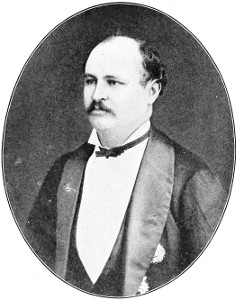
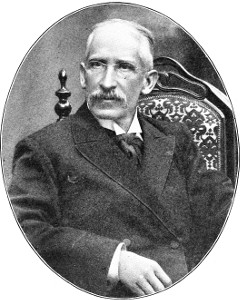
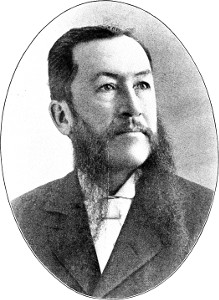
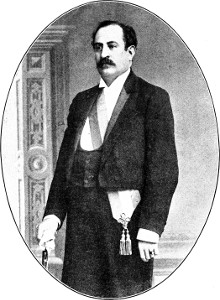
appreciation. With sincere gratitude I thank His Excellency President
Ismael Montes and the ministers of his Cabinet for many courtesies. I
am honored to have received from the illustrious representative of the
Bolivian nation constant evidences of gracious and kindly interest in
my work and I feel deeply indebted to his distinguished ministers for
their generous coöperation, by facilitating my journeys through the
country and providing me with important information.
Marie Robinson Wright.
Philadelphia, October 25, 1906.
BOLIVIA
CHAPTER I PRE-COLUMBIAN PERIOD—SPANISH INVASION AND CONQUEST
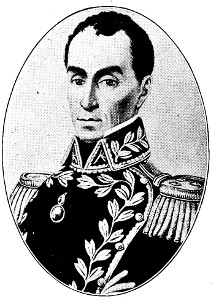
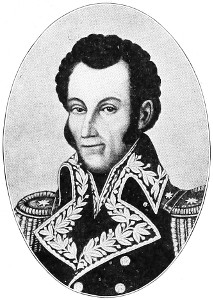
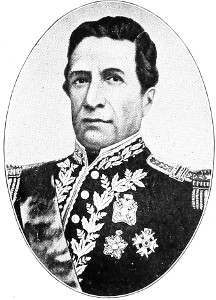
GENERAL SIMON BOLIVAR
Few countries offer a more interesting field of study than Bolivia,
a land of varied attraction, with mystery and romance enveloping the
story of its antiquity and lending a magic charm to its many legends
and traditions; with records of daring and devotion illuminating the
often triste pages of its existence under Spanish domination, and
marking a worthy preface to the annals of sturdy patriotism revealed in
the long struggle for freedom which began two centuries before South
American independence was an accomplished fact; with the history of the
republic,—with all that makes this land worth knowing as the dear home
of a brave nation.
To the popular imagination Bolivia presents only the picture of a
country somewhere in South America, above the clouds, consisting of
inaccessible peaks and unfathomable gorges, with an occasional plateau
to give diversity to what a clever writer has called “the roof of the
western world,” where llamas are believed to pose eternally on rocky
cliffs, and gaily plumed Indians to form picturesque groups forever
against a background of Inca architecture. This is an archaic idea,
but it is held tenaciously in the minds of a majority of people.
Bolivia is a land so rarely visited by the foreigner that it is not
remarkable that the most extraordinary notions prevail regarding it.
A few have read of the fabulous riches of Potosí, but it is not many
years ago that a distinguished European asked where “the country called
Potosí” was situated; and the vast wealth of Bolivia, apparently so
unlimited that a traveller was impressed to describe the country as
“a table of silver supported by legs of gold,” is yet a treasure
whose value has never been fairly calculated. It is a closed book
to the tourist, though it presents aspects of grandeur undreamed of
except by the few who have witnessed its beauty, who have felt the
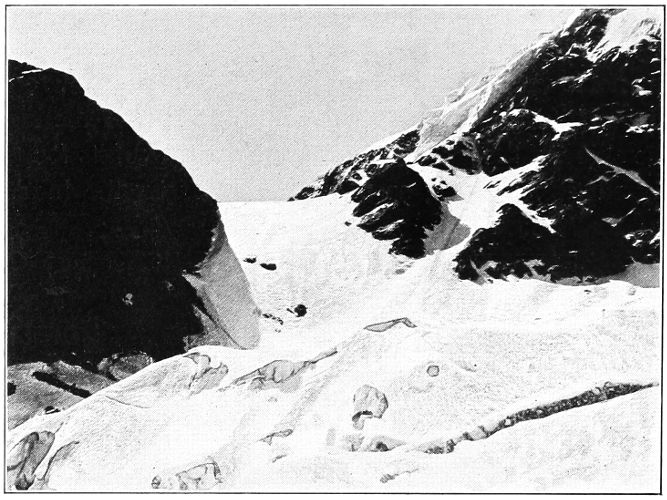
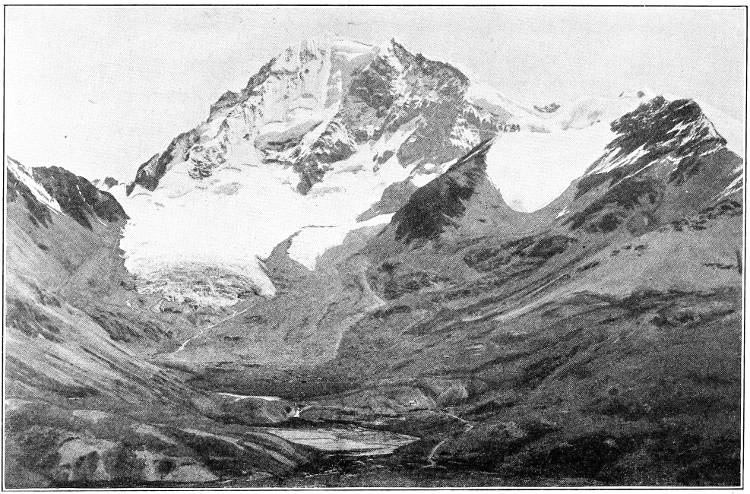
compelling majesty of snow-capped Illimani and wonderful Sorata, and
to whom the legends of Titicaca have been told in the white moonlight
as they glided across its mirror-like surface, seemingly enveloped in
the glory of a higher sphere,—so clear is the moonlight on this lake
above the clouds,—their souls thrilling in unison with the wondrous
harmony of the perfect picture. To the lover of varied scenery there
is a fascination about this almost untravelled country, with its bleak
Andean plateaus and densely wooded plains, its towering mountains,
rugged cañons, and fertile valleys, bounded as it is on one side by a
desert so barren that not a blade of grass could find nourishment, and
on the other by the greatest river system of the globe, which receives
and pours out continually enough water to fertilize a whole continent.
Although third in territory and one of the richest in natural resources
among the South American republics, Bolivia occupies the most remote
position and is the least influenced by foreign association, placed as
it is in the heart of the continent, with no outlet to the sea except
through neighboring countries, and consequently having had, up to
the present, scant opportunity to establish extensive international
relations. As the country is now entering upon a new era of progress,
increasing its productiveness, building railroads in every direction to
connect the various centres of industry with Atlantic and Pacific ports
and the great Amazon waterways, and making improvements in all branches
of national administration, its Arcadian character is becoming modified
to conform to twentieth century conditions in the New World, and the
advance of modern thought is making its influence felt on the Titicaca
plateau and in the Amazon valley as surely as in any other region of
South America.
It is often said that nothing is a greater obstacle to modern progress
than the inheritance of ancient monuments, and his majesty of Greece
is credited with the statement that he would be glad to have every
vestige of ancient Athenian architecture disappear, so that his country
might be given a little consideration for what twentieth century Greeks
are doing. Bolivia’s heritage of some of the most remarkable ruins of
antiquity has been so great an attraction to foreign writers that it
has diverted their interest almost entirely from modern Bolivia; though
it is true that the subject of these ruins is one which deserves the
attention of the world, one worthy of all the scientific research given
to it, pointing as it does to a solution of the important problem of
the priority of races in the New World.
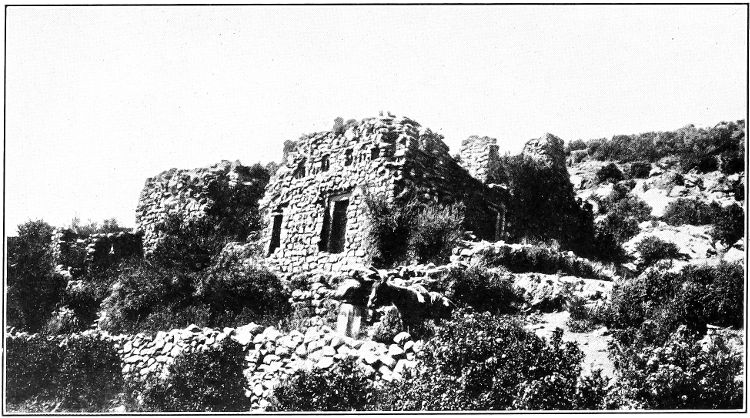
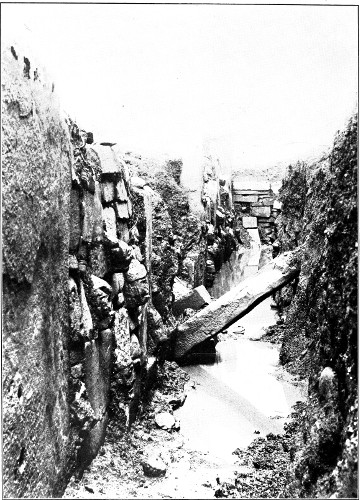
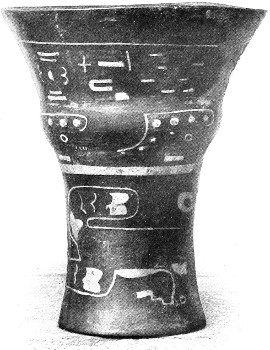
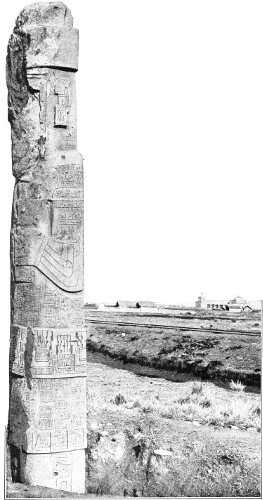
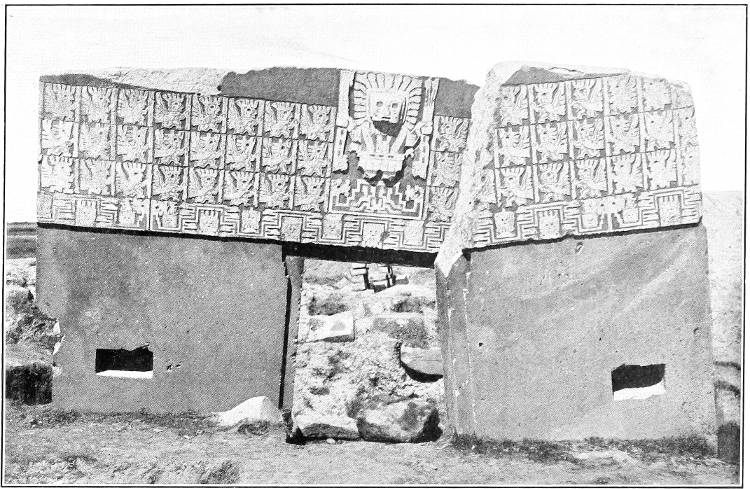
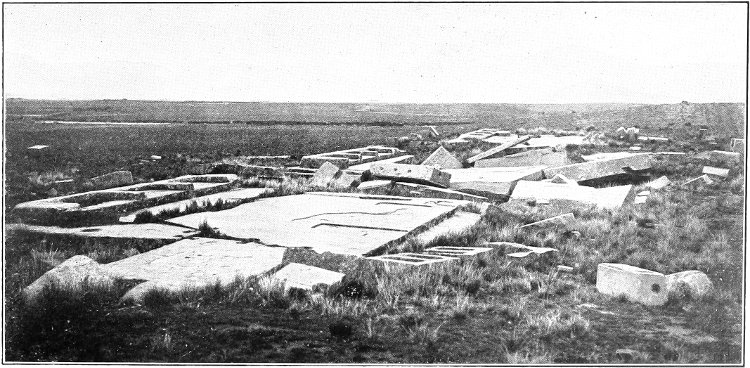
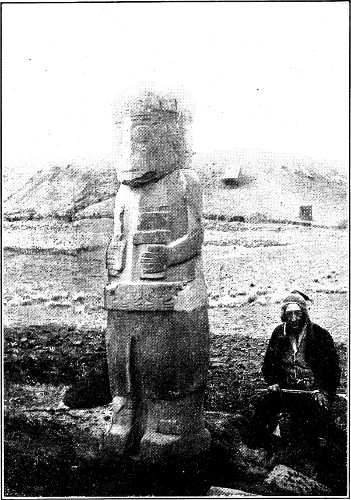
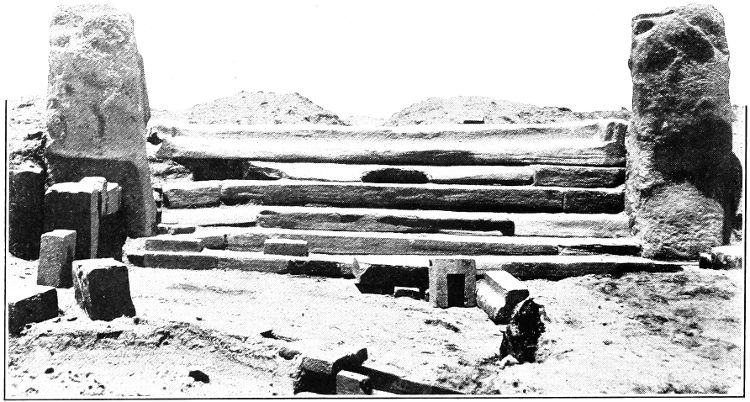
Many theories have been advanced regarding the monumental ruins
that exist in the region of Lake Titicaca—particularly those of
Tiahuanaco—as to their origin, the people who built them, the period
to which they belong and the degree of civilization which they
indicate, but very little is really known about them, and imagination
has free rein to picture the conditions that may have existed before
the Spanish conquest brought Bolivian history into the realm of certain
knowledge. There is nothing to indicate that the primitive inhabitants
of what is now Bolivian territory reached an important degree of
advancement in any other part of the country than that known to
ethnologists generally as Aymaráland, which is supposed to be—though
this, too, is questioned—the cradle of the Aymará race, whose origin
is very obscure, but whose people are considered by many writers as the
authors of the most colossal examples of ancient architecture existing
on the South American continent. This region is comprised in the
southern part of what is now the department of La Paz, chiefly in that
section which borders Lake Titicaca. Unfortunately, everything relating
to it prior to the period of the Spanish conquest is so shrouded in
mystery as to yield few satisfactory results to the most careful
investigation beyond the apparently certain evidence that it was not
a contemporaneous civilization that wrought such marvels of progress,
but the peoples of successive and often remotely separated periods not
necessarily of identical origin. According to some authorities, the
Tiahuanaco whose ruins are now to be seen, and which was already a
shattered record of past greatness when the Incas set up their dynasty,
is but the remains of a second Tiahuanaco, the first having been
swallowed up at a previous period, forgotten ages ago, when a great
seismic upheaval changed the face of the Bolivian plateau and buried
out of sight evidences of culture advanced far beyond anything the same
race attained subsequently. Archæologists generally agree in claiming
that at least three distinct periods of culture are recorded in the
form and character of prehistoric remains now being excavated in this
locality. Naturally it is this part of Bolivia which is the centre of
interest in the study of the pre-Columbian epoch.
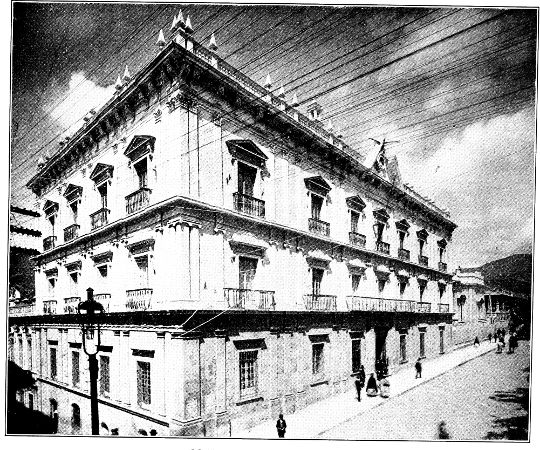
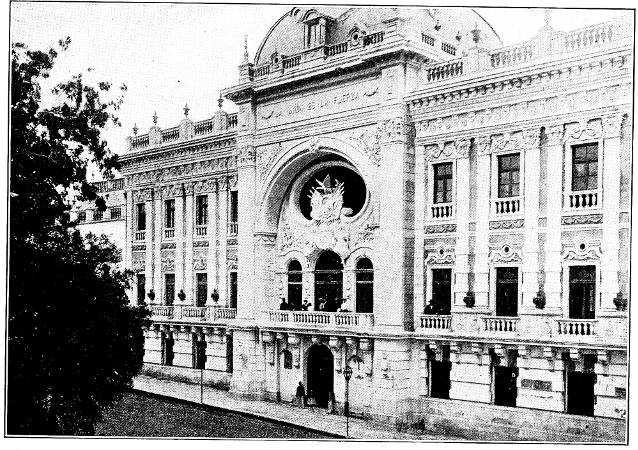
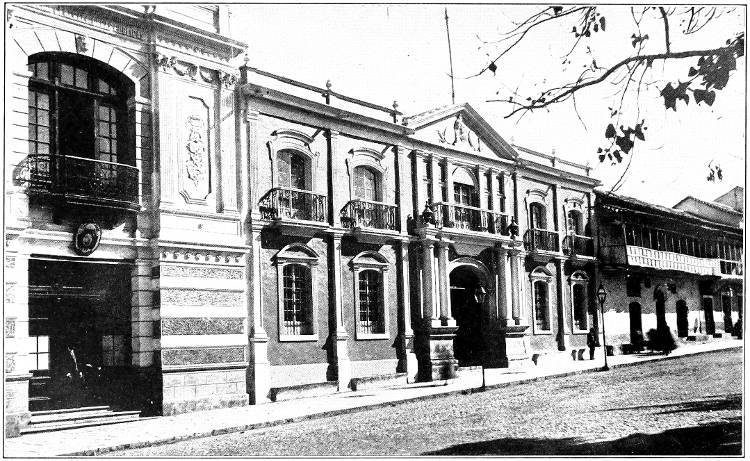
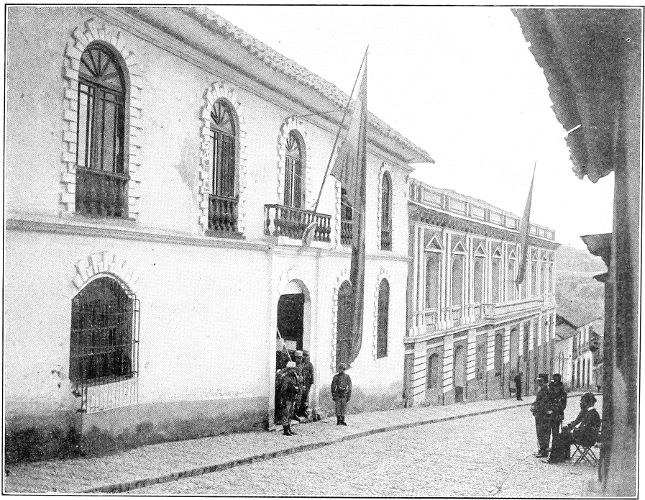
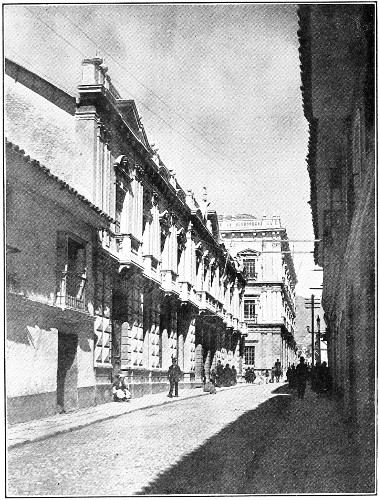
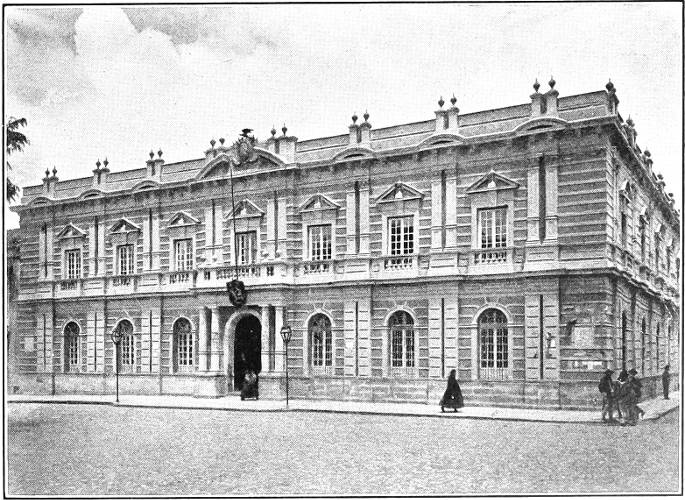
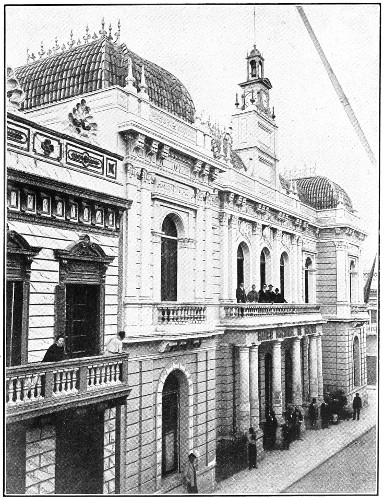
GOVERNMENT PALACE, LA PAZ.
The theory accepted by many ethnologists, that the Indians of America
are of Asiatic origin, is met, on the other hand, by the assertion of
some more recent investigators—notably those composing the expedition
organized by Mr. Morris K. Jessup, president of the American Museum
of Natural History, and sent out by him ten years ago to study this
question—that man did not emigrate from Asia to America, as many
racial similarities seemed to prove, but that the emigration was from
America to Asia, the evidences of human life on the American continent
proving greater antiquity of origin here than in Asia. The latter
possibility gives unique value to the study of a country within whose
territory have been found indications of human habitation in ages
remote beyond any determined period. May it not be that Bolivia has an
especial claim to universal attention as the true birthplace of the
human race, and the chief centre of its progress at a time antedating
the chronicles of Old World empires?
Aymará mythology is very similar to that of the Orient. According to
the oldest traditions, at the beginning of the world, the god Khunu,
the creator of all things, became so angry because of the vices of
mankind that he visited a great drought upon the earth, converting
fertile regions into deserts: he deprived humanity of the means of
living, and they became lower than the beasts. Then Pachacamac, the
supreme spirit of the universe, restored that which had been destroyed
by Khunu and gave new life to mankind. A second time Khunu showed
his wrath and sent a great flood and darkness upon the earth. The
few people who were saved from destruction in this calamity sent up
prayers to heaven, and in answer the sun appeared behind the rock
Inti-Karka, on the sacred lake of the same name, since corrupted into
Titicaca. Soon after this appeared also the great god Viracocha, the
name signifying “foam of the sea,” so called because he rose out of
the waters of the lake. Viracocha created the sun, moon and stars,
plants and animals, as well as men. Tiahuanaco is full of carvings
representing this deity, and it is the opinion of noted archæologists,
among others Professor Max Uhle, who has made a special study of the
field, that Tiahuanaco was built as a temple of this deity, and that it
was not, at least in later periods, a centre of population, as has been
generally believed.
As far back as any records exist that serve to trace the history
of the Aymarás, there appears to be confusion regarding their
identity with the Collas, Umasuyas, Yungas, and other tribes that
are generally considered as offshoots of the parent Aymará stock.
All these tribes were natives of the country now called Bolivia, and
were governed by mallcus, or chiefs, chosen in some cases for
their military valor and in others for their venerable character. The
Collas, or Charcas, were the most powerful and numerous, and gave
their name to the whole country, which was called Collasuyo by the
Incas to distinguish it as a southern province of the great empire
of Tahuantinsuyo, “the kingdom of four regions,” the remaining three
having been called Antisuyo, “to the east,” Cuntisuyo, “to the west”
and Chinchasuyo, “to the north.”
At the period generally credited to the advent of the Incas, the
inhabitants of Collasuyo had already reached decadence and were given
up to decimating wars and struggles among themselves. That the
Collas, or Charcas, tribes belonged to the same stock as the Aymarás
is disputed by some of the best authorities, who believe the latter an
entirely distinct race, of Mongolian origin, who came to Bolivia by way
of Arica on the Pacific coast, many centuries ago, and settled on the
Lake Titicaca plateau because it was the centre of a region belonging
to a people of peaceable habits, living, not on the barren heights, but
in the valleys and on the slopes around. These authorities give the
Aymarás no share in the construction of the great monuments, which they
claim were built there only as sanctuaries, apart from the habitations
of the people, explaining that because of their great solidity of
construction they have survived the changes which brought about the
decadence and oblivion of the race that built them.
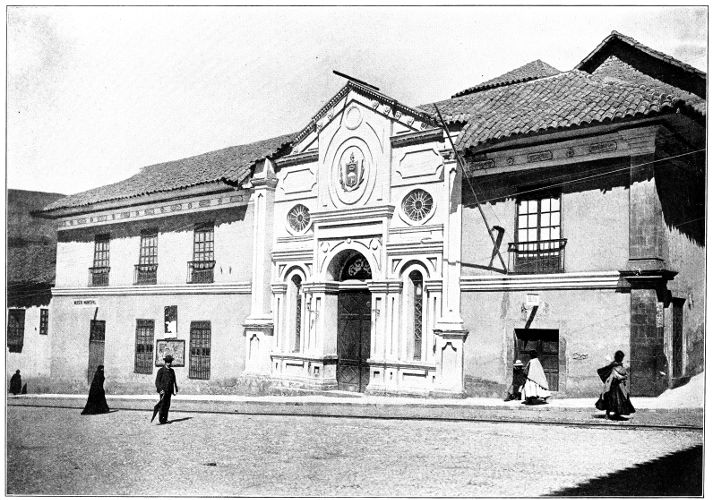
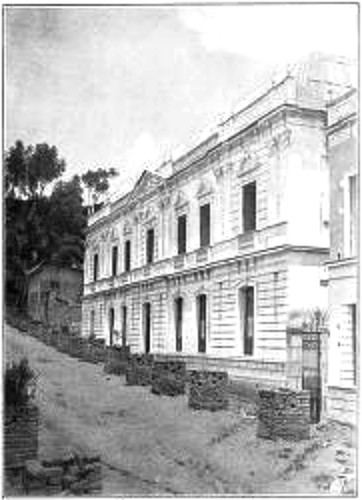
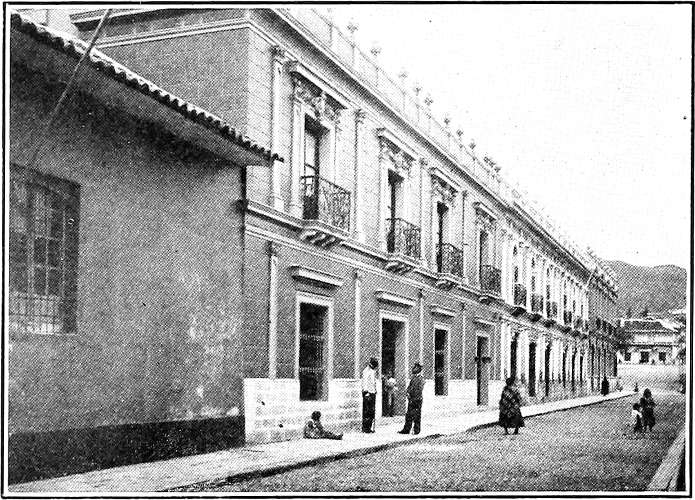
THE NEW GOVERNMENT PALACE, SUCRE.
The Bolivian historian Señor Don José Maria Camacho apparently favors
the theory which gives the Aymarás credit for the culture that
found expression in these colossal structures. In an entertaining
chapter on this subject he writes: “It is presumable that in order
to have attained the degree of prosperity which their monuments
reveal, as well as to have arrived at the state of decadence in
which the Quichuas found them, the Aymarás must have experienced,
through a long succession of centuries, great social changes and
the devastating inroads of other tribes.” The same author gives an
interesting description of these people, with particular reference
to their government, religion, and mode of life. In addition to the
mallcu, or supreme chief, there were the jilakatas, or
secondary authorities, and, in some parts, there were also sacerdotal
chiefs, whose word was the law of the community. “The Aymarás,” says
Señor Camacho, “believed in the existence of God, whom they called
Pachacamac, which means ‘eternal.’ They supposed that he revealed
himself to the eyes of mankind in every object of Nature; from which
their religion degenerated into complete fetichism, losing its
spiritual significance entirely. They believed in the existence of the
soul and in its immortality; in the evil spirit; in the resurrection of
the body; and in eternal reward and punishment. They were acquainted
with the meaning of prayer, knew of confession and penance, and were
accustomed to offer sacrifices. Their most celebrated sanctuary was
Inti-Karka, signifying ‘the rock of the sun,’ a name that has extended
to the island on which it was located and to Lake Titicaca itself.
Each tribe of the Aymarás was distinguished from the others in dress
and more particularly by the cap, a knitted kind of headgear, and this
distinction still prevails. The tribes had ideas of military art, were
skilled in constructing fortresses, which they called pucaras,
some of which remain to the present day; they used the lance, the
sling, and the arrow. Their chief industry was agriculture; they had
many herds of llamas, and paid careful attention to the cultivation of
their fields. Commerce was reduced to a limited exchange of products.
They had an idea of hieroglyphic writing. Their language is reputed by
eminent philologists to be one of the mother tongues—the most ancient,
richest, and most complete in existence.”
One of the chief difficulties in the way of acquiring adequate
information regarding the religious beliefs of the races that were
conquered by the Spaniards is the tendency of the Indians to engraft
Christian teachings on their Aymará and Quichua traditions to such a
degree that it is not possible to know exactly where the influence of
the Church enters into their records. There is much confusion also
between Aymará and Quichua deities. Pachacamac and Viracocha are
apparently only different names of the same deity, commonly used both
in Quichua and Aymará traditions, and in many cases the influence of
Aymará traditions upon the religion of the Incas is marked as clearly
as are the traditions of the Children of the Sun to-day upon the modern
religious beliefs of these Indians, gained through four centuries of
Christian teaching. No foreigner who has visited the land of the Incas
can fail to observe the strange interpretation which they put upon
Bible truths.
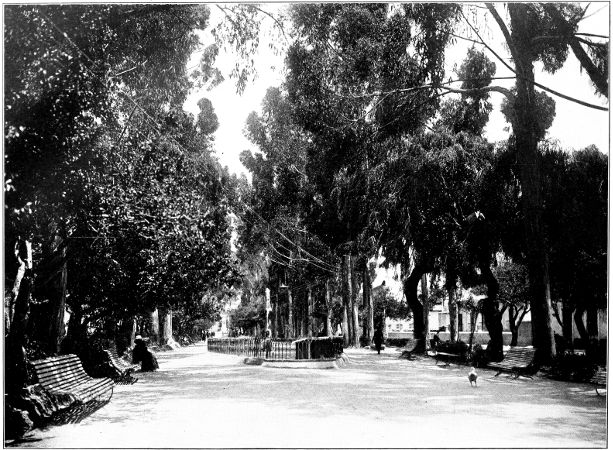
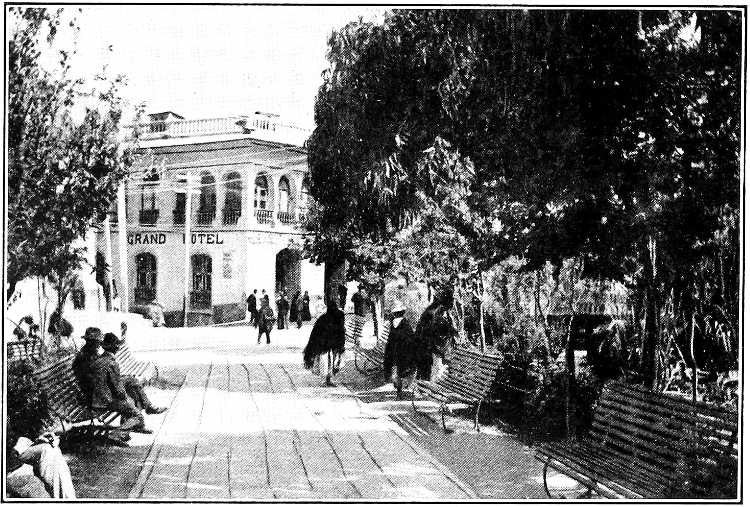
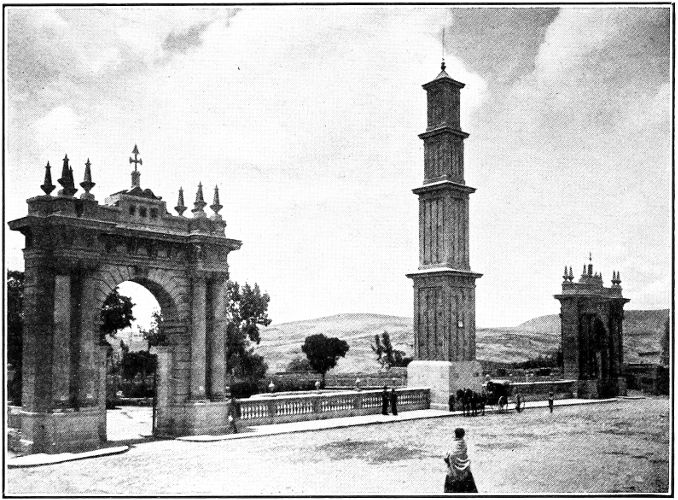
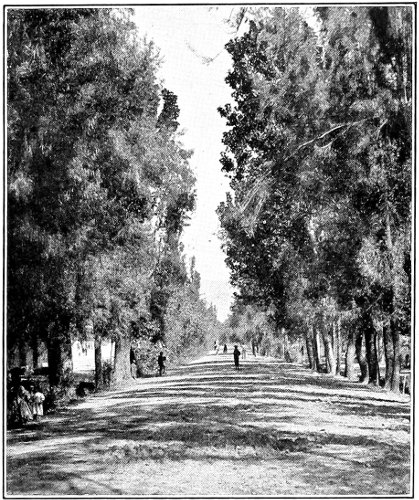
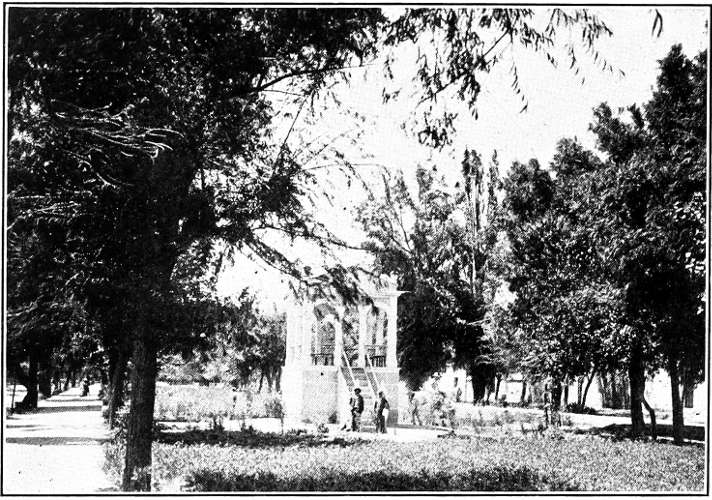
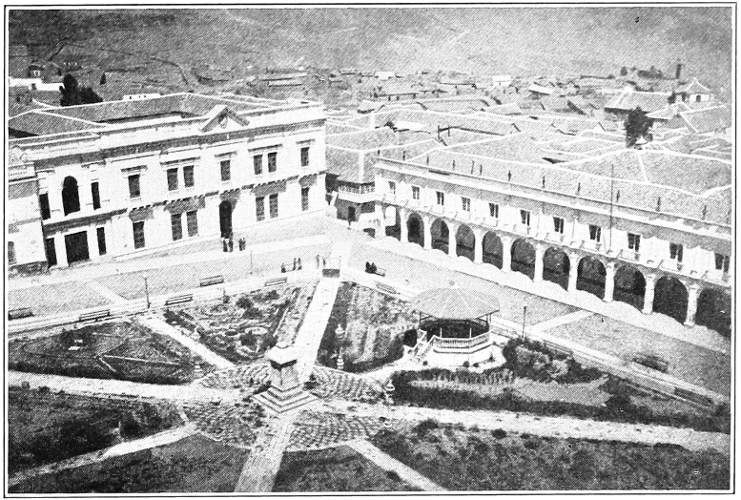
THE ALAMEDA, THE FAVORITE PROMENADE OF LA PAZ.
According to various existing traditions the Aymarás and the Quichuas
had been rival races from time immemorial, alternately superseding
each other until the final change gave the Quichuas uninterrupted
ascendancy, under the dominion of the Inca dynasty, and they achieved
a degree of advancement and culture beyond that of any other primitive
race of South America within the period of existing records. It is
a singular fact, awaiting explanation by the ethnologists, that the
Aymarás appear to have been always confined almost exclusively to the
Titicaca plateau, while the Quichuas are found not only in the region
extending from the lake northward to Cuzco, but in the departments
of Cochabamba, Chuquisaca, Potosí, and Oruro. There is a theory,
accepted by some ethnologists, that the Aymarás and the Quichuas were
of the same origin, the Aymarás having evolved in the course of many
generations, and under the harsh necessities of the rigorous soil
and climate of the plateau, into a hardy race of highlanders,
differing in character and even in appearance, from their Quichua
brothers who had been subjected to less severe natural conditions in
their development on the fertile mountain slopes and in the valleys
of the regions they occupied. It seems incredible that offspring of
the same race should develop a higher degree of culture on the arid
plateau than in the fertile valley; yet the evidences of advancement
among the ancient inhabitants of the Titicaca region indicate that they
were leaders of progress among their contemporaries, who have left no
monuments equal to those of the Titicaca plateau. It has been claimed
that the great empire of Tahuantinsuyo was built upon a foundation
purely Aymará, and that the first Inca obtained from Collasuyo his
ideas regarding government, religion, and even architecture, which
were afterward developed according to the genius of his successors.
The most reasonable theory seems to be that the Quichua culture had
been in process of development long ages before the establishment of
Inca empire, and that it may be traced to a source identical with the
origin of the Collas, whether this race be related to or distinct from
the Aymarás. The question affords a prolific subject of controversy,
and remains unsettled in the minds of impartial students of ethnology
and archæology. Whether the Aymarás are too primitive a people to
have had any connection with the history of the wonderful monuments
of the Titicaca plateau; whether the Quichuas in long periods of
culture, possibly interrupted, and dating from great antiquity,
constructed these colossal monoliths; whether these Quichuas were of
Peruvian origin, and the Aymarás also first came from the region of
the Apurímac in that country; or whether the Quichuas were first the
inhabitants of Collasuyo and had their ancestral domain in the land of
the Charcas,—who, according to some ethnologists, belong to the same
parent stock as the Quichuas,—all are theories for the scientists to
settle when more extensive investigation shall afford better ground for
establishing proofs.
The poetical story of the first Inca’s appearance is worthy of the race
that invented it. The Inca historian, Garcilaso de la Vega, one of the
most picturesque figures in the landscape of ancient Peru, even as he
himself paints it for us, and the only contemporary authority of note
on the history of the Peruvian empire, relates in inimitable style the
story of the first Inca’s appearance. In his Comentarios Reales
he tells us that the Sun, the life-giving and fructifying deity of the
universe, was moved to pity by the contemplation of degraded humanity,
and in order to redeem it he sent down from heaven his two children,
Manco-Ccapac and Mama Ocllo, causing them to appear on the island of
Inti-Karka, where, after the great food, brought upon the earth by
the god Khunu (meaning snow, and supposed to have reference to the
glacial period), the Sun had beneficently extended his first rays.
This mysterious pair, who were at the same time brother and sister and
husband and wife, crossed the plains north of the Lake Inti-Karka,
carrying with them a sceptre in the form of a bar of gold, which was to
determine the place of their permanent abode by the facility with which
it buried itself in the earth. They proclaimed themselves children of
the Sun, and announced as their mission the civilization of all savage
tribes and the establishment of an empire which would be under their
own benevolent government, as divine rulers who inherited their rights
from their father the Sun.
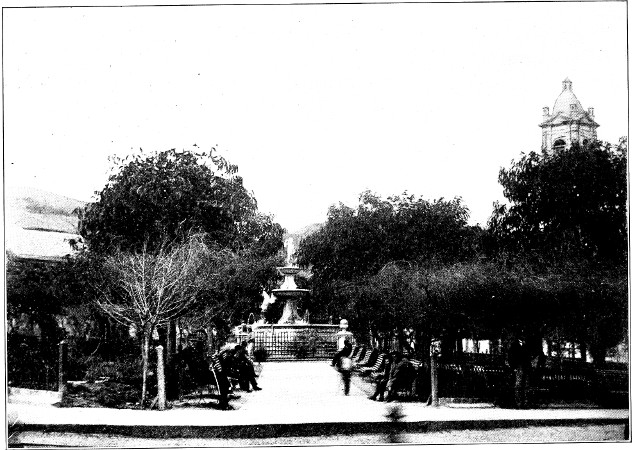
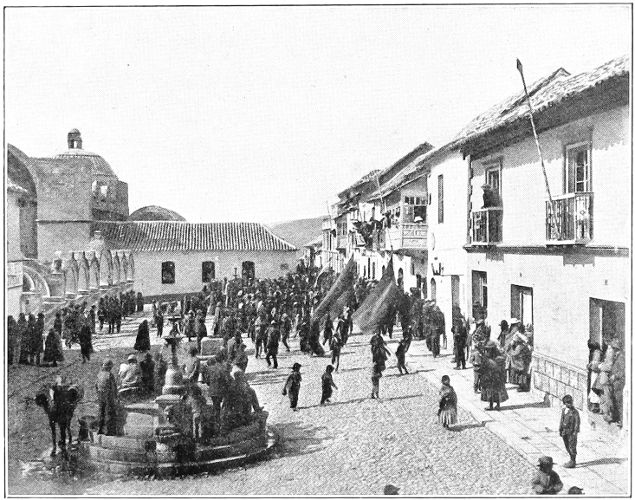
FOUNTAIN IN MURILLO PLAZA, LA PAZ.
The historian adds, with the naïve gravity of a true descendant of the
Incas, that as the sacred bar buried itself most easily in the soil of
Cuzco, that locality was made the site of the Inca capital. The first
Inca was called Manco-Ccapac, and his wife Mama Oclla. Pedro Kramer, in
his Historia de Bolivia, says the name Manco is evidently
a corruption of mallcu, and that Manco-Ccapac was an Aymara
chief or sacerdóte, of great talent and superior knowledge,
who probably left his home on account of the wars of extermination
which the Aymarás were carrying on at that time, and, with his sister,
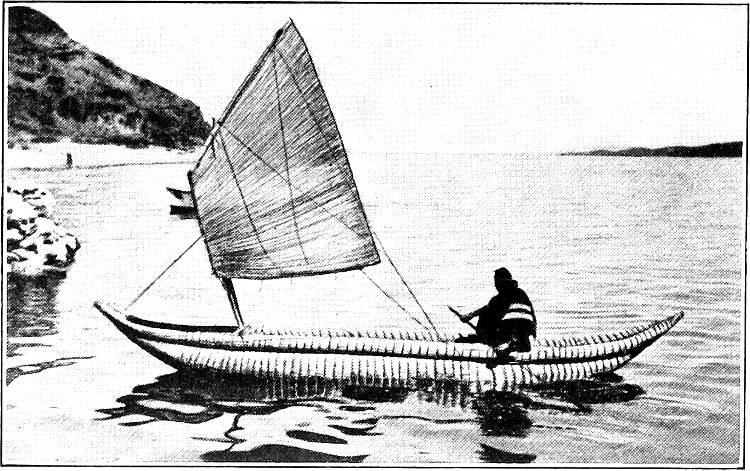
embarked in one of the little balsas, or canoes, made of rushes
which are used at the present day on Lake Titicaca, the two making
their way to one of the islands in the lake, where they remained hidden
until it was safe for them to continue their voyage to the opposite
or western border. There they landed and became acquainted with the
neighboring Quichua tribes, continuing further north on their journey,
until they arrived in Cuzco. They found themselves in the midst of
a people of hospitable disposition and submissive character, who,
seeing that the pilgrims were superior in wisdom and beauty, began
by respecting them and ended by rendering them mystic reverence. The
royal pair founded a city which they called Cuzco, “the navel of the
universe,” and began the organization of the great Inca empire of
Tahuantinsuyo, with which the history of Bolivia is also associated.
The Bolivia of to-day is represented in Collasuyo, the inhabitants of
which were tributary to the Cuzco monarchs, required to send their
share of gold to the royal coffers, to labor in the royal mines, and
to serve in the royal household. But the subjection of Collasuyo to
Inca authority did not take place until the reign of the fourth Inca.
Even then the warlike Bolivian highlander was not entirely subdued, and
he remained a troublesome vassal of the empire throughout the entire
period of Inca rule.
When the fourth Inca, Maita-Ccapac, marched into Collasuyo at the head
of an army of twelve thousand men, he was met by the natives with
sturdy and determined resistance, but he conquered by superior force
of arms, returning well satisfied with the result of the invasion. It
was upon the occasion of this visit that he became so impressed with
the grandeur of the Tiahuanaco ruins that he thought of making this
place the seat of his empire. His successor, the Inca Ccapac-Yupanqui,
extended the empire eastward and southward, marching over a great
deal of territory and subduing numerous tribes. There was continued
opposition to the invaders on the part of both the Aymarás and the
Charcas, and repeated revolts kept the country in a ferment of warfare.
Pachacutec, one of the wisest of the Incas, visited Collasuyo, spending
several years in the neighborhood of Lake Titicaca, and making an
expedition to Oruro, one of the most important pueblos.
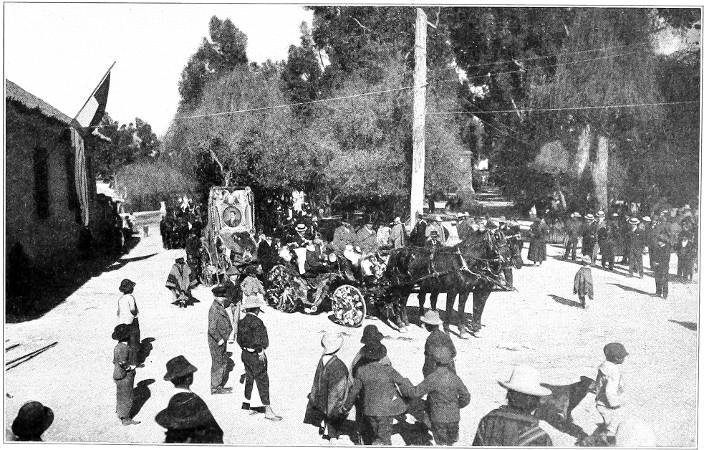
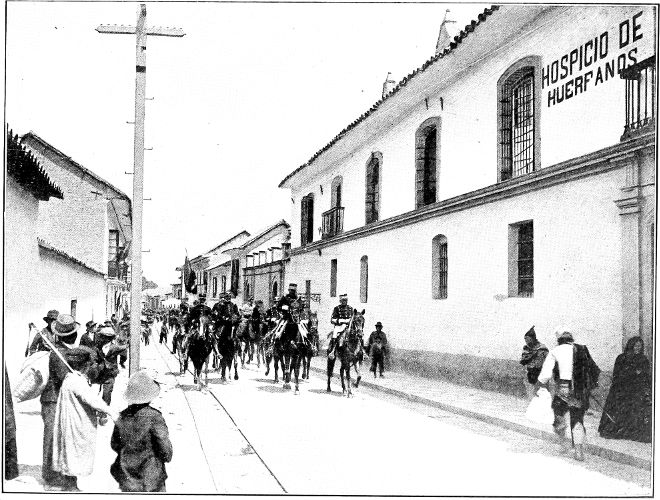
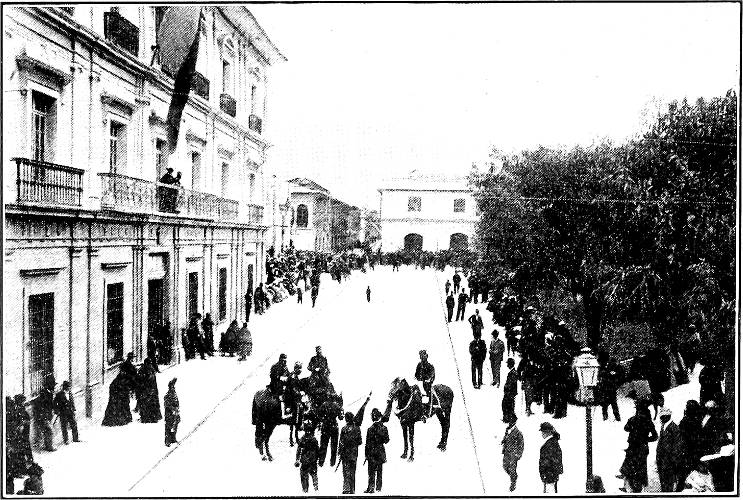
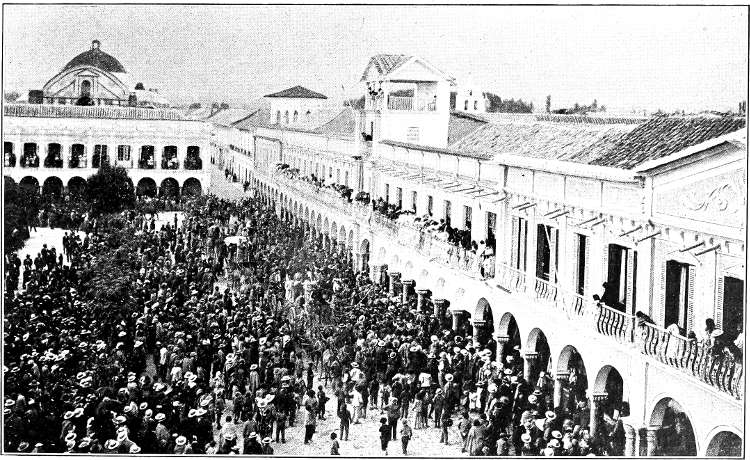
PRESIDENT’S COACH IN THE ANNUAL INDEPENDENCE DAY
PROCESSION, LA PAZ.
The Incas were by no means insensible to the advanced culture
everywhere shown in the monuments and temples of Collasuyo. They copied
much from the works of the vanquished race, and some authorities go so
far as to say that they got all their ideas of civilization from this
source, modifying little and adding less; others assert, as proof to
the contrary, that there is nothing to establish this claim beyond the
similarity naturally existing in the ideas of races allied in thought
through long periods of mutual interchange.
But, leaving aside all puzzling problems, there is a witchery of
romance in the story of the great Incas descending upon Collasuyo in
all the glory and pomp of royal power, and setting up their court on
a scale of truly Oriental magnificence upon the sacred island of the
Sun, in the sacred Lake Titicaca, over twelve thousand feet above the
sea, in the heart of a continent at that time unknown to Pizarro’s
hosts, a continent of savages beyond the limits of the vast Peruvian
empire, which according to some authorities extended over the greater
part of South America and counted among its vassals twenty millions of
people. No wonder that the great Tupac-Inca-Yupanqui spent many years
in this enchanting spot, and erected in the vicinity of the lake and
on its various islands his wonderful palaces! One is only at a loss to
imagine why the sacred golden rod of Manco-Ccapac did not sink itself
with greater facility into the Rock of the Sun in the beginning of Inca
history. It is related that Tupac-Inca-Yupanqui erected not only a
sumptuous palace, but a temple dedicated to the sun, the richest of the
whole empire: temples were also dedicated to thunder and lightning, a
monastery was built for the sons of nobles, a sanctuary for the vestal
virgins, houses were erected for the Inca’s followers; the Rock of the
Sun was paved with silver and gold, the neighboring island of Coati
(from Coya, the Moon, wife of the Sun) was consecrated to the moon, and
temples were erected there, the ruins of which still remain, as well
as those of the sun temple on the island of Titicaca. The Inca fasted
for a whole year, it is stated in the records, abstaining from meat
and aji—a pepper seed indispensable in the Quichua and Aymará
cuisine—in order to prove his devotion and the serious purpose of his
pilgrimage.
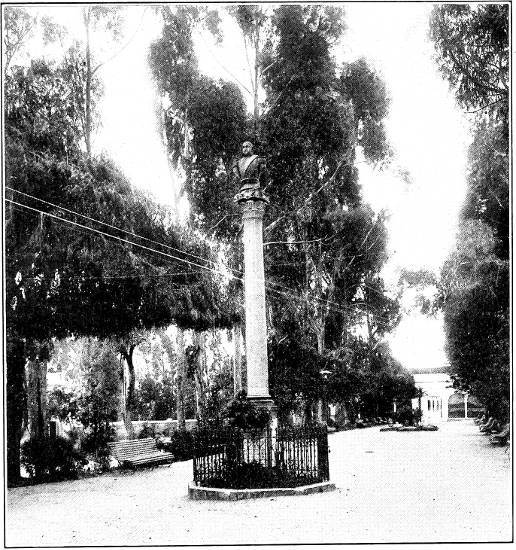
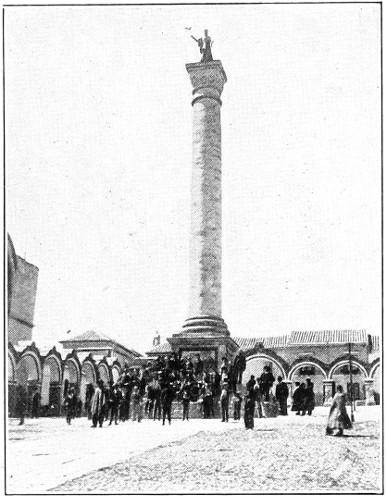
MONUMENT TO GENERAL BALLIVIAN IN THE ALAMEDA, LA PAZ.
It was in Collasuyo that Huayna-Ccapac, the father of the ill-fated
Atahuallpa, spent his earlier years, having been left in charge of
the palaces and temples erected on Lake Titicaca by his father,
Tupac-Inca-Yupanqui. He became learned in the culture of the ancient
inhabitants of the lake region, and while under the spell of its charm,
or through an inspiration of spiritual understanding, he taught the
existence of a deity superior to the sun, invisible to mortal eyes, the
source of all power. Huayna-Ccapac was one of the most illustrious
of his race and added much to the prestige of the empire by his
conquests and discoveries. He explored the rich mines of Porco, south
of Potosí, visited the thriving pueblo of Chuquiapu,—on the site of
the present city of La Paz,—and celebrated there with great splendor
the religious festival of “Raymi.” One of his sons, Manco, famed later
for the determined campaign he led against the Spaniards, and who was
put to death by order of Almagro, Pizarro’s general, was a native of
Collasuyo, having been born at Tiahuanaco.
At the very height of power and in the full brilliancy of Collasuyo’s
glory, when Huayna-Ccapac was visiting his wonderful palaces and
temples on the sacred lake, and all was apparently peace and security
in the vast realm, which had so steadily extended its boundaries since
the first Inca placed his sceptre in the soil of Cuzco that there
remained little to conquer worth the effort; when no cloud seemed
visible in the sky,—suddenly an awful presage of coming evil gripped
the heart of the great Inca in a spasm of foreboding. Strange signs
appeared in the heavens, lightning struck down one of the Inca’s
palaces, earthquakes threatened, and, to complete the catalogue of
bad omens, the news was spread that white and bearded men, sailing in
houses of wood,—whose coming had been predicted by the Inca Ripac more
than a century before,—had been seen in the Pacific.
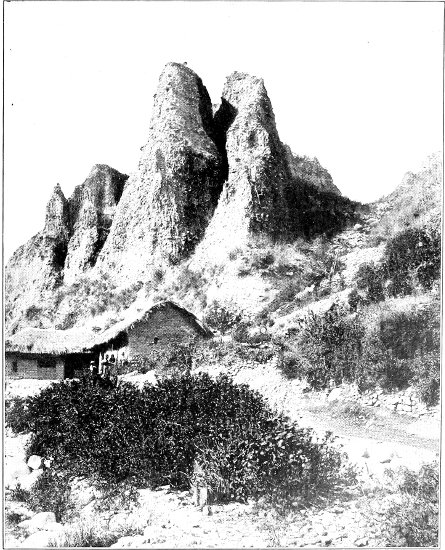
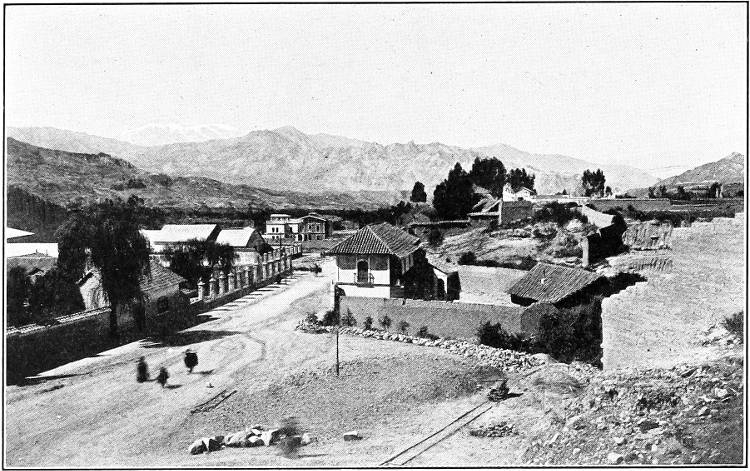
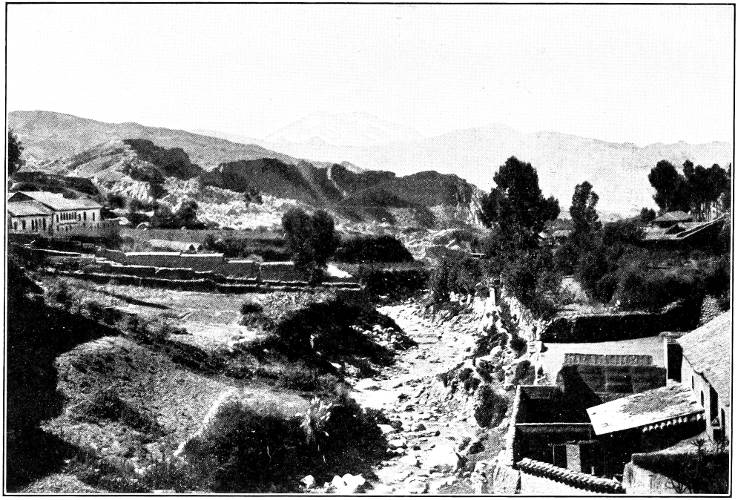
PICTURESQUE SCENE NEAR LA PAZ.
To relieve the sadness of his heart under such terrible conditions, the
Inca left his beloved Collasuyo and repaired to Quito to seek refuge
from care in the sweet companionship of his favorite, Pacha, the mother
of his best beloved son, Atahuallpa. The story of his death and of the
succession of his two sons, Atahuallpa and Huascar, the former to the
throne of Quito and the latter to that of Peru,—their quarrels and
the consequent weakening of the Empire’s defence at the very moment
when greatest strength was needed,—the events connected with the
imprisonment and death of Atahuallpa, and the occupation of his throne
by Francisco Pizarro,—belong rather to Peruvian than to Bolivian
history.
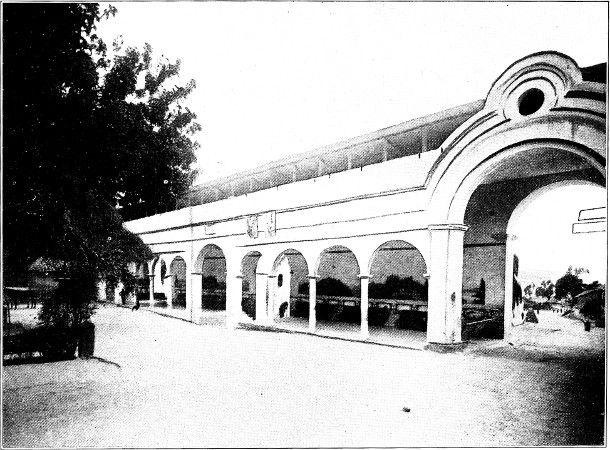
ALAMEDA GATEWAY, LA PAZ.
The first invasion of Bolivia by the Spaniards was made under the
orders of Pizarro’s companion in the conquest, Diego de Almagro,
who chose the route through Collasuyo on his march to Chile. The
vanguard of this expedition was placed in charge of Juan de Saavedra,
who founded the first Spanish town on Bolivian soil at Paria, a few
miles from Oruro. Continuing southward, Almagro’s party made a halt
at Tupiza, and then pursued their ill-fated course southward, leaving
the rich mines of Charcas unexplored and plunging into the horrors of
a trans-Andean journey altogether the most terrible in suffering and
deprivation that is recorded in the annals of the Spanish conquest.
Afterward, the unhappy adventurer expressed the keenest regret that he
had not remained in Charcas and colonized it instead of continuing the
profitless march which proved his ruin.
It was not long before Spanish cupidity turned its attention to the
valuable mines known to exist in this part of the Inca’s former
dominions. Hernando and Gonzalo Pizarro, brothers of the conqueror,
undertook the invasion of the country, but after a short time Hernando
returned to Cuzco, and Gonzalo became chiefly identified with the
history of Spanish conquest in Bolivia. His first victory of note
was in the valley of Cochabamba, followed by a more signal triumph
over the Charcas Indians in Chuquisaca, which gave him practically
undisputed sway. By order of Francisco Pizarro, Pedro Anzures founded,
on the site of an Indian village, the city of Chuquisaca, also called
Charcas, the seat of the royal Audiencia, and, later, La Plata, the
archiepiscopal see. It is now known as Sucre, in honor of the hero
of the Independence. Unwearying in the pursuit of adventure, Gonzalo
Pizarro set out on an expedition into the forests of the Amazon, which
yielded little in results. Upon his return, he devoted his attention
to the development of rich mines of which he had taken possession in
Porco, until altered conditions in political affairs led him to head a
rebellion against the newly appointed viceroy, Blasco Nuñez de Vela,
in a struggle to gain the supremacy as Governor of Peru. The viceroy
had been sent out from Spain with orders from the Emperor Charles V.
to reform the abuses of the system of encomienda, by which the
conquerors claimed ownership not only of the land, but of the Indians
who occupied it, under the pretext of converting them to Christianity,
and treated them with unparalleled cruelty. The opposition of Gonzalo
Pizarro and others to this action on the part of Spain led to open
warfare; and Gonzalo marched to Lima, the new Spanish capital,
defeated the viceroy’s army, and executed the viceroy. Then, finding
that a reactionary sentiment had been stirred up in Chuquisaca by his
rival, Centeno, and that there was a strong party arrayed against
his authority there, he commissioned the redoubtable old warrior
Carvajal, one of the most uncompromising fighters of the conquest, to
restore tranquillity. The chase which Carvajal gave Centeno, and the
territory the two armies covered without engaging in battle,—Centeno
being finally obliged to disperse his troops,—were subjects of keen
ridicule, and the battle was nicknamed the “fight of claws.” Gonzalo
Pizarro himself soon afterward met and vanquished Centeno at the battle
of Huarina, on the borders of Lake Titicaca. But the good fortune of
Pizarro was short-lived. About this time the Emperor Charles V. sent
out Pedro de la Gasca, with instructions to establish order in the new
colony. La Gasca attacked Pizarro’s forces at Sacsahuana, near Cuzco,
gaining a complete victory, and destroying forever the power of the
Pizarro party, which had been already weakened by the disaffection of
his followers, owing to his own pusillanimity and Carvajal’s cruelty.
Both Gonzalo Pizarro and Carvajal were put to death.
As a memorial of the peace which had been achieved by his victory
over Pizarro, La Gasca gave orders to Captain Alonso de Mendoza to
found a city in the valley of Chuquiapu, which he desired should be
established, in the phrase of Tacitus, “with a greater number of good
customs than laws.” The foundation of the city was begun on the first
anniversary of the battle of Sacsahuana, October 20, 1545, and it was
named Nuestra Señora de La Paz. The Villa Imperial de Potosí had been
founded a few months before by Diego Centeno and Alonso Santandia, upon
the discovery of the rich mines that were later to make it one of the
famous cities of the world.
In the founding of La Paz, the Titicaca plateau became again the
honored spot chosen to mark the birth of a new régime in South
America. It was peculiarly fitting that this locality, which bears
witness to succeeding periods of primitive culture, and to the rise
and development of the greatest of native dynasties, should have been
selected to commemorate the successful establishment of a greater
power on the continent and the beginning of a new national existence.
Centuries later, when this power proved insupportable through greed
and injustice, the same site was once more chosen to mark a fresh
beginning, when the march of civilization was signalized by the first
proclamation of the patriots of Independence. And the last honor was
the most glorious of all; for in choosing the City of Peace on the
Titicaca plateau as the sacred spot whereon to set the seal of victory
upon one of the noblest efforts of mankind—the effort to establish
the rights of human liberty. Destiny has bestowed a noble distinction
upon the Bolivian nation, and one which should inspire its posterity to
deeds of highest worth.
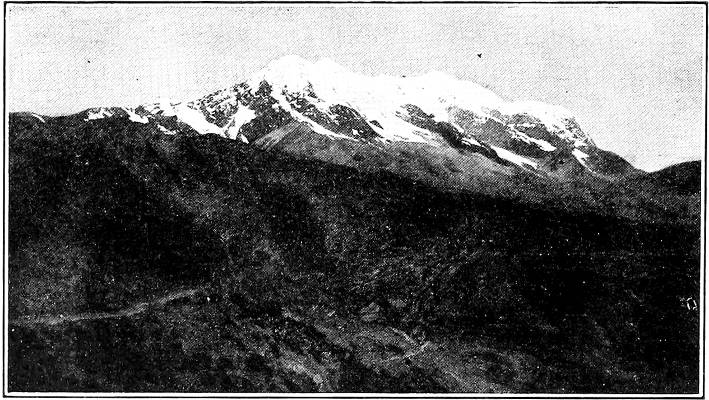
ILLIMANI.
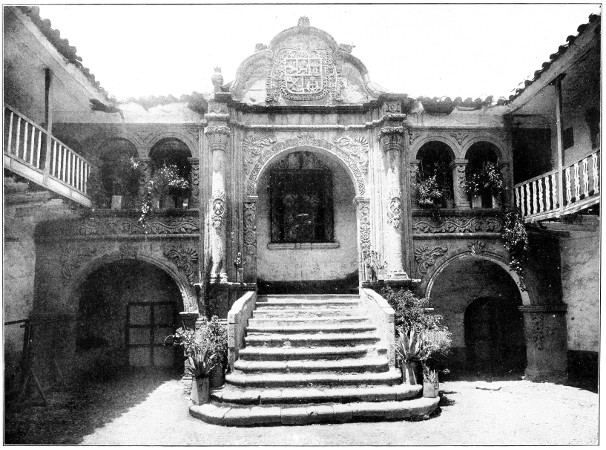
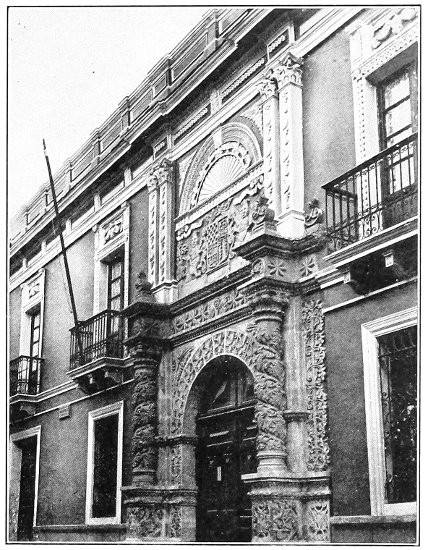
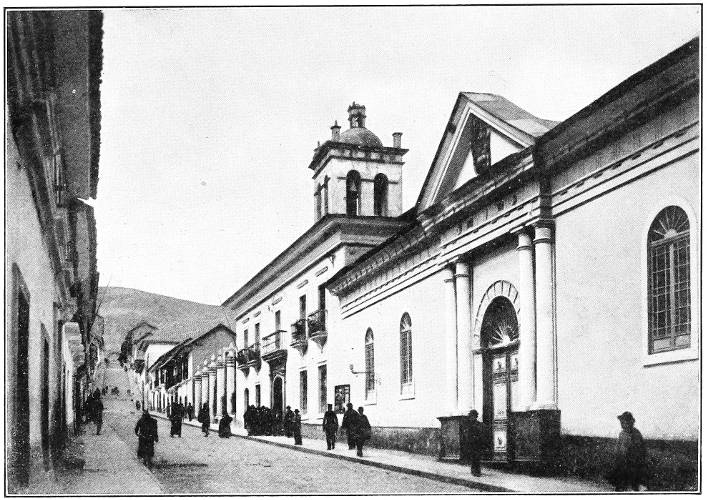
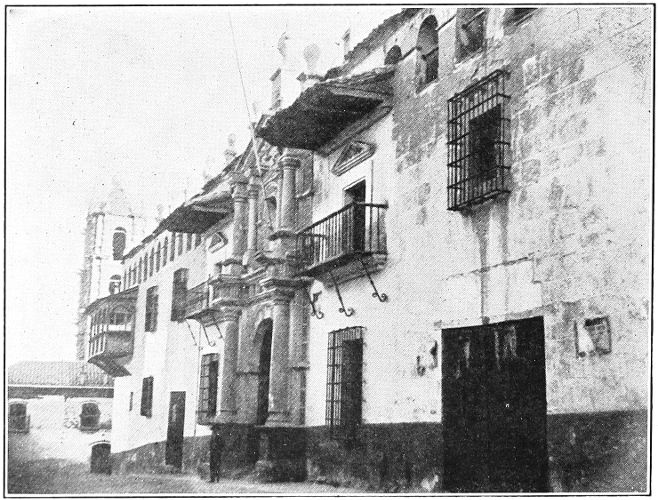
DOORWAY AND PATIO OF A PRIVATE RESIDENCE, COLONIAL
PERIOD, LA PAZ.
CHAPTER II ALTO PERU UNDER THE VICEROYALTY
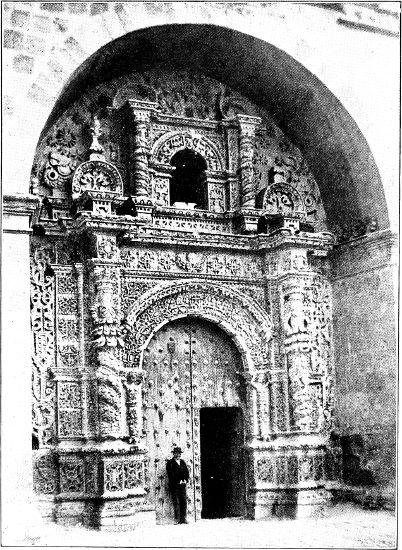
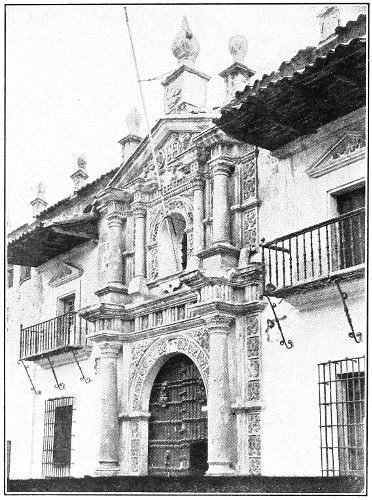
CARVED STONE DOORWAY OF SAN LORENZO CHURCH, POTOSÍ.
The great empire of the Incas fell to pieces like a house of cards.
The splendor of their palaces, the riches of their sacred temples, the
very pride of the people seemed to crumble into ruins in a day. It
is remarkable that a culture representing centuries of progress and
revealing such a high order of intelligence as that of the Incas could
apparently fade away within an incredibly short time. Of the twenty
million souls, more or less, composing the Peruvian empire, only the
Inca and a few nobles had been imprisoned or killed. The Spaniards
were a mere handful against those that remained. It has been said that
if the imprisoned Inca could have summoned his faithful subjects they
would quickly have slain every Spaniard on the continent. But he was
not permitted to speak to his people, and they had never been taught to
act independently of his will. The Inca had held as a royal prerogative
the divine power of initiative, and it was forbidden to the masses to
think or act upon their own responsibility. When the final calamity
came, and there was no longer anyone in authority to tell them what
to do, they could do nothing; and in this fact lies the secret of
the Spaniards easy conquest of the Inca’s subjects when once the Inca
himself had been disposed of. They were like sheep without a shepherd,
and their conquerors behaved like wolves. Bolivia suffered the same
fate as the rest of the fallen empire—its inhabitants were enslaved
and held under the rigorous system of Spanish rule as firmly as those
of other provinces. This system was established at the point of the
sword.
The Spaniards had come to the New World in quest of gold, and the
history of Spanish rule in America is a record of plunder in the
beginning and unjust extortion to the end. There was no religious
sentiment connected with the voluntary exile of the conquerors from
their native land, as in the case of the Pilgrim Fathers of New
England, nor did the idea of colonization appeal to them except as it
was necessary to the realization of their golden dreams of avarice.
The filibustering adventurers led on by Pizarro would have scorned the
routine of toil which the Puritans were willing to face daily for the
sake of the principles that had brought them across the sea, and in
the hope of establishing a home in their new country. Yet, in their
religious zeal and fury against witchcraft and unbelief, the Puritans
were often as cruel as their Spanish contemporaries in Peru, showing
that the spirit of those times was a malignant one, whether aroused to
pious frenzy or inflamed by grosser passions.
When the chief leaders among the conquerors fell in the struggle for
power that succeeded the invasion, their places were quickly filled
by men better qualified than those belligerent nomads to establish a
settled order of things in the conquered territory, and to proceed
systematically toward the accomplishment of the chief purpose of their
authority,—to fill up the royal coffers with gold. Within fifty
years after Pizarro landed with his followers on the shores of Peru
in 1533, not only was the Spanish conquest an accomplished fact, but
the various disturbances naturally arising out of jealousy among the
conquerors had been quelled, the unsatisfactory encomienda had
been abolished, and the colonial system had been perfected and put in
operation. The Collasuyo of the Inca empire became the Charcas of the
conquerors, and this name was again changed by the colonial authorities
to Alto Peru. The great Council of the Indies, the supreme tribunal
instituted in Cádiz, Spain, primarily to protect the Indians and
finally to take charge of all colonial affairs, formulated the laws
that ruled the Spanish colonies in the New World. One of its first
acts was to abolish the two governments of New Castile and New Toledo,
into which the conquerors had divided Spanish South America,—the
limits of which had been the cause of all the fatal strife between
Pizarro and Almagro,—and to create the viceroyalty of Peru in 1542,
with authority over all these possessions. The viceroy represented the
highest colonial power, and presided over the two Audiencias Reales,
or royal audiences, into which the viceroyalty was divided. These
were the Audiencia of Lima, which comprised the territory hitherto
known as New Castile, and the Audiencia of Charcas, which covered the
former New Toledo. The Audiencias were supreme courts, annexed to the
viceroyalties, but directly responsible to the crown. They exercised
both judicial and administrative functions.
One of the most important offices in the history of Spanish government
in America was held by the Audiencia of Charcas, created in 1559,
when the Marquis of Cañete was Viceroy of Peru. Its jurisdiction
extended over the whole southern and eastern part of Spanish
America, its chief seat being Chuquisaca, or Charcas, the capital
of Alto Peru. Established in the very heart of the Spanish South
American possessions, in a locality almost inaccessibly remote from
the viceroy’s capital at Lima, the Audiencia of Charcas wielded an
authority as independent and powerful within its jurisdiction as that
of the viceroy himself; while its capital became the centre of what was
equivalent to a second viceregal court. Chuquisaca gained additional
prestige from its importance as the episcopal see of the diocese of
Charcas and as the seat of the University of San Francisco Xavier,
which became renowned throughout Spanish America for its learning,
ranking with the University of Salamanca, in Spain. To this Audiencia’s
jurisdiction were subject the governors of Tucuman, Paraguay, and
Buenos Aires, and the missions of Chiquitos and Mojos.
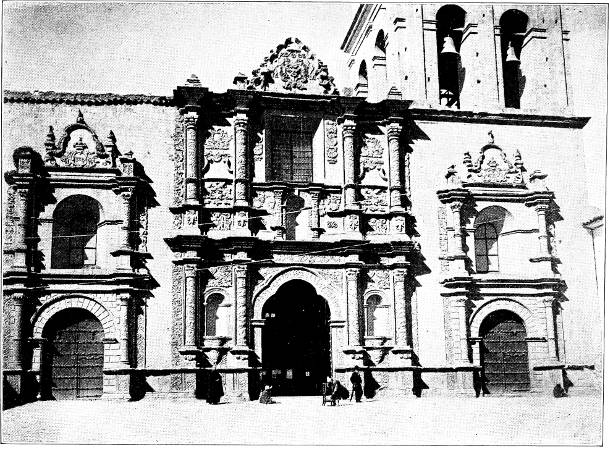
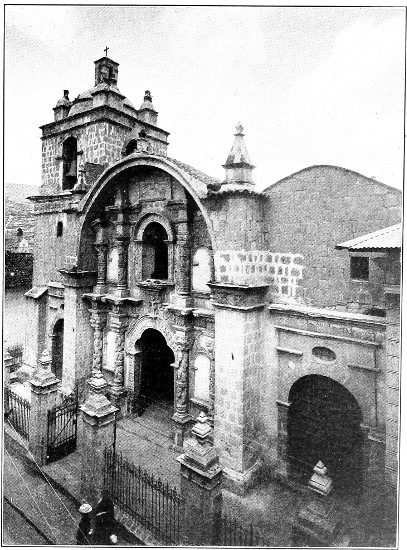
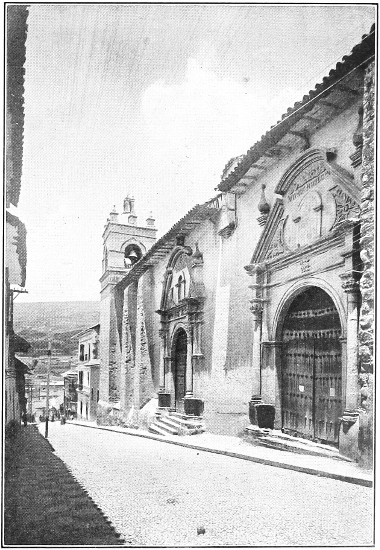
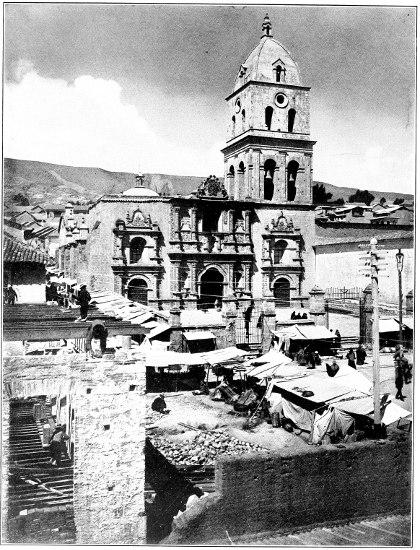
FAÇADE OF SAN FRANCISCO CHURCH, LA PAZ. STONE CARVING OF
THE EIGHTEENTH CENTURY.
Referring to the exalted privileges of the Audiencia, Gabriel Réné
Moreno, a Bolivian writer of note, says: “The Audiencia was at the same
time a royal chancery, which used the royal seal and headed its decrees
with the name of the reigning sovereign, as if he were present.” Among
its multiple duties, as recorded in the archives of the Council of the
Indies, were: “To be vigilant in behalf of the Indians, to see that
they are given Christian instruction and good treatment, for which
purpose a protector shall be named; to be informed in reference to the
king’s tax, and in all that relates to the preservation of the royal
prerogatives; to collect the legacies of ecclesiastical benefices; to
approve the lists of fees of curates, notaries, and inspectors, without
which requisite they have no legal force.” Furthermore, in addition to
the central government, which in matters of administration, policy, and
finance was exercised by the Audiencia, the oidores, or judges,
discharged innumerable special functions. The Audiencia of Charcas
was composed of five oidores and two fiscal assessors. The
oidores were required to visit the territories of their separate
jurisdictions every three years. In civil cases only was it permitted
to appeal to the Council of the Indies from the Audiencia’s decision.
But in spite of the number and variety of the Audiencia’s duties, the
records of colonial history show that the greater part of the time was
spent in the discussion of formalities, in grand ceremonies and an
extravagant display of pompous authority, though this tendency does not
seem to have brought any adverse criticism from the higher authority
of Lima. In the Memoria de Los Vireyes, or viceroys’ report,
the Audiencia is cordially recommended for its efficiency, the Duke
of Palata writing of it: “The Audiencia of Charcas ranks next to that
of Lima, and is above all the others; and for the reason that it is
usually composed of ministers who have risen through other tribunals,
it has the most distinguished ability in government, and in eight years
has given me nothing to execute or to amend.” A more intimate view of
the character of the oidores is given in an entertaining picture
of these times, very effectively described:
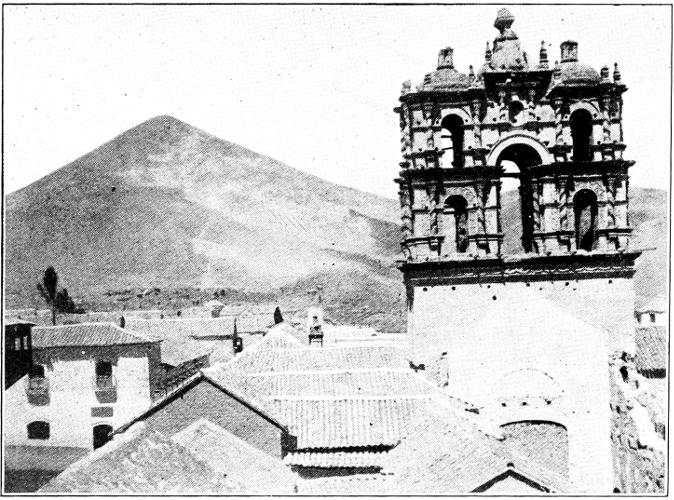
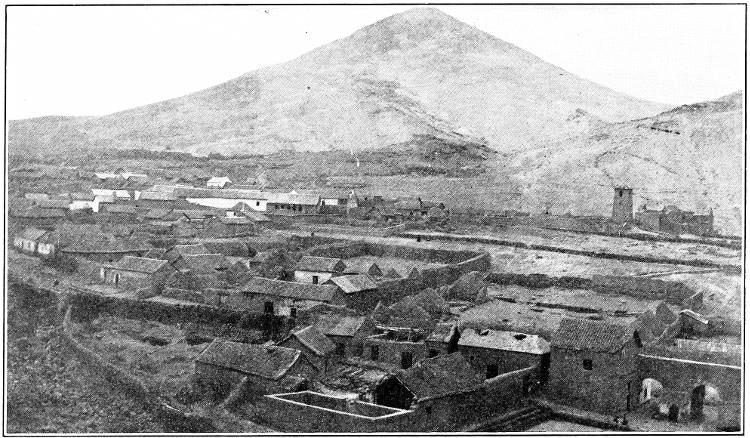
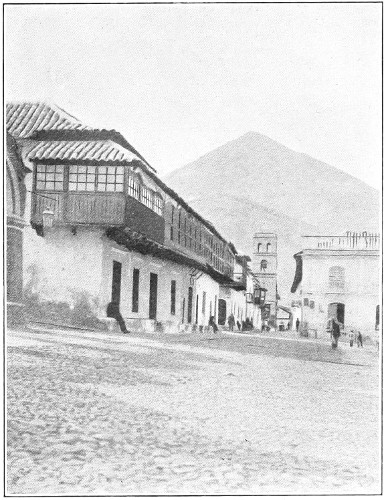
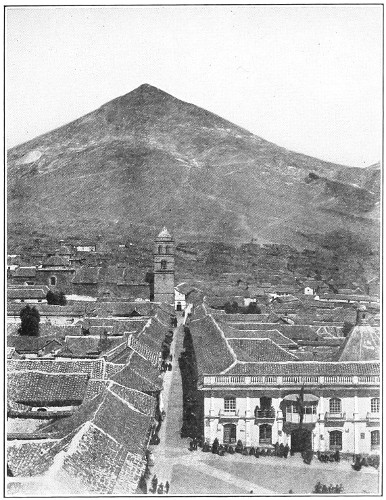
JESUIT CONVENT TOWER IN POTOSÍ. CERRO DE POTOSÍ IN THE
DISTANCE.
“The Audiencia planted its royal trident in the sea of political and
social agitation. The implacable levies of the mita, the great
traffic of the mines at the height of their production, the daily
demands of civil society, the procedures of public administration,
the sanctity of domestic life, the property, existence, and honor of
individuals, everything passed over the Audiencia’s palm, sliding from
it like falling seed that nothing can stop or hinder. Nothing was
so inalterable in the midst of alterations as the Audiencia. In the
disturbances that made a sanguinary path for the first footsteps of the
colony; in the disputes of Basques and Castilians—equally illiterate
and opulent—over the arms of the city of Potosí; in those incessant
quarrels among chapetones, mestizos, and criollos
who peopled the cities and towns of the province with factions, the
Audiencia discharged the office of a severe proconsul, whose cohorts
always subjugated, never pacified. In the pursuit of its judgments, the
furore of noisy discords from all directions arrived at the peaceful
city that served as its court like the violent winds that blow over
mountains and plains to whirl into the basin of Lake Titicaca and
disturb its quiet waters. But in the immunity of the royal canopy of
his stone palace the monarch never broke down the inviolable law of his
tribunal, and neither from the vehement shock of caste nor from that
of interest did his tall judicial vara, or sceptre, come out
shortened. It is certain that in the chief city of the viceroys the
Audiencia did not enjoy the predominance, veneration, or impunity of
the oidores in La Plata. Here the counsellor’s robe possessed
doubtless some of the virtues of a sacrament; at least, it imprinted
on the soul of him who wore it an ineffaceable sign, and that sign was
arrogance. Oidor and haughty grand seigneur were, in
Alto Peru, one and the same. Woe to the lawyer, litigant, or voter who
incurred the anger of an oidor! Because if he wished to escape
from abusive reproofs, suspension from office, correctional banishment
and vexations, it would be best for him to go far away. When these
magnates did not ride to the tribunal in chaises, it is notorious that
they were preceded by two lictors, so as to flaunt the toga before the
people with Roman majesty. The passer-by must halt in their presence,
and if on horseback dismount while they passed, and everybody must
escort the satrap to his destination at a respectful distance.”
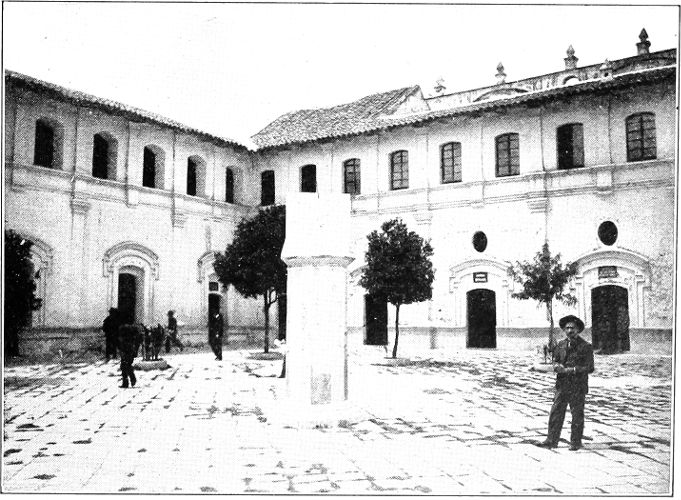
COLONIAL SUN DIAL IN PATIO OF PALACE OF JUSTICE. SUCRE.
What autocrats they were, these oidores of the Audiencia of
Charcas! And with what splendor they moved among the people, in whose
eyes the distant figure of the viceroy diminished and his Catholic
majesty faded to the vanishing point, as the magnificent “toga” passed,
its folds sweeping over the streets that belonged as much to its wearer
as Spain belonged to the king, or Lima to the viceroy! The extreme
homage paid to these mediterranean despots is illustrated in a clever
little anecdote which relates how a rich and aged lady of Chuquisaca,
wishing at her death to manifest her devotion, left in her testament a
legacy of four thousand pesos with the stipulation that it should be
used to buy an oidor’s toga for the Holy Sacrament; because,
she explained, when clothed with this honor, the people would find
themselves obliged to accompany the viaticum, whereas without it very
few would do so. Then came the puzzling question: “But if the Holy
Sacrament, decorated with the oidor’s toga, should meet another
oidor on the road, to which should the retinue make its reverend
obeisance?” It was decided that as the case was one of equal rank,
obeisance should be made to the Holy Sacrament, having the preference
accorded to age! Bolivian wit is never so keen as when pointing a
satire with an amusing illustration, and this little story is worthy of
its author, whoever he may be!
The Audiencia of Charcas found its most arduous duties connected
with the demands from the mother country for the largest possible
contributions to the royal treasury, and her equally imperious demands
for protection for the Indian subjects of the crown. To fulfil both
requirements taxed the genius of the wisest of his Catholic majesty’s
representatives. In justice to the Council of the Indies, it must be
said that constant efforts were made to ameliorate the condition of the
unfortunate Indians, but they were effectively nullified through the
greed for gold which could only be satisfied by increasing the tasks of
these unhappy slaves, who died by thousands under the rigorous system
of the mita. The mita was established by the greatest
of the viceroys of Peru, Don Francisco de Toledo, Count of Oropesa,
who governed from 1569 to 1581. His purpose was to promote the most
rapid and satisfactory development of the mines, especially those of
Potosí, and, undoubtedly, also to improve the condition both of the
colonists and the Indians. The mita was a system of forced labor
by which all Indians between eighteen and fifty years of age were
obliged to work in the mines by turns during a certain period, covering
in all about five or six years of mita, or turn. This system
ameliorated the previous condition of the Indians by establishing a
species of organized discipline. It was an institution of Inca origin,
as the Quichua word mita indicates. The Spaniards only modified
it, giving it a more restricted meaning, as under the rule of the
Incas there were no property rights for the individual, while the
Spanish code gave such rights and exempted from the mita all
Indians who were landowners. Indeed, much of the legislation adopted
by the learned Council of the Indies was an adaptation rather than
a change of Inca statutes. But in their reckless application of the
mita the Spaniards made it a terrible hardship for the Indians,
and the cruelties practised upon them caused a rapid diminution in
their number, though it is extremely doubtful whether the mortality
reached the enormous figures named by some writers. The Bolivian
historian José Maria Camacho estimates the loss of life “from overwork
and intemperance” under the mita system as “nearly eight
millions.” After the establishment of the mita, the viceroy
Toledo abolished the system of encomiendas, and the Indians
were required to live in districts, or communities, in which each of
them received a lot, or sayaña, to cultivate; he was obliged to
pay tribute, at first in specie, and afterward in money. Later, this
tribute was made a per capita tax. By right of conquest, the Spanish
crown had declared its ownership of all the lands and peoples of the
conquered territory, but by purchase the colonists and the natives
could secure deeds to lands cultivated by them outside of the limits of
concessions. The Indians were not excluded from this privilege, though
the opportunities of availing themselves of it were rare.
The task of exploring and civilizing the vast regions to the north
and east of the Andes range—the valleys of the Amazon and its
tributaries—was a slow and perilous undertaking, owing to the nature
of the climate and the difficulties of transportation. The roads
built by the Incas continued to be the only highways long after the
conquest; and in the territories of Mojos, Chiquitos, and the Chaco,
many exploring expeditions were destroyed by the savages. Mojos was
the favorite objective point of the explorations, on account of the
many legends about its mysterious “El Dorado,” supposed to be a hill
in the centre of a lake, where all the treasures of the earth were to
be found. The owner of this wonderful place was called the Gran Señor
de Mojos. Its inhabitants, the Chunchos, were the most savage of the
aborigines, and have remained uncivilized to the present day. In the
heart of the Chiquitos territory, the town of Santa Cruz de la Sierra
was founded by Ñuflo de Chávez in 1560. Later, it was removed to its
present site, in 1592.
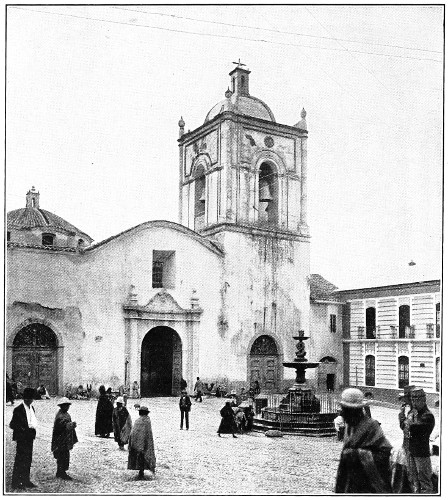
CHURCH OF SANTO DOMINGO, LA PAZ.
With the exception of the floating population that followed the
exploiting of the mines, the colonists lived in cities, which were
founded in rapid succession. In 1570 the viceroy gave orders for
the foundation of a town in the fertile valley of Cochapampa, and
four years later the present city of Cochabamba was built under
the direction of Don Sebastian Barba de Padilla, with the name of
Villa de Oropesa, in honor of the greatest viceroy of the colonial
epoch. The same year Tarija was founded by Don Luis de Fuentes, with
the name of San Bernardo de la Frontera. It was the purpose of the
viceroy to provide a centre of civilization from which to carry on the
work of subduing and evangelizing the savage tribes of the Chichas,
Chiriguanos, Tobas, Guaycurús, and other hordes of the Chaco frontier.
Oruro, named from the neighboring hills of Uru-Uru, was founded in
1604, with the more distinguished title of San Felipe de Austria; but
this high-sounding cognomen was ignored completely, except in official
documents, the town remaining always Oruro, as it is to-day. It became
famous for its silver mines, and has always been an important mining
town.
For two centuries after the conquest all interest in the Spanish
colonies was centred in the mines. The Cerro de Potosí—as the mountain
is called which poured out a constant stream of silver so abundant that
the “king’s fifth” in one year amounted to more than three million
ducats—became a synonym for opulence, and “rich as Potosí” meant, in
the seventeenth and eighteenth centuries, all that “rich as Crœsus”
signified to the ancients. In the general rush to the mines every other
resource of the country was neglected, although soon after the conquest
sheep and cattle were imported and agriculture was developed on a small
scale, to meet the needs of the colonists. The Indians had fared little
better on the farms than in the mines, under the atrocious system of
encomiendas; and even after this was abolished, the landed
proprietors evaded the law and exacted tribute from them, on their
estates, the government also “farming out” the Indians to landowners
under the provision which required one-seventh of the male population
to work for the state.
As was the case in all the Spanish colonies immediately after the
conquest, the tillage of the soil became more particularly the
occupation of the religious brotherhoods who settled in the new
countries and constituted themselves the protectors and teachers of
the Indians. In all the communities, or parcialidades, into
which the Indian population was divided, the Church of Rome was
represented by missionaries of the various orders, in addition to
the ecclesiastical authorities of the government; and the missions
established by the Jesuits, Franciscans, Dominicans, and other orders
were the only civilizing agencies that reached the savages of the
remote interior.
Historians of the South American countries have never yet done justice
to the noble work accomplished by the early missionaries of the Roman
Catholic Church in behalf of the Indians. It is easy to look back upon
their labor from the standpoint of twentieth century development,
and point out where it was at fault and how the results failed to
realize the highest purpose, but no one can deny the proofs of earnest
zeal and devotion for the cause of Christianity that led these noble
“pathfinders” of the Faith to bury themselves in the wilds of an
unknown land, among savages who put little value on human life, and
under the dangerous conditions of a tropical climate as unhealthy as
pest and fever could make it. There could be no material compensation
for the hardships and cares endured, and only the exalted spirit of
the true missionary of the Cross could have been proof against the
discouragements and disappointments, the loneliness and self-effacement
which such a life inevitably signified. Later, when improved conditions
lightened somewhat the burden, and a life of greater comfort was
possible, the missionary spirit seemed to lose its original zeal, and
many evils crept into the various systems. But, on the whole, the Roman
Catholic missionary may claim the greatest honor for his important
share in the Christianizing of the South American Indian.
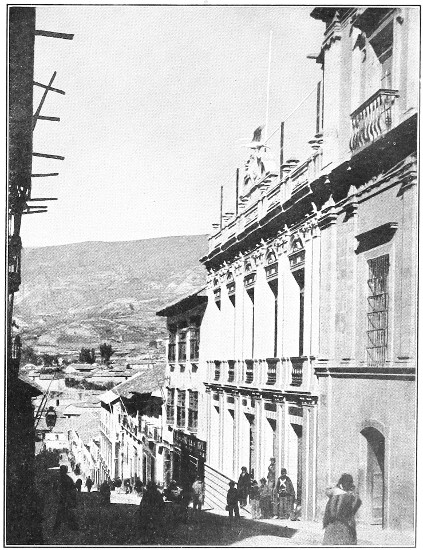
TYPICAL DOORWAY, COLONIAL PERIOD, LA PAZ.
The Jesuits were among the first to establish their missions in
the new colony, and chose as the initial field of their labors the
shores of Lake Titicaca. With the marvellous organizing ability that
characterized the order they quickly extended the sphere of their
activity. They made a systematic study of the language of the Indians
and prepared dictionaries for use in their propaganda. As early as
1580, while the art of printing was still in its infancy and the
printing press a most expensive luxury, this enterprising order was
provided with a thorough equipment of types and machinery, and issued
its own printed books and documents. The Franciscan brotherhood began
its labors chiefly among the Chunchos of the Beni, and the Chiriguanos
of the Chaco, and the record of the missions of Apolobamba and Tarija
show that the missionaries’ zeal did more than the Spanish arms to
effect the conquest of these provinces. Literature relating to the
history of these missions is limited, though Bishop Armentia, of
La Paz, is the author of several interesting works on the missions
of Apolobamba in the departments of La Paz and the Beni, to which
are added the records of the Franciscan College of Tarija, by the
missionaries of that college, giving further information regarding
the labors of Franciscan and other orders in this field. From these
sources are obtained glimpses of the life of the pioneers of truth in
the wilds of the New World that show wonderful examples of faith and
patience. Sometimes a whole mission, after having been established at
the cost of many lives, would be swept by fever or plague and almost
totally destroyed, just at the moment when it seemed most flourishing.
At other times a sudden uprising of savages would change a quiet pueblo
into a scene of carnage and death. It was indeed taking their lives in
their hands in those days for the missionaries to undertake the spread
of the Gospel. Yet the various orders, Jesuit, Franciscan, Dominican,
and Capuchin, worked zealously and persistently, until there is to-day
hardly an Indian choza, or wigwam, that has not its crucifix
and the image of the Santissima Virgen. So thoroughly have the
missionaries done this work that they have interfered greatly with the
progress of ethnologists in their efforts to trace the beliefs and
traditions of the Indians back to a period earlier than that of Spanish
occupation. These scientists complain that there is hardly a trace of
Indian lore that is not marked with the influence of the missionaries’
teaching, from the Caribbean Sea to Cape Horn, and from the Atlantic
to the Pacific Ocean. Nearly all the grammars and dictionaries in
existence, giving instruction in the languages of South American
Indians, have been written by the missionaries of those regions, or by
learned prelates who have at some time been engaged in work among them.
Probably no student of his day has done more in this respect than the
scholarly bishop already mentioned, who has contributed articles and
books on every subject relating to the mission field in South America.
His grammars and dictionaries of the Quichua, Aymará, and other tongues
are standard works.
While missionaries were following the arms of Spain into the forests
or converting the Indians of the parcialidades under the
mita régime, the welfare of the Spanish colonists in the cities
was not neglected. The magnificent churches, convents, and schools,
many of which still remain as wonders of colonial architecture, testify
to the religious spirit that prevailed everywhere. Toward the close
of the sixteenth and in the beginning of the seventeenth century the
records of the Church shine with brilliant lustre. Three saints were
added to the calendar: the devout pilgrim Francisco Solano, who, when
passing through Chuquisaca in 1585, erected the four crosses that
still mark the roads leading out of the city; the venerable Archbishop
Toribio of Lima, whose good deeds are recounted to this day with
reverence in the City of the Kings; and Saint Rose of Lima, the only
saint of American birth and origin. La Paz was made a cathedral city in
1605, also Misque in the same year; and Chuquisaca became the seat of
the archbishopric of La Plata in 1609.
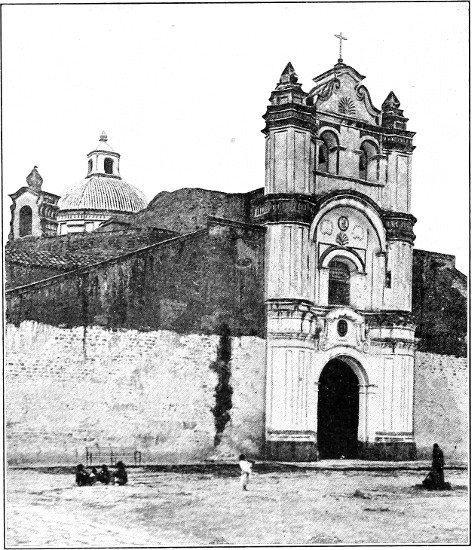
CONVENT OF SANTA TERESA, COCHABAMBA.
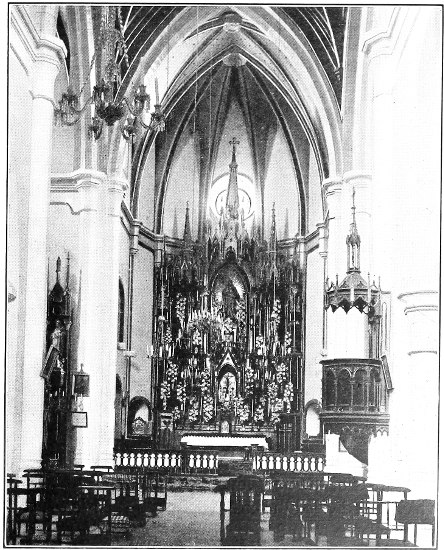
The great wealth displayed in the colonial churches, their massive
construction, exquisitely carved doors, and richly furnished altars,
impress all who visit them. It is not unusual to find in these old
churches masterpieces of art, wood carving of the most elaborate and
finished character, and whole altars, as well as their candlesticks,
of solid silver. The Virgin of Guadalupe in Sucre, an image of solid
gold, is covered with precious jewels worth a king’s ransom. The old
doorway of the convent of San Francisco in La Paz, and of that of San
Lorenzo in Potosí, are like patterns of lacework in delicacy of detail.
The evidences of greatest wealth are seen in the old churches of Sucre
and Potosí, as it was in these cities that colonial fortunes were most
easily made. Sucre, as the capital of Charcas and the archiepiscopal
see, was the social and political metropólis, while Potosí was the
centre of commercial interest as the locality of the great silver mines.
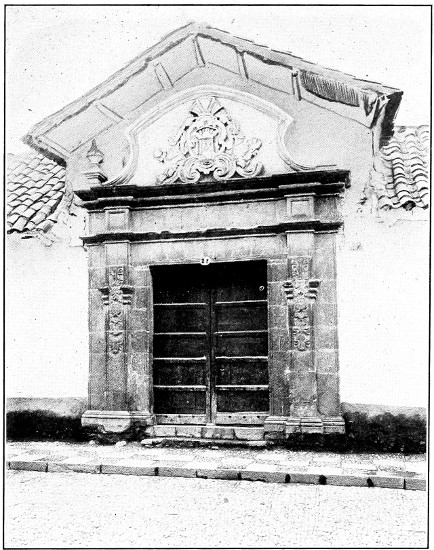
PORTAL OF HOUSE BUILT BY MARQUIS DE OTAVI IN POTOSÍ,
SHOWING COAT OF ARMS.
All through the earlier years of the seventeenth century Potosí was the
scene of sanguinary struggles between the Vicuñas and the Vascongados,
who were engaged in fighting out a feud that had begun with the
conquerors, when two opposing factions arrayed themselves against each
other to compete for political power. The Vascongados, or Basques, had
succeeded in securing nearly all the public offices; and the Vicuñas—a
name given to the Basques’ opponents, the Castilians, Andalusians,
and Creoles, who wore caps made of vicuña wool to distinguish their
party—revolted against the unequal division of honors and declared war
to the knife against their rivals. As the ranks of the Vicuñas were
continually reinforced by Creole natives, this war gradually assumed
the character of a struggle between Spaniards and native Americans,
which continued for a hundred years and may be regarded as one of the
influences tending toward the weakening of Spain’s prestige in this
part of her colonial possessions. The resentment of the Vicuñas was
inflamed by the evident disposition of the high Spanish authorities to
protect the Vascongados in their increasing power. The leader of the
Vicuñas, Alonzo Ibañez, was found guilty of a conspiracy to overthrow
the royal authority, and was executed, together with his followers. His
memory is held in reverence by the Bolivians as the first martyr to
the cause of independence in America. An old-fashioned sun-dial in the
patio of the Mint in Potosí marks the spot on which Ibañez was
sacrificed for his patriotism. This occurred two hundred years before
Bolivia gained her freedom as a nation, but it marked only the first of
a series of efforts of equal boldness, and, alas! of equally disastrous
results, that succeeded one another all through the period of colonial
rule. Some of these rebellions were started by the cholos, of
mixed Spanish and Indian blood, and others by the Indians, under the
leadership of the descendants of the Incas. In every case the origin of
the uprising was an attempt on the part of the authorities to oppress
still further the lower classes. About the middle of the seventeenth
century the cholos of La Paz revolted under Antonio Gallardo,
killed the corregidor and other officials, and, with the
watchword “America for the Americans!”—which he sounded a hundred and
fifty years before Monroe caught the inspiration,—led a “liberating
army” to the attack of Puno, on the western shore of Lake Titicaca. He
was killed in the battle of Puno, and his followers were hanged.
The eighteenth century was as prolific of revolts as the seventeenth
had been, and they were less easily quelled. Not all the power of the
viceroy, supplemented by the Audiencia of Charcas, could repress the
indignation of the people when they were goaded beyond endurance by
injustices put upon them; and when an order came to Cochabamba that
the mestizos, or cholos, were to be included with the
Indians in the payment of tribute,—although it was afterward proved
to be a false report,—the Cochabambans united in rebellion under the
leadership of Alejo Calatayud and swore to “exterminate the Spaniards.”
The municipality called a meeting, and proposed a settlement of the
difficulty; and, as a result, it was agreed that the Creoles, the
natives of the country, should be given preference in public offices
and that no Spaniard should be permitted to act as corregidor.
Calatayud was afterward treacherously taken prisoner at a banquet
given in his honor, and put to a cruel death. These events coming to
the ears of the viceroy, he immediately took steps to avoid future
insurrections, wisely foreseeing the danger to Spanish power in such
determined and persistent outbreaks.
But the spirit of independence had illumined the minds and hearts of
the oppressed, and it was not an easy matter for the authorities to
extinguish it. A few years after the death of Calatayud a conspiracy
was discovered in Oruro, headed by Juan Vela de Cordova, who had issued
a manifiesto, or circular, to all the neighboring provinces,
urging them to “throw off the Spanish yoke.” The conspirators were
condemned to death; but their execution served only to increase
sympathy with their cause, and the tide of insurrection swept into a
deeper and wider channel. The names of Ibañez, Gallardo, Calatayud, and
Vela de Cordova are revered in Bolivia as precursors of the American
Independence. The last of them was executed more than a quarter of a
century before the episode of the Boston Tea Party, which initiated the
War of Independence in the United States.
The impossibility of centralizing at Lima all the administration
of the South American colonies became so evident to the Spanish
government before the middle of the eighteenth century that steps
were taken to divide these possessions into groups; and in 1740 the
viceroyalty of Bogotá was created, followed in 1776 by the creation
of the viceroyalty of Buenos Aires. The Audiencia of Charcas was
separated from Lima and attached to Buenos Aires; so that, from this
time until the establishment of the republic, Bolivian history was
identified with that of Argentina, which hitherto had had no great
political significance and was practically unknown to commerce except
through its small seaport, Buenos Aires. In 1782 the territory of
the Audiencia of Charcas was divided into four provinces, Chuquisaca,
La Paz, Potosí, and Santa Cruz. Chuquisaca covered the jurisdiction
of the archbishopric of La Plata; La Paz included, in addition to the
territory of the bishopric, the provinces of Lampa, Carabaya, and
Azangaro, which were afterward annexed to the Audiencia of Cuzco and
now belong to Peru; Potosí was formed by the present department of that
name, together with those of Atacama—which now belongs to Chile—and
Tarija; and Santa Cruz comprised the present departments of Cochabamba
and the Beni, in addition to what is now its own. Mojos and Chiquitos
remained under the direct jurisdiction of the Audiencia of Charcas.
The four provinces were ruled by intendentes named by the king,
and their sub-divided partidos were governed by sub-delegates,
appointed by the viceroy on the nomination of the intendentes,
for a term of five years. The municipalities, or cabildos,
composed of aldermen and presided over by the governor, or jefe
politico, exercised the same functions as the municipal councils of
the present day.
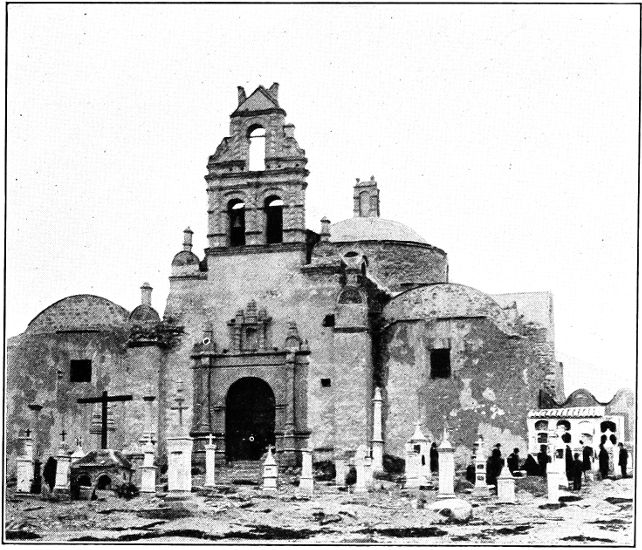
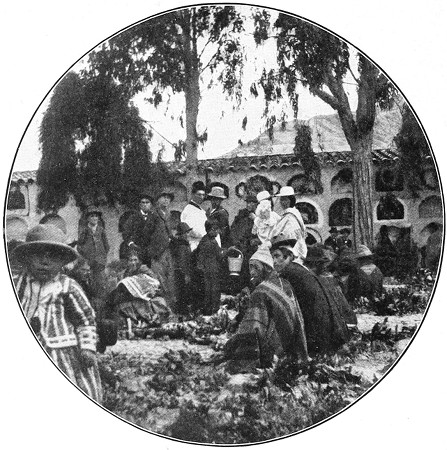
PANTHEON OF SAN BERNARDO, POTOSÍ, OLD COLONIAL CEMETERY.
The viceroyalty of Buenos Aires had jurisdiction over the territory of
the present republics of Bolivia, Paraguay, Uruguay, and Argentina. The
first viceroy was Don Pedro de Zeballos y Cortez, followed two years
later by the Viceroy Don Juan José de Vertiz, under whose rule occurred
the last and most powerful revolts in the history of the colonial
government. In 1780 the Catari brothers, three Indians of Alto Peru who
had suffered injustice at the hands of the governor of their community,
rose in revolt, and, securing a large following in Charcas, Oruro,
Cochabamba, and La Paz, attacked the government. A fierce struggle took
place between the forces sent out by the Audiencia and the desperate
Indians. The Audiencia finally offered a premium of two thousand pesos
for the head of each of the Cataris, and they were delivered up through
the treachery of their own companions.
But this was not the end. About this time an Indian outbreak occurred
in Cuzco, under the leadership of Tupac-Amaru, a descendant of the
Incas, who sent messages to the Cataris to join him. The messages
fell into the hands of an Indian of Ayoayo, near La Paz, who took up
the cause under the name of Tupac-Catari, and secured a following
of eighty thousand men, with whom he marched on La Paz, besieging
the city and holding it at his mercy during more than three months,
until a force from the Audiencia came to its relief and the besiegers
were obliged to retire. Meantime, a brother of Tupac-Amaru, with an
army of fourteen thousand men, laid siege to Sorata, and destroyed
it, with twenty thousand inhabitants, by breaking a dike that he had
built to dam the streams descending from the summit of Mount Sorata,
thus flooding the town. This was the last effort of the Inca’s
unhappy people to secure their freedom; it cost the lives of about
fifty thousand of their oppressors and more than that number among
themselves. The same year a cholo, Sebastian Pagador, led a
popular uprising in Oruro, but after a few promising successes he was
met by defeat and suffered the extreme penalty with torture. The close
of the eighteenth century witnessed events rapidly approaching the
inevitable climax.
Throughout the entire history of colonial rule in Alto Peru runs
the record of struggles for freedom. It was an unequal fight, often
amounting to little more than a determined protest against the
injustice of a powerful master. But resistance and revolt under
oppression are unmistakable signs of latent force, and are far more
hopeful than the dull submission that marks the truly enslaved.
Whatever may have been the condition of the people under the stern
system of Spanish government, an inherent dignity was manifested even
among those of humblest origin in their persistent efforts to secure
their inalienable rights. Every lover of human liberty must feel a glow
of pride in the splendid courage that could face such fearful odds as
arrogant Spain presented to her downtrodden subjects in Alto Peru; and
the pen must be tipped with divine fire to do justice to the records of
heroism that culminated in the sacrifice of the immortal “promartyrs of
the Independence.”
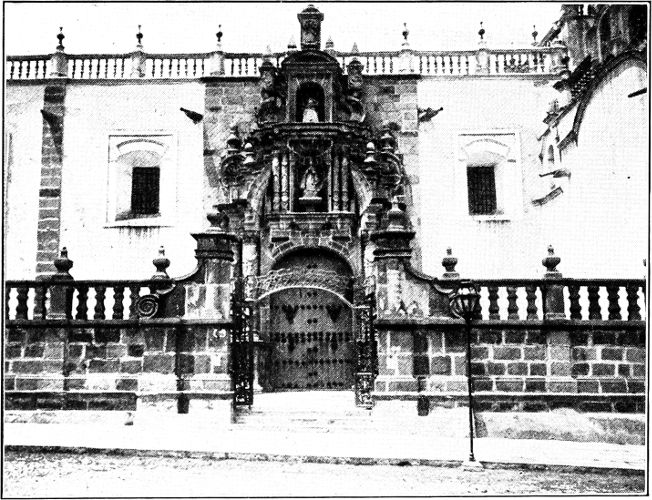
ENTRANCE TO CATHEDRAL, SUCRE.
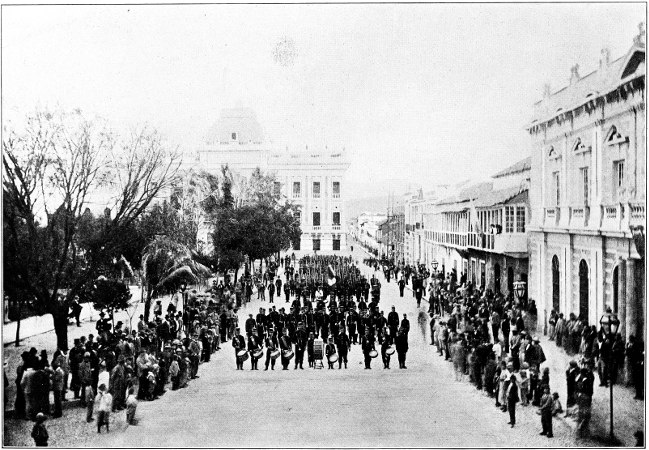
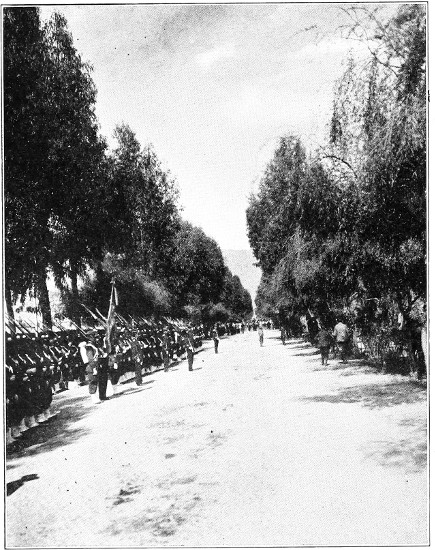
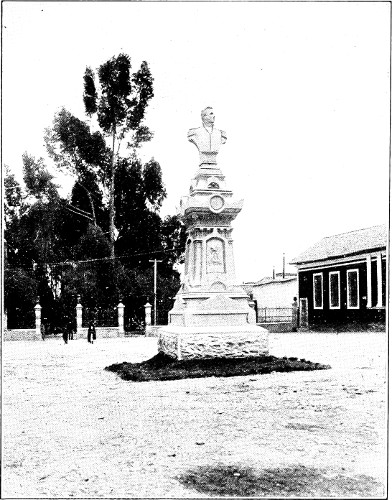
THE BATTALION CAMPERO ON PARADE IN SUCRE.
CHAPTER III HISTORY OF THE INDEPENDENCE
In Alto Peru alone, of all the South American colonies, the battle
cry of freedom was, from first to last, an unequivocal and fearless
declaration of independence. It is significant of the character and
sentiment of the whole people that such an audacious stand was possible
from the beginning. In all the other South American countries, loyalty
to King Ferdinand of Spain, who had been deposed by the Bonapartes,
was the pretext for resisting the authority of the viceroys. Even when
the leaders of the revolution themselves favored complete emancipation
they were obliged to disguise their ultimate purpose, as the masses
were still too apathetic or too fearful to look upon the power of
Spain as other than inevitable and eternal. They could not be brought
so suddenly to strike for absolute freedom. It was the despair of the
Venezuelan patriot Miranda that his beloved countrymen would not catch
the inspiration of his noble purpose, and in Buenos Aires, Chile,
Quito, it was first the declaration of loyalty to the Spanish crown and
not a demand for independence that brought about the overthrow of the
viceroys and the establishment of the patriot Juntas de Gobierno.
DON ANTONIO SUCRE, “GRAN MARISCAL DE AYACUCHO.”
Alto Peru probably suffered more than any other colony of Spain from
injustice and oppression. Although its mines had yielded fabulous
wealth to the royal treasury, it was the least favored of the Spanish
provinces, the most neglected, and its people were the most barbarously
treated. The cruel system of the mita had so depopulated the
Indian race that the few who remained were obliged to do more than
human strength could endure in order to make up for the scarcity of
laborers. In common with the rest of the colonies, it was prohibited to
Alto Peru to cultivate anything that was grown in the mother country;
commerce with foreign countries was forbidden; only Spaniards or
their children could hold public office; merchandise was sold to the
Indians by the corregidores, to whom they were always in debt;
instruction was little more than a name, as no books were allowed in
the country except books of devotion. A Bolivian writer on the history
of his country says: “The natives of the country were excluded from
all posts of honor and profit except when they were able to purchase
them at the cost of large sums of money; so that out of one hundred and
seventy viceroys, only four were born in the country; of six hundred
and two captains-general, or presidents, fourteen were American; of
five hundred and fifty bishops, five hundred were Europeans; political
liberty was excluded from our soil.” In fact, the last thought,
apparently, which the Spanish authorities gave to this province was
that which concerned its well being, at least, until later years of
colonial rule, when the warning given to Spain by the example of the
British colonies in North America suggested the necessity for reforms,
and a new commercial regulation was put in force, thirty-three ports
were opened to foreign trade, and greater privileges were granted the
natives of the country than formerly. But the reform came too late.
Even the concession granted by the Council of Regency in 1810 to permit
the colonies to send representatives to the Cortes could no longer stay
the current of public opinion.
Everyone is familiar with the story of Napoleon’s invasion of Spain and
the capture and imprisonment of King Ferdinand in 1808, when Napoleon’s
brother, Joseph Bonaparte, was placed on the Spanish throne, and a
Council of Regency at Cadiz governed the affairs of the colonies. The
effort of King Ferdinand’s sister, the Princess Carlota de Braganza,
to usurp his dominions in America is only of interest in the history
of the revolution of Alto Peru because it furnished a pretext for the
decisive steps finally taken by the patriots to carry out a plan of
campaign which they had been preparing in secret for a long time. An
ambitious agent of the princess, Don José Manuel Goyeneche, who had
been sent on a mission to interview the South American authorities in
her favor, visited Chuquisaca in 1809, and succeeded in winning the
president of the Audiencia and the bishop of the diocese as allies
of the princess. The right of the oidores to a voice in this
matter was ignored, and those who declared their opposition were
promptly ordered to prison. Though the order was fulfilled in the case
of only one of them, and the president was dismissed from office and
imprisoned for his share in the affair, the patriots saw in this event
an opportunity to spread the gospel of freedom more openly, and a few
devoted apostles set out to make a propaganda of liberty throughout the
country. Among them were the intrepid leaders of the revolution which
was installed the following year in Buenos Aires, Cornelio Saavedra,
who became president of the junta there, Bernardo Monteagudo, and
Manuel Moreno.
The revolution inaugurated on the plateau of Alto Peru on the memorable
16th of July, 1809,—the echoes of which will not cease to vibrate
in the heart of the Bolivian nation as long as a patriot lives to
love his native land,—was not the result of a sudden impulse, but
the natural outcome of deliberate and persistent determination. For
years the leaven had been working, until there was not a pueblo whose
inhabitants were ignorant of the approaching crisis or unwilling to
fight for the cause. In their various uprisings throughout the whole
period of colonial rule, the people had been unconsciously preparing
to initiate one of the greatest patriotic movements in the history of
modern times. With the first years of the nineteenth century, definite
indications of the tendency of affairs began to appear; and from
memoirs written during that period it has been proved that as early
as 1798 the inhabitants of La Paz “meditated the independence of the
whole continent, and communicated this project to various cities of the
kingdom, in every one of which it found patriots ready to undertake the
enterprise.”
CROWDS THRONGING COUNTRY ROADS ON THEIR WAY TO JOIN A
PATRIOTIC CELEBRATION IN LA PAZ.
La Paz was singularly fitted to be the theatre of the opening scene in
this drama of liberty. Remote from the chief seat of Spanish authority,
out of close range of the Audiencia’s power, the spirit of independence
had been fostered by the tolerance, if not actual complicity, of its
governor, in whose house members of the revolutionary clubs from
various parts of the country were frequently entertained. These clubs
were the organizing headquarters of the patriots in Chuquisaca, La Paz,
Potosí, Cochabamba, and other cities, and it was their combined effort
which installed the revolution in La Paz, by the issuing, in the name
of the Junta Tuitiva, of a proclamation which clearly shows the object
and scope of the patriots’ programme.
The history of the revolution of La Paz displays constant evidence of
the energy, ability, and patriotic ardor of its chief, the president
of the Junta Tuitiva, Don Pedro Domingo Murillo, the first of the
“promartyrs of the Independence.” The events of this revolution,
which was so important in the annals of the Bolivian nation, as the
spark that ignited the continent in a flame of patriotic war, have
been recorded by one of Bolivia’s foremost writers, Don José Rosendo
Gutierrez, from whose gifted pen the story appears, with all the charm
that a graceful literary style lends to the relation of glorious
episodes.
The important crisis, so long awaited, came at seven o’clock in
the evening of July 16, 1809. The conspirators, at whose head were
Murillo, Indaburu, and Graneros, took possession of the quartel and
imprisoned the governor. Assembled in open Cabildo, Drs. Gregorio
Garcia Lanza, Juan Bautista Sagárnaga, and Basilio Catacora were named
representatives of the people and admitted and recognized as such. The
first act was the Declaration of Independence, which ran: “In the noble
and valorous city of Our Lady of La Paz, at eight o’clock at night,
on the 16th of July, 1809, assembled in the Salon of the Cabildo, the
undersigned, in the name of the people, declare and swear to defend
with their blood and fortune the independence of the country.” The
signers constituted themselves a Junta Tuitiva, of which Pedro Domingo
Murillo was elected president. It was organized as a separate body from
the Cabildo, in this way avoiding the confusion from which the Buenos
Aires junta suffered later through its ill-defined relation to that
corporation.
The Junta Tuitiva of La Paz made the first effort in South America
toward democratic government in accordance with republican ideas. Its
laws were inspired by motives of democracy and brotherhood; and one of
its first acts was to give to the race which had been disinherited by
the conqueror a voice in the new government, by appointing an Indian to
the junta from each district. Perpetual alliance was sworn to between
the European Spaniards and the Americans. Its proclamation is a proof
of the courage and sincerity of its authors:
“Until now we have tolerated a kind of exile in the very bosom of
our own country; we have seen with indifference for more than three
centuries our primitive liberty submitted to the despotism and tyranny
of an unjust usurper, who, degrading us below human kind, has reputed
us to be savages and looked upon us as slaves; we have kept a silence
very like the stupidity which was attributed to us, suffering with
tranquillity that the merit of the Americans should be always a sure
presage of their humiliation and their ruin. It is high time, then,
to shake off a yoke so fatal to our happiness. It is high time to
organize a new system of government, founded on the interest of this
our country, which has been so depressed by the spurious politics of
Madrid. It is high time, in short, to raise the standard of liberty
in these unfortunate colonies, acquired without the least title and
conserved with the greatest injustice and tyranny.”
Commenting on the proclamation of the junta, Señor Gutierrez says:
“This was not all of the programme of July. If there had been nothing
more than the document mentioned, the aspiration toward independence
would have been reduced to a mere insurrection. But the programme
of emancipation came united with the social reorganization of the
continent. It insinuated the ideas of democracy and the civil
constitution. The programme of July was not only the despedida
of the day previous: the placing of the cornerstone in the edifice of
the day following.”
The sad history of the unequal fight between the few heroic patriots
and the trained army sent to meet them by the Viceroy of Peru; the
unfortunate quarrels between the revolutionary leaders at a moment
when united strength was indispensable; the antagonism of the Bishop
of La Paz, whose anathemas frightened the superstitious Indians and
half-breeds out of the patriots’ ranks; all the events that conspired
to bring about the disastrous defeat, capture, and final execution of
Murillo and his followers, only serve to show what a bitter struggle
was to be expected before final victory could be hoped for. But the
promartyrs “blazed the trail” and opened a pathway toward liberty which
would later direct the eager footsteps of millions. When the patriot
Murillo, humble of origin, but of great intelligence and a noble heart,
said his farewell from the scaffold on January 29, 1810, exclaiming,
in the words of another martyr: “The torch which I have lighted shall
never be extinguished,” he made a prophecy which time has amply
justified and verified.
GENERAL PEDRO DOMINGO MURILLO, THE FATHER OF BOLIVIAN
INDEPENDENCE.
Four months after the death of Murillo, the patriots, Saavedra,
Monteagudo, Moreno, and others, who had gone from Chuquisaca,
Cochabamba, and Potosí to stir up the revolution in Buenos Aires and
secure aid for their countrymen, had an army already equipped and on
the march to Alto Peru. With General Cornelio Saavedra as president,
the Buenos Aires junta had been organized, the viceroy deposed, and
a strong revolutionary party, in which General Belgrano and other
Argentine leaders were prominent, had pledged itself to lend assistance
to continue the fight so heroically begun on the heights of La Paz.
Undaunted by the brutal message sent to his Bolivian general by the
Viceroy of Peru, “that the Americans had been born to be slaves and
to vegetate in obscurity and depression,” the auxiliary army from
Buenos Aires, under the command of Balcarce, Diaz Velez, and Castelli,
advanced six thousand strong to meet the viceroy’s troops under Nieto,
Córdova, and Basagoitia on the field of Suipacha. After an hour of
hard fighting the patriots won the day, and the royalist leaders
were shot, to avenge the cruelty shown the year before to the La Paz
patriots, when eighty-six of their number were put to death or exiled
to celebrate the victory over Murillo. Meantime, a revolution in
Cochabamba had resulted in a triumph for the patriots; and the leaders,
Manuel Esteban Arze and Melchor Guzman Quiton marched on Oruro with a
force of one thousand five hundred men, meeting the royalists at Aroma
and completely defeating them. This was the first patriot victory on
the Bolivian Plateau, and it was after this battle that the Buenos
Aires Gazette wrote: “Alto Peru will be free because Cochabamba
wills it so.” The royalist forces sent by the Viceroy of Peru to combat
the revolutionists in Alto Peru and Argentina were under the command
of the same Goyeneche who had treacherously sought to overthrow the
existing authority in favor of the Princess of Braganza. It was by his
orders that the wholesale slaughter of the vanquished had taken place
in La Paz in 1809, and it was his ignoble part to bring defeat and
disaster to the auxiliary army by violating an armistice of forty days
and suddenly invading the camp at Guaqui on June 20, 1811. The patriots
were forced to retreat, the Cochabamba cavalry, under Francisco
del Rivero, coming to the rescue too late to save the situation.
The auxiliary army was broken up, Castelli and Balcarce retired to
Chuquisaca, and Diaz Velez joined Rivero later in Cochabamba. Goyeneche
pursued his advantage as far as Cochabamba, where, by great superiority
in number and military training, his troops were able to defeat the
inexperienced and poorly armed inhabitants. His victory was celebrated
with crime and rapine for the space of three days, after which a
military tribunal was held to punish the revolutionists, many of whom
were condemned to death. Meantime, a second auxiliary army from Buenos
Aires, under the command of General Belgrano, met the royalists at
Tucuman, September 24, 1812, and again at Salta, February 20, 1813,
completely defeating them in both engagements, and obliging their
leader, Pio Tristan, to swear “never again to take up arms against
the patriots.” Goyeneche having satiated his taste for cruelty in
Cochabamba set out for Potosí, but on learning of the approach of
Belgrano’s army, he turned his four thousand troops hastily toward
Oruro, and asked his retirement. The viceroy sent General Joaquin
Pezuela to take Goyeneche’s place.
The auxiliary army, stimulated by victory, advanced toward Oruro to
engage Pezuela’s forces and secure a stronghold for the patriots on
the plateau, but, taken at a disadvantage, it was defeated after
stubborn fighting at Vilcapugio and Ayuma. Pursued by Pezuela, Belgrano
was forced to retreat beyond the Argentine border and once more the
royalists held complete sway in Alto Peru. The “reign of terror” which
followed was so ruthless that thousands of patriots fled to Argentina
to escape the royalist vengeance. Yet the spirit of revolution was not
subdued, and in the midst of defeat, persecution, and death, an ardent
patriot of the south, Don Juan Antonio Alvarez de Arenales, assembling
the remnant of the defeated army of Ayuma, marched on to Cochabamba
and Santa Cruz, and retiring to Vallegrande, succeeded in organizing
an army of four thousand strong. Pezuela sent Don Joaquin Blanco to
meet Arenales and an engagement took place on the field of La Florida,
resulting in an overwhelming victory for the patriots, May 12, 1814.
Blanco died on the battlefield. But, although the news of the victory
at La Florida was encouraging, it was not sufficient to make up for the
disastrous defeats of Belgrano’s army.
To a people less tenacious of purpose, the apparent hopelessness of the
situation, after the battle of Ayuma, would have brought despondency;
but the valiant heroes who held freedom worth undying effort, were not
to be turned aside from their purpose by defeat. When they could no
longer march with an army into the field, they formed themselves into
patriot bands all over the country and carried on a system of guerrilla
warfare that harassed the enemy on all sides. Indomitable warriors,
they set up the standard of their “Republiquetas,” as Bartolomé Mitre
calls them, in the cañons of Ayopaya and Omasuyos to the north; in
Chayanta, which dominated the routes between Oruro, Cochabamba, and
Chuquisaca; in Mizque, surrounding Cochabamba and communicating with
Santa Cruz and Vallegrande; in Cinti and Porco, extending to Tarija and
the Chaco. In each of these guerrilla centres there were innumerable
small bands led by various chiefs, all more or less under the guidance
of a few principals, whose names are honored by posterity for the
splendid records of bravery they perpetuate. In the north were Don José
Miguel Lanza and the indomitable Muñecas; in the central districts,
Arenales and Arze; in the east, Warnes and Mercado; and in the south
the valorous Padilla, the brave Camargo, Zarate, and Betanzos. After
reading the story of their skilful art of war, their unwavering
courage and unflinching patriotism, one cannot help deploring the
circumstances which prevented their combining in the open field to
overthrow the enemy whom they so continually harassed and outwitted.
Even their defeats shed glory on the national spirit, undaunted in
the face of death, unconquered on the scaffold. Mitre extols the
guerrilleros in unmeasured terms, and the Chilean historian,
Sotomayor Valdez, says: “Out of the one hundred and two leaders, more
or less obscure, only nine survived the fifteen years’ struggle which
followed the defeat at Viloma of the third auxiliary army, commanded
by General Rondeau, on November 29, 1815. The remaining ninety-three
perished in the battlefield or on the gallows, and there was not a
single capitulation.”
One of the most renowned of the guerrilla chiefs was Don Manuel
Ascension Padilla, whose military genius and devoted patriotism were
unsurpassed. He was highly esteemed by General Belgrano for his
services to the auxiliary army, and by Don Esteban Arze, who conferred
on him the title of commandante. Dr. Valentin Abecia, in an
interesting biography of this guerrilla chief, compares him to Morelos
of Mexico, and regards him as one of the greatest figures among the
heroes of the Independence, “a hero with the soul of a child and the
heart of a lion.” And no one thinks of the warrior without at once
calling to mind the noble woman who fought by his side, Doña Juana de
Padilla, his devoted and beautiful wife. “The Padillas” are enshrined
among the dearest memories of the long fight for freedom in Alto Peru;
and if “Don Manuel” was admired for his military skill, “Doña Juana”
was beloved for her tenderness to the sick and wounded. The Indians
adored her “like the image of the Virgin.” In the field, as well as in
the camp, she was her husband’s ally and helper, and after his death
she continued to fight in the sacred cause until independence was won.
According to the Revista Nacional, of Buenos Aires, she took
part in seventeen combats, commanded a battalion at Viloma, and was
wounded at Villar, where her husband was killed; she was given the
title of acting lieutenant-colonel by the Argentine government.
REVIEWING TROOPS IN THE AVENUE ARCE, LA PAZ.
Padilla was among the first of the patriots to insist upon a separate
constitution for his country, feeling that the revolutionists of Buenos
Aires were disposed to show scant consideration for the interests of
Alto Peru in their treatment of this part of the junta’s territory. He
expressed this sentiment in a letter to General Rondeau in 1815, to the
great disgust of that officer. After repeated and futile efforts on
the part of the royalists to capture Padilla, while he eluded them on
every side, besieged Chuquisaca for a whole month, and brought despair
to the viceroy’s troops, a battle took place at Villar on September 14,
1816. Both sides fought with fury, a thousand victims falling without
any sign of yielding on either side, when suddenly Padilla fell dead,
pierced by a sabre; and his faithful followers lost heart for the
fray, suffering their first and only defeat. They were taken prisoners
and barbarously put to death.
The guerrilla chief Lanza, one of the most audacious and cunning of
them all, led the royalists a “wild goose chase” among the mountains of
Ayopaya, without giving them a single advantage. Camargo was no less
successful in guerrilla tactics, until through treachery he was killed,
with eight hundred of his followers, and his head sent on a pike to
Pezuela in token of a famous capture. Warnes, the daring “border chief”
of Santa Cruz, fell in a battle with the enemy, after his men had
killed two thousand eight hundred royalists out of an army of three
thousand. The victorious general ordered the execution of nine hundred
patriots, of all ages and both sexes, to soothe his vengeance. Muñecas,
the curate whose patriotism was no less active than his piety, was
captured after brave resistance, and assassinated while on his way to
trial. History teems with examples of the tenacity and boldness with
which the guerrilleros fought to the end.
On July 9, 1816, the Congress of Tucuman declared the independence of
the Argentine provinces. Several notable patriots of Alto Peru were in
the assembly, among others Pedro Carrasco, president of the congress,
and Pedro Ignacio Rivero, Cochabambans; and José Mariano Serrano,
secretary of the congress, who edited the Act of Independence of
Argentina, and Mariano Sanchez Loria, Chuquisacans. The important rôle
played by the patriots of Alto Peru in the organization and development
of the revolutionary party of Buenos Aires, and the framing of the
Argentine constitution, was due, in great part, to the educational
advantages which Alto Peru offered at that time in the celebrated
universities of Chuquisaca and Carolina, which were among the first in
Spanish America.
One of the first acts of the Argentine government after the assembly
of the Congress of Tucuman was to send a fourth auxiliary army into
Alto Peru. General Pezuela had been appointed Viceroy of Peru, and had
sent General Ramirez to take his place in the command of the royalist
army. After six months, Ramirez was replaced by General La Serna, who
came from Spain with officers and soldiers of very different calibre
from those who had sacked and plundered the country under Goyeneche and
Pezuela. But General La Serna remained only long enough to realize the
horrible condition in which his predecessors had left the people, and
then resigned his command in favor of General Ramirez, who returned to
the field in time to meet the fourth Argentine army of patriots, under
La Madrid. The royalists, led by one of Ramirez’s officers, Captain
Andrés Santa Cruz, who became president of the republic of Bolivia
later, fought the auxiliary army in two engagements, resulting in a
final victory for the royalists, June 24, 1817. Thus, the fourth effort
of the Argentine revolutionists to help the cause in Alto Peru proved
as disastrous a failure as the three preceding, and the fight was again
left to the guerrilleros, to whom was chiefly due whatever
the patriot cause gained during the long fifteen years’ struggle. So
exasperating were their tactics, and so effective their methods, that
one of the royalist generals was forced to exclaim, with more fervor
than hope: Esta guerra es eterna!—“This war is eternal!”
Olañeta, sent by the viceroy to conquer Lanza, wrote to his chief:
“Lanza sustained the fight with infernal obstinacy!”
The four years of guerrilla warfare that followed the defeat of the
last auxiliary army from Buenos Aires made a continuous record of
alternating successes and defeats. Olañeta, named general of division
of the royalists, fought a wearisome series of engagements with the
various guerrilla leaders, gaining little or nothing in spite of
the superior number and experience of his troops. General Valdez,
who had charge of the garrisons of Oruro and La Paz, was thoroughly
disheartened. The outlook seemed to justify the exclamation: “This war
is eternal.”
In July, 1821, the news came from Lima which gave promise of the rapid
approach of a crisis in the affairs of Alto Peru. The great liberating
army of Chile and Argentina, under the command of General San Martin,
had disembarked in Pisco; his squadron had captured the best Spanish
ships in the harbor of Callao; the patriots were now in possession of
Lima, the viceroy having fled from the capital, and the independence of
Peru was assured in a proclamation bearing the date of July 28, 1821.
Meantime, La Serna had been appointed viceroy to replace Pezuela.
The general rejoicing with which the devoted patriots of Alto Peru
received the glad tidings of the arrival of San Martin’s conquering
hosts may well be imagined. In all the chief cities there were meetings
of the revolutionists, and new courage animated the hearts of the whole
people. Early in August of 1823, an army of six thousand men, commanded
by General Andrés Santa Cruz, who had joined the patriot cause, was
sent by the junta of Lima to establish the independence of Alto Peru.
General Santa Cruz was accompanied by Augustin Gamarra, who commanded
one-half of the division.
With the arrival of the liberating troops, the famous
guerrilleros joined the ranks and fought with new zeal in the
cause to which they had given all their energy for fifteen long years.
One cannot help smiling with satisfaction upon reading that Olañeta,
who had received special instructions from the viceroy a few years
before “to conquer the guerrilla chief Lanza at all hazards,” fled
precipitately in January, 1825, at the notice of the approaching troops
of the independent army “commanded by General José Miguel Lanza!”
On the fifteenth anniversary of the martyrdom which the first patriots
of the Independence suffered in the plaza of La Paz, at the same
hour which had witnessed their execution, the last of the Spanish
authorities evacuated the city, January 29, 1825. The same day, the
Independent Army of Alto Peru, commanded by General José Miguel Lanza,
brother of the martyred patriot, made its solemn entry into the city;
and on the following day General Lanza read the proclamation of Alto
Peru’s independence, and, in the name and with the authority of General
Bolivar and General Sucre, he assumed command of the province of La
Paz, with the title of “president,” which was equivalent to that of
“prefect.” What more fitting than that the noble veteran of the cause,
who had sustained it through good fortune and evil, in the army ranks
and on the guerrilla hunts, the famous warrior who had won and lost
with equal equanimity and had never grown disheartened, should be the
chosen patriot to issue the proclamation of national independence!
The war of independence was ended. The record of final victory had
been sealed on the battlefield of Ayacucho, on December 9, 1824, when
General Antonio José de Sucre, who commanded the liberating army in
the absence of his chief, General Simon Bolivar, swept away the last
shred of hope harbored by the royalists, and realized forever the
liberty of America from European domination. The meeting in Lima of
the two great liberators of South America, San Martin of the Chile
and Argentine army and Bolivar of the Colombian, had resulted in the
withdrawal of San Martin from the field, leaving Bolivar in possession,
as dictator, a title bestowed upon him by the Congress of Lima. The
first victory of Bolivar’s troops over those of the Viceroy La Serna
was on the field of Junin, near Cerro de Pasco, where the royalist
general Canterac was completely defeated and put to flight. Bolivar
then returned to Lima, leaving General Sucre in command of the army,
which met the viceroy in the decisive battle of Ayacucho. The Spanish
troops were overthrown and the viceroy was taken prisoner. General
Sucre, with the magnanimity that characterized him, conceded an
honorable capitulation to the vanquished, authorizing facilities for
their embarking to return to Spain.
MONUMENT TO GENERAL SUCRE IN THE ALAMEDA, LA PAZ.
The capitulation of Ayacucho is thus described by the Bolivian
historian, Luis M. Guzman: “The victory of Ayacucho had broken the
Spanish yoke. Great were the losses of that memorable day. The viceroy
La Serna had fallen wounded and a prisoner at the beginning of the
combat. The lieutenant-general Canterac, as the remaining chief of
the royalist army, hastened to formulate on the very field of battle
the eighteen articles in which is comprehended the capitulation of
Ayacucho. In them the Spanish general proposes to save the honor of
his arms; to secure the persons and properties of Spanish subjects;
to guarantee the civil and military posts of those who may wish
to serve in the independent army; to facilitate the departure of
troops returning voluntarily to Spain, and to provide for their
transportation; to give full amnesty for their political opinions. The
vanquished royalists were permitted to dictate the conditions of peace,
which were admitted with few modifications by the victorious patriots.
Thus General Sucre triumphed twice over his enemies. His valor
overthrew them on the field of battle; his heroic generosity disarmed
them with gratitude. A more exigent conqueror would have turned against
himself the arm of despair, which might still have proved fatal for the
independent army, because of the numerous royalist troops and garrisons
that yet remained at various points of upper and lower Peru.”
General Sucre signed two copies of the capitulation, one of which
is preserved in the archives of Madrid. The other, from which the
photograph was made to illustrate this chapter, is a valued possession
of Señora Hortensia Gutierrez de Pinilla, the wife of Bolivia’s foreign
minister, and daughter of one of its foremost scholars. It is treasured
with patriotic pride, and occupies the place of honor in the library of
her beautiful home in La Paz, where it hangs beside a portrait of the
“Gran Mariscal de Ayacucho.”
The victorious army of the Independence, with General Sucre at its
head, marched from the battlefield of Ayacucho to Cuzco and thence, by
way of Lake Titicaca and the Desaguadero River, to La Paz. When the
news of its approach to La Paz was heralded abroad, the city went wild
with joy. For miles around the scene was one of animated expectancy.
A committee of distinguished citizens, headed by General Lanza and
Casimiro Olañeta,—the latter a nephew of the royalist leader,—met
the conquering hero a few leagues out of the city and welcomed him
on behalf of the nation. On February 7, 1825, he made his triumphal
entrance, amid the jubilant acclamations of the people, under arches
of victory garlanded with roses, and through streets gaily decorated
with flags and banners bearing mottoes of eulogy. At the plaza the
hero paused, to pay a tribute to the memory of Murillo and the other
martyred patriots of 1809; and as tears came to his eyes in the
contemplation of the scene, now gay with the joyous manifestations
of a free people, once sad in the shadow of the gallows on which the
nation’s brave sons were sacrificed, the impressive moment created a
sudden stillness, broken again immediately by a burst of cheers and
shouts from the enthusiastic multitude. Feasting, music, and dancing
reigned throughout the city; and the visitors were entertained with
balls, soirées, and banquets for a month. Two days after his arrival,
General Sucre issued a decree convoking a national assembly in Oruro
to determine the future government of the country. In March he set out
to visit the interior, leaving a division of his army in La Paz under
command of General José Maria Córdova. In every city his arrival was
the signal for general rejoicing.
The first national assembly met in Chuquisaca in June, 1825. To General
Sucre belongs the honor of having been the prime organizer of the
republic, and the best beloved of its leaders. In the hall where the
first national assembly met hangs the portrait of the grand-marshal
of Ayacucho, and the words of his testament: “Still another reward I
ask of the entire nation and of its administrators: not to destroy the
work of my creation; to preserve, amid all dangers, the independence
of Bolivia.” And the last words of their liberator have been made the
watchword of the nation.
FACSIMILE OF THE ORIGINAL TREATY OF AYACUCHO, WHICH
SEALED THE SOUTH AMERICAN INDEPENDENCE FROM SPAIN.
During the deliberations of the first congress two despatches were
received of portentous significance. One came from the International
Congress of La Plata, leaving to the provinces of Alto Peru perfect
freedom to constitute themselves an independent republic, although
they had been a part of the viceroyalty of La Plata under the colonial
régime. The other was a high-handed message from General Bolivar,
declaring Alto Peru subject to the authority of the Congress of Lima,
and ordering the Congress of Chuquisaca to suspend its sessions.
Indignation blazed up fiercely at the unwarrantable attitude of the
great liberator in thus summarily disposing of the destiny of a
free and independent people who had given the best blood of the country
to secure its sovereign freedom. The fiery and eloquent Olañeta, the
guerrillero Lanza, and others, protested in vigorous terms
against any such despotism, and, overriding Bolivar’s proclamation, a
unanimous vote declared that Alto Peru, “which, on the South American
continent, had been the altar on which was spilled the first blood of
the free and the tomb in which lay buried the last of the tyrants,”
constituted a sovereign state, “independent of all nations, both of
the Old and the New World, to be governed by its own people and ruled
by the constitution, laws, and authorities which they should believe
most conducive to the future happiness of the nation.” The president
of the assembly, Don José Mariano Serrano,—the illustrious patriot
who, as secretary of the Congress of Tucuman nine years before, had,
as we have seen, edited the first constitution of the Argentine
republic,—wrote the Act of Independence of Bolivia, which bears the
date of August 6, 1825. The new state took the name Bolivar, afterward
changed to Bolivia, in honor of the great liberator, and for its
government adopted the republican unitarian system. Chuquisaca was
made the provisional capital, under the name of Sucre, to commemorate
the part taken in the national organization of the new republic by the
great Bolivar’s most distinguished general. Also, with that discretion
which is the better part of valor, in order to avoid a conflict with
Bolivar, a deputation was sent by the congress to convey to that
general assurances of gratitude and esteem in recognition of his great
service to the cause of independence, and to offer his excellency the
presidency of the new republic which had been named in his honor. It
was a diplomatic stroke that won the heart of the liberator—a man not
without vanity.
General Sucre returned to La Paz to meet General Bolivar, who arrived
on the 18th of August, 1825, amid such demonstrations of enthusiasm
as had never before been witnessed in that city. It was the first
meeting between Bolivar and Sucre since they had parted after the
battle of Junin, and the scene was an affecting one, as was also
Bolivar’s inspired eulogy of the noble troops who had won the day at
Ayacucho. The victorious regiment, dressed in full parade uniform in
honor of the arrival of the commander-in-chief, was the first to greet
General Bolivar upon his arrival at the Altos, the heights
above the city. Under the gallant escort of his beloved troops the
liberator descended, surrounded by an admiring multitude, who pressed
so eagerly on the advancing hero that the procession could only make
slow progress, enthusiastic vivas continually ringing out from
the midst of the jubilant crowds. At the entrance to the city, where a
grand triumphal gateway had been erected, a golden key was presented
to the liberator by two citizens, who thanked him in the name of the
people for the eminent services he had rendered the cause of liberty.
Opening the gates with impressive ceremony he passed into the city,
and was received by the municipal authorities with the honor due to
such a distinguished guest. In the principal plaza, now the Plaza
Murillo, General Bolivar addressed his army with the affection and
pride that a great leader feels when he stands in the presence of
faithful followers who have successfully carried out his plans, upon
which depended not only the welfare of the nation, but the glory of
his own name in the records of posterity. Napoleon felt the sentiment
when he eulogized his magnificent army. Bolivar felt it when he stood
in the midst of the serried troops that filled the plaza Murillo, and,
in a voice that thrilled by its magnetic quality and fascinated by its
eloquence, expressed in a few words his appreciation and admiration
of their loyal services to the cause of patriotism. From his heart he
spoke: “Soldiers! At last the moment that I have longed for has come,
to salute and embrace you with the affection which I feel and which
you deserve, after your glorious and marvellous deeds on the field
of Ayacucho, whose victory, bestowing upon you imperishable fame and
renown, has crowned your generous efforts in favor of the liberty of
America. The strength, valor, constancy, and loyalty with which you
have fulfilled your vow to save America from its tyrants and oppressors
are sufficient merits upon which to enter the temple of immortality and
glory, and to rest there from the fatigues of the illustrious campaign
which you have just ended, defeating and annihilating the hosts of
tyrants who for three centuries dared to stain the soil of America
with their accursed footprints! Soldiers! Finished the memorable task
that has finally brought us to the feet of yonder colossus [Illimani],
which at this moment looks down upon you as if in proud contemplation,
we shall constitute these provinces free, and we shall leave them in
possession of their political and social rights. May their happiness
be as genuine and their liberty as true as the aspirations of the
Liberating Army and of your general!”
The Colombian troops were deeply moved while listening to the voice
of their beloved general; and as soon as the last words were spoken,
they broke into enthusiastic cheers, and shouts of Viva el General
Bolivar! were repeated on all sides. General Sucre responded in
behalf of the army, and then, in the name of the city of La Paz,
presented a gold chain to the liberator, attempting to put it over
his head as a token of admiration and esteem, “woven by the hands
of Liberty and Victory for their best-beloved son, the genius of
Colombia, the hero of South America.” Bolivar resisted, and placed
the chain around Sucre’s neck, saying: “He it was who gave liberty to
Peru on the field of Ayacucho;” to which the modest victor replied:
“Your name alone made me conquer at Ayacucho!” It must have been a
pretty exhibition of the politeness so characteristic of the race,
and altogether appropriate between two such distinguished heroes. The
author of this description, Don Luis Crespo, says the chain was finally
given by General Sucre to his chief of division, José Maria Córdova.
General Bolivar received with great ceremony the deputation from the
national assembly; and after accepting at their hands the supreme
gift of the nation, which he eulogized as his hija predilecta,
“best-beloved daughter,” he left La Paz on September 20, 1825, in
company with General Sucre and a part of his army, and proceeded to the
capital, where his welcome was one worthy of the city which had been
for nearly three centuries the metropolis of social and intellectual
culture in Alto Peru.
With the arrival of Bolivar in Sucre, and his inauguration as first
president of the republic of Bolivia, closes the “storm and stress”
period that had lasted throughout the long war of independence. After
having been the first to start the patriotic movement in South America,
and the first to promulgate its doctrines in the sister province of
La Plata,—which owed the organization of its revolutionary junta and
the preparation of its first republican constitution to the genius
of patriots of Alto Peru,—this long-suffering nation finally reaped
the reward of its labors, though it was the last to benefit by the
blessings of a free and independent government. But when the dawn of
a new life broke over its hills and lighted its valleys with the joy
of hope, the sun shone out all the clearer to brighten the day of
its birth as an independent nation, because of the shadows that had
enveloped the night before.
GROUP OF CAVALRY ON THE ALTOS OF LA PAZ.
REGIMENT OF CAVALRY ON PARADE IN SUCRE.
CHAPTER IV PROGRESS UNDER THE REPUBLIC
Amid the joyous acclaims of a grateful people, who heralded him
as the “Father of the Republic” and its “Protector,” Bolivar was
inaugurated first President of Bolivia in the month of November, 1825,
the young republic thus enjoying the prestige of having at the head
of its government the hero whom all the world delighted to honor, the
victorious chief of the army that had crushed the last remnant of
Spanish power in South America, the invincible “Liberator,” the “George
Washington of South American independence.”
GENERAL JOSÉ MANUEL PANDO, PRESIDENT, 1900–1904.
With characteristic energy and execution, President Bolivar essayed
to guide the first steps of his hija predilecta in the path of
national progress and development. But military genius is not always
associated with the qualities most desirable in the executive chief of
a nation, and Bolivar was the brilliant soldier rather than the keen
statesman. His administration was marked by an effort to accomplish
more than could possibly be done with deliberation. Although he
remained only a few months in the country to which he had been called
as president for life, relinquishing the high office in January, 1826,
to return to Lima, Peru, he instituted innumerable political and
administrative reforms in that short time, as the national historian
remarks, “with marked precipitation.” From Lima he sent a draft of the
constitution, which was adopted by Congress. The limits of the new
republic, as fixed by Bolivar, left much to be desired, and seemed
a scant recognition of the noble part played by this brave people
in the great war which had begun and ended on its patriotic soil;
and although the country owes a debt of gratitude to the heroic but
capricious soldier and legislator whose name it bears, it also owes
him a great and apparently irreparable misfortune, which from the
beginning has hindered its progress and which has been the cause of
a series of disasters requiring the most devoted patriotism and the
best statesmanship to avert dire consequences. The inadequate and
seemingly unjust allotment of seaboard to the new republic may be held
responsible for many of the evils which assailed it in the beginning,
and of which the effects are only now being permanently overcome.
Northward, Bolivian territory reaches twelve degrees south latitude,
where it touches the eastern frontier of Peru at seventy-one degrees
west longitude, according to Bolivian claims; the line following that
boundary only reached the coast at twenty-two degrees south latitude,
and at twenty-five degrees the Chilean boundary began. Later, as is
well known, Bolivia lost even this small strip of seaboard. The history
of this demarcation is an interesting one. In accepting the offer
of the Bolivian Congress, Bolivar had promised not only to preside
over the future destinies of the republic, but to use his influence
with Peru to obtain the concession of the seaboard from the port of
Arica, latitude eighteen degrees, southward to the limit of twenty-two
degrees. This concession would have given Bolivia the two good ports
of Arica and Iquique, and it would have endowed the country with the
immense riches, then undiscovered, of the nitrate regions. The two
ports left to Bolivia by Bolivar’s settlement of the limits, Cobija
and Antofagasta, were very inferior, had no water or vegetation, and
communication with the interior through them was difficult and costly.
General Santa Cruz, who at that time was provisional President of
Peru, opposed the concession to Bolivia of the limits asked for, and
converted Bolivar to his opinion, though Santa Cruz was a Bolivian
and later the president of his country. It has been suggested by some
authorities on the history of these early days of the republic, that
Bolivar, who had imbibed the pseudo-classical ideas of the French
revolutionists, wished to make Bolivia an ideal country, a new Arcadia
in the Western world. Whatever may have been the purpose of the great
liberator, there can be no doubt that the industrial and commercial
development of Bolivia was retarded and international relations were
practically prevented by her lack of a good seaboard with excellent
ports. But Bolivar does not appear to have given much thought to the
future of his “best-beloved daughter.” The boundaries of the republic
of Bolivia followed in general the limits that had been fixed for Alto
Peru under the régime of the Audiencia of Charcas.
Before leaving, Bolivar recommended for the presidency of Bolivia
his great general, José Antonio de Sucre, to whose efforts had been
due the first organization of the government after the withdrawal
of the Spanish authorities. Although a Venezuelan by birth, General
Sucre had already proved himself a friend of the new republic, and
his election was a unanimous expression of the will of the people.
The second Congress, which met in Sucre on May 25, 1826, and remained
in session until January 11, 1827, was chiefly occupied in undoing
much of what President Bolivar had so hastily done, and in making
efforts to establish the government upon a firm basis. The French
system of political division into departments, provinces, cantons, and
vice-cantons was adopted; and the constitution was modified in some
of its more objectionable features, which included “life tenure” and
“irresponsibility” of the president. Education was encouraged by the
institution of primary and secondary schools and universities, the
University of the capital, henceforth called Sucre, obtaining some
distinction. Hospitals were founded, jails built, freedom of the press
was guaranteed, the financial system was perfected, and the national
debt recognized. The payment of a million dollars was guaranteed
to the Colombian and Peruvian soldiers who had fought at Junin and
Ayacucho. The Indians have always been regarded rather as protégés of
the government than as independent citizens, and they were not allowed
a vote for Congress; they remained subject to the poll tax, and, up to
the present day, they have shown little inclination to take part in
political affairs, outside of municipal government.
GENERAL ANDRÉS SANTA CRUZ, PRESIDENT, 1829–1839.
In spite of the best efforts of Sucre to establish law and order in the
new republic, and to govern in accordance with the high ideals which
ruled all his actions, winning for him the title of the “philosopher
soldier,” difficulties arose which finally resulted in his resignation
from the presidency and his withdrawal from the country. It was not
entirely the fault of the Bolivians that Sucre was so ruthlessly
sacrificed. The neighboring republics plotted to accomplish his
overthrow on the pretext that the Colombian troops who remained in
the country were a menace to its freedom, and that the president had
retained them because of his monarchical aspirations, which threatened
the liberty not only of Bolivia, but of the neighboring republics.
Notwithstanding the fact that the Colombian troops, which had become
insubordinate, were banished at the point of the sword, Sucre was
accused, with Bolivar, of having designs to establish a monarchy, and
a secret party was formed to depose him. In 1828 the garrison of the
capital mutinied, killing the officer on guard; Sucre, who hurried
to the scene, was attacked and had his right arm broken. Colonel
Lopez arrived from Potosí at the head of a small battalion in time
to witness the cruel onslaught upon the president, and to crush the
mutiny, but not in time to save the life of the brave General José
Miguel Lanza, the illustrious guerrillero, who was killed while
defending his beloved chief. Had Sucre really held the ideas attributed
to him by his enemies, he might have made himself a dictator, which
would, perhaps, have been a blessing for the country in that period
of political confusion. But he quietly resigned his office and left
Bolivia, delegating his authority to a cabinet council, and leaving in
supreme command General José Maria Pérez de Urdininea, the president
of the council. The story of Sucre’s life is brief and glorious. Born
in Cumaná, Venezuela, on February 3, 1795, he was “a child of the
revolution” from his tender youth. Consecrated to the cause of American
liberty, and excelling in genius, he rapidly scaled the heights of fame
until at the age of thirty he was one of the most eminent personalities
of the independence, as the hero of Ayacucho. After his withdrawal
from Bolivia in 1828 he returned to his native land, where two years
later he was assassinated, at the age of thirty-five. His memory is
everywhere revered in Bolivia, and many handsome monuments have been
erected in his honor.
GENERAL JOSÉ BALLIVIAN, THE HERO OF INGAVI, PRESIDENT,
1843–1847.
Meantime, Bolivar had tried to impose his Constitucion Boliviano
on the Peruvians, who promptly rebelled, refusing to accept what they
considered an effort to establish absolute authority. The constitution
not only declared the presidency to be an office for life, but gave
the president almost unlimited power. A strong party overthrew the
constitution and the authority of Bolivar, and proclaiming its
intention to save Bolivia also from the foreign power of Colombia, or
as the party leader expressed it “to place itself between the victim
and the assassins,” sent an army under the command of General Gamarra
to take possession of the country. The mutiny at Sucre afforded the
necessary pretext for an invasion and Gamarra marched on La Paz,
Cochabamba, and Potosí, receiving everywhere a welcome from the
disaffected politicians who looked upon the opponent of Bolivar’s party
as an ally rather than an invader. After the departure of General
Sucre, Congress elected as his successor General Andrés Santa Cruz,
president. As General Santa Cruz was in Chile, Vice-president General
José Miguel de Velasco governed in his absence. Disturbances were
general during the period that followed General Sucre’s withdrawal.
Anarchy threatened the young republic when suddenly deprived of the
guidance of that master spirit, the statesman above reproach, who, in
refusing to govern except according to the constitution, had found
himself unable to govern at all. General Pedro Blanco declared his
sympathy with the cause of Gamarra, and Colonel Ramon Loaiza, at
Gamarra’s instigation, stirred up a revolt in the department of La Paz,
which declared for autonomy under the name of Alto Peru; the uprising
was quelled, as was also an invasion in eastern Bolivia led by the
royalist Aguilera. General Blanco secured a following and succeeded in
being elected president, with Colonel Loaiza as vice-president, but his
term of office lasted only a week, when he was seized, imprisoned, and
assassinated.
General Santa Cruz arrived in La Paz in May, 1829, where he inaugurated
his administration, taking the oath of office at the hands of General
José Ballivian, Prefect of La Paz, on the 24th of the same month. He
set out almost immediately for Sucre, arriving there on the 29th of
May. The administration of General Santa Cruz was one of the most
important in the history of the republic. He was an able ruler, and
possessed the combined qualities of soldier and statesman in a
remarkable degree. His army was the best organized and equipped in
South America. By the promulgation of the Santa Cruz Code, he gave to
Bolivia the first legislative system perfected in a South American
republic. His rule was despotic, but effective, the very character
necessary for the establishment of order out of the chaos in which
the government had been involved after Sucre’s withdrawal. His first
act was to grant a general amnesty, but he retained the death penalty
for sedition and executed it upon several occasions. In 1831 he
convoked the fifth Congress in La Paz, it being the first time that
the national legislature had met in that city since the proclamation
of the republic. A second national constitution was promulgated, which
remains in effect to the present day with few modifications, and a
treaty of peace was signed with Peru. The national revenues, which had
fallen from two million dollars under the viceroyalty to practically
nothing, were regulated, and the new finance minister, Don José M.
Lara, was able to show a revenue of one million five hundred thousand
dollars, the chief sources of which were the customs duties, the sale
of Jesuit landed property, the export taxes on ores,—then fixed at
eight and one-half per cent ad valorem,—the production of the mint
of Potosí, and the Indian poll tax. Reforms were made in education,
and the universities of La Paz and Cochabamba were established, as
well as a school of arts in the latter city. The province of Tarija
was made a department, and a census of the republic was taken, showing
a population of one million one hundred thousand inhabitants. The
issuing of a debased coinage was one of the errors of Santa Cruz’s
administration, resulting, as it did, in the discredit of the country
financially, a condition of affairs which lasted for nearly thirty
years, until, under the administration of President Achá, the present
coinage system was introduced. Another mistake of the great statesman,
or what is regarded as such by many Bolivians, was his refusal to
consider a proposal from the government of Peru, through Gamarra,—who,
although not president, was the ruling power in its politics,—that
Bolivia should give up to Peru all Lake Titicaca, half of which came
within Bolivian limits, and the peninsula of Copacabaña upon which is
located a sacred shrine of the Virgin, in return for the cession by
Peru of the department of Tarapacá with its excellent coast line and
harbors. It is generally believed that, in the rejection of this offer,
Santa Cruz had a motive that looked toward the carrying out of a much
more ambitious plan of “expansion.”
GENERAL MANUEL ISIDORO BELZU, PRESIDENT, 1849–1855.
The controlling desire of Santa Cruz’s life was to accomplish the union
of Bolivia and Peru in a confederation, of which he was to be the
executive and administrative chief. Taking advantage of the quarrels
which at this time were going on in Peru between President Orbegoso
on the one hand and Gamarra and Salaverry on the other, and under the
pretext of lending aid to Orbegoso, General Santa Cruz marched into
Peru in 1835 with his splendid army, leaving the government affairs of
Bolivia in the hands of Vice-President Velasco. Gamarra and Salaverry
were defeated, Salaverry was killed, and Santa Cruz assumed the
Protectorate. Congresses met at Sicuani and at Huaura and decreed the
division of Peru into two states, North Peru and South Peru, to which
Bolivia was united by the decree of an extraordinary Congress held in
Tapacarí, Bolivia, in 1836, which approved all that had been done and
authorized the establishment of the Peru-Bolivian confederation. Santa
Cruz appointed General Orbegoso president of North Peru, General Pio
Tristan president of South Peru, and General Velasco president of the
Bolivian state. Representatives from the three states met in Tacna, May
1, 1837, and signed the pact of the confederation.
DR. JOSÉ MARIA LINARES, THE PRESIDENT, 1857–1861.
It did not require extraordinary foresight on the part of the more
patriotic Bolivians to judge of the probable outcome of such an
arrangement; and the secondary position which Santa Cruz appeared
disposed to give his own country raised a storm of protest in the
capital, where Mariano Calvo had taken Velasco’s place at the head
of the government. Congress met at Sucre, and the pact was rejected
with the firm declaration that “it would never be considered!” In the
meantime, the Peru-Bolivian confederation was regarded by the remaining
republics of South America as a menace to the balance of power, and
Chile and Argentina offered their aid to Gamarra to overthrow it.
Chile sent two armed expeditions, the first of which was defeated,
the second achieving complete victory under the brilliant command of
General Manuel Bulnes, who overthrew the army of the Confederation
at Yungay, January 20, 1839. Defeated at Yungay and receiving news
at the same moment that a popular revolution, under the leadership
of General José Ballivian and General Velasco of the “Restoration
Party,” had been organized against his authority in Bolivia, General
Santa Cruz resigned the Protectorate and embarked for Guayaquil. Here
he made several ineffectual efforts to regain prestige in Bolivia,
but, finding his position hopeless, he finally left South America for
France. His subsequent career was uneventful, though he became a friend
and counsellor of Louis Napoleon; and, in 1849, was appointed Bolivian
minister in Paris. He died in 1865.
General Santa Cruz was one of the greatest presidents Bolivia ever
had. He worked for immigration, recognizing the necessity for a larger
population to develop the vast natural resources of the country,
without which all efforts toward progress and prosperity must be slow
and comparatively fruitless. He gave attention to its agricultural,
commercial, and social interests; and, during the few years of peace
that followed his inauguration, he rendered invaluable services to the
republic. Had he been a devoted patriot like General Porfirio Diaz,
of Mexico, his dictatorship might have permanently advanced Bolivia
politically and socially beyond any other South American republic.
But his thirst for conquest led him into expensive wars that cost
the country more than was gained, and left it a heritage of military
despotism which made it a prey to all kinds of political abuses. The
destiny of the republic, through frequent subsequent administrations,
rested in the hands of a military autocrat who imposed his absolute
will upon the nation for good or evil, until some rival leader was
able to wrest the supreme power from him. The progress of the country
depended upon the character of its executive, and, although many of
the presidents who succeeded Santa Cruz were patriotic and capable
leaders, there were a few, as is the case in every republic, whose
administrations are records of caprice and folly. In nearly all of the
South American republics the success of the struggle for independence
had brought in its train the evils that often accompany military
prestige. The soldiers who had won glory on the battlefield could not
be contented with the humdrum life of organized politics. This was
particularly true in Bolivia, in consequence of the continued successes
of its armies under Santa Cruz, when defeat had come so seldom that the
idea of laying down their arms was thoroughly repugnant. When there was
no longer a common enemy against whom to turn their practised weapons,
they found cause for rebellion among themselves, the haughty spirit of
the soldier,—Spain’s particular legacy to her offspring,—being with
difficulty subdued; so that few of the presidents who came immediately
after Santa Cruz completed their term of office, and many died in exile.
After the defeat and departure of Santa Cruz, General Velasco
became provisional president, and, in 1839, Congress elected him
constitutional president. This Congress adopted a fourth constitution,
more liberal than any that had preceded it. Opposing the government of
Velasco, who had committed some political indiscretions and had given
offence by congratulating Chile on the victory of Yungay, in which
so many Bolivians were killed, General José Ballivian led a campaign
against the president, and, though it was unsuccessful, Velasco’s term
of office was cut short a year later when friends of Ballivian, who in
the meantime had been exiled to Peru, secured his recall and election
to the presidency in 1841. Velasco, who, after his deposition had fled
to Argentina, returned with an army to fight Ballivian, but the news
that Gamarra was again invading the country with the determination to
conquer and annex it to Peru so fired his patriotism that he gave up
his troops to Ballivian to fight in the common cause. It was a noble
act, which reconquered for him the hearts of the whole people.
The history of the celebrated battle of Ingavi, which was one of the
most glorious in the annals of the republic, reflects great honor on
the arms of Bolivia, as it was won against heavy odds, the Peruvians
having six thousand troops in the field while the Bolivians had only
four thousand. But General Ballivian was a genius in command, and
he prepared his troops for a precipitate attack on the enemy, the
trained guerrilleros making their “rush” in such an impetuous
onslaught that the Peruvian ranks were broken; victory was assured,
General Gamarra fell dead, pierced by two bullets; and General
Castilla, one of the leaders, afterward President of Peru, was taken
prisoner. At Puno, whither Ballivian pursued the retreating army, a
treaty of peace was signed which stipulated that everything should be
reciprocally condoned, without demands of any character on the part
of either. With the victory of Ingavi, Bolivia closed the last scene
in the struggle for independence, remaining henceforth secure in the
right to govern the territory allotted by the liberator, unmolested
by invaders. Ballivian was the hero of the hour, and his memory is
enshrined in the patriotic hearts of his countrymen, who have forgiven
the follies that grew out of his ambitious and despotic nature, and
remember only that he was a true and loyal patriot, and the chief
instrument of his country’s salvation in a great crisis. But though
it is easy to forgive the faults of Ballivian after a lapse of half
a century or more, his people found it impossible to support them at
the time when they were in full activity. One of the first acts of
Ballivian’s Congress was to repeal the liberal constitution of 1839
and to proclaim the constitution of 1843, which gave the greatest
power in the government to the chief executive. This constitution was
nicknamed the “Military Ordinance,” which its opponents said, “should
be read only in the glitter of the sword of Ingavi.” It revealed the
military spirit of the president in every line, and was one of the
strongest influences in creating opposition to his power. On the other
hand, the same dominating character that dictated a system of rigid
discipline was strong to overcome the difficulties in the way of the
country’s development, and new roads were built, exploring expeditions
were sent to the Beni and to the Chaco, and the department of the Beni
was created. An office of statistics was established, and a new census
was taken, which gave Bolivia a population of more than two million.
The military code was promulgated, and a military school instituted;
the bishopric of Cochabamba was created. A new educational system was
established, due to the efforts of Ballivian’s minister Don Tomás
Frias, who was afterward one of Bolivia’s most distinguished presidents.
SEÑOR DON TOMÁS FRIAS, PRESIDENT, 1874–1877.
Ballivian was a man of letters and a friend of philosophers and poets.
During his administration Bolivia enjoyed great prestige among other
nations, and France, England, the United States, as well as the South
American powers, sent diplomatic representatives to Sucre. At this
time Bolivia was the only South American republic whose independence
had not been recognized by Spain, and the government took advantage of
the residence in Europe of Dr. José Maria Linares, one of Bolivia’s
cleverest statesmen and a descendant of a noble family of Spain, to
accredit him to the court of Madrid as its diplomatic representative,
with power to negotiate the recognition of the young republic by the
mother country, and to effect a treaty of peace and friendship. Dr.
Linares secured the desired recognition and treaty in 1848, though
the final ratification did not take place until some years later.
The rigorous military discipline of Ballivian brought about his
downfall. The final stroke occurred when one of his chief officers,
Colonel, afterward General, Manuel Isidoro Belzu, was punished for
insubordination by being reduced to the rank of a common soldier to
serve in the little garrison of Obrajes. In strong resentment of this
indignity Belzu roused the soldiers to revolt. Though the mutiny was
quelled, the spirit of revolution had been spreading for some time
among the partisans of Velasco, and they took advantage of the moment
to break out in open insurrection; the populace rose in La Paz, and in
the face of a general rebellion, north and south, Ballivian preferred
resigning the presidency and leaving the country to plunging the nation
in the horrors of a civil war. One of the revolutionary leaders,
Eusebio Guilarte, was proclaimed president, but after ten days’ stormy
experience in that uncertain post of honor, the mutiny of his soldiers
forced him to flee, and he, too, left the country. Belzu was the
idol of the soldiers and of the common people, and they demanded his
election to the supreme office. But he deferred to Velasco, who, for
the fourth time, became president of Bolivia, assuming the dictatorship
until Congress should meet to confirm the choice of the people, which
took place on August 6, 1848. Belzu was appointed war minister, and
Don Casimiro Olañeta, “the silver-tongued orator” of the Independence,
was also a member of the Cabinet. A continued conflict between these
two leaders demoralized the politics of the government and opened the
way for another revolution, which resulted in Belzu’s elevation to
the supreme power. When Velasco found it necessary to take up arms in
defence of his government he left, in his place, the president of the
Congress, Dr. José Maria Linares, who, however, was forced to flee from
the country soon after, in consequence of the victory of Belzu’s troops
over those of Velasco in the battle of Yamparaez. After this defeat,
Velasco retired to private life. Linares joined Ballivian in Chile, and
they planned an attempt to defeat the “Belcistas,” as Belzu’s followers
were called. An invasion was made from the south, but all efforts were
futile to overcome the enormous popularity of Belzu, who represented
the democratic spirit, as opposed to the aristocratic, for which
Ballivian and Linares stood. Finding their position hopeless, Ballivian
again left the country and went to Brazil, where he died of yellow
fever two years afterward. Linares prepared his forces for the campaign
which later gained for him the dictatorship of Bolivia, when he became
one of the few admirable autocrats of South American history.
GENERAL NARCISO CAMPERO, PRESIDENT, 1880–1884.
The government of Belzu, seized by force of arms, had to be maintained
by continuous warfare. The various party chiefs kept up a series of
revolts, and on one occasion Belzu was shot in the Alameda of Sucre.
After his recovery, he convoked a Congress which confirmed him in the
presidency. In the brief period of peace with which his term of office
was blessed, he erected many handsome public buildings, revised the
statutes, and promoted some important reforms. A clever orator, Don
Evaristo Valle, achieved distinction during Belzu’s administration
through his fiery philippics, in which he scored the “democratic
despot” with brilliant emphasis and effect. But if the president’s
enemies were bitter and unrelenting, his followers were devoted to him
to the end, and the Belcistas, as his party was called, have always
had representation in subsequent politics. In 1855, General Belzu,
declaring himself tired of the struggle, resigned office in favor of
his son-in-law, General Jorge Córdova. He retired at once to Europe.
The presidency of Córdova was brief and stormy, and two years after his
inauguration, a revolution, carefully planned by Linares, drove him
from power and from Bolivia.
The dictator Linares, as he is known to posterity, in distinction
from many presidents of his country whose government was more
despotic, though less frankly declared, assumed the reins of power
constitutionally in 1857, and as dictator next year, with the avowed
intention of making a “clean sweep” of existing evils and reforming the
whole political system. His keen intellect and sincerity of purpose
made him respected, even by his enemies, and his patriotic principles
were above question. Perhaps he was over-zealous. It is difficult to
set the proper pace when a desire to effect numerous reforms impels
the eager disciplinarian onward in the path of power. Linares began
by creating a Council of State, with whom he conferred upon all
matters relating to the administration. He decreed a reduction of the
president’s salary and those of his advisers; he reformed the army; he
changed the electoral divisions of the country, which he distributed
in thirty-two jefaturas, or political districts, whose chiefs
were directly responsible to the central government; he created or
restored the municipalities, making them as independent as possible of
the central power; he systematized the public accounts, introducing
economies which improved the national credit; he reorganized the
judicial system and established a new criminal code; and he ordered the
founding in every diocese of seminaries for educational purposes, and
the reform of the clergy.
Naturally, so many reforms raised up a host of enemies; even some
of the dictator’s friends protested against the severity of his
discipline, and the signs grew more ominous with each new evidence
of despotism. He was unrelenting in the punishment of conspirators
and insubordinate officials, and throttled the press with an iron
censorship. The murmurs grew louder as the pressure became heavier;
and when a coup d’état, under the leadership of his ministers
José Maria de Achá and Ruperto Fernandez, aided by the commander Manuel
Antonio Sanchez, suddenly divested the dictator of his power on January
14, 1861, and these persons constituted themselves a Junta de Gobierno,
the popular voice was as ready to sanction his exile as it had been to
welcome his accession to power. With a broken spirit. Dr. Linares left
his country, and a few months later he died in poverty in Valparaiso.
The scent of the battlefield was still too sweet in the nostrils of the
guerrilleros and their descendants to make a civil government
permanent, under whatever form it might be established; and though
the Congress, which was called together by the Junta de Gobierno
a few weeks after the coup d’état, proclaimed as president
General José Maria de Achá, who governed constitutionally and with a
leniency quite the reverse of Linares’s strict discipline, he had to
contend with mutiny and insurrection all through the period of his
administration. President Achá was as earnest in the laborious task
of governing his people as his predecessor had been, and, until the
last unfortunate step of his official career, he seems to have shown
greater tact. He introduced for the first time the use of postage
stamps, created the engineers’ corps to superintend the opening of
roads and building of bridges, established the first coach road
between Cochabamba and the cities along the neighboring valleys, sent
explorations to the Chaco, and perfected the monetary system. The
mistake which closed his administration and drove him into exile was an
effort to have General Agreda elected his successor. This was regarded
by sensitive supporters of the constitution as a breach of prerogative,
and, as one historian says, “it was resolved to break down by force the
impositions of power.”
SEÑOR DON GREGORIO PACHECO, PRESIDENT, 1884–1888.
Whatever may be said in criticism of the Bolivian character as
displayed in the events of the first fifty years of the republic, it
must be admitted that there was plenty of vigor in the young nation;
the great difficulty in directing it seemed to be to strike the
medium between easy-going authority, which the military spirit of
the times quickly nullified, and uncompromising despotism, which was
never found strong enough to hold permanent sway over an independent
and liberty-loving people. General Achá, one of the best of the
presidents, came nearer to achieving the correct medium than many
of his colleagues. He was succeeded by the ne plus ultra of
despots, General Mariano Melgarejo, a reckless soldier who had risen
from the ranks through sheer audacity, and who seemed to possess
in an extraordinary degree that gift of tyranny which has been a
picturesque attribute of autocrats in all ages. His absolute contempt
for the rights of his fellow men and his resolute fearlessness were
predominating traits. Once, during the six years of his rule, he was
driven out of the capital by Belzu, who had returned from Europe;
but, routed as he was, he returned to his palace, killed Belzu, and,
presenting himself to the multitude, exclaimed: “Belzu is dead!—Who
lives now?” The answering shout of the populace, Viva Melgarejo!
proved how much better than Linares the new despot understood the
rabble. In all parts of the republic, the news that Melgarejo had
seized the reins of power, abrogating the constitution of 1861, and
that he wished to impose upon the people the system of despotic
government which had been the cause of so much bloodshed and misery
in the past, roused up a spirit of revolt which threatened all the
horrors of civil war. Melgarejo had none of the scruples which had
led Ballivian to avoid plunging the nation into war by abdicating his
position. When they rebelled, he sacrificed them ruthlessly. One of
his decrees subjected to the death penalty not only those who took up
arms against him, but those who refused to give him their services. He
instituted a reign of terror, and his follies were as demoralizing to
the national politics as the episodes of his private life were to the
social well-being. Chile took advantage of the situation to secure,
through flattery of the despot’s vanity, a revision of the boundaries
and the final extension of her limits to twenty-four degrees south
latitude in a strip running back from the ocean to the Andes. Brazil
sent a clever representative, who bestowed on Melgarejo decorations
from the emperor in exchange for leagues of Bolivian land on both banks
of the Guaporé River, the principal tributary of the Madeira, thus
losing Bolivia the right of navigation on one of the chief branches
of the Amazon. The evils of Melgarejo’s government brought a train of
terrible consequences to the country, from which it required a long
time to recuperate. Not only was progress crippled at home, but the
national credit was compromised and a heavy foreign debt incurred
for the first time in the history of the republic. The coinage was
debased beyond precedent, the Indian lands were illegally seized and
sold, and there seemed no limit to the crimes perpetrated against the
constitution. By sheer audacity, Melgarejo maintained his position for
six years, until a revolution, headed by General Agustin Morales, of La
Paz, brought about his downfall and banishment in January, 1872. His
successor, General Morales, whose administration was an improvement on
that of Melgarejo, and who showed a disposition to amend the evils of
his predecessor, returning their lands to the Indians, and nullifying
many of Melgarejo’s decrees, was not the man needed to guide the
country through the stormy transition period of statehood. A far better
fortune awaited the people in the election of the successor to General
Morales, who was taken off by a pistol-shot during a quarrel between
the president and one of his officers.
Out of the darkness of the crisis in which Bolivia had been plunged
by the dictator Melgarejo, the light of a better day began to appear.
Morales was succeeded by a man of scrupulous integrity and patriotism.
Dr. Tomás Frias, as provisional president, which office he held only
until the president elected by Congress in extraordinary session in
1873, Colonel Adolfo Ballivian, could arrive from London, where he was
residing as financial agent of the Bolivian government. The election
of President Adolfo Ballivian was carried out without bribery, undue
influence, or martial pressure. It was the will of the whole people.
Colonel Ballivian, a son of the hero of Ingavi, was highly educated,
had travelled extensively, had a reputation for unsullied honor, and,
having made a special study of political and social science in Europe,
might be expected to bring political order out of his country’s chaos
and lead it into the paths of peace and prosperity. Colonel Ballivian
organized his ministry with some of the best statesmen of the republic,
the names of Baptista, Bustillo, Calvo, M. Ballivian, and, later, the
noted financier Dalence, being a guarantee of good government. But the
broken health of the president made it impossible for him to attend to
the affairs of state; and nine months after his inauguration, he died
in Sucre on February 18, 1874. The entire nation mourned the loss of
this beloved and distinguished son, whose death came as a blow to the
most sanguine hopes. Vice-president Frias succeeded Ballivian; but his
government was constantly disturbed by insurrections, until finally
his trusted war minister, General Daza, organized a coup d’état
and assumed the dictatorship, first imprisoning the president with his
ministers and then banishing him. Don Tomás Frias was a statesman of
unimpeachable honor and great simplicity of character. One biographer
says: “He was the only man, of those we have known, who reached the
greatest heights, the most important posts, without seeking them
and perhaps even against his desire. His brain was never turned by
exaltation, he was never intoxicated by adulation, and he never became
arrogant with power.” Like so many of Bolivia’s best men, he died in
exile, in Florence, Italy, in 1884. President Daza assumed the supreme
power in 1876. His wise choice of ministers gave to his administration
an importance which his own limited knowledge of statecraft would
never have gained. Notable reforms were made in civil and criminal
legislation and in the coinage; and a new constitution was framed,
containing the most advanced republican principles.
SEÑOR DON ANICETO ARCE, PRESIDENT, 1888–1892.
SEÑOR DON MARIANO BAPTISTA, PRESIDENT, 1892–1896.
The question of boundaries between Bolivia and Chile, which had been
a threatening evil for many years, reached the acute stage during
Daza’s administration. In 1876, Chile put pressure on Bolivia to make
her sign a treaty, giving the latter half shares in guano and minerals
to be discovered in the Bolivian maritime department. In consequence
of this, a dispute arose between a Bolivian tax collector and an
Anglo-Chilean nitrate company in Antofagasta about a small export
duty of ten centavos per quintal—about three cents gold—decreed
on nitrate, which the company declared Bolivia had no right to levy
under the terms of the treaty, and which it refused to pay. The
Bolivian government sent armed police to collect the money, the
company telegraphed the news to Santiago; and Chile, without awaiting
explanations or listening to proposals for arbitration, sent troops
to occupy the port of Antofagasta. Bolivia presented a particularly
favorable opportunity for Chilean “expansion” just at that time, as it
was visited by a terrible plague, which decimated the country, while
famine added to the horrors of the situation. In three weeks, over two
hundred deaths from starvation were reported in the very heart of the
agricultural region, and in other places the mortality was higher.
Notwithstanding such tragic circumstances, Bolivia was obliged to
declare war. A few years previous a secret treaty of defensive alliance
had been made between Bolivia and Peru, during the administration of
Adolfo Ballivian, for the purpose of checking the aggressive spirit
of Chile, whose determination to get possession of the seaboard
provinces to the north of her limits had become more and more apparent,
especially since the discovery of the guano beds and the rich silver
mines of that region. Remembering this treaty, Peru hastened to offer
support to Bolivia; and Chile declared war on Peru and Bolivia on April
5, 1879. As soon as the Bolivian army could be organized, the order
was given to march to Peru, and General Daza, with eight thousand men,
arrived in Tacna early in May, having left the affairs of government
in the hands of a council of ministers. Chile had been increasing and
strengthening her navy for years, and her armies were well disciplined
and in splendid condition. General Daza showed himself in a bad light
from the beginning of the war, and the Bolivian soldiers, who performed
miracles of heroism, were justly indignant and embittered over the
apparent pusillanimity of their chief. He was replaced in the command
of the army by Colonel Eliodoro Camacho, a valiant soldier, and in the
government of his country by General Narciso Campero, a statesman of
ability and patriotism. But the allies were not prepared for combat.
The outcome of the war was a crushing defeat of their armies and the
seizure by Chile of the whole seaboard of Bolivia and part of the
Peruvian coast. In 1880 the government of the United States had offered
to mediate between the belligerents, and a conference was held on
board the United States gunboat Lackawanna, Señores Baptista
and Carrillo representing Bolivia. But Chile rejected all proposals
of mediation; and the war was renewed, with the well-known results.
According to one of Chile’s most prominent statesmen, the acquisition
of these northern provinces has been a curse rather than a blessing,
paralyzing the other industries of the country by concentrating all
labor in the development of its nitrate fields.
President Narciso Campero, assisted by his able finance minister, Dr.
Eliodoro Villazon, now vice-president of the republic, distinguished
himself by the honorable and efficient character of his administration.
He chose his ministers wisely, and associated with him in the
government were such statesmen as Don Nataniel Aguirre, who, as
president of the National Congress of 1880, framed the constitution
which now rules the republic; Don Antonio Quijarro, who had served
his country at home and abroad with credit; Don Fidel Aranibar, and
others of like distinction. Notwithstanding the depleted treasury,
President Campero built new roads, established telegraph lines, and
sent exploring expeditions to the Chaco. He reorganized the army, and
established army hospitals, and homes for the widows of soldiers who
had died in battle. He created a Supreme Council of Instruction, and
brought about many reforms.
The tendency of the times was toward a complete change from the
unsettled conditions which had so long played havoc with Bolivian
politics. After the war two political parties came to the front, the
Constitutional and the Liberal. Don Gregorio Pacheco, Don Aniceto Arce,
and Don Mariano Baptista were the leaders of the Constitutional party,
and Don Eliodoro Camacho was the chief representative of the Liberals.
When Pacheco was elected to succeed Campero in 1884, it is related that
one of the ardent followers of General Camacho, the defeated candidate,
exclaimed, in the frenzy of the moment: A la revolucion! to
which Camacho sternly replied: Mueran las revoluciones!—“Let
revolutions die!” And from this period dates the installation of a new
order of things, in which the predominating effort of all parties has
been, as far as possible, to avoid revolutions. President Pacheco’s
administration was marked by profound peace; and the financial
condition improved, owing to the great wealth that poured out of the
Huanchaca, Colquechaca, and other silver mines.
Dr. Aniceto Arce was elected president to succeed Señor Pacheco in
1888. A clever statesman and politician, he did much for the country’s
progress. During his presidency the first railroad in Bolivia was
built, from Antofagasta to Uyuni, soon afterward continued to Oruro,
its present terminus. He ordered the improvement of coach roads and the
construction of bridges, the Puente Arce being one of the handsomest
monuments to his administrative enterprise. Telegraph lines were
extended, and other facilities granted. General Pando explored the
Territorio de Colonias. At the expiration of Arce’s government, Dr.
Mariano Baptista was elected, in 1892. Conditions were not so favorable
for progress under his administration, owing to the depreciation
of silver and the unsatisfactory state of the mining industry, the
chief source of the country’s revenue. But important expeditions
were sent out to explore the regions of the Beni and the Territorio
de Colonias. In July, 1893, the National Delegation of the Northwest
of the Republic was sent to the Beni, under the direction of Señores
Lisimaco Gutierrez, Manuel Vicente Ballivian, Román Paz, Colonel
Juan L. Muñoz, Lieutenant Rosendo Rojas, and Pastor Valdivieso. The
town called Villa de Riberalta was founded at the confluence of the
Madre de Dios and the Beni, and political and judicial authority was
established in these remote regions, where the rich rubber forests of
the Acre, or Aquiry, as it is more correctly written, are located. The
following year General Pando, the intrepid explorer of these regions,
to whose indefatigable energy the state owes most of the important
knowledge it has obtained regarding their wealth and territory, was
commissioned to mark the limits with Brazil, a work he carried out with
perfect satisfaction to his government. In 1897, during the succeeding
administration of President Fernandez Alonso, General Pando headed
another expedition to the rubber regions, making complete studies of
the Peruvian boundary question, and laying the foundation for vast
commercial development in that part of Bolivia.
President Alonso, who was elected in 1896, devoted especial attention
to public works and the completion of many handsome public buildings
was due to his energy. He is not regarded as a brilliant statesman,
but rather as a clever lawyer and an orator of distinction. His
administration was brought to an abrupt end through a dispute that
arose over the question of the permanent residence of the executive.
A bill was brought up demanding that Sucre be the permanent residence
of the president and his Cabinet. It was approved by both houses. A
request was then made for further discussion of the subject in an
extra Congress, to be held in the neutral city of Cochabamba; and
when this was denied, La Paz representatives protested and retired.
A movement for separation was initiated in La Paz by Señor Fernando
Guachalla, one of the most illustrious statesmen of the country, and
after unsatisfactory efforts to conciliate the government, the people
of La Paz declared for the Federation. A Junta de Gobierno was formed,
composed of Señores Guachalla, Serapio Reyes Ortiz, José Manuel Pando,
and Macario Pinilla; and as President Alonso advanced from Sucre at the
head of his troops, General Pando took command of the revolutionary
forces of La Paz, and the two armies met in several engagements, the
last of which, fought near Oruro, April 10, 1899, terminated the
revolution in a complete victory for General Pando’s army. The Junta de
Gobierno convoked the national assembly to meet in Oruro on October 20,
1899, when General Pando was elected president, with Don Lucio Velasco
and Don Anibal Capriles vice-presidents. The constitution of 1880 was
adopted.
President Pando represented the enterprising spirit of the day, and
in maintaining the claims of La Paz as a more suitable centre for
the political government, he probably did so from a conviction that
it is more accessible than Sucre, which has at present no railway
communication. General Pando planned for the extension of the railway
systems to all parts of the republic and, soon after his election,
the line was commenced from La Paz to Lake Titicaca, through which
transportation by rail and steamship was secured to the seaport of
Mollendo. He reorganized the army and the finances, initiated the
settlement of all boundary disputes by arbitration, and headed an
expedition to the Acre to stop the Brazilian advances into that
territory. A treaty was afterward negotiated at Rio de Janeiro, by
which Brazil paid Bolivia two million pounds sterling in consideration
of the cession of part of Bolivia’s territory.
The election of General Ismael Montes to the presidency in May,
1904, was one of the most popular in the history of the republic,
and signalizes the firm establishment of peace and progress in this
interesting country. President Montes is a son of General Clodomiro
Montes, who is the head of the army, and a soldier and tactician of
distinguished ability. One of the first acts of his government was the
settlement of the dispute with Chile regarding the seacoast privileges,
which had been going on ever since the close of the War of the Pacific.
While Chile concedes no port to Bolivia, freedom of import is granted,
an indemnity of three hundred thousand pounds sterling is paid, and
Chile agrees to spend two million pounds sterling in building railways
from her ports to the Bolivian interior.
Never in the history of the republic have conditions been more
favorable, politically and financially, for national development and
prosperity. Bolivia has no foreign debt. The only one which could
have been considered such was a balance of claims to the amount of
six million five hundred thousand dollars in gold, held principally
by Chileans as indemnities on account of the War of the Pacific, and
this was assumed by the government of Chile in agreement with the
terms of the treaty recently signed between the two countries. On
the other hand, Bolivia has at her disposal large credits in foreign
banks. Of the two million pounds sterling which Brazil paid within
the past two years as indemnity for the cession of a part of the Acre
territory, one million pounds sterling has been placed on deposit
with Rothschild and Sons in London, and one million pounds sterling
with the Comptoir National d’Escompte of Paris. Both of these sums
are reserved exclusively for the construction of projected railways,
which, it is calculated, will cost from four to five million pounds
sterling. In addition to these sums, Bolivia also has, in the Comptoir
National d’Escompte of Paris, one hundred and fifty thousand pounds
sterling, paid by Chile according to the terms of the treaty previously
mentioned. It is further agreed that Chile is to pay the same sum next
year, and also to guarantee the interest, at the rate of five per cent
per annum for thirty years, on capital invested in the construction
of the following Bolivian railways: Uyuni to Potosí; Oruro to La
Paz; Oruro to Cochabamba and Cochabamba to Santa Cruz; La Paz to the
region of the Beni; Potosí to Sucre, Lagunillas, and Santa Cruz; this
guarantee rests on the condition that the annual expenses of this
obligation do not surpass the sum of one hundred thousand pounds
sterling. Chile is also obliged by the treaty to build a railway from
the port of Arica on the Pacific coast to the Altos of La Paz. The
maximum of the obligations exacted by the payment of the above interest
and of the part of the railway to pass through Bolivian territory has
been estimated at one million seven hundred thousand pounds sterling.
The Bolivian section of the railway from Arica to La Paz will be ceded
to Bolivia after fifteen years from the date of its completion. From
this it will be seen that Bolivia, instead of being in debt to foreign
countries, as are other South American republics, has important credits
which have already attracted foreign capital, and must, in the future,
continue to invite increased investments from foreigners.
The administration of President Montes places Bolivia in line with
the countries which, at the beginning of the twentieth century, are
combining their forces to make this the Golden Age of the New World.
All eyes are turned now toward the Western Hemisphere, and although at
the present moment universal interest is more absorbed in the northern
than in the southern continent, the popular gaze is sure to be directed
soon, with the same attraction, to the great land south of the Isthmus,
and it may be expected to rest with especial concentration on the
twentieth century Bolivia.
GENERAL CLODOMIRO MONTES.
CLOSING SESSIONS OF THE NATIONAL CONGRESS OF 1905, LA PAZ.
CHAPTER V THE NATIONAL CONSTITUTION
The Bolivian constitution is one of the most liberal in South America.
Out of the Constitución Boliviano, given by the great liberator
in the first days of the republic, has been evolved the code of the
government as it stands to-day, a credit to the democratic principles
of the nation and a monument to the good judgment of its leaders,
establishing the sovereign rule of the majority in the common interest
of the whole people. It is a reflection of the patriotic sentiments
and the clear judgment of those who framed it, and in adhering to
its principles the Bolivian nation need take no second place in the
political progress of the twentieth century.
SEÑOR DON ELIODORO VILLAZÓN, FIRST VICE-PRESIDENT OF
BOLIVIA.
The present constitution was adopted October 28, 1880, under the
presidency of General Campero, and few amendments have been made since
its inauguration. By its terms the republic of Bolivia is constituted
a sovereign and independent nation, under a Unitarian, democratic
representative government. The exercise of its sovereign powers is
vested in the legislative, executive, and judiciary branches of the
government, each of which is independent of the others.
The legislative power is in the hands of a national Congress,
consisting of two chambers, the Camara de Diputados, or House of
Representatives, and the Camara de Senadores, or the Senate. The Camara
de Diputados is composed of seventy-two members, elected by direct vote
of the people for a term of four years, the camara being renewed
by halves, every two years. To qualify for a deputy the citizen must
be twenty-five years of age and have an annual income of two hundred
bolivianos. The Camara de Senadores consists of sixteen members, two
for each department. The senators are also elected by a direct vote
of the people, the senatorial term being for six years, with a renewal
by thirds every two years. A senator must be thirty-five years of
age and have an annual income of four hundred bolivianos. Senators
and deputies may be reëlected indefinitely. Congress meets annually,
usually opening on the 6th of August, in the capital of the republic,
unless for sufficient reason it is convoked to meet elsewhere. The
regular session lasts sixty days, though it may be extended to ninety
days. Extraordinary sessions may be assembled by a concurrent vote
of the majority of both camaras, or by proclamation of the
executive, giving the place, time, and object of such session. The
first vice-president of the republic is also president of the Senate
and of Congress. The legislative power provides for the necessities of
the state, dictating its laws in accordance with the precepts of the
constitution.
HIS GRACE ARCHBISHOP PIFFERI OF LA PLATA, SUCRE.
The executive power is vested in the president and two vice-presidents
of the republic, whose authority is exercised through the secretaries
or members of the Cabinet. The president and vice-presidents are
elected every four years by direct vote of the people, and are
ineligible for the next succeeding term. In case that no candidate
obtains an absolute plurality of votes, Congress then chooses the three
who hold the highest majority, and by its vote decides the successful
candidate. The president directs the foreign policy, manages the public
interest, is commander-in-chief of the army, and patron of the official
Church. The vice-presidents are appointed to take charge of the
presidential duties successively in case of the resignation, absence,
or death of the president, the qualifications for first or second
vice-presidents being the same as for a senator, except that they must
necessarily be native born Bolivians. By appointment of the president,
six secretaries form a Cabinet of State to assist the chief executive
in the various departments of the administration; these ministers are
jointly responsible with the president for all administrative acts in
their respective offices, and the ministers are jointly responsible
for all acts performed in their Cabinet meetings. Decrees and orders
issued by the president must also bear the signature of the minister
or secretary of the respective departments, to be enforced. Cabinet
ministers may take part in the debates of either chamber of Congress,
but must leave the place before a vote is cast. Each minister is
required to send to Congress, at its opening session annually, a
complete report of the work done in his department during the year.
The judiciary power of the government is represented by a National
Supreme Court, Superior District Courts, Lower District Courts,
courts for the preparation of criminal cases, and parochial courts.
The Supreme Court resides in Sucre, the capital of the republic, and
consists of seven ministers of justice, appointed by the Chamber of
Deputies from a ternary list, submitted by the Senate. To be eligible
to the supreme bench, it is necessary to be a Bolivian by birth or
naturalization, to be not less than forty-five years of age, to have
resided permanently in the country for five years, to have been a
judge in a superior court of justice or district attorney for five
years, and to have been a practising lawyer in good standing for
ten years. According to the constitution, the duties of the Supreme
Court, in addition to those devolving upon it by virtue of the laws
of the nation, are, in general terms: To hear and determine on
appeals for the reversing of a sentence passed by the lower courts,
and to establish the chief points at issue; to hear and determine on
all questions of a purely legal nature, upon the decision of which
depends the constitutionality of a law, decree, or other resolution;
to hear and determine all cases concerning the responsibility of
diplomatic and consular agents, judges of the superior courts, district
attorneys, and other public officers for offences committed in the
discharge of their respective duties; to hear and determine on cases
arising from contracts, negotiations, and concessions granted by the
executive power, and on suits brought against the executive, arising
from executive action; to hear and determine on matters relating to
the national patronage exercised by the supreme government, and to
settle controversies between municipal councils, between these and the
political authorities, and between either of them and the provincial
municipal boards. Publicity of judicial proceedings is the essential
condition of the administration of justice, except in cases which might
offend against public morals.
The Ministerio Publico, or Fiscal, a judicial organization, is
established to protect the constitutional guarantees and to see to the
fulfilment of the laws. Its ministers, or fiscales, are agents
of the executive power, and in the tribunals represent the interests
of society. The administration of justice is gratuitous. The highest
authority of the ministerio, called a fiscal general,
is an official elected by the executive for a period of ten years
from a ternary proposed by the Camara de Diputados. He coöperates
with the Supreme Court in decisions relating to justice, and with
the executive in matters of administration. He is assisted in the
discharge of his duties by district fiscales, who have charge
of the duties of the Ministerio Publico in each department; their
relation with the Superior District Court is the same as that existing
between the fiscal general and the Supreme Court. They supervise
the administration of the public treasury and form part of the Board
of Public Auction. The fiscales de partido and agentes
fiscales rank in inferior importance, exercising supervision in
matters under the jurisdiction of the lower district courts, the
prefectures, and the municipalities. There is also a fiscal de
gobierno, who advises in matters of public administration.
LEGISLATIVE PALACE, SUCRE.
Under the constitution, the government of each of the eight departments
into which the state is divided is placed in the hands of a prefect,
who, by virtue of his office, is also a colonel in the army, and
directly responsible to the executive power. He is appointed by
the president of the republic, and is the immediate representative
or agent of the executive power, having under his jurisdiction all
public functionaries of whatever class and denomination within the
limit of his department; he is elected for a term of four years. The
president also appoints the sub-prefects, who govern the provinces;
the corregidores, or district authorities, and the alcaldes
territoriales, or petty justices of the smaller subdivisions,
are appointed by the prefect. The alcaldes territoriales are
quite distinct in their official capacity from the chief municipal
authority, the mayor, who is also called alcalde. In addition
to the political administration of the departments, there is in
each department capital a Municipal Council, and in each provincial
capital and river port a Municipal Board, or junta. Municipal agents
are appointed annually by the respective juntas of the provinces,
with authority in the smaller subdivisions known as cantons. In the
more important departments the municipal councils consist of twelve
members, while in others there are nine. These corporations have
authority to make mutual agreements or contracts for the construction
and maintenance of roads and highways between two or more of their
respective departments, whenever such agreements affect the revenue or
moneys of the municipal treasuries of the departments interested.
Besides the divisions of the republic into departments, provinces,
and cantons, there are ecclesiastical divisions in conformity with
the terms of the national constitution, by which the chief executive
is the patron of the ecclesiastical government of the country. The
established church of Bolivia is, according to law, the Roman Catholic,
one of the clauses of the constitution reading: “The State recognizes
and supports the Roman Apostolic Catholic religion, the public exercise
of any other worship being prohibited, except in the Colonies, where
it is tolerated.” It is necessary to add that in the legislature of
1905 a bill was introduced declaring the necessity for changing the
last part of this clause to read: “the public exercise of all other
worships being permitted.” The passage of this bill places Bolivia in
the vanguard among the Spanish-American countries, so far as religious
freedom is concerned. The ecclesiastical divisions consist of one
archbishopric and three bishoprics. The archbishopric of La Plata
embraces the departments of Chuquisaca, Potosí, Oruro, and Tarija,
having the cathedral church at Sucre, and covering a territory of
nearly five hundred thousand square kilomètres, with a population
of about eight hundred thousand. It has authority over one hundred
and forty-six parishes, five monasteries, and three colleges for the
propagation of the Faith. The cathedral church was erected into an
episcopal see in 1552 and raised to an archbishopric in 1609. Five
bishops and twenty-eight archbishops have successively ruled the
diocese up to the present time. The archbishop is appointed by the
executive from a ternary list submitted by the Senate. The bishops
are appointed in the same way. The bishopric of La Paz, created in
1605 by Pope Paul V., contains one hundred and two parishes, three
convents, two monasteries, and a missionary college. The bishopric of
Cochabamba, erected by Pope Pius IX. in 1847, has sixty-nine parishes,
three monasteries, a convent, and a missionary college. The bishopric
of Santa Cruz, which includes the department of the Beni as well as
that of Santa Cruz, was also established in 1605, and has at present
seventy-three parishes and a missionary home. The missionary work of
the Church among the Indians of the remote districts, where Christian
teaching can only be done in this way, is in charge of missionary
colleges established for the Propaganda Fide, there being at
present about eighteen missions in the heart of the rubber forests
and in the remote wilds of the Chaco. Missionaries have gone to
Bolivia from time to time, representing Protestant church societies
of North America and England, but their chief work has been teaching
and proselyting. They have not relieved the Catholic Church of any
of its arduous labors among the indigenes. Just why missionaries
should be sent to the Spanish-Americans any more than to the Spaniards
is a little difficult to understand, though they have undoubtedly
rendered valuable services as school teachers, in spite of their being
handicapped with the ill-chosen title of “missionaries.”
The constitution confirms the adoption of the national emblems, and
the national anniversaries for the celebration of great events in the
history of the country. The Bolivian coat of arms very beautifully and
artistically symbolizes the resources of this rich country, and is
emblematic of the national aspirations. It is of elliptical form, the
band which marks the oval having on its lower half nine stars, and on
the upper half the word “Bolivia.” Within the oval is the figure of
the noble Cerro de Potosí, in coloring a faithful reproduction of that
wonderful mountain of metal, red, brown, purple, and grey in spots
where eager miners have burrowed into its sides; to the right of the
cerro stands an alpaca, the denizen of its plateaux, and to the
left a sheaf of wheat and a breadfruit tree, to typify the wealth of
its valleys and forests. The rising sun, bright in the glory of its
beaming rays, is seen behind the cerro. On each side of the
oval are three national flags draped in graceful folds, a cannon, two
rifles; an Inca hatchet to the left and a liberty cap to the right
leave just space enough between, at the top of the shield, for the
great condor of the Andes, posing ready for flight, in the midst of
two wreaths of laurel and olive, the outside field being pearl blue.
The Cerro de Potosí symbolizes the mineral, the sheaf of wheat the
vegetable, and the alpaca the animal kingdom; the rising sun represents
the hopeful future of the country, the nine stars stand for the nine
departments into which the republic was divided, before the territorial
change made in 1905, the flags are emblematic of the national
patriotism, the rifles and cannon represent the arms of defence, the
laurel is for victory, and the olive for peace, the condor, to which
tradition attributes the faculty of seeing through infinite space
and from remote distances, is chosen because it bears a significant
relation to the dearest interests of the beloved country. The national
flag is tricolored, formed of three horizontal bands of red, gold, and
green, of equal width, placed with the red across the top, the gold
in the middle, and the green below. In the centre of the flag is the
national coat of arms, between two branches of laurel and olive. The
red of the flag symbolizes the animal kingdom; the gold the mineral;
and the green the vegetable. The national holidays are February 3d,
which is the birthday anniversary of General Sucre; July 24th, General
Bolivar’s birthday; August 6th, Independence Day; and December 9th,
the anniversary of the battle of Ayacucho, or the general independence
day of all Spanish South America. Upon these occasions the patriotism
of the people bursts forth in a flood of oratory, and the churches are
filled with the devout, who offer prayers for the prosperity of the
beloved patria.
SEÑOR DR. VALENTIN ABECIA, SECOND VICE-PRESIDENT OF BOLIVIA.
While the constitution represents a perfect system of legislative,
executive, and judicial government, its most remarkable feature is
shown in the equitable and liberal character of those clauses which
relate to the guarantee of individual rights and liberty. In conformity
with the best principles of freedom, slavery is abolished, all slaves
becoming free upon their arrival in Bolivian territory. Suffrage is
granted to all single male citizens who have reached twenty-one years
of age and to married men when they have attained the age of eighteen,
provided they are able to read and write, possess an income of two
hundred bolivianos, and that their names are inscribed in the civil
register. Personal security is protected, and torture or other corporal
punishment is absolutely forbidden under any and all circumstances.
The death penalty is abolished, except as a punishment for murder,
parricide, and treason. Arrest or imprisonment must be made in strict
accordance with the law, but in cases of flagrante delicto,
can be made without a warrant and by any person. Civil and criminal
law apply equally to all. Political offences cannot be punished by
confiscation of property. Political and civil rights are freely
granted, the freedom of the press and the right of peaceable assembly
are recognized, any lawful trade or profession may be pursued, and
it is permitted to teach under government supervision. The sanctity
of the home is inviolable, all property, private correspondence,
trademarks, and copyrights are protected, and private correspondence,
if violated, cannot be used as legal evidence. The public debt, and all
contracts and agreements entered into by the state, according to law,
are guaranteed. The right of transit throughout the republic is free,
except as restricted by international law.
CALLE DE RECREO, LA PAZ.
As the constitution provides that “all men enjoy in Bolivia the same
civil rights, the exercise of which is regulated by civil law,”
the foreigner receives due consideration. If he wishes to become a
citizen, he may declare this intention before the municipal authorities
wherever his place of residence is located, after having been a
resident of the republic for one year, or he may obtain his certificate
of naturalization as a concession from the Chamber of Deputies. In
any case he enjoys the immunities granted by the law to sons of the
country; he may freely manifest his political and religious ideas
without molestation; he pays the same taxes as the native Bolivian, and
is not obliged to serve in the army. As a citizen he may be appointed
a deputy, senator, minister of state, minister of justice, prefect,
general or captain in the army. The foreigner may make his home in any
part of the republic that offers an inducement to enterprise, feeling
that there is no danger of molestation, unless he choose to seek
adventure in the trackless forests of the Chaco or to hunt big game in
the remote regions of the Beni. A traveller may journey through the
country peacefully, and, indeed, the rural districts of Bolivia are as
safe as the streets of a quiet town of New England. Never has Bolivia
faced a more promising outlook than at the present time, when peace
reigns in its foreign and domestic relations; when industrial progress
is showing greater signs of activity than ever before; when public
instruction is broadening out, and seeking higher levels; and when,
as the president’s message of 1905 expresses it, there is “a strongly
accentuated tendency toward the improvement of the national finances.”
This very satisfactory condition of affairs is largely due to the
superior executive and administrative ability of the president, his
excellency, General Ismael Montes, who, since his election in 1904, has
consecrated every effort to promote the progress and well-being of his
country.
SEÑOR DR. MIGUEL DE LOS SANTOS TABORGA, THE LATE
ARCHBISHOP OF LA PLATA.
One of the youngest presidents in the world, being still in the early
forties, the chief executive of Bolivia exemplifies in his life and
character the highest aspirations of patriotism and public-spirited
enterprise. President Montes is by birth a Paceño, as natives of La
Paz are called, and his public career began at a very early age, his
sterling moral qualities and the vigor and energy of his mind combining
to make him a conspicuous figure among the students of the university
long before he became noted as a lawyer of ability and a journalist
famous for the austerity of his principles and his uncompromising
fidelity to the laws of justice and equity. In the midst of the most
turbulent crises of politics, his voice and his pen have always been
guided by serene and unwavering judgment. It was soon recognized that
the young politician possessed the rare qualities of a leader, and that
he was destined to achieve the highest positions of the state. When
the Liberal revolution was installed in La Paz, he rose rapidly in the
esteem of the Federal party, and was made colonel and chief of staff
of the army which under General Pando defeated and overthrew President
Alonso. Later, as minister of war in President Pando’s Cabinet, his
genius as an organizer and as an executive chief became noted through
many reforms, and the fortitude of his character was evinced in an
especial manner. At the head of a division, he took part in the Acre
campaign against Brazil, marching with his troops across the mountains
and through the forests of northern Bolivia to the remote frontier. In
a second expedition to Acre, which he made in company with President
Pando, his animated and audacious spirit, the correctness of his manner
of living, and the strict system of discipline maintained in his army,
as well as the serenity of his disposition and his indefatigable zeal,
so completely won the admiration of his countrymen, that he began to be
looked upon as their choice for a political chief, and to be named as
the prospective president of the country. The proof of the political
prestige which he had gained without apparent effort is seen in the
triumph of his election, with its enormous majority. The administration
of President Montes is marked by progress in every department, of
a character to reveal constantly the calm, strong, and independent
judgment of a statesman who looks always forward, like a good helmsman
guiding the ship of state without fear and without favor across the
uncertain sea of national politics.
The president’s first representative, Señor Dr. Don Eliodoro Villazón,
vice-president of the republic and president of the national Congress,
is among the greatest of Bolivia’s statesmen. His career has been one
of marked distinction, not only during the present administration,
but through a long period of devoted service to his country. It is a
pronounced trait of his character that “his word is as good as his
bond,” and that in all his acts are shown a lofty sense of duty and a
firm and unwavering purpose. As diplomatist, orator, financier, and
politician, Dr. Villazón ranks with the best that South America has
produced, and, as Mr. Elihu Root observed in a recent address on the
subject, “there are many remarkably good statesmen in South America.”
The second vice-president, Señor Dr. Don Valentin Abecia, represents
the best ideals of the nation in his sterling character and superior
intellectual gifts. Dr. Abecia is not only a statesman, but a scholar
as well, and he has done a great deal to stimulate a love of learning
in his country. As president of the Geographic Society of Sucre,
and as director of the Medical School, his name is associated with
modern progress in Bolivia along the lines of research and scientific
experiment. In politics, Dr. Abecia is esteemed for his correct
principles and scrupulous honor.
In the ecclesiastical government of Bolivia the executive is
represented by the Archbishop of La Plata, one of the highest
dignitaries of the Roman Catholic Church, reverenced for his great
piety and esteemed for rare mental gifts. Archbishop Pifferi was
appointed to succeed the much beloved Archbishop Taborga, by whose
death in December, 1905, the whole Bolivian nation was plunged into
grief, so greatly had the noble prelate, during a long and useful
lifetime, endeared himself to the hearts of the people. The present
archbishop is of Italian birth, and is fifty-eight years of age. He
came to Bolivia first as a missionary of the Franciscan order in 1872,
and from the Franciscan college at Tarija he directed his labors to
the savage districts of the northern Chaco, where he became very
popular with the Indians, learning their language and constituting
himself their protector. From this “footstool of humility,” the young
missionary rose to be prefect of missions, then to be guardian of
the order in Tarija, and later commissary-general of the Franciscan
order in Bolivia, during which time he visited every mission in the
country, travelling two thousand five hundred miles on muleback. After
twenty-seven years in Bolivia he returned to Rome, remaining only for
a short time, when he was appointed by Pope Leo XIII. Apostolic Vicar
of the Beni. Soon afterward, Archbishop Taborga, with the approval of
President Montes, called him to the charge of archbishop’s coadjutor,
with the right of succession, and he was consecrated in Rome in
October, 1905. Archbishop Taborga died before the arrival of his
assistant; and as soon as Archbishop Pifferi reached La Paz, he was
notified of his succession to the archiepiscopal see by the foreign
minister, Señor Don Claudio Pinilla, who is also the minister of
worship. The illustrious Bishop of La Paz, Dr. Armentia, is one of the
most learned churchmen of South America, and the Bishops of Cochabamba
and Santa Cruz are devoted propagandists of the national religion.
Never in the history of the republic have the ruling powers in both
Church and state worked with greater zeal for the interests of national
progress and prosperity than under the existing government, and the
outlook is promising for the advancement of the country in all that
pertains to its development.
STREET SCENE, LA PAZ.
THE MINISTER OF FOREIGN AFFAIRS OF BOLIVIA IN CONFERENCE
WITH THE FOREIGN DIPLOMATIC CORPS.
CHAPTER VI THE PRESIDENT’S CABINET—DEPENDENCIES OF THE STATE DEPARTMENT
With a liberal constitution and a president ambitious for his country’s
progress and prosperity, Bolivia has the additional guarantee of good
government assured in a judiciously chosen Cabinet of state. By good
judgment in the appointment of his ministers, as well as in other acts
of executive authority, President Montes has contributed to make the
present administration an epoch in the history of national progress.
SEÑOR DON CLAUDIO PINILLA, MINISTER OF FOREIGN AFFAIRS.
The work of the state department is in charge of six
ministerios: foreign affairs and worship, government and
promotion, justice and instruction, finance and industry, war,
colonization and agriculture. Through the department of foreign affairs
the international relations of the government are maintained, foreign
treaties are made, the representatives of the government abroad
are appointed, and all details of the administration as it affects
Bolivia’s attitude toward other nations are consummated. Under the
present government the Foreign Office has been particularly occupied
with the settlement of boundary questions, and, as the minister’s
annual report for last year shows, with very satisfactory results. A
problem of first importance to Bolivia, especially since the loss of
its seaboard, has been that of establishing the frontiers and securing
necessary privileges of transportation over the railroads, and of
shipment through the seaports of neighboring republics. Referring
to this purpose, the president said in his last annual message to
Congress: “The executive has not believed that even the legitimate
and patriotic aim to preserve the territorial integrity should be
sufficient, without counting upon other elements, to stand in the
way of diplomatic arrangements counselled by reason and imposed by
circumstances.” And, he adds, with correct judgment: “Bolivia can live
and develop with more or less kilometres of territory, but it cannot
do so, however immeasurable its extent, without industries, without
credit, without economic vitality.” It is this tone of practical
statesmanship which animates the entire Cabinet as well as the
president. The minister of foreign affairs, Señor Don Claudio Pinilla,
is particularly well equipped for the duties of his office at this time
when boundary questions are of paramount importance, having rendered
his country valuable services in settling international disputes not
only under the present government, but in the capacity of special
envoy to Brazil during General Pando’s presidency, when he succeeded
in arranging the difficult Acre dispute to the eminent credit of his
diplomatic perspicacity. A Paceño by birth, Señor Pinilla began his
public career in his twenty-fifth year, while still a student of law,
being chosen as a member of the commission sent in 1883 to Caraccas
to carry to the land of the great liberator a message from Bolivia on
the centenary of the hero’s birth. In 1884 Señor Pinilla received his
degree as a lawyer, and a year later he entered the diplomatic service,
being appointed secretary of the Bolivian legation in Paraguay. The
chief work of the legation was the concluding of a treaty of limits
between the two countries, and the young secretary, who, in the
meantime, had attracted much attention by his clear and well-defined
discussion of international questions in the press, remained in
Paraguay as chargé d’affaires, upon the return of the minister
after the treaty settlement. In his new capacity he displayed the
energy of a great character by his close study and complete mastery
of every detail that concerned his country’s relation with Paraguay.
He initiated plans for its improvement through the opening up of
new roads between the two countries, in recognition of which he was
presented with a gold medal by the national Senate of Bolivia in
1888. From Paraguay Señor Pinilla was called to be secretary to the
president, and from that post he was sent to Chile as secretary of the
Bolivian legation. During all this time the young diplomat devoted
his attention especially to the study of international limits, and
when in 1896 he was appointed minister to Peru, it was understood that
he had been chosen because of his complete knowledge of the boundary
question, the chief purpose of his mission to Lima being to represent
his government’s interests in the solution of this difficult problem.
It was during his residence at Lima that the Federal party of La
Paz, of which his brother Señor Don Macario Pinilla was one of the
leaders, declared against Alonso’s government; and as he was heartily
in sympathy with his brother’s cause, he resigned the post of minister
to Peru in order to join the ranks of the revolutionists. After the
overthrow of President Alonso and the election of President Pando he
was sent as minister to Chile. Later, when the solution of the Acre
territory dispute between Bolivia and Brazil called for great diplomacy
and a thorough knowledge of boundary questions, the government found in
Señor Pinilla a representative worthy of its utmost confidence, and he
was sent to Rio de Janeiro, accomplishing the purpose of his mission
with signal success. As a statesman his knowledge of human nature, his
keen observation and unfailing discretion, and the enthusiasm of his
energy in promoting the interests of his country have won for him the
general respect of the people.
RECEPTION ROOM OF THE FOREIGN OFFICE, LA PAZ.
Through the Foreign Office the relations of the government with its
diplomatic and consular representatives are sustained, many of whom are
among the country’s best statesmen and scholars, and in charge of its
legations in London, Paris, Washington, and other foreign capitals.
The Bolivian minister at the Court of Saint James, Dr. Fernando E.
Guachalla, is one of the most gifted of South American diplomats. His
experience has been gained in several very difficult missions, in which
he acquitted himself with distinction. After the treaty of Ancón,
by which Peru withdrew from alliance with Bolivia, Señor Guachalla
was sent to Lima as secretary of the Bolivian legation, remaining as
chargé d’affaires when the minister returned. In this post,
of special importance at such a time, he proved himself possessed of
superior diplomatic ability, and here he laid the foundation of a
career remarkable in fruitful results and increasing in importance,
as the extraordinary talents of the man became better known and
recognized. When the revolution of 1891, which was first federalist and
then liberal and reactionary, was installed, Dr. Guachalla was made
secretary-general of its governing board; and after the establishment
of General Pando’s government, he was appointed minister of foreign
affairs. At the head of a special mission he visited Mexico, and was
one of the leading figures in the Pan-American Congress there; soon
afterward he received the appointment of minister to Washington. It
was during his stay at the capital of the United States that the
complications of the Acre difficulty began to approach an international
crisis, and from Washington his government sent him to Rio de Janeiro
to confer with Minister Pinilla in the negotiations for the settlement
of that thorny question with Brazil. Like Señor Pinilla, Dr. Guachalla
has given especial attention to the boundary question. After the
conclusion of the Acre affair he was appointed minister to Buenos
Aires, where he was called upon to discuss problems connected with the
Argentine arbitration of the Peru-Bolivian boundary dispute, which
required skilful judgment and an accurate knowledge of the subject.
In 1906 Dr. Guachalla was appointed to his present post as Bolivian
minister at the court of Great Britain.
SEÑOR DON ANIBAL CAPRILES, MINISTER OF GOVERNMENT AND
PROMOTION.
At Paris and Berlin the legation of Bolivia is in charge of Señor Don
Francisco Argandoña, Prince de Glorieta, whose magnificent property is
one of the show places of Sucre, though the prince and princess live
chiefly in Paris, where they are well known and much beloved. As a
prince of the papal court, the minister has great influence in church
circles, and as Bolivia’s richest banker his word is important in the
financial world. He is a clever diplomatist, and has been successful
in settling important international questions. The government is
represented at Washington by one of the most experienced diplomats
in the foreign service, Señor Don Ignacio Calderón, who has lived at
the North American capital for many years. His influence has been
valuable in promoting the friendly relations that exist between the two
countries, politically and commercially. His distinguished wife is a
native of the United States, and his children were born in that country.
In the recent negotiations between Bolivia and Peru regarding their
commercial relations, which had been unfavorably affected by Bolivia’s
treaty with Chile, the Bolivian minister at Lima, Señor Don Benedicto
Goitia, whose ability as a politician and a parliamentarian places him
among the leaders of his country, was called upon to act on behalf of
Bolivian interests, and the success of his mission won the applause of
his countrymen. The Bolivian highlands have given to the world more
than one diplomat of extraordinary talent, entitled to be named among
the most distinguished representatives of the great world powers. Force
of will and fearlessness seem to be the predominating characteristics
of the people of the region. Perhaps the free air of the altitude
“above the heights to which fear may climb” favors a dispassionate
study of one’s fellowman, his strength and his weakness, and the will
is more able to assert itself because sure of its power. Considering
the limited scope allowed for the exercise of his talent, the Bolivian
diplomat has frequently shown wonderful qualities; and as in the
twentieth century diplomacy bids fair to be a more important national
equipment in any country than a strong army and navy, it is essential
that this branch of the government should receive especial attention.
SEÑOR DON JUAN M. SARACHO, MINISTER OF JUSTICE AND
INSTRUCTION.
The department of government and public works, or, as it is called,
Ministerio de Gobierno y Fomento, directs the affairs of the
interior as distinct from foreign affairs. Everything relating to
departmental, provincial, and municipal government, and the promotion
of public works is under the supervision of this ministerio,
and it is one of the most important branches of the administration,
particularly at present, when the government is devoting constant and
profound attention to the improvement of its political system and the
development of public works. In the annual report of this department
recently presented to Congress, it is seen that many reforms have
been made in matters affecting the well-being of society, such as
sanitation, police surveillance, the protection of the Indian from
abuses of the petty authorities, and the better regulation of the
government’s mail service. Bolivia is a member of the Universal
Postal Union; newspapers and printed matter are mailed free to any
point within the republic; the law punishes severely any tampering
with the mail or fraudulent use of its privileges. The system of
post-office money orders has been established between Bolivia and the
principal foreign countries, and a parcel post service was recently
adopted between Bolivia and the United States. The annual report of
the director-general of post offices, Señor Dr. Victor Sanjinés,
shows that seven hundred and seventy-nine thousand seven hundred and
ninety letters, packages, etc., were received from foreign sources,
and two hundred and fifty-five thousand eight hundred and seventeen
sent to foreign addresses last year. The internal mail service shows
the receipts and despatching of mail to have been about equal, nearly
two million letters. The foreign correspondence is despatched through
the ports of Peru, Chile, and Argentina, according to agreement with
those countries. In the interior of the republic there is a weekly
service to all parts of the country, and the more accessible districts
have semi-weekly delivery of mails. Germany ranks first on the list
of foreign correspondence other than South American, France and
the United States coming next about evenly. The minister’s report
shows a marked improvement in the revenues from the mail service,
both foreign and domestic; last year’s returns noting an increase
of fifteen thousand bolivianos over those of the previous year. In
public works, which are under the supervision of this department,
in the branch of fomento, or promotion, progress has been
stimulated as never before in the history of the country, the uppermost
question at the present moment in the councils of state being the
construction of a great system of railroads in accordance with a plan
which aims to unite the most thickly populated centres, and proposes
to bring railway facilities to the mining districts and to promote
commercial interchange on the Amazon, the Paraguay, the La Plata, and
the Pacific. The minister of this department, Dr. Anibal Capriles,
voices the national sentiment in his report to Congress this year,
when he says: “We aspire to gradual, homogeneous development by our
own efforts, and this is the policy which the present administration
seeks to carry out, with the support of the best popular element and
upon the ample basis of justice and right. As should be the case, the
administration recognizes neither political parties nor territorial
circumscriptions; eminently national, it has acted with equal zeal in
all sections of the republic, studying the most urgent necessities
and seeking to make the improvements respond to legitimate interests.
The plan of the government has been, in brief, to work steadily and
surely under the shelter of order and liberty.” Dr. Capriles is himself
an indefatigable worker, with extraordinary executive ability, and
under his systematic direction of affairs, the various branches of his
department despatch daily an enormous amount and variety of work. A
native of Cochabamba, Dr. Capriles received his earliest lessons in
patriotism and political science in that city. While a student at the
university he became associated with the brightest minds of the country
in the publication of periodicals devoted to the liberal principles
which are represented in the present government. He was the leader of
the opposition during Alonso’s administration, and became the head of
the revolutionary party in Cochabamba, which seconded the movement in
La Paz, in 1898, contributing to bring about the change that resulted
in the establishment of the present governing power. Elected second
vice-president by the conventional assembly and appointed minister of
government two years later, Dr. Capriles has held high offices in the
administrations of President Pando and President Montes, having been
acting president during the six months that General Pando was with his
army in the Acre territory. Dr. Capriles is a writer of distinguished
ability, and his biography of General Sucre is one of the valued
contributions to South American literature.
OFFICES OF THE MINISTER OF JUSTICE AND INSTRUCTION.
Impressed with the necessity for giving increased attention to
the administration of justice and public instruction, the present
government has initiated important reforms in this department in
accordance with the suggestions of the minister, Señor Don Juan M.
Saracho, who has made a careful study of existing conditions and the
possibilities of improvement. A characteristic feature of the present
Cabinet is the absolute fearlessness of its attitude, collectively
and individually, in treating of any evils of the body politic which
require amendment. The period of soothing and flattering messages to
Congress has passed with the gold-laced poseur whom tradition
loves to picture in Spanish-American politics; and the annual report
of a Cabinet minister to-day may be expected to present a true idea
of the actual state of affairs in his department. Señor Saracho gives
the result of his year’s administration in clear-cut phrases, urging
reform where needed, and expressing satisfaction where progress has
been encouraging. In every branch there is the manifest determination
to strengthen the efficiency of the public service, to cut off
whatever is useless and cumbersome and to build up a perfect system.
The question of public instruction occupies a very prominent place
in Señor Saracho’s department, and public opinion has not been slow
to grasp the importance of establishing schools in every part of the
republic upon a more advanced basis than that formerly existing, when
the primary school was unknown and the university was within reach of
only a favored few. The present minister of instruction proposes fewer
universities and a greater number of primary schools, which is the only
practical basis of popular education. In accordance with the liberal
views which he has held throughout his public career, Señor Saracho
believes in the right of every citizen to share the privileges of
public instruction, and he regards this as one of the great principles
of national progress. He has devoted much attention to questions of
education, and long before his appointment to the Cabinet, when as a
rising lawyer he made his home in Potosí after being graduated from
the university in Sucre, he was recognized as an enthusiastic advocate
of popular education. Although a native of Tarija, Señor Saracho’s
home has been for many years in Potosí. Upon the fall of President
Alonso’s government he was elected representative from that city to
the national convention at Oruro, in October, 1899, where he became
president of the committee on the constitution, and vice-president of
the assembly. After the close of its sessions he was appointed rector
of the University of Potosí, and he remained in this post until elected
senator from the department of Tarija in 1902, being chosen secretary
of the Senate in 1903. At the close of 1903 President Pando called
him to the ministry of justice and public instruction, and upon his
resignation at the end of President Pando’s term of office, he was
again appointed by President Montes. Señor Saracho possesses a thorough
knowledge of existing conditions in his country and has absolute
confidence in its future greatness. His optimism is wholesome, genial,
and of a character to inspire a like sentiment in all who come within
the influence of his singularly magnetic voice.
SEÑOR DON DANIEL DEL CASTILLO, MINISTER OF FINANCE.
As the treasury is the barometer by which a nation judges its “weather
prospect”; and as the prosperity or depression of industrial activity
is a sure indication of general conditions, the department of finance
and industry has especial interest from an economic standpoint.
Under its direction all the financial operations of the government
are consummated. The general income of the republic is divided into
national, departmental, and municipal revenues. The national revenue
arises from customs taxes; duties on the exportation of silver,
tin, copper, bismuth, gold, and rubber; imports paid by anonymous
societies and mining enterprises; bridge tolls; imported alcohols and
aguardientes; consular bills, mortgages, trademarks, mining
patents, stamped paper, and stamps; the mint, the state telegraph,
land taxes, pensions, and university degrees. The national resources
have been increased recently by the Brazilian and Chilean indemnities.
These sums will be spent in the construction of railroads. The national
revenues are administered by the director of the national treasury
in accordance with the budgets of the various ministerios
endorsed by the minister of finance. The departmental revenues arise
chiefly from the territorial contribution of Indians, taxes on landed
property, duties on the importation and exportation of cattle, on
legacies, tithes, taxes on hides and skins, and from other sources
peculiar to each department. The departmental funds are administered
by the director of the public treasury in each department. Congress
discusses and votes the general budget, national and departmental,
annually, designating the revenues and determining the expenses; the
minister of finance and the prefects of the departments supervise the
disposal of the budget in accordance with the decision of Congress.
The annual budget balances at about ten million bolivianos. As has been
said, Bolivia has no external debt; the internal debt is stated at four
million bolivianos. A national office of public credit is charged to
certify the internal debt. A national tribunal of accounts exists for
the purpose of settling accounts in all branches of the administration,
national, departmental, and municipal. It is composed of five
magistrates elected by the president from a ternary list provided by
the Senate; the principal accountants are named by the president from a
ternary list of the tribunal, and the remaining employés are appointed
by the tribunal. The magistrates of the tribunal can be removed only
under sentence of the supreme court of justice.
THE QUARTEL, LA PAZ.
The promising financial outlook of the country is indicated by the
spontaneous offers of loans that have come recently from English and
Belgian capitalists, amounting in the first case to a million, and in
the second to two million pounds sterling. The minister of finance
and industry, Señor Don Daniel del Castillo, comments on these offers
in his report for 1905, regarding them as a proof of the favorable
condition of Bolivian credit in European markets, and as a guarantee
of the facility with which funds could be obtained if necessary to
develop the national industries. Señor Castillo is very hopeful for the
future of industrial enterprise in his country, when the new railways
are completed, to facilitate transportation, and when regulations
are once established to protect infant industries. An ardent patriot
and for years one of the staunch leaders of the liberal party now in
power, Señor Castillo represents the spirit of the new Bolivia, which
has outgrown the ebullitions of juvenile temper, and has settled down
to the task of full grown government. A statesman of high ideals and
practical methods, he devotes all his talents to the public service,
and in the councils of state is distinguished for his correct decisions
and far-seeing judgment.
SEÑOR DR. JOSÉ QUINTEROS, MINISTER OF WAR.
The war department is now chiefly occupied with the reorganization of
the army, in fulfilment of a decree of the president, issued March 3,
1905, calling for a new military registration of all Bolivians from
eighteen years of age upward, without distinction of social class.
It is the intention of the government to give no opportunity for the
evasion of the law which makes military service obligatory, and the
minister of war, Señor Dr. José S. Quinteros, says: “When it is a
question of the militarization of the country and of the national
defence, there are no privileged social classes, no exclusions for
professional reasons; every Bolivian, of whatever social condition and
whatever profession, is obliged to fulfil the sacred duty of preparing
himself and educating himself in a military sense. And the best school
of military education and apprenticeship is the quartel; it is there
that practical lessons in military science are given, and that one
learns the love of country, consecrating to it the sacrifice of one’s
life if necessary.” By following the proposed system of giving military
education and instruction to all Bolivians within the quartels, calling
them into the service at determined periods, it is believed that
within a few years Bolivia will be able to count on a large number of
citizens prepared for war. By the laws of the country, every citizen is
a soldier except the clergy, the only sons of aged parents, fathers of
more than two children, and those whose brothers have died in national
war. Those who enjoy immunity from conscription are required to pay a
small semi-annual tax during the years in which they would otherwise
serve. The Bolivian army is divided into two principal categories,
the troops of the line and the reserves; the latter are again divided
into the pledged troops of the line, composed of young men between
twenty and twenty-five years of age, who form an integral part of the
army of the line and may be sent to the quartel at a moment’s notice
if necessary; the ordinary reserve, of men from twenty-five to thirty
years of age; the extraordinary reserve, from thirty to forty years
of age; and the territorial guard, from forty to fifty years of age.
The total strength of the army, counting it in these divisions, is one
hundred and two thousand five hundred and sixty men.
The military departments correspond to the political departments, the
prefect being also commandante general. In each department
capital there is a chief of staff, who is a subaltern of the
commandante general, and has charge of the transmission of
military judgments in civil as well as criminal cases. The republic is
also divided into five military zones: the north, which includes the
department of La Paz; the centre, including Oruro and Cochabamba; the
south, Chuquisaca, Potosí, and Tarija; the east, Santa Cruz; and the
northwest, including the Beni and the Territorio Nacional de Colonias.
The military park is in La Paz, where it occupies the edifice of the
Intendencia de la Guerra; its dependencies are in Oruro and Potosí.
The Escuela de Guerra, which has for its object the preparation of
technical experts for the service of the general staff and instructors
for the army, is under the direction of the war department, as is also
the Colegio Militar, designed to give practical military training in
all its branches. The general inspection of the army is in charge of
General of Division Clodomiro Montes, who has recently made a journey
through the republic, completing a thorough investigation of the
various branches of military service. The result of his observations
has been to confirm the necessity for a new military census and a
reorganization of the army. General Montes is a distinguished figure
in military circles, not only of his own country, but abroad, with a
brave and honorable war record, and in his effort to raise the military
standard of Bolivia he is adding an additional service to the many
he has rendered in behalf of the nation. The minister of war, Dr.
Quinteros, a native of the “Villa Imperial,” Potosí, is one of the
youngest members of the Cabinet, though his name is well known not
only in political, but in literary circles of South America, where
his works on constitutional law have been widely read. He was several
times elected deputy before entering the present Cabinet as minister,
and in 1903 was president of the Chamber of Deputies. A lawyer of
distinguished talents, he has contributed in an important degree to
the advancement of knowledge in legal matters, especially through his
lectures to the students of the law classes in the University of San
Francisco Xavier, Sucre, where he occupied the chair of jurisprudence
for several years.
In order to give adequate attention to the important questions of
immigration, colonization, and agriculture, the government organized
in October, 1904, the Ministerio de Colonias y Agricultura, appointing
as minister Señor Manuel Vicente Ballivian, whose thorough knowledge
of all subjects relating to Bolivia, whether historical, political,
or commercial, makes him a veritable encyclopædia of information. So
universally is he recognized as an authority in this respect, that
he is quoted in nearly all books of reference on Bolivia in whatever
country or language. Señor Ballivian is an accomplished linguist and a
writer of great talent, as well as a statesman, inheriting many of the
distinguished gifts of his illustrious family, of whom General José
Ballivian, Dr. Adolfo Ballivian, and the minister’s father, Don Vicente
Ballivian y Rojas, are particularly noted for their fine intellects.
Señor Ballivian has translated into Spanish all the more important
works written on his country by foreigners, and he has contributed to
its bibliography scores of interesting books and pamphlets written
by himself. In all his works the chief purpose is the dissemination
of knowledge regarding the immense resources of Bolivia, and the
opportunity it offers as a field for great industrial enterprises. When
called to the ministry of colonization and agriculture, Señor Ballivian
had already made his services most valuable to the government through
the Geographic Society of La Paz, of which he is president, and the
National Bureau of Immigration, Statistics, and Geographic Propaganda,
which is under his direction. In his first annual report to Congress,
Señor Ballivian gives his plan for promoting immigration, which is
to secure only those colonists who come voluntarily to the country,
attracted by its great resources, good climate, and favorable laws,
thus avoiding the disastrous consequences of promiscuous immigration,
such as has afflicted neighboring republics, where the too liberal
importation of immigrants has frequently resulted in the necessity
for shipping the newcomers back to Europe at great expense. It is
the opinion of Señor Ballivian, endorsed by the government, that
more satisfactory colonization will be accomplished if immigrants
are brought out at their own risk, after being supplied with full
information about the country through the consulates and immigration
agencies, which will be provided with literature in various languages
for distribution as propaganda.
SEÑOR DON MANUEL VICENTE BALLIVIAN, MINISTER OF
COLONIZATION AND AGRICULTURE.
Bearing on the subject of colonization, an important law governing
the acquisition of unfilled lands was passed by Congress in October,
1905. According to its provisions, state lands can be acquired only
by purchase, except under special dispositions and laws. The unit of
measurement is the hectare, equivalent to a trifle less than two and
one-half acres. The ownership of land does not carry unrestricted
rights as to minerals, which are regulated by mining laws. Everyone,
native or foreigner, capable of conforming to the civil law is
permitted to purchase from the state as much as twenty thousand
hectares, paying cash therefor at the rate of ten centavos, equivalent
to four and one-half cents gold, per hectare, for land suitable to
agriculture and cattle raising; for lands which contain productive
rubber trees the price is one boliviano per hectare. Purchasers are
obliged to establish on their lands at least one family for each
thousand hectares. Concessions for more than twenty thousand hectares
are subject to the approval of Congress. After the land has been
granted, it is measured and the limits are marked by two experts,
one of whom is appointed by the government and the other by the
purchaser, the expenses of both being paid by the purchaser; on the
termination of this work, the respective authorities are notified and
the concession is recorded in the prescribed registers. For purposes of
immigration the government reserves such lands as it deems necessary,
holding certain tracts also for distribution among the Indians, for
establishing government institutions, founding villages, building
roads, and promoting foreign investment and enterprise. Neither those
acquiring lands nor their successors are permitted to oppose the
opening of roads and streets through their property or the building
of railroads across their lands, when an increase of population
requires it, nor will they have the right of indemnity, except for the
construction work done on the land which the roads cover. All matters
relating to these land laws are under the exclusive jurisdiction of the
minister of colonies. The executive and the delegados nacionales
of the Territorio de Colonias and the Gran Chaco have the power to sell
the government lands within their respective territorial limits, in
conformity with the provisions of the present law and the regulations
authorized by the executive for its execution. Not only has the
government made every possible effort to facilitate the opening up of
hitherto uncultivated regions, but it has promulgated particularly
favorable laws to govern the adjudication of lands and the guarantees
and protection which are offered to the foreigner. Furthermore, the
districts, or zonas, which are to be appropriated to purposes
of colonization, have been specified by law and arranged in groups
according to the nature of products and climate.
In addition to the Territorio de Colonias, which offers special
inducements for colonization, there are vast lands in the Departments
of the Beni, Santa Cruz, and Chuquisaca, along the eastern boundary
of the republic. Probably the most promising field for immigration,
considering the favorable climate as well as the great resources and
proximity to the Argentine railway system and the waterways of La
Plata, is the province of the Gran Chaco, belonging to the department
of Tarija. This province is now being settled under the direction of
the intrepid prefect of the department, Señor Don Leocadio Trigo,
who has travelled through the savage wilds that still exist in this
region, beyond the most remote districts explored by his predecessors
in office. He has succeeded in subduing hitherto intransigent tribes,
and has established government authority in districts never before
subjected to the laws of civilization. Roads have been opened and
postas built to facilitate communication between the Chaco
and the rest of the republic. In his recent message, the minister of
colonization warmly commends the zeal and patriotism which accomplished
a work so important to the interests of national progress.
While active efforts toward colonization are thus in progress, the work
of stimulating agricultural development is occupying the minister’s
attention in an equal degree. Juntas de Fomento Agricola y Ganadero,
which are boards for the promotion of agriculture and stock raising,
have been established throughout the republic, and model farms are
being instituted for the technical training of agriculturists. A school
of agriculture has just been founded in the port of Rurrenabaque,
in the Territorio Nacional de Colonias, and another in Tarija. The
government proposes also to give elementary lessons in agriculture
in the primary schools, followed by agricultural studies of a more
advanced character in the secondary schools. The National Bureau
of Immigration, Statistics, and Geographic Propaganda is annexed
to the Department of Colonization and Agriculture, and, under the
indefatigable efforts of Señor Ballivian, the national statistics are
being compiled in a satisfactory way. In the section of geographic
propaganda, the minister’s predilection for scientific study and
research is seen in the institution of a National Museum of Natural
History; and among the works of geographic propaganda issued by the
bureau, the material coming from Señor Ballivian’s pen indicates the
wide range of knowledge he possesses on this subject. The museum
contains specimens of the production of the soil, objects of interest
in historical research, as prehistoric fossils and archæological
specimens; collections of minerals and of plants and animals; of
weapons and ornaments of the aborigines; to which is added a rare
collection of coins. As the museum is of recent existence, it is still
in process of classification, but promises to be one of the most
interesting and attractive of the national institutions.
The president confers with each of the ministers of his Cabinet upon
an appointed day of each week, and with the entire Cabinet in council
once a week. By this method the chief executive is in constant touch
with all the departments of the government, and the administration
is directed by the supreme power in perfect accord with the various
ministerios.
PLAZA MURILLO IN FRONT OF THE GOVERNMENT PALACE, LA PAZ.
MUNICIPAL THEATRE, LA PAZ.
CHAPTER VII THE LADIES OF THE CABINET—SOCIAL LIFE—CHARITIES
A BEAUTIFUL BOLIVIAN.
Under the viceroyalty, when the Audiencia of Charcas represented the
authority of Spain throughout the greater part of South America, and
occupied a position hardly second in power to that of the viceroy, the
capital of Alto Peru, then called Chuquisaca, now Sucre, was the centre
of culture and fashion for the whole territory comprised in the present
republics of Bolivia, Paraguay, and Argentina. Imagination can easily
picture the little court of the Audiencia, and mentally place in its
charming circle the ladies who gave prestige to its social functions.
From the stately old palaces with their carved doorways, they look out
to-day; for the same type of beauty may be seen in the capital now as
then, a few of the same wonderful palaces remain, and the owner is as
queenly, as beautiful, and as charming as she could possibly have been
a century ago. It is always the ladies of the court, the Cabinet, the
diplomatic corps, who stretch the silken cord of harmony across the gap
between political and social life and give to the state its ornamental
feature, without which it would present a cold and unattractive
spectacle. The Court of Saint James, the White House, the Escurial,
are names which call to mind, with more pleasure and fascination than
their chief purpose inspires in most of us, a vision of gay throngs
in silks and laces and jewels, with Cupid in the midst and proud
Jupiter benignly looking on. A gallant young minister of state remarked
recently to the wife of a colleague: “Ah, madam, the Cabinet is only
a necessary evil; the ladies of the Cabinet are its indispensable
blessing!” Life at the capitals would often be a dreary routine were
it not for the gracious hostesses of the administration, who inspire
by their sympathy, and give a charming note of gayety to leisure hours
with their brilliant balls, receptions, and other entertainments.
In Bolivia the president and his ministers are nearly all young men;
and although the president’s wife enjoys the matronly prestige which a
house full of beautiful children gives, she still looks but little over
twenty. Possessing a gentle dignity of manner and the rare charm of an
exquisitely modulated voice, it is a pleasure to be in her company and
to listen to her genial conversation. The executive mansion is thronged
on her day of reception, as everyone loves and esteems the Señora
Presidenta. The poor and unfortunate adore her for her numerous
benefactions and for her kindly interest in their troubles and needs.
The home of the president was recently plunged into mourning by the
death of his eldest daughter, a singularly beautiful and attractive
young lady, universally admired for her winsome disposition and the
extraordinary loveliness of her character. The entire nation manifested
its grief with demonstrations of profound sympathy.
Señora de Pando, the wife of the ex-president, and Señora de Villazón,
the first vice-president’s wife, while representing distinctly
different types of Bolivian beauty, are both remarkably handsome
women. Señora de Pando, who is now in Europe, is a stately figure,
the grande dame whom painters love to put on canvas; like
her illustrious husband, she is greatly esteemed and beloved by the
Bolivian people. Señora de Villazón is of the pure Spanish-American
type, combining Old World ideals of beauty and grace with a blithe
spirit which is altogether American and shows nothing of the melancholy
temperament so often characteristic of the Spaniards. Señora de
Abecia, the wife of the second vice-president, who, as well as Señora
de Villazón, is a resident of Sucre, is one of the most charming
social leaders at the capital. Sucre is among the most European of
South American cities in its social life and customs, several of its
representative families having lived a long time abroad, while a great
many of the younger generation finished their education in French or
English schools. This influence of the Old World is noticeable in the
best circles of society, and especially among its more conservative
leaders. Señora de Abecia is distinguished for her gentle refinement
and culture; and when she receives in company with her daughter, they
might easily be mistaken for sisters.
Whether or not the climate and the philosophical contentment which
pervades Bolivian life be responsible, the years seem to pass with
no more than a graceful bow to the favored ladies of this country.
The wife of the foreign minister, Señora de Pinilla, impresses one
as being remarkably young when she presents her grown son, several
inches taller than herself, who, by the way, has just distinguished
himself and brought honor to his country as the only American who has
ever carried away the highest honors, ahead of European students, at
one of the first schools of Belgium. A daughter, now of the “sweet
girl graduate” period, and several younger children make life merry
in this most attractive household. Señora de Pinilla has genius as a
social leader, and she entertains with liberal hospitality, possessing
many of the gifts of mind and heart which were characteristic of her
illustrious father, Señor Don José Rosendo Gutierrez, and which made
him so generally beloved. Señora de Capriles, the wife of the minister
of government, spends much of her time at the easel, and the results
of her study of art are seen in several beautiful pictures which adorn
her handsome home. The opportunity for studying art is limited in
Bolivia; and though the country has produced many good artists, the
circumstances have never been quite favorable to a development of
this talent, so few teachers being available. Señora de Capriles has
evidently received instruction abroad, as her work shows the influence
of European schools.
SEÑORA DOÑA BETHSABÉ DE MONTES, WIFE OF THE PRESIDENT OF
BOLIVIA.
The Señoras de Montes, de Pinilla, and de Capriles live in La Paz,
which is at present the seat of government. Señora de Saracho, the wife
of the minister of justice and instruction, has her home in the city of
Potosí, far from the centre of official life, under the shadow of the
famous mountain which poured so much silver into the lap of Spain in
colonial days, and which is still supplying rich metals to the markets
of the world. In a picturesque old palacio,—everything old in
Potosí is picturesque,—on one of the sloping hills of the “Imperial
Town,” Señora de Saracho lives the ideal home life, welcoming with
true courtesy and kindliness the visitor to that interesting city,
and charming everyone who meets her by her sweet graciousness and
unaffected goodness. Whenever it is possible for the minister to get
away from the arduous duties of his office, he leaves at once for
Potosí, where he takes his holiday with his beloved family and among
his precious books. Señora del Castillo, whose husband is finance
minister, lives in La Paz. She belongs to a very old and aristocratic
family and is one of the most popular of the Cabinet ladies. In company
with her clever husband, she holds charming receptions, and entertains
a host of friends with delightful hospitality.
SEÑORA DOÑA HORTENSIA DE PINILLA.
There has never been a time in the history of the republic when
the name of Ballivian has not been prominent in social as well as
political affairs, and the present head of the family inherits the
best characteristics of his noble race. His home is the centre of
intellectual and social life in La Paz, and Señora de Ballivian, with
clever sons and lovely daughters to assist her, entertains sumptuously.
The salon of this gracious hostess is a feature of the social season.
Her tertulias are more than evening receptions; they are marked
by a reunion of the best talent, and there is often music, singing,
the discussion of interesting topics of varied character,—indeed,
everything that gives a salon its charm. As Señor Ballivian speaks
many languages fluently, and as Señora Ballivian and her children are
similarly gifted, foreign visitors to La Paz are especially happy to be
invited to these “at homes,” which are always enjoyable.
CARNIVAL DAYS IN COCHABAMBA.
The customs of good society are more or less the same in all lands,
and the popular methods of entertainment vary little in any country
from those of all others. Climate and circumstances may influence the
social routine in a moderate degree, but even these are less taken into
account than may be generally supposed. When a foreigner arrives in La
Paz for the first time, and the altitude of over twelve thousand feet
makes breathing difficult to him, to say nothing of the effort required
to climb the streets of the city which are nearly all at a considerable
angle toward the perpendicular, his first impression is likely to be:
“It is impossible to go about and enjoy life when the mere effort of
breathing tires one!” but a short residence serves to cure most people
of the soroche, as this mountain sickness is called, and in the
social functions which mark the summer season, none of the guests are
more constantly in evidence than the foreigner, who promenades, dances,
and banquets with the greatest apparent enjoyment. Long horseback
rides into the country around La Paz constitute a favorite form of
amusement, and coaching parties, automobile outings, or picnics by
train to Tiahuanaco and Lake Titicaca are frequently arranged. Life may
be passed very agreeably in the City of Peace, and as the government
officials, with few exceptions, and the entire diplomatic corps, reside
there, society is represented in its most attractive features. While
La Paz has the prestige which the residence of the executive and the
diplomatic corps gives it, Sucre is the centre of the social world as
represented in some of the wealthiest and most aristocratic families
of the republic. Cochabamba, the garden city, is the home of many of
Bolivia’s intellectual leaders, artists, poets, and other great men,
and it is the centre around which are grouped the great estates of
several of the most prominent landowners. Potosí rests a good deal on
the laurels won in colonial days, when it was a city of fabulous wealth
and fanciful legends, though its society is charming and cultured;
Oruro is called the “Gringo city,” so many foreigners having made
it their home, contributing to give it something of a cosmopolitan
character. Social life in Santa Cruz is simple, but frank and cordial,
and the generous hospitality of its people is proverbial. The bustle
and whirl of a strenuous existence do not disturb the serenity of
any Bolivian city. La Paz leisurely takes its coffee between nine
and ten in the morning, and by five o’clock in the evening the day’s
work is done, as it should be. What more barbarous than the mad rush
and scrimmage that characterize the life of the average modern city
from daybreak until dark! Humanity seems to be caught on a wheel of
progress, which, the faster it turns in its onward course, the more
recklessly it grinds the unfortunate victim. It is to be hoped that
future generations will evolve a more comfortable system, and, if
it must be rapid, let it be a less tragic process. The proprietress
of a silkworm industry in Cochabamba complained recently that it
was impossible to get help to tend the cocoons at night as no one
would work all night, no matter how well paid. Perhaps this state of
affairs indicates an indifference to opportunities for bettering one’s
condition in life and a too easy contentment, but there is, after all,
something refreshing in the contemplation of an entire community able
to take its rest undisturbed in the night hours. Isn’t it a glimpse
of the “simple life” so much lauded by the latter-day philosophers?
The happiness and well-being of Bolivian society do not depend upon
the regularity of a suburban train service, upon the attractions of
the theatrical season, or upon any of the well-known public amusements
which have become essential to the enjoyment of leisure in the big
centres of the Old and the New World. At the same time, the chief
cities have their theatres, one of the best being the Teatro Municipal
of La Paz, which was built under the administration of General José
Ballivian and opened to the public in 1845. It has a seating capacity
for about a thousand spectators, divided into parquet, first and second
balconies, and a third gallery, which is called the gallinero,
or hencoop, occupied by the miscellaneous crowd familiarly called
gallery gods in English and American theatres.
SEÑORA DOÑA ISABEL DE CAPRILES.
Outdoor sports and pastimes are popular, and there are several
clubs under whose management races and horse shows are held. The
cancha, or race track, of La Paz, situated in the suburb
Sopocachi, is used not only for the races, but for various other
fiestas, and upon many occasions entertainments are held there
in the interests of charity. A feature of social life found in all
Spanish-American countries is the promenade in the plaza, which is
as attractive in the Bolivian cities as elsewhere. La Paz, Sucre,
Cochabamba, Potosí, Oruro, and Santa Cruz have their large public
squares, ornamented with trees and flowers, and having paved walks all
around for the promenade. A band of music plays in the evening two or
three times a week, and society puts on its gala dress and spends an
hour or two in the plaza, the young ladies walking in one direction
and the young men in the opposite, so that there is a constant
meeting of “dark eyes” that “look love to eyes which speak again.”
Under the marvellously clear light of the moon as it shines over La
Paz, the effect of the brilliant throng is particularly pleasing and
picturesque. Bolivians like to enjoy the beauties of nature, and
live a great deal out of doors. Many take their annual outing in
a trip by coach to the wonderful health resorts of the Yungas, to
far-famed Sorata, or to the thermal springs in the neighborhood of
La Paz, Cochabamba, Sucre, and Potosí. It is quite a popular custom
for society to go to the seashore during a part of the year, and the
ports of Mollendo, Arica, and Antofagasta are favorite resorts. With
the completion of the new railway from La Paz to Arica, the trip can
be made in a few hours by fast train, so that the popularity of that
beautiful little coast city may be expected to grow rapidly, not only
as a commercial port, but as a fashionable bathing resort. Many rich
families of the principal cities have homes in the country also, where
they spend a few months every year. The valleys around La Paz, Sucre,
and Cochabamba are dotted with prosperous-looking haciendas, and there
are several really magnificent estates. A favorite outing for La Paz
people is a drive or horseback ride along the road to Obrajes; and
delightful picnic parties are held in the picturesque little park of
the town of Obrajes, which overlooks some of the most beautiful scenery
imaginable. La Paz itself being at too great an altitude to permit of
luxurious vegetation, it is a treat to find, within a few hours’ ride,
all the charm of green fields and shady groves. The suburban homes of
La Paz are many of them very attractive, and pretty chalets look out
from the hillsides all around.
SEÑORA DOÑA V. DEL CASTILLO.
AN AUTOMOBILE PARTY IN COCHABAMBA.
In the city itself some of the handsomest houses are old palaces of
the time of the viceroyalty, which, in spite of the necessity for
modernizing their interiors to provide for twentieth-century comfort,
still possess that charm of solidity and individuality of design
which makes them easily recognizable from the dwellings of recent
construction. Their spacious drawing rooms are particularly adapted
to the entertainment of large parties, and one can imagine that an
additional touch of romance is given to the gayeties of a ballroom
about which cling traditions of brilliant social events celebrated a
century ago. If walls could speak, what tales of chivalry and beauty
we might hear regarding those days when splendid festivities were
held to honor the arrival of a noble representative of the court of
Spain, or to welcome some illustrious envoy of Rome! Society entertains
with less pomp and pageantry in these republican days; but romance
knows no epoch, and the old walls, if they could speak, could still
repeat pretty compliments exchanged “when hearts are young and faces
fair.” Bridge parties and five o’clock teas are among the more modern
entertainments of La Paz society. Several of the foreign legations are
presided over by bachelors, conspicuously those of the United States
and Germany, though the Hon. W. B. Sorsby, the American minister, and
Baron von Brück, the German minister, are both excellent hosts, and
their legations are frequently the scene of charming reunions of La
Paz society. From reasons of climate, the annual exodus to the country
is less marked in La Paz than in other cities. Many families remain in
their town houses all the year round, as there is but little difference
in the temperature, except that in the winter months of May, June, and
July it is less agreeable than during the rest of the year, because
of heavy rains. When the La Paz people seek a change, it is usually
a change of altitude that is needed, as a few find that the rarefied
atmosphere produces a tension of the nerves.
SEÑORA DE MANUEL VICENTE BALLIVIAN.
The same is true of Potosí, those who require a change frequently
making a trip to Sucre, which is between three and four thousand feet
lower than Potosí. The marvellous thermal springs around Potosí, at
Miraflores, Yocalla, and Don Diego, attract large numbers of invalids.
The air of La Paz and Potosí is, naturally, pure and healthful, and
is especially recommended for those who suffer from asthma, many
remarkable cures having been effected at Potosí, where the conditions
are particularly favorable. It is sometimes said that the great
fortunes made in Potosí are spent in Sucre, the more agreeable climate
of the latter city making it a very desirable place of residence.
Numbers of wealthy people live in Sucre, some of whom divide their time
between Paris and that city, while others find life most enjoyable in
the country, on their haciendas.
PREPARING FOR A TOURNAMENT ON THE AVENUE ARCE, LA PAZ.
Ex-President Don Aniceto Arce, who lived several years in Paris in
great luxury, with a large household, entertaining almost constantly
with lavish hospitality, is enjoying the later years of his busy life
in Sucre, and principally at his beautiful country estate, which covers
many leagues in the same province. The Alvarez place, near Yotála,
a few miles out of Sucre, is an ideal country home, with gardens,
fountains, and a great marble bathing pool; and in the suburbs of the
city the principality of Glorieta, the Guereo estate, Florida, and
other handsome properties, testify to the delightful character of
social life amid surroundings which apparently leave nothing to be
desired. Under the auspices of the principal clubs in each city, balls
and banquets are given from time to time, which are celebrated with the
éclat usual to such functions the world over. At a ball recently
given by the Union Club of Sucre, at least three-fourths of the ladies
wore gowns imported from Paris. The dancing differed little from
the conventional standard in all countries, except that the opening
quadrille was the stately quadrilla imperial, inherited from
colonial days, when the Audiencia of Charcas gave to its entertainments
the grandeur and formality of court functions. In preserving this
tradition of the past, the society of Sucre retains a very picturesque
and beautiful custom. There is no capital in South America of which
the society is more aristocratic, refined, and cultured than that of
Sucre. In the homes of its rich people are to be found rare objets
d’art, of which the great marvel is that they were transported to
their destination across leagues of country in ox-carts or on muleback
without damage. Great French mirrors, reaching from floor to ceiling,
adorn the drawing rooms; crystal candelabra, hardly to be duplicated in
any market to-day, hang from the ceilings; rare old tapestries and fine
paintings deck the walls; and in cabinets of exquisite design are to
be seen collections of miniatures, snuffboxes, and other heirlooms of
great value. In some cases these treasures have been in the possession
of the family for several generations. Señor Don Arturo Urriolagoitia,
a connoisseur and collector of rare antiquities, has wonderfully carved
pieces of old furniture of colonial times, fine tapestries, silver and
gold ornaments of Inca manufacture, and a collection of very old coins,
among them the celebrated Roman coin bearing on its face the head of
Christ, about which so much discussion arose a short time ago, though
Señor Urriolagoitia had his coin long before the famous “discovery.”
SEÑORA DE JOSÉ MANUEL PANDO.
Sucre and Cochabamba are located at equal distances from the railroad
line between Oruro and Antofagasta, and upon the completion of the
proposed railway system they will both be directly connected with it.
At present it requires from two to five days by coach or muleback to
reach the railway from either point; so that social life in Cochabamba,
as well as in Sucre, is undisturbed by continued changes. Cochabamba
families who trace their origin as far back as the conquest represent
the stability of social forms and ceremonies; and although the
old-time “pomp and circumstance” of colonial days has given place to
a republican simplicity, there is still the same pride of race and
dignity of character that distinguished the upper classes of this city
in its earliest history. The climate is ideal, and the city occupies a
magnificent location under the shelter of the white-crowned mountain
of Tunari. The ladies of Cochabamba are often spoken of as hijas de
Tunari, “daughters of Tunari,” and they are proud of the pretty
title. The automobile has invaded Cochabamba, as it has other Bolivian
cities, and auto-parties are popular forms of amusement. Garden parties
are frequent, and the morning horseback ride is among the features of
the social routine. At Cala-Cala, a picturesque suburb, visitors are
shown the “Lovers’ Tree”; and, from the well-worn path that leads to
it, the shade of its ample branches, and the romantic seclusion of the
spot, one judges that the dear old friend of youth and beauty has not
lived in vain nor has the title been a misnomer.
A CHALET IN THE ALAMEDA, LA PAZ.
Much of the Bolivian lady’s time is devoted to charity. Like all her
South American sisters, she is attentive to the duties of her church
and the various benevolent institutions which it sustains. According to
the national constitution, the municipalities are charged with the care
of charitable institutions, the government making provision for their
maintenance; but in addition to the establishments provided for by the
state, many others have been organized by humanitarian and benevolent
societies in every department, whose members devote themselves with
charity and patriotism to the duty of relieving the sufferings of the
poor and the invalid. In nearly all cases, the management of these
hospitals and asylums is in charge of the Sisters of Charity, under the
supervision of a board of directors chosen to represent the society.
In times of famine or epidemic, which have occurred in consequence
of failures of the crops in the interior districts, the benevolent
societies take it upon themselves to assist the government in
ministering to the relief of the stricken communities. Poverty, in the
extreme condition in which it is encountered in the overcrowded cities
of Europe and North America, is practically unknown in Bolivia. As it
exists, it is generally the result of indolence or improvidence, and
often arises from absolute indifference to comfort or the most ordinary
requirements of well-being. The Indian is, in this respect, the most
serious charge of the state, as his habits are those of the simple
child of Nature who gives no thought for to-morrow, and is satisfied so
long as his handful of parched corn and his drink of chicha are
forthcoming for the day. When these fail by reason of sickness or old
age, which forbid his earning them, he becomes an object of charity,
and depends upon the patron or some benevolent society for the
necessaries of life. Many of the rich landowners have quite an army
of old retainers who live on their bounty, and nearly all persons of
wealth contribute to charities. The Prince and Princess de Glorieta
maintain an orphans’ asylum out of their private fortune, and visitors
to Sucre are surprised to find at Glorieta a private institution so
well attended and thoroughly equipped with a good staff of teachers.
The girls are taught plain sewing, dressmaking, and kindred domestic
work, and the boys carpentry, shoemaking, tailoring, and other
customary trades of men. The asylum has a band of music well drilled,
composed of all the boys belonging to the institution. This band paid
a delicate compliment recently to two appreciative North American
visitors by rendering The Star-spangled Banner, which they
played remarkably well.
SEÑORA DE AGUIRRE ACHÁ.
There are in Bolivia more than twenty hospitals, each of which receives
a subsidy from the government. In nearly all of these the attendants
are Sisters of Charity, and the ladies of various charitable societies
are frequent donors. In La Paz the hospitals Landaeta, Loayza, and the
Lazareto are among the most important, and they are in charge of the
Santa Ana Sisters of Charity. The Hospital Landaeta, for men, was the
first founded in La Paz, in 1555, under the direction and government
of the Cabildo, or Municipal Council. In 1629 it was given over to
the Brotherhood of Saint John, and in 1664 was rebuilt; among the
contributors to its improvement and endowment was Señor Don Martin
Landaeta by whose name it is now known. It has a medical and a surgical
department; a dispensary for oculist work, a pharmacy, and a hall
for autopsies. The Loayza Hospital was founded in 1803 by General
José Ramon de Loayza, and in 1884 a charitable lady of La Paz, Señora
Sanjinés Uriarte, ordered additions to be built to it at her own
cost. The budget for hospital service has doubled in less than twenty
years, showing the increased recognition of the demands of such an
institution. In Sucre especial attention has been paid to the hygienic
conditions of the hospitals and asylums, which are eminently creditable
to the city; the Hospital of Santa Barbara and the Asylum 25 de Mayo
are particularly well installed and attended. The only insane asylum
in the republic is the Manicomio Pacheco, of Sucre, so called in honor
of its illustrious founder, General Gregorio Pacheco, who presented it
to the nation on October 10, 1884. It is built in modern style, and
its various salas are commodious and well ventilated. It was
constructed at an outlay of one hundred and twenty-one thousand seven
hundred and eighty bolivianos, not including the cost of the site. By
a law passed in 1885 the national Congress accepted this munificent
gift of the philanthropic patriot and declared the establishment to
be of national character, assigning to it a subsidy from the treasury
of the republic. In Cochabamba the Hospital Viedma takes care of all
patients sent to it. The Asylum of the Buen Pastor, in La Paz, and
similar institutions in other cities are designed to provide for the
helpless and the infirm of all ages. The Buen Pastor, “Asylum of the
Good Shepherd,” was founded out of funds bequeathed for the purpose by
the charitable Señoras Felipa Cordero and Tadea Guachalla, who left a
large fortune to be disposed of in this way. The noble object of this
asylum is to gather into the fold unfortunate women who have stepped
aside from the path of virtue, and endeavor to save them from further
vice and crime. It seeks also to give instruction to women, for which
purpose a girls’ college has been attached to the institution for
boarding and day pupils. The Orphans’ Home of La Paz is another notable
charity which has accomplished much good, under the direction of the
nuns of Saint Vincent de Paul. The boys’ quarters include a refectory,
school, tailor shop, printing office, and shoemaking and carpentering
departments, comprising the entire ground floor, with a spacious
playground; the girls have laundry rooms, bakery, kitchen, sewing room,
and embroidery frames. The annual cost of this institution is about
fifty thousand bolivianos, and the officials and inmates number about
three hundred. Contributions have been made to this worthy charity
by many of the best-known people of Bolivian society, among them the
benevolent Señora Modesta Sanjinés Uriarte, who spent her life in deeds
of kindness to humanity, and left a legacy for their continuance after
her death.
RESIDENCE OF SEÑOR SOLOMON ALEXANDER, LA PAZ.
In Cochabamba the sentiment of love for humanity has inspired many
benevolent efforts on the part of ladies of wealth, and the poor
and suffering are generally cared for with great kindness. In the
provinces of the Yungas, notably in Coroico, Chulumani, and Achacachi,
and in the city of Sorata, hospitals have been founded. Oruro has
two hospitals, of which one is exclusively for the miners; Tarija
also has two, the San Juan de Dios and the Lazareto; Potosí, Tupiza,
Colquechaca, Pulacayo, Santa Cruz, and the Beni—all have hospitals.
In addition to these, the government maintains offices of hygiene and
bacteriology in the principal cities; and every effort is made to aid
the cause of charity by removing the unsanitary conditions which are
so often responsible for sickness, and consequent distress and want,
among the very poor. Indeed, it is practically useless to attempt the
amelioration of existing evils which owe their origin to disease and
poverty without first improving the surroundings of the suffering and
unfortunate. With this object in view, the charitable people of Bolivia
are considering the importance of building better asylums for the sick
and the infirm; and in some cities, as in Cochabamba, the young ladies
especially are taking a more active interest than ever before in
establishing charitable institutions. The demand for charity is greater
some years than others; and when, as within a comparatively recent
period, severe droughts in the agricultural districts have brought
distress in their train, the richer classes have frequently been called
upon to aid the government in relieving the dire situation. Charitable
entertainments are sometimes held for the purpose of raising funds for
benevolent enterprises, and wealthy people contribute largely to the
various church societies organized especially to take charge of their
less fortunate fellow creatures.
The first duty of society is to its fellow man; and the more devoted
the social world shows itself to the cause of the weak and the
helpless, the more beautiful is the national character. In spending
much time and money for benevolent purposes the ladies of Bolivia
prove themselves worthy of all admiration, and render still more
attractive their many graces of mind and person by adding to these the
incomparable charm of a kind heart and a willing helpfulness.
A BOLIVIAN DÉBUTANTE.
A GENERAL VIEW OF LA PAZ.
CHAPTER VIII LA PAZ—THE PRESENT SEAT OF GOVERNMENT
COAT OF ARMS OF LA PAZ.
The City of Peace, standing amid the highest summits of the Andes,
under the white light reflected from the snows of Illimani and Sorata,
and flashing back, like the flame of a torch, the dazzling sunshine
that beats upon her towers, not only symbolizes the lofty human
sentiment, which at the beginning of the twentieth century inspires
the world to look for universal concord as the crowning glory of
civilization, but also typifies the ideal for which her brave sons were
the first to suffer martyrdom in the vanguard of the struggle for South
American independence. If the white-robed Illimani is a worthy sentinel
to guard the sanctuary of Peace, the blue sky itself is a fitting cap
of Liberty for the fair goddess whose torch, glowing above the clouds,
showed a continent the way to freedom a century ago. Very slowly at
first, the ideals of tranquillity and liberty developed under the
stifling influences of tyranny and greed, and there was little in the
early history of the city which in 1548 the Spanish governor christened
“Our Lady of Peace” to give promise of the fulfilment of her destiny.
During nearly three centuries of colonial rule, the red ribbon of war
fluttered more conspicuously upon the breast of Our Lady than did the
pure emblem of her benign mission, and the sunshine blazing on her
walls often typified a funeral pyre rather than the torch of liberty.
But her people were brave and resolute, and if her history is full of
incidents of vital struggle, full of tragic episodes, and the records
of scenes worthy of Homeric description, it is also a history of
victories and triumphs and of a continued march onward in the direction
of progress. The Paceños are strong and fearless in their patriotism,
whether leading the battle in the national cause or resisting an attack
against it, and their influence has long been powerful in shaping the
destinies of the country. Unity is a notable characteristic of the
people, and genuine sympathy exists between the highest and the lowest
when they are inspired to deeds of devotion for the patria. It
has been very beautifully said that “whether in the palacio of
luxury or in the choza of poverty, there is but one voice and
one heart, one soul and one duty; the defence of the country and the
maintenance of its independence, the lustre of its honor in peace and
the brilliancy of its arms in war, is the constant preoccupation of its
loyal sons.”
POST OFFICE, LA PAZ.
Now that the times of change and confusion have given place to a period
of steady activity, La Paz is growing rapidly as a metropolitan centre,
with increasing political, social, and commercial importance, which
is enhanced by its advantageous situation, in comparison with that of
other cities of Bolivia; with the exception of Oruro, it is as yet
the only city of importance having direct railway connection, and the
route via Lake Titicaca, across which steamers travel twice a week,
places it within easy access of the Peruvian seaport, Mollendo. Within
a short time it will have a quicker route, requiring only a few hours,
to the seaport of Arica. The approach to the city by railway from
Guaqui, the port of Lake Titicaca, through which passengers from Peru
enter Bolivia on their way to La Paz, is a surprise which impresses all
tourists by its novelty. After a two hours’ ride across the plateau,
with the great Andean range always in view and the snowy peaks of
Illimani and Sorata claiming special attention as they stand out in
pristine splendor against the bluest of skies, suddenly a great pit
yawns in front of the traveller, one thousand five hundred feet deep,
walled on three sides, and opening into a quebrada, or cañon,
on the fourth; in its depth, sloping toward the cañon and appearing
like a cluster of miniature dwellings, as seen from the heights above,
lies La Paz, twelve thousand five hundred feet above the level of
the sea, one of the highest cities of the world. The great Titicaca
plateau which stretches a hundred thousand square kilomètres around
the lake, approaches its limit at La Paz, where the Andes rise in
towering majesty, the rugged depths of their quebradas giving
picturesqueness to a scene of imposing grandeur. The descent from the
railroad terminus at El Alto, as the station on the heights above La
Paz is called, to the city, is made in an electric car, built after the
latest modern style, and having a capacity equal to that of the cars
used in the service of the large North American cities. The panorama
presented to view as the car glides down the mountain and around its
curves is ever-varying and unique, the red-tiled roofs of the city,
the patches of green where parks and gardens have been carefully
cultivated, and the generally foreign appearance, lending a charm
which the quaintness of gayly dressed figures that move along the road
behind groups of llamas or donkeys loaded with produce, on their way to
market, renders still more absorbingly interesting. The Indian of the
plateau is as gorgeous a spectacle as the imagination can dream of, his
poncho, or shawl, suggesting a splash of red, yellow, or green
against the most sombre of backgrounds, for there is nothing hilarious
in the manner of the Aymará; he takes his pleasures, like his troubles,
with a more stoic indifference than his neighbor, the Quichua, who
seems more gentle and more volatile in character. These are differences
often noted between the inhabitants of high altitudes and those of the
valleys; at twelve thousand feet above sea level one learns not to be
too demonstrative.
STREET SCENE, SHOWING HILLS IN THE DISTANCE, LA PAZ.
HOSPITAL AND MUSEUM, LA PAZ.
The city of La Paz is located at the source of the Chuquiapu River,
which flows through a cleft in the Andean range, believed to have
formerly connected Lake Titicaca with the Amazon system. The history
of the city is as old as the records of time. Under the Aymará
dynasties it was called Chuquiabo, and was celebrated as one of the
most ancient towns in the province of Collasuyo; later, when the Incas
conquered this territory, the name was changed to Chuquiapu, by which
it was known until upon its site was founded the City of Our Lady of
Peace, the name being again changed, after the crowning victory of the
Independence, to La Paz de Ayacucho, by which the city is now known.
From the most ancient times it has been famous as the centre of a
rich gold-producing region, the name Chuquiapu signifying “the place
of gold”; and in primitive days the people of this town worshipped
with especial reverence a guaca, or idol, which they called
Choque Guanca,—“the lord of gold never decreasing.” Another object of
adoration among the earliest inhabitants was the snow-capped Illimani,
its name meaning “everlasting,” though the origin of the word is said
to be Hillemana,—“where the sun rises,”—from the location of the
mountain, which stands eastward of the city. After the conquest, the
cupidity of the Spaniards soon attracted them to the locality where
gold was known to be abundant; and Francisco Pizarro himself visited
the place in 1540, setting apart as his own one of its principal gold
mines, which produced for him a large fortune. During the quarrels
and fighting that marked the years following the conquest, when the
struggle for supremacy separated the conquerors into opposing forces,
Chuquiapu was a central battlefield, from its position midway between
Charcas and the Spanish strongholds in Peru; and it was appropriately
chosen as the site upon which to commemorate the establishment of peace
after the defeat and death of the disturbing warrior, Gonzalo Pizarro.
Consistently with Spanish custom, the founders, after taking possession
in the name of King Charles V., began the building of a church, which
they dedicated to San Pedro; later, King Charles presented the city
with an image of the Virgin of Pilar de Zaragoza as patrona,
which to-day is revered as Our Lady of the Assumption. The present
church of San Sebastian is a reconstruction of the San Pedro church.
PRINCIPAL ALTAR IN THE JESUIT TEMPLE, LA PAZ.
At the time of its foundation the city numbered fifty Spanish
residents; and so slowly did colonists arrive in this remote mountain
retreat, even with the powerful attraction which its mineral resources
held for the adventurous fortune seekers of those days, that a quarter
of a century later the citizens of pure Spanish blood numbered only a
little more than two hundred. Gradually the city was built up, with
plazas, streets, and roads to the outlying country districts, and some
of the buildings erected at that time are still in existence. The
renowned Spanish historian Pedro Cieza de León visited La Paz soon
after the conquest, and the Inca historian Garcilaso de la Vega, to
whom the modern writers on this and previous periods of South American
culture are chiefly indebted, spent some time in the study of its
events. The coat of arms presented by Charles V. is still preserved
as a precious heritage; surmounted by a helmet on which rests a dove
with the olive branch in its beak, the centre shows a garland of roses
intertwined with four serpents, and in the distant perspective a snow
mountain, from the base of which a river flows, having on its opposite
banks the lion and the lamb in peaceful and friendly attitude; the
entire design is emblematic of peace, the border of the shield bearing
the legend: “Discords in harmony, they united in peace and love and
founded the city of La Paz for perpetual memory.”
Although La Paz had its triste scenes of conflict and disaster
in colonial days, it had also its events of great rejoicing and
magnificent display, as upon the occasion when the most illustrious of
the viceroys, Francisco de Toledo, Count of Oropesa, visited the city
in 1572, attended with all the pomp and ceremony that distinguished
a viceregal reception in those days of abounding formalities; the
short residence of his court in its midst converted the City of Peace
into a scene of splendor and gayety, and constituted a social triumph
which remained a proud recollection for years afterward. The viceroy
enacted notable reforms in the administration of the city and province,
especially regarding the government of the Indians, whom he desired,
above all things, to bring within the influences of civilization and
Christian teaching.
AVENIDA ARCE, LA PAZ.
It was the exception and not the rule when the Spaniards devoted
themselves to the interests of the conquered race; and as the first
century passed, the injustice which had begun against the Indians
was further directed against all the American born, the Spanish
authorities showing favor to immigrants from their own country,
regardless of merit, while the natives of the new country were
oppressed and downtrodden. It was this disposition which first divided
the colony into two opposing parties, and which finally accomplished
its independence from Spain. To La Paz, as has been stated elsewhere,
belongs the honor of having numbered among its sons the redoubtable
hero who raised the standard of “America for the Americans” more
than two hundred years ago. The same city supported one of the most
determined and terrible sieges recorded in history, fighting day and
night for one hundred and sixty-nine days against the memorable attack
of the Indian Tupac-Catari. In recognition of such noble heroism,
the city received from the Spanish crown in 1794 the royal decree
bestowing upon it the title of “most noble, valorous, and faithful.”
The brave commander of the besieged city, Don Sebastian de Segurola,
was made first Governor-Intendent of La Paz, in reward for his services.
Among the precious archives of the city is preserved the story of one
of the greatest heroes of the New World, the patriot Murillo, whose
martyrdom set the seal of glory upon a career of unfailing devotion to
the cause of liberty, and proved a beacon light to illumine the field
of battle and bring courage to the hearts of struggling patriots,
from the Titicaca plateau to the remotest corners of Spanish dominion
in America. Indeed, La Paz was one of the chief centres around which
gathered the lovers of liberty among the oppressed during all the
centuries of colonial rule in Alto Peru; and though the systematic
efforts of the few cultured leaders of republicanism, whose training
had been received in the University of Chuquisaca and fortified by
European travel, brought to a climax the final preparations for the
revolution that swept the Spaniards from the continent, the persistent
and determined fight of the Paceños, through long centuries, had its
powerful effect upon the spirit of the revolution from the beginning.
Since the establishment of the republic, La Paz has continued to play
an important part as the aggressive power in politics; the attitude
of the Paceños has never been a negative one, but, whether right or
wrong, they have been unequivocal in the declaration of their purposes
and meaning. There is something modernly “strenuous” in the La Paz
character. This is shown in the predominating qualities of its leading
men, who have been particularly noted for their great energy, resource,
and self-poise.
CONVENT OF THE CONCEPTION, LA PAZ.
The population of La Paz, according to the last census, is seventy
thousand, of which about one thousand are foreigners, the Germans
leading in number among those of foreign birth here, as in nearly
all other South American cities. Although the city lies within the
tropics, at sixteen degrees south latitude and sixty-eight degrees west
longitude from Greenwich, its altitude so affects the climate that the
weather is cool even in the hottest months and very cold during the
winter season. The most agreeable months for visiting La Paz are those
of spring, which are September, October, and November in countries
south of the equator. Notwithstanding the formerly isolated position
of the city, its great altitude and the difficulties of communication
with the outside world, the degree of progress attained has been in
some respects remarkable. Until 1903 there was no railway out of the
city, the nearest connecting line being that from Oruro to Antofagasta,
reached only after a two or three days’ ride by diligence from La
Paz to Oruro; and it is only about ten years since the Oruro and
Antofagasta Railway was established in complete and permanent service.
Previous to that time, all the inconveniences attending transportation
over long distances, and with the drawbacks inevitable to the nature
of a mountainous country, had to be overcome by the people of La Paz
in their effort to build up and improve their city. The only freight
system was one of carts, mules, and llamas, and the proverbial
disinclination to haste, which is characteristic of the Indian driver,
and excusable at such great altitude, made the process of construction
slower and even more expensive than it would be under favorable
circumstances. Yet the city has many fine buildings, some of them four
or five stories in height, though the general average is of two-story
construction. The streets are well paved, usually of the same width
as the traditional Spanish calle; some of them are of quite
modern appearance. As the city is built, for the greater part, on the
sloping hillsides, walking is only pleasant in the parks and avenues,
for the location of which level ground has been chosen. Owing to its
sheltered location, the difficulties attending the culture of trees and
flowers at such a height are less than might be imagined. The Plaza
Murillo is a beautiful garden, perfumed by the sweetest of roses and
other flowers, and shaded by broad-branching trees, while the Alameda
is an ideal paseo, arched by many stately trees, and possessing
the charm of an urban park, with its fountains and pools, and handsome
monuments adorning it, erected to commemorate noted historical events,
or to honor the heroes to whose bravery the nation owes a debt of
eternal gratitude.
PLAZA AND GRAN HOTEL GUIBERT, LA PAZ.
The Plaza Murillo, to-day a popular breathing space between the ascents
of the hilly streets, and brilliant several evenings each week with the
gayety of passing throngs whose light footsteps keep time to the music
of the inspiring military band, occupies the spot where the first
declaration of Bolivian independence from Spain was proclaimed in 1809,
and where the gibbet was erected upon which the celebrated martyr of
liberty, Pedro Domingo Murillo, paid with his life for declaring the
noble principles of patriotism which all the world has since learned to
honor and admire. It has also been the scene of many thrilling episodes
in the history of the republic, and it was the centre around which
culminated some of the most important climaxes of the civil wars which
from time to time disturbed the peace of the country, until government
was finally established upon a firm basis. Through the initiative of
Señor Don Felipe Pinilla in 1894, the plaza was converted into the
present beautiful park; the handsome fountain of marble adorning the
centre was, however, constructed in 1855, the work of an Indian of
remarkable talent, Feliciano Cantula.
CALLE AMERICA, LA PAZ.
The Alameda, like the Plaza Murillo, has its historical value, having
been the theatre of war upon many notable occasions. But nothing
more suggestive of peace exists in the city to-day than this avenue
of trees, with its broad driveways, promenades, sequestered resting
places, and its numerous attractions for grown people and children
in the graceful swans of its pools, the goldfish that play in its
fountains, and similar charming features. It is divided into five
avenues, the central paseo being particularly beautiful because
of its adornment, while the outer avenues are paved for vehicles and
promenaders. Rows of trees separate the drives and walks, and give
to the Alameda the appearance of a well-wooded park, which is nearly
half a mile in length. At night it is lighted by twenty large electric
lights, placed at intervals down the central avenue. The main arch of
the gateway at the entrance from the suburban Plaza de la Concordia and
the Avenida Arce was taken from a convent cloister and set up in 1828,
the remaining portals being of much more recent date. On passing out of
the Alameda through the picturesque gateway, the popular paseo
is prolonged through the Plaza de la Concordia and the Avenida Arce—or
“12 de Diciembre,” as it has been recently renamed—as far as Obrajes,
about a league from the city. To the south from the Plaza de la
Concordia, and a mile distant, lies Sopocachi, a very pretty suburb
located on the hill of the same name and commanding a superb view.
Potopoto, on the road from the city to Obrajes, is one of the most
fertile and picturesque stretches of the campiña, or suburbs,
presenting a perspective of exuberant vegetation; and, overlooking it,
the heights of Santa Barbara offer an attractive site for the erection
of pretty chalets. These suburbs are almost as much frequented as the
Alameda; and as they form an extension of this popular thoroughfare
of leisure, they are being continually improved and beautified to
harmonize with it.
La Paz being the present seat of national government, all the palaces
of the administration are located here, with the exception of the
Supreme Court and the archbishop’s palace, which remain at the official
capital, Sucre. The executive palace occupies a handsome three-story
stone building, overlooking the principal plaza; and facing the same
public square, stand the buildings in which are the offices of the
minister of foreign affairs and those of the minister of justice
and instruction. The presidential palace is of modern construction,
having been built in 1883 to replace the old palace, called El Palacio
Terrible, which was destroyed by fire. The old palace was begun by
General José Ballivian in 1845, and completed by President Belzu in
1852, when it was formally occupied for the first time. It was the
scene of most of the dramatic climaxes which diversified the political
history of Bolivia through the years during which the palace existed,
and it witnessed the vagaries of one or two rulers who seem to have
taken the worst of the Roman emperors for their models.
PUBLIC LIBRARY, LA PAZ.
With the date of its destruction began a period of peace, signalizing
the political regeneration of the country. President Frias, who made
a temporary palace of the ruined edifice, was one of the best rulers
under the new system. He was opposed to the “gold braid” features
which had been so conspicuous among some of his predecessors, and he
possessed none of the affectations of power. A humorous story, which
not only reveals the democratic spirit of the president, but shows
the amour propre of his aid-de-camp as well, illustrates the
point. While passing along the street, on foot, accompanied by his aid,
President Frias became annoyed by the change of position which his
officer made at every turn in order to keep the curb, and, turning to
the young man, he said: “I don’t like this dancing the quadrille on
the street; please keep your place, without changing it at every turn.”
A few moments later the “quadrille” was repeated, and the president
reprimanded his aid, at the same time explaining that he did not object
to walking next to the curb. “Ah! your excellency,” replied the young
officer, “I do not change on your account, but on my own. Everybody
will think that I do not know the etiquette of the street, which
requires me to walk next to the curb when accompanying the president.”
The story may have been embellished in the telling, but it serves to
illustrate two very different, though thoroughly Bolivian, types of
character.
The building now occupied by the chief executive was finished and
opened, on July 24, 1883, for the inauguration of the National
Exposition to celebrate the first centenary of the birth of Simon
Bolivar, the great liberator. It is rather too small for the purposes
of an executive palace, and will be abandoned on the completion of
the new palace, which is being built on an adjoining corner of the
square. But it presents a very attractive appearance, and is of solid
construction, being built of hewn stone; the corridors which surround
the interior patio are supported by stone pillars, the portico
and grand staircase being of marble. The new palace will be two stories
in height, but much more spacious than the present one; the first floor
will be occupied by the executive, and the second by the legislative
bodies. It will be one of the handsomest modern buildings in La Paz.
A BUSINESS STREET IN LA PAZ.
CHURCH OF LA MERCED, LA PAZ.
The magnificent cathedral of La Paz, which has been under construction
for three-quarters of a century, and which, when completed, will
probably be the largest and costliest cathedral built in South America
since the Independence, stands beside the present government palace,
occupying the remainder of that side of the principal plaza. The
cathedral was begun in 1835, but many circumstances have combined to
delay the work, the cost of which is enormous, while the facilities
for carrying it to completion are limited. The original design for the
cathedral was made by a Bolivian architect, Padre Manuel Sanauja, who
was also the architect of the beautiful cathedral of Potosí. In 1843,
the foundations were laid and President Ballivian brought stonecutters
from Europe to teach the natives how to chisel and polish the stones,
so that the work might continue without depending upon foreign help.
The Indians proved very apt pupils and their work is quite as good
as that of their teachers. But it could hardly be expected that an
undertaking of such great importance, and essentially a product of
peaceful conditions, would progress rapidly in the troublous times of
the first fifty years of the republic. It was continually interrupted,
and in 1883 an additional delay was caused by the loss of the plans.
An order was sent to an Italian architect of distinction, Count
Vespignani, the principal architect of the Vatican, to make new plans,
and the work was renewed. After several changes, the direction of
the edifice was given, by a resolution of the government in 1900, to
Señor Camponoro, who, finding Count Vespignani’s plans inadequate,
prepared others, which were adopted. The work is now proceeding with
regularity, and will no doubt be completed soon. The edifice will
have capacity for seating twelve thousand people, and will cover a
surface of four thousand square mètres. It is of Greco-Roman style,
and the interior has five naves, all the pillars which support the
arches being of polished stone. The two towers will reach a height of
nearly two hundred feet, and the central cupola will be one hundred
and fifty feet high. The principal altar will be of berenguela,
a native marble, which is found in abundance in several provinces.
About one hundred thousand bolivianos are provided annually for this
colossal work. Besides the cathedral, the city possesses many beautiful
churches; according to statistics, there are thirteen churches, five
public chapels, five convents, and three monasteries. Of these the old
church and convent of San Francisco have peculiar interest, as they
occupy the second church building erected in the city in 1547. The
present edifice was built during the eighteenth century and completed
in 1778, when it was dedicated with impressive ceremonies. Next to the
new cathedral, it is the most beautiful church in La Paz, at least as
seen from the outside, as the façade is entirely composed of carved
stone of exquisite design and workmanship. The interior has three
naves, and there are eight altars, besides the main altar which is of
carved cedar in decorative design. The convent, which can accommodate
two hundred inmates, though only fourteen friars occupy it at present,
has recently been reconstructed with funds provided by the legacy of
Señora Maria Galindo, one of the many rich women of La Paz who have
left fortunes to the church and to charities. Its library is one of
the largest in Bolivia. Another old church is Santo Domingo, which
serves as the cathedral. All the great church pageants and the civic
fiestas are celebrated here. There is little variety in the
architecture of the remaining churches and convents, all of which
follow a similar style. Among the more important of the modern public
buildings, the post office and the building occupied by the Direccion
General de Telegrafos attract attention. The penitentiary of San Pedro
is a large modern structure, and a visit to its various wards is an
interesting experience. It was built during the administration of
President Pacheco, who laid the cornerstone on July 15, 1885. It covers
nine thousand square mètres, and the interior is divided into two
separate wings, one for men and the other for women. The ventilation
and sanitary conditions are fairly good, and the inmates are well cared
for.
CALLE DEL COMERCIO, LA PAZ.
SUBURBS OF LA PAZ, WITH VIEW OF ILLIMANI IN THE
DISTANCE.
The National Custom House, which occupies what was formerly part of
the cloister of San Francisco, is one of the public buildings which
is constantly increasing in importance as the commercial life of the
city develops and extends. It is the centre of a busy section; just
across the street, an open-air market attracts the miscellaneous crowd
which is a feature of “Cheapside” all over the world. The principal
market occupies the site of the former convent of the friars of Saint
Augustine. It is centrally located, and is a sight worth seeing on
the popular market days. Not only is the market building full to
overflowing, but all the neighboring streets are packed with people
from one end to the other. Groups of vendors sit along the edge of the
curb, with their vegetables, fruits, and flowers spread in front of
them on the ground; and as there is often a whole family in charge of a
bunch of flowers, the conversation necessary to close even the smallest
bargain would tax the vocabulary of a diplomat. Politeness will often
do more than money to accomplish a desirable purchase. The question
of disposing of her stock seems to be the least of the marketwoman’s
thoughts. Apparently, she seeks first a congenial atmosphere, where
she can share in the general gossip, and then she disposes of her
baby,—there is nearly always a baby, a cunning little brown creature,
good-natured and wide-eyed, and wearing little more than a knitted cap
with earflaps, which finishes in a sharp cone on the crown of its tiny
head,—and she is ready for all who come, and equally contented whether
anyone buys or not, so far as one can tell from her countenance. As
the crowd in the market place often includes sightseers and their
friends, it is not unusual to encounter high hats and frock coats,
Parisian daintiness and tourist severity, in the midst of the more
permanent features of the market, and the effect is like a glimpse of
Broadway or Piccadilly in a Turkish bazaar—though the prevailing type
of marketwoman is more Japanese than Turkish. The “color scheme” of
the La Paz market is one of ravishing splendor. It glows and radiates
like a moving prism under the strong light of the sun on the high
plateau. Wherever there is color it seems intensified, and the bright
blues, yellows, and greens of the ponchos and voluminous velvet
skirts are not more persistent than the tones of the adobe walls in
this neighborhood, painted to match the costumes. Even the vegetables
and the flowers appear dyed in the deepest hues; the sky is bluer,
the fleecy clouds are whiter; it is as if Nature amused herself in
this little corner of her domain by putting great splashes of color
on everything, to offset the severity of her grays and browns in the
dreary stretches of highland plain which she has so prodigally bestowed
on Bolivia, and which geographers call the Altaplanicie.
Leaving the market reluctantly, as foreigners usually do, a sightseeing
tour takes one to numerous other buildings of interest, among them
the Military College in the Alameda, the School of Medicine, the
Intendencia de la Guerra, or War Office, the university, the Museum
and Public Library, and the spacious rooms of the Geographic Society
of La Paz, the best-equipped institution of its kind in this part of
the country. The Municipal Theatre is one of the city’s attractive
features, and the principal club is the favorite resort of the most
prominent men in political, financial, and literary circles. It is
exclusively a man’s club, though receptions and balls are given from
time to time to which the families and friends of the members are
invited. A few months ago the distinguished courtesy of honorary
membership was extended to two North American ladies, the first
“petticoats” to invade this Eveless paradise with the rights of
membership. It afforded an opportunity to see the club under the best
auspices; and the experience served to prove that the best clubs, like
the best gentlemen, are much the same the world over, whether housed
in marble palaces or amid more modest, and often more comfortable,
surroundings. The club building overlooks the Plaza Murillo and its
windows command a view of the evening promenade, when La Paz society
takes its outing under the trees of that pretty park. There are ten
plazas in the city, several of them beautiful: the Plaza Alonzo de
Mendoza was the Churupampa of the inhabitants of Chuquiapu before
the Spaniards came, and is a popular resort for the people of this
district; it is in the northwestern part of the city, near the church
of San Sebastian. Although one fails to notice at first that La Paz
is crossed not only by the Chuquiapu, but by other small rivers, this
fact is made prominent as attention is called to the existence of no
less than twenty-one bridges over these streams in various parts of
the city. The bridges are of solid construction, that of San Francisco
being of iron, and of French manufacture. Nearly all the others are of
stone construction.
Commercially, La Paz is the most important city of Bolivia, and
everything indicates an increase in international trade. A Chamber
of Commerce has been organized to promote business interests, and
the existence of six banks and several banking agencies facilitates
commercial transactions. The industrial enterprises of the city are
growing, the annual production from its manufactures being estimated
at five million bolivianos, though industrial development is in its
infancy. To the prefect of the department. General Fermin Prudencio,
is due much of the credit for public improvements inaugurated within
the past few years. A Municipal Council, composed of twelve members,
has charge of the affairs of the municipality. The city is lighted by
electricity, and has a complete telephone system. It has some modern
conveniences which would be entirely unlooked for in the far-away city
of La Paz, even at the present period of universal progress. Imagine
the surprise of finding a trolley car waiting at the Alto station when
one arrives from Lake Titicaca, ready to take one “coasting” down an
incline of one thousand five hundred feet and around swinging curves,
at a rate of speed that makes automobiling tame sport! A telegraph
system which permits a private conference at one’s leisure with the
remote department capitals, while seated in a comfortable sala
of the director-general’s office, is a modern convenience not to be
improved upon. Hotels provided with electric lights and electric bells,
with telephone and messenger service, as at the Gran Hotel Guibert, are
not so behind the times as we are taught to believe everything must be
which is encountered beyond the highways of travel. We are very proud
of the modern conveniences which we enjoy in the great cities of North
America and Europe, such as manufactured ice in summer, and fruits
shipped from the tropics for the Christmas treat; but La Paz sends
messengers in the morning to the ice fields of Illimani and to the
fruit farms of her valleys, and these luxuries are brought back in time
for dinner, fresh from the source of production.
There are few cities of South America which look out on a brighter
prospect than the City of Peace. La Paz lies in the heart of South
America, and when modern enterprise shall develop the vast resources
of that almost unknown continent, then all railroads crossing it must
pass through Bolivia and close to the door of its Andean metropolis. A
few years may be expected to work many changes, but though the patron
saint of the Titicaca plateau may lose a very picturesque identity in
the evolution of a more modern type, there will always be a rare and
peculiar charm about this eloquent symbol of New World ideals, “Nuestra
Señora de La Paz.”
INSTITUTE OF HYGIENE AND BACTERIOLOGY, LA PAZ.
CHURCH AND PLAZA OF SAN FRANCISCO, LA PAZ.
CHAPTER IX INTELLECTUAL PROGRESS—LITERATURE, ORATORY, ART, AND MUSIC
SEÑOR DON JOSÉ ROSENDO GUTIERREZ.
Cradled in revolution and nurtured with difficulty under the most
adverse conditions, the intellectual life of Bolivia has, in spite of
all obstacles, developed in both strength and beauty. In literature,
oratory, art, and music the nation has given proof of surprising
activity. Under Spanish rule, books were almost an unknown luxury,
and with the exception of the few that were brought into the country
surreptitiously from time to time, prayer books and the lives of the
saints constituted all the literature to be obtained. One of the
earliest influences in bringing about the War of Independence in South
America was the secret distribution among the educated classes, and
particularly among the students of the University of Chuquisaca, of
the books written by Voltaire and the Encyclopædists, and brought over
to America by wealthy people of Chuquisaca and Potosí, who, while
visiting the French capital,—then, as now, the Mecca of wealthy South
Americans,—had imbibed the liberal ideas so popular in France in the
latter half of the eighteenth century, ideas which lighted the first
spark in the mighty social conflagration that wrecked the aristocratic
institutions of France, and illumined the political skies of two
continents in the reflection of its blaze. But the majority of the
people had little opportunity and less training for the appreciation of
literature, and all efforts toward literary expression were confined to
religious writers. Then, for half a century after the establishment of
the republic, the unsettled political and social conditions were not
favorable to intellectual development, so that it is only within a
quarter of a century, or less, that Bolivian literature, art, and music
have received uninterrupted encouragement.
SEÑOR DR. NICOLÁS ARMENTIA, BISHOP OF LA PAZ.
But at every period of the nation’s history there have been writers of
talent, orators who have thrilled by the grace and fluency of their
magnetic speech, and earnest students of art and music. Poets have sung
their sweet carols amid the smoke of the battlefield and under the
harsh discipline of poverty and neglect. Indeed it seems that adversity
is often the friend of poetic inspiration, and that the poet was right
who said:
“Great souls are cradled into poetry through wrong,
They learn in suffering what they teach in song.”
If art and letters flourish best among the nations which enjoy peace
and prosperity, the genius that inspires them does not always develop
under the same conditions in the individual. The muse is oftener
wooed by the sorrowful than the gay, and her kindest smile is not for
the palace of pleasure and mirth, but for the soul that is lonely.
The merriest stanzas are written with heartache or in bitterness of
spirit, and the world is charmed by epigrams that have blossomed out
of mental and moral anguish. Probably the time of peace and plenty is
more propitious for poetry, because it comes after a period filled with
events and marked by conditions that make poets and philosophers out of
all available mentality.
Don Ricardo Bustamente, who, according to a distinguished Spanish
critic, was the chief of Bolivian poets, wrote the best of his
inspired verses just after the most unsettled period of the republic.
He wrote only as a pastime or a distraction from the duties of a
busy statesman and diplomat, for he filled important offices of the
government, both at home and abroad, at one time occupying the office
of Cabinet minister. One of his later poems, regarded by some as his
masterpiece, is an epic entitled Hispano-America Libertada,
which he published in 1883, on the occasion of the centenary of
Bolivar, in homage to the memory of the great liberator. Don Mariano
Ricardo Terrazas, author of The Siege of Paris and Mysteries
of the Heart, and Manuel José Cortés, contemporaries of Bustamente,
wrote better prose than poetry, but the unhappy poet Galindo, the
poet Tovar, and Luis Vila are remembered among the noted writers of
verse. The same period gave to posterity the poet Don Mariano Ramallo,
who like Bustamente, wrote only in rare intervals of leisure, his
duties as minister of the Supreme Court occupying most of his time.
He was devoted to literature and founded a society, La Colmena, to
which the aspirants to literary fame were proud to belong. He was
a journalist of considerable talent, the editor of the Official
Gazette during the administration of General Ballivian, and later
editor-in-chief of La Epoca, the first and one of the most
important dailies of Bolivia. Don Felix Reyes Ortiz, a contemporary of
Bustamente and Ramallo, was not only a graceful writer of poetry, but a
brilliant orator, a journalist, and a literary critic of distinguished
ability, and one of the ablest jurists of his time. His versatility
was remarkable. Like Benjamin Vicuña Mackenna, of Chile, he seemed
to possess the gift of prolific genius, and his writings include
political essays, poetical compositions, and books on religion, law,
and education, besides editorial articles on an infinite variety of
subjects published in numerous newspapers of which he was the founder
and editor. He also published several statistical works, and was
president of the Circulo Literario of La Paz, one of the many societies
organized by the littérateurs of Bolivia. Don Serapio Reyes Ortiz, a
brother of Don Felix, is also to be counted among the intellectual
leaders of his country, though noted more particularly as a diplomatist
and jurist than as a writer. Few Bolivians have contributed in a
greater degree to the intellectual advancement of their country, and
none has been more constantly identified with its history in the past
thirty years, during which he has held office as minister of foreign
affairs, president of the council of state, minister plenipotentiary to
Peru, and vice-president of the republic.
THE VISION OF SAN CAYETANO. OLD PAINTING ON COPPER,
CATHEDRAL OF SUCRE.
Prominent among those who have rendered important services to the state
as well as to literature, Don José Rosendo Gutierrez is remembered as a
lawyer of great talent, a diplomat and one of the best known Bolivian
writers. Having acquired a large fortune in the practice of law, Señor
Gutierrez was able, in his later years, to gratify a long-cherished
desire to collect a library of Bolivian literature, and at his death
he left as a bequest to his daughter, Señora Doña Hortensia Gutierrez
de Pinilla, one of the most complete collections extant of books on
Bolivia. The work to which he devoted the last years of his life was
the compilation of a Bolivian bibliography, for which he secured a
list of two thousand books and pamphlets, about seventy-five per cent
being pamphlets, nearly all of them written by Bolivians. Political
literature predominates, then follow, in the order of production,
novels, legends, and miscellany, there being comparatively little of a
historical or scientific character. The immense service rendered to the
intellectual interests of the country by this collection and tabulation
of the national literature can hardly be estimated. The plan of the
work is divided into three parts, the first of which embraces all
books and pamphlets published in Bolivia, or on subjects relating to
Bolivia from the year 1825 to the present day; the second comprises all
periodicals, with notices as to their duration, objects, contributions,
etc.; and the third includes all South American publications written
by South Americans which require to be consulted in a study of the
races, customs, and institutions of the country. During a career of
unusual activity, Señor Gutierrez still found time to write verse, and
his Songs at the Foot of Illimani are gems of sentiment. He
was senator for La Paz during the last years of his life. He had the
honor to receive more foreign decorations and titles than any other
Bolivian, being Commendador of the Order of the Rose, Chevalier of the
Order of Leopold, Chevalier of the Legion of Honor, and a member of
many historic and geographic societies. He was a self-made man, having
begun life amid the most adverse circumstances, and achieving by his
own efforts the highest honors paid to intellect and moral character.
SEÑOR DON EVARISTO VALLE.
Another noted bibliophilist, Don Vicente Ballivian y Rojas, has
rendered invaluable service to his country by the collection and
publication of manuscripts written on the history of colonial times
and of the earlier years of the republic. Owing to blindness, the
enthusiastic scholar was obliged to give up his work after finishing
the first volume of the Archivo Boliviano, which was published
in Paris in 1872. Señor Ballivian y Rojas was the first of his
countrymen to undertake this kind of work, in which he has been
succeeded by many others. The present minister of colonization and
agriculture, Don Manuel Vicente Ballivian, is, like his illustrious
father, a bibliophilist. He has collected everything written on the
subject of his country that is of value for reference and general
reading, and the Geographic Society of La Paz, of which he is
president, has a complete library of information on Bolivia, whose most
important works are those written by himself.
SEÑOR DON NATANIEL AGUIRRE.
Don Gabriel Réné Moreno, a native of Santa Cruz de la Sierra, who
has been for many years a resident of Santiago, Chile, where he is
librarian of the Instituto Nacional, and Don Samuel Velasco Flor, of
Potosí, who resided in Sucre for a long time before his death, each
in his own way collected books on Bolivia or of Bolivian authorship,
and accumulated large and useful libraries. Señor Velasco Flor was not
only a bibliophilist, but a linguist, and had a perfect knowledge of
the Quichua language, a rare accomplishment even in Peru and Bolivia.
Few scholars have devoted special attention to the primitive languages
of the country, and those who have undertaken this task deserve great
credit. The illustrious Bishop of La Paz, Dr. Nicolás Armentia,
possesses probably a more extensive knowledge of the languages and
dialects of the various Indian tribes in Bolivia than any of his fellow
countrymen. He has travelled through the wilds of the interior, between
the Beni and the Madre de Dios rivers, having made the navigation of
the Beni to its source, “with his bundle of clothes, his food, and
his sextant strapped on his shoulders, his breviary in one hand and
compass in the other,” says his biographer, Carlos Bravo. The many
years which he devoted to missionary work in the Acre region, and to
establishing missions in the most remote districts, also afforded great
opportunity for study. As the fruit of his journeys he has written
several important books, of which Lenguas Americanas is one of
especial value to students of philology and ethnology. The Church has
among her most illustrious dignitaries several writers and orators
of extraordinary talent. The late Archbishop of La Plata, Dr. Miguel
Taborga, was a classical scholar and a member of the Spanish Royal
Academy; he was a noted polemist, and had no rival in the press or in
public debate. As Archbishop of La Plata and senator for the department
of Potosí, he was a power in ecclesiastical and political circles;
and when his learned predecessor, Archbishop Puch, who, like himself,
was a native of Sucre and one of the brilliant orators and writers of
Bolivia, was called to Rome to attend the Council of the Vatican in
1869, the then Canon Taborga accompanied him, receiving many honors in
Italy, Spain, and France, where his intellectual talent had become
known. He wrote articles for the chief Catholic reviews of Europe,
in addition to editing El Cruzado, the principal organ of the
Church in his own country.
OLD PAINTING IN THE MINT OF POTOSÍ, PRESENTED BY CARLOS
IV. OF SPAIN.]
Potosí has the honor of giving to the nation several of her most gifted
writers, orators, and politicians, among them Don Tomás Frias, the
Jefferson of Bolivian democracy, whose memory is treasured with great
affection by his countrymen. Twice he was called to the office of
chief executive, though he never coveted the honor; he was noted for
his integrity and industry, as well as for his intellectual genius.
A contemporary of the grand-marshal of Ayacucho, having been born
in 1804, he lived to battle for the best principles of republican
government through a long lifetime, closing his distinguished career
in exile, after the coup d’état of General Daza, which, as
previously stated, deprived Bolivia’s “Grand Old Man” of the supreme
magistracy in 1876, his death following, in Florence, Italy, in 1884.
As soldier, financier, diplomatist, minister of state, and president
of the republic, his arduous duties afforded him little leisure. Yet
he constantly wrote articles and pamphlets on political subjects, his
style being clear and concise, as it was in speaking. He was an orator
who convinced as much by the force of his logic as by the vigor of his
diction.
It is often said of the Latin-American that he is a born orator, to
whom the demand for a speech is as easily complied with as a request
for the time of day; given the inspiration of an attentive audience,
whether on the floor of Congress, in the balcony overlooking the plaza,
or at the much-favored banquete, his native gift of language
leads him away into realms of oratorical imagery, far beyond the “ken”
of the stuttering Saxon, through which admiring listeners follow until
a particularly well-rounded period brings a picturesque or startling
climax and the spell is broken by an enthusiastic Viva! or a
more dramatic demonstration. The middle of the last century produced
in Bolivia some of the most brilliant diplomats and orators in the
history of Spanish America. Casimiro Olañeta, who is regarded as having
been among the best public speakers of his day, and Evaristo Valle,
whose eloquence was the pride of his friends and the despair of his
enemies, were but two of a brilliant galaxy of polemists who made the
forum largely responsible for the kaleidoscopic changes which affected
Bolivian politics during the first twenty-five or thirty years of the
republic.
Not less distinguished as an orator, and regarded by many of his
countrymen as entitled to the highest place among the statesmen and
diplomats of the republic, Don Rafael Bustillo belonged to the group
of leaders in politics who contributed to the strength and stability
of the government during the most trying period of its history. First
appointed minister in the cabinet of President Belzu, he was afterward
minister in the cabinets of Presidents Achá and Adolfo Ballivian, his
place in Ballivian’s cabinet being filled after his death, in 1873,
by Pantaleón Dalence, Bolivia’s most famous finance minister, who
was later made president of the Supreme Court. Rafael Bustillo was
not only an orator of remarkable talent, but a writer also, as were
many of the public men of his time. Don Lucas Mendoza de La Tapia,
also an orator, was, like Bustillo, a prominent participant in the
events of the troublous period preceding the government of President
Adolfo Ballivian; he was associated with the revolutionary movement
which finally overthrew President Melgarejo, and later he advocated
in Congress, with the eloquent oratory of which he was master, the
system of federal government for Bolivia. He was opposed by Evaristo
Valle, and the clash of these two brilliant wits made the sessions
particularly interesting. It would be impossible to indicate, among
many really gifted orators, those to whom the nation is most indebted
for political reforms. Eloquence is confined to no party or clique,
and in every administration there have been leaders, both in the
government and in the opposition, who have held their audiences in
thrall. Julio Mendez, Juan Crisostomo Carillo, Jorge Oblitas, Casimiro
Corral, Mariano Reyes Cardona, Antonio Quijarro, and others, through
the force of brilliant intellect and patriotic sentiment, have rendered
invaluable services to their country. Julio Mendez, not only as an
orator, but as a diplomat of superior talent and a skilful journalist,
has contributed to bring about notable political reforms.
SEÑOR DR. JOSÉ MARIA SANTIVÁÑEZ.
Conspicuous among these fiery controversialists, but rather because of
the contrast which marked his style in debate, Don Mariano Baptista
has been compared to Castelar as an orator, brilliant, calm, and
persuasive. Beginning his career in the early fifties, he has lived
to see the development of a sound political system out of the warring
elements, which at one time threatened the stability of the republic.
A statesman and diplomat, he has served his country as a member of the
Chamber of Deputies, as senator, minister plenipotentiary, member of
the Cabinet, vice-president and president of the republic. A staunch
conservative in politics, he became the leader of his party and has
never wavered from the principles adopted at the outset of his career,
when, as the political supporter and faithful friend of the dictator
Linares, he accompanied his beloved chief into exile and closed his
eyes in the last sleep. One of the most distinguished figures among the
intellectual leaders of his country, he possesses rare gifts of mind
and heart, and is noted for decision of character and loyalty to his
principles. He has visited most of the countries of the Old and New
World, where he had an opportunity of studying society and politics
under all forms.
GENERAL DON ELIODORO CAMACHO.
Don Nataniel Aguirre was one of the leading statesmen and orators of
his day, and quite the greatest historical novelist of Bolivia. He
was born in Cochabamba in 1843, and, like his father, Miguel Maria
de Aguirre, who was a famous political leader, he began his public
career at an early age. While still in his teens he took his degree in
the university and began the practice of law. Ten years later he was
elected a deputy to the national Congress, where he became a central
figure in the debates, his advanced ideas, enthusiasm, and eloquence
distinguishing him as a man of mark. He belonged to the federalist
party of which La Tapia was the chief, and which found its strongest
supporters in Cochabamba and La Paz. When the War of the Pacific
began he was called from the prefecture of Cochabamba to the ministry
of war, and he directed the organization of the army sent to repel
the Chilean invasion. He was president of the national convention of
1880, which proclaimed the national constitution as it now stands.
After a career of extraordinary brilliancy, he died at the early age
of forty-five, while on his way to Brazil to represent his government
at the imperial court of the Emperor Dom Pedro II. As a writer, and
particularly as a novelist, Nataniel Aguirre ranks among the best,
not only in Bolivia, but throughout South America, and the celebrated
Argentine statesman and critic, Bartolomé Mitre wrote of his novel
Juan de la Rosa, a romance of the Independence, that it is
“the most beautiful production of talent and good taste in romance
that South America can claim.” It is remarkable that no copy of this
novel can be found in the book stores of Bolivia, so pronounced is
the preference here as in all South American countries for French
literature before even the best Spanish productions. The “prophet
without honor in his own country” seems a universal example of at
least one shortcoming of humanity. Nataniel Aguirre is the author of
other charming books, chiefly histories and historical novels, all of
which are out of print, only a few copies remaining in the possession
of friends and literary admirers. One feels tempted to make a severe
criticism of this failure to popularize the works of native authors;
but it must be remembered that the best North American writers received
their first recognition in England, and one of the most popular of
English novels, Trilby, won fame for the author in America
before it was counted among the successes in London book shops. Another
temptation to criticism is excited by the fact that although there are
many able and entertaining writers on historical subjects, no adequate
history of Bolivia has yet been written. In some cases the modesty of
the author has forbidden him to claim even as much honor for his work
as it deserves; and excellent histories of certain periods have been
published as Studies, Compendiums, Essays, and
merely Notes. Apparently, however, few have been able to write
without strong prejudices. Nearly all the principal historical works
give evidence of marked talent for description. J. M. Cortés, the
author of an Essay on the History of Bolivia, and L. M. Guzmán,
author of an Elementary History of Bolivia, are among the most
important writers on general events. José Maria Camacho and José
Macedonio Urquidi have written school histories of considerable value.
The government is trying to stimulate ambition in this direction by
offering an important premium for the best history of Bolivia. Several
historical writers have devoted their attention to some particular
period and have produced biographical and political essays of real
merit.
Dr. José Maria Santiváñez, in common with most of the noted writers
of his country, was a politician and a diplomat, as well as a
historian of distinction. Born in 1815, he belonged to the “turbulent
period” of Bolivian politics. He was a deputy to Congress during the
administration of General José Ballivian and, later, during that of
President Córdova. President Linares appointed him Prefect of Sucre
and, later, Prefect of La Paz. Recognizing his gifts as a diplomatist,
President Linares soon afterward sent him as chargé d’affaires to
Chile, where he remained only until the downfall of Linares and the
election of General Achá to the presidency. He opposed the tyrannical
government of Melgarejo, and, being defeated, left the country, and
remained away two years. He was a candidate for the presidency at the
close of Tomás Frias’s term, and would have been elected but for the
revolution which gave its leader, General Daza, the opportunity to
seize the executive power. In the celebrated convention of 1880 he
was a leading participant, as the representative from Cochabamba. His
biographies of General José Ballivian and Don Adolfo Ballivian are
among the most important historical works of his time. He wrote also on
boundary questions, public instruction, finance, and other subjects. He
died in Cochabamba in 1898, aged eighty-three years.
Belisario Salinas, a contemporary of Dr. Santiváñez, and a candidate
at the same time for the presidency, is another brilliant statesman
who has contributed to the national literature. Although defeated by
Daza, he was vice-president, and acting president for a time, during
General Campero’s administration. The government of General Daza
allowed little freedom of opinion to writers, and two authors, Jenaro
Sanjinés and Nicolás Acosta, were imprisoned for ardently defending
municipal rights. Don Jenaro Sanjinés, a statesman of distinction,
like José Maria Santiváñez, has also written important biographies.
His most valuable works are Notes on the History of Bolivia during
the Administration of General Agustin Morales and Notes on
the History of Bolivia during the Administrations of Don Adolfo
Ballivian and Don Tomás Frias. The Sanjinés family, of which
there are branches in Sucre, Cochabamba, and La Paz, is one of the
most gifted in Bolivia. Ignacio de Sanjinés wrote the words of the
national hymn during the administration of General Santa Cruz; General
Ildefonso Sanjinés was minister of war under President Morales, and
a leading politician; Saturnino Sanjinés, who died in Sucre in 1893,
was president of the Supreme Court of the republic, and a learned
writer on jurisprudence; Bernardo Sanjinés has written important
works on industrial development; Victor Sanjinés, postmaster-general,
and Abigail Sanjinés, eldest son of the historian, the Bolivian
consul-general in New York since May, 1906, are among the leading
politicians and journalists. The government of the dictator Linares
is the subject of an interesting biography by Antonio Quijarro, a
Potosino. Quijarro belonged to the period of the great Olañeta, with
whom he was associated in the publication of El Siglo, in
company with the poets Daniel Calvo and Ricardo Mujia, to whom Bolivia
owes many inspired verses; Ricardo Mujia is held by some critics as the
best Bolivian poet.
THE BEHEADING OF SAINT PAUL. AN OLD PAINTING IN THE
CATHEDRAL OF SUCRE.
The city of Potosí has been the centre of numerous important political
events, from the time when the Vascongados and the Vicuñas fought their
battles there until the present day. A history of the city has been
written in charming style by J. L. Jaimes, who, as “Brocha Gorda,”
contributes to the best literary periodicals of South America. His work
on Potosí contains historical anecdotes, traditions, and legends of the
Imperial City, and is a valuable acquisition to the bibliography of
the country. Potosí furnishes a fertile field for romance and legend,
and many important writings of this character have been collected and
published by Modesto Omiste, of Potosí, himself a clever author.
With the title of Cronicas Potosinas, he has put into four
volumes the best stories of the Villa Imperial, written by South
Americans. Ricardo Palma, the Peruvian writer, the most celebrated of
Latin-Americans in this class of literature, contributes more than
a dozen traditions. Vicente G. Quesada, Nataniel Aguirre, Benjamin
and Fidel Rivas, Benjamin Blanco, Manuel J. Cortés, J. M. Camacho,
Julio César Valdez, “Brocha Gorda,” Luis Manzano, José David Berrios,
Pedro Calderón, Emilio Fernandez, Angel Diez de Medina, have written
gems for the collection. José Manuel Aponte, in addition to writing
several of the Potosí legends, has devoted his talent to historical
description, and published recently an interesting account of the Acre
revolution. Juan W. Chacon, a Potosino who knows his Cerro as the
Londoner knows his Strand, adds greatly to the value of the Cronicas
Potosinas, by numerous contributions, sentimental and satirical,
among them a clever commentary on feminine vanity and its punishment in
the tradition Lo que puede una mujer—“What a woman can do.” La
Paz, as well as Potosí, has been the subject of historical and romantic
essays and sketches, the best of these being the Monografia de la
Ciudad de La Paz, by Luis Crespo, who gives an entertaining history
of the chief events which have occurred in the city from the conquest
to the present day. Nicolás Acosta’s Guide to La Paz is a useful
book of reference. Eufronio Viscarra is the author of an interesting
history of Cochabamba.
SEÑOR DON JUAN CARILLO.
The history of Sucre has been entertainingly and carefully written
by Dr. Valentin Abecia, the second vice-president of the republic,
with the title of Historia de Chuquisaca, under which it
first appeared in the bulletin of the Geographical Society of Sucre,
preparatory to publication in book form. It is a complete and authentic
history of the capital of the Audiencia of Charcas, and as such is
probably the most important historical work published on Bolivia in
recent years. Dr. Abecia is a leader in the intellectual progress of
his country, and has contributed to its advancement in science as well
as in literature and politics. He is a medical authority of the first
rank and has written important treatises on this subject; other noted
writers on medical science are Drs. Julio La Faye, Andrés Muñoz, Isaac
Aranibar, Cuellar, Quiroga, and Julio Rodriguez. The study of medical
science has been greatly stimulated within recent years, though it
shows less progress than might be expected. Dr. Rodriguez, who is now
senator for the department of Cochabamba, has been conspicuous not only
in medical but political circles for the past thirty years or more.
He was recently named minister plenipotentiary to Argentina, but was
obliged to return and resign his post on account of illness. He was
educated in the Medical College of Sucre, and has been professor of
pathology and a member of the University Council of Cochabamba for many
years.
A study of the biographies of Bolivia’s leading men in all branches
of learning reveals the fact that they have at some period of their
careers filled government positions. Politics may be regarded as the
great highway of intellectual progress, into which have thronged
poets, orators, journalists, historians, scientists, and lawyers, in
search of fame and fortune. Patriotism has been the keynote of poetry,
oratory, and journalism; the historian has written for his party
rather than for posterity; science has made slow progress chiefly
because it is not easily associated with party politics, except in an
impersonal way; though it is true that some of the best literature
of Bolivia is that which relates to the science of government. Law,
philosophy, and political economy have been treated by the best
scholars of Bolivia, and of these a few may be named who rank as high
in their profession as the best of their South American colleagues.
The late Don Samuel Oropeza, by whose recent death in Sucre the
nation lost one of her greatest jurists and most devoted patriots,
was the author of important works, of which Studies of Modern
Science and Political Economy are the best known. He wrote
also on Bolivian Finances and a multitude of other subjects,
and possessed that rare gift of versatility which always affords a
wide range for the expression of intellectual genius. Federico Diez
de Medina has written a work, International Law, which the
best European critics commend; and Agustin Aspiazu is the author of
Dogmas of International Law, a production of considerable
importance, published in New York in 1872. José S. Quinteros, the
present minister of war, is one of the best writers on jurisprudence,
and his Administrative Law is regarded as a work of great merit.
José Manuel Gutierrez, author and journalist, wrote Public Law.
Macario Pinilla, one of the foremost leaders of the government, and a
lawyer of distinguished talents, who has the honor to be a member of
the Royal Academy of Jurisprudence, of Madrid, is the author of several
works on jurisprudence. Angel Moscoso is the author of a dictionary
of jurisprudence; and Bautista Saavedra has published, among other
scientific books, an interesting study of criminology. Melchor Urquidi
writes on penal law, and Daniel Sanchez Bustamente, on Principles
of Law. Antonio Loaiza, Rafael Canedo, Luis Arce, and others have
contributed meritorious works on jurisprudence. Nearly all of the best
works on scientific subjects have been written within the past twenty
years, and the younger lawyers and politicians appear ambitious to
raise the standard of national literature pertaining to law.
The vital question of boundaries, which has been an insistent and
sometimes absorbing one in the history of Bolivia, has been the means
of calling out especial talent, not only among the country’s diplomatic
representatives, but among the writers as well. The “literature of
limits” is almost a complete library in itself, touching upon law,
history, geography, science, and a multitude of kindred subjects. It
serves as a valuable reference library for posterity. Some of the
most noted explorers have been the leading statesmen of the republic.
Ex-President General José Manuel Pando has written an extremely
entertaining and instructive description of his voyage to the rubber
region, and is the author of many works of interest on the geography
of the Territorio de Colonias, of which he is the present chief
authority. Manuel Vicente Ballivian, the minister of immigration and
agriculture, has written extensive reports of his journey to the Acre
region. Don Felix Avelino Aramayo, Bolivia’s most noted “captain of
industry,” and one of the leading diplomats, is the author of several
works on Bolivian industries. For six years Señor Aramayo represented
his country at the Court of Saint James, from 1897 to 1903, rendering
important services to his government during that period. Previously he
had been identified with politics as deputy to Congress; and in the
famous Congress of 1880, which was convened by President Campero to
reconstitute the Bolivian government in the face of the war with Chile,
he took an active part in framing the new constitution. While minister
in London, Señor Aramayo had on his staff as secretaries and attachés
the brilliant and promising young diplomats, Ignacio Gutierrez Ponce,
Chevalier of the Legion of Honor; Adolfo Ballivian, the son of the late
president; Pedro Suarez, a plucky explorer of the Amazon tributaries;
and Ramon Pando, the son of ex-President Pando. There is probably no
writer on industrial conditions in Bolivia who has contributed valuable
and comprehensive information in a more readable style.
SEÑOR DON AVELINO ARAMAYO.
Federico Blanco has written a charming book, which gives the
biographies of the various naturalists and other explorers who have
visited the Amazon region. The Blanco family have been identified
with Bolivian literature, geography, and history from the time of
the Independence, contributing greatly to intellectual advancement.
Federico, Pedro, Benjamin, and Cleómedes will be held in honored
remembrance for their superior gifts. Among the native explorers who
have written on boundary questions, Francisco Iraizós is a recognized
authority, as well as Daniel Campos, who in 1883 led an expedition
to the Gran Chaco and founded colonies on the banks of the Paraguay
River. Ernesto O. Ruck, the author of a general guide to Bolivia, has
accumulated and compiled valuable material for general reference. Pedro
Kramer, a clever author and scientist who lost his life while exploring
the Amazon region, left the first volume of a work on Industry in
Bolivia, and the first volume of a history of Bolivia, which it
is lamented that he did not live to complete. Octavio Moscoso is the
author of a geography of Bolivia, and J. A. Palacios has given to
posterity a most entertaining description of explorations made sixty
years ago in the territory of the Beni, Mamoré, and Madeira Rivers.
The latest edition of his works contains also those of his grandson,
Abel Iturralde, with a scientific study of the waterways of northwest
Bolivia. Santiago Vaca-Guzmán, the author of many books on a variety of
subjects, writes also of the Chaco Oriental. Don José Aguirre
Achá, who accompanied General Pando on his expedition to the Acre,
is the author of a description of the journey in a book entitled
From the Andes to the Amazon. He is not only a rising young
politician, being oficial mayor in the ministerio of
government and promotion, and a prose writer of distinguished talent,
but is also a poet of great promise, inheriting the versatile genius
of his father, the immortal Nataniel Aguirre. Nearly all Bolivian
writers have contributed verse to the national literature, and have
also been identified with political life. That politics and letters go
nearly always hand in hand is not to be wondered at in a country of
limited population, with only a small leisure class to encourage the
development of purely intellectual talent. The pursuit of literature,
even in the more remunerative highways, is a precarious career, unless
supported by ample fortune or an assured income from some other source.
This is true not only of Bolivia, but, more or less, of all countries.
PAINTING PRESENTED BY CARLOS IV. OF SPAIN TO THE MINT OF
POTOSÍ.
Journalism has been, and still is, a popular stepping-stone to young
politicians, and the most brilliant statesmen and diplomats of Bolivia
have, with few exceptions, been connected with newspaper work at some
period of their career. The Bolivian newspaper is still a political
organ rather than a purveyor of news, in this respect resembling the
majority of South American journals. On the other hand, it is free
from the abhorrent features of a press over zealous to give to the
public the minute details of every occurrence in society, however
loathsome they may be. On the whole, the Bolivian newspaper with its
brief paragraphs of cable news, its more or less limited account of the
day’s events at home, and its predominating political features, with,
perhaps, a poem or two to give it literary flavor, is to be preferred
by the normal mind to the sensational columns, glaring headlines,
inartistic and altogether absurd illustrations, and bulky advertising
pages of the extreme type of metropolitan dailies in North America.
Although the printing press was prohibited in the colonies during
Spanish rule, except for the use of the Church in promoting Christian
propaganda, the patriots succeeded in establishing a periodical during
the War of the Independence, El Telégrafo being founded in 1822.
The first daily paper published in the republic was La Epoca,
of La Paz, which was founded soon after the war, and counted among its
editors at one time the brilliant Argentine writer Bartolomé Mitre.
During the administration of General José Ballivian it was edited by
A. Quintela, Domingo Oro, and Mitre. Later, the famous journalist and
diplomat Felix Reyes Ortiz took the editorial management. This gifted
writer was the founder and editor of at least half a dozen newspapers,
among others, El Constitucional, La Voz de Bolivia,
El Consejero del Pueblo, and a humorous journal, El Padre
Cobo. He edited La Reforma, of La Paz, and was president of
the Circulo Literario, a society founded in La Paz for the promotion
of literature. The leading writers of Sucre had also their literary
society, called La Colmena, meaning “the beehive,” to which the poets
and journalists of the day belonged. It was organized in the house
of the poet Mariano Ramallo, and counted among its members the most
prominent men of the capital. The literary organ of the society was
named La Colmena de Sucre, in which the best prose and poetry
was published and reviewed. Among the earliest periodicals of Bolivia
was La Estrella, of Sucre, founded during the first years of the
republic, and edited for a long time by Don Domingo Delgadillo, who
began his public career during the administration of President Sucre,
and was a member of President José Ballivian’s Cabinet, in company with
Don Tomás Frias, Don Basilio Cuellar, General Perez de Urdininea, all
prominent in the politics of that time. El Siglo was the name of
another periodical of Sucre, founded in the early fifties, and in 1863
La Aurora Literaria was added to the list of Sucre’s literary
journals. Don Jorge Delgadillo founded the last-named journal, and
associated with him in its publication were Don Belisario Loza Santa
Cruz, afterward editor of La Estrella, Don Mariano Ramallo, the
poet, and Don Luis Pablo Rosquellas, one of the brilliant writers,
who was also a statesman of distinction as minister of the Supreme
Court of the republic. Jorge Delgadillo was the founder of La
Juventud, La Abeja, and La Floresta. In 1857 the
Boletin Republicano was founded by Don Daniel Calvo to support
the government of the dictator Linares. Daniel Calvo has been called
the Lamartine of his country. He was not only a poet and journalist,
but a clever statesman, having been a minister in the Cabinet of
President Adolfo Ballivian and his successor, Tomás Frias, a deputy to
several Congresses, a leader in the national convention of 1880. He was
the author of a beautiful legend in verse, Ana Dorset, and of
many graceful sonnets. Another poet, Dr. Luis Zalles, president of the
Superior Court of La Paz, was the founder of several periodicals, and
is greatly esteemed as a writer of both prose and verse.
La Revista and La Razon, of Cochabamba, were among the
best periodicals of the day, twenty years ago. Nataniel Aguirre and
other leading writers contributed to their columns. General Camacho
founded El Cazador in the same city. El Heraldo, of
Cochabamba, founded in 1877 by Don Juan Francisco Velarde, is still
published by him, and has a general circulation in the department. The
founder and editor is one of the best-known journalists of Bolivia.
A native of Santa Cruz de la Sierra, he has occupied important posts
in the service of his country at home and abroad. He was minister of
foreign affairs in President Pacheco’s Cabinet, and minister to Brazil
during President Arce’s government. He has been to the United States
several times in a diplomatic capacity. El Tiempo, of Potosí,
founded by Modesto Omiste some years ago, is still in existence, though
most of the newspapers and periodicals named in the preceding list
have given place to others. El Cruzado, the Church paper, which
was founded many years ago by Dr. Miguel Taborga, and edited by him
until his death, is among the few which have survived and increased in
circulation and prestige.
The history of Bolivian literature was written some years ago by
Santiago Vaca-Guzmán, one of Bolivia’s best poets and novelists; but
like so many other literary productions of Bolivian authors, the
book is out of print, and not a copy is to be had, unless, by rare
chance, some friend of the author may have preserved one. The greatest
difficulty is experienced in Bolivia in securing copies of even the
best books, as only very limited editions have been printed, and these
seem to have vanished in an amazing manner; it is true that books are
published at the author’s expense, and few authors care to assume the
responsibility of disposing of a large stock.
SEÑOR DR. JULIO RODRIGUEZ.
New literary societies have succeeded La Colmena, and its journal
no longer exists. Sucre now has a Centro Literario and an excellent
literary review, Vida Nueva, printed in colors and handsomely
illustrated, which is one of the most creditable productions of
periodical literature in South America. It is edited by a group of
young poets who have contributed gems of prose and verse to the
national literature. Adolfo Guardia Berdecio, Armando D. Alvarez,
Claudio Peñaranda, and José A. de Jáuregui are the editors, and among
the contributors are writers of note from all parts of the republic.
Chief of these is the poet Tomás O’Connor d’Arlach, senator from
Tarija, who himself founded and edited at least two periodicals; one
of them, La Estrella de Tarija, is still in existence, though
the other, El Independiente, of Sucre, suspended publication
some years ago. He has been a contributor to the literature of his
country for thirty years or more, during which he has written history,
biography, and poetry with prolific pen. His style is graceful, though
his poetic composition is delicate rather than vigorous, and is
suggestive, in its sadness, of “the throne where sorrow sits.”
Vida Nueva is distinctly a modern periodical, and the outlook
is bright for its permanent success. Prominent among the collaborators
is Mariano Enrique Calvo, regarded by many as the best prose writer of
Bolivia. Julio Zamora, deputy from Chuquisaca to the national Congress,
who is also one of the principal collaborators, has written articles
for the best periodicals during the past ten years, and, though a
young man, has made his influence felt in literary circles as well
as in politics. El Eco Moderno, La Revista de Bolivia,
La Nacion, and other journals have published essays and poems
from his pen. Angel Diez de Medina, Andrés Torrico, Jorge Mendieta,
Benjamin Guzmán, C. Guillermo Loaiza, Réné Calvo Arana, José Raña,
Alfredo Jáuregui Rosquellas, Juan Manuel Sainz, and the editors of
Vida Nueva, previously mentioned, are among the nation’s writers
of prose and poetry. There are more than fifty writers of verse in
Bolivia, of whose genius a Spanish critic says: “Generally, the
Bolivian muse is incorrect; but she has inspiration and brilliancy, and
is sincerely impassioned.” The most recent novel of note written by a
Bolivian author is Vida Criolla, by Alcides Arguedas.
The oldest newspaper now published in La Paz is El Comercio,
though there are, in all, twenty-five periodicals issued regularly
in that city, the principal dailies being El Comercio, El
Comercio de Bolivia, El Diario, and El Estado. As La
Paz is the centre of political interest, being the seat of government,
journalism is even more flavored with politics here than elsewhere,
and the leading journalists are frequently politicians. Dr. Luis
Salinas Vega, a familiar figure in social and political circles, was
the founder of El Comercio de Bolivia, and may be regarded as
the Nestor of the Bolivian press. Don Alfredo Ascarrunz, editor of
El Comercio, is a diplomatist and an orator of distinguished
ability. Don Carlos Villegas, editor of El Comercio de Bolivia,
and Don Abel Alarcon, editor of El Diario and director of
the National Library, are prominent in public affairs. The Circulo
Literario no longer exists, and La Revista, which ten years
ago was the flourishing organ of the Centro de Estudios, under the
editorial management of Don Hiram Loaiza and Don Juan Mas, has been
suspended; but a clever little bibelot is published, called
Tentativas, which keeps alive literary sentiment in the City
of Peace. Oruro has two daily papers, El Tribuno and La
Tarde; Cochabamba has several, El Dia, edited by Don Bráulio
Pinto, being one of the most important; La Capital, La
Industria and La Mañana are the chief dailies of Sucre;
El Tiempo of Potosí, La Ley of Santa Cruz, and La
Estrella of Tarija, complete the list.
SEÑOR DR. ANDRÉS MUÑOZ.
The literature of Bolivia has had among its exponents more than one
authoress and poetess, the most famous writer of the bello sexo
having been Doña Maria Josefa Mujía, the blind poetess, who, in
addition to original poems, made excellent translations of Victor Hugo
and Lamartine. Doña Mercedes Belzu de Dorado, daughter of President
Belzu, Doña Modesta Sanjinés, and Señorita Adela Zamudio have also
written gems in both prose and verse. Señorita Zamudio, whose pseudonym
is “Soledad,” has not only produced exquisite poetry, but she has
painted very beautiful pictures, and may be considered one of Bolivia’s
best artists.
INDIANS OF POTOSÍ. A PAINTING BY THE BOLIVIAN ARTIST,
DON ANICETO VALDEZ.
The history of art in Bolivia is brief, but not without interest.
During colonial times, when the capital of the Audiencia of Charcas was
one of the principal centres of Spanish culture in the New World, it
was not unusual for the wealthy residents of Chuquisaca and Potosí to
possess paintings by the best masters of Europe. A few of these rare
productions have been kept by families of the capital for generations,
though the greater number have been disposed of. Some curious specimens
of art of the Flemish school adorn the walls of several old public
buildings; and in the mint of Potosí is a collection of paintings,
presented to the Imperial City by the Emperor Charles IV. of Spain, and
said to have been painted by Velasquez. In the cathedral of Sucre hangs
The Vision of San Cayetano, an oil painting on copper, which was
brought over from Spain by one of the bishops of Charcas and presented
to the cathedral. It is well preserved, and one of the best art critics
of New York has judged it to be a work of great value. The Beheading
of Saint Paul is the subject of another painting, also on copper,
signed “Wolfaert,” which is wonderfully preserved. Five beautiful old
paintings hang in the church of Santa Teresa, of Cochabamba.
Sucre and Cochabamba have, perhaps, given to Bolivia her best artists.
Don Avelino Nogales, who was born in Sucre in 1871, is one of the
greatest painters of Bolivia. He studied art in Buenos Aires, and early
showed signs of a remarkable gift in portrait painting, in which he
excels. A full-length portrait of ex-President Baptista is among his
most successful works. José García Mesa, of Cochabamba, is probably
the best known of Bolivian artists, and by his death, a year ago,
the nation lost one of its most gifted sons. His life was devoted to
studying and teaching his beloved art. His initial attempts were
exhibited in Sucre and Buenos Aires, and later he went to Europe.
At Rome he succeeded in gaining an honorable place among the best
artists, and two of his paintings, La Ciociarra and Los
Pescadores en el Tiber, were hung in the Salon. The last-named was
awarded Honorable Mention, and the artist was elected to membership
in the International Artistic Association of Rome. He had the honor,
while at Rome, of painting a portrait of Queen Margharita; and one
of his paintings, a Saint Louis, was hung in the church of Yassy,
after receiving the blessing of Pope Leo XIII. In 1885 he went to
Paris and devoted his talent to portrait painting, in which lay his
forte. His portrait of President Schenk, of Switzerland, now hangs
in the Legislative Hall of Berne. He painted portraits of several
distinguished Europeans, achieving considerable success in his chosen
field. Returning to Bolivia, he founded an academy of painting in
the capital, under the protection of the government, but later he
transferred it to Cochabamba, where it was established under favorable
auspices, and was maintained until his death. He is the author of
two historical paintings, Murillo on the Gallows and The
Martyrdom of San Sebastian.
Among the artists who have recently achieved distinction are Aniceto
Valdez, author of Indians of Potosí and other paintings of
note, Carlos Berdecio, Saturnino Salamanca, Porcel, Sainz, Teodomiro
Beltrán, and David García. The pupils of José García Mesa have, with
few exceptions, done excellent work, Señorita Zamudio being one of
the most talented of his class. Doña Eliza Rocha de Ballivian, who
studied in Santiago, Chile, has produced several paintings of merit;
and Don José Alvarez, caricaturist, Don Zenón Iturralde, Felix Jordan,
Diego Carpio, Cristóbal García, Pompilio Barberí, and Tomás Morales
have shown artistic talent of a high order. Sucre is the home of a
most extraordinary genius in the person of an Indian, who, with no
instruction whatever, has proved himself an excellent amateur sculptor,
and whose statues adorn many private gardens and some of the public
parks of the capital.
In music the Bolivian has shown the possession of much natural
talent, though little instruction has been afforded, owing to the
remote situation of the country and its limited relations with the
great musical centres of the world. There are several musicians and
composers of note, though the soul of the nation seems to find its
best expression in oratory and poetry, influenced, as Mantegazza says,
by “the grandeur of nature around, the sublime spectacle of which
exercises immense power over heart and brain, stimulating the culture
of philosophy and poetry.” Bolivia has produced talent of widely
varying character, but the opportunity for development, especially
in the study of art and music, has been restricted. The late Samuel
Oropeza, when minister of public instruction, presented to Congress a
plan for the establishment of an academy of music and the pensioning
of Bolivian students of art and music to enable them to pursue their
studies in the best schools of Europe; and the disposition is marked,
on the part of the present government, to encourage talent in every
field by the most judicious method. Of the composers who have dedicated
their genius to music, Don Teofilo Vargas has achieved the greatest
fame. His first successful composition was a brilliant waltz, in
two parts, called the Proceso Sejas, which was written to
commemorate a cause célèbre. It was published in Paris in
1890. A funeral march, written for the occasion of the obsequies of
Bishop Granado, of Cochabamba, and published in 1902, is regarded as
one of the author’s best compositions. Suspiros, a mazurka
published in Buenos Aires in 1902, and numerous other recent pieces,
are very popular. He has composed religious music also, and is an
expert violinist, interpreting the masters with great sympathy and
intuition. Among other musicians of note are several who have also
achieved success in politics and diplomacy, and who belong to the
best-known families of the republic. Adolfo Ballivian is the author
of Rosy Dreams. Graceful compositions have been written by
Eloy Salmón, Eduardo and Daniel Nuñez del Prado, José Bravo, Manuel
Luna, and Francisco Suárez, author of the waltzes Forests of the
Beni, Glories of the Acre, and other veritable gems. In
patriotic music, the Viva Bolivia! written by Samuel Arce, and
Combat and Victory, a military march by Francisco J. Molina,
are among the best. Eduardo Berdecio is the author of the popular
waltz Potosí, which is in great vogue, and he also wrote Tus
Ojos,—“Thine Eyes,”—a very pretty waltz. José Lavadenz, Ercilia
Fernandez, Juan J. Arana, Pedro Butrón, Dorado Belzu, Zenón Espinoza,
G. Matienzo, and E. Ortega are young musicians with a promising future.
The intellectual progress of Bolivia has made most rapid strides within
a very few years. There is much intellectual talent in the nation, and
its expression needs only the encouragement which an interchange of
thought and closer association with the outside world can give. Bolivia
may yet produce Shakespeares, Michael Angelos, and Mozarts.
SEÑORITA ADELA ZAMUDIO, “SOLEDAD.”
VIEW OF SUCRE FROM THE SUBURBS.
CHAPTER X SUCRE, THE CAPITAL OF BOLIVIA
COAT OF ARMS OF CHARCAS, NOW SUCRE.
To the traveller who views it for the first time from the distant
heights of Huata, on the road leading to the capital from the north,
the beautiful white city of Sucre looks like a dove in its nest, as
it lies enclosed within the surrounding hills, gleaming in the bright
sunlight under the clearest of skies. It is an enchanting picture, and
the traveller involuntarily pauses to enjoy its exquisite harmony.
Repose and beauty are expressed in the whole panorama which spreads out
before one at this magnificent vantage point. Nature is calm on the
summits and in the valleys, the heavens are serene and smiling, and
the fair city nestling there is a vision of delight. It impresses the
imagination like the reading of a beautiful romance, the sound of sweet
music, or a day-dream in June. A nearer approach gives animation to the
picture, which is ever charming. Groups are seen to pass and repass
on the busy thoroughfares; elegant equipages can be distinguished in
the parks and along the avenues; and donkeys, resting in the shade, or
trotting along with their loads, cholas and Indians with bundles
on their backs, and children playing about the doorways, indicate the
poorer quarters where work and rest have no separate abode. Here and
there a tall chimney, with the smoke curling up from it, marks the
site of the factory or mill, and shows that the spirit of enterprise
is not wanting. Numerous church towers rise above the tiled roofs.
Upon entering the capital, the foreigner’s first impression is one
of surprise that a city so remote from the centres of social and
commercial progress in the Old and the New World should present such a
modern appearance, with so many evidences of wealth and culture. The
sight of paved streets, handsome public buildings, plazas, driveways,
and private residences that are in some instances veritable palaces,
shatters the preconceived ideas of this far away metropolis. Although
situated in the heart of South America, from two to three days’ ride by
diligence from the nearest railway, and longer by muleback,—according
to the season and the consequent condition of the roads,—Sucre is as
European as any city of old Spain, and much more advanced than most
of them. The glorious climate makes mere existence a delight, and the
pure air of this altitude, which is ten thousand feet above sea level,
contributes to render it one of the most healthful and agreeable places
of residence imaginable. The inhabitants show the influence of its
inspiring atmosphere, and are, as a rule, happy, contented, and genial.
Everyone who has visited Sucre, even for a short time, retains through
life a pleasant remembrance of the beautiful city and its cultured and
hospitable people. Everything pertaining to hard and bitter struggle
and the turmoil of anxious effort seems to have been banished, or never
to have existed in this “Happy Valley” of the Occident. Occasionally
one hears a sigh and some reference to la lucha de la vida—“the
struggle of life”—from a philosopher of pessimistic temperament, but
there is seldom any deeper sentiment in the remark than that which
may be inspired by too long an interval between fiestas. There is
something restful in the quiet dignity with which the most urgent
business affairs are despatched, and it is refreshing to observe the
hopefulness with which each day is welcomed as the herald of important
possibilities. A Frenchman, writing of the city, says: “It is like one
of its own lovely ladies; it has the repose of the grande dame,
the fresh beauty of the débutante, and the fascination of both,
with its charming atmosphere, the sunny smile of its skies, and the
persistence with which it lingers in one’s memory!” Needless to say the
Frenchman left his heart in the Bolivian capital.
COLONEL DON JULIO LA FAYE, PREFECT OF CHUQUISACA, SUCRE.
It is to be regretted that so few foreigners visiting Bolivia ever
get beyond the Titicaca plateau, and that the only aspect under which
they see this great country is presented by the vast stretches of
the Altaplanicie, with the Andes marking its border. The average
traveller’s idea of Bolivian life and customs is taken entirely from
the cities of the Titicaca plateau, and especially from La Paz, which,
though the commercial metropolis, progressive and enterprising,
displaying in its social life those characteristics which are most
admired and give the city one of its greatest charms, is essentially
a “highland city,” and not typical of every town in Bolivia. Each
department has its distinctive features, whether of mountain, valley,
or plain, that give to the department capitals an individuality as
marked as that which distinguishes London from Newcastle, New York
from Denver, and Berlin from Leipsic. Sucre differs in some respects
from La Paz and other Bolivian cities, which in turn differ from each
other.
THE PRINCIPALITY OF GLORIETA, SUBURBS OF SUCRE.
By a law passed July 1, 1826, Sucre was declared the provisional
capital of the republic, and this title was confirmed by Congress,
July 10, 1839. A decree issued June 18, 1843, gave to the city the
additional title of “illustrious and heroic.” Nearly all the department
capitals, however, have had the honor of being the seat of government
at some period, and the sessions of Congress have, upon many occasions
in the history of the republic, taken place at Oruro and Cochabamba
and at the present seat of government, La Paz. Several amusing stories
are related in this connection. It is said that a mystified Englishman
once asked Don Casimiro Olañeta, the Bolivian orator: “But where is,
really, the capital of Bolivia?” to which the witty reply was: La
capital de Bolivia es el lomo del caballo que monta el Presidente de
la Republica—“The capital of Bolivia is the back of the horse
which the president of the republic rides.” The remote situation of
the capital and the difficulty of reaching it at some seasons of the
year are largely responsible for this itinerary system. Sucre is at
present the seat of the Supreme Court and the archiepiscopal see, but,
as before stated, the other executive authorities of the national
government now have their headquarters at La Paz, where the sessions of
Congress have been held since the overthrow of President Alonso in 1899
and the establishment of the present political system.
Of the history of the site upon which the city was built which has been
successively known as Charcas, Chuquisaca, La Plata, and Sucre, little
can be learned antedating the period of Inca rule, though it is known
that the locality has been from time immemorial a centre of population.
The name Charcas refers, of course, to the tribes to whom the original
inhabitants, not only of this locality, but of all Collasuyo,
belonged. Chuquisaca, an Indian name, signifies, according to various
authorities, “the bridge of gold,” “mountain of gold,” “stone of gold”;
but, by whatever interpretation, it shows that the presence of the
precious metal in abundance suggested the title. La Plata was the name
given by the Spaniards, who found silver in large quantities in this
locality. The name Charcas is no longer used, except in an occasional
reference to the University of San Francisco Xavier as the University
of Charcas; Chuquisaca is the name of the department of which Sucre
is the capital; La Plata designates the archbishopric; Sucre is now
the only name by which the city is known. The Spaniards could not have
chosen a more advantageous locality for the founding of their chief
city in Bolivia, at a time when the principal interests of Spain were
centred in the rich mines of her newly conquered territory. As soon
as Potosi began to empty its treasure stores, the tide of immigration
turned in that direction; and as the extreme altitude prevented many
people from living at the famous Cerro, the colonial capital became
a favorite place of residence for wealthy Potosinos, as the city has
continued to be to the present day. It increased in importance with
the increasing wealth of the colony, and early in the history of the
Audiencia it became celebrated, not only for its elaborate court
functions and the costly display of its rich inhabitants, but for the
attention paid to learning, the University of San Francisco Xavier, as
before mentioned, taking high rank among the best Spanish universities.
This characteristic of the capital of the Audiencia has been inherited
by the capital of the republic, and Sucre is noted for the great
number of the nation’s most brilliant and gifted sons who claim it as
their birthplace. The history of the city has been related in that of
the whole country; it would be impossible to give a record of events
concerning either the Audiencia of Charcas or the republic of Bolivia
without presenting to constant view the capital city, which has been so
often the chief theatre of action.
THE CATHEDRAL TOWER, SUCRE.
MUNICIPAL PALACE, SUCRE.
Every public square and every street has its story connected with
some period of the city’s history, and all the older buildings have
historic interest. The legislative palace, which was formerly a Jesuit
convent, has been the scene of some of the most important events in the
history of Bolivia. During colonial days, the general chapel, as it
was called, was used as an assembly hall, where all the corporations
and chief authorities had their reunions. In this hall one of the
leaders of the Chuquisaca patriots, Don Ramón García de León Pizarro,
was imprisoned for a share in the memorable revolution of August 25,
1809, and it was here that the Act of Independence was signed on
August 6, 1825. It is the sala for the use of the Chamber of
Deputies, and has witnessed many stirring scenes in the meetings of
Congress held within its walls. It has two parliamentary tribunes,
besides one for diplomatic representatives; a magnificently carved and
gilded choir, which attracts attention because of its artistic design
and exquisite workmanship, and which is only one of many legacies of
architectural beauty bequeathed to posterity by the Jesuit wood and
stone carvers, extends as a gallery along one end of the sala,
and is known as the ladies’ gallery of the House. The Senate is a
spacious hall occupying one side of the palace, and having as its most
conspicuous adornment a bust of the celebrated Bolivian statesman who
was one of the nation’s greatest presidents, Señor Don Tomás Frias. In
the sala of the Chamber of Deputies have been placed handsome
commemorative busts of General Bolivar, General Sucre, and General
Ballivian; and in the same hall the swords of the victors of Ayacucho
and Ingavi are preserved among the nation’s priceless relics. The
saddle cloth which was worn by General Sucre’s horse on the day of the
mutiny, when the general was shot in the arm just before Colonel Lopez
came to his rescue, and which still shows the stain of blood, is among
the souvenirs of the illustrious hero of Ayacucho that remain in the
city bearing his name. It is a valued possession of the prefect of
Chuquisaca, Colonel Julio La Faye, whose grandfather, Colonel Lopez,
received it as a parting gift from the “philosopher soldier” before the
latter left Bolivia. It is magnificently embroidered in gold. Colonel
La Faye may some day present it to the nation, to be exhibited among
its most precious historical heirlooms. The Pacheco finca marks
the site of the house in which General Sucre recuperated from the
effects of the wound in his arm, and where he dictated his abdication
to one of the young captains of his army who acted as his secretary. It
is a celebrated document, and is regarded as one of the most beautiful
demonstrations of patriotic feeling, exalted integrity and rhetorical
brilliancy in the history of Spanish-American politics. The young
captain who wrote the abdication was José Ballivian, afterward one
of Bolivia’s most illustrious generals, and the hero of her greatest
battle, Ingavi. Romance has its share, too, in the stories that survive
regarding General Sucre, and a picturesque country place is pointed
out as having been the home of a beautiful daughter of the capital who
won the heart of the hero, and whose white kerchief fluttering from a
window that peeped out among the trees was a signal as powerful to lead
the great soldier into love’s silken campaign as was his country’s flag
to plunge him into the storm of patriotic combat. “The bravest are the
tenderest” under all the flags of the world.
VIEW OF ONE OF SUCRE’S BEAUTIFUL PLAZAS.
The new government palace is the handsomest public building in Sucre.
It occupies half a square on the west side of the principal plaza
and consists of three stories and a magnificent cupola which has a
mirador, or balcony, affording an uninterrupted view of the
city and surrounding country. Spacious salas are provided for
the use of the chief executive and for the offices of the ministers of
state. Architecturally and in its modern style of construction, the
new palace is a fine example of building enterprise. When finished it
will be furnished in harmony with the most tasteful ideas of artistic
decoration. Already much of the furniture has been purchased, great
mirrors have been ordered for the salones as well as rich
curtains and carpets. The plan of the building is effective, the
double marble staircases leading from the grand entrance, which turn
to form a single staircase midway between the ground floor and that
above, presenting a particularly imposing appearance between stately
marble columns. The halls and corridors are spacious and conveniently
arranged, not only for executive and administrative purposes, but as
banquet halls, ballrooms, and reception parlors. The façade of the
building shows in the centre the national coat of arms, and above it
the legend La Union es la Fuerza—“Union is Strength.” Over the
entrance is sculptured in high relief a shield bearing the coat of arms
of each of the departments of Bolivia.
Next in importance to the Executive Palace, the Palace of Justice
claims special attention. In its halls are held the sessions of the
Supreme Court, Superior Court, and lesser judicial authorities. It
contains the offices of the national Tribunal de Cuentas, Prefectura,
and Comandancia General of the department of Chuquisaca, the General
Archives of the nation, the administration offices of the departmental
treasury, and the Public Library, containing about ten thousand
volumes. This imposing old edifice is one of the most interesting
in the city. Its style is the earliest colonial period, when it was
erected as a Dominican convent. The cloisters on the second floor are
still apparently as solid as they were centuries ago, and surpass
the most substantial corridors and galleries built to-day. In the
patio is an old quadrant or sun-dial of colonial days, which
still is as serviceable as ever. The salas of the Supreme Court
are furnished appropriately and in good taste, and upon the walls are
oil portraits of the most distinguished jurists of the republic. In
the Superior Court several old paintings attract attention, though
only one, a painting of the Crucifixion, appears to have particular
merit. The president of the Supreme Court, Señor Don Fenelon Pereira,
is one of the most distinguished jurists of Bolivia, and a statesman of
unimpeachable integrity as well as superior talent.
GROUP IN THE ASYLUM FOR THE AGED, SUCRE.
Prominent among the historical institutions of the country is the
University of San Francisco Xavier; which, however, pertains more
appropriately to the subject of educational institutions, to be
described in a later chapter, along with the Military College and
School of Engineering, the School of Medicine, and other educational
establishments. The Manicomio Pacheco, the Hospital de Santa Barbara,
and similar charitable institutions, have previously been referred
to in connection with the noble charities with which the ladies of
Bolivia are largely identified. The Consistorial Palace, in which the
Geographic Society of Sucre holds its sessions, one of the important
public buildings, faces the principal plaza, which is called Plaza 25
de Mayo in memory of the first strike for independence. Among public
offices of note are: the Post Office, adjoining the Palace of Justice,
the quartels and police headquarters, the Public Market, the Municipal
Custom House, and the Tambo de la Independencia, as the penitentiary is
called,—tambo meaning “inn.”
Sucre has eight churches, twelve chapels, two convents, three
monasteries, and three cloistered nunneries. Being the seat of the
archbishopric of La Plata, its importance as an ecclesiastical centre
can readily be appreciated. The great Metropolitan Basilica, a solid
edifice of the seventeenth century, to which a handsome tower was
added late in the nineteenth century, faces the Plaza 25 de Mayo.
It is the richest cathedral in Bolivia, having many gold and silver
ornaments and precious jewels. The custodia, or casket, in which
the consecrated Host is manifested to public veneration, is set with
precious stones of rare value. In all the churches the image of the
Blessed Virgin is covered with jewels. The Virgin of Guadalupe, an
image of solid gold, is adorned with jewels which are said to be worth
a million dollars. The archbishop’s palace, adjoining the Basilica, is
an old colonial edifice, spacious and richly furnished, as befitting
the residence of one of the highest dignitaries of the Church. San
Felipe, the oratory of the Fathers of Saint Philip, shows wonderful
specimens of colonial wood carving; and the spacious church of Santo
Domingo, the monasteries of Santa Clara, and Santa Teresa, the convent
of the Franciscans, and the numerous other buildings for religious
worship, are noteworthy examples of the ecclesiastic architecture of
the seventeenth and eighteenth centuries.
GATEWAY OF THE ALAMEDA, SUCRE.
The city has nine plazas. The Plaza 25 de Mayo is situated in the very
heart of the city, which is planned in the form of a diamond. Two small
streams, one on each side of the plaza, carry through the city, in
opposite directions, the headwaters of two of the greatest rivers in
the world. One pours its sparkling tide into the Rio Grande, to join
the Mamoré, thence through sloping plains and densely wooded forests,
to reach the winding course and tumbling rapids of the greater Madeira,
losing itself in the mightiest affluent of the Amazon; the other, the
picturesque Cachimayo, blithely begins its long journey in the cañons
and gorges of the serranias of Yamparaez, growing more sluggish
as it finds itself in the broad river bed of the Pilcomayo, sometimes
no more than a lazy stream, and again spreading into a broad, though
shallow, lake, overhung with verdure of tropical luxuriance, idling
along, until it enters the Paraguay opposite the city of Asuncion, and
passes down, between orange groves and fertile gardens, to the great
estuary of La Plata. The one to the north, the other to the south,
each carries its message across the continent of South America from
the beautiful city of southern Bolivia; and whatever of marsh and
miasma they may encounter on their way to the sea, whatever scenes of
desolation they may pass on their long route, only the sweetest purity
and limpid freshness mark them as they leave their mountain source, and
the only reflections in their clear waters are of beauty and content.
Thus too the mighty tide of patriotism that first bubbled out of the
hearts of the noble heroes who made the 25 de Mayo memorable in the
annals of the Independence, flowed pure and undefiled from its fountain
head, whatever tortuous windings it may have suffered, and whatever
evils it may have met in the long war that it carried to the colonies
of all South America! And as the mighty Amazon and the broad La Plata
owe a debt to the little mountain streams that feed them, so the
South American republics owe their gratitude to the initiative of the
Bolivian patriots, which was the source of a continent’s inspiration.
MARKET SCENE IN THE OUTSKIRTS OF SUCRE.
In addition to the Plaza 25 de Mayo, which is adorned with gardens,
fountains, and a pretty kiosk, there is the beautiful Plaza
Libertad, in the centre of which stands a marble column surmounted
by the Phrygian cap of Liberty; the Plaza Sucre, with a bust of the
grand marshal of Ayacucho adorning a handsome monument; the Plazas
Monteagudo, Recoleto, and others. Out of the city good roads lead in
several directions to the picturesque suburbs, and, beyond, to the
highways which conduct the traveller to Potosi, Cochabamba, Challapata,
and other distant cities. The excellent condition of the roads, as well
as other notable signs of development in the department, are due to
the direction of the prefect, Colonel Julio La Faye, whose devotion to
the interests of his department is seen in many improved public works.
The road and bridge of Azero, the complete building up of hitherto
bad roads southward, and especially the establishment of the system
of water works, to be brought from the Cerro of Cajamarca, prove not
only the will to promote the best interests of progress in this part
of the country, but the talent necessary to initiate and successfully
carry out the most important reforms. Colonel La Faye has occupied his
present post since 1900. Previous to that time he held other offices
of importance in the government, and as orator, diplomat, soldier, and
statesman, his career has been one of brilliancy and absolute integrity.
THE HACIENDA GUEREO, SUBURBS OF SUCRE.
The inauguration of a new system of water works in Sucre is a
particularly important event. When the government resolved to bring the
waters of the Cerro of Cajamarca, fifteen miles away, to the city of
Sucre, it was decided to use the source in the springs formed by the
headwaters of the Cajamarca, Uyuni, Pucaloma, and Kolpamayo rivers,
which belong to the Amazon system. The quantity to be supplied will
be six thousand cubic mètres per day, more than sufficient for the
population of Sucre, which has about twenty-five thousand inhabitants.
The work of laying the pipes and completing the system will take about
three years, and will cost approximately one million bolivianos.
Sufficient energy will be transmitted from the headquarters of the
water works for the public and private lighting of the city and for
the local industries. Abundant material is found in the Cerro for the
purposes of construction. Portland cement cannot be used because of
the high price at which it sells in Sucre, six hundred bolivianos per
metric ton. The Cerro of Cajamarca is particularly well chosen as the
source of Sucre’s water supply, as its rainy season is distinct from
that of Sucre, though at so short a distance away, and its register
of rainfall is double that of the city. The engineer and director of
the enterprise, Señor Don Carlos Doynel, a Belgian, who has had great
experience in such undertakings, is enthusiastic over the promising
features of the work.
By the establishment of an improved system of water works and the
development of energy sufficient to provide motive power for the
factories of the city, the manufacturing interests will profit
considerably. While this branch of industry is still in its infancy, it
can nevertheless show very encouraging signs and, in some instances,
great progress. One of the most important enterprises is the chocolate
factory of Aranjuez, owned by Rodriguez Brothers, which produces
three hundred pounds daily of the most delicious chocolate. It is
an interesting process to watch the grinding of the cacao berry into
a powder, its mixture with sugar, always the purest white granulated
quality, and the gradual conversion into the chocolate sticks of
commerce. It is shipped to all parts of Bolivia and to Chile, neatly
put up in a similar style to the Chocolat-Menier, so familiar in
other countries. Sucre has also a flour mill, in which North American
machinery is used. The flour, which is made by a firm also engaged in
manufacturing cigars and cigarettes, is of a superior grade, and was
given a premium in the Buffalo Exposition of 1901 for its fine quality.
Fruit preserving is one of the flourishing industries, and at Ñuccho,
a few miles out of the city, there are several large preserving
establishments. Ñuccho is an ideal country place, and every visitor to
Sucre enjoys a trip to this historic resort. It was in this picturesque
spot, on the site where the Pacheco finca now stands, that
General Sucre recuperated from his wound after the mutiny of 1828, and
here he dictated his famous abdication. It is situated on the banks
of the Cachimayo, at its confluence with the Yotala, in the midst of
magnificent scenery which combines the grandeur of lofty mountains with
the pastoral beauty of green meadows and prosperous-looking farms. Many
of the beautiful haciendas near Sucre have fruit farms and dairies,
from which are shipped the finest products the market affords. The
beautiful suburb of Cachimayo has many gardens and vineyards, and wine
of an excellent quality is made. During the bathing season Cachimayo is
a popular social resort, many Sucre families spending there the months
of spring and autumn. The beautiful avenues leading out of Sucre pass
many of these charming suburbs, the chief among them being, beyond
doubt, the country home of the Prince and Princess of Glorieta. The
prince, being Bolivian minister in Paris, seldom visits his home these
days, but a staff of administrators and overseers attends to the care
of the place. Guereo and Florida are also beautiful fincas,
adorning the city’s outskirts with their stately trees, and an
abundance of flowers enhances the beauty of the handsome houses and
well-trimmed grounds.
The climate of Sucre, as previously stated, is superb. Endemic fevers
and similar ailments do not occur in the city, and the air is so dry
that the psychrometer has been known to register 0°, which is seldom
noted elsewhere. Typhoid fever and diphtheria appear at times, but
statistics show a diminution in the death rate from these causes, owing
to improved sanitation. During the rainy season, from October to March,
there are sometimes terrific electric storms, magnificent to witness
from a distance, but disquieting to the timid in their midst.
Sucre counts few foreigners among her citizens, but those who live
there are devoted to their adopted home. The English and North American
residents—of whom Mr. Thomas Moore is the best known, having lived
half a lifetime there, and married a charming Bolivian—could be
counted upon the fingers of one hand, and there are almost as few of
other foreign nationalities. But the hospitable and courteous people
of this attractive city have a warm welcome and a kindly good-bye for
all strangers who visit them, and life is made very agreeable. There
are several good clubs, the Club de la Union being one of the richest
and of the best ton in Bolivia. Its entertainments are on a
scale of great luxury; and when a ball or special function is given,
no expense is spared to make the occasion worthy of the best society of
the republic.
Though everyone seems to recall with the greatest facility the
impression made by a first glimpse of Sucre, few remember its aspect at
parting; for they see it either through a mist of tears, or with the
sight far away from what the eyes are looking upon. One recalls the
affectionate good-byes, and the dear faces of sweet friends who have
been won during a too brief stay in that enchanting spot never fade
out of memory; but, on taking leave, one’s thoughts are devoted less
to the place than to the people, who have won their way into the heart
and memory so completely that their beautiful city remains only as a
background against which to group “the cherished pictures that hang on
memory’s wall.”
THE MISSES RODRIGUEZ, SUCRE.
MILITARY COLLEGE, LA PAZ.
CHAPTER XI EDUCATIONAL INSTITUTIONS—SYSTEMS OF INSTRUCTION
ENTRANCE TO DON BOSCO COLLEGE, LA PAZ.
Long after the successful War of Independence had given political
freedom to South America, and republican rule had been established in
every Spanish-speaking country from the Caribbean Sea to Cape Horn,
the deleterious effects of the restricted system of education which
Spain had imposed on her colonies through nearly three centuries
were still to be noted in the habits of thought prevailing among the
people as a whole. Inherited tendencies must be held responsible for
the inadequate standard of national culture which governed the South
American republics more or less until within a comparatively recent
period. Considering the enormous obstacles which had to be overcome,
evolution has been rapid under the stimulating influence of national
liberty, and to-day there are few South American countries in which
popular sentiment has not outgrown the purely theoretical tendency of
the antiquated Spanish system of education, with its class distinctions
and limited scope. From time immemorial the power of Spain had been
represented by the Church and the army, and education was for centuries
held in esteem only as it promoted the influence of the one and the
prestige of the other. It is not surprising, therefore, that its
compass was narrowly limited, and that it was of a character little
adapted to popular needs. Religious and military training received
careful attention, but the masses of the people were entirely neglected
in the provision made for general education. The entire Spanish system
had, besides, such a pronounced tendency to develop theoretical
knowledge exclusive of its practical application, that the result was
a superfluity of orators, poets, and philosophers, but comparatively
few scientists, inventors, or geniuses in the art of construction.
It is true that under the Spanish system the celebrated University
of San Francisco Xavier flourished in the capital of the Audiencia
of Charcas, now Sucre, and that to its students is to be attributed
the first revolutionary movement in favor of South American liberty;
but in contrast with the few brilliant examples of intellectual vigor
and enterprise brought into prominence through the events of the War
of the Independence there were thousands of sentimental dreamers
in the various colleges of the viceroyalties, who, educated in the
prevailing ideas of those days, absorbed knowledge as it was given to
them, without evincing any evidence of mental initiative, and without
contributing anything of value to the cause of human progress.
The University of San Francisco Xavier is famous as having been one
of the few notable exceptions to the inefficiency of educational
institutions in the Spanish colonies; for, although its curriculum of
studies followed the limited system of Spanish education in general,
yet it developed superior intellectual quality, and its graduates
adorned the highest circles of learning in America and Europe. The
university was founded in the year 1623, in accordance with the same
rules and enjoying the same privileges as the University of Salamanca
of Spain, which is one of the oldest and was at one time the most
celebrated of all European institutions of learning. The establishment
of universities in America began within fifty years after the conquest,
the first, that of Lima, being founded by a royal decree, granted in
1551 to a friar of the Dominican order, who was afterward the first
Bishop of Chuquisaca. The Universities of Lima and Mexico, the latter
founded a few years after that of Lima, constituted the only advanced
institutions of learning in America for many years, although, in order
to attend to the necessities of the Church and to avoid annoyance and
expense to students living at a great distance, concessions for the
opening of others began early to be granted to the religious orders,
and bishops were permitted to confer academic degrees on scholars who
had studied a certain number of years in Dominican and Jesuit colleges.
The Universities of Quito, Bogotá, Córdova, and Chuquisaca were founded
in quick succession. According to chronicles of the times, the studies
pursued in these universities were limited to a knowledge of Latin,
the students devoting themselves especially to the study of poetry
and philosophy, including logic, theology, ethics, metaphysics, and
kindred subjects. The extraordinary power which the University of San
Francisco Xavier wielded in South American politics at the beginning of
the nineteenth century is attributed partly to the advantages of its
location, and partly to the peculiar character it developed under the
influence of rich criollos, many of whom were descendants of
those belligerent Vicuñas who in an earlier period had so persistently
demonstrated their patriotic antipathy to the avaricious Vascongado
Spaniards, gradually gaining advantages over them, and compelling them
to recognize native rights in the distribution of the enormous wealth
of Potosí and Chuquisaca, much of which finally found its way into
the pockets of the criollos. Remote from the domination of the
viceroy, and gradually increasing in power as the combined possession
of wealth and intellectual acumen became more effective to carry out
its plans, this remarkable institution finally succeeded in making
its influence felt in every act of the government, whether through
the Audiencia, the Cabildo, or the Church. It achieved a distinction
and a destiny which could only have been possible to a people of
innate independence of character and great mental vigor, capable of
appreciating and dominating the enormous influence of Church and
state, which was at that time arrayed against patriotic principles.
The national characteristics, which were so conspicuous in the acts
of the revolutionary criollos, have been no less apparent in
the events marking the progress of the republic, which, even in its
stormiest period, has continued to reflect the activity of vigorous
health, requiring only the wise direction of mature judgment to control
abundant mental and moral force. And mature judgment is not so much a
question of years as of education.
SCHOOL OF MEDICINE, LA PAZ.
Under the modern system of education which Bolivia has adopted,
in common with the most advanced South American countries, many
long-cherished ideals have been swept aside. The aim of the present
government is to provide instruction suited to the demands of
the day; and in doing so it has been necessary to reorganize the
educational system, leaving out those features which belonged rather
to a sentimental past than to the urgent present, and adopting others
distinctly modern and progressive. The national edifice of learning had
become overgrown with accumulated traditions, which had to be brushed
away to give better opportunity for the remodelling of the structure
as modern needs demanded, even though regret sometimes accompanied the
banishment of those charming relics of historic association which cling
about every ancient institution.
By a supreme decree, issued in 1903, the promotion of national
culture in Bolivia, general, scientific, literary, and artistic, is
intrusted to the minister of public instruction. Under his direction
the educational system has been centralized as far as possible, with
excellent results, already showing a marked tendency to unity of method
and general progress. The country is divided into seven university
districts, corresponding to the seven departmental divisions. La Paz,
Oruro, Cochabamba, Chuquisaca, Potosí, Santa Cruz, and the Beni,
each district being under the jurisdiction of a University Council,
authorized to supervise its public instruction, under the direction
of a rector, deans, and directors of secondary instruction, of whom
the council is composed. In the interests of primary instruction, each
council has a special inspector. Education is free and obligatory;
and instruction is divided into two classes, general and special.
General instruction is embraced in three grades, primary, secondary,
and superior, or professional; while special instruction provides for
training in the arts and sciences, and in commercial and industrial
branches.
The importance given to primary instruction under the present
government augurs well for educational progress in general, as the
attention paid to this branch in any country is an infallible index
to the character and degree of culture attained by the nation as a
whole. It is not in the university, but in the public school that the
average amount of talent is to be found the world over; and that nation
which can show the highest average is further advanced in progress
than the one which can produce the most distinguished examples of
university scholarship. Bolivia, in directing especial attention to her
primary schools as a means of raising the average of mental culture
in all classes throughout the republic, is demonstrating her serious
determination to march in line with the most progressive countries,
and to establish a new epoch in national development. With this object
in view, commissions have been appointed by the government to study
primary school methods in other countries, new school buildings have
been erected and older buildings have been enlarged and improved to
meet the growing needs, and purchases have been made, chiefly in the
United States, of textbooks, desks, charts, and other requisites for
primary teaching. Many of these purchases have been destined to the
use of travelling teachers, who distribute them among the Indians, the
government manifesting a firm desire, as the president stated in his
last annual message, to have the Indians incorporated in the programme
of national culture. Frankly and fearlessly, the government is laboring
to extend the benefits of education throughout the length and breadth
of the land, appealing to the people to lend their coöperation in the
establishment of better educational laws, declaring, with its usual
clear-sighted judgment, that education is the basis and foundation of
national prosperity, and that, in Bolivia, “the great deficiencies
which embarrass free and positive progress arise out of the inefficacy
of the national education.” When the need of a reform is so boldly
recognized, and the chief authorities of the nation deliberately set
themselves to the task of improvement, the outlook is very hopeful,
especially when, as in this country, public opinion is constantly
growing in sympathy with the efforts of the executive power.
Primary, or, as it is sometimes termed, popular, education is in charge
of the municipal councils, with the exception of the escuelas
fiscales, or fiscal schools, which are maintained by the state.
It embraces three courses and is completed in three years, there
being nearly eight hundred primary schools in the republic, with an
average attendance of forty thousand pupils. The annual appropriation
for primary education is about six hundred thousand bolivianos.
According to recent statistics, the department of Cochabamba shows a
higher average of primary school attendance than any other district,
Chuquisaca ranking second and La Paz third, in proportion to
population. The attendance at private schools and mission settlements
is not included in the foregoing statement, of which the statistics
are incomplete. Secondary education embraces the instruction given in
colleges and other institutions which are under the direct control of
the universities, and it is entirely maintained by the state. Seven
years complete the instruction provided, the first year being entirely
preparatory, while the remaining six are given to general high school
work, the graduate receiving the degree of bachelor of arts, which
entitles him to enter any of the professional courses given in the
universities. The appropriation for secondary instruction is one
hundred thousand bolivianos per annum, the attendance being about
three thousand, distributed among eight colleges, five theological
seminaries, and a number of private schools. Superior or professional
instruction is given in three courses, of which law requires five
years for completion, medicine seven years, and theology four years.
Law is one of the courses given in all the universities; medicine and
theology are included in the courses of study in the University of San
Francisco Xavier and in the universities of La Paz and Cochabamba;
a course in theology is also given in the University of Tarija,
and Pichincha College of Potosí has a full curriculum of studies.
The famous University of San Francisco Xavier is still a leading
educational institution of the country, having in the law faculty
five professors and about one hundred students, in the faculty of
medicine six professors and fifty students, and in that of theology
two professors and twenty-five students. The College of Junín, the
Theological Seminary of Sucre, and the Córdova Lyceum prepare students
for this university, the rector of which, Señor Dr. Ignacio Terán, is
one of the leading educators of Bolivia, esteemed for his superior
intellectual talent, not only in his own country, but abroad. Dr. Terán
has contributed to the national literature several important treatises
on education, besides which he has made a scientific study of various
subjects relating to South American geography and history, as shown by
his interesting works, El Gran Cataclismo, Diluvio Universal
y Tiahuanaco, and others of a similar character. He has always
stood in the foreground of the struggle in favor of modern educational
methods, having been one of the first to recognize the importance
of the present system of unity in school government, in the use of
textbooks, etc., which he advocated years ago under the name of the
sistema gradual concentrico. There have been comparatively few
contributors of note to the educational literature of Bolivia, though
important treatises have been written on various scientific subjects by
leading professors of the universities and by scholars of note, among
others Don Samuel Ugarte, author of a work on chemistry, Señor Davalos,
whose treatise on the light and heat of the sun has been translated
into several foreign languages, Don Rafael Peña, Don Demetrio
Calvimonte, Don Emilio Molina, Don E. Villamil de Rada, author of La
Lengua de Adan, who is considered the first philologist of South
America, Don Facundo Quiroga, Señor Vila, Señor Andrade y Portugal,
and others. General Camacho has written important works on military
instruction. The Revista Universitaria, which is published
monthly under the auspices of the University of San Francisco Xavier,
is probably the most important educational periodical in Bolivia.
SEÑOR DR. IGNACIO TERÁN, RECTOR OF THE UNIVERSITY OF SAN
FRANCISCO XAVIER, SUCRE.
By a supreme decree issued on February 19, 1906, preparatory
engineering was added to the other courses given in the University
of La Paz, marking the tendency toward a practical application of
university training in its broadest sense. The present rector of
the university, Dr. Manuel B. Mariaca, has accomplished a great
deal through his indefatigable efforts to promote the interests of
intellectual culture in Bolivia. He is one of the leading men of his
country, and has contributed much to its educational progress. He is
president of the Medical Society of La Paz. Prominent among national
educators, Dr. Rodolfo Soria Galvarro, rector of the university of
Oruro, possesses the versatile intellectuality which distinguishes
many of the brilliant leaders of his country. He is a diplomat and
an orator, as well as an educator, and writes with facility and in
vigorous style on a variety of subjects. The University of Oruro has
attained a higher degree of learning under his direction than ever
before.
In all the universities of Bolivia especial attention has been paid
to the study of law, and graduates in this course are to be counted
among the best jurists that South America has produced. It may even he
said that this branch of university education has been promoted at the
expense of others, though the tendency to give it undue importance is
growing less as educators recognize more and more the necessity for
directing the intellectual energies into various channels rather than
concentrating all effort along any one line. The science of medicine
attracts an increasing number of students each year, and the outlook
is promising for a greatly improved standard in this profession in
Bolivia.
BOOKBINDING DEPARTMENT OF DON BOSCO COLLEGE, LA PAZ.
When the Jesuits founded the University of San Francisco Xavier,
philosophy and theology were the only studies included in the
curriculum. After the expulsion of the Jesuits from all the Spanish
possessions, in 1767, when it became necessary to reorganize the
university, the proctor at that time, Don Martin de Mendoza, asked of
the Junta de Temporalidades: “that four professorships of theology be
established, including prime, vespers, holy scripture, and dogmatic
theology; that two each be devoted to philosophy, canons, law, art, and
Latinity, and one each to medicine and mathematics; that the printing
press used in Córdova del Tucuman be brought to Chuquisaca in order
that the university may be advertised, and that the courses of study,
sermons, allegations in law made by the Audiencia, and all kinds of
matter written by the natives, whose extraordinary mental gifts remain
unrecognized through lack of means to make them known, may be published
and distributed abroad.” A royal decree of 1798 conceded the request,
but the professorships in medicine and surgery were not established
until after the inauguration of the republic, when, in 1826, Dr. Miguel
Luna, the chief surgeon of the Liberating Army, and General Sucre’s
personal friend and physician, opened the first class in medicine in
this country, at Chuquisaca. An associate of Dr. Luna, Dr. Carlos
Augusto Torrally, may be equally considered as the founder of Bolivian
medicine. He was chief physician of the Hospital of Santa Barbara, of
Sucre, for many years, and was noted for his advanced ideas. To his
instruction Bolivia owes one of her greatest scholars in medicine,
Dr. Manuel Cuellar, whose name is known throughout South America.
The progress of education in medicine, as in all other studies, was
retarded by unsettled political conditions, and medical colleges
which were from time to time established in La Paz, Cochabamba, and
other cities, during the first fifty years of the republic were of
intermittent duration. Medical classes were held in the University
of La Paz, in Junín College, Sucre, and in Cochabamba, but the work
accomplished was of an uncertain character, notwithstanding the efforts
of Dr. Cuellar, Dr. Ignacio Cordero, Dr. Pedro Ascarrunz, and others,
who labored constantly to improve this branch of professional training.
When, in 1866, the first classic models and skeletons were purchased
by the government and placed in the medical schools of La Paz, Sucre,
and Cochabamba, the acquisition was regarded as marking an epoch in the
progress of medical instruction. Within the past ten years, however,
phenomenal advances have been made. The Instituto Médico Sucre, of
which Dr. Valentin Abecia is president, has achieved fame throughout
South America by the excellent work it has accomplished, especially in
the bacteriological department. When the terrible epidemic of smallpox
swept over Valparaiso a year ago and vaccine was sent from various
countries to supply the urgent demand, it was found that the quality
of that which was furnished by the Medical Institute of Sucre gave
the most uniform and satisfactory results, as a letter of thanks from
the Chilean authorities gratefully acknowledged. The Instituto Medico
Sucre has, in addition to its well-equipped bacteriological laboratory,
a museum of anatomical specimens and models which is one of the most
complete in South America. Meteorology also receives attention, an
office having been established for observations of this character in
the same building as that occupied by the Instituto Médico Sucre.
PATIO OF PICHINCHA COLLEGE, POTOSÍ.
The theology course, which is given in all the universities, is one
that has occupied especial attention ever since the establishment of
the first colleges in Spanish America. Its graduates have been counted
among the most renowned scholars, as well as the most gifted orators,
of the country. The seminaries and schools devoted to education
in theology are among the important institutions of secondary and
professional instruction. At the recent celebration in honor of the
inauguration of the new edifice of the Seminario Conciliar de San
Gerónimo in La Paz, the purpose of this class of schools was eloquently
set forth in a brilliant address by the visiting papal legate,
Monsignor Alexandro Bavona, who described the Seminario as the place
“where those aspiring to the priesthood could educate themselves in
meditation and study, make themselves docile by obedience, become
transfigured by humility, and acquire that spiritual energy which
will be an armor in the hard struggle of the ministry, to the end
that, under the guardianship of virtue, they may penetrate that holy
of holies, the conscience, and make fruitful the precious seeds of
redemption.” The Seminario Conciliar, the oldest college in La Paz,
was originally founded in 1674, under the name of San Gerónimo, by a
bishop of the Franciscan order, though it was later submitted to the
direction of the Jesuits for many years. By a decree of the supreme
government, issued in 1859, the college was placed again under diocesan
authority, and installed in its present locality. Bishop Calixto
Clavijo reconstructed the college at his own cost, establishing six
classes in secondary instruction and four in theology, and at the
present time this is one of the best institutions of learning in the
republic. The average attendance is about three hundred. The college
has its own printing press, in which the textbooks and other important
works are published, a valuable library, and a conservatory of
religious music. It has also a handsome chapel, where divine services
are held, a universal feature of the educational institutions of Roman
Catholic countries. The name of Bishop Calixto Clavijo is perpetuated
in one of the most successful colleges founded in Bolivia within the
past twenty years. In 1881 Bishop Clavijo sent to Lima for the Jesuits
to come to La Paz and establish a college of secondary instruction,
which was inaugurated in 1883 under the direction of Padre Antonio
Perez, and with the title of Colegio San Calixto. The house which had
once been the residence of General Santa Cruz was purchased for the
college, and since that time, little by little, neighboring properties
have been acquired and new additions built to the original structure,
until now the college is a handsome edifice of three stories, with
modern installations, well ventilated, and provided with everything
required for the educational purposes of the institution. Acetylene gas
is manufactured in the college for lighting. The attendance for 1906
was four hundred and fifty, including both boarding and day pupils. The
instruction given embraces three years of preparatory work, six years
of intermediate, and three commercial courses, if desired. The present
director of the college is a distinguished scholar and linguist,
speaking English and other languages with fluency. Not only in the
establishment of the Colegio Seminario and the Colegio San Calixto is
the energy of Bishop Clavijo in behalf of education to be noted: to
his effort is also due the existence of the Colegio de los Sagrados
Corazones, which he founded in 1883, bringing twenty nuns from Europe
at his own cost to direct the school. In addition to the subjects
usually taught in convent schools, such as embroidery, languages,
music, and composition, the pupils are instructed in hygiene, natural
history, physics, and kindred subjects, and are trained to become
teachers. Many young girls of the best families come from the various
cities of the republic to attend this college, which has also free
classes for the education of girls of all grades of society.
Under the head of special instruction the military schools of the
republic are included, the Colegio Militar of La Paz, the Escuela de
Clases, and the Academia de Guerra. In consequence of the recent
military reorganization of the country, public interest has been
stimulated regarding the national defence, and military instruction
has received a marked impetus. One of the purposes of the government
in paying especial attention to this branch of national education,
aside from its military importance, is to promote athletic training
and encourage the self-control and endurance which are developed under
systematic discipline. In the Colegio Militar calisthenic drills are
practised daily, the extensive grounds of the college being especially
suited to such exercises. Target practice is provided for in a spacious
polygon, the finest of its kind in Bolivia, which was constructed by
the order of General Pando during his term of office as chief executive.
SEÑOR DR. RODOLFO SORIA GALVARRO, RECTOR OF THE
UNIVERSITY OF ORURO.
In a country which owes its chief wealth to the products of mining,
it is natural that the system of education should include instruction
in mining and metallurgy, and the present government has recently
established colleges for this purpose in Oruro and Potosí, under the
direction of expert mining engineers and metallurgists. In the historic
building of the Mint the Potosí School of Mines has its classes, in
rooms spacious and well lighted, under domes thirty-four feet high,
and protected by walls of massive solidity. The Oruro School of Mines
was inaugurated by the minister of public instruction on February 8,
1906. The director of this school, Señor A. F. Umlauff, is optimistic
regarding its future, believing that the government will be fully
recompensed, in results which can be foreseen from the beginning, for
the efforts that are being made to establish this school on a sound
basis, even at great expense. As it is not yet a year since the college
was opened, the course of studies has not been perfected, but it will
include mathematics and natural science as preparatory to later studies
of a more specific character.
The principal industrial schools of Bolivia, called escuelas
de artes y oficios, are under the management of the Salesian
brotherhood of Don Bosco, who have colleges all over the world. In New
York and Troy, in the United States, these schools have an extensive
patronage, and in all South American capitals they are established on
a successful basis. Buenos Aires has six of these schools; Brazil,
Chile, and Peru have one or more in each of their larger cities; Sucre
has one; and La Paz considers the Escuela Don Bosco as a most important
factor in the instruction of the working classes, particularly as the
system of teaching trades is effective and practical. The original
founder of the schools, Don Bosco, lived in Turin, Italy, from 1815
to 1888. The Don Bosco college of La Paz has about two hundred and
fifty pupils, who are engaged in practising some industrial art or
trade, such as printing, bookbinding, shoemaking, tailoring, iron work,
mosaic work, etc. The mosaics in the floors of the principal public
buildings of La Paz were made by the pupils of the Don Bosco school.
They study music and have a band of forty pieces. Frequently, concerts
are given by them in the city. The Colegio Don Bosco was established
in 1896, and has continued to show an increase in attendance every
year. The director of the La Paz school is Dr. José M. Reyneri, who
takes great pride, and with reason, in the excellent work of his
classes. In bookbinding the school can present the highest examples
of the tooling art. The college occupies an area of twenty thousand
square mètres in the heart of the city, bordering the picturesque
avenues of the Alameda. Its schoolrooms are spacious and airy, and the
playgrounds particularly well laid out. Schools of agriculture and
commercial colleges flourish under the present government, which sees
in these institutions the realization of plans for development in the
departments of national progress which have formerly been neglected.
The minister of instruction, in addition to the supervision which his
department exercises over the institutions of education, is also in
charge of the interests of national culture as it is represented in
the public libraries, museums, archives, and scientific societies of
the country. In 1838, General Santa Cruz ordered the installation of
public libraries in all the departmental capitals, the principal ones
being now in Sucre and La Paz. The Archivo Nacional is preserved
in Sucre, and is said to be the most complete historical record in
possession of any South American country. The Colegio Nacional and
the Convent of San Francisco in Tarija have libraries of historic
value, numbering about ten thousand volumes. In La Paz, the convents
of San Francisco and the Recoleta have together about nine thousand
volumes. The Seminario, the University, and the Colegio de Abogados,
or law college, have fairly good libraries. The library of the Oficina
Nacional de Inmigracion y Estadística contains nearly ten thousand
volumes, and the geographic societies of Sucre and La Paz have valuable
collections of books and pamphlets.
Bolivia is in the transition period of educational development, showing
the influences both of past conditions and present aspirations, and
it would not be fair to the present educational outlook to give, as
indicative of existing conditions, the statistics that have been
collected under a system of instruction entirely inadequate to the
needs of a progressive people. The last statement of the Oficina
Nacional de Inmigracion, Estadística y Propaganda Geografica, published
six years ago, shows that only about three hundred thousand out of
the entire population can read and write; but when it is considered
that this number is equivalent to the population of unmixed European
descent, it may be presumed that the illiteracy is confined chiefly
to the Indians and mestizos. The sparsely settled country,
the difficulties of intercommunication, inherited tendencies to look
upon education as a right of privileged classes alone, have delayed
progress in this direction, and the reforms which have recently been
inaugurated in behalf of a broad national education require resolute
determination to make them effective, especially in regions so remotely
situated as are some of the interior school districts of Bolivia. But
it is hoped that improved systems of communication will aid in bringing
all sections within more accessible limits, and will contribute to
facilitate the general efforts toward development. The vigor of a
new intellectual force is apparent in the reorganization of public
instruction; and a growing sense of the possibilities of national
culture is bringing about a combined effort of the whole people toward
a realization of higher intellectual ideals.
PATIO OF JUNÍN COLLEGE, SUCRE.
PUENTE SUCRE, A BRIDGE OVER THE PILCOMAYO RIVER,
CONNECTING THE DEPARTMENT OF SUCRE WITH THAT OF POTOSÍ.
CHAPTER XII A NEW ERA FOR BOLIVIA—IMPORTANT PUBLIC WORKS—RAILWAYS—TELEGRAPH LINES
PUENTE SUCRE, LOOKING FROM THE SUCRE END OF THE BRIDGE
TO THE POTOSÍ TERMINUS.
Covering an area of about seven hundred thousand square miles, and
presenting a variety of geographic and geologic conditions unsurpassed
by any other country of the globe, the problem of transportation, upon
the satisfactory solution of which so much depends in the promotion of
national progress in any country, has been one of paramount importance
in Bolivian politics ever since the organization of the republic. Large
sums have been paid by the government for the improvement of roads, the
building of bridges, and the maintenance of communication between the
principal cities, but the country’s finances have always been taxed
to the limit by efforts which proved more or less inadequate to the
task, with the result that although the budget continually shows large
amounts spent in roadways and bridges, the problem of transportation
in Bolivia is only now, for the first time, giving promise of a
satisfactory solution. There are, nevertheless, evidences of excellent
road building on all the principal highways, especially those
connecting the departmental capitals, and in some instances, as along
the route from Sucre to Potosí, and in the environs of Cochabamba,
massive stone parapets and bridges are seen, which compare favorably
with the best examples of work done by expert engineers in this branch
of construction in any part of the world. But nearly all the highroads
pass through the cañons of the Cordilleras in some part of their
course, and during the rainy season, from November to March, a flood
frequently rushes down these quebradas with such destructive
force that every vestige of road building is swept away in a day. For
this reason, wagon roads are abandoned during the wet months and all
travel in the interior is done on muleback, usually by a route more
precipitous than the coach road, but safer because it passes chiefly
along the higher ledges, with only an occasional descent into the bed
of the cañon. As stated elsewhere, the only railways now in operation
are the lines connecting La Paz with Guaqui, on Lake Titicaca, and
Oruro with the seaport of Antofagasta, though surveys have been made
and the work of construction has commenced on a new railway system,
which will completely change industrial and commercial conditions in
Bolivia.
The history of railroad building in Bolivia dates from the year 1887,
when the government issued a decree calling for proposals for the
construction of railways throughout the republic. The following year
a proposal was received from the mining company Huanchaca de Bolivia
to build a railroad from the Chilean frontier to the city of Oruro,
passing by the mining establishment of Huanchaca. The national Congress
approved the proposal, with slight modifications, in a decree issued on
November 29, 1888. The rights acquired by the company were transferred
the next year to the Antofagasta and Bolivia Railway Company, Limited,
an English corporation, which now operates the line. This company has
a guarantee from the government of six per cent per annum for twenty
years on the capital invested in the construction of the line, which
guarantee became effective on the delivery of the railway at Oruro on
May 15, 1892, amounting to forty-five thousand pounds sterling, though
this is only nominal so far as the Bolivian government is concerned,
the revenues derived from the line more than covering the guarantee.
The railway is five hundred and fifty-five miles long, from Antofagasta
to Oruro, and ascends from about twenty feet above sea level at
Antofagasta to more than twelve thousand feet, crossing the high
plateau from Uyuni to Oruro with little variation from its greatest
altitude. It is the longest single line track in the world of such a
narrow gauge, only two feet six inches wide, throughout its entire
length. The Huanchaca company owns and operates for its exclusive
benefit a branch road from Uyuni to Pulacayo and Huanchaca, the centre
of its mining industry, nine miles distant. The Bolivian section of
the Antofagasta and Oruro railway is under the direction of Mr. Hugh
Warren, a railroad manager of large experience and mature judgment.
He has his headquarters at Oruro, the present Bolivian terminus of
the road. The line will soon be extended to La Paz. Passenger trains
leave Oruro every day for Challapata and Uyuni, and three times a week
for Antofagasta. They run at an average speed of twenty-five miles an
hour, the entire trip having frequently been made, on a special through
train, in twenty-three hours. The roadbed is excellent, and the maximum
gradient does not exceed two and ninety-eight one hundredths per cent.
The locomotives are of American manufacture, from the Baldwin, the
Rodgers, and the Stevenson locomotive works. The passenger cars are
modern, well built and extremely comfortable. The scenery along this
road is magnificent, and some of the bridges which cross the great
ravines are counted among the highest in the world. The construction
work of this road was done under the direction of an English engineer
of eminent talent, Mr. Josiah Harding, who built one of the greatest
incline railways of the world at Junín, Chile, and who is now engaged
in studying the route of the proposed Arica and La Paz railway. From
Uyuni to La Paz, the traveller seems to be always within close distance
of the snow-covered summits of the Andes, which rise above the horizon
of the high plain like great white temples overtopping the clouds. As
seen from the car window, the mining towns of Poopo and Machacamarca,
and others which lie along the route, present a very picturesque
appearance. But the beautiful scenery of this road hardly surpasses
that of the railway from La Paz to Guaqui, on Lake Titicaca, which has
in view the majestic Illimani and Sorata and a whole range of lesser
peaks clothed in perpetual snow.
RAILWAY STATION OF PULACAYO, HUANCHACA MINES.
The Guaqui and La Paz railroad was the first constructed by the
Bolivian government out of public funds. Its successful inauguration
was due to the initiative of ex-President General José Manuel Pando,
who, in 1900, authorized an expert Bolivian engineer, Señor Mariano
Bustamente y Barreda, to make the necessary studies and plans. When
these were finished, they were approved by Congress; and a law was
passed in the same year, authorizing the construction of the road and
appointing a board of directors to supervise its management. In order
to meet the expenses of building, it was provided that all revenues
from the alcohol monopoly and from rubber taxes in the department of
La Paz should be set aside for three years for this purpose. The line
was completed and opened to traffic on October 25, 1903. Its total
length is fifty-nine miles, from the port of Guaqui to the Altos, or,
more correctly, to El Alto de La Paz, the road ascending from twelve
thousand five hundred feet at Guaqui to fourteen thousand feet at
Viacha and descending not more than two hundred and fifty feet to
El Alto station. The gauge is three and one-third feet wide, and
throughout the entire distance the tracks cross what appears to be
almost a level plateau, with Lake Titicaca behind and the wonderful
white mountain peaks in front glistening in the sun. The total cost
of the line, including interest during its construction, amounted to
one hundred and seventy thousand nine hundred and eighty-one pounds
sterling. On May 31, 1904, a contract was signed by the government
with the Peruvian Corporation, Limited, which owns and operates the
Southern Railway of Peru from the port of Mollendo to Lake Titicaca, as
well as the lake steamers that cross from the Peruvian border to the
Bolivian port of Guaqui, the terms of the treaty giving to the Peruvian
Corporation control and administration of the railway under a seven
years’ lease, thereby affording it a through system of transportation
from Mollendo to La Paz. The corporation loaned the government fifty
thousand pounds sterling at six per cent interest, for the purpose of
constructing an electric car line to connect El Alto de La Paz with
the city, and in addition to this sum the government recognizes a
previous indebtedness of about twenty thousand pounds sterling, all
of which will be charged against an amortization fund of forty per
cent to be reserved from the revenues of the railway, the corporation
retaining sixty per cent of the railway revenues for operating expenses
during the term of its lease. If at the end of seven years the total
obligation has not been covered by this amortization fund, the
government agrees to extend the lease or pay the balance.
The history of this railway during the three years that it has been in
operation is one of continued and increasing prosperity. It has been
a paying investment from the first, never having yielded less than
seven per cent dividends since its inauguration. Statistics furnished
by the acting director of public works of Bolivia, Mr. Pierce Hope,
under whose management the road was finally completed, show that the
receipts for the month of January, 1906, were sixty-four thousand two
hundred and eighty bolivianos. The increase in the freight receipts
of 1905 was fifty per cent over the year previous. The electric line
from El Alto terminal down the incline, or La Bajada, to the city
station of Challapampa was completed and opened to traffic on December
1, 1905. It is five miles long, and has the same gauge as the main
line from Guaqui, with a grade of six per cent. The locomotives used
on the railway and the electric cars for the incline were purchased
in the United States. The revenue from traffic over this part of
the line for the month of January, 1906, was fourteen thousand four
hundred and eighty bolivianos. The trip from Guaqui to the city takes
about two hours, and will no doubt be a feature of one of the famous
tourist routes of the world some day. Not only does it offer the
grandest scenery on the picturesque road from Mollendo to La Paz, one
of the most beautiful routes in the world, but it possesses especial
interest in the wonderful ruins of Tiahuanaco, which are situated at
about an hour’s ride from Lake Titicaca. It affords also the novel
experience of travelling by rail and steamer above the clouds and of
enjoying a trolley ride down La Bajada to one of the most interesting
and foreign-looking cities in America, La Paz, standing radiant in the
sunlight just below the highest peaks of the Andes.
CASCADE ON THE PROPOSED ROUTE OF THE ARICA AND LA PAZ
RAILWAY.
But though the railways from Antofagasta to Oruro and from Mollendo to
La Paz take the tourist through wonderful and varied scenes, a more
rapid route is being built in the new railway from Arica to La Paz,
which will bring the metropolis of the Altaplanicie within fourteen
hours of the coast, instead of three days, the time now required by
the most rapid route. Chile has already begun the construction of the
Arica and La Paz line in accordance with the recent treaty between the
two countries. It will pass through the rich copper region of Corocoro,
thus facilitating the shipment of the valuable ores of this district,
and will connect with the Guaqui and La Paz road at Viacha. Either
Corocoro or Viacha will be the junction of a line which is proposed to
connect La Paz with Oruro, in conformity with the arrangements made
by the government for the construction of a general railway system.
A decree passed by the national Congress on November 13, 1905, shows
that the government has determined to carry into immediate effect
extensive plans for railway expansion, some of which have been under
consideration from time to time during previous administrations, but
have never until now been practically developed to the degree necessary
for their successful consummation. The decree referred to declares:
that the executive is authorized to contract for and execute with all
possible simultaneity the construction of the following railways:
from Viacha or Corocoro to Oruro, from Oruro to Cochabamba, from
Uyuni to Potosí, from Potosí to Tupiza, and the first section of one
hundred miles of the line from La Paz to Puerto Pando, at the head of
navigation on the Beni branch of the Madeira River, employing for the
purpose the funds derived from the indemnity paid by Brazil and the
guarantees stipulated in the treaty of peace celebrated with Chile. The
executive is equally authorized to carry out any financial operations
that may be deemed indispensable, in the event that the funds above
named are not sufficient for the construction of the railways
indicated, but without compromising more than the said railways in
the responsibility of such operations. As soon as the railways above
determined are constructed, the following lines will be built: from
Oruro to Potosí, from Cochabamba to Chimoré at the headwaters of the
Mamoré branch of the Madeira, from Macha or from Potosí to Sucre, and
the second section of the railway from La Paz to Puerto Pando. For
the construction of the railway from La Paz to Puerto Pando the funds
derived from the increased tax on coca will also be employed, as the
object of this road is to serve the interests of the coca producing
region.
CUT IN THE RAILWAY DECLINE BETWEEN GUAQUI AND LA PAZ.
For the construction of the proposed new railways the Bolivian
government has already completed negotiations with the well-known
firm of New York capitalists, Messrs. Speyer and Company, whereby, in
conformity with the decree of Congress, a general system of railways
will be built, to connect the principal Bolivian cities with one
another, with the chief river ports of the Amazon and the Paraguay, and
with such railways of neighboring republics as have a direct seaport
terminus. By this practical method the country will be opened up to
industrial and commercial development, which could never be hoped
for under existing circumstances, as the obstacles to communication
presented by the mountainous character of western Bolivia and the
unsettled conditions of eastern Bolivia are apparently insurmountable
by any other means than the establishment of railway connection.
The importance of this enterprise on the part of the government can
hardly be estimated. It means practically the launching of Bolivia
into the full tide of modern progress, with no turning back to the
old ways of muleback travel and other seventeenth-century systems of
transportation. When the interior becomes more accessible through a
regularly established schedule of trains, which will bring the chief
cities within a few hours of one another and within a reasonable
distance from the seacoast, the rapid evolution of industrial activity
will no doubt see the building up of many large fortunes in the rich
mining districts, on the vast cattle plains, and in the farming
communities, to say nothing of the inexhaustible possibilities of the
rubber country. Foreigners are not slow to appreciate this fact. As
soon as it became known that Bolivia intended to spend millions of
pounds sterling in the construction of railways, not only railway,
mining, and rubber syndicates began to seek larger investments than
formerly, but new enterprises, involving the development of cattle
raising and other neglected industries, turned in this direction, and
the outlook is already growing brighter than it has ever been before in
the history of the country.
For more than a year active preliminary work has been in progress
throughout the entire route of the proposed system, at first under
the direction of an American engineer, Mr. W. L. Sisson, and then
under his successor, Mr. W. L. Gibson, who is the present directing
engineer of the enterprise. Señor Jorge E. Zalles, as secretary of
the Commission of Studies, has made himself master of every detail
connected with the work. Surveys have been completed between Viacha
and Oruro, one hundred and thirty-eight miles; Oruro and Cochabamba,
one hundred and thirty miles; Uyuni and Potosí, one hundred and twenty
miles; Potosí and Tupiza, one hundred and fifty miles; Oruro and
Potosí, one hundred and ninety-five miles. By an examination of the
map it will be seen that, in the extensive system proposed, railway
communication will be established, through Bolivian territory, between
the Atlantic and Pacific seaboards, and, by means of the great Amazon
and La Plata river systems, with the whole vast region of eastern
South America. Argentina has been authorized to extend her Central
Northern Railway as far as Tupiza; and as soon as Bolivia completes
her lines from Tupiza to Potosí, from Potosí to Oruro, from Oruro to
Viacha, and from Viacha to Arica, there will be established a trunk
line across the continent which will bring the Pacific port of Arica
within five days’ distance of Buenos Aires. By extending north to
Santa Cruz the branch line now under construction from the Argentine
Northern Central Railway to the Bolivian border at Yacuiba, and by
building another line to Santa Cruz from the Paraguay River at Puerto
Suarez, opposite the Brazilian port of Corumbá, over a route which
has already been reconnoitred and approved, both lines to be joined
and pushed on further to a river port of the Beni, an easy outlet
will be gained for the whole of eastern Bolivia, and the flourishing
capital of the department of Santa Cruz will quickly develop into the
Chicago of what may some day be one of the richest agricultural and
cattle-raising countries in the world. Eastern Bolivia presents no such
difficult problems of railway construction as the western part of the
republic, and the lines projected through this region can be completed
at much less cost. When the various South American continental lines
are joined to cross Bolivian territory, this country, which has been
most difficult of access up to the present time, will become the great
central highway for South American traffic, increasing in commercial
importance as its own trade with other nations is developed with
greater facility.
SCENE ON THE GUAQUI AND LA PAZ RAILWAY.
The formal inauguration of the new railway system took place in Oruro
on July 4, 1906, when the supreme government went in a body to Oruro
to initiate the work of construction from that point. It was an
occasion of general rejoicing, all patriotic Bolivians recognizing
the important significance of the ceremony, which was brilliant and
imposing. The programme of the day was worthy of so memorable an
occasion, being distinguished by impressive solemnity. The ceremonies
began with the celebration of the Te Deum in the cathedral at
nine o’clock. His Grace Archbishop Pifferi officiated, assisted by high
dignitaries of the church. The president of the republic, accompanied
by his ministers of state and the foreign diplomatic corps, attended
the service, at which were present important government authorities
from every city of Bolivia. The learned archbishop of La Plata, in
pronouncing a benediction upon the great work, alluded in gracious
terms to “the coöperation of the generous inhabitants of North America”
in the new enterprise, and paid a high tribute to the progressive
spirit manifested by President Montes and his ministers, to whom its
successful inauguration was due, praying that the earthly blessings
to be derived from its material benefits “may serve as a motive and
stimulus to elevate the thoughts to the incomparable, unlimited, and
eternal riches of the Kingdom of Heaven.” After the benediction,
President Montes received at the hands of Señor Francisco Lopez
Chavez, the Bolivian representative of the construction company, a
handsome silver shovel, which was presented to his excellency with
an appropriate address. In a firm voice, which thrilled the vast
audience by its magnetic eloquence, President Montes made the address
of inauguration, which was characterized throughout by sentiments of
practical patriotism, expressed in such sentences as: “The greatness
and strength of nations is not proved by declaiming ideals and
aspirations which they have neither the knowledge nor the energy to
realize, but by the degree of effective force which is exercised
in a practical way in the civilization and exaltation of mankind.”
In closing, his excellency applied to the present act the famous
prophecy of Pedro Domingo Murillo, with a slight variation: “The
initial step made to-day toward the resurrection of Bolivia shall
never be detained.” The Act of Inauguration was signed with a gold
pen, presented to the president by Dr. Isaac Aranibar, ex-prefect of
Cochabamba, in the name of “La Patria.” The president turned the first
shovelful of earth with the significant words: Que el arma del
caudillaje sea reemplazada con el arma del trabajo—“May the arms
of war be replaced by the arms of labor.” At the official banquet which
closed the programme of the day, the American minister, Hon. Wm. B.
Sorsby, in an eloquent response to a toast in honor of his country’s
anniversary, referred to “the singularly appropriate coincidence
that Bolivia should solemnize the inauguration of her industrial
independence on the same day as that which commemorates the political
and industrial independence of the first American republic.” It was,
indeed, peculiarly fitting that a date which is celebrated the world
over as the anniversary of the first Declaration of Independence in the
New World should have been chosen to commemorate an event which sets
the seal of commercial freedom upon a country that has struggled for
nearly a century against the oppression of limited trade facilities.
The Fourth of July will henceforth signify to the Bolivian patriot the
inauguration of a new era in the life of his country, an era not less
glorious in its history than that which was established in the land of
his North American cousin on July 4, 1776. For political independence
can do little toward bringing about national greatness without its
practical counterpart, commercial independence; and national liberty
finds its highest development in the friendly intercourse of countries
bound together by ties of mutual interest. It commemorates the victory
of a patriotic people determined to reap the full reward of national
independence; and it marks the last struggle against conditions that
belong to centuries gone by, and which have been forever overcome by
the spirit of modern enterprise.
DAM AT ACHACHALLA.
TRAIN ARRIVING IN GUAQUI FROM LA PAZ.
Until the new railway system is completed and put in operation, Bolivia
will continue to depend upon the present means of transportation,
which, with the exception of the two railways previously mentioned, is
altogether by wagons, muleback, or river navigation. The Cordillera
Real, or Royal range, of the Andes has always proved an effective
barrier to easy communication between the Bolivian plateau and the
great eastern plains, with their wealth of natural production awaiting
development, and the few mountain passes through which wagon roads and
bridle paths have been opened represent herculean efforts to overcome
natural conditions with limited resources at command. Public highways
are either national or municipal property, the former being built and
maintained by the government from appropriations granted by Congress,
while the latter are made and controlled by the municipalities. The
national highroads connect the principal cities and mining centres of
the republic. With the exception of the main roads, which unite the
department capitals, and are used for passenger as well as freight
service, these highways chiefly abound in the higher sections of
the Andean range, where the valuable mining properties are located,
and they are nearly all narrow, precipitous, winding paths, which
have been built up by Indian labor and are maintained at great cost.
Along these trails the most valuable freight is taken on the backs of
mules, donkeys, and llamas, without danger even to the most costly and
delicate ware, so careful are the Indians of their charge. Exquisite
French mirrors, rare bric-à-brac, and the finest crystal and porcelains
for the palatial administration houses, are carried across a country
which is everywhere broken by ravines, and over a pathway often covered
by an avalanche of rocks from the mountain sides after a heavy rain,
yet a long month’s journey will be concluded without the record of a
single breakage, so marvellous is the Indian’s skill in this humble
task. The government provides postas, or sheltered places,
at intervals of from eight to fifteen leagues, where travellers may
rest and purchase forage for their animals. The posta is in
charge of a government employé, who is paid a reasonable salary to
take care of the place, to keep forage on hand for sale, and animals
for hire, as well as to provide bed and meals at a fair price, and a
postillón if required as guide. No charge is made for the use
of this shelter. It is the custom of well-to-do travellers in this
country to carry their own beds and provisions, except on the coach
roads. Mules can be hired from posta to posta at twenty
centavos, about nine cents in gold, for each mule per league, and ten
centavos per league for the postillón who accompanies them. The
house in which shelter is provided is usually a low solid structure of
adobe, built around a courtyard, or patio, and having from five
to ten or more rooms, each with a door opening on the courtyard and
banks of adobe built out from the wall, to serve as beds. It has no
windows. Along the coach roads the houses of the postas are more
like hotels, and the traveller may journey without carrying either food
or provisions, as both are furnished at the various stopping places.
The coach roads are open to traffic only during the winter months, as
in the rainy season it is impossible to keep them repaired without
even greater expense than it costs to build a railroad, and with more
uncertain results. The most important coach roads are: from La Paz
to Oruro, one hundred and sixty-five miles; from La Paz to Corocoro,
seventy miles; from La Paz north to Achacachi, sixty-six miles; from
Oruro to Cochabamba, one hundred and forty miles; from Challapata, on
the Antofagasta Railway, to Sucre, two hundred miles; from Sucre to
Potosí, one hundred miles; and from Uyuni to Potosí, one hundred and
ten miles. There are excellent bridle paths, or, as they are called,
caminos de herradura, from Cochabamba to Sucre, three hundred
miles; from Potosí to Tarija two hundred and forty miles, to Tupiza
one hundred and eighty miles, and to Challapata one hundred and twenty
miles; from Cochabamba to Santa Cruz, three hundred and eighty miles;
and from La Paz to the various towns of the Yungas. As the statements
vary regarding distances, according to the humor and endurance of
the traveller, and the exact measurement has only been made in a few
instances, it is impossible to do more than give an approximately
correct idea of the locality of the more important cities as regards
their distance from one another.
CARAVAN OF FREIGHT ON THE ROAD FROM LA PAZ TO ORURO.
Travel in eastern and northeastern Bolivia is best undertaken at the
season of the year when the waterways are navigable, as nearly all
routes connecting with the towns of the Beni and Santa Cruz necessitate
navigation through a great part of the distance. On the western plateau
the traveller arranges his journey for the winter months, to avoid
the rainy season, but in eastern Bolivia the summer months are most
desirable for the trip because then the rivers are high, and navigation
is an easy problem, whereas in winter the delays are sometimes very
tedious on account of there being little or no water in the upper
streams of the great river systems. All the branches of the Amazon
River are navigable, some of them, as the Acre, Purús, Madre de Dios,
Beni, Mamoré, and Guaporé, admitting steam launches and other vessels
of from five to six feet draft. In the southeast, the Paraguay and the
Pilcomayo Rivers are navigable for vessels of two hundred tons. Lake
Titicaca and Lake Poopo, on the Altaplanicie, are both navigable. Lake
Titicaca carries steamers of heavy tonnage, but Lake Poopo, and the
Desaguadero River, which connects it with Lake Titicaca, are navigable
only for lighter vessels. The Desaguadero River, which is one hundred
and eighty miles long, is navigable for steamers of five hundred tons
over part of its length, and carries good-sized vessels from Lake
Titicaca to Lake Poopo. Communication is better established, both by
land and water, in this part of Bolivia than in any other section.
Closely connected with the various systems of transportation are the
telegraph lines of the country, which constitute an important feature
of intercommunication by serving as the means of determining the
condition of roads in various sections, thus making it possible to keep
them in repair and to promote the interests of traffic generally. The
director-general of telegraphs, Señor Don Carlos Torrico, has made a
careful study of the telegraph system, and several reforms have been
inaugurated under his administration. Señor Torrico has served his
government in many important capacities, having been Prefect of Potosí
prior to accepting his present office. Under his able direction the
telegraph system has not only been improved, but important new lines
have been put in operation with perfect satisfaction. The system now
covers an extent of three thousand miles, of which eight hundred miles
are under private ownership, and the annual receipts have increased
from eighty-three thousand bolivianos in 1904 to one hundred thousand
bolivianos in 1905, with an equal average, about one hundred and fifty
thousand each, of despatches sent and received from the various offices
of the republic. These offices are established in all the chief cities
and along the principal highways, a long-distance telephone system
operating in connection with the telegraph; so that more remote towns
have communication with the main line. An appropriation has been
asked of Congress for the sum of one hundred and forty-four thousand
bolivianos, with which to reorganize and repair the entire system and
to place it on a more efficient basis. The international telegraph
service has been recently improved by the extension of a line from
Uyuni to Ollagüe, in Chile, and by the reconstruction of the existing
line between Tupiza and La Quiaca, in Argentina. Communication with
Peru is established by a telegraph line through Guaqui, controlled by
the Peruvian Corporation. Connection with Europe is made by way of
Argentina, and with the Pacific and North American ports through Guaqui
or by Ollagüe and Antofagasta.
A new era has dawned for Bolivia. It comes in answer to the abounding
faith and unfailing confidence of Bolivians in the possibilities of
their country and in their persistent determination and indefatigable
efforts to overcome all obstacles in its development. To the world at
large, ignorant of the real conditions which have combined to militate
against progress and prosperity in this country of unlimited natural
wealth, the retarded growth in industrial and commercial importance
which statistics seem to prove can hardly be fairly considered. It is
necessary to gain accurate knowledge by a visit to the country and
a study from actual observation, as well as from information to be
secured only in the country itself.
Bolivia is not so far away, either from Europe or North America,
as many people imagine. A very pleasant trip may be arranged to
Bolivia, starting from European ports or from New York, on one of
the commodious steamers of the Royal Mail Steam Packet Company or the
Hamburg-American Line, and direct from New York by a steamer of the
Panamá Railroad Steamship Company, all of which make the trip in six
days to Colón. The rapid increase in the earnings of these lines to
the Isthmus of Panamá shows the growth of interest in this part of
the world, and a tendency of travel to turn elsewhere than to Europe
and Japan, as formerly, especially in the case of tourist trade.
According to the latest report which the board of directors of the
Panamá Railroad Company made to the Isthmian Commission,—the United
States government now being sole owner of the capital stock of the
company,—this route is rapidly becoming an important ocean highway
between North and South America, destined to increase the social as
well as political relations between countries hitherto more widely
separated than those of any other continents. The balmy climate of the
southern waters makes a trip from New York to Panamá an additional
pleasure, and every year marks an increase of travel over this popular
route.
MOTORING IN THE SUBURBS OF LA PAZ.
After a six days’ trip, including many charming features, the traveller
may spend a few days in Colón and Panamá, enjoying their tropical
scenes and the atmosphere of industrial activity which has become so
marked since the inauguration of the canal construction, or he may
proceed at once southward on one of the steamers of the Pacific Steam
Navigation Company, or of the South American Steamship Company, both
of which lines have comfortable and well-appointed steamers, from
Panamá to Guayaquil, Callao, Mollendo, Arica, Iquique, Antofagasta,
Coquimbo, Valparaiso, and other South American ports. The Pacific Steam
Navigation Company has its head offices in London, with its chief
South American office in Valparaiso, under the direction of Mr. J. W.
Pearson, who has made the company’s line to Panamá as commodious and
desirable a means of travel as an ocean voyage can be under the most
favorable conditions. Even nervous passengers find little to disturb
the pleasure of a trip from Panamá to the South American ports as far
as Valparaiso, for the sea is nearly always as smooth as glass and the
weather superb. From four to five days are required to make the voyage
from Panamá to Guayaquil, and the same time is taken from Guayaquil
to Callao, the port of Lima, Peru, as many stops are made along the
route, though direct, fast steamers could easily make the trip from
Panamá to Callao in four or five days. From Callao to Mollendo requires
from three to four days, according to the delays in intermediate
ports. To the traveller making his first trip along this route it is
particularly interesting to watch the loading and unloading of fruits
and other products of this tropical region. Everything is brought out
to the steamer in lanchas, or lighters, and sometimes the harbor
swarms with purveyors of merchandise. Disembarking at Mollendo to go
to Bolivia by what constitutes the shortest route, at least until
the Arica and La Paz Railway is completed, the traveller is conveyed
by train over the Peruvian Southern Railway to Arequipa, a charming
old city situated at the base of the famous volcano Misti, where the
University of Harvard has a meteorological observatory. Everyone spends
a day or two in Arequipa before proceeding to Puno, the terminus
of the road, on the Peruvian border of Lake Titicaca. The director
of the company, Mr. George Clarke, has spared no effort to improve
the railway facilities of this line and to provide every possible
comfort for those who take the trip. People having cardiac troubles
may suffer a disagreeable experience for a short time while crossing
the greatest altitude, nearly fifteen thousand feet above sea level.
But the recompense is great, the scenery being imposing in grandeur.
From Puno a steamer transfers passengers to Guaqui on the Bolivian
side of Lake Titicaca, and the trip, whether made at night or in the
daytime is, under favorable circumstances, the most charming experience
imaginable. The new steamers, appropriately named the Inca and
Coya are of five hundred or more tons, the older ships, of which
the Yavary is one of the best, being much smaller. Sometimes
the lake is rough, and no sea is more irritating to those who suffer
from mal de mer than this beautiful lake when the surface loses
its mirror-like calm. The rough seas of the English Channel, the Bay
of Biscay, and the Caribbean do not disturb one’s comfort half so much
as the staccato movement of this mysterious body of water, which seems
to be unsettled as often from subterranean as from atmospheric causes.
If the steamer makes a day trip the passengers land at Guaqui at about
nine o’clock in the evening, and if a night trip, a little later than
that hour in the morning. The remainder of the journey, as elsewhere
described, takes one to the city of La Paz, from which various
interesting journeys may be made to the other cities.
ROAD LEADING TO MINES NEAR ORURO.
If preferred, the traveller wishing to visit Bolivia need not go
ashore at Mollendo, but, continuing down the Pacific coast as far as
Antofagasta, may take a train from that port to Oruro, finishing the
journey to La Paz by diligence, or may choose one of the numerous
routes by diligence or muleback leading from Oruro, Challapata, and
Uyuni, the principal stations of the railway, to the interior cities
of Cochabamba, Sucre, and Potosí. A delightful trip, which includes
visits to all the South American countries, may be made by the
Pacific Steam Navigation Company’s line from Liverpool, which has a
fortnightly service between Liverpool and Valparaiso, with connecting
steamers from Valparaiso up the west coast to Panamá. All these
steamers are elegantly fitted up for the passenger service, and carry
a band of musicians for the entertainment of those on board. They
are large twin-screw steamers, four of the transatlantic line being
of ten thousand five hundred tons, while those of the Pacific coast
service are of six thousand tons. The steamers from Liverpool call at
Brazilian, Uruguayan, and Argentine ports on their way to Valparaiso.
At least a dozen different steamship lines connect Europe and North
America with South American ports, the Royal Mail Steam Packet Company
and the Hamburg-American Line having handsomely appointed ships to
Brazil and Argentina; while the Lamport and Holt steamers from New York
to Brazil and Argentina are commodious, and the service provided on
board is constantly improving in character. All these lines permit of
the passengers making connections at Buenos Aires to continue the trip
to Bolivia, either by railway over the Argentine Northern Central to
Tupiza, and thence to Potosí on muleback, a novel treat in these days
of universal rapid transit, or from Buenos Aires across the Andes,
also by railway, to Valparaiso and thence to Antofagasta and Oruro; it
is possible to take an all sea route, by the Pacific Steam Navigation
Company’s line from Buenos Aires through the Straits of Magellan as
far as Antofagasta, or Mollendo. By whatever itinerary, the journey
is worth while, and aside from the novel features it presents, it is
sure to prove more restful than the average summer outing to popular
European resorts. As a means of escaping the vigorous northern winters
it is as desirable as for a relief from the excessive heat of the
summers, the South American winter corresponding to our summer, which
makes the trip a particularly pleasant change, especially in Bolivia
where the winters are comparatively mild. The best seasons in which to
visit Bolivia are spring and autumn, when the weather is modified from
the extremes of either winter cold or summer heat.
STONE BRIDGES ON COACH ROAD BETWEEN POTOSÍ AND
CHALLAPATA.
LAKE OF SAN PEDRO, DEPARTMENT OF LA PAZ.
CHAPTER XIII A THOUSAND-MILE TRIP ON MULEBACK—INCIDENTS OF TRAVEL IN BOLIVIA
POSTILION OF THE ANDES.
The itinerary for the journey was arranged in the conference
sala of the office of the director-general of telegraphs in La
Paz. By the courtesy of Señor Torrico, and through the thoughtfulness
of Senator Jorge Galindo, of Cochabamba, a conference by wire was
obtained with the Prefect of Cochabamba, Señor Dr. Isaac Aranibar,
and at the end of a very charming conversation, during which the
prefect expressed great pleasure in the anticipation of welcoming to
Cochabamba the distinguida Norte-americana y su secretaria,
everything remained settled, as to horses, mules, guides, and servants,
for what proved to be one of the most interesting, delightful, and
altogether memorable journeys in a record of many thousands of
miles’ travel by land and sea. It may surprise many people that in
remote La Paz such facilities were available for a long distance
conference, and the travellers themselves were thoroughly astonished
to learn that it was possible, from these comfortable headquarters,
to hold uninterrupted communication with the Prefects of Cochabamba,
Sucre, and Potosí, through the services of a telegraph operator, who
conducted the conversation between cities several days’ journey apart,
and inaccessible at that season, December, except by long trips on
muleback. It was decided that the regular semi-weekly diligence should
convey the travellers to Oruro, where they were to take horses and
mules for the rest of the trip, the horses to be used on the less
difficult roads. Through Dr. Aranibar’s courteous attention, horses
and guides were engaged in Cochabamba and sent to Oruro to await the
travellers, as the season of the year was not propitious for securing
animals at short notice in Oruro, especially to serve on such a long
trip as the one proposed. With the shortest possible delay the best
animals for travelling over the precipitous trails of the Andes and
across the rocky beds of the cañons were selected, and the expedition
was placed in charge of an arriero who had conducted families
from one end of Bolivia to the other through a period of twenty years,
a conscientious, shrewd, capable, and thoroughly excellent guide, named
Indalécio Palácios, who deserves the highest praise for his faithful
services on this occasion.
Not heeding the predictions of disaster that were made by all
who heard of the proposed journey, to be undertaken at the worst
season of the year, when the rains were heaviest and the floods
most destructive,—a journey generally pronounced imposible! un
suicidio! and otherwise of dire prospect,—the North Americans
made their preparations with the same eagerness as if only hopeful
prognostications had been offered, and at six o’clock in the morning
of the day agreed upon to begin the trip, they were already seated on
the pescante, as the coachman’s box of the diligence is called,
saying good-bye to the numerous friends assembled at that early hour to
despedir them, including the American minister, Mr. Sorsby, who
appeared a little doubtful as to the outcome of this expedition of his
compatriots.
The old diligence was similar to most of its kind in Europe and
America, with seats along the side and a high box for the driver, to
which two passengers could be admitted in case of a crowded list. In
pleasant weather the pescante is preferable to a seat inside the
coach; and even though it was a raw, cold morning when the diligence,
with its eight horses, pulled out of the carretera station at
Challapampa, with the “Americanas” wrapped in their furs and waving
adieus from their elevated seats, the prospect was pleasanter to them
than it would have been inside, with sleepy people blinking at one
another and grumbling about their “places.”
“Coaching” is a word which usually suggests high-stepping
thoroughbreds, rubber tires, and all the accessories of a fashionable
turnout; but a coaching trip may be a delight, as this one proved, in
a rattling old vehicle drawn by eight mules unquestionably ordinary,
evidently chosen for endurance rather than appearances. The old
diligencia climbed slowly enough until it arrived at El Alto;
but once on the broad plateau, the well-trained mules tore over the
level road at a surprising and exhilarating speed. The keen air
at fourteen thousand feet above the sea was delightful; and when,
after two hours’ riding, the coach stopped in front of a little
posada, or inn, everyone was ready for a cup of coffee and a
roll, which were taken without getting down. After riding on for three
hours more, the station of Ayoayo was reached, at one o’clock; and
while the driver changed mules for the second time that morning, the
passengers had almuerzo, as the noon meal is called in all South
American countries, meaning breakfast, the early morning coffee and
rolls being desayuno. Ayoayo is pointed out to travellers not
only as the birthplace of the celebrated Tupac-Catari, who held La Paz
in a state of siege for more than three months during an insurrection
against Spanish rule late in the eighteenth century, but as the scene
of a massacre of Sucre soldiers by Indians only a few years ago under
peculiarly sad circumstances, the young men representing the best
families of Sucre society. It is a typical village of the plateau,
adobe built, treeless, and dreary looking. A few leagues further on,
the coach stopped at the thermal springs of Viscachani for a few
minutes only, finishing the day’s journey at Sicasica at about nine
o’clock at night. All day the snow-white peaks of the Andes had been
in view, and, dotting the landscape in groups at short intervals, were
seen curious-looking adobe mounds or towers of from five to ten feet
in height, with a Gothic archway through the centre, giving a singular
appearance to the structure. They are called chullpas, an Aymará
word used to designate not only the buildings but their architects,
though it was not applied to the latter until late in the seventeenth
century. These chullpas are generally regarded as the ruins of
ancient Aymará burial places, though some authorities believe them to
have been built for dwellings, and it is certain that they were used as
such at the time of the Viceroy Toledo’s visit to Alto Peru, when he
gave the order that the Indians should be forbidden to occupy them and
should be compelled to form communities around a Christian church. That
the chullpas have been used extensively as burial places at some
time is proved by the great number of skeletons found in them. Next
to the colossal ruins of Tiahuanaco and the remains of Inca palaces
on Lake Titicaca, these chullpas are the most interesting
pre-Columbian relics of the plateau.
ANCIENT SEPULCHRES, CALLED “CHULLPAS,” BETWEEN LA PAZ
AND ORURO.
A long day’s ride, from six o’clock in the morning until nine at night,
is sufficiently fatiguing to make any kind of lodging desirable, and no
one appeared to take much notice of the surroundings at Sicasica. At
four o’clock the next morning the diligence was on its way again. The
air was cold and clear, and from the pescante a fine view was
to be had of the whole country. The moon was just disappearing in all
its silver splendor behind a bank of black clouds, still illumining
with its weird light the towers of a distant church and shedding a
white radiance over the broad expanse of plain. Within half an hour
more the sun came out, at first rosy as a child from its bath, and then
golden in all the splendor of the new day. Along a part of the road
the coach was whirled over a carpet of snow, the result of a storm the
night before. The route lay past the battlefield of Aroma, famous as
the site of the Cochabambans’ victory over the Spaniards in the War of
the Independence, then through the pueblos, or villages, of Panduro and
Vilavila, with their plazas, their narrow streets, and little shops,
over many of which hung gorgeously dressed dolls to indicate that
chicha was for sale within, passing Caracolla, the breakfast
station, from which the direction lay due southward to Oruro, where the
coach stopped at four o’clock of one of the windiest days in Bolivia’s
windiest city.
Oruro is surrounded by mountains, the sides of which have been
burrowed in all directions for the precious metals they contain in
abundance. It presented a particularly attractive appearance to the
two North Americans the morning succeeding their arrival, when, after
receiving visits from the prefect, Dr. Andrés Muñoz, and the rector
of the university, Dr. Rodolfo Galvarro, who extended a cordial
welcome to their city with the usual hospitality of these kind people,
they started on a sightseeing tour, with the genial editor of La
Tarde as cicerone. The market place is always interesting to
foreigners, and half a day was not too long to spend at its booths,
where blankets, woven in all the colors of the rainbow, chola
outfits, all kinds of home-made lace, pottery of primitive design and
workmanship, and little images to be worn as amulets, are sold at
whatever price it appears most probable the purchaser will pay. As it
was necessary to secure provisions for the muleback trip which was
to begin the next day, a little chola servant in the employ
of friends was sent to buy chickens and other necessaries in the
market. In this country methods are the reverse of those employed
where competition makes every vendor eager to secure purchasers. Here
it is the buyer who pleads and urges that he must have such and such
articles. The process of getting a pair of chickens was as complicated
as if it had been a question of some delicate legal transaction. The
price did not seem high enough to warrant such exclusive methods.
The arriero Palácios having arrived with the horses and mules
from Cochabamba, everything was ready to begin the journey by eight
o’clock on the morning of December 14, 1905. The cheerful optimism with
which the two travellers regarded the possible experiences in store
for them was explained in the statement: “Everybody is so kind to us
everywhere!” and they wore a happy and confident mien as they rode
out of the patio through the low stone gateway of the hotel,
and turned their horses’ heads toward the apparently boundless plain,
across which they were to find their way to the Royal Range of the
Andes, and, by following its steep ledges and winding cañons, to reach
the beautiful valleys beyond, and visit the thriving cities of central
Bolivia. It is not possible to take, on such a journey, the large
trunks used in Europe and North America, where railroad facilities are
such that the heaviest baggage can be easily handled. For muleback
travel light trunks, made of raw hide and called petacas, are
used, generally smaller than the average steamer trunk. Two of these
may be strapped on each mule, and if the weight is well balanced the
animal will carry very heavy loads. The provisions are also carried
in these petacas. The saddlebags, or alforjas, are an
important item of the rider’s outfit, as in this way are carried light
lunches, fruits, etc., which may be eaten without dismounting, in case
of emergency.
PILLARS OF SANDSTONE, NEAR PORCO.
The first day’s trip seemed longer than leagues recorded it, the sun
beating down with intense heat on the high plateau and the white
light dazzling by its sheen. The snow mountains were in view all day,
refreshing to the sight. The road was almost entirely level, and there
were few landmarks along the way by which to note progress. The old
town of Paria, looming abruptly in the path after a sudden turn at the
slope of a hillock, awakened interest chiefly as the first pueblo built
by the conquerors in Bolivia. It was worth an hour’s delay, though it
possesses little of architectural merit except an old church which is,
and probably always has been, its chief adornment.
Small huts, the homes of Indian shepherds, are scattered over the
plain, apparently not large enough to admit more than one person,
though whole families occupy them, or rather sleep in them, as a
protection from the piercing cold of this region after sundown. During
the day they are deserted, except on rare occasions. Looking into one
of these curious little hovels, nothing was to be seen but a kettle,
a box of matches, a bit of tallow candle, a blanket, a handful of
parched corn, and the stones on which to grind it. There seems to be
little fear of robbery, as none of these huts have doors. All along
this part of the plateau, where it slopes toward the Royal Range, there
are sheepfolds or corrals, enclosed by low walls of adobe or rocks.
Before reaching the end of the second day’s journey, from Tolopalca
to Ventilla, the plateau was left behind and the green slopes of the
valleys appeared. Palácios felt it incumbent upon himself to point out
objects of interest, and his information was of the most varied and
weird description. The rocks and jagged peaks took on a new aspect
under the charm of many legends; and strange faces looked out from
uncanny depths, curious forms rose up in the crevices of the cañon, and
above one of the summits the head of Melgarejo was pointed out, with
a gesture of satisfaction which might or might not bear relation to
the safe distance at which the celebrated tyranno’s sculptured
likeness appeared. A terrific thunderstorm caused half a day’s delay at
Ventilla, but was worth the loss of time, as it gave an opportunity to
observe a curious custom, when, as a heavy downfall of hail buried the
ground out of sight, the proprietress of the inn brought out a brazier
full of incense and set it in the middle of the patio, “to burn
incense to the Virgin and have the hail stopped.” A few minutes later
the hail ceased, and the devout little housewife came out triumphantly
to take away the brazier and to explain its purpose to the astonished
onlookers. Her little home had few evidences of worldly comfort, but
in a corner of the family bedroom there was an altar to the Virgin, on
which fresh flowers were placed daily. She was a happy, contented soul,
and thought Ventilla the most desirable place of residence in the world.
Five o’clock in the morning was the usual hour for beginning the
day’s journey. From Ventilla to Chuimani the road was rugged and
mountainous, and a threatening storm made it doubtful whether the
usual number of miles could be made without danger of being swept
down stream by a sudden flood. But fortune was favorable, and after
an hour’s rest and breakfast at Chuimani the little party pushed on
to Arque, arriving early in the afternoon. A deputation consisting of
the chief authorities of the district met the travellers, whose coming
had been announced in advance by telegram; and they were escorted to
the municipal building, where, dismounting, they were received with
formal speeches of welcome. As it was the corregidor’s birthday,
the town was in fiesta, and presented a gay appearance. But
though the invitation to remain was cordial, it was necessary to take
advantage of every fine day for the trip, at a season when storms
meant possible delay of a week or more; and at four o’clock the next
morning the party started out of Arque, following the bed of the river
nearly all the way to Capinota. The scenery of the Quebrada de Arque,
as this part of the route is called, is grand and imposing beyond
description. Nothing more stupendous in rocky chasm and pinnacled
height is to be seen in the Grand Cañon of the Colorado, in the Swiss
Alps, or even in the Himalayas. It is impressive, awe inspiring, one
of the noblest of Nature’s architectural wonders. The route from Arque
to Capinota follows the river bed, and it was necessary to cross the
stream more than fifty times during the five hours’ ride, frequently
under rather uncertain circumstances, as a torrent had poured down
through the quebrada the night before, and fording was still
difficult and dangerous, the animal’s slightest stumble on a loose
stone serving to make him lose ground against the heavy current. But
the arriero never failed to attend closely to his charges,
and his Cuidado, niñas!—“Be careful, young ladies!”—served
to guard against any inattention at critical moments. The ride into
Capinota was like passing along one of the shady bridle paths of a
European city. For about two miles the road lay between a double row
of wide-branching trees, through fertile farm lands; and when the
cavalcade entered Capinota, to the astonishment of the quiet citizens
who came to the doors to see the estrangeras, nothing could have
been more grateful to the sight of the fatigued travellers than the
clean streets and white houses of that attractive little provincial
capital. The sub-prefect, Señor Maldonado, and his charming family
extended the welcome characteristic of gentlefolk in every land, and
their generous hospitality was one of the most pleasing experiences
of the trip. It would have been pleasant to stay longer in Capinota,
but a few hours were all that could be spared, and the afternoon saw
the jinetas, as horsewomen are called, again on their way. The
afternoon was that of a genuine midsummer day, and the sun blazed down
with extraordinary fierceness on the high, unsheltered ledges of the
mountain side along which the travellers made their way for hours. The
scenery was magnificent; and when the winding of the road brought a
breath of cool air or a stretch of shade, the leagues seemed to grow
shorter, though it was late in the afternoon when the little town of
Caraza was reached and the journey was ended for the day. It had been
less than the usual day’s ride, only thirty miles, but the road had led
first through the rocky bed of the river from Arque, and then along the
sun-heated slopes beyond Capinota, which were particularly fatiguing
during the hottest hours of a summer’s day, with the natural result
that the following morning found the travellers particularly tired,
making the continuation of the journey something of an effort. But at
the usual hour they started, riding slowly for four hours, until a
distant view of a camp of North American engineers near Quillacollo
revived their drooping spirits, and cheerfulness increased with the
anticipation of meeting fellow countrymen to whom they could talk in
their own language, and of hearing news, perhaps, from their own dear
land. The engineers, who were engaged in the survey of the new railway
between Oruro and Cochabamba, had already received information of
their approach, and appeared equally pleased to see friends from their
country, showering every kind attention upon their delighted guests,
who were made comfortable until the effects of fatigue disappeared and
they were able to go on to Cochabamba, which they reached the next day.
RIVER ROCHA, NEAR COCHABAMBA, SHOWING TUNARI IN THE
DISTANCE.
WEAVING THE PONCHO ON A PRIMITIVE LOOM.
From Oruro to Cochabamba, a distance of about one hundred and forty
miles, a diligence carries passengers during the greater part of the
year, and there are always accommodations for passengers at the inns of
the various diligence stations. But on the long ride from Cochabamba to
Sucre, these advantages do not exist, as there is now no coach system
over this road, covering a distance of about three hundred miles. It
was necessary before leaving Cochabamba to purchase beds and provisions
for the trip. Army cots were bought, of the kind that can be rolled up
in a neat bundle and strapped on the mule without requiring too much
space. Then a shopping tour resulted in a nondescript collection of
kitchen utensils, an alcohol stove, and a complete picnic assortment
of canned eatables, nearly all from English, French, or German
establishments, the United States being far behind in this market.
After a pleasant week in this Garden City, enjoying the hospitality of
the charming Cochabamba people, the small caravan was got ready for the
trip to Sucre. The ladies started out under the brightest auspices,
with a host of new friends to wish them a safe journey. It was quite a
cavalcade, consisting of the two travellers and their arriero
and servant, three saddle horses, two saddle mules, two pack mules,
and a donkey for the small boy who went as helper to Palácios. The
first day’s ride was through the fertile valley of Cochabamba to Arani,
a town thirty miles away, which has a regular coach service to the
city, uninterrupted the year round. All along this road are to be seen
curious round-topped buildings, some used as dwellings, and others as
barns. They resemble the saüba ant mounds of Brazil, on a larger scale,
or the African bungalows, except that these Bolivian huts are of adobe,
the well-known sun-dried brick generally used throughout Latin America.
At Punata, near Arani, an old cemetery presents a remarkable appearance
on account of the vaults being built in this form. The climate of
Cochabamba and the vicinity is superb, and a day’s journey in this part
of Bolivia is an unmixed delight. The second day’s ride from Arani to
Ayapampa was a taste of what mountain climbing means, and the thirty
miles between the two postas presented almost every variety of
climate and weather. Breakfast tasted just as good eaten while sitting
on a pile of stones by the roadside as if it had been taken at a
perfectly served table in one’s own house, for the altitude and the
bracing air gave a wonderful appetite, and the ascent had been a sharp
one from six o’clock in the morning until noon. A heavy storm of rain
and hail made particularly serviceable the gorgeous ponchos,
or blankets, which had been purchased at Oruro for the trip, as
raincoats did not meet the double requirement of warmth and waterproof
security. Ayapampa is a brown, rather gloomy-looking cluster of houses,
high among the mountains, the centre of a pastoral community. It has
a well-built church and a good school, and some of the homes give
evidences of comfort. The corregidor placed his house á la
disposicion de las Señoras,—“at the disposal of the ladies,”—who
made themselves comfortable for the night, and, with the assistance
of Palácios and the servant, made experiments in amateur cooking, the
initial steps toward acquiring a proficiency in culinary art which
developed marvellously before the end of the journey. That evening’s
effort was a dismal failure, and a large consignment of embryonic
“flapjacks” went to feed the birds of the mountains, but ce n’est
que le premier pas qui côute!
INDIANS IN FEAST COSTUMES.
The next day broke the record of endurance in travelling, and will
never be forgotten as the most fatiguing day of the whole trip. From
Ayapampa to Mizque is estimated at fifty miles, but it was as long a
fifty miles as precipices and rocky slopes and innumerable windings
can measure. Starting at five o’clock in the morning and riding
steadily until nine o’clock at night, with only a half-hour’s rest for
breakfast, this long day’s experience made the weary equestrians decide
that the fifty miles must have been measured “as the crow flies.” The
early morning was clear and cold, and from Ayapampa the route lay down
the valley, the descent being through a bank of clouds, which, when
seen from above, looked like great billows of seafoam, then as one
passed through them, the atmosphere was so foggy that the outstretched
hand could hardly be distinguished, and from below the fleecy coverlet
gradually rose and was lost to sight in the blue of the sky. The first
half of the day passed quickly, as the marvellous beauty of the scenery
absorbed attention. The majesty of the Cordilleras, rising peak above
peak as far as the eye could see, and the wonderful depths of the green
valleys far below, were impressive beyond description. And when the
descent to the bed of the Mizque River began, the varied beauty of
its winding course, as it spread out like a panorama to the view, was
enchanting. But what a long time it took to descend the mountain to a
river bed which seemed to be no more than half a mile away! Palácios
was appealed to with increasing frequency as the hours passed, to know
how many leagues still remained, and his cheery dos ó tres leguas
no más, Señora,—“two or three leagues, no more, lady,”—grew
dreadfully monotonous as daylight faded and flashes of lightning were
the only illuminating beacons to show the way. Fortunately, the river
was reached before dark; but it was pitch dark when the cavalcade rode
into Mizque, and hardly a light glimmered in the town as the travellers
dismounted in the plaza and were received by the courteous sub-prefect,
Señor Ladislao Vasquez, who hastened to provide everything for their
comfort, expressing his regret that an accident to the telegraph wires,
caused by the recent storm, had prevented his receiving word of their
coming.
THE DEVIL’S BRIDGE ACROSS THE PILCOMAYO RIVER.
Mizque is a survival of one of the most important towns of the
Audiencia of Charcas, once the seat of a bishopric. It is a quiet
borough, picturesque and attractive in many ways. A day was given to
visiting its churches and gardens, as the river was too swollen by
floods to permit of riding across. The next day was the last of the
old year, and it was spent chiefly on the road between Mizque and
Aiquile, the latter a thriving provincial capital, the sub-prefect of
which, Señor Nicanor Arze, is a descendant of the famous Cochabamban
who led the victorious forces in the battle of Aroma. Señor Arze and
his wife made the coming of the New Year as bright as possible to the
two strangers in their city, and Señor Arze accompanied the party as
far as Novillera, which is one of the finest fruit farms in Bolivia.
With their saddlebags full of oranges and lemons, the ladies left,
after breakfast, for Quiroga, where accommodations were scant, but
hospitality was generous, Señor Manuel Rodriguez giving up his store
as a lodging for the unexpected arrivals. The only available space was
on the counter, and here Palácios and the servants arranged the cots
for the first night’s rest of the New Year. It was a holiday to be
remembered, as all the town was celebrating with music and procession,
the Indians, who were in fiesta after their own peculiar
fashion, shouting and dancing. The commotion caused alarm to the
travellers, which was quickly allayed by the reassuring announcement of
the arriero, who kept guard, that all the noise meant nothing,
or, as he expressed it, No importa nada, Señora.
All along the central valley, which is the route from Cochabamba to
Sucre, the scenery is very like some parts of Mexico, where the cactus
grows in profusion and the climate is semi-tropical. But the cactus and
the pepper tree reach their maximum growth in this region, the cactus
towering up in a single huge stem to the height of a small poplar,
while the pepper tree branches out with wonderful vigor. Few signs of
animal life are seen, except of the domestic variety, though there
are many beautiful birds, and whole flocks of parrots and paroquets
fly screaming overhead at short intervals all day long. Not many
insects were seen, but a great deal of warning was given by friends
to be prepared for a fierce specimen called vinchuca, a kind
of vampire beetle, which, however, did not appear. Many magnificent
country estates are scattered along the sides of the rich agricultural
valley; and over the Rio Grande, which was crossed scores of times
during one day, the beautiful Puente Arce has been swung to facilitate
travel in this section of the country. One night, after a ride of
thirty-six miles over the stony bed of the river, a choza, or
Indian hut made of straw, appeared to view, and it was decided that a
night’s rest under its scanty roof would be better than a too strenuous
effort to reach the next posta; so, as soon as permission
was granted, the cots were prepared, and the weary gringas,
soothed by the moonlight streaming in and the sound of some distant
postillón’s guitar, or charango, borne faintly on the
night air, fell asleep, the arriero keeping guard with a
revolver which never found any more serious use than waking the echoes.
For experience has proved, in thousands of cases, that travellers are
as safe in the remote districts of Bolivia as on a city street in
the most carefully policed centres of the world. The chief trouble
encountered was that of procuring forage, the season being the worst
of the year for pasturage. It was of no use to urge the arriero
to stay at some posta that seemed to offer special attractions
in scenery or historical interest. No hay forrage—“There is
no forage”—was the death knell to poetic dreams upon more than one
occasion on that memorable ride.
PUENTE SAN BARTOLOMÉ BETWEEN POTOSÍ AND YOCALLA.
The day of the arrival at Sucre broke clear and promising, and from
the posta of Cantumolino the cavalcade set out at five o’clock
in the morning to climb the almost perpendicular height that marks
the approach to the famous city. A terrific storm came on, at first
in great, splashing drops, then in a steadier downpour, and finally,
as the level heights, called puna, were reached, the climax
came in hailstones as large as marbles. The rain quickly drenched the
ladies to the skin, though it did not dampen their enthusiasm. It was
a glorious sight up there on the heights, from which the trickling
rivulets could be seen leaving the crevices of the summits and forming
into larger streams, which were quickly swollen into floods as they
swept into the gullies of the lower cañon and were carried in a mighty
torrent down to the bed of the now raging river. In half an hour it
was all over, and the sun came out over the peaks and shone down into
the quebradas, almost visibly checking the rushing waters.
Sucre looked whiter than ever after such a drenching, and it was a
most welcome sight after nine days’ journey, though every day had been
enjoyable.
A FREQUENT MORNING ENCOUNTER ON THE JOURNEY.
No one can ever get away from Sucre so soon as he has planned to do,
no matter how urgent the case may be; and although it had been the
intention to give only a few days to sightseeing in the capital, the
time flew by so agreeably that at the end of two weeks it was with
reluctance that good-byes were said. Hospitality was most cordial and
genuine, even the problem of taking care of the animals, the eternal
question of forrage, being solved by a distinguished Sucrense,
Señor Urioste, brother of the Princess de Glorieta, who turned them
out to graze on his own magnificent hacienda. Receptions, soirées,
picnics, and a grand ball which was marked by as much éclat
as if it had taken place in a European capital, were features of the
entertainment provided for the visitors, who, on leaving, were escorted
to the first posta by the distinguished prefect, Dr. Julio La
Faye, and a party of leading Sucrenses, who treated them to a sumptuous
breakfast in despedida. It was late before the next posta
was reached, at the Puente Sucre, which crosses the Pilcomayo River,
but from this point to Potosí was only three days’ riding, and the
roads, though steep and narrow, were in no place dangerous. From the
Puente Sucre the ladies were accompanied for several leagues by the
courteous official, Señor Rodriguez, and early in the afternoon the
day’s ride ended at Retiro. One of the temporary attachés of the
expedition, who has not been described before because he attracted
little attention, was the postillón. This unique type serves
from one posta to another only, and it is chiefly in the
mountains that his personality becomes a picturesque feature of the
landscape. In the valleys he is an uninteresting creature who runs his
fifty or sixty miles a day in a plodding, expressionless sort of way,
but on the uplands the species is different. He is a poem in rags and
patches, a symphony in prismatic ensemble, with an individuality
as striking as quaintness can make it. He swings his silver-tipped horn
over his shoulder and holds his beloved charango close to his
heart, even when he thrums on it the strange, monotonous tristes
which constitute the musical masterpieces of his race. He is silent,
yet eloquent in his silence, as the garrulous white man seldom is with
all his words. His bushy, but straight, black hair makes a thick fringe
under the knitted cap which he pulls down over his ears, and his black
eyes are wide open, though not always in innocent questioning. He is
sometimes a shrewd schemer. The postillón, who trotted on ahead
to herald the travellers’ arrival at Conapaya, vigorously blowing his
silver-tipped horn, caused a panic by selecting as their breakfast room
at the tambo, or inn, an apartment in which the ladies found
themselves face to face with a case of smallpox at the worst stage
of the disease. The escape from the dangerous situation was sudden
and somewhat dramatic; but as a physician who was encountered on the
road to Potosí the next day explained, the great altitude practically
prevents contagion, and the disease had never been known to exist
except in sporadic cases, usually brought from a lower district. This
did not entirely allay anxiety, however, and upon arriving at Potosí
the doctor was called in to vaccinate the entire party. Palácios balked
and refused to be bothered with it, and the postillón could not
be found, but the small helper was made an unwilling victim.
THE LLAMA, THE PROUDEST OF BURDEN BEARERS.
Naturally there was much to see in the wonderful old city of Potosí,
and it was only after several days that the enthusiastic visitors
to the Villa Imperial could make up their minds to go on. Here as
elsewhere hospitality was liberally shown, and time was made to pass
very pleasantly in the company of charming new friends. Señor Juan
Ugarteche and his beautiful wife, whose father is Señor Bebin, one of
the richest mine owners of Bolivia, were most attentive, as were many
others.
The route from Potosí to Challapata, the coach road terminus on the
Antofagasta and Oruro Railway, is said to be better than that from
Sucre to Challapata, and yet it seems hard to believe that any road
could present more difficulties to the equestrian than the former. The
first day’s riding offered few inconveniences except that a flood made
the river impassable in the neighborhood of the Mendieta placer mines,
and it was necessary to wait patiently till the river “passed.” An
expression which sounds strange to the foreigner is that of the river’s
“arriving” and “passing.” “I think we can get to the next posta
before the river arrives,” the arriero would say, and at first
the idea of this transient passenger was a source of great amusement.
But as the rivers depend for their existence on the rains that flood
the mountain crevices, it can easily be understood that their “arrival”
is entirely a passing event. A small stream sometimes remains to mark
their turbulent course, but even this is not a certainty the year
round. A great deal of work has been done to keep the roads passable.
A few leagues out of Potosí the Puente del Diablo, between Yocalla
and Tarapaya, was pointed out by Palácios as a wonderful piece of
construction done by his Satanic majesty on a wager for the soul of a
belated lover who was unable to cross the stream to save his sweetheart
from marriage with another, and who bargained to give his soul if the
devil would build the bridge before the cock crew in the morning. When
the work was nearly done the young man repented of his wicked wager and
prayed to the Virgin to save him from the awful sin he was committing.
His prayer was heard, and the cock crew before the last stone was
placed in the arch. He leaped across the nearly completed bridge, and
while the devil cursed the bad luck that had befallen his enterprise,
the young man received the blessing of the Church on his happy marriage
with the fair lady of his choice.
COSTUMES WORN BY THE INDIANS ON THE PILGRIMAGE TO THE
SHRINE OF COPACABANA.
On every highway of the Cordillera great droves of llamas may be
seen, carrying their small loads to and from the mines. One morning
a thousand of these stately freight bearers were counted, in droves
averaging a hundred each. Most of them were carrying blocks of tin
to Challapata, or merchandise from that city to Potosí. The blocks
weighed twenty-five pounds, and each llama carried two of them. An
average-sized llama will carry from fifty to sixty pounds, and the
larger animals eighty and in rare cases a hundred pounds. But the
llama knows his loading capacity, and absolutely refuses to have one
ounce extra put on his back. If such an insult is offered him, he sits
down in the road until the offending load is removed. Beating and
coaxing will not get him to his feet again, and sometimes, even after
the load is taken off, he refuses to continue the journey. The other
llamas will not go on without him, and it is a serious question with
his Indian driver whether to carry the llama until he will agree to
walk, or to kill him, so that the caravan can go on with its freight.
The llama travels only from nine to ten miles a day, keeping a slow
majestic pace, with his head held high in the air, turning it from one
side to the other as objects of interest attract his attention. He is
a superb-looking creature, sometimes of gorgeous coloring, when his
coat has been dyed red, yellow, or green to match his master’s, and
bright-hued ribbons have been tied through holes pierced in the tips of
his long, erect ears. The Indians believe the llama has the soul of a
departed Inca, which accounts for his pride. An Indian who owns a drove
of llamas is independently rich. They find their own forage, their wool
supplies him with clothing, their bones make his utensils, their meat
is food for him in an emergency, his sandals are made of their hide,
and llama dung furnishes the fuel with which he cooks his food. The
llama chews the cud, and his weapon in anger or fear is spitting at
the offender. His wool makes durable ponchos, which the Indians
weave on very primitive looms.
A COUNTRY ROAD NEAR LA PAZ.
As the journey approached its close, the roads seemed to grow steeper
and the postas further apart. At times it appeared to be a
question whether the mules were walking on their feet, or picking their
way down the almost perpendicular slopes on their noses, and then,
a sudden ascent would reverse appearances, and one could not help
wondering how long the mules could preserve their equilibrium with the
scant hold their hind feet had secured on the edge of the precipice,
while the fore feet floundered around in what seemed an everlasting
effort to get a solid base. Chasms opened on one side and rocky ledges
crowded on the other, while nothing was to be seen but illimitable
space ahead, and there was no way of going back. These were features
of the trip which were not of unmixed enjoyment, but not a single
accident occurred on the entire journey; and though part of it, between
Leñas and Vilcapugio, was travelled at an altitude of over sixteen
thousand feet, where the cold was intense at night, the road often
being covered with snow in the morning, not a moment’s suffering was
felt, and every day brought new diversion. One of the most entertaining
experiences was the arrival at Tolapalca, near Vilcapugio, on an Indian
feast day. The patio of the posta was filled with a
gay crowd in bright green, yellow, red, and blue ponchos, all
barefooted, even at that high altitude, nearly all the women carrying
babies swung on their backs. They had musicians whose instruments were
primitive flutes, called quenas, horns, charangos, and
drums, and who at frequent intervals marched two by two around the
patio and into the barroom, where chicha flowed like
water. Men, women, and children, when drinking, first spilled some of
the liquor on the ground, as an offering to Mother Earth, or, according
to some authorities, to propitiate the invisible spirits supposed to
be present upon all occasions; and after each libation they would
perform the ceremony of walking across the patio, two by two,
and kneeling upon the ground at every three steps to kiss the donor of
all their blessings. As their chicha is made from maize, their
obeisance is a recognition of the beneficent source which provides
them with it. Even in the religious fiestas of Copacabana,
the Indians observe many of their primitive ceremonies, while their
costumes suggest a strange mixture of pagan with Christian training.
The arrival of the travellers appeared to make not the slightest
difference to them, and they hardly glanced at the newcomers.
CHALLAPATA. RAILROAD TOWN AND TERMINUS OF THE MULEBACK
TRIP FROM POTOSÍ.
An amusing process in all the smaller postas of the remote
country districts was the presentation of the official letter
from the government to the alcalde of the place, which was
necessary in order to secure the best attentions. Many of these
country authorities speak only the Aymará or Quichua languages;
and as Palácios is acquainted with both, he had to interpret the
contents of the mysterious document, which he usually did with florid
emphasis. Papel! Gobierno! were magic words with which to begin
his oratorical effort; and it was a fascinating sight to see the
alcalde in his gorgeous poncho, with his silver-topped
and tasselled vara, or staff of office, held tightly in one
hand, peering earnestly into the pages of a document which apparently
meant much or little to him according to the arriero’s
eloquence. But these authorities are excellent judges of human
nature, and are not easily deceived. They saw that the strangers were
entitled to consideration, and every possible facility was granted at
a reasonable price, every attention was shown, and the alcalde
took leave of his visitors upon every occasion with a dignity and
simplicity that were altogether charming. The alcalde rules his
little canton well, but he cannot always prevent abuses, the Indians of
the plateau being shrewd and resourceful. A laughable incident occurred
to prove that at least they are not so stupid as some foreigners
believe. It was necessary to buy bread, and the arriero had
been sent to get it, in the form of pancitos, as the little
loaves are called. After laying them on the table, he went to unload
the mules; and in the meantime a poor, old Indian woman appeared,
with several children clinging to her skirts, to beg bread. All the
pancitos were poured into her lap, and the arriero was
called to buy more. Seeing the beggar, his face relaxed in a broad
grin, in appreciation of the joke, as he exclaimed: “But, Señora,
that’s the woman who sold me the pancitos!” It was a transaction
that would have done credit to the sharp methods of Seven Dials! As a
type of his class, the arriero himself was an interesting as
well as an amusing study throughout the trip. He had a ready solution
for every difficulty. The promptness with which he disposed of a tired
or lazy mule and secured a fine specimen to replace it, the astonishing
facility with which he obtained favors from the most obdurate officials
in the little postas, and the real genius he displayed
in getting the willing services of passing arrieros and
postillóns in loading and unloading his cargo were proofs that
under more favorable circumstances Palácios might have been a great
politician or financial magnate. He was a born diplomat; and although
it was sometimes annoying to find that, after having listened with
polite attention to a suggestion, to which he invariably responded with
Si Señora,—“Yes, madam,”—he continued to carry out his own
plans in his own way, answering each insisting demand with a reassuring
No tenga cuidado, Señora, which meant: “Don’t give yourself any
uneasiness, madam,” experience proved that his judgment was always
correct; so suggestions became fewer as the journey proceeded, and were
finally given up altogether.
When the travellers entered the railroad town of Challapata, at the
end of their ride from Potosí, on February 1, 1906, much sunburned
in spite of masks, veils, and umbrellas, but as happy and optimistic
as when they started from Oruro nearly two months before, they
were enthusiastic in praise of the great country, its wonderful
climate and abundant resources, and expressed their opinion that it
offers extraordinary attractions to the tourist as well as to the
matter-of-fact investor. The trip was not ended until a visit had
been paid to the mines of Huanchaca, after which the diligence was
again taken for the final journey from Oruro to La Paz, though it
required three days this time, on account of the bad roads and the poor
condition of the animals. The heights above La Paz were a welcome sight
as they appeared early in the afternoon of the third day from Oruro,
and at four o’clock the ladies alighted at the carretera station
of Challapampa. At a few minutes after five they presented their
cards at the ministerio of justice and instruction to fulfil
the first obligation upon their return, that of thanking President
Montes, through Señor Saracho, for the many courtesies received from
government officials throughout Bolivia. An interview was accorded them
immediately, during which Señor Saracho expressed great satisfaction
over the happy termination of this long journey.
All the fatigue, and the few unpleasant experiences of the
thousand-mile trip through Bolivia and the twenty-four days’ ride in
the saddle, were quickly forgotten in the cordial reception which
was given the two ladies on their return to La Paz. Mr. Sorsby was
complimentary in his praises of the courage and determination of his
countrywomen, and his excellency the president, on whom they called to
pay their respects before leaving this interesting country, said to
them at parting: “In Bolivia we hear much of the remarkable energy and
courage of the North American woman, and you have shown us a wonderful
example of it.”
QUICHUA INDIAN GIRL OF POTOSÍ.
PROCESSION OF THE VIRGIN AT COPACABANA.
CHAPTER XIV LAKE TITICACA AND ITS LEGENDS—THE SHRINE OF COPACABANA
THE VIRGIN OF COPACABANA.
Whatever may be the true origin of the Children of the Sun, the legends
of their sacred lake are purely Oriental in character, and might
have come direct from the sources of Hindoo lore, so closely do they
resemble the traditions of the East. The story of the mysterious birth
and divine antecedents of the first Inca, Manco-Ccapac, suggests that
of Vaivasouta, the Son of the Sun among the Hindoos; Manco-Ccapac’s
sister-wife, Mama Ocllo, has also a counterpart in Oriental mythology.
Out of the foam of the sea have risen Mongolian, Hindoo, Egyptian, and
Greek gods and goddesses from remote antiquity, in the same mysterious
way as Viracocha, and their first appearance has usually been on a
sacred island. The ancient inhabitants of the Lake Titicaca region
evolved little new in legendary story to account either for their
ancestry or their religion, unless theirs is the original version. The
lake is particularly fitted to be the cradle of myths and traditions,
its situation high above the clouds seeming to set it apart for some
peculiar destiny, as sacred mountains, lakes, and rivers have in all
ages possessed a unique feature to mark them as divinely chosen.
Popular lore has been well guided in placing here the site of the
American Garden of Eden. In the strange stillness that reigns around,
in the clear atmosphere and cloudless skies through which the Alpine
glow of the encircling summits spreads with unrivalled splendor, in
the varied beauty of its islands, promontories, and bays, and its broad
expanse, sparkling in the sunlight, contemplation is enthralled and
the imagination transported, even in this prosaic age, with visions
of the supernatural, as, under the full light of day, Nature appears
to make strange transformations, and the islands, floating calmly at
one moment, at the next take on curious shapes and present mysterious
illusions, under inexplicable lights and shadows. What more natural
than that such phenomena should be magnified to the wondering gaze of
the primitive inhabitants of this region!
SHRINE OF THE VIRGIN OF COPACABANA, LAKE TITICACA.
Lake Titicaca occupies a position on the South American continent about
midway between the Isthmus of Panamá and Cape Horn, and in the midst
of the nudo, or knot, which the Andes Mountains form where the
coast range is separated from the Cordillera Real, or Royal Range, by
the Lake Titicaca plateau. By air line it is about three hundred miles
from the Pacific and two thousand miles from the Atlantic coast. It
crosses the boundary between Peru and Bolivia, the limits of which have
not yet been definitely settled by these countries. The altitude of
the lake, which is the highest navigable body of water on the globe,
is twelve thousand five hundred and fifty feet above sea level, and
its area is more than five thousand square miles, measuring at its
greatest length one hundred and thirty-five miles, and in average width
sixty-six miles. The waters of the lake are four per cent warmer than
the atmosphere, and never freeze, though the thermometer sometimes
registers as low as thirty degrees Fahrenheit in the winter months, the
proximity of the snow range contributing to increase the severity of
this season. The water of the lake is brackish and disagreeable to the
taste. Its depth varies from two hundred and fifty to one thousand five
hundred feet, and there are places where it is unfathomable. Around
the island of Titicaca—the famous Inti-Karka of the Inca legend—the
depth is very great, though generally it ranges elsewhere between seven
hundred and eight hundred feet.
In addition to the sacred islands of Titicaca and Coati, better
known as the Island of the Sun and the Island of the Moon, there are
twenty-three of smaller area, of which Cumaná, about nine miles long,
is noted for its excellent marble. On the Island of the Sun are still
to be seen the ruins of the wonderful palace which was occupied by the
Incas when they visited Collasuyo, and there are remains also of the
celebrated Temple of the Sun and of the Vestal Virgins. This island
is the largest in the lake, and is situated about midway between the
Peruvian port of Puno and the Bolivian port of Guaqui, in the line of
steamers passing over this route. It is six miles long and four wide,
and is surrounded by seven small islands, forming what is known as the
Titicaca archipelago. Coati, the Island of the Moon, lies a little to
the east of Titicaca Island, and close to the peninsula of Copacabana.
Its chief interest is found in the famous ruins of the Temple of the
Moon, which are still in a remarkable state of preservation.
LANDING PLACE AT COPACABANA, LAKE TITICACA.
CROSSES CARVED OUT OF SOLID ROCK, LAKE TITICACA.
The crowning glory of Lake Titicaca is the snow range of the Andes,
the highest peaks of which, reflected in its mirror-like surface, are
not more than twenty-five miles away. They form a noble chain, from
bold Sorata to Huayna Potosí and Illimani, the massive white pillars
rising to a height of from twenty thousand to twenty-two thousand feet.
Like the lake itself, these mountains have their legends, the Indians
peopling them with good and bad spirits, about which marvellous tales
are related. From their heights several rivers find their way to Lake
Titicaca, unimportant as a rule, and of little volume, but serving as
means of communication with the lake for many towns and cities of the
Altaplanicie. The largest ports on the Bolivian side of the lake are
Chililaya and Guaqui, the former having been the terminus of a coach
road over which passengers were taken to La Paz upon their arrival from
Peru, before the Guaqui and La Paz Railway was built. It is still a
station of importance on the line from La Paz to Achacachi and Sorata,
through a part of Bolivia which is celebrated for its marvellous
scenery. Sorata is a famous health resort, and was once a rival of
Potosí in opulence, through the enormous yield of its rich placer
mines. In 1781 the town was destroyed by the army of Tupac-Amaru, and
the gold fields were abandoned; but it has been rebuilt in a more
modern style, and is to-day a flourishing little city. At the great
elevation of twelve thousand five hundred feet there is very scant
vegetation even in the tropics, little being seen except coarse Puna
grass and short, thin shrubs. In every sheltered nook, however, flowers
grow in abundance and are of brilliant colors, giving a warm tone to
the grays and browns of the bleak Altaplanicie. In the flower market of
La Paz exquisite blossoms of the richest hues are offered for sale, not
only those gathered in the valley of Obrajes, but from the sheltered
places of the high plateau, the prices being the cheapest in the world.
A few beautiful birds, as the gulls and divers which cross the lake,
and the flamingoes on its shores, give a little life to the silent
scene, and fish of an agreeable flavor are caught in its waters. There
is an old tradition of a wildcat inhabiting the Island of the Sun, and
some authorities derive the name of the lake from titi, which
means a “lynx,” and karka, a “rock,” but no animals of this
species are seen on Titicaca now. Many of the islands are inhabited,
and the extent to which the Indians have cultivated them is truly
wonderful, their sloping hillsides being furrowed from the margin
of the water to the highest summits, while the land all around the
border of the lake is carefully tilled, producing harvests of barley
and potatoes. The potato is a staple food of the plateau and all
mountainous regions of Bolivia, and is prepared by a peculiar process,
which consists of first freezing it, then pressing out every trace of
moisture and freezing it again, until it is proof against cold and
humidity. In this condition it is cooked and eaten, under the name of
chuño, familiar to all travellers in these regions.
PENINSULA AND CITY OF COPACABANA, LAKE TITICACA.
RUINS OF INCA TEMPLE ON THE ISLAND OF THE SUN, LAKE
TITICACA.
Though Lake Titicaca receives many rivers, it has apparently only one
outlet, that of the Desaguadero—“drainage”—River. The tradition which
accounts for the existence of this river is particularly interesting,
as it introduces into the history of this part of South America a
personage famous in religious records as Saint Thomas, one of Christ’s
apostles. The first scene of the story is laid in the town of Carabuco,
on the eastern border of the lake, near Sorata, close to which is
located a fountain called the Saint’s. It is related that, centuries
ago, in a cave by the side of this fountain lived a wonderful man,
tall, fair, and bearded, who spoke a language different from anything
the tribes of this region had ever heard before, and who proclaimed
a new religion, teaching the worship of one God, and preaching the
virtue of self-sacrifice. With the stranger came six disciples, who
were all tortured to death by the ferocious Carabucos. Not content
with this demonstration of cruelty, the savages seized and beat the
holy teacher himself, and, after tying his hands and feet, threw him
into a balsa,—a boat made of reeds such as is still navigated
on this lake by the Indians,—and turned it adrift on the water, to be
upset by the winds and storms. As the little craft with its saintly
burden floated out from the shore, suddenly there appeared on the lake
a woman of marvellous beauty, dressed in magnificent robes and wearing
a starry crown, who, as the canoe drifted toward her, entered it, and
turned its course to the southeast, leaving an open track behind which
still exists among the reeds along the margin, and a long, luminous
wake on the surface of the water, which remained for many years, clear
and resplendent as the rays of the sun. When the opposite bank was
reached the ground opened to make a pathway for the balsa,
forming a river, broad, tranquil, and many leagues in length, which is
to-day called the Desaguadero. Thus the apostle mocked the persecution
of the savages, and was able to continue his civilizing mission, until
he finally suffered martyrdom in Copacabana. On the island of Titicaca
is shown the mark of his footprints, and in Carabuco is still preserved
the crucifix which he carried throughout his pilgrimages. The same
legend, with variations, is related in every part of South America,
and in all these countries the natives have traditions handed down to
them by their forefathers, regarding the arrival, many centuries ago,
of a wonderful man who preached an unknown religion. In the history
of the Jesuits, whose missionaries travelled throughout these regions
teaching and preaching Christianity, one of the priests gives an
interesting account of the Charrúa Indians of Uruguay. He says that
he found them possessing clear ideas of the Christian religion, which
they had absorbed from the teachings of a man they called Paz Tumé, but
who was really Saint Thomas, everything appearing to prove that the
apostle was an evangelist in these countries. Another Jesuit missionary
relates that, upon being received with great kindness by the Indians of
Paraguay, he asked the reason, to which they replied that when Paz Tumé
passed through their country, centuries before, he had said to their
ancestors: “The doctrine which I preach to you, you will forget in
time, but when after many years other priests come, carrying crucifixes
such as the one I wear, your descendants will hear and believe this
doctrine. They and their children and their children’s children will
never forget it, for it will bring to them the assurance of eternal
happiness and salvation.” And it was this tradition, handed down for
generations, which, they explained, had obliged them to give a friendly
welcome to the wearer of the crucifix.
Since the supernatural opening of the Desaguadero River to make a
passage for Saint Thomas and his divine rescuer, who, tradition
says further, was the patron protectress of Copacabana, Our Lady of
Candelaria, it has been a highway for many a craft directed by less
sacred hands and bent on the more worldly mission of conducting war or
commerce. It has been the scene of many a fierce battle between armies
encamped on its borders, and during the dreadful encounters between the
patriots of the Independence and the armies of Spain, a tide of blood
many times marked the course first opened by the little balsa
containing the rescued Saint Thomas under the direction of the Holy
Virgin. It is to-day one of the most important waterways in Bolivia,
not only balsas, but steamers plying between its ports. The
scientific facts regarding its origin are not established, beyond the
indication that it was formed by an unknown process, at a very remote
period. It is one hundred and eighty miles in length from its source
in Lake Titicaca southeastward to Lake Poopo, into which it empties a
volume of six thousand cubic mètres of water per minute, having a fall
of four hundred and seventy-five feet throughout its entire length. It
is navigable for ships of five hundred tons as far south as Nazacara,
thirty miles down the river, within a few miles of the copper mines of
Corocoro, and considerable freight passes over this route to and from
the great mining centre. Lake Poopo, which receives the Desaguadero
River, is the second in size of Bolivian lakes, being sixty miles
long and thirty miles wide. It has subterranean outlets, but on the
surface not more than sixty cubic mètres are discharged per minute of
the six thousand cubic mètres which it receives within that time. The
Desaguadero is the most notable river of the Altaplanicie.
VIEW OF MOUNT SORATA FROM LAKE TITICACA.
The peninsula of Copacabana, which lies within the disputed territory
between Bolivia and Peru, is celebrated as the site of a shrine
erected in honor of Our Lady of Candelaria. It is popularly called
the shrine of the Virgin of Copacabana, and was at one time the
most famous as well as the richest sanctuary in South America. It
is related that soon after the conquest an Indian of the family of
the Incas, called Yupanqui, a native of Copacabana, who had been
converted to Christianity, felt such great reverence for the Virgin
of Candelaria that he decided to make a sacred image to be devoted to
her worship, with the idea also of founding a brotherhood. It was at a
time when pious Catholics of South America were particularly zealous
in their devotion to the Virgin of Candelaria, and everything seemed
propitious for his purpose; but he was ignorant and unskilled, and it
was necessary for him to spend years of consecrated effort in Potosí
and La Paz in order to make an image, even of medium value, worthy to
be venerated by the public. At last, however, the work was finished
as described by a friar of the convent: “The bust of the image is
of maguey, so compactly made as to appear like wood. It is gilded,
with the exception of the hands and the face, and over the gilding
curiously flowered and striped designs have been applied in rich colors
to give the desired effect of an elaborate robe, a graceful tunic, and
the customary headdress, over which is worn a magnificent crown. The
crown of gold, and the great jewelled crescent which embellishes the
robe, are the conspicuous emblems of her sovereignty and virginity.
One hand, covered with rings, clasps the image of the infant Jesus,
who also wears a gold crown. A collar of priceless pearls, earrings
of diamonds, brooches of rare and costly gems, and rings of great
value, are a few of the more striking adornments, a large fortune being
represented in these jewels. The entire robe is studded with precious
stones, and from the wrist of the hand which holds the image of the
infant Jesus hangs a gold staff, the present of the Conde de Lemos,
one of the viceroys of Peru. The altar of the Virgin is embowered in
lilies, and candles burn constantly in the sacred shrine.” Marvellous
are the miracles attributed to the Virgin of Copacabana, and ancient
chronicles abound with records of her beneficence. During the colonial
period the shrine was in charge of the order of Saint Augustine, but
after the Independence it passed into the hands of the parochial
priests, and later was committed to the supervision of the Franciscan
fathers, being at the present time under the administration of the
parish of Copacabana. The church is built in accordance with the
colonial style of Spanish architecture, its white cupolas giving it the
appearance of an imposing cathedral, as seen at a distance. It occupies
a conspicuous situation on the peninsula of the same name, and is
visited at all times of the year by devout pilgrims. In front of the
church are three crosses, cut out of solid rock, which attract special
attention.
Steamers make regular calls at Copacabana, and it is worth the journey
to spend a day in the little town, which is as quiet as its famous
church, except when the annual fiestas transform it into a scene
of the wildest gayety. The population is almost entirely Indian, of
Aymará origin, and the chief occupation of the people is tilling “a
churlish soil.” Their stoic calm is proof against ordinary diversions;
but when the great feast day of the Virgin is celebrated, they seem to
make up for reticence and silence during the rest of the year. Dances,
songs, and weird spectacles succeed one another in a chaos of mirth.
At the beginning of the fiesta the ceremonies are impressive,
and there is something quaint and picturesque in the scene, as these
primitive natives of the soil appear in their gorgeously colored
traje de fiesta, or holiday costumes, and join in the sacred
procession, singing in the Aymará tongue the sacred songs, to which
they give the triste note so characteristic of their own music,
and so eloquent of their unhappy destiny. In the clear atmosphere the
sound is carried far out over the lake, and echoes are repeated for
miles around when the joyous exclamations of the pilgrims rend the
air. As the fiesta continues, the Indians and cholos
become more and more excited and noisy, and their dances and songs
take on many grotesque features. In their curious carnival dress
and the ludicrous character which the celebration takes before its
close, the influence of primitive beliefs and customs becomes more and
more visible, until the conglomeration of Indian rites and Christian
ceremonies presents a unique though picturesque effect. During recent
years the fiesta of Copacabana has lost some of its more
marked characteristics, but it is still an interesting spectacle to
travellers, as it has some features not seen in similar celebrations
elsewhere in South America.
ABOVE THE SNOW LINE, MOUNT ILLIMANI.
INCA PALACE, ISLAND OF THE SUN, LAKE TITICACA.
All around the border of Lake Titicaca, both on the Bolivian and on the
Peruvian side, are towns celebrated for their handsome old churches
and convents, which the Jesuits built in this region when they began
their missionary work in Alto Peru at the beginning of the seventeenth
century. Books still exist in the libraries of La Paz which were
printed by them on their own printing press in 1612, and their grammars
and dictionaries of the Indian languages of Spanish America, North and
South, published here, are the earliest, and in many cases the most
valuable, in existence. In some cases these Christian temples stand
side by side with the ruins of Inca architecture, which abound not
only on the islands of the lake, but along its borders. The sanctuary
of Copacabana is said to occupy the site on which, centuries ago,
Tupac-Inca-Yupanqui founded a city for the accommodation of pilgrims
who came every year from all parts of the Inca’s empire to visit the
Temple of the Sun and to pay homage to their great chief. The city
must have presented a brilliant appearance when the noble vassals of
the empire, representing forty-two different tribes, who acknowledged
their spiritual and temporal lord in the person of the Inca, assembled
with their retinues on the shore of the sacred lake. From the time
of its foundation, this famous resort became a sacred city, enjoying
special prerogatives by the Inca’s order. Handsome hotels, called
carpahuasi, were built here, and immense storehouses were
provided, which were always kept well stocked with food, so that
the pilgrims should have no cause for preoccupation regarding their
material comfort and well-being, but should be free to give all their
time to spiritual meditation and devotion. From the peninsula to the
Islands of the Sun and the Moon it was but a short distance, and the
temples and palaces which adorned these sacred resorts could be plainly
seen from the mainland. The story of the consecration of the temples
of Lake Titicaca is romantic and fascinating, and lends an especial
charm to the ruins which remain. It is related that the Inca came in
person from Cuzco, attended by his nobles and vassals, to perform the
ceremony, fasting a whole year from the use of meat and aji,
and holding secret conferences with a spirit from the other world,
who had been sent to him by his father the Sun. Many priests and more
than a hundred virgins were consecrated to the service of the temple,
and immense sums were levied in tribute on the vassals of the empire.
Animals were sacrificed on the sacred rock of the Sun, and precious
stones, gold, silver, and the fruits of the earth were afterward
showered on the spot in adoration of the great deity. Finally, on the
altar of the Sun was laid a huge gold disk, the image of the Sun, and
on the altar of the Moon was placed the circular emblem of that sphere
in silver. With these and minor ceremonies the islands were dedicated,
one to the Sun, the other to the Moon, both of which were worshipped as
progenitors of the divinely descended Incas.
Lake Titicaca possesses a remarkable variety of claims to general
interest, its natural scenery being only one of many charming
attractions. Scientists find the study of its formation and the
investigation of its wonderful ruins a fascinating subject. Travellers
of romantic temperament are enchanted by its legends and traditions,
apart from any historical significance they may possess or any
relation they may bear to scientific facts. The more practical and
matter-of-fact visitors to this wonderful spot see in it the glorious
possibilities of modern development, and are no less delighted at the
unlimited prospect it presents as a great entrepôt for the distribution
of traffic throughout a vast territory hitherto closed to outside
communication. To everyone it presents an aspect different from any
other lake in the world. Its situation is unique, the towns on its
borders are not like lake villages elsewhere, its people are distinct
in character and feature even from their neighbors a few leagues
distant, and its native boats, the curious-looking balsas, are
not quite like those of other waters. They are made of reeds or rushes,
called totora, found growing near the banks, which are first
woven into watertight rolls and then bound together with an extra roll
at the top to serve as a protection. They have broad, flat sails, also
of reeds, and are pushed through the water by means of a long pole.
They formerly carried a great deal of freight between the lake ports,
but since the inauguration of the present steamship line they are used
only by the Indians. It is entertaining to look at them as they float
idly on the water, with their miscellaneous cargoes of chuños,
llamas, and Indians, or scud before a sharp breeze with astonishing
rapidity. They are managed with great dexterity; and as the Indian is
a good weather prophet, he is seldom wrecked, though the storms on the
lake are at times very destructive. Professor A. F. Bandelier, of the
Hispanic Society of America, New York, spent several months on the
islands of Lake Titicaca studying their archæology, and he gives a very
interesting description of the natural phenomena of the lake: “During
winter the sky is mostly of an intense blue, the air chilling, while
the sun’s rays scorch and burn the face and hands. Still, thunderstorms
occur every month, and snowfalls are not uncommon. In summer a lowering
sky often covers the mountain ranges, thunderstorms are of almost daily
occurrence, thunderbolts very frequent, and waterspouts not rare. We
saw two together, in the middle of the lake, and reliable informers
state that as many as five have been observed at the same time. During
tempestuous nights St. Elmo’s fire gleams on the steamers’ masts. And
yet, rare is the evening when, for a few hours at least, the Bolivian
cordillera does not shine out, even if thin vapor rises before it
from the deep gorges at its foot, and seldom is the whole chain, from
the Carabaya range in the north to Illimani in the south, completely
shrouded. In August when winter is at its height and the skies are
cloudless, the Bolivian Andes display an Alpine glow of unrivalled
splendor.”
Whatever secrets the islands and rivers of Lake Titicaca conceal in
their mysterious past, science will no doubt bring them to light
some day, when the spirit of modern progress directs the study of
their origin and history with more interest than at present. It seems
incredible that in this advanced age there should exist a region so
rich in scientific problems and so generally unknown to scholars. The
few who have visited its shores and studied on its islands have found
material for wide speculation, and have expressed very conflicting
theories concerning its antiquity. But all have agreed as to the many
attractions offered by this picturesque lake to the traveller, whether
tourist or scientist; and as the South American route grows more
popular, Swiss lakes and Scottish highlands will be neglected for the
more marvellous charms of Lake Titicaca.
INDIAN PADDLING HIS “BALSA” ON LAKE TITICACA.
EXCAVATION IN PROGRESS, SHOWING CARVINGS, TIAHUANACO.
CHAPTER XV TIAHUANACO—COLOSSAL REMAINS OF ANCIENT CIVILIZATION
“When the Memnonium was in all its glory,
And time had not begun to overthrow
Those palaces and piles stupendous,
Of which the very ruins are tremendous!”
The traveller’s famous soliloquy in the presence of the mummy of Thebes
comes to mind as one contemplates the giant walls and huge monoliths of
Tiahuanaco, which, so far as science has been able to discover, was in
the height of its splendor when Baalbec and Luxor were new, and before
King Solomon had built his wonderful temple.
A VASE FOUND AT TIAHUANACO, OF EXQUISITE COLORS.
Who were the architects and builders of these palaces and temples?
And whence came the colossal blocks of granite to construct them in
the midst of what is now a level plateau? One looks helplessly at the
hieroglyphics, to which no key has yet been found, and is informed
only that scientists have discovered in these picture writings the
popular worship of a great deity, Viracocha, who was the god of the
ancient builders. As represented in the carvings on the temple doorway,
Viracocha holds in each hand a sceptre,—or, is it a key, symbolic
of his possessing the innermost treasures of the secret chambers of
wisdom? Viracocha, according to the traditions that prevail among the
Aymará inhabitants of this region, was not a war god, but a wise and
beneficent deity who, rising out of waters of Lake Titicaca, created
the sun, the moon, and the stars, plants, animals, and men, and who
made his omnipotence felt throughout the world by performing deeds
of great wisdom. The two sceptres differ in form and appearance. Some
authorities believe that they symbolize the double sovereignty of
Viracocha over the religious and political destinies of the people. The
half-kneeling figures which surround him have the attitude of rulers
rendering homage to their greater chief, not in abject obeisance, but
with head erect, bending only one knee, and holding a sceptre. Perhaps
they represent the kingdoms of the earth, or political sovereignty,
inferior only to the Omnipotence that rules both heaven and earth. In
the opinion of many students, the carving on the great doorway is to
be interpreted as picturing the adoration of the god Viracocha by his
angels, an idea that would give their sceptres a religious rather than
a political significance. In any case, the hieroglyphics show nothing
suggestive of war, so notable a feature of Egyptian carvings.
It seems incredible that a people who were sufficiently advanced in
culture to build such stupendous works of architecture as those of
Tiahuanaco, and to whom the art of picture writing was known, should
have left no trace of their existence in the historical records of
antiquity. The legends of a “lost Atlantis” and a “lost Lemuria” may
yet be accounted for by the complete change which has apparently been
wrought on the American continent, at some period, through a cataclysm
which left only a few vestiges of anterior civilization in this part
of the world. Whether the destructive action originated in the Pacific
Ocean, from the same centre of disturbance as that which at some time
in geologic history upheaved the Andes in America and built the chain
of volcanoes that extends all the way from New Zealand to Kamchatka in
the Orient, or whether the change was wrought on the Atlantic side, the
proofs seem equally well established that closer communication once
existed between America and the Eastern Hemisphere. The liability of
the earth to volcanic and seismic disturbances, at least within the
records of modern times, has been more pronounced in the Pacific Ocean
than in the Atlantic; and the ancient ruins in the scattered islands of
the Pacific, their great monoliths and curious hieroglyphics, appear to
afford more evidences of such a change than anything so far discovered
in the Atlantic. According to the best scientific authorities, the
origin of these monuments may be even more remote than those of Egypt,
since nothing exists to prove their exact antiquity. Archæologists may
yet find proofs that the earliest civilization on the globe had its
chief centre in America, and that its people were the ancestors, not
the descendants, of Asiatic races.
The origin of the word Tiahuanaco is a disputed question, as is
everything else which relates to this locality. Garcilaso de la Vega
derives it from two Quichua words, tiay, huanaco, meaning “sit
down, huanaco,” and says it originated in an exclamation of the Inca
Maita-Ccapac to his fleet-footed messenger. It is more reasonable to
suppose that the name is Aymará, from tia, meaning “border”
or “bank,” and huañaco, meaning “dried,” equivalent to “dried
bank.” Many other interpretations are given. Archbishop Taborga, in a
scholarly study of the word, derives it neither from the Quichua nor
the Aymará, but from the language of the Mayas of Yucatan, according
to which it would mean “the country above the waters of the omnipotent
God.” One authority says an analysis of the word proves the repetition
ten times of the word “water.” According to Dr. Escobari, a learned
philologist who has made a special study of the Aymará language, the
word is composed of three words, thia-wana-haka, which mean “the
man of the dry coast.” Another derivation is secured by the elision
of the first syllable of inti, meaning “sun,” which results in
Ti-wuan-hake, “the city of the Children of the Sun.” A Bolivian
linguist, Dr. Emeterio Vilamil, believes the word comes from Ti,
which is a variation of Tien of China, Teotl of Mexico,
and Theos of the Greeks, with the following syllables making
Ti-wan-aca, “this is of God.” The best authorities say the name
was suggested by some great deluge.
In the many legends and traditions attributed to the people who built
Tiahuanaco the predominating feature is the account of a great flood;
and a German astronomer who visited these interesting ruins some years
ago believes Viracocha to be a god of the deluge. He says of the
hieroglyphics which adorn the façade of the temple: “In these figures
it is necessary to distinguish two things, the allegory itself and the
other drawings, which at first sight appear to be merely symmetrical
adornments. The allegory represents the figure of a man or god, who
holds in each hand a symbol that expresses the uniting of the attribute
of lightning with the downpour of rain. From his eyes fall teardrops,
but in combination with the sign of lightning. His head is encircled
in rays, which are not rays of light, but signs of lightning and rain
being discharged simultaneously. All the adornments of his clothing
show the symbol of water; and even the head is not round, but has the
shape of a letter or character which signifies ‘water.’ In the middle
of the figure and on the head is clearly shown the drawing of a ship,
which is again seen in the centre of the hieroglyphic under the feet.
This figure does not merely speak, but cries out with a clear voice,
comprehensible to all the world, that it is not an insignificant matter
that is here treated, something of indifferent importance for history,
but that it is an effort to narrate to posterity a great fact worthy
of remembrance, a marvellous phenomenon of nature, the phenomenon of
extraordinary rains with thunder and lightning, and of a catastrophe
which occurred not only in this region but throughout the world.”
It must be confessed that it requires a great stretch of the
imagination to trace in the figure carved over the doorway of the
ancient temple in Tiahuanaco the symbols of rain and lightning referred
to, or even the drawings of ships; furthermore, the winged rulers
kneeling before their greater sovereign do not seem to bear out the
diluvial idea. But the study of this enigma affords wide latitude
for original speculation, and the last word has not yet been said.
Archæologists who have made even a few excavations find that the ground
within a radius of more than three square miles shows evidences of a
buried population; and to a depth of from five to fifteen feet buried
walls, adorned by images in relief, have been unearthed, while the
soil seems to be full of bones, human and animal, as far down as the
excavations have been made.
If it was merely a local deluge that inspired the traditions of the
ancient inhabitants, such as the flooding of the basin which lies
between the two ranges of the Andes, now known as the Altaplanicie,
the older civilization must have existed prior to that event, and the
later one after the waters had begun to recede, or else Tiahuanaco may
have been on a peninsula of the lake submerged for a time. According to
some authorities this is the explanation of the two or three distinct
periods of culture found in its ruins. Little has been done so far
toward finding out the secrets of this wonderful place. The Bolivian
government has prohibited promiscuous excavations, preferring that the
work shall be done systematically on a practical basis by experienced
archæologists. Formerly Tiahuanaco was everybody’s property, and
mammoth rocks, once hewn to build a temple to the ancient deity, were
applied to the unromantic needs of a country courthouse. It was no
unusual sight to observe a shepherd herding his flock in a corral made
of the stones of the ancient palace, and on the road to La Paz there
still stands a colossal idol, of frightful mien, which serves to mark
the distance in leagues from that spot to the city. This figure was to
have been taken to the museum, but for some reason the transportation
was interrupted. It will no doubt be placed there soon, as that
institution is being fitted up with a most valuable historical and
scientific collection.
MONOLITH SHOWING HIEROGLYPHICS, TIAHUANACO.
RUINS OF THE DOORWAY OF THE TEMPLE, TIAHUANACO.
The traveller in Bolivia finds a visit to Tiahuanaco both instructive
and entertaining. The trains which run daily between La Paz and
Guaqui stop so close to the famous ruins that one of the ancient
rocks stands directly in the way as the passenger alights from the
car. It is a great square slab, apparently intended to be used in the
construction of one of the unfinished temples or palaces, or as a
sacrificial stone, but was left in this spot, as similar huge rocks
were, either abandoned because of some great calamity, or forgotten
during the sudden onslaught of an enemy who drove the workmen from the
scene, never to return. Indeed, much of the architecture of Tiahuanaco
represents unfinished temples and palaces. The most conspicuous rock
is that of the Puerta del Sol, as the great doorway of the temple is
called, meaning “door of the sun,” its hieroglyphics being especially
interesting. It measures ten feet in height, thirteen feet in width,
and nearly two feet in thickness, and its weight is about ten tons.
The carving of the design on its face is only partly finished, showing
a space where the artist had made merely the outlines of the design,
and at which he was evidently working when the place was suddenly
abandoned. Colossal blocks of stone lie scattered about, some of which
are estimated as weighing not less than a thousand tons. The rock used
for the foundations of the palace Tunca Punco, for the obelisks, and
for the largest of the columns of this great structure, is porphyry of
fine grain, of red-brown color, with small white spots, and of parallel
structure. Quartz porphyry is by no means rare in this neighborhood. It
is the opinion of the best authorities that these rocks were brought
from a hill five miles away by the same system of inclined planes as
that used by the Egyptians in transporting heavy stones for their
pyramids and temples. The process of dividing these huge masses of rock
is supposed to have been by the expansive action of water on wooden
wedges. Señor Don Arturo Posnansky, of the Geographic Society of La
Paz, who has made the Tiahuanaco stones a special study for several
years, and whose splendid photographs of this interesting place are
reproduced in this chapter, finds that many of the monoliths of Puma
Punco, the locality in which stands the carved doorway of the temple,
are made of volcanic lava. He gives an entertaining explanation of
their origin and the process of formation: “The material was probably
brought from the Cerro de Japia, an extinct volcano situated on
the Isthmus of Yunguyo, where the peninsula of Copacabana joins the
mainland, about fifty miles distant from Tiahuanaco. The founders of
the ancient city made use of the liquid lava of this volcano, which
was at that time in eruption, bringing it, by means of canals, to the
foot of the mountain, where it flowed into earthen moulds, a primitive
method employed to-day in the moulding of liquid iron. In Tiahuanaco
are found moulds which indicate that they were used for casting the
idols, their outlines having the same appearance as those which are now
used in casting iron.”
There is something intensely interesting in the aspect of these
colossal ruins, from whatever standpoint they are viewed. Speculation
as to the probable uses for which this or that block was intended has
resulted in the popular naming of each of these huge pieces. “The
Inca’s writing desk” is the name given to a cyclopean cube, which is
carved as if for the purpose of holding writing materials, and other
accessories of the writing table. There is also “the Inca’s bath,” the
table of the officiating authority in the Palace of Justice, the grand
stairway to the throne room of the great palace, and a number of other
furnishings, any of which would be worthy of adorning the colossal
ancient palaces of Egypt, from their size and the finished style of
their architecture. So wonderful is the perfection of these stones, the
apparently carefully chiselled outlines, the exquisite carvings, the
well polished surfaces, that the best sculptor of our day, making use
of the finest steel chisels and other instruments, could not improve
upon the work. It is, of course, only by popular use that the name of
the Inca has been associated with these remains, as it is known that
the Incas who first visited Collasuyo found these monumental ruins in
the same condition as they are at present.
ARCHED GATEWAYS OF TIAHUANACO.
The general view of Tiahuanaco shows that one of its most conspicuous
features is an artificial hill, which is built on a base made of huge
rocks cut and squared, and which rises to a height of fifty feet,
being about six hundred and twenty feet in length and four hundred
and fifty feet in width. It is built in three terraces, superposed
concentrically. This hill, or cerro, stands between the colossal
sculptures of Tunca Punco on one side and the massive, carved doorway,
and neighboring idols of Puma Punco. The purpose of the cerro
is not known, though it is believed by some authorities to have been
built as an inclined plane to be used in hoisting the huge rocks into
place on the walls of the palace, having lost its original form in
consequence of the many changes that succeeding ages have wrought.
Others think it may be a burial place of the ancient kings.
PORTAL OF A CHURCH, TIAHUANACO.
CYCLOPEAN STONES OF TUNCA PUNCO, TIAHUANACO.
Over the entire area are to be seen the beginnings of various
structures, and at the base of the great carved doorway of the temple
recent excavations have been made which add another element of mystery
to this archæological problem of the West. The huge idols, of which
there are several, made in human form and measuring from ten to fifteen
feet in height in standing posture, occupy a prominent place in the
ruins. They are curious-looking figures, more primitively fashioned
than the ancient Egyptian idols, and bearing some resemblance to the
monuments of Easter Island, in the South Pacific, the shape of the
head and character of the features suggesting those crude relics of
antiquity. But the Tiahuanaco figures are better carved than the
Easter Island idols, and show many hieroglyphics on the arms and on
the cincture around the body. Curiosity makes the study of these
enigmatical signs a fascinating pastime, and any day a group may be
seen making an effort at the interpretation of this wonderful language.
It does not seem reasonable to suppose that they mean nothing more
than adornment, since primitive people of all races have attached the
greatest importance to the written sign, and rarely carved anything on
the rocks which was not intended to serve the purpose of chronology.
The preservation of records is such a marked tendency among all
human beings that the least cultured savage can tell something about
the achievements of his ancestors. What more natural than that the
hieroglyphics on these idols should have been carved there to relate
deeds of valor or of wisdom performed by the great personages in
whose honor they were set up? In front of the doorway of the church
in the plaza of Tiahuanaco two idols in sitting posture at once
attract attention, seeming to symbolize the harmony between the old
religion and the new, and testifying, with silent eloquence, to the
universal character of the Christian faith, in which all beliefs are
spiritualized and given a more lofty significance. No doubt, these
chiselled figures were originally designed to adorn the altar of the
ancient pagan temple, and perhaps they were to have had a place near
the throne of the great Viracocha. The idols standing in the square
beyond the temple doorway were probably also intended to occupy
important niches in the palace or the temple.
ANCIENT DOORWAY, CARVED OUT OF SOLID ROCK, TIAHUANACO.
The builders of Tiahuanaco have left the usual signs of their culture
in pottery, woven cloths, metal implements, and similar articles.
The visitor to Tiahuanaco to-day is pressed by a little barefooted
Indian of the Aymarás to buy a huaca as a souvenir; and in the
midst of the most sentimental reverie, during which the imagination
may be travelling into realms of the past with a free rein, stimulated
by the inspiration of these colossal relics, it is not unusual to be
interrupted with: Señora, cincuenta centavos no más para una huaca
rica y fina!—“Only fifty cents, madam, for a huaca!” As
very few of these Indians speak Spanish, the bargaining is usually
done through an interpreter. But it is far more interesting to find
one’s own huacas. All relics, whether of pottery, metal, or
whatever character, are called huacas, and it is a term so
generally used that it is applied to mummies and burial mounds, as
well as to the articles manufactured by these ancient people. Some of
the huacas are very curiously wrought, and indicate advanced
culture in the race by whom they were made. Exquisite vases of a very
durable pottery have been found in these ruins, showing that the art of
coloring was possessed to a remarkable extent, the process of which has
been lost. The use of copper was known, and many of the implements were
made of this metal.
STONE HEADS EXCAVATED AMONG THE RUINS OF TIAHUANACO.
But the predominating question, in the presence of the monuments,
idols, and other emblems of ancient culture at Tiahuanaco, is: Why
did these builders choose such a site for their colossal edifices?
As a fortress it could have served little purpose against invaders,
from its singularly isolated situation, unless the conditions were
then totally different from what they are now. Apparently, the
palace was not being built in the centre of any great population,
and the temple could hardly be filled with worshippers in a region
so unfavorable, on account of soil and climate, to the development
of a rich and prosperous empire. There is something indicative of
Oriental worshippers in this choice of a spot removed from the
centres of political activity for the erection of palaces and temples
for religious purposes. Was it a holy city, like Mecca or Benares?
Speculation fails to explain satisfactorily the existence of these
remarkable ruins, and it is devoutly to be hoped that science will
seriously investigate the problem. A North American lady, Mrs. Phœbe
Hearst, has earned the gratitude of all students of archæology by
devoting a share of her large fortune to this purpose, and three
expeditions have been equipped and sent out to South America through
her generosity. They were placed under the direction of Professor
Max Uhle, a noted archæologist, who is still engaged in the work
of studying and classifying the antiquities of Bolivia and Peru.
A fine collection, secured during the first expedition, adorns
the archæological department of the Museum of Art and Science in
Philadelphia. From the second expedition a valuable collection has
been made for the museum of the University of California. The third
expedition has not yet completed the work undertaken, but there is
every reason to believe that the results will prove of the greatest
importance to science. The most important museums of the world possess
collections from the ruins of Lake Titicaca and Tiahuanaco, but it
is doubtful whether any other monument of antiquity presents to the
modern world a more difficult enigma than Tiahuanaco, the Sphinx of the
Occident.
IDOL OF UNKNOWN ANTIQUITY, TIAHUANACO.
RUINS OF AN UNFINISHED STAIRWAY, TIAHUANACO.
HARVESTING COCA IN THE YUNGAS.
CHAPTER XVI THE FERTILE REGION OF THE YUNGAS
STREET SCENE IN THE YUNGAS.
The famous Yungas of La Paz is the paradise of northern Bolivia.
Nowhere does Nature smile with more bewitching candor than in these
valleys of magnificent verdure, through which rippling streams, and
sometimes raging torrents, carry a crystal tide down from the snow
mountains of the Royal Range to the tropical forests and plains of
the Amazon, bathing a region rich in the choicest gifts of a lavish
Providence. Nature’s most patrician whims find delicate expression in
the whiff of perfume which is carried on the breeze from a thousand
dainty blossoms, and in the music trilled by a host of pretty song
birds from the recesses of her wooded dells. The name yungas is
given to the deep valleys which lie at the foot of the snow-covered
range, in the tropical region where the temperature never falls below
sixty degrees and often rises above one hundred degrees Fahrenheit.
The Yungas provinces of La Paz cover a territory extending northward
from the city of La Paz to Puerto Pando, at the head of navigation on
the Beni tributary of the Madeira, which is the chief affluent of the
Amazon. They are rich in production, as well as enchanting in scenery,
and the visitor to Bolivia who fails to see the famous Yungas, misses
one of the most enjoyable features of a trip to this wonderful country.
The naturalist D’Orbigny was enthusiastic in his praises of its
marvellous attractions, and, in a glowing description of its charms, he
says: “If tradition has lost the records of the place where paradise
was situated, the traveller who visits these regions of Bolivia feels
at once the impulse to exclaim: ‘Here is the lost Eden!’”
COROICO, CAPITAL OF NORTH YUNGAS.
The eastern slope of the great range presents a totally different
aspect from that of the Pacific side. As seen from the west, the
landscape is grand and imposing, where the summits tower above the
surrounding heights, but the lower levels show no such magnificence
of foliage and varied beauty as the rich valleys of the Yungas on the
eastern slopes. One of the greatest surprises which the natural scenery
of Bolivia presents is experienced, when, after riding over the bare
plateau until the range is reached, the prospect suddenly reveals a
scene of tropical splendor, and out of the snows one enters immediately
a valley of perpetual summer. The rapid scenic transformation is
dazzling for a moment, as the sight dwells on the new panorama. In four
or five hours’ riding it is possible to pass from the glaciers and
the condor’s nest to sunny canefields and humming birds’ haunts, and
almost before the sensation of the stinging blast and the cold snows
has passed, one feels the midsummer heat and perfumed zephyrs of the
tropics. From icicles to orange groves in an afternoon’s paseo!
The province of South Yungas lies between the rivers La Paz and
Tamampaya, which join to form the Bopi River, a tributary of the Beni;
North Yungas province lies between the Bopi and Coroico Rivers, which
have their confluence at Puerto Pando. Both provinces are situated in a
rich productive belt, where coffee, cacao, coca, rice, sugar, quinine,
and all tropical fruits and hardwoods in abundance are obtained. The
celebrated coffee of the Yungas is considered by many connoisseurs
superior in quality to Mocha, and at one time this important product
was in such great demand in the European market that it sold for fifty
bolivianos per hundred pounds. The cultivation of coffee has been
somewhat neglected in recent years, the difficulties of transportation
having made it impossible for Bolivian producers to meet increasing
competition among other coffee-raising countries. But the plantations
of Chulumani, the capital of South Yungas, and of Coroico, the chief
city of North Yungas, are still in a flourishing condition.
Chulumani, a town of five thousand inhabitants, occupies a singularly
picturesque site on a tributary of the La Paz River, at an altitude of
about six thousand feet above sea level. Not only is it the centre of a
rich coffee district, but on the surrounding plantations are cultivated
cacao and sugar cane, the neighboring districts produce quinine, coca,
and vanilla, and rich cabinet woods are found here in abundance. Gold
is taken from the river in considerable quantities, by the method of
placer mining which is generally followed in all Bolivian gold fields.
PRINCIPAL PLAZA OF COROICO, NORTH YUNGAS.
No product is more highly prized by the Indian than the coca. He chews
the leaves as people of other countries chew tobacco, and there is
seldom a moment when he does not have a roll of the precious stimulant
in his mouth. He will go days without food and perform marvellous
feats of endurance, often running fifty miles or more during a day,
provided he has his little pouch of coca leaves, which he sometimes
hangs at his belt, and at other times carries in the crown of his cap.
His staple food is parched Indian corn, and with his corn and his coca
the Indian is contented. As coca is the plant from which cocaine is
manufactured, it is needless to explain that the Indian uses the leaves
as a stimulant. So constantly does he resort to its use, that without
this artificial aid, he is not able to work nearly so well, but grows
apathetic and dull over his tasks. When the coca habit is indulged
to excess the effect is very injurious. It is an evil which stands
greatly in the way of the Indian’s mental and moral development, but
so fixed is the practice that there is little prospect of its being
abandoned. The coca plant grows abundantly in the tropical regions
of Bolivia and Peru, attaining a height of from two to eight feet,
according to the locality. Its leaves resemble bay leaves. It grows
best at an altitude of from two thousand to five thousand feet above
sea level and produces three crops annually. Three-fourths of the coca
grown in Bolivia is cultivated in the Yungas of La Paz, the remainder
coming from neighboring provinces and from the Yungas, popularly
called the Yuracarés, of Cochabamba. The total production of all the
cocales, or coca plantations, in Bolivia is about eight million
pounds annually, amounting in value to three and one-half million
bolivianos. For the privilege of gathering the coca the Bolivian
government collects a tax of two hundred and fifty thousand bolivianos
annually. A duty of two bolivianos per hundred pounds is paid in La Paz
on exportation. Indians are employed to gather the coca and to carry it
to the nearest station for shipment, and it is not unusual to see these
human freight carriers, loaded so heavily that only their legs are
visible under the huge bundles of coca, slowly making their way through
the forests. The cocales of Chulumani, Irupana, Chupe, Chirca,
and other towns of South Yungas will be within convenient shipping
distance from the proposed railway now under construction from La Paz
to Puerto Pando. Two routes for this railway have been surveyed, one
of which goes through Obrajes and past the flourishing town of Palca,
entering the Yungas where the La Paz River flows through an opening in
the Andes range, and following the margin of that river and the Bopi
to its northern terminus. The other route crosses the range and enters
North Yungas at Unduavi, passing through Coroico, Unduavi, Coripata,
and other North Yungas towns.
CHULUMANI, CAPITAL OF SOUTH YUNGAS.
Coroico, the capital of North Yungas, is a prosperous little city of
five thousand inhabitants. It is beautifully located on the river
of the same name, at an altitude of seven thousand feet, and is the
centre of a rich agricultural region. Flourishing fields of corn,
rice, and sugar cane are numerous in the vicinity, the corn growing
on the uplands, while the sugar cane and rice are cultivated close
to the river bank. Quinine, or cascarilla, is exported in
large quantities from North Yungas, where the cinchona tree grows
in abundance. The bark from which the quinine is extracted is thick
and reddish in appearance, and is shipped in small pieces just as it
comes from the tree. It is found in several departments of Bolivia,
on the eastern slopes of the Andes, where vast regions contain
bosques, or woods, of cinchona trees which remain untouched for
lack of facilities to transport the precious product to the shipping
centres. The quinine of Challana, a town in the neighboring province
of Larecaja, is the best in quality, a hundred pounds of bark yielding
forty-eight ounces of sulphate. The great rubber-producing region of
Bolivia extends as far south as North Yungas and Larecaja, in the
department of La Paz, a considerable amount of rubber being shipped
from Coroico, Songo, Challana, Mapiri, and Huanay through Puerto Perez
on Lake Titicaca to Puno and thence to Mollendo.
INDIAN COCA GATHERERS IN THE YUNGAS.
There are few products of any zone which are not to be found in the
Yungas of La Paz. It is the rich storehouse from which La Paz is
supplied daily with the necessities and luxuries of the table, and
there are no better cereals, vegetables, and fruits than those grown
in these fertile valleys. Yet the vast resources of this region are
still comparatively unknown, and many of its valuable products are
neglected, which, if cultivated, would prove an important source of
revenue. An effort is being made by those particularly interested in
this part of Bolivia to promote the cultivation of its natural products
on a larger scale than formerly, and a thorough study is being made of
its flora with this end in view.
A CALLAPO, OR RAFT, ON THE RIVER LOAYZA, REGION OF THE
YUNGAS.
The attention of agriculturists has recently been called to a very
nutritious plant, which is supposed to be indigenous to the Yungas, and
which the Indians call jamacch’ppeke, an Aymará word meaning
“bird’s head,” which was given because the bulbous roots resemble the
head and beak of a bird. The natives eat it as a delicacy, and it is
used as an article of food on many of the plantations of the Yungas,
its starchy properties making it a substitute for milk when boiled
with sugar and water. It is said to be extremely efficacious as a food
for invalids, and in the orphan hospitals of the Yungas it is used in
feeding even the youngest babies. This product is prepared by first
crushing the bulbs on flat stones, then washing and drying them in
the sun, a process by which all the water is drawn out and the starch
remains. It is said that eighty per cent of this remarkable tubercle is
starch. A Bolivian writer on the subject says: “The starchy quality of
this bulb is unknown to botanists, and up to the present time it has
not been well described or classified. Not the slightest information
regarding it is to be found in any book on South American flora, or in
the works of the great botanists of the world. The jamacch’ppeke
is a herbaceous plant which seldom grows beyond four feet in height. It
lives in the shade of trees and bushes, and on the plantations where
it is cultivated in the Yungas it is usually grown between rows of
trees in the cocales and cafetales. It has a beautiful
flower of bright yellow color, and of the form peculiar to orchidic
plants. Its fruit is a membranous capsule, the tiny seeds of which are
preserved and planted to produce a new crop of jamacch’ppeke.
Nothing more clearly proves the neglect which this wonderful plant has
suffered at the hands of the Yungas agriculturists than the fact that
they have not renamed it.” The Bolivian writer referred to suggests
“Orchis,” as it appears to bear a close resemblance to the Orchis
Morio of Linnæus.
BRIDGE OVER THE RIVER LOAYZA, IN THE YUNGAS.
PALCA, ON THE ROUTE TO THE YUNGAS.
The medicinal plants of the Yungas and other provinces of the
department of La Paz have been classified and their uses specified.
From the list published by Señor Don Belisario Diaz Romero, of the
Geographic Society of La Paz, it is seen that out of one hundred
and twenty-two medicinal plants the majority may be found in the
provinces of North and South Yungas. The classification was originally
made by Dr. Nicanor Iturralde, and includes the pharmacopœia of the
callaguayas, or Aymará Indian doctors of these regions. The
greatest difficulty was experienced in securing the list, as the Indian
doctors carefully guard the secrets of their cures, and their people
will never reveal anything which might come to their knowledge by
accident regarding the mysterious plants used by their medicine chiefs.
The Aymará doctors have learned the curative properties of many more
plants than those in the classified list; and though their system of
cures is not always to be recommended, every traveller who has been in
the interior knows that they have many excellent remedies.
CUTTING SUGAR CANE IN THE YUNGAS.
Vegetation of every description grows in riotous abundance in the
fertile valleys of the Yungas, where the upper tributaries of the great
Amazon River are fed from a thousand streams that find their way down
the innumerable crevices of the Andean range. They form a network of
waterways for the callapos, or rafts, used to transport cargo
in this region, and they serve to fertilize the entire country so
completely that every foot of ground may be utilized for agriculture.
Here the Beni River receives its chief tributary, the Bopi, which rises
in the Cordillera Real, fifteen miles north of the city of La Paz,
flows southward through the city, and waters the valleys of Sopocachi
and Obrajes, under the name of the La Paz or Chuquiapu River. A few
leagues southeast of La Paz the river receives an affluent which enters
it from the north near the town of Palca, and at the point where it
crosses the Royal Range through a deep cut south of Mount Illimani,
an important stream, the Caracato, joins it, in the province of
Loayza. From this point the river turns northward and is reinforced
by several tributaries, among others the Tamampaya, Miguilla, and
others with their many small affluents, such as the Loayza and similar
picturesque waterways. Though South Yungas is watered chiefly by the
Bopi, the valleys of North Yungas depend for their fertility and for
the transportation of their products chiefly on the Coroico branch of
the Beni and its innumerable small tributaries. Not only the Yungas
provinces, but those of Inquisivi, Larecaja, and Muñecas, which adjoin
them and are sometimes included in the general term of “the Yungas,”
are abundantly supplied with water by the Beni system. The Coroico
River, which flows northward from its source in the Royal Range, has
many tributaries navigable for small boats and callapos. In
North Yungas the Songo River, on the banks of which are important
rubber forests, is one of the largest branches of the Coroico. The
Mapiri flows through the province of Muñecas, and the Tipuani and
Challana through Larecaja to join the Coroico River a few leagues south
of Puerto Pando. Along the course of all these rivers rubber is found
in abundance, and in some of them placer gold mining is carried on with
most satisfactory results. The Tipuani River has long been celebrated
for its rich gold washings. Rising in the Andes, on the eastern slope
of the celebrated snow mountain Sorata, it flows northeastward and
joins the Mapiri at Huanay, near the junction of the Mapiri and the
Challana with the Coroico. This is one of the most celebrated gold
bearing regions of Bolivia, and has been under exploitation since the
time of the Incas, who received from their subjects in this part of the
empire tribute paid in gold dust. According to historians, the Incas’
emissaries collected sixty pounds of gold dust every four months from
the section now known as Larecaja. As early as 1560 some Portuguese
miners got large quantities of gold here, and a few years later the
Spaniards established the industry on a permanent basis. Marvellous
stories are related of the riches of this region, where gold was so
abundant that sacks of precious gold dust were piled up around the
walls of the miners’ huts to serve as beds and chairs. Hundreds of
negro workmen were brought from Brazil by the Portuguese, and the whole
district was a busy hive of industry. It was at this time that Sorata
became famous as a city of wealth and luxury. In 1780, one of the mine
owners obtained six thousand pounds of gold washings from this river.
The variety of mineral and vegetable products everywhere found in the
valleys of these rivers makes this a favorite field for speculation,
and few instances of failure in any enterprise undertaken in this
region have yet been recorded.
TOWN OF IRUPANA, IN THE YUNGAS.
So varied are the attractions of the Yungas that the scientist goes
there to study botany, the speculator to make a fortune, and the
tourist to see the sights, and each one returns enchanted with the
success of his mission, and usually broadened in mind by having
enjoyed the trip from the standpoint of the other travellers. The
botanist grows enthusiastic over the commercial possibilities of his
newly discovered “specimen,” the fortune seeker has looked around him
while on his way to the gold fields, the rubber forests, or the fruit
farms, and cannot help feeling a glow of interest in the wonderful
secrets of the forests and the mountain sides; and the tourist, who
goes merely to enjoy the scenery and to learn something of the customs
of the country, finds that there is more to see than magnificent
mountains and picturesque valleys, and that the quaint types that
pass him on the road tell more than the contour of the face or the
curious style of the dress reveals; and he often returns with all the
enthusiasm of the student and the speculating spirit of the gold hunter
combined.
The proximity of the Yungas to the highways of travel gives this region
an advantage over others of great promise, which, though abundant in
natural resources, are more difficult of access. With the conclusion
of the La Paz and Puerto Pando Railway, this territory will be brought
into close connection with La Paz, and will, at the same time, have
convenient access to the great Amazon waterway. Some day it will be one
of the richest and most popular resorts of Bolivia, where fashionable
society will make its annual visit. The Yungas hillsides will be dotted
with the handsome country homes of wealthy Paceños, and merry outing
parties will throng its valleys. The foreign tourist will find his way
more frequently to this part of the world, for there is an irresistible
attraction in the prospect of a comfortable trip in a railway train
which carries one in an hour or so from the Alpine splendors of the
snow range to the blossoming hedges and balmy groves of the fertile
region of the Yungas!
TYPICAL INDIAN OF THE YUNGAS.
THE PLAZA, COCHABAMBA.
CHAPTER XVII COCHABAMBA, THE GARDEN CITY
In a beautiful valley of one of the eastern serranias of the
Royal Range, sheltered alike from the severe cold of the higher
altitudes and the excessive heat of the lower plains, the city of
Cochabamba lies smiling under a benign sun, surrounded by picturesque
hills and fertile levels, with the snow-crowned summit of Tunari in
view to the north, and the tortuous cañons of the Rio Grande stretching
southward. Not in the Vale of Kashmir is the zephyr balmier or Nature’s
varied expression more lovely. Its gardens blossom with the fairest
flowers, and in its orchards grow the most delicious fruits. It is the
metropolis of a region rich in production, the granary of the republic.
As one of the oldest and most important cities of Bolivia, it possesses
historical and social interest, as well as the attraction that scenery
and climate afford, and claims attention not only for its own charm,
but because it is the cradle of many of Bolivia’s greatest men.
THE ALAMEDA, COCHABAMBA.
At the time that the noble Don Francisco de Oropesa, Count of Toledo,
the greatest of the viceroys, gave the order for the foundation of
Cochabamba in 1570, he was visiting La Paz for the purpose of making a
careful study of the conditions and needs of the Spanish colony in Alto
Peru. The fact was called to his attention that several families among
the loyal subjects of His Majesty King Philip II. were living in a
valley which the Indians called Cochapampa, where they were completely
isolated and suffering many hardships through lack of communal
advantages. With characteristic promptness he immediately despatched
a representative whom he provided with the necessary authority to
establish a city, on the site of a pueblo called Canata, though there
was delay in the execution of this plan, which was not definitely
carried into effect until January 1, 1574, when, as before stated, the
city was named Villa de Oropesa. The name was changed to Cochabamba in
1786, when King Charles III. bestowed upon it the title of “loyal and
valorous,” in recognition of the distinguished services rendered by its
citizens in quelling the rebellion of Tupac-Catari. The word Cochabamba
is derived from the Quichua words cocha, meaning a “pool,” and
pampa, a “field,” the valley being level and well watered,
especially at its eastern extremity, where the city is located, at an
altitude of nine thousand feet above the sea. The mountains of the
serrania of San Pedro mark the eastern boundary of the city, and
the colina, or hill, of San Sebastian overlooks it on the south.
The river Rocha, a branch of the Tayapaya, which, in confluence with
the Mizque, joins the Rio Grande, the principal affluent of the Mamoré,
has its rise in the serrania near Cochabamba and flows along the
northern and western boundary of the city, fertilizing the neighboring
campiña, and making it perennially green and beautiful.
LA PUERTA DE COCHABAMBA, ON THE COACH ROAD FROM ORURO TO
COCHABAMBA.
THERMAL SPRINGS NEAR COCHABAMBA.
The city of Cochabamba has a population of about twenty-four thousand
inhabitants, or of forty thousand including the suburban population,
of which only three hundred are of foreign birth, chiefly Peruvians
and Germans. It is divided into four sections, their location being
determined by the four angles of the principal public square, the Plaza
14 de Setiembre. The central plaza of Spanish-American cities is often
named in honor of some important historical event. The Plaza 14 de
Setiembre in Cochabamba commemorates the date on which the patriots
of Cochabamba rose in arms to fight for the cause of independence
in 1809, two months after the installation of the famous revolution
led by Pedro Domingo Murillo, and four months from the date of the
uprising against the royal authority in Chuquisaca. A handsome stone
column in the centre of the plaza bears the names of the patriots who
led the movement, of whom Don Estevan Arze, Don Francisco del Rivero,
and Don Melchór Guzmán performed marvels of valor in the terrible
struggle that followed. The story of Cochabamba’s share in the noble
fight for freedom is thrilling in interest, and has some romantic
features which show the temperament of the hijas de Tunari.
The women of Cochabamba are of the type of the ancient Roman matron
in many characteristics, and more than one patriotic daughter of the
Garden City has earned the admiration of posterity by her courageous
efforts in behalf of the cause of liberty. The lives of Arze and
Rivero were saved through the ready wit and quick action of Doña Lucia
Ascui, the wife of an employé of the government, who learned of an
intrigue by which the governor planned to get rid of these troublesome
revolutionists. Promptly the noble lady sought means to warn them
of their danger, though at great risk to her own life, and through
her brave efforts they were able to make their escape to a place of
safety. On September 14, 1809, these two leaders, at the head of an
army of a thousand men, took the quartel of Cochabamba, the militia
refusing to resist the attack, with which it was in full sympathy.
The governor fled to Peru; and from all the country round, crowds of
patriots came, armed with whips and sticks, the only weapons they
possessed, eager to join in the revolution. Don Francisco del Rivero
was elected military and political chief. On September 19, 1810, in
open Cabildo, he was named governor, the dean of the cathedral church
of La Plata and the high ecclesiastics of Cochabamba officiating. A
patriotic curate, named Juan Bautista Oquendo, was the orator of the
cause, and, under the magic influence of his revolutionary speeches,
thousands flocked to the standard. Don Estevan Arze was appointed
general-in-chief of the revolutionary forces, and the campaign began by
a march on Oruro, resulting in the famous victory of Aroma, of which
the immortal Bartolomé Mitre said: “Heroic Cochabambans, that alone,
without arms, without generals, guided only by noble instinct and
generous enthusiasm, valorously displayed the flag of insurrection,
and seven days after the battle of Suipacha, armed only with clubs
and tin cannons made by themselves, and with a few firearms, set out
to meet the enemy, and in open field, man to man, defeated with blows
the disciplined and well-armed troops of the viceroy on the glorious
field of Aroma!” All through the war, the record made by Cochabamba
patriots was one of heroism and self-sacrifice; and in the subsequent
history of the republic the efforts of the people of this city toward
the establishment of political order and progress are written in many
successful reforms, entitling them to an important place in the annals
of national achievement.
CALLE COMERCIO, COCHABAMBA.
Some of the country’s greatest presidents, most learned scholars, and
eminent divines have had their home in this charming city. Its society
shows the influence of inherited refinement and culture; and if there
are few evidences of great wealth, there are none of the deteriorating
effects of over-indulged luxury which so often contribute to make
society a mere fashionable show. When Cochabamba appears in promenade
on the plazas or the Alameda, the effect is much the same as on the
popular boulevards of London or Paris, but one hears nothing of the
“social whirl.” In a dignified and leisurely way, life’s blessings
are enjoyed, without extravagance or ostentation. It is true that
the automobile has invaded Cochabamba, and may be seen any afternoon
taking parties to the Alameda, to Cala-Cala, or to the colina of San
Sebastian; but there is no exciting effort to break the record in
speed, and motor-mania is as yet an unknown malady.
FEAST DAY OF SAN SEBASTIAN, COCHABAMBA.
Cochabamba has six plazas, ornamented with trees and flowers and
arranged for the convenience of promenaders, the 14 de Setiembre,
Colón, San Sebastian, San Antonio, Gonzalez Velez, Santa Teresa,
Gerónimo de Osorio, and Matadero. The Plaza Colón, situated at the
head of the Alameda, is one of the prettiest parks in the city. The
Alameda, popularly called the Prado, extends from the Plaza Colón to
the river, and is the favorite driveway to Cala-cala on the opposite
bank. At almost any season of the year the Prado presents an animated
scene in the late afternoon and evening, when it is thronged with
people, especially on days of fiesta. It was inaugurated with
interesting ceremonies by General José Ballivian in 1848, and since
that time has been the scene of many important episodes in national
history. The Alameda is divided into five beautiful streets, which are
separated from one another by rows of willow trees, rosebushes, and
pretty shrubs. The central avenue is being beautified by fountains,
monuments, and flower beds. The streets on each side are for the use
of pedestrians, and the outside streets for driving and riding. On the
opposite side of the city the plaza of San Sebastian is situated, at
the foot of San Sebastian hill, but, unlike the Prado, it is almost
deserted except on January 20th and August 6th, when the races are held
there. San Sebastian, or, as it is called, Colina de San Sebastian, is
a sloping hillside, where the air is so fresh and pure, and the scenery
so beautiful, that everyone finds it a delightful resort. It has
historical interest also as the site on which the famous insurrection
of Calatayud broke out, in colonial days, when the news spread that
Spain intended to tax the mestizos as well as the Indians in the
collecting of tribute. The Plaza Gonzalez Velez, generally known as the
Plaza de Toros, situated on the lower slope of the hill, is conspicuous
for the imposing edifice which is its central adornment, and which is
used as an arena for the bull fights. As this sport is not popular
in Cochabamba, the plaza is seldom frequented, though from the upper
windows of the building a magnificent view of the city and its suburbs
spreads out before one in a charming panorama.
PAVILION IN THE ALAMEDA, COCHABAMBA.
The most important public buildings of Cochabamba are on or near
the Plaza 14 de Setiembre, which marks the centre of the city.
The Government Palace, Palace of Justice, Municipal Building, and
Prefectura, overlook this plaza, and are substantial structures,
well built and sufficiently commodious. The Cathedral also faces the
Plaza 14 de Setiembre, and is one of the handsomest edifices in the
city. It is chiefly interesting to strangers because of the works of
art to be seen among its treasures. The repentance of Saint Peter is
represented in a figure of natural size carved in wood, and there
is also a San Sebastian carved in wood, the Virgin of Lourdes, and
the Crucified Christ. The city is divided into four parishes, Santo
Domingo, La Compañia, San José, and San Antonio, each parish being in
charge of a curate and his assistants. The history of the Church in
colonial days was chiefly recorded in the benevolent and educational
work done through the various religious orders, and Cochabamba was once
an important centre, where the orders of San Agustin, San Francisco,
the Jesuits, and others had their headquarters. Only three of the
nine convents once existing in the city still remain, those of San
Francisco, Santa Clara, and Santa Teresa. The former convent of San
Agustin is now occupied by the theatre Achá, the temple and convent of
La Merced have been appropriated as a market place, and other convent
buildings are occupied as schools and hospitals. After the inauguration
of the republic all the convents for men were abolished and their
revenues applied to purposes of public instruction and charities. The
nunneries which still remain are nearly all educational institutions
as well as convents, and it is in these schools that the young ladies
of the city are educated. Cochabamba is especially noted for its many
churches and schools. In addition to the Cathedral, there are at
least nine churches and convents, and the city has twenty-six primary
schools, besides the university, two state schools, and the Colegio
Conciliar, for the training of advanced pupils in high school work. The
city has a public library of six thousand volumes of which two thousand
are old books, which formerly belonged to the monasteries, some of them
very valuable.
The public works of the city of Cochabamba have been improved during
the present administration, and not only in municipal, but departmental
affairs noted progress has been effected. The first observation which
a traveller makes upon approaching the city is that the highroads are
in splendid condition, showing that the prefect of the department has
given special attention to this branch of his administration. The
ex-prefect, Señor Dr. Isaac Aranibar, who was succeeded in office only
a few months ago by the distinguished soldier and statesman General
Zenón Cossío, accomplished many important reforms in the department,
and was indefatigable in his efforts to advance its progress. He
is now a deputy to the national Congress from that department, and
labors faithfully in behalf of its people. Dr. Aranibar is a prominent
statesman and politician, who, though one of the younger leaders, has
made his influence count in national affairs with great credit to his
judgment and patriotism.
As capital of the department, Cochabamba is the metropolis of a
territory covering two thousand square leagues, and having a population
of four hundred thousand. The department comprises ten provinces,
each of which has its capital city and is the centre of a flourishing
agricultural district. The provinces are Cercado, which includes the
suburbs of the department capital; Tapacarí, of which Quillacollo is
the capital, only a few miles distant from the city of Cochabamba
over a road which leads through a magnificent avenue of shade trees
along the entire route; Arque, with its pretty little capital,
Capinota; Campero, of which Aiquile is the flourishing centre; Ayopaya,
celebrated for the gold mines of Choquecamata; and the provinces of
Mizque, Tarata, Totora, Punata, and Chaparé. Every climate may be
experienced in a trip through the provinces of this department, from
the cold which is never modified on the snowclad summit of Tunari, and
the perennial springtime of more sheltered slopes and ravines, to the
equatorial heat of the lower valleys and wooded plains that mark the
more tropical waterways of the Amazon system. The influence of climate
is seen in the vegetation, which is of the most varied character. On
the high puna, at an altitude above twelve thousand feet as
encountered along the road from Cochabamba to Mizque, vegetation is
scant, though even here the farmer grows corn, barley, potatoes, and
a comparatively new product called quinua, more nutritious
and cheaper than wheat, for which it serves as a substitute. It is
cultivated on all the high plateaus, and is increasing in favor as a
staple food. On the slopes of the Cordilleras, Nature has made abundant
provision for human needs, and every kind of agricultural product is
harvested in plenty. Wheat, corn, beans, and a great variety of fruits
are cultivated in the milder zones, and in the more tropical sections
of the provinces of Chaparé and Totora coffee, cacao, quinine, sugar
cane, rice, camote,—a yellow potato of delicious flavor, which
has the appearance of the sweet potato,—as well as all tropical
fruits grow in abundance. The chirimoya, in English called
custard-apple, arrives at its highest perfection in this region, and
the palta, elsewhere known as the alligator pear, and which
in Mexico is called aguacate, is of delicious flavor. The
granadilla, a peculiar fruit which looks something like a small
orange with a hard, smooth skin, and is composed of a mass of seeds in
a juicy, glutinous white pulp, is very refreshing, either as eaten,
seeds and all, or made into a refreshing beverage. The province of
Mizque is noted for its wine, though only the most primitive methods
are used in viticulture, and the industry has never reached the degree
of development which is possible under more favorable conditions. The
Yuracarés, as the Yungas of Cochabamba are called, produce coca, cacao,
tobacco, rice, and quinine, the chief shipping centre for all these
products being the capital city of Cochabamba, from which they are
distributed to their final destination.
CHURCH OF SAN PEDRO, COCHABAMBA.
The city of Cochabamba presents a busy appearance when the cargoes of
produce arrive from the farms and forests of the interior, and it is
not unusual for a street to be blockaded by one of these caravans.
Large importing and exporting houses usually receive the products and
direct their shipment. Not only do the surrounding provinces supply
the market with some of the most important food stuffs and medicinal
products, but from the hills are taken the marble, stone, clay, lime,
sand, and other building materials used in the construction of the
city’s most modern edifices. Berenguela, a native marble of
great value and beauty, having something of the appearance of old
ivory, is used a great deal for ornamental purposes. The attention
of foreign travellers has been especially attracted to the excellent
properties of berenguela and to the superior quality of all
the building materials found in this department. The facilities for
construction which the proximity of these materials affords is no
doubt responsible to some degree for the handsome buildings that have
been erected within recent years, among others, several for purposes of
manufacture. Cochabamba is adding annually to the number and importance
of its manufacturing establishments. Excellent saddles and harnesses
are made here, leather is tanned, boots and shoes are manufactured,
the weaving of ponchos of delicate silk and woollen fabrics is
a special art, and in the country districts butter making is among
the industries. A number of factories produce on a limited scale the
more necessary articles of daily use, such as soap, candles, glass,
etc. The breweries of the city turn out a million bottles of beer
annually, and there are hat factories, wool and cotton factories,
and a silkworm establishment. The silk is of a superior quality, the
cocoons being white or yellow in color. The larvæ show the most robust
health and strength, mulberry trees seeming to grow particularly well
in this climate, and to afford the greatest possible nutrition to the
silkworms. Cochabamba is quite celebrated for its lace making, and
visitors to the city usually spend some time in examining the beautiful
designs of the pieces offered for sale in the market. Many of the
lace-trimmed articles are of the coarsest cotton material, but the
workmanship is marvellous, and it is not unusual to see the poorest
vendor wearing a petticoat bordered with lace a half a yard deep,
made by herself. On feast days the cholas wear dozens of these
petticoats, starched so stiffly that they make the skirt stand out like
a balloon, and in Cochabamba, though less conspicuously than in La Paz,
the cholas’ petticoats represent their chief wealth. Beautiful
lace scarfs, lace edgings of the finest design, and lace curtains are
made by the natives. Among the very poor some such industry is usually
adopted to provide a source of revenue for the family aside from the
wages earned by the husband, and in the humblest little hut there is
generally a frame for weaving ponchos or a cushion for lace
making, as most of the lace is made on cushions by means of bobbins and
pins, though crocheted laces are also seen. As a rule, these humble
homes are the abode of content, and they are wonderful examples of how
little is needed to make the poor happy, where they do not have to
face daily the terrible struggle which is waged by the less fortunate
in large European and North American cities. There is a haven of
promise for the emigrant in the glorious climate and fertile valleys of
Cochabamba, and he will find a welcome here if he is industrious and
honest, no matter what his nationality.
Cochabamba is growing, in spite of occasional dull seasons, which
usually affect the progress of an agricultural community. The
authorities of the municipality are doing all in their power to improve
this beautiful city, and to provide modern conveniences wherever
possible. A street car system is to be built which will connect the
city with Quillacollo and other suburban towns, and improvements are
to be made in lighting and otherwise providing for the comfort of the
citizens. The driveway which leads to Cala-cala is being beautified
and made more attractive, and the public baths are to be enlarged and
improved.
Cala-cala is the most beautiful suburb of Cochabamba, and is the
popular residence quarter for many of the leading families, and for
nearly all the foreigners of the city. The European population is
small, but it represents many countries, English, German, French, and
other nationalities being counted among its leading citizens. One of
the most attractive chacras in Cala-cala is owned by a North
American, Mr. Oscar Ehrhorn, of San Francisco, California, who has
lived in Cochabamba many years and is enthusiastic over the climate
and the future business prospects of this section, which he regards
as the garden spot of Bolivia. Others express the same opinion and
predict a very prosperous future for this city, which some day will
be one of the richest industrial centres of South America. Foreigners
are treated with the greatest consideration and have equal privileges
with the natives of the country. The completion of the new railway
between Cochabamba and Oruro means a great deal to the people of this
department, as it will serve to bring them at least three days nearer
to the coast, and will place their rich products in many more markets
than formerly. Whether in intellectual attainment or in material
progress, Cochabamba has always been able to keep a leading place among
the cities of Bolivia, and it is certain that her people will continue
to maintain the title so often bestowed upon her as the “Athens of
Bolivia” and the “Garden City.”
LOVERS’ TREE IN CALA-CALA, COCHABAMBA.
CACHIMAYO HACIENDA, NEAR SUCRE.
CHAPTER XVIII BOLIVIA A FIELD FOR LARGE ENTERPRISES—NATURAL CONDITIONS—IMMIGRATION—CLIMATE
PICTURESQUE SCENE IN THE RUBBER REGION.
With a larger territory than that covered by France, Germany, and Spain
together, and a smaller population than the French capital claims,
Bolivia certainly seems to offer plenty of scope for the development
of large enterprises. Colonization presents an inviting opportunity,
and immigration may be fostered with golden results to the individual
as well as to the state. To the natural advantages of a productive
soil and healthful climate are added those which arise from a great
variety of resources. Bolivia is comprised in three well-defined
regions: the Altaplanicie, about five hundred miles long and eighty
miles wide, which extends from Lake Titicaca to the southern boundary
of the republic; the great system of the Royal Range, which includes
the serranias that are its offshoots, and their fertile valleys;
and the vast plains, grassy or forest-grown, which stretch away from
the Andes to the eastern and northern boundaries, and are noted for the
valuable rubber trees that make this section one of the most important
centres of Bolivian industry. In each of these regions there is a great
deal of territory unoccupied, and very rich in the products peculiar
to its locality. Of the Altaplanicie, the northern part is famous as
the centre of the copper-mining district of Corocoro in the department
of La Paz; in its central province of Carangas are located some of the
most valuable silver and tin deposits of the department of Oruro; and
the southern district, included in the department of Potosí, is rich
in borax and other saline products. Deposits of borax are found not
only in the southern part, where the Lago de Sal, or “Salt Lake,” is
situated, but also in the central and northern sections, especially
in the province of Carangas, where the salt marsh of Coipasa covers a
territory of fifty square kilomètres. A subterranean river connects
Coipasa with Lake Poopo, or Pampa-Aullagas, as it is also called.
The Altaplanicie is not entirely level, an occasional mountain peak,
usually of conical form, giving a pleasing variety to its landscape.
Some of the mountains are snow-capped, and others appear like irregular
brown rocks set up on the plains. A curious freak of nature is seen
in the sinking ground of the Cerro Milluni, near Huayna Potosí, where
great rugged monoliths are brought into picturesque relief by the
sinking sand.
The Altaplanicie is not only productive in minerals, as the wealth of
Corocoro and Carangas proves, but it yields good harvests of barley,
maize, and potatoes in the more sheltered regions, and provides
pasturage for large flocks of sheep and goats. The inhabitants regard
the chalona, or salted mutton, of the plateau as an excellent
food, and the cheese known as queso de Paria is esteemed
a delicacy throughout western Bolivia. Alpacas are found on the
Titicaca plateau in large numbers near the eastern slope of the Royal
range, and a few are to be seen in every province, from Pacajes and
Sicasica in the department of La Paz to Porco, Chichas, and Lipez in
the department of Potosí. This valuable wool-bearing animal seeks
the coldest and loneliest regions, where snow falls instead of rain,
on the slopes of the high serranias and in the clefts of the
Cordilleras. The raising and shearing of the alpaca is in the hands
of the Indians, who by their patient methods succeed better than any
other class of shepherds in getting good results from the care of these
animals. Alpacas are black, white, brown, or yellow in color, and
yield wool of very fine quality. They are sheared every other year,
the fibre being sometimes a foot in length, and a shearing amounts to
as much as fifteen pounds. As the demand for this wool increases in
the European markets, greater attention is paid to the industry, but
it has never occupied the place it deserves, and the output might be
made many times what it is to-day,—about two million pounds. In form
and size the alpaca resembles a large sheep, though its neck is long
like that of the llama, to which it is similar in general appearance,
but having shorter legs and a less graceful form. The alpaca is
never used as a beast of burden, but is reared only for its wool.
The vicuña,—camelus vicogna,—a smaller and more delicately
proportioned animal than either the llama or the alpaca, though it
bears some resemblance to both, is highly prized for its valuable
coat, vicuña furs being very much appreciated by connoisseurs, because
of their fineness of texture, their extremely light weight, and the
exquisite tones of mauve and tan that distinguish their color. They are
particularly suitable for rugs, carriage robes, and automobile coats.
In all South American countries the ponchos woven of vicuña wool
are greatly valued and bring a high price. The vicuña is about the
size of a young fawn and quite as timid. Its favorite haunts are above
the region of perpetual snow, and it is seldom seen on the highways of
travel. It is more frequently met with than the alpaca, on the Bolivian
highlands, especially in the departments of La Paz and Oruro. On the
higher Andes, in the departments of La Paz, Oruro, and Potosí, the
precious little chinchilla is also found, on the high slopes. It is
very difficult to catch and is becoming rarer every year. It feeds on
small grasses and herbs with the dew on them, but it drinks no water
from other sources. The chinchilla is about the size of a mouse, which
it resembles, though its color is a light blue-gray.
VINEYARDS OF PARANÍ, DEPARTMENT OF LA PAZ.
None of the resources of the Altaplanicie have been fully developed,
and there are still possibilities for the acquirement of wealth in its
mines and borax fields, as well as in its pasture lands. The climate is
severe, but healthy, and for immigrants who come from cold countries
it has advantages over the more enervating climates of a warmer zone.
The average altitude of the Altaplanicie is twelve thousand feet
above sea level. In the south, a serrania of the Occidental,
or Coast Range, crosses the plateau and unites with the Royal Range
in what is known as the Cordillera de los Frailes, one of the most
majestic snow ranges of the whole chain of the Andes. It divides the
departments of Potosí and Oruro south of Lake Poopo, and is an imposing
sight as viewed either from the city of Potosí, from which it appears
in the distance like a bank of fleecy clouds against the purple of
lower peaks, or as seen from the Oruro side of the range, where the
view, though of different aspect, is one of enchanting beauty. The
name, which means the “Friars’ Range,” is said to have been given to
commemorate the expulsion of the Jesuits in 1767, when many of their
number died from exhaustion and exposure while trying to find their way
across its frozen passes.
The most thickly settled and generally developed region of Bolivia
is that which belongs to the division of the country made by the
Cordillera Real and its fertile valleys. From the Yungas of La Paz and
Cochabamba on the north to the serranias of Tarija on the south,
the vast riches of this wonderful region have been exploited, to some
extent, in its mines, agricultural industries, and other productions;
yet there are mineral districts which have never been explored, and
fertile tracts of farm land that remain untouched by the plow. Almost
every kind of mineral may be found in the mountains of the Royal Range.
Besides the more important gold, silver, tin, copper, and bismuth
mines, there are indications which point to extensive deposits of coal
in the departments of La Paz, Chuquisaca, and Santa Cruz. Anthracite
coal has been discovered in large quantities near the Argentine
boundary, which, it is claimed, is of a quality to compete with the
best in the market. Iron is found in the departments of Santa Cruz,
Oruro, La Paz, and the Beni, but the deposits have never been worked
to any extent. Antimony is exported from Oruro, Potosí, and La Paz.
An excellent quality of marble comes from the neighborhood of La Paz,
as well as from several districts between La Paz and Cochabamba. Of
precious stones, the amethyst, emerald, opal, topaz, and turquoise are
found in the departments of La Paz, Potosí, and Santa Cruz.
ENTRANCE TO CACHIMAYO HACIENDA, NEAR SUCRE.
Nearly all writers on the subject of Bolivia’s natural resources and
the opportunities they present to the foreign capitalist emphasize
the riches of Bolivian mines, but very few call attention to the
enormous wealth which may be gained by investing in large agricultural
projects. It is true that enterprises which involve the occupation and
development of vast tracts of land can only be successfully promoted
where the advantages of railway transportation are assured; and this
fact no doubt accounts, in a measure, for the indifference shown to
colonization in Bolivia in the past. But now that a complete railway
system is under construction, the greatest obstacle to investment
in farm lands is being removed. Already there is a tendency among
Bolivians to give greater attention than ever before to the agriculture
of the country, and to investigate the possibilities of this industry,
which has hitherto been practically ignored except in the most favored
sections along the highways of travel. One hears a great deal of the
fertile lands of the Yungas, Santa Cruz, Cochabamba, and the Beni,
and their productions are shipped to all parts of the country. But
though tobacco, rice, sugar, wheat, corn, and other products have been
harvested in increasing quantities from year to year, not one of them
is cultivated to the extent possible in the fertile region where it
grows.
FERTILE VALLEY ON THE ROUTE OF THE ARICA AND LA PAZ
RAILWAY.
Viticulture promises to be an important source of revenue, when it
is given the attention it merits; and from the beautiful vineyards
of Parani and elsewhere, in the departments of La Paz, Cochabamba,
and Chuquisaca, wine may some day be manufactured in sufficient
abundance and of a quality to compete with the best vintage of other
countries. There are fertile valleys in every part of the republic
which require only small investment to make them yield abundantly.
Even the suburbs of La Paz, though on the border of the Altaplanicie,
are dotted with pretty gardens, especially along the coach road to
Obrajes, and the valley of Sopocachi is a typical agricultural scene as
it lies blooming in the beauty of green fields and orchards. The new
railroads pass through valleys not only picturesque but fertile, many
prosperous-looking farms lying along the line of the La Paz and Arica
Railway, in the lower slopes. Between Cochabamba and Sucre there is
apparently no limit to the possibilities for industrial development.
The flourishing haciendas in the neighborhood of Sucre are a proof of
what may be done toward making this region one of the richest farming
districts in the world. Everything that is planted on the Cachimayo
hacienda grows in abundance, and is of superior quality, and there is
not a more prosperous-looking country place to be seen anywhere. Not
only its farm products, but also its fruits and wines are of excellent
quality. Cattle raising is a profitable industry, and fine specimens
are seen at the annual ferias in the chief cities. The large
haciendas of Chuquisaca are divided into cattle ranges, farm lands,
and fruit orchards, the estates in some cases covering many square
leagues. Further in the interior eastward, in the province called
La Cordillera, large tracts of land are given up to cattle raising
exclusively, especially along the valley of the Parapiti River, a
branch of the Otuquis, which is one of the chief affluents of the
Paraguay. This section of the country is only partly settled, much of
it is still unexplored, and, where cattle roam its wilds no boundaries
are established to limit the range. It is very like what western Texas,
in the United States, was before the railroads crossed it, though it
nowhere presents the arid wastes which are to be found in some parts of
the Lone Star State. There is, however, a marked resemblance between
these two cattle-raising countries. Not less extensive than the ranges
of Chuquisaca are those of Tarija, Cochabamba, and Santa Cruz, the
lower slopes of the serranias supplying fine pasturage. But
very little attention has been paid to this important industry, which
is still in its infancy. When once these ranges are well stocked and
properly irrigated, the results will be astonishing, as the grass lands
are as good here as in some of the best grazing districts of Argentina.
CATTLE FAIR IN SUCRE.
At present, the cultivation of cereals and fruits receives more
attention than cattle raising, and the markets of all the principal
cities of the central valley are usually thronged with vendors of
oranges, lemons, bananas, pineapples, and other varieties of fruits.
The Cochabamba marketwoman is a particularly contented-looking creature
as she seats herself behind her pile of fruit with her baby by her
side. Except for the difference in the appearance of the vendors, the
Cochabamba market looks much the same as that of La Paz, but every
department shows something distinct from all others in the dress of
the Indians and cholas, giving an individuality to the type in
each locality. The La Paz cholas are noted for their coquetry in
dress, and even when trudging along the country roads from Obrajes and
other points to the city, they have a jaunty air and carry their load
with an indifference to its weight that attracts attention.
COACH ROAD TO OBRAJES, NEAR LA PAZ.
VALLEY OF SOPOCACHI, NEAR LA PAZ.
The region which extends from the Royal Range eastward and northward to
the boundary of the republic is destined to be the centre of industrial
activity in Bolivia when the means of communication are established
between this rich country and the outside world. Its western border is
marked by the eastern limits of the department of La Paz, Cochabamba,
and part of Tarija, its northern boundary by the Peruvian frontier and
its southern limits by the Argentine republic. It is not all level
land, but generally rolling plain, broken at intervals by scattered
ranges and groups of hills, which in some places reach an altitude of
four thousand feet above sea level, though the whole territory slopes
gently from an altitude of two thousand feet at the eastern foothills
of the Royal range to about four hundred feet above the sea on the
Brazilian and Paraguayan borders. As the drainage of the great Andean
chain is chiefly toward the Atlantic Ocean, eastern Bolivia is watered
by important tributaries of the Amazon and La Plata River systems.
The Paraguay River forms the eastern, and the Guaporé, or Iténez,
River the northeastern boundary, the northwestern limit being still
unsettled between Bolivia and Peru, though Bolivia claims as this
limit the Acre River from its headwaters to Riosino and a line thence
eastward to the Madeira River, near the confluence of the Beni and the
Mamoré. The river Beni, with its great tributary the Madre de Dios;
the Mamoré, with its affluents the Guaporé and the Rio Grande; and the
Paraguay, into which flow the Pilcomayo and the Otuquis, or Rio Negro,
with their tributaries, supply irrigation for the whole vast region of
eastern and northern Bolivia. Of these rivers the Rio Grande, with the
Mamoré, has the longest and most circuitous route, having its source in
the serranias between Oruro and Cochabamba and watering, with
its numerous tributaries, the departments of Cochabamba, Chuquisaca,
Santa Cruz, and the Beni. At its source the Rio Grande is a turbulent
stream, and in the rainy season swells to a fierce torrent, destroying
everything in its way as it rushes down through the quebradas,
widening and deepening its channel, until it reaches a breadth of
nearly a mile a few leagues to the east of the city of Santa Cruz de
la Sierra, where it sweeps northward to pour its surging tide into the
Mamoré. During the dry season, it is confined in a narrower channel,
and is a placid, gently flowing stream. This changing character of the
Rio Grande is common to all the rivers that water the same region.
The Pilcomayo, which rises in the Cordillera near Sucre, receives
many foaming mountain streams on its way to the plains of the Chaco,
and in rainy weather it is a formidable flood, but it diminishes in
volume during its progress through the Chaco, where it widens in some
places to more than a mile. After a course of two hundred leagues, it
enters the Paraguay a sluggish and shallow river, navigable only for
small steamers of two hundred tons, and lighter vessels. Navigation in
steam launches is the general method of transportation on the Madre
de Dios, Beni, Mamoré, and Guaporé Rivers in the summer months, from
December to May, and even in June and July these launches can still
be used, but with greater difficulties and delays; during the rest of
the year small craft have to take their place. The trip up the river
is much slower and more tedious than the descent, though the latter
is sometimes dreaded because of the swift currents. It is impossible
to have a schedule for river steamers, as everything depends on the
condition of the river, and in the dry season boulders and other
obstacles may entirely block the channel for an indefinite period, so
that even small boats cannot pass. With the increase of industrial
development in this part of Bolivia, greater attention is being paid to
the condition of the rivers and streams, with a view to utilizing their
overflow and providing against blockade. The summer and autumn months,
particularly the latter, are usually chosen by travellers in eastern
and northern Bolivia, because, although the land journey may be less
agreeable on account of bad roads or swollen streams, the rivers are
in better condition for navigation. A vast extent of fine forest and
rich soil stretches out for many leagues along the course of the rivers
of eastern Bolivia, probably fifty per cent of the whole country being
forest. The scenery in some parts is very beautiful. Mr. John Minchin,
president of the municipality of Oruro, who has lived in Bolivia for
many years and has travelled from one end of its vast territory to the
other, gives a charming description of a journey from Cochabamba to
Santa Cruz, when, he says, “after nine days’ travelling on muleback
from Cochabamba, and on reaching the summit of the last range, the eye
rests with delight on the dark green forest-clad eastern plains, some
thousands of feet below, forming an horizon like that of the ocean,
and stretching out, almost without interruption, to the banks of the
distant Paraguay. From this point, in the early morning, the wide
channel of the Rio Grande, some fifty miles away, winds like a white
ribbon through the forest, the river itself, like a silver thread,
flashing back the rays of the rising sun.”
SINKING GROUND, CERRO DE MILLUNI.
It is in the vast region of virgin forest and grassy plain that the
Bolivian government most desires to establish foreign colonies, and
it is for the purpose of developing its enormous resources that
immigration to this part of the country is being encouraged by every
possible means. At present the population is extremely sparse, probably
not exceeding four hundred thousand inhabitants altogether, in a
territory covering about one million square kilomètres. The prospect
is brighter now than it has ever been for the realization of ambitious
plans in this direction, as the tide of civilization has for some years
been moving northward over the plains of Argentina, and, with the
increased facilities which the new railroad system guarantees, it can
be only a question of a few years when these vast and fertile solitudes
will be peopled, not only from neighboring states, but from foreign
lands. The teeming millions of overcrowded Europe, who look toward
America as their haven of content and prosperity, are already beginning
to turn their eyes from the popular goal so long sought in the United
States and to shape their course toward a shore where the restrictions
upon foreign immigration are less rigorous than those that now govern
the laws of the great North American republic. Also, the opportunities
offered to immigrants by the United States are lessening with the
increasing population; and this fact cannot fail to have its effect in
turning the tide to South America, where competition is not so great,
and independence is equally assured by the very liberal laws made for
the benefit of the foreign citizens. Especially is it true of Bolivia,
as foreigners who live in this country invariably testify, that foreign
residents are treated with the greatest consideration and enjoy the
full benefits of the liberal constitution which governs the Bolivian
nation.
In August, 1903, the department of colonization issued a statement
of the regulations governing the acquirement of lands for colonizing
purposes, which shows the generous opportunity offered to immigrants.
Allotments are made free under special circumstances, such as
previous occupation for ten years, or the conditions of applicants
who are natives of the place, and of settlers who contribute to and
increase agricultural and other industries. Lands may be assigned,
on application, to enterprises having in view their cultivation and
settlement, subject to regulations previously stated as governing
their purchase. For immigrants who wish to go to the country as
workmen or as colonists, the acquisition of lands is facilitated,
payments are made easy by a system of instalments, and possession is
guaranteed. The government frankly states that only colonists who are
accustomed to work are desired, especially those who will advance
agriculture and aid in developing the rubber industry, and no effort
is made to force immigration except where it means assured industrial
progress. Immigrants who possess no capital may acquire lands for
permanent settlement, if industrious and enterprising; and to those
who have families, or are in charge of a group of settlers employed
in the cultivation and exploitation of lands, especial facilities and
advantages are afforded, both for the acquisition and payment of lands.
SHEEP RANCH ON THE BOLIVIAN PLATEAU.
THE MARKET PLACE, COCHABAMBA.
One of the first questions asked by foreigners when inquiring about
the countries of South America is: “What is the climate?” and there
seems to be a general impression that the climate of the whole South
American continent is tropical and more or less unhealthy. Yet,
with the exception of some localities in the equatorial region, the
conditions are as healthful as those prevailing in North America.
Bolivia lies within the torrid zone, but its climate depends upon the
altitude rather than upon the latitude of the various localities.
The temperature lowers in proportion as the altitudes become higher,
and varies with the latitude; for each six hundred feet of height,
a degree less—centigrade—is observed in the temperature. The
modifications which are due to altitude are no doubt responsible for
the notable and sudden changes between the temperature in the daytime
and at night, varying in colder and warmer zones. In the course of
a few hours the thermometer daily runs a scale of from thirteen to
seventeen degrees centigrade in the valleys and from eight to fifteen
degrees in places close to the Cordilleras. The Oficina Nacional de
Inmigracion, Estadistica y Propaganda Geografica describes the climatic
conditions of Bolivia in accordance with six divisions of altitude:
the region of perpetual snow, at seventeen thousand feet and upward,
has an annual average temperature of one degree centigrade; on the
highest puna, or tableland, with an altitude of sixteen thousand
feet, the annual average is six degrees; the Altaplanicie, fourteen
thousand feet high, shows an average temperature of twelve degrees;
in the upper valleys, where the altitude is about ten thousand feet,
the average temperature registers fifteen degrees; the more fertile
valleys in the lower serranias, eight thousand feet above sea
level, are subject to a medium temperature of eighteen degrees; and
in the Yungas, where the altitude is not more than six thousand feet,
the thermometer marks about twenty-one degrees on an annual average.
In the region of perpetual snow, the temperature ranges annually from
twenty-seven degrees to zero, with an average, as previously stated,
of one degree centigrade. Referring to the seasons, the same authority
says: “The thermic periods do not coincide with the astronomical
seasons, the meteorological changes being totally different from those
occurring outside of the tropics, not only because the country lies
within the torrid zone, but from other causes. The spring months are
August, September, and October; those of summer are November, December,
and January; autumn extends through February, March, and April;
and winter, through May, June, and July. Summer is divided into two
periods, the first being hot and dry, and the second rainy. The heat is
excessive, even in high altitudes, where, during the first two months,
the atmosphere is heavily charged with electricity, the rains beginning
during the third month. Autumn weather is really experienced only
during the months of March and April, the summer rains usually lasting
through February; and even during the autumn, the humid atmosphere
makes the season only a modified summer. In the Yungas and in the level
regions of eastern and northeastern Bolivia winter is not known, the
only change of climate being marked by a wet and a dry season, but in
the higher altitudes frosts are continuous, and snow falls.”
The climate of Bolivia is, in general, extremely favorable, and there
are no regions totally unhealthful. On the high tablelands, illness
from causes of climate are practically unknown, except in a few
instances where heart trouble is developed by too vigorous exercise at
this altitude. In the valleys of the Cordillera Real the only illness
is from occasional intermittent fevers in the summer season, though
these are no more frequent than in the semi-tropical regions of Europe
and North America. Only in the wet season are the tercianas, or
intermittent fevers of the Beni, developed, and, taken altogether, the
great sloping plains between the Andes and the eastern and northern
borders of Bolivia are desirable places to live in, the inhabitants,
both native and foreign, declaring that, with a few exceptions along
the lower levels that border the Madeira and the Mamoré, this region
has one of the most delightful climates in the world.
A very important field for the promotion of various industries is now
opening up in Bolivia, and not only the people themselves, but their
neighbors and the outside world in general, are taking a greater
interest than ever before in investigating its natural resources.
FRUIT VENDOR OF COCHABAMBA.
PATIO OF THE NATIONAL MINT, POTOSÍ.
CHAPTER XIX THE OLD MINT OF POTOSÍ—BOLIVIAN COINAGE AND BANKING LAWS—COMMERCE
Historic association and romantic interest combine to lend a peculiar
charm to the old Spanish edifices of colonial times that are still to
be seen in the various cities of South America. Though many of them are
in ruins, and others have been completely modernized to serve as new
public buildings or residences, there are still a few that preserve
the appearance they had when erected centuries ago “by order of His
Excellency the Viceroy.” Of these generally unclassified architectural
monuments, none possesses a greater claim to interest than the famous
mint of Potosí, the Casa Real de Moneda. Its history dates from the
most flourishing period of Spanish possession in the New World, and
is intimately connected with the accounts of fabulous wealth and the
records of terrible cruelty written in the annals of the seamed and
weather beaten Cerro de Potosí.
WOODEN MACHINERY FORMERLY USED IN THE OLD MINT OF
POTOSÍ.
The first money coined in the Spanish-American colonies was made in
Mexico in the sixteenth century, when the first viceroy, Don Antonio
de Mendoza, who was afterward second Viceroy of Peru, issued the
decree to establish a mint. The coins were cut with scissors out of
hammered silver and were marked with a cross, which was the only seal
they bore. Some years later, the illustrious Viceroy Toledo, during a
visit to Potosí in 1572, ordered the construction of the Royal Mint of
Potosí. It occupied the site of the present palace of justice, the old
chimney of the foundry still remaining to mark the spot where, more
than three hundred years ago, silver from the famous Cerro was coined
into reales, of about the value of a dime. By a law passed soon after
the establishment of the mint, miners were obliged to leave here a
fourth part of their bullion, which had been assayed and smelted in
the royal foundries after the payment of the “fifth” and other fiscal
taxes, and this was reduced to reales and returned to the owner in that
form. In the seventeenth century the annual coinage reached the sum
of one million pesos, of eight reales, and counterfeiting began to be
practised on such a large scale that it was brought to the attention of
King Philip IV., who ordered a rigorous investigation and decreed the
death penalty against offenders. Several Spanish nobles were executed,
including the chief assayer of the mint, and a command was given that
all money held by private individuals as well as public officials
should be presented for examination. Within five days the amount
exhibited was thirty-six million pesos! Shortly after this episode a
royal decree was issued for the coinage of money bearing the stamp of
two columns, instead of a cross, but it was not until 1728 that a royal
ordinance established the circular form of the money, its standard, and
other important conditions necessary to a satisfactory basis of coinage.
FOUNDRY OF THE MINT, POTOSÍ.
The present Casa de Moneda was founded in 1753, and required twenty
years for building, the cost amounting to nearly two million pesos. As
materials were cheap and laborers were paid practically nothing under
the mita system, this cost seemed incredible to the Spanish
king, Charles III., who, when informed of the expense, exclaimed: “The
building must be made of silver!” But the beams of tipa wood
and crossbeams of cedar, which are as solid to-day as when put in
place one hundred and fifty years ago, had to be brought from a great
distance and with enormous difficulty. According to the chronicles of
the period, there were single pieces of wood which cost two thousand
pesos each for transportation. Roads were opened and levelled through
the wild regions of eastern Charcas expressly for the purpose of
providing a route to Potosí from the hardwood forests of Tomina and
Orán, the latter being situated more than two hundred leagues distant,
in the present territory of Argentina. Thousands of Indians were
employed in the colossal task of constructing this large edifice,
which is a marvel of solidity and endurance. It occupies a central
locality in the city of Potosí, on the Plaza del Gato, and covers two
squares. Built of solid stone and brick masonry, its dome and floors
supported by beams of imperishable hardwood, it is as strong as a
fortress, for which purpose it has been used many times in the history
of the republic. The fiery orator Casimiro Olañeta called it, upon
one occasion, “the Bastille of Bolivia,” a title which has clung to
it with the persistence that is usually noted in the popular adoption
of comparisons suggestive of classical associations. The first money
coined in the new mint bore the bust of King Charles III. and the royal
arms of Castile. The machinery used in this coinage is still to be seen
in the museum of the mint, and is a curious collection of old wooden
wheels, spikes, and beams. The machinery for pressing the sheets of
silver to the required thinness before cutting out the coins is located
on the second floor, and was formerly connected, on the floor below,
with a treadmill which used to be worked by mules and Indians. The
whole apparatus is of the clumsiest and most primitive description.
LA PAZ CUSTOM HOUSE.
The mint of Potosí, as it is operated under the present government, is
provided with modern machinery, the first purchase having been made
during the administration of President Melgarejo in 1868, at a cost,
it is stated, of three hundred thousand bolivianos. New machinery was
bought in 1900, and an order was given still more recently for the
purchase of apparatus necessary for the elaboration of the sulphides
of silver and of the ashes and sand that result from the treatment of
silver metal. All the machinery now in use in the mint was bought in
the United States. Since 1857 no gold has been coined, and by a law
passed in 1905 the English pound sterling is recognized as a standard
of exchange for the value of twelve bolivianos and fifty centavos;
but with the modern machinery, recently purchased, the government
is prepared to renew the coinage of gold whenever it may be deemed
advisable. Silver coins of fifty centavos and twenty centavos are the
only moneys issued by the mint at present, though this is a temporary
arrangement. During the year 1904 the coinage was eight hundred and
sixteen thousand nine hundred and thirty-seven bolivianos. The total
coinage of the mint, from its foundation to the present time, is one
billion eight hundred million pesos, silver, and about five million
pesos, gold.
TUPIZA CUSTOM HOUSE ON THE ARGENTINE BORDER.
Outside of the section where the foundry is at work and where the
machinery is whirring in the busy process of turning silver bars
into half-dollars, or medio bolivianos, the Casa de Moneda
suggests the events of a century ago rather than of modern activity
and enterprise. The handsomely carved doorway is the work of artists
of the eighteenth century, and the patios, of which there are
several, are reminders of incidents that happened more than a hundred
years ago. In the inner patio, an old sun-dial marks the site of
the execution of Alonso Ibañez, one of the first patriots to die for
the cause of liberty in the New World. Passages lead from this court
to hidden recesses in the old building, some of them in a subterranean
labyrinth of turns and windings that are hopelessly puzzling to the
uninitiated. One cannot help speculating as to the possible uses
to which these dungeon-like alleys may have been put in the urgent
emergencies of revolutionary times, and a covered cistern built in the
thick wall between two suspicious-looking cells suggests all kinds
of weird and tragic scenes. The watchman of the mint says that the
old building is known to very few, and that he himself finds passages
which are new to him every time he makes a careful exploration. In the
first patio a modern ornament, the work of an artist of fifty
years ago, occupies a conspicuous position over the central arch. It
is a huge, grotesque head, painted in vivid colors, and is said to
have been placed there as a caricature in disrespect for one of the
most radical of Bolivia’s presidents. It is the first object that is
seen upon entering the main patio from the street, and is a
conspicuously striking adornment. In the unused part of the mint, on
the second floor, where the old machinery is preserved as a curiosity
and a valued relic, the rooms remain much the same as they were when
the noble officers of the Spanish king held sway as directors of the
institution. There is something fascinating in the glimpses which
the now deserted rooms afford of the character of those times, when
this great establishment, which was maintained at the price of untold
abuses and infinite intrigue, bore on every door some devout eulogy or
prayer. O dulce Virgo Maria! is the pious sentiment still to be
read over the entrance to the old stamping room, and O clemens, ó
pia! marks the doorway through which the unfortunate Indians passed
to work out their mita on the treadmill or at the furnace. Not
less interesting is the library, in which are preserved specimens
of the coins and medals that have been issued by the Casa de Moneda
since its foundation. Around the walls hang old paintings which were
presented to the mint by King Charles IV., said to be the work of
famous painters of the Spanish court. Old parchments contain historical
records of value, and there are a few relics of the earliest days of
the first mint, though it is to be regretted that greater care has not
been taken to preserve these priceless treasures.
ARGANDOÑA BANK, SUCRE.
According to law, the boliviano is the standard of the national
coinage. It weighs twenty-five grammes, contains three hundred and
forty-seven and one-half grains of pure silver, and is worth one
hundred centavos. But at present the silver money in circulation is
represented only in pieces of fifty, twenty, ten, and five centavos,
of a standard and weight in proportion to that of the boliviano.
When at par, the boliviano is worth five francs. It is now worth
about two francs. Exportation of silver money is free, but its
importation is prohibited. No money is recognized as legal except
that which is legitimately emitted by the state, in conformity with
the existing laws. Banknotes, popularly called billetes,
represent the equivalent of one, five, ten, twenty, fifty, and one
hundred bolivianos. It is not unusual in La Paz and elsewhere to see a
billete divided into halves to make change, though the halves
are not accepted by the banks, and serve only as a convenience in
the use of small change. The amount of banknotes in circulation is
estimated at a little over ten million bolivianos.
GERMAN-CHILEAN BANK, ORURO.
In order to increase confidence abroad and to promote economic
advancement at home, the government of Bolivia is giving special
attention to perfecting the monetary laws of the country. One of
the most eminent authorities on Bolivian finance, Señor P. Beer,
director of the German-Chilean bank, in La Paz and Oruro, who very
kindly furnished the information which is here given on this subject,
speaks in the highest terms of the favorable financial outlook for
Bolivia. The recognition of the English pound sterling as a standard
of exchange, equivalent to twelve bolivianos and fifty centavos is
an important step, as formerly the variations in the price of silver
caused considerable fluctuation in the value of the boliviano. It
is obligatory to pay half of all duties in gold, or, if paid in
silver, an increase of five per cent is charged to cover the cost
of the importation of gold. Fluctuations in exchange have greatly
diminished under the new law, having been reduced from three pence to
one penny and a quarter within the year. Under the present rule, the
minimum value of the boliviano is nineteen pence, the maximum twenty
and one-fourth pence. This is regarded as the first step toward the
introduction of the gold standard. The government is also considering
various projects for improving the banking laws. The emission of the
banks will be reduced and unified. When the Acre campaign exacted
extraordinary expenditure on the part of the government, the necessary
funds were secured by loans on the banks of the country. The National
Bank of Bolivia, the Argandoña Bank, and the Industrial Bank of La Paz
had the right to issue notes, or billetes, for the sum of their
paid-up capital, on the condition that thirty per cent of the notes in
circulation were covered by coin stored in their vaults. By a special
law, these banks were authorized to increase their emission to one
hundred and fifty per cent of their paid-up capital, and by this means
they were able to provide the government with the funds necessary for
the Acre campaign. In this way an internal debt was incurred, which at
present amounts to a little more than one hundred and fifty thousand
pounds sterling, covered by state bonds that are guaranteed by the
income from the customs duties of La Paz, about eighty thousand pounds
sterling annually. These bonds are amortised at six per cent, and the
annual interest on them is ten per cent, this arrangement being carried
out regularly twice a year, so that the debt may be considered as
practically cancelled. Another internal debt, consequent upon the Acre
campaign, consists of the pension roll, military salaries, indemnities,
etc., and is met by bonds of the Compensacion Militar, of which
twenty thousand pounds sterling are in circulation. Ten per cent is
amortised and the bonds earn ten per cent interest annually. The part
amortised is replaced by new bonds. Congress is at present occupied
with an old internal debt, amounting to about three hundred thousand
pounds sterling, which has not been entirely recognized, but which
will be paid as far as justifiable, with the approbation of Congress.
The municipal debts are confined entirely to private loans. La Paz is
contracting a loan of forty thousand pounds sterling, with which to
build new hospitals and to perfect the canalization of the city.
NATIONAL BANK OF BOLIVIA, SUCRE.
Not only has Bolivia adopted methods for the improvement of the
national finances, but by treaties with the neighboring republics,
the government has recovered sovereignty over the import duties on
products and manufactures from the republics of Chile and Peru. Both
these republics formerly had the right to introduce their products and
manufactures free of duties, by virtue of temporary treaties. Under
the new treaties, Chile and Peru enjoy only the rights of favored
nations in bringing in their merchandise. It is estimated that the
increase in import duties arising from this arrangement will yield
Bolivia at least eighty thousand pounds sterling annually. Under such
auspicious circumstances the government is inaugurating a new era in
commercial development. There are several reasons why the statistics
of international trade give Bolivia a comparatively unimportant place
among commercial nations. When the foreign trade of Bolivia passed
through the ports of Peru, Chile, Argentina, and Brazil, without a
clearly defined law regarding the port privileges, the Bolivian exports
were largely credited to these countries, a condition of affairs which
can be corrected under the present system of customs regulations.
Limited facilities for transportation have been responsible, in a
great degree, for the lack of commercial enterprise which has hitherto
retarded the progress of the country, but this drawback has also been
overcome. Bolivia is no longer isolated from the rest of the world
because of the great wall of the Andes which looms up on one side and
the thousands of miles that stretch between it and the seacoast on the
other, since the problem of rapid transportation has been solved by
the inauguration of a complete system of railways. The importance of
railway facilities in promoting commerce is shown by the history of
the Antofagasta and Oruro Railway and the Guaqui and La Paz Railway.
As previously stated, since the construction of the former line the
shipments through the port of Antofagasta have increased seventy per
cent, and after the line from La Paz had been in operation a year
the statements of shipping showed an increase of fifty per cent over
previous years.
IMPORTING HOUSE OF MORALES AND BERTRAM, SUCRE.
Liberal conditions govern the international relations of Bolivia, the
protective policy being moderate in the commercial system of this
country. Foreign merchandise, whether from Europe, North America, or
elsewhere, finds easy access to the markets here, and, in compensation
for the difficulties of transportation, advantageous terms are made
in the regulation of customs duties on goods of foreign manufacture.
Bolivia imports, chiefly, all kinds of machinery, hardware, furniture,
cotton and woollen goods, clothing, wines, spirits, canned goods,
and provisions. Every article imported must pass through one of
the Aduanas, or custom houses, of the republic, to be examined and
subjected to the customs charges, unless exempt by special laws,
such as govern the privileges of diplomatic representatives, who pay
no customs duties. The scale of duties on goods imported is fixed
every eighteen months, and rules from the date named by the national
Congress. The annual imports amount to one million five hundred
thousand pounds sterling in value, and the exports to two million five
hundred thousand pounds sterling, according to the latest statistics.
Peru takes first place in supplying the Bolivian market, with nearly
one-fifth of all imported goods. Germany follows with eighteen per
cent, England with seventeen per cent, and the United States with
sixteen per cent. The chief exports are silver, tin, copper, bismuth,
rubber, quinine, coca, and hardwoods. The mining industry provides
about eighty-five per cent of Bolivian exports, and rubber constitutes
the remainder, except about three per cent, which is represented in
quinine, coca, and miscellaneous products.
IMPORTING HOUSE OF BEBIN BROTHERS, CHALLAPATA.
The principal shipping headquarters, in which are located the Aduanas,
or custom houses of the republic, are: La Paz, Oruro, Uyuni, Tupiza,
Tarija, Puerto Suarez, Villa Bella, Abuná, and the new Aduanilla, or
minor custom house, of Iténez, at the confluence of the Rio Verde
and the Guaporé, on the southeastern border of the Beni. The custom
house of Guaqui, the chief Bolivian port on Lake Titicaca, has been
removed to La Paz. The commerce through the custom house of La Paz
last year amounted to nearly a million pounds sterling, and import
and export taxes were collected in the sum of one hundred thousand
pounds sterling, representing the most important share of the trade
of the republic. The customhouse agencies of Port Pérez, Huaicho,
Pelechuco, Desaguadero, and Copacabana are dependencies of the La Paz
custom house. The Oruro Aduana is for the inspection of the commercial
movement that passes through the Agencia Aduanera of Antofagasta.
Last year’s report of the minister of finance shows the revenue from
import and export taxes at Oruro to be about thirty thousand pounds
sterling. Under the new treaty with Chile it is made possible to secure
more accurate figures regarding the exports through Antofagasta, which
are despatched from the Aduanas of Oruro, Uyuni, and Tupiza, as well
as from the tax-collecting offices of Potosí and Chayanta. Oruro is
the great exporting centre for silver and tin, which are produced in
large quantities in this region. In addition to the Agencia Aduanera,
or custom house agency, in Antofagasta, Bolivia has similar offices
in the ports of Mollendo and Arica. The custom house of Uyuni, which,
like that of Oruro, is one of revision, collects a storage tax that
constitutes one of its important sources of revenue. Its record of
commerce last year showed a notable increase over that of the year
previous, amounting to eighteen thousand pounds sterling. The Aduana of
Tupiza, near the Argentine border, secures its revenue chiefly through
the exportation of national products and by tolls, the import duties
amounting to about one thousand pounds sterling annually. Connected
with this Aduana are the small stations, or resguardos, of
Sococha, Talina, Estarca, San Pablo, Chaguana, Esmoraca, and Mojo, for
the protection of trade on the Argentine frontier. A great deal of
the commerce with Argentina, and, through its port of Rosario, with
other foreign countries, passes through the custom house of Tarija and
those of its dependencies, Salitre, Pulario, Padcaya, and Camacho, its
total commerce for 1905 amounting to about thirty-five thousand pounds
sterling.
STREET OF THE BANKS, SUCRE.
The commerce of northern Bolivia which passes through Brazil is
conducted chiefly by means of Aduanas and Aduanillas in the river
ports of the upper Amazon. The chief of these is Villa Bella, at
the confluence of the Beni and the Mamoré on the great Madeira
River. It was established in 1880 as an Aduanilla and raised to the
more important rank in 1886. The distance from this port to Pará,
at the mouth of the Amazon River, is two thousand three hundred
and seventy-three miles. Most of the commerce of the Beni and the
Territorio de Colonias passes through Villa Bella, though since the
recent boundary settlement with Brazil, the frontier port of Abuná, at
the junction of the Abuná and Madeira Rivers further north, has been
increasing in importance as a shipping port for this region.
Eastern Bolivia has, in Puerto Suarez, a shipping place for merchandise
destined for the Paraguay River ports and La Plata. It is a thriving
town, situated on the western bank of the Paraguay, in the department
of Santa Cruz, opposite the Brazilian port of Corumbá. The dependencies
of the custom house of Puerto Suarez are La Gaiba, Marco, and San
Ignacio, also on the Paraguay River. Ocean steamers ascend the river
Paraguay as far as Puerto Suarez, and a regular line, that of the
Lloyd-Brazileiro of Rio de Janeiro, Brazil, has a weekly service to
Corumbá, which is one of the principal Brazilian ports on the Paraguay
River. With the completion of the new system of Bolivian railways,
Puerto Suarez will become one of the most important commercial centres
of the republic, as it is to be connected by rail with Santa Cruz and
the Beni, a region rich in natural products. There is now a well-beaten
road from Puerto Suarez to Santa Cruz, and surveys have been made for
the proposed railway. The commerce which passes through Puerto Suarez
is chiefly that of Santa Cruz and the Beni, and amounts to one hundred
and twenty-five thousand pounds sterling annually, of which two-thirds
is represented by the export of rubber.
GUAQUI, ON LAKE TITICACA, ONE OF THE CHIEF SHIPPING
PORTS.
The commerce of Bolivia is conducted chiefly through large importing
and exporting houses in the various cities, and the financial
operations connected with it are carried on by means of banking
institutions in these cities. In the smaller and more remote commercial
centres the business houses are also banking agencies. The financial
standing of these important establishments furnishes the chief index
to the commercial prosperity of any section of the country. The oldest
bank of the republic now in existence under its original charter is
the Credito Hipotecario de Bolivia, which was established in La Paz
in 1870. Its authorized capital is ten million bolivianos, subscribed
capital two million bolivianos, and paid-up capital six hundred
thousand bolivianos. The president, Señor Don Fermin Cusicanqui is also
president of the Banco Industrial of La Paz, and is greatly esteemed
as one of the leading financiers of Bolivia. The vice-president, Señor
Don José Gutiérrez Guerra, to whose courtesy is due the acquirement
of valuable data for this chapter, is prominent in financial circles,
not only through his relations with this institution, but as one of
the directors of the well-known bank of Crespo and Gutiérrez Guerra,
of La Paz. The Credito Hipotecario de Bolivia has a branch office in
Cochabamba. In consequence of a fraud perpetrated in the Cochabamba
office a few years ago, which resulted in the loss of half a million
bolivianos, this bank suspended the payment of dividends for a time,
but the stockholders received eight per cent dividend for the last
half-year of 1905, showing that the institution has recovered from the
effects of its loss. The Banco Nacional de Bolivia, established in
1871, succeeded the Banco Boliviano, the first in Bolivia. It is one of
the most important in the republic, and has a paid-up capital of three
million bolivianos, with a reserve fund of nearly two hundred thousand
bolivianos. In 1906 a mortgage section was established, for which the
bank has a capital of one hundred thousand bolivianos. The dividends
paid to stockholders in 1905 amounted to ten per cent. This bank
has its headquarters in Sucre, with agencies in La Paz, Cochabamba,
Oruro, Potosí, Tarija, and Tupiza. The Banco Francisco Argandoña, of
Sucre, belongs to the Prince de Glorieta, the Bolivian minister in
Paris, and, although it is constituted an anonymous society, all the
shares are held by the Argandoña family, one of the richest in South
America. The paid-up capital of this bank is two million five hundred
thousand bolivianos. The principal agencies of the bank are located in
Cochabamba, La Paz, Oruro, and Potosí. The head offices, both of the
National Bank and the Argandoña Bank, are handsome edifices, situated
in the Calle de los Bancos, or Street of the Banks, in Sucre. An
important banking institution of Sucre is called the Banco Hipotecario
Garantizador de Valores. It was established in 1887, and has a
subscribed capital of one million bolivianos, with a paid-up capital
of one hundred thousand bolivianos. In 1905 a dividend of twenty-nine
per cent was declared on the paid-up capital. The emission of mortgage
notes in circulation on December 31, 1905, amounted to five hundred
and fifteen thousand three hundred bolivianos. These certificates bear
an annual interest of ten per cent, and are quoted in the market at
a premium of eight per cent. The Banco Industrial of La Paz does a
very large business, especially in western and northern Bolivia. The
authorized capital of this bank is four million bolivianos, its paid-up
capital is one million five hundred thousand bolivianos, and the
dividend paid in 1905 was fourteen per cent. It has branches in Oruro
and Cochabamba.
PUERTO SUAREZ, ONE OF THE PORTS ON THE PARAGUAY RIVER.
Cochabamba, as the centre of a rich agricultural district, having
extensive commercial relations, has several important banking
institutions. The Banco Hipotecario Nacional, founded in La Paz in
1890, has its headquarters in this city, where it was established in
1903. The subscribed capital of this bank is one million bolivianos; it
has a paid-up capital of one hundred thousand and guarantee and reserve
funds of thirty-three thousand bolivianos. A dividend of twenty per
cent was paid last year. One of the most recently established banks is
the Banco Agricola, of La Paz, created by law in 1902, and opened on
November 17, 1903. The authorized capital of this bank is two million
bolivianos, the paid-up capital six hundred thousand bolivianos,
the contingent and reserve funds eight thousand bolivianos, and the
undivided surplus four thousand and forty-four bolivianos. Twelve per
cent dividends were paid in 1905. The foreign banks of Bolivia are
represented by the German-Chilean Bank, which has its Bolivian head
office in La Paz and a branch in Oruro, and the Bank of Tarapacá, an
English institution. The chief headquarters of the German-Chilean Bank
is in Hamburg, the Bolivian agency having charge of all operations in
this country, such as the arrangement of loans, the issue of drafts,
letters of exchange, and similar business. There are several foreign
life insurance companies that have agencies in Bolivia, chiefly
Peruvian and Argentine enterprises.
Commercial progress in Bolivia owes a great deal to the efforts of
the commercial societies, which are generally composed of bankers
and importers or leaders in industrial development. La Paz, Sucre,
Oruro, and Tarija, each has a Camara de Comercio for the purpose
of stimulating trade; Cochabamba’s Circulo Comercial has the same
object in view; and the Junta Comercial é Industrial of La Paz seeks
the advancement of both trade and industry. These societies work
by methods similar to those of the various chambers of commerce in
England and North America, and among their members are managers of
foreign as well as native business houses. In all the larger cities
the Germans have established themselves in business, either on their
own account or as representatives of German houses. English, French,
Italian, Spanish, and North American merchants are among the European
residents of La Paz, Oruro, Cochabamba, Sucre, and Potosí, though the
Germans are in the majority. The importing house of Bebin Brothers, in
Challapata, supplies a large territory with European and North American
goods. The Bolivian house of Morales and Bertram is one of the most
important business establishments of Sucre, and the German importers
of Cochabamba have a flourishing trade. There is a growing demand
for North American goods, and it is now no unusual occurrence to see
an advertisement of articulos Norte-americanos as an especial
attraction. The firms of De Notta and of Harris and Company, in La
Paz, deal extensively in North American novelties. But it is possible
even here to make a hopeless search without finding some familiar
articles, no especial effort having been made by North Americans to
introduce their merchandise. They are, as a rule, less informed than
the merchants of Europe regarding this country, and are far behind
the Europeans in learning the commercial needs of the nation. The
diplomatic and consular representatives of the United States accredited
to South America have had very arduous duties to perform in their
efforts to educate their own people regarding these republics in
general. The American minister, now in La Paz, Hon. William B. Sorsby,
has won the admiration and esteem of the Bolivians by his constant and
unfailing devotion to the task of making better known to the political
and commercial world of the United States the actual conditions that
govern Bolivia. The fact that sentiment is growing in favor of a
better understanding between the countries of North and South America,
and that trade between the two continents has increased twenty-five
per cent in the past ten years, is largely due to the persistent,
determined, and conscientious labor of the officials representing their
governments in these countries. They have succeeded in overcoming, to
some extent, the bad effects of sensational travellers’ tales founded
on events of fifty years ago, and they are using their powerful
influence to modify the prevailing ideas of the press, which still
seems influenced by a tendency to draw imaginary pictures of thrilling
social adventure and political pyrotechnics that are entertaining,
perhaps, but not quite up to date. However, journalistic pride will
not permit an antiquated idea to dominate beyond the period of its
usefulness. Within a short time the world will see the newspapers of
Europe and North America vying with one another to secure the account
of the latest advance made in the political or intellectual progress of
South America, instead of devoting sensational headlines to some stupid
riot on a feast day, an event of no more importance than the average
schoolboy’s row. Bolivia deserves that friendly judgment should be
passed on the efforts her people are making toward national progress.
Since the election of the present government nearly three years ago,
its officers have worked in accord and with energy to promote the
national welfare. Not a single change has been made in its Cabinet,
though “ministerial crises” have been a conspicuous feature of several
other South American governments. It is apparent to all who seriously
study the tendency of affairs in this country that the prospect is
bright for political and commercial progress, and that Bolivia is
destined to occupy, one of these days, an important place among the
great trading nations of the world.
THE NATIONAL MINT, POTOSÍ. BUILT UNDER THE
VICEROYALTY.
WOMEN EXPERTS SORTING ORES, HUANCHACA SILVER MINES.
CHAPTER XX CELEBRATED MINES OF BOLIVIA—THE CERRO DE POTOSÍ—HUANCHACA SILVER MINES
ENTRANCE TO PULACAYO MINE, HUANCHACA.
Few events in the history of modern times have been so universally
recorded as the discovery of the mines of Potosí. In the middle of
the sixteenth century, when the ships of Spain arrived with the first
treasure from the silver mountain, all Europe became interested,
and excitement grew as the abundance of the marvellous Cerro proved
apparently unlimited and inexhaustible. It became the theme of courtier
and poet, and eclipsed every other event for a time. The victories of
the Holy League, the proclamation of His Catholic Majesty’s coronation,
and even more important occurrences of the latter part of the sixteenth
century, were hardly welcomed with greater éclat than the
announcement of a new cargo of treasure received from the American
mines; and the fame of the wonderful land beyond the sea continued to
increase, as each arrival of silver-laden ships brought fresh stories
of the marvellous mountain called Potosí, out of which the precious
white metal poured in never-ceasing streams. Fabulous tales and
fanciful legends were related everywhere regarding this famous mine.
All the world talked of its riches, poets wrote stanzas inspired by
visions of its opulence, and lovers dreamed of bestowing its abundance
on their dear ones. It was an extravagant serenader who offered his
lady love the wealth of Potosí for a kiss:
“Te diera, si me dieras
De tu linda boca un sí,
Las aromas de la Arabia,
El Cerro de Potosí.”
[I would give, if you would give me
From your pretty lips a “yes,”
All the perfumes of Arabia,
The Cerro de Potosí.]
At the time when Spain found her new treasure in America, chivalry
had not yet lost its romantic influence and charm, and many a knight
made his way across the sea and over the snow-covered passes of the
Andes in search of adventure by which to prove his devotion, or,
perhaps, to find riches that would mend a broken fortune and entitle
him to sue for the hand of some noble lady of his choice. For, in the
unwritten law of chivalry, poverty was counted, as it is to-day under
a more modern code, if not a crime, at least a bar sinister on the
escutcheon of sentiment. In the written romances of those days, the
popular hero returned unexpectedly from Potosí with untold treasures,
which he laid at the feet of the queen of his heart after destroying
his rival and achieving renown by many brilliant deeds of valor. The
author of Don Quixote naturally refers to Potosí as a synonym
for fabulous wealth, and there was hardly a writer of the time who did
not find occasion to use the name of the silver mountain to illustrate
the idea of lavish abundance. The news that the city of Potosí, which
received the name of Villa Imperial by order of King Charles V.,
spent ten million dollars in the festivities of the coronation of
his successor, Philip II., created no surprise, since millions were
supposed to roll like pebbles into the lap of that famous city. A
chronicler of the sixteenth century estimates at six million dollars
the amount of the “royal fifth” paid in taxes annually, and, knowing
the facilities that existed for evading the tax, he adds: Y que
seria lo que se dejó de quintar!—“And what must that have been on
which the ‘fifth’ tax was not paid!” Improbable as some of the stories
related of the Cerro appear, there is more truth than fiction in the
accounts of extravagance and luxury that have been handed down to us
in the Annals of the Imperial City. It is recorded that the
amount of silver which was taken out of Potosí from the date of the
discovery in 1545 until the beginning of the nineteenth century was
three billion three hundred and ninety-four million dollars, and a
liberal estimate gives nearly four billion dollars as the total output
of silver from the Cerro de Potosí up to the present day. Curious old
documents relating to the history of this great silver mountain have
been collected and published by Señor Don Vicente Ballivian y Rojas
in a volume of fascinating interest. In one paragraph we are told
that “in 1566 a Spanish noble, who was entering the Cotamito mine
with his Indian laborers, stumbled against an object which proved to
be a magnificent crucifix of pure silver, the arms and legs being of
rosicler, evidently formed by nature under divine direction.”
It became the subject of much speculation, and was held to be a sign
that the powerful hand of God would work for the future prosperity of
this particular mine. The crucifix was sent to Spain and placed in
the church of San Agustin, of Barcelona. Another chronicle relates
that one of the rich owners of the Cotamito mine, Don Antonio Lopez
de Quiroga, paid in fifths to the King of Spain not less than fifteen
million dollars. According to this authority, the great millionaire was
once paying a visit to the viceroy at Lima, when an officer of the
household remarked that the expenses of the viceregal establishment
amounted to the exorbitant sum of four hundred dollars a week, which in
those days was considered a great extravagance. “Well, I spend the same
sum for candles in my mines of Potosí,” responded the visitor!
For centuries Bolivia occupied third place among the silver-producing
countries of the world, the annual production at one time amounting to
ten million ounces of silver. Even with such an enormous yield, the
mines were only superficially worked by very primitive methods; and of
the ten thousand abandoned silver mines which are to be found scattered
throughout the country to-day, not one was exhausted, the obstacle to
continued production being in every case a lack of means to protect the
mine from inundation, or insufficient capital to buy new machinery,
etc., as was the case after the War of Independence.
PORCO, SITE OF THE OLDEST SILVER MINES IN BOLIVIA.
While the exploitation of the mines was at its height in the sixteenth
and seventeenth centuries, the most absurd and fantastic extravagance
prevailed; and no provision was made for a possible period of
depression, which came later in the form of plagues, inundations, a
lowering of the price of silver, increased cost of transportation, and
similar contrarieties. Although the famous Cerro de Potosí no longer
produces the enormous quantities of metal which history records of
former days, it is not by any means exhausted, the value of the silver
taken from its mines from 1895 to 1902 being nearly four million
dollars in gold. It is claimed that about seven thousand mines have
been opened in the Cerro since the discovery of its wealth, and the
records show that up to the middle of the nineteenth century five
thousand mines were registered as being in operation at some time on
the famous mountain. About seven hundred are worked at present for
both silver and tin, and five thousand laborers are employed. The
Cerro presents a unique spectacle as seen from a distance, towering
behind the city in the shape of a carefully chiselled cone, of the
dark red-brown color that suggests metallic composition, and marked at
intervals all over its surface by gray and yellow patches that show
where a boca-mina, or opening to a mine, is located. In the
early hours of the morning when the Indians are on their way to work,
the Cerro is alive with moving colors, the bright yellow, red, or
green skirts and ponchos giving a kaleidoscopic effect to the
scene. Both men and women work at the mines, the women being engaged
in pounding and sorting the ore which is deposited in sheds for the
purpose. Although most of the mines are located at an altitude of
seventeen thousand feet or more, the people seem to be so accustomed
to the rarefied atmosphere that they do not notice it, and it is a
remarkable fact that at the altitude of twelve thousand five hundred
feet at Lake Titicaca one suffers far more difficulty in breathing
than at the much greater height of Potosí. There is something quite
picturesque in the appearance of the Potosí miner, whose garb is a
mixture of European and Indian dress, and even the little tallow dip
which he wears in his cap attracts attention, not only by its shape,
which is like a tiny tin jug with the wick lying over the spout, but
because it is invariably ornamented by a small cross which stands up
from the rim as a conspicuous adornment.
SILVER AND TIN MINES, REAL SOCAVÓN, POTOSÍ.
ESTABLISHMENT OF SOUX AND HERNANDEZ FOR VARIOUS
TREATMENTS OF TIN ORES, POTOSÍ.
ASSORTED TIN ORES FOR TREATMENT AT HUAYRA, POTOSÍ.
A traveller riding up the winding heights of the Cerro de Potosí is at
once struck by the prevalence of great masses of petrified lava that
are seen everywhere around the base of the mountain, and at each turn
the impression grows stronger that the huge pyramid, constituting a
solid mass of metal, is an upheaval from the very centre of volcanic
energy. Though the Spaniards mined only for silver, the Cerro contains
also quantities of copper, iron, and lead, and it is to-day one of
the chief centres of the tin-mining industry, which, by the enormous
abundance of this important metal, promises to make Bolivia as
famous commercially in the twentieth century as Alto Peru was in the
sixteenth. Although only a few mines have been opened, Bolivia already
ranks high among the tin producing countries, and new discoveries of
the deposit are constantly being made. Many mine owners of Potosí are
devoting special attention to the tin ores and are treating the silver
production as of lesser importance for the time being until conditions
become more favorable to resume this mining as the principal industry.
There is an abundance of tin in the Cerro, where it is found in layers
between the veins of silver, as, for instance, silver is found near the
summit, then, lower down, there are tin mines, and below them again are
veins of silver. The mines of the Real Socavón, or Royal Silver Mines,
are located near the base of the mountain and yield both silver and
tin. There are only two important mines near the foot of the Cerro,
the Real Socavón, which is the property of an English company, and
the Socavón Porvenir which belongs to Señor Don Juan M. Saracho, the
Bolivian minister of public instruction. These two mines perforate
the mountain from east to west, having the great advantage that they
cut through all the veins, which run from north to south. Though the
work has been delayed through lack of sufficient capital and because
of the more rapid returns which the mining of tin brings at present,
they offer great promise with the investment of larger funds. The
Royal Silver Mining Company owns, in addition to the Real Socavón,
the old mines of Cotamitos, Forzados, and Candelaria, higher up the
Cerro. In fact, nearly all the mines now in operation in Bolivia are
the same properties as those worked under the Spanish viceroyalty,
except that the present system is more modern and the mining is
not so superficially conducted. The Real Socavón has all necessary
conveniences for the work, such as a railway through the various
galleries, and air tubes for ventilation. It is possible to ride on
horseback through the principal corridors, so high is the tunnel. The
rich vein in this mine produces daily three cajones, equivalent
to five thousand pounds each, of silver metal of a standard of fifty to
sixty marcos, a marco being equal to seven and one-half
ounces troy, and about twenty per cent tin, and the output will be
increased, with the completion of certain improvements, to eight to
ten cajones of a standard of fourteen to fifteen marcos
and eight to ten per cent of tin. The same process of treatment for
extracting the silver and tin is in vogue in all the more important
ingenios, or mining establishments, with variations according
to the predominating quality of ores. When the ore is taken from the
mine it is transferred to the furnaces or kilns, where the excess of
sulphur is extracted, and the process of crushing facilitated. After
being calcined in the furnace, the metal passes to the crusher, from
which it is taken to another furnace to be chloridized. For very high
grade ores, which show a large percentage of precious metal, smelting
is the preferred process, but where the grade is lower the system of
lixiviation or concentration is used, as in the ingenios of
Velarde and Huayllahuasi, where both silver and tin ores are treated.
These establishments, which are owned by Messrs. Soux and Hernandez,
are worked in connection with the company’s mines, which are counted
among the richest of the Cerro. In the ingenios of Bebin
Brothers, known as Santa Rosa and Huayra, the smelting process is
used in the former, and concentration in the latter establishment.
The minerals from the mines of Señor Matias de Mendieta are treated
by concentration, as are also those of the Ingenio San Marcos, owned
by Mr. Robert Scott. In the establishment Quintanilla, the property
of Señor Juan Rubarth, both smelting and concentration are used in
the treatment of the ores. These firms are all engaged chiefly in
the exploitation of tin mines, but they regard the silver production
as an assured source of wealth, only held in reserve for the time
being, while tin is so much more in demand and brings better prices.
Señor Don Juan Ugarteche, managing director of Bebin Brothers, mines,
estimates the entire production of the Cerro de Potosí, at present, as
four million bolivianos annually, and he places the gross average grade
of the metals as twenty per cent pure, though he says a great deal of
it is sixty per cent pure, and is exported to Europe without previous
treatment of any kind.
BARS OF TIN PREPARED FOR SHIPMENT, MINES OF BEBIN
BROTHERS, POTOSÍ.
It is interesting to visit an ingenio and to follow the various
methods by which the ore is treated before it comes out of the last
ordeal a shining block of silver or tin, ready to be loaded on the
backs of the mules, llamas, and donkeys, to be carried to the railway
station or to the seaport of Antofagasta for shipment. The large sacks
which contain ore to be shipped in crude condition, just as the mineral
is taken from the mines, are sometimes loaded on muleback, but the
square blocks, weighing about twenty-five pounds each, are generally
carried by llamas. The courtyard of an ingenio presents a
busy sight on shipping day. It is particularly entertaining to see
the arrieros being photographed at the Huayra and Santa Rosa
establishments before they set out with their cargoes. One after
another, they face the camera, with their numbers held in plain view
so that there may be no mistake. The purpose of this is to enable the
company to identify an arriero in case of his absconding or
deserting his cargo. There is no danger of his stealing the silver or
tin blocks, but there is always the possibility that he may grow tired
of his task before he gets to his destination, and leave cargo, mules,
and llamas in the road while he seeks more congenial employment. By
means of the photograph, such a delinquent may be easily traced; at any
rate, it has proved to the employers an excellent system for keeping
informed regarding the whereabouts and conduct of these Indians. The
delinquents furnish a sort of “rogues’ gallery” as a safeguard to
mining establishments. But usually the arrieros are faithful and
dependable, arriving sooner or later at their destination, whether it
is ten leagues or five hundred, no matter what may be the condition of
the weather or the roads. They do not make record-breaking journeys, as
the llama and the Indian have a common aversion to speed, the llama’s
nine or ten miles a day being quite in accord with his driver’s ideas
of pedestrianism. When noon comes the load is taken from the animal’s
back, and he strolls away to find forage on the mountain sides, while
his master stretches himself on the ground for a nibble at his handful
of parched corn, after which he takes a siesta. It may be one hour or
three before the caravan moves on, but nobody is disturbed about so
trifling a difference in the schedule, and a few days more or less on
the road are not to be considered. Naturally, the mining companies are
glad to know that a system of railways will soon give them an improved
freight service, but there will no doubt always be enough business to
keep the llama and his driver as much occupied as these leisure-loving
companions care to be.
CARTS OF SILVER ORE EN ROUTE FROM HUANCHACA MINES.
The history of the discovery of the Potosí mines is associated with the
records of the still older mines of Porco, which, tradition says, were
discovered by the Inca Maita-Ccapac, when that great Peruvian emperor
conquered the Charcas tribes, centuries before the Spaniards came to
the New World. The annals of the Imperial City record that in 1462
Huayna-Ccapac, while on his way to the mines of Porco, spent one night
within view of the now famous Cerro de Potosí, and was so impressed
by the belief that the great mountain contained riches in silver that
he ordered his servants to go there and dig for the precious metal.
In obedience to the royal command, they approached the Cerro and were
about to begin their task, when a terrific peal of thunder held them
spellbound, and a voice from the silence that followed called to them:
“Touch not the silver of this Cerro, because it is for other owners!”
Terror-stricken, the servants of the Inca fled, and, seeking their
royal master, told him of the extraordinary occurrence, repeating
the word potojsi! which is Quichua, meaning “it made a loud
noise!” This story is another instance of Garcilaso de la Vega’s
picturesque philology, and its naïve transparency is like many other
interpretations from his fanciful pen.
The thunder that rolls over the Cerro de Potosí is sufficient to
suggest the still, small voice forbidding approach even to-day, and
there are few places on the globe where an electrical storm is more
magnificent and startling. A less imaginative authority derives Potosí
from a Quichua word, potojchi, meaning “fountain of silver.” It
is further related that Atahuallpa, the last of the ruling Incas, who
came to Porco to collect an army for the conquest of Chile, also passed
the Cerro de Potosí, but did not approach it because of the command
the mysterious voice had given to his royal ancestor. Yet it was an
Indian, after all, who first discovered the precious silver of Potosí.
A shepherd named Guallca, after searching in vain for hours to find
one of his flock, caught the truant animal on the Cerro just as night
came on. He tethered the sheep and prepared to spend the night on the
mountain, lighting a fire to protect him from the bitter cold. The next
morning he was surprised to see that a stream of silver had flowed from
the place where the fire was built, and formed a white stripe on the
dark red of the Cerro. The Indian reported the matter to the Spanish
captain, Don Juan de Villarroel, who, in company with Don Diego Centeno
and Don Alonso Santandia, founded the first mine in Potosí in 1545, the
famous “Descubridora,” out of which fifty million dollars’ worth of
silver was taken in an incredibly short time, and which continued for
two centuries to be one of the richest mines in the world.
LOADING TIN ON CARTS, MULES, AND LLAMAS, SOUX AND
HERNANDEZ SMELTING FOUNDRY, POTOSÍ.
If the Cerro de Potosí is noted as the site of the most famous silver
mines of Alto Peru, Huanchaca can claim the honor of being the centre
of the richest silver mines of Bolivia; for what the wealth of Potosí
was to the viceroyalty, the enormous treasure of Huanchaca has been to
the republic,—one of the most important sources of its revenue. And
the Huanchaca mining company has been a potent agency in developing
the industrial and commercial interests of the country, by taking the
initiative in the construction of its railways, telegraph lines, and
other public improvements.
VIEW OF HUANCHACA, CENTRE OF RICH SILVER MINES.
The usual element of romance, which is associated with the discovery of
mines everywhere, is not wanting in the history of Huanchaca, and the
reward of long and patient search is as beautifully illustrated in the
case of its discoverer as in the experience of other famous treasure
seekers, to whom Fortune has come with her hands full of riches just
as Fate was about to throw over them the pall of despair. Don Mariano
Ramirez had been looking for gold and silver for twenty years before
chance led him to the treasure which has made his name famous, and
his discovery great, as one of the most important industrial events
of the nineteenth century. Everyone who lived fifty years ago in the
district of the now famous Huanchaca knew Don Mariano. He worked for
years in the mines of Ubina, twenty leagues from Pulacayo, with little
success, but with constant hope that some day would see the realization
of his dream of discovering a rich vein. He won the devotion of the
Indians of that region by his kindness to them, and there was not a
native for miles around who would not run to do him a service. While
his white companions made him the butt of their jokes and ridicule,
the Indians held him in the greatest respect and affection. Finally,
one day, an old Indian woman, whom he had cured of a wound, sought him
in his little hut at Ubina and told him that if he would follow her
she would take him to a place where plenty of precious metal could be
found, without the hard work that was killing her patron at
Ubina. Don Mariano permitted himself to be conducted by her across the
country, though secretly blaming himself for such absurd credulity,
and frequently stopping to ask his guide where she was leading him
and what reason she had for believing there was treasure there. At
last, as they reached the heights of Pulacayo, she turned to him, and,
pointing ahead, said: “Now, patron, you have only to go over
there and begin to dig; you will find silver enough to build a city.”
This occurred in 1837, and from that day Ramirez began to realize his
fondest hopes, for all that the Indian had told him proved true. He
died, however, without reaping the full reward which this great silver
mine promised, and it was not until many years later, when the present
Compañía Huanchaca de Bolivia was formed in 1875, that the mines began
to yield the enormous riches which have made Pulacayo famous as the
second silver-producing district in the world, Broken Hill, Australia,
being entitled to preëminence.
AQUEDUCT OF YURA, CARRYING WATER TO THE HUANCHACA MINES.
GENERAL VIEW OF PULACAYO MINES, HUANCHACA.
Within the past quarter of a century these mines have given to the
world nearly five thousand tons of silver, worth twenty-five million
pounds sterling. The mountain from which this enormous wealth has been
extracted is one of the scattered cerros apparently belonging
to the Cordillera de los Frailes, near the southwestern border of the
republic. The mining towns of Pulacayo and Huanchaca are situated on
the opposite sides of the Cerro, at an altitude of fifteen thousand
feet above sea level, and about nine miles in a direct line from Uyuni,
where the Huanchaca railway forms a junction with the Antofagasta
and Oruro line. A ride on the Huanchaca railroad is an experience to
be remembered, as the train follows a succession of rapid curves,
travelling fifteen miles on its circuitous route. The ascent is sharp
in places, as Pulacayo lies fifteen hundred feet higher than Uyuni.
The road leads up the side of the mountain, through several cuts
between great rocks twenty or thirty feet high, and at an elevated
point it passes through one of the longest tunnels in the world, eleven
thousand feet in extent, which required five years for building and
cost over half a million bolivianos. The scenery is magnificent all
along the route, a distant view southward showing the white summit of
Chorolque against a blue sky, while a nearer prospect gives glimpses
of the snow range of the Frailes and the brown slopes of lesser peaks.
As soon as the present company was organized, the work of building a
cart road from Huanchaca, where the ingenios for the treatment
of ores from the mine of Pulacayo were then located, to Cobija on the
Pacific coast, at that time a Bolivian port, was undertaken and carried
to successful conclusion in a remarkably short time. The product of
the mines was shipped to Europe from the port of Cobija until the War
of the Pacific closed this outlet, and it became necessary to seek
an Argentine port. With this object in view, the company constructed
a telegraph line, the first in Bolivia, to connect Huanchaca with
the official headquarters which were then in Sucre, extending it to
Potosí and Tupiza, to facilitate communication with that section of
the country and through Tupiza with Argentina. The company still owns
this line, as well as an additional service to Ollagüe on the border of
Chile, an extension, in all, of about five hundred miles. As soon as
Bolivian traffic was reëstablished through Pacific ports, the Huanchaca
company, realizing the necessity for railway transportation to the
coast, began the construction of the Antofagasta and Oruro Railway,
which, as previously stated, was sold later to an English company, with
the exception of the branch from Uyuni to Huanchaca.
About three years ago a decline in the price of silver obliged the
Compañía Huanchaca to seek means of reducing the expense of exploiting
and treating the minerals of Pulacayo, especially in the matter of
fuel, as coal cost five pounds sterling per ton, and necessitated
enormous expenditure for this item alone. At the same time that the
decline of silver came to embarrass the operations of the enterprise,
another calamity befell the company in the inundation of the principal
galleries of the mine, and at one time the outlook was almost hopeless,
the water invading depths of one thousand five hundred feet in some
places. Apparently the only way to save the situation was by adopting
electricity as a motor power; and this was done, the force being
generated by means of water obtained from the Yura River, twenty
leagues distant, and conducted through an aqueduct having a fall of
thirty-five feet. Electricity equivalent to three thousand horse power
was thus transmitted on three wires of one thousand horse power each,
representing twenty-five thousand volts, and the problem of draining
the mine and establishing it once more on a paying basis was finally
solved. This electric installation ranks fifth in importance in the
world, and is a credit to the enterprise of the company, which is shown
also in many other modern improvements. A huge Corliss engine of one
thousand horse power has recently been installed in the mine, with
capacity to generate a sufficient current for the electric engines
of the establishment; and when the Yura plant is not working, this
machinery supplies all the force required. Another Corliss engine, of
three hundred and fifty horse power, is used for compressing air with
which to ventilate the mines, and for hoisting purposes. Decauville
electrical engines are used in some departments, and the machinery for
illuminating the offices and mines by electricity is of the latest
model and perfection. The machine shops and foundry are the largest in
Bolivia.
LAKE AND DAM IN THE CORDILLERA, SUPPLYING WATER TO
HUANCHACA MINES.
The automobile has invaded the Huanchaca mines; and although not of
a boulevard model, it is quite as rapid a motor machine as the more
ornamental specimens. Two North American ladies who visited the mines
recently were taken into the interior in an auto, over more than
two miles of tracks, the route leading through passages brilliantly
lighted by electricity and built of solid stone masonry, constituting
a succession of well-arched and well-ventilated tunnels. During this
subterranean trip the party passed a little chapel in one of the
galleries, in which is a silver image of Christ. It was touching to
see the stolid miners remove their caps as they passed, none of them
failing to show this mark of veneration for the sacred image. There are
twelve miles of galleries in the mine, and nearly ten miles of rails.
Seven shafts are used, of which some are a quarter of a mile in depth.
About three thousand workmen are employed by the Compañía Huanchaca
de Bolivia, and at least a thousand women are engaged in sorting the
ores and arranging them according to quality and properties. It is
marvellous how expert these women become in their tasks, and with what
apparent indifference they toss the pieces of metal on one pile or
another, chattering and gossiping with one another, and seeming not to
take the slightest notice of the kind of ore they are handling. Yet
they never make a mistake, and the administrator of the mine says they
are quicker than an experienced chemist in detecting different classes
of minerals. They seem to enjoy their work, to which they have become
so accustomed that they will sit for hours in the same position, on the
ground, with their feet curled under them, scarcely moving except to
reach for a piece of ore that has rolled away from the pile in front of
them.
Every system known in the modern treatment of minerals is used in the
various ingenios of Huanchaca; and the electro-magnetic method
of separation, which has recently been adopted, is probably the first
of its class in the world installed on such a large scale as it is
here practised. Formerly, the establishments of Huanchaca, Pulacayo,
and Ubina smelted all the metal from the Pulacayo mines, but a few
years ago a large ingenio for the smelting and amalgamation of
the Pulacayo ores was opened at Playa Blanca, near Antofagasta, where
machinery was set up on a magnificent scale, costing nearly half a
million pounds sterling. The entire plant of the company represents an
outlay of four million pounds sterling. The president, Señor Seneschal
de la Grange, who lives in Paris, paid a visit to the mines last year,
investigated the various institutions of the city of Pulacayo, as well
as the mining establishments, and made a note of necessary improvements
to be effected in the educational and charitable advantages offered the
inhabitants.
Ten thousand people live in Pulacayo, and are supported by the mine and
the different industries connected with its exploitation. Everything
in the city belongs to the Huanchaca company, and no one can live
in the community without permission from this authority. All the
officials of the municipality are appointed by the company, and every
institution is under its direct supervision and government. There are
several churches, schools, and hospitals, and the town has a good
theatre. It is a typical mining town among the mountains, built like an
amphitheatre on the slope of the Cerro, and the steep, narrow streets
present a puzzling problem to the foreigner who makes a first attempt
to scale their uncertain heights.
ARRIEROS PHOTOGRAPHED FOR IDENTIFICATION, POTOSÍ.
PRINCIPAL PLAZA OF POTOSÍ DURING A FEAST DAY
PROCESSION.
CHAPTER XXI POTOSÍ, THE FAMOUS VILLA IMPERIAL OF COLONIAL SPAIN—ONE OF BOLIVIA’S MOST PICTURESQUE CITIES
A brilliant past still casts its glamour over the historic city of
Potosí. Romance lingers about its wonderful old palaces, fascinating
in their antiquated style, with their exquisitely carved doorways and
curiously wrought miradores. Unwritten history is suggested in
every varying design, and in a thousand indefinable touches of the
elaborate art that constructed them in centuries gone by. Imagination
revelling in the presence of these charming old edifices, pictures
with vivid pleasure the scenes and events of their past, long since
forgotten by the people, except as preserved in many enchanting
traditions. As the traveller rides up the steep, narrow streets,
they appear silent and deserted, except in the main thoroughfare,
where busy vendors exhibit their wares in gayly decorated booths
in front of their little shops, and exchange the gossip of the day
across the pebble-paved calle. The scarlet, yellow, and green
ponchos, blankets of a gorgeous mixture in hue, and bright
articles of every description, which hang outside the shops, give a
welcome dash of color and warmth to the otherwise rather triste,
though wonderfully picturesque, little city at the base of the great
silver mountain. There is an attractiveness about it all which few
cities of the New World possess. A heritage of fanciful legends and
traditions, supported by artistic relics of architectural grandeur and
historic records of daring patriotism, makes the quaint old town rich
in treasure more valuable than the precious metal of its famous Cerro.
There is hardly a house without its tradition, or some story of a great
event which occurred on the spot where it is built.
MONUMENT OF LIBERTY, POTOSÍ.
In the quaint fashion of the chronicles of the period, it is recorded
in September, 1545, that Captain Villarroel, Don Diego Centeno, and
other Spanish nobles founded the city of Potosí, and that “the building
continued so rapidly the two following years that houses were put up
without digging proper foundations or levelling the streets,” which
is not surprising when one reads that the population increased by
twelve thousand inhabitants during that short time. One of the first
large edifices completed was the cathedral in 1547, the churches of
San Francisco, San Lorenzo, and Santa Barbara being constructed the
following year. The interesting chronicle gives a chapter to the story
of the miraculous arrival at the church of San Francisco, the same
year, of the image of the Holy Christ of the True Cross. To use the
enthusiastic description of the chronicler: “That wonder of sculpture,
that prodigy of marvels, that amazing power of miracles, that true
father of mercies, from which Potosí experiences singular and daily
favors, I say, and I do declare it once for all, the Holy Christ of
the True Cross, appeared in the door of San Francisco, without anyone
knowing whence it came, who sent it, or who brought it hither; it was
found in a box in the form of a cross, and, as I say, without its being
known whence it came or who was the artificer, though it appears not
to have been made by human hands, for it is all a miracle. In this way
was it found, though it is said by some that it was first discovered
in one of the ports of the Indies, with an address on the box which
read ‘for San Francisco de Potosí.’” As stated elsewhere, the literary
chronicles of those days were chiefly the work of the clergy, which no
doubt accounts for the importance given to this event, only one of many
of like character.
THE IMPERIAL CITY OF POTOSÍ.
CITY HALL, POTOSÍ.
PICHINCHA PLAZA, POTOSÍ.
Within five or six years after the city of Potosí was founded, the
fame of the Cerro began to bring fortune seekers and all classes
of adventurers from Europe, while the importance of his Catholic
majesty’s possessions here required that the highest representatives of
the government should be sent to supervise the collection of the royal
funds. Spanish nobles were charged with the management of the royal
treasury and the mint in the new country, and their residence in Potosí
made that city the centre of great display and luxury. Magnificent
palaces were built, special architects being brought from Spain to
superintend the construction, and, in recognition of the importance
of the new city, the Emperor Charles V. bestowed upon it the title of
Villa Imperial de Potosí. In 1565 Philip II. presented the city with a
coat of arms, representing the royal arms of Spain on a silver field,
an imperial eagle; in the middle of this were two castles and two lions
counterpoised; and marking the centre of the royal arms was the great
Cerro de Potosí; the ne plus ultra column appears on each side;
the imperial crown is the crest, and the columns are ornamented by the
Collar of the Golden Fleece. The wealth of the city grew so rapidly
that the extravagance of its citizens became renowned throughout the
world. The most ordinary utensils for household use were made of silver
wrought in exquisite designs. A lady’s gown cost five thousand dollars,
which, three centuries ago, was not the dressmaker’s bagatelle that
it is to-day, but represented a very fine fortune; Queen Isabella was
thought recklessly munificent when she spent twenty thousand dollars
on the fleet that brought Columbus to America. There were some Lucullan
feasts in the city of the Cerro in those days, if the chronicles are
to be relied upon which tell us that gay companies of revellers drank
whole casks of wine at a supper and paid for their patrician taste at
the rate of thirty dollars a bottle. When in 1559 the news arrived that
the Emperor Charles V. was dead, the city became as extravagant in its
grief as it had been in revelry, and the royal obsequies which were
celebrated in the church of San Francisco cost one hundred and fifty
thousand dollars, which the record says “is not surprising, as wax
candles cost twelve dollars a pound.” There appeared to be something
intoxicating in the atmosphere of so much wealth, and the people lived
in an excitement of spendthrift follies that verged on mania.
ONE OF THE PRINCIPAL STREETS OF POTOSÍ.
STREET SCENE SHOWING CERRO DE POTOSÍ IN THE DISTANCE.
Potosí had its astrologers, the same as the European courts in those
days, and when the mines failed to yield their usual amount, or plagues
afflicted the people, as was the case in the sixteenth century, these
wise men were called upon to “read the stars.” The Anales de la
Villa Imperial de Potosí gives an entertaining paragraph from
one of the chief astrologers: “In 1555 the influence of the planets
Jupiter and Mercury dominate Potosí, the latter inclining the people
to prudence and intelligence in their manners and business affairs,
while Jupiter makes them magnanimous and liberal in spirit. The signs
Venus and Libra incline those born in Potosí to be affectionate and
fond of music and feasting, as well as devoted to the acquisition of
wealth and the affairs of gallantry.” Evidently the astrologer knew his
Potosí! Less lenient are the judgments passed upon the pleasure-loving
Spanish nobles of Potosí by some authorities, who condemn their
cruelty to the unfortunate Indians, and their reckless contempt for
all social laws. The mediæval practices of jealous knights, which
were beginning to fall into disrepute at that time in Europe, reigned
in all their intensity in the city of the Cerro, and the priest was
constantly being dragged from his convent, blindfolded and tied,
and taken to the Palacio Encantado of the Knights of Santiago, or
to some other remote and lonely palace to shrive the unhappy victim
of a tragic crime. But those were the darker features of life in
the imperial city, and they gradually faded out as the laws became
better established. The great Viceroy Toledo, who visited Potosí in
1573 did much to advance the well-being of the city and to correct
the abuses of his too powerful countrymen. He ordered the streets
widened and the city divided into separate quarters for the Spaniards
and the Indians. As may be imagined, the viceroy’s visit was the
occasion of splendid fiestas, pageants and banquets succeeding
one another for fifteen days without intermission. It was soon after
his departure that the feud between Vascongado and Vicuña began to
threaten the peace of the community, and it developed rapidly into a
terrible war. The Criollos of Potosí joined the Vicuñas, and the last
few years of the century saw many sanguinary battles between the two
forces. Their hatred of each other became a motive of rivalry even
in the fiestas. A description of one of these entertainments,
as given in the chronicles of the period, reads like a tale of the
Middle Ages: “The sports began with six days of comedies, eight of bull
fights, three of soirées, two of tournaments and other fiestas;
six nights were given up to the masquers, the Potosinos appearing in
magnificent style, their persons and horses covered with jewels and
precious stones. The master of ceremonies for the award of premiums
was Don Francisco Nicolás de Arsans, a Knight of Calatrava, and
grandson of the Duke of Alba, a young man whose income represented
more than five million dollars. On the day of the contest of skill,
Don Francisco, accompanied by forty young nobles, rode into the plaza,
where the spectators were assembled, mounted on a magnificently
caparisoned horse, wearing over his armor a cape embroidered in blue
damask and sprinkled with diamonds, rubies, and emeralds; his plumed
helmet glittered with jewels. In his right hand he carried a lance,
and in the left a shield on which was painted his coat of arms, also
richly jewelled, with the device Desde el Alba vine aqui. His
saddle was of finely wrought gold, as were his stirrups, and the bridle
was made of ropes of pearls. His followers, all young scions of the
highest nobility of Spain, among whom were Don Severino Columbus,
great-grandson of the discoverer of America, and Don Nicolás Saúlo
Ponce de Leon, of the ducal house of Arcos, were richly dressed
and rode splendid chargers, which were caparisoned in the same
costly style as that of their leader.” The grandest spectacle of the
fiestas was the parade on the final day. All around the main
plaza, now called Pichincha Plaza, were arranged tiers of seats for
the spectators, who represented the wealth and fashion of what was at
that time one of the richest cities in the world. An enormous fortune
was displayed in the prizes alone, which were borne to the plaza in
a gilded coach drawn by two milk-white ponies, “glittering with the
costly jewels and precious stones that were to be awarded as premiums.”
The procession eclipsed anything of its kind seen nowadays in elaborate
style and costliness. First came twelve arquebusiers in scarlet, then
twelve mousquetaires in Holland cloth bordered with white points, after
which the triumphal car of gilded silver appeared, drawn by eight
black horses, in the midst of which was a dais of silver, surmounted
by a throne of ivory. On the throne was seated the young master of
ceremonies, wearing over his armor a rich Roman toga, bordered in gold,
silver, and precious stones; on his head was a wreath of emeralds,
signifying the laurels of victory; the Cross of the Order of Calatrava,
which he wore on his breast, was of priceless rubies. Following the
triumphal car came twelve cavaliers dressed in dark green, riding
horses of different colors, but all gorgeously caparisoned in gold
and silver. After these horsemen followed the other participants in
the parade, each bearing some symbol or emblem of his profession in
gold, silver, or jewels. Don Severino Columbus appeared with a globe
of silver; young Ponce de Leon, a Knight of Santiago, bore a silver
image of the Cerro de Potosí; and another young nobleman’s exhibit
was a unique representation of the Cerro in an electrical storm, with
the sound of thunder and the play of lightning and hail ingeniously
described. Millions of dollars were spent in these fiestas,
the chief object of which was to give the Criollos an opportunity to
break lances with the Vascongados. One of the bitterest fights ever
waged between the rival parties arose out of a tourney between Don
Nicolás Saúlo Ponce de Leon, a Criollo born in Potosí, and Don Sancho
de Mondragon, a Vascongado, for the hand of a beautiful girl, Margarita
de Ulloa, who loved Don Nicolás, but had been betrothed to Don Sancho
against her will. In the tilt, Don Nicolás defeated not only the fiancé
of his beloved Margarita, but also one hundred of his opponent’s
followers successively; after which he seized his beautiful sweetheart,
lifted her to his saddle, and fled with her to Chuquisaca. The story
of the fleeing lovers, the pursuit by the defeated Don Sancho, the
sanguinary duels that followed, and the final successful appeal of the
lovers to the Viceroy of Lima, is one of the most thrilling romances
of colonial Spain. And it is of peculiar historical interest, since
the union of a Criollo with the daughter of a Vascongado resulted in a
later reconciliation between the two parties, at least for a time, and
the Criollo’s triumph had its influence in shaping political affairs in
favor of the party which afterward won the independence of the American
colonies from Spain. As it is seen, a woman had no small share in
bringing about that portentous event.
OLD COLONIAL DOORWAY OF THE MINT, POTOSÍ.
With the War of the Independence, and even preceding that time, the
riches of Potosí began to decline and the city gradually lost its
magnificence. From a population of more than one hundred and fifty
thousand inhabitants, the life of the silver capital dwindled until
its population became less than it is at present, about twenty-two
thousand inhabitants. But the spirit of the patriotic Criollo never
died out; and in the long War of the Independence some of the bravest
fighters were the Potosinos, who spared nothing to achieve the freedom
of their beloved country. A beautiful story is told by “Brocha Gorda”
of a Potosí heroine who saved the life of the great Bolivar from
a premeditated attack of the royalists on the night of his famous
ascent to the Cerro to plant on its highest peak, nineteen thousand
feet above the sea level, the sacred standard of liberty. Thanks to
her watchfulness and warning, the liberator was enabled to outwit his
enemies and to leave the city without being harmed.
CERRO DE POTOSÍ, OVERLOOKING THE CITY.
In the early days of the republic the people of the city of the Cerro
played an important rôle in political affairs, and Potosí was the scene
of some of the most notable struggles in the history of the nation.
Near this city the celebrated Argentine general, Don Bartolomé Mitre,
who had charge of the Military College of La Paz under General José
Ballivian’s administration, defeated the revolutionary forces arrayed
against the government, in recognition of which he received a handsome
shield and the title of “Well-deserving of the country in heroic and
eminent degree.” The same distinguished soldier and scholar was later
imprisoned and banished by Belzu, during a period of rapid changes in
government, when Potosí was the chief theatre of revolt. While prefect
of the department, General Campero was seized by the revolutionists
and was only at the last moment rescued from the scaffold, where he
was about to be put to death because at the command of the invading
forces he refused to give up his authority and the protection of the
National Mint. Many of the most celebrated statesmen of the republic
have been natives of Potosí, which gave to Bolivia the famous dictator
Dr. José Maria Linares, the ideal patriot Don Tomás Frias, and other
great leaders. Among its prefects who have contributed not only to the
progress of their own departments, but to the lustre of the national
fame, are such distinguished men as Don Casimiro Olañeta, Don Aniceto
Arce, Don Manuel José Cortés, Don Juan Crisóstomo Carrillo, Don Modesto
Omiste, General José Manuel Rendón, Don Demetrio Calbimonte, and Don
Carlos Torrico, all of whom are known in diplomacy and letters, as
well as for their executive ability. The present intendente
of Potosí, Señor Don Luis Subieta S., is a clever writer and an
acknowledged authority on the history of Potosí, to which he has
devoted years of careful study and research.
THERMAL SPRINGS OF TARAPAYA, NEAR POTOSÍ.
Although the city of Potosí does not display the splendor of the former
Villa Imperial, it has many attractive features, and is, altogether,
extremely picturesque. The ruins of colonial temples and palaces are
marvels of preservation, considering the centuries that have passed
since their construction, one of the most famous being the tower of
the old Jesuit church, known popularly as the Torre de la Compañía. It
was built in 1590, remodelled in 1700 by a wealthy miner, Don José de
Quiroz, who spent a fabulous fortune in works of pious devotion. At his
own exclusive expense, the altar of the Church of Mercy was gilded. He
rebuilt the principal chapel of the convent of San Agustin, constructed
two subterranean vaults and a magnificent altar, and for the rebuilding
of the Jesuit tower he paid more than forty thousand dollars. The tower
is built of stone and is divided into three sections, of which the two
upper ones have seventeen niches for bells and a clock. The tower is
about sixty feet in height, and is adorned on both sides with handsome
columns. The capitals, architraves, and cornices are exquisitely
carved. In the frieze of the entablature is carved in high relief the
inscription “Praised be the most holy Sacrament of the Altar.” In
addition to the Jesuit tower and the marvellously carved doorways of
San Lorenzo and other old temples, the palace of Don José de Quiroz
is hardly less an object of interest, though it has been divided up
into many small houses; and the great stone doorway, above which the
coat of arms of Quiroz, chiselled in marble, may still be seen, now
marks the entrance to a humble bakeshop. The penitentiary in which the
unfortunate Indians were punished, is now a mass of forbidding ruins,
but it serves to recall the stories one has heard of the cruelties of
the mita system.
ARTIFICIAL LAKE OF SAN SEBASTIAN, NEAR POTOSÍ.
The modern attractions of Potosí consist in its spacious and
picturesque plazas and its public buildings. Plaza Pichincha, which
is a favorite resort at all times, presents a particularly brilliant
scene on feast days. On occasions of religious celebrations the
entire community flocks to the plaza, from which the processions may
be witnessed to the best advantage, as they leave the cathedral.
The centre of the plaza is adorned by a handsome monument erected
to commemorate the Independence. Facing this square are several of
the most important public buildings, such as the City Hall and the
celebrated Pichincha College, which was founded in 1826 by General
Sucre and restored later by General Belzu. It is one of the most
notable edifices of the city. The public library and museum are of
especial interest for the splendid old volumes and several notable
pictures to be seen there. An oil painting of Don Antonio Lopez de
Quiroga, the first millionaire of the Cerro, and founder of the
Franciscan Convent of Potosí, occupies a conspicuous place, though the
position of honor is given to a painting of the Spanish King Charles
III., which was ordered to be executed for the occasion of that
monarch’s acclamation in 1760. Potosí has a social club, entertainments
being given from time to time under its auspices.
COMMERCIAL HOUSE OF BEBIN BROTHERS, POTOSÍ.
BREAD VENDOR, POTOSÍ.
On a fine day, when the air is clear and the sky wears a deep,
beautiful blue, such as is seen only at great altitudes where the
variety of the atmosphere gives it a peculiar brilliancy, the most
delightful pastime is a ride on the heights around the city, first, of
course, to the famous Cerro and then to other points of interest in the
neighborhood. Hours may be spent enjoyably in visiting the artificial
lakes, which were built by the Spaniards for the purpose of securing a
constant and permanent water supply for the ingenios, and which
are still in use. The enormous scale on which these establishments
were conducted may be judged from the statement that they extended
in a continuous line from the upper part of the city to a distance
of more than a league below it. From the artificial lakes above came
surging down the mountain side the great stream of water, equivalent to
a river in volume, which, after flowing through these ingenios
to operate the machinery and wash the metal, was so deeply colored in
transit that it carried a rich red tide all the way to the Pilcomayo,
leagues below, into which it was discharged. The work of building the
lakes was begun in 1574 and completed in 1621 at a cost of two million
five hundred thousand dollars. The first to be finished were those
of the Cerro of Cari-cari, called San Ildefonso and San Pablo, after
which followed San Sebastian, Illimani, and the rest, thirty-two in
all, though only twenty-two remain. The largest of these is Chalviri,
three miles in circumference, and about thirty feet in average depth,
which is filled with water six months of the year and supplies the
city fountains as well as the mining establishments. The lakes are
all located at great altitudes, those of Illimani and San Sebastian
being sixteen thousand feet above sea level, and they are surrounded
by a series of walls, the first of which is of stone, to receive the
shock of the suddenly checked torrent which pours into the lake from
the neighboring summits. The second wall is of clay, the third of
limestone, and the fourth and fifth are of limestone and clay, the
thickness of the five walls being from thirty to forty feet. A system
of ditches connects the lakes with one another, and the water is
brought down to the city through a conduit more than fifteen miles in
length. By the system in use at the present time, each of the lakes has
a sluice which controls the amount of water discharged from it. San
Sebastian is the receiving medium for the water from all the lakes, and
from it the current is carried down to the city, as required.
ARTIFICIAL LAKE ILLIMANI, SIXTEEN THOUSAND FEET ABOVE
SEA LEVEL, NEAR POTOSÍ.
Before the artificial lakes of Potosí were constructed, the problem of
supplying water for mining establishments was brought to the attention
of the Viceroy Toledo, as up to that time it had been necessary to
use the most inadequate machinery, worked by Indians and mules,
in pulverizing the metals. The viceroy, in company with leading
miners, reconnoitred the neighboring country, and decided that the
quebrada of Tarapaya offered the only solution of the question,
as here was abundance of water. Accordingly, the first ingenios
were established in this cañon, twelve miles west of the city. The
fame of Tarapaya antedates that of the Cerro de Potosí, its marvellous
thermal springs having been a favorite resort long before the Spaniards
came to America. The principal spring is a deep, round pool, which has
been called the “swallower of men,” because of the many drowned in its
deceptive depths. Maita-Ccapac, when on a visit to the mines of Porco,
stopped at Tarapaya, and first made the spring famous by giving it the
royal favor. He beautified the place, making the spring a perfectly
circular lake, as it remains to this day. The thermal waters in the
vicinity of Potosí are of a very healthful quality, and wonderful cures
have been effected at Miraflores and Don Diego, and other springs.
Potosí is on the direct transportation highway northward and
southward, and by the system of railways under construction it will be
connected with all the chief cities and brought several days nearer
the coast. Then every tourist to South America can visit the famous
Cerro and enjoy one of the grandest sights in the whole realm of
Nature, as unfolded to view from its heights. At one’s feet lies the
quaint old city, with its Spanish calles and its picturesque
miradores, its colonial ruins and the more modern edifices,
and beyond, the view appears to stretch to infinity; far away is the
scintillating Cordillera de los Frailes, reflecting the sun’s rays as
if every separate peak were a huge diamond flashing under the strong
white light; nearer are the peaks of the many serranias that
cling like fringe to the great Royal Range. Wherever the gaze is
turned, the vision is a succession of mountain summits, purples, dark
reds, lighter grays, and snow white. There is still another potent
attraction—the kind and hospitable people of Potosí have a pleasant
welcome for all who visit their city.
COAT OF ARMS OF POTOSÍ.
COROCORO, CENTRE OF THE GREATEST COPPER MINES IN SOUTH
AMERICA.
CHAPTER XXII RICH SILVER, TIN, AND COPPER MINES OF WESTERN BOLIVIA—MINING LAWS
IN THE HEART OF THE COROCORO COPPER REGION.
Though the fame of Bolivia as a mining country has been gained chiefly
by the enormous production of the Potosí and Huanchaca silver mines,
these colossal treasures do not by any means represent all the mineral
wealth stored in its mountains and carried down its streams. Almost
every known metal exists in some section of the country, and silver,
tin, and copper are found in several districts that have become
celebrated, and rank among the richest in the world. Colquechaca
silver, Oruro tin, and Corocoro copper are known in all the great
markets and represent the best quality of these valuable metals to
be found. The geologic formation of a country so noted for valuable
ores is interesting for the relation it bears to these deposits. Of
the mountain systems, which are its chief feature, says an eminent
authority, the Coast Range is essentially volcanic, tertiary formations
are met with on the high plateau between the Coast Range and the
Cordillera Real, and the latter, on the eastern side, presents a
vast extent of Silurian slates and shales, usually tilted at high
angles and frequently bent and distorted. Fossils are scarce, though
the ancient ripple and rain marks are extremely clear and abundant.
Trilobites are met with in the valleys to the southeast of La Paz.
The carboniferous system appears to exist along the extreme east of
the Andes and indications of petroleum are met with at various points
in the foothills. Along the southern part of the plateau there is an
extensive formation of trachytic porphyry which appears to have been
ejected and to have spread over the older rocks. The ravine in which
the city of La Paz is situated cuts through and exposes a horizontal
layer, some twenty feet thick, of volcanic ashes with fragments of
pumice stone, evidently deposited under water although it is now
buried some six hundred feet below the surface of the plains; further
south this layer crops out at various points and is visible for some
seventy miles. Probably it was ejected from the Sajama and neighboring
volcanoes at the time when the great lake, of which Titicaca and Poopo
are the surviving features, occupied the entire plateau. Eruptions of
porphyritic and other igneous rocks are seen at many points along the
eastern side of the tableland, breaking through and distorting the
older shales and slates and forming a distinctive feature of all the
silver and tin mining centres.
The serrania in which the silver mines of Colquechaca are
located is in the heart of one of the richest mineral regions of
the globe. Colquechaca is the provincial capital of Chayanta in the
department of Potosí, and is situated midway between the railroad town
of Challapata and the city of Sucre. It has been a mining centre for
hundreds of years, though under Spanish rule the mines were worked only
in a superficial and primitive way; and when the War of Independence
put a stop to all mining industry, they were abandoned, as were nearly
all the great mines of the country. About twenty-five years ago the
exploitation of the Colquechaca minerals was established on a practical
and permanent basis, and since that time the mines have yielded nearly
a hundred million bolivianos. The Colquechaca silver ores yield in some
instances two thousand seven hundred ounces to the ton, these mines
being renowned throughout the world for the high-grade rosicler,
which is found in abundance. The Compañía Colquechaca Aullagas
de Bolivia is the principal owner of the mines of this district,
controlling six socavones, in which several miles of railway
are operated, equipped with freight cars for hauling the metal out of
the mine. A traction engine and a Cornish pump have been established,
and the company has four steam engines and two foundries in connection
with the mines. The ores are treated in the ingenios of Rosario
and Palca. Since the closure of the Indian mints to the free coinage
of silver in 1893, and the consequent heavy fall in the price of the
metal, Colquechaca has been worked for other metals as well as silver,
the production of this mineral being necessarily reduced. The same
circumstances have prevailed in nearly all the silver-mining districts,
though the metal is still produced in considerable quantities in Cinti,
Porco, Portugalete, Andacaba, and other well-known silver mines. It is
probable that with the completion of the railway system, the improved
facilities for transportation will revive this industry throughout the
whole country with wonderful results.
At present, Bolivia is gaining worldwide fame by the enormous quantity
and excellent quality of tin which the country produces. This metal
has not as yet been found anywhere in the Coast Range of the Andes,
but it abounds in the Royal Range. Mr. John Minchin, an authority on
everything connected with Bolivian mines, says that ores running as
high as forty or fifty per cent of fine tin are not uncommon, and under
favorable circumstances as low as three per cent may be worked to a
small profit, but the average contents in fine tin of ores worked by
the larger enterprises may be estimated at from eight to ten per cent.
Ores worked more especially for silver also frequently contain from two
to five per cent of tin oxide, which in such cases is cheaply extracted
from the tailings resulting from amalgamation or lixiviation. Water
power is scarce on the plateau, and, in consequence, steam power is
employed in the mining establishments, native fuels being chiefly used,
as coal costs eight pounds sterling per ton at the railway stations.
Of late years several anthracite producer gas engines from the Deutz
works, in Germany, have been introduced, with very satisfactory results
as regards economy, the working cost being about twopence per horse
power, as compared with threepence for native fuel and fourpence to
fivepence for steam coal. “In spite of all the care at present possible
in the concentration of tin ores,” says Mr. Minchin, “there is commonly
a loss of from twenty to twenty-five per cent, though it is hoped that
this may be reduced later on with improved methods of treatment.”
COLQUECHACA, CELEBRATED FOR ITS MINES.
The total tin production of Bolivia for the year 1905, reduced to
bar tin, was eighteen thousand tons. The development of this branch
of mining industry is still in its infancy in this country, new
tin deposits being found constantly, while the few mines that were
discovered by the Spaniards and the natives long ago are practically
new in exploitation, never having been worked to any extent formerly,
as this metal, unlike gold and silver, was not regarded as valuable
in the earlier days. The history of tin mining is of comparatively
recent origin, the first tin mines exploited in Europe having been
those of England and Germany, discovered in the thirteenth century.
An interesting monograph published by the Oficina Nacional de
Inmigracion, Estadistica y Propaganda Geográfica of La Paz gives
information to prove that the pre-Columbian inhabitants of the province
of Larecaja, and of other tin-bearing regions of Bolivia, discovered
tin and worked it, but without being aware of its full value as a
metal. Archæological investigations show that tin, amalgamated with
copper, was used by the Aymará and Quichua Indians for making war
weapons and other objects, though the bronzes of this composition
indicate only a slight knowledge of its metallurgical possibilities.
These bronze huacas are found with much more frequency in
ruins of Quichua construction than in those known to be of Aymará
origin. This is the more remarkable because the greatest abundance
of tin is found in the territory occupied by the Aymarás. Tin mines
were exploited during the Spanish colonial period, but only on a very
limited scale. In an old document published in 1640, the author, a
curate of Potosí, calls attention to rich mines of tin in the provinces
of Chayanta, Larecaja, Oruro, and elsewhere, which he says “were worked
by the Indians in the time of the Incas, and which have since been
exploited by the Spaniards.”
MINING TOWN OF INQUISIVI.
The tin mining region of Bolivia is divided into four districts: La
Paz in the north, Oruro in the centre, Chorolque in the south, and
Potosí in the east. In the department of La Paz, the beautiful snow
range which extends from Illimani to Sorata, and which is known to
all travellers who cross Titicaca, because of the enchanting prospect
it offers as seen from the lake, marks a region rich in minerals,
especially in tin, silver, iron, and bismuth. Huayna Potosí, with its
twin peaks, Kaka-aca and Locka, is one of the richest cerros
of this district, and it has been exploited at various periods for
silver, bismuth, and tin, which are found here in abundance. With the
investment of large capital, this mountain might prove an enormous
producer of tin, as it is rich in good ore. A few miles distant from
Huayna Potosí the peak of Milluni may easily be distinguished among
the towering summits. It is the site of valuable tin mines and yields
rich iron ore. The width of the silver veins in this mine varies from
two to thirteen feet, and enormous quantities of almost pure metal
are taken out of them, with very little expense. The greater part of
the work has been done on the surface, in the outcroppings, by means
of open cuts, so that the interior of the Cerro is hardly known. One
socavón only has been opened within the mine to a depth of about two
hundred and fifty feet, with two broad and well built galleries. The
mines of Huayna Potosí and Milluni are exploited by a French company,
having headquarters in Paris, and an office in La Paz. Milluni being so
close to La Paz, and the roads in good condition, cargoes can be taken
in carts direct from that city or from the port of Chililaya on Lake
Titicaca, and the rate of shipment from Milluni to Mollendo is less
than that charged for ores going from Oruro to Antofagasta. In both
mines lumber for construction purposes is cheaper than in La Paz, as
it comes chiefly from Songo in the Yungas, only a few miles distant,
though for Oregon pine the same price is paid as in La Paz, about
fifteen cents, gold, a square foot. Both Huayna Potosí and Milluni
are worked for tin at an altitude of sixteen thousand feet above the
sea. Chacaltaya, a peak which belongs to the same group, is also under
exploitation, and with more favorable conditions may develop very rich
lodes, as it has not yet been thoroughly worked.
CARRYING FREIGHT TO THE MINES OF QUIMSACRUZ.
FAMOUS ROSICLER SILVER MINES, COLQUECHACA.
Probably the richest tin mines of the La Paz district are those of
Inquisivi, and especially Quimsacruz. Recently these mines have been
producing enormous quantities of the valuable metal, and, according to
the noted French geologist Dereims, the lofty range of Tres Cruces,
otherwise known as Quimsacruz, which rises to an altitude of about
twenty thousand feet above sea level, contains the richest minerals in
all Bolivia. This section of the Cordillera Real begins south of the
peak Illimani, on the opposite side of the natural cut in the great
range through which the La Paz River flows on its course northward;
and it extends entirely across the southern part of the province of
Inquisivi, where it borders the department of Oruro. In this noble
range tin mines are being worked with magnificent results, and
mineralogists of eminent authority pronounce this to be the richest
tin-mining district to be found anywhere, equal to Malacca, which is
generally supposed to have the finest tin mines in the world. Not
only tin, but silver and other metals abound here. The Colquiri mine
was worked by the Spaniards for chloride of silver, the deepest veins
having been exploited one hundred and seventy-five feet below the
surface, and at water level. One vein is recognizable for three miles
on the surface by débris scattered along the course. A tunnel of one
thousand feet in length still exists, cutting this lode above the level
of the water, and another vein as long as the one already mentioned.
Evidently tin as well as silver was extracted in those days, though
only in small quantities, owing to the indifference universally shown
by the Spaniards for tin mining. The mineral wealth of Inquisivi
has recently attracted new enterprises, and several important mines
have been discovered within the past year or two. The mines of Monte
Blanco are enormously productive, as are also those of Avicaya, owned
by Abelli and Company, and the Totoral and Chuncho mines, in the
Cerro of Challa Grande. These mines are situated near the base of
the Cerro, Chuncho being at the greatest altitude, near the centre,
Totoral further down the slope, and Avicaya four hundred feet below
Totoral. On the opposite side of the Cerro are rich veins of silver,
and it is noteworthy that all the tin mines of Quimsacruz are on the
south side of the range, the mineral veins on the eastern slopes being
silver, while on the north is found auriferous quartz. Tin mining in
the mountains of Tres Cruces offers a particularly promising prospect,
as is proved by the new discoveries of this valuable metal which are
constantly being made in this region.
IRON MOUNTAIN ON THE ROAD FROM LA PAZ TO THE MINES.
MOUNT KAKA-ACA.
In the tin-mining district of Potosí are included the rich
cerros of the province of Chayanta, in which are found the mines
of Uncía and Llallagua, both in the Cerro de Uncía. This mountain was
formerly noted for the rich quality of silver taken from its mines, but
at present it is worked chiefly for tin. The Compañía Minera Uncía,
which is under the direction of Mr. John B. Minchin, owns several
of the principal mines of the Cerro, which are exploited according
to the most modern methods and are producing a superior quality of
tin. The output of this company’s mines for the year 1905 amounted
to four hundred and eighty-five tons of two thousand two hundred and
forty pounds. Modern machinery is used in the treatment of the ores
by lixiviation and other processes. The Salvadora mines, of Uncía,
owned by Don S. Patiño, are also yielding a large quantity of rich
tin under the modern system of treatment which the ores receive in
the well-equipped establishments. Llallagua is the centre of some
of the most valuable tin mines in Bolivia. The name of one of the
leading statesmen of the country, General Sainz, is associated with the
exploitation of the chief of these mines, which owe their development
to the Empresa Llallagua, of which he was the organizer and chief
owner. Last year General Sainz negotiated with a Chilean-Bolivian
syndicate, which agreed to purchase this valuable property. The capital
stock of the new company is one hundred thousand pounds sterling,
divided into one hundred shares of one thousand pounds sterling each,
and the directors are leading financiers of Chile and Bolivia. The
mineral wealth of Llallagua is comprised in three mines now under
exploitation. La Blanca, San José, and Quinsachata, which cover a
territory of about one thousand acres. The mines are situated about
forty miles east of Challapata, and three miles from Uncía. A cart
road connects the mines of both Llallagua and Uncía with the railway,
the construction of this highway having been completed at the expense
of the mine owners, General Sainz and Mr. Minchin. The new railroad
now being built from Oruro to Potosí will pass through these mining
properties. The production of the Llallagua mines is estimated at five
tons daily of barrilla de estaño, or concentrate tin, of seventy
per cent tin, of the best quality. The establishments in which the ores
of these mines are treated are equipped with modern machinery, and a
trolley connects the mines with the ingenio for concentration.
The minerals from this part of Bolivia are shipped by way of
Antofagasta, while those of Huayna Potosí, Milluni, and other mineral
districts in the neighborhood of Lake Titicaca, are carried across the
lake to Puno and thence to Mollendo.
TRANSPORTATION OF COPPER FROM THE COROCORO MINES.
On the Titicaca plateau, about fifty miles southwest of La Paz, are
located the extensive copper mines of Corocoro, the richest in South
America. Like other famous mines of Bolivia the wealth of Corocoro was
discovered long ago by Indians, but it is only within recent years that
its treasures have been exploited with important results. The copper
lodes of Corocoro exist in a sandstone formation, the metal being
met with in solid fragments and in fine grains disseminated through
the matrix and requiring only grinding and concentration to obtain a
product containing some eighty-five per cent of copper barrilla,
in which form it is exported. A few of the huge pieces of metal found
at Corocoro have been placed on exhibition in the museum of La Paz, and
are considered among the largest ever found in this form, measuring
many feet in circumference. These masses are called charquis.
The abundance and rich quality of Corocoro copper entitles it to rank
second only to the famous mines of Lake Superior in the United States.
There are numerous companies engaged in exploiting the riches of the
Corocoro region, though probably the largest mining interests here
are held by a French company under the direction of Señores Berthin,
who control several mines. The output of the Corocoro mines amounts
in value to about two million bolivianos annually. In addition to
Corocoro, which represents the principal wealth of copper-producing
Bolivia, there are promising deposits in various sections of the
departments of Potosí, Chuquisaca, and Cochabamba. The Compañía
Cobrizos de Bolivia has important mines of both copper and silver
situated about six miles from Rio Grande near the Antofagasta and
Oruro Railway, southwest of Uyuni, and in the province of Frias, near
the city of Potosí, metals which some experts claim to be superior in
quality and equal in quantity to those of Corocoro have been found,
though the mines are not worked, because of the lack of capital for
their development. In the province of Porco, in the canton of Yura,
midway between Huanchaca and Potosí valuable mines of copper, as well
as of gold, have recently been discovered, and it is only a question of
a short time when large capital will be invested for their development.
The railway which is to join Uyuni with Potosí will pass through one
of the richest mineral regions of the globe, and within twenty-five
miles of the mines just referred to. A great opportunity is offered in
Yura for the exploitation of the mines, as there is abundance of water,
a prime necessity for the economical treatment of the ores. Several
of the older mines, worked originally for silver, contain in their
ores from ten per cent to twenty-five per cent of copper, but want of
capital and high freights have prevented their being worked in modern
times for copper. Copper pyrites and other copper ores also exist at
many points, but for similar reasons little attention has as yet been
given to them. In fact, ores containing anything less than twenty-five
per cent of copper would not pay to work and export under present
conditions, and, owing to the scarcity and cost of suitable fuel,
neither could such ores be advantageously reduced to bar copper in the
country. The construction of more railways is a vital necessity in
Bolivia, the Antofagasta line being taxed to the utmost to handle the
abundant traffic, with the result that freights are necessarily high,
rendering the importation of machinery, fuel, and general merchandise
extremely costly, as well as making the export of produce enormously
expensive.
Mine owners say that the native labor, although at times somewhat
limited, is not so unsatisfactory as might be supposed, the Indians
and cholos working steadily and peaceably as a rule, though
they spend a great deal of time in their numerous fiestas, when
they always require an extra holiday for getting sober and ready for
work again. A great many mine owners are urging the modification and
improvement of the mining laws, which, though good in principle, are
frequently distorted in their application, owing to the interpretation
put upon them by badly informed petty authorities. The present
government is devoting careful attention to this as well as to other
problems which affect the development of the national industries.
The mining laws of Bolivia are liberal and offer few restrictions.
All metalliferous substances belong to the state. Anyone who enjoys
civil rights may obtain thirty pertenencias of new mining
property, and as much as he wants of mining lands already worked.
The preferred right is given to the first who presents his petition
for the concession. A pertenencia is a hectare, about two and
one-half acres, of undefined depth, which is measured in the direction
requested. The method of exploitation is optional. Concessions are
perpetual, providing that a patente of four bolivianos per lode
per annum, and two bolivianos per annum for each pertenencia in
placer mines is paid semi-annually. The failure to pay for a year is
sufficient cause for considering the concession abandoned. Machinery
destined for the exploitation of mines pays no fiscal duties. Inorganic
substances, with the exception of those of an earthy nature, are
acquired in conformity with the mining law, concessions being given
for sixty-four pertenencias in new deposits, and more than that
territory in old fields. Ten bolivianos is the sum charged for the writ
of adjudication. The preliminary procedure relative to acquiring mines
is made in the presence of a special notary resident in the capital
of the district in which the desired property is found. The prefect
of the department is the authority through whom the concession of
pertenencias is transmitted. All matters relative to priority of
petition, transgression of limits, and similar causes for complaint,
are brought before the ordinary justices. The owner who desires to
leave off working his mine must notify the authorities, in order not
to be held responsible for the payment of patentes. In case of
failure to pay these charges for a year, the mine is auctioned to the
highest bidder; and failing a purchaser, it remains in possession of
the state, to be given as a concession to the first petitioner.
THREE PRINCIPAL MINING ESTABLISHMENTS OF COROCORO:
CHILD, CARERAS, AND MALACATE.
The mining laws which govern the Cerro de Potosí have frequently
required revision. They are, in some respects, distinct from those
governing the acquisition of new mines. A great deal of difficulty has
been encountered in the past because of the impossibility of marking
absolute limits to the mining properties of Potosí. Formerly, the owner
who could employ the largest body of workmen and extend his mines most
rapidly could swallow up the lesser properties. For instance, if while
working a vein the owner strikes through the wall which separates his
claim from a neighboring mine he becomes the possessor of the latter.
This law has necessitated the keeping of a guard at all points where
such an invasion might be feared, and it has frequently proved a
source of dissatisfaction. The government has considered various plans
for the solution of the problem, and the law has been amended in
notable features, but as the Cerro seems to be a great mass of metal it
presents unique features for legislation. In some respects the mining
laws of Bolivia necessarily differ from those of other countries, the
conditions being distinct, but the law-makers are thoroughly conversant
with the requirements of the mining districts and the question is
studied carefully from every standpoint. From long experience in
dealing with the problems that are peculiar to a mining country, the
Bolivian people have become informed on all that relates to mining laws
and their interpretation, and improvements are constantly being made to
advance the progress of this important industry.
MINING DISTRICT OF QUIMSACRUZ, NEAR ORURO.
CITY OF ORURO.
CHAPTER XXIII ORURO AND ITS PROSPEROUS MINES
During the colonial period Oruro was the second great mining centre
of Alto Peru, ranking next to Potosí in the wealth of its mines and
the luxury and extravagance of its inhabitants. The fiestas,
pageants, and tourneys of the Real Villa de San Felipe de Austria
frequently rivalled in splendor those of the Villa Imperial itself,
and the population increased so rapidly in consequence of a continuous
development of mineral wealth that, from a hundred inhabitants at the
time of its foundation in 1604, the city grew to number seventy-six
thousand residents in 1678.
COAT OF ARMS OF ORURO.
The earliest history regarding Oruro is found in pre-Columbian records
which state that several Incas visited this locality, and that it was
an important centre of population in the province of Collasuyo. The
great Pachacutec, who is generally considered the most noted of the
Peruvian emperors after Manco-Ccapac, made Oruro his place of residence
for some months while conducting expeditions to various sections of the
Aymará province. The Spaniards passed very close to this settlement
when they first invaded Collasuyo and founded the city of Paria, three
or four leagues distant, but it was not until 1595 that its existence
was discovered by the conquerors, when a curate named Don Francisco de
Medrano, who had been told by the Indians of the mineral wealth of this
neighborhood, found his way to the little pueblo of Oruro, or Uru-uru,
meaning “whence comes the light,” and established here his authority
as its first alcalde. As previously stated, the city was not
officially founded until some years later, when, according to the
interesting old document which is still preserved in the archives of
the city, the ceremony was performed under the authority of Don Manuel
Castro y Padilla, who represented His Catholic Majesty King Philip III.
The occasion was one of great importance to the new colony, and the
official services were marked by extreme formality, beginning with the
celebration of mass and the unfurling of the royal standard, while a
choir of priests sang the hymn of Veni Sancte Spiritus, and the
site of the new municipality was blessed with solemn consecration.
The standard was thrice raised during the naming of the city: “The
very noble and loyal city of San Felipe de Austria, for the King Don
Philip our sovereign and for his successors in the Crown of Castile and
Leon and Peru, whom may God keep for many years.” As was the custom
upon such occasions, a gallows was immediately set up in token of the
royal possession. Oruro sustained well the dignity of a royal city,
christened with imposing rites, and in the social and political events
of the colonial period took a conspicuous part, the citizens being
especially renowned for their hospitality, which was lavishly shown
upon the noted occasions when high political and church authorities
from Spain visited this prominent centre of colonial wealth.
Not only did Oruro count among the richest and most important
cities of the viceroyalty of Peru, but it early became noted for
the independent character of its citizens, who were among the first
to raise the standard of revolution against the tyranny of Spanish
rule, and to whose valiant and loyal efforts some of the most noted
victories of the Independence were due. Since the inauguration of
the republic the city has twice been honored by a supreme decree of
eulogy, the first qualifying it as “heroic and intrepid, deserving the
national admiration,” and the second, as “first city savior of the
institutions.” Congress has held sessions here upon several occasions,
and, in recent years especially, the city has been constantly advancing
in commercial as well as in political importance.
Although Oruro has a severe climate, due to its situation on the
high plateau, at an altitude of about twelve thousand five hundred
feet above sea level, exposed to strong southwest winds, which in
July, August, and September are sometimes veritable hurricanes;
it is healthful, and those who live there, foreigners as well as
natives, find it agreeable, except during the worst season. There
are many foreign residents in Oruro, English, German, French, and
North American, who have established very comfortable homes and have
organized several clubs. The chief activity of the town centres in the
principal plaza and in the streets branching from it in all directions.
Owing to the great altitude and the exposure of the city to cold winds,
vegetation has not shown any great development in this district, and
the city itself presents a rather dull aspect without the adornment
of trees and shrubs. But the plaza is well paved and makes a pleasant
promenade, and during the favorable season band concerts are frequently
held here. Some of the more important buildings face the plaza, such
as the University, the Government House, and others, though there are
large and well-built edifices on all the principal streets. The Spanish
style of architecture prevails, and houses are generally of one or two
story construction. To the North American the aspect of long rows of
buildings of one or more stories in height is particularly foreign,
and at first sight disappointing, as it seems to indicate lack of
enterprise or of prosperity. But a visit to one of these modest-looking
houses is often a surprising revelation, as they make up in surface
space what they lack in height, and sometimes cover a remarkably large
area, with their patios and corridors. The churches, hospitals,
and schools are commodious buildings, and the city has a theatre, a
mineralogical museum, and a public library.
The rapid increase of production in the mines of the department of
Oruro has contributed to make its capital an important industrial
centre; and as the new system of railways provides for several branches
from this point to the eastern and southern cities of the republic,
its growing fame as a rich entrepôt for the valuable mineral products
of neighboring departments will make it still better known as one of
the great mining centres of the world. The present population of the
city is about eighteen thousand inhabitants, though it is increasing
annually since the exploitation of tin has attracted many people to
this department and to its chief city.
MAIN PLAZA, ORURO.
The department of Oruro covers fifty thousand square kilomètres, and is
divided into four provinces, Cercado, Carangas, Poopo, and Abaroa, each
of them rich in minerals and renowned for their splendid contributions
to the royal treasury during colonial times. At one time five thousand
mines were in operation in this department alone, and it is recorded
that during the three years preceding the Independence its mining taxes
to the Crown amounted to forty million dollars. The Socavón de la
Virgen, San José, Huanuni, Negro Pabellón, Morococala, and Antequera,
which now chiefly represent rich mines of tin, were, centuries ago,
the sites of important silver mines, the tin being held of such little
value that it was rarely extracted. The Socavón de la Virgen is
situated close to the city of Oruro, at the foot of the neighboring
cerro, and it is still rich in silver as well as in tin. It has
the distinction of being one of the oldest mines in Bolivia, having
been the first exploited by the curate Don Francisco de Medrano,
when he discovered and settled in the Aymará pueblo of the Serrania
Uru-Uru, at the foot of the Cerro Pie de Gallo, or cock’s foot. The
Compañía Minera de Oruro now owns this mine, which is provided with
modern machinery, the establishment for the treatment of its ores being
situated at Machacamarca, where both silver and tin are extracted by
the amalgamation and lixiviation processes.
The San José mine is situated two miles from the city of Oruro, in a
sheltered slope of the serrania, where a very busy little town
has grown up to mark the site occupied four hundred years ago by an
Indian settlement. The town of San José is a typical mining pueblo,
containing about two thousand inhabitants, and on feast days it is a
scene of great revelry. Like all towns of the plateau, it has scanty
vegetation, and the people supply all the brightness there is in the
landscape. Photography is inadequate to give a correct picture of these
gorgeous spectacles, which depend so much on the “color scheme” for
their effectiveness. The town of San José is lighted by electricity
and has several modern improvements. This mine has always produced
silver, and is still worked on a small scale for that metal, though the
mining of tin is usurping the silver industry here as elsewhere. Modern
machinery is used in the mine, which has twin vertical shafts of nine
hundred and seventy feet in depth, that are worked from the surface
by a steam engine of two cylinders. The principal square is situated
in the centre of the working region of the mine, and is one thousand
feet deep. It is served by a Robey engine of forty horse power. The
socavón, or entering passage, which is three hundred feet long,
with walls and roof of hewn stone, is without a rival of its kind in
South America. The equipment for this mine is said to have cost one
hundred and fifty thousand bolivianos. Machinery for the treatment of
tin ores has been set up in the ingenios, and in 1902 the new
Wetherill machine was adopted for the electro-magnetic treatment of
ores. The mine yields about fifty-five thousand dollars monthly in
silver and tin, the ores being shipped over the private railway of
the owners to the ingenio, where the silver ore is treated by
lixiviation, and the tin ore by concentration and smelting. About one
thousand workmen are employed in the San José mine, those above ground
working the customary ten hours a day, and those inside the mine eight
hours a day. The mine is provided with water brought in pipes from a
stream twelve miles away. The water taken out of the mine is deposited
in tanks to be used in the concentration of the tin ores.
The mines of Antequera, as well as that of San José, are still worked
for silver, though the principal attention is given to tin mining.
Antequera was famous during the colonial period for rich lodes of
silver, and they have yielded millions of dollars of this precious
metal under the republic, though now they are exploited chiefly for
tin. Several large companies are engaged in developing the mines, most
of which are fitted up with modern improvements, the ingenios
being equipped with the best machinery for the elaboration of the
ores. All the Antequera mines are located in the vicinity of Poopo,
on the Antofagasta and Oruro Railway, where there are several large
ingenios. Poopo is a thriving little town of three thousand
inhabitants, with considerable commercial movement, being the nearest
railroad centre for a large territory. The extent and importance of the
mining industry in this section is illustrated by the fact that one
company is under contract to deliver two thousand quintals, about two
hundred thousand pounds, of metal daily to the railroad, to be carried
to the ingenio of Bella Vista, in consideration of which the
railway has extended its line to this establishment, passing through
Antequera.
SAN JOSÉ, ORURO.
Huanuni is said to contain the richest tin mines in the department of
Oruro. It is situated fifteen miles from the station of Machacamarca,
on the Antofagasta and Oruro Railway, and can be reached by diligence,
as there is a good coach road. The beautiful Cerro of Pozocani, in
which the mines of Huanuni are located, is conical in form, not unlike
the noble Potosí, and rises to a height of ten thousand feet above
the neighboring quebrada. It is crossed by innumerable lodes
and veins, which have been worked on a large scale and are still
yielding enormous riches. The Cataricagua vein, now under exploitation,
produced one thousand one hundred and ninety-two tons of bar tin, of
two thousand two hundred and forty pounds per ton, in 1905, the value
of bar tin being about one hundred pounds sterling per ton, though
the market price varies, sometimes reaching one hundred and fifty
pounds sterling per ton. The Cataricagua vein varies in width from
two to eight feet, and the quality of tin is uniformly good, selected
ore containing fifty per cent oxide, while the poorest quality yields
twenty per cent. The washings which remain after the ores have been
treated are put through a second process, and are found to contain
about five per cent oxides. In some instances, selected ore yields
as much as sixty-five per cent tin, without concentration, and the
washings yield fifteen per cent. The company which is operating this
mine has ten crushers and several automatic strainers and rotatory
tables for the concentration of the ores by the Cornish system.
MINERS’ HOLIDAY AT SAN JOSÉ, ORURO.
The treatment of nearly all tin ores in Bolivia is limited to
grinding and concentration, the product being exported in the form
of sand barrilla, containing an average of sixty-four per
cent of metallic tin, or, as in the case of some of the Potosí
mines previously mentioned, in the form of bars. The mines of Negro
Pabellón, Morococala, and Vilacollo form a group about ten miles north
of Huanuni, in the vicinity of Paria. Negro Pabellón is especially
noted for the superior quality of its tin and for the facility with
which the ores are treated. The principal lode is about three feet
in width, and is crossed by several smaller veins, rich pockets of
the valuable metal being found at the various points of intersection.
The barrillas obtained from the concentration of these ores
contain more than seventy per cent tin. In the Morococala mine, the
ores yield a good grade of tin, the principal lode measuring in some
places from twelve to fifteen feet in width, and containing very rich
oxides. Vilacollo is situated a short distance from Morococala, in a
cerro of the same name. It was formerly a rich silver mine, and
has produced great quantities of both silver and tin. Though the lodes
contain continuous veins of hard tin ore of different widths up to two
feet, and, owing to the extreme hardness, difficulties are encountered
in extracting this metal, yet, on the other hand, veins are met with
which contain kidneys and grains interposed, and these are worked with
profit, while the tin pyrites are treated for the extraction of the
metal by first being calcined and then crushed and put through the
concentration process. About ten miles south of Huanuni, the tin mines
of Challa-Apacheta are notable for the great width of the principal
lode, which measures from twenty-five to thirty feet in places, though
the ore is not so rich as in thinner veins, owing to the mixture of
gravel and clay.
MINE OF SAN JOSÉ, ORURO.
Berenguela, which is situated about fifty miles east of Oruro on
the heights to the south of the Quebrada de Arque, is said by some
authorities to possess a quality of tin not excelled by any other
mines in Bolivia. Although it belongs to the province of Cochabamba,
all the metal is exported through Oruro, the mines being located about
midway between the two departmental capitals. The Spaniards worked
the mines for silver, but it is only within a few years that its rich
tin mines have been exploited to any extent, the silver veins of
this Cerro being distinct from those which contain tin in abundance.
The hydraulic machinery used in operating the mines is established
about three-quarters of a mile away where an abundant water supply is
obtained. There is a town called Berenguela in the province of Pacajes,
in the department of La Paz, near the border of Oruro, where alabaster
is found, and these places are frequently confounded with each other.
Every province of the department of Oruro is rich in mineral products.
The Cercado, of which the city of Oruro is the capital, is particularly
famous as the district in which the rich tin mines of Huanuni are
located, though the adjoining province of Poopo also claims distinction
for the wealth it represents in the Antequera and other mines. Not only
silver and tin, but many other valuable minerals are found in large
quantities in this department. Iron, lead, manganese, bismuth, and
antimony have been discovered in the provinces of Cercado and Poopo,
awaiting only the necessary capital for their exploitation on a large
scale. Antimony is exported in ores containing from fifty per cent to
sixty-four per cent of the metal. The province of Abaroa, named in
honor of one of Bolivia’s heroes in the War of the Pacific, covers
a territory rich in minerals, of which Challapata is the thriving
capital. There are two towns called Challapata, within a mile of
each other, the old city being the more picturesque, though of less
importance commercially. It is noted for its beautiful old church,
which was erected during the colonial period, and which is frequently
visited by travellers because of the rich ornaments in silver that it
contains. The modern town of Challapata is of recent existence, having
been founded only in 1893, as a station on the line of the recently
constructed Antofagasta and Oruro Railway. It is a town of about two
thousand five hundred inhabitants, many of them foreigners, who are
engaged in mining enterprises. The second city in the department in
size, it is important as a railroad town and the terminus of the coach
roads from Potosí and Sucre. Among other towns of this department, the
historic Salinas de Garcí-Mendoza is deserving of special mention,
as it was once the centre of rich silver mines, which yielded great
fortunes during the colonial period. It is a small town of less than
two thousand inhabitants, but preserves many social features of its
more prosperous past, and its people are noted for their hospitality.
The province of Carangas is rich in minerals, and has other industries
which have been developed on a small scale. The serrania of
Carangas was once the centre of the silver-mining industry in this part
of the plateau, but owing to the inundation of the mines, and lack of
proper machinery with which to put them again in working order, they
remained abandoned until purchased by a company recently established,
which, it is said, possesses sufficient capital to develop their full
productiveness. Under the viceroyalty the town of Carangas was rich and
prosperous and had its grand fiestas as did the other “silver
cities” of Alto Peru; in its deserted streets are still to be seen
vestiges of the opulence of former days, arches, carved doorways, and
churches. The province has a small population now, less than twenty
thousand people altogether, the greater number being Indians, who are
engaged in tending flocks of sheep, goats, and alpacas, or in hunting
the vicuña and the chinchilla. Vegetation is scanty, though the Indian
raises potatoes, quinoa, and barley sufficient for his own use.
In the southwestern district of the department of Oruro, in the
province of Carangas, are found large deposits of borax, those of
Chilcaya covering an area of about thirty thousand acres. The borax
of Chilcaya is considered equal to the best produced anywhere in the
world. It is exported through the port of Arica, a little more than a
hundred miles distant. The saline deposits found in the department of
Oruro, especially in the region of Chilcaya and Coipasa, are said to
mark the southern limit of the great lake which scientists claim once
covered the plateau for an area of over forty thousand square miles,
and constituted the chief reservoir of the Amazon. The lake Chilcaya
is entirely within the limits of this department, Coipasa marking the
boundary between Oruro and Potosí. The boracic capa, or layer,
which is found on this lake is a foot thick, more or less, of a very
high grade, and the production per acre is estimated at one thousand
five hundred tons. Though Chilcaya is surrounded by cerros,
the climate is cold and windy, and the aspect is bleak and dreary in
the extreme, as the very nature of the soil in this region makes it
impossible for anything, even puna grass, to flourish.
SILVER AND TIN SMELTING WORKS, POOPO.
No city in Bolivia looks out upon a more favorable prospect than
Oruro, which is entering on a new era of prosperity, signalized by the
inauguration of the railway system, which is to branch out from this
point in all directions, and by the not less interesting ceremonies
which a few months ago marked the establishment of new educational
institutions of the greatest importance.
The citizens of Oruro, foreign as well as Bolivian, are enthusiastic
in their efforts to promote the interests of the municipality, and
the favorable attitude of the Bolivians toward foreign residents is
exemplified by the fact that a foreigner, Mr. John B. Minchin, is
president of the Municipal Council. Mr. Minchin has lived many years
in Oruro, and is firmly convinced of the bright promise of the future
already illuminating his adopted country. He has made a careful study
of the country under various aspects, and his authority on many
subjects, particularly mining, is accepted as the best known. Under
his administration, the city of Oruro is undergoing many important
improvements. Another foreigner, who has lived in Oruro so many years
that he is known throughout the department as “Don Andrés,” is Mr.
Andrew Penny, who has contributed a great deal toward the development
of the mining industry in this department. He is identified with the
success of the San José, Huanuni, and other mines, and is highly
esteemed by all who know him for his sterling character and kindness of
heart.
The chief authority in the department is the prefect, to whose
initiative is due the progress of the department in general. Dr. Victor
Sanjinés, the present prefect, who succeeded Señor Dr. Andrés Muñoz
a few months ago, is a distinguished leader in the politics of his
country, and has given proofs of exceptional administrative ability
in various official posts. Under his direction, the roads and other
public works are receiving special attention, and the city, as well as
the department, is benefiting by many improvements in the condition of
the highways. With the conclusion of the new railway to La Paz, Oruro
will be within a few hours’ distance of that city, and when the line to
Arica is put in operation it will be possible to leave Oruro at night
and arrive at the seaport next morning. Oruro will no longer be only
the terminus of a railway, but the centre from which trains will run in
many directions.
BERENGUELA TIN MINES.
GOLD WASHING AT CHUQUIAGUILLO, NEAR LA PAZ.
CHAPTER XXIV GOLD MINING IN BOLIVIA—TUPIZA AND ITS MINES—BISMUTH
Gold mining in Bolivia has not attracted so much attention in recent
years as its importance merits, though there was a time when the fame
of this country as a gold producer nearly eclipsed the universal
renown of its vast wealth of silver. In the sixteenth and seventeenth
centuries, which marked only the beginning of their development, the
mines of Alto Peru yielded in gold, according to the authority of
Humboldt, about two billion dollars, and in the eighteenth century
the mine of Chuquiaguillo alone produced more than one hundred and
twenty-five million dollars in gold. It is a remarkable fact that this
mine has not once failed to yield large quantities of gold annually,
ever since its discovery.
DISTANT GLIMPSE OF TUPIZA, THROUGH A TUNNEL.
The history of the Chuquiaguillo mine is as old as that of the Incas,
who received tribute from their Collasuyo subjects in the gold nuggets
of this wonderful stream. Like the Chuquiapu, of which it is a small
tributary, the Chuquiaguillo received its name from the Indians, in
whose language the word means “heir of gold.” The mine is situated in
the beautiful valley of Poto-Poto, about a league distant from La Paz,
where the Spaniards found the Indians engaged in washing gold at the
time of the invasion. Many thousands of Indians worked at the task of
gathering gold for the Inca, and the settlement in which they lived was
the Chuquiapu on the site of which the Spaniards founded the present
city of La Paz.
The conqueror himself, Don Francisco Pizarro, was the first
dueño, or owner, of the mine of Chuquiaguillo after the fall
of the Inca empire. History does not record the amount taken out
of the mine while under the exploitation of Pizarro’s agents; but
during the colonial period huge nuggets were frequently found, one
of these treasures, which was sent to the Museum of Madrid in 1718,
weighing forty-seven pounds and eight ounces. The extraordinary
feature of this mine is that it appears inexhaustible, great nuggets,
or pepitas, being continually found. After the Spaniards were
expelled from the country, Chuquiaguillo passed into the hands of
various dueños, all of whom were made rich by its gold. One of
these proprietors found a nugget of twenty-two pounds in weight.
RICH GOLD MINING REGION OF CHUQUIAGUILLO, NEAR LA PAZ.
ADMINISTRATION HOUSE, CHUQUIAGUILLO MINES, NEAR LA PAZ.
In 1901 the Chuquiaguillo valley, with its rich gold mine, became the
property of a German company; and under the able administration of
the present director, Mr. Joseph Antonio Sedelmayr, the production
has been increased greatly beyond what it was a few years ago. The
latest improvements in machinery and other working apparatus have
been made, the modern installations used in California placer mines
being adopted, with some monitors which give the very best results.
The earth is very rich in metal, a cubic mètre yielding thirty-five
cents gold. The quantity of gravel appears inexhaustible, as the
cerros are immense. Water is brought from the neighboring snow
mountains, and there is sufficient incline to the valley to carry off
the tailings. With other machinery which it is the purpose of the
company to add to that already in use, the output of Chuquiaguillo may
be enormously increased. So recently as March 22, 1905, a gold and
quartz nugget weighing fifty-two ounces, of which forty-five ounces
were pure gold, was taken from the mine, this handsome specimen being
now in the possession of Messrs. Speyer and Company, of New York. The
annual production of the mine since 1900 has been about an average of
sixty kilogrammes, though the increase has been notable since 1902.
The value of the gold taken out amounts to nearly one hundred thousand
bolivianos annually. The cerros are so rich in metal, that the
gravel which is washed down from their sides yields thirty-five cents
worth of gold per cubic mètre, and nuggets as large as almonds are
not rare. The process of bringing the gold-bearing gravel down to the
river is by means of a hose which ejects a powerful stream that when
turned on the cerro dislodges the earth, bringing the rich
pebbles down to the base. In a beautiful locality, overlooking the
valley, the administration house of the company is situated, and here
the director receives his guests, entertaining them with the most
charming hospitality. No paseo is more popular than a day’s
outing at Chuquiaguillo, which is reached after a short horseback ride
from La Paz through one of the prettiest of valleys, presenting many
picturesque scenes along the route, and ending at the administration
mansion. Every foreigner who visits La Paz and enjoys the honor of
being a guest of the courtly dueño of Chuquiaguillo remembers it
as a distinguished occasion.
There are other rich placer gold mines besides Chuquiaguillo in the
department of La Paz which have yielded enormous treasure. As stated
elsewhere, one of the most celebrated gold-bearing regions of Bolivia
is in the province of Larecaja, in the neighborhood of Sorata, where
the river Tipuani, which flows down from the snow-covered peak,
contains large quantities of the precious metal. The gravel deposits
in this river are so great that at a depth of one hundred feet no rock
bottom is found, the production of gold increasing with the depth
of the gravel. Tipuani gold is from twenty-two to twenty-three and
one-half carats fine, and so abundant that the owners of the richest
mine of this region, Señores Villamil, obtained during the fifty years
from 1818 to 1868 one hundred and fifty-one thousand ounces of gold.
Much of this gold comes in flat grains of the size of a melon seed,
and it is always of high standard. Not only from the heights of the
mountain Sorata, or Illampu, but from the other cerros of the
chain which joins it to Illimani further south, innumerable streams
flow into the valleys of the Yungas of La Paz which carry gold in the
gravel that is found in their currents. Cajones, in the Yungas, is one
of the richest gold streams. It is a singular fact that while quartz
lodes have been discovered in different places about the headwaters of
the ravines through which the gold-bearing rivers flow, they do not
appear to correspond at all in richness to the deposits lower down.
The rich placer mines of Yani and Tacacoma are in the same province as
those of Tipuani.
In the province of Caupolican, the river Suches is noted for the
abundance and quality of gold found in its sand and gravel, and
this district presents the advantage of being within convenient
distance of the shipping ports, as the town of Suches, the chief
centre of the mining in this river, is situated only forty miles
from the port of Lake Titicaca, and two hundred miles from La Paz.
A great many rich placer mines have remained unexploited because of
their inaccessibility. All around La Paz gold is continually being
discovered, nearly every river having some gold-bearing gravel in
its course. The Cerro Illimani contains gold in abundance, and it is
related that in the year 1681, a lightning stroke detached a huge rock
from the side of the mountain which was found to be enormously rich in
the precious metal. All the streams that flow from Illimani contain
gold, such as the Palca, Calacoto, Chungamayo, and others. The gold
mines of Vila-haque, near La Paz, were famous in the times of the
Incas, and are worked to-day.
Gold has been taken from the streams of Loayza province ever since
colonial times, and the gold district of Araca, which lies at the
foot of the Tres Cruces Range, is said by mining engineers to be one
of the richest in Bolivia, lack of capital having prevented its full
development in recent years. Under Spanish rule the celebrated gold
mine of San Francisco, which belonged to a fabulously rich Spaniard,
named Don Diego de Baena, brought an income of two million dollars
gold, which the chronicle says the worthy miner spent to build the
magnificent church of San Francisco in La Paz and the Cathedral in
Oruro. He suspended the working of the San Francisco mine because of
inundations. A mining expert, reporting on this district, says: “Many
millions of dollars have been taken out of the gold mines of Araca,
and much more could be obtained if capital were forthcoming for their
exploitation.” The quartz vein of the Araca mines is very wide, the
standard varying between five and twelve grains per ton of two thousand
two hundred and forty pounds when treated by amalgamation, which, by
the way, is an unsatisfactory method, as about thirty per cent of the
gold is lost owing to the extreme fineness of the gold particles. A
difficulty encountered in the exploitation of many of these mines is
that of securing modern machinery for the treatment of the gold so that
every unnecessary waste may be avoided. The Araca district has not been
fully surveyed, though mining authorities say that what is known as the
Rosario belt contains a million cubic mètres of gold quartz, and it is
estimated that more than half a million tons could be worked with rich
results. In Inquisivi, also, there are gold mines of great promise.
MOUNTAIN OF CHOROLQUE, SITE OF THE HIGHEST TIN AND
BISMUTH MINES IN THE WORLD.
The department of Cochabamba, which is rich in products of every
description, can boast of some of the most valuable gold mines of
Bolivia. Choquecamata, situated about seventy-five miles from the
capital city of the department in the serrania of Tetillas,
is the centre of an extensive mining region. The central part of the
serrania consists of granite and quartz, the Choquecamata River
containing gold-bearing gravel from the point of its junction with the
Potrero, at Encañada, over a distance of six miles down its course.
It is an excellent mining region, the conditions being favorable for
its development on a large scale by the hydraulic system. At their
confluence the two rivers have made a new channel which cuts across
the former channel of the Choquecamata, leaving a wide dry space, rich
in gold-bearing gravel. It was here the mines were first discovered
and worked by the Spaniards in 1740, and from this marvellously rich
deposit, covering little more than half a league, which was called
the Angostura, meaning “narrows,” gold was taken out to the value of
more than forty million dollars. It is located at an altitude of about
twelve thousand feet above sea level in one of the many picturesque
quebradas of the province of Ayopaya, and was apparently known
to the primitive inhabitants as a gold-bearing district, the name
Choquecamata being Aymará and signifying “breeding place of gold.”
QUECHISLA, MINING ESTABLISHMENT OF ARAMAYO, FRANCKE AND
COMPANY, NEAR TUPIZA.
Near the site of the old missions which the Jesuits founded during the
colonial period in the province of Chiquitos, now forming part of the
department of Santa Cruz, rich gold mines were discovered centuries
ago. The serrania of San Simon yielded handsome returns for the
labor of the Indians under the direction of their Spanish masters.
Within recent years other valuable mines have been found in this
province, which is only partially settled and contains vast stretches
of territory, the natural resources of which are practically unknown.
The gold mines of Santa Rosa, which lie along the route of the new
railway to be built from Santa Cruz to the Beni, were famous during
the past century for their abundance, having yielded two thousand five
hundred pounds’ weight of gold between the years 1847 and 1877. The
few travellers who have journeyed through this region pronounce it one
of the richest in the whole of Bolivia, and it possesses the special
advantage of having as fine a climate as any country in the world, the
four seasons being distinctly marked, though in a moderate degree.
Gold is found in the Beni and in the Territorio de Colonias, but it
will hardly be developed to any great extent until the transportation
facilities in this part of Bolivia are improved. There is plenty of
gold in the upper streams of the Acre, Madre de Dios, Orton, and the
Beni, as well as in those of the Mamoré and other tributaries of the
Guaporé or Iténez.
DREDGE IN CONSTRUCTION AT SAN JUAN DE ORO MINES, TUPIZA.
From central Bolivia southward a gold-producing region extends in a
wide strip from Cochabamba to the border of Argentina. Chuquisaca is
said to have been at one time a great mining centre, and, according to
the historian Calancha, the name itself signifies “rock of gold.” The
Inca’s subjects knew of the existence of gold in all these provinces,
and the Spaniards merely followed their guidance in searching for the
precious metal. Whenever it was possible, the Indian deceived his new
masters and kept secret his knowledge of the locality of these mines.
But though many rich cerros and gold-bearing streams exist which
were never known to the Spaniards, they took possession of hundreds of
mines in all parts of the country and worked them with great profit.
In the department of Potosí, the cerro of Poconota contains
one of the oldest gold mines in the country. It is situated in the
province of North Chichas, on the route from Potosí to Tupiza, and will
be on the line of the railroad which is being built from Potosí to the
Argentine border. The cerro shows evidence of having been worked
by the Spaniards on a very large scale and with great success, as there
are still vestiges of elaborate and expensive apparatus, which could
only have been afforded by enormous returns from the exploitation of
the mines. The gold of Poconota shows a standard of ten grammes per
hundred pounds. The lode extends for a distance of two thousand seven
hundred feet, and is forty inches in width and nearly three hundred
feet in depth. It represents about half a million tons of ore, which
will produce, at a conservative estimate, several tons of fine gold.
In the provinces of Linares, Chayanta, and Lipez gold is found in
abundance, the Indians having exploited mines in all the principal
serranias and streams of these districts. They still wash gold
from the streams of Caiza, Yura, and San Juan. In the province of
Lipez gold quartz is found in the cerros of Colcha, one of the
socavones being so rich that the Indians call it abitans,
which means “storehouse of gold.” The Yura River, which flows through
the province of Porco to join the Rio Blanco, San Juan, and other
tributaries of the Pilcomayo, contains large quantities of auriferous
gravel; and in the cerros of Yura, a canton of Porco, immense
gold veins have been discovered which still await exploitation. In
Suipacha, on the border of Argentina, a few miles south of Tupiza, gold
is found in a vein forty miles long and seven feet wide, the precious
metal being plainly visible in the quartz. Portugalete, midway between
Tupiza and the famous Cerro Chorolque, is the centre of a region of
gold mines which extend in all directions. All the quebradas
of this district contain gold, which has always been worked in a
primitive way by the Indians, and still provides their chief means of
subsistence. The gold-mining district of Santa Catalina extends along
the course of the river San Juan from its source in the Cordillera
Real as far as the Suipacha mines, which are an extension of the Santa
Catalina veins. It includes the quartz and placer mines of Esmoraca,
Estarca, Chilco, and other rich valleys, which, like Portugalete, have
for centuries been worked by Indians. Foreign enterprise is now being
attracted to these rich deposits.
Tupiza is one of the most important mineral centres of Bolivia, all the
gold-producing districts of the province of South Chichas, of which
Tupiza is the capital, being tributary to it, while it is further
famous as the centre of the finest bismuth mines in the world. The
various companies engaged in exploiting mines of gold, silver, tin,
wolfram, antimony, lead, zinc, and bismuth, which are found in this
locality, have their headquarters in the city of Tupiza. Minerals
and precious stones, especially emeralds, are brought here for sale
by the Indians, who find them in the various mines of the province.
Portugalete, San Vicente, Lipez, Santo Domingo, Chocoma, Esmoraca, San
Juan de Oro, Tatasi, and the magnificent Chorolque are among the most
important mining centres.
The mine of San Juan de Oro is one of the very few in the province
of South Chichas which are being exploited on a large scale and with
the use of modern machinery. In 1905 a company was formed in Buenos
Aires for the purpose of developing the San Juan de Oro mine to its
full capacity; a capital of about half a million dollars in gold was
invested in the enterprise, and a powerful dredge was put in the river
as one of the initial steps of the work. Several dredges are now in
operation, and the returns are most satisfactory, showing an average of
fifty cents’ worth of gold per cubic mètre. The opinion is generally
expressed by experts in mining industries that there is a great future
in store for Bolivian gold mines, not only in this province, but
throughout the entire country. The universal prediction is that the
advent of the railroads will bring new enterprise to the development of
abandoned mines and lead to the discovery of hitherto unknown mineral
wealth.
PICTURESQUE VIEW OF TUPIZA.
The mining industry of Tupiza owes a great deal to the enterprise of
one of Bolivia’s leading statesmen, Señor Don Felix Avelino Aramayo,
whose name is identified not only with the progress of the city,
but of the entire province. Many of the most valuable mines are his
property, and it is owing to his great energy and enterprise that they
have been made to yield an enormous fortune. Bolivia leads the world
in bismuth, and it is chiefly out of Señor Aramayo’s mines that the
precious mineral is taken. The firm of Aramayo, Francke and Company
bought the silver, tin, and bismuth mines of Chorolque in 1889, and
in addition to this famous mountain they also control the output of
the mines of Tasna, a mountain thirty leagues from the city of Tupiza,
which produces bismuth, tin, wolfram, and other minerals, and they
have a large establishment for the refinement of ores at Quechisla,
twenty-five leagues from Tupiza.
The magnificent cerro of Chorolque, which towers above the
clouds and is visible hundreds of miles distant, where it looks like
a huge white pyramid looming above the horizon, is the centre of the
highest tin and bismuth mines in the world. The mines are worked at an
altitude of eighteen thousand feet. The different lodes of tin are of
great thickness, and their lower strata contain bismuth in chlorides
or sulphides. Bismuth is sometimes met with also in its native state,
as in Coribiri, where it is found in nuggets weighing six or seven
grammes. The deposits of bismuth in the Chorolque lode are found only
on the cerro and its slopes. Rich bismuth mines were recently
discovered in the province of Inquisivi, and this mineral is found
in some quantity wherever there are large deposits of tin. The total
production of bismuth in Bolivia averages from four thousand to five
thousand metric quintals annually, and its value fluctuates between
fourteen and sixteen pounds sterling per metric quintal.
The picturesque little city of Tupiza has a population of about
three thousand inhabitants. It is situated about sixty miles north
of the Argentine boundary line, in the heart of a beautiful country,
diversified by mountain, valley, and stream, and blessed by a climate
which in summer is balmy and delightful, and even in winter is
not too cold. Along its valleys are many prosperous haciendas and
picturesque fincas, or country places, where various kinds of
fruits and vegetables are grown. Cattle roam over the lower mountain
slopes, and every condition is favorable for the future development
of this locality as one of the richest in pastoral and agricultural
possibilities as well as mineral wealth. Nowhere are valleys more
picturesque, the skies bluer, or the fragrance of flowers and shade of
trees more attractive to the sight than in this charming little border
city.
PLAZA OF TUPIZA.
THE INDIAN MISSION OF SANTA CRUZ.
CHAPTER XXV SANTA CRUZ, THE CENTRE OF A RICH AGRICULTURAL DISTRICT
COAT OF ARMS OF SANTA CRUZ.
Santa Cruz de la Sierra is the only Bolivian city of importance which
is tropical in climate as well as locality. Although it is situated
at about the same distance from the equator as La Paz and Oruro, it
bears little resemblance to these cities in natural scenery, because
of the great difference in altitude. Too distant from the Cordillera
Real to be influenced by its temperature, and lying in the midst of a
valley not more than one thousand five hundred feet above sea level,
Santa Cruz is essentially a tropical city, though the heat is never
insupportable, as pleasant breezes are constantly blowing from the
serranias of Valle Grande on the west and those of Chiquitos on
the east. It is a typical Spanish city, with spacious plazas, shaded
by wide-branching trees and beautified by luxuriant gardens. Its long
calles are, like those of Spanish cities everywhere, walled
on each side by solid-looking houses, and they present very artistic
features in their picturesque miradores and quaint, barred
windows, where a pretty señorita may sometimes be seen looking
out, as a handsome caballero lingers near to pay homage to the
charm of her “adorable eyes.” For the Cruceña, as a lady of Santa Cruz
is called, is generally beautiful, graceful, and of a frank, happy
disposition, altogether charming. The city is not more Spanish-looking
than its people, who represent the pure Castilian type, and preserve,
with few changes, the customs and characteristics of their Iberian
ancestors, proud of their descent from the noblest families of Spain.
Foreigners who have visited the city of Santa Cruz and its neighboring
estancias, as the large cattle ranches are called, invariably
remark upon the Spanish type of the people, and the very slight
evidence of an admixture of races to be seen here. The population
of the city is about nineteen thousand, of which two hundred are of
foreign origin, belonging to German, Italian, and other nationalities.
The city of Santa Cruz was founded, as elsewhere stated, by Ñuflo
de Chavez, soon after the Spanish conquest, and was later removed
to its present site and given the name of Santa Cruz de la Sierra.
Everyone who is familiar with Bolivian history knows with what
courage and success the Cruceños sustained their part in the struggle
for independence, and that the famous victory of La Florida, one
of the most brilliant of the war, was due to their bravery. The
history of the republic bears record to the patriotism and genius
of many distinguished Cruceños who have achieved national fame as
statesmen, diplomats, jurists, littérateurs, and orators. Don Santiago
Vaca-Guzmán, a Cruceño, has written gems of prose and verse, and
represented his country abroad as minister plenipotentiary with honor
and distinction. Don Manuel Ignacio Salvatierra, one of the most
illustrious statesmen Bolivia ever had, was a native of Santa Cruz, and
loved the pretty city of La Sierra better than any other, though he was
received at all the courts of Europe and welcomed in the intellectual
circles of its chief cities; he was a member of the Cabinet in his own
country as minister of finance, and was fiscal general of the
republic. Don Rafael Peña, also a Cruceño, has filled many offices of
distinction, and has rendered invaluable services to the government as
prefect of Santa Cruz, minister of the Supreme Court of the nation,
and fiscal general, and he has written books of great merit,
especially La Flora Cruceña, which is regarded as one of the
most important contributions to Bolivian literature. Don Juan Francisco
Velarde, Bolivian minister to Washington a few years ago, and several
times member of the Cabinet, is a noted journalist and writer. Don
Gabriel Réné Moreno, one of the most brilliant writers of South
America, and Don Ignacio Terán, the learned director of the University
of San Francisco Xavier, are proud to claim Santa Cruz as their native
city. These are only a few names selected to show how active the
Cruceño is in contributing his share to the national progress.
Santa Cruz de la Sierra is situated in the central part of the
department of Santa Cruz, and in a well-watered region, marking the
divide which from this point eastward separates the tributaries of
the Madeira from those of the Paraguay. Although distant about three
hundred and fifty miles from Cochabamba, the nearest large city, Santa
Cruz is reached on horseback without difficulty, though sometimes, in
the wet season, with delays occasioned by bad roads. The citizens are
naturally desirous of seeing the early completion of the new railroad
system, which will put them in closer connection not only with other
cities, but also with the chief shipping port of the department,
Puerto Suarez. But though so remote from the popular highways of
travel, the city has many modern conveniences, fine public buildings,
and commodious residences. As the seat of a bishopric, it has a
cathedral of imposing structure; and the government palace, national
college, agricultural school, public library, and hospital occupy
well-constructed edifices. Manufacturing establishments are numerous,
including saw mills, silk and cotton factories, tanneries, and various
small enterprises devoted to the manufacture of dulces, or
preserved fruits, chocolate, and other confections. Panamá hats, which
are woven of jipijapa fibre, are also made in this city. All
the commerce between Santa Cruz and foreign countries passes through
the ports of Villa Bella, Puerto Suarez, and Antofagasta. The city is
connected with the other department capitals by telegraph, and several
long-distance telephone lines connect it with neighboring towns and
with the provincial capitals of the department. Roads lead out of the
capital to all the principal cities of the department. In the vicinity
of the city are celebrated mineral springs and thermal baths of the
highest medicinal value.
GOVERNMENT PALACE, SANTA CRUZ.
CALLE FLORIDA, SANTA CRUZ.
The department of Santa Cruz comprises one of the most productive
regions of South America. It is so favored by climate and an abundance
of natural resources that travellers unite in pronouncing it a
wonderful land of promise, awaiting only the necessary industrial
enterprise and commercial facilities to convert it into the most
flourishing and prosperous of agricultural countries. Nature seems
to have bestowed unlimited wealth on this territory, in which gold
and precious stones are known to abound, forests of rubber trees
yield great wealth, all kinds of fruits and cereals grow with little
cultivation, and cattle raising is always a profitable enterprise. The
department covers about twenty thousand square leagues. Its western
boundary is marked by the headwaters of the Mamoré, which divide it
from the department of Cochabamba; on the east it extends to the
Paraguay River and to the Rio Verde branch of the Guaporé, by both
of which it is separated from Brazil; the department of the Beni
extends across its northern boundary, and to the south it adjoins
the department of Chuquisaca. The western section is close to the
foothills of the Cordillera Real, the provinces of Valle Grande,
Cercado, and Sara, which border the department of Cochabamba, being
traversed by serranias that are rich in minerals and afford
unlimited pasturage for cattle on their fertile slopes. In the south
are grown peaches, oranges, lemons, figs, bananas, and pineapples,
while in the central and northern districts the more tropical dates,
chirimoyas, and granadillas are cultivated. Medicinal
trees and plants of great value are found here, the best known
being the cinchona, from which quinine is extracted, the coca, the
sarsaparilla,—smilax medica,—and the jalap. Almost every
agricultural product known is cultivated in some section of the
department. Wheat, corn, and alfalfa grow in abundance in the hills of
the western districts, and in the rolling plains and more level tracts
of the central provinces of Velasco and Chiquitos are large plantations
of sugar cane, cotton, cacao, cocoa, mandioca, vanilla, tobacco,
rice, and coffee. The low lands which border the upper streams of the
Paraguay and the Guaporé are rich in rubber trees, an important source
of revenue to the department. The growth of all products is luxuriant,
corn being harvested three months after planting, sugar cane within
eight months, and rice every five or six months. Chiquitos produces
rice without cultivation. An example of the enormous undeveloped wealth
of eastern Bolivia is shown in the rice crop alone, which is hardly
sufficient to supply the market of a single province of the department.
Though rice can be planted at any season of the year, is cultivated
with the greatest facility, grows so abundantly that for every bushel
sown the harvest is forty bushels, and is of the very best quality,
yet millions of pounds of rice are imported every year. A planter
has been known to sow a fanega, about one and a half bushels,
at the beginning of the year, harvest forty fanegas in five months,
plant the forty fanegas immediately and gather at the end of the
year a harvest of one thousand six hundred fanegas, the year’s labor
having recompensed him by an increase of one thousand five hundred and
fifty-nine fanegas. There are two kinds of Bolivian rice, the white and
the pink variety. The soil and climate of Santa Cruz are peculiarly
suited to its cultivation, and it will no doubt be one of the principal
products of the department in the near future, as the attention of
progressive agriculturists has already been attracted to the great
possibilities of this industry.
OLD QUARTER OF SANTA CRUZ.
Another product which grows in prolific abundance and of superior
quality in Santa Cruz is the sugar cane. This department should be one
of the greatest sugar-producing regions in the world, so favorable
are the conditions for its cultivation. At present only the most
primitive methods are used in the development of this industry, while
the expense of transportation is too great to make it as profitable
as it should be. When modern machinery is imported to take the place
of the antiquated apparatus which has been generally used, the sugar
industry will become one of Bolivia’s greatest sources of wealth. The
influence of the progressive conditions that have been governing the
country during the past few years is having a beneficial effect on
agricultural as well as other enterprises. The report for 1905 shows
a notable increase over the five preceding years in the quantity of
sugar exported, which amounts to more than a million pounds annually.
Little or none of the Santa Cruz sugar leaves Bolivia, most of it being
consumed in this and other departments, excepting in Chuquisaca and
Potosí, which grow their own sugar. The manufacture of alcohol and rum
increases every year, the quantity produced by Santa Cruz alone being
estimated at three hundred thousand gallons annually. The process
of setting out a sugar plantation is described by those who have
seen it as the simplest imaginable. First a space is cleared in the
bosque by cutting down the trees and underbrush; and a few days
afterward, when the wood is quite dry, it is set on fire and burned, to
leave the land perfectly clean for cultivation. Then the planter, with
a wooden stick, digs holes in the ground, about three feet apart, and
in each of these he plants a piece of cane, pushing it down into the
soil with his hand. This is done in November, and in May the harvesting
begins. Such a plantation will continue to yield for four years, each
successive harvest producing a sweeter quality of sugar. The cane grows
to a height of from fifteen to twenty feet the first year.
PICTURESQUE PLAZA OF SANTA CRUZ.
Cotton grows with so little cultivation that it receives hardly any
attention, though it will no doubt provide an important industry when
improved transportation facilities lead to the general development of
agriculture on a larger scale.
Although the cinchona tree grows in great abundance in the department,
this industry is, like nearly every other of eastern Bolivia, still in
the infancy of development. There are vast forests of these trees which
have not even been thoroughly explored, and the few quinales,
as the quinine-producing plantations are called, which are exploited
by large companies, chiefly belong to foreign syndicates. These
quinales are usually situated on the slopes of the mountains,
at an altitude of from three thousand to seven thousand feet above sea
level, and have been raised from seed gathered in the springtime and
sprouted in hothouses. The trees grow within five years to a height
of eighteen feet, straight and slender in form, the trunk measuring
about twenty inches in circumference. After five years’ growth it is
sufficiently developed to yield bark for the market, a few strips about
two inches wide and five feet long being cut from the trunk and laid
out to dry before shipment. This is done twice or three times a year,
the bark growing anew within a couple of years, when the tree may be
stripped again, in other places. Older trees yield bark from their
largest branches, as well as from the trunk, and a mature tree will
produce on an average about five pounds of bark.
CALLE DEL COMERCIO, SANTA CRUZ.
Petroleum is found in abundance in the department of Santa Cruz,
within ten leagues of its capital city, and yet this valuable product
remains unexploited, while four bolivianos per gallon are paid for
the imported article. In the provinces of Valle Grande and Sara iron
and mercury exist in large quantities, gold abounds in the mountains
and streams of Chiquitos province, and salt is a product of several
lakes of the department. Besides the celebrated mine of Santa Rosa,
which is situated in the province of Velasco about two hundred miles
north of the city of Santa Cruz de la Sierra, on the border of the San
Miguel River, and which, as stated elsewhere, has long been a famous
gold-mining centre, there are other rich and promising placer mines in
this province and in Chiquitos. Sorotocó, Quebrada Ancha, Clemente,
Limas, Pehichi, Brígida, and Naranjos are names well known to Bolivian
miners as belonging to districts that have yielded many thousands of
pounds of gold within the past half-century. Every explorer who visits
Chiquitos returns with wonderful stories of its mineral wealth and the
precious stones to be found there. San José, which lies on theroute
of the new railway to be built from Santa Cruz to Puerto Suarez, has
been worked only in the most primitive fashion, yet has produced large
quantities of gold, and the whole province of Chiquitos gives promise
of proving a rich storehouse full of the precious metal when once its
mountains and streams are thoroughly explored. Most of the rivers in
the department contain gold, and the river system is very extensive,
including affluents both of the Amazon and the La Plata waterways.
VIEW OF SANTA CRUZ, SHOWING LAKE IN THE VICINITY.
The western part of Santa Cruz department is watered chiefly by the
Rio Grande or Guapay, which after traversing the provinces of Valle
Grande and Sara, turns northward to join the Mamoré. This large river
is navigable throughout nearly its whole length, and its tributaries,
the Piray and the Yapacaní, which flow through the province of
Sara, are also navigable for callapos and balsas. The
province of Velasco is watered by the river San Miguel, which rises in
Lake Concepcion on the border of Chiquitos province and crosses the
department in a northwesterly direction, joining the Guaporé, after
traversing the eastern section of the department of the Beni. It is an
important river and receives many tributaries throughout its course,
chief among them the Rio Negro. Dense forests of rubber are found along
the route of these rivers, as well as in the neighborhood of the Rio
Blanco, the Serre or Paragua, and the Rio Verde, all of which rise in
Velasco province and, after crossing the Beni, join the Guaporé. The
Rio Verde is especially rich in rubber trees, and has the additional
importance of marking the source of navigation on this branch of the
Madeira system of waterways. The recently established port of Iténez
at the junction of the Rio Verde with the Guaporé, on the northeastern
boundary of Santa Cruz department, is an important acquisition to the
transportation facilities of this region.
CACIQUE AND HIS FAMILY, SANTA CRUZ.
Of the river system which fertilizes the southern provinces of
Chiquitos and La Cordillera, the principal affluent is the Otuquis, or
Rio Negro, a tributary of the Paraguay, formed by the confluence of
the Tucabaca and the San Rafael Rivers. The Tucabaca is a small stream
which receives its waters from the periodical torrents that sweep down
from the serranias of Santiago and Sunsa, and it flows through
an almost uninterrupted stretch of virgin forest, and between level
banks free from undergrowth, though the river is impeded at intervals
by the débris which usually collects in the channels of forest streams.
The San Rafael is formed by the uniting of many small affluents from
the serranias of Santiago, and in its course to the Otuquis
it receives the thermal waters of Florida and Topera, entering the
main river under the name of Agua Caliente, “hot water,” at a point
called Santo Corazón. The Otuquis is navigable for thirty-six miles
from its mouth, and may be made a serviceable waterway for a distance
of two hundred and fifty miles when the work of clearing its channel
from tree trunks and other obstacles is completed. The Pirapiti, which
rises in the serrania of Pomabamba, department of Chuquisaca,
is variously given as a tributary of the Otuquis, which it is said
to join near the headwaters of the latter, as an independent river
emptying into Lake Concepcion, and as a tributary of the San Miguel,
which is generally described as having its source in Lake Concepcion,
in the province of Chiquitos. This lake is one of the most important in
the department, having a circumference of about twenty leagues, though
there are several lagoons, called curiches and bañados,
along the courses of the various rivers which water the department.
The Salinas de Santiago and Salinas de San José, in the province of La
Cordillera, are similar in appearance to those of Poopo and Coipasa on
the Titicaca plateau, and are noted for their saline properties.
The river system of the eastern part of Bolivia is somewhat
complicated, there being some sections of the great divortia
aquarum, or water divide, between the Amazon and La Plata system,
which are so slightly marked that a heavy flood is sufficient to alter
the direction of the currents. The Rio Aguaclara, which flows into the
Alegre and is known a few miles below as the Guaporé, rises in the
same cerro as the Pezca which is a branch of the Jaurú, as the
Paraguay River is called for the first few miles of its course. The
Guaporé and the Paraguay are only five miles apart, and it has been
suggested that the two waterways could be profitably joined for the
purposes of commerce. At Bahia Negra, which is the name given to that
region of the Upper Paraguay which marks the junction of the Paraguay
with the Otuquis, the main river is bordered by very low banks hardly
more than five or six feet above the water at high tide and subject to
inundation during the rainy season. Puerto Pacheco, which is situated
south of Bahia Negra, in the region popularly known as the Chaco
Boreal, and at a distance of one thousand five hundred miles from
Buenos Aires, is the chief river port of this part of Bolivia. To the
north of Puerto Pacheco, the Paraguay River has sufficient depth for
the navigation of small steamers as far as Lakes Gaiba and Uberaba,
where the Jaurú enters a broader channel and becomes known as the
Paraguay. The Gaiba is deep enough to admit boats drawing from six
to eight feet of water. This is one of the richest zones of eastern
Bolivia; and once it is opened to industrial development, pasture
lands of the first order will be established here, an increasing
demand will be made for the forest lands on which valuable timber
grows in abundance, and the advantages of this region for the purposes
of agriculture, such as coffee growing and rice culture, will be
recognized. When one considers how desperate is the competition in
industry and commerce in the overcrowded countries of Europe, and what
a constant struggle the masses have to endure in order to get their
daily bread, it is not surprising that enthusiasm should be awakened at
the spectacle of the abundance which is to be had by little effort in
these vast forests and fertile plains, and the prediction is naturally
forced upon one that the day is not far distant when the steamers that
ply up and down the Paraguay will bring multitudes of immigrants to its
shores, and that the thousands of square leagues which now lie idle
will provide for the comfort and well-being of many happy colonists.
As in all tropical countries, the climate of the department of Santa
Cruz is marked by only two seasons, the winter being known as the dry
and the summer as the wet season. Winter usually begins in April and
lasts until September or October, and is characterized by alternating
north and south winds, the north wind being very pleasant, but the
south wind bringing such an abrupt lowering of the temperature that the
inhabitants are obliged to wear heavy clothing during the two or three
days that it lasts. The warm season becomes more marked each month
from September until February or March; and the rains, which begin in
December or January, continue until April, diminishing gradually. In
the southern part the seasons are modified, and in Chiquitos, where the
serranias mark an altitude of four or five thousand feet above
sea level, the four seasons are very clearly defined.
LAS BARRERAS, A HACIENDA NEAR SANTA CRUZ.
Hunting is one of the pastimes afforded by the abundance of wild
animals in the forests of Santa Cruz, the game being of the species
usually found in tropical countries. Handsome tiger skins are
frequently brought into the city for sale, as well as huge cobra skins,
the largest to be found anywhere, some of them measuring thirty feet
in length. Foxes, rabbits, tapirs, wildcats, and monkeys abound. The
sloth is a native of these bosques, and is seen everywhere in
the great tropical forests of Velasco. It is very interesting to watch
this animal, the symbol of laziness, slowly making its two or three
feet of progress a day. It has protection from attack in long talons,
which it fixes so securely in the flesh of the enemy that they can be
removed only by being cut out. So deliberate are its movements that a
hare can run miles while it is turning its head. The sloth is about the
size of a cat, though it bears no resemblance whatever to the feline
species. Its coat is of coarse gray hair. Fishermen find good sport in
the streams, though there are not many varieties of fish, but turtles
are found of every kind. The forests abound in every variety of the
feathered species from the magnificent macaw with its glorious plumage
flashing in the sunlight, where golden rays pierce the deep shadows
of tropical woodland, to the tiny humming bird that sparkles like a
brilliant gem as it sips the sweetest blossoms of groves that are
laden with perfumed flowers. Hunters seldom disturb these beautiful
birds, and they enjoy unlimited freedom.
The charm of the tropics is acknowledged by all who have lived under
its spell for a time. There is a beauty in the great, towering monarchs
of the forest, in the luxuriant verdure, in the rich greens of the
valleys, and in the gorgeous hues of a thousand blossoms. The birds are
so happy in perpetual summer land, and even those which do not sing are
enchanting in their gay plumage and graceful flight. Murmuring streams
and flashing cascades have a beauty that is irresistible, and there is
no voice so alluring as the whisper of the tropical breeze borne upon
the still air of Nature’s ideal dreamland.
THE CACTUS OF SANTA CRUZ.
OPENING THE ROAD FROM PUERTO PACHECO, ON THE PARAGUAY
RIVER.
CHAPTER XXVI TARIJA—EXPLORATIONS IN THE CHACO
The city of San Bernardo de Tarija, founded in 1574 as a Spanish
settlement for the headquarters of the missionaries who were
working among the Indians of the Chaco, still preserves some of
the characteristics of the old Spanish convent city, the handsome
cathedral and the temple and convent of San Francisco being among its
most conspicuous buildings. The city has an interesting history, the
chronicles of colonial times, which are preserved in the national
archives, recording such deeds of heroism on the part of its early
inhabitants as are seldom surpassed in the annals of a people. When
the Viceroy Toledo visited Potosí in 1573 he was informed of the great
difficulties encountered by the Christian fathers in their efforts to
civilize the Chiriguanos of the Chaco, and of the dangers in which they
constantly risked their lives, and he at once decided to establish
garrisoned Spanish towns along the frontiers of the Chichas territory,
which adjoined that of the Chiriguanos. The Chichas were peaceable
tribes, inhabiting the district now comprised in the department
of Tarija, and they had suffered from the hostile and predatory
Chiriguanos long before the conquest, the Incas having been obliged
to construct fortifications for the protection of the vassals of the
empire against these savages of the Chaco, who could never be brought
under Inca dominion.
GIANT TREE IN TARIJA.
On January 22, 1574, the viceroy despatched a commission under the
direction of a Spanish noble named Don Luis de Fuentes, with authority
to found, in the valley of Tarija, a city with the name of San Bernardo
de la Frontera. The founder received the title of captain and chief
justice of the new city and of all its jurisdiction, extending for
fifty leagues, twenty in the territory of the Chichas, and thirty in
the Chiriguanos’ lands. He was also given full power to remunerate
those who took part in the conquest and population of the new country,
distributing among them the lands they were to occupy. As founder, he
was rewarded with one-fourth of these lands. It is related that Don
Luis Fuentes found it very difficult to secure colonists, because,
though the viceroy promised much for the future, there was little to
live upon in the meantime, and the atrocities constantly committed by
the Chiriguanos struck terror to the hearts of the boldest. Finally
about forty-five Spaniards from Potosí and Chuquisaca were induced to
settle in the new town, an equal number of Indians were employed to
begin the work of laying out the town and constructing the houses, and
the vicar of a Dominican convent of Chuquisaca was engaged as chaplain
to the people. With such an insignificant defense did the brave
missionaries establish their headquarters on a frontier where more than
six thousand Indians were prepared for war, offensive and defensive,
opposing with poisoned arrows any attempt of the Spaniards to interfere
with their raids on the Chichas’ camps. While the millionaires of
Potosí were enjoying the luxury of their wealth from the mines of
the Cerro, and the Spanish monarch was employing his newly acquired
revenues to equip the famous Armada with which he hoped to bring new
glory to Spanish arms and humiliation to Queen Elizabeth of England,
a few devoted soldiers of the Cross were establishing themselves,
without aid and without ostentation, on the remote frontiers of a new
country, in the midst of a savage people, surrounded by danger, and
menaced by starvation, to work for the civilization and conversion of
colonial Spain. They renounced comfort, peace, and security, and went
into voluntary and lifelong exile among the Indians to accomplish their
purpose.
The tradition relating to the supposed missionary journeys of Saint
Thomas in South America is associated in a singular way with the
sacred relics long preserved in the church of Tarija. Soon after the
foundation of the city, a large wooden cross, apparently very old and
having done much service, was found by an Indian in one of the caves
of the hills several leagues distant from the city, in a part of the
country which, it was supposed, had not hitherto been visited by the
Spaniards. The cross, which was about fifteen feet in height, was
much worn, and the bottom was decayed as if from having been buried
in the ground. The only explanation of its origin was supplied by the
Indians of the Chaco, who, like the natives of the Titicaca region,
had a popular legend of a tall man of pale complexion, with long hair
and beard, and dressed in flowing garments almost to his feet. Their
ancestors had handed down the story that the pale stranger was a great
teacher who went about among the tribes, telling them that God had come
into the world and died on a cross, like one which he brought with him
and set up in their midst. The sacred relic was placed in the church of
Tarija, which became celebrated as a shrine where many miracles were
wrought. Whatever may be the true story of this particular cross, it is
believed by many students of the history of the South American Indians
that a cross was used as a religious symbol by some of the tribes long
before the discovery of America by Christopher Columbus.
THE NARROWS, NEAR TARIJA.
The city founded under such adverse circumstances grew slowly at
first, the population being reduced soon after its foundation to about
twenty-five inhabitants; but the resolute spirit of the colonists
triumphed over disaster and sickness, and gradually the town increased
in numbers, importance, and wealth. In 1690 the little settlement had
three hundred citizens, five convents, a hospital, and a college.
During the viceroyalty Tarija was under the administration of the
Intendencia of Potosí, but after the inauguration of the republic the
department of Tarija was formed, with San Bernardo de Tarija as its
capital city. The name Tarija was given in honor of the discoverer
of the site on which the city was founded. It lies in a picturesque
valley at an elevation of seven thousand feet above sea level, and
is noted for its delightful climate and beautiful scenery. The
present population is eight thousand, of whom about two hundred are
foreigners. As capital of the department, Tarija is the residence of
the prefect, and the seat of a court of justice, university council,
committee of public safety, and other departmental organizations.
The city has an excellent public library, twelve schools for primary
and secondary instruction, a university, two banks, a hospital, and
public buildings of minor importance. Many of the private residences
are handsome modern structures, of European style, with pretty gardens
and shade trees to beautify them. Two newspapers are published, one
of which, La Estrella de Tarija, was founded many years ago.
The social life of Tarija is particularly charming, the people being
cultured and gracious in manner and extremely hospitable. The city
has not hitherto been especially noted as a commercial centre, though
always an important highway for traffic entering Bolivia through
Argentina. It has been chiefly regarded as a city more distinguished
for political than commercial influence, as its most prominent men
have always been identified with the affairs of government. The
present minister of instruction, Señor Don Juan Saracho, was born
in Tarija, which was also the birthplace of ex-President Arce and
of the illustrious soldier and statesman General Campero. Senator
Tomás O’Connor d’Arlach, one of Bolivia’s best poets, is a Tarijeño,
belonging to a family who have, for generations past, been among its
most distinguished citizens. The fame of its Christian teachers and
missionaries is still preserved by such self-sacrificing and kindly
souls as Father Giannechini, who is esteemed not only by his own
people, but by many foreign travellers who have enjoyed his assistance
and hospitality. Dr. Crevaux, the noted French explorer of the Chaco,
not only reported to the Bolivian government how deeply he was indebted
to the good father for aid and information, but paid an enthusiastic
tribute to the noble priest in his letters to the French government
as well. He has accompanied several hazardous expeditions through
the wilds of the Chaco, and was chaplain to the Bolivian commission
which in 1883 made a survey of the national territory bordering on the
Paraguay River. The explorer Thouar and his party expressed in letters
their eternal gratitude for the kind services shown them by Father
Giannechini, whose name is known to all travellers who have occasion to
journey in this part of Bolivia.
Not only have explorers visited Tarija in the interests of botany and
ethnology, which present special features in the region of the Chaco,
but palæontologists have found in the vicinity of the city itself some
of the most valuable fossils ever discovered. In all the great museums
of the world specimens from the valley of Tarija are on exhibition,
and especially in the Museum of Natural History of Paris, to which
the noted naturalist H. A. Weddell contributed many fine fossils as a
result of his visit to this region. He describes the valley as having
the aspect of an immense channel, which he thinks it evidently was
at some period. The hills scattered over its surface give apparent
proof that it was traversed by much more tumultuous currents than
those that now water its course. The diluvial nature of the soil is
particularly evident in the immediate vicinity of the city, where the
ground is cut in all directions by deep fissures crossing each other in
a labyrinth, and leaving isolated hillocks at intervals, some of them
distinguished by the most bizarre shapes. The walls of these gullies
show plainly that the soil of the valley, down to a great depth, is
formed of an immense bed of mud, due to the former action of a strong
current of water. The fossils found here, according to Mr. Weddell, are
of various kinds. His collection included not only the Mastodonte
Humboldtii, but the remains of about fifteen other animals of the
mammiferous species. He unearthed bones and teeth of the Megatherium,
a variety which was larger than the rhinoceros, and found fragments
of prehistoric shellfish, rodents, ruminants, species of the horse,
the deer, and other animals, all herbivorous, with the exception of
a single specimen which is supposed to belong to the bear family.
Mr. Weddell’s theory is that a powerful current of water brought the
fossils from another locality, and as its force was abated in passing
through the valley, they were deposited in this place.
BOLIVIAN COMMISSION OF LIMITS, ENCAMPED IN THE CHACO.
Tarija is chiefly interesting as the centre of a territory which is
rich in industrial possibilities and practically an unexploited field
for enterprises of this character. The department covers an area of one
hundred and eighty-four thousand square kilomètres and is divided into
six provinces: Cercado, Mendez, Aviléz, Arce, Salinas, and Gran Chaco.
All the provinces, with the exception of the Gran Chaco are traversed
by serranias of considerable altitude, though diminishing toward
the east, where great rolling plains and gently sloping hills provide
abundant pasturage for cattle. On the higher levels, wheat, corn, and
barley are grown of a superior quality and in plenty, while the more
tropical districts of the Chaco yield bountiful harvests of rice,
tobacco, and the usual tropical products. In the mountain districts
minerals and precious stones are found, but little capital has been
invested for the development of mining properties. The climate is
superb in the western part of the department, the Gran Chaco being more
tropical, though healthful and agreeable. All the rivers of this region
are tributaries of the Paraguay: the Pilcomayo and the Bermejo are the
principal waterways.
PALM TREES IN THE GRAN CHACO.
In a recent report to the supreme government, the Prefect of Tarija,
Colonel Don Leocadio Trigo, gives a complete description of the
climate, natural resources, and the inhabitants of the Gran Chaco,
which affords a glimpse of the condition and people of this little
known but very important province. Colonel Trigo led an expedition
which explored the left bank of the Pilcomayo for fifty leagues down
its course, starting from Caiza, a few miles north of Yacuiba on the
Argentine boundary. From Caiza to the Crevaux colony, one of the
recently established posts on the river, at about twenty-two degrees
south latitude, the distance is twenty-five leagues, fourteen of which
extends through fertile territory, offering little difficulty to
development. Crevaux colony lies on a beautiful peninsula, on the right
bank of the Pilcomayo, and is the centre of extensive pasture lands.
A small garrison is established here. From Crevaux colony to the next
settlement on the river. Fort Murillo, the distance is six leagues,
the river being crossed at this point in small canoes, which the
Indians call chalanas. At Fort Murillo sugar cane is cultivated,
though cattle raising is the chief industry. From Fort Murillo to Fort
Campero, about thirty leagues further down the river, the exploring
party passed through the territory of the Tobas and the Chorotis,
Indians of the Chaco, semi-civilized tribes. Many estancias
belonging to Bolivian ranchmen were visited on the way, one of the
largest being the property of Señor Gomez, a typical “cattle king”
of the Chaco. Everywhere pasturage was abundant, and sufficient
fish and game were caught for the needs of the expedition. At the
estancia of Señor Gomez the prefect was visited by several
chiefs of the Tobas, to whom the friendly mission of the government
was explained satisfactorily, the Indians promising not to oppose the
progress of civilization in their territory. From Fort Murillo onward
the bosques, which were frequent higher up the river, became
more scattered and of lesser growth, disappearing finally in open
fields of pasturage. The river Pilcomayo at various points overflowed
its low banks, spreading out in marshes, or bañados, changing
its channel, and occasionally forming peninsulas, on which rice, sugar
cane, cotton, and corn are grown almost without cultivation. As the
river approaches the Paraguay its channel becomes deeper and narrower,
and its banks higher and better defined, making navigation easier. The
zone inhabited by the Chiriguanos is marked by a great forest of palm
trees which stretches along the river bank for a considerable distance.
In an interview with the Indian chief it was learned that these tribes
were better disposed than formerly to come under the influences of
civilization, and their leader asked for supplies and the necessary
guarantees, which were given, the chief being presented by the prefect
with a Remington rifle to insure his protection against invading hordes.
SCENE ON THE PILCOMAYO RIVER.
At Fort Campero, on the river Pilcomayo, the territory of the Tobas
joins that of the Chorotis, the tribes of which are three times
more numerous and are in possession of a much greater extent of
land than the Tobas. Still further down the river the Tapietes are
dominant, living in the depths of the forests and remaining completely
uncivilized. The other two tribes are more advanced, and frequently
seek employment in the haciendas and pueblos of Gran Chaco. In all
their settlements, Indians are met with who speak a little Spanish.
Colonel Trigo, in his report of the expedition, says that while their
arrival appeared to cause little surprise to the Tobas, who received
them all along the route with friendliness, the Chorotis tried by every
possible means to discourage their progress by depicting all kinds
of dangers. As the party proceeded in spite of the evil predictions
of the Indians, the country presented a more beautiful aspect than
anything seen before. The pasture was rich and covered a vast extent
of territory, and distant bosques lent a picturesque variety
to the scenery. Beyond this magnificent stretch of plain, which the
enthusiastic explorers called a perfect paradise, they came upon
a Choroti settlement, which marked the boundary line between the
territory of the Chorotis and the Tapietes. Here they rested for the
night, the Indians refusing to trade with them, or even to converse,
until they had assembled in parliament. When it was made known to them
that the government sought their protection and well-being, and the
advancement of civilization in their midst, they appeared well pleased
with the idea. The conference ended with the distribution of the usual
presents of tobacco and other articles, the oldest woman of the tribe
chanting a weird, monotonous song in token of the friendly acceptance
of the strangers’ visit.
CAMP OF CHOROTIS ON THE PLAINS OF THE BOLIVIAN CHACO.
The story of the journey made by the Prefect of Tarija and his
commission for fifty leagues through unexplored territory and in the
midst of uncivilized Indians has many interesting features besides
the simple relation of meetings with friendly tribes and the usual
experiences of an exploring party. There were days when the heat was
intense, when the path led through dense forest, over sandy stretches,
and through thorny undergrowth where it was necessary to cut a route
with hatchets. The guides were not always faithful, and seldom
truthful, especially those of the Chorotis, who did not at first relish
the idea of the white man’s invasion, though they became good friends
of the expedition as its motive was made known. The Tapietes offered
no welcome to the advancing party, but, on the contrary, burned their
camps at the newcomers’ approach. When face to face with the prefect
and his followers, however, the Tapietes did not show themselves
so valiant. The firearms and other accoutrements of the white man
filled them with especial admiration for his prowess. After the usual
formalities, they were informed of the purpose of the expedition, and
gave the promise of their friendliness.
The exploration made by the Prefect of Tarija along the course of
the Pilcomayo proves that it waters a region rich in pasturage and
offering great advantages for colonization. Much of the territory
through which the journey was made is as abundant in pasturage as the
best lands of Argentina, and there is practically no limit to the
possibilities of development. On the few estancias scattered
throughout the country fine cattle and horses are reared, and chickens,
ducks, and other barnyard fowl thrive here. The journey gave proof
of the facilities existing for the opening up of traffic in this
part of Bolivia by way of the Pilcomayo and Paraguay Rivers, as
navigation for small craft is easy and boats and barges of sufficient
capacity for carrying considerable cargo can be used on this waterway.
Dr. Santiago Vaca Guzmán has written an interesting book entitled
El Pilcomayo, in which he gives a great deal of valuable
information about this great river: The Pilcomayo, in its course of
six hundred miles, waters three distinct regions; that of the Bolivian
serranias, where it rises, called the puna by some
geographers; that of the plains, where it spreads out over a wide area
in the rainy season; and that of its embouchure, comprised
in the delta by which it enters the Paraguay. In its long course it
receives several affluents, the Tarapaya being particularly notable as
the stream which supplies many ingenios of Potosí with water,
and which, during the early period of the silver mining industry,
carried millions of dollars’ worth of the precious metal down to the
Pilcomayo. It is the opinion of those who have explored the Pilcomayo
that it may be made navigable from the point where its main tributaries
enter the river at the base of the Royal Range to the Paraguay, and
that in order to accomplish this benefit it is necessary only to use
a dredge in some parts and to clear the débris in others, so that the
river course may be better regulated.
The name of Chaco is generally applied to the great region which
extends from the province of Chiquitos in the department of Santa Cruz
to the Rio Salado on the northern border of the Argentine pampas. It
is divided into the Chaco Boreal, or northern Chaco, of which Puerto
Pacheco is the chief river port; Chaco Central, of which Villa Hayes
is the river port at the mouth of the Pilcomayo, and Chaco Austral, in
the Argentine republic. By a recent treaty of limits with Argentina,
Bolivia ceded its claim to that part of the Chaco comprised between the
Pilcomayo and Bermejo Rivers.
The new railway which is to connect Yacuiba with Santa Cruz will assist
in developing trade and encouraging immigration in this promising
province, and within a few years the Gran Chaco, which has always
been regarded as the least important province of the department,
because of its isolation from the highways of travel and its almost
total occupation by the indigenes, will be one of the most prosperous
districts of eastern Bolivia. The Indians are, as a rule, peaceable
and friendly, except in a limited district where few white men have
penetrated except on scientific expeditions. The stories of attacks by
the Indians are very often exaggerated, and the traveller is frequently
to blame for the antagonism of the tribes. The unsettled territory is
becoming more and more reduced as the opportunities for industrial
enterprise are being recognized, and few regions exist where the
conditions are more favorable for colonization than on the plains of
the Chaco. Tarija will always be the chief metropolis of this part
of Bolivia; and while its riches increase as the centre of valuable
agricultural provinces, its importance will be still greater as the
chief market for the cattle of the vast pasture lands of Gran Chaco.
COAT OF ARMS OF TARIJA.
STEAMBOAT ON THE MAMORÉ RIVER, EL BENI.
CHAPTER XXVII EL BENI, THE BOLIVIAN EL DORADO
Every year exploring expeditions go to the Beni, penetrate its forests,
find new tributaries to its rivers, examine its sierras,
and bring back wonderful stories of gold mines and precious stones
in abundance, of rich pasture lands and agricultural valleys, of
great forests of hardwood, medicinal plants, and tropical fruits,
and crowning all, of unlimited treasures in rubber, one of the most
important articles in the world of commerce.
THE RUBBER GATHERER AT WORK, EL BENI.
From the southwestern border of the department of El Beni, where it
is separated from La Paz and Cochabamba by the foothills of the Royal
Range, to the eastern and northern limits, where it is divided from
Brazil by the Guaporé River and from the Territorio de Colonias by the
Beni, the climate and products of this fertile zone vary greatly. This
fact accounts for the conflicting stories which are heard regarding
the country. Explorers and prospectors who travel in the western and
southern part of the department, in the region of Rurrenabaque, Santa
Ana, and Trinidad are generally enthusiastic about the climate and
great fertility of the soil for the purposes of agriculture, while
those who make the rubber forests their chief destination frequently
complain that the climate is unhealthy and the country an undesirable
place to live in. In reality, the Beni, as it is popularly called,
includes all kinds of climate and every description of natural
conditions. It covers an area of two hundred and sixty-five thousand
square kilomètres, and is divided into four provinces: Cercado, of
which the department capital, Trinidad, is the chief city; Yacuma, with
its capital, Santa Ana, near the junction of the Yacuma River with the
Mamoré; Iténez, of which the capital is Magdalena, on the San Miguel,
or Itonamas, River, a few leagues south of its junction with the
Guaporé; and Vaca Diez, with its capital, Riberalta, at the confluence
of the Madre de Dios and Beni Rivers, near the extreme northern limit
of the department. Each of these provinces has its distinguishing
features.
MISSION OF COVENDO ON THE BENI RIVER.
THE ACRE DELEGATION LEAVING TRINIDAD, EL BENI.
In every department of Bolivia the province in which the capital is
situated is called Cercado, equivalent to “environs,” and, as a rule,
it is the most populous of the provincial divisions. The Cercado of
the Beni is sometimes called the province of Mojos, the name by which
the whole department was known when it constituted a dependency of
the Audiencia of Charcas. When Gonzalo Pizarro and his followers made
explorations in this region soon after the conquest, they found it
inhabited by Indians of the Mojos tribes, and the founder of Trinidad,
Don Pedro de Zúñiga y Velasco, brother of the Count of Nieva, chose the
site for the town on the spot where prehistoric ruins marked the former
existence of a palace, which, the Indians explained, had once been
the residence of “the Great Mojo.” As the town was founded on Trinity
Sunday, in the year 1562, it was given the name of Santisima Trinidad,
though, when El Beni was created a department in 1842, its capital
was named simply Trinidad. The principal means of transportation in
this, as in all the other provinces of the Beni, is by river boats,
and travellers who wish to go to Trinidad find the best route by way
of Cochabamba. A very interesting book, written to describe a journey
made to the Acre territory in 1900 by a military commission under the
command of the present president of the republic, General Montes, then
colonel of the army and minister of war, gives an excellent idea of
this region of the Beni. The author, Don José Aguirre Achá, was one of
the officers of the commission, and his vivid picture of the territory
and its people has the double merit of being accurate and entertaining.
After leaving the city of Cochabamba, the usual route lies through the
Yungas, or Yuracarés, to the north as far as the river San Antonio, a
branch of the Chaparé, which is navigable for small canoes only; larger
craft do not ascend the Chaparé beyond the river port of Santa Rosa,
on the boundary between the departments of Cochabamba and El Beni. The
small canoes which are used on the San Antonio and other streams of
this vicinity are generally the property of the Yuracaré Indians, who
carry passengers down the river or across to the opposite bank. They
are summoned by the discharge of a gun, which brings the Indian quickly
to the spot. The Yuracaré boatman wears a single short garment which
is called a tipoy, though, unlike the Paraguayan dress of that
name, it is not white in color, and is very heavy, being made of a kind
of fibrous bark. It covers the body and shoulders only, leaving the
arms and legs bare. From the port of Santa Rosa, the canoes which the
Yuracarés use in descending the river Chaparé to the Mamoré are longer
and heavier than those of other small rivers in the Beni, and measure
from forty to fifty feet in length and five feet in width. They are
made of the trunks of trees, which are hollowed by burning them out.
Five Indians are usually employed in rowing one of these boats, while a
pilot stands at the stern to direct its course. Señor Aguirre Achá says
that one of these primitive canoes will carry more than five thousand
pounds of cargo. Larger boats, called batelones, are sometimes
used for heavy cargo, and are very common on the rivers of eastern
Beni. They carry four times as much as the canoes just mentioned, and
measure about twenty-five feet long by eight feet wide and about three
feet in average depth. They are of more complicated construction also,
and have a space protected by an awning. The scenery of this region is
intensely tropical, the rivers being bordered to the water’s edge by
palm trees and ferns. At the junction of the Chaparé with the Chimoré,
a navigable river at the headwaters of which is situated a port that
will soon be connected by railway with the city of Cochabamba, the
river takes the name of Mamorécillo, or little Mamoré, and from this
point the traffic steadily increases, canoes, batelones, and
other craft passing one another in rapid succession. The balsa
is frequently seen, as well as the callapo, which is made by
joining two or three balsas together. Alligators abound in these
waters, and parrots of brilliant plumage are seen everywhere. Fish of
great variety and infinite abundance are found here, and many species
of small game afford entertainment for sportsmen. The Rio Grande enters
the Mamoré, or rather the Mamorécillo, a few leagues below Trinidad,
deepening and widening the latter for a considerable distance.
CALLAPOS CARRYING PASSENGERS AND CARGO ON THE BENI
RIVER.
INDIAN CARRIERS CUTTING A PATH THROUGH THE FOREST, EL BENI.
A CAMP IN THE RUBBER FOREST, EL BENI.
The city of Trinidad, the capital of the Beni, is situated a few miles
distant from the main current of the Mamoré, near a small tributary,
the Ibary. The city has about five thousand inhabitants, though its
population varies at different seasons of the year, depending chiefly
on transient passengers to and from the rubber regions. It is the
great highway for all traffic from Cochabamba and Santa Cruz to the
Madeira River ports. The many small steamboats which ply up and down
the Mamoré call at Trapiche, which is an aduanilla and the port
of Trinidad, the town itself being situated two leagues from the river.
As the chief interest of its citizens, as well as transient visitors,
is centred in the rubber country, little attention has hitherto been
paid to public improvements or to the beautifying of the town, though
a spirit of enterprise has recently developed in its people which
promises well for future progress.
The province of Yacuma has the magnificent climate of the Yungas in its
southern extremity, the heat gradually becoming more excessive toward
the north where its rich rubber lands adjoin those of the neighboring
province of Vaca Diez. Through the port of Rurrenabaque, in Yacuma, on
the Beni River, large shipments of cacao, cocoa, tobacco, and other
products are made annually, the Beni being one of the most favored
regions in the world for the cultivation of cacao. The chocolate made
from the cacao of the Beni requires no foreign flavor, such as vanilla
and cinnamon, which are frequently used in its manufacture from cacao
of an inferior quality. It is equal to the best in the world. Cacao
trees in the Beni require little cultivation, they bear within four
years after planting and are most prolific when ten or twelve years
old. They yield two crops annually, the best districts producing from
thirty to forty pounds of cacao per tree. With greater attention
this industry would provide a very important source of revenue to
Bolivia, which is exporting the article in increasing quantities
every year. Another industry of promising future is tobacco growing,
which is extremely profitable in this department. Several varieties
are cultivated, such as “Havana,” “black Havana,” “Criollo,” “lettuce
leaf,” and “ox tongue,” but the production is insignificant compared
with the possibilities for development. The annual yield of all tobacco
plantations of Bolivia is estimated at three million five hundred
thousand pounds, the Beni supplying only a small share of the output,
but the exportation does not exceed fifty thousand pounds.
CARRYING PROVISIONS TO THE RUBBER CAMP, EL BENI.
The greatest industry of the Beni is rubber gathering, which is carried
on in every province, chiefly along the courses of the Beni River
and its tributaries. All through the upper Beni the trees are found,
and new companies are constantly being organized for the purpose of
further exploring this region and getting possession of valuable
rubber-producing districts. A special law governs the acquirement of
rubber lands in Bolivia, rubber trees being the property of the state.
Everybody, foreign and native alike, has the right to exploit the
uncultivated bosques in which these valuable trees are found,
the discoverer of trees having the preferred right to ownership,
providing that he presents his petition for the concession before
the competent authority within one hundred and eighty days after the
discovery. The Delegado Nacional of the Territorio de Colonias and the
prefects of the departments have authority to adjudicate as much as
five hundred estradas, or paths, to each individual,—the rubber
properties being divided into paths to which the trees on each side
for a certain distance belong,—and one thousand estradas to a
legally organized company. Petitions for a larger concession can only
be granted by Congress. Every concessionary must pay the sum of fifteen
bolivianos for each estrada, at the rate of one boliviano
annually for fifteen years, in order to establish his claim to the
property, under penalty of losing all rights, though the total payment
may be made before the expiration of the fifteen years if preferred.
The estrada is comprised in a group of from one hundred to one
hundred and fifty rubber trees. The roads which lead to the rubber
properties are free to the public, as well as navigation on the rivers
and the use of the bosques on the river banks. The work-man in
the rubber forests is not merely a laborer for hire, but exercises the
privileges of an explorer and contractor, who, when he finds new trees,
marks them as his own and contracts for the sale of them or for their
exploitation. In addition to the high price he gets for his daily labor
and for his discoveries, usually receiving all amounts in gold, his
employer provides him with food and other necessaries at a reasonable
price. The improvidence of rubber gatherers is proverbial, however, and
many of them spend their money before it is earned.
VIEW NEAR SUAPI CENTRAL, UPPER BENI.
NAVIGATION ON THE UPPER BENI.
The rubber trees of the Upper Beni average eight feet in height and
two feet in diameter, though trees are occasionally met with which
tower up to a hundred feet high and are more than three feet thick.
A distinctive feature of these rubber trees is that they have no
branches except at the top, and the bright green of their leaves,
with the reddish color which the new leaves show, makes the trees
easily distinguishable at a distance, especially when they appear in
groups. The moisture by which the tree is sustained and which is so
necessary for the production of its latex, as the rubber sap
is called, is received in part from the soil, but chiefly from the
atmosphere, the tree drinking in through its trunk and branches the
humidity which is permanently conserved in the air by the deep shade
of the bosque. Señor E. Gonzales, of one of the large rubber
companies of Bolivia, has made many interesting observations regarding
this fact in the rubber forests of his company, which extend over a
territory of about four million acres at Suapi Central, in the Upper
Beni. According to his statement the rubber trees, whatever their size
and the locality in which they are found, when tapped for the first
time give only a few drops of latex, the flow increasing little
by little with repeated incisions, and being at first so very dense
that it is coagulated by contact with the air, even when the trees are
tapped at the height of the rainy season. If the production of the new
trees growing in distinct regions is compared, as, for instance, in the
dry part of Suapi Central and in the more humid section of San Miguel,
it is found that a greater quantity of latex is taken from
the trees in the moist atmosphere than in the dry. However great the
amount of rainfall may be, little moisture is retained in the ground
because of the impenetrable character of the soil, which is of chalky
composition. Furthermore, on the steep slopes of the quebradas
in the Upper Beni the water from rainfalls does not remain long enough
to sink into the ground, but is immediately carried down innumerable
streams, every crevice being converted into a river course during the
rainy season. In the Lower Beni, on the other hand, the trees remain
submerged in water for months at a time, the land, which is composed
of mud to a depth of several mètres, retaining an enormous amount of
moisture. The quantity of latex produced bears no relation to
the period of rainfall, but only to the density of moisture of the
atmosphere. The average amount of latex collected by tapping is
the same on the plains along a river course as on the cumbres,
or summits, of the hills. After a rubber tree is cut down, its leaves
remain fresh for about fifteen days, little by little losing their
color from that time until they finally die and drop off. The life of
the trunk of the tree seems concentrated in the upper part, to such an
extent that if tapped in the middle it yields no latex, only
the extreme branches containing a thick sap. Even when the tree has
apparently succumbed, and the insects are already destroying it, two
days’ rain will work a wonderful change, the renewed moisture of the
atmosphere causing the latex to issue in a cream color from all
the incisions and from the holes bored by the insects. An examination
of rubber trees which are completely exposed to the sun, not surrounded
by other trees or entwined by ivy, shows that, in spite of heavy
rains and repeated tappings at different heights, only a few drops of
yellowish latex is secured, and this of such thick consistency
that it coagulates immediately.
RUBBER TREES, EL BENI.
The first tapping is done in the months of October, November, December,
January, and February. The trees then rest during March, the second
tapping season including the months of April, May, June, and July,
after which the trees rest again during August and September. The
process of treating the latex by smoking it, twirling it around
a stick until it solidifies in the form of a ball about fifteen inches
in diameter, which is called a bolacha, is very well known.
In the Lower Beni the seasons for collecting rubber are shorter than
in regions higher up the river courses, because of heavier rains and
floods.
There are vast tracts of rubber lands in the Beni which have never
been explored, and the present annual output of Bolivian rubber, which
amounts to nearly three thousand tons, will be greatly increased as
new rubber districts are developed. The value of the rubber exported
annually averages about half a million pounds sterling. But, although
this industry absorbs the chief attention of all who live in the Beni,
and attracts new investments constantly, yet it has not entirely
prevented the development of other forest industries. Considerable
capital is employed in the exploitation of hardwoods, medicinal plants,
and spices. From all the provinces, through the ports of Trinidad,
Santa Ana, Magdalena, and Riberalta, large quantities of mahogany,
rosewood, ebony, cedar, logwood, gum, cork, and other products of the
tropical forests are shipped down the Madeira River and via the Amazon
to foreign markets. There are few countries in the world possessing a
greater variety of commercial products.
GRAN CRUZ HACIENDA AT THE CONFLUENCE OF THE MAMORÉ AND
BENI RIVERS.
COAT OF ARMS OF EL BENI.
RIVER BOAT, OR CALLAPO, ON THE MADRE DE DIOS, TERRITORIO
DE COLONIAS.
CHAPTER XXVIII THE TERRITORIO DE COLONIAS—THE BOUNDARY LINE WITH BRAZIL—CHIEF WATERWAYS
A CHOZA, THE HUT OF THE RUBBER GATHERERS.
By Bolivia’s recent treaty with Brazil an exchange of territory was
made between the two countries in accordance with which the Bolivian
boundary was extended in one direction and cut off in another; and, as
the areas exchanged were not equivalent, an indemnity of two million
pounds sterling was, as previously stated, paid by Brazil in settlement
of the negotiation. In conformity with this treaty, which was signed
at Petropolis, Brazil, November 17, 1903, by Señores Don Fernando E.
Guachalla and Don Claudio Pinilla on the part of Bolivia, and by Baron
de Rio Branco and Don José Francisco de Assis-Brazil on the part of
Brazil, the boundary line between the Territorio de Colonias, on the
northern frontier of Bolivia, and Brazil is definitely established:
on the eastern boundary, the Territorio is separated from Brazil
by the Madeira River, from the confluence of the Beni and Guaporé
Rivers northward to the confluence of the Madeira and Abuná Rivers.
The northern boundary line of the Territorio extends from the mouth
of the Abuná upward along its course to latitude ten degrees twenty
minutes, this latitude marking the limit as it extends westward until
the Rapirrán, or Ina, River is reached, when the dividing line ascends
the course of that river to its main tributary, then turns due westward
to the Iquiry, which it ascends to the source, again turning westward
till it meets the Acre, or Aquiry River, which it ascends to latitude
eleven degrees, continuing along this line of latitude to the frontier
of Peru. On its western boundary, the Territorio de Colonias joins
Peru, and its southern limit is marked by the course of the Madre de
Dios River, which separates it from the neighboring department of La
Paz.
THE KNAUDT EXPEDITION TO PUERTO PANDO IN CAMP.
The Madeira River, with its tributaries, famous for valuable rubber
forests, is the longest and the most important of the Amazon branches.
Historically and commercially it is of particular interest. For
centuries it has been an object of investigation by scientific
explorers, and a landmark in the progress of civilization, its
course directing the itinerary of geographers, naturalists, and
missionaries, who have furthered the cause of knowledge and truth
by their labors in this remote field. Almost every book of travel,
history, or botany which treats of tropical America contains some
reference to the scenery, resources, flora, and fauna, as well as to
the native inhabitants, of the Madeira region, and especially of that
part which is watered by its great tributary the Beni, and by the
abundant affluents of that mighty stream. The Madeira is formed by the
confluence of the Beni with the Mamoré at the port of Villa Bella,
where these two rivers together pour out a volume of thirty thousand
cubic feet of water per minute, the Beni being about half a mile broad
and the Mamoré a little less, at the point of entering the Madeira.
A BATELÓN ON THE MADRE DE DIOS.
Villa Bella is a picturesque little city of a thousand inhabitants,
situated on the triangular playa, or bank, formed by the
junction of the Beni and Mamoré Rivers. It stands at an altitude of
five hundred feet above sea level, and its climate is agreeable and
healthful, modified by cooling breezes. The streets are broad and
straight, and cut one another at right angles, those which run east
and west extending right across the playa from one river bank
to the other. All the houses are of one story, and the walls are built
of reeds, called chuchíos, which are set up in rows and bound
together at intervals with interlacing cords or fibres, the roofs
being made of palm leaves. The richer people have their dwellings
finished with a thin coating of plaster inside, which admits of being
papered over or covered with muslin as an adornment and a guarantee
of greater privacy. A Bolivian writer very amusingly describes what
he calls the transparency of social life in Villa Bella, in contrast
to the rigorous custom of other cities, where the thickest walls and
most carefully barred windows conceal both the virtues and the defects
of social modesty. The spectacle of this interesting town is unique,
especially at the height of the rubber-gathering season, when the
batelones, which carry rubber from the Beni and Guaporé regions
down to San Antonio on the Madeira, in Brazil, are ranged along the
sandy playa, awaiting inspection. These boats are employed to
descend the nineteen cachuelas, or rapids, including Theotonio,
Riberón, and others, which altogether constitute a fall of two hundred
feet in a distance of a little more than a hundred miles, between Villa
Bella and San Antonio. From San Antonio steamers and sailing ships
transport the rubber to foreign countries. By the terms of the recent
treaty with Bolivia, the government of Brazil agrees to build, on
Brazilian territory, a railway which will extend from San Antonio to
Guayaramerím, a few leagues south of Villa Bella, on the Mamoré River,
above the cachuela, or falls, of the same name, the railway to
have a branch line to Villa Bella.
RAPIDS OF THEOTONIO, ON THE MADEIRA RIVER.
Although Villa Bella is the largest port of the Territorio de Colonias,
it is no longer the last Bolivian port on the northern border of the
republic, the new boundary settlement making the town of Abuná, at
the junction of the Abuná and the Madeira Rivers, the frontier port.
The river Abuná, which now forms part of the northern boundary of the
republic, is a picturesque and abundant stream, overhung by the foliage
of tropical trees and vines, and presenting an interesting aspect as
the canoes and cargo boats ply up and down its winding course. Several
rapids occur at intervals to impede navigation, and the river is not a
favorite with travellers, who tell thrilling stories of adventure in
its cachuelas, and of narrow escapes from death as a result of
wounds from its dangerously armed fishes, or shocks from its electric
eels. It is not unusual for an incautious swimmer to be paralyzed by
the electricity which the eel discharges, especially when aroused
by fear or anger. Señor Don José Manuel Aponte, who accompanied the
government delegation to the Acre in 1901, describes the many dangers
encountered from the rayas, caimanes, palometas,
and other habitants of this river. The forests of the Abuná are
particularly rich in rubber trees, and along its banks paths may be
seen to cross one another in all directions, indicating the many
estradas that are under exploitation. The principal tributaries
of the Abuná are the Rapirrán, the Caramanu, and the Rio Negro, all
of which are, like the main river, rich in rubber trees. The Iquiry
River, a branch of the Purús, rises in the Territorio de Colonias, and
flows through that part of it which is generally known as the Acre
district, the Acre River running in a parallel line with the Iquiry
for a considerable distance. All this region is prodigiously rich in
rubber of superior quality, the name “Acre rubber” being considered a
guarantee of the best article. A number of small towns are scattered
along the courses of the rivers, usually marking the site of a valuable
property belonging either to some private individual or to a company,
often some foreign syndicate. On all these rivers navigation is more or
less impeded by frequent cachuelas, that of Riosiño interrupting
the traffic on the Acre near the Bolivian border at some seasons. The
town of Riosiño lies just north of the recently established limits,
Capatará being the nearest town to the frontier on the Bolivian side.
The Acre River is navigable throughout its course during six months
of the year, from December to May, and steam launches from Pará make
two trips each way at this season. For the remaining six months,
navigation is limited to small batelones and monterías,
especially in September and October when the waterways are practically
useless. In addition to the Abuná, the Iquiry, and the Acre, with
their tributaries, the Orton River also waters the central and
southern districts of the Territorio. The Orton, named in honor of the
celebrated naturalist, is formed by the confluence of the Tahuamanu and
the Manuripi, and is navigable for steam launches during the summer
months only. It flows into the Beni a few leagues below the junction of
that river with the Madre de Dios.
VIEW OF THE MADEIRA RIVER, ISLANDS IN THE DISTANCE.
FORDING THE RIVER PIQUENDO.
The name Madre de Dios, meaning “Mother of God,” was given to this
river by the Spaniards, the Indian name being Amarumayo, or “River of
the Serpent.” The Madre de Dios rises in the Cordillera de Vilcanota,
in Peru, near the source of the Ucayali, another great tributary of
the Amazon, and in its long course to the Beni it waters a territory
covering seven thousand square leagues. It is navigable for small boats
almost throughout its entire length, and, in the rainy season, steam
launches ascend from Riberalta to the mouth of the Pando, Chandless,
Inambary, and Heath, its principal tributaries. Few rivers of the
Amazon system have been more thoroughly explored within recent years
than the Madre de Dios. In 1883 the Bolivian government voted a sum of
money for its exploration and for the establishment of missions in that
region, and in 1884 Father Armentia, now Bishop of La Paz, in company
with the government delegate, Señor Don Antenor Vásquez, explored the
river, ascending it in a small boat as far as latitude thirteen degrees
and longitude seventy-one degrees forty-one minutes, where the reverend
father planted a cross to mark the limit reached. Without including its
navigable tributaries, the Madre de Dios is a continuous waterway for
more than two hundred and fifty miles. It is not so deep as the Beni
or the Mamoré. Within its immense curves, wide, sandy playas
are formed, the favorite haunts of the turtle, whose eggs, found
in vast numbers, constitute one of the delicacies of this region.
Travellers in the Madre de Dios country must have waterproof clothing
and waterproof coverings for their baggage, as the heavy rains play
havoc with everything exposed to their penetrating force. The present
governor, the delegado nacional of the Territorio de Colonias,
ex-President José Manuel Pando, explored the Madre de Dios River in
1893, and discovered the tributaries Heath, Pando, and Inambary. In
1897 he continued his explorations, ascending these tributaries to the
Peruvian boundary line.
CONFLUENCE OF THE BENI AND MAMORÉ RIVERS, VILLA BELLA.
RIVER PORT OF GUARAYOS.
SCENE ON THE MAMORÉ RIVER, NEAR VILLA BELLA.
Riberalta is the headquarters for most of the expeditions up the
Beni and Madre de Dios Rivers. Like Villa Bella, it overlooks the
confluence of two rivers,—the Beni and the Madre de Dios,—and the
name, Riberalta, “high bank,” indicates the position it occupies on
the elevated cliff bordering the river Beni. A long avenue crosses
the town, flanking which a row of houses is ranged in uniform style
overlooking the confluence, the view of the Madre de Dios being
rendered additionally picturesque by a beautiful island embowered
in verdure. Steam propellers and side-wheel launches are used in
these rivers, the mail steamer Tahuamanu being fitted up with
convenient accommodations. From La Paz to Riberalta, the present
route via Puerto Pando offers many difficulties, but it is
being constantly improved, and the trip may be made entirely by
steamer from Puerto Pando, where the Bopi River enters the Beni, small
balsas, callapos, monterías, gariteas, and
batelones being used on the upper streams. Numerous expeditions
have recently made the journey, and a new bridle road of about one
hundred and fifty miles in extent now connects La Paz with Puerto
Pando, greatly facilitating this part of the trip. From Puerto Pando
northward the Beni River has several short rapids and falls which
impede navigation, especially at the points known as Chepite, Bala,
and Atamarani, after which the route is clear as far as Rurrenabaque,
the most important port of the Upper Beni. Situated on the opposite
bank of the river is San Buenaventura, also a thriving shipping port.
Continuing down the river, the next port is Salinas, a short distance
below the rapids of Atamarani. From Rurrenabaque to Puerto Salinas
the voyage is made in callapos, the steamer again receiving
passengers at the latter port for Guarayos, Carmen, and other points
until Riberalta is reached. From Guarayos down the river many rubber
establishments are passed, both banks being marked at short intervals
by signs of the rubber industry.
CAMP OF RUBBER GATHERERS, TERRITORIO DE COLONIAS.
As before stated, Riberalta is the distributing point for the great
rubber region of the Territorio de Colonias. From this port to the
mouth of the Orton River is twenty miles, and eighty miles below are
encountered the rapids of Esperanza, after passing which the river
extends twenty miles further, when the port of Villa Bella is reached,
and the Beni loses its course in the great Madeira. From La Paz to
Villa Bella the distance is about nine hundred miles. Eight days are
required for the trip from Villa Bella to Puerto Pando; and as soon
as the railway is finished from Puerto Pando to La Paz, the entire
journey can be made in nine days. A road has been opened from Puerto
Pando to Rurrenabaque along the right bank of the river Beni, and
from Rurrenabaque to Atamarani a road is also being built. It is the
intention of the Bolivian government to contribute by every possible
means to the development of all this part of the country, and to
facilitate colonization, especially in the Territorio de Colonias. A
new hospital is under construction, and means of improving sanitary
conditions are eagerly considered. The climate, though tropical, is,
with the exception of a few localities, generally healthful.
TRANSHIPPING CARGO AT THE RAPIDS OF THEOTONIO, ON THE
MADEIRA RIVER.
In the rubber country the work of the day is done in the early morning.
During the epoca de fabrico, as the season for gathering is
called, the workmen are already on their way to the estradas
by four o’clock. As they pass each rubber tree on their route, they
stop to make a slanting cut in its trunk, into which the edge of
one of their little tin tichelas is easily fastened, so the
cup remains there and receives the latex that slowly pours
into it, while they continue their way until every tree of the
estrada has been tapped and its tichela put in place.
Some large trees have two or three, and even four, tichelas
attached. By about nine o’clock in the morning this work is finished,
and the seringuero, as the rubber gatherer is called, returns
over the same route, carrying a large pail, into which he pours the
contents of the tichelas. When he reaches his hut, he proceeds
at once to smoke the latex until it takes the solid form of
a bolacha, as elsewhere described. Sometimes the gatherings
of several days are required to make a bolacha of a hundred
pounds, more or less, and when it is completed the patron, or
employer, sends to get it. The day’s work is ended at noon, and the
seringuero is free to spend the remaining hours as he pleases.
The industrious ones cultivate their little gardens, where they grow
corn, plantains, yucca, and other food products. It is said that the
women of this region are better rubber gatherers than the men, as they
are more careful, do not cut too deeply into the tree when tapping it,
are less wasteful of the latex, and never abscond, as the men
sometimes do, when they are in debt to the patron. The life
of the rubber gatherers is not so triste as it is sometimes
painted. The people have many holidays here, as elsewhere, and when
the daily working hours are over they frequently spend the rest of
their time in little canoes on the river or stretched comfortably in a
hammock under the trees.
Nearly two-thirds of the rubber exported annually from Bolivia is
produced in the Territorio de Colonias, one of the richest rubber
countries of the world. And the quantity which is taken out of its
vast forests represents only a small proportion of the existing
wealth. The industry is restricted by the scarcity of laborers, the
population being only ten thousand, in a territory that covers an area
of nearly two hundred thousand square kilomètres. The few explorers who
have travelled in this region find it rich in a variety of tropical
products, though little cultivated, and very sparsely settled, the
population being centred in the towns and villages where the rubber
gatherers live, or where there are establishments of large rubber
companies, many of which have their shipping headquarters here.
Immigration and colonization are the most important factors to be
sought in the development and prosperity of the Territorio, and the
government of Bolivia is giving this matter especial consideration.
Not only are the resources of the country being carefully studied and
classified, but the means of transportation, the political security
of the colonists, and the protection of health are receiving the most
careful attention.
GLIMPSE OF FOREST AND STREAM, THE RUBBER REGION.
DANCING THE KENA-KENA. FIESTA OF DECEMBER EIGHTH.
CHAPTER XXIX THE PRIMITIVE INHABITANTS OF BOLIVIA—THEIR CUSTOMS AND RELIGION—THE CHOLO—PICTURESQUE TYPES
INDIAN WATER CARRIER OF LA PAZ.
The population of Bolivia is composed of three separate social
classes, the Bolivians of European ancestry, the Indians, and the
mestizos, or cholos, of mixed European and Indian origin.
The white race, chiefly of Spanish blood, inherits many qualities
of the parent nation, though modified by centuries of isolation
from Spain. When the fabulous wealth of Potosí attracted thousands
of Spaniards to Alto Peru during the first century of colonial
rule, many of the noblest families of Europe were represented in
the rapidly increasing populations of Potosí, Oruro, and other rich
mining centres; and so important were the interests of his Catholic
majesty in this part of the royal domain that the most distinguished
grandees of the realm were sent to take charge of colonial affairs,
to supervise the coinage in the colonial mint, and to guard against
any evasion of the royal prerogatives. The quarrel which began early
between the Vicuñas and the Vascongados, and which developed into a
struggle between Criollos and Spaniards, was sustained, on the part of
the patriotic Criollos, by men in whose veins flowed the best blood
of Spain. Their love for their native land was stronger than their
allegiance to a government which was unjust and oppressive, and they
fought for and obtained their independence. Their descendants are the
people who control the politics and society of Bolivia to-day. They
are in the minority so far as population is concerned, a condition
which exists in all Spanish-American countries. A similar state of
affairs governed the population of the United States before the great
tide of immigration brought millions of Europeans to its shores, and
the native Indians were thus reduced to the minority. But, unlike
the North American Indians who were driven westward by the advancing
multitude, until crowded almost out of sight in a small corner of their
former vast territory, the Indians of Bolivia still remain undisturbed
in the haunts of their ancestors, whether of the Andean plateau, the
plains of Mojos, or the river banks of Guarany. They have always been
too useful to the white man of these regions to be allowed to vanish
out of sight, and too submissive to constitute the powerful menace to
civilization which the Iroquois and the Apache proved to the earlier
inhabitants of North America. With the exception of a few scattered
tribes, the Indians of Bolivia are more or less civilized, and they
form an important factor of the communities, not only as servants,
but as contributors to the development of the native industries, in
a primitive way, but usefully and creditably. A foreign traveller
in Bolivia cannot fail to be impressed by the fact that the white
man here thoroughly understands his primitive protégé, and that the
Indians, as a whole, receive at the hands of the governing race as
much consideration as the ignorant poor of any land receive from those
who, by inherited or acquired power, hold over their less competent
fellowmen the rights of authority. The laws of Bolivia provide for
the welfare of the Indians in a liberal manner, and the best means of
promoting their mental and moral development is at present occupying
the attention of the leading legislators of the country. The question
as to what should be the political responsibility of a primitive
people, untrained in independent thought and action, is not easily
disposed of, and the blunders which have been committed by the most
enlightened of nations in this respect prove how important is the
problem presented. In Bolivia the Indian has evolved slowly but surely
under the influence of civilization, and he shows an awakened spirit
of independence as compared with his ancestors, who merely reflected
the will of their chief. Under Spanish rule, the Indian, though
nominally recognized as possessing certain individual rights, was in
reality seldom free to exercise them; but since the inauguration of the
republic the law governing his rights has not been so completely a dead
letter in effect. He is still a child in mental and moral growth, but
he is progressing under the benign influence of peace and security.
PICTURESQUE TYPE OF THE COCHABAMBA INDIAN.
TEMBETAS, INDIANS OF SANTA CRUZ.
INDIANS OF POTOSÍ. HEADGEAR OF PIZARRO’S TIME.
THE STIRRUP-CUP.
The Indians of Bolivia are usually classified according to their
geographical distribution. The Andean tribes are divided into the
Peruvian branch—which includes Aymará and Quichua—and the North
Andean, composed of many nations, among others the Yuracarés,
Mosetenes, Tacanas, Araonas, Cavineños, Chunchos, Guayaros, Lecos,
and Apolistas, that inhabit the eastern serranias of the
northern Andes and the plains of the Territorio de Colonias, the
department of La Paz, and El Beni. The Pampean tribes are divided
into the Mojeña and the Chiquitana branches, and inhabit the great
plains of eastern Bolivia in the provinces of Mojos and Chiquitos,
which extend from the foothills of the Andes to the Brazilian border.
The third division is called the Guaranic, and is sub-divided into
the Guaraya and Chiriguana branches apparently closely related to the
Guarany tribes of Paraguay; they occupy the territory included in
the northern, central, and southern Chaco. The above divisions are
made in accordance with the scientific studies and investigations of
D’Orbigny who devoted many years to the subject. The Aymará Indians,
as is generally known, occupy the territory surrounding Lake Titicaca,
including the southern part of the department of La Paz and all the
department of Oruro; the provinces are named after the various tribes,
Omasuyos, Pacajes, Sicasicas, Larecajas, Carangas, and Yungas. To the
north and northwest their territory adjoins that of the Quichuas of
Cuzco, their southern and southeastern neighbors are the Quichuas,
or Charcas, of Cochabamba, Chuquisaca, and Potosí; to the east and
northeast are the Tacanas, Apolistas, and Mosetenes, all popularly
called Chunchos; while to the southwest the Aymará territory borders
that of the Chinchas of Tarapacá. The Aymará Indian of the present day
is a strong, muscular native of the highlands, of medium height, of
bronze complexion, varying from the color of the North American redskin
to the darker brown of more tropical types, possessing well-defined
features which remind one of the Japanese race by the slant of the
eyes and the high cheekbones. They are a reticent people and are
generally industrious and sober, excepting on the occasion of a grand
fiesta, when they display characteristics hardly recognizable
in the Indian of everyday conditions. They are extremely religious,
and devoted to the services of the Church; at any hour of the day an
Indian may be found kneeling before the altar of the virgin or of one
of the saints in the churches of the various towns. It is the beautiful
custom of the country to keep the doors of the churches always open,
and many an Indian leaves his little drove of llamas as he enters a
town and goes to say his prayers and to feast his eyes on the images
and pictures of the sacred place. Indian women with their babies swung
on their backs, kneel on the floor of the church and forget all their
troubles in contemplation of the holy symbols. Children they seem in
all but physical growth, after centuries of contact with civilization.
Limited opportunity may be responsible to some extent, but natural
conditions govern all primitive people, and they are neither benefited
nor made happy by being crowded into a path of progress opened for them
by the too eager white man, who demands that they assimilate at once
the civilization which his own race has achieved only after thousands
of years of progressive culture. Indian colleges and Indian missions
may aid in a limited way to develop a primitive race, but important
results are not achieved within a few short generations. Experiments
in the Indian school established by the United States government at
Carlisle, Pennsylvania, prove this to be true of the North American
Indian, as it is of his primitive brother in South America. Whether the
Aymará race has passed its zenith in culture and is now at a period
corresponding to “second childhood,” or whether it is still in the dawn
of development, the actual condition is that of a dependent people, as
regards intellectual and moral responsibility.
QUICHUA INDIAN OF THE VALLEY BETWEEN COCHABAMBA AND
SUCRE.
A GENIAL BEGGAR OF COCHABAMBA.
The foreigner, upon arriving in Bolivia, is immediately interested
in the picturesque spectacle presented by the Indian of the Titicaca
plateau. His poncho and cap are woven of the most gorgeous
colors, and the brighter their reds, greens, and yellows, the better
the wearer is pleased. The Aymarás make their own dyes, which are
entirely of vegetable composition, and it is remarkable to what an
extent they have developed their knowledge of the many herbs which are
useful for this purpose. The art of weaving all kinds of blankets and
ponchos is known to both the Aymará and Quichua tribes, who
blend the colors in a great many combinations, and yet use no other
loom than that which they make by driving four stakes in the ground,
or by means of an apparatus of clumsy and primitive manufacture, which
was introduced by the Spaniards at the time of the conquest. They spin
the wool of the llama, the alpaca, and the vicuña, and some of the
ponchos which they make are of exquisite workmanship, woven of
vicuña and silk. In the province of Pacajes especially the Indians make
excellent cloth, and here they weave the bayeta, a black and
white mixture of which they make their own clothes, the men wearing
over this sombre color the picturesque poncho, while the women
appear in darker wraps, adorned with brightly woven borders.
INDIANS IN FIESTA AT TRINIDAD, THE BENI.
The Quichua Indians of Bolivia, sometimes called the Charcas, are
easily distinguished from the Aymarás in general appearance and
character. Their features are less rugged and they are gentler in
disposition. They are more submissive than the Aymarás, and have a
sunnier temperament, the reflection of milder skies. In Potosí they
dress to-day as they did in the days of Pizarro, and the men still wear
the casques introduced by the conquerors in the sixteenth century. The
women wear high-heeled wooden shoes, or sandals, which they fasten by
straps drawn between the toes and buckled with large silver buckles
made in the design of the coat of arms of Charles V. Their ornaments,
called topos, are of silver, some of them in the design of
the double-headed eagle, while others are great disks, hammered and
cut out in many curious figures. The spoon is a favorite form for a
topo, which serves the double purpose of ornament and shawl pin,
and may also be used in taking food. It is customary to have the bowl
of the spoon carved in some design.
The fiestas of the Aymarás and the Quichuas vary little, to
all appearance, both being marked by religious observances of more or
less recognizable solemnity, and both invariably terminate in a grand
revel. There are special feasts in different localities which are not
held in any other, such as the anniversary of the alacitas,
when miniature figures of every description are sold at the place of
celebration. It is remarkable to what perfection the art of making
these objects has been developed, some of the tiny dishes, furniture,
and other articles being of infinitesimal size, yet without a flaw.
A tray, containing bottle, tumbler, and wineglass, all of wood, made
entirely by hand, may be passed through a finger ring, and an entire
set of furniture may be put into a liqueur glass. The Indians of Sucre
and Potosí are very expert in miniature work. The tiny dolls, which
are much appreciated by travellers who visit Sucre, are no larger than
a mosquito, yet when examined under a magnifying glass they are seen
to be perfectly made and dressed in the latest fashion. The miniature
souvenirs most sought after by visitors to Potosí are the tiny silver
tea and coffee sets, which are marvels of workmanship.
CHOLA OF POTOSÍ, IN COSTUME OF FIESTA.
CHOROTIS, INDIANS OF THE CHACO.
The primitive races of Bolivia show a particular aptitude for certain
industries. Not only are the Aymarás and the Quichuas skilled in
weaving and in making pottery, but the Mojos and the Chiquitos have
shown themselves competent workmen in various primitive manufactures.
They weave cotton cloth, sheets, towels, hammocks, and other articles,
which are so durable that they last an incredible length of time. While
these simple children of Nature have not been stimulated to remarkable
progress, they have established in the country many native industries
of importance and value.
CHOLA OF THE BOLIVIAN PLATEAU.
THE MODE OF CARRYING THE BABY.
Of the total Indian population of Bolivia, which is estimated at nine
hundred thousand, about eight hundred and fifty thousand are subject
to the laws of the country, the remaining fifty thousand, who inhabit
the remote forests of the extreme north and a part of the Chaco, being
uncivilized. According to statistics collected by the Oficina Nacional
de Inmigracion, Estadistica y Propaganda Geografica, the gradual
disappearance of the primitive races has been noted for a considerable
length of time. Since 1878 the Indians have died at an increasing rate
from plague and alcoholism, the number of births by no means covering
the mortality. At present they are about the same in number as they
were half a century ago, while the white race and the mestizos
have notably increased. It appears to be universally the case that a
primitive people gradually vanishes when surrounded by conditions of
advanced civilization. The Indian is not adaptive, and seems to be ill
fitted for rapid progress. In Bolivia, as in other countries, all
attempts to induce him to throw aside the antiquated implements of toil
used by his ancestors have proved futile, and it would be ludicrous, if
it were not pathetic, to see the laborious methods of tilling the soil
which the Indian follows. Neither by threats nor by promises can he be
led to make his task easier by using modern tools.
A CHOLA BELLE OF POTOSÍ, IN VELVET, LACE, AND JEWELS.
THE AYMARÁ INDIANS OF THE TITICACA PLATEAU.
On the northern frontier and in the southern Chaco the uncivilized
tribes have been visited from time to time by the Catholic
missionaries, and in all the frontier provinces missions have been
established for the civilization and Christian teaching of these
tribes. Many faithful teachers have spent the greater part of their
lives in these remote forests, and have accomplished a great deal in
the work of civilizing the Indians. The missionary work of Bishop
Armentia was devoted chiefly to the civilization of the North Andean
tribes of the Madre de Dios region, the territory of the Indians
popularly called Chunchos, though known under the names of Tacanas,
Guarayos, Araonas, Cavinas, Mosetenes, and others. The mission of
Covendo, in the country of the Mosetenes, has been the centre of
widespread efforts in behalf of the natives, and other settlements
of similar character have been established in various localities.
Dr. Armentia says the chief of the Araona tribes are not elected,
but chosen according to the number of their sons and relatives, the
Indian without family being made the slave of his chief. It seems
base ingratitude that the Indian who has been forced to deny himself
a wife because of the polygamous proclivities of his chief should
have insult added to injury by being made the humblest servant of
his lucky rival on that very account. It is the irony of fate. The
Araonas are excellent hunters, and their method of catching the tapir
especially is unique. This animal suffers greatly from the attacks of
garrapatas, or ticks, and its mode of getting rid of the pest is
by attracting the chuvi, a bird of the eagle species, which is
very fond of the garrapata as a food. The tapir makes a hissing
sound very like the whistling note of the chuvi, and when the
latter whistles, the tapir responds and runs in the direction from
which the sound proceeds, eager to have the chuvi rid it of the
garrapatas; the Indian has learned to imitate the chuvi
and thus he secures his game.
GUARAYO INDIANS.
The Indians of the Chaco, the Chiriguanos, Tobas, Chorotis, Tapietes,
and others, differ greatly in character and customs from the North
Andean tribes. The Chiriguanos, who have lived for centuries in the
vicinity of civilized communities, cannot be counted as entirely
uncivilized Indians. The Tobas, though uncivilized, are more or less
influenced in their customs by contact with civilized people, as they
are frequently employed on the estates of Tarija and in Argentina. The
Chorotis and Tapietes are savages. Colonel Trigo, in his recent report
on the subject, says all the savage tribes of the Chaco have similar
customs and modes of life, with very slight differences. Good relations
between tribes are maintained with astute diplomacy. Any offence
against the rights of the tribe is punished by war. The law of force is
supreme. Terror maintains mutual respect. Vengeance is a sacred dogma.
The government is paternal. These Indians are fond of adornment, and
paint and tattoo themselves with vegetable dyes. The Chorotis insert
round blocks of wood in the lobes of the ears, increasing the size
gradually until these ornaments are several inches in diameter. The
Tapietes perforate the lower lip and adorn it by inserting a large
round block. Marriages are made by the savages without other formality
than proof of mutual love, which is shown by digging the fingernails
into each others’ faces, a ceremony highly esteemed. Wives mourn for
their husbands by cutting off their hair and by weeping at a certain
hour every day until it grows out again. A widow will not marry again
until her hair has grown long.
In addition to the white race and the Indians, Bolivia has a third
element in its population, the mestizo, or cholo, a mixed
race derived from the union of Spaniard and Indian. The cholos
constitute a people quite distinct from the other two, though related
to both. The origin of this mixed race is explained by the conditions
which governed the Spanish-American, in common with the North American,
colonies in the early history of their settlement. In North America,
women from the mother country were sent out to the colonies to become
the wives of the settlers, but the Spanish government did not take this
means of peopling its American possessions; and many of the colonists
married native Indian women, in frequent instances forming happy
alliances, especially with the Aymarás and Quichuas, who were advanced
in primitive culture.
A BRIDAL COUPLE OF THE COUNTRY DISTRICT, NEAR POTOSÍ.
The cholos of the better class are good citizens, excellent
soldiers, and possess the quick intellect of the Spaniard, in
combination with the mechanical ability of the Indian. They are
capable of receiving the highest industrial training, and their
handiwork compares favorably with the best European productions,
whenever they have an opportunity to develop their skill. They are
light-hearted and careless, very fond of gayety, and never so happy
as when celebrating one of their numerous fiestas. The women,
called cholas, are extremely vain and greatly devoted to the
charms of dress, their costumes being at times the ne plus ultra
of adornment. A chola belle of La Paz wears at least a dozen
starched white petticoats, embroidered halfway to the waist, and
over these a red, green, blue, or yellow velvet skirt which reaches
to the calf of the leg, the petticoats showing their beruffled edges
beneath. Two bright-colored shawls are worn, coquettishly pinned, one
on the right shoulder and the other on the left; a Panamá hat rather
mars the effectiveness of the costume; but a particularly attractive
feature is the dressing of the feet, which are encased in pink,
blue, or yellow stockings and high shoes, with French heels, the tops
of which are perforated in exquisite patterns to show the pretty
stockings underneath. The chola of each city has distinguishing
characteristics and dress, though all costumes are a modified copy of
the one just described. A chola is sometimes a very fascinating
bit of femininity, and many of them are both pretty and quick-witted.
The men are successful tradesmen, and, altogether, the cholo
race constitutes an important part of the business community. They have
not the Spaniard’s traditional aversion to trade, and, in consequence,
they supply what would otherwise be a serious deficiency in industrial
and manufacturing enterprise.
The people of Bolivia are kind and hospitable to foreigners, and have
a pleasant welcome for all who visit their country. It is necessary
to spend some time in their midst, in order to become acquainted with
their manners and customs and to know their many admirable qualities.
ALL SOULS’ DAY IN THE CEMETERY.
MAPA GENERAL
DE LA REPUBLICA DE
BOLIVIA FORMADO PARA EXPLORADORES VIAJEROS, ESTUDIANTES etc. por
Luis Garcia Mesa Ing. Geog. del Muasterro de Colonias y Agricultura
ESCALA 1: 5,000,000
1907
Transcriber’s Notes:
1. Obvious printers’, punctuation and spelling errors have been
corrected silently.
2. Where hyphenation is in doubt, it has been retained as in the
original.
3. Some hyphenated and non-hyphenated versions of the same words have
been retained as in the original.
4. Where appropriate, the original spelling has been retained.