G. P. Putnam’s Sons New York and London The Knickerbocker Press 1904
Copyright, 1904
by
GRACE GREYLOCK NILES
Published, April, 1904
The Knickerbocker Press, New York
TO
GENEVIEVE FARNELL IN GRATEFUL APPRECIATION
OF
HER AID AND ENCOURAGEMENT
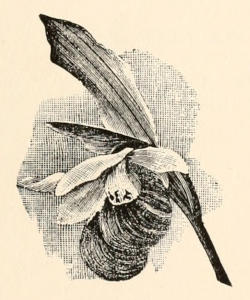
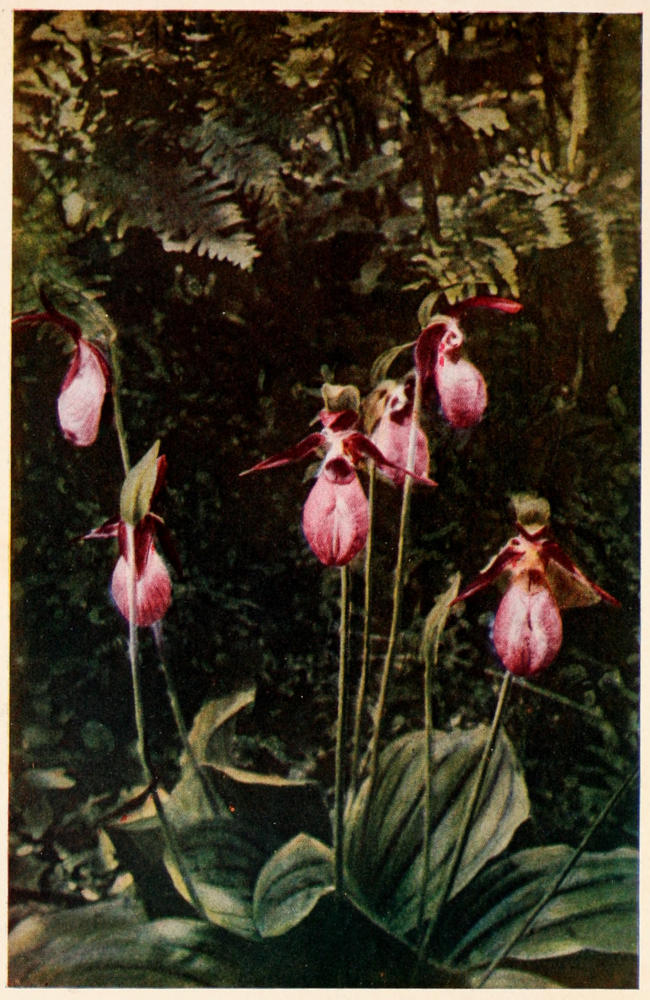
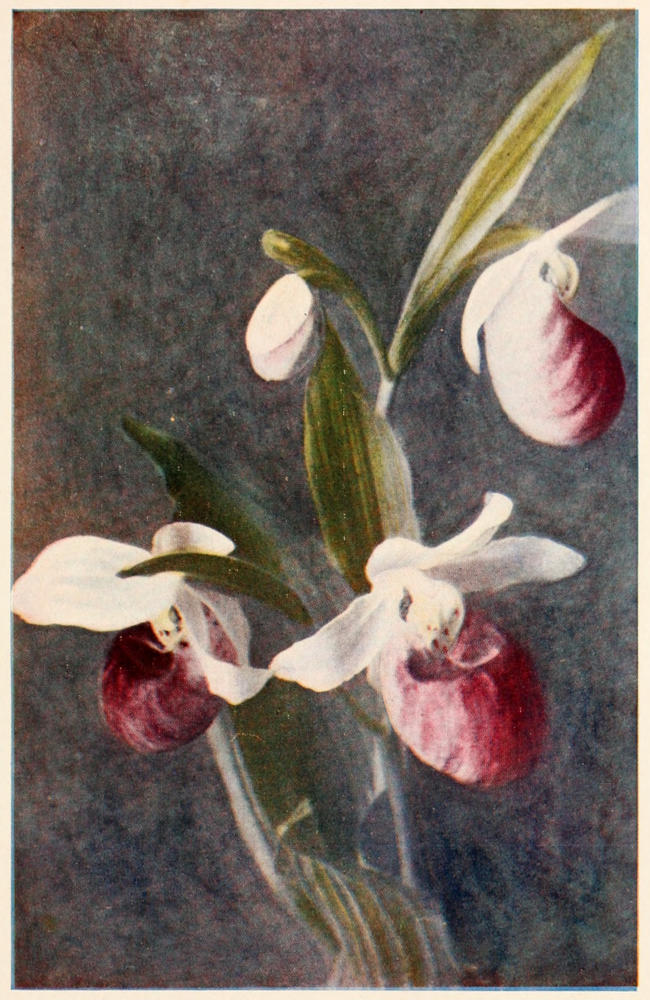
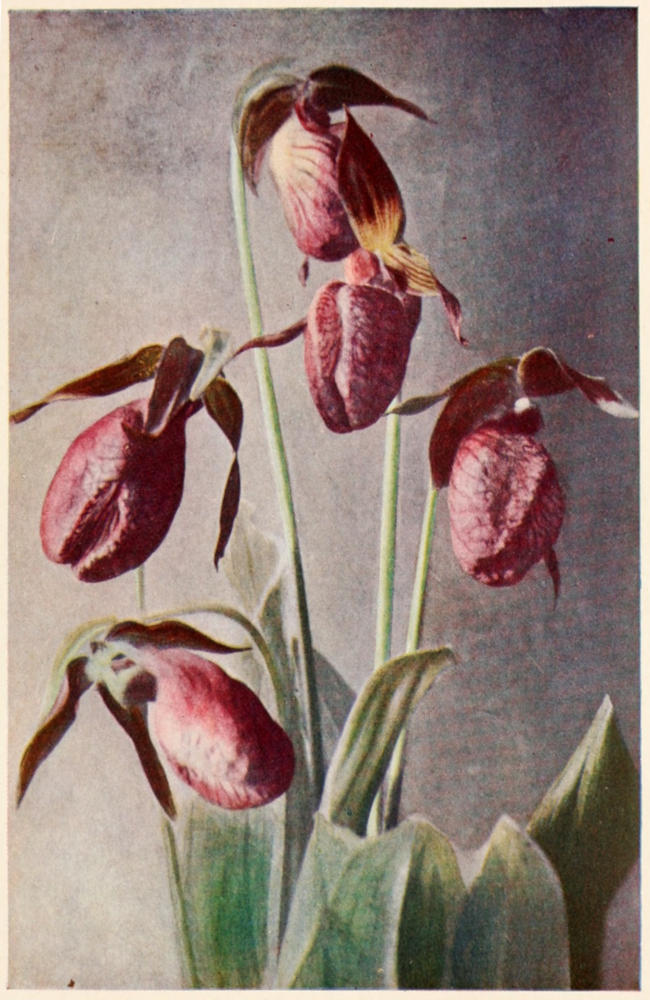
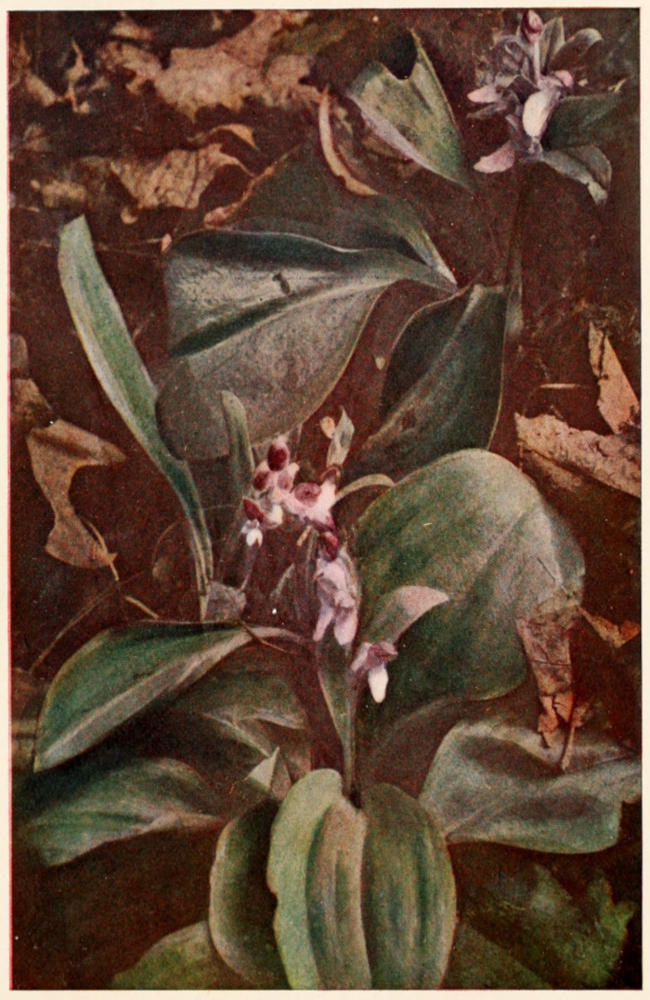
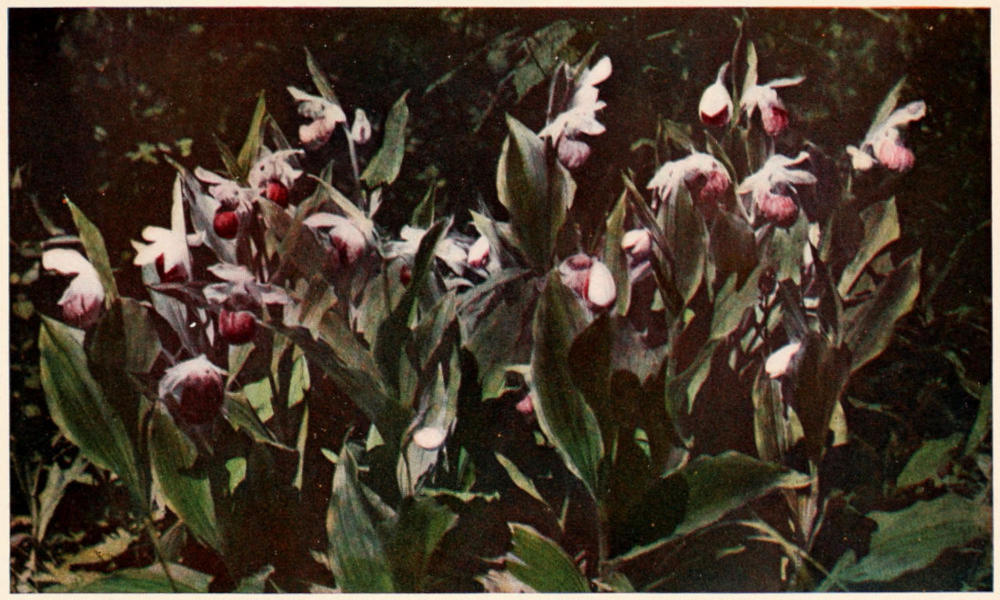
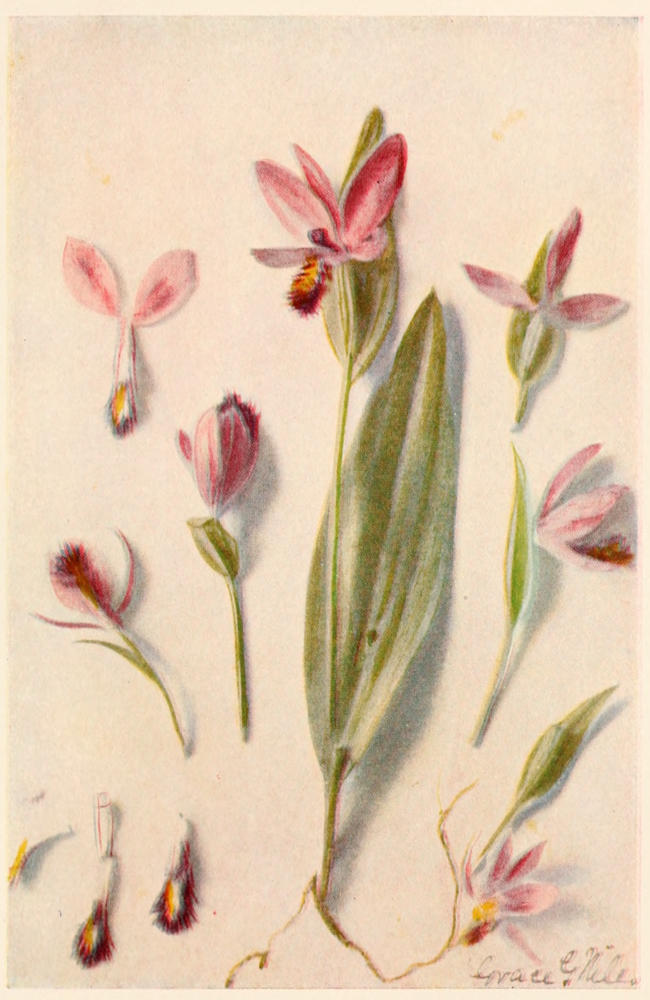
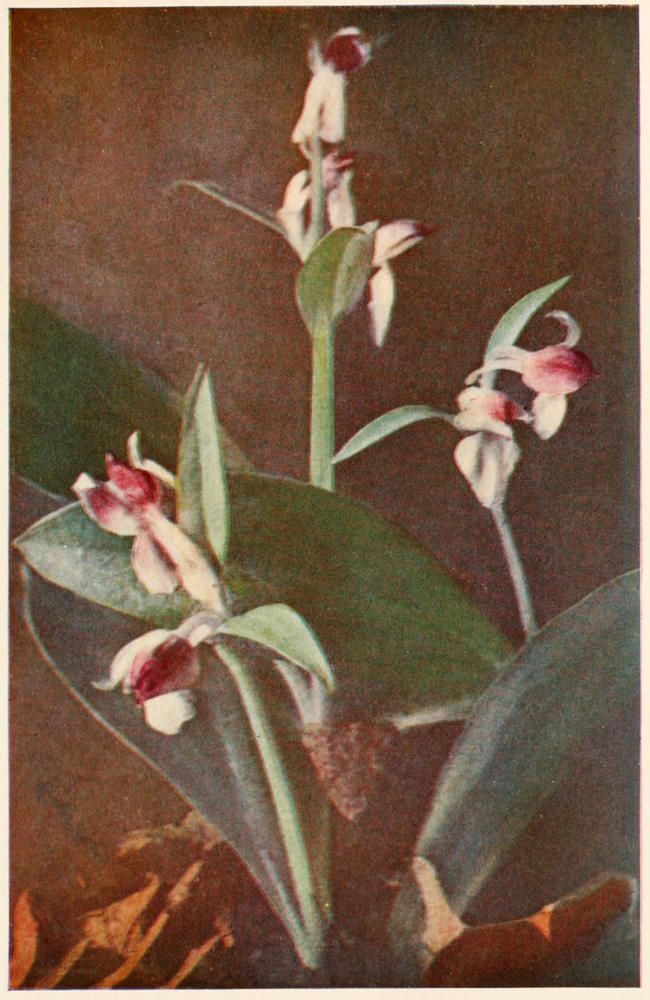
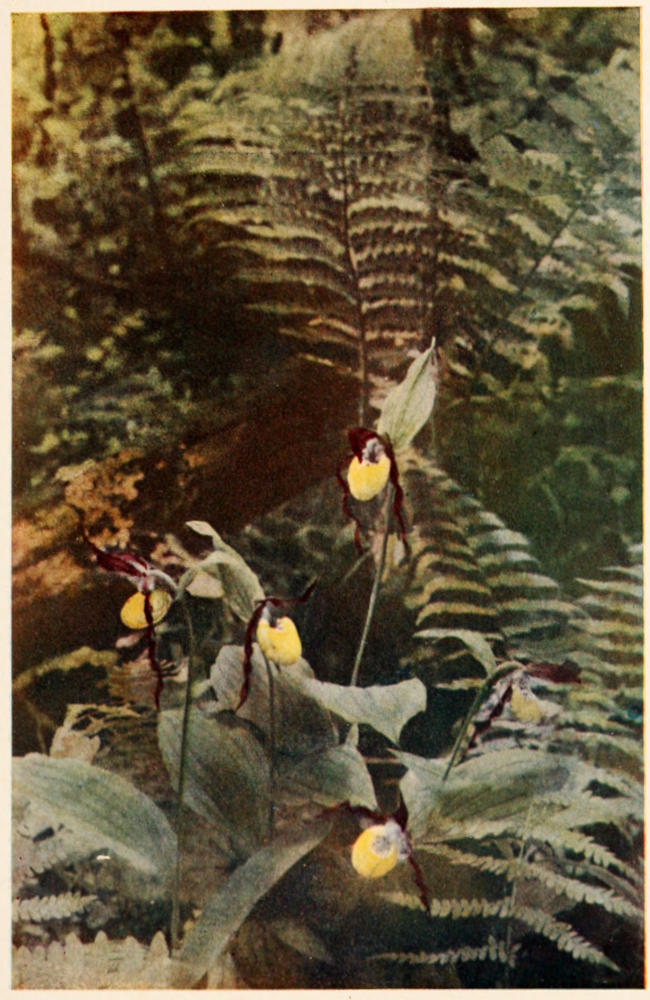
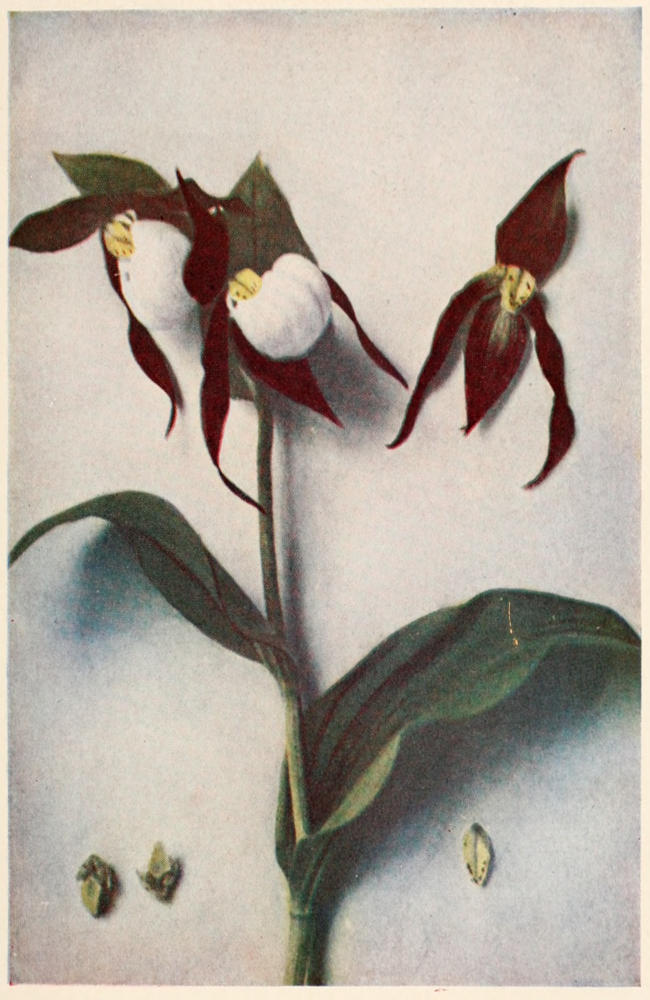
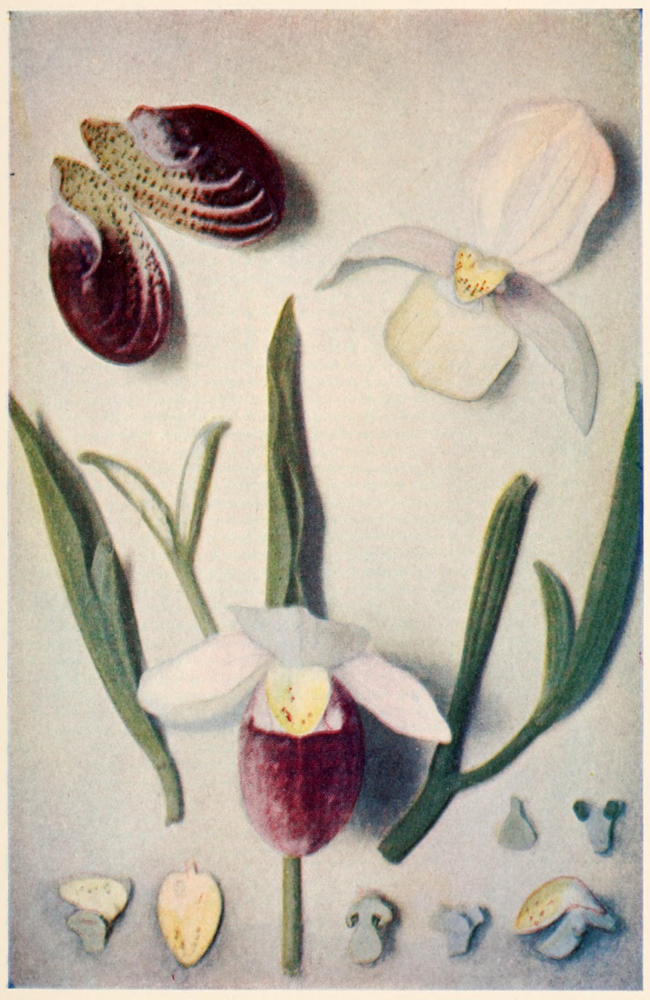
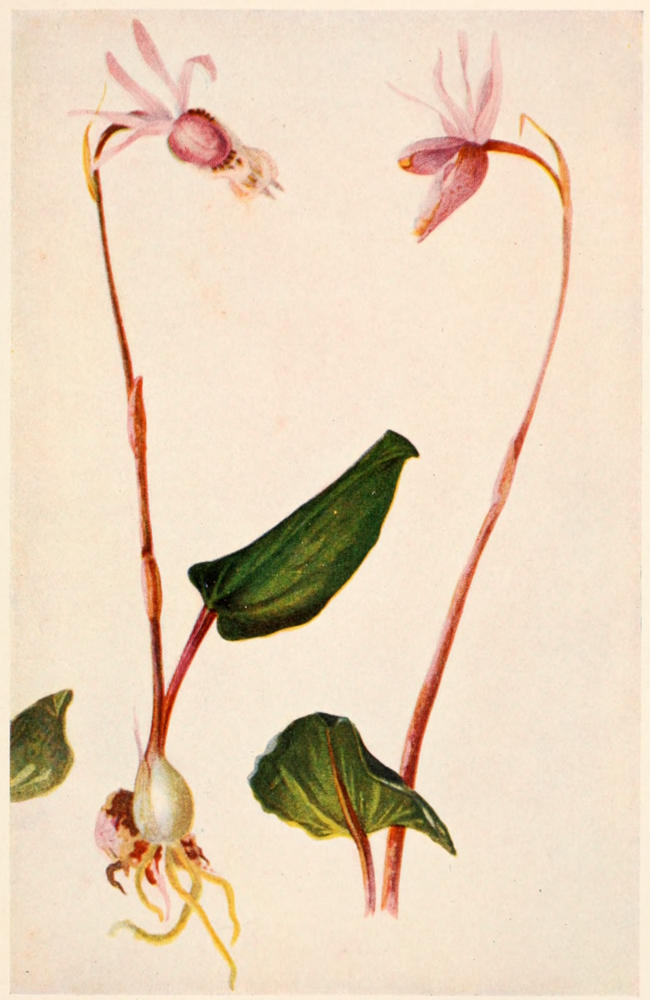
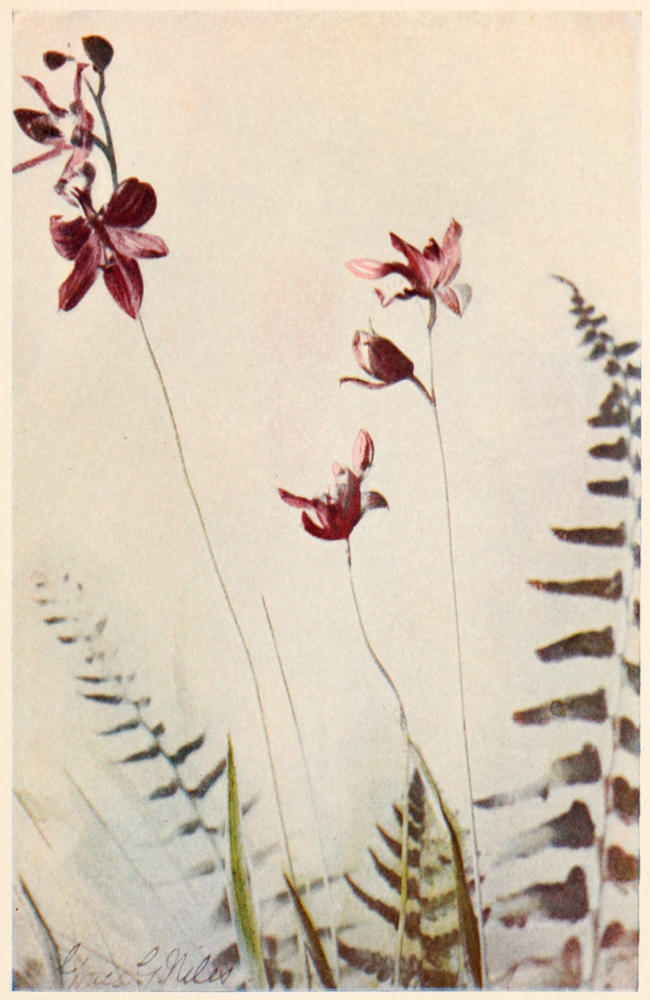
The Pink Moccasin-Flower. (Cypripedium
acaule.)
“One true-born blossom, native to our skies,
We dare not claim as kin,
Nor frankly seek, for all that in it lies,
The Indian’s moccasin.”
Elaine Goodale.
Preface
During many seasons spent in the Hoosac
Valley, it has been a source of great pleasure
to me to trace mountain streams through
moss-grown ravines to their beginnings,
and to explore the almost inaccessible recesses of the
sphagnous boglands. I have found it a delight to
study the orchids, ferns, and various flowers sheltered
in their homes, far removed from the roadside. I seldom
follow any well-worn forest paths, for I have
observed that the rarer plants do not dwell where the
foot of man or the grazing herds have wandered. So
it happens that the walks described in these pages
lead mostly across lots, over hills and mountains, and
through swamps.
The Hoosac Valley lies in the heart of the irregular
Taconic Mountains, and extends over the southwestern
part of Bennington County, Vermont, and the
northwestern part of Berkshire County, Massachusetts.
This region has a soil peculiarly adapted to the
origin and growth of orchids. Here along the numerous
streams and in the little vales are many unfathomable
peat and marl beds which are veritable orchid
gardens. The valley seems to be the common ground
where rare plants from the North and South, as well
as the migrating species from the East and West, meet
and overlap each other.
Many people are accustomed to think of the orchid
as a tropical flower which grows in our country only in
cultivation and under highly artificial conditions. It
is, however, true that many of the most attractive
species of this beautiful group are endemic to most
parts of the United States. There are to-day, according
to conservative reports, from twenty-seven to
thirty genera and from one hundred and fifty to one
hundred and sixty species of native orchids found in
North America, north of Mexico. Most of these are
terrestrial or earth-loving. There are eleven epiphytes,
all of which are found only in the Southern States.
The range of the North American orchids extends
wherever sunshine and moisture prevail, nearly as far
north as the Arctic Circle. Four Cypripediums grow
between latitudes 54° and 64°, and from fifteen to
eighteen species of the Orchid Family are natives of
Alaska.
The North Atlantic region, covering northeastern
United States and Canada, produces seventy-one
species of Orchidaceæ; of these from forty-eight to
fifty-six are reported for New England, and from forty
to forty-two are found in the Hoosac Valley. Of the
seventy-one North Atlantic orchids only fifteen or
sixteen have not been found within Vermont. The
most widely-known genus—Cypripedium, or Moccasin-Flower—is
represented by thirteen species on the
North American continent. This includes the single
Mexican species. Six of this number have been
collected in Connecticut, and five grow in the Hoosac
Valley.
The excursions which I have recorded in this book
were made particularly in search of orchids; but I
have collected and observed all other flowers of interest
which grow in the region which I have traversed, for
the purpose of showing the natural environments of
orchids, and introducing their near neighbors of
swamp, forest, and rocky pasture-land.
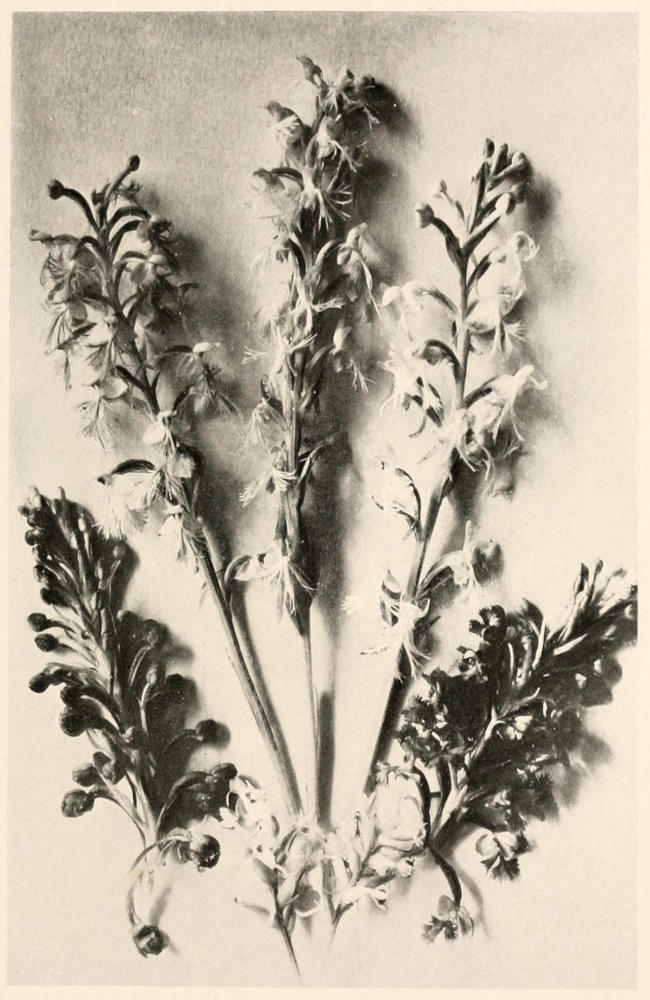
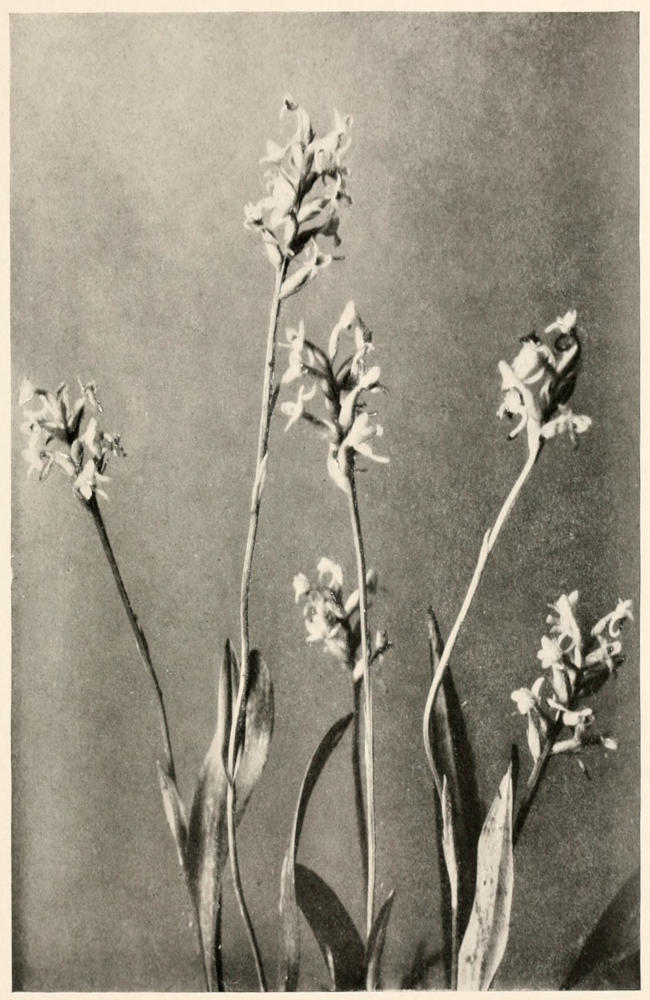
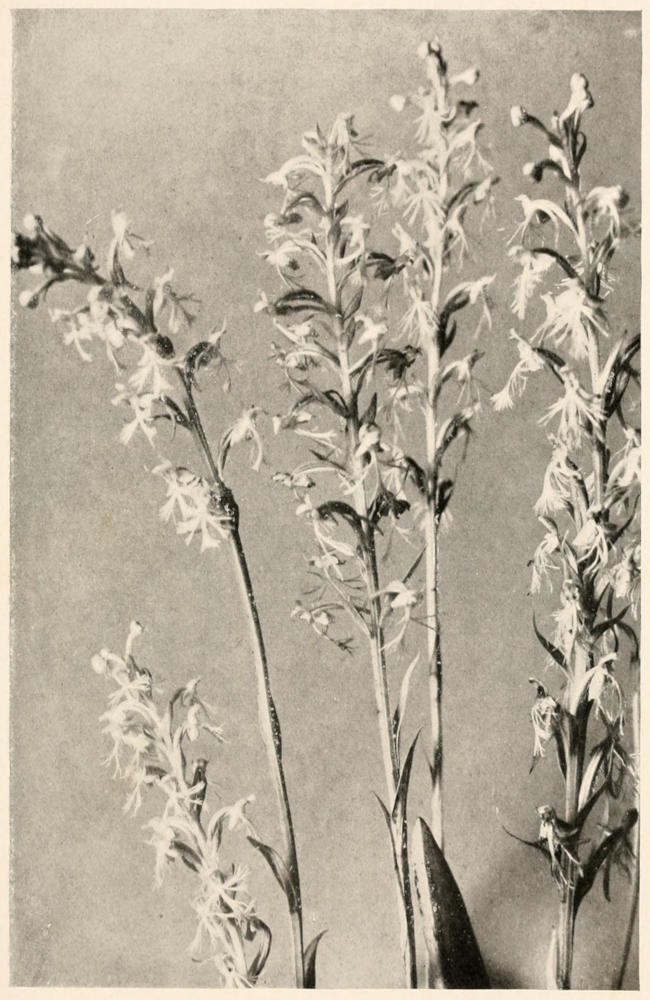
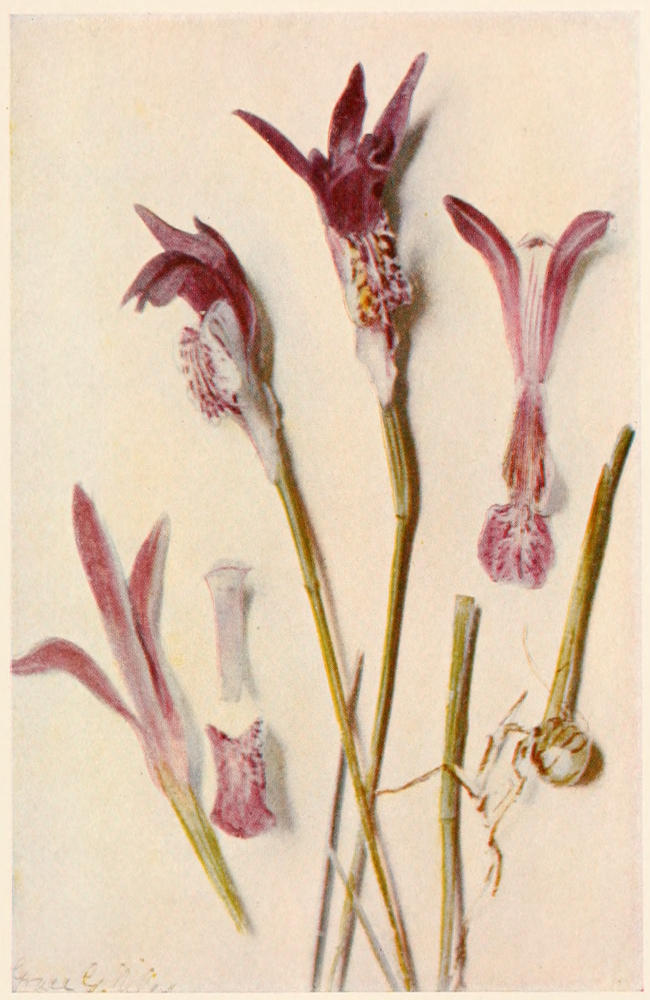
The photographs in this list marked thus * were taken by
Miss Katherine Lewers, the others by the author. The coloring
is the work of the author. Of the fifteen genera of Orchidaceæ
in New England, all save Listera, Tipularia, and
Aplectrum are represented in these illustrations.
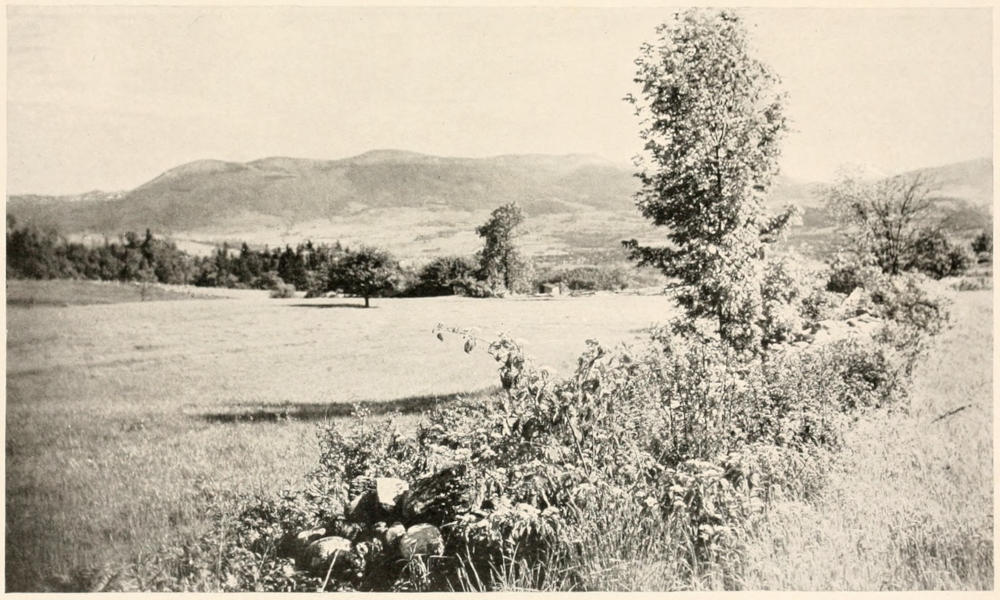
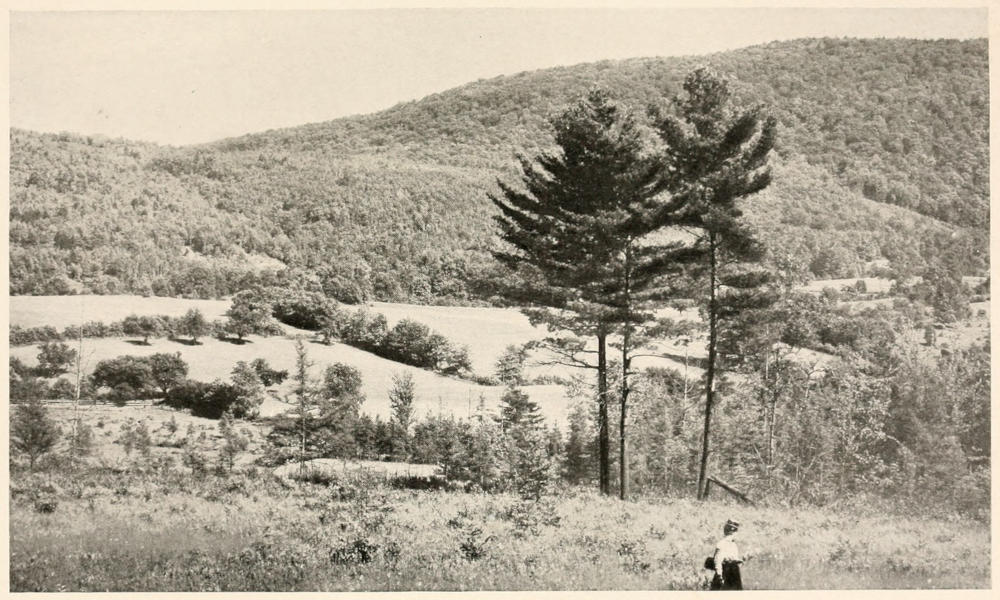
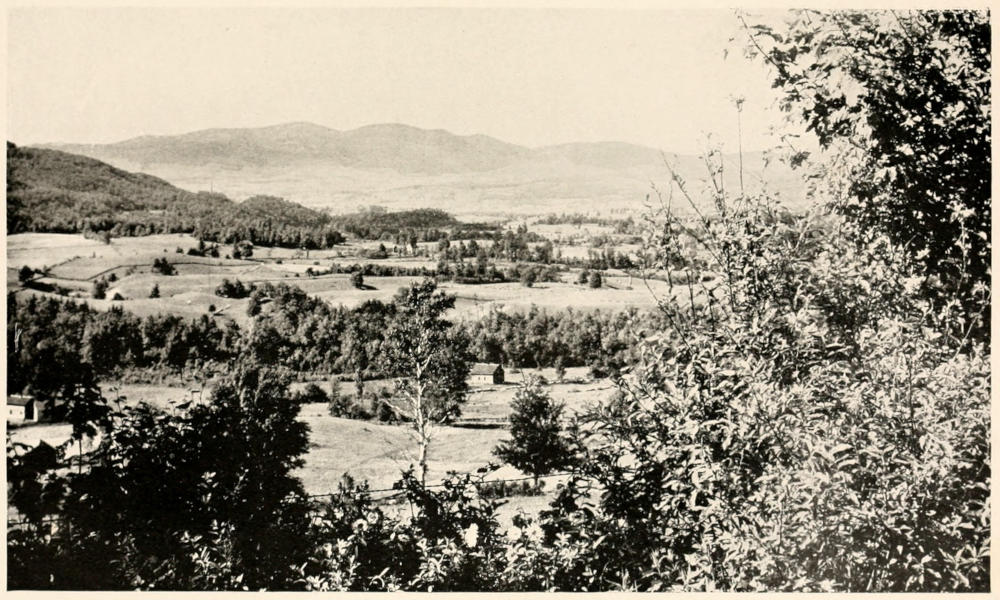
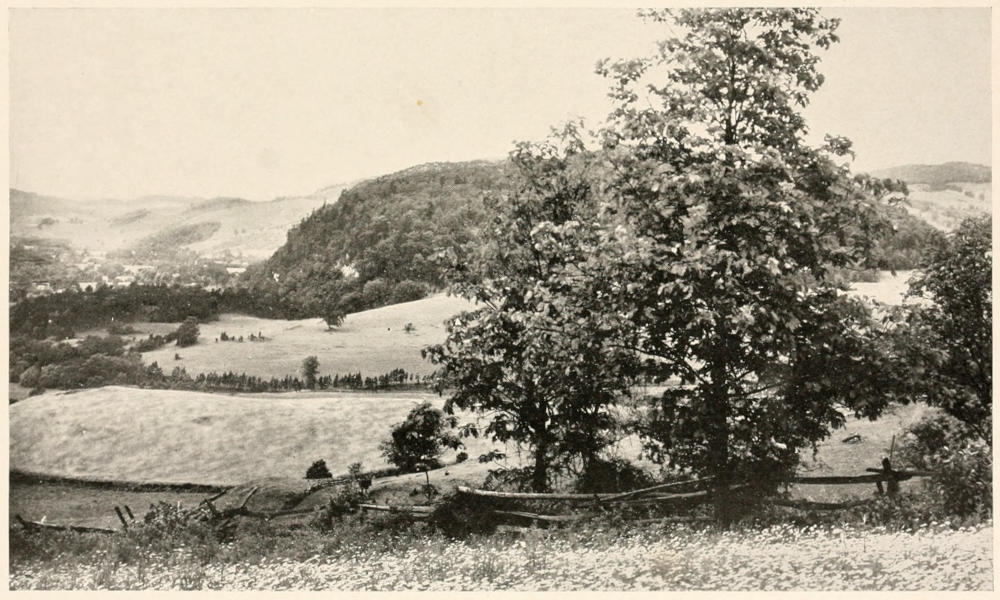
Mount Greylock’s Brotherhood—the Berkshire Highlands, from
Mount Œta, Bennington County, Vermont, Showing the College Town
of Williamstown in the Valley*
The Northern Gap, Showing the Taconic Mountains of Bennington
County, from Mount Œta, Vermont. The Bennington Battle Monument
towers to the left in the Distance*
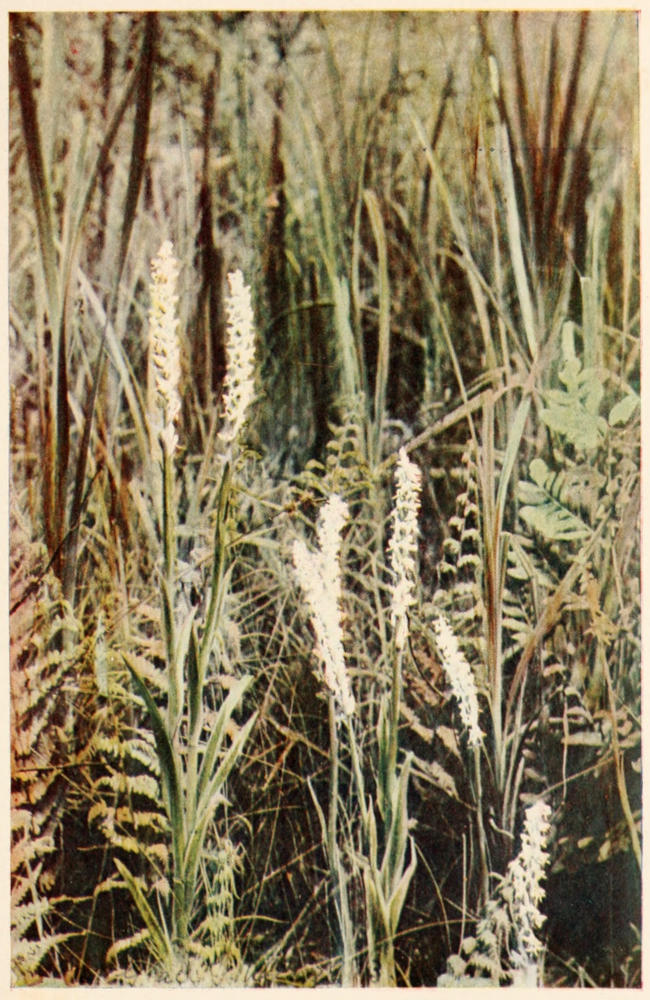
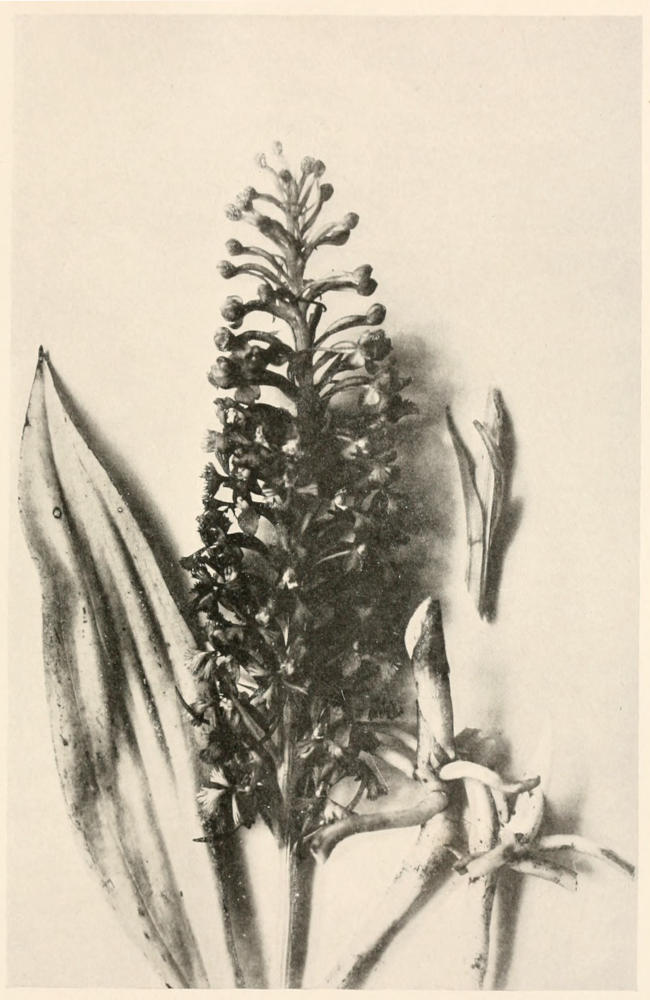
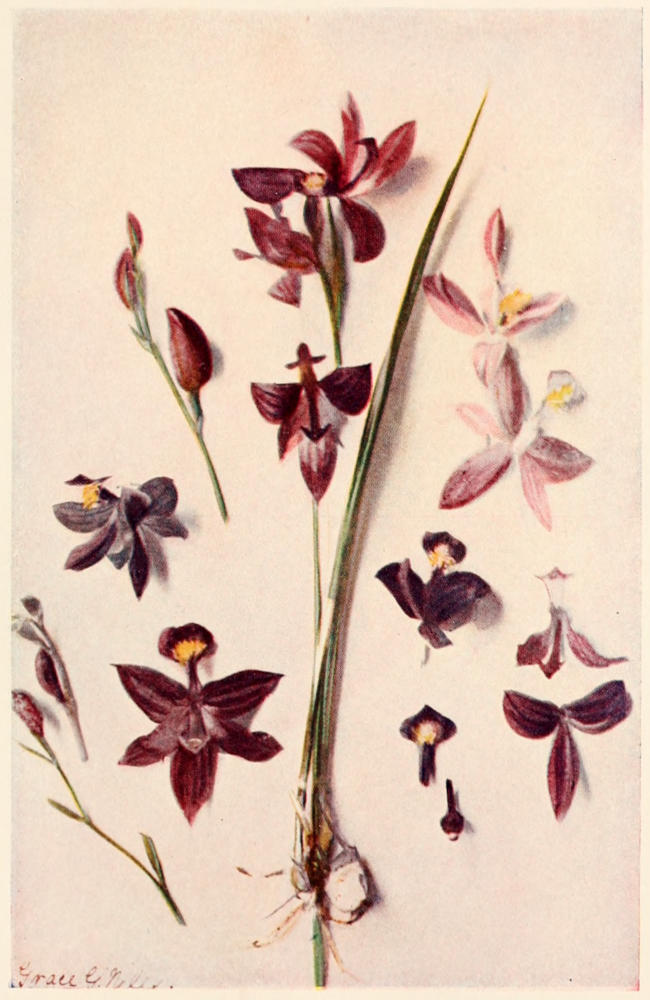
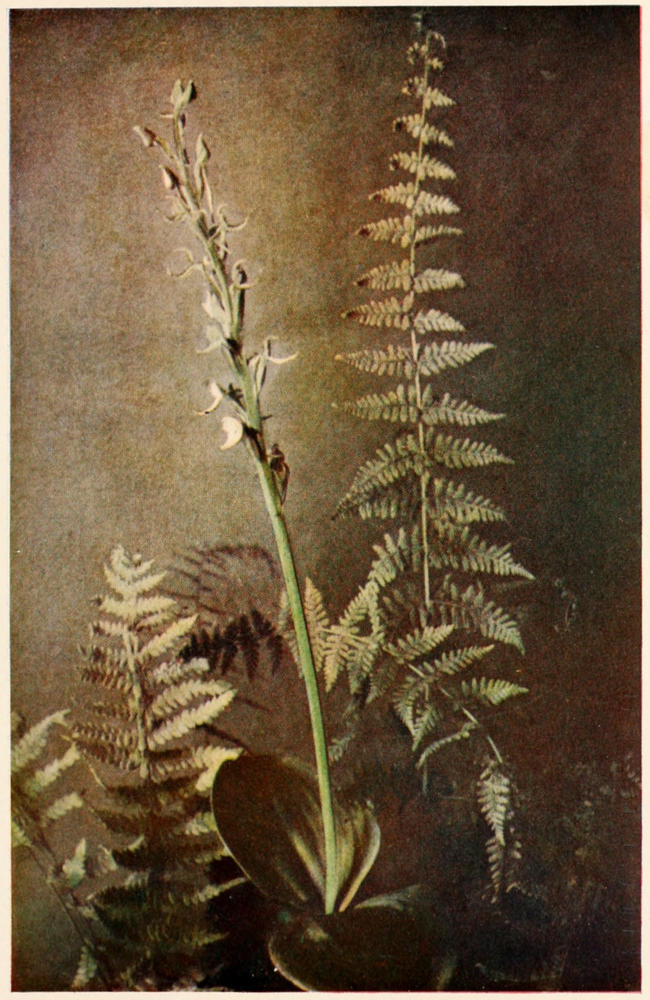
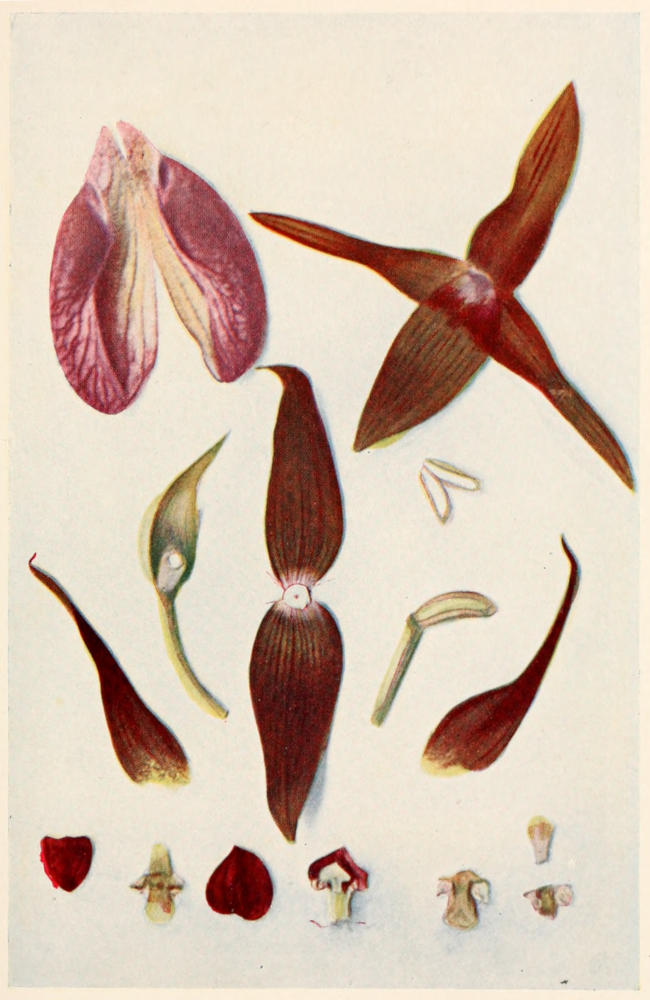
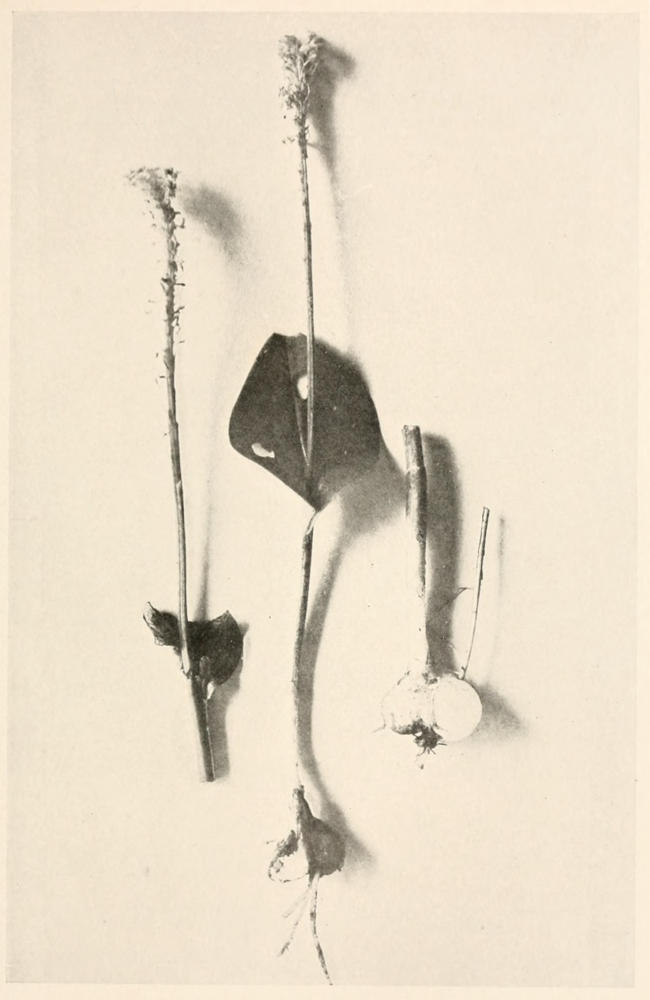
This is a strange, beautiful orchid with a straight
seed-pod (ovary).
Colored
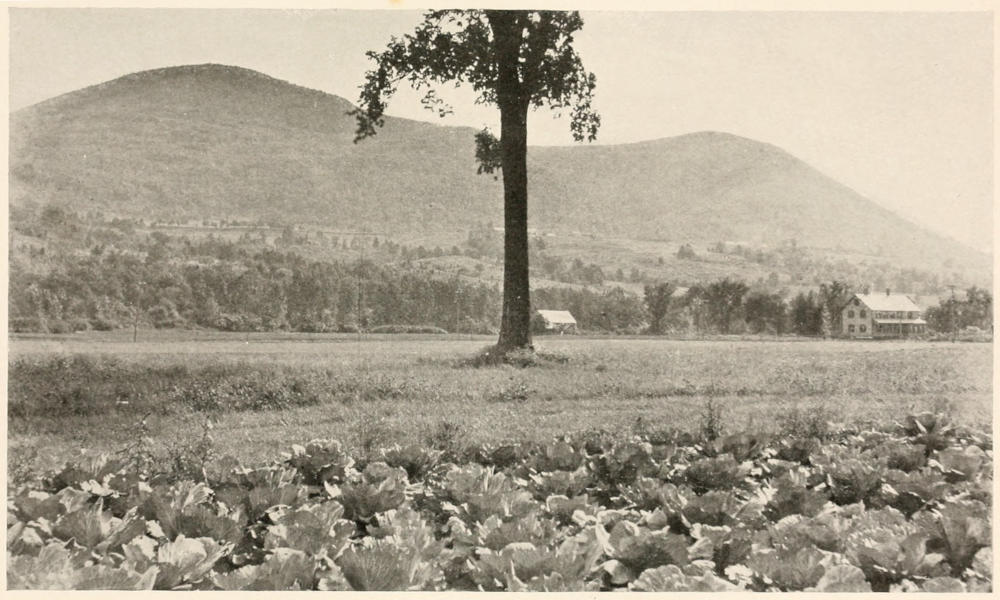
The Perry Elm, Marking the Site of Fort Massachusetts, on
the Harrison’s Flats, North Adams, Massachusetts, Showing
Saddleback Mountain in the Distance
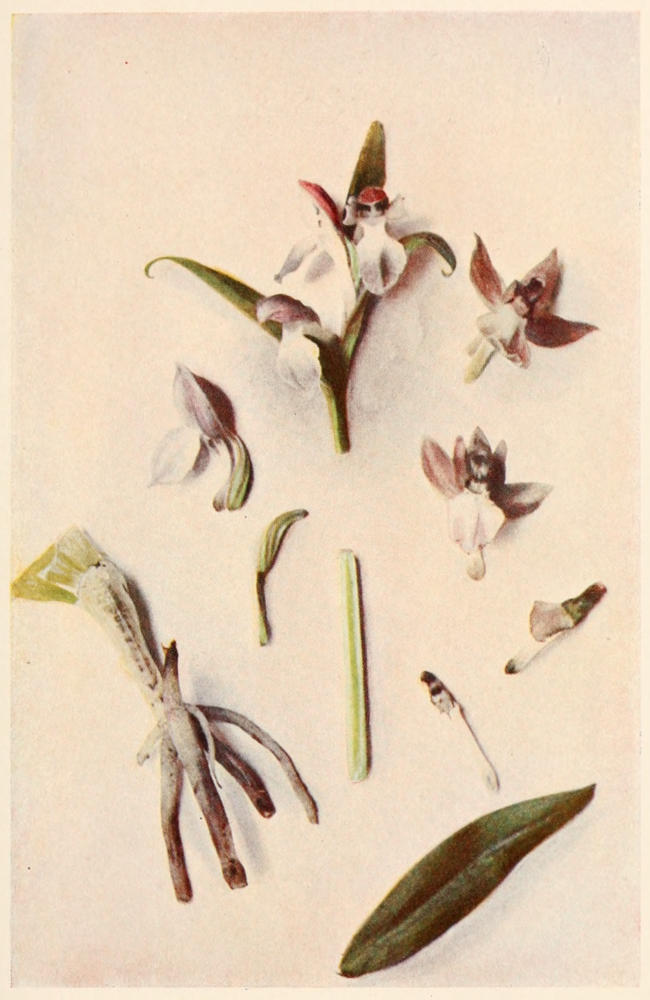
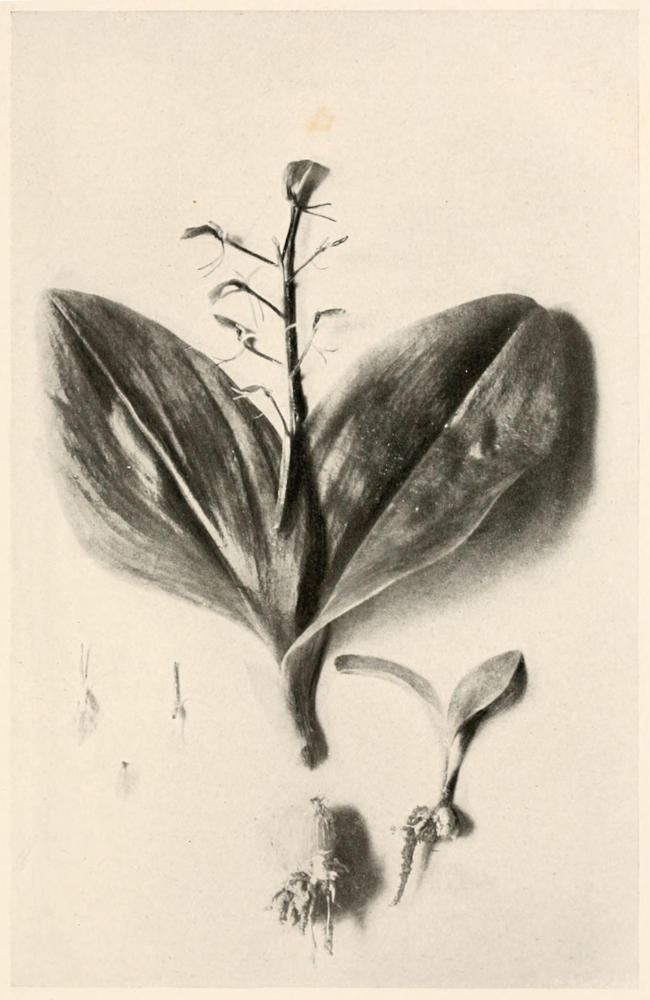
The first orchid of the season, showing the
hooded fold above the orifice of the spur, and the processes
of the flowers on the bracted scape.
Colored
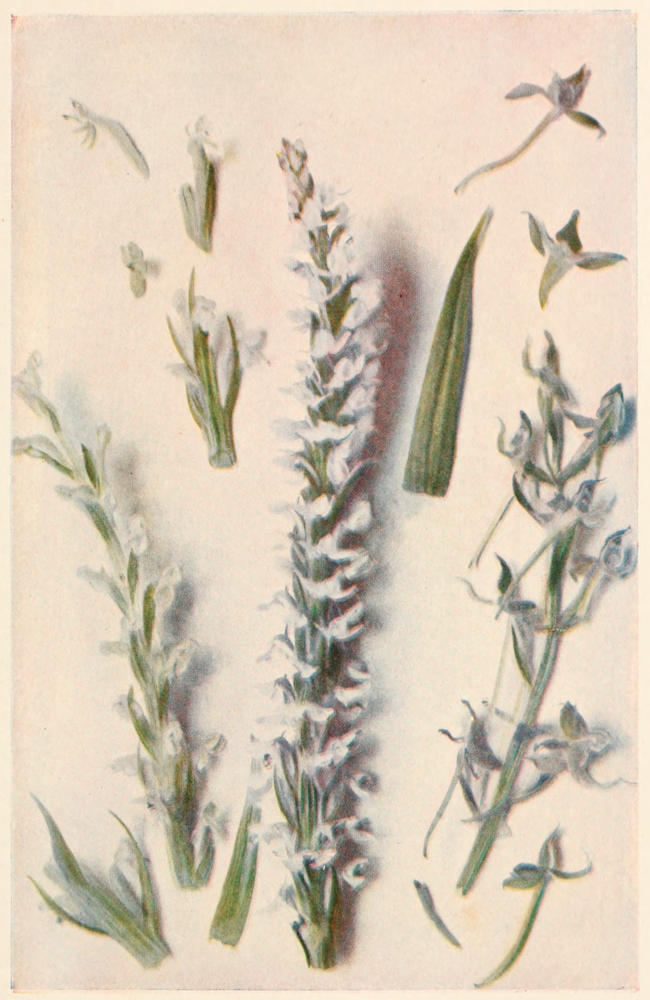
A Group of Three Species of Genus Habenaria: 1. The Tall
Northern Green Orchis (Habenaria hyperborea); 2. The
Tall Northern White Orchis (Habenaria dilatata);
3. The Large Round-Leaved Orchis (Habenaria orbiculata)*
It is not the walking merely, it is keeping yourself in tune
for a walk, in the spiritual and bodily condition in which you
can find entertainment and exhilaration in so simple and
natural a pastime.—Burroughs, Pepacton.
All winter I had been promising myself the
pleasure of watching the flowers unfold in
the Bogs of Etchowog. On May 25th I
reached the old farm on Mount Œta, having
departed from New York on May 14th, fully equipped
as a bog-trotter, with hunting-boots, rubber gloves,
short skirts and vasculum.
My route was through New Haven and Hartford,
across the States of Connecticut and Massachusetts.
On my way I stopped for a brief visit at the home of a
friend in New Haven. In her garden, I found a corner
of the Taconic woodlands awakening. Here, in line
and on time, stood five modest Yellow Lady’s Slippers
(Cypripedium hirsutum), members of the Orchid Family;
while along the same border clusters of the Showy
Lady’s Slipper (Cypripedium reginæ) were pushing
their dewy-tipped beaks into light and sunshine.
Although rather late in their blossoming, compared
with the other sisters of this genus in New England,
this species usually reaches its prime about June 20th.
On the east side of the garden towered an ambitious
row of ferns, some twenty root clusters or more, including
many rare species. Here was an especially queer
little strap-like leaf, which one would scarcely call a
fern unless one were a professed fern-hunter. It is
the rare Walking Leaf (Camptosorus rhizophyllus), the
scientific name meaning a bent heap, and the appearance
of the plant indeed is suggestive of the name.
The frond is from four to twelve inches long, springing
from a heart-shaped base and reaching out a long, narrow
runner, which readily roots at the end again, and
thence takes a step onward, and so on, until three or
four steps are taken, often in this way forming a beautiful
carpet for the cold gray lime rocks, which it prefers
in its native haunts.
The Walking Fern is shy in its habitat, seeking the
most hidden crevices in ledges along our mountain
sides. I have collected it in many dark ravines, as
well as along dry, rocky ridges in the Hoosac Highlands.
It takes kindly to cultivation for a season or
two, and then dies out for want of its natural soil of
limestone.
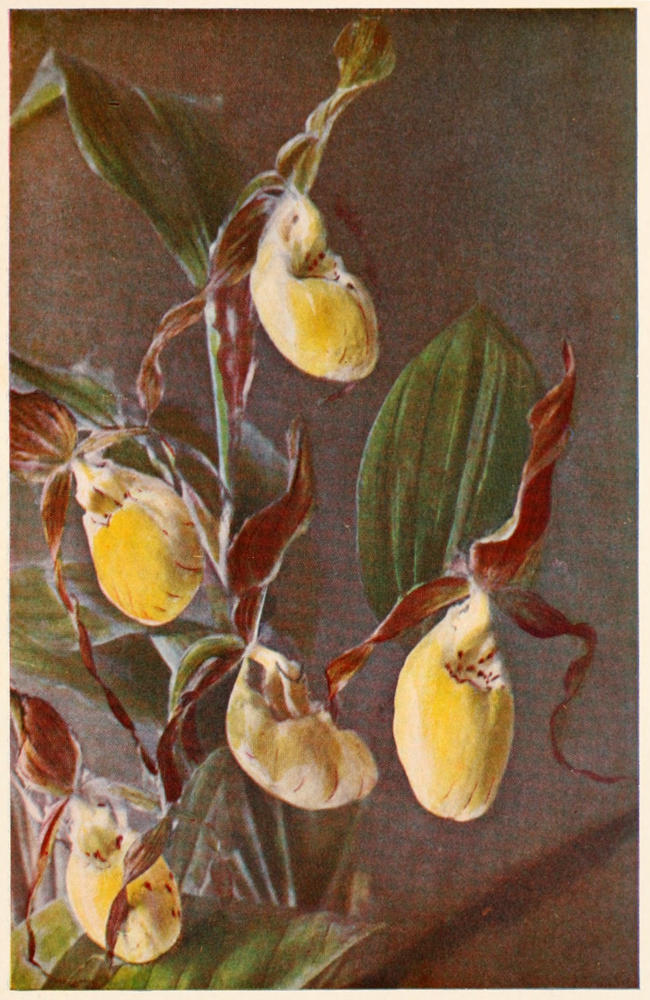
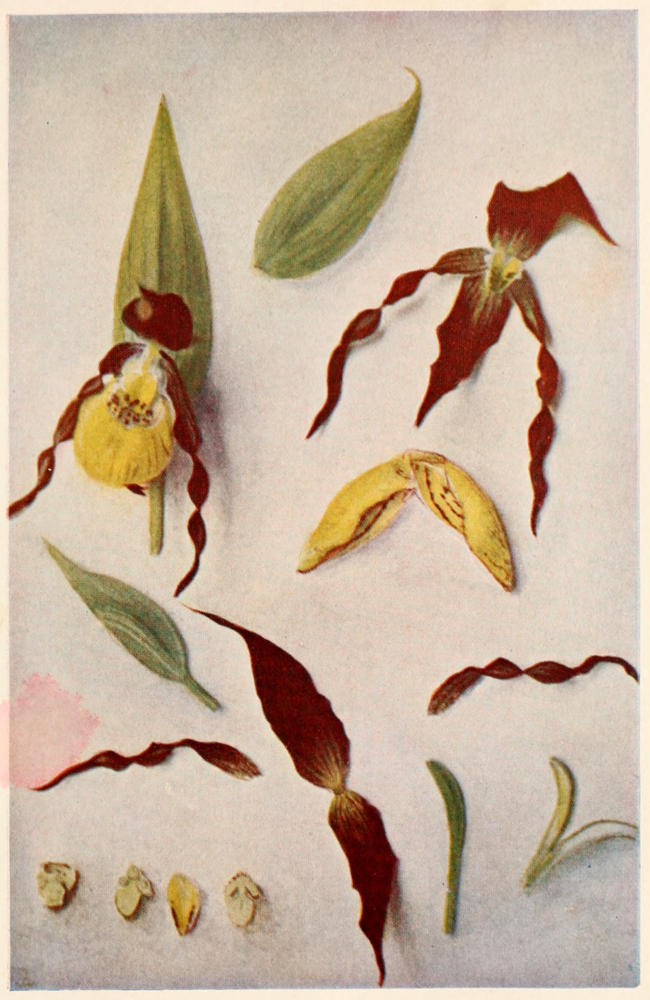
The Large Yellow Moccasin-Flower. (Cypripedium
hirsutum.)
This common Cypripedium is closely allied with the Small Yellow
Fragrant species—Cypripedium parviflorum—with which it grows in
close comradeship, often intergrading. It is also nearly related with
the European Yellow Cypripedium (Cypripedium calceolus), the first
Cypripedium described by Linnæus in 1740-1753.
A short walk toward West Rock, New Haven,
showed me how far advanced the season really was.
Here were crowds of children playing in fields covered
with violets and bluets, and farther down in the damp
meadows were long, serpentine lines of gold, where
the Marsh Marigolds (Caltha palustris), known commonly
as Cowslips, were already fading. On the
edges of the swamp, the Marsh Buttercups of the Crowfoot
Family (Ranunculaceæ), were lifting their shallow
yellow cups to catch the sunshine. We wandered on
through a pretty, wild bit of young woodland until we
reached the border of a murmuring stream, creeping
onward through the vale and meadow, touching the
blossoming orchards here and there, and freshening the
sweet white violets on its brink.
North Adams, Massachusetts, was to be my next
station. This city is about two hundred miles from
New York, among the Hoosac Highlands. I almost
expected to see reluctant snowdrifts still lingering in
the fence corners and shaded pine glens of this part of
“Beautiful Berkshire,” and I half hoped to find a few
late clusters of the Trailing Arbutus (Epigæa repens)
creeping through the cold, mossy ravines.
Upon my arrival in North Adams, I looked through
the bogs under the brow of Hoosac Mountain near
Aurora’s Lake, and I could perceive scarcely any
difference in the progress of flowers or foliage here
from that of the region from which I had just departed.
Dogwood, apple trees, violets, anemones and
wake-robins were in blossom, while in the deeper
bogland I found one lone, pale Pink Moccasin-Flower
(Cypripedium acaule).
American White Hellebore, so commonly known as
Indian Poke or Itch Weed (Veratrum viride), had
already sent out a luxuriant growth of green leaves,
which for a moment deceived me—as it had done many
times before—by its resemblance to the foliage of the
Showy Lady’s Slipper. The leaves of both these plants
are plicate, and have ever been confused even by the
earliest herbalists. Unrolling a spike of leaves one
day, I found I had actually disturbed the buds of the
queen of the Lady’s Slippers instead of the Hellebore,
although they proved to be blasted. No doubt some
warm day had started them prematurely, frost and
cold rains later proving their ruin.
Here on a sheltered damp hillside, I found my first
clusters of the season of the Pink Azalea (Azalea
nudiflora), which is commonly known hereabout as
Swamp-Apple, and which is very similar to Rhodora
Canadensis. These species belong to the Heath Family,
one of the largest among the flora of Hoosac Valley.
The beautiful pink flowers of the Great Rhododendron,
which measure from one to two inches in diameter,
render it the most charming species of this group. It
is cultivated extensively, but grows in its natural wild
state, in this region, only along the margins of ponds
near Montpelier and Wells River, in Vermont.
The American Mountain Laurel (Kalmia), which becomes
so gorgeous later in the season, the Lambkill,
Labrador Tea, Andromeda and the Cassandra are
closely allied species of this group, common to this
region. Other familiar members of it are the Trailing
Arbutus, Gaultheria, and the Creeping Snowberry.
They may be found in Aurora’s Swamp.
North Adams is not far from the sources of the south
and north branches of the Hoosac River, in a wild and
rugged portion of Berkshire. The Hoosac proper is
formed at the junction of these two streams, in the
vicinity of the Print Works near Marshall Street in the
city, and flows on gently in a northwesterly course to
join the Hudson, near Lansingburg. Mountain streams
in this region are numerous, and flow musically down
through deep chasms and over great marble precipices,
to swell the Hoosac as it glides slowly out through the
deep-cut valley.
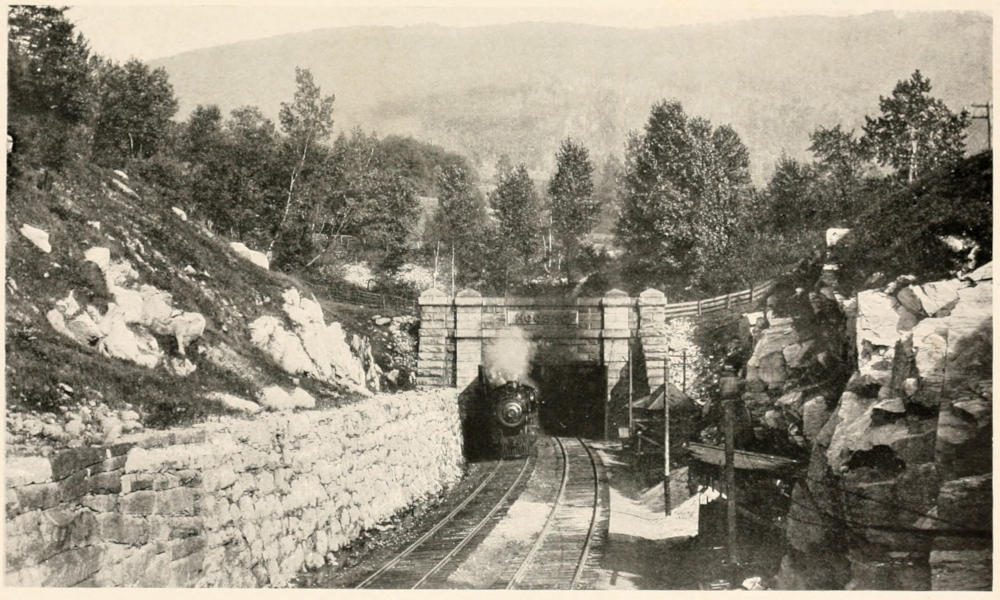
“We Hold the Western Gateway,” is part of the inscription
on the seal of the city of North Adams, which
is known as the “Tunnel City.” This is practically
true, for the sole gateway of the trade from the Western
States passes though the flinty wall of the Hoosac
Mountain, in order to reach Boston direct. The idea
of opening a path for transit through the “Forbidden
Mountain,” as the Indians called it, was conceived six
years after the first mail-coach and four-in-hand rattled
through the street of this town to Greenfield, in 1814.
It was found impossible to build the projected canal
from Boston to Albany. The estimated cost of building
the tunnel was less than two million dollars, but
when it was completed in 1875, the total financial outlay
had amounted to over twenty millions. Until January
1, 1887, this tunnel was owned by the State of
Massachusetts, when it was purchased by the Fitchburg
Railroad. It is four and three fourths miles long, and
twenty-six feet wide, permitting of double tracks. The
arch is from twenty-two to twenty-six feet high, and
at each portal there is a massive granite façade.
Whenever I come to the Hoosac Valley, I enter, if
possible, by way of this tunnel. I seem thus to close
away the outer world, and to penetrate a new realm hidden
here in the seclusion of the marble highlands. This
triumph of man over the power of Nature needs no
further introduction here. I can never forget, however,
the weary years of hardships endured by those who
toiled in its construction, entombed within the heart of
the mountain, subject to the dangers of quicksands,
falling rocks, damp and gases, explosives, fire and
starvation, before the great work was accomplished.
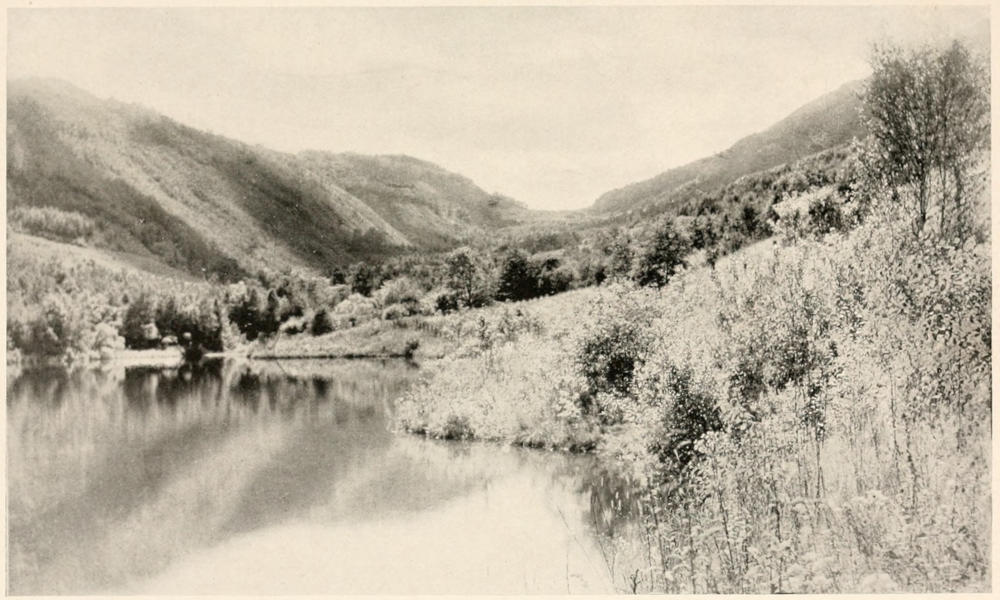
I enjoyed the ridges in the pastures along the foothills
of the grim-faced Tunnel Mountain, and about
Aurora’s Lake, which reflects like a pretty little mirror
the rugged beauty of the hills. This lake is partly
natural, but now dammed artificially. Every line of
its terraced shores bears the scars of antiquity, which
would indicate that ten thousand years ago a larger
lake slept in this hollow vale which geologists have
estimated at a depth of six hundred feet. Here are
rich deposits of glacial drift, and northeast of Aurora’s
Lake are sphagnous swamps, where I find many rare
orchids and early spring blossoms. Here both the
pink and yellow Moccasin-Flowers bloom in May,
while in June the queen of the tribe unfolds her white-petaled
purity.
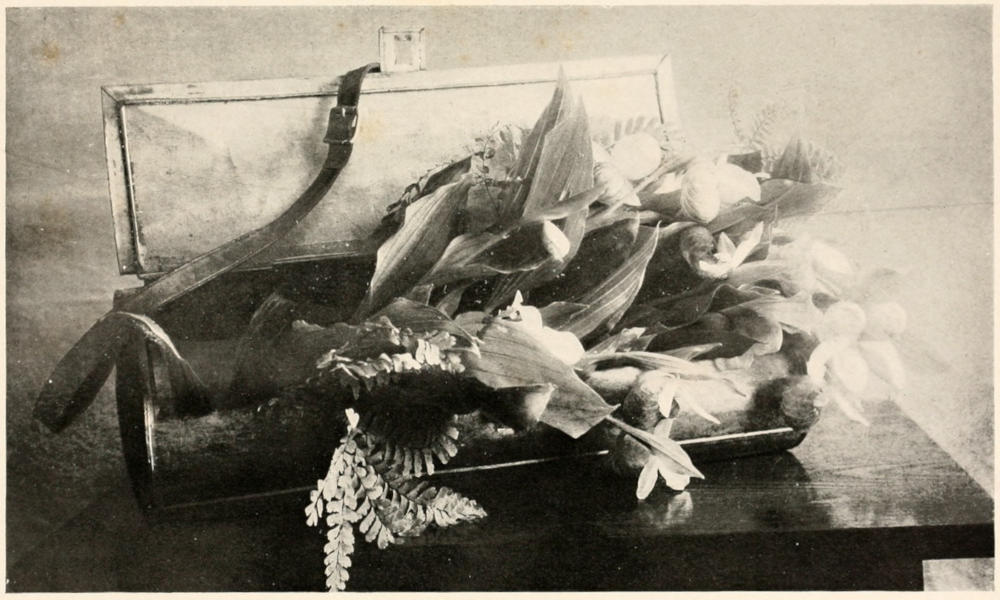
The Botanizing Can, or Vasculum, showing the White-Petaled
Lady’s Slippers and Maiden-Hair Fern.
This bogland is very similar to that of the Swamp
of Oracles in Pownal, in District Fourteen, save for the
openness of the former’s shores. Aurora’s Swamp
is located in a deep flinty basin, surrounded only by
low tangled bushes and open pasture-land beyond,
without forests to shield the bogs from the sweep of
winds.
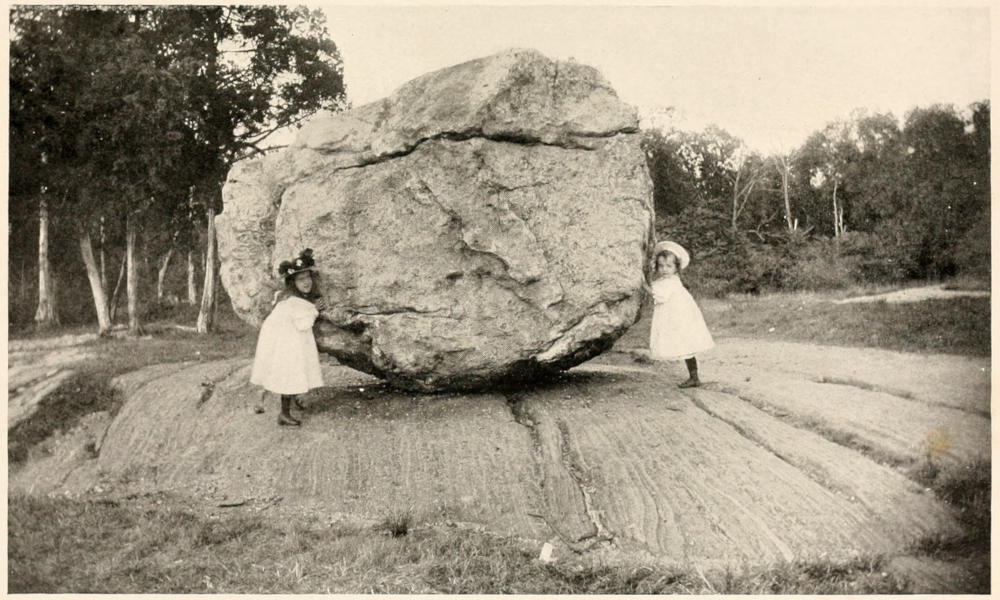
The hills are strewn with great boulders left here in
the Glacial Age, which rest, poised as monuments of
that mystical period. Especially interesting are the
dimpled erosions upon one boulder, which rests just
northeast of the lakelet, upon the ridges sloping eastward
toward the sphagnous swamp. There are visible
deep scratches, hollows, arches and miniature pillars,
which the whirling eddies of the perilous waves have
eroded during the ages unknown. Higher on the
summit of the Hoosac rests another immense rock
known to students of geology as the “Great Vermonter.”
It is said to have been brought from the
marble and granite heights of Vermont, imbedded in
the ice-drift. Through the melting of the glacial
sheet, one of the drifting bergs left this hero of the
ages as we may see it now, moored and balanced high
on old Hoosac’s brow.
The geological surveys of northern Massachusetts,
by President Hitchcock of Amherst in 1838, early identified
all of the low, round hills to be seen southward
from Aurora’s Lake as the result of glacial action.
Mount Greylock’s Brotherhood is a group of giant
glacial hills, as it were, and is the highest pile of
Taconic formation in this State. The erosions of the
great ice-sheet are plainly seen on the rocky summits
of these mountains, and only time and the decay of
the rock itself will do away with these scars of that
mystical age. The name of “Greylock” appears to
be derived from the lowering cloud-mist so often capping
the whole Brotherhood at early dawn or before
a storm.
Vermonters who, from the hills at a great distance
to the north, view this group of mountains, depend
upon this capping of clouds as a forecast of the
weather. Among the old folk, it is known and designated
as “Greylock’s Nightcap,” a portent of a coming
storm.
Mount Greylock, the highest swell of this range, is
3600 feet above sea level, and commands a variable
and extensive view from its bald summit, on which
was early erected that first wooden observatory, during
President Griffin’s term at Williams College. Here
the poet and the philosopher, Hawthorne and Thoreau,
have climbed to meditate.
Many a message has gone forth from these heights
to bless the busy world. Scarcely is there a son of old
Williams who does not recall the mountain-day excursions
led by Professor Albert Hopkins, and the glory
of old Greylock at dawn and at the sunset hour.
Thoreau writes of it: “It would be no small advantage
if every college were thus located at the base of a
mountain, as good at least as one well-endowed professorship.
It were as well to be educated in the
shadow of a mountain as in more classical shades.
Some will remember, no doubt, not only that they
went to college, but that they went to the mountain.
Every visit to its summit would, as it were, generalize
the particular information gained below, and subject it
to more catholic tests.”[1]
Mount Greylock’s Brotherhood—the Berkshire Highlands,
from Mount Œta, Bennington County, Vermont, Showing the College Town of
Williamstown in the Valley.
The peak especially designated as Saddleback Mountain
is at the junction of the eastern abutments of
that huge wall of Taconic Brotherhood which appears
south of the old battle-ground where formerly stood
the early border Fort Massachusetts, on the Harrison
flats, near the flag station of Greylock. The union of
Mount Williams, sloping to the east, and Prospect
Mountain to the west forms the seat of the saddle.
Mount Hopkins—so named in honor of Professor
Albert Hopkins of Williams, the first nature-student
of our land, making excursions afield in 1833—lies
south of these. Old Greylock, proper, lifts its lofty
brow still farther south, being situated about in the
centre of this great range as it extends from east to
west.
Beyond Greylock stretches a long, misty line of blue
peaks against the sky, which if observed from Mount
Œta at the north, in Bennington County, Vermont,
may be traced to the southwest to Symond’s Peak, the
lowest of the group, named in memory of Captain
Symond, who led the volunteer forces from our hills
and vales to the memorable Battle of Bennington in
1777. Bald Mountain is also in the vicinity, and the
closing in of these several peaks has conspired to form
what is known as the “Hopper,” and the “Heart of
Greylock.” The hollow vale amid these heights has
the appearance of the hoppers used by millers years
ago.
Surely in the heart of the Taconics we are in one of
the oldest rock formations of the earth, and the green
terraced stairs lead us slowly down to the deep-set
valley of the Hoosac, where once slept that ancient
lake. All that now remains of that Lake of Dawn is
pocketed in the basin under the Hoosac. The shores
of Aurora’s Lake are lonely and still, save for the
marsh thrushes which skim low over the waves and
whistle shrilly. The groves of pine to the southeast
are the haunts of solitude, and those who wander here
can well imagine that the Æolian harps among the
whispering trees are repeating a music of ages past,
when only wind and waves were known to these hills.
Amid these damp and reedy shores and swampy
woods are tall brakes and delicate Maiden-Hair Ferns.
Here, too, the tall and stately Royal-Fern (Osmunda
regalis) flourishes in deep seclusion, sheltered by the
low-branching pines along the shore. It grows from
two to four feet high in this locality, and is of a
deep rich crimson-green tone against the grasses and
bushes near. Mounds of moss, marking one of the
trees of a primitive forest rotting below the soil, are
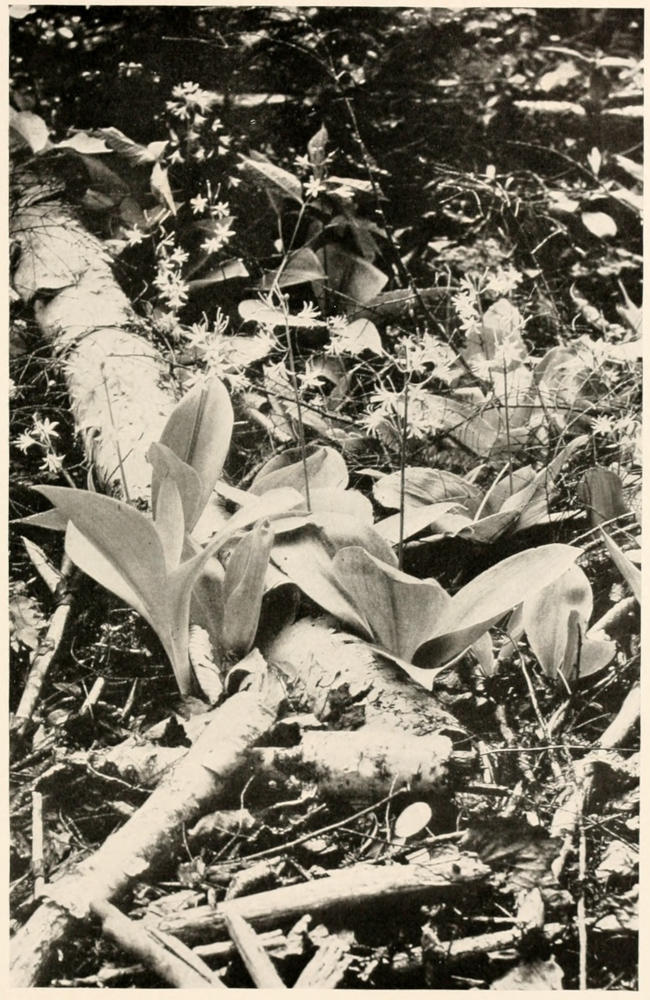
thickly carpeted with the leaves of the Dog’s-Tooth
Lily. Indeed, the picturesque paths which lead through
these woods wind through a veritable fairy-land of
flowers and ferns. One of these trails runs southward
through rocky pastures, swamps and thickets, toward
the Tunnel’s western gate.
Along these slopes, among the limestone rocks, I
found rows of the Ebony Spleenwort Fern, rather rare in
this much-travelled way; and on the brow of this ridge
were many species of common fern. The pastures are
barren and dry, with few bushes to break the dreary horizon,
as one approaches the western portal of the Tunnel.
I came upon one lone Apple-Thorn bush, of genus
Cratægus of the Apple Family. Nearly opposite, across
the valley of the south branch of the Hoosac, which
the Indians named the Ashuilticook, may be distinguished
the smoking Limekilns; while still farther
southward, the white-spired village of Adams nestles
at the base of Greylock, which towers serenely above
the shaggy shoulders of Ragged Mountain. I wandered
about the edges of the Tunnel cliffs where,
in years gone by, had stood the impoverished cabins
which sheltered the laborers who tunnelled the
Hoosac. I descended into the chasm and seated myself
upon the wall of rocks, waiting for the trains
to appear and disappear at the portal in the side of
the hill. Presently one from the West crept ponderously
into the cavern. The echoing roar was smothered,
and died slowly away until it became an indistinct murmur.
Not long afterward I felt, as well as heard, the
low breathings and rumblings of a locomotive coming
in the opposite direction. I heard its subterranean
groans as of a great spirit, while the smoke poured
forth, pushed in volumes before the engine, wreathing
and curling about it as it emerged, and partially concealing
its grim outlines.
The faithful watchman, a modern Eckhart, sits before
the entrance of the Western Gateway of Hoosac Mountain,
and warns the people against entering through
this portal to the greater world that lies beyond. It
is as if he wished to guard these children of the marble
highlands from the risks attendant upon the wild
whirl of life beyond these quiet hills.
The sun was setting as I left him, calm but alert, at
his post of duty, trimming and lighting his colored
lanterns for signals of danger or safety to the approaching
trains. Climbing up by the path which passes the
little red cottage on the crest of the hill on the north
bank of the chasm, I returned leisurely homeward,
winding over the hillsides, far above Aurora’s Lake,
then down along the borders of the swamp-lands. In
the crevices of rock were creeping colonies of the Common
Polypody (Polypodium vulgare). Along the edges
of this bog are still seen the primeval stumps of the
pine and hemlock forests, which clothed these hillsides
when only the Redmen dwelt and hunted among these
wildernesses.
In May and early June these decaying stumps are
usually draped with Painted Trillium and the delicate
vines of Gaultheria and the Creeping Snowberry, while
the Arbutus trails about luxuriantly, covering up the
ruins of years.
The Western Gateway of Hoosac Mountain, the Entrance to
Hoosac Tunnel, North Adams, Massachusetts.
II Ball Brook and the Bogs of Etchowog
Fringing the stream, at every turn
Swung low the waving fronds of fern;
From stony cleft and mossy sod
Pale asters sprang, and golden-rod.
Whittier, The Seeking of the Waterfall.
On May 25th I reached Pownal, Bennington
County. Upon the following day I explored
the great swamps of Etchowog.
Prepared with luncheon, vasculum, basket
for roots and my hound Major, I started on one of those
happy excursions such as Thoreau recommends we
should take, “in the spirit of undying adventure, never
to return,—prepared to send back our embalmed hearts
only as relics to our desolate kingdoms.”[2]
Ball Brook, a sluggish stream flowing northwardly
to East Pownal swamps—commonly called the Bogs of
Etchowog—has its source in the marshy hillsides northwest
of the schoolhouse in District Fourteen. Two
streams flow from this valley. One is called Ladd
Brook, running southwesterly and following the windings
of the shady Ladd Road to Pownal village, where
it joins the Hoosac River. The other stream, Ball
Brook, flows north and northeast onward through innumerable
and unfathomable swamps, to Bennington
village, ten miles north, there meeting the Walloomsac
River, which is also a tributary of the Hoosac,
farther northward in its course. This brook is rich in
a continuous chain of peat bogs—rich from an orchid-hunter’s
point of view.
Although I have been familiar with this region from
childhood, viewing it from the roadside only, I never
at any time had ventured to follow Ball Brook through
all its meanderings to the Bogs of Etchowog near
Pownal Pond, a distance of some three miles. This
would not be a long walk on a fair road, but it becomes
rather dangerous and formidable when leading through
quaking marshes in the soaking currents of a stream.
A short distance to the right, north of the schoolhouse
in Number Fourteen, there is an old pathway
nearly overgrown with bushy pines and birch and
chestnut underbrush. This I followed, entering the
hollow under the brow of the hill, and passing along
the wood road which skirts the margins of one of the
deepest, darkest jungles in these regions. The old
people look upon it as akin to “Witch Hollow,” on
the Gulf Road near by, and tell strange tales of ghosts,
and of some mythological peddler who was swallowed
here in the black mud of this ancient tarn, after having
been robbed of his fine silks and precious jewels.
Weird, hollow drummings issue and echo through
these shaded vales from time to time. Probably they
are due, however, to nothing more startling than the
alarum of a partridge, or the hoot of the screech-owl;
or the creaking and rubbing of partially fallen trees
against their supporting brothers, voicing a portent
of coming storm. I hear in this woodland seclusion
little save the whispering of the winds, the sighing
of the pines, and snapping of dead twigs, mingled
with the chorus of the thrushes. The first settlers
here about interpreted these wood-sounds far differently;
then the primeval forests were dense, and the
noises were deep and full of mystery, and there was
fear of the Redman’s war-whoop. As Burroughs
writes: “The ancients, like women and children, were
not accurate observers. Just at the critical moment
their eyes were unsteady, or their fancy, or their credulity,
or their impatience got the better of them, so
that their science was half fact and half fable....
They sought to account for such things without stopping
to ask, Are they true? Nature was too novel, or
else too fearful to them to be deliberately pursued and
hunted down.”[3]
I stopped on a corduroy bridge to draw on my high-water
boots and rubber gloves, for one feels safer when
entering this dense swamp if protected from poisonous
roots and foliage, biting insects and things that creep
and crawl.
I had started out with small belief that I would find
any prime blossoms of the Orchid Family, for nothing
of importance had yet unfolded in Aurora’s Swamp in
North Adams. But when I penetrated the heart of
these rich, warm glooms, I found waiting for me a
fragrant company of Dwarf Yellow Lady’s Slipper
(Cypripedium parviflorum); and innumerable Stemless
Pink Lady’s Slippers, more frequently called the Indian’s
Moccasin-Flower (Cypripedium acaule), stood as
sentinels on the dryer edges of the swamp.
The Marsh Marigolds were here also in their last
stages, fading away, but still sufficiently bright; with
the late indigo-blue violets, which rear their faces at
least a foot high above the dark pools, to carpet the
marsh with gold and purple. Poison Ivy cropped out
frequently among these graceful orchids,—a beautiful
vine, although unfriendly to man.
It is difficult to describe the dense gloom of this bog,
closed in on all sides by high rock-bound hills, which
are clothed with pine and yellow birch trees, and which
in their turn are but foothills to the higher watershed.
It seems to have been a receiving basin for the waste
and wear of the heights above for thousands of years.
Here are fallen trees of every variety common in southwestern
Vermont, and these prostrate giants helped to
form a safe footing through the quaking bogs.
Many cold springs under the hill to the south conspire
to freshen the marsh, and after sluggish oozing
northward, they unite and form the brook proper.
The stream leads directly through the heart of the
swamp, and at last, gathering force, rushes down over
rocky slopes, presently to enter another swamp of
greater breadth, filled with different trees and flowers.
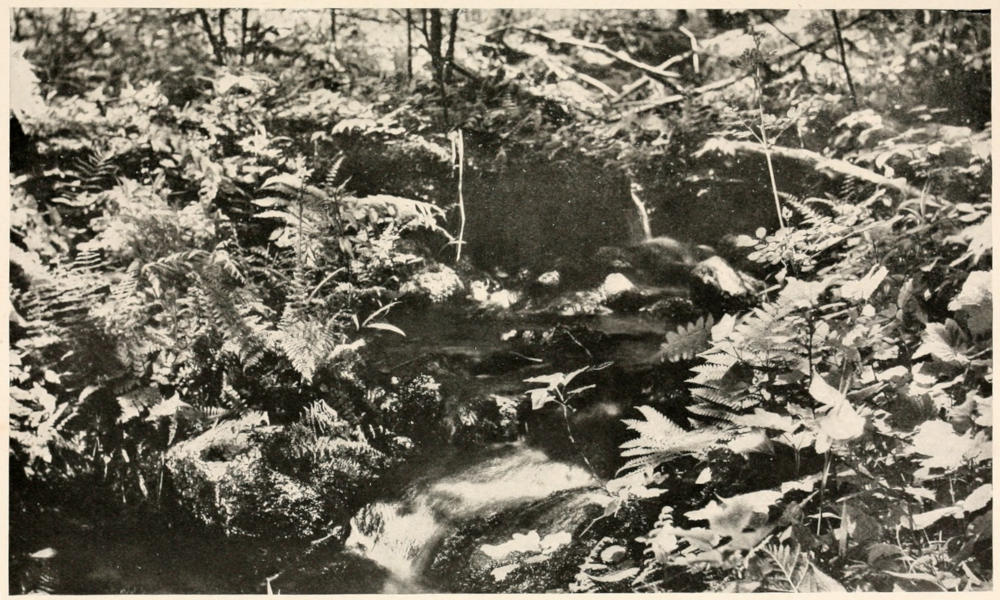
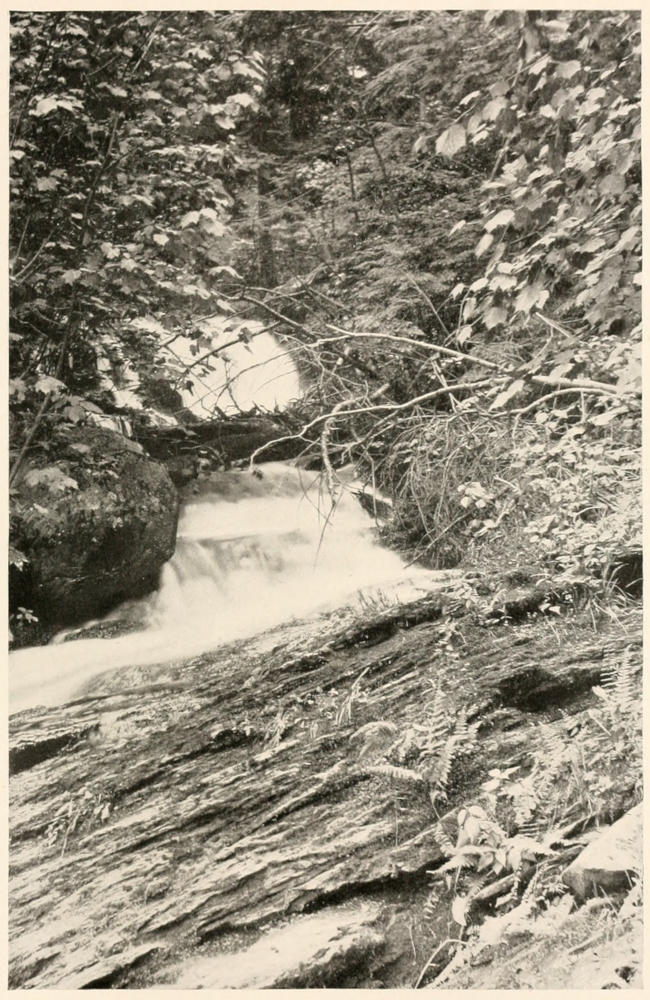
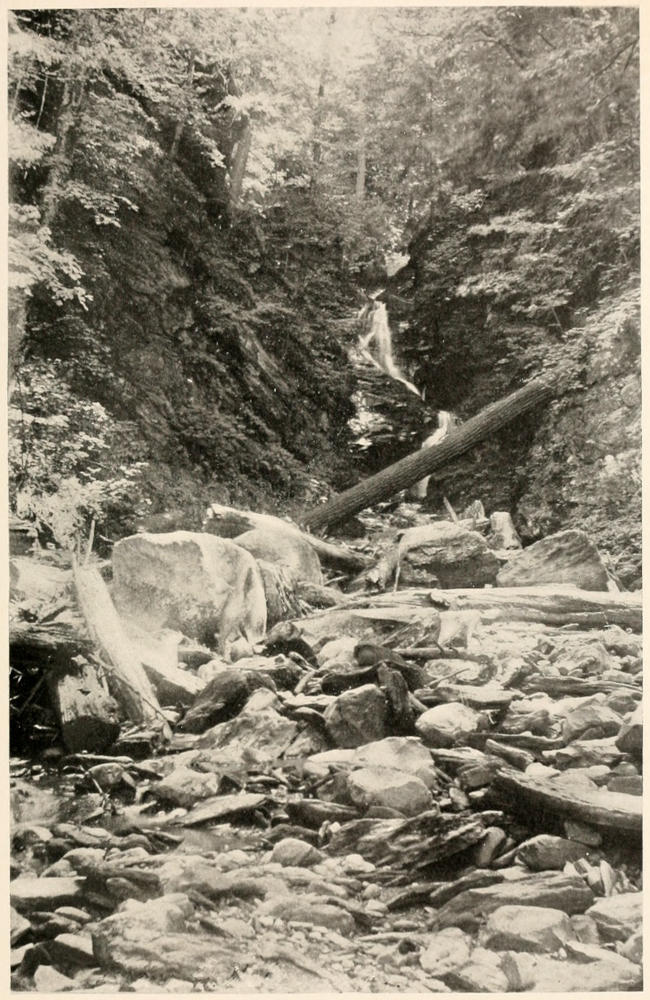
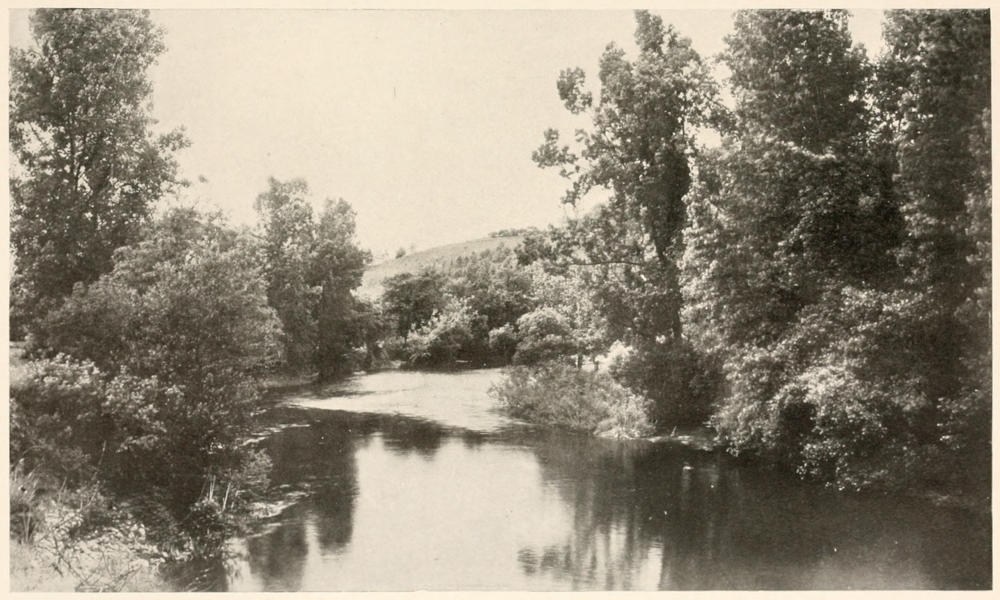
Ball Brook, in the Swamp of Oracles, Pownal, Vermont.
“Here, let these rivulets forever flow!
Drink from these highland domes the melting snow;
Drain from the dark ravines, and hollows near,
The mountain cascades, flowing soft and clear.”
G. G. N.
The Showy Lady’s Slipper (Cypripedium reginæ)
was just sending forth its tiny roll of leaves, so I could
not expect prime blossoms before June 15th at the
earliest.
Seated on a decaying log, I ate my luncheon, with
Major before me begging impolitely for his portion,
until I divided my cake with him. The mosquitoes
were so troublesome that I decided to push onward.
Carefully picking my way out of the swamp, I crossed
the muddy brook, and found myself in a dry, rocky
pathway which winds around the hillside, but still
keeps within sound of the brook’s murmur.
In exquisite little glens beside the path were Painted
Trilliums and Stars-of-Bethlehem, while the white and
gold stars of the dainty Goldthread (Coptis trifolia)
were shining amid the moss and their own glossy green
leaves.
In the bend of the stream a little farther on were
some of the most graceful little ferns, just near enough
to the brink to catch now and then a dash of spray
from the rushing waters, swayed in the coolness all
day long, adding beauty to the nook.
Still farther on, I saw that by crossing the stream I
could enter a little ravine to the right, which promised
hidden treasures. I waded through the brook, which
was too wide to jump across; I found that it was also
rather too deep for my boots, and that there were very
few stepping-stones to make a dry crossing possible.
But of what matter is a little water in one’s boots,
when seeking the Gardens of the Gods? I landed
safely on the opposite bank, after frightening many a
shy, speckled trout from his hiding-place in this ideal
fishing-hole.
I was now in a small, low-lying glen where foot of
man has seldom been. The soil, though much drier
than the ground over which I had recently passed, displayed
a honeycombed appearance, showing where the
water had oozed away through the rich leaf-mould to
seek the flowing stream beyond.
Whole constellations of star-flowers were here; both
the Painted and Crimson or Nodding Trilliums were
abundant, asserting themselves and their rights, if size
of flowers and leaves may indicate strength, among the
tall, rank growth of the Common Brake (Pteris aquilina),
which frequently rise five feet in height. Close
by their long, harsh lobes grew the plicate leaves of the
Indian Poke or White Hellebore. Skunk Cabbage
(Spathyema fœtida), so frequent in the swamps along
Bronx River in Greater New York, is rarely seen
here, although I find lone specimens now and then in
Aurora’s Swamp in northern Berkshire, and in this
jungle. Lily leaves and Dwarf Cornel peeped out from
every shadow. Here I found the red-spotted leaves
of Dog’s-Tooth Lily (Erythronium Americanum) and
Clintonia (Clintonia borealis), as well as the delicate
leaves of the False Lily-of-the-Valley (Unifolium Canadense),
and several species of Solomon’s Seal, while the
weird Indian Cucumber (Medeola Virginiana) rose up
everywhere beneath the luxuriant ferns.
Dwarf Cornel, or Bunch Berry, locally known as
Bear Berry (Cornus Canadensis) was about to set its
fruit. These berries are of a deep vermilion color, and
eatable if one has the patience to sever the seeds.
From the bark of this species of the Dogwood Family
is extracted a tonic which is very bitter.
I found the beautiful Star-Flowered Solomon’s Seal
(Vagnera stellata), and the deeper bogs revealed specimens
of the rarer bog species, Vagnera trifolia, which,
in spite of its name, produced plants with more than
three leaves, and many beautiful fragrant flowers of
a waxy white color. Indian Turnip (Arisæma triphyllum),
more commonly known to-day as Jack-in-the-Pulpit,
was numberless; the little priests in the pulpits
were dressed in cardinal’s robes trimmed with stripes
of green, white, and purple.
This sylvan retreat which yielded so many specimens
of beautiful flowers I called the “Glen of Comus,” for
I could not rid my thoughts of the deep, dark woodlands
where Sabrina was lost among the enchanters.[4]
I fancied that the Purple Trilliums stood with nodding
petals bowed down to earth as though they were guilty
of some crimson sin and dared not lift their faces to the
sun.
I gathered from every species some perfect treasure,
and then returned, wandering once more beside the cool
brook. I wondered if it carried all the memories of the
forest fastness, gleaned among the roots of our frail,
beautiful hillside flowers, through the mighty rivers
to the deep seaweeds and strange aquatic blossoms
which had at one time bloomed among these very hills
ages and ages ago.
Climbing a fence, I found myself in a parched, short-cropped
cow-pasture, but the stream soon passed into a
large tamarack swamp, where in many places neither
man nor beast can wander with ease or safety. I rested
under a wide-spreading pine tree, looking the marsh
over to choose the best path through it, for I still had
some distance to walk before I could reach Pownal
Pond and the Bogs of Etchowog.
In order to make my journey less burdensome, I decided
to leave my treasures of gold and crimson hidden
in this stream, where they would not only keep fresh,
but would be much safer than with me. I felt that
they would be reasonably safe from marauders, for
orchids are far more numerous than human beings in
this forlorn locality; for where verdant meadows might
spread were only uncultivated, almost impassable, dismal
swamp-lands.
At last my flowers were safely placed in the bend of
the brook near an old pine stump, where I made them
fast, covering them with the coarse brakes which grow
everywhere; then I strode on northward through the
tamarack swamp. This marsh covers a large part of
Ball Farm, from which the brook crossing it derives
its name.
Through the trees I could see the old weather-worn
farm buildings, nestling in the shade of a dozen or
more large, thrifty maples, and now and then I heard
a faint murmur of distant voices. Suddenly they subsided,
and a small dog’s shrill bark told me that I was
discovered, mistaken perhaps for the veritable “Witch
of the Hollow,” by the present colored occupants.
There was no use in trying to follow the stream
now, for its windings were intricate and indefinite. It
wandered all over the meadow marsh, and splashed out
in one great mud-hole, similar to that of the jungle in
District Fourteen, save that the meadow here was open,
with very little low tangle or underbrush in sight. Innumerable
tamarack trees, however, lifted their graceful
spires throughout the bog; yet this did not prevent
the meadow from appearing flooded with sunshine.
Away over on the west side of this swamp were many
low-spreading trees of virgin pine, contrasting prettily
with the lighter greens of the delicate spires of tamarack.
Between myself and the shore on either side of
this mud-swamp waved acres of Fleur-de-lis, which
would soon color the whole meadow with royal purple.
Still westward of this lay an alder swamp. This shrub,
called Speckled or Hoary Alder, belongs to the Willow
Family, and grows about fifteen feet high, along swamp
meadows, forming dense thickets.
Many saucy swamp birds dwell here and appear
tame; they came chattering after me, fearing, no
doubt, that I might be in search of their nests and
birdlings.
Under the pines on the border of the swamp I rested,
finding the while tender young Wintergreens (Gaultheria),
and many edible red berries, called Checkerberries,
fruit of Gaultheria, sometimes known as
Partridge-berry and Boxberry. The last two names
are more frequently applied to the fruit of Mitchella
repens, found growing in company with Gaultheria,
and producing edible scarlet berries on a trailing vine,
resembling myrtle. The flowers of this vine were now
in bloom, giving forth a delicate perfume. Their
white and pinkish-purple blossoms dotted the moss
with a brilliancy like that of the Trailing Arbutus
(Epigæa repens), so lately faded.
The buds of Moneses uniflora were putting forth
their “single-delight,” the name coming from their
solitary flower. Here also were quantities of the glossy,
waxen leaves of Pipsissewa or Prince’s Pine (Chimaphila),
and low creeping evergreens. Common Club-Moss
and Ground-Pine were interlaced in their dark
green beds, where had recently nestled the clusters of
arbutus, now brown and faded, although the mossy
hummocks still held the fragrance of their luxuriant
green leaves. Whittier, writing of these spicy flowers,
associated them as the first flowers which the Pilgrims
looked upon after their landing on the bleak shores of
New England, at Plymouth, in the spring of 1621, and
says:
In New England the Arbutus is commonly called
“Mayflower,”—not that it blooms especially in the
month of May, for it has been found in northern Berkshire
as early as February and March. My observation
is that prime blossoms are found in the Hoosac Valley
region from March 15th until May 15th. I have also
gathered beautiful clusters as late as June 23d, in cold
nooks beneath the shades of spruce and pines. Their
spicy perfume is ever the delight of New Englanders.
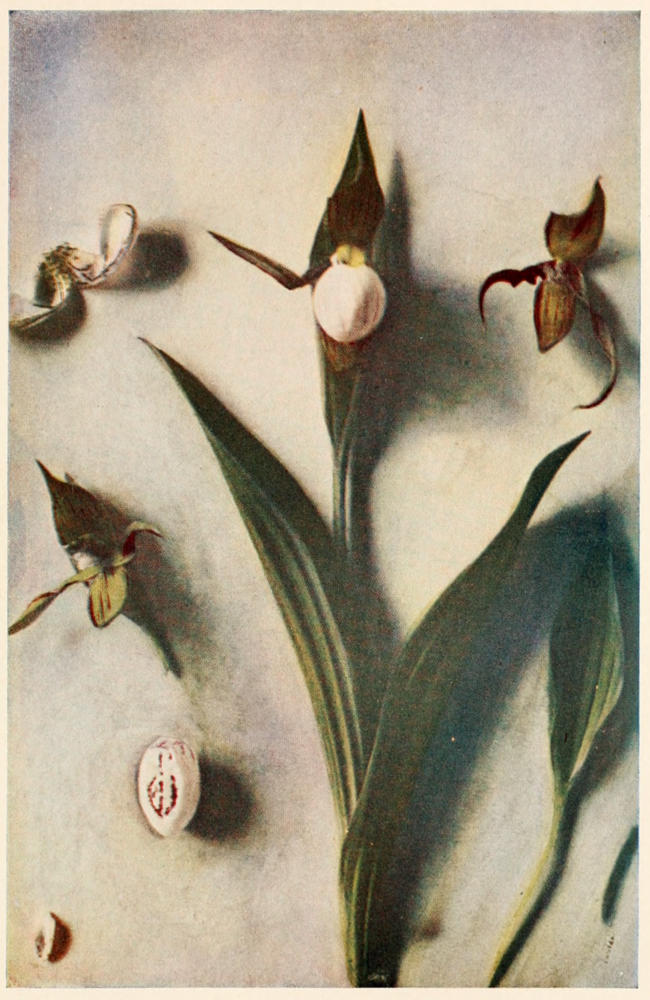
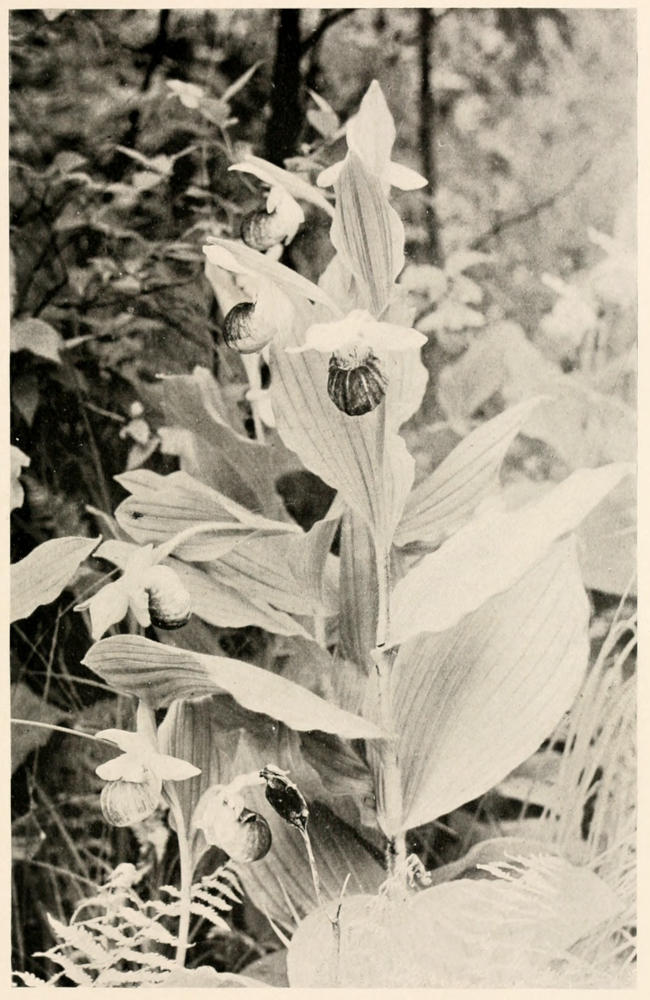
The Showy Lady’s Slipper—The Queen of the Indian’s
Moccasin-Flowers. (Cypripedium reginæ.)
Few poets have ever sung the praises of the Queen of the Moccasin-Flowers,
although a lovelier flower never beckoned to poetic fancy.
Scrambling with difficulty over a fence which sagged
toward me, I entered a neighboring pasture, finding
here more alder trees. Small tamaracks, Christmas
spires of spruce, and pine seedlings filled the pasture
with fresh evergreens, making me fancy myself in a
cultivated park, so regular and trim they stood. Eastward
crept Ball Brook, wandering through deep, reedy
grasses, where here and there stood tall spikes of last
year’s Cat-tail Flag (Typha). Here also grows the
Sweet Flag or Calamus (Acorus), which is not only
good to eat, but a panacea for sore eyes. The cat-tails
stood stiffly erect, as if guarding the blossoming bog,
and serving, notwithstanding their dignity, as perches
for the saucy finches which still chattered after me.
Now I passed through a barway to the right, ever in
hearing of the gurgling stream, which had reached a
hard, dry, gravelly soil, abruptly following the downward
slope around a hillside. A well-worn sheep path
led me down into a bog similar to the Glen of Comus
in District Fourteen, only if anything more wild and
weird. Through the openings between the trees and
knob-like glacial hills, I caught glimpses of the bold,
rugged form of the Dome, standing coldly against the
eastern horizon.
A glance through these glooms revealed another
colony of the Showy or White-petalled Lady’s Slippers
just bursting forth from the earth, perhaps four inches
high. I have found them frequently in these bogs,
when full-grown, standing three feet tall, but the usual
height is about two feet; and in open meadow swamps
often only eighteen inches, owing to the crowded soil,
choked with grasses and low shrubs. In about three
weeks these bogs would be gay with dainty Moccasin-Flowers.
In the upper part of this swamp, I found a rather
quaking corner devoted entirely to the deep green
leaves and tall, white-bearded spikes of the not common
Buckbean (Menyanthes trifoliata), a distant cousin
of the Blue Fringed Gentian. I know of several colonies
of this rare plant in the bogs hereabout, where it
grows plentifully, in its pet localities. It is liable to
grow ever undisturbed, I am sure, since it chooses such
dangerous swamps in which to flourish.
Thoreau mentions that Hodge the geologist once
found at least an acre of this species. He writes: “We
reached Shad Pond, or Noliseemack, an expansion of
the river. Hodge, the assistant State Geologist, who
passed through this region on the 25th of June, 1837,
says, ‘We pushed our boats through an acre or more
of buckbeans, which had taken root at the bottom,
and bloomed above the surface in the greatest profusion
and beauty.’”[6]
After leaving this jungle,—which reminded me of
the luxuriant vegetation of tropical swamps,—I pushed
onward, ever nearing the broad marsh-lands of Etchowog,
east of Pownal Pond, in the shadow of the Dome.
A shaded wood-road winds around the base of the hill,
through an open gateway into a thrifty, well-kept apple
orchard. This adjoins the old Kimball homestead, and
I therefore designated these marshes Kimball Bogs.
Out through the orchard meadow I passed, crossing
the dusty highway which leads northward around the
pond. There are several roads leading to Bennington
village; some are rough, some are narrow and hilly,
while others are broad and easy. The one to the left,
called the Middle Road, follows through Pownal Centre
to the county seat of courts and justice. By keeping
to the right, one arrives at the same destination by the
rough but picturesque East Road, under the brow of
the Green Mountains. A direct route from Pownal
Pond to Bennington is by way of the Hill Road, which
leads directly north between the other highways. Thus
the region is intersected from east to west by many
roads running northward. I invariably recommend
the Hill Road to the traveller who enjoys beauty of
landscape. On this way, if he be a keen observer
of nature, he will find much pleasure.
Instead of going by the trodden way to Pownal
Pond, I chose to follow closely the windings of Ball
Brook, which at this point of the road, opposite Kimball’s
barns, mingles with another mountain torrent
that comes down from the spring heads above Thompson’s
Pond, under the Majestic Dome. The main
current of this stream continues with the bend of
the road, taking with it the volume of the water of Ball
Brook as it crosses the greater stream. The courses
of both streams are unnatural, having been removed,
over one hundred years ago, from their original channels
in order to form a mill-pond for sawmill use.
Originally, I am told, a dense forest of pine trees occupied
the hollow where now the waves of Pownal Pond
wash over the decaying stumps.
The natural lake bed lies in these broad, sphagnous
meadows east of Kimball’s homestead, winding around
to the north, where now wave various small shrubs and
trees. Barber’s sawmill, which stands close by the
roadside, east of the pond to-day, is slowly crumbling
away for want of use. Water finds its level, and although
forced to go by the roadside, Ball Brook still
seeks in part its old channels through the ancient
meadows of Kimball’s Farm, where the stream is
silent and elusive, as it glides among the tall, lush
grasses. Walking along the borders of this hidden
brook, through the tangle mingled with daisies and
buttercups, I lost the stream entirely, only a line of
gold marking its sleepy wanderings,—for marsh marigolds
were still plentiful here, ever following the edges
of the brook.
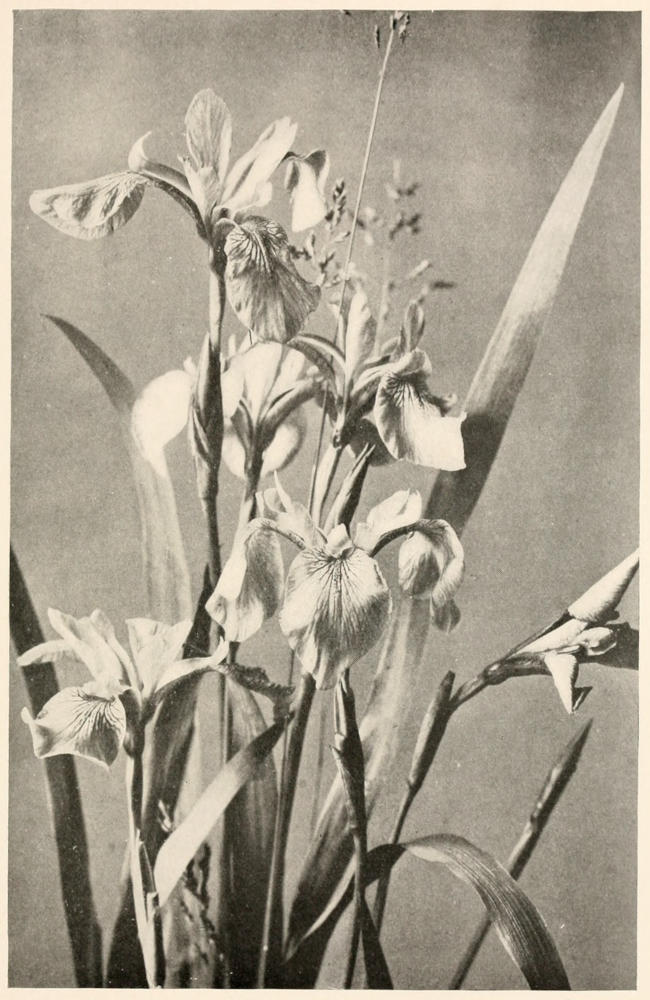
The Fleur-de-Lis. (Iris verisicolor.)
Hellebore grew over the swamp, and the tall grasses
took on coarser forms as I waded farther on, deeper
and deeper into the sphagnous grave of the ancient
lake. At times it seemed so soft and spongy that
I questioned my safety, even doubting the possibility
of a search party securing my “embalmed heart,” if
once I became fast in the mud, so I began to edge up
toward firmer ground and the rocky hills near by.
This was the most uncertain swamp I had ever
traversed, and not quite safe for one to wade through
alone. It is reputed to have been at one time the bed
of a great lake, as evidenced by the terraced hillsides
about it. Its waters might still linger beneath the
black-peat and forest débris which support the trees
and spongy sphagnum. However, a fence closed off
the most dangerous parts of the bog to keep back the
cows from the mire and “dead holes,” as the unfathomable
places are designated by the lads who
penetrate these bogs for the marsh cranberries in the
autumn.
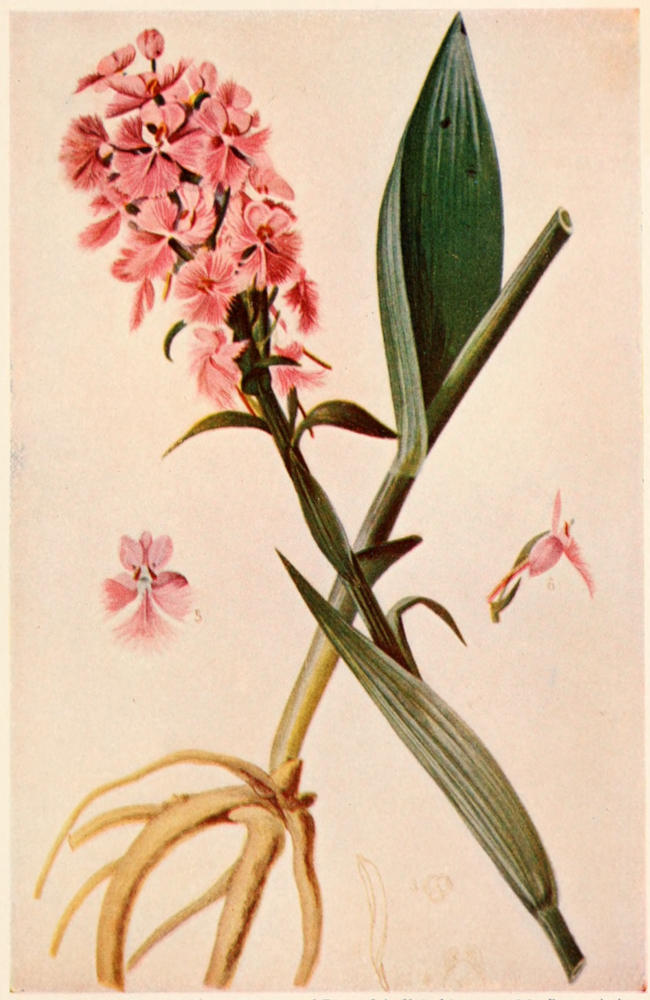
I searched through this meadow for the Large Purple-Fringed
Orchis (Habenaria grandiflora), thinking perhaps
I might find the leaves, although I was somewhat
too early to secure the flowers, since they are not due
until June 20th and later.
On striking out for the hillside path, I found many
problems to solve. It appeared impossible to gain a
firm or safe footing in the sphagnum and mud, so securing
a fence board which had been hurled about the
marsh by the winds and storms, I slapped it down upon
the soft earth and moss, and walked its length of eight
feet. Then quickly relaying it, while my feet sank
lower and lower in the moss, I hastened to pull out my
muddy foot-gear and walked the length of my bridge
once more,—repeating this perilous feat several times,
until I had finally crossed the “dead hole” and stood
on terra firma once more.
There is certainly no experience like being stuck in
a bog to arouse fearful forebodings. The discouraging
effort to keep one foot above the ground only to find
the other sinking deeper is most terrifying, and leads
to hasty and excited movements which but increase
the danger, and may finally lodge both feet fast in the
mud. In such a case the sight of a board fence upon
which an elbow may be rested is as welcome as a sail
to a ship-wrecked mariner. There is in truth much art
and science in walking safely through mud and sphagnum.
One cannot saunter over the surface, and meditate
at ease, but one must be ever alert, elastic as a rubber
ball, and quick to feel a danger before it can be seen.
The fields and woods are a good deal like the books
we read: the more we become familiar with printed
page or forest path, the oftener we return to certain
thoughts and trails that lead us back to scenes and associations
enjoyed before. I like to mark passages in
books I love, here and there, as I would blaze a tree to
guide me to the haunt of a cool stream or a rare flower’s
hiding-place. Whenever I turn to such passages, I
find that time and season have expanded some new
thought in my mind, even as they have developed
the buds to full-grown flowers since my first journey
through the wood.
There is a beautiful cold spring under the hill near
the swamps of Etchowog. I have known of it all
my life, and were I to visit this region every day for
months, I should invariably be drawn unconsciously to
this fountain. It is here that I quench my thirst and
rest after wading through the neighboring swamps. I
have turned many stones here in the past, and lifted
the dead leaves from the choking throat of the spring.
I have gathered the sundew growing in the moss
fringing the banks; and in the sweet solitude and
peace I have dreamed many dreams, inextricably mingled
with the music of the stream.
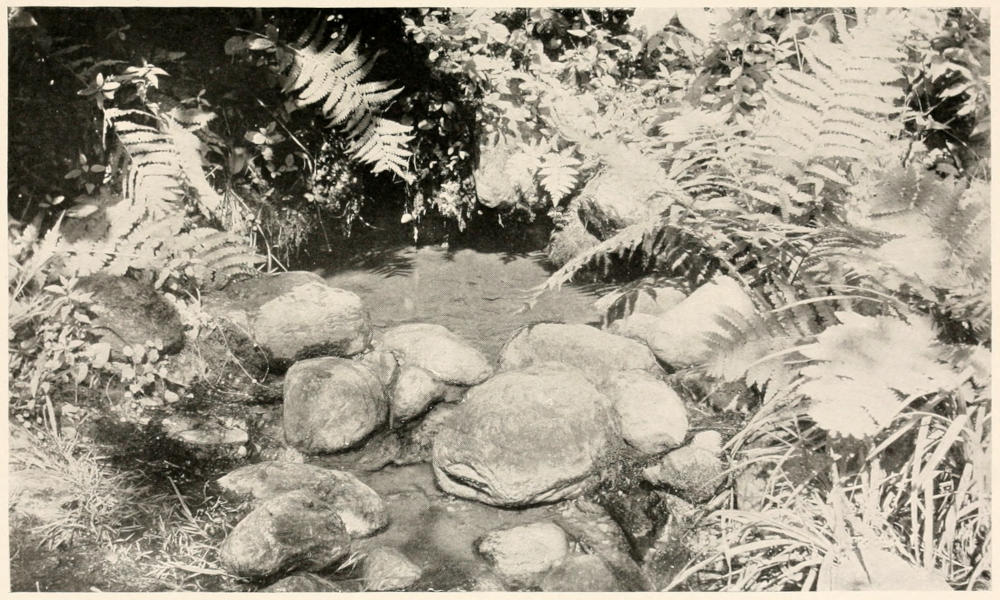
The Fountain of Arethusa, near the Bogs of Etchowog,
Pownal, Vermont.
“If you would get exercise, go in search of the springs of life. Think
of a man swinging dumb-bells for his health, when those springs are
bubbling up in far-off pastures unsought by him!”—Thoreau.
To-day I sought this spring to rest. I bathed my
face and combed my hair over Nature’s own mirror,
after taking a generous draught from the sparkling
water. It bubbles and gushes continuously from under
the rocky hillside, bringing sand and delicate-hued
pebbles to scatter in the bottom of its bowl the year
round. I rested here a full hour, and rinsed the mud
off my boots.
From here it is but a short walk to Barber’s Mill at
the foot of Pownal Pond. Alders, willows, shad-bushes
and pink azaleas, small white birches, tamaracks,
pines, and beautiful swamp or soft maples fill the broad
expanse of marsh-land to the right; while the rocky,
burnt-over, and blackened hillside rises up to the left.
I was tempted into the deeper underbrush, but proceeded
very slowly, as the treacherous bog was so
spongy with sphagnum that I would often sink from
twelve to fifteen inches into its soft, pink depths. But
here I felt secure, since there were many fallen trees
and growing saplings to which I could hold and cling,
in case I stepped into a “dead hole.”
Here, half buried in the moss, I found hundreds of
crimson-veined Pitcher Plants, or Side-Saddle Flowers
(Sarracenia purpurea), which bear olive-green, purple-veined,
vase-like leaves that hold rain and dew. Often
the species varies in color, and its absolute greenish-yellow
with lighter green veinings. Many of the
larger pitchers hold fully a tumbler of fluid. Their
brilliant-hued brims are edged with crimson ridges,
delicately coated with honey, thus enticing flies and
moths to drink from the nectar beyond the brim. The
more common prisoners are small flies and moths, but
one day I found two dozen snails captive in the larger
leaves of an ancient plant, for if once within, there is
no escape even for snails. Consequently the Pitcher
Plants—locally called St. Jacob’s Dippers and Dumb
Watches by the children—are considered carnivorous
plants, since they are flesh-eating by nature. This is
also true of the small Round-leaved Sundew (Drosera
rotundifolia).
These plants are traps that not only cunningly entice,
but actually entrap and slowly devour their victims.
Sundew delights in being fed beefsteak, and Professor
Bailey cites Darwin’s experiment of feeding them
steak, which “they accepted as readily as an insect.”[7]
The Sundew is plentiful in these mossy bogs. It has
red and white, dewy, bristling, round leaves, with
long petioles spreading in a tuft. When a small fly or
ant touches these sticky bristles or tentacles on the
upper face of the leaf, the points of the outer row
slowly turn inward, holding their prey closely until it
is dead.
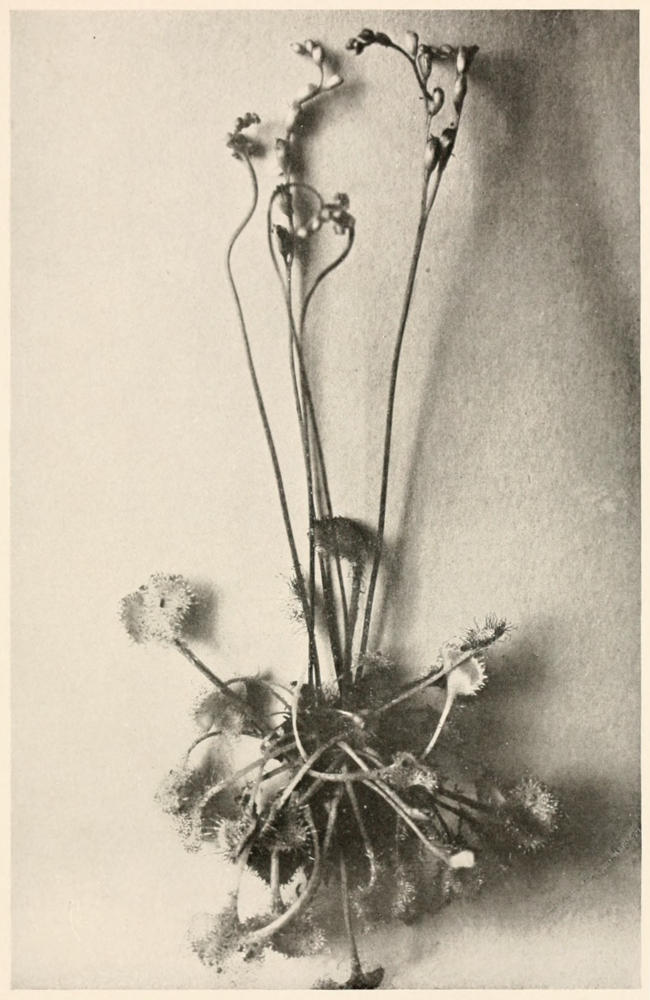
Round-Leaved Sundew. (Drosera rotundifolia.)
Like the enticing honey of the Pitcher Plant, the
viscid fluid of the Sundew attracts the flies, and, once
alighted upon it, they become entangled and doomed
to certain death. After drawing the juices from their
victim or bits of steak, they relax and slowly regain
their normal positions. The glands of these leaves
send out drops of a clean, sticky fluid which glitter like
dew drops in the sunlight. The plant sends up a short
spike of insignificant, whitish-green, bud-like flowers,
which are said to open briefly one by one in their turn,
each morning in the sunshine, till the whole spike has
unfolded. Each flower turns brown and fades before
the successive bud unfolds, so that there is never more
than one full-grown flower to be seen at a time. This
is not the case with the flowers of the Pitcher Plant. I
found many crimson, ball-like buds sleeping tucked up
in their mossy beds. They would be in their prime in
a week or ten days.
Here I discovered some fine specimens of the Pink
Moccasin-Flower, and I was just about to pluck one,
when behold—stretching at full length, basking in the
sunshine on one of those sphagnous stump mounds,
lay a snake, very near the coveted blossom. He may
have been black or he may have been checkered or
variegated and even charming and beautiful to the
snake-hunter, but to the orchid-hunter he was not a
prize worthy of a place in the vasculum. I did not
wait to study or designate him or count his diamonds,
but softly stole away, leaving him still cunningly sleeping,
in waiting for prey, beside that gorgeous Moccasin-Flower.
I now regarded with suspicion all the holes in the
soft mounds of moss, as the possible homes of snakes,
that might object to visitors in their Eden. Immense
ant-hills were numerous, and the occupants may have
afforded food for Satan’s prototype in his idle hours.
Now and then the drum of a frightened partridge, giving
her alarum, assured me that her brood of chickens
was hidden under the leaves and logs not far distant.
It is very probable that snakes in these bogs devour
small birds and frogs, and lie in wait for them, as I
found the one that I had seen this morning.
Before continuing my search, I secured a hardwood
staff, feeling safer with a cudgel of some kind in my
hand, in case I met Satan face to face. In my tussle
to sever the birch limb from the green tree, I snapped
off all the Venus Slippers that I had actually gathered
here. I was therefore no richer in actual specimens
upon my departure from the swamp than when I entered
it; but I carried away memories of that vast solitude
and slumbering desolation where foot of man, I
dare say, has seldom if ever been.
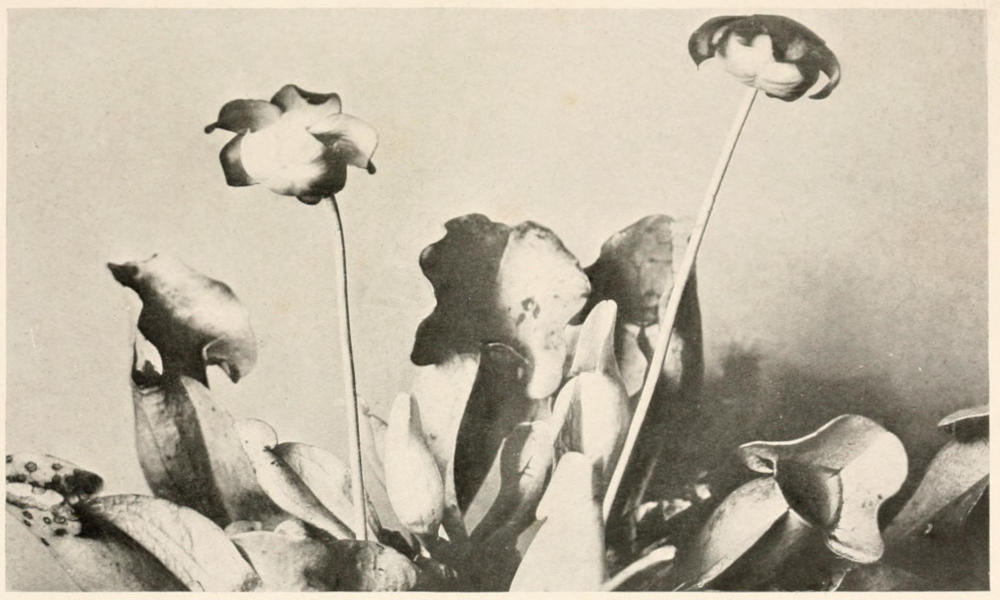
The Carnivorous Plants, commonly called Pitcher Plants,
and Dumb Watches. (Sarracenia purpurea.)
“What’s this I hear
About the new carnivora?
Can little plants
Eats bugs and ants
And gnats and flies?—
A sort of retrograding
Surely the fare
Of flowers is air,
Or sunshine sweet;
They shouldn’t eat,
Or do aught so degrading.”
Anonymous.
Now well out of this swamp, I found myself on the
edge of an apple orchard, filled with rosy bloom and
the fragrance of happy May. A newly planted garden
bore witness to human life, and the long rows of potato-hills
spoke of industry. Passing through the gate, I
entered the East Pownal Road near the mill, and walking
down the bank to the right, just north of the mill,
where cobblestones had been dumped from the fields, I
picked my way into the open Bogs of Etchowog, which
lie directly east of the pond.
I wandered up and down through this swamp,
finding hundreds of Pitcher Plants, which had begun
to nod their crimson buds. Clusters of the Showy
Lady’s Slippers were springing up on the higher,
drier mounds among the lily leaves of Clintonia
borealis and Dog’s Tooth. Fleur-de-lis grew everywhere,
while the Poison Ivy flaunted its three-fingered
palm on every side. Poison Sumach or Poison Dogwood,
sometimes known as Poison Elder, grows
luxuriantly in this swamp, and susceptible people have
been poisoned merely by passing above along the roadside.
By wearing high hunting-boots and rubber or
chamois gloves, however, I am perfectly safe in such
places. In fact, I never think of these plants as poisonous
when brushing through the tangles of bushes and
blossoming vines. These species of Rhus are in blossom
most of the summer. The juice of the plant is
resinous, and the fruit consists of white or dun-colored
berries.
Going back to the roadside to rest, I took out my
color-box and attempted to sketch the swamp I had
just left. Eastward, rising boldly in the background,
towered the Majestic Dome against the sky. In the
middle distance, a long line of alders and willow shrubs
blended softly into the blues, here and there dashed
with the crimson and gold swamp-maple buds; while
still nearer, amid the low, grassy reeds and poison
sumachs of the wet swamp, three tall, stately pines
reared their shaggy green forms against the dark blue
tones of the mountains, lending strength and balance
to the scene.
My day nearly spent, I packed away my colors, and
started on my return trip, leaving the mill at the bend
of the road at three o’clock. Just above the Kimball
Farm, I came to a pent-road leading through the
pastures to Ball Brook Farm, where I must go to get
my Moccasin-Flowers, left hidden in the stream. I
found them as fresh and fragrant as if just gathered.
The walking was good, so I exchanged my high,
heavy boots for low shoes, which were much more
comfortable for dry paths and climbing hillside roads.
Going directly up through the cow-pastures along
the border of the Glen of Comus, I came upon a colony
of Pink Moccasin-Flowers, growing on a sloping hillside
under low-spreading pines and birches. Although
the spot was shaded, many flowers were unfolding, but
they were not so deep in color as time and sunshine
would paint them. I counted at least two hundred
buds and blossoms, thinking what a feast for the eyes I
should have another day, when they were in their
prime.
Later, as I turned into the Centre Road, I met
Lorenna, one of the school children in District Fourteen.
She, too, had her hands full of flowers. I
asked her to keep a lookout for strange, small Moccasin-Flowers,
hoping thereby that she might find the
rare little Ram’s-Head (Cypripedium arietinum), for
which I have so hopefully searched these woods in
vain. I had found thus far all the representative
species of the Moccasin-Flowers of this State, save the
rarer Ram’s-Head.
The Bogs of Etchowog, Showing the Dome in the Distance,
Pownal, Vermont.
“There are not only stately pines, but fragile flowers, like the orchises,
commonly described as too delicate for cultivation, which derive their
nutriment from the crudest mass of peat. These remind us, that, not only
for strength, but for beauty, the poet must, from time to time, travel
the logger’s path and the Indian’s trail ... far in the recesses of the
wilderness.”—Thoreau.
The name Ram’s-Head arose from the resemblance
of this flower to that of a sheep’s or ram’s head, the
conical or pouched-shaped shoe serving in certain positions
to remind the early Canadian children of the
noses of frisky lambs’ heads, while the twistings of both
sepals and petals answered for the ram’s horns. This
rare species was first collected in Canada near Montreal
before 1808. In that year it was transplanted to English
gardens by Messrs. Chandler and Buckingham,
where they had opportunity to study it closely. For
some time it was known as Chandler’s Cypripedium.
Finally, Mr. Robert Brown of England published a
description of North American Orchids in Aiton’s
Catalogue of Plants, in 1813, and he must have learned
what the children first named it in Canada and Vermont,
for he gave it the Latin name, Cypripedium arietinum,
which it has ever since borne in the science.
Arietinum signifies shaped like a ram’s head, and so
one readily observes how the common names of plants
suggest to the botanist the origin of the strange Latin
names, which are in one sense but the explanations of
the common names.
I told Lorenna the story of this stray lamb, and she
was as eager to find its trail as I was. The plant is
shy at best, the flowers being of the most inconspicuous
purple and white shades, found in cedar swamps and on
the drier hillsides in mixed wood, of pine, chestnut,
and birch. Truth to tell, I was not familiar with the
appearance of the plant, nor did I know at what date
to search for the blossoms.
After leaving Lorenna, I followed the road homeward,
reaching Mount Œta at six o’clock, somewhat
dusty and ragged and tired. Old Bonny and the buggy
were now suggested as assistants in my trips, when the
folk observed my load of herbs and flowers. But bog-trotting
in a buggy is certainly beyond the limits of my
imagination. It did, however, at that tired moment
seem a favorable project, for Bonny and the buggy
could wait for me by the roadside while I plunged into
the marshes to secure my treasures.
It is true, as Thoreau writes: “we are but faint-hearted
crusaders, even the walkers, nowadays, who
undertake no persevering, never-ending enterprises.
Our expeditions are but tours, and come round again
at evening to the old hearth-side, from which we set
out. Half the walk is but retracing our steps.”[8]
III The Haunts of the Ram’s-Head Moccasin-Flowers
I call the old time back: I bring my lay
In tender memory of the summer day
When, where our native river lapsed away,
We dreamed it over, while the thrushes made
Songs of their own, and the great pine-trees laid
On warm noonlights the masses of their shade.
Whittier, Mabel Martin.
The following morning, after my strenuous excursion
through the swamps of Etchowog, I
was somewhat tired and stiffened, but still
ready for a journey which must be made to
North Adams, a distance of ten miles from Mount
Œta. As it was Saturday, Lorenna’s mother would
soon be passing over the hill on her way to that city,
with butter and eggs, so I decided to accompany her.
Lorenna’s mother, formerly a teacher in District Fourteen
in the neighborhood, had always considered my
propensity for tramping through these bogs and woodlands,
searching for flowers, as rather “queer.” This
habit, coupled with my fondness for the poets, led her
to believe I had sustained some great sorrow,—perhaps
the loss of a lover,—and in those early days she invariably
eyed me closely through her green goggles
as I met her on the road. My evident annoyance and
embarrassment under this scrutiny probably confirmed
her suspicions. Nevertheless, she so far forgot her
interest in this subject as to tell me to-day that
Lorenna, on her way home with the cows the night
previous, had found one of the strangest little flowers.
None of them had ever seen the blossom before, nor did
they know its name. She felt sure, however, that it
belonged to the Nervine Family,—as they locally call
the Moccasin-Flowers in many New England towns,—from
the leaves and the little shoe-shaped flower.
That evening, as soon as the sun sank in the west,
and the cool hours of twilight came, I sought Lorenna’s
house in the vale below Mount Œta. As I sauntered
through the fields, the distant sounds of Pownal’s
church bells and the barking of dogs and the rolling
wheels of the home-coming farmers’ wagons arose
from the valley.
Under my arm I had tucked Baldwin’s Orchids of
New England, a book which I had drawn from the
North Adams Library, with permission to keep it as
long as I desired, the calls for such books being very
infrequent. This work contains many illustrations of
species of orchids found in the New England States,
and more especially in Vermont, the author having
made his excursions and collections of species near
Burlington, in the northwestern portion of the State.
Among the sketches is one of the Ram’s-Head Cypripedium,[9]
the species having been collected by him
in cedar wood, in the neighborhood of Burlington,
where he reports a colony of twenty plants.[10]
Arriving at Lorenna’s home, my hopes were realized,
and I was introduced to the first fresh specimen I had
ever seen of the Cypripedium arietinum. Later I was
shown the spot where the flower grew. I was hoping
to find several plants, but was disappointed. I studied
the soil and locality, however, which gave me the clue
for fresh trails. We had followed a winding wood-road
that led from the Centre Road into the deep pine
forests on the Amidon Farm, where the ground was
strewn with piny needles and glittering with the Stars-of-Bethlehem,
Goldthread blossoms, and the Painted
Wake Robins. The broken stem that had borne the
conical shoe stood on a rocky hillside, at the base of a
chestnut tree. A dwarfed pine seedling was also struggling
to grow in the hard soil, among the fibrous roots
of the Ram’s-Head. The two had probably taken root
there at the same time. We marked the spot, and
sheltered the plant from the browsings of cows, by
planting dead twigs near it.
Before the evening was ended, Lorenna’s mother had
discovered that others besides myself must have made
excursions afield and abog for flowers and herbs, and
no doubt at some time in their lives must have also
read poetry and made sketches. She became very
much in earnest over a text-book on botany, and desired
Lorenna to have a child’s manual.
Baldwin writes of the Ram’s-Head Cypripedium:
“In Northern New England, one is sometimes fortunate
enough to gather with the Yellow Lady’s Slippers,
especially with the dwarf species, the Ram’s-Head
Lady’s Slipper (Cypripedium arietinum), the rarest
species North America produces, and to me, the most
attractive.”[11]
The flower is peculiarly conical in shape and slightly
fragrant. Baldwin was the first botanist to discover a
“musk-like odor” to the roots of this plant, which I
also have observed. The structure of this species
differs from all other known Cypripediums by producing
six distinct parts to its perianth, all the sepals
being free to the base. There is in the regular structure
of Cypripediums a union of the two lower sepals,
usually showing a bifid condition at the apex, when
not perfectly united, as shown, if closely studied, in
some of the accompanying illustrations.
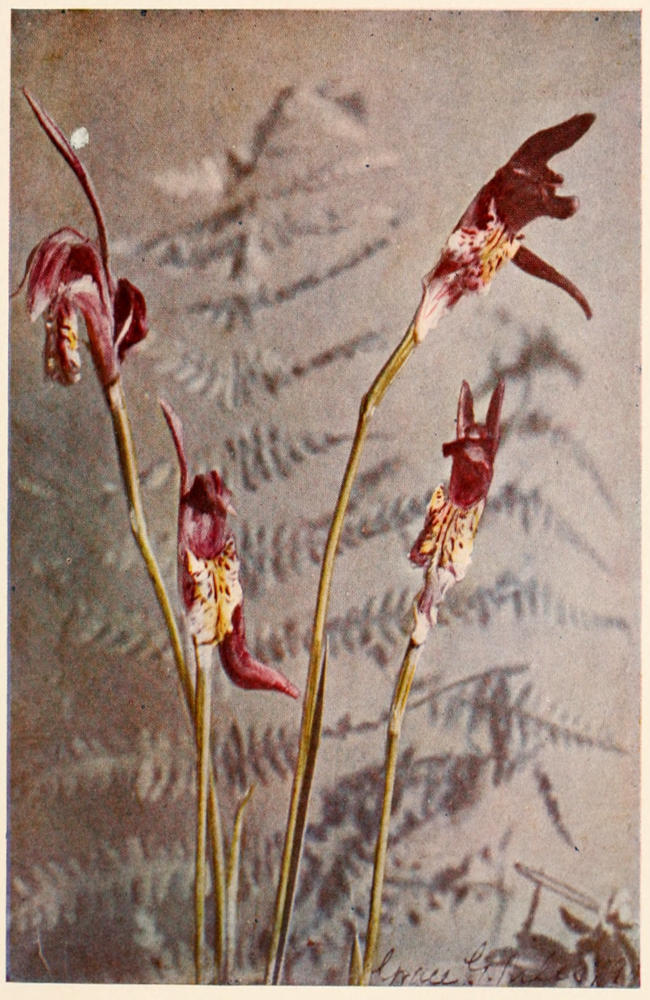
The brown-pink sepals of the Ram’s-Head are all free,
and, twisting gracefully, remind one of the horns of
a sheep’s or ram’s head, while the apex of the labellum
serves for the nose. The labellum is of a dull purplish
color, mottled or checked with white veins upon the
crest of the shoe. The apex or toe is of a dull brownish
green, the orifice of the labellum is triangular, filled
with downy white hairs, and not large enough to admit
a baby’s finger-tip. The flower, however, varies, as
does also the plant, in size, according to the soil and
the age of plant, those found in damp cedar swamps
being a foot or more in height, adorned with large
flowers, while those along the hillsides are from six
to ten inches high.
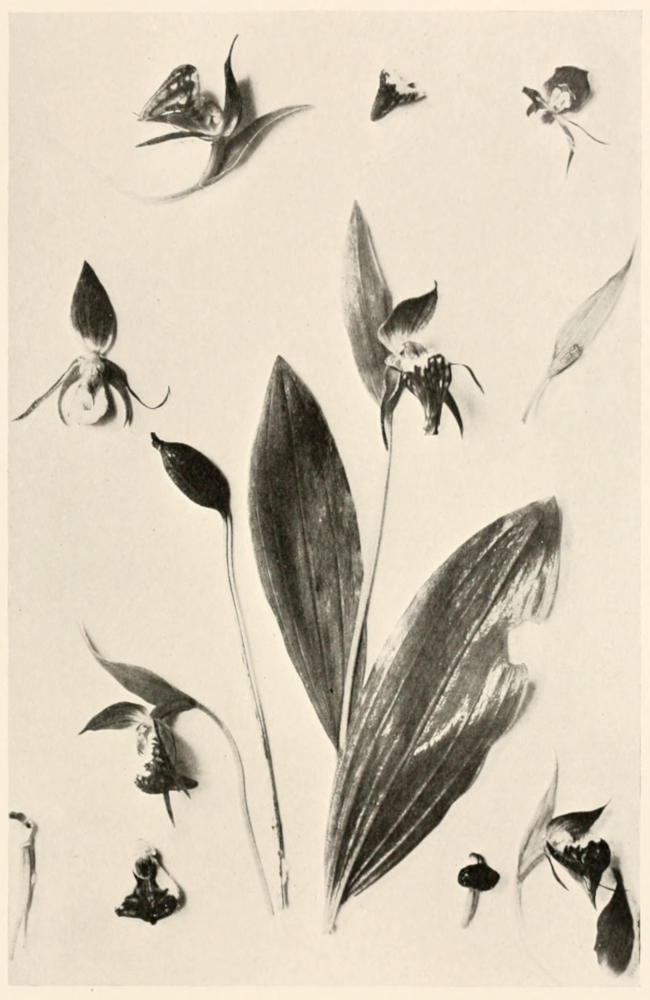
The Ram’s-Head Lady’s Slipper. (Cypripedium
arietinum.)
In different positions this flower suggests a ram’s head.
This rare orchid is seldom, if ever, collected by
botanists. It is one of the smallest Moccasin-Flowers
found in the Northern Atlantic Region. The pigmy
of the genus is Cypripedium fasciculatum, found under
young Conifers in open woods in the swamp regions
of northern California, along the Pacific slope, exclusively
west of the Continental Divide. The Cypripedia
found in the Pacific Region are very different from those
of the Atlantic, Cypripedium Californicum, for instance,
producing a simple raceme bearing from three to twelve
flowers, all emerging from the axils of leafy bracts, the
stem often growing four feet high. The shoe-shaped
flowers resemble miniature blossoms of our eastern
Cypripedium reginæ in color and structure of sepals and
petals.
The Ram’s-Head Cypripedium is certainly one of the
rarest species on the continent, and appears to be more
plentiful, if this word can be used of so scarce a flower,
in the State of Vermont than in any other region that
has been reported in its continental range. It grows
in low, damp marl and peat swamps.
IV The Stolen Moccasins
Woodlands, green and gay with dew,
Here, to-day, I pledge anew
All the love I gave to you.
Alice Cary, A Lesson.
Whether the season is premature or
backward, the Moccasin-Flowers always
appear at the same date, along with the
Painted and Crimson Trilliums, in the
warm Glen of Comus. I am sure of finding these
flowers unfolding, the week previous to Decoration
Day, from the 20th to the 28th of May.
On the 30th of May, four days after I had discovered
the famous two hundred Pink Moccasin buds on the
hillside above the Glen of Comus, I imagined now
that they must be in full array, wearing the rich hues
of magenta and all the delicate tints of green, white,
and pink. When once fully unfolded they change
color very rapidly. Late in the afternoon I entered
the edge of the Swamp of Oracles in District Fourteen,
north of the schoolhouse. My hound was my sole
companion, and I heard him in the distance making
friends with children, whose voices came echoing from
the direction of my fairy-land of Moccasins. A foreboding
that all its beauty had been plundered took
possession of me, for I knew that children are instinctively
selfish about flowers, and pluck every blossom
they see, even though they may throw them away
afterward.
I picked my way carefully through the deeper
swamp, around in the opposite direction, avoiding thus
the children whom I heard approaching by way of the
path, their arms laden, no doubt, with the blossoms I
sought a sight of. Later my worst surmise was confirmed.
Not one Moccasin hung on its stem to tell the
tale of the invasion. Here and there were strewn
bruised leaves and stemless blossoms, prostrate on the
hillside. I was sorely disappointed, and I exclaimed
aloud to the echoing wood that it was a sin,—this stealing
all the flowers and leaving none to mature and
develop their seed pods for the continuance of the
species to be enjoyed by future generations. “And if
I ever get hold of these youngsters,” I cried, “I’ll
tell them why!”
The “youngsters” happened to be cousins of mine
who had caught the orchid mania from me, and what
to them had always appeared ordinary Indian Moccasins,
or Lady’s Slippers, had now an added value
and charm, since they were understood to belong to the
Orchid Family. The very hint that I valued them
caused strife among these children, eager to show me
how many they also could gather in a day. As such
treasures, they gathered them, hurrying homeward to
tell me how many rare and beautiful orchids they had
found. They wondered if I had been near the jungle,
as they saw Major, my hound, during the afternoon.
I admired their blossoms, now drooping and wilted and
sadly bruised, but I never told them just where I had
been, nor what I had missed. I had not the actual
courage to scold them, since I had set the example for
them, but although I find many flowers, I gather at
random for mere pleasure very few. Indeed, there is
no pleasure in making desolate these choice and hidden
retreats of Nature.
There are laws protecting the deer in the Green
Mountains and the brook trout in their spawning
season, but as yet there is no legal or moral protection
to shield the flowering and fruiting season of rare
flowers, especially orchids, so scarce in northern New
England. Some of our orchids are already so rare,
that in localities where, only a few years ago, I found
them abundant, to-day hardly a trace of them remains.
They have suffered from school children and commerce
alike. People seek them selfishly for pleasure and
study, while the drug trade demands many roots, and
places fair value upon them as an inducement to collectors.
These roots are used for infusions, tinctures,
and ointments,—a primitive Indian custom and one
which, if continued on the present scale, must in time
necessarily cease, through extinction of the rarer and
most showy species of our native orchids.
The country folk know the Lady’s Slippers of genus
Cypripedium as the Nervine Family, valuing them as
a nerve tonic. I have met a man who makes a business
of following trout streams, fishing and hunting
through the swamps, searching for frogs, and rare roots
and herbs in their season. He finds ready market for
Ginseng, American Ipecacuanha, Hellebore, or Indian
Poke, from which is obtained a powerful cardiac depressent,—Veratrum
viride, and species of Cypripedium
also produce our native drug American valerian, which
takes the place of the European drug, procured from
Valerian officinalis. Snakeroot, Dogwood, and various
other plants afford excellent tonics. One can readily
understand, as Thomas Wentworth Higginson remarks,
“that many of our rarest flowers (in the vicinity
of Boston) are being chased into the very recesses
of the Green and White Mountains. The relics of
the Indian tribes are supported by the Legislature at
Martha’s Vineyard, while these precursors of the
Indians are dying unfriended away.”[12]
Where years ago the swamps were fairly rose-purple
with waving blossoms of the Grass Pink (Limodorum
tuberosum) and Rose Pogonia or Snake-Mouth (Pogonia
ophioglossoides), this year I found so few that I could
readily count them. I discovered the possible secret
of this extinction in the fact that a native of Etchowog
was offered by some florist or gardener fifty cents a
bulb or plant for all the specimens he could secure.
This was an inducement for the vandal, but Nature
cannot restore her species as fast as man can uproot
them and devastate their haunts. Whether this is the
true cause of extinction of these species in Pownal
swamps I cannot ascertain beyond this inference;
however, I am convinced that a small fortune has
disappeared, estimated on the lost plants at fifty cents
each.
Nearly all of the public schools are instructing the
children in drawing,—teaching them to study the wild
flowers as they find each in its season. Educators in
all nature study urge the children to bring fresh specimens,
and thus unconsciously encourage the extinction
of the rare species of plant life in general. The children
of each district school thus hunting over a limited
area, soon, with childish strife, collect all the first and
fairest flowers in their path. By the close study necessary,
however, for the child to produce a drawing of the
flower and its structural parts, a valuable lesson may
in time be learned.
The story of fertilization, the necessity of the flower’s
producing seeds in order to continue its successive generations,
will not be forgotten by the true nature student.
But if the teacher were able to designate the
rarer plants of her district, and teach her children the
fatal results of continually gathering their flowers, she
might awaken in the minds of the young people a
higher reverence for the blossoms themselves, and
scruples against depriving generations of children to
come of their beauty.
The Pink Moccasin-Flower. (Cypripedium acaule.)
This is the only two-leaved Cypripedium found in the Atlantic
region. It is closely allied with Cypripedium guttatum of Alaska
and with Cypripedium fasciculatum of the Pacific slope. It is the
most common species of this genus.
There is hardly a child in the first grade in our
schools who cannot tell the story of the bee and the
Moccasin-Flower, and why the wonderful lines and
dots of pink and gold are inside the downy shoe, instead
of making the outside the more showy.
The first Moccasin-Flower which I found in Aurora’s
Bog in North Adams I gave to Ray, a little lad of my
acquaintance, and he happily and proudly carried it to
his teacher. When he came home, he could tell me
that all these inner decorations of pink and gold were
dewy-tipped with sweets, and were called “Honey
Guides,” just to invite bees within. And that although
Master Bee goes through the front door of the
Moccasin cottage, he somehow finds it locked when he
wishes to escape, so in his excitement has to squeeze
through the small back door next to the pollen-masses.
He carries forth some of the pollen, and thus helps to
fertilize the next blossom of this species, as he enters
and rubs off the grains of pollen on the adhesive lobes
of the viscid stigma. Insects thus are not permitted to
rob the flowers of nectar and pollen without making a
return for the food which the flower yields them.
Were it not for the bees and moths and various flies,
the seeds of orchids would not mature, for it is a generally
accepted fact that nearly all species of this
family, wherever found growing, depend upon insect
aid for fertilization and cross-fertilization. With the
exception of one or two North American species of
genus Habenaria, all other native species are aided by
insects. These two species, Habenaria hyperborea and
Habenaria clavellata, were, according to both Gray
and Darwin, supposed regularly to fertilize themselves
without aid of insects.
As the spikes of the Tall Green Orchis (Habenaria
hyperborea) are frequent in the Pownal swamps, in
company with the Showy Lady’s Slipper, I became
interested in this plant, so independent of Master Bee
or Moth.
Professor Asa Gray, in various papers on fertilization
of our native orchids, has said that they were all
arranged for fertilization by the aid of insects, and
that very few were capable of unaided self-fertilization.
He tested several species, and proved that it might
occur by accident, but in general his two self-fertilized
species of Habenaria were still an unsolved problem,
as later developments have proven in the case of his
supposed self-fertilized species, Habenaria hyperborea,
which he asserted “habitually fertilized itself.” At
least this species, although it may be fully equipped for
self-fertilization, has been reported quite recently to be
visited and fertilized by mosquitoes, proving that not in
all instances is it found “habitually fertilizing” itself.[13]
In August, 1899, Professor C. A. Crandall, of the
Agricultural College of Colorado, with a party of
tourists camped on Medicine Bow Range, in that State,
at an altitude of 10,200 feet, and observed abnormally
developed mosquitoes bearing pollen-grains, which resembled
those of Habenaria hyperborea; and so they
proved to be, by subsequent experiments with specimens
of this orchis gathered from a bog near by their
camp.[14]
Another species of this genus, which is almost identical
with the Tall Green Habenaria just mentioned,
differs from it by bearing fragrant white flowers not
adjusted for self-fertilization. This beautiful plant,
Habenaria dilatata, grows sparingly in the choice
haunts of the deeper Bogs of Etchowog, seeking frequently
the pools near cold springs, and attracting numerous
flies and moths by its rich perfumes, which one
scents long before he discovers the flowers themselves.
Darwin mentions ten self-fertilized species of orchids
for the whole world, and adds to that list ten more
which were partially so, in case the proper insects
failed to visit these plants in season.
He again asserts: “In my examination of orchids,
hardly any fact has struck me so much as the endless
diversities of the structure,—the prodigality of resources,—for
gaining the very same end, namely, the
fertilization of one flower by pollen from another plant.
This fact is to a large extent intelligible on the principle
of natural selection.”[15]
Of the self-fertile species, Darwin remarks: “It deserves
especial attention that the flowers of all self-fertile
species still retain various structures which, it is impossible
to doubt, are not adapted for insuring cross-fertilization,
though they are now rarely or never
brought into play. We may therefore conclude that
all these plants are descended from species or varieties
which were formerly fertilized by insect aid.”[16]
Darwin believed that, “bearing also in mind the larger
number of species in many parts of the world which
from this same cause are seldom impregnated, we are
led to believe that the self-fertilized plants formerly depended
on the visits of insects for their fertilization,
and that, from such visits failing, they did not yield a
sufficiency of seed and were verging towards extinction.
Under these circumstances, it is probable that they
were gradually modified, so as to become more or less
completely self-fertile; for it would manifestly be more
advantageous to a plant to produce self-fertilized seeds
rather than none at all or extremely few seeds.”[17]
Darwin questions: “Whether any species which is
now never cross-fertilized will be able to resist the evil
effects of long-continued self-fertilization, so as to survive
for as long an average period as the other species
of the same genera which are habitually cross-fertilized,
cannot of course be told.... It is indeed possible
that these self-fertile species may revert in the course
of time to what was undoubtedly their pristine condition,
and in this case their various adaptations for
cross-fertilization would be again brought into action.”[18]
Indeed, the more this great scientist studied these
strange flowers, the more he became impressed, and
“with ever-increasing force, that the contrivances
and beautiful adaptations slowly acquired through each
part occasionally varying in a slight degree but in
many ways, with the preservation of those variations
which were beneficial to the organism under complex
and ever-varying conditions of life, transcend in an incomparable
manner the contrivances and adaptations
which the most fertile imagination of man could
invent.”[19]
The Tall White Northern Orchis (Habenaria
dilatata), Near Arethusa’s Spring, Bogs of Etchowog, Pownal,
Vermont.
The extinction of species of orchids is due to causes
inharmonious with Nature, therefore, more than to the
failure of the insects in fertilization and cross-fertilization.
Man and his bush-whack and bog-hoe are doing
more toward the extinction of our rarer species of all
plant-life in their continental range than any other
natural element, in the swampy, mountainous districts
of the East, as well as in the open swells on the prairies
of the West.
The late Grant Allen expressed regret that the
native Yellow Lady’s Slipper of England, Cypripedium
calceolus, “lingers in but two places,” one of those
stations being on “a single estate in Durham, where
it is as carefully preserved by its owner as if it were
pheasants or fallow-deer.”
The wind, rains, and flowing streams, the birds, as
well as migration and immigration of the nations over
the world, are ever unconscious bearers of the seeds of
our rare flowers and common dooryard weeds; yet
for the rarer species Nature is indebted to the insects
for the important process of cross-fertilization.
In country towns of New England, where summer
resorts for tourists are numerous, one finds youthful
venders selling the roots of the Orchid Family to
“lovers of flowers,” and thus even the lovers of Nature
aid in the extinction of the treasures and wealth of her
soil.
Species of Cypripedium are indeed the most gorgeous
among our native orchids, and will be among the first
of the family to become extinct, since they do not reproduce
seedlings abundantly, even in their most choice
haunts.
V The Queen of the Indian Moccasin-Flowers
The rounded world is fair to see,
Nine times folded in mystery;
Though baffled seers cannot impart
The secret of its laboring heart,
Throb thine with Nature’s throbbing breast,
And all is clear from east to west.
Emerson, Nature.
Between May 30th and June 8th, I made
short excursions to the Bog of Oracles above
the Glen of Comus. On the latter date I
found my first blossoms of the season, of the
Showy Queen of the Moccasin-Flowers (Cypripedium
reginæ), the white sepals and petals standing fully unfurled,
but still lacking the rich magenta-pink on the
crest of the slippers which another week’s time would
give them. One feature this season, among these
plants, was the unusual number of two buds on a
single scape. While a single blossom is generally
found on a stalk, I discovered now that nearly every
other stem bore two buds.
At the same time and in the same place, along the
edges of decaying logs on the borders of Ball Brook,
grew the spikes of the Tall Green Orchis (Habenaria
hyperborea). Its greenish-yellow color is conspicuously
different from the tones of its distant relative, the
showy, white-petaled queen of this swamp. Another
spike similar to that of the Tall Green Orchis, but
short and smaller in every way, stood near. It was
not so tall and coarse as its sister species, and may
have been a stray specimen of the Tall White Habenaria
(Habenaria dilatata). These two species are
peculiar in appearance, and many inexperienced bog-hunters
would pass them by as weeds, and homely
weeds at that.
Upon closer scrutiny, the peculiar twisted seed-pods
of these flowers suggest a rarity. The name Habenaria
signifies “a rein or thong,” derived from the shape of
the labellum in some species of this genus. They are
often also called “Rein-Orchises.”
On June 10th I drove into the Chalk Pond region,
on the “Witch Hollow,” or Gulf Road leading to the
Centre-of-the-Town; and hitching old Bonny, took a
circle around the peat and marl meadows, searching
for signs of the Showy Orchis (Orchis spectabilis), a
species of a sister genus of Habenaria. The Showy
Orchis is due here about May 25th, the date on which
the early Moccasin-Flowers awaken.
Four species of this genus unfold upon almost the
same day. The Ram’s-Head Cypripedium should
bloom first, according to general reports of botanists,
the Pink Acaule immediately follows, and the Larger
Yellow Moccasins, and, at the same time, the Small
Yellow Fragrant Slippers unlace their beautiful twisting
petals. The Showy Orchis is supposed to be the
first orchid of the spring to blossom in New England.
The Showy Orchis. (Orchis spectabilis.)
The first orchid of the spring, found near the rocky borders of
Thompson’s Brook, East Pownal, Vermont.
I discovered nothing in the Chalk Pond meadows,
however, save that it was one of the most charming
little corners in the town, showing deep erosions
about its terraced basin, proving that the ice-currents
of the past flowed through these gulfs with terrible
force.
I have found the Large Yellow Moccasin-Flower
growing in close relationship with the dwarf fragrant
species (Cypripedium parviflorum), in the Swamp of
Oracles, in District Fourteen, about May 25th; while
they appear later in the upland woods,—from June 6th
until June 25th. They grow, as will be observed,
along high, rocky hillsides as well as in damp, sphagnous
marshes. The upland species are often found in
open clearings on hillsides, among the dead brushwood
heaps, where grow the Maiden-Hair and Christmas
Ferns. Often they are in full sight, but sometimes they
are hidden under small hazel-nut bushes, amid sapling
white birches.
There seem to be three different forms of the Yellow
Cypripediums, although there are but two accepted distinct
North American species north of Mexico; these
appear also to intergrade frequently. Close association
of habitat has probably something to do with this
cross-fertilization of the two species.
Finding the two marsh plants, Cypripedium hirsutum
and Cypripedium parviflorum, growing side by
side in the Swamp of Oracles, I observed a marked
intergrading,—the larger species, Cypripedium hirsutum,
producing variegated sepals and petals, or
possibly now and then a brown-pink petal or sepal,
imitating the type species of the smaller Moccasin-Flower.
Both species were fragrant in a slight degree,
Cypripedium parviflorum being, of course, the more
fragrant of the two.
There is an European Yellow Cypripedium (Cypripedium
calceolus) which is almost identical with the
smaller species of North America, Cypripedium parviflorum.
As early as 1760, Cypripedium calceolus was
described and illustrated in color in Philip Miller’s
Figures of Plants. Linnæus, 1740, gave the European
yellow species the present generic and specific designation.
Any history relating to that species of Lady’s
Slipper, as it was first known in Europe by Dodoens
as early as 1616 under the title of Calceolus Marianus,
will also pertain to the history of the two closely allied
Yellow Cypripediums found in North America.
The common English name “Lady’s Slipper” arose
from the Latin Marianus, referring to “Our Lady,”
the Virgin Mary, while Calceolus is the Latin for shoe
or slipper. Linnæus, however, in 1740, being a devout
Lutheran, objected to this species being dedicated
to the Mother of Christ, and re-established the custom
of dedicating the names of flowers to gods and goddesses
of classical mythology known before Christ.
The origin of the generic name Cypripedium is from
the two Greek words Κύπρις, an ancient name for
Venus, and πόδιον, a sock, buskin, or slipper.
Venus, in classical literature, was also known as
“Our Lady,” the “Divine Mother” of the Romans,
so that the common name has never in reality changed
since 1616, when it was first applied to these shoe-shaped
flowers of Europe, in honor of Mary, “Our
Lady,” the “Divine Mother” of all nations.
The Algonquin Indians, in their forests of Northeastern
North America, saw this same shoe-shape resemblance
in these flowers, and called them Mawcahsun or
Makkasin-Flowers, since they reminded them of little
Indian Moccasins. Thus arose the common name Indian
Moccasin-Flowers for all our native species of
Cypripedium. Lady’s Slipper is distinctly of European
origin, while Moccasin-Flower is most appropriately
American, since this name was given by the first
inhabitants of our shores, as it were, in mythological
days. May the name of the Indian’s Moccasin-Flower
pass down through the coming centuries in honor of
a race that will disappear long before these flowers,
which they christened so appropriately.
I have never thus far found the Dwarf Fragrant
Moccasin-Flower, an upland flower, which Higginson
describes as growing on the “Rattlesnake Ledge” on
“Tatessit Hill,”[20] in the neighborhood of Boston.
The larger yellow species, Cypripedium hirsutum,
grows in the Hoosac Valley high on the steep sides of
the Domelet, while the smaller species seeks the deepest
parts of the Swamp of Oracles and Aurora’s Bog.
I have collected it also in damp, marshy woods in
Mosholu, near New York City.
The Large Yellow Moccasin-Flower seems, of the
two yellow species, the more generally distributed over
the continent, although most botanists state that the
smaller species is the commoner. The dwarf yellow
species is certainly the rarer plant in New England.
In the Hoosac Valley, particularly in Pownal swamps,
it is quite as rare as the Ram’s-Head Cypripedium. I
have discovered only one swamp here where it grows.
It will be of interest to make note of two species of
our Eastern Cypripediums, which extend nearly to the
Arctic Circle northward, as well as adjusting themselves
southward near the Tropic of Cancer. One of
these species is the Large Yellow Moccasin-Flower,
reported as found associated with the Pink Acaule, in
latitude 54° to 60° North, by Dr. John Richardson on
Captain Franklin’s journey to the Arctic lands in
1823.[21]
Dr. F. Kurtz, in an Arctic Expedition in 1882, collected
the large yellow species, Cypripedium hirsutum[22]
of the Atlantic Region, as well as Cypripedium passerinum,
which is endemic only to the Northern Pacific
Region. Cypripedium hirsutum also extends from New
England westward much farther than the pink species,
Cypripedium acaule. The dwarf yellow, Cypripedium
parviflorum, closely follows the larger yellow species
both southward and westward, but according to the
stations reported to the author for the continent, it
cannot be said to have the broader range of the two
species.
The Small Yellow Fragrant Moccasin-Flower.
(Cypripedium parviflorum.)
The only really fragrant Cypripedium of the Atlantic region,
closely allied with Cypripedium Montanum—the Fragrant White
Lady’s Slipper of the Pacific slope. The plate shows the undulating
sepals and petals as well as their rich brown-pink coloring. The two
lower sepals are imperfectly united and are bifid at the apex. This
species is almost identical with the European species Cypripedium
calceolus,—the first Cypripedium described by Linnæus in
1740-1753.
The Dwarf White Moccasin-Flower (Cypripedium
candidum) may also be counted with Ram’s-Head
Cypripedium as one of the rare species of the Northern
Atlantic Region. It is seldom found in the New England
States. In the range reported to the author for
this species, there is but one New England station.
This has been given by A. W. Driggs of East Hartford,
Connecticut.[23] This orchid belongs more especially
to the damp swells of the prairie. It is very
similar to the Dwarf Yellow Cypripedium, except in
color, and like it produces a faint fragrance. This
dainty white shoe is often no larger than the tiny
Ram’s-Head flower, the plant being about six to ten
inches high, bearing small waxen shoes, the shape
of the blossoms of Cypripedium parviflorum. I have
often received descriptions from country lads, supposedly
of these White Moccasin-Flowers, only to find
that they were either albinos, or bleached out and pale
specimens of the gorgeous colored Cypripedium reginæ.
Often the latter seem pure white to the hurried observer
in the swamps, for the albino or white variety rarely
occurs. I found one plant, however, this season bearing
two blossoms, the first I ever saw, and I removed
the plant to watch it in my garden.
After Decoration Day, I had all I could do to keep
pace with the unfolding flowers in the woods on
Mount Œta. In the Chestnut Woods and Rattlesnake
Swamp region, near Lloyd Spring, and along the
mountain sides of the Knubble and Domelet, I found
beautiful azalea shrubs laden with luxuriant clusters
of fragrant pink flowers. These open woodlands become
brilliant with these rose-colored blossoms. The
Large Yellow Moccasin-Flower was here too, with
violets, Stars-of-Bethlehem, and innumerable pink
blossoms of Cypripedium acaule growing along the
side hill, shining out from every corner. All at once,
these nearer woodlands had unfurled their banners
of spring, and now, “With blossom, and birds, and
wild bees’ hum,” they held me from the more distant
Bogs of Etchowog. On the 14th of June, however, I
decided to take old Bonny and the buggy, and drive to
these bogs to see if any Pogonias and Limodorums were
budded as yet amid the grasses of the open cranberry
marsh.
Bonny hitched to the old buggy, my faithful old
Major at my side, and I, with my vasculum for rare
flowers, a basket containing drinking glass, carving
knife, and bog-hoe for gathering special roots, started
down the hill on an easy trot toward Pownal Pond.
As I passed School Fourteen, I was cheered and hailed
by the children, who shouted, “Going a-flowering?”
I nodded “Yes,” with a “Get-ty up” to old Bonny,
who had thought I wished to visit along the way.
The Small White Moccasin-Flower. (Cypripedium
candidum.)
This species is especially an orchid of the damp swells of the
prairie, growing in company with the Painted Cup and Iris.
“There, I think, on that lonely grave,
Violets spring in the soft May shower;
There, in the summer breezes, wave
Crimson phlox and moccasin flower.”
Bryant.
It was warm and dusty, and whenever I could, I
drove through the streams which crossed the road, in
order to swell the felly, and thus tighten the tires to my
rattling wheels. Although I felt that by driving along
the highway I was losing much beauty that was unfolding
in the fields and fence corners, I found this
method of progress quite comfortable.
How these East Pownal bogs came by the musical
name of Etchowog, I am not quite certain; nor do I
know exactly what it means. It may have come from
a primitive language of a mythological age for all I
know, or it may have come from the Itch-Weed or
Indian Poke and Poison Rhus, which cause much irritation
of the skin. I am safe in saying that it is a
corruption of the Indian’s Greek and Latin words for
“itch” and “bog,”—at least this etymology quite
suits the designation of these swamps. Ever since I
can remember I have heard the older folk of the town
call it Etchowog. I have associated the region with
rare flowers, orchids, pollywogs, snapping-turtles and
mud-holes, together with the schoolhouse in District
Thirteen, where the good people hold Advent meetings,
and set the dates for the world to come to an end. To
me it seems one of the brightest, richest of swamps,
full of “Bottomless Dead Holes,” where only bull-frogs
peep and trill and croak the whole season through, till
their notes blend with the chirp and whirr of the
autumn crickets.
At the Barber Mill, I hitched Bonny to a fence-post
and started on my excursions. I looked through the
open meadow east of the mill to see if I could find any
rose-colored Pogonias and Grass-Pinks. There was as
yet no sign of them; so I came back to the mill and
turned in through the bars, on the north side of the
pond, where I followed a grassy path around the hill
to the treacherous Cranberry Swamp farther northward,
where I had been cautioned not to wander alone.
Sounding the margin of the marshy meadow, I
found quaking and unstable ground. With a ten-foot
pole I probed the depths of the mud, and found it
unfathomable, and no signs of terra firma about it.
Pickerel-weed, eel-grass, frog’s-bit, and the leaves of
arrow-head grew about the pools. I could not very
well find an entrance here, unless for a permanent residence.
So going northward along the west shore of
this mud-pond, I came to a place which promised fair
and safe walking, with my waterproof boots for protection.
At first I felt my way very cautiously, then
grew bolder and forgot that I was in a dangerous
place, for the farther I advanced, the firmer and drier
and more enchanting became the field of my vision.
Before me opened a wide expanse of meadow-land,
where even unruly cows dared not wander, and man
seldom ventured to trespass. Nature’s remote solitude
indeed was peacefully hidden here. No human voices
nor sounds of hay-making ever echoed over these
luxuriant fields, and the grasses grew sweetly, to fall
untouched to earth again, mown as it were by the autumn
winds, and stored beneath the drifts of November
snow, to lay, in time, one more thin coat of soil upon
the unplumbed depths of this ancient lake bed. During
some long-ago winter, some one had ventured here
while the earth was frozen and safe, and had built a
homely hedge-fence through the meadow, probably to
keep the cattle pasturing hereabout away from the
dangerous bog. This fence was the only visible trace
of man. In its tumbled-down and overgrown condition,
it became a part of Nature’s self, and added to the
picturesqueness of the field. Although Rafinesque
says “that he hates the sight of fences like the Indians,”
to me the hedge-fence is one of the wildest and
most primitive of forest barriers. Indeed, it must have
originated with the veritable wild man himself.
I was tempted on and still farther on through the
meadow, by the brilliant crimson-purple blossoms of
the Pitcher Plant, or Side-Saddle Flowers, so named
on account of the hard shells of the stigma of these
flowers resembling the padded cushions of a lady’s ancient
side-saddle. This cushion was known as the
“pillion.” The more common name in this locality
for these flowers is St. Jacob’s-Dippers and Dumb-Watches,
children playing with the hard shells of the
stigmas left after the purple petals have fallen, calling
them watches. The convex surface of the stigma does
indeed resemble the face of a watch, although there are
no hands to point the hour. Gay blossoms of Fleur-de-lis
flaunted their gaudy petals, and many times deceived
me by making me imagine that I spied the
Purple-Fringed Orchises in the distance, waving amid
the tall grasses.
Here I dreamed away an hour or more, following
out some little paths, worn perhaps by the muskrats or
swamp minks or wicked weasels, or perchance by the
tiny feet of the meadow-moles, who apparently had
blindly rooted various underground tunnels in every
direction. I can fancy them all trotting swiftly along,
playful at times, yet with an eye to their affairs,—quite
as important in the scheme of Nature and Science
as are the brokers’ studied operations in Wall Street.
The weasels and minks are the terrors of the other
path-holders in this natural syndicate. They are indeed
the high and dreaded trust officials of the lesser
and blind rooters of the earth.
Tangled vines of the marsh cranberry were now in
full bloom, and at the same time the soft fruit of last
autumn’s crop was present on the vines, still bright
crimson, even after enduring the winter’s frosts and
stubborn snows.
Looking northward to see what fields lay unexplored
beyond me, I realized the remoteness of this region
slumbering amid these glacial hills. To my right towered
the Dome, the highest mountain of Pownal, of a
bluish-green tone, against the sky. Nearer, graceful
elms, tall pines, and numerous low pointed, lighter green
tamarack trees lifted their spires, and adorned the distant
meadow; while in the wide expanse on the west
side, along the edges of the swamp, rose the giant
forms of elm and pine, and tall, lithe trees of the swamp
maple, flashing forth their crimson and gold blossoms,
reminding me of the coloring of autumn leaves. The
nearer marsh was rich with tasselled grasses and blossoming
vines, dotted here and there with the cardinal
buds of the Pitcher Plant and the purple Fleur-de-lis.
It seemed a land of dreams.
The air vibrated with the happy, mellow song of
birds, interspersed with the ever-present lesser sounds
of deep solitudes. Major, like me, at first, was cautious
where he wandered, but once amid the various haunts
of wild creatures of the wood, he caught the happy
spirit of the hound, frisking and studiously following
the paths of the wild little animals to the very doors
of their homes.
To test the land, I stood and deliberately shook the
foundation of the earth. All the blossoming ground
about me, for at least fifteen feet distant, trembled as
if it were so much jelly. Yet the spot was honeycombed
and dry on the surface, there having been
little rain in this region during the month.
I now sought the western hillside path, and bearing
northwestward around the border of the swamp, I
occasionally ventured in and out along the edges of the
meadow bushes. Finally I reached the swamp maples,
which I had observed from the interior, and I secured
a good-sized branch of the gold and crimson clusters
to carry off with my load of treasures. On every hand,
out of the small, muddy pools of water, rose the leaves
of the Buckbean (Menyanthes trifoliata). The beautiful
spikes of white-bearded flowers were turning brown
with age, and the plants were setting their bullet-like
seed-pods. Now and then, beneath the low, shaggy
pines, I found the humble Pink Moccasin-Flower
(Cypripedium acaule), which I hailed as a sign that
the Showy Queen of the genus might dwell not far
distant.
Knowing the favorite haunts which this orchid
seeks, I searched through all the dark corners of the
swamp. At the extreme northwestern portion of the
region, I entered a dense shaded corner about fifty feet
square, where were many springs soaking through the
sphagnum to the deeper fields of the interior which
I had so lately left. Here were numerous decaying
pine and tamarack logs, low sapling willows tangled
amid the small scrubby spruces and tender pines, which
were striving against the greater natives of the forest
to lift their spires as high as possible; but however
eager they were, they had not attained a height above
ten or fifteen feet at most. Many were already discouraged
or had died in the competition, and their
wasting forms were still standing with broken and
weather-worn trunks and limbs.
Tall brakes and Indian Poke ran riot among the
deeper mounds of moss, which covered the decaying
roots of the long wasted primeval pitch pines. The
dark, sluggish pools reflected weirdly the ferns and
trees above them.
The Queen of the Indian Moccasin-Flowers.
(Cypripedium reginæ.) From the Bogs of Etchowog, Pownal,
Vermont.
Shooting up from these piles of sphagnum, I found
at least fifty plants of the Showy Moccasin-Flower
(Cypripedium reginæ). They were pregnant with
slumbering buds, and would surely be in full blossom
by June 20th. Happy over my good fortune at locating
another station for this species, I prepared to bend
my footsteps toward my horse and buggy,—glad indeed
to know that I would not be obliged to walk
home, laden as I was with Pitcher Plant roots and
various other shrubs and vines.
Near the mill, just north of the little bay in the
pond, I found quantities of the Yellow Pond Lily or
Spatter-Dock (Nymphæa advena) just beyond my
reach. Securing a long willow sapling with a tender
end, I tied it into a loop, and stepping out into the
shallow edges of the pond to an old pine log, I snared
off several of these golden cups, which the children call
Cow-Lilies. I floated them in to the shore, where I
soon gathered them up and packed them in my vasculum.
A glance into the water along the edges of the old
log revealed thousands of tiny pollywogs or tadpoles,
as well as half-formed frogs, the hind legs beginning
to put forth on the large tadpoles. Here, basking in
the sunshine, were lizards, snails, leeches; and various
species of small fish were sporting in the shallow
waters. Perch, suckers, and eels are plentiful in Pownal
Pond, which is locally called Perch Pond, from the
abundance of perch found in its waters. These fish
seemed to seek this sheltered arm of the pond to leave
their young fry under the sheltering lily-pads.
Near the projecting stumps, amid floating logs were
snails’ eggs, and I noticed several baby turtles, recently
hatched from eggs in the sand, varying from the size
of nickels to that of a silver dollar. Eel-grass and
many marsh grasses and sedges grew or floated on the
water, among which the small fish could hide.
On the edge of the water among the ferns and brakes
I found the leaves of the Purple-Fringed Orchis (Habenaria
psycodes), but no plants likely to bloom this
season.
When I reached the mill, I placed my treasures in
the buggy, and started after that part of my load which
I had left around the hill. On my return, I gathered
some waxen, crimson cones of the beautiful tamarack
tree by the path. When I bade farewell to little Merwin
and his mother, who lived in the mill-house, I
asked them to watch for the rose-purple orchids,—Pogonias
and Limodorums,—which were now due any
day, east of the mill. The boy was very earnest and
observing, and I knew that I now had a comrade to
guard over the Bogs of Etchowog.
Students from Williams College, and tourists from
near and afar seek these swamps of Pownal for botanical
specimens, and Merwin had often been their
guide to the haunts of these rare treasures. He told
me that students from Williams had, the year before,
gathered innumerable pink and purple flowers in these
marshes, as well as the beautiful bearded spikes of the
Buckbean.
For a succession of years—during all of President
Carter’s term at Williams College at least—it has been
the unique custom to bank the chancel of the Congregational
Church with the Showy Moccasin-Flowers
and Maiden-Hair Ferns, on Baccalaureate Sunday,—which
occurs usually about June twentieth. These
gorgeously colored orchids reach the height of their
perfection about this date. They seem a fitting decoration
for the church during the Commencement services
of this college, situated in the heart of these
Hoosac Highlands.
Plentiful as are the colonies of this Showy Moccasin-Flower
in its pet localities, it has always been an interesting
question to me where the great numbers of
perfect blossoms grouped about the chancel are secured.
They are known to the children in each school district,
and usually they are collected as soon as discovered.
It is surprising to me that extinction of this rare
plant is not taking place more rapidly hereabout.
This orchid produces very few seedlings in its native
haunts, and at the rate of collecting both its blossoms
and roots in this valley, we must surely look for total
extinction in less than half a century more, unless this
ruthless plucking is modified.
VI Hail Storms at Etchowog
... Suddenly, a flaw
Of chill wind menaced; then a strong blast beat
Down the long valley’s murmuring pines and awoke
The noon-dreams of the sleeping lake, and broke
Its smooth steel mirror at the mountain’s feet.
Whittier, Storm on Lake Asquam.
On June 21st, with Major I walked down
through the Swamp of Oracles in District
Fourteen, along Ball Brook to the Kimball
Farm bogs, and so on once more to the
Bogs of Etchowog and the new colony of Reginæ—the
queen of the Indian Moccasin-Flowers—which I had
so recently discovered in Cranberry Bog north of the
pond. I found prime blossoms all along the tiny path,
in the course of the stream through the deeper parts of
Glen of Comus, and in the Kimball Bogs, and I was in
hopes of finding them in the swamps of Etchowog.
As I passed through the sphagnous meadows east
of Kimball’s barns, around the hillside path to Arethusa’s
Fountain, I noticed several flowers of the
Cypripedium I was seeking, and recognized the leaves
and green-budded spikes of Habenaria psycodes, which
would later, when fully in bloom, change to a delicate
purple.
The Small Purple-Fringed Orchis. (Habenaria
psycodes.)
I made use of the fence boards to walk through the
muddy portions of my path. I had learned by former
experiences here to avoid the “dead holes.” Stepping
on some boards just above a muddy pool, and suddenly
turning, I was happily surprised to see many spikes of
the Tall White Northern-Orchis (Habenaria dilatata)
standing near. The air was full of their rich perfume,
and many small flies and moths hovered around them,
sipping the nectar. I gathered a few spikes, and went
on to the cool spring beyond, finding meanwhile an
abundance of wild strawberries along the borders of
my path. These were very large from growing in the
moist shade.
On the hillside, up which I climbed to the west for a
short distance, I found pretty leaves of grasses, delicate
emerald in color, growing in a triangular form, and
resembling lily leaves.
I had heard distant thunder rolling off to the northwest,
and it caused me to hasten onward. My rest,
therefore, at the spring was brief to-day; although so
far away from home, I was not so far from shelter, and
the thought of a shower was welcome, for the air was
sultry. As I neared the open swamp, beyond the mill,
the storm made rapid strides, but I wandered up and
down the meadow long enough to assure myself that
this season the Pogonias and Limodorums were not in
bloom on time.
Large drops of rain began to fall from the black
clouds, and as I hurried toward the shelter of the mill,
I met Merwin and his mother returning to their home.
They motioned me to join them. As I did so, great
gusts of wind dashed over us, and suddenly huge hailstones
pelted the earth. Leaves and small twigs and
young apples fell on every side, while the half-grown
nuts from the Butternut-tree (Juglans cinerea), in the
dooryard, were soon stripped away, with the leaves
and broken limbs of the tree. Some of the hailstones
were the size of small hen’s-eggs, perfect, oval ices
which might have been turned out of glass moulds.
Soon the air became very chilly, as during the first
snow on a damp November day, while the ground was
white with hailstones. This abrupt change in the atmosphere
from heat to extreme cold caused untimely
deaths in the chicken yard. The old mother hen lost
her head completely, and unable to find shelter in the
barn because of the banging doors, she put her head
in a crevice while her brood ran about and perished
with cold or were killed by the stones.
Merwin’s mother sadly watched the devastation of
her little garden, and the death of her chickens. It
was impossible to go to their rescue without danger
to our own heads. This storm continued about two
hours, alternating now and then with a calm, to return
again and again with sudden fury. At the end of that
time, although it still rained sadly, I started for home,
knowing that with rubber boots I could wade, if necessary,
through any ordinary streams.
The weather had turned so cold that an icy coating
covered the meadow grass and the borders of the road,
and promised not to melt away in haste.
As I neared Kimball Farm, where Ball Brook
meets Thompson’s stream, I found the road opposite
the barns flooded,—like a river flowing across the
road. It was far too deep for me to wade through, besides,
the current was so strong that I should have been
tripped had I ventured it. I had to walk some distance
on the stone wall and over a heavy plank, which
some one during a previous deluge had placed here
for a high-water foot-bridge in an emergency.
A walk up the hill, and I turned off the road, entering
a path through the cow-pastures, to see the heaps
of hail under the pines along Thompson’s Brook,
which was a beautiful, roaring and seething torrent
now, as it plunged and leaped down through its rocky
flume to the valley below.
As I came out on the highway again, at the bend in
the road near Ball Farm, I heard the familiar voice of
some one who had been sent in search of me. I was
warmed with enthusiasm and interest in the storm’s
ravages, and thoroughly enjoying my walk. However,
I was grateful for a ride home. Passing by School
Fourteen, we saw the prudent teacher scanning the sky
before she ventured forth. We noticed many broken
panes of glass in the schoolhouse windows, while
dozens were shattered in the houses along the way.
I had hoped to revisit the colony of the Showy Moccasin-Flowers
which I had found in Cranberry Swamp,
north of the pond on June 14th. But Merwin’s mother
told me that without doubt they had been gathered
on Saturday afternoon, June 19th, by three students
from Williams College; she had seen two of them
come around the hill by the pond about five o’clock
on that day, bearing a new bushel-basket filled with
these gorgeous orchids, while the third soon followed
laden with more than he could easily carry far in his
arms. They followed the cool mountain road over the
Domelet to Williamstown, a road over which the yeomen
from northern Berkshire were led to battle at
Bennington, on the 16th of August, 1777. The road
is seldom traversed now, and at best is rough and rocky.
It leads directly from Bennington southward to North
Adams, under the mountains, and indirectly to Boston.
Had the storm come on Saturday, instead of Monday,
very few blossoms of these orchids would have
decorated the church chancel on Baccalaureate Sunday
for Williams’ Commencement exercises.
The fact that these students come to the Pownal
bogs for these orchids assured me of the scarcity and
rarity of the species in Williamstown, although they
may be found sparingly in the swamps of The Forks
along Broad Brook, just over the Vermont State Line
in Pownal. This stream rises on the east side of the
Majestic Dome, and flows down to the Hoosac by
way of White Oaks, and thus enters Williamstown,
where it soon joins the river. The orchids in The
Forks are quickly plundered, long before June 20th,
by ignorant tourists or students afield botanizing, who
either do not realize or do not care that plucking all
these rare blossoms will in time bring about their total
extinction.
Orchids may in many instances produce seeds in
abundance, but why they do not reproduce more seedlings
is a problem not easily solved nor remedied.
Darwin once estimated that a single spike of the
English Orchis (Orchis masculata) produced over
186,000 seeds, and that at this rate its grandchildren
would soon carpet the earth; while Müller says also
that his brother estimated 1,750,000 seeds in a single
capsule of another species of the family (Maxillaria).
We must remember that the species of Orchidacea are
not as a rule self-fertilized, as are the more abundant
and common flowers and weeds, which often cover
acres of swampy land and fields of waste land. Our
native orchids are wholly dependent upon insects for
fertilization and cross-fertilization; yet, for some cause
or other, comparatively few of the ripened and fertile
seeds germinate and reproduce new seedlings. Our
Moccasin-Flowers do not appear to multiply in many
swamps, while species of Orchis and Habenaria are
never abundant in this region.
For years now, I have noticed large groups of the
Showy Lady’s Slippers growing in Rattlesnake Swamp
near Lloyd Spring, and I can find little increase in the
number of plants, or the size of the old snarl of roots.
In fact, they seem to be diminishing in numbers.
There is an old colony in this region that has stood
for about seventy-five years, much the same in size, on
the authority of the old inhabitants of this neighborhood.
It stands to-day among the shrub-like willows
and swamp maples, at the feet of little scrub pines and
dwarf double spruces, hidden from the sight of travellers
in the path by a prostrate tree trunk and decaying
primeval pine stump. I observed this colony years
ago, and this season it appeared the same to me,
occupying a space about two feet square. I counted
forty-two full-grown flowers, many stems bearing two
blossoms. This indeed was one of the most charming
sights, suggesting the luxuriance of the humid climate
of the tropics. It was even more enchanting than the
colony of Pink Moccasin-Flowers,—that famous group
of two hundred buds which the children in District
Fourteen secured ahead of me, since this group of
flowers were massed more closely together. I wished
a sight of the Pink Moccasin-Flowers at their best. I
left these, too, undisturbed save by the little moths
and mosquitoes and honeybees, which came to drink
the nectar within the pearly pink and white cups.
Notwithstanding the recent hailstorms, which had
split many cups and spilt the dew, the flowers were
developing plump, hard seed-capsules. Thousands of
fertile seeds must fall and fly about from this colony;
and yet the aged snarl of roots remains the same.
A unique row of seedlings of this species (Cypripedium
reginæ) too young to blossom, and reminding one
of a row of barn-swallows, not yet sufficiently matured
to fly, grew along a moss-covered pine log, near the
parent colony of plants. Digging down, I found the
old log about twelve inches below the surface. It was
sound at the heart, bare of its outer bark, and had become
so imbedded in the water-soaked peat as to be
absolutely preserved. The stump from which this tree
had fallen was worn and crumbled away to the very
earth, and capped with moss. It will require years for
this log to settle into the peat deeply enough to allow
these seedling orchids to ply and mass their roots in
generous soft soil. Unless their roots deeply penetrate
rich soil, the plants become pale in color and dwarfed,
like the plants growing in loose sphagnum.
The Showy Moccasin-Flower—The White-Petaled
Lady’s-Slipper—The Queen of the Indian’s Moccasin-Flowers. (Cypripedium reginæ.)
“Rushes tilting their burnished spears,
These are her courtly cavaliers.
Heart of my heart, we forswear the rose,
We have been where the lady slipper grows.”
Clinton Scollard, In the Heart of June.
I missed some old colonies; these were of a new generation,
and if they are not starved out, will blossom
here in a row another year.
Another cluster of plants growing near by produces
the deepest magenta blossoms that I ever beheld, and
only in this one group have I seen this particular hue.
A deep rose-purple extends over almost the whole
labellum, and from a distance I thought I had discovered
the long-sought Purple-Fringed Orchis,—such a
flame of color rose before me. It almost seemed a
variety of the true Cypripedium reginæ.
This swamp produced just one hundred blossoms
this season. Of this number I gathered about twenty-five
among the scattered plants, leaving the older
groups to ripen their seeds, if possible.
I found the first fully unfolded Showy Lady’s Slippers
of the season, on June 8th, in the Swamp of Oracles
in District Fourteen; while those of Rattlesnake
Swamp unfolded fully this season on June 20th, and
faded about July 1st, the season being shortened by
the heavy hailstorms.
I have noticed that orchids growing in open, sunny
swamps are stocky and short-scaped, bearing highly
colored blossoms; while in shaded, muddy glooms the
plants are rank and tender, with pale flowers, which
do not last nearly so long as those which grow in the
sunlight. The deeply colored specimens mentioned
above grew wholly in the sunshine, and beside a fresh
flowing stream.
I have transplanted all the New England species of
Cypripedium, but only two of them took kindly to the
garden for a succession of seasons. The small yellow
species, Cypripedium parviflorum, seems easily naturalized
in our damp woodland corners of the garden.
The large yellow species, Cypripedium hirsutum,
closely allied with the small yellow species, is easily
managed in the same colony. The Ram’s-Head (Cypripedium
arietinum) is more choice in its home, being
rarely seen in cultivation. It is not very plentiful even
in its native haunts.
I have sent plants of the Showy Lady’s Slipper and
the Large Yellow Lady’s Slipper found on Mount Œta,
to New Bedford, Massachusetts, to Herkimer, New
York, and to New Haven, Connecticut. In every instance
they have become happy in their new surroundings,
thriving and blooming through several seasons.
The Small Yellow Cypripedium in New Haven has
flourished and bloomed for ten seasons. The seed-capsules
of these orchids, however, have never matured
fertile seeds in this garden; and the pods wither up
and do not develop as in the forest bogs, for want of
the proper insects to fertilize them. It would be well
to secure pollen from sister species of this plant in the
Swamp of Oracles, and insure fertilization and cross-fertilization
of this tame garden plant. We might look
for possible hybrids, since this species is well broken
away, by ten years of cultivation, from its primeval
condition.
The Showy Lady’s Slipper does not take so naturally
to the garden, and in many instances does not live so
long in captivity as would be expected. It will, however,
produce seedlings readily, if care is taken to protect
the surrounding soil in winter, where the seed is
sown.
An interesting experiment, with artificial agencies
producing fertile seed of this species, is related by F.
F. Le Moyne of Chicago. He sowed the seed thus
obtained artificially for two successive seasons, and
secured seedlings from each sowing. He also believes
that “this plant could be multiplied very rapidly from
seed thus fertilized,” in garden culture.[24]
This year, I sent the rare Ram’s-Head to the New
Haven Garden, with hopes of its blossoming next May.
This Cypripedium is the rarest orchid in North
America.
The Pink Moccasin-Flower (Cypripedium acaule) is
the most common species of the genus in New England,
and on the continent of North America, north
of Mexico, with the exception of the two Yellow Cypripediums,
which claim a broader range from east
to west. The Pink Cypripedium proves the most
stubborn and difficult in cultivation. It may be potted
during the winter, but seldom, if ever, blooms more
than a single season.
While many of our native orchids have a certain
amount of adaptiveness to environment, they never
will be found to choose absolutely dry soil, such as the
rocky sheep pastures in which the common pennyroyal
thrives. A sheltered, damp corner is safest for the
exiled plant, where the sunshine searches long to
brighten its petals.
One cold day in early March, I secured a frozen sod
containing the roots of the Showy Lady’s Slipper, and
made an artificial bog in the bay-window, where I
watched it thaw out. The flowers burst forth about a
month earlier than when in the swamps. But although
they were fully in the warm rays of the May sun, the
blossoms were pale and delicate. The same cluster of
plants sent forth deep rose-tinged blossoms the next
season, in the damp corner of my garden, where I
planted them. They became strong, healthy plants,
flowering several seasons on the regular date for Pownal,
June 20th. It is therefore evident that dates for
blossoming differ more according to the exposure of
the haunt than to the variations of seasons. But in
the Swamp of Oracles I know where I can find this
Showy Queen of the Indian Moccasins as early as
June 8th, and I know of other haunts where it is not
unfurled until the 15th and 20th of the month.
VII Sweet Pogonias and Limodorums
Come bring me wild pinks from the valleys,
Ablaze with the fire o’ the sun—
No poor little pitiful lilies
That speak of a life that is done!
Alice Cary, Be Still.
On June 26th we drove over to Thompson’s
Trout Pond. We took the old flat-bottomed
boat, and with one slab board for a paddle,
steered slowly over the whole surface of
the lake,—a beautiful, clear little mountain mirror, with
good-sized fish swimming about. I searched along the
shores for the long-desired Purple-Fringed Orchises,
but still without success. Fleur-de-lis grew abundantly
about the lake; and in the little dents and bays among
the sedges and cat-tails, I found the Yellow Spatter-Dock
or Cow-Lily (Nymphæa), so named in the time of
Christ by the ancient herbalist, Dioscorides, who first
gave it the Greek name Blephara, and later, in Latin,
Nymphæa lutea and Nenuphar citrinum. It was known
in England in 1500 as Yellow Nenuphar or, Water Lily.
The swamp birds are tame and saucy here. Paddling
our boat into the reedy shores among the alder
bushes, where they were nesting, they seemed to take
no alarm at our approach, but stood their ground pouring
forth beautiful liquid notes. In one place near the
centre of the lake, we crossed an expanse of deep water
where long rootlets of the Water Persicaria (Polygonum
amphibium) supported glossy carmine, lance-like
leaves, which swayed gracefully on the surface of the
swelling waves as we approached. These strange
deep-water weeds send forth rich crimson or pinkish
flowers a little later, seeming fairly to stain the lake.
I had never seen this species before growing in such
depths of water. It is a species of the Buckwheat
Family, and a near cousin of the barnyard smart-weed
and the knot-grass or door-weed. The generic name,
Polygonum, comes from the Greek, meaning “many
knees.” It is so called on account of the swollen
joints of some of the species of this family. The
leaves of the Water Persicaria are brilliant crimson on
the lower surface, and with age and exposure the upper
surface turns deep Indian-red.
These plants were rooted at least fifteen feet below
the water’s surface in the mud. They may be found,
too, along the shallow shores of Pownal Pond. They
also grow in ponds and lakes far northward to Quebec
and Alaska, and as far south as New Jersey and Kentucky,
and westward to California. They thrive at an
altitude of two thousand feet, in the lakes of the Adirondacks,
blooming there, as a rule, in July and August.
Thoreau observed this species in the lakes of
the Maine woods, during his journey in 1853.
On the 30th of June I ventured forth to Etchowog,
in search of Pogonias and Limodorums, although the
season was almost too far advanced for prime specimens.
I had heard the day before that some blossoms
of these plants had been gathered in the Westville
Swamps, near New Haven, Connecticut. I thus felt
encouraged to search once more for these beautiful
orchids. With luncheon and vasculum, and Major
following me, I journeyed over the meadows and hills
of Mount Œta to the north slope of the Domelet,
where I crossed the country road. Finally I descended
into a deep basin under the Dome, which rises
east of the Domelet. Northward nestled the neat
white and red farm buildings near Thompson’s Pond,
and far beyond them all I saw the blue, blue hills of
Bennington County.
Everywhere I searched for the Fringed Orchis,
which had so far eluded me in these swamps. The
meadow seemed interminable as I circled around to
the east of the pond. Bearing to the northward, I
noticed nothing new except the ravages of the recent
hailstorm. It had cut down flowers and corn-fields
alike. The very hills were washed down from the
mountain sides; great gutters and still flowing streams
were eroding the corn-fields, scattering the sandy soil
broadcast over the once green meadows. Even the
edges of the grasses were brown and sear, and the
Timothy-heads of the Cat’s-tail Grass were stripped
prematurely of their seed.
I followed Thompson’s Brook, leading northerly from
the pond, in through several willow and alder swamps.
Then, instead of following down the rocky channel to
Ball Brook Forks, I struck out directly at the head of
the Meyers Road, over the fields, north from the maple-sugar
house, and landed on the high hills south of the
great meadows of Etchowog. Sleeping at my feet lay
those sphagnous bogs which had already yielded me
so many rare flowers, and so much pleasure. Northward
stretched out a vast sweep of hills and valleys,
reaching nearly the whole length of Bennington
County. To the right towered the massive abutments
of the Dome, and to the left rose the isolated form of
Mount Anthony,—these two mountains framing, as it
were, the gap northward, through whose wide vista I
could define the dim blue heights of Mount Equinox,
at Manchester. Nearer, I could trace fertile vales and
sloping hillsides, dotted here and there with woodlands,
scattered trees and farm buildings.
Standing still nearer in the shadow of Mount Anthony
was Bennington Hill, with the Battle Monument
clearly outlined even at this distance, some ten
miles away. In the nearer landscape were discernible
the serpentine windings of Ball Brook, with its long
chain of tamarack and balsam-fir swamps, spreading
out here and there toward Bennington,—where, I dare
say, are many rich and undiscovered colonies of Lady’s
Slippers.
The Northern Gap. Showing the Taconic Mountains of
Bennington County, from Mount Œta, Vermont. The Bennington Battle
Monument towers to the left in the distance.
“Over all the mountains
Is peace.”
Nearer yet, the knob-like glacial hills around Pownal
Pond shield the Cranberry Swamp to the north,
and the open Bogs of Etchowog east of the pond.
Nestling among the trees by the mill, I picked out the
roof of the mill-house where little Merwin lives. But
the shadows of hill and mountain were growing longer
in the valley as the sun sank toward the west, and it
behooved me to waste no more time dreaming on the
hilltop. So I slowly descended to the valley, groping
my way between bushy young pines, passing a herd
of gentle, meek-faced Jersey cows feeding on the hillside.
I found many cow-paths running around the
bog, and was led out into the swamp at a point nearly
opposite the little white schoolhouse of Barber District,
Number Thirteen.
I did not find the place rose-purple with the little
orchids, as it should have been, but I did find a few
dozen plants of Grass-Pinks (Limodorum tuberosum),
and six or eight delicate rose-pink blossoms of Snake-Mouth
(Pogonia ophioglossoides). I gathered a few
flowers of each, grateful that any remained to assure
me that they were not quite extinct here, and I observed
how very careful one must be in plucking the
flowers not to pull the little roots and bulbs out of the
moss at the same time.
All my plants grew east of the stream that runs
through the centre of the swamp. When I tried to
cross this creek, I found it so broad and deep and
muddy that I could not get anywhere near it. Wandering
toward the road skirting the bog, I came to a
rude board bridge over the stream, indicating a path
formerly leading through the swamp to Barber’s Mill.
Some high-water tide had twisted and turned the plank
about so that only by catching and clinging to small
bushes and saplings on the other bank could I succeed
in crossing. I found no Pogonias and Limodorums on
the west side of the stream, and it was just here that I
had once found the meadow one wave of rose-purple.
Reaching the mill, I hastened around the bend in
the road. A little to the south of Arethusa’s Spring,
and scarcely five feet to the left of the path, under some
willows, I saw a dark, insignificant looking pool.
Stooping down and touching the surface, I found it
icy cold. This pool, Merwin’s mother tells me, has
always been here, and at no time in her memory has
she heard of any one being successful in measuring its
depth, although it has been probed with very long
sounding-poles. These have been dropped fifty feet or
more. Frequently she has left a long pole standing in
the pool, only to find upon returning later that it had
disappeared in the depths below, proving great suction.
Such holes and springs are characteristic of the
swamps of Etchowog, where the original lake bed was
located over a century ago, before the water of Ball
Brook was turned in its course through the present
pond west of the mill. This “dead hole” should be
fenced in and marked “dangerous,” since it might so
easily be stepped into by one unacquainted with its
character.
The Rose Pogonia. (Pogonia ophioglossoides.)
A delicate little orchid, found as comrade with the Grass Pink, and
frequently with Arethusa, in wild sphagnous meadows.
I followed the familiar and loved path out to the
sphagnous meadows east of Kimball’s barns. Taking
a straight line southward up the hill, back of an orchard,
along the border of a field of Indian corn, I
came again to Thompson’s Brook, on its way to join
Ball Brook, near the Kimball barns below. It is one of
the stoniest channels, narrow and deeply worn, with
here and there graceful clinging ferns slightly caught
to the banks, and often completely hiding the huge
boulders and ledges. Pines and hemlocks are the
principal trees along this stream. The twisted and
uncovered reddish roots of the hemlocks seemed to
have split the black shelving slate rocks asunder with
their growth. I threaded my way as near the brook
as possible, often finding it necessary to wade in the
stream until I reached the bend in the road near
Meyers’s sugar-kitchen among the maples. Here,
turning to my right, I followed the shaded road leading
past the schoolhouse in District Fourteen, and homeward
to Mount Œta.
My orchids were pretty well withered on reaching
home, and not in good condition for studying. These
delicate species of Pogonia and Limodorum are easily
wilted, losing their beauty and elasticity soon after being
severed from their roots. These two species, Adder’s-Mouth
Pogonia and Limodorum tuberosum, are
almost invariably found together,—comrades of different
genera that travel far and wide in company
throughout their continental ranges.
The Adder’s-Mouth Pogonia has been formerly confused
with our native species of Arethusa bulbosa, and
for some time was known as Adder’s-Tongue Arethusa.
Thomas Wentworth Higginson writes: “On
peat-meadows the Adder’s-Tongue Arethusa (now
called Pogonia) flowers profusely, with a faint, delicious
perfume,—and its more elegant cousin, the Calopogon,
(now called Limodorum) by its side.”[25]
Yet Thoreau had a different impression of the rose-pink
Pogonia’s fragrance, and says in his notes in
Summer, on June 21, 1852: “The adder’s-tongue
arethusa smells exactly like a snake. How singular
that in Nature, too, beauty and offensiveness should
be thus combined!”[26] On July 7, 1852, he again mentions
these species of orchids: “The very handsome
‘pink-purple’ flowers of the Calopogon pulchellus (now
known as Limodorum tuberosum) enrich the grass all
around the edge of Hubbard’s blueberry swamp, and
are now in their prime. The Arethusa bulbosa, ‘crystalline
purple,’ Pogonia ophioglossoides, snake-mouthed
(tongued) arethusa, ‘pale-purple,’ and the Calopogon
pulchellus, grass-pink, ‘pink-purple,’ make one family
in my mind (next to the purple orchis, or with it), being
flowers par excellence, all flower, naked flowers, and
difficult, at least the Calopogons, to preserve. But they
are flowers, excepting the first, at least, without a
name. Pogonia!Calopogon!! They would blush
still deeper if they knew what names man had given
them.”[27]
The Pogonia seems to bloom slightly in advance of
Limodorum, and is a delicate, waxen-pink flower. It
raises its single terminal blossom about six inches
high amid the tall grasses of the swampy meadow. It
is not so beautiful as its comrade species, the Grass-Pink;
but to me it is sweetly fragrant, and since it is
an orchid, it is precious, although small and somewhat
unsightly in its suggestiveness.
The Thompson Brook, East Pownal, Vermont.
“They left their home of Summer ease
Beneath the lowland’s sheltering trees,
To seek, by ways unknown to all,
The promise of the waterfall.”
Whittier.
There are two leaves: one, oblong and sessile, appears
in the middle of the stem; and another smaller,
bract-like leaf is found at the base of the seed-capsule,
bearing the nodding blossom with its alert bearded
petals. The roots are little clusters of fibrous threads,
loosely attached in the moss-grown mounds of the
primeval forest stumps,—which are slowly decaying
below the soil in these aged swamps.
The Grass-Pink (Limodorum tuberosum) is much
more attractive, with its rose and pink-purple blossoms.
The spike, often a foot high, bears from two to
fifteen beautiful and slightly fragrant flowers. The
origin of the generic name, Limodorum, comes from
the Greek, meaning “a meadow gift.” These flowers,
according to Mr. Coleman, are called Grass-Pinks in
Michigan, while Thoreau also called them by the same
name in Massachusetts.[28] The labellum seems hinged
at the insertion, and is bearded with yellow and purple
hairs. There is seldom more than one freshly blown
blossom on the stalk at a time, and thus the plant
remains attractive for some days. Beginning at the
lowermost bud, each one takes its turn in unfolding,
the spike slowly lengthening while the buds constantly
increase in size and color.
One interesting peculiarity of this species is that it
remains as Nature originally intended all species of
orchids,—with the labellum as the upper petal, instead
of the lower, as seen in all other native species. It
will be observed in species of the Orchid Family that
a twist of the seed-pod has taken place: if not a complete
revolution, at least half a turn. The labellum is,
therefore, directed forward on the lower or inferior
side, as in the species of Cypripedium, where it appears
in the position of a shoe or moccasin, instead of holding
itself above like a dome, as originally intended by
Nature. Darwin says of this: “An enormous amount
of extinction must have swept away a multitude of intermediate
forms, and has left this single genus, now
widely distributed, as a record of a former and more
simple state of the great Orchidean Order.”[29]
The ovary of the Grass-Pink is straight, and the
labellum so hinged that it falls down like an arch
above, bearded with delicate hairs. The column bearing
the anther, containing four soft pollen-masses,
curves slightly at the end, producing a hollow wherein
lies the pollinia. The stigmatic surface lies still farther
toward the centre of the column. An insect sipping
nectar from these flowers, safely enters without distributing
the adhesive pollinia, since the anthers containing
the cells are so hinged that not until he turns
to leave the heart of the flower does he swing open the
lid of the cup containing the powdery gold, which
fastens to the velvet of his coat beneath his body.
The next flower of this species, therefore, becomes fertilized
properly, and in turn unlocks her treasure-store
as the insect backs off the keel of the pollen mass.
Professor Meehan writes that this plant “rarely fails
to produce perfect seed-vessels. Yet it is seldom that
plants which depend on insects for their supply of
pollen, as these are supposed to do, and which are
not fertilized by their own pollen, produce seeds from
every flower.”[30]
The Grass-Pink. (Limodorum tuberosum.)
This is a strange, beautiful orchid with a straight seed-pod (ovary),
which causes the labellum to remain on the upper side of the inner
whorl, instead of the lower side by torsion as in nearly all other
orchids.
It is said that the twisted ovary seen in orchids came
about through necessity in fertilization. This has
caused, as Darwin says, “the labellum to assume the
position of a lower petal, so that insects can easily visit
the flower; but from slow changes in the form or position
of the petals, or from new sorts of insects visiting
the flowers, it might be advantageous to the plant that
the labellum should resume its normal position on the
upper side of the flower.”[31] In the present position
of the labellum of Cypripedium we observe the convenient
resting-place for the bee as it alights and descends
to the interior, where are stored the nectar and
attractive colors. The insect must be persevering indeed
to win the soul of the orchids, since Nature has
constructed their organs with such care and modifications.
The hidden hinge to the cups of pollen—as
instanced in the flowers of the Grass-Pink—demonstrates
that even the finest hairs and tissues in these
plants have their meaning and their values.
Self-fertilization seems impossible to the Rose-colored
Pogonia, which bears but one flower. The plants
must inter-cross. An interesting account of the fertilization
of this orchid is given at length by Dr. Samuel
H. Scudder,[32] in the Proceedings of the Boston Society
of Natural History.
VIII A Colony of Ram’s-Heads in Witch Hollow
The solemn wood had spread
Shadows around my head,—
“Curtains they are,” I said,
“Hung dim and still about the house of prayer”;
Softly among the limbs,
Turning the leaves of hymns,
I heard the winds, and asked if God were there.
No voice replied, but while I listening stood,
Sweet peace made holy hushes through the wood.
Alice Cary, The Sure Witness.
It was often a temptation during my search for
wild strawberries, to saunter through the swampy
meadows on the northern slopes of Mount Œta,
where nesting bobolinks were busy about their
homes. Their happy notes are the first to awaken one
in the morning, and almost the last heard at twilight,
about the edges of the road and the orchard, where
they come in a very business-like way to search for
food, crying the while, “Bob-o’-link, bob-o’-link,
spink, spank, spink; chee, chee, chee!”
As twilight deepens and the moon comes up from
behind the grim form of the Dome, the mournful notes
of a distant chorus of whippoorwills begin, echoing on
until far into the early morning. The other noon I
was startled to hear a baby whippoorwill practising
his melancholy tale on the hillside above the house,
where no doubt his mother had lost him the night before.
He had “stayed out all night,” and knew no
better than to sing in the daytime. I suppose his
mother had not yet taught him when and how to sing,
for he could only lisp now, saying “’Tis-so-still! ’Tis-so-still!”
It sounded very odd at noon, although it
was dark and rainy. I searched through the daisied
meadow for him, and found that he was a full-sized
bird,—too large to be lisping such baby notes, though
not old enough to find the way to the twilight woods
alone. Perhaps he was backward in his singing lessons,
and his mother had punished him by leaving him
to practise all day, when other birds of the night were
drowsing under the shelter of old logs in the deep
wood. So he sang on and on, at intervals, all the
afternoon in the rain, out on the grassy hilltop.
I found a bobolink’s nest low in the swamp meadow,
near where there were many busy “Roberts of Lincoln.”
Their rich, energetic, gladsome song was very
contagious, and brightened many an hour when I was
housed, or sat on the porch, watching the storms come
up in the north and west.
The Perry Elm, Marking the Site of Fort Massachusetts,
on the Harrison’s Flats, North Adams, Massachusetts, Showing Saddleback
Mountain in the Distance.
Mount Œta is one of the foothills of the Dome, lying
just west of the Domelet. The Hoosac glides around
its “dug-away” base, passing through the narrowest
portion of the valley near the Massachusetts State Line.
This pass is often called the “Golden Gate,” likened
to the Pass of Thermopylæ, among the mountains of
ancient Greece. Indeed, the warring history of this
valley may be comparable with that of the plains of
Marathon and the mountains of Hellas. Through the
Hoosac Pass, during the French and Indian Wars,
have marched the French cadets and cunning Indians,
led by General Rigaud de Vaudreuil, to storm and capture
Fort Massachusetts near the base of Greylock’s
Brotherhood. Here they fought, sixty to one. These
encounters were but forerunners of the Bennington rebellion
among the Green Mountain Boys, and the conflicts
at Ticonderoga, which led to one of the world’s
great battles, fought among the hills and vales of
Saratoga.
The summit of Mount Œta is crowned with luxuriant
farms, with flowing fields of grain and grasses.
Miniature hills and vales between, with little streams
leading down the slopes, perfect an ideal pastoral
dream. There is none of the boldness in the scene
from this height, as observed from Mount Greylock,
Mount Anthony, or the Majestic Dome.
Very often the highest summits, especially those of
the Dome and the Greylock group, are draped with
rosy-tinged clouds and lowering veils of mist at the
sunrise hour. One of the rarest visions seen from our
modern Mount Œta occurs about six o’clock in the
morning, frequently during the months of June and
July, when the whole valley of the Hoosac appears
filled with a perfect sea of billowy fog, the distant blue
mountain peaks rising above. With the golden lights
of dawn falling upon this ocean of beauty, one can
trace twenty miles of fairy-sea, as the foaming fog follows
the serpentine windings of the Hoosac from its
source under Greylock, ever broadening toward the
plains of Hoosac Falls and the hills of Saratoga. Before
ten o’clock the mist usually dissolves, or rises as
the sun burns forth.
In all my wanderings, I had kept an eye out for the
leaves and seed-capsules of the Ram’s-Head Moccasin-Flower
(Cypripedium arietinum), and had revisited the
Amidon Woods, where Lorenna found the first specimen
for me, but without discovering any new plants.
On Sunday, the second day of July, a friend and myself
drove to Pownal Centre. We returned by the
Gulf, or “Witch-Hollow” path,—a cross-town road
seldom travelled, although shaded and pleasant. Here
the sounds of the winds, breathing and reverberating
through the narrow vales, then dying mournfully in
the distance, intimidated the early settlers, who, being
superstitious, attributed the sounds to the witches so
prevalent in the history of New England. To-day
there are no more dreadful sounds in these glens than
the hoots of owls and the piping of frogs in the Chalk
Pond pools.
We were nearing the pond region. Just west of the
road there is a beautiful, ever-bubbling spring, known
far and wide to tourists sauntering to Mann Mountain
beyond. From this I wished to get a draught of delicious
water for my friend, so I hitched the old horse
to a tree by the roadside. Somehow this morning I
lost my bearings, and entered the wrong ravine. I had
supposed that I could find the spring in the dark; but
I penetrated the thicket a little north of the right place,
by the slab-bridge where, in rainy seasons, the water
drains from the hills. Hunting around, however, to
learn where the spring lay, I stumbled straight upon a
little company of Ram’s-Head Lady’s Slippers. In
my pleasure and excitement, I exclaimed, “Here are
Ram’s-Heads!” frightening my friend so that she ran
clear out of the thicket. She soon returned, however,
when assured that there was no danger, and admired
the rare little flock with me. There were only a dozen
plants in the group, none of course in blossom; but
several bore plump seed-capsules, proving that they
had bloomed early in the season. I determined to
return to this nook another day.
The next morning I started off cross-lots, over the
hills afoot, to my sylvan shades, carrying my usual
basket and kit of tools, with an added two-quart pail,
which I promised to fill with raspberries. These
berries were plentiful, I had observed, through the
John-Fallow sheep pastures. Here I found a spring
trickling from the shelving slate rocks, and this guided
me through a meandering network of swamps, all the
way to Cold Spring, in Witch Hollow below.
Major frisked about among the fields, and we had a
happy time sliding down the dry and slippery pasture
slopes. There, at the foot of the hill, we entered a
deep, dark woodland,—just Major and I, who are faithful,
congenial comrades. My constant hound is ever
ready to follow my footsteps, and if he chances to lose
me, I soon hear his yelp on my track. Dear old Major!
I value you more than I tell you by these gentle strokes,—you,
whose searching instincts would find me out
wherever I might be, and whose keen scent of danger
is my constant protection!
Everything was still in the hollow to-day, save for
the croaking of the bull-frogs and the buzzing of flies
and humming of bees, echoing from the pools and numerous
flowers of Solomon’s Seal along the edges of
the swamp. It was noon when I reached my colony
of Ram’s-Heads, and I was glad to be sheltered in
these cool glades this sweltering July day. I took
note near what species of trees my rare Cypripediums
grew, and found that they were rooted in loose leaf
mould, from long decayed heaps of pine branches and
tree-tops, left by the woodman when the forest was
first hewn from these slopes. Here, also, stood crumbling
stumps, and prostrate trunks lay at full length,
decaying in the marl and peat. Among this mouldering
soil was a pile of four-foot white birchwood—near
some of the best plants of Ram’s-Head, three of which
bore maturing seed-pods. Directly through the group,
a wood-path wound around the hill from Cold Spring
toward the north, worn by the small wild animals of
the forest.
The Small Round-Leaved Orchis. (Habenaria
Hookeriana.)
This species is closely related to the Large Round-Leaved Orchis
(Habenaria orbiculata) and Habenaria oblongifolia, with
which it grows in company.
Just east of the plants I had found on Sunday, I discovered
at least fifty more, withdrawn to themselves, in
aristocratic exclusiveness. I lifted three of the oldest
and largest plants, two of which bore large seed-pods,
taking them up carefully and with plenty of soil, so as
not to disturb the fibrous roots. The layer of leaf
mould was loosely strewn, and not so deep here as I
had expected to find it. Scarcely three inches beneath
the surface, I came to a bright, whitish gravel. The
spot was situated on a sloping hillside, which seemed
to surround a hollow among the hills, where a glacial
lake had formerly slept. It is called to-day “Chalk
Pond,” the water being whitish at times in the streams
flowing from the heart of the region. The soil was
rich with unfathomable depths of peat and marl in the
lake bed below. Peat is formed by decaying moss,
ferns, and vegetable matter in general, while the marl,
which lends a chalky appearance to the water and
gravel, comes from the crumbling and decayed shells
abounding in the soil. This loam seems to be valuable,
and the pond bed is now well drained for the purpose
of selling the substance as a fertilizer for lawns.
White birch, chestnut, pines, and nearer the pond
meadow below, beautiful elms towered skyward.
From this corner I searched the hillsides to the north,
along the path. At the feet of some chestnut saplings,
I found the Small Round-Leaved Orchis (Habenaria
Hookeriana). The plant was young, and apparently
had not put forth blossoms this summer. They appear
in early June in this region. Leaving the plant
to study another year, I sought the southern hillside,
and came suddenly upon a sight which I shall not
soon forget. Before me stood the Great Round-Leaved
Orchis (Habenaria orbiculata), with its two huge,
round, flat-lying leaves of a soft emerald green, about
eight inches long by seven wide. It bore a tall,
bracted spike of greenish-white flowers,—strange, fantastic
shapes, trimmed with spurs and hoods and capes.
This spike of flowers rose straight up from between the
two round basal leaves. It was about two feet high
originally, but had been broken, doubtless by the hailstorms
of June. The common names of the Round-Leaved
Orchises hereabout are “Shin-plaster” and
“Heal-all,” since they are applied to bruised shins,
and are used as plasters for weak lungs. Thoreau, in
Maine Woods, gives even larger dimensions of the
Great Green Orchis found by him in the vicinity
of Mud Pond, Moosehead and Chamberlain Carries,
Maine,—where he reported it very common in July.
I sat for some time admiring this weird plant; when
finding that it had sown seed the former season, I
decided to transport it to a garden of civilization,
to see if it would take kindly to cultivation. Then I
turned westward, following the sluggish yet sparkling
stream down from Cold Spring. At times the stream
was almost hidden by moss, through which it crept
slowly.
This brook enters a large, open, meadow marsh,—the
ancient lake bed of which I have spoken before,—the
Chalk Pond hollow. Since it is now drained, it
appears to be a promising soil in which to seek the
Purple-Fringed Habenarias in the proper season. I
found the leaves of a plant which I believe to have
been that of one of the Purple-Fringed Orchises, but
from its producing no flowers this season I was not
able to designate it. Here, also, small ferns and luxuriant
brakes were sheltered amid the low sumach
bushes and willows. Wild grape-vines entwined the
trunks of trees, reaching far into the tops of the high
elms. One immense elm had been blown over by
some northeast hurricane, which had quite recently
swept through this hollow. The upturned roots of
this ruined tree had apparently grown about a deeply
buried fellow in the peat and marl, for they still
retained the impression of the buried trunk about
which they had clung. In the mud and water from
which the tree had been torn, lay in its deep grave
this log, bare of its outer bark, but still sound and
round. It was now well water-soaked, after having
been so long sealed from the air and light beneath
the earth. How many centuries it had been buried
there, no one can guess. The now apparently aged
elm upon the surface had torn up several feet of earth
as it fell. Forest after forest had thus fallen, a new
one rising over it, eventually to give place to another,
and itself to form a strata of mould, enriching the soil
of these bogs which yield so many floral treasures.
I did not remain in this meadow long, as it proved
still too damp to walk through grasses and sedges
without water-tight boots. Coming out of this place
at the foot of the little ravine below the colony of
Ram’s-Heads, I ran upon numerous oblong, waxen,
green leaves, which at first reminded me of the similar
leaves of the Pink Moccasin-Flower (Cypripedium
acaule). But on closer search for their seed-capsules, I
found the fresh bracted processes of a spike containing
several ovaries instead of one, as in the Moccasin-Flower.
Evidently this plant was not a species of
Cypripedium; and although the scape was broken,
enough of the alternating process of twisting ovaries
remained to assure me that I had found a colony of the
early and Showy Orchis (Orchis spectabilis), which is
one of the first species of orchids to bloom in New
England. Indeed, it is said to open the orchid season
as early as May 19th, and is found with the Wake-Robins
and Arbutus, when the woods are otherwise
bare and brown. I secured three of the finest plants.
My basket was now laden with choice species, including
those of the Ram’s-Head, the Showy Orchis,
and two species of Habenaria, a sister genus of Orchis
spectabilis. The locality had proven a treasure-ground
to me, for here were both the Great and the Small
Round-Leaved Orchis (Habenaria orbiculata and Habenaria
Hookeriana); while the Tall Green Orchis
(Habenaria hyperborea) dwells in the deeper bogs along
the stream.
The leaves of the Purple-Fringed Orchis (Habenaria
grandiflora) are hidden in the borders of the open
meadow. I found a few plants of that very rare orchid
called Adder’s-Mouth (Achroanthes unifolia) seldom if
ever before collected in this town. The plants are so
small and inconspicuous that one may search long
without seeing them. Two stood among the select
company of Ram’s-Heads, while others grew along a
damp, silent brook bed that had ceased to flow,—a
ravine formed during spring freshets and melting
snows.
The Showy Orchis. (Orchis spectabilis.)
Showing the plant nearly natural size. This species is closely allied
with the Early Spring Orchis (Orchis mascula) of England. It is
the most highly organized of our native orchids.
This pigmy of the Orchid Family—with its pale and
odorless flower and its unassuming habit of concealing
itself in the darkest recesses of our forests and swamps—grows
plentifully in its native haunts to the north.
I had searched long and closely for the last month,
hoping to find the Large Purple-Fringed Orchis.
Thoreau says: “It is remarkable that this, one of
the fairest of all our flowers, should also be one of
the rarest—for the most part not seen at all....
The village belle never sees this more delicate belle of
the swamp.... A beauty reared in the shade of
a convent, who has never strayed beyond the convent
bell. Only the skunk or the owl, or other inhabitant
of the swamp, beholds it.”[33]
The Yellow-Fringed Orchis follows later, blooming
through August and September,—the blossoming
season of the flaming Cardinal-Flower, whose brilliant
coloring brightens the dark shades along streams in
moist woods. The Yellow-Fringed Habenarias are
found growing with the Pitcher Plant, and often fill
the sphagnous swamps with a glowing mass of orange-flamed
torches. Gray considered them among our
handsomest species of Habenaria. They are abundant
in swamps about New Haven, Connecticut, while the
White-Fringed Orchises seek the coast-lines of Massachusetts,
although also found sparingly in the highlands.
Species of Habenaria are called False Orchises, while
species of Orchis are known as True Orchises. These
species are members of sister genera, but all belong to
the Orchid Family. There are but three True Orchises
found on the continent north of Mexico, while not less
than forty-four species of Habenaria are reported for
the same area.
The genus of True Orchises comprises eighty species,
distributed throughout the temperate zone of the
world; while of Habenaria there are about five hundred
species. Orchis spectabilis and Orchis rotundifolia
are found in Vermont. The latter is the rarer, and
limited in its range from northern New England to
Greenland. The Orchis spectabilis ranges from Ontario
southward to Georgia. The third species, Orchis
aristata, is endemic to the wooded regions of Alaska.
Our common Showy Orchis resembles the Early
Spring Orchis (Orchis mascula) of England, which
Darwin never tired of praising. The high organism
distinguishes species of this genus as True Orchises.
The origin of this distinction lies in the complex structure
of the organs of fertilization. The stigmatic lobes,
or female organs, and the anther containing the pollinia
or male substance in fertilizing, are enclosed in
this genus in a pouch or hooded fold above and within
the anterior portion of the orifice of the spur. In False
Orchises, the stigma and anther are naked, and their
glands are exposed. They are also known as Naked
Gland Orchises. The more complex the structure, the
more highly organized becomes the species. Orchis
spectabilis displays a marvellous intelligence in its mechanism
for inviting fertilization and cross-fertilization.
The enclosure of the glands within the hooded pouch
protects the pollinia from rains or improper insects.
The moth finds a resting-place on the petaled platform,
while he pushes his tongue and head into the
depths of the dainty spur attached to the flower anteriorly.
In doing this he forces his forehead against
the viscid lobes of the stigma, situated in the back, opposite
to the entrance of the spur. In pushing, as he
must, to reach the nectar in the twisting spur, he ruptures
the interior membrane of the rostellum above the
orifice containing the pollinia. Each mass of this
fertilizing substance in this species contains viscid
disks or handles, fastened with elastic hair-like caudicles
attached to the pollinia. When the insect ruptures
the cellular tissues of the anther, these disks shoot out
of their sockets, and fasten firmly to his head. As he
flies away, he possesses one or two pollinia, unique in
their completeness. In visiting the next spike of the
Showy Orchis, he repeats the insertion of his tongue
and forehead in the spur of the nectary. The golden
horn of pollinum thus rubs against the viscid surface
of the stigma, and fertilization and cross-fertilization are
brought about. The insect thus accomplishes all that
Nature has designed for the future of the species, even
if only a small portion of the pollinum is absorbed by
the attractive surface of the stigma. One mass fastened
to the head of a moth would, in this manner,
fertilize several flowers.
According to Darwin, orchids with short-spurred
nectaries are fertilized by bees and flies; while those
with long spurs are visited by moths and butterflies
with long proboscides.
The structure of various species calls for special insects
to fertilize and cross-fertilize them. The failure to
attract the proper agencies has led Nature slowly to
change the organs of many orchids so that self-fertilization
might be accomplished. In this way, “an enormous
amount of extinction” must have taken place.
A wide gap of obliteration intervenes between species
of Orchis and Cypripedium, the former being the most
highly organized and the latter the lowest, or abnormal
species of the Orchid Family.
The species included under the great genus Habenaria
grow more abundantly than any other on
our continent. It is not unusual to find five or six
species of this genus in a neighborhood such as the
Bogs of Etchowog or Witch Hollow region. In the
latter locality I found four species of Habenaria, two
of Cypripedium, one of Achroanthes, and one of Orchis,
making in all eight rare species for a very small
area of swamp-land.
Soon after I reached home with my basket of roots,
the front porch exhibited a long row of pots and tin
cans, where stood my transplanted treasures, ultimately
to be placed in the garden of a friend in New Haven.
It has always been a source of wonder that Thoreau
did not find more species of the Orchid Family in the
conifer swamps in the Maine woods. His journeys
made in July, through pine and cedar and mud-pond regions,
should have led to the discovery of more species
than he mentions. He writes of but three species of
Habenaria, one of Ladies’ Tresses (Gyrostachys), and
one of Twayblade (Leptorchis liliifolia). To be sure,
he found the Great Round-Leaved Habenaria and the
two Purple-Fringed species in abundance, but there is
no record of a Cypripedium in his data save as reported
for Concord.
Species of Orchis and Habenaria are among the oldest
orchids known in the records of ancient herbalists
and naturalists. Both of our native Purple-Fringed Orchises
(Habenaria grandiflora and Habenaria psycodes)
are closely allied with Orchis morio, found so abundantly
in the fields of England. Pliny, in the time of
Christ, knew this plant as Orchis or Serapias, which
Fée has identified with the Orchis morio now known
in Europe. This species is more nearly related to
our Small Purple-Fringed Orchis than to the larger
species.
The origin of the name Orchis arose from the ancient
lore of classical mythology. Orchis, a son of a rural
god named Patellanus, failed to observe the rules of
politeness while attending a festival of Bacchus, and
offended one of the priestesses with his rude behavior.
He was reported to the attendants for punishment, who
in anger tore him to pieces. His father Patellanus,
and his mother, that sweet nymph Acolasia, sought
the co-deities’ influence, who, it is said, urged the superior
gods to command a flower to rise from the earth
perpetuating the name and memory of their son. Thus
arose the strange untamable species of this family.
The species now known under genus Orchis and
Habenaria had various common names in ancient literature.
There were five kinds of Orchis which the
Greeks commonly called Cynorchis; this became in
Latin Testiculus canis and Testiculus morionis, and later
in England, Orchis morio. Satyrion was also an ancient
common English name for the species of Cynorchis
known to the Greek apothecaries.
In the sixteenth century the Purple-Fringed Orchises
of England were known as Satyrion Royall, Noble
Satyrion, Palma Christi, and Royall Standergrasse. In
fact, all species of orchids in 1578 were described under
the group of plants designated as Standlewort, or
Standergrasse.[34]
Shakespeare mentions them in Hamlet as “Long-Purples”
and “Dead-Men’s Fingers.” Tennyson also
speaks of them as Long-Purples in A Dirge. Rev.
Mr. Ellacomb, in Robinson’s Garden, alludes to these
orchises as “Dead-Men’s Thumbs.”
The Great Royall Satyrion of England and Germany,
known to Dodoens and Lyte in 1578, was found
in meadows and moist woods. The flowers were light
purple, and gave forth sweet perfume. The roots were
described as double, like a pair of hands, and each
palm was parted into four or five small roots like fingers;
one palm being withered and spongy, the other
full and sound. From this peculiarity of form many
of the names were undoubtedly derived. There was
also another small purple species of Royall Satyrion,
with a perfume like musk. The roots were like the
larger purple Royall Satyrion.
The Large Purple-Fringed Orchis. (Habenaria
grandiflora.)
Closely allied to Habenaria psycodes of New England, and to
the English Long Purples (Orchis Morio) of ancient literature.
They are mentioned by Shakespeare in Hamlet.
“There with fantastic garlands did she come
Of crow-flowers, nettles, daisies, and long purples.”
“Hamlet,” Act IV., Sc. 7.
From lithograph in Meehan’s Native Flowers and Ferns of the United
States, 1: 1878. By permission.
The roots of Royall Satyrion were used as remedies
against many diseases. “If an inch or as much as
one’s thombe of this roote be pound and ministered in
wine, it is good for many diseases,” writes Dr. Nicholas
Nicols, according to Dodoens and Lyte in 1578.[35]
These orchises have figured in literature from time
unknown, and although shy in New England, seeking
the haunts of moose and bear, they delight still to
grow in hearing of the cathedral bells in old England,
where they are the common flowers of meadow and
borders of corn-fields.
The proverb, that all things come round to him
who waits, may for the orchis-hunter be paraphrased
rather, “All things come round to him who tramps.”
I was destined sooner or later, by lonely lake or mountain
bog, to find the Purple-Fringed Orchis for which
I had so long searched. Later in the season, on July
8th, I visited Notch Brook, North Adams, a stream
flowing down through the northern Notch Valley.
Wandering past the beautiful Cascade, I slowly explored
the wooded vales among the Ragged Mountains.
The afternoon was sultry; the sun pouring down upon
the parched sod of the rocky pasture-land had shrivelled
up the grasses, and now the bushes themselves
were turning brown, and the leaves curling up on their
edges. Through the trembling haze, partially due to
the vile smoke of civilization, which arose from the
various factories in the City, the sun appeared as a
round, red ball of fire.
I had chosen a poor day for walking, but there were
cool, shady retreats on the way, where I could find rest
and shelter. I clambered down from the slopes of
Aurora’s Hill, into the shadow of the valley’s smoke,
crossing the sluggish stream of the Ashuilticook, by
way of the iron bridge in Flag’s Meadows. I climbed
to the swamps along the Ragged Hills leading to The
Notch. Here the slopes of pasture-lands above State
Street are clothed with bushes and brambles, through
which rough, stony paths wind, where dwell the children
of sunny Italy. Witt’s Ledge of lime and marble
stone lies along this swell. These rough paths, with
wooden steps leading summitward, were new to me.
Upon the brow of the hill was a small pond hidden
at the head of an extensive swamp, amid willows and
lush tangled grasses, where little lads were bathing.
It was one of those wild mountainous pasture-lands
where blackberry briars and sweet-fern run riot, and
where the pepper-bushes and tall brakes shed forth an
aromatic perfume under the full blaze of the summer
sun. About the drier portions of the swamp were
well-worn cow-paths, winding irregularly about the
hummocks and boulders; and along the borders grew
many familiar weeds and vines amid the swails and
flags.
The Blackberry Blossoms from Mount Œta, Pownal,
Vermont.
My boots being high and waterproof, I waded warily
through the coarse lush grasses and cat-tail flags, encountering
many deep pools. As I pushed forward,
my heart sang in the very joy of living:
Is this a time to be cloudy and sad,
When our mother Nature laughs around;
When even the deep blue heavens look glad,
And gladness breathes from the blossoming ground?[36]
At the west end of the cow-path I came suddenly
upon one tall, Purple-Fringed Orchis. This was my
first good fortune in finding this beautiful species, although
I have since found many. I stood long in
wonderment and silent adoration before this fragrant
beauty of the weird and lonely bogland, rearing its
strange fringed petals high above the common swamp
grasses. Searching about to the north and south, I
found a colony of six more spikes, which assured me
that I would be justified in taking the first plant I had
found; and placing it with the utmost care in my
crowded vasculum, I then proceeded mountainward.
On the very brow of the hill I wound around to the
left, entering the wood-road leading to the Notch Valley.
A beautiful cold spring gushes out in the heart
of this wood, under the hill at the right, near the Cascade
path. I freshened my flowers here, and hurried
on to the famous foot-bridge over Notch Brook, plunging
on down through the hemlock wood to get a
hurried view of the Cascade below.
As I returned homeward over the heated fields, I
found the atmosphere very exhausting; and the flowers,
although protected in my botanizing can, were wilted.
Measuring the broad expanse that intervened between
me and the hill of Aurora’s Lake, the journey seemed
interminable. The distance was finally covered, however,
and both my fatigue and the fact that I was late
for tea were forgotten in the ecstasy of having found
that first Purple-Fringed Orchis. This spike grew,
and every bud expanded, until within a few days it
became beautiful indeed, giving forth its delicate
fragrance, and proving itself the prize I had esteemed
it, as I lifted it from the dark earth of the bogland of
northern Berkshire.
IX Over the Huckleberry Plains
Thou shalt gaze, at once,
Here on white villages, and tilth, and herds,
And swarming roads, and there on solitudes
That only hear the torrent and the wind.
Bryant, Monument Mountain.
On July 17th, two days before departing from
the Hoosac Valley, I was guided to a
group of swamps lying along the summit
of the Domelet. The brow of this mountain
is yearly devastated by forest fires, after which it
appears quite barren, save for the trees and bushes
protected in the swamps. A few tall trees, branchless
and blackened, stand as sentinels about the huckleberry
plains. But soon the young and tender growth
of oak, chestnut, and birch springs up on these rocky
ridges, while the clearings everywhere are carpeted
with low blueberry bushes.
Between the Domelet and the Dome lies a valley
known as “Rocky Hollow.” The ledges of rock,
walling it about, bear deep erosions in evidence of the
Ice Age, when a gigantic glacier once crowned and
rounded the Dome. The formation of these deep vales
lying at its base is due to the moraines which flowed
down from the ice-capped heights.
The little swamp-like pockets along the summit of
the Domelet, where luxuriant trees locate the moisture
of springs, were formed, perchance, when a deeper lake
rolled over this peak.
In ascending the Domelet, we drove around the
northern brow of the mountain, up by the County
Road,—frequently called the “Dummy Road” in Pownal,
because a deaf and dumb man once lived in the
vicinity. Soon we turned off eastward, beyond the
Dummy Farm, through the low bushes, until we came
to a shady vale. We unhitched our horses from the
wagon, and fastened them to trees; then we proceeded
to explore the hills and plains, carrying pails for
berries, and a basket and spade for collecting roots.
The flora of this region appeared luxuriant all along
the road, as well as over the ledges and plains. I
found great numbers of plants of the Pink Moccasin-Flower
(Cypripedium acaule). The unusually large
leaves were of a deep dark green, with marked
veining. Many stems bore seed-pods, which were
the largest capsules for this species I have ever seen,
being an inch and a half long, with circumference in
proportion.
The beautiful emerald-green leaves and bright berries
of the lily, Clintonia borealis, were almost as common
as the piles of sphagnum and the tall brakes and
ferns on the edges of these swamps; yet everything
about recorded the ravages of the recent hailstorms.
Very few seed-capsules could have remained to mature
their seed this season, as most of the plants were either
badly bruised, or broken from the root, causing the
ovary of the flower to droop and wither. The low
huckleberry bushes, known as the dwarf black species
(Gaylussacia dumosa), were also damaged by the hailstorms,
and were without fruit.
The Yellow Clintonia (Clintonia borealis),
Rattlesnake Brook Region, Mount Œta, Pownal, Vermont.
We came upon numbers of trees shattered by lightning,
and blackened pine stubs and “turnovers” mingled
among the beautiful evergreens of the tangled
swamp. Low blueberry bushes, with rich heaps of
ashes about their roots, covered the rolling, rock-bound
plains, as far as one could see. Huckleberries
usually thrive in the trail of forest fires. Indeed, the
spring and autumn fires are often started by the
huckleberry venders for the sole purpose of securing a
better yield of fruit for supplying the market. These
berries are among the small fruits which have not thus
far taken kindly to cultivation, as has nearly every
other wild berry in the markets to-day.
We found the third swamp eastward marked by the
odd spires of the Scrub Pine (Pinus divaricata), and the
Red Pine (Pinus resinosa), which is often wrongly called
Norway Pine. These evergreen trees were known to
Theophrastus before Christ. There were two kinds,
the wild and the garden trees. Many species of each
are described, the pines and spruces not being distinguished
from each other.
I observed also many Dwarf Black or Double Spruces
(Picea Mariana),—very dark green trees with pretty
cones. The name for this tree originated with Theophrastus.
It became in the Latin Pinus Mariana.
Frequently I saw a lone Balsam-Fir tree,—Abies balsamea.
The name Abies comes down to us from remote
antiquity, since this tree grew in Greece, and was
valued by the learned physicians before Christ for the
balsamic resin found in the bark of young trees. Matthiolus
and Peter Bellon described this substance as
bitter and aromatic, similar to citron-pills. In England,
this resin was known to the writers of the sixteenth
century as the Turpentine of Venice. In
Canada, where this tree is abundant, it is called
“Balm-of-Gilead Fir,” or “Canada Balsam.” It is
common on the summit of the Dome. The powerful
balsamic fluid drawn from it is now used medicinally.
This species resembles the black spruce, save that it is
of a silvery-green color, giving forth its peculiar fragrance,
and producing small blisters on its trunk and
branches, which the spruce does not.
Cedar is not plentiful in the Hoosac Valley region,
our only species being American Arbor Vitæ (Thuja
occidentalis), often called white cedar. Northward this
tree forms extensive cedar swamps, which are rich
haunts for species of Orchidaceæ.
On the border of the third swamp, and in the heart
of it as well, grow High Huckleberry bushes (Vaccinium
corymbosum). Blueberries are known in New
England as huckleberries, and this common swamp
species grows very tall. These bushes before me were
over twelve feet in height. The Dwarf Low Blueberry
(Vaccinium vacillans) grows from one to two feet high.
The Early Dwarf species (Vaccinium Pennsylvanicum)
is from six to fifteen inches in height, and produces our
earliest market blueberries or huckleberries. The late
Dwarf Low Blueberry ripens late in July.
The giant bushes in the swamp were laden with both
green and ripe fruit. The cadet-blue berries hanging
side by side with the soft velvety crimson-purple fruit
of Shad-trees (Amelanchier Canadensis) made a pretty
dash of color among the rich greens. Most country
lads are familiar with the mountains at this season, and
to go “shad-berrying” is one of their pleasures. In
Pownal one hears of shadberry pies and cakes with
happy anticipations.
These berries are fresh and sweet, eaten direct from
the bending branches, but they become as bitter as
medicine after being gathered for any length of time.
Their white flowers often appear early in April and
May, and brighten the waste places along with the
Pigeon Cherry blossoms,—better known as Wild Red
Cherries (Prunus Pennsylvanica). The flowers of the
latter tree are also white, producing small light red
cherries, which delighted flocks of returning pigeons
before their extermination. The generic name Prunus
is the Latin for plum or prune, derived from the Greek
for all species commonly known as Sloes, Bullies, and
Snags. The species of Prunus and Amelanchier are
members of the Rose Family, as their miniature rose-blossoms
indicate.
The original designations of huckleberry, or whortleberry,
are also of ancient derivation. The species of
Vaccinium were known to Virgil under the title of
Vacinia,[37] because their berries were little. The ancient
writers recognized the black, white, and red fruited
species. The white was seldom seen, however, while
the red also was rare. The true English name for
these berries in the sixteenth century was “whorts”
or “whortleberries.” The black whorts grew commonly
in many woods in England, in June and July.
After wandering through these swamps on the
Domelet for two or three hours, and securing some
fine roots of the Pink Moccasin-Flower for the New
Haven garden, we slowly walked back toward our
horses in the shaded vale, up and over ledges and rolling
hills, passing a ridge of outcropping marble. We
finally sat a while and drank in the cool mountain
breeze, catching here and there through the trees
the varied panorama of the great world below and the
clouds above us. Distant sounds from human abodes
rose to our ears faintly,—such as the engine whistle of
the “Wild-cat” Express as it wound through the deep-cut
valley of the Hoosac, nearly a thousand feet below
us, westward beyond Mount Œta. On one of these
marble ridges, along the plains, I found several plants
of the Large Round-Leaved Orchis (Habenaria orbiculata).
We drove homeward by way of White Oaks Road,—southward
along the entire summit of the Domelet,—getting
an excellent view of the Hoosac and Green
Rivers, following their serpentine windings about the
hills and vales far below us near Williamstown. White
Oaks is a remote corner of Pownal, lying, however,
partly in Williamstown in northern Berkshire, a
region locally noted for the earliest arbutus blossoms.
In nearly all the swamps I have visited, I have
found a long procession of flowers marching close upon
each other through the seasons,—from the trailing arbutus
and the snowy dogwood blossoms in early April,
to the golden-rod and asters of the late October days.
Even as late as December 8th I have found the dainty
dandelions and violets running wild with glee, only to
be frozen before sunrise the following morning. It can
be said that in some seasons different flowers bloom
nearly every month, in the Hoosac Highlands, if the
Transcript’s reports be true.
“On February 1, 1900, some trailing arbutus was
brought from the woods. There is usually a little
strife in the spring for the distinction of bringing these
first flowers, but Mr. Briggs has forestalled all the
flower hunters this year by his January discovery,
which is most unusual.”[38]
I have collected March arbutus in the White Oaks
as early as the 12th, although never in January or
February. Indeed, there come many arbutus days
long before April and May, if only we go abroad to
realize them in the warm, sunny glens among the Taconic
Hills, where the cold winds never blow in March.
SECOND SEASON
X Westville Swamps and Mount Carmel, Connecticut
When, formerly, I have analyzed my partiality for some
farm which I had contemplated purchasing, I have frequently
found that I was attracted solely by a few square rods of impermeable
and unfathomable bog.... That was the jewel
which dazzled me.—Thoreau, Excursions.
May the 1st I departed from New York, to find
in bloom many of the earlier flowers that I
had missed last year in the Hoosac Highlands.
I followed much the same route
through Connecticut as I had taken the season previous.
The country was aglow with the subtle breath
of spring sunshine, that inspires the soul of earth to
rise and sprinkle her fields with pulsating life and
song. I started out alone to explore the Bogs of Westville,
where the dainty Grass-Pinks and Pogonias
would later bloom.
There is much diversity of soil about New Haven:
it proves a meeting-ground for Southern and Northern
species of plant life. The swampy regions of the
Great Salt Meadows produce a foreign vegetation that
emigrates to our shores; while the rocky ridges of the
hills about the City furnish hiding ground for rare ferns
and flowers found far northward.
I rode to the end of the car line, near which I turned
off into a thicket, and over a bridge above the milldam.
On either hand broad fields of marsh-land stretched out
to meet the low, rolling hills. To the right, a path led
up the slopes of a cow-pasture, along a little stream to
West Rock. The damp hillside was carpeted with
Innocence or Bluets (Houstonia cærulea), and numerous
colonies of violets; and amid the moss-grown hillocks,
in the woods, the Dog’s-Tooth Lily (Erythronium
Americanum) nodded its yellow bell. This lily, so
long designated Dog’s-Tooth Violet, is a plant having
a broad continental range,—found from Nova Scotia to
Florida, and from Maine to Arkansas. In the South
it blooms in March, in the North in May. It grows
not only in the low coast hills and valleys, but is known
to thrive at an altitude of 5500 feet in Virginia and in
the North.
The leaves of Dog’s-Tooth Lily resemble a species
of Orchis known to Dioscorides as Satyrion Erythronium,
from which Linnæus in 1753 coined the present
generic name Erythronium, signifying “red,” for the
genus of Dog’s-Tooth Lilies. Wherever the appended
term of “Violet” originated for these lilies is not
known. According to Frederick H. Blodgett: “In
one of the old botanies in the library of the Agricultural
Department (Washington), there is a colored
plate, illustrating the European species with the name
Viola dens-canis, with pen notes, giving the later and
more modern names also.”[39] That the plant was always
considered a lily, however, instead of a violet is
evident.
“White, innocent twigs of apple, idly swaying,
Shed a suave fragrance on the flattered breeze.”
John S. Van Cleve.
Dr. Rembert Dodoens, as early as 1578, thus described
it: “This low base herbe, hath, for the most
part but two leaves, speckled with great red spots, betwixt
which springeth up a little tender stalke or stem
with one floure at the top hanging downeward, which
hath certaine small leaves growing together like an
arch or haute, and like the wild lily.” (The Amarillis
of the Spaniards.) “The names of this herbe now are
called Denticulus canis and Dens caninus, and others
call it Satyrion Erythronium, wherewithall notwithstanding
it has no similitude.”[40] It was known to
Dioscorides as Lilium sylvestre, and Dodoens remarks
that “It may well be called such,” since the flower,
when “it hangs downeward toward the grounde, is
much like the wild lilies, saving it is smaller.”[41]
Dioscorides (23-77 A.D.) knew this plant as Ephemeron
non lethale, which was also known in Latin as
Lilium sylvestre.
Dodoens therefore wrote that if Dog’s-Tooth be
Ephemeron, as it seemed to be, the essence extracted
from its root by boiling water, according to Dioscorides,
was good for the teeth. But the name was more likely
suggested by the fact that the bulbous root is shaped like
a canine tooth. The appended “violet” originated,
perhaps, with children, since this lily blooms in early
springtime with violets, bluets, marsh marigolds, and
arbutus.
The names of all plants among the early Greeks
and Romans originated from the shapes of the flowers,
leaves, or roots, and also from their medicinal properties.
Dioscorides knew another species which he designated
Satyrion Erythronium or Dioscorides Satyrion,
signifying Red Satyrion,—known to the ancient Syrians.
Satyrion was the ancient “shop” name for
species of Orchis.
Without doubt our generic name for Dog’s-Tooth
(Erythronium) is a corruption from the Red-spotted
Satyrion, whose leaves became confused with Lilium
sylvestre. Burroughs has remarked that bulbs of lilies
in general lie near the surface of the ground. The
bulbs of Erythronium are often found at a depth of
eight inches or more in the earth, however, according
to the age of the lily. The young plant often produces
but one leaf, and its bulb is loosely attached to
the moss on the surface, while the older plants produce
two leaves, their bulbs each season sinking deeper
into the soil.
Many common names have been suggested by botanists
to replace the seemingly inappropriate name of
Dog’s-Tooth Violet. While the appended Violet is misapplied,
as we observe, the name Dog’s-Tooth is of ancient
origin, and really has more appropriateness than
does the generic name Erythronium, since none of our
species produce red flowers. The name Dog’s-Tooth,
therefore, was purposely dropped in the Illustrated
Flora of Northeastern North America, and the name
Yellow Adder’s-Tongue substituted for the species.
There is also an Adder’s-Tongue Fern (Ophioglossum
vulgatum). We therefore see that the re-establishing
of the former and ancient name, Dog’s-Tooth Lily, for
species of Erythronium is to be preferred, not only according
to the moral rule of priority, but because it is
actually the legal common name.
The Westville Swamps were sparkling with these
yellow lily-bells, while in the woods along the sluggish
stream, the Marsh Marigolds—often called American
Cowslips—were holding up their golden goblets to be
filled with morning dew. Farther up the stream, near
a rude plank bridge in the pasture roadway, I found a
baby turtle basking in the sunshine. He was no
larger than the hollow of my palm. The little fellow
was too frightened to tumble off his stony couch and
run for the stream. He sat still and eyed me distrustfully.
He drew in his head and toes, and I lifted him
gently in my hand, placing him in a paper bag among
the flowers I had gathered. I intended him for a
surprise in the school aquarium.
Climbing far up the side of West Rock, I looked
over the Woodbridge fields and toward West Peak,
near Meriden. In the dim distance the Giant’s form
was outlined against the horizon at Mount Carmel.
This mountain assumes the form of a gigantic Egyptian
mummy. The hands are folded across the breast,
and the head and feet are stretched in stiff dignity—so
to remain through the ages.
Among the wooded hills and vales below, the cloud-shadows
chased each other to the distant mountains
far beyond. That pile of granite upon the brow of
West Rock, designated in history as Judge’s Cave,
stood guard over the hills about me. Farther off,
toward Westville, many a roof glistened and peered
out among the newly leaved trees of the hillsides. One
of them was that of Ik Marvel’s home, where perchance
he had smoked the dream pipes of his Bachelor’s
Revery. Smoke now curled above the chimney-tops,
full of the drowsiness of May mornings.
The song of thrushes and orioles amid the bushes
burst joyously upon me, and during the interludes I
heard the hum of bees and the distant murmurings of
streams. Butterflies sailed by, flashing their brilliant
colors in the sunlight, and the air was laden with the
delicate fragrance of early woodlands. It was a day
marked by hope and promise. Who can forget those
fields of spring where forget-me-nots and violets bloom?
During the afternoon of this glorious day, I journeyed
to Mount Carmel beyond Lake Whitney. The
old canal from Northampton to New Haven formerly
passed along this valley, and although the channel is
partly filled in, the towpath still remains, and is well-trodden.
I followed it from the end of the car-line,
until I reached an elevated ledge of rock to the right.
This little hill, clothed with white cedars and junipers,
lies beneath the stern brow of the Giant, whose face is
plainly outlined against the sky far above the village.
After exploring the ridge hereabout, and finding
it covered with Columbine in bud, I descended to the
hollow, along the stream. In the rocky crevices at the
farthest end of the hill, where the midday sun poured
down upon the colony, I found the Columbine flowers
in full bloom. I pushed my hand beneath the matted
soil, and the plant with roots entire loosened and was
easily lifted. Poison Ivy grew about over the rocks,
warning me to be cautious. I discovered the Dutchman’s
Breeches (Bicuculla Cucullaria), but they were
faded and nearly fallen. I observed here near the Columbine
also another species of the genus not often seen
in this locality. It is known commonly as the Bleeding-Heart
(Bicuculla eximia), formerly designated
generically as Fumaria. It grows in rocky places,
especially in southern New York. I collected it once
about Montclair, New Jersey, along the Orange
Mountains, and on the borders of Bronx Park, New
York City, and in the vicinity of Mount Vernon. This
species belongs more especially southward, extending
to Georgia and Tennessee, flowering from May until
September. There are about fourteen species of this
genus found in North America and Western Asia.
Three of this number are reported for the Atlantic Region
of North America. The third species is known
as Squirrel-Corn (Bicuculla Canadensis), and is very
similar to the Dutchman’s Breeches, save that the
plant is smaller.
While waiting for the car at Lake Whitney Junction,
on my return to New Haven, I opened the iron gate
and wandered along the wooded edges of the shore. I
soon distinguished that homely weed of our old dooryard
walls and tin-can waste-heaps—the Cat-Mint or
Catnip. I gathered some tender shoots for pussy Yale.
The name Catnip is of ancient origin, derived from the
Latin, Nepete, the name of an Etrurian city. Our
native plant is of European origin. Dodoens, in 1578,
writes of this plant: “In shops it is called Nepita; in
England Pep, and Cat-Mint, in French Herbe de Chat.”
The name of our single species is to-day Nepeta Cataria.
There are about one hundred and fifty native
species of this group of plants found in Europe and
Asia.
This family of Mints was known to the ancients as
Calamint or Calamintha, and included in Dodoens’ day
four or five species described by the Greeks, each of
them having several names marked by different medicinal
virtues. The first kind was called Mountain
Calamint; the second was known as Wild Pennyroyal,
and the third variety as Cat’s-Mint or Cat’s-Herbe,—just
described as Nepeta. The Wild
Pennyroyal of the ancients resembled the cultivated
species at that time also, which was known in England,
during 1500, as Podding-Grasse or Pudding-Grass.
Pliny attributed twenty-five medicinal and
mystical properties to Pennyroyal, in Christ’s day,
while Dodoens and Lyte mention fourteen uses of
the herb in 1578. Xenocrates prescribed “a branch
of Penny-Royall wrapped in wool,” and placed beneath
the bedclothes as a remedy against malignant
fevers.
The Mints in general were called in ancient apothecary
shops Mentha. This group of plants was known
to Theophrastus, and named Mentha, from a nymph
fabled in classical literature as having been changed
into this plant by the jealous Proserpine.
Yale was delighted with the Herbe de Chat, and
scented spring and the cat’s heal-all indeed in these
tender sprays, rolling and purring over the leaves like
a tiger, until at last, soothed, he fell a-napping.
The next morning, May 2d, I started for the Berkshire
Highlands, where I arrived in the afternoon. I
remained on Aurora’s Hill in North Adams about a
week. I was too early for orchid flowers, and the arbutus
was still in bloom. These were the real arbutus
days here, in spite of their breaking the record now
and then by blooming in February. I soon left the
slopes of North Adams for Pownal Hills. I found
them bleak and cold, and that here, too, I was ahead
of all species of the Orchid Family.
I made several excursions to the heart of Rattlesnake
Swamp and Rattlesnake Ledge, between May 7th and
15th, searching for Trailing Arbutus. I courted the
Swamp of Oracles and the Glen of Comus, watching
the buds unfold. The woods were bare and leafless,
the paths and dry-brook beds were flooded with sunshine.
There is a desolate expression to these deep
swamps in early spring, before the tender green leaves
of trees and budding flowers burst forth. The birds,
however, are here, and their song tells us that it is
spring instead of the Indian summer of late autumn.
These awakening days of the sleeping woodlands reminded
one of the death of the flowers in November.
Equally sad is the birth and death of the flowers. The
sod steams with the warm southern sunlight pouring
upon it until, behold, a week later the green, luxuriant
foliage hides all the rocky paths in dense shades, and
sprinkles dainty stars and clinging vines over all the
ruins of the autumn’s faded stalks and leaves. May
holds greater charm and more silent mysteries than
the overflowing joy of full-grown June.
I wandered on through the winding paths, finding
them draped with mosses and Goldthread blossoms
and Painted Trillium. I continued daily to search the
woods through and through for the first sight of the
Pink Moccasin-Flower. I found three species of Cypripedium
on May 15th, and was a little curious to
observe how the race would end in their unfolding.
There were the rare Ram’s-Head, the Pink and the
Large Yellow Moccasin-Flowers in bud. The Pink
Cypripedium was the first to open, upon the 19th,
while on the same day also the Large Yellow Moccasin-Flower
burst into bloom, dropping its long, twisting
side petals gracefully beside the stump of a hemlock
tree fallen across Ball Brook. The Ram’s-Head, which
is supposed to be the earliest Cypripedium to bloom,
was not so fortunate. Venturing where it stood among
the Amidon Pines one sunny morning, I found the bud
still sheathed in the tender green bract-like leaf, laid
low and withering upon the ground beside the ruined
stem. I picked it up and wondered what or who could
have brought about this tragedy. The bract, containing
the bud, appeared cut from the stem as with a
keen-edged knife. As I held it, I observed a large
worm concealed within the plicate folds of the bracted
leaf, amid the musky sweetness of the bud. It was
round and emerald green, and unlike most worms was
possessed of a great degree of spryness; for before my
senses were astir, it had dropped to the ground, wriggling
out of sight among the leaves and earth at my
feet. I poked about, hoping to follow its trail, but to
no avail.
The Woodman’s Road through Rattlesnake Swamp, Mount
Œta, Pownal, Vermont.
“These dim-aisled forests His cathedrals, where
The pale nun Silence tiptoes, velvet-shod,
And Prayer kneels with tireless, parted lids.”
Ella Higginson.
That this rare Cypripedium has a vile destroyer in
this worm, is evident. I felt that I should like to
know more about the worm’s life, and why it seeks
the rarest species of Cypripedium in North America to
feast upon. Perhaps this may account for this flower’s
rarity in Pownal, as well as throughout its continental
range. I have observed the worm among the Ram’s-Heads
in Amidon’s Pines during the past two seasons.
The budded plants of this species in Witch Hollow
were also blasted in embryo this season. The two buds
observed turned brown and withered on the stem,
while yet very tiny, leaving the bract perfectly intact.
Some plants, however, were untouched by the destroying
worm. They were without doubt too young to
bloom, as it requires four or five seasons before seedling
Cypripediums produce perfect blossoms in their native
haunts.
The seeds of orchids are minute, mostly “spindle
shaped,” are found in great numbers, and resemble
fine saw-dust. The ovules of the Orchid Family mature
slowly, and as far as scientific observations count,
in the tests made with the cultivated species, it is said
the seeds are a year in coming to maturity. These
fertile seeds need several months in which to germinate,
requiring, as will be seen, some years to produce
seedlings old enough to blossom from the self-sowing
capsules of our wild native orchids. Furthermore, a
certain temperature and continuous moisture are absolutely
necessary to produce seedlings. Our variable
Northern climate is one of the natural causes of hindrance
to the production of native seedlings of this sensitive
family. Continuous moisture does not prevail
long enough to promote perfect germination of the
thousands of seeds annually produced. They die in
embryo from lack of moisture during dry seasons; or
if developed, are frozen out in the ice-capped swamps
by our long, harsh winters; or in the tender seasons of
their seedling-hood the following years, are dwarfed
and die from drought. This, in part, is the explanation
of the lack of natural seedlings in our native
orchid haunts. Adding to this the destructiveness of
man, the beasts of the fields, worms, and storms, and
the tardiness of insects in fertilization, a hard struggle
lies in the perpetuation of the family’s future generations.
Orchids are spoken of as the “weeds of the tropics”;
notwithstanding their devastation by the present orchid
craze,—which far outstrips the tulip mania in
Holland two hundred and fifty years ago,—in regions
where continuous heat and moisture prevail, germination
of their fertile seeds is rapid and natural.
XI May Showers and White Moccasin-Flowers
If a man walk in the woods for love of them half of each
day, he is in danger of being regarded a loafer; but if he spend
his whole day as a speculator, shearing off those woods and
making earth bare before her time, he is esteemed an industrious
and enterprising citizen.—Thoreau, Letters.
There is something charming about an unwearied
rain in spring. I chose a day upon
which rain was falling to journey through
the swamps, observing my orchid buds. The
clouds would lift now and then with sudden brightening,
although the gentle patter of the rain was constant.
The wind scarcely stirred the leaves. Nature
was quiet in her weeping, as a heart that has a grievance
which it does not care to share with any one. The
meadows grew green, the buds expanded, and the
heart of May began to pulsate and sing new songs.
I started out to visit the Glen of Comus, but found
the underbrush too laden with rain. I then decided to
go through the fields and seek the Chalk Pond colonies.
Over the hills lowered a heavy fog, which, as
the rain slackened, would for a time lift again, showing
the blue peaks in the distance. I turned westward
from the glen, through Amidon’s Pines. I had soon
passed beyond the limits of this sheltering wood, making
a gradual ascent through the raspberry pastures
of John-Fallow.
The higher I climbed the harder it poured. However,
I arrived among the low white birch saplings and
berry bushes. Here I managed to shake the rain
off them, becoming as bedraggled as though I had
waded in a stream. My umbrella began to leak,
and my cap and hair were being soaked, the water
actually running down my face. Entering the deeper
underwood of birches, I aroused a flock of sheep and
their lambs. They ran bleating after me, asking for
salt. A mother followed me closely, stamped the earth
with her tiny feet, showing her petulance and fear;
although she did not turn and run from me as I ventured
nearer, but rubbed her nose against my hand.
I now began descending the western slopes of John-Fallow,
and was in sight of the woods closing about
Witch Hollow. Upon entering the thicket, I soon
found my colonies of Orchis spectabilis, which were not
yet unfolded, although it was May 20th. The Cypripediums
had come in far ahead of them this season.
The group of Ram’s-Head also disappointed me, the
buds having been blasted in embryo. The plants,
however, looked healthy and promising.
Chilled through as I was on my way out of the
woods, I thought of stopping at the nearest house on
Butternut Lane for a drink of hot milk. I refrained,
however, because of my fog-covered garments and the
curiosity I might arouse in the neighborhood. Onward
I trudged another mile or two, up through the
pastures, across the old Welch Farm, following the
grass-grown road that originally led from Mount Œta
to the valley of the Hoosac, during Revolutionary days.
I had been out about four hours, and it was time I
sought shelter, since I had waded through the tall
grasses and bushes, regardless of the rain upon their
leaves. Once in the house, I realized the comfort of
possessing warm, dry garments.
On May 23d I made a journey to Rattlesnake
Swamp. Arbutus was still in blossom near the hemlocks,—late
clusters, indeed, hiding in the moss at the
feet of small spruces, where the ice and snow had
lingered latest.
The children in District Fourteen delight in surprising
me with strange flowers. Among these I
frequently find rare species of plants to name and
identify for them. A delicate spray of the Purple-Flowered
Clematis was brought to me recently. This
vine is rare hereabout, growing only in rocky woods
about the Rabbit Plain, and along the Gulf Road of
Witch Hollow.
Children in the country districts are the first nature
students in spring. In May and June the woods and
fields become veritable classrooms in which Nature
alone presides as instructor. A dense oak and pine
forest formerly sheltered the vale near the schoolhouse,
where the children seldom dared to wander without
their teacher. The wood was dark and full of the
twilight shades of the virgin forest trees of our New
England hills.
In May, many seasons ago, the Purple-Flowered
Clematis (Atragene Americana) grew abundant in the
heart of this rocky wood, covering, in one instance,
a bush six feet high with its graceful vine. This
plant is rare from Maine to Minnesota. It ranges
northward to Hudson Bay, and southward to Virginia,
often ascending great heights. It is reported in the
Catskills at an altitude of three thousand feet. There
are but three species of this genus found natively in
the North Temperate Zone, one being reported for the
Rocky Mountain region, the other farther to the
northwest coast of America. The common Virgin’s-Bower
(Clematis Virginiana) grows also in rocky
places, covering roadside walls and bordering swamps
and river banks in July and August.
Later in the autumn, this species is very attractive.
The seed-pods burst and produce a light, feathery
down—little wings to aid the seeds in their flight, like
those of the dandelion and milkweed. The seed-capsules
of the Purple-Flowered Clematis also produce tails
like the plumes of a feather.
Several species of Clematis were known to the ancients
in Christ’s day. The name originated with
Dioscorides, and was used to designate all climbing
vines. He knew three kinds under the generic name
of Aristolochia, named in honor of Aristotle. The
“branched vine” with “deepe violet floures,” was
called Aristolochia clematites. Peter Bellon of ye olden
time remarks that this plant grew in the mountains
of Ida in Crete, or Candie. Carolus Clusius reported
it as growing among the bushes and briars about the
city of Hispalis, or Civill, in Spain, before the sixteenth
century.
I visited Oak Hill Cemetery on May 29th,—a very
good place to observe the early flowers of the woods
about the valley. The country folk come here with
their laurels for Decoration Day, as Milton came to his
“Lycidas,” “to empurple all the ground with vernal
flowers.”[42] Here may be seen the pink azalea, the
marsh marigolds—those golden-cups of Caltha,—violets,
and painted trilliums amid the bunches of pink
and golden moccasin-flowers, brought here in abundance
by the school children.
On June 5th I sought the swamps of Etchowog. I
followed down through the Glen of Comus, in search
of the great colony of Pink Moccasin-Flowers. I
found them in full bud,—two hundred in number, as
formerly. As I entered the hollow, I found in the
middle of the path a Small Round-Leaved Orchis
(Habenaria Hookeriana).
This region is being slowly despoiled of its stately
pines. I saw fresh scars of the axe among them.
Three first-growth trees were laid low, piled on the
side of the road.
I followed, as usual, the path through the Swamp of
Oracles beside Ball Brook, leading out through the
clearings of Ball Farm. Here I waded through Iris
Swamp beyond, coming out to the pasture-land of
Kimball Farm.
This season, many changes have occurred in the
Kimball Bogs, the hillsides closing in about them
having been almost sheared of their trees. This results
in flooding the heart of the swamp with sunshine,
and may in time dry up the growth of the beautiful
moss known as Sphagnum, and also destroy the Buckbeans.
The cows were browsing among the small
tamaracks, and no signs of the Showy Queen of the
Moccasin-Flowers were visible hereabout this June.
The Tall Green Orchis (Habenaria hyperborea) grew
luxuriantly in a pool over the fence near the clearing.
Purple Trilliums were also very abundant along my
path. I passed out through the vale, keeping the
winding road until I reached the brow of the orchard
beyond, which was in full bloom.
The distant hills wore a delicate clear blue tone, and
as I caught glimpses of them between the round hills
about me, I distinguished Mount Æolus, that distant
pile of Dorset marble far to the northeast of the Gap.
Leaving the orchard, I crossed the road and entered
the deep grasses of the old lake meadow, where the
sphagnum is knee-deep. Here, as last June, the Indian
Poke and cowslip blossoms freshened the borders
of the stream. Along the edges of this wet region, I
waded carefully until I reached the famous Spring of
Arethusa, around the glacial hill to the left. I searched
in the open meadow beyond the mill for Pitcher-Plant
blossoms,—and found many in full bloom. The grasses
were ablaze with tasselled sedges and nodding flowers
of Iris,—a sight well worth a long journey to see.
I rounded about the swamp, and passed out at the
north end, near Washon Bridge House. Here I ascended
westward,—over the knob-like hill north of
Pownal Pond. On the opposite slope I descended, finding
nothing but trees and fences in my way. I observed
a hollow-hearted chestnut tree,—a shell and nothing
more. I could scarcely see where its green branches
could gain nourishment. The leaves were, however,
the largest in the wood, and the buds were perfect.
The heart of this old tree was an empty, blackened
space, the outer bark weather-worn and crumbling in
decay.
Arriving on the north shore of the pond, I searched
for the aquatic plant Polygonum amphibium, which I
had observed last season along the muddy pools. The
fencing of the sheep-pasture here debarred very free
progress about the shore. I was forced to climb the
hill for some distance to find an opening through the
network of barbed wires. The day was warm, and the
sheep had taken shelter in the shade of the pines on
the hillside.
The small pine grove along the west shore of Pownal
Pond is often used as a picnic ground. Years ago
the south shore of this lake was clothed with dense
oak, pine, and maple trees. These vales were the
homes of many sturdy settlers while the fields were
being cleared. The stone walls which they erected
outlast the memory of their builders, and are the only
monuments that time cannot remove. The few remaining
gable-roofed houses with their gaping doors
and windows, along the East Road, during the next
few years will become obliterated entirely. The overgrown
hedges of cherry-trees and grape-vines are
still struggling for existence by the road; while the
cinnamon-rose and southernwood are choked amid the
cat-mint and burdock along the border of the dooryard
path.
These vales of Etchowog are deserted, and the thrift
of the Revolutionary days has departed. Nature is returning
to her pristine state, and seeks to subdue these
traces of man by covering all with weeds, slow decay,
and mould.
Once in the pine grove, I discovered that I was in
the vicinity of a small cabin, which stood on the brow
of the hill overlooking the pond. A door opened
southward from the house, and pasted upon it in bold
handwriting was the declaration that it was inhabited.
“Rented by Edward Green, Esquire.
Do not trespass on these premises.”
The water along the muddy edges of the pond displayed
innumerable wriggling pollywogs and small
fishes. About midway along the shore, I found the
Polygonum in blossom. I recognized the pink clusters
nodding on the water at some distance from the bank.
The wind, blowing in little whirling gusts, ruffled the
waves. The distant Yellow Lily pads (Nymphæa advena)
flapped strangely for an instant or two,—turning
their great round leaves over on the water’s surface,
and displaying their crimson linings.
The Beautiful Arethusa. (Arethusa bulbosa.)
This is a rare, shy orchid found in company with the Rose Pogonia and
the Grass-Pink in the heart of sphagnous swamps.
I now devoted myself to solving the great problem
of snaring the Lady’s-Thumbs of this deep-water
species of Polygonum. They were just beyond my
reach, and I was obliged to drag up an old weather-worn,
decaying pine, and float it out to walk upon.
With a staff in one hand and a willowy snare in
the other, I ventured out upon the bridge as far as I
dared to go. I managed after many a slip to snare off
the blossoms and float them in to shore. On June 26th
I was able to secure some of the flowers of Polygonum
growing in the centre of Thompson’s Pond, and found
the two plants identical.
There are seventy-one species of this genus in North
America, and about two hundred reported for the
world. The above species, found in our lakes and
ponds, is not rare, yet it is seldom observed in clear
water. It was for me a new discovery for this region.
I was pretty well soaked after wading around these
muddy shores, and not a little tired with the planning
and building of bridges. I rested, therefore, on the
hillside among the ferns, watching the daring
devil’s-darning-needles—dragon-flies—come and go about
my head. The name of darning-needle is still full of
alarm to me, but the dragon-fly is harmless both in
name and nature. Bees were busy humming at their
duty, frogs were croaking the hours away, and the
wind was still flapping the ancient pads of Nymphæa,
while low, sweet tones through the forest crept. I could
have fallen fast asleep here beneath these shades, yet I
was far from home, and my boots were heavy and wet.
I made slow progress homeward to-day, with my
heavy foot-gear and vasculum. I followed the dusty
road to the Ball Farm gate. Here I turned into the
old grassy way which had been in use before the present
road was built near Thompson’s Brook. One can
scarcely trace a track of the traffic of the past years in
the present sod. The stone walls on either side of the
lane are hidden with woodbine and red-raspberry
bushes. Beside this path towers a great pine tree. I
had promised myself a long rest beneath this shade,
and gladly threw down my pack, and made a pillow of
my tin can.
The fleecy clouds rolled across the infinite blue over
my head, and a sense of relaxation and solitude stole
over me. I must have fallen asleep, and I was suddenly
aroused by the cawing of crows that were circling
above me,—wondering perhaps whether Major
and I were in a proper condition for their approach.
I was more tired after my rest than before, and I began
to question, as many of my neighbors had done,
the wisdom and profit of my bog-trotting. Well, my
neighbors see no value in pitcher-plants and sundew.
They say there is no money in them, and pity me for
investing my time as I do. Neither do I understand
why the farmer chooses to cultivate squash rather than
follow some other occupation. It is his business to
cultivate squash as it is my business to cultivate sundew.
Some crops are failures in their monetary
returns,—others in their yield of pleasure. As many wish
money only to procure pleasure, if pleasure can be procured
without it, why not take the easy way? The
end is the same without the worry of the squash-bugs,
and the weeding and hilling of the crop,—to say nothing
of selling the fruit. The sundew plant would die
were it to exchange its habitat for that of the squash.
Giving myself a shake, I arose and again started on
my way. Once through the fence, I nailed fast the
board I had loosened, and climbed up to the road
through the blackberry briars.
I did not make another journey for a week or more.
On June 10th, I ventured through the Glen of Comus
to see the colony of the two hundred Moccasins. An
albino—a pure white flower of Cypripedium acaule—was
found recently by a lad in the district. He reports
that he collected it amid a group of thirteen Pink
Moccasin-Flowers, apparently the only pale one of the
sisters.
Upon close examination of the structural parts of
the albino, I observed that the left anther had not developed
at all. It appeared blasted in embryo, and
now looked like a brown smeared spot. The sepals
and lateral petals were of a rich chrome yellow. The
dainty labellum was pure white, of a pearl-like texture
in the veining, and tinged with chrome on the crest of
the moccasin. It was indeed a strange, beautiful
flower.
I had always supposed that an albino of any species
of orchid was pure white throughout its parts, and was
therefore surprised to find the sepals and side petals
yellow.
Albinos of this species have been collected in this
district for four seasons. A colony, found near the
schoolhouse, produced six white blossoms. The children,
calling them faded Pink Moccasins, believed them
to have lost their color after maturing. It appears
from its persistence that the variety is permanent, and
not the freak of a season. The abnormal anther may
be present in all albinos. If so, it is evident that evolution
is taking place in the Pink Moccasin-Flower
through the suppression of one anther in genus Cypripedium,
which possesses two, while all other genera of
the family have but one anther.
The colony of the Showy Lady’s Slipper in Rattlesnake
Swamp, producing forty-two blossoms in 1899,
unfolded but fifteen flowers this season. For reasons
unknown to me, it was not a good year for Cypripediums.
XII Saucy Jays and Polypores
To arched walks of twilight groves,
And shadows brown, that Sylvan loves,
Of pine, or monumental oak,
Where the rude axe, with heaved stroke,
Was never heard the nymphs to daunt,
Or fright them from their hallowed haunt.
Milton, Il Penseroso.
I followed down one of those sun-dried brook
beds that melting snows from the hillsides had eroded
during past ages. It proved a short journey to
the Glen of Comus, descending northward toward
Ball Brook in the vale below. I had not proceeded far
when I discovered what at first sight seemed a robin’s
nest, built high in the branches of the American Hornbeam,—or,
as it is locally known, the Iron-Wood tree
(Carpinus Caroliniana). It is the only American species
of this genus in the Birch Family. Several saplings
stood about fifteen feet high, two having so interlaced
their branches as to form a strong crotch about eight
feet from the ground. The nest was fashioned roughly,
built of small sticks, and fastened in the crotch-like loft
of these trees. Looking more closely, I perceived the
nest was a third larger than the robin’s, and was not
plastered with mud. I soon discovered that the bird
upon the nest had blue tail feathers and a jaunty cadet
top-knot, as she peeped over the edge of the nest at me.
This was, then, the saucy jay’s nest, so seldom found
about these woods. She became disturbed, and flew
off down the ravine. I managed to climb up the trees
high enough to determine that the eggs were still
unhatched.
The glen was dark here, and Major and I sat in the
dim light beneath the shadows of this dense underwood.
The jays began in chorus to scream unmercifully.
They were distressed by Major’s presence, and
flew saucily above his head. He scarcely knew what
to make of it all,—not being a bird-dog,—and sat demurely
looking at me and wagging his tail. Finally,
tired of their own screaming, the jays proceeded down
through the intricate windings of the hollow, and we
heard their mutterings at a distance,—a pleasant wild
sound through these forests.
I looked carefully over the iron-wood trees. They
are not uncommon hereabout. Their trunks are ridged
and muscular in appearance. These trees are in fact
very strong, possessing the endurance of the oak and
beech. They never attain great height,—from fifteen
to forty feet or so,—but the weight of their wood to the
cubic foot is forty to fifty pounds.
Many decaying logs of yellow birch and pine stumps
were scattered along the brook bed. They were covered
with beautiful mosses and fungi. The shelf-like
growth, known as Polypores, was abundant on these
trees. There are several varieties of this group of
fungi here. The larger kind often attains a diameter
from six inches to three or four feet, in a semicircle,
according to age. It is a hard, leathery or cork-like
growth full of pores, the top of the shelf seeming like
a slanting roof, grained and striated as it were, with
colored slates of gray and brown. This fungus seeks no
special species of decayed tree, as I find it clinging to
several,—the yellow and white birch, and hemlock logs
and stumps.
The Rattlesnake Plantain. (Peramium.) A
group of three species collected on Rattlesnake Ledge, Mount Œta, Pownal,
Vermont.
The underside of Polypores is of a soft ashes-of-roses
hue when fresh, later becoming a dull gray-brown. If
one looks sharply at the under surface, even with the
naked eye, he will observe little pores no larger than
pin-points. Under the magnifying-glass, these appear
like giant honeycomb cells. Cutting through a section
of the shelf, we find that these pores penetrate the
heart of the shelf. In these little pore-like cells, the
spores or seeds are borne, more hidden even than those
of the Fern Family.
The name Polypores originated from these minute
pores. Puff-balls or toadstools spring up during a
night in pastures or corners in rich wood. But the
Polypores are slow in growth.
A beautiful species of the Polypores is worshipped
by the natives in Guinea. I also have found and worshipped
several specimens of great beauty. I discovered
a very large shelf on a decaying hemlock stump
in Rattlesnake Swamp, which I severed carefully with
a woodsaw, removing enough of the stump to show its
attachment to the tree.
As I passed through the glen to-day, I found many
large and small specimens of this fungus, whose growth
demands a humid atmosphere. The fact that decay
does not take place rapidly save in a damp, warm wood,
naturally proves that Polypores require such shades as
these in which to develop.
Tall brakes rose luxuriantly four feet high or more.
The atmosphere was heavy, and the sphagnum was
steaming wherever the sunshine poured through the
leaves upon it. A certain fragrance of the earth rose
up from the swamp and met me everywhere,—a mingled
perfume as of violets and Cypripediums. I explored
about the pools to the left, finding many flowers
in bloom.
Upon a miniature island in the centre of the pool
grew the tall spikes of the Queen Moccasin-Flower, in
bud. Turning to the south, under the hill among the
rocks, is the fountain of the glen, which freshens
the heart of the flowers beyond. Surely these are the
haunts of thrushes, as well as the home of the queen
of the orchids. The Golden Moccasin-Flowers peeped
out from beneath the shades of ferns, and sprinkled the
mellow glooms with jewels, like footsteps of sunshine
left by the wood-nymphs of old.
The footprints of the woodman and the clips from
his axe are yet unknown in this Glen of Comus. This
is the sanctuary of the gods of old, and these the altars
beneath the roofless temples, where man may worship
still the deities of Nature. The wood-thrush’s song
rings through these cathedral aisles:
I crept quietly through all these winding halls,
which I had never before explored. Near the northern
portal of the glen stood a white birch, branchless,
and mellow in decay, yet beautifully robed with delicate
Butterfly Polypores of a velvety-purplish hue.
Turning at the junction of the streams, I frightened
up the oven-bird, the golden-crowned thrush. She
moaned and fluttered away, as though in distress,
dropping her wings and hiding among the ferns. I
searched about for her nest, and soon found it low upon
the ground. Her cottage door was open to the south,
revealing five pinkish eggs mottled with purple. The
nest was hooded,—thatched, as it were, like an Indian’s
wigwam, with leaves, twigs, ferns, and mosses,—so like
the ground itself that I nearly walked upon it.
We have five true thrushes of genus Turdus in the Atlantic
Region—the Veery, Wood-Thrush, and Hermit-Thrush
are found in this immediate region. They are
our peerless woodland songsters, coming about May
1st, and often lingering until September 15th. The
Veery winters in Central America, and flies as far north
as Newfoundland to nest in summer. Like the Hermit-Thrush,
it builds its nest on the ground. The
Veery has a mysterious strain likened often to an
Æolian harp; the Wood-Thrush rings like the chimes
of vesper bells, and the Hermit-Thrush has the deepest
note of all, rolling like “anthems clear” through the
dim woods. Burroughs translates its song thus: “O
spheral, spheral! O holy, holy!”
My delight was complete, since I had found two rare
birds’ nests within an hour,—those of the melancholy
songster and the screaming jay. Four days later I
visited both of these nests to see the birdlings. The
mother jay was not at home, so I did not distress her
when I climbed up to peep at the homely babies. I
passed on down to the deeper glen to the oven-bird’s
wigwam. She too was absent. Five little bald heads
and five wide-gaping mouths were revealed as I drew
near the nest, bespeaking the necessity of a thrifty
mother to search for food to satisfy their needs. I
touched their little heads, then drew back and waited
almost an hour for the return of the mother bird, hoping
to see the feeding of the young. But she was
either shy or belated, and did not appear.
THIRD SEASON
XIII The Swamps and Hills of Mosholu and Lowerre, New York
Within the circuit of this plodding life,
There enter moments of an azure hue.
Thoreau, Excursions.
This season, on May 15th, I began my explorations
in the hills and swamps of Mosholu
and Lowerre. The most conspicuous flowers
about these woods are trillium, spring beauties
(Claytonia Virginica), bird’s-foot violets, yellow violets,
jack-in-the-pulpits, and pink azaleas. The swamps
and slopes east of the Mosholu station are bright with
these blossoms, which peep from the sod and shrub in
their turn. In several places, also columbine, Dutchman’s-breeches
and dog’s-tooth lily are abundant. During
May these flowers, with the trees of snowy dogwood
blossoms, fill the rolling hills and quiet valleys with
delicate perfume and unrivaled glory.
Along the higher ridges, the brilliant Rock Pinks
(Phlox subulata) bloom abundantly. Their mossy-mats
creep over the hills from Bronx Park to Yonkers.
They belong especially to the extreme southern part
of the State of New York, and southward to Virginia
and westward to Michigan. In these woods of Mosholu
and Lowerre they flower immediately after the
Dutchman’s-breeches have faded. I had believed that
these pinks must grow as far north as West Rock and
the rocky heights of the Giant at Mount Carmel, as
well as about the ridges bordering Lake Saltonstall,
near New Haven, Connecticut. I was, however, disappointed
to find that their territory extended no
farther north than the wilder woods of New York City.
I discovered many beautiful plants of the Prickly
Pear, or Indian Fig (Opuntia Opuntia) of the Cactus
Family. It was named for a town in Greece where it
grew. This strange relic of the primeval wood blooms
in June, producing a sulphurous-yellow flower of great
beauty. The large, spatulate-lobed, juicy leaves are
sap-green in color, bearing many thorn-like spines.
The new leaves, or lobes, appear as joints along the
edges of the parent leaf. The fruit is edible. This
species is often cultivated. It belongs natively to the
rocky shores of Nantucket, Rhode Island, and to Manhattan
Island. It is not abundant in Bronx Wood,
however. Isolated colonies of the plant live in New
York City, along the mutton-backed granite rocks in
vacant lots, west of St. Nicholas Avenue, and along
Washington Heights.
Wild Garlic, of the Lily Family, is ever present about
the hills of Bronx Valley and Spuyten Duyvil Creek.
The Snowy Dogwood Blossoms, from the Hills of
Mosholu, New York.
“Like a drift of tardy snow,
Tangled where the trees are low,
Scented dogwood blossoms blow.
Dainty petals spreading wide,
Heart-shaped, lying side by side,
Not a leaf the flowers to hide.”
Mary Wilson.
The Bird’s-Foot Violet (Viola pedata) and the
Round-Leaved Violet (Viola rotundifolia) seem to run
riot on the Mosholu Hills, but it is not always easy
to distinguish the species. A variety of Bird’s-Foot
Violet that grows here appears like a small pansy, and
is designated as Viola bicolor, producing two delicate,
velvety hues of blue-purple. The plant derived its
common name from the shape of the leaves, which are
divided into five to eleven pointed lobes.
The early Greek name for Violets and Pansies was
Ion. According to Emperor Constantine, it arose from
Io, a nymph loved of Jupiter, Nicander wrote that the
name Ion was given to Violets because the Nymphs
first presented Jupiter with these flowers in the fields
of Ionia. They were known to Virgil as Vaccinium,
and later in Latin as Vittulæ, Violæ, and to-day they are
classified as Viola. Species of these plants were designated
by the early Greek apothecaries as “Herbes Bolbonac.”
In the sixteenth century plants of this family
grew wild among the corn-field stubbles of England,
according to Dodoens and Lyte. They were known as
Viola, Iacea, Herbe Clauellata, Pances, Love-in-Idleness,
and Heart’s-Ease.
The Downy Yellow Violet (Viola pubescens), although
not so common as blue violets in Bronx
Woods, is abundant in special corners among the
damp hillsides. Here, too, the Sweet White Violet
(Viola blanda) dwells near the borders of streams. It
is delicately fragrant, although not so sweet-scented as
the Canada Violet (Viola Canadensis) growing northward
as well as southward along mountainside streams.
The perfume of the Canada Violet is much like that
of the Small Yellow Moccasin-Flower.
Jack-in-the-Pulpit preaches from many rocky hills
and hollows in Mosholu and Lowerre, where grow the
largest plants I ever saw. They spring from bulbous
turnip or onion-like roots, and are sometimes called
Indian Turnips. These plants were known by Pliny
in Christ’s day as “Dragons,” on account of the stalks,
which are speckled like an adder’s skin. The ancients
believed that the leaves of Dragonworts, carried in the
clothing, would prevent stings of vipers. Others believed
that the leaves, wrapped around cheese, would
keep it from mouldering.
Matthiolus thus described the Skunk-Cabbage of
this group, to which was attributed mythical properties,
since it grew sparingly in northern Asia: “Great large
leaves, folded and lapped one within another, with an
upright stalke, at the top a floure like to a spikie-eare.”
The Green Dragonwort and Jack-in-the-Pulpit were
known, until recently, generically as Arum. Arisæma
antedates Arum, referring to the red-blotched stalks of
some species. Jack-in-the-Pulpit to-day is known in
the science as Arisæma triphyllum. The origin of the
name Jack-in-the-Pulpit is recent, and, like Indian
Turnip, is purely of American origin. Clara Smith
of Medford, Massachusetts, so christened these Dragonworts,
in a poem which was sent to Whittier for revision.
He published it in Child Life, about 1884, after
amending and adding several lines. The poem became
popular, and the flower was thereafter known as “Jack-in-the-Pulpit.”
Columbine was especially plentiful along the hillsides;
and the hollows and crevices of rocks were filled
with blade-like leaves, resembling Sweet Flag (Acorus
Calamus). They proved, however, to be the leaves of
the Blackberry Lily (Gemmingia Chinensis). This
lily creeps from southern New York to Georgia. The
seeds resemble blackberries. The plant produces
several large blossoms in a terminal bracted cluster,
of an orange color mottled with purple. This species
was formerly known as Pardanthus, meaning a Leopard-Flower.
The roots are of a golden color.
Returning from the Point of Rocks above Deer
Park, I passed along lanes bordered with cedars and
junipers, while violets, rosy-pinks and tufts of maiden-hair
spleenwort clung to the ledges. On leaving the
swamp below, I found a drowsy diamond snake in a
stupor, from having recently swallowed a bird or frog.
The diamond-shaped checks upon his skin betrayed
his species. He is considered venomous, therefore I
remained a safe distance from him.
On May 18th I again visited the Point of Rocks and
McLean’s Woods, searching for Orchis spectabilis and
for Cypripedium parviflorum. Leaving the car at Bedford
Park, we struck westward, coming out near Poe
Park, where still stands that quaint white cottage in
which Poe wrote The Raven. We bore around the
slopes, northward beyond the Racing Park, and entered
a country lane, soon turning again to the left into the
forest, where stood great pools of water. Along the
sluggish stream grew many rare species of fern. Finally
we entered Jerome Avenue, leading toward Yonkers.
We searched the borders of the roadside for that
little two-leaved orchid, Twayblade (Leptorchis liliifolia),
formerly known as Lily-leaved Liparis, which
grows here in the moist woods. We were too early
for it, however. We turned off into the deeper woods
till we came to the tangled edges of McLean’s Swamp.
Here, a little later, I collected pink azaleas and marsh
marigolds, golden-ragwort,—known as the False Valerian
(Senecio aureus),—white mustard, and water-cress,—also
of the Mustard Family. Throughout these
beautiful woods the Broad-Beech Fern (Phegopteris
hexagonoptera) and the Oak Fern (Phegopteris Dryopteris)
dwell. The Jack-in-the-Pulpit and Indian Cucumbers
were here, towering above the False Lilies-of-the-Valley
and Trillium; and among these vines
the dainty golden-shoes of the Fragrant Cypripedium
tripped forth like fairy’s foot-gear. The Indian
Cucumber (Medeola Virginiana) is a strange plant
belonging to the Lily-of-the-Valley Family. The root
is tuberous, of a white, brittle substance, with a flavor
like that of the garden cucumber. The leaves occur
in two whorls along the slender stalk. About the
middle of the stem there is a whorl of five to nine
oblong-lanceolate leaves; above this another smaller
whorl occurs, with three to five leaves; and still above
this, all the small flowers nod toward the ground.
Medeola is an adaptation of Medea, the name of the
daughter of King Æetes of Colchis, who aided Jason
by her witchcraft, and was afterward deserted by him.
This plant is supposed to possess magic properties as a
medicine, and is thus used by the Indians and other
superstitious folk.
Colonies of Brake and Clayton’s Fern grew in the
hollows on the hill, and about the stagnant pools
northward. We wandered up and down the slopes
with eyes bent upon the ground, carefully pacing between
the vines, searching for the Golden Moccasin-Flowers.
Most of the buds still were folded within the
sepals, although we found a few that were showing
their golden tips and carmine lacing-petals. In the
swamps beyond, we gathered a dozen Nodding Wake-Robins
(Trillium cernuum). This species is not so
gaudy as the Painted Trillium, being of a delicate rose-pink,
and often pure white.
Later in the week, while exploring to the east beyond
the lane toward Mount Vernon, I ran upon a
select group of Cypripedium parviflorum, many stems
of which bore two blossoms. This colony grew beneath
pines, cedars, thorns, and dogwood trees. The
soil was rich and dry, and the leaves, for the most part,
were blown off the bare black soil. I counted a hundred
plants—evidently seedlings—besides the ones in
bloom. Some were at least three or four years old;
others were of only one or two seasons’ growth. The
smallest plants were but a few months old. I had
never found so many natural seedlings of Cypripedium
before.
We journeyed homeward through Putnam Valley to
Mosholu, passing Van Courtlandt Mansion. Near
Cold Spring, along the borders of the Golf Links, we
found the handsome leaves of Bloodroot (Sanguinaria
Canadensis), of the Poppy Family, which is one of the
early flowers, and is pure white. The roots contain a
reddish orange juice which looks like blood, whence
the name is derived.
At the crossing of the Putnam Railroad, we passed
over the bridge near Deer Park, east of Mosholu.
Leaving the road abruptly, we turned to the right, following
along the west shore of the Putnam Swamp,
which is filled with the rank growth of skunk’s-cabbage,
Indian poke, tangled grape-vines, mints,
mustards, golden ragwort, violets, dog’s-tooth lilies,
and unknown measures of wild ginger root, stick-tights,
or “pitchforks,” and cockle-burrs.
The Yellow Cypripedium also, at one time, grew
along the edges of the swamp, amid the Indian poke,
violets, and lilies. Slowly we climbed the hill toward
the northwest, along winding paths among white
birch saplings, pines, and junipers, until we reached
the Point of Rock near Lowerre, this pile of granite
being the highest along the Putnam Division, in this
vale. On the east of the rocks, we found a dozen or
more plants of the Showy Orchis, scattered among the
stones and vines. Their flowers, however, were faded,
and fell as soon as touched. Among the low bushes
and plants I found a colony of the leafless parasitic
Cancer-Root (Thalesia uniflora), of the Broom-Rape
Family.
1. Indian Pipes. (Monotropa uniflora.)
2. Pine-Sap. (Hypopitys Hypopitys).
“Humbly it wears its robe of snow,
When summer gives its bud release,
And Indians called it long ago
The Calumet or Pipe of Peace.”
W. M. L.
Another plant lacking green leaves is the Indian
Pipe or Corpse-Plant (Monotropa uniflora), frequently
met among the Orange Mountains of New Jersey, and
throughout the Hoosac Highlands. It grows among
decayed brush-heaps in dark woods, during June and
August. There are twelve species of Monotropaceæ.
The flowers of a sister genus of Monotropa, found in
the Sierra Nevada Mountains, are remarkable for their
deep rose-carmine coloring. It is sometimes known as
the Snow-Plant (Sarcodes sanguinea). The tall club-like,
fleshy spikes are encircled with crimson pipe-shaped
flowers, often sixty or even a hundred being
found on one spike. A specimen plant, collected in
Washoe Valley near Franktown, Nevada, was sent to
me last season, on May 15th. The flowers grow there
along the higher slopes of the mountains, at an elevation
from six to nine thousand feet above sea level,
amid brakes, pine, fir, cedar, golden-chestnut bushes,
and the beautiful evergreen shrub, Manzanita (Arctostaphylos
pungens).
Above the Point of Rocks, a rough canvas tent was
pitched in a crevice of the ledge—probably the temporary
abode of Italian green venders. Columbines,
rock-pinks, violets, and Wood Betony (Pedicularis
Canadensis) crept along our path. The plants of the
Wood Betony produce yellowish-green as well as crimson-purple
flowers. They are often called Lousewort.
Children often mis-name them orchids, believing this
term suitable to all odd-looking flowers.
The white Monumental Rock, east of Mosholu
Swamp, is covered with glacial scratches. From its
summit a dream of visual delight spreads toward the
blue walls of the Palisades along the Hudson. The
blossoming wood, waving with pink and white dogwood
branches, the western slope of the rock itself,
banked with rosy pinks, nodding lily-bells, and columbine,
form a scene the impression of which never can
fade from the mind.
Passing the station of Mosholu, we followed the path
along the railroad southwardly near the marsh. Here,
during July, three rare species of Habenaria will bloom.
And in the meadows farther northward, the Ladies’
Tresses—genus Gyrostachys of the Orchid Family—and
the Blue Fringed Gentians (Gentiana crinita) will unfold
in September and October. Soon we came to the
end of the swampy path, and entered the broad meadows
of Van Courtlandt Farm. In the distance the antique
Colonial Mansion of Revolutionary fame stood out
among the ancient trees. Over these fields the first
bobolinks of the season were carolling. I found one
of their eggs among the grasses. It is a risky nesting-ground
for birds. The parades of the militia form
upon these fields, the regiments’ camp being located
east of the mansion. The trees along the lanes hereabout
are English species, planted years ago by the
owner of the mansion. Many are crumbling and decaying
as the mills to the left. Another half century
will do away with such as these. To the right flows
Spuyten Duyvil Creek,—a small, elusive stream; and
as it glides into the swamp beyond, it covers much
marsh-land, where sedges and cat-tails flourish and no
one dares to wade.
The Snow-Plant of the Sierra Nevada Mountains.
(Sarcodes sanguinea.)
XIV The Swamp of Oracles—Hoosac Valley
Science is welcome to the deepest recesses of the forest, for
there, too nature obeys the same old civil laws. The little red
bug on the stump of a pine,—for it the wind shifts and the sun
breaks through the clouds.—Thoreau, Week on the Concord
and Merrimack Rivers.
On June 6th I departed from New York for
the Hoosac Valley, to obtain photographs
of my orchids and their haunts. Rosy-faces,
golden-slippers, witches’-bells, and
milky-white stars all arose from the earth at once in
gay array, and disputed their line of order in posing
for their pictures. I had sent no forewarning of my
coming to the swamps. I fancied I should find more
flowers in bloom if I took them by surprise.
The morning of the seventh, I hurried off at sunrise
through the dewy meadows. I felt sure I was too
late for the Showy Orchis and the Ram’s-Head Cypripedium,
the former having faded in Bronx Valley as
early as May 18th. The hills were glorious; the
robins, orioles, and bobolinks were carolling joyously.
The meadows, still heavy with dew, caused me to
choose my path along the edges of the Bone Lot near
the old Pond Hole. This I found fringed with pink
azaleas,—the swamp-apple blossoms loved of the children
hereabout. I entered the chestnut wood beyond,
and sought the colony of the Large Yellow Moccasin-Flowers,
only to find that the shoes had been broken
from their stems, and that there were none remaining.
Still, there were other groups in the Swamp of Oracles,
and I proceeded to scout the slopes leading to the hollow
below, winding about the knolls—or Sugar-loaves,
as they are called here. These glacial hills are worthless
barren pastures at best, seldom ploughed for rye
or corn, for all attempted crops of grain here have
proven thin and dwarfed, and when it rains gutters
burrow in the hillsides.
As I descended through Patterson’s Meadows, the
air was musical with humming bees and birds. Moths
and butterflies sailed lazily about the pools below,
hovering about the first blossoms of Fleur-de-lis. Over
the rolling fields near, the tender leaves of Indian-corn
rustled musically in the breeze, and crows were still
lingering on the fence, not in the least frightened by
the snares and scarecrows about the field. I found
the meadow ablaze with late Columbine (Aquilegia
Canadensis); I had never before seen fields so luxuriant
with the blossoms of this plant. They danced among
the daisies, and outnumbered the grasses in their
patches. The generic name Aquilegia, or Aquileia, is
said in our manuals to be derived from Aquila, an
eagle, since the curves of the hollow spurs of these
flowers resemble an eagle’s talons. But in this case,
the name should read Pes Aquilegia. Among the
ancient herbals, however, there is no record of this
derivation. Originally, as Dodoens wrote in 1578, this
plant was known as Aquileia. Aquileia was also the
name of a town in the vicinity of ancient Troy. The
town was celebrated in history for its desperate resistance
to Attila, King of the Huns. Assuming that
the origin of the name is vague, and observing the
customs of the ancients in the naming of plants, it
might be inferred that these flowers were first observed
in the town of Aquileia, or were named in honor of a
king or herbalist of the region. This was the case
with the Pæonia, which took its title from that good
old man, Dr. Pæon of Pæonia, in Macedonia. The
origin of the common name Columbine, also, has occasioned
of late much discussion in the popular plant
journals.[44] One author, claiming that the spurs of
these flowers resembled a dove’s-foot, said that the
name should read “Pes Columbinus”—pes meaning
foot, and columbinus signifying dove. But “Pes Columbinum”
was used by the ancients to designate an
allied group of Aquilegia, a species of wild geranium,
written of by Linnæus in 1753 as Geranium Columbinum.
It is commonly known in English as Dove’s-foot
Geranium, and in French as Pied de pigeon.
According to Gaza, species of Aquilegia were supposed
to have been named originally by Theophrastus—centuries
before Christ—Ponthos Theophrasti. Theophrastus
is accepted as our first real botanist leaving
extant records of plants. The name Columbine for
these species appears to have originated in England,
or in the Low Countries. Dodoens described them
under that title as early as 1578; and as botany was
not actually revived until 1530 and 1542, we may accept
Dodoens as authoritative on the common names
of that day. He writes of the Columbine: “The
shape and proportion of the leaves of the floures do
seem to represent the figure of a dove or culver,—these
floures produce hollows with a long-crooked tayle like
a Lark’s-claw (and bending somewhat toward the proportion
of the necke of a Culver).”[45] The honeyed-spurs
of Columbine, therefore, suggested the curve of a
dove’s-neck rather than the dove’s-foot or the eagle’s-talons.
Another author is reminded of a “dove’s-cote,”
as he looks into the open flower, which seems to him a
fitting home for doves.
Columbine-flowers are often called “Honeysuckles”
by children. The name Honeysuckle, however, applies
to the Woodbines which Dodoens describes as
growing with flowers “in tufts like nosegaies, of a
pleasant color, and long and hollow almost like the little
bags of Columbine.” The Columbine became confused
with the Honeysuckles of the Woodbine Family, since
Columbines produce “little bags of honey”—which
the children sucked and christened. Furthermore
there is a resemblance in the long hollow spurs of the
Woodbine flowers to those of Columbine blossoms.
The Columbines belong to the Crowfoot Family
(Ranunculaceæ), and are closely allied with sister
genera, including Clematis, Anemone, Hepatica,
Meadow Rue, False Bugbane, Buttercup, Marsh Marigold,
Goldthread, Larkspur, Aconite, and Monkshood.
These species produce plants with cut leaves,
as it were, resembling feet, claws, or talons of various
birds, animals, and fishes.
Continuing my journey, I crossed the edges of Rabbit
Plain, observing the low blue huckleberry bushes,
laden with green fruit, and the flaming flowers of the
deep pink azaleas. Through the bushes peered the
white schoolhouse of District Fourteen. I wandered
along the border of the wood just out of sight of the
curious gaze of the children. A cow-path led windingly
along the shades for a quarter of a mile. Near
the bars above the Swamp of Oracles, I found a spike
of the Small Round-Leaved Orchis (Habenaria Hookeriana)
in bud. I blazed a tree above it, marking the
spot for another day when the flowers should be in
blossom. Crossing the East Pownal road, I turned
into a hollow to the west, following along over decaying
logs and pine brush-heaps. The ground sent up a
rich pitch-like perfume as the sun poured down upon
the mossy sod. Wild lilies were abundant here, producing
the largest leaves I ever saw. Solomon’s Seal,
arbutus, and wintergreen leaves (Gaultheria) were
creeping everywhere near the edges of the deeper
wood. Within the denser shades, growing among
pine logs and heaps of leaves, I found the Great
Round-Leaved Orchis, so seldom found in the lower
vales. It proved to be a seedling, too young to bloom.
The leaves were like large saucers, and of a beautiful
silvery green underneath. The plant is always suggestive
of the luxuriant tropics. I marked the corner,
and shielded it from any chance vandal eye with a
broken branch of black birch.
The slopes leading to Cold Spring, in the hollow below,
were abrupt, and I was forced to slide most of the
distance, clinging to the bushes. I came out at the
foot of the hill in the midst of a colony of Sweet Canada
Violets (Viola Canadensis) in full bloom. They grew
along the borders of a little brook flowing through a
dense thicket of soft maple and black birches. I had
never before found this species in flower here. It
seemed to have flown down from the heights of the
Dome, to grace this swamp. Belated purple birthroot
and its sister, the painted trillium, were still nodding
here. There were also a few pale-faced priests-in-the-pulpit,
unlike the larger coarse purple ones found in
Bronx Valley. These Indian Turnips are not abundant
here as in the swamps and hills of Mosholu. The wild
leek of genus Allium seeks the higher mountainsides.
I followed the Canadensis Brook to the edge of the
Swamp of Oracles, crossing Ball Brook at the junction
of these streams. I penetrated where the rarer orchids
dwell, and where few children dare to travel. I was
still too early for the Showy Queen Moccasin-Flower,
but on time for the large and the small golden slippers,
as well as the Pink Acaule—that humble two-leaved
Cypripedium which, as a rule, only seeks the dryer
edges of the swamps. The Large Yellow Moccasin-Flowers
were beginning to fade and turn brown. The
swamp was luxuriant in its growth of ferns and vines
and foliage. Dogwood trees are very scarce here, but
the azaleas, mountain laurel, or calico-bush, and the
lambkill flowers make up for the missing snowy
blossoms.
In the heart of the swamp I was attracted by an uprooted
tree, about whose stump stagnant water had
settled, now reflecting the shadows and sunshine as a
miniature lake. Several baby deer-mice were in the
pool. Many were dead, and the live ones were swimming
about in desperation. I counted six or seven in
all. I fished them out, and placed them on the sun-dried
moss, which covered the roots of the turnover,
forming little islands in the lake. But these white-faced,
pink-eyed little creatures were no safer after my
rescue than before; for soon, in their nervous fright,
they crawled off the mossy islands, and were still swimming
when—not wishing to witness the end—I went
away. It was one of the many mid-forest tragedies
which Nature seems to plan with so little philosophy,
and which I knew I could not prevent. Had I removed
them from the water again and placed them at
a distance from the mud-hole over which they were
born, certain starvation would have awaited them. In
the topmost parts of the overturned stump, amid the
roots and peat, a pile of forest leaves was rudely
huddled, forming the deer-mouse mansion, hidden
from the crawling turtles and creeping snakes, as well
as from the hawks and owls in the trees above. There
are many natural causes of destruction for such animals
in the woods. Usually I have found the deer-mouse’s
nest in low thorn-apple bushes, at least six feet above
the ground, but always near the borders of streams.
Such nests at first remind one of a last year’s bird-nest
filled with drifted autumn leaves, until the little wildwood
albinos are discovered.
With my vasculum packed full of perfect blossoms, I
started homeward, following the Pownal Centre road
westward, in order to have a look at the Ram’s-Head
Cypripedium. On the edge of the marsh, as usual I
found the two hundred unfolding buds of the Pink
Moccasins (Cypripedium acaule).
Near the Amidon Meadows, I startled up two mother
partridges and their broods—the Ruffled Grouse (Bonasa
umbellus), so prolific in these woods. The old
hens, fluttering and sputtering, limped away with their
wings drooping, and continued to warn their chickens
to hide. The little speckled fellows were soon lost
sight of beneath the dead leaves at my feet. They
ceased to peep, and being of the colors of the leaves, I
hardly dared to advance for fear of stepping upon
them. I sat down upon a stone by a tree, and waited
for the return of the wild hens. Before long, I heard a
rustling of leaves in the distance, and a clucking and
calling as of a tame hen summoning her chickens to
feed upon a worm. The little brown balls began—one,
three, then a dozen, all at once to take their heads
from under the leaves, and they ran like streaks of
lightning. The mother partridge came so near, unawares,
that I saw the color of her eyes. Finally, discovering
me, she in terror signalled again, much as the
tame hen does in real or fancied danger. The little
grouse hid again, some of them putting their heads
under leaves, while the body was wholly exposed.
On June 8th I visited Rattlesnake Swamp. Pink
Moccasin-Flowers and late blossoms of Painted Trillium
were abundant under the hemlocks along the
slopes of the Domelet.
On June 10th I heard of a colony of albinos or white
Cypripedium acaule reported on the Rabbit Plain north
of the Swamp of Oracles. In searching unsuccessfully
for it, I frightened up an old mother whippoorwill.
She feigned broken wings, attempting to distract my
attention from her two unprotected yellow eggs upon
the leaves at my feet. Both partridges and whippoorwills
remain on their nests until almost stepped upon,
as a rule, believing that they are concealed because of
their dead-leaf ground-coloring. The old whippoorwill
perched on some distant pine logs, and moaned
piteously while I looked at her eggs. Her great round,
sad eyes distressed me, while she gave forth a sighing
sound. I broke down a small tree over the nest and
near the path as I left, hung my linen collar on a tree,
marking the line of entrance for another day.
Four days later I returned, and found two little
round balls of yellow down, just out of their shells
which were lying near. Creeping up softly within
touch of the mother, I had a chance of observing her
carefully. She had no shelter or protection but a leaf
of the False Lily-of-the-Valley (Unifolium Canadense)
which covered her eyes and part of her head. She
never stirred a feather nor blinked either of her round
brown eyes. Close to the earth like the leaves themselves,
pressed down with winter snows, it was difficult
to distinguish her feathers from them. I finally frightened
her from the spot. The poor little birds heard
their mother’s cry of alarm, and, babes as they were,
instinctively understood it all, opening their dreamy
sad eyes, and trying to hide away. Nest they had
none, and rolled about over the leaves. I visited these
birdlings so often, in my eagerness to make observations,
that the mother finally left her young. One
cold night, finding them almost freezing and starving,
I took them home. They did not live more than a
week, however, on account of my ignorance as to what
food to give them. During this time they became very
tame and dependent upon my care, rejoicing strangely
when I came near.
The Southern Chuck-Will’s-Widow, a species closely
allied to our Whippoorwill, builds no nest, but is said
to move her eggs and young, in her large mouth, from
place to place, wherever she may choose to abide. It
would be well if Nature had thus taught our Northern
Whippoorwills.
I continued to visit the Bogs of Etchowog, collecting
azalea, iris, and the other flowers in their turn.
In circling the Pownal Pond one day, I ran upon a
Water Thrush (Selurus noveboracensis) and her brood
of five little foolish, half-grown thrushlings. The
awkward birds ran peeping across my path, not in the
least afraid. I caught them all, and placed three in my
hat, leaving two for consolation to the mother, while I
hurried home to obtain a photograph of my prizes.
But I was not able to reconcile them to their new conditions
and food so easily as I had domesticated my
whippoorwills. As soon as I had secured a negative,
I returned them, nearly famished, to the mother, who
was running along the shore of the pond, tipping-up her
tail like the wagtail. These birds are swift in flight,
skimming near the water, whistling as it were, while
they catch insects. Their nest is very difficult to find,
being as a rule among the roots of trees along the
shores of ponds or streams in damp woods. I frequently
observe these birds walking in the stony
brook flowing down from Cold Spring in Chalk Pond
region, as well as about the shores of Aurora’s Lake
in North Adams.
Motherless Baby Whippoorwills.
The hillside clearings in this region are the haunts
of woodchucks (Arctomys monax). Many holes show
where they have burrowed. Usually these ground-pigs
seek for their habitations clover and bean fields,
which furnish them provender. Exploring the dooryard
of the woodchuck, I found several plants of the
Small Round-Leaved Orchis maturing their seed-capsules.
Not every wild pig’s garden bears this evidence
of æstheticism.
The fertilization of these strange Round-Leaved
Habenarias is unique. The anther is eager to give up
its pollinia. The adhesive masses shot from their cells
when I touched them, and fastened to the head of my
hat-pin. When placed near the viscid surface of the
stigma, they were drawn forcefully from it, thus impregnating
the ovules in the ovary. These masses of
pollinia, once glued upon the thigh of an insect, would
remain there until deposited on the attractive stigma
of their proper species.
On my next excursion to the Bogs of Etchowog, I
found nothing new, save six spikes of the Small Purple-Fringed
Orchis in bud. I was too early for Pogonias
and Limodorums, which are fast disappearing from
this swamp. The colony of Fragrant Yellow Moccasin-Flowers,
in the Glen of Comus, was photographed one
morning while the sunshine struggled in through the
leaves, lighting up the flowers in this labyrinth of
tropical foliage. They were fragrant in the highest
degree—a true form of Cypripedium parviflorum, with
a slight variegated effect of carmine coloring on the
tips of the slippers. This is the first instance of such
spots of crimson on the exterior observed by me. Near
this group stands also a larger colony of Cypripedium
hirsutum seedling plants. Several had bloomed this
season. One slipper had been destroyed by what appeared
to be a snail. Nothing of the flower remained
but the column, with the adhering anthers and stigmatic
lobes. The sepals and petals, including the
labellum, were eaten away. The snail was still clinging
to the column, and must have found some delicate
food in the juices of such golden petals to cause him
to tear the flower apart. He may, however, have fertilized
the species in the act; yet the destruction of its
parts would have weakened the possible chances of the
seed-capsule maturing properly.
A Colony of the Small Yellow Fragrant Moccasin-Flower
(Cypripedium parviflorum) in the Glen of Comus, District Fourteen,
Pownal, Vermont.
“There’s a haunt I would lead you to,
Home of the gossamer and the dew.
Where, from out of the murky loam,
Springs the sacred flower of the gnome.”
Clinton Scollard.
In the bend of Ball Brook, amid the ferns, the Tall
Northern Green Orchis (Habenaria hyperborea) blooms,
its seeds having floated down here from the seed-capsules
ripening on plants bordering the stream above.
Wild Ginger-Root (Asarum Canadense) grows
abundantly along the sphagnous edges of the Swamp
of Oracles. This plant produces bell-shaped blossoms,
which invariably turn downward, hiding in the soft
soil beneath the leaves. Its creeping roots are of a
spicy, ginger-like flavor. The leaves—kidney-shaped—appear
as small burdocks at a distance. The generic
name is very obscure, although the plant was known
to the early Greeks, and later known in Latin as Asarum,
Nardus rustica, and Perpensa. Macer called it
Vulgago, while it was known in England and Germany
in 1578 as Asarabacca, Folefoot, and Hazlewort. It was
used by the ancients as an antidote for venomous serpent
bites, sciatica, difficult respiration, and various
other diseases.
On June 15th I made my farewell journey to Etchowog.
Turning into the thicket, east of the Barber
Mill, I followed a path as far as possible, and then
waded through sphagnum into a meadow-like clearing
of three acres or more, concealed in the deepest of solitude.
It was closed in on all sides by low alders,
willows, and beautiful green spires of tamarack-trees.
The sphagnum was many feet deep, spangled with
flowers; and rising above the swamp grasses were iris
blades and buckbean leaves. It was a little world
whose limitations were the infinite blues above, the
depths of moss below, and the circling green-fringed
forest trees. The sunshine knew the field, and poured
in upon it. I was obliged to wade slowly over the
quaking sphagnum, assisted by pine-slabs, strewn about
as stepping blocks.
The oblong green leaves of the rare Buckbeans (Menyanthes
trifoliata)—found also in the Cranberry Bogs,
north of Pownal Pond—were here thickly entangled
over the greater area of the meadow. A few spikes
still were in blossom, although the greater portion
were adorned with the bullet-like glossy, smooth seed-pods.
Later in the season they would slowly ripen,
and throw thousands of seeds broadcast over the
sphagnous field. It is evident that this plant—so infrequent
in its general distribution—is most productive
of its own seeds in its chosen haunts. This species is
a sister genus of the Blue-Fringed Gentians, abundant
along the edges of these bogs during October. Gentians
derived their generic name from King Gentius of
Illyria, who first used them in medicine.
The Floating-Heart (Limnanthemum lacunosum),
closely allied to the Buckbeans, grows also in our
marshy pools, the leaves being heart-shaped, instead
of oblong as those of Menyanthes.
In the middle of this swamp an island arose, over
which grew willow bushes and tamarack spires, interspersed
by grape-vines. I crawled through the bushes
without finding a flower worthy of description. Surrounding
the edges of this island, tall spikes of the
Fragrant Northern Orchis (Habenaria dilatata) rose
above the water-soaked sphagnum. I was able to
reach a few of them, then sought the terra firma of the
tangled swamp beyond. I ran great risk, since I was
forced to wade the soaking bogs where the cat-tail flags
were dense. I managed to jump from hummock to
hummock, not waiting for the grass to grow beneath
my feet. Beyond I struggled through the low tangled
trees covered with the Wild Frost Grape-Vines or Possum-Grape
(Vitis cordifolia), amid tamaracks, swamp-maples,
poison-sumach and ivy-vines. I observed many
enormous colonies of Pitcher Plants, still in bloom in
the shades. Finally I reached the muddy bank of Ball
Brook, ragged, dirty, and tired. I found the stream
impassable because of the mud. Even old Major had
sense enough not to go too near the stream. I was
forced to make my way, as well as possible, back to
the mill, among piles of old tinware that had been accumulating
since the early Revolutionary days of 1777.
Once out of this place, it was a pleasure to enter
the open Pitcher Plant Meadow, where I searched for
Pogonias and Limodorums without success. I circled
about the swamp and turned away from it at the north,
climbing over the hill above the Washon Bridge, toward
Cranberry Swamp. Blue jays were screaming
loudly, and catbirds were mewing in the bushes near
the pools. I found the path near the pond, which led
through luxuriant ferns to the shades of pines beyond.
Here the ground was carpeted with fragrant needles
and cones. Bull-frogs croaked hoarsely in the swamp
beneath the lily-pads, and over the hillside crept yards
of the evergreens known as Ground-Pine (Lycopodium
obscurum) and Club-Moss (Lycopodium Selago), known
to the Greeks as Wolf’s-Claw. This moss takes hold
of the earth with its small roots, like the claws of a
wolf.
This corner of Etchowog was the home of the mosquito,
and I was obliged to use a bough of sweet-fern
to keep the pests from devouring me.
“Fair insect! that, with threadlike legs spread out,
And blood-extracting bill, and filmy wing,
Does murmur, as thou slowly sail’st about,
...
Thou’rt welcome to the town—but why come here?”[46]
XV White Oaks and Gregor Rocks
I can recall to mind the stillest summer hours, in which
the grasshopper sings over the mulleins, and there is a valor in
that time the bare memory of which is armor that can laugh at
any blow of fortune.—Thoreau, Week on the Concord and
Merrimack Rivers.
I had been on the trail for white Moccasin-Flowers
for years; and on June 16th a lad of White Oaks
Valley promised to guide me to the Forks of
Broad Brook, and show me a colony of absolutely
White Lady’s Slippers. We arrived at the junction of
the Field Brook—where it crosses the White Oaks Road
near Richmond’s Farm—and turned our horse’s head
through the fields eastward along the rude loggers’ path
travelled in winter. We were obliged to cross fields of
oats and potato vines in order to arrive on the summit
of these rounded hills. Here, amid the white birches
and sweet-fern bushes, we fastened our horse. Among
these ferns and briars I discovered five enormous
orange-yellow mushrooms, which, apparently, were of
recent growth. They were gorgeous to behold, and
smelled like new-made bread, yet they were extremely
poisonous. They were, upon examination, found to
spring from a socket, above which a ring encircled the
stalk. This is characteristic of genus Amanita of this
form of fungus. This poisonous species with some susceptible
people produces serious results if only handled,
or if its fragrance is inhaled. I collected three specimens,
however, and put them in my vasculum.
We now descended the slopes eastward leading to
the Wilsey Lot, where we found a road leading up
through Broad Brook Valley to the Forks. The path
was bordered with tall, luxuriant brakes at least four
feet high. They were covered with dew, and brushing
against them, we became wet through. My guide was
an alert observer, and darting off here and there into
the ravine, he brought forth gay blossoms of the Showy
Queen of the Moccasin-Flowers. As we proceeded,
we came to a bend of the brook and followed along
high ledges of rock, where we crossed to the right over
the boulder-filled stream. A quarter of a mile more
brought us to another bend in the brook, and here we
re-crossed, and at the left hand abruptly climbed the
hillside in the sphagnous bed of a rivulet. Here, my
guide said, were the Pure White Moccasin-Flowers.
They proved to be pale pink blossoms of the Showy
Reginæ, however, and not, as I had hoped, the rarer
Cypripedium candidum, or even the albinos of Cypripedium
reginæ.
It is said that in a swamp near the Forks both of
the Yellow Moccasin-Flowers bloom. American Mountain
Laurel, the beautiful Calico-bush, was in full bloom
hereabout, so the day was not without some new treasure
found.
The Mountain Laurel. (Kalmia latifolia.)
“And all the rugged mountainside
Thro’ billowy curves is seen;
The roadsides meet in ample shade,
With showers of light and golden glooms,
And bubbling up the rocky ways
The clustered laurel blooms.”
Elaine Goodale.
The wildness of Broad Brook Valley is delightful.
The stream rises in luxuriant swamps on the eastern
summit of the Dome, between Stamford and Haystack
Mountains. The Forks along the stream are formed
by this one and others flowing down from Mount
Hazen, which lies to the southeast of the Dome. The
valley is comparatively wide, and the stream, as its
name implies, is broad. The chasm bears scars of days
when the heights to the northeast were capped with
glaciers, towering thousands of feet above the present
mutton-backed summits, which were formed into their
dome-like shapes by the erosions of this ice sheet. The
channel of the stream is full of tumbling boulders, and
during April, when the snows are melting, a wilder
brook is unknown in the Hoosac Valley. Three
seasons it has become so rough and swollen that it
has carried bridges and all else in its course before it,
threatening the houses and little chapel, as it rushed
downward to the Hoosac.
Bears inhabit these dark ravines, and wander close
to the habitation of man in the Hollow. Not far from
where we collected our flowers, a bear had been killed
last season by two lads fishing in the stream. As I
left the glen, and drove out over the moss-grown hills,
and through the hollows, I found the ground red with
wild strawberries. Needless to say, I paused until I
had my fill of this luscious fruit, and I carried a birch-bark
cornucopia of it away with me.
On June 18th I visited my great colony of Showy
Reginæ in Rattlesnake Swamp. As they were not yet
unfolded in their perfection of magenta coloring, I put
up a warning on a tree near them not to rob the
colony until photographed,—fearing some fisherman
would behold and gather the blossoms. However,
they were photographed successfully on the 20th.
The stumps and trees in this corner of the swamp
are covered with dead boughs, laden with lichens and
reindeer moss. A kind of moss known as Usnea hangs
from the boughs of the trees above. The whole region
is humid and luxuriant, and could almost deceive one
into believing that he was in the jungles of the Southlands,
instead of among the glooms of the Green
Mountains. The beautiful Butterfly-fungus (Polypores)
is especially interesting throughout this swamp,
growing on dead trees and logs. Another pretty
species, found on stumps and the earth, has scarlet-tinted
cups, nestling in early spring amid the mosses.
The trees and stones display both their gray and
foliaceous lichens everywhere hereabout; and in the
fields, the smoking puff-balls burst beneath the footsteps.
Foxes Fire-Eyes is common in this region. It
is decaying wood, green in color, said to be full of
threads of phosphorescent fungi. During the night
this wood gives out a soft, luminous light, which if it
happens to come from a large stump, often frightens
both travellers and horses along our woodland roads.
In the Swamp of Rattlesnake Brook may be found
the Pitch or Torch-Pine (Pinus rigida), shad-bushes,
white and black birches, chestnuts, high huckleberries,
and small bushes of the Ague Tree (Sassafras), which
seem rare here, but are abundant in southern New
York. The odd spires of the double or black spruce
are also found among the denizens of this region.
From May until late November the swamp brings forth,
in their season, arbutus, mountain snowberry vines,
St. John’s wort, low huckleberry, the evergreen leaves
of Gaultheria, prince’s pine, creeping evergreens, numerous
rushes and sedges. Here, too, the goldthread
entangles the roots of mosses and trilliums, while the
Sundew (Drosera rotundifolia), creeps along the mossy
sides of the wood road, and in the deeper sphagnum
about the stream. The rare Large Whorled Pogonia
(Pogonia verticillata), of the Orchid Family, has been
collected in this swamp for three seasons. This orchid
is rare in New England, save in Massachusetts and
Connecticut. It was first found in Vermont near High
Bridge and Colchester by Messrs. Robbins and Oakes,
the pioneer botanists, who passed through the State in
1829. The delicate emerald green leaves of Clintonia,
marsh marigolds, Solomon’s seal, Shin-Leaf (Pyrola
rotundifolia), liverwort, wild briar-roses, lambkill, blue
lobelias, Labrador tea, yellow loosestrife, blue-fringed
gentians, innumerable ferns, the spikes of the Tall-Green
Orchis, plants of the Round-Leaved Orchis, the
Pink Moccasin-Flower, and rarely the beautiful orchid,
Arethusa bulbosa—all of these conspire to make the
region a wilderness of beauty.
On an excursion to Thompson’s Brook, June 19th,
near Meyers’s Sugar-Bush, I collected ferns and iris.
As I descended to the hemlocks, near the waterfalls, I
stumbled upon the late plants of the Showy Orchis
(Orchis spectabilis), in bloom—which were fully two
weeks past the regular flowering date. They had
faded in the hills of Mosholu on May 19th.
I had heard of Wash-Tub Brook for years, and on
July 5th started off to explore the valley and the cliffs
of Gregor Rocks above North Pownal. A lime-rock
ridge runs from the base of Mount Anthony southeasterly
to the Glebe in Witch Hollow region. The
soil of the latter is principally black slate, with outcropping
boulders of marble and lime-rock. In 1899,
Mr. W. W. Eggleston of Rutland had visited this valley,
and reported the rare Rue-Wall Spleenwort and
the Purple-stemmed Cliff-Brakes growing abundantly
on Gregor Rocks. I followed his path of cliff-climbing,
as nearly as possible. Now that the orchid season was
practically ended, I was giving my attention to hunting
ferns, and I knew I should find them among the
lime-rock cliffs. I had recently collected the Walking
Fern in its native haunts. I proceeded up the valley
of Wash-Tub Brook, passing the limestone mills
northward, toward Mount Anthony and Peckham’s
Hollow. Another stream, known as Hemlock Brook,
flows down from the eastern slopes of Perkins’ Hill,
and joins the Wash-Tub stream near the lime crushers.
All the streams in this western corner of Pownal flow
to the Hoosac River, while the streams from the
northern summits of the Dome and Mount Œta flow
northward to the Walloomsac.
The Gregor Rocks, Hoosac Valley, from Pownal Centre,
Vermont.
For the greater part of the valley, Wash-Tub Brook
flows through open pasture lands. The bed is broad
and shallow, strewn with numerous small lime-rock
boulders drifted down from the hills with the floods of
spring. The larger boulders wear scars and dimpled
erosions of the glacial period. I took time to explore
the ledges above, where the depressions reveal the terraces
of an ancient lake. The prevailing evergreen
trees here appear to be hemlock and cedar—the American
Arbor Vitæ—whose roots cling to the cliffs, their
green spires lending a touch of coloring to the bare-faced
walls.
I saw from the banks here the distant pot-hole formations
in the brook, from which the stream had taken
its name. As I approached these marble basins, I
found three in succession—one above the other—following
the course of the stream—a narrow passage eroded
through crystalline marble and limestone. The first
or lowermost one was like a small lakelet overflowing
its brim. The second one was a typical pot-hole, revolving
its stones in its whirling waters. The bowl
was about six feet deep, of a circular—or rather elliptical
form, about twenty-six feet in circumference. The
stream entered through the middle of the northern
rim, and had eroded a spout-like gutter, causing the
water to flow in a rapid, seething manner as if poured
into the basin below. Here the greenish water boiled
and whirled, finally with an added force leaping forth
through a deep spout over the lower rim of the pot,
carrying with it small stones and marble dust—the
lower rim thus being worn away. As the bowl becomes
deeper, layers of rock will be cracked and broken, until
finally the pot-hole formation will be destroyed. The
upper or third basin is located in the harder portion of
the lime and marble bed-rock, portions of the marble
being highly polished. The marble brook-bed glittered
in the noonday sunshine. Pot-holes are formed originally
by a boulder, which—carried in the currents of a
stream—lodges in a depression of the bed-rock. It
bores gradually into its resting place, until, in the
course of ages, it has worn the walls of its basin into a
deep hollow, at the same time wearing itself away, at
last being carried off as a pebble. It may be that these
holes are sometimes formed in a slightly different way.
Dimples and fissures often occur in rocks, and if the
water and pebbles circle about these cracks they probably
eat down through the soft layers of rock, and thus
loosen a revolving stone from the bed-rock itself. It
would then fit the pot-hole closely for ages, revolving
as the currents become forceful in freshets. The pot-holes
along the granite ridges in Bronx Park, New
York City, as well as on the Canaan Hills—nearly one
thousand feet above the Merrimac and Connecticut
river-beds,—reveal the erstwhile revolving stones now
motionless in their basins.
The Pot-Hole of Wash-Tub Brook, Pownal, Vermont,
Showing the Stream Whirling through its Basin.
“The finest workers in stone are not copper or steel tools, but the
gentle touches of air and water working at their leisure with a
liberal allowance of time.”—Thoreau.
After remaining in the region of the Wash-Tubs an
hour or more, I followed down the lateral moraine or
wooded ridge along the stream, which became rocky in
the heart of the hemlocks. Upon a broad table-like
rock, I found a large mat of Walking Ferns. It appeared
about four feet square, and contained the most
luxuriant plants I have ever seen or expect to see. I
placed several in my vasculum, and descended to the
stream, hastening on toward the village. Here I met
an old gray-haired man—the inn-keeper for the mill
laborers. He recognized my botanizing outfit, and
remarked that Mr. Eggleston had passed through the
town in 1899. He directed me to the Gregor Rocks,
above the village, and thus I found the path winding
around the northern brow of these lime-rock cliffs.
Crossing the Pownal Centre road, I entered the
pasture east of the village church, and wound up the
cliffs above the limekiln quarry. Here, striking in
among the cedar trees and ragged bluffs, I pulled myself
up under the trees and rocks. Resting for a
moment, I beheld a fern which proved to be the Purple-stemmed
Cliff-Brake (Pellæa atropurpurea). Much
elated by my discovery, I fell to wondering what the
little Wall-Rue Spleenwort (Asplenium Ruta-muraria)
could look like. I had studied the plates of these rare
ferns, but had not known them face to face. I soon
came to an enormous lime-rock boulder on the summit
of Gregor Rocks, and here I found the rare ferns for
which I searched. From the crevices both the tender
green tufts of the Wall-Rue Spleenwort and the wiry
purple stems of the Cliff-Brake grew luxuriantly, draping
the fissured sides of the boulder. Climbing to the
top of the boulder, I saw beyond my reach a tuft of
Walking Fern. This proved to me that this plant
throve on the dryest of lime-rocks in the full glare of
the sun, as well as in damp sheltered places. None of
these species look like the ferns that are ordinarily
known, and unless one turns the leaves over and observes
the sori or fruit dots, he would never guess to
what family they belonged, so different are they in
appearance from their brothers of the boglands and
hillside pastures.
The rocks about were covered with tufts of the delicate
Wall-Rue, and great tangles of the Cliff-Brake,
growing from twelve to fifteen inches tall. The last
year’s growth was still brown and rusty amid the fresh
green fronds of this season. Hardy indeed were these
ferns, growing in such a dry, exposed place.
Later in the month I made another trip to secure
some ferns for photographing. It was Sunday, and
the church bells were ringing at North Corners as I
drove into the valley, and hitched my horse opposite
the village inn. As I went my way toward the haunts
of the ferns, I soon discovered that I was not making
my ascent to the cliffs alone. A gray-haired woman,
with basket on her arm, overtook me. She seemed to
be gathering the bluebells along the ledges. We began
to converse, and when we came to some ripe strawberries,
we ate in a social way the fruits we found by
the path. She told me she was gathering bluebells to
decorate the chancel of the church, as it was Children’s
Day.
On the brow of Gregor Rocks I asked my companion
if the legend were true, of which Hawthorne writes, in
1838, during his stay in the valley at North Adams:
“A mad girl leaped from the top of a tremendous
precipice in Pownal, hundreds of feet high, and, if the
tale be true, being buoyed up by her clothes, came
safely to the bottom.”[47] She told me the name of the
girl who had made the leap. She was a half-witted
creature who, descending the cliffs at twilight with a
package of wool rolls, thought to save time by throwing
her burden ahead of her and leaping from the rocks.
Her homespun garments caught and held her in the
cedars below, until the villagers heard her screams and
rescued her. The rocks are called “Weeping Rocks”—for
what reason it is not quite clear, unless through
some exaggeration of this story.
I collected some perfect ferns, and told my companion
their names. She glowed with interest, and told me
she had never been to these cliffs since she was a child,
until now. She said if she had her life to live again,
she would have devoted more time to exploring these
rugged hills and vales. Soon our baskets were filled,
and with a warm handclasp we parted.
I proceeded up Wash-Tub Brook, and secured some
fresh plants of the Walking Fern in Hemlock Glen;
then I returned to my horse. I was laden with rare
treasures from the roadsides before I reached Mount
Œta, late in the afternoon.
Many of the present names of ferns, lichens, and
mosses originated with the ancients. Dioscorides
knew and designated two kinds of fern. They were
thought to put forth no seed in those days, since they
produced no flowers—except as Dodoens in 1578 wrote:
“We shall take for seede the blacke spots growing on
the backside of the leaves, the which some do gather
thinking to worke wonders, but to say the truth, it is
nothing else but trumperie and superstition.”[48]
The Osmunda, Polypody, Oak-Fern, Hart’s-Tongue,
Spleenwort, Asplenium, Venus-Hair and Maiden-Hair,
as well as the delicate Ruta-Muraria—the Wall-Rue
found on Gregor Rocks—were described clearly by the
earliest herbalists. These records are full of errors and
confusion, since the natural affinity of these species was
not then known.
The Lichens were known also as “Stone-Liverworts
(Hepatica), found with wrinkled, crimpled leaves on the
ground or moist sweating rocks, where the sun shines
seldom,” according to Dodoens. Among the list of
mosses described, I discover that our Round-Leaved
Sundew, the little carnivorous plant, was anciently
classed as a species of moss, in close relation with the
Ground and Club mosses known as Lycopodium. But
the Sundew, unlike the mosses, produces a stalk with
white flowers. The plant was considered strange, because
the stronger shone the sun upon the round, reddish
leaves, the more moist with drops of dew became the
plant; for this reason it was called in Latin, Ros Solis,
which became in English Sundew, in 1578.
An Ancient Pot-Hole, Showing an Erstwhile Revolving
Stone, Located on the Granite Ridge, near the Wolf’s Den, Bronx Park,
New York City.
“The stones which completed their revolutions perhaps before thoughts
began to revolve in the brain of man. The periods of Hindoo and Chinese
history, though they reach back to the time when the race of mortals is
confounded with the race of gods, are as nothing compared with the periods
which these stones have inscribed. That which commenced a rock when time
was young, shall conclude a pebble in the unequal contest.”—Thoreau.
The Wall-Rue Fern was thought to resemble the
Garden Rue, but is much smaller. Rue-of-the-Wall
was common in Germany and England in 1578, and
was found upon old moist cathedral walls where the
sun did not shine. It was originally called, in apothecary
shops, Capillus-Veneris, Adiantum; and in France
Saluia vita and Ruta-Muraria. There were two
varieties of this fern, designated in Europe as Venus-Haire
or Lumbardie Maiden-Haire, in 1578. The
larger species grew commonly about well-springs, in
walls in Italy. It was known as Capillus-Veneris,—named
by the ancients Adiantum. This fern has hairy
foot-stalks, small, blackish leaves, snipped around.
This species is, no doubt, our Venus-Hair Fern,
known to-day as Adiantum Capillus-Veneris.
The Walking Fern was known to Linnæus by the
name of Asplenium, species of this genus being used
against diseases of the spleen and liver. It was unknown
to Dodoens in 1578. The Purple-stemmed Cliff-Brake
was originally known as a species of Pteris, a
name suggested because these ferns resemble the wings
of birds.
Our native species of Bluebells of New England are
emigrants from Europe, and are closely allied with the
Bellflowers of Europe. These flowers were likened to
cathedral-bells, with a small white clapper hung in
the middle. These were, according to Lyte, found in
Coventry and Canterbury, England, 1578, opening
after “Sunne-rising,” and closing toward “Sunne-set.”
Theophrastus knew these flowers centuries
before Christ, while Pliny designated them in Latin
Iosione.
Our Bluebell (Campanula) derived its generic name
from campana, the Italian for a bell. The species
found on Gregor Rocks are known as Campanula
rotundifolia, signifying round-leaved bells. The original
Bluebells of Europe were known in 1578 as Campanula
cœrulea, from whence the common name originated.
That of the “Bluebells of New England” originated
with Thomas Bailey Aldrich, in his poem on these
flowers.[49]
The Bluebells of New England. (Campanulæ
rotundifolia.)
“The roses are a regal troup,
And modest folks the daisies;
But, Bluebells of New England,
To you I give my praises.”
Thomas Bailey Aldrich.
Between the 15th and 19th of July I made journeys
over the nearer hills. I visited Oak Hill above White
Oaks Valley, where I found the bluebells abundant
along the roadside walls, even growing in the dooryard
fences of the dwellers thereabout. I had never visited
this hill before, and was charmed with its “glen-like
seclusion.” It was known as “Nigger Hill” before
White Oaks Chapel was built in the vale below, because
of the colored population of this place. It is situated
in the shadow of the Dome and Mount Hazen, surrounded
on the northern and eastern sides by wild,
primeval forests. The broad, sloping meadows were
among the first to be cleared in this region, and wear
the scars that follow in the trail of the woodman. In
the time of the Rebellion, many slaves sought the seclusion
of this valley, and built their shanties snugly by
the brooks. Until quite recently, the roads of the Hollow
and the streets of Williamstown were frequented
by one of these ancient slaves, known as “Old Abe-the-Bunter,”
who used to sell huckleberries and arbutus,
and who sawed wood for the students at Williams.
His real name was Abraham Parsons. The title
“Bunter” was affixed on account of a horny growth
projecting from his forehead, which he used sometimes
after the manner of a goat. At one time, many years
ago, a number of students and White-Oakers made a
wager with Uncle Abe, which he won by butting
through the heavy oak head of a molasses hogshead.
It is also reported that after this, some students, putting
a grindstone into a sack, told Uncle Abe it was a
tough cheese. The old negro gave it a terrific bunt and
cracked the stone, but nearly killed himself by the
operation. He is said later to have killed a horse with
which he had become enraged, by one blow of this
horny growth. Carroll Perry has published a college
book in which Uncle Abe figures in one chapter. It is
entitled Bill Pratt, the Saw-Horse Philosopher.
Civilization and the selling of the streams for the
North Adams water-supply has caused the removal of
all the shanties along the Hollow Road. Only the old
George Adams cottage remains as an example of the
original type.
The region of White Oaks formerly included all the
rocky hills and swamps now known as Colesville and
Riverside, and has received its name from the abundance
of white oak timber in this locality, utilized
by the colored people in making baskets which they
peddle in town. Many years ago, three very large
white-oak trees stood east of the house known as Old
Stone Tavern, near Broad Brook bridge. This building
still stands—in a deplorable condition—as a tenement
house. It is over a century old, built in the
Revolutionary days by Silas Stone, who kept tavern
when stages ran between Pittsfield, Bennington, and
Troy.
On July 18th I made a tour of the limestone ridge
above the Gulf Road, known as the Glebe. It is the
most desolate and unproductive soil in the whole town.
In the early townships of the New Hampshire Grants,
Governor Benning Wentworth required “One Share
for a Glebe for the Church of England as by Law
Established,” and another for schools. These lands,
therefore, are to-day called “minister lots” and “school
lots.” The occupants, instead of paying taxes, pay
lease money for the use of the land, which is appropriated
according to the vote of the town’s people for the
support of ministers and schools.
Beginning northwest of the Swamp of Oracles, over
the Amidon fields, one finds the limestone bed-rock
cropping out everywhere. Little rounded hills appear
to jut out of the deeper swamps leading toward Iris
Swamp on Ball Farm, as one rides along the Pownal
Centre Road. Great lime-rock boulders and piles of
loosened rock lie strewn over the fields. One enormous
boulder may be observed by the road north of Amidon’s
house, and another near the Peleg Card house. I collected
innumerable Walking Ferns scattered over these
miniature hills and boulders. I proceeded northward
to the Campbell horseshoeing shop, in the woods beyond,
and turned to the left toward the ridges of the
Glebe. Searching the rocks along the edges of the
road, I found—perched high on a point of rocks—a
beautiful colony of the rare Ebony Spleenwort (Asplenium
platyneuron), not common hereabout. Over the
mossy rocks below I again found numerous mats of
Walking Fern. In finding these two ferns so closely
associated, I searched for the rarer hybrid of these
ferns, known as Scott’s Spleenwort (Asplenium ebenoides),
but did not find it. It has been seen but once
or twice in Vermont, to my knowledge, being more frequent
in southern New England, Alabama, and Virginia,
where it ascends fourteen hundred feet above
the sea level.
Three Rare Ferns from Gregor Rocks and Wash-Tub Brook
Region, Pownal, Vermont.
1. Rue-in-the-Wall Spleenwort. (Asplenium Ruta-muraria.)
2. Purple-Stemmed Cliff-Brake. (Pellæa atropurpurea.)
3. Walking Fern. (Camptosorus rhizophyllus.)
The rich soil amid the hollows above was covered
with the strange Grape-Fern, locally called Umbrella-Fern
(Botrychium Virginianum). Maiden-Hair and
numerous other common ferns and brakes filled the
swamps below. Coming from the woods, I entered a
hayfield where the mowers were at work. Beyond
this, I entered a cow-pasture skirting the Glebe ridge.
Here were deep hollows guttered out, leading northward
to Pownal Centre. Pennyroyal grew over the
parched, dry plains, and in the hot sun shed forth
its aromatic perfume. Boulders and natural obelisks
were lodged on the hills above. In character the latter
are similar to rocking stones, that are so finely poised
on the mutton-backed bed-rock, that with pressure they
sway slightly. The obelisks are either pillar-like
boulders moored in the mud and soil, or formed along
cliffs by the heat, frost, and wind erosions, causing them
to appear like columns or broken monuments, in the
distance.
On the rocks of the Glebe hills, I again collected
the Walking-Fern, and I am sure that if I were to
penetrate the cliffs of the gulf along the western slopes
of this ridge, I should find the Rue-of-the-Wall and
Purple-stemmed Cliff-Brake.
Far away in the hollow, slept the little village of
Pownal Centre. The church steeple towered among
the trees, and the village green sloped between the
church and the old Revolutionary road.
The Rocking Boulder, Located on the Granite Ridge near
the Bear’s Den, in the Zoölogical Garden, Bronx Park, New York City.
A pressure of fifty pounds causes this boulder to move about two inches.
“These, and such as these, must be our antiquities, for lack of human
vestiges.... The walls that fence our fields, as well as modern Rome,
and not less the Parthenon itself, are all built of ruins.”—Thoreau.
From photograph by George Stonebridge.
XVI Alpine Blossoms of the Dome
Mountains seem to have been built for the human race, as
at once their schools and cathedrals; full of treasures of illuminated
manuscript for the scholar, kindly in simple lessons
for the worker, quiet in pale cloisters for the thinker, glorious
in holiness for the worshipper.—John Ruskin.
Of the swamps and domes of the Hoosac
region, Henry Ward Beecher once said:
“The most level portion of this region, if
removed to Illinois, would be an eminent
hill. The region is a valley only because the mountains
on the east and west are so much higher than the
hills in the intermediate space. The endless variety
of such a country never ceases to astonish and please.
At every ten steps the aspect changes; every variation
of atmosphere, and therefore every hour of the day,
produces new effects. It is everlasting company to
you. It is, indeed, just like some choice companion
of rich heart and genial imagination, never twice alike,
in mood, in conversation, in radiant sobriety, or half-bright
sadness, bold, tender, deep, various.”
On July 19th I drove beyond the Bogs of Etchowog,
over a portion of the Hill Road toward Bennington.
As I passed the Elijah Mason Farm, I turned my
horse’s head through the cow-pastures to the east. In
a swamp to the left of the grassy wood-road, I collected
scattered Pogonias and Limodorums, although the
season was late for them. Still farther eastward are
impenetrable swamps, through which Ball Brook flows
northward to the Walloomsac near Bennington. The
road led around to another swamp farther eastward,
toward which I drove. It was one of those wild regions,
tangled with tamarack, balsam-firs, high-huckleberry
trees, amid the peat and sphagnum. The green
spires of tamarack and fir swayed in billowy waves as
the wind breathed through these vales; and the sunshine
drew forth the fragrance of pitch and balsamic
resins from the blistered bark of these young
trees.
I fastened my horse to a pine tree, and penetrated
the depths of this swamp as far as I dared, along a
moss-grown brook bed leading from a spring toward
the interior. The heart of this region was impenetrable.
The pioneers, settling along the valley of Ball
Brook, chose in Revolutionary days this heavily timbered
region, in preference to the lower swamps of the
deeper vales of the Hoosac. It has proven to be the
coldest, most desolate, and barren soil for corn and
grains,—the most productive crops here being stumps
and boulders! Shad-bushes and the high-huckleberry
bushes were laden with berries. I stood upon a log and
ate of them for some time, meanwhile listening to the
choruses of locusts and numerous thrushes, screaming
jays, young crows, and whistling hawks. Many distant
sounds came whispering to me from out this wild
solitude of Nature. The mystery of wild wood isolation,
in the presence of the scars of ages, took possession
of me, and filled me with a nameless fear. I gave vent
to a wild howl in order to relieve the tensity and portentousness
of the situation. It was a damp, mossy
place, such as bears, lynxes, and wild cats choose in
which to nap during the day, being located in their run
from the Petersburgh Hills to the Dome of the Green
Mountains eastward, above. As Thoreau described
one of the Maine woods swamps: “It was ready to echo
the growl of a bear, the howl of a wolf, or the scream
of a panther; but when you get fairly into the middle
of one of these grim forests, you are surprised to find
that the larger inhabitants are not at home commonly,
but have left only a puny red squirrel to bark at you.
Generally speaking, a howling wilderness does not
howl: it is the imagination of the traveler that does the
howling.”[50]
I ventured on farther east, until I came to the true
spring of the swamp. Every swampy region reveals
innumerable springs, and this swamp was no exception.
Many were oozing through the carpets of moss. Around
such fountains I searched for the familiar leaves of
Moccasin-Flowers without success.
I returned to the open pastures, all fear of the wilderness
having subsided. I looked about, and saw from
the lay of the land that this had been the bed of a
glacial lake. It is in such regions as these that fossil
remains of the whale and mastodon have been found.
A fossil whale was found in Charlotte, Vermont, sixty
feet above the level of the lake and one hundred and
fifty feet above sea level. In Swanton, in a ledge of
rock blasted through for railroad purposes, a large deposit
of fossil marine shells was found. Also fossil
bones of the elephant were found in Brattleboro.
Beyond the Howling Swamp, an interesting glacial
hill rises, dividing the swamp from the broader
valley of Ball Brook beyond. The lower southern
brow of this hill had been eroded by the currents
formerly flowing over the ridge when a larger
lake existed here. From the summit of this hill, one
becomes conscious that not so long ago wide waters
spread about. Two currents are evident,—one from
the glaciated Dome, flowing westward, and one from
the ice-capped heights of Mount Anthony, southeastward;
the two currents mingling and rushing westward
over the Glebe toward Pownal Centre and the natural
dam at Gregor Rocks, toward the Hudson Valley and
the sea. Slowly—as the dam in the valley broke away
and let the ice-currents out—the mountain lakes were
drained off, and left these bare, round hills and deep,
swampy hollows, where as soon as the climates grew
temperate, forests of evergreens sprang up and flowers
bloomed. Northward, toward Bennington, as far as
the eye can see, one discerns a chain of rounded wooded
hills and intervening swamps.
On my way homeward, I stopped at the Swamp of
Oracles, and decided to climb up the sides of the ravine
for a look at the Large Round-Leaved Orchis, found
here in June. I passed through Clintonia Hollow, beyond
the woodchuck’s home, where I had observed
the Small Round-Leaved Orchis in the little animal’s
dooryard. There I struck out westward up the hillside.
I frightened up the same mother whippoorwill
that I had disturbed earlier in the season. The little
birds of the second brood were now large, and commencing
to feather. They were fluffy, and of a dead-leaf
yellowish-brown color. Their large, round, brown
eyes were like small shoe buttons. They began to run
about at sight of me. The mother, meanwhile, feigned
a broken wing and moaned piteously, with actual tears
in her sad eyes. I lifted the downy balls in my hands.
They snuggled without fear in my sleeve, and closed
their sleepy eyes. Finally I put them on the leaves
together, and promised the mother I would not again
disturb her.
We have two species of the Goatsucker Family (Caprimulgidæ),
including the Whippoorwill (Antrostomus
vociferus), and the Southern Whippoorwill, or Chuck-will’s-widow
(Antrostomus Carolinensis). The closely
allied Night-Hawk, or Bull-Bat (Chordeiles Virginianus),
is often mistaken for the Northern Whippoorwill.
Its habits and flight are far different, however,
although the homes of both are similarly adopted.
The Night-Hawk deposits her two buff-green eggs on
rocks, bare ground, or on flat roofs, either in country
or village. All of these birds winter in the Southern
lands, and all save the Chuck-will’s-widow arrive here
about the third week in May, returning with their
broods the latter part of September.
The Twilight-Hawk preys upon other birds and
moths. I have observed him at twilight, on a cloudy
day in autumn, circling and diving down among the
weeds about a potato field, where sparrows were feeding
in great numbers. The sparrows flew in fear toward
the house, one driving so forcefully against the
window-pane that he dropped to the ground with a
broken neck. This Night-Hawk gives forth a peculiar
moan or call,—“Peent,”—accompanied by a booming,
buzzing sound in flight, as the wind passes through
the quills of its feathers. It whizzes swiftly through
the air, swooping down upon its prey about the fields
or garden.
The leaves of the Pink Moccasins—sometimes called
Whippoorwill’s-Shoes—were numerous about the place,
the flowers serving, near the ever-changing nests, to
attract the insects and moths upon which the birds
feed.
I found another oven-bird’s thatched nest in Witch
Hollow region, late in June, very near the colony of
Ram’s-Head Cypripediums. On my return to secure
a photograph of it, I found that some animal—perhaps
a dog or skunk—had torn the nest to pieces and devoured
the birdlings.
The Small Round-Leaved Orchis, which formerly I
observed in Chalk Pond region, has developed into the
varietal form of this species—producing oblong leaves—known
as Habenaria oblongifolia. This often occurs
when the flower is in company with the true Round-Leaved
Orchis. This season I have instanced the fact
in another colony of these orchids, in Rattlesnake
Swamp.
The flowers found on the summit of the Dome, three
thousand feet above sea level, are slightly modified in
size and coloring. They are fully two or three weeks
later in blooming than the same species flourishing in
the Hoosac Lowlands.
On July 20th, with two other mountain climbers, I
started from the brow of Mount Œta, and at nine
o’clock descended to Rattlesnake Swamp and the
secret haunts of Showy Reginæ. We crossed the
stream over the log bridge, and followed up the old Joe
Larabee path; passing around the southern ledge of the
Domelet to the Dummy Road watering-trough. The
path was densely overgrown with bushes, and impeded
with heaps of tree-tops. However, we finally came out
to the Exford Clearing and the White Oaks Road beyond.
At the watering-trough, a road turns to the
right hand through Rocky Hollow, leading to the Coal-Bed,
or Chip-Bed, as it is known. We sauntered along
the shady path of the Hollow until we came to the
clearing, where loggers in winter haul and pile their
spruce and hemlock logs for later milling. From this
station, four roads branch in various directions. We
took the northeast path, and were soon climbing
steadily toward the clouds. On a previous occasion,
during March, I had ridden on a logger’s sleigh to the
summit. The snow, then about four feet deep, covered
fallen trees, over which, during summer, it is almost
impossible to walk. In winter, the hardened, encrusted
snow spreads a clear, smooth surface for walking, far
above impassable barriers and tangled brush. In its
summer garb, the road was strangely confusing to me.
It was rocky, and intersected by sun-dried brook beds,
which the melting snows had guttered in spring.
Rocky Hollow Road is available for horse and carriage
as far as Logger’s Depot, and northward to the
Dummy Road. The trees along this vale are chestnuts,
beech, yellow, white, and black birch, white oak, black
oak, maples, and various flowering bushes, such as
azalea, mountain laurel, and shad trees. As one
ascends, the trees become dwarfed and gnarled, and
many abnormal forms occur among the yellow birch.
As we neared the summit, the yellow birch trunks assumed
great size, while their tops were scraggy and
dwarfed by the winds and storms. Higher up, we
found little but spruce, hemlock, and balsam-fir; the
trees and bushes became low-lying,—hugging the rocks
for protection from the winds.
Frequently we paused by the path for breath, finding
sweet Canada Violets (Viola Canadensis) ripening their
seed-capsules. They were ready to burst and throw
their seeds about for some feet. We collected several
plants to transplant. The brakes and sphagnum indicated
a swamp not far distant. We began to feel
thirsty, and searched about without finding trace of
a spring, although one is said to be near here, with a
rusty tin cup hung to a tree. To the left of the path,
we saw the ruins of a wood-chopper’s log cabin, which
assured us that brook or spring must be near, else the
spot never would have been chosen for man’s habitation.
Above the hut, we came to a clearing. A level
stretch led to the junction of two roads: one led directly
ahead, terminating on the Ladd Lot, while the path to
the right turned abruptly up the steeps to the summit
of the Dome. The last few rods were the steepest portion
of the whole journey, the rest of the climb having
wound around about in gradual ascent.
At last we walked along the edges of a precipice
above Bear Swamp. In the scorching heat of noon we
made one last turn eastward, entering the clearing on
the very brow of the desolate Dome, three thousand
feet above the sea. Here were dense groups of beautiful
spruces and balsam-firs. The forest floor was
carpeted with luxuriant leaves of clintonia and dwarf
dogwood,—sometimes wrongly called bear-berries.
The latter, an Alpine species, was still in bloom, the
flower sometimes having two whorls of rosy-tinted
petals. The mountain snowberry, creeping wintergreen,
trailing arbutus, and goldthread were clinging
to the sphagnous hummocks over the summit, while
Alpine species of huckleberries crept through the clearing
and draped the white-faced rocks.
The great stillness of Nature’s solitude was broken
only by the buzzing of insects, the notes of the chickadees,
and the winds soughing through the boughs of
spruce and firs. The brow of the Majestic Dome receives
the force of the eight winds of heaven direct from
the frozen North or from the fragrant Southlands. In
March, 1894, a terrific tornado swept over this region
from the northeast, mowing a path several rods wide
over the Dome, and laying the spruce and firs in a
twisted pile;—that portion of the summit is almost
impassable to-day. During these great northeasters in
the spring, the birds and beasts of the Dome seek the
lower plains and hollows.
We wandered southward in the path of the tornado,
a quarter mile or so, to a sphagnous swamp and the
ledge of White Rock on the side of the Dome. The
view from these rocks is variable, yet not picturesque
nor pastoral as the one from Mount Œta. It is wild,
fearful,—beyond all signs or sounds of civilization. Far
to the southwest the blue Catskills blend with the sky;
southward the grim, awkward, ragged shoulders of
Greylock’s Brotherhood tower; from the eastern brow,
Haystack and Stamford Mountains roll away, one after
the other, like great land waves. The deep valley of
Broad Brook sleeps below. The slopes of Stamford
Mountains are dotted with evergreen trees for miles, as
far as one can see.
Gathering a few fragrant balsam-fir boughs, we now
rapidly began to descend the mountain, for while the
luncheon we carried had satisfied our hunger, we were
sadly in need of drinking water. We soon found ourselves
at the Coal-Bed, gathering the Wildwood Tiger
Lilies (Lilium Philadelphicum), which we had observed
as we passed in the morning. We ate the late wild
strawberries along the roadside, and took a long rest in
the shade, pursuing our way later down the Rocky Hollow
Road northward to Blackberry Clearing, on the
Dummy Farm. Here we religiously searched the
ravines for Deaf-Man’s Spring. Major, our dog, was
the first to discover it. We found him taking a bath in
the deepest pool. However, a higher basin was overflowing
with fresh, clean water, from which we drank
excessively. The reviving effect upon our spirits was
immediate. Deaf-Man’s Fountain is in the ravine of
Dry Brook, walled up like a little well. It is the only
water in this immediate vale,—a natural and everlasting
spring-head. Guide-boards should be erected at the
four corners of country roads, directing travellers to the
water-supply, the need of which is often so powerfully
felt by pilgrims.
The Red Wood Lily. (Lilium Philadelphicum.)
“O lilies, upturned lilies,
How swift their prisoned rays
To smite with fire from Heaven
The fainting August days!”
Elaine Goodale.
We rounded the Domelet, descended to Jepson Farm
in Rattlesnake Valley, and proceeded to Lloyd Spring
and the colony of Showy Reginæ. At this point in
our travels, we had completed a great circle.
XVII The Cascade and Bellows-Pipe, Notch Valley, Berkshire County
Come here where Greylock rolls
Itself toward heaven; in these deep silences
World-worn and fretted souls
Bathe and be clean! Cares drift like mists away.
Author Unknown.
Monday, July 22d, dawned fair, although
there were some signs of a storm in the
lowering gray cloud-folds at the horizon.
However, we had decided to explore the
Notch Valley and the Bellows-Pipe, between Greylock
and the Ragged Mountains.
We journeyed from Mount Œta to North Adams,
leaving State Street about ten o’clock, and ascended
the path to Witt’s Ledge. Soon we rounded the
Ragged Mountains, entering the woods near Crystal
Spring, where we descended the Cascade ravine. Its
rocky chasm is beautifully draped with the Common
Polypody Ferns, and delicate tufts of Maiden-Hair
Spleenwort, which clings in the fissured ledges. The
bed-rock appears to be a flinty slate, similar to that of
the Tunnel Mountain. It is not so favorable to the
growth of the rarer ferns—such as the Rue-in-the-Wall—as
the lime-rock formation of Gregor Rocks in Pownal.
Large boulders lie in the heart of the brook bed,
and the hillsides are clothed with primeval hemlocks.
Just above the brow of the Cascade, I found a few
Walking Ferns. The ravine is accessible to this point,
but here I was forced back and climbed the southern
bank to the path leading around to the waterfalls.
High boots supplied with hob-nails are indispensable
to safety in such climbing in the channels of streams.
The Cascade of Notch Brook, at the Base of Mount
Greylock’s Brotherhood, North Adams, Massachusetts.
“The highest lands of Berkshire’s noble hills
Shall sweetly ring with song and louder trills;
And many a spring within the Bellows dumb
Shall swell and flow with swift, yet soothing hum.”
G. G. N.
From this point we retraced our steps to the Pent
Road, leading up through Snuff Hollow to the City’s
reservoir, at the junction of the South Adams Road.
Here we trudged up the hill and entered the Notch
highway at Walden’s farmhouse. Greylock Park
Road turns off here through the pastures, around
Mount Williams. We, however, continued straight
ahead toward the source of The Notch Brook,—Hawthorne’s
and Thoreau’s routes, long before roads to
Greylock were available. It was steady climbing,
until at last we reached the pasture-land where the
streams from Greylock’s Brotherhood divide; there is
a stream beyond the ridge, flowing southward to South
Adams, while those on the north side flow down Notch
Valley to the Hoosac River. Hawthorne often sought
the seclusion of this valley, and in his American Notes,
under date of September 9, 1838, describes these rugged
slopes. He not only followed up the North Notch,
but descended the South Notch in the rocky course
of the stream homeward through South Adams. He
speaks of inquiring at a cottage his way to South
Village, which was “across lots,” into the road near
the Quaker Meeting-house, surrounded by grave-stones.
He also drank of the region’s spring water,—the “most
delicious” he ever tasted,—“pure, fresh, almost sparkling,
exhilarating,—such water as Adam and Eve
drank.”[51]
The people of this region looked upon his journeys
through their valley with curiosity in those early days.
The houses were more numerous then than now in the
extreme southern portion of the valley. This region
has been purchased by the North Adams Water Company,
which has removed all dwellings above the
reservoir. The last house in The Notch to-day is on
the Walden Farm, at Greylock Park Gate.
Hawthorne found, in the Highlands-of-the-Hoosac,
the originals of many characters described in his works.
“Eustace Bright,” of Wonder-Book, was a student of
Williams; and the Tanglewood Tales have made the
whole world familiar with “rough, broken, rugged,
headlong Berkshire.” Here, in the seclusion of The
Bellows-Pipe, “where it slopes upward to the skies,”
Hawthorne loved best to come. There he could look
southward over the vast fields of Berkshire’s valleys
to the distant crags of Bryant’s “Monument Mountain,”
immortalized as the “headless sphinx” of his
own Wonder-Book. And from the northern Notch, he
looked away to the blue Domes of the White Mountains,
a distance of sixty miles or more.
The Limekilns along the Ashuilticook—the south
branch of the Hoosac—still are smoking, as when
Hawthorne and Mr. Leach visited them in 1838. The
tale of Ethan Brand was suggested by the legend of an
insane creature who threw himself in at the open gate
of the burning kiln. Their open iron doors in the
mountainside at night seem like yawning mouths of
Tartarus. Hawthorne met here also his “Bertram,”
who figures in the story; while “the boy Joe,” son of
“Bertram, the lime-burner,” was a bar-room lad observed
at the “Whig Tavern” in North Adams. Daniel
Haines, then living in a desolate hut in “Willow Dell,”
was formerly nicknamed in the village as “Black
Hawk,” and is described in Ethan Brand as “Lawyer
Giles,” the “elderly ragmuffin,” who—with the rest
of the lazy regiment from the town tavern—came in
response to the summons of “boy Joe” to see poor
Brand returned from his long “search after the Unpardonable
Sin.” The title of this story was the
name of one of the prose master’s Salem acquaintances.
Among other characters which Hawthorne drew from
this region, were the “seven doctors of the place.”
In the “Whig Tavern boarder” Hawthorne saw
and delineated himself. He describes the Saddleback
Mountain and Greylock in all their different phases,—when
enshrouded with dark masses of storm clouds
and when: “Old Greylock was glorified with a golden
cloud upon his head. Scattered likewise over the
breasts of the surrounding mountains, there were
heaps of hoary mist, in fantastic shapes, some of them
far down into the valley, others high up toward the
summits, and still others, of the same family of mist
or cloud, hovering in the gold radiance of the upper atmosphere.
Stepping from one to another of the clouds
that rested on the hills, and thence to the loftier brotherhood
that sailed in air, it seemed almost as if a mortal
man might thus ascend into the heavenly regions.
Earth was so mingled with sky, that it was a day
dream to look at it. To supply that charm of the
familiar and homely, which Nature so readily adopts
into a scene like this, the stage-coach was rattling
down the mountain-road, and the driver sounded his
horn, while Echo caught up the notes, and intertwined
them into a rich and varied and elaborate harmony, of
which the original performer could lay claim to little
share. The great hills played a concert among themselves,
each contributing a strain of airy sweetness.”[52]
As we neared the head of The Bellows-Pipe, and
passed the Wilbur and Eddy farms, where Thoreau
was entertained, I tried to trace the paths which he had
followed in his ascent to Greylock some years after
Hawthorne sojourned here. He stopped that July
afternoon in North Adams Village, purchased a tin
cup, a little rice and sugar, and, placing them in his
knapsack, started up The Bellows toward the mountains,
followed closely by a thunderstorm. “The
thunder had rumbled at my heels all the way,” he
said, “but the shower passed off in another direction,
though if it had not, I half believed that I should get
above it.” He “reached the last house but one, where
the path to the summit diverged to the right, while the
summit itself rose directly in front.” But it seems he
“determined to follow up the valley to its head,” and
there find his “own route up the steep as the shorter
and more adventurous way.” He believed this “occupied
much less time than it would have taken to
follow the path—for what’s the hurry? If a person
lost would conclude that after all he is not lost,
... but the places that have known him, they are
lost,—how much anxiety and danger would vanish. I
am not alone if I stand by myself.”[53]
We followed up the eastern sides of Notch Valley to
the head of The Bellows where the Saw Mill had stood
in Thoreau’s day. We regaled ourselves upon the red
raspberries along the pasture, and found the Deadly
Nightshade in bloom amid the bushes. These fields
furnish pasturage for yearlings and calves. The sides
of Greylock are clothed with a heavy forest—“all beshaggled,”—and
adorned with “headlong precipices”
and innumerable rivulets. Finally we crossed to the
west side of the valley, in the shadow of the great
hill, and entered a ravine which we christened Æolian
Glen.
I have always believed that this Notch Valley
was in Thoreau’s thoughts when he wrote “Rumors
from an Æolian Harp.” The name “Bellows-Pipe”
originated with the early settlers for the extreme portion
of Notch Valley, on account of the subtle roaring
of the southeast winds, breathing like a bellows
through the narrow vale. The Indians recognized in
the roar of winds the anger of the Great Spirit. The
Hoosac Highlands near the “Forbidden Mountain”
were their hunting grounds, to which they journeyed
from their Indian village farther westward near
Schaghticoke, not far from Troy-on-the-Hudson.
Thoreau says of this vale’s “glen-like seclusion overlooking
the country at a great elevation between these
two mountain walls,” that it reminded him of the
homesteads of the Huguenots, on the interior hills of
Staten Island.
As Thoreau passed the last house in The Bellows, on
his ascent to Greylock, “Rice” called out and told him
that it was still four or five miles to the summit by the
path which he had left, though not more than two in a
straight line from where he was, but that nobody ever
went this way; there was no path and it would be
found as “steep as the roof of a house.” But Thoreau
took the short cut, notwithstanding Wilbur’s warning
that he would not reach the summit of Greylock that
night. Thoreau says, however: “I made my way
steadily upward in a straight line, through a dense
undergrowth of mountain laurel, until the trees began
to have a scraggy and infernal look, as if contending
with frost goblins, and at length I reached the summit,
just as the sun was setting.” After taking “one fair
view of the country before the sun went down,” Thoreau
“set out directly to find water.” It proved to be labor,
too. Following down the path for half a mile he came
to a muddy place in the road “where the water stood
in the tracks of the horses which had carried travellers
up.” He drank these dry, one after the other, by lying
flat on the earth. He was not able to fill his dipper,
and in a place above dug a well about two feet deep,
using his hands and sharp stones as spade and hoe. It
soon filled with pure cold water, from which he filled
his tin cup; and he says: “The birds, too, came and
drank at it.” He then proceeded to the rude wooden
observatory originally erected by Williams College, for
the construction of which Platt—“a friend of mine,”
writes Hawthorne in the Diary—hauled the material
by ox-team. Platt, the stage-driver, boasted of the fact
that he was the first man to drive a team to the summit
of the then pathless Greylock, led by President Griffin
of Williams on horseback, who directed the building of
that first observatory. This tower is now replaced by
a modern iron structure fifty feet high.
Notch Valley and the Bellows-Pipe, North Adams,
Massachusetts. Mount Greylock towers up on the right, and the Ragged
Mountains on the left hand.
“There is a vale which none hath seen,
Where foot of man has never been,
Such as here lives with toil and strife,
An anxious and a sinful life.”
Thoreau.
Thoreau collected some “dry sticks, and made a fire
on some flat stones” placed on the floor of the observatory
for the purpose, and cooked the rice which he had
bought in the village, eating it with a wooden spoon
whittled out for the occasion. He was up at daybreak
the next morning, and he has left a glorious description
of sunrise on Greylock, as seen from the tower in the
mists.[54]
The nights are very chill on these summits, even in
July. There are now several log-cabins erected on
Greylock for travellers to occupy, with stables for
horses and keepers in attendance. The Catskills can
be seen to the southwestward from this height.
Thoreau set his compass for a lake in the valley to
the southwest, and descended the mountain by his own
route, on the opposite side to that of his ascent.
My companions and I had climbed the slippery glen
to where Thoreau commenced his ascent, and a tiny
rivulet slipped over the rocks, which had formerly been
dimpled with miniature pot-holes. Along the moss-grown
banks, above the brook-bed, grew the familiar
leaves of the Wild Ginger, while at the very entrance
I discovered the Wild Black Currants (Ribes floridum),
similar in taste and appearance to the cultivated species.
The fruit was covered with bristles, and produced a
disagreeable odor like that of the Wild Red Currants
on the Dome—reminding one of a skunk.
At the entrance of Æolian Glen, a long log-like slab
of rock lay upon the ground, strangely suggesting a
petrified tree. Slowly we descended the western side
of the vale, counting no less than twenty-two flowing
brooklets, and four sun-dried brook-beds between
Æolian Brook, at the head of the Bellows, and Walden
Farm below. As we approached the meadows where
the Wilbur Farm buildings formerly stood, we found
a half-dozen spikes of the Ragged Orchis (Habenaria
lacera) amid the damp grasses. This species I collected
also later in the pastures of Rattlesnake Swamp,
and found the pure White-Fringed Orchis along the
roadside of Ladd Brook Valley in Pownal.
We now arrived at Crystal Spring, where we freshened
up before entering the City in the “hollow vale”
three miles below.
The formation of the Notch Valley was brought
about by one of the successive terminal moraines flowing
from the glaciated slopes of the ice-mountains
farther northwestward, in the Adirondack region;
while later the glaciated shoulders of Greylock’s
Brotherhood slowly melted, eroding the slopes with
small ravines in which the numerous rivulets flow to-day.
The continental ice rivers from the higher glaciers
northward apparently culminated in tremendous and
successive cascades above Notch Valley, eroding the
deep-cut gorges between Greylock and Ragged Mountains.
The general directions of these currents, below
these waterfalls, were various, finally leading down to
the ancient Hoosac Lake, and flowing with it through
the natural dam, northwestwardly, to the Hudson
Valley, and thence to the sea. According to Professor
T. Nelson Dale, an ancient lake six hundred feet deep
existed in the Hoosac Valley ten thousand years ago.
Perhaps ten times ten thousand years ago, a greater
glacial sea overflowed the Hoosac Tunnel Mountains,
leaving the bald summit of Greylock alone towering
above the waves. As the terminal moraines of the
great ice-sheet slowly receded, the various cascades
formed pot-hole erosions, in their descent on the Canaan
Hills, above the Connecticut Valley. Deerfield Arch
was similarly formed by the force and chemical action
of the eroding ice rivers, which flowed from glaciers,
and wore through the wall of rock spanning the Deerfield
Valley. Hawthorne compared this arch to “the
arched entrance of an ancient church, which it might
be taken to be, though considerably dilapidated and
weather-worn.... It was really like the archway
of an enchanted palace, all of which has vanished except
the entrance—now opens only into nothingness and
empty space.... This curiosity occurs in a wild
part of the river’s course, and in a solitude of mountains.”[55]
Dr. Wolfe says: “The summit of the arch
and the water-worn pillars upon either side display
‘pot-holes’ and other evidences of erosion, and in the
bed of the current lie fragments of similar attrite rocks
which seem to indicate that at some period a series of
arches spanned the entire space from mountain to
mountain.”[56]
Other erosions known as the “Twin Cascades” are
found on the eastern slopes of Hoosac Mountain, above
the eastern portal of the Tunnel, formed ages before
the Hoosac Lake rippled in the “hollow vale” at
North Adams. The Natural Bridge of the Mayunsook
Valley is one of the greatest natural formations in
Berkshire Highlands, and was also caused by erosions
of the ice-currents ages ago.
On August 16th, this season, a great landslide occurred
on the southern brow of Greylock, caused by a
cloudburst. It began within a few feet of the summit,
widening as the loosened soil slipped off the bed-rock
of the mountain. It swept down with velocity, becoming
several rods wide as it reached the valley.
It covered Gould Farm with earth, rocks, and logs
gathered in its descent to South Adams, and the machinery
in the mills in the village, three miles away,
was crippled by the sand and water pouring in about
the engines; the streets became canals, and boats were
necessary to move about in. However, no lives were
lost. The formation rock, from the base of Greylock,
is laid bare in the path of this landslide. Six to ten
terraced ridges, like stone stairs, are revealed in the
ascent for some distance, indicating many ages in
geological history. Here is evidence of those slowly
receding seas and lakes as they drained from the summits
down, stair by stair to the winding Ashuilticook
River of to-day.
XVIII The Natural Bridge of Mayunsook Valley, Northern Berkshire
There’s no music like a little river’s. It plays the same
tune (and that’s the favorite) over and over again, and yet does
not weary of it like men fiddlers.—Robert Louis Stevenson,
Prince Otto.
A narrow vale winds away northeastward
from the city of North Adams to Stamford,
Vermont. A short walk from the terminus
of the car line in The Beaver leads to the
junction of Hudson Brook with the Mayunsook River.
The Mayunsook is often called the Little Deerfield.
It is the North Branch of the Hoosac, rising near
Stamford Ponds, and draining the southern and western
slopes above Stamford Hollow. The Greater Deerfield
River rises also near these lakes, and drains the same
mountains from their northern and eastern slopes,
flowing around through Readsboro to Zoar, where
travellers meet it as they pass out of the eastern portal
of the Hoosac Tunnel into the Deerfield Valley. Thus,
from their mysterious sources our turbulent rivers and
mountain streams bring restful, cooling news from out
the higher lands, where scarce the foot of man has been.
On August 7th I explored about Natural Bridge on
Hudson Brook. I wore hob-nailed boots, and made
a long day’s excursion. Hawthorne knew and loved
this wonderful natural feature of northern Berkshire,
and here gathered many fancies, which he has woven
into his tales. The chasm of Hudson Brook is described
as the “Cave” in his Notes. His description
of the ravine is the finest ever written.
Hudson Brook, tradition tells us, took its name from
the hunter Hudson, who, one twilight, dragging homeward
a deer he had killed, lost it in this chasm. He
narrowly escaped following it himself.
The region is entered either by walking up the bed
of the stream itself, or following around the road
above Marble Quarry, just east of the chasm. The
former is the more direct, but the latter a longer and
safer way. In this instance, I followed the travelled
highway. I proceeded up the stream where the erosions
begin, and readily descended the ravine, following
its course downward until I came to a beautiful
marble basin or pot-hole formation, which very few
see, since it is hidden under the wooden foot-bridge
above the natural bridge of rock. Logs and immense
rocks barred my way, and I was forced through dark
fissures in my ascent to the sunlight.
The pot-hole was evidently the same pool of which
Hawthorne wrote: “As the deepest pool occurs in the
most uneven part of the chasm, where the hollows in
the sides of the crag are deepest, so that each hollow is
almost a cave by itself, I determined to wade through
it ... there was an accumulation of soft stuff on
the bottom, so that the water did not look more than
knee-deep; but, finding that my feet sunk in it, I took
off my trousers and waded through.”[57] He visited this
stream often: “The cave makes a fresh impression
upon me every time I visit it,—so deep, so irregular,
so gloomy, so stern,—part of its walls the pure white
of marble,—others covered with a gray decomposition
and with spots of moss, and with brake growing where
there is a handful of earth.”[58]
Hawthorne believed firmly that “a complete arch of
marble, forming a natural bridge over the top of the
cave,” must have covered the whole chasm of the
stream at an unknown period. The pot-hole, I am
most certain, has been forded by few lads, and it is
hardly probable that any other poet or prose master
ever disrobed and bathed in its waters as Hawthorne
did in 1838. The basin is from six to eight feet deep,
with a beautifully rounded, highly polished brim. I
christened this bowl “Hawthorne’s Bath-Tub,” and,
unable to wade it, climbed out of the “Cave” to the
light above. I, however, descended again to see the
northern portal of the arch below the Bath-Tub. I
was interested in the names painted high and low upon
the marble rocks. Some visitors had evidently tried
to place their initials as high as possible, while others
more modest sought to write theirs as low, and in more
obscure places. I regretted that I had not brought a
pot of red paint and a brush to daub my own title there,
with the ambitious crowd.
The stream, as it approaches the arch of the Bridge,
is deep and of a dark green color. The chasm, from
the top of the ledge, is about sixty feet deep, and the
ravine three hundred feet in length. Geologists say
that the ravine was formerly spanned by two ledges of
rock, one of which is now in ruins. The piles of rocks
in the chasm south of the southern portal of the arch
are dazzling white, seen in the noonday sunshine. The
fall of water, in its descent through the ravine, is about
forty feet to the three hundred feet, so that the eddies
play and whirl rapidly through the irregular bed. A
wooden tile, or raceway, was hung high over the
chasm, across a leaning crag of the original ledge,—conveying
water power thereby to mills below. This
old structure leaked, and as I descended the banks
below, I saw some of the most gorgeous miniature
rainbows spanning the depths, as the sunshine fell
upon the mist near the arch.
A lad once made a wager with his comrades that he
could cross over the ravine upon this wooden tile.
The old weather-worn log was slippery with mould and
mosses. In making his daring and perilous trip, the
youth lost his footing, and fell headlong into the heart
of the chasm. Following the fall, a terrific thunderstorm
passed through the Hoosac, and night closed
over the chasm. The next morning the boy’s lifeless
body was recovered. The wooden structure is now replaced
with an iron tiling.
I passed on down the path on the west bank, until I
reached an immense marble boulder, which was draped
with dainty ferns and mosses. Little rivulets flowed
from its sides, and climbing around to its southern
brow, I was delighted to find many luxuriant plants
of Walking Ferns—this making the fifth excursion in
succession in which I had found this rare plant.
I entered the ravine below the boulder, and picked
my way up the chasm to the southern portal of the
arch, where I became wet through from the mist above,
as I ventured to look through the cave. Returning,
I found a path up the east bank leading to Marble
Quarry and the mill below, where grave-stones, door-stones,
and various ornaments are manufactured. The
most useful piece of work ever turned out here was, in
my mind, the Williams College sun-dial tablet, which
Hawthorne observed in 1838 as being as large as the
top of a hogshead.[59] I have later discovered that this
dial was placed near that old Astronomical Observatory
on Consumption Hill, near the present College
Library,—the first building of its kind erected in the
United States, for the study of the worlds above, by
Professor Albert Hopkins, in 1838. The bronze sun-dial
was supported upon the marble table which Hawthorne
saw at the quarry. Around it was carved in
the soft marble the now dim inscription:
“HOW IS IT THAT YE DO NOT DISCERN THIS TIME.”
This dial is now among the relics in the College
Museum.
The overhanging crag, near the southern side of the
arch, will in another half-century or more tumble also
into the ravine. One large pine tree and many bushes,
growing on this leaning tower, are plying their roots
deeply in the marble fissures, and are slowly splitting
the rock asunder. I have designated this pile Captain
Skipper’s Monument, in memory of him who recorded
the last evidences of the Beaver Dam across this stream.
Tradition says that the beavers labored centuries before
the white man arrived in the Mayunsook Valley,
building better than they realized, since they erected
a dam which stopped the rippling flow of Hudson
Brook. Originally, this stream flowed nearer the surface
of the Natural Bridge. It is believed by some
that the dam clogged the driftwood from the domes,
and thus set the waters back. The force of the eddies,
combined with the chemical action of the waters whirling
among the logs and rocks, eroded dimples in the
soft marble, until they wore the present archway
through.
The Marble Arch of the Natural Bridge, North Adams,
Massachusetts.
“Our own country furnishes antiquities as ancient and durable, and as
useful, as any; rocks at least as well covered with lichens, and a soil
which, if it is virgin, is but virgin mould, the very dust of nature.
What if we cannot read Rome, or Greece, Etruria, or Carthage, or Egypt,
or Babylon, on these; are our cliffs bare?”—Thoreau.
I followed down the bed of the stream, stepping
from rock to rock easily, until I reached the path far
below the Marble Quarry, and entered The Beaver, a
little village where every one works like the small
animals for which it is named. I was now near the
junction of Hudson Brook and the Mayunsook; and
not wishing to return to the City until sunset, I scrambled
up the slippery sides of the hemlock hills above
the little river. With the echo of the cavern’s tumultuous
roar still in my ears, I now heard, in pleasant
contrast, the distant gentle murmur of that flowing
stream. When I departed from the vales of these
talking streams, I carried with me back to the busy
world the remembrance of the voicing fantasies of
their songs of wilderness and solitude.
XIX Orange Mountains, and Salt Meadows, New Jersey
The weapons with which we have gained our most important
victories, which should be handed down as heirlooms from
father to son, are not the sword and the lance, but the bush-whack,
the turf-cutter, the spade, and the bog-hoe, rusted with
the blood of many a meadow, and begrimed with the dust of
many a hard fought field.—Thoreau, Excursions.
August 12th I started for the Orange Mountains,
in search of Cardinal Flowers, and
various other blossoms, which I hoped to
find about Eagle Rock. Arriving at those
ragged cliffs, overhanging the brow of the mountains
above West Orange, I climbed up the winding stone
stairs and entered the park. The woods were strewn
with small yellow flowers and ferns.
The view from the Rock is vast, as the eye sweeps
off over the Great Salt Meadows beyond Newark, to
Brooklyn Heights. On a clear day, the tall buildings
of New York and the piers of Brooklyn Bridge are
discernible. The Goddess of Liberty in the Bay also
stands out clearly, and the slow-moving sails and
funnels of outgoing steamers are visible. Most people
seek Eagle Rock for this view alone.
Farther back in the woods, in May and June, the
Pinxter-Flower, False Solomon’s Seal, yellow and blue
violets, bluets, and anemone everywhere decorate the
rocky soil. Numerous tall weeds towered coarsely
along the mountainsides, to-day flaunting their disagreeable
perfume ever before me.
I followed southwesterly, along the summit for a
mile or more, to Crystal Lake, passing the park called
“Wildmont,” to the right of which stands Cobblestone
Cottage. The building appears very ancient.
All the vast solitudes of the parks of Orange Mountains
are locked within gates, and the entrance labelled,
“No Trespassing, Under Penalty of the Law.” Law
is a specific designation for a certain kind of a broad-headed,
bow-legged quadruped—a thoroughbred species
not mentioned in the scientific annals of the Hoosac
Highlands. After passing the lake, I followed up the
swamp toward the distant walls of Wildmont, very
desirous of trespassing and seeing the Wild Law in his
cage. Soon I found a place where the stones were
tumbled out, and where, by lifting a barbed wire, I
could crawl through. So happily and leisurely I began
to trespass about the woods. I found luxuriant
colonies of the Maiden-Hair Fern, tall spirit-like
spikes of feathery flowers, and club-like spikes of
fringed-purple weeds not seen in the Hoosac Valley.
They were so common that I did not gather any, so
I never determined their title. In the deeper pools
grew a few plants of the Skunk Cabbage. The low
bushes and plants were overgrown and coarse in
the extreme, amid the dense shades of chestnut and
elm trees. The forest, apparently, was still in its
primeval state.
As I approached the cottage of Wildmont, I ran
upon an old cellar hole, where a building had once
stood. The ruins were now prettily covered with
myrtle and ivy. From this site, between the parting
boughs, I caught glints of a sea of blues in the valley
of the Oranges, which was overflowing with glistening
house-tops and church-spires. Here I turned about
and found a great colony of Indian Pipes.
As I turned from the shades of Wildmont, I walked
toward Crystal Lake, along a dry brook bed. Here,
indeed, I found a Cardinal show; over a hundred spikes
of that brilliant flower danced before my eyes and
lighted up the glooms. I had never before seen such
flowers as these. The Cardinal-Flower (Lobelia cardinalis)
is not frequent in Hoosac Valley—at least I
have never collected it there. John Burroughs writes
of it: “It is not so much something colored as it is
color itself.”[60] I gathered many spikes of this flaring
colored flower, and passed out to the shore of the
lake; children, with their sailboats, ran teasingly after
me, until I escaped to a quiet retreat where ice-cream
was served. The waiter and the children alike were
strangely unfamiliar with this flower, growing so close
to their homes.
I passed out over the rocky slopes northward, where
I ate huckleberries to my heart’s content. The ghost-like
Feathery Plumes, and common Purple Clubs of this
region towered everywhere among the woods; and low
beautiful plants of the Yellow Gerardia were in full
bloom. As I rounded the slope, below the Rock, I
collected a fine specimen of the gorgeously colored
Orange Butterfly-Weed, or Pleurisy-Root (Asclepias
tuberosa), of the Milkweed Family. In the swamp
farther south on the Orange Mountains, I have formerly
collected the Swamp Milkweed flowers, which
are similar to Butterfly-Weed, save that they are of a
delicate rose-purple color. Our common species northward
is the Purple-Flowered Silkweed. It grows along
our roadside walls and river banks, and its tender
leaves are used as greens, proving very delicious food.
I sat some time on the hillside under Eagle Rock,
recalling the various flowers collected along the Northfield
Road the year past. Llewellyn and Hutton Parks,
along these summits, are always fragrant with blossoms
in May and June. I once spent a holiday in
Pleasant Valley beyond St. Cloud, in May and June,
collecting among other flowers the beautiful Tulip-Tree
blossoms (Liriodendron Tulipifera), which some lads
graciously gathered for me.
The swamps and woods about this vale produce
about the same species of flowers and trees as the hills
of Mosholu and Lowerre above New York City—marsh
marigolds, violets, anemones, dogwoods, and glowing
apple orchards that one does not soon forget. One rare
flower, however, graces the Orlando Williams Swamp
in Pleasant Valley that I find nowhere else. It is the
Painted-Cup (Castilleja coccinea) of the Figwort Family.
It is very similar to the Scarlet Painted-Cup that
Bryant wrote about as growing on the prairies.[61]
The Star-blossoms of the Grass of Parnassus
(Parnassia Caroliniana), and the Ladies’ Tresses.
Frequently country folk call this flower Indian’s
Paint-Brush; it somewhat resembles a clover tuft
daubed with vermilion. The species found in New
Jersey and Staten Island are the same. Thoreau found
the scarlet tufts of the Painted-Cup “very common in
the meadows” on Staten Island in 1843.[62] The Alpine
Painted-Cups of the White and Green Mountains are
somewhat different from the species found southward
and westward. A friend collected flowers of these
strange plants near Woodmont in the vicinity of New
Haven, and about Marbledale, Connecticut. These
are typical little Figworts.
The lobelias, gerardias, milkweeds, butter-and-eggs,
Leopard’s-Bane (Arnica acaulis), and field daisies
are common in the pastures and woods of St. Cloud
and Pleasant Valley. In the distant swamps the Sweet
Bay Magnolia (Magnolia Virginiana) and the Tulip
Tree are the only two common northern species of the
Magnolia Family. A single tulip tree is found in the
Hoosac Valley, at North Pownal. Tulip trees are
abundant in New Haven, Connecticut, and in Bronx
Park, and also on Orange Mountains. They thrive
especially westward and southward, where they become
beautiful flowering trees—often one hundred and forty
feet high.
As I came down the Northfield Road from St. Cloud,
in June, 1896, I found the pastures full of blooming
briar-roses, and the meadows waving with white daisies
and golden arnica. The latter flower is replaced in the
meadows of the Hoosac Highlands by great patches of
the Devil’s Paint-Brush or Orange Hawkweed (Hieracium
aurantiacum), an emigrant weed from Europe,
which is very pretty and fragrant. The Purple Gerardia
(Gerardia purpurea), the Blue Lobelias (Lobelia syphilitica),
and Lobelia spicata grow abundantly in Pownal-on-the-Hoosac
in June.
As I passed homeward through the Salt Meadows,
beyond Newark, on the new Plank Road to Desbrosses
Ferry, I began to observe the large pink-purple blossoms
of the Swamp Rose-Mallow (Hibiscus Moscheutos)
and the Marsh-Mallow (Althæa officinalis), whose roots
contain a mucilaginous substance, and which are closely
allied to our cultivated hollyhocks. I soon neared an
open ditch by the road, filled with blossoming Arrow-Head
(Sagittaria latifolia) and Pickerel-Weed (Pontederia
cordata). The former produces beautiful waxen
white flowers, and the latter, blue spikes of ragged
blossoms. Not far from this mud-hole on the dry,
sandy roadside, I gathered the rank-scented Jimson-Weed
or Thorn-Apple (Datura Stramonium), a poisonous
emigrant weed from Asia, whose Arabic name was
Tatorah. It is common everywhere about these
regions in waste ground, as well as along Kingsbridge
Road and Old East Chester near the City. I
have also observed it near the poor-house in New
Haven, but never in the Hoosac Valley region.
The Salt Meadows of New Jersey, during August and
September, are rolling swales of tall sedges and cat-tail
grasses. Later in the season, when the golden-rod and
purple asters are frozen and brown, and thrown in
heaps upon the ground by the autumn winds, one
may see great flocks of geese, and the comical purple
grackle—the crow blackbird—flying southward over
these desolate lands. A deep, weird solitude surrounds
these unfathomable swamps. The foot of man and his
bog-hoe as yet have never penetrated their regions, although
within hearing of Old Trinity’s chimes.
In the Hoosac Valley autumn is a season of glory.
Late August produces the gorgeous colored tiger lilies.
The swampy meadows in September are brightened
with the delicate greenish-white stars of the Grass-of
Parnassus (Parnassia Caroliniana), first found on that
ancient Mount Parnassus in Greece, and described and
named by Dioscorides in Christ’s day. Innumerable
asters and golden-rod brighten the roadside hedges. In
the open clearings of bushy pastures grows the Woolly
Moonshine—the “everlasting” of which Thoreau
wrote. It is sometimes called Cud-Weed, or Balsam-Weed
(Gnaphalium decurrens). The Pearly-Everlasting
or None-so-Pretty (Anaphalis margaritacea) is
peculiarly fragrant and beautiful, banked in among
the late golden-rods, and the crimson and chrome-colored
autumn leaves of sumach and blackberry
briars against the dark green pines. I have found
these flowers unfolding amid the snows as late as December.
Late spikes of Orchids, the Ladies’ Tresses
of genus Gyrostachys, the Bitter-Buttons or Tansy-Weed
(Tanacetum vulgare), numerous thistles (Carduus),
the velvety leaves of St. Peter’s Mullen (Verbascum
Thapsus), Wormwood (Artemisia Absinthium) grow
along the roadsides over Mount Œta, while Thimble-Berry
blossoms and the Bluebells-of-New-England
fill in the waste places of fences and dug-away ledges.
When the cooler days of October come, we may look
for that blue flower of heaven, the Fringed Gentian
(Gentiana crinita), along the roadsides near the swamps
of Etchowog, modestly and patiently waiting for the
autumnal skies of blue:
So come and fade alike the rarest flowers and the
commonest weeds among the Highlands of the Hoosac,
the valley of peaceful waters.
It is in the deepest and most secluded swamps that
the shy orchid blooms, far beyond the realm of lawn or
garden. Few indeed realize what a world of beauty
and order lies sleeping unsought and unseen in the
mossy recesses of our mountains,—a wonderland of discovery
to any one who persistently, though reverently,
seeks to lure from Nature the secrets of her deep retreats.
Nature, in fact that parent of all things, has produced no
animated being for the purpose solely of eating; she has willed
that it should be born to satisfy the wants of others, and in its
very vitals has implanted medicaments conducive to health....
Cato has recommended that flowers for making chaplets
should be cultivated in the gardens: varieties remarkable
for delicacy, which it is quite impossible to express, inasmuch
as no individual can find such faculties for describing them as
Nature does, for bestowing on them their numerous tints.
Nature, who here in especial shows herself in a sportive mood,
takes a delight in the prolific display of her varied productions.
The other plants she has produced for our uses and our nutriment,
and to them accordingly she has granted years, and even
ages, of duration; but as for the flowers and their perfumes,
she has given them birth for but a day—a mighty lesson to
man, we see, to teach him that that which in its career is most
beauteous and most attractive to the eye is the very first to fade
and die.
Even the limner’s art possesses no resources for reproducing
colors of the flowers in all their varied tints and combinations,
whether we view them in groups alternately blending their
hues or whether arranged in festoons, each variety by itself.—Pliny,
Natural History (23-79 A.D.).
[In compiling the appendix of New England Orchids, the
author has followed the order of classification and nomenclature
adopted by Messrs. Britton and Brown in the Illustrated
Flora of Northeastern North America, 1896, without doubt
the highest and most systematic arrangement according to the
progress of evolution and the advancement of the science of
botany in North America.]
Orchidaceæ, Lindley, Natural System, 2d ed., p. 336. 1836.
Perennial plants arising from bulbs, corms, fibrous, or tuberous
roots. Stems or scapes 2 inches to 3-4 feet high. Leaves
parallel-veined, sheathing, and plicate, sometimes reduced to
scales. Flowers perfect or irregular, solitary or in a spiked
raceme, usually subtended by a leafy bract. Perianth consists
of 6 segments. The calyx, or outer whorl, consisting of 3
parts (sepals); the corolla, or inner whorl, consisting of 3
parts (petals). The third petal is designated labellum (lip), or
nectary, and is in orchids the most beautiful part, assuming
grotesque shapes ornamented with spurs and fringes. The
stamens and pistils are variously united with the style, forming
an unsymmetrical column. Anther, 1, or in Cypripedium 2;
2-celled. Pollen in 2-8 pear-shaped, usually stalked masses
(pollinia), united by elastic threads, the masses waxy or powdery,
attached at the base to a viscid disk (gland). Stigma, a
viscid surface, facing the labellum beneath the rostellum, or in
a cavity between the anther-sacs (clinandrium). Seed-capsule
(ovary) inferior, long and twisted, 3-angled, 1-celled.
Ovules minute, spindle-shaped, and numerous; embryo fleshy.
The colors of orchids are various and beautiful; their fragrance
heavy and exquisite in several species. Orchids were known
and designated by Linnæus in 1753 as Gynandrous, meaning
“stamens and pistils united to the column.” There are about
410 genera and from 6,000 to 10,000 species, widely distributed
throughout the damp and wooded regions of the world. More
abundant in the humid atmosphere of the tropics, where many
species are air-plants or epiphytes. The orchids of the temperate
and sub-arctic regions are terrestrial, drawing their
nourishment from the earth.
French—Sabot de la Vierge, or Soulier de Notre Dame.
Italian—Pontoffala, or scarpa della Madonna.
Algonquin Indian—Mawcahsun, or Makkasin-Flower.
North American—Indian Moccasin-Flower.
The generic name, Cypripedium, comes from the Greek, referring
to Κύπρις, a former name of Venus, the Divine Mother
of the Romans before Christ, and πόδιον, signifying sock, or
slipper.
Glandular pubescent plants. Anthers, 2. Labellum shoe-shaped,
or conical. Sepals and petals similar in texture;
lower sepals wholly or imperfectly united in all species save
C. arietinum R. Brown. Stem, 6 inches to 3 feet high.
Flowers, 1-4 in the Atlantic region and 1-12 in the Pacific region;
pendulous, alternating in a bracted raceme. Pollen
granulose, without caudicle or glands. Fragrance heavy, aromatic,
or oily save in two exquisitely sweet species, C. parviflorum
Salisbury, of the Atlantic region, and C. Montanum
Douglas, of the Pacific slope. Leaves, 2-several, plicate, light
green, somewhat resembling Hellebore foliage, with which
plants the Cypripediums were early confused by the ancient
herbalists. Roots fleshy, fibrous, with spicy, oily, or musk-like
odor, used as a nervine. Seed-capsule long, three-angled;
ovules numerous, minute, resembling saw-dust. Seedlings
frequent in many stations. About 50 species for the world.
Continental Range—Throughout the conifer wooded and
bogland regions from Alaska southward to Mexico. May-July.
North American species
13
New England species
6
Hoosac Valley species
5
New England species:
1. C. arietinum R. Brown, 1813.
2. C. reginæ Walter, 1788.
(C. spectabile Salisbury, 1791.)
3. C. candidum Willdenow, 1805.
4. C. hirsutum Miller, 1768.
(C. pubescens Willdenow, 1805.)
5. C. parviflorum Salisbury, 1791.
6. C. acaule Aiton, 1789.
The Fragrant White Moccasin-Flower. (Cypripedium
Montanum.)
This species is a native of the Rocky Mountain region, and is closely
related to our eastern Fragrant Yellow Lady’s Slipper (Cypripedium
parviflorum): these two Cypripediums being the only really fragrant
species on the continent.
The specific name, arietinum, refers to the conical labellum
resembling a ram’s head.
Small conifer bogland or damp woodland orchid, with fibrous
roots. Rare. May 9th-August 1st.
Flowers, one, terminal, mottled dull purple and white.
Labellum conical, ½-⅔ inch, prolonged at the apex into a reflexed
spur. Sepals all free. Petals narrow, similar in color,
and assuming the place of horns to the ram’s-head-shaped
flower. Stem leafy, 6-12 inches high. Leaves, 3-4, dark
apple-green; 2-4 inches wide, smooth, without hairs. Seed-capsule
prominently ridged.
Continental Range—From Quebec, Ontario southward to
North Haven, Connecticut, and Mt. Toby, Massachusetts;
westward to Minnesota, the Great Lake region being the
centre of distribution. Limited between the 40th-50th parallels.
New England Range—Maine, rather abundant; New Hampshire,
rare; Vermont, abundant; Massachusetts, rare; Connecticut,
very rare.
White-Petaled, or Showy Lady’s Slipper—Queen of
the Moccasin-Flowers
The specific name, reginæ, refers to the queenly appearance
of the white-petaled flowers.
Large bogland orchid, with fleshy-fibrous roots. Frequent.
June 15th-July 4th.
Flowers, 1-4 terminal, large, showy, white, tinged with deep
pink or wine; the most beautiful species among our native
Cypripediums. Labellum shoe-shaped, inflated, drooping
margins of the orifice inflected, crest deeply tinged with pink-purple;
interior downy, ornamented with lines of deeper purple.
Rarely pure white flowers occur. Sepals and petals
similar, pure white; 2 lower sepals wholly united; side petals
narrower than sepals. Stem, 1-3 feet high. Leaves, 5-7, alternating
to top of stem; 3-7 inches long, clasping, 1-4 inches
wide; 10-13 plaits; strongly pubescent, produces poisonous
effect to susceptible people similar to that caused by Rhus.
Continental Range—From Nova Scotia southward to the
higher mountains of North Carolina, and Huntsville, Alabama;
westward to Minnesota, Walhalla Mountains, North Dakota,
and the Barrens of Kentucky.
New England Range—Maine, frequent; New Hampshire,
frequent; Vermont, common; Massachusetts, common; Rhode
Island, no stations reported; Connecticut, frequent.
The Showy Moccasin-Flower. (Cypripedium
reginæ.)
This is the most gorgeous Cypripedium in the world, and
without doubt one of the most ancient types of the genus. The stigma is
distinctly three-lobed. The plate shows the waxy texture of the white
sepals and petals and the wine-colored crest of the shoe-shaped labellum,
as well as the highly decorated interior.
Small White Lady’s Slipper—The Prairie Moccasin-Flower
The specific name, candidum, refers to the white labellum of
this species.
Small, damp swamp-land orchid, with fleshy-fibrous roots.
Rare. May 11th-June 29th.
Flowers small, solitary, and terminal. Labellum shoe-shaped,
white, striped with purple interiorly; about 1 inch long;
orifice small, with edges inflected. Sepals and petals lanceolate,
greenish-brown and purple; lower sepals imperfectly
united. Stem leafy, 6-12 inches high, pubescent. Leaves,
3-4, sheathing, erect, crowded, acute, 3-5 inches long, ⅔-1½
inches wide, several scales below, 7-9 nerved.
Continental Range—From Connecticut, Pennsylvania westward
to Indiana, North Dakota, Columbia Plains, on the
Canadian shore of St. Clair River, to the Barrens of northern
Kentucky, and Fort Hill, California, which station appears
doubtful; more central distribution being from central New
York to North Dakota.
New England Range—Recently reported for Connecticut
by Mr. A. W. Driggs, of East Hartford.
Large Yellow Lady’s Slipper—Downy Yellow Moccasin-Flower
The specific name, hirsutum, refers to the whole plant being
hirsute, or clothed with hairs.
Large bogland or damp mountainside orchid, with fleshy-fibrous
roots. May 19th-June 15th.
Flowers dull chrome yellow, 1-3, terminal, shoe-shaped, 1-2½
inches long. Labellum shoe-shaped, inflated, convex above,
chrome yellow, edges of orifice inflected, lined with downy
hairs and dotted lines of carmine. Sepals and petals graceful,
petals very much twisted; lower sepals imperfectly united;
siskin-green and brown-purple. Stem leafy to top, 1-2½
high, pubescent. Leaves, usually 5, broadly ovate, 3-5 inches
long, 1½-3 inches wide; 7-9 nerved; plicate and hirsute, said
to cause poisonous irritation similar to Rhus. Roots used as a
nervine.[67]
Continental Range—From the wooded country of the sub-arctic
lands in latitude 54°-64° North, southward throughout
Canada, New England, to Alabama; westward to North
Dakota, Colorado, slightly beyond the Continental Divide in
the Rocky Mountain region.
New England Range—Maine, common; New Hampshire,
common; Vermont, frequent; Massachusetts, abundant; Rhode
Island, rare; Connecticut, rare.
Small Yellow Lady’s Slipper—Fragrant Yellow Moccasin-Flower
The specific name, parviflorum, refers to the small flower of
this species.
Small bogland or damp hillside orchid, with fleshy-fibrous
roots. May 19th-July 4th.
Flowers small, yellow, solitary, and terminal. Often intergrades
with larger yellow species—(C. hirsutum); fragrant, the
only Cypripedium in the Atlantic region especially so. Labellum
small, ½-1½ inch long, shoe-shaped, drooping lemon-yellow,
lined with downy hairs and dotted lines of carmine.
Sepals and petals brownish-purple, similar in texture; sepals 2
inches long, graceful, twisted, lower ones imperfectly united;
petals glossy and twisting exceedingly. Stem leafy, slender,
pubescent, 1-2 feet high. Leaves lanceolate, 3-5 inches long
and 1-2¼ inches wide, pubescent, 7-9 nerved; not so villose as
C. hirsutum Miller. Said to produce poisonous effect similar
to Rhus.
Continental Range—In company with other species of New
England Cypripedium; from Newfoundland, British Columbia,
southward to Georgia; westward to the sub-humid regions of
Kansas, extending slightly over the Continental Divide in
Rocky Mountain region. Ascends 4000 feet altitude in Virginia.
New England Range—Maine, frequent; New Hampshire,
infrequent; Vermont, frequent; Massachusetts, frequent; Rhode
Island, not reported; Connecticut, rather rare.
The specific name, acaule, refers to the lowly and humble
(acaulescent), growth of the species, since the flower is stemless,
arising from a short or subterranean stem.
Sphagnous bogland, conifer or mixed woodland orchid with
fleshy-fibrous roots. May 19th-June 20th.
Flowers large, pink-purple, solitary, terminal, stemless. Labellum
shoe-shaped, 2-2½ inches long, bi-lobed, pendulous,
with closed fissure down its whole length, edges inflected,
downy interiorly; pink-purple with darker veining of purple.
(Rarely pure white flowers occur, with chrome yellow sepals and
petals.) Sepals and petals brown-purple and green, shorter than
labellum; two lower sepals wholly united. Stem very short,
obscured by the basal leaves. Scape naked, 8-18 inches high,
single-flowered, terminal. Few instances where two flowers or
buds in embryo have occurred. Leaves 2, sheathing the base
of peduncle, oblanceolate 3-5 nerved, hirsute and thickened;
6-8 inches long, 2-3 inches wide, resembling the leaves of
Orchis spectabilis Linnæus.
Continental Range—From Newfoundland, and Fort Franklin,
in latitude 54°-64° North; southward to Lookout Mountain,
Mentone, and Cullman, Alabama; westward to northern Indiana,
Minnesota, and Kentucky.
New England Range—Maine, common; New Hampshire,
common; Vermont, abundant; Massachusetts, abundant; Rhode
Island, common; Connecticut, common.
The Pink Moccasin-Flower—The Stemless Lady’s-Slipper.
(Cypripedium acaule.)
Showing the structure of the pendulous and bi-lobed labellum, and the
processes of the sepals and petals. The lower sepals are wholly united
in this species, and less grace or undulation appears than in the Yellow
Cypripediums.
Linnæus, 1753
Showy Orchis
The generic name, Orchis, refers to ὄρχις, the son of a rural
deity of classical mythology, in whose memory these flowers
were designated.
Plants with biennial roots. Anther 1. Labellum connate
with base of the column; produced below into a spur. Sepals
separate, free to the base, similar in texture to the petals. Flowers
small, delicate white and rose-purple, fragrant; in a short
terminal spike. Anther-sacs divergent; pollinia granulose,
1 in each anther-sac, which is attached at the base to a viscid
disk or gland. Glandsenclosed in a pouch. Stem, scape-like,
5-angled, 4-12 inches high. Leaves 2, oblong-obovate, shining,
basal, with several bracts above. Roots fleshy-fibrous or
tuberous.
Continental Range—There are three reported species of this
genus for the Continent. Orchis, as a genus, contains 80 or
more species ranging throughout the temperate regions of
Europe, Asia, Northern Africa, Canaries, and North America.
North American species
3
New England species
2
Hoosac Valley species
1
New England species:
1. O. spectabilis Linnæus, 1753.
2. O. rotundifolia (Pursh) Lindley, 1814-1835.
Showy Orchis
The specific name, spectabilis, refers to the beautiful spectacle
of a group of these plants in bloom.
Small, damp woodland orchid with fleshy-fibrous roots. April
19th-June 19th.
Flowers fragrant, about 1 inch long, violet-purple mixed with
rose-purple and white; 3-6 flowered in a bracted raceme.
Labellum divergent, attached to a spur, purple and white.
Sepals and petals arching in a galea. Glandsenclosed in a
pouch or hooded fold. Stem, scape-like, 4-12 inches high,
thick, 5-angled. Leaves 2, basal with 1-2 scales below, and
foliaceous bracts above sheathing the seed-capsules.
Continental Range—From New Brunswick, Ontario, southward
to Georgia and Alabama; westward to the Rocky Mountains.
Ascends 4000 feet altitude in Virginia.
New England Range—Maine, rare; New Hampshire, frequent;
Vermont, frequent; Massachusetts, frequent; Rhode
Island, rare; Connecticut, common.
The Showy Orchis. (Orchis spectabilis.)
The first orchis of the season, showing the hooded fold above the
orifice of the spur and the processes of the flowers on the bracted
scape.
Small Round-Leaved Orchis
The specific name, rotundifolia, refers to the round leaf of this
species.
Small woodland or sphagnous bogland orchid with fleshy-fibrous
roots. June 10th-July.
Flowers white, rose-purple, flecked with deeper purple,
½-⅔ inch long, subtended by bracts; raceme 2-6 flowered.
Labellum 3-lobed, white, purple-spotted, longer than petals,
central lobe largest, two-lobed or notched at the summit; spur
slender, shorter than labellum. Sepals and petals oval, rose-color.
Glandsenclosed. Stem slender, 8-10 inches high. Leaf
1 near the base, orbicular or oval, 1½-3 inches long, and 1-2
inches wide, sheathing scales below.
Continental Range—Rare; from Greenland, southward
throughout Canada, in latitude 55°-56° North in British Columbia,
Rocky Mountain region to Bristol Swamps, Addison
County, Vermont, and Norfolk, Connecticut (?).
New England Range—Maine, rare; New Hampshire, rare;
Vermont, rare; Massachusetts, not reported; Rhode Island,
not reported; Connecticut, doubtfully reported.
Willdenow, 1805
Rein Orchis—Naked Gland Orchis
The generic name, Habenaria, comes from habena, a thong
or rein.
Leafy-stemmed plants. Anther 1. Glandsnaked. Labellum
spreading or drooping, with a spur at base. Sepals
and petals free, similar in structure and color. Anther-sacs
parallel; pollinia without caudicles, powdery or granulose.
Flowers mostly in a spiked raceme, various in colors, ornamented
with spurs, fringed petals and throats. Fragrance delicate
and exquisite in several species. Leaves 1-many, lanceolate,
becoming bract-like above. In two species—H. orbiculata
(Pursh) Torrey and H. Hookeriana A. Gray—the leaves are
orbicular and basal, with or without bracts above. Roots thick,
fibrous, tuberous or palmate. Seedlings appear numerous in
many stations.
Continental Range—A genus containing about 450-500
species for the world, widely distributed in temperate and
tropical regions in Europe, Asia, and America. There are
50-55 species on the continent of North America north of
Mexico.
North American species north of Mexico
50-55
New England species
18
Hoosac Valley species
13-16
New England species:
1. H. orbiculata (Pursh) Torrey, 1814-1826.
2. H. Hookeriana A. Gray, 1836.
3. H. oblongifolia (Paine) Niles, 1865-1903.
4. H. obtusata (Pursh) Richardson, 1814-1823.
5. H. hyperborea (Linnæus) R. Brown, 1767-1813.
6. H. media (Rydberg) Niles, 1901-1903.
7. H. dilatata (Pursh) Hooker, 1814-1825.
8. H. fragrans (Rydberg) Niles, 1901-1903.
9. H. bracteata (Willdenow) R. Brown, 1805-1813.
10. H. clavellata (Michaux) Sprengel, 1803-1826.
11. H. flava (Linnæus) A. Gray, 1753-1840.
12. H. ciliaris (Linnæus) R. Brown, 1753-1813.
13. H. blephariglottis (Willdenow) Torrey, 1805-1826.
14. H. holopetala (Lindley) A. Gray, 1835-1867.
15. H. lacera (Michaux) R. Brown, 1803-1810.
16. H. grandiflora (Bigelow) Torrey, 1824-1826.
17. H. psycodes (Linnæus) A. Gray, 1753-1840.
18. H. Andrewseii White n. sp. (per letter, 1903).
Large Round-Leaved Orchis—Heal-All—Shin-Plasters
The specific name, orbiculata, refers to the round or orbicular
leaves of this plant.
Tall spiked woodland orchid, with thick fibrous roots. June
17th-July 15th-August 5th.
Flowers greenish-white, many in spiked raceme. Labellum
oblong-linear, white, spur long. Sepals and petals ⅓ to ½ as
long as labellum. Sepals spreading, petals smaller. Stem or
scape 1-2½ feet high, bracted, occasionally producing one
small stem-leaf. Leaves 2, basal, large, round, flat-lying, 4-7
inches in diameter.
Continental Range—Not uncommon, but scarcely abundant,
from Newfoundland, British Columbia, Lake Superior, southward
to the western mountains of North Carolina; westward to
Montana, Idaho, and Washington.
New England Range—Maine, common; New Hampshire,
common; Vermont, frequent; Massachusetts, occasional; Rhode
Island, not reported; Connecticut, rather rare.
Small, Round-Leaved Orchis—Hooker’s Orchis
The specific name, Hookeriana, refers to Sir J. Hooker, who
studied this orchid and in whose honor Dr. Gray designated it.
Damp, hilly woodland orchid with fleshy-fibrous roots. June
10th-August 22d.
Flowers many, subtended by small bracts in spiked raceme,
yellowish-green; spike 4-8 inches long. Labellum linear-lanceolate,
acute ⅓-½ inch long. Sepals and petals greenish,
spreading; petals awl-shaped ⅓ inch long. Stem 8-18 inches
high, not bracted. Leaves 2, oval, obovate, or orbicular, slightly
ascending, 3-6 inches long.
Continental Range—From Nova Scotia, Lake Huron, Lake
Superior, southward to New Jersey and Pennsylvania, westward
to Indiana, Minnesota, Wisconsin, and Iowa.
New England Range—Maine, common; New Hampshire,
frequent; Vermont, frequent; Massachusetts, occasional;
Rhode Island, rare; Connecticut, rare.
Small Oblong-Leaved Orchis
The specific name, oblongifolia, refers to the oblong leaves.
Damp, hilly woodland orchid with fleshy-fibrous roots. June-August.
Flowers many in spiked raceme, yellowish-green similar or
identical with the spike of flowers of H. Hookeriana. Stem
8-18 inches high, not bracted. Leaves 2, oblong, ascending.
Continental Range—In similar situations with H. Hookeriana
and H. orbiculata, from Nova Scotia (Macoun) Campbellton,
New Brunswick, (Chalmers), Chelsea Mountains, Quebec
(Fletcher’s Flora, Ottawa); southward to New York (Paine and
Dudley), New Jersey (Mrs. Britton), and throughout New England
States; westward to Iowa.
A Group of Three Species of Genus Habenaria. 1. The Tall Northern Green Orchis. (Habenaria hyperborea.)
2. The Tall Northern White Orchis. (Habenaria dilatata.)
3. The Large Round-Leaved Orchis. (Habenaria orbiculata.)
Sub-Alpine Greenish Bog-Orchis
The specific name, obtusata, refers to the obtuse or blunt
sepals and labellum of this species.
Small sub-alpine bogland orchid, with fibrous roots. June
22d-July 30th-September.
Flowers, greenish-yellow in loose spiked raceme 1-2½ inches
long; flowers ¼ inch long. Labellum blunt or obtuse, deflexed,
entire. Lateral sepals spreading, oblong and obtuse.
Petals shorter, obtusely 2-lobed at base. Stem slender, not
bracted, 4-10 inches high, 4-angled. Leaf 1, basal, obovate.
Continental Range—From Alaska, southward throughout
Canada to Mt. Wachusett, Massachusetts; westward to Minnesota,
Wyoming, Montana, and Colorado.
New England Range—Maine, frequent; New Hampshire,
frequent; Vermont, rare; Massachusetts, very rare; Mt.
Wachusett (Dr. G. E. Stone); Mt. Washington (Henry Baldwin);
Rhode Island, not reported; Connecticut, not reported.
Tall Green Northern Orchis
The specific name, hyperborea, refers to the species being tall
and a boreal or northern orchid.
Cold bogland or damp woodland orchid, with thick fleshy
roots. May 30th-July 28th-August 18th.
Flowers small, greenish-yellow, on bracted spike 3-8 inches
long; infrequent, said to be constructed for self-fertilization,
if insects fail to visit the flowers. Labellum lanceolate, obtuse,
and entire. Sepals and petals obtuse, ovate, ⅙-¼ inch long;
upper sepal crenulate at apex. Stem tall, stout, leafy, 8 inches
to 3 feet high. Leaves many lanceolate, acute. Seed-capsule
much twisted.
Continental Range—From Greenland, Yakutat Bay and eastern
part of Kadiak Island and vicinity of Sitka, Alaska, to
Fort Franklin; southward to Pennsylvania and New Jersey;
westward to Minnesota, Montana, Washington, New Mexico,
and California. This species is closely allied with the Tall
White Fragrant Bog-Orchis (H. dilatata). The latter, however,
is not constructed for self-fertilization. Several species of Habenaria
appear to intergrade with each other more or less
throughout their range.
New England Range—Maine, common; New Hampshire,
frequent; Vermont, abundant; Massachusetts, infrequent;
Rhode Island, not reported; Connecticut, rare.
Intermediate Bog-Orchis
The specific name, media, refers to the intermediate form of
this species between H. hyperborea and H. dilatata.
A tall bogland orchid, with fleshy roots. June-August.
Flowers greenish-purplish, spike densely flowered; it has
often been confused with H. hyperborea and H. dilatata,
which it closely resembles. Type specimen from Quebec.
Labellum lanceolate, entire, obtuse, slightly dilated at the
base; spur exceeding the labellum, curved and obtuse. Sepals
ovate-oblong; petals lanceolate, obtuse. Stem 16 inches to 2½
feet high, rather stout. Leaves lanceolate, acute. Seed-capsule
⅖ inch long.
Continental Range—In bogs from Quebec, southward to
New York and New England.
New England Range—There are no authoritative stations
reported as yet, although the author collected intermediate
forms of H. hyperborea in Dimmick Swamp, Pownal, Vermont,
July, 1903, answering to Dr. Rydberg’s descriptions of this
form. It is also reported by Marcus White and A. LeRoy
Andrews for Pownal Swamps.[71]
Tall White Northern Orchis
The specific name, dilatata, refers to the dilated condition of
the labellum of this orchid.
A tall slender or stout bogland orchid, with fleshy-fibrous or
tuberous roots. June 2d-August 23d.
Flowers white, small, in a densely flowered spike 2-10 inches
long. Slightly fragrant. Not constructed for self-fertilization
as the closely allied species H. hyperborea. Labellum entire,
dilated, or obtusely 3-lobed at base. Spur blunt and incurved.
Sepals ovate, obtuse, and small. Stem slender, often stout,
inferring that an intermediate form exists, which Dr. Rydberg
has designated specifically as fragrans. Leaves lanceolate.
Seed-capsule much twisted.
Continental Range—From Ankow River, Ocean Cape,
Alaska, and Unalaska in latitude 60° North; southward to
Litchfield, Connecticut, Amherst, Massachusetts, and Pennsylvania;
westward to Minnesota, Wyoming, Colorado, also occurring
in the cañons of Clear Water Valley, Idaho.
New England Range—Maine, common; New Hampshire,
frequent; Vermont, frequent; Massachusetts, infrequent;
Rhode Island, not reported; Connecticut, rare.
The Spikes of Habenaria. (Habenaria Andrewseii
and Habenaria psycodes.)
Fragrant Slender Bog-Orchis
The specific name, fragrans, refers to the exquisite fragrance
of this species, which is so closely allied with H. dilatata and
of which it appears to be a form.
Slender bogland orchid, with fleshy-fibrous roots. July.
Flowers small, pure white, very fragrant; in a slender
spiked raceme. Labellum narrowly linear, dilated at the base,
obtuse, shorter than the curved filiform spur; otherwise as the
preceding species. Sepals lanceolate, acutish, strongly striate.
Stem very slender and leafy above, 8-12 inches high. Leaves
linear, several.
Continental Range—Reported from a single station in Vermont.
Slender forms of H. dilatata, very fragrant and slightly
so, are present in the bogs of Pownal, Vermont, and North
Adams, Massachusetts, where the writer has collected them,
believing that they were forms brought about by the intergrading
of the bogland Habenarias closely associated. Species
of Habenaria appear to produce natural hybrids readily.[73]
New England Range—Vermont.
Long Bracted Orchis
The specific name, bracteata, refers to the long bracts, subtending
the seed-capsules of this species.
A slender bracted bogland orchid, with fleshy-fibrous roots.
May 8th-July 14th-August 12th.
Flowers small, greenish, in a loosely flowered spike, 3-5
inches long, subtended by long bracts. Labellum long, spatulate
2-3 toothed or lobed, twice as long as sac-like spur. Sepals
ovate-lanceolate, spreading, dilated, at base; petals very narrow,
threadlike. Stem leafy, slender, or stout, 6 inches to 2
feet high. Leaves lanceolate, oval.
Continental Range—From Sitka and Unalaska to the Great
Plains, approaching the Rocky Mountains in latitude 55° North;
southward throughout New England to North Carolina; westward
to Minnesota, North and South Dakota, and Montana.
New England Range—Maine, common; New Hampshire,
common; Vermont, common; Massachusetts, frequent; Rhode
Island, rare; Connecticut, rather rare.
Small Yellowish Bog-Orchis—Small Wood-Orchis
The specific name, clavellata, refers to the club-shaped appendages
of stigma or clavate spur attached to the flowers
of this species.
A small bogland or woodland orchid, with fibrous roots.
May 17th (Missouri), June (Alabama); July 15th-August
(Maine).
Flowers small greenish-yellow, in a loosely flowered spike
½-2 inches long. Labellum dilated, 3-toothed at apex; spur
longer than ovary, clavate. Sepals and petals ovate. Stem
8-18 inches high. Leaf 1, near the base, 1-3 bracts above.
Continental Range—From Lake Huron, Newfoundland,
southward to Alabama; westward to Indiana, and Missouri.
Ascends 6000 feet altitude in North Carolina.
New England Range—Maine, frequent; New Hampshire,
frequent; Vermont, infrequent; Massachusetts, infrequent;
Rhode Island, frequent; Connecticut, frequent.
The Small Bog. (Habenaria clavellata.)
Tubercled Orchis
The specific name, flava, comes from the Latin flavous, referring
to the yellow flowers of this orchid.
A damp meadow or sphagnous woodland orchid, with fleshy-fibrous
roots. May (Florida), June 5th-August 25th (New
England).
Flowers dull greenish-yellow, small, in a spiked raceme.
Labellum entire, crenulated with obtuse tooth on each side,
and a central tubercle at middle of base. Sepals and petals
roundish, ¼ inch long. Sepals yellowish. Stem stout leafy
1-2 feet high. Leaves elliptic, acute; bracts longer than seed-capsule.
Continental Range—From Crow River, Hastings County,
Ontario, Canada, southward to Alabama and the wooded Tidal
Swamps, Duval County, Florida; westward to Minnesota and
Missouri.
New England Range—Maine, common; New Hampshire,
frequent; Vermont, infrequent; Massachusetts, occasional;
Rhode Island, common; Connecticut, common.
Yellow-Fringed Orchis
The specific name, ciliaris, refers to the fringed labellum,
from the Latin ciliate,—beset with cilia or hairs, like eyelashes
fringing the eyelids.
A tall, wet, sandy meadow or pine barren orchid, with small
fibrous roots. June-July 7th-August 14th.
Flowers large, showy, orange-yellow, fringed, in a many-flowered,
spiked raceme, 3-6 inches long; nearly 3 inches broad.
Labellum oblong and fringed. Sepals orbicular to ovate; lateral
sepals reflexed; spur 1-1½ inch long, very slender; petals
toothed, oblong, much smaller. Stem slender, leafy, 1-2½ feet
high. Leaves lanceolate, 4-8 inches long, becoming bract-like
above.
Continental Range—From Essex County, Canada, southward
to New England, the pine barrens of New Jersey, Alabama,
and Florida; westward to Illinois and Nebraska. The
fringed Habenarias are among our most beautiful native orchids,
gracing lake-side solitudes with their flame-like spikes
of purple, white, or orange.
New England Range—Maine, not reported; New Hampshire,
rare; Vermont, rare; Massachusetts, rare; Rhode Island,
rare; Connecticut, rare.
White-fringed Orchis
The specific name, blephariglottis, refers to the fringed throat
of this orchid.
A slender bogland orchid, in similar situations with H. ciliaris,
with fleshy-fibrous roots. June (Alabama)-July 23d-August
(New England).
Flowers pure white, in a loosely and many-flowered spiked
raceme, smaller than those of H. ciliaris, with which it seems
to intergrade. Labellum narrow, oblong, slightly fringed.
Petals toothed or sparsely fringed. Stem leafy, slender, 1-2
feet high.
Continental Range—From Newfoundland southward to
New England, North Carolina, and Alabama; westward to
Minnesota. Intermediate forms between the Yellow-Fringed
and the White-Fringed Habenarias are probably natural hybrids,
as they are closely associated in their haunts during July
and August, the hybrid usually being of a lighter yellow, blooming
slightly earlier than the type species.
New England Range—Maine, common; New Hampshire,
frequent; Vermont, infrequent; Massachusetts, frequent;
Rhode Island, infrequent; Connecticut, rare.
Cream-fringed Orchis
The specific name, holopetala, refers to the petals being
complete, entire.
A small bogland orchid, with fleshy-fibrous roots. July-August.
Flowers beautiful, smaller than in preceding species, cream,
or lighter yellow than H. ciliaris. Labellum sparingly fringed.
Petals narrower and entire. Stem 1 foot high. Leaves similar
to type species H. blephariglottis and H. ciliaris.
Continental Range—From Canada southward to Alabama,
North Carolina, in company with H. blephariglottis.
New England Range—Refer to range of H. blephariglottis
for New England.
Ragged-Fringed Green Orchis
The specific name, lacera, refers to the lacerate or ragged and
torn appearance of the fringed labellum of this species.
A bogland, meadow, or woodland orchid, with fleshy-fibrous
roots. June 20th-July 15.
Flowers greenish-yellow, in loose-flowered spike, 2-6 inches
long. Labellum 3-parted, deeply fringed or ragged. Sepals
ovate, obtuse, upper one broader than lower ones. Stem slender
or stout, leafy, 1-2½ feet high. Leaves lanceolate, 5-8 inches
long; bract-like above.
Continental Range—From Nova Scotia southward to Georgia
and Alabama; westward to Minnesota and Indiana.
In Thompson’s Swamps, Pownal, Vermont, this species intergrades
with H. psycodes and H. clavellata. The hybrids, or
those crossed with H. psycodes produce flowers with light
purple, and less fringed than in the true type of H. lacera;
while those crossed with H. clavellata are much less ragged
fringed than in the type form of H. lacera, although in a much
smaller spike, with nearly white or creamy-green flowers, resembling
a large spike of H. clavellata.
New England Range—Maine, common; New Hampshire,
common; Vermont, common; Massachusetts, infrequent;
Rhode Island, frequent; Connecticut, common.
Large Purple-Fringed Orchis—Long Purples—Dead-Men’s
Fingers—Dead-Men’s Thumbs
The specific name, grandiflora, refers to the grand flowers of
this species; the most beautiful among the bogland Habenarias.
Tall, damp woodland or bogland orchid, with fleshy-fibrous
or palmate roots. June-July 22d-August 16th.
Flowers lilac or deep purple, fragrant in densely-flowered
spiked raceme; 3-15 inches long; 1-2½ inches broad. Rarely
white flowered spikes occur. Labellum 3-parted, ½-1 inch
broad; ½ inch long, deeply fringed. Sepals and petals connivent,
somewhat toothed. Spur 1-1½ inch long, clavate. Stem
leafy, 1-5 feet high. Leaves numerous, oblong, 4-10 inches
long, 1-3 inches wide; bract-like above.
Continental Range—From Nova Scotia southward to North
Carolina; westward to Wisconsin and Michigan.
New England Range—Maine, common; New Hampshire,
common; Vermont, frequent; Massachusetts, frequent; Rhode
Island, frequent; Connecticut, common.
Small Purple-Fringed Orchis—Long Purples—Dead-Men’s
Fingers—Dead-Men’s Thumbs
The specific name, psycodes, comes from the Greek psychoda,
a butterfly, probably referring to the dainty poise of the fringed,
and winged-petaled flowers.
Tall bogland or damp woodland orchid, with fleshy or palmately-tuberous
roots. July 1st-August-September.
Flowers pink-purple, rarely white, very fragrant in densely
flowered spiked raceme, 2-6 inches long; 1-1½ inches broad.
Labellum 3-parted, fan-shaped, fringed, ⅓-½ inch broad, much
smaller and often confused with the larger species (H. grandiflora).
Sepals and petals similar in texture, lower sepals ovate,
upper one narrower. Petals oblong, toothed on upper margin.
Spur clavate at apex. Stem leafy, 1-3 feet high.
Continental Range—From Newfoundland, Nova Scotia, Lake
Huron southward to the swampy meadows in the western
mountains of North Carolina; westward to Minnesota in tamarack
sphagnous swamps.
New England Range—Maine, very common; New Hampshire,
common; Vermont, common; Massachusetts, frequent;
Rhode Island, common; Connecticut, frequent.
Andrews’ Rose-Purple Orchis
Habenaria psycodes × lacera White and Andrews, Rhodora 3:245-248,
1901
The specific name, Andrewseii, refers to the species being
named in honor of Dr. A. LeRoy Andrews, who described this
species as a varietal form of H. psycodes × lacera. The species
was first discovered and collected by Mr. Marcus White, July
22, 1899.
Tall bogland orchid, with fleshy roots. July 22d-August 16th.
Flowers white, to rose-purple. Labellum about ⅓-½ inch
broad, divisions deeply cleft as in Habenaria lacera, yet more
numerous. Sepals round-oval, obtuse. Petals cuneate-spatulate
and denticulate above. Arms of column slightly acute,
similar to Habenaria psycodes. Pollen stalked, greenish-yellow,
somewhat 2-lobed, not obstructing the orifice of nectary, as
observed in Habenaria lacera. Spur longer than ovary, clavate,
much enlarged below. Ovary intermediate or rather short.
Stem leafy, 1-2½ feet high. Raceme of flowers not as broad
as in Habenaria psycodes, but more nearly resembling the
spike of Habenaria lacera in form, yet fewer-flowered. Leaves
several, as in Habenaria lacera.
Continental Range—Pownal Swamps, southwestern Vermont;
no other station appears to be reported for this natural
hybrid of the Purple-Fringed and Ragged Orchises (H. psycodes
and H. lacera), yet it appears to be flourishing and increasing
in numbers in its special haunts.
New England Range—Vermont, rare; Pownal Swamps
August 5, 1901 (Marcus White and A. LeRoy Andrews); August
10-16, 1903 (Grace G. Niles).
The generic name, Pogonia, comes from the Greek Πωγωνίας,
signifying bearded, from the bearded labellum of the type
species.
Small bogland or woodland orchids, with fibrous creeping
roots. Anther, 1. Labellum erect from base of the column,
spurless. Sepals and petals free. Anther terminal, stalked, attached
to back of column. Pollinia, 2, 1 in each anther-sac,
powdery-granular, without caudicle. Flowers solitary or 1-3
in terminal raceme. Leaves 1-5, alternating, or in whorls as
in Pogonia verticillata. Seedlings numerous in many places.
Continental Range—There are about forty-five species of this
genus distributed in the wooded regions of the world. The
species of Pogonia have formerly been confused with Arethusa.
North American species north of Mexico
5
New England species
4
Hoosac Valley species
3-4
New England species:
1. P. ophioglossoides (Linnæus) Ker, 1753-1816.
2. P. trianthophora (Swartz) B. S. P., 1800-1888.
3. P. verticillata (Willdenow) Nuttall, 1805-1818.
4. P. affinis Austin, 1867.
Rose Pogonia—Snake-Mouth
The specific name, ophioglossoides, refers to the flower resembling
a snake’s mouth.
Small sphagnous swamp-land orchid, with fibrous creeping
roots. April-May (Florida), June 21st-July 20th (New England).
Flowers 1, sometimes 2, terminal, nodding, rather large for
plants; rose and purplish-yellow; fragrant, subtended by a foliaceous
bract. Labellum free, somewhat appressed to the column
below, fringed and spurless. Sepals and petals about
equal, similar. Stem 8-15 inches high. Leaves 1-3, rarely 1
basal leaf; the stem-leaf is ½-3 inches long, bluntly acute;
foliaceous bract subtending seed-capsule.
Continental Range—From Newfoundland, southward to the
pine barrens of Alabama and Florida; westward to Minnesota
and Kansas.
New England Range—Maine, common; New Hampshire,
common; Vermont, common; Massachusetts, common; Rhode
Island, common; Connecticut, common.
Nodding Pogonia
The specific name, trianthophora, refers to the 3-lobed labellum
and the usually 3 nodding flowers of this species.
Small woodland orchid, with tuberous roots. July-August
11th-September 24th.
Flowers 1-7 on axillary peduncles, pale purple, at first nearly
erect, soon drooping, ½-⅔ inch long. Labellum 3-lobed,
clawed, roughened, without a spur. Sepals and petals equal,
connivent. Stem 3-8 inches high. Leaves, 2-8, alternate,
ovate, clasping stem. Seed-capsule oval, drooping.
Continental Range—From Canada, southward to North Carolina,
Alabama, and Kentucky; westward to Illinois, Missouri,
Iowa, and Indiana.
New England Range—Maine, rare; New Hampshire, infrequent;
Vermont, rare; Massachusetts, rare; Rhode Island, rare;
Connecticut, infrequent.
Large Whorled Pogonia
The specific name, verticillata, refers to the whorled or verticillate
growth of the leaves.
Small moist woodland orchid, with fleshy-fibrous creeping
roots. May 20th-June 15th.
Flowers solitary, purplish-green, and yellow, erect or declined,
terminal; peduncle ½-⅔ inch long, in fruit exceeding
the seed-capsule. Labellum 3-lobed, crested along a narrow
band, upper part expanded, greenish-yellow. Sepals linear,
1½-2 inches long, ¹⁄₁₂ inch wide, spreading, dark purple; petals
linear, obtuse, greenish-yellow, ⅚ inch long. Stem 10-12
inches high, round and purplish. Leaves 5, verticillate, in a
whorl strongly recalling the whorls of the Indian Cucumber
plants (Medeola), with which it grows in company; obovate,
terminal, pointed at apex, 1-3 inches long. Rarely an obovate
basal stem-leaf occurs below the whorl. The roots distinguish
this plant from Indian Cucumber, yet many times the two plants
so closely resemble each other that it is difficult to determine
one from the other until the roots are revealed. The stem of the
Pogonia, however, is larger, fleshy, purplish, and juicy, while the
Indian Cucumber is brittle and slender.
Continental Range—From Ontario, Canada, southward to
North Carolina and Florida; westward to Michigan and Indiana.
New England Range—Maine, not reported; New Hampshire,
rare; Vermont, rare; Massachusetts, frequent; Rhode
Island, rare; Connecticut, frequent.
Small Whorled Pogonia
The specific name, affinis, comes from the Latin affinitas, near
alliance, referring to the close relation or affinity this species
bears to its sister species, Pogonia verticillata.
Small moist woodland orchid, with fleshy-fibrous roots.
June.
Flowers 2 or solitary, greenish-yellow, peduncle ⅙-⅓ inch
long. Labellum crested over the whole face and lobes. Sepals
and petals equal. Stem 8-10 inches high. Leaves in a whorl
of 5 at the summit, smaller than the whorl in P. verticillata.
Seed-capsule erect, 1 inch long.
Continental Range—From northern Vermont, southward to
Pennsylvania. This orchid has quite recently been collected in
Vermont, by Mrs. Henry Holt, near Burlington (1902). Several
stations in New Jersey have been destroyed since Mr. Austin
first identified it there.
New England Range—Maine, not reported; New Hampshire,
not reported; Vermont, very rare; Massachusetts, very rare;
Connecticut, frequent; it should be more common in this State,
since P. verticillata is frequent.
Linnæus, 1753
Beautiful Arethusa
The generic name, Arethusa, refers to the dedication of this
species to the nymph Arethusa of classical literature.
Small scapose orchids with bulbous roots; one of the most
beautiful native orchids. Anther 1. Labellum dilated, recurved,
bearded down the face, spreading at the apex. Sepals and petals
similar, arched above, coherent below. Anther operculate.
Pollinia 4; 2 in each anther-sac, powdery, granular. Scape
5-10 inches high, glabrous. Leaves 1, 4-6 inches long, linear,
and hidden. 1-3 bracts or scales below. Seed-capsule 1 inch
long, ellipsoid, 6-ribbed, rarely maturing.
Continental Range—In sphagnous bogs from Newfoundland,
southward to North Carolina; westward to Minnesota.
Rare throughout its range, seeking unfathomable cranberry
marshes, among bushes of Kalmia and Labrador Tea, in close
company with Rose Pogonia and Grass Pinks. A genus, consisting
of 3 species for the world.
North American species north of Mexico
1
New England species
1
Hoosac Valley species
1
New England species:
1. A. bulbosa Linnæus, 1753.
Beautiful Arethusa
The specific name, bulbosa, refers to the bulbous roots of this
orchid.
Small scapose, bogland orchid with bulbous roots. May
17th-June 30th.
Flowers 1, rarely 2; rose-purple, terminal, nodding, arising
from between 2 unequal scales; 1-2 inches long. Labellum
drooping, dilated, recurved, spreading at apex, often fringed
or toothed, variegated with purple blotches and yellow. Sepals
and petals linear, obtuse, arched over the column. Scape 5-10
inches high, glabrous, producing 1-3 sheathing bracts. Leaf 1,
linear, many-nerved, 4-6 inches long, hidden above bracts.
Root small, onion-like bulb. Seed-capsule 1 inch long, ellipsoid,
6-ribbed, rarely maturing, although seedlings appear
numerous in natural haunts, the sphagnum being filled with
lightly-attached bulbs.
Continental Range—From Newfoundland, southward to
North Carolina; westward to Minnesota.
New England Range—Maine, common; New Hampshire,
common; Vermont, common; Massachusetts, frequent; Rhode
Island, common; Connecticut, common.
The Beautiful Arethusa. (Arethusa bulbosa.)
Showing the structural parts of the flower, the single leaf, and
bulbous root.
Persoon, 1807
(Spiranthes L. C. Richard, 1818)
Ladies’ Tresses
The generic name, Gyrostachys, refers to the twisting spikes,
which resemble a “coil,” or “curl,” from which originated the
common name of Ladies’ Tresses.
Erect spiked racemes of twisting flowers. Anther 1. Labellum
clawed, concave, erect, embracing the column. Sepals
free, coherent at top with petals, forming a galea. Flowers
small, spurless, white or greenish, in rows. Anther without
a lid, situated back of column. Pollinia 2, 1 in each anther-sac,
powdery. Fragrance delicate. Stem leafy, bracted above
basal leaves. Leaves linear, save in two species—G. simplex
and G. gracilis, in which they are round, oblong, and basal.
Roots fleshy-fibrous, or tuberous. Seed-capsule erect and
oblong.
Continental Range—Common in pasture-land and meadow
boglands; from Alaska, southward to Florida; westward to the
Pacific coast. There are 80 or more species of this genus distributed
throughout the tropical and temperate regions of the
world.
North American species north of Mexico
19-20
New England species
6
Hoosac Valley species
5-6
New England species:
1. G. Romanzoffiana (Chamisso), MacMillan, 1828-1892.
2. G. plantaginea (Rafinesque), Britton, 1818-1896.
3. G. ochroleuca Rydberg, 1901.
4. G. cernua (Linnæus), Kuntze, 1753-1891.
5. G. simplex (A. Gray), Kuntze, 1867-1891.
6. G. gracilis (Bigelow), Kuntze, 1824-1891.
Hooded Ladies’ Tresses
The specific name, Romanzoffiana, refers to the species being
named in honor of Count Romanzov, a Russian nobleman.
Rather conspicuous bogland orchid, with 1-6 tuberous roots.
July 15th-August 27th-September 8th.
Flowers white or greenish, 3-rowed, in spiked racemes, slightly
twisted, 2-4 inches long, ⅓-⅔ inch thick; very fragrant.
Labellum oblong, contracted below the crisped apex. Sepals
and petals broad at the base, hooded above. Stem 6-15 inches
high. Leaves below, near the base, 3-8 inches long, with bracts
above. Seedlings produce but one tuber, older plants several
adhering, older tubers finally withering.
Continental Range—From Unalaska and New Metlakatla,
along the southeastern coast of Alaska, southward to Pennsylvania;
westward to the Pacific Ocean, ascending 8500 feet altitude
in moist meadows in Yellowstone Park, Montana, and
9500 feet on Mount Graham, in Arizona. It is especially a
Northern species.
New England Range—Maine, frequent; New Hampshire,
infrequent; Vermont, infrequent; Massachusetts, rare; Reservoir
Swamp, Notch Road, North Adams, August 17th, 1903
(Grace G. Niles); swamps, base of Mount Greylock, Adams,
(Marcus White); Mr. White is the first botanist to collect this
species in Massachusetts.
The Hooded Ladies’ Tresses. (Gyrostachys
Romanzoffiana.)
Early Broad-leaved Ladies’ Tresses
The specific name, plantaginea, refers to a supposed resemblance
of this species to the spikes and foliage of certain
species of Plantain (Plantago).
Small moist woodland orchid, with fleshy-fibrous roots. June
7th-July 2nd-August 15th.
Flowers yellow and white, spreading, ¼ inch long, in densely
flowered raceme, 1-2 inches long, ⅓-½ inch thick. Labellum
pale yellow on face, oblong, not contracted in middle, apex
rounded and fringed, base clawed. Sepals and petals white;
lateral sepals free, lanceolate, upper sepal, united with petals.
Stem 4-10 inches high. Leaves 4-5, oblanceolate, 1-5 inches
long, becoming bract-like above.
Continental Range—From New Brunswick, Ontario, southward
to Virginia; westward to Wisconsin and Minnesota.
Rather rare in the southern and western range; nowhere
abundant.
New England Range—Maine, rare; New Hampshire, rare;
Vermont, frequent; Massachusetts, rare; Rhode Island, not
reported; Connecticut, rare.
Yellow Ladies’ Tresses
The specific name, ochroleuca, refers to the yellowish-green or
ochroleucous color of the flowers.
Small hillside and damp pasture-land orchid, with fleshy or
tuberous roots. August-September 1st-15th.
Flowers yellowish-green, very fragrant, in densely flowered
raceme, conspicuously acute in bud, of creamy-green color, in
company with G. cernua, but not so abundant. Labellum oblong,
crenulate or crisped. Stem 12-20 inches high, pubescent.
Leaves linear, tapering at both ends, basal, with bract-like
leaves above. Slightly later than G. cernua.
Continental Range—From New Hampshire, southward to
Pennsylvania, and North Carolina.
New England Range—Without doubt in each State in company
with G. cernua, of which it appears to be a form. Frequent
Mt. Washington, Massachusetts, and swamps about North
Adams, September 1st (Grace G. Niles).
Nodding Ladies’ Tresses
The specific name, cernua, refers to cernuous or nodding
flowers of this species.
Small bogland or damp meadow orchid, with fleshy or tuberous
roots. August 25th-September 1st-28th-October.
Flowers white, fragrant, nodding or spreading, ½ inch long,
in three rows; densely flowered raceme, twisted, 4-5 inches
long, ½-⅔ inch thick. Labellum oblong, apex rounded,
crisped. Lateral sepals free; upper one arching with petals.
Stem 6-25 inches high. Leaves at or near base, linear-oblanceolate,
3-14 inches long, with 2-6 bracts above.
Continental Range—From the Barren Grounds in latitude
64°-69° North, southward to Florida; westward to Minnesota,
Kansas, Indian Territory, Texas, and New Mexico.
New England Range—Maine, common; New Hampshire,
common; Vermont, common; Massachusetts, common; Connecticut,
very common.
The Nodding Ladies’ Tresses. (Gyrostachys
cernua.)
Little Simple Ladies’ Tresses
The specific name, simplex, refers to the simplicity of this
species.
Slender sandy soil orchid, with single tuberous root. August-September
9th.
Flowers, white, small, ¹⁄₁₂ inch long; in slender, twisting,
spiked raceme, 1 inch long. Labellum obovate-oblong, short-clawed,
and crisped at the summit; callosities nipple-shaped.
Stem simple and slender, 5-9 inches high, with small bracts
above basal leaves, glabrous, slightly twisted. Leaves 2-3
basal, oblong and short, disappearing at or after flowering
season.
Continental Range—From Massachusetts, southward to Delaware,
New Jersey, Pennsylvania, Maryland, and Tennessee. It
appears more frequent near the coast, from Nantucket, Delaware,
Staten Island, and throughout New Jersey, in company
with G. gracilis.
New England Range—Massachusetts, rare; Rhode Island,
rare; Connecticut, infrequent.
Slender Ladies’ Tresses
The specific name, gracilis, refers to the slender and grass-like
spike of this species.
Small sandy woodland or pasture-land orchid, with several
spindle-shaped tuberous roots. April 15th, Florida (Curtiss);
May, Alabama; July 25th-September-October 15th, both North
and South.
Flowers white, very fragrant, ⅙-¼ inch long, in a slender
spiked raceme, 1-3 inches long, ⅓-½ inch thick, loose, usually
much twisted. Labellum white on margins, thick and greenish
in middle, ⅙ inch long, clawed at the base, crenulate at the
apex. Stem 8-24 inches high, slender, grass-like. Leaves 3
obovate, sometimes nearly orbicular, basal, dying away at or
before flowering season.
Continental Range—From Nova Scotia, southward throughout
Canada, and New England, to Florida; westward to Minnesota,
and Texas.
New England Range—Maine, common; New Hampshire,
very common; Vermont, common; Massachusetts, common;
Rhode Island, very common; Connecticut, common.
The Slender Ladies’ Tresses. (Gyrostachys
gracilis.)
Showing the spindle-shaped roots; this species is closely allied
with G. simplex, which produces but a single tuber.
The generic name, Listera, is in honor of Martin Lister, 1638(?)-1712,
a correspondent of Ray.
Small orchids with fleshy-fibrous roots. Anther, 1. Labellum
2-cleft, longer than petals. Sepals and petals nearly alike.
Flowers in terminal raceme, spurless. Anther erect, joined to
column, without a lid. Pollinia, 2, united to gland, powdery.
Stem 3-10 inches high. Leaves, 2, opposite, near the middle
of the stem, 1-2 scales below.
Continental Range—In moist woodlands and boglands from
Alaska, southward to Florida; westward to the Pacific coast.
There are 12 species or more belonging to the north temperate
zone which are closely related to species of Gyrostachys and
Peramium, save in the herbaceous foliage.
North American species north of Mexico
8
New England species
3
Hoosac Valley species
1-2
New England species:
1. L. convallarioides (Swartz) Torrey, 1800-1826.
2. L. auriculata Wiegand, 1899.
3. L. cordata (Linnæus) R. Brown, 1753-1813.
Broad-lipped Twayblade
The specific name, convallarioides, refers probably to a supposed
resemblance of this species to Convallaria, the Lily-of-the-Valley.
Small woodland orchid, with fleshy-fibrous roots. June 9th-August
17th.
Flowers purplish-yellow, 3-15 spurless, subtended by acute
bracts, ¼-⅓ inch long. Labellum wedge-shaped, broader than
sepals or petals, produced into 2 distinct lobes at the apex,
notched in center, ornamented with tooth at the base. Sepals
and petals linear-lanceolate. Stem 4-10 inches high. Leaves
2, nearly orbicular in the middle of stem, opposite, smooth,
obtuse at the apex, 3-9 nerved.
Continental Range—From the wooded coast Unalaska,
southward throughout the Canadian provinces, to North Carolina;
westward to the fir-forests of Idaho, Washington,
Wyoming, Sierra Nevada Mountains, and the Bay region of
California.
New England Range—Maine, common; New Hampshire,
frequent; Vermont, infrequent; Massachusetts, doubtfully reported.
Auricled Twayblade
The specific name, auriculata, from auriculum, ear, refers to
the auricled base of the labellum and leaves of this species.
Small cedar swamp orchid, with fibrous roots. July.
Flowers, many in slender raceme. Labellum slightly ciliate,
oblong, broadest at the auricled base, cleft ¼-⅓ its length.
Sepals lanceolate; petals oblong-linear, longer than the ovary,
spreading, obtuse. Stem 4-7 inches high, slender. Leaves
large, oval, or elliptic-ovate, borne above the middle of the
stem.
Continental Range—From Quebec, southward to Maine and
New Hampshire.
New England Range—Maine, rare; New Hampshire, rare.
Heart-Leaved Twayblade
The specific name, cordata, refers to the cordate or heart-shaped
leaves.
Small, moist woodland orchid, with fibrous roots. June 27th-July
30th-August 8th.
Flowers minute, purplish, in a loose raceme, ½-2 inches
long, 4-20 flowered, pedicels bracted, ⅙ inch long. Labellum
2-cleft, narrow, with a tooth on each side at the base. Sepals
and petals oblong-linear. Stem slender, 3-10 inches high.
Leaves 2, heart-shaped, or cordate ½-1 inch long.
Continental Range—From Alaska, southward to Sierra Nevada
Mountains in the Pacific region; and New Jersey, and
Pennsylvania, in the Atlantic region. It appears to be more
of a northern plant than L. convallarioides.
New England Range—Maine, common; New Hampshire,
common; Vermont, common; Massachusetts, infrequent;
Rhode Island, rare; Connecticut, rare.
Salisbury, 1812
(Goodyera R. Brown, 1813)
Rattlesnake Plantain
The origin of the generic name, Peramium, is not given in
the original description. It may come from Ammon, Amen,
the Egyptian Sun-God of Life, since to the blotched leaves of
this genus the Indians attribute great powers, as a remedy
against the deadly amniotic poison received from the rattlesnake’s
bite.
Orchids with erect bracted scapes, and fleshy-fibrous roots.
Anther 1. Labellum concave, or sessile roundish-ovate. Lower
sepals free, upper one united with petals into a galea. Flowers
in densely-flowered, or 1-sided bracted spikes. Anther erect,
attached to column, without a lid. Pollinia 2, 1 in each
anther-sac, composed of angular grains attached to small disk,
cohering with top of stigma. Stems or scapes bracted, 5-20
inches high. Leaves several, basal, blotched, with beautiful
network of white, green or yellow, resembling a snake’s skin.
Seed-capsule erect, nearly always maturing. Seedlings abundant
in conifer shades.
Continental Range—From Alaska, southward to Florida;
westward to Minnesota and California. There are 25 or more
species of this genus ranging in the temperate and tropical
regions of the world.
North American species north of Mexico
5
New England species
4
Hoosac Valley species
3-4
New England species:
1. P. repens (Linnæus) Salisbury, 1753-1812.
2. P. pubescens (Willdenow) MacMillan, 1805-1892.
3. P. Menziesii (Lindley) Morong, 1840-1894.
4. P. ophioides (Fernald) Rydberg, 1899-1901.
Small One-Sided Goodyera—Net-Leaf Rattlesnake
Plantain
The specific name, repens, refers to the creeping roots of this
species.
Small conifer, woodland orchid, with fleshy-fibrous roots.
July 19th-August 5th-30th.
Flowers white, on 1-sided spike, ⅙-¼ inch long. Labellum
saccate, recurved, narrowed at apex; column short. Stem 5-10
inches high. Leaves ovate, basal in a rosette, pointed, yellowish-green,
½-1¼ inch long, ⅓-⅔ inch wide, blotched with
white or lighter yellowish-green; several bracts above. This
species intergrades with other New England species of Peramium,
so as to make their designation difficult in many
stations.
Continental Range—From Nova Scotia, possibly Alaska (?),
southward to Florida; westward to Minnesota, South Dakota,
and Colorado. Ascends 5000 feet altitude in Virginia.
New England Range—Maine, common; New Hampshire,
common; Vermont, common; Massachusetts, infrequent;
Rhode Island, very rare; Connecticut, rare.
Downy Rattlesnake Plantain—Canker-Root
The specific name, pubescens, refers to the hirsute or downy
leaves and scape of this species.
Small conifer woodland orchid, with fleshy-fibrous roots.
June 15 Virginia (Curtiss); May 8th Wisconsin; July 4th-September,
New England.
Flowers greenish-white, in densely-flowered (not 1-sided)
spike. Labellum saccate, apex recurved, obtuse. Lateral
sepals ovate; petals and upper sepal arching in an ovate
galea. Stem 6-20 inches high, clothed with hairs, much
more hirsute, or downy, than P. repens. Leaves basal, in a
rosette, 1-2 inches long, strongly blotched with greenish-white,
5-10 scales above. The Creeping Goodyera (P. repens) intergrades
with this species and causes confusion in designation.
P. pubescens spikes are not 1-sided, the rosette of leaves are of
a bluer velvety green, blotched with a purer white network,
while P. repens rosette of leaves is dull yellowish-green.
Continental Range—From Ontario, Newfoundland, southward
to Florida; westward to Minnesota. Ascends 4000 feet
altitude in North Carolina.
New England Range—Maine, common; New Hampshire,
common; Vermont, common; Massachusetts, frequent; Rhode
Island, rare; Connecticut, common.
The Haunts of the Rattlesnake Plantain, amid the Pines
and Spruces of the Domelet, Pownal, Vermont.
Menzies’ Rattlesnake Plantain
The specific name, Menziesii, refers to the dedication of this
species, in honor of the explorer and botanist Menzies.
Small conifer woodland orchid, with fibrous-fleshy roots.
June-July 21st-August 20th-September 15th.
Flowers greenish-white, spike not 1-sided. Labellum scarcely
saccate, swollen at base, apex narrower, and recurved. Anther
ovate, pointed; the buds, flowers, and leaves are all conspicuously
acute. Stem 8-15 inches high. Leaves basal in rosette,
bracts above, often without blotches of white; resembling P.
pubescens very much, although the basal leaves are stiffer and
acute at apex and base. The Peramiums intergrade with each
other, confusing their specific characters.
Continental Range—From Loring, Chilcat, southeast coast
of Alaska, southward to Lake Huron, Quebec, Maine, Vermont(?),
and New York; westward to Arizona and California.
Ascends 9500 feet altitude in Arizona.
New England Range—Maine, rare; New Hampshire, rare;
Vermont, doubtfully reported; Massachusetts, doubtfully reported.
White-Blotched Rattlesnake Plantain
The specific name, ophioides, comes from ophis, a serpent, and
oides, like, referring to the blotched leaves resembling a snake’s
skin.
Small cold mossy woodland orchid with thick fleshy-fibrous
roots. July-September.
Flowers greenish-white; galea concave with a short, strongly
recurved tip. Labellum deeply saccate, with recurved margins
and tip. Anther blunt. Scape 4-8 inches high, glandular-pubescent.
Leaves basal in rosette, several; leaf-blade broadly
ovate, dark green, usually with the white blotches most conspicuous
along the cross-veins. Spike of flowers 1-sided, loosely
arranged. A variety of P. repens, with which it is confused.
Continental Range—From Prince Edward Island to Manitoba,
southward to North Carolina, in company with P. repens
and P. pubescens.
New England Range—Vermont, frequent; Massachusetts,
common.
Rafinesque, 1808
(Microstylis Nuttall, 1818)
Adder’s-Mouth
The generic name, Achroanthes, refers to the green flowers of
this genus.
Small orchids with solid bulbs. Anther, 1. Labellum cordate,
or eared, at the base, embracing the column. Sepals free;
petals linear, spreading. Flowers minute white or greenish, in
a terminal raceme. Anther erect between the auricles, 2-celled.
Pollinia, 4, 2 in each anther-sac, smooth and waxy, without
caudicles or glands, and cohering at summit. Stem, 4-10 inches
high. Leaf 1, with several scales at base of stem. Seed-capsule
oval, or globose.
Continental Range—From Alaska, southward to Florida;
westward to Nebraska and Arizona, where a species seeks 9500
feet elevation on Mount Graham. There are 70-80 species
reported in the temperate and tropical regions of the world.
North American species north of Mexico
7
New England species
2
Hoosac Valley species
2
New England species:
1. A. monophylla (Linnæus) Green, 1753-1891.
2. A. unifolia (Michaux) Rafinesque, 1803-1808.
White Adder’s-Mouth
The specific name, monophylla, refers, inappropriately, to the
one leaf, since each of our New England species are 1-leaved.
Small woodland orchid, with bulbous root. June 20th-July
25th-August 2d.
Flowers whitish, in a club-like raceme, 1-3 inches long, ¼-½
inch thick; flowers ¹⁄₁₂ inch long, minute, pedicels nearly erect,
subtended by bracts ⅙ inch long. Labellum ovate, acuminate,
notched on sides. Sepals and petals acute, narrow. Stem, 4-6
inches high. Leaf, 1, sheathing at its base, 1-2 inches long, distinguished
from following species, A. unifolia, by being near
base of stem instead of middle.
Continental Range—From New Brunswick, Nova Scotia,
southward to Vermont, doubtfully reported for New Bedford,
Massachusetts; westward to Oneida, New York, Pennsylvania,
Minnesota, Indiana, and Texas.
New England Range—Maine, infrequent; New Hampshire,
rare; Vermont, Pownal, Swamp of Oracles (Marcus White),
rare; Massachusetts, Berlin, and Spencer (Dr. G. E. Stone);
Mount Greylock bog, North Adams (Marcus White), rare.
Green Adder’s-Mouth
The specific name, unifolia, one-leaved, refers, like the preceding
species, to the 1 leaf.
Small damp woodland orchid, with bulbous root. May-June
26th (South)-July 25th-August 10th-September (North).
Flowers in club-shaped raceme 1-3 inches long, 1 inch thick;
greenish, minute, ¹⁄₁₂ inch long, pedicels slender, spreading, ¼-½
inch long. Labellum broad, 3-toothed at apex. Sepals
oblong. Stem, 4-10 inches high. Leaf, 1, near the middle of
stem, clasping, nearly orbicular. Seed-capsule oval, drooping.
Continental Range—From Newfoundland, Ontario, southward
to Florida; westward to Missouri and Minnesota. Ascends
4000 feet altitude in North Carolina.
New England Range—Maine, frequent; New Hampshire,
frequent; Vermont, Pownal (Grace G. Niles), rare; Massachusetts,
Mount Greylock pasture, North Adams (Marcus White),
rare; Rhode Island, rare; Connecticut, rare.
The Green Adder’s-Mouth. (Achroanthes unifolia.)
Thouars, 1808
(Liparis Richard, 1818)
Lily-Leaved Twayblade
The generic name, Leptorchis, comes from the Greek, referring
to a slender orchid. The former name, Liparis, referred to
the smooth and shining leaves of these plants.
Small low orchids with bulbous roots. Anther, 1. Labellum
nearly flat, often bearing 2 tubercles above the base. Sepals
and petals spreading, petals usually narrow. Flowers in a
terminal raceme, numerous and showy. Pollinia, 4, 2 in each
anther-sac, smooth and waxy, slightly united, without stalks
or glands. Stem or scape, 2-10 inches high. Leaves, 2, basal,
broad, oval and shining, with several sheathing scales at base.
Two or three seasons bulbs adhere to the latest bulb, and in
time wither away. Seed-capsule long, erect, club-shaped.
Continental Range—In moist woodlands and along springy
roadside banks. From Canada, New England southward to
Georgia; westward to Iowa, Minnesota, and Washington. There
are about 100 species of this genus, distributed in the temperate
and tropical regions of the world.
North American species north of Mexico
2
New England species
2
Hoosac Valley species
2
New England species:
1. L. liliifolia (Linnæus) Kuntze, 1753-1891.
2. L. Loeselii (Linnæus) MacMillan, 1753-1892.
Large Lily-Leaved Twayblade
The specific name, liliifolia, refers to the lily-leaves of this
species.
Small, moist woodland orchid, with bulbous onion-like roots,
more or less exposed. May 17th-June 1st-July 16th.
Flowers purplish-green in loose terminal raceme, many-flowered,
and showy. Labellum purple, wedge-obovate. Sepals
and petals narrow and reflexed. Stem or scape, 4-10 inches
high. Leaves, 2, basal, oval, 2-5 inches long, smooth shining
emerald-green. Seed-capsule club-shaped, erect.
Continental Range—From Maine southward to Georgia and
Alabama; westward to Minnesota.
New England Range—Maine, rare; New Hampshire, infrequent;
Vermont, infrequent; Massachusetts, infrequent; Rhode
Island, rare; Connecticut, frequent.
The Large Twayblade. (Leptorchis liliifolia.)
Loesel’s Green Twayblade—Fen-Orchis
The specific name, Loeselii, refers to the dedication of this
species in honor of the botanist Loesel.
Small damp thicket or dry sandy roadside orchid, with onion-like
bulbous roots; old bulbs adhering to latest bulb, somewhat
exposed. May 30th-June 25th-July 27th.
Flowers greenish, minute ⅙-¼ inch long, in a few-flowered
raceme, smaller than preceding species, L. liliifolia; one of
the smallest native orchids. Labellum pointed, obovate, apex
incurved. Sepals narrow, lanceolate. Petals reflexed, linear.
Stem or scape 2-8 inches high, 5-7 ribbed. Leaves 2, basal,
2-6 inches long, stiff, strongly veined, resembling Plantain
leaves. Seed-capsules erect, wide-angled.
Continental Range—From Nova Scotia southward to Maryland,
Kentucky; westward, to Minnesota and Washington.
New England Range—Maine, common; New Hampshire,
frequent; Vermont, common; Massachusetts, infrequent;
Rhode Island, not reported; Connecticut, rare.
Salisbury, 1807
Beautiful Calypso—Northern Calypso
The generic name, Calypso, refers to the dedication of this
genus to the Goddess Calypso. Its Greek signification is not
only, as Salisbury wrote, to “cover and conceal” the stigma
of the species, but also to preserve a poetical analogy between
this botanical goddess, so difficult of access, and the secluded
Goddess of Silence, whose Isle of Ogygia was fabled to be
miraculously protected from observation by navigators.[85]
Small bogland orchid with solid bulbous and coralloid roots.
Anther 1. Labellum shoe-shaped, saccate, 2-parted at the
apex. Sepals and petals free, similar in texture. Flowers 1,
large, terminal pendulous, bracted, resembling a Lady’s Slipper
(Cypripedium). Linnæus wrongly designated this species Cypripedium
bulbosum in 1753. Stem or scape 3-6 inches high.
Leaf 1, hyemal, appearing as an autumnal leaf about September
2d,[86] sheathed above by 2-3 scales. Anther lid-like below
the summit of column. Pollinia 2, 2-parted, without caudicles,
waxy, sessile, on a thick gland. Seed-capsule about ½
inch long, many-nerved.
Continental Range—From Alaska, Labrador, southward, to
Middlebury, Vermont, and doubtfully reported for Pelham, Massachusetts;
westward to California and New Mexico. First
collected in the United States in the State of Vermont, at
Charleston and Morgan by the botanist Carey, who resided at
Bellows Falls in 1831-1833. A monotypic species ranging in
cooler portions of north temperate zone, in Europe, Asia, and
North America, assuming slight varietal changes in different
regions.
North American species
1
New England species
1
Hoosac Valley species
0
New England species:
1. C. bulbosa (Linnæus) Oakes, 1753-1842.
Beautiful Calypso—Northern Calypso
The specific name, bulbosa, refers to the bulbous root of this
species, which was originally confounded by Linnæus in 1753
as a bulbous Cypripedium, and later placed under its generic
designation Calypso by Salisbury in 1807.
Small sphagnous bogland or conifer woodland orchid, with
bulbous and coralloid roots. April 19th-May 3d-June 15th-July
12th.
Flowers terminal, variegated with purple-pink, yellow, or
white; shoe-shaped or saccate, resembling a Lady’s Slipper,
with which genus it was confused by Linnæus in 1753. Labellum
large, saccate or shoe-shaped pink-purple, 2-parted at apex,
with patch of yellow (or white) woolly hairs near the point of
division, spreading. Sepals and petals free, similar in texture.
Stem or scape 3-6 inches high. Leaf 1, autumnal, appearing
about September 2d, hyemal, basal, sheathed above by 2-3
scales. Seed-capsule ½ inch long, many-nerved.
Continental Range—From Sitka, Alaska, Labrador, southward
to Middlebury, Vermont, and possibly as far south as Pelham,
Massachusetts; westward to Humboldt Bay, mouth of
Russian River, California, and northeastern New Mexico.
First collected in the United States in Vermont by the botanist
Carey in 1831-1833. The Rocky Mountain Calypso appears
to be distinguished from the eastern Calypso by producing a
beard of white instead of yellow hairs at the point of division
of the labellum. This varietal form is designated Calypso occidentalis
(Holzinger) Heller.
Robert Brown, as early as 1813, attempted to establish a distinct
species in the American Calypso, from that of the European
and Asiatic forms. He designated the North American form,
Calypso Americana. Neither Lindley nor Hooker approved
of this distinction, Hooker remarking that the species even in
the same country may vary in structure or colors, but not permanently
enough to designate it specifically. Smith, Richard
and Lindley later agreed with Dr. Hooker in “considering the
American, European and Asiatic Calypso the same.”
Calypso bulbosa is the only species of this genus in the north
temperate zone, and is nearly related to the section Pleiones of
genus Cœlogyne, meaning “two-lipped” or 2-parted at the apex
of the labellum. Cœlogyne is a native of Asia, and many of the
closely allied Pleiones are alpine-orchids, their large rose-colored
or cream-colored flowers clinging to the branches of sturdy
oaks at an altitude of 7500 feet in latitude 30° North. Calypso
also seeks the colder lands, of the conifer forests of Alaska
and Labrador, in latitude 54°-69° North; while in the Rocky
Mountain region it is found at an elevation of 4000-5000 feet
above sea level.
New England Range—Maine, frequent; New Hampshire,
infrequent; Vermont, frequent northward; Massachusetts,
doubtfully reported.
Northern Calypso. (Calypso bulbosa.)
“Calypso, goddess of an ancient time,
(I learn it not from any Grecian rhyme.
And yet the story I can vouch is true.)
Beneath a pine tree lost her dainty shoe.
The goddess surely must have been in haste,
Like Daphne fleeing when Apollo chased,
And leaving here her slipper by the way,
Intends to find it on another day.”
W. W. Bailey.
From lithograph in Meehan’s Native Flowers and Ferns of the United
States, 1: 1878. By permission.
R. Brown, 1813
Coral-Root
The generic name, Corallorhiza, refers to the coral-like masses
of the roots of this genus.
Scapose orchids, saprophytes or root-parasites, with large
masses of coralloid branching roots. Anther 1. Labellum 1-3
ridged. Sepals and petals equal; 1-3 nerved, lateral sepals
united at the base with the foot of the column, forming a short
spur. Flowers several in a terminal raceme, purplish, yellowish
and white. Anther terminal, operculate. Pollinia 4, in
2-pairs, free, soft and waxy. Stem or scape 4-20 inches high.
Leaves all reduced to scales. Seed-capsule oblong, drooping
when ripe.
Continental Range—In rich woodlands. From Alaska, southward
to Florida; westward to the Pacific region. There are
about 15 species of this strange genus in the north temperate
zone of the world. These species are destitute of green or
any distinct form of foliage; their roots are without form, assuming
coral-like masses, which draw nourishment for the
plants from humus—the rich decay of dead roots and trees
in the soil. These plants are known as saprophytes or root
parasites.
North American species north of Mexico
9
New England species
4
Hoosac Valley species
3
New England species:
1. C. Corallorhiza (Linnæus) Karst, 1753-1880-1883.
2. C. odontorhiza (Willdenow) Nuttall, 1805-1818.
3. C. Wisteriana Conrad, 1829.
4. C. multiflora Nuttall, 1823.
Early Coral-Root
The specific name, Corallorhiza, refers to the coral-like roots
of the species and genus.
Scapose rich woodland orchid, with coral-like roots. May
11th-June 28th-July 12th-August 5th (North) September-October
(South). A vernal orchid, North, and an autumnal species
in Georgia. The dates of flowering for the Corallorhizas are
variable and not standard.
Flowers, 3-12 in a raceme 1-3 inches long, dull purple,
about ½ inch long on short, minutely bracted pedicels. Labellum
whitish, oblong, 2-toothed, shorter than petals, spur a small
protuberance adnate to the summit of ovary. Sepals and petals
narrow. Stem or scape, 4-12 inches high. Leaves reduced to
2-5 sheathing scales. Seed-capsule drooping.
Continental Range—from Greenland, and Kotzebue Sound,
Unalaska, southward throughout Canada to Georgia; westward
to Washington and Oregon. Ascends 7600 feet in Yellowstone
Park, where it is rather common.
New England Range—Maine, common; New Hampshire,
frequent; Vermont, common; Massachusetts, common; Rhode
Island, not reported; Connecticut, infrequent.
The specific name, odontorhiza, comes from the Greek, odons,
a tooth, and rhiza, a root, referring to the tooth-like shape of
the coralloid roots.
Small slender woodland orchid, with coral-like masses of
roots. February-March-May (South); July-August-September
6th-October 15th (North).
Flowers, 6-20, purplish, in raceme 2-4 inches long. Labellum
oval, denticulate, narrowed at base; not notched, whitish;
spur small, adnate to top of ovary. Sepals and petals
lanceolate, marked with purple lines. Stem sheathed with
3-4 scales, 6-15 inches high. Confused with C. Corallorhiza
northward.
Continental Range—From Ontario, Canada; Halifax, Nova
Scotia, southward to Alabama, Florida, and Texas; westward
to Illinois and Indiana. Ascends 3000 feet in North Carolina.
New England Range—Maine, rare; New Hampshire, rare;
Vermont, rare; Massachusetts, Cole’s Grove, Williamstown
(Cheney), rare; Rhode Island, rare; Connecticut, frequent.
Wister’s Coral-Root
The specific name, Wisteriana, refers to the dedication of this
species in honor of the botanist Wister.
Slender woodland orchid, with coral-branching roots. March
1st, Florida (Curtiss); Alabama, February-May.
Flowers whitish, 6-15, in spiked raceme 2-5 inches long;
pedicels, erect and slender. Labellum broad and oval, white,
clawed, with spots of crimson; notched at apex, differing in
this from C. odontorhiza, which is not notched at the apex,
but projects acutely; spur a conspicuous protuberance adnate
to top of the ovary. Stem 8-16 inches high. Leaves reduced
to several sheathing scales. Seed-capsule oblong drooping,
when ripe.
Continental Range—From Massachusetts southward to Florida
and Texas; westward to Ohio, taking much the same
range, and flowering at the same time as C. odontorhiza.
New England Range—Massachusetts, rare.
Spotted Large Coral-Root
The specific name, multiflora, refers to the multiplying of
both flowers and plants in many stations.
Tall woodland orchid, with large masses of coralloid roots.
May (Canada)-June 20th-July (Maine); August 14th (Massachusetts);
September 15th (Connecticut).
Flowers, 10-30, brownish-purple, in spiked raceme 2-8 inches
long; pedicels short; flowers ½-¾ inch long. Labellum white,
spotted with purple, oval deeply 3-lobed, central lobe broad;
side lobes narrow, apex curved. Spur manifest. Sepals and
petals linear-lanceolate. Stem 2-20 inches high, purplish.
Leaves reduced to several appressed scales. Seed-capsule oblong,
drooping when ripe.
Continental Range—From Newfoundland, Nova Scotia, southward
to Florida; westward to California. Ascends 2500 feet altitude
in Montana (Tweedy).
New England Range—Maine, rare; New Hampshire, rare;
Vermont, rare; Massachusetts, frequent; Rhode Island, rare;
Connecticut, frequent.
The Coral-Root. (Corallorhiza.)
Nuttall, 1818
Crane-Fly Orchis
The generic name, Tipularia, refers to the flowers resembling
insects of genus Tipula.
Slender scapose orchids, with solid bulbous roots; several
bulbs, or generations connected by offsets. Anther 1. Labellum
3-lobed produced into a long spur backwardly. Sepals
and petals similar, spreading. Flowers in a long, loose terminal
raceme. Anther terminal, operculate, 2-celled. Pollinia,
4, 2 in each anther-sac, ovoid, waxy, separate, affixed to short
stipe, glandular at base. Stem 15-20 inches high. Leaf 1,
basal, arising in autumn, about September 14th, hyemal after
the flowering-scape has perished. Seed-capsule ½ inch long,
6-ribbed.
Continental Range—From Brattleboro and Bellows Falls,
Vermont, to New Jersey, Alabama, and Florida; westward to
Ohio, Michigan, and Indiana. Rare in sandy woods. There are
but two known species reported for the world, the following,
and another, native of Asia, in the Himalayan region. The
American species is slightly distinguished from the Asiatic
form by the blunt tip of its labellum.
North American species north of Mexico
1
New England species
1
Hoosac Valley species
0
New England species:
1. T. unifolia (Muhlenberg) B. S. P., 1813-1888.
Crane-Fly Orchis
The specific name, unifolia, refers to the 1 leaf produced by
this orchid.
Alert, small moist sandy woodland or rocky hillside orchid,
with solid irregular bulb or corm-like roots. Late July-August-October.
Flowers green, tinged with purple, ⅓-¼ inch long, in a
loose raceme, 5-10 inches long; pedicels filiform, bractless.
Labellum 3-lobed, central lobe narrow, prolonged, dilated at
apex, side-lobes short and triangular. Spur straight, slender,
twice as long as sepals and petals, giving an insectean poise
to the dull flowers. Sepals and petals narrow. Stem 15-20
inches high. Leaf 1, basal, reddish-purple, strongly veined;
arising from solid bulb, about September 14th, hyemal. Seed-capsule
½ inch long, 6-ribbed.
Continental Range—From southern Vermont, New Hampshire,
southward to Florida and Alabama; westward to Michigan
and Indiana. More abundant South. Nowhere common.
New England Range—Vermont, rare; Massachusetts, rare.
Linnæus, 1753
(Calopogon R. Brown, 1813)
Grass-Pink—Meadow-Gift
The generic name, Limodorum, comes from the Greek, signifying
a meadow-gift.
Scapose orchids with solid bulbous roots. Anther 1. Labellum,
hinged, arching above, and spreading; raised on a narrow
stalk, dilated at the apex, bearded on the upper side
with long club-shaped hairs. Sepals and petals nearly alike,
separate and spreading. Flowers fragrant, pink-purple, 3-15 in
a loose terminal raceme, seed-capsule (ovary) straight. Anther
terminal, operculate, and sessile. Pollinia 2, 1 in each anther-sac,
loosely granular. Stem or scape straight, not twisting as
usual in other orchids, 1-1½ foot high. Leaf 1, grass-like
blade, appearing first season, and followed next year by scape
of flowers. Seed-capsule erect, oblong, and straight.
Continental Range—From Newfoundland, Canada, southward
to Florida; westward to Minnesota and Arkansas. There
are 4 species of this beautiful genus endemic only to the Atlantic
region.
A peculiar character of this genus lies in the ovary and stem
being straight, causing thereby the labellum to arch above instead
of drooping below the organs of fertilization, as instanced
in Orchis and Cypripedium. Seedlings appear numerous in
many swamps.
North American species north of Mexico
4
New England species
1
Hoosac Valley species
1
New England species:
1. L. tuberosum Linnæus, 1753.
(Calopogon pulchellus R. Brown, 1813)
Grass-Pink—Meadow-Gift
The specific name, tuberosum, refers to the tuberous or bulbous
roots of this orchid.
Beautiful grassy sphagnous meadow orchid, with bulbous
roots. May 15th-June 1st-July 20th-August 1st.
Flowers, 3-15 pink-purple, 1 inch long, subtended by acute
bracts in spiked raceme 4-15 inches long. Labellum hinged,
arching above, owing to ovary and stem being straight; broad,
triangular at apex; bearded on the upper side with yellow,
orange, and rose-colored club-shaped hairs. Sepals and petals
acute, ovate-lanceolate, similar in texture and color. Stem or
scape 1-1½ feet high. Leaf 1, linear-lanceolate, 8-12 inches
long, grass-like with several scales below. Seed-capsule
straight, erect, oblong.
Continental Range—From Newfoundland, Nova Scotia to
the shores of Lake Huron, southward throughout New England
to Florida; westward to western Texas and Minnesota.
New England Range—Maine, common; New Hampshire,
common; Vermont, common; Massachusetts, common; Rhode
Island, common; Connecticut, common.
The Grass-Pink. (Limodorum tuberosum.)
A beautiful grassy-leaved orchid found in company with the dainty Rose
Pogonia, and frequently with the rarer Arethusa in wild cranberry
marshes.
The generic name, Aplectrum, comes from the Greek meaning
without a spur.
Scapose orchids with bulb or corm-like roots. Anther 1.
Labellum 3-lobed, shorter than petals. Sepals and petals about
½ inch long. Flowers without a spur, dull yellowish-brown
in a loose raceme. Anther borne a little below the summit of
column. Pollinia 4, lens-shaped. Stem or scape 1-2 feet high.
Leaf 1, basal, arising from side of scape; several corms
adhering to latest bulb; leaf develops in late autumn, about
September 9th, hyemal; several sheathing scales above. Seed-capsule
oblong, ovoid, angled.
Continental Range—From Ontario, southward to Georgia
and Alabama; westward to Minnesota, Washington, Oregon,
Idaho, and probably in northern California. Rather rare and
local.
The specific name, spicatum, refers to the flowers growing in
a spica, or spike.
Tall, spiked damp sandy woodland or bogland orchid, with
bulbous or corm-like roots. May 22d-July 1st (Northern States);
April 20th-July 1st (Southern States).
Flowers, 1-9 dull yellowish-brown, mixed with purple, 1
inch long, short-pediceled, in a loose raceme 2-4 inches long.
Labellum shorter than petals, 3-lobed. Sepals and petals ½ inch
long, linear-lanceolate. Stem or scape 1-2 feet high, producing
3 scales above the leaf. Leaf 1, basal, arising at side of scape,
from the latest bulb or corm; elliptic, 4-6 inches long, appearing
about September 9th, hyemal—lasting through the
winter.
Continental Range—From Ontario, southward to Georgia
and Alabama; westward to Minnesota, Oregon, Idaho, Washington,
and probably California.
This species, like those of Corallorhiza, is not a definite
dated flowering orchid; in the Virginian ravines it blooms as
early as April 20th while in Wisconsin, and Missouri it blooms
as late as July 1st. The average date for New England is from
May 22d-June 25th.
New England Range—Maine, rare; New Hampshire, rare;
Vermont, rare; Massachusetts, rare; Rhode Island, not reported;
Connecticut, rare.
ENGLISH
METRIC.
1½
inch
(1″)
=
2
millimetres
(mm.).
1
inch
(1′)
=
2.5
centimetres
(cm.).
1
foot
(1°)
=
3
decimetres
(dm.).
Epiphytes, or Air Plants. A Corner in the Orchid House of
the Botanical Gardens of New York City.
FOOTNOTES
[1] Thoreau, Week on the Concord and Merrimack Rivers, p.
244.
[86] Henry Baldwin, Orchids of New England, 93. 1894.
[87] Species not reported for Hoosac Valley region, although
native of Vermont.
[88] Species not reported for Hoosac Valley region, although
native of Massachusetts.
[89] Genus not reported for Hoosac Valley region, although
native of Vermont.
[90] Species not reported for Hoosac Valley region, although
native of Vermont.
[91] Genera not reported for Hoosac Valley region, although
native of Vermont.
[92] Species not reported for Hoosac Valley region, although
native of Vermont.
[93] The common name, Putty-Root, arose from the putty-like
consistency of the adhesive substance of the old corms or bulbs;
used to mend broken china. The name Adam-and-Eve originated
with the colored folk in Georgia and Alabama. The bulbs
are not disagreeable to eat if baked, and many confess to be
fond of them. The colored people in the South are said to
wear these bulbs as amulets, and attribute great favor to them
in casting lots. By separating the offsets, they designate them
Adam-and-Eve, as the rule may be, and placing them in a bowl
of water decide their good or ill fortune in obtaining work, or
a lover, according as Adam or Eve “pops up.”
Zoar (Mass.), Eastern Portal of Hoosac Tunnel, 224
BOOKS FOR THE COUNTRY — THE HOME LIFE OF WILD BIRDS — BIRD STUDIES — OUR INSECT FRIENDS AND FOES — AMONG THE MOTHS AND BUTTERFLIES — THE SHRUBS OF NORTHEASTERN AMERICA — THE VINES OF NORTHEASTERN AMERICA — THE TREES OF NORTHEASTERN AMERICA — WILD FLOWERS OF THE NORTHEASTERN STATES — FIELD BOOK OF AMERICAN WILD FLOWERS — NATURE STUDIES IN BERKSHIRE — LANDSCAPE GARDENING — ORNAMENTAL SHRUBS — FIELD BOOK OF WILD BIRDS AND THEIR MUSIC
A New Method of the Study and Photography of Birds.
By Francis Hobart Herrick, of the Department
of Biology, Adelbert College. 4ᵒ. With 141 original
illustrations from Nature by the author. $2.50 net.
By mail, $2.75.
“Never before have we had placed before us in a series
of illustrations from life such a revelation of the intimate
daily life of birds in the nesting season as is here presented.”—N.
Y. Evening Post.
An Account of the Land Birds of Eastern North America.
By William E. D. Scott. With 166 illustrations
from original photographs. 4ᵒ. Leather back, gilt
top, in a box, net, $5.00.
How to Collect, Preserve, and Study Them. By Belle
S. Cragin. With over 250 illustrations. 12ᵒ. $1.75.
By Julia P. Ballard. Illustrated. 8ᵒ. $1.50.
By Charles S. Newhall. Fully illustrated. 8ᵒ. $1.75.
By Charles S. Newhall. Fully illustrated. 8ᵒ. $1.75.
By Charles S. Newhall. With illustrations made
from tracings of the leaves of the various trees.
8ᵒ. $1.75.
Drawn and carefully described from life, without undue
use of scientific nomenclature, by Ellen Miller and
Margaret C. Whiting. With 308 illustrations the
size of life. 8ᵒ, net, $3.00.
With a short description of their Character and Habits, a
Concise Definition of their Colors, and References to
the Insects which Assist in their Fertilization. By
F. Schuyler Mathews, Member of the New England
Botanical Club, and author of “Familiar
Flowers of Field and Garden.” “Familiar Trees and
their Leaves,” etc. 16ᵒ. With 24 Colored plates
and 200 full-page illustrations in the text, net, $1.75.
By mail, $1.85. Full leather, net, $2.25.
By John Coleman Adams. With 16 illustrations in
photogravure from original photographs by Arthur
Scott. 8ᵒ. Gilt top, in box, $4.50.
Notes and Suggestions on Lawns and Lawn-Planting, Laying
out and Arrangement of Country Places, Large
and Small Parks, etc. By Samuel Parsons, Jr., Ex-Superintendent
of Parks, New York City. With
nearly 200 illustrations. New edition. 8ᵒ. $2.00
For Garden, Lawn, and Park Planting. With an Account
of the Origin, Capabilities, and Adaptations of the
Numerous Species and Varieties, Native and Foreign,
and Especially of the New and Rare Sorts Suited to
Cultivation in the United States. By Lucius D.
Davis. With over 100 illustrations. 8ᵒ, $3.50.
Being a Description of the Songs and Coloring of Wild
Birds, Intended to Assist in the Identification of
Species Common in the Eastern United States. By
F. Schuyler Mathews, author of “The Field Book
of American Wild Flowers,” “Familiar Trees and
their Leaves,” “Familiar Features of the Roadside,”
etc. 16ᵒ. With 53 full-page illustrations (of which
38 are colored) and numerous musical diagrams.
Cloth, net, $2.00. Full flexible leather, net, $2.50.
(Postage 15 cts.)