BY
CHARLES BENEDICT DAVENPORT DIRECTOR OF DEPARTMENT OF GENETICS,
CARNEGIE INSTITUTION OF WASHINGTON
Published by the Carnegie Institution of Washington
Washington, December 1923
CARNEGIE INSTITUTION OF WASHINGTON Publication No. 329
Paper No. 35 of the Department of Genetics
JUDD & DETWEILER
WASHINGTON
PREFACE.
This study of the hereditary factors of body-build is an outgrowth
of the author’s activities in the office of the Surgeon-General of the
Army during the World War, where he was in charge of anthropology.
In the examination of thousands of young men the extraordinary
diversity of build was a striking fact. The question of its genetic
basis arose and the desire was stimulated to find out if those physiologists
are correct who account for variations from average build
solely on the ground of special conditions of food intake and activity,
and generally disregard the possibility that factors of heredity are
involved. It was anticipated that the study would be a minor one.
But, on account of the wealth of family data at the Eugenics Record
Office, the task assumed unexpectedly large proportions. Much correspondence
had to be undertaken to secure confirmation or correction
of the records, and the period of analysis of the materials grew from
months into years, while the manuscript of the text and tables
accumulated.
Though it has added much to the bulk of the volume, it has seemed
desirable to print full details about the more critical cases. Geographical
location, race, occupation, and diseases have been generally
given because they all bear upon build. The height and weight are
of course given, and these are usually in English measurements, since
they were first reported in that system. They are given in brief form
thus: “120/63 inches”; which means that the subject weighed 120
pounds (usually including clothing) and was 63 inches tall (without
shoes). The word “inches” is added as an indicator of the system of
measurement employed. In other cases English measures, or indices
based on them, are placed in parenthesis in accordance with scientific
custom. Net relative chest-girths, where given, are based on measurements
taken just below the axilla, are reduced to “on skin”
measurements by subtracting 3 centimeters for summer clothing and
6 centimeters for indoor winter clothing, and are divided by net
stature.
To this book many persons have contributed. Hundreds have furnished
data on the Records of Family Traits. Dr. Bret Ratner kindly
responded to my request by having daily measurements made on 11
infants during the first 10 days of life. The photographs of men of
standard build were contributed by Dr. George L. Meylan; the photographs
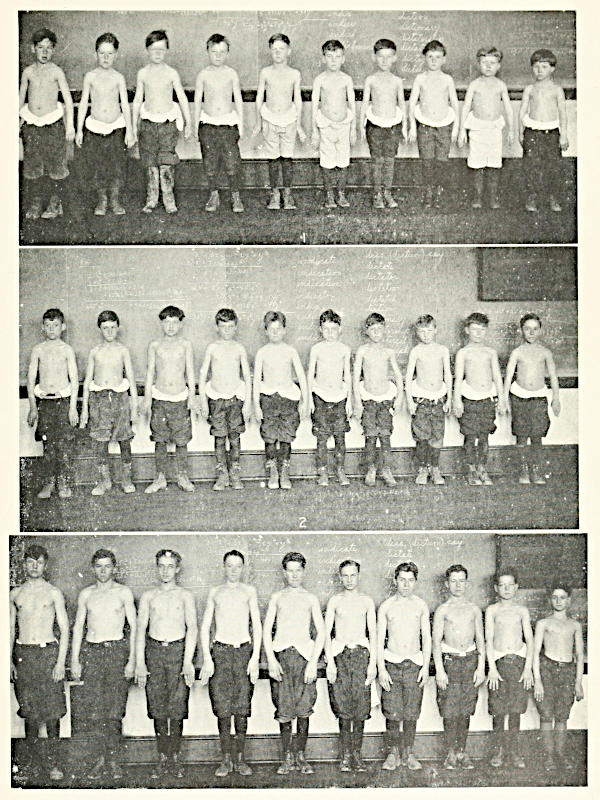
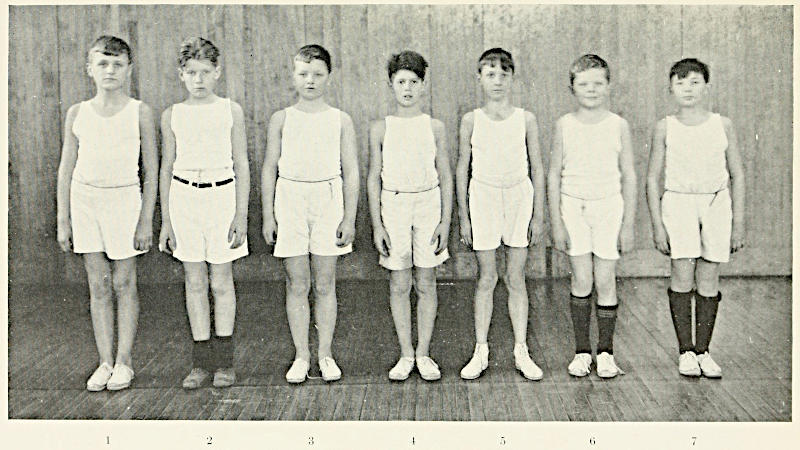
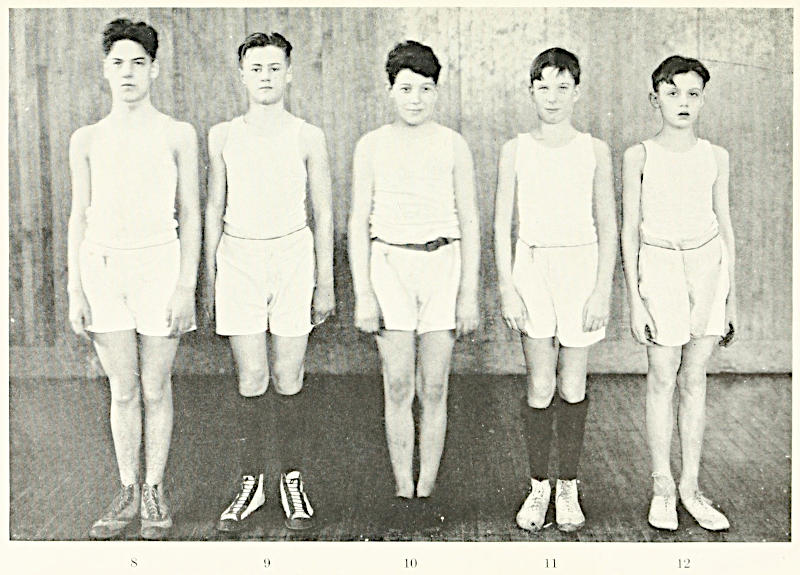
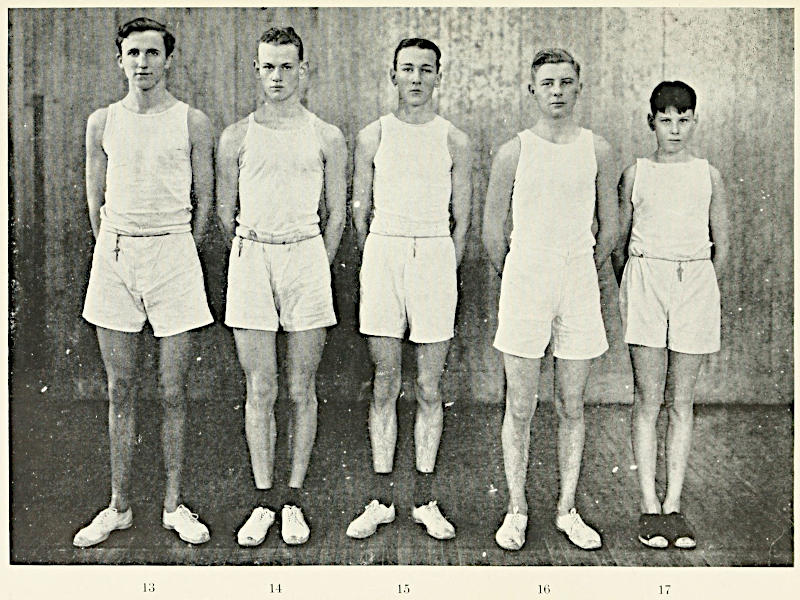
of boys on plate 3 were obtained for me by Dr. William
Burdick, of the Playground Association of Baltimore. Through the
kindness of Mr. Carle O. Warren, of the Marquand School, Brooklyn,
the photographs of boys of various ages shown on plates 4 to 6 were
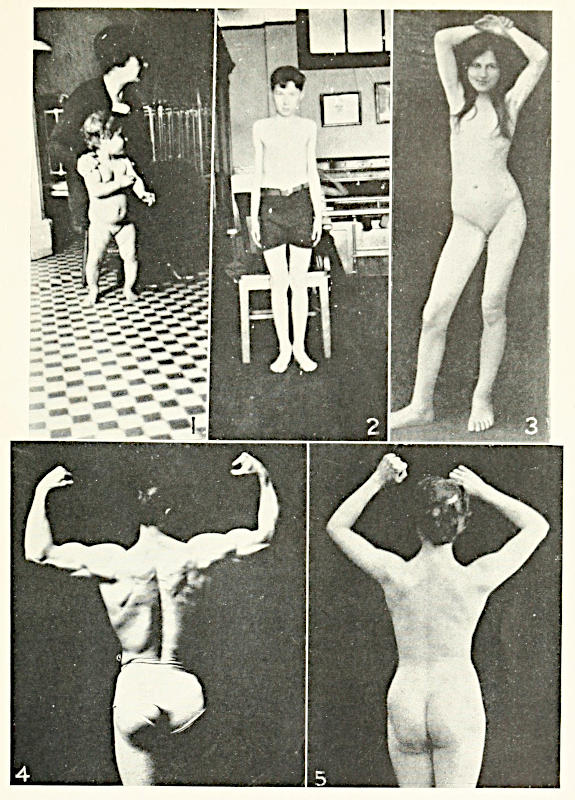
secured. Dr. Harvey G. Beck and Dr. L. F. Barker gave permission
for the republication from Barker’s “Endocrinology and Metabolism”
of the photographs at the bottom of plate 8. The families who have,
on request, furnished special data are too numerous to mention. To
all of the foregoing I desire to express sincerest thanks.
TABLE OF CONTENTS. — BODY-BUILD AND ITS INHERITANCE
Charles Benedict Davenport Director of Department of Genetics,
Carnegie Institution of Washington
PART I. BUILD, ITS DEFINITION AND ITS ONTOGENY. — A. GENERAL CONSIDERATIONS. — Types of Variation in Build. — The Measurement of Build. — Sexual Differences in Build. — Racial Differences in Build. — Geographical Differences in Build.
If a hundred men of about the same stature be compared, it is seen
that they vary greatly in weight. At the same time they vary in
form, and especially in bulk. This variation is popularly recognized
by the variety of terms applied to build. It may be of interest to
pause a moment to consider popular terminology relating to build.
We have, first, terms expressing a marked deviation below the normal
build. We speak of persons as “slender,” “thin,” “gaunt,” “slim,”
“slight,” “spare,” “lank,” and “spindling.” These terms are not
exactly synonyms. “Lank” implies angularity; “gaunt” connotes the
ravage of disease; “thin” connotes a loss of weight; “slight” connotes
lightness and smallness of bone; “spindling” is used especially of
youth in the period of rapid growth preceding adolescence; “slim”
has a faint connotation of insufficiency; “slender” best expresses the
idea which we shall want to use in this work where we have a relatively
small interest in stature and where we wish to avoid connotation
of disease, developmental changes, etc. In other languages there
exists a series of terms which similarly differ slightly in connotation.
Thus, in French, there is “maigre,” in German “mager,” which
often connote a loss of weight through disease, “dünn,” which connotes
loss of a former more nearly average weight, and “schlank,”
which is close to the English “slender.” On the other hand, the
English language contains a variety of terms applicable to deviation
in build above the average. Thus we have the words “stout,”
“portly,” “fleshy,” “corpulent,” “thick-set,” “obese,” “chubby,” and
“fat.” The word “stout” usually carries a connotation of vigor. The
term “portly” connotes large size with a tendency to excessively great
circumference. “Fleshy” is nearly synonymous with “portly” but has
less connotation of majesty of size. “Corpulent” usually carries a
connotation of abdominal enlargement. “Thick-set” implies a large
bony frame. “Obese” frequently connotes excessive, strictly pathological,
increase of build. “Chubby” is applied especially to infants.
“Fat” connotes excessive production of fat in the body, as opposed to
an unusually large muscular development. Perhaps of all of these
terms “fleshy” is as satisfactory as any as an expression for build
without connotation in respect to degree or source of great weight,
whether due to fat, muscle, or bone. In the German language there
are the terms, “plump,” and “schwerfällig,” which serve to express
large build. In the French language there are the terms, “gros,”
“obese,” and “embonpoint,” which is near to the English equivalent
“stout” or “fleshy.” In the present work the term “fleshy” is used,
despite its slight suggestion of muscular development merely, largely
because it begins with a different letter from slender. The word
“slender” will be used for the other extreme of build. It has been
found convenient to indicate those terms by their initial letters “S”
and “F” respectively.
Our main problem is, in how far does this difference in build between
slender and fleshy persons depend on constitutional factors?
Two types of variation in build have to be distinguished: (a) the
ontogenetic change in normal build during development with increasing
stature, and (b) the change in weight in adults of relatively
invariable stature. In type a, stature and other proportions are
rapidly changing, but in type b, stature remains constant, and,
throughout the race, stature does not differ as much in mature persons
as it does from birth to maturity. These two types follow different
laws and must be studied by different methods. Consequently they
are considered in distinct parts of the present paper.
It is now necessary to consider how build may best be expressed
quantitatively. The subject of the best index of build has been much
discussed, but without sufficiently differentiating between the two
types of variation in build, the ontogenetic and the adult. One of the
latest authors to consider the matter is Bardeen (1920, p. 486), who
mentions the desirability of recording the volume of the body as a
whole, notes its impracticability, and concludes that we may estimate
volume from weight. It may, however, be doubted if volume is really
involved in the popular notion of build. At least, it is equally probable
that the idea of build, as popularly conceived, is a relation of
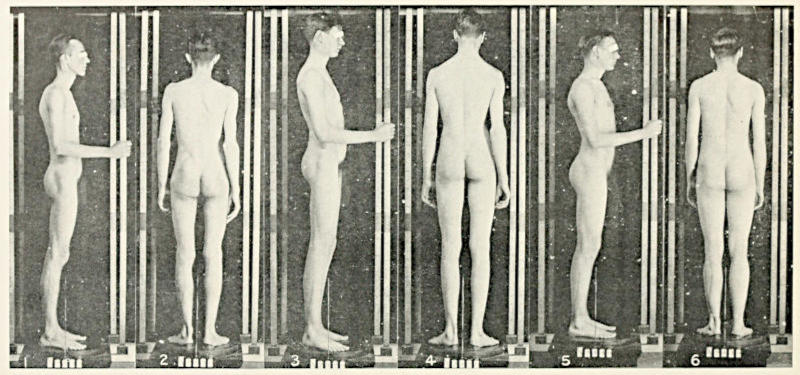
transverse to vertical diameters. When I look at a man, or a photograph
of one as in plate 1, and think, “he is slender,” it is because I
make a mental comparison of his breadth (of shoulders or chest) with
his height and find that his breadth in comparison with that of most
men I know of that height is small; or if he is stout the diameter of
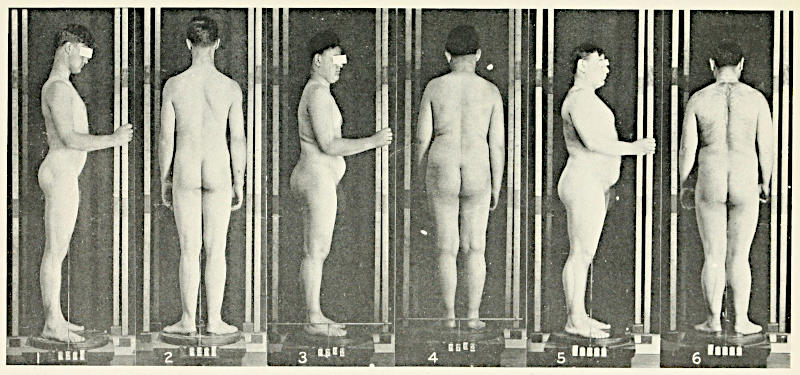
the chest is large in relation to stature (plate 2). It seems probable
that breadth in relation to height gives the best expression of the
popular idea of build. By the use of this relation, build can be easily
expressed for any age, since chest circumference (which bears a nearly
constant relation to chest diameter) has been recorded for many persons
of all ages.
Ontogenetic.—Since in so many children and young people the
stature and chest circumference have been measured, it is possible to
use these data in finding the law of normal ontogenetic changes in
build from birth to maturity. This ratio, chest-girth ÷ stature, has
thus been used in discussing this law, as more fully described in section
B. This relation can be used for tracing the change in build of
the same developing child or for tracing the average change of build.
Adult.—In the study of adult changes of build we start with the
condition that in the individual the stature is fixed. Consequently,
in an individual whose weight is changing, the relation of the build at
a years is to that at another period n years later as chest-girth
at a years : chest-girth at a + n years. Thus, in the adult period,
changes of build are proportional to chest-girth. In different persons,
of differing stature, the stature has to be taken into account, and the
differences in build are measured by the relation of relative chest-girth
as in children. Unfortunately, in our study of heredity in adult
build, we usually do not know the chest-girth of the different members
of the family, but only their stature and weight. Our problem is,
then, to find a relation between chest-girth and weight that will
enable us to infer the one from the other. This problem will be further
considered in a later section (p. 24).
Sex influences the body so profoundly that we have, first of all, to
consider its influence on build, either in early or in adult stages. At
birth there is, on the average, a difference between the sexes in
weight. The male is about 2.5 per cent heavier than the female
(3,310 : 3,230 grams in German children, Daffner, 1902, p. 125, quoting
Hecker; 3,606 : 3,485 grams in American children, Benedict and Talbot,
1915). But this does not imply that the boy baby is the
chubbier, since the boy baby is longer by about 1.7 per cent than the
girl baby. There is no obvious difference in the chubbiness of the
sexes at birth. Likewise, in later infancy no obvious difference has
been detected, though no thoroughgoing studies have been made on
this subject. In childhood and youth children of different sex differ
in build on the average, but this is because the form of the ontogenetic
curve of build is very different. After maturity and cessation of
growth, there is a marked difference in form between the sexes. The
female has more subcutaneous fat and appears plumper. If the
criterion of weight be applied, the complication arises that the specific
gravity of the female seems to be less than that of the male (Bardeen,
1920, p. 488, following Meeh, 1895). As found by Medico-Actuarial
Mortality investigations of the Associated Life Insurance Medical
Directors of the Actuarial Society of America, 1912, volume I, p. 251:
“The difference in weight between men and women of the same
height is slight under the age of 20, but above that age young men
are distinctly heavier than young women, the difference becoming less
marked as they grow older. The tall women are markedly lighter
than men of the same height.” The main reason for the greater
weight of young men is their relatively much greater chest circumference.
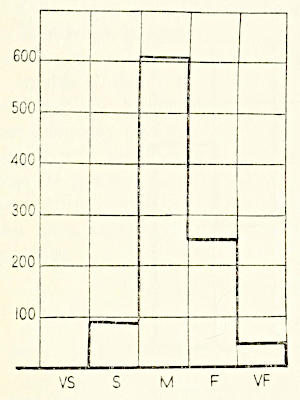
Table 1.—The distribution of frequencies of the various classes
of build of offspring derived from the various types of matings.
Average male index of build, 35.81 ± .12. Standard deviation, 5.33 ± .084.
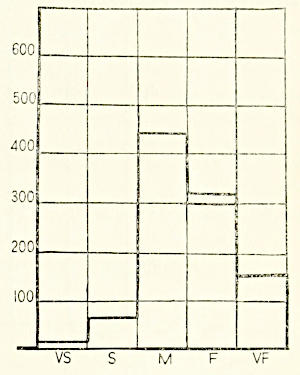
Table 2.—The distribution of frequencies of the various classes
of build of offspring derived from the various types of matings.
Summation Table, Females only. Based on Table 11a.
Type of mating.
No. of matings.
No. of children.
Build of female offspring.
VS
S
M
F
VF
VS×S
4
6
1
4
1
0
0
VS×M
8
17
1
5
10
0
0
VS×F
5
13
1
4
6
1
1
S×S
23
18
4
11
3
0
0
S×M
101
134
0
36
78
15
5
S×F
49
67
2
16
29
19
1
S×VF
11
11
0
1
6
4
0
M×M
92
149
2
21
81
41
4
M×F
114
146
0
19
90
30
7
M×VF
30
53
1
4
29
12
7
F×F
33
79
0
12
30
27
10
F×VF
30
43
0
3
16
14
10
VF×VF
7
9
0
0
5
3
1
Total
507
745
12
136
384
167
46
Average build
24.17
28.69
33.41
39.23
46.76
Average female index of build, 34.54 ± .13. Standard deviation, 5.13 ± .09.
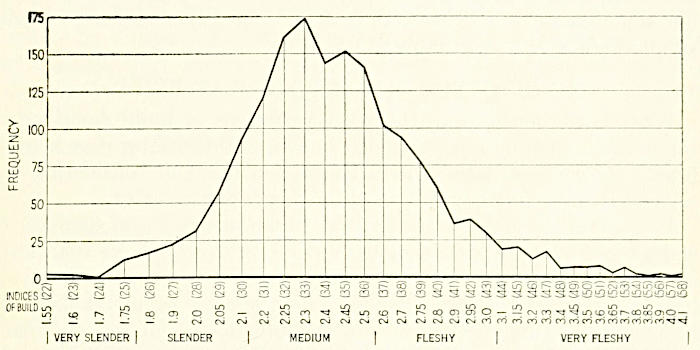
Proceeding by a method to be developed later, I have divided adult
build into five classes, and counted for the various matings the number
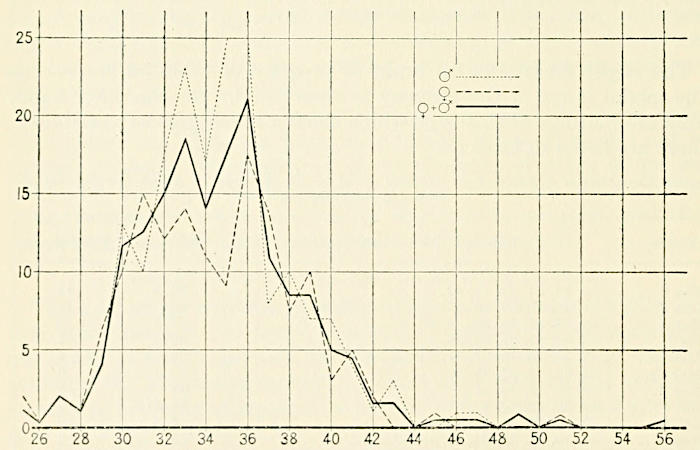
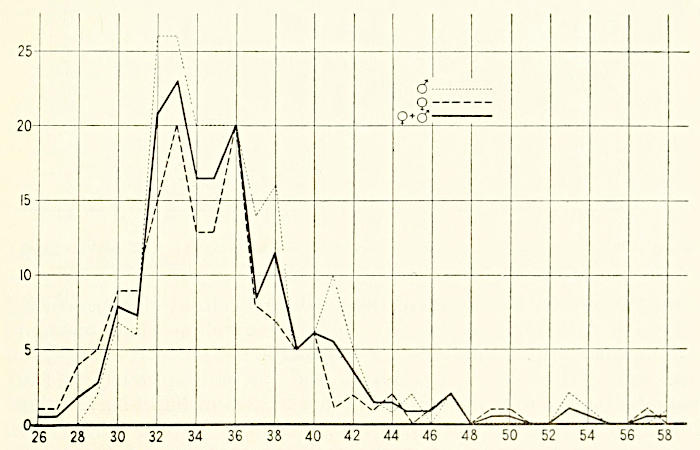
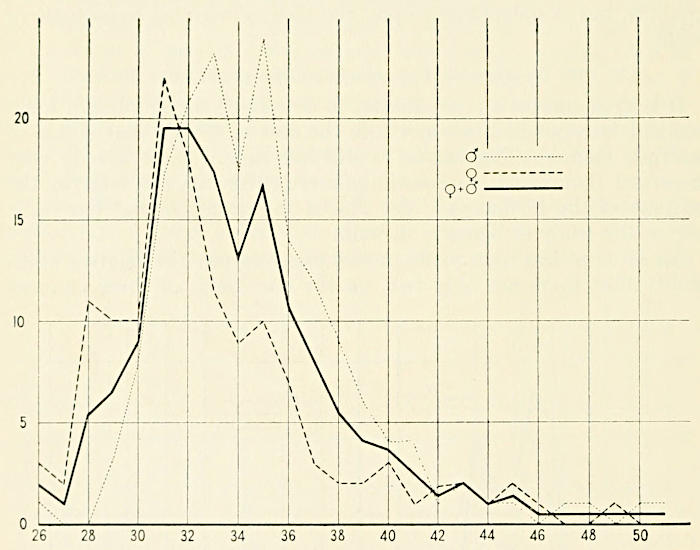
of children falling into each. (See tables 1 and 2.) The average index
of build, obtained from the individual indices of build, is 2.52 (metric
system) or 35.81 ± 0.12 (English system) for males, and 2.43
(34.54 ± 0.13) for females, a difference of only 3.7 per cent in favor
of the males, a difference that for our purposes can be neglected. A
separation of the sexes in our studies will therefore be, ordinarily,
not attempted, and this has the advantage in giving us larger frequencies
in our tables.
That there are marked racial differences in build is notorious. The
slender Scotchman (plate 1, fig. 3) is in striking contrast with the
South Italian, Greek, or Russian Jew (plate 2, fig. 3). The Eskimo
are noted for their fleshiness, but Arctic conditions seem to favor large
build. (See Davenport and Love, 1921, p. 165.) Martin (1914, p.
248) gives an average body-build of 1.42 (2.3 our system) for South
Russian Jews and 1.07 (1.7 our system) for Bushmen. Probably the
Nilotic negroes are the slenderest race on earth (Martin, 191, p. 254;
for photograph see Martin, p. 263, or Davenport, 1917, p. 347). The
racial differences in body-build are so great that, when feasible, race
should be taken into account in studies on body-build.
Apart from race, it seems probable that climate influences build.
The races that live in the north polar region are of stout build, but
this may be a racial trait. On the other hand, the whites who come to
live near the pole are heavier than those who live near the equator.
This may be due to relative freedom in the subpolar area from certain
diseases which reduce weight. There may, however, be a physiological
response of the body to the long, cold winters. Whatever the
explanation, men from Alaska were found, at mobilization of the
United States Army in 1917-18, to have a much higher index of build
than those from any other region, i. e., 2.28 (32.41);[1] North Dakota
and South Dakota came next, with indices of 2.24 (31.85) and 2.23
(31.73) respectively. These were followed by Montana, Minnesota,
and Wisconsin. Contrariwise, the recruits from the Gulf States had
a low index of build. Whatever the determining causes, geographical
differences in build do exist. Consequently, in studies of build, it is
desirable to consider the residences of the persons studied.
[1] The method of measuring build is discussed at page 24. The
smaller index (usually lying between 1.5 and 4.5) is the metric index.
The larger index (20 up to 100) is the English system index, and is
usually expressed without decimals.
B. THE ONTOGENY OF BUILD. — Materials and Methods. — The Ontogenetic Curve of Build. — Later Ontogenetic Changes in Individual Build. — Relation of Juvenile to Adult Build.
From the time of fertilization of the egg it proceeds on its course
of development directed by its “hereditary factors,” but modifiable
by the conditions offered by the environment. Thus is determined the
weight of the baby at birth, and thus the build of the later stages to
maturity are directed. It has seemed useful to measure the changes
in build from birth to maturity, using the method of measuring build
during development described in an earlier section (p. 4).
The materials available for such a study are considerable and may
be drawn from a large number of different nationalities. A selection
had to be made from this material; there were chosen the best available
series from those nationalities most representative of the population
of the United States, considering the diversity of its European
origin. Two sets of data were utilized: first, collections of measurements
made on males from 1 year to 21 years; second, some collections
from children of both sexes from birth to 1 year of age.
The first collection of data is gathered from nine sources, listed
below. The data used are given in detail in table 3, which shows the
number of individuals measured by each observer at each age, the
average relative chest-girth at that age, and the average, for each age,
of the different averages of the relative chest-girths formed by each
observer. These averages are not weighted, since the racial stocks
measured by the different observers differed. The average of each
observer has therefore to be considered as a unit of nearly equal value
with that of any other (table 3).
1. Quetelet (1870) data. As Quetelet’s original book was not available,
the data reprinted in Bardeen (1920, p. 544) were used. Quetelet measured
10 persons at each age from 1 to 20 years (and older). He selected his
subjects with good judgment and the resulting curve of varying build is
remarkably smooth. The subjects were doubtless Belgians.
2. Weissenberg (1911) data. These were gathered by observations on
South Russian Jews. The numbers observed ranged from 15 males at birth
to about 40 to 100 at later ages. This series is of especial value because
such large numbers of individuals of each age were measured and because
in it are considered only children as near as possible to their birthdays;
that is, as 2 or 3 year old children were taken those of exactly 2 or 3 years
± 2 months; as 4, 5, and 6 year olds, 4, 5, and 6 years ± 3 months; as 7 and
8 years, 7 or 8 years ± 4 months. For older children the even year ± 5
months was taken. The measurement was taken at the line of the nipples
and below the lower apex of the scapulæ; chest apparently at rest.
3. Benedict and Talbot (1920) data. These were gathered from healthy
children of Boston, Massachusetts. Girth was taken at the nipples, in a
quiescent condition. The number of individuals considered at each age is
small (1 to 9), but the data are precious, because so few have been published
for the period 2 to 5 years.
4. Masters Day Nursery data. Original, from measurements made upon
healthy children in New York City. The chest was measured at the line
of the nipples in a quiescent condition. The numbers are small, 2 per year.
5. Town (1922) data. A special study of 5 and 6 year old children of
Cedar Rapids, Iowa. There were 31 and 11 children respectively.
6. Reitz (1904) data. A study of school children of Berlin, Germany.
Chest-girth measured “at rest.” From 23 to 209 at the respective ages from
6 to 19 years, inclusive.
7. Baldwin (1921) data. A group of 60 boys of the well-to-do class at
the Horace Mann School, New York City, were measured repeatedly in
successive years from 7 to 17 years of age inclusive. Chest at “normal”
condition.
8. Godin (1903) data. Measurements taken annually on the same 100
boys in a French military school at St. Hippolyte-du-Fort, Gard. Chest-girth
below pectoralis in repose. Ages 13½ to 17 years inclusive.
9. Hitchcock, Seeley, and Phillips (1900) data. Measurements made on
about 40 to 600 students at Amherst College at each age from 16 to 26 years
inclusive. The chest-girth is made at the level of the nipples and embraces
the scapulæ.
Table 3.—Average relative chest-girth (chest girth + stature)
at different ages from birth to maturity, males.
[According to the observations of 9 sets of observers. The main entries
of the table are given in 4 places of decimals (points omitted). Immediately
to the left of each main entry is given the number of persons measured to
obtain that average. The column on the extreme right gives the (unweighted)
average of the averages standing on the same line.]
Time.
1. Quetelet.
2. Weissenberg.
3. Benedict and Talbot.
4. Masters Day Nursery
5. Town.
6. Reitz.
7. Baldwin.
8. Godin.
9. Hitchcock.
Unweighted averages.
No.
Avg.
No.
Avg.
No.
Avg.
No.
Avg.
No.
Avg.
No.
Avg.
No.
Avg.
No.
Avg.
No.
Avg.
Birth
10
5900
5511
3
6600
6004
1 year
10
6300
3
6300
6300
2 years
10
5850
38
6005
6
6060
5972
3 years
10
5600
38
5803
1
5760
5721
4 years
10
5430
38
5567
2
5600
5532
5 years
10
5300
55
5353
4
5340
2
5263
31
5082
5268
6 years
10
5200
55
5208
4
5040
2
5136
11
4990
5115
7 years
10
5110
81
5058
7
5190
2
5072
60
4852
5056
8 years
10
5040
95
5030
7
5100
60
4821
4998
9 years
10
4990
112
5016
7
5060
168
4573
60
4805
4889
10 years
10
4950
132
4952
5
5150
181
4569
60
4793
4883
11 years
10
4920
117
4911
9
4950
209
4595
60
4740
4823
12 years
10
4910
103
4780
6
4810
189
4546
60
4731
4755
13 years
10
4900
115
4850
143
4542
60
4762
100
4966
4804
14 years
10
4900
109
4866
158
4506
60
4745
100
5071
4818
15 years
10
4910
102
4923
140
4550
60
4813
100
5166
4872
16 years
10
4930
103
4888
117
4626
60
4870
100
5295
40
5000
4935
17 years
10
4970
108
4929
70
4598
60
4974
100
5296
250
4968
4956
18 years
10
5040
115
5046
40
4684
600
5003
4943
19 years
10
5110
116
5076
23
4833
600
5089
5027
20 years
10
5180
129
5040
600
5136
5119
21 years
600
5205
5205
25 years
5250
5291
5271
Owing to the complex nature of the curve of build during the first
year of development, special collections of data were made for this
portion of the curve (table 4). They are listed as follows:
1. Original data contributed by Dr. Bret Ratner, pediatrician, of New
York, being measurements made in May and June, 1922, of weight, length,
and chest circumference on 11 babies at the Manhattan Maternity Hospital
during each of the first 10 days after birth. There were 9 boys and 2
girls. Judging alone by the surnames, there were apparently of British
stock 6, of German stock 2, of Italian stock 2, and of Spanish stock 1. It
is very difficult to measure length and chest-girth of infants. Length “on
birthday” was generally taken with the child suspended by its feet, chest-girth
with the chest as quiet as possible. The first measurement was taken
as soon as the baby was born, and each morning thereafter at 8ʰ30ᵐ a.m.
The later lengths were measured on a graduated board.
2. New York Milk Station data collected by Miss Louise A. Nelson and
Miss Margaret R. Babcock, of the Eugenics Record Office staff. They were
made during May and June 1922, on healthy babies, without clothing. The
length was measured with the aid of a graduated board. Boys and girls
were both included, as at this age their build is not very different, on the
average. The numbers ranged from 4 to 52 for the various months from
0.5 month to 13 months by 0.5-month intervals.
3. Ratner advanced data. Original data secured by Dr. Bret Ratner
(at Manhattan Maternity Hospital, New York City, on healthy children
whose parents brought them repeatedly to the hospital) and kindly given
to the writer for this study. In this series, observations are especially
abundant at 1, 1.5, and 2 months (47, 170, and 30 cases respectively).
4. Grover (1915) data. Boys only among out-patients of the Children’s
Hospital, Boston, and visitors at milk stations. No clothing. Chest measured
at level of nipples, midway between inspiration and expiration.
Length measured on graduated board. From 2 to 5 at each month of age.
5. Benedict and Talbot (1920) data. (See No. 3, p. 9.) One to 6
individuals at the various months.
6. Schmid-Monnard (1892) data. Copied from Bardeen (1920, page
542). Boys and girls measured at Frankfort am Main, Germany. 8 to 67
in respective months. Ages 1 to 13 months and up to 30 months.
7. Crum (1915) data. Average measurements of babies without regard
to sex, 193 to 264 per month, mostly baby-show babies and hence strongly
selected. Various parts of the United States.
From the foregoing collections of data, tables 3, 4, and 5 were drawn
up, giving for each age the mean relative chest-girth found by each
observer. Also, the number of individuals upon which the measurement
is based, necessary for weighting the mean. The mean of all
measurements was weighted in table 4, but not in table 3 for the
reasons stated on page 8.
Table 4.—Average relative chest-girth of infants from birth to 13 months.
[Obtained from 6 series of observations, described on pages 12, 13. The main entries of the table
are given in 4 places of decimals (point omitted). Immediately to the left of each main entry is
given the number of persons measured to obtain that average. The column at the extreme right
gives the weighted averages of the averages standing in the same line.]
Time.
3. Ratner.
2. N. Y. Milk (♂ and ♀.)
4. Grover.
5. Benedict and Talbot.
6. Schmid and Monnard.
7. Crum.
Aver.
No.
Avg.
No.
Avg.
No.
Avg.
No.
Avg.
No.
Avg.
No.
Avg.
2 weeks
32
6641
4
6533
3
6599
6627
1 month
47
6602
26
6504
2
5861
2
6249
67
6280
6419
1.5 months
170
6772
36
6639
4
6574
6745
2 months
30
6670
52
6623
4
6661
3
6765
44
6470
6512
3 months
11
6700
49
6566
3
6220
4
6529
37
6040
6382
4 months
12
6542
39
6542
3
6157
4
6304
30
6510
6507
5 months
10
6492
26
6522
3
6278
3
6455
37
6230
6368
6 months
8
6500
39
6542
5
6278
6
6117
27
6540
259
6556
6540
7 months
10
6720
27
6424
3
6203
3
6500
19
6240
256
6468
6456
8 months
3
6267
23
6317
4
6464
1
6308
16
6400
232
6470
6450
9 months
3
6550
26
6364
3
6060
4
6352
29
6160
211
6355
6333
10 months
2
6200
18
6431
2
6237
2
6110
17
6400
209
6404
6400
11 months
1
6600
13
6354
2
5868
1
6174
15
6120
193
6336
6318
12 months
1
5800
8
6271
1
5691
1
6383
22
6090
289
6298
6280
13 months
11
6186
1
6026
19
6080
264
6235
6222
It will be observed that the means of build differ, for the constant
age, more than do the differences between successive ages. That is to
say, the absolute difference between races at any given age is greater
than the average differences between one year and the next.
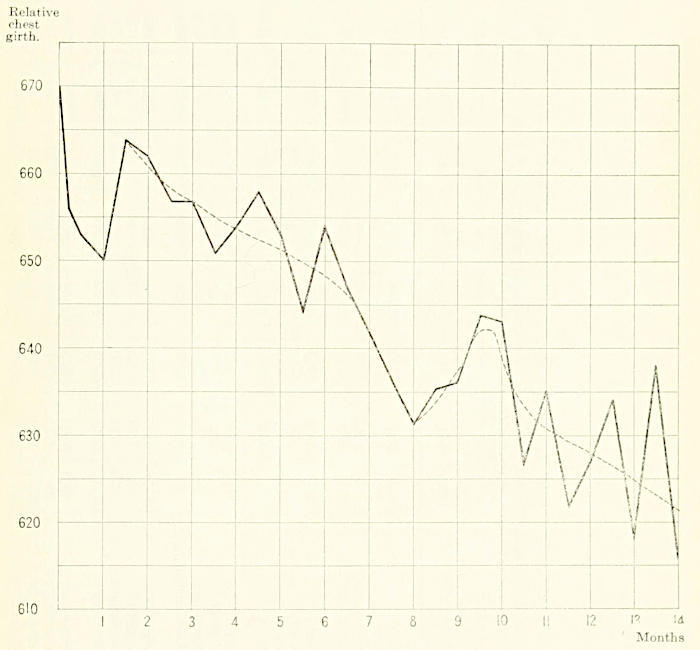
The mean relative chest circumferences for the different ages are
plotted in figure 2.
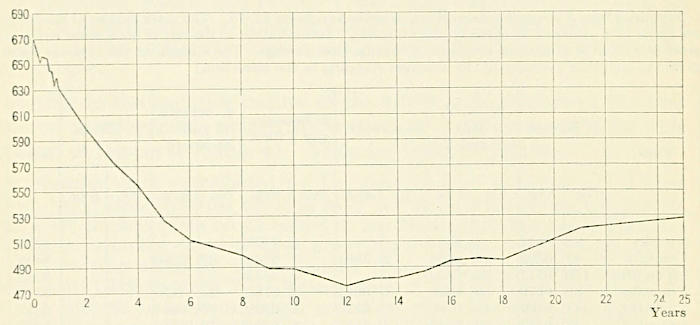
The resulting curve of build from birth to maturity is given in
figure 1. This curve shows that build in males is greatest at birth,
or at about 1 month, and that it then steadily diminishes to 12 years
of age. It then slowly increases to maturity, and indeed to 30 years,
after which it increases with extreme slowness, probably to 55 years.
Fig. 1.—Polygon of development of relative chest-girth, male.
Abscissæ: Age in years. Ordinates (chest ÷ girth/stature) × 1000. Based on averages of
the measurements of Quetelet (Belgians), Weissenberg (Russian Jews), Benedict and
Talbot (U.S.A.), Masters Day Nursery, N. Y. City, Town (Iowa children), Gray and
Jacobs (school boys, well-to-do), Reitz (Germans), Godin (French), Hitchcock (U.S.A.
college men), Baldwin (N. Y. City schools).
From table 4a and the curve of build, figure 2, we see that the infant
at birth has a chest-girth which is somewhat over two-thirds of
stature (0.6685). It falls rapidly to one month after birth, and then
begins to rise. This minimum is connected with the loss of weight
which follows birth, and is due to the difficulty of making adjustments
to the new conditions which the organism has to meet. This adjustment
is soon thereafter completed and within 2 months chest-girth
and weight are not only recovered, but have caught up with increasing
length of body. At 6 weeks the body has reached its maximum
post-natal chubbiness. Another temporary loss in chubbiness occurs
at about 8 months, due perhaps to the cutting of the incisors. The
decline which subsequently ensues is prevailingly due to the rapid
growth of the legs without corresponding increase in transverse
diameter (plates 3 and 4). At about 12 years the boy enters the
awkward age when, his legs and arms having grown from 5 to 10 cm.
in a single year, he has not yet acquired muscular control of them
(plate 7, fig. 2). At the same time his trunk retains childish proportions
(plate 5, fig. 12). A little earlier than the boy, the girl enters
the “Backfisch” stage of similar slenderness and awkwardness (plate
7, fig. 3, from Stratz, 1922, p. 258). It is commonly believed that
this rapid growth of the appendages and their long bones is controlled
by the secretions of the pituitary gland. Gradually in the boy, at
14 years, as the gonads begin to ripen, the growth of the legs is
retarded and the transverse chest diameter begins to increase rapidly;
the lad is quickly transformed into a broad-shouldered, broad-chested,
stocky man (plate 3, fig. 3, plate 5, fig. 8) and accordingly the curve
of build rises much more in the young man than in the young woman
(plate 7, figs. 4 and 5). Consequently the adult female build, as
measured by relative chest circumference, is relatively small. At
about 19 or 20 years’ growth in stature has usually practically ceased.
Meanwhile chest-girth increases slowly by the enlargement of trunk
muscles and deposition of fat. Weight is, indeed, stated to increase,
on the average, until the age of 55 years (tables 6 and 7).
Fig. 2.—Polygon of relative chest-girth in
infants, from birth to fourteen months, with smoothed curve of build
(dotted line). Data from New York Milk Stations and Dr. B. Ratner.
Table 4a.—Weight, chest-girth, length of body, and relative
chest-girth at birth and daily thereafter at 8ʰ30ᵐ for 10 days for 11
babies.
[Data furnished by Bret Ratner, M.D., from Manhattan Maternity Hospital
and Dispensary, New York City. Weight in grams; chest-girth and length
in millimeters. Relative chest-girth in ten-thousandths. Final average
relative chest girth is multiplied by 1.037 to adjust to Table 4.]
Measurements, etc.
At birth.
1st day.
2nd day.
3d day.
4th day.
5th day.
6th day.
7th day.
8th day.
9th day.
10th day.
No. 1, male. Time of birth, V 30, 2ʰ00ᵐ
{ Weight
2126
2084
1970
1899
1885
1821
1871
1899
1899
1899
1928
{ Ch. girth
28
28
28
27.75
27
26.5
27.5
27.5
28
27.5
27.5
{ Body-length
45
43.75
43.13
42.75
43
43
42
42.25
42.25
43
43.75
{ Rel. ch. girth
6400
6493
6491
6279
6163
6548
6509
6627
6395
6286
No. 2, male. Time of birth, V 30, 2ʰ25ᵐ
{ Weight
3472
3494
3423
3366
3430
3466
3529
3508
3515
3529
3572
{ Ch. girth
35
35
34.25
33
33.5
34
33.5
33
33.5
33.5
33.5
{ Body-length
52
52.25
51.5
50.75
51.5
52.25
52.25
52.25
52.5
52.5
52.5
{ Rel. ch. girth
6699
6651
6503
6505
6507
6412
6416
6381
6381
6381
No. 3, male. Time of birth, V 30, 19ʰ35ᵐ
{ Weight
2963
2927
2842
2729
2736
2835
2821
2849
2835
2913
2927
{ Ch. girth
33
32.25
31
31
32
32.5
32
31
31
32.5
32.5
{ Body-length
50
50.5
49
49
49.25
49.5
49.5
50
50
50
50.25
{ Rel. ch. girth
6386
6327
6327
6498
6566
6465
6200
6200
6500
6468
No. 4, male. Time of birth, V 30, 13ʰ00ᵐ
{ Weight
3558
3487
3303
3154
3204
3303
3359
3409
3416
3473
3494
{ Ch. girth
34
34
33.5
33.25
34
33.5
34
34
34
34
34.5
{ Body-length
52
51
50
50
51.75
51.5
51.5
51.25
51.25
51.5
51.5
{ Rel. ch. girth
6667
6701
6650
6570
6505
6602
6634
6634
6602
6699
No. 5, male. Time of birth, VI 1, 3ʰ00ᵐ
{ Weight
3005
3305
2913
2856
2892
2906
2991
3069
3104
3125
3147
{ Ch. girth
32
31
31
31
32
32
31
32
33
33
32
{ Body-length
52
51
51
50.75
51
51
51.25
51.5
52
52
51.25
{ Rel. ch. girth
6078
6078
6108
6275
6275
6079
6214
6346
6346
6244
No. 6, male. Time of birth, VI 1, 12ʰ45ᵐ
{ Weight
3019
2913
2877
2750
2863
2828
2927
2849
2906
2962
2977
{ Ch. girth
32.5
31.75
31.25
31.75
31.75
32
32
32
32
31.5
32
{ Body-length
49
49
49.25
49.25
49.25
48.75
49
50
50
50.5
50.5
{ Rel. ch. girth
6480
6345
6447
6414
6564
6530
6400
6400
6238
6337
No. 7, male. Time of birth, VI 1, 23ʰ00ᵐ
{ Weight
3175
3147
3005
2962
2892
2906
2941
2984
2969
3012
3026
{ Ch. girth
33
32.5
32
32
31
31.5
32
32
32
32
32
{ Body-length
50
51.25
50.75
50.75
51
51
51
51.75
51.75
51.75
52.75
{ Rel. ch. girth
6342
6305
6305
6078
6177
6275
6184
6184
6184
6184
No. 8, female. Time of birth, VI 3, 22ʰ00ᵐ
{ Weight
2835
2750
2679
2587
2587
2629
2651
2672
2693
2750
2722
{ Ch. girth
31.5
32.5
31
31
31
31
31
30
31
31
31
{ Body-length
50
48.75
48.75
49
49
49.5
49.5
49.5
49.5
50
49.5
{ Rel. ch. girth
6667
6359
6327
6327
6263
6263
6060
6263
6200
6263
No. 9, male. Time of birth, VI 5, 23ʰ00ᵐ
{ Weight
3657
3657
3572
3381
3366
3473
3487
3544
3544
3565
3536
{ Ch. girth
33
33.5
33
33
33.5
33.5
33.5
33
33
33.5
33.5
{ Body-length
53
53
52.5
53.5
53.5
53.5
53.5
54
54
54.5
53.75
{ Rel. ch. girth
6321
6286
6168
6262
6262
6262
6111
6111
6147
6233
No. 10, male. Time of birth, VI 6. 7ʰ00ᵐ
{ Weight
3232
3118
2948
2821
2814
2835
2849
2870
2877
2948
2941
{ Ch. girth
32
34
31
31
31
31
31.5
31.5
31.5
31.5
31.5
{ Body-length
52
51.25
50
51.5
51.5
51.5
51.5
51.5
51.5
52
52
{ Rel. ch. girth
6244
6800
6019
6019
6019
6019
6117
6117
6058
6058
No. 11, female. Time of birth, VI 5, 17ʰ00ᵐ
{ Weight
3303
3175
3076
2962
2934
2955
2962
3033
3059
3033
2984
{ Ch. girth
34
34
34
33
33
32.5
32.5
32.5
32.5
32.5
33
{ Body-length
52
50.25
50
50
50
50
50
50.25
50.25
50.25
50.75
{ Rel. ch. girth
6766
6800
6600
6600
6500
6500
6467
6467
6467
6503
Total relative chest-girth
710483
711435
699448
698260
697994
699232
692119
697300
695178
696529
Average relative chest-girth × 1.037
661
670
671
659
658
658
659
652
657
655
655
It may be well to consider briefly, necessarily somewhat speculatively,
the significance of this ontogenetic change in build. First of
all, the high relative chest circumference of infancy is due chiefly to
the extremely short legs of the infant. Leg-length constitutes only
about 40 per cent of stature at birth, whereas it comes to constitute
53 to 55 per cent at maturity. Consequently, the relative leg-length
at infancy is only a trifle more than 70 per cent of the adult relative
leg-length. Likewise the leg-length of the gorilla is about 70 per cent
that of a European man (German, cf. Martin, 1914, p. 308). Consequently
the relative leg-length of the infant, at birth, is to that of the
adult as the relative leg-length of an anthropoid ape is to the relative
leg-length of man. Incidentally, it may be added that the relative
length of the arm of the infant is only slightly (8 per cent) less than
that of the adult, while in the chimpanzee the relative arm-length is
18 per cent greater than that of man.
We have seen that the relative leg-length of the boy increases to
about 12 years and thereafter diminishes to the period of completed
growth. The white man has his greatest leg-length shortly before
adolescence. We find that among the races of mankind it is the long-legged
negro tribes of East Africa, especially the upper Nile (Johnston,
1906. II, p. 932), which are among the lowest races of mankind,
and which seem to represent in the adult the physical stage through
which the white boy passes at 12 years. Other African tribes have,
indeed, relatively shorter legs and thus show a persisting adult stage
that is either slightly younger or slightly older than that of the
12-year-old white boy.
Figure 1 (to return to it after this digression) seems thus adequately
to measure the varying build of humans from birth to past maturity.
It may, indeed, be regarded as composed of two parts: first, that from
birth to the cessation of growth in stature, and second, that beyond
cessation of growth in stature.
The curve of build thus obtained is, apart from the first period of
adjustment that follows birth, a smoothly flowing one, that might
indeed be expressed by a formula
y = ax + bx² + cx³ + dx⁴, etc.
The curve of build of figure 1 seems to be new in this form. It is,
however, of the same general shape as the curve of varying “Körperfülle”
drawn by Martin (1914, p. 246) from Quetelet’s data and based
on the relation of weight ÷ stature³. The numbers of children considered
in Martin’s figure are inadequate and there is hardly sufficient
justification for the use of this formula to express changes of build
during ontogeny.
The ontogenetic curve of build may serve as a graphic representation
of the stages of development as listed by Stratz (1922). These
stages are shown in table 5.
Table 5.—Growth-periods in children.
[Modified from C. W. Stratz, 1922, p. 87.]
Year of age.
First (neutral) child age.
0
to
1
Infancy. Lactation.
1
to
2 }
First period of filling out.
2
3 }
3
4 }
4
5 }
First stretching.
5
6 }
6
7 }
Second (bisexual) child age. Youth.
Boys.
Girls.
7
to
8 }
Second period of filling out.
Second period of filling out (rounding
of hips and legs).
8
9 }
9
10 }
10
11 }
Second stretching (shooting up in stature).
Change of voice.
Second stretching (shooting up in stature).
Menstruation; beginning breast development.
11
12 }
12
13 }
13
14 }
14
15 }
15
16 }
Third period of filling out (broadening of chest;
rapid increase in weight). Maturity.
Third period of fullness (rapid increase in weight).
Maturity.
16
17 }
17
18 }
18
19 }
19
20 }
Any investigation of the heredity of build is apt to meet with the
difficulty that only the present weights and statures of children, parents,
and grandparents are known; that the persons are of different
ages and hence the data concerning them are not precisely comparable.
Even if we exclude from consideration children of the rapid
developmental period, under 18 years of age, still we have the problem
of individual change of build in mature life. Since stature is
practically immutable at this period, change in build may be measured
by change in weight. That change in weight does occur is notorious.
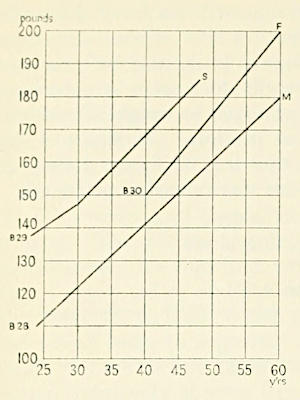
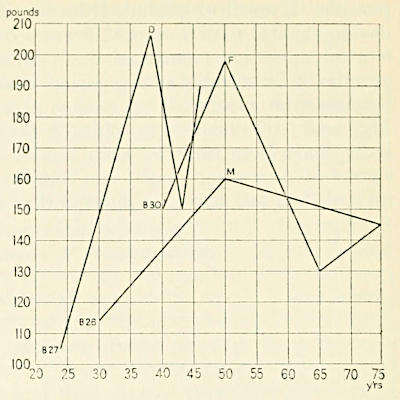
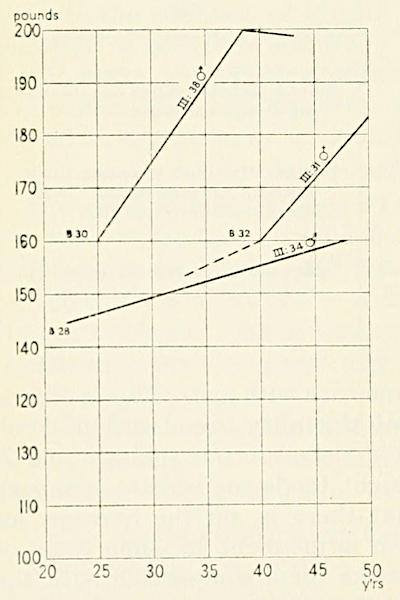
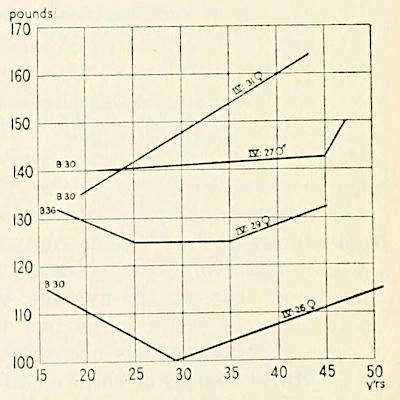
Figures 3 to 6 illustrate graphically the changes in weight in various
individuals from records taken almost at random. In figure 3 the
curves of increasing weight run rapidly upward; in figure 4 they go
up and then fall again; in figure 6 they are more nearly horizontal.
Fig. 3.—Changes in weight from 25
to 50 or 60 years of father (F),
mother (M), and son (S) in D:
Bol-1 family, showing a consistent
history of rapid increase of
build with age.
Fig. 4.—Changes in weight from 25 (or 40) years to
45 (or 75) years of father (F), mother (M), and
daughter (D) in D: Bol-1a family, showing a
history of fluctuating build.
Fig. 5.—Changes in weight from 25 to
45 years of 3 sibs belonging to the
D: Hay-1 family, showing a slight
tendency to increase with age.
Fig. 6.—Changes in weight from 15 to 50 years
in 4 sibs of the D: Ban-1 family, showing
no great tendency to change of build during
life.
On the whole, the weight tends to increase with age. This is shown
by the tables of the “Medico-Actuarial Mortality Investigation” (vol.
1, pp. 38 and 67). The tables are reproduced in our tables 6 and 7.
They show that, on the average, weight tends to increase with age
up to 50 or 51 years. The fact that there is, on the average, an
increase in build, makes necessary an adjustment in some cases of
the youthful indices of children to make them comparable with the
adult indices of their parents.
The adjustment was made to the weight of the child by finding in
the appropriate column of stature and line of age the expected weight
and adding the difference between this weight and the weight in the
same column opposite the mid-parental age to the given weight of the
child.
Table 6.—Graded average weight of men of different statures at various ages.
[Copied from Table IV of “Medico-actuarial mortality investigations.”]
Age, years.
5 feet.
5 feet 1 inch.
5 feet 2 inches.
5 feet 3 inches.
5 feet 4 inches.
5 feet 5 inches.
5 feet 6 inches.
5 feet 7 inches.
5 feet 8 inches.
5 feet 9 inches.
5 feet 10 inches.
5 feet 11 inches.
6 feet.
6 feet 1 inch.
6 feet 2 inches.
6 feet 3 inches.
6 feet 4 inches.
6 feet 5 inches.
15
107
109
112
115
118
122
126
130
134
138
142
147
152
157
162
167
172
177
16
109
111
114
117
120
124
128
132
136
140
144
149
154
159
164
169
174
179
17
111
113
116
119
122
126
130
134
138
142
146
151
156
161
166
171
176
181
18
113
115
118
121
124
128
132
136
140
144
148
153
158
163
168
173
178
183
19
115
117
120
123
126
130
134
138
142
146
150
155
160
165
170
175
180
185
20
117
119
122
125
128
132
136
140
144
148
152
156
161
166
171
176
181
186
21
118
120
123
126
130
134
138
141
145
149
153
157
162
167
172
177
182
187
22
119
121
124
127
131
135
139
142
146
150
154
158
163
168
173
178
183
188
23
120
122
125
128
132
136
140
143
147
151
155
159
164
169
175
180
185
190
24
121
123
126
129
133
137
141
144
148
152
156
160
165
171
177
182
187
192
25
122
124
126
129
133
137
141
145
149
153
157
162
167
173
179
184
189
194
26
123
125
127
130
134
138
142
146
150
154
158
163
168
174
180
186
191
196
27
124
126
128
131
134
138
142
146
150
154
158
163
169
175
181
187
192
197
28
125
127
129
132
135
139
143
147
151
155
159
164
170
176
182
188
193
198
29
126
128
130
133
136
140
144
148
152
156
160
165
171
177
183
189
194
199
30
126
128
130
133
136
140
144
148
152
156
161
166
172
178
184
190
196
201
31
127
129
131
134
137
141
145
149
153
157
162
167
173
179
185
191
197
202
32
127
129
131
134
137
141
145
149
154
158
163
168
174
180
185
192
198
203
33
127
129
131
134
137
141
145
149
154
159
164
169
175
181
187
193
199
204
34
128
130
132
135
138
142
146
150
155
160
165
170
176
182
188
194
200
206
35
128
130
132
135
138
142
146
150
155
160
165
170
176
182
189
195
201
207
36
129
131
133
136
139
143
147
151
156
161
166
171
177
183
190
196
202
208
37
129
131
133
136
140
144
148
152
157
162
167
172
178
184
191
197
203
209
38
130
132
134
137
140
144
148
152
157
162
167
173
179
185
192
198
204
210
39
130
132
134
137
140
144
148
152
157
162
167
173
179
185
192
199
205
211
40
131
133
135
138
141
145
149
153
158
163
168
174
180
186
193
200
206
212
41
131
133
135
138
141
145
149
153
158
163
168
174
180
186
193
200
207
213
42
132
134
136
139
142
146
150
154
159
164
169
175
181
187
194
201
208
214
43
132
134
136
139
142
146
150
154
159
164
169
175
181
187
194
201
208
214
44
133
135
137
140
143
147
151
155
160
165
170
176
182
188
195
202
209
215
45
133
135
137
140
143
147
151
155
160
165
170
176
182
188
195
202
209
215
46
134
136
138
141
144
148
152
156
161
166
171
177
183
189
196
203
210
216
47
134
136
138
141
144
148
152
156
161
166
171
177
183
190
197
204
211
217
48
134
136
138
141
144
148
152
156
161
166
171
177
183
190
197
204
211
217
49
134
136
138
141
144
148
152
156
161
166
171
177
183
190
197
204
211
217
50
134
136
138
141
144
148
152
156
161
166
171
177
183
190
197
204
211
217
51
135
137
139
142
145
149
153
157
162
167
172
178
184
191
198
205
212
218
52
135
137
139
142
145
149
153
157
162
167
172
178
184
191
198
205
212
218
53
135
137
139
142
145
149
153
157
162
167
172
178
184
191
198
205
212
218
54
135
137
139
142
145
149
153
158
163
168
173
178
184
191
198
205
212
219
55 and up
135
137
139
142
145
149
153
158
163
168
173
178
184
191
198
205
212
219
Table 7.—-Graded average weight of women of different statures at various ages.
[Copied from Table IX of “Medico-actuarial mortality investigations.”]
Age, years.
4 feet 8 inches.
4 feet 9 inches.
4 feet 10 inches.
4 feet 11 inches.
5 feet.
5 feet 1 inch.
5 feet 2 inches.
5 feet 3 inches.
5 feet 4 inches.
5 feet 5 inches.
5 feet 6 inches.
5 feet 7 inches.
5 feet 8 inches.
5 feet 9 inches.
5 feet 10 inches.
5 feet 11 inches.
6 feet.
15
101
103
105
106
107
109
112
115
118
122
126
130
134
138
142
147
152
16
102
104
106
117
120
124
128
132
136
140
144
149
154
159
164
174
179
17
103
105
107
109
111
113
116
119
122
125
129
133
137
140
144
149
154
18
104
106
108
110
112
114
117
120
123
126
130
134
138
142
145
150
155
19
105
107
109
111
113
115
118
121
124
127
131
135
139
142
146
151
155
20
106
108
110
112
114
116
119
122
125
128
132
136
140
143
147
151
156
21
107
109
111
113
115
117
120
123
126
129
133
137
141
144
148
152
156
22
107
109
111
113
115
117
120
123
126
129
133
137
141
145
149
153
157
23
108
110
112
114
116
118
121
124
127
130
134
138
142
146
150
153
157
24
109
111
113
115
117
119
121
124
127
130
134
138
142
146
150
154
158
25
109
111
113
115
117
119
121
124
128
131
135
139
143
147
151
154
158
26
110
112
114
116
118
120
122
125
128
131
135
139
143
147
151
155
159
27
110
112
114
116
118
120
122
125
129
132
136
140
144
148
152
155
159
28
111
113
115
117
119
121
123
126
130
133
137
141
145
149
153
156
160
29
111
113
115
117
119
121
123
126
130
133
137
141
145
149
153
156
160
30
112
114
116
118
120
122
124
127
131
134
138
142
146
150
154
157
161
31
113
115
117
119
121
123
125
128
132
135
139
143
147
151
154
157
161
32
113
115
117
119
121
123
125
128
132
136
140
144
148
152
155
158
162
33
114
116
118
120
122
124
126
129
133
137
141
145
149
153
156
159
162
34
115
117
119
121
123
125
127
130
134
138
142
146
150
154
157
160
163
35
115
117
119
121
123
125
127
130
134
138
142
146
150
154
157
160
163
36
116
118
120
122
124
126
128
131
135
139
143
147
151
155
158
161
164
37
116
118
120
122
124
126
129
132
136
140
144
148
152
156
159
162
165
38
117
119
121
123
125
127
130
133
137
141
145
149
153
157
160
163
166
39
118
120
122
124
126
128
131
134
138
142
146
150
154
158
161
164
167
40
119
121
123
125
127
129
132
135
138
142
146
150
154
158
161
164
167
41
120
122
124
126
128
130
133
136
139
143
147
151
155
159
162
165
168
42
120
122
124
126
128
130
133
136
139
143
147
151
155
159
162
166
169
43
121
123
125
127
129
131
134
137
140
144
148
152
156
160
163
167
170
44
122
124
126
128
130
132
133
138
141
145
149
153
157
161
164
168
171
45
122
124
126
128
130
132
135
138
141
145
149
153
157
161
164
168
171
46
123
125
127
129
131
133
136
139
142
146
150
154
158
162
165
169
172
47
123
125
127
129
131
133
136
139
142
146
151
155
159
163
166
170
173
48
124
126
128
130
132
134
137
140
143
147
152
156
160
164
187
171
174
49
124
126
128
130
132
134
137
140
143
147
152
156
161
165
168
172
175
50
125
127
129
131
133
135
138
141
149
148
152
156
161
165
169
173
176
51
125
127
129
131
133
135
138
141
144
148
152
157
162
166
170
174
177
52
125
127
129
131
133
135
138
141
144
148
152
157
162
166
170
174
177
53
125
127
129
131
133
135
138
141
144
148
152
157
162
166
170
174
177
54
125
127
129
131
133
135
138
141
144
148
153
158
163
167
171
174
177
55
125
127
129
131
133
135
138
141
144
148
153
158
163
167
171
174
177
This adjustment was not always necessary, first, because in not a
few cases the children were of an adult age and the data for the build
of the parents, now dead, were given for the same age; second, examination
of such developmental curves as are shown in figure 6 strongly
indicates that when the parents are of slender build, and the children
are of slender build at the age of 25 years younger than the parents,
the increase in weight of the children will not usually follow the
actuarial tables. The actuarial tables, indeed, represent only the
average increase, and this average is made of a population that does
not increase its weight at all when it grows older (fig. 6) and a population
that increases its weight at a much faster rate than indicated
in the actuarial tables (fig. 3). Consequently, no adjustment is made
to the given weights of the children whose parents are slender. In
the case where one parent was slender and one fat, the adjustment is
still made in the build of all the children. This procedure, undoubtedly,
introduces an error which, so far as I see, can not be avoided.
Baldwin (1921, p. 74) states that “as a general rule heavy children
remain relatively heavy during the period studied”; and his developmental
curves of individual children show that the same persistence
of the juvenile build is commonly true for children of slight weight.
It is striking how often the children of heavy parents will be heavy
even in youth, and conversely, children of exceptionally great weight
are apt to retain, and add to, their build.
Chambers (1850, pp. 139-143) cites the following cases of early
familial obesity: A boy of 3 years weighs 39.5 kg. (87 pounds); his 6
sisters and brothers are obese. A girl of 5 years 5 months weighs 89
kg. (196 pounds); obesity on both sides of the house. A boy of 16
weighs 114 kg. (252 pounds); there is collateral heredity.
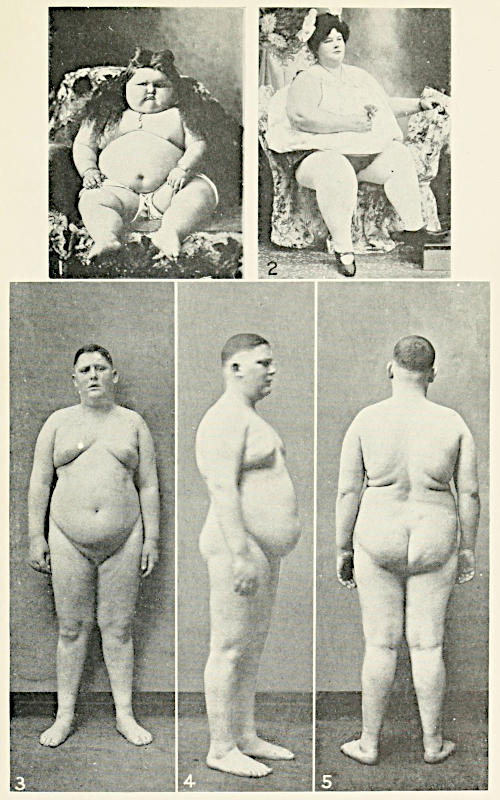
A striking case of early obesity persisting to maturity is that of Miss
Allen (plate 8).
On the other hand, it is often strikingly true that in families with
a tendency to fleshy build some of the children will remain slender
until 20 or 25 years and then begin to grow fat. The metabolic
changes that induce fatness first appear in later life.
PART II. MASS STUDIES IN HEREDITY OF ADULT BUILD. — METHODS AND MATERIALS. — THE ADULT INDEX OF BUILD. — CLASSIFICATION OF BUILD. — SIGNIFICANCE OF VARIATIONS IN BUILD. — DISEASES IN RELATION TO BUILD. — MASS STUDY OF VARIATION AND HEREDITY IN BUILD. — REGRESSION OF PROGENY TOWARD MEDIOCRITY. — HYPOTHESIS. — MATE SELECTION IN BUILD. — THE BASAL TABLES.
It is a matter of common observation that in some families the
parents and children are all slender; in others, there may be many
examples of obesity. Worthington (1877, p. 50) cites a number of
examples from C. Bouchard. A woman of 45 years weighs 107 kg.
(236 pounds); her obesity began shortly after marriage; her father
is very obese and her mother obese. A woman of 49 years, whose
father is a Turk and whose mother is French, weighs 117 kg. or about
258 pounds; her mother was obese. A woman of 115 kg. or about
250 pounds has an obese mother and two sisters who were obese in
infancy; also a gouty mother’s father and father’s father.
The following, from Chambers (1850), show obesity “on both sides
of the house”: Male of 28 years, 120 kg. (266 pounds); woman of
48 years, 127 kg. (280 pounds); woman of 52 years, 98.4 kg. (217
pounds); man of 57 years, 227 kg. (500 pounds); woman of 58 years,
104 kg. (231 pounds); woman of 68 years, 118 kg. (260 pounds);
woman of 70 years, 107 kg. (238 pounds). In many other cases cited
by Chambers, one parent of the obese patient was obese. Howard
(1908, p. 54) cites the case of a 7-year-old girl, 45.5 inches (115.6 cm.)
tall, who weighed 40 kg. (88 pounds), had a pendulous abdomen, and
was feeble-minded. Her sibs were not abnormal and her parents
were of average build. One of her great uncles weighs 127 kg. (280
pounds), an uncle, at 40 years, about 109 kg., and an aunt of 31 years,
95 kg. (210 pounds). This case is instructive because of the skipping
of a generation.
In the class of obese cases known as adiposis dolorosa, heredity is
usually obvious. Price (1909) cites a case of an obese woman of 48
years and weighing 140 kg. (310 pounds) who belongs to a fraternity
of 7; 1 was a miscarriage, 2 died young of accident, 1 died at 22 of
typho-pneumonia, 1 died young of scarlet fever, and 1 brother is
large and rheumatic. The father seems to have been of average build
and the mother is stated to have been “very thin.” Of her sibs, 6 were
fleshy or very fleshy, 1 medium, and 1 slender; the children of these
fleshy sibs of the mother are “all stout.”
Lyon (1910, p. 68) discusses heredity in adiposis dolorosa and
lipomatosis and cites a considerable number of cases of family recurrence
in his cases and others. Thus he twice treated a father and his
son for multiple fatty tumors; also twice a mother and daughter.
Lyon’s obese case No. 5 was like her 3 sisters and 1 daughter; a son of
her father’s brother showed similar fatty deposits. 10 other instances
of family recurrence of abnormal fat deposit are cited.
Maranon and Bonilla (1920) cite the case of a girl of 18 years who
was slender, like her parents, until after an attack of syphilis, when
she came to weigh 157 kg. or 350 pounds, while her height was 160
cm., her chest-girth 130 cm., and that of her abdomen 150 cm. or 90
per cent of her height. She had a very large brother, and both
mother’s parents were obese, though the parents were not known to
be so.
Such examples might be multiplied indefinitely.
Our problem is not what are all the causes of this diversity of build,
but rather in how far do genetical factors play a part in this diversity.
We are not oblivious to the fact that there are many factors responsible
for the result—deviation from the average build. These we shall
consider in detail in a later section, and the consideration will help
us to see the limits to the action of the genetical factors. Before going
on to that, we shall have to consider more in detail the nature of the
facts for which an explanation has to be sought.
The method of analyzing the genetic factors in build is that of
tabulating the distribution of aberrant builds in the family network.
There is required, first, a large mass of family data which includes
many extreme or aberrant types of build, and which is as reliable and
as accurately quantitative as possible; secondly, this has to be subjected
to the ordinary methods of genetic analysis.
The available material has consisted of data on stature and weight
given in the Records of Family Traits which constitute a fair sample
of the population; and of quantitative data on special schedules
giving stature and weight of a fraternity, its parents, uncles and
aunts, and grandparents. These special schedules had been mailed
to an address list of overweight and underweight persons obtained
through the kind cooperation of Mr. Arthur Hunter. Those who
returned the schedules showed an especial appreciation of the requirements
of our study. A third source was the A file of the Eugenics
Record Office, where are gathered miscellaneous pedigrees of families
showing aberrancy in build. A fourth and especially valuable source
was the field work of Miss Louise A. Nelson, of the Eugenics Record
Office; this started with selected, usually obese, cases.
After the data had been assembled and tabulated, a certain amount
of correspondence and personal visitation was undertaken in order to
secure a confirmation or revision of the records in hand. In some
cases this brought to light errors in the records, in others, useful
details. Naturally, it was not possible to secure a revision of all of
the data used, but an attempt was made to select only records that
had been compiled with care and conscientiousness, and these traits
in the compiler reveal themselves pretty clearly to a person who has
examined thousands of these records, just as carelessness is revealed
also by slipshod speech or posture.
For our study we desire the data of stature and weight for children,
parents, and grandparents. With some exceptions only those families
are studied in which all these data are accurately given. Also, only
children who are above 18 years of age can be utilized, because stature
changes so rapidly until that age. However, since it is build and not
stature we are studying, the fact of increase of stature from 19 to 21
years of age affects the result very little. Finally, in a certain proportion
of the cases the stature and weight of all of the grandparents
are not given quantitatively. Such families are utilized, nevertheless,
with such quantitative data as may have been afforded.
The data were taken from the Records of Family Traits by Miss
Miriam Kortright, who long assisted in our statistical work. The
computations of index of build were made by Miss Kortright and
Mr. William Kraus, Miss Laura Craytor, and Miss Margaret Andrus,
who checked one another’s work. The tabulation and seriations of
the indices were done by Misses Margaret Babcock and Katharine
Belzer.
In an earlier section of this paper the question of the best index of
build has been discussed generally. It was pointed out that many
regard it as a truism that build is a relation of volume to stature.
Since the volume of a person’s body is rarely known, and it is difficult
to determine it, weight has been substituted for volume. However,
this substitution assumes that specific gravity is the same for slender
and for fat persons; but this is not at all the case. The specific
gravity of a fat person is about that of water (0.978 to 1.079 in 4
children 7 to 13 years of age, Meeh, 1879, and 1.014 in a 61-year-old
man of 98 kg. weight, Mies, 1899); of a thin person it may be 5 to 8
per cent above that of water (1.049 to 1.082 for thin convicts, Mies,
1899). This variable specific gravity complicates the attempt to
infer volume from weight. In view of these difficulties it were better
to measure build by a relation of chest diameter (or circumference)
to stature. But this ratio can not be used in our studies, since our
data, for the most part, give only weight and stature and not chest-girth.
It remains thus to determine the closest relation between
weight and chest-girth. This determination I have attempted to
make for 100 young men, 20 to 25 years of age, measured at Harvard
University where they were students. It will hardly be worth while
to reproduce the detailed tables of measurements and ratios, but they
will be found summarized in table 8. In this table is given the frequency
of occurrence of each of the different ratios (or rather classes
of ratios) found using chest-girth in first, second, and third powers as
a divisor. If weight varied exactly with the chest-girth, then the
ratio of the former to the latter should remain constant. Such a strict
relation is hardly to be expected and, of course, is not found. The
ratios obtained show a certain variability about the mean condition,
and this variability is measured by the standard deviation. Similarly,
if each weight be divided in turn by the second and third powers of
stature, and the corresponding variability of the ratios be considered,
we shall have a method of deciding whether weight varies more
closely with the first, second, or third power of chest-girth, and which
of those powers gives in its fluctuations the best measure of the corresponding
fluctuations in weight.
Table 8.—Variability of weight in relation to the second and
third powers of chest-girth as found in 100 Harvard students.
[f, frequency of occurrence of the given index-class.]
Weight ÷ chest-girth
Weight ÷ chest-girth²
Weight ÷ chest-girth³
f
f
f
610
to
619
1
690
to
700
1
711
to
720
1
640
649
3
711
720
1
761
770
3
660
669
2
731
740
1
791
800
3
670
679
4
741
750
1
801
810
3
680
689
6
751
760
5
811
820
3
690
699
2
761
770
2
821
830
3
700
709
7
771
780
4
831
840
3
710
719
6
781
790
11
841
850
5
720
729
4
791
800
10
851
860
1
730
739
10
801
810
7
861
870
10
740
749
7
811
820
9
871
880
6
750
759
7
821
830
8
881
890
3
760
769
6
831
840
5
891
900
5
770
779
4
841
850
3
901
910
5
780
789
7
851
860
4
911
920
3
790
799
5
861
870
9
921
930
2
800
809
2
871
880
3
931
940
7
810
819
3
881
890
4
941
950
1
820
829
3
891
900
3
951
960
4
830
839
3
901
910
4
961
970
4
840
849
4
921
930
2
971
980
9
850
859
1
951
960
1
981
990
1
870
879
1
961
970
2
991
1000
5
900
909
1
1001
1010
2
920
929
1
1031
1040
1
1041
1050
4
1061
1070
2
1111
1120
1
σ, 58.32
σ, 51.50
σ, 76.99
A comparison of the standard deviations gives the following results
for man:
Ratio:
weight ÷ chest-girth
weight ÷ chest-girth²
weight ÷ chest-girth³
Standard deviation:
58.3
51.5
77.0
From these results the conclusion is drawn that since the variability
(standard deviation) of weight ÷ chest-girth² is least, the square of
the chest-girth varies more closely with weight than either the first
or third power of chest-girth; consequently the square of chest-girth
is the best measure of weight of the three.
By hypothesis, the chest-girth in persons of the same build varies
very closely or exactly with stature; consequently we could substitute
in the foregoing ratios for chest its average equivalent, stature/K,
in which K is nearly 2, more precisely 1.9. In any case it is thus
clearly deducible that a better index of build is got by dividing weight
by the square of stature than by its cube, as has been so often done.
Accordingly, the ratio of weight to stature² has been adopted in this
paper as the standard index of build. The correlation between this
index of build and relative chest-girth is found by calculation to be
about 0.45.
In any scale of index of build it is, of course, desirable to use the
metric system. Unfortunately, most of our data are in English units,
so that our indices were first obtained by the use of these units. We
have in many cases transmuted the English into the equivalent metric
measures. We have, however, retained the original English index,
since a large portion of the more cultured part of the world uses that
system in daily life. A table to facilitate transmutation is also given
in the Appendix, table XVIII. To facilitate the determination of the
index of build when stature and weight (in English or metric units)
are known, table XVI has been prepared (pages 169, 170).
To avoid decimals, the ratio, weight in pounds ÷ (stature in
inches)² is multiplied in this book by 1,000; this gives a series of
ratios running from 20 to 60 and over. To avoid confusion with the
English system, the metric equivalents are taken as the ratio of
weight in grams ÷ (stature in centimeters)². This gives a series of
index numbers of the order 1.5 to 4.0; in this case, at least, one decimal
is always expressed. The small integral figure and the decimal at
once indicate that the index is from metric units. Since the index of
build has often been expressed as the ratio of weight to, respectively,
stature, stature²⸳⁵, and stature³, table XVII has been prepared to permit
these ratios to be transmuted into weight ÷ stature², English
system.
For the purposes of analysis, it was found necessary to make a
small number of classes of build. To decide upon the limits of these
classes, a polygon of frequency of all indices of build was made, as
shown in figure 7. It appeared plain at the outset that it is desirable
to plot the data in this polygon by using as abscissæ the logarithms
of the index of build rather than the absolute indices, since the
range of weight above the mode is, for obvious reasons, very much
greater than below the mode. Taking mean weight at 68 kg., or 150
pounds, the minimum weight is about 20 kg. (45 pounds), or 25 kg.
(55 pounds) below the mean, and the maximum weight is about
150 kg. (330 pounds), or 182 kg. (400 pounds) above the mean. That
is, the range of weight classes is three times as great above as below
the mean. Plotting data in logarithmic fashion, as shown in figure 7,
it appears that the modal index of build is 2.3 (33). The range is
from 1.4 (20) to 4.5 (64). Using the logarithms of abscissæ, the
curve is more nearly a symmetrical one. It is more irregular above
than below the mode, because the classes are more numerous and the
frequency of each class smaller. The presence of two modes is suggestive
of the hypothesis that the medium class and probably the
fleshy classes are not strictly homogeneous, but, on the contrary, comprise
groups of individuals whose build is due to dissimilar factors, or
sets of factors.
Fig. 7.—Polygon of frequency of the various indices of build (weight ÷ stature²). From last
column of table 12, with slight modifications.
To derive the desired classes from figure 7, the polygon was somewhat
arbitrarily divided into five parts, as indicated. Taking 33.5
as a starting-point, an equal logarithmic distance was laid off, above
and below this point, on the base-line. This was taken as the range
of middle class. An equal logarithmic range was accorded the classes
next above and below the median respectively. All of the remainders
were thrown into the extreme classes to which are given, thus, a
somewhat greater range than the interior classes. This seemed desirable,
since their frequencies were so low. The adjusted classes finally
adopted are as shown in table 9.
Table 9.—The five standard classes of build; limits and middle points of each.
Class.
Range of indices.
Metric.
English.
Middle of class (English).
Very slender (V. S.)
1.40
to
1.80
20
to
25.4
23.5
Slender (S.)
1.81
2.14
25.5
30.4
28.0
Medium (M.)
2.15
2.56
30.5
36.4
33.5
Fleshy (F.)
2.57
3.05
36.5
43.4
40.0
Very fleshy (V. F.)
3.06
4.50+
43.5
64 +
48.0
What is the meaning of the great variations of build described in
the preceding paragraph? What is known in this matter may here be
briefly summarized that it may be held in mind in considering the
numerous cases to which we shall have occasion to refer.
In general, it may be stated that variations in build are due to
endogenous causes and exogenous causes. In this book we shall have
occasion to examine especially the former—the constitutional or
hereditary factors. These include idiosyncrasies of metabolism, in
part controlled by peculiarities in the functioning of the endocrine
glands; in part, probably, by even finer protoplasmic differences.
Thus it is known that the thyroid gland greatly influences metabolism;
its activity in growing children tends to produce tall and slender
form. On the other hand, deficiency in its activity in childhood leads
to the type of obesity known as cretinism, and in middle life to
myxedema. The secretions of the pituitary gland cooperate with the
thyroid in stimulating growth, especially in the preadolescent stage.
When pituitary secretions are deficient there frequently results, it is
believed, the adiposogenital syndrome, in which great masses of fat
are deposited on breasts, abdomen, hips, and buttocks, and the gonads
remain infantile. A case that quite certainly belongs to this category
is shown by Beck (1922, p. 881) and reproduced in plate 8,
figures 3, 4, 5; 3 of this man’s 4 sibs are fleshy and have scant beards.
This is quite like our standard very fleshy case (plate 2, fig. 5). See,
also, the extreme cases falling under this category described by Lyon,
1910.
Lesions of the pineal gland (Beck, 1922, p. 909) and of the gonads
are stated in some cases to induce obesity. Certain it is that, on the
other hand, the activity of the gonads tends to slow up growth in
stature and to increase the chest circumference (plate 6), and this
change is more marked in the male than the female.
The exogenous causes of build are striking, so much so that many
physiologists seem to accept the hypothesis that they are of sole
importance, that excess of fat is due merely to excess of calories
ingested over those concerned in bodily activity. While no one will
deny the possibility of starving most fleshy persons thin or of increasing
the weight of most adults by an excess of food, yet it is also
obvious that two persons of the same stature and fed equal amounts
of similar food may come to differ enormously, due to internal conditions,
sometimes of glandular origin and sometimes dependent upon,
or at least associated with, disease.
Table 10.—Incidence of disease in relation to build.
Diagnosis of disease.
In 10,000 of standard population.
In persons of selected build.
1. No. of cases.
2. Per cent afflicted.
3. No. of cases.
4. Per cent afflicted in 69 V. S. population.
5. Ratio of col. 4 to col. 2.
Very Slender Build.
YOUTH.
Influenza
7
0.07
2
2.81
40.14
Tuberculosis
24
.24
2
2.81
11.70
Colds
48
.48
3
4.34
9.04
MIDDLE AGE.
Melancholia
10
.10
2
2.81
28.10
Nervousness
130
1.30
6
8.60
6.62
Tuberculosis
58
.58
2
2.81
4.85
Slender Build.
Per cent afflicted in 737 S. population.
YOUTH.
Fevers
4
0.04
4
0.542
13.55
Adenoids
10
.10
9
1.22
12.20
Appendicitis
28
.28
13
1.76
6.28
Anemia
11
.11
5
.68
6.16
Tuberculosis
24
.24
10
1.35
5.62
Tonsilitis
104
1.04
30
4.07
3.91
Bronchitis
53
.53
12
1.62
3.06
Pneumonia
165
1.65
34
4.61
2.79
Nervous breakdown
74
.74
15
2.03
2.74
Rheumatism
117
1.17
16
2.17
1.85
Diphtheria
150
1.50
19
2.57
1.71
Scarlet Fever
281
2.81
29
3.93
1.40
Typhoid fever
253
2.53
25
3.39
1.34
MIDDLE AGE.
Anemia
3
.03
3
.407
13.57
Intestinal trouble
4
.04
3
.407
10.17
Appendicitis
23
.23
9
1.220
5.30
Tuberculosis
58
.58
22
2.980
5.14
Heart disease
94
.94
15
2.030
2.16
Pneumonia
139
1.39
22
2.980
2.14
Typhoid fever
138
1.38
16
2.170
1.57
Fleshy Build
Per cent afflicted in 543 F. population.
YOUTH.
Adenoids
10
0.10
3
0.553
55.30
Scarlet fever
281
2.81
36
6.642
2.36
Typhoid fever
253
2.53
28
5.166
2.04
Pneumonia
165
1.65
17
3.136
1.90
MIDDLE AGE.
Hernia
8
0.08
7
1.29
16.00
Arterio-sclerosis
9
.09
6
1.10
12.22
Bladder trouble
10
.10
6
1.10
11.00
Measles
10
.10
6
1.10
11.00
Appendicitis
23
.23
12
2.22
9.65
Eczema
6
.06
3
0.55
9.17
Hemorrhoids
13
.13
5
0.92
7.11
Liver trouble
16
.16
6
1.10
6.88
Paralysis
49
.49
18
3.38
6.80
Heart trouble
94
.94
34
6.28
6.69
Gallstones
22
.22
8
1.47
6.68
Apoplexy
27
.27
8
1.47
5.44
Tumor
18
.18
5
0.92
5.13
Bronchitis
38
.38
9
1.66
4.37
Erysipelas
31
.31
7
1.29
4.16
Cancer
51
.51
10
1.84
3.61
Pneumonia
139
1.39
27
4.98
3.58
Malaria
43
.43
8
1.47
3.42
Typhoid fever
138
1.38
22
4.06
2.95
Kidney trouble
74
.74
11
2.03
2.74
Rheumatism
349
3.49
37
6.82
1.95
Very Fleshy Build.
Per cent afflicted in 103 V. F. population.
YOUTH.
Pneumonia
165
1.65
7
6.79
4.115
MIDDLE AGE.
Dropsy
14
0.14
3
2.91
20.80
Stomach trouble
15
.15
3
2.91
19.40
Apoplexy
37
.37
5
4.85
11.40
Kidney trouble
74
.74
8
7.76
10.60
Cancer
51
.51
4
3.88
7.61
Heart disease
94
.94
6
5.82
6.20
Pneumonia
139
1.39
8
7.76
5.6
Malaria
43
.43
2
1.94
4.5
Typhoid fever
138
1.38
6
5.82
4.2
Rheumatism
349
3.49
10
9.70
2.8
Very slender build: A. Youth; expectation for cases of measles, 2; found, none.
Slender build: A. Youth; expectation for cases of whooping-cough, 7; chicken-pox, 4; colds, 4;
croup, 3. Cases found, none. B. Middle Age; expectation for cases of eye trouble, 30, erysipelas,
24, tonsillitis, 23, and apoplexy, 21. Cases found, none.
Fleshy build: A. Youth; expectation for cases of ear trouble, 19, lung trouble, 18. Cases
found, none. B. Middle age; expectation for cases of throat trouble, 5. Cases found, none.
As just stated, it is frequently true that build is influenced permanently
by disease. To test the influence of disease on, or association
of diseases with, different types of build, a tabulation was made of
the diseases recorded (in the Records of Family Traits, Eugenics
Record Office) as occurring during youth and during middle age in
10,000 fairly well described persons. This constituted the control.
Then there was determined for our groups of very slender, slender,
fleshy, and very fleshy, the incidence of disease. The ratio of the percentage
incidence of the latter to the former was then calculated.
In table 10 is given in sum many of the results found for the principal
diseases. This table may now be briefly discussed.
Persons of very slender build are characterized in youth by an
excess of respiratory diseases—influenza, tuberculosis, and colds. In
middle age they show an excess of melancholia, nervousness, and
tuberculosis.
In 737 persons of slender build there are found in youth many diseases
in excess of normal incidence. These comprise diseases of the
respiratory tract—tuberculosis, tonsillitis, bronchitis, pneumonia; some
nervous diseases, “nervous breakdown”; various general infections,
such as “fevers,” appendicitis, anemia, “rheumatism,” diphtheria,
scarlet and typhoid fevers. One might conclude that slender youth
are relatively nonresistant to infections. In slender persons there is
found in middle age an excess of tuberculosis and pneumonia, much
appendicitis and intestinal trouble, and (as also in youth) anemia.
These associations of slender build and disease are not always easy
to interpret. The common idea of the tubercular diathesis comprises
slender form. On the other hand, a person who has, or has recovered
from, active pulmonary tuberculosis is apt to remain underweight,
partly because the respiratory apparatus is damaged. The association
of “nervousness” with slenderness is probably due to the double
effect of some glandular dystrophy, as, for example, of the thyroid
gland. Hyperthyroid individuals are usually tall, slender, and “nervous”
or irritable.
In 103 persons of very fleshy build, the only outstanding disease of
youth is pneumonia. In middle age occur “kidney trouble,” “dropsy”
(which often accompanies chronic nephritis), and apoplexy, which is
sometimes caused by extra pressure on the blood-vessels resulting
from impeded elimination from the kidney or to a diabetic tendency
which puts extra work on the vessels. “Heart disease” is also commoner
than usual.
In 542 persons of fleshy build, “bladder trouble” (probably including
diabetes) and kidney trouble are exceptionally frequent, also
arterio-sclerosis and its accompaniments, apoplexy and paralysis.
Hernia is frequent, as are various diseases of the digestive tract, such
as appendicitis, hemorrhoids, liver trouble, and gallstones. These
are doubtless not the cause of, but a consequence or concomitant of,
overweight. Sibilant bronchitis, lithiasis (uric and biliare), and diabetes
mellitus are mentioned, in addition to the above, by Heckel
(1920, p. 31) as especially apt to be associated with obesity.
Table 11.—Distribution of progeny of the different matings according to index of build; males
and females tabulated separately.
The one clear conclusion from this study is that no single disease
and no special single collection of diseases is exclusively responsible
for exceptionally slender or exceptionally fleshy build. The variations
in build are due primarily rather to various idiosyncrasies of development
and metabolism which have largely an hereditary basis, upon
which may be superimposed modifications by various types of disease.
Table 12.—Distribution of progeny of the different matings, according to
index of build; sexes tabulated together, based on Appendix tables,
omitting starred families.
Serial mating No.
II
III
IV
VI
VII
VIII
IX
X
XI
XII
XIII
XIV
XV
Total.
Type of mating
VS×S
VS×M
VS×F
S×S
S×M
S×F
S×VF
M×M
M×F
M×VF
F×F
F×VF
VF×VF
Av. index of build
26.1
28.4
32.0
29.8
30.9
33.8
37.9
33.2
36.4
40.7
39.2
43.0
47.4
No. of matings.
4
8
5
23
101
49
11
92
114
30
33
29
7
506
22
1
1
2
23
1
1
2
24
0
25
1
1
4
2
2
2
12
26
3
1
3
4
3
1
1
16
27
1
1
2
11
2
1
4
1
1
24
28
1
1
6
11
2
1
2
4
2
30
29
1
2
1
6
13
7
1
10
7
3
8
59
30
1
2
1
6
18
8
2
23
16
3
4
2
86
31
1
4
3
39
13
3
25
15
6
4
4
2
119
32
1
3
3
5
39
9
4
30
40
9
6
6
4
159
33
6
3
2
35
24
3
37
46
8
4
9
1
178
34
2
2
26
18
1
28
34
12
12
5
3
143
35
2
34
10
2
34
33
12
17
8
2
154
36
2
21
6
1
44
40
3
17
6
2
142
37
1
1
15
13
2
22
22
9
13
3
1
102
38
1
11
14
3
17
23
5
11
8
93
39
1
8
9
5
18
10
11
7
8
2
79
40
2
7
3
2
9
12
5
10
6
2
58
41
2
5
2
1
9
11
2
3
3
38
42
1
3
5
1
3
7
1
11
9
1
42
43
1
1
4
3
3
3
3
6
5
29
44
2
1
1
3
1
6
3
1
18
45
3
1
1
2
6
2
3
2
20
46
1
4
1
1
1
3
3
1
12
47
1
1
4
5
2
3
16
48
1
1
3
5
49
1
2
1
1
2
7
50
1
1
2
2
6
51
1
1
1
2
1
1
7
52
1
1
2
53
2
2
2
6
54
1
1
55
0
56
1
1
57
0
58
1
1
79
1
1
103
1
1
Total
11
28
25
47
306
155
34
327
340
112
156
100
30
1671
Adult progeny per mating
2.75
3.50
5.00
2.04
3.03
3.16
3.09
3.55
2.98
3.70
4.72
3.45
4.29
3.29
Average
28.55
32.18
35.04
28.47
34.01
34.39
35.68
34.79
35.41
37.64
37.56
38.49
39.20
35.24
P. E. of aver.
±.86
±.54
±.83
±.24
±.16
±.22
±.51
±.15
±.16
±.58
±.29
±.38
±.78
±.087
σ
4.21
4.20
6.18
2.41
4.20
4.13
4.44
4.05
4.34
9.11
5.37
5.38
6.31
5.29
P. E. of σ
±.61
±.38
±.59
±.17
±.11
±.16
±.36
±.11
±.11
±.41
±.21
±.27
±.55
±.06
Having considered the classification and something of the causes
of variation in build, we have now to consider the relation between
the build of the parents and that of the progeny. This is the mass
treatment of the data of “heredity” which was the prevailing method
25 years ago and earlier. It is still a useful method in the case of
traits due to multiple factors, such as the present one.
The distribution of build in the children of the different matings
is given in tables 11, 11a, and 12. There are 15 possible different combinations
of matings of the five grades. The first of these (VS × VS)
is not represented in our data, and the fifth, VS × VF, is represented
by only one mating and no column is devoted to it. The frequencies
are given separately for male and female offspring (table 11), and
again for both sexes together (table 12). Table 13 shows that there
is a considerable correlation between the average build of the parentage
and that of the progeny. From the matings of the fleshier parents
the progeny are fleshier; from those of slender parents, slenderer.
This relation may conceivably be due to family tradition handed down
from parents to children. We shall see later that this hypothesis
meets with formidable difficulties to acceptance. The most reasonable
hypothesis is that there are, above all, hereditary family tendencies
that help determine build.
Table 13.—Distribution of progeny of the various matings, according to classes of build,
absolute numbers, and proportions, based on Appendix table, including starred families.
Type of mating.
Total No. of children.
Absolute numbers.
Proportional frequencies (per mille).
VS.
S.
M.
F.
VF.
VS.
S.
M.
F.
VF.
No.
II
VS
×
S
20
4
12
2
2
200
600
100
100
III
VS
×
M
28
1
7
17
3
36
250
607
107
IV
VS
×
F
25
1
5
10
7
2
40
200
400
280
80
VI
S
×
S
51
5
35
11
98
686
215
VII
S
×
M
313
49
200
53
11
157
639
169
35
VIII
S
×
F
179
5
25
85
57
7
28
140
475
318
39
IX
S
×
VF
50
7
18
17
8
140
360
340
160
X
M
×
M
332
2
40
201
82
7
6
121
605
247
21
XI
M
×
F
346
31
210
88
17
90
606
255
49
XII
M
×
VF
112
2
7
50
36
17
18
63
446
321
152
XIII
F
×
F
159
15
62
61
21
94
390
384
132
XIV
F
×
VF
146
1
7
52
51
35
7
48
356
349
240
XV
VF
×
VF
37
12
8
10
400
267
333
Total
1798
Comparing the tables for male and female offspring, it appears,
first, that there are, for some reason, more males than females about
whom data of build are given, probably because more males than
females know their stature and weight, or willingly record it; second,
there are relatively more females than males of very slender build
(grades 22 to 31); there are recorded relatively more very fleshy males
than females (grades of 50 and above); third, there are relatively
more recorded daughters than sons derived from one very slender
parent, and from the F × F and M × M matings. The male progeny
are more variable than the female as 5.325 ± 0.084 is to 5.133 ± 0.089;
but the difference is less than three times the probable error, and is,
consequently, not very significant.
Considering next the table of total progeny of the various matings,
it appears that the average number of children with recorded build
from the recorded matings is variable. In descending order the
fecundity of the matings is shown in table 14. This table shows that
larger families, on the average, were derived from fleshy parents than
from slender parents. Thus the F × F matings yield 2.3 times as
many children, on the average, per mating as the S × S matings.
Table 14.—Average number of progeny yielded by each
type of mating (based on table 12).
Mating.
No. of children.
Mating.
No. of children.
VS
×
F
5.00
S
×
F
3.16
F
×
F
4.72
S
×
VF
3.09
VF
×
VF
4.29
S
×
M
3.03
M
×
VF
3.70
M
×
F
2.98
M
×
M
3.55
VS
×
S
2.75
VS
×
M
3.50
S
×
S
2.04
F
×
VF
3.45
Galton pointed out, in the case of stature, that, since correlation
between parents and progeny is not perfect, the progeny of selected
parents will tend to be less extremely selected and hence more nearly
mediocre than their parents. It has, indeed, been shown in my studies
on stature (1917, p. 341) that the progeny of tall parents do not show
this regression to mediocrity as much as the progeny of short parents.
This was regarded as evidence that the gametes of tall parents carried
fewer recessive allelomorphs than those of short parents; hence were
genetically “purer” and comprise more recessive factors. What is the
condition in respect to the varying indices of build?
The answer to this question is given in table 15, which in turn is
based on table 12. This table shows for each of the 13 matings the
average departure of the parents from mediocre build (which for the
parents is 34.86) and the corresponding departure of their offspring
from mediocre build (which for the progeny is 35.24). In the right-hand
column of the table is given the difference between these two
departures, which measures the amount of regression toward mediocrity
on the part of the progeny. The results of the last column are
shown graphically in figure 8.
Table 15.—Average build and regression from parental average
of the progeny of the various types of mating. Also matings arranged in
order of regression. Sexes combined (based on table 12).
Type of mating.
No. of matings.
No. of progeny.
Avg. build of parents.
Avg. build of progeny.
Departure of parents from mediocrity.
Departure of progeny from mediocrity.
Regression.
VS
×
S
4
11
26.13
28.55 ± .86
-8.73
-6.69
+2.04
VS
×
M
8
28
28.38
32.18 ± .54
-6.48
-3.06
+3.42
VS
×
F
5
25
32.00
35.04 ± .83
-2.86
-0.20
+2.66
S
×
S
23
47
29.77
28.47 ± .24
-5.09
-6.77
-1.68
S
×
M
101
306
30.90
34.01 ± .16
-3.96
-1.23
+2.73
S
×
F
49
155
33.85
34.39 ± .22
-1.01
-0.85
+0.16
S
×
VF
11
34
37.91
35.48 ± .51
+3.05
+0.24
+2.81
M
×
M
92
327
33.23
34.79 ± .15
-1.63
-0.45
+1.18
M
×
F
114
340
36.45
35.41 ± .16
+1.59
+0.17
+1.42
M
×
VF
30
112
40.68
36.53 ± .38
+5.82
+1.29
+4.53
F
×
F
33
156
39.21
37.56 ± .29
+4.35
+2.32
+2.03
F
×
VF
30
100
42.97
38.49 ± .36
+8.11
+3.25
+4.86
VF
×
VF
7
30
47.43
39.20 ± .78
+12.57
+3.96
+8.61
Total
507
1671
34.86
35.24
Mediocrity for parents, 34.86. Mediocrity for progeny, 35.24.
Matings Arranged in Order of Regression.
S
×
S
-1.68
S
×
F
+0.16
M
×
M
+1.18
M
×
F
+1.42
F
×
F
+2.03
VS
×
S
+2.04
VS
×
F
+2.66
S
×
M
+2.73
S
×
VF
+2.81
VS
×
M
+3.42
M
×
VF
+4.53
F
×
VF
+4.86
VF
×
VF
+8.61
Figure 8 shows clearly that, in spite of considerable irregularities,
the line of regression descends from the matings of two very fleshy
parents at the left, and in general from matings in which the average
parental departure from the mean build of parents is positive, to the
mating of two slender parents (or, less strikingly the VS × S mating)
or in general to the matings in which the average parental departure
is extremely negative. This result is most easily explained on the
ground that whereas fleshy parents carry all sorts of gametes for
build, slender parents carry a preponderance of gametes of their own
kind; hence the progeny do not regress so much from the selected
parental condition. This suggests that the slender parents are more
nearly homozygous than the fleshy parents.
Fig. 8.—Line of regression of progeny on parents, based on the difference between average
filial and parental departures from mediocrity. The abscissæ measure the average parental
departure of each class of mating. The ordinates are proportional to the filial regression.
Still another test of the gametic composition of the parents is the
variability of their offspring. The facts regarding such variability
are given in table 16. From this table it appears that the mating that
yields the least variable progeny is that of two slender consorts. The
variability in their progeny is measured by 2.41 ± 0.17. The variability
of the progeny of the VS × S mating is greater, 4.21 ± 0.61,
but on account of the small number of the progeny the probable error
is large, and it is possible that this difference in variability between
S × S and VS × S progeny is not a significant one. Next to the least
variable are the offspring of the M × M mating, 4.06 ± 0.11, and this
leads to the conclusion that a large proportion of the M parents are
not merely heterozygous, but constitute a “pure race” of medium
build. The offspring of the S × F mating have a fairly small variability
4.13 ± 0.16, as befits a first generation (F₁) hybrid. On the
other extreme, we have the M × VF mating with a standard deviation
of 9.11 ± 0.41. This large standard deviation is due chiefly to the
inclusion of one family (Ber-A) which contains 2 progeny of builds
79 and 103, weighing 180 kg. (400 pounds) and 215 kg. (475 pounds)
respectively. Otherwise, the variability of this mating is not extreme.
It is 5.25 ± 0.24. The next largest variability is from the VF × VF
mating, 6.31 ± 0.55, a variability that is due to the absence of any
important mode. The progeny of the VS × F mating are highly
variable, 6.18 ± 0.59, but this standard deviation has the largest
probable error of any except VS × S, so that great stress must not be
laid upon its exact position. In general, the progeny of matings with
2 or 1 F or VF parents, belong to the more variable group and those
with S (or VS) parents to the less variable group. The meaning of
this is clear to the geneticist who has dealt with multiple factors. It
indicates that some or all of the factors that make for fleshy build
dominate to a greater or less degree over the factors for slenderness.
The test of the regression of progeny toward mediocrity and the test
of the variability of the progeny of the various matings thus lead to
the same result—the factors for fleshiness are imperfectly dominant
over those for slenderness, and the latter probably lack some or all of
those factors that make for fleshy build.
Table 16.—Progeny of the various types of matings arranged
in order of variability or standard deviation (S. D.), together with the
probable errors (P. E.) of the means and deviations; also the coefficients
of variation (based on table 12).
Type of mating.
No. of progeny.
Mean build of progeny and (P. E.)
Standard deviation and (P. E.)
Coefficient of variability.
S
×
S
47
28.47 ± 0.24
2.41 ± 0.17
8.97
M
×
M
327
34.79 ± 0.15
4.06 ± 0.11
11.67
S
×
F
155
34.39 ± 0.22
4.13 ± 0.16
12.01
S
×
M
306
34.01 ± 0.16
4.20 ± 0.11
12.35
VS
×
S
11
28.55 ± 0.86
4.21 ± 0.61
14.75
VS
×
M
28
32.18 ± 0.54
4.22 ± 0.38
13.11
M
×
F
340
35.41 ± 0.16
4.27 ± 0.11
12.06
S
×
VF
34
35.68 ± 0.51
4.44 ± 0.36
12.44
F
×
F
157
37.56 ± 0.29
5.37 ± 0.20
14.30
F
×
VF
100
38.49 ± 0.36
5.38 ± 0.27
3.98
VS
×
F
25
35.04 ± 0.83
6.18 ± 0.59
17.64
VF
×
VF
30
39.20 ± 0.78
6.31 ± 0.55
16.10
M
×
VF
112
37.64 ± 0.58
9.11 ± 0.41
24.17
The foregoing brief studies of the progeny of classes of matings
suggest the following hypothesis:
Fleshy build results from the action of several positive (dominant)
factors that make for stoutness, while slenderness results from the
absence of one or more of such factors, or is due to recessive factors.
Fleshy parents may, and frequently do, carry gametes which lack the
“fleshy” or carry the “slender” factor, while in slender parents for the
most part the gametes carry only the slender factor, hence the gametes
of slender parents are more nearly homogeneous. This hypothesis
may be further developed as follows:
Assuming that there are two independent factors A and B for build,
then these may be found in different zygotes in the following combinations:
AABB
AaBB
aABB
aaBB
AABb
AaBb
aABb
aaBb
AAbB
AabB
aAbB
aabB
AAbb
Aabb
aAbb
aabb
Or, disregarding order of the letters, and considering only the number
and kind of genes in each kind of zygote, we have:
AABB
2AaBB
aaBB
2AABb
4AaBb
2aaBb
AAbb
2Aabb
aabb
in which the coefficients indicate the relative frequency of the different
combinations.
We may assume that:
4 positive factors in a zygote correspond to a very fleshy person.
3 factors correspond to a fleshy person.
2 factors correspond to a person of medium build.
1 factor corresponds to a slender person.
0 factor corresponds to a very slender person.
Table 17 indicates the possible matings and their progeny.
Table 17.—Percentage distribution of the progeny of the various matings, on the assumption
that extreme fleshy build is dependent upon 4 zygotic factors in the parents.
One parent.
Other parent.
Zygotic formulæ.
Gametic formulæ.
Percentage of each number of zygotes in progeny.
0 (VS)
1 (S)
2 (M)
3 (F)
4 (VF)
4
4
AABB × AABB
AB × AB
100
4
3
AABB × AABb
{ AB × AB }
50
50
{ AB × Ab }
4
2
AABB × AAbb
AB × Ab
100
AABB × AaBb
{ AB × AB }
25
50
25
{ AB × Ab }
{ AB × aB }
{ AB × ab }
4
1
AABB × Aabb
{ AB × Ab }
50
50
{ AB × ab }
4
0
AABB × aabb
AB × ab
100
3
3
AABb × AABb
{ AB × AB }
25
50
25
{ AB × Ab }
{ Ab × AB }
{ Ab × Ab }
3
2
AABb × AAbb
{ AB × Ab }
50
50
{ Ab × Ab }
AABb × AaBb
{ AB × AB }
12.5
37.5
37.5
12.5
{ AB × Ab }
{ AB × aB }
{ AB × ab }
{ Ab × AB }
{ Ab × Ab }
{ Ab × aB }
{ Ab × ab }
3
1
AABb × Aabb
{ AB × Ab }
25
50
25
{ AB × ab }
{ Ab × Ab }
{ Ab × ab }
3
0
AABb × aabb
{ AB × ab }
50
50
{ Ab × ab }
2
2
AAbb × AAbb
Ab × Ab
100
AAbb × AaBb
{ Ab × AB }
25
50
25
{ Ab × Ab }
{ Ab × aB }
{ Ab × ab }
AaBb × AAbb
{ AB × Ab }
25
50
25
{ Ab × Ab }
{ aB × Ab }
{ ab × Ab }
AaBb × AaBb
{ AB × AB }
6.25
25
37.5
25
6.25
{ AB × Ab }
{ AB × aB }
{ AB × ab }
{2Ab × AB }
{2Ab × Ab }
{2Ab × aB }
{2Ab × ab }
{ ab × AB }
{ ab × Ab }
{ ab × aB }
{ ab × ab }
2
1
AAbb × Aabb
{ Ab × Ab }
50
50
{ Ab × ab }
AABb × Aabb
{ AB × Ab }
12.5
37.5
37.5
12.5
{ Ab × Ab }
{ AB × ab }
{ Ab × ab }
{ aB × Ab }
{ aB × aB }
{ ab × Ab }
{ ab × ab }
2
0
AAbb × aabb
Ab × ab
100
AaBb × aabb
{ AB × ab }
25
50
25
{ Ab × ab }
{ aB × ab }
{ ab × ab }
1
1
Aabb × Aabb
{ Ab × Ab }
50
50
{ AB × ab }
{ ab × Ab }
{ ab × ab }
1
0
Aabb × aabb
{ Abab }
50
50
{ abab }
0
0
aabb × aabb
100
On the hypothesis of 6 zygotic factors for build, the possible combinations
in the progeny are much more numerous. Seven classes of
zygotic combinations are possible. We recognize in our work only 5
classes of build. Accordingly, it would be necessary to redistribute
our classes of build into 7 or else assume that the two lowest classes
are both comprised in “very slender” and the two highest in “very
fleshy.” The former operation would require an amount of work
hardly justified by the possible advantage; so the latter procedure
was adopted as perhaps a sufficiently close approximation. The distributions
are given in table 18 which is given in detail only in part.
Table 18.—Percentage distribution of the progeny of the various matings on the assumption
that extreme fleshy build is dependent on 6 zygotic factors in the parents.
No. of factors in
Percentage of each class of zygotic factors.
One parent.
Other parent.
6
5
4
3
2
1
0
6
6
100
6
5
50
50
6
4
{
100
{
25
50
25
6
3
{
50
50
{
12.5
37.5
37.5
12.5
6
2
{
100
{
25
50
25
6
1
50
50
6
0
100
5
5
25
50
25
5
4
{
50
50
{
12.5
37.5
37.5
12.5
5
3
{
6.25
25
37.5
25
6.25
{
25
50
25
5
2
{
12.5
37.5
37.5
12.5
{
50
50
5
1
25
50
25
5
0
50
50
4
4
{
6.25
25
37.5
25
6.25
{
25
50
25
{
25
50
25
{
100
4
3
{
3.125
15.625
31.25
31.25
15.625
3.125
{
12.5
37.5
37.5
12.5
{
12.5
37.5
37.5
12.5
{
50
50
4
2
{
6.25
25
37.5
25
6.25
{
25
50
25
{
25
50
25
{
100
4
1
{
50
50
{
12.5
37.5
37.5
12.5
4
0
25
50
25
3
3
{
1.5625
9.375
23.4375
31.25
23.4375
9.375
1.5625
{
6.25
25
37.5
25
6.25
{
6.25
25
37.5
25
6.25
{
25
50
25
3
2
{
3.125
16.625
31.25
31.25
16.625
3.125
{
12.5
37.5
37.5
12.5
{
12.5
37.5
37.5
12.5
{
50
50
3
1
{
6.25
25
37.5
25
6.5
{
25
50
25
3
0
{
12.5
37.5
37.5
12.5
{
50
50
2
2
{
6.25
25
37.5
25
6.25
{
50
50
{
100
2
1
{
12.5
37.5
37.5
12.5
{
50
50
2
0
{
25
50
25
{
100
1
1
25
50
25
1
0
50
50
0
0
100
Statistics on temperament and stature of consorts (Davenport,
1915, p. 106; 1917, p. 329) seem clearly to show that there is an
assortative mating in respect to these traits. The question arises:
Is there assortative mating in respect to build? The inquiry is rendered
the more difficult, inasmuch as build changes to such an extent
with age. Nevertheless, as there appears to be a considerable correlation
(though not yet calculated) between build at 25 and at 50
years, it is fair to assume that some degree of the mature build is
already indicated at the period just before marriage.
If, now, there is no assortative mating in respect to build, we should
find that persons of any given build, say slender, would have very
slender, slender, medium, fleshy, and very fleshy consorts in the respective
proportions in which such classes of build occur in the whole
population of parents. A marked deviation from this expectation
would indicate the falseness of this hypothesis and that there is an
assortative mating in respect to build.
To test the hypothesis we can make use of 531 matings, including
those which are employed in the main tables. We find the male and
the female consorts in these matings to occur in the different classes
in the numbers and proportions shown in table 19.
Table 19.—Percentage distribution of parents of each sex among the various classes
of build as found in 531 selected matings. Based on Appendix tables.
Classes.
Males.
Females.
Frequency.
Per cent.
Frequency.
Per cent.
VS
22
.38
18
3.39
S
97
18.27
127
23.92
M
230
43.31
210
39.55
F
158
29.75
120
22.59
VF
44
8.29
56
10.55
Total
531
100
531
100
In applying the test to the hypothesis we may assume in turn that
the groom has done the selecting and that the bride has done the
selecting. We then compare, in the selections made by the grooms,
the expected proportion of the classes of build on the assumption of
no assortative mating, with the proportions actually found in the
brides. Similarly, with suitable changes for the selections made by
the brides. The results are given in table 20.
Table 20.—Percentage distribution of build of consorts
selected by grooms and by brides belonging to each of the classes of
build, and comparison with the standards of table 19.
P, percentages found or expected. E, percentage excess of found over expected.
VS
S
M
F
VF
Total
P
E
P
E
P
E
P
E
P
E
Selections made by Grooms.
Expected build of brides, random selection
3.4
23.9
39.6
22.6
10.6
100
Selections by slender grooms
5.2
+52.9
24.7
+3.3
37.1
+6.3
23.7
+4.9
9.3
-12.3
Selections by medium grooms
3.5
+2.9
28.3
+18.4
40.4
+2.0
22.3
-1.3
5.6
-47.2
Selections by fleshy grooms
3.2
-5.9
18.3
-23.4
40.5
+2.3
21.5
-4.9
16.5
+55.7
Selections by very fleshy grooms
0.0
-100
15.9
-33.5
38.6
-2.5
27.3
+20.8
18.2
+71.7
Selections made by Brides.
Expected build of grooms, random selection
0.4
18.3
43.3
29.8
8.3
100
Selections by slender brides
1.59
+297.5
18.9
+3.3
51.2
+18.2
22.8
-23.5
5.5
-33.7
Selections by medium brides
0.0
-100
17.1
-6.6
44.3
+2.3
30.5
+2.3
8.1
-2.4
Selections by fleshy brides
0.0
-100
19.2
+4.9
42.5
-1.8
28.3
-5.0
10.0
+20.5
Selections by very fleshy brides
0.0
-100
16.1
-12.0
23.2
-46.4
46.4
+55.7
14.3
+72.3
An inspection of tables 19 and 20 shows that the hypothesis that
wives and husbands of men of each different class of build are merely
random samples of the whole population of parents is not supported
by the facts. Thus on the part of both very fleshy grooms and brides
over 70 per cent more consorts, who will ultimately be very fleshy
are selected than are expected on the hypothesis of random sampling.
Also, among fleshy fathers there is a marked excess of very
fleshy wives. Slender parents have an excess of similar consorts.
Medium parents have selected consorts nearly at random so far as
regards build. Slender parents have selected a smaller proportion
of very fleshy consorts than expectation on random choice, and very
fleshy parents have selected less than the average of very slender and
slender consorts. In a word, there is some degree of assortative
mating and, indeed, a mating of similars. This result agrees with the
findings in respect to stature; similars tend to mate; while in the
case of temperament, dissimilars tend to marry each other.
In the Appendix are given in tabular form details concerning the
different types of matings, with some information concerning the
grandparents, the sibs of parents, and the children. These are the
tables that have been used for the mass study and from which table
11 was drawn up.[2] They will afford much of our data for the detailed
Mendelian studies, and will be briefly considered in this section.
[2] The families in the tables of the Appendix which are marked
by an asterisk (*) are not included in table 11. The reason is that they
were selected families, usually because containing very fleshy persons.
It was deemed undesirable to combine these selected families with the
unselected families that make up most of table 11; a table which forms
the basis for figure 7. To have included them would have distorted the
form of that figure.
These tables are derived chiefly from the Records of Family Traits;
some from special schedules and, in a few cases, from the A file of the
Eugenics Record Office.
Table I.—Mating of very slender, 1.50 to 1.75 metric (21 to 25 English) ×
very slender. This combination does not occur in our 506 standard
matings.
Table II.—Matings of very slender × slender, 1.80 to 2.10 (26 to 30). There
are seven matings altogether. They yielded 20 progeny: 4 VS, 12 S,
2 M, and 2 F. Four-fifths of the progeny thus fall in the parental
groups; the distribution shows little variability (fig. 9).
Table III.—Matings of very slender × medium, 2.2 to 2.6 (31 to 36). 28
children derived from 8 matings have indices of build as follows:
1 VS, 7 S, 17 M, 3 F. The mode of the progeny, as compared with
table 2, has shifted to the medium grade (fig. 10).
Table IV.—Matings of very slender × fleshy, 2.6 to 3.0 (37 to 43). There
are 5 matings. These yielded 25 progeny: 1 VS, 5 S, 10 M, 7 F, and
2 VF. The mode is at medium grade, but the whole distribution is
much more variable than in tables 2 and 3 (fig. 11).
Table V.—Matings of very slender × very fleshy, 3.1 to 4.5 (44 to 64).
There is only 1 mating in this class, so that no table is formed. It
is described in full on page 97. It produced 7 children: 3 S, 3 M,
and 1 VF.
Table VI.—Matings of slender × slender. There are 24 matings of this type.
They yielded 51 progeny: 5 VS, 35 S, 11 M. The mode is strongly
in the S grade; the progeny show relatively little variability (fig. 12).
Table VII.—Matings of slender × medium parents. There are 101 matings
of this type. They yielded 313 progeny: 49 S, 200 M, 53 F, 11 VF.
The mode is at medium; the progeny show rather low variability
(fig. 13).
Table VIII.—Matings of slender × fleshy parents. There are 52 matings of
this type. They yielded 179 progeny: 5 VS, 25 S, 85 M, 57 F, 7 VF.
The mode is at medium: the progeny show rather low variability
(fig. 14).
Table IX.—Matings of slender × very fleshy parents. There are 16 matings
of this type. They yielded 50 progeny: 7 S, 18 M, 17 F, 8 VF. The
progeny are very variable (fig. 15).
Table X.—Matings of medium × medium parents. There are 93 matings
of this type. They yielded 332 offspring: 2 VS, 40 S, 201 M, 82 F,
7 VF. The progeny are not very variable (fig. 16), indicating that
all individuals of medium build are not “heterozygotes”; but that
there is also a “medium” race.
Table XI.—Matings of medium × fleshy parents. There are 115 matings
of this type. They yielded 346 offspring: 31 S, 210 M, 88 F, 17 VF.
The progeny show an intermediate degree of variability (fig. 17).
Table XII.—Matings of medium × very fleshy parents. There are 30 matings
of this type. They yielded 112 offspring: 2 VS, 7 S, 50 M, 36 F,
17 VF. The progeny show considerable variability (fig. 18).
Table XIII.—Matings of fleshy × fleshy parents. There are 33 matings of
this type. They yielded 159 offspring: 15 S, 62 M, 61 F, 21 VF.
The progeny show a rather high variability (fig. 19).
Table XIV.—Matings of fleshy × very fleshy parents. There are 30 matings
of this type. They yielded 146 offspring: 1 VS, 7 S, 52 M, 51 F, 35
VF. The progeny are very variable (fig. 20).
Table XV.—Matings of very fleshy × very fleshy parents. There are 7
matings of this type. They yielded 37 offspring: 1 S, 12 M, 11 F,
13 VF. The progeny are exceedingly variable (fig. 21).
The diversity of the distributions of the progeny of the various
matings and the great difference in their variabilities indicates that
there is not only an inheritance of tendencies to particular types of
build, but also that there is a strong evidence of some sort of Mendelian
inheritance.
Fig. 9.—Per mille distribution of progeny
of table II, VS × S matings. Number of individuals, 20.
Fig. 10.—Per mille distribution of progeny
of table III, VS × M matings. Number of individuals, 28.
Fig. 11.—Percentage distribution of progeny
of table IV, VS × F matings. Number of individuals, 25.
Fig. 12.—Percentage distribution of progeny
of table VI, S × S matings. Number of individuals, 51.
Fig. 13.—Percentage distribution of progeny
of table VII, S × M matings. Number of individuals, 313.
Fig. 14.—Percentage distribution of progeny
of table VIII, S × F matings. Number of individuals, 179.
Fig. 15.—Percentage distribution of progeny
of table IX, S × VF matings. Number of individuals, 50.
Fig. 16.—Percentage distribution of progeny
of table X, M × M matings. Number of individuals, 332.
Fig. 17.—Percentage distribution of progeny
of table XI, M × F matings. Number of individuals, 1,346.
Fig. 18.—Percentage distribution of progeny
of table XII, M × VF matings. Number of individuals, 112.
Fig. 19.—Percentage distribution of progeny
of table XIII, F × F matings. Number of individuals, 159.
Fig. 20.—Percentage distribution of progeny
of table XIV, F × VF matings. Number of individuals, 146.
Fig. 21.—Percentage distribution of progeny
of table XV, VF × VF matings. Number of individuals, 37.
PART III. FAMILY STUDIES IN HEREDITY OF BUILD. — A. STATEMENT OF PROBLEM.
Our study of the mass relation in build between parental and filial
generation has followed the ordinary pre-Mendelian method of analysis
of heredity, a method that has proved rather sterile for prediction
of filial traits. It has, however, enabled us to formulate an hypothesis
in Mendelian language. It now remains to use our data in Mendelian
fashion, to seek a test of the hypothesis.
In this study we shall not use all of the families listed in the main
tables of the Appendix, because some of them are for various reasons
not adequate for Mendelian analysis; for example, in some cases the
ancestry is insufficiently known, so that the gametic nature of the
parents can not be inferred. It is considered preferable to analyze a
few of the more completely known families than to rest content with
the mass statistics. I shall take up in order the more significant
matings.
B. DISCUSSION OF SPECIAL MATINGS. — Class I. Both Parents Slender. — Summary of S × S Matings. — Class II. Both Parents Fleshy. — Summary. — Class III. Mating of Slender with Fleshy Stock—The F₁ Generation. — Summary. — Class IV. Mating of Probably Heterozygous Parents (the F₂ Generation). — Summary and Discussion. — Class V. The “Back-Cross.” — Summary and Discussion.
The asterisk immediately preceding the reference letters means that
the family referred to is not included in the statistics of table 11.
†tb or †t, immediately following an index number in this study,
signifies that the person with that index number had active tuberculosis.
The † indicates death by the disease.
Mating 1. One Parent is Very Slender, of Slender Stock, the Other Slender.
We have only two fair cases falling into this category. The
*Fun family with the paternal formula 27, 29, 27 and the maternal
formula 32, 27, 25; and the Sch-37 family with the paternal formula
29, 33±, 29 and the maternal formula 27±, 29± †tb, 25. (In these
formulas the indices of father’s father, father’s mother, father, and
similarly for the mother’s side of the house are given in that order.)
The full history of these cases follows:
II 6, ♂, 170 cm. (67 inches) tall, and weighing 56 kg. (123 pounds); build
1.9 (27); slender and of exclusively slender sibship and parentage; married
II 7, ♀, 167 cm. (66 inches) tall and weighing 50 kg. (110 pounds); build,
1.8 (25); very slender and of slender or medium sibship and parentage.
They have 2 children: (1) ♀, at 27 years, 165 cm. (65 inches) tall and
weighing 54 kg. (118 pounds); build 1.9 (28), slender; (2) ♂, at 24 years,
183 cm. (72 inches) tall and weighing 68 kg. (149 pounds), build 2.0 (29),
slender.
Thus this mating of very slender × slender parents yielded only
(2) slender offspring. A slender × slender mating from the same
family may be added here.
I 1, ♂, 172 cm. (68 inches) tall and weighing 57 kg. (125 pounds); build
1.9 (27), slender. Married I 2, ♀, 157 cm. (62 inches) tall and weighing
50 kg. (110 pounds), build 2.0 (29), slender. They had 4 children: (1) ♂,
173 cm. (68 inches) tall, weighing 54 kg. (120 pounds); build 1.8 (26),
slender; (2) ♂, 173 cm. (68 inches) tall, weighing 60.4 kg. (133 pounds);
build 2.0 (29), slender; (3) ♀, 165 cm. (65 inches) tall, weighing 52 kg.
(115 pounds); build 1.9 (27), slender; (4) ♂, 170 cm. (67 inches) tall,
weighing 56 kg. (123 pounds); build 1.9 (27), slender.
Two slender parents have thus only (4) slender offspring (A: 034).
Fig. 22.—Pedigree chart showing distribution of
build in Fun family.
In this and the following pedigree charts the following symbolism
is adopted. The generations are marked at the left
margin; members of one fraternity are suspended from one
horizontal line; square, males; circles, females. The abbreviations:
d. inf. (died in infancy), and d. yg. (died young) are easily
interpreted.
The degree of shading indicates the degree of build according
to the following scheme:
Sch-37 Family.
A family of German extraction living in Ohio. The Father, a farmer,
who in youth suffered from inflammation of the bowels and in middle age
from congestion of the brain, died at 69 years from tetanus and apoplexy.
Formula: 150/72 inches, build 2.0 (29). His father, a farmer, died of
apoplexy at 83 years. At 80 years his formula was: 150/72 inches; build
2.0 (29). His mother, who in middle age was subject to stomach trouble
and “shingles,” died of old age at 83 years, having at 80 years the formula
130/M; build 2.3 (33±). Thus, this side of the house is prevailingly
slender.
The Mother, who in youth was subject to hives, and in middle age to
asthma and eczema, has at 73 years the formula 94/63 inches; build 1.7
(25). Her father, a farmer, who always suffered from asthma and died
of it at 74 years, had at 70 years the formula 120/M; build 1.9 (27±).
Her mother, who died at 83 years of tuberculosis of intestine, had at 80
years the formula 110/M; build 2.0 (29±). This is a decidedly slender
family, more so than that of the paternal side. The five children:
1. Male, who in youth had measles, whooping-cough, hay-fever, colds,
and, in middle age, asthma and hemorrhoids, has at 47 years the formula
165/72.5 inches; build 2.2 (31).
2. Female, who in youth suffered from sore throat, colds, diphtheria,
and quinsy, and in middle age from sore throat; is quick-tempered and
astigmatic. At 42 years she has the formula 140/68 inches; build 2.1 (30).
3. Female, who died at 7 years, accident.
4. Female, who in youth was subject to lung trouble and bronchitis,
weighed 160 pounds at 27 years, 7 pounds at birth. She has gradually
lost weight since 27 years, till at 37 years she has the formula 135/68
inches; build 2.1 (29).
5. Male, who in youth suffered from lung fever, has a nervous temperament,
at 30 years has the formula 137.5/72 inches; build 1.9 (27).
Comment.—All but one of this fraternity of 4 who grew up are of slender
build (unadjusted). The exception is a man of 47 years who is of slender-medium
build (R: Sch-37).
To summarize: Of 10 progeny (who grew up) of these 3 matings
all are slender except 1 who falls just over the line into medium.
Mating 2. Both Parents Are Slender, of Slender Stock.
Table 21 gives the progeny of matings of slender stock. Of the
5 matured progeny, 4 are slender and 1 just over the line into medium.
The details of the families are given below.
Table 21.Matings of two slender parents; together with their progeny.
A family of English extraction, living mostly in western United States—Colorado,
Texas, New Mexico.
The Father, who was an army officer, is a railroad official who suffered
in middle age from tropical fever. He has, at 51 years, the formula 150/72
inches; build 2.0 (29). His father, who was a mechanic, died at 74 years
from hardening of arteries, having had at 60 years the formula 160/M.
His mother, who had 2 children, suffered in middle age from typhoid;
she died at about 47 years from pneumonia. At 40 years, her formula
110/S; build probably about 2.1 (30). This side of the house is prevailingly
slender.
The Mother, who has had 4 children, suffered in middle age from neuritis.
She is living at 49 years. Formula, 115/63 inches; build 2.0 (29). Her
father, who was an army officer, suffered in middle age from heart trouble
and rheumatism. He died at 58 years from heart trouble. At 38 years
his formula 160/M. Her mother, who had 2 children, was an invalid;
she died at 36 years from consumption. Formula 100/S; say about 2.0
(27). This side of the house is prevailingly slender. Three children
grew up:
1. Male, a railroad man, who in youth suffered from throat trouble and
pneumonia and who is very nervous, has at 21 years the formula 150/78
inches; build 1.7 (25).
2. Male, formerly a teacher, now in the army, has at 20 years the formula
158/71 inches; build 2.2 (31).
3. Male, is slender at 15 years.
Comment.—The somewhat slender parents have 2 slender children and
a third who is in the army and has a slender-medium build (R: Ker-5).
Ste-9 Family.
A family of German extraction, paternal grandparents living first in
Germany, later in Alabama; maternal grandparents, parents, and children
living in Alabama. The Father, who is a farmer, and suffered in youth
from intermittent fever and in middle age from hay fever and gallstone or
intestinal trouble, is living at 52 years. At 40 years his formula 120/65.5
inches; build 1.9 (28). His father, who was a farmer, suffered in middle
age from intermittent fever. He died at 82 years from congestion of bowels.
At 60 years he was of medium build. His mother died at 57 years from
intermittent fever. At 55 years she was slender. This side of the house
should contribute a slender to medium tendency, unless the Father’s weight
is abnormally low, due to his intestinal trouble.
The Mother, who in youth suffered from “enlarged tonsils,” and in middle
age from bronchitis, is living at 50 years. At 40 years her formula 115/64.5
inches; build 1.9 (28). Her father, who was a blacksmith, died at 32 years
from “hemorrhage of lungs.” At 30 years he was slender. Her mother,
who in youth suffered from malarial fever and in middle age from tumors,
died at about 64 years from “intestinal trouble—tumors (?).” At 40 years
her formula 140/67 inches; build 2.2 (31). The gametes from this side of
the house also should tend to produce slenderness in the children. Four
children grew up:
1. Male, an engineer, who in youth suffered from tonsillitis and bronchitis,
has at 27 years the formula 125/66 inches; build 2.0 (29).
2. Male, a teacher, who in youth suffered from bronchitis, has at 24
years the formula 145/70 inches; build 2.1 (30).
3. Female, a school teacher, who in youth suffered from malarial fever,
has at 22 years the formula 115/62.8 inches; build 2.0 (29).
4. Female, under 18 years, of slender build, but about average for her age.
Comment.—All 3 grown children have a slender build at present; it is
possible that build may be increased as they grow older (R: Ste-9).
Mating 3. Other Slender × Very Slender Matings.
There are 3 matings of this type: (1) Nob-1, (2) Cod-1, (3)
Jos-1 (table 22).
Of 7 grown and 4 immature children derived from this mating, 5
grown children and 2 (or 3) adolescents are slender. In one mating
(Jos-1) of ethnically dissimilar parents (from Riga and Baden
respectively), both adult children are of much heavier build than
either parent, i.e., of medium to fleshy build. This might be explained
as an example of the extra-vigorous growth of hybrids; but we find
few other examples of this result in human hybrids. It seems more
probable that both parents carry 1 or more factors for fleshiness and
that all were combined in their eldest son, causing him to develop
fleshiness further than either of his parents.
Table 22.—Other matings of a slender and a very slender parent, together with their progeny.
FF
FM
F
Father’s sibs.
MF
MM
M
Mother’s sibs.
Offspring.
VS
S
M
F
VF
R Cod 1
35
33
29
30
30
25
2
R Jos 1
24
27
1
1
R Nob 1
26
M
M
24
Sui, Neur
2
1
Total
2
3
1
1
Cod-1 Family.
A family of English extraction living in Ohio. The Father, a salesman,
suffered in youth from whooping-cough, measles, inflammatory rheumatism;
in middle age from mumps and smallpox. He is living at 45 years, having
the formula 125/66 inches; build 2.0 (29). His father, a farmer, died at 56
years from influenza and heart trouble. At 45 years he had the formula
160/68 inches; build 2.4 (35). His mother, who suffered from indigestion,
died at 72 years from “sclerosis of liver.” At 45 years her formula was
135/64 inches; build 2.3 (33). Thus this side of the house is of medium
to slender build.
The Mother, who in youth had mumps, measles, hives, scarlet fever,
tonsillitis, and rheumatism, and in middle life sick headaches, tonsillitis,
and pneumonia, is living at 45 years, having the formula 95/62 inches; build
1.8 (25). Her father, a farmer, who in youth suffered from malaria and indigestion
and in middle age from heart trouble, gravel, and indigestion, died
at 80 years from pneumonia and heart trouble, having the formula 150/71
inches; build 2.1 (30). Her mother, who in youth had whooping-cough,
mumps, erysipelas, asthma, pneumonia, and in middle age measles, asthma,
neuralgia, pneumonia, and a slight attack of rheumatism, is living at 77
years. At 45 years her formula was 108/60 inches; build 2.1 (30). Thus
this side of the house is slender to very slender. The 2 children are:
1. Male, a druggist, who suffered from all the children’s diseases and
appendicitis, pneumonia, smallpox, rheumatism, and asthma, and loses 8 to
10 pounds in winter and gains it back in summer, has at 20 years the
formula 100/62 inches; build 1.8 (26).
2. Female, who in youth suffered from all the children’s diseases,
besides nervous nausea, pneumonia, and tonsillitis, has at 18 years the
formula 95/61 inches; build 1.8 (26).
Comment.—Thus both children are of slender build (R: Cod-1).
Jos-1 Family.
A family whose paternal and maternal grandparents lived in Baden and
Latvia respectively; parents and children living in Pennsylvania.
The Latvian Father, who in middle age suffered from a “touch” of
typhoid, has at 60 years the formula 112/68 inches; build 1.7 (24).
The Badenish Mother, who had three children, died at 54 years from
pneumonia, having the formula 120/67 inches; build 1.9 (27).
Of the two children who grew up:
1. Male, a civil engineer, has at 33 years the formula 180/68 inches;
build 2.7 (39); adjusted to 55 years, 189/68 inches; build 2.9 (41).
2. Female, a student, has at 26 years the formula 150/69 inches; build
2.2 (32); adjusted to 55 years, 170/69 inches; build 2.5 (36).
Comment.—The children exceed in build the stouter parent; probably a
result either of heterozygosis or multiple factors (R: Jos-1).
Nob-1 Family.
A family of English extraction; paternal grandparents living in Illinois
and Minnesota, maternal grandparents living in Canada and Minnesota,
parents and children living in Illinois and Minnesota. The Father, a livery-man,
a very energetic, nervous man, is in middle age liable to rheumatism.
He has at 47 years the formula 140/74 inches; build 1.8 (26). His father,
a farmer, who in middle age suffered from asthma, colds, and heart trouble,
died at 65 years from heart failure, having the formula M/M. His mother,
who had 11 children, suffered in middle age from bronchitis. She is living
at 77 years, having the formula M/M.
The Mother, who has had 7 children, has the formula 105/66 inches;
build 1.7 (24). One of her brothers hung himself; one of her sisters was
always “sickly” and toward the end of her life “very peculiar.” Their
father, a farmer, suffered in middle age from heart trouble. He died from
“dropsy of heart.” At 60 years his formula was M/M. Their mother, who
had 7 children, is living, now insane. At 61 years her formula was M/M.
The 7 children are:
1. Female, a student, who in youth suffered from adenoids and tonsillitis,
has at 21 years the formula 110/65 inches; build 1.8 (26).
2. Female, a bookkeeper, has at 19 years the formula 100/66 inches;
build 1.6 (23).
3. Male, a student, has at 18 years the formula 112/67 inches; build
1.8 (25).
Comment.—There are four children below 18 years. Of these, No. 4,
at 14 years, is 18 pounds below standard; No. 5, at 12 years, 15 pounds
below; No. 6, at 8 years, 2 pounds below; and No. 7, at 5 years, 2 pounds
above standard.
Thus the entire family, omitting the 5-year-old, is below the standard
and mostly very slender or slender. In view of the fact that the parents
are, at around 45 years, still slender or very slender, it is doubtful if the
children’s weights should be adjusted; it is probably a family characteristic
not to put on weight in middle life. This family supports the view
that extreme slenderness is a recessive condition, or, at least, is determined
by prevailing recessive factors (R: Nob-1).
Mating 4. Other Slender × Slender Matings (included in table 23).
Since by hypothesis slender parents will rarely carry gametes with
more than 1 factor for fleshiness, it becomes important to consider
the remaining slender × slender matings, i. e., without special regard
to the grandparental conditions. A summary of the distribution of the
progeny of all slender × slender matings is given in Table VI (Appendix).
This shows that of 51 grown children (resulting from 24
matings), 5 are very slender, 35 slender, and 11 of medium build.
Here is a great preponderance of very slender and slender offspring—40
out of the 51, and all of the 11 of medium build are below the
middle class. There clearly are factors which drive even these progeny
of two slender parents in some cases to become of slightly heavier
build than their parents, and this result is to be expected if fleshy
build depends on several zygotic factors, and slender build lacks all
these factors but two. The distribution of builds in the offspring of
the selected slender (and very slender) parents is shown in table 23.
The percentage distribution of the progeny is: 12 VS, 73 S, 13 M,
2 F. On any hypothesis we should expect a large proportion of slender
offspring. Close conformity to any theoretical distribution is hardly
to be expected in this table, owing to the variety of matings included.
Table 23.—Summary of selected slender × slender matings,
and those of very slender parents, together with their progeny.
VS
S
M
F
VF
Ada 4
2
Cod 1
2
Fel
1
*Fun (a)
2
*Fun (b)
4
Hay 4
2
Hay 12
1
1
Hen 12
1
2
1
Jos 1
1
1
Ker 5
1
1
Lan 4
1
1
Law 7
1
*Leo (a)
1
4
*Leo (b)
3
Lou 2
1
1
McA 2
3
McC 11
1
1
*Mor
3
Nob 1
2
1
*Pal
1
1
Ran 4
1
2
Sch 8
1
1
Sch 37
3
1
Sco 5
2
1
Shi 5
1
*Smi
2
Ste 9
3
Wil 23
4
1
You 9
1
A 01:44
1
A 01:19
1
A 01:60
1
A 01:63
1
Total 77
9
56
10
2
Percentage 100
11.7
72.7
13.0
2.6
Mean, 28.50 ± 0.24; S. D. 3.13 ± 0.17.
Detailed family histories of these slender × slender matings are
given herewith.
Ada-4 Family.
A family of old English American (Massachusetts and Ohio) stock,
living in Michigan and Kansas. The Father, a merchant, who in youth
suffered from brain fever, is living at 77 years, having had at 50 years
the formula 150/71 inches; build 2.1 (30). His 4 sibs are all tall. His
father, a farmer, died at 49 years from typhoid. At 40 years his formula
160/70 inches; build 2.3 (33). His mother, who had 6 children, and who
was always well, died at 65 years from pneumonia. At 40 years her formula
130/69 inches; build 1.9 (27). This side of the house is of prevailingly
slender to medium build.
The mother, who has had 3 children and who suffered in middle age from
rheumatism and colitis, is living at 66 years, having had at 50 years the
formula 120/66 inches; build 1.9 (28). Her father, a farmer, died from
paresis. At 45 years he had the formula 175/69 inches; build 2.6 (37).
Her mother, who in middle age suffered from diphtheria, died at 73 years
from paralysis. At 45 years her formula 130/68 inches; build 2.0 (28).
This side of the house is prevailingly slender (though with 1 stout grandparent).
Two grown children:
1. Male, a photographer, who in youth suffered from tetanus, has at 25
years the formula 140/71 inches; build 2.0 (28).
2. Male, a teacher, has at 22 years the formula 130/70 inches; build
1.9 (27).
Comment.—Both slender in the unadjusted build (R: Ada-4).
Fel-1 Family.
A family of Scotch and Welsh extraction, living mostly in the mid-western
United States. The Father, who is a builder, and who has suffered from
several attacks of inflammation of the lungs, is living at 50 years, having
the formula 143/70.5 inches; build 2.0 (29). His father, who was in business,
suffered from lung fever and was almost helpless from rheumatism
several years before he was killed in an accident. At 60 years he had the
formula 140/71 inches; build 2.0 (28). His father’s father, a farmer, died
from lung fever, became emaciated before death. At 38 years, his formula
162/67 inches; build 2.5 (36). His father’s mother, who had 6 children,
and who was always well, died at 89 years from old age. At 30 years her
formula 96/60 inches; build 1.9 (27). His mother, who had 4 children, was
liable to chronic neuralgia. She died at 68 from pneumonia. At 30 years
her formula 125/64.5 inches; build 2.1 (30). His mother’s father, who died
at 76 years from pneumonia, had the formula 168/77 inches; build 2.0 (28).
A prevailingly slender family.
The Mother, who has only 1 child, has always been well. She is living at
46 years, having the formula 110/62 inches; build 2.0 (29). Her father,
who was an expert machinist, always well, died at 43 years from appendicitis.
Formula, 200/69 inches; build 3.0 (42). Her mother, who had but
1 child, was always well. She is living at 62 years, having the formula
120/61 inches; build 2.3 (32). A slender mother, with medium to stout
parents.
The one child, a male, student, always well, has at 19 years the formula
125/68.5 inches; build 1.9 (27).
Comment.—A slender child (D: Fel-1).
Hay-4 Family.
A family of Scotch extraction; grandparents living in Massachusetts,
New York State, Kansas, and California. Parents living in Massachusetts,
California, Kansas, and Japan. The first two children were born in Japan,
but live in California, where the rest were born. The Father, who is a
rancher, has at 54 years the formula 155/73 inches; build 2.0 (29). His
father, who was an accountant, died at 67 years from apoplexy. Their
mother died from tuberculosis. Apparently a slender strain not very
resistant to tuberculosis.
The Mother, who in youth suffered from lung fever, has at 45 years the
formula 123/65.5 inches; build 2.0 (29). Her three sibs are tall. Their
father, who was a merchant, suffered in middle age from tuberculosis and
died from it. At 44 years he was tall and slender. Their mother, who in
middle age suffered from chronic indigestion, had at 71 years the formula
155/64 inches; build 2.7 (38). This side of the house is prevailingly
slender, with a possible tubercular diathesis. Six children:
1. Male, a forester, has at 23 years the formula 170/76.8 inches; build
2.0 (29).
2. Male, a student, at 21 years is 71.5 inches tall.
3. Female, at 18 years, has the formula 130/70 inches; build 1.9 (27).
There are 3 children under 18 years, 2 slender and 1 whose build is unknown.
Comment.—The children are slender, though they may develop into adults
of medium build (R: Hay-4).
Hay-12 Family.
A family of English and Scotch extraction, living in Pennsylvania, West
Virginia, and Washington, D. C. The Father, who is a clerk, always well,
is living at 67 years. At 65 years his formula 150/74 inches; build 1.9 (27).
Of his 6 sibs, 3 are slender and 3 of medium build. Their father, who was
State senator, suffered in middle age from typhoid. He died at 85 years
from old age. At 75 years his formula was 135/68 inches; build 2.1 (29).
Their mother, who had 8 children and was always well until at 42 years
she died from dropsy, was of medium build. This side of the house
carries a tendency to slenderness.
The Mother underwent an operation at 63 years for tic douloureux. She
is living at 67 years. At 65 years her formula 108/64 inches; build 1.9 (27).
Of her 9 known sibs, 3 are slender and 3 fleshy. One of the corpulent
brothers has 2 children, 1 corpulent and 1 medium. Their father, who was
a farmer, always well, died at 55 years from “congestion of spine, result of
accident.” At 50 years he was of medium build. Their mother, who had
8 children, was always well, till at 71 years she died from “adhesion of
bowels—caused by rupture.” Formula, 90/64 inches; build 1.5 (22). A
prevailing slender family, with some tendency to heavy build. Four
children:
1. Female, married, who in youth was liable to goiter, is at 38 years of
medium build.
2. Female, married, always well, is at 36 years slender.
3. Male, a clerk, always well, has at 31 years the formula 150/69 inches;
build 2.2 (32).
4. Male, a clerk, always well, has at 25 years the formula 135/71 inches;
build 1.9 (27).
Comment.—Two of the children are slender, like both parents; 2 are
medium (R: Hay-12).
Hen-12 Family.
A family of Scotch and Irish extraction. The grandparents on both sides
of the house were southerners. The family is now located in Florida, in
which State 4 children were born.
The Father, interested in farming, had at 40 years the formula 140/70
inches; build 2.0 (29). His father, who was killed in the Civil War, was of
medium build. The father’s mother died at 30 years from child-birth; she
was also, at 25 years, of medium build.
The Mother suffered with laryngitis in middle age and died of it at 29
years. Her formula then was 112/63 inches; build 1.9 (28). Her father,
a physician, and later a fruit grower, died at 75 from general debility. At
50 he was of medium build. Her mother died at 85 from old age, having at
50 a medium build. Four children are:
1. Female, at 25, has the formula 96/66± inches; build 1.5 (22).
2. Male, at 26, has the formula 146/69 inches; build 2.1 (31); adjusted
to 33 years, 151/69 inches; build 2.2 (32).
3. Female, at 25, has the formula 115/67± inches; build 1.8 (26±).
4. Male, at 22, has the formula 135/70± inches; build 1.9 (28±).
Comment.—The children are all slender, except perhaps one of slender-medium
build (R: Hen-12).
Law-4 Family.
A family of English extraction, living mostly in Vermont and Minnesota.
The Father, who was a clerk, died at 25 years from “typhoid pneumonia,”
having the formula 150/74 inches; build 1.9 (27). One of his brothers is
tall, one very tall. Their father, a farmer, died at 74 years. At 50 years
he was of medium build. Their mother, who had 5 children, suffered in
middle age from asthma; grew fleshy at 50; died at 65 years. Thus the
Father is a slender parent of medium to fleshy ancestry, who died young
from lung trouble.
The Mother suffered in youth from tonsillitis, erysipelas, and diphtheria;
in middle age from pneumonia and pleurisy. She is living at 45 years. At
22 years her formula 122/68 inches; build 1.8 (26). Two of her sibs were
tall. Their father, a farmer, suffered in youth from fever and ague. He
died at 69 years from paralysis. At 48 years his formula 165/68 inches;
build 2.5 (36). Their mother, who had 5 children, suffered in middle age
from neuralgia. She died at 67 years from heart disease. At 45 years her
formula 120/M; build 2.1 (30). A slender parent who has had troubles of
the respiratory tract. Two grown children:
1. Male, a salesman, who in youth suffered from tonsillitis and diphtheria,
has at 26 years the formula 155/74 inches; build 2.0 (28).
2. Female, married, who in youth suffered from tonsillitis and diphtheria,
has at 25 years the formula 110/67 inches; build 1.7 (25).
Comment.—One child is slender; the other very slender (R: Law-4).
Law-7 Family.
A family of English extraction, living in New Jersey. The Father, a
clerk, and always well, has at 43 years the formula 129/65.5 inches; build
2.1 (30). His father, who was a manufacturer, suffered in youth from
typhoid fever, and in middle age from pneumonia. He died of the latter
at 31 years; was of medium build. His mother, who had 4 children, was
always well. She is living at 65 years and is of medium build. This side
of the house brings in medium-slender elements.
The Mother has always been well. She is living at 42 years, having the
formula 115/64 inches; build 2.0 (28). Her father, who was a grain dealer,
died at 63 years from apoplexy; he was of medium build. Her mother, who
had 3 children, suffered in youth from pneumonia. She is living at 68 years
and is tall and slender. This side of the house is prevailingly slender.
Three children:
1. Female, a teacher, always well, has at 18 years the formula 128/63.5
inches; build 2.2 (32).
2 and 3. Two girls at 11 and 8 years who are below average build.
Comment.—The one grown child is of medium build, somewhat stouter
than her Father; the other two children are rather slender for their ages
(R: Law-7).
I 1, J. L. very slender, died of pneumonia. His wife, I 2, at 87 years is
slender and measures 141 cm. in stocking feet; she has two brothers who
are slender. There are 5 children:
II 4, ♂, was 183 cm. tall and very slender; he died at 63 years of catarrh
of stomach.
II 5, ♂, was short and slender; he died at 52 years of Bright’s disease.
II 6, ♀, single, is 165 cm. tall and weighs 51.7 kg. (65 inches and 114
pounds); index 1.9 (27), obviously slender.
II 3, ♀, slender.
II 7, ♂, always slender.
So far we have only slender persons to deal with. Now enters a change.
II 3 married a fleshy man who has a fleshy sister; all 3 children are fleshy.
Also II 7 married a woman whose index is 86.2 kg./114 cm., or 6.6 (190/60
inches, or 53). She has always been fleshy (except during an attack of
anemia). She had both slender and fleshy sibs. Their only child (III 4)
is a girl of 9 years. Her relative chest-girth is 57 per cent instead of the
49 per cent expected at that age; that is, she is fleshy. Thus the two marriages
of this slender stock into fleshy lines result altogether in 4 children,
all fleshy; indicating dominance of fleshiness.
II 16, ♂, at 50 years is tall and slender. He has 1 slender and 4 fleshy
and very fleshy sibs. His father, I 5, was slender; his mother was short and
weighed 86 kg. (190 pounds). He married II 17, a slender woman; the
2 living children are tall and slender. Thus II 16 apparently did not carry
the gene for fleshiness from his mother (73: 676).
Fig. 23.—Pedigree chart showing distribution of
build in the Leo family.
Lou-2 Family.
A family of Irish and English extraction, living mostly in New York
State. The Father, who is a doctor, suffered in middle age from “nervous
breakdown, indigestion, and stomach trouble”; is living at 60 years, and has
the formula 155/73 inches; build 2.0 (29). His three brothers, who are
living, are tall. Their father, who survives, is a farmer and suffered in
middle age from “nervousness.” Their mother died from consumption
“caused from taking care of son who died from same.”
The Mother, who is living at 50 years, has the formula 115/65 inches;
build 1.9 (27). Two children:
1. Female, a student (married), has at 25 years the formula 110/66.5
inches; build 1.8 (25).
2. Female, a student, has at 22 years the formula 120/68 inches; build
1.8 (26).
Comment.—Both children are now slender, but may approach a medium
weight as they grow older (R: Lou-2).
McA-2 Family.
A Scotch-English family living chiefly in Ohio. The Father, a farmer,
had an attack of diphtheria in middle life, is energetic, and, at 62 years,
has the formula 135/70 inches; build 1.9 (28). His sister died of tuberculosis.
Their father, somewhat easy-going, was a farmer, had typhoid fever
and died of cancer at 68 years. His formula, 135/72 inches; build 1.8 (26).
Their mother, of mediocre activity and mentality, died at 36 years, having
borne 4 children. Two of her sisters died of pneumonia. She was of
medium build. This side of the house tends to slenderness.
The Mother, who once had typhoid fever and is physically active, has, at
60 years, the formula 120/65 inches; build 2.0 (28). Her father, who had
typhoid fever in the army and was very active, had the formula 180/74
inches; build 2.3 (33). The Mother’s mother, who was also very active,
was of medium build. This side of the house brings in a slender-medium
tendency. Three children:
1. Female, a teacher, who has had typhoid fever and her tonsils and
appendix removed, is energetic, and has a formula at 30 years of 109/64
inches; build 1.9 (27).
2. Male, a student and farmer, who has had diphtheria and typhoid fever,
energetic, at 28 years has the formula 135/69 inches; build 2.0 (28).
3. Male, student and farmer, who has always been well, energetic, weighed
9 pounds at birth, formula at 23 years, 138/69 inches; build 2.1 (29).
Comment.—The unadjusted build of the children averages the same as
the parents and differs little from them; it is hardly probable that they will
reach the adjusted weight.
McC-11 Family.
A family of Scotch and English extraction, living in the Middle West and
northwestern United States. The Father, who is a proof-reader, suffered
in youth from fever and ague. He is living at 74 years, having at 48 years
the formula 140/68 inches; build 2.1 (30). His father, who was a farmer,
died at 87 years from dysentery. At 40 years, his formula 160/T; build
say 2.3 (33). Their mother, who had 4 children, died at 29 years “probably
from effects of child-birth.” At 26 years she was of medium build.
This side of the house probably contributes a tendency to slender or slender-medium
build.
The Mother suffered in youth from tonsillitis and asthma; in middle
age from nervous prostration and abscess. She is living at 60 years, having
had at 36 years the formula 130/65.5 inches; build 2.1 (30). Her father,
who was a farmer and carpenter, suffered in middle age from internal abscess
and rheumatism. He died at 72 years from apoplexy. At 40 years he was
of medium build. Her mother, who had 4 children, died in child-birth, at
27 years; she was of medium build. This side of the house, likewise, contributes
a tendency to slender or medium build. Two children:
1. Female, a student, who in youth suffered from tonsillitis and nervousness,
has at 28 years the formula 125/65.3 inches; build 2.1 (30).
2. Male, a farmer, who in youth suffered from asthma, enlargement of
liver, and attacks similar to epilepsy, has at 25 years the formula 180/74.3
inches; build 2.3 (33).
Comment.—Both children are of medium or slender-medium build
(R: McC-11).
IV 3, ♂, at 46 years is short and very slender. He married a tall, slender
woman; their son, at 22 years, is tall and slender.
IV 19, ♀ is tall, like her Father’s father, and very slender. She has 1
slender and 3 or 4 fleshy sibs and both of her parents were fleshy. Her
husband is 182 cm. (72 in.) tall and very slender. They have 3 children,
all tall and slender.
The Mother apparently carries no “fleshy” gametes (73: 690).
Fig. 24.—Pedigree chart showing distribution of
build in Mor family.
III 2, J. T. C., ♂, at 64 years is of medium height and slender. One of his
sisters is slender and one (III 7) at 56 years is 157 cm. tall (without shoes),
weighs 74 kg. net, and has a chest-girth of 105 cm. net. This gives a relative
chest-girth of 67 per cent. This sister is thus very fleshy. Their
father (II 3) was of medium build, his wife rather fleshy. J. T. C.’s wife,
III 3, is of medium height and very slender, though her two parents were of
medium build.
The two surviving children are:
IV 1, ♀, at 43 years weighs 165 pounds and is 62 inches tall. She has
thus an index of build of 3.0 (43) and is fleshy.
IV 2, 34 years old is very slender; she is, however, an invalid and bedridden.
Here we have a well-authenticated record of two slender parents
with a fleshy daughter; obviously both of the slender parents must have
carried gametes with one or more genes for fleshiness; and a combination
of such genes induced fleshy build in the child.
Comment.—A rather remarkable family in that a slender × very slender
mating has produced a fleshy child, as well as a very slender one. But the
slender Father doubtless carries 2 or possibly (and exceptionally) 3 zygotic
factors for build (on the 6-zygotic factor hypothesis); for his mother was
fleshy and a sister very fleshy. On this hypothesis the very slender Mother
may contribute one such factor (73: 709).
Fig. 25.—Pedigree chart showing distribution of
build in Pal family.
Ran-4 Family.
A family of English extraction, living in New York State and Massachusetts.
The Father, who is an editor, has at 58 years the formula 150/72
inches; build 2.0 (29).
The Mother has at 56 years the formula 130/66 inches; build 2.1 (30).
Her brother died at 55 years from tuberculosis; height 72 inches. Her
father, a minister, suffered in middle age from bronchial consumption and
died of it at 60 years. Her mother, who in youth suffered from dropsy
and consumption, in middle age from rheumatism, died at 96 years from
heart trouble. This side of the house is slender-medium; probably because
of tuberculosis. Three children:
1. Male, secretary of an insurance company, who in youth suffered from
hay fever, catarrh, and typhoid fever, has at 30 years the formula 140/72
inches; build 1.9 (27).
2. Female, has at 25 years the formula 130/69 inches; build 1.9 (27).
3. Female, a clerical worker, has at 24 years the formula 120/70 inches;
build 1.7 (25).
Comment.—All 3 children are of slender build (one very slender) in the
unadjusted ratio. It seems a little doubtful whether, with the inheritance
they have, they will ever reach the medium build (R: Ran-4).
Sch-8 Family.
A family of mixed German and American origin, living in Connecticut.
The Father, a master mechanic, always well, has at 51 years the formula
132/66 inches; build 2.1 (30). His father, a farmer, always well, died at
67 years from heart failure; formula 180/72 inches; build 2.4 (35). His
mother, who had 3 children and who was always well, died at 67 years of
heart failure. Formula, 115/63 inches; build 2.0 (29). This side of the
house is slender-medium.
The Mother, who has 3 children, has at 47 years the formula 120/64
inches; build 2.1 (29). Her two sisters are tall. Her father, a foreman and
always well, has at 73 years the formula 184/69 inches; build 2.7 (39). Her
mother was of average stature. This side of the house might be expected to
help determine slenderness in the children. Three children:
1. Male, a stenographer, well, has at 21 years the formula 130/66 inches;
build 2.1 (30) (adjusted to 49 years, 144/66 inches; build 2.3 (33)).
2. Male, a student, always well, has at 19 years the formula 138/66
inches; build 2.3 (32) [adjusted to 49 years, 157/68 inches; build 2.4 (34)].
3. Female, at 13 years, is very slender, even for her age.
Comment.—The children are slightly below (one is close to) average
build (R: Sch-8).
Sco-5 Family.
A family of English extraction, living mostly in middle western United
States. The Father, a broker, who in middle age suffered from cirrhosis of
the liver, has, at 57 years, the formula 140/70 inches; build 2.0 (29). His
father, a lumberman, died at 60 years from paralysis, having the formula
170/68 inches; build 2.6 (37). His mother died at 75 years from arterio-sclerosis;
formula 100/64 inches; build 1.7 (24).
The Mother has at 49 years the formula 110/62 inches; build 2.0 (29).
Her father, a wholesale merchant, died at 63 years from sarcoma. His
formula 170/69 inches; build 2.5 (36). Her mother, who has 2 children,
has at 74 years the formula 90/61 inches; build 2.1 (24). Three children:
1. Male, a surveyor, has at 25 years the formula 150/68 inches; build
2.3 (32).
2. Male, a clerk, has at 23 years the formula 135/67 inches; build 2.1 (30).
3. Male, a student, has at 20 years the formula 125/65 inches; build
2.1 (30).
Comment.—The unadjusted build of the children is only a point or two
greater than that of the parents (R: Sco-5).
Shi-5 Family.
A family of English and German extraction. The Father’s parents were
born in England. The Mother’s parents were born in Germany. The
parents and their one child were born in New York City, where the family
is now settled.
The Father, inclined to indigestion in middle age, has, at 47, the formula
143/70 inches; build 2.1 (29). His father, a dry-goods man, has bronchial
trouble in middle age. At 73 his formula is 145/70.5 inches; build 2.0 (29).
The Father’s mother, having borne 2 sons and 4 daughters, died of kidney
trouble and pneumonia at 52 years of age. Her formula, at 51, was 150/65
inches; build 2.5 (36).
The Mother, who suffered from bronchitis in youth, at 46 has the formula
120/67 inches; build 1.9 (27). Her father died around the age of 35 from
wounds received in the Civil War. He was of medium build. Her mother
at 71 years of age has the formula 85/56 inches; build 1.9 (27). One grown
child:
1. Female, at 19, has the formula 145/67 inches; build 2.3 (32).
Comment.—The child is somewhat of heavier build than either parent
and may approach the build of her Father’s mother (R: Shi-5).
II 9, M. E. S., ♀, at 74 years is 162.5 cm. (64 inches) tall without shoes
and weighs 48 kg. (106 pounds) net. Her index of build is 1.9 (27); she
is slender. All of her 6 sibs are fleshy or very fleshy and so are their two
parents (I 1, 2). Her husband was tall and slender. They had 4 children:
(1) a boy, who died at 19 of “kidney trouble”; he was slender. (2) and (3)
died young; (4) female, at 33 is 172 cm. (68 inches) tall and weighs 59 kg.
(129 pounds) net; index 2.0 (28); she is slender. Thus the mating of two
slender persons (one arising in the midst of fleshy stock) has resulted in 2
slender children (73: 736).
Fig. 26.—Pedigree chart of part of Smi family.
Wil-23 Family.
A family of English extraction, living in New York State and Connecticut.
The Father, who is a teacher, is living at 61 years. At 45 years he had
the formula 155/72 inches; build 2.1 (30). One of his sisters died from
“quick consumption.” His father, who was a farmer, always well, died at
61 years from pneumonia. At 45 years he was of medium build. His
mother, who had 10 children, was always well. She is living at 81 years.
At 45 years she was of medium build. This side of the house might be
expected to determine medium build in children.
The Mother suffered in youth from pneumonia, in middle age from typhoid
fever and hernia. She is living at 63 years. At 45 years her formula was
125/66 inches; build 2.0 (29). Her brother died at 55 years from tuberculosis
of larynx. Her father, who was a farmer, always well, died at 83
years from “cancer of the face.” At 50 years he was of medium build. Her
mother, who had 5 children, was always well. She died at 67 years from
typhoid pneumonia; was slender. Five children:
1. Male, a buyer, always well, has at 30 years the formula 145/73 inches;
build 1.9 (27).
2. Male, an electrical engineer, who in youth suffered from typhoid fever,
has at 29 years the formula 185/75 inches; build 2.3 (33).
3. Male, a physician and surgeon, who in youth suffered from typhoid
and in middle age from acute nephritis, has at 27 years the formula 145/72
inches; build 2.0 (28).
4. Female, a teacher, always well, has at 25 years the formula 138/69
inches; build 2.1 (29).
5. Male, who in youth suffered from typhoid fever, has at 22 years the
formula 150/74 inches; build 1.9 (27).
Comment.—The unadjusted builds of 4 of the children is a little less than
the parental builds of 30 and 29. The adjusted builds are a point or two
higher. In the case of child No. 2 we have an exceptionally large index
of build for this fraternity of 2.3 (33). It is possible that the tubercular
tendency on both sides may have pulled down the hereditary potentiality of
one or both parents (R: Wil-23).
You-9 Family.
A family of Pennsylvania Dutch blood; all born in and about Pennsylvania.
The Father, an educationalist, has had in middle age a nervous
breakdown and bronchial trouble. At 44 he has the formula 118/64 inches;
build 2.1 (29). His father, a miller, died of old age at 76. At 68 he had the
formula 130/60 inches; build 2.5 (36). The Father’s mother having had
7 sons and 4 daughters, died of old age at 82. When 75 she had the formula
120/59 inches; build 2.4 (34). It is possible that the bronchial trouble may
have reduced the Father’s build somewhat below its normal potentialities.
The Mother, inclined to nervous disorders, at 43 had the formula 98/59.5;
build 2.0 (28). Her father, a railroad man, had malarial fever in middle
age. At 70 he has the formula 160/66 inches; build 2.6 (37). Her mother
in youth had bronchial trouble and St. Vitus dance and in middle age,
asthma, pneumonia, rheumatism, nervous prostration, etc. She died at 64,
from a complication of diseases. At the time of her death she had the
formula 80/59 inches; build 1.6 (23). The two children are:
1. Female, has had bronchitis and encephalitis, at 19 has the formula
94/59.5 inches; build 1.9 (27).
2. Female, at 15 years is slender for her age.
Comment.—Slender children from two slender parents (R: You-9).
A: 01-19 Family.
A family of probable English extraction. The Father, a lawyer, is
troubled with catarrh, but otherwise his general health is pretty good. At
20 years of age he had the formula 129.5/70 inches; build 2.0 (26).
The Mother has good general health, although troubled with palpitation
of the heart and headache. At 20 years she had the formula 106/61 inches;
build 2.0 (29).
The one daughter for whom data are given has had numerous children’s
diseases. Her general health is now good. At 18 years of age she has the
formula 114/64 inches; build 2.0 (28).
Comment.—Parents and child are all slender (A: 011d-19).
A: 01-44 Family.
A family of English extraction. The Father, a dentist, has good general
health, but habitual constipation. At 20 years of age he had the formula
140/68 inches; build 2.1 (30).
The Mother has occasional headaches. At the age of 18 her formula was
104/62 inches; build 1.9 (27).
The son has general good health, but is inclined to kidney trouble, skin
diseases, and headache, presumably from his eyes. At 18 he has the
formula 124/66; build 2.0 (29) A: (011d-19).
A: 01-60 Family.
A family of English extraction with some Irish and Scotch blood in
addition.
The Father, a minister, has had pneumonia and dyspepsia, but his general
health is good. At 22 years he had the formula 132.5/68 inches; build
2.0 (29).
The Mother has had piles and slight attacks of rheumatism. Her general
health is very good. At 19 years she had the formula 110/64 inches;
build 1.9 (27). The one child for whom data are available is:
1. Female, inclined to rheumatism and kidney trouble, like her Mother.
She has had practically all children’s diseases, and at 19 her formula is
108/65 inches; build 1.8 (26).
Comment.—Both parents and their child are slender (A: 011d-60).
A: 01-63 Family.
A family of English extraction. The Father, a teacher, is in good health.
At 45 his formula is 134/69 inches; build 2.0 (28).
The Mother’s health is generally good. She is inclined to some skin
trouble and is troubled with headache and habitual constipation. At 34
years she had the formula 97/59 inches; build 2.0 (28).
The one child is a son in general good health, although he has rheumatism
and constipation. He is also subject to frequent colds and grippe.
At 19 years of age he has the formula 111/68 inches; build 1.7 (24).
Comment.—Both parents and the child are of slender build (A: 011d-63).
The gametic constitution of slender parents is certainly very
diverse. Assuming that both slender parents produce only gametes
of the type Abc, their offspring would be exclusively of the type
AAbbcc, which we may take as a zygotic formula for slender progeny.
Assume that in another case both slender parents have the zygotic
formula AaBbcc; then they would each produce gametes ABc, Abc,
aBc, and abc. Uniting at random, these gametes would produce
zygotes as follows:
Number of dominant factors
4
3
2
1
0
Proportions
6.25
25
37.5
25
6.25
Thus a very variable progeny would be produced: very slender,
slender, medium, and fleshy. Now it seems probable that the totals
of table 23 are a combination of these two kinds of matings and
another which would yield very slender, slender, and medium offspring
in the proportions of 25, 50, and 25, respectively.
Considering only the families of table 23 who have 3 or more
children, we get a total distribution for these children of:
VS
S
M
5
34
4
If we subtract from the S total the 16 children who belong exclusively
to slender fraternities, the children who remain have the distribution
5: 18: 4, which is fairly close to the 1: 2: 1 ratio of
6.75: 13.5: 6.75 which is to be expected from a mating of parents of
the zygotic constitution AAbbcc and AaBbcc respectively.
We conclude, therefore, that the S × S matings are gametically
of two kinds, one slightly, the other more greatly variable. The distribution
found is determined by a combination of these two kinds.
Also, the statistical results of the distribution of the progeny of
S × S matings are in harmony with the hypothesis that slender
parents in extreme cases carry not more than two zygotic factors for
fleshy build. The slender parent is, accordingly, to be regarded as
one who carries gametes with prevailingly recessive factors.
Next we turn to the matter of inheritance of fleshiness in fleshy
stock. That fleshiness may be a true hereditary character is indicated
by the existence of fleshy races of men. Examples are the South-Russian
Jews, especially of the female sex; and certain of the
Chinese, who have strikingly short legs. The matter is discussed in
more detail at page 7. The fact that the body reacts to food and
climate must not blind us to the constitutional factors that are probably
present in racial obesity. At any rate, it becomes of interest to
inquire as to inheritance of fleshiness in families characterized by the
trait. For this purpose we shall consider various matings between
more or less fleshy parents.
Mating 1. One Parent is Very Fleshy, the Other Fleshy (or Very Fleshy) of
Fleshy Stock. (Table 24.)
From this mating of “pure” or nearly “pure” fleshy parents are
derived (table 24) 50 offspring: 2 S, 11 M, 23 F, 14 VF, or, in percentages,
4 S, 22 M, 46 F, 28 VF. This distribution of the total does
not agree with the 4-zygotic-factor hypothesis (p. 41), which gives
a filial distribution of 50 F, 50 VF. It agrees better with the 6-factor
hypothesis (p. 43), assuming the proper dividing-line between
fleshy and very fleshy to lie somewhere in column 5, and the mating
to be of the 5-factor × 4-factor type. On this assumption we have a
percentage of 17 M and F+83 VF. This approaches the proportions
found. Accordingly, the 6-factor hypothesis is preferable.
The progeny are more variable than those derived from two slender
parents as 5.74 ± 0.39 is to 3.13 ± 0.17.
Details concerning the families included in table 24 are given below.
Table 24.—Matings of a very fleshy parent and a fleshy
parent of fleshy stock, together with their progeny.
A family of Italian extraction, living in a poorly furnished, very much
overcrowded, home in a poor Italian neighborhood in a factory city.
I 1, ♂, was tall and very fleshy; died of “heart disease.”
I 2, ♀, was tall and very fleshy and had a brother of similar build. This
very fleshy pair had 3 children, as follows:
II 1 and II 4 both very fleshy. II 5 at 46 years 171 cm. (67 inches) tall
(without shoes) and weighing 96 kg. (212 pounds) net; build 3.3 (47), very
fleshy. His chest-girth, 106 cm. net; relative chest-girth 62 per cent. The
result suggests that the parents were homozygous for fleshiness.
II 5 married II 6, who at 45 years is 152 cm. (60 inches) tall (in bare feet)
and weighs over 90 kg. (200 pounds), build 3.9 (56). Her net chest-girth
is 110 cm., relative chest-girth is 72. This very fleshy pair has 9 surviving
children, as follows: the eldest, III 3, a boy at 23 years is said to be slender
(not seen), married, without children. The second, III 5, ♂, at 22 years
is fleshy, as he has always been; married, without children. III 7, ♂, at
19 years is slender but was fleshy until the age of 18 years. III 8, ♂, at 17
years is short and fleshy. III 9, ♂, at 12 years is short and fleshy. III 10,
♀, at 10 years is 136 cm. (53.5 inches) tall, and weighs about 45 kg. (100
pounds); build 2.5 (35). Her chest-girth is 85 cm. net, relative chest-girth
63. This indicates a girl of far above average relative chest-girth, fleshy.
III 12 is a girl of 9 years with a relative chest-girth of 80 ÷ 135 or 59,
fleshy. III 13 is a boy of 5 years; his relative chest-girth is 68/112 or 61,
fleshy. III 14 is a 6-months-old baby weighing 6.4 kg. or 14.1 pounds and
very chubby.
Comment.—Thus with the exception of the first (of whom no details
were obtained), all of the children are, or have been, fleshy; the fraternity
suggests that both parents are homozygous for fleshiness. The meaning of
the exceptional son is uncertain; various hypotheses may be entertained:
illegitimacy, poor health following a fleshy childhood, the possible presence
of a factor for slenderness in both parental gametes (73:652).
Fig. 27.—Pedigree chart of Can family.
Ekb-1 Family.
A family of Swedish extraction; parents emigrated to Illinois, where all
the children were born. The Father, a farmer, suffered in middle age from
dropsy and severe headaches. He is living at 56 years, having the formula
225/67 inches; build 3.5 (50). He has 6 sibs: (1) brother, dead, formula
250/70 inches; build 3.6 (51); (2) brother, 225/66 inches; build 3.6 (52);
(3) sister, 180/63 inches; build 3.2 (45). Others are not described. Their
father, a farmer, died at 79 years from “gangrene subsequent to senile paralysis,”
having a formula 170/M inches; build, say 2.6 (36). Their mother
died at 79 years from senile paralysis, having the formula 200/M inches;
build, say 3.5 (50).
The Mother, who in youth and middle age suffered from eczema, has at
51 years the formula 160/65 inches; build 2.7 (38). Two of her brothers
and one sister are tall and nervous. Of the 6 children, 4 survive as adults:
1. Male, a university instructor, nervous, has at 30 years the formula
190/70 inches; build 2.7 (39); adjusted to 55 years, 202/70 inches, build
2.9 (41).
2. Male, a university instructor, who in youth suffered from poliomyelitis,
has at 28 the formula 200/68 inches; build 3.0 (43); adjusted to 55
years, 212/68 inches, build 3.2 (46).
3. Female, who suffered in youth from headaches, has at 25 years the
formula 180/64 inches; build 3.1 (44); adjusted to 55 years, 196/64 inches,
build 3.3 (48).
4. Male, a farmer, who in youth suffered from headaches, has at 22 years
the formula 180/68 inches; build 2.7 (39); adjusted to 55 years, 197/68
inches, build 3.0 (43).
Comment.—The Father is perhaps duplex for heavy build; all of the
children have a build that is above the average, and 2 of the 4 are very
fleshy. Thus, obesity runs through three generations without skipping any
(R: Ekb-1).
A family of Italian extraction, of the artisan class, living in comfortable
homes.
II 5, a man who was 183 cm. (72 inches) tall and weighed over 90 kg.
(200 pounds); build 2.7 (39); fleshy now as “always.” The 4 others of
his fraternity and their father were all fleshy; data are lacking about the
mother’s build.
II 6, the consort of above, died at 66 of cerebral hemorrhage; was of
medium stature, say 160 cm. (63 inches) and weighed 100 kg. (225 pounds);
build 4.0 (57). This obese woman has a sister, who is 150 cm. (59 inches)
tall and weighs 90 kg. (200 pounds), build 4.0 (57), same as her sister.
Her relative chest-girth is 111 cm./150, or 74 per cent, a huge girth.
Two other living members of her fraternity are in Italy and their build is
unknown. The father of this fraternity (I 6) is fleshy, has 3 fleshy sibs and
1 of medium build. The mother is also fleshy. This looks like a “pure”
fleshy strain.
There are 3 children: (1) ♀, 32 years, married, is 166 cm. (65 inches)
tall and weighs 97 kg. (214 pounds); build 3.6 (51); very fleshy. Her
relative net chest-girth is 105 cm./166 or 63. (2) She has a sister, II 14,
38 years, married, who is 156 cm. (61 inches) tall and weighs 78.5 kg. (173
pounds) net; build 3.3 (47), very fleshy. Her net relative chest-girth is
105 cm./156, or 67. She has always been fleshy. (3) A man of 22 was
very fleshy up to the age of 17 years, but he is said now to be tall and thin,
though well. He is not married.
Comment.—This result is difficult to interpret. A mating of two “pure”
strains of obesity produces 3 offspring, all of whom were fleshy before
adolescence and of whom 2 remain very fleshy; but 1 (at 22 years) is
said to have become “thin” since the age of 17 years. It seems probable
that he also should be recorded as essentially fleshy (73: 665).
Fig. 28.—Pedigree chart showing distribution of
build in Faz family.
This is a family of which all grandparents and Father were born in north
Ireland; the children were born and reared in Greater New York. The
Father, a blacksmith and farmer, suffers from digestion troubles; at 63 his
formula 185/65 inches; build 3.1 (44). His father, a blacksmith, died at
40 of acute indigestion; his formula 204/70 inches; build 2.9 (42). His
mother, who died of pleurisy at 50 years, had the formula 200/69 inches;
build 2.9 (42). Thus this side of the house is of stout build.
The Mother has at 60 years the formula 200/64 inches; build 3.4 (49).
She is fat, good-natured, and a poor housekeeper. Her father, who was a
carpenter and killed by an accident at
47 years, had the formula 180/70 inches;
build 2.6 (37). Her mother, who died
of old age at 75 years, had the formula
140/63 inches; build 2.5 (35). No
“direct” heredity appears in the Mother’s
obesity. The 7 children:
1. Male, a bookkeeper, who has spinal
curvature, has at 38 years the formula
140/60 inches; build 2.7 (39); but this
is clearly abnormally high, associated
with his pathologically short stature.
2. Female, a musician, has at 36 years
the formula 160/68 inches; build 2.4
(35); adjusted to 50 years, 173/68
inches; build 2.7 (37).
3. Male, a detective, fond of outdoor life, has at 32 years the formula
190/69 inches; build 2.8 (40); adjusted to 50 years, 200/69 inches; build
3.0 (42).
4. Male, an army officer, at 29 years 186/71 inches; build 2.6 (37);
adjusted to 50 years, 199/71; build 2.8 (39).
5. Male, a policeman, with a history of pneumonia, at 27 years. 200/72
inches; build 2.7 (39); adjusted to 50 years, 215/72 inches; build 2.9 (42).
6. Female, a teacher, subject to indigestion, at 21 years, 131/65 inches;
build 2.2 (31); adjusted to 50 years, 150/65 inches; build 2.5 (36).
7. Male, in the automobile business, with a history of pneumonia, has at
20 years the formula 168/68 inches; build 2.6 (36); adjusted to 50 years,
187/68 inches; build 2.8 (40).
Comment.—The build of the children is rather uniformly between 2.5 (36)
and 2.9 (42), mostly in the stout class, like the Father, but far below the
obese Mother (R: Flo-3).
Fig. 29.—Pedigree chart showing distribution of
build in the Flo-3 family.
Gou-A Family.
A family of English extraction, living in Maine. The Father, at 36, had
the formula 160/67 inches; build 2.5 (37).
The Mother, at 60, had the formula 250/68 inches; build 3.8 (54). Her
eldest brother weighed 200 pounds at 60 years. Her youngest brother
weighed 220 pounds at 50 years. Her father had the formula 190/72 inches;
build 2.6 (37), at 70 years. Her mother had, at 70 years, the formula
225/66 inches; build 3.6 (50). Four grown children:
1. Female, at 48, has the formula 210/66 inches; build 3.4 (48).
2. Male, at 46, 160/68 inches; build 2.6 (35).
3. Male, at 44, 180/67 inches; build 2.8 (40).
4. Female, at 40, 140/66 inches; build 2.3 (32).
Comment.—Obesity appears in three generations in the direct line without
a break; 2 of the 4 children are of medium build, less than either parent
(S: Gou-A).
I 1, ♂, from Ireland, died at 54 of brain fever; was 173 cm. (68 inches)
tall and weighed 78 kg. (175 pounds); build 2.7 (38); fleshy. His sister
weighs 90 kg. He married I 2, an
Irish woman, who died at 68 years.
She was 155 cm. (61 inches) tall and
weighed 84 kg. (185 pounds); build
3.5 (50); very fleshy. She had a
sister who was fleshy. The pair had
7 children who grew up:
(1) Male, fleshy; (2) ♂, of medium
build; (3) ♂, died at 50 years,
of pneumonia, his stature 169 cm.
(66.5 inches); weight 63.5 kg. (140
pounds); build 2.2 (31); medium;
(4) ♂, died at 70 years, stature 173
cm. (68 inches); weight 72.5 kg.
(160 pounds); build 2.4 (35); medium.
(5) ♂, died, at 37 years, of
pneumonia; stature 173 cm. (68 inches); weight 82 kg. (180 pounds); build
2.7 (39); fleshy. Married to a fleshy woman, he has a child who is 165 cm.
(65 inches) tall, weighs 72.5 kg. (160 pounds); build 3.2 (46); very fleshy.
(6) ♀, at 56 years, stature 160 cm. (63 inches), weight 63 kg. (139 pounds);
build 2.4 (34); medium. Her net relative chest-girth is 95/160 or 36 per
cent. Though now of medium build (or less), she used to be very fleshy,
weighing over 80 kg. (175 pounds); build 3.1 (44). She may properly be
classified as of stout build, secondarily reduced. (7) ♂, aged 54 years, is
178 cm. (70 inches) tall; and weighs 103 kg. (227 pounds); build 3.2 (46);
very fleshy. His net relative chest-girth is 117 cm. / 178, or 66 per cent.
This man has always been fleshy; at 21 years he weighed 90 kg. (200
pounds).
Comment.—This seems to be nearly a “pure” F × F mating. Of the
progeny 4 are fleshy (or very fleshy) and 3 medium (73-684).
Fig. 30.—Pedigree chart showing distribution of
build in the Lyn family.
A family of Scotch extraction from Maine. The Father (II 9), at 77
years, had the formula 200/73 inches; build 2.6 (38). Of his 8 sibs:
(1) Brother, at 70 years, had the formula 170/69 inches; build 2.5 (36).
(2) Brother, at 75 years, 200/74 inches; build 2.6 (37). (3) Brother, at 65
years, 210/73 inches; build 2.8 (39). (4) Brother, at 78 years, 200/74
inches; build 2.6 (37). (5) Brother, at 71 years, 215/75 inches; build 2.7
(38). (6) Sister, at 75 years, 170/65 inches; build 2.8 (40). (7) Sister, at
65 years, 200/67 inches; build 3.1 (45). (8) Sister, at 68 years, 190/66
inches; build 3.1 (44). Their father, at 85 years, 200/72 inches; build
2.7 (39). Their mother, at 80 years, 150/65 inches; build 2.5 (36).
The Mother (II 10), at 74 years, had the formula 190/66 inches; build
3.1 (44). Of her 9 sibs: (1) Brother, at 80 years, 170/70 inches; build 2.4
(35). (2) Brother, at 60 years, 200/77 inches; build 2.4 (34). (3) Brother,
at 55 years, 180/72 inches; build 2.4 (35). (4) Brother, at 70 years, 200/74
inches; build 2.6 (37). (5) Brother, at 80 years, 200/73 inches; build 2.6
(38). (6) Sister, at 60 years, 150/64 inches; build 2.6 (37). (7) Sister, at
65 years, 160/63 inches; build 2.8 (40). (8) Sister, at 70 years, 175/64
inches; build 3.0 (43). (9) Sister, at 75 years, 180/63 inches; build 3.2
(45). Their father, at 70 years, 175/72 inches; build 2.4 (34). Their
mother, at 86 years, 200/67 inches; build 3.1 (45). 12 children:
1. Female, at 47 years, has the formula 180/63 inches; build 3.2 (45).
2. Male, at 22 years, 22/72 inches; build 2.7 (39); adjusted to 55+
years, 221/72 inches; build 3.1 (43).
3. Male, at 58 years, 180/72 inches; build 2.4 (35).
4. Male, at 50 years, 230/71 inches; build 3.2 (46).
5. Male, at 43 years, 160/72 inches; build 2.3 (31); adjusted to 55 years,
163/72 inches; build 2.2 (32).
6. Female, at 70 years, 130/66 inches; build 2.1 (30).
7. Female, at 38 years, 180/67 inches; build 2.8 (40); adjusted to 55
years, 189/67 inches; build 3.0 (42).
8. Female, at 65 years, 160/65 inches; build 2.7 (38).
9. Female, at 61 years, 180/63 inches; build 3.2 (45).
10. Female, at 54 years, 175/66 inches; build 2.8 (40).
11. Female, at 52 years, 125/64 inches; build 2.1 (31).
12. Female, at 50 years, 130/65 inches; build 2.2 (31).
Comment.—Mother’s mother, Mother, and 3 children out of 12 have a
build of 3.1 to 3.2 (44 to 46), very fleshy; 3 children have a build of 2.1
(30 to 31), a lower index than any parent, uncle, aunt, or grandparent.
Evidently fleshy stock may yield gametes with not more than 2 or even
only 1 gamete for fleshy build. (See p. 43.) (S: McL-A.)
Fig. 31.—Pedigree chart showing distribution of
build in the McL-A family.
Nic-5 Family.
A family of English extraction; paternal grandparents born in Massachusetts
and Kentucky; family living mostly in Ohio. The Father, a
farmer, suffered in middle age from rheumatism and lupus. He is a distant
cousin of his wife. He died at 67 years, having at 60 years the formula
175/65 inches; build 2.9 (41). His father, a farmer, died at 65 years from
kidney trouble; was corpulent. His mother, who had 8 children, died at
70 years; was corpulent.
The Mother, who has 2 children, suffered in youth from pneumonia. She
is living at 70 years, having the formula 165/60.5 inches; build 3.2 (45).
Her father, a farmer and surveyor, who died at 78 years, had a formula
175/M, and build, say, 2.7 (38). Her mother had 7 children and died at
78 years, having the formula 160/M; build, say, 28 (40). The 2 grown
children:
1. Male, a farmer, who in youth suffered from lung fever, has at 41 years
the formula 150/64 inches; build 2.6 (37); adjusted to 55 years, 154/64
inches; build 2.7 (38).
2. Female, married, has at 38 years the formula 190/61.3 inches; build
3.6 (51); adjusted to 55 years, 198/61.3 inches; build 3.7 (53).
Comment.—There are 3 generations of corpulent persons; in the last
generation 1 is very fleshy and 1 fleshy (R: Nic-5).
I 1, ♂, fleshy; his wife, I 2, fleshy; 3 children about whom something is
known.
II 1, ♂, fleshy; married a fleshy woman and had 5 children, none of whom,
it is said, are fleshy. II 2, ♂, died at over 75 years; fleshy. II 3, ♂, died
at 80 years; was of medium weight. Thus, in this generation, 2 fleshy
and 1 of medium build.
III 9, ♂, at 61 years has a stature of 160 cm. (63 inches) and weight of
73 kg. (162 pounds); build 2.8 (40); fleshy. Nothing is known about the
build of his relatives. His wife is III 10, age 64, stature 156 cm. (61
inches); weight 88 kg. (194 pounds); build 3.7 (52); very fleshy, relative
chest-girth 112/156, or 72 per cent. When she married at 29 years she
weighed 160 pounds and did not begin to grow fleshy until 50 years. She
had 4 sibs, about whose build something is known. (1) III 2, ♀, died at
70 of uterine cancer; stature 156 cm. (61 inches); weight over 90 kg. (200
pounds); build over 3.8 (54); very fleshy. (2) III 3, ♂, died at 73 years
of “heart trouble”; stature 153 cm (64 inches); weight 77 kg. (170 pounds);
build 2.9 (42); fleshy. He married a woman of medium build and had a son
who, at 45 years, has a stature of 163 cm. (64 inches) and weight of 80 kg.
(175 pounds); build 3.0 (43); fleshy. (3) III 6, ♀, always slender. (4)
III 7, ♂, died at 60 of diabetes; he weighed over 90 kg. (200 pounds), but
became very thin of disease before his death. He had 2 fleshy children;
1, indeed, quite obese.
The union of these two fleshy strains represented in III 9 and 10 has
produced 6 children, as follows: (1) IV 9, ♂, died at 33, was “fleshy” and by
a slender wife (whose mother was fleshy) has a fleshy little daughter.[4] (2)
IV 11, ♀, at 32 years, has stature 168 cm. (66 inches) and weight 93 kg.
(206 pounds); build 3.3 (48); very fleshy. Relative chest-girth 119/168,
or 73 per cent. (3) IV 12, ♂, at 30 years, has stature 180 cm. (71 inches);
weight 82 kg. (180 pounds); build 2.5 (36); medium; fleshy and growing
fleshier. (4) IV 13, ♀, at 28 years, stature 159 cm. (62.5 inches), weight
79 kg. (174 pounds); build 3.1 (44); very fleshy. Her relative chest-girth
107/159 or 68 per cent. She was a slender child; at her marriage at 24
years she weighed 145 pounds and began to gain after the birth of her
second child. Married to a man of build 35.4 or medium fleshy (who once
weighed 200 pounds) and with 3 stout brothers and 5 slender sisters; they
have 2 children, a son of 4 years who has a relative chest-girth of 56 per
cent and is of medium build, and a daughter who at 2 years has a relative
chest-girth of 64 per cent, which is above the average for that age.[4] (5)
IV 14, ♀, at 26 years, stature 157 cm. (62 inches); weight 86 kg. (190
pounds); build 3.5 (49); very fleshy. Her relative chest-girth is 119/157,
or 77 per cent. (6) IV 15, ♀, at 23 years, stature 165 cm. (65 inches);
weight 88 kg. (194 pounds); build 3.2 (46); very fleshy.
Comment.—This union of a fleshy and a very fleshy person (the latter of
a fleshy strain) produces 4 very fleshy and 2 fleshy progeny (including 1
medium near the fleshy line and growing fleshier). This approaches a “pure
line” of fleshiness (73:754).
Fig. 32.—Pedigree chart showing distribution of
build in the Whe family.
Table 25.—Matings of two fleshy parents, both of fleshy stock,
together with their progeny.
[The indices of the build of the progeny have been adjusted.]
FF
FM
F
Father’s sibs.
MF
MM
M
Mother’s sibs.
VS
S
M
F
VF
Dol 3
36
38
40
37
41
40
5
Lan A
37
37
37
37, 36, 29
43
37
40
35
1
1
Sle 2
36
40
39
37
43
37
2
Thr 2
27
34
38
VF3, F3, M3
38
38
40
6
Total
1
5
8
1
A, 37.57 ± 0.82. S. D., 4.70 ± 0.52.
Mating 2. Both Parents Fleshy of Fleshy Stock. (Table 25, from Table XIII.)
From this mating, as shown in table 25, there are 15 offspring,
1 S, 5 M, 8 F, 1 VF. In this case one-fifteenth of the offspring are
slender, which suggests a trihybrid ratio and that there are at least
3 pairs of factors present for fleshiness; and that, of these, 3 or 2 pairs
are present in each parent (table 18). It may be that in the Dol-3,
Sle-2, and Thi-2 families the parental gametes carry fewer genes for
fleshiness. Details are given in the following histories.
Dol-3 Family.
A family of German extraction living in Ohio. The Father, an inventor,
suffered in youth from typhoid, has at 59 years the formula 180/67 inches;
build 2.8 (40). His father, an inventor and machinist, died at 73 years
from “old age,” with the formula 165/M inches; build, say, 2.5 (36). His
mother, always well, died at 70 years from “general debility,” with the
formula 140/S inches; build, say, 2.7 (38).
The Mother, who underwent an operation for “fatty tumor,” is living at
57 years, having the formula 175/66 inches; build 2.8 (40). Three of her
sisters died in infancy from convulsions. Her father, a bookkeeper, died
at 98 years from a paralytic stroke, having the formula 160/66 inches; build
2.6 (37). Her mother’s build was 180/66, or 3.7 (41). The 5 children
who grew up:
1. Female, who in youth suffered from diphtheria, has at 30 years the
formula 118/64 inches; build 2.0 (29); adjusted to 55 years, 131/64 inches;
build 2.2 (32).
2. Male, a machinist, who in youth suffered from diphtheria, has at 27
years the formula 160/73 inches; build 2.1 (30); adjusted to 55 years,
176/73 inches; build 2.3 (33).
3. Male, a student, who in youth suffered from typhoid, has at 25 years
the formula 150/68 inches; build 2.2 (32); adjusted to 55 years, 164/68
inches; build 2.5 (36).
4. Male, a man of science, always well, has at 23 years the formula
150/68 inches; build 2.3 (32); adjusted to 55 years, 166/68 inches; build
2.5 (36).
5. Female, a teacher, always well, has at 20 years the formula 120/64
inches; build 2.1 (29); adjusted to 55 years, 139/64 inches; build 2.4 (34).
Comment.—Both stout parents come of stout or medium stock. Of the
children, 3 are slender, 2 are medium. Adjusted, all are of medium build
(R: Dol-3).
Lan-A Family.
A family from the State of Washington. The Father at 82 years had
the formula 180/70 inches; build 2.6 (37). His 3 sibs are: (1) brother, at
50 years, 160/74 inches; build 2.1 (29); (2) brother, at 26 years, 190/73
inches; build 2.5 (36); (3) sister, at 70 years, 180/70 inches; build 2.6 (37).
Their father, at 90 years, had the formula 200/74 inches; build 2.6 (37);
their mother at 95 years, 160/66 inches; build 2.6 (37).
The Mother at 52 years had the formula 170/65 inches; build 2.9 (40).
Her one sister at 78 years, 145/64 inches; build 2.5 (35). Her father at 54
years, 200/68.5 inches; build 3.0 (43). Her mother at 82 years, 170/68
inches; build 2.6 (37). The two children:
1. Male, at 58 years, has the formula 240/68.5 inches; build 3.6 (51).
2. Female, at 48 years, 120/64 inches; build 2.1 (29).
Comment.—Details concerning this family are lacking. From two stout
parents, one of whom has a slender 2.1 (29) brother and the other a father
of build 3.0 (43), arise two children with indices of 3.6 (51) and 2.1 (29)
respectively (S: Lan-A).
Sle-2 Family.
A family of Irish extraction living in Michigan. The Father, a lawyer,
is recorded to have suffered from no illnesses. He died at 52 years from
“dipsomania,” having the formula 200/72 inches; build 2.7 (39). His
father, a shoemaker, is living, having partially lost his mind through excessive
use of tobacco. He has at 83 years the formula 150/65 inches; build
2.5 (36). His mother died at 50 years from “cancer of the breast,” having
the formula 170/65 inches; build 2.8 (40).
The Mother, who suffered in middle age from asthma, is living at 54
years, having the formula 170/68 inches; build 2.6 (37). Her father, a
lumber dealer, suffered in middle age from typhoid fever and erysipelas,
and died of old age at 84 years, having the formula 180/70 inches; build
2.6 (37). Her mother, who had “swelling and lameness of hands, due
perhaps to gout,” was killed at 78 years by a fall due to defective sight.
Her formula was 180/65 inches; build 3.0 (43). The 2 children:
1. Male, a teacher, has at 28 years the formula 175/71 inches; build 2.4
(35); adjusted to 53 years, 189/71 inches; build 2.7 (37).
2. Female, a school teacher, who in youth suffered from diphtheria, has
at 25 years the formula 160/65 inches; build 2.7 (38); adjusted to 53 years,
177/65 inches; build 3.0 (42).
Comment.—The two fleshy parents and fleshy grandparents have 2 children
whose adjusted build is fleshy (R: Sle-2).
In this family the Father is the same as child No. 2 of family Thr-1
(p. 138). It lives in Iowa. The father (III 4), a physician, had at 25
years a weight of 180 pounds, height 69 inches; build 2.7 (38). At 70 years
he weighs 188 pounds, height 68.7 inches; build 2.7 (39). His 5 brothers
were of about medium build, “called sturdy, hearty boys”; they all became
stout.
Their father, though of slender build (following lung disease) in middle
life, “took on flesh” in later life; probably came to be of “fleshy” build.
Their mother was of medium build.
The Mother (III 5) weighs around 170 pounds and is 65 inches tall;
thus a build of 2.8 (40). Her parents (II 5-6) each had a build of 2.7 (38).
The 6 children (IV 1-6):
1. Male, weighed 10 pounds at birth; when in high school he weighed
160 pounds; at the university was a football player; at 36 he weighed 240
pounds, and at 41 he weighs about 200. His build is probably about
3.0 (43).
2. Female, is “very large”; at 35 years she weighs about 180 pounds,
stature 65.5 inches; build 3.0 (42).
3. Female, at 33 is of the same weight and stature as her sister; build
3.0 (42).
4. Male, weighed at 23 years about 117 pounds; at 33 years up to 130
pounds; at 36 weighs about 190 pounds; stature 71 inches; build 2.7 (38).
5. Female, at 26 has a weight of 175 pounds, stature 66 inches; build
2.8 (40).
6. Male, weighed while in the Navy at 23 years 175 pounds, stature 70
inches; build 2.5 (36); at 26 he weighs 165 pounds; build 2.7 (38).
Comment.—In this family both parents are of fleshy build and all the
children are, likewise, of fleshy build (R: Thr-2).
Fig. 33.—Pedigree chart showing distribution of
build in the Thr-1, 2 families.
Mating 3. Other Very Fleshy × Very Fleshy Matings. (Table XV).
There are 7 instances of this type of mating. These are summarized
in table XV, Appendix. An examination of this table shows
that in all families with 2 or more offspring one or more of them are
obese. There is no case of slender offspring, though 12 out of 30, or
two-fifths, are of medium build and only 10, or one-third of all, are
very fleshy. This indicates the presence of recessive factors in the
very fleshy parents. It suggests further that there are two or more
pairs of factors that must be present to produce very fleshy children.
Assuming that there are two factors and that both parents are
heterozygous for one of them, we should expect very fleshy, fleshy,
and medium offspring in about the proportions of 25:50:25, which
distribution is not very close to the actual proportions of 40:27:33.
On the assumption of 3 pairs of factors, we might expect 17:32:49
respectively from a 4 × 5 factor mating. Or the 4 × 4 factor mating
would give on one hypothesis 31 (S + M):38:31, which is closest
of all. All of these very fleshy parents are heterozygous.
Table XV shows also that when all grandparents are known there
is always one on each side who is at least of grade 36.
The contrast between the families of table II and table XV is this:
In table II, of the 20 grandparents 40 per cent are slender or very
slender. In table XV of 20 grandparents only 30 per cent are fleshy,
the others are of lower grades of build. Accordingly we are apparently
justified in concluding that some of the very fleshy parents were
heterozygous in the factors for build; and, indeed, as stated, of the 30
children 12 are of medium build. Table II contains slender strains;
table XV largely heterozygous ones. The detailed history of these
cases follows.
A Virginia family, probably of English stock. The Father has the formula
200/66.5 inches; build 3.2 (45). His father had the formula 187/64.5
inches; build 3.2 (45). His mother had the formula 165/66 inches; build
2.7 (38). Thus this side of the house has a fleshy or very fleshy build.
The Mother has the formula 220/68 inches; build 3.4 (48). Her 3
brothers, all 6 feet tall or more, each has a build of about 35. Her 2 tall
sisters have builds of 38 and 50 respectively. Her father had the formula
190/73 inches; build 2.5 (36). Her mother had the formula 90/62 inches;
build 1.6 (23). Thus this side of the house, aside from the fleshy mother,
has prevailingly medium build. The mother’s mother was even very slender.
Six children:
1. Male, at 56 years, 222/66.5 inches; build 3.5 (50).
2. Male, 175/69 inches; build 2.6 (37).
3. Male, 240/73 inches; build 3.2 (45).
4. Female, 200/65 inches; build 3.3 (47).
5. Female, 187/68 inches; build 2.8 (40).
6. Female, 170/64 inches; build 2.9 (42).
Comment.—Thus of the children, half are fleshy and half very fleshy,
and one exceeds any record of build in either side of the house. The Father
acts like a homozygous dominant (S: Bow-B).
Fig. 34.—Pedigree chart showing distribution of
build in the Bow-B family.
The grandparents and parents were born in Cornwall, England; the
children, except the first, in Connecticut.
The Father, II 6, a contractor, who suffered from hernia and flat foot,
had, at 66, the formula 200/67 inches; build 3.2 (45). Two of his sibs died
of consumption; other sibs are as follows: (1) sister, has the formula
225/66 inches; build 3.7 (52); (2) brother, has formula 225/67.5 inches;
build 3.4 (49); (3) brother, has formula 225/66 inches; build 3.7 (52);
(4) sister, has formula 200/65 inches; build 3.3 (47): (5) sister, has formula
190/66 inches; build 3.1 (44). Some of these suffer from varicose veins
and one is bow-legged. Their father, who was a shoemaker, and asthmatic,
died at 77 years of arterio-sclerotic hemorrhage of lungs. Formula 150/66
inches; build 2.4 (34). Their mother had varicose veins on the leg and
died at 68 years of “stoppage of the bowels.” Formula 250/66 inches; build
4.0 (57). This is an extraordinary family of very fleshy people (except the
father’s father, who had lung trouble), the obesity coming from the Timmins
side, of Penryn, Cornwall.
The Mother, II 7, who was much subject to sore throat, indigestion, and
piles, died of dropsy and cancer of the liver, at 57 years. Formula 180/61.5
inches; build 3.4 (48). One of her sisters died of consumption; other sibs
were as follows: (1) ♂, died of pneumonia; formula, 150/68 inches; build
2.3 (32); (2) ♂, died at 47 years; formula, 150/65 inches; build 2.5 (36);
(3) ♀, has the formula 136/60 inches; build 2.7 (38). The mother’s father
was a miner; had asthma and miner’s disease, and died at 59 years of
paralytic shock. Formula, 180/66 inches; build 2.9 (41). Her mother died
at 69 years of pneumonia. Formula, 120/61 inches; build 2.3 (32). Except
for the very fleshy—3.4 (48)—Mother, this side of the house is less fleshy
than the other. Five grown children:
1. Male, who has had naso-pharyngeal infections, has at 43 years the
formula 140/67.5 inches; build 2.1 (30); adjusted to 55+ years, 144/67.5
inches; build 2.3 (32).
2. Female, who has suffered from naso-pharyngeal infections, diarrhea,
and nervous exhaustion, has at 42 years the formula 112/61.5 inches; build
2.1 (30); adjusted to 55+ years, 117/61.5 inches; build 2.2 (31).
3. Female, subject to indigestion, has at 40 years the formula 125/62.5
inches; build 2.3 (32); adjusted to 55 years, 131/62.5 inches; build 2.4 (34).
4. Male, a bricklayer, subject to diarrhea, has at 35 years the formula
135/67 inches; build 2.1 (30); adjusted to 55 years, 143/67 inches; build
2.3 (32).
5. Male, subject to biliousness and sleep-walking, has at 32 years the
formula 185/66 inches; build 3.0 (43); adjusted to 55 years, 193/66 inches;
build 3.1 (44).
Comment.—Thus 4 of the 5 children have a medium build; only 1 is very
fleshy (S: Bow-2).
Fig. 34a.—Pedigree chart showing distribution of
build in Bow-2 family.
Byr-A Family.
A family from South Carolina. The Father, at 60 years, had the formula
235/72 inches; build 3.2 (45). Of his 3 sibs, (1) brother, 200/66 inches;
build 3.2 (46); (2) brother, weighed 150 pounds; (3) sister, 165/66 inches;
build 2.7 (38). Their father, at 73 years, had the formula 200/64 inches;
build 3.4 (49). Their mother, at 73 years, 175/64 inches; build 3.0 (43).
All but one of the Father’s brothers are very fleshy.
The Mother, at 73 years, had the formula 165/60 inches; build 3.2 (46).
Her 6 sibs weighed from 130 to 165 pounds. Her father, at 84 years, had
the formula 160/72 inches; build 2.2 (31). Except for the Mother, this
side of the house is apparently of only medium build. Four children:
1. Male, at 54 years, has the formula 235/71 inches; build 3.3 (47).
2. Male, at 50 years, 160/71 inches; build 2.2 (32).
3. Male, at 64 years, 165/71 inches; build 2.3 (33).
4. Female, 150/62 inches; build 2.7 (39).
Comment.—Thus 1 in 4 is very fleshy, 1 is fleshy, and 2 are medium
(S: Byr-A).
Cat-3 Family.
A family of Italian origin; grandparents and parents all born in Sicily,
moved to Cleveland, Ohio, where the children were all born. The Father,
a sailor till 24 years, then “in business,” suffered in youth (16 years) from
malaria, and at 20 years and again at 40 years from bronchitis; he is living
at 63 years; formula 180/64 inches; build 3.1 (44). His father, a sailor
till 30 years, then a fish dealer, suffered in youth from colds and in middle
age from bronchitis. He died, at 85 years, from stomach trouble. Formula,
180/68 inches; build 2.7 (39). His mother, who was “short and slim,” died
at child-birth at 23 years, having the formula 130/61 inches; build 2.5 (35).
The Mother suffered in middle age from appendicitis and influenza. She
is living at 56 years, having the formula 195/62 inches; build 3.6 (51).
Her father, who operated an oil mill, was short and “stocky” and had high
blood-pressure. He died, at 77 years, from “sudden shock, caused by chill,”
having the formula 160/62 inches; build 3.0 (42). Her mother, who had
11 children, was a quick-tempered, heavy-set, broad-shouldered woman.
She died at 77 years of pneumonia, having the formula 200/64 inches; build
3.4 (49). Six grown children:
1. Male, a pharmacist, who in youth suffered from diphtheria, has, at 27
years, the formula 145/66 inches; build 2.3 (33); adjusted to 55+ years,
156/66 inches; build 2.5 (36).
2. Female, who in youth suffered from diphtheria, has, at 26 years, the
formula 150/66 inches; build 2.4 (34); adjusted to 55 years, 168/66 inches;
build 2.2 (39).
3. Male, a student, who in youth suffered from measles, chicken-pox, and
colds, is fond of athletics and out-of-door life. At birth he weighed 10
pounds; at 14 years, 140 pounds. Began athletics and at 17 years weighed
180 pounds. At 23 years has the formula 190/67 inches; build 3.0 (42);
adjusted to 55+ years, 209/67 inches; build 3.3 (47).
4. Female, a student, who at 22 years has the formula 120/62 inches;
build 2.2 (31); adjusted to 55+ years, 138/62 inches; build 2.5 (36).
5. Male, a student, who in youth suffered from measles, diphtheria, and
pneumonia. Died at 18 years in military service, from pneumonia. Formula,
140/67 inches; build 2.2 (31); adjusted to 55 years, 165/70 inches; build
2.4 (34).
6. Male, a student, who in youth suffered from scarlet fever, has at 18
years the formula 147/66 inches; build 2.4 (34); adjusted to 55+ years,
172/70 inches; build 2.5 (35).
Comment.—The Mother’s side of the house is decidedly the heavier. One
son approached the maternal build; the other children are far below either
parent in build, even with the adjustment (which is probably inadequate)
(R: Car-3).
Dal-A Family.
A family from North Carolina. The Father, at 69 years, has the formula
225/68 inches; build 3.4 (49). Of his 7 sibs, (1) brother, at 64 years, has
the formula 160/69 inches; build 2.4 (34); (2) brother, at 35 years, 150/70
inches; build 2.2 (31); (3) brother, at 45 years, 140/67.5 inches; build 2.1
(30); (4) brother, at 40 years, 230/70 inches; build 3.3 (47); (5) brother,
180/72 inches; build 2.4 (35); (6) sister, at 60 years, 166/66 inches; build
2.7 (38); (7) sister, at 70 years, 140/70 inches; build 2.0 (29). Their
father, at 75 years, 220/68 inches; build 3.3 (48). A very fleshy Father of
whose 7 sibs 1 is very fleshy, 1 fleshy, 4 medium, and 1 slender. The gametic
constitution is apparently mixed.
The Mother, at 36 years, has the formula 225/65 inches; build 3.7 (53).
Her father, at 80 years, 330/72 inches; build 4.6 (64). Apparently this
side of the house is exceptionally fleshy. Six children:
1. Male, at 64 years, 212/69 inches; build 3.1 (45).
2. Male, at 66 years, 185/68 inches; build 2.8 (40).
3. Male, at 59 years, 240/69 inches; build 3.5 (50).
4. Male, at 54 years, 240/72 inches; build 3.3 (46).
5. Female, at 61 years, 140/64 inches; build 2.4 (34).
6. Female, at 54 years, 130/64 inches; build 2.2 (32).
Comment.—Thus 3 out of 6 children are very fleshy, 1 is fleshy and the
2 daughters are medium (S: Dal-A).
Dud-A Family.
A family of Irish extraction from North Carolina.
The Father, at 75 years, had the formula 200/64 inches; build 3.4 (49).
His brother, at 70 years, 160/70 inches; build 2.3 (33).
The Mother, at 86 years, had the formula 220/66 inches; build 3.6 (51).
Two grown children:
1. Male, at 60 years, 251/70 inches; build 3.6 (51).
2. Male, at 70 years, 150/70 inches; build 2.2 (31).
Comment.—The children of these parents, the family of one of whom at
least is of mixed build, were one very fleshy and one medium (S: Dud-A).
Smi-36 Family.
A family of English extraction. The grandparents, parents, and one
child are all New Englanders.
The Father, a physician, in excellent health, has at 53 the formula
208/67.5 inches; build 3.2 (46). His father, a physician also, died, at 82
years, from angina pectoris. He had pulmonary tuberculosis in youth. At
65 his formula was 160/67 inches; build 2.5 (36). The father’s mother had
three sons and two daughters. She died of tuberculosis, at 35 years of age.
Her formula at 30 was 140/64 inches; build 2.4 (34). This side of the
house shows heavy build of mixed origin.
The Mother in middle age had cerebral embolus. At 51 her formula is
176/63.5 inches; build 3.1 (44). Her father, a farmer, had erysipelas in
middle age. He died, at 64, from typhoid fever. At 60 he had the formula
225/70 inches; build 3.2 (46). Her mother, having had 3 sons and 4
daughters, died at 78 from dysentery. At 65 her formula was 160/63
inches; build 2.8 (40). This side of the house is very fleshy to fleshy.
One child:
1. Male, a medical student. He has, at 22, the formula 165/74 inches;
build 2.1 (30); adjusted to 52 years, 190/74 inches, build 2.5 (34).
Comment.—Thus the child is slenderer than either parent and like his
tubercular father’s mother (R: Smi-36).
The progeny of the three matings may now be compared (table 26).
While even very fleshy parents are sometimes heterozygous (perhaps
carrying 5 or rarely even 4 zygotic factors for build), yet they do not
produce any slender children. The merely “fleshy” parents, on the
other hand, produce about 7 per cent slender. None would be expected
on the 4-zygotic-factor hypothesis, but about 6 per cent would be on
the 6-factor hypothesis.
Table 26.—Summary of selected fleshy matings, together with their progeny.
No.
Offspring.
Frequency.
Proportion.
S
M
F
VF
S
M
F
VF
Mating 1. One parent VF; the other F, of F stock.
50
2
11
23
14
4
22
46
28
Mating 2. Both parents F, of F stock.
15
1
5
8
1
7
33
53
7
Mating 3. Other VF × VF matings.
30
12
8
10
40
27
33
A comparison of tables 23 and 26 shows a profound difference in the
distribution of build in the two sets of progenies. From the matings
of slender parents come predominantly (84 per cent) slender and very
slender offspring; from the mating of two fleshy or very fleshy parents
come predominantly (67 per cent) fleshy and very fleshy offspring.
The ranges of the offspring classes overlap somewhat, for the slender
matings produce 16 per cent progeny who are above slender build;
and the fleshy matings produce 32 per cent of progeny who are below
fleshy build. The progeny of the slender matings are much less
variable than those of fleshy matings. Thus, the standard deviation
of the offspring in table 23 is only 3.13 ± 0.17; while the standard
deviation of the offspring of the fleshy parents listed in table 24 is
5.74 ± 0.39 and in table 25 4.70 ± 0.52. From the standpoint of
genetics this indicates the presence of more genetical factors in the
fleshy parents than in the slender.
However, there is one consideration that must not be overlooked.
This is that the mean index of build of the slender offspring is lower
than that of the fleshy ones. If we place the average index of the
very slender and slender groups at 26, and of the pure fleshy at 40,
then the coefficient of variability of the slender and very slender is
3.13/26, or 12 per cent, and that of the fleshy of table 24 is 4.70/40,
or 14 per cent. Thus the fleshy offspring are not only absolutely
but also relatively more variable than the slender offspring.
Perhaps a fairer comparison is obtained from the data of table 12.
The standard deviation of the progeny of the S × S matings is
2.41; of the F × F matings is 5.37. The corresponding coefficients of
variability are 2.41/28.47 and 5.35/37.56, or 8.46 per cent and
14.25 per cent respectively. That is, the coefficient of variability of
build of the offspring of the F × F mating is 68 per cent greater than
that of the S × S mating. The ranges of the logarithms of the indices
of the S and the F groups is as near as possible the same, and the
arithmetic range of the F is only 40 per cent greater than of the S
group. Hence the greater variability of the offspring of the F × F
as compared with the S × S matings can not be accounted for on a
difference in the range of index values of the S and F classes. The
most reasonable conclusion seems to be that the gametes of the fleshy
parents are somewhat more variable than the gametes of the slender
and the very slender parents.
After having considered the inheritance of build in the progeny of
slender and of fleshy stock respectively, we have next to consider the
distribution of build in hybrids between such stocks. This class of
matings produces the familiar F₁ generation. Incidentally it may be
pointed out that where multiple factors are concerned the F₁ generation
has not that uniformity that it has when only one factor is concerned.
This is partly because there are several kinds of F₁ offspring.
For example, the progeny of very fleshy × slender, fleshy × very
slender, fleshy × slender, and even subdivisions of some of these
categories. If we analyze the progeny of all these matings together,
a considerable range of variation in the F₁ generation is to be expected.
If we deal with each type of mating separately, the numbers are insufficient
to be significant. Compromises of various sorts will be necessary
between too small numbers of offspring, on the one hand, and too heterogeneous
parents on the other. Further complications arise from the
fact that on the hypothesis that fleshy persons carry factors that dominate
over slender, it is to be expected that the children shall be, on the
average, of above medium build; and, again, from the fact that the
children are younger than the parents and, for the most part, do not as
yet show their full adult build. This is a matter of especial importance
in this mating, since heterozygous individuals are slow in developing
their potential build. Three kinds of matings will be considered.
Mating 1. One Parent Slender, of Slender Stock, and the Other Fleshy, of Fleshy
Stock. (Table VIII in Part.)
If mainly those fleshy parents are selected whose parents and sibs
(so far as known) are fleshy, then the progeny will correspond as
nearly as possible to a Mendelian F₁ generation, and should be characterized
by relatively low variability. Such selected matings are
given in table 27, extracted from table VIII, Appendix.
Table 27.—Matings of a slender parent of slender stock and
a fleshy parent of fleshy stock, together with their progeny.
FF
FM
F
Father’s sibs.
MF
MM
M
Mother’s sibs.
Offspring.
S
M
F
VF
Ale 2
33
28
27
3 tall
36
42
38
2 t
2
1
Coo 6
38
38
39
33
29
28
Short
1
2
Cla 32
29
29
29
31
42
38
1
1
Dob 2
30
S
26
F
F
42
4
1
Dud I
48
61
43
10 F and VF; 1S(t).
31
28
28
3 of 12, F or VF.
2
Elk I
36
44
41
30
32
27
1
3
Faz
F
S
1 F
F
F
57
1 VF
1
1
Leo
F
1 F
S
S
S
4 S
3
Lyn
F
F
2 F
S
6
Ofi a
S
VF
1
6
1
Ofi b
S
1 M 3 F
F
7 F
2
4
2
Ofi c
S
VF
1
6
1
Smi
45
30
1
1
3
3
Wal 4
38
34
41
31
28
27
1
1
Total
64
4
18
35
7
Per cent
100
6.2
28.1
54.6
11.1
A, 38.29 ± 0.43. S. D., 5.02 ± 0.30
In table 27, of 64 offspring the proportions are 6 S, 28 M, 55 F,
11 VF. On the assumption of 6 zygotic factors, and that the matings
are of 5-factor and 2-factor parents, and that they were equally of the
two types of matings of this class, then we should expect the following
proportions; 8 S, 42 M, 42 F, 8 VF. That this does not more
closely approximate the observed proportions is probably due to the
partial dominance of F over S. At any rate, it is a closer fit than
would be given on the 4-factor hypothesis. The details of each
family included in this mating are given below.
Ale-2 Family.
A family of English extraction; grandparents and parents living mostly
in Pennsylvania, Ohio, and West Virginia. Two of the children were born
in West Virginia, the other two in Ohio. The Father, a minister, has at 55
years the formula 135/70.8 inches; build 1.9 (27). His 3 brothers are tall.
Their father, who was a minister, always well, died at 81 years from
“diseases incident to old age,” at 70 years having the formula M/VT;[5] build,
say, 2.3 (33). Their mother, who had 6 children, in youth was “delicate.”
She died at 85 years from old age, having the formula S/T; build, say, 2.0
(28). Thus this side of the house is prevailingly of slender build.
The Mother, who had 4 children, suffered in middle age from erysipelas
and gallstones. She is living at 54 years, having at 50 years the formula
145/62 inches; build 2.7 (38). One of her brothers died at 18 years from
tuberculosis, height 70 inches; another brother became feeble-minded after
an attack of spinal meningitis, height 62.5 inches; one sister also died from
tuberculosis at 48 years. Their father, who was a miller, suffered in youth
from typhoid fever and in middle age from neuralgia and acute indigestion,
and was killed in an accident at 77 years. At 60 years his formula was
165/M; build, say, 2.5 (36). Their mother, who had 9 children, was always
well. She died at 78 years from angina pectoris. At 50 years her formula
was 165/M; build, say, 3.0 (42). Thus this side of the house is prevailingly
of fleshy build, despite some tuberculosis. The 3 grown children:
1. Male, a minister, always well, has at 30 years the formula 165/67
inches; build 2.6 (37); adjusted to 52 years, 174/67 inches; build 2.7 (39).
2. Female, a school teacher, always well, has at 28 years the formula
108/62.5 inches; build 2.0 (28); adjusted to 52 years, 123/62.5 inches;
build 2.2 (31).
3. Male, a student, always well, has at 23 years the formula 140/66.5
inches; build 2.3 (32); adjusted to 52 years, 154/67 inches; build 2.4 (34).
Comment.—The build of the children ranges from 2.0 or 2.2 (28 or 31)
to 2.6 or 2.7 (37 or 39), almost exactly the difference between the parents
but the build is slightly higher on the average than theirs. One should probably
be classified as slender, one as medium, and one as fleshy. There is
a slight evidence of dominance of fleshiness (R: Ale-2).
Coo-6 Family.
A family of mixed Nordic stock, chiefly English, living in the Central
States. The Father, a farmer, who has always been well, is a man of great
bodily energy and calm temperament. Formula at 40 years 180/68 inches;
build 2.7 (39). His father, a farmer, who was killed in the Civil War, had
at 40 years the formula 180/69 inches; build 2.7 (38). His mother, who
was always well and energetic, had at 40 years the formula 160/65 inches;
build 2.7 (38). Thus this side of the house is uniformly fleshy.
The Mother, who had a throat infection, had the formula 110/63 inches;
build 1.9 (28). Her sibs were mostly short and two of them suffered from
asthma. Their father, a farmer, who had a throat infection and died at 55
of smallpox, had the formula 150/67.5 inches; build 2.3 (33). Their mother,
who also died at 55 of smallpox, had the formula 125/66 inches; build 2.0
(29). Thus the maternal side of the house has a distinctly slenderer build
than the paternal. The 3 children:
1. Male, who died in early infancy of brain fever.
2. Male, 30 years old, a traveling salesman and soldier, with a catarrhal
nasal infection, had the formula at 20 years 160/67.5 inches; build 2.5
(35); adjusted to 50 years, 178/69.4 inches; build 2.7 (37).
3. Female, 25 years old, a music teacher, with a catarrhal nasal infection,
has at 20 years the formula 120/62 inches; build 2.2 (31); adjusted to 50
years, 139/62 inches; build 2.6 (36).
4. Male, 21 years old, a farmer, from whom a skin tumor and tonsils
have been removed, has at 20 years the formula 150/65.5 inches; build 2.4
(35); adjusted to 50 years, 166/67 inches; build 2.6 (37).
Comment.—A mating of fleshy with slender build has produced only
medium-fleshy offspring (R: Coo-6).
Cla-32 Family.
A family of English extraction living in Vermont. The Father, who is a
farmer, suffered in youth from catarrh and influenza. He is living at 57
years, having the formula 150/72 inches; build 2.0 (29). His father, who is
a farmer, always well, has at 84 years the formula 150/72 inches; build 29.
His mother, who had 2 children, always well, has at 80 years the formula
120/64 inches; build 2.1 (29). This family is prevailingly slender.
The Mother, who has 2 children, always well, has at 52 years the formula
157/64 inches; build 2.7 (38). Her father, who was a farmer, suffered in
middle age from weak heart, sciatica, and rheumatism. He died, at 67
years, from “blood-clot on brain,” having the formula 160/72 inches; build
2.2 (31). Her mother, who had 1 child, was always well till, at 68 years,
she died of cancer of liver; formula 160/62 inches; build 2.9 (42). Of the
2 children:
1. Female, married, always well, has at 30 years the formula 145/66
inches; build 2.3 (33); adjusted to 55 years, 160/66 inches; build 2.6 (37).
2. Male, a farmer, always well, has, at 24 years, the formula 150/72
inches; build 2.0 (29); adjusted to 55 years, 169/72 inches; build 2.3 (33).
Comment.—The daughter will probably become fleshy like her Mother;
the son will probably remain slender like his Father (R: Cla-32).
Dob-2 Family.
A family of Scotch-Irish and German extraction, living in the middle
western States. The Father, a real-estate agent, who in youth suffered from
diphtheria, has at 65 years the formula 120/67.5 inches; build 1.9 (26).
His father, a farmer, always well, died at 89 years of old age, with the
formula 145/70 inches; build 2.1 (30). His mother died at 29 years of
tuberculosis; she was slender.
The Mother, who in youth suffered from whooping-cough and scarlet
fever, has at 65 years the formula 170/64 inches; build 2.9 (42)—fleshy.
Her father, a German farmer, died of old age at 81 years; he was corpulent.
Her mother died at 81 years of “heart leakage”; she was corpulent. The
5 children:
1. Male, a school teacher, always well, has at 34 years the formula
130/66.5 inches; build 2.1 (29); adjusted to 55 years, 138/66.5 inches;
build 2.3 (31).
2. Female, a music and art teacher, who in youth suffered from catarrhal
fever, has at 32 years the formula 135/61 inches; build 2.6 (36); adjusted
to 55 years, 147/61 inches; build 2.7 (39).
3. Male, electrical engineer, always well, has at 29 years the formula 140/67
inches; build 2.2 (31); adjusted to 55 years, 150/67 inches; build 2.3 (33).
4. Male, student, had pneumonia, has at 26 years the formula 150/67
inches; build 2.3 (33); adjusted to 55 years, 162/67 inches; build 2.5 (36).
5. Male, a student, who has had malaria, has at 24 years the formula
130/67 inches; build 2.0 (29); adjusted to 55 years, 144/67 inches; build
2.3 (32).
Comment.—A man of a family of a prevailing slender build, whose
mother died of tuberculosis, married a fleshy woman of two fleshy parents.
Of the 5 children, 1 and perhaps 2 will become fleshy; 1 is of medium build,
and 2 will probably remain slender like the Father. Since all children are
fleshier than the slender Father, and since members of the family tend to
grow fleshy as they grow older, it seems probable (barring disease) that
child No. 2 will gain the build of her stout Mother and that the others will
become of at least medium build (R: Dob-2).
Dud-1 Family.
A family of Scotch stock residing principally in Ohio and Iowa. The
Father, a farmer until his retirement at 50 years, who died at 56 of diabetes,
had at 40 years the formula 215/71 inches; build 3.0 (43). Of his 6 sisters,
4 were stout to very stout and 1 was slender and died of tuberculosis. Of
his 2 brothers, one was 72 inches tall and died of kidney trouble; the other
was 67 inches tall. The Father’s father, also a farmer all his life and very
strong, died at 60 years of apoplexy, having the formula 250/64 inches;
build 4.3 (61). This side of the house brings into the combination a tendency
to extreme fleshiness.
The Mother, who was operated on for cancer, at 40 years had the formula
115/64 inches; build 2.0 (28). She had 12 sibs, of whom 3 were fleshy or
very fleshy. Her father, a carpenter, who died of Bright’s disease at 70, had
the formula 160/72 inches; build 2.2 (31). Her mother, who died at 50
years of tuberculosis, had at 40 years of age the formula 120/65 inches;
build 2.0 (28). This side of the house is prevailingly slender. The 2 children:
1. Male, a college student and subject to migraine, has at 25 years the
formula 158/70 inches; build 2.3 (32); adjusted to 40 years, 169/70 inches;
build 2.4 (35).
2. Female, a school girl, operated on at 16 for appendicitis, has at 25
years the formula 120/64 inches; build 2.1 (29); adjusted to 40 years,
135/64 inches; build 2.3 (33).
Comment.—This mating of parents of stout and of slender stock results
in children who are still young and of only medium to slender build. It is to
be expected that the young man, at least, will become stout, approaching
his father’s build (R: Dud-1).
Elk-1 Family.
A family of English extraction living in Massachusetts and New Hampshire.
The Father, a “superintendent,” suffered in youth from pneumonia.
He is living at 47 years, having the formula 200/70 inches; build 2.9 (41).
One of his brothers died, at 43 years, from consumption of the stomach
“due to accident”; his formula, 175/70 inches; build 2.5 (36). Their mother
is living at 73 years, having the formula 160/60 inches; build 3.1 (44).
This side of the house is prevailingly fleshy.
The Mother, who suffered in middle age from bronchial trouble, has at
49 years the formula 98/60.3 inches; build 2.0 (27). Her father, a farmer,
is living at 76 years with the formula 135/67.3 inches; build 2.1 (30). Her
mother, who suffered in middle age from bronchitis, pneumonia, and heart
trouble, is living at 68 years with the formula 124/62 inches; build 3.2.
This is a prevailingly slender family. The 4 children:
1. Female, a student, has at 23 years the formula 120/64.5 inches; build
2.0 (29); adjusted to 48 years, 137/64.5 inches; build 2.2 (33).
2. Female, a student, has at 21 years the formula 108/64.5 inches; build
1.8 (26); adjusted to 48 years, 126/64.5 inches; build 2.1 (30).
3. Female, a student, has at 18 years the formula 107/61 inches; build
2.0 (29); adjusted to 48 years, 125/61 inches; build 2.4 (34).
4. Female, a student, twin to No. 3, has at 18 years the formula 107/61.6
inches; build 1.9 (28); adjusted to 48 years, 127/61.6 inches; build 2.3 (33).
Comment.—The children are all fairly young and have the youthful
slender and medium build. Even on adjustment they do not rise above the
medium class. Unfortunately, we do not know how this family develops
its index of build (R: Elk-1).
II 8, ♂, is slender; he has a fleshy sister and their mother is fleshy.
His wife is II 9, who, at 46 years, has stature 151 cm. (59 inches) and
weight 90 kg. (200 pounds); build 4.0 (57); very fleshy. Her relative
chest-girth, is 111/151, or 74 per cent. Her sister, II 6, who died at 66
of cerebral hemorrhage, had the formula 225/63 inches; build 4.0 (57);
very fleshy. Both of their parents were fleshy.
The children of II 8, 9 who grew up are: (1) III 9, ♀, at 19 of medium
weight. (2) III 10, ♂, at 18 years fleshy. Two others are too young to
include in the statistics.
Comment.—Medium and fleshy progeny recur, suggesting that the fleshy
parent is not entirely homozygous (73:665).
II 2 ♂, 72 inches tall and fleshy, has a tall and fleshy sister. His wife,
II 3, ♀, is of medium stature and slender. She has 4 sibs, all slender; their
parents also slender. Three children, all fleshy.
Again, II 7, the slender brother of II 3, married an obese woman, and
has 1 child who, at 9 years, is 20 per cent over weight. See also page 61
(S × S mating). (73:676.)
Lyn Family.
D. O., ♂, weighs over 90 kg. (200 pounds), fleshy, has 2 fleshy sibs and
fleshy mother. He married a slender woman, who grew fleshier in middle
life. They had 6 children, all fleshy. D. O. is a second cousin of figure 30,
II 1 (p. 74). The fleshy parent was apparently a homozygous dominant
(73:684).
I 1 ♂ was tall and slender. His wife I 2 was tall and very fleshy. There
were 8 children, about whose build something is known.
II 1 ♀ fleshy. II 3 ♀ at 40 years is fleshy, married to a slender man,
has slender and fleshy children. II 4 ♂ at 30 years is fleshy. II 7 ♂
is tall and fleshy. II 10 ♀ is inclined to be fleshy. II 12 ♀ at 42 years
is fleshy, and has children of both types. II 14 ♂ at 45 years, stature 165
cm. (65 inches); weight 62.5 (138 pounds); build 2.3 (33); medium. II 13 ♂
died at 35 years; very fleshy. Thus 1 is very fleshy, 6 are fleshy, and 1 is
of medium build (73:697).
Fig. 35.—Pedigree chart showing distribution of
build in Ofi family.
I 7 ♂, slender, has 3 fleshy sibs and 1 of medium weight. His wife,
I 8 ♀, died at 68, fleshy, had 7 sibs, all fleshy. There were 8 children:
II 15 ♀ at 38 years, stature 153 cm. (60 inches); weight 69 kg. (151
pounds); build 2.9 (42), fleshy; relative chest-girth 92/153, or 61 per cent.
She has always been fleshy, was formerly more so than now. Married to
a man of medium build, there were 4 children, 2 slender, and 1 fleshy[6] and
1 very fleshy. II 16 ♂ died at 48 of “heart disease,” very fleshy. II 17 ♀,
stature 151 cm. (59 inches); weight 56 kg. (124 pounds); build 2.5 (36),
fleshy-medium; relative chest-girth 95/151, or 63 per cent. II 18 ♀
fleshy. II 20 ♀, very fleshy, has 3 slender children. II 21 ♀ fleshy.
II 22 ♂ of medium build. II 23 ♀, at 31 years, stature 150 cm. (59
inches); weight 69 kg. (151 pounds); build 3.0 (43 per cent), fleshy. Relative
chest-girth 100/150, or 67 per cent. Thus, of the 8 children 2 are of
medium build, 4 fleshy, and 2 very fleshy.
II 2 ♂, slender, married II 3, at 40 years fleshy and heterozygous, and
had 4 children. III 1 ♂ fleshy; III 2 ♂ of medium build, and III 3 ♂,
4 ♂ twins, slender. Thus 1 fleshy, 1 medium, and 2 slender.
Comment.—Mating B is apparently that of a nearly homozygous dominant
fleshy mated to a slender, and producing fleshy and very fleshy offspring
and 2 who are just below fleshy build (73:697).
Smi Family.
II 1 ♂ (fig. 26), at 50, stature 173 cm. (68 inches); and weight 90 to
100 kg. (200 to 215 pounds); build 3.2 (45), very fleshy. As a lad he was
very slender, but at 28 years began to grow fleshy.
Married a woman who, at 68 years, has a stature of 150 cm. (59 inches),
weight 45 kg. (100 pounds); build 2.0 (30), slender. They had 8 children:
(1) Male, at 50 years, stature 165 cm. (65 inches); weight 80 kg. (175
pounds); build 2.9 (41), fleshy; slender as a child. (2) ♀, at 48 years,
stature 155 cm. (61 inches); weight 79 kg. (174 pounds); build 3.3 (47),
very fleshy; was slender until about 16 years of age. (3) ♀, at 46 years,
stature 155 cm. (61 inches); weight 86 kg. (190 pounds); build 3.6 (51),
very fleshy; was slender until 20 years old. By a slender husband she has
3 children, 13 to 5 years of age, all slender, but the eldest boy growing
fleshier. (4) ♀ died at 28 years of kidney trouble, aggravated by child-birth;
at that time she was slender. (5) ♀, at 34 years, stature 155 cm.
(61 inches); weight 82 kg. (180 pounds); build 3.4 (48), very fleshy, rather
uniformly over the body. She was fleshy as a child; then became slender
and remained so up to the age of 16 or 18 years. By a slender man she has
3 children, all young and slender. (6) ♂, at 31 years of medium build with
a tendency to grow fleshier, by a slender wife has a slender child. (7) ♂,
at 29 years, stature 157 cm. (62 inches); weight now about 62 kg. (135
pounds); build 2.5 (35), fleshy-medium, and varying inversely with his
activity. (8) ♂, at 24 years, stature 168 cm. (66 inches); weight 59 kg.
(130 pounds); build 2.1 (30), medium-slender, but this is the age when in
this family they first begin to put on flesh.
Comment.—This is an exceedingly instructive family; first, because they
are all slender until 20 to 25 and then begin to grow fleshier. The heterozygous
condition of fleshiness retards the full development of the trait,
as so often seen in genetics. It is probable that III 1 is nearly homozygous
for fleshiness (73:736).
Wal-4 Family.
A New York State family of English and Scotch ancestry.
The Father, a business man, with diabetic tendencies, has at 60 years
the formula 180/66 inches; build 2.9 (41). His sibs are all tall or very
tall. His father, a Scotch farmer, who had “kidney trouble,” which,
aggravated by influenza, caused his death at 86 years, had the formula
175/68 inches; build 2.7 (38). His mother, who suffered from neuralgia
and died of blood-poisoning at 64 years, had the formula 150/66 inches;
build 2.4 (34). This side of the house is thus of medium to fleshy build.
The Mother is subject to nervous prostration and intestinal indigestion
and has been operated on for uterine lacerations. At 52 she has the formula
125/67.5 inches; build 1.9 (27). Her father, who kept a country store and
died at 83 years of heart failure, had the formula 156/71 inches; build
2.2 (31). The Mother’s mother, who died at 75 years of cancer of the
stomach, was hunch-backed from an accident when 3 years old; had long
arms and would probably have been tall. At 60 she had the formula 100/60
inches; build 2.0 (28). This side of the house is prevailingly slender. Two
children are:
1. Male, a social worker, has at 30 years the formula 200/74 inches;
build 2.6 (37); adjusted to 55 years, 214/74 inches; build 2.8 (39).
2. Male, a business man, has at 24 years the formula 160/71 inches;
build 2.2 (32); adjusted to 55 years, 178/71 inches; build 2.5 (35).
Comment.—One child is fleshy like the Father, the other is of intermediate
build (R: Wal-4).
Mating 2. Other Slender × Fleshy Matings.
In addition to the selected cases of table 27, reference may be made
to other families of table VIII of which details are published herewith;
and which reveal special matters of interest. They are not
included in mating 1, because there is always at least one medium-grade
parent of the fleshy side of the house. The families are listed in
table 28, summarized here and described in extenso further on.
Table 28.— Matings of a slender parent of slender stock and
a fleshy parent of mixed stock, together with their progeny.
FF
FM
F
Father’s sibs.
MF
MM
M
Mother’s sibs.
Offspring.
VS
S
M
F
VF
Bro 30
31
27
30
35
40
37
1
1
1
Fin 1
34
31
30
38
33
37
1
2
Met A
M
M
39
3M, 1F 1VF
33 ±
28 ±
30
2S, 3M
1
4
Olm A
34
38
1F
34
28
24
1M, 1F
1
4
1
She 12
34
46
38
34
28
28
3
4
Van 3
29
29
29
33
39
37
2
1
Total
2
7
16
2
Offspring: A, 38.01 ± 0.55. S. D., 4.74 ± 0.39.
Bro-30.—One child out of 3 is very fleshy, of a grade that in our
experience never occurs when both parents are slender.
Fin-1.—In this family all 3 children have already a build nearly
equal to that of the fleshier parent. Assuming that they increase in
weight in the same degree as the average person, they may be expected
to be considerably fleshier than the fleshy parent.
Met-A.—Of the 5 children, 3 already exceed in build the fleshy
parent.
Olm-A.—Of 6 children, all but 1 are fleshier than the fleshy parent.
She-12.—Of 7 children, 4 are fleshy like the Father, the others are
slender to medium.
Van-3.—One out of 3 is fleshy.
The distribution of indices of build in the offspring is summarized
in table 28. This distribution of offspring is characterized by about
the same means as in mating 1, and by about the same variability. It
seems probable, consequently, that the fleshy parents were nearly
homozygous for this trait.
Bro-30 Family.
A family of prevailingly English stock. The members of this family,
including the grandparents, parents, and 3 children, were born and have
lived in Connecticut. The Father in youth had typhoid fever, in middle
age neuritis. Now, at 72, his formula is 140/68 inches; build 2.1 (30).
His father, a school-teacher and farmer, died at 65 from old age, premature
because of his strenuous life. His formula was 150/70 inches;
build 2.0 (31). The Father’s mother had sick headaches and inflammatory
rheumatism in middle age. She died at 82 from old age, having then the
formula 115/65 inches; build 1.9 (27).
The Mother, who had inflammatory rheumatism in youth and malaria in
middle age, has now, at 63, the formula 150/64 inches; build 2.6 (37). Her
father, a farmer and politician, suffered from Bright’s disease in middle age,
and died at 54 from an abscess of the liver as the immediate cause. His
formula 175/71 inches; build 2.4 (35). Her mother, having enjoyed good
health all her life, died at 87 from old age. Her formula was 175/66 inches;
build 2.8 (40). The 3 children are:
1. Male, at 42, 145/67 inches; build 2.3 (32); adjusted to 55 years,
149/67 inches; build 2.3 (33).
2. Male, at 40, 165/68 inches; build 2.5 (36); adjusted to 55 years,
170/68 inches; build 2.6 (37).
3. Male, at 39, 200/68 inches; build 3.0 (43); adjusted to 55 years,
206/68 inches; build 3.1 (45).
Comment.—The children’s range of build exceeds that of the parents;
the youngest is indeed very fleshy. Probably there is an obese tendency
which comes down through the line of the Mother and Mother’s mother
(R: Bro-30).
Fin-1 Family.
A family of Russian Jewish stock. The grandparents and parents were
natives of Russia; the family emigrated to America and settled in Pennsylvania,
where the 3 children were born. The Father, a manufacturer, is
living at 47 years, having the formula 140/68 inches; build 2.1 (30). His
father, a merchant, is living at 69 years, having the formula 150/66 inches;
build 2.4 (34). His mother, who had 12 children, died at 55 years from
cancer, having the formula 145/68 inches; build 2.2 (31).
The Mother has at 43 years the formula 165/67 inches; build 2.6 (37).
Her sibs are mostly of heavy build. Her father, a merchant, has at 68
years the formula 180/69 inches; build 2.7 (38). Her mother, who had 5
children, died at 53 years, having the formula 135/64 inches; build 2.3 (33).
The 3 children:
1. Male, a salesman, has at 23 years the formula 195/70 inches; build
2.8 (40); adjusted to 45 years, 210/70 inches; build 3.0 (43).
2. Male, a law student, has at 23 years the formula 175/70 inches; build
2.5 (36); adjusted to 45 years, 190/70 inches; build 2.7 (39).
3. Male, a college student, has at 21 years the formula 169/70 inches;
build 2.4 (35); adjusted to 45 years, 186/70 inches; build 2.7 (38).
Comment.—All 3 children have a fleshy build and may be expected to
become fleshier than the Mother (R: Fin-1).
Met-A Family.
A family of English extraction, living in Illinois. The Father, at 50
years, had the formula 200/72 inches; build 2.7 (39). Of his 5 sibs: (1)
Brother, at 50 years, 170/68 inches; build 2.6 (37). (2) Brother, at 50
years, 160/68 inches; build 2.4 (35). (3) Brother, at 50 years, 160/68
inches; build 2.4 (35). (4) Sister, at 50 years, had the formula 200/T;
build, say, 3.2 (46±). (5) Sister, at 50 years, had formula 140/M; build,
say, 2.5 (35). Both their father and mother are said to have been of
medium build.
The Mother, at 50 years, had the formula 120/63 inches; build 2.1 (30).
Of her 5 sibs who reached maturity: (1) Brother, at 50 years, had the
formula 160/68 inches; build 2.4 (35). (2) Sister, 130/64 inches; build
2.2 (32). (3) Sister, 110/60 inches; build 2.1 (31). (4) Sister, 120/63
inches; build 2.1 (30). (5) Sister, 110/63 inches; build 1.9 (28.) Their
father had the formula 140/S; build, say, 2.3 (33±). Their mother had the
formula 120/T; build, say, 2.0 (28±). Five grown children:
1. Female, at 35 years, has the formula 165/65 inches; build 2.7 (39);
adjusted to 50 years, 175/65 inches; build 2.9 (41).
2. Male, at 40 years, 180/68 inches; build 2.7 (39); adjusted to 50 years,
183/68 inches; build 2.8 (40).
3. Male, at 40 years, 185/68 inches; build 2.8 (40); adjusted to 50 years,
188/68 inches; build 2.9 (41).
4. Male, at 20 years, 160/68 inches; build 2.4 (35); adjusted to 50 years,
178/69 inches; build 2.7 (37).
5. Female, at 35 years, 150/68 inches; build 2.3 (32); adjusted to 50
years, 161/68 inches; build 2.4 (35).
Comment.—On the adjusted build, all children are above the mid-parent
and 3 of the 5 exceed the stouter parent (S:Met-A).
A family of old American stock living in New York State. The Father
has the formula 170/67 inches; build 2.7 (38). He has a fleshy brother.
His father had the formula 150/66 inches; build 2.4 (34).
The Mother has the formula 100/64.5 inches; build 1.7 (24). She has 1
medium brother and a fleshy sister. Her father had the formula 150/66.5
inches; build 2.4 (34). Her mother had the formula 125/66.5 inches;
build 2.0 (28). The 6 children:
1. Male, at 60 years, has the formula 192/61 inches; build 3.6 (43).
2. Male, 250/67 inches; build 3.6 (51).
3. Male, 180/66.5 inches; build 2.9 (41).
4. Male, 150/68 inches; build 2.3 (32).
5. Male, 155/65 inches; build 2.6 (37).
6. Female, 175/66 inches; build 2.8 (40).
Comment.—A fleshy man, whose known family is fleshy or medium, has
by a very slender woman whose family shows a variety of builds, 6 children:
1 medium, 4 fleshy, and 1 very fleshy. This suggests that the Father
is nearly homozygous for the factors of build (S:Olm-A).
Fig. 36.—Pedigree chart showing distribution of
build in Olm-A family.
She-12 Family.
This family, whose grandparents came from Pennsylvania and New
Jersey, is chiefly of English and German stock. The 10 children were born
in Iowa and Nebraska.
The Father, soldier and editor, is in good health at 76 years, except for
“rheumatism”; formula, 180/69 inches; build 2.7 (38). His father, a blacksmith,
who was killed by the kick of a horse, had the formula 160/69
inches; build 2.4 (34). The Father’s mother, who had a large family and
died of dropsy, at 74 years had the formula
200/66 inches; build 3.2 (46). Thus this side
of the house is prevailingly of fleshy build.
The Mother, with 10 children, had an
attack of pneumonia and died at 56 of throat
and bronchial trouble and had the formula
120/65 inches; build 2.0 (28). The Mother’s
father, a merchant, who died of a fever, had
the formula 175/72 inches; build 2.4 (34).
The Mother’s mother, who was inclined to
bronchial and lung diseases, had the formula
120/65 inches; build 2.0 (28). She died of
“old age” at 82 years. This side of the house
is medium to slender. The 7 grown children are:
1. Female, married, has suffered from intestinal indigestion and “some
rheumatism.” At 48 her formula is 170/64 inches; build 2.9 (42).
2. Male, a journalist, who was weak after an attack of scarlet fever, but
developed into a robust man, has at 46 the formula 180/69 inches; build
2.7 (38).
3. Female, now 40 years old, married and with a family, has the formula
155/66 inches; build 2.5 (36); adjusted to 55 years, 162/66 inches; build
2.6 (37).
4. Male, a linotype operator, subject to throat and stomach trouble, has
the formula 170/72 inches, build 2.3 (33), at the age of 37 years; adjusted
to 55 years, 176/72 inches; build 2.4 (34).
5. Male, a promoter, in fine health, has at 34 the formula 160/72 inches;
build 2.2 (31); adjusted to 55 years, 168/72 inches; build 2.3 (32).
6. Male, a journalist, who has had ear and throat trouble following
scarlet fever, has, at 32, the formula 170/69 inches; build 2.5 (36); adjusted
to 55 years, 180/69 inches; build 2.7 (38).
7. Female, delicate and inclined to rheumatism, at 29 years has the
formula 120/65 inches; build 2.0 (28); adjusted to 55 years, 135/65 inches;
build 2.2 (32).
Comment.—Four of the children are stout like the Father; the others are
intermediate to slender (R: She-12).
Van-3 Family.
Grandparents from Pennsylvania and New York; children born in Pennsylvania
and Michigan; chiefly of English origin. Father, iron-worker,
subject to bronchial and catarrhal troubles; formula, at 60 years, 135/68
inches; build 2.1 (29). Father’s father, a minister, subject to catarrhal
and bronchial troubles, died at 92 years of pneumonia; formula 130/67
inches; build 2.0 (29). Father’s mother died of pneumonia at 84 years;
formula 122/65 inches; build 2.0 (29). This side of the house is slender.
The Mother, who has some catarrhal and bronchial trouble, has the
formula 150/64 inches; build 2.6 (36.6). Her father, who died at 72 years
of kidney trouble and constipation, had the formula 150/67 inches; build
2.3 (33). Her mother had the formula 160/64 inches; build 2.7 (39). This
side of the house is of or above the average build. There are 3 children:
1. Female, a teacher, has at 27 years old the formula 110/65 inches;
build 1.8 (26).
2. Female, who had an attack of typhoid fever, had the formula 150/64
inches; build 2.6 (36.6) (“physically and mentally like mother”).
3. Male, at 18 years, has the formula 125/68.5 inches; build 1.8 (27);
adjusted to 50 years, 135/69 inches; build 2.0 (28). Thus 2 of the children
resemble the (slender) paternal side and 1 the maternal (R: Van-3).
Mating 3. Very Slender × Very Fleshy.
Mention may be made of one example of this extreme mating,
namely, of a very fleshy man with a very slender woman, whose
slenderness may be due to the fact that she had formerly suffered an
acute attack of tuberculosis. The two children are still young (19
and 21 years), but are already 3 and 5 points respectively above
average build (English system), suggesting dominance of fleshiness.
The detailed history of this mating follows.
Goo-8 Family.
A family of English extraction living in Massachusetts. The Father, a
shoe manufacturer, is living at 47 years, having the formula 210/66 inches;
build 3.4 (48). His father, a farmer, who died at 63 years from Bright’s
disease, was of medium build. His mother, who had only 1 child, suffered
in youth from tonsillitis. She is living at 75 years and is of medium build.
The very stout Father is probably heterozygous in build.
The Mother, who has 2 children, suffered in youth from tonsillitis and
scarlet fever; in middle age from tubercular trouble (“cured”). She is
living at 46 years, having the formula 100/66 inches; build 1.6 (23). Her
2 brothers were tall. Her father, a farmer, well except for headaches, was
a distant cousin to his wife. He is living at 72 years, having the formula
150/66 inches; build 2.4 (34). Her mother, who had 3 children, died from
cancer at 58 years, having the formula 130/63 inches; build 2.3 (33). Thus
the mother comes of medium (heterozygous?) stock; her extreme slenderness
is associated with a tendency to active tuberculosis. The 2 children:
1. Male, a student, who in youth suffered from tonsillitis, has at 21 years
the formula 153/69 inches; build 2.3 (32); adjusted to 47 years, 170/69
inches; build 2.5 (36).
2. Male, a student, who in youth suffered from diphtheria, has at 19
years the formula 160/67 inches; build 2.5 (36); adjusted to 47 years,
180/69 inches; build 2.7 (38).
Comment.—The children are medium to fleshy; they are still young
(R: Goo-8).
Mating 4. Slender × Very Fleshy Matings (Table IX).
Another test of dominance of the fleshy factors is afforded by table
IX. The details will be found in the following pages. The distribution
of the progeny is indicated in table 29. The sums of table 29,
reduced to percentages, are: 12.5 S, 42.5 M, 35 F, 10 VF. On the
4-zygotic-factor hypothesis of build, an equality of medium and fleshy
progeny is expected. On the 6-factor hypothesis, a 5 × 2 mating
would produce two types of families. Averaging these two types, the
expected proportions are 9 S, 41 M, 41 F, 9 VF, which is fairly close
to the proportions actually found. It will be observed that fleshy
progeny are not far less frequent than those of medium build.
Table 29.—Matings of a slender parent and a very fleshy
one, together with their progeny.
References.
Parentage.
Offspring.
FF
FM
F
Father’s sibs.
MF
MM
M
Mother’s sibs.
VS
S
M
F
VF
Arn 5
31
48
44
33
25
26
1
1
Ban 2
42
31
49
2 t
M
F
26±
5 VF
2
Ben 8
38
26
28
39
32
45
1
1
Bon A
40
51
1 F
35
26
4 S
1
Bun
F
S
57
26
1
2
1
Cle 5
34
34
30
1 F
27
32
54
3 F
1
2
1
Coo
M
F
29
2 S, 2 F
M
49
49
1 F, 1 VF
1
1
Fen 1
44
27
2
2
1
Har 15
41
28
30
1 t
35
49
49
2
3
Hor 9
44
24
44
S
M
29
2
How 8
37
27
30
3 t
40
46
51
1
4
Kro 3
34
42
29
38
28
46
1
Tea A
49
27
1
3
1
Totals
5
17
14
4
Percentages (4)
12.5
42.5
35
10
Offspring: A, 36.54 ± 0.59. S. D., 5.51 ± 0.42.
Before passing to the description of the 13 families based on
Eugenics Record Office data, reference may be made to a case described
by Rose (1907). A slender man (II 1) of slender parents married a
woman who weighed 200 pounds (“livres”) and over. Her father
weighed 270 pounds and her mother, while not obese, has a goiter.
From the primary slender × very fleshy mating were derived 4 children
(fig. 37, III 1 to 5). The first is fleshy; the third slender. The
second, a girl, at 16 weighed 150 pounds, but after chlorosis became
slenderer. This girl married a man apparently of medium build, and
they had 4 children, of whom 3 died of meningitis and the other is
an obese infant, weighing 36 pounds at 15 months. The fourth and
last of the main fraternity is a girl who, at 15 years, is 145 cm. tall
and weighs 75 kg. This gives her an index of build of 3.6 (51), very
fleshy. She was very fleshy at 4 years, and has a big appetite. The
fat is accumulated on abdomen, breasts, and appendages, except
hands and feet. The extreme obesity came on at puberty and
menstruation has never been regular. Epiphyses of radius and metacarpals
of fingers are fused to their diaphyses. These facts indicate
an obesity of both the dystrophic adiposo-genitalis type and the
hypothyroid type. The progeny are thus 1 S, 1 M, 1 F, and 1 VF.
Fig. 37.—Pedigree chart of Rose’s case.
Arn-5 Family.
This is a family of the north central States, of English stock. The Father,
an engineer, had pneumonia in youth and an attack of gravel at 45; his
formula at 60 years is 193/66 inches;
build 3.1 (44). His 9 brothers are all
one-eighth to 3 inches below average
stature. His father, who suffered five
attacks of inflammatory rheumatism,
died at 59 years of enlargement of the
heart; formula, 135/65.5 inches; build
2.2 (31). His mother, who had typhoid
at 25 years and catarrh of stomach at
55, has (at 70 years) the formula
186/62.4 inches; build 3.3 (48). Thus
the Father, like his mother, is very
fleshy; but there is a slender strain in
the family.
The Mother, who died of tuberculosis
of the lungs at 46 years after having had
5 children, had the formula 95/61 inches;
build 1.8 (25.5). One of her 4 sibs died
of “hardening of lungs.” Her father,
who after attacks of pneumonia died at 67 of tuberculosis, had the formula
140/65 inches; build 2.3 (33). Her mother, who had active tuberculosis
at 43 years, with recovery, has at 73 years the formula 105/65 inches; build
1.7 (25). Thus Mother and Mother’s mother are very slender (associated
with tuberculosis); and there is no fleshiness in the record. There are 2
grown children:
1. Female, who has always been well, has at 24 years the formula 124/61
inches; build 2.4 (33); adjusted to 55 years, 140/61 inches; build 2.6 (38).
2. Male, who has always been well, has at 22 years the formula 133/67.5
inches; build 2.1 (29); adjusted to 55 years, 149/68 inches; build 2.3 (32.3).
Comment.—Thus the progeny of these parents of opposite build are intermediate;
in the adjusted build inclining toward fleshiness (R: Arn-5).
Ban-2 Family.
A family of Dutch extraction living in northern New York. The Father,
a farmer, suffered in youth from typhoid fever; in middle age from tic
douloureux. He died at 54 years from heart failure, “blood became thin
and watery”; formula, 225/68 inches; build 3.4 (49). One of his sisters
died at 40 years from tuberculosis of lungs. One of his brothers died at
29 years from “consumption of bowels.” His father, a farmer, suffered in
middle age from inflammatory rheumatism, and died at 74 years from
apoplexy. At 60 years his formula was 210/71 inches; build 2.9 (42). His
mother died at 68 years from heart failure, having at 60 years the formula
140/67 inches; build 2.2 (31). Thus we have a very fleshy parent with
tuberculous sibs and a fleshy father.
The Mother, who in middle age suffered from dyspepsia, “after menopause
very gradually lost her mind, becoming imbecile and helpless till
death, at 66 years,” having the formula 96/S inches; build 26±. Five of
her sibs were corpulent. One brother, “small and light framed,” died at 27
years from tuberculosis. Their father was of medium build. Their mother,
who in middle age suffered from paralysis, died at 73 years from cancer of
breast; at 60 years was corpulent. The slender mother is from fleshy stock.
The 2 children:
1. Male, head of a factory, has at 50 years the formula 180/68 inches;
build 2.7 (39).
2. Male, a teacher, has at 45 years the formula 185/69 inches; build
2.7 (39).
Comment.—Both offspring at middle age are intermediate in build between
the two parents, but somewhat closer to the very fleshy one (R: Ban-2).
Ben-8 Family.
A northern family, of which the 4 children were born in Michigan, of
mixed English, Scotch, and other stock.
The Father, a farmer, who enjoys good health, has at 40 years the formula
135/69 inches; build 2.0 (28). Both his sibs are above the average in
stature. His father, a farmer, who died from over-exertion in the sun
at 48 years, had the formula 190/71 inches; build 2.7 (38). His mother
died of “heart trouble” at 71 years; formula 100/62 inches; build 1.8 (26).
Thus, the slender parent has one fleshy parent in turn.
The Mother, who has “heart trouble,” has at 40 years the formula 195/66
inches; build 3.1 (45). Her 3 sibs are all tall. The Mother’s father, a mill-man,
died at 61 years of Bright’s disease, having the formula 205/73 inches;
build 2.7 (39). The Mother’s mother, who is well, had at 56 years the
formula 150/67 inches; build 2.3 (32). This side of the house is prevailingly
fleshy. The 2 grown children are:
1. Male, has, at 21 years, the formula 185/71 inches; build 2.6 (36);
adjusted to 40 years, 202/71 inches; build 2.8 (40).
2. Female, at 19 years, has the formula 130/67 inches; build 2.9 (29);
adjusted to 40 years, 145/67 inches; build 2.3 (32).
Comment.—One child is fleshy like the Mother (adjusted build); the
other is of medium build; both are between the parental extremes.
Bon-A Family.
A family from New Hampshire. The Father, at 55 years, had the
formula 250/70 inches; build 3.6 (51). His brother, at 55 years, had the
formula 160/63 inches; build 2.8 (40). Their father, at 61 years, had the
formula 200/71 inches; build 2.8 (40).
The Mother, at 55 years, had the formula 120/68 inches; build 1.8 (26).
Of her 4 sibs: (1) Brother, at 50 years, 150/72 inches; build 2.0 (29).
(2) Sister, at 55 years, 115/65 inches; build 1.9 (27). (3) Sister, at 58 years,
119/65 inches; build 2.0 (28). (4) Sister, at 60 years, 130/68 inches; build
2.0 (28). Their father, at 85 years, 180/71.5 inches; build 2.5 (35).
The one child, male, at 40 years, 220/71 inches; build 3.1 (44).
Comment.—The progeny of these two parents, one of prevailingly fleshy
stock, the other of slender stock, is a very fleshy child, but less extreme than
his parent, who is 15 years older (S:Bon-A).
A Long Island family of English stock. The Father, at maturity, had
the formula 280/70 inches; build 4.0 (57); very fleshy. His father was
fleshy; his mother slender. The Mother, at maturity, had the formula
125/69 inches; build 1.8 (26); slender. She belongs to a slender family.
The four offspring are all mature, 40 to 50 years: (1) female, 110/65.5
inches; build 1.8 (25.5); very slender; (2) female, 140/66 inches; build 2.3
(32); medium; (3) male, 160/70 inches; build 2.3 (33); medium; (4) male,
198/67 inches; build, at 45 years, 3.1 (44); very fleshy (at 30 years his
build was 2.3 (33) or medium). This very fleshy man has by a wife of
medium build (but 3 of whose 9 sibs are fleshy) 2 daughters; one, at 18
years, is 121/62.5 inches; build 2.1 (31); medium; the other at 12 years,
is 145/62 inches; build 2.7 (38); fleshy; far above normal build for her age.
Comment.—The principal mating has produced a variable progeny, but
the tendency to obesity is traceable through three generations.
Fig. 38.—Pedigree chart showing distribution of
build in Bun family.
Cle-5 Family.
A family of English extraction living in Ohio. The Father, a farmer, who
has for years been subject to stomach trouble, has at 62 years the formula
140/68 inches; build 2.1 (30). He has a fleshy brother. His father, a
farmer, died at 86 years from “probable cancer of ear,” having the formula
140/64 inches; build 2.4 (34). His mother died at 80 years of indigestion;
formula, 150/66 inches; build 2.4 (34). This is a family of slender to
medium build.
The Mother, who in youth was liable to asthma and throat trouble and
in middle age to rheumatism, underwent an operation at 48 years for
cancer of breast. At 25 or 30 years she began to grow fleshy; at 56 years
she has the formula 200/61 inches; build 3.8 (54). She has 3 fleshy sibs.
Her father, a farmer, died at 69 years of “enlargement (probably cancer)
of liver”; formula, 130/69 inches; build 1.9 (27). Her mother, who had
12 children, and who underwent two operations for cancer on nose, died
at 83 years of indigestion; formula, 130/64 inches; build 2.2 (32). The very
fleshy Mother’s fraternity is apparently derived from slender-medium
parents. But one of these had probably lost weight before her death at
83 years. The 4 grown children:
1. Female, who has suffered from asthma, stomach trouble, gallstones,
diphtheria, and appendicitis, has at 36 years the formula 120/63 inches;
build 2.1 (30); adjusted to 55 years, 130/63 inches; build 2.3 (33).
2. Male, a farmer, has at 35 years the formula 140/70 inches; build 2.0
(29); adjusted to 55 years, 148/70 inches; build 2.1 (30).
3. Male, a farmer, subject in youth to indigestion and catarrh of throat
and nose. At 25 years he has the formula 165/68 inches; build 2.5 (36);
adjusted to 55 years, 179/68 inches; build 2.7 (39).
4. Male, a teacher, who has suffered from diphtheria and colds, has at
23 years the formula 125/63 inches; build 2.2 (32); adjusted to 55 years,
139/63 inches; build 2.5 (35).
Comment.—The offspring are still young, and we do not know just how
they will develop. One is fleshy (but far less so than his Mother); 2 are
intermediate, and 1, at 35 years, is even slender (R: Cle-5).
This is a New York State family upon which I personally made observations.
A slender-medium man (II 5); build about 2.0 (29), who has 2
fleshy and 2 slender sibs, married a very fleshy woman, build 3.4 (49),
whose 2 sibs are also fleshy, 3.4 (48) and 2.8 (40) respectively. Her
mother was also about 3.4 (49). There were two daughters. One has
now at 42 years a build of 3.4 (48); her sister a build of 2.4 (34) with a
tendency to increase. The fleshy sister married a man of slender build,
whose 3 sibs are of slender to medium build. There are 5 children, all under
16 except one boy who, at 20 years, has a build of 2.3 (32). He is 73
inches (183 cm.) tall. All of the other children are of about medium build.
Comment.—The very fleshy (but heterozygous) Mother mated with a
slender man has children, all of whom are apparently of medium build (73:656).
Fig. 39.—Pedigree chart showing distribution of
build in the Coo family.
Fen-1 Family.
A family of English, Austrian, and Swiss extraction, grandparents and
children living in New York State and California. The Father, a merchant,
died at 81 years from ulcer of the stomach. At 50 years he had the formula
210/69.5 inches; build 3.1 (44).
The Mother, who has 5 children, has always been well. She is living at 77
years, having at 50 years the formula 102/61.5 inches; build 1.8 (27). One
of her sisters died at 79 years from “rheumatism of heart.” The 5
children are:
1. Male, a manufacturer, who suffered in youth from typhoid fever.
He has at 50 years the formula 180/68.5 inches; build 2.7 (38).
2. Male, a merchant, has at 40 years the formula 140/66 inches; build
2.3 (32); adjusted to 50 years, 143/66 inches; build 2.3 (33).
3. Female, always well, married, has at 40 years the formula 120/66.5
inches; build 1.9 (27); adjusted to 50 years, 126/66.5 inches; build 2.0 (29).
4. Male, a broker, who in youth suffered from typhoid fever, at 47 years,
147/69.5 inches; build 2.1 (30).
5. Male, who suffered from hemorrhage of lungs while at college, caused
by “excessive running,” died at 31 years from tuberculosis, at 28 years
having the formula 158/74 inches; build 2.1 (29); adjusted to 50 years,
173/74 inches; build 2.2 (32).
Comment.—The children are intermediate in build between the parents.
Only 1 out of 5 is even fleshy.
Har-15 Family.
A family of English (and Welsh) extraction; grandparents living in the
northern United States.
The Father, a twin, who was in the Civil War and has since suffered from
a tendency toward tuberculosis but was living at 71 years, has the formula
150/70.5 inches; build 2.1 (30). One of his sisters died of tuberculosis at
30 years, and one of pneumonia at 77 years. His father, who was a farmer
and “never sick,” died of pneumonia at 47 years, and had the approximate
formula 180/66.5 inches; build 2.9 (41). His mother, who died at 48 years
of “abscess on the back” after years of ailing, was of slender build, say, 2.0
(28). Thus, probably on account of the tubercular tendency, the Father’s
build is slender like his mother.
The Mother, who had 11 children, had a tendency toward tuberculosis
in youth, but in middle life suffered from “obesity, rheumatism, and varicose
veins,” was genial and a ready and humorous talker; at 61 years her
formula 200/64 inches; build 3.4 (49). Her father, who was a traveling
salesman and seldom ill except for “tobacco heart,” died of paralysis at
77 years; his formula, 170/70 inches; build 2.4 (35). Her mother, who had
pneumonia in middle life and suffered much from “delicate lungs,” died of a
pulmonary abscess at 37 years; her formula, 194/63 inches; build 3.5 (49).
Thus the Mother’s build is just like her mother’s. Of the 5 children who
grew up:
1. Female, a teacher, who has suffered from bronchitis, tuberculosis, and
rheumatism, at 34 years has the formula 162/66 inches; build 2.6 (37);
adjusted to 50 years, 173/66 inches; build 2.8 (40).
2. Male, a mechanical engineer, always well, at 30 years has the formula
170/68.5 inches; build 2.5 (36); adjusted to 50 years, 181/68.5 inches;
build 2.7 (39).
3. Female, married and always well, at 26 years has the formula
135/64 inches; build 2.3 (33); adjusted to 50 years, 151/64 inches; build
2.6 (36.9).
4. Male, a millwright, who suffers from valvular heart trouble, at 26
years has the formula 140/67 inches; build 2.2 (31); adjusted to 50 years,
150/67 inches; build 33.
5. Male, an optometrist, always well, has at 23 years the formula 150/69.8
inches; build 2.2 (30.6); adjusted to 50 years, 169/70 inches; build 2.1 (34).
Comment.—Thus 3 of the children are intermediate in build between the
parents and 2 are fleshy. The build of the children inclines slightly toward
the fleshier side of the house; but variability between indices 40 and 33 is
marked (R: Har-15).
Hor-9 Family.
A family of Dutch and English extraction, living in Pennsylvania and
New York State. The Father, who is a manufacturer, always well, has at
53 years the formula 218/70.5 inches; build 3.1 (44). His father, who is a
manufacturer, and suffered in middle age from malaria and measles, is
living, at 75 years having the formula 215/70 inches; build 3.1 (44). His
mother, who has 5 children, always well, has at 70 years the formula
83/S; build, say, 1.7 (24).
The Mother, who has 2 children and who in middle age suffered from
pneumonia, has at 52 years the formula 124/66 inches; build 2.0 (29). Her
father, who was a cabinet-maker, always well, till at 41 years he died from
chronic diarrhea, was a slender man. Her mother, who had 5 children, was
always well; she died, at 24 years, of child-birth; she was of medium build.
Two grown children:
1. Female, who in youth suffered from measles (4 times), diphtheria, and
pneumonia, and has undergone operations for hernia, tubercular glands,
and appendicitis, has at 23 years the formula 116/66.5 inches; build 1.9
(26); adjusted to 53 years, 135/66.5 inches; build 2.1 (31).
2. Female, who in youth suffered from typhoid fever and influenza, has
at 20 years the formula 119/62 inches; build 2.2 (31); adjusted to 53 years,
138/62 inches; build 2.5 (36).
Comment.—The children, who are quite young, are of a build intermediate
between (or less than) that of parents, though a tendency to obesity is
found in Father and grandfather (R: Hor-9).
How-8 Family.
A Vermont family of English origin. The Father, an author, was supposed
to have had active tuberculosis in youth. He is living, at 83 years,
with the formula 135/67 inches; build 2.1 (30). All 3 of his sibs died of
pulmonary tuberculosis. His father, a farmer, died at 79 years, having the
formula 180/70 inches; build 2.6 (37). His mother died at 81 years,
formula, 100/61 inches; build 1.9 (27). This is a prevailingly slender
family with tubercular tendency.
The Mother, who has suffered from enlarged tonsils and inflammatory
rheumatism, has, at 70 years, the formula 220/66 inches; build 3.6 (51).
One of her brothers has a powerful physique. The Mother’s father, a
legislator, died at 75 years; formula, 200/71 inches; build 2.8 (40). The
Mother’s mother, who died at 70 years of Bright’s disease, had the formula
200/66 inches; build 3.2 (46). This family is characterized by fleshiness.
The 5 children are all sons:
1. A writer, at 48, has the formula 150/65.5 inches; build 2.4 (35).
2. A farmer, with an organic defect of the heart, has, at 47, the formula
170/67 inches; build 2.7 (38).
3. A farmer, with chronic Bright’s disease, has the formula 180/70 inches;
build 2.6 (37), at the age of 44.
4. A teacher, troubled with rheumatism, has, at 41 years, the formula
185/68 inches; build 2.8 (40); adjusted to 55 years, 190/68 inches; build
2.9 (41).
5. Twin to (4), a forester, has, at 41 years, the formula 180/68.5 inches;
build 2.7 (38); adjusted to 55 years, 185/68.5 inches; build 2.8 (39).
Comment.—Thus the children are intermediate in build between parents.
Tuberculosis is absent. Conditions that induced fleshiness on the mother’s
side are reduced in the offspring of the slender and fleshy mating
(R: How-8).
Kro-3 Family.
A family of Russian and Austrian extraction, living in New York City.
The Father, who is a tailor, nervous, has, at 45 years, the formula 125/66
inches; build 2.0 (29). His father, who was a tailor, always well, died at
85 years from pneumonia. Formula, 150/66 inches; build 2.4 (34). His
mother, who had 5 children, always well, died at 56 years from pneumonia.
Formula, 140/58; build 2.9 (42).
The Mother, who has 3 children, has at 44 years the formula 172/61
inches; build 3.2 (46). Her father, who was a tailor, is living at 81 years.
Formula, 175/68 inches; build 2.7 (38). Her mother, who had 6 children,
died at 58 years from pneumonia. Formula, 101/60 inches; build 2.0 (28).
The only grown child, a male, who in youth suffered from diphtheria,
scarlet fever, and pneumonia, has at 19 years the formula 203/72 inches;
build 2.7 (39); adjusted to 45 years, 228/74 inches; build 2.8 (42).
Comment.—The child is young and the possibilities of build in his case
can not be foreseen, but he is already stout and may be expected to approach
his fleshy Mother in build (R: Kro-3).
Tea-A Family.
A family from New York State. The Father, at 70 years, had the formula
225/68 inches; build 3.4 (49).
The Mother, at 50 years, had the formula 115/65 inches; build 1.9 (27).
The 5 children are:
1. Male, at 58 years, has the formula 225/70 inches; build 3.2 (46).
2. Male, at 40 years, 140/69 inches; build 2.1 (29); adjusted to 55 years,
145/69 inches; build 2.1 (31).
3. Male, at 68 years, 130/68 inches; build 2.0 (28).
4. Female, at 60 years, 125/64 inches; build 2.2 (31).
5. Female, at 62 years, 140/66 inches; build 2.3 (32).
Comment.—There are 2 slender children, 2 medium, and 1 very fleshy,
suggesting a sire who is heterozygous for build (S:Tea-A).
Combining the progeny of the 4 matings of the F₁ generation,
we get the results shown in table 30. The mean of this series is
37.82 ± 0.31; the standard deviation is 5.07 ± 0.22. It will be
observed that the proportions of the totals agree closely with those of
mating 1 and give a somewhat closer agreement, with the expectation
of 8:42:42:8, than mating 1 does.
The standard deviation of 5.07 ± 0.22 is greater than that of the
progeny of slender × slender parents (3.17 ± 0.17), but not so great
as that of very fleshy × fleshy parents of fleshy stock (table 24) which
is 5.74 ± 0.39. It is much less than the standard deviation of the F₂
progeny (table 31), which is 6.78 ± 0.26. This is in accordance with
the usual genetical finding, that the F₁ generation is less variable than
the F₂ generation. In this respect, as in so many others, the distribution
of progeny is exactly that found in experimentally determined
multiple-factor characters. The heredity of build follows closely the
Mendelian formulæ.
It is noteworthy that the F₁ generation has an average build that
is above the mean of the population; the progeny of F × S matings
are not strictly intermediate, but incline toward fleshiness. This indicates
again the presence of dominant fleshy factors.
Table 30.Matings of a slender parent and one of fleshy stock,
together with their progeny.
No.
Nature of mating.
Grades of offspring.
VS
S
M
F
VF
1
One parent S, of S stock; the other F, of F stock
4
18
35
7
2
Other slender × fleshy matings
2
7
15
2
3
One parent VS; the other VF
1
1
4
One parent S; the other VF
5
17
14
4
Total
9
43
65
13
Proportion
7
33
50
10
If one superimposes in the same drawing the distribution polygons
of the parental and F₂ generations tables 23, 24, 25 and 30 (fig. 40),
the modes of the fleshy parents and the F₁ generation stand at fleshy,
though the mean of the F₁ generation is intermediate between the
means of the parental stocks.
Fig. 40.—Three superimposed polygons showing distribution, in the various classes of build, of
the progeny of the following matings:
We have next to consider the distribution of build in the progeny
of parents both of whom are certainly or probably heterozygous and,
as such, probably carry gametes for slenderness, as well as fleshiness.
This is the mating in which the geneticist finds evidence for segregation,
in that the parental types reappear nearly or quite as they went
into the combination. At any rate, this generation is characterized
by a greater variability than the F₁ generation. However, this greater
variability is the less marked the greater the number of factors involved
in the prevailing dominant trait—in this case fleshiness.
Two classes of matings will be considered—that of parents, whether
medium or fleshy, who probably carry gametes for slenderness, and
that of other parents who are both of medium build.
Mating 1. Both Parents Either Medium or Fleshy and Probably Carrying Gametes
for Slenderness as well as Fleshiness.
This mating includes certain parents selected, usually on the
ground of dissimilar grandparents on each side, as those which are
probably of the F₁ generation. The families used are summarized in
table 31, which is made up of the appropriate families taken from
tables X, XI, and XIII.
The range of variation of the F₂ generation includes both the slender
and the fleshy types which are found in the grandparents. The
distribution of the progeny is more in accord with the hypothesis of
the 6-zygotic factors than that of 4-zygotic factors.
The mean variability as measured by the standard deviation is
6.78 ± 0.26, as contrasted with that of 5.02 ± 0.30 of table 27 (the
F₁ generation). The difference is 1.76, which is more than four times
the probable difference between the means. Thus, the variability of
the F₂ generation is nearly a third greater than of the F₁ generation.
That the difference is not greater is, of course, due in large part to the
presence of multiple factors.
The family histories upon which table 31 depends are given below.
A family reared in the Central States. Father (II 5) a contractor and
farmer, who died of pneumonia at 70 years, had the formula 170/71; build
2.4 (34); medium. Three brothers who were killed in the Civil War at 17,
19, and 21 years respectively had the formulæ 183/72; build 2.5 (35);
169/69, build 2.5 (36); 174/69, build 2.6 (37); all about medium. A sister,
who died at 68 years, was 138/65; build 2.3 (33); medium. The Father’s
father was a preacher; died at 79 years, had build 185/68; 2.8 (40); fleshy.
His wife, who died at 81 years, had build 145/62; 2.7 (38); fleshy. This
side of the house comprises medium-build children of fleshy parents.
The Mother (II 6), of quiet disposition, at 60 years has the build 145/66;
2.3 (33); medium. A brother, who is a machinist, at 33 has the formula
154/69; build 2.3 (33). Another brother, carpenter, at 30 years, has the
formula 145/70; build 2.1 (30); medium. A sister has the formula 136/65;
build 2.2 (32); medium. The eldest brother, a farmer, at 55 years has the
formula 160/70; build 2.3 (33); medium. The Mother’s father, a farmer,
died of cerebral hemorrhage at 81 years; 170/72; build 2.3 (33); medium.
He had a brother, still living at 80 years, with a build 185/71; build 2.6
(37); fleshy. The Mother’s mother, living at 81 years, has the formula
140/64; build 2.4 (34); medium. Thus this side of the house is prevailingly
of medium build. There are 4 children:
III 1 ♂, a farmer, at 35 years, has the formula 140/69; build 2.1 (29);
slender; adjusted to 50 years, 2.14 (30). III 2 ♂, a teacher, at 30 years,
180/69; build 2.7 (38); fleshy; adjusted to 50 years, 2.8 (40). III 3 ♂, a
farmer, at 31 years, 175/68; build 2.7 (38); fleshy; adjusted to 50 years,
2.8 (40). III 4 ♀, married, at 27 years, 150/63; build 2.7 (38); fleshy;
adjusted to 50 years, 2.9 (42).
Comment.—A mating of prevailingly medium stock with a medium parent
from fleshy ancestors yields one slender and 3 fleshy children (R: Bea-17).
Fig. 41.—Pedigree chart showing distribution of
build in Bea-17 family.
Table 31.—Matings of two heterozygous parents of either
medium or fleshy build, together with the progeny, the F₂ generation.
A family of English stock, living in New York State. The Father, a
farmer and lumberman, had at 60 years the formula 160/69 inches; build
2.4 (34). His father, also a farmer and lumberman, who died of old age at
71 years, had at 38 years the formula 200/72 inches; build 2.7 (39). His
mother, who suffered in middle age from consumption, died at 34 years
with the formula 110/62 inches; build 2.0 (29).
The Mother, who died at 57 years from catarrh of the stomach, had at
40 years the formula 130/62 inches; build 2.4 (34). Her father, an iron
worker, who died at 75 years from fatty degeneration of heart, had the
formula 180/65 inches; build 3.0 (43). Her mother, who died at 77 years,
had the formula 100/61 inches; build 1.9 (27). The children:
1. Female, who suffered in middle life from rheumatism, had at 40 years
the formula 140/63 inches; build 2.5 (35); adjusted to 50 years, 146/63
inches; build 2.6 (37).
2. Female, had at 38 years the formula 120/63 inches; build 2.1 (30);
adjusted to 50 years 128/63 inches; build 2.3 (32).
3. Male, had at 35 years the formula 180/65.5 inches; build 3.0 (42);
adjusted to 50 years, 186/65.5 inches; build 3.0 (43).
4. Female, who suffered in youth from stomach trouble, had at 32 years
the formula 135/66 inches; build 2.2 (31); adjusted to 50 years; 147/66
inches; build 2.4 (34).
5. Male, who suffered in youth from stomach and bladder trouble, had
at 29 years the formula 190/70.5 inches; build 2.7 (39); adjusted to 50
years, 202/70.5 inches; build 2.9 (41).
6. Male, had at 27 years the formula 155/70.5 inches; build 2.2 (31);
adjusted to 50 years, 169/70.5 inches; build 2.4 (34).
Comment.—The 6 children vary greatly in index of build. The index
varies from 30 to 42, despite the similar build of the parents. But the
grandparents vary from 27 to 43. This case suggests the uniformity of
F₁ and variability of F₂ (R: Cas-4).
Smi Family.
The Father, of Scandinavian name and living in New York City, at 50
years has a stature of 171 cm. (67 inches); weight 70 kg. (154 pounds);
build 2.4 (34.5); medium. His father is said to have been slender, his
mother fleshy; his sibs intermediate; one fleshy after 48 years. The Mother,
at 41 years, has a stature 162 cm. (64 inches); weight 61 kg. (136 pounds);
build 2.3 (33); medium; relative chest-girth 76/162, or 47 per cent. She
has a slender brother and one who is of more medium build. Their parents
were of medium build; their mother’s father was fleshy (build 2.7 or 39);
their mother’s mother was “slender.”
There is only one child of above mating. She was a full-term baby, who
weighed 3.8 kg. (8.5 pounds), somewhat above the average. She was always
plump as a child and, until 11 years of age, always well. Then she had
“disease of the tonsils” and of the kidneys (infection), grew thin (weighing
only 40 kg. [90 pounds]), and developed a chorea. After a year she recovered
and began to gain steadily in weight, and now at the age of 13.7
years she is 170 cm. (67 inches) tall, weighs 79 kg. (174 pounds) and has
a build of 2.7 (39); is fleshy. Relative chest-girth 102/170, or 60 per cent.
Her arms and calves are relatively slender, as they have recently been
engaged in linear growth. She has monthly headaches. (Plate 9, fig. 5.)
Comment.—It seems probable that this girl has received factors for
fleshiness from each medium parent, which have combined to give her a
full set of fleshy factors (73:736).
War-3 Family.
A family descended from English and German stock, living in Pennsylvania
principally.
The Father, a nurseryman, had malarial fever at 40. He is now living
at 67 years, with a formula 135/64 inches; build 2.3 (33). His father, a
nurseryman and horticulturist, died at 89 from a fall. His formula was
140/S; build, say, 2.3 (33). His mother, having had 5 sons, died at 42
from consumption; she was slender.
The Mother died, at 40, of child-birth. Her formula was 122/62 inches;
build 2.2 (31). Her father, a miller, had a temporary attack of melancholia
in middle age. He died at 75 from natural infirmities. His formula
was 200/70 inches; build 2.9 (41). Her mother, having had 5 sons and 8
daughters, died of paralysis at 74. Her formula was 100/62 inches; build
1.8 (26). Ten children are:
1. Male, at 43, has the formula 125/65.5 inches; build 2.0 (29); adjusted
to 55 years, 128/65.5 inches; build 2.1 (30).
2. Male, at 41, has the formula 138/68 inches; build 2.1 (30); adjusted
to 55 years, 143/68 inches; build 2.2 (31).
3. Female, at 39, has the formula 120/63.5 inches; build 2.1 (30);
adjusted to 55 years, 126.5/63.5 inches; build 2.2 (31).
4. Male, at 36, has the formula 158/72 inches; build 2.1 (30); adjusted
to 55 years, 165/72 inches; build 2.3 (32).
5. Male, at 33, has the formula 127/67 inches; build 2.0 (28); adjusted
to 55 years, 136/67 inches; build 2.1 (30).
6. Female, at 31, has the formula 110/64.5 inches; build 1.8 (26);
adjusted to 55 years, 122.5/64.5 inches; build 2.1 (30).
7. Male, at 29, has the formula 125/64 inches; build 2.2 (31); adjusted
to 55 years, 134/64 inches; build 2.3+ (33).
8. Female, at 27, has the formula 110/62.5 inches; build 2.0 (28);
adjusted to 55 years, 126/62.5 inches; build 2.3 (32).
9. Male, at 25 years, has the formula 138/68.5 inches; build 2.0 (29);
adjusted to 55 years, 152.5/68.5 inches; build 2.3 (33).
10. Female, at 23 years, has the formula 132/65 inches; build 2.2 (31);
adjusted to 55 years, 150/65 inches; build 2.5 (36).
Comment.—Unadjusted, the indices range from 26 to 31; adjusted from
30 to 36. Using adjusted indices, 4 of the children are slenderer than either
parent; the parents are doubtless heterozygous in stature (R: War-3).
Whi-22 Family.
A family of English and German extraction, living partly in New York,
but mostly in Wisconsin and Minnesota.
The Father, who is a constructor, is living at 56 years, having the formula
150/68 inches; build 2.3 (32). His father, who was a farmer and laborer,
suffered in middle age from partial paralysis, had one hand amputated at 48
years, one foot at 72 years. He died at 79 years from “stricture of the
bladder,” having the formula 200/70 inches; build 2.9 (41). His mother,
who is recorded to have suffered from no illness till at 79 years she died
from “progressive paralysis,” had the formula 110/64 inches; build 1.9 (27).
The Mother, who is recorded as always well, has at 54 years the formula
150/65 inches; build 2.5 (36). Her father, who was a farmer, is recorded
as always well, died at 55 years from paralysis, having the formula 150/70
inches; build 2.2 (31). Her mother, who was always well, died at 78 years
from old age, having the formula 180/64 inches; build 3.1 (44). Two grown
children:
1. Male, who in youth suffered from adenoids, at 25 years has the formula
145/68 inches; build 2.2 (31); adjusted to 55 years, 159/68 inches; build
2.4 (34).
2. Female, a college student, has at 21 years the formula 110/65 inches;
build 1.8 (26); adjusted to 55 years, 129/65 inches; build 2.2 (31).
Comment.—One of the children has a slighter build than the parents,
but may grow heavier (R: Whi-22).
A family of English extraction; earlier generations in Pennsylvania, the
last generation in Kansas. The Father, a lawyer, living at 48 years,
suffered in youth from pneumonia, in middle age from rheumatism, has the
formula 165/70 inches; build 2.4 (34). His father, a farmer, suffered in
middle age from rheumatism; at 75 years had one leg amputated below the
knee; died from “arterio-sclerosis ending in gangrene,” having the formula
at 74 years, 180/70 inches; build 2.6 (37). His mother, who suffered from
no illnesses, is living at 76 years, having the formula 110/65 inches;
build 1.8 (26).
The Mother, who is subject to heart trouble and small goiter, is living at
43 years, having the formula 145/61 inches; build 2.7 (39). Her 4
brothers are of medium height. Her father, a farmer and public official,
died from paralysis at 57 years, his formula being 190/65 inches; build
3.2 (45). Her mother, who in middle age suffered from heart trouble and
goiter, died at 65 years from heart failure, having the formula 150/66
inches; build 2.4 (34). The 2 grown children:
2. Female, at 21 years has the formula 125/64 inches; build 2.2 (31);
adjusted to 45 years, 140/64 inches; build 2.4 (34).
1. Female, died at 18 years from typhoid fever, having the formula
120/63 inches; build 2.1 (30); adjusted to 45 years, 139/65 inches; build
2.3 (33).
Comment.—Both the children have the build of the slighter parent
(R: Cri-1).
Hor-5 Family.
A family of English extraction, living in the Middle States. The Father,
who is “superintendent of bridges and buildings on a railroad,” suffered in
youth from bilious fever. He has, at 70 years, the formula 140/67.5 inches;
build 2.2 (31). One of his brothers died from “tuberculosis of liver.” His
father, who was a lumberman, died at 77 years from “consumption of the
bowels”; was of medium build. His mother died, at 78 years, from Bright’s
disease; she was corpulent.
The Mother suffered in youth from bilious fever and pleurisy; is living,
at 58 years. Formula, 165/63 inches; build 2.9 (42). Her father, who was
a millwright, suffered in middle age from bilious fever and morphine
poisoning; left eye removed; died at 75 years from “pneumonia (tubercular
tendency)”; was of medium build. Her mother, who suffered in youth
from typhoid fever, in middle age from paralysis, died at 68 years from
paralysis; of fleshy build. Eight grown children:
1. Male, an electrical engineer, has, at 33 years, the formula 155/67
inches; build 2.4 (35); adjusted to 55 years, 164/67 inches; build 2.6 (37).
2. Female, who in youth suffered from “spinal and nerve trouble,” has
at 30 years the formula 115/63.8 inches; build 2.0 (28); adjusted to 55
years, 128/63.8 inches; build 2.2 (31).
3. Male, a civil engineer, suffered in youth from typho-malaria. Has at
27 years the formula 157/64 inches; build 2.7 (38); adjusted to 55+ years,
168/64 inches; build 2.9 (41).
4. Female, who has at 25 years the formula 117/63 inches; build 2.1 (30);
adjusted to 55+ years, 134/63 inches; build 2.4 (34).
5. Male, an accountant, who in youth suffered from a “nervous collapse
due to a severe electrical shock,” has at 23 years the formula 145/69
inches; build 2.1 (30); adjusted to 55+ years, 162/69 inches; build 2.4 (34).
6. Female, who in youth suffered from blood-poisoning, erysipelas, and
anemia, has at 21 years the formula 115/64 inches; build 2.0 (28); adjusted
to 55+ years, 133/64 inches; build 2.3 (33).
7. Male, a pattern-maker, who in youth suffered from hemorrhages, has
at 20 years the formula 130/67 inches; build 2.0 (29); adjusted to 55+
years, 150/69 inches; build 2.2 (32).
8. Male, at 18 years has the formula 135/67 inches; build 2.1 (30);
adjusted to 55+ years, 160/70 inches; build 2.3 (33).
Comment.—The children’s indices range between the two parental indices
(R: Hor-5).
McF-2 Family.
A family of Irish extraction living in Maine. The Father, who was a
shipwright, died at 40 years as a result of an injury received in battle.
At 39 years he had the formula 180/68 inches; build 2.7 (39). His father
died at 82 years from a “general breakdown,” having the formula 145/72
inches; build 2.0 (28).
The Mother, who had 5 children, died at 74 years from apoplexy, having
the formula at 50 years, 130/64 inches; build 2.2 (32). Her father, who
was a farmer, died at 64 years from “fever,” having the formula 160/68
inches; build 2.4 (35). Her mother, who in middle age was “struck by
lightning,” died at 86 years from a “general breakdown,” having the formula
115/65 inches; build 1.9 (27). The 4 children who grew up:
1. Male, a farmer, who had right arm and three fingers of left hand
amputated as result of a wound received in war, is living at 69 years,
having at 50 years the formula 140/66 inches; build 2.3 (32).
2. Female, who in middle age underwent an operation for gallstones, has
at 40 years the formula 110/63 inches; build 1.9 (28).
3. Male, a “master mariner,” has at 50 years the formula 170/66 inches;
build 2.7 (39).
4. Male, an attorney, has at 40 years the formula 160/67 inches; build
2.5 (36).
Comment.—Three of the children have indices like that of the medium
parent; the other is somewhat fleshier (R: McF-2).
Mil-23 Family.
A family of English extraction, living in New England and Ohio.
The Father, who is a clergyman, and who suffered in middle age from
la grippe, is living at 58 years. At 50 years he had the formula 180/68.5
inches; build 2.7 (38). His father, who was a preacher, died at 72 years.
At 50 years, formula 130/66 inches; build 2.1 (30). His mother, who had
4 children at 30 years, suffered from typhoid fever. At 50 years, her
formula 165/66.5 inches; build 2.6 (37).
The Mother, who has 2 children, suffered in middle age from pleurisy,
capillary bronchitis, and nervous prostration. At 50 years her formula,
122/60.5 inches; build 2.3 (33). Her father, who was a bank president,
suffered in youth from yellow fever (in West Indies), and in middle age
from rheumatism and Bright’s disease. At 50 years, his formula 180/67.5
inches; build 2.7 (40). Her mother, who in youth suffered from “lung
fever,” and in middle age from curvature of the spine and pleurisy, died at
50 years from “anemic condition with tuberculosis, induced by deformity.”
At 40 years her formula 95/60 inches; build 1.9 (26). Two children:
1. Female, a student, who in youth suffered from nervous troubles and
diphtheria, has at 33 years the formula 115/60.5 inches; build 2.2 (31);
adjusted to 50 years, 125/60.5 inches; build 2.4 (34).
2. Male, who in youth suffered from throat troubles, diphtheria, scarlet
fever, tonsillitis, during war had influenza, slightly gassed. He has at 27
years the formula 180/72.5 inches; build 2.4 (34); adjusted to 50 years,
195/72.5 inches; build 2.6 (37).
Comment.—Each child resembles a different parent (R: Mil-23).
II 14 ♂, a Syrian, at 45 years, stature 165 cm. (65 inches), weight 63 kg.
(139 pounds), build 2.3 (33), medium. He had 7 grown sibs, as follows:
II 1 ♀, short and fleshy; II 3 ♀, fleshy but probably heterozygous; married
to a slender man she has both fleshy and slender children; II 4 ♂,
fleshy. II 7 ♂, fleshy. II 10 ♀, inclined to be fleshy but probably
heterozygous, since she had both fleshy and slender children. II 12 ♀,
fleshy, but has some slender as well as medium children. II 13 ♂, very
fleshy. Of the foregoing fraternity the father was slender and the mother
very fleshy. From the builds of his parents and the issue of his sibs we
may conclude that II 14 carries factors for slenderness.
II 15 ♀, the wife of II 14, at 38 years has a stature of 153 cm. (60
inches); weight 69 kg. (151 pounds); build 2.9 (42); fleshy (and has been
fleshier); her relative chest-girth is 61 per cent. She has had 7 sibs, as
follows: II 16 ♂, very fleshy; II 17 ♀, at 50 years, stature 151 cm. (59
inches); weighs 56 kg. (124 pounds); build 2.5 (36); medium; relative
chest-girth 63 per cent; II 18 ♀, “plump.” II 20 ♀, very fleshy and has 3
slender children; II 21 ♀, “plump.” II 22 ♂, of medium build. II 23
♀, at 31 years, stature 150 cm. (59 inches); weight 69 kg. (151 pounds);
build 3.0 (43); fleshy; relative chest-girth 67 per cent.
The father of the foregoing fraternity was slender and the mother fleshy.
Hence it seems probable that some or all of the mother’s fraternity carry a
gene for slenderness.
The children of II 14 and 15 are 4 in number. III 14 ♀, at 16 years has
stature of 157 cm. (62 inches); weight 44 kg. (97 pounds); build 1.9 (27);
slender; III 15 ♀, 15 years, stature 145 cm. (57 inches); weight 85 kg.
(187 pounds); build 4.0 (57); very fleshy; relative chest-girth, 78 per cent;
she began to grow fleshy at 5 years; is a very heavy eater; III 16 ♀, 9 years,
is slender, and III 17 was at 4 years a very fat baby, but is now a slender
child.
Comment.—Slenderness and fleshiness occur in the same fraternity; the
eventual proportions can not yet be stated, since two of the children are
very young (73:697).
Pot-4 Family.
A family of British extraction; living chiefly in Illinois.
The Father, who is a farmer, suffered in youth from typhoid fever; is
living at 52 years, having the formula 150/67 inches; build 2.3 (33). His
father, who was a farmer and in middle age subject to heart trouble, died
at 57 years from heart failure. His formula 170/70 inches; build 2.4 (35).
His mother, who has always been well, is living at 77 years, having at 74
years the formula 105/61 inches; build 2.0 (28).
The Mother, who has 5 children, has always been well. She is living at
48 years, having the formula 165/65 inches; build 2.7 (39). Her father,
who was a farmer, in middle age suffered from a nervous breakdown; he
died at 71 years of apoplexy, having the formula 150/72 inches; build 2.0
(29). Her mother, who died at 67 years from erysipelas, had the formula
200/68 inches; build 3.0 (43). Three grown children:
1. Male, a chemist, always well, has at 24 years the formula 160/71
inches; build 2.2 (32); adjusted to 50 years, 177/71 inches; build 2.5 (35).
2. Male, farmer, always well, has at 22 years the formula 155/66.5
inches; build 2.5 (35); adjusted to 50 years, 168/66.5 inches; build 2.7 (38).
3. Female, a student at college, always well, has at 18 years the formula
135/64 inches; build 2.3 (33); adjusted to 50 years, 156/64 inches; build
2.7 (38).
Comment.—The children’s builds lie between those of the parents
(R: Pot-4).
Sta-7 Family.
A family of German extraction, living in the Central States.
The Father, who is a farmer, suffered in middle age from sciatic rheumatism;
he is living at 69 years, having the formula 165/70 inches; build
2.4 (34). His father, who was a farmer, was always well; he died from
apoplexy at 87 years, having the formula 155/67 inches; build 2.4 (35). His
mother died from heart trouble at 69 years, having the formula 130/67
inches; build 2.0 (29).
The Mother has always been well; she is living, at 59 years, having
the formula 165/62 inches; build 3.0 (43). Her father, who was a carpenter
and farmer, was always well; he died from “old age, hard work,
and exposure” at 73 years, having the formula 170/68 inches; build 2.6 (37).
Her mother, who was always well, died from apoplexy at 72 years, having
the formula 170/62 inches; build 3.1 (44). Six children:
1. Male, who is a real-estate agent, always well, has at 34 years the formula
166/70 inches; build 2.4 (34); adjusted to 65 years, 174/70 inches;
build 2.5 (36).
2. Female, married, has always been well, has at 32 years the formula
118/M; build, say, 2.1 (30).
3. Female, a school teacher, suffered in youth from appendicitis, has at
29 years the formula 124/S; build, say, 2.3 (33).
4. Male, a teacher, in youth suffered from typhoid fever; has at 28 years
the formula 162/69 inches; build 2.4 (34); adjusted to 65 years, 175/69
inches; build 2.6 (37).
5. Male (twin of No. 4), a salesman, has at 28 years the formula 160/68
inches; build 2.4 (35); adjusted to 65 years, 172/68 inches; build 2.6 (37).
6. Male, a teacher, always well; at 24 years has the formula 162/69
inches; build 2.4 (34); adjusted to 65 years, 178/69 inches; build 2.6 (37).
Comment.—The children are fairly uniform in build, mostly falling in
the medium class (R: Sta-7).
Tra-4 Family.
A family of English extraction, living in Canada and the eastern United
States.
The Father, who was a station-master, died at 86 years from diabetes,
having the formula 200/72 inches; build 2.7 (39). He was a first cousin to
his wife. His father, who was a “customs-house officer,” died at 72 years
from “typhoid pneumonia,” having the formula 200/72 inches; build 2.7
(39). His mother, who had 1 child, was always well, died at 91 years
from “old age.” Formula, 90/63 inches; build 1.6 (23).
The Mother, who had 6 children, was “never very strong—nervous,”
suffered in middle age from acromegalia and diabetes mellitus, iritis, and
cataract. She died at 65 years from acromegalia, having the formula
140/66 inches; build 2.3 (32). One of her sisters died at 26 years from
epilepsy; one brother died from apoplexy, “very tall and stout.” Her father,
who was a “clerk in a freight office,” died at 76 years from pneumonia,
having the formula 190/72 inches; build 2.6 (37). Her mother, who had a
weak heart, died at 89 years from old age and apoplectic strokes; formula,
120/M; build, say, 2.1 (30). Five grown children:
1. Female, has at 47 years the formula 140/66 inches; build 2.2 (32);
adjusted to 55 years, 142/66 inches; build 2.3 (33).
2. Male, who is a telegraph operator, suffered in youth from dyspepsia,
has at 45 years the formula 190/71 inches; build 2.7 (38); adjusted to 55
years, 192/71 inches; build 2.7 (38).
3. Male, a telegraph operator, who in youth suffered from rheumatic
fever, has at 44 years the formula 210/71 inches; build 3.0 (42).
4. Female, a physician, has at 42 years the formula 135/68 inches; build
29; adjusted to 55 years, 143/68 inches; build 2.3 (32).
5. Male, a draughtsman, always well, has at 39 years the formula
210/73 inches; build 2.7 (39); adjusted to 55 years, formula 216/73 inches;
build 2.9 (41).
Comment.—The children are variable (like the grandparents), ranging
from medium to fleshy (R: Tra-4).
I 5, J. B., male, born in Germany, was 175 cm. tall (68.9 inches) and
weighed 108.8 kg. (240 pounds); build 3.5 (50). He died at 79 years of
Bright’s disease. He had 2 sisters who were slender. His wife was 152 cm.
(59.8 inches) tall and weighed 63.5 kg. (140 pounds), build 2.7 (39). One
of her brothers was 183 cm. (72 inches) tall and weighed 113 kg. (250
pounds); build 3.4 (48); but another brother was slender, about 2.1 (30).
This mating may or may not be of heterozygous parents.
There were 7 children who grew up. II 4, male, 176 cm (69 inches) tall
and weighing at the time of his death (at 50 years from “heart disease”)
about 215 kg. (475 pounds); build 7.0 (100), an extraordinarily obese man.
This man was fleshy as a child. The next brother (II 6) remained single,
dying at 45 years. His stature 170 cm. (67 inches) and weight 77 kg. (170
pounds); build 2.7 (38). The next brother, II 7, died at 54, single. He
was 183 cm. (72 inches) tall and weighed 118 kg. (260 pounds); build 3.5
(50); thus very fleshy. The next brother (II 8) was slender as a child
and began to put on flesh at 19 years. His stature is 175 cm. (69 inches).
At 25 he weighed 93 kg. (205 pounds); at 33 years, 115 kg.; at 35 years,
136 kg.; at 41 years, 163 kg.; at 52, 172 kg. and now at 57 years over 180
kg. or 400 pounds. This increase of weight occurred despite dieting and
reducing exercises. He is a very hearty eater. He is fat all over the body,
especially hips, abdomen, and shoulders. He has remained single.
Next in order is II 10, who died at 46 years of rheumatism of the heart.
She was 175 cm. (69 inches) tall and weighed 73 kg. (160 pounds); build
2.4 (34) or medium. Last was a pair of twins. II 11, male, 182 cm. (72
inches) tall and weighs 79 kg. (176 pounds); build 2.4 (34); thus medium.
The other twin, II 12, is a woman, who at 38 is 165 cm. (65 inches) tall and
weighs about 82 kg. (180 pounds); build 3.0 (43). She is thus fleshy.
Comment.—Thus 5 of the fraternity are fleshy (2 enormously obese) and
2 are of medium build. Thus we have a proportion of 2 medium to 5 very
fleshy, approaching a 1:3 ratio; or a ratio may be recognized of 2 medium,
3 fleshy to very fleshy, and 2 obese; approximately a 1:2:1 ratio
(73:646).
Fig. 42.—Pedigree chart showing distribution of
build in Ber family.
Hod-A Family.
A family of English extraction from Illinois. The Father, at 84 years,
had the formula 230/69 inches; build 3.4 (48). Of his 4 sibs: (1) brother,
at 60 years had the formula 200/70 inches; build 2.9 (41); (2) sister, at
65 years, 200/64 inches; build 3.4 (49); (3) sister, at 68 years, 180/66
inches; build 2.9 (41); (4) sister, at 60 years, 130/60 inches; build 2.5 (36).
The Mother, at 50 years, 150/63 inches; build 2.7 (38). Her mother, at
86, had the formula 150/64 inches; build 2.6 (37). The 10 children are:
1. Male, at 55 years had the formula 242/69 inches; build 3.6 (51).
2. Male, at 60 years, 125/66 inches; build 2.0 (28).
3. Male, at 21 years, 180/69 inches; build 2.7 (38); adjusted to 55 years,
199/69 inches; build 3.0 (42).
4. Male, at 49 years, 210/67 inches; build 3.3 (47).
5. Male, at 45 years, 190/67 inches; build 3.0 (42).
6. Male, at 47 years, 225/69 inches; build 3.3 (47).
7. Male, at 37 years, 180/66 inches; build 2.9 (41); adjusted to 55 years,
185/66 inches; build 3.0 (43).
8. Female, at 57 years, 125/64 inches; build 2.2 (31).
9. Female, at 53 years, 115/64 inches; build 2.0 (28).
10. Female, at 39 years, had the formula 200/65 inches; build 3.3 (47);
adjusted to 55 years, 206/65 inches; build 3.4 (49).
Comment.—This pedigree has a special interest because the original data
gave the Father’s build as 26 and the Mother’s as 28. This led to correspondence
which yielded the revised results according to which this fraternity
is the progeny of parents who grew fleshy in their later years,
stout instead of slender parents. Of the 10 children, 2 are slender, 1
medium, 3 stout, and 4 very stout (S: Hod-A).
III 13 ♂, short, in middle life weighed 90 kg. (200 pounds); very fleshy.
In later life he has grown slenderer. His mother was fleshy, like himself,
but his father was slender; consequently he is heterozygous.
III 14 ♀, wife of above, is less than 153 cm. (60 inches) tall and weighs
about 63 kg. (140 pounds); build 2.7 (39); fleshy. At the time of her
marriage she weighed 43 kg. (96 pounds); build 1.9 (27); slender.
Nevertheless, III 14 apparently contains some non-fleshy genes, as indicated
by her 6 children:
(1) IV 10 ♀, was stout as a child; when married at 24 years she weighed
75 kg. (164 pounds); build 2.7 (39); fleshy. Now, at 41 years, she is 161
cm. (63.5 inches) tall, and weighs, net, 93 kg. (206 pounds); build 3.6 (52);
very fleshy. For the past 7 years her weight has been invariable. Her net
relative chest-girth is 108/161 = 68 per cent. She married a man of build
3.7 (53), very fleshy, of relative chest-girth of 69 per cent. He is one of a
fraternity of 7, of whom 5 are fleshy, 1 medium, and 1 slender. Their 2
children are (a) ♂, who weighed 7.5 kg. (16.5 pounds) at birth, instead
of the average of about 3 kg., and died at the age of 2 days, requiring a
casket large enough for a year-old child; (b) ♀, at 13 years is 152 cm.
(60 inches) tall, and weighs 63 kg. (139 pounds); build 2.7 (39); fleshy;
relative chest-girth 97/152, or 64 per cent. She weighed 5.6 kg. at birth,
grew slenderer to 5 years, and since then stouter. This seems like a pure
line for fleshiness.
(2) IV 12 ♂, is of about the build 2.6 (37) or slightly fleshy.
(3) IV 15 ♀, at 47 years is 153 cm. (60 inches) tall, and weighs 75 kg.
(165 pounds); build 3.2 (46); very fleshy. Like her mother, she was slender
until 39 years of age.
(4) IV 17 ♀, at 44 years is slightly fleshy.
(5) IV 19 ♀, is tall and “very slender”; by a very slender husband she
has 3 children, all slender.
(6) IV 20 ♀, at 38 years is slender.
Comment.—Thus, of the 6 children, 1 is very slender, 1 is slender, 2
fleshy, and 2 very fleshy—an exceedingly variable progeny. Evidently
some of the gametes from both parents are responsible for the result
(73:690).
REMARKS.
The mating of two heterozygous parents produces, in general, an
exceptionally variable progeny. This is one of the strongest evidences
of the presence of genetical factors in build. The result can not, so
far as I can see, be adequately explained on any other than the
genetical basis. As an illustration of such variability in full sibs, plate
9, figure 4, is striking. Such differences are frequently found in the
offspring of heterozygous parents.
Mating 2. Other Medium × Medium Matings (Table X).
This mating is important for deciding between the hypotheses (a)
that medium build is the heterozygous condition between slender and
fleshy; (b) that “medium” represents an hereditary type (biotype)
as truly as slender does; (c) that the “medium” group is a combination
of cases of the heterozygous condition and a distinct biotype.
First, it appears that the mating is the commonest one in our
records, except medium × fleshy. But this is to be expected, inasmuch
as the medium grade of build is the commonest grade.
Second, the variability of the progeny is small, 4.05 ± 0.11. The
only mating that has a less variable progeny is S × S, 2.41 ± 0.17.
This result, shown in table 12, indicates that the persons of medium
build are, for the most part, not heterozygous, but belong to a distinct
biotype. On the other hand, M × M matings from table X, selected
mostly on account of dissimilar build of parents, give progeny distributed
nearly in a 1:2:1 ratio, such as is got in the second generation
of a monohybrid. It seems probable, accordingly, that
hypothesis (c) is correct, but that the cases of medium that belong to
a distinct biotype are much more numerous than the cases of medium
parents who are heterozygous.
The matings selected because most obviously adapted to give an
F₂ progeny produced an offspring about one-third more variable than
the F₁ progeny. The wide range of variability of the F₂ progeny is
more in accordance with the hypothesis of 6 zygotic factors for build
than that of 4 zygotic factors.
The mating of two “medium-build” parents gives a progeny that
is not very variable in build; not more variable than the progeny of
the S × F mating. The result is like that obtained in studies in heredity
of stature, where the progeny of the M × M was not extremely
variable. This result, in the case of build, that the medium build is
relatively invariable, suggests that some persons of medium build
really belong to a biotype in which fleshy build is due to 4-zygotic
factors, and that such parents are zygotically of the AAbb type, and
produce offspring of whom 100 per cent are again of that type. Examples
would seem to be found in the following families with 4 or
more children: Bat-2, Bea-7, Kel-4a, Old-2, Rig-1, War-3. There
is, of course, genetical justification for the assumption that the same
character may in certain strains be due to 3 gametic factors, in others
to only 2. This is especially well shown in susceptibility to tumor-growth
of mice.
The mating of heterozygous individuals with the “pure” recessives
of the parental stock, as well as with “pure” dominants, is an important
procedure in genetics, in order to determine the number of factors
involved in the trait. This mating is of especial importance in detecting
“crossing over,” but our data are insufficient to permit use for
this purpose. Though the total of our data is considerable, yet the
nature of traits due to multiple factors is such that the table has to be
broken up into a large number of small ones, of which the “constants”
are subject to large probable errors. It seems best to distinguish
two kinds of matings: (1) heterozygous medium or fleshy × slender,
and (2) heterozygous fleshy × fleshy (or very fleshy) of fleshy stock.
Mating 1. Heterozygous Medium or Fleshy × Slender.
The data for this analysis are in table 32, which contains the apparently
most significant matings from Appendix tables III, IV, and VIII.
The totals of table 32, b + c, give the following proportions: 3 VS,
26 S, 36 M, 20 F, 4 VF.
The matings of 4-factor and 2-factor parents respectively give a
distribution of two types. Uniting these (on the assumption that
they are equally numerous), we get proportions as follows: 3 VS,
25 S, 44 M, 25 F, 3 VF.
This theoretical series is of the same general type as that given by
the data, and the agreement (considering all of the unknown factors)
is fairly close. The details of the family histories included in table
32 are given below.
Table 32.—Matings of a heterozygous parent, of either
medium or fleshy build, and a slender parent, together with the progeny
of this back-cross.
A family of English and probable Scotch stock. The family residence is
now located in Oregon, in which State the 3 children of the third generation
were born. The Father, a mechanic, inclined to rheumatism and nervousness,
has at 50 years the formula 150/69 inches; build 2.3 (32). His sibs
are all tall (and presumably slender). His father, a farmer, died when
78 years old, having at 40 years the formula 150/69 inches; build 2.2 (32).
His mother, after having borne 6 sons and 5 daughters, died of cancer at
70 years. At that time she had the formula 125/62 inches; build 2.3 (33).
Thus, the Father’s fraternity, though their parents were of medium build,
apparently carries a slender tendency.
The Mother suffers from “rheumatism”; she is “always busy” and is
living at 51 years, with the formula 93/61 inches; build 1.8 (25). Her
father, a farmer, died at 82 with the formula 150/69 inches; build 2.2 (32).
Her mother, having had 5 sons and 4 daughters, died of “heart trouble”
at 42 years. She had the formula 100/61 inches; build 1.9 (27). Thus this
side of the house inclines toward slenderness. The 3 children are:
1. Female, a bookkeeper and “nervous,” at 26 has the formula 95/65
inches; build 1.6 (23); adjusted to 50 years, 112/65 inches; build 1.8 (27).
2. Female, a bookkeeper, and “energetic” and “nervous,” at 22 has the
formula 120/67 inches; build 1.9 (27); adjusted to 50 years, 139/67 inches;
build 2.2 (31).
3. Female, a bookkeeper and “energetic, impulsive, and agile,” has at 23
the formula 112/63 inches; build 1.9 (28); adjusted to 50 years, 129/63
inches; build 2.3 (33).
Comment.—A medium Father of medium and slender stock marries a
slender, nervous woman who has a slender mother. One of the children is
exceptionally slender and two are slender according to the unadjusted index.
It is very doubtful if the most slender child would ever acquire the adjusted
index of 27, though children Nos. 2 and 3, energetic and agile at 23 and 22
years respectively, with builds 1.9 (28) and 2.0 (27), may well acquire a
medium build by maturity if they become less active (R: Ach-2).
Bic-1 Family.
A family of English and French extraction living mostly in Kentucky
and Indiana. The Father, a newspaper publisher, suffered in youth from
typhoid fever. He is living at 52 years, having at 45 years the formula
175/72 inches; build 2.4 (34). His father, a justice of the peace, died at
39 years from pulmonary tuberculosis contracted during the Civil War.
At 26 years he had the formula 140/70 inches; build 20 (29). His mother,
who had 4 children, suffered in middle age from cancer. She is living at 76
years. At 40 years her formula was 160/68 inches; build 2.4 (35). Thus the
father is of mixed ancestry; he is probably heterozygous in respect to build.
The Mother has been subject to tuberculosis of throat and lungs. She is
living at 51 years, having at 45 years the formula 102/64 inches; build 1.7
(24). Four of her sibs died from tuberculosis of throat and lungs. Her
father, a revenue collector, suffered in youth from rheumatism and in middle
age from “very bad throat trouble.” He died at 85 years from old age.
At 45 years he was of medium build. Her mother, who had 9 children,
always well, died at 85 years from malignant tumor. At 45 years she
was slender. This side of the house is very slender, largely on account of
tuberculosis. The grandfather is of medium build; the grandmother was
nervously active and slender. The 3 children:
1. Female, a social worker, who in youth suffered from diphtheria,
tonsillitis, and adenoids, has at 23 years the formula 105/64 inches; build
1.8 (26); adjusted to 45 years, 2.1 (29). (R: Bic-1.)
2. Female, a college graduate, who in youth suffered from tonsillitis,
scarlet fever, and appendicitis and had a tendency to consumption, has at
22 years the formula 126/66 inches; build 2.0 (29); adjusted to 45 years,
142/66 inches; build 2.3 (33).
3. Female, a student, who has a “nervous temperament,” has at 18 years
the formula 124/67 inches; build 2.0 (28); adjusted to 45 years, 143/67
inches; build 2.3 (32).
Comment.—The tuberculous tendency of the Mother’s fraternity and of
the Father’s father reappears in at least one of the children. None is as
slender as the Mother, and all approach the medium grade (R: Bic-1).
Gru-1 Family.
A family of English and German extraction living mostly in Pennsylvania
and New Jersey. The Father, a school-teacher and principal, is living at
52 years, having had at 45 years the formula 134/66 inches; build 2.2 (31).
One of his brothers died of “consumption” and was apparently slender.
His father, a farmer, often mentally depressed, is living at 75 years, and has
a “medium” build. His mother, who had 10 children, and who suffered
in middle age from rheumatism, is living at 73 years, and is of “medium”
build. Thus the paternal inheritance is toward medium build; the father
possibly heterozygous.
The Mother suffered in middle age from inflammatory rheumatism; she
has at 40 years the formula 106/66 inches; build 1.7 (24). Her father,
a farmer, of medium build, died at 77 years from pneumonia. Her mother,
who had 6 children, died at 77 years from arterio-sclerosis; she was slender.
Thus the maternal build is prevailingly slender, though the grandfather is
of medium build. The 3 children:
1. Female, a teacher, who in youth suffered from diphtheria, has at 20
years the formula 110/65 inches; build 1.8 (26); adjusted to 42 years,
125/65 inches; build 2.1 (30).
2. Female, a student, who in youth suffered from infantile paralysis, has
at 18 years the formula 120/64 inches; build 2.1 (29); adjusted to 42 years,
136/64 inches; build 2.3 (33).
3. Female, at 13 years, has already the build of her next older sister.
Comment.—All the children have a heavier build than the slenderer
parent and approach a medium build (R: Gru-1).
Ise-2 Family.
A family of Swiss and French origin living in Kansas. The Father, who
is of Swiss parentage, a farmer, is living at 86 years, having the formula
150/68 inches; build 2.3 (32). His father, a farmer, died of consumption,
having the formula 120/68 inches; build 1.8 (26). His mother, who had
8 children, died at 82 years from pneumonia, having the formula 130/65
inches; build 2.2 (31). This side of the house is of mixed slender-medium
build.
The Mother, who has had 11 children, is of French-Swiss stock and has
been a farmer’s wife in Kansas. She has been operated upon for glaucoma,
is living at 72 years, and has the formula 88/62 inches; build 1.6 (23).
Her father, a farmer, died from neuralgia of heart, having the formula
130/65 inches; build 2.2 (31). Her mother, who had 3 children, died at 46
years, suddenly, perhaps from appendicitis, having the formula 115/65
inches; build 1.9 (27). The maternal side of the house has thus a build
ranging from very slender to slender-medium. The 8 children about whom
information is given are:
1. Male, a college professor, died at 42 years after an operation for
appendicitis, having the formula 125/68 inches; build 1.9 (27); adjusted
to 55+ years, 129/68 inches; build 2.0 (28).
2. Female, a librarian, who in youth suffered from pneumonia, in middle
age from a nervous breakdown, has at 47 years the formula 112/60 inches;
build 2.2 (31).
3. Female, a stenographer, who in middle age suffered from fever (in
Africa), has at 45 years the formula 117/63 inches; build 2.1 (30).
4. Male, a college professor, always well, has at 41 years the formula
170/70 inches; build 2.4 (35); adjusted to 55+ years, 175/70 inches; build
2.5 (36).
5. Male, a merchant, has at 39 years the formula 160/70 inches; build
2.3 (33); adjusted to 55+ years, 166/70 inches; build 2.4 (34).
6. Male, a merchant, who in youth suffered from acute rheumatism and
leakage of heart, has at 36 years the formula 165/72 inches; build 2.2 (32);
adjusted to 55+ years, 172/72 inches; build 2.3 (33).
7. Male, an editor, who in middle age has suffered from pleurisy and
pneumonia, has at 33 years the formula 150/71 inches; build 2.1 (30);
adjusted to 55+ years, 159/71 inches; build 2.2 (32).
8. Male, a newspaper reporter, of unknown build.
Comment.—All children, except the first, who was of a nervous, active
type and died prematurely, are of medium build, mostly slightly fleshier
than the stockier parent (R: Ise-2).
Mil-A Family.
A family probably of old American (English) stock, living in Los Angeles,
California. The Father, at 70 years, had the formula 170/68.5 inches;
build 2.5 (36). Of his sibs, 1 is slender, 1 medium, and 4 are fleshy. His
father, at 70 years, had the formula 180/68 inches; build 2.7 (39). His
mother, at 70 years, had the formula 120/66 inches; build 1.9 (28). Thus
the Father is of mixed fleshy and slender origin.
The Mother, at 85 years, had the formula 100/67 inches; build 1.6 (22).
Her father, at 70 years, 175/70 inches; build 2.5 (35). Her mother, at 70
years, 135/67 inches; build 2.1 (30). Thus, the maternal parent is very
slender with slender to medium grandparents. The 6 children are:
1. Male, at 56 years, has the formula 224/72 inches; build 3.1 (43).
2. Male, at 53 years, 190/72 inches; build 2.6 (37).
3. Female, at 27 years, 130/67 inches; build 2.0 (29); adjusted to 55
years, 148/67 inches; build 2.3 (33).
4. Female, at 64 years, 100/68 inches; build 1.5 (22).
5. Female, at 50 years, 140/67 inches; build 2.2 (31).
6. Female, at 59 years, 190/67 inches; build 3.0 (42).
Comment.—The children vary from slender to fleshy; thus two have a
heavier build than any ancestor described (S:Mil-A).
Wit-2 Family.
A family of English and Irish extraction; paternal grandparents living
in the Middle States and California. The Father, a merchant, suffered in
middle age from pneumonia. He is living at 75 years. At 70 years his
formula was 155/69 inches; build 2.3 (33). His father, a farmer, died at
86 years from dropsy. At 70 years his formula was 140/73 inches; build
1.8 (26). His mother, who had 8 children, died from consumption. At 50
years she was of medium build. Thus this side of the house is prevailingly
of medium build, but the Father’s father was slender, consequently the
Father is probably heterozygous for build.
The Mother suffered in middle age from insanity and consumption, having
the formula 100/68 inches; build 1.5 (22). Two of her 4 sibs who
reached maturity died from consumption. Their father, a farmer, died at
74 years from bladder trouble. At 50 years he was of medium build. Their
mother, who had 4 children, died from consumption. In this family the
very slender stature is probably controlled by lung tuberculosis. The 3
children are:
1. Male, a machinist, who was accidentally killed at 19 years, 145/69
inches; build 2.1 (30); adjusted to 55 years, 168/71 inches; build 2.4 (34).
2. Male, retired, who in youth suffered from dysentery and pneumonia;
in middle age from indigestion, internal catarrh, tuberculosis, appendicitis,
and malaria, has at 44 years the formula 140/69.5 inches; build 2.0 (29).
3. Female, who was “very healthy” in youth, but in middle age had
mental “nervous troubles,” has at 40 years the formula 100/64 inches;
build 1.7 (24); adjusted to 55 years, 106/64 inches; build 1.8 (26).
Comment.—The children of this mating are mixed slender to medium;
one of the children is feeble-minded and is very slender; one who is slender
has had active tuberculosis and much other illness; the third, who died at
19, had an average build. The record is complicated by disease (R: Wit-2).
Hol-A Family.
A family from Illinois. The Father at 55 years has the formula: 180/68
inches; build 2.7 (39).
The Mother, at 50 years, has the formula: 100/66 inches; build 1.6 (23).
The 9 children are:
(1) Female, at 30 years, has the formula 180/65 inches; build 3.0 (43);
adjusted to 55 years, 194/65 inches; build 3.2 (46).
(2) Male, at 30 years, 130/66 inches; build 2.1 (30); adjusted to 55
years, 139/66 inches; build 2.3 (32).
(3) Male, at 27 years, 170/68 inches; build 2.6 (37); adjusted to 55
years, 183/68 inches; build 2.8 (40).
(4) Male, at 25 years, 165/74 inches; build 2.1 (30); adjusted to 55
years, 184/74 inches; build 2.4 (34).
(5) Male, at 29 years, 140/68 inches; build 2.1 (30); adjusted to 55
years, 151/68 inches; build 2.3 (33).
(6) Male, at 26 years, 125/72 inches; build 1.7 (24).
(7) Female, at 24 years, 140/69 inches; build 2.1 (29); adjusted to 55
years, 161/69 inches; build 2.4 (34).
(8) Female, at 22 years, 110/72 inches; build 1.5 (21); adjusted to 55
years, 130/72 inches; build 1.8 (25).
(9) Female, at 20 years, has the formula 100/64 inches; build 1.7 (24);
adjusted to 55 years, 119/64 inches; build 2.0 (29).
Comment.—The children vary greatly from very slender to stout or even,
adjusted, to very stout. One of them is much stouter than either parent.
Probably the Father is heterozygous (S:Hol-A).
Law-A Family.
A family from Georgia. The Father, at 30 years, had the formula 200/68
inches; build 3.0 (43). His brothers were “all stout.” His father, at 30
years, had the formula 160/69 inches; build 2.4 (34). The fleshy father
carries factors for at least medium build.
The Mother, at 30 years, had the formula 100/65 inches; build 1.7 (24).
Her brothers were all of “medium” build. Her sisters are: 1 slender, 1
medium, and 2 fleshy. Their father, at 30 years, had the formula 170/70
inches; build 2.4 (35). The 4 children:
1. Male, at 30 years, had the formula 190/68 inches; build 2.9 (41).
2. Female, at 30 years, 110/61 inches; build 2.1 (30).
3. Female, at 30 years, 100/60 inches; build 2.0 (28).
4. Female, at 30 years, 130/61 inches; build 2.5 (35).
Comment.—A fleshy man of medium stock has by a very slender woman
of mixed stock in respect to build, 4 children—2 slender, 1 medium, and
1 fleshy (S:Law-A).
Wat-5 Family.
A family of English extraction; grandparents living in Massachusetts,
Michigan, England, Utah, and Montana; parents and children living in
Utah and Montana. The Father, a miner, suffered in middle age from
pneumonia and died at 64 years from chronic bronchitis. At 60 years his
formula was 190/72 inches; build 2.6 (37). His father, a farmer, died at
37 years. The Father had a fleshy sister, at least 3 of whose children were
fleshy. His mother died at 38 years. Apparently, a fleshy strain on the
Father’s father’s side; Father’s mother’s side unknown.
The Mother, who had 7 children, suffered in youth from scarlet fever and
lung fever, is living at 60 years, having the formula 107/65.5 inches; build
1.8 (25). Her 4 sibs are “thin.” Their father, a lawyer, suffered at 23 years
from scarlet fever, died from an accident at 42. Two of his sibs were “very
large” and tall. Her mother, who had 9 children, died at 76 years from
pneumonia; she was slender and so was her sister. Thus the slender Mother
has both slender and fleshy close relations. The 5 children who grew up are:
1. Female, married, who in youth suffered from scarlet fever, has at 37
years the formula 109/67 inches; build 1.7 (24); adjusted to 55 years,
119/67 inches; build 1.9 (27).
2. Male, a miner, who in youth suffered from scarlet fever, tonsillitis, and
throat trouble, has at 34 years the formula 185/71 inches; build 2.6 (37);
adjusted to 55 years, 193/71 inches; build 2.7 (38).
3. Female, married, who in youth suffered from scarlet fever, has, at 31
years, the formula 128/66 inches; build 2.0 (29); adjusted to 55 years,
143/66 inches; build 2.3 (33).
4. Female, married, who in youth suffered from throat trouble, underwent
a tonsillectomy and appendectomy, has at 25 years the formula 120/65.5
inches; build 2.0 (28); adjusted to 55 years, 138/65.5 inches; build 2.3 (32).
5. Female, married, has at 21 years, the formula 120/65.5 inches; build
2.0 (28); adjusted to 55 years, 140/65.5 inches; build 2.3 (33).
Comment.—The adjusted build of the children show 1 slender (unadjusted,
very slender), 3 medium, and 1 fleshy, suggesting a heterozygous
parentage. This family has been placed in this category, despite absence
of information about the Father’s parents, because of the great variability
of the children (R: Wat-5).
Gui-3 Family.
A family of Scandinavian extraction, living mostly in Kansas. The
Father, a farmer, who suffered in middle age from asthma, has at 74 years
the formula 125/68 inches; build 1.9 (27).
The Mother has at 60 years the formula 150/62 inches; build 2.7 (39).
Her father, a farmer, died at 83 years from senile dementia. At 75 years
his formula was 150/S inches; build, say, 2.4 (34). Her mother, who had
6 children, died at 84 years, “probably senility.” At 75 years her formula
was 120/M inches; build, say, 2.1 (30). The 8 children:
1. Female, married, suffered in youth and middle age from heart trouble,
following rheumatism. At 40 years she has the formula 110/62 inches;
build 2.0 (29); adjusted to 55 years, 116/62 inches; build 2.1 (30).
2. Male, a farmer, who in youth suffered from rheumatism, has at 33
years the formula 135/67 inches; build 2.1 (30); adjusted to 55 years,
144/67 inches; build 2.3 (33).
3. Male, who died at 16 years from operation for rectal tumor.
4. Male, a real-estate dealer, who in youth suffered from asthma, has at
33 years the formula 135/67 inches; build 2.1 (30); adjusted to 55+ years,
144/67 inches; build 2.3 (33).
5. Female, a nurse, who in youth suffered from anterior poliomyelitis
(complete recovery), has at 31 years the formula 150/64 inches; build 2.6
(37); adjusted to 55 years, 162/64 inches; build 2.7 (39).
6. Male, a farmer, has at 29 years the formula 153/70 inches; build 2.2
(31); adjusted to 55 years, 166/70 inches; build 2.4 (34).
7. Female, has at 27 years the formula 150/65 inches; build 2.5 (36);
adjusted to 55 years, 166/65 inches; build 2.7 (39).
8. Male, a farmer, has at 24 years the formula 150/67 inches; build 2.3
(33); adjusted to 55+ years, 164/67 inches; build 2.6 (37).
Comment.—One-half of the children may be expected to exceed the mean
build of the parents, and 2 to equal or exceed the fleshy build of the Mother
(R: Gui-3).
Hok-1 Family.
A family of German and English extraction, living in Illinois, Colorado,
and Iowa. The Father, who is a carpenter, always well, is living at 63
years, having the formula 180/70 inches; build 2.6 (37). His father, who
was a manufacturer, always well, died at 72 years from a fistula. At 72
years his formula 175/70 inches; build 2.5 (36). The father’s mother died
at about 48 years; was of slender build.
The Mother, always well, has at 62 years the formula 105/62 inches;
build 1.9 (27). Her father, who was a coal-mine owner, died at 46 years
from exposure during Civil War. At 45 years his formula 140/67 inches;
build 2.2 (31). Her mother, always well, died at 87 years from old age.
Formula, 145/64 inches; build 2.5 (35). Two grown children:
1. Male, a surveyor, who in youth suffered from typhoid, has at 34 years
the formula 160/70 inches; build 2.3 (33); adjusted to 55+ years, 168/70
inches; build 2.4 (34).
2. Male, always well, has at 26 years the formula 165/72 inches; build
2.2 (32); adjusted to 55 years, 181/72 inches; build 2.5 (35).
Comment.—Both children are of medium build, fairly close to that of the
fleshier parent (R: Hok-1).
Hot-1 Family.
A family of English extraction, living mostly in New York State. The
Father, who is a carpenter, suffered in middle age from pneumonia. He is
living at 51 years, having the formula 150/71 inches; build 2.1 (30). His
father, who was a farmer, died at 69 years from apoplexy; was of medium
build. His mother, who had 6 children, at 50 years was slender.
The Mother is living at 50 years, having the formula 150/61 inches; build
2.8 (40). Her father, who was a grocer, suffered in youth from rheumatism;
in middle age from typhoid fever. He died at 61 years from Bright’s disease.
At 61 years he was slender. Her mother, who had 3 children, was
always well. She died at 79 years from cerebral hemorrhage; she was said
to be slender.
One son, a teacher, always well, has at 25 years the formula 140/67
inches; build 2.2 (31); adjusted to 50 years, 151/67 inches; build 2.3 (33).
Comment.—The son is intermediate in build between the parents
(R: Hot-1).
Hul-2 Family.
A rural New York family of prevailingly English origin. The Father, a
business man, always well, had, at 50 years, the formula 140/68 inches;
build 2.1 (30). His father, who died of “rheumatism of the stomach” at
80 years, had the formula 160/69 inches; build 2.4 (34). His mother, who
died at 82 years of old age, with dropsical tendencies, had the formula
95/62 inches; build 1.7 (25). This family has a build at or below the
average.
The Mother, who suffered much from sick headache and “rheumatism,”
and in later years from diabetes mellitus, had, at 50 years, the formula
150/64 inches; build 2.6 (37). Her father, who suffered from migraine, had
the formula 155/67 inches; build 2.4 (35). Her mother, always well, died
at 78 years of gradual decay; her formula, at 50 years, 115/65 inches; build
1.9 (27). The Mother is doubtless heterozygous. There are 7 children:
1. Female, who has had pneumonia and suffers from migraine, has, at 38,
the formula 100/62.5 inches; build 1.8 (26).
2. Female, a teacher, married, at 37 years, 115/65 inches; build 1.9 (27).
3. Female, married, and died at 35 years of Addison’s disease, 105/65
inches; build 1.8 (25).
4. Female, who has been operated on for tubercular neck glands, at 34
years, 115/62 inches; build 2.1 (30).
5. Female, who suffered in youth from tachycardia, at 28 years, 100/65.5
inches; build 1.6 (23).
6. Female, who has suffered from migraine and rheumatism and had an
attack of pneumonia, at 27 years, 115/64 inches; build 2.0 (28); adjusted
to 50 years, 119/64 inches; build 2.0 (29).
7. Male, well, at 20 years, 140/67 inches; build 2.2 (31); adjusted to
50 years, 158/68 inches; build 2.4 (34).
Comment.—On the whole the children are below the average build, like
the slender parent (R: Hul-2).
II 1 ♂, a slender German. His wife, II 2 ♀, fleshy. Their 4 children
of whose build something is known: III 1 ♂, fleshy; III 2 ♂, slender, over
6 feet tall, married to a fleshy woman, has 6 tall, slender daughters. III
4 ♀, died of “heart disease”; slender. III 7 ♂, died at 56 of cancer of the
lungs, weight in health 82 kg. (180 pounds); stature 178 cm. (70 inches);
build 2.6 (37), fleshy. Thus 2 are fleshy and 2 slender.
Comment.—From the variability of the offspring we infer that the fleshy
Mother was heterozygous in build (73-670).
Fig. 43.—Pedigree chart showing distribution of
build in the Kie family.
II 7 ♂, slender with 4 slender sibs. Their parents both slender. His
wife, II 8 ♀, at 36 years, has a stature of 152 cm. (60 inches); weight
84 kg. (184 pounds); build 3.6 (51); very fleshy; relative chest-girth
112/52, or 74 per cent. She has 3 fleshy and 2 slender sibs. Of their
parents one was fleshy and one slender. Thus II 8 is heterozygous.
III 4, the only child, at 9 years, has a relative chest-girth of 57 per cent;
fleshy.
Leo Family, B.
I 5 ♂, slender, and I 6 ♀, whose build is about 3.6 (51), or very fleshy,
have 6 children of whom something is known, as follows: II 8 ♀, build 3.6
(51), very fleshy; II 11 ♀, fleshy; II 15 ♀, slender; II 16 ♀, slender, married
to a slender man and has 3 slender children; II 12 ♂, of medium
stature and 95 kg. (210 pounds) weight; build, say, 3.2 (45); very fleshy;
II 13 ♀, of tall stature and 91 kg. (200 pounds) weight; build, say, 3.2
(46); very fleshy. Thus there are 3 very fleshy, 1 fleshy, and 2 slender
children. The Mother’s heterozygosity is inferred from the variability of
the progeny in build.
II 14 ♂, fleshy, and II 15 ♀, slender, have 2 sons, both slender (73:676).
Lyn-2 Family.
A family of prevailingly English stock, living in Illinois and Nebraska.
The Father, who was a farmer and school-teacher, died at 65 years from
cancer of stomach. Formula, 150/64 inches; build 2.6 (37). His father,
who was a farmer, died at 76 years from pneumonia; he was slender. His
mother, who had 10 children, is living and is corpulent. Thus the Father is
heterozygous.
The Mother, who has 1 child, has at 49 years the formula 120/64 inches;
build 2.1 (29). Her father, who is a carpenter, always well, is at 70 years
slender. Her mother, who had 4 children, died at 36 years from pneumonia;
she was of medium build. One child, female, a kindergarten teacher, has
at 19 years the formula 110/63 inches; build 2.0 (28); adjusted to 55+
years, 130/63 inches; build 2.3 (33).
Comment.—The child is now like the slender parent and will probably
increase somewhat in build (R: Lyn-2).
Mer-B Family.
A family of English extraction from Rochester, New York. The Father,
at 21 years, had the formula 200/71 inches; build 2.8 (40). His father had
the formula 250/73 inches; build 3.3 (47). His mother had the formula
130/70 inches; build 1.9 (27).
The Mother, at 21 years, had the formula 96/61 inches; build 1.8 (25).
Her father had the formula 170/68 inches; build 2.6 (37). Her mother had
the formula 150/65 inches; build 2.5 (36). Five children:
1. Male, at 21 years, had the formula 175/68 inches; build 2.7 (38).
2. Male, at 21 years, 170/72 inches; build 2.3 (33).
3. Female, 140/64 inches; build 2.4 (34).
4. Female, 130/65 inches; build 2.2 (31).
5. Female, 130/67 inches; build 2.0 (29).
Comment.—All 5 children are intermediate between the parents; 1 is
fleshy, 1 slender (S:Mer-B).
(a) II 1 ♂, stature 181 cm. (71 inches); weight 13 kg. (200 pounds);
build 3.5 (50); very fleshy. Married II 2, a slender woman. They had
7 sons, 2 fleshy, 5 medium, and 6 daughters, 1 fleshy and 5 medium. Thus
3 fleshy and 10 of medium build. To save space only 5 are represented in
figure 24.
(b) IV 16 ♂, slender, married IV 17 ♀, fleshy, who has 2 fleshy and
2 slender sibs; and both parents fleshy. They have 4 living children, all
slender.
(c) IV 5 ♂, fleshy with 4 fleshy, 1 medium, and 1 slender sibs and a
fleshy and medium parent; married IV 6, slender, with a slender sister.
They had 2 sons, both slender (73:690).
Pad-1 Family.
A family of English extraction, living in the middle West. The Father,
a horticulturist, subject in middle life to catarrh, is living at 55 years,
having had at 50 years the formula 145/72 inches; build 2.0 (28). His
father, a farmer, who in youth suffered from measles and bronchitis, and
in middle age from liver trouble, died at 59 years from complication of
stomach and liver diseases. At 55 years his formula 145/68 inches; build
2.2 (31). His mother is living at 80 years, having the formula 160/68
inches; build 2.4 (35).
The Mother, at 49 years, had the formula 145/63 inches; build 2.6 (37).
Her father, a merchant and farmer, suffered in youth from typhoid fever
and congestion of the brain. He died at 86 years from old age, having had
at 70 years the formula 170/72 inches; build 2.3 (33). Her mother died
at 83 years of old age, having the formula 95/64 inches; build 1.6 (23).
The only grown child is a male, a student, who in youth suffered from
measles and catarrh, has at 21 years the formula 155/67 inches; build 2.4
(35); adjusted to 50 years, 171/67.5 inches; build 2.6 (37).
Comment.—The only grown child is like his stouter parent in build
(R: Pad-1).
Rom-1 Family.
A family of prevailing English stock, living in Ohio, Indiana, Illinois,
and Kansas. The Father, who is a lawyer, has at 72 years the formula
170/67 inches; build 2.7 (38). Three of his brothers died at 26 years,
41 years, and 22 years respectively, from tuberculosis; all were of medium
height. Their father, who was a “farmer and blacksmith,” died at 76 years
from Bright’s disease; was slender. Their mother, who had 5 children, died
at 55 years from “tuberculosis of the liver”; was corpulent. The Father
is doubtless heterozygous in build.
The Mother has at 67 years the formula 119/65 inches; build 2.0 (28).
One of her sisters, who was tall, died from “quick consumption”; another
from diabetes; another from dropsy. Two of her brothers, tall, died from
hardening of the arteries, another from “leakage of the heart,” and another
from dropsy. Their father, who was a miller, died at 76 years—“a complication
of diseases (asthma).” He was corpulent. Their mother, who had
10 children, died at 72 years from pneumonia; was of medium build. The
7 children are:
1. Female, married, who in middle age suffered from rheumatism, has at
44 years the formula 155/64 inches; build 2.7 (38); adjusted to 55 years,
158/64 inches; build 2.7 (39).
2. Male, a farmer, who in youth suffered from malarial fever, has at 41
years the formula 150/68 inches; build 2.3 (32); adjusted to 55 years,
155/68 inches; build 2.4 (34).
3. Male, a farmer, has at 38 years the formula 155/68 inches; build 2.4
(34); adjusted to 55 years, 161/68 inches; build 2.5 (35).
4. Male, who died at 18 years from diphtheria, having the formula
145/72 inches; build 2.0 (28); adjusted to 55 years, 171/72 inches; build
2.3 (33).
5. Female, married, has at 31 years the formula 115/65 inches; build
1.9 (27); adjusted to 55 years, 132/65 inches; build 2.2 (31).
6. Male, a farmer, has at 28 years the formula 160/71 inches; build
2.2 (32); adjusted to 55 years, 174/71 inches; build 2.4 (35).
7. Female, a student, who in youth suffered from tonsillitis, scarlet fever,
and other “children’s” diseases, has at 22 years the formula 118/64 inches;
build 2.0 (29); adjusted to 55 years, 136/64 inches; build 2.3 (33).
Comment.—All except one on the adjusted weights equal or exceed the
mid-parent index. One of the 7 children is as fleshy as the fleshier parent
(R: Rom-1).
III 9 ♂, at 59 years, stature 157 cm. (62 inches); weight 73 kg. (160
pounds); build 2.9 (42); fleshy; “as fat as butter when a child.” He has
3 fleshy sibs and his parents are dissimilar in build; hence he is heterozygous;
married to III 10 ♀, slender, of two slender parents.
Of their 2 children, IV 3 ♀, at 30 years is slender; IV 4 ♂, at 16 years,
slender (73:727).
I 3 ♂, died at 51 years of heart disease, stature 170 cm. (67 inches);
weight 86 kg. (190 pounds); build 3.0 (42); fleshy. He was one of a
fraternity of 8 of whom something is known of the following: I 1 ♂,
slender; I 2 ♂, stature 183 (72 inches); weight 90 kg. (200 pounds);
build 2.7 (38.5); fleshy; slender as a child. I 3, married I 4, who died at
32, was tall, slender, angular. A brother is of medium build.
They have 5 children: II 1 ♂, died at 53 years of indigestion; stature
189 cm. (74 inches); weight 90 kg. (200 pounds); build 2.6 (37); fleshy.
II 2 ♀, always slender. II 3 ♀, slender. II 4 ♂, at 54, stature 175 cm.
(69 inches); weight 88 kg. (194 pounds); build 2.9 (41); fleshy. Relative
chest-girth 108 ÷ 175, or 62 per cent. He first began to increase in build
at 22 years and at 30 years had his present build; loses weight after vigorous
exercise. He married a woman (II 5) who, like himself, was slender
in youth, but began to grow fleshy at 39, and now has a build of 2.9 (41).
She has 2 slender, 2 fleshy, and 2 very fleshy sibs, and her parents were
both very fleshy. The foregoing couple (II 4, 5) have 2 children who grew
up. III 1 ♀ at 28 years, keeps slender by constant dieting. III 2 ♂ (one
of twins) at 25 years, very slender, nervous, and irritable. The children
have not yet reached the age when their mother became fleshy.
Finally, II 7 ♀, at 50 years, is 170 cm. (67 inches) tall and weighs 88
kg. (195 pounds); build 3.1 (43); fleshy. She was slender up to 27 years
of age. She is married to a somewhat fleshy man and their daughter at
27 is of medium build, but beginning to grow fleshy.
Comment.—The mating of a man of build 3.0, of a fraternity that is
variable in build, and a woman of slender build yields grown children with
following builds: 2.6, “slender,” “slender,” 2.9 (slender in youth), and 3.1
(slender in youth). Three of the five become fleshy, but probably only late
in life—the heterozygous reaction (73:745).
Fig. 44.—Pedigree chart showing distribution of
build in Van family.
Wat Family.
A family of English extraction living in Wyoming. The Father, who has
tuberculosis, has the formula 125/68 inches; build 1.9 (27). His father
was slender and of average height. His mother was fleshy and of average
height.
The Mother had at 50 the formula 165/64 inches; build 2.8 (40), but
averaged usually from 120 to 128 pounds. She had stomach trouble. Her
father, an invalid and sufferer from tuberculosis, rheumatism, neuralgia,
heart trouble, and dropsy, had the formula 120/68 inches; build 1.8 (26).
His weight varied from 102 to 120 pounds; very slender. Her mother, who
had a goiter of which she was cured, and quinsy, had the formula 140/56
inches; build 3.1 (45). The mother’s father’s father had the formula
180/73.5 inches; build 2.3 (33). His weight varied from 180 to 200 pounds.
He was muscular, not fat. The Mother’s father’s mother was always thin
and had the formula 115/65 inches; build 1.9 (27). She had liver trouble
and cancer of the face. The Mother’s mother’s father had cancer of the
face and underwent an operation for it. His formula was 125/65 inches;
build 2.1 (30). The Mother’s mother’s mother had at 70 years the formula
160/67 inches; build 2.5 (36). She grew heavier in middle age. The
children are:
1. Male, liable to tuberculosis, has at 24 years the formula 134/67.5
inches; build 2.1 (30).
2. Male, has weak lungs; has at 22 years the formula 170/67.5 inches;
build 2.6 (37).
3. Male, has at 18 years the formula 126/68 inches; build 1.9 (27).
Comment.—The children show the usual variability that arises from this
type of mating (D:Wat.).
Mating 2. Fleshy × Heterozygous Fleshy Parents.
This includes matings between a heterozygous parent of fleshy
build and a very fleshy (or fleshy) parent of fleshy stock; a back-cross
to the more nearly dominant type.
The matings of this type are as shown in table 33.
Table 33.—Matings between a probably homozygous fleshy and
a heterozygous fleshy parent, together with the progeny of this back-cross.
Ref.
Parentage.
Offspring.
FF
FM
F
Father’s sibs.
MF
MM
M
Mother’s sibs.
VS
S
M
F
VF
Hud
28
46
45
38
35
40
1
1
2
Jon 11c
29
49
39
1VF 3F 5M
37
42
39
2F 4M
1
8
1
Pal
F
M
43
1S 3F 1VF
40
2
1
Rec (a)
S
40
2F
100
2F 1S
1
2
3
Rec (b)
F
S
40F
F
VF
57
2VF 2F 1M
1
Rid
F
56
S
49±
4F 2M
1
3
3
Smi
VF
VF
M
48
1F
1
3
3
The 1
30
31
F
1F 4S
33
33
34
2S 1M
3
4
3
Wen
46
M
46
M
M
37
2F
6
2
Total
2
14
21
19
Proportions
3.6
25.0
37.5
33.9
A = 40.48 ± 0.57. S. D. 6.36 ± 0.41.
These 9 matings yielded 56 children, with the following percentage
distribution: 4 S, 25 M, 37 F, 34 VF. The 6-zygotic-factor
mating 5 × 3 (both possibilities) gives a percentage distribution of
3 S, 25 M, 43 F, 28 VF, which approximates that found.
Attention is called to the distribution of offspring in the Pal, Rid,
Smi, and Wen families. In these families the
children are of two extreme types; intermediates
are absent. The result may be due merely to
small numbers, but it suggests the presence of
two sorts of gametes in the heterozygous parent
and hence a tendency to segregation in the
offspring.
The Father’s (II 7) build is 3.2 (45); very fleshy;
his father’s (I 1) was 2.0 (28) and his mother’s 3.2
(46). Thus the Father is heterozygous. The Mother’s
(II 8) build is 2.8 (40). Her father’s build was 2.7
(38), fleshy; and her mother’s 2.5 (35); medium
fleshy. The Mother’s 7 sibs have builds ranging
between 2.5 (35) and 3.2 (46); principally fleshy to
very fleshy. So this may be regarded as a back-cross
of a heterozygous parent with a fleshy one of fleshy
stock. Of the 4 children, 1 is medium-fleshy (III 11)
with a build of 2.5 (36), 1 is fleshy (III 10) 2.7 (38),
and two very fleshy; build 3.2 (45); thus the build
of the offspring is varied, but prevailing very fleshy.
Fig. 45.—Pedigree chart showing distribution of
build in the Hud family.
A family of Welsh extraction living chiefly in New
York State and Ohio. The Father (II 10), a farmer,
suffered in middle age from “rupture,” and died at
88 years from “old age,” having the formula 150/62
inches; build 2.7 (39). Of his 9 sibs:
1. Brother, died at 70 years from “dissipation,”
having the formula 175/68.5 inches; build 2.6 (36).
2. Brother, who died at 53 years from “inflammation
of kidneys and dyspepsia,” had the formula
125/63 inches; build 2.2 (31).
3. Sister, who died at 68 years from Bright’s disease,
140/57 inches; build 3.0 (43).
4. Sister, who died at 74 years from “flux,” 150/58
inches; build 3.1 (44).
5. Sister, who died at 75 years from Bright’s disease,
120/59 inches; build 2.4 (34).
6. Sister, who died at 60 years from Bright’s disease,
118/59.5 inches; build 2.3 (33).
7. Sister, who died at 73 years, 135/64 inches;
build 2.3 (33).
8. Brother, who died from typhoid fever at 44
years, 175/68 inches; build 2.7 (38).
9. Brother, 150/62 inches; build 2.7 (39).
Their father, a farmer, suffered in middle age from
“hernia”; died of heart trouble at 65 years, having
the formula 120/64.5 inches; build 2.0 (29). Their
mother died at 77 years from pneumonia, having the formula 160/57 inches;
build 3.5 (49).
The Mother suffered from “nervousness” before marriage, then not
troubled with it again till menopause. She died of “heart trouble, dropsy,
paralysis, and nervousness” at 80 years, having the formula 150/62 inches;
build 2.7 (39). Of her 8 sibs:
1. Brother, who died from “congestive chill,” was 67 inches in height.
2. Brother, who died at 56 years from “old age,” 180/71 inches; build
2.5 (36).
3. Brother, who died at 81 years from “poor circulation” and stomach
trouble, had the formula 170/71 inches; build 2.4 (34).
4. Brother, who died from pneumonia at 45 years, 180/70 inches; build
2.6 (37).
5. Brother, who died from “kidney trouble” at 40 years, 170/70 inches;
build 2.4 (35).
6. Brother, who died at 57 years from “abscess on liver,” 160/69 inches;
build 2.4 (34).
7. Sister, who died at 25 years from “child-birth.”
8. Sister, who died at 72 years from “overdose of medicine,” 165/67
inches; build 2.6 (37).
Their father, a farmer and cabinet-maker all his life, died at 83 years
from paralysis, having the formula 200/74 inches; build 2.6 (37). Their
mother, who in middle age suffered from dropsy and palsy, died at 83
years from “old age.” Her formula was 160/62 inches; build 2.9 (42).
The 10 children:
1. Male, a farmer, recorded as always well, has at 66 years the formula
165/67 inches; build 2.6 (37).
2. Female, who in youth suffered from “ague, flux, erysipelas, cholera
morbus,” has at 65 years the formula 130/59 inches; build 2.6 (37).
3. Female, who in youth suffered from asthma, has at 63 years the
formula 150/61 inches; build 2.8 (40).
4. Male, a lawyer, who in youth suffered from scarlet fever, and middle
age from “acquired neurasthenia,” has at 59 years the formula 190/70
inches; build 2.7 (39).
5. Female, a school-teacher, who died at 20 years from typhoid fever,
had the formula 120/61 inches; build 2.3 (32); adjusted to 55 years, 139/61
inches; build 2.6 (37).
6. Female, who suffered in youth from scarlet fever and in middle age
from typhoid and kidney trouble, has always been “nervous,” has at 55
years the formula 150/61 inches; build 2.8 (40).
7. Male, a farmer and “shopman,” who in youth suffered from Bright’s
disease, has at 53 years the formula 170/67.5 inches; build 2.6 (37).
8. Female, who at 17 years had fever, lost her mind, has not been well
since—“gradual mental deterioration.” At 51 years she has the formula
170/62 inches; build 3.1 (44).
9. Female, who in youth suffered from “thrush,” and in middle life from
malarial fever and gradual mental deterioration, has at 51 years the
formula 116/57.5 inches; build 2.4 (35).
10. Female, who at 48 years has the formula 165/63 inches; build
2.9 (42).
Comment.—This is an extraordinarily valuable pedigree furnished by a
member of the family who has taken great pains with the record. Both
parents are of middle-fleshy build (39). The Father’s fraternity shows
sibs: 5 medium, 4 fleshy, and 1 very fleshy. This is associated with semi-dwarfishness,
one of the sisters being only 57 inches in stature and one of
the brothers only 63 inches. One of their parents is slender; one obese. The
Mother’s fraternity comprises 4 persons of medium build and 3 stout. Their
parents are both fleshy. The “children” are remarkably uniform. Since
they all, except one, reached the parental age, no “adjustment” is necessary;
they can be compared directly. One is of medium build, 8 are stout like
their parents (including the adjusted age of the girl who died at 20), and
1 is just over the line of being very stout (44), like her paternal aunt and
a little less than her Father’s mother. Here the obesity has skipped a
generation in the direct line, possibly because the Father was phenotypically
reduced in build, perhaps because of his advanced age (88). This circumstance
offers, however, no theoretical difficulty. The uniformity of the
progeny favors the hypothesis that in this family there are only two
independent factors for fleshy build (R: Jon-11c).
Fig. 46.—Pedigree chart showing distribution of
build in the Jon-11c family.
A family living in a small town in good circumstances. III 9 ♂, a
farmer, who at 67 years is 173 cm. (68 inches) tall, weighs around 90 kg.
or 200 pounds; build 3.0 (43); fleshy; net relative chest-girth 120/173,
or 71 per cent. This near-obese man was slender as a boy and began to
grow fleshy at 30 years of age. There are 5 others in his fraternity: (1) III
7 ♂, a physician, at 71 years is 178 cm. (70 inches) tall, weighs over 90 kg.
(200 pounds); build 2.9 (41); fleshy; relative chest-girth 119/178, or 67
per cent. He is doubtless heterozygous for build, since, by a slender wife,
he has 2 fleshy and 2 slender children. (2) III 8 ♀, married, at 69 years
has stature 157 cm. (62 inches); weight 75 kg. (155 pounds); build 2.8
(40); fleshy; relative chest-girth 107/157, or 68 per cent. By a man of
medium build she has 1 fleshy, 1 medium, and 3 slender children.[10] (3) III
11 ♂, at 65 years has a stature of 175 cm. (69 inches); weight 61 kg. (135
pounds); build 2.0 (28); slender. (4) III 5 ♂, at 62 years, stature 178 cm.
(70 inches); weight 95 kg. (210 pounds); build 3.0 (43); fleshy. His relative
chest-girth 117/178, or 66 per cent. As a boy he was of medium
build; at about 30 years, like III 7, he began to grow fleshy, and is now
dieting for diabetes (?). By a fleshy wife, whose sibs vary in build, he has
2 fleshy children and 1 of medium build. (5) III 12, at 59 years has a
stature of 168 cm. (66 inches) and weight of 102 kg. (224 pounds); build
3.6 (52); very fleshy. By a husband of medium build she has 1 slender
and 1 medium child.[10]
The father (II 5) of this fraternity, who died at 87 years of cancer of
the face, was fleshy. He had 5 brothers, all of whom lived to be over 80
years of age and who all, save 1, weighed over 90 kg. (200 pounds). The
mother (II 6) of the man’s fraternity died at 64 of pneumonia; she was of
medium build, and her 4 sibs were of medium build. Thus all her children
were probably somewhat heterozygous, including III 9, the father of 3.
III 10, the wife of III 9, is 178 cm. tall and weighs over 90 kg.; build 2.8
(40+); fleshy.
Of the 3 children: (1) IV 7 ♂ at 44 is of medium build. By a slender
wife he had a daughter who at 22 years has a build 2.4 (34); medium build.
(2) IV 10 ♀, at 42 years, has a stature of 163 cm. (64 inches) and weight
of over 115 kg. (250+ pounds); build 4.3 (61+); obese. She married a
slender man, and 1 of their 9 children, at 19 years, weighs over 90 kg. (200
pounds). (3) IV 11 ♂ is a medium weight; he married a slender woman
and has 4 children who are of medium build.
Comment.—A fleshy Father, who is heterozygous for build, and his fleshy
wife (of unknown gametic composition) have 1 obese child and 2 children
of medium build (73:704).
II 5 ♂ died at 84 years of “heart disease.” His stature was 188 cm.
(74 inches) and weight 100 kg. (220 pounds); build 2.8 (40); fleshy. He
had a fleshy brother and sister.
Their father was a slender
man, but nothing is known
about their mother. II 5
married II 6, who died at 58
years of bronchial pneumonia.
Her formula, 360/60 inches;
build of 7.0 (100); very obese.
She has 1 very fleshy and 1
fleshy sister and a slender
brother.
This fleshy pair had 6 offspring,
as follows: (1) III
2 ♀ (plate 9, fig. 2), build 4.0
(57), relative chest-girth, 90
per cent. She is the obese
mother (by a fleshy, 2.8 (40),
consort) of a slightly less
obese daughter, of build 3.7 (53) (plate 9, fig. 3). (2) III 3 ♂, 170 cm.
(67 inches) tall, and weighing 91 kg. (200 pounds); build 3.1 (45); very
fleshy. He is now at a State institution and weighs some 20 or 30 pounds
less. (3) III 4 ♂, build about 2.4 (34); medium. (4) III 5 ♂, very fleshy.
(5) III 6 ♂, about 183 cm. (72 inches) tall, weighs over 90 kg. (200
pounds); has very large shoulders and abdomen; build, say, 2.8 (40). (6)
III 8 ♀, at 36 years has a stature of 168 cm. (66 inches) and weight of
71 kg. (157 pounds); build 2.7 (38); fleshy. Her relative chest-girth is 52
per cent. She married a man of build 3.4 (48) and has 3 sons—2 slender
and 1 fleshy.
Comment.—The parents II 5 and II 6 were probably heterozygous, so
that they produced 1 in 6 of medium build. Also, their children are mostly
heterozygous. Of 8 grandchildren, 2 are slender, 2 are stout (73:714).
Fig. 47.—Pedigree chart showing distribution of
build in Rec family.
III 1 ♂, fleshy, with a fleshy father and slender mother, married to III
2 ♀ (plate 9, fig. 2), who at 53 years has a stature of 150 cm. (59 inches)
and weight of much over 90 kg. (200 pounds); build 4.0 (57); obese. Her
relative chest-girth is 135/150, or 90 per cent; extraordinarily obese. At
16, when married, she weighed 110 pounds; build 2.2 (32); medium. 4 of her
4 sibs and both parents are exceedingly obese (her mother weighs 163 kg.
[360 pounds] and has a build of 7.0 [100]).
The foregoing pair had 5 children, 4 of whom died young. The other,
IV 2 ♀, at 36 years has a stature of 168 cm. (66 inches) and weight of
104 kg. (229 pounds); build 3.7 (53); very fleshy. Her relative chest-girth
is 130/168, or 77 per cent. She had at her marriage, when 23 years old
(to a slender man), a build of 2.3 (33), medium grade. After marriage she
increased rapidly in weight, menstruation became scant, she lost the sex-instinct,
and is barren (plate 7, fig. 3).
Comment.—A tendency to extreme obesity runs in four generations.
This is apparently of the adiposo-genitalis type, with sterility in the latest
generation. Obvious dominant factors are at work here (73:714).
II 2 ♂ died at 54 years; short and weighed 110 kg. (240 pounds); build,
say, 3.9 (56); very fleshy. A brother who died at 52 of apoplexy was fleshy,
married a fleshy woman, and had a fleshy son. The mother of this fraternity
was fleshy; about her consort’s build nothing is known, but he had a
fleshy sister (I 1).
II 3 ♀, wife of II 2, died of senility at 89; she weighed over 90 kg. (200
pounds). She had 7 sibs: (1) II 4 ♀ died of epilepsy, was of medium
weight, married, and had 5 children, 4 of medium weight and 1 fleshy.
(2) II 5 ♀ of unknown build. II 6 ♀ of medium weight, her children
slender. II 7 ♂ weighed over 90 kg. (200 pounds); build, say, 2.9 (41), or
fleshy. II 8 ♂ weighed over 90 kg.; fleshy. II 9 ♂ also fleshy, like his two
brothers. II 10 unknown. Thus of this fraternity of 6 known persons,
4 are fleshy, 2 medium. Their father was slender; their mother “short and
plump.”
There are 7 offspring from this mating between II 2 and 3: (1) III 1 ♀,
at 66 years, is bedridden from a broken hip; tall, weight 77 kg. (170
pounds); chest-girth 108 cm. (42 inches); build, say, 2.8 (40); fleshy; she
was fleshy as a child of 10 years. (2) III 2 ♂, died at 60 of paralysis, was
always slender. (3) III 3 ♂, at 62 years, is tall (say, 71 inches) and
weighs 97.5 kg. (235 pounds); build 3.3 (47); very fleshy. (4) III 4 ♀, at
56 years has the formula 91 kg. (200 pounds); 161 cm. (63.5 inches); build
3.4 (49); very fleshy; relative chest-girth 74 per cent. She was fleshy from
the age of 16 years. (5) III 5 ♀, at 51 years, is very fleshy; was a slender
child. (6) III 6 ♀ is fleshy. (7) III 8 ♀, at 35 years weighed 86 kg. (190
pounds), but now at 50 she is a helpless invalid and has grown slender; she
was somewhat slender as a girl. Thus the offspring are 3 very fleshy, 2
fleshy, 1 always slender, and 1 formerly fleshy but reduced by illness
(73:727).
Fig. 48.—Pedigree chart showing distribution of
build in the Rid family.
I 1 ♂ died at 72 years of acute indigestion; said to have been very fleshy,
like his father. His wife, I 2 ♀, died at 68 years of paralysis. She was
less than 155 cm. (61 inches) tall and weighed 82 kg. (180 pounds); build
3.4 (48); very fleshy. She had 3 sibs, of whom it is known that 1 was fleshy;
the other 2 unknown. Her father was of medium build and had 3 children
by an earlier marriage, and of these 2 were slender and 1 fleshy. There
were 7 children from I 1 and 2. (1) II 1, a man who died at 69 of pneumonia
and diabetes and whose stature is 173 cm. (68 inches) and weight
about 95 kg. (210 pounds); build 3.2 (45). (2) II 3 ♀ at 75 years is 155
cm. (61 inches) tall and weighs 82 kg. (180 pounds); build 3.4 (48). By a
stout consort she has 2 stout and 4 slender children. (3) II 9 ♀, married,
at 74 years is 163 cm. (64 inches) tall and weighs 49 kg. (107 pounds);
build 1.8 (26); slender. By a slender husband she had one slender daughter,
build 1.9 (27), a slender son, and 2 other children who died young. (4) II
5 ♀, fleshy. (5) II 6 ♀, fleshy. (6) II 7 ♀ said to be 157 cm. (62 inches)
tall and to weigh 82 kg. (180 pounds); build 3.3 (47); very fleshy. (7) II
4 ♂, at 55 years, fleshy. By a medium wife he had a son who at 26 years
weighs 77 kg. (170 pounds) and was fleshy as a growing boy. Of the 7
children, 1 is slender, 3 are fleshy, and 3 very fleshy (73:736).
A family of English and French stock living in the middle western States.
The Father (II 8), whose occupation has been very shifting, who suffered
from “weak lungs” at 35 years, and who died at 81 years, had in middle
life the formula 140/72 inches; build 1.9 (27). But in answer to special
inquiry it appears that he “took on flesh” in later years. He has to be
recorded as fleshy. Of his 3 sisters, two are slender (both with cardiac
hypertrophy), and 1 is of fleshy build. The fat sister had 2 daughters who
weighed over 225 pounds each. His 2 brothers are slender. His father
(I 1), a blacksmith, died at 90 years, having the formula 150/71 inches;
build 2.1 (30). His mother, always well, died at 68 years, having the
formula 130/65 inches; build 2.2 (31); medium. This side of the house
carries both fleshy and slender strains, some of the slender individuals being
so, probably, through disease. Apparently the Father is heterozygous for
fleshiness, perhaps one reason why he became fleshy late in life.
The Mother (II 9) suffered from arthritis deformans and died at 79 years.
Her formula was 135/63 inches; build 2.4 (34). Two of her sibs are slender
and one of medium build. Her father (I 3), who suffered from arthritis
deformans, was confined to his chair from rheumatism the last 15 years, and
died at 72 years, having the formula 160/70 inches, build 2.3 (33). Her
mother, who died at 50 years, had the formula 140/65 inches; build 2.3 (33).
She had a sister (I 5) who weighed about 250 pounds, “an enormous
woman.” This side of the house is of prevailingly medium build but with
a tendency to obesity in one line. The children are 10 in number:
1. Male (III 3), a clerk, has at 66 years the formula 150/69 inches;
build 2.2 (32).
2. Male (III 4), a physician, who has always had a rheumatic tendency
and is liable to sciatic neuritis, at 25 years had the formula 180/68.75
inches; build 2.7 (38). He is the Father of Thr-2 family, page 79.
3. Male (III 6), a preacher, has at 69 years the formula 170/68 inches;
build 2.6 (37). He has a daughter with a build of about 3.2 (45).
4. Male (III 7), a physician, who in middle life suffered from inflammatory
rheumatism, has at 59 years the formula 170/68 inches; build 2.6 (37).
5. Female (III 8), who died at 34 years from appendicitis, has the formula
225/67 inches; build 3.5 (50). She was “a big overgrown woman in her teens.”
6. Female (III 9), married, who has a rheumatic tendency, has at 55
years the formula 190/64 inches; build 3.3 (46).
7. Female (III 11), married, who has 9 children, suffered in middle age from
rheumatism. At 53 years her formula was 225/67 inches; build 3.3 (46).
8. Male, a merchant, well, has at 51 years the formula 155/67 inches;
build 2.4 (35).
9. Male, a merchant, well, has at 49 years the formula 165/68.5 inches;
build 2.5 (35).
10. Male (III 14), a doctor and dentist, has at 47 years formula 180/68
inches; build 2.7 (39). One of his daughters has a build of about 3.2 (45).
Child No. 2, a physician, writes: “Many of my relatives, both on Father’s
and Mother’s side, were afflicted with so-called muscular rheumatism
(cousins, uncles, and aunts), pains in the limbs and muscles (not in the
joints); especially those of robust and fleshy build, who possessed extraordinary
good appetites and digestion, who liked good things to eat and much
of it; the women being good cooks and the men generally marrying good
cooks, they always had plenty to eat (rich food) and to spare. None of
them are users of alcohol, simply being extra-hearty eaters” (R: Thr-1).
IV 10 is the Father; his formula is 260/74 inches; build 3.2 (46);
very fleshy. His father (III 10) had the formula 245/73 inches; build 3.2
(46); very fleshy. This father had a brother of just his build (who
eventually died of tuberculosis) and a brother of formula 250/74, build
3.0 (43); fleshy. The Father’s father’s father (II 5) had the formula
200/70, build 2.9 (41); fleshy; one of his brothers was fleshy (38), and one
very fleshy, build 3.2 (45). The latter had a very fleshy son. The Father’s
father’s father’s father had a build of 2.9 (41) and a brother of the same
build. These brothers of Gen. I were products of a first-cousin marriage.
The Father’s father’s mother was a woman whose formula was 200/68.5
inches; build 3.0 (43); fleshy. Hence the Father’s father and his brother,
both of build 3.2 (46), got the fleshy tendency from both sides of the house.
The Father’s mother was a second cousin of the Father’s father and her
line also contained many fleshy representatives, but she herself was of
medium build. Thus the Father belongs to a fleshy strain, but he probably
carries some non-fleshy gametes.
IV 11 is the Mother; her formula is 160/65.5 inches; build 2.6 (37);
fleshy; she has 2 sibs, both fleshy; her parents are of medium build; they
have some slender grandchildren.
There are 8 children, V 3 to 12, whose sex and indices of build are as
follows: ♂ 3.6 (51), ♀ 3.1 (44), 2 ♂ ♂ 2.5 (35), 3 ♀ ♀ 2.3 (32),
♀ 2.2 (31). Thus 2 are very fleshy and 6 are of medium build. The
interval between the two groups is a wide one, indicating a clear genetic
difference between them. The very fleshy brother, who weighs 265 pounds,
was able to reduce about 60 pounds to be accepted for army service, but
since being discharged from the army he has rebounded to his former
weight. (A:032-25.)
Fig. 49.—Pedigree chart showing distribution of
build in the Wen family. (Gen I 1 should be square ruled,
indicating fleshiness).
In a simple monohybrid with complete dominance the back-cross
upon the recessive gives 50 per cent of the heterozygous dominant and
50 per cent of the recessive allelomorph. In a monohybrid with
imperfect dominance the back-cross upon the recessive gives 50 per
cent of the intermediate and 50 per cent of the recessive. Where 2 or
3 multiple factors are present and the heterozygote is nearly intermediate
but shows a slight tendency toward imperfect dominance, we
may expect an approximation to a symmetrical distribution of grades
about the intermediate condition, with a skewness toward the recessive
condition. That is what is got in both parts of table 32. This
result supports the conclusion that there is segregation in the gametes
of the heterozygous parent, so that the progeny tend prevailingly to
fall again into the slender and medium-fleshy grandparental types.
The results of table 33 similarly support the conclusion of segregation
in the gametes of the heterozygous fleshy parent.
C. GENERAL DISCUSSION. — Heredity and Environment in Build. — Endocrine Glands as Links between Chromosomes and Somatic Qualities. — Evidence of Segregation in the Heredity of Build. — On the Number of Factors Involved in Fleshy Build.
That a tendency to slenderness or fleshiness of build “runs in
families” and characterizes different races is a matter of common
observation. But this fact is far from satisfying the clinician that
heredity plays any part in this result. Thus, von Noorden, who
occupies a leading position among Teutonic investigators of metabolism
in general and obesity in particular, denies the importance of an
hereditary anomaly of metabolism in different families and races.
Rejecting “anomaly of metabolism” or “peculiarity of protoplasmic
metabolism,” he stresses “inheritance” of habits of life that favor
obesity, the quantity and quality of food, and the ideals of bodily
activity. For example, the Eskimo are fat because they eat
blubber and huddle in narrow spaces, undergoing little movement
throughout the long, dark winters. It is true that von Noorden
speaks somewhat guardedly; he recognizes exceptions; suggests a
possible hereditary hypofunction of the thyroid. But clearly constitutional
peculiarities are, for him, exceptional as causes of overweight,
and here is where he fails to recognize sufficiently the fact
that usually only particular individuals of a fraternity are fleshy;
the others may be slender.
But besides anomalies of protoplasm and family traditions of
feeding, there are obviously other possibilities. It is well known that
different varieties of cattle differ greatly in their capacity for fattening.
Armsby and Fries (1911) have inquired into the influence of
type upon the fattening of cattle. They used a pure-bred Aberdeen-Angus
steer and a “scrub,” part Jersey, steer for comparison. As is
well known, the former belongs to the easily fattening beef type;
the Jersey to the difficultly fattening milk type. During over 2½
years, beginning at under 1 year of age, these steers were under nearly
continuous observations. They were fed on ordinary growing rations,
the same for each steer. The digestibility of the total ration was
determined at intervals; four tests were made of each animal in the
respiration calorimeter to determine the percentage availability of
the energy of the feeds consumed by each. The results were as follows:
Analysis of feces and urine failed to show any difference in percentage
digestibility of the food by the two animals, and calorimeter
tests failed to show any difference in the proportion of the food-energy
which was being metabolized. But the two animals did not
metabolize in the same way. Thus, in the scrub, a larger proportion of
the gain made was of protein than in the case of the beef steer; and,
conversely, the gain of the beef steer was more largely fat than in the
case of the scrub. Reduced to common weight, the energy requirement
for maintenance of the scrub steer was nearly 19 per cent
greater than for the beef steer. Since the beef steer would eat more
than the scrub and tended to store fat rather than protein, the greater
tendency of the beef steer to fatten received a biochemical explanation.
The results seem to show a difference between the two varieties
in the working over of the assimilated materials.
Indeed, it is easily appreciated that steers of the beef and dairy
types of cattle should metabolize differently when we consider the
marked difference in the milk production of the cows of these two
types. The cow of the highest dairy type is capable of manufacturing
20 kilograms of milk containing 1.2 kilograms of butter fat in one
day, or 6 per cent (Bailey, Encl. Am. Agric., III, 365). The cow of the
meat type, of larger size, produces up to 30 kilograms of milk, and
this contains, perhaps, 1.3 kilograms of butter fat per day, or only 4.3
per cent (Sinclair, 1904, p. 740-42). There is here, obviously, a difference
in the metabolic processes in the cows and this is reflected in
the steers also.[11] There is an internal biochemical difference as well
as a difference in the feeding instinct. The latter is not merely a
matter of family tradition, of the family economics or mores; it is
a physiological phenomenon as much as internal metabolism.
[11] I am indebted to Mrs. C. D. Walcott for calling my
attention to this point.
Indeed, even von Noorden (1907, III, p. 700) seems to be forced
to this conclusion by cases of failure to reduce weight at a diet far
below that which appears to be essential to maintenance. Thus a
man of 39 years, who exercised freely in the open air, had a weight of
102 kg. For 3 months his diet never exceeded 1,720 calories (estimated
at 1,000 calories short of normal requirements) and at the end
of this period he weighed 101 kg.
That a relation between ingested food and activity is not the
entire explanation of obesity is recognized by medical men of experience.
Heckel (1920, p. 371), referring to recurrent obesity, remarks
on its frequency and says: To constitute an obesity there must be
organic and hereditary tendencies: “Ne devient pas obèse qui veut.”
“Aussi la guérison accidentelle ou thérapeutique d’une obésité
n’indique-t-elle pas la disparition définitive des tendances personelles
ou congénitale.”
Gulick (1922) has lately undertaken experiments to throw light on
the question why some persons fatten easily and some with difficulty.
He had noted that he himself belongs to a non-fattening strain and
that his inclination toward a very copious diet of predominantly
starchy nature did not lead him to put on weight, even though his
round of activity was moderate. So he undertook biochemical, nutritional
studies on himself. His observation covered nearly 21 months.
During part of this time his caloric intake was low, 1,875 to 2,780;
during another part high, 3,400 to 4,100. He found that he fattened
somewhat during the period of heaviest feeding. There was, however,
always an excess of intake over predictable need, and this excess
increased absolutely and probably even relatively as the intake
increased. The fecal nitrogen was 2½ to 3½ times greater during
over-feeding than under-feeding. The basal metabolism during
maximum feeding was normal. Gulick concludes that a person belonging
to the difficultly fattening type shows a wasteful rate of oxidation,
whether under or over fed, but especially at the latter time. “It
seems clear,” concludes Gulick, “that throughout the entire experimental
series there was some factor at work which caused fuel food
to be burned more freely than in the average individual. This factor
was not an over-active thyroid, as attested by the entirely normal
basal metabolism.” Gulick concludes that it was “some factor in the
chemistry of nutrition” which caused extravagance. This he thinks
may very possibly be comparable to the “secondary effect” of protein
enrichment, which, according to Rubner, can raise the specific
dynamic action of the food without raising the basal rate. It is also
possible, he says, that the spare type may be accounted for by any
factor that produces a high “cost of digestion,” just as the obese may
be supposed to suffer from an abnormally low “cost of digestion” (von
Noorden).
Whatever the fundamental cause may be, the fact remains that in
certain families there is a widespread inclination to the production of
slender individuals, while in other fraternities certain proportions
(though usually not all) of any fraternity are fleshy or even obese.
Perhaps, as in the case of the Jersey as contrasted with the beef steer,
the two kinds of individuals do not metabolize their food in the same
way; some are spare and muscular, others lay on fat. In any case we
can not disregard the constitutional factors in build.
Looking at the matter broadly, we can see that no other theory
than that constitutional differences as well as nutritional differences
determine build is sufficient to meet all the facts. In other species of
animals we have precisely the same kind of differences between
hereditary strains of slender and stout build that we have among
humans. Thus, among dogs, the slender greyhound or Dachshund
and the robust “Chow”; among horses the Thoroughbred and the
stocky Percheron; among swine the “razor-back” and the Berkshire;
among poultry the slender Leghorn and the stocky Cochin. Slender
and stocky as racial traits appear quite as white and black do and
they doubtless have similarly a genetic basis.
A careful study of the families described in this paper must convince
anyone, it seems to me, of the importance of the genetic factors.
The Fun. family is of a wholly different type from the Thr-1 family.
Even if the latter eat more, it is because of a constitutional urge like the
constitutional urge that leads the Aberdeen-Angus steer to eat more
than the Jersey steer. Very probably the Fun. family metabolizes in a
different way from the Thr-1 family, building more protein and less fat.
In other cases it is not the whole fraternity that is fleshy or slender.
This is well illustrated by the Wen. family, where 2 of 8 of the main
fraternity are very fleshy and all the others of medium build. We
have here to do not merely with a family habit of eating, but a differential
constitution that provides one-quarter of the children with
a large appetite that leads them to eat heavily and manufacture fat
and provides three-quarters of them with a small appetite that leads
them to eat lightly and to manufacture protein instead of fat. Constitutional
differences in the appetite and method of metabolism are
the essential factors; and these are the things that are inherited. Only
on such an hypothesis can we account for the clear evidence presented
of constitutional factors in build—not always one only, but sometimes
three or more acting together to produce the end result of obesity.
A scientific man, interested in nutrition, who has a build of 3.6 (51)
himself and one of whose sisters has a build of 3.1 (44), whereas his
4 other sibs have builds of 2.5 to 2.1 (35 to 30), writes that his brother
(of medium build, but about 75 inches tall) consumes daily about
2,700 calories; he himself and his fleshy sister about 2,500, and the
others of his fraternity, who are of medium build, 2,000 to 1,800. He
is a professional man, who does a good deal of office or laboratory
work. He drinks about 3 to 4 quarts of water per day. His son, who
is nearly 11 years of age, weighs just over 120 pounds, is 63 inches tall,
and fairly fleshy. Though he is active, “never still a minute,” yet he
has to be urged to eat, willingly misses a meal, and uniformly declines
a second helping; “he eats much less than his 6-year-old cousins, who
are actually under size for their age; he has never been a heavy eater
from the time he was weaned.” This boy, the son of a very fleshy
man, seems to afford an example of the easily fattening type in whom
the slight excess of calories produces a striking result in build.
When it is concluded that there are constitutional, genetic factors
for build, the validity of this conclusion is not weakened by the known
rôle of endocrine glands on metabolism and build. Thus the experiments
of recent years have emphasized the importance of the rôle that
the thyroid gland plays in growth and development. As Uhlenhuth
(1922, p. 182) says: “The ontogenetic development of the individual
is controlled by the thyroid hormone.” Since in cretins the thyroid
functions imperfectly or not at all, the differences between the
development of a normal child and that of a cretin are supposed to
indicate the scope of the control by the thyroid hormone. In the
cretin, growth is slowed up almost to cessation. In the long bones
the centers of ossification develop slowly. “The epiphyses may be
absent many years after they are due to appear and their union with
the shafts of the long bones indefinitely delayed. Periosteal as well
as endochondral bone formation may be greatly reduced and delayed.
The cranial bones are thin, poorly ossified, and osteoporotic: mottling
is sometimes evident ontogenologically.”... Incomplete closure
of the fontanelles is very common (Janney, 1922, pp. 391, 392). The
genito-urinary system is undeveloped; the external genitalia remain
infantile. The brain shows defective convolutions and all parts of
the central nervous system show deficient development. Owing to
the fact that the long bones of the leg develop imperfectly, while the
chest may continue to enlarge, the build of the cretin is usually large
for his age. Thus, in general, the specific metabolic changes are
retarded. When the thyroid functions imperfectly after maturity the
victim puts on fat. The fat is usually distributed nearly uniformly
under all parts of the skin. One of Janney’s cases weighed 212 pounds
at 12 years. Some degree of hypothyroidism is doubtless responsible
for many of the “very fleshy” persons referred to in the preceding
pages. The frequent recurrence of obesity in a family is in accordance
with the tendency for hypothyroidism to recur in different members
of a family; a tendency shown remarkably in Barrett’s (1919) family.
The hypophysis, especially its anterior lobe, is believed to exercise
an important control over differential metabolism and the resulting
form. The results of hyperfunctioning of the gland are very different
from those of hyperfunctioning of the thyroid. An extraordinary
enlargement of certain parts of the skeleton, especially of the base of
the skull, the hands, the feet, and the ribs, occurs. There is, indeed,
in growing persons a tendency to the production of giants. In the
underfunctioning of the hypophysis before puberty an extraordinary
obesity is apt to appear, known as dystrophic adiposo-genitalis;
because, the more the fat increases in amount the more the external
genitalia appear under-developed—infantile. The obesity frequently
affects the region of the pelvis only or chiefly, though the thighs also
may be involved. Disfunctioning of the pituitary in later years is
believed, likewise, to induce obesity. Of this disfunctioning there are,
doubtless, all degrees corresponding to the variety of grades of obesity.
Thus a second factor of obesity must be recognized; and this also
“runs in families”—is hereditary.
The other endocrine factors in obesity are less precisely known. It
is believed that the interstitial cells of the gonads secrete hormones
that regulate, especially inhibit, the production of fat. This is inferred
by the frequent tendency of women after the menopause to grow fat
and of eunuchs (of one type, at any rate) to become fleshy. Also, the
secretions of the islands of Langerhans of the pancreas are known
to influence carbohydrate metabolism, so that when they do not
function properly sugar is eliminated unchanged in the urine, and
“diabetes,” usually accompanied by fleshiness in its early stages,
ensues. Of course, it can not be stated that pancreatic insufficiency
is responsible for the prediabetic obesity; but the relation of the two
phenomena is undeniably close.
Thus there come clearly to view two links in the chain of causes
connecting chromosomal factors (such as are present in “Mendelian”
heredity), on the one hand, and build, on the other. First, two or
more of the endocrine glands play a great rôle in metabolism and
when disturbed usually result in an abnormal build; and, secondly,
just the condition of endocrine disfunctioning is an hereditary one
and seems to depend on the condition of the enzymes or catalyzers
that must be in the chromosomes.
That other constitutional conditions than those of the larger endocrine
glands may play an important rôle in metabolism can not be
denied; probably the quality of the protoplasm of every active cell
influences the bodily metabolism; but the endocrine glands proper
seem, as it were, to be told off for this specific purpose, and thus
peculiarities in their functioning lead to striking results.
The best single criterion of Mendelism in any hereditary distribution
is segregation. If there is sufficient evidence of segregation in
our study of build, then we are justified in concluding that build is
inherited in “Mendelian fashion.” There have been several occasions
to refer to evidence of segregation in this work; some of this evidence
may be brought together here and other added.
1. The difference in variability of the progeny of different matings.
The offspring of slender parents are least variable, of fleshy parents
most. This is evidence that the fleshy parents carry gametes for
slenderness and thus that condition reappears in the offspring; but
slender parents rarely carry gametes for fleshiness (p. 56).
2. As a corollary of the above, regression takes place in the progeny
of fleshy parents to a markedly greater degree than in the progeny of
slender parents (p. 39).
3. The progeny of heterozygous parents are significantly more variable
than the progeny of parents belonging respectively to slender
and to fleshy stock. This is evidence that the heterozygous parents
carry a greater variety of gametes than those of “purer stock.”
4. In different matings of the same type the variability of the
progeny differs; apparently, because some parents belong to a special
biotype and others simulate the biotype merely through heterozygosity.
Thus, if the M × M mating be considered (table X), one finds
some families characterized by slight variability of the offspring. The
indices of build (English) in such families are given in table 34.
Table 34.—Indices of build of the progeny of M × M matings,
in which the parents belong to the M biotype.
Reference.
Indices of build of children.
Mid range.
Total range.
Bat 2
32, 33, 33, 35
33.5
3
Bea 7
31, 32, 32, 34
32.5
3
Dic 4
29, 31, 32, 33
32
4
Kel 4a
31, 32, M, M, M, 34
32.5
3
Old 2
33, 33, 33, 35
34
2
Rig 1
30, 32, 32, 34
32
4
War 3
30, 30, 30, 31, 32, 32, 32, 33, 33, 36
33
6
The slight fluctuation in build of progeny of table 34 is obvious.
The modal index of the progeny is close to 33. On the other hand,
there are matings of this type which show a much greater variability.
These are listed in table 35.
Table 35.—Indices of build of the progeny of M × M matings
in which the parents are probably heterozygous.
Reference.
Indices of build of children.
Mid range.
Total range.
Cas 4
32, 34, 34, 37, 41, 43
37.5
11
Coo 5
31, 33, 35, 36, 36, 36, 37, 37, 38, 38, 41
36
10
Eat A
33, 34, 35, 36, 36, 38, 38, 42
37.5
9
Fis 2
33, 35, 37, 37, 37, 39, 40
36.5
7
Ill 1
33, 34, 35, 35, 37, 37, 38, 39
36
6
Mar 22
31, 32, 33, 36, 36, 40
35.5
9
Mer 8
33, 36, 37, 40, 41
37
8
Nes 1
32, 33, 33, 37, 41, 51
41.5
19
Tet A
30, 30, 36, 41, 43, 49, 49
39.5
1
Rup 1
30, 30, 31, 31, 33, 36, 38, 40
35
10
Smi 33
31, 31, 32, 36, 36, 36, 36, 37
34
6
Sto 13
33, 34, 36, 38, 38, 38
35.5
5
A 01:29
29, 39, 41
35
12
These series of progeny fluctuate in build around 36. It seems
probable that the variable progeny are the offspring of heterozygous
parents, but this can rarely be proved, since the build of the grandparents
is not often available in the present series.
That there are really at least two kinds of matings of the M × M
type is shown more conclusively by figure 50, in which two modes,
at 33 and 36, respectively, are clearly seen. The conclusion seems
to be justified that the mode at 33 is that of progeny derived from
the M biotype and the mode at 36 is that of the progeny of heterozygous
M parents. The existence of these two modes in figure 50 is
thus evidence of segregation.
Fig. 50.—Polygon of distribution of offspring
of M × M matings (from Appendix table X) for males, females, and sexes
combined. Abscissæ: index of build, English system. Ordinates: absolute
frequencies for males and females and their half sum for the sexes
combined.
Additional evidence is found in other matings, likewise. Thus the
M × F mating shows two modes, at 33 and at 36 (fig. 51). There is
also one other, possibly significant, mode, namely, at 38, in the fleshy
group. Since F parents are sometimes homozygous, mating with M
would tend to produce medium-fleshy progeny (i. e., 36). The F
parents are, however, frequently heterozygous, containing both slender,
medium, fleshy, and even very fleshy gametes; and, accordingly,
we should expect somatic segregations at about the points 30, 33, 36,
and 38 as centers, just where we find them.
Again, the S × M mating yields (fig. 52) modes at 32 and 35
respectively, a shade lower than those of the M × M or M × F
matings; but the male offspring (taken alone) gives modes at 33 and
35. Where the mode is at 33 it is probable that an S and an M gamete
have met; and this condition is relatively common just because M
gametes are common. The mode at 35 may arise from an F gamete
carried in a heterozygous M uniting with an S gamete. The S gamete
carried in heterozygous M may be responsible for a probable mode
which is hidden in the form of a hump at 28 in figure 52.
Fig. 51.—Polygon of distribution of offspring
of M × F matings (from Appendix table XI), sexes separate and combined.
See also legend of fig. 50.
Attention is called to the probable influence of these modes on the
two modes shown in figure 7, at 33 and 35 respectively. These two
modes are strong evidence for a segregation in the factors for build.
Thus the very irregularity of the polygon of figure 7 is evidence of the
presence of segregating factors for build. Moreover, these two modes
appear at every age from birth to maturity, as is clearly shown in
figure 53. This bimodality is easily accounted for on genetical
grounds, but is inexplicable upon the bare nutritional hypothesis of
build.
It is by no means an easy matter to determine the number of independent
factors which are active in the case of a trait that is due to
multiple factors. This matter is still less easy if there is only very
imperfect dominance approaching intermediacy of the trait in the
progeny of the F₁ mating. Yet that is the situation that has to be
met in the study of heredity of build.
An attempt has been made in this paper to test the relative probability
that there are only two, on the one hand, or three or more
independent factors, on the other, involved. We have seen, in each
of the various matings, that the result is, on the whole, more closely
in accord with the 3-factor hypothesis than that of 2 factors. But
this is not to insist that never more than 3 independent factors are
involved in build, or never less than 3.
An attempt was made to apply Dr. Sewall Wright’s formula
(Castle, 1922, p. 22). Using the data of tables 12, 27, and 31, the
value for n (the number of factors) was calculated by the formula
N = D² / 8(σ₂²-σ₁²)
where D is the difference between the means of parental pure races, σ₁
is the standard deviation of F₁ and σ₂ is standard deviation of F₂.
Fig. 52.—Polygon of distribution of frequencies of
build of offspring of S × M matings (from Appendix table VII), sexes
separate and combined. See also legend to fig. 50.
Substitution for the letters of their values given n = (39.20-28.50)²
÷8[(6.78)²-(5.02)²] = 0.69. We can only conclude that, owing to
small numbers, this formula is not applicable here.
Returning, then, to our conclusion that the assumption of at least
3 gametic factors for some, probably most, cases of build accords best
with the results of the various matings, we may inquire what is the
nature of these factors. It seems probable that two of them may
correspond to dystrophies of the pituitary and thyroid glands respectively
and the other or others to other regulatory mechanisms of
metabolism in the organism. It may well be that one of our factors
is the same as that which causes hypothyroidism; another as that
which causes hypopituitarism, and the third that which inhibits the
normal development of the genitalia, such as we see functioning in
dystrophia adiposo-genitalis. This is, indeed, speculation. However,
the speculation is an attempt to give a concrete form to the ideas of
multiple factors in build.
Fig. 53.—Solid figure (model) giving distribution
of relative chest-girth for various ages from birth to 20 years, reading
from left to right. The mean index of build at each age is centered on
the curve of development of relative chest-girth. The relative chest
girth is indicated in percentages passing from the bottom to the top of
the figure. The solid figure is illuminated from the upper part of the
page.
If we assume three independent factors for build, it does not follow
that these are present in all families. Just as it has been demonstrated
that in different strains of mice there are in some cases 3, in
others only 2 factors for susceptibility to cancer, so, apparently, it is
with build. In certain families the distribution of build in the progeny
is best accounted for on the hypothesis that, in such families, there are
only two gametic factors for build. In other families there appears to
be only one gametic factor for build.
It has been repeatedly pointed out that in many cases where multiple
factors are invoked to explain the genetical results, the results
can be equally well explained on the theory of blended inheritance.
The advantage of the factorial theory is that it brings under one type
of heredity even these most difficult cases of apparently blending
inheritance. More than that, however, the theory of multiple factors
explains a number of phenomena that the theory of blending inheritance
does not, such as the greater variability of the F₂ as contrasted
with the F₁ generation, and the skewness in distribution of progeny
in the back-cross. Thus an F × S mating should produce a “medium”
progeny with symmetrical distribution of deviating types on the
theory of blending inheritance; actually it produces not only mediums,
but an excess of fleshy over slender, which is readily accounted
for on the hypothesis that fleshiness is partially dominant over slenderness.
In this and other ways, especially in focussing attention on
gametes, the doctrine of multiple factors is essential to an adequate
interpretation of the results of mating between persons of dissimilar
build.
D. SUMMARY OF CONCLUSIONS.
1. Two types of variation in build are to be distinguished: (1) the
change in average build that accompanies ontogeny and (2) variations
in adult build.
2. The popular idea of build is best expressed as the ratio of transverse
chest diameter to stature, or (since the chest diameter is rarely
known) chest-girth to stature. When only weight and stature are
known, the closest approximation to the chest÷stature ratio is given
by the weight÷(stature)² ratio, and this is taken as the standard
index of build.
3. The correlation between the standard index of build and the
relative chest-girth is, for males, about 0.45.
4. The index of build of adult males is slightly greater than of
females, because of the relatively greater chest-girth of males. The
average index of build for males is 2.52 (35.8) and for females
2.43 (34.5).
5. There are marked racial differences in build; but they are not
so great as the differences in ontogenetic stages.
6. There are geographical differences in build; the heavy build of
northern peoples may be due to a physiological reaction or, in part,
to a selective survival of the fleshier individuals or strains.
7. The ontogenetic curve of build, expressed by relative chest-girth,
is expressed by figure 1 and (for infancy) figure 2. It shows that at
birth chest-girth is about two-thirds of stature and diminishes in the
male to the age of 12 years; thereafter, on the average, it rises to
complete maturity.
8. Build declines temporarily during the first month of life, owing
to the physiological difficulties attending adjustment to new conditions.
It declines temporarily, again, at about 8 months, probably
due to the cutting of the incisor teeth.
9. The heavy build of the infant corresponds to that of the short-legged
anthropoids. The long-legged, slender-build stage of the boy
of 12 years persists in the Nilotic negroes and many low-grade feeble-minded.
10. In adult life the changes in build vary with families. In those
characterized by slender build there is typically little change. In
those characterized by fleshy build there is typically progressive increase
in weight to 50 years. In some families weight fluctuates
greatly at different periods of adult life. In general, though with
numerous exceptions, a fleshy adult build is foreshadowed in plump
build in childhood.
11. Mass studies on adult build give a polygon of distribution
which is skew, the mode being toward the slenderer end of the
polygon. There is evidence of more than one mode, and hence that
there are two or more types of build. For purposes of description
five classes of build are recognized—very slender, slender, medium,
fleshy, and very fleshy.
12. The diseases associated with very slender and slender build are:
tuberculosis, pneumonia, “nervousness,” melancholia. The diseases
associated with very fleshy or fleshy build are: diabetes, nephritis
and dropsy, apoplexy, and arterio-sclerosis and paralysis accompanying
it; also numerous diseases of the alimentary tract.
13. Fleshy parents have, on the average, in our data, larger families
than slender parents.
14. Regression toward mediocrity is less striking in the offspring of
slender than of fleshy parents, suggesting that fleshy parents carry
not only genes for fleshiness but also for slenderness, while slender
parents more rarely carry genes for fleshiness.
15. The offspring of two fleshy parents are twice as variable as
those of slender parents.
16. The hypothesis is indicated that genetically build is controlled
by multiple factors, with fleshiness tending slightly to dominate over
slenderness.
17. There is a marked tendency for persons of similar build (or
with potentialities for such) to intermarry. Dissimilar builds are
selected against.
18. Two slender parents of slender stock have rarely any progeny
whose index of build exceeds 2.2, or just above the upper limit of the
slender group. In general, the progeny of slender parents are relatively
slightly variable.
19. The slender parents are apparently of two kinds: those carrying
only one kind of factor for fleshy build and the other two such
gametic factors. The progeny of the former are very slightly variable;
those of the latter more variable.
20. By comparing coefficients of variability instead of indices, and
by making allowance for the greater range of the fleshy class than the
slender class, it still appears that the progeny of fleshy parents are
relatively and per unit range more variable than the progeny of
slender parents. Absolutely the offspring of the fleshy parents are,
as stated, twice as variable as of slender parents.
21. The matings of slender parents and fleshy parents of fleshy
stock yield a variable progeny, such as is typically found in the F₁
generation when multiple factors are concerned. The variability is
between that of the progeny of slender matings and that of the
progeny of fleshy matings.
22. The F₁ generation has not a mode of build that is intermediate
between that of the parental stocks, but one that is about the same
as of the fleshy matings. This is evidence of partial dominance of
fleshiness.
23. The mating of two heterozygous (F₁) parents produces, in general,
an exceptionally variable progeny. This is one of the strongest
evidences of the presence of genetical factors in build.
24. Many, if not most, parents of medium build belong to biotypes
with 1 or 2 independent factors for build. Consequently the progeny
of medium × medium matings is often strikingly invariable.
25. The “back-cross” of a heterozygous parent with a slender parent,
on the one hand, or with a fleshy parent of fleshy stock, on the
other, gives a variable progeny, whose mode is shifted toward fleshiness;
but which shows a tendency to fall again into the slender (or
fleshy) and medium-fleshy grandparental types.
26. Variations in build are not to be accounted for merely by variations
in intake and out-go of calories, but also by the endogenous
factors that determine the “economy of nutrition” or the cost in
energy of adding an additional kilogram of weight to the body. The
factors involved in producing differences in these respects are
hereditary factors.
27. The hereditary factors probably work through the intermediacy
of special organs that influence metabolism, notably the endocrine
glands. The latter thus intermediate between the chromosomal constitution,
on the one hand, and control of metabolic processes, on the
other.
28. The number of factors involved in very fleshy build is, in some
cases at least, three independent ones. But the number is probably
not the same in all biotypes. Probably in some there is only one,
in others four or more.
29. The factors probably influence the functioning of the thyroid,
pituitary, and perhaps other glands.
APPENDIX. — ABBREVIATIONS.
I-XV. Tables of matings and progeny based on the original family histories.
XVI. Indices of build, weight ÷ (stature)², for weights from 100 to 225 pounds
and 45.4 to 102 kg.; statures from 55 to 78 inches and 140 to 198 cm.
XVII. Equivalent values of index of build by four different systems of ratios between
weight and stature, English system.
XVIII. To transmute the English system of index of build to the metric system.
In top line of tables: F, father; M, mother; FF, father’s father; FM, father’s
mother, etc.
In body of tables: ca, cancer; E, epilepsy; F, fleshy; hf, heart failure; I, insane;
M-D, mania-depressive insanity; M, medium build; S, slender; su, suicide; t,
tuberculosis; V, very (slender, etc.); yg, young; † or d, died; * refers to special
families not included in the construction of figure 7, or tables 11 and 12.
Table I.—Very slender × very slender matings and their progeny.
This mating is not represented in our data. This table is nevertheless indicated and
numbered in order to secure the proper ordinal position of the following tables.
Table II.—Slender × very slender matings and their progeny.
[19] FF had one sister who had at least three F children.
Apparently there is an F strain on Father’s side. MF had two sibs who
were large and tall. MM had both S and F close relatives; one sister was
S.
Table V.—Very slender × very fleshy matings and their progeny.
There is only one example of this mating described at page 97.
Table VI.—Slender × slender matings and their progeny.
[28] MF’s sibs: 4d. 96 years; 5 others at over 65 years; men
weighed 160 to 175 pounds, women 125 to 145 pounds. Height respectively
69 to 71 inches; 65 to 66 inches. MM’s family all became VF after 36
years; * gained build 51 at 58 years.
Average build of parents (excluding families with *), 33.85.
Number of matings, 49 + 3* = 52.
Total No. of progeny, 155 + 21* + 3 non-quantitative = 179.
Average build of parents (excluding family with *), 36.45.
Number of matings, 114 + 1* = 115.
Total number of progeny, 340 + 2* + 4 non-quantitative = 346.
Table XV.—Very fleshy × very fleshy matings and their progeny (using adjusted indices).
File ref.
Male children.
Female children.
F.
FF.
FM.
Father’s sibs.
M.
MF.
MM.
Mother’s sibs.
Bow B
50 37 45
47 40 42
45
45
38
48
36
23
35 35 35 38 50
Bow 2
32 32 44
31 34
45
34
57
47 44 52 49 52
48
41
32
t 32 36 38
Bry A
47 32 33
39
45
43
46 38 49
46
31
Cat 3
36 39 47 34 35
36
44
39
35
51
42
49
Dal A
45 40 50 46
34 32
49
48
34 31 30 47 35 38 29
53
64
Dud A
51 31
49
33
51
Smi 36
35
46
36t
34t
44
46
40
Average build of parents, 47.45.
Number of matings, 7.
Total number of progeny, 30.
M
F
VF
Classification of progeny
14
6
10
Proportional frequency per mille
467
200
333
Table XVI.—Indices of build, weight ÷ stature², for weights from 100 to 225 pounds and 45.4 to 102 kg. and
statures from 55 to 78 inches and 140 to 198 cm. Decimals omitted.
[Reduction from English to metric system effected by the factor 0.70308.]
Weight
Pounds
100
105
110
115
120
125
130
135
140
145
150
155
160
165
170
175
180
185
190
195
200
205
210
215
220
225
1 pound 45.4 centg.
5 lbs. 227 centg.
Decigr.
4536
4763
4990
5216
5443
5670
5897
6124
6350
6577
6804
7031
7258
7484
7711
7938
8165
8392
8618
8815
9072
9299
9526
9752
9979
10206
Stature
Stat.²
55 in.
3025
3306
3471
3636
3802
3967
4132
4298
4463
4628
4793
4959
5124
5289
5455
5620
5785
5950
6116
6281
6446
6612
6777
6942
7107
7273
7438
33.055
165.27
1397 mm.
1952
2324
2440
2557
2673
2789
2905
3021
3138
3254
3370
3486
3603
3719
3835
3951
4067
4184
4300
4416
4532
4648
4765
4881
4997
5113
5230
2324.0
1162.09
56 in.
3136
3189
3348
3507
3667
3827
3986
4145
4305
4464
4624
4783
4943
5102
5261
5421
5580
5740
5899
6059
6218
6378
6537
6696
6856
7015
7175
31.888
159.47
1422 mm.
2023
2242
2354
2466
2578
2690
2802
2915
3027
3139
3251
3363
3475
3587
3699
3811
3923
4036
4148
4260
4372
4481
4596
4708
4820
4932
5044
2242.0
1121.0
57 in.
3249
3078
3232
3386
3540
3693
3847
4001
4155
4309
4463
4617
4771
4925
5078
5232
5386
5540
5694
5848
6002
6155
6310
6464
6617
6771
6925
30.779
153.84
1448 mm.
2096
2164
2272
2380
2489
2597
2705
2813
2921
3030
3138
3246
3354
3462
3571
3679
3787
3895
4002
4112
4220
4328
4436
4544
4653
4761
4869
2164.0
1082.0
58 in.
3364
2973
3121
3270
3419
3567
3716
3864
4013
4162
4310
4459
4608
4756
4905
5054
5202
5351
5499
5648
5797
5945
6094
6240
6391
6543
6688
29.737
148.64
1473 mm.
2170
2090
2195
2299
2404
2508
2613
2717
2821
2926
3031
3135
3240
3344
3449
3553
3658
3762
3867
3971
4076
4180
4285
4389
4494
4598
4703
2090.0
1045.0
59 in.
3481
2873
3016
3160
3304
3447
3591
3735
3878
4022
4165
4309
4453
4596
4740
4884
5027
5171
5315
5458
5602
5745
5589
6033
6176
6320
6464
28.727
143.64
1499 mm.
2246
2020
2121
2222
2323
2424
2525
2626
2727
2828
2929
3030
3131
3232
3333
3434
3535
3636
3737
3838
3939
4040
4141
4242
4343
4444
4545
2020.0
1010.0
60 in.
3600
2778
2917
3056
3194
3333
3472
3611
3750
3888
4028
4167
4306
4444
4583
4722
4861
5000
5139
5278
5417
5556
5694
5833
5972
6111
6250
27.778
138.89
1524 mm.
2323
1953
2051
2148
2246
2343
2441
2539
2637
2734
2832
2930
3027
3125
3222
3320
3418
3515
3613
3711
3808
3906
4004
4101
4199
4297
4394
1953.0
9765.0
61 in.
3721
2687
2822
2956
3091
3225
3359
3494
3628
3762
3897
4031
4166
4300
4434
4569
4703
4847
4972
5106
5241
5375
5509
5344
5778
5912
6947
26.874
134.37
1549 mm.
2401
1890
1984
2078
2173
2267
2362
2456
2551
2645
2740
2834
2929
3023
3118
3212
3307
3401
3496
3590
3684
3779
3874
3968
4062
4157
4251
1890.0
9448.0
62 in.
3844
2601
2732
2862
2992
3122
3252
3382
3512
3642
3772
3902
4032
4162
4292
4422
4553
4683
4813
4943
5073
5203
5333
5463
5593
5723
5853
26.015
130.08
1575 mm.
2480
1829
1920
2012
2103
2195
2286
2378
2469
2561
2652
2744
2835
2926
3018
3109
3201
3292
3384
3475
3567
3658
3750
3841
3932
4024
4115
1829.0
9145.0
63 in.
3969
2520
2646
2771
2897
3023
3149
3275
3401
3527
3653
3779
3905
4031
4157
4283
4409
4535
4661
4787
4913
5039
5165
5291
5417
5543
5669
25.195
125.98
1600 mm.
2561
1771
1860
1949
2037
2126
2214
2303
2391
2480
2569
2657
2746
2834
2923
3011
3100
3189
3277
3366
3454
3543
3631
3720
3809
3897
3986
1771.0
8857.0
64 in.
4096
2441
2563
2686
2808
2930
3052
3174
3296
3418
3540
3662
3784
3906
4028
4150
4272
4395
4517
4639
4716
4883
5005
5127
5249
5371
5493
23.414
122.07
1626 mm.
2643
1716
1802
1888
1974
2060
2146
2231
2317
2403
2489
2575
2661
2746
2832
2918
3004
3090
3175
3261
3347
3433
3519
3605
3690
3776
3862
1716.0
8582.0
65 in.
4225
2367
2485
2604
2722
2840
2959
3077
3195
3314
3432
3550
3669
3787
3905
4024
4142
4260
4379
4497
4615
4734
4852
4970
5089
5207
5325
23.669
118.35
1651 mm.
2726
1664
1747
1831
1914
1997
2080
2163
2247
2330
2413
2496
2579
2662
2745
2829
2912
2995
3079
3162
3245
3328
3411
3495
3578
3661
3744
1664.0
8320.0
66 in.
4356
2296
2410
2525
2640
2755
2870
2984
3099
3214
3329
3443
3558
3673
3788
3903
4018
4132
4247
4362
4477
4591
4706
4821
4936
5051
5165
22.957
114.79
1676 mm.
2810
1614
1695
1775
1856
1937
2018
2098
2179
2260
2340
2421
2502
2583
2663
2744
2825
2905
2986
3067
3147
3228
3309
3390
3470
3551
3632
1614.0
8070.0
67 in.
4489
2228
2339
2450
2562
2673
2785
2896
3007
3119
3230
3342
3453
3564
3676
3787
3898
4010
4121
4233
4344
4455
4567
4678
4789
4901
5012
22.277
111.39
1702 mm.
2896
1566
1645
1723
1801
1879
1958
2036
2114
2193
2271
2349
2428
2506
2584
2663
2741
2819
2898
2976
3054
3132
3211
3289
3367
3446
3524
1566.0
7831.0
68 in.
4624
2163
2271
2379
2487
2595
2703
2811
2920
3028
3136
3244
3352
3460
3568
3676
3785
3893
4000
4109
4217
4325
4433
4542
4650
4758
4866
21.626
108.13
1727 mm.
2983
1521
1597
1673
1749
1825
1901
1977
2053
2129
2205
2281
2357
2433
2509
2585
2661
2738
2814
2890
2966
3042
3118
3194
3270
3346
3422
1521.0
7603.0
69 in.
4761
2100
2205
2310
2415
2520
2625
2731
2836
2941
3046
3151
3256
3361
3466
3571
3676
3781
3886
3991
4096
4201
4306
4411
4516
4621
4726
21.004
105.02
1753 mm.
3072
1477
1551
1624
1698
1772
1845
1920
1994
2067
2141
2215
2289
2363
2436
2510
2584
2658
2732
2806
2880
2954
3027
3101
3175
3249
3323
1477.0
7384.0
70 in.
4900
2041
2143
2245
2347
2449
2551
2653
2755
2857
2959
3061
3163
3265
3367
3469
3571
3673
3776
3878
3980
4082
4184
4286
4388
4490
4592
20.408
102.04
1778 mm.
3161
1435
1507
1578
1650
1722
1793
1865
1937
2009
2081
2152
2224
2296
2368
2439
2511
2583
2654
2726
2798
2870
2941
3013
3085
3157
3228
1435.0
7174.0
71 in.
5041
1984
2083
2182
2281
2380
2480
2579
2678
2777
2876
2976
3075
3174
3273
3372
3472
3571
3670
3769
3868
3967
4067
4166
4265
4364
4463
19.837
99.19
1803 mm.
3252
1395
1464
1534
1604
1674
1743
1813
1883
1953
2022
2092
2162
2232
2301
2371
2441
2511
2580
2650
2720
2789
2859
2929
2999
3068
3138
1395.0
6974.0
72 in.
5184
1929
2025
2122
2218
2315
2411
2508
2604
2701
2797
2894
2990
3086
3183
3279
3376
3472
3569
3665
3762
3858
3954
4051
4147
4244
4340
19.290
96.46
1829 mm.
3345
1356
1424
1492
1560
1627
1695
1763
1831
1899
1967
2034
2102
2170
2238
2306
2373
2441
2509
2577
2645
2713
2780
2848
2916
2984
3052
1356.0
6781.0
73 in.
5329
1877
1970
2064
2158
2252
2346
2439
2533
2627
2721
2815
2909
3002
3096
3190
3284
3378
3472
3565
3659
3753
3847
3941
4035
4128
4222
18.765
93.83
1854 mm.
3438
1319
1385
1451
1517
1583
1649
1715
1781
1847
1913
1979
2045
2111
2177
2243
2309
2375
2441
2507
2573
2639
2704
2771
2837
2903
2969
1319.0
6597.0
74 in.
5476
1826
1917
2029
2100
2191
2283
2374
2465
2557
2648
2739
2831
2922
3013
3104
3196
3287
3378
3470
3561
3652
3744
3835
3926
4018
4109
18.262
91.31
1880 mm.
3533
1284
1348
1412
1477
1541
1605
1669
1733
1797
1862
1926
1990
2054
2118
2183
2247
2311
2375
2439
2504
2568
2632
2696
2760
2825
2889
1283.9
6424.0
75 in.
5625
1778
1867
1956
2044
2133
2222
2311
2400
2489
2578
2667
2756
2844
2933
3022
3111
3200
3289
3378
3467
3556
3644
3733
3822
3911
4000
17.778
88.89
1905 mm.
3629
1250
1312
1375
1437
1500
1562
1625
1687
1750
1812
1875
1937
2000
2062
2125
2187
2250
2312
2375
2437
2500
2562
2625
2687
2750
2812
1250.0
6250.0
76 in.
5776
1731
1818
1904
1991
2078
2164
2251
2337
2424
2510
2597
2684
2770
2857
2943
3030
3116
3203
3289
3376
3463
3549
3636
3722
3809
3895
17.313
86.57
1930 mm.
3726
1217
1278
1339
1400
1461
1522
1582
1643
1704
1765
1826
1887
1928
2008
2069
2130
2191
2252
2313
2373
2435
2495
2556
2617
2678
2739
1217.0
6086.0
77 in.
5929
1687
1771
1855
1940
2024
2108
2193
2277
2361
2446
2530
2614
2697
2783
2867
2952
3036
3120
3205
3289
3373
3458
3542
3626
3711
3795
16.866
84.33
1956 mm.
3825
1186
1245
1304
1364
1423
1482
1541
1601
1660
1719
1779
1838
1897
1957
2016
2075
2134
2194
2253
2312
2372
2431
2490
2550
2609
2668
1186.0
5929.0
78 in.
6084
1644
1726
1808
1890
1972
2055
2137
2219
2301
2383
2465
2548
2630
2712
2794
2876
2959
3041
3123
3205
3287
3369
3452
3534
3616
3698
16.437
82.19
1981 mm.
3925
1156
1213
1271
1329
1387
1445
1502
1560
1618
1676
1733
1791
1849
1907
1965
2022
2080
2138
2196
2253
2311
2369
2427
2485
2542
2600
1155.0
5778.0
Table XVII.—Equivalent values of index of build by four different systems of ratios between weight and
stature, English system, viz, weight ÷ stature; weight ÷ stature²; weight ÷ stature²⸳⁵; weight ÷ stature³.
Decimals omitted.
Power of stature.
Stature.
100
105
110
115
120
125
130
135
140
145
150
155
160
165
170
175
180
185
190
195
200
205
210
215
220
225
1 lb.
5 lbs.
55
55
1819
1909
2000
2091
2182
2273
2364
2455
2545
2636
2727
2818
2909
3000
3091
3182
3273
3364
3455
3545
3636
3727
3818
3909
4000
4091
18.18
90.91
55²
3025
3306
3471
3636
3802
3967
4132
4298
4463
4628
4793
4959
5124
5289
5455
5620
5785
5950
6116
6281
6446
6612
6777
6942
7107
7273
7438
33.055
165.27
55²⸳⁵
22434
4458
4680
4903
5126
5349
5572
5795
6018
6240
6463
6686
6909
7132
7355
7578
7801
8024
8246
8469
8692
8915
9138
9361
9587
9807
10029
44.575
222.88
55³
166375
6011
6311
6612
6912
7213
7513
7814
8114
8415
8715
9016
9316
9617
9917
10218
10518
10819
11195
11420
11720
12021
12322
12622
12923
13223
13524
60.105
300.53
56
56
1786
1875
1964
2054
2143
2232
2321
2411
2500
2589
2679
2768
2857
2946
3036
3125
3214
3304
3393
3482
3571
3661
3750
3839
3929
4018
17.857
89.29
56²
3136
3189
3348
3507
3667
3827
3986
4145
4305
4464
4624
4783
4943
5102
5261
5421
5580
5740
5899
6059
6218
6378
6537
6696
6856
7015
7175
31.888
165.27
56²⸳⁵
23468
4261
4474
4687
4900
5113
5327
5540
5753
5966
6179
6392
6605
6818
7031
7244
7457
7670
7883
8096
8309
8522
8735
8947
9161
9375
9588
42.612
213.06
56³
175616
5694
5979
6264
6548
6833
7118
7403
7687
7972
8257
8541
8826
9111
9396
9680
9965
10250
10534
10819
11104
11389
11673
11958
12243
12527
12812
56.942
284.71
57
57
1754
1842
1930
2018
2105
2193
2281
2368
2456
2544
2632
2719
2807
2895
2982
3070
3158
3246
3333
3421
3509
3596
3684
3772
3860
3947
17.544
87.72
57²
3249
3078
3232
3386
3540
3693
3847
4001
4155
4309
4463
4617
4771
4925
5078
5232
5386
5540
5694
5848
6002
6155
6310
6464
6617
6771
6925
30.779
153.89
57²⸳⁵
24529
4077
4281
4485
4688
4892
5096
5300
5504
5708
5911
6115
6319
6523
6727
6931
7134
7338
7542
7746
7950
8154
8357
8561
8765
8969
9173
40.768
203.84
57³
185193
5400
5670
5940
6210
6480
6750
7020
7290
7560
7830
8100
8370
8640
8910
9180
9450
9720
9990
10260
10530
10800
11070
11340
11610
11880
12150
53.998
269.99
58
58
1724
1810
1897
1983
2069
2155
2241
2328
2414
2500
2586
2672
2759
2845
2931
3017
3103
3190
3276
3362
3448
3534
3621
3707
3793
3879
17.241
86.21
58²
3364
2973
3121
3270
3419
3567
3716
3864
4013
4162
4310
4459
4608
4756
4905
5054
5202
5351
5499
5648
5797
5945
6014
6243
6391
6543
6688
29.737
148.64
58²⸳⁵
25619
3903
4099
4293
4489
4684
4879
5074
5269
5465
5660
5855
6050
6245
6440
6636
6831
7026
7221
7416
7611
7807
8002
8197
8392
8587
8782
39.033
195.16
58³
195112
5125
5382
5638
5894
6150
6407
6663
6919
7175
7432
7688
7944
8200
8457
8713
8969
9226
9482
9738
9994
10251
10507
10763
11019
11276
11532
51.253
256.26
59
59
1695
1780
1864
1949
2034
2119
2203
2288
2373
2458
2542
2627
2712
2797
2881
2966
3051
3136
3220
3305
3390
3475
3559
3644
3729
3814
16.949
84.75
59²
3481
2873
3016
3160
3304
3447
3591
3735
3878
4022
4165
4309
4453
4596
4740
4884
5027
5171
5315
5458
5602
5745
5589
6033
6176
6320
6464
28.727
143.64
59²⸳⁵
26738
3740
3927
4114
4301
4488
4675
4862
5049
5236
5423
5610
5797
5984
6171
6358
6545
6732
6919
7106
7293
7480
7667
7854
8041
8228
8415
37.400
187.00
59³
205379
4869
5113
5356
5599
5843
6086
6330
6573
6817
7060
7304
7547
7791
8034
8277
8521
8764
9008
9251
9495
9738
9982
10225
10469
10712
10955
48.691
243.45
60
60
1667
1750
1833
1917
2000
2083
2167
2250
2333
2417
2500
2583
2667
2750
2833
2917
3000
3083
3167
3250
3333
3417
3500
3583
3667
3750
16.667
83.33
60²
3600
2778
2917
3056
3194
3333
3472
3611
3750
3888
4028
4167
4306
4444
4583
4722
4861
5000
5139
5278
5417
5556
5694
5833
5972
6111
6250
27.778
138.89
60²⸳⁵
27885
3586
3765
3945
4124
4303
4483
4662
4841
5021
5200
5379
5559
5738
5917
6096
6276
6455
6634
6814
6993
7172
7352
7531
7710
7890
8069
35.861
179.31
60³
216000
4630
4861
5093
5324
5556
5787
6019
6250
6482
6730
6944
7176
7407
7639
7871
8102
8333
8565
8796
9028
9259
9491
9722
9954
10185
10416
46.296
231.48
61
61
1639
1721
1803
1885
1967
2049
2131
2213
2295
2377
2459
2541
2623
2705
2787
2869
2951
3033
3115
3197
3279
3361
3443
3525
3607
3689
16.393
81.97
61²
3721
2687
2822
2956
3091
3225
3359
3494
3628
3762
3897
4031
4166
4300
4434
4569
4703
4837
4972
5106
5241
5375
5509
5644
5778
5912
6047
26.874
134.37
61²⸳⁵
29062
3441
3613
3785
3957
4129
4301
4473
4645
4817
4989
5161
5333
5506
5678
5850
6022
6194
6366
6538
6710
6882
7054
7226
7398
7570
7742
34.409
172.05
61³
226981
4406
4626
4846
5067
5287
5507
5727
5948
6168
6388
6609
6829
7049
7269
7490
7710
7930
8151
8371
8591
8811
9032
9252
9472
9692
9913
44.057
220.28
62
62
1613
1694
1774
1855
1935
2016
2097
2177
2258
2339
2419
2500
2581
2661
2742
2823
2903
2984
3065
3145
3226
3306
3387
3468
3548
3629
16.129
80.65
62²
3844
2601
2732
2862
2992
3122
3252
3382
3512
3642
3772
3902
4032
4162
4292
4422
4553
4683
4813
4943
5073
5203
5333
5463
5593
5723
5853
26.015
130.08
62²⸳⁵
30268
3304
3469
3634
3799
3965
4130
4295
4460
4625
4791
4956
5121
5286
5451
5617
5782
5947
6112
6277
6443
6608
6773
6938
7103
7269
7434
33.039
165.19
62³
238828
4196
4406
4616
4825
5035
5245
5455
5665
5874
6084
6294
6504
6713
6923
7133
7343
7553
7762
7972
8182
8392
8602
8811
9021
9231
9441
41.959
209.80
63
63
1587
1667
1746
1825
1905
1984
2063
2143
2222
2302
2381
2460
2540
2619
2698
2778
2857
2937
3016
3095
3175
3254
3333
3413
3492
3571
15.873
79.37
63²
3969
2520
2646
2771
2897
3023
3149
3275
3401
3527
3653
3779
3905
4031
4157
4283
4409
4535
4661
4787
4913
5039
5165
5291
5417
5543
5669
25.195
125.98
63²⸳⁵
31503
3174
3333
3492
3651
3809
3968
4123
4285
4444
4603
4762
4920
5079
5238
5396
5555
5714
5873
6031
6190
6349
6507
6666
6825
6984
7142
31.743
158.72
63³
250047
3999
4199
4399
4599
4799
4999
5199
5399
5599
5799
5999
6199
6399
6599
6799
6999
7199
7399
7599
7799
7999
8199
8399
8598
8798
8998
39.993
199.96
64
64
1563
1641
1719
1797
1875
1953
2031
2109
2188
2266
2344
2422
2500
2578
2656
2734
2813
2891
2969
3047
3125
3203
3281
3359
3438
3516
15.625
78.13
64²
4096
2441
2563
2686
2808
2930
3052
3174
3296
3418
3540
3662
3784
3906
4028
4150
4272
4395
4517
4639
4761
4883
5005
5127
5249
5371
5493
24.414
122.07
64²⸳⁵
32768
3052
3204
3357
3510
3662
3815
3967
4120
4273
4425
4578
4730
4883
5035
5188
5341
5493
5646
5798
5951
6104
6256
6409
6561
6714
6867
30.518
152.59
64³
262144
3815
4005
4196
4387
4578
4768
4959
5150
5341
5531
5722
5913
6104
6294
6485
6676
6867
7057
7248
7439
7629
7820
8011
8202
8392
8583
38.147
190.74
65
65
1538
1615
1692
1769
1846
1923
2000
2077
2154
2231
2308
2385
2462
2538
2615
2692
2769
2846
2923
3000
3077
3154
3231
3308
3385
3462
15.384
76.92
65²
4225
2367
2485
2604
2722
2840
2959
3077
3195
3314
3432
3550
3669
3787
3905
4024
4142
4260
4379
4497
4615
4734
4852
4970
5089
5207
5325
23.669
118.35
65²⸳⁵
34063
2936
3083
3229
3376
3523
3670
3817
3963
4110
4257
4404
4550
4697
4844
4991
5138
5284
5431
5578
5725
5872
6018
6165
6312
6459
6605
29.358
146.79
65³
274625
3641
3823
4006
4188
4370
4552
4734
4916
5098
5280
5462
5644
5826
6008
6190
6372
6554
6735
6919
7101
7283
7465
7647
7829
8011
8193
36.413
182.07
66
66
1515
1591
1667
1742
1818
1894
1970
2045
2121
2197
2273
2348
2424
2500
2576
2652
2727
2803
2879
2955
3030
3106
3182
3258
3333
3409
15.152
75.76
66²
4356
2296
2410
2525
2640
2755
2870
2984
3099
3214
3329
3443
3558
3673
3788
3903
4017
4132
4247
4362
4477
4591
4706
4821
4936
5051
5165
22.957
114.79
66²⸳⁵
35388
2826
2967
3108
3250
3391
3532
3674
3815
3956
4097
4239
4380
4521
4663
4804
4945
5086
5228
5369
5510
5652
5793
5934
6076
6217
6358
28.258
141.29
66³
287496
3478
3652
3826
4000
4174
4348
4522
4696
4870
5044
5218
5391
5565
5739
5913
6087
6261
6435
6609
6783
6957
7131
7305
7478
7652
7826
34.783
173.92
67
67
1493
1567
1642
1716
1791
1866
1940
2015
2090
2164
2239
2313
2388
2463
2537
2612
2687
2761
2836
2910
2985
3060
3134
3209
3284
3358
14.925
74.63
67²
4489
2228
2339
2450
2562
2673
2785
2896
3007
3119
3230
3342
3453
3564
3676
3787
3898
4010
4121
4233
4344
4455
4567
4678
4789
4901
5012
22.277
111.39
67²⸳⁵
36744
2722
2858
2994
3130
3266
3402
3538
3674
3810
3946
4082
4218
4355
4491
4623
4763
4899
5035
5171
5307
5443
5579
5715
5851
5987
6123
27.215
136.08
67³
300763
3325
3491
3657
3824
3990
4156
4322
4489
4655
4821
4987
5154
5320
5486
5652
5819
5985
6151
6317
6484
6650
6816
6982
7149
7315
7481
33.249
166.24
68
68
1471
1544
1618
1691
1765
1838
1912
1985
2059
2132
2206
2279
2353
2426
2500
2574
2647
2721
2794
2868
2941
3015
3088
3162
3235
3309
14.706
73.53
68²
4624
2163
2271
2379
2487
2595
2703
2811
2920
3028
3136
3244
3352
3460
3568
3676
3785
3893
4000
4109
4217
4325
4433
4542
4650
4758
4866
21.626
108.13
68²⸳⁵
38130
2623
2754
2885
3016
3147
3278
3409
3541
3672
3803
3934
4065
4196
4327
4458
4590
4721
4852
4983
5114
5245
5376
5507
5639
5770
5901
26.226
131.29
68³
314432
3180
3339
3498
3657
3816
3975
4134
4294
4453
4612
4771
4930
5089
5248
5407
5566
5725
5884
6043
6202
6361
6520
6679
6838
6997
7156
31.803
159.02
69
69
1449
1522
1594
1667
1739
1812
1884
1957
2029
2101
2174
2246
2319
2391
2464
2536
2609
2681
2754
2826
2899
2971
3043
3116
3188
3261
14.493
72.46
69²
4761
2100
2205
2310
2415
2520
2625
2731
2836
2941
3046
3151
3256
3361
3466
3571
3676
3781
3886
3991
4096
4201
4306
4411
4516
4621
4726
21.004
105.02
69²⸳⁵
39095
2558
2686
2814
2842
3069
3197
3325
3454
3581
3709
3837
3965
4093
4221
4345
4476
4604
4372
4860
4988
5116
5244
5372
5499
5627
4744
25.787
127.89
69³
328509
3044
3196
3349
3501
3653
3805
3957
4110
4262
4414
4566
4618
4871
5023
5175
5327
5479
5632
5784
5936
6088
6240
6393
6545
6697
6849
30.441
152.20
70
70
1429
1500
1571
1643
1714
1786
1857
1929
2000
2071
2143
2214
2286
2357
2429
2500
2571
2643
2714
2786
2857
2929
3000
3071
3143
3214
14.286
71.43
70²
4900
2041
2143
2245
2347
2449
2551
2653
2755
2857
2959
3061
3163
3265
3367
3469
3571
3673
3776
3878
3980
4082
4184
4286
4388
4490
4592
20.408
102.04
70²⸳⁵
40996
2439
2561
2683
2805
2927
3049
3171
3293
3415
3537
3659
3781
3903
4025
4145
4269
4391
4513
4635
4757
4879
5001
5112
5244
5366
5488
24.392
121.96
70³
343000
2916
3061
3207
3353
3499
3644
3790
3936
4082
4227
4373
4519
4665
4811
4956
5102
5248
5394
5539
5685
5831
5977
6122
6268
6414
6560
29.155
145.77
71
71
1408
1479
1549
1620
1690
1761
1831
1901
1972
2042
2113
2183
2254
2324
2394
2465
2535
2606
2676
2746
2817
2887
2958
3028
3099
3169
14.085
70.42
71²
5041
1984
2083
2182
2281
2380
2480
2579
2678
2777
2876
2976
3075
3174
3273
3372
3472
3571
3670
3769
3868
3967
4067
4166
4265
4364
4463
19.837
99.19
71²⸳⁵
42476
2354
2472
2590
2707
2825
2943
3061
3178
3296
3414
3531
3649
3767
3885
4002
4120
4238
4355
4473
4591
4709
4826
4944
5062
5179
5297
23.543
117.71
71³
357911
2794
2934
3074
3213
3353
3493
3632
3790
3936
4051
4191
4331
4470
4610
4750
4889
5029
5169
5309
5448
5588
5728
5867
6007
6147
6286
27.940
139.70
72
72
1389
1458
1528
1597
1667
1736
1806
1875
1944
2014
2083
2153
2222
2292
2361
2431
2500
2569
2639
2708
2778
2847
2917
2986
3056
3125
13.889
69.44
72²
5184
1929
2025
2122
2218
2315
2411
2508
2604
2701
2797
2894
2990
3086
3183
3279
3376
3472
3569
3665
3762
3858
3954
4051
4147
4244
4340
19.290
96.46
72²⸳⁵
43988
2273
2387
2501
2614
2728
2842
2955
3069
3183
3296
3410
3524
3637
3751
3865
3978
4092
4206
4319
4433
4547
4660
4774
4889
5001
5115
22.734
113.67
72³
373248
2679
2813
2947
3081
3215
3349
3483
3617
3751
3885
4019
4153
4287
4421
4555
4689
4823
4957
5091
5224
5358
5492
5626
5760
5894
6028
26.792
133.96
73
73
1370
1438
1507
1575
1644
1712
1781
1849
1918
1986
2055
2123
2192
2260
2329
2397
2466
2534
2603
2671
2740
2808
2877
2945
3014
3082
13.698
68.49
73²
5329
1877
1970
2064
2158
2252
2346
2439
2533
2629
2721
2815
2909
3002
3096
3190
3284
3378
3472
3565
3659
3753
3847
3941
4035
4128
4222
18.765
93.83
73²⸳⁵
45531
2196
2306
2416
2526
2636
2745
2855
2965
3075
3185
3295
3404
3514
3624
3734
3844
3953
4063
4174
4283
4393
4502
4612
4722
4832
4942
21.963
109.82
73³
389017
2571
2699
2829
2956
3085
3213
3342
3470
3599
3727
3856
3984
4113
4242
4370
4499
4627
4756
4884
5013
5141
5270
5398
5527
5655
5784
25.706
128.53
74
74
1351
1419
1486
1554
1622
1689
1757
1824
1892
1959
2027
2095
2162
2230
2297
2365
2432
2500
2568
2635
2703
2770
2838
2905
2973
3041
13.514
67.57
74²
5476
1826
1917
2029
2100
2191
2283
2374
2465
2557
2648
2739
2831
2922
3013
3104
3196
3287
3378
3470
3561
3652
3744
3835
3926
4018
4109
18.262
91.31
74²⸳⁵
47106
2123
2229
2335
2441
2547
2654
2760
2866
2972
3078
3184
3290
3397
3503
3609
3715
3821
3927
4033
4140
4246
4352
4458
4564
4670
4776
21.229
106.14
74³
405224
2468
2591
2715
2838
2961
3085
3208
3332
3455
3578
3702
3825
3948
4072
4195
4319
4442
4565
4689
4812
4936
5059
5182
5306
5429
5553
24.678
123.39
75
75
1333
1400
1467
1533
1600
1667
1733
1800
1867
1933
2000
2067
2133
2200
2267
2333
2400
2467
2533
2600
2667
2733
2800
2867
2933
3000
13.333
66.67
75²
5625
1778
1867
1956
2044
2133
2222
2311
2400
2489
2578
2667
2756
2844
2930
3022
3111
3200
3289
3378
3467
3556
3644
3733
3822
3911
4000
17.778
88.89
75²⸳⁵
48714
2053
2155
2258
2361
2463
2566
2669
2771
2874
2977
3079
3182
3285
3387
3490
3592
3695
3798
3900
4003
4106
4208
4311
4414
4516
4619
20.528
102.64
75³
421875
2373
2491
2610
2729
2847
2966
3085
3203
3322
3441
3559
3678
3796
3915
4034
4152
4271
4390
4508
4627
4746
4864
4983
5101
5220
5339
23.727
118.64
76
76
1316
1382
1447
1513
1579
1645
1712
1776
1842
1908
1974
2039
2105
2171
2237
2303
2368
2434
2500
2566
2632
2697
2763
2829
2895
2961
13.158
65.79
76²
5776
1731
1818
1904
1991
2078
2164
2251
2337
2424
2510
2597
2684
2770
2857
2943
3030
3116
3203
3289
3376
3463
3549
3636
3722
3809
3895
17.313
86.57
76²⸳⁵
50355
1986
2085
2185
2284
2383
2482
2582
2681
2780
2880
2979
3078
3177
3277
3376
3475
3575
3674
3773
3873
3972
4071
4170
4270
4369
4468
19.860
99.29
76³
438976
2278
2392
2506
2620
2734
2848
2961
3075
3189
3303
3417
3531
3645
3759
3873
3987
4101
4214
4328
4442
4556
4670
4784
4898
5012
5126
22.780
113.90
77
77
1299
1364
1429
1494
1558
1623
1688
1753
1818
1883
1948
2013
2078
2143
2208
2273
2338
2403
2468
2532
2597
2662
2727
2792
2857
2922
12.987
64.94
77²
5929
1687
1771
1855
1940
2024
2108
2193
2277
2361
2446
2536
2614
2697
2783
2867
2952
3036
3120
3205
3289
3373
3458
3542
3626
3711
3795
16.868
84.33
77²⸳⁵
52027
1922
2018
2114
2210
2307
2403
2499
2595
2691
2787
2883
2979
3075
3171
3268
3364
3460
3556
3652
3748
3844
3940
4036
4133
4229
4325
19.221
96.10
77³
456533
2190
2300
2410
2519
2629
2738
2848
2957
3067
3176
3286
3395
3505
3614
3724
3833
3943
4052
4162
4271
4381
4490
4600
4709
4819
4929
21.904
109.52
78
78
1282
1346
1410
1474
1538
1603
1667
1731
1795
1859
1923
1987
2051
2115
2179
2244
2308
2372
2436
2500
2564
2628
2692
2756
2821
2885
12.821
64.10
78²
6084
1644
1726
1808
1890
1972
2055
2137
2219
2301
2383
2465
2548
2630
2712
2794
2876
2959
3041
3123
3205
3287
3369
3452
3534
3716
3698
16.437
82.19
78²⸳⁵
53732
1861
1954
2047
2140
2233
2326
2419
2513
2606
2699
2792
2885
2978
3071
3164
3257
3350
3443
3536
3629
3722
3815
3908
4001
4094
4187
18.611
93.05
78³
474522
2107
2213
2318
2424
2529
2634
2740
2845
2950
3056
3161
3266
3372
3477
3583
3688
3793
3899
4004
4109
4215
4320
4426
4531
4636
4742
21.074
105.37
Table XVIII.—To transmute the English system of index of build to the metric system (10
units English = 0.7 unit metric).
English.
Metric.
English.
Metric.
English.
Metric.
English.
Metric.
16
1.1
30
2.1
44
3.1
58
4.1
17
1.2
31
2.2
45
3.2
59
4.1
18
1.3
32
2.3
46
3.2
60
4.2
19
1.3
33
2.3
47
3.3
61
4.3
20
1.4
34
2.4
48
3.4
62
4.4
21
1.5
35
2.5
49
3.4
63
4.4
22
1.5
36
2.5
50
3.5
64
4.5
23
1.6
37
2.6
51
3.6
65
4.6
24
1.7
38
2.7
52
3.7
66
4.6
25
1.8
39
2.7
53
3.7
67
4.7
26
1.8
40
2.8
54
3.8
68
4.8
27
1.9
41
2.9
55
3.9
69
4.9
28
2.0
42
3.0
56
3.9
70
4.9
29
2.0
43
3.0
57
4.0
LITERATURE CITED.
Armsby, H. P., and J. A. Fries. 1911. The influence of type and of age upon the utilization
of feed by cattle. U. S. Dept. Agriculture, Bureau of Animal Industry,
Bulletin 128, 245 pp., Oct.
Baldwin, B. T. 1921. The physical growth of children from birth to maturity. Univ.
Iowa Studies in Child Welfare, I (No. 1), 411 pp., June.
Bardeen, C. R. 1920. The height-weight index of build in relation to linear and volumetric
proportions, etc. Carnegie Inst. Wash. Pub. No. 272.
Barker, L. F. 1922. Endocrinology and Metabolism. 5 vols.
Beck, H. G. 1922. “Dystrophia adiposo-genitalis” in Barker’s Endrocrinology and
Metabolism, Vol. I, pp. 860-924.
Barrett, A. M. 1919. Hereditary occurrence of hypothyroidism with dystrophies
of the nails and hair. Arch. Neurology and Psychiatry, II, pp. 628-637.
Benedict, F. G., and F. B. Talbot. 1915. The physiology of the new-born infant.
Carnegie Inst. Wash. Pub. No. 233, 126 pp.
——, and F. B. Talbot. 1920. Metabolism and growth from birth to puberty.
Carnegie Inst. Wash. Pub. No. 302, 213 pp.
Castle, W. E. 1922. Genetic studies of rabbits and rats. Carnegie Inst. Wash. Pub.
No. 320, 55 pp., 2 pls.
Chambers, Thomas King. 1850. Corpulence, or excess of fat in the human body.
Also published in Lancet, I, 1850, pp. 523, 557, 581, 651, 687, 747 (page 652,
table showing some inherited cases).
Crum, F. S. 1915. Anthropometric table: Male and female children from 6 to 48 months
old. Newark: Prudential Ins. Co., 2 pp.
Cushing, Harvey. 1912. The pituitary body and its disorders. Philadelphia, 348 pp.
Daffner, F. 1902. Das Wachstum des Menschen: Anthropologische Studien. Leipzig:
Englemann, 475 pp.
Davenport, C. B. 1915. The feebly inhibited: Inheritance of temperament. Carnegie
Inst. Wash. Pub. No. 236.
——, 1917. Inheritance of stature. Genetics, II, pp. 313-389, July. (Eugenics
Record Office Bull. No. 18.)
——, and A. G. Love. 1921. Army anthropology. Medical Dept. U. S. Army in
World War, Vol. XV. Statistics, Part I, Gov’t Printing Office, 635 pp.
Godin, P. 1903. Recherches anthropométric sur la croissance des diverses parties du
corps. Paris: Maloine, 212 pp.
Grover, J. I. 1915. Some measurements of normal children, especially of the arm and
leg. Arch. Pediat., XXXII, pp. 473-486.
Gulick, A. 1922. A study of weight regulation in adult human body during over-nutrition.
Amer. Journal of Physiology, LX, 371-395.
Heckel, F. 1920. Grandes et petites obésités; cure radicale. Masson. 537 pp.
Hitchcock, E., H. H. Seeley, and P. C. Phillips. 1900. The anthropometric manual
of Amherst College. Amherst, 40 pp.
Hoffman, F. L. 1918. Army anthropometry and medical rejection statistics. Newark
(N. J.): Prudential Press, 114 pp.
Howard, ——. 1908. Abnormal development in a girl. Report for Soc. Diseases of
Children, VIII, pp. 54-56.
Janney, N. W. 1922. Hypothyroidism, in Barker’s Endocrinology and Metabolism.
I, pp. 379-440.
Johnson, Harry. 1906. Liberia. 2 vols. London.
Lyon, I. P. 1910. Adiposis and lipomatosis. Arch. of Inter. Med. 6, 28-120.
Maranon, G., and E. Bonilla. 1920. Histoire clinique et autopsie d’un cas d’obésité
mortelle. Rev. neurolog. 27, pp. 909-914.
Martin, R. 1914. Lehrbuch der Anthropologie. xvi + 1181 pp.
Medico-actuarial Mortality Investigations. Vol. I. Compiled and published by
the Association of Life Insurance Medical Doctors and the Actuarial Society
of America. New York. 1912, 131 pp. (Build of men, p. 38. Build of
women, p. 67.)
Meeh, K. 1895. Volummessungen des menschlichen Körpers und siener einzelnen
Theile in den verschiedenen Alterstufen. Ztsch. f. Biol. 31, pp. 125-147.
Mies, J. 1889. Über die Masse, den Rauminhalt und die Dichte des Menschen. Virchow’s
Arch. f. path. Anat. u. Physiol., 157, 90 pp.
Niceforo, A. 1910. Anthropologie der nichtbesitzenden Klassen. Leipzig: Maas u.
Van Suchtelen, 512 pp.
Noorden, Carl von. 1907. “Obesity” in Noorden’s Metabolism and Practical Medicine,
edited by W. Hall. Vol. III, pp. 693-715. London: Heinemann.
Price, G. E. 1909. Adiposis dolorosa. Amer. Jour. Med. Sci., 137, pp. 705-715.
Quetelet, A. 1870. Anthropométrie ou mesure des différentes facultés de l’homme.
Bruxelles.
Reitz, E. 1904. Das Wachstum der Berliner Schulkinder während den Schuljahre.
Arch. f. Anthropol., No. 5.I, pp. 30-42.
Rose, F. 1907. Obésité familiale. L’Encephale, II, pp. 299-303, 1 pl.
Schmid-Monnard, R. 1892. Über den Einfluss des Millitärdienstes der Väter auf die
körperliche Entwicklung ihrer Nachkommenschaft. Jahrb. Kinderheilkunde
XXXIII, pp. 327-350.
Sinclair, James. 1907. History of Shorthorn Cattle. London: Vinton, 895 pp.
Stratz, C. H. 1922. Der Körper des Kindes und seine Pflege. Stuttgart: Enke., 366 pp.
Town, Clara H. 1922. Analytic study of a group of five- and six-year-old children.
Univ. Iowa Studies: Studies in Child Welfare, I (No. 4), 87 pp.
Uhlenhuth, E. 1922. Hormone factors in growth and development, in Barker’s Endrocrinology
and Metabolism I, pp. 181-203.
Weissenburg, S. 1911. Das Wachstum des Menschen. Stuttgart: Strecher u. Schröder,
220 pp.
Worthington, L. S. 1875. De l’obésité, étiologie, thérapeutique, et hygiène. Paris:
Martinet, 188 pp.
PLATE 1
Figs. 1 and 2. Aspects of a man 19 yr. 2 mo., below average of very slender group, weight 53 kg., stature 1,835 mm., chest-girth in repose 762 mm., relative
chest-girth 41.5; build 1.6 (22.5).
Figs. 3 and 4. Aspects of a man 18 yr. 3 mo., of average very slender build, of Scotch stock, weight 60.2 kg., stature 1,907 mm., chest-girth in repose 789
mm., relative chest-girth 41.4; build 1.65 (23.5).
Figs. 5 and 6. Aspects of a man 23 yr. 10 mo., of slender build. Weight 62.7 kg., stature 1,787 mm., chest-girth in repose 847 mm., relative chest-girth
47.4; build 1.98 (28).
PLATE 2
Figs. 1 and 2. Aspects of an American-born man of 19.6 yr., of medium build. Weight 67.8 kg., stature 1,715 mm., chest-girth in repose 880 mm., relative
chest-girth 51.3; build 2.3 (33).
Figs. 3 and 4. Aspects of a man of 17 yr. 9 mo., of fleshy build. Weight 74.3 kg., stature 1,640 mm., chest-girth in repose 920 mm., relative chest-girth
56.1; build 2.7. (39).
Figs. 5 and 6. Aspects of a man 19 yr. 5 mo. 15 dy., of very fleshy build. Weight 90.7 kg., stature 1,617 mm., chest-girth in repose 1,013 mm., relative
chest-girth 62.6; build 3.5 (49.5).
PLATE 3
1. Boys of ages 6 to 7. 2. Boys of 9 to 10. 3. Boys of 15 to 16, of Baltimore schools.
Whereas the distance from umbilicus to vertex increases only slightly in passing from the youngest to
the eldest group, the distance of the umbilicus above the floor increases greatly—the increase of stature
is mainly increase in length of leg. Again, boys of 9 to 10 years have shoulders (and chests) very little
broader than those of 6 to 7 years; but boys of 15 and 16 years (whose relative chest-girth is much above
the minimum 12 years) have much broader shoulders and chests than those of 9 to 10 years.
PLATE 4
School boys, Brooklyn, N. Y., illustrating change in proportion with age.
Fig. 1. 9 yr. 11 mo. 6 dy.
Fig. 2. 10 yr. 6 mo.
Fig. 3. 10 yr. 9 mo.
Fig. 4. 9 yr. 1 mo.
Fig. 5. 11 yr. 2 mo. 26 dy.
Fig. 6. 9 yr. 1 mo. 10 dy.
Fig. 7. 10 yr. 8 mo. 7 dy.
PLATE 5
School boys, Brooklyn, N. Y., illustrating change in proportion with age.
Fig. 8. 13 yr. 6 mo. 13 dy.
Fig. 9. 13 yr. 8 mo. 6 dy.
Fig. 10. 13 yr. 9 mo. 6 dy.
Fig. 11. 13 yr. 7 mo. 15 dy.
Fig. 12. 11 yr. 9 mo. 23 dy.
PLATE 6
School boys, Brooklyn, N. Y., illustrating change in proportion with age.
Fig. 13. 16 yr. 3 mo. 22 dy.
Fig. 14. 16 yr. 0 mo. 7 dy.
Fig. 15. 17 yr. 1 mo. 19 dy.
Fig. 16. 17 yr. 9 mo. 16 dy.
Fig. 17. 16 yr. 1 mo. 3 dy.
PLATE 7
Fig. 1. Girl 12 months of age, at Sunnyside Day Nursery.
Fig. 2. Boy 13 years old, at a Hebrew home. Compare relative length of leg with
figure 1.
Fig. 3. Girl 12 years, the age of maximum relative leg-length—rather exceptional in disproportion
between leg and trunk length. From C. H. Stratz, 1922.
Fig. 4. Torso of a mature young man from comparison with that of a young woman
(Fig. 5). Note the difference in breadth of shoulders and transverse diameter
of chest. Fig. 4 is a French photograph. Fig. 5 is copied from Kossman und
Weiss, “Mann und Weib,” I, p. 51.
PLATE 8
Figs. 1 and 2. “Miss Allen” at the ages of 4 and 23 years respectively, as evidence of
persistence of an early juvenile condition of build.
Figs. 3, 4, 5. Views of a case of obesity of the kind called dystrophia adiposo-genitalis
typus feminus, age 16 years. This case is characterized by obesity, knock-knee,
large breasts and mons, and rudimentary genitalia (from Ebaugh and Hoskins in
Barker: Endocrines and Metabolism I: 881).
PLATE 9
Fig. 1. Rose O, the individual indicated in fig. 35 at III 15; 15 years of age, stature of
145 cm., weight of 85 kg.; build 4.0 (54), relative chest-girth 0.78, very fleshy.
Fig. 2. III 2 in Rec. family (p. 139); build 4.2 (57); relative chest-girth 0.90.
Fig. 3. Daughter of foregoing; build 3.7 (52).
Fig. 4. G. sisters, of Luray, Va., showing contrast of build in two full sisters of a heterozygous
mating.
Fig. 5. The girl at the left is the daughter in the Smi. family pedigree (p. 110). The
other is an unrelated friend. This daughter has the formula at 14 years: 79
kg./170 cm.; build 2.7 (3); relative chest-girth, 60, fleshy.