BOBBY AND BETTY WITH THE WORKERS — THE MILKMAN — For study and play :
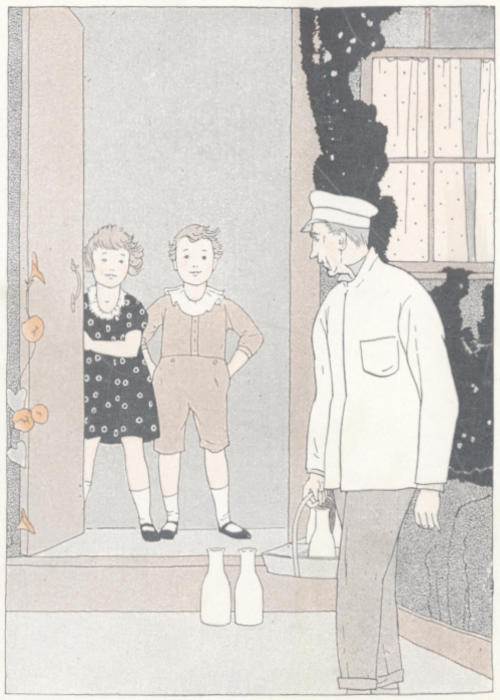
Bobby and Betty drink milk.
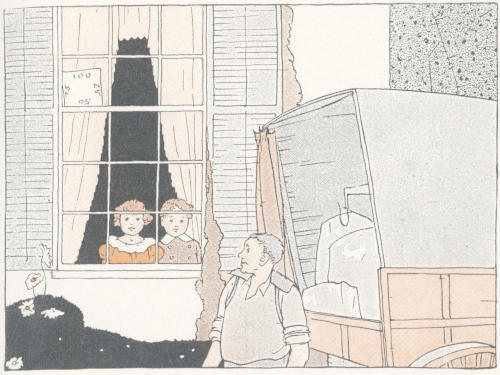
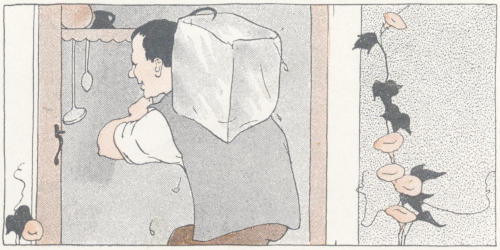
The milkman brings them milk every
day.
He leaves two quart bottles at the
back door.
He never forgets to bring the milk.
He never stays away when it storms.
Find the milkman.
Find Bobby and Betty.
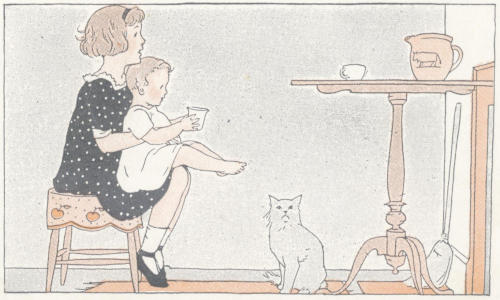
Round about, round about applety-pie,
Baby loves milk and so do I.
Up, Mother, up, and fill us a cup,
And baby and I will drink it all up.
—Adapted from an old rime
THE MILKMAN AND HIS HORSE — For study and play :
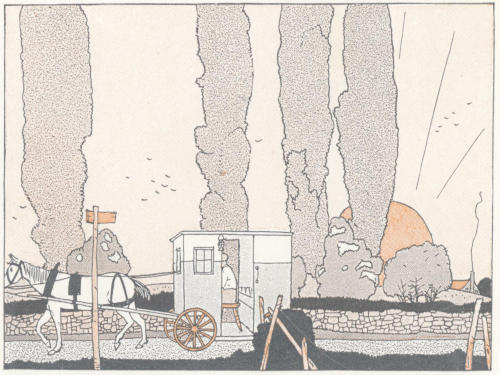
The milkman has a wise horse.
The horse knows where to stop.
He knows when to stand still.
He knows when to go on.
He doesn’t try to run away.
The horse helps the milkman.
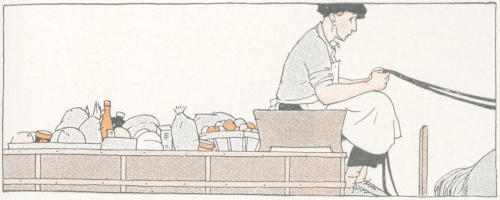
The milkman takes bottles of milk
from his wagon.
Sometimes he takes out quart bottles.
Sometimes he takes out pint bottles.
He leaves milk at the back door.
He takes empty bottles away.
He puts the empty bottles in the
milk wagon.
At the end of the week he knocks
at the door.
Then Mother pays him for the milk.
How many quarts of milk does the
milkman leave at your door every day?
How many quarts of milk does the
milkman leave at your door every week?
How much do you have to pay the
milkman each week?
Name the days of the week. Count
them.
How many pints make one quart?
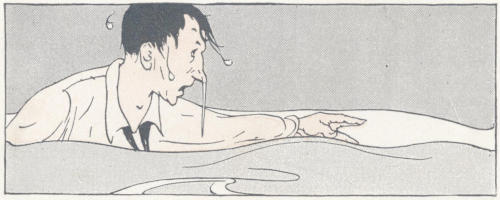
Milkman, milkman, where have you been?
In Buttermilk Channel up to my chin.
I spilt my milk, and spoilt my clothes,
And got a long icicle hung to my nose.
THE ICEMAN — For study and play : — THE ICE MAN
Mother keeps milk in the ice box.
She likes to keep it cool and sweet.
The iceman passes every day with a
big ice wagon.
When Mother wants ice, Betty puts
up a card.
When the iceman sees it, he cries,
“Whoa! whoa!”
The big horses stop.
The iceman jumps down from his
wagon.
He brings in a big block of ice.
He puts it in the ice box, and
Mother gives him a ticket.
The iceman goes back to his wagon.
He jumps in and drives away.
Once Bobby and Betty ran after the
ice wagon.
Mother saw them and called them
back.
“Don’t run after the ice wagon,” said
Mother. “Play you have an ice wagon,
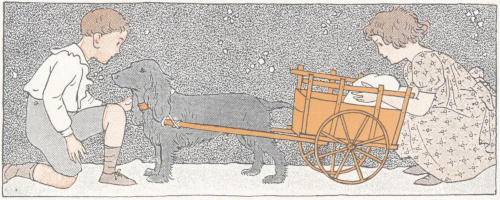
Bobby. Hitch Queen to your cart.”
I was some ice,
So white and so nice,
But which nobody tasted;
And so it was wasted,
All that good ice!
—Edward Lear
Composed by Children
The ice wagon rattles down the street,
Thumpity, bumpity, bump!
It always comes in the summer’s heat,
Thumpity, bumpity, bump!
The ice picks clank and make such a noise,
Clinkity, clankity, clank!
Down the street run the girls and the boys,
Clinkity, clankity, clank!
Here is a card for seventy-five pounds,
Whoa there, Jerry and Joe!
Chippety chop, how the ice pick sounds,
Whoa there, Jerry and Joe!
Now he comes in at the kitchen door,
Trampity, trampity, tramp!
Dripping water all over the floor,
Trampity, trampity, tramp!
Then he goes in his wagon yellow,
Gee up, Jerry and Joe!
The iceman is a jolly fellow,
Gee up, Jerry and Joe!
—Grade III, North School, Hinsdale, Illinois
Snow, snow faster,
Come again at Easter.
MAKING APPLE PIES — For study and play :
Did you ever make a pie?
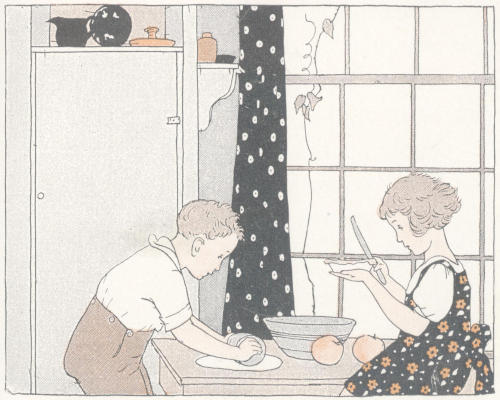
Bobby and Betty make pies.
Mother gives them little pieces of
pie crust.
They lay the pie crust on the bread-board.
They roll it with a rolling-pin.
They put the pie crust on little pie
tins and pat it down.
Then Mother gives each of them a
nice red apple.
Bobby pares his apple.
Betty pares her apple.
They quarter the apples.
They core them.
They slice them and fill their pies.
They cover them with pie crust.
They trim off the edges.
Mother puts the pies in the oven.
When they are baked, Mother takes
them out.
Bobby and Betty have them at dinner.
Roll a pie crust,
Roll a pie crust,
With a rolling-pin.
Lift a pie crust,
Lay it gently
On a little tin.
Pare an apple,
Core an apple,
Slice it very thin.
Put the top crust
On the pie.
Then the edges trim.
B is cook Betty,
She’s baking a pie
With ten or twelve apples
All piled up on high.
Pippin, pippin, fly away,
Give me one another day.
MOTHER WANTS A CHERRY PIE — For study and play :
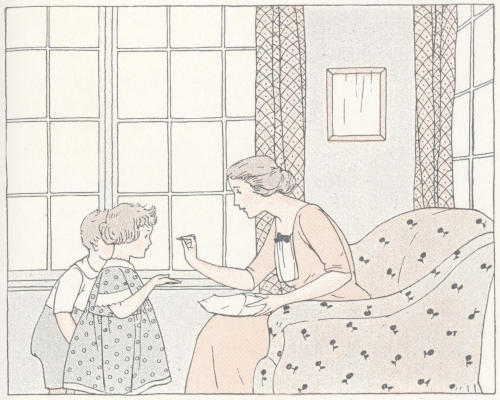
One day Mother said, “I want a
cherry pie and I haven’t time to make it
today.”
“Let me make it,” said Bobby.
“Let me make it,” said Betty.
“We won’t make a pie today,” said
Mother. “We will buy one. You may
go to the baker’s shop and buy a cherry
pie.”
“Good!” said Betty.
“Come on,” said Bobby.
“Wait,” said Mother. “You cannot
buy a pie without money.”
“That’s so,” said Bobby. “I forgot
the money. I was going to be like
Simple Simon.”
“Simple Simon couldn’t buy a pie,”
said Betty. “He didn’t have a penny.”
“Can we buy a pie for a penny,
Mother?” asked Bobby.
“Oh, no, Bobby. Pies cost more
than they did when Simple Simon
lived.”
“How much does a cherry pie cost,
Mother?” asked Betty.
“Twenty cents,” answered Mother.
“Twenty cents!” cried Bobby.
“Yes,” said Mother. “Here are two
dimes. Bobby, you may carry the money
this time.”
“Thank you, Mother,” said Bobby.
“Come, Betty, let’s go.”
Simple Simon met a pieman,
Going to the fair;
Says Simple Simon to the pieman,
“Let me taste your ware.”
Says the pieman to Simple Simon,
“Show me first your penny.”
Says Simple Simon to the pieman,
“Indeed, I haven’t any.”
“Can she make a cherry pie, Billy boy, Billy boy?
Can she make a cherry pie, Charming Billy?”
“She can make a cherry pie, quick as a cat can wink its eye,
She’s a young thing and cannot leave her mother.”
Up in the tree cherries I see;
Some are for you, some are for me.
AT THE BAKER’S SHOP — For study and play :
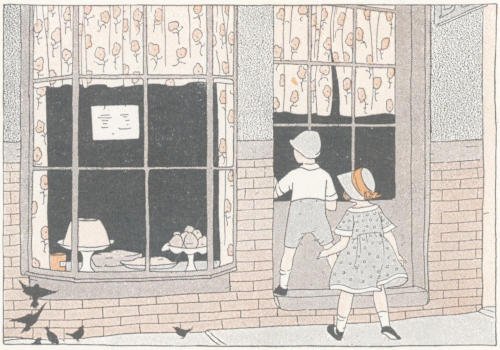
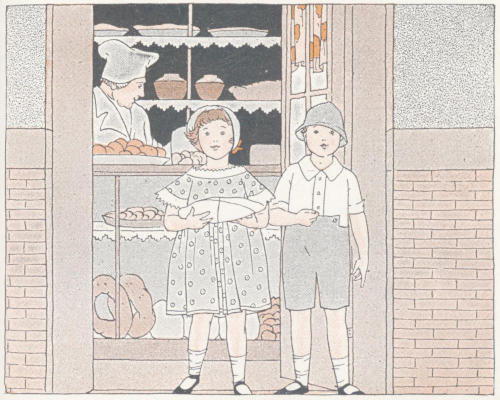
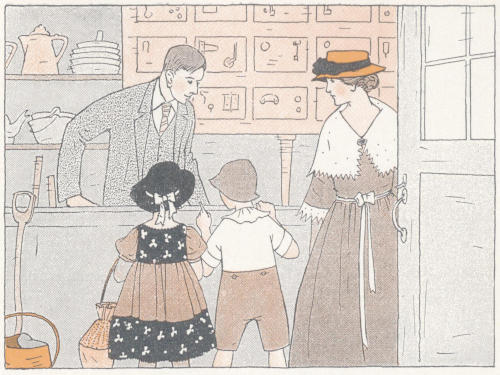
Soon Bobby and Betty were at the
baker’s door.
They opened the latch and walked in.
“We shall have to wait until it is
our turn,” said Bobby.
“How many are ahead of us?” asked
Betty.
“Let’s count them,” whispered Bobby.
Bobby and Betty counted very softly,
“One, two, three, four, five, six.”
“There are six ahead of us,” said
Bobby.
While they were waiting, Bobby and
Betty looked at the show-case.
“That’s a chocolate cake,” said
Bobby.
“See those chocolate cookies,” said
Betty.
“Where are the pies?” whispered
Bobby.
“Up there,” said Betty. “Don’t you
see them on that shelf?”
“Oh,” said Bobby. “I see them
now.”
“It’s our turn next,” whispered Betty.
“What will you have little boy?”
asked the baker.
“A cherry pie, please,” said Bobby.
“Here is a nice one,” said the baker.
“It is just out of the oven.”
“How much is it?” asked Bobby.
“Eighteen cents,” answered the baker.
“Mother gave me twenty cents,” said
Bobby.
“Pies are eighteen cents today,” said
the baker. “What next?”
“That’s all Mother told us to buy,”
said Bobby.
“Eighteen, twenty cents,” said the
baker. “Here is your change. Is the
little girl your sister?”
“Yes, sir,” answered Bobby.
“Good day,” said the baker. “Who
is next?”
“Good day,” said Bobby and Betty.
“Let me carry the pie, Bobby,” said
Betty.
Betty took the pie, and Bobby held
the pennies in his hand.
“Why don’t you buy some chocolate
cookies?” asked Betty.
“I don’t know,” answered Bobby.
“Please, Bobby, please buy some
chocolate cookies!”
Bobby looked at the pennies.
He looked at the baker.
The baker was busy.
So Bobby put the pennies in his
pocket
Bobby and Betty then left the baker’s
shop and took the pie home to Mother.
To market, to market, to buy a plum cake;
Home again, home again, ne’er one baked.
The baker is dead, and all his men,
And we must go to market again.
To market, to market, to buy a plum bun;
Home again, home again, market is done.
If all the world was apple pie,
And all the sea was ink,
And all the trees were bread and cheese,
What would we have for drink?
Why does a baker wear a cap? To
cover his head.
GUESS WHAT IS IN MY POCKET — For study and play :
Bobby and Betty went straight home
and gave the pie to Mother.
“Guess what is in my pocket!” said
Bobby.
“What can it be?” asked Mother.
Bobby jingled the pennies.
“Pennies,” guessed Mother.
“You guessed right,” said Bobby.
“Guess how I got them?”
“Did you find them on the way
home?” asked Mother.
“No,” said Bobby. “Guess again.”
“Did the baker give you some
change?” asked Mother.
“You guessed right this time,” said
Bobby. “Here are your pennies.”
“Thank you,” said Mother. “You
did right to bring me the change.”
“We wanted to buy some chocolate
cookies,” said Betty.
“The baker has some nice cookies
in his show case,” said Bobby.
“You may each have a penny,” said
Mother.
“Oh, thank you, thank you!” said
Bobby and Betty.
“May I buy a chocolate cookie with
my penny?” asked Bobby.
“Yes, Bobby dear,” said Mother.
“The penny is yours. You may buy what
you please.”
“May I buy a chocolate cookie with
my penny?” asked Betty.
“Yes, Betty,” answered Mother.
“It is your penny.”
“Was it mine when the baker gave
it to Bobby?” asked Betty.
“No, dear,” answered Mother. “The
penny was not yours.”
“Whose pennies were they when the
baker gave them to Bobby?” asked
Betty.
“I know,” said Bobby. “They were
Mother’s pennies. That’s why we had
to bring them to her.”
There is nothing so kingly as kindness,
And nothing so royal as truth.
—Alice Cary
I do like pie,
Any kind of pie,
Apple, cherry,
Or strawberry,
Custard, mince,
Prune, or quince;
But the pie I like the best,
Better far than all the rest,
Is the pie
Called pumpkin pie;
I do like pie,
Pumpkin pie!
—Selected
Heetum peetum penny pie,
Populorum gigum gie,
North, south, east, west,
Pumpkin pie I like the best.
A TALK WITH FATHER AND MOTHER — For study and play :
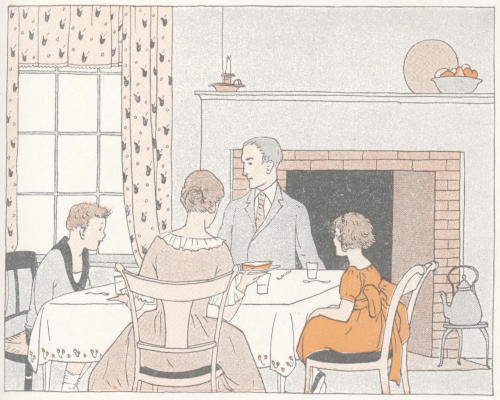
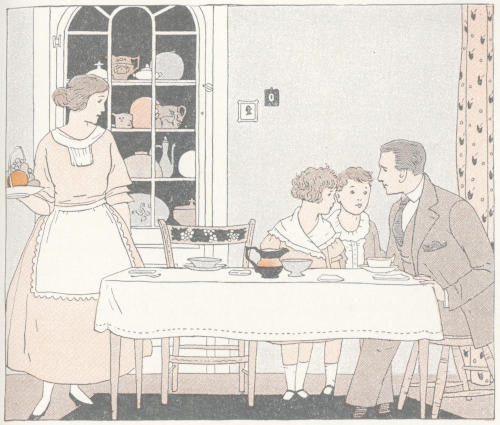
At dinner Father said, “I like cherry
pie.”
“I like it,” said Mother.
“So do I,” said Bobby.
“We are like blackbirds,” said Betty.
“How do you make that out?” asked
Father.
“Blackbirds they love cherry pie,”
said Betty.
“When did you learn that old song?”
asked Father.
“Last night,” answered Betty. “It’s
in my book.”
“There’s a pieman in my book,”
said Bobby. “Simple Simon met him.
Simple Simon wanted to buy a pie, but
he didn’t have a penny.”
“It takes money to buy a pie,” said
Father. “Simple Simon learned that.”
“If I meet a pieman, I’ll buy a pie,”
said Betty. “I’ll give him my penny
for a pie.”
“Are there any piemen now?” asked
Bobby.
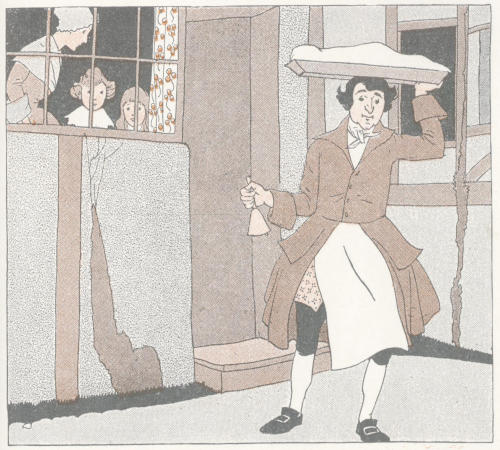
“Piemen do not walk the streets
now,” answered Father. “They sell pies
and cakes in shops.”
“Is the baker a pieman?” asked
Bobby.
“We don’t call him a pieman,” said
Father, “but he makes and sells pies.”
“The baker sells bread, too,” said
Betty. “He sells rolls and buns.”
“Why does the baker wear a white
coat?” asked Bobby.
“He wants to keep clean,” said
Mother. “He wants to keep everything
in his shop nice and clean.”
“Bakers used to wear white aprons,”
said Father. “Bakers and piemen always
wore clean white aprons.”
“Where is the baker’s oven?” asked
Betty. “I didn’t see it.”
“It is in his kitchen,” answered
Mother.
“He must have a big oven,” said
Betty.
“He has,” said Mother. “And he
has a long wooden shovel to take the
bread from the oven.”
“I’d like to be a baker,” said Bobby.
“I’d like to have a baker’s shop and a
great big oven. I’d like to make pies and
cakes and muffins and bread and buns.”
“Let’s play we have a baker’s shop,”
said Betty. “Let’s play we are baking
bread in an oven. Let’s take the bread
from the oven with a long wooden
shovel.”
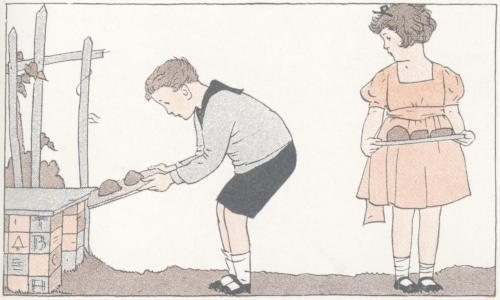
So Bobby and Betty played they were
bakers. They made an oven with their
blocks. And they made mud pies and
little cakes and put them in their oven.
Pat it here, and pat it there,
What a dainty prize!
Bake it on a shingle—
Nice mud pies!
King Pippin built a fine new hall,
Pastry and pie crust were the wall;
Windows made of black pudding and white,
Slates were pancakes, you ne’er saw the like.
Blackbirds they love cherry pie,
Quick they eat and off they fly.
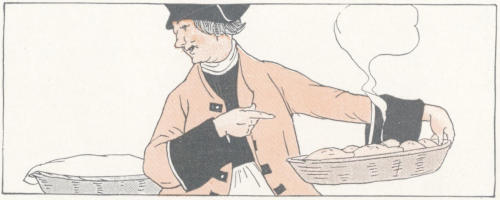
COLLY-MOLLY-PUFF AND THE MUFFIN MAN — For study and play :
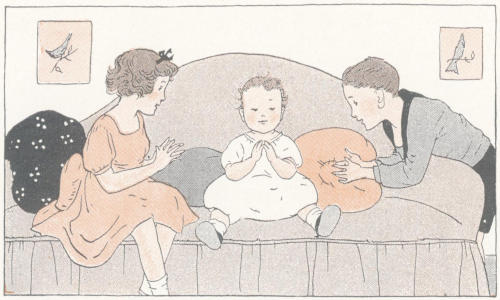
After dinner Bobby and Betty played
with baby.
They played “Pat-a-cake, pat-a-cake,
baker’s man.”
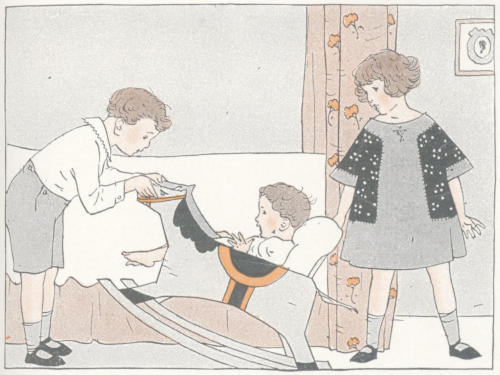
Then Bobby said, “Let’s give baby
a ride.”
“Let’s do it,” said Betty. “Let’s
give him a ride to the baker’s shop on
his rocking horse.”
So they put baby on the rocking
horse and gave him a nice ride.
Three times baby rode to the baker’s
shop before Mother came to put him
to bed.
Then Bobby and Betty went to the
bookcase and took out their Mother
Goose books.
“Colly-Molly-Puff! Colly-Molly-Puff!”
repeated Bobby and Betty.
“That’s a funny name,” said Betty.
“Is that the pieman’s real name?”
asked Bobby.
“No,” answered Father. “It’s a
nickname. Long ago the pieman was
called Colly-Molly-Puff.”
“Were all the piemen called Colly-Molly-Puff?”
asked Betty.
“Not all,” answered Father. “One
was called Tiddy-doll and another was
called Gingerbread Harry.”
“What did Tiddy-doll and Gingerbread
Harry sell long ago?” asked
Betty.
“Cakes and pies,” answered Father.
“All these piemen went up and down
the streets calling out their wares.”
“Did they sell bread, Father?” asked
Bobby. “Did they sell muffins and rolls?”
“No,” answered Father. “They sold
cakes and pies. The muffin man went
up and down the streets selling muffins
and rolls.”
“I know the muffin man,” said Betty.
“Here he is. See!”
“He is Colly-Molly-Puff’s brother,”
said Father.
“Were they real brothers?” asked
Bobby.
“No,” answered Father. “They were
called brothers because one sold bread
and the other sold pies.”
“I wish they were here now,” said
Bobby.
“Let’s play they are,” said Betty.
“I’ll be the muffin man.”
“Good!” cried Bobby. “I’ll be Colly-Molly-Puff.”
“O Daddy!” cried Betty. “I’m the
muffin man.”
“I’m Colly-Molly-Puff, Daddy.”
“Perhaps Mother will dress you up,”
said Father.
“That will be fun!” cried Bobby and
Betty.
When Mother came in, she helped
them dress as Colly-Molly-Puff and the
muffin man. Then Father showed them
how to call out their buns and muffins
and cakes and pies.
Ride a cock horse to the baker’s shop,
To see what baby can buy.
A nickel white loaf and a nickel brown loaf,
And a ten-cent apple pie.
Buy muffins, nice muffins,
Nice muffins, O!
One a penny buns! Two a penny buns!
One a penny, two a penny, hot cross buns.
If you have no daughters,
Pray give them to your sons.
But if you have no little elves,
You must eat them all yourselves.
One a penny poker! Two a penny tongs!
Three a penny fire irons, hot cross buns.
Nice gingerbread, spice gingerbread,
Four and twenty lumps of gingerbread for a sixpence.
Come and buy! Come and buy!
Buy gingerbread!
WHAT SHALL I BUY WITH MY PENNY? — For study and play : — Riddles :
One night at dinner Bobby said, “I
haven’t spent my penny yet.”
“I haven’t spent mine,” said Betty.
“Mother, when may we go to the
baker’s shop and buy chocolate cookies?”
asked Bobby.
“I am going to the grocery store
tomorrow,” said Mother. “You and Bobby
may go with me.”
“Perhaps I’ll buy something at the
grocery store,” said Bobby.
“Perhaps I’ll buy a banana,” said
Betty.
“Perhaps I’ll buy a big plum,” said
Bobby.
“Perhaps I’ll buy a pear,” said Betty.
“I like pears. I like them better than
bananas.”
“Oh, I know what I’m going to
buy,” said Bobby. “I’m going to buy
a lollipop.”
“Perhaps I’ll buy a lollipop,” said
Betty.
“You make me think of a story,”
said Father.
“What is the story about?” asked
Bobby.
“It’s about a little boy who found a
penny,” said Father. “The boy didn’t
know how to spend it.”
“Tell us the story,” said Betty.
“Oh, do,” said Bobby.
“Please, Daddy,” said Betty.
“Help Mother with the dishes,” said
Father. “Then I will tell you the
story.”
How many oranges make a dozen?
How many in a half dozen?
Name things you buy of the groceryman
by the dozen.
What does the baker sell by the
dozen?
Peter Piper picked a peck of pickled peppers;
A peck of pickled peppers Peter Piper picked;
If Peter Piper picked a peck of pickled peppers,
Where’s the peck of pickled peppers Peter Piper picked?
Humpty dumpty sat on the wall,
Humpty dumpty had a great fall;
All the king’s oxen and all the king’s men
Cannot put Humpty dumpty together again.
An egg
What is as white as snow,
As green as grass,
As red as blood,
And as black as a hat?
A common black cherry
FATHER TELLS A STORY — Questions to answer : — Riddles :
“The dishes are washed,” said Bobby.
“Yes, Father,” said Betty. “They
are washed and wiped and put away.”
“Then I’ll tell you the story,” said
Father.
“What’s the name of the story,
Father?” asked Betty.
“What shall I do with this penny?”
answered Father.
Bobby and Betty drew up their chairs
and Father told them this story:
“Once upon a time, there was a very
good little boy, who always minded his
mother.
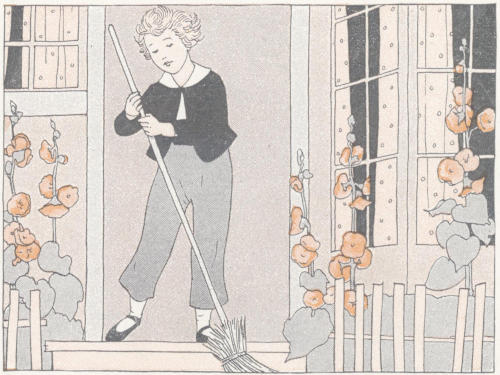
“One morning his mother said to
him, ‘Take the broom and go and sweep
the steps.’
“Now the little boy did not wait for
his mother to tell him again. He took
the broom and went out and began to
sweep the steps.
“When he was sweeping, he heard
a noise.
“He looked all around to see what it
was, and what do you think he found?
“A penny! and it was on the step he
had been sweeping.
“‘O Mother, Mother!’ called the little
boy. ‘See what I have found!’
“‘A penny!’ said his mother. ‘You
have been a good boy. You may have
this penny for your very own.’
“‘Oh, thank you, thank you!’ said
the little boy, and he went on with the
sweeping.
“While he was sweeping, the little
boy thought, ‘What shall I do with
this penny?’
“‘I have half a mind to buy some
dates. But no, I should have to throw
away the stones.’
“‘I will buy some apples. Oh, no,
I will not, for I should have to throw
away the cores.’
“‘I will buy some nuts. Oh, no,
for I should have to throw away the
shells.’
“‘What shall I buy then? I will buy
some figs.’
“And so the little boy went to the
grocery store and bought a penny’s worth
of figs.”
“Is that all?” asked Bobby.
“That is all for this time,” said
Father.
“That’s a nice story,” said Betty.
“I’m glad the boy’s mother let him have
the penny.”
“So am I,” said Bobby. “I don’t
believe that little boy had many pennies
to spend.”
What part of a banana is thrown
away?
What part of a potato is thrown
away?
What part of a turnip is thrown
away?
What part of an egg is thrown
away?
What part of a nut is thrown away?
Where do you put the things that
are thrown away?
Why do we have garbage cans? Where
do we keep them?
What does the garbage man do?
Are you glad there are garbage men
to take away the garbage?
Make a little song to thank the garbage
man for helping us keep things
nice and clean.
A little house full of meat,
No door to go in and eat.
A nut
Four divisions in a casket;
There’s a leaf in every basket.
Walnut
AT THE GROCERY STORE — For study and play : — Riddle :
Bobby and Betty were up early next
morning.
“We are going to the grocery store
today,” said Betty when she came down
stairs.
“Hurrah!” cried Bobby. “I’ll spend
my penny. Here it is. I’ll put it in
my coat pocket now.”
“Mine is in my shopping bag,” said
Betty.
After the breakfast dishes were put
away, Mother sat down to write.
“I know what Mother is writing,”
said Betty.
“What is Mother writing?” asked
Bobby.
“The names of the things she is
going to buy,” said Betty. “Isn’t that
what you are writing, Mother?”
“Yes, dear,” answered Mother. “I
am making a list of the things to buy
at the grocery store.”
All were soon ready to go.
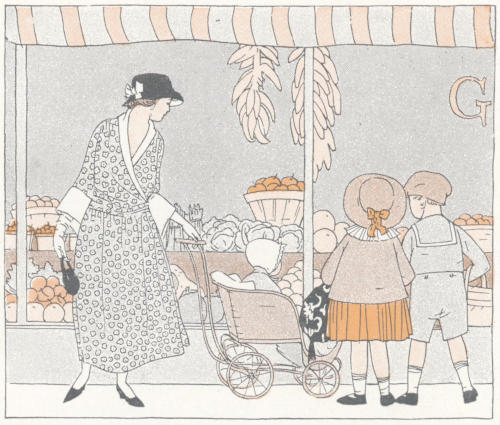
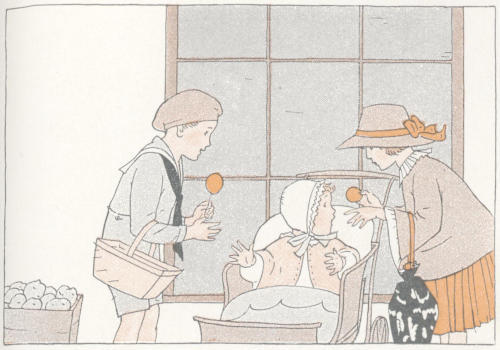
Mother put baby in his carriage.
Betty carried her shopping bag,
and Bobby had a market basket on his
arm.
“Oh, see what is in the window!”
said Bobby when they came up to the
grocery store.
The groceryman had a beautiful
window.
There were baskets of ripe red
apples.
There were baskets of big blue
plums.
There were rows of oranges and
lemons.
There were ever so many kinds of
fruit in the groceryman’s window.
“A fine day, Madam,” the groceryman
said, when they went in the store.
“What can I do for you today?”
“I want some fresh eggs,” said
Mother.
“These are fresh from the country,”
said the groceryman.
“I will take two dozen,” said Mother.
“What will you have next?” asked
the groceryman.
“A pound of your best butter,” said
Mother.
“Do you need potatoes?” asked the
groceryman.
“Put me up a peck,” said Mother.
“And I will take this basket of ripe
tomatoes.”
“Any fruit?” asked the groceryman.
“How much are the peaches?” asked
Mother.
“Thirty cents a basket,” answered
the groceryman.
“I will take a basket of peaches,”
said Mother.
“Anything else, Madam?” asked the
groceryman.
“That is all today, thank you,” said
Mother.
“Do you wish to take anything with
you?” asked the groceryman.
“I will take the butter and eggs,”
said Mother. “You may send the other
things.”
Mother paid for the groceries, then
turned to Bobby and Betty.
Betty had bought a big blue plum.
But Bobby wanted to cross the street
and buy a lollipop.
“You may,” said Mother. “The
way is clear now. You may cross over.
Be sure to come right back.”
Bobby ran across the street and was
soon back with a lollipop.
“Take a bite, baby,” said Bobby.
And Bobby gave baby a bite of his
lollipop.
“Take a bite, baby,” said Betty.
And Betty gave baby a bite of her big
blue plum.
“We must go home now,” said Mother
to the children.
Then she put the butter in Bobby’s
basket and the eggs in the carriage at
baby’s feet.
Handy Pandy, Jack-a-dandy,
Loves plum cake and sugar candy.
He bought some at the grocer’s shop
And out he came, hop-hop-hop.
Currants on a bush,
And six on a stem,
And cherries on a bending bough
And Ned to gather them.
—Christina G. Rossetti
I went to the market and bought it.
I returned home and wept with it.
An onion
THE GROCERY BOY COMES WITH THE GROCERIES — For study and play : — Riddle :
“Do you hear that wagon?” asked
Bobby. “It’s coming bumpety, bumpety,
bumpety, bump!”
“Yes,” answered Betty. “How that
wagon rattles and bumps! O Bobby, it’s
stopping here!”
“Oh, I know now what wagon it is,”
said Bobby. “It’s the grocery wagon.
The grocery boy is bringing Mother’s
groceries.”
“Let’s run and meet him,” said Betty.
“Did you bring something for us?”
Bobby asked the grocery boy.
“Yes,” said the grocery boy. “This
box of groceries is for your mother.”
By this time the grocery boy was at
the back door. Mother met him.
“Your groceries, Madam,” said the
boy as he put the box on the kitchen
floor.
“Thank you,” said Mother.
When the boy went back to his
wagon, Bobby asked, “Is that your
horse?”
“No, but I drive it.”
“Is that your wagon?” asked Betty.
“No,” answered the grocery boy. “It
belongs to the groceryman.”
“What is in the wagon?” asked
Bobby.
“Groceries.”
“What are you going to do with
them?” asked Bobby.
“Take them to the people who paid
for them,” said the boy.
“Did they pay you?” asked Bobby.
“No,” answered the grocery boy.
“They paid the groceryman.”
“Does anybody pay you?” asked
Bobby.
“The groceryman pays me,” said the
boy, and he jumped into the wagon and
drove away.
“The groceryman has everything nice
to eat,” said Betty. “His store is full of
nice things to eat.”
“Let’s play we have a grocery store,”
said Bobby.
Just then Mother called, “Come,
Bobby! Come, Betty! Help me put the
groceries away.”
Bobby and Betty helped Mother.
Then she gave them the box the
grocery boy left.
“That’s just what I want, Mother,”
said Betty. “That will make a nice
grocery store.”
Mother gave them some empty boxes
to put in their grocery store.
They had a good time playing store.
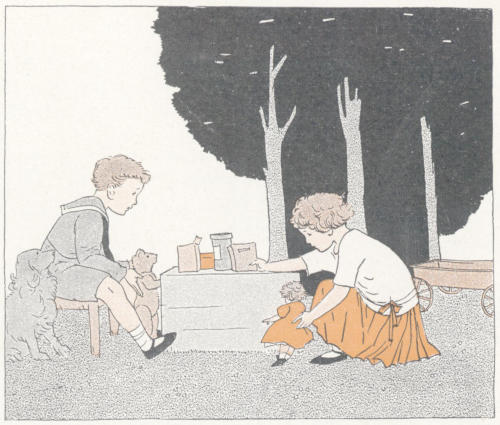
Dolly and Teddy-bear came to their
store to buy groceries.
Then Bobby hitched Queen to his
cart to take the groceries to Dolly and
Teddy-bear.
Name things you buy by the peck.
How many quarts in a peck?
How many quarts in half a peck?
Apples and oranges, four for a penny;
You’re a good scholar to count so many.
Down in the meadow is a green house,
In the green house is a white house,
In the white house is a red house,
The red house is full of little negroes.
A watermelon
THE BANANA MAN — For study and play : — Riddles :
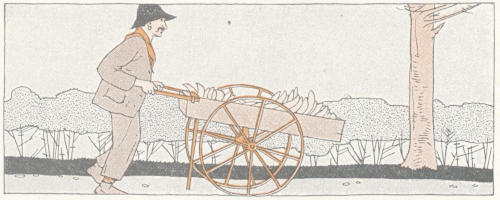
“Ba-na-nas! Ba-na-nas!” called the
banana man.
“Who is calling?” said Bobby.
“The banana man,” answered Betty.
“I see him,” said Bobby. “He is
coming down the street with his pushcart.”
Again the banana man called out,
“Ba-na-nas! Ba-na-nas!”
“Let’s ask Mother if we can buy
some bananas,” said Bobby.
Bobby and Betty ran in to Mother.
“O Mother,” said Betty. “The
banana man is coming. Please buy
some bananas.”
“Please, Mother,” said Bobby.
“You may buy a dozen for me,”
said Mother. “Betty, it is your turn to
buy today.”
“Why can’t I do it?” asked Bobby.
“Not this time,” said Mother. “It
is Betty’s turn today.”
Mother gave Betty thirty-five cents,
and she bought a dozen bananas.
The banana man then went down
the street calling, “Ba-na-nas! Ba-na-nas!
Ba-na-nas!”
Mother had bananas at dinner that
night.
Betty told Father about the banana
man, and Bobby told him about his
pushcart.
When the story hour came, Father
said, “See if you can find the banana
man in your Mother Goose books.”
Bobby and Betty looked through
their books.
“I can’t find the banana man,” said
Bobby.
“Here’s a woman with a wheelbarrow,”
said Betty. “Does she have
fruit to sell?”
“Yes,” answered Father. “That is
the cherry woman.”
“Did she sell cherries?” asked
Bobby.
“Yes,” answered Father. “She sold
cherries and oranges and lemons.”
“She doesn’t come here,” said
Betty.
“No, dear,” said Father. “Women
don’t sell fruit from wheelbarrows on our
streets.”
“Why not?” asked Betty.
“Because that work is now done by
men,” Father answered.
“The banana man has a pushcart,”
said Bobby. “But the fruit and vegetable
man has a horse and wagon.”
Tippety, tippety, tippety, toe.
Give me a banana and I’ll go.
Cherries, cherries! Big as plums!
Who comes! Who comes!
Riddle me, riddle me, red coat,
A stick in his hand, a stone in his throat,
Riddle me, riddle me, rotic, tot!
A cherry
Niddy, noddy,
Two heads and one body.
A wheelbarrow
THE FRUIT AND VEGETABLE MAN — For study and play : — Riddles :
“Beets! beets! Three bunches for a
dime! Beets! beets! Three bunches for
a dime!” called a boy at the back gate.
“The fruit and vegetable man is at
the back gate,” said Bobby. “Do you
want to buy anything?”
“I will go to the door,” said Mother.
“Strawberries! strawberries! Two
boxes for a quarter! Strawberries!
strawberries! Two boxes for a quarter!”
called the boy at the back gate.
“Bring me two boxes of strawberries,”
said Mother.
“Do you want any beets?” asked
the boy. “They are three bunches for
a dime.”
“Bring me three bunches,” said
Mother.
The fruit and vegetable man took
the beets and strawberries out of the
wagon.
The boy brought them to the kitchen
door.
“Can you change fifty cents?” asked
Mother.
“Yes,” said the boy. “Thirty-five,
forty, fifty cents.”
“How much did he give you, Mother?”
asked Bobby.
“Fifteen cents,” answered Mother.
“That is the change.”
“I want to know how to make
change,” said Bobby.
“So do I,” added Betty.
“You can learn, Bobby,” said Mother.
“Take out your toy money, children.
Buy and sell and learn to make change.”
The fruit man comes round every day.
He brings us things to eat.
He brings us apples, berries, grapes,
And peaches pink and sweet.
—Grade I, North School, Hinsdale, Illinois
O was an orange
So yellow and round;
When it fell off the tree,
It fell to the ground,
Down to the ground.
It can run and can’t walk.
It has a tongue and can’t talk.
A wagon
What stands on its foot and has its heart in its head?
A cabbage-head
BOBBY AND BETTY GO TO THE MEAT MARKET — For study and play :
“Bobby! Betty!” called Mother one
morning.
Bobby and Betty came in from their
play.
“What is it, Mother?” asked Bobby.
“What do you want?”
“I want you to go to the meat market
and buy a pound of ham.”
“I’ll buy it,” said Bobby.
“Let me buy it,” said Betty.
“You may buy the ham today,
Bobby,” said Mother. “Here is the
money. Bring me the change.”
Bobby and Betty went down the
street.
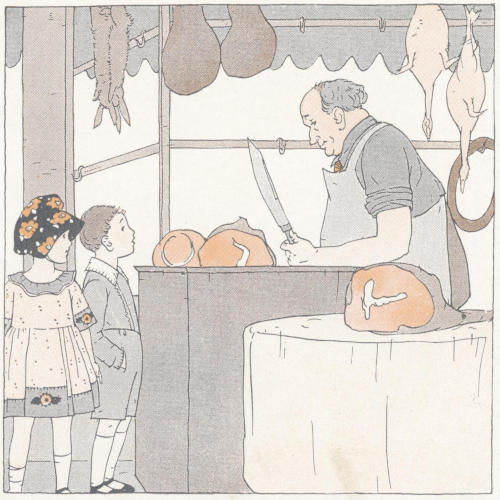
They were soon in front of the meat
market.
“O Betty!” cried Bobby. “Look at
those birds.”
“They are not birds,” said a lady.
“They are chickens.”
Bobby and Betty looked at the
chickens.
They were poking their heads out of
a cage.
“The chickens want to get out of
the cage,” said Betty.
“I wish they were out,” said Bobby.
“I want to see them run.”
“Let’s go into the meat market,”
said Betty.
They went in and waited their turn.
While they were waiting, they saw
a rabbit hanging on a hook.
“What’s that?” asked Betty.
“I think it’s a rabbit,” answered
Bobby.
“I wish I had one,” said Betty.
“Good morning,” said the big man
behind the counter. “What can I do
for you today?”
“I want a pound of ham,” said
Bobby.
The man took a ham from a hook
and cut off three slices.
He put the slices of ham on the
scales.
“That is just one pound,” he said.
“What next?”
“That is all,” said Bobby. “Here
is the money.”
Bobby put the change in his pocket.
“Let me carry the ham, Bobby,” said
Betty.
“No,” said Bobby. “Mother told
me to buy it.”
“Let me carry it, I say!” cried Betty.
“No, no, no!” cried Bobby. “You
bought the bananas. It’s my turn to buy
today.”
To market, to market, to buy a fat pig,
Home again, home again, jiggety jig.
To market, to market, to buy a fat hog,
Home again, home again, jiggety jog.
To market, to market, a-gallop, a-trot,
To buy some meat to put in the pot.
To market, to market, trittity-trot,
To buy one mutton to put in the pot.
Jack Sprat could eat no fat,
His wife could eat no lean;
And so between them both, you see,
They licked the platter clean.
Chicky! chicky! chick!
Oh, come quick!
From my little fingers
A crumb you may pick.
Pork is the flesh of the ⸺.
Beef is the flesh of the ⸺.
Mutton is the flesh of the ⸺.
Ham is the ⸺ of a ⸺ cured by
salting and smoking.
WHAT BOBBY AND BETTY FOUND IN THEIR BOOKS — For study and play : — A COUNTING-OUT RIME
When the story hour came, Bobby
and Betty took their books from the
bookcase.
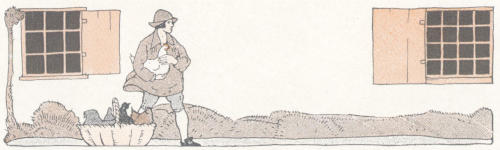
“See, Father,” said Bobby. “See the
man with the chickens.”
Father looked at the picture in
Bobby’s book.
“What is the man going to do with
the chickens?” asked Bobby.
“He is going to sell them,” answered
Father.
“I know where he is going,” said
Betty. “He is on his way to the meat
market.”
“No, dear. The chicken man used to
sell chickens from his basket on the
street.”
“Does he do it now?” asked Betty.
“No, Betty,” answered Father. “It
was a long time ago that the chicken man
sold chickens on the street.”
“We saw chickens today,” said Bobby.
“They were in a cage just outside the
meat market.”
“We saw a rabbit, too,” said Betty.
Just then Betty turned a page in her
book and came to the picture of a rabbit
woman.
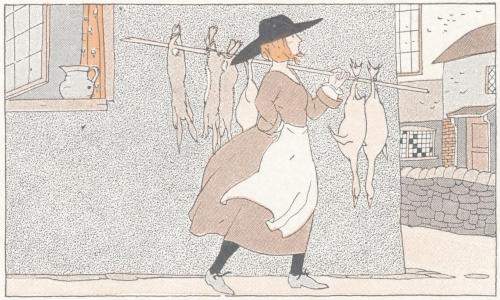
“See,” said Betty. “The woman has
rabbits on a pole.”
“She has geese, too,” added Bobby.
“Who is she?” asked Betty. “What
is she doing?”
“She’s a rabbit woman,” said Father.
“She is going down the street selling
rabbits and geese.”
“Is there a rabbit woman on our street?” asked Betty.
“No, dear,” answered Father. “The
rabbit woman lived a long, long time ago.”
“Now we buy rabbits at the meat
market,” said Bobby.
“Did the people have markets long
ago?” asked Bobby.
“Yes,” answered Father. “They had
markets. But they also had men and
women who sold their wares on the
streets.”
Chick, chick, chatter man,
How much are your geese?
Chick, chick, chatter man,
Five cents apiece.
Chick, chick, chatter man,
That’s too dear.
Chick, chick, chatter man,
You get out of here.
R was a rabbit,
Who had a bad habit
Of eating the flowers
In gardens and bowers.
Naughty fat rabbit.
BOBBY AND BETTY MAKE SHOES FOR DOLLY — For study and play :
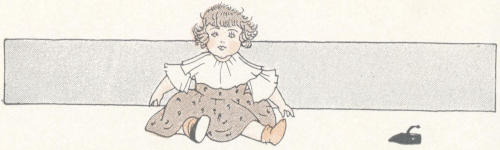
“Dolly has lost her shoe,” said Betty.
“I can’t find it anywhere.”
“Look again,” said Mother.
Betty looked and looked, but she
could not find it.
Bobby looked and looked, and he
could not find it.
“O Mother, what shall I do?” asked
Betty.
“Make a shoe,” said Mother.
“I don’t know how,” said Betty.
“Mother will show us how to make
shoes,” said Bobby. “Won’t you,
Mother?”
“Yes, dear,” answered Mother.
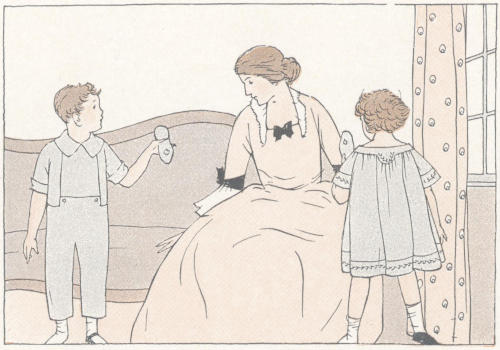
Then Mother showed Bobby and
Betty how to make shoes for Dolly.
That very day Grandfather came to
see Bobby and Betty.
“See, Grandfather,” said Betty. “See
dolly’s new shoes.”
“They are very nice,” said Grandfather.
“Who made them?”
“I made this one,” said Betty.
“I made that one,” said Bobby.
“You are good shoemakers,” said
Grandfather. “Listen and I’ll sing a
shoemaker’s song.”
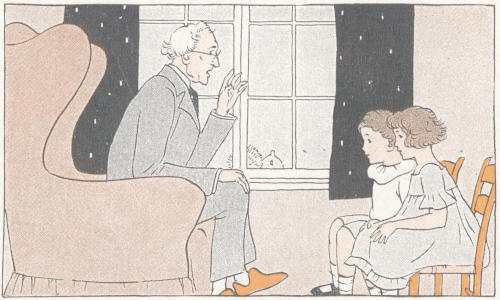
Bobby and Betty drew up their chairs
close to Grandfather’s big chair.
Then Grandfather sang this song:
“When I was a shoemaker,
A shoemaker was I.
I went this way, and that way,
And this way, and that way.
When I was a shoemaker,
A shoemaker was I.”
“Sing it again,” said Bobby.
“Please do,” said Betty.
Then Grandfather sang the song and
Bobby and Betty sang with him.
Little Betty Blue
Lost her holiday shoe.
What shall little Betty do?
Make her another
To match the other.
Then she’ll walk on two.
Dirty shoe, dirty shoe,
What will your mother and father do?
Said to a child whose shoes are muddy
What goes all day and sits in a corner at night?
A shoe
Tap-a-tap shoe, that would I do,
If I had a little more leather.
We’ll sit in the sun till the leather doth come,
Then we’ll tap them both together.
There was an old woman who lived in a shoe.
She had so many children, she didn’t know what to do.
She gave them some soup and a piece of white bread,
She sang them a song and put them to bed.
BOBBY AND BETTY GO TO THE SHOEMAKER’S SHOP — For study and play :
“There’s a hole in my shoe,” said
Bobby.
“There’s a hole in mine, too,” said
Betty.
“Let me see your shoes, children,” said
Mother.
Bobby and Betty showed Mother
their shoes.
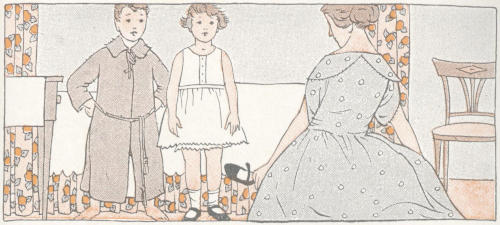
“Take off your shoes,” said Mother.
“Put on your new shoes.”
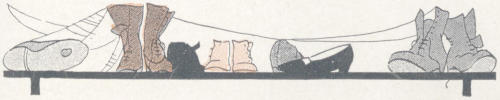
Bobby went to the closet off his
bedroom and took out his shoes and
put them on.
Betty went to the closet off her
bedroom and took out her shoes and
put them on.
“Now take your old shoes to the
shoemaker,” said Mother. “Ask him to
mend them.”
Mother gave Bobby and Betty some
money to pay the shoemaker.
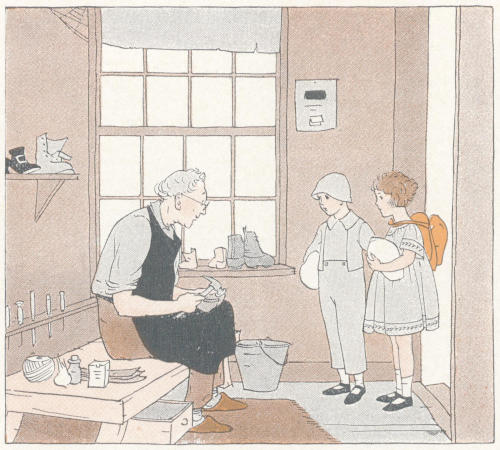
They were soon at the door of his
shop.
They stood and listened to the shoemaker’s
hammer.
“Rap-a-tap-tap! Rap-a-tap-tap!” went
the shoemaker’s hammer.
Bobby and Betty opened the door
and went into the shop.
“Good morning,” said the shoemaker.
“Good morning, good morning,” said
Bobby and Betty.
“What can I do for you today?”
asked the shoemaker.
“Will you please mend my shoe?”
asked Bobby.
“Will you please mend my shoe?”
asked Betty.
“Yes, yes,” said the shoemaker. “I
will mend your shoes.”
“Here are my shoes,” said Bobby.
The shoemaker looked at Bobby’s
shoes.
He looked at Betty’s shoes.
Then “Rap-a-tap-tap! Rap-a-tap-tap!”
went the shoemaker’s hammer.
Bobby and Betty watched the shoemaker
work.
They kept time with his hammer.
It was not long before the shoes
were mended.
“Here are your shoes,” said the
shoemaker.
“Thank you,” said Bobby.
“Thank you,” said Betty.
Bobby and Betty paid the shoemaker
for mending their shoes.
“Thank you,” said the shoemaker.
Then Bobby and Betty said, “Good-day,”
and went home with their shoes.
Shoemaker, shoemaker, mend my shoe.
Give it one stitch, give it two;
Give it three, and give it four,
And if it needs it, give it more.
Stitch, stitch away with your needle.
Pull away hard with your thread.
Rub it with wax to the right and the left,
And knock the old peg in the head.
If I were a shoemaker,
’Twould be my pride
The best of all shoemakers to be.
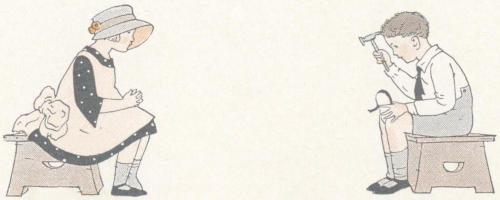
PLAYING SHOEMAKER — For study and play : — AN ACTION SONG — A SONG OF THE SHOEMAKER
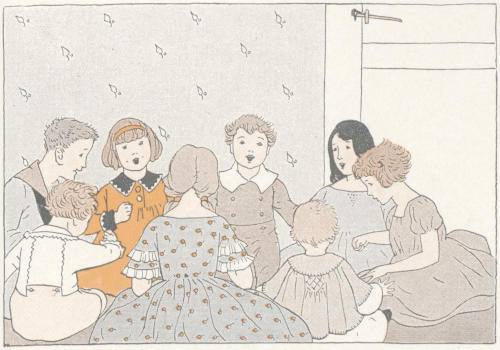
One day Bobby and Betty had a
party.
They played they were shoemakers
mending shoes.
All but Bobby sat down on the floor
so as to make a ring.
Then they sang:
“Rap-a-tap, tap! Tick-a-tack, too!
This is the way we mend a shoe.”
While they were singing Bobby came
into the room.
When they stopped singing, he said;
“Shoemaker, shoemaker, mend my shoe.
Have it done by half-past two.”
“Yes,” said the shoemakers. “We
will have it done by half-past two.”
Then the shoemakers worked and
sang:
“Rap-a-tap, tap! Tick-a-tack, too!
This must be done by half-past two.”
Soon Bobby came back and said,
“It is half-past two. Is my shoe
mended?”
“I have passed it to my next-door
neighbor,” answered the head shoemaker.
“Is my shoe mended?” asked Bobby
of the next-door neighbor.
“My next-door neighbor has it,” was
the answer.
Then Bobby asked the next child;
but he always got the same answer.
At last he saw who had the shoe,
so he asked the right one.
Then all the shoemakers called out:
“Little boy, little boy, here is your shoe.
It was mended by half-past two.”
Shoemaker, shoemaker, mend my shoe.
Have it done by half-past two.
Stitch it up and stitch it down,
Now see with whom the shoe is found.
Shoemaker, shoemaker, mend my shoe.
Give it a stitch and that will do.
Here’s a nail, and there’s a prod,
And now my shoe is well shod.
Tip-tap, rip-rap,
Tick-a-tack-too.
This way, that way,
So we make a shoe,
Getting rich, every stitch,
Tick-a-tack-too.
When I’m a man,
I’ll be a shoemaker if I can.
I’ll sit on a bench, with my last held so,
And in and out my needle will go.
I’ll sew so strong that my work shall wear,
Till nothing is left but my stitches there,
When I’m a man.
This is the way we mend our shoes,
Mend our shoes, mend our shoes;
This is the way we mend our shoes,
On a cold and frosty morning!
This is the way the ladies walk,
Ladies walk, ladies walk;
This is the way the ladies walk
On a cold and frosty morning!
This is the way the gentlemen walk,
Gentlemen walk, gentlemen walk;
This is the way the gentlemen walk
On a cold and frosty morning!
Stretch the leather over the last,
Fit it and sew it and hold it fast.
Wax the thread, pull it through and through;
Stitch it and stitch it and sing a song, too.
Rap-a-tap, tap! Tick-a-tack, too!
This is the way to make a shoe.
Take a sharp awl and punch a hole
Right through the upper and through the sole.
Put in one peg, put in two;
Chuckle and laugh as you hammer them through.
Rap-a-tap, tap! Tick-a-tack, too!
This is the way to make a shoe.
Stretch the leather over the last,
Fit it and sew it firm and fast.
—Adapted from a poem by an unknown writer
BOBBY AND BETTY GO TO THE SHOE STORE — For study and play : — Riddles :
“Dear me, dear me!” said Mother
one night at bedtime when she looked
at Bobby’s shoes.
“What’s the matter, Mother?” asked
Bobby.
“How do you wear out your shoes
so fast?” asked Mother. “These shoes
are not fit to wear.”
“I’ll take them to the shoemaker,”
said Bobby. “He’ll mend them.”
“They are past mending,” said Mother.
“You must wear your other shoes every
day, and we will go to the shoe store and
buy a new pair.”
“May I have a new pair?” asked Betty.
“Let me see your shoes,” said Mother.
Betty came up close to Mother.
“Why, Betty!” said Mother. “Your
shoes are almost as badly worn as Bobby’s.”
“May I have a new pair, Mother?”
asked Betty.
“Yes, Betty,” answered Mother. “We
will go to the shoe store tomorrow.”
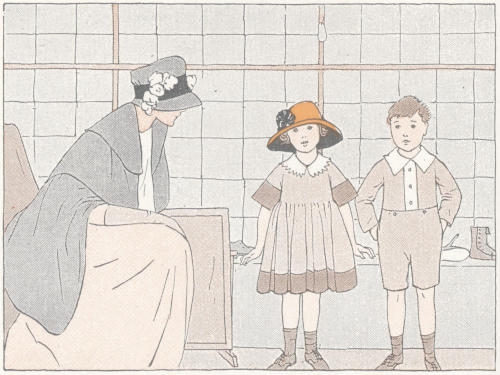
The next day Bobby and Betty went
with Mother to the shoe store.
“Shoes for children,” answered Mother
when the salesman asked what he could
show her.
“What kind, Madam?” asked the salesman.
“Nice, soft shoes,” said Mother, “and
shoes that will wear well.”
“Their last shoes were nice and soft;
but they did not wear well.”
“Children are rough with their shoes,
Madam,” said the salesman.
“Better get something heavier than they
have been wearing.”
“I want heavy shoes,” said Bobby.
“That’s the kind the big boys wear.”
“How do you like these, Madam?” asked
the salesman.
“They seem heavy for a child,” said
Mother.
“I like those shoes,” said Bobby.
“Let him try them on,” said the salesman.
“Let’s see how they fit. And let’s
see how this shoe fits the little girl.”
The salesman then took off one of
Bobby’s shoes and put a new shoe on
his foot.
He took off one of Betty’s shoes and
put a new shoe on her foot.
“Be sure the shoes are long enough,”
said Mother. “The children are growing
fast.”
“These fit very well,” said the salesman.
“See, Madam, there is plenty of
room.”
“How do they feel?” asked Mother.
“All right,” answered Bobby.
“These are nice shoes,” said Betty.
“I like them.”
“I will take these shoes,” said Mother.
The salesman put the shoes in shoe
boxes and Mother paid him for them.
Then they went into the dry-goods
store, and Mother bought each of the
children two pairs of new stockings.
“Little Blue Apron,
How do you do?
Never a stocking
And never a shoe.”
Little Blue Apron
She answered me:
“You don’t wear stockings
And shoes by the sea.”
“Why, little Blue Apron,
It seems to me
Very delightful
To live by the sea.
“But what would hatters
And shoemakers do
If everyone lived
By the sea like you?”
—An Old Story Book
Any shoes to buy? Any shoes to buy
Of Shoemaker John today?
Pretty shoes of red, pretty shoes of black,
Perhaps I’ll give them away!
With a rap, rap, rap, and a tap, tap, tap,
See the Shoemaker work away,
With a rap-a-tap and a rap-a-tap,
Now old Shoemaker John, good day!
—Laura Rountree-Smith
There was a young lady of Ryde,
Whose shoestrings were seldom untied.
She purchased some clogs,
And some small spotted dogs,
And frequently walked about Ryde.
—Edward Lear
I tie it up and it walks.
I unfasten it and it stops.
A shoe
What walks with its head downward?
A nail in a shoe
MOTHER AND BETTY GO TO THE DRESSMAKER’S SHOP — For study and play :
“Mother is going to the dressmaker’s
today,” said Bobby. “I heard
her say so.”
“I wish I could go with her,” said
Betty. “I am going to ask Mother if
I can go.”
“She won’t let you go,” said Bobby.
“Little girls don’t go to the dressmaker’s.”
“Yes, they do,” said Betty.
Betty ran to the house. “Mother,
Mother!” she cried. “Please may I go
with you to the dressmaker’s?”
“Don’t you want to stay with Bobby
and play with baby?” asked Mother.
“No,” said Betty. “I want to go
with you.”
“I will see,” answered Mother.
Mother then called Bobby.
“Play with baby, Bobby,” said
Mother. “Betty wants to go with me
to the dressmaker’s.”
“Don’t let Betty go,” said Bobby.
“Make her stay and take care of baby.”
“Betty will stay when you go with
Father to the tailor’s shop,” said Mother.
“You may go with Father when he
goes to the tailor’s.”
“All right,” said Bobby. “I’ll stay
if I may go with Daddy.”
Mother and Betty went to the dressmaker’s.
The dressmaker fitted Mother’s new
dress.
Betty thought Mother stood very
still while the dressmaker put pins in
her dress.
The dressmaker pinned and pinned
and pinned.
Betty thought she would never stop
putting pins in Mother’s new dress.
Betty sat very still.
She looked at the dresses in the
shop.
She was glad when Mother’s dress
was fitted.
“When may I have it?” asked
Mother.
“I will send it Saturday,” said the
dressmaker.
“Thank you,” said Mother. “Be
sure to send the bill. I am glad you
can let me have the dress before
Sunday.”
Pin it here, pin it there,
Pin it, pin it, everywhere.
I put my needle in,
I pull my needle out;
I draw it close, and draw it smooth,
And turn my work about.
—A Sewing Song
Little Polly Flinders
Sat among the cinders,
Warming her pretty little toes.
Her mother came and caught her,
Whipped her little daughter,
For spoiling her nice new clothes.
Hark, hark!
The dogs do bark,
The beggars are coming to town;
Some in tags,
Some in rags,
And some in velvet gowns.
—Selected
BOBBY GOES WITH FATHER TO THE TAILOR’S SHOP — For study and play : — Riddles :
When Father came in sight, Bobby
ran to meet him.
“When are you going to the tailor’s,
Daddy?” asked Bobby.
“Tomorrow morning,” answered
Father.
“May I go with you?” asked Bobby.
“Please, Daddy.”
“No, Bobby, there is nothing at the
tailor’s you want to see.”
“Oh, yes, there is, Daddy.”
“What do you want to see, Bobby?”
“I want to see the tailor. I want to
see a man sew.”
“Very well, Bobby, you may go
with me.”
Bobby was up early next morning.
When breakfast was over, he went
with Father to the tailor’s shop.
The tailor brought out Father’s new
suit.
Father tried it on.
Bobby thought Father stood very
still.
The tailor clipped the coat with his
sharp shears.
At first, Bobby thought he would
spoil it.
Bobby saw the tailor’s thimble.
He saw the tailor’s needle.
He saw his thread and beeswax.
He saw the tailor’s sewing machine,
and suits hanging on the wall.
At last the tailor said, “That’s all.”
“When will the suit be done?”
asked Father.
“I will send it Saturday,” said the
tailor.
“Send the bill with it, please,” said
Father.
Father then said “Good day” to the
tailor, and he and Bobby went out of
the shop.
“Run home, now,” said Father to
Bobby. “I must be off to my work.”
The tailor kept his word.
He sent Father’s suit and the bill
early Saturday morning.
An hour later Mother’s dress came
with the dressmaker’s bill.
Father liked his new suit.
Mother liked her new dress.
They paid the bills that very day.
So the tailor and dressmaker had
pay for their work.
And Father and Mother had their
new clothes to wear to church on Sunday
morning.
Poor old Robinson Crusoe!
Poor old Robinson Crusoe!
They made him a coat,
Of an old nanny goat,
I wonder how they could do so!
With a ring-a-ting-tang,
And a ring-a-ting-tang,
Poor old Robinson Crusoe.
I went around to the tailor’s shop
To buy a tailor’s needle.
That’s the way the money goes,
And pop goes the weasel!
When may a man’s pocket be empty, and yet have something in it?
When it has a hole in it
Inside hole,
Outside full of many holes.
A thimble
NEW CLOTHES FOR BOBBY AND BETTY — For study and play : — Riddle :
Sunday afternoon Father said, “Bobby
must have a new suit.”
“Will the tailor make it?” asked
Bobby.
“No, Bobby. Mother will take you
to the dry-goods store. She will buy
you a ready-made suit.”
“That will be fine,” said Bobby.
“Let’s go now, Mother.”
“Today is Sunday, Bobby.”
“Tomorrow will be Monday,” said
Bobby. “May we go Monday, Mother?”
“Yes, we will go tomorrow afternoon.”
Just then Betty came in from play.
“Where are you going Monday afternoon,
Bobby?” she asked.
“Mother and I are going somewhere.
You can’t go.”
“Betty may go with us,” said Mother.
“She needs a new dress.”
“Good!” cried Betty, “I’m going to
have a new dress. Shall we buy it of the
dressmaker, Mother?”
“No, dear. We don’t buy dresses at
the dressmaker’s. The dressmaker makes
dresses.”
“She made a pretty dress for you,
Mother,” said Betty. “I think she will
make one for me.”
“I can find a nice dress for you at
the dry-goods store,” said Mother.
“Is that the place where there are
pretty dresses in the window?” asked
Betty.
“Yes, dear.”
Monday afternoon Mother and the
children went to the dry-goods store.
A saleswoman came up to Mother and
said, “Madam, what can I show you?”
“Boys’ suits, please,” answered Mother.
The saleswoman led the way to the
place where boys’ suits were kept.
“I want one that will wear well,” said
Mother.
“I think you will like this,” said the
saleswoman. Bobby tried on the coat.
He liked it and Mother liked it.
“I will take it,” said Mother.
Mother then paid for the suit and
asked the saleswoman to send it.
“Would you like to see little girls’
dresses?” asked the saleswoman. “We
have some pretty ones.”
“If you please,” said Mother.
The saleswoman led the way.
They soon came to the place where
little girls’ dresses were kept in the store.
Betty saw a dress with ruffles on the
skirt and a pretty sash.
“I like that,” said Betty.
“It’s a pretty dress,” said Mother.
“May she try it on?”
“Yes,” said the saleswoman.
The saleswoman slipped the dress over
the one Betty had on.
Mother liked it and Betty liked it.
So Mother bought the dress for Betty.
And she bought cloth for an everyday
dress and for two everyday aprons.
Name things you buy by the yard.
How many feet in a yard?
How many inches in a foot? How
many inches in a yard?
How many inches in a quarter of a
yard? In half a yard?
Tom Trot, a man of law,
Sold his bed and lay on straw,
Sold his straw and lay on grass,
To buy his wife a looking-glass.
Hector Protector was dressed all in green;
Hector Protector was sent to the Queen.
The Queen did not like him,
No more did the King;
So Hector Protector was sent back again.
There was a young lady in blue
Who said, “Is it you? Is it you?”
When they said, “Yes, it is,”
She replied only, “Whizz!”
That ungracious young lady in blue.
—Edward Lear
Trit, trot to market, to buy a penny doll.
Trit, trot home again, market’s sold them all.
Fine feathers don’t make fine birds.
Handsome is as handsome does.
Dancy-diddlety-poppity-pin!
Have a new dress when summer comes in;
When summer goes out,
’Tis all worn out,
Dancy-diddlety-poppity-pin!
Four fingers and a thumb,
Yet flesh and bone have I none.
A glove
WORK AND PLAY — For study and play : — Game :
Mother made Betty’s everyday dress.
She bought a pattern and laid it on
the cloth.
She cut it out and basted it.
When it was basted, Mother called
Betty.
“Come, Betty,” said Mother. “I want
to fit your dress.”
“You are a dressmaker today,
Mother,” said Betty. “I’m a fine lady
that has come to have a dress fitted.”
“Then you must stand very still,
Betty, while I fit your dress.”
When the dress was fitted, Betty
said, “Now I’ll play I’m a dressmaker.
This is my shop. Come, Bobby. Be
a fine lady. Let me make you a
dress.”
“I don’t want to be a fine lady,” said
Bobby. “I don’t want a dress. I’m a
tailor. This is my shop.”
“You can’t make a suit of clothes,”
said Betty.
“I can make an apron,” said Bobby.
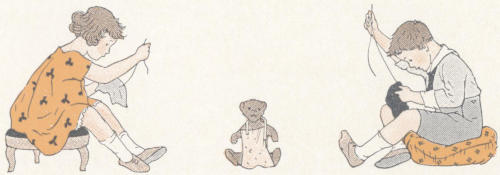
“See, Teddy-bear is a shoemaker. I’ll
make the shoemaker an apron.”
Mother gave them some pieces of
cloth.
She gave each a needle and thread.
They played Bobby was a tailor and
Betty a dressmaker.
When I was a dressmaker, a dressmaker, a dressmaker,
When I was a dressmaker, a dressmaker was I.
It was this way, and that way,
And this way, and that way,
Oh, when I was a dressmaker, a dressmaker was I.
When I was a tailor, a tailor, a tailor,
When I was a tailor, a tailor was I.
It was this way, and that way,
And this way, and that way,
Oh, when I was a tailor, a tailor was I.
“Sing, sing!”
“What shall I sing?”
“The cat ran away with my apron string!”
Thread the needle to begin,
Sometimes out and sometimes in.
Tailor’s blind and cannot see,
So thread the tailor’s needle.
THE SCISSORS-GRINDER — For study and play :
“My scissors are dull,” said Mother,
when she began to cut out Betty’s aprons.
“I wish the scissors-grinder would come.”
“He is coming,” said Bobby. “I hear
his bell.”
“That sounds like his bell,” said
Mother. “Look out, Bobby, and see if
it really is the scissors-grinder.”
“It is the scissors-grinder!” cried
Bobby. “He is coming down the back
street.”
They looked out and saw the scissors-grinder.
He was carrying his grindstone on
his back and playing a tune with his
bell.
“Call him, Bobby,” said Mother.
The scissors-grinder was quick to see
Bobby.
Before Bobby had time to call, he
had turned in toward the back door.
He swung his grindstone from his
back and set it on the ground.
“Will you please sharpen my
scissors?” asked Mother.
The scissors-grinder took the scissors
in his hand.
Then “Whir-r-r, whir-r-r, whir-r-r,”
went the grindstone. Sparks flew from
the whirring stone.
Bobby and Betty stepped back. They
were afraid of the grindstone.
“Any knives to grind?” asked the
scissors-man when the scissors were
ground.
“Yes,” answered Mother. “I wish
you would grind this knife.”
Again the wheel went, “Whir-r-r,
whir-r-r, whir-r-r.”
Again sparks flew from the grindstone.
Then the man gave Mother the knife,
and she paid him for his work.
The scissors-grinder now swung his
grindstone on his back. Again he rang
his bell.
Bobby and Betty watched the scissors-grinder
until he turned a street corner.
Have you any old knives to grind?
And scissors to grind, too?
Bring them out, my pretty dears,
I’ll make them look like new.
MOTHER BUYS BETTY A NEW HAT — For study and play :
One day Mother read some verses
to Bobby and Betty.
She read “Little Blue Apron.”
“Is that ‘Little Blue Apron’?” asked
Betty.
“Yes, dear,” answered Mother. “If I
don’t get you a new hat soon, you will
be like ‘Little Blue Apron.’”
“I like ‘Little Blue Apron,’” said Betty.
“But I should like to have a new
hat, Mother.”
“I will get you a hat,” said Mother.
“We will go to the milliner’s shop
today.”
When afternoon came, Mother said,
“Bobby, be a good boy. Stay and play
with baby.”
Then Mother and Betty went down
the street to the milliner’s shop.
When they reached the shop, they
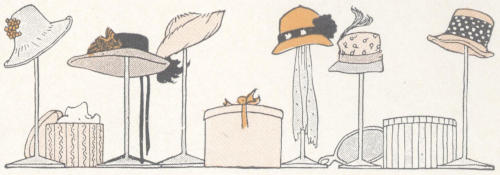
stood and looked at the hats in the
window.
“Those are ladies’ hats,” said Mother.
“Let’s go in.”
“Do you wish a hat for yourself,
Madam?” asked the milliner.
“Not today,” answered Mother.
“Please show us some hats for little
girls.”
“That is a pretty hat,” said Betty.
“It’s pretty, but it won’t wear well,”
said Mother.
“How do you like this hat?” asked
the milliner.
“That is better,” said Mother. “I like
the shape.”
“It’s very becoming,” said the milliner
when she put the hat on Betty’s head.
“How do you like it, Betty?” asked
Mother.
“I like it,” answered Betty.
“It’s a nice hat for a little girl,” said
Mother. “It will match your dress.”
“Will you buy it for me, Mother?”
asked Betty.
“Yes, dear,” answered Mother.
Mother paid the milliner for the hat.
The milliner put the hat in a paper
bag and handed it to Mother.
“Thank you,” said the milliner. “Come
in again.”
“Thank you,” said Mother. “We shall
be glad to come again.”
On the way home, they stopped at a
candy store. Mother bought three sticks
of candy.
Then Mother and Betty went home
to Bobby and baby Billy.
“Little Blue Apron,
Never a hat.
How do you manage
To do like that?”
“Why, what is the use
Of a hat?” said she.
“You never wear hats
When you’re by the sea.”
—An Old Story Book
H was a hat
Which was all on one side;
Its crown was too high,
And its brim was too wide.
Oh, what a hat!
V was a veil
With a border upon it,
And a ribbon to tie it
All round a pink bonnet
Pretty green veil!
—Edward Lear
FATHER BUYS BOBBY A NEW HAT — For study and play : — Riddles :
Betty showed her new hat to Father.
“That’s a very nice hat,” said Father.
“Did Mother buy one for Bobby?”
“No, Daddy,” said Betty. “Mother
and I went to the milliner’s shop. The
milliner doesn’t have hats for boys as big
as Bobby.”
“That’s so,” said Father. “Bobby can
get a good hat at the dry-goods store.”
“Won’t you take him there in the
morning?” asked Mother.
“Yes,” said Father. “I’ll take him with
me tomorrow morning. I pass the store on
my way to work.”
Bobby knew nothing about going until
the next morning.
Then Mother said, “Bobby, Father says
you may go with him this morning.”
“Good!” cried Bobby. “That will be
fun. Daddy, where are we going?”
“To the dry-goods store,” answered
Father.
“Is that the store where I got my new
suit?” asked Bobby.
“Yes, Bobby,” answered Father. “We
will see if we can find a hat in the store
for a boy of your size.”
“It’s for me, Daddy, isn’t it?” asked
Bobby.
“Have you been a good boy?” asked
Father.
“When Betty went with Mother to
get her hat, I stayed with baby,” said
Bobby. “I played with him.”
“That’s a good boy,” said Father. “I
think we can find a hat for you in the dry-goods
store.”
“I am sure we can, Daddy. They
have ever so many things in the dry-goods
store.”
When Father and Bobby went into the
store, a salesman asked, “What can I show
you?”
“Boys’ hats,” replied Father.
The salesman showed Father and
Bobby the way to the place where boys’
hats were kept.
Bobby tried one on.
“That’s too small,” said Father. “Find
a larger one for him.”
“This hat is larger,” said Bobby.
“How does it feel?” asked Father.
“All right,” said Bobby.
“I’ll take the hat,” said Father.
Father paid the salesman for Bobby’s
hat.
Then he turned to Bobby and said,
“Take your hat, young man. Now run
home.”
Baby shall have a new bonnet,
And baby shall go to the fair.
And baby shall have a blue ribbon
To tie up his bonny brown hair.
There’s a garden that I ken,
Full of little gentlemen,
Little caps of blue they wear,
And green ribbons very fair.
Flax
What goes up when the rain comes down?
An umbrella
BOBBY LEARNS WHY MEN LIFT THEIR HATS — For study and play :
Bobby ran home with his new hat.
He showed it to Mother.
“That’s a nice hat for a little man,”
said Mother. “You are old enough now
to lift your hat when you meet a friend
on the street.”
“Why should I lift my hat, Mother?”
asked Bobby.
“Gentlemen always lift their hats,”
said Mother.
“Daddy does,” said Bobby. “I’ll ask
him to tell me about it.”
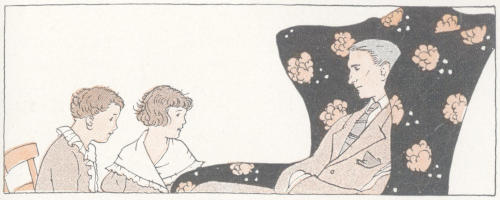
That night Bobby asked, “Daddy, why
do men lift their hats?”
“Sit down,” said Father. “I’ll tell you
about it.”
Bobby and Betty drew up their chairs.
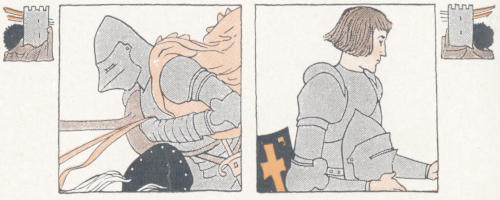
“A long, long time ago,” said Father,
“there were knights who dressed in full
armor.”
“I’ve seen pictures of them,” said
Bobby. “Mother showed us a picture of
a knight in full armor.”
“In those days,” added Father, “it was
not safe for a knight to go out unless he
was dressed in full armor. But when a
knight was among his friends, he took off
his helmet.”
“Why did he take off his helmet?”
asked Bobby.
“He was among friends,” answered
Daddy. “It was safe to do it. And so when
a knight took off his helmet, he the same as
said, ‘I am in the presence of friends.’”
“That was a nice way to say it,” said
Betty.
“Yes, dear,” said Father. “And a man
has a nice way of saying about the same
thing.”
“What is a man’s nice way of saying
the same thing, Father?” asked Bobby.
“It is by lifting his hat,” answered
Father.
“What does he say when he lifts his
hat?” asked Bobby.
“When a man lifts his hat, it’s a way of
saying, ‘I am in the presence of friends.’”
“That’s a good story,” said Bobby. “I
like it.”
“Put on your hat, my little man,” said
Father. “Play you are walking on the
street. Betty, play you are a friend.”
Bobby put on his hat and walked up
and down the room. Soon Betty met him.
Bobby lifted his hat as he passed her.
“Well done, young man,” said Father.
“Now tell me what you meant to say when
you lifted your hat.”
“I am in the presence of a friend,”
said Bobby. “That’s what I meant to say.”
Politeness is to do and say,
The kindest thing in the kindest way.
If a body meet a body
Coming through the town,
If a body greet a body,
Need a body frown?
—Selected
There was an old man of Brest,
Who was always funnily drest.
He wore gloves on his nose,
And a hat on his toes,
And a boot in the midst of his chest.
—Cosmo Monkhouse
THE LAUNDRY MAN — For study and play :
Bobby has a blue laundry bag in his
closet.
Betty has a yellow laundry bag in her
closet.
They put their soiled clothes in their
laundry bags.
Sometimes Mother sends soiled clothes
to the laundry.
The laundryman calls for them.
Bobby and Betty fold the clothes before
the laundryman comes.
Mother ties them in a neat bundle.
She gives the bundle to the laundryman
when he calls for the clothes.
A few days later the laundryman brings
back a bundle of clean clothes.
He gives Mother the bill for the
laundry, and she pays him for the work.
Bobby and Betty help Mother put the
clean clothes away.
Then they play laundryman.
They hitch Queen to the cart and call
for Dolly’s and Teddy-bear’s clothes.
They play they wash and iron the
clothes.
Then they bring them back to Teddy-bear
and Dolly.
Does the laundryman ever call at your
house?
Does your mother make a list of the
clothes she sends to the laundry?
Cleanliness is next to godliness.
Who hath a good trade
Through all waters may wade.
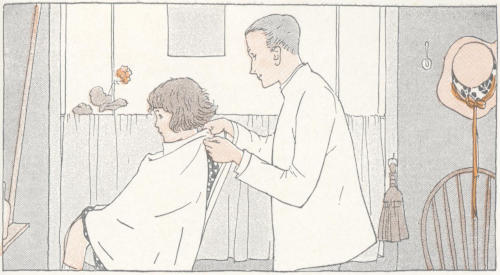
AT THE BARBER’S SHOP — For study and play : — Riddle :
Sometimes Father goes to the barber’s
shop.
Sometimes Bobby and Betty go.
The barber cuts their hair.
One morning Father said to Bobby,
“Your hair is too long. You should
go to the barber and have him cut it.”
“All right,” said Bobby.
“Betty’s hair should be cut,” said
Mother. “It is getting too long for a
little girl.”
“May we go to the barber today?”
asked Betty.
“Yes, dear,” answered Mother.
That afternoon Mother took the
children to the barber’s shop.
There was a big pole in front of
the shop.
“That is his sign,” said Bobby.
“How do you know?” asked Betty.
“Daddy said so,” answered Bobby.
The barber met them at the door.
“How do you do?” said he.
“Very well, thank you,” said Mother.
Bobby and Betty said, “How do
you do?”
“What can I do for you today?”
asked the barber.
“Please, Mr. Barber, I want my
hair cut,” said Betty.
“I want my hair cut,” said Bobby.
“Very well,” said the barber. “Lay off
your things, children. Madam, be seated.
Here is a chair, little boy. Come, little
girl, sit in this big chair.”
Betty stepped forward and the barber
helped her get into the big chair.
He put a towel around Betty’s neck.
He took out a comb and a pair of
shears and began to cut Betty’s hair.
Once Betty dodged.
“Sit still, little girl, sit still,” said
the barber. “I shall not hurt you.”
Betty tried to sit very still.
Her hair was soon cut.
“Shall I curl it?” asked the barber.
“Yes, please,” said Betty. “I like
curly hair.”
When Bobby took the chair, he
said, “I don’t want any curls.”
“That’s right,” said the barber. “You
are too big to have your hair curled.”
When the barber had cut Bobby’s
hair, Mother paid him for his work.
Then they all went home to get
dinner ready for Father.
Good morning, Mr. Barber Man,
You see I’m here quite early;
I want my hair cut, if you please,
But oh, sir, cut it curly.
There was a little girl who had a little curl
Right in the middle of her forehead.
And when she was good, she was very, very good,
But when she was bad, she was horrid.
—Unknown
I don’t have it,
I don’t want it,
If I had it
I wouldn’t take the world for it.
A bald head
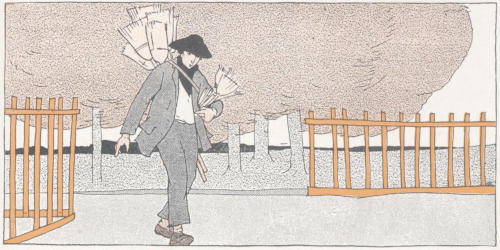
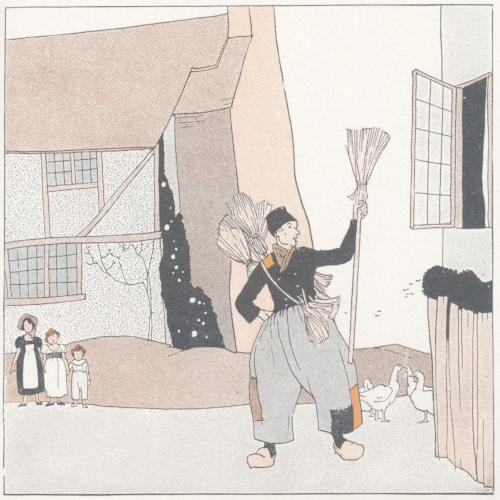
THE BROOM MAN — For study and play : — Riddles : — THE SONG OF THE DUTCH BROOM SELLER
One day the broom man came down
the street.
“Brooms, brooms, brooms!” called
the broom man.
“Come and buy. Come and buy a
broom!”
“Mother! Mother!” called Bobby
and Betty. “Don’t you want to buy a
broom?”
“Yes,” said Mother. “My old
broom is wearing out. I need a new
broom.”
Bobby called to the broom man, and
he came to the back door.
Mother bought a new broom.
She paid the broom man eighty
cents.
Then he went down the street calling,
“Brooms, brooms, brooms!”
“Let me sweep with the new broom,”
said Bobby.
Mother let Bobby sweep the back
porch.
“Now it’s my turn to sweep,” said
Betty.
“You may sweep the steps,” said
Mother.
Betty worked very hard.
She wanted to sweep the steps clean.
“I could sweep better, Mother, if I
were a little bigger,” said Betty. “I
wish the broom was not so big.”
“This broom is too big for a little
girl,” said Mother.
“Some day I will buy you a smaller
broom.”
“Oh, thank you, Mother,” said Betty.
“Buy me a little broom.”
“You shall have a little broom,” said
Mother. “And tonight I will teach you
and Bobby a song about broom girls who
sold little brooms.”
The broom man maketh his living most sweet,
With carrying brooms from street to street;
Who would desire a pleasanter thing,
Than all the day long to do nothing but sing,
“New brooms, green brooms, will you buy any?
Come maidens, come quickly, let me make a penny”?
A new broom sweeps clean.
Sweep before your own door.
Buy a big broom for lady,
And a little broom for baby.
Round the house and round the house, and yet stands in the corner.
A broom
That which flies high and flies low, has no feet, yet wears shoes.
Dust
From Dutchland I come with my fine brooms all laden,
So, Mistress and Maiden, will you please buy a broom?
Buy a broom! Buy a broom!
I’ve a large one for a lady
And a small one for a baby,
So, all you kind ladies,
Will you please buy a broom?
Buy a broom! Buy a broom!
Buy a broom! Buy a broom!
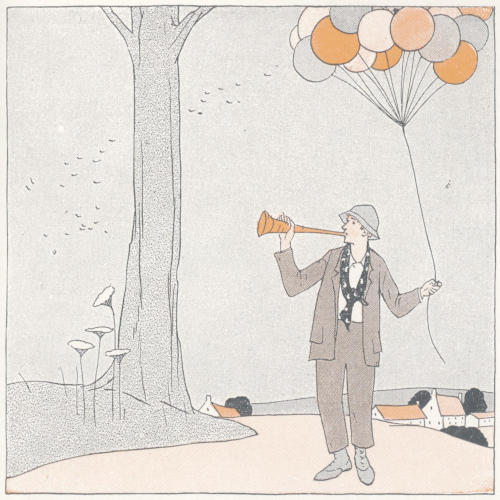
THE BALLOON MAN — For study and play :
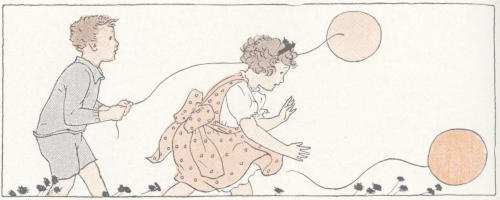
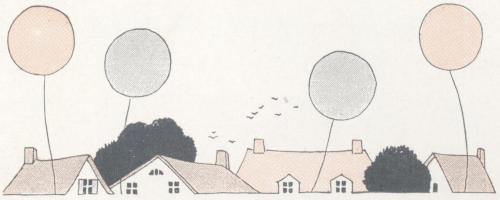
“O Betty!” cried Bobby. “The
balloon man is coming. I can hear his
horn.”
“I can see him,” said Betty. “Just
look!”
“My!” said Bobby. “Aren’t they
pretty? I wish I could have a red
balloon.”
“Let’s ask Mother if we can buy
one,” said Betty.
Bobby ran and Betty ran, but Betty
ran the faster.
“O Mother!” cried Betty. “Please
give me ten cents. I want to buy a
balloon.”
“Please give me ten cents,” said
Bobby. “I want to buy a red balloon.
Just look at it, Mother!”
“You have been good children today,”
said Mother. “You may each buy a
balloon.”
Mother gave each of them ten cents
and they ran out to the street.
The balloon man saw them coming
and cried, “Balloons! Will you buy a
balloon?”
“Please, sir,” said Bobby. “I will
buy that red balloon. How much is it?”
“Ten cents,” answered the balloon
man.
“Here is a dime,” said Bobby.
“Take hold of the string, little boy,”
said the man. “Don’t let it get away
from you.”
“Please, sir,” said Betty. “I want
to buy a balloon.”
“Which one will you have, little
girl?” asked the balloon man.
“I want a yellow balloon, if you
please,” said Betty. “Here is a dime.”
The balloon man took the dime and
said, “Be careful, Miss. Keep hold of
the string.”
Now boys, now girls, come buy a balloon,
’Twill fly so swiftly up to the moon;
Come buy them, blue, red, yellow, or green,
’Tis the prettiest toy that ever was seen.
K was a Kite
Which flew out of sight
Above houses so high,
Quite into the sky.
Fly away Kite!
—Edward Lear
BOBBY AND BETTY FOLLOW THE HAND-ORGAN MAN — For study and play : — TOM, TOM, THE PIPER’S SON
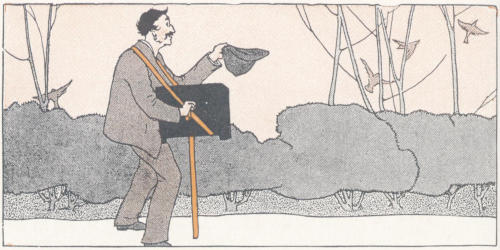
“Listen!” said Bobby. “Is that the
band?”
“Let’s go and see,” said Betty.
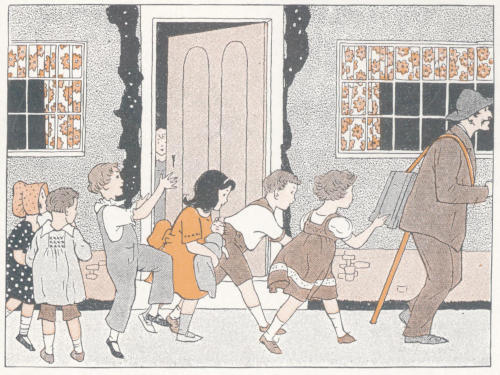
Bobby and Betty ran out to the street.
A hand-organ man was coming.
He had been playing up the street
and now was coming near.
“Let’s go and hear him play,” said
Bobby.
“All right,” said Betty.
So Bobby and Betty ran up the
street.
All the children in the block came
out.
Some of them danced and clapped
their hands while the hand-organ man
played.
The organ man kept looking up at
the windows.
“Here’s a nickel,” said a woman to
her little boy. “Take it to the hand-organ
man.”
The boy took the nickel to the organ-grinder.
He played another piece.
When this was played, Bobby said,
“Please play another. I’ll bring you a
penny.”
Bobby and Betty ran to the house and
Mother gave each of them a penny.
Bobby gave his penny to the hand-organ
man, and the man started to go.
“Play another piece,” said Betty.
“I’ll give you a penny.”
Again the organ-grinder played.
Betty gave him a penny.
The organ-grinder went farther down
the street.
All the children followed.
When they came to the end of the
block, all but Bobby and Betty turned
back.
Bobby and Betty stood still.
“It’s time to go back,” said Bobby.
“Let’s go a little farther,” said Betty.
“Mother won’t care.”
The organ-grinder started a lively
tune.
Bobby and Betty forgot to go back
home.
They followed the organ-grinder.
On they went from house to house
after the organ-grinder.
Sometimes they skipped and danced
when the organ man played.
“This is fun,” said Bobby.
“It’s just like being grown up,” said
Betty.
So Bobby and Betty had a fine time
as long as the organ man played his
tunes.
When he stopped playing, they began
to feel tired.
“Let’s go home,” said Betty.
So Bobby and Betty turned back,
but they did not know the way home.
I knock at the knocker,
I ring the little bell,
Please give me a penny
For singing this so well.
Driddlety-drum, driddlety-drum,
There you see the drummers are come.
Some are here and some are there,
And some are gone to the county fair.
A buckskin fiddle and a shoestring bow
Make the very best music you know.
Fiddle-de-dee, fiddle-de-dee,
The fly shall marry the bumble bee.
Tom, Tom, the piper’s son,
He learned to play when he was young,
But all the tune that he could play,
Was “Over the hills and far away.”
Now Tom with his pipe did make such a noise,
That he surely pleased both the girls and the boys,
And they all stopped still, for to hear him play,
“Over the hills and far away.”
Tom with his pipe did play with such skill
That those who heard him could never keep still;
Whenever they heard him, they’d all begin to dance,
Even pigs on their hind legs would after him prance.
WHY MOTHER ’PHONED TO THE POLICEMAN — For study and play : — Riddle :
At first Mother did not miss Bobby
and Betty.
But after a while she wondered where
they were.
She went to the door and called,
“Bob-by!”
There was no answer.
Then she called, “Bet-ty!”
Still there was no answer.
Then Mother guessed what had happened.
She went to the telephone and
’phoned to the policeman.
She told him Bobby and Betty were
lost.
She asked him to help find them.
“How old are your children?” asked
the policeman.
“Six years old,” said Mother.
“Don’t worry, Madam,” he said. “I’ll
bring the children to you.”
While the policeman was hunting for
Bobby and Betty, they were going on
and on.
But even brave Bobby soon said, “I
don’t know the way.”
Just then the policeman met the
children.
“Where are you going?” he asked.
“We are going home,” answered
Bobby. “But we can’t find the way.”
“Come with me,” said the policeman.
“I’ll show you the way.”
I like to dance along the street
And up and down the stairs,
Around the stove and in the grove
And in and out the chairs.
—Selected
The policeman on the corner
Wears a coat of blue.
He blows a great big whistle
Which says, “Too-too-too!”
—First Grade, Riverside, Illinois
My sides are firmly laced about,
Yet nothing is within.
You’ll think my head is strange indeed,
Being nothing else but skin.
A drum
THE POLICEMAN TAKES BOBBY AND BETTY HOME — For study and play :
Bobby and Betty were a long way
from home. But the policeman knew
the way.
“I’m glad we found you,” said Bobby.
“I’m glad you know the way.”
“That’s funny,” said Betty. “We lost
the way and we found you. And you
know the way.”
“Will you show us where Mother’s
house is?” asked Bobby.
“To be sure, I will,” answered the
policeman. “That is part of my business.”
“Do you do anything else?” asked
Bobby.
“Oh, yes,” answered the policeman.
“I walk up and down the streets and take
care of the people.”
“Are you their father?” asked Betty.
“Are you the father of all the people on
the streets?”
“Hardly that,” answered the policeman.
“I know what you are,” said Bobby.
“You are a big brother. You are a
big brother to all of the people on the
streets.”
“Now you have hit it, my little man,”
answered the big policeman. “I try to
be a big brother to the people along
the streets.”
By this time it was almost dark, but
Bobby and Betty were now nearly
home.
“Do you know this street?” asked the
policeman.
“Oh, yes,” cried Bobby. “We live
just around the corner.”
Bobby and Betty almost ran the last
few steps of the way.
They were soon at the door.
They could not wait for the policeman
to ring the bell.
They opened the door and ran straight
to Mother.
They threw their arms around her.
“O Bobby! O Betty!” cried Mother.
“I am so glad to see you.”
Mother thanked the policeman for
bringing the children home.
“You are very welcome,” said the
policeman.
“Did you thank the policeman?” asked
Mother.
“Thank you, thank you,” said Bobby
and Betty.
“I hope we shall find you again,” said
Bobby.
“I am glad you are everybody’s big
brother,” said Betty.
“Thank you,” said the policeman.
“But remember, your big brother thinks
you had better play nearer home.”
I like to see the policeman,
Who is sometimes called the cop,
When he sees the speeding autos
And he makes the traffic stop.
—Jean Wold, John Johnson,
and Frederick Vickery,
Second Grade, Hinsdale, Illinois
John O’Gradgen was a wild man.
He whipped his children now and then.
When he whipped them, he made them dance
Out of Ireland into France.
MOTHER TALKS WITH BOBBY AND BETTY — For study and play :
“Tell me all about it,” said Mother.
Bobby and Betty told Mother they
followed the organ-grinder. They told
her they skipped and danced to the music
the organ man played.
They told her they started home when
the organ man stopped playing.
They told her the big policeman
came and asked them where they were
going.
“Were you afraid of the policeman?”
asked Mother.
“I was at first,” said Betty. “But,
Mother, he is a big brother. I’m not afraid
of him now.”
“This policeman is a kind man,” said
Mother. “I wish all policemen were like
him.”
“Aren’t they all big brothers?” asked
Bobby.
“That is what they should be,” answered
Mother. “But not all policemen
are big brothers.”
“I am glad we found the big-brother
kind,” said Betty.
“So am I,” said Mother. “But tell
me, children, why did you follow the
organ-grinder beyond the end of this
block?”
“He played beautiful music,” said
Betty. “The music pulled us along,
Mother.”
“I know,” answered Mother. “I
know how music pulls you along. But
my little ones must not let music pull
them away from home.”
“Next time it pulls, I’ll pull the
other way,” said Bobby.
“Bobby did pull a little,” said Betty.
“Next time I’ll help him and we’ll
come back to you.”
“That is right. Listen to the music
when the organ-grinder is in this block,”
said Mother. “When he goes to the
next block, it is time to pull away from
the music and come home to Mother.”
“I’m glad we are home now,” said
Bobby.
“I wish you had been here this afternoon,”
said Mother. “You can’t guess
what you missed!”
“What was it, Mother?” asked Betty.
“Mrs. White came over with some
ice cream,” said Mother. “She had
more than she needed. She wanted you
to have some.”
“Did you save it for us?” asked
Bobby.
“I wanted to save it,” answered
Mother.
“Did you save the ice cream, Mother?”
asked Betty.
“I had no way to keep it, children.
So I called in John and Josie, and they
ate the ice cream.”
“Oh, fudge!” said Bobby. “I wish
we had come home.”
“So do I,” said Betty. “I wish we
had turned back when John and Josie
did.”
“If we had turned back, we should
have had the ice cream,” added Bobby.
All work and no play makes Jack
a dull boy.
Dare to say no.
If wisdom’s ways you wisely seek,
Five things observe with care:
Of whom you speak, to whom you speak,
And how, and when, and where.
Be good, sweet maid, and let who
will be clever.
THE NEWSBOY — For study and play : — Riddles :
Every morning the newsboy comes
with a newspaper.
He leaves it on the back porch.
Sometimes Bobby brings it in to
Father.
Sometimes Betty brings it to him.
Father likes to read the paper before
he goes to his work.
One morning Father said to Bobby,
“Bring in the paper.”
“It hasn’t come, Daddy,” answered
Bobby.
“The newsboy is late this morning,”
said Father.
“He is coming now,” said Betty. “I
see him.”
Bobby went out on the back porch.
The newsboy tossed a paper on the
porch and ran to the next house.
Bobby took the paper to Father.
“Thank you, Bobby,” said Father.
“I want to be a newsboy,” said Bobby.
“Mother, may I be a newsboy?”
“What is that you are saying?” asked
Father.
“I want to be a newsboy, Father,” said
Bobby.
“Betty, what do you think of that?”
asked Father.
“I think Bobby is too little,” said
Betty. “When Bobby is bigger he can
be a newsboy.”
Papers, papers! right this way!
Come and buy one every day!
—Second Grade, Riverside, Illinois
What’s the news of the day,
Good neighbor, I pray?
They say the balloon
Has gone up to the moon.
The newsboy comes each morning,
When I’m out at play,
Throws the paper on the porch,
And then he runs away.
—Mary MacMillan and William Feldman,
Second Grade, Hinsdale, Illinois
What is it that is black and white and red (read) all over?
A newspaper
Why is a cherry like a book?
Because it is red (read)
THE POSTMAN — For study and play : — A rime to be used with the game Drop the Handkerchief :
Every day the postman comes with
mail in his mail bag.
He takes mail out of the mail bag
and puts it in the letter box.
He rings the bell and then goes on
to the next house.
When Bobby and Betty are at the
front door, the postman hands them their
mail.
When it is in the letter box, Mother
lets them take the key.
They unlock the box and take out the
mail.
Then one of them locks the box and
the other one takes the mail in to Mother.
One day Bobby asked, “Where does
the postman get the mail?”
“At the post office,” said Mother.
“The postmaster has men to sort the mail
and take it to the people.”
“Does the postmaster pay our postman?”
asked Bobby.
“No, dear,” answered Mother. “Uncle
Sam pays our postman.”
“Does Uncle Sam pay the postmaster?”
asked Bobby.
“Yes, Bobby,” answered Mother.
“Uncle Sam pays all the men who take
care of the mail.”
“Where does Uncle Sam get his
money?” asked Bobby.
“This is one way he gets money for
the work,” answered Mother. “Uncle
Sam sells postage stamps. Every time
we buy a stamp we help Uncle Sam
pay for carrying the mail.”
“I didn’t know that before,” said
Betty.
“I didn’t know it,” said Bobby.
“Some day I’ll buy a postage stamp.
I’ll send a letter and help Uncle Sam.
I’ll help him pay his men who take
care of the mail.”
“Good morning, Mister Postman,
Your bag is full I see;
I’m looking for a letter,
Have you anything for me?”
“Good-morning, here’s a letter,
And here’s a paper, too;
I’ve others for your neighbors,
But nothing else for you.”
—Selected
My pot’s boiling,
My hen’s laying.
My cat went to bed
With a nightcap on her head.
It’s not you; it’s not you;
But it’s you, you, you!
I sent a letter to my love,
And on the way I dropped it,
On the way I dropped it.
I dree, dree, dropped it,
I, I, I, lost it.
A little boy picked it up,
And put it in his pocket.
HOW BOBBY AND BETTY EARNED MONEY — For study and play : — Riddle :
Bobby and Betty wanted to earn
money.
They wanted to buy roller skates.
So Mother said, “Save the old newspapers.
You may sell them to the junkman.”
Bobby and Betty saved the old newspapers.
They made neat bundles.
When they had three big bundles,
Mother said, “Now, children, you may
sell them.”
That very day Bobby and Betty heard
the junkman calling.
“He’s coming,” cried Bobby. “The
junkman is coming.”
Bobby and Betty ran to the back
gate.
The junkman was driving nearer and
nearer, calling, “Pa-pers! pa-pers! Any
old pa-pers to sell?”
“Yes!” shouted Bobby. “We have
some old papers to sell.”
“Whoa! whoa!” called the junkman
to his horses.
The horses stopped at the back gate.
The junkman jumped down from his
wagon.
“This way,” said Bobby.
Bobby and Betty led the way to the
back door.
“Here are the bundles,” said Bobby.
The junkman had his scales in his
hand.
“Thirty pounds,” said he when he
weighed the first bundle of papers.
“Forty pounds,” said the junkman
when he weighed the second bundle of
papers.
He then weighed the third bundle.
“Thirty pounds,” he said. “One hundred
pounds. I will give you twenty-five
cents.”
Bobby reached out his hand for the
money.
“Have you any bottles?” asked the
junkman.
“Yes,” answered Betty. “Here are
twelve bottles.”
“Three cents,” said the junkman, and
he handed the money to Betty.
“Anything else?” asked the junkman.
“That is all,” said Betty.
The junkman picked up his load and
took it out to the wagon.
“Gid-ap!” said the junkman to his
horses.
The horses started.
And again the junkman called out,
“Papers! pa-pers! Any old pa-pers to
sell?”
When the junkman had gone, Betty
said, “How much money do you have,
Bobby?”
“Twenty-five cents,” answered Bobby.
“How much do you have?”
“Three cents,” answered Betty. “Give
me some of yours.”
Bobby looked puzzled. He knew
that part of the money was Betty’s. But
he did not know what to do with the
twenty-five cent piece he had.
“Let me help you,” said Mother.
“I’ll change the quarter. Then you and
Betty can divide your money.”
So Mother gave Bobby two dimes
and five pennies for his quarter.
Then Bobby and Betty worked and
worked.
At last they saw how to divide it.
Penny and penny
Laid up will be many.
Who spends more than he should
Shall not have to spend when he would.
Runs all the day and comes home with its tongue out at night.
A wagon
WHAT BOBBY AND BETTY SOLD TO THE OLD-CLOTHES MAN — For study and play :
“See, Mother,” said Bobby. “I have
fourteen cents.”
“I have fourteen cents, Mother.
See!” said Betty.
“That is a nice start,” said Mother.
“Put the money in your savings banks.
Then it will not get lost.”
“I want to earn more money,” said
Betty.
“What can we do?” asked Bobby.
“I will tell you what to do,” said
Mother. “Father has some old clothes
he doesn’t want to keep. You may sell
them to the old-clothes man.”
“Good!” cried Betty.
“Hurrah!” cried Bobby.
That very day the old-clothes man
came down the street.
“Any old clothes to sell? Any old
clothes to sell?” called the old-clothes
man.
“Yes, yes,” cried Bobby and Betty.
The old-clothes man came to the
back door.
“You may sell the suit,” said Mother
to Betty.
“Bobby, you may sell Father’s old
shoes.”
“Any men’s clothes?” asked the old-clothes
man.
“Yes,” answered Betty. “How much
will you give for this suit?”
“Two dollars,” said the old-clothes
man.
Betty looked at Mother.
“That is not enough,” said Betty.
“Two dollars and a half,” said the
man.
Again Betty looked at Mother, and
again Mother shook her head.
“Three dollars,” said the old-clothes
man.
This time Mother nodded her head
to Betty, and Betty said, “You may
have it.”
Then the old-clothes man gave Betty
three dollars and asked, “Any men’s
shoes to sell?”
“Yes,” answered Bobby. “Here is
a pair.”
The old-clothes man looked at the
shoes. “Fifty cents,” he said.
Bobby looked at Mother, then said
to the man, “That is not enough.”
“A dollar,” said the man.
“Take them,” said Bobby after he had
looked up at Mother.
The old-clothes man gave Bobby a
dollar for Father’s old shoes.
“Anything else?” asked the old-clothes
man.
“Yes,” answered Betty. “Here is a
pair of ladies’ shoes.”
The old-clothes man looked at the
shoes and said, “Too small. Can’t use
them.”
“That is all we have to sell,” said
Betty.
The old-clothes man picked up the
old clothing and said, “Good day, good
day.”
“Good day,” said Mother and the
children. And the old-clothes man went
away.
As soon as he had gone, Bobby
said, “I have a dollar. Betty how much
do you have?”
“Three dollars,” answered Betty.
“Give me a dollar,” said Bobby.
“Then we’ll each have two dollars.”
Betty looked puzzled. Then she said,
“Yes, that is right. Here is a dollar.
Now you have two dollars and I have
two dollars.”
“Mother, don’t we have enough to
buy roller skates?” asked Bobby.
“I think you have,” answered Mother.
“How much do you have in all?”
“I have two dollars and fourteen
cents,” said Betty.
“That is just what I have,” said
Bobby.
“I think we can get good skates
for that price,” said Mother. “We will
go to the hardware store this afternoon.
You may buy roller skates.”
If I’d as much money as I could tell,
I never would cry, “Old clothes to sell!
Old clothes to sell! Old clothes to sell!”
I never would cry, “Old clothes to sell!”
Old chairs to mend! Old chairs to mend!
If I had as much money as I could spend,
I never would cry, “Old chairs to mend!
Old chairs to mend! Old chairs to mend!”
I never would cry, “Old chairs to mend!”
Have you ever been in a hardware
store?
What do you have in your kitchen
that was bought in a hardware store?
AT THE HARDWARE STORE — For study and play : — Riddle :
“Is it time to go?” asked Bobby.
“Not quite,” answered Mother. “Is
it hard to wait?”
“Yes,” answered Bobby. “I can
hardly wait. I want to go to the hardware
store and buy roller skates.”
Soon Mother and the children were
on the way.
When they came to the hardware
store, they looked at the things in the
window.
“See!” cried Bobby. “See those
roller skates! That’s the kind I want.”
“That’s the kind John and Josie
have,” said Betty. “I like that kind.”
When they went in, the hardware
man said, “What can I do for you
today?”
“The children want to buy something,”
answered Mother.
“What can I show you, little boy?”
asked the man. “What can I show you,
little girl?”
“Roller skates, please,” said Betty.
“I want to buy roller skates,” said
Bobby.
“How do you like this skate?” asked
the man.
Bobby shook his head.
“How do you like it, little girl?”
Betty shook her head.
While the hardware man was looking
for others, Mother asked, “What is
the matter, Bobby? What kind do you
want?”
“I want the kind where you get two
skates,” said Bobby.
“I want that kind,” said Betty.
Mother bent down and whispered to
Bobby and Betty. You can guess what
she said.
When the hardware man came back
to them, Bobby asked, “What does a
pair like this skate cost?”
“Two dollars,” said the man.
“I’ll take a pair,” said Bobby.
“I’ll take a pair just like Bobby’s,”
said Betty.
“Here is the money,” said Bobby.
“Here is the money for mine,” said
Betty.
“Thank you, thank you,” said the
hardware man.
While he was wrapping up the
skates, Bobby said, “I have fourteen
cents left.”
“So have I,” said Betty.
“Why not put the money you have
left in your savings bank?” asked
Mother.
“That’s just what I’ll do,” said
Bobby.
“That’s just what I’ll do,” said
Betty. “I’ll keep my money in the
savings bank until I have enough for a
bicycle!”
Bobby and Betty had many a good
time with their roller skates.
Some other time you may like to
learn what they did the next summer.
Hey ding-a-ding,
What shall I sing?
How many holes in a skimmer?
Four and twenty,
I’m feeling quite empty;
Pray, Mama, give us some dinner.
Round as a well, deep as a bowl,
Long handle, little hole.
A frying pan
SUGGESTIONS TO TEACHERS
It may be that supervisors and teachers of primary grades
have been looking for a book dealing with the occupations
in the neighborhood of a city child. The author of this book
looked for such a book years ago and found it not. So for
years materials have been accumulated for the preparation of
this reader. It is hoped that all who use it will enjoy it and
gain something of value from it. If the activities recommended
in the following pages are introduced, the work is
bound to prove a joy to teachers as well as to their pupils.
For study and play. Each story is followed by related
rimes, riddles, and games which may be used in different
ways even by children of the same class. For instance, one
child may be able to read and memorize a rime which another
child finds difficulty in reading. The latter, however, can
read parts of the rime and find familiar words and phrases,
and when he hears the rime repeated in class the jingle of the
words is likely to stay with him and aid him in his second
attempt.
These old rimes and jingles are a part of the child’s social
heritage. They have come down through the centuries. It
is right that every child should become familiar with them and
enjoy their humor and rhythm. Nearly all of them are full
of action. Let children use them in dramatic play; let them
make drawings to illustrate points where they discover a
mental picture.
The riddles may be learned. The answers are given, for
children of the first grade rarely guess riddles. They love
them, however, and delight in repeating them for others to
guess.
Original poems by children. In preparing the lessons it was
not difficult to find rimes and jingles of the old trades and
tradesmen, but nothing could be found in folklore on the
newer occupations such as those of the iceman, laundryman,
grocer, garbage man, policeman, and newsboy. It did not
seem well to present these occupations without some appropriate
rime, so an appeal was made to children of primary
grades to assist the author by making rimes. Among those
sent in by their teachers six were selected, credit being given
in each case to the grade and school. Although the teachers
are not named, they are not forgotten.
The children who use this book can make verses and
should be encouraged to do so. Such compositions foster the
creative impulse found in every child in the pre-school period,
but too often atrophied through disuse on account of conditions
and methods not yet altogether out of date in our educational
system. Attention is called to the verses on the iceman
by a third grade in Hinsdale, Illinois, as being an example of
the excellent results which come from group work. Undoubtedly
no one of the children could have composed such verses
by himself. But under the impulse of a strong emotion and
through united effort they produced verses we all may enjoy.
Children of the first grade cannot be expected to produce
verses to equal these, yet it may not be impossible for them
to do so; at any rate, we all know that the youngest children
sometimes produce rare literary gems.
Dramatic play. Let the children dramatize these lessons,
using their own experiences with the iceman, milkman, and
other workers as well as the materials given in the text. If
at first they act the story in pantomime, let them do so.
Young children have difficulty in the use of language and
can secure more rapid action by means of gestures and pantomime.
Such play develops clear mental pictures which
soon find expression in words. It is well to give children
freedom in dramatic play. Such freedom will not be abused
if responsibility is placed upon them and if an atmosphere is
secured which promotes concentration. The first plays should
be very simple ones consisting of the action in one place.
Sometimes it may be the representation of Bobby and Betty
talking with their mother; again it may be at the baker’s
shop, and again on the way home. Children quickly discover
the natural divisions of a play and become interested in playing
the whole story and thus finding a way of representing different
scenes in an act. The dramatic play from day to day requires
nothing in the way of costume; but, if later it seems best
to represent a more finished play, the children will enjoy
planning and making simple caps, aprons, coats, and dresses
of paper or inexpensive material for the various characters.
A procession of workers will prove interesting, each child
representing one of the characters. Each one should be asked
to do something which the worker he represents might do,
whether it be the imitation of movements, an action song, or
repeating an appropriate jingle. A delightful entertainment
easily grows out of the work from day to day.
Games. In addition to dramatic plays children should
play games. “Drop the Handkerchief” may be played in
connection with the postman; “Button, Button, Who Has
the Button?” and “The Needle’s Eye” to supplement lessons
on the dressmaker and the tailor; “Hunt the Slipper” while
the children are studying the shoemaker; “The Muffin Man”
and “Jack, Jack, the Bread’s a-Burning” in connection with
the baker. “What’s Your Trade?” may be adapted to any
one of the occupations and is played as follows:
Children divide into two groups by choosing sides or by any
other arrangement. Children of the first group choose some occupation
they are to act in pantomime, but do not tell the second
group of children, for they are to guess it. When all are ready the
two groups approach each other from opposite sides of the room.
First Group. Here we come. Here we come.
Second Group. Where from? Where from?
First Group. Milwaukee. Milwaukee. (The name of any
place the children may choose may be substituted for “Milwaukee.”)
Second Group. What is your trade? What is your trade?
First Group. Watch and see. Watch and see.
Thereupon the children of the first group imitate the movements
of the occupation selected until some one of the second group
guesses it. Then the second group chooses an occupation for the
first to guess.
The teacher may modify this by letting one child act
an occupation for the class to guess. In such a case when he
appears the children may repeat:
Here comes an old man from the wood.
What can you do, old man?
Old Man. Do anything.
Children. Work away.
The child who has the part of the old man or the old woman,
as the case may be, imitates the movements of some occupation
and the others guess it.
Songs. Occupation songs are dear to young children and
should be used in connection with these lessons. Examine
the books accessible and make a list of the songs of the shoemaker,
baker, tailor, dressmaker, and other workers. At odd
moments many songs can thus be found. If it seems best,
enlist the coöperation of children and their parents in collecting
such songs.
Among the many books containing appropriate songs to
be used in this connection are the following:
Elliott, J. W. Mother Goose Melodies.
Gaynor, Mrs. Songs of the Child World.
””Songs and Scissors.
Gomme, Alice B. Children’s Singing Games. 2 vols.
Hill, Mildred and Patty. Song Stories for the Kindergarten.
Hofer, Mari Ruef. Children’s Singing Games; Old and New. 3 vols.
Neidlinger, W. H. Small Songs for Small Singers.
Poulsson, Emilie. Holiday Songs and Everyday Songs and Games.
Smith, Eleanor. Songs for Little Children.
””The Eleanor Smith Music Course. Book Two.
Tomlins, William. The Child’s Garden of Song.
Wiggin, Kate Douglas. Kindergarten Chimes.
If Book Two of the Eleanor Smith Music Course is at hand,
teach the children “The Fruit Vender” and “Street Sounds”
when studying the banana man, “Perrie, Merrie, Dixi” when
reading “Father Tells a Story,” “Shoe and Slipper” when
studying the shoemaker, and “The Concert” in connection
with the organ-grinder. The children’s song books listed above
contain many excellent songs of the occupations.
Construction. Let the children use building blocks to
represent the baker’s shop with its show case and shelves
where he sells his bread and cake and pies. His kitchen, too,
is of great interest to children; if suitable arrangements can
be made, take the class to visit a baker’s kitchen. After
such a visit the baker’s kitchen and oven should be constructed;
the children will doubtless find ways of making bread tins
and long wooden shovels or paddles for taking bread from
the oven.
The project will not completely satisfy unless the baker
himself appears on the scene. Whether the toy baker shall
be fashioned from a clothes-pin, a piece of cornstalk, corn
husks, twigs, cloth, or wood may be left to the children, who
doubtless will be pleased to include in the dress the characteristic
white coat or apron and a white cap.
The shoemaker, and in fact all the characters included in
this book, may be treated in a similar way. If something
more permanent than block-building is desired, let the children
bring small dry-goods boxes or boxes of cardboard or
corrugated paper and fit them up for shops and stores. The
furniture for such toy shops can be made of blocks of suitable
size glued together, or by use of small cardboard boxes and
empty spools. Children are able to find ways and means
of making such furniture, but they should not be deprived
of the opportunity of seeing good forms made by others. At
this period in the child’s life finished workmanship is not the
aim. The product is of minor importance in comparison with
the activity itself and its place in developing clear mental
images.
Let the children mark out a familiar business street in their
sand box and indicate the location of the shops and stores,
which may be represented by small boxes. Of course, it will
not do to have the stores vacant and the streets deserted.
Tiny dolls may be made to represent the people, and tiny
pushcarts, wheelbarrows, milk wagons, and automobiles for
the street and alley. Larger pushcarts and wagons may be
made as separate projects from time to time, but in the one
under consideration everything must be on a small scale.
The milliner’s shop suggests the making of hats. Whether
these be simple hats for a toy milliner’s shop, dolls’ hats of
flowers of the season or other available material, or hats for
Simple Simon, Colly-Molly-Puff, the Rabbit Woman, or any
other character of the book, may be determined by the conditions
when the study is made. The making of hats, caps,
aprons, and other characteristic garments of the workers to
be used in dramatic play provides another form of interesting
and profitable work.
Drawing. Each lesson presents suitable subjects for children’s
drawings. Use these day by day and encourage children
to look for pictures in the lines they read and to put them
on paper. One of the many interesting projects in connection
with the study, and one which may be preserved in a somewhat
permanent form, may be termed a group drawing of a street
showing the shops, stores, sidewalk, and street, together with
the people and vehicles. Such a group drawing may be made
in sections and later placed on the wall so as to form one large
continuous picture. If preferred, paper-cutting may be used
instead of drawing, and the objects pasted on large sheets.
Such illustrations have been made by primary classes with
excellent results.
Ethical ideas. Children readily understand the importance
of honesty in weights and measures as well as in making
change. They also know that their mothers prefer to buy
groceries of a grocer whose store is clean and orderly and
whose stock is of excellent quality. They can easily understand
that the groceryman must understand his business,
know how and what to buy as well as how to keep his stock
in good order and sell it in a businesslike way. They will
be interested in learning what each of the workers does for
the community and what we as members of the community
do for each in return for his service. They will learn to respect
and honor the efficient and faithful worker and, it may be,
even at this early age, get a glimpse of why it is that some do
not succeed. Ethical ideas should not be forced upon the
children, but can be brought out in their dramatic play and
other activities. In such ways teach the children the value
of cleanliness, order, intelligence, honesty, promptness, and
fidelity, not only to the worker, but to the community as a
whole.
Katharine E. Dopp
Read Bobby and Betty with the workers (1923) by Katharine Elizabeth Dopp — Full Text Online Free | Open Old Books