On a spring-like Saturday in early
January, I left Bruges by the
Thourout road for Thielt. As I turned
beyond the Porte, I found myself
speeding toward the great arms of one
of those Dutch windmills that so frequently,
in the lowlands, close the long
vista. The farther I rode into the Thourout
region, the more it seemed the loveliest
bit of Western Flanders I had yet
seen. The gentle outlines of the low red
brick farmhouses followed with satisfying
harmony the landscape contours.
Farm succeeded farm in swift succession,
small farms, where every square foot of
soil was green with sprouting grain or
vegetables, and in the morning sunlight
the thickly sown cottages shone like
jewels on the plain.
Pink and white geraniums blossomed
behind many of the quaint windows, and
I knew that near them grandmothers, or
mothers, or daughters (or possibly all
three together) were sitting before their
cushions, and from pin to pin were twisting
and braiding Cluny and Duchesse,
the characteristic laces of this section.
This was an excellent day for lace-making
with its sunshine of summer.
To the south and east of the badly
shelled town of Thourout, I visited the districts
of Iseghem, Thielt and Wynghene,
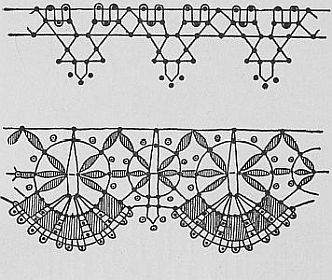
all celebrated for their guipures. Guipure,
a rather vague commercial term covering
two widely different groups of lace, may
be loosely defined as bobbin lace without
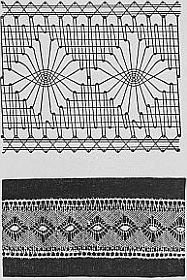
a mesh base. One group of guipures includes
the Clunys (named after the Cluny
museum in Paris because they employ
many old Gothic designs) which are
made in one length or piece. They
closely resemble the more common Torchons,
surpassing them, however, in fineness
and firmness of execution, and in
brilliancy of design—the distinguishing
connecting bars of Cluny often throw the
figures into conspicuous relief. While
this one-piece lace is usually made of the
coarser threads, fine linen or cotton, or
even silk thread, is also employed. In
the second group of guipures are those
made in separate small bits, or details,
which are afterward joined to make the
flounce or piece, the most common of
these varieties being Flanders and
Duchesse. In the schools of Thielt and
Wynghene all the kinds are taught. Because
they are made of coarser thread
and therefore more quickly than such
laces as Valenciennes or Needle Point,
are less taxing to the eyes, and pay better,
these guipures have gained ground
in almost every lace center in Belgium,
and often threaten the very existence of
the finer laces. If it had not been for
the leadership of the “Amies de la Dentelle,”
of a few of the more intelligent
and disinterested dealers, and above all
of certain convents to whom Belgium
owes the preservation of many of her
finest designs and varieties, it is a question
if any but the few remaining old
women, who for forty or fifty years have
preferred to follow one pattern, would
still produce the old meshes and points.
Much hope now centers in the corrective
influence of the recently founded Normal
School at Bruges and of the other schools
of Belgium, but, despite all the efforts of
these combined groups, delicate laces like
the Malines have been fast disappearing.
The little farmhouse, if one can call
two rooms a house, I visited on the edge
of Thielt demonstrated clearly what is
happening. It was Saturday afternoon
and the mother of the large family of
boys at play on the neat brick path outside,
was scrubbing the tiled floor, moving
the small baskets of potatoes and
heaps of tobacco leaves and sabots and
the winter sled from place to place as
she proceeded. The socks to be darned,
each already a fantastic patchwork, were
piled on the window-sill, where there was
room beside for a geranium and a fern.
The stove and the table were also crowded
into this, the general living-room, which
despite all attempts to arrange things,
boasted scarcely one unincumbered foot
of floor space. However, over near the
window with its two plants, were the
customary chair and the cushion, and the
girl of sixteen, absorbed in her lace,
quite oblivious of the water her mother
was splashing about her feet.
The adjoining room was similarly
crowded; it had to serve as bedroom for
this large family. There was the mantel-piece
with the familiar row of bright
plates and vases,—the place where the
family’s art sense finds concentrated expression.
Fortunately, this room, too,
had a window with other plants, and before
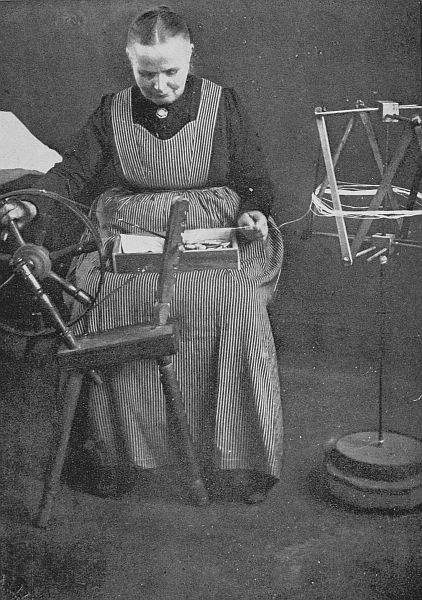
it sat the grandmother in her black
cap and shawl, who, as I entered, was just
slipping her battered eye-glasses into the
little side drawer beneath her cushion.
She smiled a friendly greeting, and uncovered
her lace, a filmy flounce of Valenciennes
about four inches wide, firm
and regular, and of a good old design.
She had been making Valenciennes all
her life; she would make it to the end.
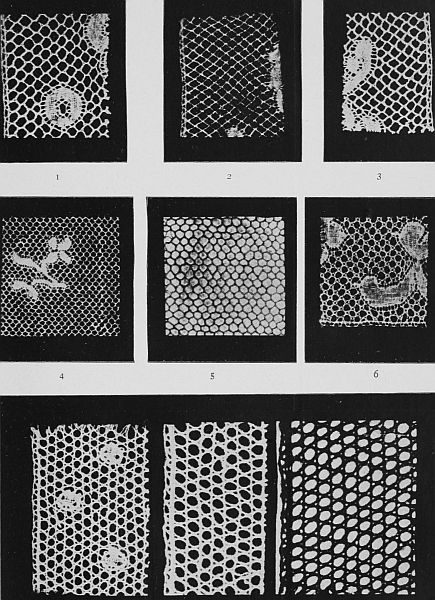
She was delighted to show me how she
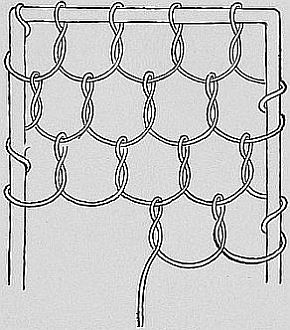
twisted four threads to form one side of
the hexagon of the mesh, and four to
form the opposite, and the union points
where the eight met. Then she held up
a length of her lace and told us that a
facteur (neighborhood buyer for a large
business house) had been there just before
we arrived, to try to buy her flounce
at nine francs the aune, which would be
roughly, about $2.50 a meter. The committee
has been giving her 19 fr. 50 c.
($3.90) for the same amount, and she
asked anxiously, tho still smilingly, if she
might not continue to hope for the committee
price, even tho the war had stopt.
It is pathetic, day after day, to hear that
question repeated, and not yet to be certain
of the answer. However, one can always
reply truthfully, that the women of
the “Friends of the Lace” will work unceasingly
not only to hold wages where
they are, but to advance them.
I turned from this delicate lace to the
granddaughter’s cushion—she was making
guipure de Cluny, of coarse linen
thread. Marie’s pattern happened to be
a good one and she was working swiftly
and evenly, sure of a fair day’s wage.
Here, then, was a suggestive contrast,
and however one may regret it, it exists
in the large majority of lace-making
households in Belgium, and is only to be
expected. It is but the deserved penalty
of a past and present economic blindness
or callousness. Where they are not making
Cluny, the younger women of this district
give their time to ordinary varieties
of guipure which they call Bruges and
Milan, or Point de Bruges, and Point
de Milan.
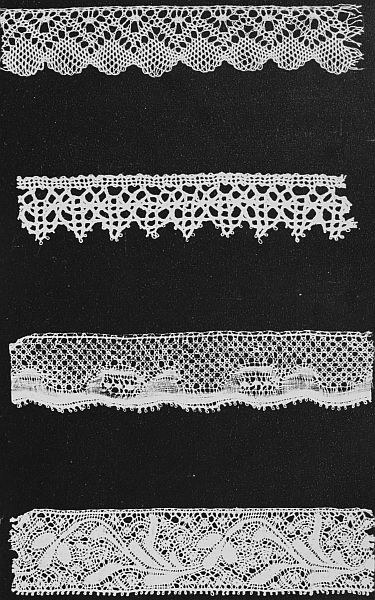
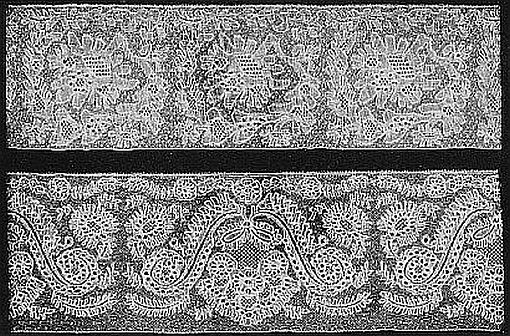
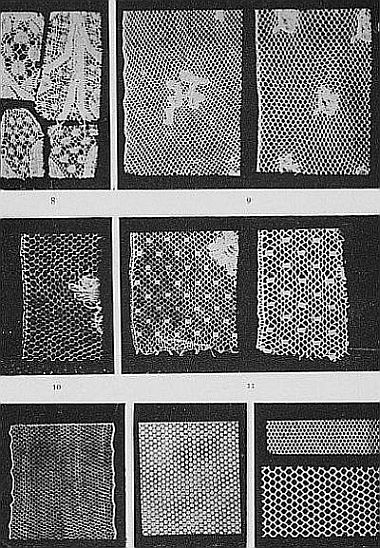
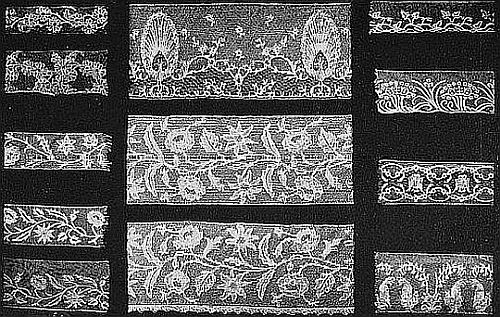
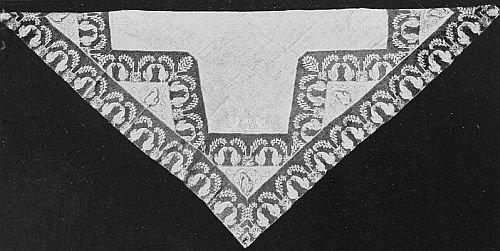
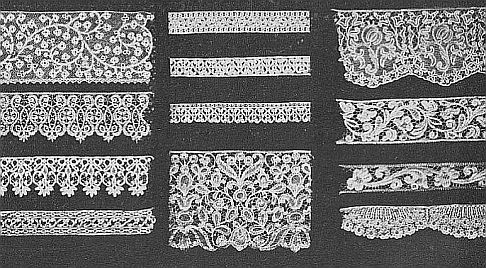
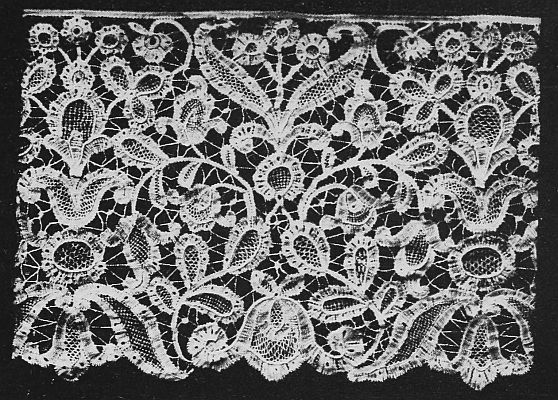
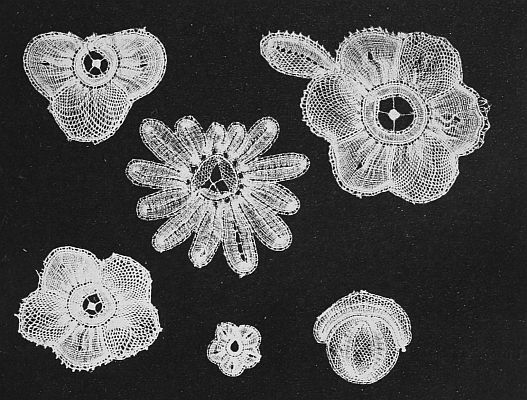
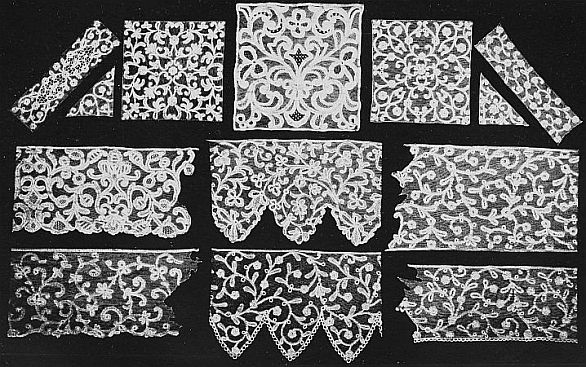
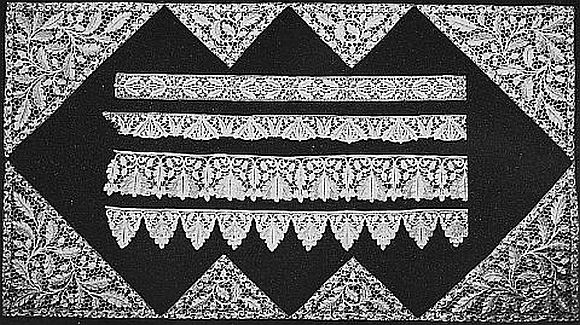
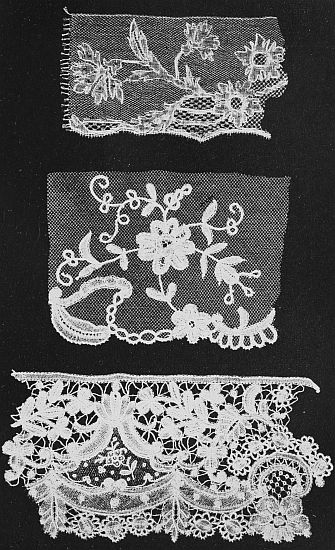
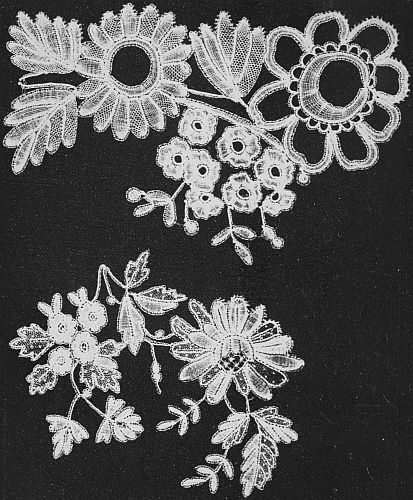
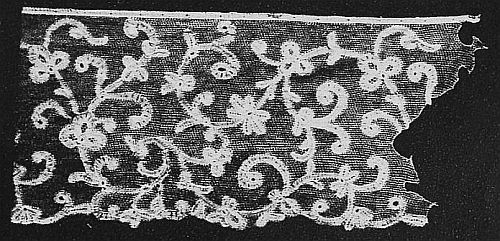
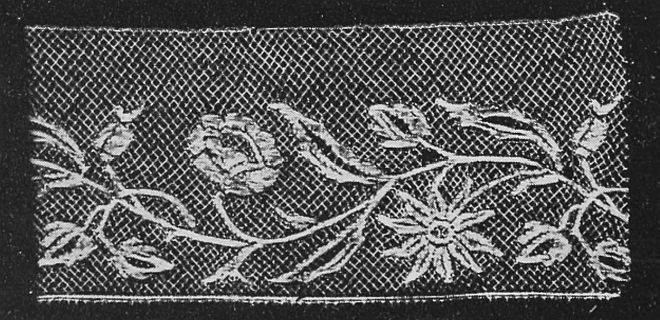
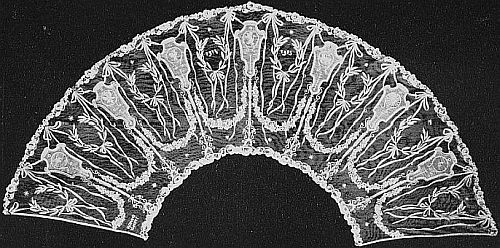
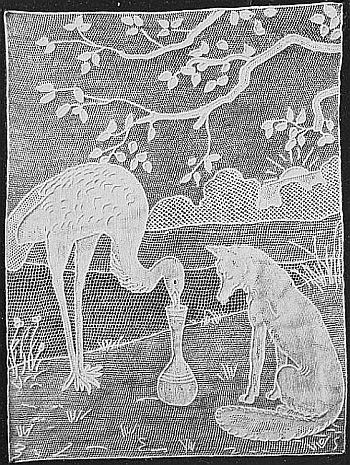
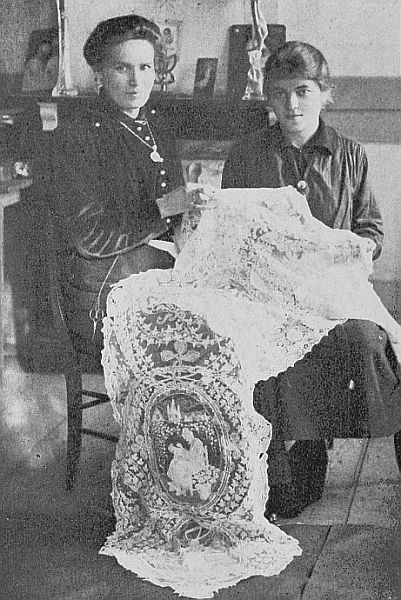
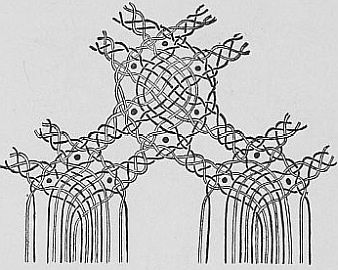
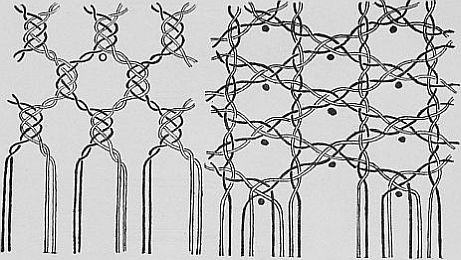
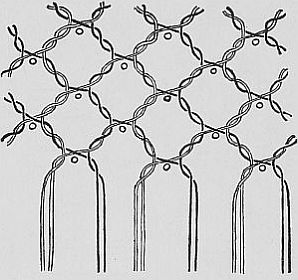
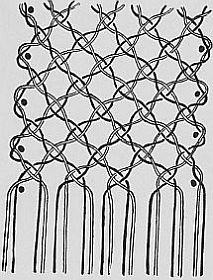
BOBBIN LACES
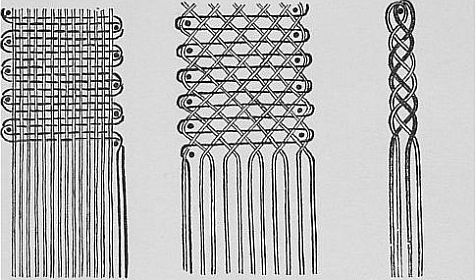
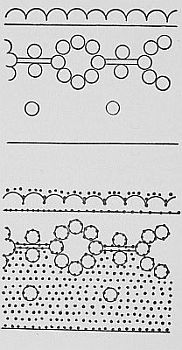
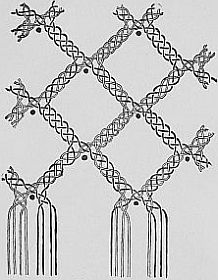
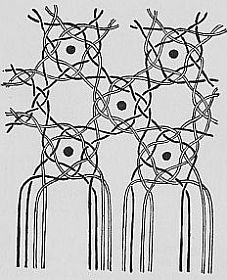
(1) Torchon (2) Cluny (3) Old Flemish (4) Binche
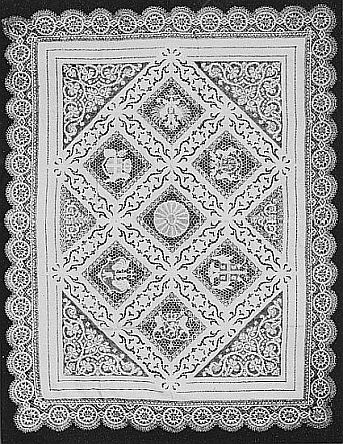
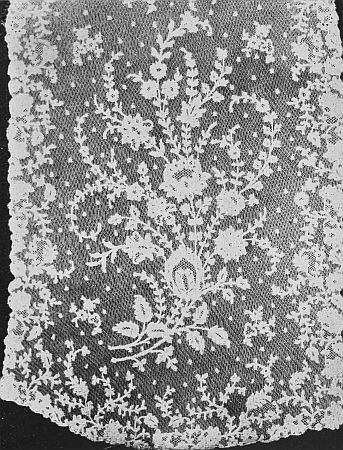
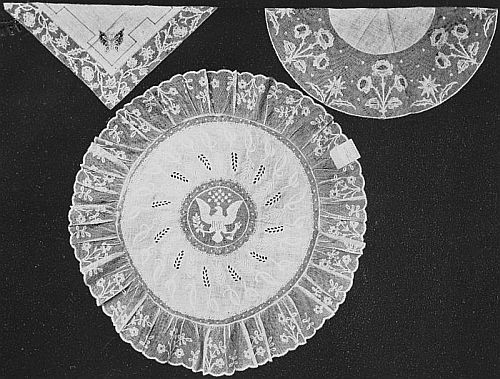
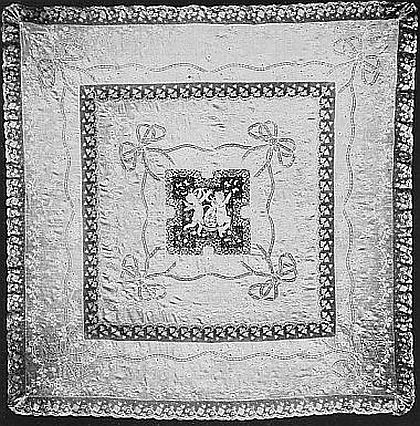
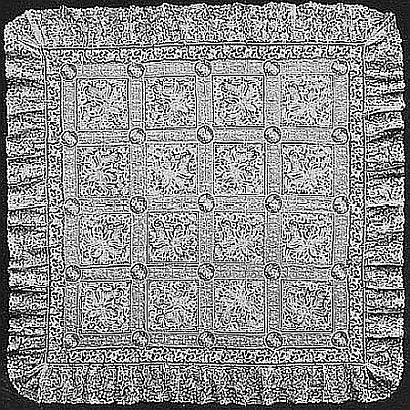
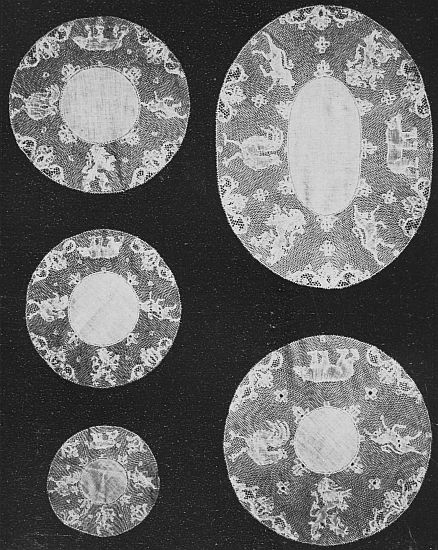
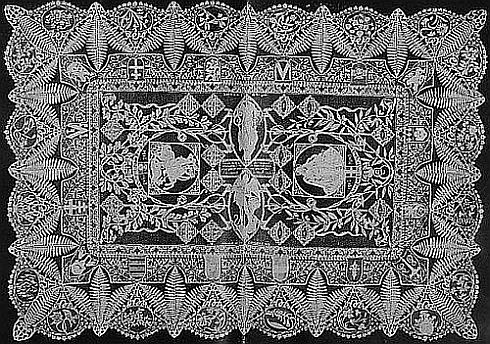
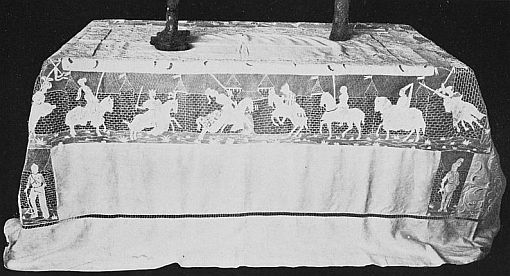
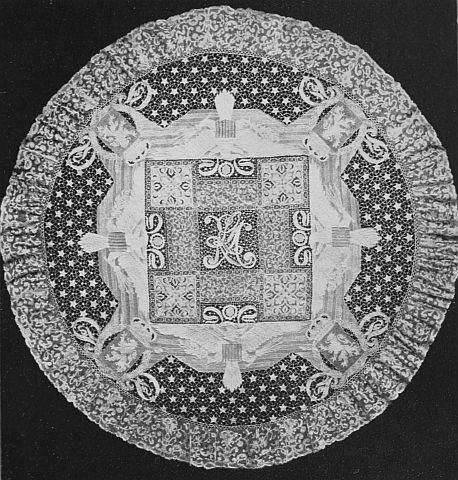
TABLE CLOTH SHOWING ARMS OF THE ALLIES
Cut linen with squares of Venise surrounded by filet and cluny.
Venise made with the needle, cluny with bobbins
While I had been watching the Valenciennes
and Cluny, the mother of the
household, who had the mop of fuzzy
dark red hair often seen in this region,
had hurried her scrubbing to an end, and
wiping her hands on her blue apron, was
ready to uncover her own cushion. I
looked at the chapped, rough skin and
the hands used to pulling weeds and digging
potatoes and scrubbing, and realized
that they could not possibly hold a piece
of fine sewing—the thread would catch
with every stitch—and yet that she could
turn from her scrubbing-brush to the
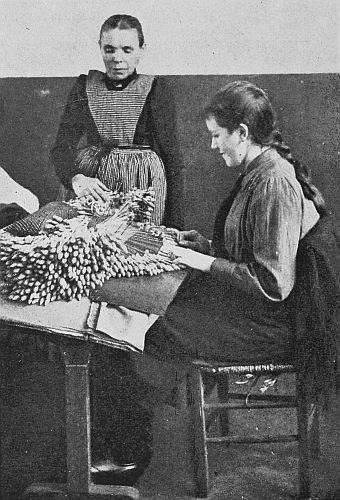
little wooden bobbins (her fingers need
not touch the thread) and proceed without
difficulty on a snowy bit of Valenciennes—for
happily she was following
her mother in Valenciennes.
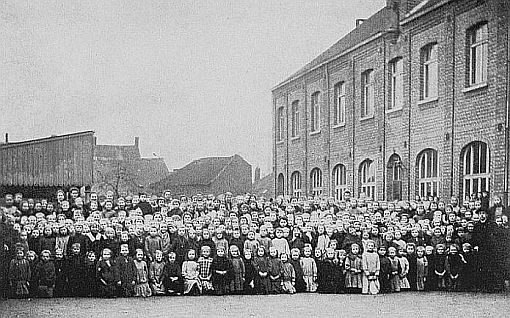
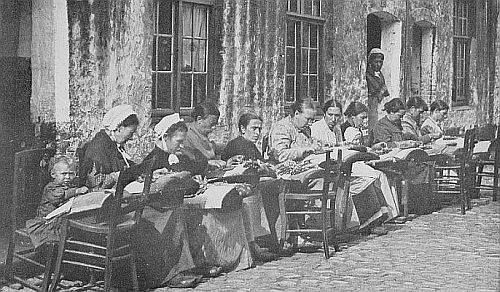
There are three schools in Thielt, of
which the convent schools de la Charité
and de l’Espérance are the more important.
I went first to the Convent de
la Charité, with Mlle. van der Graeht,
who has throughout the war been devoted
to the workers and the lace. Tho Thielt
lay in the danger zone, she refused to
choose a safer city, remaining to share
the work of her father, who added to
his arduous duties as administrator of
the arrondisement, those of the representative
of the Brussels Lace Committee.
Two weeks before the end, however, the
Germans drove these patriots from their
house (three bombs from Allied aeroplanes
had already fallen on it) and they
were denied the experience they had
been waiting for throughout all the
years, that of seeing the Allied soldiers
march into Thielt. One of the Germans
was frank enough to tell them that they
were being forced away chiefly to prevent
their “assisting” at that deliverance.
Immediately after the armistice they
returned, and installed themselves comfortably
once more on the first floor of
their almost roofless house. When I
arrived they had not yet come in from
their first inspection trip of the communes
just behind the lines, and I was
welcomed by pretty, brown-haired Flavia
and her six-year-old Albert. Flavia’s
husband had been killed at the front during
the first months of the war, and she
had served in this household throughout
all its terrible duration. As I looked from
the windows of the drawing-room, still
intact, across the rear garden, to the
mass of wreckage that was once the neighboring
house, I understood the feeling
of the impotence of all effort produced
by the casualness of these bombs, that
spare here to strike there, and why in
the war one inevitably becomes a fatalist.
And as I looked across the garden, Flavia
told me something of her experience with
the thirteen Germans who took over the
house when they drove her master out
and of how whenever the shelling was
severe they ran to the cellars, and several
times tried to persuade her to go with
them but she always refused. “I preferred,”
she said, “to die alone with my
little boy in the open, to risking being
killed with them in the cellar.” On Sunday,
October 13, between 11 and 2 o’clock,
sixty shells fell on Thielt, and all day
Monday and the following days they
continued to fall, until on Saturday the
19th, the French marched into the town.
To add to the horror of this period, people
were dying in large numbers of influenza.
Flavia told me of the street-sweeper
who died at the corner with her
broom in her hand. By some miracle she
and her little boy escaped both shell and
pestilence, and when Monsieur and his
daughter returned they found her scrubbing
and restoring as best she could after
the flight of the enemy. This was one of
the centers where during the four terror-years
a bright beacon burned for all
the surrounding territory, for it was here
that the people of the villages and the
convents could bring their laces for the
committee, knowing they would be accepted
and paid for. In 1916, the Baron
van der Graeht was encouraging the work
in no less than seventeen communes and
of as many as 3,500 lace-workers. Flavia
smiled as she remembered something—“What
good luck, there will be a sister
coming this very day about 2 o’clock, with
her laces.” As she said this, the door
opened—father and daughter were back
from their pony-cart expedition to the
front-lines.
Monsieur was still visibly moved by
what he had seen, even after his own four
years’ experience. “Madame,” he said,
“I can not describe my emotion on going
about in those little shattered villages
just behind the lines, where the women
have insisted on remaining, and where
day by day, and year after year, they
have sat calmly before their cushions
making lace, while the shells burst before
and behind them. After such a victory
as theirs, the lace industry of Belgium
must live.”
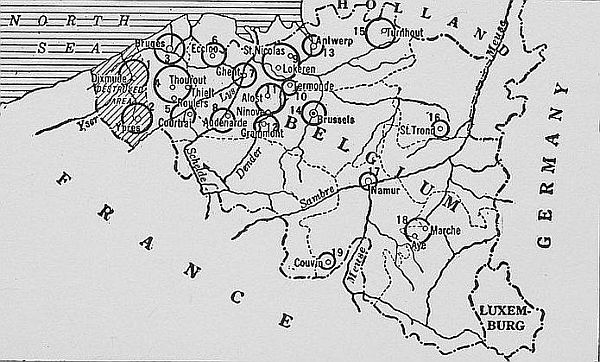
Mademoiselle gave me the list of the
badly destroyed villages, and then the
names of those which had suffered less
and that, with Thielt, produced the most
lace. Among them were Pittham and
Ardois (which specializes in old Bruges);
Ruysselede (with an excellent school for
Valenciennes), Aerseele, and Maria Loop.
Thielt, itself, had at the beginning of
1919 about 300 workers, of whom a hundred
were in the school of the convent
de l’Espérance, and about 60 in the Convent
de la Charité. There had been times
of great discouragement; in one particularly
dark hour in 1917 many of the
workers had turned back to the old
facteurs, or village agents, for help, and
unfortunately some of these sold to the
Germans, who were constantly trying to
win them by offering large sums for their
laces. Since he was under no obligation
to turn over a fixt wage to the workers,
the facteur might reap any profit he
could secure.
We abandoned this unpleasant subject
to talk of the schools, the hope of the
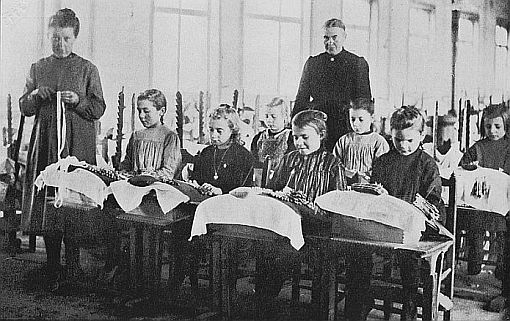
future, and after lunch I went with Mlle.
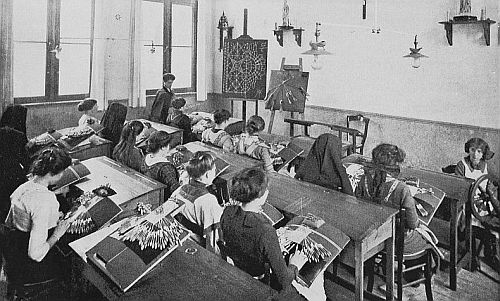
to visit one of these, the Convent de la
Charité, on the edge of the town, with its
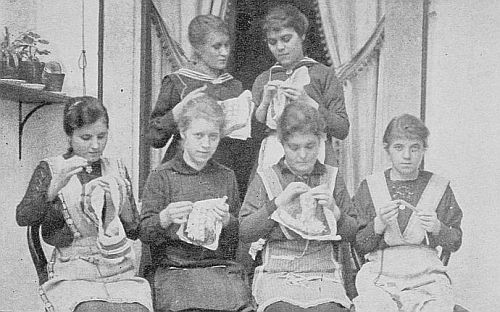
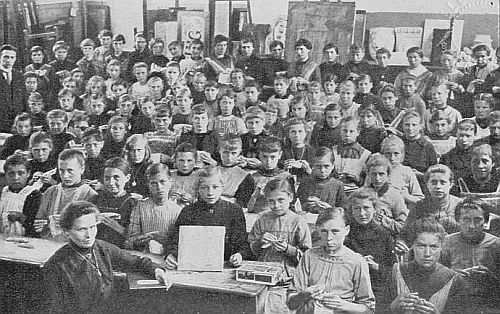
60 girls, who have supplied the committee
with much old Flanders and Cluny. Even
tho this was a Saturday afternoon in
winter, 45 of the 60 chairs were occupied
by girls between 12 and 16. One rarely
finds a girl over 18 in the schools; once
she has learned her trade, she prefers to
work at home with the mother and grandmother.
Unfortunately in this, which is considered
a “good” school for Flanders, I
found the longest hours I had yet met,
that is, summer hours. In winter, because
of the poor light, they are shorter. It
seems unbelievable, but the sisters told
me that in summer the children come at
5:30 o’clock and work until 8 at night—with
only three half-hours for recreation—one
at 8:30 o’clock, one at 12, and
one at 4. A day of 13 hours for growing
children, and girls who are maturing!
It is such cruel conditions as these that
the Committee have done their best to
ameliorate. In this case, tho the hours
are still criminal, the wages have been
improved.
However, “improved wages” leave
much still to be fought for. I talked
with a girl of twelve in the front row, an
apprentice, and found that she earns between
40 and 50 centimes a day, or about
10 cents for her 13 hours’ labor, which
tho it is almost double what she could
have earned before the war, is nevertheless
only 10 cents per day. The Committee
was able to add the war-time subsidy
of 20 per cent. to this. Naturally,
the learner can not yet make what is
called good lace, and unfortunately her
parents are often only too content to have
her bring home 10 cents a day. The
older, more experienced girls, were earning
from one to two francs a day, or from
20 to 40 cents, that is, on a summer’s day
or full day.
Monsieur told me later that in his region
if the wage of the good worker can be
raised to 50 cents per day, she will
be able to live, and will be content to
remain at home before her lace cushion
rather than to go to the shoe and cotton
factories of Thielt.
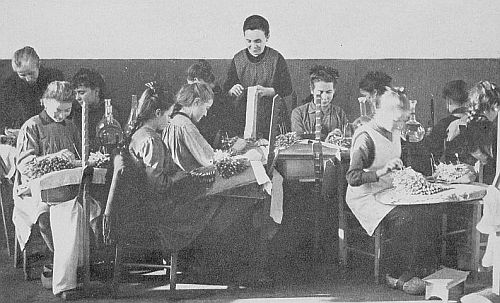
The advanced pupils were eager to uncover
their treasure. Nearly all of them
had protected their round cushions with a
circular piece of thick blue glazed paper,
with a hole in the middle. Through the
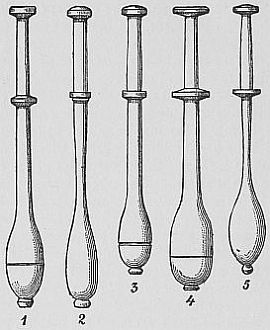
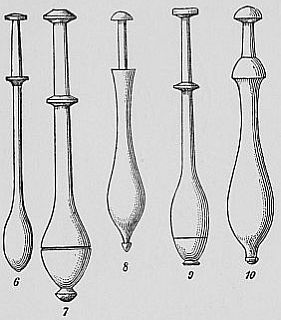
hole they worked with their rather heavy
cherry wood bobbins, on the meshless
guipures of Cluny and Bruges and Flanders,
which this school prefers. Several
were finishing the collar and cuff sets of
rather coarse but pretty Bruges with its
characteristic rose and trefoil, seen so
commonly in shop windows, and which
are especially effective when worn with
cotton or linen frocks. The Guipure de
Flandres pupils were making square insets
for table and tray-cloths of simple,
geometric designs. Two girls were at
work on what they called Guipure de
Milan, of a wide spreading branch and
flower pattern.
However, the most interesting lace
was not the guipure but the Point de
Flandres or Old Flanders, with its elaborate
mesh base, just now experiencing
an interesting and encouraging revival,
in which the zealous Baron van der
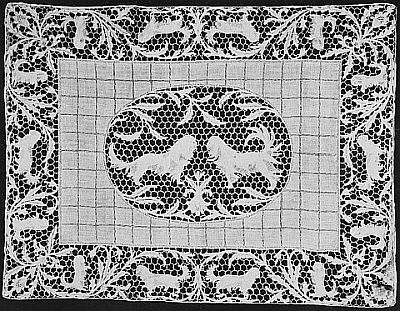
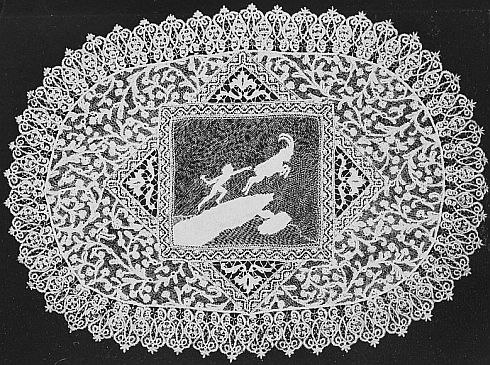
Graeht felt Thielt should assist. A half-dozen
older girls were executing doily
and table center rounds in this lace, after
the Committee’s very popular Swan pattern.
They were using a fairly coarse
linen thread, and working the rich, solid
mesh with eight bobbins. “Whoever
would make the Old Flanders mesh must
be willing to play a game of patience,”
Madame had once said to me. The dull,
plain woven parts of the pattern are
brilliantly outlined by a still coarser
thread, and in the “jours” or open-work
spaces are the much loved snow-balls
characteristic of Binche lace. Because of
its combined strength and beauty, there
could hardly be a more successful lace
for general use than this Old Flanders,
sometimes called Antik.
While it was once the most generally
made and most celebrated of Flemish
bobbin laces (it was known in every part
of Flanders in 1500), it had been almost
forgotten for generations, but even
tho it has been little remembered for
some time, Old Flanders may be said
never to have died. In certain regions,
that of Antwerp for instance, it is found
continuously on the garments of priests.
It is the lace that remained always at the
base and from which the other bobbin
laces, from time to time, sprang. It is
to be hoped that the Committee’s laudable
effort to revive it will bear increasing rewards.
Tho they could understand no French,
and I knew only a few words of Flemish,
these little and big girls found much
amusement in my visit, and in my inability
to follow their swift fingers. These
were fingers accustomed, too, to weed the
fields and to dig potatoes, for there is
practically no lace made here during the
weeks of August and September when
the potato-crop is gathered. The Sisters
of Charity, teachers in this school, were
poor themselves, as their surroundings
testified. They had no fine carved oak
armoire for their laces, but brought from
some safe place a tin box, like an ordinary
bread-box, in which were the dainty
white packets ready to be sent to the
Committee at Brussels. As they were
exhibiting piece after lovely piece, they
unfolded the swan pattern doily rounds
of Old Flanders, and after a moment’s
hesitation, Sister A. ventured, “There is
one thing you might do for us, Madame;
when you return to Brussels, could you
not tell the Committee that while the
small swan doily rounds are sufficiently
paid, this large centerpiece round is not?
It is our fault in estimating; we did not
realize how long it would take to make
it.” I could not resist teasing them a
little and replied that I should be delighted
to carry the message were it not
for the fact that it was precisely this set
of swan doilies (as it was) that the Committee
had given me for Christmas.
“Should you like me to tell them,” I
asked, “that they had not paid enough
for my present?” They were covered
with confusion, as I expected they would
be, and then how they laughed, those
frail little sisters. “Mais, Madame, that
would indeed be difficult; we will write;
we had forgotten. Non, Madame, you
certainly could not tell them that! But
we can write letters now whenever we
wish—can we not? One loses the habit
in four years.” And then they laughed
again all together.
It was already late when I reached
Wynghene. The shell-pitted roads of
western Flanders had made all my traveling
difficult and I could not see Mlle.
Slock, one of the rare lace dealers who
has looked beyond her immediate purse
and has taken time to revive old models
and invent new ones, seeking in every
way to raise the standard of the present
production in all her region, which is
chiefly devoted to Cluny. I had not time
to stop in the village, but hurried on beyond
it to a cheerful red brick manor
house set in a forest, the home of the
Burgomaster of Wynghene, whose wife
has been the untiringly devoted representative
of the Committee for this section.
As we sat at tea together, near the conservatory
windows, where we could look
through the naked garden trees across a
meadow to the forest beyond, the Burgomaster
told me of the morning when they
stood at these windows, after the shells
had been falling for days all about them,
waiting and watching, scarcely daring to
breathe, and of how as they watched, he
saw through the trees of the forest what
looked like a brown shadow, but the
brown shadow moved, and then running
across the meadow, where he had always
believed they must break through, came
the Belgian soldiers, the soldiers of deliverance.
“I know our hearts stopt beating;
we stood choking, incapable of motion,
as we watched them come—still
unable to believe after four years of waiting.”
We were silent for a few minutes, then
we began to talk of the lace. As his wife
turned to get the list of her villages, I
asked if the Germans had attempted to
get her workers away from her. “They
had their agents here, as everywhere,”
she answered, “and I regret to admit that
one of their most successful ones was a
Belgian woman, who had been a facteur,
or lace gatherer for larger houses, before
the war. When the Germans offered
her large prices, she consented to serve
them. If she had been sacrificing herself
for what she believed to be the good of
the workers, we might have forgiven her,
but it was obvious that she was not—she
is pretty and likes pretty clothes—Voilà
tout! Along with several other disloyal
citizens, she was imprisoned the other
day, but unfortunately after only twenty-four
hours, succeeded in freeing herself.
However, the people will never forget
that she trafficked with the enemy.”
I had known of the German lace organization
first through seeing the huge sign,
“Allgemeine Spitzen Centrale” (Central
lace depot), just across from our C. R. B.
offices. And as soon as I got in touch
with the loyal work of the women of the
Belgian Lace Committee, I was daily
hearing of this or that attempt of their
oppressors to capture the designs and the
output of the country. They might succeed
with the simpler, more helpless
workers, who because of their great
misery may be forgiven for selling to
them—and with the deserters and
activists—but they were daily defeated
by the Committee patriots. I was
thoroughly interested to hear, now, from
one of the patriots, that the idea of the
German “Lace Control” possibly had its
birth in Wynghene. In February, 1915,
a certain Freiherr Von Rippenhausen
was stationed at Wynghene. He had
with him his young American wife—they
had been married but a short time, and
the people of the village were kind enough
to say they believed she was not German
by conviction! However that may be,
the Von Rippenhausens requisitioned
lodgings in the house of one of the lace
buyers of Wynghene, and in this house
they naturally discovered much regarding
the lace situation, the lack of
thread, and the distress of the workers,
and of the Belgian system by which the
facteur furnishes the thread to the
worker and buys the finished products,
which he in turn sells to a big lace house,
reaping what profit he can as intermediary.
Frau von Rippenhausen, in
particular, informed herself thoroughly,
and together she and her husband, it is
said, organized the German “Lace Control,”
with headquarters at Brussels.
Since the Germans had requisitioned
all the thread they could lay their hands
on, of which there were enormous stocks
in Belgium, it was not difficult for them
to offer it to the workers. They sent
German soldier facteurs into every
corner of the country to offer large prices
to native facteurs or to individual
workers. On receiving a piece of lace,
they supplied an equal weight of thread
to the workers, thus establishing a continuing
chain of material and product.
And they claimed to be selling their lace
in America! They were clever enough
to profit, in 1917, by the Committee’s apparent
inability to go on at that moment,
exercising every pressure they could, and
naturally they gained ground. No one
can say yet how much lace they were able
to buy, but the amount of inferior lace
was considerable.
Madame Van der Bruggen’s records
show that before 1917 there were in
Wynghene, contributing to the Committee,
400 workers on Cluny and Duchesse,
about 200 on Cluny and Valenciennes in
Beernem, 200 on Valenciennes in
Oedelem, and 350 in Oostcamp, all grateful
to have the Committee’s fixt minimum
of three francs’ work a week insured
to them. Some of these villages,
Beernem and Oostcamp for instance, are
usually included in the Bruges district.
She praised the Committee’s method of
raising the wage by standardizing the
values of certain designs as executed by
an average worker; the poorer workers
then gained less, the superior ones, more.
“I thought I realized,” she said, “how
cruelly underpaid our women were, but it
was not until I saw their joy when the
Committee promised them that at least
they should always have a minimum of ten
centimes an hour for their work, that I
really understood. Ten centimes (two
cents), just a postage stamp, for a whole
hour’s straining effort; and they were
happy because that was so much more
than they had been sure of winning before
the war!”