BY Kate Langley Bosher Author of “When Love is Love”
ILLUSTRATED
PHILADELPHIA
HENRY ALTEMUS COMPANY
Copyright, 1899,
by
Kate Cairns.
Copyright, 1905,
by
Henry Altemus.
IN MEMORY OF
“THE DAYS THAT ARE NO MORE.”
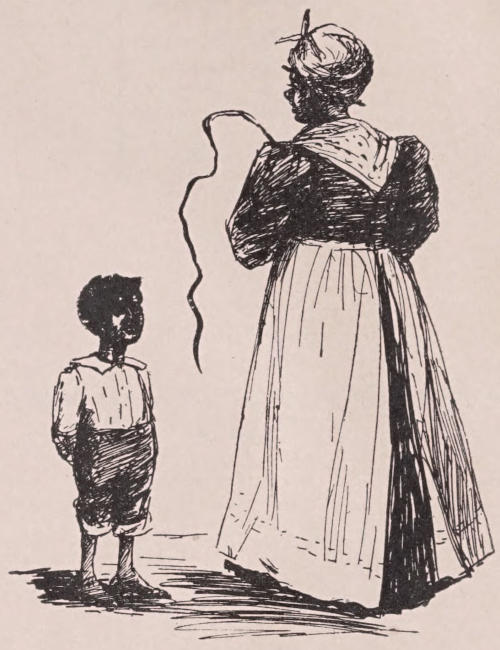
“You see dis?” she said.
CHAPTER I.
He always said he never knew which
was worse, his name or his nose;
but as he could get rid of neither,
he accepted both in his own bright,
happy way, and that ended the matter with him.
Peter Black had given him the name of Mars’
Bobbie to distinguish him from Mars’ Robert, his
father, and it seemed to fit so exactly and suit so
well his cheery, lovable little self as a baby, and
later as a boy, and even on to young manhood,
that no one thought of calling him anything else,
or loved any other name half so well for him.
He was such a long time in coming, he used to
say laughingly, that when he did get here his
parents and friends and relatives, together with
all the negroes on the plantation, thought he
was going to be something extra; and then to be
called “Bobbie,” and to have a broken nose, was
so hurtful to his vanity, that, after thinking the
matter over, he settled it by deciding that never
again would he allow the subject to enter his
mind, with the result that he became more lovable
and loving than ever, and the secret of the
charm all lay in the decision about his nose and
name—he never thought of himself, but always of
every one else first; and that is why he was so
loved—he was so brave and true and honest and
glad always.
“White Point,” where he was born, was the
centre of the Rockland district; and while the
neighborhood in that section of the country was
tolerably well settled, still the “quality folks”
were not very numerous, and in a radius of some
twenty miles there were scarcely half a dozen
families that kept up any kind of an establishment.
Consequently, with the exception of “Grey
Cliffs”—Dr. Trevillian’s place—“White Point”
stood alone for a synonym of all that was grand
and elegant, and as a gathering place for all the
“bus heads” of the neighboring counties, as well
as many cities.
Over two hundred slaves were owned by the
master, and the stables were reckoned the finest
in the State, for the stock included many animals
of well-known and enviable records. There was a
private race-track at one end of the plantation, and
when at the spring and fall meets the neighbors
from his own and adjoining counties met at Mars’
Robert Tayloe’s, there were times to be remembered,
and good old times they were!
The gentlemen brought their own horses and
dogs, and in the morning after breakfast it was no
unusual sight to see fifty or more blooded animals
brought out by the stable boys and walked up
and down for the inspection and discussion of the
gentlemen who had come down to see their favorites;
and it was owing to one of these occasions
that Bobbie made his nose immortal.
Though his eighth birthday had not yet been
reached, he knew every detail of stable matters to
what his mother thought an alarming degree, and
the ambition of his life was to get astride a race
horse. Never had he been allowed that privilege,
though he had ridden bareback everything else on
the place; and when he heard his father discussing,
the night before the big race, the relative
merits of his special pride—Dare Devil—as compared
with Major Dalrymple’s Lady Virginia, he
could stand it no longer, and he crept out to look
for Peter Black.
Had Bobbie known what an alter ego was, he
would have said that Peter Black was it; for one
was the substance, the other the shadow; and
when Bobbie was wanted Peter Black was generally
called.
By right of birth he really belonged to Sallie
Tom, Bobbie’s mammy; but for all other intents
and purposes he was owned body and soul by little
Mars’ Bobbie, to whom Mars’ Robert had given
him on the morning of the great day when the
little master “done come.” The big master had
made him creep softly in the missus’ beautiful
room, and had shown him the new wonder, and
told him that he was to belong to him hereafter,
and that he must always be very careful, and never
let any harm come to him; and Peter Black had
promised solemnly, and walked out of the room
as one would come out of a holy place, and no
king on his coronation day was ever half so proud
as he.
Sallie Tom, his mother, was present at this
installation into office, and she tried hard to conceal
the pride she felt at the selection of the little
marsa’s body servant. She said no word at the
time, but when she got down to her cabin she put
Peter Black on a chair and had a conversation
with him.
Peter was her one and only offspring, and
though she loved him very much in her own
peculiar way, it was something very different from
the absolute idolatry she had for her master and
mistress, and now for the little stranger that for
ten long years she had hoped and prayed would
come to fill the sore need of a child up in the big
house.
There was a strain of Indian blood somewhere
in Sallie Tom, it was thought, and the rest of the
negroes were far more afraid than fond of her.
They declared she “cungered” them, and some
would have nothing to do with her; and for that
reason, though the best worker on the place, she
had been put in the house by her mistress. At
the birth of the baby she had been installed as
nurse-in-chief, and from that hour she ruled as
despot of the nursery kingdom.
In more ways than one did she assert her Indian
peculiarities. No one knew for certain that she
possessed a drop of such blood; but her hate
once aroused was implacable, and her devotion
once given was as intense as it was enduring and
genuine.
After the birth of the baby Sallie Tom moved
up into the house altogether, but she was still
allowed to retain her cabin, and there Peter Black
slept at night, and there in her hours of recreation
or investigation she went to look after her private
matters and to see that all things continued in
their usual spotless condition.
On the afternoon of the day that made Peter
Black henceforth the property of the few-hours-old
heir, Sallie Tom interviewed her offspring as to
the responsibilities and obligations now resting
upon him as a body servant; and if at the end of
the interview Peter Black failed to understand
what he was to be and to do, it was because he
was only six years old, and not yet equal to taking
life altogether seriously.
One thing, however, he fully appreciated, and
that was the old horse-hair whip that hung near
the chimney corner. Sallie Tom took it down
and shook it out in the air.
“You see dis?” she said, as she arose from
her seat to go back to the house. “You see dis
heah, Peter Black? Mars’ Robert told you to-day
dat you b’long to de little marsa, now, and so you
does. Yo’ foots is to run for him, yo’ han’s is to
work for him, yo’ tongue is to talk up for him, yo’
eyes is to look out for him; but you b’long to me,
too, Peter Black, and when yo’ foots don’t run,
and yo’ hands don’t work, and yo’ eyes don’t see,
and you gets to any foolin’, den me and dis heah
frien’ of yourn will hav’ suppin to say to you,
Peter Black, and now go long wid you,” and
Sallie Tom turned and threw her arms around
him and hugged him passionately, and then sent
him out to play.
From the day of his induction into office Peter
Black never gave cause for any regret as to his
selection. His idolatry of his little master was
almost pathetically absurd. It was he who called
him Mars’ Bobbie, the day he crowed so lustily
in his face, and the name seemed to fit so well
the rollicking, laughing, happy little soul that it
just stayed, and no one wanted it changed. When
he first began to crawl it was over Peter Black’s
back, and Peter’s was the only hand he would
touch when he tried to make his first steps, and
almost before he could call his mother he would
cry for “B’ Bac,” and “B’ Bac” was always
there.
On up through the days of infancy the comradeship
continued to grow, and though Bobbie’s
was the imperious one of babyhood, he loved
Peter Black better than anything on earth, and
shared faithfully every piece of cake or candy
that was given him, and it was due to this absolute
and complete submission to his will that Peter
Black let his young master have his way about the
horses, an indulgence which resulted in Bobbie’s
broken nose. When the latter crept out of his
room the night before the big race he made Peter
Black promise to wake him up the next morning
at 4 o’clock. “I’m not going to tell you what
for,” said Bobbie, “but you wake me up;” and
Peter Black did as he was bidden.
Together they crept through the house and
down to the stables, and then Bobbie told his
plans. “Major Dalrymple said last night he
knowed Lady Virginia was a-going to beat the
whole place, and I know there ain’t a horse in the
world that can beat my father’s Dare Devil, and
I just want to tell him so, and I’m going to try
and see. You must get on Lady Virginia and I
will ride Dare Devil; and don’t let’s have any
saddles, ’cause my feet don’t touch.”
They almost ran as they talked, and it was in
vain that Peter Black protested and begged his
little master not to do so dreadful a thing; but
Bobbie’s blood was up, and words had no effect.
They opened the stable and led out their favorites
to the track, and slipped up on their backs.
“Now, when I count three you let her go, and
you make her go, ’cause I don’t want to win easy.
If I come back here first, I beat; if you first, then
I’ll tell father it’s no use. Now, listen. One,
two”—Bobbie’s voice trembled with excitement—“three!”—and
they were off.
CHAPTER II.
They said afterward that the big race
wasn’t half so exciting as this one
witnessed by an unexpected audience.
They had hardly mounted
their horses and gotten under way before several
of the stable boys and the visiting grooms were
rushing wildly to the track. The horses had been
missed at once, and already up to the house the
message had been sent that Mars’ Bobbie and
Peter Black were racing.
Hardly waiting to slip on their clothes, down
came Mr. Tayloe and Dr. Trevillian, followed by
some three or four of the gentlemen guests and
numerous servants, all making madly for the race
track.
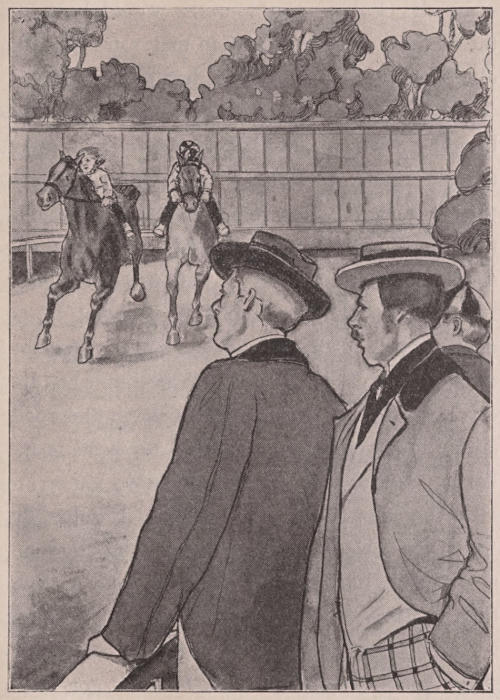
Both children could be distinctly seen, though
now half way round the bend, and breathlessly
the men stood and watched. Mr. Tayloe’s face
was deathly white, and his hands shook as he
grasped the gate-post at the entrance to the track.
The rest, however, had forgotten who were on
the horses. It was a race that they were watching,
and so intense was the interest that they
almost held their breath as again the children
appeared in sight, for neck and neck they were
going now. Both horses were being ridden at
break-neck speed. All sense of servant and
master was forgotten in Peter Black’s and Bobbie’s
minds; it was a race to win, and all else save
winning was driven out. Nearer and nearer they
came, and up through the stillness of the early
morning could be heard the ringing of the horses’
hoofs upon the hard-packed track; and now they
could see that each was stretched almost flat upon
the back of his horse, holding on in some mysterious
way known only to himself.
Neck and neck they still held, and though
Major Dalrymple felt afraid of an accident, he
mentally determined that if Tayloe wanted to get
rid of Peter Black after this escapade, he would
buy him and have him trained for a jockey. He
had the making of one in him, and Lady Virginia
was doing well, even as it was.
On they came, and instinctively the men and
stable hands breathed hard. For the life of them
not one could say which he thought would come
in ahead. Louder and louder sounded the hoof-beats
on the hard earth; and though his heart
was beating almost out of his bosom, even Mr.
Tayloe could scarce repress a smile when he saw
the eager excitement on his little son’s face as he
neared the stretch that would decide the race.
Peter Black was losing his head, but Bobbie
leaned still lower and touched Dare Devil on the
forehead, as he was accustomed to do in the stables,
and then he saw the crowd at the gate and
his father’s white face among them. “Dare Devil,
we must!” he cried, almost frantically. “Don’t
you see father? We must;” and he bent his feet
against his flanks, and Dare Devil gave a great
leap—and Peter Black was behind!
The men set up a shout, and Dare Devil,
almost maddened, kept up his wonderful speed,
and in a moment it was over—the goal was
reached, and Bobbie had loosened his hold and
was shouting wildly to his father, when Dare
Devil gave another spurt—and Bobbie lay on the
ground, flung against the fence. Every man
rushed quickly to the spot; but already his father
had him in his arms, and Dr. Trevillian was bending
over him. Peter Black was there, too, and
they said afterward that he was as white as Bobbie.
It was quite five minutes before they brought
him to, and his first words caused a great cheer
to break the awful stillness that had followed his
fall. “We beat him father! tell him so; tell him
that Dare Devil can beat them all!” he cried;
and then he lifted his hand to his face and saw
the blood with which it was stained.
“What is it?” he asked, trying to rise, and looking
at it again wonderingly. “Oh, father,” he
pleaded, “don’t tell mother ’bout the blood—take
me down to Sallie Tom’s cabin—don’t let mother
see it—you can do anything you want with me,
father,” he continued, and he tried hard to look
up bravely in the latter’s face, “only don’t let
mother know I am hurt, and don’t punish Peter
Black. I made him do it—he didn’t want to, and
he’s mine, you know father, and you haven’t the
right.” He watched his father’s face eagerly.
“Promise me,” he cried, “promise me.” And
though his father had an intense desire to see
Peter Black soundly thrashed, he knew he had no
right to do it, for he had simply obeyed his little
master, as he himself had ordered him to do.
Up at the house there was great excitement
when it was known that Bobbie’s nose was broken,
and more than ever was his sway over the
household absolute and entire, as he lay for a few
days a prisoner in his little bed, waiting for the
great surgeon from the North to come down and
make it all straight and well again.
That night his mother knelt by his bed and
held him passionately to her heart and thanked
God that he was still her own, and then she asked
him what he most wanted to play with while he
was waiting to get well, and his answer brought
the first tiny twinge of jealousy of which she had
ever been conscious. “I want Dorothy, mother,”
he said, putting his arms around her neck in his
old sweet, baby way. “I want Dorothy most of
all. I’m sorry she ain’t a boy as big as me—but
maybe I’ll be glad she is a girl when she gets bigger—for
I’ll have to have a sweetheart, won’t I,
mother?” But before she could answer he was
fast asleep in her arms. The seed, however, had
fallen on fruitful ground, and with a sigh of which
she was half ashamed, his mother began to think
it would not be so very long before her realm in
her boy’s heart would be invaded, and she no
longer reign supreme.
The same night she told her husband of Bobbie’s
wish, and also what he had said, and together
they laughed at the way he regarded the inevitability
of a sweetheart, and though neither said
anything more, it seemed too absurd to discuss
children scarce seven and three years old—still
the idea took root, and the hope was born that
some day Bobbie and Dorothy would keep up
the life in the big house when they were growing
old, or when, perchance, they had passed away.
“Louder and louder sounded the hoof-beats.”
Dorothy came the next day, Dr. Trevillian
bringing her over himself in answer to the urgent
note sent him by Bobbie’s father, and for a week
the two were blissfully happy. At the end of that
time Dorothy was taken back, the promise that she
should come again being the only way of stopping
her sobs at parting. Bobbie was standing in the
doorway with his hands clutched closely together,
trying hard to keep back the tears; but when the
carriage was lost sight of by a turn in the road,
he ran to his mother and buried his head in her
lap. “He can take her from me now, ’cause I’m
little and can’t help it,” he blurted out, gulpingly,
“but when we get bigger I won’t let any man,
not even her father, take her from me; for, mother,”
and he slipped up into her lap and locked
his arms around her neck, “if I tell you something
will you promise not to tell—not even
father?” and he whispered something solemnly in
her ear, and his mother laughed and kissed him,
and held him a little closer to her heart.
When Dr. Trevillian put his little daughter into
the carriage and started off for home, he wondered
why he had been fool enough to let her stay
away from him and her own home for seven long
days, and then when he saw the beautiful baby
eyes, with their wondrously beautiful lashes all filled
with tears, and heard the little catch in her voice
because she was leaving her playfellow, he felt himself
a selfish brute, and his heart smote him at the
thought of the loneliness of his motherless child.
The Tayloes and Trevillians had been friends
loyal and true for generations back, but only of
late had the Doctor begun again to visit “White
Point.” After the terrible shock of his wife’s
death he had refused to go among his former
friends or take up his old life as before, and not
until Dorothy was nearly three years old did he
realize the error of his way, or the injustice to
his child that such a life entailed. He began
gradually to resume his practice and to visit a
little, and when he yielded to Mr. Tayloe’s request
that Dorothy should come and pay them a
visit, it was only after a severe struggle and the
urgent pleading of his maiden sister that the child
should have this pleasure, that he finally gave in,
and the pain it cost him to let her go was known
only to himself.
And that was the way it went on. Year in and
year out they grew up, seeing each other so constantly
that no thought of either was ever kept
from the other; and while over everybody else in
the house and neighborhood Bobbie reigned supreme,
to Dorothy alone did he succumb, and mercilessly
she tyrannized over him with all the inconsistency
of the woman nature that was in her.
CHAPTER III.
Bobbie was sixteen when his father
finally made up his mind to send
him to college. It nearly broke his
mother’s heart, to say nothing of the
terrible blow it was to Peter Black and Sallie Tom,
who still kept up their passionate love for the
boy; yet it was admitted by all that the going
was a necessity. Bobbie simply would not study
at home. By dawn of the day he was off on his
horse, and every inch of ground for miles around
was as familiar as the lawn in front of the house.
Every bend of the river with all its fish, every bird
that flew, every insect that hummed, and every
kind of game in the woods, were as near and
dear to Bobbie and Peter Black as old and tried
friends; and though his progress with his tutors
was not always as great as it might have been,
his tall, straight body, his supple limbs, and his
clear eyes and bright, clever face more than repaid
for the neglect of his books.
His father had a serious talk with him before
he left, and Bobbie’s face took on a new expression
while he listened. “All right, father,” he
said when he left him, “I know it’s time for
me to study now, and you shan’t be ashamed of
me when I come back;” and his father was satisfied,
for Bobbie’s word, once given, he knew
would never fail.
Such a time there was the day he left! Had
the sun been in an eclipse, and all the world in
total darkness, there could not have been greater
gloom than that which pervaded the entire household,
with all the cabin contingent, on the morning
he was to leave. Bobbie’s heart was out of
its accustomed place, and stuck so persistently in
his throat that he found talking difficult. The
remembrance of his mother’s face, he felt would
go with him through life, and the intense dolefulness
of Peter Black was oppressive. Sallie Tom
was a kind of nightmare. So heartily did she
disapprove of this move of the master that she
had kept away as long as possible, but now that
her idol, her pride, was leaving, she could hold
out no longer. Like a cyclone she rushed through
the line of darkies, all drawn up by the big gate
waiting to see the young master off, and in a minute
she had him in her arms and almost off his
feet. “Gord A’mighty tek care of my chile!”
she sobbed, rocking him backwards and forwards
in a way highly uncomfortable to poor Bobbie,
who yet had not the heart to rebuff her. “Gord
A’mighty tek care of my po’ chile, gwine out
alone, all by hissef, and bring him back to his old
mammy!” and she strained him passionately to
her heart, and with a cry of real anguish she let
him go and rushed wildly down to her cabin, and
for two days nobody saw Sallie Tom.
At last all the partings were over and Bobbie
and his father had waved as long as they could
see them, to the waiting crowd, and then a silence
long and oppressive fell upon both. Bobbie dared
not trust himself to speak, and his father was
watching solicitously one of the back wheels of
the carriage, and only the hoarse, choky “Git up
dar, Jonah, git up, you Whale, you,” of Uncle
Lias as he jerked the horses, trying to make out
there was nothing unusual in the trip they were
taking, broke the stillness of the air. A turn in
the road, however, made Bobbie start, and caused
his heart to give an extra leap. There, waiting
under the big willow down by the river road, were
Dr. Trevillian and Dorothy, and the former called
cheerily that they were waiting to ride part of the
way as escort, and to his dying day Bobbie never
forgot this gracious act of letting him see Dorothy
once more before leaving. He had left her the
night before just at twilight, but a new feeling possessed
him as he saw her now sitting so quietly,
yet so firmly on the little pony he had broken and
trained for her until safe for her to ride.
Ever since the day his nose was broken, and
she had come over to play with him, she had possessed
him absolutely and entirely, and no tree
was ever too high to climb for birds’ eggs for
Dorothy; no briars ever too sharp to hunt for the
berries and flowers and nuts she liked the best,
and no trouble ever too great to take, if only she
were pleased; but it was simply as comrades, as
boy and girl, that they had played and quarreled
and made up again, but to-day it was different.
Bobbie felt it, but did not understand—he only
had a fierce desire to take that gawk of a fellow,
John Coxe, away with him—he would be
finding all the flowers that Dorothy loved, and
would get all the chinquapins and chestnuts from
Pebble Hollow now, and he would be far, far
away. They had both been shy and unlike themselves
last night. Bobbie had slipped over early
to tell her good-bye, and they had stayed down at
the spring until almost dark and talked over all
the foolish little nothings that neither was interested
in, and Bobbie had almost kicked out the
toe of his boot against the pebbles trying to appear
natural. “I’m awfully sorry you’re going,”
said Dorothy, at last, making a desperate effort,
however, to look as if she did not mind much.
“There won’t be anything to do now except to
think about Christmas, and after Christmas the
summer, and that seems like a hundred years off,”
and as the blankness all came over her, she threw
herself down on the grass and forgot to make
believe anything except that she was lonely and
miserable, and didn’t want Bobbie to go, and in a
minute he was down there beside her, and both
were fighting desperately hard to keep back the
tears, and Bobbie tried to say something to her
and he couldn’t—he could only choke and then
get angry with himself, and then he told her he
must go, and he put his arms around her and
kissed her.
And now when he saw her sitting so easily on
her horse, waiting for him, his heart gave a great
leap. They merely nodded to each other, and
Dr. Trevillian became actually merry and jolly in
his efforts to keep up the spirits of the party.
He would miss the lad sorely. He knew how his
old friend’s heart ached at the thought of sending
his boy out into the world, and he felt keenly for
him, but it would never do to show it now. Dorothy
and Bobbie talked but little, and soon they
reached the point where they must separate.
Bobbie took off his hat and shook hands with Dr.
Trevillian. “I have a favor to ask of you, Doctor,”
he said in his frank, fearless way, “Will you
let Dorothy write to me sometimes, and will you
object to my telling her about the college, and the
boys, etc.? I wouldn’t expect her to do it often,”
he went on, trying to repress the eagerness in his
voice, “but I would thank you very much.” Dr.
Trevillian looked a little taken back at this modest
request, and he hesitated a moment, and then he
saw Bobbie’s eager face and Dorothy’s flushed
one, and he thought it would be no harm. “Very
well,” he said, “I will make it a reward of merit,
if you make a certain average with your studies,
of which your father will tell me, and Dorothy
makes the same with hers, once a month you shall
each send a letter—is that satisfactory?” and the
Doctor wrung the boy’s hand until it almost hurt.
“Perfectly,” answered Bobbie, returning the
pressure gratefully, “and I thank you very much.
I promise you my letters will always come—will
you promise also, Dorothy?”
And Dorothy nodded, and without waiting to
say good-bye, touched her horse with her whip,
and was far down the road before her father had
finished shaking hands with Mr. Tayloe.
CHAPTER IV.
It was five years before the coming
home, and the going away of Bobbie
ceased to be the principal event
of the year, both at “White Point”
and “Grey Cliffs,” and in fact to the whole neighborhood,
and from the date of one arrival until the
next all events and happenings were reckoned,
for a truly royal time was made of these home-comings;
and merry-makings such as never will
be the same again, were indulged in to an unlimited
degree. From morn till night was one continual
round of pleasure, and nothing was ever
too much trouble if it contributed to the young
people’s enjoyment.
“He works so hard all during the session,” said
Bobbie’s mother, when his father was mildly remonstrating
on the unceasing frolicking. “You
know how splendidly he has done at school, how
he never fails at anything, and now we must let
him have all the relaxation he needs, poor dear,
and there can possibly be no harm, for Dorothy
is always along.”
Her husband smiled a little as he stooped to
fasten his stirrup straps. “Yes, fortunately there
is Dorothy, and if it were not for her I wouldn’t be
quite so sure of all those good reports we’ve been
getting. He knows there would be no letter
without them, and no letter would be Bobbie’s
worse punishment.”
They looked at each other and laughed softly,
and then he stooped over and kissed her.
It was his fourth Christmas holiday that Bobbie
noticed a great change in Dorothy. He was
greatly changed himself—stronger, taller, and
straighter than ever, yet with more grace and
ease, and the polish that comes with constant
contact with gentlemen of his own class, and
through it all ran the old, sweet charm that made
all who came near him love him. The strong will
of which he was possessed was evidenced more
than ever in the firm lines about his mouth, but
Bobbie himself did not realize this, he saw only
the change in Dorothy.
It was Christmas-eve, and the night of the
annual big party given in his and his friends’
honor. He had not seen her since he had gotten
home. He had ridden over early in the morning
and later, in the afternoon, and each time he had
been told she was too sick to see him, but was
trying to get well enough to come over at night,
and now, as he stood watching the different people
enter, he was full of miserable uncertainty as
to her coming; and if she didn’t, why, what was
the use of all this to do? He had brought home
six of his college chums for the holidays, and a
finer looking set of young men would be hard to
find, thought Mr. Tayloe, as he watched them
grouped together near the huge fire-places in the
big parlors now a blaze of light, and filled, in
every niche and corner, with Christmas greens.
Over the doors and on the walls, and banked
about the mantels were great festoons of holly,
while a mass of foliage out in the beautiful old
hall hid completely from sight the musicians stationed
behind it. Through the opened doors
could be seen the people going up the wide stairs
to leave their wraps, and now they were coming
in, and Bobbie and the boys had to take their
positions by Mrs. Tayloe for awhile, and very
soon the rooms were crowded with all the country
folks and many strangers besides, and still no
sign of Dorothy. Bobbie was beginning to get
restless. He had a cordial, merry greeting for
all, but his eyes were constantly watching the
staircase. What if, after all, she did not come!
Presently his heart gave a great bound—nobody
but Dorothy held her head like that, though all
he could see was a mass of soft, white, fluffy stuff
that enveloped from head to foot the figure trying
hard to get up the stairs, but who at every step
was stopped and spoken to by others coming or
going.
Presently she was in the room, and Bobbie
wanted to push everybody aside and go to her
and take her away—away from all this noise and
music and crowd, and have her to himself; but,
instead, he never moved an inch, only his face
grew white, and he was ashamed of the furious
beating of his heart. She was trying to come
with her father, whose arm she held, to speak to
his mother and the rest; but immediately she was
surrounded and almost hopelessly entangled as
she laughingly tried to make her way through the
crowd. Bobbie leaned carelessly against the
mantel and awaited her coming with apparent
quiet. She was a revelation to him to-night.
Surely it must be another Dorothy! The one he
had left in the early fall was a girl—this one was
a woman. Bobbie did not know where the charm
lay; he saw it all in a flash—the long dress, the
different arrangement of the hair, and the manner
that comes with the wearing, filled him with entirely
new sensations. Was she going to be
changed too? On she came, with her father and
numerous followers, and soon she stood near
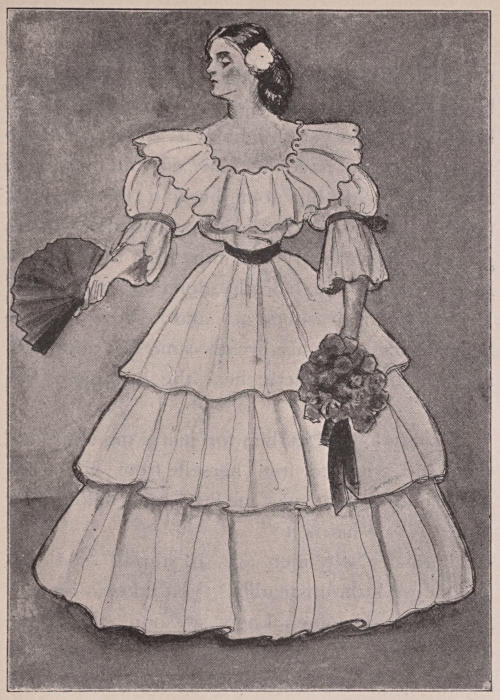
enough for Bobbie to see her in her quaint, short-waisted
gown of sheerest, daintiest white, over its
satin slip, cut low in the neck, and with great
puffs for sleeves. Surely no head was ever poised
like Dorothy’s, and no hair was ever so soft, or
curled so bewitchingly around a forehead and
neck as did that which escaped from the loose coil
at the back of her head. She wore no jewels or
ornaments of any kind, but in her hands she carried
the huge bouquet of violets he had ordered
from the city and sent to her during the day.
How exactly they matched her eyes, he thought, as
he watched her—those wondrously beautiful eyes,
with their wondrously beautiful lashes! She had
spoken to his mother, and now she turned to Bobbie:
“I’ve had to fight my way up here,” she said
laughingly, holding out her hand to him in the
sweet, frank way of old, “but I suppose no penalty
is too great to pay for the privilege of speaking
to so many college men;” and Bobbie, bending
low over the hand he held in his own, had scarce
time for a word before she was speaking to his
chum next to him, and in a minute all the boys
were crowding around and holding out their hands
to grasp hers. A moment more and she would
be gone. Bobbie slipped out of the line and
touched her arm. “Dorothy,” he whispered,
“give me your card: these fellows will get every
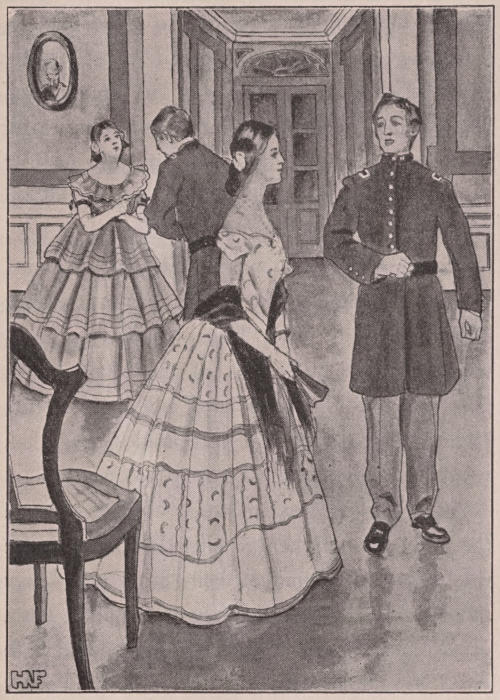
dance before I have a chance.”
His tone was the old imperious one he used as
a child when determined to have his way. Dorothy
looked in his face for a moment, hesitated,
smiled, and then handed her card to him, and
recklessly he scribbled here and there, until she
protested, and made him give it back. Now she
was gone, and he could see her dancing down
the long room, while dozens of eyes watched her
eagerly, for Dorothy was fair to look upon to-night.
She afterwards called it her “coming-out party,”
and in truth it could in reason be so called. She
was a woman now—a very young one, it is true,
but full of all a woman’s witchery and grace, and
Bobbie was by no means the only one who loved
her.
The last year and a half at college was a restless
time for Bobbie, for his ambition admitted of
nothing less than first honors, that she might be
proud of him, and through it all he was possessed
by a nameless dread. Suppose she should not
give him now the old love she bore him in their
childhood days! Their letters were always friendly
and kind in tone, but after awhile there was a
formality in them which both tried to overlook, yet
neither succeeded in banishing, and they wrote of
everything else but the one thing dearest to their
hearts.
The night Bobbie took his degree was a very
proud and happy one, for he was given the blissful
surprise of knowing Dorothy was there with
his father and mother. “At the last moment
father allowed me to come,” she had managed to
whisper, and then she had to leave him; and
before the evening was done, he almost angrily
wished she had not come. Scarce a word could
he have with her before she was literally taken
away from him by a score of men, who were waiting
to claim a dance in the ball that followed
the closing exercises of the year. It was late,
very late, before he got her away from them all.
She was standing in a corner of the room, as
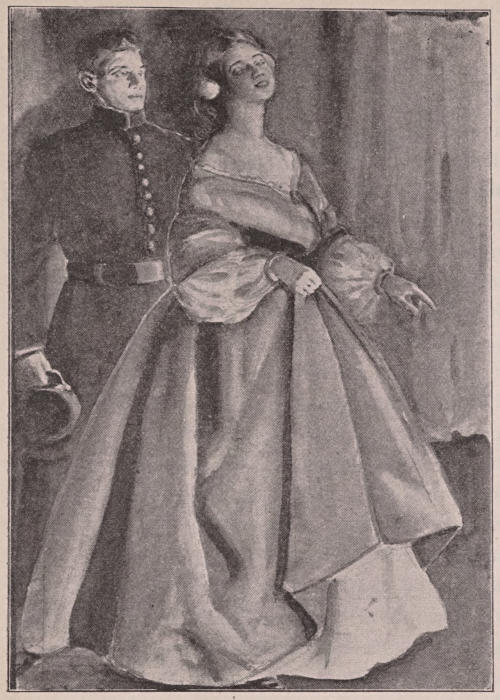
usual, surrounded by a gay group, when he
walked up and placed her hand upon his arm, and
led her away from the crowd. “I’m sorry to
break you up,” he said, nodding to the others,
standing stock still with amazement at his nerve,
“but I believe this dance is mine,” and he walked
off with Dorothy, quite as if she already belonged
entirely to him.
“We are spoiling you to-night, Bobbie,” she
said, laughing indulgently; “even I am letting
you do as you choose, but I just wonder if you
expect to keep it up—if you think that we are
always going simply to follow your lead?”
“No,” he answered, “no; after to-night you
will lead, and I suppose I will do the following;
but to-night—we do not want to dance—I want
to get you away from all this crowd.”
He led her through the door, and down
the length of the veranda, until they came to a
quiet corner, far removed from the ball-room
and the gay company within. There was a seat
way back in the shadow, and he pushed her gently
in it, while he stood leaning against the railing,
tearing the blossoms off the vine that made so
beautiful a drapery from the floor quite to the top
above. The moon was gloriously bright, but
only in faint glints could it be seen through the
mass of leaves, and as Dorothy leaned back its
glimmer shone upon her hair, and for a moment
rested lovingly there, and then danced wickedly
and distractingly up and down, until it was all
Bobbie could do to keep from kissing it, to make
it still. He had loved Dorothy all his life, and
now that he wanted to tell her so, as man to
woman, his courage failed him. Faint strains of
the rhythmic waltz reached them, and Dorothy
leaned back, with her hands loosely clasped in
her lap, and turned her face so that he could not
see it well.
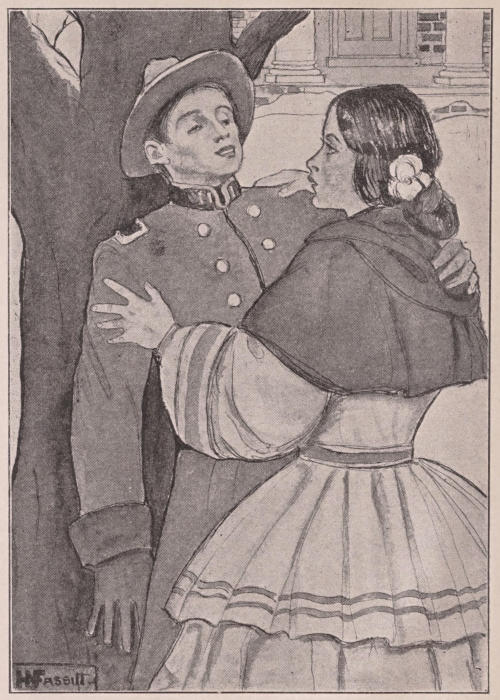
Dorothy.
“What is it—are you tired?” he asked,
uneasily, sitting beside her. “Ah, Dorothy, you
know it so well already!—know that always I have
loved you—and yet you make it so hard for me to
tell you. You have held me off and made me
afraid to speak, but to-night—but to-night you
must tell me, Dorothy. Will you let the others
go, and will you marry me, now I am through college?
Answer me, Dorothy, don’t make me wait.”
He had his arms around her, and he drew her face
again to his, while his breath came fast and hard,
and he could distinctly hear the beating of his
heart.
Dorothy looked at him for just a moment, and
then she tried to free herself from his arms.
“Not until you answer me,” he said, holding her
tighter. “What is it?”
“I wonder why men are so stupid,” she said,
laughing a little unsteadily, “you take so long to
find out what women know so soon. I like the
others, but—ah, Bobbie, you know”—and she
looked up in his face and touched it shyly with
her hand.
And Bobbie knew, knew that of all men on
earth he was the most supremely blessed, and he
could not speak for the wonderful happiness that
filled him. He could only hold her in his arms
and kiss the quivering, trembling lips, and the
beautiful violet eyes and the moon glints in her
hair.
CHAPTER V.
Sallie Tom and Peter Black had
a conversation a night or two after
the return of the “white folks from
the college,” and the announcement
of Dorothy’s and Bobbie’s engagement was of
course its topic-in-chief.
“Dey do say,” said Sallie Tom, taking her pipe
surreptitiously from the depth of her bottomless
pocket, and lighting it with a coal from the hearth,
“dey do say dat de Doctor done walk de flo’ all
night long when Mars’ Bobbie come over and
axed for Miss Dorothy, jis as if he didn’t kno’
dat it had to come; every nigger on the place
know’d it was gwine to end dat way, and tain’t no
use fur de Doctor to say he didn’t spec it so
suddin’; tain’t nothin’ suddin’ bout it. Dey been
a loving’ one another ever sence dey been born,
ever sence his nose got broke. Miss Dorothy is
mighty nice, but she ought to thank her Gord
A’mighty every day that our Mars’ Bobbie luv
her,” and Sallie Tom kicked the ashes together
on the hearth and gave a little grunt, puffing
vigorously at her pipe meanwhile.
“He sutny do luv her,” said Peter Black, leaning
back in his chair and clasping his knees
between his hands, “ain’t no mistake about dat,
and dere ain’t goin’ to be no foolin’ ’bout gittin’
married if he kin hep it, but the Doctor say he
cayn’t let Miss Dorothy go way from home yit.
She ain’t quite turn eighteen, and Mars’ Bobbie
he ain’t been long cum twenty-one, and de Doctor
say dere’s plenty time yit. It don’t mek much
difference to me,” he went on after a pause, “jis
so dey stay home and don’t go flyin’ all roun’ de
worl’ enny mo’. I’m glad dey is gwine to git
married, but I do want de marsa to be home a
little bit by hissef fust. ’Pears like I ain’t seen
him good yit.”
“You’re right,” grunted Sallie Tom, between
the puffs, “ain’t hardly cotch a good look at him
mysef, do’ he did come heah de night he got home
an ax me fur his buttermilk and hoecake, same
ez what he use’ to do, and sat over dere in de
corner, like what he allus bin a doin’ sence he
wuz a baby; de Lord a-bless him!” And Sallie
Tom wrapped her head up in her big apron and
rocked back and forth, quite overcome by the
flood of recollections called up by his presence at
home again. It had been the sorest trial in the
lives of Sallie Tom and Peter Black, this going
away of Bobbie, and now that he was back,
unspeakable joy reigned supreme in the breasts
of each. During the years at college, Peter
Black had acted as dining-room boy, helping the
butler, who was getting rather old, but he had
been immediately reinstalled in his old position
on Bobbie’s return, and his love and allegiance
to his young master was greater than ever before.
It was in the summer of sixty (’60) that Bobbie
got his degree at college and the promise of
Dorothy to be his wife, and while much gayety
and pleasure filled up the measure of many days,
other and more weighty subjects began to fill the
air, and caused many long and serious discussions
among the men of the neighborhood, old
and young alike, and by the fall the one absorbing
topic among all classes was the terrible possibility
of war.
It was a clear, cool October night that Dorothy
and Bobbie had their first serious talk about it.
His horse was hitched to the post waiting for him,
and Dorothy had come out on the porch to say
good-bye. The moon shone clear and bright,
softening the shadows cast by the great trees on
the lawn, and all the air was full of the sweet, fall
fragrance which belongs to that season of the year.
Bobbie was holding his hat in his hand, idly
twirling it as he talked, to hide the excitement he
could scarce repress. “Father says,” and they
began to walk up and down the veranda, “father
says if the State secedes, he will organize a troop
of cavalry at once, and I will of course join him.
Your father will be our surgeon, and you—has
your father said anything about it to you,
Dorothy?” he asked abruptly, taking her hand
and drawing it through his arm and holding it
there tightly. “Has he mentioned any of his
possible plans to you?”
“Yes,” she answered slowly, “yes, he has
talked with me of every possibility. I am to go
to your mother in case there is any necessity.
Auntie will go to the city, so as to be near the
hospitals, and you—and father—and everybody I
love will be in that horrible, cruel thing! Ah,
Bobbie, why must it happen—why cannot it be
stopped?” and she shivered in dread apprehension
of the days that were awaiting her. Bobbie
answered her seriously and solemnly, “I would
to Heaven it could, but if not, you would not
have me stay?”
“No,” she said, raising her head quickly. “I
would not have you stay even if it broke my
heart to have you go. I did not know how much
I loved my South until now, when I must give up
all I love most for it. I pray God to help me—to
make me brave—but sometimes I’m afraid I’m
a coward; but of course you must go, and who
knows but I may yet have a major, or a colonel,
or a brigadier-general for a husband?” and she
tried to laugh bravely at the thought.
“You shall have one who is every inch a
Southern soldier,” he said, taking the upturned
face in his hands. “And I can have nothing
greater than that,” she added proudly, and the
moon rested lovingly for a moment on their bent
heads, and only the winds heard the vows they
made to be true to their cause—come what may,
come what might.
CHAPTER VI.
Such a short, hurried time, it seemed
afterwards, before everything was
decided, all preparations made, and
all the great changes, which at first
they thought would only prove temporary, settled
down to a permanent thing. The neighborhood,
once so gay and bright and full of all that makes
life worth the living, was turned into a kind of
camping ground or recruiting station, and “White
Point” was the nucleus around which everything
centered.
Mr. Tayloe was the leading spirit of the place,
and no better-drilled body of cavalry entered the
service than the “Rockland Home Guards” under
his command, with Bobbie as his first lieutenant
and Dr. Trevillian as surgeon. “Grey Cliffs”
was to be closed, with only the servants in their
quarters, to take charge of the place as long
as they proved faithful, and Dorothy was established
with Bobbie’s mother. Her aunt had left
for the city, where, she said sadly, she knew
there would be plenty to do after awhile, and soon
the beautiful old home had a dreary, deserted
look, for the shadow of coming sorrow was hovering
over it.
Bobbie had begged hard to be married before
he should start for what might perhaps be an
interminable absence, but Dr. Trevillian was firm
in his refusal for a year longer at least.
“I am giving you the light of my life, Bobbie,”
he said, putting his hand on the young man’s
shoulder, as he stood pleading his cause, just two
days before they received orders to join H.’s regiment
at C—, “and you must wait, my man, until
she is a little older—she is so young yet! Perhaps”—he
cleared his throat and went on after
a minute—“perhaps, after I leave here, I may
never come back; but remember always, that my
daughter’s happiness is in your power, and that I
put into your hands the most sacred trust one
man can give another. I charge you to guard
it well.”
Bobbie bared his head as a knight of old. “So
help me God,” he said reverently, “I shall be
worthy of it.” They shook hands in silence and
separated.
It was the night before they were to start. Mr.
Tayloe and his wife were shut in their room.
The Doctor was in the library writing some final
directions to be sent over to “Grey Cliffs,” and
Bobbie and Dorothy were out on the lawn, under
the old wishing-tree down by the gate. Every
preparation for departure had been made, and
the start was to occur at five the next morning.
Peter Black was in an ecstasy of delight because
he was to accompany his young master as his
body-servant, and Sallie Tom was in the depths
of stern and silent indignation and despair at the
turn affairs had taken.
She now had her son down in the cabin for
final admonitions as to the duties and obligations
resting upon him, and for renewed charges that
no matter where they might be, in case anything
happened to the young master, he was to bring
him home, if possible; if not, he was to come
himself and tell her that she might go to him.
Bobbie and Dorothy were silent for a long time,
down under the old wishing-tree, for neither could
trust themselves to speak of the things nearest
their hearts, but after awhile Bobbie began to talk
of the orders received the day before. “If it were
not for leaving you and mother,” he said, “if it
weren’t for that continual nightmare hanging over
me, I think I should enjoy going more than anything
on earth. We have talked, and argued, and
discussed all this so long that I am glad the time
has come to fight it out; it is the only way to settle
it, and the sooner begun the sooner ended.”
Dorothy answered slowly, and after a long
pause: “Yes, I know it is the only way to settle
it, but it is a horrible price that must be paid for
the final decision. Ah, I understand how you feel,
but you are going into it, into the danger, into
work, into action—and—I know—into death, too,
perhaps,” and her voice shook a little, “but it is
so much harder for us—we who have to stay
here—who must sit day after day—waiting to
hear. Of course, I can knit socks, and tear
strips, and make bandages to send to the city;
but what can I do to make myself forget for one
single moment that you may be needing me—or
father?”—and she broke down in a genuine sob,
and then in a minute she slipped away from him.
“You will think me a coward—and I know I am
not that—see, I have brought you something—you
must keep it, and read it, and be the man it
can make you,” and she put in his hands a tiny
pocket Testament, on the inside of which she had
pasted a small picture of herself.
“That will be my talisman,” he said, kissing it
reverently, and putting it in his inner pocket,
“and will keep me from harm, please God.”
They talked until the night grew late and chill,
and then he put his arms around her for a last
good-bye. The winds shivered in the tops of the
trees, and the whip-poor-wills ’way down by the
brook were calling plaintively to each other, and
the moon slipped under a cloud, and only the
stars looked down and saw the sorrow that filled
their brave young hearts.
They were gone, and Dorothy and Bobbie’s
mother turned from the porch, from which they
had watched as long as possible, and went inside,
not daring to speak, lest all the long-controlled
feeling they had been struggling to conceal should
reveal itself at last.
They took up their new life courageously, and
the influence of each was great, both in the home
and in the neighborhood; but it was not long
before trouble began to appear among the servants,
and, as time went on, greater and greater
discontent became evident.
It was not until news of the first battle reached
them that the horror of it all made itself felt in
full force to Dorothy. She had heard that a battle
must take place soon; and when Bobbie’s letter
came, telling her he hoped and prayed his regiment
would have the honor of being allowed to
go into the first fight, her heart sank in miserable
misgivings.
She wrote him, however, that if he were sent
into this battle, she knew the honor of old Rockland
would be safe, and not by a single word did
she tell him how torturing was the anxiety, or
how, all night long, she had knelt at her window
and prayed God to protect and keep him safe.
Not for ten days did she hear again, and then
came such a battered and soiled old envelope that
the address was almost unreadable. It was very
short, and written in pencil on a scrap of paper
torn from a note-book, and ran as follows:
“Dear Dorothy—We are drawn up in line of
battle, facing the enemy, and waiting the signal to
charge. I am using my cap to write on. I don’t
know how it is going to be. I only know we are
going to fight like our women expect us; and
now, before it begins, I am trying to send you a
word to tell you that the thought of you makes
me dare all things. I am going to put this in my
pocket. Peter Black knows what I want done in
case I don’t send it myself. Tell mother she shall
not be ashamed of her son. My love to her, and
for you, little sweetheart, God bless you, and
make me worthy of you!
“Bobbie.”
Peter Black found it in his pocket, where he
had been directed to look; and though Bobbie
declared it was only a scratch, it kept him close
for a week, and Peter Black’s powers as a nurse
were tested pretty well in that time.
It was shortly after this that Bobbie was appointed
General H.’s special scout. His well-known
absence of fear, his reckless daring,
together with his wonderful ability to ferret his
way through any section of country, and his marvelous
endurance, had already attracted the attention
of his regiment, and soon it became a common
matter to send for him when the situation
demanded unusual haste and caution.
CHAPTER VII.
The first year of the war passed with
comparatively little change at “White
Point,” but towards the middle of
the second year the trouble which
had been brewing among the negroes for some
time gave way to open rebellion; and had it
not been for Sallie Tom’s wonderful and cunjuring
influence over them, they would have left
long before they did. Under Mrs. Tayloe’s and
Dorothy’s oversight, much of the farming had
been kept up; but towards the second harvesting
it became evident that trouble was ahead. A
negro agitator and so-called preacher had appeared
in the village near by, and so great was
the effect of his haranguing that the entire neighborhood
was demoralized, and nightly meetings
were held down at the cross-roads. Sallie Tom
was constable-in-chief of the “White Point” contingent,
and every night she stationed herself in
the road usually taken by the servants and hands
on their way to the meetings, a gun in one hand
and a pistol in the other, ready to shoot the first
one who passed. Every negro on the place
believed in her cunjuring power, and they would
no sooner have thought of passing than of trying
to ride the moon. Things were beginning to
look desperate. Even the loyal and good servants
showed signs of dissatisfaction under the
influence of the agitators, until finally only
Dorothy’s old mammy Rachel, Jessie, the dining-room
servant, Uncle Lias, the carriage driver,
and Sallie Tom remained deaf to the promises of
good fortune and prosperity advanced by the
younger element.
It was on a clear, bright October morning, that
the result of all their meetings and plannings
were realized. Mrs. Tayloe and Dorothy came
down as usual, and found Sallie Tom and the
three other servants drawn up in line outside the
dining-room door. Sallie Tom was almost wild
with excitement and anger. “They’re gone!”
she cried, waving her hand violently in the direction
of the quarters, her voice trembling and her
whole body quivering. “They’re gone, every
one of them—gone like thieves in the night.
They have took all their things, and six of the
horses, mos’ all the corn, and Gord A’mighty
knows what else. Oh, Lordy!” she went on,
“to think of all the trouble what’s come to us
’count of dat monstrous inturfurence bizness of
them Yankees! To think I uver should er lived to
see my missus done treated so by niggers! Oh,
Lord A’mighty, what we gwine to do anyhow?”
And Sallie Tom for the moment lost her courage
in the face of the dread possibilities of the future.
Mrs. Tayloe turned white to the lips, and
Dorothy caught her hands and held them in her
own strong, tender ones.
“I suppose it had to come,” she said presently,
nervously pressing Dorothy’s hands in her own.
“I am thankful it is no worse. We must do the
best we can, and not let the gentlemen know.
Ah, no, we must not let the gentlemen know!”
Her voice broke, and she hurried back to her
room, and they left her there, for they knew it
was best that she should be alone for awhile.
It was Dorothy’s turn to advise and lead now.
With all the courage and hope of youth she began
to take charge of the place. With the help of
the others she managed to keep up part of the
farm, and from one end to the other she rode
daily on her horse, sometimes with saddle, sometimes
bareback. A new fear was beginning to
grow in her heart. Every dollar on earth possessed
by both her father and Mr. Tayloe had
been invested in Confederate bonds, and she
knew that very soon their purchasing value would
be of little account.
That they should ever suffer she did not allow
herself to think; but it was necessary to husband
every resource, and every energy must be bent
toward keeping from Bobbie’s mother as long as
possible the seriousness of the situation. Life
was by no means now a thing of ease or pleasure
to Dorothy. The days became weeks, and the
weeks months, and the months were becoming
years, and the clouds which at first they thought
would be but temporary, were continually growing
blacker and heavier, with never a sign of lifting.
It was not until the Christmas of ’63 that
any real alarm, however, was actually felt as to
the outlook. By a long-planned and well-timed
scheme Mr. Tayloe, who now through successive
ranks had been promoted to that of colonel, and
Dr. Trevillian, now a surgeon-in-chief, had managed
to get leave for a two days’ visit home, the
first they had been able to make together since
they entered the service. Bobbie’s movements
were uncertain. He would be there, he wrote,
were it a matter of possibility, but he might be kept
for some special duty. He had managed to run
in for a day or so at intervals of every few months,
and consequently was better prepared for the
present condition of things than were the others.
All through the three long years there never
had been a time when it was possible for him and
Dorothy to be married. When he was at home,
her father and his were away, and he could never
induce her to marry him unless all were there.
Every effort was made to make this Christmas
a memorable one. Mrs. Tayloe’s happiness at
having her husband home once more gave her a
fresh measure of strength, and the very best that
had been carefully saved and hoarded for many
months past was now made into the good things
of former Christmas times; and though Dorothy
knew they would have to stint for months to
come, yet she never let any one but Sallie Tom
realize how reckless it all was.
Sallie Tom’s joy at having once more a pretence
of Christmas festivities made itself known by her
own peculiar way of snorting as she prepared the
various dishes that were best liked by the master
and the Doctor, to say nothing of those she surreptitiously
made for Bobbie, in case he should
come. That he would come, she never doubted,
and all day long on Christmas-eve she had her
ears, as well as her eyes, open to catch the first
sound of his horse’s hoofs on the frozen ground
outside.
Colonel Tayloe and his wife had stayed much
in their room, talking over matters of minutest
detail as to the new life of each, while Dorothy
and her father had a long talk after the latter’s return
from “Grey Cliffs,” where he had spent most
of the day. He had brought back her mother’s
portrait, and told her he wanted it put in her
room. “There is no telling what may happen,”
he said, trying, however, to speak cheerfully.
“There may be trouble around here yet. The
negroes seem to be going crazy. Only two are
over there now—old Israel and his wife. I have
buried all the silver and a few other things,” and
he told her where he had hidden them. “I want
you to understand about everything, Dorothy.
You know it will all be yours some day, and there
is no telling”—he stopped abruptly at the sight of
the sad, pained face. “Don’t look that way,
Dorothy, daughter,” he went on, softly stroking
the hand he held in both of his. “When the end
comes to me don’t grieve, but be glad, glad for
me; for I’ve wanted to go for a long time, except
for leaving you, and I know that is all right now.
Bobbie has proven himself to be a soldier worthy
of the cause for which he fights, and I have been
proud of him—very proud. I have made you
both wait much longer than I intended, but I did
it to be satisfied, and I am satisfied at last. I
have lived for so many years with only the memory
of a past and the hope of a future that I am
longing for the now of her presence.” He paused
for a moment, and Dorothy dared not trust herself
to speak; she could only cling to him in
mute understanding of the loneliness of his life.
He stroked her hair softly, and after awhile continued:
“You have been the comfort of my life,
my daughter—my dear little daughter—but you
will understand some day, and I only want you not
to grieve should the fate of some of those poor
lads come to me. You know I am on the field
sometimes—you will remember, child—and go
now and see that everything is ready for Bobbie’s
coming, for I am sure he will be here, and when
he comes I want to have a talk with him.”
She kissed her father in silence again and again,
and then she left the room; but the awful possibilities
which his words suggested filled her with
unutterable sorrow and loneliness, and, like a
child that longs for warmth and cheer and comforting,
she sank down on the rug in front of the
big blazing fire, and her lips quivered in her great
longing for Bobbie. She clasped her knees
loosely with her hands, and the flames danced
merrily up and down before her blurred eyes.
The corners of the room were lost in shadows,
and the flicker of the firelight played upon the
walls. It would be such a relief to give way and
have a good cry. She bit her lip to keep it back;
and then she heard a little noise, and somebody
had his arms about her and was down on his knees
beside her, and outside she could hear Sallie Tom
snorting, and Bobbie was telling her, almost out
of breath, that he had ridden like the wind all day
and all night just to spend a few hours with her
and why didn’t she speak to him and tell him she
was glad to see him? And all she could do at
first was to cling to him, and let all the pent-up
feeling and anxiety of the months past come out
between the laughter and tears; and Bobbie understood
it all, and soothed and quieted her as
only he could do, and in a little while she was her
own brave self, and was making him answer a
dozen questions at once. She might have kept
it up indefinitely had he not told her he was
starving, and that sent her flying for Sallie
Tom.
It promised to be such a happy Christmas, after
all. The knowledge that this brief return of other
days could last but a short while made every moment
precious, and such old-time doings as Bobbie
insisted upon keeping up made them forget
for a few hours at least, the serious outlook for
the future. It was just before dinner on Christmas
Day that Bobbie came to Dorothy with a face full
of intensely repressed feeling. She was standing
by the big window in the library watching the
snow, now fast falling and thickly covering the
ground, and he went up to her and took both of
her hands in his. “Dorothy,” he said quietly,
“has your father said anything to you to-day
about our marriage?”
“Not a word,” she answered, turning quickly
and searching his face for the meaning of the new
light there. “We must not worry him about it,
Bobbie; he has had so much sorrow in his life
that I dare not ask him to give me entirely to
you. We can afford to wait.”
“But if he says he wishes it, now, to-day, would
you be willing?” He drew her down on the sofa
by him. “I have just had a long talk with your
father,” he continued, “and he told me that he
would like us to be married at once, while he is
at home and we are all together.” He almost
crushed her hands in his as he waited her answer,
controlling by a great effort, his old boyish and
imperious impatience.
“Dear father,” she said, and her eyes were full
of tears, “I must see him first, and then I will
tell you, Bobbie. It is so sudden; and to be married
in such a hurry don’t seem just right somehow.”
His look of disappointment reproached
her. She put her hand upon his face in the quaint
way peculiar to herself for just a moment, and
then she drew herself away.
She would not let him go with her, and it was
fully half an hour before she came back, bringing
her father with her. Both showed the traces of
how tender had been the talk between them, and
both were very quiet. Dr. Trevillian led her to
Bobbie, and put her hands in his. “She agrees
to our plans, my son,” he said, trying to speak
brightly, and then he turned abruptly and left
them alone.
“You are not marrying your general, Dorothy,”
said Bobbie, presently. “What are you
going to do about it?”
“Send off his scout to-night to report to his
general for new orders,” she answered, trying to
speak bravely, “but now we must hurry,” and her
face colored richly as she ran out of the room.
CHAPTER VIII.
Had a bomb been exploded at “White
Point,” the excitement could hardly
have been greater than that caused
by Bobbie’s announcement that the
marriage would occur that night. Such hurrying
and scurrying for the numberless preparations
which Sallie Tom insisted should be made
had not been seen since the war began. Peter
Black could hardly saddle the horse, in such a
tremor was he over the great news, and Colonel
and Mrs. Tayloe were gratefully pleased that the
marriage should be consummated even in such an
unexpected way.
And now, while Bobbie was riding like mad
through the fast-falling snow and gathering darkness,
Dorothy and his mother were deep in the
mysteries of certain old trunks, which, in the beginning
of the war had been brought over from
“Grey Cliffs,” and in one of which lay her mother’s
wedding gown and veil.
It was a good five miles to the court-house,
near which, fortunately, was the minister’s heme;
and though it was bitterly cold, and the snow cut
like ice in his face, Bobbie knew and felt nothing
save the unutterable happiness that filled his
heart. He had made Peter Black stay at home
to help the women folks, and on he rode madly.
He stopped only long enough at the Rev. Dr.
Miles’s house to tell the dear old gentleman that
his services would be needed at once, and to get
his promise to go over with all the family to the
wedding. “Bundle them up in the sleigh, and
take the whole business over,” he called, as he
rode off, scarcely waiting to take breath. “We
can’t have much of a frolic, but you all must be
there.”
It took quite a long time to get through at the
court-house. The old clerk was indulging in
his one and only dissipation of the year, and fully
an hour was lost in finding him, and one or two
others, and getting the license ready. The Reverend
Doctor and his family had already started
when Bobbie passed his way again. He stopped
for a moment to find out, and then decided to
make a short cut for home.
The wedding had been fixed for nine o’clock,
Sallie Tom declaring it was “monstrous” to talk
of “gettin’ up a weddin’ supper in ten minutes,”
and they had laughingly agreed to the hour she
set. From the time Bobbie left Sallie Tom began
bossing the whole affair, and soon everybody in
the house was running at her command. Uncle
Lias’s rheumatism was pretty bad, but she showed
him no mercy, and gave the parlors to him to fix
up right. Every stick of wood she knew it was
necessary to watch, but this “was Mars’ Bobbie’s
weddin’ night, and they should have as much fire
as they wanted, if they friz for it the rest of their
lives,” she thundered to Uncle Lias, who ventured
to remonstrate on her reckless prodigality in heaping
up the logs in the great fire-places in the parlors.
Peter Black was piling the mantels and
pictures with beautiful holly and mistletoe; and
between the windows where the ceremony was
to take place he had placed the white silken
cushions on which his young master’s father and
mother had knelt when they were married so
many years ago. Fortunately, Anne Carter had
come over just after Bobbie left—pretty Anne
Carter, Dorothy’s dear friend and almost sister—and
under her fingers the rooms began to wear
the festive look of other days. The great wax
candles sputtered for a moment, and then flared
up bravely in the beautiful old silver candlesticks,
and soon the rooms were a flood of warm, rich
light. Anne surveyed them for a moment, then
ran up-stairs to report the progress made to
Dorothy. “Sallie Tom is snorting like an old
porpoise,” she declared, sitting down for a moment,
and fingering almost reverently the beautiful
old lace veil lying on the bed, and stroking
softly the quaint, old-fashioned wedding gown.
“She seems on the eve of spontaneous combustion,
but the dining room is a sight to behold!
Where in the name of reason she has raked up
all those good things to eat will ever be one of
the mysteries of life to me. It looks so much
like old times,” she went on, still handling the
soft, pretty things composing the bridal outfit,
“that it makes me positively sick to think of the
awful change. You know we’ve been on half
rations for months, and how we’re going to hold
out is beyond my ken. Sallie Tom always was
an uncanny old animal, anyhow, and I believe
she’s cunjured those things from the man in the
moon; but the very smell has made me disgracefully
hungry, and I wish Bobbie would make haste
and come, so we can begin on the supper.”
Dorothy laughed a little, and looked up at the
clock. “He ought to be here now,” she said:
“it’s seven, and he’s had plenty of time to get
back.” “Perhaps the Yanks have nabbed him,”
suggested Anne, getting up and giving a last
touch to the silk stockings. “Father wrote us,
some time ago, he thought our section would be
visited soon, and to look out for the raiders, as
he called them.”
Dorothy turned white to her lips, and caught
hold of the chair nearest to her, while her voice
died away in her throat; and Anne, turning,
saw at once the effect of her thoughtless words.
“Why, Dorothy,” she cried, going straight to
her and putting her hands on her shoulders,
“you didn’t think I was in earnest—I was joking,
of course. You know there’s no danger way off
here, and Bobbie is as safe as I am. For
heaven’s sake, don’t look like that!” Dorothy
smiled faintly, and the color came slowly back to
her face. “I don’t know what is the matter, but
I have the most curious feeling that something is
going to happen—what—what was that?” she
cried nervously, catching Anne by the arm. “I’m
sure I don’t know,” answered Anne; “but I must
say going to get married is having a curious effect
on you; now do hurry and get into the wedding
garments,” she went on, kissing her hurriedly,
“while I go and see who’s arrived. I don’t doubt
Bobbie has ‘hollered’ at every house in the
neighborhood as he passed by—now hurry, do,”
and Anne ran hastily down-stairs, her heart beating
a little faster than usual at the noises she
heard outside. It was only the Rev. Dr. Miles
and family, however, and Colonel and Mrs. Tayloe,
with Dr. Trevillian, were welcoming them in
hearty, hospitable fashion when she reached the
door. “Where is Bobbie?” she called out,
almost before speaking; “Didn’t he come with
you?” “No; he went on to the court-house,”
answered Mrs. Miles, brushing the snow carefully
from her best silk gown; “and if poor old Mr.
Turpin is in his usual Christmas condition it will
take some time to make out what Bobbie wants.”
Anne saw the uneasiness Mrs. Tayloe was trying
so hard to conceal, and knew that to keep
everybody from crying everybody must laugh, and
she began in her own inimitable way to start
the ball rolling. The Rutherfoords had gotten
over, Bobbie having called to them, they said,
also Mrs. Trent and her daughter; and Colonel
Tayloe and the Doctor were besieged by the
women for news of the war. Every household
in the county had one or more members in the
army, and every item of the life, with all its
hardships and its every exciting detail, was
eagerly sought after.
Dorothy was still up in her room, now fully
dressed for the ceremony. Like a quaint, sweet
picture of a day gone by, she stood in her
mother’s wedding gown waiting for Bobbie.
Anne Carter held her off at arm’s length and
surveyed her critically, from the two provoking
little curls that wouldn’t lie smooth under the
beautiful veil to the tiny satin slippers that restlessly
slipped out now and then under the gown,
and then she kissed her hastily. “I never knew
before exactly how wickedly good-looking you
were, Dorothy Trevillian—it’s a shame to be
married with nobody but dear old Dr. Miles and
his family, and old Mrs. Rutherfoord and her
maidens three, and pious Mrs. Trent and that
proper daughter of hers, to see you. Not a man
down-stairs except the two fathers. Heigho!
what’s that?” In a flash she was gone, and
Dorothy, left standing at the open door, listened.
The parlor doors were thrown wide open, and
Sallie Tom rushed wildly in. “Gord A’mighty!”
she cried hoarsely, clutching first at the Colonel
and then at the Doctor, “Gord A’mighty, get
out o’ heah, Mars’ Robert, and tek de Doctor
wid you—dey done come. Peter Black seen six
of ’em down de road whar he gone to look fur
Mars’ Bobbie; dey on dere way heah—he heah’d
dem talkin’ ’bout how to git heah. For Gord’s
sake, hurry up in de loft, top o’ de garret, and I’ll
manage so dey won’t fine you. Dey got orders
to ’rest you all, and mos’ special Mars’ Bobbie,
whar got some papers. Peter Black heah’d ’em
say so. Move long, all o’ you, and help put out
dese lights and shet dese rooms up, so dey won’t
ketch on to nothin’ special. You mus’ tell ’em,”
she said, turning to Mrs. Tayloe, who, white as
a sheet, was sitting perfectly limp in her chair,
“you mus’ tell ’em de parson is a goin’ to tek his
Christmas supper wid you, and dese heah friends,
too. Go ’long in de libr’y and shet up dis heah
part de house.”
Every hand was instantly at work, and in a
minute or two only the smoldering fires gave evidence
of the rooms having been used. Colonel
Tayloe and the Doctor had exchanged a few
hurried words. They mortally hated to hide in
the loft, but it was their only resource. If found,
it would mean new anxiety and disaster to the
women. They must take Sallie Tom’s advice.
It took but a minute to reach the garret, and
there through an opening she thrust them into a
side loft and closed the door, drawing a line filled
with old and long-disused garments across it, so
that, unless closely inspected, the door was not
apt to be seen.
Down-stairs the utmost confusion reigned supreme.
Mrs. Tayloe’s chief thought was Bobbie,
but by a superhuman effort she managed to conquer
herself, and think what was best to be done.
The Miles children were crying, but were ordered
by Anne to keep quiet, and if they dared speak
a word the soldiers would eat them alive.
Quickly the dining room was dispossessed of
all the wedding paraphernalia, and only the
necessities of a ministerial tea remained.
Dorothy had heard the confusion, and before
Anne could reach her the wedding garments
were off, and she, in her usual quiet dress,
was hurriedly putting them back in the trunks.
“They will search the entire house,” she said in
answer to Anne’s look of astonishment, “and
they must see nothing that would give them an
idea of anything unusual going on.”
Dorothy was herself now, quiet and brave, and
ready for whatever might await her. The last
thing had hardly been put away, the room
straightened and the lights lowered, before they
heard the muffled sound of horses’ hoofs upon
the snow outside, and soon a thunderous knock
at the door. Through the blinds they had seen
several horsemen, one of whom seemed to be
giving directions to the others.
Dorothy slipped down the stairs, and for a
moment looked into the library. “Please do not
look so frightened,” she called to the others,
“Sallie Tom and I will manage.” Then she went
on to the door. A furious gust of wind blew
wildly around the corner of the house, and a
voice outside called out: “There is no use in
resisting, you might as well open at once.”
Dorothy pushed Sallie Tom aside, and threw
open the door. Two officers stood without with
pistols in hand, and as the light fell full upon
the slight, girlish figure standing in the doorway,
they drew back, as if startled themselves. For a
moment no one spoke, then the taller of the two
stepped forward and lifted his cap. “I am sorry
to trouble you,” he said courteously, putting his
pistol in his belt as he spoke, “but I understand
General H.’s scout, Robert F. Taylor, is here,
and we are under orders to search the house,
and produce him, if possible, and also any other
soldiers who may be found here.”
Sallie Tom gave a most vicious snort, and
Dorothy laid her hands upon her. “You are at
perfect liberty to search the house, gentlemen,”
she said quietly, trying hard to control her voice,
as she motioned them to enter that she might
close the door, “but I am afraid you will have
your trouble for nothing, you are just a little too
late; the gentleman you are looking for did take
his Christmas dinner with us, but that was five
hours ago; he left immediately afterwards.” She
looked up almost provokingly into their faces,
and the least bit of a smile quivered on her lips,
as the officers exchanged glances.
It was impossible that this slip of a girl, this
beautiful thing, could be fooling them. They must
search the house anyhow—could they be allowed
at once?
“Certainly,” she answered promptly, “Sallie
Tom will show you every inch of it.” “It is terribly
cold,” she continued, seeing them rub their
hands together, “won’t you let the rest of the
men come in also? they can at least get warm
while waiting.”
“Oh, they don’t mind,” one of them smilingly
rejoined, “they are accustomed to waiting, and
cold, too, and besides I would not care to fill
your whole house.”
“I hardly think half a dozen men would do
that,” she answered gravely. “I suppose you
would like to begin your search at once, however,”
she continued as she threw open the parlor
door. “You can walk in and examine at your
leisure. You will pardon my leaving you, we
have friends to tea. Sallie Tom will show you
every inch of space in the house.” She bowed
to them courteously and left.
The two men looked at each other blankly for
a moment, and then the younger one began to
laugh at the expression on the other man’s face.
“This beats my time,” he said softly to the one
in command—a lieutenant, evidently, from his
uniform. They lowered their voices so that
Sallie Tom couldn’t hear. “I’ll bet an even
hundred that fellow’s about here somewhere, and
that girl’s determined to save him. She’s the
coolest thing I’ve struck since I entered the service,
and by long odds the prettiest. Did you
notice her eyes?” “Hush,” said the other, “that
old woman’s a regular hawk, she’s pretending
not to notice. Come, we must search the house
thoroughly, though it’s a nasty piece of business.
I wish that girl hadn’t been so polite.” The two
men began to walk around the room, looking
more at the many old and elegant things it
contained, than with any expectation of finding a
clue here to the hiding place of any rebels that
might be in the house. Their looks and bearing
gave evidence that they were gentlemen,
who, while they disliked their invasion of private
property, were determined to obey to the letter
the orders they had undertaken to fill. These
orders were to capture the daring scout of
General H⸺ and bring him to where their
company was camping temporarily, some five
miles below “White Point.”
A scouting party of some six or seven men,
under their young lieutenant, had volunteered to
make this capture, if possible, having heard that
young Taylor, as they thought the name was,
would no doubt spend his Christmas at home.
They knew very well the importance attached to
this holiday by the Southern people, and what a
time for home-coming it was, and were confident
of springing a trap and catching their unwary
victim in it. So confident of success had they
been, that they would take only some six or
seven in their party, and now to be met in this
coolly prepared-for manner, and by such a demoralizing
pretty girl, was upsetting to their
soldierly dignity and calculations. They moved
slowly round the room for a minute or two,
talking in an undertone. Sallie Tom, snorting in
a suppressed kind of way, was walking about
moving chairs and sofas, shaking out curtains,
and opening the doors of cabinets full of bric-a-brac,
but still not a word did she utter. How
on earth was she going to keep Bobbie away,
and give him the signal of danger, was what
she was turning over her mind. Her cabin
was a good distance from the house. If she
could only get there without exciting suspicion,
or if Peter Black had already gotten there with
Dorothy’s message, all might yet be well. She
lifted herself up straight and changed her tactics—that
is, she ceased to snort; she would do
the amiable act. It was Christmas night; perhaps
she could make the whole crowd drunk;
and, if so, the Colonel and Doctor could slip off
with Bobbie.
CHAPTER IX.
“Has you gent’men seen everything in
dis heah room what you would
like to?” She gave a low, cheerful,
seductive kind of laugh as she
asked the question, resting her hands on her
hips and looking at first one and then the other,
“’cause we’ve got a pow’ful lot of rooms in dis
heah house, and if you wants to get back to your
Christmas-tree I reckon we’d better be a movin’.”
The two men looked at her as a fresh kind
of curiosity and laughed. “Oh, I guess there
isn’t much use in hurrying,” one answered; “it’s
right uncomfortable to be hidden somewhere,
and you all might as well make up your minds
to give up the young gentleman; he can’t possibly
escape, you know. We’ve got men all
outside the house. It would be dangerous for
him to try; he might get shot.”
Sallie Tom clutched her hands angrily together
under her apron. She had an intense desire to
wring their necks, the little whippersnappers, she
muttered under her breath. Give up Mars’ Bobbie?
Not as long as a drop of blood was in her
veins; but outwardly she gave no sign. “Yes, I
seen you is got a pow’ful lot of men outside,”
she said, chuckling as if highly amused. “I
counted you when you comed up, an’ dere’s six
of you; you two is in heah, an’ de other fo’ is at
de fo’ corner’s of de house. Lordy, gent’mens,
you all sutny don’t know nothin’ ’bout dis heah
place when you comes up wid six men to frighten
a lot of women folks. Dis heah place is ‘White
Point,’ an’ we all is jes ez used to seein’ men
’round heah ez flies in summer. Why, our Mars’
Tayloe didn’t think nothin’ o’ callin’ up a hundred
head o’ niggers at a time an’ givin’ em eggnog
an’ sich on Christmas. You all oughter bringed
up suppin’ what would a-looked like suppin’ when
you was a-comin’; but I don’t s’pose you all is
frum anywhar near dese heah parts, an’ cose you
didn’t kno’ no better.” Sallie Tom’s cheerfully
condescending tone was irresistible.
The two men laughed in spite of themselves.
“We acknowledge our ignorance, old woman,”
the Lieutenant answered, “and now, as I don’t
think our friend is in any of these chairs or
sofas, we would like to move on.” Sallie Tom
opened the door and they walked into the hall.
A cheerful light from the library streamed out,
and the laughing and talking sounded as if the
inmates were entirely uninterested in the search
being made through the house. The two men
stopped instinctively at the door and bowed politely.
Dorothy sprang from her chair and came
toward them, also Anne Carter, and whatever
was in their hearts, they concealed it well.
“You wish to search these rooms?” said
Dorothy, pleasantly. “Don’t hesitate to do so.
Our pastor is taking his Christmas tea with us,
also a few other friends, and that is why I cannot
go with you over the house—unless they will
excuse me. Let’s go anyhow, Anne,” she added,
turning quickly to her friend. “I’ve told you it
would be useless, however,” she went on. “Mr.
Tayloe left here five hours ago; but of course
you must go through the house, and we might
show you some nooks and corners Sallie Tom
would possibly leave out.” The two men glanced
at each other, then accepted Dorothy’s offer with
thanks. It would certainly do no harm to have
two pretty girls go along. They looked around
the comfortable, homelike rooms a little longingly;
how cosy everything was, and how good that
coffee smelt! One of them involuntarily sniffed
it and Mrs. Tayloe saw it, and her hospitable soul
forgot for a moment they were soldiers hunting
for her boy. They were some other mother’s
boys, and she came forward in her sweet, gracious
way, full of such quiet dignity that the rudest
boor would have felt its power. “It is very
cold,” she said, interrupting them as they stood
talking together at the door; “will not you gentlemen
have a cup of coffee?” The Lieutenant
and his Sergeant drew back a little, as if they
had not heard aright. They had read a great
deal about Southern hospitality, but it quite upset
them to be offered it under such circumstances.
Sallie Tom had drawn Dorothy aside, and was
saying something in an undertone; but the latter
had heard Mrs. Tayloe’s question, and she answered
it for them.
“Of course they will,” she broke in. “I’m
sure they are hungry and thirsty too, and I
know they will have some supper after we
get through the search; but we must do that
first. Sallie Tom will lead the way, the gentlemen
will follow, and Anne and I will bring up
the rear.”
Laughingly they left the room, and faithfully
did Sallie Tom pilot them into every nook and
corner. Every closet was opened and every big
box explored. Those left down-stairs in the
library listened with beating hearts and strained
ears to every step, and when at last they were
heard mounting the garret stairs Mrs. Taylor
sank helplessly in her chair and buried her face
in her hands. Down through the halls sounded
the apparently merry laughter of the girls, joined
in now and then by the two young officers, who
were becoming momentarily more and more impressed
that they were making guys of themselves,
and were being laughed at good-naturedly
for their pains. Notwithstanding all this, however,
very faithfully they performed their part,
and not a nook lacked investigation. When they
reached the garret stairs Sallie Tom began to
mount as unconcernedly as she had shown every
other part of the house. She held her lamp high
in hand and clattered noisily up the steps, as if
to give fair warning to the men hidden in the loft
that their very breath must be held during the
search. The men followed a little indifferently.
It was evident they were having their trouble for
nothing, and they were anxious to get through.
Anne and Dorothy, following behind, looked at
each other with white faces. Surely the beating
of their hearts would be heard if they stopped
laughing and talking. The farce must be kept
up a little longer.
“I suppose this is where the family ghosts are
kept,” said the younger of the two men, as they
began to mount the steps. “I should think, however,
they would soon be pretty well frozen out
up here.”
“Not a bit of it,” answered Dorothy, laughing
a little recklessly, “we have some most interesting
cases in the family, and this is their principal
scene of action. This is my first visit up here
after dark since I was so frightened when a child.
It always gives me the creeps to think of the
place at night.”
“Then we feel highly honored at your presence
with us,” answered the Lieutenant, making a profound
bow, as they reached the landing at the top
of the steps. “I wish I knew some of these
wonderful ghost stories that I hear are peculiar
to this part of the country, and I would give
something pretty to see one of your ghosts.”
Sallie Tom pushed open the door, and they all
entered. The long, low-pitched room with its
four dormer windows, stretched out into huge
weird dimensions as they stood silently for a
moment looking around, and then the men slipped
farther in. Sallie Tom followed and held her
lamp high in hand, and the light fell so as to
cause the opening to the loft to be cast in such a
shadow that it could not be distinguished from
the rest of the wall. All around the room were
great packing-trunks and cases, and from ropes
stretched from side to side hung various pieces
of old clothing and bed covering. The room was
completely dark save for the stream of light cast
by the lamp, and a gruesome, uncanny feeling
crept over them all, as the men wandered around
the room, poking behind this and that, and turning
over old broken chairs and odd bits of furniture.
Anne touched Dorothy on the arm and
pointed to a sheet near by.
“Let’s frighten them,” she whispered. “I’m
positive that little yellow-haired thing smells a
rat; he’ll find that hole in the wall yet.”
Dorothy nodded and clutched Sallie Tom by
the dress. She pointed to Anne, who was softly
drawing the sheet towards her. “Playing ghost!”
she muttered under her breath; “you shriek and
run with the lamp.”
Dorothy walked over to the two officers and
began to talk. “This used to be our happy
hunting-ground when we were children,” she
began; “we always played up here on rainy
days, and such dressing in antique garments I
am sure you have never seen—unless,” she
added, politely, “you had a similar garret to
play in.” They were getting dangerously near
the entrance to the loft. “We got frightened
by what we thought was a ghost once, and we
never cared to play here again. What—what,
oh, what is that!” she cried, clutching the sleeve
of one of the men. A terrific shriek from Sallie
Tom, as she rushed wildly down the steps with
the lamp, made their blood run cold. “Oh,
Lordy, Lord Gord A’mighty!” she yelled, pitching
like something wild, on, down, down, until
she reached the library. “De ghostes done come
like de trumpet bin a’blowed,” she shrieked.
“Oh, Lord, don’t mix us up wid dem inturferin’
Yankees. Lord A’mighty, hab mercy on us,
dey come a’meddlin’ fust. Oh, Lordy, Lordy!”
they could hear her shriek, but fainter and fainter
as she neared the room below. The two men
turned quickly at the terrific sound of Sallie
Tom’s voice, and though the room was inky
black save for the dim rays that came from the
dormer windows, they saw creeping towards
them a flapping, white-winged object. Both of
them caught Dorothy with one hand, while with
the other they grasped their pistols. A muffled
laugh broke from under the sheet, and in a
second it was dropped and Anne shook it off
gaily. “Now confess you were frightened,” she
cried, merrily. “I do believe you were going to
shoot me. I didn’t think of that when I put the
sheet on, but that is why I dropped it in such
a hurry. Did you ever hear such a shriek as
Sallie Tom gave? She’ll never forgive me for
this—she’s such a firm believer in ‘ghostes.’ I
wish she had left the lamp behind; it’s as dark as
Egypt up here, and I’m almost frozen.” Dorothy
had dropped down on the top of a chest, and
apparently was quivering in every limb. The
men broke into a relieved laugh as they put their
pistols back into their belts.
“It was pretty cold up here before the ghost
appeared,” said the Lieutenant, “but it makes
me hot all over to think how near I came to
shooting you. Great heaven! suppose I had!”
The man’s voice shook in spite of himself, and he
wiped his face with his handkerchief.
“You’re a plucky ghost,” said the Sergeant,
still trying to get his pistol fixed in his belt, “and
I’m honest enough to acknowledge you frightened
me silly.” His blood was still tingling from the
touch of Dorothy’s hands—he wanted to get down
to the light where he could see her face again,
and he made a move towards the door. Dorothy
was laughing now, a little foolishly.
“It was stupid in me to think it was really a
ghost,” she said, rather apologetically, “but Anne
ought not to have frightened us like that. Are
you gentlemen through?” she added, “or shall
I call Sallie Tom to bring back the lamp?”
“I don’t think she would come if you called,”
answered the Lieutenant. “I guess we have
taxed your patience quite long enough. Can I
help you down the steps?” He turned to Anne
as he spoke and held out his hand to lead her
down. The Sergeant did the same for Dorothy,
and soon they were back in the library, where
amidst much laughter they explained the cause of
Sallie Tom’s flight. “She is out in the kitchen
now, trying to get supper,” said Mrs. Tayloe,
breathing freely once more; “but I don’t believe
you can persuade her you are not the genuine
article, my dear.” She pressed Anne by the
hand, and the latter understood the signal.
“Poor old Sallie Tom,” she answered, getting
up, “I must go and make peace with her, or we
won’t have anything much for supper, I’m afraid,
and I’m simply, absolutely starving.” She went
out of the room with a mock courtesy, and they
heard her calling to Sallie Tom to “look out! the
‘ghostes’ were coming!” And then the kitchen
door banged.
CHAPTER X.
It was not a difficult matter to persuade
the men to stay to supper.
Old Uncle Lias kept piling up the
fire, and the scene was so homelike—and
then it was Christmas night!
“You thought you were going to frighten us
with your armed force,” said Dorothy to the Sergeant,
who managed to keep near her, “but I
know you have only four men outside, and it’s a
shame to keep them on their horses on such a
bitter night.” She walked over to the window
and looked out. “It is snowing furiously! Why
don’t you let them come in and have some supper?
I should hate to have any of our men outside
of warmth and shelter to-night,” she added,
wondering miserably where Bobbie then was.
“Ask the Lieutenant to let them come in.” The
Sergeant looked at her curiously; surely she
could not be scheming. He walked over to the
Lieutenant and repeated Dorothy’s request. They
talked it over for awhile, and then the Lieutenant
accepted the invitation with thanks. The men
outside were men of his own class, and at least
would appreciate the courtesy of being asked
in, and the superior officer had made up his mind
to stay and see something more of that ghost, if
possible.
Women are nearly always good actors, and
even the prim Misses Rutherfoord and the proper
Miss Trent nervously tried to appear in sympathy
with the reckless gayety of Dorothy and Anne,
who, when the other four young men came in,
received them as they would have done the
acquaintances of old friends, and the dining-room
became a scene of genuine Christmas cheer.
Dorothy’s hands shook as she handed first one
and then another dainty cup to their very much
mixed-up guests; and if at times her laughter was
a little unusually gay for her, it was the only way
she could keep back the tears which treacherously
hung under her lashes. This was to have been
her wedding night, she thought bitterly, between
the sharp, witty sayings which kept them all convulsively
laughing, and under the table she would
press her hands together in an agony of terror,
as the thought of what might possibly have happened
came over her. She was doing all this to
save him. Peter Black she knew was hidden
down in the woods by the road Bobbie must
pass. They were to go to Sallie Tom’s cabin
and stay there until they heard from her. That
was the message she had sent, and now every
moment was precious, yet she could not hurry
lest suspicions be aroused. Sallie Tom was still
snorting over the fright of the ghost, nevertheless
her supper was in no wise injured, and when she
finally brought in a huge punch bowl filled to the
brim with luscious, foaming eggnog, she was
greeted by a clapping of hands.
“Now confess you were frightened.”
“Dis heah is suppin’ what you ain’t seen of en,
I reckon,” she said to one of the soldiers, as she
put it down on the table with an air of supreme
satisfaction, “dis heah am de genuine artickle
itsef, ain’t no mek-believe ’bout dis,” she continued,
stirring the contents with a handsome old
silver ladle. “Dis am de stuff what de quality
folks all drink in de Souf at Christmus times, and
de missus she low’d we mus’ all hav some to-night,
even if all de men folks am away,” She
added the last mournfully, and as Dorothy took
the ladle out of her hands, she pressed Sallie
Tom’s fingers in such a way that the latter understood,
and shortly afterwards left the room.
If the Yankee soldiers had never tried it before,
they made up for lost opportunities, and though
the reverend parson walked restlessly up and
down the room, holding his only partly touched
glass in his hand, he dared not utter the protest
that his conscience told him under other circumstances
he should, and Dorothy and Anne, with
a silent prayer for forgiveness, filled again and
again the glasses of the men with the foamy
seductive stuff, and good cheer was being widely
disseminated when Sallie Tom entered again.
She touched Dorothy’s dress in passing, and
began to break some more eggs to show the
strangers how it was made, but Anne had them
now at the piano, and song after song she struck
up and led. Her clear soprano voice was joined
in hilariously by every soldier in the room, and
even timidly by the Misses Rutherfoord and
the Miles children. Presently Uncle Lias, sent
by Sallie Tom, came in with his old banjo and
began a jig, and such an uproariously gay time
they were having that they did not hear the soft
click of the door or notice that Dorothy was back
in the room, her face flushed and lips quivering,
or that Mrs. Tayloe was missing. Sallie Tom’s
cordial had done its work well. The men were
gloriously happy and magnanimously inclined towards
the whole Southern army much more these
charming Southern women, and the good old
parson with his two pair of twins. Anne caught
Dorothy’s eye and banged louder and louder,
then some one proposed the Virginia Reel. Miss
Trent took Anne’s place at the piano, and though
navigation was a treacherous thing for some of
the boys in blue, still they bravely stood up and
went through it heroically, making a terrible clatter
with their feet and hands to the music, and
through all Anne and Dorothy were the wildest,
gayest in the crowd. Romping, noisy games
followed each other in quick succession, during
which Dorothy managed repeatedly to slip by
one of the windows and stealthily look out.
Finally she was satisfied, and then she declared
herself worn out, and the Rev. Doctor Miles,
with whom every now and then she had contrived
to catch a few words, understood it was time to
go, and the soldiers immediately took the hint.
They were gentlemen, and by no means inclined
to presume upon the privileges of war; and when
he asked them in his nervous, timid way if it
would be safe for him to venture home with so
many ladies in charge, they gallantly offered
their services as escort, though assuring him the
road was perfectly safe so far as their men were
concerned.
“There is not apt to be much prying around
on such a night as this,” the Lieutenant added,
shivering a little as he went out in the hall, “but
I know it is one we shall never forget,” and he
bowed low over the hand Mrs. Tayloe held out
to him. “We have all heard of Southern hospitality,
of course, but we hardly expected to enjoy
it under the present condition of things. I can
only assure you, madam, you will never regret
it.” He looked at Anne as he spoke, and held
out his hand to her. “When all this is over,” he
whispered, “this beastly war, I mean, will you
scorn to know a man who fought on the other
side?”
“I never scorn an honest man,” she answered,
“even if he is a Yankee soldier,” she added,
laughing. “Good-bye.” She touched his hand
lightly, and drew back into the room. The
horses pawed the ground and turned restlessly
round and round. The Mileses and Rutherfoords
and Trents piled hastily in their sleighs, and only
the Sergeant stood at the door, telling Dorothy
again and again good-bye. The eggnog had
been too much for him, and his tone took a sentimental
air as he held her hand for a second.
“I say,” he whispered, “don’t tell the Lieutenant,
but I’m mighty glad we didn’t catch that
fellow, and if I ever run across him again I won’t
know him! Good-bye, good-bye, you little
Southern witch, good-bye.”
At last they were gone. The muffled sound
of their horses’ hoofs, together with their laughter,
could be heard for a few moments only, and
then came still, intense, impenetrable silence.
Dorothy was back in the library for one brief
minute. “Keep the lights up, and the house
just as it is, until I get back,” she said, hurriedly,
“Thank God, they got out safely,” she added,
turning to Mrs. Tayloe, and giving her a swift,
tender kiss. “Did anybody miss me? I was
wild with terror lest they would suspect something,
but I knew their only chance was to get
out during the noise and romping. I shall tell
them good-bye for you all. No, no! No one
must go.” She was hastily wrapping herself up
as she talked, and when Sallie Tom appeared at
the door, heavily muffled about the head and
face, they crept out together into the bitter, bitter
night.
It was a good half-mile down to the quarters,
but already they could see through the darkness
a tiny light, and they struggled on through the
snow, almost falling in a drift, then up and on
again. Neither spoke. The reaction was beginning
to tell on Dorothy, and her strength was
tested to the utmost. Much was yet to be done,
however, and she bit her lips almost to the blood,
lest she should give some sign of how she suffered.
The snow muffled the sound of their
coming, and while Sallie Tom knocked softly at
the door, Dorothy leaned heavily against it. In
a moment it was opened, and the men sprang
forward to catch her, as she almost fell inside.
“I’m all right,” she cried. “Shut the door quick.
You have not a moment to lose. Are the horses
ready?”
Bobbie took her up in his arms, as if she were
a little child, and put her in front of the fire.
“Where is Dr. Miles?” he asked, hoarsely.
“Didn’t you bring him? I have the license here
in my pocket. We must be married before I
leave you. Don’t tell me!”—. The look on
her face stopped him; and the reckless young
soldier, who had faced death a hundred times
without a quiver, turned away, lest she should
see the bitter pain of this defeat. The two older
men stood aside; this was too sacred even for
them. Sallie Tom was outside, helping Peter
Black with the horses, and only the sputtering of
the logs broke the sorrowful stillness that fell
upon them all. Presently Bobbie stooped over
and kissed her. “I know all about it. We have
been outwitted to-night; but I swear here, in the
presence of you all, that, if it is not possible before,
then on next Christmas night nothing but
Almighty God himself shall keep me from claiming
my wife! I shall keep this”—and he touched
the license in his pocket—“whenever I come, will
you be ready?” She nodded without speaking,
and silently they each bent and kissed her good-bye,
and through the stillness she heard the
muffled sounds of their horses’ hoofs upon the
snow, and upon her heart lay the despair of utter
desolation.
CHAPTER XI.
The days that followed were very
dreary ones. Little by little the
resources gave out, and actual,
positive hunger began to be felt
on every side. “White Point” reflected the life of
the county; and while much of the real condition
of things was kept from Mrs. Tayloe, lest her
sorrowing heart could not bear the strain upon
it, yet even she knew how necessary it was to
count every mouthful eaten. Anne and Dorothy
kept up the spirits of the people until in August,
when the terrible sorrow came, and Dorothy sat
like one stunned and crushed by its force. They
brought his body home; and not until she knelt
over it and saw the almost rapturous smile upon
his face did she realize that to grieve would be
selfish indeed; that he was at last “at home”—at
last “with her!” The shock of her father’s death
for a while broke almost her brave spirit. It was
a glorious death, Bobbie wrote her. It grieved
him beyond words of telling that he could not be
with her in her sorrow, but more than ever was
he needed, and not for even one single day could
he get leave.
After they buried him, right next to her mother,
the old routine of life became almost unendurable.
She could not leave “White Point,” her duty
kept her there, and yet how she longed for
work—hard, continuous, ceaseless work—that
she might not think. Anne’s cheerful, buoyant
nature was a helpful tonic, and Dorothy struggled
hard to be brave. Always Anne had something
funny to tell of that “good-looking Lieutenant,”
with whose movements, in some mysterious way,
she seemed to keep well posted; and she made
Dorothy take hold of life again, and in doing for
others, her own pain became a little dulled.
The weeks dragged into months, and still
Bobbie had never gotten back. Way off in a
distant part of the country he had been in active
service, and his name had become a familiar one
in the army, and they loved him there as they
had loved him in his home as a boy, and over the
camp-fires at night many a tale was told of his
daring and skill as a soldier, and his gentle touch
as a nurse when the day was done.
Ten days had gone by and no sign or word
had Dorothy received, and Christmas-eve had
come again. To no one had she ever spoken of
the vow made down in Sallie Tom’s cabin a year
ago, but all through the dreary days she had
cherished it in her heart. Anne Carter was to
spend the holidays at “White Point,” and in
obedience to her, and with the secret hope that
he would yet come, she had helped with the old-time
decorations of Christmas green. Her sorrow
must not make the others sad, she thought, and
with brave unselfishness she tried hard to forget
herself in them. For the first time since the
Christmas a year ago, when they had all been
home, she made Uncle Lias make a big fire in
the library. The dining-room was also bright
with a cherry glow, and she walked from first one
window to the other watching the scene outside.
The snow lay cold and deep and white, but the
night was beautifully clear. The moon was
shining almost magically upon the frozen earth,
touching the trees with mystic splendor in their
crystal decorations, and all the air was still, so
still that the faintest echo could be heard.
“‘I never scorn an honest man,’ she answered.”
The time dragged on and still no sign came,
or was given by Dorothy of what was so intensely
filling her heart. Mrs. Tayloe sat in her accustomed
place by the fire, but the weary hands
failed to knit so rapidly as of old, and the sad,
strained look upon her face told better than
words of that of which she could not speak.
Anne worked hard to keep up the spirit of
the season, and when to their intense surprise
they heard the sound of bells outside and saw
the Rev. Dr. Miles and family drive up, all felt a
great relief. “I’ve come to bring good luck to
you,” he said, shaking hands with Dorothy in his
understanding, sympathetic way. “There’s no
telling when these boys will turn up,” he added,
trying to speak cheerfully, “so I thought I would
come over and be on hand in case I was needed,”
and the dear old parson patted her hands tenderly
and softly. Everybody tried to be pleasant
and look natural and easy, but it was a dismal
failure, and when the clock struck ten Dorothy
could stand it no longer. She slipped out on the
long veranda at the back of the house, and leaned
wearily upon one of its tall, straight columns.
Down-stairs in the servants’ room Uncle Lias
was playing softly on his old violin. The last
notes of the “Suwannee River” died away upon
the air, and then he began, low and soft and sad,
the old, sweet song that almost broke her heart,
“Home, Home, Home, Sweet Home,” quivered
out upon the still frosty air, and such a longing
for the old life that was gone, such a craving for
the one she loved so well, came over her that
she slipped down in the snow, and leaning against
the railing buried her face in her hands, and
prayed Him who alone could understand, to give
back her home to her—for Bobbie was her home,
her life, her all. She felt something fall and
touch her dress, and looked up hastily; no sound
broke the air—only that longing cry, “Home,
Home, Home, Sweet Home,” yet she strained
her eyes in the darkness; surely that was a
shadow moving under the trees—a little bullet
fell at her feet—she jumped up hurriedly and in
a flash she knew. Down through the snow she
fled, and out upon the air sounded softer and
fainter: “Be it ever so humble, there’s no place
like home.” She reached the tree and staggered,
and Bobbie caught her—caught her and held her
close. “I swore I’d come if alive,” he said,
brokenly, “and I’m here, though at the last
minute I came near missing it. Is it all right
at the house?” He leaned against the tree
through utter weakness, and Dorothy could only
nod affirmatively to his question—the sudden joy
had checked the power of speech. “I’ve brought
some one with me I didn’t intend,” Bobbie went
on. “We came near putting an end to each
other, but stopped in time.” He nodded at a
man standing back in the shadow, and the latter
came forward and held his cap in his hand.
“I know it is very presumptuous,” he said,
looking straight in Dorothy’s face, “but I was
bound to see that ghost again, and I risked it.”
In sheer excess of happiness she held out her
hands. “It’s the Lieutenant,” she cried; “don’t
you know it’s the one who wanted you last year—Oh,
Bobbie! Bobbie!”
There was a wedding after all—the queerest,
strangest, happiest wedding old Rockland county
ever had recorded in its books. Bobbie was
faint and weak from lack of food and rest, and
like some strange wonder that had come into
their midst, they hovered over and waited on him
while he told of how for forty-eight hours he had
ridden night and day to reach there in time.
“Father is on the way,” he went on, while Sallie
Tom held out “jis a little drap of suppin warm
for him.” “I left him down by the old mill. He
and Peter Black stopped for a few minutes to
attend to something. It was after I left father
that I met this gentleman,” and he nodded toward
the Lieutenant, “and it’s lucky we’re both
not out on the road. Both fired and missed, and
something made me ask where he was going and
who he was (Bobbie’s voice got a little husky),
and I thought I’d better not fire again. And now
when father comes you will marry me, Dorothy?”
He asked the question before them all, looking
steadfastly in her face, while he took the license
out of his pocket and laid it on the table. “It
came near being burnt up once,” he said, laughing.
“It was a close call, but I told you this
would save me,” and he held up the little Testament
which was deeply dented in the middle.
“The ball glanced off, and I wasn’t hurt. Now,
mother, what are you crying for?”
When the big master came Sallie Tom got to
work. The Rev. Dr. Miles couldn’t stay all
night, but not until Christmas-Day would they
be married. When the clock struck twelve the
ceremony would take place, and poor Uncle Lias
couldn’t make the fires quick enough in the big
parlors, and Peter Black was called here and
there, just as he had been a year ago.
“Bobbie must wear his uniform,” Dorothy
said. She could marry him in nothing whose
decorations would make her half so proud as
would the torn and battered, the faded and worn
old suit which told of honorable service. She
whispered something to Bobbie, and the latter
sprang to his feet. Anne and the Lieutenant
were freezing away off in one of the big window
seats, unconscious that they were cold, and
evidently in a hot discussion. Bobbie walked
over and saluted. “I believe you are to be
Dorothy’s bridesmaid, Anne,” he said, looking
at her provokingly and in a way she didn’t understand.
“Of course I am,” she answered, slipping off
the seat, “and I’ve got to wear just what I have
on. To my dying day it will be a mortification.
It’s the only decent gown I’ve got, and all on account
of this man and his friends,” and she
turned with a merry laugh to the Lieutenant,
now standing and slightly leaning against the
window.
“I have come to ask him a favor,” answered
Bobbie, turning toward him also. “Will you do
me the honor to be my best man, Lieutenant
Hardwicke?” and he held out his hand to the
man in blue.
The other grasped it warmly. “Tell them
who I am, for God’s sake, Bobbie. I am proud
to be a ‘Yankee soldier,’ as she calls me, but tell
them who else I am.” Anne had dropped into a
chair, and Bobbie laughed at her look of blank
astonishment.
“This is Dick Hardwicke, of Boston, Anne.
He graduated two terms before I, and though
he was older and we were not in the same
classes, we were always good friends while at
college.”
“And did you come to search for your college
friend as you would for a thief?” she cried, her
voice ringing with unutterable scorn, as she rose
to her feet.
“Not a bit of it,” he answered, fearlessly.
“In open fight we would have had to take the
chances of this beastly war, but that the Robert
F. Taylor, as our order read, was our Bobbie
Tayloe, I no more suspected than you did my
identity. Do you believe me?” She look at
him a moment searchingly.
“Yes,” she answered, after a long pause.
“I hate to do it—but I’m bound to.”
It was just after the clock struck the birth of
another Christmas-Day that Bobbie led his bride
into the beautiful parlors, and while they plighted
their troth with only those around who knew and
loved them most, Uncle Lias outside the door
played softly on his old violin the sweet old
Christmas carol of “Peace on Earth—Good
Will to Men,” and after it was over the Blue
and the Grey shook hands together, to the
intense and unqualified disgust of loyal old
Sallie Tom.