Copyright 1905 by The Taylor Publishing Co. All rights reserved
The Taylor Publishing Company, Publishers,
Vanderbilt Law Building, Nashville, Tenn.
BOB TAYLOR’S MAGAZINE ADVERTISEMENTS.
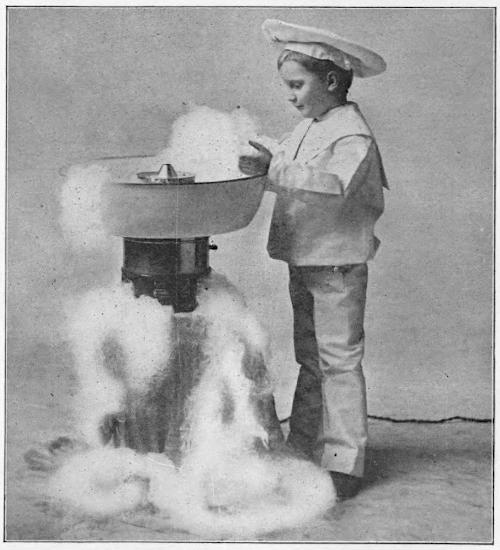
THE WONDERFUL ELECTRIC CANDY MACHINE
WHICH TOOK THE PRIZE FOR “NOVELTY OF INVENTION”
AT THE WORLD’S FAIR. ST. LOUIS, MO., 1904
THE CANDY MADE BY THIS MACHINE IS ABSOLUTELY PURE.
Granulated sugar
is poured into the
spinner and is instantly
changed into
flossy filaments
of PURE candy
without the touch
of a contaminating
finger.
Our machines are
NEVER SOLD but
leased for a period
of ten years, giving
Lessee EXCLUSIVE
control of the
territory leased.
At Los Angeles, Cal., our Lessee made and sold 850
ten cent packages of FAIRY FLOSS candy in one day
from one machine.
Four FAIRY FLOSS candy machines which were
operated at the Mechanics’ Pavilion, Boston, Mass., for
twenty days in October, 1904, earned in that time
$1,750.00.
Our Lessee in Minneapolis, Minn., sold in seven days
from one stand running one machine, $205.00 worth of
FAIRY FLOSS candy.
Our Lessee in Nashville, Tenn., sold $60.00 worth of
FAIRY FLOSS candy from one machine in one day.
A pound of sugar will make sixteen packages of
FAIRY FLOSS candy, such as was sold at the
World’s Fair for ten cents each.
Our machines are fully protected by patents,
dated January 31, 1899, and January 6, 1903, and
other patents pending.
Like money and other good things, our machines
are being imitated.
The Public is Warned that machines not having
this name plate are infringements and users are
liable to prosecution:
THE PROPERTY OF
The Electric Candy Machine Company,
Nashville, Tennessee, U. S. A.
Candy machine patented Jan. 31, ’99; Jan. 6, ’08.
Motor patented Oct. 14, ’90; Nov. 10, ’91.
General Electric Company, U. S. A.
FOR FURTHER INFORMATION ADDRESS
ELECTRIC CANDY MACHINE COMPANY,
NASHVILLE, TENNESSEE.
In writing to advertisers please mention Bob Taylor’s Magazine.
122
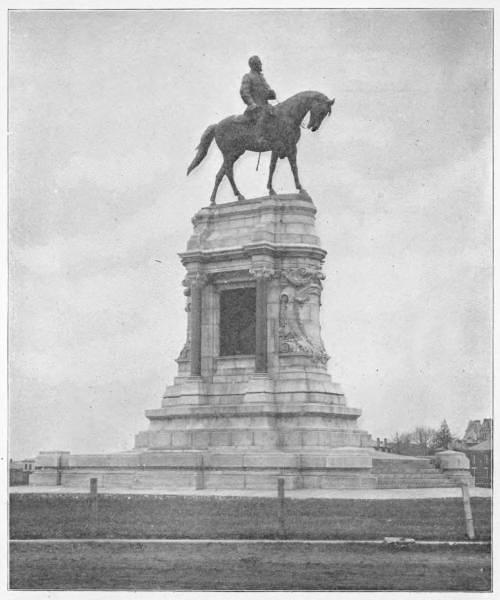
EQUESTRIAN STATUE OF ROBERT E. LEE AT RICHMOND.
123
BOB TAYLOR’S MAGAZINE
VOL. I
MAY, 1905
NO. 2
ADDRESS TO OLD CONFEDERATES.
By Robert L. Taylor.
Delivered at the Confederate Reunion at Brownsville, Tenn., in August, 1902.
Time in its tireless flight has
brought us again to the full
leaf and flower of another summer.
The grass grows green
about the dust of heroes; the roses
twine once more about their tomb, and
the morning-glories point their purple
bugles toward the sky as if to sound a
reveille to our immortal dead. Another
year with its sunshine and its
shadows, its laughter and its tears, its
sowing and its reaping, its cradle songs
and funeral hymns, now lies between
us and that dark day at Appomattox
when the star of Southern hope went
down and the flag of Southern chivalry
was furled forever. Another year has
added whiter locks to the temples of
those old veterans who wore the gray,
and deeper furrows to their brows, and
they now stand among us like solitary
oaks in the middle of a fallen forest,
hoary with age, covered with scars,
and glorious as the living monuments
of Southern manhood and Southern
courage.
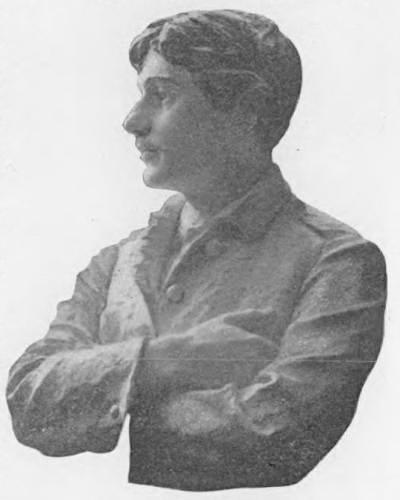
SAM DAVIS.
But we are not yet far enough away
from that awful struggle to forget the
bloody hills of Shiloh, where Albert
Sidney Johnston died, and the fatal
field of Chancellorsville, where Stonewall
Jackson fell. We are not yet far
enough away to forget the frowning
heights of Gettysburg, where Pickett’s
charging lines rushed to glory and the
grave. We are not yet far enough
away to forget Murfreesboro, Missionary
Ridge and Chickamauga, and the
hundred other fields of death and
courage, where the flower of the South,
the bravest of the brave and the truest
of the true, fought for the cause they
thought was right, and died for the
land they loved. We are not yet far
enough away to forget the agony and
the tears of a nation that was crushed
when the shattered armies of Lee and124
Johnston, weary, half-starved, bare-footed
and in rags, stacked their arms
in the gloom of defeat, and left the
field of valor overwhelmed and overpowered,
yet undaunted and unconquered.
When time has measured off
a thousand years, the world will not
forget the sufferings and the sacrifices
of the brave men who so freely gave
their fortunes and shed their blood
to preserve the most brilliant civilization
that ever flourished in any land or
in any age, for literature loves a lost
cause.
ALBERT SIDNEY JOHNSTON.
Historians will some day sit down
on our battlefield and write true history—history
that will surpass the
wildest dreams of fancy that were ever
woven into fiction; and poets will
linger among our graves and sing
sweeter songs than were ever sung before.
For each monument is within
itself a volume of wild and thrilling adventure,
and every tombstone tells a
story touching as the soldier’s last
tear on the white bosom of his manhood’s
bride, tender as his last farewell.
I would not utter a word of bitterness
against the men who wore the
blue. They fought and died under
the old flag to perpetuate the Union,
and they were men worthy
of Southern prowess and
Southern valor. I would
not, if I could, rob Grant,
the great and noble chieftain,
of his fame and glory.
Every Southern soldier
ought to stand with uncovered
head when his
name is spoken. For
when all was lost, in the
darkest and saddest moment
of Southern history,
he was magnanimous to
Lee, and kind to his famished
and shattered army.
Along the blue lines of the
triumphant foe, when
the unhappy Confederates
marched between them
and laid down their guns,
there was no shout of victory
nor flourish of trumpets,
but only silence and
tears.
When the conflict had
ended the Confederate soldier
proudly stood among
the blackened walls of his
ruined country, magnificent
in the gloom of defeat,
and still a hero. His
sword was broken, his
home was in ashes, the
earth was red beneath
him, the sky was black
above him; he had placed all in the
scales of war and had lost all save
honor. But he did not sit down in
despair to weep away the passing
years.
His slaves were gone but he was still
a master. Too proud to pine, too
strong to yield to adversity, he threw
down his musket and laid his willing
but unskilled hands upon the waiting
plow. He put away the knapsack of125
war and turned his face
toward the morning of
peace. He abandoned the
rebel yell to enter the forum
and the court room and the
hustings. He gave up the
sword to enter the battles
of industry and commerce,
and now, in little more than
a third of a century, the
land of desolation and
death, the land of monuments
and memories, has
reached the springtime of a
grander destiny, and the
sun shines bright on the
domes and towers of new
cities built upon the ashes
of the old, and the cotton
fields wave their white banners
of peace and the fields
of wheat wave back their
banners of gold.
Who can portray the
possibilities of a country
that has produced the Lees
and Jacksons and the brilliant
Gordon and the dashing
Joe Wheeler, who is
as gallant in the blue as he was glorious
in the gray, and the impetuous and immortal
Bedford Forrest, the Marshal
Ney of the Confederacy? Who can
portray the possibilities of a country
which has produced the stalwart and
sinewy men of the rank and file, who
followed the stars and bars through
the smoke and flame of every desperate
battle and stepped proudly into
history as the greatest fighters the
world has ever known?—a country so
richly blessed not only with brave men
and beautiful women, but whose blossoming
hills and fertile valleys are so
generous and kind, and whose mountains
are burdened with coal and iron
and copper and zinc and lead enough
to supply the world for a thousand
years; whose virgin forests yet stand
awaiting and sighing for the woodsman’s
ax, and whose winding rivers
flow clear and cool and make music as
they go. It is the beautiful land of
love and liberty, of sunshine and sentiment,
of fruits and flowers, where the
grape-vine staggers from tree to tree as
if drunk with the wine of its own purple
clusters; where peach and plum
and blood-red cherries and every kind
of berry bend bough and bush and
glow like showered drops of rubies and
pearls. It is the land of the magnolia
and the melon, the paradise of the
cotton and the cane.
They tell us now that it is the new
South, but the same old blood runs
in the veins of these old veterans and
the same old spirit heaves their bosoms
and flashes in their eyes; the same old
soldiers who wielded the musket long
ago are nursing their grandchildren on
their knees and teaching them the
same old lessons of honor and truth,
and the same old love of liberty. The
mocking-bird sings the same old songs
in the same old tree, and the brooks
laugh and leap down the same old
hollows. It is the same old South and
we are the same old Southern people:
There may be skies as blue, but none bluer;
There may be hearts as true, but none truer.
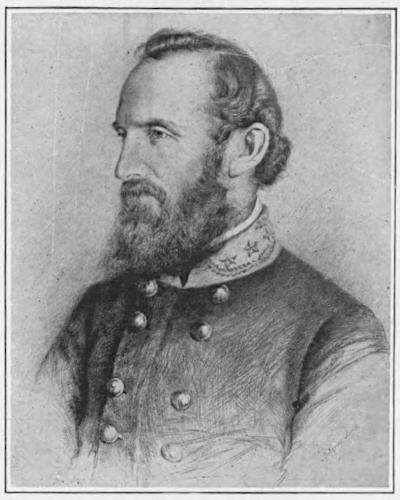
STONEWALL JACKSON.
It is the same old land of the free and
the same old home of the brave. It
is the same old South resurrected from126
the dead, with the prints of the nails
still in its hands and the scars of the
spear still in its side.
“I’m glad I am in Dixie,
Look away! Look away!
And live and die for Dixie,
Look away! Look away!
Look away down South in Dixie.”
Within the borders of this fair land
of Dixie the finest opportunities for
investment and the richest fields for
enterprise ever known in the Western
Hemisphere are now open to all who
wish to come and help us to make it
blossom like the rose. A new development
has already begun. Thirty
years ago there was not a factory in
South Carolina. To-day she is spinning
and weaving more cotton than
she raises and is second only to Massachusetts
in the manufacture of cotton
goods; and North Carolina and Georgia
have made equal progress with South
Carolina in this new idea of making the
South not only the leader in agriculture,
but also in converting
our raw material into
finished articles of commerce
and trade, and thus
saving to our section countless
millions of wealth. In
the mountains of south-western
Virginia, south-eastern
Kentucky, East
Tennessee, North Alabama,
where the sunshine plays
hide and seek with the
shadows, and where many
rivers are born, there is a
beautiful valley six hundred
miles in length and
from one to thirty miles
wide. Until a quarter of a
century ago the principal
product of that country
was children. The people
did not realize that the
north rim of the valley was
almost an unbroken vein
of coal and that the South
was an exhaustless bed of
iron, and they placed but
little value on the vast
parks of timber where the
ax had never gleamed, but
now the dynamite has just
begun to jar the silent
hills and the forests have just begun
to fall. Birmingham is making the
sky of night red with the glare of her
furnaces, and all the way up the valley
to the new city of Roanoke new furnaces
are being lighted and new industries
are developing, and Huntsville,
Decatur, Chattanooga, Knoxville,
Johnson City and Bristol on the
line, will soon be great manufacturing
centers, where the pig iron and the
logs of hardwood that are now being
shipped away to be converted into
finished articles will pass through our
own mills and we will cease to be the
fools we have been in the past, buying
furniture made in foreign cities out
of our own timber and all the implements
of agriculture made out of our
own iron.
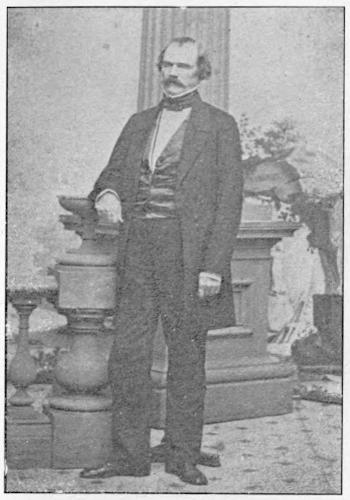
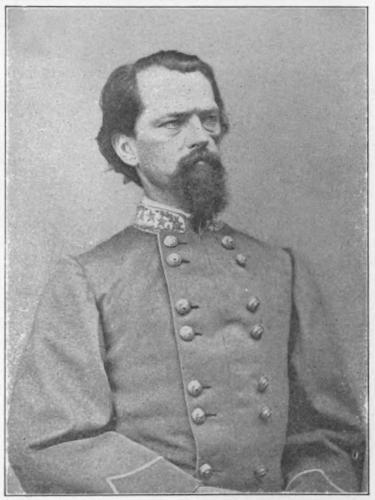
GENERAL GORDON.
Until twenty years ago the sons of
Mississippi, Louisiana and Arkansas
were contented to sit on their verandas
and watch the “nigger” and his lazy
mule in the cotton field and listen to127
the melodies of the old
plantation. But now the
mills of Mississippi are
beginning to mingle their
music with these melodies,
and the marshes
of Louisiana are being
converted into rice fields
and she is making
enough sugar to-day to
sweeten the tooth of the
world. Arkansas is building
factories and opening
her mines and mineral
wealth, and sawing down
her great forests of pine.
At the close of the Civil
War Texas was a wilderness,
but now the howl of
the wolf has given place to
the whistle of the engine,
and the whoop of the
Indian has been hushed
by the music of machinery.
From Texarkana
to El Paso prosperous
cities and towns
have sprung up like
prairie flowers where
the wild horse once galloped
and the buffalo
grazed, and great geysers of coal oil
have solved the fuel problem.
In the full development of this new
idea of transforming our raw material
into finished goods lies our hope of
regaining our prestige and power in
the management of national affairs,
and of winning back billions of wealth
which were wiped out by the destroying
angel of war. God grant that our
beloved old South may be as happy in
reaping the golden harvest of prosperity
in the years to come as she has
been brave and true through the suffering
and woes of adversity in the sorrowful
years of the past.
And now, my grizzled old friends
who once wore the gray, in the name
of the young men I congratulate you
upon having lived to see the dawn of a
brighter day for your battle-scarred
and war-swept country. You must
soon answer to the roll call of eternity
and join your comrades on the other
side. I give you the pledge of your
sons that they will ever defend the
record you have made and themselves
live up to the traditions of their
fathers. In the name of our women,
both young and old, I implore the
blessing of the Lord upon you, and
pray that as the dews of life’s evening
are condensing on your brow and the
shadows of the long, long night are
gathering about you, you may linger
long in the twilight, with loving hands
to lead you and loving hearts to
bless.
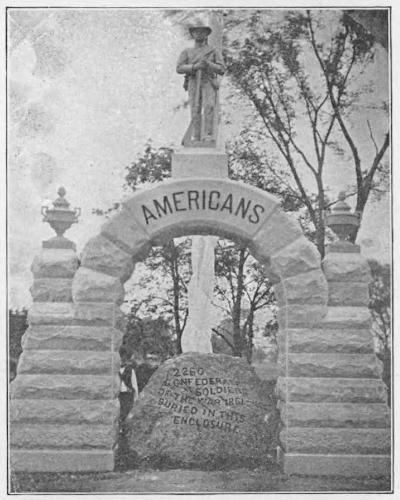
HARRISON’S GIFT AT CAMP CHASE.
IN THE DARK.
128
By Grace MacGowan Cooke
Virginia sat late at her work.
Or rather, she sat before the
desk which contained her
work and fought the battle
which is as old as our conception of a
woman’s duty. She had that day
listened to words of love from a man
whom her heart rose up to answer—she,
betrothed to Parke Winchester.
Hasn’t a woman a right to change her
mind? Ah, but Parke—his salvation
as well as his happiness was in her
hands! Had he not told her so a
hundred times? Was he not drinking
hard, and going straight to the dogs
when she was coaxed into this secret
pact with him? If she let him go, if
she pushed him away from her, would
he not fall lower? Could she ever
forgive herself?
Then, she was uneasy about Fair;
her young brother was evidently finding
companions who did him no good.
Twice he had come home of late so
much under the influence of drink that
she was put to the utmost of her
powers to keep the matter from her
father. She had no mother, she and
Fair were the only children. In her
desperation she had gone to Winchester;
he would know, he would understand.
She remembered the feverish
eagerness with which he had answered
her.
“You know, of course, Virginia, that
I haven’t touched a drop since you
promised to marry me. I can’t bear
the thought of the stuff now. But
I’ll hang around some of the places
where it’s sold and catch up with Fair.
I can help him. I can save him for
you, Virginia, honey, because I’ve been
there myself.”
Now, if she broke her word to Winchester
she was losing more than her
lover, for he had added fiercely, “But
if you cast me off, if you break with
me, I’ll go straight to the devil.
You’ve got that on your conscience,
little woman. I’ll go, and I’ll take
Fair with me if I can. You’ve got the
souls of two men in your keeping, for
if you were my wife—as long as you
have promised to be my wife—I’d as
soon think of stealing a Bible from a
church as taking a drink of whisky.”
Then came the thought of the other
man, whom she could really love—the
man who would save his own
soul and not ask the sacrifice of a
woman’s happiness for his salvation.
Yet, she reasoned, it was a marvelous
thing that her influence should have
kept her betrothed from even the desire
for drink. She half wished for a
moment that influence were not so
great. Then she reproved herself,
sighed and pushed the heavy, dark
hair from off her forehead. A vagrant,
scuffling sound from the hallway outside
kept intruding upon her consciousness.
Finally the little intermittent
noise secured her attention,
and then she thought a dog or a cat
must have been left inside when the
house was closed for the night. She
stepped to the door, to be met by a
shambling, bowing old figure, and
Uncle Vete’s deprecating, apologetic
face.
129
“I hates ter ’sturb you, li’l Mis,” he
protested. “I hates might’ly ter ’sturb
you; but dey’s trouble out to my
house—I spect you knows ’bout it,
honey.”
Virginia drew back, took up her
lamp and motioned the old man to
follow her downstairs to the dining
room. “Don’t wake father, if it’s
about Fairfax,” she cautioned. “It
would only hurt his feelings, and make
a bad matter worse.”
“Yas, baby chile, dat des’ what Vete
was fearin’.” They stole softly to the
dining room, and stood there confronted
in the lamplight, the tall girl
in her white dress, and the wizened
little old negro in his comically ill-fitting
broadcloth, hat in hand.
“You see ’t ’uz dishyer way: Marse
Fair, he come out ter my place dis
mawnin’—you know, Mis’, he train
wid a feller what allers come out dar
when he git ter spreein’. I uzzen’ dar.
’Ouldn’t ’a’ been no trouble ef I’d a’
been dar. Unk’ Vete can manage de
bofe of ’em, tell dey git too bad.”
“Who was with my brother?” inquired
the girl sharply.
The little old black man stole a
side-long look at his interlocutrice.
He was a slave, born on the Sevier
plantation, body servant to her father,
General Sevier, in whose discarded
wear he now stood; and loyalty to the
name warred in him with that freemasonry
which keeps the male silent
about the shortcomings of another
male, when speaking to the woman
who most needs to be warned of them.
“Dey dest one feller lef’ wid Marse
Fair,” he mumbled. “Dey wuz a
whole passel o’ boys dis mawnin’.
But dem yutheh boys tuk an’ went
home, whiles dey could walk. An’ I
cain’t git Marse Fair to move.”
“Well, Uncle Vete, I’ll put on my
things and go with you,” said Virginia,
with sudden resolution. “I can manage
Fair.” Returning, hat in hand,
she had the curiosity to inquire, “How
did you get in, Uncle Vete?”
“W’y, yo’ cook lady hyer, she a
sisteh in de ‘Ban’ o’ High and Glor’ous
Wardens,’ an’ I b’longs to de same
division; an’ she lef’ me in, honey; she
lef’ me in.”
“Did you drive?”
“I come ’long er’ ol’ Belzybug an’
de cyart.”
“And Beelzebub has made two trips
to-day,” added Virginia. “He must
be tired. Put him in the barn, Uncle
Vete, and we’ll get a street hack as we
go down past Summer Avenue.”
“An’ have ol’ Marse askin’ quisti’ns
’bout dat mule in de mawnin’? No,
ma’am. No, li’l lady. I got a frien’,
down de road hyer a piece, what keep
a wagon yawd. I gwine leave dat
mule dah, Miss Ginnie.”
The streets were quite deserted; it
was near twelve o’clock. Virginia was
glad that she met no one, though the
little old black man bobbing after her
was as efficient an escort and protector
as she could have had. The street
hack of the small Southern city is most
commonly a vehicle of the family
carriage style; probably many of them
have descended from the estate of domestic
privacy. One found, its sleeping
driver wakened, his gaunt horse
prodded into action, Virginia leaned
forward, and began to ask Uncle Vete
further questions in a carefully lowered
tone, as he sat beside the driver.
“Is he worse than before?”
“’Bout de same, honey, des ’bout
de same. I is saw ’um mo’ ’rageous;
an’ ergin, I is saw ’um less ’rageous.
’Bout so an’ so, honey. Des ’bout so
an’ so, Miss Ginnie, chile.”
“You say there’s some one with him;
are they inside the house?”
Uncle Vete grinned, and twisted in
his seat. “Yas, honey,” he admitted,
finally. “Dey bofe inside de house,
an’ de fambly, dey on de outside.
Dat whut mek me come fer you dis
time er night.”
“Do you mean that they turned you
out?”
“Yas, honey. I foun’ Cindy an’ de
chillen all turn’t out an’ blockaded, an’
young Marse a shootin’ th’oo de do’
ef anybody speak ter ’im.”
Virginia leaned back in silence.
The crazy old vehicle creaked and
rattled over the rough road. Its one
sorry horse made slow progress.
Fairfax Sevier, less than two years
older than his sister, Virginia, was a
handsome, brilliant, lovable young130
fellow, endeared to her by the same
qualities and the same odd unexpected
little lapses and weak spots which endlessly
charmed and perplexed her in
her father.
The general was a peculiarly high-minded,
honorable man, with all in
his character that makes for good
citizenship. He had brought through
a youth which was not without its little
scattered patches of wild oats, and a
famously dare-devil military career
during the Civil War, an unpollutable
vein of childlike innocency. It was
not that he failed to see evil, or to
know it and understand it. But he
saw and knew these things as a child
does, intelligent, but unsoiled.
His most marked characteristic was
a determined disposition to meddle
with the affairs of no human creature,
to refuse authority, because it implied
responsibility; to let—as he felicitously
phrased it—every fellow go to the
devil his own gait.
This trait made him, among his
children, always more a brother than a
parent, and was most amusingly displayed
during their infancy and childhood.
He would stand aloof from a
small offender who was weltering defiantly
in infantile crime. Bending
his handsome head, he would look
from his very considerable height down
to the little sinner before him, and addressing
it in the most confidential
tone of perfect equality, remark:
“You’re making a pretty mess of
things there; now, aren’t you? Think
you want to bust that, do you? Do
you know, you’re going to be mighty
sorry when you get done this business?
And like enough your mother’ll spank
you, too.”
When, as had occurred twice of late,
Fair was led to participate in wild
sprees, this was scarcely the father to
whom an appeal for assistance or the
exercise of salutary authority would
be addressed. Virginia could hear him
saying, with a flash of those big dark
eyes, “Well, well, Ginnie, I can’t keep
him in a glass case, just because he
happens to be my son. Let him see
the folly of it. Let him find out
whether he wants to be a drunkard or
not. Every man must do that for
himself. Your conclusion—or mine—that
he doesn’t want to do this sort of
thing, isn’t valid. It could not be incorporated
into his character. He
must be free to make some selection
of his own.”
Arrived at the cabin, a belated, waning
moon showed them the little hut,
dark and silent. “I boun’ y’ Marse
Fair done break dat lamp. Hit ’uz
burnin’, time I lef’,” muttered the
old man.
The sound of their wheels brought
a dusky, straggling group to the gate.
The nucleus of this group was Uncle
Vete’s last wife, a round-faced young
mulatto woman, with a baby in her
arms. About her churned and bobbed
a tribe of various sizes, part of them
clinging to her skirts and whimpering
sleepily.
Cindy was a cheerful soul, with a
giggle ready to burst forth upon the
slightest provocation, or no provocation
at all. Virginia glanced in distress
at the baby. “Oh, Cindy,” she
cried, “poor little thing! Why, it’s
too bad for you to be out here in the
night air with that young child.”
“He ain’t des’ so overly turrible
young, Miss Fa’ginny,” returned Cindy
with her comfortable chuckle. “De
big chillen mo’ skeerter dan whut he
is.”
Virginia, full of indignation, sprang
from the carriage. “Tek keer, honey!”
cautioned Uncle Vete, as she
hurried through the yard. “Dey’s
th’ee o’ my youngest sleepin’ dah
un’neath dat ’simmon tree.”
Avoiding the slumberers beneath
the persimmon, Virginia made directly
for the door.
“Hol’ on! Hol’ on! My precious
chile! Yo’ gwine get yo’se’f shot!”
urged Vete. Cindy screamed, and all
the children who were awake began
to wail in concert.
Like a sensible girl, Virginia stood
aside from the panels, back where the
heavy logs protected her. (“An’ one
dem shots might sail th’oo de chinkin’
des’ easy ez not!” Cindy whimpered.)
She struck on the door and cried,
“Fair—Fairfax! Open this door!”
The answer came in the form of a
bullet.
131
“Buddy,” she said, huskily, “Buddy, dear, I brought a hack out for you.”
132
At the report, Cindy uttered a yell
so efficient and comprehensive that
Virginia supposed her no less than
mortally wounded. The children,
even those lying so soundly asleep on
the ground that they had not been
wakened when Virginia stepped almost
upon them, rose up and fled to their
mother’s wide-spread, sheltering arms,
like a brood of alarmed chickens fleeing
from a hawk.
“Eph’um! Bandoline! Baxter!
Pearline! Commodory? Whey is you-all—whey
is you-all? Oh, Lawdy!
Lawdy! I is got mo’ child’en dan dis!
I knows I’s got mo’ child’en dan whut
dis is! Young Marse done kill some
on ’em!” rose Cindy’s excited shriek.
There came a second shot, before
Virginia rapped again, crying angrily,
“It is I, Virginia. Put up your pistol
and open the door!”
After a very long silence within the
hut. “I ’spects dey done napped off,”
mildly suggested Uncle Vete. Virginia
was preparing to knock again,
when a little gust of wind arising, the
door swung silently open, showing that
it had been unbarred for some time.
Virginia stepped into the room,
carrying one of the carriage lamps and
unheeding Uncle Vete’s caution to
“Go easy, honey, an’ holler ’fo’ you
git inside, so dey know who comin’.”
Fair’s companion lay sprawled upon
the gay patchwork quilt of Cindy’s
best bed. He was, or pretended to be,
sleeping heavily. The hack driver
would have to be called if he was to be
roused and gotten into the vehicle.
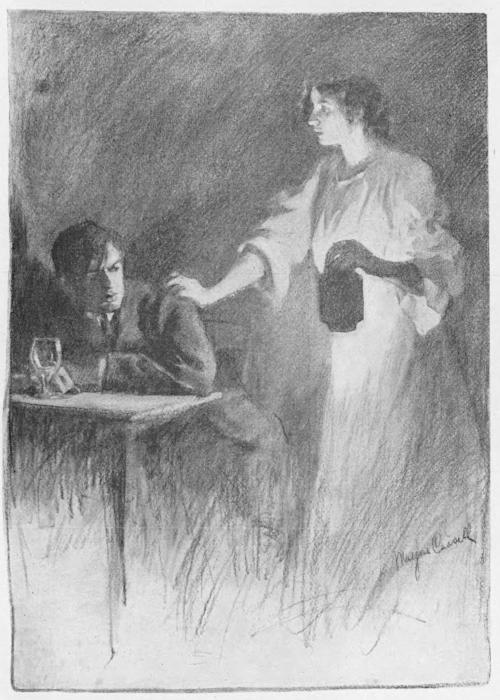
At the table, his head among half-filled
and empty glasses, and the
wreck of a poker game, sat Fairfax
Sevier. Virginia went with averted
eyes past the bed to her brother, and
shook him by the shoulder.
“Buddy,” she said huskily, “Buddy,
dear, I brought a hack out for you.
Can you walk to it?”
“Who’s goin’—take care—Parke?
Parke’s been drinkin’,” explained poor
Fair, with something like a whimper.
Virginia turned to the bed; and contempt
fell cool upon her suffering. A
face in drunken slumber is not calculated
to command respect, even to
win much sympathy.
The girl took the shock like the
daughter of warriors that she was.
“Does Parke Winchester drink now?”
she inquired, finally, of the negro.
Again Vete stole that quick, side-long
glance at her. “I ain’t never
knowed de time Marse Parke quit,”
he returned finally. “He might fool
de white folks ’bout hit, but he ain’t
take dat trouble wid de niggers.
Him an’ Marse Fair been at my house
mo’ dan onct lately.”
Parke, then, had not only never
given up his drinking; he had been
actually initiating Fairfax Sevier into
the great and inglorious guild of
topers, while he deceived the sister
with promises that he would find who
it was Fair drank with and look after
the boy.
She was free; but not yet could her
heart rise to the knowledge. The
bowed, boyish figure before her, the
degradation of that sleeper upon the
negro’s poor bed—these left her very
pitiful. “He’ll be quiet and behave
himself now, Uncle Vete.” she said;
“I’ll take Fair with me—we can’t
move him,” indicating Winchester.
“Let him sleep.”
“O, yassum, yassum. He be all
right in de mawnin’. He been all
right ternight, ef I could jest er got
hol’ ’er ’im. Dishyer negoshulatin’
wid ’er man th’oo er do’, an’ him er
doin’ his talkin’ wid er gun, hit’s unsartin
kin’ er wuyck.”
Still in a daze Virginia picked up a
pistol from the floor, turned the cylinder
to see that it was unloaded, and
dropped it into the pocket of Parke’s
light overcoat.
At the action, Fair showed his first
consciousness of her presence
“You’ll get yourself shot one—these
days, Virginia,” he muttered, half
irritably, half penitently. “—’dvise
you—let such things ’lone.” And one
could not have said whether he meant,
by this, her present handling of the
firearm itself, her former reckless demand
that he open the door, or her
presence on such a scene.
Uncle Vete assured Virginia that he
would look after Parke for the night,
and would see that he reached home
in the morning. She gently declined133
the old man’s offer to return to town
with her, and promised to send Beelzebub
out by Sam, Cindy’s eldest, who
was acting as house-boy at the Sevier
home. The drive in the night air, and
Virginia’s presence somewhat sobered
her brother. “Does dad know?” he
asked, as they neared home.
“I didn’t wake him,” responded
Virginia.
Fair turned, as he lay with his head
against her shoulder. He was beginning
to be deathly sick—the end of all
Fair’s essays at drinking. “You’re
a good girl, Virginia. Mighty good
girl. I reckon you’ll get your reward
in heaven.”
But, driving home under the stars,
freed from a self-imposed bond,
warned that she might in future protect
this well-beloved sinner whose
head lay on her breast, ready now to
accept the love of the man she loved,
with no shadow on her conscience—Virginia
felt that she had her reward
here, now and in this world.
THE SPINNER.
BY ELOISE PICKETT.
Wearied to death of my thoughts!
Is there none, in this epoch of wondrous wares,
Will sell me a fair, sweet dream?
I summoned my spirit, this morn, to be chid
For her endless weaving of gloom;
But she lifted me retrospective eyes,
Burning and dry (for the tears, dammed back,
Have found them a pool in my heart);
Her face was wan, and her mouth was set
In the hard, thin line of resolve.
And I left unsaid my stern rebuke,
But her answer cried loud in her mien:
“I weave; but the warp and the woof are thine;
Thou madest them yesterday.”
And so I watch, with sickening hope,
As her busy fingers ply
’Mongst threads from the throbbing Other Days,
And wisps from the ominous Days to Come,
And skeins from the stagnant Now.
Wearied to death of my thoughts!
Is there none, in this epoch of cunning skill,
Can weave me thought-fabrics fair?
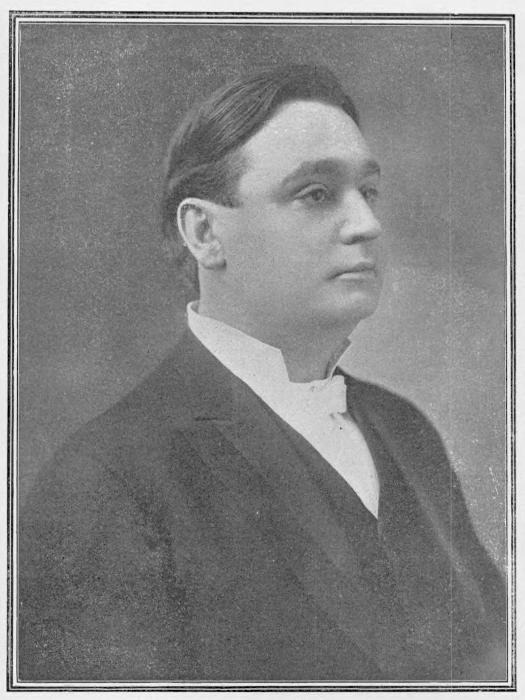
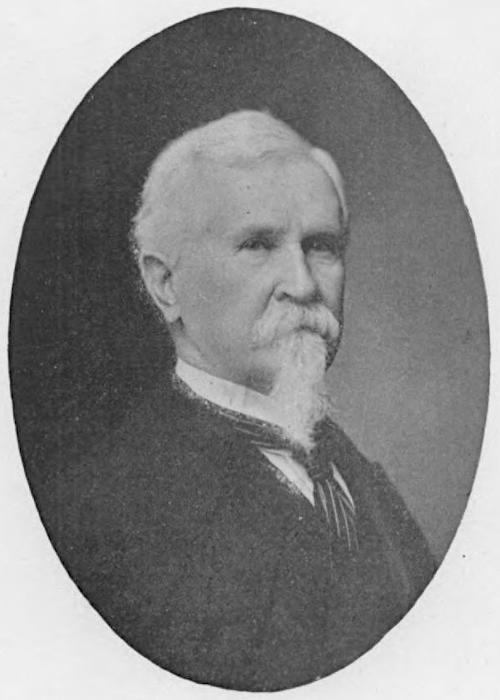
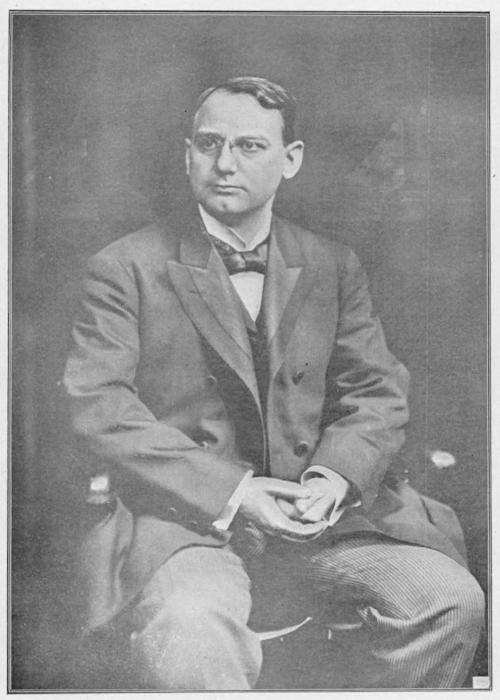
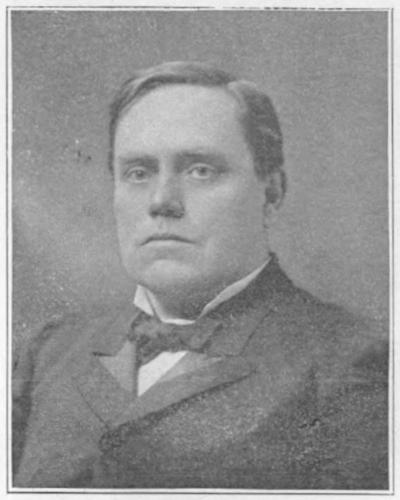
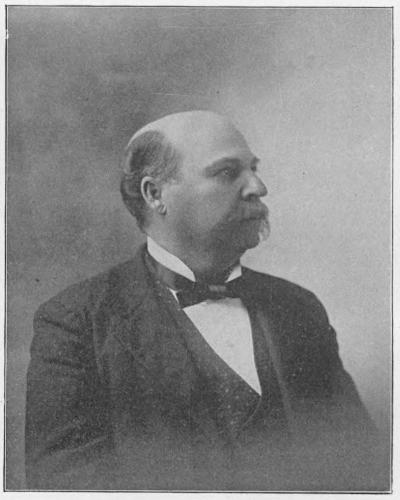
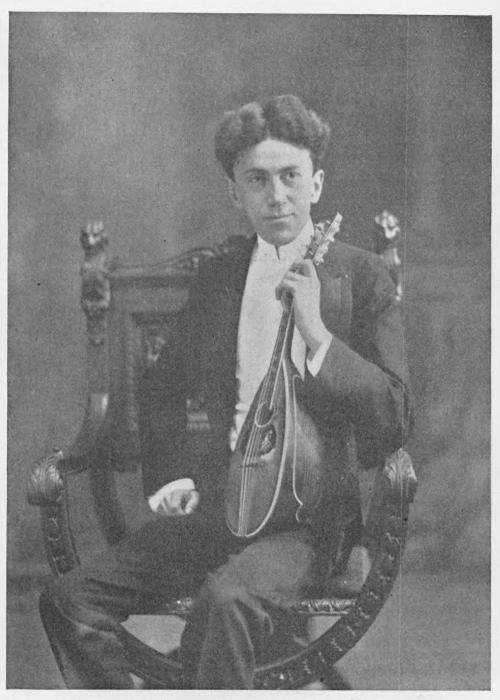
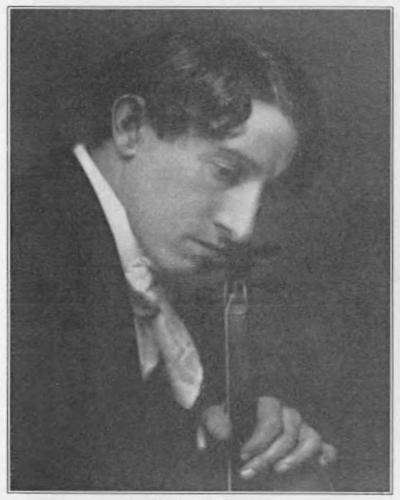
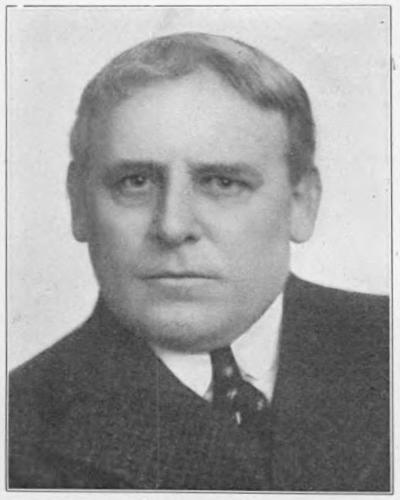
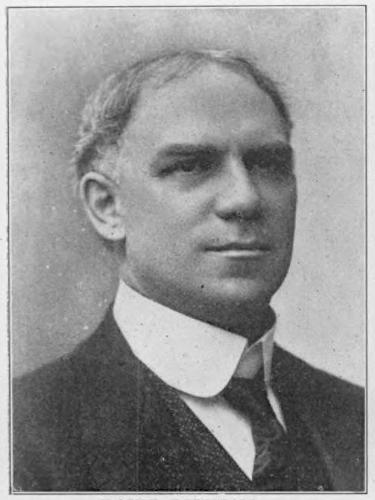
MEN OF AFFAIRS — Joseph W. Bailey. — James D. Porter. — Joseph W. Folk. — Warren A. Candler.
134
One of the most youthful members
of the government’s gravest and most
august legislative body is Senator
Joseph W. Bailey, a typical representative
of the biggest, the breeziest
and the most untrammeled, if not the
most patriotic and progressive commonwealth
in the Union. A natural
leader, an orator of plausibility and
power and a politician of resource and
acumen, he is besides admittedly one
of the ablest constitutional lawyers
in public life.
Though a native of Mississippi and
a legal product of Cumberland University,
Tennessee, Senator Bailey is
a Texan seemingly to the manner
born. He looks, speaks, thinks and
feels Texas, and having won his spurs
so creditably in the congressional
jousts his people have gratefully recognized
his talents by entrusting him
with the higher responsibilities of
senator.
While Senator Bailey is a virile
product of the present and coming
generation in the South he has not
been inclined to relinquish the habits,
dress and thought of the passing regime
and his picturesque personality
is doubtless as readily recognized by
resident of and visitor to Washington
as any other public character of the
times. In no particular do his old-school
propensities more emphatically
display themselves than in his native
love for rural life and natural objects.
His chief hobby comprises the maintenance
of an expansive estate whereon
he rears the sportive thoroughbred, so
dear to the heart of the rural Southerner,
and whereon he spends in the open
very much of his leisure time.
Senator Bailey is a close student of
men, politics and affairs, and is of
the South, social, though he has no
taste for the conventional society of
the city.
For nearly half a century has the
Honorable James D. Porter figured
eminently but modestly as a public
servant politically, civilly and commercially.
A native of Tennessee, in
which State he has spent nearly all of
his eventful life, he was born at Paris,
in 1828, and was admitted to the bar
in 1859. With a disposition toward
the public service, from a State legislator
he became a circuit judge, and
from the bench he ascended to the
gubernatorial chair, which he was
twice called upon to occupy. His
large and worthy talents coming to
the notice of President Cleveland, he
was invited during his first term to
serve as Assistant Secretary of State,
which he did with such satisfaction
as to receive during the President’s
second term his credentials as the government’s
official representative to
Chili, in which capacity he attracted
attention by his tactful reestablishment
of friendly relations between
the two countries.
In the active commercial affairs of
life he has been likewise prominent,
being sometime president of the Nashville,
Chattanooga and St. Louis Railroad
Company, and as a soldier of the
gray he gallantly participated in many
of the fiercest conflicts of the war as
Adjutant General under General Frank
Cheatham.
HON. JOSEPH W. BAILEY.
In 1901 he was selected by virtue of
his wide experience in affairs, executive
ability, character and attainments,
as the most suitable head of the great
Peabody benefaction to the cause of
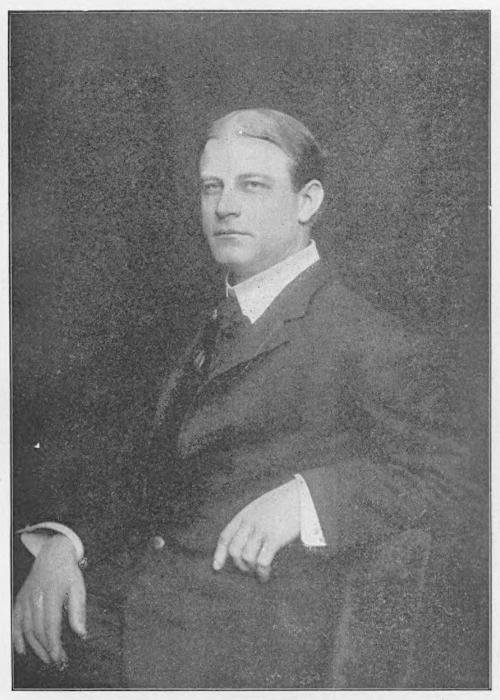
Southern education, and he is successfully135
rounding his period of long and
devoted public service to the administration
of this popular munificence
as President of the Peabody Normal
College and University of Nashville.
With every assurance of early success
he is now engaged in raising from the
State of Tennessee, the City of Nashville,
and by popular subscription,
$250,000 which, when attained, will
carry with it a permanent endowment
of a million dollars from the Peabody136
estate. President Porter is a man of
distinguished bearing and impressive
address.
JAMES D. PORTER.
Missouri’s young governor has received
probably more free and favorable
publicity than any other citizen
of the Republic, and the public is so
well informed as to his life and record
that anything said of him here would
be merely cumulative and by way of
favorable repetition. It is gratifying
to command the approval of friends
and partisans, but it is a delicate and
trying obligation to have to live up to
the encomiums of non-partisans and
erstwhile opponents. With nothing but
good said of his ability and integrity,
Governor Folk’s position in politics,
which now has a decided national
aspect, presents a most interesting
field of speculation to the student of
politics and affairs.
First coming into local prominence
in St. Louis as an able and fearless
criminal prosecutor whom a powerful
and never-before-thwarted partisan
political machine could not influence
or intimidate, Governor Folk developed
into national prominence through
his relentless warfare upon the local
boodling regime, his successes influencing
municipal reforms throughout
the country and rendering him so
strong with the masses of statesmen
regardless of political complexion,
that they triumphantly elevated him
to the gubernatorial station in the face
of an otherwise astonishing landslide
in the other direction.
137
JOSEPH W. FOLK.
138
Governor Folk is a native of Brownsville,
Tenn., where he was born about
thirty-seven years ago, and is a product
of purely Southern environment, rearing
and education. Graduating from
the Vanderbilt University law school
fifteen years ago, he started at about
the lowest and roughest rung of the
ladder, a struggling young country
lawyer in his native town. In quest
of opportunities more in keeping with
his talents and ambitions, he soon
joined the large Tennessee colony in
St. Louis, not long thereafter attaining
to some local notice as a political
leader by being elected president of the
representative Democratic organization.
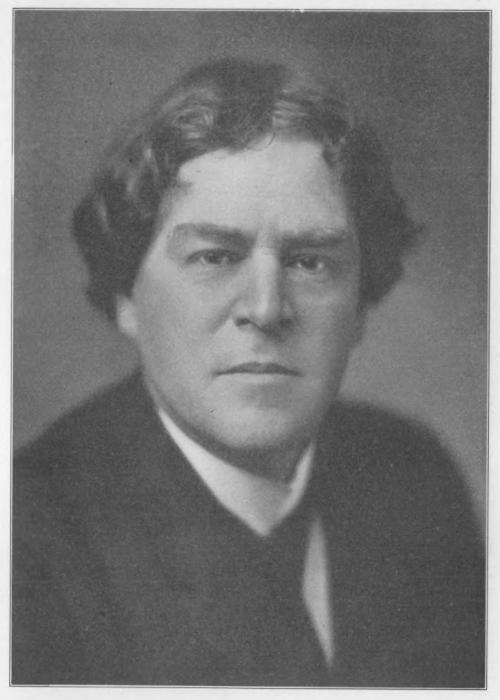
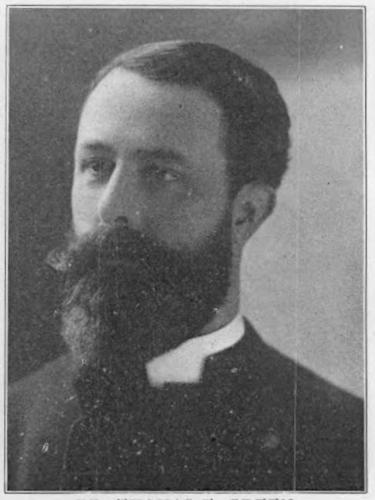
WARREN A. CANDLER.
It is truly said that all great human
successes are a combination of fortuitous
circumstance, and the genius
to take advantage thereof. Governor
Folk’s mastery of a complicated
local situation wherein he represented
a supposed hopeless political movement,
turned seeming defeat into a
brilliant victory, and he was
elected District Attorney, since which
time his record is known to the country
at large.
A virile and dominant figure in
Southern religious life is Rev. Warren
Akin Candler, youngest bishop of the
Methodist Episcopal Church, South.
Of a family probably second to none in
Georgia from the standpoint of the
prominence of its sons in public life in
that State to-day, Bishop Candler was
born forty-eight years ago in Carroll
County. Educated at Emory College,
from which he graduated with first
honors in 1875, he immediately entered
the ministry, ascending rapidly
the ladder of ecclesiastical promotion
from the humblest rural circuit to the
most influential urban charge. From
presiding elder of the Dahlonega and
Oxford districts he served for two years
in the editorial field as assistant editor
of the Christian Advocate in Nashville.
In 1888 he was called to the very large
activity of presiding over the destinies
of Emory College, his alma mater,
which institution enjoyed during the
decade of his administration its
highest period of strength and usefulness.
With a distinguished record in all
vital departments of his church labors,
Bishop Candler’s early elevation to
the bishopric when barely past forty
years of age was a merited and logical
testimonial to his eminent capacity
for religious leadership and organization.
This exalted promotion came
to him at the hands of the Baltimore
Conference of 1898.
Besides being a pulpit orator of
vigor and lucidity, Bishop Candler is
a luminous expositor of secular themes
and has rounded out a very busy career
by producing several well-known religious
and general publications, including
a “History of Sunday
Schools,” “Georgia’s Educational
Work,” “Christus Auctor,” “High Living
and High Lives,” and “Great Revivals
and the Great Republic.”
Bishop Candler’s official residence
is Atlanta.
139
RICHMOND PEARSON HOBSON.
Richmond Pearson Hobson, who contributes the following thoughtful paper to the
Magazine, is so well known to our readers that it is hardly necessary to say anything
here by way of comment upon his eventful history. Since his retirement from the navy,
Captain Hobson has devoted much attention to political affairs, and it is safe to predict
that his services to the public will be marked by the earnestness and devotion to duty
which brought him his well-merited fame as an officer in the United States navy.—Ed.
COTTON AND WAR.
140
[Part of an address delivered by Mr. Hobson before the Cotton Growers’
Association last January.]
By Richmond Pearson Hobson.
The price of cotton, like other prices,
is settled by the relation of supply and
demand. In face of the sudden depression,
due to the increased volume
of supply in the large crop, we are
liable to overlook and underestimate
the importance of the factors influencing
the demand. Sojourning about
the world has convinced me that the
factors of demand are more pliable
and more accessible than those of
supply. In truth, a single factor reducing
demand, the war in the Orient,
is responsible for depression amounting
to from 7 to 8 cents a pound, while
the total depression due to the big
crop is scarcely more than 3 cents a
pound.
Furthermore, the question of adjusting
the supply for the next year,
cannot be intelligently settled until
after investigation of the probable
demand.
Therefore, I invite your attention
for a few minutes to the question of
demand, and especially to the factor
of war, since we are now in the presence
of the great struggle in the Orient.
The old sources of demand, Europe
and America, have gone on slowly
increasing with the increase of population,
and the rise of the standard of
comfort, though a check was sustained
by the outbreak of the Boer War,
which saw a falling off of over one
million bales in the consumption of
the united commodities. This slow
increase in demand has been more
than balanced by the steady increase
in supply, coming chiefly from the
larger acreage and larger increase of
commercial fertilizers in the South.
Consequently, for several decades the
price of cotton has had a steady trend
downward. It was only when new
demands came from new markets that
the price started upward. The chief of
the new markets are those of the Orient.
Japan has made great strides in
the cotton mill industry, until at the
outbreak of the present war, she was
consuming over $50,000,000 worth of
cotton annually.
But more important even than
Japan, has been the new market of
China, which, when the present war
came, amounted to $90,000,000 annually,
chiefly coarse cotton goods,
of which a large part has been furnished
by Southern mills.
These two markets have come to
consume more cotton than is produced
by Alabama and Mississippi combined.
It is not surprising, therefore, that in
spite of the steadily increasing production,
the price has steadily risen.
The rise has been especially marked
since the Boxer disturbances that were
followed by a new impulsion in the
opening up of China.
As great as this new market has become,
it is only in its infancy.
If China were opened up, free to the
commerce of all nations, its four hundred
and thirty millions of industrial
people, would rise from a five cent
wage basis to a 20 cent, 30 cent, or
even 40 or 50 cent basis, and the average
man, instead of having his present
outfit of about a half suit of cotton
clothes, would have four or five whole
suits, which are pulled on in multiple
numbers, according to the coldness of
the day. This would so increase the
world’s demand for cotton that even
with a 20,000,000 bale crop, the price
could be hardly kept down to 20 cents
per pound.
The picture here disclosed is not
visionary. Thousands of Chinese141
worked under my inspection for
months reconstructing gun-boats at
Hong Kong. The above estimates of
their industrial capacity are conservative.
Knowing both peoples, I do not
hesitate to say that the industrial
capacity of a Chinaman is far greater
than that of a Japanese, while there
are over ten times as many Chinese as
Japanese. Moreover, the facilities for
communication are advancing. The
eyes of the world have been thrown
upon China, and the point of the
wedge has been entered. A few decades
can see marvelous growth in
this young giant of a market. I estimate
that before this century is half
turned, China, properly opened up,
will add more than $5,000,000,000
annually to the world’s commerce, and
one of the chief staples of this commerce
will be cotton, first the goods,
then the raw materials, creating a
consumption as great as that of all
Europe combined.
But this greatest of all coming cotton
markets is the most sensitive and
the most exposed. When war broke
out in the Orient last year, it was clear
that Japan and Russia, under the exhaustion,
would decline in buying
power, and that the thriving cotton
trade of Manchuria would be cut off
entirely, while the fate of China might
become involved and endanger the
whole Chinese market. Consequently,
the day after war was declared, cotton
slumped 5 cents a pound, and started
on its downward path, going off nearly
8 cents a pound before indications
came in of the large crop, which
brought about a further decline of
about 3 cents a pound.
The grievous depression we are passing
through must be attributed to
the war in the Orient. Without war
cotton would now be from 12 to 15
cents per pound, even with the big
crop. Think what prosperity this
would have meant. Can anyone contend
that the United States should be
indifferent to this war? It may be
pointed out that our diplomatic moves
were masterful, both in getting the
powers to commit themselves to limiting
the war zone, and to preserving
the integrity of China, and also in negotiating,
by cable, treaties with China,
not Russia, opening up Mukden,
Dalny and Antung, in Manchuria,
thus recognizing Chinese sovereignty,
and placing the United States in the
same attitude as Japan, in standing
for the evacuation of Manchuria. Unfortunately,
our diplomatic moves had
but little deterrent effect, not being
backed by an adequate navy. Had
we possessed an adequate navy, I am
bold to say that Manchuria would have
been evacuated and the war would not
have come to disturb the earth and
bring the present depression over the
Southern people.
It is hardly necessary to point out
that our losses already incurred would
have covered many fields over the
cost of such a navy.
But as great as are these losses they
cannot compare with the greater losses
that may lie ahead, if the present
drift of events should go unchecked
and lead to a general war over the
division of China.
Naturally, the Continental powers of
Europe do not wish to have to compete
with our industrial nation on the basis
of an equal footing in this great market.
They have, therefore, combined to
seize China by force, and partition it
among themselves, leaving the industrial
nations out.
The first step taken in this direction
came at the conclusion of the war between
China and Japan, when the
Continental powers intervened to despoil
Japan of the fruits of victory,
preventing the consummation of the
treaty of Shimonosoki, that would
have ceded to Japan part of Manchuria,
including the Liaotung Peninsula
with Port Arthur. Soon Russia
came to occupy the same territory
wrested from Japan, Germany seized
Kiaochao, and part of the Shantung
Peninsula, Italy attempted to seize a
Chinese port, and France became
active on the frontier of Indo-China.
The next step in the seizure of China
is planned for the present war. Indeed,
the seizure of China is the very
purpose of the war, and to this end
Russia is conducting her war operations.
The chief aim of this year’s campaign142
has been to change the public
opinion of Europe. Thus it is that
Russia has conducted a pre-arranged
system of retreats, and that the inspired
press of Europe has raised the
hue and cry of “Yellow Peril,” with
such success that the peoples now
stand with their governments on the
side of Russia. The combination is
ready to move, and we can expect renewed
reports of Chinese violation, of
neutrality, of Chinese disturbances and
Japanese intrigues in China, Russia
reporting upon the affairs in Mongolia,
France upon the affairs in Kwangsi,
and Germany in Shantung and Chili.
The agents of these powers will probably
facilitate and exaggerate the Chinese
disturbances, and then upon the
pretext of preventing massacre and a
general Chinese uprising, the armies
by pre-arranged program will enter and
occupy the Provinces of China, never
again to leave.
Opposition on the part of Great
Britain is evidently anticipated, and
the inexplicable seizure of British
ships, followed later by the inexplicable
firing upon British fishing vessels,
appears as part of a plan to excite
British indignation, so that at the
opportune moment, the British may
be the more easily provoked to commit
an act of war which would at once put
into operation the Russian treaty of alliance
with France, and this would be the
signal for Germany, Austria-Hungary
and Italy to join Russia and France.
Thus the present war is producing a
grouping that imperils the balance of
power, placing a heavy preponderance
on the side of the military as against
the industrial nations or on the side of
war as against the peace forces. No
thoughtful observer can fail to see here
all the elements for a world war; nor
can we look except with alarm upon
the declination by the military powers
of the interstate to the proposed second
convention of The Hague, and the
Russian note complaining of alleged
violation of neutrality by China. It
is idle to imagine that the United
States, the foremost industrial power,
with more at stake in the Orient than
any nation, could look on with indifference.
We should awaken to the full significance
of the events gathering in the
Orient. The two antagonistic systems,
militarism and industrialism,
are gathering for a death struggle.
The Orient is the battle ground—China
is the objective.
If militarism succeeds in intrenching
itself upon the yellow race, securing
the myriads upon which to levy for
men and for means, then it will perpetuate
its harsh reign for centuries
yet to come.
On the other hand, if thwarted in
obtaining the spoils of war and left
simply to a fair competition, militarism
will be unable to hold its own, and will
be driven to the wall, and be compelled
to disarm by the great economic
forces of commerce and industry, and
we can then confidently expect the
establishment of general and enduring
peace long ere this century is gone.
What would be the effect upon
cotton?
If peace is restored and maintained,
cotton will start again upon its upward
course and in a few years, with
such a vast demand as China would
create, I am conservative in saying
that the price would pass the 20 cent
mark, and remain above this mark, no
matter how large the crop.
On the other hand, if events are allowed
to drift on and a general war
comes, cotton would become a drug
on the market, even though reduced
acreage, calamity and distress would
spread over the South. Indeed, with
militarism uppermost, wars and rumors
of wars would continually disturb
the world, nations would be exhausted
and lose in their buying capacity,
and the myriads of helpless peoples
would pass under the military yoke
and remain unable to buy clothing.
The greatest source of Southern prosperity
would be permanently blighted,
and a serious blow would be struck
at the general prosperity of America,
and at the happiness of mankind.
Under these circumstances, when it
is a question of 3½ cent cotton or 25
cent cotton, I do not hesitate to say
that the solid influence of the South
should be felt for having our country
act promptly and vigorously, to use143
every proper means to restore the
balance of the world on the side of
peace, and to bring about the ending
of the present war and the restoration
of Manchuria to the commerce of the
world.
It only remains for us to refer summarily
to the factors of supply. It is
practically certain that the South will
continue to produce the bulk of the
world’s cotton. During the Civil War,
when cotton was over $1.00 a pound,
persistent efforts were made all over
the world to develop cotton growing,
but in vain. The Gulf Stream on one
side, and a vast continent on the other,
produce climatic conditions for cotton
culture not duplicated anywhere else
in the world. We may expect some
increase in the output of Egypt on
account of developing irrigation, and
possibly a temporary increase in the
output of India, and other secondary
sources due to the recent high price,
but the present depression will tend to
check this movement. Therefore, the
South may be expected to continue
to produce over 80 per cent of the
world’s supply so that the question of
supply lies in our own hands.
The two factors in determining the
supply are the seasons and the acreage.
While the general law of the average
holds, history shows that the temperate
zone is liable to wide fluctuations
in seasons, which it is impossible to
foresee. The recourse to offset the
unhappy consequences of wide fluctuations
is a reservoir or fly-wheel, into
which the fat years can pour their
supplies for making up the deficit of
the lean years. The uncertainty of
cotton demand, hinging upon war or
peace, is now added to the uncertainty
of the cotton season. Recourse to
storage is therefore absolutely necessary,
and a wide system of warehouse
storage should be created. I will not
endeavor to go into the details of such
a system, but venture to suggest that
it should be organized on bedrock
principles, and operate on the securest
lines, so that a warehouse certificate
would be absolutely safe and universally
negotiable. Lessons could probably
be learned from the systems in
use in pig iron storage, where the
market is also subject to wide fluctuations.
The American Pig Iron Storage
Warehouse Co. would probably
be the best pattern.
The factors of acreage should be
carefully investigated before any radical
action is taken.
I know it is best for a farmer to have
a diversified crop as it is best for a city
to have diversified industries, and it
is wise for a farmer, like a nation, to produce
the necessities required for home
consumption. The present fearful depression
will doubtless have a partial
benefit in this direction, but I fear too
much importance is now being given
to this question. While I would urge
the farmers to diversify their crops, I
would hesitate to recommend a sweeping
reduction in the world’s production.
In fact, as an economic principle,
there can be no such thing as over
production at this stage of the world’s
progress, particularly in the great
world’s staples, like those of food
and clothing. For generations to come
mankind, on the whole, will go hungry
and half naked. The true principle is
not to try to reduce the product but to
provide for a general increasing buying
capacity and particularly for the case
of the undeveloped peoples of the
earth, by increasing their opportunities
to work for the world’s market,
and to make the wages necessary to
purchase the products. If we could
only be sure that peace is to prevail,
so that the market of China would be
restored, and could go on increasing,
I would not hesitate to urge against
any reduction in acreage. On the
contrary, I would urge a steady increase,
for no matter how great the
increase, the supply would never keep
up with the growth of demand. As
conditions now stand, however, I believe
conservative action is advisable—action
that would lean rather toward
the side of preparation to store up for
future use the surplus, if war should
come, than to materially reduce the
acreage, and my advice to the individual
farmer is to become independent
and diversify his crop, and then plant
his usual acreage in cotton.
It may be pointed out that one
effective way to offset the losses from144
low-priced cotton is for the South to
invest more and more in cotton mills,
that benefit from these prices, and the
logic of the situation would have
cotton growers invest their available
capital and saving in cotton manufacture.
The true aim of the South
should be not only to produce the
cotton, but the clothing for the world.
And every country in the South should
have cotton mill industries organized
with local capital and should develop
and educate its labor for the high
grades as well as coarse.
Summing up, the general conclusions
and recommendations are as follows:
1. The cotton growers should have
a wide, permanent organization with
a general convention once a year.
2. A standing committee composed
of, say, two members for each cotton
growing state, should be appointed to
investigate and report each year upon
the existing and prospective conditions
of supply of cotton.
3. A similar committee should be
appointed to investigate and report
each year upon the existing and prospective
conditions of the demand for
cotton.
4. There should be established a
comprehensive and carefully organized
storage warehouse system.
5. The great agents for increasing
the price of cotton are peace, prosperity
and civilization.
6. The arch-enemy of the cotton
growers is war. The permanent cause
of cotton must look to the peoples beyond
the sea, especially China. The
fate of China hangs upon peace or
war—peace or war depends upon America—America’s
influence depends upon
her navy.
THE MASTER-HAND.
BY GARNET NOEL WILEY
Sometimes at half-mast, all my hours
A drooping banner seem to lie
In listless folds, along the calm,
Still blue of boundless stagnancy.
Grieving, I think, because somewhat
Within my soul is near to die.
Enow the master-hand of Love
Plucks at my banner’s guiding string,
Until it flutters in the breeze,
And pulses like a living thing.
Joyous, I think, because somewhat
Within my soul hath need to sing.
THE BOY IN GRAY.
145
By Will N. Harben, Author of “Abner Daniel.”
One day in midsummer I went
to visit the old plantation of
the Lansdale family. The
moment I entered the cooling
shade of the tall trees on the lawn
something seemed to tell me that I was
on a spot hallowed by human suffering
and misfortune.
The house had two stories and an L.
There was a long veranda in front, the
roof of which was supported by large
white columns. My interest in the
place was due to the fact that prior to
the Civil War it had been the rendezvous
of the aristocracy for miles
around it. The wide halls and spacious
rooms had once rung with gay
laughter, sweet music and the tripping
of feet in merry dances.
Behind the uninhabited dwelling
the shrubbery had grown into a riotous
tangle. Choice rose bushes had been
dwarfed and choked to barrenness by
an army of interlopers—Jamestown
weeds, hollyhocks and giant sunflowers.
Only here and there might be
seen a pale-leaved geranium or a dandelion
in the edges of the gravel walks,
now almost completely overgrown.
Here, bent to the earth, lay a decayed
lattice, pulled down by a fragrant
jasmine; in another place stood the
rotten remains of what had once been
a graceful summerhouse.
As I wended my way further from
the old mansion the silence and shade
seemed to thicken and blend into the
pervading melancholy. When about
two hundred yards from the house, I
suddenly came upon a log cabin almost
hidden from view behind a close
growth of gnarled and twisted apple
trees. In the door sat an old negro
man. His face was pinched and
wrinkled and his eyes, peeping through
their brown slits, looked like blue
beads. With his old bell-shaped hat
on his knee, he glanced up in surprise,
and, rising quickly he hobbled towards
me, bowing politely.
“Who dis heer?” he asked, as he
shaded his eyes with his hand and
peered up at me. “It seems like I
don’t know you, but you may know
who I is. Most white folks knows me,
dough, thank de Lawd! I carn’t see you
good, suh; my sight is failin’ me
powerful fast.”
“I’m a stranger in this part of the
South,” I told him. “I have heard so
much about the Lansdale family that
I wanted to see their old home; that’s
all. I hope I’m not intruding.”
“Lawdamussy, bless you, no, suh!”
he replied quickly. “You is welcome
to roam ’round all you want. Ef
’twuz des in de ol’ time, suh, my young
marster, er my ol’ marster, would
done met you down de carriage drive
an’ ’scort’ you in an’ took yo’ hat an’
pass roun’ de wine an’ cigars, but”
(a long sigh escaped his lips, and he
shook his head sadly), “but dat time
done gone, suh—dat time done gone.”
“Tell me something about your
master’s family,” I said, taking a chair
near his own at the cabin door. “I
have heard that Mr. Lansdale’s only
son was killed during the war when he
was hardly more than a child.”
“Dat so, suh,” the old man answered
in a tender tone, as he sat down in his
chair and leaned it back against the
wall. “Dat was Marse Eddie. He
wasn’t fifteen year old when he ’listed.
It all come o’ him actually itchin’ ter
be a soldier from his cradle up. Long
’fo’ de war was ever start up, when he
wasn’t ten year old he had soldierin’ in
his head, an’ nobody couldn’t stop ’im.
His maw say he wouldn’t study his
school books lessen dey tell ’bout wars146
an’ bloodshed. Away back den Marse
Eddie’s soldierin’ was de chief talk
’mongst de slaves.
“He wasn’t fifteen year old when he ’listed.”
“He didn’t keer fur hosses, ur fishin’,
ur huntin’ like other boys, but ef you
des mention soldierin’
he would
pick up his ears an’
open his eyes. He
used to had his
army, an’ what you
reckon dat army
was made out’n,
suh? Nothin’,
’cept ten ur ’leven
pickaninnies in deir
shut-tails an’ bare
laigs. But, suh,
dey would march
round dis plantation
tell dey raidy
to drap in deir
tracks to please dat
boy. An’ dey didn’t
know no mo’
’bout what a rail
army was dan a
blind kitten. But
’fore he got thoo
wid um, Marse Eddie
had um trained
so dey will march
straight in er
breast-line, ur
wheel round, double-quick
step, an’
charge bayonets
when he give de
command des de
same as reg’lar
troups.
“Des as soon as
he had his breakfust
in de mawnin’
Marse Eddie ’ud
tramp out’n de
house wid his hat
pinned up on one
side an’ his pants
stuck in his red-top
boots an’ old Miss’
shawl flung acrost
his shoulder to make ’im look like a
general.
“He would al’ays find his army at
de front do’ pushin’ an’ kickin’ one
’nother, all um tryin’ to be haid in de
row. But when dey see ’im dey stand
mighty quiet kase he done whacked
deir laigs too often wid his stick
sword. Den Marse Eddie ud stand
on de veranda wid his maw ur Miss
Grace long side o’
him while he call
de roll. It uster
sound mighty funny
’fo’ any of us
know how it was
gwine to end.
“James Lansdale!
Heer!
Thomas Lansdale!
Heer! Abrum
Lansdale! Heer!
Tobe Lansdale!
Heer! an’ so on
dey all answered
deir names. Old
Marster listen to
’em one day while
he was smokin’ on
de veranda an’ low
to ’im, he did—des
jokin’: ’Son’, he
say, smilin’ like he
al’ays did, ’I do
hope an’ pray you
won’t have no diverses
in battle,
kase it would be
too bad to had we-all’s
kin-folks in
Firginny read in de
papers dat so many
Lansdales is kilt in
war. Seem like
dey is a sight of um
in yo’ army.’
“Young Marster
didn’t say nothin’
but it sorter made
’im mad. He got
raid in de face, an
ordered de string o’
darkies to shoulder
deir stick guns an’
march off todes de
spring-house, whar
he say he count on
campin’ out an’ ’rangin’ ’bout buildin’
abridge cross de branch so dey kin
git at de enemy prowlin’ round. Dat’s
de way he carried on, an’ all de darkies
in his crowd held deir haids so high147
dey wouldn’t speak to de niggers on
de place j’inin’ we-all’s plantation, an’
dey got so triflin’ dat dey wasn’t fittin’
fur anything but fightin’ under Marse
Eddie.
“Miss Grace cert’ney did keer mo
fur her brother dan she did fur anything
in de worl’, even de young mens
dat come to see ’er. Anything Marse
Eddie do is des right. She made ’im
his newniform, an’ flags, an’ his raid
sash, an’ gloried in ’im.
“He was off in Firginny at his uncle’s
when de sho-nough war broke
out. Old Marster had done made up
his company in we-all’s settlement an’
was most raidy to go. De very same
day dat de guns come dat dey was
waitin’ on, who shall ride up on a hoss
des reekin’ wid sweat but Marse Eddie.
He lef’ de hoss in de front yard an’
run in de dinin’ room whar his maw
an’ sister was. He kissed um mighty
quick an’ strange like an’ den say,
‘Whar is father?’
“Old Miss an’ young Miss bofe turn
pale an’ trembly, but dey ain’t say a
word at fust. Den Marse Eddie say
powerful impatient, ‘Grace, whar is
father?’
“‘He’s down in de quarter,’ she
say an’ den when de boy done lef’ de
room most as quick as a skeerd rabbit
kin jump, de two women look one
’nother in de face fer a long time powerful
still an’ troubled. Den old Miss
say, mighty husky in ’er throat:
“‘He must not go, Grace; I carn’t
stand it; he’s too young—I carn’t
stand dat!’
“De tears was comin’ in young
Miss’ eyes an’ she left ’er maw an’
went an’ stood in de kitchen do’ to
meet Marse Eddie an’ his paw as dey
was comin’ up de garden walk, talkin’
low an’ arm in arm. Somehow young
Marster looked like he was all at once
as old an’ ’sponsible as his paw.
When dey was bofe in de house, Miss
Grace tuck ’er brurr by de arm an’
led ’im off to one side, an’ I heer ’er
say:
“‘Brurr Eddie, father is goin’ off
to fight de Yankees an’ me’n mother
carn’t live by ourse’ves. You must
stay wid us—one is enough to lose.’
“‘Oh, sister,’ Marse Eddie say, very
impatient. ‘Don’t talk nonsense at
sech a serious moment. Father, did
you say all yo’ men gwine be raidy
in de mawnin’? We must not had no
mistakes. I’m not tired. I believe
I’ll git a fresh hoss an’ ride round
mongst ’em.’
“Well, suh, dat was de end o’ de
women folks tryin’ to ’fluence ’im.
It seem to me dat he was every bit an’
grain as sensible as his pa. It look
like Marster was too backward ’bout
tryin’ to make ’im stay at home.
De next day all marched off an’ dey
tuck all de men slaves ’cep’ me. Dey
lef’ me kase I was too lame to march
an’ somebody had to stay at home.
“Den a whole year went by. Sometimes
letters ud come an’ sometimes
word ud reach us in one way an’ another.
Den old Miss tuck down sick,
an’ Miss Grace kept all de bad news
from ’er ’bout de war. Den come a
letter from Marse Eddie hisse’f. He
writ dat he is a little wounded in de
arm an’ dat he got a furlough to come
home an’ will be wid us as soon as he
kin git thoo de lines. But de time
went by, day in, day out fur a week
an’ no mo’ news ’cep’ old Marster writ
dat de boy is done put out fur home
some time back; so dar we is—old
Marster say he ain’t in de war, an’
he ain’t got to we-all.
“While we-all in dis fix an’ worriment,
de Yankee army des swoop
down on us lake a swarm o’ grass-hoppers.
Dar wasn’t a single Rebel ’cep’
women folks an’ me anywhars around.
Den we know dat Marse Eddie is cut
off fum us. While de Yankees is
camped round us as thick as fleas,
a old man come to us, he did, an’ said
he’d met up wid Marse Eddie one day
up in de mountains what you kin see
over dar, an’ ’at he was mighty nigh
starved to death an’ unable to git
stuff to eat.
“Marse Eddie tol’ de man ’at he’d
started home on his furlough but was
tuck down sick at a house on de way,
an’ when he got so he could travel an’
come nigh home de Yankees done
s’round us so he earn’t git home nur
back to his regiment nuther. So he
was des obleeged to stay hidin’ out
in de woods like a wild animal. Dis148
news got, to ol’ Miss, an’ it made her
wuss an’ we ’lowed she gwine die sho’.
“One night I woke up kase I heerd
somebody walkin’ on de porch, an’
when I went to de do’ dar is young
Miss standin’ dar lookin’ to’ds de
Yankee camp what you could see fum
de’r fires dey kept burnin’ so we
couldn’t slip up on um an’ throttle
um in de’r sleep.
“‘Don’t tell mother, Ham’ she say;
‘po’ thing, she’s very sick, an’ we
mustn’t ’sturb ’er. I carn’t sleep wid
all dis on my mind. How do we know,
Ham, but my po’ brother may be dis
minute in gre’t danger? I must keep
watch kase I know in reason he’ll try to
pass thoo de lines some night to get to
we-all’s, an’, Ham, somebody must
be up to receive ’im an’ hide ’im less’n
dey catch ’im an’ try to kill ’im.’
“She was alraidy a-cryin’, an’ I
didn’t have de heart to tell ’er how
dangersome it was to try to pass
guards on picket duty, kase I had
heerd ’bout one po’ feller gittin’ daylight
let thoo ’im while he was tryin’
to do it on his all-fours.
“It was as still, suh, dat night as a
graveyard. De wind wasn’t blowin’
’nough to move a blade o’ wavy grass.
An’ all of a sudden I heerd a sound
way down de road like somebody’s
feet—pit-pat, pit-pat, comin’ nigher
an’ nigher. Den we heer somebody
a-pantin’ mighty nigh out’n breath.
“Young Miss laid ’er han’ on ’er
breast an’ breathed hard. De sound
kept gittin’ closer an’ closer tell all
at once somebody sprung over de
fence into de yard. My Gawd, it was
Marse Eddie, an’ no dead white pusson
could look paler’n he did an’ so thin
an’ raggety.
“‘Grace,’ he say, blowin hard, ‘is
dis you? My Gawd, sister, dey is
atter me. I started to slip thoo de
lines an’ dey seed me an’ so I had to
run fur my life. Do you heer um?’
“We all listen an’ sho ’nough we
heerd de Yankees comin’ as fast as
dey kin lick it. Young Miss carn’t
speak; she des throwed ’er arms ’roun
’er brurr’s neck an’ tried to pull ’im
in de house. But he say, ‘No, no; I
mus’ run furder; dey gwine s’arch dis
house fust place, kase we-all fur de
Souf—good-bye!’ an’ ’fo’ Miss Grace
could open ’er mouf he’s off thoo de
woods an’ out o’ sight in de dark,
dough he wasn’t runnin’ out’n a slow
dog-trot kase he was too broke down.
In a minute ’bout ten men jump de
fence an’ come to us.
“‘Here he is!’ one of um say, an’ he
stuck a pistol in my face fur de worl’
like he gwine blow my brains out.
Dis was a sho ’nough s’prise to me, I
tell you, fur it was a powerful good
chance fur young Miss ter tell um,
yes, I was de one, an’ git um to stop
runnin’ after her brurr. I didn’t
know what she was gwine to do ’bout
it, but it didn’t suit me one bit. I
never seed de line o’ pickets I’d try to
run thoo, an’ my time hadn’t come
to die nohow.
“But one of de men say, ‘No, it was
a white man, an’ a reb to boot kase I
seed his face an’ his newniform. Dis
is des a’ ol’ nigger dat stays ’roun’ dis
house.’ Den he up an’ ’dress young
Miss. ‘Young lady,’ he ax ’er, ‘is a
man pass heer des now?’
“Well, suh, I ’lowed she wouldn’t
find ’er tongue, she was so bad put
out, but she up an’ say: ‘No, suh, not
sence I been standin’ here,’ an’ she say
it as cool as ef she was des givin’ ’im
a passin’ s’lute. But I reckon dat
officer seed thoo ’er kase he said:
‘Some o’ you fellers run down dat
way an’ fo’ of us will s’arch de house.
Miss,’ he say to Miss Grace, ‘we all
know you is fur de downfall o’ de republic,
an’ you mus’ ’scuse me fur not
takin’ yo’ word, but we is been fooled
so many times by you women in de
Souf dat we got to be partic’lar.’
“Wid dat, fo’ of um go thoo we-all’s
house fum bottom to top an’ ol’ Miss
was mighty nigh ’stracted. She riz
bodily fum ’er bed an’ fronted um.
It was a big wonder to me dat dem
Yankees ain’t shot ’er daid in ’er
tracks fur de way she belittled um.
“‘You dirty gang o’ raid-hand murderers
an’ cut-th’oats,’ she say, ‘I hope
an’ pray high heaven will fall down on
you an’ crush you in everlastin’ punishment.
You ain’t satisfied wid takin’
our sons an’ husbands fum us, but
you must go an’ tromple our houses
wid yo’ muddy feet an’ fo’ce yo’ ugly149
se’ves into de sick rooms o’ yo’ betters.
Dat shows yo’ raisin’; no Southern
gen’man ain’t gwine be so brutish.’
“‘Now, madam,’ de leader say as
cool as a watermelon in a deep spring,
‘des keep on yo’ jacket. You ketch
yo’ death wid cold, A sudden change
fum a warm bed is a bad thing whar
doctors is so scarce, anyhow. You
better not ’cite yo’se’f—’twon’t do
a speck o’ good, an’ in fact you ain’t
lookin’ well. You act sorter s’picious.
Ef dar is a spy in yo’ house we gwine
have ’im fur our meat, an’ all yo’
rampageousness won’t stop us.
Dough, I make bold to say, madam,
dat we-all ud like to have you on we-all’s
side. At close range dat tongue
o’ yo’n ud beat a grape-gun all holler.’
“Ol’ Miss didn’t say anything back.
She looked out’n ’er eyes, dough, like
you seed a balkin’ mule ’fo’ now,
mebby, when his laigs is been tied together
to break ’im fum kickin’ an’
you stan’ hind ’im wid a whip an’
sorer tap ’im in de flank atter he found
out he earn’t kick ’nough to skeer a
hoss-fly off’n his back.
“Well, dey all go plumb thoo de
house widout a speck ur luck, ’cep’
what dey come acrost in de cupboard.
When dey et all dey want an’ is raidy
to go, de head man say to ol’ Miss:
‘Madam,’ he say, lookin’ at me kinder
’chievous, ‘we got some work in de
camp to be done an’ dis ol’ nigger
mus’ go an’ tend to it. We’ll sen’
’im back in de mawnin’ sho ef he
gits thoo.’
“Dat ain’t de fust time I had to do
odd jobs fur um, an’ I ain’t s’prised.
I had to march back wid one lill
swivelly white man dat I could a-mashed
twixt my fingers like a skeeter,
an’ I would a-tried it, too, ef he hadn’t
kep’ a musket level’ on me de whole
time. De other soldiers went on after
Marse Eddie.
“He’s a spy,’ I heer um say, as dey
went off, ’an’ he carn’t git away,
nuther, kase he is s’rounded on all
sides an’ day is breakin’.’
“By de time we got to de camp de
sun was ’ginnin’ to rise an’ a kettle
drummer was out wakin’ um all up
wid his clatter. I had to he’p wash
dishes at de officer’s tent, an’ all dat
mawnin’ I heerd um axin’ one another
is de spy done kotch. To’ds
dinner de men all come back an’ wid
um was po’ Marse Eddie. He was so
weakly dey had to mos’ drap ’im
along. Pon my word, I don’t b’lieve
de boy know who had ’im; he looked
so wild out o’ his raid eyes.
“Dey tuck ’im to a big tent an’ all
de officers got in it and held a court
martial—dat’s what dey called it. I
couldn’t heer a word dat passed, but
de Lawd know I seed Marse Eddie
was in a bad fix, kase dey was makin’
sech a big to-do.
“Terrectly dey all come out de tent.
De haid man ’mongst um give a order
an’ ’bout ten men come up wid deir
guns an’ formed a line o’ battle. Den
dey marched Marse Eddie out wid his
back to a tree. You know, suh, I kin
’member when young Miss an’ ’im
used to go to dat selfsame sweetgum
when dey was lill. He used to take
his knife an’ gouge out de gum an’ put
it twixt ’er white teeth an’ she’s say,
‘Quick, Brurr Eddie, give me some
dat’s hard ’fo’ my teeth stick together—dis
heer is too saft.’
“Den young Marster ud take some
o’ de dry gum in his fingers, kase it
wouldn’t lay on de knife-blade, an’
when he’d make ’er shet ’er eyes he’d
drap it in ’er mouf. Yes, suh, I kin
’member dat as plain as ef ’twas
yesterday.
“Well, when dey got de po’ droopy
young man agin de tree, an’ yell at
’im to hold his haid up, all de big,
strappin’ soldiers stand in front an’
de captain drilled um. All deir clothes
looked so blue an’ deir buttons an
shoulder straps flashed in de sun like
a lookin’-glass in de light. Seem like
I kin heer de same locust a-singin’ in
de woods right now dat was singin’
den. De sky was blue, an’ wide open,
des like Gawd Almighty done tore de
clouds apart so Marse Eddie’s white
soul could git away fum dat measly
crowd o’ blood-thirsty cowards. I
knowed I couldn’t do a thing to help
’im, an’ I tried to hold steady an’ take
one las’ look at my young Marster,
but I couldn’t see any plainer dan you
kin thoo a frosty window. But when
de captain say, ‘Raidy, take aim!’ I150
looked away. De guns all went off
wid one crack, an’ when de smoke is
ris’ a lill, I seed Marse Eddie settin’
on de groun’ agin de tree wid his haid
down des fur de world like I seed ’im
one day when he’d been watchin’ us
cut wheat an’ got drowsy an’ fell
asleep in de shade.
“Dey tuck ’im off to bury ’im, an’
I went back to work; but I couldn’t
do it jestice, an’ kept drappin’ de
dishes an’ pans, I was so outdone
thinkin’ ’bout de folks at home. Den
de captain pass me an’ say: ‘Look
heer, what you snifflin’ ’bout? Did
you know dis young man?’
“An’ when I told ’im yesser, dat
captain got mighty serious in de face
an’ yell out to de rest um, ‘Why didn’t
you-all had dis man testify?’
“But nobody wouldn’t answer.
Den de captain set down nigh me an’
I could see his hands was tremblin’
powerful. He talked low like he was
sorter ashamed. An’ he ax me: ‘Who
is de young man? Whar do he live?’
“I told ’im Marse Eddie was my
young Marster an’ at he was s’rounded
in de mountains when he was tryin’
to git home on his furlough, wid his
so’ arm, an’ sick an’ hungry.
“Well, suh, I hain’t never had too
much use fur Yankees, but dat one’s
face cert’ney did look troubled.
“‘Gawd furgive us,’ he say, dat’s
what he said, ‘and we-all thought he
was lyin’ to git free;’ an’ he most
stagger as he walked off. Den I heer
’im order um not to bury Marse Eddie
yit but to wait. Dey fixed ’im as nice
as dey kin on a litter an’ put a new
gray blanket on ’im an’ send ’im off
to we-all’s place, kase I reckon dey
lowed dey had done all de damage dey
kin an’ thought it would be a kindness
to old Miss to bury ’er own child.
“After dey done gone, I heer de
captain say: ‘Dis is a mistaken duty.
I’d ruther myse’f lie on dat litter.
Heaven is gwine to curse dis bloodshed,
Lieutenant,’ he say to a spry
young man. ‘Lieutenant, you know’
what we-all shot dat po’ boy fur?
We shot ’im kase he come home
wounded to see his fair-faced sister
back on dat plantation, an’ his old bedridden
mother. Lieutenant, let dat
be a lesson to you. Dat letter in his
pocket wasn’t no spy-letter. It was
des to his pa back in de army of de
Souf tellin’ ’im he was nigh his home.
When he writ he was tryin’ to git thoo
de lines it wasn’t to spy. Yo’ maw’s
a-livin’, ain’t she, Lieutenant?’ De
young man nodded his haid, an’ den
de captain went on agi’n: ‘Well, des
put yo’se’f in dis young man’s place
an’ den you gwine see how yo’ maw
ud feel to had you sent home dat away.’
“Wid all de ’sturbance, it seemed
like dey done furget dat I ort to be at
home wid my white folks at sech a’
awful time, an’ dey kep’ me till long
atter dinner. Den who shall come
right in de camp ’cep’ young Miss? I
never in all my days seed sech a look
as was in her face. Seemed like she
was in ’er sleep, ur out’n ’er mind, ur
suppin another. It looked like all
de officers in de camp wanted to hide
out, but de captain was man enough
to face ’er an’ went right up to whar
she was.
“‘I come to see de spot whar de
young Confederate died dis mawnin’,
if you please,’ she said, as cool as I
ever seed young Miss in my life, dough
’er eyes was flashin’ like diamonds
in de sun.
“‘Young lady,’ de captain say,
mighty white in de face, ‘dis is a po’
time to ’spress regrets, but Gawd
knows dis is a gre’t mistake. I’d
ruther be daid myse’f. I pray Gawd
to furgive us. We acted too quick.
De evidence showed dat yo’ brother
was a spy, an’ we never knowed no
better till it was all over.’
“‘I did not come to discuss his
death,’ young Miss said mighty haughty.
‘I des want to see de spot whar
he fell. We-all is grateful fer his
remains—sometimes it ain’t done,
I believe.’
“‘Young Miss,’ I said to ’er, ‘come,
le’s go back home; dey will let me go
wid you.’
“Den she looked at me fur de fus
time. ‘Was you heer, Ham?’ she
say; ‘den you’ll do; you kin show me
’dout troublin’ dese gentlemen. Show
me whar my brurr fell, an’ den I’ll
go back to mother. I was des afraid
de army would march off an’ I never
would know de exact spot whar de
outrage happened.’
151
“When she passed ’im she tuck out a copper piece an’ drap it in his hat.”
152
“Den I led ’er to’des de sweetgum
an’ p’int it out. She des took one
look at it, an’ den she put ’er han’
over ’er face an’ said in a awful low
voice: ‘Le’s go quick, Ham,’ an’ I
knowed she was afeerd she’d break
down ’fo’ dem low-lived soldiers, an’
dat she’d druther be daid ’an to do it.
All de way home she ain’t open ’er lips.
“Well, to close my tale, when old
Marster come home after de war was
over ol’ Miss was daid. It seems a
long time ago. Young Miss an’ ’er
pa went to Richmond to live, whar he
had a lill property dat ’scaped de
Yankee’s hands. She turned out to
be a gre’t lady an’ had big men—governors
an’ congressmen runnin’
atter her to git ’er to marry um. De
funniest thing of all was de way dat
Yankee captain did after de war was
over; I heer some o’ my white folks
say he writ two dozen letters to young
Miss. He told ’er in um dat she was
the onliest woman he ever laid eyes on
dat completely tuck his heart and
he say ’twas all kase she had so
much pride and fine sperit. He
begged ’er to let by-gones be by-gones
an’ let ’im come down to Richmond
an’ ’splain, but she didn’t so much
as answer de letters an’ got so she
sent um back to ’im dout openin’ um.
Dey say he managed to meet ’er at a
big dinner somebody give up in Richmond
an’ was introduced to ’er. Of
co’se, young Miss was too much of a
lady to ’suit ’im when dey bofe visitin’
de same house, so she bowed to ’im an’
’changed a few words, but she left de
house an’ called her carriage. Dat’s
what my white folks done tole me;
I dunno, but it cert’ney was like young
Miss. Dey say dat treatment didn’t
faze dat captain, he was so dead bent
on gittin’ ’er fur his wife; so one day,
some time atter dat, he follered ’er
to a big chu’ch in Richmond, whar she
went to worship. Dey say it had high
steps to it, an’ when she come out’n
de do’ she seed ’im at de foot o’ de
steps waitin’ fur ’er, wid his hat helt
out in his hand. Well, suh, what you
reckon young Miss did? She had her
purse in ’er hand wid some small
change in it, an’ when she passed ’im
she tuck out a copper piece an’ drap
it in his hat widout so much as lookin’
at ’im, des as ef he was a begger. Dey
say dat settled ’im. He went off an’
never bothered ’er again.
“Did she marry? Yes, suh, she did,
fer she had pickin’ choice o’ de whole
country, Norf an’ Souf. She married
a big rich man in Richmond, an’ she’s
got some o’ de likeliest childern in de
world. Her pa is dar doin’ well, too;
dey send me money every now an’
den an’ wish me well. Dey is folks
right, suh, an’ ef you ever run across
um you’ll know I’m tellin’ you de
trufe.”
SONG.
BY ROBERT LOVEMAN.
Drenched in the dew of tender tears,
A song doth blossom in my heart;
The trembling words are fraught with fears,
The melody is love’s sweet art.
O, to my lady, song, away!
Be thou my courier, true and fleet,
Mesh her in music all the day,
Then die in fragrance at her feet.
THE PEOPLE OF THE SOUTHERN MILLS.
153
A HOPEFUL SIDE TO LIFE IN THE FACTORY COMMUNITIES.
By Leonora Beck Ellis.
While the political economist
knits his brows in
perplexity over the immoderate
increase of cotton
mills in the Southern States, and
the social reformer cries vehemently
against their child labor and low adult
wages, these problems are solving
themselves by natural processes which
man’s economics or sociological theories
can neither hurry nor retard.
Cotton manufacturing has traversed
the road to its base of supply, and can
no more be severed from it again than
the descending rivulet can turn and
run up hill. Child labor is only a complicated
error of new conditions, and
will in due process fall to inevitable
decay. The wage problem mutates
everywhere, yet optimism assures us
that it bears steadily towards solution.
But the mill people of the South are
a new and picturesque labor class.
Some glimpses of their homes and
family life will, we believe, afford
interest to the reader for entertainment
as well as to the student of
sociology.
There are points of distinct difference
between the factory operatives
of the South and those of any other
section of our country or of Europe.
In the first place, there are no urban
instincts in these Southern mill communities.
Whatever virtues they lack
at least they have not the vices of
cities. The good and the evil in them
are still such as belong to a strictly
rural people. But no one must expect,
after another decade and a half,
to find the same thing true; for, with the
passing of the present generation, this
unique characteristic must of necessity
be largely lost. Gregariousness of living
is potent to efface such a mark
even when deeply stamped.
It may be asked, What are the indications
of this quality which, for
want of a better name, is termed rusticity?
The signs are many and easy
to read. No observant person can
miss the plain evidence even in his first
day with the mill people. He walks
past the cottages, row on row, and
sees prince’s feather and bachelor’s
button growing in the tiny yards,
patchwork quilts sunning from the
windows, and strings of red pepper
festooned on the back porches. The
boys are quite often chewing tobacco,
but they are not smoking cigarettes.
Often, alas! the girls dip snuff, but
they do not lace in their waists, nor
attempt handkerchief flirtations. The
women are given to quiet, and a profound
reserve usually marks their
social intercourse. The festive gatherings
in the entertainment halls on
Saturday nights are either stiff parties
or genuine country dances. The “barbecue”
is common on a general holiday
and the “all day singing” of a Sunday
still remains the acme of enjoyment,
affording the perfect blending of sociality
and devotion.
A second quality differentiating our
people from the Northern factory
communities of to-day, is what may
well be called their unmodified Americanism.
Up to the present time there
is an entire absence of the foreign
element of population among them,
and the effect of such absence is very
marked. Not only do better manners
prevail in this people sprung from our
own soil, but better morals, greater
social purity, less turbulence and lawlessness.
Remember, that observance
of law is easier, more natural, even to154
illiterate Americans, than to other nations,
because Law has typified to
them from childhood the majesty of
right, not the tyranny of might.
MILLS 1, 2 AND 3, PELZER, S. C.
The finer respect for women which
marks American manhood, extends
also to these toilers. Except among
their very lowest, motherhood inspires
the regard it meets with in other social
strata. And while in many of the
mills the number of female employees
exceeds that of males, yet in few of
the better kind are there any mothers
of young children at work.
These considerations lead at once to
the questions, Where does such a class
of labor come from? What are its
antecedents?
The first is easily answered: The operatives
have poured into the new
factories, not from town or city, but
from the country, direct from the cotton
fields, we may say, to the mills.
It was certainly not an anomalous
movement when cotton was bringing
4¾ cents per pound. But as the staple
moves back to its old prices, 10 and 12
cents, some reactionary phases must
be looked for and provided against.
The antecedents of this class of
labor deserve attention. A great majority
of the operatives come from
the agricultural class known as tenant
farmers; that is, men who farm the land
for others, paying as rent a considerable
portion of each year’s crop. The
tenant system was adopted in the South
during the period of disorder and
chaotic ruin following the Civil War,
when our old system of labor was dissolved
and no better base remained on
which to build anew the fabric of
agricultural life. Unfit as it is for a
country of such institutions as ours,
and the source in itself of very sore
evils, the tenant system still had a
necessary part in the last half century.
Many of the tenant farmers of the155
last generation had indeed “seen better
days.” Not a few had been freeholders
before the war, although
usually of the little farms interspersed
here and there among the great plantations
of the aristocrats. Many others
had been overseers, factors, agents of
various sorts. A very small proportion
came from the class of decayed
gentlemen. The rest were made up
from those strata usually lumped together
in our designation, “crackers,”
or, in the South Carolina term, “poor
Buckra.”
HOMES FROM WHICH THE MILL PEOPLE COME.
Such are the antecedents of the mass
of operatives in the new mills of the
South. Bearing in mind this derivation,
you will not find it difficult to
account for many qualities, traits and
habitudes that might otherwise appear
anomalous. For example, their extravagance
is a characteristic almost
without parallel among other classes
of toilers. But it is simple of explanation.
The transition from a dollarless past
to a many-dollared present would render
any class of untutored human beings
extravagant. Through a long
period of tenant farming, these people
scarcely saw a piece of money from
Christmas to Christmas. Each year’s
supplies were either furnished by the
owner of the land, or bought on credit
at a nearby store, to be paid for when
the cotton was picked. The harvest
came, sometimes good, sometimes bad;
but good or bad, it seemed uniformly
to take it all to pay the merchant and
the landlord. The tenant rarely enjoyed
even the sorry pleasure of selling
his cotton and paying the hard
cash to these creditors; instead, he
usually hauled the raw product of his
toil directly to them, then turned apathetically
away to begin his half-hearted
preparations for another year’s crop.
His wife and children shared his labors,
sharing also his empty-handedness.
This went on through the dragging
years of the South’s agricultural prostration,
until the last decade came,
with its mills and its industrial revolution,
when the moneyless and landless
ones drew into the new communities,
to try bread-winning under unfamiliar
conditions. The mothers and
daughters had often worked on the
farms, so they did not hesitate at the
factory door, except when very young
children claimed the care of the former.
In most instances, indeed, the women’s
fingers proved the readiest for the new
occupation.
THE MOUNTAIN TOP CABIN
But neither women nor men acquired
dexterity without a period of
laborious effort, such as all workmen
must struggle through when, possessed
of only the inherited instincts of generations
of bucolic ancestors, they set
themselves to some form of mechanical156
labor. That period being done with, a
certain amount of skill began to appear
in all fairly intelligent operatives, and
shortly they found themselves bringing
home each Saturday night, or alternate
Saturday night, according as
pay day fell, an amount of money that
to them seemed an amazing treasure-pile.
A TYPICAL MILL COTTAGE.
Cases such as the following are found
in every prosperous factory community:
The father, mother, and six or
eight boys and girls, ranging from
twelve to twenty odd years, are at
work in one mill. Large families are
the rule in this class, remember.
Now, the adults, if fair weavers, easily
average $22.99 apiece per month.
The younger members of the family
are probably spinners, and average
about $14 each. This family, then,
that in the old life of the farm thought
themselves fortunate indeed to handle
$100 in cash throughout a year, now
bring home something like $175 every
month!
Is it strange to you that extravagance
seizes upon this metamorphosed
household? If the sudden transition
from pennilessness to plethoric pocket-books
did not lead in itself straight to
spendthrift living, the precedents of
their neighbors would speedily teach
the trait.
So the housewife loads the table with
luxuries hitherto unknown; the pretty
girl is tempted into all the caprices of
dress that her little Vanity Fair may
flaunt, while the father and brother
can scarcely tell whither their dollars
speed on such swift wings.
THE LYCEUM, PELZER, S. C.
Yet this wastefulness, too, is but a
phase, destined to gradual elimination
in the development of the process by
which an agricultural people are converted
into a manufacturing one.
With all their illiteracy this class is not
devoid of understanding; and when a157
certain bewilderment of these early
years is past, it will be borne in upon
them in countless ways, by their school
privileges, their larger experience, their
clearer views of the outside world, by
their own innate manhood, indeed,
that there are far other uses for hard-earned
money than to be lavished on
mere food, clothing and shelter.
Many of them are already opening their
eyes to the fact that for an abundance
of things to eat and wear, they have
bartered a certain independence and
manliness which are fostered by agricultural
pursuits, even the lowliest,
and which breed sturdier virtues than
mere factory dependents can hope to
transmit to their children. Awakening
perceptions such as these are leading
to different results: to a rescinding
of extravagance always; sometimes a
return to the farm; occasionally to
the laying aside of money or investing
it in a home just outside the factory
property. But in most cases I find a
steadfast purpose growing,—to work
straight on where they are for the present,
and save every cent possible to
educate the coming generation and
set their feet in the path that leads
to freedom. I have even found several
young men and women putting
aside money to go to school on when
enough is saved, and many go to
school and work through alternate
half years.
But how can they save money?
clamor those who have been studying
the comparative wage-scale of Northern
and Southern factories, without
acquaintance with the actual conditions
of the latter. By reasonable
economy, is the answer in this case
as others.
From $20 to $30 per month is paid
good weavers throughout this section,
while the average spinner draws from
$10 to $16. These are regarded as158
good living wages in a country where
the prices of necessaries range much
lower than in the East or the West.
Houses are to be heated only about
four months in the year, and fuel is
comparatively cheap, in many places
less than $1.50 per cord for wood, while
coal averages less than half the price
it brings in Northern markets. Clothing
in this warm climate costs far less
than in a colder region. Farm and
garden supplies are purchased for what
seems to the Northern mind an absurdly
low price, and dairy products
are never high. Besides, in all the
rural mill communities, which are now
counted by the score to every one in
a city, a garden patch always and
often pasturage for one cow can be
counted on with every cottage.
House rent is not a considerable
item. The mill cottages rent by the
month on the basis of 60 cents to $1
per room, and the houses range in size
from three to eight rooms, four, however,
being the rule. With few exceptions,
these cottages are fairly
comfortable, and built with due regard
to sanitation. Outside of cities, each
one has its ground space where the inmates
may grow flowers and vegetables,
thus fostering a form of local
attachment that is by no means weak.
From this brief survey, it may be
deduced that while the one-time tiller
of the soil has surrendered something
in becoming a factory operative, he
has also come into new privileges and
potentialities. When you strike your
balance between gain and loss, do not
overlook the weighty consideration of
the school advantages and other educational
facilities which such people
have acquired by coming from sparse
and remote settlements into their present
community life.
During a recent cold snap the young and tender editor of this youthful
publication accompanied the blizzard to a small Tennessee town. The office
of the little hotel was full of commercial travelers trying to keep warm
around a single grate. A half-frozen Italian organ grinder, with his monkey,
entered, but was crowded away from the fire by the traveling men. He
found a chair away back in the corner of the room and soon fell asleep. But
suddenly he woke with a scream; the traveling men rushed to him and
asked him what was the matter. He said he dreamed he was in hell and
was freezing to death. “Freezing to death in hell! How is that?” asked
one of the boys. “Well,” replied the Italian, “the drummers crowded around
the fire so I couldn’t get to it.”—Robert. L. Taylor.
THE MERRY LADY. — I. — II. — III.
159
By Roger Pocock, Author of “A Frontiersman,” etc.
The poplar groves were gemmed
with diamond frost, and they
stood in a fairy circle surrounding
a glade of snow.
Beyond lay all the immensity of the
Canadian Plains, above rode the sun in
a heaven of cloudless blue, but within
the glade there was war. Jets of
sharp flame flickered from all the
groves, giving birth to clouds like
pearls, which drifted on the serene air
and made a bluish film of smoke above
the waves of the snowdrift. Across
the foot of the glade some sleighs were
drawn up for defence, each giving
shelter to a knot of men, though the
woodwork shattered in splinters about
their ears. Lying with carbines at
rest underneath the sleighs, they
watched for the smoke pearls in the
woods, then sighting low to clear the
combs of the snowdrifts, they fired
steadily at hidden enemies. A shower
of diamond dust would fall from some
fairy tree while the marksman swore
thoughtfully, and loaded to try again.
So rifles blazed and crashed, so bullets
whined or sang, but all this was merely
a twittering as of summer birds amid
that mighty silence of the plains, which
filled the vault of heaven sun-high
with peace.
Yesterday a village of retired buffalo-hunters,
French-Indian half-breeds,
sorely annoyed with the Canadian
government, had set up a toy republic,
and persuaded some Indian tribes
to come out on the warpath. To-day
a troop of the Northwest Mounted
Police, assisted by a handful of volunteers,
had come out from Fort Carlton
to make enquiries—and been neatly
ambushed. The party of the first part
numbered three hundred and sixty-one
and the party of the second part only
ninety-six, as witnessed this Disagreement,
dated near Duck Lake, in the
District of Saskatchewan, in the Northwest
Territory of Canada, this 26th
day of March, 1885.
The trooper farthest to the left of
the sleigh rampart was a man of giant
girth and stature, with an ugly face.
Officially he was Regimental Number
1107, Constable la Mancha, J., but his
pet name was the Blackguard, presumably
because of his manners and
customs. When the fighting began
he had been much alarmed, then displeased
because a bullet whipped some
fur from his buffalo overcoat, and in
another minute full of cheerful fury,
boiling hot with a frantic appetite for
trouble. Moreover, the very moment
he began pumping lead into the nearest
clump of bushes a naked Indian was
seen to leap into the air, and fall headlong.
“My meat!” cried the Blackguard,
and took a ferocious interest in
getting more. A few minutes later he
heard the man next him on the right
utter a little grunt, and gave his hot
carbine a rest while he looked round
to see what was wrong. A gallant
young Canadian, Corporal Buck McCannock,
had been hit, and rolled over
on his back beside la Mancha. The
Blackguard felt rather sick, watching
the red flush fade beneath the tan
while the man’s strong features became
wan and pinched.
“Say, Buck, old chap, can I help?”
Buck’s eyes were closed, and he did
not seem to hear. The sunlight glowed
on the scarlet serge of his jacket, the
glittering buttons, the bright accoutrements,
as he lay with his buffalo coat
spread wide upon the snow. Only his
face was in shadow.
“Buck, old man!”
His eyes opened, his right hand160
moved out, his fingers plucking at la
Mancha’s sleeve, then very slowly his
left hand groped at the breast of his
jacket, and drew out a paper until it
caught between the buttons. La Mancha
saw that Buck’s lips were moving
now, and bending down he heard a
broken whisper, “Take this—tell her—tell
her—”
The clay-white face relaxed, and the
Blackguard saw a bluish shadow come
up like rising water over it, over the
glazing eyes. Then the lips parted.
He wrenched the letter from the clutch
of a dead hand, which slid away down
the breast of the scarlet jacket, and
dropped to the ground.
It was the shattering blow of a bullet
in the sleigh box above his head which
roused la Mancha to turn and fight
again. Hitherto he had merely disliked
those men behind the snowdrifts,
but now he wanted to skin, and burn a
few of them slowly, and prayed to the
saints that each bullet should inflict a
painful and mortal wound, followed by
a disagreeable hereafter.
Then he heard footsteps in the creaking
snow, and knew that the troop
surgeon had found the corpse beside
him. He heard the doctor whisper:
“Buck? Poor Buck!”
When la Mancha looked round again
Dr. Miller was gone and a red-haired
trooper was busy stripping the ammunition
from the dead man’s belt.
“Down, fool,” said the Blackguard;
“that scalp of yours draws fire—you
ruddy oot.”
Red lay down on the edge of the
dead man’s coat, and threw his feet
across the Blackguard’s legs lest the
snow should wet them. Then he
grunted with content.
“Happy?” asked the Blackguard.
“’Ungry—gimme blood! Look
there!”
Red jerked his thumb backwards
over his shoulder and showed his chum
how one of the officers, Inspector
Sarde, lay near them. Sarde was
hiding behind the next sleigh on the
left, making an abject display of
cowardice. “The lantern-jawed,
swivel-eyed, white-livered, scarehead,
misbegotten, jumped up son of a dog’s
wife,” was the Blackguard’s comment.
“I kicked ’im,” Red grinned in ferocious
joy, “cruel ’ard, too.”
“Red, help me to clear that bluff
in front there; sight at one hundred
yards, and fire low.”
“Low it is.” Red settled himself to
work, fired, and pumped a cartridge
while he watched results.
“What makes you sing, eh, Blackguard?
I’m in a funk, I am—” he
fired again.
“Was I singing?” La Mancha let
drive at a smoke puff. “I bagged
a buck Indian just now—aim low—got
’im.
“Carry him reverently, gently, slow—
Pace by the trunnions with patient tread;
Over the drifts of the rolling snow,
With arms reversed for the Dead.”
“Nice and cheerful, ain’t yer!” cried
Red sarcastically, but la Mancha enjoyed
himself.
“Little we thought of him while he shared
All that was worst in the long campaign;
Little he guessed that we really cared,
But drums roll now for the slain.
Spreading the Flag o’er his last long sleep,
Leading the horse which he may not ride.
Tho’ for the living the roads are steep—
The road for the Dead rolls wide.”
“’Ere, stop that!” Red howled at
him, then wiped his eyes with his
sleeve, as the Blackguard went on in a
broken voice, revelling in grief.
“Bravely he suffer’d and manly fought;
Great with Death’s majesty rides he there;
Royal the honors he dearly bought—
The peace which we may not share.”
“Oh, shut up!” Red wailed, but la
Mancha grinned at him. “Blackguard,
got any more ammunition?”
The Blackguard chuckled: “For my
self? why, plenty!” and he fired at a
pearly gust of smoke among fairy
trees of diamond. Then he heard the
death scream of a horse at the rear,
the shouting of orders, and a bugle
crying, “Cease firing! Retire!”
The horses were bought up from the
rear, bucking, fighting, breaking away,
or falling in their traces as the teamsters
took them in charge. Then the
enemy charged, the rear guard held
them back, and confusion verged161
towards panic under a galling fire.
La Mancha, with Red for his off man,
was lucky enough to get a team away
unharmed, but, as his horses plunged
through breast-high drifts, he heard
the outcry of two wounded men.
Their sleigh, with one horse killed, and
the other dying, had been abandoned.
“All right, Gilchrist!” he called.
“Keep your hair on, Smith!” then
swung his team about—“Drive on!”
yelled Inspector Sarde, jumping directly
in his path.
For answer the Blackguard drove
straight over him to the rescue. In
another moment willing helpers had
carried the wounded men to la Mancha’s
sleigh, and half a dozen jumped
in to defend them, as the teamsters
swung away towards the trail.
When he had tailed in with the retreat
he turned, “What became of
Sarde the Coward?” he called back
over his shoulder.
“In your sleigh, constable!” answered
the officer. “Sergeant, put
this man under arrest.”
“Yes, sir,” the sergeant saluted.
“Constable la Mancha,” he called,
“for charging an officer with cowardice
in the field, consider yourself under
arrest.”
The charge was made, and only la
Mancha could withdraw that now.
Sarde looked from face to face and all
eyes accused him; all these men were
witnesses against him on a charge of
cowardice in the field. He set his teeth.
“Sergeant,” he said, “when we
reach the Fort you will put this constable
under close arrest.”
The Blackguard was singing gaily
as he drove, singing in vengeful triumph,
forgetting the dozen or so of
his comrades whose bodies lay on the
bloody snow, abandoned. Then he
remembered and was silent, while the
crackle of musketry dwindled away
astern, as the men of the rear guard
fell back. Only the lope of the horses,
the creaking of the runners, and occasional
sobbing gasps of a hurt man
in the sleigh, disturbed the silence of
the wilderness. La Mancha handed
the reins to his off man:
“Take the team, Red; I want—”
He took a letter from his pocket,
and sat, all humped up, reading
gloomily.
Eight miles away the fellows down
in the Fort were waiting for news, the
news of victory. Red’s heart, as he
drove, was aching; his face burned
with shame as he thought of the Outfit
thrashed—the Greatest Regiment on
Earth disgraced—the dead left in the
field, the sleighs full of wounded men
in their agony—then the settlements!
What could save the far-strung,
lonely settlements now from being
sacked and burned, the men tortured
to death, the women—the children!
He dared not think of them at the
mercy of Red Indian tribes at war.
And Buck was dead; poor old Buck,
who had rooked him last night at
cribbage—dead!
“Dearest,” the Blackguard read,
“I can’t bear him any longer. Meet
me behind the stockade at dusk.
Your poor Polly.”
Who the deuce was Polly? What
had he to tell her anyway from Buck?
He put away Buck’s letter, and drove
on, climbing the hillocks, swishing
down the hollows among lakes and
groves, until the deep valley of the
Saskatchewan opened ahead, and far
down beside the river he saw the old
Hudson’s Bay Company’s post, Fort
Carlton, where the Union Jack flamed
out above the stockade, and the garrison
waited for news of victory.
Away to the right, upon the eastern
trail, a string of loaded sleighs was
sweeping down long slopes toward the
Fort, covered by mounted men with
all the glitter and pageantry of war—the
reinforcement which had come too
late—B Troop, triumphant after a
tremendous forced march to the rescue.
The Blackguard grunted his disparagement,
and spoke to his off man:
“Who’s poor Polly?”
Red laughed: “Sarde’s wife, of
course.”
The Blackguard whistled softly.
“So she’s poor Polly—oh, you sly dog!
Oh, Buck!”
The Blackguard slept in the cells a
prisoner—“Pretty well, thank you!”
as he told Red, through the window,162
afterwards. All day he lay at ease
while the rest of the fellows made
dismal lamentations about overwork.
That soothed him, also the aftertaste
of a nice fight, while in his cheery soul
he gloated on things to come, the war,
the downfall of Sarde, and meetings
with that officer’s merry lady. No
wonder she could not bear any more
Sarde—small blame to her, for he was
dismal and the lady gay, with a sense
of humor, an engaging laugh, a dimple
or two, and a pert eye for any fun in
sight. Poor Polly! And so she let Buck
hold her hand of an evening? Poor
Buck! The Blackguard sighed.
“But I’m rather nice”—he felt that
Buck would approve—“and disengaged,
too! I’m grateful, refreshing,
comforting, well broken, docile, with
the sweetest manners, the dearest
little ways.” He chuckled as he
thought of other merry ladies whom
he had fondly loved, two or three at a
time, charming girls by swarms down
the perspectives of nice memory.
“I did my duty.” He crooned, and
composed himself for a nap.
Red came in the afternoon with
news. The fort was to be abandoned,
evacuated at midnight, and the garrison
was to fall back, defending the
settlements eastward. The boys had
been turned loose to loot the Hudson’s
Bay store—and here was the Blackguard’s
share, flung in through the
bars: a box of cigars, a mouth organ,
a fine revolver, a baby’s bottle, some
chocolate creams, and a family Bible
which caught him full in the eye and
floored him.
The Blackguard found that he
could not play the mouth organ while
he was eating chocolates and smoking,
but had to take them by turns.
The shadow of night stole softly in
through the bars before he was
bored.
Later on he began to get hungry,
and as supper was delayed some
hours he clamored at the door. To
his amazement he was at once let out
by a half-breed washerwoman, and
looking round saw that the guardroom
was full of civilian refugees.
For a minute he stood watching them
as they sat around a glowing stove,
whose naked iron flue went red-hot
through the wooden ceiling. “You’ll
have the place on fire soon,” he said,
and they only smiled at him. Where
was the Guard? Away relieving sentries,
he supposed, as he reached his
sidearms down from a peg, belted on
his revolver, and strolled outside.
He found himself in the covered entry
of the fort, under the gate house.
On his right the great courtyard was
littered with sleighs, and swarming
with men at work preparing for the
retreat. On his left the gates swung
ajar. To look more business-like he
swung an axe across his shoulder, and
marched out, explaining to the sentry
that he was on duty. The riverside
meadows lay silver below the moon
and the fresh night allured him as he
skirted the stockade, answering a
challenge from the bastion, then
turned towards the rear side of the
fort. He was thinking of the merry
lady who might have been there had
he come last night. She was there!
He drew near to the cloaked and
silent woman, and lifted his cap;
“Mrs. Sarde, I think?”
She shrank back against the upright
posts of the stockade, thrust out white
hands against him, and barely repressed
a scream. “Who are you?
What are you?” she cried.
He saw that her face was pale,
touched by the moonlight into a
spiritual delicacy. “The Blackguard,
madam,” he answered.
“Oh, how you frightened me!
What is it, la Mancha? You’ve
brought a message for me?”
“You thought I was a ghost,” he
whispered; “you thought I was—”
“Buck? Yes.” He saw a tear run
down her cheek. “Yes, I thought
so.”
“I am his messenger.” The Blackguard’s
voice was soft and low, he
leaned towards her, his hand against
the stockade, as he bent down. “His
last thought was of you, he tried to
give me a message, but his voice failed
then.”
“My brother! My poor brother!”
The Blackguard started back.
“The deuce!” he stammered, “what a
beastly sell! Your brother, madam?”163
He uncovered his head. “I beg your
pardon, Mrs. Sarde; I beg your forgiveness.”
“Nobody knew,” her voice was
broken with tears; “not even my husband.
Poor boy—things had gone
wrong down East. He had to change
his name, and when he joined the
Force—for my sake, he wouldn’t say
that he was my brother. He was in
the ranks, you see, and I—”
“You are in trouble, madam”—a
new reverence had come into la Mancha’s
manner. “I was your brother’s
friend—may I take his place and serve
you?”
“How kind of you to think of that,
Mr. la Mancha. But then, you see,
my husband—you understand?”
“Has the right to protect you; yes,
he has that great honor.”
“Oh, don’t mind me!” came Sarde’s
sarcastic interruption, and both of
them turned round, startled, horrified,
to face the officer of the guard, visiting
round unattended. “You may well
start—the pair of you,” said Inspector
Sarde, his eyes glittering with rage,
then with bitter sarcasm he went on;
“A husband’s rights? Moonshine!
Myths! Lies! Woman, get back to
the fort at once, or I’ll have you arrested
for being out of bounds.”
“But, Cuthbert,” she pleaded, “you
don’t understand. This gentleman—”
“Go, I say; go! Leave me to settle
with this—this gentleman!”
Poor Polly crept away, and the two
men watched her in silence until she
had turned the corner of the stockade.
“Ah!” the Blackguard laid his axe
against the wall. “At last!”
“And now, mister gentleman, may I
venture to ask what you’re doing outside
your cell?”
“You may.”
“Stand to attention; call me ‘sir’
when you address an officer.”
“Dear, dear! I would shout, I
would screech if I were you. Then
everybody will hear.”
“The Commissioner shall hear.”
“What? That I’m here to defend
your wife’s honor, which you have insulted,
you—you poached cat!”
“Right about turn, quick march for
the guard room, or—”
“Or what?”
The officer was silent.
“That’s right. Now be good. I
want to point out,” said the Blackguard
with yearning sweetness, “that
although I am tempted, without witnesses,
I have not kicked you. No.
I have denied myself even calling you
names, you—you mule-foaled outrage
on nature’s modesty; you stridulating,
splay-footed, pop-eyed mistake of
Providence; you supercilious brass-mounted,
misdirected Excuse. I will
not shock myself by speaking the
truth about your appearance, origin,
or destiny as a spatchcocked and fried
Sin, but I daresay you’ll understand
this—”
He flicked his glove across the
officer’s face, and stood back, smiling
blandly.
“How dare you!”
“With my glove, so—” he struck
again, lightly, gracefully, tigerishly.
“You see there are the snipers in the
hills, taking the pot-shot, eh? which
will explain your death, without my
inconvenience; eh? It will account
for all—we have revolvers—and so!
Carramba! What more does the fool
want?”
“Sir! I’m an officer, a gent—”
“Exactly—gent. Something less
than a gentleman, eh? Well, I waive
that. I waive the matter of rank—I
accommodate you with every kindness;
eh, what?”
Sarde hesitated.
“Come, I know you’re a coward, but
never mind that. Brace up! You
shall be a man for once. There now;
at fifteen paces, eh? No? Don’t disappoint
me, please,” the Blackguard
pleaded. “I spoil for it—I beg you—have
you no inside? Are you a shadow
in trousers? Nombre de Dios!
It’s for your wife’s honor!”
“I tell you that officers can’t fight
with—”
“With me, Senor? I waive that, I
tell you—I, Jose Santa Maria Sebastian
Sant Iago Nuñez Ramiro de
Guzman, de la Mancha, Marques de
las Alpuxarras, Conde del Pulgar, a
peer of Castile, am ready to waive my
rank and fight a scrambled skunk!
Draw! Stand back! At the word164
three I fire—one—two—Sangre de
Cristo!”
Sarde had fired.
“What the deuce do you mean by
firing before I give the word, eh? I’ll
punch your head for that!” The
Blackguard clutched at a burning pain
on his shoulder, his hand was dyed
with the blood of a spurting artery—and
yet this seemed to concern him
less than the red glare from within the
fort which had flushed the face of his
adversary. He reeled backwards now,
staring up at the stockade, whose
timbers loomed black against a fiery
glow, which was rapidly mounting to
heaven above Fort Carlton.
“Sarde,” said la Mancha, gravely,
“you see that?”
“Had enough?” asked Sarde; “I’m
going to kill you now. I fire when I
count three—one—two—defend yourself—”
“Presently, my good man, presently,”
la Mancha waved his hand to
Sarde. “Don’t you see that the fort
is on fire?”
“On fire—what? On fire! By the
living—”
“Hush, don’t gabble, Sarde.
You’ve played the man at last; I forgive
you for firing too soon—I let you
off the charge of cowardice in the
field. Oh, you needn’t thank me—it’s
for your wife’s sake. Yes, I let
you off—I ask your pardon, sir. Oh,
yes, why not?”
Within the fort a bugle was crying
the terrible monotonous repetitions of
the General Assembly, and men were
yelling, as they ran, of wounded patients
shut up in the blazing house.
“The fort’s on fire. The fort’s on
fire,” Sarde moaned.
La Mancha clutched Sarde’s arm to
steady himself as he reeled backwards
faint with pain from his wound.
“Those refugees,” he explained;
“half-breeds in the guard room with a
red hot stove. I warned them. Look,
the gate house is on fire, the gate is
blocked with flames, the only gate, and
the fire will spread all round the buildings!
All those people going to be
burned to death unless we can cut a
road through the stockade—you’ve
hit my shoulder—I can’t use the axe.
But you”—he shook the officer with
frantic violence—“a Canadian, a
born axeman— Do you hear? Save
the garrison or they’ll burn to death!
Take that axe!”
The Canadian sprang forward, the
axe became a live thing in his hands;
the gleaming blade flamed in red air,
buried itself in quivering timber, then
swung again, and lit, and swung again
in a whirl of splinters.
La Mancha sat down in the snow,
his blood-drenched hand upon the
wound, his body rocking to the steady
swing of the axe, though he could
hardly see his enemy now, because of the
red smoke curling between the timbers.
“Good man!” he gasped, “you are
a man at last! You’ll save the garrison,
you’ll get promoted, you’ll win
back that lady’s love-you’re winning
back your honor! Strike, man—strike!”
It is well known to the two hundred thousand readers of this magazine that
its bald-headed editor often pulls his hair on the platform. He boarded
the cars one day and slung his big valise between two seats and sat down
by a drummer. The drummer looked at the valise and then at the bald-headed
man and bluntly asked, “Are you a traveling man, sir?” “Yes,
sir,” was the reply. “What line of goods are you selling?” queried the
drummer. “Sweetened wind,” was the answer. “Oh, you are!” said the
drummer; “preacher or lecturer?”—Robert L. Taylor.
A ROYAL RESIDENCE.
165
By James Henry Stevenson.
One morning the Professor,
whom I had not seen since I
left Tennessee, accidentally unearthed
me in London and
proposed that we should visit Windsor.
Now, I may as well confess to
defective initiative, in regard to sight-seeing,
for I had been within reach of
Windsor on several former occasions
and had not yet seen the home of the
most gracious queen the world has
ever known. This, too, in face of the
fact that a German professor had assured
me that Windsor was “himmlisch.”
When a German so far forgets
himself as to say that anything
English is “heavenly,” be assured he
has great provocation.
WINDSOR CASTLE FROM THE THAMES.
Of course, I acceded without hesitation
to the Professor’s proposal and
we selected a train, appointed a rendezvous,
and agreed to go the following
morning.
The Professor’s traveling companion
was a “blue grass” doctor of divinity,
while I was courier, guide, and advance
agent to the “delegate,” sent by his
admiring countrymen and brethren
to unload some ecclesiastical “thunder
and lightning” on their conservative
confrères in the old land. The “delegate’s”
wife was traveling with him
as a sort of balance wheel on his too
impetuous energy and to see that he
was not imposed on by the overbearing
foreigner; she was not averse to a
little vigorous sight-seeing when otherwise
unemployed. They also joined
the party, which was completed by
“Wee McGregor,” as the eight-year-old
was called, who looked to me for
his traveling expenses.
166
Having visited London before, and
being possessed of an unearned reputation
as a dragoman, I felt it was incumbent
on me to show the party the
best and quickest way to reach Windsor.
Accordingly I hailed one of those
obsolete conveyances which the London
City Fathers provide for the
traveler, to whom the conservation of
energy is of more moment than arriving
at a destination.
In due time, somewhat shaken but
still in good humor, for the day was
yet young, we arrived at King’s Cross
station on the Metropolitan Railway,
better known by the more modest and
suggestive title of the “Underground.”
“Here,” I had said to the prospective
sightseers, “we shall get a train that
will connect direct and without change
at Paddington station with the train
for Windsor.” This was all true except
the “without change” clause.
For this slight deviation from strict
veracity I have no apology to make.
Indeed, I doubt whether I am entitled
to play the role of guide while so generous
with the truth.
I kept my tourists “rounded up” and
prevented them from embarking in
various directions. As there were
trains passing every two or three minutes
it seemed a waste of time not to
take one and I had, as a consequence,
a very busy quarter of an hour. At
last our train came, and, after rushing
madly up and down the platform the
entire length of the train, we found
places, though in different “stalls.”
When an American train arrives at
a station you go in and find a seat.
When an English train, especially of
the old style which is now happily
disappearing, arrives, you must first
find a seat and then go in. You trail
up and down the platform and poke
your nose into every compartment
answering to the class for which you
have purchased tickets. Here is one
with two or three places vacant, but
you have a party of four, and as they
are strangers in the country, you must
keep them together to ensure their
alighting at the right place. Besides
you naturally want to be within speaking
distance of one another. So you
start back again to the other end of
the train, terrified every moment lest
the engineer grow weary of your bootless
explorations, and decide to start.
Ah! Here is a vacant apartment at
last, but just as you are about to step
in with a light heart you notice that it
is marked “first class” and unfortunately
you are not a millionaire. You
continue your search and find eventually
a vacant apartment of the class
in which you are entitled to ride.
Your troubles are now ended; your
party is seated; your impedimenta are
laboriously stowed away in the racks,
when, with envious nonchalance, enters
a smoker armed with a little cigarette
that vomits smoke like a factory
chimney. The ladies are indignant;
you rack your brain for something
sufficiently withering to say, and just
as you are ready to deliver, you notice,
faintly etched on the window, the
word “smoking.” Now, if you were
traveling in Austria, you would give
the “guard” a quarter to remove the
label with the offensive word, and
would settle back virtuously into the
leather cushions, but here, while the
English guard would be equally obliging—for
a like “bakshish”—it is a
more serious matter to remove the
door or window. In the meantime
you have left the smoker in quiet possession
to fill the vacant space with
clouds of the fragrant weed. In despair
you apply to the guard and when
you appropriately recognize his importance,
he finds you a place in a
moment.
The stations on the “Underground”
are open to the surface and are light
and airy, but when the train plunges
under London, and the compartment
fills up with the gases, that have been
accumulating down here for the past
thirty years, you realize that traveling
on the “Underground” does not differ
widely from suicide by slow asphyxiation.
The “delegate” put his silk handkerchief
to his nostrils and looked
suspiciously at me. It requires some
ten minutes to make the distance between
King’s Cross and Paddington,
so he was unable to hold his breath all
the way. Every time he breathed I
felt as if I had murdered a man. My167
Tennessee friend and the Kentucky
parson were not yet disposed to be
critical, so they chatted merrily,
breathed regularly, and acted as
though these sulphur laden fumes were
their “native air.”
But after we had quitted Paddington
station, and the train had taken
its last few plunges under ground;
when we had actually shaken off the
dust and grime and roar of London,
the beauty of the incomparable English
landscape began to make us glad.
Patchwork hillsides, where tiny fields
are partitioned off by greenest hedges,
lovely valleys, where brimming streams
shimmer their length along, came, one
by one, into view. The English
streams have no visible banks. The
turf, green as an emerald, grows clear
to the water’s brink and dangles its
luxuriant growth into the quiet brook,
as a barefoot boy, playing truant,
cools his feet in some wayside stream,
while the master’s wrath grows warm.
These rivers—for rivers I must call
them, though a good athlete might
almost leap from side to side—are always
full and seem as though the accidental
dropping in of a pebble would
make them overflow.
As hill and valley, hedge and garden,
country home and quiet hamlet, all of
surpassing loveliness, swept past us, my
entire party began to fall under the
spell of this exquisite beauty, and I
felt that there had arisen the unanimous,
though unexpressed, conviction
that now, at last, the self-appointed
guide was earning his salary.
WINDSOR CASTLE FROM THE THAMES.
As Windsor is distant from London
by about forty minutes ride, the tourist
arrives at his destination fresh and
“fit,” to use an expressive English
phrase. When we issued forth from
the station we encountered, as a matter
of course, the ubiquitous hackman
who, in all lands, stands ever ready to
drive you to all the places you especially
do not want to visit. The object
of our pilgrimage was the Castle, distant
a stone’s throw from the station,
so there was no occasion to provoke
an unnecessary and futile dispute with
the “cabbie.” We next encountered
an army of small boys distributing
handbills, on which were set forth, in
eloquent terms, the merits of the
various “tea rooms” of the city, which
unselfishly cater to the comfort of the
stranger. We accepted this service
as a matter of course, first, because it
was gratuitous; second, because it was
the easiest way to get rid of the boy,168
and third, because, though a sight-seer
may pull through the day without the
assistance of a hansom or a “growler,”
I have never known one who was not
ready to take a little refreshment, especially
when he was traveling abroad.
After we had become thoroughly tired
out, with climbing the steps of the
Round Tower and general sight-seeing,
we found a cosy, clean and restful
upper room, where the actual bill of
fare was not badly out of harmony
with the promises of the card.
The town of Windsor, itself, possesses
nothing of special interest to the
traveler. The Castle, situated in a
commanding position on the Thames,
dominates the town from every point
of view, and is, with its environs, the
sole reason for a visit.
The group of buildings enclosed by
the walls is nearly a mile in circumference
and has been the favorite home
of most of the sovereigns of England
since the days of William the Conqueror.
Each one has continued the
lavish expenditures of his predecessor
to enrich and beautify it. It fascinates,
therefore, not only by its great
beauty, the romance suggested by wall
and tower, but also, and especially, by
the variety of its architecture. Here
we can study the master-builder’s art,
as gate, chapel, and tower step forth,
in quick succession, to instruct us.
The space, enclosed by the walls of
the castle, is divided into two wards—the
lower and the upper—by the
great Round Tower, which occupies
the brow of a hill, or mound, commanding
the upper ward, which is level,
and looking down upon the lower ward,
which is situated on a gradual incline.
The walls are pinched together at the
Tower, but swell out around either
ward, suggesting somewhat the figure
eight.
We arrived at Windsor by the
Great Western Railway, and after
walking up a little hill, High Street,
passing on the left the beautiful Jubilee
statue of Queen Victoria, we found
ourselves at the main entrance of the
lower ward, Henry VIII’s gateway.
Notice this splendid example of Tudor
architecture, built about 1510. Either
side of the gateway is flanked by a
mighty tower, which you will notice
has three sides to make more effective
the defence. Over the gateway, in a
row, may be seen the badges of Henry:
the fleur-de-lis, suggesting the English
claim to the French crown; the
Tudor Rose; and the portcullis, used so
frequently after the twelfth century
to protect the gateway from sudden
assault.
My readers will remember that
Henry was rather indulgent to himself
in the matter of marriages. He experienced,
all told, six wives, of whom
Providence removed two, divorce set
aside two more, and the executioner’s
axe cut short the career of the remaining
pair.
His second wife, Anne Boleyn, the
most charming of the lot, whom Henry
first married, afterward divorcing her
rival, paid the penalty of her attractiveness,
or coquetry, at the executioner’s
block in the Tower of London.
She, with a gorgeous retinue attending
her, was met at this gate by Henry and
welcomed to the place with the assurance
that she would shortly be its
real mistress. All this, however, to
the great regret of the “delegate’s”
wife, took place before our arrival.
How different is the architecture of
the Norman gate with its graceful
round towers! Here, in these chambers
which you may see above the entrance,
and in the rooms of the towers
themselves, were kept, during the
struggle between Crown and Parliament,
many famous prisoners.
As we entered the lower ward, by
Henry VIII’s gateway, the beautiful
proportions of St. George’s Chapel rose
before us on the left. Adjoining, on
the east, is Albert Memorial Chapel,
the gem of the entire group. Still
traveling east and ascending the hill,
we come first to the residence of the
Dean and Chapter, and then to the famous
Round Tower. Directly across
from St. George’s the group of buildings
is the residence of the Military
Knights, who date from the founding
of the order of the Garter, when Edward
III established this to provide
for the relief of poor knights. It was
called by Elizabeth, “Poor Knights of
Windsor,” but William IV took away169
its reproach by giving it the present
name.
These are the main features of the
lower ward, the buildings being
grouped around a large balloon-shaped
court.
WINDSOR CASTLE, NORMAN GATEWAY.
Beyond the Round Tower lies the
upper ward, perfectly level, with
stately buildings on three sides of a
square which contains a splendid example
of artistic gardening. The
buildings on the north are the State
apartments, and those on the south
and east the royal suites. This group
has twenty-four towers, seventeen
state apartments, forty-eight rooms,
seventy-nine bedrooms, sixty-five sitting
rooms, and rooms containing two
hundred and thirty-one beds for servants.
Our first objective point was St.
George’s Chapel. The exterior of this
building is very beautiful and singularly
in harmony with the surrounding
structures. This effect the architect
accomplished by avoiding the use of
the conventional church tower, while
at the same time preserving the ecclesiastical
appearance.
We found, within, a group of people
in charge of a verger, who was explaining
to them the various objects of interest.
We went our own way and
when we had finished, found that the
verger and his flock had departed and
the door was locked. It felt, at first,
a trifle like being in jail, but conscious
of our rectitude, we waited till the door
opened again and then passed out.
As we had found the door open when
we arrived and had entered in unchallenged,
it did not occur to us that the
verger considered it necessary to personally
conduct us through the building
and bid us farewell when we left;
nor did we think that we had in any
way slighted him till the Kentucky
parson, who had remained behind to
ask a few questions, later reported that
the ecclesiastical pathfinder had enquired
of him, with fine scorn, if “that
aristocratic party belonged to him.”
The “aristocratic party,” was the professor,
the “delegate” and myself, who
were now safely out of reach, while the
verger’s fee jingled merrily at the bottom
of our pockets.
On every hand, at Windsor, are
posted notices forbidding the servants
to receive any gratuities, but we170
learned, that notwithstanding the
seemliness of such a regulation in such
a place, none but a novice took it
seriously. Consequently, when we later
visited the Royal Stables, we
emerged proudly from the ordeal after
having deposited a shilling in the ever
ready hand of the guide.
But to return to the chapel. It was
begun by Henry I and mutilated as
usual by the soldiers of the Puritans,
and restored again by Charles II and
his successors, but Victoria has perhaps
done most for it.
HENRY VIII GATEWAY.
There are many tiny chapels around
the various walls, in the fashion of the
churches of Europe. We noticed, especially,
the Braye chapel to the right
of the entrance. On the walls hung a
sword and swordbelt, showing evident
marks of service in the field. An inscription
explained that they belonged
to Captain Wyatt-Edgall, who recovered
the body of the Prince Imperial,
in Zululand. He, himself, was also
killed in South Africa. The same
chapel contains the monument to
Prince Imperial—son of Napoleon III
and Eugènie,—who fought with the
English in South Africa, and there died.
A translation of the inscription at
the foot of the marble figure—a figure
of the recumbent prince, grasping his
sword which lies along his body—reads:
“The well-beloved youth, the
comrade of our soldiers, slain in the
African war, and thence carried to the
tomb of his fathers, and represented in
funereal marble in this holy domicile
of kings, Queen Victoria receiveth as
her guest.”
There is also an interesting extract
from the will of the prince, which
reads: “I shall die with a feeling of
profound gratitude for her Majesty,
the Queen of England, and for the
royal family, and for the country in
which, during eight years, I have received
so cordial a hospitality.”
The choir, a church within the
church, is situated in the center of the
chapel and at the east end. A passage
runs the entire way round the sides
and rear. It is raised some four feet
above the level of the floor and is a
long gallery with two rows of lateral
seats, and an organ, said to be the
finest choir organ in Europe, at the
farthest end. The seats, on either
side, are the stalls of the Knights of171
the Garter. They are most elaborately
carved from floor to ceiling,
decorated with crests and emblems.
The remains of Henry VIII and
Lady Jane Seymour, who was neither
divorced nor beheaded, since she lived
only a year after her marriage, are
buried beneath the center of the choir.
Under the entire chapel a royal vault
was constructed by George III, cut
out of the chalk rocks below. It is
seventy by twenty by fifteen feet and
designed for eighty-one bodies.
THE ROUND TOWER, WINDSOR CASTLE.
Directly in the rear of St. George’s
is Albert Memorial Chapel, the most
interesting feature, as well as the most
artistic and costly creation at Windsor.
The chapel was begun by the
pious, though much married, Henry
VIII, who soon abandoned it for Westminster.
Constancy was, perhaps,
not one of Henry’s strong points.
Wolsey, who was Henry’s pope and
aspired to be the real one, begged and
obtained the chapel for himself, but
fell from Henry’s favor, as the ladies
had done, before he could finish it.
When the Parliamentary forces obtained
possession of Windsor, they desecrated
it as usual, and sold its plunder
for $3,000. Wolsey’s sarcophagus,
which escaped, was removed by George
III, three hundred years later, to St.
Paul’s, where it now holds the dust
of Nelson.
It is well known that Victoria decided
to convert this chapel into a
memorial for the Prince Consort after
his death. No expense was spared,
and when it was completed in 1874,
its interior rivaled the most splendid
ecclesiastical structures in the world.
The fourteen windows, with panels
beneath thirteen of them, are dreams
of art. The windows contain portraits
and arms of various kings,
queens and princes, and some symbolical
figures. The panels beneath
picture scenes from the Old and New
Testaments, suggestive of various virtues
and religious truths. The chapel
contains in the center, besides the
Prince’s cenotaph, the tombs of the
Dukes of Albany and Clarence.
The Round Tower is the most picturesque
feature of the castle. Nothing
is so interesting as a tower. Not
a modern tower—a mere imitation—but
a real tower, with dungeons, where
prisoners have clanked their chains in172
despair, with great halls where knights
in armor foregathered, with secret passages
and musty mysteries in every
corner—a tower that has lived on to
see this age of civilization superimposed
upon its own rough, ready and
bloody past.
VICTORIA TOWER AND SOUTH SIDE.
The tower is over three hundred feet
in circumference and is built on the top
of a high mound in a most commanding
situation. It is reached, after one
passes through the Norman Gate, by a
long flight of steps, which is continued
up through the structure till the base
of the turret is reached. This flight is
commanded by a cannon placed at the
head of the stairs. The turret, a good-sized
tower itself, is built upon the top
of the old tower of George III. Within
the turret, the stairs wind around a
massive bell, brought from Sevastopol.
Finally the top is reached, three hundred
and twenty-five feet from the
ground, and we walk round the ample
promenade—the turret is twenty-five
feet wide—dumb in the presence of the
loveliness before us. How beautiful is
an English landscape, with its living
green, threaded here and there by the
silver sparkle of a stream. West and
south we looked out over Windsor
forest and parks, while in the north
Eton College was plainly visible with
the inevitable cricketers, dressed in
white flannel, moving to and fro over
the matchless sward, or facing the
“crease,” which is, I believe, the “correct”
name for the “pitcher’s box.”
How much history and mystery
might not the walls of this old tower,
built by Edward III, teach us, could
they but speak! This tower once
contained the great round table of the
Knights of the Garter and was the
home of the constable-governors, who
were responsible for the safe keeping
of the state prisoners, among the most
famous of whom have been John, of
France, and David, of Scotland.
As illustration of the possible mysteries
that may still lurk about the
tower, I will mention a recent discovery.
While investigating a stone cover
with an iron handle, the mouth of a
well was uncovered. It was found to
descend one hundred and sixty-four173
feet, to the level of the Thames, and was
lined up with masonry most of the way.
From the turret a fine view is obtained
of the state and private apartments
of the castle. These contain
magnificent collections of rare bric-a-brac
and art objects of all kinds.
Paintings, tapestries, and ceramics of
priceless worth, are kept in the
various rooms and galleries. The Van
Dyck room recalls the fact that this
Dutch artist was brought to England,
knighted and pensioned by Charles I.
There are also a Zuccarelli room and a
Rubens room, with famous paintings
from the artists whose names they bear.
Our next visit was paid to the Royal
Stables. Here we were received at an
office, and after registering our names
and nativity were put in charge of
guides. Words cannot do justice to
the splendid appearance of the well-matched
horses, a large proportion of
which were greys, and the cleanliness
and order of the stalls. Even the
straw beneath the horses’ feet was unruffled.
At the foot of the stall was
laid a nicely plaited braid of straw,
forming a pretty border, and on either
side stood little sheaves of straw,
daintily bound, and presenting the
appearance of a row of sentinels down
the long line.
We were conducted through stable
after stable, and shown horses for all
sorts of uses, and horses that were no
longer of any use but were pensioners
of His Majesty, for services already
rendered the State. Then came the
carriages. Carriages for royal purposes,
and for State purposes and for
“breaking in” purposes.
What impressed me most was an old
chair on wheels—such as one sees invalids
moved about in. It was as
commonplace looking as one could well
imagine. To it were attached a pair
of shafts, and I recognized it at once
as there rose before me the vision of
the Queen, with broad brimmed straw
hat, and accompanied only by a little
child, usually one of her grandchildren,
while a humble donkey ambled through
the grounds of Windsor and pulled
the improvised carriage. Such was the
picture I had seen in the Sunday
school papers, and now the sight of the
actual carriage gave the much needed
air of reality. This mode of taking
exercise emphasized at once both the
Queen’s independence and simplicity
of manner.
The Great Park, adjoining Windsor
Castle, contains 18,000 acres. Within
it is located Frogmore House, another
royal residence, near which is the Royal
Mausoleum. Everyone must have
been impressed, at some time or other,
with the faithfulness of the late queen
to the memory of the Prince Consort.
Throughout her long widowhood, she
seems to have lived in the presence of
his death. The monuments, that perpetuate
his name, unless one looks at
their artistic value, seem an extravagant
waste of money. Certainly he
rendered no conspicuous service to the
State, so that we are justified in regarding
these costly memorials as tributes
of the loyal and undying love which
the Queen cherished for her husband.
Royal marriages, that are so frequently
the result of political exigencies,
are not always happy. Perhaps
it would not be wide of the mark to
say, are not often happy. All the
greater reason, therefore, that this one,
which was conspicuously congenial,
should iterate its testimony.
On the fourteenth of December, the
anniversary of the Prince’s death, the
Dean of Windsor regularly held a memorial
service at the mausoleum, during
the lifetime of the Queen. Those who
had obtained tickets were admitted to
the mausoleum after the service, but
this was the only date in the year
when it might be seen.
The foundation stone of the structure
was laid by the Queen, herself,
and contains the following words:
“His mourning widow, the queen, directed
all that is mortal of Prince Albert, to be
placed in this sepulchre, A. D. 1862. Farewell,
well-beloved: Here at last I will rest with
thee; with thee, in Christ, I will rise again.”
Windsor Castle has had a long and
varied history; it has been associated
closely with many of the kings of
England and with stirring scenes of
English history, but for many, many
years to come, its mention will call to
memory the good and universally beloved
woman—Victoria.
THE FINEST HOTEL.
174
A SKETCH OF LIFE IN THE MOUNTAINS OF KENTUCKY.
By A. Lytle Peterman.
“Boys, is there a hotel in this
place?” the traveler asked of
two youngsters lounging near,
as he stood, suit-case in hand,
on the cinder path by the track, looking
inquiringly about him, while the
train pulled off down the road.
“What place?” putting answer and
inquiry into one. It aroused their interest
and surprise to hear Montvale
called a “place.”
“This village, or hamlet, or station,
or whatever you call it—is there a hotel
hereabout?” he replied, a little impatient
and determined to make himself
understood.
“A hotel? Yes, sir,” answered the
larger of the boys.
“Then I’ll thank you and pay you
to show me to it,” the stranger said,
as he brightened up, throwing off the
lost look that had struck his face at
the same moment his foot had struck
the cinders, when he stepped from
the train.
“All right; up this a-way,” the
larger boy answered, as he turned into
the path, and the smaller fell in behind
him. The traveler and his suit-case,
side by side, brought up the rear.
The boys were agreeable, but not over-polite,
neither thinking to say, “I’ll
take the baggage.”
When they had gone perhaps a hundred
yards, the traveler’s eyes all the
while seeking sight of a hotel and finding
none, the leader stopped suddenly,
raised his arm, pointed his finger back
down the railway, and remarked,
“The finest hotel is ’way down hyander.”
“Very well,” said the stranger, an
experienced traveler, therefore past
the “kicking” stage; “take me to the
finest.”
The procession faced about, headed
down the track, retraced its steps,
passed the depot, and continued on
its way.
But we are not yet to “the finest
hotel.” In fact, there is time to “view
the landscape o’er” before we arrive,
especially as the boys are quiet, remarkably
quiet for Kentucky boys—“mighty
say-nothin’ shavers,” as the
landlady afterwards described them
to her guest.
It was dusk, on a Sunday evening
in September. The rain had just begun
falling gently—the prelude to the
first cool snap of the autumn. The
stranger had left the train to spend
the night, preparatory to his cross-country
trip on the following day.
Montvale is a station on the Chesapeake
& Ohio Railway, in the mountains
of Kentucky, seventy-five or a
hundred miles east of Lexington. It
is of consequence chiefly because it is
on the road to somewhere else—the
point of departure from the railway
to the country lying beyond. Contrary
to the rule, its inhabitants
seemed to realize its urban limitations,
especially the meagerness of its population.
The two boys, unprepared for
such compliment, were surprised to
hear it called a “place.”
At that time, less than a decade ago—and
doubtless ever since,—Montvale
straggled around over a wide expanse
of flat woods and weedy fields,
between ranges. Space to spare was
the most striking thing about it. The
land, too swampy for tillage, except
after elaborate artificial drainage, was
“good to fill a hole in the ground and
hold the world together.”
The houses, after the “boxed”
style of carpentry, seemed not to have175
been built, but to have grown up, like
the weeds. They had never peeped
into a paint-bucket; their complexion
was that of the crawfish land on which
they stood. Most of the doors, off
the hinges, whether they ever had any
or not, stood leaning against the inside
wall, ready in case a storm or
other emergency arose.
There was little direct communication
between the homes, partly because
the weeds overhung the pig-trails
of travel; partly because it was about
a Sabbath-day’s journey from each
house to its nearest neighbor; partly
because all paths led to or through
the depot yard, as the literal and figurative
center of the hamlet. The railway
station was at once the market,
the park, the amusement hall, the
shipping center, the business section,
the social resort, the lounging place,
the nursery and playground of all
Montvale. The railway track, with
the path beside it, was the main and
only street of the “place.”
Just as the traveler was wondering
if they were going to tramp down to
the next station, the leader said, “Out
this hyer way,” turning off to the right,
through a sea of white-topped weeds.
The rain was still falling, and night
had come on. A few pale rays of the
moon, struggling through the clouds,
showed the boys’ heads now and then
bobbing above the watery weeds, like
porpoises at play on the surface of
the ocean.
At last, the little procession reached
a plank fence with a gap in it. The
boys stopped, confronted the traveler,
and the leader said, “This is the finest
hotel anywhar about hyer.”
“Where?” the stranger asked.
“Right yander—go through this
gate,” tapping with his hand a piece
of frame-work standing across the
path.
The boys took the proffered pay,
dropped it into their pockets, thrust
their hands down to keep it from getting
out, and plunged again into the
depths of the weedy sea.
The traveler peered through the
rain and fog into the yard, where the
weeds had lost so much of their stature
that he thought he must be nearing
the shore. He picked up the gate
leaning across the path, from panel
to panel of the fence, and set it out
of the way, remarking, “Everything
about here is off its hinges—I’m nearly
off myself.”
He approached the “hotel,” consisting
mostly of “boxed” lean-to,
and rested one foot upon the sill of
the shed—by courtesy known as the
“porch.” He paused; in the language
of eastern railway danger signs, he
thought he would “Stop, Look and
Listen.” Silence and the clouds
reigned. No sound but the patter of
the drops on the roof. No light
gleamed from the skimpy window,
nor crept through the generous cracks
in the wall.
He rapped at the door; no answer.
He rapped again—louder; still no
answer. There must be nobody at
home in “the finest hotel.” So he
hammered the rickety, raky, crazy
shutter just because there wasn’t, till
it shook, rattled and shivered, and the
boards on the rear wall creaked and
groaned in sympathy.
A cracked, rasping, whining voice
from the inner depths called out,
“Well!”
“Madam”—for that voice could
belong to none but a crone—“I want
to get to stay over night.”
“This is a purty time o’ night to
be a-prowlin’ ’round, a-draggin’ uv
honest, hard-workin’ folks out’n the
bed ter wait on ye,” the landlady replied.
The reprimand came mixed
with the rattle of straw-ticks and the
rustle of bedclothing.
“I am sorry,” the traveler answered,
“but I came as early as I could.
Really, I am neither the conductor,
engineer, nor superintendent of that
train. Don’t you keep hotel?”
“Yes, sorter, a leetle, sometimes,
when I feel like it. But can’t ye wait
tell a body gits on her cloze; ur will
ye jist come in anyhow, whether ur no?”
“Oh, certainly, I’ll gladly wait,”
the traveler said; “take your own
time—mine, too.”
“Whar air you frum?” asked the
voice from within, somewhat muffled
as it poked its head up through a
calico dress.
176
“I don’t see what that has to do
with it, but I came directly from
Lexington.”
“Yes, I ’lowed so;” she answered.
“I jist thought it ’uz some o’ them
Bluegrass fellers what sets up all
night and sleeps all day—what hain’t
nothin’ to do but keep awake them
that has to work.”
After taking time enough to have
arrayed herself for presentation to
the queen, Madame Calico now approached
the door, holding a little
sputtering brass lamp—apparently the
model of the first invention—in one
hand, while she vainly tried to tie her
apron strings with the other. She
knocked up the wooden latch with
her elbow and a clatter, and the door
swung open. Holding high her lamp—a
rustic model for “Liberty Enlightening
the World”—she waited for
the stranger to speak.
“Madame, I’m very sorry—,” he
began.
“Yes, I know it,” she snapped,
cutting him off from the remainder
of his sentence. “’Bout ever’ thing
’at comes frum Lex’n’ton’s sorry,
mighty sorry. Guess they’s some
good people down thar, but I hain’t
never seed ’em. They don’t never
come up hyer. I reckin you kin stay,
but I can’t give ye no bed all to yerself;
an’ I tell ye now, ye needn’t to
ax it.”
Meanwhile, Madame Calico had admitted
him and led the way through
a side door into an adjoining room
which served as a lounging hall for
guests, whether “by the day” or “by
the week.” Having learned how to
make allowances for the moods of
hotels, landlords and landladies, he
had followed meekly, without invitation.
By “the dim and flaring lamp,” he
now caught the outlines of a half-finished
stairway winding up to the
garret. There was no railing to this
gangway; safety consisted in keeping
away from the brink. Madame Calico
stood on the third step, her countenance
and kerosene jet beaming
contemptuously down upon the upturned
face of the hesitating guest
at the bottom.
“Madam,” he asked, hearing, as he
thought, a chorus of snores winding
down the gangway, “does anybody
else sleep up there?”
“No, they hain’t nobody hardly
now, sence the mill ’uz shot down.”
Rather an evasive answer.
“How many?” he inquired.
“The mill is shot down, an’ most
uv the hands has quit work, an’ they
hain’t many stays hyer now.”
The guest, growing insistent, asked
the third time, as he took a single,
hesitating step upward, “Well, who
are they—can’t you say just how
many?”
Madame Calico, now on the defensive,
grew more amiable—rather, less
hostile—, but again took refuge in
“the mill” and its shutting down:
“Sence the mill wuz shot down,
the’ve mos’ly all went away; they’s
hardly any ub ’em left now.”
The guest was growing impatient,
as she could readily see. Not liking
the outlook, he stopped, turned as if
to descend, and once more demanded,
“Well, Madam, will you tell me just
how many or not?”
She was loath to lose her guest and
his pay, “after a-bein’ drug out’n”
her bed. So she at last came to the
point, but in her own roundabout
way: “Sence the mill ’uz shot down
they hain’t nobody sca’cely sleeps up
hyer—nobody but Sam Thompson,
an’ Tim Turney, an’ Joe Alley, an’
Bob Redford, an’ Jack Johnson, an’
Bill Ed Jeckley—I b’lieve them’s
all—oh, yes, an’ Less Wilson. You
kin sleep with Bill Ed, but he won’t
sleep nowhar exceptin’ the fore side
uv the bed.”
“Well,” the traveler muttered to
himself, “in an adventure, even a
formidable certainty is better than a
gloomy doubt.”
They had now reached the landing
at the angle in the wall. Madame
Calico handed the little lamp to the
guest, and turned to go, saying, “You
kin bunk up with Bill Ed.”
“But how shall I know Bill Ed
from the others?” he asked.
“W’y, he’s in the empty bed by
hisself; t’others is a-sleepin’ three an’
four tergether. Bill Ed won’t sleep177
’ith none uv ’em, ’caze, he says, he
ruther sleep ’ith a meal-sack uv augers
an’ hammers then ’ith a man. Sometimes
I jist have to slip a stranger like
you in terhin’ him, an’ Bill Ed don’t
know nothin’ about it tell mornin’.”
As she clambered down the gangway,
hugging the wall, and the new
guest crept up into the garret, he
called out, “What time do we rise in
the morning?”
“Oh, most any time,” she answered.
“Sence the mill ’uz shot down, ever’
feller jist suits hisself about crawlin’
out.”
“About what hour?” he asked.
“Well, when the mill ’uz a-runnin’
we used to git up purty soon, but
sence hit ’uz shot down we’re all
sorter lazy-like, so we purty giner’ly
al’ays have late eatin’.”
“But, Madam, please name the
hour for breakfast,” he insisted.
“Well, you kin do purty much to
suit yerself sence the mill ’uz shot
down. Jest sleep ez late as yer
please. We al’ays eat late when comp’ny’s
hyer, sence the mill ’uz shot
down. So you git yer hands an’ face
washed an’ ready by four o’clock’ll
do.”
No wonder the mill hands went to
bed before nightfall! They had to,
in order to get in in time to get out.
Till now, the sounds coming down
from the garret had blended into
something like harmony. When the
new guest neared the top of the gangway,
it seemed to him like poking his
head into a den of infuriated wild
beasts. The roaring, growling and
groaning made “confusion dire and
dreadful din.”
A glance around caused him to
wonder how many slept in that one
room before “the mill ’uz shot down.”
The bedsteads were made from
pieces of undressed scantling, nailed
together; not one of them had ever
felt a plane or seen a chisel. The
little forest of posts and frames looked
like a railway trestle; and the groans
and sighs issuing from it sounded as
if an express train had just plunged
over, mangling passengers and crew.
The mill “hands” lay uncovered in
that stifling atmosphere, tumbled and
tangled into all shapes and attitudes,
looking like a band of contortionists
struck dead, each in the midst of his favorite
trick. There lay Bill Ed—two
hundred fifty pounds of mountaineer—spread
along the front railing, his arm
thrown out and hanging over, to keep
him from rolling back and wedging
himself under the rafters of the roof.
His was the “empty bed”—fairly on
the way to occupancy!
The new guest, lifting his lamp and
peering over huge Bill Ed to the sleeping
place beyond, observed to himself,
“In the language of the sweet girl
graduate, ‘Beyond the Alps lies Italy.’
The ‘valley’ is all right, if I can ever
scale the mountain.”
But he found an easier way. He
undressed, sneaked into the “valley”
from the foot of the bed, and taking
care not to thrust his nose against the
roof, he stretched himself out, but
not to sleep—to listen! His entrance
had not disturbed the snorers. In
fact, it had seemed to give them a new
inspiration, for the expiration grew
louder. They might have supplied
steam enough to keep the mill from
shutting down. They made up a
whole band of wind instruments, each
blowing a different horn. The listener
now had time to analyze and classify
them.
One sounded like a March gust
whistling through the splinters on the
end of a hickory rail. Another had
the hiss of the air-brake under a passenger
coach, when the train is about
to start. There was one gasp like
the continued tearing of brown domestic,
and another that made you
look around for a stream of broken
stones pouring into a tin bucket.
One long-winded horn, out of tune
with all others, hissed like a jet of
steam escaping from the steam-chest
when a heavy freight engine is beginning
to move. Bill Ed, evidently the
sawyer of the mill, had a long-drawn
snort like the sound of a circular saw
ripping through a seasoned oak, closing
with the confused ring of the steel
as it clears the end of the log, combined
with the clatter of the “carriage”
rushing back for a fresh start.
To sleep amid such a din was a178
problem. By and by the traveler
dozed off, but not out of reach of that
roar—it lingered in the distance. At
last it ceased—the snorers had risen
and gone!
Just when well asleep—so it seemed
to him—, a bell—it must have been
first cousin to the little lamp—tinkled
on the gangway. The traveler withdrew
from the crevice between rafter
and railing—where he had literally
lodged,—and turned over.
By and by a cow-bell bellowed, not
rang, in the lounging hall below.
The traveler turned over once more,
yawned, slumbered again.
After a time—the clock knew how
long—, a conch-shell thrust up the
gangway roared; and the sleeper,
thinking it a through freight, pushed
on, making for the next station.
Another silence. At last, behold,
Madame Calico stood at the foot of
the gangway, and shouted: “Air you
a-gona git up to-day? Ur do ye want
me to git yer breakfas’ and then drag
ye out’n the bed, an’ put yer cloze on
ye, an’ wash ye, an’ chaw yer victuals
fur ye?”
“I’ll be down in a moment, Madam,”
the traveler answered.
“Ever’body but you has eat an’
gone, an’ done furgot hit, by this
time,” she replied. “You’ll fin’ the
wash-pan a-settin’ on the porch.”
He arose, dressed hurriedly, made
his way down, and by raking around
on the “porch,” finally stumbled
against the wash-pan. The morning
was still dark, but a gray spot was in
the eastern sky—daylight was on its
way to “the finest hotel.”
Toilet finished, with the aid of his
handkerchief in place of a towel, he
began wondering where the dining-room
could be. He heard no footsteps
about the “hotel,” and search
revealed neither kitchen nor fire.
Peering around, he at last caught
sight of smoke curling up from a stick-and-clay
chimney some hundred yards
away, beyond a bay of the weedy sea
he had crossed the evening before.
Parting the weeds overhanging the
path was much like swimming across.
Breakfast—varied, wholesome, well-cooked—was
on the table—had been
for an hour or more. Madame Calico,
first seeing him seated and busy, then
remarked, “You’ll jist have to wait
on yerself, but I reckin ye ain’t noways
bashful. I’ll have to go back
to the hotel to clean up atter ye.
It’s a blessed thing the mill’s shot
down, fur we couldn’t a-had no sich
layin’ up in the bed a-soakin’ an’ a-sobbin’
this time o’ day, ’way hyer
might’ nigh dinner.” He was not
sorry to make his meal in silence,
peace and the landlady’s absence.
Breakfast finished, the guest made
his way back toward his lodging place.
Turning the corner and confronting
the entrance, he read, on a board over
the shed, the name of “the finest
hotel,” “Traveler’s Rest;” and immediately,
by the law of contrast,
his memory reverted to the garret,
the snoring, Bill Ed and the “empty
bed,”—to the hand-bell, the cow-bell
and the conch-shell.
Just before he paid his bill and
left, in quest of a turnout for the day’s
drive, Madame Calico, still in the act
of cleaning up, favored him with her
views on affairs in and about Montvale,
and divers and sundry bits of
information—some of a startling kind.
“No,” she said, “the hotel business
don’t amount to nothin’ much sence
the mill ’uz shot down. Wunst in a
while some feller comes stragglin’
along way hyander in the night, when
all honest white folks is asleep, but
the trouble o’ waitin’ on ’im an’
cleanin’ up atter ’im’s more’n the pay.
“Them revenue men an’ marshals
an’ sich rakin’s an’ scrapin’s uv the
yearth has might nigh ruint Montvale.
A passel uv ’em comes here
t’other day—jist week afore last—an’
axes me ’bout Sam Ben Jeckley’s
’stillery, whar it wuz. Sam Ben is
Bill Ed’s brother. An’ I up an’ tells
’em I don’t know nothin’ about it—hain’t
never seed it, nur smelt it, nur
tasted it, nur been about it, nur had
nothin’ to do with it, in no shape, size,
form, nur fashion.
“They said they knowed it ’uz
around hyer somewhar. An’ sir, they
rummaged over this lan’ an’ country
a-s’archin’ fur that ’stillery—hit uz
the mill the hands worked at. Atter179
cavortin’ aroun’ two ur three days,
like a lot o’ male-cows a-tarrin’ up a
paster, they afinally finds the mill—’stillery,
as they called it—about two
miles frum hyer.
“An’ they taken axes an’ smashed
the whole thing tell they wuz nuther
ha’r nur hide uv it left. An’ they
spilt out three tanks o’ sour-mash
byer, an’ we hain’t had none fur the
table sence. It beats all uv yer sasafac
tea, yer spicewood tea, an’ yer
Californy byer.
“They poured out five barl’s uv the
best whisky—’cordin’ to what’s said
uv it—that ever went to town on
’lection day. They say jist one drink
’ould run a man wil’ enough fur the
’sylum, an’ one drap ’ould make a
rabbit pick a qua’rl with a bull-dog,
ef he had to spit in his face to do it.
“It’s all sech ez that has ruint the
country—stark-nater’ly wiped business
out’n Montvale. The dirty, low-flunged,
lazy good-fur-nothin’ imps uv
the devil, prowlin’ aroun’, ’stroyin’
what other people’s sweat has earnt!
“But still they wuzn’t satisfied!
Then they went up above the mill—’stillery,
as they called it—, an’
drawed the’r Winchesters an’ Smith
& Westerns, an’ farred bullets all
through the ruff, an’ poked the door
ez full o’ holes ez a sifter. They jest
blowed the whole thing bodyaciously
all to flugens an’ flinderations, with
the’r guns an’ pistols.
“An’ that’s how the mill come to
be shot down,” she added, as her parting
guest once more lifted the gate
aside.
“Good day, Madam,” he said, as
he lifted it back.
“Wush ye well,” she answered.
“Ef ye’re ever hyer agin, come to see
us—I reckin we kin stand ye, an’ Bill
Ed won’t know nothin’ about it tell
he’s up an’ out. He may be gone by
that time any way, fur he’s speenied
to Feder’l Court up at Louisville purty
soon, fur a witness ’gin the government,
to swar Sam Ben an’ tother
’shiners out’n trouble.”
“Yes,” said the traveler to himself,
“when I put up again at ‘the finest
hotel,’ Bill Ed will be gone—to Federal
Court, or some lower or higher
tribunal.”
INDEFINITELY POSTPONED.
180
By Eva Williams Malone.
[During the period immediately following the Civil War, many former slaves, after
living in matrimonial harmony for years, were “married over again.” The writer recalls
several such instances on her father’s plantation in Tennessee.]
Mr. Josiah Crabtree, gentleman
of color, Grand Master of the
Lodge of Colored Masons and
holder of various other offices
of emolument and trust, had,
metaphorically speaking, run against
a snag. Being a plain and simple man
of direct methods, the ornate made
small appeal to his mentality. However,
Mr. Crabtree had consented to
argue the matter; and, in differences
matrimonial, the husband who argues
is lost.
“But, Penelope,” he began—he always
called his wife Penelope when
they disagreed, possibly because she
disliked the name—“Penelope, what’s
de use ob it? Here we is been libin’
togedder, happy an’ contented wid de
few words Uncle Jake said ober us dat
ebenin’ in de cabin on de ol’ plantation.
Dey tuk us all fro’ war times,
an’ we ain’t nebber fit yit; an’ what in
de name o’ peace you want t’ hop up
an’ git mahried all ober agin at dis late
day fur, beats my time! You ought
t’ know by now dat I ain’t gwine quit
you; an’ effen you ain’t pleased wid
me, all you got t’ do is t’ say de
word.”
Mrs. Crabtree tossed her comely
black head, and said petulantly:
“’Pears lak I can’t git no notion o’
style or keepin’ up wid de pussession
in yo’ nigger haid! You don’t seem t’
hab no mo’ ambitions dan a mole!
You t’ink jes’ ’case we-alls had suttin’
ways in slave times, dem ways gwine
fit de presen’ suckumstances. In cose
it were ’missible for us t’ g’long satisfied
wid de few words from Uncle Jake
den; but dat don’t prove it’s de propper
t’ing now! We’se innerpennant
’Merican citterzens dese days; we’se
got as good a right t’ go t’ de Cote
house as de next un.”
“Fo’ de Lawd, Penelope! you ain’t
gwine trot me t’ de Cote House effen
I gib in t’ you ’bout dis mattah, is
you?”
“You got t’ go t’ de Cote House fo’
de license, you po’ fool nigger you!
All de ladies an’ gemmens in our
S’ciety is bein’ mahried ober agin, wid
a license an’ a ring, an’ a preacher, an’
flowers an’ sech! It make me feel reel
slavish, it sho’ do, t’ go on libin’ lak we
is been. I’m de Seccertary o’ de Good
S’maritans, an’ Sist’ Hapgood ain’t
nothin’ but a privit member; yit her
an’ Brer Hapgood done been mahried
agin las’ mont’ wid a gol’ ring an’ dat
beutiful piece writ about ’em in de
paper. It make me feel pintedly lef’
out in de col’—it suttinly do;” and a
few self-pitying tears fell on the shirt
bosom Mrs. Crabtree was ironing.
“I’m de Seccertary o’ de Good S’maritans.”
181
“But what you gwine
do ’bout Orleeny an’ Cato?”
asked Mr. Crabtree,
referring to the ebon-hued
pledges of their conjugal
love.
“Do? Nothin’ ’tall;
ain’t nothin’ t’ be did!
Des let ’em come ’long t’
dere Ma’s an’ Pa’s weddin’,
an’ unnerstan’ dat
effen we wuz bawn in
slavery, an’ got mahried
by jumpin’ de broomstick,
we’se keepin’ up wid de
pussession now. Mis’ Hapgood
had her Aleck as one
o’ de ushers when her an’
he’s pa got mahried las’
mon’; so we’ll des let our
Orleeny be de maid o’
honnah. Dat’s de berry
lates’ style.”
So, despite his perfect
content with matters as
they were, Mr. Crabtree
listened to the siren voice,
and finally consented,
after twenty years of apparent
matrimony, to have
the entire thing done
over again according to
post-bellum methods, and in a style
befitting American citizens living in
the full blaze of an amended constitution.
Yes, Mr. and Mrs. Crabtree were
to be married again; by a preacher,
with a license, in a church, with a gold
ring. Orleeny was to be maid of
honor, and Cato, in all the glory of
white cotton gloves and other festal
accessories, was to be usher in chief.
In his honest soul Mr. Crabtree thought
the whole thing unmitigated nonsense;
but, like many a man with a lighter
skin, concluded that, if nothing else
would make his wife happy and give
her proper éclat before the members
of her S’ciety, he would consent to be a
reluctant victim on the altar of matrimonial
precedent!
“Effen you gwine do the t’ing, you
might ez well do it right”—was his
conclusion, in which his progressive
wife fully coincided. A tidy little sum
that had gradually accumulated in the
bank was drawn out; and preparations
for the belated nuptials went on apace.
It was to be not only a church wedding,
but a S’ciety wedding likewise,
where the various “Orders” with
which Mr. and Mrs. Crabtree affiliated
were to appear in full regalia and lend
spectacular glory to the occasion.
A few self-pitying tears fell on the shirt bosom Mrs. Crabtree
was ironing.
“Dere ain’t nothin’ fitten to be
bought in dis heah measly little town,”
argued Mrs. Crabtree. “We’ll des git
on de cyars an’ go ober t’ de county
seat an’ lay in de trosso; you’ll hatter
go dere for de license anyhow.”
By the time they had purchased a
“trosso” befitting a sixteen-year-old
bride, Mr. Crabtree’s arms were heavy-laden.
The bride-to-be, radiant with
visions of her coming loveliness,
beamed upon him and insisted that an
entire suit of black broadcloth for the
groom was indispensable.
“Why, Pennie, it ’pears lak dat las’
blue suit dat ol’ Mas’ gin me ’ud do
berry well. We could shine up de
brass buttons an’ freshen it up wid182
benzine—” protested Mr. Crabtree,
with prudent consideration for his
fast diminishing exchequer.
“Now, honey,” insisted Mrs. Crabtree
in her most coquettish manner,
“you don’t ’spose I’m gwine ’low a
good-lookin’ man lak you t’ ma’ch up
de ile in dat ol’ blue suit, an’ me des
ez fresh ez de mawnin’ jew in dat
white swiss an ’dat long veil! An’
you de Master o’ de Lodge, too? It
’ud be scan’lous!”
So the broadcloth suit was added to
the multitudinous bundles; and, at
the suggestion of Mrs. Crabtree, deposited
with their grocer for safe keeping.
Then the bridal pair hastened
towards the courthouse to procure
the license. When this priceless document
had been filled in with due solemnity,
Mr. and Mrs. Crabtree felt
their ante-nuptial arrangements were
well-nigh perfected. As, arm in arm,
and at peace with all the world they
ambled towards the grocery store to
reclaim their relinquished packages,
Mrs. Crabtree exclaimed:
“Lawsee, Si! we done furgit de ring!”
The selection of the golden circlet
that was to bind them in renewed
wedded security was so momentous a
question that the sun was slipping behind
the hills before it was satisfactorily
accomplished. At this juncture
the absorbed bridal party recalled the
fact that it must be nearly train time.
“We’ll des race ober t’ de grocery
sto’ an’ grab up our bundles an’ scoot
t’ de depo’—” urged Mr. Crabtree as
he impelled his panting companion
onward.
“Your bundles? Ah, yes; to be
sure,” said the custodian of the “trosso;”
“they’re all right. The colored
man you sent after them carried them
to the station some time ago.”
“De cullud man whot I sont atter
em?” ejaculated Mr. Crabtree, with
bulging eyes.
“Yes, he said you had been delayed,
and would go straight to the train
from the courthouse. Isn’t that all
right?”
“Golly! I should say it wan’t all
right!” cried the prospective groom,
forgetting in the stress of the moment
the dignity becoming the Master of the
Lodge. “I ain’t never sont nobody
atter dem bundles; I wouldn’ a trusted
’em wid de preacher hisse’f effen he’d
a been a dark-complected genterman!
What for looks was dat thievin’
nigger?”
The grocer’s face wore a look of
puzzlement:
“Why, I couldn’t tell for my life.
I didn’t notice him specially; I just
supposed of course you sent him.
Better go over to the station—maybe
you’ll find your stuff there all right.”
But this cheerful prophecy failed of
fulfillment, as no clue to the missing
“trosso” or its mysterious purloiner
could be gained.
“Dem Jingo mines closed down
yistiddy, an’ dis heah town’s full o’
loafin’ thievin’ niggers—” Mr. Crabtree
explained to his wife after two
hours’ diligent search had failed to
disclose any clue to thief or packages;
“some ob ’em is hyerd us ’scussin’ our
plans, an’ has followed us an’ swiped
dat trosso.”
Which very plausible solution did
credit to Mr. Crabtree’s powers of
discernment.
Weary, footsore, with blighted hopes
and flabby pocket-book, a disgruntled
colored gentleman and lady boarded
the midnight train for Ducktown.
On the lady’s finger a golden circlet
gleamed in mocking irony; from the
gentleman’s coat pocket a superfluous
marriage license protruded.
“What you gwine do about it?”
the gentleman finally took heart of
grace and demanded of his sulky
spouse.
“Don’t ax me what I’m gwine do!
Effen I tole you, you’d be sho’ t’ put
in an’ do sumpin t’ spile de whole
puffommance. You might a knowed
sumpin gwine happen t’ dat trosso
when you tuhn it loose.”
With true feminine logic Mrs. Crabtree
entirely overlooked the fact that
the relinguishment of the packages
was her own suggestion.
“I can tell you one t’ing,” she resumed
with asperity, “dere ain’t gwine
be no weddin’ wid dat trosso gone a
glimmerin’! You can des put dat in
yo’ pipe an’ smoke it!”
Later, as Mr. Crabtree extinguished183
the candle before retiring, he observed
that his wife took a vial labelled
“Ipecac” and stealthily deposited it
beneath her pillow. But for this
timely observation, the violent illness
with which Mrs. Crabtree aroused the
household the next morning would
doubtless have caused graver concern
in Mr. Crabtree’s kindly soul.
For some days Orleeny, whose
epistolary attainments were the pride
of the Crabtree household, was closeted
with her suffering parent; and later,
each individual who had been bidden
to the intercepted nuptials received
the following announcement:
“Owing to the suddent illness of
the Bride, the marriage of Mr. and
Mrs. Josiah Crabtree have been indeffanately
bosboned.”
TO ROBERT LOUIS STEVENSON.
BY ISABELLA HOWE FISK.
“Carry the lad that was born to be king over the sea to Skye.”
Thoughts wait upon me, grateful thoughts that throng
Prayer-wise and eager. To the master’s feet
I fain would speed them, offering tribute meet.
But, mute for very love, I cannot voice my song.
Dear chief of utterance, I have lingered long
As at deep wells in shimmering noons of heat,
And like dumb beasts that drain the waters sweet,
I, too, have quenched my thirst, and, silent have grown strong.
Dear Louis—best of kings to bear the name.
I think a smile still quivers on thy face
That oval-wise, soul-white and bravely strong,
Bears eyes, that look low loves and lives to shame.
Thou, unawares, hast learned new lore of upward ways,
And wondering taught the words—“The king can do no wrong.”
TRAINING SCHOOLS IN TENNESSEE AND THE SOUTH.
184
By James H. Kirkland, D.C.L., Ph.D.
Illustrated by views of the Campus, Vanderbilt University.
It is the purpose of this paper to describe
an educational movement
that has grown largely out of
the influence of Vanderbilt University.
In its relation toward secondary
schools this institution has been
impelled by the necessity of securing
students. At the opening of the University
there were two methods of
procedure open. One was to put the
requirements for admission at a point
where they could easily be met even
by untrained pupils; the other was to
adopt a high standard, exclude unprepared
students, and accept the
burden of getting them ready to meet
these requirements. It has been this
latter policy that has brought about
the vital connection between Vanderbilt
University and a large number
of preparatory schools.
Southern educational conditions are
bad enough now, but they were far
worse in 1875, the year Vanderbilt
University opened its doors. At that
time the public school systems of the
South were striving to get under way
and make some impression on the mass
of illiterates. Nothing could be attempted
outside a few favored cities
in the way of public high schools.
The common schools were running
ninety-three days in the year, spending
81 cents per capita of population
and meagerly educating 45 per cent of
the school population. Clearly it was
useless to await the coming of the
public high school. The old antebellum
academies for the most part
had passed out of existence. Here
and there a few survived, preserving
charters that antedated the war and
memories of happier and more prosperous
existence. If the early copies
of the reports of the Commissioner of
Education are consulted there will be
found few secondary schools having
any historic background. The Episcopal
High School near Alexandria,
Va., has a charter dating from 1854.
The Abingdon Male Academy was
organized in 1822, and the Bingham
School at Mebaneville, N. C., in 1793.
These and quite a number of others
opened again after the end of the Civil
War, but most of them had a brief and
uncertain career. In the report for
1877, the earliest one at hand as this is
written, we find also mentioned the old
Mt. Zion Institute of Winnsboro, S. C.,
then in charge of R. Means Davis, who
was afterwards prominently known in
the educational history of that state.
Others are the Hanover Academy,
Taylorsville, Va., the Yeates School,
Belleville, Va.; Fletcher Institute,
Thomasville, Ga.; Dawson Institute,
White Plains, Ga. The Madison Academy,
Rutledge, Tenn., has now become
a public high school, the Sam Houston
Academy at Jasper, Tenn., has given
place to Pryor Institute, and Green
River Academy at Elkton, Ky., to the
Vanderbilt Training School at the same
place. Of all those mentioned only
two, the Episcopal High School and
the Bingham School, seemed to be
really taking up the task of preparing
students for college. Each of these
sent ten students to college from the
class of 1877.
As an attempt to meet the educational
needs of the South, quite a
large number of new schools sprang
into being between 1870 and 1880.
These were generally considered academies185
or secondary schools, but undoubtedly
most of their pupils were
of an elementary age. In many cases
the teachers were unprepared for their
tasks. They were doing the best they
could, trying to instruct according to
the needs of their pupils and trying to
make a living for themselves. Many
an old soldier and many a good woman,
whose property was gone and whose
natural supporters had fallen on the
battle field, took up these opportunities
to earn a scant subsistence. From
such schools, few if any students went
to college. The preparation was insufficient,
the atmosphere of school life
was not such as to awaken a desire for
a college education, and the colleges
made no effort to get in touch with the
schools. In the report just mentioned,
of 1877, about forty such schools—male
academies—are enumerated in
Tennessee, yet it was a rare thing for
one of their pupils to go to college.
In general the preparation for college
was done by the colleges themselves.
Practically all established preparatory
departments; in many cases
the college professors taught these departments,
and frequently they contained
more students than the college
classes proper. As endowments had
been swept away and state appropriations
hardly begun, the faculty had to
be supported from the fees alone. In
1877 East Tennessee University, now
the University of Tennessee at Knoxville,
Tenn., is credited with 195 preparatory
students and 90 college students;
the University of Mississippi
with 257 preparatory and 174 college
students; South Carolina College with
95 preparatory and 89 college students.
Where some other institutions give no
reports of preparatory students, we are
inclined to believe it was because these
had been fully incorporated with college
students, under a most injudicious
system of grouping, rather than that
they were altogether lacking. From
that system with all its faults we have
not yet recovered. The best Southern
colleges and universities have tried to
eliminate this preparatory work, and186
where this could not be done, they
have established independent academies,
dissociated from all connection
with the college proper. But
quite a large number have not been
able to take this step and still maintain
the confused practice of reconstruction
days.
Worse than the evils above enumerated
was the creation of a number of
chartered colleges and universities that
were really nothing more than high
schools, and in many cases did not
furnish as good an education as an
honest academy. Such institutions
of course never sent students to college,
but rewarded with baccalaureate
and master degrees attainments insufficient
to grace a freshman. Instead
of being friends and fosterers of
education, these institutions have often
been its worst foes. They have served
to transform ignorance into conceit, and
make impossible true progress on a
substantial basis. Boom towns have
started universities as an advertisement;
local high schools are called colleges
in order to gratify local pride, and
college degrees have become a farce.
Thus we have in every Southern State
colleges whose libraries contain less
than a hundred volumes, whose scientific
apparatus could be hauled away
in a cart and cost less than $100, and
whose endowment is nothing.
When Vanderbilt University opened
its doors in 1875 it had no intention of
receiving preparatory students; indeed,
its first plan was to receive only
such students as had completed half
of their college course. Hence, preparation
was made for two college
classes and two university classes.
But with the coming of the first class
the ideals of the faculty were rudely
shattered. A crowd of earnest but untrained
students poured into the college
halls. A large number of the
courses that had been provided was
found to be unsuitable and uncalled
for, while there was an imperative demand
for elementary classes in English,
mathematics, Latin and Greek.
In his report on the first year’s work187
Chancellor Garland stated that if the
University had stood firmly by its
rules it would have rejected fully two-thirds
of those who had presented
themselves for matriculation: “few
had any power of fixed and prolonged
attention or any practical knowledge
of the modes of successful study.”
In this way, then, Vanderbilt University
found itself compelled to begin
preparatory classes. These were continued
for twelve years under protest.
They were not advertised, no effort
was made to secure students for them,
but there were always enough candidates
to make them a necessity. This
continued until 1887 when they were
finally abolished and the task of preparing
students for the freshman class
was boldly thrown upon the schools of
Tennessee and the South. The immediate
result of this step was alarming.
Many prospective students saw
it was needless to apply for admission,
and of those that did apply a large
per cent had to be rejected. The number
of literary students fell to 112 in
1889-90; only 29 students finished the
year in freshman English, and only 16
had been enrolled during the whole
year in freshman Greek. But slowly
the situation began to improve; schools
arose to do the work demanded by the
University and the number of students
surpassed even the totals of former
years. Gradually, too, it was seen that
the University had not merely furthered
its own interests, but had been
the means of building up a whole system
of training schools, thereby directly
influencing for good the educational
development of Tennessee and
setting an example to the whole South.
The results of this movement are
worthy of special consideration.
Perhaps the University would not
have dared to make the experiment it
did if it had not felt sure of at least
one strong school on which entire reliance
could be placed from the very
beginning. This was the Webb School,
which had then been in operation
seventeen years and which had recently
been moved from Culleoka to Bell188
Buckle, Tenn. Shortly before Vanderbilt
University was founded Mr.
W. R. Webb came to Tennessee from
North Carolina to engage in school
work. Educated at Bingham School
and the University of North Carolina,
he had become familiar with the best
methods of school work and realized
the great need of such work in the
South at that time. The establishment
of a university in close reach of
his school gave him an objective point
for his labors, and his students were
very promptly turned in that direction.
So successful was the Culleoka school,
from the very beginning, that in a few
years Mr. John Webb, a younger
brother, was brought in as partner.
It would be hard to overstate the value
of the work of these two men for Tennessee
and the South. For thirty-five
years they have labored, and have put
their stamp for good on at least 2,500
Southern boys. Their patronage has
come from every Southern State and
the size of their school has been limited
only by the number they were willing
to receive. Their old students are
scattered over all the world. A year
ago when this writer was in Constantinople
without an acquaintance, as he
supposed, within a thousand miles, he
was surprised to receive a call from
the resident physician of Robert College,
who was an old Webb boy, delighted
at the chance of seeing some
one he had known while at school.
The Webb School has always been considered
unique. Its buildings are
plain and its furnishings are of the
simplest kind. It has no scientific apparatus,
for it is strictly a classical
school. But it has a good library,
the doors of which stand open winter
and summer, day and night, and the
books are used. Life is keyed to a
high tone in the schoolroom, and the
boys feel it. Form counts for little—perhaps
too little—but substance
counts for much. Professional students
of pedagogy, visiting the school,
go away surprised—and grieved, for
they do not find much respect shown
their pet theories. The whole school189
is wrapped up in the personality of
the two men who have made it. Some
of the Tennessee training schools could
not have come into being or could not
now continue without the support of
Vanderbilt University, but the Webb
School would have been a success under
any circumstances. When the
surroundings at Culleoka did not seem
to be suited at one time to the success
of school work, Messrs. Webb quietly
informed the citizens that they would
move the school, and they did. The
success of the Webb School, as well
as the demands of Vanderbilt University,
have made it easy for other
schools to come into being.
The Mooney School deserves mention
next on our list. In 1886 Messrs.
S. V. Wall and W. D. Mooney took
charge of the school at Culleoka.
After three years they removed to
Franklin, Tenn., where they built up
the well-known Battleground Academy.
About eight years ago Mr. Wall
removed to Honey Grove, Texas, where
he still has a large school. Mr. Mooney
continued the work at Franklin. In
1902 his school building was destroyed
by fire, and he was induced to move
to Murfreesboro, where handsome
grounds and buildings had been provided
for his use at an expense of about
$30,000. The Mooney School has furnished
many students to Vanderbilt
University and they have frequently
carried off the honors of the University
for high scholarship. The Wallace
University School was opened in Nashville,
in 1886. The principal, Mr.
C. B. Wallace, impressed himself so
strongly on his pupils and patrons that
a building was soon erected for his use
in order to fix his school at Nashville.
The Wallace School has sent more
pupils to Vanderbilt University within
the past ten years than any other
school except Webb’s, and in proportion
to its enrollment it is far ahead of
any in University attendance. Fourteen
of its graduates of June, 1904,
entered Vanderbilt a few months later.
But it is necessary that our sketch
proceed more rapidly. The popularity190
of the training school idea began
to be manifest in many quarters. In
McKenzie there had been established
an institution known as McTyeire
College—a college doing the work for
an academy. Later this was transformed
into McTyeire Institute, and
Joshua H. Harrison, a Vanderbilt
graduate, was put in charge. At
present this school has for its principal
James A. Robins and is growing in
strength and influence every year.
In 1892 the Louisville Methodist Conference
established the Vanderbilt
Training School at Elkton, Ky. This
action was taken against the efforts of
many who wanted a college, and is another
proof of the recognition of sound
educational values.
Quite a large number of other schools
can be enumerated that owe their
origin more or less directly to the policy
of Vanderbilt University. Among
these are the Branham and Hughes
School, Spring Hill, Tenn.; the Peoples
School, Franklin, Tenn.; the Morgan
School, Fayetteville, Tenn.; the Smyrna
Fitting School, Smyrna, Tenn.;
Pryor Institute, Jasper, Tenn.; Union
City Training School, Union City,
Tenn.; Dresden Training School, Dresden,
Tenn.; McFerrin School, Martin,
Tenn.; Howard Institute, Mt. Pleasant,
Tenn.; Jonesboro Training School,
Jonesboro, Ark.; Fordyce Training
School, Fordyce, Ark.; Bridgeport
Training School, Bridgeport, Ala.;
Luna Training School, Franklin, Ky.;
Smith Grove Academy, Smith Grove,
Ky.; Weatherford Training School,
Weatherford, Texas; Hawkins School,
Gallatin, Tenn.; Fitzgerald School,
Trenton, Tenn.; Cornersville Training
School, Cornersville, Tenn.; Training
School, Anniston, Ala.; Bowen School,
Nashville, Tenn.; Training School,
Thomasville, Ala.; Culleoka Academy,
Culleoka, Tenn. Not all of these
schools have been equally successful;
some of them, perhaps, have ceased to
live, but the training school idea is
stronger to-day than ever before. In
some communities this kind of work
finds little support or encouragement.
Consequently, no training school can
live or succeed there. Honesty and
thoroughness are the qualities that
have marked Vanderbilt training
schools, and some people wish neither
of these in educational work. Educational
shams and fake universities and
colleges still command the admiration
and patronage of many.
Special attention should be called
to the Branham and Hughes School at
Spring Hill, Tenn. Though one of the
youngest, this is now the largest and
one of the most flourishing of the Tennessee
training schools. Recently
$15,000 has been spent for improvements
of property. The enrollment
for the present year is 316, and nine
teachers are employed. The Peoples
School at Franklin, Tenn., and the
Morgan School at Fayetteville, Tenn.,
are also meeting with great success.
Both of these have strong local support,
having been provided with splendid
new buildings, with dormitories
and gymnasium; both have strong men
at their head and more than 200 students
apiece.
The result of this movement is that
Vanderbilt University now receives a
majority of its incoming class from
the best schools in the South. In the
fall of 1903 seventy-five students entered
the University from schools more
or less directly affiliated with Vanderbilt
and imbued with Vanderbilt ideals.
In September, 1904, four schools furnished
the University fifty students.
Within the past ten years ten schools
have furnished the freshman class
with more than five hundred students—that
is, more than fifty every
year.
Greater still is the result that has
been accomplished for the general
cause of education. While the Webb
School has furnished the University
about one hundred students in ten
years, it has in that same time assisted
in educating seven or eight hundred.
Many of these did not finish their course
at school, some finished and attended
other universities, more finished and
went to work. But on all the influence
of those years of earnest, thorough
school work will be an incalculable
benefit. Similar is the record of all
the other schools.
Still another outgrowth of this
movement has been that training191
schools, owing no allegiance to any
particular university, have sprung up
in many points and are contributing
largely to the intellectual development
of our people. Excellent schools of
this character may now be found in
Memphis, Chattanooga, Atlanta, Birmingham,
Montgomery, Mobile, and
many small places.
Stimulated by Vanderbilt’s example,
the Association of Colleges and Preparatory
Schools of the Southern
States has been formed, an organization
that is devoting itself to the upbuilding
of good preparatory schools,
whether public or private, and the
enforcement of a respectable standard
of admission to college.
Finally, we may ask the question
whether this work will be permanent.
Will not these schools disappear
before the advance of the public high
school? Perhaps so, to some extent,
but never entirely. The public high
schools have made great progress in
Mississippi and Texas, stimulated by
the demands of the state universities,
but elsewhere in the South their progress
is still slow. A recent article by
Commissioner Harris gave a most
cheering account of the growth of public
high schools in the South. In that
he records one hundred public high
schools for Tennessee, with more than
5,000 students. But the records of
the Commissioner himself will show
that not as many students go to college
from all this number as from half a
dozen Vanderbilt training schools. In
fact, one is forced to doubt the accuracy
of many returns. For example,
twenty-five of these hundred schools
report a four year high school course;
but only three years are reported for
the high schools at Nashville, Knoxville,
Jackson, Murfreesboro, and Columbia.
Only Chattanooga and Memphis,
of the larger cities, claim to have
a four year course. The twenty-three
other superior high schools are in
many of the most unexpected localities.
White’s Store reports a four year
course, with one teacher and twenty-five
pupils; Piney Flats, a four year
course, with one teacher and twenty-one
pupils; Dancyville, with one
woman teacher and twenty-two pupils;
Chuckey City, with one woman teacher
and six pupils. From statistics such
as these it is dangerous to make hasty
generalizations.
Let the public high school come as
rapidly as possible. Vanderbilt University
will be its friend and fosterer,
as it has been in the city of Nashville.
But in any event it will ever remain
true that a great work for education
has been accomplished in its relation
to private secondary schools. It was
truly said by President H. N. Snyder,
of Wofford College, some years ago;
“If ever Vanderbilt University has had
a mission, and has fulfilled it greatly
and even gloriously, it is in the way
it has helped to form what we understand
as training or fitting schools.”
THE FOREIGN WIFE. — CHAPTER I.
192
By Claude M. Girardeau.
It was the last of January, 1815.
The harbor of the city of
Charleston was enveloped in a
cold gray fog, that rose above
the ramparts of the sea wall and advanced
its phantom cohorts upon the
houses facing the Battery, capturing
their outposts one by one, gradually
submerging gable-end and piazza, surmounting
tiled roof and overtopping
chimney, until at nightfall the city,
like a second Germe Ishausen, although
resting upon the surface of one ocean,
was buried in the impalpable profundity
of another.
Invisible to the eye, even at the
distance of a few yards, the street
lamps were mere ineffectual points of
light in the dense and watery atmosphere.
The solid wooden shutters of the
Battery houses were tightly battened
so that they presented an impenetrable
front to the fog, which nevertheless
insinuated itself beneath
threshold and window-sill and made
its ghostly presence felt upon the very
hearths where fires of pitch-pine and
seasoned ash were lighted to dispel
the dampness.
At the conjunction of the South and
the East Battery, the mansion of Governor
Grantham occupied the right angle
of the corner, its stone steps encroaching
upon the narrow sidewalk. Overhanging
them, at the second story, the iron
balcony bore upon the middle panel
of its rail the entwined “G. G.” of the
eldest son of the house of Grantham
from time immemorial.
A visitor admitted beyond the front
door would have found himself in a
dark and somewhat cramped hall, or
entry, from the center of which
mounted a flight of carefully waxed
stairs, leading to an upper hall of dimensions
more in keeping with the
outward aspect of the building. Turning
to the right and guiding one’s steps
warily over its icy surface, converted
into a mirror by the daily brush of
the slave, one would have been ushered
into the drawing room, an apartment
high of ceiling, scant of furniture, also
slippery of floor, extending perhaps
fifty feet along the west side of the
mansion. On this account it was
easily convertible into a ball room.
Although it was half an hour since
the conclusion of the last meal of the
day, this room was unoccupied—at
least at first glance. Then in its extreme
end appeared a pleasing tableau
in the blazing firelight—a tableau
that in the fifty feet of polished perspective
might have been mistaken for
an oil-painting by a master-hand for
mural decoration.
A divan of turquoise-blue damask
had been rolled up to the chimney-piece
and upon the soft white fur of an
immense cloak thrown over one end of
it, reclined a woman. Her white
draperies were scarcely distinguishable
against the fur, in which she sank luxuriously.
Closer inspection would
have remarked the rise and fall of her
bosom but partially concealed—one
might say almost entirely revealed—by
the transparent material of her bodice;
for she was attired a la Grecque, in an
Indian muslin embroidered in silver
lama, whose diaphanous skirt clung
to her lower limbs as the wet sheet
clings to the sculptor’s model.
The short puffed sleeves of her
Josephine waist left her beautiful
arms entirely naked save for the cameo
medallion in white and rose-color, set
in thin gold, at her wrists. Her figure
so openly displayed was of sufficient
elegance to excuse the frankness, but
beautiful as were its proportions, attentive
admiration would have been
first bestowed upon her face, oval,193
ivory-tinted, under a superb quantity
of pale red hair confined by a classic
fillet of gold with a pendant of pearl
upon her white forehead. Her elongated
eyes, half closed in reverie, were
apparently dark grey, with heavy lids
whose lashes cast crescented shadows
upon her cheeks.
Her full, red lips were slightly open,
disclosing the even edges of milkwhite
teeth, giving a luxurious, sensuous and
somewhat cruel expression to her vivid
countenance. Her languid head
leaned upon one fair hand, whose long
fingers were embedded in the thick
mass of hair, the elbow supported by
the curved shoulder of the divan.
The other hand, dazzling with jewels,
held in her lap an ivory-handled fan of
flamingo feathers, rose-colored like her
cameos and the knot of velvet ribbon
at the depression between the soft
elevations of her bosom.
Occasionally she surveyed the foot
resting upon the blue damasked hassock;
it was slim and arched, encased in
a heelless white satin slip-shoe which
barely covered the toes and was
strapped about the ankle and visibly
halfway up the leg by narrow white
ribbons. The flesh-colored stockings
met skin-tight silk under-garments of
the same hue, conveying the impression
of a body clad in a single dress,
according to the fashion of the day
for those whose perfection of figure
permitted or excused it.
When the contemplation of the foot
lost interest, the young woman—for
she was hardly more than twenty-three—would
draw from its hiding-place
behind the rose-colored velvet
loveknot a medallion set in brilliants
attached to a slender gold chain of exquisite
workmanship, whose fine thread
fell upon her delicate shoulders from
the necklace of spinel rubies which
embraced her swan’s throat like linked
pomegranate seeds or tiny drops of
transparent blood.
An East Indian screen with numerous
painted silk panels framed in
ebony, stood in fantastic zigzags behind
the divan, and the thick, blue-flowered
damask curtains of the shuttered
casements had been carefully
drawn; nevertheless she shivered now
and then and pulled up about her
arms her yellow scarf of Canton crepe
heavy with silk embroidery and fringe.
Wax candelabra in silver-gilt were
reflected from the paneled mirrors and
in the shining floor of polished rosewood,
pervading the apartment with
a light at once soft and lustrous.
Just above the mantelpiece, dominating
the entire mise en scène, hung
an oil painting, a portrait by Copley of
the master and mistress of the mansion.
The lady in becoming a Grantham
could not forget that she had been a
Vizard, and therefore closely related
to the last of the Royal Governors of
the Province.
The two figures were represented
seated at a table engaged in a game of
chess, the position of the pieces indicating
a decided “check” on the part
of the lady, whose haughty countenance
appeared somewhat flushed with
anticipated victory.
The motive of the composition had
evidently been at her suggestion, for
her husband’s face expressed polite
resignation either to superiority of
skill or the triumph of accidental
good fortune, giving him a position of
secondary importance more or less
unmerited.
His daughter-in-law half asleep before
the fire, glanced up at the two
figures for the hundredth time and
yawned as one—even a pretty woman—yawns
in the freedom of solitude:
that is to say, open-mouthed.
The tap, tap of a cane came across
the desert of waxed rosewood.
“My dear Nadège, I sympathize
most cordially with you,” said a voice
at the young woman’s elbow.
Nadège turned her ruddy head
languidly and opened her sleepy grey
eyes upon the fantastic figure before
them.
“Why do you sympathize with me,
my dear cousin?” she inquired. Her
English was perfect, with, perhaps, a
slight foreign precision rather than
accent.
The dear cousin sat down upon the
divan beside her. She was an ancient
dame whose much wrinkled face, surmounted
by the mingled purple and
yellow dyes of an extraordinary turban,194
was still alive with a pair of malicious,
sparkling black eyes. She
grasped a tall cane at arm’s length in
her skinny left hand, confronted the
yawning beauty sharply, pressing a
pointed forefinger of her equally skinny
right claw upon the middle of the
loveknot.
“You were stretching your mouth in
the very face of Madam and the Governor.
I saw you. It was done openly,
without so much as the interposition
of fan or finger. How often
have I done it myself!” She chuckled
at the thought. “You are bitterly
regretting that you ever left St. Petersburg
to bury yourself alive in this provincial
capital of a republican colony.
Is it not so, ma chère?”
“Perhaps you are right,” admitted
the accused, “but it is only because
Geoffrey is away. I declare, you
people are so amusing.”
“Amusing? Then why do you yawn
at us?”
“Ah! If I were only in Paris!
How I hate the English.”
“Sh!... Reflect! Madam Grantham
is English” (with an upward
glance of deviltry), “the Governor, my
cousin, is English, I am English,
Geoffrey is English, you are—”
“No, no! I am not. Not in the
very least bone of me. That is why I
find you so amusing. You cherish
English blood, you boast loudly of
your English connections, you cultivate
English manners—which God
knows thrive without much cultivation—!
You emblazon your English
coats of arms with their bastard French
mottoes, on your carriage doors, your
silver plate, your slaves—”
“One would think we branded them,
to hear you,” interpolated the old lady,
with amusement, “but go on—go on.
Let us have the full extent of the indictment.”
“And where is Geoffrey now?” continued
Geoffrey’s wife; “and where
were the Granthams in 1719, in 1749,
in 1775? Why, fighting the English
for dear life.”
“That is more English than anything
else,” retorted her cousin-in-law.
“What would you have Geoffrey do?
Stay at home?”
“By no means. I encouraged him
to go. But then I thought he would
take me with him since he was so
absolute of victory.”
“Take you with him? On board a
privateer?”
“There were other modes of transportation.”
“My dear child! He could not be
willing to have you exposed to danger.”
“Ah!—so he said.”
“Surely you do not blame him for
that? Why do you not amuse yourself
in his absence?”
“With whom, pray?”
“If the gallants of the city could
but hear you!”
“Perhaps I would endeavor to find
amusement in any other place than
this. Truly I am dazed with ennui.”
“I know, I know! I have not lived
elsewhere myself for nothing. These
ridiculous provincials forget that the
Nevsky Prospekt and the Boulevards
were ancient ways when King and
Queen streets were Indian trails and
the Battery a sandbank.”
She gazed into the glowing fire and
fell into a retrospection; the path of
memory led from the past to the
present, so she said after a time:
“I heard something to-day that may
interest you.”
“I thought there was scandal in the
wag of your turban, and gossip in the
tap of your cane.”
“Oh, you did? Well, you are an
impudent baggage, madam. This is
neither the one nor the other, yet, inasmuch
as recounted to an indiscreet
ear it might cause both, I think I
should not repeat it.”
“I assure you, cousin, you may rely
upon my discretion. Since Leonora’s
absence there is no one but yourself
to talk to.”
“Thank you, madam, for the implication,”
retorted the old lady, rising
and executing an extraordinary courtesy
with her most witchlike expression,
then sitting down again: “The
Governor, my cousin, is of your mind.
Poor man, he confides in me, and I
would not betray his confidence. But
you are a foreigner—forgive the phrase,
as it only means that you will understand
without being prejudiced—and I195
run no risk in telling you what he said
to me. It was more to ease his mind
than to obtain advice; for which I was
properly grateful, as I had only sympathy
and not counsel in the simples
of my pharmacy.”
While she discoursed in this illustrative
strain the listener said to
herself:
“Lord, will she never come to the
point? What a garrulous old parroquet.”
Then aloud:
“Your introduction is perfumed
with interest. I am more curious to
hear than ever. What has happened,
or is going to happen, that excites
your sympathy, or would justify advice?
(I will let her see that I can
turn an English period as glibly as
herself!)”
“Well, then, to be brief, Mistress
Geoffrey, Captain Grantham is coming
home. Hence the arrival, post-haste,
of the Governor at a time that affairs
of state should have detained him in
the capital.”
“Captain Grantham? Who is he?”
“A well-known officer in the French
army. A personal friend of Prince
Eugène de Beauharnais.”
“Ah, yes; I saw him once in Paris.
A very young man at that time. But
handsome, gallant and dashing. Altogether
the Frenchman.”
“Geoffrey should hear you,” replied
the old lady dryly. The other laughed:
“Seeing that Geoffrey is an officer
in the American navy I do not think
he would have any fault to find with
my eulogy of French gallantry. I am
rejoiced to hear that this flower of
chivalry is coming home. Now that
the Bourbons are in power again I
suppose he finds his occupation gone.”
But Miss Anne was looking into the
fire, the ghost of a smile puckering
her bloodless lips disagreeably.
“You might be rejoiced to hear it
in Paris or Petersburg, but not in this
place; no, not in this place.”
“You are right, I daresay. In
Charleston I have discovered that a
brother-in-law is a blood relation, not
a flimsy connection by marriage.
Flirtation with one is therefore robbed
of all its venom—of all its fascination,
also. Still, as I remember Captain
Grantham—”
“This is not the one you remember.”
“You said Geoffrey’s brother?”
“Sans doute! But Reginald’s
brother also.”
“Reginald’s brother? You speak in
riddles; you have just said it was Reginald’s
self. Is he not Captain Grantham?”
“No; I should have said his alter ego.
Reginald is now Colonel of artillery.”
“Another Grantham!”
“Truly; and about the same age.”
“Oh, a twin.”
“By no means. You saw one
brother in Paris, but I do not think you
saw the other. Yet, very likely you
did; they are, I am told, wonderfully
alike. They were at the Ecole Militaire
together. The relationship is
unmistakable except to those who
will not see.”
The old gossip laughed aloud, enjoying
the other’s mystification.
“What singularity!” exclaimed Nadège.
“Pray go on. I am no longer
bored. I can even regard this portrait
without a yawn. Who is this
Captain Grantham? And why should
I not know him here or see him in
Paris? You tell me he is famous and
the companion of princes.”
“He has a name of his own. It is
descriptive and picturesque, besides
being symbolic.”
“Ah? Pray pronounce it.”
“Brugnon.”
“What then? Where is the symbolism?”
“Well, then, this Monsieur Brugnon is
like his brothers Reginald, Garrick, and
Geoffrey in all respects save one; unfortunately,
the most important one of all.”
“What is it? Why have I been kept
in ignorance of this, since it is evidently
a family affair? What is this difference
of such vital importance?”
“His color.”
Mistress Geoffrey sank back into
her furry nest, her expression of lively
curiosity and irritation instantly effaced
by one of bland indifference.
“I see. Why does he not remain
in Europe? He is a fool to come here.”
“So he is,—but he does not know it.
He wrote to his father, the Governor,196
your father-in-law and my cousin, to
say that since the abdication of the
Emperor and the enforced residence of
Prince Eugène in Vienna, he revolts
from the service of a lackey at court
after the activity of the battlefield, and
now desires to see his own people once
more and his home—the home of
his childhood, the plantation, the other
Court hardly less celebrated than—”
“Yes, yes, I know,” exclaimed Nadège
hastily, “named for the English
estate of the Granthams near Twickenham,
Middlesex, which contains
‘fourteen hundred acres of land, and
gardens, fishponds, hedges, terraces
and fountains unsurpassed by anything
in the South.’ My memory,
you see, is excellent.”
“You have been reading the family
annals of late?”
“Oh, no; it was not necessary! Tell
me, cousin, is this petite histoire generally
known?”
“Yes: the Governor was much censured
for sending the boy to France,
and his rapid promotion has been a
sore on the foot of those who will tread
him in the very mire when he comes
to see his own people, poor devil.”
“Why does the Governor permit
his return?”
“He cannot help it. Brugnon wrote
that he would take ship at once.”
“Who is his mother?” was the next
question.
“Ah, who knows?” And Miss Ann
peaked up her sharp shoulders under
their gay flowered silk covering and
wagged her oriental headgear until
the filigree silver ornaments in the
lobes of her large ears jingled audibly.
“I think I could guess,” she added,
with a wizened smile at her companion,
“but what difference? Society here,
my dear Nadège, as you have already
discovered, is in the hands of the men.
We women are the vases on the mantelpiece.”
She grinned in Mistress Geoffrey’s
face: “Some of us are particularly
decorative. Mistress Grantham, for
example.”
The younger woman eyed meditatively
the sharp yellow face under the
resplendent turban.
“One has a good view from the
mantelpiece,” she began, when a
young man entered the room and advanced
to the fireplace.
[To be continued.]
WHEN NELLIE SMILES.
By D’Arcy Moore.
When Nellie smiles across at me,
She’s well worth coming miles to see.
Deep dented dimples find a place,
Best suited for their added grace,
The one on either side her face,
Dan Cupid capers high in glee
When Nellie smiles.
When Nellie smiles, dear girl, at me,
Her blue eyes twinkle roguishly;
She bows her dainty head the whiles
(She’s mistress, past, of woman’s wiles)
And thus the willing wretch beguiles.
Ah! surely there is witchery
When Nellie smiles.
L’Envoi:
If you would keep your peace of mind,
So often wrecked by woman-kind,
Be warned in time. While yet you may—
Cover your eyes and run away
When Nellie smiles.
SERIOUS PROBLEMS OF SCIENCE TO-DAY
197
By Charles Baskerville, Ph.D.,
Professor of Chemistry, the College of the City of New York.
Dr. Charles Baskerville, whom we
present this month to our readers, belongs
to the younger generation of
Southern men who are giving evidence
of their capacity for leadership in fields
other than political and forensic. Born
in Mississippi in 1870, he is now, at the
age of thirty-five, head of the Department
of Chemistry in the College of the
City of New York. After his graduation
at the University of Virginia, he spent
some time studying in Germany, and
was called upon his return to the University
of North Carolina, where he occupied
the chair of chemistry. He is
the author of a text-book on chemistry,
and has written numerous articles on
scientific, educational and technological
subjects. He has distinguished himself
in the field of original research and experiment,
and belongs of right to the
select band of scientific men who in
these latter days, are so eagerly bringing
to the light the laws that govern phenomena
in the wonderful world of
Nature.
The world to the human interpreter
appears as a paradox
of complexes. Scientific progress,
during late years, has not
been along the lines of the least resistance.
One who has to do with the
problems of nature is fascinated by the
difficulties. Lord Rayleigh attached
this motto to his recently issued, but
already famous, “Collected Papers:”
“The works of the Lord are great
Sought out of all them that have pleasure therein.”
To be sure, the gratification of overcoming
obstacles is often the only
compensation.
Science has a wide range in the size
and nature of the things with which it
deals. With the microscope, it enlarges
for vision the unseen world of
bacterial life; with the telescope it
draws the celestial bodies near and interrogates
them with the spectroscope;
it drags the lifeless element from the
inanimate world, curiously plays with
it and then puts it to man’s use, while
seeking his origin and forcing him
ever to show cause for his existence
and right to question.
Much of the very recent work in
physical science has distinct leanings
towards metaphysics. It is scarcely
to be wondered at, when the experimental198
data obtained appear to question
tenets which devotees have become
accustomed to regard as immutable.
Facts are stubborn, however.
When they cause the giving away of
the least portion of the boundaries of
our cherished systems, the imagination
is unchained. The discovery and
development of our knowledge of the
wonderful phenomena of radio-activity,
about which much that is true and
more that is false have appeared in
reputable journals of a not remote
date, ensample the groping of our restlessness.
These marvels, according to
those who have worked with them
most and whose opinions deserve the
first consideration, spontaneously and
continuously give out energy appreciable
to the senses.
Where does this energy come from?
Where does it go? One mudsill of
science is the law of the conservation of
energy. This division of science has a
host of investigators busy with the
problem of sustaining this fundamental.
The harvest, which is not all
grain but contains some tares, indicates
that substances, which we have been
pleased to regard as elemental constituents
of nature, undergo voluntary
alterations. Some appear to be breaking
down into simpler matter, while
others are building up. This virtually
carries us back to the days of the
alchemist.
It is a long story, which may not be
related here, the deep-seated belief of
most chemists in the unity, hence
transmutation, of the elements. It is
a far cry to its accomplishment, however.
We need not go back to the
time of the black-art for other examples
of efforts to transform one element
into another. Victor Meyer sought to
build up thallium shortly after Crookes
found it. Winkler dissipated Fittica’s
transformation of phosphorus to arsenic.
So chemists will be busy asking
questions of Ramsay’s formation
of a body like lead, through the agency
of penetrating rays of radium.
Another foundation stone of science
is the law of the conservation of matter.
J. J. Thompson, from experimental
work, explains certain observations by
the existence of substances called electrons,
a thousand times smaller than
hydrogen, which we have regarded the
lightest chemical element. The electrons
appear to carry an electric
charge. One farther step is then
taken by the Cambridge professor, who
says these corpuscles are electricity.
They are attenuated matter. Electricity
is a form of energy. We need
no law for the conservation of the
matter. Ostwald has taught that
when one struck his shin on a chair in
the dark, it was not the solid wood,
but the force involved which produced
the sensation. One would not have
been conscious of the existence of the
obstacle, but for the energy. Matter
is energy.
Here one is on the boundary lines of
experimental science and dealing with
a metaphysical problem. It must not
be forgotten, however, that two hundred
years ago any suggestion of the
Röntgen rays could well have been
placed in a similar category.
Whether the explanations be accepted
or not, it may be noted that
Lodge has already illustrated, by
beautiful lecture experiments, the possibility
of a practical utilization of the
facts of some of the observations.
Fog is easily dissipated through the
agency of electricity. The application
of the principle on a gigantic scale, to
a city like London, may yet be realized.
There are in the world, as is well
known, numerous organisms belonging
to the vegetable kingdom that do
not resemble at all any of those things
we are accustomed to look upon as
plants. These bacteria are extremely
small. They are from .00002 to
.00004 inch in diameter. They are
studied, not by ordinary vision, but by
means of microscopes and by microscopes
of only the very best kinds.
They are, also, studied by their effects.
They propagate very rapidly. Starting
with one organism they may grow,
within twenty-four hours, to 281,470,000,000
individuals. This rapidity of
growth does not actually take place in
nature; it is checked through natural
conditions, or through excretions of
the organism inhibiting such propagation.
We hear a great deal as to the production199
of virulent diseases through
the agency of bacteria; but, while
there are evil bacteria, there are, also,
bacteria that are good. In short, we
may understand, that all good bacteria
are not dead bacteria. These
bacteria exist in very large numbers
in the soil. The upper portion of rich
garden soil may contain, on an average,
from one to five millions per cubic
centimetre. This number may be very
much greater, depending upon the
amount of decomposed matter that is
present and the favorable conditions
for their propagation.
We are accustomed to think of bacteria
as living only on the richest food
and being the cause solely of putrefaction.
This is not true. There are
bacteria that live on the bare rocks and
get their sustenance from those rocks
and the surrounding air. Under these
conditions they actually store up food
material. They are really miracle
workers. They render the soil fertile
and the farmer is largely dependent
upon them for the growth of his crops.
They reduce mineral substance to the
powdered form, assist in storing up
organic matter for the soil and thus
render it suitable for the growth of
higher plants.
Under the influence of sunlight the
green portions of plants, by absorbing
carbon dioxide from the air and water
from the soil, produce starch, which
is one of the important foods for animals.
This is not the work of bacteria,
yet some of these organisms are
capable of accomplishing similar work
in the dark. It has been suggested
that they derive their energy directly
from the oxidizing processes that they
set up. This is one of the problems
of the soil bacteriologist.
Many micro-organisms act upon nitrogenous
matters and destroy them,
in that the substances are rendered
less available for higher plants. These
are denitrifying agents. There is another
class of these micro-organisms,
however, that takes nitrogenous
food, which is only a little or not
at all utilized by higher vegetables,
and makes it available plant
food. These micro-organisms thus
contribute to the fertility of the soil.
They oxidize ammonium compounds,
from whatever sources they may be
had, and form nitrites first and then
nitrates. The nitrates are used by
common plants. The nitrifying bacteria
are composed of two groups of
active agents: one group serves to
make the first change, namely from
ammonium compounds to nitrites; and
the other, to change the nitrites to
nitrates. The conditions most favorable
for their activity are just the opposite
for most other micro-organisms.
In a soil having much organic matter
already decomposed, these bacteria
may be practically inactive until the
decomposition has passed certain
stages. During this transition, the
soil is barely suited for crops. Nitrification
requires the oxygen of the air;
denitrification can go on in a compact
soil with the least portion of the atmosphere.
So really the soil is cultivated
largely to favor the growth and propagation
of the nitrifying bacteria.
The result of experimentation has
shown that this may be facilitated in
some cases by denitrification first, and
in other cases by stirring the soil for
the penetration of the air, and again
by applying lime to the soil to overcome
the acidity. Professor Burrill
recently said, “Some day farmers will
come to understand that specialists
working in the laboratory, and for
years gazing through microscopes, are
gaining knowledge for them.”
While many bacteria do not necessarily
render food available for plants,
they are most valuable in putting
useless matters out of the way. One
of the absolutely essential chemical
elements for the growth of plants is
nitrogen. It is most expensive. It
is present in the greatest unavailable
abundance, constituting three-fourths
by weight of our entire atmosphere,
and it is, also, the one element most
likely to be deficient in the soil. It
constitutes an essential constituent of
albumenoid material. Under the influence
of the denitrifying bacteria, it
is converted into ammonium compounds,
which are converted then
through the nitrifying agents into nitrates.
The nitrates are extremely
soluble in water; consequently, there is200
no tendency towards the accumulation
of the valuable food matter in the soil,
as the same is leached out. The growing
green plant is surrounded by the
food that it wants but, as with the
Ancient Mariner, there is not a drop
to drink. Green vegetation cannot,
or only to a limited extent can, absorb
and utilize directly the free nitrogen
of the air.
As a result of a long series of experiments,
it has been learned that
there grow excrescences, somewhat
similar to galls, on the roots of certain
plants. These natural structures have
a character peculiar to the species of
plants on which they occur. In a
manner not understood, these tubercles,
inhabited by bacteria, are capable
of securing sufficient nitrogen from
the air for their own growth, when the
soil is practically able to furnish none.
Other plants, next door, without these
nodules, will die of starvation.
The number of bacteria in these
nodules is very great but, although
countless, they are insignificant compared
with those in the soil outside.
Those within the nodules, however,
are specifically different from those
without, perform different functions,
and appear to be characteristic of the
particular plant in which they exist.
The leguminous plants, as peas, beans,
clover, have these peculiar nodules.
Other plants, however, like maize,
cotton, wheat, are devoid of these
assistants.
It has been known for a long time
that the fertility of the soil could be
augmented by rotating the crops and
thus adding nitrogen to the soil by
means of these leguminous plants.
One of the problems engaging the attention
of scientific agriculturists at
present is to learn whether or not these
leguminous organisms may be made
to form tubercles on other plants, as
for example corn or wheat. The importance
of the successful issue of such
experimentation requires no emphasis.
While successful results have not
yet been reported, something has been
learned: namely, the fruit of corn may
be very much modified in its chemical
composition by breeding. Grain very
much richer in nitrogenous matter has
been grown by changes in the breeding.
Such grain is a better food.
This is indeed a day of almost excessive
specialization in science:
Great things have been accomplished
by the intense method. Some have
thought, and spoken their thoughts,
that such tended to carry men of
science away from the contemplation
of a unit or the system as a whole.
Not a few have argued, perhaps with
reason, that the great generalizations,
as for example Darwin’s theory of
evolution, were no longer to be hoped
for. It is impossible for any single
brain to follow the details of the varied
branches of science. It is rare that
one man pretends to know the detail
of that division of science to which he
gives attention. It is equally true,
however, that many systematic minds
are gathering, collating and publishing
in readable form accurate summaries
of details in the several branches.
Men of broader vision are gathering
these authentic digests and offering
concepts, which encompass the phenomena
of the Universe.
Such have been hinted at as the
efforts of some to do away with what
we have been pleased to term axiomatic
truths. Whether this be desirable,
is really of no moment. The
facts point to the present movement
of efforts to simplify matters. The
most beautiful things after all are the
simplest. This idea, of course, should
not convey the impression of being
boldly plain.
“THE MESSAGE OF THE VIOLET.”
201
By G. D. G.
Down the long corridor swept
the theater-goers, men in the
sober black and white of evening
clothes, women in the
brightest of theater gowns. Debutantes
paused to chat with college men
as they found their way to boxes and
orchestra chairs; bachelors stopped to
talk of the affairs of the day before
taking their places in the front rows.
The old playhouse was fast filling, for
it was “The Princess of Tyrolia” that
night.
With the first notes of the orchestra
a young man hurried down the aisle
and dropped into a seat far back in
the shadow of the balcony. His eyes
swept hastily over the audience and
then became fixed on a box near the
stage.
“I knew she would be here,” he
murmured softly; “she could never
keep away from this music.”
It was a pretty picture he found to
gaze upon and it was little wonder that
he looked but seldom at the stage.
More attractive even than the rows of
gorgeously dressed girls in the chorus
was that box near the stage. Seated
toward the front was a young girl, just
rounding into the beauty of the woman—while
retaining all the freshness
of girlhood. Behind her laughed and
chatted a few companions of her own
age, but she kept her eyes fixed upon
the stage and seemed to fairly revel
in the beauty of the ringing chorus.
To her the music seemed everything,
and the great bunch of violets in her
hand was beating unconscious time
to the march.
Far back in the shadow the boy,
for he was little more, leaned forward
and watched the rapidly changing
expression on her face. He followed
the action of the play only through the
varying moods which found a reflection
in her eyes. Many times had he
watched her thus, haunting the theaters
only to sit unobserved and gaze
longingly at her every moment that he
could, then slipping quietly away before
the curtain dropped to avoid
meeting her in the throng. Never
once, in all the long months, had their
eyes met, and if she had been conscious
of his presence she had given no sign.
“It has been a long time,” he muttered,
moving restlessly in his seat.
“What a fool a man can be when there
is a woman in the case.”
He had met her only the summer
before, a summer filled with little excursions
to nearby resorts where city
folk threw off the burden of formality
in the jolly little dances and moonlight
strolls. How it all came back to him
now—the open pavilion with the negro
musicians, the rapturous waltzes and
the swinging two-steps and the long
talk on the broad veranda afterward,
talk of nothing of great importance
but which now seemed to him to be
worth years away from her.
Then had followed the autumn and
the return to the city. The long evenings
at her home, where the soft glow
of the candles behind a crimson shade
had lent a new beauty to her clearly
moulded features. She had loved the
soft light of the candles as she had
loved the moonlight. It had seemed
that everything about her had
breathed of softness and quiet.
Changing moods she had shown—he
had often called her his “Maid of infinite
variety,” but each new mood
had given her a new attraction in his
eyes; every new phase of her character
had brought her closer to him.
It all passed in rapid review before
him. Now he sat in the old lawn
swing beside her, now he turned her
music as she sang the old songs they202
both loved. He remembered the
good-byes at the gate and the long
walk to the city afterward. There
had never been cigars with so sweet
a flavor as those which kept him company
on the long way home. Just the
moonlight and the blue smoke and
thoughts of her.
But it had ended at last. Only a
misunderstanding which caused a
growing coldness and then a sudden
interruption of his dream. He had
been too proud to ask but once for an
explanation—she was as proud as he.
It had been months since the two had
met—months when the city seemed to
be as lonely as only a great city can.
“It’s hard,” he muttered, and
though his lips kept their stern, almost
defiant expression, his eyes had a half
appealing look as they rested upon
the girl in the box.
As the music broke into a new strain
the girl leaned suddenly forward in her
chair and her face showed a new interest.
Then her eyes dropped and
she seemed to be in a deep study. It
was “The Message of the Violet”
now, and as the lovers on the stage
began the song the audience was
hushed into silence. Over the footlights
came the strains, mellow, vibrant,
charging the very air with the
smell of violets and of spring. The
girl saw instead of the picture on the
stage a vision of a summer night, a
quiet corner on the old veranda. The
music floated toward them while the
dancers swept over the floor and he
was repeating to her the story of his
love. She had listened half in joy,
half in fright, and tears had mingled
with smiles before a bevy of laughing
girls had called them back to the dance.
The song ended and a great burst of
applause awoke the girl from her
reverie. Her eyes turned instinctively
toward the audience and far back in
the shadow she saw him, his eyes half
covered with his hand. Over her swept
a new feeling, a sudden resolve. She
fingered the violets on her lap as the
song rose once more into the chorus:
“I love you, love you, love you,
And my heart’s true blue.”
The young man felt a tap on his
shoulder. A boyish usher was dropping
a tiny bunch of violets into his
hand.
“From the young lady in the third
box,” he said.
WHOSE TEMPLE YE ARE.
BY ISABELLA HOWE FISK.
In the quarry of its earthly life,
Works the soul.
Though it suffer toil and strife,
Thy control
Canst hew out the rough material
For a master-builder’s plan;
And the soul shall rise ethereal
From the structure of the man.
In beneath the granite arches
Swings the spirit’s censer fair,
And amid the ritual arches
Incense rises through the air.
Lyrical and Satirical — WHAT’S THE USE? — AN INTERESTING PLOT. — HARD LUCK. — WHY NOT BE SENSIBLE? — THE NORTHERN VIEWPOINT.
203
CONDUCTED BY VERMOUTH.
(A Rhyme of Spring Fever)
There’s so much to do and there’s so little time,—
What’s the use?
There’s so much that’s prosy and so little rhyme,—
What’s the use?
The fishing is fine and you can’t get away,
And you have to sleep night time instead of by day,
And when you feel gloomy you’ve got to be gay.—
What’s the use?
Most folks are stupid and very few true,
What’s the use?
If the evenings are purple, next mornings are blue,—
What’s the use?
If mentally strong you are morally weak,
And you never attain what you most fondly seek;
You choose a companion and find him a freak,—
What’s the use?
The good are as bad as the wicked are pure,—
What’s the use?
The famous unhealthy, the saintly obscure,—
What’s the use?
And when you have passed through the dark vale of tears,
And St. Peter enjoins you to cast off your fears,
You’ve got to sing hymns for some six million years,—
What’s the use?
The rumored threat of President
Castro of Venezuela to overrun and
lay waste this fair land of ours is not
creating the popular interest that
such a dread announcement might be
supposed to arouse. Possibly public
sentiment is not entirely convinced
that His Presidency would act the
bully merely because it is in his power
to do so. So far only a single element
has exhibited jingo propensities, but
there is no telling how far it may go
to embroil the nation in a sanguinary
entanglement that could have but one
possible termination. The lone disturbing
element in question consists of
a party of intrepid soldiers-of-fortune
fictionists, comic opera librettists, pure
humorists and promotors of high-class
vaudeville who are keen to feel the
possibilities of so much rich material
being imported to their very doors.
Richard Harding Davis is reported to
be mobilizing a bunch of bold buccaneers,
ably assisted by Mr. Dooley,
George Ade, Dinkelspiel, O. Henry
and other intrepid spirits, to meet the
incoming hosts and apply for syndicate
privileges. That the situation demands
finesse and diplomacy, however,
is obvious, for all would be lost
should some irreverent band of roving
cowboys round up and rope the outfit
before they could get at it, or should
some thoughtless and lacking-in-humor
police squad run amuck and confine
the layout in some local bastile. The
amusement loving public might be
expected to at least stand between
this patriotic movement and such a
dread contingency.
The following may be reasonably
conceived as the final preparation for
the impending invasion: President
Castro: “Are the choruses well drilled
and are the comedians and soubrettes
in good voice?” Leader of the Orchestra:
“Si, Senor.” President Cas.:
“Are the costumes new and up-to-date,204
and is scenery in good order and packed
for shipment?” Master of Properties:
“Si, Senor.” President Cas.: “Has
the vanguard of press agents and bill
posters taken the field?” Booking
Agent: “A most formidable array,
your Augustness.” President Cas.:
“Then on the road! And may your
performances prove so meritorious
that you will carry everything before
you till you reach the great Metropolis
itself. This feat your proud people
expect you to accomplish in time for
the fall openings.” After which labored
and patriotic outburst the president
lit a cigarette and called for a
demi-tasse with which to restore his
depleted energies.
It was his sixtieth birthday and in
times agone he had fondly anticipated
the arrival of that occasion as marking
a happy fruition of his talents and a
mature mellowing of his energies.
Instead, however, he found himself
summoned to appear before the public
executioner with the family Bible and
prove its records false or be humanely
extinguished in the interest of modern
enlightenment. “This is too hard,” he
murmured, “but it would be infamous
as well as futile to question the authority
of the Good Book, and besides
I am too young to die. Though I appreciate
theoretically the demands
of civilization, as a practical proposition
the idea has its limitations.”
It was with difficulty that he was
enabled to restrain a tear when he
thought of the young wife whom he
had taken unto himself just prior to
the enactment of the regulation for
the removal of the innocuously obsolete,
and whom he now felt that he had
procured under false pretences. His
pessimistic misgivings were accentuated
by a picture of her after he had
gone to his reward striving for sustenance
wherewith to nurture the innocent
infant cooing at her breast. But
every remedy was exhausted. The
President had declined to interpose
with as much as a temporary respite,
regretting his painful obligation but
tactfully reminding him of the majesty
of the law, the interests of society and
the demands of the strenuous life.
In due season he was led face to face
with the public chloroformer, who
humanely inquired of him if he had
aught to observe by way of valedictory.
Not anticipating such courteous consideration,
he was temporarily abashed,
but recovering his dormant speech,
feebly but feelingly observed: “Only
a single request. When I shall have
yielded up and taken flight to that
somber realm whence no traveler has
as yet returned, spare my modest
memory from the obituary paragrapher,
who would chronicle the lamented
departure from our midst of another
consistent church member and well
beloved citizen.” Saying which he
inhaled deeply and peacefully passed
into the big slumber while his fair
young wife adopted the proud profession
of a laundress and his innocent
babe was carefully safe-guarded in a
local institution for the homeless
progeny of those who had they been
permitted to ramble at large would
have been “only in the way.”
It is not to be presumed that in the
present age of popular enlightenment
people do not know better than to
trifle with germs. It is, therefore,
alarming to note that with light they
will continue to practically commit
suicide by a failure to observe the
most ordinary rules of hygiene. In
the mad pursuit of pelf and position
little heed is being given to the omnipresence
of bacilli, bacteria and other
mischievous, pernicious and fatal agencies.
Why will people supinely continue
to court death in street cars,
theaters, churches and at crowded
entertainments, where the most casual
movement sets into motion myriads
of germs that are inhaled, eaten and
absorbed by those present? And why
will they disregard common caution
by eating food in hotels, cafés, restaurants,
Pullman cars and at home, when
all food is known to be gorged with
murderous molecules of one sort or
another? And why perpetuate the
dangerous habit of washing when both205
soap and water are teeming with baleful
bacteria? There are still a few who
continue to take water into their system
in full realization that it contains
something more than a million germs
per drop. And is there no way of
impressing the public with the fatal
consequence of sleeping in beds and
sitting in chairs, and of riding and
walking through streets surrounded
by air which is composed largely of
corrosive sublimate—a deadly poison?
And as for kissing? Only Igorrote,
Hottentots and Russians can be forgiven
for not knowing better. So
deathly does modern research recognize
this primitive and all but obsolete
practice to be, that it is being seriously
considered of adoption as a pleasing
and more humane substitute for chloroform
as an antique exterminator.
Why not conform to the simple necessities
and observe the rational precaution
of doing nothing without first
being sterilized and aerated? And let
those determined to drink remember to
recognize as sanitary only those fluids
commonly known to be strongly germicidal.
It would seem that the present
generation will never reach a true
realization of its peril until it has already
become extinct.
His heart went out in feeling
To the colored brother kneeling
At the white man’s feet;
His brother’s wrongs oppressed him
And a poem he addressed him,
Warm and neat.
He suffered indignation,
He swore by all creation
’Twas a crime,
To deny him social right—
Wasn’t black as good as white
Every time?
By the way, in this connection
He’s now visiting this section,—
He finds the matter clear—
And without aid or suggestion
He has come to view the question
As one of atmosphere.
EDITORIAL — FRENZIED POLITICS. — A TALE OF A LECTURE TOUR. — FOOLISH DREAMERS.
206
There are thousands of men in politics
who are the very salt of the earth.
Indeed, the majority are honest and
true. But it is rapidly becoming
fashionable for clans of bold, political
schemers to put their heads together
and capture the floating vote and thus
defeat the will of the people; and to
such these lines are dedicated.
Modern machine politics is the most
subtle and exquisite art that ever
crushed a hope or shattered a dream.
It is the beautiful art of chloroforming
public confidence and stealing the reins
of power from the hands of the sleeping
sovereigns. It is the mysterious
art of political hoodoo, which works
shady miracles in every theater of
government, from the county courthouse
to the national capitol.
The jugglers of this art slip into
conventions, caucuses and legislative
halls, and whisper a magic word, and
lo! in the twinkling of an eye, majorities
are changed to minorities, and
minorities to majorities; oft expressed
opinions and deep rooted convictions
upon vital principles and policies of
government are reversed in an hour,
and the enchanted floating solons, forgetting
old hickory shirt and copperas
breeches at home, forgetting the men
with cheeks of tan who walk in the
furrow, forgetting the sturdy toilers
at the anvil, the workbench and the
drill, losing sight of the confiding multitudes
who but yesterday twined the
laurel wreath of honor about their
brows,—fall down upon their faces
before the golden Combine, in that
sacred temple of free government
which is dedicated to righteousness
and the liberty of the people, crying
with a loud voice both night and day,
“Great is Diana of the Ephesians!”
That whispered word, so full of the
music and the dream, is “Pie.” O,
wondrous word of marvelous power!
O, sweet and juicy symbol of perfect
happiness. O, ravishing synonym of
golden eagles and the goddess of liberty!
In it are reflected the bewildering
glories of a thousand heavens of
pure delight; golden slippers and
laurel wreaths to burn; heaving seas of
“sour mash” whose amber surfs forever
break on fragrant shores of mint;
sweet journeys on Pullman palaces
of rosewood and mahogany to the land
of the orange and the palm. In it
are the stolen fires of the stars, flashing
in diamond shirt studs, and the
crimson glow of sunset skies imprisoned
in rubies set in gold on lily white
hands that will toil again never more.
In it are visions of mansions in spreading
groves where the wicked cease
from troubling and the weary are at
rest. Is it any wonder, then, that
opinions so suddenly change and
promises and pledges so swiftly dissolve
into a puff of wind and leave not
a rack behind? Is it any wonder
that Samson is shorn of his locks while
yet he slumbers, and only wakes to
find his window up, his strength and
piety gone and his breeches pockets
turned wrongside out? Is it any wonder
that when, at last, the Rip Van
Winkle of Public Confidence rises up
from his trance he finds only the
skeleton of Fidelity at his feet and the
gunstock of safety rotted away from
the rusted barrel of sovereignty by
his side? And is it any wonder that
he exclaims, in the language of old
Rip of the Adirondacks, “Am I so207
soon forgot?” Is it any wonder that
the bewildered Commonwealth, like
poor old Rip, so often looks around,
and failing to recognize the little pile
of bones near by, asks with tearful
eyes, “Vare iss mine leetle dog
Schneider?”
But what doth great Diana care
For Samson when he’s lost his hair?
The tears are vain that Rip doth shed:
He slept too long, his dog is dead.
So states are shorn, and nations weep,
For crime committed while they sleep.
Scheming lobbyists of mighty combines
juggle together and whisper into
the listening ears of shrewd politicians,
“You’ve got the power and we’ve got
the pie. We are willing to swap pie
for power. What we want is legislation
or no legislation, as our interests
may require. What you want is
office.” Then the politicians juggle
and honey fuggle the floating vote, and
there is a mighty shuffling of political
cards and soon they all join hands behind
closed doors and the soft whisper
passes round the ring, “We are one
and inseparable for power and for pie;
we are the flowers that bloom in the
spring, tra, la! Let the word be
mum.” Then follows the secret banquet
of bargain and intrigue under the
very dome of liberty. It is quite exclusive,
even more so than a banquet
of the four hundred in the great metropolis.
Old Copperas Breeches is
not invited nor Brother Hickory Shirt,
nor Dr. Honesty, nor ’Squire Patriotism,
nor any of the old folks at home.
There is no room around the festive
board for Professor Pedagogue, of
Purity High School, nor Deacon Righteousness,
of Churchville. The public
welfare is lost in the shuffle. After a
short blessing is whispered by the Rev.
Judasio Iscarriotis, the sumptuous
feast begins, the menu consisting alone
of pie: senatorial pie, sweetened with
ring syrup; gubernatorial mince pie,
flavored with moonshine; speakership
pie, highly seasoned with the sunshine
of spicy promises of favors to come;
clerkship pie, dripping with the honey
of fat and succulent salaries; and on
down, to a little half moon dried apple
pie of a free pass to oblivion.
They clink their merry glasses,
Now hear them softly sing—
“The people are all asses,
Diana’s in the swing!”
And after the feast is over,
After the pie is gone,
The combines are in clover,
As we go marching on.
Then the band begins to play, and
the elephant moves around, bearing on
his spacious back the anointed high
priests of Pie and Power, followed by
a great procession of worshipers, and
heralded by a flourish of trumpets in
the hands of the jugglers, who alternately
blow and shout, crying out, as
with one voice, “Great is Diana of the
Ephesians, who hath the world by the
tail and a down-hill pull! Clear the
way for the most high priest of power!
Clear the way for the priestly priest of
Pie! Hail, all hail!!”
Thus the dismal tale of history
runs; hopes of free government are
crushed; dreams of liberty are shattered;
blind Samson nurses his wrath
until his shorn locks grow out again;
and then, with giant strength and
insane rage, he lays hold of the pillars
of the temple,
And with a crash republics fall,
Down go liberty, combines and all.
This is the shady side of politics. But
the burnished crest of the darkest
cloud reflects in golden arcs the splendors
of the sun, and the angels of hope
hang a rainbow on its bosom. All
power is inherent in the people, and
there are patriotism and courage enough
in their bosoms to weather the storms
that rise dark o’er the way, if they do
not get lost in the Adirondacks of
Prosperity and drink from the jug of
indifference and sleep too long on
their rights.
Combined capital is digging its own
grave when it becomes the Diana of
modern machine politics. And combined
Labor is driving the nails in its
own coffin when the spirit of anarchy
directs its blows for the redress of its
grievances. Until recently the South
has maintained its integrity and its
immunity from the hoodoo art of machine
politics; but the methods of destruction208
have found their way into
Southern capitols, and, unless Samson
wakes, he will soon find himself utterly
powerless to use his favorite jaw-bone,
or any other kind of a weapon, on the
Philistine combines who are plotting
against him in the temple.
God speed the day when Capital and
Labor shall combine under the banner
of arbitration and of peace, and when
the battle cry of the Republic shall
be, “Equal and exact justice to all,
with special favors to one.”
I entered the car, threw my grip
between two seats and sat down by a
drummer. He looked at my valise
and then at me and dryly asked, “Are
you a traveling man?” “Yes,” was
my reply. “What is your line?”
asked he. “Sweetened wind,” quoth
I. A smile lighted his face as he
quickly asked, “Preacher or lecturer?”
And then there was a laugh and a lull.
After an all day’s travel which wore
me into a frazzle, I reached my destination
at 8.30 p.m. It was a cold,
drizzling evening. The skies were
leaking spray, and in the language of
Mrs. Partington, the street was a perfect
“lullaby” of soft and sticky mud.
The little freckle-faced dreamer who
had bought me for a hundred and fifty
caught me by the arm with one hand
as I stepped off the cars and seized my
grip with the other and literally pushed
me head foremost into a Jim Crow
hack drawn by one old spavined horse,
With one eye out and t’other blind,
He racked before and paced behind,
until we reached the hall where I was
to lecture. I found a little cold and
shivering crowd seated there, waiting
to be warmed by my eloquence, and
without a chance to make my toilet
and don my little “swallow tail,” I
was ushered on the stage and introduced
as the greatest orator, philosopher,
poet, musician, statesman, scientist,
actor and artist that ever came
down the pike, whereupon I began to
shake my jaw and pour out my metaphors;
but somehow or other my eagle
wouldn’t soar that night. He flopped
his cold and flabby wings and rose and
fell for an hour and a quarter. The
audience departed like mourners from
a funeral; but one good old lady lingered
in the hall till I came off the
stage and in her pity she sidled up to
me and whispered, “I liked your little
talk right well.” I found the freckled-face
dreamer waiting at the door, and,
cold as it was, the sweat was rolling
down his cheeks. His face was the
picture of despair when he handed me
a hundred dollar bill and ten fives. I
knew that his castle in the air had
fallen. “How did you come out?” I
asked. “Well, Governor,” he said,
with a tremulous voice, “I’m out just
eighteen dollars.” I took the roll he
had given me out of my pocket and
skinned off four bills in the light of
the lamp dimly burning and said,
“There are twenty dollars, my boy, and
my blessing upon you.” He almost
shouted and pressed my hand continuously
as we walked through the
mud to the little hotel on the starvation
plan. Then there were a brief
sleep and an easy conscience. I
crossed the Father of Waters in triumph
next morning and tarried in
Memphis till the next train out. I
went to the bank to buy New York
exchange, took out my roll and lo!
I had given old freckle-face the one
hundred dollar bill and three fives.
Then again there was a laugh and a
lull—he laughed and I lulled. I
pocketed my laugh and my loss and
climbed into the pouch of a Southern
Kangaroo on wheels and with a single
hop I cleared the state of Mississippi
and lit in Alabama. I climbed out
and got into the ’bus in a beautiful
little town among the blushing hills.
Before I had washed the dust of
travel from my brow, a spider-legged
dude, with ambrosial locks curled and
parted in the middle, came strutting
like a clean-shaven and musk-scented
dream into the dingy and time-honored
little room where my valise and I
were safely deposited, and with Chesterfieldian
bow and a fluted voice announced
that he had been designated
by the ladies to introduce me that
night to the audience. He shook his
curls and said, “Governor, I have209
never delivered a speech in my life,
but I have been at work on this one
for about two weeks; and pardon me
for saying that I think she’s a daisy.”
“Well, my friend,” I said, “I am fond
of daisies.” With another shake of
his locks he said, “The society people
are all coming out to-night to hear me
introduce you.” I shook my scanty
locks and said, “I am glad there is
something bringing them out.”
The clock struck 8. An elegant carriage
stopped at the hotel door where
I was waiting, and the sweet-scented
dream in full evening dress, emerged,
and gently took me by the arm and
ushered me into it. We went whirling
to the stage entrance of the theater,
but as we walked up the stairs I observed
that he tottered like a man ascending
the gallows and his lips were
colorless and quivering. We took
our seats side by side behind the curtain.
I motioned to the curtain man
that all was ready, and with a whiz
and a bang the curtain went up, and,
sure enough, there in front of us, in
the brilliantly lighted auditorium, was
a breathing bouquet of youth and
beauty and old age which greeted us
with a storm of applause—the society
folks had indeed come out to hear him
introduce me. I nudged my friend
and said, “Shoot.” He never budged.
I nudged him again and said, “Go
ahead!” He never budged. I looked
around and his face was as white as a
sheet and great drops of perspiration
like beads of pearl were standing on
his pallid brow. I said again, “Go
ahead!” and in his agony he mumbled
with muffled voice, “Governor, she’s
gone.” There was a lull and a laugh,
and in about two seconds he was gone.
Before I had delivered half my sweetened
goods I observed a number of
yawns and stolen glances at watches
and increasing signs that my crowd
wanted to go. There is no anguish
like that which a lecturer feels when
his listless audience turns to frost and
nips all his flowers of speech. The
saddest spectacle in all the tide of
time is a frost-bitten orator. He
gathers up his little withered tropes
and similes and vanishes, and all that
saves him from suicide is the dream
that he will blossom again in a more
congenial garden. I collected my tribute
money in the Alabama town and
mounted a grasshopper train and went
hopping and stridulating from rail to rail
until I found a patch of clover in a rich
and aristocratic Georgia town where I
lounged and exchanged anecdotes with
traveling men and with the natives
until the lights were turned on and I
stood all robed in my “swallow tail,”
in the midst of as delightful an audience
as ever listened to a sap-sucker
speech or laughed at the unwinding of
my little ball of yarns. A tall and
handsome Georgia lawyer rose to introduce
me and thus he spake:
“Ladies and Gentlemen: I have
traveled a great deal in my life and on
one of my journeys I took in the
mountains of East Tennessee. I
paused in that peculiar country to
study the customs of that peculiar
people. They make maple sugar in
East Tennessee. They have great
sugar orchards there, and one of the
customs of the people is to tap the
sugar trees in the spring when the sap
begins to rise and they give the children
in the family a tin cup and turn them
out into the sugar orchard and never
see them any more for six weeks. I
have the pleasure to introduce to you
to-night a sap-sucker from East Tennessee!”
There was a lull and a laugh,
And the sap began to run,
And they kindly took a quaff
From my sugar-trough of fun.
I settled with the secretary of the
treasury and mounted a March hare
train and sped away through many a
cotton patch, from town to town, out
of Georgia into the Old North State,
and, flanking Charlotte, squatted at
the State University at Chapel Hill,
that classic spot of earth so rich with
memories of the glorious past and still
teeming with joyous student life, like
those who have gone before, dreaming
of the glorious future. There I met
Dr. Battle, that grand old man who
has fought a thousand battles for enlightenment
and human happiness.
There I met Alphonso Smith, one of
the South’s foremost young men in the210
field of educational endeavor and
whose soul is in tune with Southern
progress and Southern development.
There, too, I met Eben Alexander,
a brilliant star from the sky of Tennessee,
shedding the soft light of Grecian
literature upon the youthful brain of
Carolina. I met a score of other stars
in the faculty of this great University.
I stood on the platform of its splendid
auditorium and tossed bouquets at as
refined and cultured an audience as
ever sipped sap from a sugar tree.
And when I packed my grip and
started Southward I could not repress
the sweet old song:
“Hurrah! hurrah! for the Old North State forever!
Hurrah! hurrah! for the good Old North State!”
Finally, I landed in Charleston,
South Carolina, where I played Beauregard,
but instead of firing bomb
shells at Ft. Sumter, I fired soap bubbles
at the heads and hearts of a magnificent
audience of representative
Charlestonians; and whether I pleased
them or not, they were so generous and
hospitable as to flatter me with occasional
bombs of laughter and a few
volleys of applause.
I swung back through Alabama to
my home in Nashville, on hearing the
news that the political sap was rising;
but, alas! only to find that the Tennessee
sugar tree was already tapped,
you see, and that the senatorial sugar-trough
was full of sap-suckers holding
a snap caucus, and there was a lull
and a laugh—I lulled and they laughed.
When I awoke from my lull I kissed
my wife and children good-bye, and
broke for Texas, the queenly young
sister of Tennessee, who took me in
her arms, and brushing away my political
tears, pressed me to her loving
heart.
There is no state in the Union that
gives a Tennesseean a warmer welcome
than Texas, because her lap is full of
Tennesseeans, and, moreover, she is
naturally hospitable and kind. There
is a place on her fat knee for every
troubled soul, a kiss of sunshine on
her lips and a lump of sugar in
her hand for every weeping wanderer.
O, glorious empire state of the sun-kissed
South, with thy hundred and
seventy-five thousand square miles of
as rich a country as was ever tickled
by the plow or the pick, and as ever
laughed a harvest of cotton and grain
for the comfort and happiness of man!
With thy cattle on a thousand hills,
thy countless flocks, thy gushing wells
of oil, thy fields of rice and sugar cane
stretching far away like the sweet
fields of Eden on the other side of
Jordan! With thy fatness thou canst
feed and warm the world! I wonder
why the poor huddle in the smoke and
filth of crowded cities when Texas
smiles and beckons them to her landscapes
of beauty, where the prairie
flowers bloom and the sunshine plays
with the zephyrs from the Gulf and
sometimes scuffles with a cyclone. I
wonder why toiling millions dwell
amid blackened walls only to be slaves
to heartless masters, when untouched
fields invite the happy home and
virgin soil still waits for the plowman
and his merry song. I wonder why
helpless children are doomed to die
by thousands in polluted hovels and
crowded alleys, when the green meadows
of Texas bid them come and chase
the butterflies among the bluebells
and the daisies, and the blossoming
hills call them hither to romp and play
where the happy birds sing and the
cows come home in the evening fragrant
with the breath of alfalfa and
the sweet wild grasses of the plains.
Texas is a Paradise for the poor, it is
a third heaven for the rich.
But I am about to forget that I was
talking about my lecture tour. Let
me see!—O, yes!—“All aboard for
Nashville!” the conductor cries. Well,
the rest of my story I will tell around
the happy hearthstone of home.
It is a marvelous truth that this
golden era of the world’s history has
inspired no great poets that rank with
Byron and Burns and Tom Moore and
a long list of other immortals who have
enriched literature with their songs;211
and it has developed but few prose
writers worthy to wear the mantles of
Blackstone and Kent in law, of Gibbon
and Macaulay in history, and Scott
and Bulwer in romance and fiction.
It is well we call it the golden era,
for it is an era of commercialism, when
men are trampling literature and art
and music under their feet in the mad
rush for gold and the gilded glory that
it buys. To be a millionaire is greater
in the estimation of modern worshipers
of mammon than to be a Goldsmith;
and a multimillionaire is greater in
their gold-jaundiced eyes than a William
Shakespeare. The highest aspiration
of these nervous and strenuous
generations is the acquirement and
hoarding of gold. Religion is tinged
with it. Politics is its ally—and alloy
in the ratio of sixteen of gold to one
of Patriotism. And most of the business
and social relations of this enlightened
age are purely golden and
measured only by the circumference
of a dollar. The English poet sounded
the keynote of true philosophy when
he sang:
“Ill fares the land to hastening ills a prey
Where wealth accumulates and men decay.”
The true wealth of a nation rests
not so much on bricks of gold as upon
golden thought—the riches of brain and
heart—the treasures of truth and the
pure and beautiful sentiments of life.
In the wild scramble for sordid gain
and the golden reins of power in these
wing-footed days of avarice and materialism,
the angels of happiness no
longer beckon from the landscape and
the stream nor call from the sweet
solitudes of the forest; but they stand
tip-toe on the burnished domes and
glittering towers of the city and the
town, with crowns of gold in their
hands. And the brain and brawn of
the land gather there from the hills
and hollows to climb after them on a
thousand ladders of dreams. But the
environments of domes and towers,
while they stimulate the brain to
grasp great financial problems and to
weave the web of glory around the
thrones of money kings, contract the
nobler and better ideals and impulses
of the heart to the gilded forms of
artificial pleasure.
Did you ever watch a bevy of city
swells and society belles swinging and
whirling under flaming chandeliers
until the coat-tails of the swells popped
like whip crackers and the skirts of
the belles flapped like the sails of a
schooner in a high wind? That was
a piping gale of pleasure in high life
in the town. Did you ever attend
a great reception in the heart of the
metropolis? It was a gorgeous scene
of icicles and spectacles, of broadcloth,
and jewels arrayed in white slippers
and costly gowns of richest colors;
and the icicles and spectacles bowed
to the jewels, and the jewels bowed to
the icicles and spectacles and they held
sweet converse on the subject of their
bicycles and tricycles and various and
sundry articles and drank champagne
and sherry and all got very merry and
wound up with oysters and dill pickles.
And then the tipsy icicles and spectacles
got in their elegant vehicles and
went home with the jewels in the
morning. That was the cream of
urban civilization. Did you ever gaze
on a gaudy throng of bald-headed
Apollos and painted Minervas walling
their eyes in speechless rapture before
the garish lights of the grand opera?
How the fans and ribbons fluttered
and the side-whiskers swayed and
spluttered amid the inscrutable harmonies
of Wagner! That was the
tuneless pandemonium of urban music.
Did you ever watch the bulls and
bears of finance turn the stock exchange
into a howling wilderness of
confusion in the struggle to raise or
lower prices? That was the third
heaven of artificial pleasure and excitement
in the city.
But what is a thrill of victory in the
gambling hell of frenzied finance compared
with the joy a fisherman feels
down on the farm when a game trout
strikes his baited hook in the darkening
eddy of a crystal stream and the
good reel sings as he gives him line and
the fishing rod bends and the waters
splash? What is the gilded club
room where the wizards of finance
meet to sip and smoke and shuffle the
cards of fortune compared with a fisherman’s212
tent and a fisherman’s luck on
the bank of a moonlit river where
hearts are trumps and souls overflow
with song and story?
Did you ever hear the tale of Mark
Antony, the funeral orator of Rome
and the Romeo of the Nile? He went
angling in Egypt one day on the royal
barge with the beautiful Cleopatra and
he fished and fished and fished, unrewarded
by a nibble, until the hours
grew dull and heavy. But the cunning
queen conceived a plan to change
her lover’s luck and unfolded the
scheme to a slave; and the slave secretly
dived from the larboard side of
the boat and hung a dried herring on
the General’s hook and then gave his
line a vigorous pull. “By Jupiter!”
shouted Mark Antony, “I have hooked
a monstrous fish.” “Take care, my
lord, and give him line lest he drag
thee into the sea,” cried the dark-eyed
queen, as she chuckled behind her fan.
“By the gods! that fish shall flounder
on thy deck, or I shall flounder beneath
the waves!” cried the impetuous
Roman. He squared himself
and gave a mighty jerk, but fell
sprawling on his back at the feet of the
laughing queen, and when he looked
up and saw nothing but a little dried
herring dangling among the ropes
above him, he blandly smiled and
dryly said: “He was a monstrous fish
while biting, but between his bite and
my jerk, he has wonderfully shriveled.
But he’s the oldest looking fish and has
the loudest smell of any that ever
perfumed the royal barge.”
And so many an ambitious Antony
sits in the stock exchange of the great
city and drops his hook in the sea of
speculation, and he fishes and fishes
with his little wad of hard earned
cash, until some shrewd manipulator,
just to change his luck, takes the little
wad off and gives the line a heavy pull,
and when our guileless Antony thinks
he has hooked a million, he jerks and
falls at the feet of fickle fortune, and
finds dangling in the air above him
only the dried herring of a shrivelled
hope, and there is nothing left but
the aged look of an empty purse and
the smell of a dream that is vanished!
LEISURE HOURS — Industrial Energy and Enterprise of the Old South. — “LOCAL COLORING.” — IN TENNESSEE. — A People Peculiar. — The Mosquito.
213
For Conference Between the Magazine and its Readers.
When The Taylor Publishing Company
made its announcement of the
forthcoming appearance of Bob Taylor’s
Magazine, its statements were
received with interest by all, with enthusiastic
approval by many and with
predictions of disaster by sundry Jeremiahs
and Thomases. For the last
named class the fact that a Southern
magazine had not succeeded, though
many had been projected, was sufficient
reason for the conclusion that
none could succeed, and possible success
versus probable failure was discussed
throughout the length and
breadth of the land.
Meanwhile, Governor Robert L.
Taylor and his co-laborers in the enterprise,
imbued with a belief in the
feasibility of the venture, with the
idea of the vital necessity to the people
of the South of a literary periodical
which might adequately and fittingly
represent the literary life and customs
and romance and ideals of the South,
and with an indomitable intention of
firmly establishing such a useful vehicle
of thought and expression, proceeded
with their organization. Literature
in regard to Bob Taylor’s
Magazine was prepared, a campaign
of publicity was inaugurated, articles
and stories were secured for the first
number, paper was bought, and an
issue of 10,000 copies was determined
upon, as amply sufficient for the first
number.
But herein the projectors of the
enterprise underestimated the demands
of their friends. No sooner was the
prospectus issued which indicated the
character of the magazine and gave a
partial list of the contents of the first
number, than the mails were congested
with correspondence; agents were appointed
by the hundred; subscriptions
poured in; and it was decided to print
15,000 copies instead of 10,000 copies.
The size of the magazine, too, grew
rapidly in the hands of the staff, until,
instead of the 116 pages originally
planned, it was found desirable to give
164 pages. This was rendered necessary,
in part, by the large amount
of advertising secured; and this is one
of the best indexes of the faith of the
people in the success of Bob Taylor’s
Magazine. Hard-headed men of business
do not give up their money for
mere sentiment or out of compliment
to even so eminent and widely loved a
man as Governor Taylor. No. They
look upon Bob Taylor’s Magazine
as a valuable advertising medium—and
they are right.
At last, on the 21st of March, the
eagerly awaited magazine appeared,
and far surpassed the most sanguine
expectations of its readers. In the
intrinsic merit of its articles, stories
and departments, in its dainty and appropriate
cover, in its numerous and
handsome illustrations, in its excellent
typography and press-work, and equally
in its well displayed and interesting
advertisements it fully satisfied the
most critical. The realization of a
literary magazine worthy of the South
was apparent.
And yet the Jeremiahs, silenced as
to the initial number, muttered sotto
voce: “Well, you can’t do it again.”
Nevertheless, the present number bears
internal evidence that we have “done
it again.” And we shall “do it”
every time. This we promise. We
shall no longer pay heed to that (fortunately
small) class which experiences
a melancholy pleasure in making direful
predictions.
214
The avidity with which the first
number of Bob Taylor’s Magazine
was greeted was astounding even to
the editor-in-chief and his staff, notwithstanding
the thousands of encouraging
letters, the enormous influx
of subscriptions, even before a type
had been set, and the fact that the
interest was not confined to the South
but was manifested with especial
earnestness by the people of the North.
Letters of congratulation by the bushel,
and complimentary editorials, reviews
and press notices have told the tale
from Androscoggin to San Jose.
Space, of course, precludes the reproduction
of them here, even if it were
desirable, but the following selection
from a letter of the senior member of
one of the largest advertising agencies
in the United States is so significant
that it is felt that its insertion will be
pardoned:
“I thought it was hardly possible
there could be a place for another
magazine, and consequently took little
interest in your first announcements.
When your first number came to hand,
however, I was so attracted by the
dainty cover showing the ‘fiddle’ with
which the name of Bob Taylor is so
intimately associated in the minds of
those who know anything of the
South, and especially of Tennessee,
that I carried it home last night, and
did not lay it aside until every word
in it by Bob Taylor had been read and
several of the articles re-read.
“Heartiest congratulations on the
merit of the first number, the character
of which, if maintained in succeeding
numbers, will surely make a place for
this new apostle of sunshine.
“Only give us more of Bob Taylor,
if possible. Why not let him have a
page between each other article each
number may contain. Why restrict
him to a department or departments?
John Brisben Walker wrote the entire
September, 1904, Cosmopolitan unaided.
It is believed Bob Taylor could write
an entire number without any assistance
if he would make up his mind to
do so, and it would be certain to prove
a hummer.”
Fifteen thousand copies is a large
number for the first issue of any magazine;
yet they were exhausted within
one week after the magazine came
from the press, and thousands of copies
have since been ordered by agents and
dealers, while an ever increasing army
of new subscribers demand, like so
many Oliver Twists, with vehemence
and iteration—MORE, MORE. And
yet every copy is sold!
It is a situation that pleases while it
embarrasses, and it gives the valuable
pointer that we must provide larger
issues, which we shall do, that no one
may miss a single number.
Considering these facts, so briefly
outlined, we would not be human were
we not elated and happy and thankful.
And yet we have not, we trust, been
spoiled by lavish praise, but rather
spurred on to greater efforts to measure
up to our opportunities, to the expectations
of the Southern people, and
to our mission to exploit the virtues,
resources and capabilities of this section,
while bringing every month more
sunshine and happiness into the heart
of every reader of Bob Taylor’s
Magazine.
For the information of new subscribers
we repeat that we invite, for
insertion in this department, communications
on all subjects of unusual
interest and importance, such as
Prose and poetry of sentiment, fact
and fancy.
Forgotten or unpublished bits of
history and tradition.
Anecdotes of famous men and
women, and of quaint and curious
occurrences.
The best short stories and tales you
have heard or read, if unusual or
unfamiliar.
Suggestions for the special benefit
of Bob Taylor’s Magazine—how it
may be improved, what it should contain,
what it should admit.
There is little danger
that the glories and
beauties of the Old
South, as reflected in
its social life and ideals, will be forgotten
in the industrial progress and
prosperity of the New, for these215
things have been made immortal by
the sure touch of tradition and literature,
but there is another phase of the
old regime well worth our pride and
attention, which seems to have well
nigh faded out of popular impression
and consideration. We refer to the
industrial and commercial activity
achieved by the South before the war,
of which the general idea takes so
small and disparaging account. It is
tacitly assumed and loosely declared
that previous to 1860 the South lived
in ease and sloth upon slave-labor and
the cotton crop, paying no heed to
manufactures or industrial development,
and that before the wonderful
business progress of the last decade
commercial enterprise and ability were
unknown qualities in this section.
There were heroes before Agamemnon,
however, and the truth is that long
before the New South existed in phrase
or fact, the Old South was holding its
own in wealth-producing industries
with other sections of the country.
In a pamphlet, published some years
ago, Mr. Richard H. Edmonds, of
Baltimore, first drew attention to
these facts, and in so doing performed
a unique and important service to
historic truth, no less than to sectional
pride. “Facts about the South” is
the title of Mr. Edmond’s brochure and
he prefaces his summary of present
prosperity and prophecy of future development
by a somewhat novel presentation
of Southern industrial conditions
previous to 1860. He boldly
challenges the assumption that the
South during that period was not fully
abreast of the times in all business interests
and quotes indubitable statistics
and historic records to prove
his case. In the decade between 1850
and 1860 the growth in Southern railroad
and manufacturing interests was
especially marked, the government
reports showing a greater percentage
of gain in the South than in New England
and the Middle States, or, indeed,
the whole country at large. Moreover,
the popular idea crediting the Old
South with producing only cotton,
rice and sugar, is clearly disproved by
Mr. Edmonds, who gives the figures of
Southern crop production for 1860,
showing a condition of agricultural
diversity and prosperity unsurpassed
in any part of the country.
This vigorous protest against a prevailing
delusion should be read in its
entirety by every Southerner who,
as he reads of the thrift and energy
of the Old South, will be inspired with
a firmer faith in the growth and strength
of the New, recognizing in the industrial
development of to-day, as Mr.
Edmonds expresses it, “not a novel
creation” in this section, but “the
result of evolution.”
Mr. Editor:
After all the flowery speeches and
kind words that have been showered
upon Bob Taylor’s Magazine, all of
which I heartily endorse, I am afraid
you will not appreciate what I am
going to say, but I’ll say it, nevertheless;
it will be as good as a corrective;
too much sweets are always cloying.
I have read the magazine through
from cover to cover, even to the advertisements,
and found everything
good, better, best, yet I was disappointed
and will tell you why. There
was no smallest fraction thereof devoted
to women. Why is this thus?
It cannot be that you do not think
women of enough importance as to be
worthy some part of it especially fitted
for her eye alone. I know our editor-in-chief
doesn’t feel that way, at least he
does not talk that way, as every woman
knows who ever talked to him for five
minutes by the clock. I don’t mean a
page devoted to Housewives, Motherhood,
Cooking Recipes, or Fancy
Work, altogether. These are all good,
every one of them, and we are all more
or less interested in them, but a page,
pure and simple, devoted to things
that women are specially interested
in. Will you rise and explain, and
satisfy several women?
E. A. C.
The above communication is self-explanatory
and is published for what
it is worth. Possibly others of our
friends may have something to say
along this line. At any rate, whatever
is worthy of space, pertaining to
women, can, at least for a time, find
expression in this department.
216
(Dedicated to Our Descriptive Writers.)
The tale told thrillingly of lemon skies,
Of salmon hills beneath a blue sunrise;
It feelingly described a cerise field
Where purple rabbits ate pink onions, peeled.
The color card passed to another pen,
And lightning changes awed our common ken;
For lo, we’re told those hills are palest mauve,—
Like molten gold the fiery sun above.
The lemon sky has veered to cherry red,—
Maroon, the field where purple rabbits fed;
Has Nature cursed us with a spotted land?
Nay, “highly colored” tales are in demand.
Hester Grey.
Where the Mississippi washes
Round the shores of Tennessee,
There’s a large and stately forest,
And it’s very dear to me.
There I roamed in days of boyhood
With companions free from care,
As the tree tops sway ed above us
With the west wind playing there.
There we hunted ducks and turkeys;
Or as leaves came drifting down,
Sat and watched the graceful squirrel—
Heard the distant deep-mouthed hound.
I can see the old tent standing,
Scent the fragrant coffee pot,
And can see the fish a-frying
On the coals so red and hot.
We could hear the steamboat whistle,
Coming to us from afar;
And the wild geese loudly calling
Far out on the sandy bar.
As the darkness gathered round us,
The tree tops bare and high
Seemed to touch with inky fingers
The azure autumn sky.
And the shadows in beneath them,
Where the firelight did not go,
Made a background for dream pictures
In those days of long ago.
Ah, those faces in the firelight
Glowed with ruddy health and joy,
As I pictured golden futures
Round the camp fire as a boy.
I have walked the crowded city,
With restless, weary feet—
In search of praise and pleasure—
But neither seemed complete.
For the wine the city offers
Must be drunk in little sips,
Or like the Dead Sea apples
’Twill be ashes on the lips.
So I’m going back a-camping,
’Neath the sunset’s mellow glow,
There to dream the dreams of boyhood
As in days of long ago.
G. W. Browder.
Clinton, Ky.
Twenty years or more ago,
riding through the flat,
palmetto-fringed pine woods of east
Florida, before Standard Oil Flagler
built his coast railroad to Miami,
sundry lean, swarthy, active people of
both sexes, were frequently to be met
with, more especially in and about St.
Augustine, and to the southward
towards New Smyrna. They are
doubtless to be found there yet, though
the great influx of miscellaneous
strangers renders their racial traits
less noticeable than formerly.
Ask one of the large-framed Swedes,
Germans, or other scions of a more
pronounced North-of-Europe type,
who and what these Latin looking
peasantry are, the chance is you will
be answered, or at least would have
been at the time I alluded to above:
“When folks want to be civil they
call them Minorcans; when they don’t
they are mighty apt to say something
about Doc. Turnbull’s niggers. So,
there you are—take your choice.”
As a matter of fact, they are a
really worthy and industrious element
of our composite population, not unlike
the descendants of Longfellow’s
Acadians, the “Cajuns” of southern
Louisiana. Though of a hybrid sort
of Spanish ancestry, from the Balearic
Isles in the Mediterranean Sea, they
have Americanized themselves through
several generations of quiet usefulness
in an humble, unobtrusive way.
What is their history? How came
they here?
That takes us back to the year 1767.
The Floridas had only recently been217
ceded by Spain to England, when some
fifteen hundred colonists, mostly from
Minorca, one of the Balearic group,
were landed at Musquito Inlet, one
hundred miles south of St. Augustine.
Many think that the only people
held as slaves in the South prior to
the Civil War, were negroes, or possibly
in very early colonial times, a few
spiritless tribes of Indians. Yet these
colonists (ancestors of the present
Minorcans now strung along the lagoons
and bayous of the east coast,
intermittently for many leagues) were
made, willy-nilly, for nine long, weary
years, to toil amid the swamps and
hammocks of what is now Volusia
County, as the virtual slaves of a
British Trading Company of that era,
headed by Sir Wm. Duncan and a
Dr. Andrew Turnbull, shrewd Scotchmen
of wealth and social position, who
operated their scheme from London;
Sir William being the resident manager
there, and a financial magnate
on the Stock Exchange himself.
Turnbull, the immediate head of
the colony in Florida, was hard-hearted,
energetic, indomitable and persevering—one
of that unconscionable,
never-give-up sort of task masters, who
worked the helpless peasants mercilessly
in the malarious swamps embraced
within the area of the immense
land grant held by the Company’s
charter.
Tradition avers that he founded the
original town of New Smyrna, dug
drainage canals, built stone warehouses,
cleared several thousand acres
of dense forest, and began to raise indigo
on a large scale.
The contracts of the colonists, under
which they were to receive allotments
of land, proper wages and maintenance,
were ruthlessly and systematically
violated. The region was then
remote and inaccessible, and the poor,
ignorant peasantry, helpless to a degree
hard to realize, in our own day,
outside of, perhaps, Siberia, or Tibet,
in far-off Asia.
So isolated was that section from
all connection with the outside world
that this sort of thing went on for
years without its being known, even
at St. Augustine. The lands were not
divided, nor the wages paid. Instead
the Minorcans were compelled to work
like the Israelites in Egypt, under
harsh overseers, amid all the discomforts
of a semi-tropic wilderness, environed
by savage tribes to the west
and south, trailed by bloodhounds to
prevent escape, punished like convicts,
and wretchedly housed and fed.
Guarded also by armed men, their condition
was, indeed, most forlorn and
miserable.
It was said that our own Revolution
against Great Britain had been going
on for a year or more, before these
long suffering Minorcans heard that
such a thing had been even considered
by the more northerly colonies. Then,
however, the worm turned. There
was a great uprising, for such a life,
now tinged with a ray of hope, was
unendurable.
Harsh measures were resorted to by
Turnbull, who also evoked the aid of
the civil law, claiming that the Minorcans
had violated their contracts as a
sort of “Redemptioners,” bound to
serve for a stipulated period, etc.
Some of the ring leaders were taken
to St. Augustine by soldiers, and five
actually condemned to death. Of
these, two were pardoned; one was reprieved,
on condition that he act as
executioner of the remaining two; a
number of others were, for a time,
imprisoned.
The wretched colonists, however,
continued to run away in larger numbers,
either defying or defeating recapture,
so that Turnbull eventually
found himself without labor. The
town, the plantations, and the various
public works were deserted, and the
vast enterprises thus despotically inaugurated,
were at last stranded.
In vain did he, in the name of the
now semi-defunct London Trading
Company, make most liberal offers of
land and wages to his recalcitrant and
vanishing slaves. They wanted no
more of Turnbull, his methods, or his
works. The entire scheme fell
through; Dr. Andrew Turnbull went
back to England a ruined man; the
town crumbled into ruins, the indigo
plantations lapsed into a second forest
growth; the labyrinth of ditches filled218
up, until only the remains of the old
canal, some crumbling coquina ruins,
and the name of the chief despot himself,
now given to the ancient land grant
which was the scene of his cruelties,
and known generally as Turnbull
Hammock, are left as mementoes of
one of the gloomiest pages of our by
no means untroubled colonial annals.
Instead of a natural increase in
numbers during ten years of bondage
and escape, not more than seven or
eight hundred of the immigrants were
left. But they were naturally thrifty
and economical. Once scattered out
and doing for themselves, unburdened
by the incubus of Turnbullism, their
numbers and resources gradually increased.
Probably several thousand
of their descendants, more or less intermixed
with alien blood, still occupy
the land of their forefathers’ adoption.
These are small farmers (engaged in
truck, and semi-tropic fruit growing),
fishermen, boat sailors, and petty
traders. A few have risen to social
and political eminence as well as
wealth. But these cases are rather
exceptional.
As a whole, they are patriotic
American citizens. The late war with
Spain, for the relief of Cuba, proved
that. Many of the younger men volunteered
for service. Some even went
to the Philippines.
“Free America vur beeg contree,”
said a returned soldier to one of his
home folks who had never seen a hill
higher than some of the great shell
mounds on the eastern shore of the
Matanzas River. “Mountains higher
than clouds, lakes wide like sea. Minorcans
vur small people. Room for
ever’one here. Home best place after
all.”
And so it is, even for the posterity
of those so woefully misused by the
British Trading Company’s George
the Third methods, as to be miscalled
five generations later by local detractors,
“Turnbull’s slaves.”
Wm. Perry Brown.
There are more than three
hundred and fifty tribes belonging
to the mosquito race. These
have been classified by the detectives
of science into twenty-two families,
and all placed in the same category
with gnats, which are looked upon by
most people as suspicious characters.
These families are known by names of
such “learned length and thundering
sound” that it is thought safest to abstain
from giving a list of them here;
but like man, they may be known
better by their color, habits and eccentricities
than by name.
The mosquito is cosmopolitan, for he
has explored and settled many parts
of the arctic regions, including Alaska,
Greenland and Iceland, and established
his home on the continents of Europe,
Asia and Africa, and in the remotest
islands of the sea. He had very
probably discovered America before
Christopher Columbus set sail for the
new world, and it is now pretty certain
that he first colonized New Jersey.
He has figured extensively in the
history of the world, yet he wears no
laurel wreath of glory for valor in war.
All martial victories and renown of his
race belong to the gentler (?) sex of
the family. She is a kind of Joan of
Arc, of a fierce, restless and war-like
spirit; but it is consoling to know that
she is less savage in the temperate than
in the torrid zone; for, we are informed
by travelers that in the tropics she
often leads her legions in a charge with
fixed bayonets directly upon a sleeping
man’s face, when they fall upon
him in myriads, like pelting hailstones
out of a storm-cloud.
There are instances of record in
which her furious armies have filled
the air for many miles, darkening the
heavens like dense columns of flying
cloud, and attacking man and beast
like blood-thirsty demons. A Greek
historian relates that such an army
once swooped down upon ancient
Greece and drove the inhabitants from
their homes.
Besides being thus famous as a
soldier, she enjoys the unique distinction
of being a queen of song.
Strange to say, in this gift she has a
complete monopoly, while the male
has been left to regret the sad fate of
being forever songless and silent.
However, he has been well compensated
for this privation. Some tribes219
of his race have less musical talent
than others; but those who have
studied his anatomy, habits and genius
declare that in tribes in which there
are queens of song, he is, without
doubt, the king of listeners, since
nature has provided him with many
hundreds of ears, no doubt to enhance
his pleasure from vocal music. These
curious ears are small hairs located on
his antennæ, or feelers, which, like the
strings of harp or violin under the
touch of a virtuoso, tremble in unison
with the harmony that flows from the
living melodion of his queen, until his
soul is on fire with melody. Not one
of these delicately attuned ears ever
seems to be shocked by a falsetto note
from the vocal chords of his charmer.
To him her song, like that of Wynomoinen,
the magical singer, or the sirens
of mythical story, is full of the power
of enchantment; and the eavesdroppers
of science who watch him and
listen, tell us that he draws near her
whenever she pours out her soul in
song. The manner in which she produces
her buzzing tones is very wonderful:
The lower or contralto note
is the result of the rapid vibration
of her wings at the rate of three
thousand per minute. It is not remarkable,
then, that her flight is so
swift from her enraged human pursuer.
But when she trills and yodles
and sings her high soprano, her fantastic
music flows from stridulating
organs which resemble tiny drums
at the openings of minute air tubes.
These higher runs thrill Monsignor
Mosquito into ecstacies of pure delight.
His ravished soul is borne out upon the
silver sea of song as he sits on a honeysuckle
sipping nectar, listening the
while to the wooing voices of his divine
inamoratas—the Pattis, Nilssons and
Nordicas of his race. But not so with
the human auditor of the mosquito
prima donna who lies peacefully on
his bed at night under the hypnotic
spell of sweet sleep. Perchance it is
midnight’s holy hour when he is suddenly
awakened by a still small voice
more pricking than the voice of conscience.
He springs up and lights the
gas or lamp and tries to draw nigh unto
lady mosquito as did her enchanted
knight with wings; he is thirsting for
her life while she is thirsting for his
blood.
But not only is our heroine celebrated
in history as a warrior and a
vocalist, but as a most dangerous
enemy of mankind. Nature has seen
fit to give her a long nose, or proboscis,
which, according to the Darwinian
theory, might prove her to be related
to the elephant. She does not hesitate
“to stick her nose into other
people’s business,” and this is precisely
the thing which, in the case of
mosquitoes as of men, leads her into
irreparable injury to humanity and
very frequently to her own instant
demise.
Those versed in the origin and evolution
of the Culex (a nickname for
the mosquito) teach us that his ancient
grandmothers did not have the blood-sucking
habit, but acquired it in later
ages. Whether in acquiring this habit
she was beset, like Mother Eve in Eden,
by the power of a mighty temptation
through the wily arts of his Satanic
majesty, we are unable to say with
certainty; but we are informed by her
anatomists that alongside her formidable
proboscis with its suction pump
fixtures, are from two to six keen
lances or spears, admirably adapted
for making the necessary incisions in
the skin of man and beast. Armed
with such weapons for drawing blood,
it is easy to guess how, during some
of her nightly wanderings as a minstrel,
temptation might have won an
easy victory over her by giving her a
taste of blood. It is probable that
while on one of these lonely serenades
she became enamored of some sleeping
Apollo, and, stooping down to
snatch a sweet warm kiss from his
lordly brow, accidentally stuck her bill
through the rosy cuticle and drew
blood—taking another sip she said it
was good, and thus she contracted the
blood-sucking habit.
It is interesting to note that as with
many other nations of the air so with
this one, there is a sort of national
anthem to which the Culex patriots
seem more devotedly attached than
human patriots are to theirs. Its
divine strain, to the chivalrous male,220
is the very keynote of love, and he is
charmed by its resistless power and
drawn toward it as a beetle to a beacon
light, or a boat to a whirlpool; for
when its clarion note is sounded, like
the weird, wild melody of Orpheus of
old that thrilled dumb brutes and
drew them in myriads around him, he
is caught up and borne onward by its
powerful pull to the spot whence the
music comes.
While experimenting with harmonic
telegraphy, a scientist of the South who
resides at Jackson, Miss., happened to
strike this key, and he reports that the
mosquito came toward the “sounder”
in great swarms. He soon afterwards
devised a machine for electrocuting
every mosquito that should respond
to the magical note. Upon the very
first trial they came teeming to the
“sounder,” and when he turned on
the electric current by pressing a button,
they fell dead by the scores at
his feet.
What a boon to humanity this novel
application of electricity is destined
to be. With such an instrument having
a “sounder” attached, the disturbed
sleeper of the future, who is
not overly fond of mosquito song,
can touch a button, by his bedside, to
set the “sounder” to going, and then
press another button to turn on the
deadly current, and thus instantly
electrocute every mosquito that disturbs
his slumbers without ever moving
from his pillow. Now, it has been
urged by some that only the male
mosquitoes will answer to the note
made by the “sounder,” and thus only
they would suffer death by the device.
But this is by no means established,
and even if shown to be true, it is
evident that upon the males being
thus dispatched the females would
soon all withdraw or pine away with
grief.
How vastly different and superior
is the male Culex to the female from
an ethical standpoint. He is opposed
to war and is a harmless vegetarian
and honey-sucker, while the female is
a dangerous savage. He does not find
his happiness in sucking the blood of
his human or other neighbor, but in
the contemplation of the beautiful.
He may well be called the poet of his
race; for he ever lives among the nectar
drips and the paradises of color and
perfume of the waiting flowers. He
soars aloft into the sweeter, purer air
to bathe his pinions in seas of radiant
sunshine. He roams among the beauties
of nature, seeking its sweets from
every bud and leaf. All thoughts that
flit across his microscopic brain are
free from blood and war. He loves
the beautiful wherever he finds it in
the visible and tangible world and even
in the fascinating buzz of his mosquito
prima donna. But as ideally good as
he seems to be, he, like man, has his
faults and frailties. He is fond of
travel and has been caught with many
of his female companions stealing long
rides on Pullman palace cars and
ocean steamers. He is also very fond
of beer, wine and whisky, and has
been found “dead drunk” on sundry
occasions. In this taste for intoxicants
the female Culex does not indulge.
The mosquito has been recently
charged with murder, arrested and
brought to trial before a competent
tribunal composed of medical men
and others, and convicted. They have
proved that his spouse is the principal
and he the accomplice. The evidence
shows that they belong to a family
of mosquitoes, known by the infamous
name of Anopheles, and they have
used malaria, yellow fever and several
other diseases with which to slay man;
that the female is the entertainer of a
very small creature, a kind of Jonah,
whom she swallows, and after a time
he gets down from her stomach into
her proboscis, and when she bites her
human victim he leaps into the wound
where he remains and eats red-blood
corpuscles, and when grown he breaks
up into from six to ten pieces, each
piece making a new animal life like
the original; that they go on multiplying
in this way into millions in the
blood upon which they feast, and thus
produce these dreadful maladies and
consequent death.
Watauga.
BOOKS AND AUTHORS
221
CONDUCTED BY GENELLA FITZGERALD NYE.
Prison Life of Jefferson Davis. By
Bvt. Lt. Col. John J. Craven, M.D. G. W.
Dillingham Company, New York. Price,
$1.20.
The recent controversy concerning General
Miles and the shackling of Jefferson Davis
while the latter was a prisoner of war at
Fortress Monroe, makes this new edition of
Dr. Craven’s book, originally published in
1866, of timely value and importance. Dr.
Craven was the medical adviser of Mr. Davis
during most of his imprisonment, and his
notes, taken from daily and intimate intercourse
with his patient, form the basis of this
volume. While written with professional reserve
and military discretion, it is a most satisfactory
and reliable account of the facts concerning
the imprisonment of Mr. Davis, and
throws an interesting and significant light on
his character as viewed on close range by a
political enemy at a time when prejudice and
passion so generally usurped the place of
judgment. Dr. Craven frankly expresses his
original prejudiced and bitter attitude toward
his patient, even to naming the precise occasion
on which a kindlier sentiment was
aroused in his breast. A stronger, sincerer
tribute to Mr. Davis’ character could hardly
be conceived than this plain and unadorned
record of the change effected in the attitude
of an honest enemy toward the man whom
he abhorred as a kind of moral monster.
Dr. Craven was not only impressed with the
learning and ability of his distinguished
prisoner, but again and again bears impartial
witness to his modesty, fortitude, and unselfishness,
relating conversations and incidents
which particularly impressed him at
the time. The strength of that impression
is sufficiently evinced by the fact that Dr.
Craven had the courage to publish such a
book at a time when sectional feeling ran
so high.
The facts in regard to the shameful treatment
of Mr. Davis by General Miles are fully
confirmed by copies of the official reports
bearing on the matter, and the account is a
painful commentary on the injustice and
cruelty of the policy allowed to rule in regard
to a conquered people. Mr. Davis was sick
and feeble; moreover, he was closely guarded
night and day, in an impregnable fortress.
Under the circumstances his shackling was
a wanton and unnecessary humiliation of a
helpless man, and the bare relation of the
incident as witnessed by Dr. Craven, though
set down without comment or criticism, is
enough to make the blood of any generous
reader boil with indignation and revolt. It
is impossible to doubt the honesty and accuracy
of such a record, and it must remain a
heavy indictment against those responsible
for the outrage here detailed. Dr. Craven’s
son, who republishes this book, is fully justified
in so doing, not only for the satisfaction
of a present interest, but for the consideration
of future generations.
The Marriage of William Ashe. By Mrs.
Humphrey Ward. Harper and Brothers,
New York. Price, $1.50.
Mrs. Ward in her latest novel works very
much the same combination which proved to
so exactly fit the public taste in “Lady Rose’s
Daughter,” and if the result is not the same
success, it will be only because the popular
impression will be dulled by repetition.
Again we have a heroine nurtured in a scandalous
menage in Paris and shadowed by a
criminal heredity, and Lady Kitty, like Julie
in the earlier novel, has two lovers, contrasted
in character much as were Delafield and
the caddish young soldier to whom Julie so
nearly yielded. The crucial moment of
temptation, however, comes to Lady Kitty
after her marriage, and the hand of fate which
snatched Julie from danger plunges the
later heroine into the abyss of ruin and
disgrace. William Ashe, like Marchmont,
is of a noble house and high in political circles,222
but he is not quite so much of an archangel,
though he, too, exhibits a patient and tolerant
forbearance toward the indiscretions and
errors of the woman he loves, which, however
philosophical, somewhat removes him from
the normal human type and its sympathies.
Geoffrey Cliffe, the objectionable lover, is a
poet instead of a soldier, but he, too, woos
Kitty to disgrace and finally meets a violent
death. Both novels are elaborate studies of
heredity, and in each the final decision between
irretrievable error and duty hangs upon
an unforeseen incident which turns the scales
like a fate.
Again Mrs. Ward has drawn on real life for
her characters and plot. The Byronic inspiration
of Geoffrey Cliffe is sufficiently
obvious and the suggestion of Lady Caroline
Lamb’s story is plainly to be read in Lady
Kitty and her obsession. More than one
prominent political figure of a generation
ago has been promptly identified by the
English reviewers.
Of the two heroines, Lady Kitty is a better
realization than Julie, who, to our mind quite
failed to keep the novelist’s promise of intellectual
brilliancy and social magnetism.
It is really a wonderful and poignant impression
conveyed by Mrs. Ward’s elaborate
picture of Lady Kitty, frail and fair, passionate
and weak, poetic and frivolous, sweet and
perverse—with a lack of moral and mental
balance which spells for us nothing less than
insanity. For after all, we are disposed to
question whether such a character is not
properly a study in alienism rather than in
feminine psychology. That she was not a responsible
agent, but merely the unfortunate
creature of her own impelling fancies and
passions, is the view stressed by every implication
of the author, and indeed, against the
very shady record of Lady Kitty’s life can
only be pleaded temperamental insanity and
hereditary sin.
An equally elaborate, but not so successful,
piece of work is the presentation of William
Ashe. He is depicted as a kind of Admirable
Crichton—handsome, learned, amiable—a
scholar, a statesman, and a social lion.
“Religiously he was a skeptic, enormously
interested in religion. Politically he was an
aristocrat, enormously interested in liberty.”
But with all the author’s keen analysis and
clever descriptive phrases, this versatile and
philosophical hero never becomes very real
to our perceptions or sympathies. It would
seem that his creator had fashioned and
molded him carefully and perfectly, but had
failed to breathe into him the breath of life.
Mrs. Ward’s rich literary equipment is no
less manifest in this novel than in her previous
works, and her power to deal with the larger
interests of life is undiminished. The old
time English society novel in her hands has
been expanded, dignified, transformed, into
a serious and significant presentation of life
and its problems. Her outlook on the world
of thought, of affairs, and of men and women
is technically informed and philosophically
impartial; her talent is enormously efficient.
Perhaps her remarkable ability was never
better demonstrated than when she made in
“Lady Rose’s Daughter” a deliberate bid
for a wider and lower kind of popular
favor. The new appeal, so marked in that
book and in “The Marriage of William
Ashe,” was so skilfully turned and has been
so successful in enlarging the writer’s
clientele, that as a literary tour de force, it
challenges a kind of unwilling admiration.
There seem to be lacking to her marvelous
gifts and powers only the touch of spontaneity,
the flash of dramatic fire.
The Georgians. By Will N. Harben, author
of “Abner Daniel,” “The Substitute,” etc.
New York: Harper and Brother. Price,
$1.50.
The plain people of the South, the sturdy
common folk who made no pretensions to
aristocratic grandeur but who in self-respect,
prosperity and character, formed in this section,
as elsewhere, the backbone of civilization
and society, have not received their due
representation in Southern fiction, generally
speaking. Baronial splendors, “po’ white
trash” peculiarities, and darky picturesqueness
have been the favored themes of most
Southern story-tellers, moving in the lines of
least resistance to romantic and dramatic
interest, while the great middle class has been
made to occupy a disproportionately small
place in their pictures of Southern life. It
is not mere accident that the Georgia writers
have given us the fullest and best treatment
of this class, for in Georgia pre-eminently it
dominated and colored the political and
social body to a marked degree. Richard
Malcolm Johnson, Joel Chandler Harris, and
Watson have all given us stories with a strong
flavor of the soil and the people who chiefly
owned and cultivated it, and Mr. Harben’s
tales of north Georgia have been notably
successful in this line of fiction.
223
In “Abner Daniel,” Mr. Harben achieved
one of the rarest things in modern fiction—a
genuine creation. Typically, sympathetically,
imaginatively, Abner Daniel rings true;
in spirit and letter he is a perfect presentation.
Broadly human as he is unmistakably North
Georgian, he may be described as a Southern
David Harum; but of the two characters Abner
Daniel seems to us far more vital, far less
dependent on his make-up and gags for reality.
In “The Georgians,” Abner reappears,
this time as the deus ex machina of a mysterious
murder case, involving the love affair and
various other interests of the story. The
little village of Darley is sketched faithfully
and sympathetically, and it is peopled with
folk, whom we either know, or instinctively
recognize as real. Under the not very deceptive
alias of Tom P. Smith, Mr. Harben
pictures a certain noted evangelist of Georgia
and his revivalist methods, while as a companion
piece he presents Jack Bantram, of
another ecclesiastical type, who makes a
simple and direct appeal to conscience and
manhood. The religious ideals and customs
of such communities have never received
fuller or more sympathetic treatment
than in this story, and, indeed, we may find
here in simple, but effective narration, a most
truthful picture of plain, provincial Georgia
life in all its phases and forms. Among the
real historical novels—those which are recording
the vanishing social history of our
nation—“The Georgians” deserves place
and consideration.
Mysterious Mr. Sabin. By E. Phillips
Oppenheim, Author of “A Prince of Sinners,”
“Anna, the Adventuress,” etc.
Boston: Little, Brown and Company.
Price, $1.50.
A most remarkable as well as mysterious
individual is the villain of Mr. Oppenheim’s
latest yarn. He appears in London with a
beautiful girl who turns all the men’s heads
and inspires young Lord Wolfenden with a
sudden and serious passion. By a curious
coincidence this young man’s father is a retired
admiral, with a mania for writing up the
coast defenses of England, while Mr. Sabin’s
mission in England is to get possession of
these papers to sell to the German Emperor.
A political intrigue is involved, in which Mr.
Sabin, as agent for the French Bourbons, has
conceived the brilliant scheme of buying
Germany’s aid with naval secrets of England,
fully set forth in the maps and notes of the
naval monomaniac. The success of these
plans would be followed by war between England
and Germany, and the coronation of
Princess Helene—the mysterious young lady,
of course—as Queen of France. There are
all sorts of complications and sensational
happenings, and just as things begin to look
rather dark for the lovers and the peace of
England, a nihilistic order checks Mr. Sabin’s
operations and crushes his hopes and ambitions.
This winds up the troubles of Wolfenden
and his Princess, and prefaces the most
remarkable and exciting adventures of Mr.
Sabin as he flees incognito to America to escape
the wrath of the disappointed war lord
of Germany. Greatly to the reader’s relief,
this most engaging villain arrives safely in
Boston Harbor and we leave him settling
down to a peaceful obscurity with his first
love, to whom his bitterest enemy had rather
inconsequentially directed him before he
left England.
To the critical eye, the machinery of Mr.
Oppenheim’s story is somewhat too evident,
and occasionally it rattles and creaks, but
it goes at a rapid rate, and the result is just
what is intended—an interesting and exciting
story, to be read with easy and pleasurable
interest and forgotten immediately.
The Monks’ Treasure. By George Horton,
Author of “Like Another Helen.” Indianapolis:
The Bobbs-Merrill Company. Price,
$1.50.
Walter Lythgoe, the nephew of Erasmus
Lythgoe, head of the great Lythgoe Baking
Powder, is sent by the firm to Greece to lay in
a supply of crude cream of tartar, and is dispatched
on his errand with the admonition,
“Keep out of all scrapes and complications
with women.” Naturally the first thing done
by the young man as he arrives on the
island of Andros is to fall in love with a
fair maiden and to immediately involve
himself in the most gratuitous scrapes and
astounding complications ever concocted for
a novel hero to wriggle out of. Of course the
fair maiden whom he loves so artlessly and
chivalrously as the servant of the missionary
turns out to be a duchess, and equally, of
course, the treasure discovered by Walter
and his friend in the vault of the monastery
is her stolen patrimony. Walter conceives
the brilliant scheme of carrying off the bags
of gold, and after a series of incredible adventures,
in which he and his Scotch crony
pit their wits and courage against a jealous224
Greek lover and some murderous monks,
the hero sails out triumphant from the island
of Andros with his lady love and a trunk
full of treasure.
The local coloring of the story is confined
to the adjectives “rosy” and “purple,”
sprinkled plentifully throughout the book,
and despite the often stressed conjunction
with the “amphora,” the beautiful Polyxene
seems not widely differentiated from any unsophisticated
heroine of more familiar climes.
In fact, Mr. Horton has not succeeded in galvanizing
a very mechanical series of adventures
into real vitality by transporting his
puppets and wheels to Greece.
The River’s Children: An Idyl of the Mississippi.
By Ruth McEnery Stuart. New
York: The Century Co.
In her “Sonny” stories Mrs. Stuart struck
the note of original and homely humor to
which the popular taste is so quick to respond
and for that reason achieved therein
her greatest success, but her tales of Creoles
and negroes in the Lower Mississippi region
have distinctive merit in their vivid and
poetic pictures of the great river and its children.
To her imagination the Mississippi is
not the Father of Waters, but “Old Lady
Mississippi,” a witch, a siren, a queen—to
fear, to propitiate, and to worship, and to
the strength of this conception “The River’s
Children” bears striking testimony. The
slender thread of story runs almost unnoted
among the poetic and picturesque descriptions
of the river and the quaint and charming
patois of the river people. The great stream
sweeps supreme through the book, its poetry,
beauty and tragedy looming up larger upon
our impression than the magnificence of the
Le Ducs or the rather highly colored sketches
of Israel and Hannah. Wonderful is the
account of Brake Island in its days of fatness
culminating in the glories of the famous house-party
long ago; and a clever bit of reproduction,
at once keen and kindly, is the talk of
“Felix” and “Adolphe” on the peril of the
rising waters. Not even Cable has caught
more perfectly the foreign idiom and softened
English of these foreign Americans, or their
pleasure-loving, childlike temperament.
Mrs. Stuart’s imagination and poetry, like
her beloved river, sometimes overflow unhappily,
as may be noted in some of the talk
between Uncle Israel and Mammy Hannah,
where instead of the flash of poetic imagery
so characteristic of the negro, Mrs. Stuart
gives us sustained and elaborate rhetoric and
sentiment. To our perception, too, the story
should have ended with the death of the old
negro couple, and what follows seems a decline
to an anti-climax.
Mrs. Stuart is fully imbued with the traditions
of the lordly, lavish life of the old
Creole days, and she knows and loves the land
of the Lower Mississippi. The result has been
seen in some charming and vivid sketches
of which “The River’s Children” ranks
among her best.
Return: a Story of the Sea Islanders in 1739.
By Alice MacGowan and Grace MacGowan
Cooke. L. C. Page and Company, Boston.
Price, $1.50.
This is an extremely hollow piece of literary
labor, with seemingly no other inspiration
than Mary Johnson’s romances. There is no
atmosphere wherefrom incident or characters
could draw any vital semblance, and the
style is the thinnest and stalest decoction
of Miss Johnson’s manner and diction. It
is to be hoped that the writers will once for
all forswear the field of colonial history and
romance, and return to their own—the life
they know and can describe so well in Texas
and Tennessee.
THE FIDDLE AND THE BOW. — PART SECOND.
225
By Robert L. Taylor.
What is this life but a whirling tide
of pleasure and pain—glowing with
gladness, darkening with grief, leaping
with rapture, eddying with tears, now
kissing the smiling cliffs of hope, now
dashing against the frowning crags of
fear and then vanishing in the darkness!
What would it all be worth to
us unblessed by love and mercy and
the milk of human kindness? What
would it all be worth to us bereft of
music, that noblest gift of the soul?
The spirit of music, like an archangel,
presides over mankind and the
visible creation. Her afflatus, divinely
sweet, divinely powerful, is breathed
on every heart and inspires every soul
to some higher thought, some grander
sentiment.
I heard a great master play on his
wondrous violin. His bow quivered
like the wing of a bird. In every quiver
there was a melody, and every melody
breathed a thought in language
sweeter than was ever uttered by
human tongue. I was conjured, I
was mesmerized by his music. I
thought I fell asleep under its power
and was rapt into the realms of
visions and dreams. The enchanted
violin broke out in tumult, and in its
music I thought I heard the rustle of
a thousand joyous wings and the burst
of song from a thousand joyous
throats; mocking-birds and linnets
thrilled the glad air with warblings;
goldfinches, thrushes and bobolinks
trilled their happiest tunes and the
oriole sang a lullaby to her hanging
cradle that rocked in the wind. I
heard the twitter of skimming swallows,
the scattered coveys’ piping call.
I heard the robin’s gay whistle, the
cawing of crows, the scolding of blue-jays
and the melancholy cooing of a
dove. The swaying tree tops seemed
vocal with bird song while he played,
and the labyrinths of leafy shade
echoed back the chorus.
There was a shifting of the bow,
and I heard a flute play and a harp
and a golden-mouthed cornet. I
heard the mirthful babble of happy
voices and peals of laughter ringing
in the swelling tide of pleasure. Then
I thought I caught glimpses of snowy
arms, voluptuous forms and light,
fantastic slippered feet all whirling
in the mazes of the misty dance. The
flying fingers now tripped upon the
trembling strings like fairy feet dancing
on the nodding violets, and the
music glided into a still sweeter strain.
The violin told a story of human life:
Two lovers strayed among the elms
and oaks and down by the river side
where daffodils and pansies bend and
smile to rippling waves, and there,
under the bloom of incense-breathing
bowers, the old, old story—so old and
yet so new, conceived in heaven, first
told in Eden, then handed down
through all the ages,—was told over
and over again. Ah! those downward
drooping eyes, that mantling blush,
that trembling hand in meek submission
pressed! How well they told of
love’s victory won and Paradise regained!
And then he swung her in
a grape-vine swing:
“Swinging in the grape-vine swing,
Laughing where the wild birds sing
I dream and sigh
For the days gone by,
Swinging in the grape-vine swing!”
But the violin laughed like a child
and my dream changed again. I saw
a cottage among the elms and oaks
and a little curly head toddled at the
door. He toddled under the trees,
prattling to the birds and playing with
the ripening apples that fell upon the
ground. He toddled among the roses
and plucked their leaves as he would
have plucked an angel’s wing, strewing
their glory upon the green grass
at his feet. He chased the butterflies
from flower to flower and shouted with226
glee as they eluded his grasp and sailed
away on the summer air. Here I
thought his childish fancy had built
a Paradise and peopled it with dainty
seraphim and made himself its Adam.
He saw the sunlight of Eden glint on
every leaf and beam in every petal.
The flitting honey bee, the whirling
June bug, the fluttering breeze, the
silvery pulse beat of the dashing brook,
sounded in his ears notes of its swelling
music. The iris-winged humming
bird darting like a sunbeam to kiss the
pouting lips of the upturned flowers
was to him the impersonation of its
beauty. And I said, truly childhood
is the nearest approach in this world
to the Paradise of long ago. Then I
saw him skulking like a Cupid in the
shrubbery, his face downcast with
guilt, his skirts bedraggled and soiled.
He had waded the Atlantic ocean in
the mud puddle, and stirred up the
Mediterranean sea in the slop bucket.
He had shipwrecked the young ducks,
capsized the goslings, and drowned the
kitten, which he imagined a whale.
And I said, there is the old original
Adam coming to the surface.
“Lawd bless my soul, jis look at dat
chil’! Look at dat face and dem
hands, all kivered wid mud and mulberry
juice! You’s gwine to ketch
it! Jis ’zactly like your fadder,—always
gittin’ into some scrape or nudder—always
breakin’ into some kind
uv debilment! Gwine to brek into
Congress some uv dese days, sho!
Dey can’t keep you out’n it! Come
along wid me dis instinct to de baf
tub! I’se gwine to wash dat face uv
yown an’ lucidate some uv dat dirt
off’n dem han’s an’ dem clo’es, you
triflin’ rascal, you!” and so saying she
carried him away kicking and screaming
like a young savage in open rebellion.
And I said, there is some more of the
original Adam. Then I saw him come
forth again, washed and dressed in
spotless white like a young butterfly
fresh from its chrysalis, and when he
got a chance, I saw him slip on his
tiptoes into the pantry, and there was
the clink of glassware as though a
mouse was playing there among the
jam pots and preserves. There two
little dimpled hands made trip after
trip to a rose-colored mouth, bearing
burdens of mingling sweets that
dripped from cheek and chin and skirt
and shoes, subduing the snowy white
with the amber of the peach and the
purple of the raspberry as he ate of
the forbidden fruit. Then I saw him
glide into the library and soon there
was a crash and a thud in there which
brought a frightened mother into the
room only to find the young rascal
catching his breath while streams of
cold ink trickled down his drenched
bosom. And as he wiped his inky
face, which grew blacker with every
wipe, the remainder of the ink was
pouring from the bottle onto the carpet
and making a map of darkest Africa.
Then the rear of a small skirt went up
over a curly head and the avenging
slipper in lightning strokes kept time
to the music in the air. And I said,
there is Paradise lost! The sympathizing,
half angry old nurse bore her
weeping, sobbing charge to the nursery
and bound up his broken heart,
and soothed him to sleep with her old-time
lullaby:
O, don’t you cry, little baby; don’t you cry no mo’,
For it hurts ole mammy’s feelin’s for to hear you weepin’ so!
Why do dey bring temptation to de little hands and feet?
What makes ’em ’buse de baby, kase de jam and ’zarves am sweet?
O, de sorrows, triberlations, dat de joys of mortals break;
O, it’s heaven when we slumber, it’s trouble when we wake!
O, go to sleep, my darlin’, now close dem little eyes
And dream uv de shinin’ angels an’ de blessed Paradise;
O, dream uv de blood red roses and de birds on snowy wing,
O, dream uv de fallin’ waters and de nebber endin’ spring!
O de roses, O de rainbows! O de music’s gentle swell!
In de dreamland uv little children whar de blessed spirits dwell.
“Dar now, dar now, he’s gone!
Bless its little heart! Dey treats it like
a dog. Ole black mammy’s de best
friend de chile’s got in de world!”
And then she tucked him away in the
Paradise of his childish slumbers.
[To be continued.]
SOUTHERN PLATFORM DEPARTMENT
227
Devoted to the interest
of
The Lyceum of The South.
Southern Platform — The Humorous, the Pathetic and the Dramatic. — The Mysteries — Thomas Jefferson and the Average Man. — The Lyceum Platform. — Echoes from the Field. — A Great Lecturer.
228
These are the ruling elements of the platform. Around them are built all
the successes of the Lyceum, and the lack of them is responsible for all the
failures that stand like tombstones, along the route, as we journey with the
truly great.
We are all agreed on the efficacy of humor, and we join without dissent in
lauding the man who has the power to make the world laugh. He is as much
our benefactor as the man whose scholarly and laborious research solves for
us some great scientific problem which sets civilization forward; for, does he
not unlock for us the gates of mirth, and climax a day of toil with an hour
of restful merriment? His side-splitting joke pays the Doctor’s bill in advance
by keeping us well and hearty; it settles pro tem. the grocer’s bill by making
us forget it. His clever story charms and fascinates us, and we follow him
down sunny lanes of laughter, and through sighing groves of pathos until the
cares and vexations of our busy lives recede from us like a troubled shore.
With the God-like power of genius, he leads us out of the thorn-hedged paths
of everyday life, into the happy garden of the ideal where the flowers of sentiment
bloom perennial, and the song of every bird is a lilted fragment of the
universal chorus of love. This magic garden on the margin of the dusty field
of reality from which we dig our daily bread, is an oasis to which we may not
long repair, but to linger for an hour rests us from toil and refreshes us for labor.
From behind its roses no venomous serpent is privileged to strike, and from its
peaceful skies no hurricane may swoop down to lay waste. ’Tis there that
the eye of despair is kindled with hope, the brow of care is smoothed with forgetfulness,
and the lips of melancholy are curled with a smile.
All hail to the man of humor and pathos! (He cannot possess one without
possessing the other.) Pathos is but the gentle sister of humor. Her emotions229
have no kinship with sorrow; her tears are the trembling jewels of tender
memories, and she has only to dry her eyes to disclose a smile.
Next to humor and pathos, the most important requisite to a successful
career on the platform, is the dramatic element which enables a man to “suit
the action to the word,” and by the subtle power of the actor’s art, bring us
to worship or despise, at his will, the character he portrays, or the principle
he advocates. We hang at highest tension on the words of such a man, when
the same words spoken in a commonplace way, would send us to sleep in our
seats. How often have we seen the beauty of the Lord’s Prayer marred by
some guttural-voiced exhorter who delivered it as coldly as he would have read
a report of the mule market, or the price of pumpkins! and yet it is said that
the great Booth with his incomparable rendition of this sacred prayer could
lead an audience into the very presence and smile of God. Since time began,
the dramatic in art and literature has received the homage of all people and
all nations. This love of the dramatic sits enthroned alike in the heart of
the savage and the man of letters, the highwayman and the clergyman, the
ignoramus and the intellectual Titan. This strange attribute in the make-up
of humanity is at once a dangerous and a glorious element. Too often it has
nerved the murderer’s hand and steeled the heart of cruelty, but civilization
is the master which is taming it.
In the long gone ages of heartless kings and fawning subjects, when fierce
gladiators met in the death struggle, and the cruel ruler and his multitudes
cheered the ending of a human life, they were but satiating their unholy love
of the dramatic. Before such a picture, the great common heart of to-day
turns sick with horror, but there is another picture dimmed also with many
centuries, which makes the blood leap with different emotions, and which the
future will guard with jealous pride. It is the dramatic picture of a little
band of Christians in the center of a vast arena, awaiting the approach of the
wild beasts which are to tear their limbs apart, and quietly kneeling in their
last prayer. The dramatic effect of that prayer sent a thrill through all the
ages, and nerved the hearts of the millions who were to follow the martyrs,
as no common incident could have done.
We worship tragedy, and find satisfaction only in thrilling climaxes, and
out of the multitudes of the passing years, history hands us the names of only
a few who have paid the price of deathless fame. The tragic death of Julius
Cæsar magnified his mighty deeds a hundred fold, and the dramatic but inglorious
climax of St. Helena sent the great Napoleon thundering into history.
230
GUY CARLTON LEE, Ph.D., LL.D.
Dr. Guy Carlton Lee, Literary Editor of the Baltimore Sun, and formerly of the faculties
of Johns Hopkins and Columbia Universities, is the latest acquisition of the platform among
the strong literary men of to-day. He is the most distinguished of our younger school of
historians, and as an orator he belongs to the vigorous, dramatic type so ably represented
by Wendling and Gunsaulus, who have long been familiar figures on the American platform.
Dr. Lee’s first lecture tour will include the South the coming season, under the
direction of The Rice Bureau of Nashville.
231
By James Hunt Cook
The early sunlight filtered through the
filmy draperies to where a wondering baby
stretched his dimpled hands to catch the
rays that lit his face and flesh like dawn lights
up a rose. His startled gaze caught and held the
dawn of day in rapturous looks that spoke the
dawn of Self, for with the morning gleam out
came the greater wonder. It was the mystery
of Life.
Across a cradle where, sunk in satin pillows,
lay a still, pale form as droops a rose from some
fierce heat, the evening shadows aslant, and spoke
of peace. The twilight calm enclosed the world
in silence deep as Truth, and on the little face
the wondering look had given place to one of sweet
repose. It was the mystery Death.
At head and foot the tapers burned, a golden
light that clove the night as Hope the encircling
gloom. Across the cot where lay the fair, frail
form, his hand reached out to hers and met and
clasped in tender burning touch. Into the eyes
of each there came the look that is the light of
life; that spoke of self to each, yet told they
two were one. It was the mystery to which the
mysteries, Life and Death, bow down—the mystery
of Love.
232
[Extract from lecture of Dana C. Johnson on “Thomas Jefferson.”]
The epitaph on the monument of
Thomas Jefferson, written by himself,
reads thus:
HERE WAS BURIED
THOMAS JEFFERSON
AUTHOR OF
The Declaration of American Independence,
of the Statute of Virginia for Religious
Freedom and Father of
the University of
Virginia.
These three deeds he doubtless regarded
as the greatest of his life. But
the real greatness of Thomas Jefferson,
and his value to his country, cannot
be comprehended in any recital of
specific deeds. His influence is of a
broader scope and flows in a deeper
current. He stood for a principle
which to-day constitutes the very bulwark
of this nation, and is not only
her strength but her pride. That
principle is the right of every citizen
to have a part in the government of
the nation—to direct its policy—to
be responsible for its errors—to share
in its triumphs.
Thomas Jefferson recognized the
value and stood for the rights of the
average man, in a time when those
rights were in great jeopardy. In this
he displayed his characteristic political
foresight, for the average man is the
backbone of the nation. He has
achieved the triumphs of her past and
holds the key to her future destiny.
In my mind’s eye I scan the history
of our nation as one might view a
panorama.
I see a company of stern-faced men
land on the bleak New England shore
and kneel in prayer upon a rocky
beach. They have crossed a stormy
ocean to engage in the hard task of
establishing a colony in the New
World, where they may worship God
as they desire—the earnest, stalwart,
heroic Pilgrim Fathers. But who are
they? Average men.
Yonder is a company of men standing
at Concord Bridge awaiting the
advance of British regulars. They
fight and some fall in the battle and by
that sacrifice become immortal—the
first martyrs to American liberty.
Who are they? Volunteer soldiers—farmers
and tradesmen—average men
of the community.
I see a caravan of crude and picturesque
conveyances wending their way
across the Western plains—each wagon
containing a family of pioneers—the
advance-guard of civilization—enduring
hardships and performing mighty
labors of which we reap the benefits.
Who are they? Average men and
women.
Here are two armies drawn up in
battle order—hundreds of thousands
of young and valiant men; fighting for
what they regard their rights and duties;
suffering unspeakable privations
and performing deeds of matchless
valor—the army of the North and the
army of the South—whose conflict
demonstrated to the world the extraordinary
resources of this nation, the
exceptional qualities of the American
soldier and the absolutely unconquerable
strength of a united country.
Who are these soldiers? Fathers and
sons from farm and store and factory.
Average men.
I see a half-dozen regiments charging
a Cuban hillside to dislodge a
fortified enemy—strong, alert, confident
soldiers—their courage born of
the consciousness that they are fighting
for right and justice against wrong
and oppression. Who are they? A
strange conglomeration of militia men,
regular army soldiers, nabobs from
New York, rough riders from the
plains—but all of them average
men.
So through all the years of our nation’s
history, in the hours of her peril
and of her achievements, she has been
saved from shame and has been
crowned with glory by the deeds of
her average men.
Great men have arisen from time to
time to lead her armies into battle or233
to defend her principles of liberty and
justice, but, after all, these leaders had
been powerless and, indeed, impossible
except for the rank and file—the host
of average men, who followed them
and put into effect their teaching; not
as slaves, but as free men doing their
duty as intellect and conscience had
directed.
Who is it that will determine the
future policy of this nation and write
success or failure above her gates?
Not her millionaires, nor her statesmen,
nor her scholars, nor her soldiers,
but the average men whose votes count
millions in the aggregate and whose
will is law.
Thomas Jefferson understood this
and read the future with unerring
mind. Therefore he made it his chief
concern and his great political work
to protect the rights and enlarge the
privileges of the average man—the
bone and sinew of the state.
HON. ALF TAYLOR, One of the most eloquent and scholarly
contributions to the intellectual menu of the coming
season will be the new lecture of Hon. Alf Taylor, “If Columbus Should Wake.”
234
SAMUEL SIEGEL. Samuel Siegel, the great mandolinist, who is known to more people than any other player of
this instrument, is very popular throughout the South. He is the originator of the system
used by the Siegel-Myers Correspondence School of Music, and is also exclusive mandolinist
for the Edison, Victor and Columbia Phonograph Companies. Mr. Siegel will tour the South
next season at the head of the Siegel-Meyer-Reed Concert Company.
235
By Dr. James Hedley.
The Lyceum Platform is one of the
world’s evangels. It has its teachers,
heroes, apostles and prophets. It has
had a wonderful history, and is still
making history. It is a marvellous
power for intellectual, social and moral
good, and never more so than to-day.
Its lecturers are strong not only in
their ability to entertain, but in all
those attributes which make for the
best in human character. It goes
without saying that such men come
to the people with a message. Whether
it be Watterson or Graves, or De
Motte, or Conwell or Wendling, or
Willitts; whether Dolliver, Gunsaulus,
Hillis, Miller, Bain, McIntyre, McClary,
or delightful Bob Taylor, the
minds, hearts and consciences of men
are turned in the direction of right
things, and there is an impetus
and an uplift which blesses all who
hear.
How wide the influence, and how
great the responsibility of the lyceum
lecturer! In a general way, at least,
all men concede the power of oratory.
The close student of the sources of
human influence fully recognizes that
power, in all its good and evil possibilities.
Eloquently spoken words
produce more immediate and fully as
permanent results as eloquently written
ones. When Demosthenes delivered
a patriotic oration, the people who
heard him said at once, “Let us go and
fight Philip!” A little child after listening
to George Whitefield’s beautiful
and impassioned pictures of Heaven
and the Deity, sobbed, “Let me go to
Mr. Whitefield’s God!” There are
hundreds in our country to-day who
are what they are, not only in the success
and happiness of their own lives,
but as factors toward the wise solution
of the profoundest problems of being
because of the spoken words, the messages
of the present-day lyceum.
The Lyceum Platform thirty and
forty years ago could boast of a score of
thinkers, some of whom were orators;
they served well their day and generation;
products of the “form and pressure
of the time,” they met its requirements,
and left behind them evidences
of work nobly done, and no man can
say the memory of them shall perish.
In far greater measure, because of the
infinitely greater number of superior
lecturers, the common people to-day
are being educated in every phase of
thought and purpose worthy earnest
consideration. When one considers
all this, the faint cry occasionally heard
from those who do not take wide views
of existing conditions, as to the “decay
of the lyceum” is not warranted.
Wherever and whenever the true lyceum
idea is conserved in the work of
the platform, the evidences of strength,
wisdom and beauty are at once evident
and undeniable.
Since the earlier days, the Lyceum
has taken on an entertainment phase,
which, while not wholly related to the
lyceum idea, serves admirably in
meeting and filling the desire there is
and ever will be in the human heart
for the joyous pleasures of life. The
entertainment side of the Lyceum belongs
to the realm of the heart paramountly,
if not wholly, while the work
of the lecturer appeals to the intellect
and the conscience, and so the “three
thirds” which make men up—the
Mind, the Heart and the Conscience—are
accorded that which strengthens
and enriches. Herein have we all of
life’s philosophy, brought to us with
mental conviction, with emotional
delighting, and spiritual moving. We
get glimpses of what may be called the
Trinity of Man. There is no side of
us which does not respond. Let all
this triune service of the Lyceum be
clean and high; let not the desire for
financial gain hush one worthy voice,
or turn aside from the straight path
a single lofty purpose, and the Lyceum
shall be maintained so long as time
endures, because it shall be of the
blessed things which are not born to
die. Lecturers and entertainers may
come and go as individual factors of236
lyceum work, but the Lyceum as an
idea, a force, an inspiration, shall go
on forever.
The traveler looking upon Niagara
sees the onward rush and surge of
countless drops of water. They sweep
by and pass on, and return not again.
Still other countless millions of drops
follow them, and forever follow, and
so in spite of separateness, there is
perpetuity and permanence. Niagara
is immortal. The teachers, heroes,
apostles, prophets, singers and entertainers,
come and go, and pass out
to the great sea beyond, but others
come with word and song and smile,
and forever shall they come, and so
as with Niagara, there is perpetuity
and permanence. The Lyceum Platform
is immortal.
WARD BAKER. “Music is God’s voice heard in a language
without words.” Among the strong popular companies which
will visit the South next season, is the Boynton
Concert Company, and one of the leading
performers of this Company is Ward Baker.
Mr. Baker is one of the few musicians who
play to the soul and the heart, as well as to
the technical ear.
Frederick Warde opens his Southern
tour May first.
Alton Pachard, the popular chalk
talker, is entertaining Southern audiences
with his unique and excellent
program.
“Standard attractions,” is the decree
the committees are pronouncing,
and “the survival of the fittest” will
be the result.
Ida Benfey is adding to her laurels
in the South. She recently gave
George Eliot’s beautiful story of “The
Mill on the Floss” before an audience
of nearly four thousand people, in
Nashville, as one of the numbers of
the Lyceum Course.
W. G. Escott, the popular secretary
of the Hillsboro, Texas, Y. M. C. A.,
writes the following report of the recent
state convention held at Hillsboro:
The Twenty-second Annual State
Convention of the Texas Young Men’s
Christian Association was held in
Hillsboro, Texas, March 18-21. The
Hillsboro Association made preparation
for three hundred delegates but
only about two hundred were in attendance.
It was said by all to be
one of the best conventions in every
respect that has been held in years in
Texas. The prominent speakers of
the convention were Dr. Ira Landrith,
of Nashville; Rev. Dr. Carroll, of Dallas,
Texas; Dr. T. S. Clyce, president
Austin College, Sherman, Texas; Judge
John C. Townes, of Texas State University,
and Dr. S. P. Brooks, president
Baylor University, Waco, Texas.
The program was very strong in every
particular. The delegates all expressed
themselves as being royally
entertained by the citizens of Hillsboro.
The only thing that could have
added to the pleasure of the gathering
would have been better weather.
The Texas Lyceum Association met
during the convention and met the
different Bureaus represented and considered
their talent. The following237
were represented: New Dixie Bureau,
Midland Bureau, Slayton Bureau, and
The Rice Bureau. After considering
all the talent offered, the decision was
in favor of the Rice Bureau. The
Associations of the state have dealt
with the Rice Bureau for several years
and their attractions have been first-class
and according to representation
and the service so satisfactory that
the members felt that there could be
nothing gained by making a change,
so the Association business will be
with The Rice Bureau again the coming
season. The new officers of the
T. L. A. are Samuel Warr, Cleburne,
President; J. L. Hunter, Waco,
Secretary and Treasurer.
GEO. C. MILN, Of International Fame. It is a matter of much interest both North
and South that Geo. C. Miln, the great orator-actor,
after many years of absence from
America, will make a tour of the United
States next season, presenting his great
lecture, “The Story of a Strolling Player.”
Mr. Miln has played the plays of Shakespeare
in almost every civilized country under the
sun. He will be remembered by Americans
as the brilliant orator who succeeded Robert
Collyer in the pulpit of Unity Church,
Chicago. His oration on the death of Garfield
is considered one of the modern classics.
By Opie Read.
I wonder whether many of the
people of Nashville remember a newspaper
printed in that city in 1876?
To the few it was known as the Evening
Mail. To the many it was not
known at all. We had not advocated
municipal ownership, we who conducted
the enterprise, but the sheriff
somehow took it into his head that we
did; and as he could not turn the
property over to the city, he kept it
for the county. I don’t know what
was finally done with it. I suppose
it became but an echo of dust.
The paper was “established” by a
number of printers and newspaper men
who had nothing else to do. As we
were to share alike in the profits we
went alike to the free lunch counter.
It was a pure democracy and the man
who owned fifteen shares of stock received
no more than the man who
owned one. The paper was edited
with longing and printed with hope.
We were all of us optimists. If a
cloud arose in our sky we looked upon
it as a balloon ascension. I remember
but one day of reproof and censure.
The foreman came into the “sanctum”
and said to the editor-in-chief: “There
is trouble in the composing room, sir.”
The editor, an old gentleman who
loved to write and who vaguely believed
that eventually one of his editorials
might be read from beginning
to end, looked up and sighed.
“Trouble?”
“Ah, and serious trouble, sir.”
“What is it?”
“Why, Ewing says that he’s got
to eat.”
“Eat!” echoed the editor. “What
can he mean by such impudence?
Did you reason with him?”
“I did, sir; I told him he ought to
be ashamed of himself.”
“And was he?”
“No, sir; he forthwith gave me an
example of insubordination. He accused
me of hiding a sandwich in my
desk.”
The editor thought a long time.
He had written on the situation in
Europe and had given advice to England,238
France and Germany—he had
told the Powers what to do with Turkey,
but this sandwich required deeper
meditation. “How many shares of
stock does Ewing hold?” he inquired.
“Ten, I believe, sir.”
“Well, it seems to me that a man
holding so many shares ought to be
possessed of more dignity. Let him
transfer his stock to some one who
stands not high in his regard, and resign.
You may go. But, wait a
moment, foreman. If you should
happen to have a sandwich hidden in
your desk, don’t forget me. We have
always been good friends, you
know.”
It was about this time that Major
DeMaine made his appearance in Nashville.
He came with a heavily-worded
recommendation from the Boston
School of Oratory. It was declared
that he was the greatest orator of the
day or night. He had talked in
Faneuil Hall. It appeared in the
paper Flanel Hall, but that made no
difference. He would have been the
greatest of all actors but that he was
religiously inclined and deplored the
thought of giving up his earnest life
to the trivial mimickry of the stage.
He was not well dressed but we ascribed
this lack of duds to his individuality.
But some of us questioned
his greatness until he came around to
the office and put into the Mail a full
page advertisement. Then we knew
that he was great. This full page was
an announcement together with the
press notices of his great lecture on
Humanity. Beecher said that it was
profound and in an autograph letter
Mark Twain swore that it was funnier
than Artemus Ward among the Mormons.
We were possessed of a small
job press, and on this machine the
tickets were printed. We were to receive
so much a hundred and we looked
forward to a time when we might eat,
sitting down. One man, a pampered
youth named Billings, said that he
must have a pair of shoes. At first we
took this for badinage, for one of this
fellow’s whimsical jokes, but soon we
discovered that he meant it. We
called a meeting of the faculty. The
editor sighed. For a man who possessed
all wisdom he was the most sighing
man I ever knew. With him a
sigh answered for declaration and for
epigram. He was never at a loss for
sigh. So he sighed and asked Billings
if he had well considered the situation.
Billings answered that he thought
he had.
“And you must have shoes, you
Beau Brummel! Just at this time of
dawning prosperity you must come
forward to swamp our hope with needless
extravagance. Transfer your
stock, Billings, and resign.”
The lecture was to be given in a
building which stood somewhere in
Summer Street. We were to sell the
tickets to our friends and were to share
in the profits. And with what will we
went forth! A stranger might have
thought that the city had been invaded
by a gang of hold-up men.
Well, the night came. We were
present, eighteen of us. The editor
and the business manager were absent,
having been invited to attend a luncheon
given by a politician. But
eighteen of us were there to hear that
great out-rush of the human mind.
It may have been that the learning
was too deep for us, that the humor
was too skilfully hidden. There was
a large audience and at first there was
much applause, but it dropped off
along about the second round. At the
close, however, there came something
to arouse our interest. Upon the table
the lecturer emptied about a bushel
of cubes wrapped in paper. “Each
one of these cubes contains a piece of
soap,” said he. “It is the finest that
has ever been made. And this is the
offer that I shall make to you: I shall
sell these cubes at twenty-five cents
each, and in at least half of the papers
is contained a yearly subscription to
the Evening Mail, a paper which Mr.
Watterson declares is the freest and
best-written journal in America. He
himself is thinking of taking the editorship
of it on the first day of next
July. Let us open a few of these
papers. Ah, we here have a subscription,
here is another—another—why,
there are no end of them. I
will now pass out among you.”
They bought his soap. He was239
giving our paper a boost and none save
a great man could do that. Surely,
the day of our prosperity was about
to dawn. “I will be around early in
the morning to settle for the advertisement,
the tickets and the many
subscriptions,” he said to one of us.
“And now don’t think me presumptuous
in what I said. Watterson has
his eye on this paper.”
He did not come around the next
day. We called on the business manager
and he said that no arrangements
for subscriptions had been made with
him. We spoke to the editor and he
sighed. Then, and for days afterward,
there came broken streams of people
with orders for yearly subscriptions.
It was difficult to explain. The most of
our stockholders had been present and
had heard the promises made by Major
DeMaine. So we dozed off into the
bed prepared by the sheriff.
The last time I saw the editor he
took my hand with a sigh and said:
“It was a great pity that I went to
that political luncheon. Ah, politics,
ruination of mighty empires!”
Years afterward, in company with
Col. Zeb. Ward, I was going through
the Arkansas penitentiary. Near the
wall I observed an oldish man washing
a buggy. He had a familiar look, in
spite of his stripes, and I spoke to
Colonel Ward concerning him. “He
is known as Commodore Sassafrac,”
said the Colonel. “He got up a great
land scheme down in the bottoms—told
the negroes that he had the management
of the great Mexican war
land claim. Seventy million acres
were set aside for the colored citizens,
and all they had to do was to show an
order from the Commodore, which he
gave for five dollars apiece.”
I went up to him and spoke. He
looked at me. I reminded him of the
Nashville Evening Mail. “Ah,” said
he, “I am pleased to meet anyone
from the glowing past. Back upon
that time I look with fondness. Your
great journal made life worth living.”
DAVID BISPHAM, One of the great stars of Grand Opera, who
devotes a few weeks of his time each season
to lyceum work. The fact that an artist of
Bispham’s standing can be brought to the
platform, is one of the strong evidences of
its phenomenal development.
DR. THOMAS E. GREEN. Dr. Thomas E. Green, whose lecture,
“The Key to the Twentieth Century,” has
been so widely and favorably commented
upon by the Press of the Country within
the last year, will add a few Southern cities
to his platform itinerary, the coming season.
240
MISS CLYDA B. REEVES, of Whitewright, Texas, one of the brightest
and most promising aspirants for platform honors, among Southern young women.
TRANSCRIBER’S NOTES
Silently corrected typographical errors and variations in spelling.
Archaic, non-standard, and uncertain spellings retained as printed.