Having received permission to dedicate these volumes,
the Badminton Library of Sports and Pastimes,
to His Royal Highness the Prince of Wales,
I do so feeling that I am dedicating them to one of the
best and keenest sportsmen of our time. I can say, from
personal observation, that there is no man who can
extricate himself from a bustling and pushing crowd of
horsemen, when a fox breaks covert, more dexterously
and quickly than His Royal Highness; and that when
hounds run hard over a big country, no man can take a
line of his own and live with them better. Also, when
the wind has been blowing hard, often have I seen
His Royal Highness knocking over driven grouse and
partridges and high-rocketing pheasants in first-rate
workmanlike style. He is held to be a good yachtsman,
and as Commodore of the Royal Yacht Squadron is
looked up to by those who love that pleasant and
exhilarating pastime. His encouragement of racing is
well known, and his attendance at the University, Public
School, and other important Matches testifies to his
being, like most English gentlemen, fond of all manly
sports. I consider it a great privilege to be allowed to
dedicate these volumes to so eminent a sportsman as
His Royal Highness the Prince of Wales, and I do
so with sincere feelings of respect and esteem and loyal
devotion.
A few lines only are necessary to explain the object
with which these volumes are put forth. There is no
modern encyclopædia to which the inexperienced man,
who seeks guidance in the practice of the various British
Sports and Pastimes, can turn for information. Some
books there are on Hunting, some on Racing, some
on Lawn Tennis, some on Fishing, and so on; but one
Library, or succession of volumes, which treats of the
Sports and Pastimes indulged in by Englishmen—and
women—is wanting. The Badminton Library is offered
to supply the want. Of the imperfections which must
be found in the execution of such a design we are
conscious. Experts often differ. But this we may say,
that those who are seeking for knowledge on any of the
subjects dealt with will find the results of many years’
experience written by men who are in every case adepts
at the Sport or Pastime of which they write. It is to
point the way to success to those who are ignorant of
the sciences they aspire to master, and who have no
friend to help or coach them, that these volumes are
written.
To those who have worked hard to place simply and
clearly before the reader that which he will find within,
the best thanks of the Editor are due. That it has been
no slight labour to supervise all that has been written he
must acknowledge; but it has been a labour of love,
and very much lightened by the courtesy of the Publisher,
by the unflinching, indefatigable assistance of the Sub-Editor,
and by the intelligent and able arrangement
of each subject by the various writers, who are so
thoroughly masters of the subjects of which they treat.
The reward we all hope to reap is that our work may
prove useful to this and future generations.
THE EDITOR.
The author desires to record his thanks and indebtedness
to the following gentlemen, for much kind co-operation
and assistance, and for leave to reproduce passages
from their valuable works upon aquatics:—Geo. G. T.
Treherne, Esq., author of ‘Record of the University
Boat Race’; E. D. Brickwood, Esq. (‘Argonaut’),
author of ‘Boat Racing’; L. P. Brickwood, Esq.,
Editor of the ‘Racing Almanack’; the Proprietors of
the ‘Field’; the Proprietors of ‘Land and Water,’ and
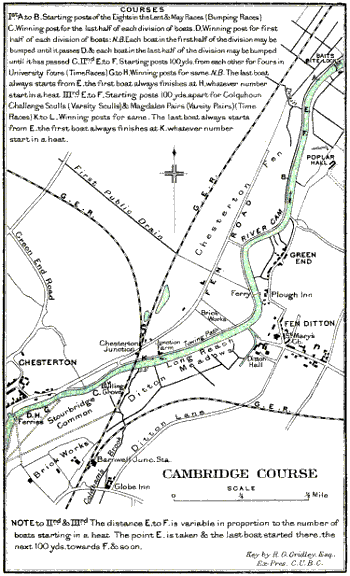
Mr. R. G. Gridley for kindly assisting with the Map of
the Cambridge Course.
ILLUSTRATIONS. — FULL-PAGE ILLUSTRATIONS. — WOODCUTS IN TEXT. — MAPS
(Engraved by W. J. Palmer, J. D. Cooper, and G. Pearson,
after drawings by F. Dadd and photographs by G.
Mitchell, Hills & Saunders, and Marsh Bros.)
As parts of human life and practice the out-of-door
games and amusements with which Englishmen are
familiar have had a long course of development, and
each has its own history. To trace this development
and history in any particular case is not always an easy
task. Most of the writers who deal with these subjects
treat the ‘Origines’ in a summary fashion. Not a few
ignore them altogether. The Topsy theory, ‘’spects it
growed,’ is sufficient.
And yet if it be possible to deal more philosophically with
a subject of the kind, the attempt ought not necessarily to be
devoid of interest. It involves a retrospect of human life and
human ingenuity. It will trace development in man’s ways and
means, marking points which in some regions and with some
races have determined the limit of their progress, and in others
have served as stepping-stones to further invention. It will
present facts which will not only not be disdained by the true
student of men and manners, but will serve to broider the
fringes of serious history, and will give additional light and
colour to the record of the character and the habits of men.
For indeed the sports and pastimes of a people are no insignificant
product of its national spirit, and react to no small degree
upon national character. They have not unfrequently had
their share in grave events, and the famous and oft-quoted saying
of the Duke of Wellington respecting the playing fields at
Eton (se non è vero, è ben trovato) contains a truth, applicable in
a wider sense to national struggles and to victories other than
Waterloo.
Pastimes and amusements generally may be divided into
two main classes: (1) those that have been invented simply as a
means of recreation, such as cricket, tennis, racquets, etc.; and
(2) those that have their origin in the primary needs of mankind.
The latter have in many cases, as civilisation has
advanced, and the particular needs have been supplied in other
ways, survived as pastimes by reason of the natural pleasure
and the excitement and the emulation which accompanied them.
Of this latter class, those that have appropriated the name of
‘sport’ par excellence, such as hunting, shooting, fishing, etc.,
hold the field, so to speak, in antiquity, as compared with other
pastimes, having their origin in the initial necessities and
natural instincts of man, which compelled him to fight with
and to destroy some wild beasts, that he might not himself be
eaten, and to catch or kill others that he might have them
to eat.
The spirit of emulation and the pride of skill, and the
desire of obtaining healthy exercise for its own sake, have been
among the principal causes which have converted into sports
and pastimes man’s means and methods of locomotion. Almost
every class of movement which can be pressed into that form
of competition which is called a race, or in which a definite
comparison of skill is possible, has been enlisted in the host of
amusements with which civilisation consoles its children for the
loss of the wild delights of the untutored savage.
Among these perhaps the most important and the most conspicuous
is Rowing, which as a serious business has played no
inconsiderable part in great events of human history, and as a
pastime is inferior to none of the class to which it belongs.
Its votaries will not hesitate to claim for it even the chief place,
by reason of the pleasure and emulation to which it so readily
ministers, as a healthful exercise, and as a means of competitive
effort requiring both skill and endurance.
But the oar, before it ministered to recreation, had a long
history of labour in the service of man, which is not yet ended,
and itself was not shaped but by evolution from earlier types,
of which the paddle and ultimately the human hand and arm
are the original beginnings.
Will it be wearisome to speculate on these beginnings, and
to try to cast back in thought and research for the first origins
of the noble pastime which forms the subject of the present
volume? Fortunately, in savage life still extant on the habitable
globe we have the survival of many, if not of all, the
earliest types of locomotion. Man in his natural condition has
to follow nature, and by following to subdue her in his struggle
for existence. Climate and race differentiate his action in
this respect, and results, under parallel circumstances, similar,
though different in detail, attend his efforts in different parts of
the world.
A land animal, he is from the first brought face to face with
water, deep water of lakes, and of rivers, and of the sea, and in
all these he finds bounds to his desires, as well as things to be
desired; opposite shores to which he wishes to cross, fish and
vegetable growth which he wants for food. Horace tells us
that ‘oak and triple brass he had around his breast who first
to the fierce sea committed his frail raft,’ but the first man who
committed himself to deep water, and essayed the oarage of his
arms and legs, must have been free from such incumbrances,
and yet have had a stout heart within him. And simultaneously
with, or even prior to such adventure, must have
been others of a similar character aided by a piece of wood, or a
bundle of rushes, or an inflated skin, the elementary boat, the very
embryo of navigation. Such beginnings are still in evidence on
the western coast of Australia, where savages may be seen sitting
astride on a piece of light wood and so venturing forth upon
the waters of the sea. Homer, who in the Odyssey delights in
making the man of many counsels and many devices, with all
his wealth of what was then modern experience, find himself
reduced to the shifts and expedients of a man thrown, like the
savage, upon his own solitary resources, pictures to us Ulysses
seated astride upon the mast of his shipwrecked vessel and
paddling with both hands, thus reverting in his distress, as no
doubt others have done since, to the very earliest method of
navigation, now only practised for choice by savages, whose
progress in navigation, as in other things, has been checked at
this early stage, and who remain the nearest visible types of
primitive man.
But some savages, other than they, did make progress in the
matter of locomotion by water, and the next step was the raft,
of which the earliest type known is the sanpan, three pieces of
buoyant wood tied together. On this construction, which supplied
the earliest generic names both in the east and in the
west (sanpan, σχεδίη, ratis), a man would stand and paddle
and move along upon the water, and assert his power of hand
and eye with the weapons with which native ingenuity had
already supplied him.
In warm climates, where swimming had become a necessity,
and the very children from their earliest years had been habituated
to the water, the familiarity that breeds contempt of the
very danger which at a previous stage acted as a deterrent,
would soon encourage attempts to improve, and enlarge, and
increase the speed of the rude vessel in common use. These
attempts would naturally follow the line of providing the
means for conveying in safety other things besides the living
freight of the human person. There would also arise the very
natural desire to keep things dry, which would spoil if wetted.
Hence the enlargement of the raft, and then the protection
afforded by platforms raised upon its central surface, or by
planks laid edgewise so as to make a defence, a breastwork
against the wave.
And no doubt by this time the use of the sail for propulsion
had become familiar, and man had already prayed his god for
‘the breeze that cometh aft, sail-filler, good companion.’ But
interesting as it would be to trace the effect of the sail upon the
construction of vessels and their development, we must leave
that pleasant task to those who, in the present series, will treat
of the yacht and its prototypes (άκατοι).
The earliest method of propulsion was with the human
hands. In the picture of Ulysses seated on the mast and keel
of his shipwrecked vessel, which he had lashed together with
the broken backstay made of bullhide, paddling with his hands
on either side, Homer, as we have seen, has presented us with
the hero of the highest civilisation known to him reduced to
the straits of the merest savage; and he has again enforced
this idea in his picture of the same hero of many wiles and
many counsels devising for himself the means of escape from
the island of Calypso, and, not without divine suggestions,
constructing for himself, like an ancient Robinson Crusoe, a
primitive raft, with certain improvements and additions; a
broad raft be it remembered, and not a boat. A boat would
mar the conception which presents to us the civilised man
driven back to the straits of barbarism by the unique circumstances
in which he is placed.
This is the point which ingenious commentators, who have
given elaborate designs and figures of Ulysses’ boat and written
pages upon its construction, seem to have missed. The poet
has added colour to his picture by bringing the new and the
old together. And of a truth new and old exist together and
continue throughout the ages of man in marvellous juxtaposition.
The fast screw liner off the Australian coast may pass
the naked savage oaring himself with swarthy palms upon his
buoyant log, and almost every stage of modern invention in
ship-building and ship propulsion has had alongside it the
three-timbered sanpan, and the original types of raft that float
in the Malay Archipelago.
But we must follow the development of our special pastime
through its embryonic stage to a moment when, all unknown
and unseen in the womb of time, like the sudden changes which
differentiate the gradual ascents from a lower to a higher being,
unseen, unknown, and unwritten in history, that great event
occurred, the birth of the first ‘dug-out’ canoe. Unnoticed
perhaps at the time, the importance of the event was recognised
by the poet in after ages as a real forward step in the onward
progress of the arts.[1] ‘Rivers then first the hollowed alders felt.’
[1] Virg. Georg. i. 136:
‘Tunc alnos primum fluvii sensere cavatas.’
To some primitive man or men in advance of their fellow
men, the idea of flotation, as apart from the mere buoyancy of
the material, had occurred, and suggested the hollowing out of
the log. Wherever and whenever this was first effected, it was
a great event in the world’s progress. A simple thought had
wedded fact destined to be fruitful to all future ages. O prototype
of the longboat—of the frail eights which freighted with
contending crews speed yearly over Father Thames amidst the
cheers and applause of thousands! Where wast thou launched?
What dusky arms propelled thee? What wild songs of exultation
heralded thy first successful venture? Once achieved,
what present benefits, what future triumphs didst thou not
ensure to man? In the power of carrying something, or anything
beside the living freight, dry and secure, and in the
increased facility of movement and of turning, must have been
manifest from the first the advantage of the canoe over the raft,
where the lapping of the water and the wash of the wave, in
spite of all contrivances, could scarce be kept out. How soon
must efforts have been made to increase this advantage to
obtain greater carrying power and greater speed! The application
of the sail was made possible by the ingenious adaptation
of the outrigger, a trunk of light wood laid parallel to the side
of the dug-out at some feet distance, and attached to it by
transverse bars. The oldest type and the type with this
improvement still survive, and the ingenious models of such
craft which were exhibited at the Fisheries Exhibition in
London a few years ago will have been noticed by many of our
readers. Twin vessels like the ‘Castalia,’ and, if we are to believe
the learned Graser, the great Tesseraconteres of Ptolemy, had
their primitive germ, so to speak, in this early stroke of genius.
It may appear strange to some boating men who are accustomed
to hear a good deal about outriggers, that this outrigger
of which we have been speaking has nothing to do with the
outrigger with which they are familiar. It never apparently
passed into the Western Seas. The Mediterranean knows it
not. The Andaman Islands and the Seychelles are its westernmost
limits.
But if the invention of the dug-out canoe was a step onward
in the general progress of the arts, being the appreciation and
application of a principle in nature, a still greater triumph was
achieved, and the particular art still more decidedly advanced, by
him who first constructed the canoe properly so called. Herein
was the real prototype of the species boat. A skin of bark, duly
cut and shaped so as to taper towards the ends and be wide
amidships, was attached to a longitudinal framework or gunwale
all along its upper edges, and this itself was kept apart and
in shape by three or more transverse pieces stretching from
side to side, while a series of curved laths of soft wood, the
extreme ends of which also fastened to the gunwale, served to
keep the vessel itself in shape and to protect the bark skin from
the tread of men and from the immediate incidence of any weight
to be carried. ‘Ce n’est que le premier pas qui coûte.’ The
idea once conceived, whether in one place or in many, and
at whatever time or times, could not be lost and must soon
have been fruitful in development. Of this class by far the
most common is the birch-bark canoe, which, though found
also in Australia, is properly regarded as having its home upon
the American continent. If not the original of the type,
yet it deserves particular attention owing to the peculiarity of the
material of the skin, which combines lightness and toughness and
pliability. A truly ingenious and original idea to flay a birch
tree and make a boat of its skin! In the framework of the
canoe we have the embryo ribs and inwale of the future boat, and
the three cross-ties may be regarded as the ancestors of thwarts
to be born in time to come. As yet no keel. But that was
soon to be. Go north, and trees become scarcer and dwindle
in size. The birch is no longer of sufficient girth to serve the
ingenious savage in the construction of a canoe. But the
inventive genius of man was not to be denied. Skins of beasts,
or woven material made waterproof, stretched upon a frame
would serve for the same purpose as bark. But a stronger
framework was necessary for a material thinner and more pliable
than bark. And accordingly in all this class (except the
coracle) we find stronger and more numerous timbers, including
a longitudinal piece from stem to stern, and uprights at each
end acting as stempost and sternpost respectively. The rude
canvas-covered vessels of Tory Island, off the west coast of
Ireland, still preserve one development of this type, close at
home to us; while the cayaks of the Esquimaux and the
larger fishing canoes of the Alaskans and the Greenlanders
exhibit the skin-clad variety in many forms. In one of the
models exhibited at the Fisheries Exhibition the framework
showed in great perfection the ingenuity of the savage, to whom
wood was a very scarce and precious article, short pieces being
made to serve fitted together and fastened with thongs of hide, the
whole being covered with a stout walrus skin. Even outriggers
(as understood by the English oarsman) made of double loops
of hide just long enough to cross each other and enclose the
loom of the oar, were attached to the inner side of the gunwale.
Not only bark and skin and canvas-covered canoes exist and
seem to have existed from an unknown antiquity, but a similar
cause to that of which we were just speaking, viz. a scarcity of
wood or of suitable wood, led to the construction of canoes of
wood made of short pieces stitched together, and approaching
more nearly to the type of vessel which may be called a boat.
To these belong the canoes of Easter Island made of drift
wood, and of many other islands in the Pacific, which are truly
canoes and propelled by paddles, and the same peculiarity of
build extends to the Madras surf boats, which are more truly
boats. Many of these are tied together through holes drilled
or burnt through a ledge left on the inner side of the plank or
log, a peculiarity noticeable as appearing even in the early vessels
of the Northern Seas. The stitched boat has not a nail
Or a peg in her whole composition, but the structure, though
liable to leak, is admirably suited for heavy seas and surf-beaten
coasts, and owing to its pliability will stand shocks which would
shatter a stiffer and tighter build. This being so, it is not surprising
that vessels larger than canoes or boats were constructed
(some authorities say even as large as 200 tons burden) upon
this principle, which is certainly one of very great antiquity.
There is also a curious analogy in the progress of construction
of these sea-going craft with the natural order in the construction
of fishes, that is to say, if the ganoids are to be considered antecedent
to the vertebrates among the latter. For in the case of the
stitched vessels the hull is the first thing in time and construction,
the ribs and framework being, so to speak, an afterthought, and
attached to the interior when the hull has been completed,
whereas the later and modern practice is to set up the ribs and
framework of the vessel first and to attach the exterior planking
afterwards. But the invention of trenails and dowels must have
preceded the later practice, and have led the way to the building
of such boats as those described by Herodotus (ii. 96), the
ancestors of the Nile ‘nuggur’ of modern times. Ulysses, as a
shipwright well skilled in his craft, uses axe and adze and
auger, and with the latter makes holes in the timbers he has
squared and planed, and with trenails and dowels ties them together.
The wooden fastenings, be it remarked, are in size and
diameter severally adapted, the first to resist the horizontal,
the second to resist the vertical strain to which the raft would be
exposed upon the waves. All this, we may observe, points to
a stage anterior to that in which the use of metal nails and ties
in ship- and boat-building had been introduced. Trenails and
dowels are however still in use, and have a natural advantage over
iron in the construction of wooden vessels, owing to the absence
of corrosion, which in early times must have caused difficulties
as to its employment for boat-building. Copper, on the other
hand, though free from this objection, would be less available
by reason of expense and the great demand for it for other
purposes.
And now we have reached a point where we enter upon the
borders of history. No doubt, if we knew more about the venerable
antiquity of China, we might be able to add interesting facts,
showing the development from the earliest sanpan to the great
river boats, and the growth of that curious art which produced
the Chinese junk, a vessel undoubtedly of a very antique type.
But this knowledge is not ours at present, and so we must turn
to the equally venerable civilisation of Egypt for information
upon the subject. In Egypt fortunately the tomb paintings
have preserved to us a wealth of illustration of boats and ships,
some of which, if we may trust the learned, take us back to dates
as early as 3000 b.c. In turning over the interesting plates of
such works as Lepsius’s ‘Denkmäler,’ or Duemichen’s ‘Fleet of
an Egyptian Queen,’ we are struck by the reflection that, if at that
early date boats, and ships, and oars, and steering paddles, and
masts, and sailing gear had all been brought to such a stage of
perfection, we must allow many centuries antecedent for the
elaboration of such designs, and for the evolution of the savage
man’s primary conception of canoe and paddle.
However this may be, the lovers of our pastime, if they will
consult the pages of the works above mentioned, will find rowing
already well established as an employment, if not as an
amusement, in the hoar antiquity of Egypt. Not only the Nile
water, whether the sacred stream was within his banks or spread
by inundation over the plain within his reach, was alive with
boats, busy with the transport of produce of all sorts, or serving
the purposes of the fowler and the fisherman, but the Red Sea
and the Mediterranean coasts were witnesses of the might and
power of Pharaoh, as shown by his fleets of great vessels
fully manned, ready with oar and sail to perform his behests,
ready to visit the land of Orient, and bring back thence
the spices and perfumes that the Egyptians loved, together
with apes and sandal wood, or else to do battle with the fierce
Pelesta and Teucrians and Daunians who swarmed in their
piratical craft upon the midland sea, entering the Nile mouths,
and raiding upon the fat and peaceable plains of the Delta.
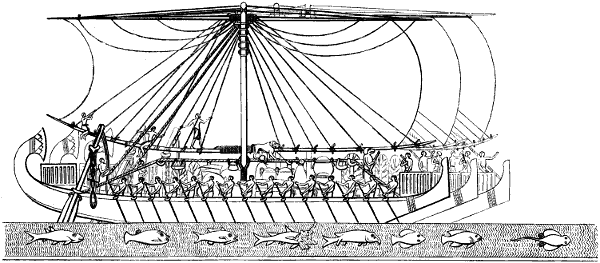
The Egyptian boats present several noticeable features. Built
evidently with considerable camber, they rise high from the
water both at stem and stern, the ends finished off into a point
or else curved upwards and ornamented with mystic figure-heads
representing one or other of the numerous gods. The steering is
conducted by two or more paddles fastened to the sides of the
boat in the larger class, and sometimes having the loom of the
paddle lengthened and attached to an upright post to which it
is loosely bound. A tiller is inserted in the handle, and to this a
steering cord fastened, by which the helmsman can turn the blade
of the paddle at will. The paddles vary but little in shape.
They are mostly pointed, and have but a moderate breadth of
blade. In some of the paintings they are being used as paddles
proper, in others as oars against a curved projection from the
vessel’s side serving as a thowl. But whether this is solid or
whether it is a thong, like the Greek τροπωτήρ, against which the
oarsman is rowing, it is not easy to say.
The larger vessels depicted with oars have in some cases as
many as twenty-five shown on one side. In others the number
is less. But it is quite possible that the artist did not care to
portray more than would be sufficient to indicate conventionally
the size of the vessel. In some of the vessels there are apertures
like oar-ports, though no oars are shown in them, which
raise a presumption that the invention of the bireme, the origin
of which is uncertain, may with some probability be attributed
to the Egyptians. The larger vessels are all fitted with sailing
gear, and the rowing is evidently subsidiary to the sail as a
means of locomotion. The wall paintings of Egypt give us
ample details of Egyptian ships and boats extending over a
period, as we are told, of twenty centuries and more. In them
we have a glimpse of the maritime enterprise, in which the oar
must have taken a principal part, of the races which inhabited
the seaboard of the Mediterranean in which piracy had its
home from very early times. Teucrians, Dardanians, Pelesta
(? Pelasgians), Daunians, Tyrrhenians, Oscans, all seem to have
been sea-going peoples, and at intervals to have provoked by
their marauding the wrath of Pharaoh and to have felt his
avenging hand.
But of all the seafaring races that made their homes and
highways upon the waters of the great inland sea, the most famous
of early times were the Phœnicians. According to some accounts
connected with Capthor (Copts), and according to others emigrants
from the coast of the Persian Gulf, their genius for
maritime enterprise asserted itself very early, so that already
before Homer’s time they were masters of the commerce of
the Mediterranean, and had rowed their dark keels beyond the
mystic pillars that guarded the opening of the ocean stream.
And yet, though the facts are certain, we know but little of
these famous mariners, of their vessels and their gear. The only
representation of their vessels is from the walls of the palaces of
their Assyrian conquerors, an inland people, not likely to detect
or appreciate any technical want of fidelity in the likeness presented.
And, accordingly, the pictures are conventional, telling
us but little of that which we should like to know about their
build, and oars, and oar ports, &c. The date, moreover, is not
in all probability earlier than 900 b.c.
Such being the case, we are driven for information to the
more ample store of Greek literature, and to Greek vases for
the earliest representations of the Greek vessel.
Homer abounds in sea pictures. He has a wealth of descriptive
words, touches of light and colour which bring the sea
and its waves and the vessel and its details with vivid and
picturesque effect before us. His ships are black and have
their bows painted with vermilion, or red of some other tone;
they are sharp and swift, and bows and stern curve upwards
like the horns of oxen. And withal they are rounded on both
sides, and well timbered and hollowed out, and roomy,
having by the gift of the poet a facile combination of all the
opposite qualities, so desirable and so difficult in practice to
unite. As yet there is no spur or ram, but round the solid
stempost shrieks the wave, as the vessel is urged onward either
by the mighty hands of heroes, or the god-sent breeze that
follows aft. Nor is the vessel decked, except for a short space
at bow and stern, where it had raised platforms. On the quarterdeck,
so to speak, of the stern sat the great chiefs, whose
warriors plied the oar, and there they laid their spears ready for
use. There also was the standing place of the steersman who
wielded the long paddle which served to guide the vessel.
The thwarts which tied the vessel’s sides together (yokes or
keys as they are called) served as benches for the oarsmen;
those amidships had the heaviest and longest oars, so that they
were places of honour reserved for the heaviest and strongest
men, e.g. for Hercules and Ancæus in the Argo. Whether the
‘sevenfoot,’ to which Ajax retreats from the stern deck, when
defending the Greek ships against the Trojans and hard pressed
by them, be bench or stretcher, it gives us an idea of the
breadth of the Homeric vessel at or near the place of the stroke
oar. Long low galleys they must have been, with a middle
plank running fore and aft, interrupted by the ‘tabernacle,’
in which the mast when hoisted was secured, having fore and
back stays. The warriors were oarsmen, the oarsmen warriors.
The smallest complement, as Thucydides observes, was fifty, the
largest one hundred and twenty.
It is doubtful how far the Alexandrine poets can be relied
upon as giving accurate information respecting details of ancient
use. Yet we have many lifelike pictures and a great profusion
of details, drawn no doubt from the ample stores of antiquarian
knowledge which these laborious men of letters had at their
service in the great Alexandrine library, and these go to fill up
that which is lacking in the Homeric picture. And so when
Apollonius the Rhodian paints for us such scenes as those of
the building of the Argo, the launching, the detail of the crew,
and the starting of the vessel, we cannot help feeling that they
are described con amore, not of the sea, or of ships, or of
rowing, but of the literary beauty of similar descriptions by
earlier poets. In a word, they are at second hand. But better
this than none at all.
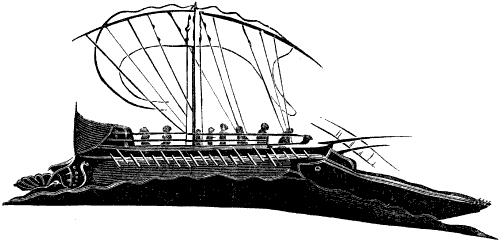
ANCIENT BOAT DEPICTED ON VASE.
The ‘bireme,’ or two-banked vessel, does not appear in
Homer. But, as we have seen, it was probably in existence
before Homer’s time. If of Egyptian parentage, it was adapted
for use on the Mediterranean waters by the shipwrights of Sidon
or Tyre. It is a curious reflection that this remarkable evolution
of banked vessels should, so far as we can judge, have
occupied about two thousand years; the curve, if we may use
the expression, of development rising to the highest point in
the useless Tesseraconteres of Ptolemy, and after Actium declining
to the dromons and biremes of the Byzantine Emperor
Leo, and finally subsiding into the monocrota or one-banked
vessels, the galleys of mediæval times.
The problem which taxed the ingenuity of those early shipwrights
was briefly this, how to get greater means of propulsion
by increasing the number of oars, without such increase in the
length of the ship as would, by increased weight, neutralise
the advantage and still further diminish that facility in turning
which was of the greatest moment to the ancient war-vessel.
Galleys with fifty oars on either side had already been constructed,[2]
and all the speed that a hundred pairs of hands could
give had been obtained, when the invention of the bireme exhibited
the means of nearly doubling the power without much
increasing the weight to be moved, since but little additional
height or breadth was required.
[2] Perhaps
even with a hundred, if έκατόζυγος is to be taken literally.
The normal adjustment of the horizontal space between
the oarsmen was then, as it is now, regulated by that canon of
the ancient philosopher, ‘Man is the measure of all things.’
Twice the man’s cubit gives room for his legs when in a sitting
posture. Hence the two-cubit standard (σχ̅ημα
’διπηχαϊκόν)
which is referred to by Vitruvius as the basis of proportion in
other constructions besides ships and boats. Given this as the
interscalmium (space between the thowls) or distance between
points at which the oars in the same tier were rowed, it is clear
that the rowing space of a vessel’s side would be, for a penteconter,
or twenty-five a side, seventy-five feet, and for a hecatonter,
if there ever was such a thing, 150 feet. To this must
be added the parts outside the oarage space (παρεξειρεσία), for
the bows ten feet, and something more, say twelve feet, for the
stern. So that a penteconter would be a long low galley of
about ninety-seven feet in length. The new invention nearly
doubled the number of oars without increasing the length of
the oarage space.
It was found that by making apertures in the vessel’s sides at
about three feet from the water and dividing the space between
the (zyga) thwarts, room could be made for a second row of
men with shorter oars, but still handy and able to add to the
propulsion of the vessel. For these seats were found in the
hold (thalamus), and hence while the upper tier of the bireme
took their name from the zyga, benches or thwarts, and were
called ‘Zygites,’ the men of the lower tier were called ‘Thalamites.’
These names were continued when the invention of
the ‘thranos,’ or upper seat, had added a third or upper tier
with longer oars to the system, and so introduced the trireme.
If the number of the zygites in the penteconter was twenty-five
a side, and the first bireme was a converted vessel of that class,
the number of thalamites, owing to the contraction of the
bow and the stern, would necessarily be two or three a side
less. Thus we may consider a converted penteconter to have
been capable of carrying a rowing crew of between 90 and 100
men. Similarly a triaconter would have been capable of adding
nearly twenty pairs of arms to her propelling power. When, in
consequence of the new invention, vessels were expressly built as
triremes, we may imagine that for convenience’ sake the benches
or zyga would be a little raised, so as to give more room for
the raised seat of the thalamites that was fastened on to the
floor of the vessel.
The narrowness of the vessels affected the disposition of
the rowers in the Greek galleys in a peculiar way. It is
evident from the testimony of the ancients that they adhered
strictly to the principle of ‘one man to each oar.’ The arrangement
seen in mediæval galleys was absolutely unknown to them,
and would not have suited them. It belongs to a different
epoch and a different order of things, when the invention of
the ‘apostis’ had made the use of large sweeps rowed by two
or three men possible, and a vessel with sets of three rowing
upon the same horizontal plane might be called a trireme,
though utterly unlike the ancient vessel of that name.
In the ancient vessel the tiers of oarsmen must have sat in
nearly the same vertical plane, obliquely arranged, one behind
and below the other. Thus in the bireme the zygite, as he sat
on his bench, had behind him and below him his thalamite
whose head was about 18 inches behind the zygite thwart and
a little above it. Moreover, as his seat was now a little raised,
the zygite required an appui for his feet, which was formed for
him on the bench on which the thalamite next below and in
front of him was sitting; on either side of him his feet found a
resting-place. As the zygite fell back during the stroke and
straightened his knees, there was plenty of room for the thalamite
below to throw his weight also on to his oar. There
seems to have been but little forward motion of the body. The
arms were stretched out smartly for the recovery, as we learn
from Charon’s instructions to Dionysus in the ‘Frogs’ of
Aristophanes, and then a driving smiting stroke was given (cf.
the words έλαύνειν,
παίειν, άναρρίπτειν
̔άλα πηδῷ) and the brine
tossed up by the blade.
When once the principle had been established, by which
additional power could be gained without increasing the length
of the vessel, and had been tested by practical experience, its
development was sure to follow. What century witnessed the
birth of the trireme is not certain, but probably by 800 b.c.
the earliest vessels of this description had been launched. The
quick-witted sharp-eyed Greek was not slow to copy, and by
the beginning of the next century the busy shipwrights of
Corinth were building the new craft for Samians as well as for
themselves.
It is, however, in the Attic trireme such as composed the
fleets of Phormio and Conon that historical interest has centred,
and though quinqueremes were commonly in use in the second
and third centuries, b.c., and even still larger rates of war vessels
constructed till they were inhabilis prope magnitudinis,
unwieldy leviathans, such as the sixteen-banked flagship of
Demetrius Poliorcetes, yet the interest in the trireme has never
failed, and the splendour of its achievements has insured to
it an attention on the part of the learned which no other class
of vessel has been able to attract to itself. The problem of
construction of the trireme, and of the method of its propulsion,
has exercised the ingenuity of scholars ever since the revival
of letters. It has a literature of its own, and it may fairly be
said that if the enigma has not been solved, it is not for want
of industry or acumen.
One point we may as well make clear at once, viz., that
whatever was the vessel the ancients invariably went upon
the principle, One man, one oar. Volumes have been wasted
in attempts to prove that the arrangement of the ancient galleys
with respect to propulsion were identical with, or very similar
to, those of the mediæval galleys of Genoa or Venice. But
the mediæval galleys were essentially monocrota, or one-banked
vessels, though they may have been double-banked or treble-banked
in the sense that two or three men were employed
upon one oar.
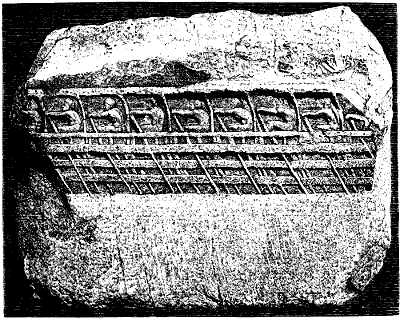
BAS-RELIEF OF ANCIENT GREEK ROWING BOAT.
Another distinction that it is necessary to note with reference
to the ancient galleys is that they were called Aphract or
Kataphract according as the upper tier of rowers was unprotected
and exposed to view, or fenced in by a bulwark stout
enough to protect them from the enemy’s missiles. The system
of side planking is observable as already adopted in some
of the Egyptian vessels, though of the Greeks the Thasians are
credited with the invention.
In the year 1834, during the process of excavating some
ground for new public buildings in the Piræus near Athens,
some engraved stone slabs were found built up in a low wall
which had been uncovered. These were happily preserved
and deciphered, and were found to be records of the dockyard
authorities of the Athenian admiralty in the second and third
centuries before Christ. Many interesting details were thus
brought to light which were set in order by the illustrious
scholar Boeckh in his volume entitled ‘Urkunden über das
Seewesen des attischen Staates.’ His pupil Dr. Graser has
carried on his researches by the examination of innumerable
coins, vases, etc., and has rescued the subject from much of the
obscurity which enveloped it. The following description of
the trireme, based upon his labours, is quoted, by permission,
from the new edition of the ‘Encyclopædia Britannica,’ vol.
xxi. pp. 806, 807.
In describing the trireme it will be convenient to deal first with
the disposition of the rowers and subsequently with the construction
of the vessel itself. The object of arranging the oars in
banks was to economise horizontal space and to obtain an increase
in the number of oars without having to lengthen the vessel. We
know from Vitruvius that the ‘interscalmium,’ or space horizontally
measured from oar to oar, was two cubits. This is exactly borne
out by the proportions of an Attic aphract trireme, as shown on a
fragment of a bas-relief found in the Acropolis. The rowers in
all classes of banked vessels sat in the same vertical plane, the
seats ascending in a line obliquely towards the stern of the vessel.
Thus in a trireme the thranite, or oarsman of the highest bank,
was nearest the stern of the set of three to which he belonged.
Next behind him and somewhat below him sat his zygite, or oarsman
of the second bank; and next below and behind the zygite
sat the thalamite, or oarsman of the lowest bank. The vertical
distance between these seats was 2 feet, the horizontal distance
about 1 foot. The horizontal distance, it is well to repeat, between
each seat in the same bank was 3 feet (the seat itself about 9 inches
broad). Each man had a resting-place for his feet, somewhat wide
apart, fixed to the bench of the man on the row next below and in
front of him. In rowing, the upper hand, as is shown in most of
the representations which remain, was held with the palm turned
inwards towards the body. This is accounted for by the angle at
which the oar was worked. The lowest rank used the shortest
oars, and the difference of the length of the oars on board was
caused by the curvature of the ship’s side. Thus, looked at
from within, the rowers amidship seemed to be using the longest
oars, but outside the vessel, as we are expressly told, all the oar-blades
of the same bank took the water in the same longitudinal
line. The lowest or thalamite oar-ports were 3 feet, the zygite
41⁄4 feet,
the thranite 51⁄2 feet above the water. Each oar-port was protected
by an ascoma or leather bag, which fitted over the oar,
closing the aperture against the wash of the sea without impeding
the action of the oar. The oar was tied by a thong, against which
it was probably rowed, which itself was attached to a thowl (σκαλμός).
The port-hole was probably oval in shape (the Egyptian and
Assyrian pictures show an oblong). We know that it was large
enough for a man’s head to be thrust through it.
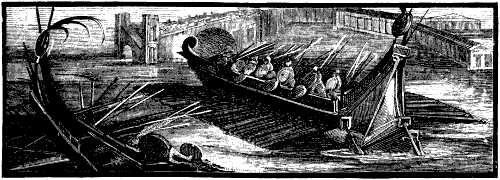
ANCIENT GALLEY FIGHT, FROM POMPEII.
The benches on which the rowers sat ran from the vessel’s
side to timbers which, inclined at an angle of about 64° towards
the ship’s stern, reached from the lower to the upper deck. These
timbers were, according to Graser, called the diaphragmata. In
the trireme each diaphragma supported three, in the quinquereme
five, in the octireme eight, and in the famous tesseraconteres forty
seats of rowers, who all belonged to the same ‘complexus,’ though
each to a different bank. In effect, when once the principle of
construction had been established in the trireme, the increase to
larger rates was effected, so far as the motive power was concerned,
by lengthening the diaphragmata upwards, while the increase in
the length of the vessel gave a greater number of rowers to each
bank. The upper tiers of oarsmen exceeded in number those
below, as the contraction of the sides of the vessel left less available
space towards the bows.
Of the length of the oars in the trireme we have an indication in
the fact that the length of supernumerary oars (πηρινἐῳ) rowed from
the gangway above the thranites, and therefore probably slightly
exceeding the thranitic oars in length, is given in the Attic tables
as 14 feet 3 inches. The thranites were probably about 14 feet.
The zygite, in proportion to the measurement, must have been 101⁄2,
the thalamite 71⁄2 feet long. Comparing modern oars with these,
we find that the longest oars used in the British navy are 18 feet.
The University race is rowed with oars 12 feet 9 inches. The proportion
of the loom inboard was about one third, but the oars of
the rowers amidship must have been somewhat longer inboard.
The size of the loom inboard preserved the necessary equilibrium.
The long oars of the larger rates were weighted inboard with lead.
Thus the topmost oars of the tesseraconteres, of which the length
was 53 feet, were exactly balanced at the rowlock.
The Attic trireme was built light for speed and for ramming
purposes. Her dimensions, so far as we can gather them from the
scattered notices of antiquity, were probably approximately as follows:—length
of rowing space (ἔγκωπον), 93 feet; bows, 11 feet;
stern, 14 feet; total, 118 feet; add 10 feet for the beak. The
breadth at the water-line is calculated at 14 feet, and above at the
broadest part 18 feet, exclusive of the gangways; the space between
the diaphragmata mentioned above was 7 feet. The deck was
11 feet above the water-line, and the draught about 8 to 9 feet. All
the Attic triremes appear to have been built upon the same model,
and their gear was interchangeable. The Athenians had a peculiar
system of girding the ships with long cables (ὑποζώματα), each
trireme having two or more, which, passing through eyeholes in
front of the stem-post, ran all round the vessel lengthwise immediately
under the waling-pieces. They were fastened at the stern
and tightened up with levers. These cables, by shrinking as soon
as they were wet, tightened the whole fabric of the vessel, and in
action, in all probability, relieved the hull from part of the shock
of ramming, the strain of which would be sustained by the waling-pieces
convergent in the beaks. These rope-girdles are not to be
confused with the process of undergirding or frapping, such as is
narrated of the vessel in which St. Paul was being carried to Italy.
The trireme appears to have had three masts. The mainmast
carried square sails, probably two in number. The foremast and
the mizen carried lateen sails. In action the Greeks did not use
sails, and everything that could be lowered was stowed below.
The mainmasts and larger sails were often left ashore if a conflict
was expected.
The crew of the Attic trireme consisted of from 200 to 225 men
in all. Of these 174 were rowers—54 on the lower bank (thalamites),
58 on the middle bank (zygites), and 62 on the upper bank
(thranites),—the upper oars being more numerous because of the
contraction of the space available for the lower tiers near the bow
and stern. Besides the rowers were about 10 marines (ἐπιβάται)
and 20 seamen. The officers were the trierarch and next to him
the helmsman (κυβερνήτης), who was the navigating officer of the
trireme. Each tier of rowers had its captain (στοιχαρχός). There
were also the captain of the forecastle (πρωρηύς), the ‘keleustes’
who gave the time to the rowers, and the ship’s piper (τριηραυλής).
The rowers descended into the seven-foot space between the diaphragmata
and took their places in regular order, beginning with
the thalamites. The economy of space was such that, as Cicero
remarks, there was not room for one man more.
Such, we may believe, was the trireme of the palmy days of
Athens. Built for speed, it was necessarily light and handy,
and easily turned, so that the formidable beak could be plunged
into the enemy’s side, the moment a chance was given. But it
required sea room for its manœuvres, and in a narrow strait or
land-locked harbour, such as that of Syracuse, was no match
for the solid balks of timber with which Corinthian and
Syracusan shipwrights strengthened the bows of their vessels.
Against these the pride of Athens was hurled in vain, only to
find itself broken up and rendered unseaworthy by the crash of
its own ram.
With the defeat of Athens comes in the fashion of larger
vessels with more banks of oars, quadriremes, quinqueremes,
and so on up to sixteen banks, when the increase of the motive
power had been more than overtaken by the increase in bulk
and weight. The principles of construction in these larger
vessels seem to have been the same as in the trireme. The
space for each man was probably somewhat less, and the handles
of the upper tiers of oars were weighted with lead, so as to
give a balance at the thowl between the parts outboard and
inboard.
A question difficult to solve has often been raised respecting
the pace at which these ancient galleys could be propelled. If
five-man power could be taken as equivalent to one-horse power,
then for the propulsion of the trireme there would have been
available about thirty-five horse power, but that would hardly
give a very high rate of speed.
There is a passage in Xenophon[3] in which he speaks of
a distance of about 150 nautical miles, from Byzantium to
Heraclea, as possible for a trireme in a day, but a long day’s
work. Assuming eighteen hours’ work out of the twenty-four,
a speed of something over eight knots per hour would be
required for this, which may perhaps seem excessive. Still we
may believe that by a crew when fresh a pace not less than this
could be achieved.
The Romans, though it may be inferred from treaties with
Carthage and with Tarentum that they had some kind of fleet
in the time even of the kings, yet did not apply themselves
readily to maritime pursuits, and made no serious effort to
become masters of the Mediterranean till the first Punic War.
We hear then of their copying a quinquereme which had fallen
into their hands by accident. A fleet was constructed in sixty
days from the time that the trees were first cut down, and
meantime crews were practised diligently in rowing on dry land
in a framework of timber which represented the interior of the
vessels that were building. This first essay at extemporising a
fleet does not seem to have been very successful. But nothing
daunted they persevered, and the second venture under the
Admiral Duillius took with it to sea a new invention called the
‘corvus,’ a sort of boarding bridge by which, when it once fell
on the enemy’s vessel, the Roman infantry soon found its way
on to his deck, and made short work with the swarthy African
crew. This revolutionised the maritime struggle, and gave unexpectedly
the naval superiority to Rome. The large vessels of
war (alta navium propugnacula) continued to be built until the
time of Actium, when the light Liburnian galleys, which were
biremes, were found to be more than a match for the leviathans,
whose doom from that moment was sealed.
From that time, with the exception of the accounts of
naumachiæ, there is very little of interest about galleys to be
gathered. The coins and the paintings of Pompeii show us craft
degenerating in type. The column of Trajan exhibits biremes
as still in vogue. Later on there is a light thrown upon the
subject by the Tactica of the Byzantine Emperor Leo about 800
a.d., who gives directions as to the building and composition
of his fleet, which is to consist of biremes, or dromones as he
calls them, and light galleys with one bank of oars.
From these latter eventually sprang the mediæval galley,
which however differed from the ancient galley in the arrangement
of its oars by the use of the ‘apostis,’ a projecting
framework which took the place of the ancient ‘parodus,’ and
upon which the thowls were placed, against which the long
sweeps could be plied by two or three men attached to each.
For full and accurate descriptions of these mediæval vessels
the reader who has any curiosity on the subject should consult
the ample works of M. Jal. His Archéologie Navale and
Glossaire Nautique contain the fullest information as regards
the build, and fittings, and crews of the mediæval galley. The
sorrows and sufferings of ‘la Chiourme’ were enough to give
rowing a bad name, as an employment too cruel even for slaves
and fit to be reserved for criminals of the worst description.
It is in England, and in the hands of English free men and
boys, that the oar has maintained an honourable name, as the
instrument of a pastime healthy and vigorous, with a record
not inglorious of struggles in which the strength and skill of
the nation’s youth have contended for the pride of place and
the joy of victory.
CHAPTER II. — THE RISE OF MODERN OARSMANSHIP. — GENERAL. — UNIVERSITY TRAINING. — Eight-Oared Match—London and the Oxford Amateurs for £200. [5] — 1837. — REGATTAS. — HENLEY ROYAL REGATTA. — CONSTITUTION. — QUALIFICATION RULES. — GENERAL RULES.
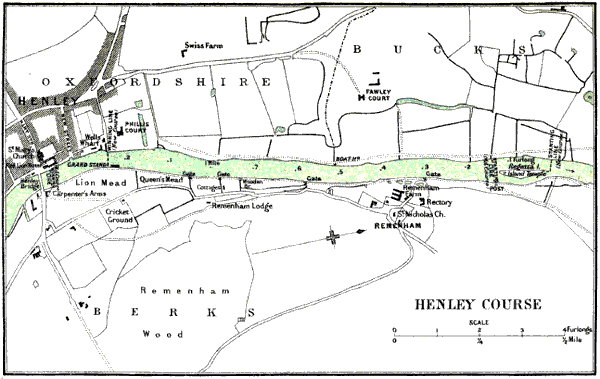
HENLEY COURSE (BETWEEN
RACES).
Written records of rowing performances
in the last century are
but scarce. In 1715 Mr. Doggett,
comedian, founded a race which
has survived to the present day—to
wit, ‘Doggett’s coat and badge’ (of freedom of the river).
‘Watermen’ have to serve as ‘apprentices’ for seven years, during
which time they may not ply for hire on their own account, but
only on behalf of their masters. When they have served their
time they can become ‘free’ of the river, on payment of certain
fees to the Corporation.
In order to encourage good oarsmanship, prizes which paid
the fees for freedom, and bestowed a ‘coat and badge’ of merit,
have often been given by patrons of aquatics. Doggett’s prize
is the oldest of its class, and of all established races. The contest
used to be from London Bridge to Chelsea against the ebb—a
severe test of stamina; and formerly six only of the many
applicants for competition were allowed to row, being selected
by lot. The race is now reformed. It is managed by the
Fishmongers’ Company. The course is changed, so far that it
is now rowed on the flood. This makes it fairer; on the ebb,
it is hard to pass a leader who hugs the shore in the slack tide.
‘Trial heats’ are now rowed, to weed off competitors till the
old standard number of six only are left in. Authentic records
of the race exist since 1791.
Mr. Brickwood, who has taken much pains to look up old
accounts, informs us in his ‘Boat Racing’ that the Westminster
‘water ledger,’ dating June 1813, is the earliest authentic record
of Thames aquatics of this century. We venture to give the
result of Mr. Brickwood’s researches in his own words:—
This book commences in the year 1813 with a single list of
the six-oared boat ‘Fly,’ viz., Messrs. H. Parry, E. O. Cleaver,
E. Parry, W. Markham, W. F. de Ros, G. Randolph. The
‘Fly’ continued to be the only boat of this school down to 1816
inclusive, in which latter year it ‘beat the Temple six-oared boat
(Mr. Church stroke), in a race from Johnson’s dock to Westminster
Bridge, by half a boat; the latter men having been beat before;’ to
which is added a note that the Temple boat ‘requested the K. S.
to row this short distance, having been completely beat by them
in a longer row the same evening.’ In 1817 there was a six-oar
built for Westminster, called the ‘Defiance,’ and ‘sheepskin seats
were introduced.’ In 1818, the ‘Westminster were challenged by
the Etonians,’ and a six-oared crew was in course of preparation
for the race, but the contest was prohibited. In 1819 an eight-oar
called the ‘Victory’ was launched, but the six-oar ‘Defiance’
appears to have been the representative crew of the school, for
there is a note that in the spring of 1821 ‘the boat improved
considerably and beat the “Eagle” in a short pull from Battersea to
Putney Bridge.’ In 1823 a new six-oared cutter was built, and the
name of ‘Queen Bess’ given in honour of the illustrious foundress.
In 1823 this boat was started from the Horseferry at half past five
in the morning, and reached Chertsey bridge by three o’clock.
On their way back they dined at Walton, and again reached the
Horseferry by a quarter before nine. The crew of the eight-oar
‘Victory’ in the same year ‘distinguished themselves in
the
Temple race and several others.’ A new eight called the ‘Challenge’
was launched in 1824, and the record says this boat did beat every
boat that it came alongside of, as also did the ‘Victory.’ And
again in April 13, 1825, this boat (‘Challenge’) started from the
Horseferry at four minutes past three in the morning, reached
Sunbury to breakfast at half past seven, and having taken luncheon
at the London Stairs, just above Staines, went through Windsor
bridge by two o’clock in the afternoon. After having seen Eton,
the crew returned to Staines to dinner, and ultimately arrived at
the Horseferry, having performed this distance in twenty-one
hours. The locks detained them full three hours, and, including
all stoppages, they were detained seven hours. A waterman of
the name of Ellis steered the boat in this excursion, and both
steered and conducted himself remarkably well.
Such are some of the early Westminster School annals, as
collated by Mr. Brickwood. One cannot help feeling that if
these long journeys were samples of the school aquatics, it is not
to be wondered that parents and guardians of old days imbibed
prejudices against rowing, and considered it injurious both to
health and to study.
In the following decade there seem to have been plenty of
aquatics current. The ‘Bell’s Life’ files of those days teem
with aquatic notes. One day we read (dated May 26, 1834)
a self-exculpatory letter from Dr. Williamson, head-master of
Westminster School, explaining why he did not approve of his
scholars rowing a match against Eton, and complaining of the
‘intemperance and excesses which such matches lead to.’
On July 3, says ‘Bell’ of July 6 in that year, a match was
rowed between a randan (Campbell, Moulton, and Godfrey)
and a four-oar (Harris, Eld, Butcher, and Dodd, Cole cox.)—from
Putney to Westminster. The randan were favourites, and
led; but Moulton fainted, and the four won. The race was
for a purse of 70l.—50l. for winners and 20l. for losers. In
the same paper, Williams challenges Campbell to a match—apparently
for the incipient title of Champion of the Thames.
Williams wishes Campbell to stake 40l. to 30l., because he is
six years the younger. Compare the modesty of these stakes
with those for which modern champion, and some less important
matches, are rowed!
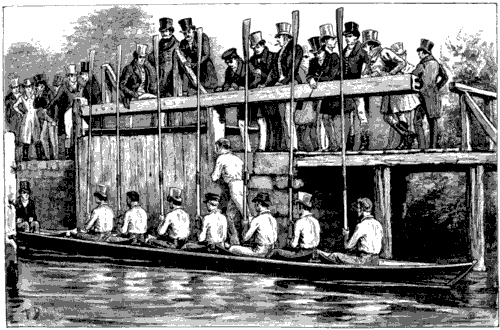
METHOD OF STARTING THE COLLEGE EIGHTS PRIOR TO 1825—OXFORD
‘Lyons House’ seems to have been a sort of resort for
amateurs. Cole, who steered the waterman’s four (supra) v.
the randan, is described as the waterman of those rooms.
On July 8, same year, a Mr. Kemp, of the 3rd Dragoon
Guards, matches himself for a large stake to ‘row his own boat’
from Hampton Court to Westminster and back in nine hours.
Time is favourite, but Mr. Kemp wins by 27 minutes, having
met the tide for several miles of his voyage. Such are a few
samples of the current style of aquatic sports between 1830 and
1840.
The ‘Wingfield Sculls’ were founded in 1830, given by the
donor, whose name they bear, to be held as a challenge prize
by the best sculler of the day from Westminster to Putney,
against all comers, on the ‘4th of August for ever’—so a silver
plate in the lid of the old box which holds the silver sculls bears
testimony. Since its foundation the prize has been more than
once placed on a different footing. Parliaments of old champions
and competitors for the prize have been summoned, and
the original donor gave assent to the changes of course and
régime. Lists of winners and competitors from year to year,
with notes as to the course rowed, will be found in ‘Tables’
later on. The race has from its earliest years been described
by amateurs as equivalent of ‘amateur championship.’ A panoply
of silver plates has grown up in and around the box which
holds the trophy, and on these plates is recorded the name of
each winner from year to year. About a quarter of a century
ago a ‘champion badge’ was instituted. It consists of a small
edition of the Diamond Sculls (Henley) challenge prize; as to
shape, it is a pair of silver sculls crossed with an enamel wreath
and mounted on a ribbon like a ‘decoration’ or ‘order.’ There
is a ‘clasp’ for the year of winning. A second win only adds
a fresh clasp with date, but no second badge. The secretary
of the ‘order’ is Mr. E. D. Brickwood, himself winner of the
title in 1861.
Eight-oars had been manned at Eton before they found
their way to Oxford. At Cambridge they appeared still later.
At both Universities a plurality of eight-oars clubs had
existed for some seasons before the first University match—1829.
In 1881, at the time when the ‘Jubilee’ dinner of University
boat-racing was held, the writer took the opportunity of
the presence in London of the Rev. T. Staniforth, the stroke
of the first winning University eight, to inquire from him
his recollections of college boat-racing in his undergraduate
days.
Fortunately for posterity, Mr. Staniforth had kept a diary
during his Oxford career, and it had noted many a fact connected
with aquatics. He kindly undertook to bring to London
at his next visit his diaries of Oxford days. He met the writer,
searched his diaries, and out of them recorded history which
was taken down from his lips, and reduced to the following
article, which appeared in ‘Land and Water’ of December 17,
1881.[4]
It is now reproduced verbatim, by leave. The writer
regrets to say that, from various causes, he has been unable to
pursue his researches beyond the dates when Mr. Staniforth’s
diaries cease to record Oxford aquatics.
There must be many an old oarsman still alive who can
recall historical facts between 1830 and 1836, and it is hoped
that such memories may be reduced to writing for the benefit
of posterity, and for the honour of the oarsmen of those years,
before tempus edax rerum makes it too late.
The writer considers that he will do better thus to reproduce
verbatim his own former contribution to ‘Land and Water’ than
to paraphrase it. The more so because much of the text of it
is actually the ἔπεα πτερόεντα
of the old Oxford stroke, taken
down as uttered from his lips to the writer, and read over again
to him for emendation or other alteration, before the interview
in question was concluded. It may be added that Mr. Staniforth
kindly showed to the writer the actual text of the
diaries referred to, from which he refreshed his memory and
recorded the appended history.
As to the intermediate history between 1830 and 1837, in
which year the Brasenose boating record opens (two seasons
before an O.U.B.C. was founded), Christ Church started head
in 1837; therefore, apparently, they finished head in 1836.
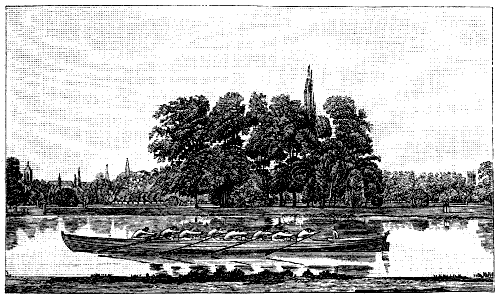
OXFORD BOAT IN 1829.
Mr. Brickwood, in his book on ‘Boat Racing,’ has collected
some history of these years, but unfortunately he does not
record the source, so that what might be a tree of knowledge
for inquirers to pluck more from seems to be sealed against
our curiosity. We have, however, to thank him for the following
information, which we reproduce (page 157 of ‘Boat Racing’):—
1833.—Queen’s College is chronicled as head of the river at
Oxford this being the only record between 1825 and 1834. Christ
Church, it is true, was said to have kept that position for many
years, but the precise number is not given. However, there seems
no doubt that Christ Church was head in 1834, 1835, and 1836,
after which the official record commences.
Mr. Brickwood, moreover, seems to have gleaned from some
independent source sundry valuable details of early Oxford
races. He tells us that ‘the first known races were those of
the college eights in 1815, when Brasenose was the head boat,
and their chief and perhaps their only opponent was Jesus.’
He speaks of four-oared races in the next ensuing years, and
of a match between Mr. de Ros’ four and a pair manned by a
B.N.C. man and a waterman—won by the pair. Then comes
some information as to the years 1822, 1824, and 1825, which
exactly tallies with Mr. Staniforth’s journals, save that Mr.
Brickwood ascribes the discontinuance of the races in 1823
directly to the recorded quarrel between B.N.C. and Jesus;
whereas Mr. Staniforth attributes it to the untimely death of
Musgrave (supra).
The first University race took place in 1829, over the course
from Hambledon Lock to Henley. Mr. Staniforth states that
till the Oxford went to practise over the course, no one thought
of steering an eight through the Berks channel, past ‘regatta’
island. However, the Oxonians ‘timed’ the two straits, and
decided to select the Berks one, if they got the chance. They
took that channel in the race and won easily. A foul occurred
in the first essay at starting, and the boats were restarted.
This pair of pioneer University crews produced men of more
than usual celebrity in after life: two embryo bishops, three
deans, one prebendary, and divers others hereafter
In hamlet and hall As well known to all As the vane of the old church spire.
The full list of the crews engaged in this and in all other
contests in which Universities were represented, will be found in
‘Tables’ towards the end of this volume. At this time there
was no O.U.B.C., nor did such an organisation exist until
1839, when a ‘meeting of strokes’ of the various colleges was
convened, and a generally representative club was founded.
At Cambridge a U.B.C. had existed since 1827. In that year
the system of college eights seems to have been instituted,
according to the testimony of Dr. Merivale, still Dean of Ely,
and a member of the C.U.B.C. crew of 1829. Trinity were
head of the river on that occasion, and there seems to have
been also a Westminster club, of an independent nature in
Trinity. The records of college racing at Cambridge seem to
be unbroken since their institution; whereas those of Oxford
were for many years unofficial and without central organisation,
and consequently without official record, until 1839. The
Brasenose Club record dates from 1837.
BUMPING RACES (OLD STYLE).
The next occasion in which a University eight figured was
in a match which somehow seems to have slipped out of public
memory, though it occurred several years later than the first
match between the Universities. The writer was talking to old
George West, the well-known Oxford waterman, in 1882, at the
L.R.C. boat-house, while waiting for the practice of the U.B.C.
crews of that year. Casually old George remarked, ‘I steered
a University eight once, sir.’ The writer looked incredulous.
‘Yes, against Leander—Leander won,’ quoth George. The
writer had known West since his school days, and had heard
him recapitulate his aquatic memories times out of mind, but
never till that hour had he heard any allusion to this Leander
match. Only the year before, the ‘Jubilee’ dinner of old
Blues had taken place, and all who had ever been known to
have represented their University in a match or regatta were
asked to join in the celebration. At that date not one of the
executive had any inkling of this match, although one of the
Oxford crew, the present Bishop of Norwich, could certainly
have been found at an hour’s notice. Letters from old oarsmen,
who had not actually rowed for the flag (often because
there was no match during their career), used to pour in while
the jubilee feast was in preparation, asking for admittance to it.
None of this Oxford crew seem to have put in any claim. A
slight, though an unintentional one, was thus perpetrated upon
all of them, whether alive or dead, by the omission to record
them as old Blues on that occasion. When the writer compiled
the history of ‘Old Blues and their Battles,’ which Mr. G.
T. Treherne incorporated in his book of ‘Record of the University
Boat Race,’ and which was published soon after the
jubilee, neither of these gentlemen was aware of this race.
No speaker at the banquet seemed to remember or allude to it.
Yet, on referring to old files of ‘Bell’s Life,’ record of this match
is to be found. Since it was recorded in that journal, it seems
to have been unnoticed in any print till now. Better late than
never; the performers in it are now officially brought to light,
and their names will be found in the tables of University oarsmen
and their opponents, later on.
This match was for 200l. a side. Leander would row on
no other terms, and insisted on having their own waterman to
steer them, as they did in their later matches against Cambridge.
This was the only Oxford University eight ever steered
by a professional. Only one of the 1829 crew seems to have
remained to do duty in this race. The Pelham referred to is
now Bishop of Norwich. He used, before this, to row in the
Christ Church eight behind Staniforth. The Waterford is the
former marquis of that ilk, who lost his life later on through
a fall when hunting. En passant, it may be mentioned that
Bishop Selwyn (of C.U.B.C. crew 1829) and Pelham of Oxford
1834, each begat sons who rowed for their respective Universities:
Selwyn, junr. 1864 and 1866; Pelham, junr. 1877 and
1878. The latter oarsman unfortunately lost his life in the
Alps very shortly afterwards. J. R. Selwyn has succeeded his
late father as a colonial bishop. Inasmuch as we here record,
for the first time for two generations, a lost chapter of University
Boat Racing, we think it will be of interest to append
the account given, in ‘Bell’s Life’ of that day, of this forgotten
match.
This interesting match was decided on Saturday week at
Henley Reach. The Trinity boat, built by Archer of Lambeth,
proved successful on a former occasion when opposed to the
Oxonians, was, we understand, again selected by them in the first
instance, but they ultimately decided on rowing in a boat built by
Searle, which they considered had been unjustly denounced ‘a
rank bad un,’ simply on the score of the Cambridge gentlemen
and the Westminster Scholars having lost their matches in her—the
former against Oxford, and the latter against the Etonians.
The gentlemen of Oxford selected a large but peculiarly light
eight belonging to Mr. Davis of Oxford. On Friday the London
gentlemen left town for Henley, and took up their quarters at
the Red Lion. Noulton of Lambeth was selected to steer them.
Although Oxford were favourites on the match being first concocted,
it was with difficulty that a bet could be made on the Londoners
on the last two days, and then only at 6 to 4 against Oxford.
At about 6.30 the contending parties arrived in their cutters
near the lock, to row from thence against the stream to Henley
Bridge, which is reckoned two and a quarter miles.
The names of the respective parties and their stations in the
cutters were as follows:
Oxford—Copplestone (stroke), Lloyd, Barnes, Pelham, Peard,
Marsh, Marquis of Waterford, Carter. The latter was steered, we
believe, by a boy belonging to the lock.
Mr. Hume and Mr. Bayford were appointed umpires on part of
the London gentlemen, and Mr. Lloyd and another gentleman on
the side of Oxford.
The Oxford gentlemen won the toss and took the inside station.
The umpires having a second time asked if all was ready, receiving
an answer in the affirmative, gave the signal. In less than a dozen
seconds the London gentlemen almost astounded their opponents
by going about a boat’s length in advance, so rapid were their
strokes when compared with those of Oxford. The Oxford gentlemen
soon recovered. Before half the distance had been rowed
London were two lengths in advance. The Oxonians, finding they
were losing ground, made a desperate effort and succeeded in
coming within a painter’s length. On nearing the goal the exertions
of each party were increasing. One London gentleman
(Captain Shaw) seemed so much exhausted, that it was feared he
would not hold out the remaining distance. Noulton, seeing this
and fearing the consequence, observing the Oxford gentlemen fast
approaching them, said that ‘if the Londoners did not give it her
it would be all up with them.’ They did give it her, and the consequence
was they became victorious by about two boats’ lengths.
The distance was rowed in 111⁄4 minutes.
The exertions at the conclusion of the contest became lamentably
apparent. Captain Shaw nearly fainted and had to be carried
ashore; Mr. Bayford was obliged to retire to bed instantly; so
was also one of the Oxford gentlemen. The others were more or
less exhausted.
The London gentlemen rowed to town on Tuesday, and were
greeted on their way with cheering and cannon. On arriving at
Searle’s a feu-de-joie was fired.
Note.—Of the various performers in this Oxford crew, the
following notices of the after career of some may be of interest.
Messrs. Copplestone and Pelham rose to adorn the episcopate.
Mr. Peard became known to fame as ‘Garibaldi’s Englishman,’
and played an important part in the cause of the liberation of
Italy.
There had been a second University match in 1836, this
time from Westminster to Putney (see Tables). No official
record exists of this. It is said that ‘light blue’ was on this
occasion first adopted by Cambridge. Certainly in 1829 the
Cantab crew wore pink, while Oxford sported blue. The late
Mr. R. M. Phillips, of Christ’s, used to tell the writer that he it
was who fortuitously founded light blue on this occasion. He
was on the raft at Searle’s when the Cantab crew were preparing
to start (either for the race or for a day’s practice) the race so
far as recollection of Mr. Phillips’ narrative serves the writer.
One of the crew said, ‘We have no colours.’ Mr. Phillips
ran off to buy some ribbon in Stangate. An old Etonian
accompanied him, and suggested ‘Eton ribbon for luck.’ It
was bought, it came in first, and was adhered to in later years
by Cambridge.
A COLLEGE PAIR.
In 1837 the head college crews of the two Universities rowed
a match at Henley. The Brasenose book says, Christ Church
were head, but took off because their Dean objected to their
rowing at Henley; the effect of their ‘taking off’ was to leave
Queen’s College, on whom the representation of the college
crews would devolve, with the titular headship.
The B.N.C. book says, the Queen’s crew went, ‘as was
usual,’ to row the head boat of Cambridge, and beat them
easily. The latter statement is correct. Mr. Brickwood in his
treatise demurs to the accuracy of the B.N.C. allegation that
such matches were ‘usual,’ and research qualifies his scepticism.
The B.N.C. hon. sec. of that day seems to have been drawing
somewhat upon his imagination. He had probably heard
of these various Leander and other matches at Henley in
other years; hence his inference.
Henley. College match.
Queen’s.
Lady Margaret (St. John’s).
1.
Lee, Stanlake.
1.
Shadwell, Alfred H.
2.
Glazbrook, Robert.
2.
Colquhoun, Patrick.
3.
Welsh, Jos.
3.
Wood, H. O.
4.
Robinson, John.
4.
Antrobus, Edmund.
5.
Meyrick, Jos.
5.
Budd, R. H.
6.
Todd, Jos.
6.
Fane, W. D.
7.
Eversley, John.
7.
Fletcher, Ralph.
Penny, Chas. J. (stroke).
Hurt, Robert (stroke).
Berkeley, Geo. T. (cox.).
Jackson, Curtis (cox.).
The names of the Queen’s and St. John’s crews are here
given, instead of recording them in the lists of University oars,
for this was not strictly a University race, though in those days
it had almost as much prestige as one.
In 1839 the third University match was rowed, and Henley
Regatta was founded. At the Universities, about this date,
various prizes were established, all of which gave a stimulus to
oarsmanship.
Pair-oar races were established at Oxford in 1839. They
were rowed with coxswains until 1847. At Cambridge similar
pairs were founded in 1844, and were rowed from the first without
coxswains. The obsolete rudder of the Oxford pairs is
now held by the coxswain of the head eight. The Colquhoun
Sculls had been founded at Cambridge in 1837. ‘University
Sculls’ were instituted at Oxford in 1841. Four-oar races, each
crew to be from one college, were founded at Oxford in 1840,
and at Cambridge in 1849. Thus, by the latter year, each
U.B.C. had its set of contests for all classes of craft—eights, fours,
pairs, and sculls. Lists of the winners of these various honours
from year to year will be found elsewhere in this volume.
TOWING GUARD BOATS UP HENLEY REACH.
Aquatics may be said to have reached full swing with the
completion of these institutions at the Universities. Matches
between the Universities were propounded annually by one or
other club from 1839, but time and place could not always be
agreed upon, nor could ‘dons’ be always persuaded to allow
men to row in such races. There was many a hitch in old
days, from one cause or another. Since 1850 the U.B.C.’s
have annually met each other in some shape or other at Henley,
or in a match; since, and including, 1856 matches over the
Putney course have been annual. Since 1859 neither University
has put on at any regatta.
Various causes tended to stimulate rowing, e.g. regattas and
also professional racing, which is dealt with separately under
the head of ‘Professionals.’ A perusal of the tables of records
of
Henley and other regattas will also show how competitions
gradually increased in number, and also in the fields which
they produced.
The institution of Henley Regatta in 1839 was the outcome of
the various eight-oared matches which have been rowed on that
part of the river during the ten years preceding. The regatta
began with one prize only, the Grand Challenge Cup, a trophy
which is unique for classical design, and which is to this day
the ‘blue ribbon’ for amateur clubs. The gradual growth of
Henley may be traced by perusal of a leading article contributed
by the writer of this chapter to the ‘Field,’ in the July
of 1886, on the eve of the greatest change which the regatta has
undergone, that of alteration of the course. The article is now
reproduced,[6]
through the courtesy of the proprietors of that journal.
The new course, as compared with the old one, will best
be understood by reference to the map of the reach, which
appears elsewhere. The change has had only two trials, those
of 1886 and 1887, but it may be said that so far rowing clubs
which frequent Henley are unanimous in approving of the
alteration; and so are all retired oarsmen, whose personal experience
of the regatta was under the old régime.
STARTING THE EIGHTS—OLD COURSE, HENLEY.
The old course was very one-sided. In the middle third of a
mile—on a stormy day—with a stiff wind from W. or S.W., the
shelter of the Bucks bushes—especially before house-boats and
steam launches multiplied and monopolised the frontage of the
Bucks and Oxon shores—used to reverse entirely the advantage
otherwise pertaining to the Berks stations. On such a day the
Berks station placed most boats hopelessly out of the race,
unless they could keep within a length of the Bucks boat till
the ‘point’ was reached—in which case the poplar corner made
a pretty counterpoise to the advantage of Bucks shelter, and
caused some interesting finishes. Under the new régime not
more than two boats can row in one heat; and as the course is
now staked out, and neither competitor can hug the bank, the
difference between windward and leeward stations, even when
hereafter a gale shall blow, will no longer be so glaring as of
old.
PAIR-OAR.
The Universities no longer compete at Henley. In these
days of keelless boats more practice is needed, in order to do justice
to the craft, than when heavier and steadier craft were used.
It is found to be impossible to collect all the eight best men of
either U.B.C. twice in one year. Examination and other causes
reduce the ranks more or less; and, as the annual Putney match
between the Universities is considered by them to be of more
importance than any other contest, they devote their best energies
to that, and leave minor sections of either U.B.C. to fight Henley
battles. It is found that a good college eight, or a club crew of
which some one college forms a nucleus, can be got together
better, in the limited time available for practice for the regatta,
than eight better men who probably cannot find time to practise
all together for more than a week, and who will further, for the
same reason, be short of condition.
Till 1856, it was the custom for the U.B.C.’s, if they could
not agree as to time and place for a match, to assent to meet
each other in the Grand Challenge; and such meetings ranked
practically as University matches. Records of these rencontres
of the U.B.C.’s will be found in tables at the end of this volume,
together with a history of Henley past and future.
The ‘Seven-oar episode’ of 1843 was not a University
match or meeting. The O.U.B.C. were entered at Henley;
Cambridge were represented by the ‘Cambridge Rooms;’ but
the C.U.B.C. was not officially represented by that crew. Just
before the final heat, the Oxford stroke fainted, and the Cambridge
reasonably objected to the introduction of a substitute.
The Oxonians then decided to row with seven oars. They
had a wind abeam, favouring the side which was manned by
only three oars. They eventually won by a length, or thereabouts.
In 1843 the Thames Regatta was started, and greatly supplemented
the attractions of Henley. The mistake of this regatta
was the rule which made challenge prizes the permanent property
of any crew which could win them thrice in succession.
By this means the Gold Cup for eights, the pièce de résistance
of the regatta, passed in 1848 to the possession of the ‘Thames’
Club. The regatta lingered on one year longer, shorn of its
chief glory, and then died out.
Records of the winners of the chief prizes at it, amateurs
as well as professionals, will be found in ‘Tables.’
In 1854 a new Thames regatta, called the ‘National,’
was founded. It was supported by the ‘Thames Subscription
Club,’ and died with that club in 1866. In the last year of its
existence it introduced amateur prizes as well as the usual
bonuses for professionals. In 1866 a very important regatta
was founded—the Metropolitan. Its founders expected it to
eclipse Henley, by dint of offers of more valuable prizes, but
it never took the fancy of the University element, and for want
of the wider-spread competition which strong entries from the
U.B.C.’s would have produced, it never attained the prestige of
Henley. Still the honours of winning eights, fours, pairs, or
sculls at it rank, in amateur estimation, second only to Henley.
Barnes Regatta is of very old standing. The tideway is always
a drawback to scenery, but Barnes always used to produce
good audiences and good competitors. Its chief patrons were
tideway clubs and the Kingston Rowing Club.
GONDOLA.
Walton-on-Thames flourished in the ‘sixties.’ It has now
died out. It was as a picnic second only to Henley. The
course was rather one-sided, and hardly long enough to test
stamina.
Molesey Regatta, of less than ten years’ growth, now holds
much the same station in aquatics that Walton-on-Thames
once claimed. It draws its sinews of war from much the same
up-river locality that used to feed Walton.
Kingston-on-Thames has a longer history than any regatta
except Henley. Its fortunes hang on the Kingston Rowing
Club, but it is well patronised by tideway clubs.
Regattas have for a season or two been known at Staines
and Chertsey, but they depended on some one or two local
men of energy, and, when this support failed, they died out.
Reading has a good reach, and has of late come to the fore
with a good meeting and a handsome challenge cup.
To return to watermen’s regattas. The late Mr. J. G.
Chambers, and a strong gathering of amateur allies of his, revived
a second series of Thames regattas in 1868; these meetings
were confined to watermen and other professionals, whose
doings are scheduled in ‘Tables’ hereafter. How the second
series of Thames National regattas followed the fate of series
No. 1, and of the ‘Royal Thames Regatta’ before that, will be
found in the chapter on professional rowing. The so-called
‘International’ Regatta lived but two years, and fell through
so soon as its mercenary promoters came to the conclusion
that they could not see their way to harvest filthy lucre out
of it.
There used to be a well-attended regatta at Talkintarn, in
the Lake district. It died out from causes similar to those
which led to the collapse of the ‘Royal’ Thames regattas, i.e.
the dedication of its prizes to those who could win them a
certain number of times consecutively. The Messrs. Brickwood
thus became the absolute owners of the chief prize for
pairs, and a Tyne crew became the proprietors of the four-oar
prize.
The Tyne, the Wear, Chester, Bedford, Tewkesbury, Worcester,
Bridgnorth, Bath, and other provincial towns produce
regattas, but none of them succeed in drawing many of the
leading Thames clubs, and without these no regatta ever establishes
even second-class prestige.
The rules of Henley Regatta are here appended. They
serve to inform intending competitors of the code under which
they will have to enter and to row, and they may also offer valuable
hints to other regatta executives, present and future.
On May 16, 1885, at a meeting of the stewards, the following
resolutions were agreed to:—
1. That the stewards of Henley Regatta shall constitute a
council for the general control of the affairs of the regatta.
2. That the stewards shall elect a president, who shall, if present,
take the chair at the general meetings.
3. That the chairman shall have a casting vote.
4. That not less than five shall form a quorum at the general
meetings.
5. That two ordinary general meetings shall be held in each
year, one in the month of May and another in the month of
November.
6. That other general meetings shall be summoned by the
secretary, when ordered by the president, or at the request of any
two stewards, in writing, provided that not less than fourteen days’
notice shall be given of any such meeting.
7. That the stewards shall elect annually, at the meeting in
November, from their own body, a committee of management.
8. That the number of the committee shall not exceed twelve,
of whom not less than three shall form a quorum.
9. That the committee shall elect one of their own body to act
as chairman.
10. That the committee be empowered to manage and exercise
control over all matters connected with the regatta, excepting
such as shall involve the alteration of any of the published rules
of the regatta.
11. That the committee shall present a report, together with
a statement of accounts, to the stewards, annually, at the November
meeting in each year.
12. That meetings of the committee shall be summoned by
the secretary when ordered by the chairman, or at the request of
any two members of the committee, in writing, providing that not
less than one week’s notice be given of any such meeting.
13. That the committee shall have power to make and publish
by-laws respecting any matter connected with the management
of the regatta, not already determined in the published rules.
14. That no alteration shall be made in any of the foregoing
resolutions, or in any of the published rules of the regatta, except
at a general meeting specially convened for that purpose, of which
fourteen days’ notice shall be given, such notice to state the alterations
proposed, and unless the alteration be carried by a majority
of two-thirds at a meeting of not less than nine stewards.
Any crew of amateurs who are members of any University or
Public School, or who are officers of her Majesty’s army or
navy, or any amateur club established at least one year previous
to the day of entry, shall be qualified to contend for this prize.
The Stewards’ Challenge Cup,
FOR FOUR-OARS.
The same as for the Grand Challenge Cup.
The Ladies’ Challenge Plate,
FOR EIGHT-OARS.
Any crew of amateurs who are members of any of the boat
clubs of colleges, or non-collegiate boat clubs of the Universities,
or boat clubs of any of the Public Schools, in the United Kingdom
only, shall be qualified to contend for this prize; but no member
of any college or non-collegiate crew shall be allowed to row for
it who has exceeded four years from the date of his first commencing
residence at the University; and each member of a Public School
crew shall, at the time of entering, be bonâ fide a member ‘in statu
pupillari’ of such school.
The Visitors’ Challenge Cup,
FOR FOUR-OARS.
The same as for the Ladies’ Challenge Plate.
The Thames Challenge Cup,
FOR EIGHT-OARS.
The qualification for this cup shall be the same as for the
Grand Challenge Cup; but no one (coxswains excepted) may enter
for this cup who has ever rowed in a winning crew for the Grand
Challenge Cup or Stewards’ Challenge Cup; and no one (substitutes
as per Rule 7 excepted) may enter, and no one shall row, for
this cup and for the Grand Challenge Cup or Stewards’ Challenge
Cup at the same regatta.
The Wyfold Challenge Cup,
FOR FOUR-OARS.
The qualification for this cup shall be the same as for the
Stewards’ Challenge Cup; but no one shall enter for this cup who
has ever rowed in a winning crew for the Stewards’ Challenge
Cup; and no one (substitutes as per Rule 11 excepted) may enter,
and no one shall row, for this cup and for the Stewards’ Challenge
Cup at the same regatta.
The Silver Goblets,
FOR PAIR-OARS.
Open to all amateurs duly entered for the same according to
the rules following.
The Diamond Challenge Sculls,
FOR SCULLS.
Open to all amateurs duly entered for the same according to
the rules following.
Definition.—1. No person shall be considered an amateur oarsman,
sculler, or coxswain—
(a) Who has ever taken part in any open competition for a stake,
money, or entrance fee;
(b) Who has ever knowingly competed with or against a professional
for any prize;
(c) Who has ever taught, pursued, or assisted in the practice of
athletic exercises of any kind for profit;
(d) Who has ever been employed in or about boats, or in manual
labour for money or wages;
(e) Who is or has been by trade or employment, for wages, a
mechanic, artisan, or labourer, or engaged in any menial duty.
Eligibility.—2. No one shall be eligible to row or steer for
a
club unless he has been a member of that club for at least two
months preceding the regatta, but this rule shall not apply to
colleges, schools, or crews composed of officers of her Majesty’s
army or navy.
Entries.—3. The entry of any amateur club, crew, or sculler,
in the United Kingdom, must be made ten clear days before the
regatta, and the names of the captain or secretary of each club or
crew must accompany the entry. A copy of the list of entries shall
be forwarded by the secretary of the regatta to the captain or
secretary of each club or crew duly entered.
4. The entry of any crew or sculler, out of the United Kingdom,
must be made on or before March 31, and any such entry must be
accompanied by a declaration, made before a notary public, with
regard to the profession of each person so entering, to the effect
that he has never taken part in any open competition for a stake,
money, or entrance fee; has never knowingly competed with nor
against a professional for any prize; has never taught, pursued, or
assisted in the practice of athletic exercises of any kind for profit;
has never been employed in or about boats, or in manual labour
for money or wages; is not, and never has been, by trade or employment,
for wages, a mechanic, artisan, or labourer, or engaged
in any menial duty; and in cases of the entry of a crew, that each
member thereof is a member of a club duly established at least
one year previous to the day of entry; and such declaration must
be certified by the British Consul, or the Mayor, or the chief
authority of the locality.
5. No assumed name shall be given to the secretary, unless
accompanied by the real name of the competitor.
6. No one shall enter twice for the same race.
7. The secretary of the regatta shall not divulge any entry,
nor report the state of the entrance list, until such list be closed.
8. Entrance money for each boat shall be paid to the secretary
at the time of entering, as follows:—
£.
s.
d.
For the
Grand Challenge Cup
6
6
0
„
Ladies’ Challenge Plate
5
5
0
„
Thames
Challenge
Cup
5
5
0
„
Stewards’
„
„
4
4
0
„
Visitors’
„
„
3
3
0
„
Wyfold
„
„
3
3
0
„
Silver Goblets
2
2
0
„
Diamond Challenge Sculls
1
1
0
9.
The committee shall investigate any questionable entry, irrespective
of protest.
10. The committee shall have power to refuse or return any
entry up to the time of starting, without being bound to assign a
reason.
11. The captain or secretary of each club or crew entered shall,
seven clear days before the regatta, deliver to the secretary of the
regatta a list containing the names of the actual crew appointed
to compete, to which list the names of not more than four other
members for an eight-oar and two for a four-oar may be added as
substitutes.
12. No person may be substituted for another who has already
rowed or steered in a heat.
13. The secretary of the regatta, after receiving the list of the
crews entered, and of the substitutes, shall, if required, furnish a
copy of the same, with the names, real and assumed, to the captain
or secretary of each club or crew entered, and in the case of pairs
or scullers to each competitor entered.
Objections.—14. Objections to the entry of any club or crew
must be made in writing to the secretary at least four clear days
before the regatta, when the committee shall investigate the
grounds of objection, and decide thereon without delay.
15. Objections to the qualification of a competitor must be
made in writing to the secretary at the earliest moment practicable.
No protest shall be entertained unless lodged before the prizes are
distributed.
Course.—16. The races shall commence below the Island, and
terminate at the upper end of Phyllis Court. Length of course,
about 1 mile and 550 yards.
17. Boats shall be held to have completed the course when
their bows reach the winning-post.
18. The whole course must be completed by a competitor
before he can be held to have won a trial or final heat.
Stations.—19. Stations shall be drawn by the committee.
Row over.—20. In the event of there being but one boat entered
for any prize, or if more than one enter, and all withdraw but one,
the crew of the remaining boat must row over the course to be
entitled to such prize.
Heats.—21. If there shall be more than two competitors, they
shall row a trial heat or heats; but no more than two boats shall
contend in any heat for any of the prizes above mentioned.
22. In the event of a dead heat taking place, the same crews
shall contend again, after such interval as the committee may appoint,
or the crew refusing shall be adjudged to have lost the
heat.
Clothing.—23. Every competitor must wear complete clothing
from the shoulders to the knees—including a sleeved jersey.
Coxswains.—24. Every eight-oared boat shall carry a coxswain;
such coxswain must be an amateur, and shall not steer for more
than one club for the same prize.
The minimum weight for coxswains shall be 7 stone.
Crews averaging 101⁄2 stone and under 11 stone to carry not less
than 71⁄2 stone.
Crews averaging 11 stone or more, to carry not less than 8 stone.
Deficiencies must be made up by dead weight carried on the
coxswain’s thwart.
The dead weight shall be provided by the committee, and shall
be placed in the boat and removed from it by a person appointed
for that purpose.
Each competitor (including the coxswain) in eight- and four-oared
races shall attend to be weighed (in rowing costume) at the
time and place appointed by the committee; and his weight then
registered by the secretary shall be considered his racing weight
during the regatta.
Any member of a crew omitting to register his weight shall be
disqualified.
Flag.—25. Every boat shall, at starting, carry a flag showing
its colour at the bow. Boats not conforming to this rule are liable
to be disqualified at the discretion of the umpire.
Umpire.—26. The committee shall appoint one or more umpires
to act under the Laws of Boat-racing.
Judge.—27. The committee shall appoint one or more judges,
whose decision as to the order in which the boats pass the post
shall be final.
Prizes.—28. The prizes shall be delivered at the conclusion of
the regatta to their respective winners, who on receipt of a challenge
prize shall subscribe a document of the following effect:—
‘We, A, B, C, D, &c., the captain and crew of the
and members of the
Club, having
been this day declared to be the winners of the Henley Royal
Regatta
Challenge Cup, and the same having been
delivered to us by E F, G H, I K, &c., Stewards of the Regatta,
do hereby, individually and collectively, engage to return the same
to the Stewards on or before June 1, in accordance with the conditions
of the annexed rules, to which also we have subscribed
our respective names.’
Committee.—29. All questions of eligibility, qualification, interpretation
of the rules, or other matters not specially provided for,
shall be referred to the committee, whose decision shall be final.
30. The Laws of Boat-racing to be observed at the regatta
are as follows (see chapter on this subject).
A good deal of the history of old regattas at which watermen
contended is necessarily mixed with the history of the rise of
professional racing, and will be found to be dealt with under
that heading in another chapter.
CHAPTER III. — SCIENTIFIC OARSMANSHIP. — Notes on the Stroke.
If a thing is worth doing at all it is worth doing well, whether
it be undertaken in sport or as a means of livelihood.
The first principles of oarsmanship may be explained to a
beginner in a few minutes, and he might roughly put them
into force, in a casual and faulty manner, on the first day of
his education.
In all pastimes and professions there is, as even a child
knows, a very wide difference between the knowing how a thing
is done and the rendering of the operation in the most approved
and scientific manner.
In all operations which entail the use of implements there
are three essentials to the attainment of real merit in the operation.
These are, firstly, physical capacity; secondly, good tools
to work with; thirdly, practice and painstaking on the part of
the student.
For the purposes of the current chapter we shall postulate
the two former, and confine the theme to details of such study
and practice of oarsmanship as are requisite in order to attain
scientific use of oars or sculls.
When commencing to learn an operation which entails a
new and unwonted exercise, distinct volition is necessary on
the part of the brain, in order to dictate to the various muscles
the parts which they are to play in the operation.
The oftener that a muscular movement is repeated the
less intense becomes the mental volition which is required to
dictate that movement; until at last the movement becomes
almost mechanical, and can be reproduced without a strain of
the will (so long as the muscular power is not exhausted).
One object of studied practice at any given muscular movement
is to accustom the muscles to this particular function,
until they become capable of carrying it out without requiring
specific and laborious instructions from the headquarters of the
brain on the occasion of each such motion. Another object
and result of exercise of one or more sets of muscles is to
develop their powers. The anatomical reasons why muscles increase
in vigour and activity under exercise need not be here
discussed; the fact may be accepted that they do so.
Hence, by practice of any kind of muscular movement,
the student increases both the vigour and the independence of
action of the muscles concerned.
In any operation with implements there is some one
method of performing the same which experience has proved
to be the most effectual for the purpose required. There will
be other methods, or variations of method, which will attain a
somewhat similar but less effectual and less satisfactory result.
It requires distinct volition in the first instance to perform
the operation in an inferior manner, just as it does to perform
it in the most approved manner, to perform ‘clumsily’ or to
perform ‘cleverly.’
Naturally, if the volition to act clumsily be repeated a
sufficient number of times, the muscles learn independent
clumsy action with as much facility as they would have otherwise
acquired independent clever and scientific action. Hence
the importance of knowing which is the most approved and
effectual method of setting to work, and of being informed of
the result, good or bad, of each attempt, while the volition is
still in active force, and before the ‘habit’ of muscular action,
perfect or imperfect, is fully formed.
We all know that, whether we are dealing with morals or
with muscles, it is a matter of much difficulty to overcome a
bad habit, and to form a different and a better one relating to
the same course of action.
When the pupil begins to learn to row the brain has many
things to think of; it has several orders to distribute simultaneously
to its different employés—the various muscles required
for the work—and these employés are, moreover, ‘new to the
business.’ They have not yet, from want of practice, developed
the vigour and strength which they will require hereafter; and
also they know so little of what they have to do that they require
incessant instruction from brain headquarters, or else they make
blunders. But in time both master and servants, brain and
muscles, begin to settle down to their business. The master
becomes less confused, and gives his orders with more accuracy
and less oblivion of details; the servants acquire more vigour,
and pick up the instructions with more facility. At last the
time comes when the servants know pretty well what their
master would have them do, and act spontaneously, while the
master barely whispers his orders, and has leisure to attend to
other matters, or at all events saves himself the exertion of
having momentarily to shout his orders through a speaking-trumpet.
Meantime, as said before, the servants can only
obey orders; and, if their original instructions have been
blunders on the part of the master, they settle down to the
reproduction of these blunders.
Now it often happens that an oarsman, who is himself a
good judge of rowing, and is capable of giving very good instructions
to others, is guilty of many faults in his own oarsmanship.
And yet it cannot be said of him that he ‘knows
no better’ as regards those faults which he personally commits.
On the contrary, if he were to see one of his own pupils rowing
with any one of these same faults, he would promptly detect it,
and would be able to explain to the pupil the why and the
wherefore of the error, and of its cure. Nevertheless, he perpetrates
in his own person the very fault which he discerns
and corrects when he notes it in another! And the reason is
this. His own oarsmanship has become mechanical, and is
reproduced stroke after stroke without a distinct volition. It
became faulty at the time when it was becoming mechanical,
because the brain was not sufficiently conscious of the orders
which it was dictating, or was not duly informed, from some
external source, what orders it should issue. So the brain gave
wrong orders, through carelessness or ignorance, or both, and
continued to repeat them, until the muscles learnt to repeat
their faulty functions spontaneously, and without the immediate
cognisance of the brain.
This illustration, of which many a practical instance will be
recalled by any rowing man of experience, serves to show the
importance of keeping the mind attentive, as far as possible, at
all times when rowing, and still more so while elementary rowing
is being learnt, and also of having, if possible, a mentor to
watch the endeavours of the student, and to inform him of any
error of movement which he may perpetrate, before his mind
and muscles become confirmed in an erroneous line of action.
The reader will therefore see from the above that it is
important for any one who seeks to acquire really scientific
oarsmanship, not only to pay all the mental attention that he
can to the movements which he is executing, but also to secure
the presence of some experienced adviser who will watch the
execution of each stroke, and will point out at the time what
movements have been correctly and what have been incorrectly
performed.
Having shown the importance of careful study and tuition
in the details of scientific oarsmanship, we now enter into those
details themselves, but still confine ourselves to what is known
as ‘fixed’ seat rowing, taking them separately, and dealing
first with the stroke itself, as distinct from the ‘recovery’
between the strokes.
While carrying out the stroke upon general principles, the
oarsman, in order to produce a maximum effect with a relatively
minimum expenditure of strength, has to study the
following details:
1. To keep the back rigid, and to swing from the hips.
2. To maintain his shoulders braced when the oar grasps
the water.
3. To use the legs and feet in the best manner and at the
exact instant required.
4. To hold his oar properly.
5. To govern the depth of the blade with accuracy, including
the first dip of the blade into the water to the moment
when the blade quits it.
6. To row the stroke home to his chest, bending his arms
neither too soon nor too late.
7. To do so with the correct muscles.
8. To drop the hands and elevate the oar from the water in
the right manner and at the right moment.
Then again, when the stroke is completed and the recovery
commences, the details to be further observed are:
9. To avoid ‘hang’ or delay of action either with hands or
body.
10. To manipulate the feather with accuracy and at the
proper instant.
11. To govern the height of the blade during the recovery.
12. To use the legs and feet correctly and at the right
moments of recovery.
13. To keep the button of the oar home to the thowl.
14. To regulate the proportionate speeds of recovery of
arms and of body, relatively to each other.
15. To return the feathered oar to the square position at
the right time and in the correct manner.
16. To raise the hands at the right moment, and so to
lower the blade into the water at the correct instant.
17. To recommence the action of the new stroke at the
right instant.
These several details present an apparently formidable list
of detailed studies to be followed in order to execute a series
of strokes and recoveries in the most approved fashion. In
performance the operation is far more homogeneous than would
appear from the above disjointed analysis of the several movements
to be performed. The division of movements is made
for the purpose of observation and appreciation of possibly
several faults, which may occur in any one of the movements
detailed. As a fact, the correct rendering of one movement—of
one detail of the stroke—facilitates correctness in succeeding
or contemporaneous details; while, on the other hand, a faulty
rendering of one movement tends to hamper the action of the
body in other details, and to make it more liable to do its
work incorrectly in some or all of them. Experience shows
that one fault, in one distinct detail, is constantly the primary
cause of a concatenation of other faults. To set the machine
in incorrect motion in one branch of it tends to put the whole,
or the greater part of it, more or less out of gear, and to cripple
its action from beginning to end of the chapter.
Taking these various details seriatim.
1. The back should be set stiff, and preserved stiff throughout
the stroke. Obviously, if the back yields to the strain, the
stroke is not so effectual. Besides, if the back is badly humped
the expansion of the chest is impeded; and with this the action
of the pectoral muscles and of the shoulders (of both of which
more anon) is also fettered. Further, the lungs have less freedom
of play when the back is bent and the chest cramped;
and the value of free respiration requires no explanation.
We have said that the back must be stiff. If the back can
be straight, from first to last, stiffness is ensured, ipso facto.
If
the back is bent, care must be taken that the bend does not
increase or decrease during the stroke; whether straight or
bent, the back should be rigid.
The conformation and development of the muscles of the
back are not quite the same in all subjects. With some persons
absolute straightness of back comes almost naturally; with
others the attainment of straightness is not a matter of much
difficulty. With others, again, a slight amount of curve in the
back is more natural under the strain of the oar, even with all
attention and endeavour to keep the back flat. With such as
these any artificial straightening of the back, that places it in a
position in which the muscles, as they are adapted to the frame,
have not the fullest and freest play, detracts from rather than
adds to the power of the oarsman.
But in all cases it is important that the back, whether
straight or slightly arched, should be rigid, and should swing
from the hips. If the swing takes place from one or more of
the vertebræ of the spine, the force which the oarsman can
by such actions produce is far less than would be the case if
he kept his spine rigid and had swung to and fro from his
hips.
In order to facilitate the entire body in swinging from the
hips, and not from one of the vertebræ, the legs should be
opened, and the knees induced outward, as the body swings
forward. The body can then lower itself to a greater reach
forward, and directly from the hips; whereas if the knees are
placed together the thighs check the forward motion of the
body, and compel it, if it remains rigid, to curtail its forward
reach. (If the vertebræ bend when the swing from the hips is
checked by the bent knees, the extra reach thus attained is
weak, and of comparatively minor effect.)
Next (2) the shoulders have to be rigid. If they give way,
and if the sockets stretch when the strain of the oar is felt, the
effect of the stroke is evidently weakened. Now if the shoulders
are stretched forward at the beginning of the stroke,
the muscles which govern and support them have not the same
power of rigidity that they possess when the shoulders are well
drawn back at the outset. The oarsman gains a little in reach
by extending his shoulders, but he loses in rigidity of muscle,
and consequently in the force which he applies to the oar.
3. The legs and feet should combine to exercise pressure
against the stretcher at the same moment, and contemporaneously
with the application of the oar to the water. If they
press too soon, the body is forced back while the oar is in air;
if too late, the hold of the water is weak, for want of legwork to
support the body.
4. The oar should be held in the fingers, not in the fist;
the lower joints of the fingers should be nearly straight when
the oar is held. The hold which a gymnast would take of a
bar of the same thickness, if he were hanging from it, is, as
regards the four fingers of the hand, the same which an oarsman
should take of his oar. His thumb should come underneath,
not over the handle.
5 and 10. Government of the depression or elevation of
the blade, respectively, during stroke and recovery, is a matter
of application of joints and of muscles. This much may be
borne in mind, that the freer the wrist is, the better is the oar
governed; and if an oar is clutched in the fist the flexibility of
the wrist is thereby much crippled.
6. The arms should begin to bend when the body has just
found the perpendicular. The upper arm should swing close
to the ribs, worked by the shoulders, which should be thrown
well back.
7. The ‘biceps’ should not do the work; for, if it does, either
the hands are elevated or the level of the blade altered—if the
elbows keep close to the side; or else, if the level of the hands
is preserved, then the elbows dog’s-ear outwards. In either
case the action is less free and less powerful than if the stroke
is rowed home by the shoulder muscles.
8. The part of the hand which should touch the chest when
the oar comes home is the root of the thumb, not the knuckles
of the fingers. If the knuckles touch the chest before the oar
comes out of water, the blade is ‘feathered under water’—a
common fault, and a very insidious one. If, on the other hand,
the oar comes out clean, but the first thing which touches the
chest is the knuckle, then the last part of the stroke will have
been rowed in air, and not in the water.
9. Dealing now with recovery. The hands should rebound
from the chest like a billiard-ball from a cushion. If the hands
delay at the chest they hamper the recovery of the body—e.g.
let any man try to push a weight away from him with his hands
and body combined. He will find that, if he pushes with
straight arms, he is better able to apply the weight of his body
to the forward push than if he keeps his arms bent.
Having shot his hands away, and having straightened his
arms as quickly as he reasonably can, his body should follow;
but his body should not meantime have been stationary. It
should, like a pendulum, begin to swing for the return so soon
as the stroke is over.
If hands ‘hang,’ the body tends to hang, as above shown;
and if the body hangs, valuable time is lost, which can never
be regained. As an illustration: suppose a man is rowing
forty strokes in a minute, and that his body hangs the tenth of
a second when it is back after each stroke, then at the end of
a minute’s rowing he will have sat still for four whole seconds!
An oarsman who has no hang in his recovery can thus row a
fast stroke with less exertion to himself than one who hangs.
The latter, having wasted time between stroke and recovery,
has to swing forward all the faster, when once he begins to
recover, in order to perform the same number of strokes in the
same time as he who does not hang. Now, although there is
a greater effort required to row the blade square through the
water than to recover it edgewise through the air, yet the latter
has to be performed with muscles so much weaker for the task
set to them that relatively they tire sooner under their lighter
work than do the muscles which are in use for rowing the blade
through the water. When an oarsman becomes ‘pumped,’
he feels the task of recovery even more severe than that of
rowing the stroke. Hence we see the importance of economising
as far as possible the labour of those muscles which are
employed on the recovery, and of not adding to their toil by
waste of time which entails a subsequent extra exertion in
order to regain lost ground and lost time.
10. The manipulation of the blade through the water is
of great importance, otherwise the blade will not keep square,
and regular pressure against the water will not be attained.
Now, since the angle of the blade to the water has to be a
constant one, and since the plane on which the blade works
also is required to be uniform, till the moment for the feather
has arrived, it stands to reason that the wrists and arms, which
are changing their position relatively with the body while the
stroke progresses, must accommodate themselves to the progressive
variations of force of body and arms, so as to maintain
the uniform angle and plane of the oar. Herein much attention
must be paid to maxim 4 (supra). If an oar is held in the
fist instead of in the fingers, the play of the muscles of the
wrist is thereby crippled, and it becomes less easy to govern
the blade.
11. On a somewhat similar principle as the foregoing, the
arms, on the recovery, are changing their position and angle
with the body throughout the recovery; but the blade has to
be kept at a normal level above the water all the time. It is
a common fault for the oarsman to fail to regulate the height
of the feather, and either to ‘toss’ it at some point of the recovery
or else to lower it till the blade almost, if not quite, touches
the water. Nothing but practice, coupled with careful observations
of the correct manner of holding an oar, can attain that
mechanical give-and-take play of muscles which produces an
even and clean feather from first to last of recovery.
12. We are still, for the sake of argument, dealing with
fixed-seat oarsmanship. Slides will be discussed subsequently.
In using the legs, on a fixed seat, for recovery, the toes
should feel the strap, which should cross them on or below the
knuckle-joint of the great toe. Each foot should feel and pull
up the strap easily and simultaneously, so as to preserve even
position of body. The legs should open well, and allow the
body to trick between them as it swings forward.
13. If the body swings true, the oar will keep home to
the rowlock; there should be just sufficient fraction of weight
pressed against the button to keep it home; if it is suffered to
leave the rowlock, the oarsman tends to screw outwards over
the gunwale, and also, when he recommences the stroke, he
loses power by reason of his oar not meeting with its due support
until the abstracted button has slipped back against the
thowl.
14. The pace of recovery should be proportionate to the
speed of stroke. If recovery is too slow, the oarsman becomes
late in getting into the water for the next stroke; if he is too
quick, he has to wait when forward in order not to hurry the
stroke.
15. Too many even high-class oars are prone to omit to
keep the oar feathered for the full distance of the recovery.
They have a tendency to turn it square too soon. By so doing
they incur extra resistance of air and extra labour on the recovery,
and they are more liable to foul a wave in rough water.
The oar should be carried forwards edgewise, and only turned
square just as full reach is attained. It should then be turned
sharply, and not gradually.
16. The instant the body is full forward, and the oar set
square, the hands should be raised sharply to the exact amount
required in order to drop the blade into the water to the required
depth, so as to cover it for the succeeding stroke.
17. The new stroke should be recommenced without delay,
by throwing the body sharply back, with arms stiff and shoulders
braced, the legs pressing firmly and evenly against the stretcher,
so as to take the weight of the body off the seat, and to transfer
its support to the handle of the oar and the stretcher, thus
making the very most of weight and of extensor muscles in
order to give force to the oar against the water.
N.B. Before closing these remarks, it should be added that,
with reference to detail 12, it is assumed that the oarsman, having
progressed to the scientific stage, has so far mastered the use of
the loins as to be able to combine their action with that of the
toe against the strap in aiding the recovery of the body. If he
tries to rely solely on the motor power for recovery from the
strap, and the toes against it, he will not swing forward with a
stiff back, and will be in a slouched position when he attains
his reach forward.
The Rev. E. Warre, D.D., published in 1875 some brief
remarks upon the stroke, in a treatise upon physical exercises
and recreations. They are here reproduced by leave, the
writer feeling that they can hardly be surpassed for brevity and
lucidity of instruction upon the details of the stroke.
The moment the oar touches the body, drop the hands smartly
straight down, then turn the wrists sharply and at once shoot out
the hands in a straight line to the front, inclining the body forward
from the thigh-joints, and simultaneously bring up the slider,
regulating the time by the swing forward of the body according to the
stroke. Let the chest and stomach come well forward, the shoulders
be kept back; the inside arm be straightened, the inside wrist a
little raised, the oar grasped in the hands, but not pressed upon
more than is necessary to maintain the blade in its proper straight
line as it goes back; the head kept up, the eyes fixed on the outside
shoulder of the man before you. As the body and arms come
forward to their full extent, the wrists having been quickly turned,
the hands must be raised sharply, and the blade of the oar brought
to its full depth at once. At that moment, without the loss of a
thousandth part of a second, the whole weight of the body must be
thrown on to the oar and the stretcher, by the body springing back,
so that the oar may catch hold of the water sharply, and be driven
through it by a force unwavering and uniform. As soon as the oar
has got hold of the water, and the beginning of the stroke has been
effected as described, flatten the knees, and so, using the muscles
of the legs, keep up the pressure of the beginning uniform through
the backward motion of the body. Let the arms be rigid at the
beginning of the stroke. When the body reaches the perpendicular,
let the elbows be bent and dropped close past the sides to the
rear—the
shoulders dropping and disclosing the chest to the front;
the back, if anything, curved inwards rather than outwards, but
not strained in any way. The body, in fact, should assume a
natural upright sitting posture, with the shoulders well thrown
back. In this position the oar should come to it and the feather
commence.
N.B.—It is important to remember that the body should never
stop still. In its motion backwards and forwards it should imitate
the pendulum of a clock. When it has ceased to go forward it has
begun to go back.
There are, it will appear, from consideration of the directions,
about twenty-seven distinct points, articuli as it were, of the stroke.
No one should attempt to coach a crew without striving to obtain
a practical insight into their nature and order of succession. Let
a coxswain also remember that, in teaching men to row, his object
should be to teach them to economise their strength by using
properly their weight. Their weight is always in the boat along
with them; their strength, if misapplied, very soon evaporates.
For reasons which were set forth at the commencement of the
chapter on scientific oarsmanship, the very best oar may fail to
see his own faults. For this reason, in dealing with the methods
for detecting and curing faults, it seems more to the point to
write as addressing the tutor rather than the pupil. The latter
will improve faster under any adequate verbal instruction than
by perusing pages of bookwork upon the science of oarsmanship.
A coach may often know much more than he can himself perform;
he may be with his own muscles but a mediocre exponent
of his art, and yet be towards the top of the tree as regards knowledge
and power of instruction.
A coach, like his pupils, often becomes too ‘mechanical’;
he sees some salient fault in his crew, he sets himself to eradicate
it, and meanwhile it is possible that he may overlook some
other great fault which is gradually developing itself among
one or more of the men. And yet if he were asked to coach
some other crew for the day, in which crew this same fault
existed, he would be almost certain to note it, and to set to
work to cure it.
For this reason, although it does not do to have too many
mentors at work from day to day upon one crew, nevertheless
the best of coaches may often gain a hint by taking some one
else into his counsels for an hour or two, and by comparing
notes.
We have said that it is not absolutely necessary that a good
coach should always be in his own person a finished oarsman;
but if he is all the better, and for one very important reason.
More than half the faults which oarsmen contract are to be
traced in the first instance to some irregularity in the machinery
with which they are working. That irregularity may be of two
sorts, direct or indirect—direct when the boat, oar, rowlock,
or stretcher is improperly constructed, so that an oarsman
cannot work fairly and squarely; indirect when some other
oarsman is perpetrating some fault which puts others out of
gear.
If a coach is a good oarsman on his own account (by ‘good’
we mean scientific rather than merely powerful), he can and
should test and try or inspect the seat and oar of each man
whom he coaches, especially if he finds a man painstaking and
yet unable to cure some special fault. Boatbuilders are very
careless in laying out work. A rowlock may be too high or
too low; it may rake one way or other, and so spoil the plane
of the oar in the water. An oar may be hog-backed (or
sprung), or too long in loom, or too short; the straps of a
stretcher may be fixed too high, so as to grip only the tip of a
great-toe, and the place for the feet may not be straight to the
seat, or a rowlock may be too narrow, and so may jam the oar
when forward.
These are samples of mechanical discomfort which may spoil
any man’s rowing, and against which it may be difficult for the
most painstaking pupil to contend successfully. If the coach
is good in practice as well as in theory of oarsmanship, he can
materially simplify his own labours and those of his pupils by
inspecting and trying the ‘work’ of each man in turn.
He should bear in mind that if a young oar is thrown out
of shape in his early career by bad mechanical appliances, the
faults of shape often cling to him unconsciously later on, even
when he is at last furnished with proper tools. If a child were
taught to walk with one boot an inch thicker in the sole than
the other, the uneven gait thereby produced might cling to him
long after he had been properly shod.
Young oarsmen in a club are too often relegated to practise
in cast-off boats with cast-off oars, none of which are really fit
for use. Nothing does more to spoil the standard of junior
oarsmanship in a club than neglect of this nature.
Having ascertained that all his pupils are properly equipped
and are properly seated, fair and square to stretchers suitable
for the length of leg of each, the next care of a coach should be
to endeavour to trace the cause of each fault which he may
detect. This is more difficult than to see that a fault exists.
At the same time, if the coach cannot trace the cause, it is
hardly reasonable to expect the pupil to do so. So many varied
causes may produce some one generic fault that it may drive a
pupil from one error to another to tell him nothing more than
that he is doing something wrong without at the same time
explaining to him how and why he is at fault.
For instance, suppose a man gets late into the water. This
lateness may arise from a variety of causes, for example:
1. He may be hanging with arms or body, or both, when he
has finished the stroke, and so he may be late in starting to go
forward; or
2. He may be correct until he has attained his forward
reach, and then, may be, he hangs before dropping his oar into
the water; or
3. He may begin to drop his oar at the right time, but to do
so in a ‘clipping’ manner, not dropping the oar perpendicularly,
but bringing it for some distance back in the air before it touches
the water.
COACHING UNIVERSITY CREW
Now to tell a batch of men—all late, and all late from
different causes as above—simply that each one is ‘late’ does
little good. The cure which will set the one right will only vary,
or even exaggerate, the mischief with the others.
Hence a coach should, before he animadverts upon a
fault, of which he observes the effect, watch carefully until he
detects the exact cause, and then seek to eradicate it.
Another sample of cause and effect in faults may be cited
for illustration. Suppose a man holds his oar in his fist instead
of his fingers. The effect of this probably will be a want of
accuracy in ‘governing’ the blade. He may thereby row too
deep; also only half feather; also find a difficulty in bending
his wrists laterally, and therefore fail to bring his elbows neatly
past his sides. The consequent further effect may well be that
he dog’s-ears his elbows and gets a cramped finish. This
will tend to make his hands come slow off the chest for the
recovery; and this again may tend to make his body heavy on
the return swing.
Here is a pretty, and quite possible, concatenation of faults
all bearing on each other in sequence, more or less. To be
scolded for each such fault in turn may well bewilder a pupil.
He will be taken aback at the plurality of defects which he
is told to cure. But if the coach should spot the faulty grip,
and cure that by some careful coaching in a tub-gig, he may in
a few days find the other faults gradually melt away when the
one primary awkwardness has been eradicated.
These two illustrations of faults and their origins by no means
exhaust the category of errors which a coach has to detect and
to cure.
Sundry other common faults may be specified, and the best
mode of dealing with them by coaches supplied.
Over-reach of shoulders.—This weakens the catch of the
water, and also tends to cripple the finish when the time comes
to row the oar home. The shoulders should be braced well
back. The extra inch or less of forward reach which the over-reach
obtains is not worth having at the cost of weakening the
catch and cramping the finish. The fault is best cured by gig-coaching
and by demonstrating in person the correct and the
wrong poses of the shoulders.
Meeting the oar.—This may come from more than one
cause. If the legs leave off supporting the body before the
oar-handle comes to the chest, the body droops to the strain
from want of due support; or if the oarsman tries to row the
stroke home with arms only, ceasing the swing back; and still
more, if he tries to finish with biceps instead of by shoulder
muscles, he is not unlikely to row deep, because he feels the
strain of rowing the oar home in time, with less power behind
it than that employed by others in the boat. He finds the oar
come home easier if it is slightly deflected, and so unconsciously
he begins to row rather deep (or light) at the finish, in order to
get his oar home at the right instant.
Swing.—faults of may be various. There may be a hang,
or conversely a hurry, in the swing; and, as shown above, the
causes of these errors in swing may often be beneath the surface,
and be connected with faulty hold of an oar, or a loose
or badly placed strap, or a stretcher of wrong length, or from
faulty finish of the preceding stroke. Lateness in swing may
arise per se, and so may a ‘bucket,’ but as often as not they are
linked with other faults, which have to be corrected at least
simultaneously, and often antecedently.
Screwing either arises from mechanical fault at the
moment or from former habits of rowing under difficulties
occasionally with bad appliances. If a man sits square, with
correct oar, rowlock, and stretcher, he does not naturally screw.
If the habit seems to have grown upon him, a change of side
will often do more than anything else to cure him. He is
screwing because he is working his limbs and loins unevenly;
hence the obvious policy of making him change the side on
which he puts the greater pressure.
Feather
under water.—The fault is one of the most common,
the remedy simple. The pupil should be shown the difference
between turning the oar-handle before he drops it (as he is doing)
and of dropping it before he turns it as he ought to do; and it
should be impressed upon him that the root of the thumb,
and not his knuckles, should touch his chest when the oar comes
home, and should be done before, and not after, he has dropped
his handle to elevate the blade from the water.
If a crew feather much under water, it is a good plan to
seat them in a row on a bench, and give each man a stick
to handle as an oar. Then make them very slowly follow the
actions of the coach, or a fugleman. 1. Hands up to the chest,
root of thumb touching chest. 2. Drop the hands. 3. Turn
them (as for feather) sharply. 4. Shoot them out, &c.
Having got them to perform each motion slowly and
distinctly, then gradually accelerate the actions, until they are
done as an entirety, with rapidity and in proper consecution. The
desideratum is to ensure motion, No. 3 being performed in its
due order, and not before No. 2.
Five minutes’ drill of this sort daily before the rowing, for a
week or two, will do much to cure feather under water even
with hardened sinners.
Swing across the boat.—This is an insidious fault. The
oarsman sits square, while his oar-handle moves in an arc of
a circle. He has an instinctive tendency to endeavour to keep
his chest square to his oar during the revolution of the latter.
A No. 7 who has to take time from the stroke by the side
of him is more prone than others to fall into this fault. The
answer is, let the arms follow the action of the oar, and give way
to it, and endeavour to keep the body straight and square.
Keep the head well away from the oar, and its bias will tend to
balance the swing.
Bending the arms prematurely is a common fault. Sometimes
even high-class oars fall into it after a time. Tiros are prone
to it, because they at first instinctively endeavour to work with
arms rather than with body. Older oars adopt the trick in
the endeavour to catch the water sharply at the beginning. Of
course they lose power by doing so; but they do not realise
their loss, because, feeling a greater strain on their arms, they
imagine that they must therefore be doing more work.
Lessons in a tub-gig are the best remedies for this fault.
‘Paddling’ is an art which is of much importance in order
to bring a crew to perfection, and at the same time it is too often
done in a slovenly manner compared with hard rowing.
The writer admits that his own views as to how paddling
should be performed differ somewhat from those of sundry
good judges and successful coaches. Some of these are of
opinion that paddling should consist of rowing gently, comparatively
speaking, with less force and catch at the beginning
of the stroke and with less reach than when rowing hard, but
with blade always covered to regulation depth. When the order
is given to ‘Row,’ then the full length should be attained and
the full ‘catch’ administered.
The writer’s own version of paddling differs as follows. He
is of opinion that the difference between paddling and rowing
should be produced by working with a ‘light’—only partially
covered—blade when paddling. The effect of this is to ease
the whole work of the stroke; but at the same time the
swing, reach, and catch should be just the same as if the blade
were covered. Then, when the order comes to ‘Row,’ all the
oarsman has to do is so to govern his blade that he now
immerses the whole of it, and at the same time to increase his
force to the amount necessary to row the stroke of the full
blade throughout the required time.
Those good judges who differ from him as aforesaid base
their objections to his method chiefly on the ground that it
requires rather a higher standard of watermanship to enable an
oarsman so to govern his blade that he can immerse it more or
less at will, and yet maintain the same outward action of body,
only with more or less force employed, according to amount of
blade immersed.
The writer admits that his process does entail the acquisition
of a somewhat higher standard of watermanship than the other
system. But he is none the less of opinion that this admission
should not be accepted as a ground for teaching the other
style.
In the first place, it would seem to him better to try to raise
the standard of watermanship to the system than to lower
the system to meet the requirements of inferior skill. In the
second, there seems to be even greater drawbacks to the system
preferred by his friends who differ from him. For instance,
under the alternative system the oarsman is taught to alter his
style of body when paddling, but to maintain a uniform depth
of blade. He is taught to apply less sharpness of catch, and
less reach forward. To do so may tend to take the edge off
catch, and to shorten reach, when hard rowing has to be recommenced.
It is plain that paddling cannot be all round the same as
rowing; there must be an alternative prescribed. The writer
says, in effect: ‘Alter only the blade (and so the amount of force
required), and maintain outward action of body as before.’
Those who take the other view say, in effect: ‘Maintain the
same blade, and alter the action of the body.’
It must be admitted that those who differ from the writer
are entitled, from their own performances as oarsmen and
coaches, to every possible respect; and the writer, while failing
to agree with them, hesitates to assert that for that reason he
must be right and they wrong.
One further reason in favour of paddling with a light blade
may be added. When an oarsman is exhausted in a race, it is
of supreme importance that, though unable to do his full share
of work, he should not mar the swing and style of the rest.
Now if such an oarsman, when nature fails him, can row lighter
and so ease his toil, he can maintain swing and style with the
rest. But if, on the other hand, he keeps his blade covered to
the full, and seeks relief by rowing shorter and with less dash,
he alters his style and tends to spoil the uniformity of the crew.
Watermanship is a quality which can hardly be coached;
it may, therefore, seem out of place to deal with it under the
head of coaching. Yet in one sense it pertains to coaching,
because a mentor takes into calculation the capacity of an oarsman
for exercising watermanship when making a selection of a
crew.
Watermanship, as a technical term, may be said to consist
in adapting oneself to circumstances and exigencies during the
progress of a boat. A good waterman keeps time with facility,
a bad one only after much painstaking—if at all. A good
waterman adapts himself to every roll of the boat, sits tight
to his seat, anticipates an incipient roll, and rights the craft
so far as he can by altering his centre of gravity while yet
plying his oar. A bad waterman is more or less helpless when
a boat is off its keel, or when he encounters rough water. So
long as the boat is level, he may be able to do even more work
than the good waterman, but when the boat rolls he cannot help
himself, still less can he right the ship and so help others to
work, as can the good waterman.
Good watermen can jump into a racing boat and sit her off-hand;
bad watermen will be unsteady in a keelless boat even
after days of practice.
One or two good watermen are the making of a crew,
especially when time is short for practice. They will raise the
standard of rowing of all their colleagues, simply by keeping
the balance of the boat. Sculling and pair-oar practice tend to
teach watermanship. They induce a man to make use of his
own back and beam in order to keep the boat on an even keel.
We do not for this reason say that every tiro should be put to
take lessons of watermanship in sculling-boats and light pairs:
far from it. He will be likely in such craft to contract feather
under water, and possibly screwing, in the efforts to obtain
work on an even keel, after his own uneven action has conduced
to rolling.
University men produce far fewer good watermen than the
tideway clubs, and with good reason. The career on the river
at Oxford or Cambridge is brief, and many a man goes out of
residence while he is
only on the threshold of
aquatic science, both in
practice and theory; although,
on account of
his big frame, he may
have been taught artificially
to ply an oar, and
with good effect, in a
practised eight. Watermanship,
like skating,
cannot be acquired in
a day, and the younger
a man takes to aquatics
the more likely is he to
acquire it. There is
hardly a bad waterman
to be seen as a rule in a
grand challenge crew of
London R.C. or Thames
R.C. men. Among University
oars, watermanship
is oftenest found in
those who have rowed
as schoolboys.
A SCRATCH EIGHT (‘PEAL OF BELLS’).
To coaches generally
of the present and of
future generations we
may say that there is
nothing like having a
tenacity of purpose, and
declining to listen to the
shoals of excuses which
pupils are inclined to
propound in order to explain
their shortcomings.
There
should be no such thing as ‘I can’t’ from a pupil. On
the other hand, the coach should do his best to render the excuse
untenable by ensuring proper ‘work’ at each thwart. A
coach should not be carried away by every whisper of criticism
by outsiders; and yet at the same time he should realise
as said at the beginning of this chapter, that, however able he
may be, he has a natural tendency to become blind to faults
which are being daily perpetrated under his nose—the more so
if he has been specially of late devoting his attention to some
different class of fault in his men. For this reason he should
not decline to listen to suggestions from mentors who otherwise
may be his inferiors in the art, and to give them all attention
before he decides how to deal with them.
In dealing with the selection of men for a crew he has to
consider various points. He has to calculate for what seats
such and such an oarsman will be available, as regards weight
and capacity generally for the seat. He has to bear in mind
the date of the race for which he is preparing his men; many
an oarsman may be admittedly unfit for a seat if the race were
rowed to-morrow, and yet he may show promise of being fit for
it six months hence. A may be better than B to-day; but A
may be an old stager hardened in certain faults, and of whom no
hope can now be entertained that he will suddenly reform. B
may be as green as a gooseberry, and yet the recollection of what
he was two or three weeks ago, compared to what he is now, may
warrant the assumption that by the day of the race, some time
hence, B will have become the better man of the two.
A coach who takes a crew in hand halfway through their
preparation should be prepared to hear evidence as to what was
the standard of merit of certain men some time back, compared
with their present form; otherwise he may delude himself as to
the relative merits and prospects of the material which he has
to mould into shape.
Just as orators are said to learn at the expense of their
audience, so coaches do undoubtedly learn much at the expense
of the crews which they manage. Many a coach will agree that
he has often felt in later years that, if he had his time over
again with this or that oarsman or crew, he would now form a
different judgment from what he formerly did.
In concluding this chapter we cannot do better than extract
from Dr. Warre’s treatise on Athletics certain aphorisms
for the benefit of coaches, which he has tersely compiled under
the head of ‘Notes on Coaching’:
In teaching a crew you have to deal with—
A. Crew collectively.
B. Crew individually.
A. Collective.
1. Time.—a. Oars in and out together. b. Feather, same height;
keep it down. c. Stroke, same depth; cover the blades, but not
above the blue.
2. Swing.—a. Bodies forward and back together. b. Sliders
together. c. Eyes in the boat.
3. Work.—a. Beginning—together, sharp, hard. b. Turns of
the wrist—on and off of the feather, sharp, but not too soon.
c. Rise of the hands—sharp, just before stroke begins. d. Drop of
the hands—sharp, just after it ends.
General Exhortations.—’Time!’ ‘Beginning!’ ‘Smite!’ ‘Keep
it long!’ and the like—to be given at the right moment, not used
as mere parrot cries.
B. Individual.
1. Faults of position.
2. Faults of movement.
N.B.—These concern body, hands, arms, legs, and sometimes
head and neck.
1. Point out when you easy, or when you come in, or best of
all, in a gig. Show as well as say what is wrong and what is right.
N.B.—Mind you are right. Decipit exemplar vitiis imitabile.
2. To be pointed out during the row and corrected. Apply the
principles taught in ‘E. W.’s’ paper on the stroke, beginning with
bow and working to stroke, interposing exhortations (A) at the
proper time.
N.B.—Never hammer at any one individual. If one or two
admonitions don’t bring him right, wait a bit and then try again.
For coaching purposes, not too fast a stroke and not too slow.
About thirty per minute is right. Before you start, see that your
men have got their stretchers right and are sitting straight to their
work.
He teaches best who, while he is teaching, remembers that he
has much to learn.
The captain of a boat club is the most important member of it,
from a practical point of view. In some clubs, as with the
Universities, he is nominally as well as practically supreme—is
president as well as captain. In clubs on the Thames tideway,
such as Leander, London, Thames, and as in the Kingston
club higher up river, there is a president elected as the titular
head of the club, but that functionary is chiefly ornamental, to
add dignity to the society, and to instil sobriety into its councils.
Such a president is usually some old oarsman of renown, long
ago retired from active service, one whose name carries weight
and influence, but who has neither time nor inclination to interfere
with the oarsmanship of the members.
It is the captain who can make or mar a club. He is the
general officer in command of the forces, while the president
(when such an extra official exists) is more of a field-marshal
enjoying otium cum dignitate at home. The qualifications
upon which a captain is, or should be, selected by his club are,
in the first place, personal merit as an oarsman and knowledge
of his craft; in the second, a due seniority, so that he may have
proper influence, both socially and in an aquatic sense, over
those whom he is appointed to command; thirdly, tact and
common sense.
Deficiency in either one of these desiderata is often fatal to
a captain’s chances of success in his office. If he is a bad oar,
and lacking in practical knowledge compared with those under
him, it will little avail him to be a person of senior standing in
the crews and of social position. He will fail to carry with
him that prestige and confidence which should be the attribute
of all commanders who expect to lead men to victory. If,
on the other hand, he is a good oar, even the best of his club,
and yet is a fledgling in age, he will find it difficult to maintain
his command over sundry jealous seniors, and will, more than
all, require the third requisite of tact, which is less liable to
be found in a mere lad than in a man of the world who has
well passed his majority.
A captain should be self-reliant without being obstinate;
he should be good-tempered but not facile; he should be firm
but not tyrannical, energetic but not a busybody. A captain
has usually a host of counsellors, and he too well realises the
fallacy of the adage that in a multitude of counsels there is
wisdom. If he were to pay attention to all the advice offered
to him he would never be able to have a mind of his own. And
yet he will do well not to run to the opposite extreme, nor to
decline to listen to anyone who ventures to offer him a suggestion.
If he is captain of a University crew he will find his bed
anything but one of roses. The eyes of the sporting world are
upon him from the commencement of Lent term. Daily he
will receive letters from individuals of whom he has never
before heard, offering him advice and criticising his line of
action. Many of his correspondents will be anonymous, and
too many of them splenetic. He must not be surprised to see
himself anonymously attacked in print for the selections which
he is making for a crew to represent his club. He will be
accused of partiality if he selects some man of his own college
in preference to an out-college man. He will find himself
abused if he decides to take an important oar in his own hands,
such as stroke or No. 7. He will be inundated with speculative
appeals from vendors of commodities who hope for gratuitous
advertisement of their wares. One of them will send him a
nondescript garment, and will assure him that if he will allow
his crew to row in dress of that build he and they shall be robed
gratis in it, and be assured of victory. Quack medicines will
be proffered him, and photographers will pester him and his
crew daily with requests to stand for an hour in a nor’-easter for
their portraits.
Within the circle of his own club matters will not always
run smoothly. Sometimes he finds himself in the unpleasant
position of having, after due consideration and counsel, to
dispense with the services of some old brother blue who has
fallen off from his quondam form, or who, though good enough
among an inferior crew of a preceding year, is not up to par
compared with new oarsmen of merit who have come to the
fore since the last spring.
Nevertheless, with all these drawbacks to office, a University
president or captain of a college has perhaps an easier task in
managing his crew than a captain of an elective club on the
Thames that is preparing for Henley or some similar contest.
In college life the brevity of career gives a special standing
and prestige to seniority, and the president of a U.B.C. is not
likely to be a very junior man. Esprit de corps does much to
keep College and University crews together, and there is less
likelihood of mutiny in such clubs than in those which are
purely elective, and which compete with each other for securing
the best oarsmen of the day. A malcontent college oar cannot
throw himself, even if he will, into the arms of another college;
still less can a dissatisfied candidate for one shade of blue ‘rat’
and desert to the enemy. But in tideway and other clubs on
the Thames there is such a brisk competition for good oarsmen
that a man who finds he is likely to lose his chance of selection
in one club has opportunities for obtaining distinction under
some rival flag, and very possibly he already belongs to more
than one such club, and can put his services up to auction as
it were. If he finds that he will be relegated to some comparatively
unimportant seat in the club which has claims of
longest standing upon him, he may, if he is unpatriotic and
cantankerous, look out in some other club for a berth of greater
distinction. Such men are not uncommon, and are thorns in
the side of any captain. They tax his sixth sense of tact more
than anything: if he gives way to them, he risks spoiling the
arrangement of his crew; if he stands firm, he may send a
valuable man over to the enemy. On the other hand, it must
be said that many rival captains would decline to accept the
services of a deserter of this sort, and would feel that if such an
one would not be true to one flag, he could not be safely
trusted for long to row under another.
Beside this sort of malcontent, whose ambition is to be aut
Cæsar aut nullus, the captain has to contend with obstructives
of other classes. There is the habitual grumbler, who is never
happy unless he has a grievance. To-day he cannot row properly
because the boat is always down on his oar. Yesterday
he was complaining that his rowlock was too high, and he had
leave to lower it accordingly. He may not be really bad-tempered,
nor mutinous; even his growls have a triste bonhomie
about them; in one sense he is a sort of acquisition to the
social element of the crew, for his grumblings make him a butt
for jokes and rallies. But when this system of grumbling goes
beyond a certain point it sorely tries a captain’s patience.
Another sort of incubus is the old hand, who has never
risen beyond mediocrity, who has plenty of faults, but who
can be relied upon for a certain amount of honest work, and
who fills a place better than some very backward oarsman. The
old stager is case-hardened in his crimes; they are second
nature to him, and, in spite of coaching, still he maunders on in
the same old style, with the same set faults. He has a time-honoured
screw, a dog’s-eared elbow, and yet he possesses what
many of the better-finished oarsmen do not—watermanship—and
can keep on at work in a rolling boat when many neater
oarsmen are all abroad if the ship gets off her even keel. Not
to coach his too obvious faults may make visitors fancy that
the old screw is a pattern fugleman to be copied for style; and
yet to spend objurgation on one so stiff-necked is disheartening
waste of wind.
PROSE.
Discipline is all-important in a crew, and it usually requires
tact to maintain it. If the captain is a triton among minnows,
he can better afford to hector; but, as a rule, he runs the risk
of mutiny, or at least of producing sulkiness, if he treats his
crew as if they were galley-slaves. If he is in the boat, working
with them, sharing their toils and privations, his task becomes
easier on this score; for the crew realise that, however irksome
the orders for the day may be, they are felt just as much by the
commander as by the rank and file. If a member of the crew
openly defies a captain, the bad example is too dangerous to be
tolerated. To expel a mutineer may ruin the chance of victory
for an impending race, but it will be best for the club in the
long run, and will be likely to save many a defeat.
The writer has in mind two such incidents which occurred
to himself at different times while officiating as captain of a
club. In each case the mutineer was the stroke, and the spes
gregis. He resented being told to row slower, or faster, as
the case might be, and presently flatly declined to be dictated
to. In each case the boat was instantly ordered ashore, and
the grumbler was asked to step out. His place was filled by
some emergency man, he was left ashore, and was told at the
end of the day that the captain regretted to be obliged to
dispense with his services. In each case the rest of the crew
buttonholed their late stroke, and put the screw upon him to
beg pardon, and with success. The one stroke was reinstated
at his old post; the other was also put back to the boat, but
at No. 6. In both cases mutiny was stamped out once and for
all. Of these two men it may be said that one eventually rose
to be stroke of a winning University eight, and the other of a
winning Grand Challenge crew. In each case they were great
personal friends of the captain, and there was no interruption
of social relations through the peremptory line of conduct
pursued. Many old fellow-oarsmen of the writer will doubtless
recognise these incidents, in which names are naturally omitted.
Punctuality is an important detail of discipline in a crew.
It is a good system to order a fine to be levied by the secretary
upon anyone who exceeds a certain limit of grace from the hour
fixed for practice. It is better that the secretary or treasurer
should levy it than the captain, because thereby the captain in
this detail places himself under the subordinate officer’s jurisdiction,
and is himself fined if he is late. He can do this without
loss of dignity, and in fact adds to his influence by submitting
as a matter of course to the general regulation. It spoils
the discipline of a crew if a captain takes French leave for himself,
and keeps his men dancing attendance upon him, and yet
rates them when one of them similarly delays the practice.
EMBARKING.
In making up a crew a captain is often in an invidious
position. It is said by cricketers that the danger of having a
leading bowler for captain of an eleven is that he is often
judicially blind as to the right moment for taking himself
off. Similarly, for a stroke to be captain, or rather for a likely
candidate for strokeship to be captain, may be productive of
misunderstandings and mischief to the crew. In old days
stroke and captain were synonyms. The ‘stroke’ was elected
by the club. He was supposed to be the best all-round oar,
and as such to be capable of setting the best stroke to the
crew. His office attached itself to his seat. In sundry old
college records of rowing we find the expression ‘a meeting of
strokes,’ where in modern times we should speak of a ‘captains’
meeting.’ The U.B.C.’s departed from this tradition
more than forty years ago. Since then captains have been
found at all thwarts, even including that of the coxswain.
Most college clubs followed the U.B.C. principle forthwith,
but not all so. We can recall an incident to the contrary.
At Queen’s College, Oxon, there remained a written rule that
stroke should be captain as late as about 1862. In or about
that year a Mr. Godfrey was rowing stroke of the Queen’s
eight in the bumping races, and was ex-officio captain. He
had previously stroked the Queen’s torpid, and with good
success. One night during the summer races Queen’s got
bumped (or failed to effect a bump). Some of the crew laid
the blame of their failure upon their stroke, for having rowed,
as they alleged, too rapid a stroke. A college meeting had to
be called, and a new stroke to be ‘elected,’ before a change
could be made in the order of the boat for the next night’s
race! Mr. Godfrey was asked to resign his seat as stroke, which
of course he did, and took the seat of No. 6. His successor
was thus elected captain. Much sympathy for Mr. Godfrey’s
unfortunate statutory deposition from command was openly expressed
by out-college oarsmen, and the result was before long
that a change was made in the code of the Queen’s College
Boat Club, and its adaptation to that of the more advanced
rules which found favour with the majority of the U.B.C.
However, just as a bowler at cricket is prone to be blind to
his own weaknesses, and to be imbued with ambition to do too
much with his own hands at moments when they have lost
their cunning, so when a captain has claims, not superlative,
to the after-thwart, there is always some danger lest his eagerness
to do all he can may blind him as to the best choice for
that seat. In some cases, as with (of late) Messrs. West and
Pitman, respectively strokes and presidents of their U.B.C’.s,
or in the cases of such oarsmen as Messrs. W. Hoare, W. R.
Griffiths, M. Brown, J. H. D. Goldie, R. Lesley, H. Rhodes,
&c., all of whom had won their spurs as first-class strokes
before they were elected to the presidency, the coincidence of
stroke and captain has done no harm and has found the best
man in the right place. Nevertheless, it is advisable to caution
all captains on this score, and to suggest to them that, when
they find themselves sharing a candidature for an important seat,
they will do well to ask the advice of some impartial mentor,
and abide by it.
At Eton the traditional law of identity of stroke and captain
held good, with natural Etonian conservatism, until a
date even later than that of the previously related anecdote of
Queen’s College. So far as we can recollect, the first instance
in which an Eton eight was not stroked by its captain was in
1864. In that year Mr. (now Colonel) Seymour Corkran was
captain of Eton. He was a sort of pocket Hercules, of great
breadth and weight, scaling close upon 13 st. Eton crews were
not then so heavy as in these days, and the wondrous old
Eton ‘Mat-Taylor’ boat, which then was still in her prime,
would not satisfactorily carry so heavy a weight in the stern.
Mr. Corkran placed himself at No. 7, and installed a light-weight,
Mr. Mossop, at stroke. In this year Eton won the
Ladies’ Plate for the first time, University College leaving
them to walk over for it, after University had had a severe
losing race earlier in the day against the Kingston Rowing
Club for the final heat of the Grand Challenge.
The duties of a captain are not confined to the mere selection
of his racing crew for the moment, nor to the preservation
of order and régime in the matter of training. If he is to
do his duty by the club, he should be on duty pretty well all
through the season. He should keep his eyes open to note
any raw oarsman who shows signs of talent, and mark him
to be tried and coached into form hereafter. A captain of an
elective club can do much to maintain the credit of his flag
by looking up suitable recruits who have not yet joined a
leading club, and by inducing them to put themselves under
his care, and to submit themselves for election. One of
the best oars that ever rowed at Henley, who became an
amateur champion (Mr. W. Long), was secured for the L.R.C.
by the prompt energy of the then captain of that club, on
the occasion of Mr. Long’s début at Henley Regatta. On
that occasion he came from Ipswich, to row for the pairs, with
a partner much inferior to himself. They did not win, but
Mr. Long’s hitherto unknown merits were at once seen, and
his enlistment in the L.R.C. ranks had very much to do with
the long series of victories, especially in Stewards’ Cup and
other four-oar races, which for some seasons afterwards attended
the fortunes of the L.R.C.
Per contra, to show how a good oarsman may be going
begging, in 1867 Mr. F. Gulston was not asked to row either
by London or Kingston; he went to Paris to row in a pair-oar,
and still the L.R.C. overlooked him, though he was a member
of their club, and though the L.R.C. were entered for the
international regatta on the Seine. Mr. Gulston was nearly,
probably quite, as good an oarsman then as in his very best
days; but his light, though not hid under a bushel, was openly
disregarded by his club. Through the minor regattas of the
summer he took refuge with an ‘Oscillators’ crew, and shoved
three inferior men behind along at such a pace that next season
it was impossible to ignore him. He became stroke of the
L.R.C. Grand Challenge crew in 1868, and won the prize easily.
A president of a U.B.C. has not the responsibility of
looking after recruits for his club. He has only to see
that he does not overlook the merits of those who are in it,
among the hundreds of young oarsmen who come out each
season in the torpids, lower divisions, and college eights. The
‘trial eights’ of the winter term have to be made up by him.
Each captain of a college crew is requested to send in the
names of ten or more candidates for these trials; but it is not
safe for a president to rely entirely upon the lists so furnished
to him. He is morally bound to give a fair trial to all the
candidates who are thus officially submitted to his notice; but
he ought also on his own account to have taken stock during
the summer races of the promising men of each college crew.
The opinions of college captains as to who are likely to make
the best candidates for University rowing must not always be
relied upon. It has often happened that better men have been
omitted than those whose names have been sent in to be tried.
We have known a watchful president ask of a college captain
to this effect:
‘What has become of the man who rowed No. 6 in your
torpid?’
‘He played cricket all the summer, and did not row in the
summer eights.’
‘You have not sent in his name?’
‘No, I thought him too backward; he has never been in a
light boat in his life, and he only began to row last October
when he came up as a freshman.’
‘Can
I see him to-morrow and try him?’ says the president;
and eventually this cricketer of the torpids is hammered
into shape, and subsequently wears a double blue.
The above is no exaggerated picture of what has been
known to result from careful supervision by a president of
the college rowing which comes under his notice. In 1862
Messrs. Jacobson and Wynne rowed in the Oxford crew; the
writer believes, from the best of his recollection, that neither
of these gentlemen was named in the two primary picked
choices which had been sent in to represent Christ Church
in the trial eights. But the then president, Mr. George
Morrison, had observed them when they were rowing for their
college earlier in the season, and took note of them as two
strong men, who might be converted by coaching into University
oars; and he proved to be correct.
A captain of a large club usually has his hands so full of
duties connected with representative or picked crews that he
can hardly be expected to find much time for systematically
coaching juniors. This preliminary work he is obliged to
depute to subordinates. In a London club there is usually a
sort of subaltern, or sometimes an ex-captain, who undertakes
to instruct junior crews or those who are competing for the
Thames Cup at Henley. In a college club it is a common
practice to elect a ‘captain of torpid,’ who is usually some one
who has rowed in the college eight, but who has not the
physique to compete for a seat in the University crew. At
Cambridge a large college club puts on so many crews for
the bumping races that it is necessary to find separate coaches
for nearly each boat. Even when this occurs, a really energetic
captain will endeavour to spare a day now and then to supervise
the efforts of his subalterns. At Oxford it is, or used to be,
customary for the five committee men of the O.U.B.C. to make
a point of coaching in turn, when asked, those college eights
which had no ‘blue,’ nor old oarsmen of experience, to instruct
them. All these arrangements tend to raise the standard of
rowing in various colleges, and so in the U.B.C. generally.
The time comes when a captain retires from office, but it is
quite possible that he may find time to row again for his flag
after he has laid down his bâton. In his new rôle he can do,
in another line, quite as much to preserve discipline as when
he held the office in his own person. He should be the foremost
to set an example of subordination and of strict observance
of regulations and of training. Nothing does more to strengthen
the hands of a new captain than the spectacle of his late chief
serving loyally under him; and, on the other hand, nothing does
more to weaken the new ruler’s authority than the example of an
ex-captain self-sufficient and too proud to acknowledge the sway
of his successor. The ex-captain does not lose caste by strict
subordination; unless his successor is a man devoid of tact, he
will freely take his predecessor into his counsels; and, on the
other hand, the predecessor should be careful not to support
anarchy by interfering until he is asked to advise. We have
known the entire morale of a college crew upset because the
ex-captain, a University oar, has taken French leave and ordered
an extra half-glass of beer for himself (beyond the statutory
allowance), without observing the formal etiquette of first asking
the leave of his successor, whose standing was only that of
college-eight oarsmanship. Such a proceeding at once made
it more difficult than ever for the new captain to preserve discipline
and strict attention to training orders among the thirsty
souls with whom he had to deal. In some college boat clubs
there is a rule that the captain must be resident in college.
The object of this is to prevent the archives and trophies of the
boat club, which are in custody of the captain, from passing
outside the college gates, and so possibly getting astray in
lodgings. Such a rule as this naturally prevents many a senior
oarsman from holding the office (for after a certain standing
undergraduates migrate from college walls to lodgings). In
such cases those members of the college club who belong to
the University eight constantly find themselves under the formal
authority of one who does not pretend to equal their skill or
knowledge of aquatics. As a rule these retired generals work
harmoniously with their inferior but commanding in-college
oarsman; but cases do occur where want of tact on the part
of one or both parties has a very mischievous effect, and
causes the club to take a lower place on the race-charts than
it might have attained had all parties co-operated loyally for
the support of the flag.
The position of captain of a club, whether rowing, cricket,
or athletics, is a very useful school for any young man, if he
uses his opportunity aright. It teaches him to be self-reliant;
to avoid vacillation on the one hand and obstinacy on the
other; to exercise tact and forbearance, and to set a good
example on his own part of observance of standing orders.
All these lessons serve him well in after-life. No man is the
worse, when fighting the battle of the world, for having learnt
both how to obey orders implicitly and also how to govern
others with firmness and tact. He will look back to many a
decision which he came to, and will perhaps be able to console
himself by reflecting that at the time he acted according to
the best of his lights; but none the less he will perceive that he
was then in error, and that as he sees more of aquatics, or of
any other branch of sport, he finds that he is only beginning
to learn the best of it when the time comes for him to take
his departure from the scene of actual conflict. If he will
apply the analogy to his career in life, whatever that may be,
he will prosper therein all the more by reason of the practical
lessons which he gained when his arena was purely athletic.
The ‘cock-swain’ wins his place chiefly on account of his weight,
provided that he can show a reasonable amount of nerve and
skill of hand. A coxswain is seldom a very practical oarsman,
although there have been special exceptions to this rule, e.g.
in the case of T. H. Marshall, of Exeter, Arthur Shadwell, of
Oriel, and a few others. But if he has been any length of time
at his trade he very soon picks up a very considerable theoretical
knowledge of what rowing should be, and is able to do
very signal service in the matter of instructing the men whom
he pilots. When a youth begins to handle the rudder-lines
there is often some considerable difficulty in inducing him to
open his mouth to give orders of any sort. Even such biddings
as to tell one side of oars to hold her, or another to row or
to back-water, come at first falteringly from his lips. It is but
natural that he should feel his own physical inferiority to the
men whom he is for the moment required to order about so
peremptorily, and diffidence at first tends to make him dumb.
But he soon picks up his rôle when he listens to the audacious
orders and objurgations of rival pilots, and he is pleased
to find that the qualities of what he might modestly consider
to be impudence and arrogance are the very things which are
most required of him, and for the display of which he earns
commendation.
Having once found his tongue, he soon learns to use it.
When there is a coach in attendance upon the crew, the pilot is
not called upon to animadvert on any failings of oarsmen; but
when the coach is absent the coxswain is bound to say something,
and, if he has his wits about him, he soon picks up enough
to make his remarks more or less to the purpose. The easiest
detail on which he offers an opinion is that of time of oars. At
first he feels guilty of ‘cheek’ in singing out to some oarsman
of good standing that he is out of time. He feels as if he
should hardly be surprised at a retort not to attempt to teach
his grandmother; but, on the contrary, the admonition is
meekly accepted, and the pilot begins at once to gain confidence
in himself. Daily he picks up more and more theoretical
knowledge; he notes what a coach may say of this or
that man’s faults, and he soon begins to see when certain admonitions
are required. At least he can play the parrot, and
can echo the coach’s remarks when the mentor is absent, and
before long he will have picked up enough to be able to discern
when such a reproof is relevant and when it is not. In
his spare time he often paddles a boat about on his own account,
and this practice materially assists him in understanding
the doctrines which he has to preach. As a rule, coxswains
row in very good form, when they row at all; and before
their career closes many of them, though they have never rowed
in a race, can teach much more of the science of oarsmanship
than many a winning oar of a University race or of a Grand
Challenge Cup contest.
A coxswain is the lightest item in the crew, but unless he
sits properly he can do much harm in disturbing the balance
of a light boat. He should sit with a straight back; if he
slouches, he has not the necessary play of the loins to adapt
himself to a roll of the boat. He should incline just a trifle
forward; the spring of the boat at each stroke will swing him
forward slightly, and he will recoil to an equal extent on the
recovery. His legs should be crossed under him, like a tailor
on a shop-board, with the outside of each instep resting on the
floor of the boat. He should hold his rudder-lines just tight
enough to feel the rudder. If he hangs too much weight upon
them, he may jam the tiller upon the pin on which it revolves,
so that, when the rudder has been put on and then taken off,
the helm does not instantly swing back to the exact status quo
ante; and in that case the calculation as to course may be disturbed,
and a counter pull from the other line become necessary,
in order to rectify the course.
A coxswain will do best to rest his hand lightly on either
gunwale, just opposite to his hips. He should give the lines a
turn round his palms, to steady the hold on them. Many coxswains
tie a loop at the required distance, and slip the thumb
through it; but such a loop should not be knotted too tight,
for when rudder-lines get wet they shrink; so that a loop which
was properly adjusted when the line was dry will be too far
behind in event of the strings becoming soaked.
When a coxswain desires to set a crew in motion, the usual
formula is to tell the men to ‘get forward,’ then to ask if they
are ‘ready,’ and then to say ‘go,’ ‘row,’ or ‘paddle,’ as the case
may be. When he wishes to stop the rowing, without otherwise
to check the pace of the boat, the freshwater formula
is ‘easy all,’ at which command the oars are laid flat on the
water. In the navy the equivalent term is ‘way enough.’
‘Easy all’ should be commanded at the beginning, or at latest
at the middle, of a stroke, otherwise it is difficult for the men
to stop all together and to avoid a half-commencement of the
next stroke.
If a boat has to be suddenly checked and her way stopped,
the order is ‘Hold her all.’ The blades are then slightly inclined
towards the bow of the boat, causing them to bury in
the water, and at the same time not to present a square surface
to back-water. The handle of the oar should then be elevated,
and more and more so as the decreasing way enables each
oarsman to offer more surface resistance to the water. So soon
as the way of the boat has been sufficiently checked, she can
be backed or turned, according to what may be necessary in
the situation.
In turning a long racing-boat care should be taken to do
so gently, otherwise she may be strained. If there is plenty
of room, she can be turned by one side of oars ‘holding’ her,
while bow, and afterwards No. 3 also, paddle her gently round.
If there is not room for a wide turn, then stroke and No. 6
should back water gently, against bow, &c. paddling.
A coxswain, when he first begins his trade, is pleased to
find how obedient his craft is to the touch of his hand; he
pulls one string and her head turns that way; he takes a tug
at the other line, and she reverses her direction. The ease with
which he can by main force bring her, somehow or other, to
the side of the river on which he desires to be tends at first to
make him overlook how much extra distance he unnecessarily
covers by rough-and-ready hauling at the lines. ‘Argonaut’[7]
very lucidly uses the expression ‘a boat should be coaxed
by its rudder,’ a maxim which all pilots will do well to make
a cardinal point in their creed.
When a boat is once pointing in a required direction, and
her true course is for the moment a straight one, the pilot
should note some landmark, and endeavour to regulate his bows
by aid of it, keeping the mark dead ahead, or so much to the
right or to the left as occasion may require. In so doing he
should feel his lines, and, so to speak, ‘balance’ his bows on
his point d’appui. His action should be somewhat analogous
to what the play of his hand would be if he were attempting to
carry a stick end upwards on the tip of his finger. He would
quickly but gently anticipate the declination denoted by each
wavering motion of the stick, checking each such deviation the
moment it is felt. In like manner when steering he should,
as it were, ‘hold’ his bows on to his steering point, regulating
his boat by gentle and timely touches; if he allows a wide deviation
to occur, before he begins to correct his course, he has then
a wide détour to make before he can regain his lost position. All
this means waste of distance and of rowing energy on the part
of the crew.
In steering by a distant landmark the coxswain must bear
in mind that the parallax of the distant mark increases as he
nears it; so that what may point a true course to him, for all
intents and purposes, when it is half a mile away, may lead him
too much to one side or other if he clings to it too long without
observing its altered bearing upon his desired direction.
When a coxswain has steered a course more than once he
begins to know his landmarks and their bearing upon each
part of the course. There is less strain upon his mind, and he
becomes able to observe greater accuracy. There is nothing
like having the ‘eye well in’ for any scene of action. A man
plays relatively better upon a billiard-table or lawn-tennis ground
to which he is well accustomed than on one to which he is a
stranger; and a jockey rides a horse all the better for having
crossed him before the day of a race. However good a coxswain
may be, he will steer a course more accurately, on the average,
in proportion as he knows it more or less mechanically.
There is also a good deal in knowing the boat which has to
be steered. No two ships steer exactly alike. Some come round
more easily than others; some fetch up into the wind more freely
than others. In modern times it has been a common practice
for builders to affix a movable ‘fin’ of metal to the bottom of a
racing eight or four, under the after canvas, which fin can be
taken out or fixed in at option. In a cross wind this helps to
steady the track of a boat; but, unless wind is strong and is
abeam for a good moiety of the distance, the draw of the water
all the way occasioned by the fin costs more than the extra
drag of rudder which it obviates for just one part of the
course.
In steering round a corner a coxswain should bear in mind
that he must not expect to see his boat pointing in the direction
to which he desires to make. His boat is a tangent to a curve,
the curve being the shore. His bows will be pointing to the
shore which he is avoiding. It is the position of his midship to
the shore which he is rounding that he should especially note.
The boat should be brought round as gradually as the severity
of the wave will allow. If the curve is very sharp, like the
corners of the ‘Gut’ at Oxford, or ‘Grassy’ or Ditton corners
at Cambridge, the inside oars should be told to row light for
a stroke or two. It will ease their labour, and also that of the
oars on the other side.
When there is a stiff beam wind the bows of a racing craft
tend to bear up into the wind’s eye. The vessel is making
leeway all the time; therefore if the coxswain on such an occasion
steers by a landmark which would guide him were the
water calm, he will before long find himself much to leeward
of where he should be. In order to maintain his desired course
he should humour his boat, and allow her bow to hold up
somewhat into the wind (to windward of the landmark which
otherwise would be guiding him). To what extent he should do
so he must judge for himself, according to circumstances and
to his own knowledge of the leeward propensities of his boat.
To lay down a hard-and-fast rule on this point would be as
much out of place as to attempt to frame a scale of allowance
which a Wimbledon rifleman ought to make for mirage or cross-wind,
when taking aim at a distant bull’s-eye.
Generally speaking a coxswain should hug the shore when
going against tide or stream, and should keep in mid-stream
when going with it. (Mid-stream does not necessarily imply
mid-river.) Over the Henley course, until 1886, a coxswain on
the Berks side used to make for the shelter of the bank below
Poplar Point, where the stream ran with less force. The alteration
(for good) of the Henley course which was inaugurated in
1886 has put an end to this, and both racing crews now take
a mid-stream course. The course is to all intents and purposes
straight, and yet it will not do to keep the bows fixed on one
point from start to finish. There is just a fraction of curve to
the left in it, but so slight that one finger’s touch of a line will
deflect a boat to the full extent required. The church tower
offers a landmark by which all pilots can steer, keeping it more
or less to the right hand of the bows, and allowing for the
increase of its parallax as the boat nears her goal.
Over the Putney water the best course has changed considerably
during the writer’s personal recollections. Twenty
years ago the point entering to Horse Reach, and opposite to
Chiswick Church, could be taken close. The Conservancy
dredged the bed of the river, and also filled up a bight on the
Surrey shore. This transferred the channel and the strongest
current to the Middlesex side. In 1866 a head wind (against
flood tide) off Chiswick raised the higher surf near to the towpath,
showing that the main stream flowed there. It now runs
much nearer to the Eyot.
Also the removal of the centre arch of old Putney Bridge
drew the main flood tide more into mid-river than of old; and
since then the new bridge has been built and the old one
altogether removed, still further affecting the current in the
same direction. There is a noticeable tendency in the present
day, on the part of all pilots, whether in sculling matches or in
eight-oar races, to take Craven Point too wide and to bear off
into the bay opposite, on the Surrey shore. The course should
be kept rather more mid-stream than of old, up to Craven
steps, but the point should be taken reasonably close when
rounding; there should not be, as has often been seen during
the last six years, room for a couple more boats to race between
the one on the Fulham side and the Craven bank.
In old days, when Craven Point used to be taken close, and
when the set of the tide lay nearer to it than now, there ensued
an important piece of pilotage called ‘making the shoot.’
It
consisted in gradually sloping across the river, so as to take the
Soapworks Point at a tangent, and thence to make for the Surrey
arch of Hammersmith Bridge. This ‘shoot’ is now out of
place: firstly, because the tide up the first reach from the start
of itself now tends to bring the boat more into mid-river off
the Grass Wharf and Walden’s Wharf; secondly, because the
Soapworks Point should now be taken wide, and not close.
The reason for this latter injunction is that the races of to-day,
by agreement, go through the centre arch of Hammersmith
Bridge. Now the flood tide does not run through the bridge
at right angles to the span. It is working hard across to the
Surrey shore. Therefore, if a boat hugs Soapworks Point as of
old, and as if the course lay through the shore arch, that boat will
have to come out, across tide, at an angle of about 25° to the
set of the tide, in order to fetch the outer arch and to clear
the buttress and the steamboat pier. Year after year the same
blunder is seen. Pilots, of sculling boats and of eight-oars
alike, wander away to the Surrey bay off Craven; then they
hug the shore till they reach the Soapworks foot-bridge, and
then they have to cross half the tide on their right before they
can safely point for the outer arch of the Suspension Bridge.
A pilot should endeavour to keep in mid-river off Rosebank
and the Crab Tree, and after passing the latter point he will,
while pointing his bows well to the right of the arch which he
intends to pass under, find the river move to the left under
him, until, with little or no use of rudder, he finds himself in
front of his required arch just as he reaches the bridge.
After passing the bridge a boat should keep straight on
for another two hundred yards, else it will get into dead water
caused by the eddy of the Surrey pier. At Chiswick the course
may be taken wide (save and except, as in all cases, where force
of wind alters circumstances). The main tide runs nearest to
Chiswick Eyot. Horse Reach should be entered in mid-river;
there is little or no tide on the Surrey point below it.
Making for Barnes Bridge, the boat should keep fairly near
to the Middlesex shore—how near depends upon whether the
race is ordained to pass through the centre or the Middlesex
arch of Barnes Bridge. Once through Barnes Bridge, the course
should sheer in (if the centre arch has been taken) until the
boat lies as if it had taken the shore arch. It should attain
this position by the time it breasts the ‘White Hart.’ The river
is here a horseshoe to the finish. In linear measure a boat on
the Middlesex side has nearly two lengths less to travel than
the one outside it between Barnes Bridge and the ‘Ship.’ The
tide runs nearly as well within sixty feet of the shore as in mid-river
at this point, hence it pays to keep about that distance
from the Middlesex bank.
The old Thames watermen who instruct young pilots over
the Putney course are often inclined to run too much in the
grooves which were good in their younger days, when they themselves
were racing on the river. Their instruction would be sound
enough if the features of the river had not undergone change,
as aforesaid, in sundry details. The repeated blunders of navigation
lately seen perpetrated by watermen as well as amateurs
between Craven Steps and Hammersmith make us lose much
faith in watermen’s tuition for steering the metropolitan course.
We would rather entrust a young pilot to some active member
of the London or Thames Rowing Clubs. These gentlemen
know the river well enough as it now is, and are not biassed by
old memories of what it once was but is no longer.
University coxswains have easier tasks in these days than
their predecessors before 1868. Until the Thames Conservancy
obtained statutory powers in 1868 to clear the course for boat-racing,
it used to be a ticklish matter to pick a safe course on a
flood tide. There would be strings of barges towed, and many
more sailing, others ‘sweeping,’ up river. Traffic did not stop
for sport. Coxswains often found themselves in awkward predicaments
to avoid such itinerant craft, more so when barges
were under sail against a head wind, and were tacking from
shore to shore. In 1866 a barge of this sort most seriously
interfered with the Cambridge crew in Horse Reach, just when
Oxford had, after a stern race, given them the go-by off the
Bathing-place. It extinguished any chance which might have
been left for Cambridge.
In the preceding year C. R. W. Tottenham immortalised
himself by a great coup with a barge. She was tacking right
across his course (Oxford had just gone ahead after having
been led by a clear length through Hammersmith Bridge). This
was just below Barnes Bridge. Many a pilot would have tried
to go round the bows of that barge. At the moment when
she shaped her course to tack across tide there seemed to be
ample room to pass in front of her. Tottenham never altered
his course, and trusted to his own calculations. Presently the
barge was broadside on to Oxford’s bows, and only a few lengths
ahead. Every one in the steamers astern stood aghast at what
seemed to be an inevitable smash. The barge held on, and so
did Oxford, and the barge passed clear away just before Oxford
came up. Even if she had hung a little, in a lull of wind, it
would have been easy for Oxford to deflect a trifle and pass under
her stern. Anything was better than attempting to go round
her bows, which at first seemed to be the simplest course to spectators
not experts at pilotage. It must be admitted that so much
nerve and judgment at a pinch have never before or since been
displayed by any coxswain in a University match. Tottenham
had his opportunity and made the most of it. He steered thrice
afterwards, but even if he had never steered again he had made
his reputation by this one coup. In justice to other crack coxswains,
such as Shadwell and Egan of old, and, par excellence,
G. L. Davis in the present day, we must assume that if they had
been similarly tried they would have been equally triumphant.
CHAPTER VII. — SLIDING SEATS. — I. THEIR ORIGIN. — II. THEIR USE.
When sliding seats were first used they completely revolutionised
oarsmanship, and caused old coaches whose names were
household words to stand aghast at the invention.
The best use of them was but imperfectly realised by those
who first adopted them; and many of the earliest examples of
sliding-seat oarsmanship were sufficiently unorthodox, according
to our improved use of them in the present day, to justify the
declaration of more than one veteran whose opinion was always
respected that—’if that is sliding, it is not rowing.’
The mechanical power gained by a sliding seat is so great
that even if he who uses it sets at defiance all recognised principles
of fixed-seat rowing, he can still command more pace than
if he adhered to fixed-seat work. It was the spectacle, in earlier
days of the slide, of this unorthodox sliding style beating
good specimens of fixed-seat oarsmanship which so horrified
many of the retired good oarsmen of the fixed-seat school.
Before long the true use of the slide became better understood,
and thus oarsmen—at all events scientific amateurs—began to
realise that, while bad sliding could manage to command more
pace than good fixed rowing, yet at the same time good sliding
(which will be explained hereafter) will beat bad sliding by even
more than the latter can distance good fixed-seat work.
Just a similar sort of prejudice was displayed against the
earlier style of rowing in keelless boats. When these craft first
came in, oarsmen had little or no idea of ‘sitting’ them; they
rolled helplessly, and lost all form, but nevertheless they travelled
faster in the new craft than when rowing in good style
in old-fashioned iron-shod keeled boats. In a season or two
style reasserted itself, and it was found that it was by no means
impossible to row in as neat a shape in a keelless boat as in a
keeled one.
Sliding on the seat had been practised long before the
sliding seat was invented, but only to a modified extent.
Robert Chambers of St. Antony’s, the quondam champion,
tried it now and then, and when preparing for his 1865 match
with Kelley he used to slide a trifle, especially for a spurt, and
to grease his seat to facilitate his operations. Jack Clasper,
according to Mr. E. D. Brickwood’s well-known treatise on
Boat-racing, used to slide to a small extent on a fixed seat
when he rowed in a Newcastle four which won on the Thames
in 1857. Of this detail the writer has himself no recollection.
Also, in 1867, a Tyne sculler, Percy, tried sliding on a fixed
seat in a sculling match against J. Sadler on the Thames (so
Mr. Brickwood relates). But none of these earlier sliders made
much good out of their novelty. The strain on the legs caused
by the friction on the seat prevented the oarsman from maintaining
the action for long, and meantime it took so much out
of him that it prematurely exhausted his whole frame.
In 1870 Renforth’s champion four used to slide on the seat
for a spurt, but not for a whole course. They beat the St. John’s
Canadian crew very easily while so rowing in a match at Lachine,
but we believe that they would have won with about as much
ease had they rowed on fixed seats. In the same year a ‘John
o’ Gaunt’ four from Lancaster came to Henley Regatta and
rowed in this fashion, sliding on fixed seats. They had very
little body swing, and their style showed all the worst features
of the subsequent style which became too common when sliding
seats were first established. They did almost all their work by
the piston action of the legs, and their limbs tired under the
strain at the end of three or four minutes. They led a light
crew of Oxford ‘Old Radleians’ by three lengths past Fawley
Court, and then began to come back to them. The Oxonians
steadily gained on them, but had to come round outside them
at the Point, and could never get past them, losing the race by
less than a yard. Enough was seen on this occasion to convince
oarsmen that the Lancastrian style was only good for half-mile
racing. In the final heat for the Stewards’ fours a good L.R.C.
crew beat the Lancastrians with ease after going half a mile.
The Radleians would doubtless have also gone well by the Lancastrians
had the course been a hundred yards longer.
So far the old fixed seat had vindicated itself for staying
purposes. But in the following year a problem was practically
solved. It seems that (so Mr. Brickwood tells us) an oarsman
comparatively unknown to fame, one Mr. R. O. Birch, had used
an actual sliding seat at King’s Lynn Regatta in 1870. Mr.
Brickwood seems to have been the only writer who took cognisance
of this interesting fact. University men and tideway
amateurs, also professionals so far as we can gather, seem not
to have heard of, or at least not to have heeded, the experiment.
Had Mr. Birch been a leading sculler of the day,
possibly the innovation might have been adopted earlier than
it was.
Meantime in America the sliding seat had been better
known, but had not been appreciated. Mr. Brickwood tells us
that a Mr. J. C. Babcock, of the Nassau Boat Club, constructed
a sliding seat as long ago as 1857. Also that W. Brown, the
American sculler, tried one in 1861, but abandoned it. In
1869 Mr. Babcock once more devoted himself to the study
and construction of sliding seats, and brought out a six-oared
crew rowing on slides. But the invention did not obtain much
recognition, although Mr. Babcock was of opinion that his crew
gained in power of stroke through the new apparatus.
How the seat came to be at length adopted arose thus. In
1871 two Tyne crews went to America to compete in regattas.
One of these was Renforth’s crew, and, as detailed elsewhere,
Renforth died during a race against the St. John crew.
Robert Chambers (not the ex-champion) took his place later
on for sundry regattas. The Tyne crews rowed with a good
average of success in America. Taylor, who commanded the
other Tyne four, raced a States four, called the Biglin-Coulter
crew, rowing with sliding seats. These Biglin-Coulter men did
not prove themselves, as a whole, any better than, if so fast
as, the British crew; consequently there was nothing to draw
especial attention to their apparatus. Of the two British crews,
that stroked by Chambers proved itself on the whole, through
various regattas, faster than Taylor’s four.
Taylor bided his time. He proposed a match on the Tyne
between the two British fours, and the offer was accepted.
The match came off in the fall of the same year. Taylor’s
men had their boat fitted with sliding seats, and kept their apparatus
‘dark’ from the world and from their opponents. They
used to cease sliding when watched, and kept their apparatus
covered up. When the race came off, Taylor’s crew decisively
reversed the American regatta form, and beat Chambers’s crew
easily. This was ascribed to the slide, information as to which
leaked out after the race. The next University race was not
rowed with slides, but a couple of minor sculling races in the
spring were rowed with them. In June of that year a very fine
L.R.C. four (Messrs. J. B. Close, F. S. Gulston, A. de L. Long,
and W. Stout) rowed a four-oared match on the Thames against
the Atalanta Club of New York. The L.R.C. men used slides.
That did not affect their victory; they were stronger and better
oarsmen than the Americans, and could have won easily on
fixed seats; but what gave a fillip to slides was the clear testimony
of these four oarsmen of undoubted skill to the advantage
which they felt themselves gain by their use. Instantly
there was a run upon slides. Henley Regatta was impending.
The L.R.C. crews were all fitted with them for that meeting.
Several other crews took to them after reaching Henley,
and after seeing the superiority which London obtained by
them. Kingston and Pembroke (Oxon) had their boats fitted
with slides less than a week before the race. Pembroke was a
moderate crew, and only entered because they held the Ladies’
Plate. At first, in practice, Pembroke did about equal time
over the course with Lady Margaret, both crews being on fixed
seats. But the day after Pembroke got their slides they improved
some 15 secs. upon the time of Lady Margaret, who
kept to their old seats. It must, however, be recorded that
the Ladies’ Plate was won by a fixed-seat crew—Jesus, Camb.
This crew was by far the best in material of all the entries at
the regatta. Their individual superiority enabled them to give
away the slide to Pembroke, and had they taken to slides even
for the last few days they would probably have also won the
Grand Challenge. As it was, that prize fell to the L.R.C., a
crew which had four good men, and then a weak tail. The
sliding seat had now fairly established its claims. It should
be added that Pembroke, with two good and two moderate
men, won the Visitors’ Plate from a very good Dublin four,
about the best four that Dublin ever sent to Henley. Pembroke
used slides, and the Dublin men had fixed seats. (Slides
alone won this race for Pembroke.) The Pembroke slides
were on wheels—a mechanism which was soon afterwards discarded
by builders in favour of greased glass or steel grooves or
tubes, but which seems to be returning to favour in 1886 and
1887.
In order to understand the true action in a slide, it will be
well to recall the action of fixed-seat rowing. On the fixed
seat the swing of the body does the main work, being supported
by the legs, which are rigid and bent.
On a slide the legs extend gradually, while at the same time
they support the body. On a fixed seat the body moves as the
radius of a circle that is stationary; on a slide the body moves
as the radius of a circle which is itself in motion. Suppose a
threepenny-piece and a half-crown placed alongside of each
other, concentrically, with a common pivot. Let the threepenny-piece
roll for a certain distance on the edge of a card.
Then any point in the circumference of the half-crown will
move through a curve called a ‘trochoid.’ This is practically
the sort of curve described by the head or shoulders of an oarsman
who rows upon a sliding seat.
The actual gain of rowing power by means of this mechanism
is considerable. The exact extent of it is not easy to arrive at,
there being various factors to be taken into consideration.
In the first place, the length of reach, or of the ‘stroke,’ is
considerably increased. Mr. Brickwood in 1873 conducted some
scientific experiments on dry land upon this subject, in conjunction
with the editor of the ‘Field’ and Mr. F. Gulston. The
result of these measurements was to demonstrate (in the person
of Mr. F. Gulston) a gain of about 18 inches in length of stroke
upon a 9-inch slide.
In 1881 some casual experiments of a similar sort were conducted
on a lawn at Marlow by the Oxford crew then training
there. The writer was present, and, so far as he remembers, the
results practically confirmed the estimate of Mr. Brickwood
above recorded, allowance being made for the fact that the
gentleman by means of whose body the ideal stroke was
measured at Marlow was longer-bodied and longer in the leg
than Mr. Gulston.
As a second advantage, the sliding seat decidedly relieves the
abdominal muscles and respiratory organs during the recovery.
In dealing with scientific racing we have previously remarked
that the point wherein a tiring oarsman first gives way is in his
recovery, because of the relative weakness of the muscles which
conduct that portion of the action of the stroke. It therefore
is obvious that any contrivance which can enable a man to
recover with less exertion to himself will enable him to do more
work in the stroke over the whole course, and still more so if
the very contrivance which aids recovery also gives extra power
to the stroke.
On the other hand, there are two drawbacks to the slide.
One of these is, that when sliding full forward the legs are more
bent than would be the case on a fixed seat. The body cannot
reach quite so far forward over the toes on a full slide as it can
on a properly regulated fixed seat. This slightly detracts from
the work of the body at the beginning of the stroke.
Again, when a slide is used to best advantage, the greatest
mechanical benefit occurs just when the body arrives at the
perpendicular, and when the legs are beginning to do the greater
portion of their extension. This causes the greater force of the
stroke to be applied behind the rowlock, in contradiction of all
old theories of fixed-seat oarsmanship.
Taking all pros and cons together, it has been practically
proved beyond doubt to every rowing man for more than a
decade that the slide gains much more than it sacrifices. Even
bad sliding secures sufficient advantage to beat fixed-seat rowing
(ceteris paribus), and good sliding completely distances
fixed-seat performances. It is often remarked that the ‘times’
performed by sliding-seat crews are not glaringly superior to
those of fixed-seat annals. This is correct. Nevertheless the
balance is clearly in favour of sliding performances. The actual
difference is much greater than times happen to disclose; it is
somewhat fallacious to draw deductions from averages of recorded
times, unless the individual condition of wind and weather, and
of close or hollow races, be also chronicled for each year. On
p. 106 record is given of the actual gain attained by Pembroke
College crew within ten days of their essaying the use of slides.
It may be added that Kingston, who adopted slides about the
same day, displayed much about the same increase of speed,
as shown by clocking and by comparing their times with those
of other crews before and after their adoption of slides.
Another matter throws light on the question, and that is the
records of practice times—which are, on the whole, more trustworthy
to prove an average than race times. Races have to start
at fixed hours, irrespective of weather, whereas practice can
select smooth days for trials. The records of sliding trials—over
Henley courses and tideway—when wind and water have been
favourable, show a much greater advance over similar practice
trials of fixed-seat crews than is disclosed by the racing times
of sliders. The writer believes that he is not far wrong in
estimating the difference between sliding and fixed seats, in an
eight or four, over the Henley course at 15 secs. (rough), and
at something well over half a minute over the Putney course.
Scullers gain more by slides than oarsmen, because they can
work square throughout to the stretcher, whereas the oarsman’s
handle tends to place the strain at different angles to his body
as the stroke progresses.
Not much importance need be attached to the fact that the
first University race rowed on slides eclipsed all its predecessors
(and successors) for time.[8] It is well known that a gig eight
with fixed seats on a good flood could do much faster time than
a racing and sliding ship on a neap. The 1873 race hit off a
one-o’clock tide and fair weather; and it would equally have surpassed
all or most predecessors if the crews had not used slides.
But still it was fortuitous that the first race of this class in
the U.B.C.’s series should thus indicate the novelty by time
record.
What is more striking is the ease with which times of about
twenty minutes or under are now repeatedly accomplished, and
by moderate crews, on moderate tides, and often with breezes
unfavourable. Till slides came in twenty minutes had only once
been beaten, and that was by the Oxford crew of 1857 in practice
(19 min. 53 sec.); and as Mr. T. Egan, at that date editor of
aquatics in ‘Bell’s Life,’ then recorded in that journal, the oldest
waterman could hardly recall such springs as foamed through
Putney arches that week, and especially upon that day of trial.
PRACTISING STROKE (1).
PRACTISING STROKE (2).
PRACTISING STROKE (3).
PRACTISING STROKE (4).
In 1871 Goldie’s (third) crew were supposed to do wonderful
time (20 min. 11 sec.), on a good spring and smooth
day. It sufficed to make them hot favourites. In these days
a sliding crew that could not beat 19 min. 40 sec. on a
smooth spring tide would be reckoned to have a bad chance
of success.
The value of slides is therefore beyond dispute, but the
oarsman should realise that good sliding distances bad sliding
quite as far as bad sliding can beat fixed seats.
Hence the importance of using the slide to the best advantage.
To realise what he has to do, let a man test separately
his two forces which he has presently to combine. Let him
row an ordinary fixed-seat stroke: this shows him the power of
his swing; then let him sit upright, holding his oar, and, having
slid up forward, kick back with rigid back and arms. He will
feel that he grips the water even more forcibly for the instant
by the second than by the former process. The fallacy of bad
sliders is to be content with this gain of power in the action last
named, and to substitute slide for swing (the arms eventually
rowing the stroke home in either case). The problem which
an oarsman has to solve is to combine the two actions.
In order to do this, he should realise an important fact, viz.
that the body cannot work effectually unless it receives support
from the extensor muscles of the legs. Therefore, if he slides
before he swings, or if he completes his slide before he completes
his swing, any swing which he attempts after the slide is played
out is practically powerless. Also, if the swing is thus rendered
helpless, so also is the finish of the stroke with the arms, for
these depend upon the body for support, and the body cannot
supply them with this support unless the legs in their turn are
doing their duty to the body.
Bearing this amount of theory in mind, the oarsman should
put it into practice thus. He should get forward (and immerse
his blade, as on a fixed seat). Then, at the moment he touches
the water, he should bring his body to bear upon the handle,
just as if he were for the instant rowing on a fixed seat; his
legs should be rigid, though bent, at the instant of catch. (See
No. 1, p. 110.) So soon as the catch has been applied, the oar-handle
begins to come in to the operator. Now comes a bit
of watermanship and management of the limbs which require
special attention, and which few oarsmen, even in these days
of improved sliding, carry out to exact perfection. The knees
have been elevated by the slide (if it is anything over 4 inches)
to a height over which the oar-handle cannot pass without
being elevated in its turn. Therefore, having once made his
catch with rigid knees, the pupil should then begin to slide,
contemporaneously with his swing, for a small distance, until
he has brought his knees to such a level that the oar-loom
can pass over them (No. 2, p. 110). He should during this
period of the stroke slide only just so much as is required in
order to bring his knees to the necessary height before the oar
reaches them. By the time that the oar comes over them he
will be about the perpendicular (No. 3, p. 111). Now comes
that part of the stroke which, on a slide, is the most effective.
The body should from this point swing well back, much further
so than would be orthodox upon a fixed seat; all the time that
the body is thus swinging back the legs should be extending,
and the pace of extension should be regulated according to the
length of slide. In any case the slide and swing should terminate
contemporaneously (No. 4, p. 111). The arms, as in
fixed-seat rowing, should contract and row the stroke home
while the body is still swinging back. They should not begin
to bend until the trunk has well passed the perpendicular.
The oarsman must bear in mind that the moment for
finishing his slide should be regulated, not by the length of the
slide, but by the length of his swing, and the latter should go
well back until his body is at an angle of about thirty degrees
beyond the perpendicular. Suppose he has a long slide, say
of 10 inches or more, and he decides, either from fatigue or
because he need not fully extend himself, to use only part of
his slide; or suppose he is changed from a boat fitted with
11-inch slides to one with 9-inch ditto, he must not, when
using the shorter slide, allow his legs to extend as rapidly as
they did when they had a longer distance to cover. If he fails
to observe this he will ‘hurry’ his slide, and will bring it to an
end before the swing is completed, thus rendering the latter
part of the swing helpless for want of due leg-support. If slide
and swing are not arranged contemporaneously, it is far better
that a balance of slide should remain to be run out after the
swing has finished than vice versâ. The legs can always push,
and so continue the stroke, even if the body is rigid; but the
body cannot conversely do anything effective for the stroke when
once the legs have run their course.
The recovery on a sliding seat is not quite the counterpart
of that on a fixed seat. On the fixed seat the recovery should
be the converse of the stroke: i.e. the arms, which came in
latest, while the body was still swinging back, should shoot out
first, while the body is beginning its return swing; and just as
the first part of the stroke was performed with straight arms
and swinging body, so the last part of the recovery should disclose
a similar pose of arms and body. But upon a slide there
is not exactly such a transposition on the recovery of the
motions which are correct for the stroke. The hands play the
same part as before; they cannot well be too lively off the chest
and in extension, because the knees require more clearing on
slides, and the sooner the hands are on the safe side of them
the less chance is there of fouling the water on the return
of the blade. But, as regards the relations between slide and
swing, these should not bear the same relation conversely which
they did to each other during the stroke. The pupil was enjoined
not to let his slide run ahead of his swing while rowing
the stroke through; but on the recovery he may, and should,
let his slide get well ahead, and be completed before the body
has attained its full reach forward. The body should not
wait for the swing to do its duty first, but it should begin at
once to recover, though more leisurely than the legs. The
reasons for this are:—
1. The pace of the slide lends impetus to the trunk, and
eases the labour of the forward swing; it transfers some of the
exertion of recovering the trunk from the abdominal muscles,
which are weak, to the flexors of legs and loins, which are much
more powerful, and are better able to stand the strain.
2. The body needs some purchase upon which to depend
for its recovery, and the legs can aid it in this respect much
more effectually when bent than when rigid. Therefore, since
staying power is greatly affected by the amount of exertion involved
in recovery (as explained in previous pages), the oarsman
will last longer in proportion as he thus omits the recovery
of his trunk, by accelerating his slide on the return.
Many good oarsmen slide until the knees are quite straight.
In the writer’s opinion, this is waste of power: the knees should
never quite straighten; the recovery is, for anatomical reasons,
much stronger if the joint is slightly bent when the reversal
of the machinery commences (No. 4, p. 111). The extra half-inch
of kick gained by quite straightening the knees hardly
compensates for the extra strain of recovery; also leg-work to
the last fraction of a second of swing is better preserved by this
retention of a slight bend, and an open chest and clean finish
are thereby better attained. Engineers, who know what is
meant by a ‘dead point’ in machinery, will at once grasp the
reason for not allowing the legs to shoot quite straight.
When a crew are being coached upon slides, it is of great
importance to get the slide simultaneous, and as nearly as
possible equal. A long-legged man, sculling, may use a much
longer slide than a short man. But in an eight, if the long
man fits his stretcher as if for sculling, he will be doing more
than his share, and may be unable to shoot so long a slide
through in the required time, except by dint of ‘hurrying’ it;
and, if he does this latter, the result is to cripple his swing, as
shown supra. There must be a certain amount of give-and-take
in arranging slides in an eight or four oar. That length
of slide is best which all the crew can work simultaneously and
effectively, preserving uniformity of swing and slide.
When tiros are being taught their first lesson in sliding,
they should be placed on very short slides, say 3 inches at
most. The centre of the slide only should be used. The
runners should be blocked fore and aft, so that when the
slide stands half way (11⁄2 inch from foremost block), the distance
from the seat to the stretcher should be just as much as
the man would require if he were on a fixed seat.
Young hands are less likely to make their stroke all slide
and no swing if they have at first only such length of slide as
above indicated. When the slide of 3 inches has been mastered,
it may be lengthened, inch by inch. In thus lengthening
the slide, it is best to add, at first, more to the forward
part of the slide than to the back part, i.e. say, for a 4-inch
slide, 21⁄2 inches
before and 11⁄2 inch behind, the point of seat
for fixed-seat work, to the same stretcher. This arrangement
prevents the pupil from lacking leg-support at the end of his
swing, and teaches him to feel his legs well against the
stretcher till the hands have come home to the chest. When
4 inches have been mastered, add another inch forward and
about half an inch back, and so on. In time the beginner
will reach the full range of his slide forward, while yet he is
‘blocked’ from using the full distance back. When he becomes
proficient in this pose, his slide back can be increased
by degrees until he attains a full slide. The great thing is to
induce him from the first to combine his slide with his swing,
and not to substitute the former for the latter.
When slides first came in shocking form was seen upon
them, as previously stated. This was a venial result of oarsmen
being driven—by emulation to win prizes in races immediately
impending—to attempt to run before they had learnt to
walk, so to speak. The year 1873 saw worse form among amateurs
than the writer can recall in any season. In 1874 matters
began to mend. The two University strokes of that year, Messrs.
Rhodes and Way, had each been at pains to improve his style
since he had last been seen in public at Henley. Each seemed
to realise that he had been on a wrong tack, and set to work to
alter his style radically. These same gentlemen were strokes
of their respective U.B.C.’s in 1875, and the improvement was
still more palpable. The Oxonian had an exceptionally fine
lot of men behind him; the Cantab had two or three weak
men in the bows who did not do justice to him. But none
the less, when these crews performed at Putney, old-fashioned
critics, who had been till then prejudiced against the new
machinery, as being destructive to form, were fain to admit
that after all, when properly managed, slides could produce as
good form of body and shoulders as in the best of the old days.
The Leander crew which won the G.C.C. at Henley in that
year showed admirable sliding form. It was stroked by Mr.
Goldie, who had rowed all his University races on a fixed seat.
When he first took to a slide (for sculling) he fell into the same
error as many other amateurs, almost entirely substituting slide
for swing. But for this oversight he might have won both
Diamond and Wingfield sculls. He soon saw his error, like
Messrs. Rhodes and Way, and when he stroked Leander in
1875 no one could have recognised him as the same man
who had been contesting the Diamonds in 1872. These three
fuglemen strokes did much to elevate the standard of sliding
among amateurs; it was chiefly through their examples, crowned
with success, that the earlier samples of sliding oarsmanship
became better realised. Professionals remained blind in their
own conceit, as is shown in another chapter, but from this
date amateur oarsmanship completely gave the go-by to professional
exhibitions of skill and science in aquatics.
The fewer the number of performers in a boat the longer does
it take (with material of uniform quality) to acquire absolute
evenness of action. This may seem paradoxical, but none the
less all practical oarsmen will, from their own personal experiences,
endorse the statement. It has been said that it takes
twice as long to perfect a four as an eight, twice as long to
perfect a pair as a four, and twice as long to perfect a sculler
as a pair. This scale may be fanciful, but it is approximately
truthful; it refers, of course, to the education of oarsmen for
work in the respective craft, from their earliest days of instruction.
It means that a higher standard of watermanship has to
be attained, in order to do justice to the style of craft rowed in,
according as the ship carries more or fewer performers. Many
an oarsman who by honest tugging can improve the go of an
eight-oar will do more harm than good in a light four, and will
be simply helpless in a racing pair.
Four-oar races, with the exception of some junior contests,
are now rowed in coxswainless craft. The first of these seen
in Europe was that of the St. John’s Canadian crew (professional,
but admitted for the nonce as amateurs) at the Paris
International Regatta 1867. All the other crews carried steerers.
The Canadians had the windward station in a stiff wind, and
won easily. Next year the B.N.C. Oxon Club produced a four
thus constructed at Henley. The rules did not forbid this;
but the novelty scared other competitors and threatened to
spoil the racing in that class. The stewards accordingly passed
a resolution forbidding any of the entries to dispense with a
coxswain, and under cover of this disqualified the B.N.C. four
when it came in ahead.
Next year the resolution referred to remained in force (as
regards the Challenge Cups), but a presentation prize for fours
without coxswains was given, and was won by the Oxford
Radleian Club. In 1871 the chief professional matches were
rowed without coxswains; but no more prizes were given for
this class of rowing at Henley until 1873, when the Stewards’
Cup was classed for ‘no coxswains.’ At Oxford college fours
were similarly altered, but the steering was so bad that it
was seriously proposed to revert to the old system. A similar
proposal was made with regard to Henley. Fortunately, wiser
counsels prevailed, and oarsmen realised that it was better to
attempt to raise their own talents to the standard required for
the improved build than to detract from the build to suit the
failings of mediocrity. In 1875 the Visitors and Wyfold Cups
were emancipated from coxswains, and since then the standard
of amateur four-oar rowing has gradually risen to the requirements
of the improved class of build.
Steerage is of course the main difficulty in these pairs. Three
different sorts of apparatus have been used in them. Two
of these are much of the same sort. One, generally in use to
this day, consists of two bars projecting from the stretcher, and
working horizontally in slits cut in the board. The foot presses
against one bar or other to direct the rudder, Another process
is to fix a shoe to the stretcher, in which the oarsman places his
foot. This shoe works laterally. The third is one tried by the
writer in 1868. Every inventor thinks his goose a swan, and
possibly the writer is over-sanguine as to the merits of his own
hobby. It consists of two bars laid on the stretcher, like a
very widely opened letter V, the arms of the V pointing in the
direction of the sitter. Each arm is hinged at the apex of the
V. The stretcher is grooved, so that either arm can be pressed
into the groove, flush with the surface of the stretcher. Behind
each bar is a spring. The bars cross the stretcher just
about the ball of the foot. The hinge is sunk deep in the wood,
so that the arms of the levers do not begin to project above
the wood till some 5 inches on either side of the centre of the
stretcher. The feet are placed in ordinary rowing pose, in the
middle of the V, where the levers lie below the flush surface
of the stretcher. The strap, though tight, has a wide loop, to
admit of slight lateral movement of the feet. To put on rudder
either foot is slipped half an inch or so outward. This brings
it on to the lever of that side, and the pressure of the foot drives
the lever flush. This pressure and movement of the lever, by
means of another small lever and swivel outside the gunwale,
in connection with it, works the rudder line. When steerage
enough has been obtained, a half-inch return of the foot to its
normal pose releases the lever, and the spring behind it at once
brings it to status quo ante.
Now in the other two mechanisms above cited, the same
foot has to steer both ways. Hence, for one of the two directions,
the toe must turn in like a pigeon’s. This must, for the
moment, cripple leg-work, especially on slides. Again, with
lateral movement in first and second machines, it is difficult
for the steerer to know to exactness when his rudder is ‘off.’
He may, in returning it after steerage, leave it a trifle on, or
carry it the other way too far. If so, he has to counter-steer a
stroke or two later, till he feels that his rudder is free and
trailing.
The writer claims for his own invention that it never removes
the feet from the proper outward-turned pose against the
stretcher, and that the springs under the lever ensure the rudder
swinging back and ‘trailing’ so soon as a lever is released.
Whatever apparatus is used, wires, not strings, should lead
the rudder, and should not be too tight; they will pull enough,
though slightly loose.
Anyone may steer; the best waterman, if not too short-sighted,
should do so, but stroke should not take the task if
anyone else is at all fit for it.
FOUR-OAR.
The steerer should not be repeatedly looking round, as
regards his course. If he is sure of no obstacles lying in his
path, he can, when once he has laid his boat straight for a
reach, watch her stern-post, and keep touch on it, to hold it to
some landmark.
A coxswainless four really facilitates oarsmanship. It recovers
from a roll more freely than the old-fashioned build
with a pilot. It is uneven rowing which causes a roll, but
when once equilibrium has been disturbed the coxswain has
more difficulty than the crew in regaining balance. The oarsmen
aid themselves with their oars, as with balancing poles.
The removal of the coxswain therefore tends to reduce the
rolling, and facilitates the speedy return of the ship to her keel
when momentarily thrown off it. Coxswainless fours at Henley
travel now much more steadily than did those with coxswains
fifteen years ago. A runner on the bank, to look out for
obstructive craft, is useful in practice. It enables the steerer
to keep his eyes on his stern-post, and to guide his course
thereby in confidence, without repeated twists round to see if
any loafing duffer is going to smash his timbers. The pace of
a first-class coxswainless four, in smooth water, for half a mile
is quite as great as that of a second-class eight-oar with a coxswain.
The abolition of coxswain has improved the speed of
fours some forty seconds over the Henley course.
One good resulted from the attempt of B.N.C. in 1868
to row without a coxswain. It opened the eyes of the regatta
executive to the unfairness of tolerating boy coxswains. The
University clubs used to carry boys of four or five stone. In
that very year the ‘Oscillators’ had a four-stone lad, while
University College carried an eight-stone man. There was just
as much difference between these two fours in dead weight
carried as between B.N.C. (with no coxswain) and the Oscillators.
University clubs are ex officio debarred from obtaining
boys to steer. This inequality had been complained of by
college crews time after time. Old Mr. Lane, the usual vice-chairman,
used to sneer at the complaint, and say, ‘If a boy
can do in one boat what it takes a man to do in another, it is
not fair to prohibit the boy.’ If this were logical, then, pari
passu, there could be no unfairness for one man to do single-handed
what in other boats it took a man and a boy (or two
men) to do, viz. both row and steer. Mr. Lane’s fallacy was
exploded by this reductio ad absurdum of his tenets, and regulation
weights for coxswains were initiated for following years.
More than one master of oarsmanship has declared that good
pair-oar rowing is the acme of oarsmanship. Just as there are
fewer oarsmen who can do justice to a four-oar than to an
eight, so when we come to pair-oars we find still fewer performers
who can really show first-class style in this line of
rowing. Much as watermanship is needed in a four, it is still
more important to possess it when rowing in a pair. One, or
even two men, out of a four-oared crew may be what would be
considered bad watermen, i.e. not au fait at sitting a rolling
boat, and not instinctively time-keepers. Yet, if the other two
men have the quality of watermanship, the four may speedily
fall together, provided the two outsiders show sound general
principles of style. In a pair-oar, if either of the hands is a
bad waterman, the combination will never rise above mediocrity.
In pair-oar rowing there is needed a je-ne-sais-quoi sort
of mutual concession of style. One man is stroke and the
other bow, but there is in good pair-oarsmen an indefinite and
almost unconscious give-and-take action on the part of both
men. The style of the two is a sort of blend.
Old Harry Clasper, when asked which steered, of himself
and his son Jack, in a pair, said that ‘both steered.’ To do
this is the acme of homogeneous rowing. Of two partners
one may, and should, act as chief; but his colleague should be
co-operating with him, and almost anticipating his motions and
orders.
When two strange partners commence work, they should
make up their minds not to row ‘jealous.’ If each begins by
trying to row the other round, they will disagree like Richard
Penlake and his wife. They had better each try to see who
can do least work: sit the boat, paddle gently, studying to drop
into the water together, to catch the water together, to finish
together, to feather together (and cleanly), and to recover together.
The less work they try to do, while thus seeking to
assimilate their motions to each other, the quicker will they
settle down.
As to rowing each other round, such emulation should never
enter their heads. To row a partner round is no proof of
having done more work than he towards propelling the boat.
One man may catch sharply and row cleanly, and in a style
calculated to make a boat travel; his colleague may slither the
beginning and tug at the end, staying a fraction of a second later
in the water than the other, but rowing no longer in reach. The
latter will probably row the boat round! A tug at the end of a
stroke turns a boat much more than a catch at the beginning;
yet the latter propels the racing boat far more. Of course, if two
men row alike in style and reach from end to end, and one puts
on all through the stroke a trifle more pressure, the ship will turn
from the greater pressure. But, unless it can be guaranteed
that the style of each partner is identical all through the stroke,
‘rowing round’ does not prove a superiority of work.
PAIR OARS—AN IMMINENT FOUL.
We have said that good watermen will sit a pair where bad
ones will roll. So far so good. But good watermen, first beginning
practice with each other, must not assume that because
they do not roll their uniformity is therefore proved. Their
power of balance can keep the boat upright, even though there
may be at first some inaccuracies of work. Thus to balance a
boat requires a certain amount of exertion; in a race, at this
stage, this labour of balancing would take something off the
power of the stroke. Besides, until the two oars work with
similar pressure through the whole stroke, the keel cannot be
travelling dead straight. Steady though good men may be at
scratch, they will gain in pace as they continue to practise, and
insensibly assimilate their action. With bad watermen cessation
of rolling is a sign that the styles have at last assimilated; with
good watermen the deduction is not necessarily sound.
In old days pair-oars rowed without rudders. The two
oars guided the ship. It was best to let the stronger man
steer. He could thus set his partner to do his best all the
way in a race, could ease an over or two, or lay on that much
extra, from stroke to stroke, according as the stern-post required
balancing on the landmark which had been selected as
its point d’appui. To learn each other’s strength and to know
the course, to know by heart when to lay on for this corner, or
to row off for that, was the study of practice and tested watermanship.
In modern times a thin metal rudder is usually
used, steered as in coxswainless fours. In a beam wind this
materially aids pace, it enables the leeward oar to do his full
share, instead of paddling while his partner is toiling. Even
in still water it is some gain, provided the helm can be easily
‘trailed’ when not wanted. The facility with which such a
pair can be steered tempts men to omit to study that delicate
balance of a boat’s stern on its point which was the acme of
art before rudders came in. We have seen a (rudderless) pair
leave a wake up Henley reach, from island to point, on a glassy
evening, as straight as if a surveyor’s line had been stretched
there. In fact, to steer such a pair, with a practical partner,
was, if anything, easier to some men than to steer an eight.
The stern-post lay in view of the oarsman, and could be adjusted
on its point like a gun barrel, whereas the actual bows of an
eight are unseen by a coxswain.
Except a sculling boat, a pair-oar is the fastest starting of
all craft; but if it is thus easy to set in motion at the outset of
a race, it is plain that it can be spurted later on as suddenly.
Bearing this in mind, there is no object in starting a pair in a
race at a speed which cannot go all the way. There is as
much scope for staying in a pair as in an eight; more in fact,
for the pair takes the longer to do the same distance as the
eight. The start should be quick, but it is best to keep a stroke
or two per minute in hand for a rush hereafter, if needed,
when the pulse of the enemy has been felt, and when partners
have warmed to their work.
Pairs are best rowed with oars somewhat smaller all round
than those which are used for eights or fours. The pair, more
than any other craft, requires to be caught sharp and light;
an oar that is not too long in the shank nor too big in the
blade best accomplishes this. ‘Dimensions’ recommended
for ‘work’ in various craft will be found scheduled elsewhere
in this volume.
To conclude the subject of pairs, it may be added, if
partners wish to assimilate, they must make up their minds to
avoid recrimination. If the boat goes amiss say, or assume,
‘it is I,’ not ‘you,’ who is to blame. Keep cool and keep your
head in a race. If the steersman bids ‘easy’ half a stroke, be
prompt in so doing. To delay to right the course at the correct
instant may take the ship lengths out of her course. A stroke
eased in time, like a stitch, often saves nine, and perhaps
obviates sticking in the bank.
Sculling needs more precision and more watermanship than
rowing. The strongest man only wastes his strength in sculling
if he fails to obtain even work for each hand. A pair-oar
requires more practice to bring it to perfection than any other
boat manned by oars, but a sculler requires considerably more
practice than any pair of oarsmen. Strength he must have in
proportion to his weight, if he is to soar above mediocrity, but
strength alone will not avail him unless he gets his hands well
together.
His sculls will overlap more or less. It is practically immaterial
which hand he rows uppermost; the upper hand has a
trifle of advantage, and for this reason Oxonians, whose course is
a left-hand one, usually scull left hand over. The first difficulty
which an embryo sculler has to contend with is that of attaining
uniform pressure with square body and square legs upon a pair
of arms which are not uniformly placed. One arm has to give
way to another to enable the hands to clear each other when
they cross; and yet while they do this the blades which they
control should be buried to a uniform depth. How to attain
this give-and-take action of the arms is better shown by even a
moderate performer in five minutes of practical illustration than
by reams of book instruction.
The aspirant to sculling honours had better, when commencing
to learn, take his first lesson in a gig. A wager boat
will be too unsteady, and will retard his practice; ‘skiffs’ are
usually to be obtained only as teach boats with work at sixes
and sevens. A dingey buries too much on the stroke, and
spoils style. The beginner should find a stiff pair of sculls, true
made, and overlapping about the width of his hands. He should
ask some proficient to examine and to try his sculls, and to
tell him by the feel whether they are really a pair. The best
makers of oars and sculls too often turn out sculls which are
not ‘pairs,’ and when this is the case the action of him who
uses them cannot be expected to be even on both sides of his
frame. Having got suitable sculls, let the sculler arrange his
stretcher just a shade shorter than he would have it for rowing.
He can clear his knees with a shorter stretcher when sculling
than when rowing, as he can easily see for himself. A stretcher
should always be as short as is compatible with clearing the
knees.
Whether or not the pupil is proficient in sliding, he had
better keep a fixed seat while learning the rudiments of sculling;
it will give him less to think about; he might unconsciously
contract faults in sliding while fixing his mind elsewhere—in
the direction of his new implements.
He should see that his rowlocks are roomy. In most gigs
there is a want of room between thowl and stopper. A sculler
requires a wider rowlock than an oarsman, because his scull
goes forward to an acuter angle than an oar, with the same
reach of body. Nothing puts out a sculler’s hands more than
a recoil of the scull from the stopper, for want of room to reach
out. The sculler should examine whether his rowlocks are
true; the sills of them should be horizontal, not inclined, and
most of all not inclined from stern to bow; the latter defect
will at once make him scull deep. Next, let him examine his
thowl. This should be clean faced, not ‘grooved’ by the upper
edge of the loom of oars which have been handled by operators
who feather under water, and who thus force at the finish with
the upper edge and not with the flat back of the loom. Half
the hack gigs that are on hire will be found to have rowlocks
so worn, grooved, and disfigured, that not the best sculler in
the world can lay his strength out on them until he has filed
them into shape. The thowl should show a flush surface, and
rake just the smallest trifle aft, so as to hold the blade just a
fraction of an angle less than a rectangle to the water, but this
‘rake’ should be very slight.
Having now got his tools correct, the workman will have
no excuse for grumbling at them if he fails to do well. Let
him begin by paddling gently and slowly. He had better not
attempt to work hard. If he sees some other sculler shooting
past him in a similar boat, he must sink all jealousy. Every
motion which he makes in a stroke is now laying the foundation
of habit and of mechanical action hereafter; hence he
must give his whole mind to each stroke, and be content to go
to work steadily and carefully. He must feel his feet against
his stretcher, both legs pressing evenly. He must hold his
sculls in his fingers (not his fists), and let the top joint of each
thumb cap the scull. This is better than bringing the thumb
under the scull; it gives the wrists more play, and tends to
avoid cramp of the forearm. He must endeavour to do his
main work with his body and legs, when he has laid hold of
the water. He should keep his arms rigid, and lean well back.
Just as he passes the perpendicular his hands will begin to cross
each other. Whichever hand he prefers to row over, he should
stick to. When the hands begin to cross, he should still try to
keep the arms stiff, and to clear the way by slightly lowering
one hand and raising the other. Not until his hands have
opened out again after having crossed should he begin to bend
his arms and to bring the stroke home to the chest. He should
try to bend each arm simultaneously and to the same extent,
and to bring each hand up to his breast almost at his ribs, at
equal elevations. He must try to feather both sculls sharply
and simultaneously.
If he finds any difficulty in this, he will do well to give himself
a private lesson on this point before he proceeds further.
He can sit still and lay his sculls in the rowlocks, and thus
practise turning the wrists sharply, on and off the feather, till
he begins to feel more handy in this motion.
On the recovery he should shoot his hands out briskly, the
body following but not waiting for the hands to extend—just
as in a ‘rowing’ recovery. When the recovering hands begin
to cross each other the lower and upper must respectively give
way, and so soon as they open out after the cross, they should
once more resume the same plane, and extend equally, so as to
be ready to grip the water simultaneously for the succeeding
stroke.
Very few scullers realise the great importance of even action
of wrists. If one scull hangs in the water a fraction of a second
more than another, or buries deeper, or skims lighter, the two
hands at that moment are not working evenly. Therefore the
boat is not travelling in a straight line; therefore she will
sooner or later, may be in the latter half of the very same
stroke, have to be brought back to her course. In order to
bring her back, the hand which, earlier, was doing the greater
work, must now do less. Therefore the boat has not only performed
a zigzag during the stroke, but also she has been, while
so meandering, propelled by less than her full available forces,
first one hand falling off through clumsiness, and afterwards
the other hand shutting off some work, in order to equalise
matters.
As the sculler becomes more used to his action, he will find
his boat keep more even. At first he will be repeatedly putting
more force on one hand than on another, and will have to
rectify his course by counterwork with the neglected hand.
Some scullers, though otherwise good, never steer well. They
do not watch their stern-post, to see if they go evenly at each
stroke; still less, if they see a slight deflection to one hand
after one stroke, do they at once rectify the deviation by extra
pressure on the other hand during the ensuing stroke. A good
steerer in sculling will correct his course even to half a stroke;
if through a bend, or a wave, or other cause, he sees one hand
has taken the other a little round by the time that the sculls
are crossing, he will row the other hand home a trifle sharper,
and so bring the keel straight by the time he feathers. When
a sculler gets more settled to his work, and has got over the
first difficulty of clearing his hands at the crossing, he will
begin to acquire the knack of bringing the boat round to one
hand, without any distinct extra tug of that scull. He will
press a trifle more with the one foot, and will throw a little
more of his weight on to the one scull, and so produce the
desired effect on his boat.
When a sculler promotes himself to a light boat, he must
be very careful not to lose the knack of even turns of wrists
which he has been so assiduously studying in his tub. In the
wager boat, far more than in the tub, is the action of the
sculler’s body affected and his labour crippled by any uneven
action of either hand. The gig did not roll if one hand went
into the water an infinitesimal fraction of a second sooner, or
came out that much later than the other hand. But the fragile
sculling boat, with no keel, and about thirteen inches of beam,
resents these liberties, and requires ‘sitting’ in addition, whenever
any inequality of work takes her off her balance. The
sculler must especially guard against feathering under water.
He is more tempted to do so now, while he is in an unsteady
boat, than when he was in his sober-going gig. He feels
instinctively that if he lets his blades rest flat on the water for
the instant, when his stroke concludes, he obtains for the
moment a rectification of balance; the flat blades stop rolling
to either side; when he has thus steadied his craft, then he
can essay to lift his blades and to get forward. If he once
yields to this insidious temptation, he runs the risk of spoiling
himself as a sculler, and of ensuring that he will never rise
beyond mediocrity. The hang back, and the sloppy feather,
which are to be seen in so many second-class scullers, may
almost invariably, if the history of the sculler be known, be
traced to want of nerve and of confidence in early days to
feather boldly, and to lift the sculls sharp from the water,
regardless of rolling. Of course, for the nonce, the sculler can
sit steadier, and therefore make more progress, if he thus
steadies his craft with his blades momentarily flat; and it is
because of this fact that so many beginners are seduced into
the trick. But let the sculler pluck up courage, and endeavour
to imagine himself still afloat in his gig. Let him turn his
wrists as sharply as when he was in her, and lift his blades
boldly out, not even caring if he rolls clean over. There really
is little chance of his so capsizing. If he rolls, his one blade
or other floats in the water, and being strung over at the rowlock,
cannot well let his boat turn over, so long as he holds on
to the handle. Meantime, he must sit tight to his boat, and
use his feet to balance her with his body. He must not try to
row too fast a stroke; a quick stroke hides faults, and speed
tends to keep a light craft on an even keel so long as her crew
are fresh; but style is not learned while oarsmen or scullers
are straining their utmost. If the sculler finds that he really
cannot make progress in his wager boat, he must assume that he
wants another spell of practice in his tub, and must revert again
to her for a week or two, or more. If he will only persevere in
studying even and simultaneous action of hands, he will get his
reward in time.
He should not be ambitious to race too soon. Many a
young sculler spoils himself by aspiring to junior scullers’ races
before he is ripe for racing. It is a temptation to have a
‘flutter,’
just to see how one gets on, but it is of no use to race unless
the competitor has had some gallops beforehand; and it is in
trying to row a fast stroke before they can thoroughly sit a
boat that so many scullers sow seeds of bad style, which stick
to them long afterwards, and perhaps always. When at last
the sculler has learned to sit his boat, to drop his hands in
simultaneously, to feel an even pressure with both blades, to
see his stern-post hold on true, and not waver from side to side;
when he is able to drop and turn both wrists at the same instant,
to lift both blades clean away from the water, and to
shoot out his hands without fouling either his knees or the
water, then he has mastered more than half the scullers of the
day—even though he can only perform thus for half-a-dozen
strokes at a time without encountering a roll. He can now
lay his weight well on his sculls, and can make his boat travel.
He will have done well if all this time he has abstained from
indulging in a slide; he does not need one as yet, he is not
racing, and the fewer things he has to think about the better
chance he has of being able to devote his attention to acquiring
even hands and a tight seat. Once let him gain these accomplishments,
and he can then take to his slide, and in his first
race go by many an opponent who started sculling long before
him, but who began at once in a wager boat and on a slide.
A SPILL.
A very good amateur sculler—J. E. Parker, winner of the
Wingfield Sculls in 1863—used to say that he always went
back until his sculls came out of the water of their own accord.
As a piece of chaff, it used to be said of him, by his friends,
that there was a greasy patch on his fore canvas, where his
head came in contact with it at the end of his stroke. Of course
this was only a jest, but undoubtedly Parker swung farther
back than most scullers, perhaps more than any amateur. The
secret of his pace, which was indisputable, as also his staying
power, probably lay to a great extent in this long back swing of
his. He also sculled exceedingly cleanly, his hands worked in
perfect unison, and his blades came out clean and sharp. The
writer cannot recall any sculler whose blades were so clean,
save Hanlan and also W. S. Unwin in 1886. Much of the secret
of each of these scullers lay in the evenness of their hands; they
wasted no power. F. Playford, junior, was a more powerful
sculler, and apparently faster than either of the above-named
amateurs (ceteris paribus as to slides, quâ Parker); but taking
his reach and weight into consideration, it is not to be wondered
if Playford was in his day the best of all Wingfield winners.
The late Mr. Casamajor was a great sculler. He also had a
very long back swing, and clean blades. He never had such
tough opponents to beat as had Playford, but at least it could
be said of him that he was unbeaten in public in any race.
Steerage apparatus is in these days fitted to many a sculling
boat. The writer, as an old stager, is bound to admit that he
had retired from active work before such mechanism was used,
he therefore cannot speak practically as to its value for racing.
So far as he has watched its use by scullers, he is induced to
look upon the contrivance with suspicion. On a stormy day,
with beam wind for a considerable part of the course, such an
appendage will undoubtedly assist a sculler. It will save him
from having an arm almost idle in his lap during heavy squalls.
But on fairly smooth days, or when wind is simply ahead, a
rudder must surely detract more from pace (by reason of the
water which it catches; even when simply on the trail) than it
ever will save by obviating the operation of rowing a boat round
by the hand to direct her course. Again, the fittings which carry
the rudder must, when the rudder is unshipped, hold a certain
amount of water to the detriment of speed. Also, if a boat is
pressed for a spurt, there must be some risk of the tiller of the
rudder (however delicately made), and the wires which control
it, pulling and drawing the water. When the canvas ducks
under water on recovery, it is important that the water should
run off freely when the boat springs to the stroke. If a post
stands up at the stern, however thin and metallic, this must to
some degree check the flow off of the water. Again, the feet
must be moved to guide this rudder; while they are thus shifting,
the fullest power of the legs can hardly be applied. A
sculler who is in good practice, and who is at home with his
boat and sculls, should be able to feel his boat’s course through
each stroke, and to adjust her at any one stroke if she has
deviated during the preceding one. On the whole, barring circumstances
such as a stiff westerly wind at Henley, or a gale on
the tideway course, scullers will do best without rudders; and
if a competitor desires to provide against the contingency of
weather which will make a rudder advantageous, he had better,
if he can, have a spare boat fitted for that purpose, so that if the
water after all is smooth he will not be carrying any projecting
metal at his stern to draw the water and to check his pace.
There is another objection to the use of rudders, especially
for young scullers. It tempts them to rely on the rudder to rectify
their course, instead of studying even play of hands so that
the boat may have no excuse for deviating at all in smooth water.
All that has been said of the use of slides applies equally to
sculling as to rowing. The leg action, as compared to swing,
should be just the same when sculling as in rowing. That is,
the slide should last as long as the swing. Now, in sculling, a
man should go back much further than he does when rowing
an oar. When he has an oar in his hand there is a limit to
the distance to which he can spring back with good effect. His
oar describes an arc; when he has gone back beyond a certain
distance the butt of his oar-handle will come at the middle of
his breast or even more inside the boat. In such a position he
cannot finish squarely and with good effect. Therefore he cannot
go back ad lib. But the sculler is always placed evenly to
his work, it is not on one side of him more than another. He
should, when laying himself out for pace, swing back so far that
his sculls come out just as his hands touch his ribs. In a wager
boat, when well practised, he can afford to let his sculls overlap
as much as six or even seven inches. But, after all, the extent
of overlap is a matter of taste with so many scullers, that it would
be unwise to lay down any hard and fast rule, beyond saying
that at least the handles should overlap four inches, or, what is
much the same, one hand should at least cover the other when
the sculls lie in the rowlocks at right angles to the keel.
To return to the slide in sculling. Since the back swing
should be longer in sculling than in rowing, and as there is
a limit to the length which any pair of legs can slide, and since
also it has been laid down as a rule that both when sculling and
when rowing the slide should be economised so that it may
last as long as the swing lasts, the reader will gather that the
legs will have to extend more gradually when sliding to sculls
than when sliding to oars. Therefore a man accustomed to
row on slides, and whose legs are more or less habituated to a
certain extension coupled with swing when rowing, must keep
a watch upon himself when sculling lest his rowing habits should
make him finish his slide prematurely, when he needs to prolong
his swing for sculling. Unless his slide lasts out his swing,
his finish, after legs have been extended, will only press the boat
without propelling her.
In rowing an oarsman is guilty of fault if he meets or even
pulls up to his oar. In sculling, with a very long swing back
it is not a fault to commence the recovery of the body while
the hands are still completing their journey home to the ribs.
The body should not drop, nor slouch over the sculls while thus
meeting them. It should recover with open chest and head
well up, simply pulling itself up slightly, to start the back swing,
by the handles of the sculls as they come home for the last
three or four inches of their journey. Casamajor always recovered
then, so did Hanlan, so did Parker, and any sculler
who does likewise will sin (if he does sin in the opinion of
some hypercritics of style) in first-class company. The fact is,
this very long swing back (with straight arms) entails much
recovery, and yet materially adds to pace. The sculler can
afford to ease his recovery in return for the strain of his long
stroke. Also lest his long swing should press the boat’s bows,
he can ease her recovery as well as his own, so soon as the
main force of the long drag comes to an end. In the writer’s
opinion, unless a sculler really does go back à la Casamajor &
Co. with straight arms and stiff back, and until his sculls come
out of the water almost of their own accord as he brings his
hands in, it is not an advantage for him to pull himself up to
his handles to this trifling extent at the finish. A sculler who
does not swing back further than when he is rowing, will do
best to row his sculls home just as he would an oar.
In racing all men like a lead. If a sculler can take a lead
with his longest stroke, swinging back as far as he can, and can
feel that he is not doing a stroke too fast for his stamina, by all
means let him do so; but let him be careful not to hurry his
stroke and thereby to shorten his back swing simply for the sake
of a lead. Many a long-swing sculler spoils his style, at all
events for the moment, by sprinting and trying to cut his
opponent down. It is almost best for him if he finds that his
opponent has the pace of him, and if he therefore relapses to
his proper style, and bides his time. If he does so, he will go
all the faster over the course for sticking to his style regardless
of momentary lead. Some scullers lay out their work for pace,
regardless of lasting power. When Chambers rowed Green in
1863, he tried to head the Australian, flurried himself, shortened
his giant reach, lost pace, and, after all, lost the lead. When
he realised that, force pace as much as he could, Green was
too speedy, the Tyne man settled to his long sweep, and at
once went all the faster, though now sculling a slower stroke.
It was not long before Green began to come back to him, and
the result of that match is history.
Similarly, the writer recollects seeing the celebrated Casamajor
win the Diamonds for the last time, in 1861. He was
opposed by Messrs. G. R. Cox and E. D. Brickwood. Cox
was a sculler who laid himself out for fast starting: he used
very small blades, he did not swing further back than when
rowing, and he sculled a very rapid stroke. He had led both
Casamajor and H. Kelley in a friendly spin earlier in the year,
and it was said that it was to vindicate his reputation as being
still the best sculler of the day that the old unbeaten amateur
once more entered for the Diamonds, where he knew he would
encounter Cox in earnest, and no longer in play. (Casamajor
was by no means in good health, and the grave closed over
him in the following August.)
In the race in question Cox darted away with the lead.
Casamajor had hitherto led all opponents in real racing, and
amour propre seemed to prompt him to bid for the lead against
the new flyer; he quickened and quickened his stroke, till his
long swing back vanished, and his boat danced up and down,
but he could not hold Cox. Brickwood was last, rowing his
own style, and sculling longest of the three. After passing the
Farm gate, Casamajor suddenly changed his style, and went
back to his old swing. Maybe, Cox had already begun to
come to the end of his tether; but, be that as it may, from the
instant that Casamajor re-adopted his old swing back, he held
Cox. (It did not look as if the pace was really falling off, for
both the leaders were still drawing away from Brickwood.) In
another minute Casamajor began to draw up to the leader, still
swinging back as before. Then he went ahead, and all was
over. Brickwood in the end rowed down Cox, and came in
a good second. Casamajor at that time edited the ‘Field’
aquatics. His own description therein of himself in the race
seems to imply that he realised how he had at first thrown away
his speed by bidding for the lead, and that he purposely, and
not unconsciously, changed his style about the end of the first
minute and a half of the race. His description of his own
sculling at that juncture (modestly penned) was ‘now rowing
longer and with all his power.’ This was quite true—he was
not using his full power until he relapsed to his old style.
These illustrations of two of the best scullers ever seen bidding
for impossible leads, and then realising their mistakes in time,
may be taken to heart by all modern and future aspirants to
sculling honour.
SCULLING RACE, WITH PILOTS IN EIGHT-OARS.
Another reason why scullers like a lead is that it saves them
from being ‘washed’ by a leader, and, conversely, enables them
to ‘wash an opponent.’ In old days of boat-racing under the
old code, lead was of importance, to save water being taken.
Under new rules of boat-racing (which figure elsewhere in
this volume), water can only be taken at peril. There is not,
therefore, so much importance in lead as of old. As to
‘wash,’ if a man can sit a sculling boat, he does not care much
for wash. Anyhow, he can, if in his own water, and if his
adversary crosses him, steer exactly in his leader’s wake; the
wash then spreads like a swallow’s tail on either side of the
sternmost man, and does not affect him. His opponent must
get out of his way, if not overtaken, so he need not disturb
himself; and if the leader insists on steering to right or left
simply to direct the wash, he loses more ground by this
meandering than even the pursuer will lose by the slight perturbations
of a sculling boat’s wash for a few strokes. It is
good practice for any sculler to take his boat now and then in
the wake of another sculler, and try to ‘bump’ him. It will
teach him how to sit his boat under such circumstances, and
he will be surprised before long to find out how little he cares
for being washed by another sculler.
A sculler, when practising over a course, especially when
water is smooth, may with advantage time himself from day to
day at various points of the course. He will thus find out what
his best pace is, and will ascertain whether his speed materially
falls off towards the end, if he forces extra pace at the start or
halfway or so on. He must be careful to judge proportionately
of times and distances, and not positively; for streams may
vary, and so may wind.
On the tideway in sculling matches, it is usual for pilots to
conduct scullers. The pilot sits in the bow of an eight. The
sculler may rely on the pilot to signal to him whether he is
in the required direction; but when he once knows that his
boat points right, he should note where her stern points, just
as if he were steering upon his own resources, and should
endeavour so to regulate his hands that his stern keeps straight,
as shown by some distant landmark which he selects. This
straight line he should then maintain to the best of his ability,
bringing his stern-post back to it, if it deflects, until his pilot
again signals to him to change his course, for rounding some
curve or for clearing some obstacle. The pilot cannot inform
his charge of each small inaccuracy which leads eventually to
deflection from the correct line; this the sculler must provide
against on his own account. It is only when the course has to
be changed, or when the sculler has palpably gone out of his
course, that the signals of the pilot come into play. Some
scullers seem to make up their minds to leave everything to
their pilots; the result is that their boats are never in a straight
line; first they go astray to one side, and then, when signalled
back, they take a stroll to the other side. Such scullers naturally
handicap themselves greatly by thus losing ground through
these tortuous wanderings. The simplest method of signalling
by pilot is to hold a white handkerchief. In the right or left
hand it means ‘pull right or left,’ respectively. When down,
it means ‘boat straight and keep it so.’ If the pilot gets far
astern, or if dangers are ahead which are beyond pilotage,
taking off the hat means ‘look out for yourself.’
PUMPED OUT.
When wind is abeam, a pilot cutter can materially aid a
sculler by bringing its bow close on his windward quarter,
thereby sheltering his stern from the action of the wind. Races
such as that of Messrs. Lowndes and Payne for the Wingfield
Sculls in 1880, when Mr. Payne did not row his opponent
down until the last mile had well begun, should remind all
scullers that a race is never lost till it is won, and that, however
beaten you may feel, it is possible that your opponent feels
even worse, and that he may show it in the next few strokes.
The ‘trim built wherry’ of song has been improved off the face
of the Thames. Originally it was purely a passenger craft: it
contained space for two or more sitters in the stern, and was
fitted for two pair of sculls or a pair of oars at option. Larger
wherries were also built, ‘randan’ rig (for a pair of oars with
a sculler amidships, or three pairs of sculls at option). Such
boats were the passenger craft of the silent highway before
steamers destroyed the watermen’s trade. When match racing
came into vogue, wherries began to be constructed for purely
racing purposes; they had but one seat, for the sculler, and
were carried as fine as they could be, at either end, with regard
to the surf which they often had to encounter. Their beam on
the waterline was reduced to a minimum; but at the same time it
was necessary, for mechanical purposes, that the gunwale, at the
points where the rowlocks were placed, should be of sufficient
width to enable the sculler to obtain the necessary leverage and
elevation of his sculls. The gunwale was accordingly flared
out wide at these points, above the waterline. This flared
gunwale had nothing to do with the flotation of the boat; it was
in effect nothing more than a wooden outrigger, and it was this
which eventually suggested to the brain of old Harry Clasper
the idea of constructing an iron outrigger, thereby enabling the
beam to be reduced, and at the same time the sculling leverage
to be preserved without the encumbrance of the top hamper of
these flared gunwales. Such was the old wager wherry, and its
later development of the wager outrigger.
We have said that the wherry is obsolete. Modern watermen
use, for passenger purposes, a craft called a ‘skiff.’ She
is an improvement on the ‘gig,’ a vessel which came into vogue
on the Thames for amateur pleasure purposes about the year
1830. The ‘gig’ was originally adopted from naval ideas.
She had a flush gunwale, and the rowlocks were placed on the
top of it. So soon as the outrigger came in, oarsmen realised
the advantage to be gained by applying it to the gig, in a modified
form. Half-outrigged gigs became common; they had a
reduced beam, and commanded more speed; they were used
for cruising purposes as well as for racing. Many regattas
offered prizes for pair oars with coxswains in outrigged gigs.
Theoretically a gig was supposed to be ‘clinker’ built, i.e. each
of her timbers were so attached to each other that the lower
edge of each upper timber overlapped the upper edge of the
timber below it, the timbers being ‘clincked,’ hence the name.
‘Carvel’ (or caravel) build is that in which the timbers lie flush
to each other, presenting a smooth surface. This offers less
resistance, and before long builders constructed so-called ‘gigs’
for racing purposes, which were carvel built. From this it was
but a step to build racing gigs with but two or even one ‘streak’
only, i.e. the side of the hull, instead of being constructed of
several planks fastened together, was made of one, or at most
two planks. The ends of the vessel were open—uncanvassed,
and in this respect only was there anything in common with a
‘gig’ proper. This system of stealing advantages by tricks of
build caused gig races to be fruitful sources of squabbles, until
regatta committees recognised the importance of laying down
conditions as to build when advertising their races.
To return to gigs proper. This craft did not find the same
favour fifty years ago with the professional classes that it did
with amateurs. The wherry was still adhered to for traffic; but
meantime Thames fishermen, especially those who plied flounder
fishery on the upper tideway, used what is called a skiff; a
shorter boat, with as much beam as the largest wherry, a bluff
bow, and flared rowlocks. She was strongly built, adapted to
carry heavy burdens, and, by reason of being shorter, was
easier to turn, and handier for short cruises. A similar class
of boat, but often rougher and more provincial in construction,
was to be found in use at some of the up-river ferries. The
wherry, when once under way, had more speed than the skiff,
but when long row-boat voyages ceased in consequence of the
introduction of steamers, the advantage of the skiff over the
wherry was recognised by watermen. Their jobs came down
to ferrying, to taking passengers on board vessels lying in the
stream, and such like work; and for these services speed was
not so important as handiness in turning.
During the last fifteen years the skiff build has found more
favour for pleasure purposes than the gig. The outrigged gig
is liable to entanglement of rowlock in locks, and where craft
are crowded, as at regattas. (It would be a salutary matter
if the Thames Conservancy would peremptorily forbid the
presence of any such craft at Henley Regatta.) Inrigged craft
glide off each other when gunwales collide, whereas outriggers
foul rowlocks of other boats, and cause delay and even
accidents. An outrigged gig has two alternative disadvantages,
compared to the skiff build; if she is as narrow at the waterline
as the skiff, her flush gunwale reduces the leverage for oar
or scull. If, on the other hand, she is built to afford full
leverage, this entails more beam on the waterline than in a
skiff, the rowlocks of which are raised and flared above the
gunwale. Hence it is that the skiff build is gradually superseding
the once universally popular gig.
A dingey is a short craft, originally designed as a sort of
tender to a yacht, but adopted for pleasure purposes on the
Thames for nearly half a century. It is sometimes built with
a flush gunwale like a gig, but more commonly with flared
rowlocks like a skiff, thereby affording the required leverage
for swells, while at the same time reducing the beam on the
waterline.
Besides the above mentioned craft, which are designed
to carry at least two oarsmen (or scullers) and a coxswain,
modern boat-builders construct what are called sculling
dingies and gigs, which are fitted with only one pair of
rowlocks, and are intended mainly for occupation by a single
sculler, though they will at a pinch carry sitters both in the
stern sheets and in the bows. They also build sailing gigs
and dingies, which are usually fitted with a ‘centreboard,’ and
are of greater beam than those specially designed for rowing
or sculling; though they can be also propelled by oars or sculls
when required, they are less handy for the latter purposes,
in consequence of their construction for the double duties
of both sailing and oarsmanship. The following are dimensions
commonly adopted by builders, such as Messrs. Salter
of Oxford, for various classes of gigs, dingies, and pleasure
skiffs:—
Length.
Beam.
Gig, pair-oared,
inrigged
22 ft.
3 ft. 9 in.
ditto
randan
25 ft.
3 ft. 9 in.
Skiffs, pair-oared
25 ft.
4 ft. 0 in.
ditto
23 ft.
4 ft. 6 in.
ditto
20 ft.
5 ft. 0 in.
The variations in beam being in such vessels designed conversely
as regards the lengths, in order to obtain approximate
equivalent of displacement—
Length.
Beam.
Skiffs, randan
26 ft. to 27 ft.
4 ft. 0 in.
ditto
25 ft.
4 ft. 6 in. to 5 ft
Where the beam ranges as high as 5 feet the vessel will carry
about four sitters in the stern. The narrower craft carry about
two, sitting abreast in the stern.
Dingies (inrigged) range from about 12 feet in length with
4 feet beam to 16 feet in length with about 3 ft. 6 in. beam.
Some dingies are built as short as 9 feet, but they command
but little speed, and are useful only as tenders to larger vessels
for the purpose of going ashore, &c. Their shortness makes
them handy to turn, and compensates in short journeys for their
want of speed.
The prices of the various builds enumerated above depend
much upon the materials used, whether oak, mahogany, cedar,
or pine; and also upon length of keel, and upon fittings, such as
oars, sculls, cushions, stern-rails, &c., masts and sails. Figures
vary from about 40l. for a best quality randan skiff, all found,
to as low as 20l. for a gig, and 12l. for a dingey, turned out
new from the builder’s yard.
It is customary to fit all rowing boats such as above described
with a hole in the bow seat, and also in the flooring
below, in order to carry a lug or sprit sail when required; but
the shallow draught of such vessels as are not fitted with centreboards
causes them to make a good deal of leeway and so
disables them from sailing near the wind.
Racing boats are generally built of cedar, sometimes of
white pine. The history of the introduction of the various
improvements of outriggers, keelless boats, and sliding seats,
has been given in other chapters. We propose here simply to
give a few samples of dimensions of racing boats.
Various builders have various lines, and no exact fixed scale
can be laid down as correct more than another.
Dimensions of a sculling-boat recently used by Bubear in a sculling match
for the ‘Sportsman Challenge Cup,’ built by Jack Clasper.
[9] The first keelless eight that won a University match.
These boats are selected because each in its turn won
some reputation, and also because they exemplify the builds of
different constructors.
No. 1 was always highly esteemed by those who rowed in
her.
No. 2 carried Eton at Henley Regatta from 1863 to 1870
or 1871.
No 3 was eulogised by Mr. T. Egan in ‘Bell’s Life,’ on the
occasion of her début in the above-mentioned school match v.
Eton. She retained a high reputation for several seasons, was
once specially borrowed by Corpus (Oxon) during the summer
eights, and was said by that crew to be a vast improvement on
their own ship.
No 4 carried Oxford from 1878 to 1882 inclusive, losing
only the match in 1879, in which year the crew and not the
boat were to blame.
No. 5, after one or two trials, was in 1883 found to be faster
than No. 4 (which was then getting old!), and in her the
Oxonians won a rather unexpected victory; odds of 3 to 1 being
laid against them.
In addition to these builds, the dimensions recorded by the
well-known authority ‘Argonaut,’ in his standard work on ‘Boat
Racing,’ are here given. That writer does not commit himself
to saying that they are the best, but simply states that they
are
the ‘average dimensions’ of modern racing boats. Unfortunately,
the writer cannot trace the dimensions of the celebrated
‘Chester’ boat, Mat Taylor’s first keelless chef-d’œuvre, but he
recollects that her length was only 54 feet; and her stretchers
were built into her and were fixed.
The cost of a racing eight, with all fittings, is about 55l.
Some builders will build at as low a price as 50l., especially
for a crack crew, or for an important race, because the notoriety
of the vessel, if successful, naturally acts as an advertisement.
A four-oar costs 35l. to 40l.; a pair-oar 20l. to 25l.; and
a sculling boat 12l. We have known some builders ask 15l.
for a sculling boat. On the whole, racing boats are from eight
to ten per cent. cheaper nowadays than they were a quarter
of a century ago. Although the introduction of sliding seats
necessarily adds to the expense of making them, competition
seems to have brought down the prices somewhat.
[11] Measured from front edge of slide to plane of thowl.
The writer thinks, and believes that ‘Argonaut’ would
agree with him, that these recorded average dimensions could
be improved upon in divers respects, e.g. as to oars, for sliding
seats the length ‘inboard’ should not be less than 3 ft. 71⁄2 in. to
3 ft. 8 in.; otherwise, when the oarsman swings back there is
not sufficient length of handle to enable his outside hand to
finish square to his chest, and with the elbow well past the
side. The sliding-seat oar requires to be at least 10 inches
longer inboard than the fixed-seat oar, for the above reason;
and in order to counterpoise this extra leverage, it is customary
to use blades an inch wider for slides than for fixed seats, viz.
6 inches wide at the greatest breadth, instead of 5 inches as
of old.
Again, as to distance of the plane of the thowl perpendicularly
from that of the front of the slide when full forward.
This should not be less than 61⁄2 inches, in the writer’s
opinion, even with a 16-inch slide. If the oarsman slides
nearer than the above to his work, he does not gain; for
much of his force is thus expended in jamming the oar back
against the rowlock, rather than in propelling the boat. He
‘feels’ extra resistance, and may accordingly delude himself
that he is doing more work, if the slides close up; but in
reality he is wasting his powers.
In modern racing boats, the men slide too close to their
work; and if any builder will have the courage to set his men
further aft than is the custom (say about 61⁄2 to 7 inches), he
will find his ship travel all the faster.
As to shapes of hull: the earliest Mat Taylor boats have
never been surpassed, in the writer’s opinion, and were much
faster than the modern builds. The peculiarity of Mat Taylor’s
build was that he put his greatest beam well forward, about
No. 3’s middle or seat. Such boats held more ‘way’ than
more modern craft, which are fullest amidships.
Builders of the present day construct as if the only problem
which they had to solve was to force a hole through the water in
front of the boat. This is not all that is necessary in order to get
a boat to travel well. A racing boat leaves a vacuum behind
her, and until that is filled she is sucked back into that vacuum.
A
boat built like the half of a split porcupine’s quill could
enter the water with the least resistance, but would leave it with
the greatest; in fact, she would not travel at all, because her
bluff stern would create a sudden vacuum behind her, which
would retard her progress. This is a reductio ad absurdum,
but it shows the effect of having the greatest beam too far aft.
The problem to be solved in designing the lines of a boat is
so to arrange her entry into the water, that what she displaces
in front may with greatest ease flow aft to fill the vacuum aft
which she leaves as she progresses. Otherwise she pushes a
heavy wave in front of her, and drags another behind her. If
anyone will watch the bank as a racing eight passes, noting the
level of the water at a rathole, he will see the level of the stream
first rise as the boat comes nearly abreast of his point of observation.
Then, as she passes, the water will sink, and after
she has passed it will rise again higher than before she neared
the spot.
The first rise is caused by the boat pushing a wave in front
of her: the following depression is caused by the vacuum which
she is leaving behind her, and the final rise by the wave which
runs behind her to fill her vacuum. Obviously, the less water
the vessel moves the easier she travels. If by any designing
the wave pushed in front could be induced to run more or less
back to the stern, then the second (following) wave would be
more or less reduced in bulk, and the labour would be proportionately
lighter.
The finer the lines taper aft, the easier the front wave displaced
finds its way to the vacuum aft. Per contra, the more
bluff the midship and stern sections, the greater the difficulty
in filling the vacuum aft.
Builders hamper themselves by adhering to a red-tape idea
that all oarsmen in a boat should be seated at equal distances
from each other. So long as designers adhere to this, they
require a good deal of beam aft, if Nos. 6, 7 and stroke are of
anything like average size. Of course, there must be a minimum
of space for each man to reach out in; but there is no
reason why in some of the seats the space should not exceed
this minimum, e.g. to set the first four men at the minimum,
and then to place No. 5 and extra inch past No. 4 and so on,
with perhaps stroke and 7 11⁄2 inches further apart than the
forward men, would enable the builder to attain a greater
longitudinal displacement at the sternmost part of the boat
than he would otherwise require to carry his men. In lieu of
this gain, he can then reduce his beam and depth aft, and so
make his lines taper more to the stern.
Mat Taylor built on this principle. Detractors used to
laugh sometimes to see him chalk off his seats, and say, ‘A
rowlock here—a seat there.’ The fact was, Mat Taylor placed
his men, man for man, over the section of vessel built to carry
them, allowing the minimum distance for reach in all cases, but
by no means tying himself down to that distance where in his
opinion the boat required elongating aft. They said he built
by rule of thumb; so, perhaps, he did, but his builds have
never been surpassed. Modern eights travel faster than of old,
thanks to sliding seats and good oarsmanship, but if some of
the old lost lines could be now reproduced, the speedy crews of
modern days would be speedier still.
We offer one more illustration to show the effect of having
too sudden a termination to a boat aft of her greatest beam, or of
a certain amount of beam. Let anyone construct two models
of racing boat hulls; probably he will not succeed in making
two of equal speed, but such as they are he can handicap the
speedier in his experiment. Let him place the two models to
race, each towed by a line carried over a pulley, with a weight
at the end of the line. The weights which tow the two models
can be adjusted till the two run dead heats.
Then cut off the stern of one of the models, and bulkhead
her, say about coxswain’s seat, and let them race once more with
the forces which previously produced a dead heat. The model
with a docked stern will have become the smaller vessel, and will
now weigh less. Nevertheless, she will become decidedly slower
than she was before, and will be beaten by her late duplicate.
In order to do justice to this experiment, the weights should
tow at a pace equivalent to about four miles or more an hour.
It will then be seen that this docked model leaves a whirlpool
behind her stern, which is retarding her. This experiment of
course exaggerates the principle of full afterlines, and their evil,
but it may none the less serve to illustrate the importance of a
finer run aft from a point further forward than amidships. En
passant, the boat built by Salter of Oxford for the O.U.B.C. in
1865 may be mentioned; her dimensions are not to be traced,
but she was specially designed to carry the heaviest man (E. F.
Henley) at bow. She was certainly never surpassed by any
other boat which Salter built. She won in 1865. In 1866 a
heavier crew were in training, and the 1865 boat was supposed
to be too small. She was not tried at all at Oxford with the
crew. A new boat was built, this time to carry E. F. Henley
at 5. When the crew reached Putney the writer felt dissatisfied
with the movement of the new boat, and persuaded the
crew to try the old one, even though she would be rather too
small for them. They sent for her, and launched for a trial
paddle the Monday before the race; so soon as they had rowed
a dozen strokes in her they stopped, and declared she was the
only light boat they had felt that season. They rowed the race
in her, and won, and never took the trouble to set foot again
in the new and rejected boat.
This victorious boat was then bought by the Oxford
Etonians. They won the Grand Challenge of 1866 and 1867
in her, took her to Paris, and there won the eight-oared race at
the International Regatta. She was sold and left behind in Paris.
The writer suspects that her undeniable speed was mainly owing
to the fact that Salter designed some extra displacement at
No. 3, in order to carry E. F. Henley at that seat.
CHAPTER XII. — TRAINING. — DIET. — WORK. — AILMENTS.
That ‘condition’ tells in all contests, whether in brain labours
such as chess matches or in athletics, is known to children in
the schoolroom.
Training is the régime by means of which condition is
attained. Its dogmas are of two orders: (1) Those which
relate to exercise, (2) those which refer to diet. Diet of itself
does not train a man for rowing or any other kind of athletics.
What trains is hard work; proper diet keeps the subject up to
that work.
The effect of a course of training is twofold. It develops
those muscles which are in use for the exercise in question, and
it also prepares the internal organs of heart and lungs for the
extra strain which will be put upon them during the contest.
All muscles tend to develop under exercise, and to dwindle
under inaction. The right shoulder and arm of a nail-maker
are often out of all proportion to the left; the fingers of a
pianist develop activity with practice, or lose it if the instrument
be discontinued.
Training is a thorough science, and it is much better understood
in these days than when the writer was in active work;
and again, the trainers of his day were in their turn far ahead
of those of the early years of amateur oarsmanship. From the
earliest recorded days of athletic contests, there seems to have
been much faith pinned to beefsteaks. When Socrates rebukes
Thrasymachus, in the opening pages of Plato’s ‘Republic,’ he
speaks of beefsteaks as being the chief subject of interest to
Polydamos, who seems to have been a champion of the P.R.
of Athens of those days. The beefsteak retains its prestige to
the present day, but it is not the ne plus ultra which it was in
1830.
The earliest amateur crews seem to have rowed in many
instances without undergoing a course of training and of reduction
of fat. But when important matches began to be
made, the value of condition was appreciated. Prizefighters
had then practical training longer than any other branch of
athletics, and it was by no means uncommon for watermen,
when matched by their patrons, to be placed under the supervision
of some mentor from the P.R. as regards their diet and
exercise. But before long watermen began to take care of
themselves in this respect. Their system of training did not
differ materially from that in vogue with the P.R. It consisted
of hard work in thick clothing, early during the course of preparation,
to reduce weight; and a good deal of pedestrian
exercise formed part of the day’s programme; a material result
of the association of the P.R. system of preparation. The diet
was less varied and liberal than in these days, but abstinence
from fluid to as great an extent as possible was from the outset
recognised as all-important for reducing bulk and clearing the
wind.
A prizefighter or waterman used to commence his training
with a liberal dose of physic. The idea seems to have a stable
origin, analogous to the principle of physic balls for a hunter
on being taken up from grass. The system was not amiss for
men of mature years, who had probably been leading a life of
self-indulgence since the time when they had last been in
training. But when University crews began to put themselves
under the care of professional trainers, those worthies used to
treat these half-grown lads as they would some gin-sodden
senior of forty, and would physic their insides before they set
them to work. They would try to sweat them down to fiddle-strings,
and were not happy unless they could show considerable
reduction of weight in the scale, even with a lad who had not
attained his full growth. Still, though many a young athlete
naturally went amiss under this severe handling, there is no
doubt that these professional trainers used to turn out their
charges in very fine condition, on the average.
No trainer of horses would work a two-year-old on the
same system that he would an aged horse; and the error of
these old professional trainers lay in their not realising the difference
in age between University men and the ordinary classes
of professional athletes. In time University men began to
think and to act for themselves in the matter of training.
When college eights first began to row against each other, there
were only three or four clubs which manned eights; and these
eights now and then were filled up with a waterman or two.
(In these days few college crews would take an Oxford waterman
as a gift—quâ his oarsmanship!) These crews, when they
began to adopt training, employed watermen as mentors.
Before long there were more eights than watermen, and some
crews could not obtain this assistance. The result was, a rule
against employing professional tuition within a certain date of
the race. This regulation threw University men upon their
own resources, and before long they came to the conclusion
that good amateur coaching and training was more effective
than that of professionals. Mr. F. Menzies, the late Mr. G.
Hughes, and the Rev. A. Shadwell, had much to do in converting
the O.U.B.C. to these wholesome doctrines. From
that time amateurs of all rowing clubs have very much depended
on themselves and their confrères for tuition in oarsmanship
and training.
The usual régime of amateur training is now very much to
the following effect.
Réveille at 6.30 or 7 a.m.—Generally a brief morning walk;
and if so, the ‘tub’ is usually postponed until the return from
the walk. If it is summer, and there are swimming facilities,
a header or two does no harm, but men should not be allowed
to strike out hard in swimming, when under hard rowing rules.
For some reason, which medical science can better explain,
there seems to be a risk of straining the suspensory or some
other ligaments, when they are suddenly relaxed in water, and
then extended by a jerk. (This refers to arms that have lately
been bearing the strain of rowing.) Also, the soakage in water
for any length of time tends to relax the whole of the muscular
system. Whether tub or swim be the order of the morning,
the skin should be well rubbed down with rough towels after
the immersion. In old days there used to be a furore for running
before breakfast. Many young men find their stomachs
and appetites upset by hard work on an empty stomach, more
especially in sultry weather. The Oxford U.B.C. eight at
Henley in 1857 and 1859 used to go for a run up Remenham
Hill before breakfast, and this within two or three days of the
regatta. Such a system would now be tabooed as unsound.
Breakfast consists of grilled chops or steaks; cold meat
may be allowed if a man prefers it. If possible, it is well to
let a roast joint cool uncut, to supply cold meat for a crew. The
gravy is thus retained in the meat.
Bread should be one day old; toast is better than bread.
Many crews allow butter, but as a rule a man is better without
it. It adds a trifle to adipose deposit, and does not do any
special service towards strengthening his tissues or purifying
his blood.
Some green meat at breakfast is a good thing. Watercress
for choice—next best are small salad and lettuce (plain).
Tea is the recognised beverage; two cups are ample for a
man. If he can dispense with sugar it will save him some
ounces of fat, if he is at all of a flesh-forming habit of body.
A boiled egg is often allowed, to wind up the repast.
GOING TO SCALE.
Luncheon depends, as to its substance, very much upon the
time of year and the hours of exercise. If the work can be
done in two sections, forenoon and afternoon, all the better.
In hot summer weather it may be too sultry to take men out
between breakfast and the mid-day meal. Luncheon now
usually consists of cold meat, to a reasonable amount, stale
bread, green meat, and a glass of ale. In the days when the
writer was at Oxford, the rule of the O.U.B.C. was to allow no
meat at luncheon (only bread, butter, and watercress). This
was a mistake; young men, daily wasting a large amount of
tissue under hard work, had a natural craving for substantial
food to supply the hiatus in the system. By being docked of it
at luncheon, they gorged all the more at breakfast and dinner,
where there was no limit as to quantity (of solids) to be consumed.
They would have done better had their supply of
animal food been divided into three instead of two daily allowances.
They used to be allowed one slice of cold meat during
their nine days’ stay at Putney; it would have been well to
have allowed this all through training.
Dinner consists mainly of roast beef or mutton, or choice
of both. It is the custom to allow ‘luxuries’ of some sort
every other day, e.g. fish one day, and a course of roast
poultry (chicken) on another. ‘Pudding’ is sometimes allowed
daily, sometimes it only appears in its turn with ‘luxuries.’
It generally consists of stewed fruit, with plain boiled
rice, or else calves’-foot jelly. A crust, or biscuit, with a little
butter and some watercress or lettuce, make a final course
before the cloth is cleared.
Drink is ale, for a standard; light claret, with water, is
nowadays allowed for choice, and no harm in it. A pint is the
normal measure; sometimes an extra half-pint may be conceded
on thirsty days.
An orange and biscuit for dessert usually follow. In the
writer’s days every man had two glasses of port wine. He
thinks this was perhaps more than was required (as regards
alcohol); one glass may suffice, but there may be no reason
against the second wineglass being conceded, with water substituted,
if the patient is really dry. Claret also may take the place
of port after dinner. Fashions change; in the writer’s active
days, claret would have been scorned as un-English for athletes.
Such is the usual nature of training diet; of the exercise
of the day, more anon. There does not seem to be much
fault to find with the régime above sketched; in fact, the proof
of soundness of the diet may be seen in the good condition
usually displayed by those who adopt it.
All the same, the writer, when he has trained crews, has
slightly modified the above in a few details. He has allowed
(a little) fish or poultry daily, as an extra course, and for the
same reason has always endeavoured to have both beef and
mutton on the table. He believes that change of dish aids
appetite, so long as the varieties of food do not clash in digestion.
Men become tired with a monotony of food, however
wholesome. Puddings the writer does not think much of,
provided that other varieties of dish can be obtained. A certain
amount of vegetable food is necessary to blend with the
animal food, else boils are likely to break out; but green
vegetables such as are in season are far better than puddings
for this purpose. Salad, daily with the joint, will do good. It
is unusual to see it, that is all. The salad should not be
dressed. Lettuce, endive, watercress, smallcress, beetroot, and
some minced spring onions to flavour the whole, make a passable
dish, which a hungry athlete will much relish. Asparagus,
spinach, and French beans may be supplied when obtainable.
Green peas are not so good, and broad beans worse. The
tops of young nettles, when emerald green, make a capital dish,
like spinach, rather more tasty than the latter vegetable. Such
nettles can only be picked when they first shoot; old nettles
are as bad as flowered asparagus.
If a crew train in the fruit season, fruit to a small amount
will not harm them, as a finale to either breakfast or dinner.
But the fruit should be very fresh, not bruised nor decomposed;
strawberries, gooseberries, grapes, peaches, nectarines, apricots
(say one of the last three, or a dozen of the smaller fruits, for
a man’s allowance), all are admissible. Not so melons, nor
pines—so medical friends assert.
In hot summer weather it is as well to dine about 2 p.m.,
to row in the cool of the evening, towards 7 p.m., and to sup
about 8.30 or 9 p.m. It is a mistake to assume that because
a regatta will come off midday, therefore those who train for
it should accustom themselves to a burning sun for practice.
With all due deference to Herodotus (who avers that the
skeleton skulls of quondam combatant Persians and Egyptians
could be known apart on the battle-field, because the turban-clad
heads of Persians produced soft skulls which crumbled to
a kick, while the sun-baked heads of Egyptians were hard as
bricks), we do not believe in this sort of acclimatisation.
If men have to be trained to row a midnight race, they would
be best prepared for it by working at their ordinary daylight
hours, not by turning night into day for weeks beforehand.
On the same principle it would seem to be a mistake to expose
oarsmen in practice to excessive heat to which they have not
been accustomed, solely because they are likely eventually to
row their race under a similar sun. In really oppressive weather
at Henley the writer and his crews used to dine about 2 p.m.
as aforesaid, finish supper at 9 or 9.30, and go to bed two
hours later. They rose proportionately later next day, taking
a good nine hours in bed before they turned out. So far as
their records read, those crews do not seem on the whole to
have suffered in condition by this system of training.
Many men are parched with thirst at night. The heat of
the stomach, rather overladen with food, tends to this. The
waste of the system has been abnormal during the day; the
appetite, i.e. instinct to replenish the waste, has also been
abnormal, and yet the capacity of the stomach is only normal.
Hence the stomach finds it hard work to keep pace with the
demands upon it. Next morning these men feel ‘coppered,’
as if they had drunk too much overnight, and yet it is needless
to say they have not in any way exceeded the moderate scale
of alcohol already propounded above as being customary.
The best preventive of this tendency to fevered mouths is
a cup of ‘water gruel,’ or even a small slop-basin of it, the last
thing before bedtime. It should not contain any milk; millet
seed and oatmeal grits are best for its composition. The consumption
of this light supper should be compulsory, whether it
suits palates or not. The effect of it is very striking; it seems
to soothe and promote digestion, and to allay thirst more than
three times its amount of water would do. Some few men
cannot, or profess to be unable to, stomach this gruel. The
writer has had to deal with one or two such in his time. He
had his doubts whether their stomach or their whims were
to blame; but in such cases he gave way, and allowed a cup
of chocolate instead—without milk. (Milk blends badly with
meat and wine at the end of a hard day.) Chocolate is rather
more fattening than gruel, otherwise it answers the same purpose,
of checking any disposition to ‘coppers.’
It has been a time-honoured maxim with all trainers, that
it is the fluids which lay on fat and which spoil the wind.
Accordingly, reduction in the consumption of fluid has always
been one of the first principles of training, and it is a sound
one so long as it is not carried to excess. It is not at the outset
of training that thirst so oppresses the patient, but at the
end of the first week and afterwards, especially when temperature
rises and days are sultry. Vinegar over greens at dinner
tends to allay thirst; the use of pepper rather promotes it. In
time the oarsman begins to accustom himself somewhat to his
diminished allowance of fluid, and he learns to economise it
during his meals, to wash down his solids.
A coach should be reasonably firm in resisting unnecessary
petitions for extra fluid, but he must exercise discretion, and
need not be always obdurate. On this subject the writer reproduces
his opinion as expressed in ‘Oars and Sculls’ in 1873:—
The tendency to ‘coppers’ in training is no proof of insobriety.
The whole system of training is unnatural to the body. It is an
excess of nature. Regular exercise and plain food are not in themselves
unnatural, but the amount of each taken by the subject in
training is what is unnatural. The wear and tear of tissue is more
than would go on at ordinary times, and consequently the body
requires more commissariat than usual to replenish the system.
The stomach has all its work cut out to supply the commissariat,
and leave the tendency to indigestion and heat in the stomach. A
cup of gruel seldom fails to set this to rights, and a glass of water
besides may also be allowed if the coach is satisfied that a complaint
of thirst is genuine. There is no greater folly than stinting
a man in his liquid. He should not be allowed to blow himself out
with drink, taking up the room of good solid food; but to go to the
other extreme, and to spoil his appetite for want of an extra half-pint
at dinner, or a glass of water at bedtime, is a relic of barbarism.
The appetite is generally greatest about the end of the first week
of training. By that time the frame has got sufficiently into trim
to stand long spells of work at not too rapid a pace. The stomach
has begun to accustom itself to the extra demands put upon it,
and as at this time the daily waste and loss of flesh is greater than
later on, when there is less flesh to lose, so the natural craving to
replenish the waste of the day is greater than at a later period.
At this time the thirst is great, and though drinking out of hours
should be forbidden, yet the appetite should not, for reasons
previously stated, be suffered to grow stale for want of sufficient
liquid at meal times in proportion to the solids consumed.
Such views would have been reckoned scandalously heretical
twenty-five or more years ago, but the writer feels that he is
unorthodox in good company, and is glad to find Mr. E. D.
Brickwood, in his treatise on ‘Boat-racing,’ 1875, laying down
his own experiences on the same subject to just the same effect.
Mr. Brickwood’s remarks on the subject of ‘thirst’ (as per his
index) may be studied with advantage by modern trainers. He
says (page 201):—
As hunger is the warning voice of nature telling us that our
bodies are in need of a fresh supply of food, so thirst is the same
voice warning us that a fresh supply of liquid is required. Thirst,
then, being, like hunger, a natural demand, may safely be gratified,
and with water in preference to any other fluid. The prohibition
often put upon the use of water or fluid in training may often be
carried too far. To limit a man to a pint or two of liquid per day,
when his system is throwing off three or four times that quantity
through the medium of the ordinary secretions, is as unreasonable
as to keep him on half-rations. The general thirst experienced by
the whole system, consequent upon great bodily exertion or extreme
external heat, has but one means of cure—drink, in the simplest
form attainable. Local thirst, usually limited to the mucous linings,
of the mouth and throat, may be allayed by rinsing the mouth and
gargling the throat, sucking the stone of stone fruit, or a pebble,
by which to excite the glands in the affected part, or even by
dipping the hands into cold water. Fruit is here of very little
benefit, as the fluid passes at once to the stomach, and affords
no relief to the parts affected; but after rinsing the mouth,
small quantities may be swallowed slowly. The field for the
selection of food to meet the waste of the body under any condition
of physical exertions is by no means restricted. All that
the exceptional requirements of training call for is to make a
judicious selection; but, in recognising this principle, rowing men
have formed a dietary composed almost wholly of restrictions the
effect of which has been to produce a sameness in diet which has
almost been as injurious in some cases as the entire absence of
any laws would be in others.
It should be borne in mind that Mr. Brickwood’s field as an
amateur lay principally in sculling, which entailed solitary training,
unlike that of a member of an eight or four. He had
therefore to train himself, and to trust to his own judgment
when so doing, blending self-denial with discretion. He is, in
the above quotation, apparently speaking of the principles under
which he governed himself when training. That they were
crowned with good success his record as an athlete shows, for
he twice won the Diamond Sculls, and also held the Wingfield
(amateur championship) in 1861. Such testimony therefore is
the more valuable coming from a successful and self-trained
sculler.
As regards sleep, the writer lays great stress upon obtaining
a good amount of it. Even if a night is sultry, and sleep does
not come easily, still the oarsman can gain something by mere
physical repose, though his brain may now and then not obtain
rest so speedily as he could wish. The adage ascribed to King
George III. as to hours of sleep, ‘six for a man, seven for a
woman, and eight for a fool,’ is unsound. He who is credited
with having propounded it, showed in his later years that, either
his brain had suffered from deficiency of rest, or that it never
had been sufficiently brilliant to justify much attention being
bestowed on his philosophy. Probably he never did a really
hard day’s (still less a week’s) labour, of either brain or body,
in his life. Had he done so, he would have found that not six,
nor seven, and often not eight hours, are too much to enable
the wasted tissues of brain or body, or both, to recuperate. It
is when in a state of repose that the blood, newly made from
the latest meal, courses through the system and replenishes
what has been wasted during the day. Recruits are never
measured for the standard at the end of a day’s march, but
next day—after a good rest. Cartilage, sinew, muscle, alike
waste. The writer used, after racing the Henley course, perhaps
thrice in an evening’s practice (twice in a four or eight and
afterwards in a pair-oar or sculling boat, &c), to take a good
nine hours’ sound sleep, and awoke all the better for it. Some
men keep on growing to a comparatively late age in life; such
men require more sleep, while thus increasing in size, than
others who have earlier attained full bulk and maturity. As a
rule, and regardless of what many other trainers may say to the
contrary, the writer believes that the majority of men in training
may sleep nine hours with advantage.
The period of training varies according to circumstances.
A man of twenty-five and upwards, who has been lying by for
months, it may be for a year or two, can do with three months
of it. The first half should be less severe than the last. He
can begin with steady work, to redevelop his muscles, and to
reduce his bulk (if he is much over weight) by degrees. The
last six weeks should be ‘strict’ in every sense. He can get
into ‘hunting’ condition in the first six weeks, and progress to
‘racing’ condition in the succeeding six.
University crews train from five to six weeks. The men
are young, and have, most of them, been in good exercise some
time before strict training begins.
College crews cannot give much more than three weeks to
train for the summer bumping races; tideway crews have been
doing a certain amount of work for weeks before they go into
strict training for Henley; this last stage usually lasts about
four weeks.
It is often supposed that a man needs less training for a
short than for a long course. This is a mistake. The longer
he prepares himself, so long as he does not overdo himself, the
better he will be. Long and gradual training is better than short
and severe reductions. Over a long course, when an untrained
man once finds nature fail him, more ground will be lost than
over a short course: cela va sans dire: but that is no argument
against being thoroughly fit for even a half-mile row. The
shorter the course, the higher the pressure of pace, and the crew
that cracks first for want of condition—loses (ceteris paribus).
Athletes of the running path will agree that it is as important
to train a man thoroughly for a quarter-mile race as for
a three-mile struggle. Pace kills, and it is condition which
enables the athlete to endure the pace.
SMOKING IS FORBIDDEN.
Smoking is, as every schoolboy knows, forbidden in training.
However, pro formâ, the fact must be recorded that it is illicit.
It spoils the freedom of the lungs, which should be as elastic
as possible, in order to enable them to oxygenate properly the
extra amount of blood which circulates under violent exertions.
Aperients at the commencement of training used to be derigueur. Young men of active habits hardly need them. Anyhow,
no trainer should attempt to administer them on his own
account; if he thinks the men need physic at the outset, let
him call in a medical man to prescribe for them.
We have said that proper diet keeps an oarsman up to the
work which is necessary to bring him into good condition. Having
detailed the régime of diet, and its appurtenances, such as
sleep, we may now deal with the system of work itself.
One item of work we have incidentally dealt with, to wit, the
morning walk; but it was necessary to handle this detail at that
stage because it had a reference to the morning tub and morning
meal.
The work which is set for a crew should be guided by the
distance of time from the race. If possible, oarsmen should
have their work lightened somewhat towards the close of training,
and it is best to get over the heavy work, which is designed
to reduce weight as well as to clear the wind, at a comparatively
early stage of the training.
There is also another factor to be taken into calculation by
the trainer, and that is whether, at the time when sharp work is
necessary to produce condition, his crew are sufficiently advanced
as oarsmen to justify him in setting them to perform
that work at a fast stroke in the boat. Not all crews require to
be worked upon the same system, irrespective of the question
of stamina and health.
Suppose a crew are backward as oarsmen and also behindhand
in condition. If such a crew are set to row a fast stroke
in order to blow themselves and to accustom their vascular
system to high pressure, their style may be damaged. If on
the other hand they do no work except rowing at a slow stroke
until within a few days of the race, they will come to the post
short of condition. Such a crew should be kept at a slow stroke
in the boat, in order to enable them to learn style, for a fortnight
or so; but meantime the trainer should put them through some
sharp work upon their legs. He should set them to run a mile
or so after the day’s rowing. This will get off flesh, and will
clear the wind, and meantime style can be studied in the boat.
Long rows without an easy are a mistake for backward men who
are also short of work. When the pupil gets blown at the end
of a few minutes he relapses
into his old faults,
and makes his last state
worse than the first.
‘RUN A MILE OR TWO.’
Training not only gets
off superfluous flesh,
but also lays on muscle.
The sooner the fat is
off the sooner does the
muscle lay on. The
commissariat feeds the
newly developing muscles
better if there is no tax upon it to replenish the fat as well.
For this reason, apart from the importance of clearing the wind,
heavy work should come early in training. When a crew who
have been considerably reduced in weight early in their course
of training, feed up towards the last, and gain in weight, it is a
good sign, and shows that their labours have been judiciously
adjusted; the weight which they pick up at the close of training
is new muscle replacing the discarded fat.
In training college eights for summer races there is not
scope for training on the above system. The time is too short,
some of the men are already half-fit, and have been in work of
some sort or other during the spring; while one or two of them
may have been lying idle for a twelvemonth. In such cases a
captain must use his own discretion; he can set his grosser men
to do some running while he confines those who are fitter to
work only in the ship. As a rule, however, unless men have no
surplus flesh to take off, all oarsmen are the better for a little
running at the end of the day during the early part of training.
It prepares their wind for the time when a quick stroke will be
required of them. A crew who have been rowing a slow stroke
and who have meantime been improved in condition by running,
will take to the quick stroke later on more kindly than a
ditto class crew who have done no running, and whose condition
has been obtained only by rowing exercise. The latter
crew have been rowing all abroad while short of wind, and have
thereby not corrected, and probably have contracted, faults.
The former crew will have had better opportunities of improving
their style, will be more like machinery, and will be less blown
when they are at last asked to gallop in the boat.
For the first few days it will be well to row an untrained
crew over easy half-miles. A long day’s work in the boat will
not harm them: on the contrary, it will tend to shake them
together; tired men can row well as to style, but men out of
breath cannot row. At the end of a week or so, the men can
cover a mile at a hard slow grind without an easy. If there is
plenty of time, i.e. some five weeks of training, a good deal of
paddling can be done, alternating with hard rowing at a slow
stroke. If there are only three weeks to train, and men are
gross, much paddling cannot be spared. If again time is short
and men have already been in work for other races, and do not
want much if any reduction in weight, then a good deal of the
day’s work may be done at a paddle.
Thirty strokes a minute is plenty for slow rowing. Some
strokes, though good to race behind, have a difficulty in rowing
slow; especially after having had a spell at a fast stroke. It is
important to inculcate upon the stroke that thirty a minute
should be his ‘walking’ pace, and should always be maintained
except when he is set to do a course, or a part of one, or to
row a start. When once he is told to do something like racing
over a distance, he must calculate his stroke to orders, whether
thirty-two, -four, -six, -eight, &c. But when the ‘gallop’ is
over, then the normal ‘thirty’ should resume. It is during the
‘off’ work, when rowing or paddling to or from a course, that
there is most scope for coaching, and faults are best cured at a
slow stroke.
In training for a short course, such as Henley and college
races, a crew may be taken twice each day backwards and forwards
over the distance; the first time at thirty a minute each
way, the second time at the ‘set’ pace of the day, over the
course, relapsing into the usual ‘thirty’ on the reverse journey.
The ‘set’ stroke depends on the stage of training. A fortnight
before the race the crew may begin to cover the course, on the
second journey, at about thirty-one a minute. A stroke a day
can be added to this, until racing pace is reached. If men
seem stale, an off-day should be given at light work. Meantime,
each day, attention should be paid to ‘starting,’ so that
all may learn to get hold of the first stroke well together. In
order to accustom the men to a quicker stroke and to getting
forward faster, a few strokes may be rowed, in each start, at a
pace somewhat in advance of the rate of stroke set for the day’s
grind over the course. A couple such starts as this per diem
benefit both crew and coach. The crew begin to feel what a
faster stroke will be like, without being called upon to perform
it over the whole distance before they are fit to go; the coach
will be able to observe each man’s work at the faster stroke.
Many a green oarsman looks promising while the stroke is
slow, but becomes all abroad when called upon to row fast.
It is best to have some insight to these possible failings early in
training, else it may be too late to remedy them or to change
the man on the eve of battle.
Towards the close of training the crew should do their level
best once or twice over the course, to accustom them to being
rowed out, and to give them confidence in their recuperative
powers; also to enable the stroke to feel the power of his crew,
and to form an opinion as to how much he can ask them to do
in the race. The day before the racing begins, work should be
light.
In bumping races, if a college has no immediate fear of foes
from the rear, it is well not to bring men too fine to the post;
else, though they may do well enough for the first day or two,
they may work stale or lose power before the end of the six
days of the contest. It is better that a crew should row itself
into condition than out of it. In training for long-distance
racing, it is customary to make about every alternate day a light
one, of about the same work as for college racing. The other
days are long-course days of long grinds, to get men together,
and to reduce weight. When men have settled to a light boat,
and have begun to row courses against time, and especially
when they reach Putney water, two long courses in each week are
about enough. Many crews do not do even so much as this. As
a rule a crew are better for not being taken for more than ten or
eleven minutes of hard, uninterrupted racing, within three days
of the race. A long course wastes much tissue, and it takes a
day or two to feed up what they have wasted. Nevertheless,
crews have been known to do long courses within 48 hours of
a Putney match, and to win withal: e.g. the Oxonians of 1883,
who came racing pace from Barnes to Putney two days before
the race, and ‘beat record’ over that stretch of water.
BUMPING RACE—WAITING FOR THE GUN.
Strokes and coaches do a crew much harm if they are jealous
of ‘times’ prematurely in practice. Suppose an opponent does
a fast time, there is no need to go to the starting point and
endeavour to eclipse time. Possibly his rapid time has been
accomplished by dint of a prematurely rapid stroke, while the
pace of our own boat, with regard to the rate of stroke employed,
discloses promise of better pace than our opponents,
when racing shall arrive in real earnest. Now if we, for jealousy,
take our own men at a gallop before they are ripe for it, we run
great risk of injuring their style, and of throwing them back
instead of improving them. After the day’s race, the body
should be well washed in tepid water, and rubbed dry with
rough towels. It is a good thing for an oarsman to keep a
toothbrush in his dressing-room. He will find it a great relief
against thirst to wash his mouth out with it when dressing,
more especially so if he also uses a little tincture of myrrh.
One ‘odd man’ is of great service to training, even if he
cannot spare time to row in the actual race. Many a man in a
crew is the better for a day’s, or half a day’s, rest now and then.
Yet his gain is loss of practice to the rest, unless a stop-gap
can be found to keep the machinery going. The berth of
ninth man in a University eight often leads to promotion to the
full colours in a following season, as U.B.C. records can show.
With college eights there used to be a furore, some twenty
years ago, for taking them over the long course in a gig eight.
These martyrs, half fit, were made to row the regulation long
course, from ‘first gate’ to lasher, or at least to Nuneham railway
bridge, at a hard and without an easy. The idea was to
‘shake them together.’ The latter desideratum could have
been attained just as well by taking them to the lasher and back
again, but allowing them to be eased once in each mile or so.
Many crews that adopted the process met with undoubted success,
but we fancy that their success would have been greater
had their long row been judiciously broken by rest every five
minutes. To behold a half-trained college eight labouring past
Nuneham, at the end of some fifteen minutes of toil, jealous to
beat the time of some rival crew, used to be a pitiable sight.
More crews were marred than made by this fanaticism.
On the morning of a race it is a good thing to send a crew
to run sprints of seventy or eighty yards, twice. This clears the
wind greatly for the rest of the day, without taking any appreciable
strength out of the man. A crew thus ‘aired’ do not so
much feel the severity of a sharp start in the subsequent race,
and they gain their second wind much sooner.
The meal before a race should be a light one, comparatively:
something that can be digested very easily. Mutton is digested
sooner than beef. H. Kelley used to swear by a wing of boiled
chicken (without sauce) before a race. The fluid should be
kept as low as possible just before a race; and there should be
about three hours between the last meal and the start. A preliminary
canter in the boat is advisable; it tests all oars and
stretchers, and warms up the muscles. Even when men are
rowing a second or third race in the day, they should not be
chary of extending themselves for a few strokes on the way to
the post. Muscles stiffen after a second race, and are all the
better for being warmed up a trifle before they are again placed
on the rack.
Between races a little food may be taken, even if there is
only an hour to spare: biscuit soaked in port wine stays the
stomach; and if there is more than an hour cold mutton and
stale bread (no butter), to the extent of a couple of sandwiches
or more (according to time for digestion), will be of service.
Such a meal may be washed down with a little cold tea and
brandy. The tea deadens the pain of stiffened muscles; the
brandy helps to keep the pulse up. If young hands are fidgetty
and nervous, a little brandy and water may be given them; or
brandy and tea, not exceeding a wine-glass, rather more tea
than brandy. The writer used often to pick up his crew thus,
and was sometimes laughed at for it in old days. He is relieved
to find no less an authority than Mr. E. D. Brickwood, on page
219 of ‘Boat-racing,’ holding the same view as himself, and
commending the same system of ‘pick-me-up.’
A rowing man seems somehow to be heir to nearly as many
ailments as a racehorse. Except that he does not turn ‘roarer,’
and that there is no such hereditary taint in rowing clubs, he
may almost be likened to a Derby favourite.
Boils are one of the most common afflictions. They used
to be seen more frequently in the writer’s days than now. The
modern recognition of the importance of a due proportion of
vegetable food blended with the animal food has tended to reduce
the proportion of oarsmen annually laid up by this complaint.
A man is not carnivorous purely, but omnivorous, like
a pig or a bear. If he gorges too much animal food meat, he
disorders his blood, and his blood seeks to throw off its humours.
If there is a sore anywhere on the frame at the time, the blood
will select this as a safety valve, and will raise a fester there.
If there is no such existing safety valve, the blood soon broaches
a volcano of its own, and has an unpleasant habit of selecting
most inconvenient sites for these eruptions. Where there is
most wear and tear going on to the cuticle is a likely spot for
the volcano to open, and nature in this respect is prone to
favour the seat of honour more than any other portions of the
frame. Next in fashion, perhaps, comes the neck; the friction
of a comforter when the neck is dripping with perspiration tends
often to make the skin of the neck tender and to induce
a boil to break out there. A blistered hand is not unlikely to
be selected as the scene of outbreak, or a shoulder chafed by a
wet jersey.
A crew should be under strict orders to report all ailments,
if only a blister, instantly to the coach. It is better to leave
no discretion in this matter to the oarsman, even at the risk
of troubling the mentor with trifles. If a man is once allowed
to decide for himself whether he will report some petty
and incipient ailment, he is likely to try to hush it up lest
it should militate against his coach’s selection of him; the
effect of this is that mischief which might otherwise have been
checked in the bud, is allowed to assume dangerous proportions
for want of a stitch in time. An oarsman should be impressed
that nothing is more likely to militate against his dream
of being selected than disobedience to this or any other
standing order. The smallest pimple should be shown forthwith
to the coach, the slightest hoarseness or tendency to snuffle
reported; any tenderness of joint or sinew instantly made
known.
To return to boils. If a boil is observed in the pimple
stage, it may be scotched and killed. Painting it with iodine
will drive it away, in the writer’s experience. ‘Stonehenge’
advises a wash of nitrate of silver, of fifteen to twenty grains to
the ounce, to be painted over the spot. Mr. Brickwood also,
while quoting ‘Stonehenge’ on this point, recommends bathing
with bay salt and water.
Anyhow, these external means of repression do not of themselves
suffice. They only bung up the volcano; the best step is
to cure the blood, otherwise it will break out somewhere else.
The writer’s favourite remedy is a dose of syrup of iodide of
iron; one teaspoonful in a wineglass of water, just before or after
a meal, is about the best thing. A second dose of half the
amount may be taken twenty-four hours later. This medicine
is rather constipating; a slight aperient, if only a dose of Carlsbad
salts before breakfast or a seidlitz powder, may be taken to
counteract it in this respect. It is a strong but prompt remedy;
anything is better than to have a member of a crew eventually
unable to sit down for a week or so! An extra glass of port
after dinner, and plenty of green food, will help to rectify the disordered
blood.
Another good internal remedy is brewer’s yeast, a tablespoonful
twice a day after meals. Watermen swear by this, and
Mr. Brickwood personally recommends it.
If care is taken a boil can be thus nipped in the bud (figuratively);
to do this literally is the very worst thing. Some
people pinch off the head of a small boil. This only adds fuel
to the fire. If a boil has become large, red, and angry before
any remedies are applied, it is too late to drive it in, and the
next best thing is to coax it out. This is done with strong
linseed poultices. A doctor should be called in, and be persuaded
to lance it, to the core, and to squeeze it, so soon as he
judges it to be well filled with pus.
Raws used to be more common twenty-five years ago than
now: boat cushions had much to do with them. Few oarsmen
in these days use cushions. Raws are best anointed with a
mixture of oxide of zinc, spermaceti and glycerine, which any
chemist can make up, to the consistency of cold cream. It
should be buttered on thickly, especially at bed-time.
Blisters should be pricked with a needle (never with pin);
the water should be squeezed out, and the old skin left on to
shield the young skin below.
Festers are only another version of boils. The internal
remedies, to rectify the blood, should be the same as for boils.
Cuts or wounds of broken skin may be treated like raws if
slight; if deeper, then wrapped in lint, soaked in cold water,
and bound with oilskin to keep the lint moist.
Abdominal strains sometimes occur (i.e. of the abdominal
muscles of recovery) if a man does a hard day’s work before he
is fairly fit. A day’s rest is the best thing; an hour’s sitting in a
hot hip bath, replenishing the heat as the water cools, gives
much relief. The strain works off while the oarsman is warm
to his work, but recurs with extra pain when he starts cold for
the next row. If there is any suspicion of hernia (or ‘rupture’)
work should instantly stop, even ten miles from home; the
patient should row no more, walk gently to a resting-place, and
send for a doctor. Once only has the writer known of real
hernia in a day’s row, and then the results were painfully serious.
Inspection of the abdomen will show if there is any hernia.
Diarrhœa is a common complaint. It is best to call in a
doctor if the attack does not pass off in half a day. If a man
has to go to the post while thus affected, it is a good thing to
give him some raw arrowroot (three or four table-spoonfuls)
in cold water. The dose should be well stirred, to make the
arrowroot swill down the throat. To put the arrowroot into
hot water spoils the effect which is desired.
Many doctors have a tender horror of consenting to any
patient rowing, even for a day, so long as he is under their care,
though only for a boil which does not affect his action.
Professional instinct prompts them to feel that the speediest
possible cure is the chief desideratum, and of course that object
is best attained by lying on the shelf. A doctor who will consent
to do his best to cure, subject to assenting to his patient’s
continuing at work so long as actual danger is not thereby
incurred, and so long as disablement for the more important
race day is not risked, is sometimes, but too rarely, found.
Sprains, colds, coughs, &c., had better be submitted at once
to a doctor. A cold on the chest may become much more
serious than it appears at first, and should never be trifled with.
Slightly sprained wrists weaken, but need not necessarily cripple
a man. Mr. W. Hoare, stroke of Oxford boat in 1862, had a
sprained wrist at Putney, and rowed half the race with only one
hand, as also much of the practice. He was none the worse
after Easter, when the tendons had rested and recuperated.
Oarsmen should be careful to wrap up warmly the instant
that they cease work. Many a cold has been caught by men
sitting in their jerseys—cold wind suddenly checking perspiration
after a sharp row—while some chatter is going on about
the time which the trial has taken, or why No. So-and-so caught
a small crab halfway. A woollen comforter should always be
at hand to wrap promptly round the neck and over the chest
when exertion ceases, and so soon as men land they should clothe
up in warm flannel, until the time comes to strip and work.
Siestas should not be allowed. There is a temptation to
doze on a full stomach after a hard day, or even when fresh
after a midday meal. No one should be allowed to give way to
this; it only makes men ‘slack,’ and spoils digestion.
If a man can keep his bedclothes on all night, and keep
warm, he will do himself good if he sleeps with an open window,
winter or summer. He thereby gets more fresh air, and
accordingly has not to tax the respiratory muscles so much, in
order to inhale the necessary amount of oxygen. Eight hours
sleep with open windows refresh the frame more than nine
hours and upwards in a stuffy bedroom. A roaring fire may
obviate an open window, for it forces a constant current of
air through the apartment. The writer has slept with windows
wide open, winter and summer, since he first matriculated at
his University, save once or twice for a night or two when
suffering from cold (not contracted by having slept with open
windows). If a bed is well tucked up, and the frame well
covered, the chest cannot be chilled, and the mouth and nose
are none the worse for inhaling cool fresh air, even below
freezing-point. This refers to men of sound chests. Men of
weak constitution have no business to train or to race.
The formation of a ‘club’ for the pursuit of any branch of
sport gives a local stimulus at once to the game, and lends
facilities for the acquisition of merit in the performance. This
is peculiarly the case with rowing, and for more than one
reason. Theoretically a man might, by unaided scientific
study, elaborate for himself the most improved system or principle
of oarsmanship. Practically he will do nothing of the
sort, and if left to teach himself will develop all sorts of faults
of style, which tend to the outlay of a maximum of exertion
for a minimum of progress. The tiro in oarsmanship requires
instruction from the outset; the sooner he is taught, the more
likely is he to become proficient. If he begins to teach himself,
he will certainly acquire faulty action, which will settle to
habit. If later on he has recourse to a mentor, the labours of
both pupil and tutor will be more arduous than if the pupil
were a complete beginner; the pupil will require first to be
untaught from his bad style before he is adapted for instruction
in good action of limbs and body.
Moreover, all rowing becomes so mechanical that the
polished oarsman is almost as unconscious of merit in his style
(save from what others may tell him of himself) as the duffer is
of his various inelegancies. The very best oarsman is liable insidiously
to develop faults in his own style which he himself, or a
less scientific performer, would readily notice in another person.
Hence, where men row together in a club, each can be of
service to the other, in pointing out faults, of which the performer
is unconscious. So that half-a-dozen oarsmen or scullers
of equal class, if they will thus mutually assist each other, can
attain between them a higher standard than if each had rowed
like a hermit. Still more is the standard of oarsmanship raised
among juniors when the older hands of a club take them in
charge and coach them.
In addition to this system of reciprocal education, a club
fosters rivalry, and organises club races; and, in like manner, a
plurality of clubs stimulates competition between clubs, and
produces open racing between members of the rival institutions.
College clubs seem to be the oldest on record. Some of
them go back as early as the concluding years of George the
Third. The rise of British oarsmanship has been traced in
a preceding chapter. The oldest ‘open’ rowing club is the
‘Leander.’ When it originated seems to be uncertain, but it was
considered relatively to be an ‘old’ club in 1837.
Mr. G. D. Rowe, Hon. Secretary of the Club, has kindly
extracted the following memoranda from the Club’s history of
its records:—
It would seem that the earliest known metropolitan rowing
clubs were ‘The Star’ and ‘The Arrow,’ which existed at the end
of the last century, and expired somewhere about 1820. Out of
the ruins sprang the Leander Club, which is still a flourishing institution,
and which includes amongst its members most of the great
University oarsmen of the last thirty years or so. So far as can
be ascertained, the Leander Club did not exist in 1820, but it was
in full swing in 1825, and in 1830 was looked upon as a well-known
and long-established boat club.
In 1837, 1838, and 1841 Leander rowed races against Cambridge,
losing the first and winning the last, whilst in 1838 the race was
declared a draw owing to fouling.
In all three the course was from Westminster to Putney.
In 1839 Leander was beaten for the Grand Challenge Cup at
Henley by the Oxford Etonians; but in 1840 the Leander crew won
the Cup, whilst in 1841 they came in first, but were disqualified on a
foul. In consequence of this Leander did not again compete for the
G.C.C. till 1858,[12] as the Club considered the ruling of the Umpire
unfair.
[12] The Leander entry at Henley, 1858, arose thus. A mixed team of old
Blues of both colours got up an eight, and qualified by rowing under the
Leander flag.
Meanwhile, however, in 1843, -4, and -5 Leander won the Challenge
Cup at the Thames Regatta, and between 1845 and 1855
Leander won the Presentation Cup at Erith for Four-oars, several
times.
Leander, however, was as much a social association as a competing
rowing club. Up till 1856 the number of members was
limited to twenty-five men, who used to meet at Westminster once
or twice a week, and row to Putney or Greenwich, and take dinner
together. Sometimes they would go to the Albert Docks, and dine
on board a ship, at the expense of one of their members, who was a
large shipowner.
After 1856 the number of members was increased to thirty-five,
and in 1862 the Club was put on a more modern footing after the
example of the London Rowing Club, and no limit was put on the
number of members.
The Club quarters were moved to Putney, where a small piece of
ground was rented on which a tent was erected for housing boats.
This piece of ground was acquired by the London Rowing Club in
1864, and on it was built the present L.R.C. boat-house. Leander,
however, were able to get a lease of a piece of land adjoining, and
in 1866 built a boat-house, which still exists, though the Club has of
late thought of departing from Putney and establishing themselves
on one of the upper reaches of the Thames.
The rowing successes of Leander of late years have not been very
great, though a Leander crew is always formidable ‘on paper’ and
comprises a good selection of ‘Varsity oars. Want of practice and
of combination usually outweighs individual skill. In 1875 and 1880
the Grand Challenge Cup was won by Leander under the leadership
of Goldie and Edwardes-Moss respectively, but since 1880 all
attempts to carry off the much-coveted prize have proved futile.
It must have been a curious sight in old days to see a Leander
crew rowing in front of the ‘Varsity race in their ‘cutter’ steered
by Jim Parish, their waterman coxswain. The crew used to wear
the orthodox top-hats on their heads, whilst the coxswain was
arrayed in all the glories of ‘green plush kneebreeches, silk
stockings, “Brummagem” coat, and tall white silk hat.’
The match between Oxford and Leander in 1831 had ended
in the defeat of Oxford, and when, six years later, Cambridge
challenged Leander, it was thought by the London division to
be a rash venture on the part of the Cantabs. But we read in
the Brasenose B.C. records that in the opinion of some experts
the Leander oarsmanship was observed to have rather fallen off
of late, and that there were not wanting good judges who were
prepared for the Cantab victory in which the match resulted.
This casual remark seems to show that Leander was a club
of some years’ standing at the time of this match. There
seems to have been a ‘scullers’ club, hailing from Wandsworth,
even earlier than this. But if it had a name, the title is
lost. There must have been a fair amount of sculling among
amateurs prior to 1830, in order to induce Mr. Lewis Wingfield
in 1830 to present the silver challenge sculls which still
bear his name, and which to this day carry with them the
title of Amateur Championship. The University clubs, when
once founded, rapidly developed strength; new college clubs
were founded, and eights were manned by colleges and halls
which hitherto had not entered for the annual bumping races.
But London oarsmanship gradually deteriorated between 1835
and 1855. The cause of this decay is intelligible. The tideway
was churned up by steamers, rowing from Westminster was
no longer the pleasant sport which it had been, and railway
facilities for suburban rowing had hardly developed. Leander
made one show at Henley after its foundation and failed to score
a win. After that Leander crews absented themselves from the
scene until the days of their modern revival. There was a
club called the ‘St. George’s’ which put on a good four-oar or
two in the ‘forties’ at Henley; and after them came a ‘Thames’
club, which lasted some seasons, and chiefly distinguished
itself by winning thrice running the ‘Gold Cup’ of the old
Thames Regatta of the ‘forties.’ The Thames Club also won the
Grand at Henley; but they died out, and a lot of local small-fry
clubs dismembered the rowing talent of the metropolis for
the next few years. Of these, the most distinguished were the
‘Argonauts,’ between 1853 and 1856. They were not numerically
strong, but they made up in quality for quantity. They
were not enough to man an eight, and the Grand Challenge
Cup at Henley was farmed for several seasons by the Universities.
The Chester men came and went like a meteor in 1856.
Their performances will be found under the description of the
first keelless eight. In that year the London Rowing Club
was founded, and in 1857, being then a year old, it made its
début at Henley, and won the Grand Challenge, Mr. Wood in
the Oxford crew breaking an oar in the last two hundred yards
of the race. The foundation of the London Club did more to
raise the standard of amateur rowing than anything in modern
times. It created a third great factor in eight-oared rowing,
and served to keep the Universities up to the mark. It also
encouraged other clubs. Kingston soon followed suit, first
with a four and afterwards with an eight. After them the new
(modern) Thames Club also made its appearance at Henley,
beginning like Kingston with fours before aspiring to eights.
In these days Thames are rivals with London for the pick of
the rowing talent of the tideway, and each acts as a stimulus
to the other. It is no exaggeration to say that at an average
Henley Regatta, during the present decade, four or five eights
may often be seen, any one of which would, ceteris paribus
(and sliding seats barred), have been considered a good winner
of the Grand Challenge a quarter of a century ago, so great
has been the advance in the standard of amateur rowing.
The Leander Club has been a practical reality once more
for nearly twenty years; it has competed periodically for the
Grand Challenge and Stewards’ Cups, and has twice won the
Grand, but its composition is now widely different from what
it was in the palmy ‘Brilliant’ days of fifty years ago. In those
times it represented the rowing talent of the metropolitan
element; it filled the same position that the London and
Thames Clubs now jointly occupy. In these days it is almost
entirely composed of University men, past and present. Having
vacated its old functions, it has in turn filled those formerly
performed by the ‘Subscription Rooms’ of the Universities,
which in the ‘forties’ used to hail from Stangate. There is
but little junior rowing done or taught in Leander; most of its
recruits are already more or less proficient before they join it.
It is not a nursery of oarsmanship, but a colony, to which rowing
men from the Universities resort. It is of value in promoting
sport and competition, but it does not, from the very nature
of its elements, fill the same sort of position that the London
and Thames Clubs hold in the rowing world—as nurseries of
junior talent on the tideway. On the upper Thames, Kingston
holds a position of much the same nature as London and
Thames. Twickenham are an old club, but it is only of late
years that they have aspired to Grand Challenge form; they
owe this aspiration to a reinforcement from Hertford College,
Oxon. Besides these leading clubs there are sundry smaller
bodies, which content themselves chiefly with junior rowing.
Such are the ‘West London’ and ‘Grove Park,’[13] the ‘East
Sheen,’ and others of this class. Five-and-thirty years ago it was
a rarity to see even a scratch amateur eight on the tideway, so
much had London rowing gone downhill. In the present day,
on a June or July evening, especially on Saturday, half-a-dozen
or more may be seen between Wandsworth and Richmond.
[13] Since the above was written, West London and Grove Park Clubs have
become extinct.
Provincial oarsmanship has made considerable advance during
the last thirty years. The Chester Club was the first to make
a great mark, as mentioned elsewhere. The Eastern Counties
are the most behindhand in the science, although they have
good rivers in the Orwell and Yare. Newcastle produces
strong local clubs, and once a champion, Mr. Fawcus, came
from the Tyne. Mr. Wallace, a high-class sculler, also came
south, but without absolute success, some years before Mr.
Fawcus. Durham, what with its school, its University, and its
town, shows plenty of sport on the Wear. Lancashire sent a
fair ‘Mersey’ four to Henley in 1862, and in 1870 the ‘John
o’ Gaunt’ men from the same river made a decided hit at
Henley, although they failed to win. Bath has produced some
good men before now, chiefly under the tuition of Mr. C.
Herbert, a London oarsman. The Severn has woke up considerably.
In 1850 we doubt whether four men could have
been found on the whole river who could sit in an outrigger;
but during the last fifteen years amateur rowing has made great
advances at Worcester, Bewdley, Bridgnorth, and other towns.
Tewkesbury started a regatta about a quarter of a century ago,
and other towns on the Severn have followed suit. At present
the Severn clubs confine their rowing very much to contests
among themselves, and do not try their luck on the Thames
in the leading regattas. The time may come when they will
acquire sufficient talent to enable them to make a creditable
display against the greater clubs of the Thames. The Trent,
though one of the finest of our English rivers, does very little
for oarsmanship. Some very second-class rowing is now and
then seen at Nottingham, and also at Burton-on-Trent. The
latter, many years ago, sent a pair-oar to Henley Regatta; but,
so far as we can recall, the men, or one of them, was a Cantab
(Mr. Nadin), and we may surmise that he owed his oarsmanship
to the Cam rather than to the Trent. One curious feature in
provincial rowing is, and has been, the absence of any professional
talent. The Tyne alone has really rivalled the Thames
in respect of producing leading professionals. A good four
once or twice came from Glasgow to the Thames Regatta about
sixteen years ago, and now and then a fair second-class sculler
(such as Strong, of Barrow-in-Furness) has appeared from the
provinces, but in other respects great apathy seems to prevail
as regards professional oarsmanship on all our rivers except
Thames and Tyne. The later decadence of professional talent
on these once famous rivers will be treated in another chapter.
Mr. Brickwood, in his book on ‘Boat-racing,’ gives some
admirable suggestions for the formation of rowing clubs, which
should be read by all who aspire to found such institutions.
For the benefit of those who may hereafter take the lead in
establishing new boat clubs, or in remodelling old ones, he
propounds a ‘draft’ code of general rules; it would be presumptuous
to attempt to improve upon them, and we take the
liberty of giving them in extenso, as sketched by this eminent
authority.
1. This club shall be called the —— Rowing (or Boat) Club;
and the colours shall be ——.
2. The object of this club shall be the encouragement of rowing
on the river —— amongst gentlemen amateurs.
3. Any gentleman desirous of becoming a member shall cause
a notice in writing, containing his name, occupation, and address,
together with the names of his proposer and seconder (both of whom
must be members of the club, and personally acquainted with him,
and one of whom must be present at the ballot), to be forwarded
to the secretary fourteen days prior to the general meeting at
which the candidate shall be balloted for; one black ball in five
shall exclude. In the case of neither the proposer nor seconder
being able to attend the ballot for a new member, the committee
may institute such inquiries as they may deem requisite, and on
the receipt of satisfactory replies in writing from both proposer and
seconder such attendance may be waived, and the election may
proceed in the usual manner.
4. The annual subscription shall be ——, due and payable on
February 1 in each year.
5. Subscriptions becoming due on February 1 shall be paid by
April 1, and subscriptions becoming due after February 1 be paid
within two months; or, in default, the names of the members whose
subscriptions are in arrears may be placed conspicuously in the
club-room, with a notice that they are not entitled to the benefits of
the club.
6. The name of any member whose subscriptions shall be in
arrear twelve months shall be posted in the club-room as a defaulter,
and published in the circular next issued.
7. The proposer of any candidate shall (upon his election) be
responsible to the club for the entrance-fee and first annual subscription
of such candidate.
8. Members wishing to resign shall tender their resignation in
writing to the secretary before February 1, otherwise they will be
liable for the year’s subscription; the receipt of such resignation
shall be acknowledged by the secretary.
9. The officers of the club shall consist of a president, vice-president,
captain, and secretary, to be elected by ballot at the
first general meeting in February in each year; the same to be
ex-officio members of the committee.
10. The captain shall be at liberty, from time to time, to appoint
a member of the club to act as his deputy, such appointment to be
notified in the club-room.
11. The general management of the club shall be entrusted to a
committee of —— members, and —— shall form a quorum; such
committee to be chosen by ballot at the first general meeting in
February in each year.
12. A general meeting shall be held in every month, in the club-room,
during the rowing season, and at such time and place during
the winter as may be selected by the committee.
13. A notice containing the names of candidates for election at
the general meeting shall be sent to every member of the club.
14. Any member who shall wilfully or by gross negligence
damage any property belonging the club shall immediately have
the same repaired at his own expense. The question of the
damage being or not being accidental shall be decided by the
committee from such evidence as they may be able to obtain.
15. A general meeting shall have power to expel any member
from the club who has made himself generally obnoxious; but no
ballot shall be taken until fourteen days’ notice shall have been
given; one black ball to three white to expel such member. This
rule shall not be enforced except in extraordinary cases, and until
the member complained of shall have been requested by the committee
to resign.
16. No crew shall contend for any public prize, under the name
of the club, without the sanction of the committee. All races for
money are strictly prohibited.
17. The committee shall have the management of all club
matches.
18. The rules and by-laws of the club shall be printed, and
posted in the club-room, and the copy sent to every member;
and any member who shall wilfully persist in the infraction of any
such rules or by-laws shall be liable to be expelled.
19. Any member wishing to propose any alteration in the rules
of the club shall give notice in writing to the secretary, two weeks
prior to the question being discussed, when, if the notice be
seconded, a ballot shall be taken, and to carry the proposed alteration
the majority in favour must be two to one.
20. The committee shall have power to make, alter, and repeal
by-laws.
By-Laws.
1. The boats of the club shall be for the general use of the
members on all days during the season (Sundays excepted), subject
to the following by-laws.
2. That no visitor be permitted to row in a club boat to the
exclusion of a member of the club.
3. That the club day be —— in each week during the season,
and the hour of meeting ——.
4. That on club days members be selected by the captain (or
in his absence by his deputy) to form crews; the members present
at the hour of meeting to have priority of claim. Should the
decision of the captain or his deputy be considered unsatisfactory
by the majority of members present, the matter in dispute
shall be settled by lot.
5. All boats shall be returned to the boathouse by ten o’clock
at night, except on club days, when club boats taken out before
the usual hour must be returned half an hour before the time fixed
for meeting. Any expense incurred by the club through an infringement
of this by-law shall be paid by the member offending.
6. Any dispute as regards rowing in any particular boat or
boats shall be settled by lot, this provision having reference more
particularly to club days.
7. In the event of there being more members present than can
be accommodated in the club boats, it shall be at the discretion of
the captain or his deputy, or of such members of the committee as
may be present, to hire extra boats at the expense of the club.
8. The committee shall from time to time appoint one of their
number to superintend the management of the boathouse, and to
make all necessary arrangements for keeping the boats of the club
in a thorough state of repair and cleanliness.
9. All crews sent by the club to contend at a public regatta
shall be formed by the captain and two other experienced members
to be named by the committee, such crews when formed to be
subject to the approval of the committee.
10. In the event of a crew being chosen to contend in any
public race or match, such crew shall be provided by the club
with a boat for their exclusive use during their time of training,
and shall have their entrance-fees paid by the club.
11. The expense of conveying boats to public regattas at which
crews of the club contend shall be paid by the crews, but the committee
shall have power to repay the whole or any part of such
expenses out of the club funds.
12. The committee, on the occasion of a club race or other
special event, shall appoint a member of the club to take charge of
and conduct all arrangements connected with the same.
13. The member pulling the stroke-oar in any club boat shall
have command of the crew.
14. Upon the arrival of a crew at the place appointed for stopping,
the captain of the boat shall (if required) fix the time for
returning; and, if any member be absent at the appointed time,
the crew shall be at liberty to hire a substitute at the expense of
the absentee.
15. Every member, on landing from a club boat, shall be bound
to assist in housing such boat, and in doing so shall follow the
direction of the captain or other officer.
16. Any member using a private boat without the consent of
its owner shall thereby render himself liable to a vote of censure,
and, if need be, expulsion.
Clubs are often but ephemeral. Some leading spirit founds
one, and, when his influence vanishes with himself, the club
wanes; perhaps it pales before a rival, perhaps it amalgamates
with another. From various causes many minor clubs have
risen and set on the Thames within the writer’s memory during
the last two decades; others which were in full swing when he
was at school or college have ceased to exist. In the summer of
1886 this question of extinction of small clubs became a subject
of correspondence in the aquatic columns of the ‘Field.’ Subsequently
the writer of this chapter discussed the question in the
following leading article, published in the ‘Field’ on July 17,
1886, and now reproduced by the courtesy of the proprietors.
It is given in extenso for the sake of the history and reminiscences
embodied in it.
The Extinction of Small Rowing Clubs.
We published a fortnight ago a letter of complaint on this
subject from a correspondent who signed himself ‘Senior Oarsman.’
We quite admit the fact that the tendency of the great
rowing clubs of the Thames has been to absorb the numerous
petty clubs which at one time abounded on the tideway, but we
entirely fail to agree with his view that this consummation is to be
deprecated, either in the interests of oarsmanship or of regattas.
Our own opinion is, that four or five strong clubs raise the standard
of rowing and the prestige of regattas to a far greater extent than
if these same societies were split up into a dozen or more minor
associations. We can remember when there were a large number
of petty clubs of that description, many of them hailing from
Putney. The ground-floor doors of the annexe to the ‘Star and
Garter’ at Putney still commemorate the names of some of them,
though the clubs have been extinct for ages. ‘Nautilus’ and
‘Star’ are among the titles which are still painted on the doors.
Prior to the founding of the London Rowing Club in 1856, the
rowing talent of the Thames was split up into many such small
sections. None of them, save the ‘Argonauts,’ were fit to man one
decent four between them. The L.R.C. consolidated these small
societies for the time being; but there are always to be found
oarsmen who prefer to pose as leaders of small-fry clubs rather
than play second or third fiddle in first-class clubs. Hence, no
sooner had the L.R.C. consolidated one batch of small clubs than
others sprang into existence. At the date of the founding of the
Metropolitan Regatta in 1866 there were once more a host of these
minor societies on the Thames, and one of the causes of weakness
in the executive of that regatta arose from the recognition of these
small clubs by the L.R.C. as factors to be consulted in its organisation.
These petty clubs had no chance of winning the open prizes,
but they were keen to distinguish themselves and have a hand in
the gathering, and accordingly the ‘metropolitan’ eights and pairs
for local second-raters had to be established, in order to induce
the small clubs to join the undertaking. The result of this policy
was, that before long the L.R.C. provided by far the larger proportion
of the funds for the regatta, and yet had to defer to the
majority of votes of the small clubs in the matter of executive.
At that date Kingston was the only other club (except those of the
U.B.C’s.) which was up to Grand Challenge form, like the L.R.C.
Since that date there has been an expansion of other strong clubs,
and, as a necessary corollary, a gradual decay of minor ones.
Thames has grown to be a worthy rival of London, and has done
much to raise the standard of oarsmanship. Leander has been
revived, and Twickenham, which at one time (in the sixties) was
quite a small local club, now comes out also in Grand Challenge
form. This club have not yet actually landed the great prize, but
they have more than once been good enough to win it, had they
been fortunate enough to draw the best station. Besides these
clubs, there has been the Molesey Club, which in 1875 and 1876
was capable of making the best crews gallop at Henley, and won
the Senior fours at sundry minor Thames regattas later in the
season. Its later absence from Henley is due to the retirement
from active oarsmanship of Mr. H. Chinnery and others, whose
personal energies alone sufficed to combat the difficulty of distance
from London. Meantime, clubs like the Ariel, Corsair West
London, Ino, and others have become ‘fine by degrees and
beautifully less,’ until they expired of inanition. There are, and
always will be, sundry ambitious second-class oarsmen who regret
the extinction of societies of this sort, and who recall with regret
the pot-hunting for junior prizes which sometimes fell in their way.
But when we recollect that clubs of this stamp were conspicuously
absent from the winning roll, and usually even from the competition
in senior races in minor Thames regattas, we fail to see wherein
rowing science suffers by their absorption. Junior oarsmen obtain
far better instruction in the ranks of the crack clubs than they
could hope to find in the small-fry institutions, and they have found
this out. When men have matriculated as oarsmen in weak clubs,
they constantly contract insidious faults of style, the result of being
put to race in light boats before they have mastered the first
principles of oarsmanship. If such men subsequently aspire to
join the better clubs, they have a worse chance of attaining a seat
in a first or even a second crew than if they had joined the big club
at the outset, and had been carefully taught in tubs till they were
fairly proficient. They have to be ‘untaught’ from a bad style
before they can be moulded in a good one. The Thames cup
eights at Henley are of a higher order now than they were seven
or eight years ago, and we are inclined to ascribe this fact to the
‘absorption’ system, which not only strengthens the large clubs, but
also provides better instruction for the rising generation than was
the case when talent was more split up. Oarsmen of good standard
who are really desirous of distinguishing themselves, and are not
too proud to serve in the ranks of a big club after having held
office in a smaller one, freely gravitate from minor to leading clubs.
The juniors of their clubs follow their leaders, and so the minor
clubs become gradually depleted.
We do not consider that regatta entries are practically injured
by the development of the large clubs at the expense of the smaller
ones. We have already said that these small clubs are of little
or no use for senior races, whereas their ingredients, consolidated
in larger bodies, create one or two more strong clubs which are
good enough to produce competent senior crews, and so swell
senior entries. We admit that to some extent junior entries may
fall off in numbers, in consequence of the breaking up of petty
clubs; but, even allowing this, we hold that the quality of junior
entries increases in proportion as those juniors hail from a good
club endowed with scientific coaching. Clubs whose powers are
limited to the production of junior crews do not contribute much
to the standard of oarsmanship, and at the same time they divert
material which in good hands might attain a good standard. The
many petty clubs of fifteen or twenty years ago used to labour,
each by itself, through a whole season to produce just one junior
crew; and this possibly won a race at last, on a sort of tontine
principle, through the gradual victories of former opponents in
junior races, which on each occasion removed a rival from the
field of the future. The modern strong and first class clubs turn
out one junior crew after another in the season; so that batch
after batch of juniors are thus taken in hand, and competently
coached during the season. Besides regatta rowing, there are
club contests, and these are to be found in even greater abundance
and variety under the management of the leading clubs, and
afford more scope for rising oarsmen, than ever was the case in
the expiring and expired minor clubs. We gave publicity to our
correspondent’s complaint, as a matter of fair play in a subject
that might be of interest to many; but, all things considered, we
come to the conclusion that his deductions break down in every
respect, and that rowing and regattas alike benefit rather than lose
by consolidation of material in the first-class clubs of the day.
CHAPTER XIV. — THE AMATEUR, HIS HISTORY AND DESCRIPTION. — Rules of the Amateur Rowing Association, late Metropolitan Rowing Association. — Amateur Rowing Association.
The old theory of an amateur was that he was a ‘gentleman,’
and that the two were simply convertible terms. The amateur
of old might make rowing his sport, so long as he did not
actually make it his ostensible means of livelihood. The
Leander oarsmen who matched themselves against University
crews between 1830 and 1840 did not consider that they lost
caste by rowing for a stake.
In 1831 Oxford and Leander rowed at Henley for 200l.
a side, with watermen steering them. Much later than this
it was not considered improper for two ‘gentlemen’ to row a
match (or race one) for a mutual stake (not a bet). Until 1861,
when the conditions of the Wingfield Sculls were remodelled
at a meeting of ex-champions and old competitors, it had been
the custom for all entries for that prize to pay a fee of 5l.,
and
the winner swept the pool! No one dreamed of suggesting
that this was in any way derogatory to the status of an amateur.
But as rowing became more popular, and more widely
adopted as a pastime, it began to be felt that it was invidious
to leave the question ‘Is he an amateur?’ to the local opinion
of the regatta committee, before whom such a question might
be raised. Oarsmen came to the conclusion that some written
definition of the qualification was necessary; some hard and
fast rule, prospective, if not retrospective. Till then, various
executives had adopted various opinions as to what constituted
an amateur. One year, about 1871, the Henley executive declined
to recognise one of the local crews engaged in the
‘Town Cup’ as ‘amateurs;’ and on this ground refused to
allow them to start for the Wyfold Cup. It was not alleged
that any of this crew had ever laboured as a mechanic, or
rowed for money. The allegation of the Henley executive
was that this crew were not ‘gentlemen amateurs,’ and as such
they declined to admit them. A few days later another regatta
executive freely admitted this same crew, and none of the recognised
amateur clubs opposed to them raised any objection
to the local crew’s status.
This variety of opinion led to consultation among certain
old amateurs whose ideas were universally respected, and as
a result, on April 10, 1878, a meeting was held at Putney, at
which there were present—
Francis Playford, L.R.C., Chairman.
T. Edmund Hockin, Secretary, C.U.B.C.
T. C. Edwardes-Moss, President, O.U.B.C.
F. S. Gulston, Captain, London R.C.
Henry P. Marriott, for Secretary, O.U.B C.
C. Gurdon, President, C.U.B.C.
James Hastie, Captain, Thames R.C.
M. G. Farrer, Captain, Leander B.C.
C. D. Heatley, Captain, Kingston R.C.
Robert W. Risley, O.U.B.C.
Frank Willan, O.U.B.C.
J. G. Chambers, C.U.B.C.
Edward H. Farrie, C.U.B.C.
Jno. Ireland, L.R.C.
H. H. Playford, Vice-President, L.R.C.
E. D. Brickwood, L.R.C., Secretary.
These gentlemen drew up and passed the following:—
Definition of an Amateur.
An amateur oarsman or sculler must be an officer of her
Majesty’s Army, or Navy, or Civil Service, a member of the
Liberal Professions, or of the Universities or Public Schools, or of
any established boat or rowing club not containing mechanics or
professionals; and must not have competed in any competition
for either a stake, or money, or entrance-fee, or with or against a
professional for any prize; nor ever taught, pursued, or assisted in
the pursuit of athletic exercises of any kind as a means of livelihood,
nor have ever been employed in or about boats, or in manual
labour; nor be a mechanic, artisan, or labourer.
In the following year the Henley executive drew up a definition
of their own, much to the same effect, but slightly
different in phraseology (this was on April 8, 1879). It read
thus:—
No person shall be considered as an amateur oarsman or
sculler—
1. Who has ever competed in any open competition for a
stake, money, or entrance-fee.
2. Who has competed with or against a professional for any
prize.
3. Who has ever taught, pursued, or assisted in the practice of
athletic exercise of any kind as a means of gaining a livelihood.
4. Who has been employed in or about boats for money or
wages.
5. Who is or has been, by trade or employment for wages, a
mechanic, artisan, or labourer.
This definition, with a further slight verbal alteration, will
be found still embodied in the rules of Henley regatta, which
are given at p. 48. This new definition was adopted by the
‘Amateur Rowing Association.’
This latter body arose in 1879. The original object of its
constitution was to found a general club which could comprise
all the best amateur talent of Britain, and from which, in the
event of any foreign or colonial crew, composed of the full
force of its own country, coming to these shores, could be put
forward to represent the honour of the mother country; so
that the individual clubs of Britain should never hereafter be
in danger of being attacked separately, with forces divided, by
the concentrated resources of some foreign or colonial country.
The association was first called the ‘Metropolitan Rowing
Association,’ but eventually it took its present name. The
rules of this association are here given in extenso, and sufficiently
explain the raison d’être.
Committee.
The President of the Oxford University Boat Club.
⎫
The President of the Cambridge University Boat Club.
⎪
The Captain of the Dublin University Boat Club.
⎪
The Captain of the Dublin University Rowing Club.
⎬
Ex Officio.
The Captain of the Leander Boat Club.
⎪
The Captain of the London Rowing Club.
⎪
The Captain of the Kingston Rowing Club.
⎪
The Captain of the Thames Rowing Club.
⎭
James Catty, T.R.C.
F. S. Gulston, L.R.C.
H. J. Chinnery, L.R.C.
James Hastie, T.R.C.
F. Fenner, L.R.C.
Rev. R. W. Risley, O.U.B.C.
J. H. D. Goldie, C.U.B.C.
S. Le Blanc Smith, L.R.C.
Hon. Secretary.
S. Le Blanc Smith, Esq.
Head Quarters, pro tem.
London Rowing Club, Putney.
1. That this Club be called ‘The Amateur Rowing Association.’
2. That the object of the Association be to associate members
of existing amateur rowing clubs for the purpose of forming
representative British crews to compete against Foreign and
Colonial representative crews, in the event of such entering at any
regattas in the United Kingdom, or challenging this country.
3. That the government and management of the Association be
vested in a committee of fifteen members (of whom five shall be a
quorum), with power to add to their number, who, except the ex-officio
members, shall retire annually, and be eligible for re-election.
4. That the Presidents of the Oxford University Boat Club
and Cambridge University Boat Club, the Captains of the Dublin
University Boat Club, Dublin University Rowing Club, Leander
Boat Club, London Rowing Club, Kingston Rowing Club, and
Thames Rowing Club, for the time being be ex-officio members of
the committee.
5. That no one be eligible as a member of the Association
unless he be a member of a recognised Amateur Rowing Club.
6. That candidates for election must be proposed and seconded
by two members of the committee, and unanimously elected by
the committee.
7. That, when members of different clubs are selected to form
a crew, they must, for the time being, place themselves exclusively
at the disposal of the Association.
8. That general meetings of the members be summoned by the
Honorary Secretary at such times as not less than five of the
committee think fit, and that committee meetings be held once, at
least, in every three months, and as much oftener as a quorum
shall, from time to time, decide.
This Amateur Rowing Association began modestly, and
without any assumption, to dictate to the rowing world. It
was content to take the patriotic part of guarding national
amateur prestige in aquatics. But all leading clubs so fully
recognised the value of the new association, that pressure was
often put upon it to make a coup d’état, and to take the sceptre
of amateur rowing and the control of amateur regattas, a position
analogous to that held respectively by the ‘Jockey Club’ on
the turf, the ‘Grand National Hunt Committee’ in steeple-chasing,
and the ‘Amateur Athletic Association’ on the running
path. To some extent the Association have followed the course
urged upon them, and last season (1886) they propounded a
code of regatta rules, which will doubtless be adopted by all
regattas that desire to entice first-class amateur competitions on
their waters. These rules read thus:—
Established 1879.
(Hon. Sec, S. Le Blanc Smith, Esq., Coombeside, Sydenham, S.E.)
Cambridge University Boat Club—Cambridge.
Kingston Rowing Club—Surbiton.
Leander Club—Putney.
London Rowing Club—Putney.
Oxford University Boat Club—Oxford.
Reading Rowing Club—Reading.
Royal Chester Rowing Club—Chester.
Thames Rowing Club—Putney.
Twickenham Rowing Club—Twickenham.
West London Rowing Club—Putney.
Marlow Boat Club—Marlow.
Henley Rowing Club—Henley.
Rules for Amateur Regattas.
1. The committee shall state on their programmes, and all
other official notices and advertisements, that their regatta is held
under the Rules of the A.R.A.
2. No ‘value’ prize (i.e. a cheque on a tradesman) shall be
offered for competition, nor shall a prize and money be offered as
alternatives.
3. Entries shall close at least three clear days before the date
of the regatta.
4. No assumed name shall be given to the secretary unless
accompanied by the real name of the competitor.
5. No one shall be allowed to enter twice for the same race.
6. The secretary of the regatta shall not be permitted to divulge
any entry, nor to report the state of the entrance list, until such
list be closed.
7. The committee shall investigate any questionable entry
irrespective of protest.
8. The committee shall have absolute power to refuse or return
any entry up to the time of starting, without being bound to assign
a reason.
9. The captain or secretary of each club or crew entered shall,
at least three clear days before the day of the regatta, deliver to
the secretary of the regatta a list containing the names of the
actual crew appointed to compete, to which list the names of not
more than four other members for an eight-oar and two for a four-oar
may be added as substitutes; provided that no person may be
substituted for another who has already rowed a heat.
10. The secretary of the regatta, after receiving the list of the
crews entered, and of the substitutes, shall, if required, furnish a
copy of the same with the names, real and assumed, to the captain
or secretary of each club, or in the case of pairs or scullers to each
competitor entered.
11. The committee shall appoint one or more umpires, to act
under the Laws of Boat Racing.
12. The committee shall appoint one or more judges, whose
decision as to the order in which the boats pass the post shall be
final.
13. Objections to the qualification of a competitor should be
made in writing to the secretary of the regatta at the earliest
moment practicable. No protest shall be entertained unless lodged
before the prizes are distributed.
14. Every competitor must wear complete clothing from the
shoulders to the knees—including a sleeved jersey.
15. In the event of there being but one crew or competitor
entered for any prize, or if more than one enter and all withdraw
but one, the sole competitor must row over the course to become
entitled to such prize.
16. Boats shall be held to have completed the course when
their bows reach the winning post.
17. The whole course must be completed by a competitor before
he can be held to have won a trial or final heat.
18. In the event of a dead heat any competitor refusing to row
again, as may be directed by the committee, shall be adjudged to
have lost.
19. A junior oarsman is one (A) who has never won any race
at a regatta other than a school race, a race in which the construction
of the boats was restricted, or a race limited to numbers of
one club; (B) who has never been a competitor in any International
or Inter-University match.
A junior sculler is one (A) who has never won any sculling race
at a regatta other than a race in which the construction of the
boats was restricted, or a race limited to members of one club;
(B) who has never competed for the Diamond Sculls at Henley, or
for the Amateur Championship of any country.
N.B.—The qualification shall in every case relate to the day
of the regatta.
20. All questions not specially provided for shall be decided by
the committee.
With these safeguards, and with the guidance of this leading
Association, it is to be hoped that the status of amateurs in
England will be preserved at that high standard which alone
can properly demarcate the amateur from the professional.
Foreign crews which seek to compete at our regattas are
often of a very dubious character as regards amateurship. The
imposture of Lee, the Yankee professional, at Henley regatta
in 1878, was not discovered until too late; and his case has
been by no means an isolated one. The Henley executive now
impose certain conditions upon foreign countries, which enable
our own authorities to make timely inquiries as to the real
status of proposed visitors. These conditions will be found
under No. 4 of the ‘General Rules’ of Henley (p. 49).
CHAPTER XV. — ROWING AT ETON COLLEGE. — Results of Henley Regatta. — Captains of the Boats and Notable Events.
The River Thames flows so near the College of Eton that it
necessarily affords an attraction to the boys at least equal to
the playing fields, and has always been frequented for bathing
and rowing as well as other aquatic pursuits. All such amusements
have been styled from time immemorial ‘Wet bobbing,’
as distinguished from cricket, which is ‘Dry bobbing:’ the boys
who boat are called ‘Wet bobs’ and the cricketers ‘Dry bobs.’
In the good old times, by which we mean the times told of by
old men of our early acquaintance, extending to the end of the
last and beginning of this century, the river was used by the
boys for some other delightful though unlawful sports. Fishing
was in those times more attractive to them than it has been in
recent years, and many boys who did not join the boats would
go out gudgeon, pike, or trout fishing with persistent zeal. Old
gentlemen have told us of getting up in the early morning in
the summer half, breaking out through the windows of their
dame’s or tutor’s houses, and getting on the river to fish before
the early school. Shooting was also practised on the river both
at such times and during the legitimate play hours. The
watermen took care of guns for sporting boys, and went with
them in pursuit of water-hens, kingfishers, swallows, or any bird
that might be found about the eyots, in the willow beds, or up
the backwaters of Clewer or Cuckoo Weir. Of course these
sports were interdicted; but the use of the river for any purpose
whatever was so far forbidden that masters must be shirked in
going to or coming from it, and the river itself was out of bounds.
The sixth form also had to be shirked in old times, and could
have any lower boy punished for being out of bounds; but it
must have been a sixth-form boy of no sporting propensities
himself who could have given 100 lines to a lower boy caught
shooting in the Clewer stream. Was it more or was it less
praiseworthy of one of the tutors who caught the same lad with
his gun, and only remonstrated with him because it might be dangerous,
and not because he was breaking the rules of the school?
No one but an Etonian could possibly understand the
anomalous condition of things which made the river out of
bounds, though no boy was really prevented from going on it
unless he was caught on the way by a master and actually sent
back. The fact was that, when on the river, the boy was safe
from interference. Once only did a headmaster attempt to
stop an eight which he heard was to row up to Surly; this was
Dr. Keate, and he was so finely hoaxed that he never even made
a second attempt. Hearing that an eight was to go out on a
certain day, he threatened to expel anyone who should take
part in the expedition, and then went for a walk along the towpath
to waylay them. There issued from the Brocas a crew of
watermen dressed like the Eton eight, and wearing masks over
their faces. Crowds of people followed to see what would
happen. Keate caught them between the Hopes and shouted,
‘Foolish boys, I know you all. Lord ——, I know you. A——,
you had better come ashore. Come here or you will all be
expelled.’ The boat however pursued its course, several of the
masters followed on horseback, and the ruse was not discovered
until the crew disembarked and took off their masks
with a loud ‘Hurrah!’ Keate was furious, and vowed that there
should be no Easter holidays unless the boys who had been
hooting him behind hedges gave themselves up, and some twenty
victims were accordingly swished.
As a matter of fact the river was permitted from March 1
till Easter holidays for long boats, and from Easter till Midsummer
for boats of all kinds. In going to or from the river
a boy had to shirk a master by getting into a shop out of
his sight. The masters avoided going along the river when
rowing was practised; they ignored, or pretended to ignore, the
procession of boats on June 4 and Election Saturday, and
winked at the Fireworks and the boys being late for lock-up
on those days. On June 4, 1822, Dr. Keate sent for the captain
of the boats and said to him, ‘The boys are often very noisy
on this evening and late for lock-up. You know I know nothing!
But I hear you are in a position of authority. I hope
you will not be late to-night, and do your best to prevent disorder.
Lock-up time will be twenty minutes later than usual:
it is your customary privilege.’
On March 1, 1860, the captain of the boats went boldly up
to Dr. Goodford and requested that the ‘boats’ (or boys who
belonged to the eight-oared boats) might be allowed to go to
the Brocas without shirking, and somewhat to his surprise the
Doctor gave his consent. In the following half shirking was
abolished in Eton for all the school.
There is however one important condition on which a boy
may boat: he must ‘pass’ in swimming. When the authorities
ignored the boating, boys who could not swim daily risked
their lives, and casualties sometimes occurred. It was in 1840
that C. F. Montagu was drowned near Windsor Bridge, and
such an effect had this calamity, that the masters thenceforth
ordained that boating should be formally recognised, and
that no boy should be allowed to get into a boat until he had
passed an examination in swimming. One or two masters
were appointed river masters. Bathing-places were made at
Athens, Upper Hope, and Cuckoo Weir, and the eighth and
sixth form were allowed to bathe in Boveney Weir. No boy
might bathe at any place but Cuckoo Weir until he had passed.
Watermen were engaged to teach swimming, and be ready with
their punts at bathing-places and elsewhere to watch the boys
on the river, to prevent accidents and report unlawful acts.
Bathing is permitted as soon after the Easter holidays as
weather is warm enough, and two days a week the river masters
attend at Cuckoo Weir for ‘Passing.’ This examination (so
much pleasanter than any other) is conducted as follows: a
number of boys whom the waterman thinks proficient enough
appear undressed in a punt. A pole is stuck up in the water
(which is out of depth at the place) about thirty yards off; the
master stands on a high place called Acropolis, and as he calls
the name, each in turn takes a header and swims round the
pole once or twice. He must not only be able to take a header
and swim the distance, but must also swim in approved form so
as to be capable of swimming in his clothes. Since ‘passing’
was established there has been only one boy drowned, though
many are swamped under all kinds of circumstances. A boy
who has not passed belongs to the class called ‘non nant.’
OFF THE BROCAS.
The Thames at Eton has changed somewhat from what it
was in the ‘old times.’ Boveney and Bray Locks were made
in 1839, and before that the river was much more rapid, and
there was no sandbank at Lower Hope. At the weir below
Windsor Bridge the fall of water was not so great as it is now,
and many a boy used to amuse himself in the dangerous adventure
of shooting the weir in a skiff or funny.
Although boating was formally recognised by the masters in
1840, it is a fact that the first race honoured by the presence of
a headmaster was the Sculling Sweepstakes in 1847, when Dr.
Hawtrey was rowed in a boat to see the racing by two undermasters,
the Rev. H. Dupuis and Mr. Evans.
From time immemorial there was a ten-oar and several
eight and six-oared boats, with regular crews, captains and
steerers. In the early state of things a waterman always rowed
stroke and drilled or coached the crew, and this practice was
continued with some of the eights till 1828, and after that the
captain of each crew rowed the stroke oar. The crews had
to subscribe for the waterman’s pay, his beer, and clothes. The
best remembered watermen were Jack Hall, ‘Paddle’ Brads,
Piper, Jack Haverley, Tom Cannon and Fish. There were
upper boats manned by sixth and fifth form boys, and lower
boats originally with six oars for lower boys. A lower boy
could not get into the upper boats however well he might
row. From more recent times no lower boy can get into the
‘boats’ at all, but must content himself with his own lock-up
skiff, gig, or outrigger. We should explain here that a lock-up
means a boat which a boy, for himself or jointly with a friend,
hires for the summer half and keeps exclusively. The boat-builders
also allow other boats (not lock-ups) to be used indiscriminately
on payment of a less sum, which are called ‘chance
boats.’ Boys in the ‘boats’ generally also have a lock-up or
outrigger of their own, or jointly with others.
The ten-oar was always called the ‘Monarch,’ and is the head
boat in all processions. The captain of the boats rows stroke
of the ‘Monarch,’ and until 1830 the second captain rowed
nine. After that date the second captain became captain of
the second boat. The boats themselves bore certain names. In
the early lists (none exist earlier than 1824) the ‘Britannia’
was the second boat, and in that year there were five upper
boats, ‘Hibernia,’ ‘Etonian,’ and ‘Nelson’ being the other three.
And the lower boats with six oars were the ‘Defiance,’ ‘Rivals,’
and ‘Victory.’ The following year there were only three
upper boats, which has remained the custom till this day,
except in 1832, when there was a fourth upper boat called the
‘Adelaide.’ The ‘Victory’ has always been the second boat
since 1834. And the favourite names of other boats whose places
have changed in different years are the ‘Rivals,’ ‘Prince of Wales,’
‘Trafalgar,’ ‘Prince George,’ ‘Thetis,’ and ‘Dreadnought.’ There
has never been any difficulty in getting crews for the one ten-oar
and seven eight-oared boats, and in fact the names put
down usually have exceeded the number of vacancies. In
1869 an additional boat was put on in consequence of the
collegers being allowed to join, and in 1877 the ‘Alexandra’ was
added to the list owing to the increased number of entries. Before
1869 the collegers had fours and sometimes an eight to
themselves, but did not join the procession of the boats; and as
they did not belong to the oppidan ‘boats’ they could not row in
the eight of the school.[14] But they rowed some successful matches
against University men on several occasions. There was never
any racing between collegers and oppidans, and the collegers
could only race between themselves. Before 1840 they kept
their boats at a wharf by the playing fields and had a bathing
place there. They used to row down to Datchet and Bells of
Ouseley, but from that time were forbidden to go below bridge
and were put on the same recognised footing as oppidans.
[14] In 1864, however, Marsden, a colleger, rowed in the eight, though
collegers were still excluded from the boats.
As soon as the boys return to school after the Christmas holidays
a large card is placed at Saunders’ shop, on which those fifth
and sixth form who wish to join and are not then in the boats inscribe
their names. There is some excitement for a time while
the captain of the boats appoints the captain to each boat, which
he does usually in the order of ‘choices’ (a term which is explained
hereafter) of the previous year; but sometimes it is
thought best to put a high ‘choice’ or two in the ‘Victory’ and
appoint as captain of some of the lower boats some good fellow
who is not likely to get into the eight of the school, in order
that when the eight is practising these boats should have the
advantage of their captains to take them out. The captain of
the lower boats ranks higher than the captain of the third upper
boat. The crew of the ‘Monarch’ (ten-oar) is then selected by
the captain of the boats, and he places a high choice as ‘nine,’
that position being considered about the fifth highest place.
His crew is chosen not of the best oars, for they are always
placed in the ‘Victory’ or second boat, but usually of boys high
up in the school, and sometimes a good cricketer or two gets
a place in the Easter half and leaves it afterwards. The captain
of the cricket eleven is almost always formally asked to take
an oar in the ten. The second captain then makes up his crew,
then the captain of the third upper, and so on. Each captain
has to submit his list to the captain of the boats, who advises
him on his selection. The steerers are chosen in the same
order, and the best steerer (who is also to have the honour of
steering the eight of the school) always steers the ten. The
crews are always selected on what is known of their merits as good
oars, and there is never any preference given to favouritism
or rank. When the lists are all made out they are printed
and published in the ‘Boating Calendar.’
Boating begins on March 1 ‘after twelve,’ unless the weather
is excessively bad, or the river unusually high, when it has to
be stopped for a few days. It ends practically at the summer
holidays. The half from after the summer holidays till Christmas
is devoted to football and fives. Before the Easter holidays
the long boats only are allowed, but towards the end of
that half some fours are allowed by special permission of the
river master. We remember a four going out in this half
without permission and an attempt being made to row up to
Maidenhead when lock-up was at 6.30, but it was swamped in
Bray Lock and the crew had to walk or run home; on their
way they met the river master, and he gave them all 200 lines
to write out, though the day being very cold he might have
thought them sufficiently punished by the ducking they had got.
The first day opens with a procession of all the boats to
Surly Hall; each crew dressed in flannel shirt and straw hats
of different colours, and the name of the boat on the hatband.
The last boat starts first, then the others in inverse order to
their
places, and after rowing a short way they ‘easy all’ and await
the ten-oar, which pursues an uninterrupted course to Boveney
Lock, followed by the others in their proper order. All go
into the lock together, and then on to Surly Hall, where they
land, play games, and perhaps drink a glass of beer. ‘Oars’ are
called by the captain after about twenty minutes or half an hour,
and all go back in the same processional order. Before locks
were built there was always a sort of race from Rushes to Surly,
each boat trying to catch and bump the one before it, and the fun
was to try and get the rudders off and have a regular jostle.
After 12 there is not time to get further than Surly, but on a
half-holiday after 4 several of the boats get to Monkey Island,
and occasionally when lock-up was at 6.30 there was time for
an eight to row to Maidenhead. The distance from Windsor
Bridge to Rushes is 1 mile 6 furlongs, to Boveney Lock 2 miles
13⁄4 furlong, to Surly (about) 3 miles, to Monkey 4 miles 3
furlongs, to Bray Lock 5 miles, to Maidenhead 6 miles.
The usual practice is for the eights to go out occasionally
with the captain steering and coaching them, and for long rows
to Surly or Monkey. In the summer half there is so much
practising for races that the upper boats seldom get a row with
their proper crews. The boys who ‘wet bob’ and are not in
the boats row in skiffs, gigs, or outriggers to the bathing-places
and to Surly, or paddle about from Brocas to Lower Hope.
Canoes, punting, and sailing are not allowed. On June 4
(and formerly on Election Saturday) there is a procession in the
evening, and the crews wear striped cotton shirts, straw hats
lettered, and sailors’ jackets. The steerers are dressed as
admirals, captains or midshipmen of the Royal Navy, and have
a large bouquet of flowers; we need not further describe the
well-known scene. On the three Check nights of old days the
upper boats went to Surly in the evening to partake of ducks
and green peas, and were joined by the lower boats as they
came home all dressed in 4th June costume.
The captain of the boats is the acknowledged ‘swell’ of
the school. He has unlimited power over the boats, managing
and controlling all affairs connected with them; as treasurer
and secretary he keeps the accounts, and writes a journal of the
races and events. No one disputes his authority. No money
can be levied without the authority of the headmaster. The
changes effected in 1861 in abolishing Check nights and Oppidan
dinner were ordered and carried out by him without the least
idea that anyone might have objected. He was always asked
to play ex officio in the collegers’ and oppidans’ football match if
he was anything of a good football player, and in the cricket
match whether he could play cricket or not. He still manages
the foot races of the school. It has happened four times that
a boy has been captain two years, and his power in his second
year is if possible greater than ever.
The eight of the school are the best rowers, whether captains
or not, and are alone entitled to wear white flannel trousers
and the light blue coats. Now that the race at Henley is an
institution they are selected for that event. Before the Radley
race of 1858 there was no regular race, and if a casual crew
came down to row it was generally without the challenge being
given long beforehand, so that no training could take place.
The last race of the season was upper eights, the captain and
second captain tossing up for first choice and choosing alternately;
the first eight choices were generally the eight, and paper lists
were given out afterwards of these choices which ruled the
position of the boys who stayed on for the next year.
The earliest school event we hear of was a race against a
Christ Church four in 1819, which was won by the Eton four.
An attempt was made in 1820 to have a match against
Westminster; the challenge from them was accepted, and an
eight chosen, but the authorities forbade it. The first race
between the two schools was rowed on July 27, 1829, from
Putney Bridge to Hammersmith and back, and was won easily
by Eton, and Westminster were beaten at Maidenhead in 1831,
at Staines in 1836, and at Putney in 1843 and 1847. Eton
were beaten by Westminster at Datchet in 1837, and at Putney
in 1842, 1845, and 1846. From 1847 till 1858 there were races
only against scratch crews, and Oxford or Cambridge colleges.
In 1858 a match, which was thought a grand event at the time,
was rowed on the Henley course against Radley and won by
Eton. In 1860, 1861, 1862, and 1864 the Westminster race
was revived and was rowed from Putney Bridge to Chiswick
Eyot, and Eton was so easily the winner that it has not been
thought worth while to continue this match.
In 1860 Mr. Warre came to Eton as an assistant master,
and at the request of the captain of the boats assisted him to
arrange the Westminster race, and engaged to coach the eight.
It was with his assistance that Dr. Goodford was persuaded
to allow the eight to go to Henley Regatta in 1861, and the
tacit understanding was made that if the authorities would allow
this, and also the boating bill by which two long boats might
escape six o’clock absence and have time to row to Cliefden,
the boats would give up Oppidan dinner and Check nights.
Mr. Warre, with the greatest kindness and with unremitting
zeal and energy, first coached the eight for the Westminster
races, and then continued coaching for the Henley Regatta
evening after evening during their training every year for
twenty-four years, until he was appointed headmaster. The
Rev. S. A. Donaldson has since undertaken the coaching.
University men at first disliked the appearance of Eton at
Henley. Old oarsmen thought it would ruin the regatta, as men
would hate to be beaten by boys. Masters predicted that the
coaching by a master would spoil the boys, but time has dissipated
these objections, and the Regatta has flourished better
than ever.
It will be seen that Eton has on several occasions beaten
trained college and other crews without winning the plate, and we
may fairly say that her place on the river is about equal to that
of the best colleges. After all, the boys are boys of seventeen
and eighteen, and if they are not as strong or heavy as men a
year or two older, they have the advantage of practically always
being in training, are easily got together, and are living a
regular and active life.
University College, Oxford; Pembroke College, Cambridge
—
1869
Grand Challenge
Oxford Etonians
10
10
3⁄4
Ladies’ Plate (winners)
Lady Margaret, Cambridge
—
1870
Grand Challenge
London R.C.
—
Ladies’ Plate (winners)
Dublin Trinity College
10
9
7⁄8
1871
Grand Challenge
Oxford Etonians; London R.C.
Dublin Trinity College Oscillators
—
Ladies’ Plate
Pembroke College, Cambridge
—
1872
Ladies’ Plate
Jesus College, Cambridge
10
6
1873
Grand Challenge
London R.C.
Balliol College, Oxford
10
9
3⁄8
Ladies’ Plate
Dublin Trinity College
—
1874
Grand Challenge
London R. C.
First Trinity, Cambridge; B.N.C., Oxford; Thames R.C.
10
7
3⁄4
Ladies’ Plate
First Trinity, Cambridge
Radley
—
1875
Ladies’ Plate
Dublin Trinity College
10
5
1⁄4
1876
Ladies’ Plate
Caius College, Cambridge
10
3
1⁄4
1877
Ladies’ Plate
Jesus College, Cambridge
Cheltenham
—
1878
Ladies’ Plate
Jesus College, Cambridge
Cheltenham
10
5
1⁄4
1879
Ladies’ Plate
Lady Margaret, Cambridge
Hertford College, Oxford
11
0
1880
Ladies’ Plate
Trinity Hall, Cambridge
Exeter College, Oxford; Caius College, Cambridge
11
7
1⁄2
1881
Grand Challenge
Leander R.C.
11
1
5⁄8
Ladies’ Plate
First Trinity, Cambridge
—
1882
Ladies’ Plate (winners)
Trinity Hall, Cambridge; Radley
11
10
1⁄4
1883
Ladies Plate
Christ Church, Oxford
Radley
11
0
1884
Ladies’ Plate (winners)
Caius College,Cambridge; Radley
11
5
1⁄4
1885
Ladies’ Plate (winners)
Oriel College, Oxford; Corpus College, Oxford
11
5
1⁄4
1886
Ladies’ Plate
Pembroke College, Cambridge
Radley; Bedford
10
12
1⁄4
1887
Ladies’ Plate
Trinity Hall, Cambridge
Hertford College, Oxford
11
1
3⁄4
The eight are permitted during training below bridge at
Datchet. Of the races at the school in old times, upper sixes
was the great event. It was rowed from Brocas up to Surly
and back before the lock was made, and in after times round
Rushes. All races were rowed round a turning point, and
there was more or less bumping. There were no rules of
racing then, and bumping or jostling, knocking off a rudder,
and foul play of any kind was part of the fun; the only object
was to get in first anyhow. There was a match in 1817
between a four of Mr. Carter’s house and four watermen which
caused great excitement, and was unexpectedly won by the boys.
Two sides of college, and dames and tutors, were annual events,
but were done away with in 1870. Tutors had won thirteen, and
dames the same number of races. There used to be an annual
punting race, but punting was forbidden after 1851. One of
the masters used to give a prize for tub-sculling, in which about
100 or more started and afforded great amusement. This was
before outrigged sculling and pair-oared boats were much used,
and since they became fashionable there have been junior pairs
and junior sculling. House fours as a regular institution was
begun in 1857, when the Challenge cup was procured by means
of a school subscription. In 1876 trial eights were first rowed,
and the race took place in the Easter half. There are challenge
prizes for the house fours and for the sculling and pulling, as
the pair-oar outrigger race is called. The number of races had
to be curtailed owing to the time taken to train the eight for
Henley. The four and eight-oared races start from Rushes, and
are rowed down stream; total distance 1 mile 6 furlongs. The
pulling and sculling races start from Brocas and go round a
ryepack at Rushes and back, a distance of 3 miles 4 furlongs.
The winning point is always Windsor Bridge. The Brocas is
the name given to the field between the railway and the boathouses,
and is so called from the family of Brocas, who used
to own the property. The times vary so much with the state
of the river that little comparison can be made between
the merits of individual oarsmen or scullers. It takes about
71⁄2 minutes for an eight to row down from Rushes with a
fair stream, and about 8 minutes 20 seconds for a four. A
good sculler can get round Rushes and back in about 20 to 21
minutes. Pair-oared rowing without coxswains was introduced
in 1863, and a good pair now wins in 19 to 20 minutes. Fours
still continue to carry coxswains.
The boats themselves that are used are very different now
from what they were forty years ago. Up to 1839 they were still
built of oak (a very heavy wood), and measured fifty-two feet in
length and were painted all over. The first outriggers used in
the University boat race in 1846 were built in streaks, and it
was not until 1857 that both University crews rowed in the
present sort of boats with smooth skins made of mahogany
without keels and with round loomed oars. The first time an
outrigger was used at Eton was in 1852, and until 1860 the
‘Victory’ was the only one in regular use: all the other eights
and fours were built with streaks and had rowlocks in the gunwale,
with a half-outrigger for stroke and bow. The ten-oar had
half-outriggers in that year, but soon afterwards all the eights
became fully outrigged. Sliding seats were first used about
1874. The builders were Mr. Searle, Tolliday, and Goodman.
Perkins, better known for many years by the sobriquet of
‘Sambo,’ has now become owner of Mr. Searle’s premises.
In the old-fashioned boats rowing was to a certain extent
done in an old-fashioned style. The boats went steadily along
without any spring to the first touch of the oars in the water.
The stroke was rapid forward, but became a slow drag from the
first dash of the oar into the water till recovered. Now the
boat leaps to the catch, whereas when the first note was
sounded by a University oarsman to ‘catch the beginning,’ the
Eton boy in the old heavy boat found it impossible to respond.
But Eton boys knew what was meant by Mr. Warre when they
got the celebrated Mat Taylor boat in 1860, and soon learned
the new style. The stroke became quicker, the recovery sharp,
and every nerve was strained to cover the blade of the oar at
the first touch in the water when the whole pull had to be made.
From the time when the watermen used to coach and row, no
regular coaching had been done by anyone but the captains.
A neat and traditional style was handed down with all the
essential points of good oarsmanship. But the art of propelling
the Mat Taylor, and boats afterwards used of the same sort of
type, was taught by Mr. Warre.
We have alluded to the doubts at first in the minds of old
Etonians about the eight going to Henley, and the great changes
effected at that time. No one now will say that it was anything
but unmixed good for the school. The convivial entertainments
of Check nights and Oppidan dinners had already become institutions
of a past age. Drinking and smoking had died out, and
all that was wanted to stir the boys from lounging about in
their skiffs under willow bushes and back streams was the excitement
of a great annual race and the effort to qualify for a
place in the eight. There have almost always been Eton men
in the University crews, and since 1861 there have sometimes
been as many as five in one crew, and certainly as many, if not
more, in every ‘Varsity’ race. Eton has always had its full share
of the Presidentships. Third Trinity, Cambridge, has never
ceased to hold its own in a high position on the Cam, and we
have never heard a word of any deterioration, and much the
other way, of the moral effect on the boys of being coached
during their training. The special advantage of having the
river as a recreation place in addition to the playing fields puts
Eton to the front in athletics among our public schools; and
the use of varieties of boats from early life, under all sorts of
difficulties, on a rapid stream, and having to keep his proper
side to avoid other craft, makes the ‘Wet bob’ a first class
waterman. Floreat Etona.
Year
Captain of the Boats
Notable Events
1812
G. Simson
—
1814
R. Wyatt
—
1815
T. Hill
—
1816
Bridgeman Simpson
—
1816
M. Bligh
—
1817
J. O. Secher
—
1818
J. H. Tuckfield
—
1819
R. Tuckfield
—
1820
Lord Dunlo
—
1821
M. Ashley
—
1822
J. A. Kinglake
—
1823
P. J. Nugent
—
1824
W. Carew
—
1825
A. Leith
—
1825
M. Clifford
—
1826
T. Staniforth
—
1827
T. H. Taunton
—
1828
T. Edwardes-Moss
—
1829
Lord Alford
Beat Westminster
1830
G. H. Ackers
—
1831
C. M. Roupell
Beat Westminster; beaten by Leander
1832
E. Moore
—
1833
G. Arkwright
—
1834
J. Quicke
—
1835
E. Stanley
—
1836
E. Fellowes
Beat Westminster
1837
W. J. Garnett
Beaten by Westminster
1838
P. J. Croft
—
1839
W. C. Rayer
—
1840
W. R. Harris-Arundell
Beat Old Etonians, and an Oxford Etonian Club
1841
W. R. Harris-Arundell
Beat Cambridge Subscription Room
1842
F. J. Richards
Beaten by Westminster
1843
F. E. Tuke
Beat Westminster
1844
W. W. Codrington
—
1845
H. A. F. Luttrell
Beaten by Westminster
1846
G. F. Luttrell
Beaten by Westminster
1847
C. H. Miller
Beat Westminster; beaten by Thames in Putney Regatta
1848
H. H. Tremayne
—
1849
R. B. H. Blundell
—
1850
G. M. Robertson
Beat scratch Cambridge crew; beaten by Oxford
1851
J. B. H. Blundell
—
1852
C. H. R. Trefusis
Beaten by an Oxford crew
1853
J. J. Harding
—
1854
J. C. Moore
Beat a scratch Oxford crew
1855
R. L. Lloyd
Beaten by a Cambridge crew and by Balliol
1856
G. S. F. Lane-Fox
Beat an Oxford and Cambridge mixed crew by a foul, and beaten by an Oxford eight
The London waterman is the oldest type of professional oarsmanship.
He was called into existence for the purpose of locomotion,
and race-rowing was a very secondary consideration
with him in the first instance. Just as in the present day
credentials of respectability are required by the Commissioners
of Police of drivers of cabs and omnibuses (and none may ply
for hire in these capacities within the metropolis unless duly
licensed), so in olden days great stress was laid on the due qualification
of watermen. An aspirant was and is required to serve
seven years’ apprenticeship before he can be ‘free’ of the river,
and until he is ‘free’ of it he may not ply for hire upon it
under heavy penalties for so doing. This regulation is in the
interests of public safety. If apprentices exhibit special talent
for rowing they can win what are called ‘coats and badges,’
given by certain corporate bodies, and by so doing they can
take up their ‘freedom’ without paying fees for the privilege.
We believe that no such restrictions exist on our other British
rivers. The rule survives on the Thames because in olden times
the Thames was a highway for passenger traffic in ‘wherries.’
In those times, where a passenger would now go to a thoroughfare
or call a cab, he would have gone to the nearest ‘stairs’
and have hailed a wherry. London had not then grown to its
present dimensions, and the Thames lay conveniently as a highway
between Westminster, the City, and the docks.
Amateurs began to take up rowing early in the present
century as a sport; and these contests seem to have fostered
the idea of match-making among watermen. The title of a
Champion of the Thames seems first to have been held by one
R. Campbell, who beat C. Williams, another waterman, in a
match on September 9, 1831, and also beat R. Coombes in a
match the date of which is doubtful, but it was in heavy boats.
Campbell was a powerful and heavy man, while Coombes
weighed less that ten stone. Coombes turned the tables on
Campbell a few years later (in 1846), and for some years
Coombes was held to be invincible. In those times London
watermen could, at scratch, man an eight to hold or even beat
the best trained crew of amateurs. The original waterman’s
wherry was a vehicle of conveyance; it was of much greater
size than would be required to carry one man alone in a sheer
contest for speed, but so soon as ‘racing’ came into vogue
among watermen, lighter craft were built for matches, and were
called ‘wager’ boats. The hull of the wherry was constructed
as narrow as possible, and the sides flared out just at the greatest
beam, so as to allow of sufficient width to carry the rowlocks
with the requisite leverage for the sculls. This detail has already
been treated in Chapter XI. under the head of ‘boat building.’
Coombes had been beaten by Campbell in old-fashioned
wherries, such as could be used for the business of conveying
passengers. When he in turn defeated Campbell both men used
‘wager boats.’ The time came when years told on Coombes,
and he had to yield to his own pupil Cole. Coombes was not
convinced by his defeat, and made another match, but Cole
this time won with greater ease. They rowed in ‘outriggers’
on these occasions. Cole in turn succumbed to Messenger of
Teddington in 1855, and two years later Harry Kelley, the best
waterman the Thames ever produced, either as an oarsman or
as a judge of rowing, beat Messenger. Up to this time London
watermen had been considered invincible at sculling. Harry
Clasper had produced four-oar crews from the Tyne to oppose
Coombes and his four, but no Tyne sculler had dared to lay
claim to the Championship. However, in 1859 Robert Chambers
was matched with Kelley, and to the horror of the Thames
men their favourite was beaten, and with considerable ease.
The Tyne man was the bigger, and had a very long sweep with
his sculls; on that day he showed to great advantage, the more
so because Kelley was not sculling up to his best form. Defeated
men can always suggest excuses for failure, and Kelley,
for years after that race, averred that he had not been beaten
on his merits; he had been kept waiting a long time at the post,
and was cold and stiff at the start. In those days, whether in
University matches or in public sculling races, the lead was a
matter of special importance. In the first place the old code
of rules were in force, which enabled a leading sculler to take
his opponent’s water, to wash him, to retain the captured course,
and to compel his adversary to row round him in order to pass
him. Secondly, and even more important, was the action of
the crowds of steamers which followed such races. The Thames
Conservancy had no control over them, and they would lie
half-way up Putney Reach waiting for a race, and then steam
alongside of or even ahead of the sternmost competitor. Their
paddles drew away the water from him, and caused him literally
to row uphill. Under such circumstances even the champion
of the day would have found it next to impossible to overhaul
even an apprentice sculler, if the latter were in clear water ahead
of the steamer fleet and the former were a few lengths behind
in the ‘draw’ of the paddles.
THAMES WATERMAN—CIRC. 1825.
All this was well known, and could be seen any day in an
important Thames race (the hollowness of the Oxford wins
of 1861 and 1862 against Cambridge was undoubtedly owing
to the treatment which the Cantabs experienced from the
steamers when once the lead had become decisive). Kelley
argued to his friends that all that could be said of the race was
that he could not go as fast that day as Chambers for the first
mile, and that after this point, whether or not he could have
rowed down his opponent was an open question, for the
steamers never gave him a chance of fair play. However, for
a long time Kelley could not find backers for a new match.
Meantime, Tom White and Everson in turn tried their luck
against Chambers and were hopelessly beaten. In 1863 Green
the Australian came to England to make a match with Chambers.
Green was a square, powerful man, about Kelley’s height, but a
stone heavier. He sculled upright in body, and with too much
arm work for staying power, and did not make enough use of
his body, especially as to swing back at the end of the stroke.
He sculled a fast stroke, and so long as his arms lasted went
a tremendous pace. Kelley and he fraternised, and practised
together. When the match came off against Chambers, Green
went right away for a mile, and then maintained his lead of
three or more clear lengths for another half-mile. Chambers
sculled rather below his form at first, wildly, as if flurried at
being so easily led, but off Craven he settled down to his old
long sweep, and held Green. The end came suddenly; off the
Soap Works Green collapsed, clean rowed out, and Chambers
finished at his leisure. This match did Kelley good with his
friends, for they knew that he could always in private practice
go by Green after a mile or so had been sculled, quite as easily
as Chambers eventually had done. Proposals were broached
for a match between the cracks of the Thames and Tyne, and
although the Tyne party pressed to have the race on the Tyne,
they gave way at last, and the venue was the Thames. The
stakes were 200l. a side, as usual in Champion matches, and
there was also a staked ‘bet’ of 300l. to 200l. on Chambers.
(The race was on August 8, 1865.) The Tyne man was a
strong favourite at the start, but Kelley got away with the lead,
and was never again caught, winning cleverly by four lengths,
and sculling in form such as was never seen before or after, on
old-fashioned fixed seats. Just at this time there was a speedy
Tyne sculler called Cooper; he lately had sculled a mile match
with Chambers on the Tyne, and Chambers had won by one
yard only, in a surf which was all in favour of the bigger man
(Chambers). A week or two after the aforesaid Champion
race, Kelley, Cooper, and Chambers met for a 300l. sweepstake
(specially got up for these three men, over the two-mile tidal
course of the ‘Eau Brink Cut’ at King’s Lynn). Both Kelley
and Chambers had been indulging a little after their Champion’s
training. Cooper, who had been lately beaten by Chambers in
the Thames Regatta, for a 50l. purse (Hammersmith to Putney),
was very fit, and jumped away from both the cracks. Chambers
was short of wind, and was never in the race. Kelley stuck to
Cooper, and rowed him down half a mile from the finish.
Cooper then rowed across Kelley, fouled him, and drove him
ashore. Cooper was properly disqualified on the foul. Next
year Hammill the American came over to scull Kelley, and the
races took place on the Tyne. One race was end on end, and
the other round a stake boat. Kelley won each race with utter
ease. Hammill’s style was an exaggeration of Green’s, all arm
work, and a stroke up to 55 a minute at the start. About this
time J. Sadler was rising to fame. He had been a chimney-sweep,
and afterwards was ‘Jack in the water’ to Simmonds’
yard at Putney. He, unfortunately for himself, exposed much
of his merits when rowing for the Thames Regatta Sculls in
1865, and instead of making a profitable series of matches up the
scale, beginning with third-rate opponents, he had to make his
first great match with T. Hoare, who was reputed second only
to Kelley on the Thames. Sadler beat Hoare easily, and was
at the close of 1866 matched to scull Chambers for the Championship,
Kelley having ‘retired’ from the title (Kelley and
Sadler were allies at the time, and Sadler was Kelley’s pupil).
In the match Sadler went well and fast at Hammersmith, and
then tired, fouled Chambers, and lost the race.
In the following year Kelley and Chambers were once more
matched. Kelley came out of his retirement in consequence
of some wrangling which had arisen out of the previous defeat
of his pupil Sadler by Chambers. The new match took place on
the Tyne, on a rough day and with a bad tide, on May 6. Kelley
won and with some ease. It was evident that Chambers was no
longer the man that he had been. He never again sculled for
the Championship, but he took part in the Paris International
Regatta in July of the same year. Very soon after this his lungs
showed extensive disease, and he gradually sank of decline.
En passant we may say of Chambers that, apart from grand
physique and science as an oarsman, he displayed qualities
throughout his career which would stamp him as a model for
champions of the present day. He was always courteous, never
puffed up with success, never overbearing, and yet at the same
time always fondly confident in his own powers and stamina.
A more honourable man never sat in a boat. The writer recalls
a little incident as characteristic of Chambers. Just before the
1865 match against Kelley, he accosted Chambers at Putney
and asked him if he wished to sell his boat after the match.
(It was a common practice for Tyne scullers to do this, to save
the cost of conveyance back to the Tyne.) Chambers replied,
he would sell her. The writer asked if he might try her after
the race. ‘Hoot mon,’ said Chambers, ‘try her noo, if ye like.’
Now the writer was known to be an ally of Kelley (who usually
accompanied him when training on the tideway for sculling
races). In these days we much doubt whether any championship
candidate would allow a third person—whether amateur
or professional—known to be in sympathy with his opponent,
to set foot in his racing craft on the eve of a match. Nothing
would be easier than to have an ‘accident’ with her; and all
scullers know that to have to adopt a strange boat on the day
of a match would be a most serious drawback. That Chambers
never for a moment harboured such suspicion of his rivals shows
that he judged them by his own faultless standard of fair play.
Not that we suggest for an instant that amateurs of this or
of former days were ever suspected of being prone to foul play,
but none the less do we believe that in these days few scullers
in such a position as Chambers would have made the gratuitous
offer which he did upon the occasion referred to.
In the autumn of 1867, Kelley and his pupil, J. Sadler, fell
out; the result was a Champion match between them. On the
first essay Kelley came in first after having been led, and having
fairly tired Sadler out. But a foul had occurred when Kelley
was giving Sadler the go-by, and the referee was unable to
decide which was in the wrong. He accordingly ordered them
to row again next day. The articles of the match provided for
a start by ‘mutual consent,’ and somehow Sadler did not ‘consent’
at any moment when Kelley was ready. Strong opinions
were expressed by several persons who watched the affair from
the steamers, and eventually the referee ordered Kelley to row
over the course. The stakes were awarded to Kelley by the
referee, but Sadler brought an action against the stakeholder,
M. J. Smith, then proprietor of the ‘Sportsman’ newspaper.
The case became a cause célèbre. The Court decided that the
referee had acted ultra vires in awarding the stakes to Kelley,
inasmuch as he had not first taken the trouble to observe for
himself Sadler’s manœuvres at the starting post. He had
formed his opinion from hearsay and separate statements.
Eventually both parties withdrew their stakes.
In the year 1868 a new sculler of extraordinary merit came
suddenly to the fore. The late Mr. J. G. Chambers, C.U.B.C.,
had got up a revived edition of the old Thames professional
regattas, and with a liberal amount of added money. The
sculls race brought out all the best men of the day, and among
them Kelley; the distance was the full metropolitan course.
Renforth, a Tyne sculler, electrified all by the ease with which
he won. He was a heavier man than Kelley; he had a rather
cramped finish at the chest, but a tremendous reach and grip
forward. He slid on the seat to a considerable extent, especially
when spurting.
Kelley was rather over weight at the time, and excuses were
made for him on this score. As a matter of prestige he had to
defend his title to the championship in a match, and he met
Renforth on November 17. He made a better fight on that
day than in the regatta sculls, but the youth and strength of
Renforth were too much for the old champion. Renforth remained
in undisputed possession until his death, which took
place under very tragic circumstances during a four-oared match
between an English and Canadian crew in Canada. The
Englishmen were well ahead, when Renforth, rowing stroke,
faltered, fainted, and died shortly after reaching shore. Some
attributed his death to poison, some to epilepsy. The matter
remains a mystery.
Sadler was now tacitly acknowledged to be the best sculler
left in the kingdom (Kelley having retired). But Sadler could
not claim the title of champion without winning it in a match.
At last, in 1874, a mediocre Tyne sculler named Bagnall was
brought out to row him for the title, and Sadler won easily
enough.[17] Next year R. W. Boyd was the hope of the Tyne.
He had a bad style for staying. He was all slide and no body
swing; his body at the end of the stroke was unsupported by
any leg work. So long as the piston action of his legs continued
he went fast, but when the legs began to tire he stopped
as if shot. His bad style was the result of his having taken to
a slide before he had mastered the first principles of rowing
upon a fixed seat, or had learned how to swing his body from
the hips. Sadler, on the other hand, had been rowing for years
on fixed seats before he ever saw a sliding seat; the veteran
did not discard his old body swing when he took to the slide,
but simply added slide to swing, whereas Boyd substituted slide
for swing. The difference in style between the two was most
marked when they showed in the race. Boyd had youth and
strength on his side. Sadler was getting old and stale, his hair
was grey, and he was not nearly so good as when he had rowed
Kelley in 1867 (save that the slide added mechanically to his
powers for speed). Boyd darted away with a long lead; before
a mile had been crossed his piston action began to flag and
his boat to go slower. Sadler plodded on, and when once up
to him left him as if standing still, led easily through Hammersmith
Bridge, and won hands down. Boyd never seemed to
profit by this lesson. He stuck to his bad style so long as he
was on the water, else he might have made a good sculler.
[17] This was the first champion race rowed on sliding seats.
In 1876 Australia once more challenged England. Sadler
was the holder of the championship, and Trickett was the crack
of Australia. The Australian was a younger and bigger man
than Sadler; he slid well, but he bent his arms much too early
in the stroke. This would tend to tire them prematurely, and
if the pace could be kept up, Trickett would soon have realised
the effects of this salient fault of his. But Sadler was older,
staler, and more grizzled than ever. He made a poor fight
against Trickett, and a few weeks later in the Thames Regatta
Sculls he came in nowhere, finishing even behind old ‘Jock’
Anderson, who never had been more than a third-rate sculler.
Enough was then seen to show that our best sculler, as to style,
was hopelessly old and stale, and that our new men, even if
faster than he, had no style to make them worthy to uphold
the old country’s honours on the water. Trickett returned to
Australia without trying conclusions with any other of our
scullers for the championship. He made a match with Lumsden,
a Tyne man, but the latter forfeited. If at the moment it
had been known that the Sadler of 1876 was some ten lengths
in the mile inferior to the Sadler of 1875, it is likely that Lumsden
would have gone to the post, and that some other British
sculler would also have endeavoured, while there was time, to
arrange a match with the Australian.
The title of Champion of the World had now left England.
Sadler retired, and there was still an opening for candidature
for his abandoned title. As regards the now purely local
honours of the representatives of Britain in sculling, Mr. Charles
Bush, a well-known supporter of professional sculling, had
found a coal-heaver, by name Higgins, who had shown good
form in a Thames regatta, and was looked upon as the rising man
of the Thames. There was also a rising sculler of the name of
Blackman, who had won the Thames Regatta Sculls. Higgins
was matched for champion honours against Boyd, and the
match came off on May 20, 1877, The wind blew a gale from
S.W., and Boyd had the windward station. In such a cross
wind station alone sufficed to decide the race, and Boyd won
easily. The two met again on October 8 of the same year,
and Higgins proved himself the better stayer of the two. He
had a better idea of sliding than Boyd, and used his legs better
and swung farther back. Boyd stuck to his piston action, and
was rowed out in six minutes. They met a third time on the
following January 11, this time on the Tyne, and once more
Higgins won, after a foul. He was plainly the better man of
the two for any distance beyond a mile.
In the succeeding summer a Durham pitman, one W. Elliott,
came out as a Championship candidate. He was short and
thick-set, and was decidedly clumsy at his first essay. He met
Higgins, and was beaten easily. He improved rapidly and
came out again the following September. The proprietors of
the ‘Sportsman’ had established a challenge cup, to be won by
three successive victories, under certain conditions. Higgins,
Boyd, and Elliott competed for it, and Elliott beat them both.
The final heat was on September 17. In the following year,
1879, Elliott and Higgins met on the Tyne, on February 21,
and once more Elliott held his own. He remained the representative
of British professional sculling until the arrival of
Edward Hanlan in this country.
Hanlan first attracted notice at the Philadelphia regatta of
1876. Mr. R. H. Labat, of the Dublin University, London, and
Thames Rowing Clubs, took part in that regatta, and entered
into conversation with Hanlan. He, as one of the L.R.C. men,
lent Hanlan a pair of sculls for the occasion, and with them
Hanlan won the Open Professional Sculling Prize. He beat
among others one Luke, who had beaten Higgins in a trial heat.
Higgins was at the moment suffering from exertions in a four-oared
race earlier in the day, so that his defeat did not occasion
much surprise; but Mr. Labat on his return to England told
the writer of this chapter that in his opinion Hanlan was far and
away the best sculler he had ever seen, and that even if Higgins
had been fresh and fit, Hanlan would have been too good for
him. At that date Hanlan had not made his great reputation,
but the soundness of Mr. Labat’s estimate of his powers was
fully verified subsequently.
In 1879 Hanlan, having beaten the best American scullers,
came to England to row for the ‘Sportsman’ Challenge Cup. He
commenced his career in England by beating a second-rate
northern sculler, in a sort of trial match; but this was only a
feeler before trying conclusions with Elliott. The two met on
the Tyne on June 16, and Elliott was simply ‘never in it.’
Hanlan led him, played with him, and beat him as he liked.
It did not require any very deep knowledge of oarsmanship
to enable a spectator to observe the vast difference which
existed between his style and that of such men as Boyd or
Elliott. Hanlan used his slide concurrently with swing, carrying
his body well back, with straight arms long past the perpendicular,
before he attempted to row the stroke in by bending the
arms. His superiority was manifest, and yet our British (professional)
scullers seemed wedded to this vicious trick of premature
slide and no swing, and doggedly declined to recognise
the maxim
Fas est et ab hoste doceri.
At that rate the two best British scullers were, in the writer’s
opinion, two amateurs—viz., Mr. Frank Playford, holder of the
Wingfield Sculls, and Mr. T. C. Edwardes-Moss, twice winner
of the Diamonds at Henley. Either of these gentlemen could
have made a terrible example of the best British professionals,
could amateur etiquette have admitted a match between the
two classes. The only time that these gentlemen met, Mr.
Playford proved the winner, over the Wingfield course. A sort
of line as to relative merit between amateur and professional
talent is gained by recalling Mr. Edwardes-Moss’s victory for
the Diamond Sculls in 1878. In that year he met an American,
Lee, then self-styled an amateur, but who now openly practises
as a professional, and who is quite in the first flight of that class
in America. He could probably beat any English professional of
to-day, or at least make a close fight with our best man. When
the two met at Henley Mr. Edwardes-Moss was by no means
in trim to uphold the honour of British sculling. He had gone
through three commemoration balls at Oxford about ten days
before the regatta. He had only an old sculling boat, somewhat
screwed and limp. He had lent her freely to Eton and
Windsor friends during the preceding summer, not anticipating
that he would need her to race in again; but when the regatta
drew nigh he could find no boat to suit him, and had to make
shift with the old boat. In the race he had to give Lee the
inside, or Berks station; and all who have known Henley
Regatta are well aware of the advantage of that side; it gives
dead water for some hundreds of yards below Poplar Point, and
still further gains on rounding the point. Three lengths would
fairly represent the minimum of the handicap between the two
stations on a smooth day, such as that of the race. The two
scullers raced round the point, Lee leading slightly; but the
Oxonian caught him and just headed him on the post. Lee
stopped one stroke too soon, whether from exhaustion or error
is uncertain, but the performance plainly stamped the English
amateur as his superior, half trained and badly boated as he
was. Over a champion course, in a match, Lee would in his
Henley form have been a score or more lengths behind the
Oxonian.
Enough can be guessed from these calculations to show that
there would have been a most interesting race, to say the least,
if it could have been arranged for a trial of power between Mr.
Playford and Hanlan. The latter sculler used to admit, so we
always understood, that the London Rowing Club sculler was
the only man he had seen whom he did not feel confident of
being able to beat.
Hanlan’s style, good though it undoubtedly was, appeared
to even greater advantage when seen alongside of the miserable
form of our professionals. Hanlan was a well-made man, of
middle height, and a thoroughly scientific sculler. He was the
best exponent of sliding-seat sculling among professionals, only
a long way so; but we, who can recall Kelley and Chambers in
their best days, must hold to the opinion that the two latter
were, ceteris paribus, as good professors of fixed-seat sculling as
ever was Hanlan of the art on a slide. Had sliding seats been
in vogue in 1860, and the next half-dozen years, we believe that
Kelley and Chambers would have proved themselves capable of
doing much the same that Hanlan did in his own generation.
We have seen Kelley scull on a sliding seat. He was fat and
short of wind, and never attempted to make a study of the leg-work
of sliding; but, being simply an amateur at it, his style
was a model for all our young school to copy. Like all old
fixed-seat oarsmen who have attained merit in the old school,
he stuck to his traditional body swing, and added the slide to it,
as it were instinctively. There could hardly be a greater contrast
of action than to see scullers like Boyd or Blackman kicking
backwards and forwards, with piston action and helpless bodies
doubled up at the finish, and to observe, paddling within sight
of these, old stagers like Biffen and Kelley in a double-sculling
boat fitted with slides. It was easy to see that until the new
generation of British professionals could be taught first principles
of rowing on a fixed seat, there was small chance of their
ever acquiring the proper use of the slide as exemplified by
Hanlan.
To return to Hanlan’s performances. The Championship
of the ‘World’ still rested in Trickett, who had further maintained
his title (since he had beaten Sadler), by defeating Rush
on the Paramatta, Sydney, on June 30, 1877. Rush had once
been the Australian champion; Trickett had beaten him before
tackling Sadler, and this was a new attempt by Rush to regain
his lost honours. Technically, Trickett could have claimed to
defend his title in his own country; but plenty of money was
forthcoming to recoup him for expenses of travel, and he assented
to meet Hanlan on the Thames for the nominal trophy of the
‘Sportsman’ Challenge Cup, but really for the wider honour of
champion of the world. The match came off on November 16,
1880, and Trickett was defeated with even greater ease than
Elliott on the Tyne.
Just about this date a sculling regatta, open to the world,
was organised on the Thames. It was got up purely for commercial
purposes by a company called the ‘Hop Bitters,’ who
required to advertise their wares. Nevertheless, it produced good
sport. Hanlan did not compete in it. It came off only two days
after his match with Trickett. Our British scullers took part in it,
and with most humiliating results. Not one of them could gain a
place in the final heat, for which four prizes were awarded to the
four winners of trial heats. The four winners of the contest were
one and all either colonials or Americans, and the winner was
one Elias Laycock, also a Sydney man, and undoubtedly a better
sculler than Trickett, although the latter was the nominal champion
of Australia at the time. Laycock sculled in good style, so
far as leg-work and finish of the stroke; his body action was not
cramped, but he had not so long a swing as should, if possible,
be displayed by a man of his size. He scaled rather above
twelve stone. Wallace Ross, who finished second to him, after
leading him some distance, had been the favourite, and had
been reputed as only a trifle inferior to Hanlan. The forward
reach and first part of Ross’s stroke was as good as could be
wished, but he had a cramped, tiring, and ugly finish with his
arms and shoulders. When Laycock succeeded in beating
him a furore was created; Laycock’s staying powers were unmistakable,
and many who saw him fancied that his stamina
would enable him to give Hanlan trouble before the end of four
miles. Laycock himself was not endued with so high an opinion
of his own merits; but he was too game a man to shirk a contest
when it was proposed to him, and the result was that he
was soon matched to scull Hanlan.
The match came off on the following February 14, 1881,
over the Thames course. Laycock stuck to his work all the
way, but was never in it for speed. Hanlan led from start
to finish, and won easily. A year later Hanlan was back in
England to row Boyd on the Tyne. Boyd’s friends fondly
fancied that he had developed some improvement, but it was a
delusion. Never was an oarsman more wedded to vicious style
and wanton waste of strength than the pet of the Tyne. The
race came off on April 3, 1882, and was, of course, an easy
paddle for Hanlan. The knowledge that Hanlan was going to
be again on English waters, brought about a return match
between him and Trickett. This was rowed on the Thames on
May 1 following, and once more the Canadian won easily.
No one in Britain thought fit to challenge Hanlan again,
after the decisive manner in which he had disposed of all his
opponents; but in his own country he twice defended his title,
in 1883. On May 31 in that year he rowed J. L. Kennedy, a
comparatively new man, in Massachusetts, and beat him; and
on the following July 18 he once more met his old opponent,
Wallace Ross, on the St. Lawrence, and beat him, though after
a closer race than heretofore.
In England about this time sculling had sunk even lower
among professionals than in the days when Boyd and Elliott
were the professors of the science. These men had retired;
there were sundry second and third class competitors for
champion honours, among them one Largan, who had been
to Australia to scull a match or two, and one Perkins, and one
Bubear. The latter at first was inferior to Perkins, and was a
man of delicate health and somewhat difficult to train. He
often disappointed his backers by going amiss just before a
match was due, but he took rather more pains with his style
than other British scullers had done of late, and eventually he
succeeded in surpassing them, and in becoming the representative
(such as it was) of British professional oarsmanship.
We should mention that in 1881 the brothers Messrs.
Walter and Harry Chinnery most generously made an expensive
attempt to raise the lost standard of British sculling, by giving
1000l. in prizes for a series of years, to be sculled for. These
two gentlemen were well-known leading amateur athletes in
their day. The elder had been a champion amateur long-distance
runner; the younger had won the amateur boxing
championship, and had rowed a good oar at Henley regattas
and elsewhere. It may be invidious to look a gift horse in the
mouth, but we feel that this generous subsidy of the Messrs.
Chinnery was practically wasted for want of being fettered with
a certain condition. That condition should have been, that the
competitions for the Chinnery prizes should be on fixed seats.
One reason why professional racing has fallen off of late so
much, compared to amateur performances, may be found in the
fact that amateurs are taught, and are willing to be taught,
from first principles: whereas our professionals nowadays are
little better than self-taught. Rowing and sculling require
scientific instruction more than ever on slides. In old days the
main business of a professional oarsman was to carry passengers
in his boat; the calling produced a large following, and out
of these some few were good oarsmen and took to boat-racing
as well as to mere plying for hire. Here there was a natural
nursery for professional racing oarsmen. The disuse of the
wherry for locomotion destroyed this nursery; we have already
shown that our later professionals are as a rule neither London
watermen nor Tyne keelmen. They are a medley lot by trade;
a chimney-sweep, a collier, a coal-heaver, a miner, a cabman,
&c., all swell the ranks. Such men as these take to the water
simply for what they can make out of it, by racing on it.
Their one ambition is to race, and to run before they can decently
walk. Hence they do not go through the school of
fixed-seat rowing before they graduate on sliders, and they have
no instructors, nor will they listen to advice.
Amateurs, on the other hand, belong as a rule to clubs; and
all clubs of any prestige coach their juniors carefully, and lay
down rules for their improvement. Two very usual club rules
are, that juniors shall not begin by racing in keelless crank
boats, but in steady ‘tub’-built craft. No such control exists
over junior professionals; if a bricklayer’s apprentice takes to
the water in spare hours, and begins to fancy himself as an
oarsman, he will probably find friends who will back him for a
small stake against some brother hobbledehoy. Each of these
aspirants will thus endeavour to use the speediest boat and
appliances that he can obtain. Unfortunately it so happens
that sliding seats give so much extra power that even bad
sliding à la Boyd produces more pace than good fixed-seat
rowing. The result of this is, that, however little a tiro may
know of rowing, he will, in a day or two, get more pace on a
slide than if he adhered to a fixed seat. So the two cripples
race each other on slides, before they have acquired the barest
rudiments of swing, and as a natural result they can never be
expected hereafter to progress beyond mediocrity.
Now, if there were prizes offered for rising professionals,
subject to the condition that sliding seats should not be used,
these tiros would have some chance of being induced to study
the art of using the body for swing, and of mastering this all-important
feature in oarsmanship, before they ventured to fly so
high as to race upon slides.
Twenty and more years ago there was a class of match-making
on the Thames which is now obsolete. This was to
row in what were called ‘old-fashioned’ wager boats, i.e. the
lightest form of wherry which used to be built before H. Clasper
established outriggers. The keelless boat requires a sharp
catch up at the beginning to get the best pace out of it, and it
also requires more ‘sitting’ to keep it on an even keel. (If it
is not on an even keel, the hands do not grip the water evenly,
and power thereby is wasted.) It was because this fact used
to be realised in those days better than now, that so many rough
scullers were matched in ‘old-fashioned’ boats, rather than in
‘best and best’ boats, as the fastest built craft were usually
styled in the articles of matches. It would do good if this quondam
practice of matching duffers on even terms in steady old-fashioned
craft could be re-introduced on the Thames.
Another incident has tended greatly to the deterioration
of professional rowing, and this is the lapse of professional regattas.
Certain gentlemen connected with the University and
the leading Thames boat clubs used formerly to get up an
annual summer regatta for the benefit of professional oarsmen.
In the ‘forties’ a somewhat similar regatta had also existed for
a time, but it had consisted of amateur competitions as well as
of professional. This earlier regatta faded away when its chief
trophy, the ‘Gold Cup’ for amateur eight oars, was won thrice
in succession by, and became the property of, the ‘Thames
Club.’ (That Thames Club is now extinct, and must not be
confounded with the well-known ‘Thames Rowing Club’ of
the present day.) Some of the members of the Thames crew
that won this ‘Gold Cup’ in the forties are still to be found,
the most notable of them being Messrs. Frank Playford, senr.
(amateur champion in 1849); and Rhodes Cobb, the president
of the Kingston Rowing Club. (The sons of each of these old
athletes have similarly made their mark in aquatics of the
present generation.) Owing to the action of the chairman of a
steamboat company and other gentlemen who had other interests
than those of boating to serve, these regattas have lapsed.
To resume—as to Thames regattas. The Thames Subscription
Club, between 1861 and 1866, got up a Thames
regatta, which annually produced fine sport between Thames
and Tyne men, and once or twice good Glasgow crews joined
in the competition. In 1866 the amateur element was introduced
as a mixture. This was the last year of the series.
Meantime the late Mr. H. H. Playford had for three years
laboured to form a sort of ‘nursery’ regatta for professionals.
It was styled the ‘Sons of the Thames’ regatta, and it had the
effect of bringing out several good men, such as the Biffens,
Wise, Tagg, &c., who afterwards distinguished themselves in
the greater regattas on the Thames, which were open to the
world. Never was professional rowing at higher flood than
just at this date, thanks to the gentleman referred to.
In 1867 there was no regatta; but in 1868 a new series was
founded. The late Messrs. J. G. Chambers, George Morrison,
Allan Morrison, Rev. R. W. Risley, the Playfords, Brickwood
and other prominent amateurs, gave money and labour to aid
the scheme, and it flourished right well for nine seasons. It
produced, like the preceding series, fine rowing, and many a
subsequent sculling or four-oar match arose out of the regatta
contests. So far these regattas had been promoted solely for
sport, and in pure unselfishness. In 1876 a steamboat company
originated the idea of a Thames regatta, and advertised a scheme.
Subscriptions were obtained from several of the City sources
which had formerly subscribed to bonâ fide Thames regatta,
and thus the funds of the old-established meeting were sapped.
The latter came off all the same that year, there thus being two
Thames regattas for one season. But there were not funds to
carry on two such meetings, and the amateur promoters of the
old established regatta retired next year in favour of the speculative
promoters. The speculative regatta lived just one year
more, and then its promoters gave up, and left our British professionals
with no regatta at all to encourage them.
And this was just at a time when our champion honours
had been wrested from us, and when we needed more than
ever some disinterested assistance, in order to revive and encourage
the falling fortunes of professional oarsmanship! It
was too late to revive the old regatta; the hand of Death
was busy among the old amateurs who had founded the second
series, and the four or five gentlemen whose names headed the
list of promoters (supra) have passed rapidly away, from one
cause or another, in the prime of life. Whether hereafter any
combination of later amateurs will once more come to the rescue,
as did the late Messrs. Chambers, H. Playford, the Morrisons,
and Risley, remains to be seen. If they do so, we hope they
will found something, at first, more on the lines of the Playford
series of ‘Sons of the Thames’ regatta, to bring out new blood;
and that they will insist upon no slides being used in any race
of the meeting, for at least two seasons. Slides are not allowed
in the public schools fours (lately rowed for at Henley, and
now competed for at Marlow), nor in Oxford torpids, nor in
Cambridge lower division races. Nor do the leading amateur
tideway clubs allow their juniors to race on them in club
matches. If we are to educate a new generation of professional
talent, we must do so on the same general principle that we
teach our junior amateurs in rowing clubs.
Since the date of Hanlan’s invasion of Britain, British scullers
have not been in the hunt for champion competitions. Such
champion racing as has taken place has been confined to
Canadians, Americans, or Australians. In 1884, May 22, Laycock
was once more brought out to row Hanlan on the Nepean
river, New South Wales, and Hanlan again held his own.
Meantime an emigrant (in childhood) from Chertsey, one
William Beach, had been rapidly improving his style in New
South Wales. He took hints from his conquerors until,
when he was about forty, a time when most scullers are past
their prime, he could beat all comers in his own colony.
Hanlan was persuaded to visit Australia to row him, and the
first match between them came off August 16, 1884, on the
Paramatta. To the surprise of all, Beach went as fast as
Hanlan, and outstayed him. Excuses were made for this
reverse to one who had been reckoned invincible: Hanlan had
been unfairly washed by a steamer, and some fancied he had
held Beach too cheap, and was not fully trained. Another
match was made for March 28, 1885. Meantime Beach easily
beat, on February 28 of that year, another colonial challenger,
T. Clifford. In his return match with Hanlan he fairly tired
the Canadian out. Beach scales a trifle over twelve stone, and
proves the truth of the old saying that a good big one is better
than a good little one.
In December of 1885 Hanlan beat Neil Matterson, a young
and rising Australian candidate for the championship.
In the summer of 1886, a large amount was subscribed for
a series of sculling prizes on the Thames. Beach was in England,
training for a match against Gaudaur of St. Louis, U.S.,
who had lately beaten the best American scullers. Gaudaur
did not row in this regatta of scullers, but Beach did.
The trial heats of this regatta were rowed in stretches of
about three miles each, following the tide over different parts
of the tideway. In the first heat Neil Matterson beat Ross.
In the second, Teemer, U.S., beat Perkins, a London sculler.
Bubear rowed over for the third heat, and the fourth was won
by Beach beating Lee, U.S. (once a pseudo amateur and an
unsuccessful competitor for the Diamond Sculls of Henley!)
Next day Beach beat Bubear, and Teemer beat Matterson.
The final heat took place over the regulation course of Putney
to Mortlake. Beach won as he liked, on a tide that was not
first class, in 22 min. 16 secs. The racing occupied August 31,
and September 1 and 2.
On September 18, Beach met Gaudaur for the championship
over the Putney course. Beach was, as the race showed,
a little ‘off;’ apparently he had been indulging; for to look
at Gaudaur few would have expected him to make such a close
fit of the race as he did. The stakes were 500l. a side. The
tide was a good one, and the water was smooth beyond Hammersmith.
Beach led, and seemed to have the race safe off
Chiswick. Then he began to lose ground, Gaudaur came up
to him, and Beach stopped, apparently rowed out. Possibly
he had ‘stitch,’ as the sequel shows. Gaudaur got just in front
of Beach, and could not get away. Beach stopped again, and
still Gaudaur could do little better than paddle. Half way up
Horse Reach Beach seemed to recover, and once more came
up with his man. He led by a few feet at Barnes Bridge, and
after that drew steadily away, winning by three lengths in the
exceptionally good time of 22 min. 30 secs. or 22 min. 29 secs.
A week later Beach did a much finer performance, for time.
He rowed Wallace Ross for the championship, over the usual
course, and beat him in a common paddle, without being
extended, and with wind foul, on a neap tide, in 23 min. 5 secs.
The pace of this tide, let alone foul wind, must have been
about a minute to a minute and a quarter (if not more) slower
than the tide on which Beach and Gaudaur had sculled some
days before. Those who know the effect of tides on pace, will
admit that this last performance, all things considered, is
Beach’s best, and is also the best ever accomplished by any
sculler over the Thames tideway course. Had Beach been on
a spring tide that day, and been doing his best, he would
probably have done a good deal faster than 21 min. 30 secs.
over our champion course. All factors considered, we believe
that the present champion sculler is the fastest that the world
has yet produced, better than even Hanlan at his best. To
compare him with the best old fixed-seat champions would be
invidious to all parties. Each in his day made the best of the
mechanical appliances at his disposal, and was A1 in style for
their use.
CHAPTER XVII. — LAWS OF BOAT-RACING (THEIR HISTORY, AND RULES OF THE ROAD). — The Laws of Boat-racing as approved by the Amateur Rowing Association.
Laws of boat-racing, until 1872, were variously read by various
executives. One rule was common to all, and yet differently
interpreted by many an umpire or referee. It was that which
related to a boat’s course.
The old rule was, that a boat which could take a clear lead
of an opponent, and which could cross the proper track of
that opponent with such clear lead, became entitled to the
‘water’ so taken. The boat astern had then to change its
course, and to take its leader’s vacated course. If thereafter
they fouled, through the leader returning to the vacated water,
the leader lost; if through the sternmost boat catching the
leader in the ‘captured’ water, then the pursuer lost. Also,
under the old code, a foul, however slight, lost a race, if one
boat was in its right and the other in its wrong course at the
time. If both were in the wrong, the foul did not count.
This code led to many a wrangle over fouls. It also opened
the door to sharp practice—e.g. a leader might cross an opponent,
by dint of pure speed; and then, being in, his ‘right’
water, by dint of having crossed with a ‘clear lead,’ the leader
might ‘accidentally’ shut off speed, before the boat behind
had time to change its course. This forced on a foul, and the
leader could then claim his pound of flesh, and the race. An
umpire had no discretion in the matter.
In 1872 a meeting of leading amateurs drew up a new
code. This code was put in force at the Thames watermen’s
regattas, governed by amateurs. In time Henley adopted
them, as did all leading regattas. Watermen for some time
had a liking for the old code and its facilities for ‘win, tie, or
wrangle’ in a match, but as time passed on the new code
gained ground, and gradually the old one became obsolete.
The late Mr. John Graham Chambers, C.U.B.C., was the
leading spirit in this reform.
The revised code is now part of the creed of the Amateur
Rowing Association, of which mention has already been made.
These rules are now appended. The Henley executive publish
a similar code, but differently numbered. Rule 15 is more of
a regatta rule. It is usually waived in sculling matches, and in
the Wingfield Sculls for the amateur championship its operation
is, by order of the parliament of old champions, suspended.
1. The starter, on being satisfied that the competitors are ready,
shall give the signal to start.
2. If the starter considers the start false, he shall at once recall
the boats to their stations, and any boat refusing to start again
shall be disqualified.
3. Any boat not at its post at the time specified shall be liable
to be disqualified by the umpire.
4. The umpire may act as starter as he thinks fit; when he
does not so act, the starter shall be subject to the control of the
umpire.
5. Each boat shall keep its own water throughout the race, and
any boat departing from its own water will do so at its peril.
6. A boat’s own water is its straight course, paralleled with
those of the other competing boats, from the station assigned to it
at starting to the finish.
7. The umpire shall be sole judge of a boat’s own water and
proper course during the race.
8. No fouling whatever shall be allowed; the boat committing
a foul shall be disqualified.
9. It shall be considered a foul when, after the race has commenced,
any competitor by his oar, boat, or person comes in contact
with the oar, boat, or person of another competitor, unless in the
opinion of the umpire such contact is so slight as not to influence
the race.
10. The umpire may, during the race, caution any competitor
when in danger of committing a foul.
11. The umpire, when appealed to, shall decide all questions
as to a foul.
12. A claim of foul must be made to the judge or the umpire
by the competitor himself before getting out of his boat.
13. In case of a foul the umpire shall have the power—
(a) To place the boats—except the boat committing the foul,
which is disqualified—in the order in which they come in;
(b) To order the boats engaged in the race, other than the boat
committing the foul, to row over again on the same or another day;
(c) To re-start the qualified boats from the place where the foul
was committed.
14. Every boat shall abide by its accidents.
15. No boat shall be allowed to accompany a competitor for
the purpose of directing his course or affording him other assistance.
The boat receiving such direction or assistance shall be disqualified
at the discretion of the umpire.
16. The jurisdiction of the umpire extends over the race, and
all matters connected with it, from the time the race is specified
to
start until its final termination, and his decision in all cases shall
be final and without appeal.
17. Any competitor refusing to abide by the decision or to
follow the directions of the umpire shall be disqualified.
18. The umpire, if he thinks proper, may reserve his decision,
provided that in every case such decision be given on the day of
the race.
The ‘rule of the road’ on the river is not settled quite as
hard and fast as on land, or in marine navigation; but certain
general principles are recognised by all rowing men of experience,
for the sake of mutual safety. The following draft of
the recognised principles referred to is set forth by the editor of
the ‘Rowing Almanack,’ and other authorities, to whom rowing
men are much indebted for the publication.
In case of any ‘running-down’ action, arising out of a
collision between pleasure-boats on the Thames, it would
probably go hardly with the occupants of a boat which had
brought about an accident by disregard of these ‘rules of the
road.’
‘The Rule of the Road’ on the River.
The following are the generally recognised rules adopted by
the leading rowing clubs:—
1. A row-boat going against the stream or tide should take the
shore or bank—which bank is immaterial—and should keep inside
all boats meeting it.
2. A row-boat going with stream or tide should take a course
in mid-river, and should keep outside all boats meeting it.
3. A row-boat overtaking another boat proceeding in the same
direction should keep clear of the boat it overtakes, which should
maintain its course.
4. A row-boat meeting another end-on in still or open waters,
or lakes, should keep to the right as in walking, leaving the boat
passed on the port or left side.
5. A row-boat with a coxswain should give way to a boat without
a coxswain, subject to the foregoing rules, in so far as they
apply.
6. A boat towing with stream or tide should give way to a boat
towing against it, and if it becomes necessary to unship or drop a
tow-line, the former should give way to the latter; but when a
barge towing is passed by a pleasure-boat towing, the latter should
give way and go outside, as a small boat is the easier of the two
to manage, in addition to which the river is the barge’s highway.
7. A row-boat must give way to a sailing-boat.
8. When a row-boat and a steamer pass each other, their
actions should, as a rule, be governed by the same principle as on
two row-boats passing; but in shallow waters the greater draughts
of the steam-vessel should be remembered, and the row-boat give
way to her.
‘THE TEMPLE OF FAME.’ — WINNERS OF THE WINGFIELD SCULLS. — WINNERS AT HENLEY REGATTA. — GRAND CHALLENGE CUP. — STEWARDS’ CUP. — PAIR-OARS. — DIAMOND SCULLS. — LADIES CHALLENGE PLATE FOR EIGHT-OARS. — VISITORS’ CHALLENGE CUP FOR FOUR-OARS. — WYFOLD CHALLENGE CUP FOR FOUR-OARS. — THAMES CHALLENGE CUP FOR EIGHT-OARS. — PUBLIC SCHOOLS’ CHALLENGE CUP FOR FOURS. — TOWN CHALLENGE CUP. — OXFORD AND CAMBRIDGE BOAT RACE. — WINNERS since 1828. — UNIVERSITY MEETINGS AT HENLEY, — FOR THE GRAND CHALLENGE CUP . — UNIVERSITY OARSMEN. — UNIVERSITY OARSMEN. — O.U.B.C.: COLLEGE AND CLUB RACES. — OXFORD UNIVERSITY COLLEGE EIGHTS: HEAD OF THE RIVER. — WINNERS OF THE UNIVERSITY PAIR-OARS. — WINNERS OF THE OXFORD UNIVERSITY SCULLS, — WINNERS OF THE UNIVERSITY FOUR-OARS. — C.U.B.C.: COLLEGE AND CLUB RACES. — CAMBRIDGE UNIVERSITY BOAT CLUB: HEAD OF THE RIVER. — WINNERS OF THE UNIVERSITY PAIR-OARS. — WINNERS OF THE UNIVERSITY FOUR-OARS. — WINNERS OF THE CAMBRIDGE UNIVERSITY SCULLS. — PROFESSIONAL WINNERS OF REGATTAS AND CHAMPIONSHIPS. — WINNERS OF THE AQUATIC CHAMPIONSHIP. — THAMES NATIONAL REGATTA — FOR WATERMEN. — CHAMPION FOURS (Winners). — SCULLS. — PAIR-OARS (Winners). — APPRENTICES’ SCULLS: COAT AND BADGE (Winners). — THAMES NATIONAL REGATTA ( Second Series ). — FOURS. — PAIRS. — SCULLS. — APPRENTICES’ SCULLS: COAT AND BADGE. — THAMES INTERNATIONAL REGATTA. — CHAMPION SCULLS. — CHAMPION FOURS. — CHAMPION PAIRS. — ROYAL THAMES REGATTA, — Established 1843 . — WATERMEN’S PRIZES. — BRITISH REGATTA IN PARIS, 1867 — (EXHIBITION YEAR). — CHAMPION FOURS. — PAIR-OARS. — SCULLS. — WORLD’S REGATTA ON THE THAMES. — WINNERS OF DOGGETT’S COAT AND BADGE. — RIVERS AND COURSES. — RIVER LEA. — LENGTH OF RACING COURSES. — DISTANCES OF WEIRS ETC. OXFORD TO LECHLADE. — TABLES OF DISTANCES OF LOCKS ETC. ON THE THAMES. — ON THE RIVER MEDWAY. — ON THE RIVER WEY.
Time
Winner
m.
s.
Losers
1830
J. H. Bayford
—
{
Lewis, Wood, Horneman, Revel, A. Bayford, C. Duke, Hume
(a) This was the first race rowed in outrigged eights.
(b) These races were rowed from Barker’s rails to Putney, about 1,200 yards more than
the usual course. Barker’s rails are still marked by a brick pedestal under Middlesex
shore.
(c) This was the first race rowed in keelless boats.
Also at the Thames Regatta, June 22, 1844, Oxford beat Cambridge for
the Gold Cup.
The following lists show what oarsmen in eights or fours represented
their respective Universities from year to year, whether in
matches or at regattas. Those whose names appear as having
thus represented their University are recognised as ‘old Blues.’
In some cases crews are given which are not strictly University
crews, e.g. the ‘Cambridge Subscription Rooms,’ ‘Oxford Aquatic
Club,’ &c. These crews sometimes took the place of U.B.C. crews,
and though all these members may not be strictly ‘Blues,’ the
performances are recorded, in order to give as far as possible a
continuous history.
Albion Crew, Newcastle.—J. Taylor, M. Scott, A. Thompson, R. Chambers (St. Anthony’s)
(st.), T. Richardson (cox.)
R. Cook and H. Kelley, Oxford and London.
H. Kelley, Putney.
1880
On November 18 a sculling regatta organised by an American
firm, ‘The Hop Bitters’ Co., was commenced on the Thames. It
lasted three days, and prizes amounting to 1,000l. were given and won as under:—
Kingston-on-Thames, Seething Wells to Kingston
Bridge
11⁄4 mile
Lincoln,
sculling and pair-oared
3⁄4 mile
„
four-oared
11⁄2 miles
London Bridge to Old Swan, Chelsea
4 miles 3 furlongs
Manchester
2 miles
Moulsey (down stream)
11⁄4 mile
Newark, Devonmouth to Magnus Boathouse
1 mile
Oxford,
Iffley to the Barges
11⁄8 mile
„
Abingdon Lasher to Nuneham Cottage
11⁄2 mile
Putney
to Barnes Bridge
3 miles 6 furlongs
„
to Chiswick
2 miles 4 furlongs
„
to Hammersmith
1 mile 6 furlongs
„
to Mortlake
4 miles 3 furlongs
Richmond,
Sion House to Richmond Bridge
1 mile 7 furlongs
„
Cross Deep, Twickenham, to Richmond Railway Bridge
1 mile 5 furlongs
Stockton-on-Tees,
Portrack
Course
4 miles
„
„
„
above bridges
11⁄2 mile
Stourport
11⁄4 mile
Sunderland, North Hylton to Spa Well
1 mile
Tyne,
High Level
Bridge to
Waterson’s Gates
1 mile
„
„
„
Meadow’s House
13⁄4 mile
„
„
„
Armstrong’s Crane
2 miles
„
„
„
West Point of Paradise Quay
21⁄2 miles
„
„
„
Scotswood Suspension Bridge
3 miles 713 yards
„
„
„
Lemington Point
41⁄2 miles
Tewkesbury
2 miles
Walton-on-Thames (up stream)
1 mile
Warwick
11⁄2 mile
Worcester
1 mile
Distance from
Oxford Bridge
Lechlade Bridge
m.
f.
m.
f.
Oxford Bridge
0
0
36
0
Godstow Lock
3
3
33
0
King’s Weir
4
4
31
4
Ensham Bridge
7
5
28
3
Pinkhill Lock
10
0
26
0
Skinner’s Weir
11
0
25
0
Badlock Ferry
12
4
23
4
Ridge’s Weir
16
0
20
0
Newbridge
17
2
18
6
Shifford Weir
19
0
17
0
Dexford Weir
20
0
16
0
Tenfoot Weir Bridge
22
0
14
0
Kent or Tadpole Bridge
23
5
12
3
Bushey Weir
24
5
11
3
Old Nan’s Weir
26
1
9
7
Old Man’s or Harper’s Weir
26
7
9
1
Radcot Bridge
28
3
7
5
Eaton or Hart’s Upper Weir
31
3
4
5
Buscot Lock
33
3
2
5
St. John’s Bridge
35
2
0
6
Lechlade Bridge
36
0
0
0
Distance from
Oxford Folly Bridge
London Bridge
m.
f.
m.
f.
Oxford Folly Bridge (stone) and Lock
0
0
110
1
1⁄4
Iffley Lock
1
1
109
0
1⁄4
Rose Island
1
7
1⁄2
108
1
3⁄4
Sandford Lock
2
5
3⁄4
107
3
1⁄2
Abingdon Lock
7
0
1⁄4
103
1
Abingdon Bridge (stone)
7
3
102
5
1⁄2
Culham Lock
9
5
1⁄4
100
4
Clifton Lock
12
2
3⁄4
97
6
Clifton Hampden Bridge (brick)
12
6
3⁄4
97
2
1⁄2
Day’s Lock
15
3
1⁄4
94
6
1⁄2
Shillingford Bridge (stone)
17
7
1⁄2
92
1
Benson Lock
19
0
1⁄4
91
1
Wallingford Bridge (stone)
20
2
3⁄4
89
6
1⁄2
Wallingford Lock
20
6
3⁄4
81
7
Little Stocke Ferry
23
0
3⁄4
87
0
1⁄2
Moulsford Ferry
24
3
1⁄2
85
5
3⁄4
Cleeve Lock
25
5
1⁄2
84
3
3⁄4
Goring Lock
26
3
83
6
1⁄4
Basildon Railway Bridge
27
5
82
4
1⁄4
Whitchurch Lock
30
3
79
6
1⁄4
Pangbourne Bridge
30
4
1⁄2
79
4
3⁄4
Maple Durham Lock
32
5
1⁄2
77
3
3⁄4
Caversham Bridge (iron)
36
0
3⁄4
74
0
1⁄2
Caversham Lock
36
6
73
3
1⁄4
Sonning Lock
39
3
70
6
1⁄4
Sonning Bridge (brick)
39
5
1⁄4
70
4
Shiplake Lock
42
0
1⁄4
68
1
Wargrave Railway Bridge
42
2
1⁄2
67
7
3⁄4
Wargrave Ferry
42
4
1⁄2
67
4
3⁄4
Marsh Lock
44
5
65
4
1⁄4
Henley Bridge (stone)
45
4
64
5
1⁄2
Regatta Island (from this to Henley Bridge is the usual Regatta course)
46
7
1⁄2
63
1
3⁄4
Hambledon Lock
47
6
1⁄2
62
2
3⁄4
Medmenham Abbey and Ferry
49
6
1⁄2
60
2
3⁄4
Hurley Lock
51
2
58
7
1⁄4
Temple Lock
51
7
1⁄2
58
1
3⁄4
Marlow Suspension Bridge (iron)
53
3
1⁄2
56
5
3⁄4
Marlow Lock
53
5
56
4
1⁄4
Cookham Railway Bridge (wooden)
56
0
1⁄4
54
1
Cookham Bridge (iron)
57
2
52
7
1⁄4
Cookham Lock
57
5
52
4
1⁄4
Boulter’s Lock
60
0
3⁄4
50
0
1⁄2
Maidenhead Bridge (stone)
60
6
1⁄2
49
2
3⁄4
Maidenhead Railway Bridge (brick)
60
0
1⁄4
49
1
Bray
61
6
1⁄2
48
2
3⁄4
Bray Lock
62
0
1⁄2
48
0
3⁄4
Monkey Island
62
0
1⁄4
47
3
Queen’s Island
63
2
1⁄4
46
7
Boveney Lock
64
7
1⁄2
45
1
3⁄4
Windsor Railway Bridge (iron)
66
6
1⁄4
43
3
Windsor Bridge (iron)
67
1
1⁄4
43
0
Windsor Lock
67
4
3⁄4
42
4
1⁄2
South-Western Railway Bridge (iron)
67
7
42
2
1⁄4
Victoria Bridge (iron)
68
3
41
6
1⁄4
Datchet
68
7
1⁄2
41
1
3⁄4
Albert Bridge (iron)
69
6
40
3
1⁄4
Old Windsor Lock
70
4
1⁄2
39
4
3⁄4
Magna Charta Island
71
7
1⁄2
38
1
3⁄4
Bell Weir Lock
73
3
3⁄4
36
5
1⁄2
Staines Bridge (stone)
74
3
1⁄2
35
5
3⁄4
Staines Railway Bridge (iron)
74
6
1⁄4
35
3
Penton Hook Lock
76
1
1⁄2
33
7
3⁄4
Laleham Ferry
76
7
1⁄4
33
2
Chertsey Lock
77
7
3⁄4
32
1
1⁄2
Chertsey Bridge (stone)
78
0
3⁄4
32
0
1⁄2
Shepperton Lock
79
6
30
3
1⁄4
Shepperton
80
4
29
5
1⁄4
Halliford
81
0
3⁄4
29
0
1⁄2
Walton Bridge (iron)
81
7
1⁄2
28
1
3⁄4
Sunbury Lock
83
4
3⁄4
26
4
1⁄2
Hampton Ferry
85
5
3⁄4
24
3
1⁄2
Moulsey Lock
86
4
3⁄4
23
4
1⁄2
Hampton Court Bridge (iron)
86
5
3⁄4
23
3
1⁄2
Thames Ditton Ferry
87
4
3⁄4
22
4
1⁄2
Messenger’s Island
88
5
3⁄4
21
3
1⁄2
Kingston Bridge (stone)
89
5
1⁄4
20
4
Kingston Railway Bridge (iron)
89
6
1⁄4
20
3
Teddington Lock
91
2
1⁄4
18
7
Twickenham Ferry
92
5
1⁄2
17
3
3⁄4
Richmond Bridge (stone)
94
0
1⁄4
16
0
3⁄4
Richmond Railway Bridge (iron)
94
3
1⁄2
15
5
3⁄4
Isleworth (Railhead) Ferry
94
7
1⁄2
15
1
3⁄4
Isleworth
95
2
1⁄2
14
6
3⁄4
Brentford Ferry
96
4
1⁄2
13
4
3⁄4
Kew Bridge (stone)
97
1
13
0
1⁄4
Strand-on-the-Green Railway Bridge (iron) about
97
5
12
4
1⁄4
Barnes Railway Bridge (iron)
99
0
3⁄4
11
0
1⁄2
Hammersmith South Bridge (iron)
100
7
3⁄4
9
1
1⁄2
Putney Bridge (wooden)
102
5
3⁄4
7
3
1⁄2
Battersea Railway Bridge
104
4
1⁄4
5
5
Battersea Bridge (wooden)
105
1
1⁄4
5
0
Chelsea Suspension Bridge (iron)
106
1
1⁄4
4
0
Vauxhall Bridge (iron)
107
1
1⁄2
2
7
3⁄4
Lambeth Suspension Bridge (iron)
107
6
2
3
1⁄4
Westminster
Bridge (iron)
108
1
1⁄2
1
7
3⁄4
Charing Cross Railway Bridge (iron)
108
4
1⁄2
1
4
3⁄4
Waterloo Bridge (stone)
108
6
1⁄2
1
2
3⁄4
Blackfriars Bridge (iron)
109
3
0
6
1⁄4
Southwark Bridge (iron)
109
6
3⁄4
0
2
1⁄2
Cannon Street Railway Bridge (iron)
110
0
0
1
1⁄4
London Bridge (stone)
110
1
1⁄4
0
0
Distance from
Sheerness
Tonbridge
m.
f.
m.
f.
Tonbridge
46
4
0
0
Tonbridge Lock
46
2
0
2
Giles’s Lock
45
5
0
7
Eldridge’s Lock
44
4
2
0
Porter’s Lock
43
5
2
7
East Lock
42
0
4
4
Nook Weare Lock
41
3
5
1
New Lock
40
4
6
0
Sluice Weare Lock
40
0
6
4
Brandbridge’s Lock
39
3
7
1
South-Eastern Railway Bridge
39
0
7
4
Stoneham Lock
38
6
7
6
Yalding Village
37
6
8
6
Hampstead Lock
37
3
9
1
Wateringbury Bridge
35
4
11
0
Yeston Lock
34
2
12
2
Yeston Bridge
34
1
12
3
East Farleigh Lock
32
0
14
0
East Farleigh Bridge
32
0
14
4
Maidstone Lock
29
7
16
5
Maidstone Bridge
29
6
16
6
Gibraltar Lock
27
6
18
6
Aylesford Bridge
25
6
20
6
Snodland Ferry
20
4
26
0
Lower Halling Ferry
18
4
28
0
Rochester Bridge
14
0
32
4
Rochester Railway Bridge
14
0
32
4
Chatham
12
4
34
0
Chatham Dockyard
12
0
34
4
Upnor Castle
11
0
35
4
Gillingham
8
4
38
0
River Swale
2
0
44
4
Sheerness
0
0
46
4
Distance from
Thames Lock
Godalming
m.
f.
m.
f.
Godalming
20
1
0
0
Catshail Lock
19
3
0
0
Unsted Lock
18
3
1
6
Broadford Bridge
17
5
2
6
Shalford Railway Bridge
17
0
3
0
St. Catherine’s Lock
16
5
3
4
St. Catherine’s Ferry
16
3
3
6
Guildford Lock
15
5
4
4
Guildford Bridge
15
4
4
5
Stoke Lock
12
4
7
5
Bower’s Lock
11
5
6
4
Trigg’s Lock
9
5
10
0
Scud Heath
9
1
11
5
Worsfold’s Gates
8
7
11
2
Paper Court Lock
7
3
12
6
Newark Lock
6
1
14
0
Pirford Lock
5
2
14
0
South-Western Railway Bridge
3
0
17
1
New Haw Lock
2
4
17
0
Cox’s Lock
1
5
18
4
Weybridge Lock
1
0
19
1
Thames Junction Lock
0
0
20
1
APPENDIX. — THE EARLY HISTORY OF BOAT RACING AT THE UNIVERSITIES. [23] — Rules for Boat-Racing, 1827. — HENLEY, PAST AND FUTURE. [24] — THAMES PRESERVATION ACT. — THAMES PRESERVATION ACT, 1885. — 48 & 49 Vict. cap. 76.
[23] Reprinted from Land and Water of December 17, 1881.
The history of early college boat racing is not strictly that of
the University boat race itself, but it is closely wound up with it,
and it was, moreover, the origin of that aquatic rivalry between
the two Universities which led to the first match of 1829.
Oxford had inaugurated eight-oared rowing; that introduced
inter-college bumping races. Cambridge followed suit and established
similar races, and hence arose the constant study of
aquatics which produced the first match. For these reasons, we
think that the history here given will be read with interest by all
University oarsmen, the more so because it, to the best of our
knowledge, has never before appeared in print. No official record
of their early races has been preserved; the oldest boating record
in Oxford is the Brasenose Club Book, dating 1837. That of the
O.U.B.C. commences with its establishment, 1839. The ‘Charts’
of the boat races from 1837, published by Messrs. Spiers & Sons,
and which were not invented till after the year 1850, obtain the
retrospective racing, prior to the time when they first appeared,
from the MS. records of the B.N.C. book, the contents of which
were communicated to the publishers by the late Rev. T. Codrington.
But prior to 1837 all is blank. For the lost history here unearthed
we are indebted to the reminiscences and diaries of oarsmen of
those days still in the land of the living.
Oxford started college boat racing before Cambridge. It does
not seem quite clear as to when bumping races actually commenced.
Two or three colleges had boat clubs and manned eight
oars, and at first it seems to have been the practice for out-college
men to join the club and crew of colleges to which they did not
belong.
The eight oars seem to have been in the habit of going down
to Sandford or Nuneham to dine, and of rowing home in company.
From Iffley to Oxford they were inclined to race to see who could
be home first. They could not race abreast, so they rowed in
Indian file, and those behind jealously tried to overtake the leaders.
Hence began the idea of starting in a fixed order out of Iffley
Lock, of racing in procession, and of an overtaken boat giving
place to its victor on the next night of procession.
In 1822, at all events, there were bumping races. Christ
Church seems to have been head. There was a disputed bump
between B.N.C. and Jesus, and some violence seems to have
occurred, B.N.C. trying to haul down the Jesus flag, and the Jesus
men defending their colours. The dispute was finally closed by
Post of B.N.C. saying, ‘These cries of “Jesus” and “B.N.C.”
remind me of the old saying:—
Different people are of different opinions; Some like leeks, some like onions.’
(The oars of Jesus were decorated with leeks.) The quarrel was
made up, and the crews went together to Nuneham in their racing
boats. Unfortunately Musgrave, one of the party, fell overboard
and was drowned during the festivities. In 1823 there were no
eight-oared races, the sad accident of the year before having cast
a gloom over the pursuit. But several boats were manned.
Christ Church refused to put on a boat in consequence of Stephen
Davis, the boat-builder, rowing in the B.N.C. eight, and Isaac
King (who eventually took Davis’s business) in the Jesus boat.
Some strong feeling was displayed on this point. When the
B.N.C. boat came up the river, the Christ Church men used to run
alongside of it for many nights shouting, ‘No hired watermen.’
After this year no watermen rowed in the college crews. Exeter
had a boat afloat that year, built by Hall of Oxford. She was
called the ‘Buccleuch’ in honour Of the Duke of that ilk.
Among the Exeter men was one Moresby, who was a relative
of a naval captain of that name, and through his advice Exeter
ordered an eight-oar of Little, of Plymouth. She was finished in
time to be put on in 1824, and became famous as the ‘Exeter
white boat.’ Stephen Davis was sent with a carriage constructed
for the purpose, to meet the boat at Portsmouth, whither she was
brought by sea. As this boat was built of deal, a raft was provided
to receive her—the first use of a raft for this purpose at Oxford.
The oars sent with the boat were such as are used at sea, and
made of ash. They were discarded in favour of ordinary oars,
such as those already in use for fresh-water rowing. She was
found to be too high out of the water, so Isaac King cut her down
one streak. The boat, as depicted in Turner’s water-colour drawing
of her, was taken when she was afloat and unmanned; her
crew were painted in her afterwards; consequently she rides too
high out of the water. The boats on the river in 1824 were, at the
beginning of the season, Christ Church 1, B.N.C. 2, Exeter 3.
Exeter bumped B.N.C. under the willows on the first night; the
next night of racing Christ Church took off, and Exeter became
head by the other’s default. The races were renewed another day,
and B.N.C. bumped Christ Church. This was the last year in
which the boats started out for Iffley Lock. The racing has
hitherto been conducted on this principle; the start between the
boats were just so much as the dexterity of the stroke could obtain.
He, the stroke, stood on the bow thwart, and ran down the row of
thwarts; pushing the boat along with his shoulder against the lock
gates, he reached his own thwart, by which time the impetus had
shot the boat clear of the lock, he dropped on to his own seat, and
began to row. The oarsmen had their oars ‘tossed’ meantime.
The boat next in order then followed the same process, and so on.
The boats lay in échelon while waiting for the start. Bulteel, who
was stroke of B.N.C. in the disputed race of 1822 (above mentioned),
and who afterwards was elected Fellow of Exeter in 1823,
was especially skilful at this. The Exeter crew of 1824 were:
Wareing, Dick, Parr, Dowglass, J. C. Clutterbuck, Cole, R. Pocklington
(father of D. Pocklington, stroke of Oxford in 1864),
Bulteel (stroke), S. Pocklington (cox.) The Rev. J. C. Clutterbuck,
now rector of Long Wittenham, near Abingdon, is well known as
a conservator of the Thames, to whom the Universities and rowing
men are much indebted for the clauses in the Conservancy Acts
which give that body powers to clear the river for boat racing.
The names of the other two crews of 1824 have not come fully to
posterity, but among B.N.C. are Meredith, North and Karle
(stroke); and in the Christ Church crew were Hussey, Baring and
Smyth (stroke).
In 1825 the boats started in line along the bank, each having
its umpire to regulate the distance between it and its neighbours
(one length). The boats at starting were Exeter, Christ Church
Worcester, Balliol (in this order). Exeter had discarded their old
love, and had got a ‘black boat,’ larger than the old ‘white boat,’
but not so fast, according to later experiments. However, they
elected to row in her at first, and Christ Church bumped them,
also Worcester on a subsequent night. Later on Exeter rebumped
Worcester, and at the close of the racing the order was: Christ
Church, Exeter, Worcester, Balliol. Smyth was again stroke of
Christ Church, and R. Pocklington stroke of Exeter, in which
Messrs. Clutterbuck, Parr, Dowglass, Cole, and Wareing rowed
again, with Messrs. Harndon and Day as recruits.
The term ‘Torpid’ seems to have arisen about this date, and
to have been applied to the ‘second’ boats of colleges, such as
Christ Church, who launched a second boat in 1826. Later on
the ‘Torpids’ took to racing among themselves as a separate
class, and under distinct qualifications.
In 1826 the following rules were drawn up for the boat-racing,
and we give them verbatim:—
Rule 186.—Resolved (1) That racing do commence on Monday,
May 1.
(2) That the days for racing be Monday and Friday in each
week, and that if any boat does not come out on those days its
flag do go to the bottom.
(3) That no out-college crews be allowed to row in any boat,
except in cases of illness or other unavoidable absence, and then
that the cause of such absence be signified to the strokes of the
other boats.
(4) That the boats below the one that bumps stop racing, and
those above continue it.
(5) That there be a distance of fifty feet between each boat at
starting.
(6) That the boats start by pistol shot.
(7) That umpires be appointed by each college to see each
boat in its proper position before starting, and to decide any accidental
dispute.
H. Saunders, Ch. Ch.
Henry Towers, Ch. Ch.
H. Moresby, Ex. Coll.
T. North, B. N. Coll.
E. A. Hughes, Jes. Coll.
H. Roberts, Ball. Coll.
Of the details of the racing, all that we can gather is that
Christ Church finished head.
In 1827 rules were again drawn up and signed at a meeting of
strokes; the new code being much the same as its predecessor,
but with one or two small alterations. There was no U.B.C. in
existence, and therefore no fixed code, but only such as was agreed
on from year to year.
(1) That the racing do begin on May 29.
(2) That the days of racing be Tuesday and Friday in each
week, and that if any boat does not come out on those days its
flag do go to the bottom.
(3) That no out-college man be allowed to row in any boat.
(4) That no boat be allowed to race with less than eight oars.
(5) That the boats below the one that bumps stop racing, those
above continue it.
(6) That there be a distance of fifty feet between each boat at
starting.
(7) That the boats start by pistol shot.
(8) That umpires be appointed by each college to see each
boat in its proper place at starting, and to settle any accidental
dispute.
The rules of the racing signed by:—
C.H. Page, Ch. Ch.
F. C. Chaytor
R. T. Congreve, B.N.C.
Geo. D. Hill, Trin. Coll.
A. C. Budge, Ex. Coll.
David Reid
R. Pennefather, Ball. Coll.
T. Fox
During these races Christ Church lost their pride of place.
Balliol seems to have first displaced them, and they in turn fell
victims to B.N.C. who remained head. The exact details of the
racing and full list of boats in this are unfortunately wanting.
The racing of 1828 began as usual. No MS. copy of the rules
has come to our hands for this year, but they are believed to be a
reproduction of those of 1827.
The racing resulted thus:—
June 1.—Order of starting B.N.C., Balliol, University, Christ
Church, Trinity, Oriel.
B.N.C. and Balliol remained in statu quo; Christ Church
claimed a bump against University which the latter disputed.
Oriel bumped Trinity. The disputed race between University and
Christ Church was renewed on June 3, and the Christ Church men
put wet paint on their bows so as to make sure of leaving their
mark if they should touch their opponents. They effected their
bump. The other boats do not seem to have raced on June 3.
The next race was on June 4 between B.N.C., Balliol, Christ
Church, University, Trinity, and Oriel. Balliol bumped B.N.C.,
and the other boats therefore ceased rowing according to the rules.
The third race was on June 7. Balliol, B.N.C., Christ Church,
University, Trinity, and Oriel, started in this order: Balliol kept
ahead; Christ Church bumped B.N.C., and the two between them
had therefore to cease rowing; Trinity then took off. On June
10 the races were renewed, but no bump was effected by any boat.
On June 13 there was another race, and Christ Church displaced
Balliol and went head.
The races concluded on June 16, when Christ Church retained
the headship, and B.N.C. rebumped Balliol.
The Christ Church crew of 1828 were:—(bow) Goodenough;
2, Gwilt; 3, Lloyd; 4, Moore; 5, Hamilton; 6, Mayne; 7, Bates;
(stroke) Staniforth. Hamilton became Bishop of Salisbury.
In 1829, in consequence of the first match of its kind being
then arranged with Cambridge, and the date being fixed for March
10, there were no bumping races. Christ Church were accredited
as head of the river, from their having held that position from the
preceding year; and they were saluted as such. A scratch race,
however, was improvised on Commemoration afternoon, between
the boats, apparently manned by mixed crews of all colleges. It
seems to have been a bumping and not a level race, for the record
of the race is ‘no bump.’
In 1830 the races were renewed, and the following colleges put
on eights:—Christ Church, B.N.C., Balliol, University, St. John’s,
in the order named.
The racing began on June 8, and Balliol bumped B.N.C.
On June 11, another race, and no bump by any boat.
On June 15, St. John’s bumped University, the others above
them retaining their places and rowing to the end, as the bump
was astern of them.
On June 18 another race, but no bump.
On June 20 another race, and no bump.
We hope at a later period to supply the hiatus in history between
this last mentioned year and 1837, in which year the written
records of the B.N.C. book commenced, and for which charts of
the races are published. Meanwhile we shall thankfully receive
any information on this subject from the heroes of those days who
may now be alive and hearty.
The inauguration of a new era in the history of Henley Regatta
naturally tends to make the mind wander into vistas of the past,
perhaps even more than into speculations of the future. There
are oarsmen living who can recollect when Henley Regatta did not
even exist, and yet we are within an appreciable distance (three
years) of the ‘jubilee’ of the gathering. There are sundry old
Blues of the 1829 match still hale and hearty, and the regatta was
not founded until ten years after that date. Apropos of that 1829
match, we have never seen it officially recorded that in the race
Cambridge steered up the Bucks and Oxford in the Berks channel
of the river, where the island divides it. Yet we have heard the
Rev. T. Staniforth, the Oxford stroke, relate the fact. For some
strange reason, the general opinion of habitués of the river prior to
that match was that the Bucks channel gave the better course. The
boughs of the island trees obstructed the Berks channel more than
now, and this may explain the delusion. However, the Oxonians
doubted the soundness of local opinion, and tested in practice the
advantages of the two channels by timing themselves through
each. They naturally found the inside course the shorter cut. In
the race they adopted it, while Cambridge, so we hear, took the
outside channel; and the previous lead of Oxford was more than
trebled by the time that the boats came again into the main river.
Times and ideas of rowing have changed much since the first
regatta at Henley opened and closed with contests for the Grand
Challenge Cup, the only prize at its foundation. The ‘Town’
Cup seems to have been the next addition, under the name of the
‘District Challenge’ Cup, in 1840; but it does not figure again
until 1842, and in 1843 takes the name of the Town Cup. There
were first class fours ‘for medals’ in 1841, but the Stewards’ Cup
was not founded till the following year. The ‘Diamonds’ appeared
in 1844. ‘Pairs’ came into existence in 1845, styled ‘silver wherries,’
and the then winners, Arnold and Mann, of Caius, have ever
been handed down by tradition as something much above the average.
The prize became ‘silver goblets’ in 1850, and the first winners
of them were Justice Sir Joseph Chitty and Dr. Hornby, provost
of Eton. The Ladies’ Plate was called the ‘New’ Cup when it
appeared in 1845. At that time it was open to the world, like the
Grand. Clubs from the Thames won it on sundry occasions. In
1857 it was restricted to schools and colleges as now, copying the
‘Visitors’ Cup’ for fours, founded upon parallel principles in 1847.
The Wyfold Cup dates from 1847, though it does not figure in the
local official calendar of the regatta as a four-oar prize until 1856.
In the latter year it became a four-oar prize, open to all, and the
Argonauts won it and the ‘Stewards,’ with the same crew. Later
on it obtained its present qualification. As to the forgotten
functions of the ‘Wyfold’ between 1847 and 1856, we venture to
record them. The cup originally was held by the winner of the
trial heats for the Grand. If the best challenger won the Grand
also, or if the ‘holders’ did not compete, then the same crew
would take both Grand and Wyfold for the season; but the Grand
holders were ineligible to row for the Wyfold. This latter anomaly
in time induced the executive to obtain leave from the donor to
alter the destination of the cup and to devote it to fours. Local
races flourished in the forties and fifties. Besides the Town Cup,
there were local sculls, sometimes for a ‘silver wherry,’ and sometimes
for a presentation cup. Local pairs existed from 1858 to
1861 inclusive. The Thames Cup began life in 1868 as a sort of
junior race, but later on obtained its present qualification. There
was a presentation prize for fours without coxswains in 1869, but
the Stewards’ Cup was not opened for fours of the modern style
till 1873; and the Visitors’ and Wyfold were similarly emancipated
a year later. The advent and disappearance of the Public
Schools’ Cup need no comment.
We well recollect the sensation produced by the first keelless
eight, that of Chester, in 1856. The club came like a meteor, and
won both Grand and Ladies’ (the latter being an open race for the
last time in that year). The art of ‘watermanship’ had not then
reached its present pitch. The Chester men could not sit their
boat in the least; they flopped their blades along the water on the
recovery in a manner which few junior crews at minor regattas
would now be guilty of; but they rowed well away from their
opponents, who were only college crews. In that year, in consequence
of the Chester ship being some dozen feet shorter than the
iron keeled craft of Exeter and Lady Margaret, a question arose as
to how the boats should be adjudicated past the post. The boats
started by sterns, therefore Chester would be giving several feet
start if adjudged at the finish by bows. So the stewards ordered
the races to be decided by sterns past the post. This edict remained
in force, but unknown to the majority of competitors, till
after 1864. In that year the winner of the Diamonds reached the
post several lengths before his opponent, but stopped opposite to
it in a stiff head wind. The loser came up behind him leisurely,
chatted, and shoved the winner past the post by rowlocks locking.
Presently it transpired that the official fiat was ‘won by a foot,’
and that the judge did not consider the race over until the winner’s
stern was clear of the line! This discovery caused some inquiry,
and the half-forgotten edict of 1857 was thus repealed; and races
have since then been adjudged again by bows. Among other
reminiscences, we can recall the old starting ‘rypecks,’ with bungs
and cords attached; these bungs had to be held by competitors
till the signal to start; the ropes often fouled rudder lines, and
were awkward to deal with. In 1862 the system of starting with
sterns held from moored punts, now in vogue, was first adopted.
Such are some of the recollections which evolve themselves at
this date, when we are on the eve of a new era and a new course.
The old ‘time’ records, which have been gradually improving
and which, to our knowledge, are recorded in the most random
manner in the local calendar, will now have to stand or fall by
themselves. A new course, with less slack water in it, will hardly
bear close comparison with an old one as to time. The old soreness
of fluky winds, and ‘might have beens,’ laid to the discredit of
much-abused Poplar Point, must now find no longer scope. Luck
in station there still will be, inevitably, when wind blows off shore;
but there now will be no bays to coast, and no Berks corner to
cut. The glories of Henley bridge have been on the wane for some
years past; we can remember when enterprising rustics ranked
their muck carts speculatively along the north side of the bridge;
but fashion and the innovation of large moored craft have lost
the bridge much of its old popularity. Besides, the newly planted
aspens along the towpath, which were given to replace the old
time-honoured ‘poplars,’ shut off the view of the reach from the
bridge. It is no longer possible, telescopically, to time opponents
in practice from the Lion and Angel window, as of old. It is not
so much as twenty years ago that steamers were unknown on the
reach. The ‘Ariel’ (the late Mr. Blyth’s) was the first of her kind
built by Mr. Thornycroft. Till then, row-boats had the reach to
themselves. We are old enough to recall the Red Lion flourishing
as a coaching inn; then came its breakdown, when ‘rail’ broke the
‘road,’ and it shut up, until Mrs. Williams, the veteran landlady,
who erst welcomed, and is still welcomed by, so many retired
generations of oarsmen, migrated from the Catherine Wheel in 1858,
and re-opened the Lion once more.
The strength of amateur talent is treble what it was twenty-five
years ago. After the pristine Leander retired from action, and the
St. George’s shut up, and the Old Thames Club dispersed, the Universities
had Henley almost to themselves as to eights and fours until
Chester woke them up in eights in 1856, and the Argonauts four
a year or two before produced the nucleus of the talent which in
1857 burst upon the world under the new flag of the L.R.C. They
were joined by Kingston in a four in 1859. In 1861 Kingston had
their first eight. Thames, in like manner, began modestly with a
four, which in due time developed winning Grand eights. We have
already spoken of the march of watermanship. A quarter of a century
ago the idea of amateurs sitting a keelless eight or four, without
rolling rowlocks under, until they had first practised for days
or weeks in a steady craft, would have been derided. In these
days three or four scratch eights can be manned any day at Putney,
capable of sitting a racing ship, and of trying starts with trained
University crews. We are not laudatores temporis acti as to oarsmanship;
sliding seats spoilt form and style at first until they were
better understood; but, in our opinion, there are now (cæteris paribus
as to slides versus fixed seats) many more high-class oarsmen than
were to be found thirty, or even twenty, years ago. There are
more men rowing, and more science, and better coaching than of
old. ‘Vixere fortes ante Agamemnona;’ but we believe that there
are on the average some five Agamemnons now afloat for every
two in the fifties and early years of the sixties. Nor do we wonder
at it with four or five times as many men on the muster rolls of
rowing clubs of the present day. As to boat-building, we think that
the ‘lines’ of racing eights have fallen off. We can recall no such
capacity for travelling between the strokes as in Mat Taylor’s best
craft, e.g. the Chester boat and the old ‘Eton’ ship; both of
which did duty and beat all comers for many years. While looking
back with interest, we look forward with hope, and believe
that the new Henley will maintain, and perhaps improve, its
modern enhanced and extended standard of oarsmanship, and
that the new course, when fairly tried, will encourage, rather than
discourage, competition that looks for fair field and no favour.
In 1884 a Committee of the House of Commons sat to inquire
into the best method of preserving public rights and those of
riparians on the Thames. The latter had developed so much
pleasure traffic during the last quarter of a century that some
‘highway’ legislation on the subject became imperative. An Act
for regulating steam-launch traffic on the Thames had been passed
in 1883. The report of the Committee produced the following Act,
which should be read by all who intend to navigate the Thames
for pleasure.
Draft by-laws, to carry out the provisions of this Act in detail,
have twice been propounded by the Thames Conservancy during
1886, and a third code was drafted early in 1887, but the first two
editions provoked so much hostile criticism that the Conservancy
withdrew them; and, up to the date of going to press, the third
edition of proposed by-laws, which still seems too objectionable
in many details, has not received the sanction of the Board of
Trade, which is necessary before the code can become law.
An Act for the preservation of the River Thames above Teddington Lock for
purposes of public recreation, and for regulating the pleasure traffic thereon.
[August 14, 1885.]
Whereas the River Thames is a navigable highway; and whereas, by reason
of the increase of population in London and other places near the said river, it
has come to be largely used as a place of public recreation and resort, and it is
expedient that provision should be made for regulating the different kinds of
traffic in the said river between the town of Cricklade and Teddington Lock,
and upon the banks thereof within the limits aforesaid, and for the keeping
of
public order and the prevention of nuisances, to the intent that the said river
should be preserved as a place of regulated public recreation;
Be it therefore enacted by the Queen’s most Excellent Majesty, by and with
the advice and consent of the Lords Spiritual and Temporal, and Commons,
in this present Parliament assembled, and by the authority of the same, as
follows:
Part I.—Navigation.
1. Public right of navigation.—It shall be lawful for all persons, whether
for pleasure or profit, to go and be, pass and repass, in boats or vessels over
or upon any and every part of the River Thames, through which Thames
water flows, between the town of Cricklade and Teddington Lock, including
all such backwaters, creeks, side-channels, bays and inlets connected therewith
as form parts of the said river within the limits aforesaid.
2. Private artificial cuts not to be deemed parts of the river.—All private
artificial cuts for purposes of drainage or irrigation, and all artificial inlets for
moats, boathouses, ponds, or other like private purposes, already made or
hereafter to be made, and all channels which by virtue of any conveyance from
or agreement with the Conservators, or the Commissioners acting under any
of the Acts mentioned in the First Schedule to this Act, or by any lawful
title have been enjoyed as private channels for the period of twenty years before
the passing of this Act, shall be deemed not to be parts of the said river for
the purposes of the last preceding section, or any provisions consequent
thereon.
3. Conservators may exclude the public.—Notwithstanding anything in the
first section contained, it shall be lawful for the Conservators from time to time
to exclude the public for a limited period from specified portions of the said
river, for purposes connected with the navigation, or with any public work or
uses, or for the preservation of public order.
4. Right of navigation to include anchoring and mooring.—The right of
navigation hereinbefore described shall be deemed to include a right to
anchor, moor, or remain stationary for a reasonable time in the ordinary course
of pleasure navigation, subject to such restrictions as the Conservators shall
from time to time by by-laws determine; and it shall be the duty of the Conservators
to make special regulations for the prevention of annoyance to
any occupier of a riparian residence, by reason of the loitering or delay of any
house-boat or steam-launch, and for the prevention of the pollution of the river
by the sewage of any house-boat or steam-launch. Provided that nothing in
this Act, or in any by-law made thereunder, shall be construed to deprive any
riparian owner of any legal rights in the soil or bed of the river which he may
now possess, or of any legal remedies which he may now possess for prevention
of anchoring, mooring, loitering, or delay of any boat or other vessel, or to give
any riparian owner any right as against the public, which he did not possess
before the passing of this Act, to exclude any person from entering upon or
navigating any backwater, creek, channel, bay, inlet, or other water, whether
deemed to be part of the River Thames as in this Act defined or not.
Provided also, that the powers given by this clause shall be in addition to,
and not to be deemed to be in substitution for, any powers already possessed
by the Conservators.
5.
Riparian owner to remove obstructions unless maintained for twenty
years.—Any person obstructing the navigation hereinbefore described, by
means of any weir, bridge, piles, dam, chain, barrier, or other impediment,
shall be liable to be called upon by the Conservators to remove the same, and
his refusal to do so shall be deemed to be a continuing offence within the
meaning of this Act, and the obstruction itself shall be deemed to be a nuisance
to the navigation unless the same, or substantially the same, has been maintained
for the period of twenty years before the commencement of this Act.
6. Provision against shooting or use of firearms on the river.—From and
after the passing of this Act it shall be unlawful to discharge any firearm, air-gun,
gun, or similar instrument over or upon the said river within the limits
aforesaid, or the banks or towpaths thereof, or any land acquired by the Conservators
under the provisions of this Act, and every person discharging any
firearm, air-gun, gun, or similar instrument over or upon the said river limits
as aforesaid, or the banks or towpath thereof, or any such land as aforesaid,
shall be deemed to have committed an offence under this Act.
Part II.—Regulation of Pleasure-boats.
7. Registration of boats.—In addition to the rights and duties of the Conservators
relating to registration and tolls already created by the Thames
Navigation Act, 1870, the Thames Conservancy Act, 1878, and the Thames
Act, 1883, or by any other of the Acts in the First Schedule to this Act mentioned,
it shall be lawful for the Conservators to direct by by-law that all boats
or vessels, with the exception of any such class of boats or vessels as may,
together with the reasons of such exception, be specified in any such by-law
for pleasure navigation, shall be registered, together with the true names and
addresses of the owners thereof respectively, in a General Register to be kept
at their chief office in a form by them to be prescribed, and as to all vessels
propelled by steam power, and all house-boats, and all rowing or sailing boats
plying for hire, and any such other particular class of boats or vessels as by
them from time to time by by-law, may be prescribed to issue licences to ply
upon any part of the upper navigation, or upon a limited part thereof only,
according to regulations in each case by them to be made by by-law in
manner hereinafter provided.
8. Navigating without registration to be an offence.—From and after the
dates by any such by-law to be fixed respectively, it shall be an offence under this
Act to use any boat or vessel of the class mentioned in the same by-law, on
any part of the river to which such by-law applies, unless such boat or vessel
shall have been previously registered or licensed in manner therein provided.
9. Lists to be kept of private boats and boats for hire.—In the General
Register in the seventh section of this Act mentioned, separate lists shall be
kept of boats and vessels used for pleasure navigation by private owners, and
of boats and vessels let for hire. The former class of boats or vessels shall be
distinguished, according to regulations to be made from time to time by the
Conservators, by a registered number, crest, badge, or mark, and the latter
class by a registered number; and the provisions of section eleven and section
thirteen of the Thames Act, 1883, as to displaying or concealing the same or
number of any steam-launch shall be deemed in all cases to apply to
the
said registered numbers, crests, badge, and marks respectively, with such
modifications as the Conservators may by such regulations from time to time
direct.
10. Renewal of yearly registration.—It shall be lawful for the Conservators
by by-law to enact as to any or all of the classes of boats or vessels by them
from time to time required to be licensed or registered as aforesaid, that such
licence or registration shall be renewed at any interval not being less than one
year.
11. Fee for registration.—It shall be lawful for the Conservators to charge,
in respect of boats or vessels registered under this Act, sums not exceeding the
sums following; that is to say, for each registration of a pleasure-boat not being
a house-boat, a sum not exceeding two shillings and sixpence, and for each
registration of a house-boat a sum not exceeding five pounds; and if such
house-boat shall be more than thirty feet in length, a further sum not exceeding
twenty shillings in respect of every complete five feet and the fraction of an
incomplete five feet by which such house boat shall exceed thirty feet in
length.
Provided always that nothing in this Act shall require a boat or vessel not
being a house-boat to be registered oftener than once in three years.
12. Present registration or licence not to be affected.—Nothing in this Act
shall require any vessel which may under any Act be required to be registered
or licensed by the master, wardens, and commonalty of watermen and lightermen
of the River Thames to be registered or licensed under this Act.
13. First registration.—For the purposes of the last preceding section a
fresh registration or licence of any boat or vessel in a class other than that in
which the same was first registered or licensed shall be deemed a first registration
or licence.
14. Application of ss. 7, 8, 9, and 14 of The Thames Act, 1883, to all
registered boats and vessels.—The provisions of sections seven, eight, nine, and
fourteen of The Thames Act, 1883, as to registered owners of steam-launches,
shall apply to the registered owners of all boats or vessels for the time being
registered pursuant to the provisions of this Act, and of the by-laws in that
behalf from time to time in force, and the same section nine and section fourteen
shall be read as if the words ‘boat or vessel’ therein were substituted for
the word ‘steam-launch,’ and as if the words ‘this Act’ therein referred to the
present Act.
15. Every boat or vessel to be deemed to be in charge of one person.—Every
boat or vessel used for pleasure navigation upon any part of the River Thames
within the limits aforesaid shall be deemed to be in charge of one person, who
shall be in every case a registered owner, or the person duly appointed or permitted
by him to be in charge, or the person hiring such boat or vessel, and, in
the absence of any such person, then any person having control or being in
command of such boat or vessel.
16. Person in charge to be responsible for order.—Every person who for the
time being is in charge of any boat or vessel shall be responsible for the preservation
of order and decency, and for the observance of the provisions of
this Act; and upon proof that an offence under this Act has been committed
by any person on board such boat or vessel, and that the person in charge
has
refused to give the name and address of the offender, then the person in charge
shall be deemed to have committed an offence under this Act.
Part III.—General Powers.
17. Conservators may accept and hold land for certain purposes.—In addition
to their existing powers to take and hold land, it shall be lawful for the
Conservators to accept and hold any land which any person may offer to them
for dedication to public uses in connection with the purposes of this Act, upon
such terms and conditions as they may see fit, and it shall be lawful for the
Corporation of the City of London, or the Metropolitan Board of Works, and
for the University of Oxford, or, subject to the provisions of the Municipal
Corporations Act, 1882, so far as they are applicable, for the Corporation of
the City of Oxford, or any corporation or other person, to give, grant, dedicate,
convey, or devise any land or right over land to the extent of their estates and
interests respectively, unto the Conservators, for the purpose of enabling the
public to use such and or any part thereof as a public highway, or as a place
of public resort, or for the purpose of creating bathing-places or camping-grounds
or landing-places, or for any other purposes connected with this Act,
any of the provisions of the Act passed in the ninth year of the reign of King
George the Second, chapter thirty-six, or any other statute or any rule of law
to the contrary notwithstanding.
18. Acquisition by agreement of right of abstracting water from the river.—Where
any company or person is entitled under any Act of Parliament, grant,
custom, or otherwise, to any right of abstracting or appropriating water which
might otherwise flow or find its way into the river, it shall be lawful for any
such person on the one hand and the Conservators or any other person on the
other hand, to enter into and carry into effect an agreement or agreements for
the conveyance of such right to the Conservators; and every such right may
be conveyed to the Conservators by deed, and shall as from the date of such
conveyance be absolutely extinguished to the intent that such water shall
thereafter be allowed to flow into the river.
And it shall be lawful for any of the companies supplying water within the
Metropolis to make contributions out of their capital or revenue in aid of the
acquisition and extinguishment of any such right, and for the Conservators to
accept such contributions and contributions from any other person or persons
and employ them for that purpose.
19. Alteration and suspension of by-laws.—It shall be lawful for the Conservators,
in addition to all powers of making by-laws already possessed by
them under the Acts mentioned in the First Schedule hereto, to make, and from
time to time to suspend or alter in the same manner and with the same consent
as in the same Acts is provided, all by-laws which they may deem necessary
for the purposes mentioned in this Act, or in the Second Schedule hereto.
20. Continuing offences.—Any act or default in contravention of any of the
said by-laws or of the provisions of this Act, which after due notice is repeated
or continued, shall be a continuing offence under this Act.
21. Penalty for offence against the Act.—Any person convicted of an offence
under this Act shall, where no other penalty is provided by this Act or any of
the Acts mentioned in the First Schedule hereto, or by any by-law made thereunder
respectively, be liable to a penalty not exceeding forty shillings.
22. Penalty for continuing offence.—Any person convicted of an offence
which is a continuing offence under this Act shall, where no greater penalty
has been provided for such offence by any of the Acts mentioned in the First
Schedule hereto, be liable to a penalty not exceeding five pounds.
23. Jurisdiction of certain justices.—For the purposes of this Act, and of
every by-law to be made by the Conservators thereunder, the jurisdiction of
all justices of the peace for the counties of Surrey, Berkshire, Wiltshire,
Gloucester, Oxford, Buckingham, and Middlesex, and of the magistrates for
the city of Oxford, and of every other borough, the police jurisdiction of which
extends to any place upon the River Thames within the limits aforesaid, and
the jurisdiction, powers, and authority of the Proctors of the University of
Oxford and the marshals and officers acting under them, and the power and
authority of the Metropolitan Police, and of all police officers and constables
acting for any of the said counties or boroughs, shall extend over the whole of
the River Thames, and the towpaths, banks, and precincts thereof, within the
limits aforesaid.
24. As to place where offence committed.—For the purposes of any proceedings
in respect of any offence under this Act, or under any of the Acts mentioned
in the First Schedule hereto, every such offence shall be deemed to have
been committed, and every cause of complaint in respect thereof shall be
deemed to have arisen either in the place in which the same actually was committed
or arose, or in any place in which the offender or person complained
against may be.
25. Bailiffs and servants of Conservators may be sworn in as police constables.—It
shall be in the power and at the discretion of the Conservators to
procure all or any of their water-bailiffs, river-keepers, lock-keepers, or other
servants, to be sworn in as police constables for any of the counties or boroughs
aforesaid, but they shall not be liable, without the consent of the Conservators,
to be called upon to perform the duties of such police constables,
except for the purposes of this Act or of the Acts mentioned in the First
Schedule hereto.
26. Proceedings for summary conviction.—Proceedings in relation to any
offence or continuing offence under this Act or any of the Acts mentioned in
the First Schedule hereto, or under any by-law already made or hereafter to
be made by the Conservators, or for the recovery of any penalty under this
Act or any of the said Acts mentioned in the First Schedule hereto, or any
by-law made thereunder respectively, may be taken before a court of summary
jurisdiction, according to the provisions of the Summary Jurisdiction Acts,
and all such penalties, whether recovered summarily or otherwise, shall be paid
to the Conservators, and shall form part of their funds.
27. Moneys paid to the Conservators to be carried to the Conservancy
Fund.—All
moneys recovered or received by the Conservators or their secretary, or
other officer under any of the provisions of this Act, shall be carried to the
Conservancy Fund, and all moneys arising in respect of the Upper River, as
defined by the Acts mentioned in the schedule hereto, shall be credited to the
Upper Navigation Fund.
28. Saving clause.—Saving always to the Queen’s most Excellent Majesty,
her heirs and successors, and to all and every other person or persons and
body or bodies politic, corporate or collegiate, and his, her, or their heirs,
successors, executors, and administrators, all such right, title, estate, and
interest, as they or any of them could or ought to have had or enjoyed of, in
to or in respect of the river and the banks and towpaths thereof within the
limits aforesaid in case this Act had not been passed, excepting so far as relates
to the said right of navigation and other rights expressly declared and provided
for by this Act.
29. Definitions.—In this Act the following terms have the several meanings
hereby assigned to them, unless there be something in the subject or context
repugnant to such construction (that is to say):
The terms ‘the River Thames’ and ‘the said river’ shall for the purposes
of this Act mean and include all and every part of the River Thames
specified in section one, excepting the cuts, inlets, and channels specified
in section two;
The term ‘the Conservators’ means the Conservators of the River Thames;
The term ‘due notice’ means a notice in writing given by the Conservators
or any person duly authorised in writing by them to act in their behalf;
The words ‘consent of the Conservators’ shall mean permission in writing
signed by the secretary of the Conservators;
The term ‘by-law’ includes rules, orders, and regulations;
The term ‘person’ includes corporation;
The term ‘land’ includes land of any tenure, and tenements and hereditaments,
corporeal or incorporeal, and houses and other buildings, and
also an undivided share in land, and any rights over land whatsoever,
whether appendant, appurtenant, or in gross;
The term ‘precincts’ includes any place within a hundred yards of the said
river on either side thereof;
The term ‘vessel’ shall include any ship, lighter, barge, launch, house-boat,
boat, randan, wherry, skiff, dingey, shallop, punt, canoe, raft, or
other craft.
30. Short title.—This Act may be cited as ‘The Thames Preservation Act,
1885.’
Schedule I.
24 Geo. II. c. 8, 30 Geo. II. c. 21, 11 Geo. III. c. 45, 14 Geo. III. c. 91,
15 Geo. III. c. 11, 17 Geo. III. c. 18, 28 Geo. III. c. 51, 35 Geo. III. c. 106,
50 Geo. III. c. cciv., 52 Geo. III. c. xlvi., 52 Geo. III. c. xlvii., 54 Geo. III.
c. ccxxiii., 20 & 21 Vict. c. cxlvii. (the Thames Conservancy Act, 1857), 27 &
28 Vict. c. 113 (the Thames Conservancy Act, 1864), 29 & 30 Vict. c. 89 (the
Thames Navigation Act, 1866), 30 & 31 Vict. c. ci. (the Thames Conservancy
Act, 1867), 33 & 34 Vict. c. cxlix. (the Thames Navigation Act, 1870), 41 & 42
Vict. c. ccxvi. (the Thames Conservancy Act, 1878), 45 & 47 Vict. c. lxxix.
(the Thames Act, 1883).
Schedule II.
Purposes for which By-laws may be made under the Powers
and Provisions of this Act.
1. For preventing offences against decency by persons using the River
Thames, and the banks and towpaths thereof, or any land acquired by the
Conservators under the provisions of this Act.
2. For preventing disorderly conduct, or the use of obscene, scandalous, or
abusive language to the annoyance of persons using the said River Thames or
the banks or towpaths thereof, or any land acquired by the Conservators under
the provisions of this Act.
3. For preventing any nuisance to riparian residents or others by persons
using the river.
4. For preventing trespasses upon any riparian dwelling-houses or the
curtilages or gardens belonging thereto.
5. For regulating the navigation with a view to the safety and amenity of
the said river in relation to the purposes of this Act.
6. For preventing injury to flowering and other plants, shrubs, vegetation,
trees, woods and underwoods on or near the said river.
7. For preventing bird-catching, bird-nesting, bird-trapping, and the searching
for, taking, or destruction of swans’ and other birds’ nests, eggs, or the
young of any birds or other animals on or about the said river, saving all
existing rights of fowling, shooting, hunting, and sporting.
8. For preserving the various notice-boards and other works and things set
up by the Conservators or with their consent.
9. For preventing disturbance of the navigation provided for by this Act.
10. For registering and licensing boats or vessels, and for regulating the
conditions of such licences, and the letting or hiring of boats, vessels, conveyances,
horses or other animals, in connection with the purposes of this Act.
11. For imposing penalties for breaches of by-laws, subject to the provisions
of this Act and of the Acts in the First Schedule mentioned.
PRINTED BY
SPOTTISWOODE AND CO., NEW-STREET SQUARE
LONDON
Transcriber’s notes:
The scans on which this e-book has been based have been made available by the Internet Archive.
Depending on the browser used and its settings, not all symbols, tables and illustrations may display correctly.
Footnotes have been moved to directly under the paragraph or table they refer to. Some illustrations have been moved to where they fit
best. Hyperlinks to illustrations link directly to the illustrations, not to the page numbers. The four maps are available in larger
sizes and with more detail through hyperlinks in the left margin.
Page 40: the July 1886: possibly a word is missing (issue or similar).
Page 254 and further: body weights given in the tables do not always result in the average weights given in the tables.
Where the scans were not clear, the text has been completed based on other scanned copies and on ‘best guesses.’
Inconcistencies (including hyphenation) and (typographical) errors in the original text have not been changed, except as indicated
below. Some names are spelled inconsistently even when they (probably) refer to the same person:
Mc... and M’..., Haig and Haigh, Hornemann, Horneman and Horniman, Langmore and Longmore, and Revell and Revel, etc. These have not
been changed.