When the first edition of this little
book was printed in 1894 my publishers
thought they would be
very lucky if they ever disposed
of half the number of copies turned out
by the press. I had the same melancholy
forebodings. The result has shown that
our fears were groundless. The book
was written in a simple sailorly style for
all lovers of the sea and boats. That it
should have received such cordial commendation
as it has from amateurs and
professionals has been both a pleasure
and a surprise. In sending it out on its
sixth edition, I cannot lose the opportunity
of thanking my critics who have
been very flattering to whatever merits
it may possess.
A. J. Kenealy.
New York, April, 1903.
CONTENTS.
10
CHAPTER I.
Preliminary Hints to an Amateur with Ambitions Toward Owning a Boat—Why He Ought Join a Yacht—Club Handiness of the Cat-Rig
The Choice of a Boat—Advantages of Stationary Ballast and a Centerboard—How to Avoid Being "Done" in a Boat Trade—Bargains at the Navy Yard—The Way to Cure a "Nail-Sick" Craft
Trial Spin in a Cat-Boat—How to Get Under Way, Beat to Windward and Run Back, with Instructions How to Act if Caught in a Squall or Stranded on a Shoal, and How to Avoid Collisions and Come to Anchor
Advantages of the Yawl-Rig for General Cruising Purposes, especially when "Single Handed," with a Description of a Representative Craft—Disadvantages of the Ballast Fin for All Purposes Except Racing—The Fin in Model Yachting Years Ago
Keep Your Weather-Eye Open All the Time When Afloat—How to Handle a Boat in Heavy Weather or a Summer Squall—The Use of the Sea Anchor in Riding Out a Gale, and How Shipwreck May Be Avoided by the Judicious Use of Oil
Overhauling the Yacht—Practical Instructions for Cleaning and Painting the Craft Inside and Out, with Hints on the Care of Hull, Spars, Canvas and Running gear
Fitting Out for a Cruise—Hints on Equipping and Provisioning a Boat so as to be Prepared for All Emergencies—A Sailor's Solution of the Culinary Problem—Hot "Grub" in a Gale
Rigging and Sails, with Some Impartial Remarks on the Lanyard and the Deadeye, as Opposed to the Turnbuckle—Standing and Running Gear, and the Bending and Setting of Canvas
Laying Up for the Winter—Practical Suggestions for Protecting a Boat and Her Gear from the Stress of Our Inclement Climate—A Plea for Trustworthy Skippers and Engineers
All of us remember the
old sailor's retort to the
man who reproached
him for soaking his clay
in bad rum. "There
ain't such a thing under
heaven as bad rum," he
sagely remarked. "Of
course some rum is better than another,
but I have been knocking about the
world for more than fifty years and
never did I drink a glass of rum that
deserved to be called bad, and I got
outside of some pretty fiery tipple in
my time."
The same is true in a general way of
boats. There are many types of boat
and each has some peculiar attribute to
recommend it. No two craft, for instance,
could be more widely different
in every way than a Gloucester fishing
dory and a Cape Cod cat-boat, yet each
when properly handled has safely ridden
out an Atlantic gale. Of course if
16their movements had been directed by
farm hands both would have foundered.
In point of fact, there is no royal road
to the acquisition of seamanship. Experience
is what is needed first, last and
all the time. It is true, however, that
the rough sea over which the learner
has necessarily to sail may be smoothed
for him, even as the breakers on a harbor
bar are rendered passable for a homeward-bound
craft by the judicious application
of a little oil.
The choice of a boat depends upon a
vast variety of circumstances, the chief
of which is the location of the prospective
boat owner. If he lives on the
Great South Bay, for example, he should
provide himself with a craft of light
draught, almost capable of sailing on a
clover field after a heavy fall of dew.
Equipped with a centerboard and a sail
a boat of this kind, if of the right shape
and construction, will be found comfortable,
safe and of moderate speed. A
man may also enjoy an infinite amount
of pleasure aboard her, after he has
mastered the secret of her management.
There are so many sandbars in the
Great South Bay that a boat of light
draught is indispensable to successful
sailing. The same remark applies also
to Barnegat Bay and adjacent New
Jersey waters. There are some persons
who believe that it is impossible to combine
light draught and safety. They
make a great mistake. A twelve-foot
sneakbox in Barnegat Bay, with the
right man steering, will live for a long
17time in rough water that would sorely
try the capacity of a much larger craft
in the hands of a lubber. The same is
true of a sharpie.
The man who makes up his mind that
he wants a sailing boat should study
well the geography of his vicinity. If
he lives in New York or on the Sound
his course is easy. He is sure to be
within reach of a yacht or boat club from
whose members he can get all the information
he needs. They will tell him
the boat best adapted to his requirements
and his finances, and if they persuade
him to join their organization they
will be conferring upon him a favor. I
have traveled a good deal among the
yacht clubs of New York, New Jersey
and Connecticut, and I never came
across a more generous, more obliging
and more sportsmanlike body of men
than those enrolled on the rosters of
these enterprising associations. They
are convinced that there is more real
pleasure to the square inch in the possession
of a stout boat capable of being
managed by a couple of men, than there
is in the proprietorship of a big yacht
that carries a crew of twenty and whose
owner probably knows nothing about
the art of sailing her, but depends all the
time on his skipper. It is a pleasure to
meet these men and listen to their yarns.
The earnestness, the zeal and the ability
with which they pursue their favorite
pastime are indeed commendable.
And the best of it is they are always
ready to welcome recruits, and to pass
18them through the rudimentary mill of
seamanship and navigation, their motto
being "Every man his own skipper."
The only requisite necessary to membership
in one or more of these clubs is
that you should be a "clubable" man
with manly instincts. Young fellows,
too, are eagerly sought, so you need have
no compunction about seeking their
doors, the latchstrings of which are always
down.
By all means join a club, I say. You
get all the advantages of the house and
the anchorage, and all the benefits that
accrue to association with men who are
ardent and enthusiastic in the enjoyment
of their pet diversion. Besides—let
me whisper a word in your ear, my
brother, you of the slender purse or
may be economic instincts—it will be
cheaper for you in the end; it will put
money in your purse. Your boat will
be looked after all the year round by
watchful guardians, who will see that it
isn't stripped or rifled by river pirates,
and that the elements do not mar its
beauty. I confess I was surprised when
I learned how little it costs to become
entitled to all the privileges of these
clubs, and it is owing to their moderate
charges that the "mosquito fleet" in
the vicinity of New York is growing so
big and interest in the sport is increasing
so rapidly.
What I have written of New York
is true, perhaps, in a greater measure of
Boston. There is no finer sheet of
water for boat sailing than Boston Bay,
19and no people in the world are more
devoted to the sport than those who
dwell in the city of culture and its sea-washed
environs. There are plenty of
yacht clubs between Point Allerton,
on the south, and Marblehead, on the
north. It has been ascertained that
more than five thousand members
have joined these organizations and
that nineteen hundred yachts are enrolled
on their lists, most of the craft
being less than twenty feet on the water
line. It will thus be seen that Boston
fully appreciates the value of small
sailing craft as a means of amusement
and healthful recreation. The port
from which Volunteer, Mayflower and
Puritan originally hailed, though justly
proud of those three magnificent racing
yachts, has always been distinguished
for turning out stout, able and seaworthy
vessels of the smaller type, and
also for breeding a sturdy race of men
who know every trick of seamanship.
The majority of the boats are so constructed
and rigged as to ensure that
they will render a good account of
themselves in a blow and a seaway.
Thus the "sandbagger" type of vessel
is rarely found "down east," and this,
in my opinion, need not be regretted.
The catrigged boat, with stationary
ballast and a centerboard, may be said
to be the type generally preferred in
those waters. The Newport cat-boat is
famous the world over for her handiness,
speed and ability. I know that it is
fashionable for scientific men and swell
20naval architects to decry the seaworthiness
of these boats. It has been urged
that the weight of the mast in the eyes
of the craft is a serious objection, a strain
on the hull, and not unlikely to be carried
away for want of proper staying.
The long boom also has been objected
to, because of its liability to trip. The
craft has been declared difficult to steer
and a regular "yawer." But while saying
unkind things of the cat-boat's behavior
in a blow, no critic, however
biased, has ventured to deny her general
handiness.
I might remind these gentlemen that
the owner of a pleasure boat does not
as a rule sail her in a blow or in a seaway,
but this would not be a fair or
legitimate argument. The elements
are treacherous. A summer storm often
plays havoc among the shipping, and a
man who ventures seaward in the morning
in a balmy breeze and with the
water smooth as a horsepond may be
caught in a savage blow, followed by a
heavy sea, both of which may sorely try
the capabilities of his craft and his own
resources as a seaman.
I am such a devout believer, however,
in a cat-boat of proper form and rig, that
I will defend her as a good and handy
craft in both fair weather and foul. It
blows hard in Narragansett Bay sometimes,
and I have often known a devil
of a sea to be kicked up off Brenton's
Reef lightship. But the Newport cat-boat,
with a couple of reefs down, comes
out of the harbor and dances over the
21steep waves like a duck or a cork. I
never saw one of them come to grief,
and in fact they have always impressed
me as being the handiest all-round boat
afloat. I have sailed in them in all sorts
of weather, and I am not likely to alter
my opinion. Many of the objections
raised against them are idle. For instance,
the mast can be so stayed as to
be perfectly secure. There is also no
reason why the boom should project so
far over the stern as to trip, and in this
connection I should like to ask of what
use is a topping lift unless one avails
himself of it in just such an emergency?
A man should always keep the boom
well topped up when running before
the wind in a seaway, and by this means
he may avoid much trouble and possibly
peril.
The above remarks are applicable to
both salt water and fresh water, to the
yachts of the North, the South, as well
as of the Great and Little Lakes, and
indeed wherever the glorious sport
flourishes. In point of fact, all the hints
and directions given in these chapters
may be followed with profit on the
Pacific Coast as well as on the Atlantic
Seaboard, on Lake Michigan or on the
Gulf of St. Lawrence.
II. THE CHOICE OF A BOAT.
22
If any ambitious would-be mariner,
old or young, hailing from anywhere
were to ask me what sort of a boat
I would recommend him to build
or buy, I would answer him frankly
that an able cat-boat, with a centerboard
and stationary ballast would,
in my judgment, be best. I would advise
him to shun the "sandbaggers"—not
that one cannot enjoy an immense
amount of exciting sport in one of them,
but because they seem to me to be only
fit for racing, and I will tell you why.
A man when he goes on a quiet cruise
doesn't want to be bothered by having
to shift heavy bags of sand every time
the boat goes about. It is too much
like hard work, and by the time your
day's fun is finished you feel stiff in the
joints. I have other arguments against
the use of shifting ballast, but do not
think any other save the one mentioned
is necessary.
This point disposed of, let us confer.
Of what shall the stationary ballast for
our able cat-boat consist? Outside lead
is of course the best, but its first cost is
a serious matter. A cast-iron false keel
or shoe answers admirably, and is moderate
in price. Some persons object to
it, claiming that it rusts and corrodes;
23that its fastenings decay the wooden
keel to which it is bolted, and that its
weight strains a boat and soon causes
her to become leaky. There is of course
some truth in these charges; but if the
boat is built by a mechanic and not an
impostor, none of these disadvantages
will exist, and the cast-iron keel will
prove to be both efficient and economical.
But if, by straining a point, lead can
be afforded, procure it by all means and
have it bolted on outside. It neither
tarnishes nor corrodes, and as it does
not deteriorate, its marketable value is
always the same. Racing yachts have,
however, been known to sell for less
than their lead ballast cost, but such instances
are rare. It should be borne in
mind that the lower down the lead is
placed the less the quantity required,
and the greater its efficiency.
There are always a number of second-hand
cat-boats in the market for sale at
a reasonable rate, and an advertisement
will bring plenty of replies. But for a
tyro to purchase a boat haphazard is a
mistake on general principles. It is
like a sailor buying a horse. Get some
honest shipwright or boat builder to
examine, say, some half-dozen boats
whose dimensions suit you, and whose
prices are about what you think you
can afford. There are certain portions
of a cat-boat that are subject to violent
strains when the craft is under way.
The step of the mast and the centerboard
trunk are parts that require the
vigilant eye of an expert.
24Human nature is prone to temptation,
and paint and putty are used quite
often to conceal many important defects
in a craft advertised for sale. The keen
eye of a mechanic who has served his
time to a boat-builder will soon detect
all deficiencies of this kind, will ferret
out rotten timbers, and under his advice
and counsel you may succeed in picking
up at a bargain some sound, seaworthy
and serviceable craft in which you can
enjoy yourself to your heart's content.
But if some rotten hull is foisted on
you by an unscrupulous person you will
be apt to "kick yourself round the
block," for she will be always in need of
repairs, and in the end, when she is
finally condemned, you will find on figuring
up the cost that it would have
been money in your pocket if you had
built a new boat.
The principal boat-builders of New
York, New Jersey, Connecticut and
Massachusetts are men of high character,
who take a pride in their work
(which is thoroughly first-class), and
whose prices are strictly moderate. Any
one of these will construct a capital boat
of good model and fair speed. I am an
old crank and a bigot in many things
appertaining to boats and the sea, but I
hope that any reader of this who is going
to build a pleasure craft will follow
my advice at least in this instance: Let
her be copper-fastened above and below
the water-line. Don't use a single galvanized
nail or bolt in her construction.
See that the fastenings are clenched
25on a roove—not simply turned down.
Don't spoil the ship for a paltry ha'porth
of tar. Many builders, for the sake of
economy, use galvanized iron throughout,
and will take a solemn affidavit that
it is quite as good as copper. But in the
innermost cockles of their hearts they
know they are wrong. Others more
conscientious use copper fastenings below
the water-line and galvanized iron
above; but copper throughout is my cry,
and so will I ever maintain while I am
on this side of the Styx.
Sometimes one may pick up a good
serviceable boat at a Navy Yard sale.
Uncle Sam's boats are of fair design and
well built. They are often condemned
because they are what is called "nail
sick," a defect which can be easily remedied.
Occasionally a steamship's life-boat
can be bought for a trifle, and if it
be fitted with a false keel with an iron
shoe on it, will prove thoroughly seaworthy
and a moderately good sailer.
Mr. E. F. Knight, the English barrister
and author of the "Cruise of the
Falcon," tells how he bought a life-boat
condemned by the Peninsular and Oriental
Company. She was thirty feet long
with a beam of eight feet, very strong,
being built of double skins of teak, and,
like all the life-boats used by that company,
an excellent sea boat. This craft
he timbered and decked, rigged her as a
ketch, and crossed the North Sea in her,
going as far as Copenhagen and back,
and encountering plenty of bad weather
during the adventurous voyage. Mr.
26Knight is a believer in the pointed or
life-boat stern for a small vessel. He
was caught in a northwest gale, in the
Gulf of Heligoland, in the above-mentioned
craft, and had to sail sixty miles before
a high and dangerous sea. His boat
showed no tendency to broach to, "but
rushed straight ahead across the steep
sea in a fashion that gave us confidence
and astonished us. Had she had the
ordinary yacht's stern to present to those
following masses of water, instead of a
graceful wedge offering little resistance,
we should have had a very uncomfortable
time of it. Many men dislike a
pointed stern and consider it ugly.
However that may be it behaves handsomely,
and we should certainly recommend
any amateur building a sailing
boat for coasting purposes to give her
the life-boat stern."
Mr. Knight fitted his boat with lee
boards, which no doubt served their
purpose admirably. I should, however,
favor a false keel and an iron shoe as
being more efficient and less unsightly.
I should not advise the purchaser of a
condemned life-boat to have her fitted
with a centerboard. The cost would be
high, and unless the job was done in a
first-class manner by a man experienced
at this sort of work it would be very unsatisfactory.
A "nail-sick," clencher-built boat
should be hauled up on the beach and
filled with water. Every leak should
be marked on the outside with chalk or
white paint. After all the leaks have
27been discovered, run the water out of
her and dry her thoroughly. Next examine
every nail and try the lands or
joinings of the planks with the blade of
a very thin knife. Any rivets which
have worked loose must be taken out
and replaced with nails and rooves of a
larger size. Through the chief parts of
the bottom it may be necessary to put
an additional nail between every two
originally driven. Many of the old nails
which are only a little slack should be
hardened at their clench by a few taps
from inside, one hand holding a "dollie"
against the head of the nail on the outside.
Melt a pound of pitch in a gallon
of boiling North Carolina tar and give
her bottom a good coat inside, filling the
lands or ledges well. The garboard
strake fastenings and also those of the
hooded ends should be carefully caulked.
So should the seams. The seams of the
planking should also be caulked.
There are various methods of making
a boat unsinkable. Cork is sometimes
used, but it takes up too much room and
is not so buoyant as air. Copper or zinc
cases, made to fit under the thwarts
and in various odd corners, have been
fitted in boats, but their cost is high.
Amateurs have used powder flasks and
cracker cans, with their covers soldered
on, cigar boxes, covered with duck and
painted, bladders inflated with air, etc.,
etc. A boat displacing one ton will take
about forty cubic feet of air to make her
unsinkable.
III. TRIAL SPIN IN A CAT-BOAT.
28
Before getting a cat-boat under
way from an anchorage, or casting
adrift from moorings, the captain
should see all gear clear, that
the centerboard works easily in its
trunk, and that oars, rowlocks and
a baler are aboard. An oar is very
handy for turning a boat's head
round in a light air when she has
barely steerage way on; and in case you
are confronted with a flat calm, a pair
of oars are indispensable for working
homeward. A boat-hook, too, should
not be neglected. There is a story that
I heard in the forecastle, of a mean old
Dutch skipper who left his new anchor
ashore on purely economic grounds.
He was afraid it might rust, I suppose.
The result of this thrifty dodge was the
loss of his vessel on the Goodwin Sands.
My counsel to the young boat-skipper
is to see that his anchor is snugly stowed
away forward, and that his chain—if
his cable is of chain—is properly
shackled to the ring of the anchor, and
that the inner end of the cable is fast
to the heel of the mast by a lashing
that can be cut if it is necessary to slip
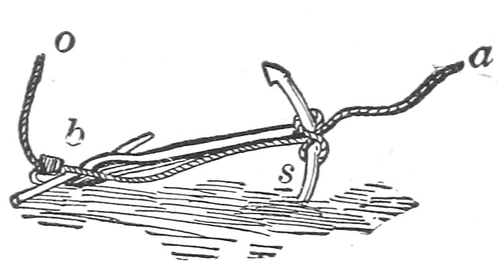
at any time. If the cable is of rope,
29take care that it is not made fast to the
ring with a slippery hitch. Anchors
cost money, and a bend that will not
come adrift is quite simple to make.
Cast the tyers off the mainsail and
hoist it, pulling up best on the throat
halyards and then "swigging" on the
peak till the after-leech is taut and the
sail begins to wrinkle slightly at the
throat. While you are setting the sail,
let the sheet fly. Next coil down the
throat and peak halyards clear for running,
and see that the mainsheet is free
from kinks and coiled so that it can be
eased off at a moment's notice without
any danger of jamming in the block.
A kink in the mainsheet has capsized
many a cat-boat. Before you reeve a new
mainsheet, stretch it well and take all
the kinks out of it. Take care that the
running parts of all sheets and halyards
are coiled uppermost, with the ends
underneath.
Let us suppose that there is a nice
breeze blowing and that your intention
is to essay a four or five mile beat to
windward, and then conclude your trial
trip with a run home. Cast adrift from
your moorings or get your anchor
aboard, as the case may be, and start
out on whichever tack is convenient.
When on the starboard tack the boom
is over to port, and vice versa. Lower
the centerboard and fill away on the
boat with one hand on the tiller and
the other holding the mainsheet, which
should never be belayed, but may be
held by half a turn round the cleat.
30Do not make the mistake of trimming
in the sheet too flat, but let the boom
off till it is well on the quarter and keep
the sail well full, not allowing it to
shiver. This is called steering "full-and-by,"
which signifies as close to the
wind as possible with the sail not shaking.
If your boat is well balanced—that
is, if her weights are well adjusted
and her sail of proper cut—she will carry
quite a little weather helm. So much
so that if you allow the rudder to come
amidships or on a line with the keel she
will fly up in the wind and her sails will
shake. This is by no means a fault unless
it is carried to excess, and it may be
said, indeed, that there is something
radically wrong with a craft that requires
lee helm—a defect that should
be remedied at once.
The young sailor should bear in mind
that to accomplish the best results in
beating to windward the sail should always
be kept full. Nothing is gained
by sailing a boat right in the wind's eye
with the sail shivering. The boat then
points higher but she goes to leeward
like a crab. Instances have been known
of a fore-and-aft racing yacht sailing
within three points of the wind, but
these are rare, indeed. The ordinary
cat-boat will not often do better than
pointing up within four points of the
breeze, and her best windward work is
generally thus accomplished. There
are occasions, indeed, when what is
known as a "fisherman's luff" may be
indulged in with profit, such as when
31rounding a mark or shooting up to an
anchorage where there is little room.
The maneuver consists in luffing the
boat up into the wind so that the sails
shake, and she shoots dead to windward
by her own momentum. If the boat is
a heavy one she will shoot quite a distance.
Care must be taken to put the
helm up and fill on her before she loses
way, or she will get "in irons" and
acquire sternway, or perhaps pay off
on the other tack. If a boat acquires
sternway the helm must be shifted at
once. The rudder will now produce the
reverse effect to what it would if the
boat were going ahead. Putting the
tiller to starboard turns the vessel's head
to port, and vice versa in the case of
sternway.
The beginner will find that his boat
spins along quite merrily and obeys the
slightest touch of the tiller. He should
not relax his vigilance in the least, but
should keep his weather eye skinned for
sudden gusts of wind or catspaws which
may be seen ruffling the water to windward,
in timely season before they strike
the boat. As the little craft begins to
heel or list over to the pressure, luff up
a little so that the fore-leech of the sail
begins to shiver. If there is not weight
enough in the puff to put the lee rail
under, sail her along with just the suspicion
of a shake in the luff of the sail,
so that if she goes over far enough for
the water to threaten to come over the
lee coamings and deluge the cockpit you
can put your helm down and luff up
32until the boat comes nearly head to
wind, at the same time lowering away
your sail and making preparations for
taking in a reef.
If you are a novice, and the water is
neither too rough nor too deep and the
breeze seems likely to last, and you think
your craft is not up to carrying a whole
mainsail, there is no reason why you
should not drop anchor and reef your
sail in leisurely and comfortable fashion.
If you feel at all nervous take in a
couple of reefs.
After sail has been shortened set the
mainsail, hoist up the anchor again and
thresh her at it. You will observe that
she inclines less to the puffs under the
pressure of the reduced sail, and that
the lee gunwale is always well clear of
the water. Watch the boat well; look
out for coming squalls, and be prepared
to ease off the sheet and luff up instantly
should occasion arise. If there
are other boats in company with you
tacking toward the same point you must
remember that those on the starboard
tack have the right of way, and thus
when you are on the port tack you must
keep clear of them. I would not advise
a novice in a boat on the port tack to
try and cross the bow of a boat on the
starboard tack unless there is plenty of
room. Distances on the water are deceptive
to the tyro, and it is well to run
no risk of collision. If the boat on the
port tack will not keep away for you
when you are on the starboard tack,
and seems to be making for you with
33the intention of running you down, keep
cool. Stand by to put your helm hard
down so as to luff right up in the wind
or even to go about. If you put your
helm up and keep away, and a collision
ensues, you would probably have to pay
all the damage. The strict legal rule
is that the vessel on the starboard tack
must keep her course and neither luff
nor bear up. If this rule is observed
you will be within the letter of the law.
In yacht racing a yacht on the port tack
can be disqualified if she is struck by a
yacht which is on the starboard tack, no
matter how the striking happened; if
she herself strikes a yacht which is on
the starboard tack; if she causes a yacht
which is on the starboard tack to bear
away to avoid a collision. It is apparent,
therefore, that no wise helmsman
will run any risks. If he is on the port
tack he will give way with a good grace
and try to look pleasant. It is better
than a collision, which is sure in a brisk
breeze to do a lot of damage, and may
possibly cause serious personal injuries
or even loss of life.
The beginner may, after threshing to
windward for an hour or so, begin to feel
homesick. Let him then put his helm up,
easing the mainsheet off at the same
time until he gets the boom at a right
angle with the mast and the boat dead
before the wind. He will at this time
have to pay particular attention to the
steering, giving the boat "small helm"
and giving it to her quickly in order to
keep her steady on her course. Steering
34a cat-boat in a stiff breeze and lumpy
water requires both skill and experience.
I should counsel a green hand to lower
the peak of the mainsail and run her
under easy sail until he acquires the art.
In that case, should he accidentally gybe
the boom over, the result is not likely to
be particularly disastrous; whereas, if
the sail were peaked up, the boom might
snap in two or the boat herself might
broach to.
The centerboard should be hoisted
up into the trunk when running before
the wind, and the boom should be kept
well topped up. In some small cat-boats
there is no topping lift and the sail has
only one halyard, which hoists both the
throat and peak. This is a faulty rig.
Throat and peak halyards should be
separate, and a topping lift should always
be fitted.
I think it my duty to warn the inexperienced
boat sailer against gybing
his little craft. It is a maneuver that
requires skill and care, especially in a
brisk breeze. If you must gybe, lower
the peak so as to "scandalize" the sail,
and haul the boom well aboard as the
helm is put up. As the wind shifts from
dead astern and comes on the other
quarter, carrying the boom over, ease
off the sheet handsomely and take care
to meet her promptly with the helm as
she flies to, which is invariably the case.
You can then hoist the peak up again.
If you have women and children
aboard the boat, gybing should never be
resorted to if the wind is strong. It is
35far preferable to luff up into the wind
and tack and then keep off again.
In coming to anchor or picking up
moorings make the boat describe a good
sweep, so that she may come up in the
wind and lose her way exactly where
you wish. You can then either let go
the anchor or pick up the moorings, as
the case may be. Then lower the sail,
furl it snugly, put on the sail cover, stow
away everything neatly, haul taut the
halyards and the mainsheet, which you
should coil up, and leave everything tidy
and in readiness for getting under way
next time.
When, on a wind with a light breeze
and in smooth water, it becomes necessary
to heave to to let a boat come
alongside, haul the mainsheet flat aft
and haul the fore and jib sheets a-weather.
If in a fresh breeze, flatten in the
mainsheet, let the jib sheet flow, and
haul the fore sheet a-weather.
For small open boats the anchor
should weigh one pound for every foot
of length up to twenty feet length. If
the boat is ballasted, another half pound
per foot should be added.
If you have the misfortune to get
stuck fast in the mud or on a sand bank,
you must act quickly. If you ground
while running before the wind, lower
your sails at once. If you have a
dinghy, run out your kedge anchor,
with a line fast to it, astern into deep
water and try to haul off. Work the
helm to and fro. Run from side to
side so as to loosen the boat from her
36muddy bed. If the tide is rising and
your kedge does not drag, you will be
sure to get off.
If you run aground while close-hauled,
let go the mainsheet, put the helm
hard over and try to back her off with
the jib, at the same time using a boathook
or oar to try to shove her into
deep water. If you have any passengers,
concentrate all their weight as far
aft as possible. Send out a kedge, and
let all hands clap to on the line. If the
tide is on the ebb, you may probably
have to wait till high water. Now comes
a ticklish crisis. If your craft is beamy,
with full bilges, she will take the
ground and lie easily as the water recedes.
If, on the other hand, your
little ship is of the deep and narrow
kind and is not provided with "legs,"
you will have to improvise something
in that direction to prevent her from
careening on her side. "Legs" are not
fashionable on this side of the Atlantic.
They are props of wood shod with iron,
one end of which rests on the bottom,
while the other fits under the channels,
or is lashed to a shroud. If you have
no other spar available, unbend the head
of the mainsail from the gaff. Stick it
in the mud jaws downward close to the
rigging and lash it firmly to a shroud.
List the boat over to the side the gaff is
out by guying over the boom and putting
any extra weight you happen to
have on the same side. The boat will
then take the ground in safety.
IV. THE YAWL RIG.
37
Though I recommend the catboat
as a general craft for knocking
about and having a good time in,
I am not blind to the advantages
of the yawl rig. In fact, the
bold young seaman contemplating long
cruises and sometimes venturing out of
sight of land will find that the yawl rig
possesses no mean merit. For single-handed
cruising its worth has long been
recognized. The sails are so divided
that they are small and easy to handle,
but this division of sail inevitably decreases
the speed and also the weatherly
qualities of the boat. If we take
a catboat and change her into a yawl
rig she will not be nearly so fast, nor
will she point so close to the wind.
There are fathoms of scientific reasons
for this with which I will not
bother my readers. Suffice it to say
that it has been demonstrated practically
over and over again.
But although the yawl-rigged sailing
boat of the smallest type has at least
three sails—foresail, mainsail and mizzen—yet
the last named, after once being
set, practically takes care of itself. The
mainsail, too, is quite easily handled,
the whole sail being in the body of the
boat. The foresail sometimes gives a
little annoyance in taking it in, if the
38boat is pitching her nose under in a
steep sea. This, however, is unavoidable.
Headsails on all sailing vessels,
big or little, have never been conducive
to dry skins under certain conditions of
wind and sea. The yawl is always under
control, and in this attribute lies her
chief charm. When a squall is bearing
down all one has to do is to lower the
mainsail and pass a tyer or two round it to
keep it muzzled. When the gust strikes
the boat she is under easy sail and is
not likely to come to grief. If the squall
is of exceptional strength, ease off the
foresheet and keep the sail shaking a
little until you have felt the full strength
of the wind. Act then as judgment may
dictate. If the blow is very heavy and
seems likely to last it may be necessary
to take in the foresail and the mizzen,
and close reef the mainsail.
If you are sailing with the wind a-beam
and a squall smites you it may not be
necessary to lower the mainsail at all.
Ease the sheet right off so as to spill the
wind, and you will pass safely through
the ordeal without parting a rope yarn.
In getting under way or in working
up to anchorage in a crowded harbor
or roadstead the yawl rig is one of the
handiest known, for by having the mainsail
furled the speed of the boat is reduced
so that you can pick your way
among the craft without danger of collision
or striking flaws. So many famous
cruises have been made in small
yawl-rigged craft that there can be no
doubt about their adaptability for such
39work, and to the man anxious for more
ambitious achievement than merely
sailing in rivers, bays and sheltered
harbors, I most certainly would recommend
the rig.
Despite the yawl's certain safety for
single handed cruising, I am not in favor
of sailing by myself. I prefer a congenial
companion to share whatever pleasure
or peril may be encountered. Of course
one must exercise some wise discrimination
in the choice of a cruising companion;
for when once at sea there is no
way of ridding yourself of an objectionable
mate except throwing him overboard,
which would not be exactly fair
to him. Besides, he might throw you
overboard, which would be bad for you.
There are, however, hundreds of good
yachtsmen and boatmen who have made
long voyages alone and have written
charming accounts of their nautical expeditions.
John McGregor's "Voyage
Alone in the Yawl Rob Roy" and E.
Middleton's "Cruise of the Kate" (also
a yawl) are two entertaining books of
sea travel which I heartily recommend to
those who contemplate sailing by themselves.
While I am in favor of a catboat for
general purposes in the neighborhood
of New York, yet when long distance
trips are to be made the yawl rig will,
on the whole, be found preferable.
That keen sportsman, Mr. W. H. H.
Murray, is a firm believer in the yawl
rig for cruising. In Outing for May,
1891, there appeared a most valuable
40article from his facile pen entitled
"How I sail Champlain." The Champlain
is of sharpie model, thirty feet on
the water-line. She is of remarkably
strong construction, her oaken keel being
sixteen by twenty inches amidships
and tapering properly fore and aft.
Through this keel is sunk a mortise
four inches wide and sixteen feet long,
through which the centerboard works.
This "fin" is of oak planking thick
enough to easily enter the case when
hoisted, but leaving little space between
it and the case when in use. The
centerboard is sixteen feet long, four
feet deep forward and seven feet aft,
and it has fifteen hundred pounds of iron
for ballast. Mr. Murray says: "When
the centerboard is lowered this mass of
metal is eight feet below her water-line,
and guarantees a stability adequate to
resist any pressure which the wind can
put upon her sails and the sails withstand.
Of course I am speaking with
the supposition that the boat receives,
when under stress, judicious management."
The centerboard, which weighs two
thousand pounds, is lifted by a "differential
hoist," by means of which "the
helmsman, with one hand on the tiller,
can, if need occurs, with the other easily
run the heavy board rapidly up into
the case. The value of this adjustment
can only be appreciated by a cruising
yachtsman. It places him in perfect
control of his craft under all conditions
of varying depth of water and difficult
weather. In a heavy seaway; in rapidly
shoaling water on an unknown
coast; when suddenly compelled to
beat up against a swiftly flowing tide;
or when finding himself unexpectedly
near a reef, unobserved through carelessness
or not plainly charted—this
hoist is simply priceless. It is not over
expensive, and can easily be adjusted to
any yacht."
41
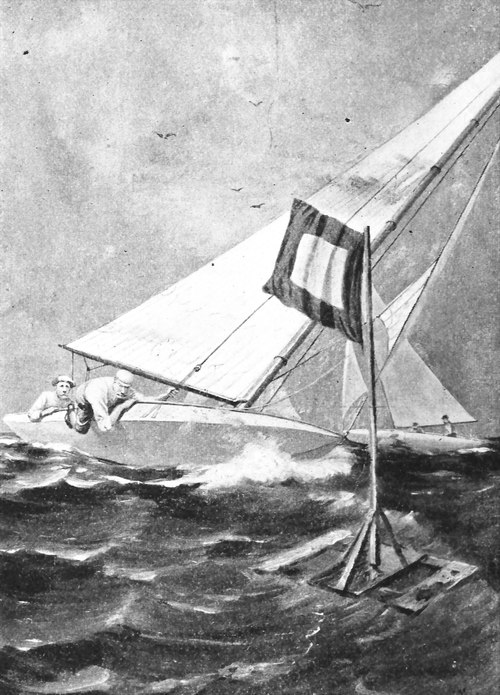
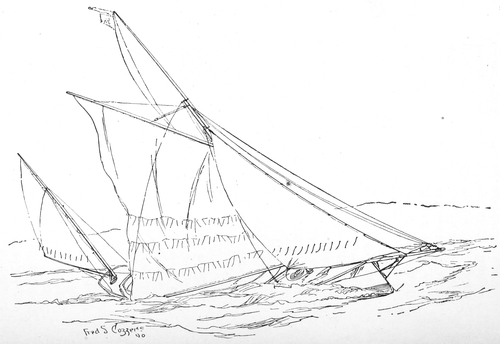
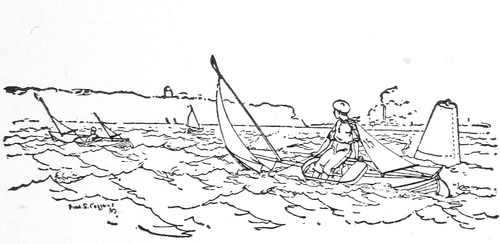
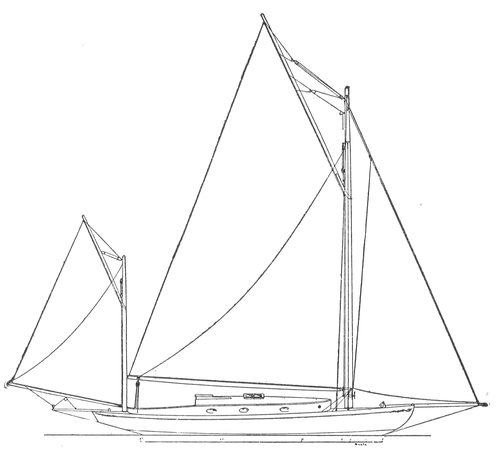
YAWL IN A SQUALL
42The cockpit is roomy, and, because of
its high coamings, is also deep. The
cabin is sixteen feet long, the forward
half being permanently roofed. The
after-half of the cabin is constructed, as
to its roof, in equal divisions. The forward-half
is tracked, and the after-half
is grooved to run upon it. Mr. Murray
finds this arrangement most convenient,
as it gives to the yacht such coolness
and comfort as cannot be obtained in a
cabin permanently roofed. The whole
roof is so fitted to the coamings that it
can be quickly and easily removed and
stowed, leaving the yacht to be sailed
as an open one, decked from stem to
midship section. This arrangement is
an admirable one for harbor sailing in
bright weather or for racing.
Regarding the handiness of Champlain
Mr. Murray says: "All yachtsmen
know what a disagreeable job it
is to reef a sloop or cat-boat in rough
water, and from this cause many skippers
will delay reefing as long as possible
and often until too late. And because
of this many accidents happen
yearly. In this respect the yawl rig
43shows to the greatest advantage and
commends itself to all sensible yachtsmen.
For when the moment has come
to reef, if the boat is running free her
head is brought up to the wind, the
mizzen and jib sheets trimmed in, and
with the main boom well inboard the
pennants are lashed and the reef points
tied down, when she is let off again and
goes bowling along on her former
course. In Champlain the three reef
cringles on the leech of the mainsail
are all within easy reach from the cockpit,
and the skipper, without leaving the
tiller, can lash the pennants, and hence,
with only one assistant, the three reefs
can successively, if need be, be tied
down. Indeed, so well do the jib and
mizzen sail work in unison, that unless
the wind is very puffy and variable, the
helm can be lashed and she will hold
her course steadily onward while the
skipper is tying down the after reef
points. It is a matter of pleasant surprise
to one not accustomed to this rig
how easily and rapidly a reef in most
trying conditions can be taken in the
mainsail of a yawl whose sails are well
balanced.
"Moreover, unless the squall is a very
heavy one, a yawl can be eased through
it without reefing at all. For when the
wind comes roaring down and the white
line of froth and spray is right upon
you, the boat can be brought up to the
wind and the mainsheet eased handsomely
out, and with jib and mizzen
drawing finely and the mainboom off to
44leeward the wind whistles harmlessly
between the masts, while the yacht, only
slightly disturbed in her balance, sails
steadily along. Or, if the squall is a
heavy one and there is no time to reef
down before it strikes, the yacht can be
luffed up, the mainsail let down at a run,
and with the belly of the sail held within
the lazy-lines the yacht is under safe
conditions. But ordinarily it is better
to reef or even tie down the mainsail
snugly, and as in a yawl it can be done
rapidly and easily there is no reason
why it should not be done and everything
be kept shipshape.
"In cruising I often sailed Champlain
under jib and mizzen alone, with the
mainsail stowed and the boom crutched
and tied snugly down amidships, especially
in the night time when it was
very dark and the weather foul. Under
this scant canvas with a favorable wind
she would sail along at a very fair rate
of speed and even make good progress
in beating up against quite a sea, and I
need not say that it adds greatly to the
pleasure of cruising in a small yacht
with only one man for your crew to feel
that you have your boat in a condition
of perfect control. It is evident that
with no other rig can this condition to
the same degree be obtained or such a
sense of absolute security be enjoyed.
"To an amateur nothing is more trying
than coming to or getting away
from moorings, especially if the wind is
blowing strongly and the anchorage
ground is crowded with other yachts,
45not to speak of vessels of commerce,
bateaux, tugs and ferryboats. Under
such circumstances it is no easy matter
for any, save an expert, to work a sloop
or cat-boat or schooner safety out
through the crowded harbor or basin to
the open water beyond; and it is all
the more trying to a skipper if there is
a strong tide running at the moment.
But with a yawl the difficulties of the
situation are almost wholly removed.
For with mainsail unlashed he can hoist
his anchor or cast off from moorings,
and under his two small sails work his
boat out slowly and safely from the
jammed basin or crowded space within
the breakwater. He must be a tyro indeed
who cannot safely manage a yawl
under the worst possible conditions of
this sort.
"In cruising, if the weather is threatening
it is well to carry a single reef in
the mainsail until it clears up, for a
yawl works well under such a sail with
jib and mizzen furled. In such trim
the yacht is as a cat-boat with a small
sail, and as her main boom is shorter
than a cat-boat's or a sloop's she can be
worked in a very heavy sea with her
boom's end well above the rollers. And
I know of nothing more trying to a
skipper than to sail his craft with his
boom's end half the time under water.
In such a condition the spars, rigging
and boat are under a stress and strain
which every prudent skipper dreads and
seeks to avoid, and it speaks volumes in
favor of the yawl rig to say that with it
46such a trying condition can never arise.
Indeed a yawl under a double-reefed
mainsail alone is in perfect trim for
scudding. If well modeled she will
neither yaw nor thrash the water with
her boom's end, but career along almost
with the speed of the wind itself. For
her canvas is low down, as it should be,
and her boom carried well above the
seething water. In this shape, moreover,
she can lay a course with the wind well
over her quarter without strain, and it
must be a very hard blow and rough
water indeed to give anxiety to any on
board of her."
That the Champlain is a capital sea-boat
is beyond question. Her owner
thus describes a run on the lower St.
Lawrence in returning from a cruise to
the Saguenay: "We passed Baie St.
Paul in the evening, whirled along by a
rising gale blowing directly up the river.
The night was pitchy dark, the tide
running fiercely on the ebb at the rate
of five miles an hour at the least. The
water was very wild, as one can easily
imagine. Stemming such a current it
would not do to shorten sail if one
wished to pass Cape Tourmente and get
into quiet water, the Isle of Orleans and
the north shore, so we let every sail
stand, cleated the sheets tightly and let
her drive. How she did tear onward!
The froth and spume lay deep on her
pathways and after-deck. The waves
crested fiercely, rolling against the current,
and the black water broke into
phosphor as we slashed through it. I
47do not recall that I ever saw a yacht
forced along more savagely. How the
water roared under the ledges and
along the rough shores of Tourmente!
And I was profoundly grateful when we
were able to bear off to starboard and
run into the still water back of Orleans.
Perhaps that midnight cup of coffee did
not taste well! Its heat ran through
my chilled veins like Chartreuse. I can
taste it yet!"
The ordinary jib-and-mainsail rigged
boat, as seen in the waters round New
York, might easily be improved upon.
In the first place, the majority of them
are too much after the skimming-dish
pattern to suit my fancy. Then the
mast is stepped as a rule too far forward
for the best work, and renders reefing
difficult, as she will not "lay to" comfortably
under her headsail, whereas if
the mast of a boat is stepped well aft,
cutter fashion, the boat will lay to quite
well, and reefing the mainsail is easy.
The American sloop rig is open to the
same criticism, and that is why the English
way of rigging a single-sticker has
been adopted in all our new racing
craft. To my mind there is nothing
more hideous than a "bobbed" jib. It
renders good windward work impossible,
as it causes a boat to sag off to leeward
and is in other ways a detriment.
A small boat with the mast stepped in
the right place and carrying a jib and a
mainsail is, however, a very satisfactory
craft, good at beating to windward as
well as reaching or running. I should
48advise that a "spit-fire" or storm jib
be carried along whenever a sail of any
distance is contemplated, and also a gaff-headed
trysail, so that the adventurous
skipper may be always prepared for
storm and stress of weather. This extra
"muslin" takes up little room when
properly rolled up.
The simplest and safest rig in the
world is the leg-of-mutton sail. It is
the one fitted exactly for river work,
where one is sure to encounter puffs of
some force as ravines are reached or
valleys passed. To amateurs it is the
sail par excellence for experimenting
with, for no matter how many blunders
are made a mishap is well nigh impossible.
The leg-of-mutton sail has no gaff,
nor need it have a boom. There is little
or no leverage aloft, and all the power
for mischief it has can be taken out of
it by slacking off the sheet and spilling
the wind. The learner might with advantage
practice with a sail of this
shape until he becomes proficient. If
he eventually determines upon a jib and
mainsail or yawl rig for permanent use,
he may avoid wasting it by having it
made over into a storm trysail.
I would strongly advise every amateur
skipper to shun the ballast-fin device
as he would shun cold poison or a
contagious disease. That is unless he
intends to go in for a regular racing
career, in which case the cups carried
off might possibly compensate him for
the woe, the anguish and the premature
gray hairs inseparable from this contrivance.
49Mind you these remarks of
mine apply only to amateurs and not to
grizzled sailing-masters of yachts who
fully understand how to navigate and
handle all types of pleasure craft. Theoretically
the ballast-fin has many obvious
advantages.
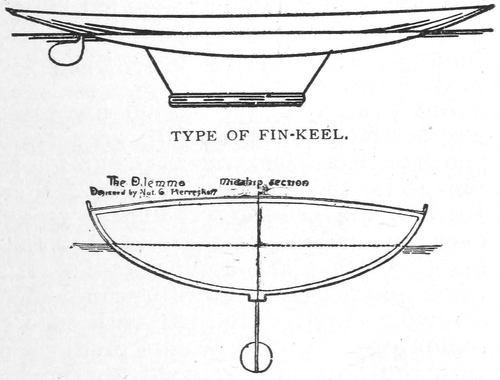
TYPE OF FIN-KEEL.
The fin consists of a plate of iron or
steel to the base of which is affixed a
bulb of lead, which, being in the best
possible place, insures stability. The
fin proper gives lateral resistance in an
almost perfect form, for there is no
deadwood either forward or aft and the
least possible amount of wetted surface.
I remember when a little boy in a fishing
village on the bank of a land-locked
arm of the sea, where the water was
always smooth, how we youngsters
came to appreciate fully the worth of
an improvised ballast-fin. We used to
enjoy the diversion of model yacht sailing
and the delights of many regattas.
50I owned one of the smartest models in
the village. She was rigged as a cutter
with outside lead, self-steering gear and
all the latest maritime improvements,
and she generally came out a winner.
I tell you I used to put on a great many
airs on this account, and as a natural
result was duly hated and envied by my
playmates, who owned more or less
tubby craft that could scarcely get out
of their own way.
But the day arrived when my pride
was destined to have a fall. A shrewd
youth of Scottish extraction came to our
village for the summer with his father.
He had the keenest, greenest eye you
ever saw, and one of those money-making
noses that are unmistakable. His
whole physiognomy and form indicated
shrewdness. He mingled with us for
some time on the beach, mudlarked
with the boys and watched our model
yacht matches with undisguised interest.
We all got the notion that he was
an inland landlubber, though it is only
fair to him to acknowledge that he never
told us so in so many words.
One Saturday afternoon, after my
little cutter had surpassed herself by
distancing all her opponents, I indulged
in some unusually tall talk, and challenged
each and every one of my rivals
to a race across the "creek," as the sheet
of water was called, offering to give
them four minutes' start, the distance
being half a mile.
To my surprise, our green-eyed friend
came along and accepted the challenge,
51saying that on the following Saturday
he would produce a craft that would
knock spots out of my cutter without
any time allowance whatever, and without
the aid of a longer hull or larger
sailspread. He also remarked that he
had a month's pocket money saved up,
and was willing to wager it on the
result. I accepted his offer without
superfluous parleying, and in my mind's
eye was already investing that pocket
money of his in various little treasures
for which I hankered. But, for all that,
I made every preparation for the fray,
using very fine sandpaper and pot lead
till my boat's bottom was beautifully
burnished, and seeing that her sails and
gear were in tip top racing condition.
All the boys wondered what sort of a
craft my opponent would bring out.
He had never been seen with a boat of
any description. We laughed in our
sleeves and whispered it about that he
would probably produce one of those
showy vessels that one sees in the city
toy store, and that generally sail on
their beam ends.
The hour for the race arrived. The
boys were all excited and flocked to the
water's edge, whence the start was to
be made. There was a goodly throng
of them present, and, notwithstanding
their contempt for the Scotchman, it
was no doubt the desire of their hearts
that some of my overweening conceit
should be taken down a couple of pegs
or so. Presently my rival appeared on
the scene, carrying in his arms the
52queerest looking craft any of us had
ever seen. Her hull was shaped like an
Indian birch bark canoe, except that to
the rounded bottom a keel was fastened.
A groove was made in the keel, in which
an oblong piece of slate was placed, to
the bottom of which a strip of lead
was secured. The rig was that of a
cutter, and I noticed that her sails were
well cut. She looked quite business-like,
and when she was measured we found she
was two inches shorter than my cutter.
There was a nice, fresh westerly wind
blowing, and quite a lop of a sea running
for diminutive craft such as were
about to race. I had already deemed it
prudent to take in a reef in the mainsail
of my vessel, and set a No. 2 jib, but
my Scotch friend said he thought his
boat would carry whole sail without any
trouble. The course was south, so the
craft had to sail with the wind a-beam.
The start was made, my boat being to
windward, as I had won the toss. And
that was all I did win. The "ballast-fin"
craft beat my cutter so badly that
even at this distance of time my ears
tingle and I feel ashamed. While my
boat was burying herself, her rival took
the curling wavelets right buoyantly,
standing up to her work valiantly,
and moving two feet to the cutter's one.
We accompanied the model yachts in
row-boats, keeping well to leeward, but
quite close enough to observe their
movements accurately. That was my
first experience of the ballast-fin. We
all became converts, and shoal, round-bottomed
53craft, with slate fins to give stability
and lateral resistance, were thenceforward
the fashion. My successful
rival, we afterward discovered, was the
son of a naval architect of repute, and
he is now practising his father's profession
with a good deal of success.
Thus I have not a word to say against
the ballast-fin so far as racing is concerned,
but in cruising the average man
who sails for pleasure wants a craft that
he can haul out of the water easily to
scrub, clean and paint. Now, if you
put a ballast-fin boat on the mud for any
one or all of these purposes she requires
a "leg" on each side to keep her upright,
and also supports at the bow and
stern to prevent her from turning head
over heels. The stationary fin always
represents your true draught of water.
It is always with you and is an integral
portion of the boat's hull. If you happen
to get stuck on a shoal—and this is
a contingency that has occurred frequently
to the most skillful and careful
navigator—in thick weather for instance,
your lot is by no means to be
envied. This is particularly true if the
tide is falling fast. The boat would go
over on her side as soon as the water
got low enough. The crew and passengers
might have to wait aboard
until high water, and a precious uncomfortable
time they would pass I am
certain. When the flood tide made it
might be a moot question whether the
boat would float or fill with water.
The movable centerplate will always
54let you know when you get on a shoal,
and will in nearly all cases give you
warning in time to avoid grounding,
which is always an unpleasant predicament
and one entailing much labor.
Then, again, the anchorages at which
small boats can safely lie are generally
pretty shallow at low water and the ballast-fin
is found to be mighty inconvenient
for such places.
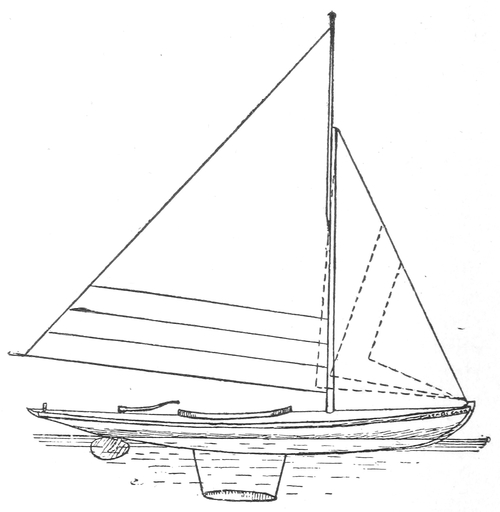
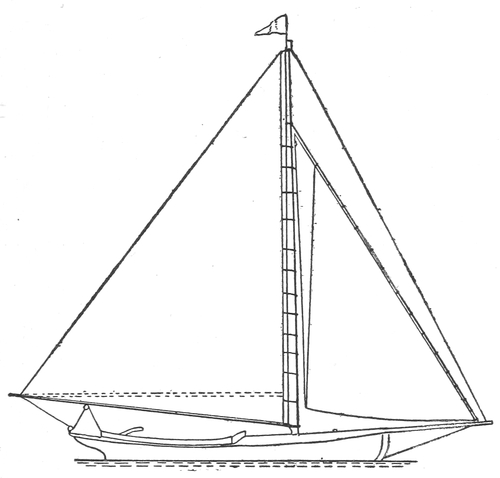
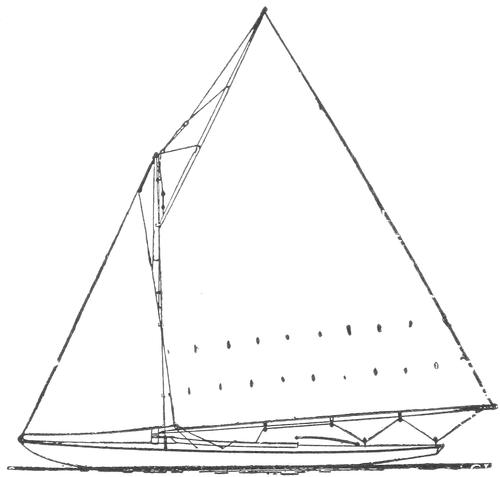
SAIL PLAN OF FIN-KEEL.
V. THE KNOCKABOUT CLASSES.
55
The knockabouts, which had their
origin in Boston, have much to
recommend them. They are free
from freakiness. None of them
at this time of writing have been fitted
with fin-keels to harass their skippers
when they come in contact with the
ground. They have a moderate sail
area, and thus are under control at all
times. In a blow one is as safe aboard
one of these craft as a converted Chinaman
under the lee of his fair Sunday-school
teacher at church-time. The
variety in vogue in Boston in 1897 was
limited to 500 square feet of sail. All
were keel boats, 21 feet being the limit
of length on the load water-line.
This class gained popularity from the
intrinsic excellence of the boats themselves,
combining capital cruising qualities
with fair speed and good accommodations.
Several designers competed,
the restrictions governing their construction,
dimensions, and sail area
being such that the boats were very
even in speed, and the contests in
which they took part were keen, close,
and exciting.
56
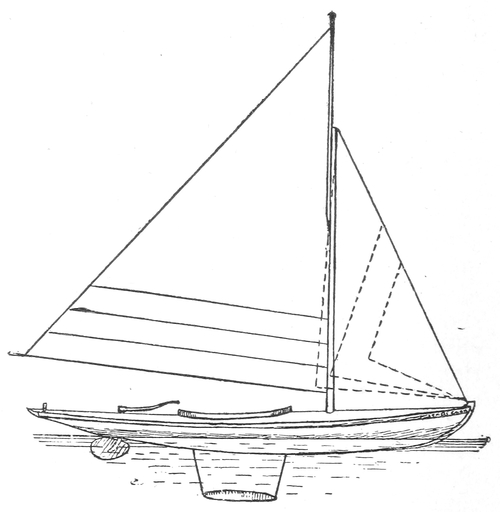
SEAWANHAKA 21-FOOT KNOCKABOUT.
The type of knockabout chosen for
the season of 1898 by the Seawanhaka
Corinthian Yacht Club and the Westchester
Country Club has proved to be quite
admirably adapted for cruising and
racing. They were designed and built
by Mr. W. B. Stearns, of Marblehead,
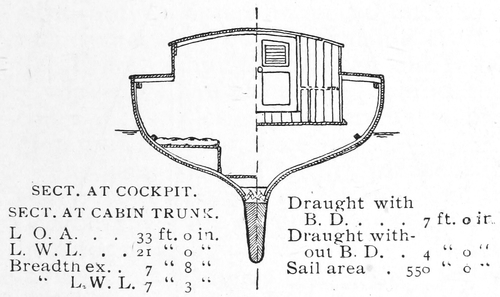
their dimensions being: Length over
all, 33 feet; on the load water-line, 21
feet; beam, 7 feet 8 inches; draught, 4
feet; with board down, 7 feet. The
area of the mainsail and jib contains 550
square feet. The centerboard is a small
one of iron, and houses below the cabin
floor. The trunk cabin is 8 feet long,
with 5 feet head-room. The price of
57these boats was $750 complete, and,
their construction being sound and
strong, they will, if taken care of properly,
be good for many years.
It is impossible to speak in terms too
high of this class after a surfeit of the
racing machines and freaks like the
20-footers whose alarming antics so
often amused and amazed us whenever
they happened to meet in a reefing
breeze. Another good property they
possess is that they look like boats when
hauled up on the beach, and can never
be mistaken when their masts are unstepped
for pig-troughs or fish floats.
There is no doubt of the seaworthiness
of these craft. They are perfectly safe
in a northwest squall off Sandy Hook
or in a dirty easterly gale on Long
Island Sound.
SEAWANHAKA KNOCKABOUT.
Another craft of this type which was
deservedly popular last year is of larger
size than the one described above. She
is 25 feet on the load water-line, 38 feet
58over all, with a beam of 8 feet 6 inches,
and 5 feet draught with centerboard up.
The boat, which was designed by Mr.
B. B. Crowninshield, of Boston, has a
commodious cabin with six feet head-room,
a seven-foot cockpit, and 800
square feet of duck in mainsail and jib.
A very able and roomy boat nearly twice
as costly as the Stearns craft, but indeed
quite a little ship.
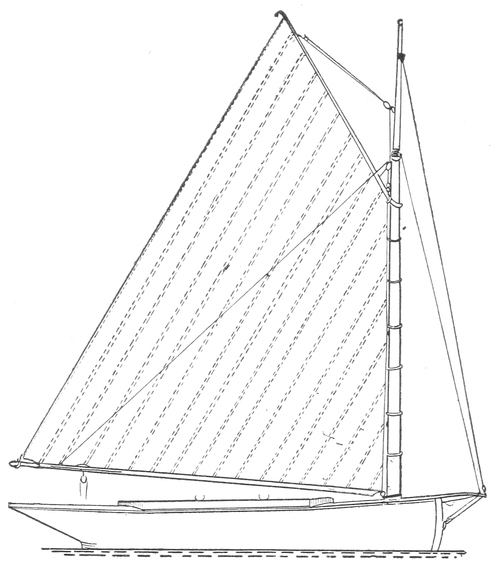
SAIL-PLAN OF SEAWANHAKA KNOCKABOUT—550 SQUARE FEET.
Personally I favor a short bowsprit in
a knockabout, it being convenient for
59hoisting the anchor, keeping it clear of
the hull, and preventing unseemly dents
from the flukes.
I fear that knockabouts, or raceabouts,
even in restricted classes, are destined
eventually to be fitted with fin-keels.
As a speed-inducing factor the fin has
fully demonstrated its capacity since the
first edition of this little book appeared.
I have not, however, altered my opinion
one iota since my remarks on the ballast-fin
made in the chapter which precedes
this. In my judgment the fin is
admirably adapted as an adjunct to a
racing machine, but for cruising craft I
like it not. Brand me as an old fogy,
if you will; half a century behind the
times, if it so pleases you, shipmates, but
give me credit for sincerity.
The keen sense of rivalry inherent in
every American will not permit him to
be content with a good, honest sailing
boat for cruising purposes only. If one
of his chums comes out with a faster
craft, whether a fin-keel or a modification
thereof, he will become dissatisfied
with his own boat, no matter how seaworthy
and comfortable she may be, and
will promptly discard her for a new-fangled
design in which speed is the
principal characteristic. The so-called
restricted classes, which are so popular
just now, are, I think, sure in the end to
become purely racing classes, something
after the fashion of the Herreshoff 30-footers
now so fashionable in Newport.
As racing boats, none afford more sport
than these wonderfully smart flyers, and
60I can well understand what fascinating
toys they have proved to their owners.
But, after all, they are only toys, vastly
expensive, too, with no accommodations
for cruising and apt to be uncomfortably
wet in a breeze.
The one-design classes of small yachts
are not confined to knockabouts only.
Cruising schooners, designed by Cary
Smith, made their appearance in 1898,
and the class, from a modest beginning,
seems likely to grow. The features of
the boats are their sound and wholesome
characteristics. They possess moderate
draught, large accommodations, and
strength of construction. They are 64
feet 2 inches over all, 46 feet long on
the load water-line, 16 feet beam,
draught without board 6 feet 6 inches,
least freeboard 3 feet. A rather low
cabin trunk gives full head-room for
the greater part of the yacht's length,
the main saloon being more than 13
feet long with a floor width of 6 feet 9
inches. On each side are two berths
and two sofas with drawers beneath.
There is accommodation in the forecastle
for four men. The yachts carry
20,000 pounds of lead ballast, of which
18,000 pounds is on keel. Another one-design
division is the Riverside Yacht
Club dory class, which has been adopted
by many of the clubs enrolled in the
Yacht-Racing Union of Long Island
Sound. These boats are thirteen feet
on the keel, seventeen feet over all,
with four feet beam, fitted with a centerboard
and rigged with a small jib and a
61leg-of-mutton sail. They are for single-handed
racing, but for pleasure cruising
or fishing a man can take his chum
along. Fully equipped with oars, sails,
etc., they cost about forty dollars, and
afford capital sport on fine afternoons.
To encourage this little class, prizes
worth winning are offered by the club,
and sweepstake races are popular features.
The idea was probably taken from
the Nahant Dory Club, organized in
1894, which did much to encourage
sport in this serviceable and inexpensive
class. Spectators will find amusement
in watching "green hands" in
their maiden efforts at sailing these
dories, as strange and startling results
often follow the rash experiments of an
adventurous tyro. But apart from the
comic element, valuable lessons in yacht-racing
may be learned by steering and
manœuvring a dory against a fleet of
half-a-dozen eager competitors. Thus,
yachtsmen cannot help approving this
new Riverside venture, originated, I
believe, by Mr. F. Bowne Jones, of the
Regatta Committee.
The origin of the one-design class was
Dublin Bay, where the "Water Wag"
type was first evolved. A Norwegian
praam with a boiler-plate centerboard,
combining ballast and lateral resistance,
and carrying a big sail, was built in
1878 at Shankhill. She was christened
Cemiostama and proved an ideal boat.
The conditions were a sloping sandy
shore on which the high surf not infrequently
62broke, and from which the craft
had to be launched every time her
owner wanted a sail, and onto which
she had to be beached after the cruise
was finished. Cemiostama was a capital
sea-boat; she pointed well, hit what
she aimed at, did not sag off to leeward,
and was quite fast. When the centerboard,
weighing about one hundred
pounds, was raised she ran up easily on
the beach, resting quietly on her flat bottom.
Her centerboard was then lifted
out, and her crew of two hauled her up.
The knowing Irish yachtsmen, appreciating
a good thing, saw that there was
a lot of fun in a boat of this class, and
several were built, and many scrub races
were indulged in. In 1887 the Water
Wag Association was started, the craft
being built on the same lines and the
sail-area being limited. Their dimensions
were thirteen feet in length, with
a beam of four feet ten inches, full lines
and a flat floor.
The Water Wags are presided over by
a king and a queen, bishop, knights and
rooks; and although the boats were at
first used principally for pleasure, they
are now racers pure and simple. Their
headquarters are now in Kingstown Harbor,
and prizes are put up for them at
all the local regattas. They are very
handy, too, and quite admirable for the
purpose for which they were designed.
They cost from $75 to $100, and the
rules that govern their races provide
that they shall be similar in every respect
except sail-plan. The mast must
63not exceed thirteen feet over all, measured
from top of keel to truck; the fore
and aft sails must not exceed seventy-five
square feet in area, and the spinnaker
(which is to be used only before
the wind and never as a jib) must not
exceed sixty square feet.
Each boat shall carry no less than
two or more than three persons in a
race, all of whom shall be amateurs. A
member or a lady may steer. No prize
shall be awarded a boat for a sail-over,
but she may fly a winning flag therefor.
A pair of oars and a life-buoy must be
carried in every race. It is only right
to mention that these sailing regulations
are vigorously enforced.
The latest one-design class established
by our rollicking Irish cousins is
known as the 25-footers of the Dublin
Bay Sailing Club. These craft are of
such noteworthy type as to deserve a
few lines of description and approval
here, especially as it was wisely decided
that the type shall not be altered for
five years from January 1, 1898. The
boats, of which quite a number were
built and raced, are deep-keeled cutters
of the following dimensions: Length
over all, 37 feet 3 inches; length on
load water-line, 25 feet; beam, 8 feet 8
inches; draught, 6 feet 3 inches; lead on
keel, 3 tons 5 cwt., and sail area, 845
square feet, divided into a mainsail
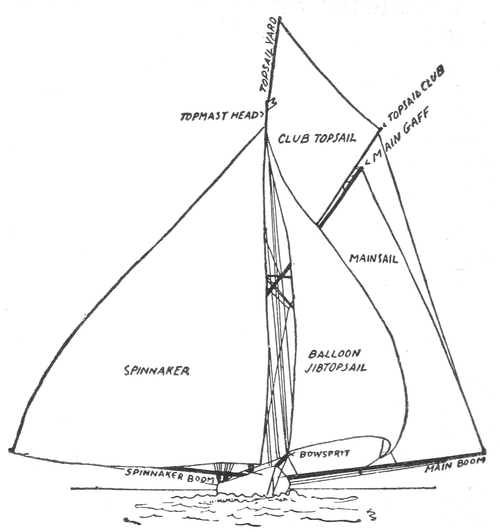
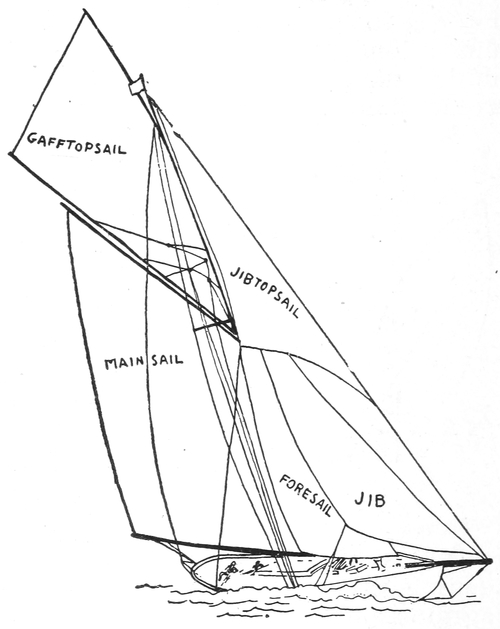
laced to the boom, gafftopsail, foresail
and jib. A second jib, jibtopsail, balloon
foresail, spinnaker, storm jib and
trysail may also be carried. The design,
64made by Will Fife, Jr., of Fairlie, is
handsome, the type being eminently
adapted for Dublin Bay. Restrictions
of the strictest kind ensure the boats
being exactly alike in size, material,
construction and canvas.
The "Mermaids," a craft much used
by the B division of the same club, are
large Water Wags, 18 feet long, with 6
feet beam, fitted with centerboards, but
carrying no ballast, and limited when
racing to 180 square feet of sail. These
are vastly popular, and a dozen or so
race every Saturday afternoon during
the season.
Although one-design racing originated
on the other side of the Atlantic,
it is questionable if any one class has
been sailed with more spirit or persistency
than were the Herreshoff 30-footers
at Newport during the yachting
season of 1897 and since.
That the classes are destined to prosper
there is no doubt, the only condition
being that the type must be carefully
adapted to the location for which
it is intended, and the more it is available
for fishing excursions and pleasure
trips the greater favor will attend it.
Another helpful feature is the substantial
economic gain from the construction
of several boats by the same builder
from the same design.
VI. KEEP YOUR WEATHER EYE OPEN.
65
The sailer of a boat, little or big,
should keep his weather eye
open all the time. When sailing
in a river where the banks
are of irregular height he should be
especially on his guard, because puffs
of considerable violence frequently
come with little or no warning. A
few inches of sheet eased off, and
a gentle luff not quite sufficient to
spill the sail, will generally prevent the
shipping of water over the lee gunwale,
and a possible capsize. Thus the mainsheet
should never be made fast permanently,
and should always be coiled
so as to be clear for running. A neglect
of either of these precautions has often
been attended with fatal results. If by
any mischance the mainsheet becomes
jammed do not hesitate, but cut it. A
sharp knife in such an emergency has
often saved life when an upset has
seemed inevitable through the boat being
nearly on her beam ends. If you
are sailing in a jib and mainsail craft,
and the squall has a good deal of weight
in it, let fly the jib sheet and let the
boat come up in the wind, at the same
time lowering away the mainsail and
taking care to spill it as it comes down.
66A reef should then be taken in, and the
boat be filled away on her course.
While sailing anywhere in the vicinity
of New York, and when one of those
heavy thunder-squalls that are so frequent
in the summer time is seen rising
in the northwest, waste no time. If not
in too deep water, anchor at once and
stow your sails snugly. You can then
ride out the fury of the squall in perfect
safety; that is, if your ground tackle
is sufficiently strong. If your cable
parts and you are on a lee shore and
there is a harbor to run for, scud for it
under bare poles or with a fragment of
sail set. If there is no refuge under
your lee, set as much sail as your boat
can safely carry and thresh her off shore.
The chances are that you will be successful,
because these squalls while often
very dangerous seldom last long, and
are generally followed by a flat calm
which is more exasperating than a blow.
We will take it for granted, however,
that your anchor and chain are of the
correct strength and quality, and that
you bring up before the squall strikes
you. If you have time it would be well
to close-reef your mainsail before furling
it, and then you would be prepared
for any emergency. But let me impress
upon all who are in charge of boats
with women and children aboard, that
it is their duty, when one of those peril-fraught
thunder-squalls is seen approaching,
to dowse every stitch of sail
at once and let go the anchor. There
is a wide gulf between bravado and
67bravery, and no truly courageous man
would imperil the lives of anyone,
especially of helpless women and children.
The rash carrying on of canvas
has been responsible for more loss of
life on the water than any other cause.
It is a seaman who shortens sail in
time, but a lubber who "cracks on till
all's blue."
Great caution is necessary when passing
under the lee of a vessel at anchor
or under way, especially in a fresh
breeze. Your boat is sure to get becalmed
and may possibly nearly lose
her way, so that as she draws clear
of the object the full force of the
breeze will strike her when she has
scarcely steerage way on. The result
may be a complete knockdown or even
a capsize. Therefore have your mainsheet
clear for running, and do not
hesitate to let it fly in a hurry before
your little vessel's gunwale is anywhere
near the water. By all means endeavor
to keep clear of vessels at anchor. Do
not try to get in the wash of steamboats,
as some foolhardy persons do,
"just for fun." On the contrary take
special pains to avoid them. When
you must encounter their wash, which
in the case of large and fast steamers
is heavy and dangerous, do your best
to let your boat take the brunt of the
waves on the bluff of the bow. If they
strike her broadside on, swamping is a
possibility not far remote.
In sailing a boat in rough water the
greatest precaution is necessary. A
68craft that in smooth water could safely
carry all sail, might when the sea is
perturbed be forced to stagger along
under double reefs, the force of the
wind being the same in both instances.
Especially is this the case when the
wind and sea are both abeam, the former
strong and the latter heavy. This is
probably the most dangerous point of
sailing there is, and requires the most
careful touch of the tiller. A boat heeled
over to fifteen degrees by the force of the
wind, by the joint influence of a sudden
puff and a heavy roll to leeward may be
inclined to such an angle that a capsize
is inevitable. When there seems to be
any danger of this mishap occurring the
helmsman must not close his eyes to
keep them warm. When he sees a
larger wave than usual coming along he
should put his helm up a little, so that
it may strike the boat abaft the beam and
so reduce the danger to a minimum.
The judicious application of weather
helm in a beam sea has saved many a
big ship's deck from being swept, and
many a small boat from being capsized.
It is in my judgment rash to sail a
small boat under these conditions unless
it is imperative, such as when a harbor
is being entered, or when the boat's
course must necessarily be steered with
wind and sea abeam. I should strongly
advise the hauling of the boat on a wind
until she reaches the point where her
sheets may be eased off and she can be
headed for her destination with wind
and sea on the quarter. A boat with
69any pretensions at all can be sailed
close-hauled in rough water with safety
if certain elementary precautions are
observed. Everybody on board except
the helmsman should sit amidships in
the bottom of the boat, so as to keep
the weight as low as possible and the
craft herself in her natural trim. No
unusual weight is wanted in the bow
of the vessel, which should lift in a
prompt and lively manner to each sea.
In an open boat and a nasty sea no
more sail should be carried than will
keep her under proper command.
A great deal depends upon the nerve
and skill of the man at the tiller. Keep
her moving all the time. If a big wave
threatens to come aboard over the
weather bow, luff smartly into it and
meet it as nearly end on as possible.
Then up with the helm at once and fill
on her again, repeating the process as
often as it may be needful. Never let the
lee gunwale get under water in a seaway,
nor at any other time, but always
luff before it is too late, and help her to
come up in the wind if necessary by
easing away the jib sheet.
If the wind keeps increasing and the
sea rising, haul down the headsail and
pass a gasket round it, close-reef your
mainsail, previously seeing your sea anchor
clear for letting go. If you have no
sea anchor with you, rig some sort of a
raft with oars, boathook and sails, the latter
lashed securely to the spars. Make a
line fast to this raft and pay out about
twenty fathoms and let the boat ride to
70it as to an anchor. It is surprising what
a good effect this contrivance has in
breaking the waves and keeping the
boat head to sea. Nothing else can now
be done until the gale moderates sufficiently
for sail to be made and the boat
headed for her destination. It may be
consolatory to those aboard a craft in
such a contingency to buoy themselves
up by remembering that some of the
heaviest gales known have been safely
ridden out in cockleshell boats without
any damage to crew, hull or gear.
DROGUE, OR SEA ANCHOR.
The sea anchor consists of a hinge-jointed
galvanized ring about three feet
in diameter. A conical bag made of
stout canvas is sewed to the ring and
roped, as shown in sketch. A bridle is
fitted to the ring, to which the riding
hawser is bent. A cork buoy prevents
the anchor from diving. When thrown
overboard the mouth of the anchor
opens and fills. To hoist the anchor on
board, the tripping line, shown in diagram,
is hauled on. When not in use the
71ring is folded together by the joints, and
the bag is made fast snugly round it.
DIAGRAM OF FLOATING ANCHOR.
Another plan for
making a floating anchor
is shown below. K,
M, N, O, are the ends
of two iron bars formed
into a cross and connected
by a stout bolt, nut
and pin at their intersection,
S. At each end
of the bars is an eye
through which a strong
rope is rove, hauled
taut, and well secured.
Thus a square is formed,
and over the square
a piece of strong canvas
is laced to the roping. Four ropes
are made fast to the iron bars, forming
a bridle. To this the riding hawser
is made fast. To prevent the anchor
from sinking, a buoy, B, is made fast
to one corner by a rope, with five or six
fathoms of drift. The buoy rope, P,
leads on board. H is the hawser to
which the boat is riding, A is the anchor,
and B the buoy. To get the anchor
aboard haul in on the line, P. This will
cause the anchor to cant edgewise, and
it can then be easily hauled in.
72
FLOATING ANCHOR IN USE.
In scudding before a strong wind and
a heavy sea in a small craft, a trysail is
always preferable to a sail with a boom,
which may effect much mischief by
trailing in the water or suddenly gybing.
The helmsman must be always on the
alert to prevent the boat from "broaching
to," which means flying up in the
wind; or from being "brought by the
lee," which means running off so as to
bring the wind on the other quarter.
A long, narrow boat will always run
before the wind better than a short,
beamy craft, as she is better adapted
for taking the seas, and she also steers
easier, not yawing about so much or
turning round every few minutes to
take a look at her wake. The inexperienced
boat sailer should bear in
mind that scudding in a seaway is ticklish
work, and is not unlikely to be
attended with peril. If you have no
trysail, reef the mainsail and lower the
peak. Hoist on the weather topping
lift so as to keep the boom as high as
possible out of the water. By no means
run a boat before the wind until it blows
too hard and the sea is too high to heave
to with safety. If the breeze seems
likely to pipe up, make up your mind
immediately. Delay is dangerous.
Have your sea anchor ready. Watch
73for a smooth. When it comes put your
helm down smartly, trimming in the
mainsheet. When she gets the wind on
the bow, heave your sea anchor overboard
and ride to it either with the
mainsail set or lowered, as may be
deemed best.
If you happen to be on a lee shore,
with the surf breaking high on the
beach, and you cannot claw off, do not
wait until it is too late and your boat is
in the breakers. Let go the anchor, and
if it holds try to ride out the storm. If
your ground tackle gives way, do your
best to set the mainsail and steer boldly
for the shore. The faster you go the
better chance you have to be carried
high and dry. Remember that this will
give you a fighting chance for your life,
whereas if your boat gets broadside on
in the breakers she will most likely roll
over and over and in all probability
drown you and your crew.
It may be thought preposterous for
me to advocate the use of oil to break
the force of curling wave-crests when
a small craft is riding to a raft or sea
anchor. Most people would naturally
suppose that a boat could not carry
enough oil aboard her for it to have
any beneficial effect in smoothing a
turbulent sea. Nor could it if it was
poured into the ocean out of its original
package, or out of "bags with small
holes punctured in their bottoms," as
some marine experts advise. The
proper way to apply oil is to fill a round
bottomed canvas bag, about two feet
74long and eight inches in diameter, three
parts full of oakum or cotton waste.
Do not pack too tightly. Pour into this
as much fish or animal oil as the oakum
or waste will suck up. Sew the mouth
up tightly with palm and needle. Secure
a lanyard to it. Make a few holes
in its sides with a marlinespike and hang
it over the lee bow, and you will be
surprised at the result. The seas, instead
of breaking over the boat and
threatening to swamp her, will become
comparatively smooth as soon as they
approach the limits of the film of the oil
as it oozes slowly out of the bag. When
running over a harbor bar where the
sea is breaking badly, a couple of these
bags suspended from either bow will
prevent the waves from pooping the
little craft and help her materially in her
struggle for existence. Mineral oil will
do if no other is available, and a gallon
of it will go a long way if used in the
manner mentioned above. These bags
should be carried all ready for use when
cruising, so that all you will have to do
is to pour the oil in, sew up the mouths
and hang them over the bows by the
lanyards. A ship's boat with a dozen
men aboard once safely weathered an
Atlantic gale by riding to a couple of
buckets and a cork fender saturated
with kerosene. Pouring oil on troubled
waters is by no means a case of bluff or
the dream of an opium smoker, but a
capital "wrinkle" by means of which
many a good man has been saved from
Davy Jones' yawning locker. I trust
that these little bags will form part of
the outfit of all going on long cruises.
They may serve as pillows or may be
made in the shape of cushions, so long
as the above general idea is followed.
75
THE BOSTON KNOCKABOUT "GOSLING."
76As a striking instance of the value of
oil in a heavy gale I will quote the case
of the British ship Slivemore, which
took fire in June, 1885, while in the Indian
Ocean about eight hundred miles
northeastward of the Seychelle Islands.
The ship was abandoned and the boats
steered for the islands. Capt. Conly,
of the Slivemore, gave orders that each
boat should take aboard two cans of
paint oil for use in bad weather, and he
also instructed the officer in command
of each boat in the use of the oil. Three
days after the ship was left the boats
encountered a cyclone. Drags made
from spars, oars and sails lashed together
were rigged, and to these improvised
sea anchors the frail craft rode securely.
Stockings filled with oakum saturated
with the oil were hung over the bows of
the boats and formed an oil-slick of considerable
expanse. Before the stockings
were hung out the boats narrowly
escaped being swamped and the men
had to bail hard with buckets. The oil
prevented the seas from breaking and
the boats rode over the enormous waves
in safety. Little water was shipped, and
those on board the boats were able to
lie down and sleep while a tropical
cyclone was raging furiously. All the
boats reached the islands in safety without
the loss of a man, but had it not
77been for the oil the loss of the Slivemore
would have remained an untold
mystery of the ocean.
A still more wonderful example of
the efficacy of oil is told by the captain
of the ship Martha Cobb, and it relates
to the achievement of a sixteen-foot
dinghy. In December, 1886, the Martha
Cobb, petroleum laden, encountered
a heavy gale in the North Atlantic.
She shipped some tremendous seas
which swept away all her large boats,
washed away her bulwarks and played
havoc generally with her decks. The
only boat that was left uninjured was
the aforesaid sixteen-foot dinghy, intended
solely for smooth water work.
While laboring and plunging in the
mountainous sea, the Martha Cobb fell
in with a sinking vessel flying signals
of distress to the effect that the water
was fast gaining on her and that all her
boats were stove in. The captain of
the Martha Cobb determined to stand
by the vessel in distress, in the hope
that the gale would abate. He knew
that his little cockleshell of a dinghy
could not possibly live in such weather,
and that it would be suicidal to lower
her and attempt a rescue.
After standing by till near nightfall
with no prospect of the storm moderating,
the commander of the Martha
Cobb determined to make an effort to
save the crew of the fast foundering
craft. The Martha Cobb's petroleum
was in casks, some of which leaked.
The captain had noticed that when the
78pumps were being worked the sea in
the wake of his ship was always much
smoother. He got the Martha Cobb to
windward of the wreck and started the
pumps, in the hope that the oil in the
well and bilges would create a smooth
when it reached the sea, so that the
dinghy could be lowered in safety.
He found, however, that the ships
drifted faster than the oil, so that while
the sea to windward was comparatively
smooth the water to leeward was rough
as ever. So he kept his ship away, ran
down under the vessel's stern and luffed
up under her lee. Then he started the
pumps and also allowed a five-gallon
can of fish oil to trickle into the water
through the scuppers. The effect was
almost miraculous. In less than half-an-hour
the crested surges and breaking
combers were converted into long heavy
swells such as you see when a calm has
succeeded a heavy gale.
The little dinghy was lowered, and
manned by three men was pulled to
windward alongside the wreck with little
difficulty. All hands were rescued,
and the tiny boat, while engaged in the
gallant work, shipped no water. All this
time the waves were breaking furiously
outside the magic limit of the oil-slick.
One more illustration and I am done.
Capt. Amlot, of the steamer Barrowmore,
on January twenty-fourth, 1885, while in
51 degrees north latitude and 21 degrees
west longitude, fell in with the sinking
ship Kirkwood. This ship had for part of
her cargo several hundred casks of canned
79salmon. In order to make a smooth
and allow the boat of the Barrowmore
to come alongside in safety, the crew of
the Kirkwood broached a number of the
cases, and opening the cans poured the
oil from them into the sea. This had
the desired result, and although the sea
was very heavy the oil reduced it rapidly,
and the boat of the Barrowmore had
no difficulty in taking off the twenty-six
men that composed the ship's company
of the Kirkwood.
Two quarts of oil used per hour will
produce effective results. A ship scudding
before the wind, with a mountainous
sea running and threatening to
poop her, has expended this amount and
kept dry. Experts have calculated that
this quantity of oil has covered the sea
with an infinitesimal film measuring
thirty feet in width and ten nautical
miles in length. As the thickness of this
film is only .0000047 of an inch, its efficacy
is indeed marvelous.
A simple and excellent device for distributing
oil has been invented by Capt.
Townsend, of the United States Signal
Office. It is cheap and convenient, and is
especially adapted for use in boats or
small yachts. It has been thus described:
"It consists of a hollow metal globe
ten inches in diameter, with a capacity of
about one and a-half gallons of oil. It
has an air chamber separated by a partition
to keep it afloat in a certain position,
and there are two valves. When
filled with oil the upper valve is adjusted
to allow oil to flow out at any desired
80rate, while the lower valve admits
water. When placed in the sea it floats
with the upper valve a little above the
surface, and water will enter to displace
the oil from the graduated upper valve.
The specific gravity of oil will keep it
in the upper part of the distributor, and
the motion of the globe on the breaking
waves or swell will insure the ejection
of the oil through the graduated valve
in any quantity."
OIL DISTRIBUTOR.
This may be used by towing over the
bow when running, or made fast to a sea
anchor when hove to.
People inclined to be skeptical are, of
course, at liberty to doubt the efficacy
of oil to lessen the
dangerous effect
of heavy seas,
but the examples I
have quoted are
simply a few culled
from several hundred
well authenticated
cases.
PLAN OF OIL DISTRIBUTOR.
The lesson learned from the Shipwash
lightship ever so many years ago,
has not been without profit and benefit
to naval architects. Let me spin you the
81yarn. The Shipwash lightship is moored
in one of the most exposed places on
the east coast of England, and is thus
continually encountering particularly
heavy seas. It came to pass that the
old lightship was replaced by a new and
scientific vessel. The new-fangled craft
was, however, so remarkably unsteady
and rolled so heavily that to the storm-tossed
mariner beating up the coast her
light appeared to be of crescent shape.
Her crew got scared. They were afraid
she would turn turtle. A surveyor from
the Trinity House was sent aboard, and
he made a report which was submitted
to her designer, who eventually said
the fault complained of could be easily
remedied by the addition of extra ballast.
Accordingly this was done, and
the next gale she rode out her rolling
was worse than ever, and produced
quite a panic among her crew, who
were afraid to go below while the storm
lasted. Another report was made to
headquarters. Other students of naval
architecture were consulted, who not
only advised that the extra ballast
be taken out, but that four tons of lead
be attached to the frame or cage supporting
the light. These instructions
were carried out, and the result was the
steadiest lightship on the east coast.
A vessel will carry herself full of coal
and behave herself in heavy weather.
But when she comes to be laden with
copper ore or lead, a certain amount of
ingenuity has to be used in the storage
of such heavy cargo to make her seaworthy
82at all. If it were all stowed in
the bottom of the vessel she would roll
so heavily in a seaway as to get dismasted,
and would probably become a
total wreck. It is now that the experienced
art of the stevedore comes in.
The man who follows the proper authorities
would construct a bin or compartment
in which to stow this dangerous
freight thus:
Fig. 1
The result would be highly satisfactory.
The vessel's center of gravity
would be the same as though she were
laden with coal, and her movements in a
seaway would therefore be quite as easy.
Another man might construct his
compartment thus:
Fig. 2
The vessel in this case would labor
quite heavily on the slightest provocation
and would not be so steady or so
seaworthy as the one first mentioned,
with the narrow bin or compartment
extending to the upper deck.
83The same remarks apply to the ballasting
of yachts. Before the days of
outside lead, when pleasure craft shifted
their racing for a cruising rig preparatory
to a deep-water voyage, it was
customary to raise the inside lead ballast
by placing layers of cork beneath it,
thus ensuring easy movements in a seaway.
Racing yachts nowadays have
all their weight outside, and this device
for their relief cannot therefore be
resorted to. When crossing the Atlantic,
say for a race for the America's Cup,
they are always in danger of getting
caught in a gale of wind and an accompanying
mountainous sea. In order to
prevent excessive rolling, which might
endanger the mast and consequently the
vessel herself, it is necessary to keep a
press of sail set. For this purpose a
trysail with plenty of hoist to it is indispensable.
It should not be one of those
jib-headed impostors that some racing
skippers most unaccountably affect, but
one with a good long gaff that will successfully
prevent the otherwise inevitable
and peril-fraught roll to windward.
A yacht under these circumstances, it
is true, cannot carry a great press of
canvas when on the top of one of those
big rollers that a gale soon kicks up in
the Atlantic. But she wants as much
of her sail area as possible exposed to
the gale when she is in the hollow of
the wave. Otherwise there will not be
sufficient pressure to prevent her from
rolling to windward.
Rolling to windward—easy enough to
84write, you may think—but every sailor
knows what may follow. Green seas
fore and aft, mast sprung, men washed
overboard; and if the gale does not
abate, why, Davy Jones' locker for all
hands and the cook!
The storm trysail must necessarily be
a sheet-footed sail set over the furled
mainsail. It is a sail comparatively
narrow at the foot, but it should for obvious
reasons be made as broad as possible
at the head, in proper proportion
of course to the breadth of the foot. It
need not have quite as much hoist as
the mainsail, for the throat halyards at
such a time must have a good drift,
while to keep the sail inboard the peak
should be quite extreme. It follows,
therefore, that although the rollers may
be high the peak of the trysail is above
them, and the yacht is kept jogging
along steadily without any sudden and
violent shocks or strains to spar or rigging.
The following rough sketches will, I
think, serve to demonstrate the superiority
of the gaff-headed trysail over
that abortion, the thimble-headed variety,
which I do not hesitate to condemn
as useless for a modern yacht
ballasted with outside lead in a seaway.
No. 1 shows vessel with gaffheaded
85sail on the crest of a wave. She drops
down into the hollow of the wave and
becomes No. 2. The shaded part of the
sail catches the wind over the crests of
the waves, and the area so exposed is
sufficient to steady the vessel and give
her a safe heel or list.
Now I wish to call your attention to
No. 3. She has enough sail spread when
on the crest of a wave. But observe her
when in the hollow. She has scarcely a
stitch of sail above the level of the crest.
The consequence is that her weight
being so low down, and her form having
so much stability, she swings with a
violent roll to windward and her mast
is thereby imperilled. This is the result
of not having the requisite amount of
pressure at the head of the sail.
The commanders of square-rigged
vessels always bear this in mind. They
heave to under a close-reefed maintopsail,
never under a lower course, and the
ship when in the trough of the sea has
enough sail exposed to keep her steady.
The smart schooners that used to ply
between St. Michaels and London in the
fruit trade, and that were bound to make
smart passages or lose money, were
always fitted with gaffheaded trysails,
and found them most efficacious in beating
86to windward in strong gales. Their
sturdy skippers would have looked with
contempt and ridicule upon any person
so fatuous as to recommend a jibheaded
trysail. And they were skilled sailors
of fore-and-aft rigged craft, and were
well acquainted with that stretch of the
wild Atlantic between the Lizard and
the Azores. These vessels used to beat
up the English Channel in the teeth of
an easterly gale and fight their way
homeward inch by inch, and I consider
the practical experience of their captains
as far more reliable than the theoretical
vagaries of men who were never
out of soundings in a small craft.
What is true of comparatively large
yachts in an Atlantic gale applies
equally to the small cruiser. The theory
is precisely the same, and in ordering a
storm trysail from his sailmaker the
aspiring owner of a smart, seaworthy
cruiser might well be guided by the few
hints given above. A gaffheaded trysail
is just what he wants to steady his boat
when hove to, and to counteract that
tendency toward rolling that outside
lead always has on the hull of a boat in
a seaway.
When coming to anchor at any other
time than low water, do not forget to
allow for the fall of the tide. For instance,
if you bring up in 10 feet of
water when the tide is high, in a boat
drawing, say 5 feet, and the range of rise
and fall is also 5 feet, at low water your
vessel would be aground and perhaps
under untoward circumstances in danger
87of damage or even total loss. This hint
is worth remembering in many parts of
the world, especially in some parts of
the Bay of Fundy, where there is a
range of no less than 50 feet! Soundings
on the chart denote the depth at
mean low water.
VII. OVERHAULING THE YACHT.
88
No matter how small a craft the
yachtsman owns she will, after a
winter's lay-up, require a good
deal of attention before she is fit
for the water; and there is no reason
why a keen yachtsman who owns a tidy
little craft should not fit her out himself
in his spare time. In fact, I am acquainted
with many boat-owners who find
nearly as much delight in getting their
own vessels into proper fettle for the
season's sport as they do in navigating
them. There is much to be said in favor
of this enterprise. The principal argument
is that a man overhauling the hull
of the boat which belongs to him will
not be at all likely to "scamp" the work.
On the contrary, it is to his interest to do
the job thoroughly while he is about it,
for he is improving his own property;
whereas if he employs a mechanic to do
it by piece work, or by the day, the task
may be performed in a manner more or
less perfunctory, or at any rate without
the attention to minor details which the
actual proprietor would be expected to
bring to the task.
I would not counsel a man to attempt
repairs which call for the skilled
shipwright or boat-builder. The result
would in all probability be a lamentable
89failure, and in the end a mechanic would
have to be called in. But the work of
cleaning, painting and varnishing a hull
intrinsically sound may be accomplished
by the man or boy of average intelligence
and industry.
What is true about a hull is still more
so of her rig. When I first went to sea
on a deep-water voyage, as soon as the
ship was out of soundings the crew's
first duty was to undo the work of the
professional rigger, stay the masts anew
by shrouds and backstays, and replace
the hurried botch-work of knots and
splices by seamanlike and shipshape
work.
Anything in the shape of a boat may
be made water-tight, no matter how
leaky she may be, if treated with careful
ingenuity. I would be the last man
to suggest patching and puttying up
a ramshackle craft whose frames and
planking are rotten. Supposing, however,
that the hull is fairly sound, but
through exposure to the hot sun her
planks are cracked in sundry places, and
that in fact she leaks like a sieve, there
is no reason why she should be condemned.
There is a lot of good fun to
be got out of a craft of this kind, if the
proper repairs are made. If put in the
hands of a professional boat-builder the
cost would be very high, even if he
could be induced to undertake the work.
Here, then, is where a handy man or
boy has a capital opportunity to try his
hand as a craftsman. I repaired an old
18 foot boat in my younger days, when
90money was scarce and I had the alternative
of giving up my pet diversion of
sailing or making the ancient bucket
tight.
This is how I went about it.
The craft in question was hauled out
on the shore above high-water mark.
She had been abandoned by her rightful
owner, who had moved inland and left
her to the tender mercies of the sun in
summer and the snow in winter. For
sixteen months she lay on the beach
neglected. Every day I cast covetous
eyes on her. I will make a clean breast
of it now in my old age and confess that
I had contemplated stealing her. That
sin was, however, spared me, as I found
her owner's address and wrote, asking
if he would sell her. He replied that
he would give her to me and welcome,
and thus made me the happiest youth
in the land.
The boat was originally a first-class
little lap-streaker of good model, built
of teak throughout and copper-fastened;
but there were many cracks in her
planks and most of her fastenings were
loose, and in a general way she might
be described as "nail-sick" all over.
With the help of a couple of chums I
placed her on chocks and shored her up
on an even keel, supporting her well,
so that she should not suffer from any
unequal strain when I filled her later on
with water. She was very dirty inside,
and I remember it took me the greater
part of a day to thoroughly clean her
with soap, hot water and a scrubbing
91brush. Then I put the plug in and
started to fill her up with water. Although
I had plenty of help from the
village boys, who were never so joyous
as when pottering about a boat, it took
a long time to fill her, for the water
poured out of her like the streams from
a shower-bath. But her dry and thirsty
planks soon began to swell a little and
the leaks to diminish. I kept her as
full of water as possible for two or three
days, marking with chalk every leak
that appeared. I may remark that the
chocks on which her keel was raised
were high enough for me to crawl completely
under her bottom and get at
every part of her. Her hull, which
originally had been varnished to show
the grain of the natural wood, was pretty
well checkered with chalk-marks by the
time I had finished. Then I let the
water drain out of her, and waited until
she was dried thoroughly by wind and
sun.
Meanwhile I bought a lot of copper
nails of the requisite length and rooves
to match, with the use of which I
had become thoroughly familiar from
watching the men in the boat-shop
hard by.
Then I began operations, aided by an
apprentice from the boat-builder's establishment
whom I induced, by the proffer
of pocket money, to turn out of his bed
at dawn and lend me a hand till the
clang of the bell summoned him to his
daily toil. We replaced all the rivets that
had worked very loose with new ones
92of a larger size, and drove an additional
nail between every two originally driven.
The old nails, which were only a little
slack, I hardened with a few taps of the
hammer from the inside, while Toby,
the afore-mentioned apprentice, "held
on" against the heads of the nails with
another hammer on the outside. This
was slow and tedious work, but it paid
in the long run, for it made the boat
almost as good as new, her frames, as I
have already mentioned, being in capital
condition.
My next operation was to borrow a
pitch-kettle from the boat shop and to
put in it a pound of pitch and a gallon
of North Carolina tar. Kindling a fire
under it I let it boil until the pitch
had melted, stirring it constantly. This
mixture I applied boiling hot to the inside
of the boat with a paint-brush, filling
every crevice and ledge up to the
level of the underside of the thwarts.
It was astonishing what a quantity of
this composition the planks absorbed. I
put only half a ladleful of the tar into my
paint-pot at a time, so that it should not
stand long enough to cool, replenishing
every few minutes from the boiling
kettle. Tar when at the boiling point
is comparatively thin, and has superior
penetrative qualities, so it can be worked
with the point of the brush into every
crevice, no matter how minute. When
it hardens it forms a water-tight seam
which possesses, from the nature of its
ingredients, a certain amount of elasticity.
93There were a number of sun-cracks in
the planking, which I filled with fish
glue, run in hot from the outside. This
composition dries very hard and does
not crack. My next task was to sandpaper
the outside, smoothing the very
rough places with pumice-stone after
wetting them well. I ached all over by
the time this process was completed but
I got her as smooth as glass. Then I
gave her outside a couple of good coats
of raw linseed oil applied on a hot day.
As a finish, not caring to waste money
on varnish, I gave her a final coat of
boiled linseed oil, in which a generous
lump of rosin had been melted. This
is the mixture used from time immemorial
by the Dutch on the bottoms
and topsides of their galliots, and it
wears well and looks well, resisting the
action of both fresh and salt water. I
may say that this method of making
my boat water-tight was economical and
successful. The example may be followed
with similar results by anybody
who owns a leaky lapstreak craft.
Another method, as practiced on a St.
Lawrence skiff that was badly checked
and rotten in places, is thus described
by a veteran boatman who made the successful
experiment: "The boat was of
lapstreak construction, and many of the
seams had opened. I went entirely over
the boat, first closing the seams as much
as possible by drawing together with
clout-nails. Next, where there were
cracks through the 3/16-inch planking,
I cleaned the painted surface, and
94where the paint had blistered I removed
all of it by scraping. When the surface
was in proper condition I cut a
strip of eight-ounce duck of a length
and width to cover the crack (generally
3/4 inch was wide enough) and smeared
one side, by means of a stick, with liquid
glue. The canvas was applied to the
crack and pressed down, and the glue-stick
drawn over the raveled ends from
the center outward, to make them adhere
closely to the boat. Then the canvas
and surrounding wood were brushed
over with enamel paint. The painting
must be done before the glue sets, as
otherwise the canvas is apt to warp.
Open cracks 1/8 inch wide were covered
in this manner, and also cracks at the
butts of the strakes. After all of the
cracks were treated I gave the boat two
good coats of paint over all, and the
result was a comparatively smooth surface,
and one that was absolutely watertight."
The veteran very truly adds
that an old boat repaired in this way
will not stand any rough usage, and the
patches are not proof against being
dragged over rocks, or even a sand-beach;
but by a little labor a boat that
is practically worthless may be so made
serviceable for an indefinite time.
By either of the methods mentioned
above a lapstreak boat may be made
tight as a bottle. A carvel-built craft—that
is, one with the planks flush, edge
and edge, and the seams between
calked and payed—may generally be
made tight by recalking her with threads
95of cotton prepared for that purpose and
sold by ship-chandlers, driving the cotton
well home with iron and mallet, and
afterward puttying up the seams. Care
should be taken, however, not to put
the cotton in too tight, or drive it right
through the seam. Serious damage has
often been done to a boat in the way
of increasing her leakiness by too hard
calking. Or the boat's hull may be
completely covered with light duck
nailed on with copper tacks, and afterward
well painted. This, however, is
rather difficult for a greenhorn to accomplish
so as to make a neat fit of it; but
I have seen several boats repaired and
renovated in this manner by young men
gifted with ingenuity, and a great deal
of patience. I may say that the result,
if the work is well done, is worth the
pains thereon expended.
Rowboats, sailboats, and launches
propelled by any kind of power may
have their hulls treated after one of
these fashions, with quite satisfactory
results.
If the owner does not think he is
sufficiently handy to undertake the stopping
of leaks he can, at any rate, paint
and varnish his craft. To paint a boat
outside or inside a perfectly smooth
surface is necessary, and to obtain this
all rough spots should be smoothed with
pumice-stone and sand-paper. Enamel
paint should be used above the water-line,
and the bottom may be painted
with any one of the excellent compositions
now in the market, which prevent
96grass and barnacles from flourishing too
luxuriantly on the underbodies of boats.
The interior of the boat, after being
thoroughly washed and scrubbed, should
also have a coat or even two coats of
enamel paint, as this composition is
lasting and wears three times as long
as the ordinary preparation of white
lead, oil, turpentine, and pigment. One
thing, however, is worth remembering.
Never use washing soda or boiling
water to clean wood covered with enamel
paint. Rub it with a sponge or flannel
cloth dipped in lukewarm water and a
little soap. For protecting and beautifying
natural wood above deck or below,
use a good brand of spar varnish. This
will resist the damp, salt air of the
ocean, or the more penetrating moisture
of fresh-water lakes and rivers, far
better than the higher grade of varnish
used for the indoor decoration of dwelling
houses, which, when it gets damp,
acquires a plum-like bloom on its surface
by no means beautiful.
Mr. W. Baden-Powell, than whom
there is no better authority, says very
truly, that there is no more dangerous
time in their lives for the spars of
canoes than when stowed away in a
boat-house roof for the damp winter's
rest. Bamboo spars are more liable to
suffer than pine, or solid spruce, but
each and all are in danger of splitting
or kinking, especially so in the case of
built spars, if glued up, instead of screw-built.
With such convenient lengths as
are found in canoe spars, there is no
97excuse for leaving them in damp boat-houses,
as they can be stacked in a room
corner, on end, and the sails and rigging
in drawers or boxes. In this way each
item of rigging can be overhauled,
mended, improved, and set in order for
the coming year, just as convenient
spare time offers.
About the middle of March in these
latitudes we generally are blessed with
ideal sailing breezes, a trifle blustering
and boisterous, perhaps, when the
merry music of the stiff nor'wester
pipes through the rigging, but nevertheless
vastly enjoyable to the ardent
amateur, who grasps the tiller of his
stanch shippie and fearlessly luffs up
to the strident puffs, knowing that
he has a stout hull beneath him,
and that sails and gear are of trusty
strength.
It is all very well for the steam-yachtsmen
and such-like marine Sybarites
to wait for the hot days of July to
arrive before ordering their floating
palaces to go into commission, but he
who depends upon sails can ill afford to
allow all the glorious winds of the fresh
and fragrant springtime to blow themselves
to waste in such reckless, feckless
fashion. There may be a chilly
sting or bite in the spray that breaks on
the weather bow in a silver shower and
smites the helmsman mercilessly in the
face, but there is invigorating ozone in
wind and water, and a glow of triumph
after a successful battle with breeze
and billow.
98
IN DRY DOCK.
Photo by Dr. Titus.
HAULED OUT FOR PAINTING.
99It is prudent, too, to fit out early and
lay up late, for life, alas! is brief, and it
behooves us, my boating brethren, to
enjoy as many brave sailing days as
possible ere we make our final voyage
across the Styx, with grim Charon, the
ferryman, taking his perennial trick at
the tiller, while his pets, the frogs,
plash and play and croak in his muddy
wake.
If the yacht is a small one—a knockabout
or a 30-footer—and she has wintered
afloat, the first thing is to haul
her out and prepare to clean her hull of
barnacles and grass, of which a goodly
crop is sure to have grown on her below
the water-line. Start in with scrubbing
brushes, sand and canvas and use plenty
of elbow grease until she is thoroughly
cleaned and all rough places smoothed
with pumice stone. Use plenty of fresh
water, with a flannel cloth as a final
application to her hull. Then leave her
until she is thoroughly dry. Carefully
examine her seams for leaks, calking
where necessary.
When your boat is out of water open
her wide to the fresh air. Rig up a
windsail, and let the healthful breezes
circulate through her interior. If she
has hatches or skylights, lift them off;
if portholes, unscrew them and give the
wind a chance to blow all close impurities
away. Rig the pump and relieve
her of all malodorous bilge water, the
most nauseating and offensive evil that
is met with by mariners. Take up the
cabin flooring. If the ballast consists of
100pig iron, rout it out, clean off the rust,
and before replacing give it a good coat
of coal tar, applied hot. Clean the
limbers and flush them with plenty of
water, using a bristly broom to remove
the dirt. Splash the water about lavishly,
and then pump it out dry. If there
happens to be a cooking stove below,
as there generally is in a vessel of any
size, light a roaring fire and do your
best to kill all fungoid germs or spores
that may have gathered in damp places
during the winter. Examine the ceiling
for leaks.
Should, through imprudent oversight,
any bedding, matting, carpet, or clothing,
have been left in the boat since last
season, take them out and have them
cleansed and dried. If mold and mildew
have attacked them, destroy without
compunction, and resolve to take
better care next time.
After thoroughly cleansing the craft
inside from the eyes of her to right aft
with soap and hot water, you can paint
her cabin, if you deem she needs it,
using enamel paint if you are willing
to go to a little extra expense, or, at any
rate, if not, using a generous quantity
of spar varnish with the oil and dryers
you mix your white lead with. This
dries good and hard and is easily
cleansed with warm water, soap and a
sponge, and is far more durable and
satisfactory than paint mixed in the
ordinary manner. Two coats should be
given.
The next process is to clean the deck
101of the coat of varnish with which it was
doubtless covered when the yacht was
prepared for the winter. To accomplish
this in the most efficacious manner, procure
from a ship chandler a sufficient
quantity of one of the many preparations
of caustic soda, with which the
market is well equipped. Dissolve it in
an iron bucket in hot water, mixing it
strong enough to act as a powerful detergent.
These preparations vary in
power, so it will be well to experiment
on a section of the deck with a sample
and then add more soda or more water
as required.
After sundown apply plentifully to
the deck with a mop, rubbing the mixture
well into the planks. Next morning
before sunrise arm yourself with a good
hard deck-scrubber, and set to work in
earnest, using plenty of hot water and
scrubbing the deck planks (fore and
aft, mind you, always, and never athwart-ship)
until every particle of the old
varnish and every speck and stain is removed.
If the detergent is allowed to
remain on the deck while the sun is
shining, it is bound to eat into the planks
and burn them.
The next operation is the painting of
the boat inside and out. There are
many excellent compositions for coating
the hull below the water-line, but if
you do not care to experiment with
them, use the recipe given in the chapter
on "Useful Hints and Recipes."
Choose a clear, dry day and apply the
paint. For above the water-line use
102pure white lead of the best quality
reduced to the proper consistency with
equal parts of raw and boiled linseed
oil and copal varnish. Add a dash of
dryers and a few drops of blue paint,
strain and apply.
Personally, I prefer to varnish the
deck of a small craft, though I am quite
willing to acknowledge the superior
beauty of a spotless deck white as a
hound's tooth. The friends of a yachtsman
often wear boots with ugly nails in
them, both on soles and heels, and these
are apt to play havoc with the spick and
span appearance of a deck innocent of
varnish. After cleaning the decks thoroughly
let them dry well. Wait for a
sunny morning and a northwesterly
wind, when the air is comparatively free
from moisture. Get your can of spar
varnish out, and after sweeping the
decks and dusting them thoroughly with
a feather-duster, apply with a regular
varnish brush of convenient size. It is
advisable to pour out the varnish into a
shallow jar, a marmalade pot for instance,
in small quantities as required,
as varnish loses its virtue rapidly by exposure
to sun and air. It is expedient,
therefore, that the varnish can, or bottle,
should never be left uncorked. The
varnishing process should not be undertaken
until the last thing, after the boat
has been cleaned and painted inside and
out, spars and blocks scraped and polished,
standing rigging set up, running
rigging rove and sails bent. Two thin
coats of varnish will be ample for the
103decks and spars, as well as all the hardwood
fittings and trimmings of the yacht
inside and out.
Should the varnish be too thick to
flow freely from the brush, don't thin it
with oil or spirits of turpentine unless
you wish to dim its luster and deprive
it of much of its preservative quality.
Simply place the varnish can in a bucket
of hot water, and let it remain there
until it gets warm, when you will experience
no difficulty in applying it to
advantage. Another hint worth taking
is never to buy cheap and inferior varnish.
The best is none too good.
These suggestions may appear superfluous
to a professional yachtsman, who,
if he happens to read this yarn, might
feel tempted to observe: "Why, every
darned chump knows that!" As a matter
of fact, amateurs as a rule are not
familiar with these little "wrinkles,"
which are in many cases tricks of the
trade. This yarn is spun for amateurs
only, and not for the edification or instruction
of veteran professionals. About half
a century ago, when I first became a boat
owner, I should have been delighted to
get the fruits of a practical man's ripe
experience.
Fashionable craft with spoon bows
and long overhangs forward have abolished
the long bowsprits and simplified
the head gear. The short bowsprit is
secured with a steel bobstay extending
from the stem to the cranze iron on the
bowsprit, the bobstay being set up taut
with a turnbuckle of galvanized iron.
104The bowsprit shrouds are of steel wire
also set up by turnbuckles.
The polemast has also done away with
all the topmast gear, the mast being secured
by a forestay which sets up to the
stem head and by one or sometimes two
shrouds on each side set up by turnbuckles.
The days of deadeyes and
lanyards and of reefing bowsprits are
departed. A sailor to be quite down-to-date
should combine with his nautical
knowledge some of the art of the
blacksmith. Strength and lightness and
handiness are the watchwords of to-day,
and with modern methods the gear of a
small craft is so simple that it takes little
time to rig her.
I suppose I may take it for granted
that all the running rigging was neatly
coiled up and labeled and stored ashore
when you went out of commission last
fall. I know many smart young yachtsmen
who while away many a long winter
evening with pleasure and profit
overhauling sheets and halyards, stropping
blocks, varnishing them, splicing,
serving and generally repairing all of
the running gear that needs attention,
making manropes, scraping and polishing
the gangway ladder, the tiller, etc.,
and in other ways preparing for their
summer's amusement. The study of
navigation, the rule of the road at sea,
the coast pilot, the learning of marlinspike
seamanship and a rudimentary
knowledge of the use of the palm and
needle, so that if a sail should need
some simple repairs they may be made
105without loss of time and without seeking
aid from a sailmaker—all these the
amateur will find useful. It is astonishing
how much one can learn in one
winter if he devotes only an hour a night
to the acquirement of nautical lore.
But supposing that his running gear
has not been touched since it was unrove,
it will take only a short time to
get it in tip-top order, and the work may
be done in the evening when it is too
dark to potter about the yacht.
While you are about it you may as
well make a thorough job of this fitting
out. Shin up the mast and make a tail-block
fast to the masthead as high as
possible, reeving a gantline through it
so that you may sit in a boatswain's
chair or in a bowline while you survey
the stick. If the collars of the shrouds
or forestay show any sign of chafe, they
must come down and be served over
again with spun yarn or covered with
canvas sewn on with a palm and needle,
using plenty of lead colored paint in the
process to prevent rust. Examine the
masthead carefully for weak parts, which
generally are to be found in the wake
of the rigging. If rot and signs of
serious strains are met with, it is evident
that a new mast is needed. Longitudinal
cracks may be disregarded unless
they are glaringly apparent, but transverse
cracks should be viewed with
suspicion.
If, after close inspection, you conclude
that the mast is good enough to stand,
you may as well begin to scrape it,
106engaging your chum to lower you down
by your gantline. After scraping, use
sandpaper until it is polished smooth.
Then give it a couple of coats of spar
varnish. If the boat has a bowsprit,
treat it in the same way. If she carries
a topmast, scrape and varnish it and the
boom, gaff, spinnaker-boom, boathook
and the oars of your dinghy as well as
all blocks ashore, wherever convenient.
Next set up your rigging good and
taut, taking care to stay the mast perfectly
plumb—no rake aft or forward.
If you carry a topmast, send it up and
stay it in the usual way. Get your boom
in position by means of the gooseneck
and the crotch; reeve your topping-lift
and hook it on to its place at the end of
the boom. Get the gaff in place, hook
on the throat and peak halyards, and
there you are all ready to bend sails.
It is imperative that your vessel,
whether she be a cruiser pure and
simple or a racer, should have a well
cut suit of sails. If it is your intention
to treat her to the luxury of a brand
new suit, I hope that you placed your
order with a responsible sailmaker
weeks ago. The winter is the correct
time to have your sails made, when the
knights of the palm and needle are not
so apt to be rushed.
Yacht owners have the habit of procrastinating
where sails are concerned,
and postpone their orders for new canvas
to the very last moment. This
causes such a hurry in the loft that large
orders are apt to receive the first and
107best attention of the sailmaker, while
the owner of a moderate-sized vessel
has to wait the foreman's convenience;
whereas, if an order is placed before,
say, Christmas, one of the firm is as
likely as not to give the matter his personal
attention, measure your craft
himself, and let the cut and the sit of
the sails have the benefit of his own
supervision. It is also a fact that the
sailmaking firms make it a point to
keep their best men at work all the year
round, while the mere ordinary workmen
are "laid off" when the season
closes. The consequence is that the
yachtsman who orders his sails in good
time has the advantage of the most
skillful craftsmen in the market, and he
is likely, too, to have better prices
quoted him than in the rush of the
season, when all hands are hard at it.
Therefore, my advice is to take early
action and win the best results at the
most favorable figure.
It was always my custom, before unbending
my yacht's sails preparatory to
going out of commission, to summon
my sailmaker aboard and take him for
a short trip, pointing out what I considered
to be the defects in the muslin
and listening to his suggestions for their
remedy. He would make notes in his
memorandum-book and inscribe certain
hieroglyphic marks on the sails themselves.
When the canvas was unbent
he would send for it, make the repairs
and alterations at his leisure and store
the sails for me until the spring, when
108I would find them in perfect condition
for setting. All this was done for moderate
compensation, considering the
excellence of the workmanship.
The importance of a well-cut and
well-sitting suit of sails cannot be over-estimated.
No matter how well the
naval architect may have executed his
work in the design of a vessel's hull, if
the sailmaker has failed in his task, success
in racing is an impossibility. You
might just as well expect a fast homing
pigeon to attain his normal speed with
a crippled wing as a yacht to win a cup
hampered by sails of poor material and
faulty construction.
If low-grade material is used, despite
the best efforts of the scientific sailmaker,
the sails are sure to be unsatisfactory.
The climate on the Atlantic
coast is peculiarly trying even to the
finest grades of cotton duck, which is
assuredly the best fabric known that can
be used for the purpose of the sailmaker.
The hot and arid westerly
winds dry out the sails so that they become
soft and open, causing them to
stretch abnormally and to get full of
what are technically termed "hard
places." The wind shifts to the eastward,
a damp, moist quarter, and the result
is a severe shrinking, which, in
conjunction with the previous violent
stretching, is enough to play havoc with
the best and closest woven material, no
matter how scientifically designed and
constructed. You can imagine how a
suit of sails of cheap and common duck,
109botched by some ordinary tentmaker,
would be likely to behave under such
circumstances.
My advice is to order your sails of
a reputable firm of experience, have
them made of the best material, and
take care that they are bent by a man of
judgment and skill and not by some
habitué of a hay-mow or a pig-drover
fresh from the farm. I have known a
suit of sails that cost several hundred
dollars irretrievably ruined by being
overstretched in the first instance by a
sailing-master ignorant of the first principles
of his calling.
A well-known sailmaker, who has
made sails for some of the crack racing
yachts of America, gives the following
admirable instructions for setting the
sails of a 40-foot single-sticker: Cast
off the tyers from the mainsail; hook
on the peak halyards; see that the gaff
goes up between the topping-lifts as
you hoist up on the throat and peak halyards;
hoist up on the throat until the
luff-rope is straight; if the sail has a
slide on the boom, haul out on it till the
canvas is just straight and smooth on
the foot; too hard a pull will throw a
heavy strain on the diagonal, from the
end of the boom to the jaws of the gaff,
giving a bad after leech when the peak
is swayed up; next sway up the luff
pretty taut; it is not necessary to top
the boom up to too great an angle out
of the crotch; man the peak halyards
and hoist on them until the after leech
is so lifted that it spreads and stretches
110every square inch of the after angle of
the sail; as soon as the peak begins to
lift the outer end of the boom, the mainsheet
should be made fast (unless the
boom extends so far over the taffrail
that it would bring an undue leverage
on the boom and spring it to breaking);
now sweat up the peak halyards until
the stretch is entirely taken out of the
halyard canvas; if the peak is hoisted
beyond its proper angle, it puts an undue
strain on the diagonal, from the end of
the gaff to the center of effort of the
sail, the consequence being a nasty gutter
just inside the leech, which gives
rise to the groundless complaint that
there is a tight cloth inside the after
leech. It should be remembered that
the trouble lies in stretching the head
and foot of the sail too taut, and over-setting,
the peak.
These instructions are so clear as to
be intelligible to the merest tyro, and
should be followed out on all occasions.
A good mainsail costs a large sum, and
there is no reason why it should be
ruined by neglect of proper precautions.
In setting a thimble-headed topsail
hoist away on the halyards, then
bowse the tack down with a purchase,
then sheet it out to the gaff end so that
there shall be an exact and even strain
on both foot and leech.
The proper angle of the jib-sheet depends
entirely on the position its clew
occupies in relation to the stay. It
should always hold the foot of the sail
111a little more than it does the after leech,
so as to allow the proper flow, which is
so effective as well as so beautiful.
If you determine that the craft's old
suit is good enough for another year,
overhaul it for holes. Perhaps the sails
have been stowed away where rats or
mice have had free access to them. If
so, they will need repairs. If they were
rolled up damp, or stored in a damp
place, they will probably be badly mildewed.
The unsightly stains of mildew
can be partially removed by scrubbing
the sail on both sides with fresh water
and soap, and afterward rubbing whiting
over it and leaving it to dry and
bleach in the sun.
If the sails are discolored, they may
be improved by laying them on a plot
of clean sand, scrubbing them on both
sides with sea-water and salt-water soap,
and afterward sprinkling them with
salt-water in which whiting is dissolved
until it looks like milk. Let them bleach
in the sun until one side is quite dry,
and then turn them over.
To prevent mildew from spoiling the
sails, keep them dry and well ventilated.
If a sail is furled when damp, the inner
folds will mildew. Always roll up a wet
sail loosely, and shake it out and dry it
the first chance you get; in any case
open it out and give it air, even if rain
continues to fall. Remember that new
sails will mildew very quickly because
of the "dressing" in the duck, which
sets up a fungoid growth or fermentation.
For these reasons don't depend
112too much on your watertight sail-covers,
but give your canvas frequent air
and sun baths if you wish your "white
wings" to remain things of beauty.
The same attention to the sails to
avoid mildew should be given to the hull
to prevent dry rot, which is quite as frequently
caused by the lack of ventilation
as by the use of unseasoned timber
in the construction of a vessel.
The principal labor of fitting out has
been described, but the cabin is yet to
be fixed up for occupation, and stores
taken aboard for the opening cruise. It
is well to have a list prepared of the
actual necessities in the way of supplies
that must not be left ashore when
you get under way. Here are a few
things that cannot be dispensed with:
Anchor and chain, small kedge anchor,
tow-rope, life-buoy, side-lights, anchor
light, oil and wicks, bell, foghorn, compass
with binnacle, hand lead, chart of
waters you intend to navigate, dinghy,
either on board or towing astern, properly
fitted with oars, boathook, rowlocks
and plug, all secured by lashings.
A good supply of fresh water should be
taken along, and a stock of provisions
suitable to the tastes of the skipper and
his guests. An awning for the cockpit
may prove a great comfort both in hot
and rainy weather, when becalmed or at
anchor.
I recommend that a storm trysail, a
storm jib and a drogue, or sea-anchor,
form part of the yacht's equipment, and
that they be stowed away in some place
113convenient for instant use. Perhaps
they may never be needed, but it is
often the unforeseen that happens, and
in this world of uncertainty it is best to
be always ready for an emergency.
Thus prepared the yachtsman may
safely venture for a cruise, selecting
those waters with which he is most familiar
or most anxious to explore. He
will find April an ideal month for yachting,
and if he puts in his time to the best
advantage he will have his craft "tuned
up" to racing pitch, his amateur crew so
admirably drilled and disciplined, and his
sails and gear in such capital shape that,
if there is really any speed in the craft
at all, prizes should be the inevitable
reward of his skill and his enterprise.
114
"MAKING READY FOR A NEW DRESS."
VIII. FITTING OUT FOR A CRUISE.
115
In equipping a boat for a cruise,
even in summer, it is always well
to remember that gales of wind
are not unusual even in July.
I once knew it to blow with spiteful
ferocity in the last week of that
month, and to disperse the Atlantic
Yacht Club squadron and drive them to
seek shelter in various harbors of Long
Island Sound, between Black Rock and
New Haven. Out of the whole fleet
only two yachts reached their destination,
New London. One was the sloop
Athlon, Vice-Commodore E. B. Havens,
on board of which I was a guest, and
the forty-footer Chispa. It was quite
an exciting and hard thrash to windward
in the teeth of an easterly gale,
but we got there. Had not the two
yachts mentioned been properly prepared
for such an exigency, they also
would have been forced to bear up and
run for some land-locked haven in which
to linger until the wind had blown itself
out. Although these summer gales
generally exhaust themselves in twenty-four
hours, they are often quite savage
while they last, and the sensible yachtsman
will always be prepared to meet
them. His standing and running rigging
116will be in first-class condition;
whatever storm canvas he carries will
be ready for bending at a moment's
notice; his sea anchor or drogue will
also be at hand for letting go should
the necessity arise.
Of course I need not impress upon the
amateur boat sailer that a compass
should be taken along on a cruise. But
I have mingled a good deal with the
owners of small craft, and have met
many who either did not carry one at
all or, if it was aboard, as likely as not
stowed it away in the same locker with
a hatchet, marlinespike and other tools
not likely to improve it. A compass
should always form part of a boat's outfit.
A fog often makes its appearance
when a party of pleasure seekers are
enjoying a sail on sound or bay, and
when it shuts down on you thick as a
hedge I will defy you not to lose your
bearings, and consequently your way.
In times such as these a compass will
prove a source of great comfort, and instead
of being compelled to anchor and
await clear weather you can steer for
your destination under shortened sail.
In such cases never fail to blow the
foghorn, which should be of regulation
size and not a penny squeaking trumpet
such as a six-year old schoolboy affects.
The ordinary boat's compass will answer
admirably if only short sails are contemplated,
but on a long cruise where a
heavy sea is not unlikely to be encountered,
a fluid compass should be carried.
The motion of a small craft in rough
117water causes the common compass card
to jump about so much as to be perfectly
useless to steer by, while a fluid compass
remains steady and reliable under
all circumstances and conditions. There
are several fluid compasses in the market
at a reasonable price, which can be
depended upon in an emergency. The
fluid on which the needle floats is generally
alcohol, to guard against freezing,
and is simply a development of a primitive
compass used by the daring seamen
of the twelfth century. This old-fashioned
instrument consisted of an iron
needle, one end of which was stuck into
a piece of cork. The other end was
well rubbed with a loadstone, and when
the cork was floated in an earthenware
bowl of water the end so treated pointed
to the magnetic North. In spite of the
meager knowledge of those early navigators
concerning variation and deviation,
they generally managed to make a
sufficiently good land-fall. It may not
be generally known that a sewing needle
rubbed on a magnet and carefully
dropped into a vessel of water will float
and point to the North.
The rule of the road at sea requires
vessels in a fog to go at a moderate
speed and to blow the foghorn at intervals
of not less than two minutes; when
on the starboard tack one blast, when
on the port tack two blasts in succession,
and when with the wind abaft the beam
three blasts in succession. It also has
certain imperative rules for a vessel at
anchor in a fog.
118The law provides that a vessel not
under way in a fog shall at intervals of
not more than two minutes ring a bell.
It will be seen therefore that a bell is
quite as necessary as a foghorn. If a
boat at anchor or under way in thick
weather, with neither bell nor foghorn
in use as provided by the law, should be
run into and damaged or sunk by any
other vessel, her owner would have no
redress. On the contrary, if he escaped
with his life he could be forced to pay
for any damage, however trifling, the
vessel colliding with him sustained in
the act. If he was drowned his estate
would be liable.
A bell should form part of the careful
boatowner's outfit. But if you have
neglected providing one, don't despair.
Get out a frying pan or a tin kettle and
kick up as much racket as you can by
beating one or both with a hammer or a
marlinespike. A fishhorn has many times
answered the purpose of a foghorn,
but I would not recommend it as a
steady substitute. All I wish to convey
is that a frying pan and a fishhorn are
better than nothing.
The variety of anchor to be carried
depends very much upon choice. There
are several kinds for sale quite suitable
for small cruisers, all of which have
good points to recommend them.
119
PLEASANT CAT-BOAT SAILING.
120The law is imperative as regards the
carrying of lights by night when at
anchor or under way. If your craft is
very small, there is a light in the market
fitted with green and red slides to be
shown when required, which may suit
your purpose. But if your craft has any
pretensions to size provide yourself with
a pair of brass side lights and also a
good brass anchor light. Avoid those
flimsy articles with which the market
is flooded. The best are cheapest in
the end. See that all the lamps you
have aboard take the same sized wick.
Buy the brand of oil known as mineral
sperm, which is used by all first-class
steamship lines. Its quality has borne
the test of years and has never been
found wanting. For lamp cleaning take
a plentiful supply of cotton waste and
old newspapers, the last named for polishing
the glass. A hand lead and line
must not be forgotten, while an aneroid
barometer, a thermometer and a marine
clock will be both useful and ornamental.
Do not forget a canvas bucket and
a deck scrubber.
A few tools will be found necessary.
A hatchet, hammer, chisel, file, jack-knife,
gimlet, screw driver, small crosscut
saw and an assortment of screws
and nails will be about all that is essential
in this direction. A few yards of
duck, palm and needles and sewing
twine, a ball of marline, one of spun
yarn and a marlinespike may be stowed
away snugly, and their possession
in case of need is often a great boon.
The adventurous voyager must use his
own discretion as to his wardrobe.
The marine "dude" is in evidence in
our midst, and who am I that I should
condemn a man for trying to look his
121prettiest, both ashore and afloat? Don't
forget to buy a good suit of oilers, and
don't fail to slip them on when it rains.
When you come to get to my age, and
feel the rheumatism in your old bones,
you will wish you had followed my
advice.
Tastes differ so widely that it is hard
to advise a man as to his cuisine when
afloat. What would suit an old sea dog
"right down to the ground" might not
be palatable to the nautical epicure with
a taste for humming-bird's livers on
toast, or other such dainty kickshaws.
Personally, I can enjoy a good square
meal of sardines and hardtack, wash it
down with a cup of coffee and wind up
with a pipe of plug tobacco, and conclude
that I have feasted like a prince.
This is probably due to my forecastle
training. Others are more fastidious.
Luckily this is the age of canned viands,
and almost every delicacy under the sun
is put up in convenient form, requiring
only a can-opener to extract the hidden
sweetness.
The culinary difficulty that confronts
the sailer of a small craft is the cooking
stove. Like the servant girl problem, it
is still unsolved. Many great geniuses
have wasted the midnight oil and have
nearly exhausted the gray matter of
their brains in trying to invent a stove
that shall be suitable for a little cockleshell
of a boat with a penchant for
dancing over the waves in lively style.
Some have tried cast-iron stoves with a
smokestack, and coal for fuel, and have
122cursed their folly ever after. Gasoline
stoves, so long as they don't explode and
set fire to the boat, are convenient and
cleanly. Various kinds of alcohol lamps,
hung on gimbals to accommodate themselves
to the perpetual motion of a
vessel, are in use and are thoroughly
adapted for making a pot of coffee, tea
or chocolate, and for heating a can of
soup or preserved meat. A hungry
boatman should not ask for more luxurious
fare. There are preparations of
coffee and milk and cocoa and milk in
cans, which can be got ready in a hurry
and with the least possible trouble.
They are also nice, and I do not hesitate
to stamp them with the seal of my
approval. By looking over the catalogue
of the canned goods of any first-class
grocer, you will find a quantity of
varieties to select from, all of excellent
quality and moderate in price. In order
to provide against waste it would be
advisable if cruising alone to buy the
smallest packages in which the viands
are put up. Hardtack should be kept in
airtight tin boxes to guard against damp.
Matches can be stowed in a glass fruit jar,
and in this snug receptacle defy salt spray
and sea air which threaten the integrity
of brimstone and phosphorus. The
man who indulges in tobacco (and what
lover of the sea does not?) will find it
well to pack a supply of wind matches in
a glass jar, so that he can keep his match
safe replenished and be able to light his
pipe or cigar no matter how the breeze
may blow. I have found tobacco a
123mighty source of comfort under adverse
mental and physical conditions, and its
soothing influence has made many a
trick at the tiller seem less weary.
Cooking in a small craft tossed like a
cork on the waves is a confounded
nuisance, but a hot meal tastes well
after you have been stuck at the tiller
for four or five hours in squally weather.
I remember an incident that occurred
on board my cutter, the Heather Bell,
when ingenuity provided a hot breakfast
which otherwise we should not
have enjoyed. We were caught in a
southerly gale in the English Channel,
and under trysail and spitfire jib we
were doing our best to claw off a lee
shore. I had been at the tiller nearly
all night, and when day broke I was
thoroughly exhausted. The little cutter—she
was only fifteen tons—was pitching
and 'scending at such a lively rate
that lighting a fire in the stove was out
of the question. My chum, however,
managed to make some coffee with the
aid of a spirit lamp, and also to cook a
couple of plump Yarmouth bloaters.
This last-named feat was difficult, but
my chum was a man of genius. An inspiration
came to him. He split the
bloaters down the backs, put them
in an extra deep frying pan, such as
should always be used at sea, deluged
them with Scotch whiskey, old and
smoky, and set fire to it. I can see him
now, hanging on to the cabin ladder
with one hand and balancing the frying
pan in the other, so that the blazing
124whiskey should not overflow and set fire
to the cabin. Those bloaters were fine.
They went right to the spot. It was
rather an expensive mode of cooking,
for the whiskey in question was choice,
but we both agreed that the fishes were
worthy of it. I suppose they would
have tasted just as well if they had been
cooked in alcohol, but that idea did not
occur to my friend. A beefsteak prepared
in the same way was delicious.
We had it for dinner and soon after there
came a shift of wind which enabled us
to run for Newhaven and sleep comfortably.
You should take with you a box of
seidlitz powders, a bottle of vaseline,
court plaster, a box of your pet pills, a
bottle of extract of witch hazel, a bottle
of extract of ginger, a bottle of Sun
cholera mixture, and a bottle of Horsford's
acid phosphate. These should be
stowed away in a medicine-chest, which,
if you have any mechanical skill at all,
you can make yourself. If you are no
hand at a saw or a chisel, a small medicine-chest,
filled with all the requisites
and adapted for use in a boat, can be
obtained from any good drug-store at a
reasonable figure.
A locker for the storage of ice is indispensable
for one's comfort when sailing
in these latitudes in summer. The
locker should be lined with zinc, and
should be fitted with a brass tap to draw
off the waste water. Wrap your ice up
in paper first, and then in a piece of
coarse flannel, and you will be surprised
125at the length of time it will keep. A
porous earthenware bottle should form
part of your equipment. It can be suspended
in a draught, and will supply
you with a moderately cool drink when
your ice is all used.
Remember that sea air generates damp
very quickly in a cabin. Bedding should
be aired and sunned if possible every
day, and the cabin should be well ventilated.
Cleanliness and comfort go together
in a boat, and scrubbing-brush
and swab should not be allowed to get
dry-rot by disuse. Cultivate order and
tidiness so far as the domestic economy
of your yacht is concerned. Have a
place for everything and everything in
its place, or your little cabin will present
a slovenly appearance instead of looking
pretty and snug.
If the interior of your cabin is painted
white, use enamel paint, which dries
hard and smooth, and can be easily
cleaned by washing with warm (not
hot) water, soap and sponge.
Cocoa-nut matting is better than carpet
or oil-cloth as a covering for a small
craft's cabin floor. It is difficult to dry
carpet when it gets thoroughly drenched
with salt water. Oil-cloth is comfortless
and cold to bare feet, but cocoa-nut
matting is open to neither of these objections.
It is easily washed and dries
quickly.
The cushions for the cabin may be
stuffed with cork shavings or horse-hair
and covered with india-rubber sheeting.
These may again be covered with corduroy
126or blue flannel, as the india-rubber
sheeting is cold. Mattresses made
of deers' hair are in the market, and
are quite comfortable. Being buoyant,
they can be used as life-savers in an
emergency.
Cups, saucers, plates and dishes of
enameled iron or agate ware are unbreakable
and much superior to those
of tin, which rust and are hard to keep
clean. Crockery and glassware are easily
destroyed in a cruising craft, in spite
of the ingenious racks and lockers invented
to preserve them.
Don't omit to include fishing tackle
among your stores. There is lots of
sport in catching blue-fish or mackerel
when under way, and many a weary
hour when your craft is becalmed may
be beguiled with hook and line. Besides,
a fish fresh from the water forms
an agreeable and appetizing change
from the monotony of canned goods.
There is no necessity to purchase expensive
tackle for sea-fishing. All that
is wanted is strong and serviceable gear.
For blue-fishing provide yourself with
a well-laid cotton line, which is not liable
to kink. The line should be seven-sixteenths
of an inch in circumference
for the big fish one catches in spring
and fall, and the hooks should be strong.
It is well to carry with you several varieties
of squid. For smaller blue-fish
a lighter, cotton-braided line is good.
When I go blue-fishing I take rubber
finger-stalls along to prevent my fingers
being chafed by the line. My readers
127should do the same. Horse-mackerel
and Spanish mackerel are often taken
with a blue-fish line.
For navigating purposes all that is
really necessary for a coasting voyage
is a chart of the waters you propose to
sail in, a pair of dividers and parallel
rulers, and a book of sailing directions.
A patent log may be added if so desired,
and will add to the accuracy of your
dead reckoning.
Thus equipped, the navigator may
boldly venture forth either by himself
or with a congenial companion. If he
does not enjoy every moment of his
cruise, and gain health and strength
from the tonic sea breezes, he can safely
conclude that Nature never intended
him for a sailor. In that case he should
dispose of his craft at once and seek
such consolation as agricultural pursuits
afford.
IX. BEATING TO WINDWARD.
128
There is an old nautical truism to
the effect that a haystack will sail
well to leeward, but that it takes a
correctly-modeled vessel to beat
to windward. It is easy to comprehend
how a straw hat thrown into a pond on
its northerly
edge will, under
the influence
of a brisk
breeze from
the north,
make a fast
passage to the
southerly
bank. It is
more difficult
to understand
how the same
straw hat, if
put into the
water at the
southerly end
of the pond,
might be so
manœuvred as
to make a passage to the northern extremity
of the sheet of water, though
the wind continued to pipe from the
north. This was, no doubt, a tough nut
for the early navigators to crack, and
the problem may have taken centuries
to solve.
Diagram No. 1. Sailing under Varying Conditions of Wind.
129The paddle was naturally the first
means of propelling a rude craft through
the water, and the ingenious savage
(probably an indolent rascal) who discovered
that a bough of a tree, or the
skin of a beast extended to a favoring
breeze, would produce the same effect
as constant and laborious plying of
paddles, was presumably hailed as a
benefactor by his tribe. But this device,
artful no doubt in its inception,
was only of avail while the wind blew
towards the quarter in which the destination
of the enterprising voyager lay.
If the wind drew ahead, or dropped, the
skin or leafy bough was no longer of
use as a labor-saving contrivance, and
the wearisome paddle was necessarily
resumed.
The primitive square sail of antiquity
embodies the same principle as that
governing the motion through the water
of the modern full rigged ship, which is
admirably adapted for efficient beating
to windward, or sailing against the wind.
Superiority in this branch of sailing is
the crucial test of every vessel whose
propelling power is derived from canvas,
and the shipbuilders and sailmakers
of all seafaring nations have vied with
each other for centuries to secure the
desired perfection.
Beating to windward may be described
as the method by which a vessel
forces her way by a series of angles in
the direction from which the wind is
blowing. Some vessels will sail closer
to the wind than others. That is to say,
130with their sails full they will head a
point or more nearer to the direction
from which the wind comes than vessels
of different rig.
Diagram No. 2. Running Before the Wind.
Broadly speaking, an ordinary fore-and-aft
rigged yacht with the wind due
north, will head northwest on the starboard
tack, and northeast on the port
tack. That is, she will head up within
four points of the wind. Some will do
better than this by a good half point.
The famous old sloop Maria, owned by
Commodore J. C. Stevens, founder of
the New York Yacht Club, is said to
have sailed within three points and a
half of the wind, and I am informed
131that Constitution, in her races this year,
achieved a similar remarkable feat.
A square-rigger, because the sails
cannot be trimmed to form so sharp an
angle to the breeze as a fore-and-aft
rigged vessel, rarely sails closer than
six points of the wind. Consequently,
she has to make more tacks and consume
a longer time in accomplishing a
similar distance in the teeth of the
breeze than a vessel driven by fore-and-aft
canvas. It is possible to make my
meaning clearer by means of simple
diagrams, and to these I refer the reader.
Diagram No. 3. Gybing.
A vessel is said to be close-hauled
when the sheets are trimmed flat aft
and the boat is headed as near to the
wind as the sails will permit without
their luffs shaking. When a vessel is so
trimmed, she is said to be sailing "full
and bye," which means as close to the
wind as the craft will point with the
sails bellying out and full of wind. If
132a vessel is sailed so close to the wind
that the sails quiver, the pressure is
diminished and speed is decreased.
Thus the art of beating to windward
successfully consists in keeping the boat's
sails full, while her head should not be
permitted to "fall off" for an instant.
This requires a watchful eye and an
artistic touch. To become an adept, one
should have plenty of practice.
Diagram No. 4. Close Hauled on Port Tack.
A boat is on the starboard tack when
the main boom is over the port quarter
and the port jib sheet is hauled aft. The
133wind is then on the starboard bow. The
conditions are reversed when the craft
goes on the port tack. In diagram No. 1,
four conditions of sailing are shown,
the figures representing a boat sailing
with the wind astern, on the quarter,
abeam, and close hauled. It will be observed
how the main boom is trimmed
to meet the varied changes of wind or
course.
Diagram No. 5, Close Hauled on Starboard Tack.
Diagram No. 2 shows a racing yacht
running before the wind with all her
balloons expanded to the breeze. The
spinnaker set to starboard not only adds
greatly to her speed, but it also makes
the steering easier, as it counteracts the
pressure of the huge mainsail and club
topsail on the port side, thus causing a
nicely-adjusted balance. The balloon
jibtopsail catches every stray breath of
134air that is spilled out of the spinnaker,
and it also has considerable possibilities
as a steering sail, in addition to its
splendid pulling power. For a vessel,
however finely balanced and carefully
steered, owing to various conditions of
breeze and sea, has a tendency to yaw
and fly up in the wind. Thus a strong
puff or a heavy sea striking the boat may
make her swerve from her course in an
effort to broach to. Then the jibtopsail
does good service as, when it gets full
of wind, it pays the head of the boat off
the wind, and materially assists the
helmsman in steadying the vessel on her
course.
Diagram No. 6. Dead Beat to Windward.
It may be remarked that steering a
yacht under these conditions, in a strong
and puffy
breeze with a
lumpy, following
sea, calls
for the best
work of the
ablest helmsman.
A boat
will generally
develop an
inclination to
broach to,
which means
to fly up in the
wind. Sometimes,
however,
the notion
may strike
her to run off
the wind so
135much as to bring the wind on the other
quarter, causing her to gybe. This
would mean disaster, probably a broken
boom and a topmast snapped off short
like a pipe-stem, with other incidental
perils.
Diagram No. 3 shows the manœuvre
of gybing, which is to keep the
vessel away from the wind until it comes
astern, and then on the opposite quarter
to which it has been blowing. Fig. 1
shows a boat sailing before the wind
with the main boom over to starboard.
Fig. 2 shows the operation of luffing to
get in the main sheet. Fig. 3 shows the
boom over on the port quarter, and the
operation complete, except trimming
sail for the course to be steered.
It may be remarked that gybing a
racing yacht "all standing" in a strong
wind requires consummate skill and
care. A cool hand at the helm is the
prime requisite, but smart handling of
the main sheet is of scarcely less importance.
The topmast preventer backstays
should be attended to by live men.
When a vessel is not racing, gybing in
heavy weather may be accomplished
without the slightest risk; the topsail
may be clewed up and the peak of the
mainsail lowered, and with ordinary
attention the manœuvre is easily performed.
Diagrams Nos. 4 and 5 show the same
racing yacht close hauled on the port
and starboard tack. The spinnaker and
balloon jibtopsail are taken in. A small
jibtopsail takes the place of the flying
136kite. This sail, however, is only carried
in light winds, as it has a tendency,
when a breeze blows, to make a craft
sag off to leeward.
Diagram No. 6 shows a boat beating
out of a bay with the wind dead in her
teeth, a regular "nose-ender" or "muzzler."
She starts out from her anchorage
on the port tack, stands in as close
to the shore as is prudent, goes about
on the starboard tack, stands out far
enough to weather the point of land,
then tacks again, and on the port tack
fetches the open sea.
Diagram No. 7 illustrates a contingency
frequently met with in beating to
windward, when a vessel can sail nearer
her intended course on one tack than another.
Thus suppose her course is East
by South and the wind SE, she would
head up East on one tack (the long leg)
and South on the other (the short leg).
Diagram No. 8 depicts the manœuvre
of tacking that is the method of "going
into stays," or shifting from one tack to
the other. Fig. 1 shows a boat steering
"full and bye" on the starboard tack.
It becomes necessary to go about.
"Helm's a-lee!" cries the man at the
tiller, at the same time easing the helm
down to leeward and causing the boat's
head to fly up in the wind. The jib
sheet is let go at the cry "Helm's a-lee!"
decreasing the pressure forward and
making the boat, if well balanced, spin
round. A modern racer turns on her
heel so smartly that the men have all
they can do to trim the head sheets
137down before she is full on the other
tack. Some of the old style craft, however,
hang in the wind, and it sometimes
becomes necessary to pay her
head off by trimming down on the port
jib sheet and by shoving the main boom
over on the starboard quarter (Fig. 3).
Soon she fills on the port tack, and goes
dancing merrily along, as shown in
Fig. 4.
In beating to windward in a strong
breeze and a heavy sea leeway must be
considered.
Leeway may be defined as the angle
between the line of the vessel's apparent
course and the line she actually makes
good through the water. In other and
untechnical words, it is the drift that the
ship makes sideways through the water
because of the force of the wind and the
heave of the sea, both factors causing
the craft to slide bodily off to leeward.
This crab-like motion is due to a variety
of causes, to the shape of the craft,
to her trim, and to the amount of sail
carried, and its quality and sit. Boats
deficient in the element of lateral resistance,
such as a shallow craft with the
centerboard hoisted, will drift off to leeward
at a surprising rate. A deep boat
of good design and fair sail-carrying
capacity will, on the other hand, if her
canvas is well cut and skillfully trimmed,
make little or no leeway. In fact, she
may, under favorable circumstances,
eat up into the wind and fetch as high
as she points.
138
Diagram No. 7. A Long Leg and a Short Leg.
Leeway is always a dead loss, and to
counteract it is always the aim of the
practical seaman and navigator. Captain
Lecky, in his admirable work,
"Wrinkles in Practical Navigation,"
puts the case clearly, and his advice
should be followed whenever feasible.
He says: "Suppose a vessel on a wind
heading NW by N, under short canvas
and looking up within three points of
her port, which, accordingly, bears north;
but, owing to its blowing hard, she is
making 2-1/2 points leeway. Clearly this
vessel is only making good a NW by
W1/2W course, which is 5-1/2 points from
the direction of port. Let her speed
under these conditions be, say, four
knots per hour.
Now, if the yards
are checked in a
point or so, and
the vessel be
kept off NW by
W, she will slip
away much faster
through the water,
and probably will
make not more
than half a point
leeway. This keeps
the course made
good exactly the
same as before,
with the advantage
of increased
speed. Therefore,
if you can possibly
avoid it, do not allow
your vessel to
139sag to leeward by jamming her up in
the wind. Keep your wake right astern,
unless it be found from the bearing of
the port that the course made good is
actually taking the vessel away from it,
in which case it is obvious that the less
the speed the better."
This excellent counsel applies to every
kind of sailing vessel, whether square-rigger
or fore-and-after, whether used
for business or pleasure. It is of no avail
to pinch a boat for the purpose of keeping
her bowsprit pointed for her destination,
when it is obvious that she will only
fetch a point several
miles to leeward.
Keep the
sails clean full and
the boat will make
better weather of
it, as well as greater
speed. It may
frequently be necessary
to "luff and
shake it out of her"
when struck by a
hard squall, or, by
the aid of a "fisherman's
luff," to
clear an object
without tacking,
but a good rule is
to keep a sailing
craft moving
through the water
and not permit her
to pitch and rear
end on to the sea.
Diagram No. 8. The Manœuvre of Tacking.
X. COMBINATION ROWING AND SAILING BOATS.
140
Whip purchase and traveler. Fig. 1.
A boat intended for both
rowing and sailing
should be partly decked,
and have as high a
coaming as possible round the
cockpit. A folding centerboard
should be fitted as in Fig. 10,
so as to avoid the awkwardness
of a trunk, which in a small craft
takes up too much room. Outside
ballast is not necessary; a
few bags of sand will do instead.
An open boat under
sail is dangerous except in the
hands of a skilled boatman. In
a scrub race the helmsman
cracks on until the lee gunwale
is almost on a level with the
water. He may go along like this for
some time, but if the water is rough,
ten to one a sea will sooner or later come
in over the lee bow, and the weight of
water to leeward may cause the boat
to capsize before the sheet can be let go
and the helm put hard down to bring
her head to wind. This in itself is not
agreeable; and failing to right the boat
one may be compelled to cling to the
keel or rail until relief comes, or till he
gets too tired to hang on any longer.
141The excellent sport of sailing in a stiff
breeze is obtained at its best only in a
partly decked boat. The half-decked
craft may also be made into a life-boat
with the aid of water-tight boxes of tin
or zinc. The cockpit should be made as
narrow as is compatible with comfort.
The combination rowing and sailing
boat should have as little gear as possible.
Sheets and halyards should always
be kept clear for running and never be
allowed to get foul. If you are so unlucky
or so imprudent as to meet with
a capsize, keep clear of the ropes, for a
turn of one round the leg may send you
to Davy Jones's locker.
Jib and Mainsail Rig. Fig. 2.
In writing of rigs suitable for small
craft I shall not weary my readers with
descriptions of sails that are not at all
adapted for practical use in American
waters. The amateur desirous of becoming
142acquainted with the rig of boats
suitable for Bermuda waters, the Norfolk
Broads, the Nile, or the inland lakes
of Timbuctoo must look elsewhere.
Nevertheless the amateur may rest confident
that I give practical instructions
for the best possible rigs, and he may
adopt any one of them after due consideration
of the comments on each variety
without any fear of future regret.
The mast of the combination sailing
and rowing boat which is shown in Fig.
2, should be so stepped that it can be
taken down at a moment's notice. It
should not be stepped into the keelson
through a hole in the thwart, but should
be fitted with a strong iron clamp and pin
screwed to the after part of the thwart,
so that it may be unshipped in a hurry.
The mast should be light and strong.
The sheave-hole in the head should be
fitted with a galvanized-iron or yellow-metal
sheave, and should be sufficiently
large for the halyards to travel freely
when the rope is swollen with water. A
block may be fitted to the mast-head for
the jib halyards. The boat should be
provided with a galvanized-iron horse
for the lower block of the mainsheet to
travel on. This is a great convenience
in beating to windward as the boom will
go over by itself without the aid of the
helmsman. The sail also sets better
with the aid of a horse to keep the
boom down.
The jib sheets and all halyards should
lead aft within easy reach of the helmsman
so that he may be able to handle
143them without letting go the tiller. The
cushions of the stern sheets should be
stuffed with cork shavings such as
grapes come packed in from Spain.
They should have life lines sewed to
them so that in case of need they may
be used as life-preservers.
Sprit Rig. Fig. 3.
The boat should be equipped with
three oars (as one may be broken),
a boat-hook and a baler; and the plug
in the bottom should be secured to the
boat by a lanyard and screw-eye. A
tiller should be used for steering when
sailing and not a yoke and lines.
Remember that you must luff when
the first breath of the squall strikes the
boat, for if way is lost and the boat is
hove down on her beam ends, lee helm
ceases to possess its virtue and the boat
may capsize. This is a sound and wise
axiom and one that a beginner should
144impress rigidly on his mind. Never
allow skylarking in a boat. Never attempt
to climb the mast of an open boat,
as it is an operation fraught with danger.
Rather unstep the mast for any
repairs that may be necessary. Never
stand on the thwarts of a small boat
when under way.
If women and children are on board
never gybe the boom over. Many accidents
have happened through the neglect
of this precaution. No matter how
expert a boat-sailer you may be, never
take women and children out in a boat
with only yourself to handle her. Always
take care that you have with you
either a skilled professional hand or an
amateur who knows the ropes, can take
his trick at the tiller and does not lose
his head in a squall or other emergency
of sea, lake, sound or river. In default
of being able to command the services
of such a man, leave the women and
children ashore and postpone the excursion
heedless of the tears and entreaties
of your best girl and the black looks of
your prospective mother-in-law. A lovers'
quarrel is easily made up, but a
capsized boat may mean loss of life and
agonies of regret and self-reproach.
I was once persuaded against my better
judgment to take out a party of ladies
for a sail in a jib-and-mainsail boat.
We put out from a dock at Perth-Amboy
in the afternoon, with a cloudless
sky and a soft, sweet summer zephyr
blowing. There was one other of my
sex aboard and he told me he perfectly
145understood the handling of a boat. He
wore a yachting suit and cocked his eye
aloft in a knowing and nautical manner
that deceived even an old stager like
myself. A huge black bank of clouds
arose in the northwest presaging the
speedy approach of a savage thunder-squall.
I told my nautical-looking
shipmate to lower the jib, but he did not
know how to find the halyards, and he
was equally ignorant of the whereabouts
of the sheet. I gave the tiller to one of
the girls to hold, hauled down the jib,
made it fast, lowered the mainsail and
furled it as snugly as I could and then
let go the anchor which, luckily, hadn't
been left ashore. All this time my nautical-looking
chum was star-gazing. As
a matter of fact he knew no more about
a boat than a bull knows of trigonometry.
His specialty, I was afterwards informed,
was measuring off tape by the
yard and ogling his customers. I had
to do a good deal of hustling to get the
craft snug for the squall and to stow
away my girl guests in the shelter of the
little half-deck forward, where they fitted
as tight as sardines in a box.
When the squall struck us it was a
hummer and no mistake. I veered out
all the cable there was and she rode to
it quite well. There came a deluge of
rain with the blast, and the boat was
soon nearly half full. The girls screamed
and prayed. The counter-jumper looked
pale about the gills and being too scared
to bail flopped on his marrow-bones.
Now praying on shipboard is not to be
146scoffed at, but it should be delayed until
man has exhausted every possible means
of saving the ship. I had to do all the
bailing myself and when the squall had
blown itself out I had to set the sails
and hoist the anchor without any aid
from the linen-draper.
That is one reason why I don't go sailing
single-handed anymore with a boatload
of girls. Do you blame me, shipmates?
They are as likely to get cranky
as the boat herself, and one female at a
time is all the average man can keep on
an even keel. Of course I know many
girls who can give me points and beat
me easily in yachting and all that appertains
thereto; but fair ones of that sort
are not so plentiful as they might be.
It should be remembered that these
small rowing and sailing boats are not
intended for a spin round Sandy Hook
lightship. They are for smooth water
and in their place are capable of affording
their owners an immense amount of
wholesome enjoyment. On a pinch they
will stand a hard tussle with wind and
wave, but it is never wise to tempt Providence.
I once knew an Irishman who
often declared that he was so favored by
fortune that he could fall off a dock into
the water and not get wet, but the average
man is not built that way. An ambitious
amateur may well begin his career
on the water with one of these
interesting little toys I have described,
and even if he aspires to become the
owner of a stouter and more seaworthy
craft in which to essay adventurous
147cruises of great emprise, he will learn
much that is of value from her.
With these cautionary remarks I will
proceed to describe the rigs which in
my judgment are suitable for boats
measuring from twelve to seventeen
feet over all.
Leg-of-mutton Rig. Fig. 4.
The leg-of-mutton rig, whether combined
with a jib or not, is the simplest
and safest known, for there is no weight
aloft such as is inevitable with a gaff.
It is a sail exactly adapted to the requirements
of a learner. The most
nervous mother need not be alarmed if
her boy goes sailing in a boat equipped
with this rig. The sail is hoisted by a
single halyard bent to the cringle at the
head of the sail and rove through either
148a sheave or a block at the masthead.
Sometimes the luff is laced to the mast,
but it is better that it should be seized
to hoops, as shown in Fig. 4. If a boom
is used a larger sail can be carried, but
it should be only a light spar and the
foot of the sail should be laced to it.
The boom may be fitted with a topping
lift and the sheet be rove as shown in
the illustration. In a small open boat
no stays are necessary for the mast, but
the jib halyards should be belayed to a
cleat on one gunwale of the boat and
the main halyards on the other, so as to
afford support to the mast.
Cat Rig. Fig. 9.
149The jib and leg-of-mutton sail is a deservedly
popular rig. A short bowsprit
may be fitted to a boat and secured
to an eyebolt in the stem by a wire bob-stay.
A wire forestay may be set up to
the bowsprit end and a jib may be bent
to iron hanks on it and hoisted by a single
halyard. Or it may be set flying.
The advantages of the cat rig (Fig.
9) for general handiness have been often
explained. I should advise that the
sail be hoisted by both throat and peak
halyards and not by a single halyard
as is sometimes the case. It is often
most convenient to be able to drop the
peak, when gybing, for instance, or
when struck by a squall. A single topping
lift should be fitted with an eye
splice to the end of the boom and
rove through a block at the masthead
and belayed to a cleat on the mast.
The main sheet should travel on an
iron horse. A short boomkin, with forestay
and bob-stay, may help to secure
the mast.
The balance lug, which is illustrated
in Fig. 8, is quite a popular rig, and it
has much in its favor. The sail is laced
to a yard and boom and is hoisted by a
single halyard rove through a sheave-hole
in the masthead and spliced to the
eye of the hook of a galvanized-iron
traveler, to which a strop on the yard
is hooked, as shown in the illustration.
On the other end of the halyard a single
block is turned in, through which a
rope is rove, the standing part of which
is made fast to an eyebolt at the foot
150of the mast and the hauling part rove
through a block and led aft within easy
reach of the helmsman. The tack should
be made fast to the boom and set up
to the mast thwart after being passed
round the mast. The main sheet should
work on a galvanized-iron horse. This
rig is quite handy and a boat so
equipped is smart in stays.
Balance Lug Rig. Fig. 8. Showing Traveler and Halyards.
151
Sliding Gunter Rig. Fig. 5.
152
Detail of Sliding Gunter Rig, Fig. 6.
The sliding gunter rig, which is shown
in Fig. 5, has this much to recommend
it: it is easily set if rigged as shown in
the illustration and it can quickly be
reefed. It will be seen that the mast is
in two pieces, the topmast sliding up and
down the lower mast on two wrought-iron
rings or travelers. The halyards
are sometimes made fast to the lower
traveler and sometimes to the upper.
They reeve through a sheave-hole in the
lower masthead and may be set up with
a single whip purchase. The lower mast
may be supported with a single wire
shroud on each side and, if the double
headrig is carried, with a wire stay to
the stem head. The sail should be laced
to the topmast and secured to the lower
mast by hoops or iron rings leathered.
These should be large enough to slide
easily up and down the mast, which
should be kept well greased. The topmast
should be so rigged that the upper
iron can be unclamped and the topmast
lowered down so as to permit the sail
to be stowed like a gaff-sail along the
boom. With the sail thus furled the
boat will ride much easier in a breeze
or a seaway. In Fig. 6 the working of
the rig is shown: 1 is the lower mast,
2 the topmast, 3 the halyards, 4 the
upper ring, or traveler, with a clamp
and pin to permit the lowering of the
topmast, 5 the lower ring or traveler,
which is fitted with a hinge at 6; 7 is
the gooseneck of the boom to which
the foot of the sail is laced. Reefing is
simple. Lower away on the halyards,
make fast the cringle on the luff of the
sail, at whatever reef band is desired, to
the gooseneck on the boom. Haul out
the corresponding reef earing, make it
fast, tie your reef points and hoist up
153the sail again by the halyards. A topping
lift is necessary.
The spritsail is not often seen in these
waters, but it is a good sail for a small
boat. I warn the beginner, however,
against its use in a craft of any pretensions
to size, for he will find the heavy
sprit much more difficult to handle than
a gaff. A spritsail is similar in shape
to the mainsail of a cutter, with the peak
higher and the foot shorter, as in Fig. 3.
The sprit is a spar which crosses the
sail diagonally from luff to peak. It is
thick in the middle, and each end is
tapered. The upper end fits into a
cringle or eye in the peak of the sail
and the lower end into a snotter on
the mast. The sprit stretches the sail
quite flat and thus a boat is able to
point well to windward. The snotter
is a piece of stout rope having an eye
in each end, one being passed round
the mast and rove through the eye in
the other end, the heel of the sprit fitting
in the remaining eye. If the
snotter carries away, the heel of the
sprit may be forced by its own weight
through the bottom of the boat; accordingly,
as it has to stand considerable
strain, it should be made of stout stuff.
To set the sail, hoist it up by the halyards,
slip the upper end of the sprit
into the cringle in the peak, push it up
as high as you can and insert the heel
into the snotter; then trim the sheet.
In large boats the snotter is made fast
to an iron traveler which is hoisted by a
whip purchase as shown in Figs. 1 and 3.
154
Folding Centerboard. Fig. 10.
The sprit rig cannot be said to be
pretty, and when the sail is large it is
difficult to reef it. I should not counsel
its use except in a boat intended for
both rowing and sailing, where the sail
would be so small as to be easily
muzzled in case of a squall. The spritsail
is hoisted by halyards,
rove through a block or
sheave-hole at the masthead
and hooked to a cringle
at the throat of the sail.
The tack of the sail is lashed
to an eyebolt in the mast.
In reefing
the
sprit
must
be lowered
by
shifting the
snotter further
down the mast.
XI. RIGGING AND SAILS.
155
Wire has entirely superseded rope
for standing rigging, and deadeyes
and lanyards are fast
giving way before the advance
of the turnbuckle. An old sailor cannot
help regretting the decline and fall
of his profession and the growing
popularity of the art of the blacksmith.
So far as the rigging of ships is
concerned, when wire rigging was first
introduced it was thought that its rigidity
would prove a fatal objection to its
successful use.
Science has, however, set its foot down
firmly on such objections. The decree
has gone forth that rigging cannot possibly
be set up too taut, and the less it
stretches the better. The old argument
that a yacht's standing rigging should
"give" when the craft is caught in a
squall, which old sea dogs were so fond
of advancing, has been knocked on the
head by scientific men who declare that
a vessel's heeling capacity affords much
more relief than the yielding quality of
rigging. Thus all or nearly all of the
modern immense steel sailing vessels in
the East Indian and Australian trade
have their steel masts stayed as rigidly
as possible by means of turnbuckles, and
practice seems to have demonstrated the
156truth of the theory. These ships encounter
terrific seas and gales off the
Cape of Good Hope and Cape Horn, and
their masts are thus subjected to violent
and sudden strains, but I have been assured
by the commanders of several of
these great freight carriers that they
have never known their "sticks" to be
imperiled by the rigidity of the rigging,
and the tauter it can be set up the more
secure the masts are supposed to be.
SHROUD, DEADEYE, LANYARD.
There are, however, a number of old
salts who condemn this theory as rank
heresy, and go in for deadeyes and lanyards
of the old-fashioned kind, and the
greater the stretch between the upper
and the lower deadeyes the better are
they pleased. There is no doubt that
turnbuckles look neater than deadeyes,
and they are probably well suited for
small craft. The Herreshoffs have long
used them for setting
up the rigging of the
sloops and yawls of
moderate size which
they used to turn out
in such numbers, and
which first laid the
foundation of their
fame. The boat owner
can please himself as to
which method he may
choose, and he can rely
that with either his
mast will be perfectly
secure. Both methods
are shown in the accompanying
cuts.
157There is one thing in connection with
wire rigging that I must warn the amateur
against. Beware of shod wire rigging.
"Shoes" are iron plates riveted
to the ends of wire rigging to receive
shackle bolts. They are never reliable.
Eye splices in wire never draw. "Shoes"
often collapse without notice.
TURNBUCKLE.
Turnbuckles are very
handy appliances for setting
up rigging in a hurry,
whereas the same operation
conducted by means
of a deadeye and a lanyard
takes much more time and
trouble. A small craft
rigged as a sloop, cutter
or yawl, requires only one
shroud on each side to
afford lateral support to
the mast, and a forestay—which
in the case of a
cutter or yawl should set
up at the stem head, but
on a sloop is set up on the
bowsprit. A simple way
to fit the rigging is to
splice an eye in each
shroud, forming a collar
sufficiently large to pass over the
masthead, first covering the part that
is to form the eye with canvas sewn
on and painted. The starboard shroud
goes over the masthead first, then
the port one and last the forestay.
In large yachts the lower rigging
is often fitted in pairs, the bight of the
shrouds being passed over the masthead
158and secured in the form of an eye with a
stout wire seizing.
Many riggers shackle the shrouds to
an iron band fitted to the hounds. This
plan is open to objection. There may
be a flaw in the iron and the band may
give way suddenly, causing the mast to
snap off short like the stem of a clay
pipe. Bands may look a little more
snug than the collars, but they are
heavier aloft and not so
reliable, and for these
reasons I am old-fashioned
enough to prefer
the collars.
TOPMAST RIGGING.
For a small sloop, cutter
or yawl, a pole mast
is preferable; but all
boats more than twenty
feet on the water line
should be fitted with topmasts,
the rigging of
which is shown in the
cut.
The running bowsprit
is almost obsolete now-a-days,
but the device still
finds favor with certain
owners of cutters and
yawls of large size. It
certainly has its advantages.
The length of the
bowsprit is reduced as the jibs are
shifted, until when the "spitfire" or
storm-jib is set the bowsprit is run
so far inboard that it looks like a
mere stump. In a sea-way the benefit
of this is obvious, the weight being
159materially reduced forward and the
pitching consequently lessened. The
jib also sits well and does its work, and
is far preferable to that horror of horrors
the "bobbed" jib of a sloop, which
always makes a sailor's flesh creep when
he sees it. How it has managed to survive
is a marvel to me. It is a lubberly
and slovenly device not good enough
for a scow. The rigging of a running
bowsprit is shown in the cut.
RIG OF RUNNING BOWSPRIT.
When it becomes necessary to set the
storm trysail, lower away the mainsail
and furl it as fast as possible. Lower
the boom down into the crutch amidships,
and secure it by hauling the sheet
taut and by tackles or lashings from
each quarter. Unhook the throat and
peak halyards and hook them on to the
trysail gaff, the jaws of which parral on
to the mast, allowing the gaff end to
rest on the deck. The topping lifts
must be unhooked from the main boom
and taken in to the mast or the rigging,
so as to be out of the way of the trysail.
Lace the head of the trysail to
the gaff. The clew of the trysail is
hauled aft by a luff-tackle which forms
the sheet. Another tackle should be
160hooked to the clew and made fast to
windward over the main boom and gaff,
so that in case of a shift of wind the
sheet may be hauled aft on the other
side without delay or the danger of
getting aback. Then you can man the
throat and peak halyards and set the
sail, trimming the sheet well down.
If you should have the misfortune to
carry away the main boom, and you
have no trysail on board, lower away
the sail, unlace it from the boom, close-reef
it, and set it with a luff-tackle for
a sheet. When about to set the storm
trysail and your vessel is yawl rigged,
set the storm mizzen. It will keep her
head up to the sea while the sails are
being shifted. In a cutter, heave to by
hauling the fore sheet to windward,
keeping the jib full. Shifting jibs in
heavy weather in a cutter requires care.
The first thing to do is to get the sail
up from below and stretch it along
the weather side of the forward deck
with the head aft. Haul the foresheet
to windward and trim the mainsheet in
flat, tricing up the tack if the sail is
loose-footed. Keep the boat as close
to the wind as possible. Let go the
jib outhaul, and the sail will fly in along
the bowsprit. Muzzle it, man the down-haul,
let go the halyards and down with
it! Then reef the bowsprit. Some
cutters are fitted with a rack and pinion
wheel, with a handle like that of a
winch, for this purpose. If not supplied
with this handy contrivance, reeve a
heel rope, and after slacking the bobstay
161fall and the falls
of the shrouds and
topmast stay, heave
on it until you can
knock the fid out.
Then rouse the bowsprit
in by the shroud
tackles to the second
or third fid holes, as
desired; ship the fid
and set up the gear,
beginning with the
bobstay, the weather
shroud next and the lee shroud last,
at the same time taking in the slack
of the topmast stay. Now to set the
jib. First hook on the sheets and
take a turn with the lee one; next
hook on the tack to the traveler and
the halyards to the head. Man the
outhaul and bowse the tack out to the
bowsprit end. Hoist up on the halyards
and sweat up with the purchase.
Trim the sheet, let draw the foresheet,
ease off the mainsheet and sail her along
again. If these instructions are carried
out a storm jib may be set on a reefed
bowsprit without parting a rope yarn.
HORSE FOR MAIN SHEET.
To shake a reef out in the mainsail,
set up on the topping lift so that it may
take the weight of the boom. Untie all
the reef points. Cast off the lashing at
the tack if the sail is laced to the boom,
or come up the tack tackle if it is loose-footed.
Then ease off the reef earring
and hoist the sail, setting up the throat
first. You can then ease up the topping
lift and trim sheet.
162A convenient method of bending and
unbending a storm trysail is shown in
Fig. X and Fig. E.
FIG. X.
FIG. E.
Fig. X represents the shape of the
mast hoops, to each of which two iron
hooks are fastened. The hoops are of
the ordinary size, but about one-quarter
of their length is sawn out and to the
ends the iron hooks are riveted. Fig. E
shows how the thimble toggles are
seized to the luff of the sail at regular
intervals. When it is necessary to set
the trysail, adjust the jaws of the gaff to
the mast, make fast the parral, hook on
the throat and peak halyard blocks and
mouse them. Hoist up slowly, slipping
the thimbles over the hooks on the ends
of the hoops as the sail goes up. The
sheet must be hauled aft before the sail
is hoisted, and should be slacked off
handsomely to allow the sail to be properly
set. Then all hands should clap on
it and flatten it in.
If your boat is rigged as a cutter or
yawl the foresail may have the tack
made fast to the eyebolt to which the
stay is set up. The luff of the sail is
seized to galvanized iron hanks that run
163up and down on the stay. If the foresail
has a reef band in it (as it should) a
lacing is used between the reef and tack
cringles. Don't bowse up the halyards
too taut the first time you set the sail,
and don't break your back flattening in
the sheet. Give it a chance to stretch
fairly. The same remark also applies
to the jib, whether set on a stay or flying
on its own luff, as it must necessarily
do if your craft is equipped with a running
bowsprit.
For the sake of lightness, blocks are
frequently made too small. Manilla
rope, of which both sheets and halyards
should be made, has a habit of swelling
when wet. It is generally rove on a
dry day, and renders through blocks
quite easily when in this condition. A
rain squall will swell this rope to such
an extent, and halyards will jam so hard,
that sails will not come down when
wanted, and disasters happen. The
work of setting and taking in sail is
made very laborious through small
blocks and large sized halyards. It
should be borne in mind that halyards
ought to run through blocks as freely
when wet as dry. Blocks should always
be fitted with patent sheaves.
The running rigging of a mainsail
consists of peak and throat halyards,
topping lifts, main sheet and peak down-haul.
To bend a mainsail, shackle the
throat cringle to the eyebolt under the
jaws of the gaff, stretch the head of
the sail along the gaff, reeve the peak
earring through the hole in the end of
164the gaff and haul it out, securing it in
the manner shown in the illustration.
The earring is represented with the
turns passed loosely in order to give the
amateur a clear and distinct view of the
proper method. It will be seen that a a
is the peak end of the gaff; b is a cheek
block for the topsail sheet; c is a block
for the peak down haul, used also as
signal halyards, hooked to an eyebolt
screwed into the end of the gaff, the
hook of the block being moused; d is a
hole in the gaff end through which the
earring is passed. The earring is spliced
into the cringle with a long eye splice.
It is then passed through d round
through the cringle e; through d again
and through e again; then up over the
gaff at i and k, down the other side and
through e again, and so on up round the
gaff four or five times; at the last, instead
of going up over the gaff again,
the earring is passed between the parts
round the gaff as shown at f, round all
the parts that were passed through d, as
shown at m, and jammed by two half
hitches m and h.
If the sail is new from the sailmaker's
loft, only haul the head out hand taut or
you will ruin it. I have seen yacht skippers
165clap a "handy billy" tackle on the
head of a new mainsail and haul on it till
they could get no more. I have seen
them treat the foot in the same way, the
result being a great bag of canvas of no
possible use in beating to windward. A
mainsail costs a good deal of money
and is easily spoiled. One of Mr. John
M. Sawyer's splendidly cut sails can
have all its utility and beauty taken out
of it in half-an-hour by a lubberly sailing
master.
After the head earring is passed, lace
the head of the sail to the gaff, taking a
half hitch at each eyelet hole. Next
seize the luff of the sail to the mast
hoops with marline. The foot of the
mainsail should next be made fast to
the boom in the same manner as the
peak, the lacing going round a wire
jackstay rove through eyebolts on the
top of the boom. Do not "sweat up"
either the throat or peak halyards too
taut the first time you set it, and avoid
reefing a new sail. Lower it down
altogether, set the trysail, or do the best
you can under head sail and the mizzen
if on board a yawl. A mainsail should
always be allowed to stretch gradually,
and the slack of the head and the foot
should be taken up at intervals. Remember
that no greater injury can be
done to a new sail than to try and make
it sit flat by hauling out the foot too
taut before it has been properly
stretched. The best authorities advise
that the sail should be set with the leech
slack, and the boat run before a strong
166wind for several hours. Another excellent
plan is to hoist the sail up with the
foot and head slack while the boat is at
anchor, and as it flaps about in the breeze
the sail will stretch without injury. Of
course when the head and foot are thoroughly
stretched they can be hauled
out taut as they can be got.
Personally, I prefer a mainsail with
the foot laced to the boom, but all are
not of my way of thinking. A loose-footed
mainsail still has admirers and
this is how it works. The mainsail outhaul
consists of an iron horse on the
boom, a shackle as traveler, a wire outhaul
made fast to the shackle and rove
through a sheavehole at the boom end
and set up by a purchase.
GEAR FOR HAULING OUT LOOSE-FOOTED MAINSAIL.
If the mainsail is of the loose-footed
variety it should be fitted with a tack
tricing tackle and a main tack purchase.
The last named is handy for bowsing
down the luff of the sail "bar taut" for
racing. Sweating-up the throat halyards
lowers the peak slightly, and peaking the
sail slackens the luff. By hauling up on
the main tack tricing tackle till you can
get no more, and at the same time lowering
167the peak, the mainsail is "scandalized"
and the boom can then be gybed
over in a strong breeze with the least
possible risk of carrying away something.
To prevent masthoops from jamming
when the mainsail is being hoisted or
lowered, a small line is seized to the foreside
of the top hoop and then to every
hoop down the mast. When the throat
halyards are pulled on, the foresides of
the hoops feel the strain and go up parallel
with the after sides. The accompanying
figure shows this at a glance.
It is true that this method has found
little favor with amateurs, but I tried it
with great success on my first cruising
craft, and later on in a yacht of far
greater pretensions. The "wrinkle"
should by no means be despised.
XII. LAYING UP FOR THE WINTER.
168
The judicious yachtsman will personally
superintend the laying up
of his craft. If he has that inestimable
blessing, a good skipper,
he should not discharge him at the close
of his summer season. If he does he will
bitterly regret it. A yacht requires as
much watchful care as a baby, and this is
especially true during the trying winter
season. So wise yacht-owners who have
in their employ faithful captains should
hold on to them like grim death to a
deceased army mule. Good men are
not too plentiful these times.
A few practical suggestions as to preparing
the vessel for the winter are here
appended. In the first place, sails
should be well dried before being unbent,
and then should be carefully
stopped and labeled, and the same remark
applies also to the running gear.
By all means secure storage ashore for
sails, gear, cabin fitments and furniture,
carpets, upholstery and bedding, otherwise
you may have cause to regret it in
the spring. In most of the buildings
devoted to the storage of yacht gear
proper platforms or stages are provided,
so that a free current of air may circulate,
and thus prevent damp, mildew
and decay. The lower tier on the platform
should consist of the warps and
169running gear, on top of which the sails
should be snugly coiled. Above these
the furniture, bedding and upholstery
should go. All can be covered over
with an old light sail to protect them
from dust. This can be removed as
often as necessary for airing purposes.
On the other side of the Atlantic judicious
owners of storage warehouses
make their platforms rat-proof, following
out the same idea as the farmer does
with his wheat stacks. Each support
to the stage is capped with a metal
cone, which effectually stops the upward
progress of the sail-devouring vermin.
Well-conducted warehouses are well
ventilated, and the temperature is kept
tolerably even by heat.
Of course, all articles of value, such as
plate and nautical instruments, should
find repository in their owner's dwelling.
All light spars should be sent ashore
and lashed up under the beams of the
warehouse. The same with the rowboats,
but with attention to the fact that
they should be so supported as to have
their weight evenly distributed, and
thus prevent them from being pulled
out of shape.
Many expensive boats are hopelessly
ruined by neglect of this precaution.
This is the proper method of supporting
a rowboat so that straining her is
impossible. Six eyebolts should be
screwed into the under side of the
beams of the warehouse at proper intervals
to take the weight of the boat
amidships and at the third of her length
170forward and aft. From these eyebolts
ropes of sufficient length should depend,
to which, in the bight, a handspike
is passed, on which, bottom upward,
the boat is hung.
A yacht laid up without the greatest
care deteriorates in value to an enormous
extent. The first process after
dismantling is to clean the vessel
thoroughly inside and out, just as carefully
as if she was about to be continued
in commission. After getting
her as bright as a new pin, all the hardwood—that
which is varnished or gilded—should
be covered up with canvas.
After the yacht has been thoroughly
skinned, as far as her internal arrangements
are concerned, the last process
preliminary to paying her out of commission,
is to give her decks a coat or
two of bright varnish—shunning that
mixture known in the trade as pure oil,
as deleterious to all decks.
It is cheaper in the long run to provide
a yacht with properly fitted winter
hatches which entirely cover the hardwood
deck fittings and secure thorough
ventilation, as then the regular skylights
can be left open.
In small craft the sailing master will
be sufficient to keep the boat in first-class
condition. On larger vessels, according
to size, he should have competent
assistance.
Whether a yacht is moored alongside
a quay or another vessel, winter storms
cause her to do a little rolling, which
invariably induces chafing. Unless a
171vessel is properly protected by fenders,
her planksheer and bulwarks are sure
to be seriously injured, and to repair
this part of a ship is costly in the extreme,
especially in regard to the planksheer.
Should the planksheer be
"shoved up" by contact with the dock
or the ship to which she is moored alongside,
the damage done could only be
properly repaired by the removal of
both bulwark and rail. To guard
against severe injuries of this kind unceasing
vigilance is necessary. If you
can induce your skipper to live on board,
all the better. In such a case your
yacht will be kept in as dainty condition
as your wife's boudoir. Snow is
very penetrating. It will find its way
even through rubber boots. A little
leak may at first have no significance.
But the leak increases and rot follows,
fastenings are corroded and paintwork
discolored.
Every vessel afloat suffers more or
less from "sweating," caused by the
difference between the temperature of
the air outside and inside the ship. To
obviate this a fire should be kept going;
not a furious furnace that would involve
a great expenditure of coal, but simply
some heating device that gives a moderate
amount of warmth all through
the ship. Thus, when the owner returns
to his yacht in the spring, he will
find her sweet and clean, and will never
regret the few paltry dollars it has cost
him to keep his floating summer home
in seagoing condition. The careful
172skipper will see that his extra help is
kept busy, so that not only a casual visitor
must compliment her owner on her
spick and span condition, but a naval
architect or a Lloyd's surveyor can find
no flaw or fault to peck at. For, down
to her deadwood and timbers, by the
application of soap, hot water and plenty
of elbow-grease, she is made fit for repainting
right down to her keel.
By conservative and preservative
methods such as these a yacht's life is
prolonged, and she will always fetch her
value in the market, the noisome odor
of bilge water being unknown.
The foregoing remarks are applicable
to pleasure craft that are kept afloat
during the winter. It is needless to expatiate
on the benefit of hauling out
yachts of any size or construction,
whether of wood, composite, iron, steel
or Tobin bronze or aluminum. The
expense of hauling large boats out is
considerable, for obvious reasons, and
thus it is that yacht owners do not
care to incur the cost. This objection
does not apply to small craft, which
should invariably be landed for the
winter and efficiently protected by canvas,
or other covering, from the destructive
influence of snow and rain.
All that has been said above in relation
to the storage of sails and gear applies
as much to a one-tonner as to the largest
pleasure craft afloat.
When we go into the question of
steam yachts, no better advice can be
given than that contained above, so far
173as hull and equipment are concerned. It
is different when the proper care of
machinery is considered. There it is
where the services of a loyal and skillful
engineer come into full play. Unless
sufficient attention is paid to a vessel's
boilers and engines during the critical
time when she reposes in dock, disastrous
results, entailing vast expenditure,
are sure to follow. The complicated
and ingenious mechanism which propels
the modern steam yacht requires devoted
regard. Very expensive when
new, repairs during their second season,
if in any way neglected in the winter,
call for the resources of the purse of a
Crœsus. In matters of this kind the old
adage which relates to a stitch in time
should be noted by the prudent yacht
owner. Thus it is that an engineer and
a sufficient staff should be kept on the
pay roll in the winter for economic
reasons alone. By this means extravagant
bills for unnecessary repairs will
be avoided. The engineer will take
pride in his work and do justice to a
liberal employer.
It is well known that engineers can
only become acquainted with the true
capacity of machinery by long and careful
study. Statistics have proved that
marine engines in the navy under the
direction of good men have been run
with less coal, less oil and greater working
power year by year when the same
man has had control of the engine-room.
All of which means less strain
on the owner's bank account.
174Lincoln's famous aphorism about the
unwisdom of swapping horses when
crossing a stream applies with great
precision to skippers and engineers.
It takes time for the most masterly and
adroit captain to become acquainted
with the peculiar idiosyncrasies of a
vessel, for it is true that each one has
her own individuality, and it takes time
to comprehend her. In this they much
resemble the fair sex. It is a case of
whip and spur on one hand, and saddle
and bridle on the other. Which is to
wield the whip or wear the saddle is a
question between captain and ship.
The struggle is sometimes a long one,
but in the end mind conquers matter.
The captain, as in the case of Gen.
Paine and the Mayflower, eventually
gets the hang of her, brings her into a
state of submission, and compels her to
become a cup winner. The engineer in
his own sphere accomplishes similar results.
His machinery runs with the
regularity of a chronometer. His owner's
bills for coal and oil are confined
within reasonable limits. There are no
breakdowns. His firemen implicitly
obey his orders, and all goes well in engine-room
and stoke-hold.
If these few practical suggestions and
hints prove of any service to yachtsmen,
captains and engineers, the writer
will feel happy. He has simply touched
on the limits of a wide and fertile
subject that might be expatiated
upon at a large expense of paper and
printer's ink.
XIII. USEFUL HINTS AND RECIPES. — THE LEAD LINE.
175
To whiten decks, mix oxalic acid
with fresh water in the proportion
of one pound to the gallon.
Apply lightly with a mop and wash off
immediately.
Good elastic marine glue for paying
seams after they are caulked, can be
made of one part of india rubber, twelve
parts of coal tar heated gently in a pitch
kettle, and twenty parts of shellac added
to the mixture. When about to use this
preparation, dip the caulking iron, used
to drive the oakum or cotton thread
into the seams, in naphtha, which dissolves
the glue and helps to closely
cement the seams. If oil is used instead
of naphtha, the glue will not adhere.
When melting marine glue for paying,
take care to heat it very slowly.
Mildew on sails is almost impossible
to remove, but the stains can be rendered
a little less unsightly by well
scrubbing the sail on both sides with
soap and fresh water, and then leaving
the sail to dry and bleach in the sun.
Avoid the use of chloride of lime or
other caustics or acids, which, while
they might take out the mildew stains,
would certainly rot the duck. Sometimes
sails must necessarily be stowed
when damp or wet, but they should be
176hoisted up to dry as soon as practicable.
Every boat should be provided with
water-proof sail covers.
Composition paints and other mixtures
for preventing the fouling of boats'
bottoms are plentiful as clams. Each
one is warranted to be a specific against
weeds and barnacles. But wooden or
iron vessels, however treated, if left for
any length of time at anchor anywhere
on the Atlantic or Pacific coasts, are
sure to become encrusted with barnacles
and to be covered with such a
rich growth of marine grasses as would
take some particularly active work with
a lawn mower to remove. Luckily small
boats can easily be hauled out and
scrubbed, but those with any pretension
to size should most certainly be coppered.
Copper in salt water will keep
clean for a long time, the exfoliation
being extensive. Some authorities recommend
that the copper be coated with
one or other of the compositions prepared
for that purpose, but I think that
to leave the copper clean will be more
satisfactory in the long run. A coppered
cruising vessel should not require
her bottom to be cleaned more than four
times in the season, but the oftener a
racing yacht is hauled out to have her
copper burnished the better should be
the result, so far as speed is concerned.
There are several capital paints in the
market with which to coat a yacht or
boat below the water-line. But admirable
though they may be, they are by
no means weed or barnacle proof.
177In choosing a binocular marine glass,
take care not to be persuaded into buying
a trashy article. A good one should
have a magnifying power of seven times,
as well as what is known as good definition—that
is, the quality of showing all
the outlines of an object with complete
distinctness and without any haziness.
To find out if a glass has this quality,
direct it at any object clearly outlined
against the sky—a church steeple, for
instance. If the outlines of the object are
indistinct, or if they are bordered with
violet, blue, orange or red light, reject
the glass, as it will never be worth anything.
The frame of the glass should
be rigid, or the tubes will become twisted
and then you will see two objects in
place of one. The more powerful a
glass is the less field it possesses. While
high power is desirable, it is well that
a glass should have a large field. A
poor glass is worse than none at all.
That sterling seaman, Capt. S. T. S.
Lecky, tells a capital story about a
marine glass, which I commend to anybody
about to purchase one. In the
window of a shop he noticed a binocular
with a tag on it, which asserted that the
glass had rendered an "object" visible
at the distance of ninety miles. This
was attested by a letter to be seen
within. The captain's curiosity was excited.
On inquiry in the shop he found
out that the "object" was none other
than the peak of the Island of Tristan
d'Acunha, in the Southern ocean, which
is so lofty that it can be seen in clear
178weather by the naked eye at a distance
of one hundred miles. Therefore I
say let your motto be caveat emptor
when you go cruising about in search of
either a cheap marine telescope or
binocular among marine store dealers or
pawnshops. Remember that clearness
of definition is more to be sought than
high magnifying power, as in misty
weather the glass with the last-named
quality in a marked degree magnifies
the haze as well as the object, and, of
course, makes it still more blurred and
indistinct—a defect on which it is unnecessary
for me to further enlarge.
It is hard to distinguish with a low-priced
binocular on a thick or rainy
night the color of a vessel's lights, a
white one sometimes appearing with a
green or reddish tinge, and a green one
looking like a white one. This applies
also to lightships and lighthouses, and
should make you careful as to your selection
of a glass.
Captain Lecky says the proper way to
test a binocular for night use is not to
stand at a shop door in broad daylight,
trying how much the glass enlarges
some distant clock-face, but to wait till
nightfall and test it by looking up a dark
street or passage, and if figures before
only dimly visible to the naked eye are
rendered tolerably clear by the aid of
the glasses, you may rest assured you
have hit on a suitable instrument. It
is well to go in the first place to an
optician, and not to a "shoptician"
versed in cheap-jack methods.
179
LUNCHEON IN THE COCK-PIT
180Iron ballast should be coal-tarred,
painted, or white-washed with hot lime.
Masts and spars should be scraped
and sand-papered. If there are any
cracks in them, they should be stopped
with marine glue before scraping. Apply
a coat of wood-filler, then a coat of
spar composition. When hard, give a
second coat. Never apply varnish when
there is much moisture in the atmosphere.
In the vicinity of New York,
wait till the wind is northwest if you
wish to secure the best and most brilliant
results.
If your boat is white, when repainting
don't forget to mix a little blue
with your white lead, raw linseed oil
and dryers. This cerulean dash improves
the look of the paint, and is far
better than black, which produces a
ghastly tint.
SCOWING AN ANCHOR.
When for any purpose it becomes
necessary or desirable to anchor a small
boat on ground known, or suspected, to
be foul, it is advisable to scow the anchor.
Unbend the cable from the ring;
make the end fast round the crown
shank and flukes with a clove hitch, and
bring the end a back to s, and stop it
round the cable with a piece of spunyarn;
take the cable back to the shackle
and stop it as at b. When the cable is
181hauled upon by the part o, the stop at
b will part and the fluke of the anchor
can be easily broken out and lifted. For
larger vessels a trip-line is sometimes
bent to the crown and buoyed instead
of scowing the anchor.
A capital composition for painting the
bottoms of boats up to the water-line is
made as follows: Take one pound of
red lead, four ounces of copper bronze
powder, the same weights of arsenic,
chrome yellow and paris blue, one pint
of dryers, one pint of boiled oil and one
pint of copal varnish. Mix thoroughly,
strain and apply. If too thick add more
varnish. It will dry a rich copper color.
It is neither barnacle nor weed proof,
but is as good as some of the more expensive
paints which pretend to possess
both these qualities. Before painting,
scrub the wood well and smooth down
with pumice stone. Let it thoroughly
dry before you begin to use the brush.
A good black paint for the outside of
boats is made thus: To six pounds of
best black paint add one pound of dark
blue paint and half a pint of dryers.
Mix with equal quantities of raw and
boiled linseed oil until of the proper
consistency. Stir well. Strain carefully,
and then add one pint of copal varnish.
To stop cracks in a spar: When the
spar is thoroughly dry run in marine
glue. When the glue is hard scrape
some of it out and stop the crevice with
putty stained the same color as the spar.
Iron mould and other stains can be
removed from a deck by a solution of one
182part of muriatic acid and three parts of
water.
The hand lead weighs fourteen pounds.
The line to which it is attached is twenty-five
fathoms long, and is marked as follows:
At two fathoms, leather with two
ends; at three fathoms, leather with
three ends; at five fathoms, white muslin;
at seven fathoms, red bunting; at
ten fathoms, leather with hole in it; at
thirteen fathoms, blue serge; at fifteen
fathoms, white muslin; at seventeen
fathoms, red bunting; at twenty fathoms,
strand with two knots in it. By
the different feel of the materials used
it is easy to distinguish the marks in the
dark. In sounding when the boat is in
motion, swing the lead round and heave
it as far forward as you can. By filling
the hollow at the base of the lead with
grease or tallow, a sample of the bottom
mud or sand adheres to it, which may be
useful in verifying the position of the
boat by comparing it with the chart on
which the nature of the bottom is indicated.
The first fathom of the hand lead line
for use in a boat of light draught may
be marked off in feet in any legible
manner satisfactory to the marker.
The marks on the deep sea lead line
commence with two knots at twenty
fathoms, another knot being added for
every ten fathoms, and a single knot at
each intermediate five.
A hand lead for use in a small craft
need not be so heavy as fourteen pounds.
183It may not be generally known that
all watches are compasses if used according
to the following instructions. Point
the hour hand to the Sun, and the South
is exactly half-way between the hour
and the figure XII on the dial. For
instance, suppose it is four o'clock;
point the hand indicating four to the
Sun, and II on the dial is South. Suppose
again it is eight o'clock; point the
hand indicating eight to the Sun, and
the figure X on the dial is South. Some
cranks carry a compass card in their
watch case so that they may always
determine without delay or trouble the
direction of the wind whenever the Sun
is visible.
184
Photo by J. S. Johnston.
"HALF RATERS."
XIV. RULE OF THE ROAD AT SEA. — LIGHTS. — FOG SIGNALS. — STEERING AND SAILING RULES FOR SAILING VESSELS. — FOR STEAM VESSELS. — BUOYS AND BEACONS.
185
The boat sailer must possess a
knowledge of the rule of the road
at sea, unless he wants his sport
brought to an untimely end by collision.
He should become thoroughly familiar
with the International Steering and
Sailing Rules, so that if he encounters
steamships, fishing craft, pilot boats, etc.,
he will be able so to maneuver his own
vessel as to escape collision.
The prudent skipper of a little vessel
should always give steamships and ferryboats
a wide berth. Big steamships
sometimes are slow to answer their
helms, and often will not get out of the
way of small craft, although compelled
to by international law. Should your
boat be run down by one of these monsters
of the deep you, of course, have
your remedy in a court, but you are apt
to find litigation very expensive when
suing a steamship company, and a suit
often lingers for years until, having exhausted
every process, it finds itself at
last on the calendar of the Supreme
Court of the United States.
It is not advisable to attempt to cross
the bows of a steamer unless you have
plenty of room and you are a good judge
of distances. Steam vessels go at a
faster rate than they seem to, and the
186momentum of their impact is very great.
Instead of crossing a steamer's bow go
about on the other tack, or haul your
foresheet to windward till she has passed.
Discretion is always the better part
of valor. Not to monkey with ocean
steamships or ferryboats is as valuable
advice as that time-honored warning to
boys not to fool with the buzz-saw.
Do not get "rattled," whatever you
do, but keep your eyes "skinned" and
your head clear.
Skippers of ferryboats often try to
show off their smartness by steering as
close as possible to small pleasure boats
and then giving them the benefit of their
wash, sometimes swamping their unfortunate
victims. It is fun for the fellow
in the ferryboat's pilot-house, but it
is the reverse of pleasant to the man
wallowing in the seething water. Therefore,
do not court danger by approaching
too near these unwieldy marine
brutes, but if you are so luckless as to get
into their wash handle your boat so that
she shall not get into the trough of the
waves, but take the sea on the bluff of
the bow, where it will do the least harm.
Navigation by daylight in fine, clear
weather is easy, but when it is dark and
foggy special precautions must be taken
or collision is inevitable. I do not propose
to reprint in this little book the
full text of the international regulations
for preventing collisions at sea, but I
have prepared an abstract, which will
be sufficient for the practical purposes
of an amateur sailor.
187
Between sunset and sunrise the following
lights shall be carried by a
steamship when under way:
At the foremast head a bright white
light, visible on a clear night at a distance
of five miles, showing the light
ten points on either side of the ship
from right ahead to two points abaft
the beam.
On the starboard side a green light
showing from right ahead to two points
abaft the beam, visible at a distance of
two miles.
On the port side a red light similar in
all respects, except color, to the green
light.
To prevent these green and red lights
from being seen across the bow they
must be fitted with inboard screens projecting
at least three feet forward from
the light.
Steamships towing other vessels shall
carry two white masthead lights in addition
to their side lights.
Sailing vessels when under way or
being towed shall carry only the green
and red lights as provided for steamships
under way.
Small vessels that cannot carry fixed
side lights in bad weather must have
them on deck on their respective sides
ready for instant exhibition on the approach
of another vessel.
All vessels at anchor shall show where
it can best be seen, at a height not exceeding
twenty feet above the hull, a
white light in a globular lantern of eight
188inches in diameter, visible all round the
horizon at a distance of at least a mile.
Pilot vessels shall only carry a white
light at the masthead, visible all round
the horizon, and shall exhibit a flare-up
light every fifteen minutes.
Open boats are not required to carry
fixed sidelights, but must, in default of
such, be provided with a lantern, having
a green slide on one side and a red slide
on the other, which must be properly
shown in time to prevent collision,
taking care that the green light shall not
be seen on the port side nor the red
light on the starboard side.
Fishing and open boats, when at
anchor or riding to their nets and stationary,
shall exhibit a bright white
light, and may, in addition, use a flare-up
light if deemed expedient.
In fog, mist, or falling snow, whether
by day or night, a steamship under way
shall blow a prolonged blast of her
steam whistle every two minutes, or
oftener. A sailing vessel under way
shall blow her foghorn (which must be
sounded by a bellows or other mechanical
device and not by mouth power) at
intervals of not less than two minutes,
when on the starboard tack one blast,
when on the port tack two blasts in succession,
and when with the wind abaft
the beam three blasts in succession.
Vessels not under way shall ring the
bell at intervals of not less than two
minutes.
189
A ship running free shall keep out of
the way of a ship closehauled.
A ship closehauled on the port tack
shall keep out of the way of a ship closehauled
on the starboard tack.
When both are running free with the
wind on different sides, the ship which
has the wind on the port side shall keep
out of the way of the other.
When both are running free with the
wind on the same side, the ship which
is to windward shall keep out of the way
of the ship to leeward.
A ship which has the wind aft shall
keep out of the way of the other ship.
If two ships under steam are meeting
end on, or nearly end on, so as to involve
risk of collision, each shall alter
her course to starboard so that each
may pass on the port side of the other.
If two ships under steam are crossing
so as to involve risk of collision, the ship
which has the other on her own starboard
side shall keep out of the way of
the other.
Steamships must, in cases where there
is risk of collision, keep out of the way
of sailing vessels.
A vessel, whether sail or steam, when
overtaking another, must keep out of
the way of the overtaken ship.
Where by the above rules one of two
ships is to keep out of the way, the other
shall keep her course.
190The following rhymes should be committed
to memory:
When both sidelights you see ahead,
Port your helm and show your red!
Green to green or red to red,
Perfect safety—go ahead!
If on the port tack you steer,
It is your duty to keep clear
Of every closehauled ship ahead,
No matter whether green or red.
But when upon your port is seen
A stranger's starboard light of green,
There's not so much for you to do,
For green to port keeps clear of you.
A ship which is being overtaken by
another shall show from her stern to
such last-mentioned ship a white light
or a flare-up light. This rule was only
adopted in 1884, but I saw it practically
exemplified in the ship Rajah of Cochin
in the year 1874. The Rajah was running
down the Southeast trades one
pitch dark night in April, homeward
bound; I was in charge of the deck.
We had studdingsails set on both sides,
on the mainmast and foremast. Suddenly
out of the darkness astern there
loomed up the sails on the foremast of
a big ship whose jibboom seemed to be
right over the Rajah's stern. She carried
no side lights, her skipper being
probably of an economical turn of mind.
I took the lighted lamp out of the binnacle,
and jumping on the wheel gratings
waved it as high as I could, at the
same time yelling with all my might. I
could hear the man on the lookout
191aboard the pursuing vessel roar out, and
then came a clatter and a rattle of ropes
and a flapping of sails as with her helm
hard to port the ship that was pursuing
us luffed out across our stern. She
snapped off a few stunsail booms, but
that was better than running us down.
Capt. Sedgwick, who was in command
of the Rajah, was awakened by the noise
and came up from below in his pajamas.
He quickly realized what a close shave
his ship had experienced.
In approaching channels from seaward
red buoys marked with even numbers
will be found on the starboard side of
the channel and must be left on the
starboard side in passing in. Black
buoys with odd numbers will be found
on the port side of the channel and must
be left on the port hand in passing in.
Buoys with red and black horizontal
stripes will be found on obstructions
with channel ways on either side of
them, and may be left on either hand.
Buoys painted with black and white
perpendicular stripes will be found in
mid-channel, and must be passed close
aboard to avoid danger.
All other marks to buoys will be in
addition to the foregoing and may be
employed to mark particular spots, a
description of which will be found in
the printed Government lists.
Perches, with balls, cages, etc., will,
when placed on buoys, be at turning
points, the color and number indicating
on what side they shall be passed.
XV. THE COMPASS.
192
I have no space in this volume to
write an exhaustive chapter on navigation.
It is, however, an art easily
acquired, and may be wholly self-taught.
There are certain rudimentary rules for
finding one's way at sea by dead reckoning,
that everyone starting out on a
cruise should master. The instruments
needful are a compass, parallel rulers,
dividers, patent log, lead line, aneroid
barometer, clock, and the necessary
charts of the sea which it is proposed
to navigate.
In a small cruiser a compass is generally
carried in a portable binnacle.
When steering by it take care that the
lubber's point is in a direct line with
the keel or stem and sternpost. For the
benefit of the uninitiated, I will explain
that the lubber's point is the black vertical
line in the foreside of the compass
bowl, by which the direction of the vessel's
head is determined. A misplaced
lubber's point is sure to cause grave
errors in the course actually made. The
compass should be as far removed as
possible from ironwork of any kind. A
spirit compass, as I have remarked
elsewhere, is the only kind suitable for
small craft. Those with cards of hard
193enamel, floating in undiluted alcohol,
which renders freezing impossible, are
the best. The amateur boat sailer should
become familiar with the compass, be
able to box it by both points and degrees,
and to name its back bearings.
The points of the compass are thirty-two
in number, as follows:
North
North by East
North, North-East
North-East by N.
North-East
North-East by E.
East, North-East
East by North
East
East by South
East, South-East
South-East by E.
South-East
South-East by S.
South, South-E.
South by East
South
South by West
South, South-W.
South-West by S.
South-West
South-West by W.
West, South-W.
West by South
West
West by North
West, North-West
North-West by W.
North-West
North-West by W.
North, North-W.
North by West
North
These points are sub-divided into
quarter points, and again into degrees.
The table given on pages 142-143 shows
the angles which every point and quarter
point of the compass makes with the
meridian:
194POINTS, ANGLES AND BACK BEARINGS OF THE COMPASS.
196The mariner's compass does not, however,
give the true direction of the various
points of the horizon. The needle
points to the magnetic North and not to
the true North, the difference between
them being called the variation of the
compass, which differs widely in various
parts of the world, being sometimes
easterly and sometimes westerly, and
constantly changing. The amount is
generally marked on the charts. In
New York the variation for 1894 was 8°
26´ West, or three-quarters of a point to
the West of the true North. Thus, to
make good a true North course, the vessel
would have to steer North three-quarters
West. A rule easy to remember
is that westerly variation is allowed to
the left of the compass course, or bearing,
and that easterly variation is allowed
to the right of the compass course
or bearing.
To convert true courses and bearings
into compass courses and bearings with
variation westerly, allow it to the right
of the true course or bearing, and with
variation easterly allow it to the left of
the true course or bearing.
Deviation is another error of the compass
caused by local attraction, such as
the ironwork and iron ballast in a boat,
or the proximity of a marlinespike to the
binnacle. In a wooden boat, if proper
care is taken, there should be no appreciable
deviation of the compass. Deviation
can be discovered by swinging the
boat as she lies at her moorings, having
first obtained the true magnetic bearing
197of some distant object, such as a lighthouse
or a church steeple. As the vessel's
head comes to each point of the
compass, a compass bearing is taken of
the object, and the difference between
that bearing and the true magnetic bearing
is observed and noted, and afterward
tabulated. It will often be found
that the deviation differs not only in
amount, but in name, for different
directions of the ship's head, being
easterly at certain points and westerly
at others.
The rule is to allow westerly deviation
to the left to get the correct magnetic
course, and easterly deviation to
the right to get the correct magnetic
course.
To find out the error of the compass
in order to steer a true course, the sum
of the deviation and the variation when
both are of the same name, and their
difference when they have different
names, must be ascertained. For instance,
deviation 20° West and variation
25° West, would give an error of compass
45° West, which should be applied to the
left.
If the deviation was 20° East and the
variation 10° West, the difference between
them would be 10° East, which
compass error should be applied to the
right to steer a true course.
In order to find the compass course or
course to steer, proceed as follows, the
true course being North 40° East, the variation
being 38° West and the deviation
18° East:
198Variation, 38° W., being of contrary names, take their difference.
Deviation, 18° E.
------
Correction, 20°, apply to the right, being westerly.
True course N.40° E.
------
Compass course N.60° E.
Another example is given where the
variation and deviation are both easterly
and the true course is S., 75° West.
Variation, 24° W., being of same name.
Deviation, 16° W., add together.
------
Correction, 40°, apply to the left, being easterly.
True course, S. 75° W.
------
Compass course, S. 35° W.
A volume might be written on the
mariner's compass. It is a fascinating
study, but unfortunately my space is
limited.
There is another correction to the
compass that the amateur should have
cognizance of. It is called leeway, and
is, in untechnical language, the drift
that the ship makes sideways through
the water because of the force of the
wind or the impulsive heave of the sea.
Some craft, because of deficiency in the
element of lateral resistance, such as in
the case of a shallow, "skimming-dish"
sort of a boat, with the centerboard
hoisted up, will go to leeward like a
crab. Others of a different type, such
as the "plank-on-edge" variety, with a
lead line attached, will hang on to windward
199in a wonderful manner. It requires,
therefore, a certain amount of
judgment as well as of knowledge in
this particular section of nautical lore
to be able to estimate with any degree
of approximate certainty the leeway a
vessel may happen to make. It should
not be forgotten that build has much
to do with this, and that trim and
draught of water are also two powerful
elements in this connection. For instance,
a boat with outside lead and a
centerboard in a strong breeze and a
lumpy sea, so long as the wind permitted
her to carry a commanding spread
of sail, might make no appreciable leeway,
but, on the contrary, might "eat
up" into the wind. But given the same
boat without the lead and without the
adventitious aid that the centerboard
affords, she would be compelled to
dowse her muslin at the first puff, and
as a purely physical consequence she
would retain no hold on the water and
would drift off to leeward like an irresponsible
she-crab.
Thus leeway must be estimated by
experience. It is often a most disturbing
quantity, especially when the weather
is foggy and the channel in which
you are steering is perplexing on account
of rocks or shoals. I have already
expatiated on the wisdom of
anchoring in such a contingency as this
whenever the elements will permit.
But, of course, one is a slave of the
winds and the waves, and "bringing-up"
is not always possible. I should,
200therefore, advise the amateur to carefully
watch his boat and endeavor to
find out approximately the amount of
leeway she makes when the first reef is
taken in by comparing the direction of
the fore and aft line of the boat with
that of her wake. This method may
also be pursued with advantage under
all conditions of wind and weather,
and by this means a moderately correct
and very useful table may be made.
The old navigators like the Drakes
and the Frobishers had this matter arranged
for them, so when they sailed
forth on voyages of great emprise and
portent they were guided by certain
tabulated formula that gave them full
and implicit directions for the allowance
of leeway. Thus the skipper of a
ship with topgallantsails furled was told
to allow one point; when under double-reefed
topsails, one point and a half;
when under close-reefed topsails, two
points; when the topsails are furled,
three points and a half; when the fore-course
is furled, four points; when under
the mainsail only, five points; when
under the balanced mizzen or mizzen
staysail, six points; and when under
bare poles, seven points.
This antiquated method of computation
answered very well, for those sterling
and sturdy navigators of the olden
times seemed to have had a rare faculty
of achieving their adventurous purpose
and of gaining, too, both fame and fortune.
But the commander of a clipper
ship, with whom I sailed as a youngster,
201undertook to demonstrate to me the absurdity
of any such hard-and-fast rule.
We had carried away our three topgallant
masts, off Cape Agulhas, while
threshing hard against a westerly gale.
They were whipped out of us like pipe-stems.
It took all hands a whole day to
clear away the wreck. Next day the
weather moderated sufficiently for us to
have carried every stitch of canvas could
we have set it. There were a number
of vessels beating round the Cape, and
all took advantage of the cessation of
the gale to spread all their flying kites
to the breeze. Our ship, under three
topsails, inner and outer jibs, foresail,
mainsail, crossjack, spanker, foretopmast,
maintopmast and mizzentopmast
staysails, beat all the fleet. When it
came on to blow again we were the first
to reef, because some of our rigging had
got badly strained in the squall that took
our topgallantmasts away. Still we
maintained our lead, although jogging
along comfortably while our opponents
were driving at it, hugging their topgallantsails
and with lee rails under.
"Now," said our captain, coming on
the poop after he had worked up his
dead reckoning at noontime, "you see
all those ships dead to leeward—well
they ought to be to windward of us
unless all the books on navigation are
wrong. I have entered in my traverse-table
the courses we were supposed
to have made good under the old rule,
and have thus proved its falsity. The
fact is the ships that were turned out in
202the days when these nautical axioms
were first propounded were built by the
mile and cut off in lengths to suit.
They had no shape to speak of below
the water-line, and perhaps the rule applied
to each alike. Times are different
now, and leeway must be determined by
the model of the ship."
The rule for reckoning leeway is as
follows:
Wind on starboard side, allow leeway
to the left.
Wind on port side, allow leeway to the
right.
Or you may thus define it:
Vessel on starboard tack, allow leeway
to the left.
Vessel on port tack, allow leeway to
the right.
In this connection it might be well to
urge the young mariner against keeping
his boat all a-shiver and bucking
against a head sea, and all the while
sagging off bodily to leeward. It is better
far to keep the wake right astern
and keep way on the vessel—unless, of
course, the weather is too violent.
The direction and rate of tides and
currents have also to be allowed for
when correcting a compass course.
Thus in crossing Long Island Sound
from Larchmont to Oyster Bay in thick
weather, the magnetic course as given
in the Government chart would have to
be rectified and allowance made for the
condition of the tide, whether ebb or
flood, or your boat might never reach
her destination.
XVI. CHARTS.
203
There are no better charted coasts
in the world than those bounded
by the North Atlantic and Pacific
Oceans. The United States Navy
has done and is doing magnificent hydrographic
work. The charts issued by the
Government are accurate, reliable, up-to-date
and reasonable in price.
The top of a chart when spread out
in front of you so that the reading part
appears to you like the page of a book,
and you can read it from left to right, is
the North, the bottom is the South, the
side on your right is the East, and the
side on your left is the West. There
are always compasses on a chart, either
true or magnetic, by reference to which
and with the aid of the parallel rulers
the bearing of one point from another
may easily be ascertained by the following
method:
Lay the edge of the rulers over the
two places; then slide them (preserving
the direction) till the edge of one ruler
is on the center of the nearest compass;
when this is done read off the course indicated
by the direction of the ruler.
To measure the distance between two
places on the chart spread out the dividers
till their points are over them, then
204apply to the graduated scale at the bottom
of the chart, which will give you the
required distance. This method, it should
be remembered, is only accurate when
applied to the large coasting charts.
When measuring distances on general
charts which extend across many degrees
of latitude, the mean latitude of the two
places must be measured from.
There are certain signs and abbreviations
used on charts which are easily
comprehended, such as hrd for hard, rky
for rocky, etc. Lighthouses and lightships
are clearly marked, and shoals,
rocks and other obstructions to navigation
are plainly defined. All the marginal
notes on the charts should be
made familiar by the navigator. I need
scarcely say that charts, instruments
and books of sailing instructions should
be kept dry. There are cylindrical tin
boxes for charts which are quite cheap,
and these I recommend.
Fig. 6.
The position of a vessel may be ascertained
simply and accurately by cross-bearings.
Suppose you are in a ship at
A in Fig. 6. The point with the lighthouse
205on it bears correct magnetic N. by
W., and the point with the tree on it E.
by N. You lay the parallel rules over
the compass on your chart at N. by W.,
and work them to the lighthouse, preserving
the direction. You then draw
the line from the lighthouse to a. You
then lay the parallel rules over the compass
on your chart at E. by N., and work
them in a similar way to the tree. Then
draw the line from the tree to a. The
spot where the two lines cut was the
vessel's position on the chart when the
bearings were first taken. The distance
of the ship from both lighthouse and
tree can be measured by taking in the
dividers the distance between either
and the ship, and referring to the scale
on the chart.
It should be remembered that when
sailing along the land cross-bearings
will always determine your position,
always allowing the proper corrections
on the compass. In taking cross-bearings,
try to have a difference between
the two objects of as nearly ninety degrees
as possible.
The old-fashioned log-ship and log-line
for determining the distance run
by a vessel need have no place in the
equipment of a small yacht. There are
several patent self-registering logs
which record the distance run, either
on the taffrail or on dials on the log
itself. Their performance is fairly
satisfactory, but they should be kept
well oiled, and should be often examined
206and tested—for instance, in a run
between two objects whose distance
apart is well known.
By careful attention to the Lead, the
Log and the Look-out, a boat may be
navigated, by dead reckoning, with a
certain amount of accuracy.
A nautical mile, or knot, is the same
as a geographical mile. Its length is
six thousand and eighty feet. A statute
mile in the United States measures five
thousand two hundred and eighty feet.
XVII. MARLINESPIKE SEAMANSHIP. WITH INSTRUCTIONS FOR MAKING SPLICES KNOTS AND BENDS.
207
MARLINESPIKE.
The amateur
yachtsman
should be able
to make all the
splices and most of
the knots in common use. This knowledge
will come in quite handy when
fitting out his craft in the spring, and
will save him the expense of hiring a
sailor to do the work. I have spent
many happy hours in rigging a fifteen-ton
cutter, doing all the work myself
(except stepping the mast) with the aid
of a boy.
A few fathoms of rope, a marlinespike,
a knife, a small pot of grease, a ball of
spun yarn, another of marline and one
of roping twine, and you are equipped
for work. Splicing ropes and making
fancy knots may be made a quite pleasant
way of spending a winter's evening.
It keeps one out of mischief, and the art
once learned is rarely forgotten. I think
if you follow my directions and take
heed of the diagrams that accompany
them (which I have taken pains to
make as clear as possible) you will have
no difficulty in becoming quite expert
in the use of a marlinespike.
208
The ends of all ropes,
whether belonging to
the running or standing
rigging, must be whipped
with tarred roping
twine or they will unravel.
Take the rope in your left hand
and lap the twine round it very tight a
dozen times, taking care that the end lies
under the first turns so as to secure it.
Then make a loop with the twine and continue
the lapping for four turns round the
rope and the end of the twine, as shown
above. Haul taut and cut off the end.
Eye Splice—Unlay
the rope and
lay the strands
E, F, G at the
proper distance
upon the standing
part, as
shown at A. Now
push the strand H through the strand
next to it, as shown in B, having first
opened it with a marlinespike. Strand I
is then thrust over the part through
which H was passed. Strand K is
thrust through the third on the other
side. Repeat the process with each
strand, and then hammer the splice into
shape with the butt of the marlinespike.
Stretch and cut off the ends of the
strands. If particular neatness is required,
the strands, after having been
passed through the standing part the
first time, should be halved and passed
again, and then still further tapered by
being quartered before being passed
209for the third and last time. An eye
splice is useful. Standing rigging should
have eyes spliced in to go over the
mast-head, and for dead-eyes to be
turned in, etc.
FIG. 1.
FIG. 2.
Short Splice—Unlay the ends of two
ropes of the same size and bring their
ends together, as shown in Fig. 1. Hold
the rope D and the strands A, B and
C in the left hand. Pass the strand
E over A and under C of rope H and
haul taut. Pass strand G over B and
under A. Pass strand F over the
strand next to it and under the second.
Turn the rope round and treat
the other side in the same way, when
the splice will be like Fig. 2. The single
tucking of the strands will not, however,
be strong enough, and the process
should be repeated on both sides, halving
the strands for the sake of neatness.
This splice is used only for rope that is
not required to run through a block.
Fig. 1.
Fig. 2.
Long Splice—Unlay the ends of the
two ropes that are to be joined some
two or three feet, according to the size
210of the rope. Place the two ends together,
as shown in Fig. 1. Unlay strand
C and lead it back to A; then take D
and lay it up in the space left by C.
Do this with the strands E and F on the
opposite side. The rope will now look
like Fig. 2. Give the two middle strands,
G and H, a lick of tar if the rope is of
hemp, and grease if of manilla, and
knot them together with an overhand
knot, taking care that the knot is so
formed as to follow the lay of the
rope. Then halve these strands and
pass them over one strand and under
two. Treat the remaining strands in
the same way, after which stretch the
rope well and cut off the ends of the
strands. A long splice is the neatest
way there is of putting two ends of a
rope together. If well made it does
not increase the diameter of the rope,
and therefore renders through blocks
as though it did not exist. If one
strand of a rope is chafed through
while the other two are sound, a new
strand may be put in to replace it, and
the ends may be finished off in the
same way as in a long splice.
Cut Splice—A cut
splice is made the
same as an eye
splice, only with
two ropes instead of one.
Overhand Knot—It is
used at the ends of ropes
to prevent them from
unreeving. There should always be
one in the end of the mainsheet, which
211is difficult to reeve again in anything
like a breeze.
Reef Knot—It is always
used to tie the reef points
of a sail. First make an
overhand knot and then
pass the ends so that they take the same
lay as the crossed parts of the overhand
knot. If passed the other way, the knot
will form what sailors call a granny,
which will slip when it is subjected to
a strain.
Bowline Knot—Take the end
(1) of the rope in the right
hand and the standing part
(2) in the left hand. Lay the
end over the standing part
and turn the left wrist so that
the standing part forms a
loop (4) enclosing the end.
Next lead the end back of the standing
part and above the loop, and bring the
end down through the loop as shown.
This is a very useful knot.
Running Bowline—It is made
by passing the end of a rope
round its standing part and
forming a bowline as in
Fig. 8.
Bowline on a Bight—To
make it, double the rope and
take the doubled end (1) in
the right hand, the standing
part (2) of the rope in the
left hand. Lay the end over
the standing part, and by
turning the left wrist form
a loop (3) having the end
212inside. Next pull up enough of the end
(1) to dip under the bight (4), bringing
the end towards the right and dipping
it under the bight, then passing it up to
the left over the loop and hauling taut.
Two Half Hitches—Pass
the end of the rope round
the standing part and bring
it up through the bight.
This makes a half hitch. Repeat
the process and haul
taut. If the knot is to bear a great
strain, seize the end back with spunyarn
to the standing part.
Timber Hitch—Pass
the end of a rope
round the spar, then
round the standing
part b, then several times round its
own part c against the lay of the rope.
Gaff Topsail Halyard
Bend—Pass two turns
round the spar, then
lead the end back
round the standing
part and underneath
all the turns, bringing
it round to its own part and back again
over the two outer turns and underneath
the inner turn.
Blackwall Hitch—It is the
simplest method known of
making fast the end of a rope
to the hook of a tackle. The
figure is self-explanatory, the
underneath part or the rope
being jammed hard and fast by the
strain on the hook.
213
Common Bend—Make a
bight with the end of one
rope, and pass the end of
the other through the bight
from beneath, and round
both parts with the end
under its own standing
part. The greater the
strain, the faster will this bend jam.
Magnus Hitch—Pass
two round turns with
the end of a rope over
a spar, then take it before
the standing part,
pass it again under the
spar and up through
the bight.
Selvagee
Strop—It is
made by driving
two nails
into a length of plank at a distance
apart equal to the desired length of the
strop. Make fast one end of a ball of
spunyarn or knotted ropeyarns to one
of the nails and pass it round the other,
continuing the process until the strop
is as thick as required. Marl it down
with spunyarn and sew canvas or leather
round it if intended for a block.
Grommet Strop—It is
made of a single strand
of rope. To make it, lay
one end over the other
at the size required, and
with the long end follow the lay round
until a ring is formed with three parts
of the strand all round. Finish by dividing
214the ends, overhand knotting, and
passing them over one strand and under
the other exactly as in a long splice.
To make a neat job, use a strand from
rope that has been some time in use
and is well stretched. The strand should
be about a foot more than three times
the length of the strop, to allow for the
knotting. It may be wormed and covered
with canvas or leather if intended
for a block.
Fig. 19.
Fig. 20.
Fig. 21.
Fig. 22.
Figs. 19 and 20 show a Wall Knot.
Unlay the end of a rope and with the
strand A in Fig. 19 form a bight, hold it
down at the side B, pass the end of
the next strand C, round A, the end of
strand D round C and through the bight
of A. Haul taut and the knot is made
as in Fig. 20. This can be crowned by
taking strand in Fig. 21 and laying it
over the top of the knot. Then lay B
over A, and C over B and through the
bight of A and haul taut. Fig. 22 shows
a double wall and double crown, which
is made by letting the ends follow their
own parts round until all the parts
appear double, first walling and then
crowning.
215
Matthew Walker Knot—Made
by unlaying the end of
a rope and taking the end A
round the rope and through
its own bight, the strand B
underneath through the
bight of A, and the strand
C underneath through the bights of
strands A and B, and hauling all the
strands taut. This knot is used principally
for the ends of lanyards. In
making these knots a whipping of sailmaker's
twine should be put round the
rope where the knot is to be when
formed.
This illustration
shows
the process of
worming a
rope, which consists of winding spunyarn
of suitable size into the space
between the strands with the lay of
the rope, so as to make the rope smooth
for parcelling. This must be done with
the rope on the stretch. A shows the
spunyarn.
This illustration
shows the process of
parcelling and serving.
After the
worming is finished
wrap narrow strips of canvas—tarred,
if the rope is of hemp, and painted if it
is of wire—round the rope with the lay,
secure the parcelling to the rope by
marling it with twine, the rope can then
be served against the lay. Lay the
serving mallet B with its groove on the
216rope. Take a turn with the spunyarn
round the rope and head of the mallet,
round the side next you, and two turns
on the other side and twist it round the
handle. Get an assistant to pass the
ball A round the rope while you heave
round the mallet. The last half-dozen
turns of the service must have the end
of the spunyarn put through them and
hauled taut to secure it.
XVIII. WEATHER "WRINKLES"
217
The boat sailer or yachtsman should
be able, from close observation of
the barometer and the general
appearance of the sky, to foretell
the weather with a certain degree
of accuracy. The aneroid barometer is
peculiarly sensitive to all atmospheric
changes, and is thus invaluable for
meteorological forecasts. A regular
code of phenomena has been formulated
by meteorologists, from which I take
the following:
A rapid rise indicates unsettled
weather.
A gradual rise indicates settled
weather.
A rise with dry air and cold increasing
in summer indicates wind from the
northward, and if rain has fallen better
weather may be expected.
A rise with moist air and a low temperature
indicates a continuance of fine
weather.
A rapid fall indicates stormy weather.
A rapid fall with westerly wind indicates
stormy weather from northward.
A fall with northerly wind indicates
storm with rain and hail in summer and
snow in winter.
218A fall with increased moisture in
the air and increasing heat indicates
southerly wind and rain.
A fall after very calm and warm
weather indicates rain and squalls.
The barometer rises for a northerly
wind, including from northwest by
north to the eastward, for dry or less
wet weather, for less wind, or for more
than one of these changes, except on a
few occasions when rain, hail or snow
comes from the northward with strong
wind.
The barometer falls for a southerly
wind, including from southeast by south
to the westward, for wet weather, for
stronger wind, or for more than one of
these changes, except on a few occasions,
when moderate wind, with rain or
snow, comes from the northward.
A fall, with a south wind, precedes
rain.
A sudden and considerable fall, with
the wind due west, presages a violent
storm from the north or northwest, during
which the glass will rise to its former
height.
A steady and considerable fall of the
barometer during an east wind indicates
a shift of wind to the southward, unless
a heavy fall of snow or rain immediately
follows.
A falling barometer, with the wind at
north, brings bad weather; in summer
rain and gales; in spring snows and frosts.
If, after a storm of wind and rain, the
barometer remains steady at the point
to which it had fallen, severe weather
219may follow without a change in the
wind. But on the rising of the barometer
a change of wind may be looked for.
The following rhymes are familiar to
most sailors:
When the glass falls low,
Look out for a blow.
First rise after low,
Portends a stronger blow.
When the glass is high,
Let all your kites fly.
Long foretold—long last;
Short notice—soon past.
The following notes may be relied on
for forecasting the weather:
Red sky at sunset, fine weather.
Red sky in the morning, wind or rain, and
often both.
Gray sky in the morning, fine weather.
Hard, oily looking clouds, strong wind.
Yellowish green clouds, wind and rain.
Bright yellow sky at sunset, wind.
Pale yellow sky at sunset, rain.
Very clear atmosphere near the horizon is a
sign of more wind and often rain.
Here follow some old sailors' jingles
which I heard when a boy in the forecastle:
When rain comes before the wind,
Sheets and halyards you must mind;
When wind comes before the rain,
Hoist your topsails up again.
Evening red and morning gray
Are sure signs of a fine day;
But evening gray and morning red,
Makes a sailor shake his head.
220Amateurs while on a cruise should
frequently look at the barometer and
take notes of its height and enter them
in the log.
The action of the aneroid barometer
depends on the effect produced by the
pressure of the atmosphere on a circular
metallic chamber partially exhausted
of air and hermetically sealed. This
kind of barometer is liable to changes
on account of its mechanism getting out
of order, and it should be often compared
with a mercurial barometer,
which from its cumbersomeness cannot
be conveniently carried in a small craft.
Aneroid barometers of excellent quality,
and of about the size of an ordinary
watch, are offered for sale at a reasonable
price, and a cruise should not be
undertaken without one.
A phosphorescent sea is a certain sign
of continuance of fine weather.
When porpoises come into shallow
water and ascend the river stormy
weather is near.
Sea birds fly far out to sea in fine
weather, but if they fly inland bad
weather may be expected.
A halo round the moon, especially if
it appears distant and yet very distinct,
indicates a gale of wind and probably
rain.
When the wind changes it usually
shifts with the sun from left to right.
Thus an East wind shifts to West by
way of Southeast, South and Southwest,
and a West wind shifts to East by way
of Northwest, North and Northeast. If
221the wind shifts the opposite way it is
said to "back," but this it rarely does
except in unsettled weather.
The United States Signal Service has
a local observer stationed at each of the
principal ports. When the "information
signal," which consists of a red
pennant, is displayed, it indicates that
information has been received from the
central office of a storm covering a
limited area, dangerous only for vessels
about to sail to certain points. Ship-masters
and others interested will be
supplied with the necessary information
on application.
A cautionary signal, which is a Yellow
Flag with a white center, indicates that
the winds expected are not so violent
that well found and seaworthy vessels
cannot encounter them without great
danger. A cautionary flag hoisted alone
signifies that the direction of the expected
wind is doubtful.
CAUTIONARY SIGNALS.
A dangerous storm signal, which is a
Red Square Flag with black center, is
hoisted when the wind is over thirty-five
miles an hour.
At night a Red Light indicates Easterly
222winds, and a Red and White Light
Westerly winds.
STORM SIGNALS.
Following are the weather signals,
which explain themselves:
WEATHER.
Beaufort's scale is used to measure
the velocity of the wind. It is given
below:
Hourly Velocity in Miles.
Scale.
State.
-
0
calm.
1
1
light airs.
2 to 3
2
light breezes.
4 to 7
3
gentle breeze.
9 to 15
4
moderate breeze.
15 to 18
5
fresh breeze.
19 to 22
6
strong breeze.
23 to 28
7
moderate gale.
28 to 40
8
fresh gale.
40 to 48
9
strong gale.
48 to 56
10
whole gale.
57 to 80
11
storm.
80 to 100
12
hurricane.
XIX. SEA COOKERY FOR YACHTSMEN.
223
Those who go a-sailing for pleasure
in small craft, frequently
suffer hardships, or at least inconvenience,
in the way of meals,
because of their lack of knowledge of
the provisions to take with them, and of
simple methods of preparing wholesome
and appetizing dishes.
Fig. 1. A Yachtsman's Stove.
Sea cooking differs materially from
shore cooking, inasmuch as the stove in
a house is erected on a floor that is both
stationary and stable. The yachtsman
224who has a cosy galley with a fixed stove
that burn coal or coke or charcoal, and
that draws well, has reason to bless
his fortunate stars.
There have now come into vogue
several varieties of the blue-flame
wickless cooking stove. In the accompanying
illustration, Fig. 1, I have depicted
a stove which I have found to
suit. It is wickless and burns the ordinary
kerosene oil. To suit sea conditions
the stove is slung on gimbals
like a ship's compass, so as to yield to
every motion of the vessel. The railing
round the top prevents pots and
pans from sliding to leeward. Fig. 2
shows the finest fry-pan ever invented
for an oil stove, on which broiling is
impracticable. It acts as a broiler or
fryer at will. The raised bars prevent
the steak or cutlet from being soddened
with fat, the result being equal or nearly
equal to a gridiron. If frying is required
put the necessary quantity of oil,
butter or fat in the pan. Let it come
to a boil, and then immerse in it the
article, fish, flesh, fowl, reptile, or vegetable
that you wish to cook.
With a stove having only one lid or
burner the sea-cook might often have
some difficulty in keeping three utensils
on the boil at once. Luckily ingenuity
has surmounted the obstacle, and
Fig. 3 shows three stew-pans of small
size that will fit over the burner of the
stove shown in Fig. 1. They are in the
market, but it took me a long time to
find out where they are for sale. In one
225you may cook curry, in the second rice,
while clam broth may simmer in the
third. In good sooth a very cerberus of
stew-pans!
Some sort of a contrivance for storing
ice so as to keep it solid as long as possible
is indispensable. Such a device is
shown in Fig. 4.
Fig. 2. The Ideal Fry-Pan.
For sea picnics buy as many of the
thin wooden plates (costing only a trifle)
as you may require.
These after being
used may be thrown
overboard. Take no
crockery ware or
china to sea in a
small boat. Cups,
saucers, plates and
dishes can be obtained
made of enameled
steel. These are
unbreakable and
cleanly. Stew-pans,
kettles, pitchers,
coffee-pots and fry-pans
are also made
of enameled steel,
and they cannot be
surpassed. Cooks' furnishings depend
on the size of the boat and the hands
she carries. I suggest the following, but
leave the sizes to the discretion of the
purchaser who knows about how many
mouths he has to feed: One kettle for
boiling water for tea or coffee, one deep
fry-pan, one iron pot with tight-fitting
cover for boiling meat, fish or cooking
chowder, one teapot, one coffee-pot,
226a soup ladle, a long iron two-pronged
fork (known aboard ship as the cook's
tormentors), two stew-pans for cooking
vegetables, one broiler (if the implement
can be used), one cook's knife, one
vegetable knife, one swab for washing
pots, pans and plates, and dish towels
for drying them, soap, cups, plates, dishes,
knives, forks, spoons, glasses, quant.
suff. Do not forget a galvanized iron
bucket for the cook, a can opener and a
corkscrew. Also matches in an airtight
can or glass. Fuel in either fluid or
solid shape should not be omitted.
When we come to the question of the
food supplies to be taken aboard, much
will depend upon the individual. Hard
tack, salt tack, flour, beans, corned beef,
salt pork, bacon, hams, canned meats,
sardines, canned fruits and vegetables,
cornmeal, lard, butter, cheese, condensed
milk, sweetened and unsweetened coffee,
tea, cocoa, chocolate, pepper, salt, mustard,
vinegar, poultry seasoning, sugar
and rice are some of the staple comestibles
that suggest themselves, but these
may be added to or subtracted from
according to circumstances.
A ham is one of the most easily procured
comestibles. Pick out a small
one, not too fat. If you want it tough
as leather, boil it furiously for a couple
of hours, then haul it out of the pot and
eat it. If you want a delicate, tender and
juicy ham soak it in a bucket of fresh
water for twelve hours. Then scrape
it well and pop it into a big pot full of
cold fresh water. Let it come slowly to
227the boil. As soon as the water reaches
the boiling stage, regulate the heat so
that a gentle simmering, the faintest
possible ebullition is kept up for five or
six hours, according to the size of the
joint. Then take it out of the pot and
skin it. The rind will come off as easily
as an old shoe. Then return meat to the
water in which it was boiled and let it
remain until it is quite cold. Next dish
it, drain it and put it in the ice box to
harden. Cut in very thin slices with a
sharp knife, and you will admit that
cooked after this scientific formula ham
is mighty fine eating.
Fig. 3. A Nest of Stew-pans.
Corned beef cooked after this same
fashion will also be a success. The
secret is a simple one of chemistry.
Hard boiling hardens the fibers and
tears the meat to rags. Gentle simmering
softens the meat while allowing it to
retain its juices.
The navy bean at present in use,
228though much may be said in its praise,
is far inferior to the lima bean. This
legume if substituted for the insignificant
(by comparison only) little bean
on which Boston breakfasts every Sabbath
morn will be found so palatable
that the lesser variety will never again
be used. Procure a quart of lima beans.
Pick out all that are shriveled or discolored.
Soak the rest all night in plenty
of cold fresh water and in the morning
you will find them plump and tender.
Wash them well and place them in a
pot on the fire with a square piece of
salt pork weighing three-quarters of a
pound; simmer them gently till they are
tender, but not till they reach the porridge
stage. On the contrary, let each
bean be separate like the soft and swelling
grains of well-cooked rice. Strain
through a colander, saving a pint of the
water in which they were boiled. Pack
in the bean pot. Bury the chunk of
pork in the beans. Season the pint of
water reserved as mentioned above, to
your liking. Pour over the beans in the
pot and put in the oven to bake. The
flavoring of beans depends upon the
taste of the cook.
Sirloin steaks are a good staple viand.
Make the butcher cut them not less than
two inches thick. If you cannot grill
them heat your fry-pan almost red-hot.
Put no fat in the pan. Place your steak
cut into convenient chunks into the hot
pan. Let one side sear for a minute or
so to keep in the juices. Then turn meat
over. It will be cooked sufficiently for
229most palates in five or six minutes.
Place on a piping hot platter, spread
some fresh butter on the steak, sprinkle
with pepper, and pipe to grub. Chops
may be cooked in the same way.
Meat may be roasted in an iron pot if
the cook has no oven. Moderate heat,
continuous care to prevent burning, and
frequent basting are the three requisites
of a successful pot roast.
So far as beverages are concerned,
useful hints in
that direction are
given in Fig. 5,
which shows a
picturesque and
shipshape vessel
to carry when
a-cruising.
Fig. 4. Ice Tub.
There is no
daintier dish than
a fresh, fat lobster,
generous
and juicy, just
hauled from the
pot in which he
was caught. Pick
out a particularly
lively specimen of medium size but
heavy. The cock lobster may be distinguished
from the hen by the narrowness
of the tail, the upper two fins of
which are stiff and hard, while the tail
of the hen is broader and the fins soft.
The male has the higher flavor; the
flesh, too, is firmer and the color when
boiled is a deeper red. The hen is well
adapted for lobster a la Newburg, but
230for eating on the half-shell a male in
prime condition is far preferable.
The secret of cooking lobsters is to
plunge them into a pot of furiously
boiling sea water, and to keep the water
in a condition of fast ebullition for just
twenty minutes. Fresh water to which
salt is added will not do so well. Salt
water fresh from the ocean is indispensable.
It brings out the correct flavor
and imparts an indefinable zest to the
lobster. Hard-shell crabs may be boiled
in the same way, but ten minutes will
be ample time.
All fresh vegetables are, in the opinion
of the writer, improved in flavor by
cooking them in sea water fresh from
the ocean, not from a harbor contaminated
by noxious influences from the
shore. All vegetables should be immersed
in boiling water and cooked till
done. Potatoes will take about half an
hour to boil, but cabbages, carrots and
turnips much longer. I should not advise
the cooking of the last-named three
esculents aboard a small craft. Canned
asparagus, French peas and string beans
take little time to prepare and are excellent
if a reliable brand is purchased.
Open the can, drain off the liquid and
throw it away. Wash the vegetables,
strain the water off, place in a stew-pan
with a lump of butter, and heat thoroughly.
The liquid of canned vegetables
is unfit for human food.
Hard clams or quahaugs are plentiful
at any port during the boating season.
The recuperative qualities of the
231small variety served ice-cold on the
half shell with a dash of Tabasco sauce
and no other seasoning are beyond
praise. Now while the little clam is
excellent eating just as soon as opened
from the shell, taking care to waste
none of his precious juices, his elder
brother also has inestimable gastronomic
values.
The easiest and simplest method of
preparing
clam broth
is to scrub
the clams
well and
wash them
in several
waters. Put
them in an
iron pot,
without any
water or
liquid. Let
them remain
on the
fire for
twenty minutes.
Then
strain the
juice, into which put a little fresh butter,
a small quantity of milk, and a dash
of red pepper. Drink while hot.
Fig. 5. A Traveling Companion.
Never add water to clam broth, and
never let it boil after the milk is
added, as it will curdle nine times out
of ten.
To make clam soup, clean the clams
as for broth. Place them in an iron
232pot on the stove. As soon as they open
take them out of their shells and chop
very fine. A hardwood bowl and a
two-blade chopping knife are the best
apparatus for this job. Strain the clam
liquor, return to the pot, add minced
onions to taste and the chopped clams;
simmer gently for one hour, thicken to
taste with cracker dust, season with
sweet herbs and pepper; let boil fast
for ten minutes, take off the stove and
add some hot milk and a lump of fresh
butter. Serve.
Clam chowder is an old sea dish
whose popularity seems likely never to
wane. It is a simple dish to prepare,
although many cooks make a mystery
of it. Cut half a pound of streaky salt
pork into small cubes. Fry in an iron
pot together with half a dozen medium-sized
sliced onions until they are a light
brown. Chop fifty hard-shell clams
fine. Peel and slice thin a dozen large
raw potatoes. Break up four sea biscuits
and soak till soft in cold water or
milk. Scald and peel and slice six ripe
and juicy tomatoes. Put these ingredients
into the pot in layers, pour over
them the strained juice of the clams.
Season with red and black pepper,
sauces and herbs to taste. Cover an
inch with hot fresh water and simmer
for three hours. A pint of sound California
claret added just before serving
is an improvement. An old hen makes
tip-top chowder cooked in the same
fashion.
Fish chowder may be prepared in a
233similar way. Cod, haddock, sea bass
and bluefish are good made into a
chowder.
The soft-shell clam makes a delicate
stew or broth. The tough parts should
be rejected from the chopping bowl.
Boiled for twenty minutes and eaten
from the shell with a little butter and
pepper they are also very appetizing.
A big potful soon disappears.
There is no excuse for the yachtsman
neglecting to enjoy the delights of fish
fresh from the sea. Fishing tackle
should always be carried. Bluefish and
mackerel may be caught by trolling; and
if you have fisherman's luck, once in a
blue moon a Spanish mackerel may fall
to your lot. If so, that day must be
marked by a white stone, for a Spanish
mackerel transferred in about two
shakes of a lamb's tail from the fish-hook
to the fry-pan, or better still, if your
arrangements permit, to the gridiron or
broiler, is good enough for the gods to
feed on. Two axioms should be borne
in mind, namely, to fry in plenty of
boiling fat or to plunge into boiling
water. Never humiliate a fish by placing
him in a cold fry-pan or into a
cooking pot of cold water.
Before frying fish dip in well-beaten
egg and then sprinkle with bread
crumbs or cracker dust, dip in egg
again, and then add more bread crumbs
or cracker dust. This is for epicures.
For ordinary seafarers if the fish is
rolled in yellow cornmeal without the
egg the result will be nearly the same.
234Cut up large fish into suitable sizes, but
fry small fish whole.
Soft-shell crabs should be cooked in
boiling fat. When brown they are done.
Ten minutes is usually enough to cook
them thoroughly.
Always when you boil fish of any
kind indigenous to salt water or fresh
put them in boiling water either from
the sea or fresh water well salted. A
little vinegar added is good. A two-pound
fish should cook sufficiently in
fifteen or at most twenty minutes. Fish
with white flesh take longer to boil
than those with dark.
An excellent sauce for boiled fish
may be made thus: Put a piece of
butter as big as an egg in a saucepan or
a tomato can; heat till it bubbles, add
a heaping tablespoonful of flour, stir till
quite smooth; pour slowly into this,
stirring continually, a pint of the water
the fish was cooked in, and add two
hard-boiled eggs chopped fine. This
may be flavored with anchovy sauce or
a few drops of Harvey or Worcestershire.
Some prefer the addition of a
little lemon juice or even vinegar.
Every man to his taste!
When a very little boy I sailed in the
Derwent, a small schooner engaged in
carrying bottles from Sunderland to
London. The bottles were taken in
from the factory where they were
made, stowed in the hold of the
schooner and transported to a wharf at
Wapping. Bottles are a clean kind of
freight, and our skipper being a very
235particular kind of a man the Derwent
was kept as bright as a new pin outside
and inside, alow and aloft. On this
dashing little vessel I was cook and
cabin boy. There was no regular galley
on deck, simply an iron cooking
stove erected on the foreside of the
mainmast; and on that in storm and
calm I boiled and baked for a crew of
four for more than a year—in fact till I
quit the coasting trade and signed away
foreign. My skipper took me under
his special guidance. The grub had to
be well cooked and the deck kept spotless
or I used to suffer. Skipper and
mate were epicures after a fashion, so I
had to keep my weather eye open.
My experience in merchant vessels
and pleasure craft has fitted me to
write with some small assumption of
authority on the subject of sea cooking.
Some of my methods may seem queer
and perhaps grotesque, but condemn
them not till you have tested them in
the crucible of experiment.
XX. NAUTICAL TERMS IN COMMON USE.
236
Aback—A sail's condition when the sheet is to windward and it drives the
vessel astern.
Abaft—The position toward the stern
of any object or point such as "abaft
the mast" or "abaft the binnacle."
Afore—The contrary of abaft.
Ahoy!—An interjection used in hailing
a vessel, such as "Vigilant ahoy!"
Athwart—Across the keel.
Atrip—When the anchor is broken
out of the ground.
Avast—Stop, discontinue. As "avast
hauling" (stop hauling).
Balance reef—A diagonal reef in a
fore-and-aft sail extending from throat
to clew.
Batten down—Covering hatches with
tarpaulins and securing them with
battens.
Beam ends—A vessel is said to be on
her beam ends when knocked down by
a squall to an angle of about 45 degrees.
Belay—To make fast a rope or fall of
a tackle.
Below—Greenhorns call it "downstairs"
and seamen laugh at them.
Bight—A loop of a rope.
Bilge—The round in a vessel's timbers
where they turn from her sides
toward the keel.
237Binnacle—A case in which the compass
is contained.
Block and block—When the blocks
of a tackle are hauled close together.
Bolt rope—The rope sewn round the
edges of sails. It is made of the best
hemp.
Bonnet—An extra piece of canvas
laced to the foot of a jib or foresail,
taken off when it blows hard.
Box the compass—To call over the
points of the compass in correct order.
Break off—When a vessel sailing
close-hauled is headed by the wind and
is unable to lay the course she was
steering.
Bring up—To anchor.
Broach to—To come to against wind
and helm.
Capsize—To turn over.
Carvel built—Constructed with the
planks flush edge to edge and the seams
caulked and payed.
Caulking—Driving oakum into the
seams of a vessel with a mallet and a
blunt chisel called a caulking iron.
Clews—The lower corners of square
sails; the lower after-corners of fore-and-aft
sails.
Clinch—To fasten a rope by a half
hitch and then seize the end back to the
standing part.
Close-hauled—Hauled as close to the
wind as the sails will permit without
shaking their luffs. A cutter-rigged
yacht with well-cut canvas should lie
within four and a quarter points of the
wind. Some modern racing craft have
238done half a point better than this.
Square-rigged vessels cannot head
better than five and a-half points of the
wind.
Collar—An eye spliced in a shroud or
stay to go over the masthead.
Comber—A big wave.
Companion—The entrance from the
deck to the cabin below.
Compass bowl—The bowl in the binnacle
that contains the compass.
Corinthian—A term in yachting possessing
the same significance as amateur;
the opposite of professional.
Counter—That part of a vessel which
projects abaft the sternpost.
Covering board—The outside deck
plank fitted over the timber heads. The
same as planksheer.
Cracking on—Carrying a press of sail.
Crank—Not stiff under canvas; easily
heeled or listed.
Cranze or Cranse—A metal band with
eyes on it fitted to the end of a bowsprit
or other spar.
Cringle—A metal thimble worked in
the clews and leeches of sails.
Dandy—A cutter-rigged vessel with
lug-mizzen set on a jigger-mast.
Davits—Iron cranes on vessels to
which boats are hoisted.
Deadeye—A circular wooden block
with three holes in it without sheaves,
through which a lanyard is rove to set
up standing rigging.
Dead wood—Solid wood worked on
top of the keel forward and aft.
Depth of hold—The height between
239the keelson and the deck of a single-decked
vessel.
Displacement—The quantity of water
displaced by a vessel, which in weight
is always equal to her own weight.
Dogvane—A light vane made of bunting
or feathers to show the direction of
the wind.
Dowse—To lower a sail suddenly.
Down-haul—A rope by which a sail is
hauled down.
Draught of water—The depth of a
vessel measured from the under side of
the keel to the load water-line.
Earrings—Ropes for fastening the
corners of the heads of sails to yards and
for reefing.
Ease off—To slacken a rope handsomely.
Eyelet holes—Small holes worked in
sails for lacings or lashings to be rove
through.
Eyes of the rigging—Collars spliced
in the ends of shrouds to go over the
masthead and also over the deadeyes.
Fair leaders—Holes in planks, etc., for
ropes to be rove through so that they
lead fairly.
Fair wind—A wind that permits a vessel
to steer her course without tacking.
Fall—The hauling part of the rope of
a tackle.
False keel—A timber bolted to the
under side of the keel proper.
Fathom—A sea measure of six feet.
Fender—A species of buffer made of
wood, rope or other material to hang
over a vessel's side to prevent her from
240chafing against a dock, or another
vessel.
Fid—An iron or wooden bar to keep
bowsprits and topmasts in place; a
conical wooden instrument used by riggers
and sailmakers.
Fish, To—To strengthen a weak or
repair a broken spar by lashing another
spar or batten to it.
Flare—To project outwards; contrary
to tumbling home.
Flat aft—When sheets are trimmed as
close as possible for effective windward
work.
Floors—The bottom timbers of a vessel.
Flowing sheet—The sheet eased off to
a fair wind.
Flush decked—Having neither poop
nor forecastle.
Foot—The lower edge of a sail.
Forereach—To sail faster through the
water on a wind than another vessel.
Freeboard—That part of a ship's side
above the water.
Full and by—To steer as close to the
wind as possible, while at the same time
keeping the sails full of wind.
Futtocks—The timbers which join
and butt above the floors, called first,
second and third futtocks.
Gammon iron—An iron hoop fitted
to the side of the stem, or on top of
the stem, to receive and hold the bowsprit.
Garboard—The strake of plank next
above the keel, into which it is rabbeted
and bolted.
241Gripe, To—A vessel gripes when she
has a tendency to come up in the
wind and requires much weather helm.
Gudgeons—Metal straps with eyes
secured to the stern post, into which
the pintles of the rudder are fitted.
Gunwale—The timber fitted over the
timber heads and fastened to the top
strake.
Guys—Ropes used to steady a spar or
other thing.
Gybe—To let a fore-and-aft sail shift
from one side to the other when running
before the wind. To let a vessel
go so much off the wind as to bring the
wind on the opposite quarter.
Half-mast high—When a flag is hoisted
halfway up as a mark of respect to a
person recently dead.
Halyards—Ropes for hoisting sails.
Handsomely—Steadily; carefully.
Handy billy—A watch tackle kept on
deck for getting a pull on sheets or halyards.
Hanks—Rings or hooks for fastening
the luffs of sails to stays.
Hard down—The order to put the
tiller a-lee. Hard up, the order to put
the tiller a-weather.
Heave to—To so trim a vessel's sails
that she does not move ahead.
Heel rope—The rope by which a running
bowsprit is hauled out or a topmast
lowered.
Hoist—The length of the luff of a fore-and-aft
sail.
Horns—The projections forming the
jaws of gaffs or booms.
242Hounds—The projections on a mast
that support the lower cap and rigging.
House—To lower a topmast down
within the cap.
Inhaul—The rope used to haul sails
inboard.
In irons—The condition of a vessel
head to wind and with way lost, unable
to pay off on one tack or the other.
Irish pennants—Loose ropes flying in
the breeze or dangling over the side.
Jackstay—A rod of iron, a wooden
cleating, or a wire rope for sails or yards
to travel on; also a wire rope on the
main boom to which the foot of the
sail is laced.
Jiggermast—The mizzenmast of a
yawl or dandy.
Kentledge—Pig iron used as ballast.
Lanyards—Ropes rove through deadeyes
by which shrouds or stays are set up.
Leeboard—An old-fashioned contrivance
to check leeway, still in use on
some Dutch vessels and English barges.
Load water-line—The line of flotation
when a vessel is properly ballasted
or laden.
Luff—To come closer to the wind.
Make fast—To belay a rope.
Masthead—That part of the mast
above the hounds.
Mast hoops—The hoops to which the
luffs of fore and aft sails are seized to
secure the sails to the masts.
Miss stays, To—To fail in an attempt
to tack.
Mousing—A yarn wound round a hook
to prevent it from becoming unhooked.
243Near—Very close to the wind.
Nip—To nip a vessel is to sail her too
close to the wind.
On a wind—Closehauled.
Outhaul—A rope or tackle by which
a sail is hauled out on a spar.
Paddy's hurricane—A dead calm.
Painter—A rope spliced to a ring bolt
in the bow of a boat to make fast by.
Pay—To pour hot pitch or marine
glue into seams after they are caulked.
Pintles—The metal hooks by which
rudders are attached to the gudgeons.
Pole mast—A mast without a topmast,
but with a long masthead above
the hounds.
Put about—To tack.
Raffee—A square or triangular sail set
flying on the foretopmasts of schooners.
Rake—To incline forward or aft from
the vertical, as raking mast, a raking
sternpost, etc.
Reef band—A strip of canvas sewn
across a sail, in which eyelet holes for
the reef points are worked.
Reef pendant—A strong rope with a
Matthew Walker knot in one end. It is
passed up through a hole in the cleat
on the boom, and then through the reef
cringle in the sail and down through the
hole in the cleat on the other side of the
boom.
Reef points—Short lengths of rope in
sails to tie up the part rolled up when
reefing.
Reeve—To pass a rope through a
block or a hole of any kind.
244Roach—The curved part of the foot
of a sail.
Rockered keel—A keel whose ends
curve upward.
Running bowsprit—A bowsprit so
fitted as to run in or out and reef.
Serve—To cover a rope with spunyarn.
Shake out a reef—To untie the reef
points and set the sail.
Sheathing—The copper or other metal
nailed on the bottom of a vessel.
Sheave—The grooved wheel in a block
or in the sheave hole of a spar over
which the rope passes.
Sheet—The rope by which the clew
of a sail is secured.
Snotter—An eye strop used to support
the heel of a sprit.
Spitfire jib—The smallest storm jib.
Taunt—Tall, high.
Taut—Tight.
Tie up—A lubber's synonym for moor.
You tie up a dog. You moor a vessel.
Thimble—A heart shaped or circular
ring with a groove outside for ropes to
fit in. They are used for the eye splices
in ropes, the straps of blocks and for the
cringles in sails.
Thwarts—The transverse seats in
boats.
Tumble home—When the sides of a
vessel near the deck incline inward the
opposite to flaring.
Tyers—Ropes that secure a mainsail
when stowed.
Unbend—To cast loose a sail from
stay, gaff, boom or yard.
245Veer—To pay out chain.
Wear—To bring the wind on the other
side of a vessel by turning her head from
the wind. The reverse of tacking.
Weather gauge—The condition of a
vessel that is to windward of another.
Weather helm—A vessel is said to
carry weather helm when she has a tendency
to fly up in the wind.
Weathering—If one vessel eats to
windward of another, she is said to
weather on her. Weathering an object
is passing it on the windward side.
Whip, To—To bind the end of a rope
with twine to prevent it from unlaying.
Yaw—A vessel yaws when her head
flies from one direction to the other; as,
for instance, when her helmsman is unable
to keep her steady on her course.
Yawl—A cutter-rigged vessel with a
mizzenmast stepped in her counter.
246
THE SLOOP YACHT.
Names of Spars, Rigging, Sails, Etc.
1 Jib Topsail. 2 Club Topsail Sprit. 3 Topsail Club. 4 Club Topsail Guy. 5 Jib. 6 Club Topsail. 7 Mainsail. 8 Bowsprit. 9 Club Topsail Tack Line. 10 Mainsheet. 11 Foresail or Forestaysail Sheet. 12 Jib Topsail Sheet. 13 Topping Lift. 14 Gaff Topsail, Clewed Down. 15 Tack of Jib. 16 Tack of Jib Topsail. 17 Luff of Jib Topsail. 18 Head of Jib Topsail. 19 Jib Topsail Halyards. 20 Leach of Jib Topsail. 21 Main Gaff. 22 Main Boom. 23 Main Topmast. 24 Foot of Jib. 25 Leach of Jib. 26 Clew of Jib. 27 Reef Points. 28 Tack of Mainsail. 29 Clew of Mainsail. 30 Peak of Mainsail. 31 Throat of Mainsail. 32 Main Crosstrees. 33 Masthead Runner and Tackle. 34 Head of Club Topsail. 35 Clew of Club Topsail. 36 Tack of Club Topsail. 37 Topmast Shrouds.
247
THE CUTTER YACHT.
Names of Spars, Sails, Standing and Running Rigging, Etc.
A Jib. B Sprit Topsail. C Mainsail. D Foresail. E Jib Topsail.
ADDENDA. — Established 1840. — SPAR COATING — Boat Sailing Fair Weather and Foul.
248
RECENT CHANGES IN SAIL PLAN AND RIG OF
MODERN CRAFT.
Since the first edition of this book
was printed, yacht designers have
studied to reduce weight aloft.
This has not infrequently resulted
in fitting ironwork blocks, etc., far too
flimsy to endure the strain of a stiff
breeze. There is always a happy medium
between spider-web rigging and rigging
uselessly heavy and clumsy, and my advice
therefore is not to go to extremes.
In racing craft on the fresh-water lakes
piano wire has been used for standing
rigging, and because of its enormous
strength and notable lightness has answered
well enough. In salt water, however,
it should be avoided because of its
liability to corrosion.
The principal changes in rig of late
years follow: The substitution of turnbuckles
and rigging screws for the old-fashioned
dead eyes and lanyards; the
reduction of the length of the bowsprit
because of the long overhang forward,
which has done away with the reefing
bowsprit on all modern craft; the invention
of masthead shrouds, bridles on
gaffs, and the throat halyard pennant.
By means of the three devices mentioned,
strains aloft are both minimized
and equalized. Large vessels carry
double masthead shrouds, and every
racing yacht is fitted with single ones.
Gaff bridles and throat halyard pennants
are also considered to be well-nigh
indispensable.
249
SAIL PLAN AND RIG OF A MODERN SCHOONER.
250
RIG AND SAIL PLAN OF A MODERN YAWL.
251In the matter of running rigging,
flexible steel wire is now much used for
throat and peak halyards. Its advantage
is that there is little or no "give" to it.
The rig of a modern 25-foot water-line
sloop with a pole mast is as follows:
Bobstay-rod of steel 3/4-inch in diameter,
set up with a turnbuckle at the end of the
bowsprit; shrouds, two each side, 1-1/8-inch
steel wire; forestay set up to stem
head, 1-1/4-inch steel wire; jib set flying,
hoisted with 3/4-inch 8-stranded flexible
steel-wire halyards, set up with a jig-purchase;
runner-shrouds of 7/8-inch
wire canvased over; main lifts 3/4-inch
flexible steel wire, parcelled, sewed over
with white codline and then covered
with white canvas sewn on. The throat
and peak halyards are of 3/4-inch flexible
steel wire. The blocks are all strapped
with grommets of flexible steel wire
sewed and leathered.
Steel wire is now also used for the
leech ropes of racing sails, and is employed
largely in the lower canvas of all
the big racing yachts. Flexible steel
wire is nearly as pliable as new hemp
rope of the same strength. The greater
the diameter of the sheaves over which
it passes the longer it will last. This wire
cannot be belayed to a cleat. Therefore,
Manila rope is spliced to the hauling end
of the wire, which insures its remaining
fast after once being belayed. This is a
most difficult splice to make.
The accompanying illustrations show
the sail plans and rigs of a modern
schooner and a modern yawl. When
compared with the sloop and cutter
rigs on pages 211 and 212, it will be
easily seen that many radical changes
have been made.
252It occurred to me in revising the book
for this edition, that it might be wise to
omit the directions for rigging a running
bowsprit, bending a loose-footed
mainsail, and some other devices which
in the light of modern improvements
might be deemed either archaic or obsolete.
On second thoughts, however,
I decided to let them stand as written.
There is still a goodly fleet of "old-timers,"
cutters and yawls with straight
stems and reefing bowsprits—craft some
of them half a century old or more, and
sound as a gold dollar in spite of severe
service. The deadeye and the lanyard,
although being pushed hard by the
turnbuckle, die slowly, and are yet to
be found in brand new vessels of the
twentieth century.
To equalize and minimize strains on
mainbooms, mainsheet bridles are now
fitted. Overhangs are growing longer
and longer and bowsprits shorter. The
Larchmont one-design class of 1901 has
a length on deck of 40 feet 7 inches,
with a water-line length of 25 feet.
The sail area is 1,103 feet, and the out
side ballast weighs 6,100 pounds. The
centerboard houses entirely below the
cabin floor, the draught being 4 feet 6
inches, and 8 feet with the board down.
The aim of the designer is to combine
racing and cruising qualities—a much-to-be-desired
combination, never to be
completely attained, I fear.
THE END.
POMMERY
"SEC" (A Very Dry Wine.) "BRUT" (No Sweetening Whatever.)
The
Standard for
Champagne
Quality.
CHAMPAGNE
253WHITE'S
YACHT AGENCY
EUGENE WHITE, Proprietor
OFFICE for SELLING, CHARTERING and
PURCHASING YACHTS and BOATS OF
EVERY DESCRIPTION DESIGNS and
ESTIMATES FURNISHED Terms Moderate
11 EAST BROADWAY
(Chatham Square) NEW YORK
Air Whistles
FOR YACHTS and LAUNCHES
A powerful Air Whistle, shrill
and far-reaching. Indispensable
in fog or stormy night. Either
fixed or portable. Specially adapted for small
yachts. Prices from $9 00 upward.
GLEASON-PETERS AIR PUMP CO.,
Houston and Mercer Sts., NEW YORK CITY.
254
GEO. B. CARPENTER & CO.
Yacht Sailmakers and dealers in every yachting requisite. We have all
the new fabrics for racing sails.
Send 6c in stamps for our up-to-date catalogue of yacht fittings and supplies,
or 4c in stamps for catalogue of tents, etc.
Tents, Camp Furniture and Flags.
202-208 South Water Street, CHICAGO.
255
PRESERVATIVE COATINGS E.S. 1827 & CO. TRADE MARK.
A PERFECT FINISH
FOR ALL WOODWORK, SPARS AND IRONWORK
EXPOSED TO EXCESSIVE CHANGES IN WEATHER AND TEMPERATURE.
EDWARD SMITH & CO.
VARNISH MAKERS AND COLOR GRINDERS
45 BROADWAY, NEW YORK
256
Capt. A. J. Kenealy.
Price 50 Cents.
The Outing Publishing Co.,
239-241 Fifth Ave.,
New York.
INTERNATIONAL NEWS CO.
London.
Transcriber's Notes.
The original spelling and punctuation has been retained.
Variations in hyphenation and compound words have been
preserved.