Common Nautical Terms and Expressions Defined—How to Sail
a Boat—Boat Rigs—Rowing-clothes—How to Make a Bathing-suit—How
to Avoid Sunburn
There are a few common terms with which all who venture
on the water should be familiar, not only for convenience, but
for prudential reasons.
Accidents are liable to happen to boats of all descriptions, and
often the safety of property and life depend upon the passengers'
ability to understand what is said to them by the officers or sailors
in charge of the craft.
To those who are familiar with the water and shipping it may
seem absurd to define the bow and stern of a boat, but there are
people who will read this book who cannot tell the bow from
the stern, so we will begin this chapter with the statement that
The bow is the front end of the boat, and
The stern is the rear end of the boat.
For'ard is toward the bow of the boat.
Aft is toward the stern of the boat. Both terms are used by
sailors as forward and backward are used by landsmen.
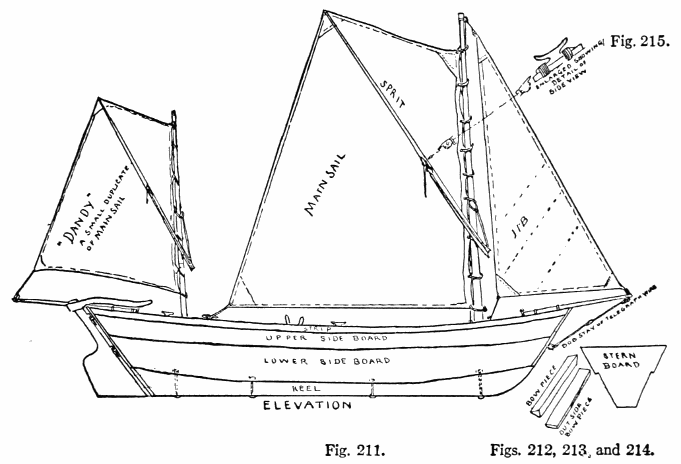
The hull is the boat itself without masts, spars, or rigging. A
skiff and a birch-bark canoe are hulls.
The keel is the piece of timber running along the centre of the
bottom of the hull, like the runner of a skate, and used to give
the boat a hold on the water, so that she will not slide sideways.
When you are sitting in the stern of a boat, facing the bow,
the side next to your right hand is the right-hand side of the boat,
and the side next to your left hand is the left-hand side of the boat.
But these terms are not used by seamen; they always say
Starboard for the right-hand side of the boat, and
Port for the left-hand side of the boat. Formerly the left-hand
side was called the larboard, but this occasioned many serious
mistakes on account of the similarity of the sound of larboard and
starboard when used in giving orders.
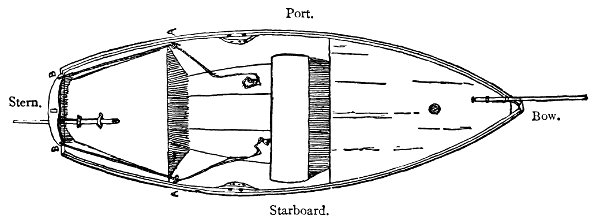
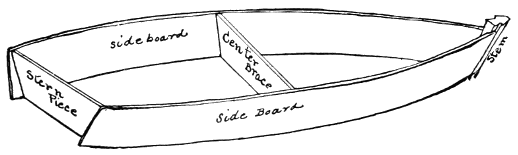
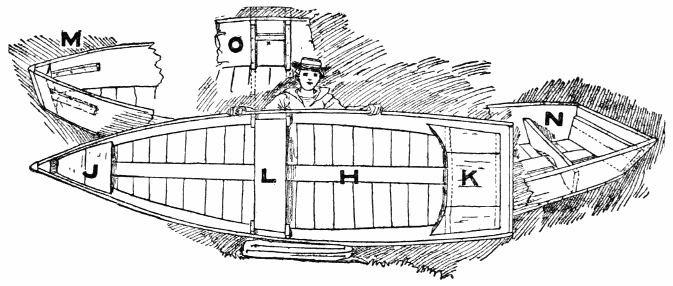
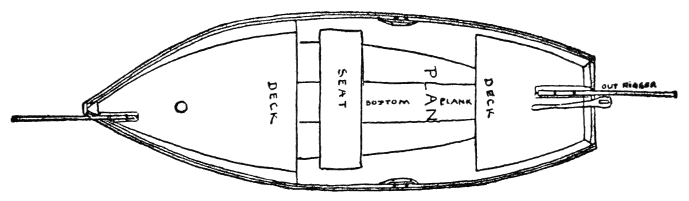
Fig. 122.—Top view of small boat.
After dark a red light is carried on the port side and a green
light on the starboard side of all vessels in motion. If you can
remember that port wine is red, and that the port light is of the
same color, you will always be able to tell in which direction an
approaching craft is pointing by the relative location of the lights.
"When both lights you see ahead,
Port your helm and show your red!
Green to green and red to red,
You're all right, and go ahead!"
If you are a real landlubber, the verse quoted will be of little
service, because you will not know how to port your helm. In
fact, you probably will not know where to look for the helm or
what it looks like; but only a few of our readers are out-and-out
landlubbers, and most of them know that the helm is in some
way connected with the steering apparatus.
The rudder is the movable piece of board at the stern of the
boat by means of which the craft is guided. The rudder is moved
by a lever, ropes, or a wheel.
The tiller is the lever for moving the rudder, or the ropes used
for the same purpose (Fig. 123).
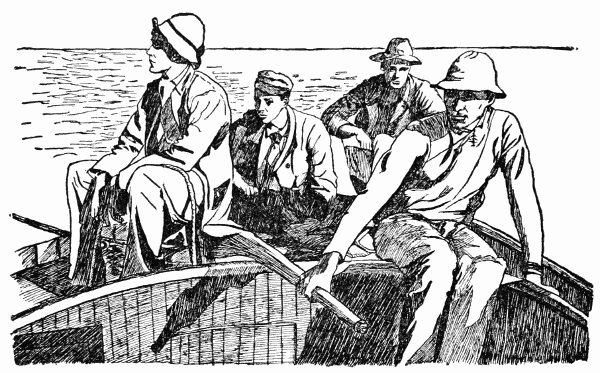
Fig. 123.—Helm—Lever, or stick, for tiller.
The wheel is the wheel whose spokes end in handles on the
outer edge of the rim, or felly, and it is used for moving the rudder
(Fig. 124).
The helm is that particular part of the steering apparatus that
you put your hands on when steering.
The deck is the roof of the hull.
The centreboard is an adjustable keel that can be raised or
lowered at pleasure. It is an American invention. The centreboard,
as a rule, is only used on comparatively small vessels.
The inventor of the centreboard is Mr. Salem Wines, who kept
a shop on Water Street, near Market Slip, and, when alive, was a
well-known New York boat-builder. His body now lies in Greenwood
Cemetery, and upon the headstone of his grave is the
inscription, "The Inventor of the Centreboard."
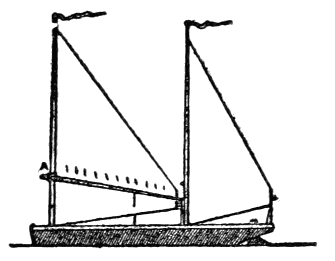
For sailing, the boat, or hull, is rigged with masts and spars
for spreading the sails to catch the wind.
The masts are the upright poles, or sticks, that hold the sails.
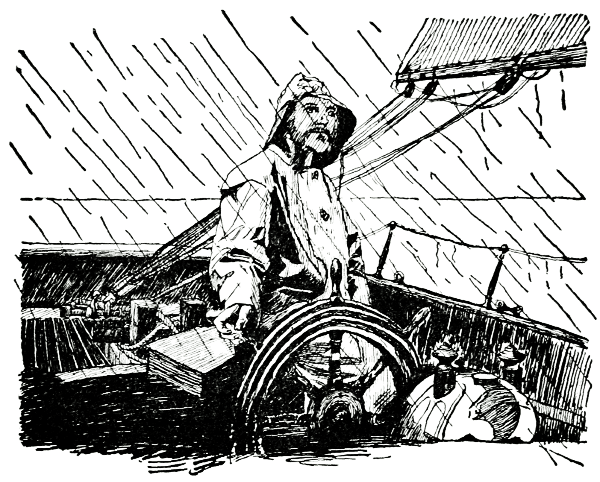
Fig. 124.—Helm—The wheel.
The yards are the poles, or sticks, at right angles with the masts
that spread the sails.
The boom is the movable spar at the bottom of the sail.
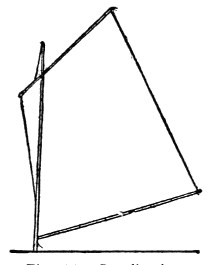
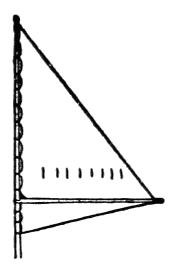
The gaff is the pole, or spar, for spreading the top, or head, of
the sail (Fig. 125).
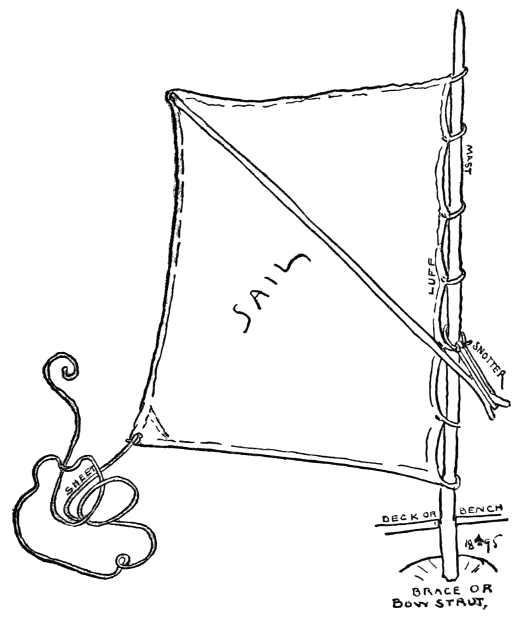
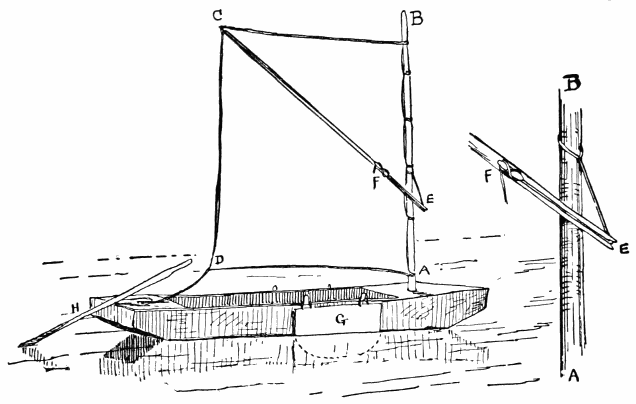
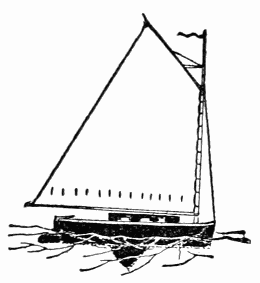
The sail is a big canvas kite, of which the boom, gaff, and masts
are the kite-sticks. You must not understand by this that the
sail goes soaring up in the air, for the weight of the hull prevents
that; but if you make fast a large kite to the mast of a boat it
would be a sail, and if you had a line long and strong enough,
and should fasten any spread sail to it, there can be no doubt that
the sail would fly.
The spars are the masts, bowsprit, yards, and gaffs.
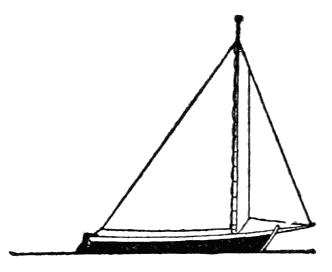
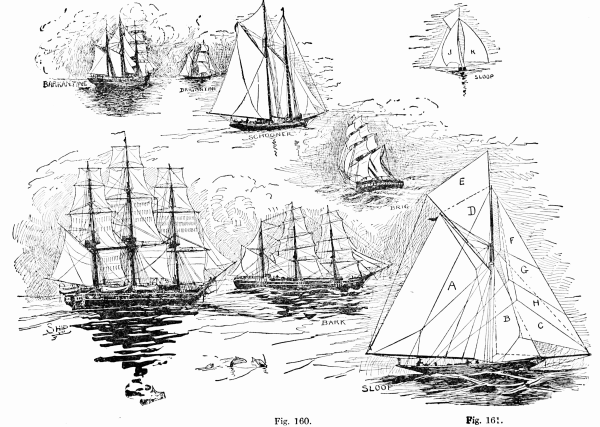
The bowsprit is the stick, or sprit, projecting from the bow of the
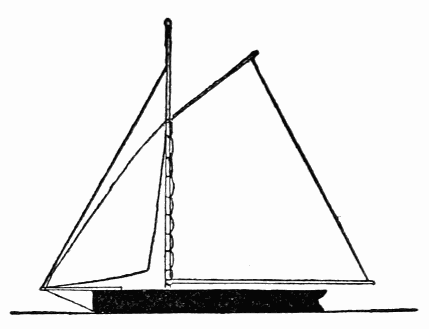
boat (Fig. 161, Sloop).
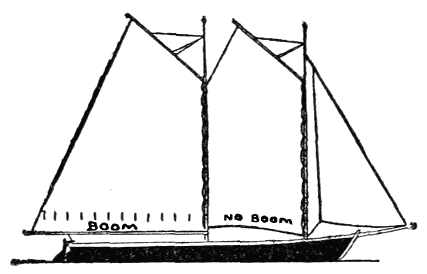
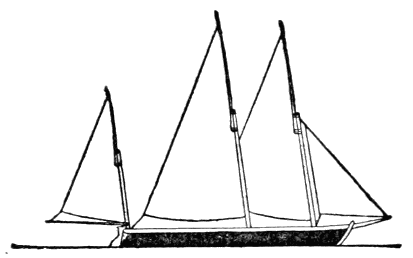
The foremast is the mast next to the bow—the forward mast
(Fig. 159, Ship).
The mainmast is the second mast—the mast next to the foremast.
Mizzen-mast is the mast next to and back of the mainmast
(Fig. 159, Ship).
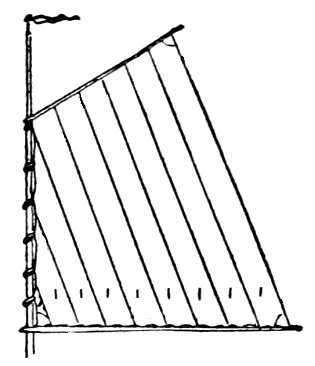
Fig. 125.—A sail.
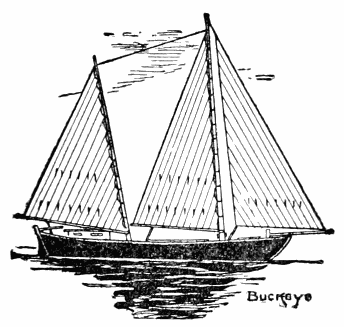
The rigging of a boat consists of the ropes, or lines, attached to
its masts and sails, but a boat's rig refers to the
number of masts as well as to the shape of its
sails.
Stays are strong ropes supporting the masts,
fore and aft.
Shrouds are strong ropes reaching from the
mastheads to the sides of the vessel; supports
for the masts, starboard and port.
Ratlines are the little ropes that form the
steps, or foot ropes, that run crosswise between the shrouds.
The painter is the rope at the bow of a small boat, used for the
same purpose as is a hitching-strap on a horse.
The standing rigging consists of the stays and shrouds.
The running rigging consists of all the ropes used in handling
yards and sails.
The sheets are the ropes, or lines, attached to the corners of sails,
by which they are governed (Fig. 126).
The main sheet is the rope that governs the mainsail.
The jib-sheet is the rope that governs the jib-sail.
The gaskets are the ropes used in lashing the sails when furled.
The braces are the ropes used in swinging the yards around.
The jib-stay is the stay that runs from the foremast to the
bowsprit.
The bob-stay is practically an extension of the jib-stay and the
chief support of the spars. It connects the bow of the boat with
the bowsprit and prevents the latter from bobbing up and
down.
Besides the port and starboard sides of a boat there are the
windward and leeward sides. Do not understand by this that the
boat has four sides, like a square. Windward may be the port
or the starboard side, according to the direction the wind blows;
because
Windward means the side of the boat against which the wind
blows—the side where the wind climbs aboard; or it may mean
the direction from which the wind comes. The opposite side
is called
Leeward—that is, the side of the boat opposite to that against
which the wind blows, where the wind tumbles overboard, or the
side opposite to windward. When you are sailing you may be
near a
Lee Shore—that is, the shore on your lee side against which
the wind blows; or a
Windward Shore—that is, the land on your windward side
from which the wind blows.
All seamen dread a lee shore, as it is a most dangerous shore to
approach, from the fact that the wind is doing its best to blow
you on the rocks or beach. But the windward shore can be approached
with safety, because the wind will keep you off the
rocks, and if it is blowing hard, the land will break the force of
the wind.
In a canoe or shell the boatman sits either directly on the bottom,
or, as in the shell, very close to it, and the weight of his body
serves to keep the boat steady, but larger crafts seldom rely upon
live weights to steady them. They use
Ballast—that is, weights of stone, lead, iron, or sand-bags,
used to balance the boat and make her steady.
As has been said before in this chapter, the sail is a big canvas
kite made fast to the boat and called a sail, but the ordinary kite
has its covering stretched permanently on rigid sticks.
The sail, however, can be stretched to its full extent or only
partially, or it may be rolled up, exposing nothing but the masts
to the force of the wind. To accomplish all this there are various
ropes and attachments, all of which are named.
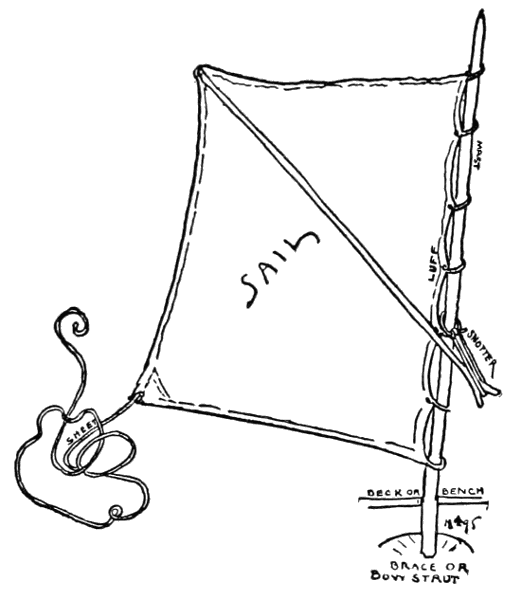
Fig. 126.—Sail and sheet.
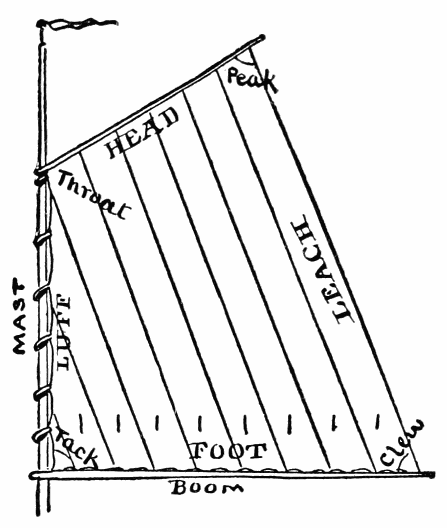
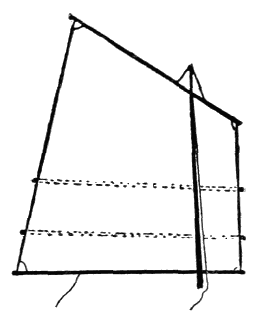
Fig. 127.—Parts of sail.
It is quite important that the beginner should know the
names of all the
Luff.—That part of the sail adjoining the mast—the front of
the sail (Fig. 127).
Leach.-That part of the sail stretched between the outer or
after end of the boom and the outer end of the gaff—the back
part of the sail (Fig. 127).
Head.—That part of the sail adjoining the gaff—the top of the
sail.
Foot.—That part of the sail adjoining the boom—the bottom
of the sail (Fig. 127).
Clews.—A general name for the four corners of the sail.
Clew.—The particular corner at the foot of the sail where the
leach and boom meet (Fig. 127).
Tack.—The corner of the sail where boom and mast meet
(Fig. 127).
Throat, or Nock.—The corner of the sail where gaff and mast
meet (Fig. 127).
Peak.—Corner of the sail where the leach and gaff meet
(Fig. 127).
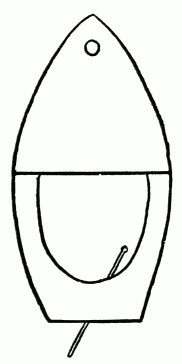
Fig. 128.—Starboard helm
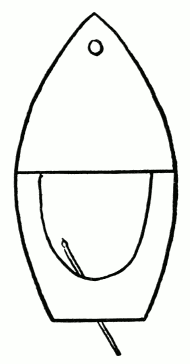
Fig. 129—Port helm.
When you wish your boat to turn to the right push your helm
to the left. This will push the rudder to the right and turn the
boat in that direction. When you wish your boat to turn to the
left push your helm to the right. In other words, starboard your
helm and you will turn to the port (Fig. 128). Port your helm
and you will turn to the starboard (Fig. 129).
From a reference to the diagram you may see that when you
port your helm you move the tiller to the port side of the boat,
and when you starboard your helm you move your tiller to the
starboard side of the boat (Fig. 128), but to ease your helm you
move your helm toward the centre of the boat—that is, amidships.
If you fasten the bottom of a kite to the ground, you will find
that the wind will do its best to blow the kite over, and if the kite
is fastened to the mast of a toy boat, the wind will try to blow the
boat over.
In sailing a boat the effort of the wind apparently has but one
object, and that is the upsetting of the boat. The latter, being
well balanced, is constantly endeavoring to sit upright on its keel,
and you, as a sailor, are aiding the boat in the struggle, at the
same time subverting the purpose of the wind to suit your own
ideas. It is an exciting game, in which man usually comes out
ahead, but the wind gains enough victories to keep its courage up.
Every boat has peculiarities of its own, and good traits as well
as bad ones, which give the craft a personal character that lends
much to your interest, and even affects your sensibilities to the
extent of causing you to have the same affection for a good, trustworthy
craft that you have for an intelligent and kind dog or
horse.
A properly balanced sail-boat, with main sheet trimmed flat
and free helm, should be as sensitive as a weathercock and act
like one—that is, she ought to swing around until her bow pointed
right into the "eye of the wind," the direction from which the
wind blows. Such a craft it is not difficult to sail, but it frequently
happens that the boat that is given to you to sail is not properly
balanced, and shows a constant tendency to "come up in the
wind"—face the wind—when you are doing your best to keep her
sails full and keep her on her course. This may be caused by too
much sail aft. The boat is then said to carry a weather helm.
Weather Helm.—When a boat shows a constant tendency to
come up in the wind.
Lee Helm.—When a boat shows a constant tendency to fall
off the wind—that is, when the wind blows her bow to the leeward.
This is a much worse trait than the former, and a boat with a lee
helm is a dangerous boat. It may be possible to remedy it by
adding sail aft or reducing sail forward, which should immediately
be done.
In spite of the fact, already stated, that the wind's constant
effort is to capsize a boat, there is little or no danger of a properly
rigged boat upsetting unless the sheets are fast or hampered in
some way. When a sail-boat upsets it is, of course, because the
wind blows it over. Now, the wind cannot blow a boat over
unless the boat presents some surface larger than its hull for the
wind to blow against, and the sail is the only object that offers
enough surface to the breeze to cause an upset.
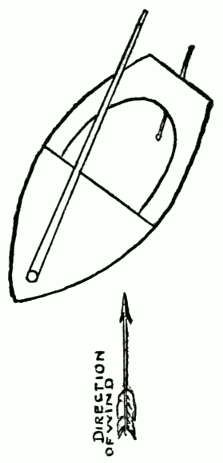
Fig. 130—Close-hauled.
|
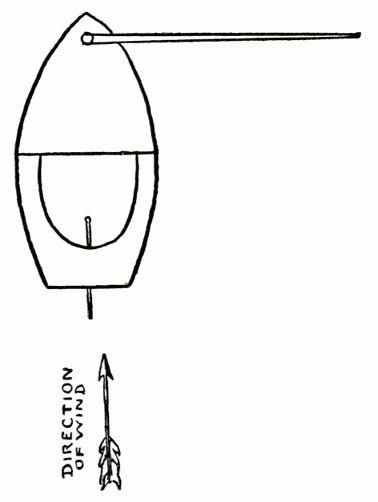
Fig. 131.—Before the wind.
|
Top view of boats, showing position of helm and boom.
|
If the sheet is slackened, the sail will swing around until it
flaps like a flag and only the thin edge is presented to the wind;
and a boat that a flag will upset is no boat for beginners to trust
themselves in. True, the boom may be very long and heavy
enough to make it dangerous to let so much of it overboard, but
this is seldom the case. A good sailor keeps his eyes constantly
on the sails and trims them to take advantage of the slightest
favorable breeze. In place of losing control of his sail by letting
go the sheets he will ease the tiller so as to "spill" part of the wind
that is, let the forward part, or luff, of the sail shake a bit. Or,
in case of a sudden puff of wind, he may deem it necessary to
"luff"—that is, let her shake—and slacken the sheets too.
Trimmed Flat.—Sheets hauled in until the boom is only a little
to the leeward of the helm (Fig. 130).
Close-hauled.—Sheets trimmed flat and the boat pointing as
near as possible to the eye of the wind. Then the sail cannot
belly, and is called flat (Fig. 130).
The skipper must watch that his sail does not flap or ripple at
the throat, for that means that he is pointing too close to the
wind and that some of the breeze is blowing on both sides of
his sail, which even a novice can see will retard the boat.
Upon discovering a rippling motion at the luff of the sail put
the helm up—that is, move the tiller a little to windward until the
sail stops its flapping.
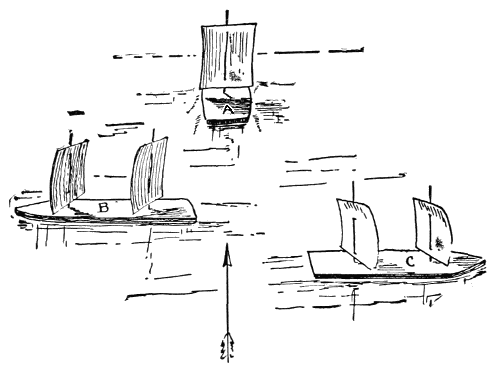
Before the Wind.—When the wind is astern; sailing with the
wind; sailing directly from windward to leeward (Fig. 131).
In order to reach the desired point it is often expedient to sail
before the wind, but unless the wind is light, beginners had
better not try this. To sail before the wind you let your sheets
out until the boom stands at almost right angles with the boat.
Keep your eye on the sail and see that it does not flap, for if the
man at the helm is careless and allows the boat to point enough
away from the direction of the wind to allow the wind to get on
the other side of the sail, the latter will swing around or jibe with
such force as to endanger the mast, if it does not knock some one
overboard.
The price of liberty is constant vigilance, and the price of a
good sail is the same. I have seen a mast snapped off clean at
the deck by a jibe, and once when out after ducks every one was
so intent upon the game that proper attention was not paid to
the sail. The wind got round and brought the boom with a
swing aft, knocking the captain of our boat club overboard.
Had the boom hit him in the head and stunned him, the result
might have been fatal.
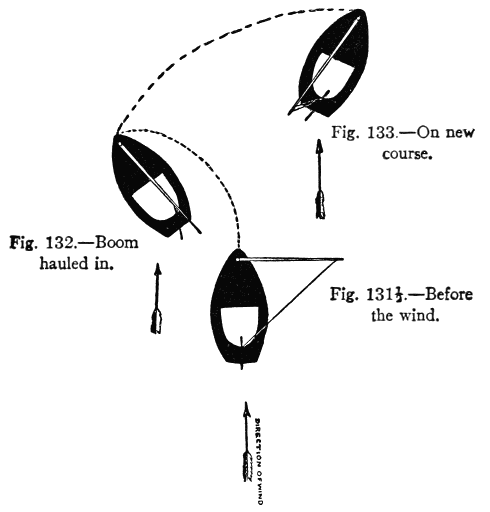
Figs. 131½, 132, and 133.—Jibing.
Wing and Wing.—When a schooner goes before the wind with
one sail out at nearly right angles on the port side and the other
in the same position on the starboard side she is said to be wing
and wing and presents a beautiful sight.
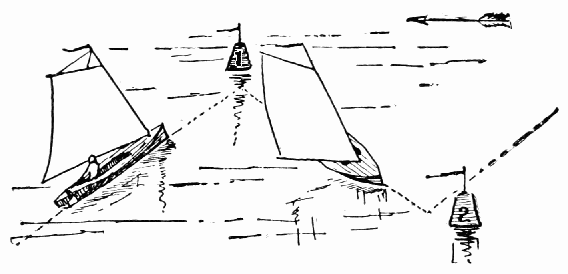
Tacking.—Working to the windward by a series of diagonal
moves.
Legs.—The moves or diagonal courses made in tacking. It is
apparent to the most unthinking observer that no vessel propelled
by sail can move against the direct course of the wind—that is,
nothing but electricity, naphtha, steam, or some such power can
drive a boat into the eye of the wind. But what cannot be accomplished
in a direct manner can be done by a series of compromises,
each of which will bring us nearer to the desired
point.
First we point the boat to the right or left, as the case may be,
as near or as close to the wind as the boat will sail. Then we
come about and sail in the other direction as close as practicable
to the eye of the wind, and each time we gain something in a direct
line.
When your boat changes its direction on a tack it is done by
"jibing," or "coming about."
Jibing.—With the wind on the quarter, haul the main boom
aft or amidship with all possible speed, by means of the main
sheets (Fig. 132), and as the wind strikes the sail on the other
side let it out as deliberately as possible until it reaches the position
desired (Fig. 133).
Beginners should never attempt to jibe, for if there is more
than a capful of wind, the sail will probably get away from them,
and, as described in going before the wind, some disaster is liable
to occur. Experts only jibe in light winds, and frequently lower
the peak, so as to reduce sail, before attempting a jibe.
When you wish to come about see that all the tackle, ropes,
etc., are clear and in working order, and that you are making
good headway; then call out: "Helm's a-lee!" or "Ready about!"
and push the tiller in the direction opposite to that from which the
wind blows—that is, to the lee side of the boat. This will bring
the bow around until the wind strikes the sail upon the side opposite
to that which it struck before the helm was a-lee (Figs.
134, 135, 136, 137).
If you are aboard a sloop or schooner, ease off the jib-sheet, but
keep control of it, so that as the boat comes up to the wind you
can make the jib help the bow around by holding the sheets so as
to catch the wind aback. When the bow of the craft has passed
the eye of the wind and the sail begins to fill give the order to
make fast, or trim, the jib, and off you go upon the opposite tack,
or on a new leg.
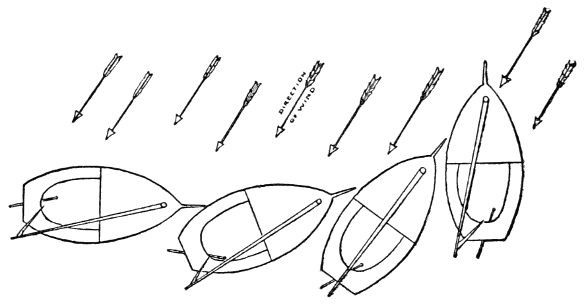
Figs. 134, 135, 136, and 137.—Coming about.
If the wind is light, or if, for any cause, the boat works slowly,
you can sometimes help her by trimming in the main sheet when
you let the jib-sheet fly. In the diagram of coming about no
jib is shown.
Wearing is a term sometimes used in place of jibing.
A thunder-storm is always an uncertain thing. There may be
a veritable tornado hidden in the black clouds that we see rising
on the horizon, or it may simply "iron out the wind"—that is,
go grumbling overhead—and leave us becalmed, to get home the
best way we can; generally by what the boys call a "white-ash
breeze"—that is, by using the sweeps or oars.
On Long Island Sound a thunder-storm seems to have certain
fixed rules of conduct. In the first place, it comes up from the
leeward, or against the wind. Just before the storm strikes you
for an instant the wind ceases and the sails flap idly. Then look
out! for in nine cases out of ten you are struck the next moment
by a sudden squall from exactly the opposite direction from which
the wind blew a moment before.
Make for the nearest port with all speed, and keep a man at the
downhaul ready at a moment's notice to lower sail. The moment
the wind stops drop the sail and make everything snug, leaving
only bare poles. When the thunder-squall strikes you, be it
ever so hard, you are now in little danger; and if the wind from
the new quarter is not too fresh, you can hoist sail again and make
the best of your way to the nearest port, where you can "get in
out of the wet."
If the wind is quite fresh keep your peak down, and with a
reefed sail speed on your way. If it is a regular howler, let your
boat drive before the wind under bare poles until you can find
shelter or until it blows over, and the worst mishap you are likely
to incur is a good soaking from the rain.
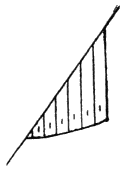
Shortening Sail.—Just as soon as the boat heels over too far
for safety, or as soon as you are convinced that there is more wind
than you need for comfortable sailing, it is time to take a reef—that
is, to roll up the bottom of the sail to the row of little ropes,
or reefing points, on the sail and make fast there. This, of course,
makes a smaller sail, and that is what you wish.
While under way it will be found impossible to reef a sail except
when sailing close-hauled. So the boat is brought up into
the wind by pushing the helm down, as if you intended to come
about. When possible it is better to lower the sail entirely before
attempting to put in a reef.
It sometimes happens that on account of the proximity of a
lee shore, and the consequent danger of drifting in that direction,
or for some other equally good reason, it is inadvisable to lower
sail and lose headway. Under such circumstances the main
sheet must be trimmed flat, keeping the boat as close as possible
to the wind, the helm must be put up hard a-lee, and jib-sheet
trimmed to windward (Fig. 138).
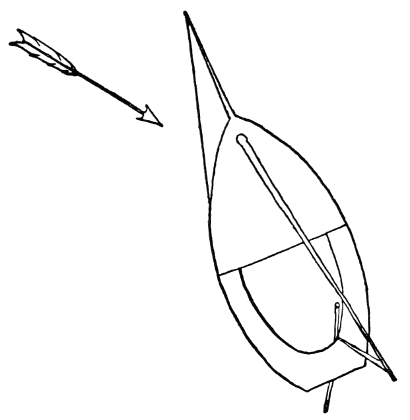
Fig. 138.—Squirming; jib on port side, boom close-hauled
on starboard side.
When this is done the wind will hit the jib, "paying her head
off," or pushing her bow to leeward, and this tendency is counteracted
by the helm and mainsail, bringing the bow up into the
wind. This keeps the boat squirming. Lower the mainsail
until the row of reef points is just on a line with the boom, keeping
to the windward of the sail. Tie the first point—that is, the one
on the luff rope—then the one on the leach, being careful to stretch
out the foot of the sail. Then tie the remaining points, always
making a square or reefing knot. Tie them to the jack-stay on
the boom or around the boom.
is most frequently used, as its name implies, in reefing sails.
First make a plain overhand knot, as in
Fig. 139. Then repeat
the operation by taking the end and passing it
over and under the loop, drawing the parts
tight, as shown in
Fig. 140. Care should be
observed in crossing the ends so that they will
always lay fairly alongside the main parts.
Otherwise the knot will prove a
granny and be comparatively
worthless.
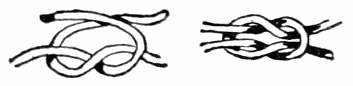
Figs. 139 and 140.—Square
or reef knot.
untie the knots, keeping to the windward of the sail. Untie the
knot at the leach first, next the one at the luff, and then the remaining
points. In lowering a sail you use a rope called the
downhaul.
Starboard Tack.—When the main boom is over the port side.
Port Tack.—When the main boom is over the starboard side.
Right of Way.—All boats sailing on the starboard tack have
the right of way over all those on the port tack. In other words,
if you are on the starboard tack, those on the port tack must keep
out of your way. Any boat sailing close-hauled has the right of
way over a boat sailing free.
A canoe under sail at night should have an uncolored lantern
hung to her mizzen-mast to notify other craft that she is out and
objects to being run down. The light is put on the mizzen so that
it may be behind the skipper and not dazzle him.
What you have read in the foregoing pages will not be found
very difficult to remember, but there is only one way to learn to
sail and that is by sailing. If possible, sail with some one who is
a good seaman. If this sort of companion cannot be had, try it
alone on smooth water and with short sail until you accustom
yourself to the boat and its peculiarities. No boy ever learned
to skate or swim from books, but books often have been helpful
in giving useful hints to those who were really learning by practical
experience.
Do not overload the boat.
Do not carry too much sail.
Do not sail in strange waters without chart or compass.
Do not forget your anchor.
Do not forget your paddles or oars.
Do not attempt to learn to sail before you know how to swim.
Do not sit on the gunwale.
Do not put the helm down too suddenly or too far.
Do not let go the helm.
Do not mistake caution for cowardice.
Do not be afraid to reef.
Do not fear the ridicule of other landlubbers.
Do not fail to keep the halyards and sheets clear.
Do not jibe in a stiff wind.
Do not fail to keep your head in times of emergency.
Do not make a display of bravery until the occasion demands it.
Do not allow mistakes or mishaps to discourage you.
Do not associate with a fool who rocks a boat.
You will soon become an expert and be able to engage in one of
our most exhilarating, healthy, and manly sports and earn the
proud distinction of being a good small-boat sailor.
From the parents' point of view, nowhere that a boy's restless
nature impels him to go is fraught with so much peril as the water,
and nowhere is a boy happier than when he is on the water, unless
it is when he is in it. Nowhere can be found a better school
for his young mind and body than that furnished by boating.
Hence it appears to be the imperative duty for parents personally
to see that their children are taught to swim as soon as their little
limbs have strength enough to make the proper motions.
In aquatic sports of all kinds, if you expect to have fun, you
must dress appropriately. You should have a suit of old clothes
that you can change for dry ones when the sport is over. When
boating, it is nonsense to pretend you can keep dry under all the
varying conditions of wind and weather. If your purse is small,
and you want a good rowing-suit, it can be made of last winter's
woollen underclothes, and will answer for the double purpose of
rowing and bathing.
First take an old woollen undershirt and cut the sleeves off
above the elbows. Then coax your mother, aunt, or sister to sew
it up in front like a sweater, and hem the edges of the sleeves where
they have just been cut off.
Next take a pair of woollen drawers and have them sewed up in
front, leaving an opening at the top about four inches in length;
turn the top edge down all around to cover a piece of tape that
should be long enough to tie in front. Have this hem or flap
sewed down to cover the tape, and allow the two ends of the tape
to protrude at the opening in front. The tape should not be
sewed to the cloth, but should move freely, so that you can tighten
or loosen it at will. Cut the drawers off at the knees and have
the edges hemmed, and you will have a first-class bathing or
rowing-suit.
If woollen clothes are not to be had, cotton will do, but wool is
coolest and warmest, as the occasion may require.
When rowing wear old socks, woollen ones if you have them,
and old shoes cut down like slippers. The latter can be kicked
off at a moment's notice, and, if lost, they are of no value, and
may be easily replaced.
When on shore a long pair of woollen stockings to cover your
bare legs and a sweater to pull over your sleeveless shirt are handy
and comfortable, but while sailing, paddling, or rowing in hot
weather the rowing-suit is generally all that comfort requires.
Of course, if your skin is tender, you are liable to be terribly sunburned
on your arms, neck, and legs; but
may be avoided by gradually accustoming your limbs to the exposure.
Dearly will you pay for your negligence if you go out
for a day with bare arms or legs in the hot sun before you have
toughened yourself, and little will you sleep that night.
I have seen young men going to business the day following a
regatta with no collars on their red necks, and no shirt over their
soft undershirts, the skin being too tender to bear the touch of the
stiff, starched linen, and I have known others who could not sleep
a wink on account of the feverish state of their bodies, caused by
the hot sun and a tender skin. Most boys have had some experience
from sunburn, acquired while bathing. If care is taken
to cover your arms and legs after about an hour's exposure, you
will find that in place of being blistered, your skin will be first
pink and then a faint brownish tint, which each succeeding exposure
will deepen until your limbs will assume that dark, rich
mahogany color of which athletes are so proud. This makes your
skin proof against future attacks of the hottest rays of the sun.
Besides the pain and discomfort of a sudden and bad sunburn
on your arms, the effect is not desirable, as it is very liable to
cover your arms with freckles. I have often seen men with
beautifully bronzed arms and freckled shoulders, caused by
going out in their shells first with short sleeves and then with
shirts from which the sleeves were entirely cut away, exposing
the white, tender shoulders to the fierce heat, to which they
were unaccustomed.
It is a good plan to cover the exposed parts of your body with
sweet-oil, vaseline, mutton-tallow, beef-tallow, or lard. This is
good as a preventive while in the sun, and excellent as an application
after exposure. Any sort of oil or grease that does not contain
salt is good for your skin.
In canoeing I have found it convenient to dress as I would in a
shell boat, but I generally have had a sweater and a pair of long
trousers stowed away, ready to be pulled on over my rowing-clothes
when I landed. Once, when I neglected to put these
extra clothes aboard, I was storm-bound up Long Island Sound,
and, leaving my boat, I took the train home, but I did not enjoy
my trip, for the bare legs and arms and knit cap attracted more
attention than is pleasant for a modest man.
Do not wear laced shoes in a canoe, for experience has taught
boating-men that about the most inconvenient articles of clothing
to wear in the water are laced shoes. While swimming your feet
are of absolutely no use if incased in this style of foot-gear, and
all the work must be done with the arms. But if you have old
slippers, they may be kicked off, and then you are dressed practically
in a bathing-suit, and can swim with comfort and ease.
Possibly these precautions may suggest the idea that a ducking
is not at all an improbable accident, and it must be confessed
that the boy who thinks he can learn to handle small boats without
an occasional unlooked-for swim is liable to discover his mistake
before he has become master of his craft.
Always remember that a wet head is a very small object in
the water, and liable to be passed by unnoticed, but that a
capsized boat can scarcely fail to attract attention and insure a
speedy rescue from an awkward position. As for the real danger
of boating, it cannot be great where care is used. Not one fatality
has occurred on the water, among all of my large circle of boating
friends, and personally I have never witnessed a fatal accident in
all the years I have spent rowing and sailing.
All canoes should have a good cork life-preserver in them when
the owner ventures away from land. I never but once ventured
any distance without one, and that is the only time I was ever in
need of a life-preserver. The ordinary cork jacket is best. It
can be used for a seat, and when spread on the bottom of your
canoe, with an old coat or some article thrown over it for a cushion,
it is not at all an uncomfortable seat. Most canoes have airtight
compartments fore and aft—that is, at both ends—and the
boat itself is then a good life-preserver. Even without the airtight
compartments, unless your boat is loaded with ballast or
freight, there is no danger of its sinking. A canvas canoe, as a
rule, has enough woodwork about it to support your weight when
the boat is full of water.
An upset canvas canoe supported me for an hour and a half
during a blow on Long Island Sound, and had not a passing
steamer rescued me, the canoe would evidently have buoyed me
up as long as I could have held on to the hull.