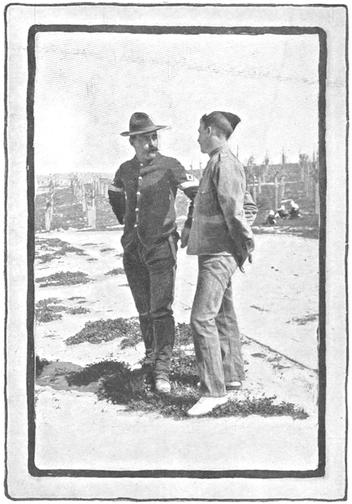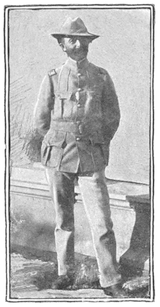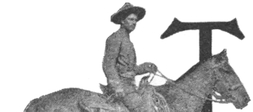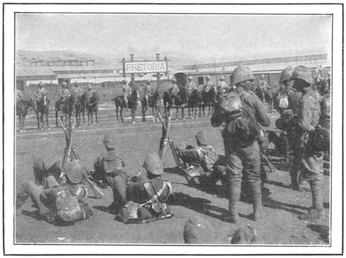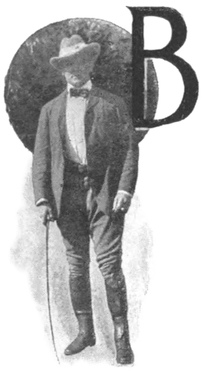
Mr. R. H. Davis in Pretoria.
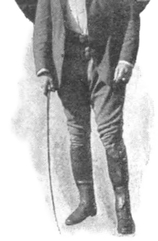
Mr. R. H. Davis in Pretoria.
Before the British advance
reached Johannesburg one
would never have known, by
merely taking note of the life in
Pretoria, that a fierce war was
being waged in the country. The
ladies went on with their calling
and shopping, business houses carried
on their work as usual, and the
hotels were crowded with a throng
of men who looked more like speculators
in a new country than men
fighting for their homes and liberty.
The night I arrived in Pretoria
the train pulled into the station
just after dark, and the street lights gave the
place an air of mystery. The blackness of the
night heightened one’s imagination of possible
plots and attempted escapes, of spies and sudden
attacks. A big Scotchman, who told me his name
was “Jack,” shared the compartment with me; he
was returning from the front, where he had been
fighting for his adopted country. He carried a
Mauser, and over his shoulder was slung a bandolier
of cartridges; these, with his belt and canteen,
made up his entire equipment. His pockets were
his haversack, his big tweed coat was his blanket.
He gave me the first idea of the real bitterness of the
struggle, for he said he would rather die many times
over than give up to the British. He was fighting
against men of his own blood, perhaps his very relatives;
but the spirit of liberty was in him, and he
was defending the home he had built in this faraway
land.
As the train rolled around the curve into Pretoria,
the Scotch burgher pointed out a brilliant circle of
lights on a far side of the great group of flickering
yellow lamps which showed the position of the
town. The effect of mystery deepened as I peered
out at the station platform and saw little groups of
men huddled together in the radius of the dazzling
electric arcs. Here and there a solitary figure with
a rifle walked slowly about. The doors had been
locked before we entered the town, and no one was
allowed to leave the train until an official with a
decidedly English air had examined all the passports.
I wondered whether I should be able to
make myself understood, and whether, in case I
were mistaken for a British spy, I should be followed
by some secret agent of the Republic. Suddenly
a sharp cry at my door broke in upon my
fanciful surmises.
“Free ’bus to the Transvaal Hotel,” shouted a
voice from the figure outlined against the bright light.
“Grand Hotel! The Grand! Grand Hotel!”
and in another instant I was wrestling against an unseen
hand for the possession of my luggage.
“Cab, sir? Cab up-town, sir?”
My dream of war’s mysteries was shattered in an
instant, and I found myself on earth again, with the
feeling that I was just arriving at the San Francisco
ferry from an overland train. In another moment I
was in a hotel omnibus illuminated with a dingy,
smoking oil lamp at the front end. Under the lamp
there was a little sign imparting the information
that the vehicle had been built in Philadelphia. We
rumbled along over the rough streets, and the windows
rattled in true hotel ’bus fashion. We pulled
up at a hotel, and a porter greeted us with a sixpence’s
worth of politeness and assistance. “Good
evening, sir,” he remarked, with a “Dooley” accent
which was pleasantly reassuring.
The clerk at the desk cordially called me by name—after
I had registered—and informed me that he
could give me a room at the top of the house for five
dollars a day. After depositing my belongings I took
a look at the crowd of men in the hotel office. I was
reminded of the gatherings in a California “boom
town” hotel, or of a Colorado mining camp. There
were men of all nations and in all sorts of dress; but
the prevalence of top boots and leggins gave to the
crowd a peculiarly Western look. Rifles stood in
the corners of the room, but except for this item
there was nothing about the men to denote their
connection with the war. They were nearly all
speaking English. By that time I began to feel
that I had been cheated, for I wanted to hear some
Dutch. It is a fact, however, that in all my stay in
the Transvaal I found absolutely no use for any but
my own tongue.
Mr. Thomas Leggett, the California mining engineer
who, after twelve years’ residence in South
Africa, rose to be the leading engineer in that country,
told me that he did not know five words of
Dutch even after his long stay among the Boers,
and, moreover, that he had had no occasion whatever
to use that language.
When I first met the family of Secretary Reitz, I
asked a little boy of about ten if he spoke English.
“No, sir,” he exclaimed with emphasis; “we
don’t speak English down here—we speak American.”
There was formerly a complaint that the English
language was not taught in the schools, but the
assertion proved erroneous, and to-day it is the
common tongue of the towns and cities of South
Africa.
Up to the time of the war but few Americans had
lived in Pretoria, consequently the official duties of
our consul to that place had not been onerous.
When the war broke out, Mr. Macrum was the representative
of our government; but, owing to what
appeared to be an excess of desire to aid the burghers’
cause, he overstepped the diplomatic reserve
and was recalled. Several South African officials
told me that he had acted unwisely in endeavoring
to do too much, and that had he been more discreet
he might have been of material assistance to them.
When Mr. Macrum was recalled, the Hon. Adelbert
S. Hay, son of Secretary of State Hay, was appointed
to fill the position that had now become a
post of great importance. There was much speculation
as to the new American consul’s ability to fill
the place, and he was received with some misgivings
by the statesmen of the Transvaal, for fear his sentiments
were in favor of their enemy. But his years
of training in affairs of state under his father, both
at home and at the embassy in London, had made
him equal to the task. In a very few days he
proved himself to be a thorough diplomatist, and he
came to be heartily liked by all the burghers who
were brought in contact with him.
Mr. Hay had the sole charge of all British interests,
as well as the care of the thousands of English
prisoners who were in Pretoria, and of the transmission
of all letters and moneys. All these duties he
performed without arousing the slightest animosity
on the part of the Boers. No American of any
class ever went to the consulate on business, for a
social call, or from idle curiosity, without receiving
a hearty welcome from the consul. And to please
unanimously the crowd of resident Americans, soldiers
of fortune, correspondents, doctors, and ne’er-do-wells,
was in itself enough to show his worth
as a diplomatist. Mr. Gardner F. Coolidge, of
Boston, was the vice-consul, and in cordial service
and discreetness he proved to be made of the same
stuff as his chief. They
attended not only to
their own official affairs,
as well as the British
interests, but they were
often called upon to
assist men of other nationalities,
which they
did as willingly as
though they had nothing
else to do.
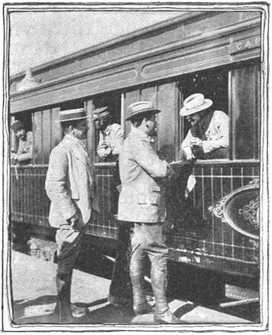
Consul Hay and Vice-Consul
Coolidge bidding good-by
to Captain Slocum at
Pretoria.
During the few weeks
before the British occupation
there was
hardly a ripple of excitement
among the
people of Pretoria; in fact, there was more South
African war talk in Washington and New York
when I left the United States than I heard in the
capital of the Republic most interested.
President Krüger was the center of all interest,
although when any of the hundreds of foreigners
that swarmed the place wanted anything, they went
to Secretary Reitz, who seemed to have more power
than even the President himself.
My last meeting with President Krüger was on
the occasion of the presentation of the celebrated
message of sympathy from 30,000 Philadelphia
schoolboys. The voluminous document was delivered
by James Smith, a New York American District
Messenger boy, who was accompanied by one
of the editors of a Philadelphia newspaper, Mr.
Hugh Sutherland. This opportunity afforded an
excellent chance to study the wonderful old man
who has piloted the Cape Dutch through so many
national storms.
If President Krüger had been a handsome, polished,
and dignified man the world’s opinion of the
Transvaal burgher would have been entirely different,
for the descriptions of the typical Boer have had
their origin in his personality. He is far from prepossessing;
he is entirely lacking in polish or distinction
of appearance. He wears a shabby frock
coat that looks as though it had never been brushed
or cleaned since the day it left a ready-made stock.
His clothes, however, are not the most notable nor
the most repellent characteristic of the head of the
Transvaal government. Mr. Krüger smokes a pipe
incessantly, and has an unpleasant habit of expectorating
in any place that pleases his momentary
fancy, and with very little accuracy of aim; even
the front of his clothes shows signs of this habit. His
eyes are inflamed, and are seemingly afflicted with
some ophthalmic disease which causes the lids to
show lines of red under the eyeball. His hair and
beard are unkempt, except on state occasions and
Sundays, when they are brushed to an oiled nicety.
His hands are heavy, as though from great toil; but
when he shook hands, he did so in the cordial manner
of one who wished to show a heartfelt welcome to
his guest.
Secretary of State Reitz arranged this meeting at
which Jimmie Smith should present the message he
had carried so far, and when the little party arrived
at the President’s house, he was waiting to receive
them in his library.
The house in which President Krüger lives is a
little, low, unpretentious cottage, such as might be
owned by an ordinarily prosperous mechanic or
tradesman in a country village. It is a one-story
building, with a wide veranda along the front. On
either side of the entrance is a marble figure of a
reclining lion, the gift of Barney Barnato a few years
ago, when he wished to gain favor in order to further
some of the great schemes which eventually
were the direct cause of the downfall of the two
South African republics.
The library where the President met the party
was a dark room with a low ceiling. At the farther
end of the apartment was a desk table, at which the
Chief Executive sat. The ornaments about the room
were tawdry and cheap, showing how little attention
was paid to appearance; nevertheless, everything
was scrupulously clean. Books and papers were
scattered about in confusion; but, as we afterwards
learned, this grand disorder was due to the fact
that the President was preparing for his departure
from the capital, a fugitive from the conquerors who
were even then just outside the city.
All thought of the peculiar personal appearance
of President Krüger was dispelled when he spoke,
or even when he was listening to anything of importance;
for he conveyed the impression of being the
possessor of a great reserve force, and of a wonderful
mental power which grasped a subject instantly
and with precision. Once in touch with the workings
of his great brain, his untidy appearance was
forgotten, and you thought of him as a magnificent
relic of the noble Dutch blood, one who had
reclaimed a new continent from wild beasts and
wilder savages; a man who had fought his way, foot
by foot, into the great veldt and into the mountains,
and had built a home for thousands of contented
followers, only to be driven out by a more powerful
nation.
At the time when the messenger boy presented
the greetings from the young Americans, the President
was visibly worried and his mind was evidently
occupied by other matters. Within a few hours he
expected to move once more from the place where
he had settled, as he had done when he was a young
man. But this time he was to go he knew not
where, a fugitive from an overwhelming foe.
As Mr. Reitz translated the speech which little
Jimmie Smith cleverly delivered when he presented
the documents he carried, the President listened graciously
and thanked the boy heartily for the expressions
of sympathy conveyed in the message. Coming
at that time, it must have given him some little hope
that the first republic of the world would do something
towards saving to the list of nations these two
republics of South Africa.
A granddaughter of President Krüger told me
that, after he left, Mrs. Krüger, who stayed in Pretoria,
spent much time
reading the book of
American newspaper
and magazine clippings
regarding the Boer war
which accompanied the
message from Philadelphia.
She was deeply
gratified to note the
sympathetic sentiments
so strongly stated in
the American press.
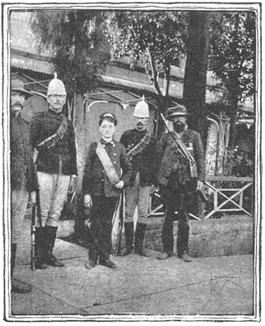
A. D. T. Messenger James
Smith, in front of President
Krüger’s house, immediately
after presenting
the message from the American
children.
As soon as the presentation
took place the
President shook hands
with every one present,
and then dismissed
them politely, saying,
“You must excuse me now, as matters of great
importance concerning the state occupy my mind.”
That night, just before midnight, the President and
Secretary Reitz left Pretoria.
James Smith, A. D. T. Messenger, No. 1534, was
well chosen for his mission, and he proved himself
to be worthy of the task. After the message
was delivered he stayed in Pretoria for several weeks
during the British occupation. During the battle of
Pretoria he amused himself by running about in the
district near the American consulate, where the
shells were falling thickest, picking up chunks of the
deadly missiles, unmindful of the great danger he
was incurring. Very few men have been under a
heavier fire than was this American messenger boy
on the day of the taking of Pretoria. That night he
told of how he waited for the shells to explode, and
then ran and picked up the pieces wherever he saw
them kick up the dust.
“It was just like the Fourth,” was his comment
on an all day’s battle which did as much to reëstablish
England’s prestige as any that has been fought
in many years. The fight itself lasted but one day,
but the effect of the occupation of the capital of the
South African Republic by the British army worked
wonders in the opinion of the world as to the progress
of the war.
As Lord Roberts’s army came nearer and nearer
to the doomed capital, the excitement grew more
intense and the air was filled with alarming rumors.
General Botha came back to Pretoria and established
his headquarters there in order to reconstruct his
forces, which were badly scattered, and to provision
them from the government stores. Extra calls for
burghers to rally to the cause were issued every day
and were responded to by hundreds. Pretoria was
the turning point of the war, at which men were
called on to decide for themselves whether they
would continue the struggle to the bitter end, or
leave on the last trains for Delagoa Bay and sail for
Europe, or remain in the city and quietly allow the
British to overtake them, thus being possibly overlooked
among the hundreds of peaceable citizens.
Arms were issued from the arsenal to all those
who wished to continue the fight or who wished to
cast their lot for the first time with the army of the
two states. There were arms and ammunition in
abundance for hundreds more men than came to
take them, for the supply had been laid in with the
idea of eventually arming every man and boy in the
Transvaal. Many of the burghers exchanged their
well-battered rifles for new ones; all filled their ammunition
belts, and took in other ways all they could
besides.
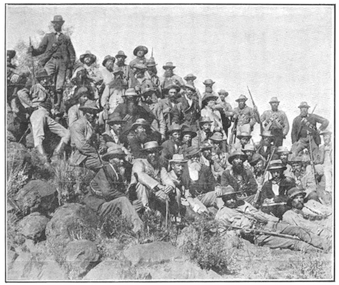
Hundreds responded to the final call to arms.
Many burghers collected their entire families and
secured arms for them to assist in the struggle. It
is not possible for any one who has not seen that
army fighting in South Africa to realize how deadly
is their earnestness. Some of the men are so old as
to appear incapable of sitting in a saddle for a march
of even a few miles, to say nothing of the marches
they often make, covering several days. There are
young men in the prime of life, strong and sturdy;
there are boys in knee trousers, who do not look old
enough to have sufficient strength to endure the
hardships of war or to know how to do any real
fighting. There are even women who have followed
their husbands or brothers through it all, attending
the wounded, and cooking when necessary, but often
going into the fighting line and matching the men
with a rifle.
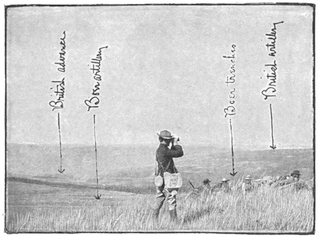
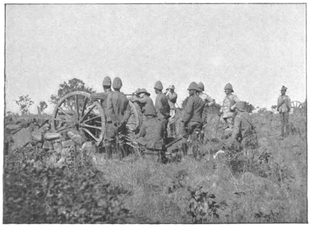
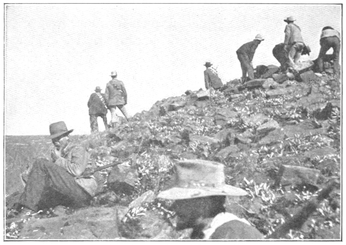
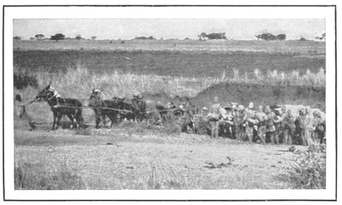
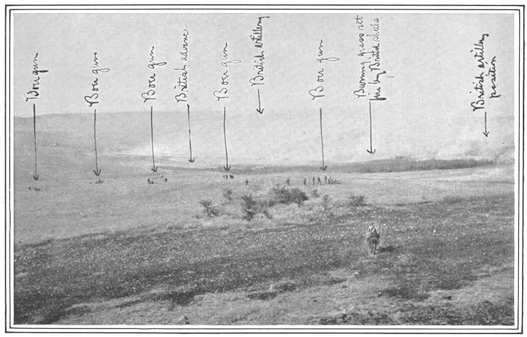
The battle of Pretoria: Boers awaiting the
British advance under artillery fire.
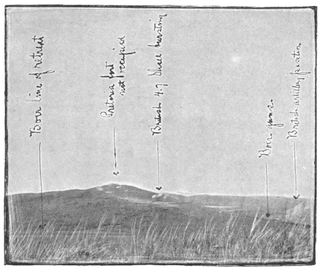
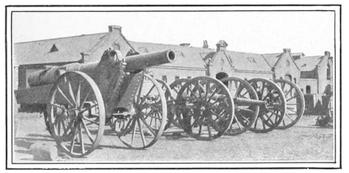
The battle of Pretoria: British naval
guns shelling forts.
The Boer army entered the second year of the
war a far more formidable force than the one that
fought through the first year, and especially during
the first months of the war. At that time the army
was filled with men who had been commandeered
and who were compelled to go into the field, but
who were not obliged to fight, and often did not
fight. There were also many adventurers from
other nations, seeking a little fame, and perhaps
fortune. But now there is not a man in the field
who is not there to fight, and when they went out
of Pretoria they knew they were burning their
bridges behind them. It was for this reason that
fathers took their young sons with them, and it was
for the same reason that the women followed the men.
One day I was in General Botha’s headquarters,
just before he was leaving Pretoria for good, when
an old gray-haired burgher came in to see him. He
waited some minutes, as the general was busy, but
finally stepped up to his desk. He did not give the
regulation military salute, but merely shook hands
with General Botha and wished him health in the
Dutch fashion.
“What can I do for you?” asked the Boer leader,
still looking over some papers before him.
“I would like to get an order for a carbine from
you,” answered the burgher.
“You cannot get a carbine, for they are very
scarce just now, and every one seems to want them;
but I will give you an order on the commandant at
the arsenal for a rifle,” said the general, and he
began to write the order at once.
“Well, I’m sorry; but a rifle won’t do,” hesitated
the man.
General Botha looked up quickly, and said with
some sharpness:
“I’d like to know why a rifle won’t do; you will
use a rifle or nothing.”
The old burgher still hesitated; then finally said,
“I’d just as soon have a rifle, but I’m afraid my
boy isn’t big enough to carry one.” He turned and
motioned to a little smooth-faced lad to come forward.
He was not yet ten years old—a bashful yet
manly little fellow, ready to follow his grandfather
and to fight for the cause for which his father had
died. Not big enough to carry a rifle, he must
needs fight with a carbine. He got his carbine.
This incident is typical of the spirit that prevails
among the Boers who are now in the field, and it is
that unconquerable spirit that will fight on as long
as there is a man still free on the wide veldt or in
the mountains.
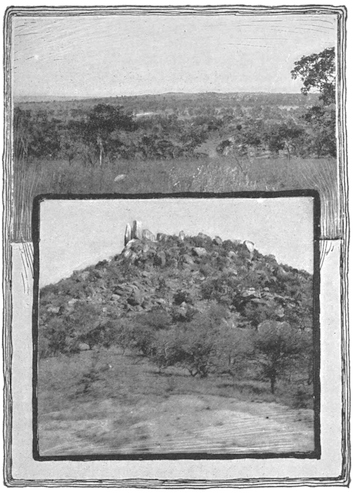
It was thought at first that the capital would be
defended to the last, according to the intention
when the forts were first built. But after long
debate it was decided that Pretoria should not be
defended, and two very excellent reasons were given
for abandoning the capital to the British without
resistance. One was that the officials did not wish
to subject their families and the families of their men
to the suffering of a siege, or their buildings to the
mercy of the British guns. The principal reason,
however, was that if they should defend the capital
it would be necessary to use all the troops of the
Transvaal army and would allow the English troops
to surround them, cutting off all possibility of escape
or retreat. Thus their cause would be lost. But
with the removal of their forces to the high veldt or
to the mountains they could continue the struggle
many months.
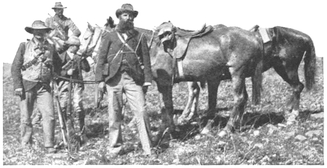
General De la Rey and staff at Pretoria;
his nephew, twelve years old, is serving
on the staff.
An air of suppressed excitement pervaded all
Pretoria when the people knew that the Volksraad
was in session to decide the fate of the city. It
meant either a long period of suffering or British
occupation within a very few days. Little knots of
men gathered here and there to discuss the situation
and to speculate on the result of the deliberations
of the few men who held the fate of all in their
hands.
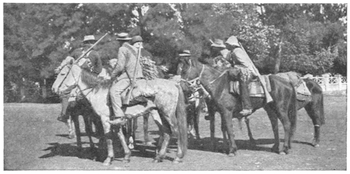
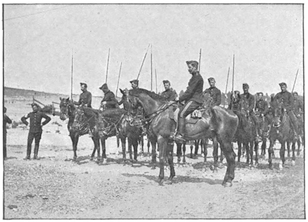
Field cornets in Pretoria receiving orders from a general.
Finally the word came—it was “Retreat.” Once
more they were to retire before the hordes of khaki
that were steadily pouring in from all directions.
There were no noisy newsboys shouting “Extra!”
There were no bulletins placarded in public places.
But the news seemed to proclaim itself in the very
air. From mouth to mouth it flew, carrying with it
feelings of terror, defiance, and sadness. The moment
which had been half expected and dreaded for
years had come at last. Their enemy was upon
them in irresistible force, and they were to abandon
their homes and their chief city to the foe. The
little groups of men melted away as if by magic,
and the streets were suddenly alive with a hurrying
mass of people, each person with but one thought—to
escape before the British arrived. The town
was filled with rumors of the movements of the
enemy, and runners said that they would be upon
us within a few hours; that the advance was already
on the outskirts of the town; that Botha had been
defeated; that Pretoria was completely surrounded—every
runner had some kind of unpleasant news to tell.
During the next hour or so men were obliged to
decide quickly what was to be done with their families
and personal effects. It was the crucial moment
of the war, as it was then thought that it was but a
matter of minutes before the British would arrive.
I happened to be at the railway station on the
night the President and Secretary Reitz left with the
State documents and moneys, removing the capital
and head of the government from Pretoria. About
half-past eleven a special train, consisting of three
or four luggage vans, a few passenger carriages, a
few goods carriages, and, at the end, the President’s
private coach. Nothing had been said about the
removal, but from some remark coming from Mr.
Reitz I imagined that something unusual was about
to happen, and therefore awaited developments.
There was no unwonted excitement about the station,
and, with the exception of a few burghers who
were awaiting the departure of the train, there was
no one about except Mr. Sutherland and myself.
In a few moments a small wagon drove hurriedly up
to the station, a couple of men jumped out and
gave orders to the driver to drive out on the platform
near the train; this being done, they began to
transfer a load of books and papers into the luggage
van. Another cart arrived before the first one was
emptied, also containing huge bundles of papers and
documents. During the next half hour there came
a stream of vehicles of every description, loaded
with bags of gold and silver. Even cabs had been
pressed into the service of transferring the treasure
of the state from the mint to the train. Bars of the
precious metal were thrown out of the cabs or
wagons like so much rubbish.
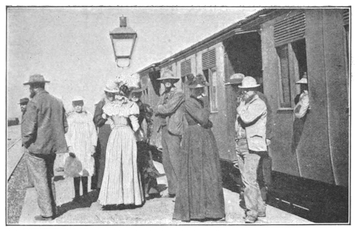
Boer women bidding good-by to their men off for the front.
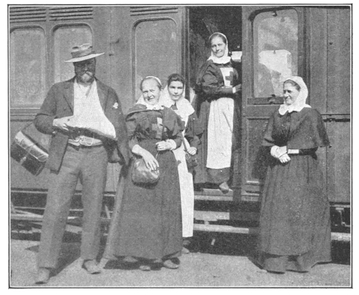
Russian hospital corps with the Boers: the
wounded man is Colonel Blake, formerly U. S. A.
There was bustle and activity, but no noise and
no excitement. A few burghers on the platform
crowded about in the glare of the electric light,
to watch the work; but there was hardly a word
spoken, except an occasional command from one of
the clerks attending to the removal. Cab after cab
drove up to the station without any guard whatever;
some of them, containing as much as £20,000
in sovereigns, had been driven by boys through the
dark streets from the treasury to the station. The
cabs were hurriedly unloaded and sent back for another
load, while the men on the platform were
busily throwing the bags and bars into the car.
One boy had driven away a hundred yards into
the darkness when he called out that there was a
sack in his cab that had been overlooked. An attendant
went after it and brought it back—a sack
containing several thousand dollars’ worth of gold
coin.
It was an extraordinary sight, under the glare of
the electric lights, to see this train being loaded
with all that was left of the capital of the Republic.
It was done decently and rapidly. As soon as the
last sack of gold was transferred to the train the
doors were closed. Secretary Reitz alighted from a
cab and walked towards the train. As he passed
under the light I saw an expression of sadness and
anxiety on his face that forbade my speaking, although
I knew him well and realized that I might
not see him again. He entered the private car,
and in a few moments the train departed, President
Krüger boarding it a few blocks from the station,
and for a few weeks the capital of the South African
Republic was on wheels.
Many have blamed President Krüger for running
away, as they call it, and for leaving the country
and going to Europe. But there is no doubt that
he was pursuing the proper course. He was an old
man, much too feeble to follow the commands in
their marches through the mountains. Had he
attempted to do this he would have been merely a
hindrance to the rapid movements of the army.
He is charged with taking away gold for his personal
use; but if he took any of the state funds with
him I do not think they were for his own use. He
is a very wealthy man. Money was of no value to
the burghers in the field, but it could be used in
Europe to their advantage. It would have availed
nothing for Mr. Krüger to remain in the Transvaal
only to be captured and sent to St. Helena. Such
an event would have helped the British immensely,
and would have given a certain plausibility to the
assertion that the war was over. The criticism
against the President because he left the country
was confined entirely to those who ran away themselves,
for among the loyalists in Pretoria there was
not a word of complaint against his course.
One commandant reminded me that the capital
of the United States of America was for months
wherever General Washington’s headquarters were,
and that even in the war of 1812 the capital was
removed before the advance of the British on the
city of Washington. He asked if any one had ever
criticised the American President for not remaining
to be taken prisoner, or for not leaving the gold in
the treasury to fall into the hands of the enemy.
Following the departure of the President and
other officials, on the last of May, came a couple of
days of panic, during which all sorts of rumors flew
about, while the lawless element of the town played
havoc. As soon as it was decided to abandon the
capital, all the government stores which had been
gathered for the use of the army in the event of a
siege were turned over to the people for their own
use. The stores, which were in large warehouses,
were broken open and rifled by a wild, excited
crowd from every station of society. Well-dressed
men and women jostled with half-naked Kaffirs in
their efforts to secure a goodly share of the stores.
Every sort of vehicle was brought to carry away
their plunder. Not one in a hundred had any idea
that the stores had been turned over to the public
by the officials in charge; they thought they were
looting without permission, and were correspondingly
mad with excitement.
The doors of the warehouses proved too small to
admit the immense crowd; then they tore off sheets
of the corrugated iron of which the building was
constructed, so that they could get at the contents
more quickly. At one door a big woman stood
guard with an umbrella, beating back any of the
blacks who attempted to enter, but admitting any
white person. She plied her weapon on the heads
of the blacks when they came within reach, and it
was not long before they abandoned the attempt to
go in at that entrance. The looters worked in
squads, a few carrying out the plunder of sugar,
flour, coffee, and other stuffs, while some stood
guard over it until a means of carrying it away was
found. Wheelbarrows, carts, children’s wagons,
and baby carriages were brought into service to take
the provisions to the homes of the people, and for
several hours the streets were alive with hurrying
crowds. Cabs at last could not be hired at any
price, as the cabmen took a hand on their own account
in the general looting.
I was driving past the main warehouse when the
scramble for plunder began, and stopped to watch
the wild scene. In a few moments my driver caught
the fever and asked permission to join the mob,
saying he would be back by the time I needed him.
He carted away enough sugar, flour, coffee, and candles
to last him a year, and came back in such a
happy state of mind that he did not want to accept
any fare for driving me about.
Very few of the burghers of the army took any
hand in the looting, although many of them looked
on and shook their heads in disapproval that so much
of this good store should go to the stay-at-homes.
When Lord Roberts occupied the capital and
heard of that day’s work, he sent a large detail out
to search for the plunder, and recovered a considerable
amount, which he turned over to the use of his
army.
For some time it appeared as though there might
be serious trouble, and that the looting would be
extended to shops and banks. Nearly all of these
barricaded their doors and windows and placed a
guard inside. A plot was hatched to break into the
Union Bank, which was known to be British in sentiment;
consequently all the bank officials spent
several days and nights inside the building, armed
with rifles, to protect the property. The attack was
not made, however, probably because the fact of
the guarding of the bank was known.
During all this time the burghers were retreating
towards Middleburg, and by the first of June there
were not half a dozen of the army left in the capital.
Each day the British were expected to march
in, but they did not come; and each day the situation
became more serious, until finally a committee,
appointed by a proclamation issued by General
Botha, formed a special police corps for the protection
of property until the British forces should arrive
and take possession. The corps was composed of
all the foreign consuls and their attachés, and such
men as were not directly in the army. At the
request of Mr. Hay I was sworn in and received a
white band for my arm, on which was stenciled
“P. C. No. 161,” and a pasteboard card imparting the
information to all lawless persons that I was authorized
to take them to jail. But an officer without
the backing of the majesty of the law is not impressive,
and in my one official act I have not yet decided
who came out ahead—only the other fellow didn’t
get the horse.
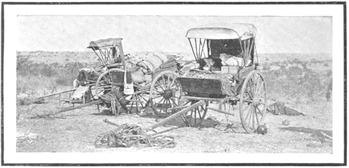
When the retreating burghers began to straggle
through Pretoria towards the north, they commandeered
any horses that seemed better than the ones
they were riding. Cab horses and carriage horses
were outspanned on the street, and the vehicles and
harnesses left lying on the ground. Stables were
entered and the best of the stock was taken for remounts.
As a war proceeding this was perfectly
legitimate, although it was rather hard on those who
lost their horses. The American consul drove a fine
pair of large Kentucky animals, which were probably
the finest horses in the town, and he had considerable
difficulty in keeping them. Several times the
burghers began to unharness them, but a word telling
them to whom they belonged stopped these
orderly robbers in their attempt. When it became
known that many unscrupulous persons were taking
dishonest advantage of the fact that the commands
were taking remounts and state horses under the
name of the government, an order was issued against
commandeering horses for any purpose.
After this state of unrest and terror had continued
for three or four days without an appearance of the
British, the excitement wore off, confidence was
restored, and many of the burghers of General
Botha’s command who had retreated now returned
to the city.
The last Sunday before the British came dawned
quiet and peaceful as a New England Sabbath; not
a sign of war was to be seen; the streets were
thronged with men, women, and children on their
way to church to pray for their cause and their dead.
The soldier laid aside his rifle and bandolier for the
day, and not one was to be seen throughout the
crowds which were moving towards their respective
places of worship, while the bells rang summons and
welcome. The day was warm enough for the
women to wear white gowns, which served to make
the many black ones the more noticeable. The
children were stiff and starched in their Sunday
cleanliness, and half the church-going crowd was
composed of these little ones. In many a pew there
was no father or brother, but only a sad-faced
woman in sombre black.
The churches were crowded to the doors, and I
tried two or three places before I finally gained admittance
to the church opposite President Krüger’s
house, where he had himself often occupied the
pulpit. It was a typical country church, such as
may be seen in hundreds of our smaller towns; the
windows were open, and a soft breeze blew gently
through the room. The people entered deeply
into their worship, and the sadness that prevailed
made it appear like a service over the dead who had
fallen in battle. Many families were worshiping
together for the last time, for on the morrow a
battle was to be fought, and all who were going to
continue the fight were to be separated that night
from their loved ones.
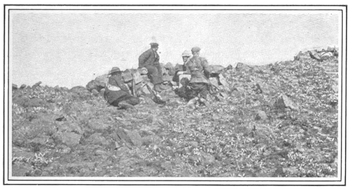
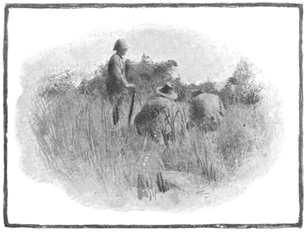
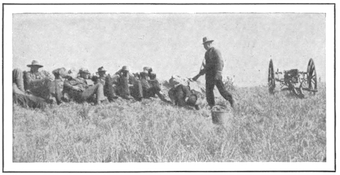
Boers under heavy shell fire, awaiting British
advance behind their defenses.
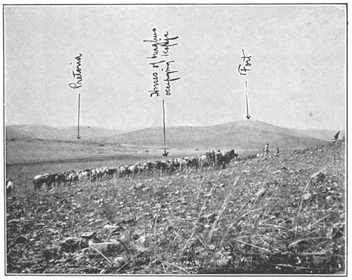
Burghers’ horses during battle of Pretoria.
There was not one in the whole church who was
not weeping. Near me sat a young girl of about
twenty, who sobbed aloud during the entire service,
as though her heart was broken beyond all comfort;
and I afterwards learned that her father and four
brothers were all dead, and that her one remaining
brother was at St. Helena with Cronje. In the pew
in front of me sat an old grizzled burgher with a
heavy gray beard; he needed no rifle to show that
he had been for months on command, for his face was
burned by wind and sun. His arm was around his
wife, whose head rested on his shoulder. She did
not weep, but at frequent intervals she huddled
closer to him and grasped his arm more firmly, as if
afraid he would leave her. On his other side sat a
little girl, who looked around with big, frightened
eyes, wondering at the scene.
The pastor preached from his heart a sermon of
hope and encouragement, his words being interrupted
by the sound of sobbing. Hardly a man
there but had his arm supporting the woman at his
side, or grasped her hand in his. The text was from
Ezekiel, xxxvii. 3–9:
And he said unto me, Son of man, can these bones live?
And I answered, O Lord God, thou knowest.
Again he said unto me, Prophesy upon these bones, and
say unto them, O ye dry bones, hear the word of the
Lord.
Thus saith the Lord God unto these bones; Behold,
I will cause breath to enter into you, and ye shall
live:
And I will lay sinews upon you, and will bring up flesh
upon you, and cover you with skin, and put breath in you,
and ye shall live; and ye shall know that I am the
Lord.
So I prophesied as I was commanded: and as I prophesied,
there was a noise, and behold a shaking, and the bones came
together, bone to his bone.
And when I beheld, lo, the sinews and the flesh came up
upon them, and the skin covered them above: but there was
no breath in them.
Then said he unto me, Prophesy unto the wind, prophesy,
son of man, and say to the wind, Thus saith the Lord God;
Come from the four winds, O breath, and breathe upon these
slain, that they may live.
Tender, with infinite pathos, yet manful, and with
a virile faith that seemed to make the impossible
actual, the sermon went on. It was a prophet’s
opportunity, such as comes to but few preachers in
all history, to stand at the final threshold of a
nation’s life, to bid farewell to the men leaving for
the forlorn hope of the last struggle, and to embrace
in one cry of faith both the heartbreak and the resolution
of a people. It was in the Dutch tongue,
but the preacher repeated it to me in English the
next day, and I was the witness of the effect of its
simple eloquence on the people.
When the service was over, there was a solemn
and tearful handshaking before the congregation
scattered for the last time to their homes; the men
to buckle on their bandoliers and rifles for the next
day’s battle, the women to pray for the safety of
those brave hearts so dear to them, or to weep
alone with memories of those they had loved and
lost.
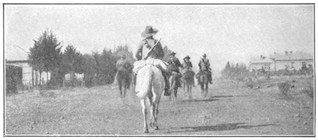
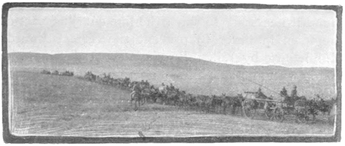
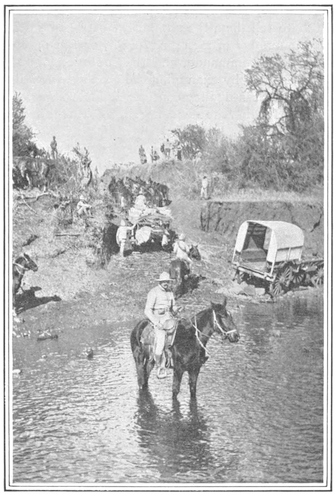
The Boer retreat from Pretoria.