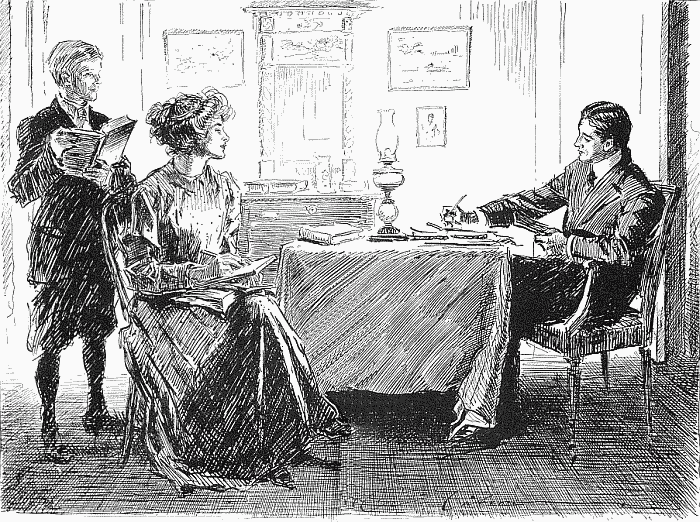
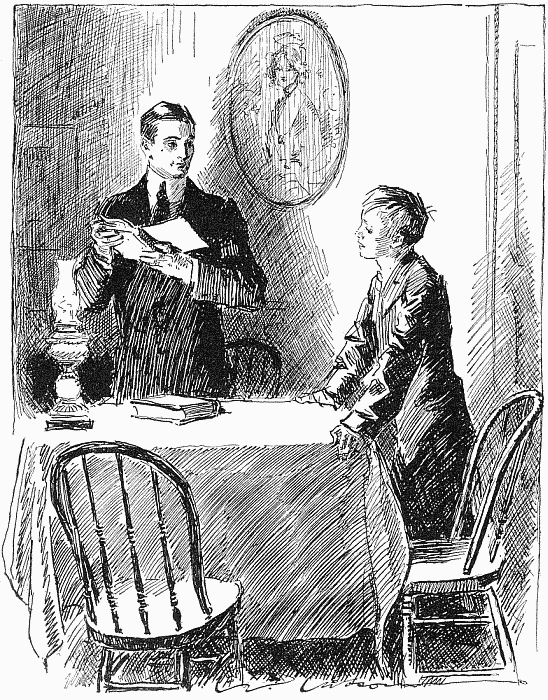
Marche, pacing the shabby sitting room after supper, an unlighted
cigarette between his fingers, listened to Jim recite his Latin lesson.
"Atque ea qui ad efeminandos animos pertinent important," repeated the
boy; and Marche nodded absently.
"Do you understand what that means, Jim?"
"Not exactly, sir."
Marche explained, then added smilingly: "But there is nothing luxurious
to corrupt manhood among the coast marshes down here. Barring fever and
moccasins, Jim, you ought to emerge, some day, into the larger world
equipped for trouble."
"I shall go out some day," said the boy.
Marche glanced up at the portrait of the boy's mother in its pale-gilt
oval. Near it, another nail had been driven, and on the faded wall paper
was an oval discoloration, as though another picture had once hung
there.
"I wish I might see your father before I go North," said Marche, half to
himself. "Isn't he well enough to let me talk to him for a few minutes?"
"I will ask him," said the boy.
Marche paced the ragged carpet until the return of Jimmy.
"Father is sorry, and asks you to please excuse him," he said.
Marche had picked up the boy's schoolbook and was looking at the writing
on the flyleaf again. Then he raised his head, eyes narrowing on the boy
as though searching for some elusive memory connected with him—with his
name in the Latin book—perhaps with the writing, which, somehow, had
stirred in him, once more, the same odd and uncomfortable sensation
which he had experienced when he first saw it.
"Jim," he said, "where did you live when you lived in New York?"
"In Eighty-seventh Street."
"West?"
"Yes, sir."
"Do you remember the house—the number?"
"No, sir."
[Pg 99]
"Was it a private house?"
"I don't know. It was very tall. We lived on one floor and used an
elevator."
"I see. It was an apartment house."
The boy stood, with blonde head lowered, silently turning over the
leaves of an old magazine.
Marche walked out to the porch; his brows were bent slightly inward, and
he bit the end of his unlighted cigarette until the thing became
useless. Then he flung it away. A few stars watched him above the black
ramparts of the pines; a gentle wind was abroad, bringing inland the
restless voice of the sea.
In Marche's mind a persistent thought was groping in darkness, vainly
striving to touch and awaken memories of things forgotten. What was it
he was trying to remember? What manner of episode, and how connected
with this place, with the boy's book, with the portrait of his mother in
its oval frame? Had he seen that portrait before? Perhaps he had seen it
here, five years ago; yet that could not be, because Herold had not been
here then.
Was it the writing on the flyleaf that had stirred some forgotten
memory? It had seemed to him familiar, somehow—yet not like the
handwriting in Herold's business letters to him. Yet it was Herold's
writing—"Jim, from Daddy"—that was the inscription. And that
inscription had riveted his attention from the first moment he saw it.
Who was Herold? Who was this man whose undoubtable breeding and personal
cultivation had stamped his children with the same unmistakable
distinction?
Somehow or other there had been a great fall in the world for him—a
terrible tumble from higher estate to land him here in this desolation
of swamp-bound silence—here where only the dark pines broke the vast
sky line, where the only sound was the far rumor of the sea. Sick,
probably with coast fever, poor, dependent, no doubt, on the salary
Marche paid him, isolated from all in the world that made the world
endurable to intelligence, responsible for two growing children—one
already a woman—what must be the thoughts of such a man on a night like
this, for instance?
"I want to see that man," he kept repeating to himself. "I want to see
him; and I'm going to."
Restless, but now always listening for the sound of a light tread which
he had come to know so well—alas!—he began to walk to and fro, with
keen glances toward the illuminated kitchen window every time he passed
it. Sometimes his mind was chaotic; sometimes clear. The emotions which
had awakened in him within the week were complex enough to stagger a
more intelligent man. And Marche was not a fool; he was the typical
product of his environment—the result of school and college, and a New
York business life carried on in keenest competition with men as
remorseless in business as the social code permitted. Also, he went to
church on Sundays, read a Republican newspaper, and belonged to several
unexceptionable clubs.
That was the kind of a man he had been only a week ago—a good fellow in
the usual sense among men, acceptable to women, kind hearted, not too
cynical, and every idea in his head modeled upon the opinions he heard
expressed in that limited area wherein he had been born and bred.
That was the kind of a man he had been a week ago. What was he
now—to-night—here in this waste corner of the world with the light
from a kitchen window blazing on him as though it were the flashing
splendor streaming through the barred portals of paradise? Was it
possible that he, John Benton Marche, could be actually in love—in love
with the daughter of his own game warden—with a girl who served him at
supper in apron and gingham, who served him further in hip boots and
ragged jacket—this modern Rosalind of the marshes, as fresh and
innocent, as modest and ardent, as she of the Arden glades?
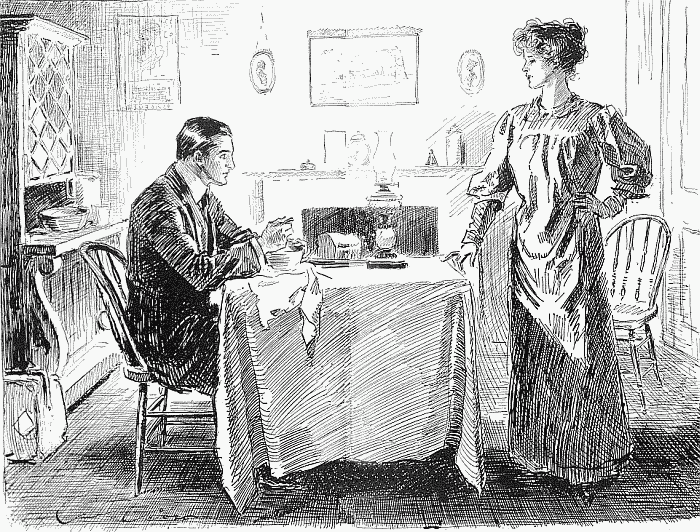
The kitchen door opened, and Molly Herold came down the steps and
straight toward him, unthinkingly, almost instinctively, laying her
hands in his as he met her under the leafless China tree in the yard.
"I was longer than usual to-night," she said, "trying to soften my hands
with that cold cream you so kindly sent for." She lifted them in the
starlight with a little laugh. "They're a trifle better, I think," she
said, "but they're always in water, you know, either there," she glanced
around at the kitchen, "or yonder with the decoys. But thank you all the
same," she added brightly. "Are you going to have another delightful
talk, now?"
"Do you care to?"
"Of course. The idea of my not caring to talk to you," she said,
laughing at the absurdity. "Shall we go into the sitting room, or walk
in the starlight? There are no snakes out, yet," she assured him,
"though if this weather holds, the moccasins will come out."
"We'll walk down to the shore," he said.
"One moment, then." She turned and sped to the house, reappearing, after
a few minutes, wearing her ragged shooting coat.
"Is your father comfortable?" he asked.
"Yes, thank you."
"Do you think he might want you?"
"No. Jim sleeps next to him, and he is preparing for bed, now." She
smiled. "What a darling my brother is, isn't he, Mr. Marche?"
"He's a fine boy."
They moved on together, down the rutted lane, between dismantled fences
and ragged, leafless hedges. She was lithe and light and sure footed,
but once or twice, as they skirted puddles, he supported her; and the
touch of his hand on her body almost unnerved him. Never had he dreamed
that contact with any woman could so thrill, so exquisitely shock. And
every instant he was falling deeper and deeper in love with her. He knew
it—realized it—made no effort to avoid it, fight it off, control it.
It was only his speech and manner that he held desperately under bit and
curb, letting his heart go to everlasting smash and his reason run riot.
And what on earth would be the end he could not imagine, for he was
leaving for the North in the morning, and he had not yet told her.
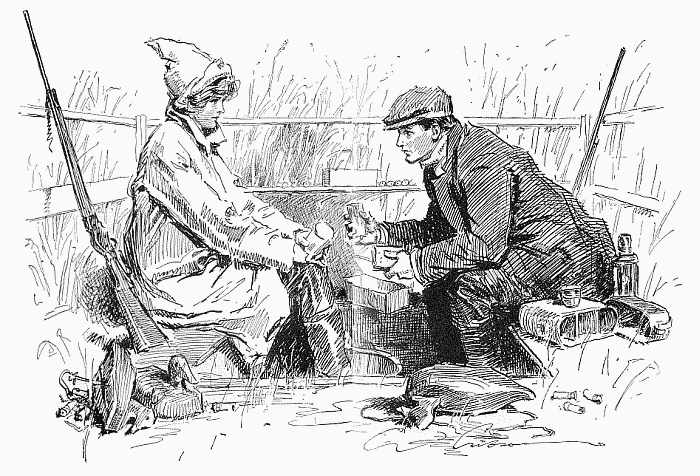
As they came out upon the shore, the dory loomed up, beached, a dark
silhouette against the starlit water. She laid her hands on the stern
and vaulted lightly to her perch, sliding along to make room for Marche.
From far away in the sound came the confused murmur of wild fowl
feeding. Except for that, and the ceaseless monotone of the outer sea,
there was no sound, not even the lap of water against the bow.
Marche, who had been leaning forward, head bent as though watching the
water, turned to the girl abruptly. "I want to do something for—Jim,"
he said.
The girl looked up at him, not understanding.
"Will your father let me?"
"I don't know what you mean."
"I mean that I want to send him to a good school—a good boys' school in
the North."
She caught her breath, was silent for a moment, then, amazed: "Would
you do that? Oh, I've wished for it—dreamed of it! But—how can you?
You are so kind—so good to us—but how could we—accept?"
"That's why I want to see your father."
"For that! Was it really for that, Mr. Marche?"
"Yes—partly." He swallowed and looked the other way, for the girl's
excited face was very near his own as she bent forward to search his
eyes for the least change of expression—bent nearer as though to
reassure herself that he meant it seriously. For an instant her soft
breath made the night air fragrant; he felt it, faint and fresh on his
cheek, and turned sharply, biting his lips lest he lose all
self-control.
"Could you and your father spare him?" he asked carelessly.
"Oh, if you only would give him that chance!" she cried. "But—tell
me—how can we accept such a thing of you? Is it possible?"
"Would you accept it?" he asked, turning toward her.
The question startled her. She looked at him, striving to think clearly,
trying to see this offered miracle through calm, impartial eyes.
"I—I would do anything—almost—for Jim," she said. "I'd have no pride
left, if his chances lay in the balance. But men—my father—may be
different."
He said slowly: "Suppose I offered the same chance to you?"
"What!" she said crisply.
"Suppose I offered you a college finishing, Miss Herold. Would you
accept?"
She slowly grew scarlet under his gaze. "That would be insulting," she
said, in a low voice.
"Why, when only kindness is meant—as I mean it for Jim?"
"It is not the same. I am a grown woman capable of caring for myself.
Such an offer, however kindly meant, could only hurt me, humiliate
me—and—I thought you found me companionable as I am. Friends do not
offer to better each other—in such a way."
"I have not offered it to you, Miss Herold."
She looked up, still flushed and brilliant eyed; then her face changed
softly. "I know it. I was foolishly sensitive. I know you couldn't offer
such a thing to me. But I wish I knew whether we could accept for Jim.
He is such a darling—so intelligent and perfectly crazy for an
education. I've saved a little—that's why I wanted you to hire me for
your bayman. You see I don't spend anything on myself," she added, with
a blush.
Marche was fighting hard for self-restraint; he was young and romantic,
and his heart was very full. "What I'd like to do," he said, "would be
to send Jim to some first-rate school until he is ready for college.
Then I'd like to see him through college, and, if he cared for it, start
him with me in business."
"Oh," she cried softly, "is it possible! Is there—can any man really do
such heavenly things? Have you any idea what you are saying? Do you
realize what you are doing to me—with every word you utter?"
"What am I doing to—to you?" he asked unsteadily.
"Making me your slave," she said, in a low voice, thrilling with
generous passion. "Even for the thought—even if father will not
accept—what you have said to me to-night has put me in your
debt forever. Truly—truly, I know what friendship is, now."
She clasped her hands tightly and said something else, sweetly
incoherent; and, in the starlight, Marche saw the tears sparkling on her
lashes.
With that he sprang nervously to the shore and began to tramp up and
down the shingle, his mind in a whirl, every sense, common or the
contrary, clamoring for finality—urging him to tell her the truth—tell
her that he loved her, that he wanted her—her alone, out of all the
world of women—that it was for love and for her, and for love of her,
that he offered anything, did anything, thought anything now under the
high stars or under the circling sun.
And now, as he tramped savagely to and fro, he realized that he had
begun wrong; that he should have told her he loved her first of all, and
then acted, not promised.
Would she look on his offer scornfully, now? Would she see, in what he
asked of her, a bribe desired for the offer he had made in her brother's
behalf? She did not love him. How could she, in a week? Never had there
been even a hint of sentiment between them. What would she think—this
young girl, so tranquilly confident in her friendship for him—what
would she think of him and his love? He knew there was nothing mercenary
or material in her character; he knew she was young, sweet tempered,
reticent concerning herself, clean hearted, and proud. How could he come
blundering through the boundaries of her friendship with such an avowal,
at a moment's notice?
He returned slowly to the boat and stood looking up at her; and he saw
that she was smiling down at him in the starlight.
"Why did you start off so abruptly and tramp up and down?" she asked.
He looked up at her. "Shall we walk back, now?" he said.
She extended her hands to him, and he swung her to the beach. For a
moment he retained her hands; she looked at him, smiling, thrilling with
all that he had said, meeting his eyes frankly and tenderly.
"You are like some glorious magic prince to me," she said, "appearing
among us here to win our hearts with a word."
"Have I won yours with what I have said?"
"Mine? Oh, don't you know it? Do you think—even if it doesn't come
true—that I can ever forget what you have wished to do for Jim?"
Still holding her hands, he lifted them, joined her fingers, and laid
his lips to them. She bent her head and caught her breath in surprise.
"I am going North to-morrow," he said.
For a moment she did not comprehend his words. Then, a trifle dazed, she
looked up at him. "To-morrow?"
"Yes."
"Are you coming back?"
"Perhaps—next year."
"Next—year!"
"Do you—find it—a long time?"
Her straight brows bent inward a little, the startled gray eyes became
clear and steady. "Of course I knew that you must go—some time. But I
had no idea that it would be so soon. Somehow, I have thought of you as
being—here——"
"Do you care?"
Her honest eyes widened. "Care?" she repeated.
"Yes. How greatly do you care?"
The straight brows contracted still more as she stood considering
him—so close that the fresh and subtle youth of her freshened the night
again with its faint perfume.
Again he touched her hands with his lips, she watching him palely, out
of clear, gray eyes; then, as they turned away together, he encircled
her slender waist with his arm.
That she was conscious of it, and not disturbed by it, was part of her
new mystery to him. Only once, as they walked, when his circling clasp
tightened, did she rest her own hand over his where it held her body
imprisoned. But she said nothing; nor had he spoken when the belt of
pines loomed against the stars once more.
Then, though neither had spoken, they stopped. He turned to face her,
drew her into his arms, and the beating of his heart almost suffocated
him as he looked into her eyes, clear, unshrinking eyes of gray, with a
child's question in their starry depths.
And he answered the question as in a dream: "I love you. I want you for
my wife. I want you to love me. You are the first woman I have cared
for. All that you are I want—no more than you are. You, as you are now,
are all that I care for in the world. Life is young for us both, yet.
Let us grow up together—if you can love me. Can you?"
"I don't know."
"Can you not care for me a little, Molly?"
"I do. I know—nothing about—love—real love."
"Can you not imagine it, dear?"
"I—it is what I have imagined—a man—like you—coming this way into
my loneliness. I recognize it. I have dreamed that it was like this.
What is it that I should do—if this is really to come true?"
"Love me."
"I would—if I knew how. I don't know how," she said wistfully. "My
heart is so full—already—of your goodness—I—and then this dream I
have dreamed—that a man like you should come here and say this to
me——"
"Is it in you to love me?"
"I'll try—if you'll tell me what to do—how to show it—to
understand——"
He drew her closer, unresisting, and looked deep into her young eyes,
and kissed them, and then her lips, till they grew warmer and her breath
came fragrant and uneven.
"Can you love me?"
"Yes," she whispered.
"Are you sure?"
"Y-yes."
For a moment's exquisite silence she rested her flushed face against his
shoulder, then lifted it, averted, and stepped aside, out of the circle
of his arms. Head lowered, she stood there, motionless in the starlight,
arms hanging straight; then, as he came to her, she lifted her proud
little head and laid both her hands in his.
"Of those things," she said, "that a woman should be to the man she
loves, and say to that man, I am ignorant. Even how to speak to
you—now—I do not know. It is all a dream to me—except that, in my
heart, I know that I do love you. But I think that was so from the
beginning, and after you have gone away I should have realized it some
day."
"You darling!" he whispered. Again she surrendered to him, exquisite in
her ignorance, passive at first, then tremulously responsive. And at
last her head drooped and fell on his shoulder, and he held her for a
little longer, then released her.
Trembling, she crept up the stairway to her room, treading lightly along
the dark entry, dazed, fatigued, with the wonder of it all. Then, as she
laid her hand on the knob of her bedroom door, the door of her father's
room opened abruptly.
"Molly?"
"Yes, dear," she answered vaguely.
He stood staring at her on the threshold, fully dressed, and she looked
back at him, her eyes slightly confused by the light.
"Where have you been?" he said.
"With Mr. Marche."
"Where?"
"To the dory—and back."
"What did he say to you, child?"
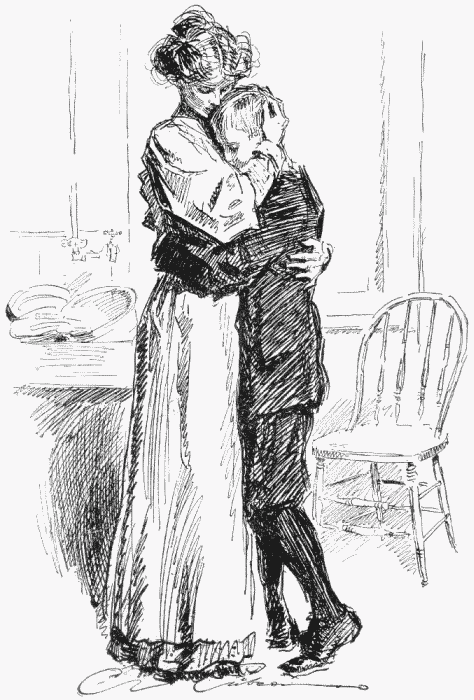
She came silently across the threshold and put her arms around his neck;
and the man lost every atom of his color.
"What did he say?" he repeated harshly.
[Pg 127]
"That he loves me."
"What!"
"It is true, father."
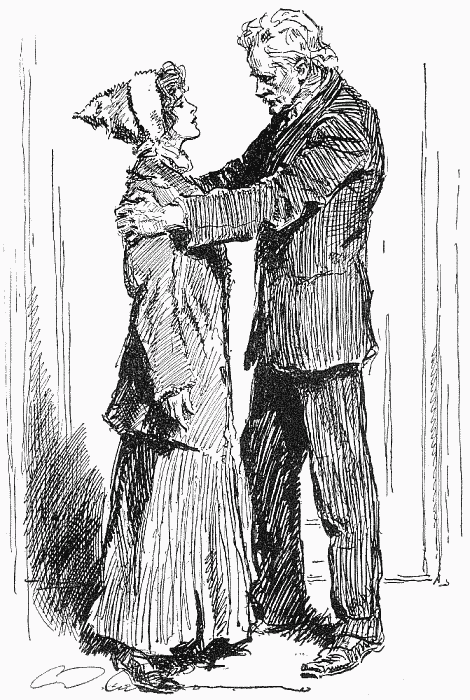
The man held her at arm's length roughly. "Good God!" he groaned, "how
long has this been going on?"
"Only to-night. What do you mean, father?"
"He tells you that he—he is in love with you? With you?" repeated
Herold unsteadily.
"Yes. It is true, too."
"You mean he asked you to marry him!"
"Yes. And I said I would."
"You love him!"
The man's pallor frightened her silent. Then he dropped her arms, which
he had been clutching, and stood
staring at nothing, gnawing at his
colorless lips.
The girl watched him with dawning terror and finally ventured to speak.
"Dear, what is the matter? Are you displeased with me? Do you think that
he is not a man I should care for? You don't know him, dear. You have
only to see him, to speak with him, hear his voice, look into his
eyes——"
"Good God!" groaned Herold, closing his sunken eyes. Then, almost
feeling his way out and along the dark passageway, he descended the
stairs, heavily.
Marche, cleaning his gun in the sitting-room, looked up in surprise,
then rose, laying aside stock, fore-end, and barrel, as Herold came into
the room. The next instant, stepping nearer, he stared into Herold's
face in silence. And so they met and confronted each other after many
years.
"Are you Herold?" said the young man, in a low voice.
"That is my name—now."
"You have been in my employment—for five years?"
"Yes. Judge Gilkins gave me the chance. I could not suppose that the
club would ever become your property."
The younger man's face hardened. "But when it did become my property,
why had you the indecency to stay?"
"Where else could I go?"
"You had the whole world to—operate in."
Herold's thin face flushed. "It was fitter that I should work for you,"
he said. "I have served you faithfully for five years."
"And unfaithfully for ten! Wasn't it enough that Vyse and I let you go
without prosecuting you? Wasn't it enough that we pocketed our loss for
your wife's sake?"
He checked himself in a flash of memory, turned, and looked at the
picture on the wall. Now he knew, now he understood why his former
associate's handwriting had seemed familiar after all these years.
And suddenly he remembered that this man was Jim's father—and the
father of the young girl he was in love with; and the shock drove every
drop of blood out of his heart and cheeks. Ghastly, staring, he stood
confronting Herold; and the latter, leaning heavily, shoulder against
the wall, stared back at him.
"I could have gone on working for you," he said, "trying to save enough
to make restitution—some day. I have already saved part of it. Look
at me—look at my children—at the way we live, and you'll understand
how I have saved. But I have saved part of what I took. I'll give you
that much before you go—before I go, too."
His breath came heavily, unevenly; he cleared his eyes with a
work-stained hand, fashioned for pens and ledgers.
"You were abroad when I—did what I did. Vyse was merciless. I told him
I could put it back if he'd give me the chance. But a thief was a thief
to him—particularly when his own pocket was involved. He meant to send
me to prison. The judge held him—he was his father-in-law—and he was
an old man with a wife and children of his own."
Herold was silent for a moment, and his gaze became vague and remote,
then he lifted his head sharply:
"A man makes one slip like that and the world damns him forever. And I
tell you, Marche, that I am not dishonest by nature or in my character.
God alone knows why I took those securities, meaning, of course, to
return them, as all the poor, damned fools do mean when they do what I
did. But Vyse made it a condition that I was to leave the country, and
there was no chance of restitution unless I could remain in New York and
do what I knew how to do—no chance, Marche—and so fortune ebbed, and
my wife died, and the old judge saw me working on the water-front in
Norfolk one day, and gave me this place. That is all."
"Why did you feign illness?" asked Marche, in an altered voice.
"You know why."
"You thought I'd discharge you?"
"Of course."
Marche stepped nearer. "Why did you come to me here to-night?"
Herold flushed deeply. "It was your right to know—and my daughter's
right—before she broke her heart."
"I see. You naturally suppose that I would scarcely care to marry the
daughter of a——" He stopped short, and Herold set his teeth.
"Say it," he said, "and let this end matters for all of us. Except that
I have saved seven thousand dollars toward—what I took. I will draw you
a check for it now."
He walked steadily to the table, laid out a thin checkbook, and with his
fountain-pen wrote out a check for seven thousand dollars on a Norfolk
bank.
"There you are, Marche," he said wearily. "I made most of it buying and
selling pine timber in this district. It seemed a little like expiation,
too, working here for you, unknown to you. I won't stay, now, of course.
I'll try to pay back the rest—little by little—somehow."
"The way to pay it back," said Marche, "is to do the work you are fitted
for."
Herold looked up. "How can I?"
"Why not?"
"I could not go back to New York. I have no money to go with, even if I
could find a place for myself again."
"Your place is open to you."
Herold stared at him.
Marche repeated the assertion profanely. "Damnation," he said, "if you'd
talked this way to me five years ago, I'd never have stood in your way.
All I heard of the matter was what Vyse told me. I'm not associated with
him any more; I'll stand for his minding his own affairs. The thing for
you to do, Courtney, is to get into the game again and clean up what you
owe Vyse. Here's seven thousand; you can borrow the rest from me. And
then we'll go into things again and hustle. It was a good combination,
Courtney—we'd have been rich men—except for the slip you made. Come on
in with me again. Or would you rather continue to inhabit your own
private hell?"
"Do you know what you are saying, Marche?" said the other hoarsely.
"Sure, I do. I guess you've done full time for a first offense. Clean
off the slate, Courtney. You and Vyse and I know it—nobody
else—Gilkins is dead. Come on, man! That boy of yours is a corker! I
love him—that little brother, Jim, of mine; and as for—Molly——" His
voice broke and he turned sharply aside, saying: "It's certainly
blue-bird weather, Courtney, and we all might as well go North. Come out
under the stars, and we'll talk it over."
It was almost dawn when they returned. Marche's hand lay lightly on
Courtney's shoulder for a moment, as they parted.
Above, as Courtney stood feeling blindly for his door, Molly's door
swung softly ajar, and the girl came out in her night-dress.
"Father," she whispered, "is it all right?"
"All right, thank God, little daughter."
"And—I may care for him?"
"Surely—surely, darling, because he is the finest specimen of manhood
that walks this merciless earth."
"I knew it," she whispered gaily. "If you'll lend me your wrapper a
moment, I'll go to his door and say good-night to him again."
Her father looked at her, picked up his tattered dressing-gown from his
bed, and wrapped her in it to the chin, then kissed her forehead.
So she trotted away to Marche's door and tapped softly; and when he came
and opened the door, she put her arms around his neck and kissed him.
"Good night," she whispered. "I do love you, and I shall pray all night
that I may be everything that you would wish to have me. Good night,
once more—dearest of men—good night."

!["She trotted away to Marche's door and tapped softly." [Page 140]](https://openoldbooks.sgp1.digitaloceanspaces.com/books/blue-bird-weather/images/gs01.png "Frontispiece")