BLUE-BEARD A CONTRIBUTION TO HISTORY AND FOLK-LORE
Transcriber’s Note:
Words on the cover were added by Transcriber and placed in the Public Domain.
The rubric in the middle was on the original cover.
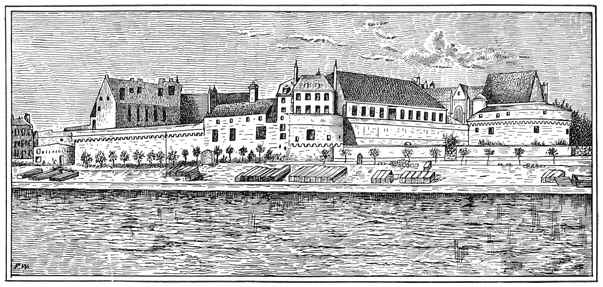
Château (Castle) of Nantes, where Gilles was tried.—From the river Loire.
BEING THE HISTORY OF GILLES DE RETZ OF BRITTANY,
FRANCE, WHO WAS EXECUTED AT NANTES IN 1440 A.D.
AND WHO WAS THE ORIGINAL OF BLUE-BEARD IN THE
TALES OF MOTHER GOOSE
BY THOMAS WILSON, LL.D.
CURATOR, DIVISION OF PREHISTORIC ARCHÆOLOGY, U.S. NATIONAL MUSEUM
COUNSELLOR OF THE BAR OF THE SUPREME COURTS, COURT OF
CLAIMS AND OF APPEALS IN THE DISTRICT OF COLUMBIA
FORMERLY U.S. CONSUL AT GHENT, BELGIUM; AT NANTES AND NICE, FRANCE
ILLUSTRATED
G. P. PUTNAM’S SONS NEW YORK & LONDON The Knickerbocker Press
1899
COPYRIGHT, 1899
BY
THOMAS WILSON
Entered at Stationers’ Hall, London
The Knickerbocker Press, New York
TO MY DEAR WIFE
THE COMPANION OF MY TRAVELS
WHILE THE MATERIAL FOR THIS VOLUME WAS GATHERED
THE PARTNER OF MY MANY JOYS
THE SHARER OF MY FEW SORROWS
THIS VOLUME IS AFFECTIONATELY DEDICATED
First for John V., Duke of Brittany, against the House of Blois. He Joins the Army of France and is Assigned to Duty with Joan of Arc. Crowning of the King, and Gilles made Marshal of France
The Personal Appearance of Gilles de Retz. An Epitome of his Life. His Extravagance and Ruinous Expenditures. His Inheritance. His Sales and Transfers of Property. His Love for the Theatre. Mysteries. That of the Siege of Orleans. Mysteries at Nantes. The Cathedral. Expensive Visit to Orleans. Maison de la Suze. The Decree of the King Interdicting his Sale or Incumbrance of Property. An Increasing Demand for Money Drives him to Magic in Search for the Philosopher’s Stone and the Transmutation of Base Metals into Gold. Magic
The story of Bluebeard has become a
classic in infantile mythical (folk-lore)
literature wherever the English and French
languages are spoken. Rev. Dr. Shahan suggests
its possible existence in earlier languages
and more distant countries (see p. xiv.).
The story is more or less mythical. While it
does not follow history with any pretence of
fidelity, it has come to be recognised by the
historians and literati of France as representing
the life of Gilles de Retz (or Rais), a soldier
of Brittany in the first half of the fifteenth
century. He was of noble birth, was possessed
of much riches, was the lord of many
manors, had a certain genius and ability, made
some reputation as a soldier at an extremely
early age, fought with Joan of Arc, and was
Marshal of France. At the close of these
wars he retired to his estates in Brittany,
and, in connection with an Italian magician,
he entered upon a search for the Elixir
of Youth and the Philosopher’s Stone. Together
they became possessed by the idea that
the foundation of this elixir should be the
blood of infants or maidens, and, using the
almost unbridled power incident to a great
man (at that early date) in that wild country,
they abducted many maidens and children,
who were carried to some one of his castles
and slain. Suspicion was finally directed toward
him; he was arrested, tried, convicted,
sentenced to death, and executed at the city
of Nantes, October 27, 1440, at the early age
of thirty-six years.
The author of this volume was sent, in 1882,
to the good city of Nantes as United States
Consul. While resident there he entered
upon the investigation which resulted in this
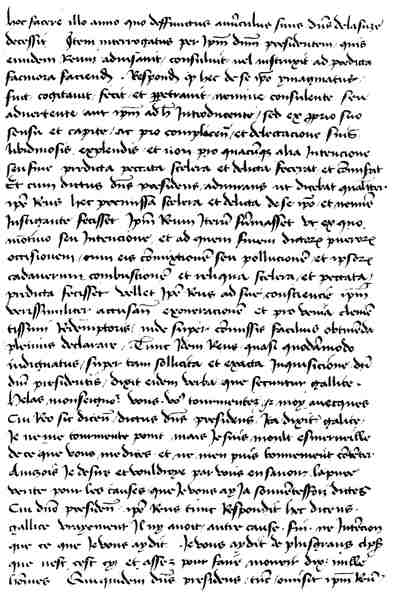
volume. He obtained access to the original
records of the trial in the archives of the department,
and made a photographic copy of
one of its manuscript Latin pages which is
shown in its proper place. The trial of Gilles
de Retz took place in the château of Nantes,
sentence was pronounced at the Place Bouffay,
and he was executed on the Prairie de la
Madeleine, the exact locality being now occupied
by the Hospital of St. Anne. The author
procured photographs and drawings of some
of these localities, which will appear in this
volume.
* * * * *
Monsieur Charles Perrault was the author
of the story of Bluebeard. He was born
at Paris, January 12, 1628. His father was
an advocate, originally from Tours. He was
the youngest of four brothers: the oldest,
Peter, was destined for the Bar, but became
the Receiver-General of Finances under Louis
XIV. and his Prime Minister Colbert, though
he afterwards fell out of favour and died in
poverty; Claude studied medicine; and Nicholas,
theology. Charles was taken up by Colbert
and made Superintendent of Public
Buildings throughout the kingdom. While
in this position, the erection of the Observatory
and the reconstruction and completion of
the Palais du Louvre were determined upon.
Plans for these buildings were to be decided
by competition, and the renown of the name
of Perrault is greatly increased by the fact
that Charles’s brother Claude, although educated
as a doctor of medicine and not as an
architect, designed plans which, after much
discussion and investigation, extending even
to Rome, were finally adopted by the King
and his Minister. Charles Perrault became a
member of the Academy—one of the “Immortal
Forty.” He introduced many improvements
into their methods, the principal of
which was for securing the attendance of
members, and a continuance of, and devotion
to, the work of preparing the great French
Dictionary. An episode in his life, covering
several years, was his poem of Le Siècle de
Louis le Grand and the parallel between the
ancients and moderns, which produced a discussion
among the most brilliant writers of
France. Boileau, Racine, La Fontaine, Longpierre,
Buet, Arnauld, and other illustrious
champions took up the cudgels against Perrault
and Fontanelle, and in favour of the
ancient classic heroes.
In 1662, Perrault retired from his office in
the Public Buildings, selling his right therein
to Monsieur de Blainville, a son-in-law of Colbert.
Until his death, May, 16, 1703, he devoted
himself to literature and to the education
of his children, and this was probably the
happiest portion of his life, for he loved to be
in the bosom of his family. He wrote for the
amusement of his children that which has now
become the most celebrated of his writings,
which has done more to perpetuate his name
and fame, and by which he is better known
than by the more pretentious and serious papers
and poems,—the Contes de Mère l’Oye
(Stories of Mother Goose). The first edition
was published in 1697 under the name of his
son, Perrault d’Armancourt, and dedicated to
Mademoiselle Elizabeth Charlotte d’Orléans,
the sister of the Duke of Chartres and the
niece of Louis XIV. These Mother Goose
stories were as follows: Little Red Riding-Hood,
The Fairies, Bluebeard, The Sleeping
Beauty, Puss in Boots, Cinderella, Requet à la
Houppe, to which Le Petit Poucet, The Adroit
Princess, and The Ass’s Skin were afterwards
added. There were still others in verse and
fable translated. Perrault was more poet than
prose writer—his serious works were in poetry:
Painting, The Apology for Women, The Century
of Louis the Grand, Genius (to Fontanelle),
and A Portrait of the Voice of Iris. We,
however, are interested alone in Bluebeard.1
Studious historians or astute critics may
dispute Perrault’s history of Bluebeard having
been founded upon the life of Gilles de
Retz, but the country people (the folk) of
Brittany will simply smile at such erudition
and continue in their former belief that Bluebeard
represents a cruel, wicked man who
lived here hundreds of years ago and who was
executed for his many crimes against humanity;
and the old men and women and the nurses
will repeat the story of Gilles de Retz under
the name of Bluebeard,—sometimes how he abducted
and murdered the children, and other
times how he murdered his wives. In that
country Gilles de Retz will always be known
as Bluebeard, and we must accept their verdict
as final.2
Rev. Dr. Shahan writes:
Dear Professor Wilson:
I have looked through your interesting work with the greatest
pleasure. It is just such a tale as I would delight in tracing through
its strange genesis and stranger propaganda....
I wonder if the actual facts were not soon plaited back into ancient
nursery tales of a kindred tone, and a fresh lease of life thus
given to mythical narratives that would otherwise not have had
strength enough to perpetuate themselves to our time, at least in
such intensity and vitality.
I would suggest as complete a literature of the Bluebeard subject
as possible2 and think perhaps it would be well to see what roots it
had struck in German, Spanish, and Welsh soil,—fields always susceptible
at that time to anything odd or romantic.
When I was a child how often I cried with Sister Anne on the
high tower, and looked for the three specks out on the ocean “no
bigger than the head of a pin.” Thank God! their steeds always
breasted the flood bravely and arrived in time to save injured innocence.
Is not that the true origin of Bluebeard, in an age of
chivalrous ideal, of strict theologico-popular views of justice and of
feudal individualism?
The box of Pandora and the key of Bluebeard may have some
relationship—CURIOSITY, irrepressible though dangerous, is its
keynote, and I wonder if it does not all come from India, like those
mediæval tales that Gaston Paris tells about, or if it is not an old
Gaelic myth, like that of Balor-of-the-Mighty-Blows so well
translated by Standish O’Grady in his Silva Gadelica....
The original of Bluebeard in the
Mother Goose story was Gilles de
Rais (changed in 1581 to Retz), though he
is sometimes called Gilles de Laval in history.
Neither the date nor place of his birth
is known with precision, but it took place in
the autumn of 1404, probably at Machecoul,
one of the family châteaux in the southern
part of Brittany.
The ancestors of Gilles de Retz belonged
to four noble and illustrious families in Brittany:
1. Laval, sometimes called Montmorency-Laval;
2. Rais (changed to Retz in
1581); 3. Machecoul; and 4. Craon. These
families could trace their ancestry to the
eleventh or twelfth centuries. Gilles’s father
was a Laval or Montmorency-Laval, named
Guy; his grandfather was also Guy, and many
of his ancestry bore the same surname. His
grandmother was a sister of the great Du
Guesclin; his great-grandmother was Joan,
called la Folle, or “the Crazy.”
The House of Rais in that day was represented
by Joan la Sage (the Wise), 1371–1406.
Being without heirs she, in 1400, by
solemn act, adopted Guy de Laval, the father
of Gilles, as her heir and successor. A legal
impediment existed in an act of disinheritance
which had been passed against Joan la Folle,
the grandmother of Guy de Laval, and it required
a special decree to enable Guy to accept
the inheritance. This was finally done
under the condition that he should abandon
the name, arms, and escutcheon of the family
of Laval, and bear those of Rais. But Joan
la Sage afterwards repented of her choice and
attempted, by act of May 14, 1402, to change
her succession in favour of Catherine de Machecoul.
This begat a suit-at-law, which was
taken by appeal to the Parliament at Paris.
By this time Jean de Craon had come to be
the heir of his mother, Catherine de Machecoul.
He had a daughter named Marie, and for
the settlement of a contest which, it was feared
with reason, might be interminable, it was
agreed between the families, as it was between
York and Lancaster, that the representatives
of the two respective houses should be intermarried,
and accordingly, in the spring of 1404,
Guy de Laval (changed to be Guy de Rais)
was married to Marie de Craon, and thus it was
that Guy de Laval, the father of Gilles, became
the heir and successor of Joan la Sage (of Rais),
received her property, and took her name.
There has been some dispute among the historians
of Brittany as to dates, but it is agreed
that the contest at law between the two families
was begun in 1402, was still found on the
parliamentary records in 1403, and was settled
by the marriage, which the best authorities
agree took place February 5, 1404.
Guy de Laval (Rais) and Marie de Craon
were the parents of Gilles de Rais, who was their
first-born. His birth is believed to have taken
place at the château of Machecoul during the
last months of the year 1404. A doubt has
been thrown over these dates, especially that
of his birth, because of his extreme youth when
he made his appearance in public affairs. If
born at that time, he would appear to have
been a Marshal of France at twenty-five years
of age; but this was not impossible, and the
weight of the evidence seems to favour the
dates as given.
The parents of Gilles had another son, René
de la Suze, but he seems to have made but
little figure compared with his redoubtable
brother. Guy de Laval, the father, died on
the last day of October, 1415, and the records
show his last will and testament dated on the
28th and 29th of that month. He gave the
tutelage of his sons to a distant cousin, John
de Tournemine; but by some means not appearing,
the maternal grandfather, Jean de
Craon, took upon himself their guardianship.
The mother, Marie, was remarried soon after
the death of her husband, to Charles Desouville,
the Lord of Villebon. The grandfather
of Gilles and René seems to have been excessively
indulgent and devoted to the children,
and if he was old, he was of strong will, fiery
temper, staunch patriotism, and obstinate
disposition.
In 1417, when Gilles was but thirteen years
old, he was engaged by his grandfather to Joan
Peynel, the daughter of Foulques Peynel, the
Lord of Hambuie and Briquebec; but the contract
was voided by her death. In November,
1418, the grandfather made for him a second
contract of marriage, this time with Beatrice
de Rohan, the eldest daughter of Alain de
Porhoet. The contract was signed at Vannes
with great ceremony in the presence of an
illustrious throng of Breton nobles. But this
contract came to an end, as did the former, by
the unfortunate death of the young lady. This
double failure did not, however, discourage the
doting grandfather. He immediately proceeded
with his arrangements for a third contract, this
time with Catherine de Thouars, the daughter
of Miles de Thouars and Beatrice de Morgan,
and this marriage was celebrated on the last
day of November, 1420. The young wife,
Catherine, brought to her husband, Gilles, the
property of Tiffauges, Pouzauges, Savenay,
Confolons, Chabenais, and others of minor
importance. The first two mentioned were
well provided with châteaux. The property
and château of Machecoul came to Gilles
through his mother’s family, and the château
and property of Champtocé came to him upon
the death of his grandfather. This, with the
fortune of his father, Guy de Laval, to which
must be added that of the family of Rais left
by Joan la Sage, made Gilles de Rais one of
the richest barons of the province.
Under the conditions of the adolescence of
Gilles de Retz, his education may be better
imagined than described. Left at the age of
eleven an orphan or a half-orphan, by the
death of his father; the remarriage of his
mother within a year thereafter; the contest
of greater or less gravity over his guardianship,
which ended in the success of his maternal
grandfather, whose best recommendation
for the position seems to have been his love
for his grandchildren and his subsequent willingness
to indulge them, and also his great
desire to get them (especially the elder) married
and off his hands, a proceeding which he
conducted with such celerity that the young
man was engaged three times with all pomp
and formality, and finally married by the time
he was sixteen years old: this would seem to
afford but little time or opportunity to obtain
an education, even under the best facilities,
however studious and seriously inclined he
might have been.
Education did not stand very high in the
province of Brittany at this era. There was
much excuse, especially for the nobles and
barons of Brittany, for their lack of education.
The profession of war seems to have been the
highest recommendation, and the shortest, as
well as the easiest and most agreeable, road to
preferment. There is much to be said on the
score of patriotism and the needs of the country,
for, as will be seen farther on, it was an
era of war, and Brittany was in the midst of it.
The education in arms was almost inevitable;
it had greater attraction for Gilles than books,
arts, or sciences; and it appears that his grandfather
allowed him to pursue his own wishes
and desires without even an attempt at control.
Gilles, during his trial, said: “In my youth I
was allowed to go always according to my own
sweet will.” Nevertheless, he spoke three
languages, Latin, French, and Breton, had
some knowledge of chemistry, and it seems to
be without question that he had a library, so
well chosen as to be an object of commendation
and attraction to highly educated persons.
In the inventory of his effects, taken in 1436
and found among his records, is a receipt of
Jean Montclair given to Jean Bouray, for a
book a copy of Ovid’s Metamorphoses, described
to have been in parchment covered
with leather-gilt, with copper clasps and locks
of silver-gilt, with a crucifix of white silver on
the back.
CHAPTER II Gilles as a Soldier. 1420–1429
First for John V., Duke of Brittany, against the House
of Blois. He Joins the Army of France and is Assigned
to Duty with Joan of Arc. Crowning of the
King, and Gilles Made Marshal of France.
In the condition of his country at that time,
it was but natural that this handsome, impetuous,
rich, and powerful baron should take
up arms as his profession. France and England
were in the midst of the Hundred Years’
War. Brittany, Gilles’s own duchy, had been
since the death of John IV. engaged in a civil
war over the succession. The family of Montforts
(son of a younger son) had gained the
victory over the Penthièvres and Blois (daughter
of an elder son). Gilles’s father and his
family had fought on the side of Blois, but on
his defeat they had made their peace with the
victorious Duke.
When Gilles was about sixteen years old an
incident occurred which renewed the civil war
and swept him into its midst. The head of
the Blois family, with his mother, the daughter
of De Clisson, set a trap for John V. (De
Montfort), Duke of Brittany, inviting him, under
a flag of truce, to a friendly conference to
be held at the castle of Champtoceaux. This
conference was only a pretence, the flag of truce
was violated, and John V. was entrapped and
held prisoner. He was treated with great severity,
bound in chains, and cast into a dungeon.
This inhuman treatment on the part
of the Blois and Penthièvres, being in violation
of every principle held sacred by men and
soldiers, aroused the indignation of the Bretons
to a pitch beyond control. The peculiar interest
of this to the present memoir is that, while
the ancestral families of Gilles de Rais had
always theretofore fought on the side of the
Penthièvres and Blois, they now turned to the
other side and took up for John V. of Montfort.
Du Guesclin, the uncle, and Brumor, the
grandfather, of Gilles de Rais on his father’s
side, were now dead; but Jean de Craon, his
grandfather on his mother’s side, he who had
been so indulgent a guardian, still lived, and
on the 23d of February, 1420, a few months
before the marriage of Gilles, they repaired to
the town of Vannes, attending upon a session
of the States-General, convoked in the absence
of the Duke by his wife. Part of the ceremony
of Gilles and his grandfather was the
oath of allegiance for the deliverance of their
prince: “We swear upon the cross to employ
our bodies and our goods, and to enter into
this quarrel for life and for death,”—and they
signed it with their proper hands and sealed it
with their seals. The war broke out anew.
Alain de Rohan was made Lieutenant-General.
An army of fifty thousand men volunteered
and took the field under him. In the front
rank, by the side of his grandfather, at the
head of all the vassals of their united baronies,
was Gilles de Retz. This army marched
against Lamballe which capitulated, Guingamp,
the same, and successively Jugon, Chateaulan,
Broon, and finally against the château of
Champtoceaux in which the Duke was incarcerated.
This resisted the assault but was
besieged and finally taken, the fortress demolished,
and John V. was released and returned
to Nantes where he was given a triumphal
entry.
The Château de Clisson, the headquarters
of the Penthièvre faction, was south of Nantes
twenty kilometres, and in the immediate neighbourhood
of the most extensive property of
Gilles de Retz. In revenge for his adhesion
to the Duke of Brittany, which Margaret de
Clisson was pleased to call his treason to her
side, she found it most convenient to raid and
destroy the adjacent properties of Gilles de
Retz. In reprisal, the Duchess of Brittany
confiscated certain rights which Olivier, Count
de Blois, had in or about the Château de Clisson,
and transferred them to the family of
Gilles, and this was ratified by the Duke after
his release. Then, as he says, “In recognition
of the good and loyal services of his
cousins, of Suze and Rais,” he gives to them
all the lands of Olivier de Blois, formerly
Count de Penthièvre, and of Charles his
brother. This was afterwards compromised
by the payment of a certain sum of money.
Penthièvres, Blois, and Clisson were cited to
appear before the States-General, at which
Gilles and his grandfather assisted as counsellors;
and, as an end of all things, the Parliament
of Brittany declared the Penthièvres
guilty of felony, treason, and lèse-majesté, condemned
them to death, and deprived them in
perpetuity of their name, arms, and all honour
in Brittany; but they escaped to France.
This was the introduction of Gilles de Retz
to the profession of arms and his first appearance
as one of the lords of the country. He
was at that time only sixteen years old, and
immediately upon the conclusion of this campaign
he was married to Catherine de Thouars.
France, at that epoch, was in danger of
the fate which afterwards befell Poland. The
duchy of Aquitaine, which comprised nearly
all south-western France, had for its duke
Edward III., King of England. The duchy
of Burgundy had for its head Philip the Good,
who was Count of Flanders and was stronger
in his duchy than was the King of France in
his kingdom. These two were banded together
by a treaty, offensive and defensive, and
they and their countries were then, and had
been for nigh sixty years, carrying on war
against France with the avowed determination
of establishing the King of England on her
throne. The Duke of Bedford, son-in-law of
the Duke of Burgundy, was the English general
commanding in France. The Count of Richemont,
the second son of the Duke of Brittany,
was also the son-in-law of the Duke of Burgundy.
Thus these strong nobles, princes,
and kings were allied against France. In the
dukedom of Brittany the contending houses
of Blois and Montfort had been aided, respectively,
by the King of France and the King of
England, and had accepted and supported an
English army on Breton soil. We all know of
the condition of the dukedom of Normandy;
how, only a few hundred years earlier, William
captured England at the battle of Hastings
and established himself as her king. This
process was now in danger of repetition, only
with the conditions reversed, and France had
then in prospect a worse fate than she ever had
before or since.
Such was the condition of France at the
time of the death of Charles VI., on October
21, 1422, when his son, Charles VII., came
to the throne. Charles VII., was married to
Mary of Anjou, the daughter of Yolande of
Aragon, Queen of Sicily, the widow of Louis
of Anjou; a woman of noble heart, great spirit
and patriotism, and devoted to France. Yolande
set herself, with all her beauty and
diplomacy, to divide and break up this coterie
of great noblemen who had organised themselves
against the King, and to induce some of
them to become supporters of France. On
March 24, 1425, Yolande started for Brittany
accompanied by sundry powerful seigneurs.
Jean de Craon, grandfather of Gilles de Retz,
was one of those approached, and his valiant
services rendered to John V. of Brittany, in
releasing him from the dungeon at Champtoceaux,
gave him great and deserved influence.
Gilles de Retz had returned to his home
after the defeat of the Blois party, and was
residing there in the quiet and peace of his
newly married life, when this new turn was
made in the political kaleidoscope. A council
of the States-General of Brittany was assembled
at the city of Nantes, and Gilles was one of
the seigneurs in attendance. Naturally, he
would be one of the lieutenants of his grandfather,
Jean de Craon, who had openly espoused
the cause of the King of France, and who
went into the council with the expressed desire
to win the Duke of Brittany in that direction.
The Assembly pronounced strongly in favour
of the alliance with the King of France, and
the month of September was fixed as the time,
and the town of Saumur, midway between
Nantes and Angers, was appointed as the place,
for a conference between the Duke of Brittany
and the King of France. The terms fixed by
the Duke were the same as those laid down
by the Duke of Burgundy—that was, the
expulsion of the Penthièvre and Blois families
from the Court of France. The King consented,
and thus gained the active aid of the
Duke of Brittany and the moral support of
the Duke of Burgundy.
The peace between the Duke of Brittany
and the King of France brought its first great
fruits in the offer to the King by the Count of
Richemont, the brother of the Duke of Brittany,
of his services against England, which
was accepted, and he, the Count of Richmont,
was made Constable of France. To him,
probably more than to any other man, was
France indebted for the final victory over
England, and the establishment of France in
her place among the nations of the world.
Gilles de Retz, still with his grandfather, Jean
de Craon, embraced the side of the King with
ardour. He was rich and Charles was poor.
He entered with spirit into all the pleasure
and gayety of the Court. He became a pronounced
favourite, and despite the subsequent
defection or opposition of the Duke of Brittany,
and the renunciation or withdrawal of
favour from the Count of Richemont, Gilles
de Retz and his grandfather remained indissolubly
bound to Charles VII. and to France.
The first appearance of Gilles de Retz in
the service of the King of France, or as a
member of his Court, was September 8, 1425.
He took service with the Breton troops and
made his first essay as a soldier on the side
of the King of France in the siege of Saint-Jean-de-Beuvron.
Gilles de Retz associated himself with Ambroise
de Loré and the Baron Beaumanoir
(the son or grandson of him who led the
fight for Brittany in the Combat de Trente).
These three attacked and captured the fortress
of Rainefort in Anjou, which capitulated
with terms that spared the English soldiers,
but left to be punished the Frenchmen who
had committed treason against their country.
Ambroise de Loré sought to save them, but
Gilles was firm in his decision that they should
hang as traitors, and such was their fate. The
château of Malicorne was attacked by the
same three, and captured, or surrendered, on
the same terms. The two friends, Beaumanoir
and Gilles, held together in their undertakings;
they were together at the siege of Montargis,
which was conducted by Constable Richemont
and La Hire.
It was at this siege that La Hire, about to
make the assault, was asked to join with the
rest in prayer to God for aid and safety in the
coming fight; he had not much experience in
religious vernacular, but he joined hands, and
with the fervour of a bigot and the faith of a
devotee said: “O God, I pray Thee to do
for me to-day what Thou wouldst that I should
do for Thee, were I God and Thou La Hire.”
In the assault which immediately followed,
Gilles de Retz arrived at the top of the wall in
advance of his soldiers. The first Englishman
encountered was Captain Blackburn, the commander
of the English forces, whom Gilles engaged
in a hand-to-hand combat, killing him
outright. On seeing their chief slain, the
English soldiers threw down their arms and
capitulated on the usual terms. This exploit
was recognised by all his superiors, and covered
the young soldier with glory. But the
victories of the French in the north were not
equal to those gained by the English in the
south, who, having captured nearly all France,
Paris included, advanced into the interior,
until at last they appeared before Orleans
and commenced its memorable siege.
Then, in 1429, came the brilliant meteor
across the sky of France, Joan of Arc, the
Maid of Orleans. Her visions at Domremy,
her travels across France, passing safely
through the lines of the enemy, her arrival at
the castle of Chinon, her presentation to the
King, her assault and capture of Orleans, are
all matters of history. The theatre of her
exploits in western France was not far distant
from the barony and residence of Gilles de
Retz. He was the kind of man to be captivated
by the Maid of Orleans, and he became
one of her most devoted followers. It is said
that he received from the King orders to be
captain in her escort, whether as its commander
does not appear, but he was with her
at Chinon, Poitiers, Blois, Orleans, Jargeau,
Meung, Beaugency, and Patay.
On the occasion of the King’s coronation at
Rheims, Gilles de Retz received the baton of
Marshal of France. There is a question as
to the date, but none as to the fact. Some
authorities give the date as June 21, 1429;
others, again, say that with other peers of
France he was promoted on the day of the
coronation of the King, July 17, 1429; still
others assert it to have been in the month of
September. It is explainable that all three
of these dates are correct, for the King might
well have announced, on the earliest date, that
he was to be promoted to the rank of Marshal
of France; the ceremony of installation may
have taken place upon the occasion of the
King’s coronation, and yet the commission
not have been signed, or recorded, until September.
That he was an officer in high command
upon that occasion, and in favour with
the King, cannot be doubted.
The Kings of France, from Clovis, the first
convert to Christianity, down to Louis XIV.,
were crowned in the cathedral at Rheims.
There is a tradition that upon the crowning of
King Clovis a white dove miraculously descended
from Heaven and hovered over, if it
did not alight upon, the King’s head, bearing
in its beak the ampulla containing the consecrated
oil for his coronation. The latter was
retained and became a holy emblem under
the name of Sainte Ampoule, and was preserved
in the Abbey of Saint Remy, near the
cathedral at Rheims, until it was destroyed
during the French Revolution. From Clovis
to Louis XIV. it figured in the coronation
of every king of France. At the coronation of
Charles VII., Gilles de Retz as Marshal of
France, Marshal Boussac, Admiral de Culan,
and Lord Graville were the four nobles of
France chosen as its escort and guard of honour.
After the coronation, Gilles remained in the
service in his former position of guard, or captain
of the guard, of Joan of Arc. He accompanied
her to Paris, which the English evacuated
and left to the care of the Duke of Burgundy.
The capture of Joan at Compiègne took
place May 20, 1430, and her execution May
30, 1431. There is no evidence reported of
Gilles’s presence during any of this time.
There has been found among the records of
the barony of Rais, a paper wherein he acknowledged
a debt to “Roland Mauvoisin,
Captain of Prinçay, the sum of huitvingtes
[twenty-eight] crowns of gold, for the purchase
of a horse, saddle, and bridle, promised to his
dear and well beloved Michel Machafer, captain
of a certain company, as soon as they arrived at
Louviers, in order to engage said captain to
come with him on this voyage.” This paper
was dated December 26, 1431, at Rouen, and
is signed with his own proper hand.
Gilles’s signature and rubric.
Note.—The army service of the Baron de Retz, his relation to
Joan of Arc, and his investiture as Marshal of France, are authenticated
in sundry histories of France.
Monstrelet (vol. ii., p. 96) mentions him as a Marshal of France.
Michelet (vol. v., p. 71) mentions the Marshal de Retz as one of
the Bretons who went to the aid of the city of Orleans.
Sismondi (Histoire des Français, vol. xiii., p. 124), speaking of
the advent of Joan of Arc, says:
“Le Roi l’envoya à Blois, après de la petite armée qu’y rassemblaient
les Marécheaux de Rais et de Saint Sevire, Ambroise de Loré
et le sire de Goncourt.”
In Jeanne d’Arc, by H. Wallon (Paris, 1860), the author says:
“Le Maréchall de Boussac et le seignieur de Rais, investés du
Commandement y rentrent Ares—peu aprés, avec La Hire, Polon de
Xaintrailles et tous ceux que devaient faire l’escort, 10 ou 12000 x
hommes.”
And again in Jeanne d’Arc, by Harriet Parr (London: 1866,
vol. i. p. 91). “The captains appointed to command the exploration
(to Orleans) were the Marshal de Boussac, the Marshal de Retz,
and Louis de Culant, Admiral of France.”
The extent of the relation of Gilles with the incident of Joan of
Arc may be obtained by taking Quicherat’s history of the Process
for the Condemnation and Rehabilitation of Joan of Arc (5 vols.,
Paris, 1849) the references in the index under the title of “Gilles de
Rais”:
Rais (Gilles de Laval, sire de) present at the arrival of Joan before
the King at the castle of Chinon, iv., 363, 407.
He accompanies her to Orleans, iii., 4; iv., 5, 41, 53, 213, 491;
v., 290; vi., 12, 20.
His return to Blois, iv., 54, 56, 152, 155, 221, 222; v., 290.
He assists at the Council with Jacques Boucher, iv., 57, 158. Combat
at the capture of St. Loup, iv., 6, 43; at the capture of St.
Augustine, iv., 61, 158, 226; at the capture of Tourelles, iv., 44;
v., 261.
His departure from Orleans with Joan, iv., 165.
Took part in the expedition of Jargeau, iv., 12; v., 108, 261.
Combat at Patay, iv., 238, 239, 319, 371, 419.
He goes to Rheims, vi., 69, 180, 248, 378.
He is escort of the Sainte Ampoule on the occasion of the coronation
of the King, iv., 77, 185; v., 129.
Made Marshal of France, v., 129.
In command at Montepilloy, iv., 83, 193.
Is sent to Senlis, iv., 24.
Figures in the attack on Paris, iv., 26, 86, 87, 197, 199.
Opposes (makes war on) the false Jeanne d’Arc, v., 333.
The Livres de Comptes, the official accounts of the Royal Exchequer,
mention Gilles de Retz in connection with Joan of Arc on
sundry occasions.
The eighth account of Guillaume Chartiers, receiver-general of
finance, published by Godfrey in Histoire de Charles VII. (p. 89).
To Messire Gilles de Rais, Councillor and Chamberlain of the
king, Sire and Marshal of France, the sum of one thousand pounds
that our lord the king by his letters patent of xxi juin (M) CCCCXX
at-arms in the Company of Joan of Arc and the employment in her
service preparing for the siege of Tarjean.
Paid by the city of Tours to John Colez 10 livres tournois for
having brought the good news of the capture of Orleans by la pucelle
[Joan of Arc], Mgr. de Rais et les gens de leur compagnie.
CHAPTER III GILLE’S LIFE AT HOME IN BRITANNY 1430–1439
The personal Appearance of Gilles de Retz. An Epitome of
his Life. His Extravagance and ruinous Expenditures.
His Inheritance. His Sales and Transfers of
Property. His Love for the Theatre. Mysteries.
That of the Siege of Orleans. Mysteries at Nantes.
The Cathedral. Expensive Visit to Orleans. Maison
de la Suze. The Decree of the King interdicting his
Sale or Incumbrance of Property. The increasing
Demand for Money drives him to Magic in Search for
the Philosopher’s Stone and the Transmutation of base
Metals into Gold. Magic.
There are but two known portraits of
Gilles de Retz. That in the palace at Versailles
is purely imaginative, and was only made
to complete the series of the Marshals of France.
It is not known by whom or at what time the
other was made. In 1438, Gilles was thirty-five
years old, tall, handsome, and well formed.
He showed in his face, figure, and in every
movement, his pride and spirit. He had a
high, rather than broad, forehead; his nose
was prominent and slightly aquiline; the nostrils
were large and thin, and, on occasions of anger,
spread and quivered in an interesting and
threatening manner. His lips were rather
thin but well coloured, and had a tinge of delicate
and refined sensuality.
Like many of the Breton race, his complexion
was fair, his eyes large and blue, and
his eyebrows and lashes long and black. His
hair was also long and black, and beard the
same. It was soft and silky, and with its raven
blackness became shiny, giving it a tinge of
blue-black, which may have served as a foundation
for his pseudonym in that country.
His neck was neither too short, too long, nor
yet too large, but seemed a column full of
nervous strength, calculated to support solidly
and well his head and brain, with whatever of
pride, audacity, and confidence it might have.
His shoulders were square, his body long, his
waist small, while the bust and hips were large
and fairly placed upon the muscular legs,
which stood straight under him, giving his
body firm support. His fingers were long
and tapering, his hands small, and their fair
complexion, when brought in contact with his
velvet costume and lace ruffles, showed them
to good advantage. Thus, he had the physical
appearance of an athlete trained in all the
exercises of the body; of much strength, a good
walker, a good rider, and capable of any feat
at arms.
Michelet (Hist. de France, vol. v., pp. 208–213)
describes Gilles as of “bon entendment, belle
personne et bonne façon, lettré de plus, et appréciant
fort ce qui parlaient avec élégance la langue
latine.”
Lemire says (p. 39) that Gilles, when he appeared
before the Court, was dressed in pantaloons,
skin-tight, after the fashion of the day,
and shirt and vest, all of white wool, with
boots also white. Over this was a doublet of
pearl-grey silk embroidered with gold, with a
hood of ermine; a sash of scarlet about his
waist which supported a poniard with red
velvet scabbard. He wore his military and
seigniorial medals and orders, and about his
neck a chain of gold with a reliquary. From
the latter he never parted.
How much of this description is actual and
how much imaginary will probably never be
known; but in the attractiveness of his person
and manner, Gilles de Retz compared with the
best of his race in that country, and the foregoing
might have been a fairly truthful representation.
He seems the model of a gentleman
of his time; his life being divided between the
chase, war, and his adventures. He had
beauty, force, riches, and occupied the highest
rank among the nobility of his province. To
him, nature and fortune had been blindly
prodigal in their gifts.
On Gilles’s return from service in the army
of France, after the murder of Joan of Arc, he
retired to his château, dwelling alternately at
Machecoul and Tiffauges, with an occasional
visit to his Hôtel de la Suze in Nantes. He
engaged in no serious business, but apparently
resigned himself to domestic pleasures and happiness.
He established himself in a princely
fashion. The interiors of his châteaux were
decorated in the most magnificent and luxurious
manner possible. He maintained a small
army, the members of which were in his own
pay. He was passionately fond of music; he
purchased instruments and organised all sorts
of musical competitions and displays. He established
a religious hierarchy, having as a
member of his own household a pseudo bishop
with a large retinue, and all the necessary paraphernalia,
including rich vestments for his
servants and expensive decorations for his
chapels.
This luxurious, magnificent, expensive mode
of living was carried on for so long a time, increasing
to such an alarming extent, that his
brother René presented a memoir or petition
to the King, called in history Mémoires des
Héritiers, wherein these expenditures and extravagances
were set forth at as great length
and with as much detail and redundant phrase
as though it were a bill in equity. This memoir
ended with the prayer that the King
should pass a decree against Gilles, interdicting
him from making sale, transfer, or alienation,
or mortgaging or pledging any of his
property. This process is not unknown to
French law. Without having the law of
primogeniture as in England, the heirs yet
had certain rights which, consequent upon the
death of Gilles, would accrue to them under
the law of France, and thus it was that the
King was prayed to take the necessary steps
for the protection of the rights of the heirs.
In this proceeding his brother, René de la
Suze, seems to have been the principal and
moving spirit, although he was afterwards
aided and abetted by his cousin, Guy de
Laval.
From the Mémoires des Héritiers we get a
knowledge of the property of Gilles de Retz.
The list of his lands, possessions, and income,
with his family ancestry, through which he
received them, was as follows:
From the house of Rais, left by Joan la
Sage, first the title of Baron and then the
rank of Dean of Barons in the duchy of Brittany,
with its châteaux and dependencies in
great number, of which the principal only are
named—Machecoul, Saint-Étienne-de-Mer-Morte,
Pornic, Prinçay (or Princé), Vue, Ile
de Bouin, etc.
From the house of Montmorency-Laval, the
original ancestry of his father,—independent of
his adoption by Joan la Sage,—the seigniories
of Blaison, of Chemillé, of Fontaine-Milon,
and of Grattecuisse in Anjou; of Ambrières,
Saint-Aubin-de-Fosse-Louvain, province of
Maine; and others in Brittany.
From the house of Craon, through his
grandfather and his mother, the Hôtel de la
Suze at Nantes; the seigniories and châteaux
of Briollay, Champtocé, and Ingrandes, province
of Anjou; of Sénéché, Loroux-Botereau,
Bénate, Bourgneuf-en-Rais, Voulte, and others.
From his wife, on their marriage, Tiffauges,
Pouzauges, Chabanais, Confolens, Châteaumorant,
Savenay, Lombert, Grez-sur-Maine,
with “plusiers autres terres fort belles, et leurs
dépendencies.”
The value of this immense property has
been estimated at four and a half millions of
francs, though this may be exaggerated. His
personal property was valued at one time at a
hundred thousand golden crowns, and his income
was variously estimated from thirty to
sixty thousand pounds per annum.
It was alleged that he had made sales and
transfers of property in an improvident manner
and to an unjustifiable extent, dissipating to
that extent his patrimony, to the damage of his
estate and the detriment of his heirs. These
were given somewhat in detail in the Mémoires,
etc., viz.:
To Gauthier de Brussac, Captain-at-arms, the towns
and seigniories of Confolens, Chabanais, Châteaumorant,
and Lombert;
To Jean de Marsille, the châtellenie, land, and seigniorie
of Fontaine-Milon in Anjou;
To Messire William de la Jumelière, the château and
lands of Blaison, of Chemillé, in Anjou;
To Hardouin de Bueil, Bishop of Angers, the land
and seigniory of Grattecuisse, the châtellenie and château
of Saveny, half the forest of Brecilien;
To Messire Guy de la Roche-Guyon, the château and
lands of Motte-Achard, and of Maurière, in Poitou;
To Jean Malestroit, Bishop of Nantes (who was soon
to be his judge), the château and lands of Prigné, of
Vue, Bois-aux-Treaux in the parish of Saint-Michel-Sénéché,
and un grand nombre de terres situés dans le clos
du pays de Rais pour une somme énorme;
To William de Fresnière and Guillemot le Cesne,
merchants of Angers, the lands and seigniories of Ambrières,
Saint-Aubin-de-Fosse-Louvain in the province
of Maine;
To Jean de Montecler, one of his men-at-arms, and to
Guillemot le Cesne, aforesaid, the lands and seigniories
of Voulte and Sénéché;
To Jean Rabateau, president of the parliament, the
lands and seigniories of d’Auzence, de Cloué, and de
Lignon;
To William (apothecary at Poitiers), Jean Ambert, and
Jacques de l’Epine, the lands Brueil-Mangon-lez-Poitiers;
To Georges Tremoille, late favourite of the king, now
in retirement, twelve hundred “reaux” of gold on the
rents of Champtocé, to pay interest money on twelve
thousand “reaux” of gold formerly borrowed from him;
To Perrinet Pain, bourgeois and merchant of Angers,
much interest money on loans secured on his lands and
seigniories;
To the Chapter of Notre Dame, Nantes, his superb
Hôtel de la Suze;
To Jean le Ferron, Saint Étienne-de-Mer-Morte, etc.,
etc., etc.
During some period, most likely in his
younger days and before his services in the
army, Gilles de Retz became enamoured of
the theatre. His taste in this luxury was in
the same extravagant style as the chapels, the
bishop, and his religious secretaries.
There have been many histories of the theatre
and the drama in France written by French historians.
Histoire du Théâtre en France, Paris,
1881, two volumes, Monsieur Petit de Julleville;
Histoire de la Société Française au Moyen
Âge, Paris, 1880, by Monsieur Rosières; Mise
en Scène des Mystères, Paris, 1885, by M. Paulin,
Paris; Le Drame Chrétien, by M. Marius Sepet;
Tableau de la Littérature au Moyen Âge,
by M. Villemain; Histoire du Théâtre Français,
Paris, 1745 to 1749, fifteen volumes, by les
Frères Parfaict; Dictionnaire du XIXme Siècle,
by La Rousse; and there may be many others,
but with them all, our understanding of the
extravagance and expenditure, and the consequent
elegance and richness attained by theatres
in France during the period in which we
are now interested, would be incomplete without
a study of the life of Gilles de Retz. His
love for the theatre manifested itself not simply
in looking at the spectacle and hearing the
play, but in organising, arranging, and presenting
the plays of the time in theatres established
and conducted by himself. Some of
these presentations were in his own châteaux,
but others were given in the neighbouring
cities—Nantes, Angers, Blois, Orleans, and
minor places in the provinces of Brittany,
Maine, Anjou, Touraine, and Poitou.
One cause of his indulgence in theatrical
display appears to have been the desire to
make himself popular with the people. That
he loved the theatre and its plays, and that
they gave him pleasure, is not to be doubted,
but after all, it is supposed that his ambition
to shine among the people formed the real
foundation.
The theatre had always been intended as a
means of amusement. An attempt was made
in France and the Latin countries during the
fifteenth century, to combine in the theatre
instruction of a religious kind with pleasure
and amusement. This attempt was fostered
by the clergy, and, in its execution, theatrical
plays were performed in sundry chapels and
sanctuaries. Whether the Passion Play at
Oberammergau is a revival or continuation of
this custom, is suggested but not decided.
But such plays were common enough in the
fifteenth century and met with favour in the
Church. In its origin, this departure was exclusively
religious, and was adopted by the
Church as an ingenious and original continuation
of the education of the people in the mysteries
of the Christian religion. Originally, it
employed only sacred topics, and used only
terms taken from the ritual, or from the Bible,
and was altogether in prose Latin.
With the lapse of time, the imagination of
authors, and the progress of popular language,
theatrical representations passed from the
chapels and holy places to the public places,
and the Latin language was superseded by the
vulgar. The priests who had conducted the
play gave way to laymen, and the liturgy of
the drama was superseded by other compositions.
While religious scenes were continued
and religious thoughts were the principal inspiration,
yet there came interruptions and lapses.
Secular and historic pieces were put upon the
boards. These were occasionally fixed together
and played, first one and then another,
without attempt at regularity or continuation,
as we in the present day may have everything
from tragedy to farce in the same season at the
same theatre. In the fifteenth century the
favourite representations were the “Mysteries”
and next the “Moralities,” and after these,
dramas and farces. The former were religious
or historic dramas, calculated as much for religious
or historical instruction and entertainment
as for pleasure and amusement. The
Last Judgment, the Birth of Christ, the Baptism
in Jordan, the Marriage in Cana, and
other Mysteries in the life of Christ were presented,
usually on holy days, at Christmas,
Easter, Ascension Day, and Pentecost. In
not a few cases the theatre was in the open
air, and this custom has been kept up in Brittany
and certain provinces in France to the
present day. While there are regular theatre
halls in the cities, yet throughout the country
are travelling troupes of mountebanks, jugglers,
conjurers, etc., with trained dogs and
other animals, who, arriving at a small town in
the afternoon, pitch their tents upon the market-place
or any other open square which can
be secured, advertise the play by beating of
drums or ringing of bells, charge one sou for
a stand-up admission, and two sous for admission
and a seat. The stage is made by unrolling
a strip of carpet upon the ground or
pavement. And here will be performed the
sublime tragedy, the touching drama, and the
roaring farce.
In the fifteenth century the plays, especially
the Mysteries, whether religious or historic,
were elaborate and extensive. The scene of
the play varied according to its necessity and
so was changed from town to country, from
open street to walled town, the audience and
actors being moved with it, as in certain ancient
Greek theatres. An immense amount
of decoration was required, which, however,
was not usually a painted canvas stretched
upon a frame, representing the desired object;
but these scenes were made of the real thing,
and the decoration, especially of the streets
and walls about, were of hangings, usually of
tapestry, though in cases of need any gaily
coloured stuffs, like coverlets, bed-spreads,
table-cloths, or carpets would be pressed into
service. This custom exists in Brittany to the
present day. The author well remembers one
of the holy days in August, 1882, when, visiting
the village of Savenay near Nantes, which
by chance was one of the seigniories of Gilles
de Retz, he witnessed the decoration of the
village. The well-to-do residents brought out
their tapestries and hung them along the fronts
of their houses and garden walls; the poorer
people, their carpets and coverlets, or anything
which helped to make a gay appearance;
while in one particular residence a bolt of
white cotton cloth was brought out and
stretched along the wall, covering it for a
distance of fifty or sixty yards. This kind
of decoration is not uncommon, and even in
Nantes and Angers a greater amount of tapestry
may be seen on a single holy day than
otherwise during a year’s residence.
Where required by the action of the drama,
the scenes were built in the fashion of scaffolds.
In the Mystery of the Creation the
lower scaffold represented the earth, while the
second or upper represented the heavens. In
the Last Judgment and the Resurrection it
consisted of two great scaffolds, making three
stones one above another, the upper one of
which represented Paradise, with God upon
His throne, the Virgin, the Christ, the angels;
all the holy things. The middle stage represented
the earth with the mortals engaged in
their everyday duties; while the lower one
represented Sheol with the Prince of Darkness
in command, and the demons, small and great,
engaged in their supposed task of keeping up
the fires and of stirring up the spirits of the
damned. The description of all this interests
us in its relation to Gilles de Retz only
because of its extravagance and immense
expenditure.
The historic Mystery was also a favourite.
The Mystery of the Siege of Orleans appears
to have been the most popular and the most
frequently played. But there were others:
the Passion of Metz, the Mystery of Paris,
that of Saint Michel of Angers, of Saint Barbe.
Gilles de Retz organised, equipped, and presented
no less than ten of these Mysteries.
They were long, too; the Moralities contained
about twelve hundred verses; while the Mysteries
had many thousand verses, that of the
Siege of Orleans having twenty thousand five
hundred and twenty-nine lines; and they not
infrequently required an entire day in the
performance. The presence and aid of five
hundred persons were required on some of
these grand occasions.
One of the first paragraphs in the chapter
on the extravagant and ruinous folly of Gilles
in the Mémoire des Héritiers, tells that the
establishment, organisation, and equipment of
these theatres and the performance of the
plays was at the expense of Gilles. The succeeding
paragraphs enlarge upon his immense
and ruinous expenditures in this regard. The
decoration, apparel, apparatus, the costumes
of all the actors, were ordered by him. He
required the best of everything, while the
question of expense or even of value seemed
as nothing. When he wanted them, he wanted
them, and they were purchased at the asking
price. Each person had his special costume
according to his rôle and dignity; the beggar,
the varlet, the huntsman, as well as the soldier,
knight, and noble, the fair ladies, the saints in
heaven, were all accoutred and equipped with
stuffs of such richness as would magnify the
greatness and power of the author and owner
of it all, and gratify his inordinate ambition.
Gold, silver, velvet, precious stones, rich armour,
luxurious harness, fine embroidery, silken
stuff, satin, and all the marvels of art in profusion.
When the ornaments of the Church
were required in any scene or play, there were
copes, chasubles, dalmatics, albs, and all the
ecclesiastical robes so rich and sumptuous.
His ecclesiastical paraphernalia was at the
command of the theatre.
The follies and ambition of Gilles not only
required his theatrical costumes and property
to be of the richest and most expensive stuffs,
but in his maladministration they were bought
at highest prices, payment frequently made
with promises greatly increasing their cost.
With all this, his pride was such that he never
permitted the same dress to be worn twice;
everything was required to be made anew for
each representation, or for each series of representations.
New costumes seem to have been
his particular fad in that day, so that he could
use the same terms which now appear in the
playbills of the city—“entirely new and elegant
costumes.” Having been once used, they were
thrown aside or sold at whatever could be gotten
for them. This meant to buy at the highest
price and sell at the lowest, a system
which we well know produces financial ruin.
His ambition and desire to please led him into
foolish and useless expenditures. All his theatres
and the plays rendered by him were free;
the people who attended paid nothing. Gilles
paid the expenses of the entire entertainment.
Consequently, one can easily understand the
statements made in the Mémoirs of the ruin
wrought by these representations, the cost of
each one being thirty, forty, and fifty thousand
francs (six, eight, and ten thousand dollars).
Gilles’s favourite play was the Mystery of
the Siege of Orleans. Here he was not only
actor but principal. It was a drama in verse
though not in rhyme. It was based upon the
events of that memorable siege. Quicherat
says of it that its historic value is nil, not because
the author has removed it from the
domain of history, but for the contrary reason,
that he was quite too near, both in space and
time, to the events as they happened, and was,
therefore, unable to take the rôle of historian,
and make deductions. He could not form
conclusions, nor announce principles: all that
he did was to recount the actions and events
as they happened day by day. He was a
recorder, not an historian. The drama or poem
was largely romance; while recounting the
daily progress of the siege, it was not a veritable
or trustworthy journal thereof. The
words put into the mouths of the various actors
were probably never spoken by them, certainly
never were heard by the author. But they
were the speech of the day; they were news
gathered at the time and which might have
appeared in the daily newspapers, if such
things had then existed. It is because of their
nearness to the events that they are not history.
How long the Mystery of the Siege of
Orleans continued to be represented in the
theatre as a drama is immaterial.
One hundred and forty personages have
been introduced upon the stage, not counting
the groups of soldiers, peasants, citizens, musicians,
etc. The Marshal de Retz figured in
it as one of the prominent actors, in close relation
to the King and to Joan of Arc. Not
only is his name mentioned, but he himself
had a speaking part and was present on the
stage. Naturally he would take his own part
and appear under his own name in the play;
and this was both a compliment to his courage
and ability as a soldier, and his versatility as
an artist. While it kept him constantly before
the people, it gave him an opportunity to
gratify his ambition. It is useless to give any
description of it, for it is simply the representation
of the siege of Orleans written by one
who, while he did not copy the journal, had it
under his hand while writing the drama. Because
it is in verse, it will not be practicable to
translate much or any of it, but a few paragraphs
will be given in which Gilles de Retz
figured, and will be inserted (Appendix C) for
the purpose of bringing out his part.
A description of one of these Mysteries
has been given us by Monsieur Paul Saunière.
Its presentation took place in the Place Notre
Dame before the Cathedral at Nantes, on May
21, 1439, under the direction, and at the expense,
of Gilles de Retz. It was the Mystery
of the Lord Jesus Christ and of the Virgin
Mary. It was written by a young poet, Jean
Lanoë, and Gilles de Retz is reported to
have paid him the sum of ten golden crowns.
Whether the story told by Saunière is absolute
verity, is of slight consequence. There can
be little doubt that it represents truthfully the
custom of the period relating to such spectacles,
and is a fair description thereof. Much
of it is recognised as in accordance with habits
and customs of that country in the present day.
All public proclamations and announcements
by official authority in the provinces are made
through the aid of either trumpet or drum,
but in Brittany with the trumpet. The herald
or other officer, when making an official sale,
begins generally at the City Hall, makes the
round of the city, sounding his trumpet at
prominent places, calling the people together
to hear his announcement, which he makes
viva voce, and so passes on to the next place,
repeating the performance. Lost children are
cried in the same way, except that when done
by a private individual a bell is used.
In the present case, the herald-at-arms was
richly dressed in the livery of his master, the
Baron de Retz, accompanied by a guard of
four soldiers, or men-at-arms, who escorted him
and kept the crowd at a distance while he
blew a call on his trumpet; and then he made
his announcement, which is given as follows:
“We, noble and powerful Baron, Gilles de Retz, Marshal
of France, Lord of Champtocé, Tiffauges, Machecoul,
Saint Étienne-de-Mer-Morte, Pornic, and other
places, do by these presents make known, that by the
express permission of the high and powerful Lord
Seignieur, Jean de Malestroit, by the Grace of God and
the Holy Father, the Bishop of Nantes, there will be
given on the 21st day of the present month, at two
o’clock afternoon, at the Place of Notre Dame, a presentation
of a Mystery concerning the life of our Lord and
Saviour Jesus Christ, and of Madam, the Holy Virgin,
His Mother.”
When the herald ceased, the soldiers closed
up the circle that had been made around him
and prepared to escort him to another place,
while the crowd cried, “Liesse, Liesse, to the
Marshal—Liesse to our Lord Bishop!” The
herald and his men-at-arms departed and the
crowd dispersed.
The locality of the presentation of this spectacle
adjoined the cathedral on its right as one
stands facing it. This Mystery had but a
single scene, and required but a single stage.
This stage, intended for the use of the actors,
was flanked on either side by an alcove or
balcony; that on the left, intended for the high
dignitaries of the Church and the city, the
nobles, and other persons of distinction was
decorated with long and heavy curtains of blue
velvet bordered with gold, the upper portion
thereof being provided with rings to slide upon
a curtain rod, by which means the occupants
of the alcove could be cut off from the view of
the multitude. This balcony bore the arms of
the archbishop and those of the city of Nantes.
The balcony on the opposite side of the alcove
was arranged with curtains in the same way,
but it was draped with red velvet decorated
with a border of white velvet and gold braid
and tassels. This balcony bore two coats of
arms, both belonging to the Baron de Retz—one
was the house of Retz itself, gold with
croix de sable; the other, that of Machecoul,
trois chevrons de gueules sur le champ d’argent.
The stage for the actors formed the centre of
the alcove, but was brought to the front to
enable the populace to see it, and was decorated
with red velvet bearing the coat of arms
of the city of Nantes.
As the hour for the spectacle approaches,
the crowd gathers in the place, and soon it is
a mass of people, bourgeoisie and peasantry,
most of them wearing the peculiar costumes of
the country.
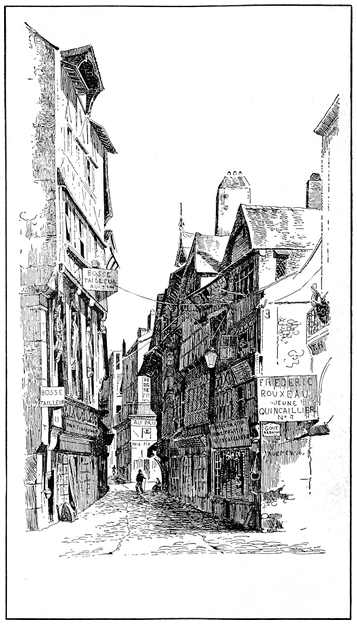
A street in Nantes—Ancient houses.
The archbishop with his suite could reach
his balcony by a private way. The Baron de
Retz occupied his hotel called Maison de la
Suze in the Rue Notre Dame. This Maison de
la Suze has been destroyed, and no representation
of it is in existence. There are, however,
many other of the ancient streets lined on either
side with houses belonging, if not to that precise
epoch, to the one immediately following, and
as such may here be given with propriety as
presenting a reasonably faithful idea of the
city. Many of these houses are historic and
have been occupied by persons of renown and
distinction. Similar houses are to be seen in
other towns of Brittany—Vannes, Quimper,
Angers, Laval, Dinan. These houses are
usually built of frames of wood with great
beams and posts as shown, and not infrequently
the principal beams across the front
of the house bear a carved inscription. The
author has seen these in Vannes and Auray,
of which the following are samples:
PAX HVNC DOMVN ET OMNIBUS HABITAN IRVS
IN EA ICI JAN FOLLIART MA FAICT FAIRE LAN
1560.
AV NOM DE DIEV, DIEV SOICT EN MES AFFAIRES.
YVES LEKME ET PERRINE LEBAR SA COMPAGNE
ONT FAICT FAIRE SE LOGIS EN IVING 1565.
Returning to the spectacle of the Mystery:
The Baron de Retz passes out from his great
double gates or doors which form the entrance
to his Maison de la Suze, accompanied by his
guards of honour, whose glittering armour reflects
brilliantly the rays of the sun. With their
halberts, they press back the crowd to make
way for the Baron and his suite. By his side,
and within easy reach, walks one of his men-at-arms,
holding a casque upturned, more or
less filled with coined money, of which the
Baron occasionally takes a handful and scatters
among the crowd, first on one side and then
on the other. Arrived at the balcony intended
for him, the guards of honour open their ranks,
press back the crowd, take their station at the
foot of the steps and along the front of the balcony,
while the Baron, accompanied by his
suite, among which were his chapel, as it is
called, comprising his bishop and some thirty
ecclesiastics of divers names and functions,
mount the balcony and take their places, the
Baron, of course, at the front and centre. It
is said that his display of church and ecclesiastical
dignitaries was unwarranted, that it had
never been authorised by the Pope, that his
Bishop had no ecclesiastical jurisdiction, nor
was he lawfully entitled to perform the functions
or support the dignity, and it was also
said that his appearance in this character had
always irritated, if it did not anger the Bishop
of Nantes.
The description of this spectacle has not
been preserved to us, though, as with the Mystery
of Orleans, of which a few copies of the
libretto have been preserved, this spectacle
at Nantes excited the populace and aroused
their enthusiasm, to which they gave vent with
cries of joy and great huzzas. The dignitaries
were present with many of their suite, in gorgeous
dress and costumes, their men-at-arms
with casque and cuirass, Damascene steel and
shining halbert and scabbard. Their coats-of-mail
were fire-gilt, and covered them from waist
to knees; gloves and boots of red leather completed
a brilliant and striking costume. The
prelates, on the other hand, with their magnificent
official robes of scarlet and gold and silver,
with the curtains and hangings of such royal
magnificence, all served as a background for
the play of the Mystery which, being of the
Infant Jesus and the Virgin Mary, excited the
deep-seated religious fervour and enthusiasm
of the people. They manifested their joy and
enthusiasm in the usual way of crowds, but the
principal share was devoted to the Baron de
Retz. This was the pleasure reserved for
him; this was the compensation for his great
expenditure. It gratified his ambition, tickled
his vanity, gave him pleasure, justified his expenditure,
confirmed his extravagant habits,
and led him farther in the course which ended
in his ruin.
It would scarcely be possible at this late
date, to obtain a more complete report of the
prodigalities of Gilles de Retz than is furnished
by the Mémoires des Héritiers, which, as it was
sufficient for the King, should be sufficient for
us; but there will occasionally crop out of the
historical desert of this ancient time a record
which, by giving information on a particular
subject, lifts the veil from his life and gives us
glimpses into certain extravagances, whereby
we may imagine the result. One of these,
lately found among the archives at Orleans,
and contributed by M. Doinel, is a memorandum
of a visit of Gilles to that city from
September, 1434, to August, 1435. He was
accompanied by his suite and retinue, military
and ecclesiastic. His brother, René de la
Suze, was with him, which was the only time
they are shown to have been together, and,
curiously enough, it must have been while the
Mémoires des Héritiers, if not already presented,
were being prepared, or at least contemplated;
for the decree of the King was
published within the next two years; yet no
mention is made therein of René’s presence
on this trip.
Arrived at Orleans, Gilles de Retz installed
himself, with his personal adjutants, at the
Hôtel Croix d’Or (Golden Cross), while his
suite and high officers with their respective retinues,
were installed at the other hotels, until,
as the minute says, there was not a hotel in all
Orleans but was occupied, if not filled, by him
or by the officers and men of his suite. His
“college,” that is, the ecclesiastics, twenty-five
or thirty persons, were installed at the Écu
(Crown) de Saint Georges; the choir and their
leader at the Enseigne de l’Épée (Sign of the
Sword); his armourer, Hector Broisset, at the
Coupe; his brother, René de la Suze, at the
Petit Saumon (Little Salmon); his councillors,
Gilles de Sillé, Guy de Bonnière, Guyot de
Chambrays, Guillaume Tardif, and Guy de
Blanchfort, with his captain of the guard, Loys
l’Angevin, at the Grand Saumon (Great Salmon);
his chevaliers, Monseignieurs de Martigné,
Foulques Blasmes, Jean de Rains, and
Bauleis, at the Image de Sainte Marie Madeleine;
Jean de Montecler, with Colin le Godelier;
his Rais le herault (herald) and suite, with men-at-arms,
at the Tête Noire; his chariots and
horses, with those of his brother René, at
the Roche-Boulet; the vicar of the chapel, the
priest Le Blond and his barber, and the horses
of the “college” at l’Enseigne du Fourbisseur;
the Seignieur Jean de Veille, Bois-Roulier, his
provost, George the trumpeter, at the house
of Jeannette la Pionne; Thomas his enlumineur,
at le Dieu d’Amour (God of Love); while
men-at-arms, servants, lackeys, and followers,
occupied the Cheval Blanc (White Horse),
l’Homme Sauvage (Savage Man), and l’Écu
d’Orléans (the Crown of Orleans).
While at Orleans, in 1434, he made thence,
during the autumn, a trip to the Bourbonnais
country, stopping for a time at Montlucon, at
the hotel l’Écu (Crown) de France. When
his hotel bill for eight hundred and ten reaux
d’or was presented, he could pay only four
hundred and ninety-five, and his two servitors,
Jean de Sellier and Huet de Villarceau, became
his guarantors of payment. Everything
during the trip was at his expense. They all
travelled on horseback, unless it was some high
dignitary or quelque malade (sick) who had a
chariot. Horses and all expenditures were
furnished by him, and preparing for such a trip,
everybody was provided with new, striking,
and, consequently, expensive costumes, suitable
for the suite of such a rich and puissant Baron.
On his return to Brittany in August, 1435,
it was found that his travels during the year
had cost the round sum of eighty thousand
golden crowns. The Mémoires say this trip
left a train of “devoured revenues, lands sold,
seigniories mortgaged, works of art and valuables
hypothecated, with considerable debts and
unpaid loans très onéreux, which menaced ruin
and opened an abyss threatening to engulf
everything.”
Among the records found at Orleans was
one which, made under the circumstances relating
to his expenses and financial condition,
throws a strong side-light on his character,
bringing out the recklessly spendthrift side of
it, and would go a long way towards justifying
the King’s decree of the interdiction of the
sale and mortgage of any property, which, it is
not to be forgotten, shortly followed this visit
to Orleans.
This paper, prepared by Gilles, provided:
“Saturday, xxvi day of March, MCCCCXXXIIII (1435
N.S.). The noble and puissant lord, Monsieur Gilles,
Seignior of Retz, Count of Brienne, Lord of Champtocé
and Pouzauges, Marshal of France, has lately, for the
good of his soul, and looking to our Lord Jesus Christ,
on behalf of himself, his late father, mother, relatives
and friends, all sinners, made a foundation in memory of
the Holy Innocents, at Machecoul in Rais, Duchy of
Brittany.”
By this paper he appoints a full corps of
priests, “vicar, dean, archdeacon, treasurer,
canons, chapter, and college”; for the support
and maintenance of this establishment he gives
in trust, in due and formal language, to the
King of Sicily and Duke of Anjou his castle
and châtellenie of Champtocé, and to the Duke
of Brittany one-half the Barony and lands of
Rais. He confirmed this gift before notaries
named. He declared the two princes named
should act as his trustees; and, providing for
their possible refusal to act, he names respectively,
and in succession, as future trustees, the
King, the Emperor, the Pope; in case they
all refuse, the lands shall be divided between
the knights of the Orders of Saint John and
of Saint Lazare.
All the Princes named refused, and each, as
far as he could, interdicted and prohibited
Gilles from carrying out his project. It accordingly
fell through. Yet, at the moment
of his establishing this priestly organisation, he
was engaged, as we shall see farther on, in the
commission of the most horrible and unnatural
of crimes, for which he was, before the end of
the decade, to be ignominiously executed.
His Maison de la Suze has been described,
whether actually or only from similar houses
of the epoch, is now impossible to tell; but it
is said to have eclipsed, in its luxury and taste,
the palace of the Dukes of Brittany. It was
ornamented and decorated to a high degree.
All countries were laid under tribute to furnish
riches for its decoration: Italy for its
painting and sculpture, Spain for its Cordovan
leather, Flanders for its tapestry, Venice and
Bohemia for their crystals and glassware, the
Orient for its magnificent stuffs, and Persia for
its tiles and faience; while, without doubt, the
ceramics of his own and neighbouring provinces,
like Tours, Orleans, Gien, Quimper, and Poitou
(the latter the forerunner of Limoges), were represented
in the luxurious fittings of the houses
and châteaux of Gilles, the Baron de Retz.
The Mémoire des Héritiers, setting forth the
extravagant and ruinous expenditures by which
the principal of the estate was being dissipated,
was duly presented to the King and the necessary
proof offered to establish its allegations.
The date is not given, but it should have been
about 1432–33. In 1435–36, the King, having
become satisfied of the truth of the matters
alleged, through his Council of State and by
letters patent, issued his decree of prohibition
against the alienation or incumbrance by Gilles
de Retz of any of his lands or seigniories.
This decree has been preserved to us in Guepin’s
Histoire de Nantes, pp. 131–133.
The Decree of Interdiction by the King,
against the sale and incumbrance of his property
commences with a description of the
various noble families from which Gilles de
Retz had descended; his titles, his property,
baronies, châteaux, seigniories, his marriage,
the properties of his wife—that is to say,
Pouzauges, Tiffauges, Chabenais, Confolens,
Château-Morant, Savenay, Lombert, Grez-sur-Maine,
and other beautiful properties, the
rental value of which amounted to six or seven
thousand livres (pounds, about three hundred
thousand francs, actual value); that from his
said marriage, he derived also personal property
of the value of one hundred thousand
golden crowns; that he held in Grosses Baronies
thirty thousand livres of true domains; that
from his office of Marshal of France he received
grand salary and pension from the
King, with numerous gratuities; so that he
had a yearly income of forty or fifty thousand
livres or more. The said Gilles, after the decease
of his father, took the administration of
his estate to himself and used it according to
his pleasure; he established himself in an estate
grander than that to which he really
belonged; kept two hundred horsemen, maintained
a chapel of singers in his château numbering
twenty-five or thirty persons, chaplain,
clerks, children, and others; these were taken
with him when he travelled; and in all things
he managed his affairs so as to have in
his château, because of the said chapel, more
than fifty men or persons at his expense,
and as many horses; he had also in said
chapel a great quantity or number of ornaments,
cloth of gold, silk, chandeliers and
censoirs, crosses, plates, dishes, etc.; these
were of such sumptuosity that they cost three
times more than their value; he had several
organs, one of which, carried by six
men, was taken with him wherever he went;
he often purchased cloth-of-gold at sixty or
eighty crowns per aune (ell) when it was not
worth more than twenty-five, and a pair of
“orfrays” (embroidered cloth of gold) at three
or four hundred crowns, when they were not
worth more than one hundred; he kept in
the said chapel a dean, choir-leader, or singing-master,
an archdeacon, vicar, schoolmaster,
etc., as in the cathedral, and one of these
priests or officers he undertook to establish
and treat as a bishop; he paid to some of
these four hundred crowns, and to others three
hundred; he dressed them in robes with scarlet
trains trimmed with plush and fur, with
fine hats; all were kept and served with the
most costly and expensive viands; the service
of all these so-called priests (holy men)
was nothing but vanity, without devotion and
in defiance of good order. The said Gilles
sent on several occasions to the Pope in the
endeavour to obtain permission or authority
that his choristers, or leaders, should be mitred
as prelates, or like the canons of the church at
Lyons. He made excessive gifts in wine,
viands, and hypocras, to all who desired to eat or
drink, keeping open house for that purpose,
and those who had the government of his affairs
lived like great lords; while the commoners
frequently had naught, ni boire ni manger,
when they came to table.
He played games, farces, morisques, and, on
occasion, he performed the Mysteries of Pentecost
and Ascension, on high scaffolds under
which were hypocras and strong wines, as in a
cave.
The said Gilles constituted one of his familiars,
Roger de Briqueville, as his procureur,
agent, or attorney-in-fact, empowered to marry
his daughter, Marie, at a time when she was
only four or five years of age, to whatever man
should seem good to the said de Briqueville,
against the custom prevailing in the country
to marry the daughters, issue of such high
nobility, only with the assent of their parents
and friends. He took it into his head to deal
in alchemy, hoping thus to obtain the Philosopher’s
Stone; sent to Germany and to different
countries in search of the masters of this
art, and brought to his château Monsieur Anth.
of Palermo, making, with him, outrageous expenses
from which no one derived any profit;
in all of which things he acted without sense
or understanding, and in a foolish, if not crazy,
manner. It is found that he sold and alienated
certain lands (describing them).
For these reasons, the King, being fully informed
and having fully ascertained of the
evil government of the said Sieur de Retz,
through his Grand Council, issued his interdiction
and prohibition against any alienation,
transfer, mortgage, or pledge, by the said
Gilles de Retz, of any of his lands or seigniories.
The King enjoined upon his Parliament the
duty of carrying this decree of interdiction
into effect; and under severe penalties, he forbade
any captains, guards, tenants, or persons
in charge, from attorning or delivering up to
any stranger (to the title) any château or fortress
of Gilles de Retz until Parliament should
so order.
This decree was published “at the sound
of the trumpet” at the principal places concerned—Orleans,
Tours, Angers, Champtocé,
Pouzauges, Tiffauges, Saint-Jean-d’Angely,
and other places. The Duke of Brittany refused
to accept, register, or publish the decree,
and it was in vain that the “femme, parents, et
les amis” of Gilles solicited him. It is alleged
that this was to enable the Duke to take
advantage of the necessities of Gilles, and
purchase his lands at ruinous prices. He purchased
some and took mortgages on others;
Champtocé, Bourgneuf, Bénate, and Prinçay
or Princé, were mortgaged for the sum of
100,000 crowns of gold, to be repaid within
six years. In this way did Gilles, during these
eight years of his life, dissipate the sum of
deux cents mille écus (200,000 crowns) of the
heritage.
The King’s interdiction of the sale or mortgage
of any of his property aggravated Gilles’s
situation by increasing his difficulties in obtaining
money. He had no scruples about
borrowing money of whomsoever he could, and
if repayment could be put off a sufficient
length of time, would promise the return of it
doubled or trebled, as the creditor demanded.
The situation must have been irritating to
Gilles, and doubtless proved his incentive to
magic, by which he hoped to discover the Philosopher’s
Stone, and, thereby, the means of
converting the baser metals into gold. Whatever
he may have done, or thought, in this
direction prior to the passing of the decree, it
seems that later he entered into closer relation
with the alchemist and magician, and sought
to study and practise the “black art” to a
greater degree than he ever had done before.
From this on, we have to treat Gilles as a
changed man, not only in his conduct, but in
his character and desires. He separated from
his wife, but established her in the château of
Champtocé, while he installed himself with his
retinue, including his magician, in the two
châteaux, one at Machecoul, which he had
received from his father, Guy de Laval, but
principally at Tiffauges, which he had received
from his wife. Here we have to treat of him
no longer as a soldier, or as a noble of France,
but in his character of magician, necromancer,
debtor, robber, murderer.
Under these circumstances what course was
Gilles to pursue, and what could he do to retrieve
his fallen fortunes? He required money,
he was spending more than his income; he
was selling off his property and reducing his
principal in the vain attempt to liquidate his
debts and provide for his present expenses.
He did not have strength of character to
adopt a rigorous reduction of expenses and
live on a moderate and conservative plan;
indeed, such would hardly have been natural.
The great man of a neighbourhood, who, having
been entrusted with large sums of money;
or the banker or trader who, being deeply indebted,
endeavours to restore his broken fortunes
by retrenchment of expenditures, only
precipitates the catastrophe he seeks to avert.
The ostensibly rich man who proposes to
make himself better able to meet the demands
of his business by disposing of his horses
and carriage, closing up his houses, selling
his yacht, giving fewer entertainments to his
friends, instead of proving himself successful
and inviting confidence in his ability to pull
through, will prove the architect of his own
doom. Therefore, what was Gilles de Retz
to do? What he did, was to rely upon the
success of his scheme for the discovery of the
Philosopher’s Stone, in the hope to thus replenish
his empty coffers.
CHAPTER IV Gilles’s Crimes
Gilles’s Abduction of Children—His Familiars—Château
Tiffauges—First Process against Gilles—Warrant—Arrest
and Imprisonment—Château de Nantes.
Beginning in the year 1432, a district
comprising a large portion of western
France, including the southern part of the
Province of Brittany, the western part of the
Province of Maine, and the northern part of
the Province of Poitou, became excited by an
undefined fear which, increased by its uncertainty
and vagueness, produced in the
people a feeling akin to terror. It was not
the fear of war, for the people had had an intimate
acquaintance with war for many years;
nor was it the fear of an epidemic nor of sudden
death; and it was not easy to tell with
exactness what it was. It was so indefinite
that belief in it was at first refused. It was
considered by many to be the result of superstition;
some declared it to be something of
the vampire race which by some sort of resurrection
had changed its horrible character
so that it did not wait to prey upon the dead,
but made its attacks upon the living, choosing
young children and maidens, and timing the
place and manner of attack so that not only
was there no defence, but there was also no
opportunity for pursuit or recovery.
Michelet (Histoire de France) describes it as
a beast of extermination, unseen, unknown,
unnatural, indescribable, invisible, supernatural,
omnipresent, possessed of powers of disappearance
on the instant, and so of escape,
dissolving into thin air. It was believed by
many to be a physical manifestation of the
Evil One. It made its appearance in one
place on one day and at another place the
next day, and at a distant place the next; it
was here to-night and far away in the morning;
it ravaged the country, spreading terror,
and leaving in its track not simply fear and
mourning, but the torture of insanity and
death. There was a mixture of enchantment,
of impossibility, about the performance which
left it to be accounted for only upon the
principle of legerdemain, magic, the black art,
and the presence of the devil. On all sides,
right and left, east and west, north and south,
within this terror-stricken district, sometimes
each day for a week, sometimes not again for
a month, then not for three, and again not for
six months or more, but subject to these intervals,
came the story from one section to the
other, of the disappearance, as though by enchantment,
of a child or children of tender age.
No apparent distinction of sex was made, but
the subjects of attack were always young, say
from six to sixteen years; old enough to go
about the farm or from one farm to another,
possibly from one village to another, when,
without warning, apparently without cause,
without the slightest evidence as to the means
used, and without leaving the slightest trace of
the tragedy, suddenly a child was gone. No
one knew or could find in what direction it had
gone, or how it had been taken. All that the
terror-stricken parents and family knew was
that their child was here to-day, and now he or
she was not—it was playing about the door
only a half-hour since; now it was gone, gone
as completely as though swallowed by the earth.
No one knew where the blow would fall next;
no one knew whether his family circle was to
be invaded, his house stricken, his child taken.
Every care and watchfulness was employed,
consultations were had between the stricken
parents, the officers of the law were consulted,
and all that was known—apparently all that
could be discovered—was that their children
were here yesterday, engaged in their little
plays or about their own little duties around
the house or on the farm, and in a moment,
though the most rigorous and extensive search
was made, they were gone—gone absolutely,
gone beyond possibility of recovery, gone in
numbers, gone from every part of the district
mentioned, and no sign or trace left of
their fate. Fear, fright, terror, took possession
of all, and this, mixed with sorrow and
grief, broke many a heart, sent many a loving
mother in insanity to the grave. The peasants
who, by reason of their age and strength supposed
themselves to be safe, walked lightly,
as though afraid to put their feet upon the
ground; spoke in low voices as if afraid to
trust themselves in ordinary tones, and everything
throughout the country was done with
bated breath as if in the presence of the dead.
The peasants, superstitious at the best of
times, were now overcome with fear and gave
themselves up a prey to the idea of enchantment
and magic, and could only account for the
disappearance of their loved ones by the presence
of the arch-enemy of mankind, against
whom they had no means of fighting, and
whose assaults upon their devoted children
they had no means of resisting. The frightened
parents were tortured by the uncertainty
of the fate that had overcome their loved ones.
“Are they dead?” “Have they been taken to
the realms above or to the tortures below?”
“Are they in prison?” “Are they still living?”
“Are they never to be seen again?”
“Might they not be in a distant part of the
country enduring pains and tortures?” “Might
they not, even now, be weeping and screaming
themselves half mad and demanding the
presence and comfort of their mother?”
“In what direction should we go?” “Has
nobody seen them?” “Has search been
made?” “In what direction have we yet to
go?” No answer came to all these questions.
The fate of the children was an impenetrable
mystery.
Did the parents recover from it? Yes,
they became accustomed to it. Human nature
can become accustomed to anything. Their
fate seemed better, not because it was better,
but because, not getting worse, they got used
to it and were able to stand it better. The
first theory upon which the people settled was
that the disappearance of their children was
due to fairies, to evil genii, to a supernatural
and mysterious enemy—that this mysterious
enemy was supernatural, they did not doubt.
This belief served to increase the pangs of their
grief and to render the unknown and undiscoverable
fate of their beloved ones more horrible
to contemplate and more difficult for the parents
to bear. They felt themselves incapable
and incompetent to war against this mysterious,
devastating, supernatural force; hence they resigned
themselves to the affliction, considering
it to have been sent upon them by Almighty
God as a punishment for their sins. They did
not know what sins they had committed, but
felt sure that nothing they had done would
justify even Almighty God in the abduction
of the little ones who had not been at fault,
and the torture of the parents incident thereto;
so they rebelled against their fate.
The disappearance of children did not at
first create great excitement among the people;
their disappearance was explained in a natural
manner: some accident had happened to them,
possibly they had fallen into one of the many
rivers and were drowned; the lakes and rivers
were plentiful, their waters deep, their currents
swift, the banks steep. One child here
in one province, another child there in a distant
province—such a disappearance did not count
for much and did not unduly or wonderfully
excite the people; but when it came to spread
over the entire country and, by the comparison
and the overlapping of searches and the
employment of officers, it was discovered that
this beast of extermination, this great, powerful,
mysterious, supernatural visitor or power,
was making itself felt throughout the entire
country, and that no house was safe, that no
parent could say with certainty that his own
child might not be taken next morning—then
the country became excited, alarmed, and,
finally, terror-stricken.
At last it became apparent that these ravages
were confined to a given district, a circle of
country approximately bounded by the present
cities of Vannes, Rennes, Angers, La Rochelle,
and so opening to the ocean. Of this circle,
Nantes was approximately the centre. This
condition continued, growing more acute
year by year. Each year new families were
stricken, and the terror became more widely
spread.
A man of the character and ambitions of
Gilles de Retz would naturally have about him
a corps of men to assist in carrying out his
nefarious courses. They would necessarily be
without fear and without conscience, adepts in
secrecy and deceit, with the instincts and abilities
of detectives and ready to obey any behest
of their master. Gilles had such a corps
of lieutenants; most of them were Bretons as
he was, thoroughly acquainted with the country,
most of them lowly born, many of them
illegitimate and strongly suspected to have
had fathers of higher birth than their mothers.
Gilles made choice of these familiars from
among his retinue, selecting those best qualified
to carry out his projects and to be his
right hand in executing his plans.
The names of some of these have been preserved
to us in the process against Gilles:
Eustache Blanchet, Henriet Griart, Jean Roussignol,
Gilles de Sillé, Hugues de Bremont,
Étienne Corrillaut (alias Poitou), Robin
Romulart, and one woman, Perrine Martin,
alias La Meffraye. These performed for Gilles
the rôle of secretary, aide-de-camp, assistants,
guards, spies, or servants, as occasion demanded,
and became identified in the minds
of the peasants as servants and representatives
of Gilles de Retz. They spent practically
their lifetime in his service, and toward the
end of their career they came to be feared
throughout the countryside as much as Gilles
himself. Indeed, it was their actions which
first attracted public attention towards him.
It came to be noted that when infant or child
had disappeared, some of these had been seen
in the neighbourhood; and when all things
pertaining thereto were so mysterious, the
people stood ready to catch at any straw which
might serve as a possible solution. The wiser
persons, who were not so superstitious and did
not attribute this disappearance of children to
supernatural causes, but rather to the action
of fiends, discovered and remarked the coincidence
of the presence of some one of these
with the disappearance of an infant. The attention
of the officers was turned in his direction,
and certain suggestions or suspicions
were given to the Bishop of Nantes, who
thereupon determined to open a secret inquest
for the solution of the mystery. By this means
the matter was brought to light.
The most prominent and powerful of these
familiars of Gilles de Retz was an Italian
priest and alchemist, François Prelati. He occupied
a position different from the others. One
of the before-mentioned familiars, Eustache
Blanchet, a soi-disant priest, belonging to his
ecclesiastical retinue, appears to have been
better acquainted with the private affairs of
Gilles de Retz than any other, and to have
been entrusted with higher powers, and sent
oftener on journeys of diplomacy and confidential
business. For what purpose he should
have been sent to Italy can now only be surmised;
but in the year 1436, while in Florence,
he met François Prelati. His history has been
given by Saunière, but no one knows how
much of it is fact and how much romance. It
appears, however, that Prelati was born in
Mont Catane in the Valle Nero; that he was
educated as an ecclesiastic, admitted to orders,
and given the tonsure by the Bishop of Arezzo.
He became interested in the study of the occult
sciences, especially chemistry or, as it was
then called, alchemy; and his love for this
science overcame his desire for ecclesiastical
service.
He was about forty-five years of age when
he became acquainted with Gilles de Retz;
was well bred, highly educated, of elegant
manners, handsome in appearance, well kept
and cleanly in person, devoting much care to
the welfare of his hair, beard, and hands, all
of which repaid and showed the attention bestowed
upon them. He was a good conversationalist,
of smooth, insinuating, and seductive
manner. He spoke Latin as well as he did
Italian; his French was excellent, probably
better than that of Gilles or the Bretons with
whom he associated, while a slightly broken
pronunciation conspired to make it more attractive.
He had a brilliant and sparkling wit
and an active imagination, was well posted in
the affairs of the world, and attractive to his
fellows, whether men of letters, men of affairs,
or des hommes de guerre. The description
given of him would indicate his appearance to
have been that of an elegant gentleman. It
goes without saying that he was learned as
an alchemist and expert as a necromancer.
Such was François Prelati, the man who had
been brought by Eustache Blanchet from Italy
to France to teach Gilles de Retz the black
art.
Gilles, during this period, occupied alternately,
according to his pleasure, the two châteaux
of Machecoul and Tiffauges. The latter
is situated to the north of the village of Tiffauges
and, according to tradition, occupies
the site of an ancient Roman camp and is
about 15 kilometres south of Clisson and 40
south of Nantes. The château occupies an
elevated plateau which forms a promontory between
the junction of the creek Crume with
the river Sèvre, both of which bathed the foot
of the walls on either side. The latter continues
its way northward and empties into the
Loire below Nantes. The château was a castle
covering space enough for a city. It is now in
ruins, except the grand tower and adjacent
halls. The walls may be traced by the débris
in rows of stones now covered with sod and
grass. It was attacked and burned during the
religious wars of the sixteenth century, but its
present ruinous condition began with the
breaking-out of the Revolution in 1789. The
Vendeans, after gaining the battle of Torfou,
occupied it, having repaired it sufficiently to
afford shelter and to make it a place of defence.
It remained in a fairly good condition until the
return of Napoleon from Elba, when it was
again occupied as a recruiting-place, or place
of security by the Vendeans. After the battle
of Waterloo and the restoration of Louis
XVIII., fearing some further use of it by enemies,
the government destroyed it, reducing it
to its present condition. The lowlands in the
neighbourhood are marshy and almost become
lakes. The lake of Grand Lieu is not far distant,
and others are in the vicinity.
The ruins are interesting and the débris is
easily recognised. One with a slight knowledge
of the arrangement can trace the walls
of the structure, as well as the triple cincture
of fortifications surrounding it. These are
now covered with sod and green grass and
used for pasturage, while the level places, like
the courts within the castle and the parade-ground
within the lines of fortification, are
subjected to cultivation. The château of Tiffauges
was partially built in the time of Saint
Louis; the grand tower now remaining is said
to belong to that epoch; the large tower, the
small tower, the chapel, the great hall wherein
the Baron presided over his retainers or, if
need be, received such lords and seigniors as
came to visit him; the dining-room, kitchen,
scullery, with all their necessary appurtenances
of cellar, storehouse, warehouses, well-room,
were all in evidence; bedrooms, halls, parlours,
etc., were prepared in abundance for the reception
of lords, ladies, and all who might attend
upon the occasion of a ball or fête. On another
side of the courtyard, but adjoining the
main building, was a shorter wing, large enough
to lodge his knights, men-at-arms, soldiers,
servants, varlets, etc. It was, in these regards,
similar to most other extensive castles or châteaux,
and can be compared to the château of
Nantes where Gilles was tried and convicted.
(See frontispiece.)
The Château Tiffauges was a favourite residence
of Gilles de Retz; it was a stronghold,
in which, if need be, he could have great
security and, in case of war or attack, could
make a good defence. It was large and commodious.
Here it was that Gilles de Retz and
François Prelati, the Italian, had their laboratory
in which they endeavoured, first by alchemy,
then by magic, and lastly by murder,
to discover the Elixir of Eternal Youth and
the transmutation of metals into gold. Here
took place the attempt to obtain a conference
with the Evil One, with the idea of obtaining
his supposed influence in their sublunary affairs.
A description of this laboratory has been
left us. The chamber was high up in the
tower, with communicating passages in various
directions,—to the large tower and also to the
basement and, as is said, to the oubliettes and
the secret passageway to the Crume and so
outside the château. The laboratory occupied
the full diameter of the tower; an immense
chimney was on one side of the room, in which
was placed the furnace where the mutilated
bodies of many of the dead infants were consumed.
The chamber had but two windows,
one to the north the other to the south, both
high up in the wall, both capable of being
closed and darkened by solid shutters.
Lemire says (p. 27):
“In the highest chamber of the small tower, he [Gilles]
had installed a chemical [alchemy] laboratory and there
employed his three sorcerers, one French, one English
or Picardian, and one Italian”;
And he describes with minutest detail the
apparatus employed (p. 28):
“What Gilles desired was that Prelati should make
gold, whether by science, by magic, by the intervention
of the devil, or by these means united. He attempted the
transmutation of metals into gold. He distilled into
retorts different liquids destined to dissolve the mineral
substances after certain formulas of magic repeated under
the invocation of demons. Prelati declared to Gilles
that to make these operations successful required the
addition of the hearts, hands, or eyes, but above all the
blood, of young children. The blood was to be used in
tracing the magic circles and figures.”
Lemire believes (p. 30) that Prelati employed
the secrets of chemical art, sulphur and
phosphorus and similar substances, in forming
fiery serpents to deceive Gilles:
“Frogs and serpents, inoffensive but frightful in
appearance, a leopard which was naught else than a
large dog with bristling hair, cries of beasts, groans,
sounds of trumpets; these were the apparatus employed
in the scenes of invocation.”
Then he tells (p. 31) how, to furnish victims
for these magicians, Gilles carried on his abduction
of children, choosing the little peasants
who would not be missed, or whose parents
would not be likely, from poverty, to pursue
the search.
Apparently the first step, at least the first
step made public, against Gilles de Retz, charging
him with crime, and the first paper forming
part of the ecclesiastical record in the
archives of the Department of Loire-Inférieure,
is the “Declaration of Infamy against Gilles
de Retz by the Bishop of Nantes, July 30,
1440.” It was in Latin:
“To all to whom these present letters shall come,
Jean, by the permission of the holy apostolic see, Bishop
of Nantes, with full assurance of salvation through our
Lord and Saviour, salute those present:
“We hereby make known by visiting in person the
parish of the Holy Mary at Nantes, in which is built the
house or château vulgarly called “la Suze,” the frequent
habitation of Gilles de Retz hereinafter described, a
parishioner of this church and of other parish churches
designated further on. Upon public rumour and on the
numerous reports that have come upon us by the denunciatory
clamour of Agatha, wife of Denis de la Mignon;
of Donété, widow of the defunct Regnaud Donété of St.
Marie; of Jean Guibert and his wife of St. Vincent; of
the widow Eonnet Kerguen of St. Croix, Nantes; of
Jeanne, wife of Jean Darell of St. Similien near Nantes;
of Theophanie, wife of Eonnet le Charpentier of St.
Clement outside the walls; fortified by the depositions
of the synodical witnesses of these churches and by
men who, thanks to their probity and their well known
prudence, are above suspicion, and who, in the course of
our pastoral visit in the same churches, we ourselves
have interrogated with the greatest care upon the facts
below indicated, or of still others pertaining to the duty
of the bishop in his pastoral visits, we have discovered,
and the depositions of the witnesses have proved to us,
among other things, that Gilles de Retz, our subject and
justiciable, by himself or by certain men his accomplices,
has strangled, killed, and inhumanly massacred a very
large number of infants; that he has committed upon
them crimes against nature; that he has made, or has
caused to be made, numerous horrible invocations of
demons; he has made to them sacrifices and offerings,
and has passed a compact with them, without counting
other crimes, numerous and enormous, all of which belong
within our jurisdiction; and, finally, by several
other visits made by us or by the Commissary acting in
our name, we know that Gilles de Retz has perpetrated
and committed these crimes and still others, within the
limits of our diocese.
“For which cause he was, and is now, and publicly
for the knowledge of all, rendered infamous towards all
grave and honest men. And to the end that no person
shall have doubt upon this subject, we have ordained, or
fixed, or caused to be fixed, our seal to these present
letters.
“Given at Nantes, the day before the last of July, in
the year of our Lord, 1440.
“By the command of Monseignior, Bishop of Nantes.
(Signed) “J. Petit.”
It does not appear that this declaration of
infamy was ever made known to Gilles de
Retz. It was made by the Bishop of Nantes
in accordance with his ecclesiastical right and
duty. It had, from early Christian times, been
the duty of the bishops of the Church to make
episcopal visits throughout their respective
dioceses. By the capitularies of Charlemagne
and Carloman, it became the bishop’s right, if
not his duty, to listen to any complaints of the
common people. This was in the nature of an
inquest by church authority into the crimes of
high or powerful persons, or into public scandals
which were without other rectification. The
proceeding might be likened to an ecclesiastical
grand jury. It was, like that of the grand
jury, a secret inquest, inquisitio famæ, and in
this particular instance, establishing the infamy
of Gilles, it opened against him the inquisitory
proceeding according to the rule: Inquisitionem
debet clamosa insinuatio prævenire. This declaration
of infamy, made by the bishop and based
upon the complaints he had received and scandals
he had heard during his episcopal visit, was
the beginning of the prosecution against Gilles.
The secret investigation doubtless continued
and culminated in the citation of the Bishop
to Gilles de Retz, September 13th, to appear
on September 19th, and answer the charges.
After the preamble and declarations of the
requisite power and authority, and his knowledge
of the crimes of Gilles and of the public
clamour, called in the official document hurlements
ululantium, the bishop proceeds:
“For these causes we will no longer hide the monstrous
things, nor will we allow heresy to develop itself, that
heresy which, like a cancer, devours everything if it is
not promptly extirpated even to the last root. Farther
than that, we would apply a remedy as prompt as it is
efficacious. Therefore we enjoin you, all and singular,
and to those of you in particular to whom the present
letter shall come, immediately and in a definite manner,
each for himself and without counting on the other,
without depending upon the care of any other, to cite
before us, or before the official of our cathedral church,
on Monday, the fête-day of the Exaltation of the
True Cross, September 19, Gilles, as aforesaid designated
the Baron of Retz, to submit to our authority and
to accept our jurisdiction; we ourselves cite him by
these letters to appear before our bar to respond to the
crimes that are laid upon him. Execute, therefore,
these orders, you, and each of you, and every one of
you, cause them to be executed.
“Given at Nantes on Tuesday, the 13th of September,
in the year of our Lord, 1440.
“By the command of the Bishop of Nantes.
(Signed) “Jean Guiole.”
Whether the Bishop of Nantes had, in his
official capacity, already established a permanent
ecclesiastical court for the trial of such
cases as might properly be brought before it,
does not appear; nor whether he had the
necessary paraphernalia of officers such as prosecutors,
clerks, record-keepers, and an executive
officer to serve processes, maintain order,
etc., etc., as would be usual and necessary in all
regularly established courts. So it is not known
whether the executive officer charged with the
service of this writ was a regular officer, or only
one appointed for the occasion; but it abundantly
appears that one Robert Guillaumet,
a notary of Nantes, received the writ for execution,
and that in this matter he acted as
executive officer for the Bishop.
Gilles de Retz was at that time at his château
of Machecoul. Robert Guillaumet took to his
aid Jean l’Abbé, a captain in the service of
the Duke of Brittany, with a number of his
troop, and together they repaired to Machecoul
for the purpose of arresting Gilles on the warrant
of the Bishop.
There has been some discussion over the
part taken in the affair by the Duke of Brittany
himself, and how far the proceeding met
his approval, and how far he stood ready to
give aid and assistance in carrying out the
purpose of the Bishop. Michelet (Histoire de
France, vol. v.) asserts that the Duke of Brittany
was highly favourable to the accusation;
that “he was delighted at the opportunity to
thus strike at a Laval,” and he ascribes this
to the fact that the Laval family, though related
to the Montforts, of which the Duke was
one, had formed against him an opposition,
the intention of which was to deliver Brittany
to France. There can be but little doubt that
the Duke of Brittany was entirely favourable
to the Bishop—they were near relatives and
good friends, they always had stood together,
and though the Bishop never had had any
dispute with Gilles de Retz, yet the Duke
frequently had.
The Duke had already foreseen the waning
fortune of Gilles, and stood ready to profit
by it. He had refused to make publication
in Brittany of the decree of interdiction of the
King, for the sake of the opportunity which
might accrue to obtain good bargains in purchasing
the property of Gilles. It is scarcely
possible, dependent as he must have been upon
the Duke and his government and the power
and force of the secular arm for the execution
of any decree that might be passed, that the
Bishop of Nantes would proceed against so
powerful a baron as Gilles, the dean of the
nobility of Brittany, Marshal of France, and
Lieutenant-General of the Duke’s army, and
enter upon an undertaking so gigantic, so
fraught with danger, and so easy to miscarry,
without having first consulted with, and obtained
the approval and favour of, his sovereign,
with the promise of material assistance and
governmental aid in case of need. This understanding
between the Bishop and the Duke
is established by the outcome of the process.
We see that in every step the Bishop not only
received countenance and favour at the hands
of the Duke, but that he could be relied upon
to furnish the necessary strong arm for the
execution of the Bishop’s writs and decrees.
Armed with the writ and warrant of arrest,
Robert Guillaumet and Jean l’Abbé proceeded
to Machecoul with their troop of soldiers.
What was their reception? Would they be
successful in their undertaking and bring the
mighty Baron of Retz back to Nantes as
prisoner? Would he yield to the mandates of
the law, obey the command of the Bishop, and
surrender himself as prisoner? He had a château,
a veritable stronghold, and he had his
army of retainers within it—he could defy both
Robert Guillaumet with his writ and Jean
l’Abbé with his escort—but would he do so?
Would he resist or would he yield? Michelet
passes the highest encomiums upon this little
band, whose intrepidity and courage he lauds
as though it was leading a forlorn hope, for
its devotion to duty in entering upon so
dangerous a procedure as this arrest. There
does not seem, however, to have been any reasonable
apprehension of danger. If Gilles
resisted arrest, he would simply remain within
his castle, refuse to open his gate, and bid defiance
to the officers. They would then return
to Nantes and report their failure, and what
would be done further was a matter for their
superiors, the authorities of the kingdom.
There may have been speculations as to
what moved Gilles to surrender, and no one
can tell with certainty what thus influenced
him. He had three alternatives: resist arrest
and fight it out with the authorities, drive back
the officers and then flee the country, or submit
to arrest. To shut himself up in his castle
and resist arrest would bring down the entire
power of the kingdom, he would be excommunicated
by the Church and besieged by the
Duke’s army—there was little prospect of success
in that direction. Flight would be a confession
of guilt, while he would have to leave
everything behind—it would be practically impossible
for him to take his fortune or even
any considerable amount of valuables with him,
and he would soon become poverty-stricken
and an outcast. It is more likely that he pursued
the conservative course of submitting to
arrest, trusting to his rank, fortune, power, and
the law’s failure to make proof against him,
hoping by these to evade conviction.
That he was technically guilty of both heresy
and sacrilege there could be but little doubt,
and it appears that he had greater fear of these
charges than of the others. When he found
these were not to be pressed, and that he was
to be charged with the abduction of infants,
he may have felt stronger in the knowledge
that he had never personally committed these
crimes, and that they could not be directly
proved against him. It is to be remembered
that these offences had been running for eight
years; that they had been committed in all
parts of the country, always in isolated places,
east, west, north, south; and Gilles may have
come to the conclusion, during the long series
of years, that whatever might be proved against
his accomplices and active agents, nothing
could ever be proved against him. And now, as
he must make a decision immediately upon
the arrival of Robert Guillaumet with his warrant,
Gilles may have felt that the shortest
and easiest way was the best. Partly, then,
from pride, from policy, from bravado, and in
the belief that he would be able to defeat his
adversaries in their proofs, he gave orders to
lower the bridge, to raise the portcullis, and to
open the gates of the castle.
Submitting himself to arrest, he is reported
to have said: “I have always had the design
to become a monk, and here comes the Abbé to
whom I now engage myself” (Procès Célèbres:
Paris, 1858, p. 14). Robert Guillaumet and
Jean l’Abbé made search of the castle. Prelati,
Poitou, and Henriet were arrested with
Gilles at the château; Blanchet was taken in
the town; but most of the retinue of Gilles
escaped. Then the escort of Jean l’Abbé
put themselves in order of march, guarding
their prisoners. Arrived at the château of
Nantes, the gates were opened, and Gilles de
Retz, the dean of the barons of Brittany, Marshal
of France, and his party, were conducted
within its heavy walls as prisoners and malefactors.
Gilles was assigned one of the upper
chambers in the Tour Neuve of the château,
and here he remained during the trial, until the
last day, when he was probably placed in the
condemned cell. His accomplices were not
treated with the same consideration, but were
thrown pell-mell into the common prison of
the castle.
The château of Nantes (frontispiece) is
really a castle and would be called such in
England or in English-speaking countries. It
was built by, and had always belonged to, the
government, first to the Duke and afterward to
the King. Its construction dates from the
tenth century. It was commenced by Conan,
a Count of Rennes, an usurper, who commenced
the castle as a stronghold, by the possession
of which he hoped to resist the lawful claimant
of the duchy and overawe the inhabitants of
the city. That portion called Tour Neuve
was built at this epoch, situated at the confluence
of the river Eure with the Loire, and
the waters of each of these rivers originally
bathed the foot of the walls. Conan did not
long enjoy his possessions in Nantes; he
was attacked and overthrown, and Americ de
Thouars took possession under the title of
Count of Nantes. During this epoch was built
the château of Champtoceau, which figured as
the place of the capture of Clisson.
In the year 1207, Guy de Thouars repaired
the château of Nantes, and in 1227, Pierre de
Dreux enlarged it, and so it remained until
the time of Francis II., when, under Du Cherfan
in 1480 to 1499, it was enlarged to its present
dimensions. The bastion or Tour Mercœur,
constructed in 1588 by the duke of that
name, then Governor of Nantes, was situated
at the angle of State Street and Port Maillaird.
It has been renewed and restored sundry
times since then, but not to affect the
integrity of the building as a whole. The
Tour Neuve was the prison of Gilles de Retz,
and in the second story was the grand hall or
audience-chamber in which the ecclesiastical
court was held.
The château of Nantes has figured largely
in the history of Brittany and France. It was
the official residence of the Count of Nantes.
The Duke of Brittany resided there when in
the city. So also it was occupied by the
kings of France and other great and noble
personages during their passage through, or
temporary residence in, the city. Charles
VIII. and Duchess Anne were married in its
chapel. The celebrated Edict of Nantes,
issued by Henry IV., King of France, in
April, 1598, by which the Protestants were
permitted to exercise their religion without
hindrance, was passed and signed in this
building. In 1654, the Cardinal of Retz (not
to be confounded with Gilles de Retz) was a
prisoner here, and thence made his escape.
Minister Fouché was prisoner in this château;
Madam Sévigné was also held here in 1648; in
1842, the Duchess of Berry was also prisoner
in this château.
CHAPTER V Gilles’s Trial before the Ecclesiastical Tribunal
The Ecclesiastical Tribunal—Record in the Archives
of Loire-Inférieure—The Trial—His Confession—Judgment
and Sentence.
The ecclesiastical trial Against Gilles de Retz was of course conducted by the
Bishop. He was the representative of the
Church in the diocese, and he alone had
the authority to act. His name was Jean de
Malestroit. He was originally Bishop at St.
Brieuc, but had been Bishop of Nantes since
1419. He called, as his assistants in the trial, to
aid by their counsel and advice, the Bishops of
Mans, of St. Brieuc, and of Saint Lo, one of
the officials of the Church at Nantes, and with
them Pierre de l’Hospital, President of the
High Court of Brittany, and whose aid was
asked to represent the civil law and to direct
the charges, the witnesses, and the debates in
such manner that they should come within the
civil law. Three of the notaries of Nantes
were made clerks, with a foreign assistant.
Robert Guillaumet was the executive officer,
that is to say, the sheriff or bailiff of the court.
The prosecuting officer appointed by the
Bishop was William Chapeillon, the Curé of
St. Nicholas at Nantes.
It has been said that the Bishop, for a considerable
length of time, had been receiving
and hearing complaints and charges against
Gilles de Retz, and that especially during the
last month he had been investigating their
truth. In this he was aided by the aforesaid
William Chapeillon, who would thus have
been entirely familiar with the charges against
Gilles de Retz. It was, therefore, eminently
proper that he should be appointed prosecutor.
Whether the Bishop had the full power under
either the civil law or the ecclesiastical law, to
make the foregoing appointments of colleagues
on his own motion and according to his own
will, is not here determined, nor does it appear,
in making these appointments, whether the accused
was consulted or whether he gave his
consent, nor does it appear that he either took
or had the right to take exception to them or
any of them and by such exception deprive
them of the right to act in his case. As to one
aid to the Bishop, Gilles’s consent was asked and
obtained before he was allowed to sit, that was
Brother Jean Blouyn, of the Order of Frères-Prêcheurs
at the Convent at Nantes. He had
been appointed as Vice-Inquisitor for the diocese
of Nantes by the authority of the Grand
Inquisitor of France, B. N. Medici, who had
been appointed to that office by the Pope.
Great stress is laid, throughout the process
wherever this appointment came in question,
on the fact that Gilles de Retz had consented
to it before the priest took his seat on the
bench. Jean Blouyn was a man of about forty
years of age, who seemed to have commended
himself for his moderation in making a decision,
and for his firmness in adhering to it.
Abbé Boussard classes him as digne de tout
éloge et apprécié de tout le monde.
Another tribunal represented the civil law,
and it was by this that the secular sentence of
execution was passed.
In France, as in all countries under the civil
or Roman law, and in some of the countries
under the common law, there has been a separate
jurisdiction of certain offences for the
ecclesiastical court. As a matter of course,
and necessary for the continuance and good
administration of justice, there would be some
controversies of which these two courts would
have concurrent jurisdiction. It is quite impossible
in such a work as the present to go
into this question. Those who are interested
in the subject are respectfully referred, for
France, to the Histoire du droit criminel en
France (pp. 74 and 85) by Du Boys; to Faustin-Helie’s
Traité de l’instruction criminelle; Fornier’s
Les officialités au moyen âge; Esmien’s
Histoire de la procédure criminelle en France,
et spécialment de la procédure inquisitoriale depuis
le XIIIme siècle jusqu’à nos jours (Paris,
1882); and for the general criminal procedure
and jurisdiction of the ecclesiastical tribunal, to
Beiner’s Beitrage zu der Geschichte der Inquisition,
prozesses (pp. 16–78). For a general history
of these subjects as applied to England,
one should consult the great work on the History
of Common Law, by Sir Henry Maine.
The record of the process against Gilles de
Retz in the archives of the Department of
Loire-Inférieure has been adverted to. We
now come to a point where it is almost the entire
evidence. It consists of the records of the
two courts, one the ecclesiastical court, kept by
the clerks before-mentioned, and to which the
names of some one or all of three are signed for
each day, either Jean Delaunay, Jean Petit, Guillaume
Lesne, or Nicholas Giraud. This record,
made each day, apparently was supervised and
made official by the prosecutor, William Chapeillon,
and it seems that more than one copy
was made of it at that time. This was in Latin,
though French was interjected occasionally.
The other record was of the civil tribunal, the
record of the day’s proceedings being reduced
to writing and signed by Touscheronde as
Commissioner of the civil court, or by one of
his aids, or, as they call them, assesseurs, who
signed, alternating with Touscheronde. Their
names were, Nicholas Chatau, Michael Eveillard,
and Jean Coppegorge. This record was
kept in French, the vulgar tongue, and very
bad French and a very vulgar tongue it was.
It would be interesting to philologists to note
the changes during the last five hundred and
fifty years in the spelling and, doubtless, pronunciation
of the words of the French language.
These two records of the trial, the ecclesiastical
and the civil, are treated as one, and their
originals are filed together in the archives of
the Department of Loire-Inférieure in the locality
designated as Coté E, 189. Four copies
of this record have been made, two in the
year 1530, one of which was at the request of
Gilles de Laval, the other for the Sire de la
Tremoille. The copy given to the family of
Laval has disappeared and no trace of it is
known; the other for Tremoille was placed
in the château of Thouars which, it is to be
remembered, was the family name of the wife
of Gilles de Retz.
This copy has taken its name from this
château and is known in history as the Manuscrit
de Thouars. It was left in this château
until its existence was forgotten. When the
château was bought by the State and became
part of the national domain, all papers and
documents belonging to the family were transported
to the château of Serrant in Anjou, of
which one of the ladies of the family of Tremoille
was mistress. This copy of the record
was in a pile of documents, tossed pell-mell
and without order, and here Monsieur Marchegay,
the archivist of the Department of Maine-et-Loire,
discovered it. The Duke de la Tremoille
immediately took steps for its preservation.
This record was on parchment
like the original, and comprises four hundred
and twenty pages, of which three hundred and
three, in Latin, are the record of the ecclesiastical
trial; the last hundred and eight pages
constitute the record of the civil tribunal, and
are in French.
Two other copies have been made in modern
times, one for the Bibliothèque Nationale,
Paris, made under the Second Empire, and
one for the Public Library at Carpentras,
both of which have been certified as true.
The author procured a photograph of an open
page from the original ecclesiastical record in
the archives at Nantes. It was made on his
personal application while he was Consul of
the United States at Nantes. These records
will be explained in this work, and upon their
foundation rests the entire history of Gilles
de Retz. Without this record or its copies,
the true story of Bluebeard could not be
written.
Michelet (Histoire de France, vol. v., pp.
208 et seq.), in his description of the arrest
and trial of Gilles de Retz, depends on two
manuscript copies which he mentions in a
note; one in the Bibliothèque Royale (No. 493
F)—the other communicated to him by M.
Louis Du Bois.
The warrant of arrest of Gilles de Retz was
signed by the Bishop on the 13th of September,
1440, it was executed the next day, the
14th, and on that day Gilles was thrown in
prison. On the 19th, five days after, he was
brought before the Bishop in the great hall of
the Tour Neuve, in the château of Nantes.
No information had been prepared, and no
indictment filed. The prosecutor informed
Gilles that he was charged with the crime of
heresy and asked if he was willing to be tried
before the ecclesiastical court, to which he consented,
and added, with a defiant air full of
assurance, that he would recognise in advance
any other ecclesiastical judges, as he had great
desire to clear himself of such accusation in
the presence of any inquisitor, n’ importe lequel.
It was on this occasion that the Bishop
of Nantes called to his aid as an auxiliary
judge, Jean Blouyn of the Order of Frères-Prêcheurs,
the Vice-Inquisitor of the faith for
the diocese of Nantes, and then, this business
having been brought to a close, the session of
the court was adjourned until the 28th of
September, when the witnesses would be heard.
The record of this session is rendered in
Latin, a translation of which is here given:
“Proces-verbal, appearance in court of Gilles de Retz and
his submission to the jurisdiction of the Court.
“On aforesaid Monday after aforesaid feast of the Exaltation
of the Holy Cross, there appeared personally in
court before the afore-mentioned reverend Father the
Lord Bishop of Nantes, in the great hall of the new
tower of the castle of Nantes, to give hearing before the
tribunal holding session there, the honourable Guillermus
Chapiellon, promoter of cases of office of the aforesaid
court, reproducing in fact the letters of citation
enclosed above, together with the enclosed execution of
them,—there appeared this Chapeillon on the one hand,
and on the other the aforesaid M. Egidius, soldier and
baron, the accused. And this M. Egidius [Gilles], soldier
and baron, after he in his wisdom had perceived
that the promoter accused him of heresy, said that he
wished to appear before the aforesaid reverend Father
the Lord Bishop of Nantes, and some other ecclesiastical
judges, also before the inquisitor for heretical wickedness,
and to purge himself of the crimes laid against
him. Then the aforesaid reverend Father appointed
for the aforesaid Monsieur soldier and baron, who agreed
in this, the 28th day of the aforesaid month to legitimately
appear before the religious, the brother Jean
Blouyn, the vicar of the inquisitor of cases of heretical
wickedness, in the afor-mentioned place, to answer to
the crimes and charges to be urged against him by the
aforesaid promoter, ... to be tried in things pertaining
to faith, as is lawful and proper....
“In the presence of the distinguished men Master Oliverio
Solidi de Beauveron, and M. Johannis Durandi of
Blain, rector of the parochial churches, of the diocese
of Nantes, called as witness to the foregoing.”
3 The entire ecclesiastical record was written in Latin with an
occasional interjection of French.
The commission of Jean Blouyn as Vice-Inquisitor
was written in Latin on parchment,
to which was attached the great seal in red
wax, which hung dangling by two silken cords.
It was as follows:
“William Merici, of the order of Friars Preachers, professor
of Sacred Theology, by the apostolic authority
Grand Inquisitor of Heresy in the Kingdom of France,
to our well-beloved brother in Jesus Christ, Jean Blouyn
of the convent of our order in the city of Nantes, salvation
by the author of our faith, the Lord Jesus Christ:
“Heresy, says the Apostle, is an evil that, if not cut
up by the roots by the iron of the Inquisition, will propagate
itself as a cancer in secret, and in darkness bring
death to the most simple soul. Thus, in order to proceed
in the interest of their own salvation against heretics,
their aiders and abettors, and the evil men, because
of heresy or suspected of the crime, against those who
oppose the Inquisition, or who restrict its free agency,
it is necessary to proceed with great caution and rare
prudence. We have fullest confidence in the Lord that
you are endowed with a capacity, jurisdiction, and good
will to exercise this high charge. For this reason, by
the counsel of several of our brothers of which the wisdom
is recognised by all, we have made, established, and
created to-day, and by these presents we do make, establish,
and create you in all forms and with all the conditions
required by the law and the best authority which
are in our hands, as our vicar in the city and diocese of
Nantes.
“By these letters, then, and by this concession, power
is given to you against heretics and against the culpable
persons above designated which may be there or otherwise.
Also requests, citations, interviews, interrogations,
you can take against all; you can cause them to
be retained prisoners and proceed against them in justice
in any manner that you may judge convenient, even
including a definite sentence. You will have finally all
that by custom or by law belong to the charge of Inquisitors;
for in all this, as well as by the force of the common
law as by the grace of spiritual privileges enjoyed
by the Inquisition, we give to you, as much as it is in all
our power.
“In testimony of which, we have set our hand and
seal to these letters patent.
(Signed) “G. Merici.
“Done at Nantes July 25, 1426.”
This letter was read to Gilles, and he was
asked if he recognised it. He declared “No!”
It was submitted to, and proved by, the court,
and was recognised as authentic and genuine,
and under its authority Brother Jean Blouyn
was admitted to a seat upon the bench as representative
of the Holy Inquisition and as
judge in the case, aid to the Bishop.
The session of October 11th was ended, and
Gilles led back to prison.
On Wednesday the judges met, not in the
great audience chamber, but in the hall below,
aula bassa. It was, and is, the custom in the
prosecution of criminal cases to have the investigation
of the witnesses before either the
court or some high officer of justice prior to
the public or official trial. In this investigation
the procedure corresponds in some degree to
that of our grand jury, or more properly before
the prosecuting attorney as well as the presiding
judge. The inquests made by the Bishop
of Nantes, and with him his present prosecuting
attorney, William Chapeillon, during the
summer preceding, had been secret, the witnesses
having been called up separately and
examined privately; but on this occasion the
session was open, at least to all witnesses, and,
as Michelet describes them,
“a cloud of witnesses, poor people, came up single
file, crying and sobbing while they recounted the details
of the abduction of their children. Their cries and
tears added to the horror of the crimes which they recounted
and showed the great sorrow and grief to which
they had been subjected, and the terrors through which
they had passed.”
The following is a record of this session,
and the depositions of the witnesses heard:
“Wednesday, September 28, 1440.
“Procès-verbal de réception des plaintes.
“The register in the case and cases of faith, in the presence
of the Reverend Father in Christ, lord Jean de
Malestroit, Bishop of Nantes, and of brother Jean Blouyn,
vicar of Father Guillermus Merici, the inquisitor mentioned
below, against M. Egidius (Gilles) de Rays,
soldier, lord, and baron of the same place, under accusation.
“In the name of the Lord, Amen.
“In the year of the Lord 1440, on Wednesday, September
28, in the third indiction, in the tenth year of the
pontificate of our most holy Father in Christ and Lord
Eugenius IV., Pope by divine providence, and during the
session of the council of Basle, there appeared before
... the lord bishop Johannes de Malestroit, ...
and brother Johannes de Blouyn, ... vicar of
Guillermus Merici, the inquisitor in matters of heretical
wickedness, ... and before their scribes,
... the persons to be mentioned below, who, ...
in tears and sorrows complained of the loss of their children
and grandchildren and of others mentioned below,
asserting that these children and others had, by the
aforesaid Egidius de Rays and certain other accomplices
of his and his abettors, been treacherously carried
off and inhumanly strangled, and that he had committed
upon them sins against nature, ... that he had
often invoked evil spirits and offered homage to them,
and had committed very many other enormous and unheard-of
crimes of which the ecclesiastical court takes
cognizance....
“Of whom the first complainant is Agatha the wife of
Denys de la Mignon, of the parish of Holy Mary of
Nantes, stating that a certain Colin her grandchild, the
son of Guillermus Apvrill, about 20 years of age, small
of stature and white of face, having on one ear a
birth-mark, in the year 1439 in the month of August or
thereabouts, on a Monday morning early went to the
house commonly called la Suze in the city of Nantes
(belonging to and occupied by Baron de Rays)....
And afterwards she did not see the aforesaid Colin nor
did she hear anything about him until a certain Perrina
Martini alias la Meffraye, was arrested and shut up in
the prisons of the secular court of Nantes. After this
arrest she says that she heard it said by many that very
many boys and innocent children had been carried off
and killed by M. de Rays, she does not know to what
purpose.
“Likewise the widow of Reginald Donété of the parish
of Holy Mary of Nantes, also complained that Jean her
son and son of aforesaid Donété used to frequent the
house de la Suze in the city of Nantes; and since the
feast of St. John the Baptist of the year 1438 she heard
nothing about him until the aforesaid Perrina Martin,
alias la Meffraye, was arrested and imprisoned and confessed
that she had given him over to the aforesaid de
Rays and his companions.
“Johanna, the wife of Guibeleti Delit, of the Parish of
St. Denys of Nantes, likewise complained that her son
Guillermus used to visit the house de la Suze, and went
there during the first week of last Lent; and she had
heard M. Jean Briant say that he had seen him in the
aforesaid house on seven or eight successive days; that
she had never afterwards seen her son, and that she suspected
that he had been put to death in that house.
“Johannes Hubert and his wife, parishioners of St. Vincent
of Nantes, complained that a certain son of theirs
Jean by name, about 14 years of age, went to the house
la Suze two years before the feast of the Nativity of St.
John of last year, and then returning to the house of his
parents, told his mother that he had cleansed the room
of the aforesaid de Rays in the house de la Suze and had
therefor bread in the aforesaid house, which bread he
brought home and gave to his mother; to whom he also
said that he was in favour with M. de Rays, and that the
lord had given him white wine to drink; consequently
he immediately returned to the house of Suze and was
never again seen by his parents.
“Johanna, the wife of Johannes Darel, of the parish of
St. Similien near Nantes, complained that on the feast
of Sts. Peter and Paul of the year before last, she was
going home from the church of Nantes in the evening,
and a child of hers aged seven or eight years was following
her. When she had reached the church of St.
Saturnine of Nantes, or was near it, she looked around
to see her son, whom she thought to be following her,
but she saw him neither then nor ever after.
“The wife of Yvon Kyeguen, stonecutter, of the parish
of the Holy Cross of Nantes, complained that she had
given to a certain Poitou, a servant of M. de Rays, one
of her sons (this she did between the feasts of Easter
and Ascension) to be a servant to him, as the aforesaid
Poitou asserted; the son was about 15 years of age; and
afterwards she never saw him again.
“Theophania, the wife of Eonette le Charpentier,
butcher, of the parish of St. Clement near Nantes, complained
that Peter the son of Eonet le Dagaye, the
grandchild of the complainant, ten years old or thereabouts,
was lost two years ago, and from that time
nothing was heard of him until the aforesaid Perrina
Martin, alias la Peliszonne, nicknamed la Meffraye, confessed,
as is said, that she had given him to the followers
of M. de Rays.
“The wife of Peter Coupperie likewise complained that
she had lost her two sons, one eight and the other nine
years old.
“Johannes Magnet complained that he had lost a son.
Wherefore the said complainants said that they suspected
that the aforesaid M. de Rays and his accomplices
were culpable and conscious of the loss and death
of the aforesaid children.”
The judges and those present and in authority
were much moved by these scenes,
and they declared that such crimes should not
go unpunished, however high the rank of the
accused, and they directed the bailiff to notify
Gilles to appear before their tribunal the 8th
of October to respond in their presence to the
accusations against him. On that day more
witnesses were introduced, but their depositions
were not written out, or at least are not
in the record.
The court was opened in the great audience
chamber in due form and solemnity, at about
nine o’clock in the morning. The audience
was public, and the hall was crowded. Gilles
was brought to the bar as a criminal, and required
to plead. He carried a high head, looking
around him disdainfully, as in the days of
his power and strength. The bailiff recited
that in accordance with the orders given to
him, he had the possession of the body of
Gilles de Retz, which he now presented before
the court. Immediately the prosecutor arose,
and proceeded verbally with the arraignment
of the prisoner. It is to be remembered that
the methods of procedure in the courts of
that country are now, and were then, quite
different from that of the common law courts.
After the oral statement of the crimes of
which he was accused, the prosecutor called
upon Gilles to plead, to which Gilles (also
orally) declared his refusal, and demanded an
appeal from the Bishop of Nantes and the
Vice-Inquisitor,—supposed to be an appeal to
the Archbishop at Tours or to the Pope himself.
His appeal was refused immediately, and
his plea demanded. Michelet (Histoire de
France, vol. v., p. 210) justifies Gilles in his
refusal to plead and his demand for an appeal.
“For,” he says, “one cannot deny that the
judges before whom Gilles was to be tried
were his enemies.” Gilles seems, in making
these demands, to have intended to use the
law’s delay more than to have had any special
hope of being sustained by the higher courts.
It is remarkable, though, to consider the
value attached by the court to Gilles’s plea.
It was evident that when he did plead, it
would be a plea of “not guilty”; but this
seemed to have had no effect upon the judges
or upon their course of procedure. They appeared
quite willing to permit the plea of
“not guilty,” but were determined to have a
plea of some kind entered. It would be curious
to trace the causes of this solicitude on
the part of the judges. The filing of the plea
may have been required for some purpose
deeper than the appearance would indicate;
possibly it stood in the stead of the present
rule of law that requires the criminal to be arrested
and brought before the court in order
to give it jurisdiction. True, the party can,
in France, be tried in his absence and convicted
in contumacion; but this can only be
done after the party shall have been arrested
and filed his plea. In murder trials, no conviction
can be had in the court of any civilised
country until the proof shall be made of the
corpus delicti. It would appear as though the
importance of this plea was that it should be
an evidence of the presence of the prisoner
before the court. It may have been, in the
eye of the law, a synecdoche, wherein a part
stood for the whole,—a plea standing for the
evidence of arrest and presence of the prisoner
before the court,—which was necessary
to give it jurisdiction over the case. However
this may have been, the court manifested great
determination to obtain the plea from Gilles.
They gave him some days to consider the
matter, but he replied at once that
“none of the articles which you have presented against
me are true except two things therein charged; the
baptism that I have received, and the renunciation
which I have sworn against the demon, his pomp and
his works. I am now, and always have been, a true
Christian.”
Upon the receipt of this answer and defiance,
the prosecutor became indignant. He
offered his oath to support each and every one
of the articles he had presented. Turning to
Gilles, he demanded that he make the same
oath, and in the same manner, that is, between
the hands of the Bishop and the Vice-Inquisitor
(“entre les mains de l’évêque et du Vice-inquisiteur”).
This was demanded of him
four different times—he was begged, pleaded
with, implored, threatened, menaced with excommunication,
but he remained strong in his
refusal. What a strange thing is human nature!
This man had committed the most
fearful, inhuman, and base crimes,—crimes
against the innocent and defenceless,—and yet,
when brought to the bar of trial, he insisted
he was a true Christian, and whatever else he
might do or have done, he stood firm in his
resolve not to take a false oath. He could
commit murder times without number, and he
seemed to consider the punishment for this
relating only to the body. A false oath taken
before God seemed to him to carry its punishment
into the next world and to imperil his
soul through eternity. He was willing to commit
murder, but he was afraid to commit perjury.
The hearing was postponed until the 11th
of October, to give the prosecutor time to prepare
the information which should serve as an
indictment and which had not yet been formally
presented nor made a matter of record.
In the meantime, public attention must have
been greatly attracted to the proceedings as
they were progressing, and invitations went
out to all persons who had lost children by
abduction within the specified time and who
had reason to suppose that the crime could be
laid to Gilles, or his accomplices, to present
themselves before the court and make their
complaints.
Lemire relates (p. 39) this incident:
“On the 10th of October, a herald-at-arms of the Duke
of Brittany, bearing his livery, sounded the trumpet
three times before the château and then, in a loud voice,
demanded that any person having knowledge of the
affair of Gilles de Retz was summoned to appear before
the court and tell what he knew under pain of fine and
imprisonment. No person responded to this appeal.”
So great was the number appearing the next
day in response to this notification that the
court was unable to proceed with the trial,
and consumed the 11th and 12th in its inquest,
hearing and recording complaints of
the many witnesses. As we have seen, these
witnesses were presented before the judges,
interrogated, and their statements taken down
in the form of depositions, to the end that they
might be included in the information against
the prisoner. On October 13th, having finished
this work, the court had the prisoner
brought before it. The session of the court
was held in public; the bench appears to have
been filled with ecclesiastical dignitaries, many
of them bishops from the neighbouring dioceses,
with judges and lawyers; while below,
an immense pressing, pushing, exasperated
crowd of bereaved parents and friends, filled
with emotion, added much to the excitement
by their declarations of the losses they had
sustained by the abduction of their dear children,
and who filled the room with their cries
against the perpetrator of the crimes by which
they had been robbed of their loved ones.
The hour for opening was, as usual, nine
o’clock. The first business was a return to
the question of the plea to be filed by the
accused. Gilles refused with greater hauteur
than before, and pushed his refusal disdainfully,
ending by becoming abusive of the
judges and officers of the court, and conducting
himself in a highly improper and insulting
manner. The following extracts are from
Procès-verbal of the audience (translated):
“Thursday, October 13, 1440.
“On the above-mentioned Thursday, the 13th day of
October, there appeared in the court before the Lord
Bishop of Nantes, etc., etc....
“Then the same Lord Bishop and the Vice-inquisitor
and the aforesaid promoter, asked the aforesaid Egidius
[Gilles], the accused, whether he wished to reply to the
positions and articles against him, or whether he wished
to say anything against them or to take any exception to
them. He answered with pride and haughtiness that he
wished to give no answer to the positions and articles,
asserting that the aforesaid lords, the Bishop and Vice-inquisitor,
were not his judges, and that he appealed
from them, speaking irreverently and improperly.
“Moreover, the aforesaid Egidius, accused, then said
that the aforesaid lords, the Bishop of Nantes and brother
Jean Blouyn the vicar of the aforesaid Inquisitor, and all
other ecclesiastical men were guilty of simony and were
ribalds, and that he would rather be hanged by the neck
than to answer before such ecclesiastics and judges, feeling
it a grievance to have to appear before them, ...
and finally addressing the lord Bishop, he said in the
vernacular, ‘Je ne feroye rien pour vous comme évesque de
Nantes.’ ... Then under pain of excommunication
he was asked to reply to the charges made against him,
but he refused, saying that he wondered how it was that
Petrus de l’Hospital, the President of Brittany, could
have permitted that the ecclesiastics should be present
at the accusation of such crimes against him, stating
that he was a Christian and a Catholic, and that he was
aware that such crimes would have been against faith.
“Then he was formally excommunicated, and it was
decided to proceed with the trial, paying no attention to
his declaration that he had appealed, since such appellation
was merely in verbal declaration and not in writing,
and since the enormity of the crimes of which he
was accused demanded immediate attention.”
No progress was made during the day, and
the court was adjourned until the morrow,
when the information would be completed and
formally lodged against the accused.
The criminal proceedings in France, while
different from those under the common law,
yet still have some analogy therewith. There
is no grand jury, but in its stead is an officer
now called juge d’instruction. In this court
no such special officer seems to have existed,
but the duty of examining the witnesses, as
done by the grand jury in the United States,
was performed by the court itself, aided by
the prosecutor. Instead of an indictment
charging the crime as under the common law,
an information is filed. The information is
signed and presented in court by the prosecutor,
and while being prepared is entirely
within his control. He has, under the law,
the power of our grand jury of charging, or
refusing to charge, crimes; therefore the indictment
is his. This information, instead of
simply charging the crime directly, and in legal
language, sets forth the history of the case,
the jurisdiction of the court, the attending circumstances
of the crime charged, and ends
with the usual prayers for conviction and punishment.
The information against Gilles de Retz contained
forty-nine articles, and charged him with
three distinct crimes: (1) the crimes of abduction,
violation, and murder of the infants
named; (2) the crimes of magic and sorcery;
(3) sacrilege in having violated the ecclesiastic
immunity of the chapel of Saint Étienne-de-Mer-Morte.
The information was divided into
three parts. The first fourteen of the forty-nine
articles were occupied with stating the
jurisdiction of the court, that is to say, that
Jean de Malestroit was the Bishop of Nantes,
that he was properly and legally appointed as
such, that he was under his superior, the archbishop,
whose ecclesiastical province or cathedral
was located at Tours; then followed
the power, authority, and right to sit, of Jean
Blouyn, the Vice-Inquisitor; then the declaration
of the nativity of Gilles de Retz, his residence
in the diocese of, and duty owed to, the
Bishop of Nantes; a declaration of the ecclesiastical
authority of the Bishop within his
diocese over the château of Machecoul and
the chapel of Saint Étienne-de-Mer-Morte and,
in fine, a complete statement of all necessary
authority over the accused, and this part finished
with the declaration that all things
herein set forth were true, notorious, manifest,
and within the knowledge of all and every
person.
The second part of the information comprised
articles fifteen to forty-one. Article fifteen
was a general statement of all the crimes
charged against Gilles and his accomplices.
The names of the accused were first stated:
Gilles de Retz, Gilles de Sillé, Roger de
Briqueville, Henriet Griart, Étienne Corrillaud,
alias Poitou, Andrea Bouchet, Jean Rossignol,
Robin Romulart, called Spadin, Huguet
de Bremont, and the crimes charged were the
murder of infants, killed, dismembered, burned,
treated in an inhuman manner. Then there
were the immolation damnable of the bodies
of these infants offered to the demon as a sacrifice;
consultation with the demon, odious conduct,
frightful abomination, brutal debauches,
and, taken together, a catalogue of crimes, a
luxury of offences that exhausted the prosecutor
to qualify in proper terms, and which,
before a mixed assembly, could only be pronounced
decently in Latin and not in vulgar
language.
He told of the excitement, dread, fear, of
the people; the public clamour that had sprung
up from one end of the country to the other;
how it at last settled around the château of
Machecoul, and that every time an abduction
took place some one of the accomplices of
Gilles had been discovered in the neighbourhood.
In making this part of his accusation,
the prosecutor became filled with emotion, excited
in his address, and eloquent in his words.
He described the conduct and feelings of the
people, and especially of the stricken parents,
of their cries (clamosa, for his first presentation
and reading of the information was in Latin),
the loud lamentations (lamentabile), the immense
sorrow (plurimum dolorosa), the accusing
insinuations of the people; he showed the
innumerable persons of both sexes and all conditions,
both in the cities and in the diocese of
Nantes, (præcedentibus vocibus quam plurimarum
personarum utriusque sexus), who, bowed
down by the weight of their grief and fright, had
appealed to justice and to heaven with howls
and cries (ululantium), and had presented their
complaints together before the seat of justice,
their visages bathed in tears (conquerentium et
plangentium), for the loss of their sons and
daughters, bringing to the Bishop, the commissioners,
and the prosecutors the authority
of their tears and their griefs in support of
this accusation.
Article sixteen commenced with the charge
of the crime of conjuration and invocation of
demons. Over this the prosecutor also became
eloquent. His accusation was of an infraction
of ecclesiastical law, and he dealt largely with
the law of the Church; his charges abounded
in quotations from the Bible (Fourth and
Thirty-ninth Psalms), adjurations from holy
men, and was filled with many brave and
eloquent words in description and denunciation
of the abominable crime of black magic,
conjuration, and sorcery. He takes up the
Italian priests from their respective places in
their native country, and brings them along
until they are joined to Gilles in Brittany. In
the articles alleging crimes against infants,
in article twenty-seven, the accusation says,
“and the number of victims is upward of one
hundred and forty, and possibly more. The
articles of the accusation following set forth
the details of all these horrors; the action,
conduct, and aid of the familiars of Gilles and
his accomplices; when, where, for whom, and
by whom the infants were taken, and their respective
fates. These were all set forth in
great detail and with great particularity, and
article forty-one closes with the words:
“These are the crimes which make Gilles de
Retz infamous, a heretic, an apostate, an idolate,
and a relaps.”
Articles forty-two to forty-seven were occupied
with a recapitulation of the crimes committed
by Gilles and his accomplices, and in
article forty-nine he concludes with the assurance
that by such crimes and by such offences
the accused had incurred the sentence of excommunication
and all other pains which follow
the punishment to be assessed against such
culpable of being auruspex et ariolus, the doers
of evil deeds, the conjurors of evil spirits, their
aiders and abettors, their friends, their dependants,
and, finally, all those who have delivered
themselves over to magic and the prohibited
art. That the accused had fallen into heresy,
that they were guilty of relaps, that they had
offended the majesty of God, which was infinitely
worse than the offence against the priests;
they had incurred, consequently, the penalties
for crimes against His Majesty Divine; they
had broken the commands of the Decalogue,
the laws of the Church; they had sown
among the faithful Christians the most dangerous
errors; finally, that they were rendered
culpable of crimes as enormous as they were
hideous, all of which were in the jurisdiction
of the Bishop of Nantes. And in the closing
sentences the prosecutor demands that he shall
be admitted now to make proof of what he has
advanced, and this he will do, so he promises,
without further superfluity, reserving only the
right to add, to correct, to change, to diminish,
to interpret, and to put in order and produce
any new matters if they shall be necessary at
the time and place convenient; and he demands
the application of the punishment due
for this crime. The prosecutor admitted that
certain of the crimes set forth in the information
were not within the jurisdiction of the ecclesiastical
court, and that they would have to
be remitted to the secular court if punishment
was expected.
Gilles de Retz interrupted the reading of
the information many times, making denials
in favour of himself, blaming his judges, and
denouncing the prosecutors. Everybody seems
to have preserved his temper except Gilles,
and at the close of the reading of the information,
the judges turned to him and demanded
his formal plea to the various accusations
against him. Gilles remained obstinate and
refused to plead, and demanded an appeal to
the higher court. His conduct during the
reading was such as to destroy any sympathy
the judges may have had. Bishops and judges
are but men, and it was too much to expect
that the human side of the court would hear, unmoved,
this abuse and contumely heaped upon it.
Gilles’s continued refusal to plead gave the
prosecutor and court an opportunity to exercise
their legal power, and the prosecutor demanded
a decree of excommunication against
Gilles for his contempt in this behalf committed.
This was an interlocutory order, intended
to correct the faults of Gilles during
the trial. It was useless to imprison him, for
he was already a prisoner; it was useless to
threaten him with any other pains or penalties
applied to his physical body; therefore, the
court, using the only other power it had as an
ecclesiastical body, issued its decree of excommunication,
the only thunder it could fulminate
against him.
It is a curious commentary upon human nature,
and throws a side light, not simply upon
the ecclesiastical courts, but also upon the human
nature of that day, that Gilles, who had
committed all the crimes in the calendar, and
deserved death a thousand times if he had had
that many lives; who seemed to have no fear
of any punishment inflicting physical pain or
discomfort in this world, yet was so filled with
dread of punishment in the next world, arising
from the decree of excommunication which
he believed and feared would deprive him of
the solace of his religion and the benefit of
the vicarious intercession of his holy Mother
Church that, as we shall see, it produced the
greatest effect upon him and was of the greatest
efficacy in changing his course.
The decree of excommunication having been
passed upon Gilles de Retz, a postponement
was ordered until the Saturday following, October
15th.
At the next sitting Gilles had had two or
three days in which to think over his condition.
Brought to the bar, the Court put to
him the original question, “Do you recognise
us as your legitimate judges?” To which
question, to the suprise of everyone who
heard him, Gilles, who had heretofore been so
proud and disdainful in all his refusals to respond
affirmatively to this question, spoke
out, “Yes; I recognise the Court as at present
constituted. I have committed crimes,
and they have been within the limits of this
diocese.” With words of humility and regret,
his voice broken with emotion, with tears in
his eyes, he demanded pardon of the Bishop
and Vice-Inquisitor for the words he had
spoken so harshly against them.
The Bishop, who had heretofore been dignified,
reserved, severe, as became a judge in
the trial of a case, on hearing these words of
submission and request for pardon, turned the
other side of his character towards the repentant.
He then became the priest whose duty
was to pardon, comfort, and console erring
and sinful men; and when Gilles prayed that
his decree of excommunication be revoked,
that he should be re-admitted to the fold of
the Church and again be given the comforts
of his religion, the Bishop granted the
prayers, and received him again into the
Church, giving him words of comfort and good
cheer.
When this scene was finished, the prosecutor
asked for the progress of the trial in the
usual way. Gilles raised no objection, and
expressed his willingness to enter his plea and
take oath to speak the truth in all things
whereof he was accused. The information
was read to him at length in the Latin language,
and explained, section by section, in
the common French. Gilles responded to the
first fourteen articles, admitting in succession
the powers of the Bishop and of the Vice-Inquisitor,
the lawful constitution of the court,
and that he was a member of the Church, and
that the venue, as laid, was within the jurisdiction.
Being further interrogated, he, however,
denied all dealings with the Evil One, all performances
of magic, all attempts at sorcery, or
that he had ever, either by himself or by another,
sought to have communication with the
Evil One, or to invoke his power in any way
in order to obtain riches, power, or long life.
He admitted that he had once possessed a
book that treated of alchemy and of the invocation
of demons; that he had obtained it
from a soldier who had been thrown in prison
at Angers; that he had talked with the soldier
upon that subject, but had done nothing more—he
had returned the book.
The record recounts how, at this period in
the trial, the prosecutor demanded of Gilles
that they two, in order to be on equal terms,
should take the oath to speak the truth. They
advanced together, the prosecutor and the defendant,
and putting their left hands between
the hands of the Bishop and of the Vice-Inquisitor,
their right hands bearing upon the
Holy Evangel, they took together the oath
“To speak the truth and nothing but the
truth,” as to the matter before the court.
This ceremony over, the formal plea of
“not guilty” was entered by Gilles. Then
came the introduction of witnesses, who were,
Henri Griard, Étienne Corrillaud, alias Poitou,
François Prelati, Demontie Cativo, Eustache
Blanchet, Étienne of St. Malo, Steophanie
Etiennette, widow of Robert Branchee,
and Perrina Martin, surnamed la Meffraye.
They were all brought to the bar by
Robert Guillaumet, the bailiff, and appeared
on the side of the prosecutor and against the
defendant. The oath which the witnesses
took is given in substance in the record.
They were sworn between the hands of the
Bishop and the Vice-Inquisitor, as Gilles and
the prosecutor had been, and their oath was
that neither favour, nor resentment, nor fear,
nor hate, nor friendship, nor relationship,
should have any part in their words; and
they put aside every spirit of party and all
personal affection, having regard only for truth
and justice.
The judges announced to Gilles the privileges
of cross-examination, putting the questions
himself if he desired to do so, for, be it
understood, usually in criminal trials under the
civil law, especially in France, the questions,
whether they be by the prosecutor or by the
accused, have to be handed up, and are put by
the presiding justice. But as it is usual for the
witnesses to proceed and tell their story without
interrogation, Gilles declared his willingness
to have the regular course pursued, and that he
would leave the matter to the conscience of the
Court. This being done, the witnesses were
removed; for, be it understood, by no court
practice in France are the witnesses who have
not testified permitted to remain while others
are giving testimony. The presence of Gilles’s
accomplices as witnesses against him must have
given him an awful shock. As soon as the witnesses
had left the court-room, it seems that the
condition of affairs presented themselves to
Gilles in their true light, and showed him his
serious and compromising situation. He was
moved to great emotion, whether of remorse
or fear cannot now be said. He demanded, in
supplicating tones, that the revocation of the
decree of excommunication should be in writing,
not simply by oral decree.
It would appear from such of the history of
this great criminal as we have, that the only
thing which produced any emotion in him and
caused him to exhibit fear or dread of his position
was this decree of excommunication. The
Bishop was in his forgiving mood, he had resumed
his rôle of priest, and, very properly, he
consented to do in writing what he had already
done verbally, and the decree of excommunication
was revoked.
The court adjourned until the Monday thereafter,
the 17th of October, when it was expected
that the introduction of evidence would begin.
The examination was taken either orally (viva
voce), before the court, or by the clerks, or
greffiers, who acted as examiners, or notaries,
and reduced the testimony to writing, reporting
it or its substance to the court. De Alneto,
Jo. Parvi, and G. Lesne were greffiers,
and took most of the testimony for the ecclesiastical
court; while de Touscheronde did the
same for the civil court, and it was reported
under their respective certificates.
October 17th was occupied with witnesses
proving the crime of sacrilege committed on
the chapel of Saint Étienne-de-Mer-Morte.
On the 19th the witnesses were examined
touching the crime of abduction of infants.
This interests us more than the other, and
therefore we follow it with the names of the
witnesses: Professor Jean de Pencortic, Jean
Andilanrech, André Seguin, Pierre Vimain,
Jean Orienst, Jean Brient, Jean Le Veill, Jean
Picard, Guillaume Michel, Pierre Drouet, Eutrope
Chardavoine, Robert Guillaumet (Doctor),
Robin Riou, Jacques Tennecy, and Jean
Letournours. All of these were sworn, as before,
to tell the truth without consideration of
prayers, or recompense, or fear, or favour, or
hate, or resentment, or friendship, or acquaintance’s
sake. Gilles again declined to cross-examine
the witnesses; he declared his willingness
to abide by their conscientious declarations.
On the 20th of October the court was convened
for the purpose of hearing the depositions,
and Gilles was asked, with many questions,
what response he had to make. He
continually said he had none: nothing to say,
nothing to ask of the witnesses, and no witnesses
of his own to introduce. Practically,
he made no controversy over the testimony
against him.
The ecclesiastical court was equal to a court
of the Inquisition. Two hundred or more years
of practice by the Inquisition in prosecution of
heresy had served to formulate rules of practice.
And here is introduced one of the curiosities
of human nature manifested in trials of
justice when they are started in a given direction.
Recurring to remarks concerning the
legal necessity of obtaining a plea to the indictment
or information, in order, possibly, to
show the presence of the accused, and speculating
upon that as the origin of the theory
of the common law requiring the personal
presence of the accused in order to give the
court jurisdiction to try the case, and the proof
of the corpus delicti in order to convict, it seems
proper that a similar course of procedure and
reasoning should prevail in cases of heresy, an
offence which dealt so largely with matters of
belief; therefore, the ecclesiastical court, or
the Inquisitor, whether established as a court
or not, deemed it necessary to appeal to the
inner consciousness and the private knowledge
of the accused in regard to his belief, and to
that end put questions that demanded an
answer.
As a matter of course, the prisoner, if a heretic,
would refuse to answer because he would
not convict himself, and hence grew up (this
is only a suggestion of the author) a system
which seems horrible and revolting to all lawyers;
that is, the application of torture to
compel the prisoner to make the necessary
answer. No other punishment could be provided,
for the accused was already a prisoner,
and being punished as such. As nothing in
the way of legal punishment further than imprisonment
would be visited upon him, the
Inquisition fell upon torture as a means of extorting
a confession, and thus it forced from the
unwilling lips of the accused a declaration of
his belief. This would soon extend to include
all his knowledge concerning matters at issue;
and when he should declare himself innocent,
however true it might be, the torture could be
applied again and again, harder and greater,
until the power of resistance on the part of
the accused was overcome, and he would
give up because of his inability to resist
further.
So it appeared in the case of Gilles. The
witnesses had testified to everything necessary
to be proved; Gilles had admitted the jurisdiction
and the corpus delicti, had practically
admitted his immediate and direct connivance
and assistance in the various abductions, as
well as the sacrilege; still, on his refusal to
proceed further, the prosecutor demanded the
application of torture.
It was, according to our ideas, a lamentable
condition of the course of justice when the application
of the torture should have been so
common a proceeding that, on demand of the
prosecutor, it would be allowed by the court,
even when the guilt of the prisoner was beyond
dispute. This seems to have been the
course of the court in the case of Gilles, and
the petition for torture, as made by the prosecutor,
was allowed by the court, and the next
day set for its application.
“Et tunc idem promotor dixit quod, attenta confessione
dicti Egidii, rei, productionibus testium et eorum
dictis depositionibus satis constabat de intencione sua in
causa et hujusmodi, sed nichilominus, ad veritatem lacius
elucidandam et perscrutandam, torturam seu questionem
dicto Egidio, reo, per eosdem dominos episcopum Nannetensem
et Fratrem Johannem Blouyn, judices, et ipsum
questionari debere, instanter postulavit.
“Qui quidem domini episcopus et vicarius dicti inquisitoris,
prius habito per eos super his omnibus consilio
cum peritis, premissis consideratis, decreverunt questionem
sive torturam dicto Egidio de Rays, et eum torturam
pati, ipsumque Egidium, reum, torturis sive
questionibus subici debere.”
It was said that the instrument of torture
had already been put in place, and for the convenience
of all parties the prosecutor had
chosen the hall adjoining that occupied by
Gilles, to the end that the torture could be
applied with as little trouble as possible, and
whatever might be the result of it that Gilles
could be properly attended to in case of need.
On this demand of the prosecutor for torture,
and its allowance by the judges, Gilles’s
courage left him; he became frightened,
turned pale and trembled. So full of fear
and terror was he, as scarcely to be able to
speak intelligently. He threw himself at the
feet of his judges and, in broken accents, with
cries and sobs, besought and supplicated them
not to put him to this test, making all kinds of
promises as to what he would do in order to
escape torture.
He prayed for leave to make confession of
his crimes, and to have the Bishop of Saint-Brieuc
assigned for that purpose.
It was agreed that the judge, Pierre l’Hospital,
the President of Brittany, should sit
with the Bishop to hear the proposed confession,
and that the session should be held at
two o’clock that afternoon. Gilles agreed to
this, as he would have agreed to anything else,
and he promised to make a clean breast of the
whole affair. But as an evidence of the terror
with which he contemplated the torture, he demanded
(this seems to have been his only condition)
that his examination and confession
should be taken in a hall as distant as possible
from that of the torture. The court agreed to
this proposition at once, and the two officials
named were assigned the duty. The secretaries,
or clerks of the court, acting respectively
for these high functionaries, were Jean Parvi
for the ecclesiastical court, and Jean de Touscheronde
for the civil court.
It is said that Gilles’s confession before these
two representatives of the ecclesiastical and
civil powers was made in public, where everybody
who desired could enter and hear. This
confession of the same day is headed, in the
records (archives), extra-judiciare, for what
reason is unknown; but, as there was a fuller,
and apparently a judicial, confession made by
him the next day, which will be given at length,
the confession extra-judiciare is omitted, the
incident only being mentioned.
The President of Brittany, Pierre l’Hospital,
undertook the interrogation of Gilles. He took
up first the crimes against the infants, their abduction
and murder, and went through that
with great minutiæ, pushing it to all details;
then the same with regard to sorcery and the
invocation of demons; the bloody sacrifices
that had been offered to the Evil One, as had
been in evidence so many days. Pressed to
tell where this commenced, Gilles said it was
at the château of Champtocé, that the time
was so long ago that he had forgotten and
was unable to identify it, except that it was in
the year in which his grandfather, Jean de
Craon, had died. “Who gave to you, and
how did you get, the idea of committing these
crimes?” “No one; my own imagination
drove me to do so. The thought was my
own, and I have nothing to which to attribute
it except my own desire for knowledge of
evil.”
It appears, from the report of the case, that
the President of Brittany did not believe these
statements of Gilles’s to be possible. He was
so much astonished to hear this declaration
that he pushed the examination with great detail,
and insisted upon fuller and more specific
answers. He approached Gilles sometimes
from the legal side, sometimes from the ecclesiastical;
sometimes he threatened him with
the punishment of the secular arm, at other
times he pleaded with him and held out the
offers of pardon from the Lord Jesus Christ;
and by virtue of all these, he besought Gilles
to go back over the words which he had
spoken, to make a truthful and honest avowal
of the causes which had led him to the commission
of these frightful crimes.
There were three languages employed in
these proceedings; probably all three were
spoken by the higher orders: the Latin by
the ecclesiastical authorities, and that language
was employed by the ecclesiastical court; then
the French language, which was foreign to Brittany,
but which probably Gilles and all those
concerned in the trial understood; while as
for the common people, doubtless their knowledge
was confined to the Breton language.
The confession of Gilles, reduced to writing
by the clerk’s secretary, not verbatim, nor pretending
to be so, but to have been written out
only in substance, as is done in the case of testimony
before an examiner or notary who employs
longhand.
While the President was pushing this investigation
and cross-examination so far, to the
visible annoyance and great trouble of Gilles,
he cried out in French: “Alas, Monseigneur,
you torment yourself and me also, both of us,
unnecessarily!” “No,” replied the President
of Brittany, “I do not torment myself; but I
am astonished at what you have said, and I
am scarcely content with it. My only desire
is to have you tell the truth concerning the
causes which I have so oftentimes asked you.”
Responded Gilles: “There is no other cause;
I have told you the truth and everything as it
happened; Je vous ay dit de plus grans choses
que n’est cest cy, et assez pour faire mourir dix
milles hommes (I have said to you all things as
they are, and enough to kill ten thousand men).”
Then the President gave over interrogating
him, and accepted his declaration as true. He
was sent back to his chamber, and his accomplice,
François Prelati, the Italian priest, chemist,
and alchemist, was brought out.
Transcription of opposite page, being sample (photograph
by the author) of a Latin manuscript of the Record in the process
against Gilles de Retz, from the Archives of Loire-Inférieure,
Nantes, a page of his (extra-judicial) confession.
“hoc facere illo anno quo defunctus avunculus suus
dominus de la Suze decessit.
“Item, interrogatus per ipsum dominum presidentem
quis eundem reum advisavit, consuluit vel instruxit ad
predicta facinora facienda, respondit quod hec de se
ipso imaginatus fuit, cogitavit, fecit, et perpetravit, nemine
consulente seu advertente aut ipsum ad hoc introducente,
sed ex proprio suo sensu et capite ac pro
complicencia et delectacione suis libidinosis explendis,
et non pro quacumque alia intencione seu fine, predicta
peccata, scelera et delicta fecerat et commiserat. Et,
cum dictus dominus presidens, admirans, ut dicebat,
qualiter ipse reus hec premissa scelera et delicta de se
ipso et nemine instigante fecisset, ipsum reum iterum
summasset ut ex quo motivo seu intencione et ad quem
finem dictorum puerorum occisionem, cum eis commixtionem
seu pollucionem, et ipsorum cadaverum combustionem,
et reliqua scelera et peccata predicta fecisset,
vellet ipse reus, ad sue consciencie, ipsum verissimiliter
accusantis, exonerationem, et pro venia clementissimi
Redemptoris inde super commissis facilius obtinenda,
plenius declarare: tune idem reus, quasi quodammodo
indignatus super tam sollicita et exacta inquiscione
dicti domini presidentis, dixit eidem verba que secuntur
gallice: ‘Helas, Monseigneur, vous vous tourmentez et
moy avecques’: cui reo dicenti dominus presidens ita
dixit gallice: ‘Je ne me tourmente point, mais je suis
moult esmerveillé de ce que vous me dites et ne m’en puis
bonnement contenter. Ainczois, je desire et vouldroye par
vous en savoir la pure verité pour les causes que je vous ay
ja souventes foiz dictes.’ Cui domino presidenti ipse
reus tunc respondit, hec dicens gallice: ‘Vrayement, il
n’y avoit autre cause, fin, ne intencion que ce que je vous ay
dit: je vous ay dit de plus grans choses que n’est cest cy, et
assez pour faire mourir dix mille hommes.’ Qui quidem
dominis presidens tunc omisit ipsum reum.”
Facsimile of folio page from archives of trial at Nantes.
Confession of Gilles de Retz.
Prelati had already confessed to the invocation
of evil spirits, and that he had made offerings
of the blood and of the members of an
infant. Being interrogated, he made his formal
confession, also reduced to writing, but it
turned out that this was only a repetition of
an informal confession, so excited no great
surprise. The interrogators seemed more interested
in the invocation of demons than in
the abduction and murder of the infants.
Gilles and François were brought together
before the judges and the Bishop, and upon
the conclusion of the séance they were sent
back to their respective prisons. On parting,
Gilles turned towards François, and sobbing,
embraced him with sorrow, and addressed to
him his last words: “Adieu, François, my
friend. Never again will we see each other in
this world. I pray that you may have good
patience and hope in God, and that we will see
each other in the great joy of Paradise. Pray
to God for me and I will pray for you.”
They tenderly embraced each other and then
separated, never to see each other again. This
scene happened, and these two confessions
were made, before the two officers in private
audience, in chambers, as it were.
On the next day, Saturday, October 22d,
the judicial confession of Gilles was made, and
presented before the court. It is herewith
given in the procès-verbal of the session:
Translation of the Confession of Gilles de Retz.
“On Saturday, the 22d of the aforesaid month of October,
the aforesaid master Guillermus Champeillon, promoter,
prosecutor, on the one hand, and the aforesaid
Gilles de Retz, defendant, on the other, personally repaired
to the trial before the before-mentioned lords, the
reverend Father, the Lord Bishop of Nantes, and Brother
John Blouyn, vicar of the said Inquisitor, who had taken
their seats in the tribunal there in the aforesaid place at
the vesper hour for the rendition of justice. And acting
in accordance with the assignment of the day of trial on
the motion of the said prosecutor, the afore-mentioned
lords, the Bishop of Nantes and Brother John Blouyn,
vicar of the aforesaid Inquisitor, asked the aforesaid
Gilles, defendant, whether he wished to say anything
or make any opposition or objection to (the
evidence or charges) produced or maintained in this
case and similar cases. The defendant, indeed, said
and replied that he did not wish to say anything, and
fully and of his own accord, and with great compunction
and bitterness of heart, as was evident at first
sight, and with copious shedding of tears, confessed
that the already recorded [charges], elsewhere, as [mentioned]
above, extra-judicially confessed to, [namely] in
his room in presence of the aforesaid reverend Father,
the Lord Bishop of Saint-Brieuc, of master Pierre de
l’Hospital, the President, of John de Touscheronde and
of John Parvi, as well as all and everything contained
and described in the articles inserted above, will be and
are true. And adding to his extra-judicial confession
already inserted and not receding from it, which the same
accused wished right here [to be considered] as repeated
and declared, and as he stated, rectifying the defects if
perchance he had omitted anything in it, and moreover
more fully declaring and enlarging, he freely confessed
some things contained in a summary form in certain
of the afore-mentioned articles, and said, to wit, that
he had committed and perpetrated very many other
greater and more enormous crimes and sins against God
and His commandments than are contained in the articles
already inserted, from the beginning of his iniquitous
youth against God and His writings, and that he
had offended our Saviour Himself by the evil training
he had had in his boyhood in which he had endeavoured
to perform whatever pleased him with unbridled rein
and had given himself to everything illicit; and imploring
those present who had children, that they have their
sons brought up and trained in their youth and boyhood
in religious instruction and virtue.
“After this confession, as it is already stated, judicially
given and made by the aforesaid Gilles de Retz,
the accused, of the contents in the aforesaid articles,
and, [after] that extra-judicial [confession] repeated and
declared, the same accused moreover made another confession
of the following tenor, separate and apart, in
the presence of the reverend Father in Christ, Lord John
Prigencii, Bishop of Saint-Brieuc and the nobleman
Pierre de l’Hospital, the above-mentioned President of
Brittany, and of John Abbatis, the shield-bearer, and
of me, John Parvi, notary public and general examiner
of the ecclesiastical court of Nantes, a second of the
secretaries of [this] cause and of similar causes, and of
John de Touscheronde, also secretary of the civil court
of the same place, concerning the afore-mentioned perpetrations,
crimes, and sins, embracing the vices and sins
mentioned ... [all] iniquitously committed by him:
not only as much as is perhaps contained in the aforewritten
articles already freely confessed to, by Gilles himself,
the accused, and in order that said secret confession
be more widely published, the same Gilles, defendant,
thought it proper that, without departing from the said
extra-judicial confession made by him concerning the
said charges, but rather to strengthen and corroborate
it, the confession itself be published in the vernacular
for the benefit of the people and all then and there assisting,
of whom the greater part knew no Latin; that,
however, an introductory remark be added informing
those present that the culprit submitted to this general
revelation of his guilt in order by the shame this publication
and confession of such crimes committed by him
would cause him, the more easily to obtain from God
pardon and remission for his sins and to have wiped
away the transgression committed by him. [He wished
the public to know] that during his youth he had always
been tenderly reared, had committed as much as in him
lay and with nothing to check his inclination, all the
evil deeds he could, had centred all his hope, intention,
and work upon the commission of illicit and shameful
deeds and had employed [his hope, intention, and work]
in unlawful acts by perpetrating said crimes—most earnestly
beseeching and exhorting the fathers, mothers,
friends, and relatives of all youths to guide their charges
along the paths of honesty by setting them a good example
and instilling into them sound doctrine, and to chastise
every fault against good morals to save them from
the snares into which he himself had fallen. By this
secret confession which was examined and publicly read
in court in the presence of the said Gilles, defendant,
and approved by Gilles himself, the defendant, the said
Gilles de Retz, the defendant, manifested of his own accord
before all present and confessed that he, led by
passion and the delight he took in satisfying his carnal
appetite—of which mention will be made later on—had
stolen or caused to be stolen very many boys—the number
he could not remember; that he had put these boys
to death and caused them to be killed and that with
them he had committed crimes and sins ... [that
he had killed] these boys, sometimes himself with his
own hand, and sometimes through the agency of others
and especially the above-mentioned Gilles de Sillé, the
Lord Roger Briqueville, soldier, Henriet et Poitou, Rossignol
and Little Robin, by various kinds and modes of
torture, some by the amputation and separation of their
heads from their bodies using daggers or poniards and
knives; others, however, with sticks or other implements
for striking by beating them on the head with violent
blows; others again by tying them with cords and fastening
them to some door or iron hook ... in his own
room that they might be strangled and languish. [He
continued] that with these boys even whilst languishing
... and after their death he took delight in kissing,
in gazing intently at those who had the more beautifully
formed heads and in cruelly opening or causing to be
opened their bodies that he might see their interior, and
that frequently, whilst these boys were dying, he would
sit on their stomachs and take great pleasure in seeing
them thus dying, and that he used to laugh heartily at
the sight with the said Corrillaud and Henriet. The
corpses he caused afterwards to be burned and reduced
to ashes by the same Corrillaud and Henriet and others.
“Interrogated concerning the places where he had
perpetrated the afore-mentioned crimes and at what time
he had begun to do these things and concerning the
number of those killed after this manner, he answered
and said that [first he had done so] in the Château de
Champtocé and from that year on in which lived the lord
de la Suze, the maternal uncle of said defendant; that
in this place he had killed and caused to be killed very
many boys—the number he could not remember— ...
the aforesaid Gilles de la Sillé alone knowing of the matter
at that time; but that afterwards the aforesaid Roger
de Briqueville and then Henriet, Stephen Corrillaud
(alias Poitou), Rossignol, and Robin became successively
his accomplices and sharers in these crimes. And he
said that the bones both of the heads and the bodies of
the boys killed in the aforesaid Château de Champtocé, as
has been stated, which had been thrown into the lower
apartment of a certain tower of that castle, he himself,
defendant, produced from that spot, placed in coffins
or chests, and transported by water to the place and castle
of Machecoul aforesaid, burned there and caused to
be reduced to ashes; that also, in the same place of
Machecoul, he himself, defendant, seized, killed, and
caused to be stolen and killed many other boys in large
numbers—how many he could not recollect; and that,
again, in the manor called la Suze, of Nantes, which he,
Gilles, defendant, then owned, he had similarly killed
and caused to be killed, burned, and reduced to ashes
many other boys of whom he could not remember the
numbers.... The same Gilles de Retz, defendant,
narrated and confessed that all misdeeds, crimes, and
transgressions above mentioned he committed and criminally
perpetrated of his own free will and accord alone,
for the purpose of satisfying his evil and iniquitous complacency
and pleasure and not out of any other motive
or intention, with no one to urge or advise him, defendant,
or even to call to his attention such thoughts.
“Furthermore, he declared and confessed that, after
the expiration of a year and a half, the Lord Eustace
Blanchet aforesaid summoned the aforesaid François
Prelati from the country of Florence in Lombardy and
invited him to the same Gilles, defendant, for the purpose
of invoking demons according to the intention of
the defendant, and that François, summoned to the same
defendant, informed him that he, François, had discovered
in the country whence he had come means of conjuring
up a certain spirit by the aid of incantations, which
spirit had promised him, François, that he would cause
a certain demon called Barron to come to him, François,
as often as the same François might desire.
“Likewise, the same Gilles de Retz declared and confessed
that the same François made several invocations
of demons in compliance with a command of himself,
defendant, both during his absence and sometimes when
he was present, and that he himself, defendant, was in
person present at three such invocations of François who
made them: One in the Château Tiffauges, another in
Bourgneuf de Retz, aforesaid, and that concerning the
third aforesaid invocation he did not recall in which
place it was made. And he added that the said Lord
Eustace knew that the said François was making such
invocations, but that the same Lord Eustace was not
present at these invocations, since neither the defendant
himself nor François would permit him to be present at
the incantations, as the same Lord Eustace had an indirect,
evil, and restless tongue.
“Besides, the selfsame defendant declared and confessed
that during these invocations there were traced as
characters on the ground figures of a circle and a cross,
and that the same François possessed a book which he
had carried about his person, as he used to say, which
contained many names of demons and formulæ for the
making of such conjurations and invocations of demons,
which names and formulæ he, defendant, could not remember;
that the said François held and read this book
for about two hours during and for each invocation;
but that at none of his own conjurations or invocations
the defendant saw or noticed any devil, and that none
spoke to him, at which he, defendant, was much displeased
and vexed.
“Afterwards the same defendant declared and confessed
that after a certain invocation made by the said
François during the absence of the said defendant, the
same François on his return from that very invocation
informed the said defendant that he, François, had seen
and addressed the said Barron, who had told him, François,
that he, Barron, did not appear to the said defendant
because the defendant had deceived Barron regarding
some promises read by the said defendant to the said Barron
and because he had not fulfilled his promise. Hearing
this, the said defendant bade François ask the same
devil what he wished to receive from the said defendant
and that whatever the same Barron might wish to receive
and ask of the said defendant, he, the defendant, would
give him—except his soul and life and provided the
devil would give and grant him, defendant, whatsoever
he would ask. The defendant added then that it had
been and was his intention to ask and acquire from the
same devil knowledge, riches, and power, by the possession
and aid of which he, defendant, would be enabled
to return to his former state of dominion and power;
and that, afterward, the same François told the said defendant
that he had conversed with the devil and that
the said devil, among other things, required and wished
that the defendant present to him, the devil, a limb or
limbs of some infant. That the defendant, later, delivered
to the said François the hand, heart, and eyes of
an infant to be offered and given to the same devil by
the said François, on the part of the said defendant.
“Again, the said Gilles de Retz, defendant, declared
and confessed that before he, defendant, took part in
the second of the three aforesaid invocations at which
he assisted in person as is stated above, he [defendant]
wrote and signed with his own hand a grant ...
to the bottom of which he appended his name in the
vernacular, videlicet ‘Gilles,’ the contents of which, however,
he does not remember; which grant he composed
and signed with the intention of handing it over to the
devil if and while he came, conjured or summoned by
the said François, and this he did acting upon the advice
of the said François, who previously had told the defendant
that he, the defendant, must hand over that grant to
the devil as soon as the spirit should come or approach:
and that during this invocation the defendant continually
held that grant in his hand waiting to hear the promise
and agreement concerning which François and the
devil should come to terms regarding the matters which
the said defendant was to promise and to do for the
devil, who did not appear or speak with them so that,
accordingly, the defendant did not ever hand over the
mentioned grant.
“Again, said defendant declared and confessed that
he himself sent the aforesaid Stephen Corrillaud, alias
Poitou, along with the said François, as François was
one night going out to make one of the aforesaid invocations.
These two on their return, drenched by a
heavy rainstorm, stated to the said defendant that during
the invocation nothing had come to them.
“Again, the said defendant declared and confessed
that wishing to assist at a certain invocation which François
proposed to make, the latter expressed his dissatisfaction
that Gilles should then be present at the invocation.
Returning from the invocation, he told the said defendant
that, if he had been present at the invocation, he would
have run great risk, for at that invocation there came
and appeared a serpent to the same François which filled
him with great fear: hearing this the said defendant after
taking and causing to be carried near him a particle
of the True Cross in his possession, expressed a longing
to go to the spot of the said invocation where the said
François claimed to have seen the reptile. This, however,
he did not in deference to François’s prohibition.
“Again, the same Gilles de Retz, defendant, declared
and confessed that at one of the three aforesaid invocations
at which he assisted, as is stated above, the said François
informed him that he, François, had seen the said
Barron who showed him a large quantity of gold and,
among other things, an ingot of gold; but the said defendant
said he had seen neither the devil nor the said
ingot but only a sort of gold-leaf [auripelli aurum-pellis
(?)] under the form of a leaf of gold which he,
defendant, did not touch.
“Again, the said defendant declared and confessed
subsequently that when he was recently at the court of
the most illustrious Lord and Prince, the Lord of Brittany,
in the Canton Jocelin, of the diocese of Maclovia
he, defendant, caused to be killed several boys
furnished him by the aforesaid Henriet, ... in the
above stated manner.
“Again, the same defendant declared and confessed
that the said François, acting on the instigation and during
the absence of the defendant, performed there, viz.
at Jocelin, an invocation of the demons, at which he
learned that nothing took place.
“Again, the said defendant, setting out from Bituris,
dismissed the said François at the same Château
de Tiffauges, asking him meanwhile and during the absence
of the said defendant to attend and devote himself
diligently to such incantations, and to repeat to the defendant
whatsoever he would learn, do, and think in that
regard; and that François wrote to him, the absent defendant,
as has been stated, in cipher, called in French
par paroles couvertes, that his transactions went on satisfactorily
and that at this time the same François sent
him, the defendant, a certain object after the manner of
an ointment lodged in a silver capsule and purse (bursa)
also made of silver, the said François writing at the same
time to the aforesaid defendant that this was an entirely
precious object and advising the said defendant furthermore
in his letter to guard the object solicitously. The
defendant, giving credence to this admonition of the
said François, hung the object with the above-mentioned
bursa about his neck and wore it for several days thus
suspended; afterwards, however, the defendant removed
the object from his neck and threw it away, as he discovered
that it would not in the least benefit him.
“Again, the same defendant declared and confessed
that the said François once told him that the aforesaid
Barron bade the defendant feed, in the name of the
said Barron, three poor men on three great feasts, which
the defendant did on a certain All Saints’ Day, and only
once.
“Interrogated why he thus kept in his house and
about his person the afore-mentioned François, he made
answer that François was clever, valuable to him, and
pleasant company because he spoke Latin beautifully
and charmingly, and because, furthermore, he showed
himself anxious concerning the proper administration of
his affairs.
“Again, the said defendant declared and confessed
that, after the last festival of St. John the Baptist, a certain
handsome youth who stayed with a man named
Rodigus dwelling in the aforesaid Place Bourgneuf de
Retz, was one night brought to him, defendant, as he
dwelt in the same place, by the said Henriet and Stephen
Corrillaud, alias Poitou, and that during that night the
defendant ... caused him to be killed and to be
burned near Machecoul.
“Again, the said defendant declared and confessed
that, news having reached him that the soldiers of the
municipal fortress of Paluau strove to put to death the
captain of the fortress, St. Stephen de Mala, when, indignant
at this, he, defendant, set out with his men and rode
on a certain day, which he did not remember, from
daybreak intending to attack the soldiery of the fortress
of Paluau, seize them, and punish them if he could
meet them, the said François, who rode among the others
in the retinue of the said defendant, foretold from the
start of this expedition that the defendant would not
find on that day the said soldiery of the fortress of
Paluau, and that in fact he did not meet them, so that
the intention of the defendant was frustrated.
“Again, the same Gilles de Retz declared and confessed
that he had detained in his power and caused to
be killed two apprentices, one of Guillemain Sanxaye
and the other of Petri Jaquet, named Princzay or
Princé....
“Again, the said defendant declared and confessed
in court that, at the time of his last stay at Vienne
(Veneti) in the month of last July, Andrew Buschet
handed over and delivered up to the said Gilles, defendant,
in the dwelling house of a certain John Lemoyne
at which the said Gilles, defendant, was at that time enjoying
hospitality, a certain boy, ... and that he
himself afterwards caused the said Poitou to throw the
killed lad into the privy of a residence belonging to a
certain Boetdan, close by the residence of the said Lemoyne,
in which residence or house of Boetdan the horses
of said defendant had been sheltered (apud marchiliam)
near the market-place of said Vienne, and that Poitou
for this purpose flooded the privy so as to submerge
and cover the corpse of said boy, lest it be
discovered.
“Again, the said Gilles similarly declared and confessed
that before the arrival of the aforesaid François
he had had other conjurors of demons, that is to say, a
certain trumpeter called de Mesnill, master John Ripparia,
a certain Louis, master Anthony de Palermo, and
another whose name he could not remember; that these
conjurors at the instigation of said Gilles, defendant,
made several incantations of spirits, at some of which the
said Gilles, defendant, was present in person, both near
the aforesaid Château de Machecoul and elsewhere [and
that he attended], principally to see the circle or outline
or sign of a circle drawn on the ground prior to the incantation,
with the intention of seeing the devil, of
speaking with him, and making bargains with him. But
the same defendant declared that he never could see nor
converse with the said devil, though for this purpose he
had taken all the pains he could, so that indeed it was
not the fault of the said defendant that he did not see
the devil nor converse with him.
“Again, the frequently mentioned Gilles declared and
confessed that the aforesaid de Mesnill, wizard, informed
the defendant once that the devil, in order to do and fulfil
the things which the said defendant intended to ask
and obtain from the said devil, desired to receive from
the said defendant a grant, written, made by him, defendant,
with his own hand, and signed with the blood
of one of his fingers, in which grant the aforesaid defendant
should promise to give to the said devil whenever he
appeared during the invocation of the said defendant,
certain things which he, defendant, could not remember;
and that the same defendant, for this purpose and
end, signed the said grant with his own hand, with blood
drawn from his little finger, and subjoined his own name
to the said grant, i. e., Gilles [see p. 22]. That he could
not accurately remember the other statements contained
in this grant, except that he promised by the honour of
said grant to deliver up to said devil the articles mentioned
in the grant, provided that the devil would give or
grant the same Gilles knowledge, power, and riches. But
the defendant is quite certain, as he says, that whatsoever
he may have promised the devil by this or other grants, he
always and decidedly made exception of and reserved his
soul and his life: and he says that this grant was not
handed to the devil at this time, since he did not appear
to the said Gilles, defendant, at or during said incantation.
“Furthermore, the said defendant likewise declared
and confessed that once the said master John Ripparia
made one of his invocations in a wood or grove situated
near the Château de Pouzauges, and that this Ripparia,
before going to make this invocation, armed himself
with weapons and implements of protection to his body,
and thus armed he approached the said grove intending
to make the invocation;—and that, when the said defendant,
accompanied by his servants and, especially,
by Eustace, Henriet, and Stephen Corrillaud, alias Poitou,
aforesaid, started after a little while towards the
said grove and met the said de Ripparia returning from
that grove, then the said de Ripparia told the said Gilles,
defendant, that he had seen the devil coming to him in
the guise of a leopard that passed in front of him and
told something to him, de Ripparia, which, as he said,
infused great fear into the said de Ripparia. And the
defendant added in his narration, that the said de Ripparia,
to whom the defendant had given the sum of
twenty louis d’or (regalium auri), took his departure
after this invocation, promising to return later to the
said defendant, which he did not do.
“Similarly, the same accused said and confessed that
when another invocation of the demons which the accused
and a certain one of the above-mentioned invocators,
whose name is not mentioned, and who was an
associate of Gilles de la Sillé, made in a certain room of
the above-mentioned Château Tiffauges, de la Sillé himself
did not attempt to enter the circle or circular sign
made in the said room for the invocation, nay, rather, he
withdrew to a window of that room with the intention of
jumping out if he should feel anything terrible approach,
there holding in his arms an image of the Blessed Virgin
Mary; and the said accused standing within the circular
sign, feared very much, and especially as the said invocator
forbade him to make the sign of the cross, as otherwise
they, the accused and the invocator, would be in
great danger, nor did the accused for this reason attempt
to make that sign, but then remembering a certain prayer
of the Blessed Virgin Mary which begins ‘Alma,’4 said
invocator ordered the said accused to go out of the circle,
and withdrawing quickly and going out of the room,
the invocator being left remaining there, and the door
of the room being closed by the above-said invocator,
he went to the aforesaid Gilles de la Sillé, who forthwith
said to the accused that the invocator thus left in
the room was beaten and struck to such an extent as if
the striking was done by kicking. And when the accused
heard this, he opened the room right away, and in
the entrance of the room said accused saw said invocator
[lying] on his face, grievously wounded and weakened
in other parts of his body, among other strokes and
blows then sustained by said invocator, ... in the
forehead and otherwise wounded so that the invocator
could not support himself, wherefore said accused, fearing
that said invocator by reason of that beating would
die, wanted and made said invocator receive the sacrament
of confession; he, however, did not die, but got
well after that same trouncing.
4Alma Redemptoris Mater, an anthem chanted during Advent.
“The said Gilles de Retz, accused, also said and
confessed that he commissioned the aforesaid Gilles
de la Sillé [to go] to the upper country to look for and
bring to said Gilles, accused, invocators of demons or
malignant spirits. And that this Gilles de la Sillé, thus
commissioned and then having returned, related to the
same Gilles, accused, how he, de Sillé, had found a
woman who occupied herself with such invocations,
and that she said to the same de Sillé that unless Gilles
de Retz would remove his heart from the Church and
his chapel, he could never fulfil his intention; and that
the said de Sillé found in those parts another woman
who had said to the same de Sillé that unless the said
accused would desist and cease from a certain work on
which he was intent and which he desired to follow out,
he would never have a day’s luck. Also, said de Sillé
had found in these parts an invocator whom the said de
Sillé proposed and began, as he said, to conduct to the
said accused, but that on the way, the invocator, being
disposed to come to the said accused, as he was crossing
a river or stream, accidentally fell in. Also said Gilles,
accused, said and confessed that de Sillé brought another
invocator to said accused and that he died without
delay; in and from the obsequies of such unfortunate
deceased and from other previous difficulties, which interfering
he could not come to the aforesaid invocations
and his other damnable intentions; he said that he believed
the Divine clemency and intercessory prayers of
the Church, from which his heart and hope never deviated,
mercifully preserved him from perishing in such
risks and dangers, and for this reason he proposed to
desist from his bad life for the future and to visit the
[holy] places in Jerusalem and to visit abroad the principal
places of the life and Passion of his Redeemer, and
to perform other [penances] by which he might mercifully
obtain from his Redeemer the pardon of his sins.
Wherefore, after he had said and confessed freely and
of his own accord the aforesaid things at the trial, as recorded,
he exhorted the people there present, and especially
the ecclesiastics who were present in the majority,
that they always hold in reverence and in the highest esteem
holy Mother Church and never depart from it, especially
adding that had he, the accused, not directed and
attached his heart and mind to the Church, he could never
have escaped the malice and schemes of the devil, nay,
rather he believed that the devil would long since have
strangled him and almost have carried off his soul by reason
of his enormous crimes and sins; and he, moreover,
exhorted every head of a family to avoid permitting their
children’s being clothed in soft raiment and living in idleness,
hinting and asserting that from idleness and excess
at table many evils spring, more expressly declaring in
his own case that idleness and the too frequent and too
choice partaking of delicate meats and blood-stirring
wines were the chief sources of his having committed so
many sins and crimes.
“For which sins and crimes committed by him, as
stated, he, Gilles de Retz, accused, humbly and in tears
begged mercy and pardon of his Creator and Most Holy
Redeemer, as well as of the parents and friends of the
aforesaid children cruelly murdered, and of all others
whom he had sinned against, or injured, both those there
present or elsewhere, and the help of the devout prayers
of all Christ’s faithful and Christ’s worshippers, both
present and absent.
“Wherefore the aforesaid master, Guillermus Chapeillon,
promoter in case of said Gilles de Retz, accused,
having the free confession of the matter and the other
facts legitimately proved against same accused, immediately
asked that a certain day and suitable closing day
of trial for same Gilles de Retz, accused, be preferred
and assigned for bringing [trial] to an end, and seeing
to its being brought to an end as well as for judgment and
definite sentence [being pronounced] by said reverend
Father in Christ, the Lord Bishop of Nantes, and Brother
John Blouyn, vicar of said Inquisition, and by every one
of them or of those, and by those assigned and deputed
to this [trial], and made in writing and promulgated in
[this] trial and trials of this kind: or that said Gilles de
Retz, accused, should state cause, if he had a reasonable
one, why this should not be done. Whereupon the lords,
the Bishop, and the vicar of the aforesaid Inquisition
said that Tuesday next was fixed, determined on,
and assigned for the prosecutor and for Gilles de
Retz, accused, he not opposing it, to proceed to justice,
as it might seem necessary in this and similar
trials.
“Of the aforesaid [things], said prosecutor asked that
one and several documents be made and drawn up for
him by us, the subscribed notaries and scribes. There
were present in aforesaid place [of trial] reverend Father
in Christ, Lord Jean Prigencii, Bishop of St. Brieuc,
master Pierre de l’Hospital, President of Brittany, Robert
de Ripparia and Lord Robert d’Espinay, aforesaid
soldier, and the nobleman Yvone de Rocerff, as well as
the honourable men, masters Yvon Coyer, dean, John
Morelli, chanter, Graciano Ruitz, Guillermo Groygueti,
licentiate of laws, Jean de Castrogironis, Peter Aprilis,
Robert Vigerii, Gauffredo de Chevigneyo, licentiate of
laws, the seigniors of Nantes, Gauffredo Piperarii, capicerio,
Peter Hamonis, John Guerrine, John Vaedie, and
John Symonis, the canons of the Church of the Blessed
Mary of Nantes and St. Brieuc, Herveo Levy, Seneschal
Corisopitensi, and master Guillermo de la Loherie, licentiate
of laws, advocate of the secular court of Nantes,
as well as several other witnesses gathered in [that]
great crowd, being specially summoned and called for
the aforesaid things.
(Signed)
“De Alneto.
}
Notaries.”
“Jo. Parvi.
“G. Lesne.
By this time all hope seemed to have departed
from Gilles. He had none of the bravado
that sustained him at the beginning of
the trial. He apparently had recognised his
condition and had thrown himself upon the
mercy of God. One can easily understand
how he was thus affected while under the influence
of the saintly churchmen by whom he
was surrounded, with their prayers and beseechings
that if his body was to be condemned
for the deeds done, he should at least save his
soul from the fires of hell. When Gilles was
interrogated before the court as to the genuineness
of this confession, and asked if he
desired to make any retraction or explanation,
he seemed to add to, rather than detract
from, it; and believing, as was probably
the truth, that he could only save his soul
by making a surrender of all his thoughts and
a confession of all his sins, he seemed to insist
on having the record of his crimes made fuller
and in greater detail, so that none of them,
even with all their horror, should be omitted.
It was during this session that he used the
remarkable words partially quoted in the early
part of this book, page 7:
“If I have so much offended against God, I owe it,
alas, to the evil direction that I received in my youth. I
went, at that time, the reins upon my neck, free to pursue
all my pleasures, and did not restrain myself from
anything evil.”
And addressing himself to the parents in the
crowd, he said:
“O you, who have sons and daughters, I pray you to
instruct them in good doctrine in their infancy and
their youth, and to lead them with care in the paths of
virtue.”
The relief produced on his mind by his confession,
casting off the great load he had been
carrying, caused his spirits to rise to a contemplation
of the situation, which produced a calm,
if not a joy, in the assurance that he had made
his peace with God and secured a place in
Paradise. Apparently stimulated by this feeling,
he grew eloquent, and though some of
the words may have been put into his mouth
by those who reported him, yet one can easily
see that he was filled with emotion, and that
the thoughts crowded thick upon him because
of his belief that in this way his soul had escaped
hell fire:
“Judged by the declaration that I have made here, of
the faults of which I am culpable, by the shame which
appears in my face, I hope to obtain more easily the
Grace of God and the remission of my sins. I think
they will be easier forgotten in His mercy. My entire
youth was passed in the delicacies of the table, I was
subject to my caprices, nothing to me was sacred, all
the evils that I could do have been accomplished. In
this I put all my hope, all my thought, all my care.
Everything that was prohibited, everything that was dishonest,
attracted me, and in order to obtain it there was
no means, however shameful and disgraceful, that I was
not ready to employ.”
Addressing himself this time to the public
present, he said:
“Fathers and mothers who hear me, and you all,
friends, relatives, and guardians of the young whom you
love, whoever you may be, I pray you be watchful over
them, form for them good manners, set for them a good
example, teach them healthy doctrine, nourish them in
your hearts, but above all, do not fear to correct their
faults, for, as I myself have been, so is it possible for
them to become, and so likewise, they may fall into the
same abyss.”
As he sat down amidst the silence of that
awful hour, a visible shudder ran over the audience;
judges and priests, accustomed, one to
condemn, the other to console, both hearing
these terrible confessions of evil deeds, were
visibly affected. Before any word or business
could be spoken, Gilles arose again to say
another word:
“Whatever may be the perils of my soul, I am still not
drowned or lost—I am redeemable, and I believe that the
clemencies of God and the suffrages of the holy Church,
in which I have always put my hope and my heart, have
succoured me with such mercy. To all who hear me,
clerks and priests of the Church, I would say: love always
our holy Mother Church, revere her, give to her
always the greatest respect. If I had not had this reverence
and respect for her in my heart and in my affliction,
I never would have been able to escape the hands
of the demon. The nature of my crimes is such, that
without the protection of the Church, the demon would
have strangled me and carried me, soul and body, to the
depths.”
It is reported that, addressing for a third
time the fathers of families, he said:
“Guard you well, I pray you, to lift your infants above
the delicacies of life and the fatal sweetness of idleness,
for the excesses of appetite and the habits of idleness
give rise to the greatest evils. Idleness, the delicacies
of the table, the frequent use of wine, drinking, appetite,
drunkenness, these things are the causes of my faults
and my crimes. O God, my Creator and my well-beloved
Redeemer, I ask mercy and pardon! And you,
parents and friends of the infants that I have so cruelly
put to death, you against whom I have sinned and whom
I have so nearly destroyed, present or absent, in whatever
place you may be, as Christians and faithfuls of
Jesus Christ, I pray you on my knees and with tears, to
accord to me, oh, to give to me, the succour and aid of
your pious prayers.”
The effect of these words can be better understood
than described. Amid the impressive
silence of such a spectacle, nothing was
to be said. The court adjourned until the
next day, Tuesday, October 25th, and the
crowd poured silently and sorrowfully into
the streets on their way to their homes, each
heart filled with the most profound emotions,
and each person cherishing the remembrance of
the most solemn scene he had ever witnessed
and the gravest advice he had ever heard.
The session of the next day was to hear the
sentence of the court. It had been reduced
to writing, and was read by the clerk, Jacques
Pencoetdic, an official of the church of Nantes:
“In the holy name of Christ, we, Jean, Bishop of
Nantes, and Brother Jean Blouyn, Bachelor of Holy
Scripture of the order of Friars Preachers and the Delegate
for the Inquisitor for heresy for the city and diocese
of Nantes, in session as attributed, and having
nothing before our eyes but God alone, the advice and
consent of our Lord Bishop, the Jurisconsuls, the doctors,
professors of Holy Scripture here present; after
having examined all the depositions of the witnesses in
charge called in our own name and in the name of the
prosecutor deputised by us, against Gilles de Retz, our
subject, and under our jurisdiction, after having reduced
to writing and digested the depositions, after having
heard his own proper confession made spontaneously in
our presence, and after having weighed and considered
these and all other reasons which can affect our determination,
we pronounce, we decide, we declare, that
thou, Gilles de Retz, cited before our tribunal, art shamefully
culpable of heresy, apostacy, invocation of demons;
that for these crimes, thou hast incurred the sentence of
excommunication and all the other punishments determined
by right and by law; and, finally, thou oughtest
to be punished and corrected according to the will of
the law and the exigencies of the holy canons, as an
heretic, apostate, and invocator of demons.”
The second sentence was in similar language,
concluding, however, as follows:
“Thou, Gilles de Retz, hast shamefully committed
crimes with infants of one or the other sex; thou hast
committed sacrilege; hast violated the immunities of
the Church; by these crimes, thou hast incurred the
sentence of excommunication and all other punishments
fixed by law; and thou art, by consequence, to be
punished and corrected according to thy salvation and
the will and exigencies of law and the holy canons.”
All Gilles’s fears returned when he realised
that he was to be convicted of heresy and condemned
to excommunication. Falling on his
knees, tears in his eyes, trembling, he humbly
pleaded and begged the judges to lift from his
life, now so near ended and so worthless, this excommunication.
After consultation together,
it was determined by the Bishop and the Vice-Inquisitor
to grant this prayer, and the decree
of excommunication was annulled in the usual
form. Gilles was admitted to the administration
of the Holy Sacraments, and permission
given him to commune with the faithful.
Gilles immediately demanded the appointment
of a priest to hear him in confession, that he
might profess his penitence and receive absolution
from his sins, and the Frère Jean Juvenal,
a Carmelite of Plouarmel, was designated for
that purpose.
So terminated the ecclesiastical trial of Gilles
de Retz. It commenced on the 17th of September
and lasted one month and eight days.
It ended in his conviction of the only crimes
of which the ecclesiastical court had jurisdiction,
to wit, heresy, apostacy, and invocation of
demons. The sentence was excommunication,
which, we have seen, was lifted, and the
final outcome of this trial was the repentance
of Gilles de Retz.
Now we turn to the process instituted by
the civil tribunal for the trial of Gilles upon
other charges than those of which he was convicted
by the ecclesiastical court. The usual
close of the sentence of an ecclesiastical court,
wherein the accused was charged with other
crimes than those with which the court had
jurisdiction, would be: “Go in peace, the
Church can no longer defend thee, she delivers
thee to the secular arm” (bras séculier). But
this declaration was not made; it was useless,
for it was well known to the judges that the
civil court had already been organised and
had taken cognisance and jurisdiction of the
various crimes of Gilles, such as had been
charged and so well proved before the ecclesiastical
court.
CHAPTER VI The Trial before the Civil Court
Trial before the Civil Court—Depositions—Conviction and
Sentence
Upon the arrest of Gilles and his henchmen,
and during their trial before the
ecclesiastical court, the army of retainers which
had been employed by him, including his
chapel and all his familiars, fled as would a
flock of young chickens on the approach of a
hawk. François Prelati, Eustache Blanchet,
Henriet Griard, and Poitou seem to have been
all who were arrested with Gilles. Gilles de
Sillé and Roger de Briqueville had fled to the
south before the blow fell. The rest got under
cover as quickly as possible; instead of
standing by their master, they got as far away
from him as they could. Gilles was the only
one tried by the ecclesiastical tribunal. No
particular reason has been given why François
and Blanchet were not tried with him, for they
were undoubtedly guilty, equally with Gilles,
of the charges of sorcery and invocation of
demons; but they were priests, one of them
an Italian priest, and whether they were
promised freedom in consideration of their
testimony against Gilles, is now unknown.
When, on the 19th of October, it had been
decided by the ecclesiastical court to apply the
torture to Gilles, it was done on the confessions
of his accomplices. Why François Prelati
and Eustache Blanchet had been excused
or overlooked is, as has been said, unknown;
but Henriet Griard and Poitou were then delivered
to the civil court for trial. This civil
court was presided over by Pierre de l’Hospital,
who, as has been seen, had assisted in the ecclesiastical
court, and was necessarily officially
cognisant of the developments. Pierre de
l’Hospital was the chief justice of the duchy of
Brittany, and the civil courts were under his
authority; so immediately after the confessions
of Henriet and Poitou, they were transferred
to the civil authorities, and Pierre de
l’Hospital, as supreme judge, brought them
before the court on the 20th or 21st of October.
The civil court held its session at the
Bouffay, then, and until 1848, the Palais de
Justice. The Bouffay had been a castle, but
had been reconstructed and used as the Palais
de Justice during many centuries. It was in
proximity to the Château de Nantes. It was
enclosed in a high wall, possibly to make a
jail-yard, and occupied the present Place, or
Market, Bouffay.
It was within this palace yard that the celebrated
trial by duel took place, by direction or
authority of the Duke of Brittany, between
Count Robert Beaumanoir and Sieur Pierre
Tournemine, on a charge of murder made by
the former against the latter.
The castle, or palace, has been destroyed, as
well as the wall, and it now stands all open.
One side of the Place abuts on the river
Loire, adjoining the Bridge de la Poissonerie,
over which the prisoners were taken to the
Prairie Madeleine, the place of execution.
The proceedings of the civil court need not
be followed in their details. Preparing for the
trial, as is the custom of criminal courts in
France, the prosecutor called the witnesses
before him, and took down their depositions,
and it is worth our while to pause and examine
the record as it appears in the archives of
the department of Loire-Inférieure.
The records of the two trials, the ecclesiastical
and the civil, on file in the Departmental
Archives, are unequal in the extent
and detail with which they have been respectively
reported. It is to be explained that it is
a considerable work, and scarcely possible to
have been completed in all its parts as the trial
progressed, without immense labour on the
part of the clerks and notaries. The proceedings
of the ecclesiastical court, reported in
Latin, comprise three hundred and eight pages,
of which the photograph on page 137 of this
memoir is a sample. The proceedings of the
civil court, in French, comprise a hundred
and nine pages, the two together making four
hundred and twenty pages in parchment, without
including the sentence, which was in Latin,
much mixed with French. The sentence is
about the size of the original Declaration of
Independence of the United States. It is
said to have been written in its entirety in a
single night, and an inspection of it corroborates
the story, for it bears evidence, by way
of erasures and interlineations, of haste and
rapid work.
The report of the evidence in the ecclesiastical
trial is not nearly so satisfactory, nor has
it been recorded so clearly, or with so much
detail, as was that in the civil court. It is
also much more convenient to render that of
the civil trial, and the author has, therefore,
used it in making a transcript. (Appendix D.)
It must not be forgotten that the evidence
was taken by deposition, out of court; that it
was rendered, not in the language of the witness,
but of the scribe. The depositions were
not signed by the witnesses, but were reported
to the court under the signature of the notary
or commissioner. Eighty-six witnesses were
examined, and their testimony appears to have
been reduced to writing by Jean Colin, and
certified to by Jean de Touscheronde. The
dates of the various sessions are not given,
but each witness, or each batch of witnesses,
appears to have been examined independently
and certified to separately. This examination
of witnesses in the civil court seems to have
begun about as early as did that in the ecclesiastical
trial, for the first record is under date
of September 18, 1440. For the purpose of
showing the style of the French language in
use at that time, that it may be compared with
modern French, and the changes noted, the
heading of these depositions is here reproduced
textually:
“September 18, 1440.
“Informacion et enqueste a trouver, se estre peut, que
le sire de Rais, ses gens et complices, out prins et fait
prandre pluseurs petiz enffans et autres gens, et les murtriz
et occiis pour en avoir le sang, le cueur, le faye et autres
parties d’elx, pour en faire sacrifice au deable, et autres
malefices, de quoy il est grant clamour. Celle enqueste
faite par Jehan de Touscheronde, commissaire de duc,
nostre souverain seigneur, en ceste matere, appellé Jehan
Colin, pour le prouchain tesmoign que eust en sa compaignie,
le xviiie jour de septembre, l’an mil IIII C
quarante.”
Before reporting the testimony in the depositions
against Gilles de Retz, and that it may
be better understood, it should be explained
that there were two methods pursued by Gilles
in the abduction of children: one, the secret
and forcible abduction, and the other the hiring
of the child for service as a page, or his
being taken with the consent of the parents on
a pretended duty, by which he should be attached
to the retinue of the Baron. Both
systems were pursued, and, it is believed, always
by the followers and “familiars” of the
Baron, for it does not appear that he was ever
personally engaged in either. The demand
of the parent for the presence of the child
was always put off by indefinite statements:
the boy was at another château, or he
had gone with the masters, or men-at-arms,
and would be absent for an indefinite time;
sometimes, that he had gone to a distant province;
other times, that he had fled and was a
fugitive, and they knew not his whereabouts.
These were all equivocal responses, and far
from satisfactory to the demanders; but out of
them there grew the reports circulated through
the country, as set forth in the first pages of
Chapter IV.
On the trial, Henriet Griart and Poitou
made no defence, but pleaded guilty. They
confessed openly their crime, and being pushed
to detail, they admitted that they had been
concerned in the abduction of more than fifty
children, and Henriet added that during his
last trip to Jocelyn with Gilles de Retz, he had
captured three of them with his own hands.
The confession of Henriet and of Corrillaud
called Poitou, appears in the records, and
following it, on October 23d, is the condemnation
by the civil court under Pierre de
l’Hospital, as follows:
“After the confession of the aforesaid Henriet and
Poitou, and on the advice of the assistants, advocates and
others, heard in the case, and considering all the facts, it
was adjudged and declared by the aforesaid seignior the
President, that the aforesaid Henriet and Poitou should,
and ought to be, hung and burned” (penduz et ars).
But the execution of the sentence was postponed
to await the conclusion of the trial of
Gilles before the ecclesiastical court.
On the 25th of October, Gilles’s sentence was
passed upon him by the ecclesiastical court,
and he was turned over to the civil court (bras
séculeir). He was delivered to the prison at
the Bouffay on the same evening, and the next
morning was brought before the civil court
with Pierre de l’Hospital as supreme judge.
All hope of escape was lost to Gilles, and, like
his accomplices, he seemed to be more interested
for the salvation of his soul than care for
his body. He made no defence,—indeed defence
was useless, for the trial was only a
formality. Being charged with the crime of
murder and interrogated as to the facts, he repeated
his confession of guilt.
In the consultation of the court as to the
sentence, there were some differences of opinion
among the judges. That he merited death,
there was no question, and that appears to
have been accepted by all. But as to the
manner of death and the degree of odium to
be attached thereto, there was some debate.
However, as he had been excommunicated by
the Church, as his accomplices had already
been sentenced penduz et ars, and as the
crime shocked all the world who knew of
it, the argument prevailed that, as Gilles had
been the chief promoter, and as he and his
two accomplices had been together in their
crimes they should not be separated in their
punishments, and therefore first, a fine should
be upon him of fifty thousand pounds; and
second, that he should be hung and burned
alive on the gibbet of Piesse.
Piesse was a little open prairie on the island of
La Madeleine in the river opposite, forming part
of the city of Nantes. It was reached by two
bridges communicating with the Place Bouffay.
Pierre de l’Hospital in pronouncing the sentence
upon Gilles, concluded:
“You have naught to rely upon now but the mercy of
God; I ask you so to dispose yourself as to die in good
state, and to seek repentance for having committed such
great crimes. To-morrow, at one o’clock, the sentence
against you will be carried into effect.”
Gilles preferred three petitions, through the
judge, to the Bishop. One, that the execution
of the three, himself and his two servants,
should be at one and the same time, to the
end that he might comfort and aid them by
his presence upon that dread occasion; that
they should see that his execution actually
took place, and should not be tormented with
the thought that either his wealth or power
could procure the postponement of the execution,
and finally, or possibly, a pardon. The
second was, that his ashes might be buried in
consecrated ground; and when this prayer was
granted, he chose the Carmelite church at
Nantes. The third was, that on the day of
the execution, a procession of litany, such as
was common in that country, should be organised
to make prayers to God for him and his
two servants, that they might be sustained and
supported in their repentance, and that their
salvation might be assured. Accordingly, on
the morrow, at nine o’clock, this procession
was organised and marched through the streets
of the city in the most solemn manner, headed
by the clergy of all ranks, reciting the prayers
for the dead.
CHAPTER VII The Execution
On October 26, 1440, at eleven o’clock,
the time fixed, the procession approached
the prison Bouffay; Gilles, Henriet,
and Poitou were brought out, and with this
long procession for an escort, were conducted
across the two bridges to the place of execution.
The two courts, ecclesiastical and civil,
were present, and it has been said that the
Duke of Brittany was also present. Three
gibbets had been erected with their cross-arms,
and at the foot of each a pile of wood
and fagots (bucher) was laid. It is needless
to describe the details of the execution.
Some of them may be apocryphal; they were
not recorded at the time, and they may have
been made for the occasion; in any event,
they add nothing to the strength of the story.
It seems agreed, however, that at the given
signal the three malefactors were suspended
by ropes from the gibbets, that the wood was
fired, and that they were hung and burned at
the same time; that they died with words of
repentance upon their lips, expressions of hope
for pardon from the God whom they had offended,
and stating their hopes and beliefs
of salvation. There was no sermon, no reading
of sentences, no prolongation of agony.
Prayers for the dead were continually recited,
but the execution proceeded with as much rapidity
as possible.
The historians of the day, Monstrelet, Chartier,
Argentré, all agree that the body of Gilles
was rescued from the flames before it was
burned to ashes, and enclosed in a coffin and
carried to the church of the Carmelites at
Nantes, where it was buried privately and
without ceremony, while the ashes of the two
accomplices were scattered to the winds of
heaven and the waves of the Loire.
Grotto of Bonne Vierge de Crée-Lait.
Expiatory altar of Gilles, erected by his daughter.
This was the punishment of Gilles de Retz,
and this the expiation of his crimes. It is
curious to remark its effect on human nature,
and how it was regarded by the people. If
Gilles de Retz had escaped the punishment of
his crimes, the whole country would have been
in arms, and he would have been denounced
in the fiercest terms, as the most execrable of
human beings. But, after having suffered this
terrible punishment before the eyes of all men,
and it was thus made known throughout the
country, the spirit of hate and vengeance
seems to have turned to pity, and sorrow and
grief seem to have taken their places.
In commemoration of his sufferings, an altar
was erected in his memory and to his name,
upon the spot where he died. A niche was
made for the reception of a statue, though
none appears to have been erected, and, unexplainable
as it is,—almost marvellous,—it
came in after years to be called the altar of
the “Bonne Vierge de Créé-Lait.” The spot
where was executed this man, who had decimated
Brittany by the abduction and murder
of its infants, came in a superstitious manner
to be esteemed as a place of value in furnishing
milk for nursing mothers. Offerings of
flowers and similar objects were frequently
placed upon the altar to secure the good
offices of Saint Anne, who was supposed to
have it in charge. This is evidence, not only
of the instability of the judgment of the multitude
and the changeableness of the public,
but the elusiveness of and want of dependence
in tradition.
The family of Gilles seem to have made no
demonstration, not even an appearance, during
this trying time. No record or mention
is made of their presence at the trial, or of
any interest therein. His widow married
within the year, and his daughter Marie, then
about fifteen years of age, married within two
years, after his death. His widow married
Jean de Vendôme, and the daughter’s first
husband was Prégent de Coétivy, Admiral of
France. These united in a Mémoire addressed
to the King of France, to save the
property that had belonged to Gilles de Retz
from confiscation by the Duke of Brittany. Prégent
de Coétivy was killed on June 20, 1450,
during the siege of Cherbourg, by a cannon-shot.
His widow (Gilles’s daughter) married,
for a second husband, André de Laval, her
cousin. She died, without issue, November 1,
1457, and was buried in the Church of Notre
Dame, at Vitré. René de la Suze, brother of
Gilles, married Anne de Champagne. He
left a daughter, Jeanne de Retz, who married
François de Chauvigny, the Prince of Deol,
April 11, 1446. They had one child, a son,
André de Chauvigny, who died, unmarried, in
1502. And thus, within sixty-two years after
the death of Gilles de Retz, his family became
extinct.
APPENDIX A Mother Goose Publications
Nearly every publisher in France, and many of those
in England and the United States, have issued editions
of Mother Goose stories. Most of those from France
have been reprints, with variation, of the originals by
Perrault: Boussod; B. Bernardin; Biblioth. Nat.; MM.
Chavery; Dentu; Flammarion; Boulanger; Lemerre;
Bornemann; Cattier; Duployé; Fayard; E. Guérin;
Hachette; G. Delarue; Garnier Frères; Magnin.
The editions of Mother Goose fairy tales and nursery
rhymes in England and the United States are given in
the publishers’ catalogues with essays on the same subject
as follows:
MOTHER GOOSE:
The Original Mother Goose’s Melodies as First Issued about 1760.W. H. Whitmore. 1890. Munsell.
—— Fairy Tales of Mother Goose, first collected by Perrault, 1696.
1892. Damrell.
Favourite Rhymes from Mother Goose.Maud Humphrey. 1891–1893.
Stokes.
Nursery Rhymes, Tales, and Jingles. 1890. Routledge.
Contes des fées, with notes and vocabulary. 1884. Macmillan.
Fairy Tales. 1877–1882. Routledge.
Tales from Perrault, translated by J. R. Planche, 1860. 1891.
Routledge.
Mother Goose, or the Old Nursery Rhymes. Illustrated by K.
Greenaway, 1881. Routledge.
Mother Goose Goslings.E. W. Talbot. Cassell, P., G. & Co.
Mother Goose Rhymes, with silhouette illustrations by J. F. Goodrich,
1877. 1879. Lee & Shepard.
Mother Goose Masquerades. Mrs. E. D. Kendall. Lee & Shepard.
Mother Goose’s Nursery Rhymes and Fairy Tales. Illustrated.
1877. Routledge.
Nursery Rhymes and Fairy Tales. 1891. Routledge.
Nursery Rhymes and Fairy Tales. 1892–1896. Nister.
“Mother Goose’s Melodies.” Joel Benton. New York Times,
Saturday Review, Feb. 5, 1899.
“Who Was Mother Goose?” Thomas Wilson.St. Nicholas.
An investigation of the foregoing volumes will show a
series of Mother Goose stories other than those written
by Perrault. These are well-known rhymes and jingles
principally from England, and are of indefinite and undetermined
age.
The edition above mentioned by W. H. Whitmore,
gives its history of the English and American Mother
Goose. The collection was first made for and by John
Newbery of London, about A.D. 1760. Its popularity
was due to the Boston editions of Monroe & Francis,
A.D. 1824–1860.
The first rhyme in these editions was styled “A Love
Song”:
“There was a little man, Who wooed a little maid; And he said, ‘Little maid, Will you wed, wed, wed?’”
Mr. Whitmore examines the claim made for the first
time in 1856 that the origin of these melodies was due to
Mrs. Elizabeth Goose, or Vergoose, of Boston, and that
her son-in-law, Thomas Fleet, published a volume containing
them in 1719, and pronounces the claim without
foundation.
APPENDIX B Bluebeard Stories
The story of Bluebeard has permeated modern literature.
Reference is made to some of its publications.
It appeared as a comedy with three acts, under the
name of Barbe-Bleue. The music was by Grétry, and it
was presented for the first time at Paris in the Théâtre
des Italiens in 1789.
Another was an opera bouffe written by MM. Henry
Meilhac and Ludovic Halévy, music by Offenbach, presented
for the first time at Paris in the Théâtre des
Variétés in 1866.
Monsieur Charles Lemire published, in 1894, a lyric
representation with music, dances, etc., in four parts and
ten scenes, entitled Barbe-Bleue (Le sire de Rais). Some
of the scenes represented the interior of the Hôtel de la
Suze, the public square at Nantes, the Château de
Tiffauges, the gate of Machecoul (the arrest), Château de
Nantes (the trial), Prairie Piesse (the execution), ending
with an allegoric apotheosis.
A Picardy romance of Comte Ory was rendered by
Scribe and Rossini into an opera in which the characteristics
of Gilles de Retz were presented in the hero.
Walkenaer has investigated, with marvellous patience,
the tradition of Bluebeard, and has sought to trace it
throughout its various ramifications in literature.
La Rousse in his Great French Dictionary of the XIXth
Century, under the title of Barbe-Bleue, introduces quotations
from French littérateurs who have referred to
Bluebeard: J. Sandeau, Toussenel, H. de Balzac, Ch.
Nadar, Max. du Camp, Oct. Feuillet.
Essays or volumes on Bluebeard have appeared either
separately or in magazines or newspapers as shown in the
following list:
“Bluebeard.” E. Vizelly.Gentlemen’s Magazine, N. S., vol.
xxii., p. 368.
—— T. C. Woolsey.Lakeside, vol. v., p. 314.
—— Origin of Story of. W. C. Taylor.Bentley, vol. xxiii., p. 136.
—— Original. Once a Week, vol. xviii., p. 15.
—— Rehabilitated, Verses. W. H. Harrison.Dub. Univ., vol.
xc, p. 728.
“Bluebeard’s Ghost.” W. M. Thackeray.Fraser, vol. xxviii.,
p. 413.
“Bluebeard’s Keys.” Cornn., vol. xxiii., pp. 192, 688. Same
article Living Age, vol. cviii., p. 685; vol. cx., p. 139.
“Bluebeard.” H. C. Lea.Nation, vol. xliii., p. 377.
“Gilles de Retz, Baron de: Original Bluebeard.” L. Frechette.Arena, vol. i., p. 141.
“Bluebeard, Case of.” P. Edwards.Green Bag, vol. v., p. 543D.
“Maréchal de Retz.” Belgra, vol. lxxx., p. 58.
Gilles de Retz (Barbe-Bleue).L’Abbé Eugene Bossard. 1886.
H. Champion.
Barbe-Bleue, de la Légende et de l’Histoire.Ch. Lemire. 1886.
Ernest Leroux.
The works of Abbé Bossard and M. Charles Lemire
have been issued since the author left Nantes. Much of
the matter in this paper was prepared before these volumes
were issued. But the author has not scrupled to
use them, as he has those of Michelet, Monstrelet, or
Guépin, or to verify from them what he has written,
especially their later rendition of the archives. He had
access to these records equally with these gentlemen, but
he freely acknowledges the aid received from the printed
copy of ancient manuscripts, the difficulties of which will
be apparent on an examination of the photographic copy
on page 137.
M. Paul Saunière published in the Publicité at Nantes,
a feuilleton entitled Barbe-Bleue, and a novel entitled
The Black Douglas, by S. R. Crockett, lately published,
and a book entitled La Bas, by Huysmanns, all deal
with Gilles de Retz.
APPENDIX C Mystery of the Siege of Orleans
Abbé Bossard is authority for the statement that the
unique and original manuscript of the Mystery of Orleans
in modern times is in the library of the Vatican, No.
1022, registered under de la reine de Suède (Queen of
Sweden). This copy came from the library de Fleury
or of Saint-Henoit-sur-Loire. It was written, he says,
in the second half of the sixteenth century, and made a
quarto volume of 509 leaves with 20,529 lines, and its
author is unknown. It was published for the first time
(from the manuscript in the Vatican library in 1862), by
MM. Guessard et de Certain, and forms part of the great
collection of documents inédits de l’histoire de France.
Quicherat says that the first author in modern times to
mention the Mystery of the Siege of Orleans was M. Paul
Lacroix in his Dissertation sur quelques points curieux de
l’histoire de France (Paris, 1839). M. Adelbert Keller in
his Ronvart (Mannheim, 1844), gave a more extended notice
with extracts. M. Salmon, a student in the École des
Chartes, made elaborate notes of the Vatican MSS., which
notes fell into the hands of M. Quicherat while writing his
Procès de condemnation et réhabilitation de Jeanne d’Arc.
Extracts from the “Mystery of the Siege of Orleans”
as acted by Gilles de Retz
According to this drama, it was Gilles de Retz, with
Ambroise de Loré, who were charged by the king to conduct
and act as guards for Joan of Arc from Blois to
Orleans.
There is in the drama or poem the following speech
made by the King to the Maid, directing her to go to
Orleans:
“Et pour vous conduire voz gens Aurez le maréchal de Rais, Et ung gentilhomme vaillant Ambroise de Loré arés; Esquelz je commande exprès Ou il vous plaisa vous conduisent, En quelque lieu, soit loing, soit près.”
* * * * *
The Marshal de Retz says to the Maid:
“Dame, que vous plaist il de faire? Nous sommes au plus près de Blois; Se vous y voulez point retraire Et reposer deux jours ou trois, Pour savoir où sont les Anglois, Aussi pour rafrachir vos gens, Ou se vous aymez mieulx ainçois Aller droict jusques à Orléans?”
To which the Maid responded:
“Monseigneur, je suis bien contans Que à Blois donques nous allons, Pour noz gens la contre atmendans; Ce pendant, aussi penserons De noz affaires, et manderons Es Anglais que devant Orléans S’en voisent, ou combatuz seront, En mon Dieu, de moy et mes gens.”
* * * * *
The Marshal to the Maid:
“Madame, tout incontinant, Vostre vouloir acomplirons; Nous ferons assembler noz gens, Et presentement partirons. Droit à Orleans, nous nous menrons, Dame Jehanne, sans plus atendre.”
The Maid responded:
“Je vous empry, faictes le dont, Et vous pry y vueillez entendre.”
* * * * *
A discussion took place as to the proper route to follow.
The Marshal thus expressed himself:
“Je doute aller par la Beausse: Le plus fort des Anglois y est, Toute leur puissance et force, Et tout le pays à eulx est. Y nous pourroient donner arrest, S’i savoyent nostre venue, Et peut estre grant intérest Seroit a nostre survenue. Si me semble que vauldroit mieulx Y aller devers la Sauloigne: Le dangier n’est pas si perilleux Et n’y a pas fort grant esloigne. Mieulx vault faire nostre besoigne, Et le dangier passer ainsi, Entret par la porte Bourgoigne, Et yrons passer à Checy.”
Ambroise de Loré responds:
“Vous avez très bien devisé, A Checy, nous y fault aller; Et est a vous bien advisé: Vous ne pourriez mieulx conseiller. Si n’en conviendra point parler A la Pucelle nullement; Si non que on la veult mener Droit à Orleans, tant seullement.”
This resolution being taken, Jean de Metz asked if it
was not time to notify the Maid; to whom Gilles expressed
his readiness to depart instantly:
“Je suis prest aussi, par mon âme, A aller quant elle vouldra. Dame, se il vous plaist partir. Voicy en point trestouz vos gens, Pour vostre vouloir accomplir A vous convoyer à Orléans.”
The Maid responded:
“En mon Dieu, croy que il est tant Et avons beaucoup demeuré, Que, ainsi comme je l’entend, Orléans a beaucoup enduré.”
* * * * *
The Marshal to the Maid on their arrival at Checy:
“Dame Jehanne, la Dieu mercy, Vous estes bien icy venue, En ceste ville de Checy, Sans nulle fortune avoir eue. Vous n’estes pas que à une lieue D’Orléans, comme je puis entendre; Ferons icy une repeue, Puis à Orléans yrons descendre.”
* * * * *
The English are put to flight; the Maid, about to return
to the King, says to her companions in arms:
“Si est le baron de Colonnes, Viendra avecq moy, si luy plaist. De par moy luy prie et denonces Que luy et ses gens soient prest, Avecques le sire de Rais, Se c’est son plaisir y venir. Je les en supplie par exprest Compaignie me veullent tenir.”
The Sire of Colonnes accepts the invitation, as does
the Baron de Retz, who says:
“Aussi moy, dame, ne doubtez. Faire vueil ce qui vous plaira; Mes aliez et depputez, Dame, sachez, tout y vendra. Et vostre voloir on fera Du tout en tout, à vostre guise, Et quand vouldrez on partira, En faisant à vostre devise.”
The Maid to both:
“Mes bons seigneurs, je vous mercie, Tant comme faire je le puis, De vostre haulte courtoisie. Nobles, vaillans princes gentilz Quant ainsi vous estes soubmis A mes bons voloirs acomplir. Je vous en rens cinq cens mercis Qu’i vous plaist cest honneur m’offrir.”
APPENDIX D Depositions against Gilles
The Depositions in the Civil Court
Peronne Loessart of Rochebernart, makes oath that
the Baron de Retz, on returning from Vannes with his
retinue, stopped in her town, at the Hotel of Jean Colin,
in the immediate neighbourhood of her house. She had
a son ten years of age then going to school whom one of
the retinue of Gilles, called Poitou, desired to obtain as
his page. It was agreed that he should have four pounds
(livres) for his services, and Peronne, cent souls (sous),
five francs, for a dress, and Poitou should continue the
boy at school. A pony was bought from the hotel-keeper
for the boy to ride, and he departed on the morrow
in the company. She talked with Gilles de Retz,
and he commended her wisdom in placing the boy, and
assured her it would be for her and his advantage. She
had never seen her son afterwards, though this had taken
place two years before. On a future journey, she had
met the servants of Gilles, and on demanding news of
her son, was informed that he was either at Tiffauges or
Pouzauges.
5 The depositions were all signed by Touscheronde and some
other.
Jean Colin, his wife Olive, and her mother, support
Peronne, and Colin says that he sold Poitou a pony for
the sum of LX s., on which the boy was mounted and
departed with the rest of the company.
Jean le Meignen, his wife, Allain Dulis, Perrot Dupouez,
Guillaume Ganton, Guillaume Portuys, Jean le
Fevre, clerc, all of Saint Étienne de Montluc (Loire-Inférieure)
depose on their oaths that since about three
years ago they had known a Guillaume Brice of their
parish. He was a mendicant and had a son about eight
or nine years of age named Jamet; that the father was
now dead about one year; that last Saint John’s day the
said child disappeared and had never been heard of since
in the neighbourhood. No one knew what had become
of him. He was last seen near the wood of Saint
Étienne, and Dupouez says that about the same time he
met a woman of fifty or sixty years, hardened and strong,
with a visage vermaillé (bronzed), supposed to be la
Meffraye, who, it was believed, had abducted the boy.
She was making her way towards Nantes.
Guillaume Fouraige, his wife Jehanne, the wife of
Jean le Flou, Richarde, wife of Jean Gaudeau, from the
Port de Launay near Coueron (Loire-Inférieure), record
on their oaths the loss of the son, an infant of about
twelve years, of Jean Bernart, their neighbour; that he
started in the direction of Machecoul to ask alms (on a
begging expedition) from which he had never returned,
nor had anybody in their neighbourhood ever received
news of him. The woman, Fouraige, told of meeting or
seeing an old woman with a gray gown and black bonnet
(supposed to be Meffraye) with a young boy in her company,
who said she was on her way to Machecoul. In
two or three days she returned alone. Being asked what
had become of the child, she responded that she had
placed him to live with a good master.
28, 29, and 30 September, 1440.
André Barbe, shoemaker, living at Machecoul, says
that since Easter he has heard that the son of Georget le
Barbier has been lost; that he (the witness) had seen the
boy on a certain day gathering apples in the rear of the
hotel Rondeau, and since that time he had never been
seen in the neighbourhood; that the mothers of the
neighbourhood had great fear for the loss of their children
and guarded them very closely. He had been at
Saint Jean d’Angely where some of the residents demanded
whence he came, and when he said “from
Machecoul,” they responded, “That is the place where
they eat the small children.” He recounts the loss of
several other children from his neighbourhood: Guillaume
Jeudon, Jehannot Roucin, Alexandre Chastelier.
He had heard at the church of Trinity de Machecoul, a
stranger in search of his child of seven years, who had
been gone for eight months or more.
Jehannet, wife of Guillaume Sergent, of Saint Croix
de Machecoul, said that during the Pentecost a year before,
she and her husband went to dig the field to sow
hemp, leaving in their house a son of eight years to care
for a baby one and a-half years. On their return the
boy was gone and has never been heard of seen since.
Georget le Barbier, living near the gates of the Château
de Machecoul, deposed that he had a son named Guillaume,
of the age of eighteen years, that about the fête
of Saint Barnabas he went after dinner to Machecoul to
play pelote; that since vespers of the day on which he
had played pelote he had never been seen or heard of,
although he, the father, had made every investigation
and demand possible. He further says it is notorious
and the people murmur, saying that infants are murdered
in the said château. He has also heard that the boy who
was page of Monsieur François Prelati, and who lived
with him, was also lost.
Guillaume Hylairet, and his wife Jehanne, living at
Machecoul, have heard say that the son of the said
Georget le Barbier had been lost, and no one knew where
he was or what had become of him. They say, further,
that about eight or seven years ago they had living with
them a child of twelve years, the son of Jean Jeudon, as
an apprentice to learn the trade of furrier; that Gilles de
Sillé, accompanied by Roger de Briqueville, had asked
to send the boy to the château of Machecoul with a
message, which was accordingly done; that the boy
never returned and was never seen or heard of in the
neighbourhood; that upon his demand, made to Sillé
and Briqueville, as to what had become of the boy, they
responded that he was possibly at Tiffauges, but thought
some of the larrons (thieves) had carried him off to be
their page; that he, the witness, knew of the loss of the
infants of Jehannet Roucin and Alexandre Chastelier;
that he had heard the parents complain of their loss
doloreusement. Guillaume says that about five years
since he heard a man, Jean du Jardin, then living with
Monsieur Roger de Briqueville, say that they had found
at the castle of Champtocé a caskful, toute plaine, of
the bodies of dead infants; that it was common and
notorious talk that these infants were murdered at the
château of Machecoul; that he has heard the same complaint
made by others, of the perdicion d’autres enffants.
Jehan Thipholoz, Sr., Jehan Thifoloz, Jr., Jouhan
Aubin, Clemens Doré, of Tonaye (Charente-Inférieure)
have heard the complaints of Mathelin Thouars, of the
same parish, for about half a year, that his son, a child
about twelve years, had been lost, and that he had no
knowledge of his whereabouts, nor could he obtain any
news of him.
Jehan Roucin, of Machecoul, says that about nine
years ago his son, a child then about nine years of age,
was in the field guarding the cattle; at night he did not
return, and has never returned, nor have they ever had
any news of him. They were told by a neighbour, since
dead, that she had seen Gilles de Sillé with a tabart and
an estamine (a sort of cloak and veil) going to and
speaking with the child, whom he conducted to the
postern-gate of the château; that the complaints of their
neighbours, especially Jeudon, of the loss of their infants,
are notorious.
Johanne, widow of Hemery Edelin, and previous wife
of Jehan Bonneau, of Machecoul, says that she had a
son of the age of eight years, going to school; that he
lived with his grandmother near the château. About
eight years ago her child was lost and has never been
heard of since; that she knew the boy Roucin, and another
of Geudon, which were lost; that about fifteen
days after, another child, that of Macé Sorin, was also
lost; that this created a great clamour, upon which it
was explained that these children, with others, had been
captured to serve as hostages with the English, for the
deliverance of Monsieur Michel de Sillé, then prisoner,
and it was said that the ransom of the said Michel had
been fixed by the English at twenty-four male infants.
About two or three years before, the witness had seen, at
Machecoul, a stranger from Saint Mesme, near Chinon,
who was crying piteously, complaining of the perdicion of
his child, but no news had ever been heard. She had
heard the same complaint from a couple named Aisé or
d’Aysée. She had also heard of the loss of many other
infants in Brittany, of which great complaint had been
made; that seven alone had been lost from Tiffauges;
that they had all been taken from the fields while
guarding the cattle, and no one knew what had become
of them or what to do about finding them.
Macé Sorin and his wife recount the loss of several of
the foregoing, of whom nothing had ever been heard,
and that it was presumed that they had been taken by
the English for the ransom and deliverance of Michel de
Sillé, prisoner.
Perrine, the wife of Clemens Rondeau, of Machecoul,
declared that Monsieur François Prelati, and the Marquis
de Ceva, while part of the retinue of the Baron de
Retz, were lodged in a chamber of her house; that she
heard the Marquis say to François that he had found a
handsome page at Dieppe, at which François was joyful;
that the page came to live with the said François, and
was there for about fifteen days. Upon her demand of
François as to where the boy had gone, and what had
become of him, François responded that he had been
deceived in him and had sent him away. That François
and Eustache Blanchet also occupied another small house
in the neighbourhood belonging to Perrot Cahn; that on
the descent of Jean l’Abbé there had been found in the
chamber the powdered bones of an infant, or infants,
and she had seen an infant’s bloody chemise, which gave
forth a bad odour.
André Brechet, of the Parish of Saint Croix de
Machecoul, says that about a year and half before he
was a watchman, or was watching at the castle of
Machecoul, and after midnight he fell asleep; he was
awakened by a contest on the wall in which a large man
had his naked dagger, and said to the little one by his
side, “You are dead” (Tu est mort); that he, the witness,
was filled with great fear and quietly escaped.
Ysabeau, wife of Guillaume Hamelin, makes oath that
about seven days before the end of the past year, she
sent her two sons—one fifteen years, the other seven, or
thereabouts—to the town of Machecoul to purchase
bread, giving them the money therefor; that they never
returned, and she has never had any news of or from
them. She reports having heard a similar story from
Micheau Bouer and his wife, who had also lost one of
their infants, who had never since been seen. She was
supported in the testimony of her loss by Perrot Pasqueteau,
Jehan Soreau, Katerine de Grepie, Guillaume
Garnier, Perrine wife of Jehan Caeffin, Jehanne wife of
Estienne Landays, and Perrot Soudan.
Guillemete, wife of Micheau Bouer, declares upon her
oath that seven days after Easter last, her son of eight
years, a beautiful white infant, bel enffant et blanc, went
to Machecoul; that he never returned and they have
never received any news, however many searches she and
her husband have made. That on the day after they had
given charity at Machecoul for the deceased Mahé Le
Breton, she, who was guarding the cattle as they grazed,
was approached by a large man, in black, who, among
other things, asked of her where were the children who
usually guarded the cattle. She said that they had gone
to Machecoul, when he departed in that direction.
Guillaume Rodigo, living at Bourgneuf-en-Rais, testifies
to the loss of his apprentice, aged fifteen years.
Marguerite Sorin, chambermaid for Rodigo, tells how,
as she and the boy were playing some games together in
the house after supper, Poitou came and, taking the boy
apart, talked to him in a low voice. On his departure
she interrogated the boy as to what was said, but he refused
to tell. Soon after he left the house in his doublet
without saying where he was going. Since then she has
never seen him or heard any news of him. They were
supported by Guillaume Plumet and his wife, and Michel
Gerart.
Thomas Aysée and his wife, living at Machecoul, declare
that at the last fête of Pentecost they sent their son
of ten years to ask alms at the castle, and that they have
never seen their son since; he has never returned. They
heard, from a girl, that she had seen the son at the château,
along with others who were also asking alms; that
alms were given first to the girls and then to the boys;
that this girl said she had heard one of the men of the
castle say to this boy that he had not had any meat (that
is, to eat), and invite him into the castle to be fed,
whereupon both entered and the boy was seen no more.
Jannette, the wife of Eucasse (Eustache?) Douret, of
Saint Ligier, declares on oath that about fifteen days
before Christmas last, having heard that the Baron de
Retz would give alms, according to the custom in her
own town, she sent her two boys, one of ten years, the
other of seven, and though some of her neighbours had
seen them on the way, and at the town of Machecoul,
she had never seen them since, and although she and her
husband had made every search, they had obtained no
news.
October 2, 1440.
Jehan de Grepie, Regnaud Donété, of the parish of
Notre Dame of Nantes, says under oath, that about
Saint John’s day, two years past, she lost a child of about
twelve years while on his way to school, and since then
she had never seen him. The only news had been that
Perrine Martin, a prisoner in Nantes, had confessed that
she had taken the said child to the Baron de Retz in his
chamber, at his Hôtel de la Suze in Nantes; that the said
Baron had commanded her to take the child to Machecoul
and deliver him to the porter, and this she had done.
That she had heard Jean Hubert and Denis de Lemyon,
acquaintances of his, complain each one of having lost a
son; that at the time of the loss of his son, Gilles de Retz
was at his Hôtel de la Suze in Nantes, and that the said
Perrine lived near him. The witness made complaint to
various of the servants and followers of Gilles at his said
house (Hôtel de la Suze) and she was always told that
they thought his son had gone to Machecoul to become
a page.
Jean Jenvret and his wife, of Nantes, declare their loss
of a son of nine years in the same way, and by the same
person as told by Donété.
Jean Hubert and his wife, of Saint Leonart, in Nantes,
declare that on Thursday after Saint John’s day last, two
years ago, they lost their son, fourteen years of age; that
he made the acquaintance of some of the men servants,
or followers of Gilles de Retz; that he talked with his
mother of the promises they had made if he would enter
the service with them. He recounted how he had seen
the Baron de Retz in his chamber and waited upon him,
for which he had received a present of some cake which
he had brought to his mother; that after his permanent
entry into the service of the Baron, and his departure
from Nantes, they had never seen or heard of him more.
Agaice, wife of Denis de Lemion, says that about a
year and a half before, her nephew of the age of eighteen
years, who frequented the Hôtel de la Suze, where resided
the Baron de Retz, was approached by one of his
men, or servants, with an offer to enter the service of the
Baron, which he did, and has never returned or been
heard of since.
Jehanne, wife of Guibelet Delit, declares that during
the Easter holidays, she lost a child of seven years; that
he frequented la Suze, where a man named Cherpy had
persuaded him to join the service of the Baron de Retz.
This done, she had never seen or had news of her child.
Jehan Toutblanc, of Saint Étienne de Montluc,
records that at Saint Julian a year ago, on departing
from his house, he left it in charge of a young ward of
fourteen years, named Jean also, for whom he was tutor.
On his return from his journey, he could not find the boy,
has never seen him, nor heard any news from him.
Jean Fougere, of Saint Donacien, near Nantes, records
that about two years since he lost his son of twelve years,
a well-favoured boy, and that since that time he has had
no news as to what became of him.
Jean Ferot, Guillaume Jacob, Perrin Blanchet, Thomas
Beauvis, Eonnet Jehan, Denis de Lemyon, of the parish
of Notre Dame, of Nantes, record under their oaths, their
knowledge concerning the loss of the sons of Jean Hubert,
Régnaud Donété, and Guillaume Avril, that complaints
and public clamour have been heard by these witnesses
for two years and a half; that for one year past it has
been commonly said that the Baron de Retz abducts infants
in order to slay them.
Nicole, wife of Vincent Bonnereau; Philipe, wife of
Mathis Ernaut; Jehanne, wife of Guillaume Prieur, all
of the parish of Saint Croix of Nantes, support the claim
of Jean Jenvret and his wife as to the loss of their son of
nine years, and that for a year and a half they have
heard by common report that le sire de Retz and his men
capture and kill small children. They have also heard
of the loss of the young son of Eonnet de Villeblanche,
and that for three months past he has not been seen in
his neighbourhood nor heard from.
October 6, 1440.
Jean Estaisse and Michele, his wife, testify to the loss
of a boy of the age of eleven years named Perrot Dagaie.
Relate the notoriety of the rumour that the Baron de
Retz and his men capture and kill infants.
Jean Chiquet, parchment-maker, testifies to the evil
reputation of the Baron de Retz and his men in abducting
children.
Pierre Badieu, cloth merchant of Chanteloup, testifies
to the abduction of two children aged about nine years,
the infants of Robin Pavot.
Jean Darel describes his son, who, while the father
was sick in bed, was captured in the Rue du Mercheil,
where he was playing with other children; that he has
no knowledge by whom or where he was taken; that he
has never seen or heard of him since.
Jehanne, wife of Darel, says that on the day of Saint
Père (or Pierre) June 29th, one year ago, there was abducted
from her place in the city of Nantes, her son,
Olivier, seven or eight years of age, since which time she
has never seen him nor had any news of him. Her
mother describes the abduction by saying that she was
coming from vespers, leading the child; that near the
church of Saint Saturnine, when in the crowd, somebody
made away with the child; that she and all his relatives
sought for him in every direction, but they have never
seen or heard of him since.
Eonnette, wife of Jean Bremant, supports the foregoing
witnesses as to the abduction of Olivier.
Nichole, wife of Jean Hubert, of the parish of Saint
Vincent, had a son named Jean of fourteen years of age,
who was lost or abducted as described by her husband
aforesaid. She sustains him in his testimony.
Jean Bureau and his wife, Johanne, Thebault Geoffroi
and her daughter, and Guillaume Hemeri, support the
claim of the abduction of the Hubert child.
De la Grepie, Régnaud Donété, Jean Ferot and his
wife, Pierres Blanchett, and Guillaume Jacob, all support
the claim of the abduction of the apprentice, Donété,
heretofore described.
Aids and assistants, familiars of: Eustache Blanchet, Henriet Griart, Jean Roussignol, Gilles de Sillé, Perrin Martin alias LaMeffraye, François Prelati, Hugues de Bremont, Étienne Corrilaut alias Poitou, Robin Romulart, 71–75
Punctuation, hyphenation, and spelling were made
consistent when a predominant preference was found
in the original book; otherwise they were not changed.
Simple typographical errors were corrected; unbalanced
quotation marks were remedied when the change was
obvious, and otherwise left unbalanced.
The spellings of non-English words were not reviewed
by Transcriber.
The Title page hyphenates “BLUE-BEARD”; the rest of
the book does not.
Uncaptioned illustrations are decorative headpieces
and tailpieces.
The index was not checked for proper alphabetization
or correct page references.