The Crooked Billet stood facing the water, midway between High and
Chestnut Streets. Swift packets huddled before it; their masts towered
overhead, all stepped with a rake; all the cordage had the taut
trimness of government craft.
The tavern was built high from the ground to keep it out of the wash
of the tide, which sometimes overflowed the docks; it had a broad
comfortable look, and a promise of cheer within. The principal room was
set with oaken tables; the floor planks were scrubbed to a degree of
whiteness, and overhead the beams were brown with smoke. Outside, after
sundown, the air had an eager nip, for it was now well into the time of
year; and the open fire and whale-oil lamps of the tavern had a cherry
glow. Little groups were already gathered at the tables; waiters were
going backward and forward bearing hot, hearty dishes and tumblers of
steaming drink.
With the assurance of an old hand, Whitaker selected a table; and an
attentive waiter made them comfortable.
"First," said Whitaker, "let us have a trifle of French brandy to put
ourselves in humor." Anthony made no objection to this, and the waiter
departed to bring the drink. "Old Ned Stapleton, who once was a sort of
lord of all the inns in the city and had a master knowledge of cookery,
used to say that between meals there was formed a secretion that was a
most active poison, and needed to be cut away by ardent spirits before
more food was tasted. It is so possible a thing," nodded the dandy,
"and the prevention so pleasant a one, that I've always given heed to
it."
They drank the brandy, and then Whitaker gave his attention to the
ordering of the supper.
"A venison pasty," directed he, "and one of comfortable size and
that has stood long enough to make it desirable. Also we'll have
some parsnips, roasted potatoes, and greens. Fish?" and he looked at
Anthony. "Suppose it is a boiled rock, with eggs shredded upon it?"
Anthony nodded, and so rock it was. "And ale," said Whitaker, as the
waiter was departing once more; "a tankard each."
Shipmasters and mates, merchants and upper clerks, ate of the good
food, drank the excellent liquor of the Crooked Billet, and enjoyed the
warm fire and the lights.
"A settled, respectable gathering," said Anthony, with a smile, as his
eye went about. "And all out of much the same mold. In New Orleans,
now, one would see many breeds and kinds; and not only would honest
traffic be talked of, about the tables, but many kinds of devilment as
well."
Whitaker wagged a wise head.
"Don't be misled by appearance," said he. "In my travels I've learned
that roguery is roguery the world over; it has its place in every port,
and all manner of men are engaged in it. If your evil-doer has the air
of a church-going man, is he any the less a rascal?"
Anthony shook his head.
"I've found," said Whitaker, growing even more impressive, "that
people take on the manner of those about them—in a general way. Now,
for example, look at those two gentlemen warming their legs at the
fire, and so enjoying the flavor of their drink. A comfortable man of
business, and a middle-aged clerk who has possibly been with him for
years? No such thing. That old codger is one of the biggest rascals
that ever shaved a note, and the other has arranged more stinking
villainy than any dozen others in the port."
"It is possible," said Anthony, not at all amazed; "the greatest rogue
I ever encountered was at Batavia, and he looked like a comfortable man
of family."
"Not more than a good step from here," proceeded Whitaker, "there is a
section known to shipping men as the Algerian Coast—and rightly, too,
for those who have their trade there are pirates to a man."
"I have always fancied that business was conducted rather primly in
this city," said Anthony, "and that your authorities looked after
shipping malpractice with a keener eye than is done in warmer waters."
"No eye can catch these gentlemen," stated Whitaker; "for their doings
are underground; or, if not that, then bent in some cunning way to the
shape of the law. Their whole procedure is rich in rascality; many a
ship has gone down, and many a business house, also, to their gain."
The boiled rock arrived, smoking hot, upon a large dish and garnished
with egg as desired. Afterward the venison pasty, and a notable dish
it looked, was placed before them, with stewed whole parsnips and some
tender young cabbages.
"Ned Stapleton was fat," said Whitaker, as he set his ale tankard
down, "and if it were not for that I'd agree that his idea of life was
the pleasantest and most profitable for a gentleman. What can be more
agreeable than snacks of good cookery amid pleasant surroundings, and
with well-conditioned liquor to keep it company?"
"It has its virtues," admitted Anthony, filling his plate with the
savory contents of the pasty. "I'll never doubt that."
"But to be fat!" exclaimed Whitaker. "That is not a state of body for a
person of taste. God save the man that the smallest tailor can't reach
around with his tape. He is lost!"
They were engaged interestedly with the food when the door opened and
admitted Dr. King and Captain Weir.
"Well," said the physician, as he shook Anthony's hand. "I see that it
has not taken you a great while to hear of our advantages. Captain Weir
you know, I think."
Anthony once more shook hands with Weir; and as he looked into his face
he again noted the level, steady eyes, the fixed expression, and the
scar across the jaw. Whitaker had also arisen to greet the new-comers;
and a few moments later, while he was engaged in some talk with the
captain, Dr. King said in a low tone to Anthony:
"Weir is a man well worth cultivating; he has the strongest hand in all
your uncle's affairs. He is firm, sane, reserved, unemotional, never in
haste; and little escapes him."
"Different sorts of men," said Whitaker, after the two had left them
and taken a table at the other end of the room. "Totally different,
but, I should say, equally dependable. Fine quality, both of them.
But Weir is none of your easy-mannered ones, like the doctor; courtly
conduct isn't taught on the decks of Yankee ships."
"They are close friends, though, I suppose?" said Anthony.
"No," replied Whitaker; "no. I think they admire each other in a
practical way; but they are not at all intimate. Their being together
to-night is, I think, because of you. Dr. King, I think, desires a
place made for you in the counting-house."
"I see," said Anthony.
Active inroads had been made in the pasty; the tankards had run low
and been refilled when Anthony, chancing to look up, saw Mademoiselle
Lafargue and her father moving among the tables toward him. At once he
pushed back his chair and arose. His eyes met hers, but she averted her
face and passed him by without a word or sign. A waiter opened a door
for them, which apparently led into a smaller room; and then it closed,
leaving Anthony standing, stunned.
"That was unkind!" exclaimed Whitaker. "Most devilishly unkind. She
hasn't the excuse that she didn't see you; she looked full at you."
Anthony sat down, a frown upon his face.
"I hadn't expected that," said he. "But, then," with a laugh, "under
the circumstances, what reason had I to expect anything."
Whitaker discoursed philosophically upon the ways of women—upon the
vagaries of young ones in particular. Anthony endured it silently;
then, so it happened, the door through which the girl and her father
had passed was opened once more, this time widely. Anthony saw a group
of people—men and women; there was a table loaded with food and drink,
and Mademoiselle Lafargue was talking earnestly with a handsome young
man whose dress showed him to be a person of fashion.
"Well, dash me!" exclaimed Whitaker. "There's Bob Tarrant!"
The girl's attitude seemed one of pleading; she was asking something
of Tarrant, and he seemed reassuring her with courtly grace. And, as
Anthony watched, the man turned to another, him who stood holding the
door open, and nodded. The man at the door laughed; Anthony shot him a
look, and recognized the big young man who had thrown the saddle-bags
from the deck of the New York packet. Then the door slammed shut, and
the young man, a quizzical look upon his face, strode through the
public room.
He stopped at the table at which sat Anthony with Whitaker.
"Good evening," said he to Anthony, his even teeth gleaming
good-naturedly. "Well met, sir. I'd thought to see you again, but I did
not expect it to be under conditions like these."
Anthony looked at him quietly, while Whitaker was plainly astonished;
all who sat in hearing distance were slued about in their chairs, their
food neglected while they listened.
"Well?" said Anthony.
"Time alters things sadly," said the big young man, "and apparently it
requires no great space to do it, either. Only the other day I would
have said you were creditably placed in a certain young lady's favor;
and I'd had good reason, for you took up that little matter of my
making with promptness, and stood to it nobly." He dragged a chair to
the table and sat down. "But to-day," he said, "I see you displaced.
She has turned her back upon you; and not only that, but she has taken
into her confidence one who sends me with a rather grave message."
"To what effect?" scowled Anthony.
"Mr. Tarrant is of the opinion, since you saw fit to lift your hand to
him the other night, that some redress is due him. He has desired me to
speak to you, or to any friend whom you might name, and learn if you
are of a mind to give him satisfaction."
The words were fairly low; but there was a sudden stir and whispering
in the room. Whitaker, astonished, looked at Anthony.
"Is it possible," said he, "that it was you who struck Tarrant?"
"It was," replied Anthony. "And now, as a personal friend of Tarrant's,
it would perhaps be best if you withdrew; I have no desire to involve
you."
But Whitaker spoke promptly.
"I have always been upon good terms with Tarrant," said he; "but still
it does not follow that I should abandon another friend because of
that."
"Well spoken," applauded the big young man. "Crisp, and to the point.
Here is a gentleman of much the same kidney as yourself," to Anthony.
"Impulsive; ready to take up a cause at a moment's notice." He laughed
and seemed immensely entertained. "Never an inquiry; never a thought
that the matter might be otherwise than stated."
"Suppose," said Anthony quietly, "we indulge in as few observations as
possible."
"Excellent!" approved the other good-humoredly. "Just what I should
have expected of you." He composed himself to a smiling gravity and
resumed. "Well, then, as Tarrant has received a blow from you, I, as a
friend, have come to ask that you refer me to some one with whom I can
make arrangements for a meeting."
"You are carrying out a code I am not too familiar with," said Anthony.
"But I think your coming on this business into a public place and
bawling it out so that every one must hear is contrary to the accepted
practice."
The other glowed with appreciation and made a wide gesture.
"If I had known—" he began; but Anthony interrupted him.
"You know now, at any rate," said he.
"Having offended, I shall carry out the remainder of the affair with
all possible decorum," mocked the big young man.
"You may carry it out in any way you choose," said Anthony, "for, as
far as I am concerned, your part will consist only in taking back word
to Mr. Tarrant that I decline a meeting of any sort."
Whitaker was a little pale; but he sat still. Again there was a stir
among the surrounding tables, followed by a deep silence.
"Then," said Tarrant's representative, "you refuse?"
"I do," said Anthony.
"Do you give any reasons?"
"None."
The big young man arose.
"You are aware," said he, "that you will be posted?"
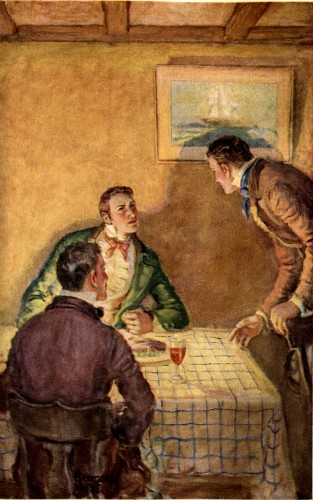
"'YOU ARE AWARE,' SAID HE, 'THAT YOU WILL BE POSTED?'"
"In any action that is taken against me," said Anthony, "I shall know
how to defend myself."
"In all likelihood, the first time Tarrant meets you in a public place
he'll brand you a coward."
Anthony looked up at the speaker, and replied quietly:
"If he does, I'll beat him like a dog."
The other stood for a moment, as though waiting for something more;
but, as Anthony was silent, he turned, and in a moment the door which
had admitted him to the public room closed behind him. Whitaker spoke
in a low voice.
"Of course I do not know what is usual in New Orleans. But it must be
the same as anywhere else. Tarrant is held a man of consequence here,
and to refuse him satisfaction would be a grave thing socially. Is your
mind completely made up?"
"Dueling," spoke Anthony, "is a code that has no place in the modern
world; it is murderous and preposterous."
Whitaker shook his head.
"There is a law against it, but the man who refuses a challenge is
marked."
Anthony looked more grim than ever.
"I am never troubled," said he, "by the way people regard me. And fear
of society's disapproval is only entertained by those who value its
countenance. There is no force that I know of that can make me place my
life in jeopardy at the hands of a practised man-killer; neither can it
compel me to go out in cold blood and kill him."
Whitaker wriggled in his seat.
"I'm afraid your uncle—" he began.
"I have not seen my uncle in fifteen years," said Anthony, coldly; "and
his opinions in the matter can have no weight with me." Then he leaned
across the table, seeing the grave look in the face of Whitaker, and
said kindly: "I think my attitude troubles you. Please do not allow any
duty which you think due me as a chance acquaintance to entangle you in
a disagreeable situation."
Whitaker swallowed hard, but he was firm.
"You see," said he, and his voice was so pitched as to be unheard by
the curious ones about him, "my group is the gayer one,—Tarrant and
his kind,—and it holds to certain things as necessary in a position of
honor! But, damn it all, Stevens! I'll overboard with the whole lot of
it; for, after all, what you say is nearer the truth; only most of us
have never had the courage to admit it."
A door was heard to close sharply. Tarrant was in the public room, his
eyes going about, his face flushed with passion. At sight of him a
murmur arose; then it grew until it was a sort of subdued roar, shot
through with startled cries; for the duelist had sighted his man and
was advancing swiftly toward him between the rows of tables. Whitaker
said to Anthony:
"You had better get up. He means to strike you!"
Anthony made no reply; he sat still and glowered at his plate. A close
observer would have noted, though, that his swift, powerful body was
adjusted for a sudden leap and a tigerish lashing out. Tarrant reached
his side.
"Mr. Stevens," said the man, fury shaking his voice, "I have received
your message."
Anthony turned his head and waited.
"Let me say to you," proceeded Tarrant, "that while your attitude may
serve in a mongrel community like New Orleans, it will not be tolerated
here." Anthony was silent, but Whitaker saw his rigid jaw, and noted
his back hunch as the great muscles grew tight. "For the last time,"
said Tarrant, "will you—"
"One moment, please," said a hard, quiet voice.
The duelist turned, and saw the mask-like face of Weir, and a pair of
eyes that were as cold as ice.
"I would advise, Mr. Tarrant," said Weir, "that you carry this matter
no further. When the facts are known, it will be generally seen that
you cannot require any action from this gentleman except that which he
is giving you."
The eyes of Tarrant seemed to dart flame.
"What! What!" breathed Whitaker in Anthony's ear. "He'll not dare face
Weir! He'll not dare!"
But before it was made clear what was in Tarrant's mind he was
surrounded by a sudden surge of people. There was a hubbub of voices;
doors slammed, other people hurried forward; there were oaths and
bitter vows, and the pleading of the tavern's people for order. Then
Tarrant was led away. Weir bowed to Anthony in return for some word of
thanks, and turned back to Dr. King. Whitaker, a little later, with
a most leisurely air, settled the bill; then he and Anthony got up,
passed through the staring groups about the tables, and left the place.
As the dandy was parting from Anthony at the door of the Half Moon he
said:
"Well, I think Weir has ended the matter as far as you are concerned;
for, once he's pronounced a judgment on a thing of this kind, no one
will think of taking it otherwise. He's an authority. And it will be
easier for you, too. As it stood, though I think you were right, you'd
have had an extraordinary position to maintain."
"I am much in Mr. Weir's debt," said Anthony.
Whitaker nodded.
"When I heard his voice," he said, "I knew that was the end of it. No
matter what Tarrant's state of mind, he'd never try to face down Weir."
"Why?" asked Anthony.
"Well, any man who knows Weir properly—and Tarrant does, for he
once sailed under him—would not care to measure skill with him in
a struggle. Tarrant is a swift, courageous blade, and like a whip
for giving offense or taking it. But Weir is of another kind. He has
something in him," and Whitaker shook his head, "that most rufflers, no
matter how desperate, fear."
Not a great while after Anthony and Whitaker had left the Crooked
Billet, Monsieur Lafargue and his daughter, in the private supper-room,
off at one side, also stood up to go. Tarrant, now recovered from his
rage, was beside them; and the big young man smiled good-humoredly in
the background.
"I am greatly in your debt, sir," said Monsieur Lafargue, to Tarrant.
"You have shown yourself a friend, at a time when a friend was greatly
needed."
"Sir," said Tarrant smoothly, "I am glad to have been of service to
you, and to mademoiselle. For no gentleman could have witnessed what
I have witnessed in your affairs and not come forward. I saw you
about to fall in the hands of Anthony Stevens, the most subtle of
double-dealers, and of course," with a gesture, "I had to do what I
could to prevent it."
"But, sir," and it was the girl who spoke, "are you quite sure of all
you say?"
"Mademoiselle," said Tarrant, "what I have stated is a very grave
thing; and so, before saying it, I considered it very carefully. As
your father will tell you, the house of Rufus Stevens' Sons has long
been engaged in commercial practice which cannot be sanctioned by
honest men; things have been done with insurance, and with merchant
moneys adventured in their care, which no one of shrewdness can
overlook. Is not your father's money in some of the dealings of this
house? Has he not persuaded his friends at Brest to venture theirs?"
"That last," said the old Frenchman, "is the worst of it." He shook his
head, and his hand gestured helplessly. "If loss comes, I will never
forgive myself."
"There was another who had risked his money, one who knew how your
father was situated with the firm, one who wrote him a letter," said
Tarrant, still addressing the girl. "I refer to Magruder. He saw how
matters were going with the house and feared the result. Magruder
somehow knew—he was a cunning, ratty kind of a man, who knew many
things he was not credited with—that your father had moneys involved,
and so wrote him a letter of warning. Is it not so? It was this letter
that brought you and your father to this country? Am I right? But for
all his writing Magruder was afraid; he'd not meet your father openly;
he dreaded some unseen danger."
"And it seems he was right in that," spoke the big young man, his smile
growing broader. "Events, I think, have proved he had reason for his
dread."
"Before you could arrange to speak with him," said Tarrant to the old
man, "he was done to death." And as Lafargue shuddered, and the girl
turned away, Tarrant went on: "Who was interested in having this man
die at this particular time? Could you say? Who stood in fear of what
Magruder might tell? Whose rascally dealings were about to be exposed?
The people most interested in the house of Stevens, as you know very
well!"
"I thank you," said Monsieur Lafargue tremblingly. "You have gone to a
deal of trouble, sir, for our sakes, and have probably saved me from a
great mistake."
"Avoid all conferences with the Stevens firm, or any one bearing the
Stevens name," said Tarrant, shaking his hand. "To deal with them in
any way will bring you and your daughter, both, misfortune."
"But how is my business here to be carried forward?" asked the old man.
"Take heed! If you went to them now, you could merely state what you
suspect," said Tarrant. "You would be placing yourself in their hands,
for you have no proof of anything. My advice to you is to wait." He
nodded to the old man understandingly. "Of course, an indefinite stay
here will be expensive, and your means are limited; I know that. But I
have suggested a way of surmounting the difficulty. Money can be had
readily; old Bulfinch is your man; you have only to ask him for it."
"You are kind," said Monsieur Lafargue. "I should feel helpless and
alone, indeed, without you."
Tarrant went with them to their carriage; and when he had handed them
in, and their driver sat with the reins in his hands, he said:
"Remember what I have told you—both to-day and to-night. I
repeat it all now. Keep to yourselves. Do not trust the firm of
Stevens—especially do not trust young Anthony of that name; he is, as
I have shown you, the most ruthless of them all. Have no confidences
with any one; be silent, and you will win through."
Then Tarrant went back to the supper-room; the big young man was seated
at the table; and across from him was a white-haired old man, with the
rosy, gentle face of a saint.
"Good!" said Tarrant, at sight of the old man. "I had hoped you'd not
keep us waiting, old moneybags!"
The new-comer laughed; it was a laugh that had a soothing, oily
quality; one white hand stroked his well-shaven chin.
"I strive to be prompt," said he. "It's a virtue that has a deal of
value in a business way. And being early to-night repaid me in an
unexpected way; for while I waited in the public room I witnessed your
encounter with Captain Weir."
Tarrant sat down; with his elbows on the table, his chin in his hands,
he cursed in cold anger.
"Some day," he said, "I'll drive a bullet through that man's skull, so
help me God!"
But the saintly old man held up a protesting hand.
"No, no!" said he. "Oh, no! We are friends. We are all friends
together. We have business relations with Captain Weir. No violence; no
discord. It would be to the disadvantage of us all."
"My thought!" said the big young man. "My thought, exactly, Mr.
Bulfinch. Let us put all private matters to one side; for the present,
at least, let us work for the common good."
Tarrant regarded them both with cold eyes.
"Is it for the common good that Weir affronts me at almost every turn?"
said he. "Am I possessed of more patience than the run of men, that I'm
continually asked to bear his impertinence?"
"Do not forget," said the old man in his soothing voice, "that the plan
we are working under is, in a general way, one laid down by him. And he
disapproves of the way you have selected in dealing with young Anthony
Stevens; he fears it is not a good way."
Tarrant sneered; but it was the big young man who spoke.
"I have no good reason to hold my hand where this same Anthony Stevens
is concerned," said he. "But, on the whole, I agree with Weir. Keen
young blades like this are not apt to be budged by hostile talk, or the
threat of blows. It only makes them all the more resolved."
"It is the captain's desire," said old Bulfinch, "to manage the matter
carefully; he plans to be friends with this young man, to encourage
him, to support him. And, then, one day will come an occasion when what
is necessary can be done with safety. And it will be done."
"I have no stomach for craft when a smart blow or two will serve as
well," said Tarrant bitterly.
But the big young man wagged his head in disagreement.
"I once thought that, myself," he said, "and risked my bones every day
for a little gain. But Weir's way gives fine profits and no risks;
we squeeze our toll out of shipmen and need never even take to sea.
Instead of facing a roused captain, with a ship's company behind
him, on his own deck, we now, thanks to Weir's brains, make a little
arrangement with that same captain before he goes on board; and the
ship and cargo are ours at whatever place we say, and without striking
a blow."
Old Amos Bulfinch smiled; his rosy, saint-like face glowed with
mildness.
"Could anything be better put?" he asked of Tarrant. "Would it be
possible to state a perfect case in more comprehensive words? Sir," to
the big young man, "I thank you."
"But even in the thing you give Weir so much credit for," said Tarrant,
"all is not done that could be done. Why are our operations held to a
single house? Why should we be forced to be content with Rufus Stevens'
Sons alone? There is Girard; there is Crousillat; there is a half-dozen
more. Good profit is to be had by extending our operations to all of
these—"
But the smooth tones of Amos Bulfinch checked him.
"Rich they are, those merchants," agreed old Amos, "and their ships
are many. But each man of them is as keen as a knife-blade; each has
a thousand eyes! Where a thing can be done in the shadow of Rufus
Stevens' Sons with ease and comfort, it could only be undertaken, in
the case of these others, with much danger; at almost any moment we
could expect to be laid by the heels."
"Weir is a dog-fox; I'd follow his plan without question where I'd
not even listen to another," said the big young man. "Leave the other
houses alone. This one is rich enough, for the time, at least."
Tarrant regarded the younger man, and then the elder one, with a curl
at his lip.
"You both have a deal of respect for Weir's opinions in some things,"
he said. "And yet, strangely enough, you have very little in others.
There is no thing which he has spoken more sharply against than the
proposed dealing with the French agent, now on his way here, in the
matter of letters of marque. And yet you strongly favor the project."
"The matter of the letters of marque is to be a venture of our own,"
said the big young man. "That is, if the captain is disinclined to join
us."
Old Bulfinch nodded.
"Quite right," he said. "It is to be an affair of our own. But we shall
be prudent, for all that. We shall be exceedingly careful that every
legal aspect be observed."
Tarrant laughed.
"A saying like that has an odd sound," said he, "when I remember that
Blake here," and he pointed to the big young man, "was brought north
to take active charge of the matter—Blake, who for years has given as
much thought to the legality of any action as he would to a snap of his
fingers."
The big young man smiled; but it was old Amos who spoke.
"Blake," said the old man, "is to take charge when all is said and
done; the legal status of French privateers, recruited and armed in our
ports, will have been passed upon when he sends out the first of them."
"And when they are passed upon and take to sea," smiled the big young
man, "then will come the time to forget legal forms; rich merchantmen
will be our only need, and the seas between here and Rio are crowded
with those."
"Well," said Tarrant, "God knows I don't want to put myself in a
position to block any such flow of circumstance. If there are prizes to
be had, let us have them. If we get Weir's help in the matter, well and
good. If we do not, we can, as you suggest, go on without it."
"This Frenchman, Lafargue, was an excellent thought," said old
Bulfinch. "Oh, excellent! He can do much for us if properly managed."
"I have found a way for that," said Tarrant. "He is without money; I
have recommended that he go to you."
"I am always ready to accommodate gentlemen, upon good security," said
the old money-lender smoothly. "A good name or two on the back of a
bill will go far with me."
"His bill will have no name upon it," said Tarrant. "And he has no
security."
Old Bulfinch looked at the speaker, astonished.
"What?" said he. "What? Oh, surely, now!"
"In the matter of Lafargue," said Tarrant, "names and securities must
be forgotten. You must only remember that Lafargue is a man to receive
special treatment."
"Very careful, special treatment," agreed the big young man, nodding.
"He must be beholden to us, he must be tied to us, tightly, in some
way; and, of all ways, to have him owe you money is the readiest and
best."
"In the matter of money," said old Bulfinch, wincing, "it is wise to
use care. Money is not easily come by; and it should not be too easily
parted with."
"Any money spent in the matter of Lafargue will be well spent," said
Tarrant. "We must have his friendship; for through him we hope to gain
the countenance of this other Frenchman, Genêt."
"And keep well to mind who and what Genêt is; he is the French
minister, now on his way here for the sole purpose of arming American
ships to sail under the French flag. He was Lafargue's friend in
France," said the big young man, "and we must see to it that he is our
friend here."
Tumblers of hot drink were brought them, and, with the plates and cups
pushed to one side of the table, they talked and drank and planned.
The coming of Lafargue to the city, so it seemed, had startled them,
at first. Untold harm might have been done by it, had not Charles
Stevens happened to be away. But now, on the whole, they were pleased
with the old Frenchman's arrival. Monsieur Lafargue had no legal proof
of any slack dealing, and so he could not appeal to the law; they had
so filled his mind with apprehension that he'd not dare enter the
counting-room of Rufus Stevens' Sons and frankly tell what he thought
of the various transactions that troubled him. Altogether it was
agreed, they were safe from him. And his tightened circumstances now
delivered him into their hands; being a friend to the French agent,
he'd have much influence. Legalized piracy! By God, it was like a dream
of paradise! You sailed the seas with a good ship under you; you took
what you liked, and the law supported you! Oh, yes, on the whole they
were now pleased with the old Frenchman's coming. They had hoped in the
regular course of things to get commissions for a vessel or two from
Genêt; but now, look you, a fleet was not impossible. Give them the
harrying of the seas for three months' time, and you, or any one else,
could do what you pleased. They would be satisfied.
"But," said old Amos Bulfinch, as he was about to go, "I have seen
Lafargue's daughter. She is not one to be easily misled. By some chance
she might distrust this matter of ours, and might warn her father away."
"Never fear for that," said Tarrant, as he rang the bell for more
drink. "That event has been provided for, and by no less a person than
Weir himself. He has suggested a little ruse, to safeguard those things
in which he is interested; but it so chances that it safeguards our
venture as well. You need fear nothing from the girl; she will have her
mind filled with other matters, I promise you that."
"Keep your ears open in the next few days," smiled the big young man.
"Common gossip will tell you much."
Old Amos wore the look of a peaceful saint, so calm was he of face, so
rosy of color, so white of hair, as he bade them good night; and then
he went out, leaving them together at the table awaiting the liquor
they had ordered.