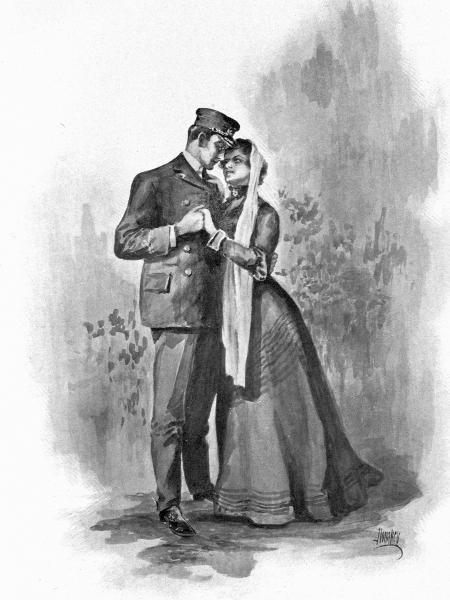
“Lucy Burton is a perfect dream tonight,
is she not?” exclaimed enthusiastically
Alice Stanhope, gazing admiringly
at the fair companion of her school days
who had just entered the room leaning on the
arm of her husband.
“Almost as pretty as you are,” gallantly replied
‘Bertie’ Winthrop, to whom the remark of the
young woman was addressed.
“Well, don’t expect me to vie with you in flattery
and reply by saying that Mr. Burton is almost
as handsome as you are, for I am like the
father of our country, ‘I can’t tell a lie.’”
“Oh! Now, that’s good. I am justified in supposing
from that speech that Burton is not nearly
as handsome as I am, much obliged,” replied
young Winthrop, laughing and making a profound
obeisance to the pretty creature beside him.
“You know what I mean you rascal, so don’t
try to look innocent. See with what adoring
glances Lucy looks up into her husband’s face,”
said Miss Stanhope again calling her attendant’s
attention to the group of guests near the entrance.
“Are you going to look at me like that a year
from now?” asked ‘Bertie’ in a quizzical fashion
as he slyly squeezed the dimpled elbow near his
side. On dit, Alice Stanhope and Albert Winthrop
will soon be married.
“Bertie, you horrid tease, I don’t believe you
will ever deserve to be looked at except angrily,”
retorted the blushing girl and added as she
moved a little further from him,
“And you behave, sir, or I won’t let you remain
by me another minute.”
“It’s a deuce of a crush you have gotten up,”
said ‘Bertie’ promptly disregarding the warning
that he had received by stepping up close to the
side of his fiancee.
“Where did you get all these people anyway,
Alice?”
“There’s no ‘all these people’ about it, they are
the musical set among my friends in Boston and
New York; as Signor Capello and Mme. Cantara
are to sing of course everyone invited was eager
to be present.”
“Never invite all your musical friends to dine
with us when we are—”
“Hush, you embarrassing wretch,” cried Miss
Stanhope turning to welcome some recently arrived
guests.
After considerable diplomatic finessing and
resort to that most efficacious auxiliary, “Papa’s
cheque book,” Miss Stanhope had secured the
services of the two great operatic luminaries to
sing at a grand musicale given by her.
All the “swell set” of Boston and New York
thronged the palacious home of the Stanhope’s on
the occasion. The gray-haired, courtly governor
of Massachusetts was chatting as gaily with
petite Bessie Winthrop as he had done with her
grandmother a half century before. Foreign
diplomatists and Federal potentates discussed in
corners the comparative merits of Italian and
German composers of music; literary lights from
all over New England joined the musical element
of New York and Boston in filling the Stanhope’s
halls.
“I insisted upon coming here tonight, Alice,
even though this over-worked husband of mine
did complain of a headache at dinner and I was
loathe to have him accompany me. You remember
this is the anniversary of my wedding and I
wished to celebrate the day,” said Lucy Burton
to the hostess when at last Burton had managed
to make a way for himself and wife through the
crowded rooms and reached the place where Miss
Stanhope was receiving her guests.
“I am awfully glad you came, dear. We are
sure to have a treat. Signor Capello has promised
to sing something from the new opera by
Herman that has just been produced in Berlin,”
and addressing Burton Miss Stanhope added,
“I trust that your headache has disappeared.”
“Thank you, Miss Alice, it has entirely vanished
under the influence of my charming wife’s
ministrations, and the brilliant gathering about
me here,” replied Burton.
“A slight pallor and circles around sad eyes,
you know, Mr. Burton, give an exceedingly interesting
and romantic appearance to dark men,”
rejoined Alice Stanhope smiling in spite of her
effort not to do so when she noticed the anxious,
worshiping look with which Lucy regarded her
husband.
“Really, I believe Lucy is more in love than she
was a year ago,” said the laughing hostess as she
turned to receive the German Ambassador, who
had traveled all the way from Washington in the
hope of hearing selections from Herman’s new
opera.
In all that gathering of fair women and gallant
men, there was no couple so noticeable as the
splendid pair who this day one year before were
wedded.
As Burton and his wife passed through the
crowded halls all eyes were turned toward them,
paying mute tribute to the exceeding beauty of
both man and woman.
Burton, by one of those sudden rebounds of
spirit to which he was subject, inspired by the
gaiety about him was in a perfect glow of intellectual
fire. The brilliancy of his well trained
mind never shone more brightly, his wit scintillated
in apt epigrams, and incomparably clever
metaphors. He won the heart of the German
Ambassador by discussing with the taste and discrimination
of a savant that distinguished Teuton’s
favorite composer, Herman, using the deep
gutturals of the German language with the ease
of a native of Prussia.
He exchanged bon-mots with wicked old Countess
DeMille, who declared him a preux chevalier
and the only American whom she had ever met
who spoke her language, so she called French,
like a Parisian.
Lucy’s beaming face and sparkling eyes told
of the rapture of pride and love that filled her
heart. She looked indeed the “Princess” as with
her well-turned head, with its gold-brown
crown, held high, she proudly looked upon her
lover and her lord and caught the approval and
applause that appeared in every eye about her.
Never had her husband seemed so much superior
to all other men, in Lucy’s mind, as he did this
night. Wherever they paused in their passage
around the rooms, that spot immediately became
the center of a group of people eager to render
homage to the regal beauty of the young matron,
and to enjoy the wit and vivacity of the most
distingue man present.
“Ah, Mr. Burton, I see that the splendor of the
Rose of Dunlap remains undiminished, notwithstanding
its transference from the garden of its
early growth,” said the gallant Governor of the
old Bay State when greeting the young couple as
they stopped near him.
“The splendor of the roses of Massachusetts
is so transcendent that it would remain unimpaired
in any keeping how e’er unworthy,” replied
Lucy’s husband, bowing gracefully to the
Executive of the State.
“When I saw you enter the room, Mrs. Burton,
I hoped to see my old friend, your grandfather,
follow. How is James? You see I take the liberty
of still speaking of him as I did many years
before your bright eyes brought light into the
Dunlap mansion.”
“Grandfather is very well, thank you, Governor,
but I failed to coax him away from his easy
chair and slippers this evening; beside I think he
was a little ‘grump,’ as I call it, about having lost
a wager to a certain young woman of about my
height; he declared it was not the box of gloves
but loss of prestige that he disliked,” answered
Lucy merrily as she looked up at the amused
countenance of the Governor.
“I fear that I shall be obliged to exercise my
official prerogative and give that gay youth,
James Dunlap, a lecture if I hear anything more
of his reckless wagers,” said the jocose old gentleman,
and then added:
“By the way, Mrs. Burton, the newspapers this
evening contain long accounts of the magnificent
conduct of a New England sea captain, to whom
the King of England has sent a letter of congratulation
and praise. As the name given is Captain
John Dunlap, I have been wondering if it can be
that stubborn fellow whom your Uncle John and
I endeavored to convince that he ought to enter
Harvard.”
“It is the same stubborn, dear old cousin Jack
who preferred the sea to being sent to Harvard,
and he is the best and bravest sailor on the waters
blue,” answered Lucy quickly, her face flushed by
pleasure at hearing Jack’s praises sung and pride
in knowing that he was her kinsman.
“It seems the lad was wiser than we were when
he refused to be convinced by John and me. A
grand sailor might have been spoiled in the making
of a poor scholar. As long as the sailor sons
of Uncle Sam can number men of your cousin
Jack’s kind among them we need never fear for
honor of the Gem of the Ocean,” said the Governor
quite seriously.
“I heartily endorse that sentiment, your Excellency,
but fear that on land or sea it would be
difficult to discover many men like Jack Dunlap,”
exclaimed Walter Burton warmly.
“When is he coming home, Lucy? You know
that I lost my heart the first time that I met your
bronzed sailor cousin, and am waiting anxiously
for my mariner’s return,” said Bessie Winthrop,
her violet-colored eyes twinkling with the gladness
of youth and happiness. En passant she was
a fearful little flirt.
“He does not say in his letters when we may
expect him, but when I write I’ll tell him what
you say, and if he does not hurry home after that
nothing can induce him to do so,” said Lucy as
she moved away with her husband to make room
for several admirers of Miss Winthrop who were
eagerly awaiting an opportunity to pay court to
that popular young lady.
Just as Burton and his wife left the Governor
and his pretty companion, the tuning of instruments
announced the prelude to the programme
for the evening. Silence fell upon the assembly,
the gentlemen sought seats for the ladies and secured
the most available standing room for themselves.
Surely Signor Capello never sang so grandly
before. The superb harmony of Herman’s great
composition filled the souls of that cultivated
audience. The German Ambassador was in a
perfect ecstasy of delight, and even the least appreciative
were impressed, while the hypercritic,
casting aside all assumption of ennui, became enthusiastic.
Madame Cantara trilled and warbled in tones
so clear, flute-like and sweet that to close one’s
eyes was to imagine the apartment some vast forest,
filled with a myriad of feathered songsters,
vying with each other for woodland supremacy in
Apollo’s blessed sphere.
Miss Stanhope’s musicale was a pronounced
and splendid success. Nothing approaching it
had entertained Boston’s fastidious “four hundred”
that season.
Burton declared that it was the most delightful
function he had attended in years, when Lucy,
enwrapped in furs, was closely nestled at his
side in the carriage after the entertainment was
over. Burton was par excellence a judge of such
affairs. In fact, he had been accorded the position
of arbiter elegantiarum by a tacit understanding
among people of taste and culture in Boston’s
elite society.
It was among such scenes, surroundings, environments
and society as above described that
Burton’s life had been passed since coming to
America. It was in this joyous atmosphere that
the first year of Lucy’s married life glided by so
rapidly that the length of time seemed difficult
for her to realize. It was like the dream of a summer’s
day, so bright, cloudless and calm, so fragrant
with the perfume of love’s early blossoms,
that its passage was as that of a fleeting shadow.
The sinking sun cast lengthening shadows
across Manila Bay, where swinging peacefully
at their anchors lay the great war ships of several
nations, and where the tall masts of a fleet of
merchantmen caused bars of shade to stripe the
burnished waters of the Bay.
The starry flag of the great Republic had received
that salute, ever loyally given by the sons
of Columbia, as the sun sank beneath the horizon,
and the bugle blew its farewell to the departing
orb of day.
Four majestic, floating fortresses, on whose
decks stood uncovered crews as the proud flag of
the union descended, gave notice to the world of
the might of that young giant of the west that
held dominion in the Philippines.
Striding along in the rapidly darkening twilight,
up the main street of Manila, walked one
who would have been known as a sailor by his
swinging, rolling gait, even without the nautical
cut and material of the clothing that he wore.
As he approached the newly erected, palacious
American hotel, around which ran a broad
veranda filled with tables and chairs, the chief resort
of the army and naval officers stationed at
Manila, a voice cried from the balcony above
him:
“Jack Dunlap, by all that is marvelous!”
The sailor-man looked up and with an exclamation
of pleased recognition, shouted:
“Tom Maxon, by all that is fortunate!”
“Come up here this instant, you sea-dog, wet
your whistle and swap yarns with me,” called the
first speaker, rising from the table at which he
was seated and hurrying to the top of the half
dozen steps that rose from the sidewalk to the
entrance on the veranda.
The two men shook hands with the warmth
and cordiality of old cronies, when the sailor
reached the balcony. The meeting was evidently
as agreeable as it was unexpected.
The man who had been seated on the veranda,
when the sailor approached, was apparently of
the same age as the friend whose coming he had
hailed with delight. He, too, was evidently a
son of Neptune, for he wore the cap and undress
uniform of a lieutenant in the United States
Navy.
He was a big, fine man on whose good-looking,
tanned face a smile seemed more natural, and,
in fact, was more often seen than a frown.
“Jack, old man, you can’t imagine how glad I
am to run afoul of you. Had the choice been left
to me as to whom I would choose to walk up the
street just now, I’d have bawled out ‘Good old
Jack Dunlap!’ Well, how are you anyway?
Where’ve you been? and how are all in Boston?
But first let’s have a drink; what shall it be,
bully?”
All of these questions and ejaculations were
made while the naval man still held Jack’s hand
and was towing him along like a huge, puffing
tug toward the table from which the officer
sprang up to welcome his companion.
“By Jove, Tom, give me time to breathe; you’ve
hurled a regular broadside of questions into my
hull. Haul off and hold a minute; cease firing!
as you fighters say,” expostulated our old acquaintance,
Captain Jack, as he was fairly shoved
into a chair at the table and opposite the laughing
and red-faced lieutenant.
“Come here, waiter,” called Maxon to a passing
attendant, in high glee over Jack’s cry for
quarter and his own good luck in meeting an old
chum when he was especially lonely and eager to
have a talk about home and friends.
“Bring us a bottle of champagne and let it be
as cold as the Admiral’s heart when a poor devil
of a lieutenant asks for a few day’s shore leave.”
“Now, my water-logged consort, we will first
and foremost drink in a brimming bumper of
‘Fizz’ the golden dome in Boston and the
bonny-bright eyes of the beauties that beam on
it,” exclaimed jolly Tom Maxon, bubbling over
with happiness at having just the man he wished
to talk about Boston with.
“I say! Tom, have you been studying up on alliteration?
You rang in all the B’s of the hive in
that toast,” said the merchant skipper, emptying
his glass in honor of Boston and her fair daughters.
“I don’t require thought or study to become
eloquent when the ‘Hub’ and her beauties be the
theme, but you just up anchor and sail ahead giving
an account of yourself, my hearty,” Tom replied
with great gusto.
“To begin, then, as the typical story writer
does, one November day some thirteen months
ago, I sailed away (I’ve caught the complaint.
I came near making a rhyme) from Boston in the
good ship ‘Adams.’ When a week out of harbor
as per instructions from the house of Dunlap, I
unsealed my papers to find that the ship had been
presented to me by my kinsmen, the Dunlap
brothers.”
“Stop! Hold, my hearty, until we drink the
health of the jolly old twins. May their shadows
never grow less and may the good Lord send
along such kinsmen to poor Tom Maxon,” interrupted
the irreverent Tom, filling the glasses and
proceeding to honor the toast by promptly draining
his.
Jack and Tom had been pupils in the same
school in Boston when they were boys. Their
tastes and dispositions being much alike they became
chums and warm friends. Like young
ducks, both of the lads naturally took to the
water. When they had gotten through with the
grammar-school an appointment to the Annapolis
Naval Academy was offered to young Maxon by
the representative of his Congressional district,
which he joyfully accepted, and hence was now a
United States officer. Jack had entered the High
School and later the merchant marine service.
Though seeing but little of each other after
their first separation, the same feeling of friendship
and comradeship was maintained between
Jack and Tom that had existed when as Boston
schoolboys they chummed together, and whenever,
at rare intervals, they were fortunate enough
to meet they mutually threw off all the reserve
that had come to them with age and became Boston
boys once again.
“Now, heave ahead, my bully-boy!” cried Tom,
putting down his empty wine glass.
“In addition to the gift of the ship from the
firm, I found that my old cousin John had personally
presented me with a large part of the
ship’s cargo.”
“Again hold! you lucky sea-dog! Here’s to
dear old Cousin John, and God bless him!” called
Tom gleefully, his generous sailor-soul as happy
over the good fortune of his friend as if he himself
had been the beneficiary of Mr. John Dunlap’s
munificence, again pledging Jack’s kind
kinsman in a glass of iced wine.
“With all my heart I say, amen! Tom, God
never made better men and more liberal kinsmen
than the ‘J. Dunlaps,’” said Jack earnestly as he
began again his recital.
“When I arrived in Melbourne I disposed of
my cargo through our agents, loaded and sailed
for Liverpool, returned to Melbourne, took on a
cargo for Manila, and here I am drinking to long
life and good health to my two old kinsmen with
my school fellow Tom Maxon.”
“And the future programme is what?” said the
lieutenant.
“You have left out lots about yourself, that I
know of, concerning your past movements, so
try to be truthful about your future plans,” continued
Maxon, assuming an inquisitorial air.
“All right, my knowing father confessor,”
answered Dunlap, laughing.
“I have done well as far as making money is
concerned, which statement I wish added to my
former deposition. Oh! most wise judge; I propose
sailing within the week for Hong-kong,
thence to San Francisco, from the latter port I
desire to clear for Boston, in God’s country, stopping,
however, at Port au Prince, Haiti, both as
a matter of business and also with the design of
personally thanking my kind godfather for his
gifts. Finally I hope to reach New England and
be with my dear mother while yet the Yankee
hills are blooming with summer flowers. One
word further and my story is finished. My object
in returning to Boston is to induce my
mother to return with me to Australia, where I
have purchased some property and where I desire
to make my home in future—finis—”
“Fairly well told, my bold buccaneer; however,
I disapprove of your making Australia your
home. Now, sir, what about saving a few smallpox
patients, emigrants, and such like, and receiving
a letter from H.M. King of England, and
such trifles as we read of in the newspaper?” demanded
Tom, sententiously.
“Oh! That just happened, and there has been
too much said about it to find a place on my logbook,”
replied Jack, shortly, coloring just a shade.
“I’m!—well, no matter—I don’t agree with
you, but I will shake your hand once again and
say that I find my old chum as modest as I always
knew him to be brave,” rejoined Tom
Maxon, rising, reaching over and grasping Jack’s
hand, and bowing gravely and respectfully as he
held it.
Jack’s face was now all fire-red, as he said in
great embarrassment:
“Oh, Pshaw, slack up, Tom, haul off.”
“You know what the Admiral said when he
read the account of what you had done?” cried
out Tom when he settled back in his chair.
“Of course, you don’t, but it’s a fine ram at the
merchant marine. The Admiral thinks that an
officer for sea service can’t be made except at
Annapolis. When he read of what you had done,
he exclaimed: ‘That fellow is almost good
enough to be an officer in the United States
Navy.’ The Executive officer who heard the Admiral
repeated it, and ever since the fellows of
our mess, who hate some of the ‘snobs’ that Annapolis
sends to us, have been quietly poking fun
at the old man about it.”
“Now, will Lieutenant Thomas Maxon, U.S.N.,
in all the glory of his Annapolis seamanship,
give an account of himself?” broke in Jack, anxious
to escape further mention of his own affairs.
“The last time I saw you, Tom, you were
dancing at the end of Bessie Winthrop’s hawser.
Though I had never, at the time, met your charmer,
I thought her a pretty craft.”
“That’s it! Now you touch the raw spot!”
cried Tom.
“I was stationed at Boston, and went about
some little. I met Bert Winthrop’s sister and,
like an ass of a sailor that I am, fell in love with
her at the first turn of the wheel. Well, I rolled
around after the beauty like a porpoise in the
wake of a dolphin for the whole season. Finally
I mustered up courage to bring the chase to a
climax and got a most graceful conge for my
temerity, whereupon I retired in bad order, and
was rejoiced when assigned to the battleship
Delaware and sent to sea.”
As the rollicking sailor ended his story, he
threw back his head and began softly singing in
a sentimental tone, “Oh! Bessie, you have broken
my heart.”
“Well, I’ll go bail that the fracture won’t kill
you, you incorrigible joker,” said Jack, interrupting
the flow of Maxon’s sentimentality.
“See, now, our best friends never take us
seriously, and sympathize with us when we suffer,”
said the lieutenant dolefully.
“But to continue my sad story. I was ordered
to the U.S.S. Delaware, flag-ship of the Asiatic
fleet. Admiral Snave can out-swear Beelzebub,
has the sympathy of a pirate, and would work up
all the old iron of a fleet if there was as much in
it as in the mountains of Pennsylvania. So your
poor, delicate friend is tempted to ask to be retired
on account of physical disability.” So saying,
Tom began roaring with laughter so healthful
that it shook his stalwart frame.
“Hold though!” exclaimed the U.S. officer,
stopping in the midst of his outburst of merriment,
suddenly thinking of something omitted.
“You must understand that we all admire the
Admiral hugely. He is a magnificent officer, and
a fighter to the end of his plume; carries a chip
on his shoulder when he imagines anyone is
spoiling for a fight, or even looks crossways at
grand Old Glory.”
Thus the two friends talked on, relating their
experiences, joking each other, and laughing in
that careless happy way, common alike to schoolboys
and those who sail the sea.
Captain Dunlap declared that this berth was
good enough for him, that he would drop his
anchor right there, and calling a waiter proceeded
to order everything on the menu for dinner,
telling the waiter to serve it where they were and
serve slowly so that they might enjoy a rambling
conversation while they dined.
Eating, drinking, talking and smoking, the
chums of boyhood days sat for hours, until the
streets became, as was the veranda, almost
deserted. Suddenly in an interval of silence as
they puffed their cigars, a piercing scream disturbed
the quiet of the street below. Again and
again was the cry repeated in an agonized female
voice.
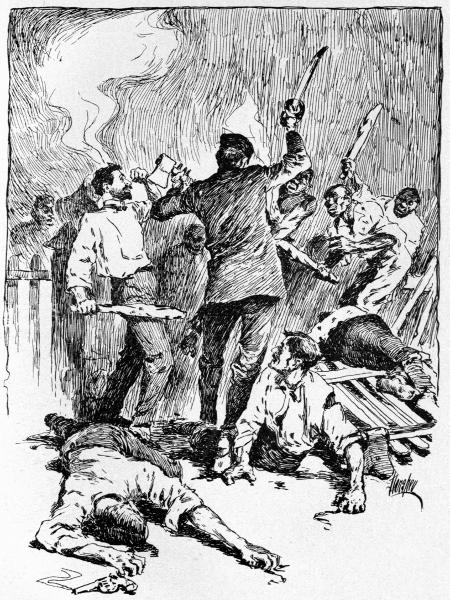
Both men sprang to their feet and peered along
the dark avenue that ran toward the bay. About
a block away they discerned just within the outer
circle of light cast by an electric burner a struggling
mass of men. At the instant that Jack and
Tom discovered whence came the cries, a figure
broke from the crowd and ran screaming through
the illuminated spot on the avenue pursued by a
half dozen men wearing the Russian naval uniform.
The pursued figure was that of a half nude
female.
With an angry growl, Jack Dunlap placed one
hand on the low railing around the veranda and
cleared it at a bound, landing on the sidewalk below,
he broke into a run, and dashed toward the
group of men under the electric light, who were
struggling with the person whom they had pursued
and recaptured.
“The flag follows trade in this case,” cried
Maxon, who would joke even on his death-bed, as
he, too, sprang to the pavement and raced after
Jack.
The brutal Finnish sailors of the Russian man-of-war
in Manila Bay swore to their mess-mates
that ten gigantic Yankees had fallen upon them
and taken away the Malay girl. They thus accounted
for their broken noses and discolored
optics.
Truth is, that it was a rush; the working of
four well-trained Yankee arms like the piston
rods of a high-speed engine. Outraged American
manhood and old Aryan courage against the
spirit of brutal lustfulness, ignorance and race inferiority.
“I say, Jack,” cried out Maxon as he raised his
face from the basin in which he had been bathing
a bruise, “Why don’t you go in for the P.R.
championship? You must be a sweet skipper for
a crew to go rusty with! Why, Matey, you had
the whole gang going before I even reached you.
Look here, sonny, you are just hell and a hurricane
in a shindy of that kind.”
“Well, I tell you, Tom,” called Jack from the
next room, where, seated on the edge of the bed,
he was binding a handkerchief around the bleeding
knuckles of his left hand.
“That kind of thing always sets my blood
boiling, but that in a city under our flag an outrage
of that kind should be attempted made me
wild. I guess from the looks of my hands that
maybe I did punch rather hard.” Rising, Jack
walked to the open door between the two bedrooms
and added:
“I don’t mind just a plain fight, or even sometimes
a murder, but when it comes to a brute assaulting
a woman or child, I’m damned if I don’t
become like one of Victor Hugo’s characters, ‘I
see red.’ Temper seems to surge in my very
blood.”
Jack’s face, as he spoke, wore an angry scowl,
to which the earnest gesticulations with his bandaged
fists gave double meaning.
“Of course it surges in your blood, old chap,
as it does on such occasions in mine and every
other decent descendant of Shem and Japheth on
earth,” replied Tom Maxon.