CAMPION, in between the working
of the rollers, was asked his opinion
of certain political utterances in the
works of his old friends Allen and Bristow,
and of Dr. Sander; also whether he considered
the Queen “true and lawful,” or
“pretensed and deprived.” He refused to
answer. Physical anguish could be little
worse than the ineffable boredom of these
two never-quiet questions. He was then
asked by the Governor, the Rackmaster,
and others present, by whose command and
counsel he had returned to England; by
whom in England he had been received and
befriended; in whose houses he had said
Mass, heard Confessions, and reconciled
persons to his Church; where his recent
book was printed, and to whom copies were
given; lastly, what was his opinion of the
Bull of Pius V against Queen Elizabeth?
A letter written at the time to Lord Shrewsbury
by Lord Burghley, and still extant,
shows that nothing of moment could be got
out of Campion. During the next fortnight,
however, there was poured into the
ear of the Government information regarding
the second and third items in the above
category. Houses were searched; persons
of mark were apprehended, tried in the Star
Chamber, and sentenced. Almost every
manse or town house where Campion had
been harboured became known, and even
the names of those Oxford Masters of Arts
who had followed him to Lyford. The
Government gave out that he had confessed
upon the rack, and implicated his
too trusting friends. The alleged facts
naturally became a general scandal, and
bred grief and horror among the Catholics
who, no less than Protestants, were thus
driven to believe them. The secrets were
probably given up, under panic, by three
serving-men, and by poor Gervase Pierrepoint.
It was a common trick of the time,
though not peculiar to it, to show a prisoner
a lying list of names purporting to have
been extracted from colleagues, so that he
himself might be trapped into endorsing
the suspicions held in regard to those
names. But it is clear that Campion was
brought to mention only a few who, as he
was aware, were formerly known to his
examiners as Catholic Recusants; and only
after a solemn oath from the Commissioners
that no harm could accrue to them in
consequence of such supplementary mention.
Even this he had every cause to
regret. The gentlemen and gentlewomen
on Lord Burghley’s lists were carefully informed,
when arrested, that it was Campion
who had betrayed them: a cruel slander
which he could refute only at the foot of the
scaffold. Thanks to the reports, first of his
backsliding, then of his treachery, his great
reputation, for the time being, was clean
gone. Having thus been given forth to the
public as a knave, he was now to be set
before them as a fool, and shown to be one
who possessed neither sort of superiority,
moral or mental.
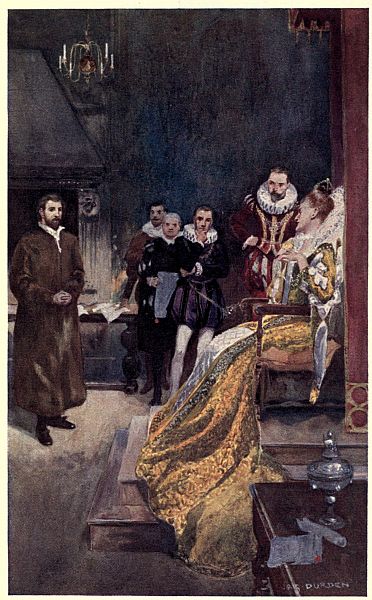
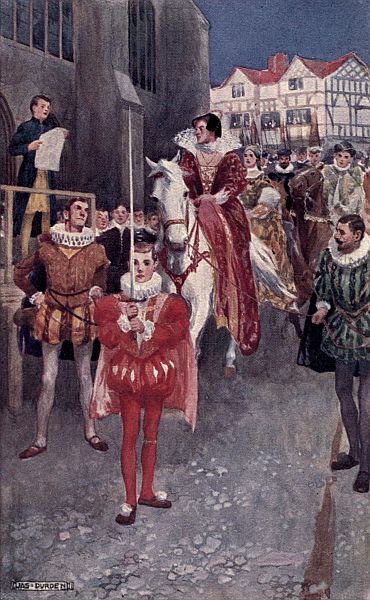
Campion before Queen Elizabeth.
Many courtiers, having a purely artistic
interest in Edmund Campion, had begged
that he might obtain the chance he had
often asked for, of being heard in a disputation.
This request was now suddenly
granted. The conference was public, and
came off in the Norman Chapel of the
Tower, which was crowded. Two Deans,
Nowell of St. Paul’s, and Day of Windsor,
were appointed to attack Campion; he was
to answer all objections as he could, but
was forbidden to raise any of his own.
Charke, the bitter Puritan preacher of
Gray’s Inn, and Whitaker, the Regius Professor
of Divinity in Cambridge, were the
notaries. The lion to be baited did not
even know that there was to be a conference,
until he was brought to it under a strong
guard. Time for preparation had been
denied him; he was allowed the use of only
such authorities as his memory could furnish;
pale and weary and rack-worn as he
was, he was given only a low stool to sit
upon. The well-fed theological worthies
were ranged before him, their chairs standing
on raised platforms, and their tables
spread with books of reference, pens and
paper.
One who was there tells us how easy and
ready were his answers; how modest his
mien; how that high-spirited nature so bore
the scorn, the abuse, and the jests heaped
upon him, as to win great admiration from
the majority of those who heard him for
the first time. He began by asking very
pertinently whether this was a just answer
to his challenge, first to rack him, then to
deprive him of books, notes and pen, lastly,
to call upon him to debate? and he added
(wishing to be fully understood by the audience),
that what he had asked for was quite
another sort of hearing: a hearing under
equal conditions before the Universities.
During the course of this first conference he
was twice most unfairly tripped up: once
over a quotation, in which he was right,
though he could not then and there prove
it; and again over a page of the Greek
Testament, in such small type that he
could not read it, and had to put it by when
it was handed to him: thereby drawing
down upon himself the ridiculous taunt that
he knew no Greek. This he took silently,
and with a smile. At the end of the six
hours he had more than stood his ground.
The Deans complained afterwards that a
number of gentlemen present, “neither unlearned
nor ill-affected,” considered that
Master Campion had the best of it. Some
common people who thought so too, and
said so in the streets, paid dearly for their
boldness. One of these gentlemen favourably
impressed was Philip, Earl of Arundel,
then in the flush of worldly pride and
pleasure. He was the real victory of the
Jesuit apostle, for he received at that time
and in that place the first ray of divine
grace, strong enough to change gradually
in him the whole motive and course of that
intensity of life which never failed the
Howards. As he stood leaning forward in
the foreground of the daïs, in that solemn
interior, tall and young, with his great
ruff and embroidered doublet, and his
brilliant dark eyes held by the pathetic
figure of Master Campion, how little could
he have foreseen his own weary term of
suffering in that gloomy fortress, and his
sainted death there, at the end of the
years!
There were three other conferences under
like conditions, but in other quarters, with
four fresh adversaries. Campion was again
“appointed only to answer, never to oppose”;
that is, to answer miscellaneous and
disjointed objections against the Catholic
Church, without ever being allowed “to
build up any harmonious apology for his
own system.” The last conference was
notable for its browbeating and threatening
of a too successful adversary. The
Bishop of London privately came to the
conclusion that the verbal tournament was
doing no good whatever to the sacred cause
of Protestantism. The Council agreed,
and ended it.
Towards the end of October Campion
was racked for the third time, and with the
utmost severity, so that he thought they
meant, this time, to kill him; but his fortitude
was unshaken. A rough and honest
first cousin to the Queen, Henry Carey,
Lord Hunsdon, growled that it were easier
to pluck the heart out of Campion’s breast
than to wrest from him one word against
his conscience. His arms and legs went
quite numb after this final torture. The
keeper, who was won over by his endearing
prisoner, and was always as gentle with
him as he dared to be, inquired next day
how they felt. “Not ill,” said Father
Edmund, with all of his old brave brightness,
“not ill, because not at all!”
Never once until now had he been accused
of any conspiracy. But he was a troublesome
person: he must be silenced somehow.
With a tardy inspiration, the
Council bent all their strength to get out
of Campion some acknowledgment that he
had been mixed up with the Spanish-Roman
expedition, and the Irish rising of
the preceding year. Not a shadow of proof
could, of course, be produced for such a
charge. Then, as a final and sure means of
indicting him on some other count than
that of religion, and of urging his execution
upon the Queen, Walsingham, with
Burghley’s connivance, hatched a treasonable
plot out of his own inventive head,
and got false witnesses to accuse Edmund
Campion of it, and swear his life away.
The “Plot of Rheims and Rome” was
described as an attempt to raise a sedition,
and dethrone and kill the Queen. It had
an imaginary but recent date: 1580.
Everybody or anybody, when found convenient,
could be accused of so elastic a
plot. It was first charged against some
twenty priests and laymen in this year
1581; but it was brought up against the
Earl of Arundel four years afterwards,
despite the fact that the supposed interests
of the Church were the last things likely to
win his attention at the time assigned.
On All Saints’ Day arrived in England
a suitor for the hand of Queen Elizabeth:
Francis, Duke of Alençon, King of the
Netherlands, the short-lived heir to the
throne of King Henry the Third of France.
With that King, while Duke of Anjou, and
with Alençon for nine years past (as for
three yet to come), Elizabeth had carried
on negotiations which ended in smoke; but
she now announced that she “would marry
at last.” Little Froggy, as she endearingly
called him, was ugly to a degree, and
many years younger than her Majesty;
he was brother-in-law to the Queen of
Scots, who was her Majesty’s prisoner at
Sheffield. The dominant, ultra-bigoted party
took extreme alarm at the near prospect of
toleration for Catholics which such a royal
match suggested to them. To reassure
them, it might just now be most useful,
thought the Council, to hang a Jesuit or two.
On the 14th of the month Campion and
eight others were arraigned before the
grand jury in Westminster Hall. For
“treasonable intents” of the Queen’s deprivation
and murder, these “secret and
privy practices of sinister devices,” befitting
one “led astray by the devil,” had
“Edmund Campion, clerk,” made his re-entry
into England, the Pope, meanwhile,
being not only aware of his act, but its
“author and onsetter”! He was commanded,
as were all those lumped with
him in a common accusation, to plead
Guilty or Not Guilty. Up went all the
right arms of these “devotaries, and dead
men to this world, who travelled only for
souls,” as Campion himself called them:
all but his, so disabled by the rack that he
could not stir it from the furred cuff in
which it lay. But a quick-witted comrade
turned and took off the cuff, “humbly kissing
the sacred hands so wrung for the confession
of Christ,” and lifted it high to cry
its own mute Not Guilty with the rest. The
Spanish Ambassador, Don Bernardino de
Mendoza, standing close by with his secretary,
saw, with a pang of pity, that all the
finger-nails were gone from Campion’s
swollen hands. The trial proper began on
the 20th, before “such a presence of people
of the more honourable, wise, learned, and
best sort as was never seen or heard of in
that court in ours or our fathers’ memories
before us . . . so wonderful an expectation
there was to see the end of this marvellous
tragedy . . . [of] such as they knew in
conscience to be innocent.” They all heard
Ralph Sherwin say, in a loud clear voice:
“The plain ground of our standing here is
religion, and not treason.”
Chief Justice Wray presided, a Catholic
at heart, and wretched ever after over this
unwilling day’s work. The prosecuting
officers for the Crown were the Queen’s
serjeant, Edmund Anderson; Popham,
afterwards Chief Justice; and Egerton,
afterwards the first Lord Ellesmere. The
chief witnesses were George Eliot, Anthony
Munday, and two creatures named Sledd
and Caddy: probably as evil a quartette as
existed in contemporary England, and
worthy forerunners of Oates and Bedloe.
“They had nothing left to swear by,” as
Campion reminded the jury: “neither religion
nor honesty.” In no special order,
but with much ardour and diligence, all
the old tiresome trivial accusations were
brought forward and pressed in, Campion
being spokesman throughout for the defence,
and his alert mind, despite his weakened
body, meeting them all, and routing
them. He was charged with having “seduced
the Queen’s subjects from their
allegiance” . . . and “reconciled them to
the Pope.” He caught up the word. “We
‘reconcile’ them to the Pope! Nay, then,
what reconciliation can there be to him,
since reconciliation is only due to God?
This word [‘reconcile’] soundeth not to a
lawyer’s usage, and therefore is wrested
against us inaptly. The reconciliation that
we endeavoured was only to God: as Peter
saith, reconciliamini Domino, be ye reconciled
unto the Lord.” Campion was informed:
“Yourself came as Procurator
from the Pope and Dr. Allen, to break these
matters to the English Papists.” So he
rejoined that in his homeward voyage from
Rome, undertaken by his vow of obedience
as a Jesuit, “the which accordingly I enterprised,
being commanded thereto,” he had
“dined with Dr. Allen at Rheims, with
whom also after dinner I walked in his
garden . . . and not one jot of our talk
glanced to the Crown or State of England. . . .
As to the [Pope], he flatly with charge
and commandment excused me from matters
of State and regiment.” . . . Followed
a change of tactics. “Afterclaps make
those excuses but shadows. . . . For what
meaning had that changing of your name?
Whereto belonged your disguising in apparel?
What pleasure had you to royst it
[in] a velvet hat and a feather, a buff leather
jerkin, and velvet venetians? . . . Can that
beseem a professed man of religion which
hardly becometh a layman of gravity? No:
there was a further matter intended. . . .
Had you come hither for love of your
country, you would never have wrought a
hugger-mugger; had your intent been to
have done well, you would never have
hated the light.” To which Campion replied
that St. Paul, in order “that living
he might benefit the Church more than
dying,” betook himself “to sundry shifts
. . . but that especially the changing of his
name was very oft and familiar” . . . and
that “he sometimes thought it expedient
to be hidden, lest, being discovered, persecution
should ensue thereby, and the gospel
be greatly forestalled. . . . If these shifts
were then approved in Paul, why are they
now reproved in me?—he an Apostle, I a
Jesuit . . . the same cause common to us
both. . . . I wished earnestly the planting of
the gospel; I knew a contrary religion professed;
I saw if I were known I should be
apprehended. I changed my name, I kept
secretly: I imitated Paul. Was I therein
a traitor? . . . The wearing of a buff jerkin,
a velvet hat, and suchlike, is much forced
against me. . . . I am not indicted upon the
Statute of Apparel! . . . Indeed, I acknowledge
an offence to Godwards for so doing,
and thereof it doth grievously repent me,
and [I] therefore do now penance, as you
see me.” This charming rejoinder (again,
how More-like!) was in allusion to his
rough gown of Irish frieze, and a huge
black nightcap covering half of his newly
shaven face.
After all this mere hectoring, some pieces
of “evidence” were produced. One of
these was an intercepted letter which Campion
himself had written from the Tower
after his first and comparatively moderate
racking, while it was still possible to use
his hands; it was addressed to the admirable
and truly holy, but fussy, Mr. Thomas
Pounde, who, wild with alarm at the pretended
“betrayals,” had written to remonstrate
with Fr. Campion. The Queen’s
Counsel now read this passage from Campion’s
humble reply: “It grieveth me
much to have offended the Catholic cause
so highly as to confess the names of some
gentlemen and friends in whose houses I
had been entertained. Yet in this I greatly
cherish and comfort myself: that I never
discovered any secrets there declared; and
that I will not, come rack, come rope!”
The comment of the reader in court was an
obvious one. “What can sound more suspiciously
or nearer unto treason than this
letter? . . . It must needs be some grievous
matter and very pernicious, that neither
rack nor rope can wring from him!” But
Campion’s even more obvious answer was
that there he spoke as one “by profession
and calling a priest,” vowed to silence in
regard to what was made known in the
Confessional, and yet pressed, on the rack,
to divulge secrets thus communicated to
him. “These were the hidden matters . . .
in concealing of which I so greatly rejoiced,
to the revealing whereof I cannot nor will
not be brought, come rack, come rope!”
Well chosen was this answer of Campion’s.
It has been pointed out that
if he had stated here that he had told on
no one who was not already found out,
he would have loosed the informers and
man-hunters afresh on the whole Catholic
community, until his other friends, who
had not been found out, were run down.
Instead of that he drew off attention by
reminding the court that he could not
repeat what had been sacramentally confided
to him. Most of his hearers were either
Catholic or had been Catholic, and acquiesced.
He spoke truth, but he skipped
explanations: and such is, more often than
not, the highest wisdom in this complex
world.
There were now read out certain papers
containing oaths to be administered to persons
ready to renounce their obedience to
her Majesty, and to be sworn of the Papal
allegiance alone. These were said to have
been found in houses where “Campion
had lurked, and for religion been entertained;”
hence they were of his composing.
He objected that the administering
of oaths was repugnant to him, and exceeded
his authority: “neither would I
commit an offence so thwart to my profession,
for all the substance and treasure in
the world.” He went on to say (assuming
for his purpose that the precious papers
were not forged, though they really were so),
that there was no proof of their connection
with himself, nor was it even pretended that
they were in his handwriting. Anderson
replied with singular perversity or dulness:
“You, a professed Papist, coming to a
house and then such reliques found after
your departure—how can it otherwise be
implied but that you did both bring them
and leave them there? So it is flat they
came there by means of a Papist: ergo, by
your means!” The logician in Campion
dashed to the fore. Could it be shown that
no other Papist ever visited that house but
himself? If not, they were urging a conclusion
before framing a minor! which is
imperfect, he added, and proves nothing.
Apparently Serjeant Anderson was sufficiently
enraged by now. His highly judicial
retort is on record. “If here, as you do in
Schools, you bring in your minor and conclusion,
you will prove yourself but a fool.
But minor or conclusion, I will bring it to
purpose anon!” Eliot then rose as witness,
and gave his account of the Sunday
sermon at Lyford: how Master Campion
spoke of enormities in England, and of a
day of change soon coming, welcome to the
shaken and dispersed Catholics, but dreadful
to the heretical masters of the land.
“What day should that be,” broke in the
Queen’s Counsel, “but that wherein the
Pope, the King of Spain, and the Duke of
Florence have appointed to invade this
realm?” Campion turned his eyes on Eliot.
“Oh, Judas, Judas! . . . As in all other
Christian commonwealths, so in England,
many vices and iniquities do abound . . .
whereupon, as in every pulpit every Protestant
doth, I pronounced a great day, not
wherein any temporal potentate should
minister, but wherein the terrible Judge
should reveal all men’s consciences and try
every man. . . . Any other day than this,
God He knows I meant not.” So much
for the astonishing “evidence” of this most
astonishing of all trials, one only, under
Pontius Pilate, excepted.
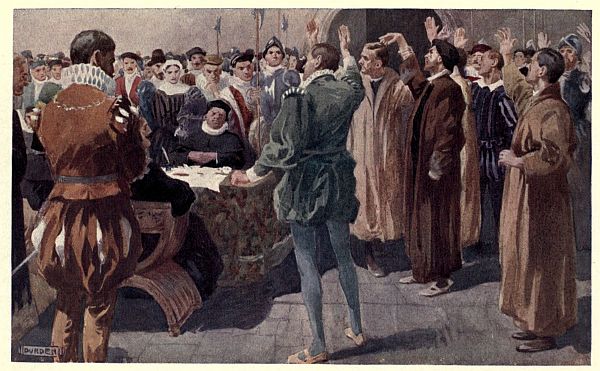
“Not Guilty!”
The chief count against the defendant
was the old, old one of the Bull of Deposition,
and the denied authority of the Queen
in spirituals: that wretched family skeleton
trotted out once more! “You refused
to swear to the Supremacy, a notorious
token of an evil willer to the Crown.”
Campion, who was surely what Antony
Wood quaintly calls him, “a sweete Disposition,
and a well-polish’d Man,”
stated his position once more, lucidly,
and with perfect temper. He began by
referring to what passed at the Earl of
Leicester’s London house. “Not long
since it pleased her Majesty to demand of
me whether I did acknowledge her to be my
Queen or no. I answered that I did acknowledge
her Highness not only as my
Queen, but also as my most lawful governess.
And being further required by her
Majesty whether I thought the Pope might
lawfully excommunicate her or no, I answered:
‘I confess myself an insufficient
umpire between her Majesty and the Pope
for so high a controversy, whereof neither
the certainty is yet known, nor the best
divines in Christendom stand fully resolved! . . .
I acknowledge her Highness as my
governor and sovereign; I acknowledge
her Majesty both in fact and by right to be
Queen; I confess an obedience due to the
Crown as to my temporal head and primate.’
This I said then; so I say now. If then I
failed in aught, I am now ready to supply
it. What would you more? I will willingly
pay to her Majesty what is hers; yet I must
pay to God what is His. Then as for excommunicating
her Majesty, it was exacted
of me (admitting that excommunication
were of effect, and that the Pope had sufficient
authority so to do), whether then I
thought myself discharged of my allegiance
or no? I said that this was a dangerous
question, and that they that demanded this
demanded my blood. Admitting (why admitting?)
I would admit his authority, and
then he should excommunicate her, I would
then do as God should give me grace: but
I never admitted any such matter, neither
ought I to be wrested with any such suppositions.”
To all this no rejoinder was
made. It was the identical position taken
up by many another harassed martyr. The
prosecution next turned to the remaining
prisoners, using the same weak, wrong,
skirmishing tactics,—Campion often putting
in a word to hearten one, to defend another,
to guide a third. At a certain point he exclaimed:
“So great are the treasons that I
and the others have wrought, that the
gaoler who has us in charge told me at
night that would we but go to the Anglican
services they would pardon us straightway!”
Serrano, who reports this, adds:
“They answered things in general.” At
the close of the proceedings, their issue
being prearranged, Campion was allowed
to make a speech to the jurors. He eloquently
begged them to seek for certainties,
and to remember the character of the “evidence”
brought before them. Alas! he
was appealing to bought men, who dared
not be true.
The pleadings had taken three hours; the
jury deliberated, or seemed to do so, for an
hour or more. Public opinion in the Hall,
as at the Tower conferences, was overwhelmingly
in favour of Campion. But “the poor
twelve,” as Allen calls them, came back,
fearful to be found “no friend of Cæsar,”
bringing in a verdict against the whole company
as “guilty of the said treasons and
conspiracies.” The Lord Chief Justice
spoke: “Campion, and the rest, what can
you say why you should not die?” Then
Campion broke out into a brief appeal
to the future and the past, a lyric strain
such as was not often heard beneath
those ancient rafters, so sadly used to the
spectacle of noble hearts in jeopardy. “It
was not our death that ever we feared!
But we knew that we were not lords of our
own lives, and therefore for want of answer
would not be guilty of our own deaths.
The only thing that we have now to say is,
that if our religion do make us traitors we
are worthy to be condemned; but otherwise
we are and have been as true subjects as
ever the Queen had. In condemning us
you condemn all your own ancestors, all the
ancient priests, Bishops and Kings: all
that was once the glory of England, the
Island of Saints, and the most devoted child
of the See of Peter. For what have we
taught (however you may qualify it with
the odious name of treason), that they did
not uniformly teach? To be condemned
with these old lights, not of England
only, but of the world, by their degenerate
descendants, is both gladness and glory to
us! God lives. Posterity will live. Their
judgment is not so liable to corruption as
that of those who are now going to sentence
us to death.” After which the Lord Chief
Justice pronounced the formula in use for
all prisoners condemned to capital punishment.
“Ye must go to the place whence
ye came, there to remain until ye shall be
drawn through the open city of London
upon hurdles to the place of execution, and
there be hanged and let down alive . . .
and your entrails taken out and burnt in
your sight; then your heads to be cut off,
and your bodies to be divided in four parts,
to be disposed of at her Majesty’s pleasure.
And may God have mercy on your souls!”
Some of the company raised a storm of
protest, but Campion’s voice rose above
theirs, crying: “We praise Thee, O
God!” Sherwin seconded him with the
shouted anthem of Eastertide: “This is
the day that the Lord hath made: let us
rejoice and be glad therein!” Like expressions
of triumph were presently taken up,
to the amazement of bystanders. Then the
doomed men were parted, and were all
taken away, Edmund Campion being put in
a barge on the Thames, and rowed back to
the Tower, where he was heavily shackled
with irons, and left alone.


 GULIELMUS Episcopus Arindelensis