The very thought of it makes the blood tingle
and the heart leap. No element was wanting
for romance or adventure. Indians, bears, panthers,
far journeys, in canoes or on horseback,
fording rivers, camping and tramping, and all
in a virgin wilderness so full of grandeur and
loveliness that even very little children were impressed
by the appearance thereof. The strangeness
and newness of it all was hardly understood
by the native white children as they had
no means of comparing this region and mode of
life with other countries and customs.
Traditions did not trouble us; the Indians
were generally friendly, the bears were only
black ones and ran away from us as fast as their
furry legs would carry them; the panthers did
not care to eat us up, we felt assured, while there
was plenty of venison to be had by stalking, and
on a journey we rode safely, either on the pommel
of father’s saddle or behind mother’s, clinging
like small kittens or cockleburs.
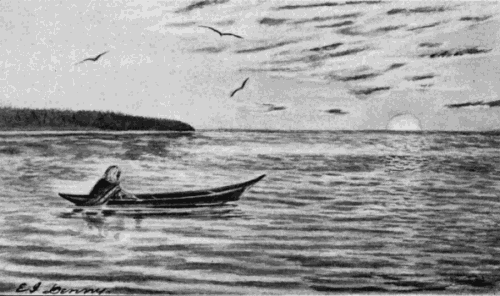
Familiarity with the coquettish canoe made
us perfectly at home with it, and in later years
when the tenderfoot arrived, we were convulsed
with inextinguishable laughter at what seemed to
us an unreasoning terror of a harmless craft.
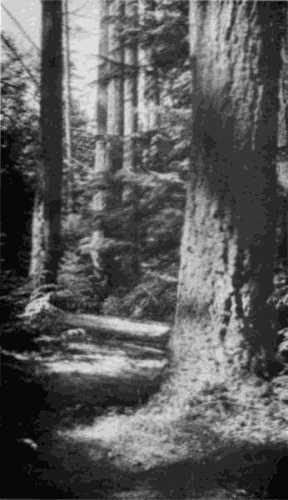 WHERE WE WANDERED LONG AGO
Ah! we lived close to dear nature then! Our
play-grounds were the brown beaches or the hillsides
covered with plumy young fir trees, the
alder groves or the slashings where we hacked
and chopped with our little hatchets in imitation
of our elders or the Father of His Country and
namesake of our state. Running on long logs,
the prostrate trunks of trees several hundred
feet long, and jumping from one to another was
found to be an exhilarating pastime.
When the frolicsome Chinook wind came
singing across the Sound, the boys flew home
built kites of more or less ambitious proportions
and the little girls ran down the hills, performing
a peculiar skirt dance by taking the gown by the
hem on either side and turning the skirt half
over the head. Facing the wind it assumed a
baloonlike inflation very pleasing to the small
performer. It was thought the proper thing to
let the hair out of net or braids at the time, as
the sensation of air permeating long locks was
sufficient excuse for its “weirdness” as I suppose
we would have politely termed it had we ever
heard the word. Instead we were more likely to
be reproved for having such untidy heads and
perhaps reminded that we looked as wild as Indians.
“As wild as Indians,” the poor Indians!
How they admired the native white children!
Without ceremony they claimed blood brotherhood,
saying, “You were born in our ‘illahee’
(country) and are our ‘tillicum’ (people).
You eat the same food, will grow up here and
belong to us.”
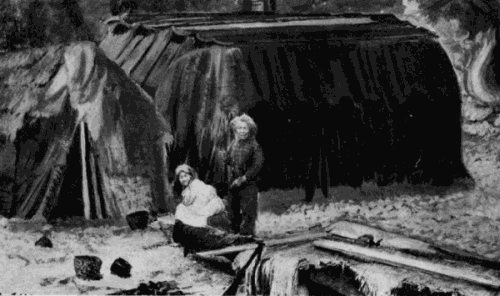
Often we were sung to sleep at night by their
“tamanuse” singing, as we lived quite near the
bank below which many Indians camped, on Elliott
Bay.
I never met with the least rudeness or suffered
the slightest injury from an Indian except
on one occasion. Walking upon the beach one
day three white children drew near a group of
Indian camps. Almost deserted they were, probably
the inhabitants had gone fishing; the only
being visible was a boy about ten years of age.
Snarling out some bitter words in an unknown
tongue, he flung a stone which struck hard a
small head, making a slight scalp wound. Such
eyes! they fairly glittered with hatred. We hurried
home, the victim crying with the pain inflicted,
and learned afterward that the boy was
none of our “tillicum” but a stranger from the
Snohomish tribe. What cruel wrong had he
witnessed or suffered to make him so full of bitterness?
The Indian children were usually quite amiable
in disposition, and it seemed hard to refuse
their friendly advances which it became necessary
to do. In their primitive state they seemed
perfectly healthy and happy little creatures.
They never had the toothache; just think of that,
ye small consumers of colored candies! Unknown
to them was the creeping horror that
white children feel when about to enter the terrible
dentist’s den. They had their favorite fear,
however, the frightful “statalth,” or “stick siwash,”
that haunted the great forest. As near
as we could ascertain, these were the ghosts of a
long dead race of savages who had been of gigantic
stature and whose ghosts were likewise very
tall and dreadful and very fond of chasing people
out of the woods on dark nights. Plenty of
little white people know what the sensation is,
produced by imagining that something is coming
after them in the dark.
I have seen a big, brawny, tough looking Indian
running as fast as he could go, holding a
blazing pitchwood torch over his head while he
glanced furtively over his shoulder for the approaching
statalth.
Both white and Indian children were afraid
of the Northern Indians, especially the Stickeens,
who were head-takers.
We were seldom panic stricken; born amid
dangers there seemed nothing novel about them
and we took our environment as a matter of
course. We were taught to be courageous but
not foolhardy, which may account for our not
getting oftener in trouble.
The boys learned to shoot and shoot well at
an early age, first with shot guns, then rifles.
Sometimes the girls proved dangerous with firearms
in their hands. A sister of the writer
learned to shoot off the head of a grouse at long
range. A girl schoolmate, when scarcely grown,
shot and killed a bear. My brothers and cousin,
Wm. R. Boren, were good shots at a tender age
and killed numerous bears, deer, grouse, pheasants,
ducks, wild pigeon, etc., in and about the
district now occupied by the city of Seattle.
The wild flowers and the birds interested us
deeply and every spring we joyfully noted the
returning bluebirds and robins, the migrating
wren and a number of other charming feathered
friends. The high banks, not then demolished by
grades, were smothered in greenery and hung
with banners of bloom every succeeding season.
We clambered up and down the steep places
gathering armfuls of lillies (trillium), red currant
(ribes sanguineum), Indian-arrow-wood
(spiraea), snowy syringa (philadelphus) and
blue forgetmenots and the yellow blossoms of the
Oregon grape (berberis glumacea and aquifolium),
which we munched with satisfaction for
the soursweet, and the scarlet honeysuckle to bite
off the honeyglands for a like purpose.
The salmonberry and blackberry seasons
were quite delightful. To plunge into the thick
jungle, now traversed by Pike Street, Seattle,
was a great treat. There blackberries attained
Brobdignagian hugeness, rich and delicious.
On a Saturday, our favorite reward for lessons
and work well done, was to be allowed to
go down the lovely beach with its wide strip of
variegated shingle and bands of brown, ribbed
sand, as far as the “three big stones,” no farther,
as there were bears, panthers and Indians, as
hereinbefore stated, inhabiting the regions
round about.
One brilliant April day we felt very brave,
we were bigger than ever before, five was quite
a party, and the flowers were O! so enchanting
a little farther on. Two of us climbed the bank
to gather the tempting blossoms.
Our little dog, “Watch,” a very intelligent
animal, took the lead; scarcely had we gained
the top and essayed to break the branch of a
wild currant, gay with rose colored blossoms,
when Watch showed unusual excitement about
something, a mysterious something occupying
the cavernous depths of an immense hollow log.
With his bristles up, rage and terror in every
quivering muscle, he was slowly, very slowly,
backing toward us.
Although in the woods often, we had never
seen him act so before. We took the hint and
to our heels, tumbled down the yielding, yellow
bank in an exceedingly hasty and unceremonious
manner, gathered up our party of thoroughly
frightened youngsters and hurried along the sand
homeward, at a double quick pace.
Hardly stopping for a backward glance to
see if the “something” was coming after us, we
reached home, safe but subdued.
Not many days after the young truants were
invited down to an Indian camp to see the carcass
of a cougar about nine feet long. There it
lay, stretched out full length, its hard, white
teeth visible beyond the shrunken lips, its huge
paws quite helpless and harmless.
It is more than probable that this was the
“something” in the great hollow log, as it was
killed in the vicinity of the place where our
stampede occurred.
Evidently Watch felt his responsibility and
did the best he could to divert the enemy while
we escaped.
The dense forest hid many an unseen danger
in early days and it transpired that I never
saw a live cougar in the woods, but even a dead
one may produce real old fashioned fright in a
spectator.
Having occasion, when attending the University,
at the age of twelve, to visit the library
of that institution, a strange adventure befell
me; the selection of a book absorbed my mind
very fully and I was unprepared for a sudden
change of thought. Turning from the shelves,
a terrible sight met my eyes, a ferocious wild
beast, all its fangs exhibited, in the opposite corner
of the room. How did each particular hair
stand upright and perspiration ooze from every
pore! A moment passed and a complete collapse
of the illusion left the victim weak and
disgusted; it was only the stuffed cougar given
to the Faculty to be the nucleus of a great collection.
The young Washingtonians, called “clam-diggers,”
were usually well fed, what with venison,
fish, grouse and berries, game of many
kinds, and creatures of the sea, they were really
pampered, in the memory of the writer. But it
is related by those who experienced the privations
incident to the first year or two of white
settlement, that the children were sometimes
hungry for bread, especially during the first
winter at Alki. Fish and potatoes were plentiful,
obtained from the Indians, syrup from a
vessel in the harbor, but bread was scarce. On
one occasion, a little girl of one of the four white
families on Elliott Bay, was observed to pick
up an old crust and carry it around in her pocket.
When asked what she intended to do with that
crust, with childish simplicity she replied, “Save
it to eat with syrup at dinner.” Not able to resist
its delicious flavor she kept nibbling away at
the crust until scarcely a crumb remained; its
dessicated surface had no opportunity to be
masked with treacle.
To look back upon our pioneer menu is quite
tantalizing.
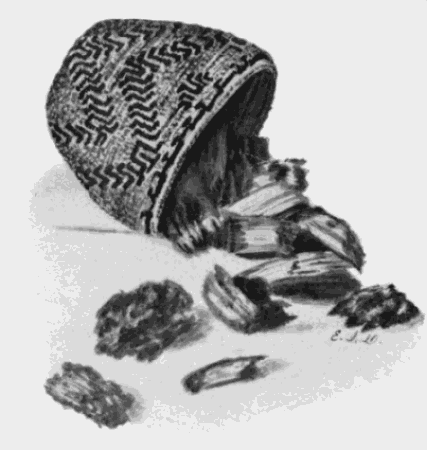
The fish, of many excellent kinds, from the
“salt-chuck,” brought fresh and flapping to our
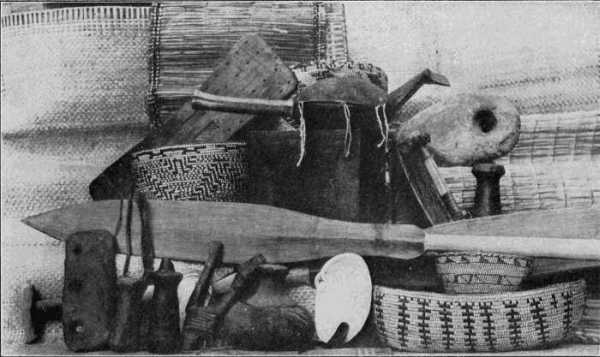
doors, in native baskets by Indian fishermen,
cooked in many appetizing ways; clams of all
sizes from the huge bivalves weighing three-quarters
of a pound a piece to the tiny white soup
clam; sustain me, O my muse, if I attempt to
describe their excellence. Every conceivable
preparation, soup, stew, baked, pie, fry or chowder
was tried with the happiest results. The
Puget Sound oyster, not the stale, globe-trotting
oyster of however aristocratic antecedents, the
enjoyment in eating of which is chiefly as a reminiscence,
but the fresh western oyster, was much
esteemed.
The crab, too, figured prominently on the bill
of fare, dropped alive in boiling water and served
in scarlet, a la naturel.
A pioneer family gathered about the table
enjoying a feast of the stalk-eyed crustaceans,
were treated to a little diversion in this wise.
The room was small, used for both kitchen and
diningroom, as the house boasted of but two or
three rooms, consequently space was economized.
A fine basket of crabs traded from an Indian
were put in a tin pan and set under the
table; several were cooked, the rest left alive.
As one of the children was proceeding with the
dismemberment necessary to extract the delicate
meat, as if to seek its fellows, the crab slipped
from her grasp and slid beneath the table. Stooping
down she hastily seized her crab, as she supposed,
but to her utter astonishment it seemed to
have come to life, it was alive, kicking and
snapping. In a moment the table was in an uproar
of crab catching and wild laughter. The
mother of the astonished child declares that to
this day she cannot help laughing whenever she
thinks of the crab that came to life.
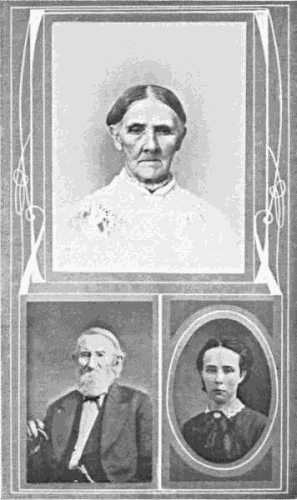
It was to this home that John and Sarah
Denny, and their little daughter, Loretta, came
to visit their son, daughter and the grandchildren,
in the winter of 1857-8.
Grandmother was tall and straight, dressed
in a plain, dark gown, black silk apron and lace
cap; her hair, coal black, slightly gray on the
temples; her eyes dark, soft and gentle. She
brought a little treat of Oregon apples from their
farm in the Waldo Hills, to the children, who
thought them the most wonderful fruit they had
ever seen, more desirable than the golden apples
of Hesperides.
We were to return with them, joyful news!
What visions of bliss arose before us! new places
to see and all the nice things and good times we
children could have at grandfather’s farm.
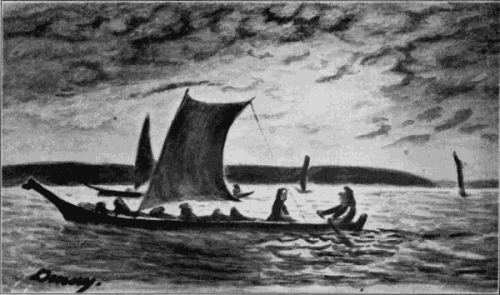
When the day came, in the long, dark canoe,
manned by a crew of Indians, we embarked for
Olympia, the head of navigation, bidding “good-bye”
to our friends, few but precious, who
watched us from the bank, among whom were an
old man and his little daughter.
A few days before he had been sick and one
of the party sent him a steaming cup of ginger
and milk which, although simple, had proved
efficacious; ere we reached our home again he
showed his gratitude in a substantial manner, as
will be seen farther on.
At one beautiful resting place, the canoe
slid up against a strip of shingle covered with
delicate shells; we were delighted to be allowed
to walk about, after sitting curled up in the bottom
of the canoe for a long time, to gather crab,
pecten and periwinkle shells, even extending our
ramble to a lovely grove of dark young evergreens,
standing in a grassy meadow.
The first night of the journey was spent in
Steilacoom. It was March of 1858 and it was
chilly traveling on the big salt water. We were
cold and hungry but the keeper of the one hotel
in the place had retired and refused to be
aroused, so we turned to the only store, where
the proprietor received us kindly, brought out
new blankets to cover us while we camped on the
floor, gave us bread and a hot oyster stew, the
best his place afforded. His generous hospitality
was never forgotten by the grateful recipients
who often spoke of it in after years.
I saw there a “witches’ scene” of an old
Indian woman boiling devilfish or octopus in a
kettle over a campfire, splendidly lit against the
gloom of night, and all reflected in the water.
At the break of day we paddled away over
the remainder of the salt-chuck, as the Indians
call the sea, until Stetchas was reached. Stetchas
is “bear’s place,” the Indian name for the site
of Olympia.
From thence the mail stage awaited us to
Cowlitz Landing. The trip over this stretch of
country was not exactly like a triumphal progress.
The six-horse team plunged and floundered,
while the wagon sank up to the hub in
black mud; the language of the driver has not
been recorded.
At the first stop out from Olympia, the Tilley’s,
famous in the first annals, entertained us.
At a bountiful and appetizing meal, one of the
articles, boiled eggs, were not cooked to suit
Grandfather John Denny. With amusing bluntness
he sent the chicken out to be killed before
he ate it, complaining that the eggs were not hard
enough. Mrs. Tilly made two or three efforts and
finally set the dish down beside him saying,
“There, if that isn’t hard enough you don’t deserve
to have any.”
The long rough ride ended at Warbass’
Landing on the Cowlitz River, a tributary of the
Columbia, and another canoe trip, this time on a
swift and treacherous stream, was safely made
to Monticello, a mere little settlement. A tiny
steamboat, almost microscopic on the wide water,
carried us across the great Columbia with its
sparkling waves, and up the winding Willamette
to Portland, Oregon.
From thence the journey progressed to the
falls below Oregon City.
At the portage, we walked along a narrow
plank walk built up on the side of the river bank
which rose in a high rounded hill. Its noble outline
stood dark with giant firs against a blue
spring sky; the rushing, silvery flood of the
Willamette swept below us past a bank fringed
with wild currants just coming into bloom.
At the end of the walk there stood a house
which represented itself as a resting place for
weary travelers. We spent the night there but
Alas! for rest; the occupants were convivial and
“drowned the shamrock” all night long; as no
doubt they felt obliged to do for wasn’t it “St.
Patrick’s Day in the mornin’?”
Most likely we three, the juveniles, slumbered
peacefully until aroused to learn that we
were about to start “sure enough” for grandfather’s
farm in the Waldo Hills.
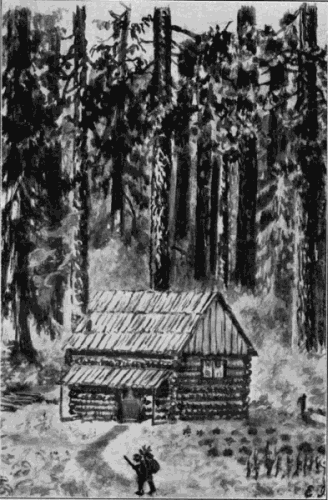
At length the log cabin home was reached
and our interest deepened in everything about.
So many flowers to gather as they came in lively
processional, blue violets under the oaks, blue-flags
all along the valley; such great, golden buttercups,
larkspurs, and many a wildling we
scarcely called by any name.
All the affairs of the house and garden, field
and pasture seemed by us especially gotten up,
for our amusement and we found endless entertainment
therein.
If a cheese was made or churning done we
were sure to be “hanging around” for a green
curd or paring, a taste of sweet butter or a
chance to lift the dasher of the old fashioned
churn. The milking time was enticing, too, and
we trotted down to the milking pen with our
little tin cups for a drink of fresh, warm milk
from the fat, lowing kine, which fed all day on
rich grasses and waited at the edge of the flower
decked valley for the milkers with their pails.
As summer advanced our joys increased, for
there were wild strawberries and such luscious
ones! no berries in after years tasted half so
good.
Some artist has portrayed a group of children
on a sunny slope among the hills, busy with
the scarlet fruit and called it “The Strawberry
of Memory;” such was the strawberry of that
summer.
One brilliant June day when all the landscape
was steeped in sunshine we went some distance
from home to gather a large supply. It is
needless to say that we, the juvenile contingent,
improved the opportunity well; and when we sat
at table the following day and grandfather
helped us to generous pieces of strawberry
“cobbler” and grandmother poured over them
rich, sweet cream, our satisfaction was complete.
It is likely that if we had heard of the boy who
wished for a neck as long as a giraffe so that he
could taste the good things all the way down, we
would have echoed the sentiment.
Mentioning the giraffe, of the animal also
we probably had no knowledge as books were
few and menageries, none at all.
No lack was felt, however, as the wild animals
were numerous and interesting. The birds,
rabbits and squirrels were friendly and fearless
then; the birds were especially loved and it was
pleasing to translate their notes into endearments
for ourselves.
But the rolling suns brought round the day
when we must return to our native heath on
Puget Sound. Right sorry were the two little
“clam-diggers” to leave the little companion of
delightful days, and grandparents. With a
rush of tears and calling “good-bye! good-bye!”
as long as we could see or hear we rode
away in a wagon, beginning the long journey,
full of variety, back to the settlement on Elliott
Bay.
Ourselves, and wagon and team purchased
in the “web-foot” country, were carried down
the Willamette and across the sweeping Columbia
on a steamer to Monticello. There the wagon
was loaded into a canoe to ascend the Cowlitz
River, and we mounted the horses for a long
day’s ride, one of the children on the pommel
of father’s saddle, the other perched behind on
mother’s steed.
The forest was so dense through which we
rode for a long distance that the light of noonday
became a feeble twilight, the way was a mere
trail, the salal bushes on either side so tall that
they brushed the feet of the little riders. The
tedium of succeeding miles of this weird wilderness
was beguiled by the stories, gentle warnings
and encouragement from my mother.
The cicadas sang as if it were evening, the
dark woods looked a little fearful and I was
advised to “Hold on tight and keep awake, there
are bears in these woods.”
The trail led us to the first crossing of the
Cowlitz River, where father hallooed long and
loud for help to ferry us over, from a lonely
house on the opposite shore, but only echo and
silence returned. The deep, dark stream, sombre
forest and deserted house made an eerie impression
on the children.
The little party boarded the ferryboat and
swimming the horses, alongside crossed without
delay.
The next afternoon saw us nearing the crossing
of the Cowlitz again at Warbass Landing.
The path crossed a pretty open space covered
with ripe yellow grass and set around with
giant trees, just before it vanished in the hurrying
stream.
Father rode on and crossed, quite easily, the
uneven bed of the swift river, with its gravelly
islands and deep pools.
When it came our turn, our patient beast
plunged in and courageously advanced to near
the middle of the stream, wavered and stood still
and seemed about to go down with the current.
How distinctly the green, rapid water, gravelly
shoals and distant bank with its anxious onlookers
is photographed on my memory’s page!
Only for a moment did the brave animal
falter and then sturdily worked her way to the
shore. Mr. Warbass, with white face and trembling
voice, said “I thought you were gone,
sure.” His coat was off and he had been on the
point of plunging in to save us from drowning,
if possible. Willing hands helped us down and
into the hospitable home, where we were glad
to rest after such a severe trial. A sleepless night
followed for my mother, who suffered from the
reaction common to such experience, although
not panic stricken at the time of danger.
It was here I received my first remembered
lesson in “meum et tuum.” While playing under
the fruit trees around the house I spied a
peach lying on the ground, round, red and fair
to see. I took it in to my mother who asked
where I got it, if I had asked for it, etc. I replied
I had found it outdoors.
“Well, it isn’t yours, go and give it to the
lady and never pick up anything without asking
for it.”
A lesson that was heeded, and one much
needed by children in these days when individual
rights are so little regarded.
The muddy wagon road between this point
and Olympia over which the teams had struggled
in the springtime was now dry and the wagon
was put together with hope of a fairly comfortable
trip. It was discovered in so doing that the
tongue of the vehicle had been left at Monticello.
Not to be delayed, father repaired to the woods
and cut a forked ash stick and made it do duty
for the missing portion.
At Olympia we were entertained by Mr. and
Mrs. Dickinson with whom we tarried as we went
to Oregon.
My mother preferred her steed to the steamer
plying on the Sound; that same trip the selfsame
craft blew up.
On horseback again, we followed the trail
from Olympia to the Duwampsh River, over hills
and hollows, out on the prairie or in the dark
forest, at night putting up at the house of a hospitable
settler. From thence we were told that
it was only one day’s travel but the trail stretched
out amazingly. Night, and a stormy one, overtook
the hapless travelers.
The thunder crashed, the lightning flamed,
sheets of rain came down, but there was no escape.
A halt was called at an open space in a grove
of tall cedar trees, a fire made and the horses
hitched under the trees.
The two children slept snugly under a fir
bark shed made of slabs of bark leaned up
against a large log. Father and mother sat by
the fire under a cedar whose branches gave a
partial shelter. Some time in the night I was
awakened by my mother lying down beside me,
then slept calmly on.
The next morning everything was dripping
wet and we hastened on to the Duwampsh crossing
where lived the old man who stood on the
bank at Seattle when we started.
What a comfort it was to the cold, wet, hungry,
weary quartette to be invited into a dry
warm place! and then the dinner, just prepared
for company he had been expecting; a bountiful
supply of garden vegetables, beets, cabbage, potatoes,
a great dish of beans and hot coffee. These
seemed veritable luxuries and we partook of
them with a hearty relish.
A messenger was sent to Seattle to apprise
our friends of our return, two of them came to
meet us at the mouth of the Duwampsh River and
brought us down the bay in a canoe to the landing
near the old laurel (Madrona) tree that
leaned over the bank in front of our home.
The first Fourth of July celebration in which
I participated took place in the old M. E. Church
on Second Street, Seattle, in 1861.
Early in the morning of that eventful day
there was hurrying to and fro in the Dennys’
cottage, on Seneca Street, embowered in flowers
which even luxuriant as they were we did not
deem sufficient. The nimble eldest of the children
was sent to a flower-loving neighbor’s for blossoms
of patriotic hues, for each of the small
Americans was to carry a banner inscribed with
a strong motto and wreathed with red, white and
blue flowers. Large letters, cut from the titles
of newspapers spelled out the legends on squares
of white cotton, “Freedom for All,” “Slavery
for none,” “United we stand, divided we fall,”
each surrounded with a heavy wreath of beautiful
flowers.
Arrived at the church, we found ourselves
a little late, the orator was just rounding the first
of his eloquent periods; the audience, principally
men, turned to view the disturbers as they
sturdily marched up the aisle to a front seat, and
seeing the patriotic family with their expressive
emblems, broke out in a hearty round of applause.
Although very young we felt the spirit
of the occasion.
The first commencement exercises at the University
took place in 1863. It was a great event,
an audience of about nine hundred or more, including
many visitors from all parts of the
Sound, Victoria, B. C., and Portland, Oregon,
gathered in the hall of the old University, then
quite new.
I was then nine years of age and had been
trained to recite “Barbara Frietchie,” it “goes
without the saying” that it was received with acclaim,
as feeling ran high and the hearts of the
people burned within them for the things that
were transpiring in the South.
Still better were they pleased and much affected
by the singing of “Who Will Care for
Mother Now,” by Annie May Adams, a lovely
young girl of fifteen, with a pure, sympathetic,
soprano voice and a touching simplicity of style.
How warm beat the hearts of the people on
this far off shore, as at the seat of war, and even
the children shouted, sang and wept in sympathy
with those who shed their lifeblood for their
country.
The singing of “Red, White and Blue” by
the children created great enthusiasm; war tableaux
such as “The Soldier’s Farewell,” “Who
Goes There?” “In Camp,” were well presented
and received with enthusiastic applause, and
whatever apology might have been made for the
status of the school, there was none to be made
for its patriotism.
Our teachers were Unionists without exception
and we were taught many such things;
“Rally Round the Flag” was a favorite and up
went every right hand and stamped hard every
little foot as we sang “Down With the Traitor
and Up With the Stars” with perhaps more energy
than music.
The children of my family, with those of A.
A. Denny’s, sometimes held “Union Meetings;”
at these were speeches made that were very intense,
as we thought, from the top of a stump or
barrel, each mounting in turn to declaim against
slavery and the Confederacy, to pronounce sentence
of execution upon Jeff. Davis, Captain
Semmes, et al. in a way to have made those
worthies uneasy in their sleep. Every book, picture,
story, indeed, every printed page concerning
the war was eagerly scanned and I remember
sitting by, through long talks of Grandfather
John Denny with my father, to which I listened
intently.
We finally burned Semmes in effigy to express
our opinion of him and named the only
poor, sour apple in our orchard for the Confederate
president.
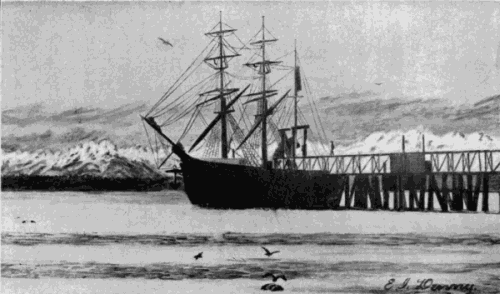
For a time there were two war vessels in
the harbor, the “Saranac” and “Suwanee,” afterwards
wrecked in Seymour Narrows. The
Suwanee was overturned and sunk by the shifting
of her heavy guns, but was finally raised.
Both had fine bands that discoursed sweet music
every evening. We stood on the bank to listen,
delighted to recognize our favorites, national airs
and war songs, from “Just Before the Battle,
Mother” to “Star Spangled Banner.”
Other beautiful music, from operas, perhaps,
we enjoyed without comprehending, although
we did understand the stirring strains
with which we were so familiar.
In those days the itinerant M. E. ministers
were often the guests of my parents and many
were the good natured jokes concerning the fatalities
among the yellow-legged chickens.
On one occasion a small daughter of the
family, whose discretion had not developed with
her hospitality, rushed excitedly into the sitting
room where the minister was being entertained
and said, “Mother, which chicken shall I catch?”
to the great amusement of all.
One of the reverend gentlemen declared that
whenever he put in an appearance, the finest and
fattest of the flock immediately lay down upon
their backs with their feet in the air, as they
knew some of them would have to appear on the
festal board.
Like children everywhere we lavished our
young affections on pets of many kinds. Among
these were a family of kittens, one at least of
which was considered superfluous. An Indian
woman, who came to trade clams for potatoes,
was given the little “pish-pish,” as she called it,
with which she seemed much pleased, carrying it
away wrapped in her shawl.
Her camp was a mile away on the shore of
Elliott Bay, from whence it returned through
the thick woods, on the following day. Soon
after she came to our door to exhibit numerous
scratches on her hands and arms made by the
“mesachie pish-pish” (bad cat), as she now considered
it. My mother healed her wounds by
giving her some “supalel” (bread) esteemed a
luxury by the Indians, they seldom having it
unless they bought a little flour and made ash-cake.
Now this same ash-cake deserves to rank
with the southern cornpone or the western Johnny
cake. Its flavor is sweet and nut-like, quite
unlike that of bread baked in an ordinary oven.
The first Christmas tree was set up in our
own house. It was not then a common American
custom; we usually called out “Christmas Gift,”
affecting to claim a present after the Southern
“Christmas Gif” of the darkies. One early
Christmas, father brought in a young Douglas
fir tree and mother hung various little gifts on
its branches, among them, bright red Lady apples
and sticks of candy; that was our very first
Christmas tree. A few years afterward the
whole village joined in loading a large tree with
beautiful and costly articles, as times were good,
fully one thousand dollars’ worth was hung upon
and heaped around it.
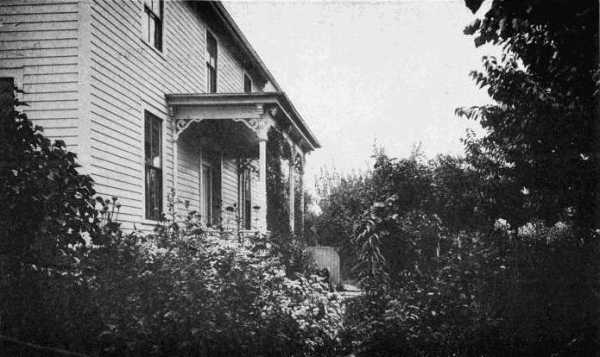
When the fourth time our family returned to
the donation claim, now a part of the city of
Seattle, we found a veritable paradise of flowers,
field and forest.
The claim reached from Lake Union to Elliott
Bay, about a mile and a half; a portion of
it was rich meadow land covered with luxuriant
grass and bordered with flowering shrubs, the
fringe on the hem of the mighty evergreen forest
covering the remainder.
Hundreds of birds of many kinds built their
nests here and daily throughout the summer
chanted their hymns of praise. Robins and
wrens, song-sparrows and snow birds, thrushes
and larks vied with each other in joyful song.
The western meadow larks wandered into
this great valley, adding their rich flute-like
voices to the feathered chorus.
Woodpeckers, yellow hammers and sap-suckers,
beat their brave tattoo on the dead tree
trunks and owls uttered their cries from the thick
branches at night. Riding to church one Sunday
morning we beheld seven little owls sitting in a
row on the dead limb of a tall fir tree, about fourteen
feet from the ground. Winking and blinking
they sat, silently staring as we passed by.
Rare birds peculiar to the western coast, the
rufous-backed hummingbird, like a living coal
of fire, and the bush-titmouse which builds a curious
hanging nest, also visited this natural park.
The road we children traveled from this
place led through heavy forest and the year of
the drouth (1868) a great fire raged; we lost but
little time on this account; it had not ceased before
we ran past the tall firs and cedars flaming
far above our heads.
Returning from church one day, when about
half way home, a huge fir tree fell just behind
us, and a half mile farther on we turned down a
branch road at the very moment that a tree fell
across the main road usually traveled.
The game was not then all destroyed; water
fowl were numerous on the lakes and bays and
the boys of the family often went shooting.
Rather late in the afternoon of a November
day, the two smaller boys, taking a shot gun with
them, repaired to Lake Union, borrowed a little
fishing canoe of old Tsetseguis, the Indian who
lived at the landing, and went to look at some
muskrat traps they had set.
It was growing quite dark when they thought
of returning. For some reason they decided to
change places in the canoe, a very “ticklish”
thing to do. When one attempted to pass the
other, over went the little cockle-shell and both
were struggling in the water. The elder managed
to thrust one arm through the strap of the
hunting bag worn by the younger and grasped
him by the hair, said hair being a luxuriant mass
of long, golden brown curls. Able to swim a little
he kept them afloat although he could not keep
the younger one’s head above water. His cries
for help reached the ears of a young man, Charles
Nollop, who was preparing to cook a beefsteak
for his supper—he threw the frying pan one way
while the steak went the other, and rushed, coatless
and hatless, to the rescue with another man,
Joe Raber, in a boat.
An older brother of the two lads, John B.
Denny, was just emerging from the north door
of the big barn with two pails of milk; hearing,
as he thought, the words “I’m drowning,” rather
faintly from the lake, he dropped the pails unceremoniously
and ran down to the shore swiftly,
found only an old shovel-nosed canoe and no paddle,
seized a picket and paddled across the little
bay to where the water appeared agitated; there
he found the boys struggling in the water, or
rather one of them, the other was already unconscious.
Arriving at the same time in their boat
Charley Nollop and Joe Raber helped to pull
them out of the water. The long golden curls of
the younger were entangled in the crossed cords
of the shot pouch and powder flask worn by the
older one, who was about to sink for the last time,
as he was exhausted and had let go of the younger,
who was submerged.
Their mother reached the shore as the unconscious
one was stretched upon the ground and
raised his arms and felt for the heart which was
beating feebly.
The swimmer walked up the hill to the
house; the younger, still unconscious, was carried,
face downward, into a room where a large
fire was burning in an open fireplace, and laid
down before it on a rug. Restoratives were
quickly applied and upon partial recovery he
was warmly tucked in bed. A few feverish days
followed, yet both escaped without serious injury.
Mrs. Tsetseguis was much grieved and repeated
over and over, “I told the Oleman not to
lend that little canoe to the boys, and he said,
‘O it’s all right, they know how to manage a
canoe.’”
Tsetseguis was also much distressed and
showed genuine sympathy, following the rescued
into the house to see if they were really
safe.
The games we played in early days were
often the time-honored ones taught us by our
parents, and again were inventions of our own.
During the Rebellion we drilled as soldiers or
played “black man;” by the latter we wrought
excitement to the highest pitch, whether we
chased the black man, or returning the favor, he
chased us.
The teeter-board was available when the
neighbor’s children came; the wonder is that no
bones were broken by our method.
The longest, strongest, Douglas fir board
that could be found, was placed across a large
log, a huge stone rested in the middle and the
children, boys and girls, little and big, crowded
on the board almost filling it; then we carefully
“waggled” it up and down, watching the stone in
breathless and ecstatic silence until weary of it.
Our bravado consisted in climbing up the
steepest banks on the bay, or walking long logs
across ravines or on steep inclines.
The surroundings were so peculiar that old
games took on new charms when played on Puget
Sound. Hide-and-seek in a dense jungle of
young Douglas firs was most delightful; the
great fir and cedar trees, logs and stumps, afforded
ample cover for any number of players,
from the sharp eyes of the one who had been
counted “out” with one of the old rhymes.
The shadow of danger always lurked about
the undetermined boundary of our play-grounds,
wild animals and wild men might be not far beyond.
We feared the drunken white man more
than the sober Indian, with much greater reason.
Even the drunken Indian never molested
us, but usually ran “amuck” among the inhabitants
of the beach.
Neither superstitious nor timid we seldom
experienced a panic.
The nearest Indian graveyard was on a hill
at the foot of Spring Street, Seattle. It sloped
directly down to the beach; the bodies were
placed in shallow graves to the very brow and
down over the face of the sandy bluff. All this
hill was dug down when the town advanced.
The childrens’ graves were especially pathetic,
with their rude shelters, to keep off the
rain of the long winter months, and upright
poles bearing bits of bright colored cloth, tin
pails and baskets.
Over these poor graves no costly monuments
stood, only the winds sang wild songs there, the
sea-gulls flitted over, the fair, wild flowers
bloomed and the dark-eyed Indian mothers tarried
sometimes, human as others in their sorrow.
But the light-hearted Indian girls wandered
past, hand in hand, singing as they went, pausing
to turn bright friendly eyes upon me as they
answered the white child’s question, “Ka mika
klatawa?” (Where are you going?)
“O, kopa yawa” (O, over yonder), nodding
toward the winding road that stretched along the
green bank before them. Without a care or sorrow,
living a healthy, free, untrammeled life,
they looked the impersonation of native contentment.
The social instinct of the pioneers found expression
in various ways.
A merry party of pioneer young people, invited
to spend the evening at a neighbor’s, were
promised the luxury of a candy-pull. The first
batch was put on to boil and the assembled
youngsters engaged in old fashioned games to
while away the time. Unfortunately for their
hopes the molasses burned and they were obliged
to throw it away. There was a reserve in the
jug, however, and the precious remainder was
set over the fire and the games went on again.
Determined to succeed, the hostess stirred, while
an equally anxious and careful guest held the
light, a small fish-oil lamp. The lamp had a leak
and was set on a tin plate; in her eagerness to
light the bubbling saccharine substance and to
watch the stirring-down, she leaned over a little
too far and over went the lamp directly into the
molasses.
What consternation fell upon them! The
very thought of the fish-oil was nauseating, and
that was all the molasses. There was no candy-pulling,
there being no grocery just around the
corner where a fresh supply might be obtained,
indeed molasses and syrup were very scarce articles,
brought from a great distance.
The guests departed, doubtless realizing
that the “best laid plans ... gang aft
agley.”
The climate of Puget Sound is one so mild
that snow seldom falls and ice rarely forms as
thick as windowglass, consequently travel, traffic
and amusement are scarcely modified during
the winter, or more correctly, the rainy season.
Unless it rained more energetically than usual,
the children went on with their games as in summer.
The long northern twilight of the summertime
and equally long evenings in winter had
each their special charm.
The pictures of winter scenes in eastern
magazines and books looked strange and unfamiliar
to us, but as one saucy girl said to a tenderfoot
from a blizzard-swept state, “We see
more and deeper snow everyday than you ever
saw in your life.”
“How is that?” said he.
“On Mount Rainier,” she answered, laughing.
Even so, this magnificent mountain, together
with many lesser peaks, wears perpetual robes
of snow in sight of green and blooming shores.
When it came to decorating for Christmas,
well, we had a decided advantage as the evergreens
stood thick about us, millions of them.
Busy fingers made lavish use of rich garlands
of cedar to festoon whole buildings; handsome
Douglas firs, reaching from floor to ceiling, loaded
with gay presents and blazing with tapers,
made the little “clam-diggers’” eyes glisten and
their mouths water. In the garden the flowers
bloomed often in December and January, as
many as twenty-six varieties at once.
One New Year’s day I walked down the garden
path and plucked a fine, red rosebud to decorate
the New Year’s cake.
The pussy-willows began the floral procession
of wildlings in January and the trilliums
and currants were not far behind unless a “cold
snap” came on in February and the flowers dozed
on, for they never seem to sleep very profoundly
here. By the middle of February there was,
occasionally, a general display of bloom, but
more frequently it began about the first of
March, the seasons varying considerably.
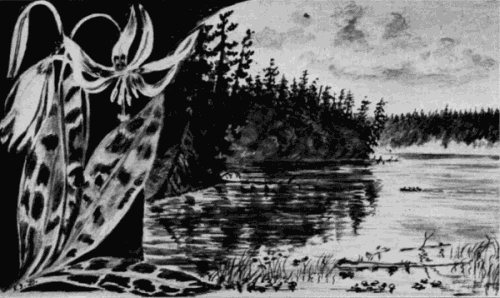
The following poem tells of favorite flowers
gathered in the olden time “i’ the spring o’
the year!”
In the summertime we had work as well as
play, out of doors. The garden surrounding our
cottage in 1863, overflowed with fruits, vegetables
and flowers. Nimble young fingers were
made useful in helping to tend them. Weeding
beds of spring onions and lettuce, sticking peas
and beans, or hoeing potatoes, were considered
excellent exercise for young muscles; no need
of physical “culchuah” in the school had dawned
upon us, as periods of work and rest, study and
play, followed each other in healthful succession.
Having a surplus of good things, the children
often went about the village with fresh
vegetables and flowers, more often the latter,
generous bouquets of fragrant and spicy roses
and carnations, sweet peas and nasturtiums, to
sell. Two little daughters in pretty, light print
dresses and white hats were flower girls who
were treated like little queens.
There was no disdain of work to earn a living
in those days; every respectable person did
something useful.
For recreation, we went with father in the
wagon over the “bumpy” road when he went to
haul wood, or perhaps a long way on the county
road to the meadow, begging to get off to gather
flowers whenever we saw them peeping from
their green bowers.
Driving along through the great forest
which stood an almost solid green wall on either
hand, we called “O father, stop! stop; here is
the lady-slipper place.”
“Well, be quick, I can’t wait long.”
Dropping down to the ground, we ran as fast
as our feet could carry us to gather the lovely,
fragrant orchid, Calypso Borealis, from its mossy
bed.
When the ferns were fully grown, eight or
ten feet high, the little girls broke down as many
as they could drag, and ran along the road, great
ladies, with long green trains!
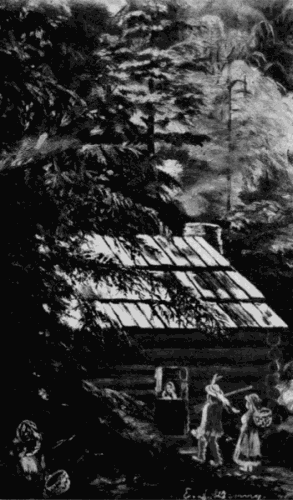 A VISIT FROM OUR TILLICUM
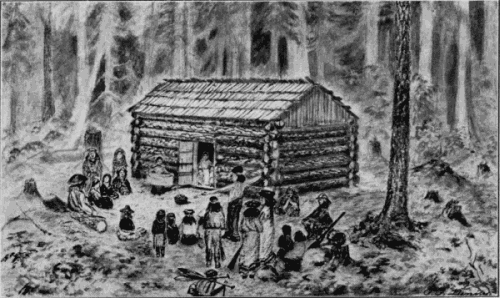
We found the way to the opening in the
woods, where in the midst thereof, grandfather
sat making cedar shingles with a drawing knife.
Huge trees lay on the ground, piles of bolts had
been cut and the heap of shingles, clear and
straight of the very best quality, grew apace.
Very tall and grand the firs and cedars stood
all around, like stately pillars with a dome of
blue sky above; the birds sang in the underbrush
and the brown butterflies floated by.
Among all the beautiful things, there was
one to rivet the eye and attention; a dark green
fir tree, perhaps thirty feet high, around whose
trunk and branches a wild honeysuckle vine had
twined itself from the ground to the topmost
twig.
It had the appearance of a giant candelabrum,
with the orange-scarlet blossoms that tipped
the boughs like jets of flame.
Many a merry picnic we had in blackberry
time, taking our lunch with us and spending the
day; sometimes in an Indian canoe we paddled
off several miles, to Smith’s Cove or some other
likely place.
It was necessary to watch the tide at the
Cove or the shore could not be reached across the
mudflat.
Once ashore how happy we were; clambering
about over the hills, gathering the ripe fruit,
now and then turning about to gaze at the snowy
sentinel in the southern sky, grand old Mount
Rainier.
How wide the sparkling waters of the bay!
the sky so pure and clear, the north wind so cool
and refreshing. The plumy boughs stirred gently
overhead and shed for us the balsamic odors,
the flowers waved a welcome at our feet.
In the winter there was seldom any “frost
on the rills” or “snow on the hills,” but when it
did come the children made haste to get all the
possible fun out of the unusual pastime of coasting.
Mothers were glad when the Chinook wind
came and ate up the snow and brought back the
ordinary conditions, as the children were frequently
sick during a cold spell.
Now the tenderfoot, as the newcomer is called
in the west, is apt to be mistaken about the
Chinook wind; there is a wet south wind and a
dry south wind on Puget Sound. The Chinook,
as the “natives” have known it, is a dry wind,
clears the sky, and melts and dries up the snow
at once. Wet south wind, carrying heavy rain
often follows after snow, and slush reigns for a
few days. Perhaps this is a distinction without
much difference.
Storms rarely occur, I remember but two
violent ones in which the gentle south wind
seemed to forget its nature and became a raging
gale.
The first occurred when I was a small child.
The wind had been blowing for some time, gradually
increasing in the evening, and as night
advanced becoming heavier every hour. Large
stones were taken up from the high bank on the
bay and piled on the roof with limbs broken from
tough fir trees. Thousands of giant trees fell
crashing and groaning to the ground, like a continuous
cannonade; the noise was terrific and we
feared for our lives.
At midnight, not daring to leave the house,
and yet fearing that it might be overthrown,
we knelt and commended ourselves to Him who
rules the storm.
About one o’clock the storm abated and
calmly and safely we lay down to sleep.
The morning broke still and clear, but many
a proud monarch of the forest lay prone upon the
ground.
Electric storms were very infrequent; if
there came a few claps of thunder the children
exclaimed, “O mother, hear the thunder storm!”
“Well, children, that isn’t much of a thunder
storm; you just ought to hear the thunder
in Illinois, and the lighting was a continual
blaze.”
Our mother complained that we were scarcely
enough afraid of snakes; as there are no deadly
reptiles on Puget Sound, we thrust our hands
into the densest foliage or searched the thick
grass without dread of a lurking enemy.
The common garter snake, a short, thick
snake, whose track across the dusty roads I have
seen, a long lead-colored snake and a small brown
one, comprise the list known to us.
Walking along a narrow trail one summer
day, singing as I went, the song was abruptly
broken, I sprang to one side with remarkable
agility, a long, wiggling thing “swished” through
the grass in an opposite direction. Calling for
help, I armed myself with a club, and with my
support, boldly advanced to seek out the serpent.
When discovered we belabored it so earnestly
that its head was well-nigh severed from
its body.
It was about five feet long, the largest I had
even seen, whether poisonous or not is beyond
my knowledge.
There are but two spiders known to be dangerous,
a white one and a small black “crab”
spider. A little girl acquaintance was bitten by
one of these, it was supposed, though not positively
known; the bite was on the upper arm and
produced such serious effects that a large piece
of flesh had to be removed by the surgeon’s knife
and amputation was narrowly escaped.
A mysterious creature inhabiting Lake
Union sometimes poisoned the young bathers.
One of my younger brothers was bitten on the
knee, and a lameness ensued, which continued
for several months. There was only a small
puncture visible with a moderate swelling, which
finally passed away.
The general immunity from danger extends
to the vegetable world, but very few plants are
unsafe to handle, chief among them being the
Panax horridum or “devil’s club.”
So the happy pioneer children roamed the
forest fearlessly and sat on the vines and moss
under the great trees, often making bonnets of
the shining salal leaves pinned together with
rose thorns or tiny twigs, making whistles of
alder, which gave forth sweet and pleasant
sounds if successfully made; or in the garden
making dolls of hollyhocks, mallows and morning
glories.
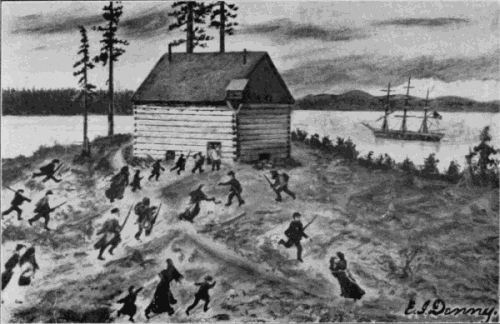 FORT DECATUR. JANUARY 26, 1856