Next morning the leading newspapers of the town were placed in Mat’s
hands by Marvin, who triumphantly remarked,—
“See what an excellent ‘coach’ I proved.”
The entire lecture was given in extenso,—what Mat had said, and, as
he remarked after a perusal, some things he had not said.
“The old folks must have these,” agreed the brothers, and the papers
were accordingly sent home to the Forest.
“And now, brother,” said Tim, “there was a Darling Downs squatter got
hold of me last night, and said I must come up to his station. I felt
so well up there, the air is so grand, I think I’ll go. He’s promised
me work, and pay, and grub.”
“True; we must get work,” rejoined Mat; “we have had enough ‘spreeing’
about; besides, I must see about getting Dromoora and Terebare to
their
home, only the squire has made me promise to go to his station
first—a new place, called, I think, ‘Bulinda Creek.’ I can ‘spell’
there a few days, and then start overland with the chief, join you on
the Downs, and send our friends on from there with a party perhaps.”
Thus it was settled, and after saying good-bye to their hospitable
friends at Government House, Mat went to seek out the squire, whilst
Tim found his way to the Keens, who were leaving by steamer for
Brisbane.
Henry Keen was one of the early squatters of the Darling Downs, and
was now returning to his station accompanied by his wife and daughter.
The chief object of his visit to Sydney had been to fetch the latter
from school.
Tim wondered, as he stepped on board the steamer, how he would be
received by the ladies, as he had not yet made their acquaintance, but
he was not long left in doubt, for Miss Charlotte Keen at once met
him as he stepped on to the boat, and giving his hand a hearty shake,
said,—
“You need not bother about an introduction to me, I knew who you
were as you came along the wharf; where is your brother who lectured,
I thought he would have come too?”
“Oh, no!” replied Tim, who was rather taken aback by this voluble
welcome. “He has gone to Bulinda Creek.”
“What! Squire Bell’s? I was at school with his
daughter Annie, a
stuck-up girl, full of stupid, old-country notions. Got ‘a down’ upon
me, because I suppose she went ‘home’ for a few months, and knew I had
never been; or because, as some say, she’s full of nonsense, learnt
from an old parson, a sort of private tutor to her brother, who’s
sponging on the squire. Did you see the daughter? she’s a ‘native,’
you know.”
“Yes, I did see a shy-looking, pretty girl with splendid hair, for a
few seconds, whilst she was standing with her father.”
“Shy! pretty!” snapped back Miss Charlotte; “well, my word, if you
called rusty-coloured hair, and red cheeks pretty, why she is; but
it’s not my idea of a handsome girl. I admire the true class of
beauty—the statuesque; and now I must look after pa and ma in the
saloon.”
With which announcement she turned abruptly on her heel and departed.
“Here’s a row,” said Tim; “I wonder whether there are many more like
her on the Downs;” whilst he gazed after the retreating form of Miss
Keen, as she stamped her way rapidly towards the companion. “I suppose
then, that that girl’s washed-out face and tow-coloured hair is true
beauty. What did she call it—the statue sort? Well, I prefer t’other
sort of statue.”
Leaving Tim to pursue his journey with the Keen family, we will return
to Mat.
Two days after his brother’s departure, he and the squire had started
on horseback to the Creek, Annie and Parson Tabor, with the two
natives, having gone on before in the buggy.
It was early on a beautiful morning, as the two men wended their way
out of Sydney, the air enlivened with the cries of hundreds of Blue
Mountain parrots, busily engaged in chasing each other, in whole
flocks in the forests, or sucking their breakfasts from the blossoms
of the gum-trees.
The gay chirping of the tree-crickets, the crisp morning air, which
clearly defined the soft outline of the Blue Mountains in the
distance,—all combined, with the fact that he was on horseback once
more, to make Mat in the highest spirits, as he and Bell cantered over
the high downs.
Not so the latter, who was evidently in deep thought over some
perplexing matter, which had caused his usual boisterous spirits to
desert him. At length he broke silence with a sudden,—
“Drat it, man, I may as well say it at once, only you are such an
independent chap, I do not know how to begin. Fact is, the Governor,
and a heap of my mates in town and country, want you and your brother
to accept a purse from them to help you to start.”
Mat was certainly startled by this proposition, but answered promptly
enough,—
“It’s very good of you all, but we have no wish to accept money until
we have worked for it.”
“I knew you would say that, but do take it, Mat, in the spirit in
which it is offered. It will hurt their feelings—my feelings—for I
have a little hand in it, if you don’t.”
“In that case, squire, I’ll ask you to keep it for us, and if either
or both of us come to grief, we will ask you for a little help till
times are better.”
“You promise that?”
“Yes, I do.”
“Then I’ll hold it in trust for you.”
“And now, squire,” said Mat, after the two had ridden some distance
farther, “I’ve got something to tell you, that I have told to no man
living, excepting Tim. This ‘swag’ holds a lot of nuggets, Tim has an
equal quantity, and they should start us without the purse, thanks to
you all the same; and now I will tell you about our gold discovery.”
Mat then recounted full particulars of their “find” in the Golden
Gully, which Bell listened to with interest, saying he “would not tell
it to the ground.”
By the time Mat had finished his narrative, they reined their horses
up at the station.
As soon as Mat had made himself presentable, the squire reintroduced
him to Mrs. Bell, and they shortly afterwards sat down to dinner,
where they were joined by Annie and Parson Tabor.
Mrs. Bell was an easy-going soul, who, whilst mutilating her own
English tongue, managed to utterly murder the French one, on the
strength of
having once paid a few weeks’ visit to France, for the
sake of her daughter’s education. Her husband and children had long
since quenched these foreign outpourings as far as they themselves
were concerned, but whenever an unlucky stranger came to the house,
Mrs. Bell would open fire as soon as her guest was seated, never
caring whether he or she knew French or not.
Here then was a chance when Mat made his appearance, which she was
not slow to avail herself of, by asking him whether he could speak or
understand French, knowing perfectly well that in his case he could do
neither.
Mat, who wished to be specially civil to the mother of Annie,
answered,—
“No, ma’am, I have never learnt it, and I would hardly care about
trying to.”
“Not want to learn French! the language of the present day! And
pray, Mat, don’t call me ‘mum,’ as you did in the Forest. If I must
’ave a ’andle, let it be light and pretty, and pronounce it as I
do—Madam. And now will you pass me the ‘ménoo.’”
It so happened that this was the exact word, as pronounced by Mrs.
Bell, for one of the snakes of the Waigonda country.
Mat was puzzled, but thinking that he must have overlooked the dish,
he carefully glanced over table, sideboard, and mantlepiece; but not
perceiving any roast snake, replied,—
“I do not see it, ‘mydam.’”
Mrs. Bell was just commencing, with a kindly wave of her hand, “Oh,
numport,” when the squire bade her, “Stop that fooling.”
Annie meantime slyly conveyed the bill of fare over to her mother.
But the latter was not going to be shut up so soon before her guest,
on this, her favourite topic, and in spite of her husband telling her
either to talk English or “Blackfellow,” she continued, to Bell first,—
“Yes, my dear, I can see, having lived in Parry, not to mention Cally,
that Mat does not know the divine language, but it’s never too late to
learn.” Then turning to our forester: “I see you’re not quite ‘comme
il faut au fait,’ but I want to hear the ’ole of your adventures, so
we’ll have a little ‘cosy’ after dinner on the verandah. It is late,
so come along.”
Mat said to himself, “Whatever language cosy is, it means a pipe for
me,” as he followed the others out of the room.
Parson Tabor, whose age was nearly sixty, had, in his earlier days,
had a hard life of it in Western Australia.
At one period of his life he had headed a little band of explorers to
that country, starting from Melbourne in a small, badly-found vessel,
with a small cargo of sheep, which they had intended taking the whole
way by coast.
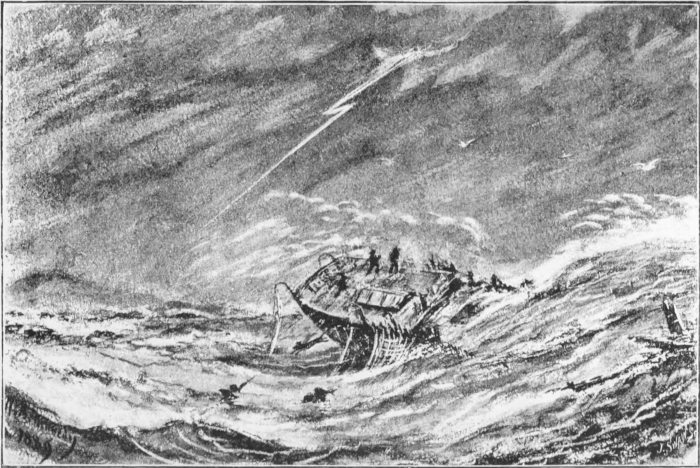
The result was disastrous. Their vessel was wrecked when off the
north-western portion of the continent, their sheep drowned, and
themselves only escaping ashore to find that they had come to a land
in which there was scarcely any water, and inhabited by hostile
blacks. Most of the party managed with difficulty to reach, at length,
the settlements; and Tabor found means to return to Victoria by a
coasting-vessel. But the hardships which he had endured for many
months had told severely upon his constitution, and from the time of
his arrival in civilized life, he had taken holy orders, and settled
down as a clergyman. Upon arriving at Sydney, he had also accepted the
situation of tutor in the squire’s family. Before leaving Victoria on
his ill-fated expedition he had lost his wife, and it was this event,
so preying upon his mind, which had caused him, by seeking a new
colony, to endeavour to blot out associations connected with the old.
When the little party at Bulinda Creek had stepped out on to the
verandah, and made themselves comfortable in easy chairs, Tabor turned
to Mat, and said,—
“Your history, that you related the other night, is of the
deepest interest to me, for I have suffered hardships and lived
for a time amongst the natives, but in my case they were not the
friendly-disposed fellows that yours proved.
“One matter that you mentioned has struck many
of us, especially a
friend of mine—an old explorer, too—named Lund. He was not in Sydney
at the time of your lecture, but he received the newspapers which so
fully gave the account, and wrote to me by return of post. This is
what he says: ‘Find out from Stanley anything more about the white men
he heard of as passing to the west.’
“I mention this to you, as Lund asked me to; but I may as well say
that I heard you asked this very question by numbers of people after
your lecture, and, from what I gathered, you said that you knew no
more than what you had told them there.”
“That is so, Mr. Tabor; I can add but little to it. Before we knew the
language, we guessed, from the signs of the natives, that there were
other white men far to the west of us; and months afterwards, when we
could speak to the tribes and understand two or three dialects, they
again said that they had heard that there was a white man, with some
black men and some very large and strange animals, working their way
northwards.”
“Then,” said Tabor, with emphasis, “that which every one surmises
must be the case. The white man, without doubt, was one of our
greatest explorers, who has disappeared for years without leaving the
slightest clue as to his ultimate fate.
“My friend, who loved this man as a brother, found himself too old
to search for him himself, but he organized an expedition to try and
follow him up, with
but faint hopes, however, of finding the lost
man, as previous similar attempts had utterly failed.
“I have made myself acquainted with poetry and poems, more or less,
which have been written by the greatest British and American poets,
but never, to my mind, have I ever heard anything which, for lovely
expression of holy feelings and great beauty of wording, came up
to the lines which my friend wrote on the eve of the departure of
the explorers in search of the lost one,—on the one who ever
dwelt lightly on the keen sufferings he endured on his former grand
expedition, whose simple faith in the goodness of the Almighty seems
silently to have supported him in his trials, and to have been
thankfully acknowledged.”
So far, the conversation had been carried on between Parson Tabor and
Mat, but at this point Annie broke in with,—
“Do you remember those lines, Mr. Tabor, and can you repeat them to
us?”
“Do I remember them, Annie? Yes; I could never forget them. Listen!”
It had now become almost too dark for our little home party to see
each other’s faces. A “moon-plant,” in the full glory of its lovely
large white flowers, partly covered a corner of the verandah, which a
last streak of evening light had brightened from the surrounding gloom.
Under the soft white blossoms of the gigantic convolvulus Parson Tabor
took his stand, and with outstretched hand, and in soft, yet manly
tones, rehearsed the following lines:—
“Ye, who prepare with Pilgrim feet
Your long and doubtful path to wend,
If whitening on the waste ye meet
The relics of my murdered friend.
His bones with reverence ye shall bear,
To where some mountain streamlet flows,
There by its mossy bank prepare
The pillow of his long repose.
“It shall be by a stream whose tides
Are drunk by birds of every wing,
Where every loveliest flower abides
The earliest wakening touch of spring.
Oh! meet that he who so caressed
All beauteous nature’s varied charms,
That he, her martyred son should rest
Within his mother’s fondest arms.
“When ye have made his narrow bed
And laid the good man’s ashes there,
Ye shall kneel round about the dead
And wait upon your God in prayer.
What though no reverend man be near,
No solemn anthem with its breath,
No holy walls invest his bier
With all the hallowed pomp of death;
“Yet humble minds shall find the grace,
Devoutly bowed upon the sod,
Which calls a blessing round the place,
And consecrates the soil to God.
When ye, your gracious task have done,
Heap not the rock above his dust.
The angel of the Lord alone
Protects the ashes of the just.
“And oh! bethink in other times,
And be those happier times at hand,
When Progress, like the smile of God,
Comes brightening o’er this weary land.
Then shall her pilgrims hail the power
Beneath the drooping myall’s gloom,
To sit at eve and mourn an hour,
And pluck a leaf from Leichardt’s tomb.”
[1]
As the parson concluded his recital, the suspicion of a gentle little
sob came from the direction where Annie was sitting, whilst Bell and
Mat said they thought that they would take a turn and finish their
smoke in the garden, until it was time to go to bed.
The next day, after breakfast, the squire said,—
“Come along, Mat, let’s go towards the stockyard; I want to have a
chat with you. You will have to hang your hat up here. I will show you
a room I have for you in the bachelors’ quarters presently.”
“You are very kind,” answered our forester, who had noticed the little
preparations made for him, and had been thinking it all over; “but I
would rather join Tom at the out-station.”
“Bless my soul! Why, you have had enough of a lonely life, surely, my
boy. Tom is out all day, and there are only blacks there, besides a
stockman.”
“Well, squire, I’d like to see Tom again; besides, I am not used to
ladies’ society.”
“My prophetic soul! Stuff and nonsense! Mrs. Bell wants to hear your
adventures from your own lips, and says you must stay. I’ll call
her. Follow me into the house!”
When Mrs. Bell appeared, she begged that Mat would remain; as, she
said, she “’adn’t ’eard ’alf his adventures,” and, besides, there was
a most “distinguéy” professor of the French language coming to stay
with them, who had brought most flattering testimonials from friends
down south, and she wished him to make his acquaintance.
“Thank you, ‘mydam,’” answered Mat; “but I do not want to know the
Frenchman.”
“But he’s such a tall, distinguished-looking ‘parrty,’ and he is
coming to perfect my daughter in his language. Of course, I shall hear
what his pronunciation is like before regularly engaging him.”
Mat was still obdurate. So Mrs. Bell continued,—
“If you must go and join Tom, as the squire says you wish to, will
you drop in sometimes—it’s not twenty miles from ’ere, you know—and
take a short lesson? You will find it the greatest comfort.”
“Yes, I will do that,” answered Mat, thankful to have “got out” of the
Frenchman for the present.
“I am so glad to hear you say so. The professor won’t be here for a
month, I expect, but I shall see you before then. Now, go and get some
air, for you look quite ‘dégagé.’”
“Is she gone?” asked Bell, who, finding that French
was coming up
again, had made his escape, and now met Mat as he appeared outside the
house. “Well, then, I want to ask you where you would like to stow
those nuggets you were telling me about. The bachelors’ quarters are
not safe, as every one goes in there. Supposing you put them in my
room?”
“Thank you; that will be safe enough, I am sure,” and the two men
separated.
The following day Mat had intended to join Tom, but was delayed on
account of Dromoora and his wife.
He had told them that the squire had promised them an escort to see
them safely back to their tribe; but the chief, being now away from
the towns, begged to be allowed to see a little more of station life,
as he could hunt and fish, and be his own master in the bush, besides,
he had made friends with some station blacks who were camped at
the lagoon, and now he thought Mat might teach him how to use the
thunder-stick.
This change of plans relieved Mat, as he knew that Bell was rather
short-handed, and could ill spare the men for this escort just then;
so he took the opportunity to instruct Dromoora in the use of a gun,
finally leaving that doughty chief a proficient in the art of shooting
anything sitting or swimming.
Our forester had been for some few weeks at the out-station, when one
morning two letters were handed to him, one from Mrs. Bell to say
that the professor had arrived, and the other from Tim—a very short
one—saying that he did not much fancy
the Keens, that he had got
rheumatism again, and altogether felt restless, and was determined to
join his brother, and might turn up any day.
To Mrs. Bell’s delight the Frenchman had, indeed, arrived at Bulinda
Creek, bowing his way into the house and making pretty speeches to the
ladies.
Mrs. Bell had once before, in Sydney, had an interview with him, and
now, after introducing him to her husband, beckoned the latter out of
the room.
“Isn’t he charming, Bell,” she said; “I really quite felt in dear
Parry again when he spoke.”
But the squire was by no means so favourably impressed. He had eyed
the professor askance, and now told his wife to lock up her spoons.
“What! my dear!” she answered, “you’re joking; look at his manners,
look at his ‘ton.’ What a grand face, what eyes, and such a lovely
moustache!”
“Yes, it’s just his face I don’t like,” retorted her husband; “and his
eyes are beastly cunning when he thinks you’re not looking at him; his
moustache, to my mind, is rather too good.”
“But,” sharply continued Mrs. Bell, “you will never see that the
French, though perhaps a little vain as to their personal appearance,
are ‘au fond,’ a noble race; which means that they are a fine people
‘at bottom.’”
“Ha! ha!” laughed the squire, “you’re getting worse and worse, that’s
exactly what the great Duke said,—but I’ll tell you the story.
“Some time after the Battle of Waterloo, Wellington’s health happened
to be proposed at a great dinner at which he was present, and at which
there happened to be also a number of French officers. These stood up,
but on hearing who the individual was that was about to be pledged,
immediately faced round and turned their backs towards the Duke,
who simply remarked, as he sat at the table, ‘Not the first time,
gentlemen, that you have turned your backs upon me.’
“I want no more arguments,” concluded Bell, “but the less I see of
this hair-dresser, the better I shall be pleased.”
So Monsieur Rayon, such was the Frenchman’s name, was duly installed
at the Creek, making himself agreeable to the ladies, and, whilst
showing an equal civility to the squire, avoiding him as much as
possible, explaining to Mrs. Bell that it was natural her husband
took no notice of him, as he disliked the French language. Matters,
however, went on smoothly enough, Rayon giving lessons to mother and
daughter, and rendering himself tolerable to the squire, by insisting
upon every one speaking English when he was present, a language
which seemed as facile to him as French.
After Rayon had been settled a few days at Bulinda Creek, Mat happened
to return late one evening to the station, and discovered the squire
smoking a cigar with the Frenchman.
The latter, as it turned out, had brought some full-flavoured
“Havannahs” with him. Now, if Bell had one weakness, it was a good
cigar; so that in spite of his dislike to the foreigner, he felt bound
in honour, as he explained to the members of his family, to smoke with
him, when these were produced.
Mat had never seen Rayon till now, and on this occasion it was too
dark to see his features distinctly. On reaching the verandah he was
introduced to him, when the foreigner made him a profound bow, and
said how proud he was to make the acquaintance of such a “voyageur,”
as all Australia was ringing with his name; which flowery speech Mat
received with a slight bow, and addressing himself to the squire, the
two were soon deep in matters connected with the out-station, which
they discussed until it was time to turn in.
Next day, Mrs. Bell seeing Mat at the station, accosted him with,—
“I’m so glad to see you, Mat; now you’ll stop and ’av a lesson.”
“No, I’m sorry I can’t,” he replied. “I only came in for the two
horses ‘Wallaby’ and ‘Timeringle,’ and Tom must have them to-night;
but I’ll be back again soon, and stay a few days.”
“Oh, do! Monsieur Rayon is such a dear man, and tells such amusing
stories of ‘Parisien’ society, and he’ll talk to you in English too.
Poor man, he is dreadfully troubled with indigestion, and walks in
his
sleep. One night I was sleeping heavily, as I had taken a little
chloral for neuralgia, when my husband saw him in our room, and
called out; yet he took no notice, but walked on, out of the ‘French
light’ and back to his own quarters, and the next day remembered
nothing about it. What a wonderful thing somnambulism is!”
Mat reached the out-station and delivered the horses in good time. Tom
thanked him for his ready help, and asked him if he would go again on
the following Monday and bring his father back, as there was to be a
meeting of importance, at which Parson Tabor would also be present,
who with his sound advice would be of great service in discussing
the question as to how they could put an end to the encroachments of
the “cockatoo squatters,” or small free selectors who, as a gang of
useless loafers, infested the run, with suspicious-looking intent.
Mat expressed his readiness to go, and accordingly, when the time
approached, prepared to start for Bulinda, but as he could not find
the horse he wanted for the journey, he had to put up with an old one
that had had a hard week of it after cattle, and in consequence he did
not reach the station until midnight.
Having turned his weary beast into the paddock, he entered the house
to tell the squire of Tom’s wishes.
Bell was asleep, but came out at once on hearing
Mat’s summons, told
him in answer to his question that he would be ready to start in the
morning with Tabor, bade him get some refreshment, and turn into the
empty room next the Frenchman’s.
Mat went off to the sleeping-quarters to which he had been directed;
but not finding any light, felt his way to the “bunk,” and turned in,
though he did not go to sleep, as he had much to divert his thoughts
with regard to a proposition which Tom had made him in connection
with his taking charge of the out-station. After he had been in bed
but a short time, his train of thoughts was diverted by the sound of
whispering; then a match was struck apparently close to him, yet he
could see no light. Softly creeping out of bed, he was aware of a
glimmer which came through a chink in the log-hut, evidently from a
room next his own.
Straining his eye to the crack, he saw a human hand on a table—more he
could not see. So feeling about he found a beam, and cautiously drew
himself up to where the chink was larger, when just as he was about to
apply his eye to the crevice, he heard the whispered but unconnected
words, “That—gipsy—to-morrow.” Again straining his eyes, he could
indistinctly make out two scrubby heads in the dim light beneath him.
Whilst he was thus watching, one of the speakers slightly raised his
face. Our forester was certain that he had seen those features before,
but to obtain a better view he slightly shifted his
position, and in
doing so knocked off a piece of harness which had been left hanging on
the beam, and which fell with a heavy thud on to the earthen floor.
Instantly the light was extinguished, and dead silence reigned.
Mat quickly let himself down, regained his bunk, and sat there till
morning, pistol in hand, and nothing more happened to disturb him
through what appeared an endless night. Had Jumper been there to guard
him, he might have enjoyed some sleep, but Jumper he had always left
to guard the squire’s bedroom at the latter’s request.
When the family were assembled for breakfast next morning, the
Frenchman, amongst others, greeted Mat most cordially, and asked him
how he had slept after his fatiguing journey, not being aware that he
had occupied a different room to that which he was accustomed to use.
“Not very well,” replied our forester. “Some one talked all night, and
struck lights, and I could not sleep.”
This he said, fixing his piercing eyes on the Frenchman as though he
would look him through. But Rayon, whilst avoiding his gaze, answered
in an apparently unconcerned manner,—
“Ah, my dear friend, I expect it was me you heard. I had such an
attack of indigestion, and when I suffer from that, I walk in my
sleep.”
“Oh!” began Mat, still fixing the man with his
gaze; but he was
interrupted at this point by the entrance of a boy with the mail from
Sydney.
One letter was for Rayon, who, after glancing at its contents, said in
an apparently agitated voice,—
“Business of great importance obliges me to ‘render’ myself in Sydney.
I bought some valuable land there, and my agent, I now hear, has run
away with the title-deeds.”
“How dreadful!” said Mrs. Bell. “When will you be back?”
“Directly I find the deeds, madame; I must be off at once, and try
to discover the agent.” And bowing profusely in a general way, the
Professor left the table.
“And I will see him off,” thought Mat, as he followed the Frenchman
out.
Going to the hut, Mat found “his man” in the act of packing his
things, and under pretence of helping him to strap his valise,
brushed his arm across Rayon’s head, when, presto! off tumbled a wig,
disclosing a shock head of hair of a much lighter colour underneath.
A furious oath of a strictly British character escaped Rayon’s lips,
but the next instant he collected himself together, apologized most
deeply for swearing, and explained that having had a fever, he was
obliged to wear a “peruke.”
“Yes, I see,” laughed Mat; “but I wish you would give me the address
of the gentleman who cropped you. I want my own hair cut!”
By this time Rayon had mounted a horse which was tied up close to the
hut, and which Mat saw was a stranger to the station, a better class
of animal than he had seen on the run yet. Feeling himself now safe,
the “Professor” turned to Mat with a scowl,—
“You’ll find out before long, you low-bred gipsy.”
“Ha! ha! ha!” yelled our forester, as the man rode away. “You lost
your head when you lost your wig. Why didn’t you keep to French, you
fool? I mightn’t have understood you then. I do now.”
Rayon seemed half inclined to rein up as he heard this parting shot,
but thinking better of it, only replied by an insulting gesture, and
the next minute galloped out of sight.
Mat was now in a dilemma.
He would have given anything to have stayed behind, and let the squire
and Tabor go on to Tom’s abode; but when, upon meeting with Bell, he
suggested this, and gave his reasons, the latter would not listen to
him, but for once lost his temper with our hero, replying in an angry
tone,—
“Stop behind? We go without you? Don’t talk like that, Mat, when
there’s all this bother at the out-station. You don’t know foreigners
as I do (the squire had met somewhere about a dozen in his life).
Three parts of the French nation wear wigs, just as all the Germans
wear spectacles. Tell “Dromoora” to look after the station; we shan’t
be gone long. Come.”
Mat was not convinced, but was fain at length to let the old man have
his way, as he was getting more purple than ever with rage. So calling
up the chief, he put him on his guard, at the same time telling him to
warn Tim, who might arrive any hour.
Dromoora replied that he would look out a good deal now, as he had to
be all round the country to procure some plain-turkeys, or bustards,
which Mrs. Bell wanted him to shoot.
So Mat, bidding farewell to Mrs. Bell and Annie, rode away with his
two companions to the out-station.