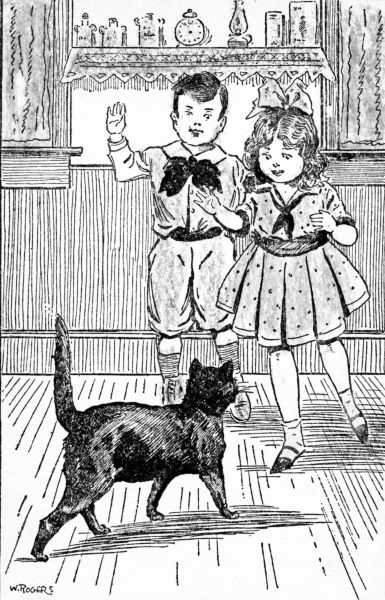
Blackie was a cat. Now that I have
told you this much I think you can guess
why that was her name. It was because
she was as black as a coal, or a bit of tar from the
barrel which stood on the street when the men
were fixing the roof. Blackie did not have so
much as a speck, or a single hair, of white in her
glossy coat of fur, and on a dark night, if you
were to look for Blackie I think you would not
have found her. For she looked just like a bit
of the dark itself.
When you first looked at Blackie you might
have thought she was just like other cats, but she
was not. She was a very smart cat, and so many
things happened to her, and she had so many
adventures, that I am going to tell you about
them.
Once upon a time, not so very many years ago,
Blackie lived in a fine large house with a little
boy and girl, named Arthur and Mabel. Of
course the papa and mamma of Arthur and
Mabel lived in the house too, but as the children
were the ones who played with Blackie, and
looked after her, giving her milk and good
things to eat, it seems best to say that Blackie
lived with them.
“Now it’s your turn to feed Blackie,” Mabel
would call to her brother.
“All right,” Arthur would answer. “I’ll get
her the milk right away.”
The children never had to be told twice to
look after their pet cat, for they loved Blackie
very much. Though the children’s father or
mother often had to tell them twice, or perhaps
even three times, to go to the store, or run on an
errand, just one telling was enough when it was
about Blackie.
“I certainly have a good home here,” thought
the black cat, “and Arthur and Mabel are very
kind to me. Yes, I certainly am a lucky cat.”
Of course Blackie did not say this out loud,
for neither cats, nor dogs, nor other animals, can
speak as we do. But they can make noises, such
as mewing or barking, and I think that is, for
them, talking in their own way, just as much as
we talk in ours.
And cats and other animals think, too, I
believe. Else how would they know enough to
come to the same place many times to be fed, or
how would they know how to find their way
home when they have gone far off?
Of course cats and dogs often get lost, for they
may go so far that they can not find the way back
again. So you might say, from that, I suppose,
that cats can’t think. But then did you never get
lost? Yes, I’m sure you must have, at least once.
And you can think, I know, but you could not
find your way home alone.
I know cats and dogs think, and that they can
talk to one another, too, in their own language.
So it isn’t at all strange that Blackie should think
about what a good home she had, and how kind
the little boy and girl were to her.
“Now, Blackie,” said Mabel one day, as she
got ready for school, “be a good cat to-day, and
don’t run off.”
“Put the red ribbon with the bell around her
neck,” said Arthur as he gathered up his school
books. “Then if Blackie goes away we can listen
for the bell and find her.”
“Oh, yes! That’s what I’ll do,” said Mabel.
“Here, Blackie!” called the little girl, “come
and have your ribbon put on.”
There was a pretty red ribbon for Blackie’s
neck, and it always looked nice on the cat,
because black and red seem to go well together.
I think they “match” as the ladies say, though I
don’t know much about such things. I know
when a team of horses match, and go well
together, and when two dogs, or two cats, are
well matched, but I am afraid I can’t tell much
about ribbons and such things matching.
Anyhow a lady told me black and red
matched, or went well together, and I guess she is
right. And I know that the red ribbon looked
very pretty on Blackie’s neck, for I saw it there
myself.
“There!” exclaimed Mabel, as she tied the
ribbon into a pretty bow. “Now you won’t get
lost, Blackie, and when I come home from
school I’ll find you here.”
Blackie lifted one velvety paw, and shook her
head. This made the little brass bell tinkle.
“You can hear that a good way off,” said
Arthur. “When I come home from school I’m
going to try to teach Blackie the trick of standing
in the corner.”
“She can do one trick now,” said Mabel. “She
can jump through my hands, when I hold them
in front of her like a hoop.”
“Can she?” asked Arthur. “Let’s see her do
it.”
“Children! Don’t be late for school,” called
their mother from the dining room.
“No, we won’t, Mother,” answered Mabel.
“I am just going to have Blackie do one trick.
Come here, Blackie!”
Blackie always came when the little boy or
girl called her, for the black cat knew she would
be petted, or given something nice to eat each
time. This time Mabel stroked Blackie’s soft
fur, and then put the cat down in front of her,
behind her arms which she held in a round
ring.
“Jump through, Blackie!” called Mabel, and
Blackie did.
“See!” said the little girl to her brother.
“Didn’t Blackie do that trick nicely?”
“She surely did!” exclaimed Arthur. “And
when I come home from school I’ll teach her to
stand on her hind legs in a corner.”
“Come now, children, run along!” called the
mother, and Arthur and Mabel, having each
patted Blackie once more, hurried off to school.
“Well, I think now I will go and take a little
sleep,” said Blackie to herself. “Then I will go
out and see if I can find another cat to play with
until the children come home.”
For Blackie loved to play, and she was sometimes
lonesome when the children were not
home.
Mabel had made a little cushion for Blackie,
and this cushion was kept in one corner of the
dining room, where the sun shone a good part of
the day. Blackie liked to sleep in the sun.
“Yes, I certainly am a lucky cat,” thought
Blackie, “to have such a nice home, and such a
good little girl and boy to pet me. I have a nice
red ribbon, too, and a bell. Not many cats have
things as nice as I.”
Blackie was sure of this, for a number of times
she had seen, on the back fence, other cats, whose
fur was all scraggly and rough; who looked
poor and thin and who seemed scared almost to
death. Once Blackie had spoken to one of these
cats and the cat had told Blackie how hungry
he was.
“Why don’t you go home and eat?” asked
Blackie.
“Home? I have no home!” sadly exclaimed
the strange cat. “I had one once but the people
moved away, leaving me behind, and since then
I have eaten as best I can. You are very lucky
to have such a nice home. Excuse me, I see a
piece of meat!” And with that the strange cat
jumped down off the fence and grabbed a bit
of meat out of the ash can.
“I’m glad I don’t have to eat that way,”
thought Blackie.
As Blackie went to sleep on the soft cushion
she thought of the time when she had been a little
kitten, and had lived with her mother, and
her brothers and sisters, in a barn in the country.
For Blackie’s early days were spent on a farm,
though she did not now remember very much
about that part of it.
Arthur and Mabel’s father and mother had
taken the children on a visit to the farm, and it
was there the children saw the black cat, which
they liked very much. So the farmer gave her
to them, and they named her Blackie and
brought her home to the city with them.
Since then Blackie had lived in the fine house
with her little master and mistress, and, as I say,
she had a very easy time of it, never wanting for
anything to eat, or for a warm, cozy place to
sleep.
For several hours Blackie slept on the cushion,
now and then turning around to get more in
the sunlight, and when she did this the little
brass bell on the red ribbon on her neck would
go “tinkle-inkle.”
“Well, I think I’ll take a walk out in the yard,
and perhaps I may see another cat to talk to,”
said Blackie, as she awakened and stretched first
one leg, and then the other, opening her mouth
as wide as she could to stretch that too. Blackie
was a bit lonesome without the children.
Out in the yard went the black cat. The sun
was shining down through the leaves of the
grape vine, making dancing shadows on the walk
below. Blackie pretended that these shadows
were mice, and that she was chasing them. As
she was doing this the black cat heard a voice
calling to her.
“What are you doing?” the voice asked.
Blackie looked up, and saw another cat looking
at her over the back fence. This cat was
mixed gray and white in color.
“Oh, I’m just having a little game by myself,”
answered Blackie. “I do this to amuse myself
when the children are at school, and I am alone.
Excuse me, but I think you must be a strange cat
around here.”
“I am,” meowed the other. “My folks have
just moved in the house next door.”
“I saw loads of furniture going in there yesterday,”
said Blackie, “but I did not see you.”
“No, I was shut up in a box,” the new cat said.
“They were afraid I would get lost, I guess.
They kept me down cellar until a little while
ago.”
“Oh, that’s too bad!” exclaimed Blackie. “I
guess you are glad to be out again; aren’t you?”
“Indeed I am! But they kept me down cellar
so I would not be hurt when the furniture was
being set around, I guess.”
“Won’t you come over and have a game of
shadow tag?” asked the black cat. “My name is
Blackie,” she went on.
“And mine is Speckle,” said the other. “I
suppose you are called Blackie because you are
so black.”
“Yes,” answered Blackie, “and I think you
must be called Speckle because you are speckled
gray and white.”
“That’s it,” Speckle answered, as he jumped
down off the fence.
Then the two cats had a nice time playing
shadow tag under the grape arbor. After a bit,
as they lay down to rest on the grass, Speckle
asked: “Did you ever run away?”
“Run away!” exclaimed Blackie. “What’s
that?”
“Why, don’t you know?” went on Speckle in
some surprise. “To run away is to leave your
home, and go off to have adventures.”
“What are adventures?” Blackie wanted to
know.
“Oh, things that happen to you,” replied
Speckle.
“Did you ever run away and have adventures?”
Blackie wanted to know.
“Indeed I did,” Speckle said, somewhat
proudly. “I have run away more than once, and
many things happened to me. It was fun, only I
got hungry sometimes.”
“How do you run away?” asked Blackie.
“Why, you just run,” Speckle said. “You
walk out of the house, just as if you were going
out in the yard to play as we did now, and, when
no one is looking, you walk off down the street
as far as you like.”
“Oh, I thought you said run!” exclaimed
Blackie. “Now you are talking about walking
away.”
“It’s all the same thing,” Speckle explained.
“You can’t run all the time you are running
away; you have to walk part of the time or you
would get very tired. You just try it some day.”
“Perhaps I shall,” Blackie said. “I’ll think
about it. I have certainly learned something
to-day. Arthur spoke about teaching me a new
trick when he came home from school, but I
have learned something all by myself, and that
is how to run away. I believe I’ll try it!”
“Do,” said Speckle. “Let me know when you
are going and perhaps I’ll go with you. Excuse
me!” said the mixed-color cat, “but I hear them
calling me. I guess my dinner is ready,” and
with that the other cat jumped back over the
fence.
CHAPTER II BLACKIE RUNS AWAY
“That cat is a good jumper,” thought
Blackie when her new friend had
gone. “He went over that fence
easily. I wonder if I could do it?”
Blackie tried, but she could not jump all the
way to the top of the fence as Speckle had done.
“I suppose it must be because he ran away
once or twice,” thought Blackie, as she again
went back to rest in the shade, after having tried
two or three times to leap to the top of the fence
in one jump.
“It must be that running away makes one a
good jumper. Yes, I certainly must run away,
or walk away, as Speckle called it. I wonder
what would happen to me? I suppose Mabel
and Arthur would miss me, and I would miss
them. But I need not run very far away, and,
and I can run back when I want to.”
Blackie did not know much about things outside
of her own nice home, you see. Running
away never made a cat a good jumper that I
ever heard of, though some cats, who have no
homes, learn to jump fences easily because, I
suppose, they are chased by dogs or boys so often
that they just have to know how to make big
jumps.
“Yes, I certainly must try what running away
will teach me,” thought Blackie as she went in
the house where, near the stove in the kitchen,
set her saucer of milk. “Then I will have things
to tell Speckle when I come back. I must ask
him more about it the next time I see him.”
That afternoon, just before Arthur and Mabel
came home from school, Blackie saw Speckle
out on the fence again.
“Wait a minute, Speckle!” called the black
cat. “I want to ask you about running away,”
and she hurried out in the yard.
“Oh, I’m not going to run away for some
time,” said the other cat. “I’ve just moved here
and I want to see what sort of a place it is before
I run away. Perhaps I shan’t run away at all.
Anyhow I shall not for a long time. I never run
away until I get tired of a place, and then I don’t
often stay away more than a day or so.”
“Oh, I wasn’t going to ask you to run away,”
said Blackie. “But I want to know if running
away makes a cat a good fence-jumper?”
Speckle thought for a few seconds and then
said, slowly:
“Well, yes, I suppose it does. I know the first
time I ran away I could not jump very well.
And then a dog chased me. I ran into a yard,
and in front of me was a fence. The only chance
to get out of the dog’s way was by jumping the
fence. I had never jumped so high a fence
before, but I did that time, and the dog could
not get me, so I got away.”
“My gracious!” exclaimed Blackie. “Something
happened to you that time! Was that an
adventure?”
“Yes,” answered Speckle, thinking a moment,
“I suppose you could call that an adventure.
But I had many more after that.”
“Do dogs always chase you when you run
away?” Blackie wanted to know.
“Oh, no, not always,” answered the gray cat.
“But that is one of the things that may happen
when you run away.”
“I shan’t like that part of it,” spoke Blackie.
“There is a dog in the house on the other side of
ours, and the family that lived in the house into
which your folks just moved also kept one. He
used to chase me until I scratched his nose with
my sharp claws one day, and after that he let me
alone. I was sorry to scratch him, but it was
the only thing to do.”
“Yes, of course,” agreed Speckle. “It is a
good thing we have sharp claws. They are especially
for scratching dogs that chase us.”
“I wonder if there is any other way of scaring
a dog besides scratching him?” asked Blackie.
“Perhaps there may be,” said Speckle.
“It would be nice if there was. I may learn
how to do that if I run away to look for adventures.”
“Oh, so you are going to run away; are you,
Blackie?”
“Well, I’m thinking of it. Will you come?”
“Not right away—at least I think I will not,”
said the other cat. “Still you might call over the
fence to me when you go, and perhaps I’ll come
along. Hello, who are they?” asked Speckle
quickly as he saw a boy and girl coming in the
yard.
“Oh, that’s Arthur and Mabel, my little master
and mistress,” explained Blackie, but Speckle
did not stop to listen. With a jump he was on
top of the fence.
“Excuse me!” called the gray cat to Blackie,
“but that boy looks just like one who once tied
a tin can to my tail!”
“The idea!” meowed Blackie. “Arthur is a
good boy, and loves cats. He’d never do anything
like that to me, nor to you or any other animal.”
“You never can tell,” said Speckle. “Safety
first, as I hear they are teaching the children in
school. I’ll just stay on my side of the fence
until I see what kind of a boy he is,” and though
Blackie kept saying that Arthur was a good boy,
and would not plague cats, Speckle would not
stay.
Of course Mabel and her brother did not
understand what their cat said to the other
one, for they did not know animal language,
though Blackie and other cats know what boys
and girls say to them, or a great deal of it, I
think.
“Did you see that strange cat?” asked Mabel
of her brother.
“Yes, I guess it belongs to the folks next door,”
spoke Arthur. “Now I am going to teach
Blackie to stand on her hind legs.”
Arthur picked Blackie up, and rubbed her
under the ears. Cats like to be rubbed under the
ears, and they will purr if you do it to them.
And when a cat purrs it shows it is happy.
Just why cats like to be rubbed, or tickled,
under the ears I do not know, any more than I
know why a pig likes to be scratched on his back.
I only know that this is so. A hoptoad likes to
be scratched on his back, also. Many a time I
have gone quietly up to a toad in the grass, and,
with a little twig, have scratched his back. And
Mr. Toad will sit there quietly, and will puff
himself out like a little balloon, because he is so
pleased to have his back scratched. But you
must do it very gently. And poll parrots like to
have their heads rubbed. But don’t ask me why,
for I don’t know.
Anyhow Arthur rubbed Blackie under her
ears, and the black cat liked it and purred in the
boy’s arms.
“And now for your trick, Blackie,” said
Arthur.
It is not easy to teach a cat to stand on her hind
legs, as Arthur very soon found out. Cats do not
learn tricks as easily as dogs do, though I have
seen performing cats on the stage of a theater.
They climbed ladders, walked a tight rope, and
did many other little tricks.
Blackie did not know exactly what Arthur
wanted her to do. The little boy put the black
cat in a corner, so she could lean her back against
the sides of the room, and not fall over. Then
he lifted her front feet off the floor so that she
was resting on her hind ones.
“Now stand up that way!” Arthur said, speaking
kindly.
Blackie did it, for a few seconds, and then she
got down on all four feet as she was in the habit
of standing.
“No! Not that!” said Arthur, lifting her up
again. “Stand on your hind legs, Blackie.”
“If she would only do the standing on her hind
legs trick as well as she does yours she would be
a fine cat,” Arthur said.
“Blackie is a nice cat anyhow, and I love her,”
spoke Mabel, cuddling the cat in her arms.
That night, when the children were studying
their lessons, Blackie lay on a soft cushion at
their feet, purring happily. And, all the while,
the black cat was thinking about running away.
“I suppose Mabel and Arthur will feel badly
at first,” thought Blackie, “but I won’t be away
very long, at least not the first time. I think I’ll
run off to-morrow.”
The next day came, and after breakfast,
when Arthur and Mabel had gone to school,
Blackie went out in the yard. She had made up
her mind to run away, and she wanted to see if
Speckle might not like to go along.
Blackie did not have to pack up any clothes,
or take anything to eat with her, when she started
to run away. Cats can’t do those things. The
only clothes they need is their coat of fur, and
that is always with them. I have seen dogs with
little blankets on, and even a sort of overcoat,
but cats are different and do not wear them.
And Blackie could not take with her anything
to eat. She thought she would have no trouble
in picking up what she wanted as she went along.
“I may even stop in a house some day, and get
milk,” the black cat said to herself.
Out in the yard she went, close to the fence.
“Meow!” called Blackie to Speckle. “Come
on out; I want to speak to you.”
“What is it?” asked the gray cat, sticking his
head up over the fence.
“I’m going to run away,” answered Blackie.
“Don’t you want to come along?”
“My goodness! Run away!” exclaimed
Speckle. “So you have made up your mind,
have you?”
“Yes, I’m going. Will you come?”
“Hum! No, I think not,” Speckle said slowly.
“I don’t believe I’ll run away to-day. You see I
have hardly gotten to know all the cats around
here yet. I’ll wait a while. But don’t let me
keep you from running if you really want to
go.”
“Yes, I do want to go,” Blackie said. “Perhaps
when I come back I may be able to jump a
fence as well as you, and I may do the standing
on my hind legs trick that Arthur tried to teach
me.”
“Perhaps,” said Speckle. “Well, good luck
to you!”
“Thank you,” answered Blackie. Then she
looked toward the house. No one was watching
her. Blackie went slowly down the front walk
to the street.
“I don’t need to run at first,” she thought.
“I’ll begin to run when I get out of sight of the
house. The children can’t see me, for they are
at school, and I am glad of it, as they might cry
if they saw me going. But I’ll soon be back,
only I can’t tell them so.”
Blackie went slowly to the front gate. She
went out in the street. Then she went slowly
down the sidewalk, and when she was out of
sight of her house she began to run.
“Now,” said Blackie to herself, “at last I am
really running away!”
CHAPTER III BLACKIE IN TROUBLE
Blackie soon grew tired of running, and
slowed down into a walk.
“It doesn’t really matter much what I
do, as long as I keep on going away,” thought
the black cat. “I can walk or run, so Speckle
said, and he ought to know, for he has run away
a number of times.”
Blackie walked on and on, down the city
street. Soon she came to a corner, and she stood
there a moment, looking up and down, wondering
which way she had better go. She had come
past many houses, and had passed many persons
in the street, mostly women and men, for all the
children were at school. No one did more than
look at Blackie, for all were too busy, I suppose.
As Blackie stood on the corner she saw a cat
on the porch of a house near by. Blackie knew
this cat a little, for once the cat, whose name was
Muffins, had come walking in Blackie’s yard.
And, once or twice, Blackie had been as far
as this corner herself. So she knew Muffins a
little.
“Hello, Blackie!” meowed Muffins. “You’re
quite a stranger. I haven’t seen you in some
time. Where are you going?”
“I’m running away,” answered Blackie.
“Running away! You surprise me,” cried the
other cat. “What is the matter? Did they treat
you badly at your home? Didn’t they give you
enough to eat?”
“Oh, yes, plenty,” said the black cat. “And
they treated me very kindly, too.”
“Then why in the world are you running
away?” Muffins wanted to know.
“I want to have some adventures, as Speckle
did.”
“What are adventures, and who is Speckle?”
asked Muffins.
“Adventures are things that happen to you,”
replied Blackie, “and you never can have them
happen as long as you are around the house.
You have to run away to get them. That’s why
I’m running away. And Speckle is the cat who
lives next door to me.”
“I don’t know him,” spoke Muffins.
“He just moved there,” went on Blackie, “and
he was only just let up out of the cellar.”
“Hum!” said Muffins. “Well, run away if
you like, but, as for me, I can find plenty of
adventures around the house. Why, only a little
while ago, the cook dropped a bottle of cream
and spilled it on the kitchen floor. I was there
and I licked up all the cream. Oh, it was good!
I’d invite you in to have some, only it’s all gone
now. That was an adventure, I can tell you!”
“Yes, cream is good,” said Blackie, “but I
don’t call that an adventure.”
“No?” asked Muffins. “Then, pray tell me,
what is an adventure?”
“Oh, when a dog chases you and makes you
jump a higher fence than you ever before leaped
over,” said Blackie. “That is an adventure.”
“Yes, I should say so,” agreed Muffins. “It’s
a kind I shouldn’t like. I’d rather have our cook
drop another bottle of cream.”
“Oh, well, of course all adventures that come
to you when you have run away aren’t dog-chasing
ones,” said Blackie. “I only spoke of that
one because Speckle told me. I really never had
any adventures myself so I can’t tell you about
them. But, anyhow, I am running away.
Would you like to come along?” asked Blackie
politely of Muffins.
“No, I thank you. I’m going to stay here.
Home is good enough for me. But where are
you going to run to, if I may ask?”
“Oh, not any special place,” answered the
black cat. “I am just going to run, that’s all.”
“What? And not know where you’re going?
That’s queer. I should think if you ran away
you’d have to have a place to run to.”
“Not at all,” said Blackie. “Speckle ran
away many times, and he never said anything
about going to any special place.”
Muffins shook her head.
“It doesn’t seem right,” she said. “I’d want to
know where I was going, even if I ran away.”
“That’s part of the adventure, not knowing
where you’re going,” said Blackie. “Now I can
go up the street, or down the street, just as I
please. If I had picked out a place to run to I’d
have to go there whether I wanted to or not.
No, it’s best to run away just as Speckle did, and
then see what happens. So you won’t come with
me?”
“Thank you, no.”
“Then I must go alone, I suppose. Well,
when I come back I will tell you all my adventures,”
Blackie promised.
“Yes, do,” invited Muffins. “I shall like to
hear about them, even if I can not go myself.”
Then the two cats said good-by, in cat-talk,
and Blackie turned down the side street. She
had never been there before. It was like going
to a new world for her, or as when you children
visit or board at a new place in the country, or
at the seashore, on your vacation.
“Now my adventures will begin!” thought the
black cat.
She went slowly along the street, keeping close
to the fences, for this street was a bigger one,
and busier than that on which Blackie lived.
There were trolley cars on it, and many wagons,
also.
Once Blackie saw a boy going along with a
basket on his arm. From the basket came a
lovely smell of meat, and, what Blackie liked
best of all, liver. She ran toward the boy with
the basket, thinking he might give her a bit,
as Arthur often did.
But when the butcher-boy saw the cat he
cried: “Scat!” and looked around for a stone to
throw.
“My, you’re awfully stingy with your meat,”
thought Blackie, as she ran behind a tree so the
boy could not hit her. “I don’t see why you
wouldn’t give me a bit.”
But of course the meat in the basket was for
the family that had bought it, and the boy could
not give any away. If Blackie had gone to the
butcher shop the man there might have given
her a bit of liver.
“Scat! Scoot!” cried the boy, as he ran up to
the tree, and he made a hissing noise through his
teeth. Blackie was afraid he would hurt her, so
she climbed up the tree as fast as she could,
knowing quite well how to do that with her
sharp claws.
“Ha! Go up a tree, will you?” cried the boy.
“If I had time I’d make you come down! Trying
to get my meat! The idea!”
“Oh, I never tried to get any of his meat!”
thought Blackie, for she heard what the butcher-boy
said. “But you might have given me a little.”
However, Blackie was now safely up the tree,
and she stayed there until the boy went off whistling
down the street. Blackie was about to come
down when she happened to see a dog on the
ground below. The dog did not look to be a
kind and gentle one.
“I guess I’ll just stay up here until he is gone,”
Blackie said to herself. “Safety first!”
The dog sniffed around the tree a little and
then, as he saw another dog down the street, ran
away.
“Now is my chance,” thought Blackie, and
down she came, running along close to the fence
as she had done before.
“Well, that was two little adventures,” the
black cat said after a while, “being chased by a
butcher-boy up a tree, and seeing a dog under
me. Though I suppose Speckle would not think
much of them. Still I may have other things
happen to me. I must keep on.”
By this time Blackie was getting hungry and
thirsty, so she looked around for something to
eat. She saw no nice saucer of milk, as she
would have seen had she been at home, for one
can’t find saucers of milk in the street. Nor was
there any nice liver, or bit of fish, lying around.
“Still one can’t have everything one wants
when one runs away,” Blackie said.
The cat came to a fountain in a little park,
and there she drank some water. But before she
had finished along came a dog, and chased her
away. Blackie ran into the bushes.
“Oh, dear!” she thought, her heart beating
very fast. “Running away isn’t as nice as I
thought it would be. Still it may be nicer later
on.”
Farther on down the street walked Blackie,
looking from side to side for something to eat.
But though she passed butcher and grocery
stores she did not feel like going in and mewing
to show that she wanted to eat.
“I ought to have asked Speckle what he did
for food when he ran away,” thought Blackie.
“I forgot about it. I may find something soon.”
A little later Blackie passed a house the door
of which was open.
“That looks inviting,” thought the black cat.
“I am sure kind people must live there, or they
would not leave a door open for cats or dogs to
go in. I’ll go in, and maybe they’ll give me
something to eat.”
Blackie looked all around, to make sure there
were no dogs about, and then she went up the
front steps. In through the front door of the
house she went, and then she saw something that
surprised her. There was no furniture in the
house, and no one was in sight.
“Nobody lives here,” said Blackie. “But perhaps
they are just going to move in, as Speckle’s
folks did. I’ll wait a bit. That’s what must be
going to happen. They had the door open to
bring in the furniture. When the people come
they’ll give me some milk, I’m sure.”
Blackie walked through the empty rooms of
the house. She went out to the kitchen, and no
one was there. Then she went up to the second
floor, and no one was there.
While up on the second floor Blackie heard
the front door being shut with a bang.
“Oh, perhaps that’s the folks moving in,” she
mewed. “I’ll run down and see.”
Down the stairs scampered the black cat, but
there was no one in the house. The front door
was shut, and Blackie, of course, could not open
it. I once had a cat that could open a door with
a latch on. This door, however, had a knob, and
Blackie could not turn that.
“Well, I wonder what happened?” thought
Blackie. “Perhaps the wind blew the door
shut.”
She jumped up on a window sill and looked
out. She saw a man going down the front steps
of the house.
“He must have shut the door,” thought
Blackie, and the man had. He owned the house,
and he had come that day to see if it had been
cleaned when the people moved out. He had
opened the door, gone in and looked about.
When he came out, to look around the back yard,
he left the front door open. It was then that
Blackie went in. Then the man, not seeing the
cat in his house, shut the door, locking Blackie
in, and he went away.
“Well, if I can’t get out the front door I’ll go
to the back,” said Blackie. She ran to the back
door. That was locked too, and all the windows
were closed.
“Oh, dear!” thought Blackie. “I guess I’m in
trouble. I’m locked in an empty house!”
CHAPTER IV BLACKIE GETS OUT
Blackie was quite a wise cat in her way.
When she had been a little kitten in the
country, with her mother, her brothers
and sisters, she had learned many country things,
such as all cats must learn. And when she had
been brought to the city she learned some city
things. So you see she had been educated, you
might say, to country life and city life.
“But what I am going to do now I don’t
know,” thought Blackie. “Here I am, locked
in a house that has no one in it, though maybe
if I wait long enough a new family may move
in. But if they don’t come very soon I’ll starve,
unless I can get out. It’s a good thing it is summer,
for I won’t get cold. The weather is nice
and warm.”
Blackie walked slowly through the different
rooms of the empty house. She thought perhaps
she might find a window open, though when she
had first looked she saw none.
“But there might be a pantry, or a cupboard,
with an open window,” thought the black cat.
“I might not have seen it at first.”
So she went carefully all over the first floor.
Not a window was open. The man who owned
the house had made sure all were closed, for he
did not want the rain to come in during a storm.
So there was no way Blackie could get out from
the first floor.
Of course she might have jumped against a
pane of glass and broken it, for she was a heavy
cat. But if she did that she might cut herself.
“Well, if I can’t find a window open down
here, I may find one open upstairs,” thought
Blackie. “I guess it wouldn’t be too far to jump
from there. Or I may be able to jump in a tree
and climb down, if a tree is near enough to an
open window.”
Blackie went upstairs and looked for an open
window. But alas! there was none. True, the
black cat did find a tree growing close to a window,
but there was no way of getting out in it.
“Oh, dear!” thought poor Blackie. “I certainly
am in a lot of trouble. I should never
have gone in this house without knowing more
about it. I suppose I should not have run away.
But no, I must not say that. I want to become a
good fence-jumper, and running away seems to
be the only way to do it. I guess I’ll be all right.
Some one may come and let me out.”
Blackie was not so frightened as another cat
might have been who had not lived in both the
country and the city. She knew how to think,
and she remembered how she had once been shut
in the barn before she was taken away from the
farm.
That time Blackie had been locked up a whole
day and a night, but finally some one heard her
mewing and let her out. And oh! how hungry
and thirsty she had been!
“I guess I’ll try crying now,” thought Blackie.
“Some one may hear me out in the street.”
Blackie did not mean that she was going to
“cry” real tears, but that she was going to mew.
Some folks call that crying for a cat.
“Yes, that’s what I’ll do,” said Blackie to herself.
“I’ll get up on the window sill, and mew
as loudly as I can.”
Up jumped Blackie to the sill of the window
and, looking out in the street, she opened her
mouth and let out a loud:
“Mew!”
“They ought to hear that,” thought the black
cat. But no one seemed to hear her. She could
see people passing along the street, boys and girls
being among them, for school was now out.
But though once in a while some one did look
at the cat in the window, no one came to let
Blackie out.
“Oh, if only Arthur or Mabel would pass
along the street on their way from school, they
might let me out,” thought Blackie. “I wonder
if this is the street by which they come home?”
This was something Blackie could not tell,
smart as she was. She could only hope, and call,
which last she did every minute or two.
But every one on the street seemed to be in a
great hurry. Men and women walked quickly
past, with only a glance, now and then, at the
black cat in the window. Perhaps they did not
stop to think that it was strange for a cat to be
alone in an empty house. Perhaps the people
did not even stop to think that the house was
empty. And they might have thought that if
Blackie got in the house she could also get out.
But she could not, as we know, for every door
and window was tightly fastened. And another
thing was that only the man who owned the
house had a key to it. So if any one did try to
let Blackie out how could they do it? Blackie
did not know all this though. She just knew
that she wanted to be let out, and so she kept on
mewing.
“Well, this doesn’t seem to be doing any
good,” thought Blackie at last. “I’m only wasting
my time crying this way, and making myself
tired, too. Oh! how thirsty I am! I’d like even
a good drink of water, though of course milk
would be much better.
“Still I must not find fault. I ran away on
purpose and I must put up with what I meet
with. I should have asked Speckle how he
found things to eat and drink when he ran away.
But I forgot all about that. I wish he had come
with me, for he would know what to do now.
And I guess he would not have let me come in
this house to get locked up.
“Oh, well, it isn’t night yet, and before dark
some one may come. That man whom I saw going
away may come back. I’ll just wait a bit.”
So Blackie waited and waited, but no one
came. It was late afternoon now, and the shadows
were getting longer and longer, as the sun
went farther and farther down in the west. No
more children passed the house, for they were all
home from school now, and were playing their
games, and having fun.
“I guess Mabel and Arthur are playing, too,”
thought Blackie. “I wonder if they miss me?”
The two children did indeed look for the
black cat when they came home from school, but
not finding her they thought little about it at the
time.
“I guess she has gone over to play with the cat
next door,” said Arthur.
“I guess so, too,” said his sister. “Come on
down the street and we’ll play with the Blake
children. Tommie Blake asked me to come
over after school.”
So Arthur and Mabel ran off to play, not
thinking any more about Blackie for a while,
though afterwards, when she did not come home,
the children did not know what to think, and
they looked all over for their pet.
But this story is just about Blackie, and not so
much about Arthur or Mabel, though I may
mention them once in a while. Now I must tell
you what happened to the black cat.
She wandered all over the house once more,
now and then jumping up on a window sill that
fronted on the street, to give her mewing cry.
But if any one heard her no one tried to get her
out of the locked and vacant house.
“I must do something. I really must!” said
Blackie to herself at last. “Otherwise I shall
have to stay in this house all night with nothing
to eat. I’ll go upstairs again and see if there
is something to eat up there. The family may
have left something when they moved out.”
Upstairs went Blackie once more, and she
hurried through the different rooms, for it was
getting dusk now. Not a thing to eat could
poor Blackie find.
At last she came to another flight of stairs that
seemed to lead up to the roof.
“Why, that’s queer,” said the black cat. “I
did not notice them before. I wonder what
they are for? I must go up and find out.”
“Ha! This isn’t so bad,” thought Blackie.
“Perhaps I can squeeze through that crack and
get out. I’ll try.”
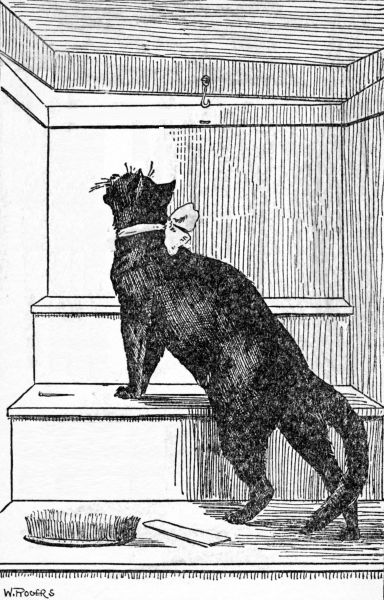
Blackie went up to the highest step. Over
her head was a square piece of wood that seemed
to cover a hole in the roof. The wood was
really a cover to what is called a “scuttle,” or
hole, in the roof of the house, which roof was
flat, and of tin.
When the men built the house, which was in
a long row with many others, they left a hole in
the roof, with stairs leading to it, so when the
roof needed painting, or mending, men could get
out on it without bringing ladders and putting
them against the building on the outside. Then
so the rain would not come in through the hole,
the men made a cover for it.
This cover could be lifted up, whenever any
one wanted to get out on the roof, and the cover
could be fastened down, by hooks inside, when
the hole was to be closed.
But now, as it happened, the cover was only
partly over the hole, and it was not fastened
down. There was a little crack, as when a door
is only partly closed, and Blackie put her nose
to this crack. She could sniff the fresh air.
“Oh, how good that smells!” she said. “If I
could only get out!”
Blackie again put her nose in the crack, and,
bracing her legs on the top step, she began to
push with her head. Blackie was a strong cat,
as I have said, and soon she began to feel the
cover slipping and moving to one side.
“Oh, I believe I can push it away from over
the hole!” said Blackie. “If I do I can get out!
I must push harder!”
Blackie pushed as hard as she could and the
scuttle cover moved more. The crack was
wider now. Blackie could put out one paw.
Soon she had pushed the cover far enough away
so she could put out two paws.
“I’ll soon have it all the way off now!”
thought the black cat.
She gave one more hard shove and then, to
her delight, the cover slid away from the hole.
There was room for Blackie to jump out.
She found herself on the flat tin roof of the
house. On either side were the tin roofs of other
houses in the brick row. It was like one long,
big roof.
“Well, I’m out, anyhow!” said Blackie to herself.
“That is something. It’s an adventure, a
real, truly adventure! I wonder what will happen
to me next?”
CHAPTER V BLACKIE FINDS A FRIEND
Blackie was now out of the vacant house,
it is true, but, for a time, she did not feel
much better off. She was up on a high
roof, and as she went to the edge to look down
she saw that it was too far for her to jump, even
down into a tree.
“As soon as I get through with one adventure
I find another,” sadly said Blackie. “I had an
empty-house adventure, and now I am having a
roof adventure. I wonder how it will end? I
must get down some way. I can’t stay up here
all night, for it might rain, and I don’t like to
get wet.”
Cats do dislike getting wet, you know. They
are not like dogs in that way. A dog loves to
jump in the water and swim, or at least most
dogs do. But you never saw a cat in swimming—at
least I never did.
Blackie walked up and down the roof for a
while. She could look down to the street from
in front, and she saw persons walking along, as
well as many wagons, automobiles and trolley
cars. Blackie gave two or three loud mews, but
she soon stopped.
“There is so much noise down there in the
street, and I am up here so high, that I don’t
believe they can hear me,” thought the black
cat. “I may as well keep still.”
Then she went to the other side of the roof,
to where she could look down in the back yards
of the houses. She saw no one there, in any of
them, and after she had mewed several times she
also gave that up.
“Oh, dear!” thought Blackie. “I don’t know
what I shall do. Suppose it rains during the
night? Well, of course I could go down in the
empty house again, so I would be dry, anyhow.
But I want something to eat. Oh, dear! Running
away, even to learn how to jump high
fences, is not half as nice as I thought it would
be. Speckle did not tell me I would have bad
adventures. I thought they would all be nice
ones.”
Blackie walked over toward one of the end
houses in the row. She was wondering what
she would do, when, all at once, another and the
same kind of a scuttle cover as the one she had
pushed to one side, was opened in the roof in
front of her, and up popped the head of a gray-haired
lady, who had a kind, pleasant face, and
who looked at Blackie through large spectacles.
“Why, it’s a cat—I do believe!” exclaimed the
lady, whose name, as Blackie learned later, was
Mrs. Thompson. “I was wondering what was
making that noise, walking around on the roof.
I’m glad I came up to see. It’s a cat!”
“Of course I’m a cat,” said Blackie to herself.
“I hope I don’t look like a dog.”
Of course Mrs. Thompson did not hear
Blackie say this, for the cat only thought it to
herself, just as we often think things without
speaking them out loud.
“What a fine big black cat!” went on Mrs.
Thompson. “Come to me, pussy! How did
you get up here?”
“Pur-r-r-r-r!” said Blackie out loud. That,
and mewing, was the only way she had of talking
to real folks. But to those who understand, cats
can say several things in just those two ways.
Sometimes you can tell by the way a cat mews,
whether it is hungry, or whether it wants to go
out doors. And when it cries in another way
you know it is in pain. And when it says
“pur-r-r-r-r!” like that, sort of softly and slowly,
and rubs up against you, why then you know the
cat is happy.
Blackie was beginning to feel happy again, for
she saw the lady looking out through the hole in
the roof, and the black cat thought the lady
would take her down and feed her.
“Why, you’re a nice cat,” said the lady, speaking
to Blackie in a way the cat liked. “You
certainly are a nice pussy. I wonder how you
got up on this roof?”
Then, as she rubbed Blackie under the cat’s
ears, in a way Blackie liked, the lady looked
along the roofs, and she saw on the roof the
cover, or scuttle, which Blackie had pushed to
one side to get out.
“Oh, I see! That’s how you got up here,
through the hole in the roof,” said the lady.
“Well, I must close it, or the rain might come
in Mr. Smith’s house. I see how it is. The
family there moved out, and you were left behind,
Blackie. It’s too bad they forgot you.
But never mind, I’ll take care of you.”
Of course Mrs. Thompson was not right in
thinking Blackie had been left behind by the
family that had moved away. But Mrs.
Thompson did not know that Blackie had run
away, and had wandered in the vacant house by
herself. And Blackie could not tell.
“Now I’ll just close that scuttle over the roof
for Mr. Smith,” went on Mrs. Thompson.
“He doesn’t know it is open, I dare say. Then,
after that, I’ll take you down in my house,
Blackie.”
You might wonder how the lady knew
Blackie’s name, never having seen her before.
But when a cat is all black, as this one was, it
seems natural for every one who meets her for
the first time to call her Blackie.
“Just a minute now, Blackie,” said Mrs.
Thompson. “Then I’ll give you something to
eat. I know you’re hungry.”
Blackie was mewing her hungry cry, and the
lady knew enough about cats to know it.
“I’ll give you some nice milk, and a bit of
meat in a minute,” the lady went on. “Just wait
until I close Mr. Smith’s scuttle.”
She climbed out on the roof to do this, and
Blackie rubbed against her skirts and purred.
Blackie had found a new friend.
“Go on down my stairs now,” said Mrs.
Thompson as she walked back to the hole in her
roof, followed by Blackie. “Go on down and
then I’ll close my scuttle, and get your supper
and my own too.”
Blackie knew enough to run down. She
waited at the foot of the stairs while Mrs.
Thompson fastened her scuttle with hooks, and
then Blackie waited for the lady to go ahead and
show the way.
Blackie found herself in a house just like the
empty one she had first entered, but some one
lived here, for there was furniture in all the
rooms, and carpets on the floors. In the other
house the floors were of bare boards.
“Come on down to the kitchen,” invited Mrs.
Thompson. “I’ll feed you there.”
Blackie understood this talk, and how she did
hurry to that kitchen, for she was very hungry!
The lady poured out a saucer of nice milk, and
you can just imagine how fast Blackie put her
red tongue in it to lap it up, for she was thirsty
as well as hungry, and milk to a cat is both food
and drink.
When the saucer was empty the lady brought
Blackie some bits of chicken, left over from dinner.
“Now then, let me see you eat that,” said Mrs.
Thompson. She talked to Blackie almost as if
the black cat were a real person and could understand.
I know many men and women who do
that. I do it myself to my pets. I know they
don’t understand all I say, but I like to think
that they do.
Mrs. Thompson lived all alone in her house,
and when a lady lives alone, and has a cat, a
dog, a bird, or a parrot, she gets in the habit of
talking to her pets.
“Yes, you are a nice cat,” went on Mrs.
Thompson, as she once more stroked Blackie’s
smooth fur. “You came from a good home, I
can tell that, and why the folks moved away, and
left you behind, I can’t see. I’ll keep you for
a while, and perhaps they may remember about
you and come to get you. If they don’t come
I’ll take you to the country with me, for I will
soon be going there.”
After her meal Blackie washed herself carefully,
as her mother had taught her to do. Then
she curled up in a black ball at the feet of the
kind lady.
It was now dark, and the lady lighted the gas.
“I’m glad I didn’t have to stay up on the roof,
or in the vacant house all night,” thought Blackie,
purring away and beginning to feel a bit sleepy.
“My running away is turning out all right after
all. I am in a nice house, though I may not
stay. I have not run far enough away yet. I
must go a bit farther before I go back to Arthur
and Mabel.”
The old lady sat reading, now and then speaking
to Blackie, who answered with a purr.
“I once had a white cat,” said the lady, “but
you are just as nice, though you are black. I
shall keep you a long time, I hope.”
Presently the door bell rang. Up jumped the
nice old lady.
“Some one to see me!” she exclaimed. “Perhaps
it is some one who has come after Blackie.”
She went to the front door, and Blackie
waited.
“I wonder if that can be Arthur or Mabel
after me?” thought the black cat.
CHAPTER VI BLACKIE IN A BASKET
Blackie, who had walked from the sitting
room, where the old lady had been
reading, out toward the hall, heard voices
as the front door was opened.
“Come in,” invited Mrs. Thompson.
“I just thought I’d step over to see how you
were,” spoke a strange voice.
“That isn’t Arthur or Mabel,” thought
Blackie, for she knew the voices of the children.
“I thought perhaps you might be lonesome,”
said the visitor.
“Well, I was lonesome,” said Mrs. Thompson,
“but, a little while ago I heard something up on
the roof. I went up, opened the scuttle and
what do you think I found?”
“Not a baby! Don’t tell me it was a baby!”
exclaimed the other voice, which was that of a
lady.
“No, it wasn’t a baby,” spoke Mrs. Thompson,
with a laugh, “so of course I’ll not tell you it
was. Come in the sitting room and see.”
“Oh, what a fine big black cat!” cried the
other lady, leaning over to pet Blackie. “Where
did you get her? Oh, isn’t she a beauty!”
“That’s what I found up on the roof,” explained
Mrs. Thompson. “It was the cat I
heard walking around, and I brought her down
to my house with me.”
“How did she get on the roof?” asked the other
lady.
“Why she got out through that vacant house
where the family lived that moved away. I
don’t know their name, as they did not stay in
this block long. But they must have left the cat
behind, and she made her way up to the roof.”
“No, I don’t believe those people had a cat,”
said the other lady. “So I don’t believe they
left this one behind. I would have known if
they had a cat, for they lived right across the
street from me. This cat must have come from
somewhere else.”
“Of course I did,” said Blackie to herself, as
she listened to this talk. “I ran away from a
good home, but I think I have found one almost
as nice, though I shall miss the children. But
I don’t know how long I shall stay here. I may
run away farther. I wish I could tell these nice
ladies some of my adventures. But of course I
can’t, for they don’t understand my language
very well.”
The two ladies talked more about the black
cat, wondering where she had come from, and
all that, and, every once in a while one of them
would lean over and pet Blackie.
“I wonder if she will let me hold her in my
lap?” said the lady who had come to pay an evening
visit to Mrs. Thompson. “I hope she will,
for I love cats.”
“Try it,” said Mrs. Thompson. “Blackie
seems very nice and gentle.”
The other lady picked Blackie up.
“My! How heavy she is!” she exclaimed.
“Yes, she is a big cat,” spoke Mrs. Thompson.
Blackie was very willing to be held in the
lady’s lap, for Arthur and Mabel often petted
Blackie that way. The lady stroked Blackie’s
fur and rubbed her ears, and, as the cat liked that,
she purred.
“This is the nice part of my adventures,”
thought Blackie to herself. “I guess I rather
like running away after all. But perhaps something
else will happen in the morning.
“I won’t go back home, at least not for a day
or two, and by then I may have many more things
to tell Speckle. Maybe he will not think getting
locked in a vacant house much of an adventure.
I must have more exciting ones than
that to tell about.”
The two ladies talked for some time longer,
taking turns patting Blackie, until it was time
for the lady visitor to go home.
“Good night!” she said to Mrs. Thompson.
“I shall come over often to see your new cat. I
hope you can keep her, and that no one comes to
take her away.”
“So do I, though of course I would give her
to whoever owned her. If I had a nice cat I
wouldn’t want any one to keep her from me,”
Mrs. Thompson said.
“No, I wouldn’t either. Well, good night.
Oh, when do you go to the country?”
“In a few days now, I think.”
“And will you take Blackie with you?”
“I will if no one comes for her before I go.”
Then the two ladies said good night again
(ladies always say it three or four times, somehow
or other) and then Mrs. Thompson locked
the front door.
“It will soon be time to go to bed, Blackie,”
said the lady. “I will get out the cushion my
white cat used to sleep on, and you can use that.”
Blackie wondered what had become of the
white cat who used to live with the kind old lady.
Mrs. Thompson brought out the other cat’s
cushion. It was nice and soft, and Blackie liked
it.
In the morning Blackie, who had slept well,
was given a good breakfast of milk and oatmeal.
Mrs. Thompson seemed to know just what cats
like.
“I wonder if you would run away if I let you
out in the yard for a while?” spoke the lady,
looking at Blackie. “It is not good for cats, or
other animals, to stay in the house all the while,
especially in Summer. I think I’ll let you run
out in the yard a bit.”
She opened the back door, and Blackie, after
sniffing a bit, to make sure there were no dogs
about, went out on the back steps. The yard
was not as large as the one where Mabel and
Arthur lived, nor did it have in it a grape arbor.
“But it doesn’t matter,” thought Blackie. “I
shall not stay here very long, especially if I go
to the country with the lady. I will be glad to
be on a farm once more. Wouldn’t it be queer
if she took me to the same farm where I used
to live? I would like to see my mother, and my
brothers and sisters once more. That little
Scratcho was a queer cat!” And Blackie
thought of one brother who was named Scratcho
because he used to scratch his ear in such a funny
way.
Blackie sat on the back steps and looked
around Mrs. Thompson’s yard. The cat saw
no dogs, nor any other cats, and then, thinking
there might, perhaps, be pussies in the yards on
either side, Blackie went down the steps.
“Now don’t you run away!” called the lady,
playfully shaking her finger at Blackie.
“Pur-r-r-r!” said Blackie, which, I suppose,
might be her way of saying that she would not
run off.
Down the walk she went, and she looked up at
the fences on either side.
“I wonder if there are other cats over there?”
thought Blackie. “That fence doesn’t look any
higher than mine at home. Perhaps I can jump
to the top. I’m going to try.”
Blackie gave a little run, and then jumped
for the top of the fence. To her delight she
found that she could reach the top, where she
clung with her sharp claws.
“Now that isn’t so bad!” she told herself. “I
am getting to be a better jumper. Running
away did that, I think, just as Speckle said it
might. I’m glad I left home, though I do miss
those children. Never mind, I shall go back to
them some day.”
Perched on top of the fence, Blackie looked
down in other yards. She hoped to see another
cat with whom she might talk, but none was
there. Blackie did see something which she did
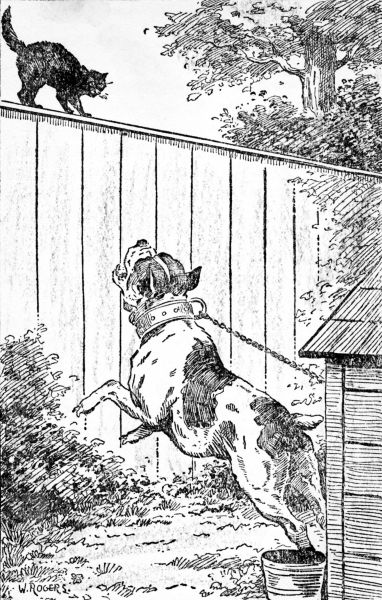
not like very well, and that was a big dog asleep
in front of his kennel.
“Hum!” thought Blackie. “He seems to be
a savage chap. I hope he doesn’t get after me.
It’s lucky he’s chained. He doesn’t look as
though he liked cats.”
Just then, from behind her, on the fence at
the other side of the yard, Blackie heard a voice
saying, in cat language:
“Hello, Blackie, where did you come from,
and how did you get here, if I may ask?”
Blackie turned and saw a yellow cat sitting
on the other fence.
“How do you do?” asked Blackie politely. “I
just happened to come here, but how did you
know my name, and what is yours?”
“I guessed your name was Blackie because
you are so black,” said the other cat. “My name
is Topaz, for I am colored like a yellow topaz
stone, you see. I live here. Do you live
there?”
“Well, I am staying with Mrs. Thompson for
a while,” Blackie answered. “I ran away from
my own home. Did you ever run away?”
“Never!” exclaimed Topaz. “I’d never
dream of doing such a thing.”
“Did you ever have any adventures?” asked
Blackie.
“No, I never did—”
“Well, that’s because you never ran away,”
went on Blackie. “You have to run away to
get adventures. I’ve had two or three already,
and I’m expecting more. I’ll come over and
tell you about them.”
But just then something happened. The big
dog in the yard awakened, and seeing Blackie
perched on the fence, up he jumped with a growl
and a bark, and made a rush for the black cat.
“Oh, my goodness!” cried Blackie, jumping
down quickly and fairly scooting into the house.
“Oh, if that dog should get me!”
“Don’t be afraid!” called Topaz. “That dog
is a bad one, but he is chained.”
Blackie had forgotten about the chain when
she leaped off the fence so quickly.
“He might break his chain and then he’d get
us,” said the black cat, when she was safely on
her own back stoop once more.
“He could not get over the fence,” Topaz
said. “Don’t be afraid. He always barks at
me, and tries to get me when I go on his fence.”
“I don’t like that kind of a dog,” said Blackie,
who was breathing fast. “I’ll not go on his
fence again.”
“Come over and talk to me,” invited Topaz.
“There are no dogs here.”
So Blackie went over and had a nice talk with
the yellow cat. Blackie told about her adventures,
and how she got on the roof and was taken
in by Mrs. Thompson.
“Yes, she is a good lady, and kind to cats,”
said Topaz. “I go over to see her once in a
while, and she gives me nice things to eat. She
had a white cat once.”
“What happened to her?” asked Blackie.
“Oh, while Mrs. Thompson was out one day
a bad boy tied a tin can to the white cat’s tail,
and it frightened her so that she ran away, and
never came back. We never saw her again.”
“That was too bad,” said Blackie. “It was
an unpleasant adventure.”
“It’s best to stay home,” spoke the yellow
cat. “No adventures for me!”
“If you don’t have adventures you will never
be a good fence-jumper,” Blackie said.
“Speckle, the cat who lived next door to me in
my other home, told me so.”
“Well, jumping fences isn’t all there is in
life,” spoke Topaz, as she washed her face with
her paw.
“Here, Blackie! Blackie!” called Mrs.
Thompson, from the back step. “It’s time for
your dinner. Come and get it!”
“Excuse me,” said Blackie to the yellow cat.
“I have to go now. I’ll see you this afternoon.”
That afternoon, and several other times later,
on different days, Blackie and Topaz met on the
back fence and talked. Blackie was getting to
like it more and more in her new home. But
still she was thinking that she did not have adventures
enough.
One day something new happened to Blackie.
Mrs. Thompson had been very busy packing
trunks and getting ready to go to the country.
And this day she said:
“Come, Blackie. If you are going to travel
with me I must put you in a traveling basket, so
I can take you on the train.”
She lifted Blackie up in her arms, and the next
thing the black cat knew was that she found herself
in a basket, with a cover shut tightly over the
top.
“Well, this isn’t so very nice,” thought the
black cat. “But still if we are going to the country
it may be all right. It’s part of the adventure,
I suppose.”
Then Blackie felt herself being lifted up and
carried along.
“I wonder what is going to happen now?”
thought the black cat.
CHAPTER VII BLACKIE IN A TRAIN
Shut up as she was in the basket, Blackie
could see little of what was going on
about her, or where she was being carried.
There were little cracks in the basket, to be sure,
but one can not see much through such cracks,
especially when being carried along, and bobbing
up and down.
“Oh, dear!” thought Blackie. “This isn’t at
all nice. It’s like the time when Arthur and
Mabel brought me away from the farm. They
put me in a basket then, I remember that very
well, though I was only a little kitten.”
Blackie could tell that Mrs. Thompson was
carrying the basket, for, every little while the
lady would speak to the pet cat.
“Don’t be afraid now, Blackie,” the lady
would say. “You’ll be all right in a little while.
Nothing shall hurt you.”
And Mrs. Thompson spoke in such a gentle
voice, just the kind that dogs and cats like to hear,
that Blackie felt better.
“I guess it will be all right,” thought the black
cat. “I’ll try to go to sleep, and when I wake
up I may be in the nice country.”
Blackie curled up in a little ball in the basket,
and tried to go to sleep. But it was hard work.
The basket kept bobbing up and down, and then,
after a while, Blackie felt herself being set down,
basket and all. Then followed a strange rumbling
sound, like distant thunder. Blackie remembered
that, for she knew what thunder
showers were, and she did not like them, nor rain.
“Oh, dear!” thought the black cat. “I hope it
isn’t going to lighten. I can’t bear that. Still
it can’t hurt me in the basket.”
But it did not seem to be a storm. The low,
rumbling noise kept up, and Blackie felt herself,
basket and all, being gently “jiggled,” as she said
afterward. Then Blackie began to feel sleepy.
“Oh, I know where I am now!” she suddenly
thought. “I’m on a railroad train! Just as
when Arthur and Mabel brought me from the
country! Mrs. Thompson has brought me to the
railroad car in the basket, and that’s what makes
the rumbling sound. It’s the car wheels. Now
I can go to sleep in peace, and when I awaken
I’ll be in the nice country.”
How long she slept Blackie did not know,
but when she did wake up she found herself
being lifted up in the basket again.
“I guess we must be in the country,” she
thought. “Now I shall have some nice milk,
and perhaps I may see my brothers and sisters.”
Blackie felt herself being carried out in the
air, for she could feel the gentle Summer breeze
blowing on her through the cracks in the basket.
Then she heard a lot of strange noises which
frightened her. There were shouts and yells,
the puffing of engines, the ringing of bells and
the blowing of whistles.
“Oh, dear! What can this be?” thought
Blackie. “I guess it must be the railroad station
where the ‘choo-choo’ cars stop, as Mabel
used to call them when she was a little girl and I
was a little kitten.”
And that is where Blackie was. The train
Mrs. Thompson had taken had reached the station,
and she had gotten out with her cat in the
basket.
“My, I did not know the country was as noisy
as this,” thought Blackie. But she was not quite
in the country yet, you see. Mrs. Thompson
had to take a wagon to get to her country place.
Blackie felt her basket being set down and she
heard Mrs. Thompson talking to some man about
trunks and boxes, and about bringing up a carriage,
and things like that.
Then, all at once, Blackie noticed that the
cover of her basket was loose. There was a hole
out of which she could put her head.
“I guess I’ll get a breath of fresh air and look
around,” said Blackie to herself. Out of the
basket she popped her head, and she saw Mrs.
Thompson standing a little way off, on the station
platform, talking to the baggage-man. On
the track, to one side, was the train which had
brought Blackie and Mrs. Thompson to the
country. The engine was puffing, and the bell
was ringing, for the train was about to start off
again.
All of a sudden there was a dreadfully loud
noise, almost like a gun being fired, and then followed
a loud whistle.
“Whoo-ee!”
“Oh, my! Oh, my!” cried poor frightened
Blackie to herself. “This is dreadful! It must
be a terribly big dog after me! I’m not going
to stay in this basket and be bitten!”
With that Blackie gave a sudden jump, and
out of the basket she went, knocking it over.
The whistle of the steam engine, and the loud
noise, which sounded like a gun (but which was
only the locomotive giving a strong puff of
steam to get started) all these noises kept getting
louder and louder, and Blackie was so scared
that she ran along the station platform until she
found some boxes and barrels, and in among these
she ran to hide.
“At least the dog can’t get me in here,” thought
the black cat. “I am safe for a time. Oh, what
a lot of adventures I am having! I guess even
Speckle would say these are enough to make one
a good fence-jumper. I jumped out of the
basket, anyhow.”
Hidden as she was behind the boxes and barrels,
Blackie could not see Mrs. Thompson now.
“I’ll just stay here until everything gets quiet,”
thought Blackie, “then I’ll come out and go to
Mrs. Thompson’s country house. For I like her
and I’ll stay with her a little longer before I go
away again, and make a journey back to Arthur
and Mabel.”
Blackie did not stop to think that perhaps she
might not be able to find her way to Mrs.
Thompson’s country house, which the black cat
had never seen. All Blackie thought of then
was hiding away from the noise.
The train puffed away, and it grew more quiet
about the station, but still there were quite a
number of sounds. Men and boys walked up
and down the platform, whistling and calling
one to another.
“I won’t walk out yet,” thought Blackie.
Meanwhile Mrs. Thompson, having finished
telling the express-man all about bringing her
trunks to the country house, looked around for
the basket with Blackie in it. She saw the basket
turned on its side, but no cat in it.
“Oh, dear!” cried Mrs. Thompson. “Where
has Blackie gone? Blackie! Blackie! Where
are you?”
But Blackie did not mew or purr in answer.
She did not even hear Mrs. Thompson calling,
for just then a baggage-man wheeled a rumbling
truck along the platform, and it made a great
noise.
“Oh, where can my nice cat have gone to?”
asked Mrs. Thompson. “I must find her. Did
any one see her?”
“I saw a black cat jump out of the basket just
as the engine whistled,” said a man.
“That was Blackie,” said Mrs. Thompson.
“Which way did she run? I’ll give a dollar to
get her back.”
“She ran down the platform,” spoke another
man. “I’ll see if I can find her for you.”
“And so will we,” said two or three boys.
They would have been glad to find Blackie to
get the dollar, I guess. Then began a search for
the black cat. But no one found her, for Blackie
well knew how to hide in among the boxes and
barrels.
“Well, I guess she has run away,” said Mrs.
Thompson, at last. “I’ll have to go on to my
country house alone. If any of you men around
the depot find her, please save her for me.”
“We will,” said the railroad men.
Mrs. Thompson drove away in a carriage, taking
the empty basket with her.
“I’m sorry I had to run away from such a nice
lady,” thought Blackie, in her hiding place.
“I’ll go back to her after dark.”
Blackie was not hungry, for she had been well
fed before being shut up in the basket. She
curled herself snugly up and waited. Pretty
soon the men and boys stopped looking for her,
and, after a while it grew more quiet about the
railroad station.
“I guess I can come out now and look around,”
thought the black cat. “I’ll start off in the country,
and I ought to be able to find Mrs. Thompson’s
house. I think she must live in a quiet
place, for she was so quiet in her city house, living
all alone except for me.”
Blackie stuck her nose out a little way from in
between two barrels. She sniffed the air, and
she smelled no danger. Then she looked around
and came out. She ran down the platform a
little way. There were no trains at the depot
now, for which Blackie was glad.
“Now for a nice trip to the country,” thought
Blackie. She looked across the road and saw
that the station was near a little country town.
There were wagons going up and down the
street, but not as many as in the city where
Blackie had come from.
“I wonder if I can get a drink anywhere
around here?” thought Blackie. So she sniffed
the air hard, and she smelled water. She went
toward it and saw, not far away, a drinking-fountain
for horses. Some of the water dripped
down and had made a little puddle on the
ground.
“I’ll get a drink there,” thought Blackie, and
while she was drinking something else happened
to her.
CHAPTER VIII BLACKIE IS CHASED
Blackie was lapping up the water from
the little puddle, when all at once, from
behind her, she heard a boy’s voice shouting
in eager tones:
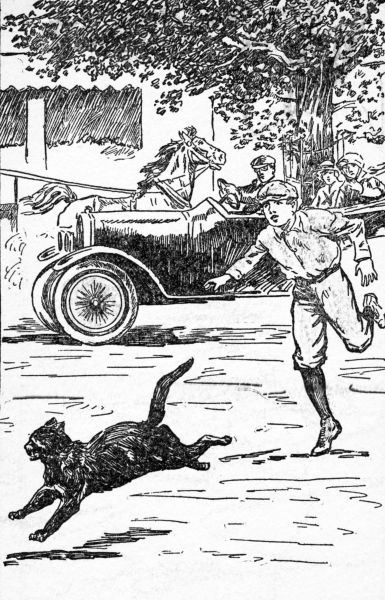
“There she is! There’s that lady’s black cat!
She said she’d give a dollar to whoever found
her! I’m going to get that dollar! Whoop!”
Blackie gave one quick glance behind her.
She saw a red-haired boy running toward her
with hands held out ready to grab her.
“My! What’s going to happen now?”
thought Blackie. “Another adventure, I’m
sure. Going to get a dollar to catch me, is he?
Well, we’ll see about that!”
Blackie gave such a sudden spring to get away
that her red ribbon, with the tinkling bell,
caught on a piece of the fountain and was pulled
off.
“Oh, dear!” thought Blackie. “There goes
my nice ribbon! Mabel will be sorry when she
sees that it is lost. And I’m sorry too. But I
can’t stop to get it now. No indeed! I must
get away from that boy!”
Blackie thought all this in a flash, as she
sprang away from the fountain, leaving the red
ribbon and bell behind her. She had not had
half enough water to drink, but going thirsty was
better than being caught by a boy.
Blackie had not heard all the boy said, nor did
the black cat stop to think that perhaps the boy
was only going to catch her so he could take her
back to Mrs. Thompson. That was really what
the boy was going to do. He did not mean to
hurt Blackie.
But all the cat thought of was that a boy was
chasing her and wanted to catch her, and Blackie
did not want to be caught. So she ran as fast
as she could.
“Maybe if I can’t catch the cat the lady will
give me ten cents for the ribbon and bell,” said
the boy to himself. “Ten cents is better than
nothing, and maybe I won’t get the cat. She
runs very fast.”
The boy was one who had been around the
railroad station when Mrs. Thompson missed
Blackie, and when she had offered a dollar
reward to get back her pet.
On and on ran the black cat through the
streets of the country town. In and out she
dodged among the men and women who were
hurrying along the street.
A woman saw the running cat, and she saw the
boy chasing after her.
“Here, little boy, why are you chasing that
poor cat?” asked the woman. “Don’t you know
it isn’t right to chase cats?”
“Yes’m—I—I know,” said the red-haired boy,
who was breathing quite fast. “But I’m not
chasing this cat to do her any harm. I want to
catch her for a lady who’ll give me a dollar for
her. The cat got out of her basket.”
“Humph!” said the woman, looking over the
tops of her glasses at the red-haired boy. “I’ve
heard of folks letting the cat out of the bag, but
I never heard of anybody letting one out of a
basket.”
“This lady was at the railroad station,” said
the boy, as he ran on after Blackie. “She is
Mrs. Thompson.”
“Oh, I know her,” said the woman who had
spoken about letting cats out of bags. “She lives
out near me. So she has come to the country
for her summer vacation again, has she? And
brought a cat with her. She always did like
cats.”
The boy did not stay to hear all this. He
was again running on after Blackie, for he
wanted to earn that dollar. And Blackie, not
knowing anything about the boy, nor that he
would be kind to her, ran on as fast as she
could.
Pretty soon some other boys saw the red-haired
lad running after the black cat, and they shouted
to him.
“Hi, there, Carrots!” they called, naming him
Carrots in fun because his hair was the color of
carrots. “Hi, there, Carrots! What you chasin’
that cat for?”
“For a dollar,” answered the red-haired boy,
with a grin.
“We’ll help you!” said the other boys, quickly.
“All right,” invited the red-haired boy.
“Come along!”
There were three boys now chasing after poor
Blackie, and the cat was getting tired.
“I must get away from them, somehow,” she
thought. “I wonder what Speckle did when he
was chased like this? I ought to have asked
him before I came away. Next time I run off
I’ll know more about it. And maybe I won’t
run off again.”
Blackie turned around the corner so quickly
that she ran right between the legs of an old
gentleman who was walking along.
“Oh, my! Scat! What’s this? A black cat!”
cried the old gentleman, and he stumbled so, trying
not to step on Blackie, that his tall silk hat
fell off and rolled into the gutter.
Then around the corner came the three boys
after the cat. The old gentleman saw them and
cried:
“Boys! Boys! You mustn’t chase cats that
way. Look what she did to me—knocked off my
hat!”
“We’re chasing the cat to get a dollar,” said
the red-haired boy, and then he and his friends
ran on.
Blackie was getting very tired now. She
looked back and saw the old gentleman picking
up his silk hat, from which he brushed the dust.
“I’m sorry about his hat,” thought Blackie.
“But it was not my fault. I did not mean to run
between his legs.”
“Come on, fellows! We’ll get her now!”
cried the red-haired boy, as he ran on faster than
before.
Blackie looked ahead of her. She saw near
the sidewalk an open cellar door of a store.
“That will be a good place to hide,” thought
Blackie. “The boys can’t find me down there in
the dark,” and down the outside cellar stairs she
ran.
“Now we’ve got her!” said another boy. “She
can’t get out of the cellar.”
There were many boxes and barrels in the
store cellar. Blackie crept away back in a far
corner, crouched down, and kept as still as a
mouse. She heard the boys coming down, and
she heard them talking and moving about among
the boxes and barrels. But the cellar was dark,
and Blackie had a good hiding place. Not even
when the boys borrowed a lantern from the store-keeper
and searched in the cellar with that,
could they find the cat.
“We’ll come to-morrow and get her,” said the
red-haired boy. “I want that dollar.”
Pretty soon the boys went away, leaving
Blackie down in the cellar. She did not come
out for a long time, and when she did it was getting
dark. Blackie had found a little piece of
meat in the cellar, and she ate that. She was
very thirsty but she thought she would wait until
it was a little darker before she went out to look
for some water, as there was none in the store
cellar.
A little later it grew very dark, and Blackie
crept out into the street again through a hole
under the cellar door, for it had been shut when
the store was closed. Blackie found a little
brook near the edge of the country town, and
there she had a good drink.
“Well, at last I can have some peace and quietness,”
thought Blackie. “But what am I going
to do to-night? Where shall I stay? I can’t
find Mrs. Thompson’s house at night. I shall
have to wait until morning. Oh, dear! This is
the bad part of having adventures.”
Blackie did not know what to do. Never
before had she been without a good place in
which to sleep at night.
She looked about her. She could see lights
in houses here and there along the country road,
but she did not know whether or not it was best
to go prying around the back door of any of
them.
“They might take me in and feed me and keep
me,” thought Blackie, “but I could not tell which
house has a dog living in it too, and dogs do not
like cats. At least very few dogs do. And in
those houses there may be bad boys, like those
who chased me to-day. I guess I had better look
for some other place to stay.”
Blackie wandered on until she found a barn
with some hay in it. This made a warm place
for her to sleep, since it was Summer.
“I’ll stay here to-night,” thought Blackie, and
she did.
In the morning she got a drink at the place
where the farm horses were watered and then,
without any one seeing her, Blackie went on
again, down the country road. For she was in
the country now, though just where she did not
know.
“I must look for Mrs. Thompson,” thought
the black cat. “I like her.”
All that day Blackie wandered around the
country. She went to house after house, but
when she saw no one who looked like the kind
lady she ran away again. Sometimes people
would call to her, and offer her things to eat, but
Blackie was afraid. She managed to find a little
to eat and water to drink. She wanted milk,
but did not know where to get it.
The next night Blackie slept in another barn,
and she asked the cows and horses if they knew
where Mrs. Thompson lived. But none of them
did.
“The farmer’s name here is Jones,” said a
cow, as she chewed her cud.
“And he doesn’t like cats; I heard him say
so,” spoke a brown horse as he munched his oats.
“Besides, he has two dogs.”
“Then this is no place for me,” Blackie
replied.
In the morning she hurried off again, and that
day she had a strange adventure. She had come
to another country town, and in a big green field
she saw what she thought was a big white house.
Flags were fluttering on top of it, and Blackie
could hear music playing. Going into the white
house were many persons, boys and girls among
them.
All at once a boy saw Blackie and he called to
some other boys:
“Oh, look at the black cat! Let’s catch her
and tie a tin can to her tail!”
“Come on!” cried another boy.
They ran toward Blackie, but the black cat
ran away from them, and under the edge of the
white house, which Blackie found was made of
cloth. Inside it were many strange animals,
some in cages, and in one cage Blackie saw some
straw.
“I’ll jump in there and hide,” she said, and
down in the straw nestled the cat. And then,
from the other end of the cage, there rose up a
big black bear.
“Who are you, and what are you doing in my
cage?” the bear asked.
“Oh, please excuse me!” cried Blackie. “I
ran in here to get away from some bad boys who
were going to tie a tin can to my tail. I want to
hide here.”
“My name is Blackie,” was the answer, “and
I guess I don’t live anywhere now. I am a lost
cat.”
“That’s too bad,” said the big shaggy animal.
“My name is Dido, and I am a dancing bear. I
dance in this circus.”
“Is this a circus?” asked Blackie.
“That’s what it is,” answered Dido. “Don’t
you see Tum Tum, the jolly elephant over
there?” and Dido pointed his paw at the big
creature. “Whenever you see an elephant that
is a circus or a menagerie.”
“Is he an elephant?” Blackie asked, looking at
the big animal.
“Yes, and his name is Tum Tum. He is the
most jolly elephant you ever knew, always laughing
and eating peanuts. He’s in a book, too.”
“What do you mean—in a book?”
“I mean somebody wrote a story-book about
Tum Tum, who had many adventures. I think
I’m going to be in a book some day.”
“That will be nice,” said Blackie, who was
not quite so frightened now. “Did you ever
hear of a cat being in a book? I have had some
adventures that might do for a book,” and she
told Dido, the dancing bear, about them.
“I don’t know,” answered Dido. “I once
knew a dog, named Don, who was in a story
book. He was a runaway dog, too, he told me.
So he must be something like you. If somebody
wrote a book about a runaway dog I don’t see
why he couldn’t write one about a lost cat.”
“I don’t either,” said Blackie, looking at Tum
Tum, who was eating a bag of peanuts given him
by a little girl.
Then Dido told about some of his adventures,
which I have already set down in a book with
his name on it, just as those about Don, the runaway
dog, are in his book. Dido told Blackie
many things about the circus, too. And finally
the black cat said:
“Well, Dido, I am very glad to have met you,
and I thank you for letting me hide in the straw
of your cage. But now I think I will go on, if
those bad boys are not around. I’ll look out
and see.”
CHAPTER IX BLACKIE MEETS DON
Blackie scrambled down out of the cage
of Dido, the dancing bear, ran between
the legs of Tum Tum, the jolly elephant,
who called to her in his big, kind, trumpety
voice, and then stuck her head out under the
circus tent.
“Is everything all right?” asked Dido, who
soon was to go in the ring and perform his tricks
with his master.
“Yes, I don’t see anything of those bad boys,”
answered Blackie and then she quickly ran off
the circus grounds, after one look back at the
crowds of people, the gay, fluttering flags, and
the men selling pink lemonade, peanuts and toy
balloons.
“Another adventure!” exclaimed Blackie, as
she went to a little brook in a field to get a drink.
“Whoever would think that I should run into
a circus,” thought Blackie, as she washed her
face with her paws. “I don’t believe even
Speckle, as many times as he has run away, ever
met Dido, the dancing bear, or Tum Tum, the
jolly elephant.
“I wonder who that dog Don can be that Dido
spoke of? I wonder if he would be kind to me
if he met me? I could tell him I knew Dido
and Tum Tum, and that might make a difference.
Of course I don’t know the bear and elephant
very well,” thought Blackie. “But I had
no time to stay to get better acquainted. A circus
must be a queer place.”
Blackie did not quite know what to do next.
She looked over the fields, and, far away, she
could see the white circus tent. Then she
looked down in the water and she could see herself,
as in a looking-glass.
“My! How rough my fur is!” said Blackie.
“I’m all ruffled up, and I’m beginning to get
thin, I do believe! That comes of not having
enough to eat. I’m half starved. I think I’ll
go back home. I have had enough of running
away.
“It’s all very well to talk about having adventures,
and getting yourself in a book, and all that.
But Muffins was right. It is nicer to stay home.
I don’t wonder Speckle would not run away with
me, nor Muffins either.
“Yes, that’s what I’ll do,” went on Blackie, as
she took another look at herself in the water
looking-glass. “I’ll go back home. There’s no
use trying to find Mrs. Thompson, though she
was very good and kind to me. I can’t tell
which is her house. I’ll go back to the city, to
Arthur and Mabel. They must be as lonesome
for me as I am for them.”
The two children were. They had looked all
over for Blackie, and even put an advertisement
in the newspapers, asking any one who saw their
pet to bring her back.
But Blackie was far away, for Mrs. Thompson
had taken her on a long railroad journey.
“Sleeping in barns, and running down in store
cellars isn’t good for a cat’s fur,” thought
Blackie, as she saw how ruffled hers was. “I
must give myself a good cleaning before I
go back home, or the children will not know
me.”
So Blackie stayed in the field and washed herself
with her red tongue. Then she crept up
behind a house and found a piece of fish the
farmer’s wife had thrown out. It was not as
nice fish as Blackie used to get in her own home,
but she could find no better.
“Never mind,” said the black cat to herself,
“I’ll soon be where I belong, and I’ll never run
away again. I’m going home.”
So Blackie started to go to her home. But
she found the same trouble she had found in trying
to get back to Mrs. Thompson. Blackie
was so far away from her home with the good
children that she could not find it. Up and
down, here and there, she wandered for several
days, but she could not find her home.
“Oh, dear!” Blackie exclaimed one day, when,
all tired out, and hungry and thirsty she lay
down in the grass to rest. “Oh, dear! I’m lost!
That’s all there is about it! I don’t know where
my home is, and I’m lost! I wonder what I had
better do?”
Blackie was all alone. There was no one to
tell her what to do, so she had to think it out for
herself.
“Let me see now,” she said. “Even though I
am lost I must have something to eat and drink,
and a place to sleep. I think I had better go to
some house and see if they will take me in.
“If they will, perhaps they will keep me for a
while, until I get fat again, and feel better, and
then I can find my own home. Yes, that is what
I’ll do. I’ve wandered around enough. I’ll go
to some house, and mew. They’ll know that I’m
hungry and feed me.”
Blackie walked out of the field to the road,
and down that toward a big, white farmhouse.
It looked so nice and clean that Blackie thought
surely it would be a good home for her.
“I’ll go around to the kitchen door,” thought
Blackie. “That is where there will be something
to eat.”
She went around the gravel walk of the house,
and toward the back door. But, just as she was
going up the back steps, down them rushed a
big dog, barking loudly and calling out, in animal
talk:
“Hi, there! No cats allowed around here!
Be off! Bow wow!”
Blackie did not stop to talk. Away she ran
as fast as she could go, and as she saw, over her
shoulder, the dog coming after her, up a tree she
ran. The dog came to a stop at the bottom of
the tree, and barking up at Blackie said:
“What do you mean by coming here, anyhow?
Who are you, and what do you want?”
Before she had run away, and while she was
living with Arthur and Mabel, Blackie would
not have paid much attention to any dog. She
knew very few dogs, not even the one next door,
and most dogs were cross and ugly, she thought.
She did not think it safe to talk to them.
But now she was up a tree, and she knew it
would be safe to speak to this dog from up there.
Also Blackie was so tired and hungry that she
felt she must do something to get help. And
perhaps this dog was not as cross as some, even
if he did chase her. He might tell her where
to get something to eat.
So, sitting on the limb of the tree, and looking
down at the dog, Blackie said:
“Please be nice to me, Mr. Dog. I am so
tired and hungry, and I’m lost. I ran away, Mr.
Dog.”
“Hum, ran away did you?” and the dog’s
voice was softer now. “I once ran away myself.
But my name is not Mr. Dog. It is Don.”
“What! Is your name Don?” cried Blackie,
and she was so surprised that she nearly fell off
the limb of the tree. “Why, I’ve heard about
you, Don?”
“You have? From whom?” Don wanted to
know.
“From your friends in the circus; Dido, the
dancing bear, and Tum Tum, the jolly elephant.”
“Well, I never!” barked Don. “So you know
them, do you?”
“Yes, I have met them, though I can’t say I
know them very well. They told me about you.”
“They did, eh? Well, well! Fancy now,
you meeting Dido, the dancing bear. He’s a
great chap, isn’t he? and such a fine dancer!”
“Oh, I didn’t see him dance,” answered
Blackie. “I only ran in his cage to get away
from some bad boys. Dido was very kind to
me.”
“Humph! I suppose you mean I wasn’t
kind,” said Don.
“Oh, I didn’t say that,” went on Blackie
quickly.
“Well, I guess I was a bit cross and quick,”
admitted Don. “But I didn’t mean anything.
Every one says my bark is worse than my bite.
I didn’t intend to bite you anyhow. I was just
going to chase you away. They don’t like cats
at our house.”
“Oh, I am so sorry!” said Blackie sadly. “I
hoped I might get something to eat and drink
here.”
“Oh, I guess I can fix that all right for you,”
said Don, in a more kindly voice. “But you
surprise me when you tell me you met my friends
Dido and Tum Tum. Take that elephant chap
now. Didn’t you find Tum Tum a fine, jolly
fellow?”
“Why, he looked so,” said Blackie, “and Dido
said he was, so I guess he must be.”
“Oh, he is,” barked Don. “I know him well.
He’s the jolliest elephant you’d want to meet.
Had a book written about him, too.”
“So Dido was saying. I just spoke to Tum
Tum, or, rather, he spoke to me as I was running
out of the circus tent.”
“Say, look here now,” said Don, a bit sharply.
“I hope you didn’t run away from the circus.
That wouldn’t be right, and if Dido hid you in
his cage it might get him in trouble.”
“Oh, no, I don’t belong to the circus,” said
Blackie. “I just happened to go in the tent. I
belong at home. But I’m lost. I’ll tell you all
about it.”
“Do,” said Don. “I should like to hear about
your adventures, and I’ll tell you some of mine.
I’m in a book too.”
“So I heard.”
“But first,” said Don, “I must see about getting
you something to eat. Come down out of
the tree.”
“And you won’t chase me or bite me?”
“No. Honest I won’t. See, I’ll cross my
tail,” and Don waved his tail up and down and
sideways, like a cross, to show he meant what he
said.
So Blackie came down out of the tree.
CHAPTER X BLACKIE SCARES A DOG
“Now we can talk nicely,” said Don, as
he walked along beside Blackie, when
she had jumped from the tree.
“Come over here in the shade and I’ll tell you of
my adventures.”
“I’ve had some adventures, too,” spoke the
cat. “Not as wonderful as yours, perhaps, but
still they were quite some for me. I never
thought, when I started out, that I would meet
a dancing bear and Tum Tum, the jolly elephant.
And I’m very glad I met you too, Don, especially
since you are so good to me.”
“Oh, don’t mention it,” went on Don. “I’m
sorry for what I did first. Now I’ll begin.”
So Don told Blackie of his many adventures.
But as I have written a book especially about
them, where you may read them for yourself, I
won’t put any of them down here.
“My! You had a perfectly wonderful time!”
exclaimed Blackie, when Don had finished.
“Tell me about yourself now,” invited the big
dog. And Blackie did. She told how she had
gone wandering off, so that she might learn to
become a fine fence-jumper, how she had gotten
on the roof of the house, how good Mrs. Thompson
had taken care of her and brought her to
the country, and how, finally, she had gotten
lost.
“And I’m lost yet,” went on the black cat. “I
don’t know where to go or what to do, Don. I
thought I would find a place in this house to stay,
but you tell me they don’t like cats.”
“They don’t,” Don said. “At least they never
keep a cat where I live now, and I am sure that
shows they do not like them. For if they kept
one I would be friendly with her and not chase
her as I did you. But from now on I’m not
going to chase cats. I never knew before how
nice they could be. I thought they always
scratched and bit. And many a time I’ve had
cats crook up their backs at me, make their tails
big, and hiss like a snake.”
“That is our way of scaring dogs,” said
Blackie. “You see most dogs are bigger and
stronger than we, and the only way we can scare
them is to fluff out our fur, and make believe
we are twice as big as we are. Then we hiss like
a snake, or like a steam pipe, and that scares the
dog more. But I was so tired and frightened
that I didn’t try to scare you, Don.”
“I’m glad you didn’t. Now we’ll be friends.
But of course if you see some other dog running
at you, why you’ll scare him, I suppose, Blackie.”
“Yes, I guess I will,” answered the black cat,
sort of smiling.
The two new friends talked for some time
longer and then, all at once, Don said:
“Oh, Blackie! I forgot! You said you were
hungry, didn’t you?”
“Yes, Don, I am hungry. But you say they
don’t like cats in your house, so I don’t see how
I am going to get anything to eat there.”
“Oh, don’t you worry about that,” said Don
with a laugh. “I’ll fix that all right. Just you
leave it to me. Now I’ll tell you what we’ll do.
They feed me pretty well at this house, for they
like me. They bring out nice bones and bits of
meat, bread with gravy on and—”
“Oh, don’t talk about it!” spoke Blackie
quickly. “It makes me hungry to hear about all
those good things!”
“Well, you’ll be having some soon,” said the
dog, “for they’ll be bringing out my dinner
directly. I think it will be chicken to-day.”
“Oh, my! Chicken!” mewed Blackie, putting
out her red tongue. “How good that sounds!”
“It will taste good, too,” said Don.
“How do you know you will have chicken?”
asked the black cat.
“Well, I always have the same thing the
family has for dinner,” Don said, “and I know
they are going to have chicken to-day for I saw
the butcher bringing some. The butcher’s boy
always sets his basket down on the back stoop
when he rings the bell, and I can look in it.”
“Do you ever take anything out?” asked
Blackie, sort of smiling.
“I did once, when I was a little puppy,” Don
said, “but I knew no better. I was whipped for
it, so I never did it again. But now I’ll tell
you what to do, so you will have a good dinner.”
“And will you have one too?” asked Blackie.
“Oh, yes indeed. Don’t you worry about me.
Now you go hide in my house—a kennel they
call it. And when they bring me out my dinner
I’ll give you all you want.”
“Will there be enough for both of us?” asked
Blackie.
“Oh, yes. They bring me plenty of dinner.
Look out, here they come with it now. Into the
kennel with you!”
Blackie looked and saw, coming down the
back stoop, a fat colored cook. In her hand
she carried a dish, and even as she ran into the
dog’s house Blackie could smell that it held
something good.
“I believe it is chicken,” thought the black cat.
“Oh, how nice!”
Don stood in front of the kennel, as Blackie
ran inside. Along came the fat cook, who was a
nice, black shiny color, almost like the cat herself,
only, of course the cook did not have fur on.
“Heah’s yo’ dinnah, Don,” said the cook. “I
done brought yo’ good an’ plenty this time, ’cause
I thought you’d be hungry. An’ I thought I
done see a cat ’round yeah a while ago, but I
guess maybe I must be mistook, ’cause you
wouldn’t let no cats stay in dish yeah yard; would
you, Don?”
Don barked and wagged his tail. Just what
he said to the cook, she, of course, did not know,
for she could not understand dog language. But
Don was sort of laughing to himself. There a
cat was in his kennel all the while and the fat,
black cook did not know it!
“Heah’s yo’ dinnah, now, Don. Eat it,” she
continued. “I’ll get you some fresh watah, too.”
And when she had set down the dish of
chicken, which was left over from the family
dinner, and had given Don some fresh water, the
cook went back in the house.
“Are you there, Blackie?” asked Don, in a
dog whisper.
“Yes, I’m here,” answered the cat from inside
the kennel.
“Then come on out and have some dinner.”
I think you can guess how good the chicken
dinner tasted to poor, hungry Blackie. She ate
so much that she was afraid she would take more
than her share, and not leave enough for Don.
“But don’t you worry about that,” said the dog
kindly, when Blackie spoke about it. “You eat
all you want. I’ll have plenty, and anyhow I
can get more later.”
So Blackie had the first really good meal she
had eaten since she had left Mrs. Thompson.
And when she had taken a good drink of water
she felt much better.
“Now you can go to sleep in my kennel,” said
Don, “and no one will disturb you. I always
like to sleep after a good meal.”
“So do I,” said Blackie.
For several days Blackie lived with Don in his
kennel, keeping out of sight of the people in the
house. I don’t really suppose they would have
minded Blackie, only they had gotten out of the
habit of keeping a cat, so Don imagined they did
not like such animals. Anyhow, he and Blackie
thought it would be best for the black cat to
remain quietly in the kennel, and she did.
“Well, I think I’ll be traveling on,” said
Blackie one day.
“Traveling on?” asked Don. “Where are
you going, back to the circus?”
“Oh, no,” answered Blackie. “I don’t belong
there. I am going back to the home where I
lived with the little boy and girl, Arthur and
Mabel. I am lonesome for them, and I am sure
they miss me.”
“Do you know how to find your way back to
them?” asked Don.
“Well, no, not exactly,” replied Blackie.
“But I am lost anyhow, and I can’t be any more
lost than I am now, no matter what I do.”
“No, I suppose not,” Don said.
“So I am going to wander on, over the fields
and through the woods, until I get back to the
city where Arthur and Mabel live. Then perhaps
I can find their house.”
“All right. I am sorry to have you go,” Don
said, “for I have come to like you very much.”
“And I like you,” Blackie spoke politely.
“I never knew how nice cats were before,”
went on the dog. “And if you meet Tum Tum,
the elephant, or Dido, the dancing bear, on your
journey give them my love.”
“I shall,” said the cat.
Then she told Don good-by, and the two
rubbed noses together, and Blackie started over
the fields and through the woods.
She had so many adventures that I can not
get them all in this book, but I will mention a
few before I come to the big adventure by which
Blackie finally found her home again.
Once as she was sleeping in the woods she
heard a hissing noise like a steam radiator, and
she jumped up in time to see a big snake crawling
along, his tongue going in and out as fast as
anything.
“Oh!” exclaimed Blackie. “Are you going to
bite me?”
“No, indeed!” answered the snake. “I don’t
bite cats unless they scratch me, and you haven’t
done that. I am on my way to find a hen’s
nest.”
“Are you going to bite a chicken?” asked
Blackie.
“No, but I am going to eat some of her eggs,”
and away crawled the snake.
“I’m glad I am not an egg,” thought Blackie.
Another time Blackie had a nice adventure.
She was walking along a country road, and she
was quite tired and warm, for the sun was shining
brightly. Blackie was hungry too.
All at once she heard a horn blown:
“Toot! Toot! Toot!”
“Ha! I wonder if that can be Dido, the dancing
bear?” thought Blackie. “He told me when
he went around doing his tricks his master blew
on a horn. Perhaps Dido has come out of the
circus and is going around dancing as he did at
first.”
But Blackie soon saw that it was not Dido’s
horn that was being blown. The sound came
from a man who was riding on a wagon, and
from the wagon came a nice smell of fresh fish.
“Oh, how hungry I am!” thought Blackie.
“How I wish I had a piece of fish.”
And what do you think happened? Why,
when the wagon came up to Blackie, the man on
it stopped tooting his horn and said:
“Hello, pussie! Would you like a nice fish
head?”
“Meow!” answered Blackie, which was as near
as she could say “yes” in our language.
“Here you are,” the man said, and he tossed
out on the grass a nice fish head, which cats like
almost better than anything else.
“Mew-mew,” said Blackie, which was her way
of saying “Thank you!”
Then she ate the fish head, while the kind man
drove on, blowing his horn:
“Toot! Toot! Tooti-ty-toot!” That meant
he had fish to sell.
For several days Blackie traveled on, eating as
best she could, and getting water to drink at wayside
brooks. But she could not seem to find her
home, where Arthur and Mabel lived.
One day Blackie was going along a street
where it was nice and quiet. She looked up at
the houses, wondering if she could go up to one
of them and beg for something to eat, or some
milk to drink.
All at once Blackie heard a dog barking, and
she saw one run down off the stoop at her. He
was only a small dog, and instead of running
away, as she might have done, Blackie thought
to herself:
“Here is where I scare that dog. I’m going
to crook up my back, puff out my tail and hiss
like a snake. I’ll see what he does then.”
As soon as the dog got close to her, up went
Blackie’s back, until it looked like a hill of black
fur. Her tail grew twice as large as it usually
was, for she made the fur stick out straight, and
oh! how she hissed!
“Wow! Yow! Yip! Yee!” howled the
dog, and he stood still and barked hard at
Blackie, but did not come near enough to bite
her.
“Hiss! Hiss!” went the black cat.
“Wow! Yip!” howled the dog, and then he
was so frightened that he turned around and ran
up the stoop.
CHAPTER XI BLACKIE IS SAD
“That’s the time I scared a dog!” said
Blackie to herself, laughing. For she
had not hurt him, and she had stopped
him from biting her, which was a good thing.
I suppose it would be nicer if dogs and cats were
more friendly, but they never seem to be that
way—at least not very often.
Then Blackie saw something strange. Up on
the stoop was what seemed to be a little baby
girl, lying down. The dog ran up to the baby
and began barking at her.
“My goodness!” said Blackie. “He’ll bite the
child, that dog will. That must not be! I’ll
stop him. I’m not afraid of him.”
Up the stoop ran Blackie. The dog was barking
so hard at the baby that he did not see nor
hear Blackie. She went close up behind him,
and cried, in cat and dog language:
“Here, you let that little baby alone, if you
please!”
“What’s that? Are you talking to me?” asked
the dog, as he began to turn around, not knowing
who was speaking to him.
“Yes, I am,” answered Blackie. “Go on, now!
Run away, and let the child alone!”
“I will not!” said the dog, and then he turned
all the way around and saw the big black cat.
Up went Blackie’s back again, her tail grew as
large around as a big brush, and how she hissed!
“Zizz!”
“Oh, yow! Oh, wow!” howled the dog. “It’s
that cat again! She’s after me!”
Away he ran, down off the stoop, and Blackie
could not help laughing at him, for she had not
hurt him at all.
“I guess I made him let that baby alone,”
thought Blackie. “Don’t be afraid, little one,”
said Blackie, though she knew, of course, that
no child could understand cat-talk.
And then, to her surprise, Blackie saw that it
was not a live baby at all, but a large doll, such
as Mabel used to play with.
“Well did you ever!” exclaimed Blackie. “I
thought it was a real child! It looks so natural.
What will that dog think of me, taking a doll for
a baby? He must be laughing at me.”
But the dog was too frightened then to laugh,
though later on, when Blackie had gone, the dog
came out from under the stoop where he had
gone to hide and as he looked at the doll, which
lay where the little girl-mother had dropped
it, that dog said:
“Huh! That cat thought she was smart, driving
me away because I was barking at a doll!
I wouldn’t hurt it!”
As Blackie stood on the stoop, looking at the
doll, the door opened and a little girl came out.
“Oh, you nice, big, black cat!” exclaimed the
little girl. “Did you come up on the stoop to
look at my dollie?”
Of course Blackie could not tell why she had
come up on the stoop, for the cat could not
speak girl-language. But Blackie mewed, and
rubbed up against the little girl’s legs, purring,
for the little girl was almost like Mabel, and
quite as nice.
“Oh, I just love you, Pussy,” said the little
girl. “I’m going to get you a saucer of milk.”
And she did, still leaving her doll on the stoop.
But the doll did not seem to mind.
“There you are, nice, black cat,” the little
girl said, as she came out with the milk. “I
guess you are thirsty.”
And Blackie was. She drank up all the milk,
and wished there was more. She felt much better
after that. The little girl watched the cat
drinking the milk and said:
“I’m going in and ask my mother if I can
keep you for my own, black pussy. You’re
alive, and I like you better than my doll, though
she is nice too.”
Into the house hurried the little girl, leaving
her doll on the stoop with Blackie. But the
black cat, though she liked the little girl, did not
want to stay and live in that house.
“I want to go on to my own home,” thought
Blackie. “I want Mabel and Arthur. Besides,
if I lived here that dog and I would be always
having trouble, I’m afraid. He is not
like Don. I’m going to travel on.”
And while the little girl was in the house,
asking her mother if she could keep the cat,
Blackie ran down the stoop, laughing in her own
way, as she looked at the doll, and thought how
she had mistaken it for a baby.
The dog came out from under the stoop where
he had run to get away from Blackie and he was
up beside the doll again when the little girl came
out once more.
“Oh, where is that nice black cat?” asked the
little girl, looking all around. “Where is he,
Fido? Mother said I might keep her, but she
is gone. Do you know where she is?”
“Bow wow!” barked Fido. “I’m glad she is
gone. I don’t like her, for she scared me. I’m
glad she isn’t going to live here.”
Of course the little girl did not know that her
dog Fido said that, but he really did. She was
sorry, the little girl was, that the cat had gone
away. But it was best in the end, for I suppose
Blackie and the dog would not have gotten along
well together.
Down the street trotted the black cat, feeling
not so hungry now. But she was still far from
home, and she did not know when she would
find the place where she used to live so very
happily.
“I’ll never run away again,” Blackie said.
“I’ve had enough of it. I have had adventures,
it is true, and I am a good deal better fence-jumper
than I used to be, but I have had a hard
time of it. I will have many things to tell
Speckle when I see him. And I wish I could
see him right now, for then I would be home.”
The next day when Blackie was traveling
through a woods, and hoping that on the other
side of it she might find the city where her house
was, she saw a funny animal hopping along over
the dried leaves. The animal looked like a cat,
for it had fur, only it was white instead of black.
And the animal had pink eyes and a pink nose.
“How do you do?” asked Blackie politely, for
she saw that the animal was not going to hurt
her.
“I am pretty well,” answered the white animal.
“How are you and what is your name?”
“Well, I’ve seen the time I felt better,”
answered Blackie, and she told her name, and
mentioned that she was a cat.
“Oh, a cat; eh?” exclaimed the white animal.
“Well, I’m a rabbit, and my name is Flop Ear.
They call me that because one ear flops or falls
over, see.”
Flop Ear stood up on his hind legs, as easily
as Dido, the dancing bear, could have done, and
while one of his ears stood up straight the other
one sort of leaned over, or flopped.
“Oh, I see how it is,” spoke Blackie, laughing,
for Flop Ear was a funny little rabbit. “Do
you live here in these woods?”
“Yes, with my father and mother, and some
brothers and sisters and also Lady Munch.”
“Lady Munch?” exclaimed Blackie. “Who
is she?”
“She is my grandmother,” answered Flop Ear.
“And we all like her very much. But excuse
me, I must hurry on.”
“Where are you going?” asked Blackie.
“Over in the field to get some carrots for dinner.
Do you like carrots?”
“I never ate any,” Blackie answered. “I’m a
cat, you know.”
“That’s so, I forgot about that,” spoke Flop
Ear. “I was told never to play with cats or
dogs, as they might bite me.”
“I’d never bite you,” said Blackie. “I think
you are very nice, and your fur is like mine.
I’ll go along with you and help you get the carrots,
if you want me to, though I don’t eat them.”
“What do you eat?” asked Flop Ear, as he
hopped along beside Blackie.
“Oh, meat and milk, and fish, when I can get
them.”
“Why can’t you get them now?” the white rabbit
wanted to know.
“Because I am a lost cat,” answered Blackie.
“I ran away from home, you see, to have adventures,
and to learn to become a good fence-jumper,
but it is not so easy to get things to eat
when you are lost.”
“I am sorry for you,” said the white rabbit.
“I never was lost and I am never going to run
away from home.”
“You do not need to learn to jump,” Blackie
told Flop Ear, “for you are a good jumper
now.”
“Yes, all rabbits are good jumpers,” spoke
Flop Ear, “but I never tried to jump over a
fence. And I am never, never going to leave
my home.”
“No, don’t,” advised Blackie.
But you just wait and read, in the next book
after this, what happened to Flop Ear.
Soon Blackie and Flop Ear came to the field
where the carrots grew. The white rabbit nibbled
one, and told the cat to taste. Blackie did,
but said:
“Oh, I don’t like carrots. They might be
good if cooked in milk, but I do not like them
raw.”
“That’s queer,” replied Flop Ear. “They are
best raw, I think.”
The rabbit and the cat talked together a little
longer, and then Blackie said she thought she
had better travel on, and try to find her home.
“For I am tired of being a lost cat,” sighed
Blackie.
That night Blackie slept in a field under a
pile of hay. There were some little mice who
had made a nest there too, but Blackie did not
touch them, though she liked to eat mice.
But for her supper that night Blackie had
found a piece of meat in front of a butcher shop,
and as she had eaten that she was not hungry.
So she let the little mice alone, and I guess they
were happy about that.
But oh! how lonesome Blackie was for her
own home! She thought about it very often
that night as she cuddled down in the hay.
“If I don’t find my home before Winter I
don’t know what I shall do,” thought Blackie.
“It isn’t so bad sleeping out in Summer, but in
the Winter it is going to be dreadful! I simply
must find my home.”
For two days more Blackie traveled on. She
came out of the woods, she left the fields, and
then she found herself in a city. She walked
through the streets. Sometimes boys would
chase her, or throw stones at her, and sometimes
dogs would run after her. Once or twice
Blackie had to go up a tree to get away.
And then, one day, Blackie found herself on
a street that she seemed to know. She looked
up at the houses, hardly believing it at first, and
then she saw that she was really right on the
street where she had lived.
“Oh, why! I do believe I’m back in my own
city again!” said the delighted Blackie to herself.
“Yes, I know these houses, and there is the one I
live in! Oh, how glad I am!”
Blackie ran up the front steps. But, somehow
or other the house did not seem to be the
same as when Blackie had lived there. The
stoop was covered with dust, and it was never
that way as long as Blackie could remember, for
Mabel used to sweep it off every morning.
“This is queer,” said Blackie. “I’ll go around
to the back.”
The back door was closed, and so were the
windows. Blackie ran all the way around the
house, mewing. No one came out to let her in.
Blackie looked up at all the windows. They
were closed down, and the shades were drawn.
“Why—why the family must have moved
away!” thought Blackie, and she was very sad.
“Oh, dear! After my long journey, and my
many adventures, to get home and find the house
locked up and the family gone! Oh, isn’t it too
bad! What shall I do?”
Blackie was very sad. She felt all tired out
and lonesome. She would have cried real tears
had she been a little girl or boy, I guess. But,
being only a cat, she could do nothing but mew.
CHAPTER XII BLACKIE IS HAPPY
“Well,” said Blackie to herself, after
walking up and down the dusty
porch, “I can’t get in the house, that’s
sure. But I simply can’t go away from it again,
even if the family has moved away. If I stay
around here perhaps Arthur or Mabel will come
back. They may have forgotten something, and
if they do come back, and see me, they’ll take me
to the new home with them. Yes, I shall stay
here.
“But wait a minute. I’ll go next door and
ask Speckle where my folks are. He may
know.”
But alas for poor Blackie! The house next
door was closed too, and Speckle was not around.
And Blackie did not feel like asking the dog
who lived in the other yard.
“I’ll just have to stay here,” thought Blackie.
“I’ll go under the stoop where no stray dogs will
see me, and there I’ll stay.”
Under the stoop of the house where she used
to live crept Blackie, not exactly a lost cat any
longer, but still a cat without a home to go into.
“And I’m hungry, too,” thought Blackie. “I
wish I had something to eat, or some milk to
drink.”
Blackie stayed under the stoop all that day.
Late in the afternoon she looked out, wondering
where she could go to get something to eat or
drink. And, as she poked out her head a milkman,
driving his horse and wagon down the
street, saw Blackie.
“Hello!” he exclaimed, stopping his horse.
“The family that lives in that house is away,
and the cat must be hungry. I have a little milk
left in one of my cans. I’ll give her some.”
The kind milkman got out of his wagon, and
with some milk in the top of one of his big cans,
brought it over to Blackie. The black cat was
not afraid of him, for he spoke so kindly to her.
“Here, pussy!” said the man. “Here is some
milk for you. What shall I put it in? Ah, here
is an empty sardine tin, that will hold it nicely.”
He poured the milk in the tin. Oh! how good
that milk did taste to hungry and thirsty Blackie!
She just purred, she was so thankful to that
man.
He watched her drink the milk, and patted
her on the back, even rubbing her under the ears
a little, and Blackie liked that.
“If you’re here to-morrow I’ll give you more
milk,” said the man. Blackie wished he could
speak her kind of talk, so she might ask him
where Mabel, Arthur and the rest of the family had
gone, but she could not do that.
“Well, I feel a little better,” said Blackie to
herself, as she licked the milk off her whiskers
with her red tongue. “I can sleep to-night I
hope.”
Blackie curled up under the stoop and got
ready to go to sleep. It was not yet night but
soon would be. Now and then Blackie heard
the dog in the next yard barking, and once
another dog came snooping around the stoop
where the black cat was hiding. But Blackie
arched up her back, made her tail big, and hissed
like a snake.
“Wuff!” barked the dog, as he ran away.
“Wuff! Wow!”
“Well, I learned how to scare dogs even if I
can’t jump fences as well as Speckle can,”
thought Blackie. “Now I won’t be so afraid of
the dog next door. Maybe I can scare him, and,
if I can, life will be easier for me and Speckle,
so I will have learned something by having run
away and been a lost cat.”
Blackie went to sleep for a while, but suddenly
she was awakened by a strange sound. Some
one was running up the steps over her as she lay
under the porch. Then she heard voices.
“Oh, Mabel!” cried a boy. “Aren’t you glad
to be home again?”
“I guess so, Arthur,” answered a little girl.
“But it was nice in the country on our vacation.
Oh, if only we had Blackie back I would be
happy.”
“So would I. I looked for her in the country,
but I didn’t see her. Look, the people next door
aren’t home yet.”
“Wait a minute, children, and Daddy will
open the door for us,” said a lady’s voice.
Blackie was wide awake now.
“Why—why—!” exclaimed the black cat.
“The folks have come home! That is Mabel
and Arthur! I wonder where they have been?
Oh, how glad I am! Now I am all right.”
Blackie heard the front door of the house
open. Then she heard the children run inside.
“Here is where I surprise them,” thought the
black cat.
Out from under the stoop crawled Blackie.
Up the steps she went, and in through the open
front door. She could hear the children in
the kitchen now, getting drinks of water, and
Blackie walked toward them, hoping there was
something to eat in the house.
“Why—why!” cried Mabel, rubbing her eyes
to make sure she was wide awake. “Why, look,
Arthur! There’s Blackie!”
“Blackie? Where?”
“Right here. Oh, Blackie, you’ve come back
to us; haven’t you? Oh, how glad I am!” and
Mabel caught Blackie up in her arms.
“Oh, you dear Blackie!” cried Arthur, rubbing
the cat on the head. “Where have you
been all this while, and where did you come
from? Oh, how glad I am, and happy.”
“Purrr-r-r-r!” said Blackie, and that was her
way of saying that she, too, was happy.
“Look, mother!” cried Mabel. “Blackie is
back!”
“You don’t mean it!” said the lady. “Why,
isn’t that strange!”
“She ran away just before we went on our
summer vacation,” said Arthur, “and now when
we come back she is here to meet us.”
Then Blackie understood. The house had
been closed because the folks were away in the
country for a vacation. And she had reached
home the very day they came back. Wasn’t
Blackie a lucky cat?
Well, you can just imagine how glad Arthur
and Mabel were to see Blackie. They took
turns holding her and petting her, and when
their father came in, a little later, with the bags
and bundles from the train, he, too, patted
Blackie.
“My, but how thin and poor Blackie has
grown,” said Mabel’s mother. “She must have
had a mighty hard time while she was on her
vacation.”
“Oh, mother! Cats don’t have a vacation!”
laughed Arthur.
“Well, I guess Blackie did,” said the lady.
“She must have had many adventures.”
And Blackie had, as you can tell by this book.
Of course Blackie herself could not tell about her
own adventures, as she can not write or talk our
language, so I have written them down for her.
Blackie was given a fine supper and then she
washed herself and went to sleep on her own soft
cushion again. And oh! how good it felt after
her nights of sleeping under haystacks, and
among boxes and barrels!
In a few days Blackie began to get fat again
and soon she was like herself. She even dared
get up on the fence and make faces at the dog
next door, and he was so surprised at seeing how
brave Blackie was that he forgot to bark.
Blackie was lonesome for Speckle, the other
cat, as she wanted to tell him some of her adventures,
but he was not home, nor were the people
who lived in the house. But one day Blackie
heard a noise in the next yard. She heard a door
in the house open.
“Oh, perhaps that is Speckle coming back!”
Blackie thought.
She gave a jump, and easily went over the
fence, and there, surely enough, in the yard, was
Speckle.
“Why, how well you jumped that fence!”
said Speckle.
“Yes, I learned that on my journey when I was
lost and had so many adventures,” cried Blackie.
“That’s right, you did go away,” said Speckle.
“I had forgotten.”
“Where have you been?” asked Blackie.
“Oh, off in the country on a vacation with my
folks,” answered the other cat. “I had a fine
time, too. Did you?”
“Well, no, not all the while,” Blackie answered.
“But I think the trip did me good. I
met Dido, a dancing bear, Tum Tum, the jolly
elephant, and Flop Ear, the rabbit!”
“My! You did have some time!” mewed
Speckle. “You must tell me about your adventures.”
And Blackie did, especially about Flop Ear.
And as that little chap had many things happen
to him I am going to put them in a book so you
may read them. It will be called: “Flop Ear,
the Funny Rabbit; His Many Adventures.”
“Yes, you certainly had quite a time,” spoke
Speckle, as Blackie finished telling him of her
journey.
“And I learned how to scare dogs, too, as well
as how to jump fences,” said Blackie. “Come
on over and I’ll show you how to scare that dog
next door when he barks at us.”
And the two cats went up on the fence and
made funny faces at the dog, which so surprised
him that he crept in his kennel-house, and did
not even growl.
So having brought Blackie safely home again,
I will tell her good-by for all of you.
THE END
Transcriber’s Notes:
Punctuation and spelling inaccuracies were silently corrected.
Archaic and variable spelling has been preserved.
Variations in hyphenation and compound words have been preserved.