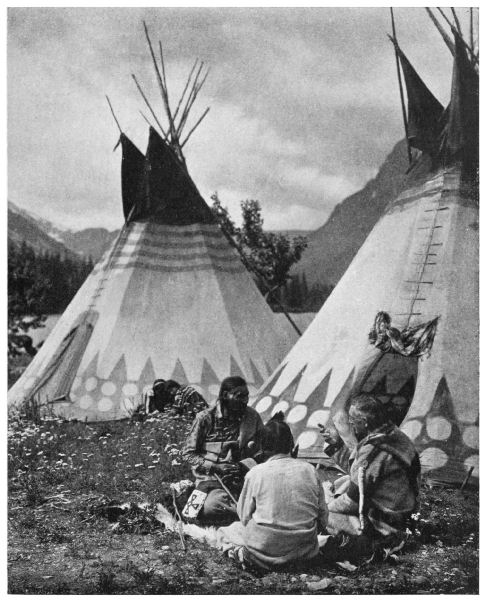
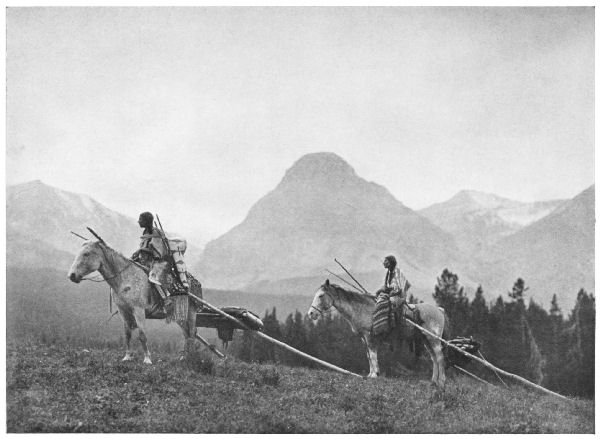
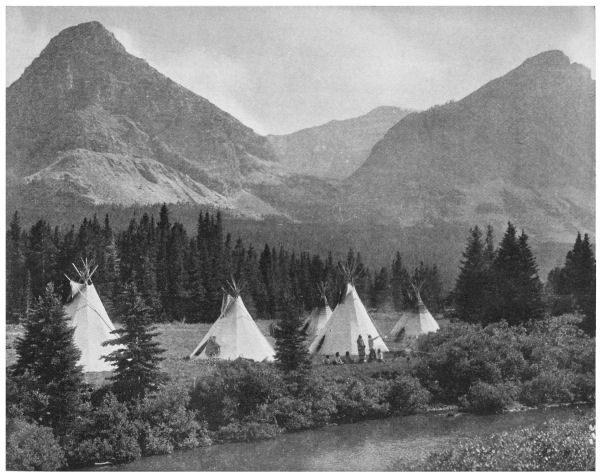
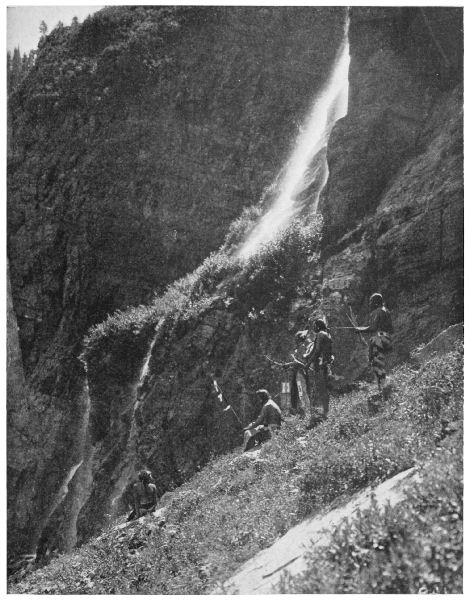
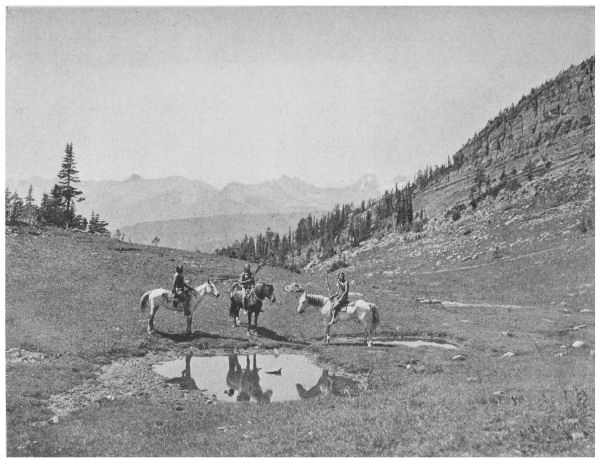
WE left Little River on the 5th,
crossed the big ridge dividing the
Arctic and the Atlantic waters, and
made camp here on the big prairie at the foot of
the Upper St. Mary’s Lake.
In the old days this great valley, hemmed in
by gigantic mountains, was my favorite hunting
ground after the buffalo were exterminated and
there was no more sport to be had upon the
plains.
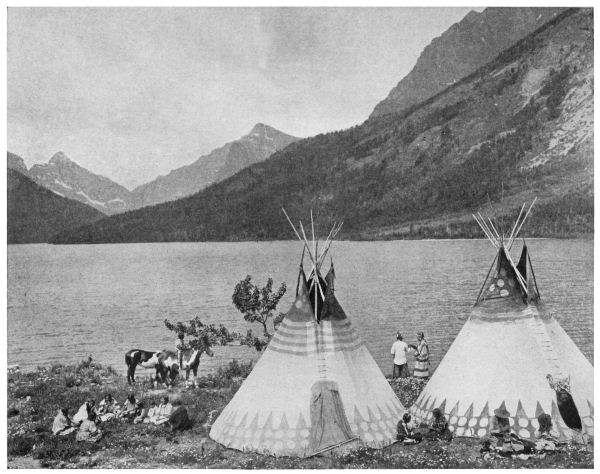
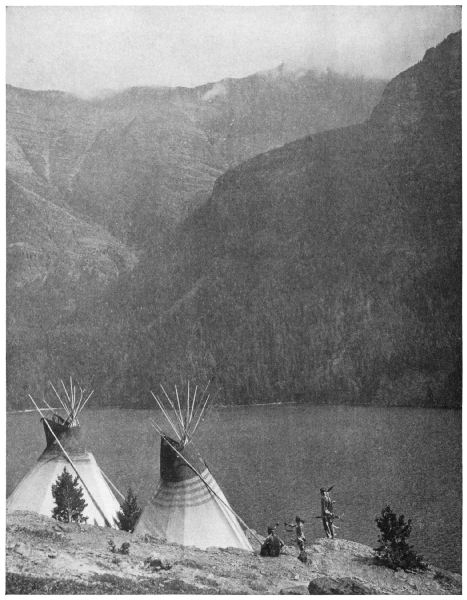
CAMP NEAR LOWER END OF UPPER ST. MARY’S LAKE
Hugh Monroe, or Rising Wolf, was, of course,
the first white man to see these most beautiful of
all our Northern Rockies lakes; with the Piegan
Blackfeet he camped at them in 1816, and long
afterward, with his growing family of hardy sons
and daughters, this became his favorite hunting
and trapping ground. When, in the 1830’s, that
147]
valiant and much beloved missionary, Father
De Smet, S.J., was visiting the various tribes of
this Northwest country, Monroe was engaged to
take him to a conference with the North Blackfeet,
then camping on the Saskatchewan River.
En route they camped at the foot of the lower of
these lakes, and there erected a large wooden
cross, and named the two sheets of water, St.
Mary’s Lakes. Later on, the Stevens expedition
named them Chief Mountain Lakes, but that
name did not last. Monroe and his brother
trappers were all Catholics, and they continued
to use the name that the great priest had given
them, and on the maps they are St. Mary’s
Lakes to-day.
During my long friendship with him, Monroe
told me many stories of his adventures here
in early days. This was his favorite mountain
resort on account of the great numbers of moose
that inhabited the heavily timbered valley and
mountain slopes, and of the great variety and
numbers of fur animals that were found here.
The valley swarmed with elk and deer; there
148]
were countless flocks of bighorn and goats on
the mountains, and herds of buffalo everywhere
along the lower lake, and below it; but Monroe
liked best of all the flesh of moose, and killed
large numbers of them every season that he
camped here.
His method of catching wolves was simple
and unique. He would build an oblong, pyramidal
log pen about eight by sixteen feet at the
base, and eight feet in height, the last layer of
logs being placed about eighteen inches apart.
Easily climbing the slope of this, the wolves would
jump down through the narrow aperture at the
top to feed upon the quantities of meat that had
been placed inside to decoy them, but they could
not jump out. Often, of a morning, the trapper
and his sons would find ten or more big wolves
imprisoned in the trap, and, powder and ball
being very costly, they would kill them with bow
and arrows, skin them, and drag the carcasses
to the river and cast them into it, then take the
hides home and peg them on the ground to dry.
In this manner they would often, in the spring,
149]
have several hundred wolf pelts to pack in to
Fort Benton for sale, and prime pelts sold at
five dollars each, in trade. Their catch of beaver,
otter, mink, martin, and fisher was also large.
Monroe always camped at the foot of the lower
lake, near the outlet, and was there more than
once attacked by roving war parties of Assiniboines,
Crows, and even the Yanktonais. The
horses were kept at night in a strong corral just
back of the lodge, and in the daytime were
watched by some member of the family while
they grazed on the rich prairie grasses. All the
family—John and François, the sons, Millie and
Lizzie, the daughters—and even the mother
had guns, flintlocks, and a good supply of powder
and ball. Early one morning a large war party
was discovered approaching the camp, sneaking
from bush to bush, some crawling on all fours
through the high grass. Lizzie opened fire upon
them and killed her man, and then the fire became
general on both sides. But the Monroes,
in their trenches surrounding the lodge, had the
best of it from the start, and eventually made
150]
the enemy retreat with a loss of five of their
number. Late the following night the Assiniboines
crept in to make another attack, but the
Monroes were expecting them, waiting for them,
and in the bright moonlight could take fairly
accurate aim. They again drove them off, with a
loss of two more of their number, and that time
they kept going. Nothing more was seen of them.
But for some days the Monroes did not venture
far from their camp.
I first saw the St. Mary’s Lakes in October,
1882, in company with Charles Phemmister,
James Rutherford, Charles Carter, and Oliver
Sanderville, all old plainsmen, good company,
and best of hunters. We outfitted for the trip
at the Old Agency, on Badger Creek, Blackfeet
Reservation, and started northward. There was
no trail after leaving the crossing of Little or
Milk River, and we struck up country toward
the big gap in the mountains, in which we knew
the lakes must lie, and that evening camped on
the shore of a large prairie lake that was black
with ducks. I shot a dozen or more of them as
151]
they flew over a long point, and to my surprise
and delight found that they were all canvasbacks
and redheads, and very fat from feeding upon
the wild celery beds of the lake. I named the
sheet of water Duck Lake.
The next day we made a trail down the long
hill, and camped at the foot of the lower lake,
close to the outlet. Then began two weeks of
most glorious sport. We shot elk, deer, and
several grizzlies in the valley, and bighorn on
a mountain that I named Flat Top, and combed
that mountain from one end to another and on
all sides for an animal known to us as the Rocky
Mountain ibex. We had seen several skins of
them, bought from the Stony Indians by Captain
John Healy, of Fort Whoopup and Fort Benton
fame, but none of us nor any man of our acquaintance—and
we knew every trapper and trader
in the country—had ever seen one of the animals
alive. Of course we found none, as this sub-Arctic
animal, which we later learned is a true
antelope, and not an ibex or goat, seldom leaves
the high cliff mountains for the outer and lower
152]
ones of the range. When, later, we did find them,
we in our ignorance named them Rocky Mountain
goats, and that is the common name for
them to-day, despite the fact that they are antelopes.
On this first visit to the St. Mary’s Lakes
country I was so impressed by the grandeur of
its mountains, the beauty of its many lakes, and
its plenitude of game, that thereafter for many
years it was, more than anywhere else, my home.
In 1883 I brought out to the lakes a good boat
that I had had built for me at Fort Conrad, and
with it learned that both lakes were alive with
whitefish and Mackinaw, Dolly Varden, and
cutthroat trout. During the summer of this
year I named Red Eagle Mountain and Red
Eagle Lake, after my uncle-in-law, Red Eagle,
owner of the Thunder medicine pipe, and one of
the most high-minded, gentle-hearted Indians
that I ever knew. In the autumn of this year
Dr. George Bird Grinnell joined me, and we
hunted around the lower lake, and went up Swift
Current far enough to see what we thought
153]
would possibly prove to be a glacier. We had not
then time to learn if our surmise was correct.
During our hunt Dr. Grinnell killed a large ram
at long range, offhand, with one shot from his
old Sharp’s rifle, on the mountain next above
Flat Top, and I therefore named it Single-Shot
Mountain.
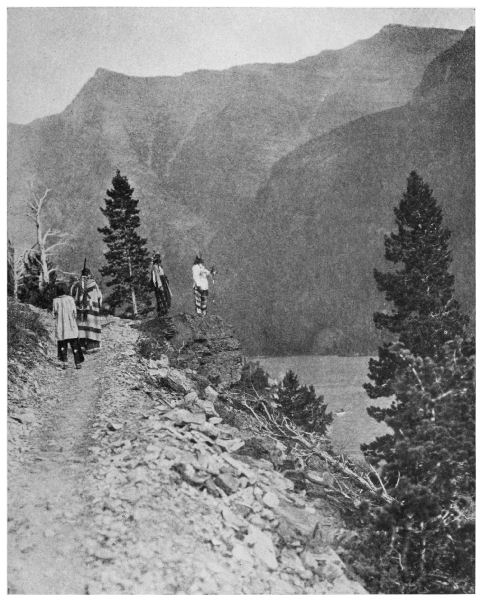
AT THE NARROWS. UPPER ST. MARY’S LAKE
In the summer of this year I also named Divide
Mountain, because it is the outermost mountain
on the Atlantic-Arctic watershed. At the same
time I named Kootenai Mountain, also for a
very good reason. Some members of that tribe
were encamped beside me at the foot of the upper
lake. I noticed often that they would ride out of
camp at daylight and return at noon or a little
later with all the bighorn or goat meat that their
horses could carry, and finally I asked them where
they went to make their killings so quickly.
“Come with me to-morrow and I will show
you something,” one of them answered. And the
next morning I rode with him up Red Eagle
Valley and part way up a mountain, where we
tied our horses and went on afoot for a couple of
154]
hundred yards. Then, looking down into a
coulée, we saw a dozen or more bighorn in the
bottom of it and killed four of them. They had
been eating salty clay and drinking from a salt
spring that oozes from the ground there, so I
named the place Kootenai Lick, and also gave
the mountain the name Kootenai. Thereafter
I knew where to go for bighorn when I wanted
one.
In 1884 I named Almost-a-Dog Mountain,
after one of the few survivors of the Baker
massacre, which took place on the Marias River,
January 1, 1870. At that time Colonel E. M.
Baker, with a couple of companies of cavalry
from Fort Shaw, Montana, was trying to find
the camp of Owl Child, a Piegan Blackfoot, and
murderer of a settler named Malcolm Clark, and
arrest him. By mistake he struck the camp of
Heavy Runner and his band of friendly Indians,
and, although the chief came running toward
him waving his letters of recommendation and
his Washington medals, Baker ordered his men
to begin firing, and a terrible massacre ensued,
155]
the Indians firing not one shot in defense, as
about all the able-bodied men were at the time
on a buffalo hunt. When the firing was over,
two hundred and seventeen old men and women
and children lay dead and dying in their lodges
and in the camp. The soldiers then shot the
wounded, collected the lodges and property of
the Indians in great piles, and set fire to them
and departed.[9]
In the autumn of 1885 Dr. Grinnell, J. B.
Monroe, and I made a trip up Swift Current
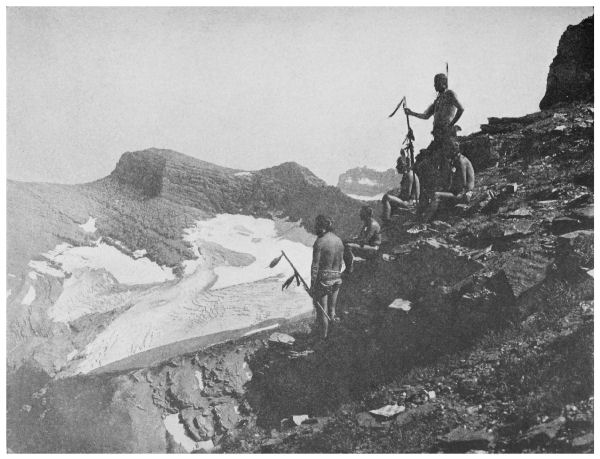
River, and discovered and roughly measured the
big glacier at the head of its middle fork, Dr.
Grinnell killing a big ram on the ice while we
were traversing it and avoiding its deep crevasses.
That evening Monroe and I named the glacier
in honor of Dr. Grinnell, and also named the
mountain to the north of it after him. On the
following day we were joined by Lieutenant—now
Major—J. H. Beacom, Third Infantry,
and he gave my Indian name, Apikuni, to the
156]
high mountain between Swift Current and the
South Fork of Kennedy Creek. Upon our return
to Upper St. Mary’s Lake, Dr. Grinnell named
Little Chief Mountain, Monroe gave Citadel
Mountain its name, and I named Yellow Fish,
Goat, Going-to-the-Sun, and Four Bears Mountains.
Yellow Fish (O-to-ko′-mi) was an Indian
who often hunted with us, and Four Bears (Nis-su′-kyai-yo)
was the Blackfeet camp crier, and
a most amusing man.
It was in 1886, I believe, that we three, and my
old-time friend, William Jackson, one-time scout
for General Custer and General Miles, cut a trail
to the head of the St. Mary’s Valley and discovered
the great sheet of ice which we named the
Blackfeet Glacier. We at the same time named
Gun-Sight Pass, and named the peak just west
of the glacier, Mount Jackson. It should be
Sik-si-kai′-kwan (Blackfeet Man), Jackson’s Indian
name. He was a grandson of Hugh Monroe,
a real plainsman, and one of the bravest men I
ever knew.
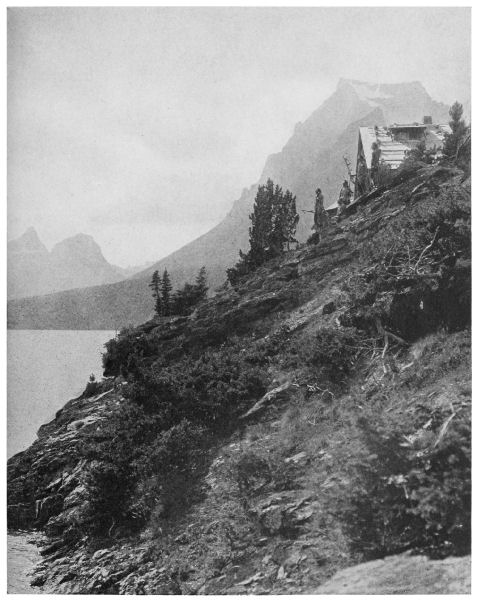
GOING-TO-THE-SUN MOUNTAIN
Going-to-the-Sun has been climbed this day,
157]
and a flag has been planted upon its summit,
by Paul E. Walker, Esq., of Topeka, Kansas.
Owing to a high cliff upon its upper shoulder,
the mountain has always been considered unclimbable.
But after long search, and with no
little risk, Mr. Walker finally worked out a
way up the wall, and out upon the extreme
crest, and was undoubtedly the first man, white
or red, ever to stand there. He reports that a
magnificent view of the mountains and plains
is to be had from the great height.
We have more real meat in camp. Yesterday
Black Bull went up under the north point of
Flat Top Mountain, which is on the Indian Reservation,
and killed two fat young rams. I went
fishing, and in the first pool of the river below the
upper lake, caught several two- and three-pound
cutthroat trout. We had a great feast in the
evening—roast bighorn ribs, broiled trout, a
quantity of blueberries, and so on.
After the feast was over came story-telling
158]
time, and we heard this man’s and that man’s
experiences in hunting in this vicinity in other
days, Tail-Feathers-Coming-over-the-Hill relating
a hard experience that befell him when once
wintering here with me. He was chasing a
wounded elk on the slope of Single-Shot Mountain,
and stepped upon a sharp, snow-covered
knot that pierced his foot through and through,
and kept him laid up for two months. Yellow
Wolf then related an old-time tale, which incidentally
gave the reason for naming these two
sheets of water the Inside Lakes. He called it,
he said,—
“In that long-ago time when the people had
only their great, wolf-like dogs for carrying their
belongings, there were two very poor orphans, a
brother and sister, in the camp. The boy was
very deaf, and because he seemed not to understand
what was shouted at him, he was believed
to be crazy, and not even the relatives of his dead
father and mother cared to have him in their
159]
lodges. One would keep him for a time and tell
him to go, and then another relative would take
him in for a short time, and, getting tired of him,
send him on to another lodge. And wherever he
went, his beautiful young sister went with him.
Often, in good weather, when camp was moved,
the two would stay at the old camp-ground, living
on cast-away meat so long as it lasted, and
then they would overtake the camp and go into
the nearest lodge, and at least be sure of a meal.
They were generally barefooted and always
shabbily dressed. It was a hard life that they led.
And because he was so deaf, and believed to be
crazy, the boy had not even one playmate in all
the camp, nor had his sister, for she knew that
it was her duty to be always at his side. There
came a time, however, when a childless woman,
wife of a great and rich chief, wanted the girl
to raise as her own daughter, and after many
days the boy persuaded her to be adopted, and
he was left alone and more lonely than ever.
“Not long after this separation, the camp
moved one day, and the boy, Long Arrow,
160]
remained at the old camp-ground to live there as
long as he could on the leavings of the people.
At last he finished the last scrap of thrown
away or forgotten meat and started to overtake
the camp. The day was hot, terribly hot, but
despite that the boy traveled as fast as he could,
often running, and perspiration streamed from
his body and his breath came short and fast in
loud wheezes. Suddenly, while running, he felt
something give way with a snap in his left ear, felt
something moving out from it, and reaching up
he pulled from it a long, round, waxy object that
looked like a worm. He held it in his hand and
ran on, and noted that with the left ear he could
plainly hear his footsteps upon the trail. A little
later something snapped in his right ear, and
began to move out of it, and he took from it
another worm-like substance, and keeping both
in his hand, ran on. He could now hear plainly
with both ears, and so happy was he that he felt
almost as though he could fly.
“But that was not all the good that was to
come to him that day. Early in the morning a
161]
hunter had left camp with his pack dogs, and
had taken the back trail in search of buffalo,
and just before the boy appeared he had killed
one, and was butchering it when he saw the boy
approaching him. This hunter, Heavy Runner,
was a chief, and one of the kindest men in the
whole camp. He had long thought to do something
for this boy, and now, when he saw him
coming, he said to himself: ‘The time has come.
I shall do something for him!’
“The boy came to him and his kill, and he
shouted to him, at the same time making signs:
‘Sit you down, my boy, and rest. You are wet
with sweat, and covered with dust. You must
be very tired. Take this piece of tripe and eat it.
And now let me tell you something: from this
day you are to be my boy. I adopt you. You
shall have a place in my lodge; good clothes; a
good bed. Try to be good, and deserve it all. I
am going to try to make a man of you.’
“‘Heavy Runner, your kind words make me
want to cry,’ said the boy, his voice trembling,
tears dropping from his eyes. He swallowed
162]
painfully, brushed away the tears, sat up straight,
and went on: ‘I shall be glad to be your son. I
will do all that I can to deserve what you give
me. And now, let me tell you something. As I
was running away back there on the trail, and
breathing hard, first in one ear, and then in the
other, something broke with a snapping noise
and out came these two worm-like things, and
at once hearing came to me. I believe that I
could hear a mouse walking if he were away
out there beyond your kill.’
“‘Now, that is good news, and a good sign!’
Heavy Runner shouted. He was not yet used
to the fact that the boy could hear. Then, remembering,
he said more gently: ‘You take a
good rest while I finish butchering this animal
and packing the dogs, and then we will each take
what meat we can carry and go home. Yes,
boy, you have a home now, and a good one.’
“That evening, when Heavy Runner told his
woman that he had adopted Long Arrow, she
made a great outcry: ‘How could you, and without
asking me, adopt that deaf, crazy boy?’
163]
she asked. And then, she cried, and said that
she would not have him for a son, and ran from
the lodge. People gathered around and pitied her
and said that she was right; that the boy was
crazy and deaf and worthless, and would not
mind, and as soon as he got good clothes he
would run off and again live at old campgrounds.
“After a time she went back to her lodge, and
as soon as she entered it Heavy Runner said
to her: ‘Now, at once, cease your crying, and
take the anger from your heart. I have adopted
this boy, and he is my boy. He is no longer deaf;
he was never crazy. He is a good boy and I shall
make a man, a chief of him. See that you treat
him well, even if you cannot love him. And believe
this: if you do not treat him well, you shall
be the one to suffer. To-morrow morning, begin
making some good moccasins for him. I, myself,
shall cut out his clothes, and he can sew them.’
“So began a new life for Long Arrow. If the
woman did not love him, she at least treated him
well. He did everything that he could think of
164]
to please Heavy Runner. He went hunting with
him, and brought home heavy loads of the meat
that he killed, and in every possible way was of
use to him. And yet he was not satisfied; he kept
saying to himself: ‘I want to do something great
for this man who is so good to me!’
“Time passed. The boy grew up to be a fine
young man; good of heart and of fine appearance;
and at last Heavy Runner’s woman loved him as
though he were her own son. But in one thing
he was very different from the other young men
of the camp: he made no close friends, and when
not needed by Heavy Runner he wandered much
by himself. Excepting his sister, whom he frequently
took for long walks, he had little to
say to any one, and so the people, all but she and
his foster parents, continued to believe him
crazy.
“One evening he said to Heavy Runner: ‘Tell
me. What must one do to become a chief?’
“‘One must be very brave, must be fearless
when facing the enemy, and of very kind heart;
full of pity for the poor and the old and the sick,
165]
and always anxious to help them,’ the chief
replied.
“‘Well, I want to become a chief. What is
the first thing for me to do?’ he asked.
“‘The first thing to do is to go to some far and
dangerous place, and get your medicine. That
is, something that will make you favored by the
gods, and bring you good luck in battle, and in
all matters of life,’ Heavy Runner told him.
“‘That I shall do,’ said the young man, ‘but,
first, will you not call in the chiefs, and the
medicine men and braves, and let me hear from
them where they went, and what they did to get
their medicine? I shall then have a better idea
of what I am to do.’
“‘We will have in our lodge full of them,’ Heavy
Runner said. And the next morning he shouted
out invitations for a smoke, asking only the great
of the tribe to come to it. They came, filling the
lodge, and then, when the pipe was going the
round of the circle, he told why he had invited
them to the smoke; asked them to give their
experiences in their search for medicines.
166]
“One after another they told their adventures;
where they went; what they did; what they saw;
what narrow escapes from death they had. And
at last it came Spotted Bear’s turn. But he refused
to give his experience.
“‘What,’ he cried, ‘tell that crazy youth
about my adventure? Why, I wouldn’t waste
my breath on him!’
“‘But he is a poor boy; he wants to know; you
might tell it him in a short way,’ pleaded Heavy
Runner.
“‘Well, I will tell it; not for his benefit, for he
is crazy, and would not understand; but I will
tell it so that you all may know what I did,’ the
surly one answered.
“‘From this very place I traveled southward
along the foot of the mountains. Seven days and
seven nights I traveled, stopping only now and
then for a short rest and sleeping very little, and
on the morning after the seventh night I arrived
at the shore of a small lake. There I met a
stranger man who asked me what I sought, and
I told him that I was wandering in search of a
167]
strong, a powerful medicine. “Ah!” said he,
“in such a matter I cannot help you. Go on
south for three days and three nights, and you
will find a man who will give you what you seek.”
“‘I went on. Stopping only for short rests,
and rarely sleeping, I traveled south for three
days and three nights from that place, and in the
morning after the third night arrived at a long,
wide lake running away back in the mountains.
I looked at it, looked at the mountains, turning
this way, that way, and when I turned a last
time, lo! there in front of me stood a man, fierce
of face, dressed in beautiful strange clothing,
wrapped in a robe such as I had never seen before,
and carrying a spear with a big, flint point.
“‘“What do you here?” he asked. “Are you
not afraid to come to this, the home of us gods
of the deep waters?”
“‘I answered that I was not afraid; that I
feared neither gods nor men, nor any animal of
the earth, the sky, or the deep waters. And at
that he cried out: “You are brave! The brave
shall be rewarded! Come with me!”
168]
“‘I went with him to his lodge. I am promised
to secrecy; I dare not tell you where it was. He
took me in and fed me, and gave me this robe
that I am wearing, this medicine robe, and taught
me the prayers and ceremony that goes with it.
I asked him what kind of a robe it was, and he
answered that it was the skin of an elk-dog;[10]
an animal as large as an elk, and, like the dog,
useful for carrying burdens. The gods, he said,
rode them, guided them wherever they wanted
to go.
“‘Said I: “May I have one of those elk-dogs
to ride home?”
“‘“No! They are only for the gods to use,”
he answered, and told me to go. I came home. I
have the robe. Here it is, proof of all that I have
told you. Ah! And this crazy youth would know
where I went, what I did! It is to laugh to think
of his going there!’
“The pipe went a last round, and then the
chiefs and medicine men and braves went home.
As soon as they were gone Long Arrow said to
169]
Heavy Runner: ‘My chief, you know that I am
not crazy. I feel that I must go on adventure,
and I want to go where Spotted Bear went, and
prove to him that I can go as far and face as
many dangers as he did. Will you let me go, and
keep secret from every one whither I have gone
and for what purpose?’
“‘What you propose is just what I want you
to do,’ Heavy Runner answered. ‘You shall
start to-morrow, taking with you all the moccasins
and other things you will need, and your
foster mother and I will tell no one anything
about you.’
“At break of day the next morning, while all
the people of the great camp still slept, Long
Arrow started on his journey of discovery.
Straight south he went, by day and by night,
resting and sleeping at long intervals, and then
only for a very short time. On the third day he
arrived at the small lake that Spotted Bear had
mentioned, and there met the man of that place,
even as he had done.
“‘What seek you?’ the man asked.
170]
“‘Knowledge! Medicine! The way to become
a chief!’ Long Arrow answered.
“‘I cannot help you. Go on south for seven
days and seven nights, and you will come to a
great lake, and there you will meet a man who
can help you if he cares to do so. It may be that
he will not even show himself to you, but anyhow
it is worth your while to go there and try
to meet him.’
“Long Arrow went on for seven days and
seven nights, resting and sleeping less than ever,
eating nothing except now and then a piece of
dry meat not so large as his hand. Early in the
morning after the seventh night, exhausted,
hardly able to drag one foot after the other, he
came to the great lake, and some distance back
from its shore fell down on the grass and fell
into a sound sleep. It was late afternoon when
he awoke, and, opening his eyes, he was surprised
to see a boy standing beside him. He
was a beautiful child, by far the most perfect
of form and feature that Long Arrow had
ever seen; so beautiful that it did not seem
171]
possible he could be of this earth, a child of
the people of this earth.
“Said the boy to him: ‘I have been waiting
here a long time for you to awake. My father
invites you to his home.’
“‘I shall be glad to visit him,’ Long Arrow
answered, and sprang up, put on his weapons,
and was ready.
“The boy led him straight to the shore of the
lake, and there cried out: ‘Do not be afraid,
follow me!’ And having said that, changed into
a snipe, entered the water and disappeared.
“Long Arrow was afraid, terribly afraid of the
deep, dark water, and the mystery of a place
where a child could suddenly become a snipe.
But he said to himself: ‘If I fail in my search
for a medicine it shall be through no fault of
mine,’ and he entered the water. Lo! it did not
wet him; did not touch him. It parted before
him and he went on down the sloping, sandy
bottom of the lake, and soon saw, close ahead, a
large, fine lodge, on which were painted in red
and black the figures of two strange animals.
172]
The boy, arrived at the doorway of the lodge,
changed suddenly from a snipe back to his natural
self, and cried out: ‘Follow me! Here you
will be welcome,’ and went in. Long Arrow,
following him, found himself facing a fine-looking
man at the back of the lodge. He was sitting
cross-legged on his couch, and wore a beautiful
black robe which entirely covered his legs and
feet. ‘You are welcome here, my son, be seated,’
said the man, and told his wife to prepare food
for his guest.
“Long Arrow looked about him. On all sides
the lodge was hung with beautiful shields, war
clothes, weapons, handsomely painted and fringed
pouches of sacred medicines, and a porcupine-quill
embroidered belt of such brilliant colors
that it shamed the rainbow.
“The woman of the lodge soon set food before
Long Arrow, and, having long fasted, he ate
largely. The man then filled and lighted a pipe,
passed it to his guest, and said: ‘I knew that you
were coming, and I wondered if you would have
the courage to follow my son from the shore of
173]
this lake down here to my lodge. Not long ago
a man of your people came here, but he was
afraid; he would not follow my son. And there
he made a great mistake. I was going to give
him the most valuable present ever given by
gods to men. As it was, I went out to him where
he sat far back from the shore, and gave him the
tanned hide of an elk-dog, and sent him home.
He was not worthy of a better present. But
you are different. I shall give you something of
great value. Remain here with us a few days.
My son shall show you my band of elk-dogs;
you shall hunt and kill meat for us; and when
you go, then you shall have the great present.’
“The boy went out with Long Arrow and
showed him the elk-dogs. They came running
from the timber out upon the open prairie at the
foot of the lake, and were a wonderful sight.
They were far larger than an elk, of shining black
color, had tails of long hair, and there was long
hair all along the top of their necks and hanging
down their foreheads from between their restless
ears. They were of all sizes, from suckling
174]
young to old males and females, and all were
very fat and playful, even the oldest of them.
“‘Young man of the earth,’ said the boy, ‘if
you are wise and watchful, these animals and
my father’s black robe and his many-colored
belt may be your present: the three go together.
You have noticed that my father always keeps
his feet covered with the black robe; that when
he arises and goes out of the lodge he is very
careful to keep the robe lowered around him,
like a dragging woman’s dress, so that his feet
cannot be seen. Well, you have but to see those
feet, and anything that you ask for will be
yours.’
“‘I shall do my best to see those feet,’ said
Long Arrow.
“Several days passed. The old people of the
lodge were very kind to Long Arrow, and he in
turn did his best to please them, hunting most
all of the time and bringing in much meat. And
what time he was not hunting, he would sit close
to the herd of beautiful elk-dogs and watch them
feed and play. When in the lodge he watched
175]
closely for a sight of the old man’s feet, but he
ever kept them closely covered.
“At last, one evening, the old man started to
go out of the lodge, keeping his robe well down
upon the ground about him, but as he stepped
over the low front of the doorway his right knee
raised the robe and Long Arrow saw his left
foot; and lo! it was not a human foot: it was
the hoof, the round, hard hoof of an elk-dog! He
gave a cry of surprise at the sight, and the old
man, realizing what had happened, exclaimed:
‘Hai-yo! How careless of me! Well, it cannot
be helped, it must have been fated that he should
see it!’
“He went on out, and upon returning took no
pains to conceal his feet: both of them and the
ankles were those of the elk-dog.
“‘Well, you have seen my feet, so you can now
tell me what I shall give you,’ said the old man,
as he resumed his seat.
“‘Now, don’t hesitate; speak right out; ask
for the three things,’ whispered the boy.
“And Long Arrow, taking courage, answered:
176]
‘Give me three things: your black robe, your
many-colored belt, and your elk-dogs.’
“‘Ha! You ask a great deal,’ the old man
cried, ‘but, because you are brave and good-hearted
and not lazy, you shall have the robe
and the belt and a part of my band of elk-dogs.
The robe and the belt are the elk-dog medicine.
Without them you could never catch and use the
animals. There are many prayers and songs and
a long ceremony that go with them, and I have
to teach it all to you. When you have thoroughly
learned them, then you shall go home with your
presents.’
“Long Arrow was many evenings learning
them all, but at last he could repeat every one
of them perfectly, and dance the dances as well
as the old man himself, and finally the latter
told him one evening:—
“‘You have done well. I am glad that my
elk-dogs and my medicines are to be in your
hands. You may start for home to-morrow.
And now, listen! Take good heed of what I am
about to tell you.
177]
“‘When you leave here, wearing the black
robe and the belt, you are to travel for three
days and three nights and never once look back.
When you rest, you are to face the north. Be
sure, now, that, traveling or resting, you never
once look back. The elk-dogs will not at first
follow you, but on the third day of your homeward
journey you will hear them coming behind
you. Even then you must not look back, but
keep on walking. After a time they will come
on right beside you, and with a rope that I shall
give you, you will catch one of them and mount
and ride it, and all the others will follow you.
They will always do that so long as you have the
black robe. Lose that, and you lose your animals;
they will become wild, and you will never be
able to catch and train them.’
“‘As you say, so shall I do,’ Long Arrow
answered.
“And early the next morning the old man gave
him the robe, the belt, and a rope made from
the head hair of buffalo bulls, and he started for
home, keeping ever in mind and obeying carefully
178]
the old man’s instructions. At times he had his
doubts of the old man. Perhaps a big joke was
being played upon him; the elk-dogs would not
come on the third day, nor any other day! But
he would soon cast off such thoughts, and go on
with renewed faith that all would be well with
him.
“And on the third day he heard behind him
the thunder of many hard hoofs upon the hard
plain; the occasional whinnying that he had
learned to love so well! And then, an old female
leading them, the elk-dogs came close up beside
him, and he caught and mounted one of them,
and rode on. How happy he was! He realized
what this would mean for himself and for the
people. These elk-dogs would rapidly increase in
number; there would soon be enough of them for
all the people, and then they would ride instead
of walk, and their lodges and all their belongings
would be carried by the animals. ‘And now I can
do something for those who have been so good to
me,’ he said to himself, and rode on, singing the
new songs that he had learned.
179]
“It was late in the afternoon on the day that
he approached the camp. All the men had returned
from the hunt; every one was outside the
lodges, resting in the warm sunshine. The first
to discover him gave a shout of surprise and
alarm. All the people sprang up and stood gazing
at the strange sight. They asked one another
what the strange big black animals could be?
And was it really a man sitting astride one of
them?
“‘It is some fierce god bringing his fierce
animals to destroy us,’ shouted Spotted Bear,
the very man who had so contemptuously used
Long Arrow, who had not had the courage to
follow the boy-snipe into the water. Again he
cried out: ‘Surely it is an evil one coming to
destroy us.’ And he fled, and all the people fled
with him and took to the brush.
“Long Arrow rode into camp and dismounted
at Heavy Runner’s lodge, and all the elk-dogs
came up and crowded around him and the
one of them that he had been riding. ‘Heavy
Runner! Heavy Runner!’ he shouted. ‘Be not
180]
afraid! I am only your son, come back to
you!’
“Heavy Runner heard the well-known voice
and was no longer afraid. He came hurrying
from the brush, all the people following him, and
they all crowded around Long Arrow and his
strange animals. Said the youth then: ‘Only
father and mother that I ever knew, I have
brought to you, excepting one female and one
male, all these strange and useful animals. As
you see, they can be ridden; you will no longer
have to walk. Also, they will carry for you everything
that is yours. I am glad that I can give
them to you, both of you who have been so good
to me.’
“‘How generous of you!’ Heavy Runner cried.
But his wife could say nothing: she embraced
Long Arrow and wept.
“‘Where did you get the strange black ones?’
a chief asked.
“‘I will tell you all about it this evening; I am
cautioned not to talk about the gods in the daytime,’
Long Arrow answered. And after picketing
181]
the animal he had ridden on good grass, and
driving the others out from camp, he went into
the lodge and rested.
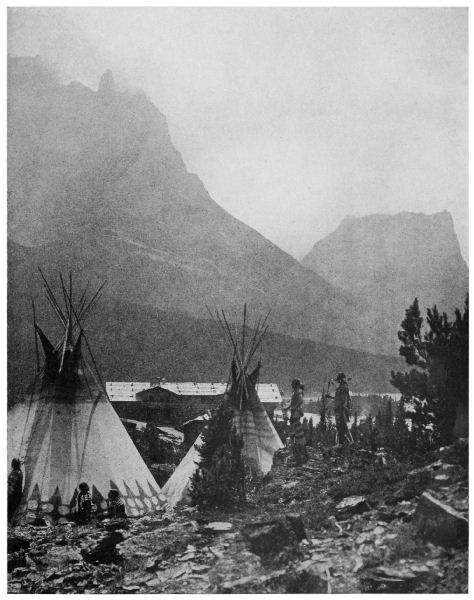
GOING-TO-THE-SUN CHALET, UPPER ST. MARY’S LAKE
“That evening all the chiefs and warriors
came into the lodge, Spotted Bear with them,
and he told all about his strange adventures,
of his life with the Under-Water People, and
how the old man had given him the elk-dogs,
and the black robe and the belt that he wore.
And, of course, he told about Spotted Bear’s
cowardice in failing to follow the boy-snipe into
the water, and he fled from the lodge, and his
chieftainship dropped from him as he fled. Ever
afterward he was no more than a woman in that
great camp; never again was he allowed to sit
with the chiefs and warriors! And when Long
Arrow had finished telling them all about his
wonderful adventures, the chief cried out: ‘We
will move camp to that lake of the Under-Water
People. They have more elk-dogs; we will ask
for them, give anything to obtain possession
of such valuable animals.’
“They moved south to the lake, but, search
182]
as they would, could find no elk-dogs, nor did
the boy-snipe nor any of the Under-Water People
appear, although the medicine men made sacrifice
to them and prayed them to show themselves.
They did discover, however, that above
this lake was another and a longer one, hemmed
in by still higher mountains, and so they named
the two the Inside Lakes, and that is the name
they bear to this day.”
Last night we all gathered in Stabs-by-Mistake’s
lodge, and, while the pipe was filled and
refilled, and passed from hand to hand on many
rounds, we had more tales, strange and weird, of
the people of the ancient days. One that our
host told especially interested me, and here it
is, literally translated for your perusal. It was
the story, he said, of
“It was in the long ago time, when all three
of our tribes, the Blackfeet proper, the Bloods,
183]
and we, the Pikun′i, whom the whites mistakenly
call Blackfeet, were still living in the North
country. The camp of the Pikun′i was on Big
River, close up to the foot of the mountains.
One of the great chiefs of the tribe was One
Horn. Very brave he was, and very rich, for his
band of horses numbered more than a hundred
head. He had two wives, sisters, but no children.
Many orphans called him father, for he had poor
old couples care for them, and kept them all well
supplied with meat and with skins for clothing.
He was a peculiar man, was One Horn. He seldom
visited in other lodges, and was a man of
few words; it was always difficult to get him to
tell of his brave deeds.
“One summer night One Horn had an uneasy
dream about his horses, and with the first faint
light of coming day arose, washed and dressed
himself, and took up his weapons and went out
to see if his herd was anywhere in sight. He
climbed to a little rise on the edge of the plain,
saw them quietly feeding at a distance, and then
saw something else: two men asleep in a coulée
184]
close under the little rise. They were, he thought,
young men of the camp, watchers of the horse
herds, and he concluded to surprise them and
scold them for sleeping when they should be
watching the plains for the approach of enemies.
More from habit than anything else, he drew his
bow, fitted a war arrow to it, and then, creeping
close to the sleeping ones, shouted: ‘Awake!
You lazy ones, awake!’
“To his great surprise they were two enemies,
who sprang up at the sound of his voice, and he
shot one of them in the breast, and he fell, and as
the other turned and ran, he fired an arrow at
him and struck him in the back, but he kept on
running, the arrow dangling and swaying from
his back, and he soon disappeared in the thick
brush bordering the river. One Horn went back
to camp and sent the warriors out to look for the
wounded man, but they never found him.
“Although a very brave warrior, One Horn’s
voice was always for peace. He thought much
about the wars of tribe against tribe and the great
loss of lives they caused, and wished that he
185]
could put an end to it all. He counted up the different
tribes with whom his people were at war—the
Sioux, the Assiniboines, Cheyennes, Pawnees,
Snakes, Bannocks, Pend d’Oreilles, Flatheads,
Nez Percés, Kootenai, and Crows. And
the worst of them all were the Crows. He determined
to go to the Crows and try to make peace
between them and his people.
“Another thought came to him: It was best
to say nothing to his people about his plan, for
many would make serious objection to it. If he
succeeded, they should know all about it upon
his return. If he failed, he would never tell them
where he had been. So, one evening, he gave his
women orders what to do, and kept his horses
close in around his lodge. Late that night, when
all the camp was asleep, down came the lodge,
the pack and travois horses were quietly loaded,
and he and his women headed southward, he
driving his big herd in the lead. The next morning
the people found that they had a mystery
that they could not solve: One Horn was gone
with all his belongings, gone without telling them
186]
one word of his intentions! Why had he left
them so secretly, and whither had he gone?
They never ceased talking about it and wishing
that he would return; they felt safe when he
was at their backs.
“Traveling south day after day along the foot
of the mountains, One Horn and his women at
last struck the River-of-Many-Chiefs-Gathering,
and, following it up, came in sight of the big
prairies at the foot of the lower one of these Inside
Lakes. It was then dusk, but not so dark but
what they could see that there was a big camp
of people at the edge of the timber bordering the
lake shore. Said One Horn, ‘They must be the
ones I seek, the Mountain Crows. As soon as
they sleep, we will go on and put up our lodge
near theirs.’
“Early the next morning an old man stepped
out from his lodge, and saw a strange lodge
standing by itself just outside the circle of the
big camp. He looked at it a long time, and the
growing light at last enabled him to see that there
were two huge bears painted on its new white
187]
leather skin. He turned and hurried to the lodge
of the head chief of the camp, aroused him, and
cried: ‘Here is a mystery; something to be looked
into: just outside the circle of our camp a strange
lodge is standing. It belongs not to us Mountain
Crows, nor to our brothers, the River Crows. I
know that, for it has painted upon it two big
bears, and neither of our tribes has that medicine.’
“The chief hurried to get up and dress, and so
did others, and they soon left their lodges and
approached the strange lodge. There was a fire
within it. Voices were heard in low-toned conversation.
Close around a few horses were
picketed, and farther out grazed a large band of
them, mostly grays and blacks. It was evident
that the owner of the lodge was a chief, a bear
medicine man, a very rich man. The Crow chief
thrust aside the door curtain of the lodge, and
entered, the others following. A fine-appearing
man at the back of it gave them the sign for
welcome, and motioned them where to sit. He
lifted a big filled pipe and lighted it, and passed
188]
it. The Crow chief smoked first, and then one by
one those with him.
“Having passed on the pipe, the Crow chief
signed to the stranger: ‘You are a Blackfoot?’
“‘Yes, I am a Blackfoot,’ One Horn answered.
‘You are wondering why I, an enemy, have come
here and set up my lodge beside you. You shall
know! I have come to try to make peace between
your people and my people. I am tired of all this
war, and its wasting of men’s lives, and making
women and children mourn.’
“‘You say well. Your talk deserves attention.
Peace between us would be good for us both.
I will talk to my people about it,’ said the Crow
chief.
“And just then One Horn’s women set before
him and the other Crows dishes of rich berry
pemmican, the best of dried meat and back fat,
and they ate with the outside chief. Then they
smoked again and went home, the Crow chief
saying that he would soon give a call for a council,
and would send for the Blackfoot to join in it.
“It was not until near sunset, however, that a
189]
youth came to invite One Horn to the Crow
chief’s lodge. He found assembled there all the
head men of the tribe, and the chief told him
that, after long talk, they had decided that they,
too, were tired of war, and would be glad to make
peace with the Blackfeet.
“‘But be not in a hurry to return home,’ the
Crow chief concluded. ‘Make us a long visit,
and during it we will decide together where and
when our two tribes shall meet to make this
lasting peace treaty.’
“Answered One Horn: ‘I shall be glad to
camp here with you for the rest of this moon.’
And all those present signed to him: ‘Yes. Remain
here with us for a time.’
“One Horn and the Crow chief became friends.
They hunted together, visited often in each
other’s lodge, and together were invited to other
lodges to feast and smoke, and join in the warriors’
tales of raids and battles and adventures
along far trails.
“The River Crows were at this time encamped
just over the ridge from the Inside Lakes, on
190]
Little River, and some of them came frequently
to visit their Mountain brothers at the foot of
the lakes. Among others came a man who was
always counting his coups. In a gathering of the
warriors he would wait until all had told what
they had done in war against their enemies, and
then he would count one coup, only one, that was
far greater than any of theirs.
“On a day when One Horn was visiting in the
Crow chief’s lodge, this man was one of the
guests. The talk was of war, and after many there
had told what they had done, he said that, with
a friend, he was approaching the Blackfeet camp,
and they were discovered and surrounded by all
the warriors of the tribe. His friend soon fell,
as full of arrows as a porcupine is full of quills,
but that he, charging this way, that way, shooting
arrows fast and killing many Blackfeet, made
them give way before him and he escaped from
them, although wounded in the back. Later on,
when safe from pursuit, he had drawn out the
arrow, and still had it, proof enough of the truth
of his tale.
191]
“This man then turned to One Horn, and said,
by signs, of course, ‘We have all of us here told
about our fights, and now it is your turn: tell of
your brave deeds.’
“‘I have nothing to say that will interest
you; mine have been just the common experiences
of those who go on raids. No, I have nothing
to say,’ he answered.
“‘But you must tell us one great thing that
you have done,’ the River Crow insisted.
“And again One Horn answered: ‘What I
have done would not interest you. I have nothing
to say.’
“The man then turned to the Mountain Crow
chief and said: ‘This is a poor kind of a friend for
you to have! He has done nothing; he is no chief,
he is a woman!’
“‘I do not know for sure, but I think that he
is a chief, that he has a big war record,’ the host
answered him.
“And then the guests went their several ways,
the River Crow laughing shrilly, contemptuously,
as he left the lodge.
192]
“It was not long after this that the River Crow
came over again from Little River, and again
was one of a party of guests in the lodge of the
chief of the Mountain Crows. Once more the talk
was of war, and when it came this man’s turn
to talk, he drew an arrow from his quiver, laid
it on the ground in front of him, and said: ‘There!
No one here, nor in the camp of the Mountain
Crows and the camp of the River Crows, has
ever equaled what that stands for. That is the
arrow that I drew from my back after my partner
was killed, and I fought my way single-handed
through the hundreds of Blackfeet warriors,
killing many of them, and so frightening them
that they dared not pursue me.’
“One Horn leaned over, looked at the arrow,
and gave an exclamation of disgust: ‘That is
my arrow,’ he signed. ‘I know this man now.
At dawn, one morning, I discovered him and his
partner asleep near our camp. I crept up to them
and shouted, thinking that they were our horseherd
watchers, and when they sprang up, I saw
that they were enemies. I shot one of them dead.
193]
This man turned and ran, never even firing at
me, and I shot an arrow into his back, but he
kept on going and escaped from me in the brush!
Yes. That is the very arrow I shot into him!’
“‘It is a lie! A big lie!’ the River Crow said,
and signed.
“For answer to that, One Horn went to the
door of the lodge and shouted to his women to
bring over his quiver of arrows. It was soon
handed in to him, and he said: ‘I have here two
kinds of arrows: hunting arrows and war arrows.
Here are the war arrows.’ And he laid them beside
the arrow in front of the boaster. All there
saw at once that they were exactly like it in
every way, had the same private mark just
back of the point. And suddenly, with jeers and
cries of ‘Liar!’ ‘Coward!’ they took handfuls of
ashes and earth from the fireplace and threw
them in the River Crow’s face and on his head,
and he ran for the door and was gone, leaving the
arrow behind. One Horn picked it up and put it
in his quiver, and said: ‘That no doubt ends his
lying bragging!’
194]
“Some days after this exposure of his lying,
the River Crow, watching his chance, entered
the lodge of the Mountain Crow chief and said
to him: ‘That Blackfoot has shamed me. I was
a chief, but now all people laugh at me. I want
revenge. Let me kill that friend of yours and I
will give you three of my best horses!’
“‘What you ask is impossible!’ the chief replied.
‘He is my friend! We have smoked together,
have eaten together. I cannot allow you
to kill him. And for your lying you deserve what
you got!’
“The River Crow sneaked away, but on the
next evening, when none but the chief and his
women were at home, he came again. And this
time he said: ‘Let me do what I want to do; you
know what that is; and I will give you five of my
best horses and my beautiful young daughter.’
“And this time the chief did not give him a
short answer. He thought over the offer for a
long time. He knew that it would be a terrible
thing to betray his Blackfoot friend, but the
temptation was great. His women were getting
195]
old. He wanted that beautiful girl. And at last
he gave way to the temptation: ‘It shall be as
you wish,’ he told the man. ‘All is arranged for
to-morrow; we go with the hunters on a big buffalo
hunt, and there will be no chance for you to
do what you want to do. Come the day after to-morrow
and I will help you—if you need my
help—to kill the Blackfoot.’
“Very early the next morning the hunters
started out after buffalo, One Horn taking with
him one of his women to help in the butchering
and packing in of the meat. They were no sooner
gone than one of the Crow chief’s women hurried
to One Horn’s lodge and told his other
woman all about the plan to kill him. She told
it because she was jealous; she did not want her
man to take another wife!
“So it was that, when One Horn came home
that evening, this wife ran to him and embraced
and kissed him as though she would never let
him out of her arms. This strong showing of love
was unusual with her, and he asked her the cause
for it.
196]
“‘Because to-morrow you are to die, and sister
and I are to become slaves. See now what you
have done by coming to try to make peace with
these Crows!’ And she told him all about the plot
to end his life.
“But One Horn just laughed: ‘Wipe away your
tears and take courage,’ he told her. ‘These
Crows will not kill me, a bear medicine man, and
a chief. They cannot kill me. I will show you
to-morrow something that will surprise you!’
“That night he kept his favorite war horse
picketed close to his lodge, and the next morning
he carefully dressed himself in his beautiful war
clothes, painted himself and his horse, took his
bow and arrows, his shield and spear, and rode
into the center of the big camp, and called upon
the Crow chief to come out. He did come out,
also dressed for battle, and One Horn cried out to
him, at the same time making signs, so that he
would be sure to understand, ‘Your plot is discovered.
So you and that River Crow are going
to kill me. Where is he? Call him. I want to fight
you both. I am a bear. I fight like a bear. Come!
197]
Hurry! Let us fight. Ha! I am going to fight
my true friend, the chief of the Mountain Crows,
he who smoked and ate with me, he who was going
to join me in making a lasting peace between
our two tribes. Come! Let us fight! Shall
it be on horseback or afoot? I give you the
choice.’
“The Crow chief gave him no answer. Some
of the people, looking on, were beginning to show
their anger and shame at his betrayal of a friend.
He turned and went back into his lodge, and
would not come out again.
“While this was going on, several men had
hurried to the River Crow man, stopping in the
far end of camp: ‘Your plan to kill the Blackfoot
is discovered, and he is dressed and armed and
mounted, waiting to fight you. He is like a raging
grizzly, and his, you know, is the bear medicine.
What are you going to do?’
“The man did not answer them. He mounted
his horse, and, hidden from One Horn’s sight by
the lodges, struck out for the River Crow camp
on Little River, and fear was with him. He often
198]
looked back to see if he were being pursued by
this dreadful bear medicine man who had once
wounded him, and was now so anxious to meet
him face to face.
“One Horn rode back to his lodge. ‘Take down
the lodge, pack up everything. We will not stay
another day with these treacherous Crows,’ he
told them, and rounded up and caught what
horses were needed for packing and riding.
“Just before they were ready to leave, the
Crow chief sent one of his women to say to One
Horn that he was sorry for what he had done,
very sorry that he had ever listened to the River
Crow, and wanted to make reparation. He
wanted to give his Blackfoot friend ten head of
horses.
“‘Tell him that I will not accept anything from
him,’ One Horn answered the woman. And he
and his outfit started for the north and were soon
out of sight of the Crow camp.
“Some days afterward they arrived at the camp
of their people on the Big River of the North, and
had no sooner set up their lodge than One Horn
199]
called a council of the chiefs and told them where
he had been and for what purpose.
“‘Although I accomplished nothing, I am glad
I went,’ he told them. ‘I now know the Crows.
They are liars all, and not to be trusted. I advise
that we begin a steady war against them.’
“The other chiefs agreed to that. Messengers
were sent to the brother tribes, the Bloods and
the North Blackfeet, and to the Gros Ventres,
friends of the Blackfeet, and the war was started.
Little by little, summer after summer, they drove
the Crows southward, killing many of them, and
were not satisfied until they forced them to the
country south of the Elk River,[11] where they have
ever since remained. So, because of their treachery,
the Crows lost a great and rich country.”
Not in many, many years have I been so affected
as I was this morning. For some days I
have had a high fever, and have slept but little
200]
at night. In-si-mak′-i (Growth Woman), Yellow
Wolf’s wife, had been doctoring me with the good
old remedy for fevers, sweet sage tea, but it
seemed to have no effect. So Tail-Feathers-Coming-over-the-Hill
announced that he would have
his Elk Medicine ceremony for my benefit, and
that he was sure that it would cure me of my illness.
We had it this morning, and to-night I
have a normal pulse and the fever has left me.
I will not go so far as to say that it was his prayers
that cured me,—prayers far better, far more
earnest than those of any Christian preacher I
ever heard,—but yet, I am well! To me, all
religions are nothing more than the codified
superstitions of the ages, but of them all, Christian
and pagan, I like best the faith of these, my
people, faith that the sun is the conservator of
all life and the orderly ruler of this, our earth.
And what absolute faith they have in their Sun-religion!
Should Christians live as closely to
their beliefs as the Blackfeet do to the laws of
conduct given them by their Sun god, what a
different, what a happy world this would be!
201]
Before I relate the details of the ceremony, I
must tell something of the medicine itself.
The Blackfeet believe that, when they lie
down and sleep, their shadows, or, as we say,
their souls, their spiritualities, leave the body
and go on far adventure. Their name for
this is Ni-pup′-o-kan (my dream; my vision);
and when they awake they really believe that
they have experienced all the incidents of their
dream, and relate them as having been of actual
fact.
When men and animals were first created, they
had a common language, and the latter had the
power to change themselves at will into the form
of man. It was in that long ago time that a man
seeking knowledge, and praying earnestly for it,
was in his vision visited by an elk in the form of
a man, whose name was Po-no-kai′-ût-sĭn-in-ah
(Elk-Tongue Chief).
“I have heard you praying, asking for help.
What is it you want? Perhaps I can help you,”
the elk man said.
The man answered: “I seek some way to relieve
202]
my people from sickness; some way to give
them long life and happiness. Help me if you
can do so.”
The elk man answered: “I can help you; I will
help you. Through what was given me in my
vision I am in great favor with the sun, and all
the gods of the earth, the deep waters, and the
blue above. That medicine you shall have. I
give it to you now!” And having said that, he
gave the man a painted lodge, a medicine pipestem,
beautifully decorated with a down-hanging
set of tail feathers of the sage hen, and wound
with strips of the fur of the bear and various water
animals. And with it, wrapped in clean buckskins,
were the skins of birds and animals, all
those that live upon the water and in the water,
and feed upon the life in the water, fish, and all
the various water insects. And having given the
man all this, he taught him how to use it, with
all the prayers and ceremonies that go with it.
The man took all this to his home, and used it,
and found that it was great medicine, and ever
since that time the Elk Medicine Lodge and the
203]
things that go with it have been handed down
from generation to generation, to this day.
So now we come to the ceremony that was
given to-day for the curing of my illness. It was
my lucky day! Early in the morning Mr. Herford
T. Cowling, chief photographer for the United
States Reclamation Service, arrived at the Great
Northern Railway Company’s St. Mary’s Camp
and I went to him and asked if he would take
moving pictures of the ceremony, provided the
Indians were willing to have him do it. He enthusiastically
replied that he would be very glad
to take it all in with his crank-machine, so I
went to my people to ask if they would permit
it to be done. They objected, saying that the
ceremony was so sacred that even the presence
of white people, antagonistic all of them to their
religion, would profane it. They did not count
me. I was one of them!
Said I: “Listen, my relatives, and brothers
all! We are all soon to die, and as we pass away
the whole of the old life goes with us. Your
children, taken away from you by the whites,
204]
put in school and taught the white men’s religion
and manner of living, will know nothing about
the way their fathers lived unless I put it all
down in writing for all time to come. That I am
doing. And how much more interesting it will
be if I can have pictures to go with it! Say yes!
Let us have, with this that you are to do to-day,
the living pictures of it all!”
There followed a long silence, all considering
my request. Finally, my best of friends, Tail-Feathers-Coming-over-the-Hill,
wiped tears from
his eyes, and said, brokenly: “Ap-i-kun′-i is right.
The whites take our children from us and teach
them false beliefs. But they teach them to read,
and it may be, that, after we have all gone on to
the Sand Hills,[12] they will read our brother’s
writings and see us as we were, making our
prayers to the gods, and, having read and seen
the pictures of it all, return to the one true faith.
I say, let the picture man come!”
205]
“Ai! Ai! Let him come!” all cried, and I sent
a messenger for him.
During the ceremony he took six hundred feet
of it, and so for all time to come is preserved
the interesting ceremony of the Elk Medicine.
The ceremony is always given in a closed
lodge, but this time we threw the front of it wide
open, so that the lens of that moving-picture
machine could take it all in.
As I have said, Tail-Feathers-Coming-over-the-Hill
is old, feeble, half-blind, and is himself
unable to go through parts of the ceremony. So,
on the evening before this came off, he sent for
Chief Crow and his wife, living near, to help
him out. Chief Crow is also a medicine man, his
wife, of course, a medicine woman, and he owns
the Seizer’s medicine pipe. Four other medicine
men were there, all of them taking part in the
ceremony. In each of the three tribes of the
Blackfeet there is a secret society of the medicine
men, and the members help one another in their
ceremonies, and they and they only can dance
with the sacred symbols of their rites.
206]
When I went into the lodge the sacred medicines
were hanging directly over the owner’s
couch, opposite the doorway. They were the
sacred pipestem and many skins of water animals
and birds enclosed in various wrappings,
and a buffalo rawhide painted pouch containing
sacks of various colored sacred paints. On Tail-Feathers-Coming-over-the-Hill’s
left sat his medicine
wife. I took my seat close to him on his
right. Back of me, and all around the right side
of the lodge from me, were a number of women.
On the other side, opposite them, were the men
and Chief Crow’s medicine wife.
The ceremony opened with a prayer by Tail-Feathers-Coming-over-the-Hill,
beseeching the
gods to look with favor upon what was to be
done. Then his wife arose and undid the fastenings
of the medicines, and slowly, reverently,
laid them on the couch between her and her
husband. The opening song then began, the song
of Po-no-kai′-ût-sĭn-in-ah (Elk-Tongue Chief).
Oh, how I would like to inscribe that song here!
Alice Fletcher says—and I know that she is
207]
right—that all Indian music is classical. But
their tonal scale is far different from ours; we
have not one musical instrument that can reproduce
it. Never, never lived a white man who
could sing these Blackfeet songs. As a boy, year
after year, I tried to sing them, and always
failed; one has to take them in with his mother’s
milk in order to sing them correctly.
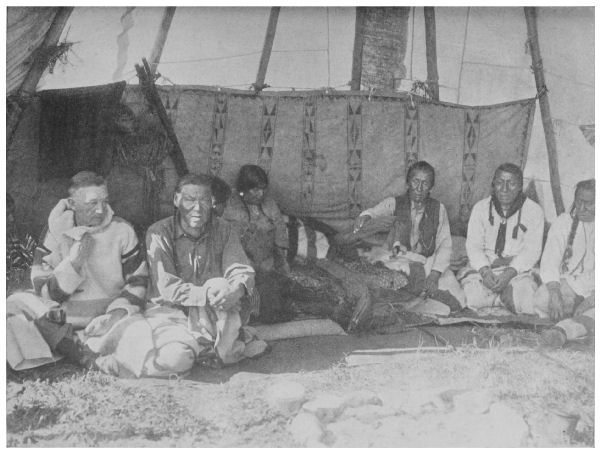
OPENING OF THE ELK MEDICINE PIPE CEREMONY
Left to right: The author; Tail-Feathers-Coming-over-the-Hill; his wife and the wife of Chief Crow, both medicine women;
Chief Crow, medicine man, lifting the sacred roll of the medicine pipe; Medicine Weasel and Old Boy, singers
The song ended. The medicine woman, with
a pair of sacred red-painted willow tongs, took
a coal from the fire, placed it just in front of the
sacred medicines, and dropped upon it a pinch
of sweet grass. It burned, and, as the perfumed
smoke arose, she and her man grasped handfuls
of it and stroked their bodies, thus purifying
themselves before handling the medicines. Then,
all present joining in, they sang the song of the
real bear, the grizzly, while the medicine woman
unfastened the outer wrapping of the medicine
pipestem roll, which was bound with a strip of
fur from a grizzly’s back; and at the same time,
in keeping with the time of the song, they made
the sign for the bear, closed hands held upon
208]
each side of the head, representing its wide,
rounding ears.
That song finished, the song of the buffalo
began, the medicine man and the medicine
woman clenching their hands and alternately
putting one out before the other, representing
the deliberate, ponderous tread of the animals
as they traveled to and from the water. When
that song was finished—and it was one to stir
one’s inmost soul—another wrapping, bound
with buffalo fur, was undone, and all present
besought the gods to have pity upon them.
Next came the fourth and last song, the song
of the beaver, chief of water animals. And while
it was being sung, the medicine woman unrolled
the fourth and last wrapping, and the sacred
medicine pipestem lay in sight of us all. At that
all the women gave shrill cries of triumph, of
victory; and all the medicine men beginning a
solemn chant to the Sun, Chief Crow advanced,
received from the medicine wife of my old friend
the sacred stem, and, extending the fan of
feathers drooping from it, held it aloft and
209]
danced in time with the song to the doorway of
the lodge and back again, and returned the stem
to my friend, who reverently took and embraced
it, and made a short prayer to the gods
for the long life, good health, and happiness
of us all, especially the little children of the
tribe.
Next came my part in the ceremony. My old
relative and friend felt around in his medicine
pouch, got out a small sack of a-san′, the sacred
red paint, and painted my face with it, at the
same time beseeching the gods to give me, his
brother, Ap-i-kun′-i, long life, good health, and
prosperity in all things. Then, having finished
the painting and the prayer, he had his wife hand
Chief Crow, his helper, the long red-painted
wooden flute that goes with the medicine, and
the latter, holding it aloft, danced with it almost
to the doorway of the lodge, where he blew several
soft, clear notes to the four corners of the
earth, and then returned the flute to the woman.
This was the Elk Medicine whistle, for imitating
the weird call of that animal, and was used just
210]
now to call him, the ancient Elk god, to give me
his favor, his pity. My friend then facing me,
upon his knees began the thunder song, in which
all joined, and, spreading his blanket-clad arms
wide to represent the thunder bird wings, hovered
before me, fanned me with his wings, the
intent being to waft to me from him the sacred
power. That over, all arose, and passing in line
from the lodge, Chief Crow leading, danced
through the camp and back again, and the
ceremony ended.
I cannot begin to express how I felt all through
the ceremony. I honored my people for their
sincere faith, their reverence for their gods. And
my thoughts went back to the time when they
were the lords of these plains and mountains and
knew not want. And not so very long ago they
were a tribe of three thousand members, and
now they number only eight or nine hundred,
and those who have gone have mostly gone from
want, from their susceptibility to disease because
of lack of proper nourishment. Do you
wonder that they feel bitterly toward the whites,
211]
who have taken from them everything that
made their life worth living?
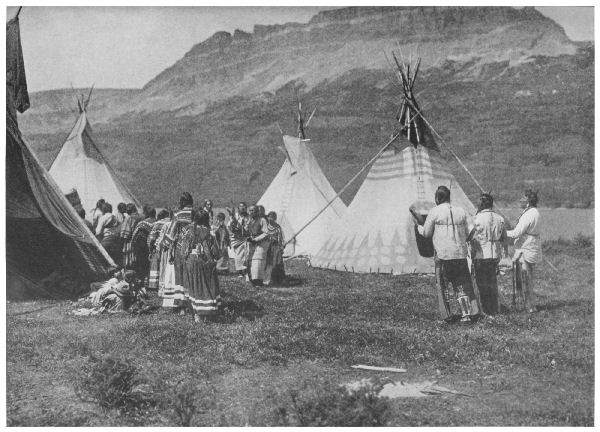
ELK MEDICINE PIPE DANCE
Chief Crow leading the column and carrying the sacred stem
Because we were to-day to embark upon the
deep, dark waters of this lake, we yesterday had
a little ceremony on the shore, beseeching the
dread Under-Water People to have pity upon
us and allow us to pass in safety over their domain.
We had a little fire close to the water’s
edge, and having filled and lighted his pipe with
a coal taken from it with his sacred red tongs,
old Tail-Feathers-Coming-over-the-Hill smoked
and made his prayers, at the same time casting
into the water a little sack of his medicines as a
sacrifice to the gods. It was a short ceremony,
but satisfied even the most timid of the women
that all would be well with them during their
voyage upon the lake.
And so, where we once had rude rafts of logs,
lashed together with rawhide ropes, we this
morning embarked in good boats and went all
up the beautiful lake, past Red Eagle, and Little
212]
Chief, and Almost-a-Dog Mountains to the head
of the lake, and looking back at the slope of
Milk River Ridge saw the far-apart, enormous
footprints of Heavy Runner, keeper of the
buffalo.
Away back in ancient times, after Old Man
had made buffalo and they had increased and
covered the plains, they had great desire to wander
westward and see what might be on the other
side of the great mountains. The people—the
Blackfeet—learning of this were greatly distressed.
The far side of the mountains, away
west and still westward to the shores of the
Everywhere-Water, was the country of their
enemies, many tribes of them, and should they
get possession of the buffalo herds they would
never let them return. What to do about it they
had no idea, so they called upon Old Man for
help.
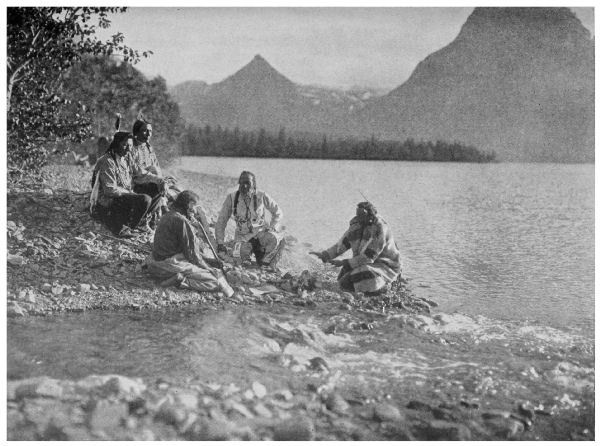
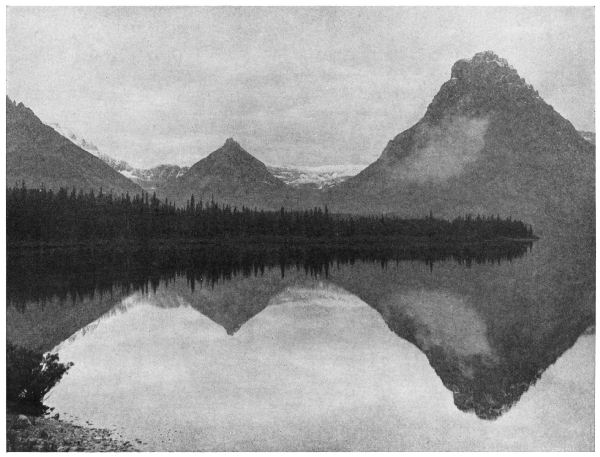
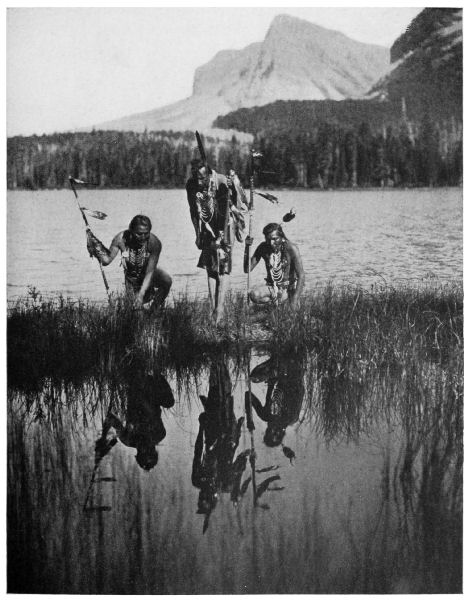
UPPER TWO MEDICINE LAKE
Tail-Feathers-Coming-over-the-Hill (with pipe) propitiating the dreaded Under Water People
Said he: “I made the buffalo to be plains animals,
and here upon these plains they shall remain,
and other-side tribes shall come to you
and ask permission to kill a few of them now
213]
and then. So, don’t worry. Go home now and attend
to your affairs. All shall be well with you.”
The people went home. They saw that the
buffalo remained upon the plains in apparently
as great numbers as ever. But some of the hunters,
to learn for sure if they were all there, ascended
the different passes of the mountains and
went down the other side for some distance.
There were no buffalo, not even a few straggling
bulls on the other side, and they wondered how
Old Man was keeping them back. They soon
learned. In a vision it was revealed to an old
medicine man that a huge god, a man of enormous
stature, was patrolling the mountains
from far south to the everlasting snow of the
north, and with a club driving the buffalo back
eastward as fast as they came anywhere near
the summit of the range. And so it was that the
other tribes—those of the west—never got the
buffalo.
On our way down the lake we passed the beautiful
Sun Camp and the chalets of the Great
214]
Northern, perched upon the very spot where
Tail-Feathers-Coming-over-the-Hill and I killed
many a bighorn and goat in times gone by. It
was a favorite wintering place of the animals,
for the winds kept the steep mountain slope
practically bare from snow. And passing the
mouth of the creek just above the camp, I remembered
that I had named it after Thomas,
and Colonel Robert, and the Honorable Cecil
Baring, of London, with whom I often hunted
back in the eighties. In those days there were
many bighorn and goats, and not a few grizzlies
back in the basin at the head of the creek. And
what amusing and sometimes exciting adventures
we had with them! One morning we espied
a big “billy” goat on a ledge, and just as we saw
him he moved to the back side of it and lay down,
showing only an inch or two of the top of his
back.
“Who will go up and rout him out, so that
I can get a shot?” asked Colonel Baring,
and Jack Bean, of Yellowstone fame, volunteered.
215]
It was to be a steep, almost straight-up climb,
so Jack laid down his rifle and started without
encumbrance of any kind. At last he reached
the shelf and stood up on it, and that “billy”
came for him, head down! And Jack! Never
have I seen a man come down a dangerous cliff
so fast as he did! And he kept coming, falling,
sliding, rolling, and then Colonel Baring fired
and dropped the goat, and man and animal came
the rest of the way to the foot of the place together!
We had been too much concerned for the
safety of our friend to laugh, but when he at last
stood up and faced us, bloody, half-naked, but
not seriously hurt, we roared. But Jack never
even smiled: “Who would have thought that a
blankety-blank goat would go for a fellow!” he
exclaimed; and he went to the creek to repair the
damages to his person.
On this day, halting here and there along the
lake, we took some views of the scenery and of
our people, and at sunset were back in our
lodges. For some of us it is a last trip over the
old, familiar ground. My two old friends,
216]
Tail-Feathers-Coming-over-the-Hill and Yellow Wolf,
must soon go on to their Shadow Land!
We were not too tired to-night for story-telling,
so, after the children had been put to bed and
all was quiet, Takes-Gun-Ahead gave us the following,
the story of tobacco, which is called
“In that long ago time when the earth was
young, and people had not long been made, a
man threw some weeds upon a fire and found
that the odor, the smoke from their burning, was
very pleasant. That night he had a vision and
learned that this plant was strong medicine;
that, when smoked in a pipe, which his vision
explained to him how to make, it would be the
right thing with which to offer prayers to the
gods. He also taught the man the prayers and
all the ceremony that went with the prayers; and
told him how to plant the weeds, from the seeds
on their tops, so that he could always have plenty
of it.
217]
“This man was very much pleased with what
he had learned. He went to his three brother
medicine men and told them all about it, and
the four of them formed a society of themselves
and no others, for the raising of the weed and its
proper uses. But they were very stingy with this
weed, which they named na-wak′-o-sis, and would
only now and then give the people a leaf of
it, although they raised large numbers of the
stalks in every summer time.
“A young man named Lone Bull was very
anxious to become a member of this medicine
society, but because he had no medicines and
knew not the rites of it, he was told that he could
not join it. At that time the camp of the people
was close under Chief Mountain. He left it, with
his woman and his pack dogs, and moved up to
the river running out of the Inside Lakes, and
there set up his lodge. Said he then to his woman:
‘I have come up here to get medicines; in some
way to find things that will enable me to become
a raiser of na-wak′-o-sis. If I can do that, I shall
be of great help to the people. Now, then, I am
218]
going to hunt and collect all the medicine skins
I can find, and you stay at home, take care of
the lodge, gather wood, and cook what meat we
need. I shall bring in plenty of fat meat along
with the skins.’
“The man went hunting every day, and the
woman remained at home. One day, when the
man was gone, she thought she heard singing;
beautiful singing; but look where she would she
could see no singers. She spoke to the man about
it when he came home that evening, and made
him feel uneasy: ‘If you hear it again, look about
more carefully,’ he told her.
“She heard it the next day, and this time located
it, right under the lodge. She went out
to the bank of the river and looked at the bank:
there, under the water, were beaver holes in it,
and beaver cuttings upon the sandy bottom, and
by that she knew that the lodge had been set
up above a bank beaver’s home, and that beavers
were the singers. She went back to the lodge,
lay down and put her ear to the ground, and
could then hear them plainly, and was pleased.
219]
Their singing was so good that it was all that
she could do to stop listening to them and begin
cooking the evening meal.
“When Lone Bull came home that night she
told him what she had learned, but he could hear
nothing, although he put his ear close to the
ground. Nor could he hear the singing the next
evening, nor the next, although his woman could
hear it plainly. So now the woman got her knife
and cut a round hole in the ground, and Lone
Bull laid his head in it and could then hear the
singing. He told her to make the hole deeper;
larger. She did so, and cut clear through the
ground, and looking down he could see the beavers
sitting in their home, singing beautiful
songs, and dancing strange and beautiful dances
in time to them.
“‘Younger brothers, have pity on me!’ he cried.
‘Oh, my young brothers, teach me your medicine!’
“They looked up and saw him, and one answered:
‘Close the hole that you have made,
because the light disturbs us, and we will soon
be with you.’
220]
“They soon came in through the doorway, four
fine-looking men, beautifully dressed. They had
changed themselves from beavers to men. They
took seats, and then one of them said to Lone
Bull: ‘Elder brother, what is it that you want of
us? How can we help you?’
“Lone Bull told them what it was: his great
desire to obtain na-wak′-o-sis and grow it for the
people.
“‘We have that plant; like us it is from the
water, a water medicine,’ the beaver man told
him; ‘but before you can use it you have much
to do, much to learn. You have to learn all our
songs and prayers and dances and different ceremonies,
and gather for the ceremonies a skin of
every animal and bird that is of the water, one
of each except the beavers, and of them there
must be two. You know these animals and birds:
otter, mink, muskrat; different kinds of ducks;
the fish hawk, and all the other birds that get
their food from the life of the water. Why? Because
there are two great life-givers of this world:
the sun, which gives heat, and water, that makes
221]
growth, and in our ceremonies the skins of these
different animals are symbols of the water.’
“‘I shall collect them all, so teach me everything,’
Lone Bull told them. And they began
that very night.
“Day after day Lone Bull hunted the animals
and birds, brought in their skins for his woman
to cure, and night after night the beavers taught
him their medicine, all the sacred prayers and
dances and ceremonies of it. And at last he knew
them all thoroughly.
“Then, one night, the beaver chief handed
him some stalks of na-wak′-o-sis, the top stems
all covered with little round seeds.
“‘These,’ said he, ‘are the children of the big-leaved
plants; put them into the ground and they
will grow and make other plants that bear children.
And now, I must tell you just how to plant:
Gather a great, long, wide pile of old dry logs,
dry brush and weeds, and set it afire. The heat
from it will burn the ground, burn the sod, and
make everything soft under it. Then, when the
place has cooled, gather from around badger
222]
holes, squirrel holes, and wherever you can find
it, plenty of the brown earth they have thrown
out, and mix it with the burned black earth, so
that it will not pack hard around the seeds, and
keep them from coming up into the sunlight.
“‘After you have taken all the seeds from the
stems, you must put them in a sack and not
touch them again with your hands. With an
antelope horn you will make row after row of
little holes all across the burned ground and only
a hand apart, and with a buffalo-horn spoon
drop a seed into each hole. When that is done,
and it will require a long time, you and yours are
to dance along each row of seed, singing the sacred
songs, your feet lightly pressing down the
ground over the seed. At the end of a row you
must step across to the next row, and dance backward
on that one, and forward on the next, and
so on until the last row has been pressed down,
and all your songs have been sung. Then you
can go away from the place for a time. Return
after one moon has passed, and you will find that
the young plants have grown above the ground.
223]
Watch them, that insects do not destroy them.
Give them water if the rains fail you. They will
grow all summer, and fade with the ripening of
the choke-cherries. Cut them then, care well for
them, and you and your people will have a
plenty for your winter smokes and ceremonies.
There! I have told you all!’
“It was planting-time then. Lone Bull moved
right up to the foot of the lower one of the Inside
Lakes, and did everything that he had been told
to do, his wife helping him in every way. People
hunting from down Chief Mountain way came
and saw his growing plants, and went home and
told about them. The four medicine men just
laughed. ‘Ha!’ They cried. ‘He has no na-wak′-o-sis!
He wanted to join us and we would not let
him into our society. He but plants some useless
weed.’
“But later on, just as their planting was getting
ripe, a terrible hailstorm came along and
destroyed it all; every leaf was cut into fine
pieces! They cried from grief! Then they said
among themselves: ‘Na-wak′-o-sis we must
224]
have or our medicines will be without power. It
may be that this Lone Bull really has the true
plants: let us go up and see them.’
“They went, all the people with them, and saw
that he had the sacred plants. The hailstorm had
come nowhere near his place.
“Said they to him then: ‘You have a big
planting, and we will help you gather it, and you
and we four will use it. You shall join us.’
“Lone Bull laughed long before he answered:
‘I need no help from you. You shall each have
a little of my planting for your own use, and you
shall pay me well for it. The rest, excepting what
I need, I shall give to the people, and hereafter
they will always have all that they need of the
plants.’
“And as he said that he would do, so he did,
and the people gave him great praise and honor
for it all, and he lived to great age. Kyi! Why
not? He had the beaver—the water medicine!
It is a powerful medicine to this day!”
A visitor in our camp this evening told a tale
225]
that ill pleases us. There is a tourist camp away
up in Gun-Sight Pass, one of the most weirdly
beautiful places in this whole country. There,
the other day, an employee was putting up a
table on which were painted arrows pointing
to the different mountains, the name of each
peak alongside its particular arrow.
A tourist standing near and watching the
work suddenly exclaimed: “Why, over there is
a peak that has no name. Can you not name it
after me?”
“Certainly I can,” the employee answered;
and painted another arrow and inscribed beside
it: “Lehnert Peak.”
“And over there is a fine waterfall,” the tourist
said. “Will you please name it after my little
daughter?”
“Sure!” said the man; and painted another
arrow pointing to “Mary Frances Falls.”
Enough said!
226]